


IDFA’s count of planned dairy processing investment has passed $15 billion. The Bullvine found no public document committing any of it to a supplying farm.
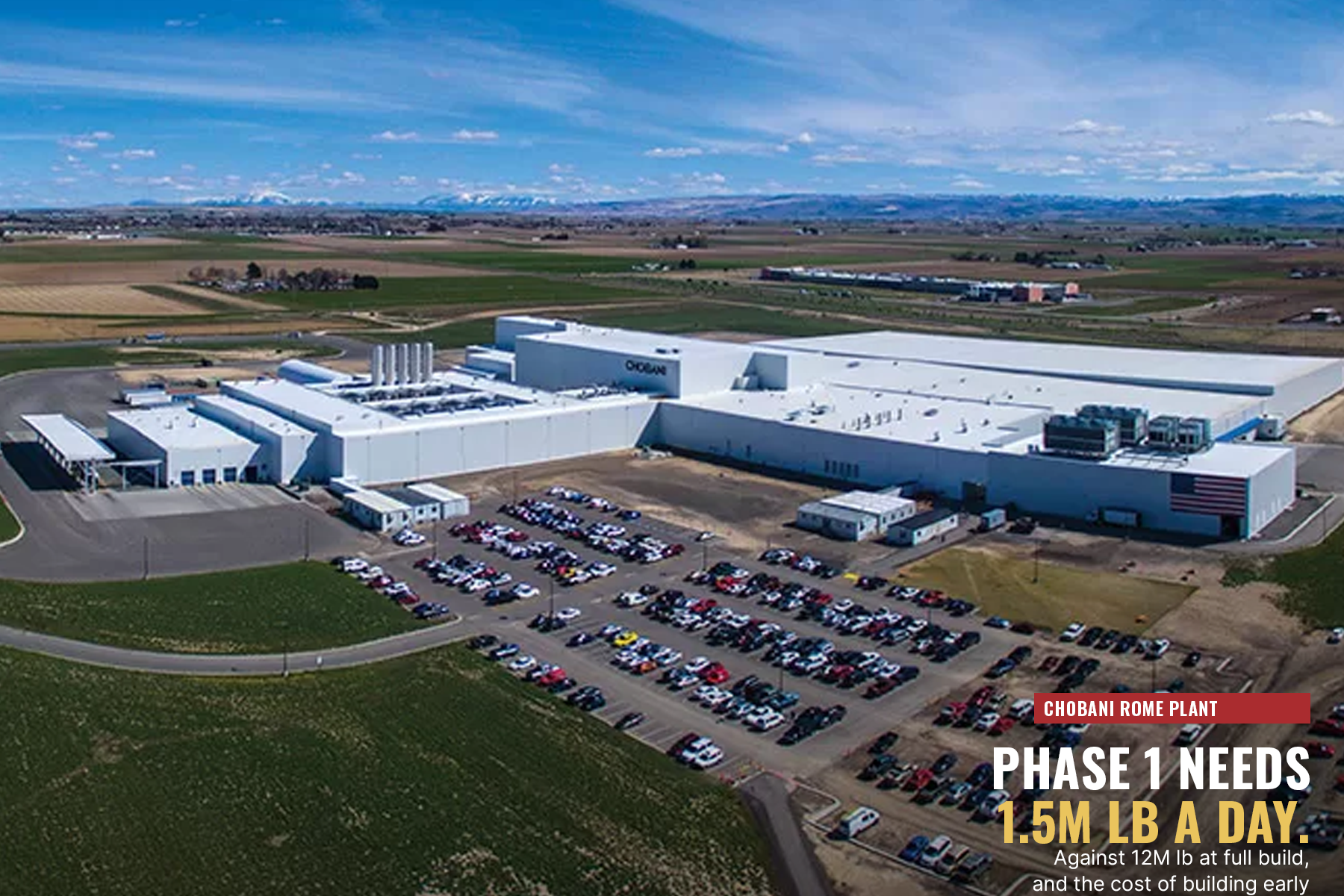
New York herds eyeing Chobani’s Rome plant are caught between two numbers. When New York announced the project in April 2025, the headline figure was 12 million pounds of milk a day at full capacity. Sixteen months later, Chobani’s chief impact officer, Nishant Roy, gave the Rome Sentinel a much smaller starting number: Phase 1 will require about 1.5 to 2 million pounds a day. Even at the top of that range, Phase 1 is 16.7% of the plant’s full milk capacity.
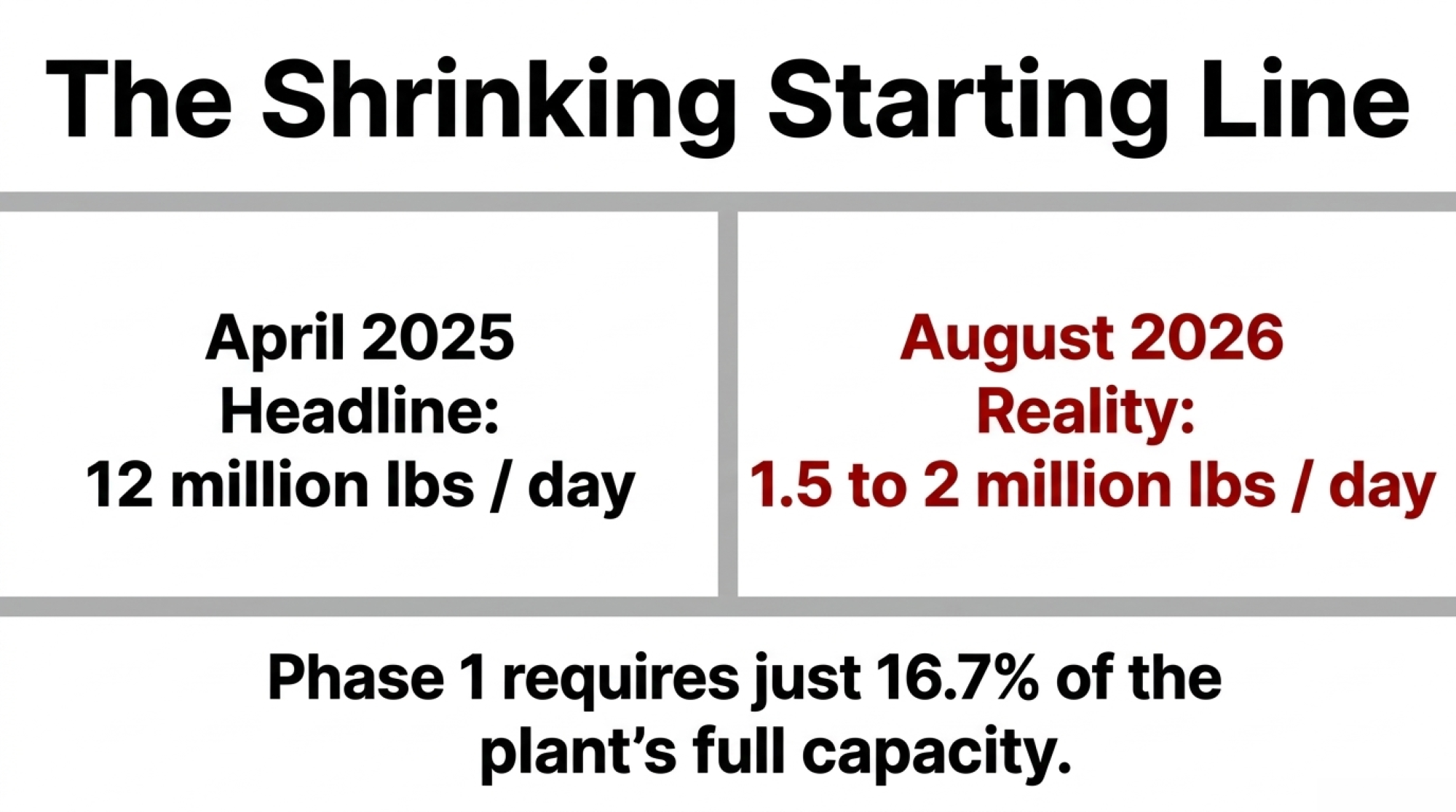
For New York herds, that gap is the Chobani Rome milk supply story. DairyHerd’s October 1 report, which interviewed IDFA president and CEO Michael Dykes, counts $14.4 billion across 77 projects in 21 states. Bullvine hasn’t seen the project list behind that count. The capital commitments are public. Any supply commitments to farms would sit in separate documents, and Bullvine found none published.
What did New York commit Chobani to?
The April 22, 2025 release describes a $1.2 billion, 1.4-million-square-foot plant “capable of producing over one-billion pounds” of dairy products a year, with “more than 1,000 jobs.” Ulukaya said Rome would have Chobani “partnering with hard working people across the heartland of New York.” State Agriculture Commissioner Richard A. Ball called it “tremendous news for our state and for our dairy farmers, who will be supplying milk to this state-of-the-art processing facility.”
The public money is tied to infrastructure and jobs:
- Excelsior Jobs Program: up to $73 million in performance-based tax credits from Empire State Development, tied to more than 1,000 jobs (Governor’s Office, April 22, 2025).
- FAST NY: $32.6 million to Oneida County for infrastructure at the Griffiss Triangle Site, announced by Governor Hochul on August 19, 2025, with Roy in the room (Governor’s Office transcript).
Neither award sets a price formula, base allocation, hauling terms, procurement radius, contract length or intake date for a supplying farm.
Chobani held a ceremonial groundbreaking in April 2025. Food Processing reported on August 13, 2026 that the company had planned to start full construction in 2026. The Sentinel now reports a construction start between spring 2027 and summer 2028 (Food Processing).
How much milk does Chobani Rome need at startup?
The phasing isn’t new. At the April 2025 announcement, Chobani president and COO Kevin Burns described the project as “phase one,” adding, “We’re building a campus, really,” according to WXXI. What’s new is a number. Roy told the Sentinel that Phase 1 brings four to six of a planned 28 production lines online, with about 300 to 450 hires, and Phase 2 adds seven to 10 lines. Oneida County officials now put total jobs closer to 1,800, WKTV reported on August 12, 2026.
The Sentinel reported that Roy said Chobani is engaged with more than 400 local dairy farms and co-ops, and has worked with farmers and co-ops since before the 2025 announcement. “Engaged” can mean conversations, prospect lists or co-op planning, and co-ops in that count may represent some of the same farms.
New York produced 16.568 billion pounds of milk in 2025 from 642,000 cows averaging 25,807 pounds each, according to USDA NASS’s annual summary, released April 30, 2026.
| Rome capacity measure | Daily milk | Annualized | Share of NY 2025 production | NY-average cow equivalent |
| Phase 1, low | 1.5 million lb | 547.5 million lb | 3.3% | ~21,200 cows |
| Phase 1, high | 2.0 million lb | 730 million lb | 4.4% | ~28,300 cows |
| Full capacity | 12 million lb | 4.38 billion lb | 26.4% | ~169,700 cows |
Bullvine calculation using the NY Governor’s Office release (April 22, 2025), Roy’s Phase 1 range as reported by the Rome Sentinel (August 11, 2026), and USDA NASS 2025 New York data (April 30, 2026).
Chobani already buys more than 1 billion pounds of New York milk a year, according to Oneida County’s April 21, 2025 release. Phase 1’s annual demand, at the high end, equals at most 73% of that. No public source says how much of Phase 1 will be new demand rather than milk now going to Chobani’s existing plants, and that’s the first question your co-op should be able to answer.
The plant’s scale and schedule have both moved since April 2025, and our earlier math didn’t hold up even against the original announcement. Checked against the announced figures and the new Phase 1 range, four previous Bullvine estimates need correcting:
- April 24, 2025. We put the plant at roughly 100,000 cows, with completion in late 2026.
- June 16, 2025. We equated 12 million pounds a day with about 1,200 high-producing cows, understating it by more than 168,000 cows.
- October 19, 2025. We listed a Chobani Rome premium of $0.75 to $1.25/cwt for 3.3%-plus protein. We have found no published Chobani document that sets a premium for a plant that hasn’t operated.
- November 21, 2025. We said 40 mid-size farms or three to four mega-dairies could supply it. At New York’s 2025 yield, 40 farms would need about 4,240 cows each.
Pennsylvania gets Chobani milk demand first
Chobani’s second $1.2 billion bet starts sooner. Governor Josh Shapiro’s office announced on August 31, 2026 that Chobani’s plant at 7356 Industrial Boulevard in Upper Macungie Township will, at full scale, source more than 3 billion pounds of Pennsylvania milk a year. That’s about 30% of the state’s current production, with production expected to begin in 2027 (reported by the Morning Call). Three billion pounds averages about 8.2 million pounds a day (Bullvine, September 3, 2026).
PennLive reported a mid-summer 2027 start after $270 million in upgrades (PennLive, September 25, 2026). Pennsylvania is also offering $127 million in loans and grants to farmers who expand to meet the demand.
For a New York herd, the order matters. Pennsylvania’s full-scale daily volume is more than four times Rome’s Phase 1 high, and it’s due to start a year or more earlier. Whether Chobani supplies Upper Macungie from Pennsylvania farms only, or New York co-op milk crosses the line, isn’t in any public document. That’s the second question for your co-op.
When will Chobani Rome start taking milk?
Chobani’s 15 months has been reported two ways. WKTV reported on August 12, 2026 that operations are set to begin 15 months after construction starts, with the whole project finished by 2030. Syracuse.com reported on August 19 that Roy said the three-phase project would take 15 months to complete. On WKTV’s reading, first milk arrives between mid-2028 and late 2029 (Bullvine calculation from the Sentinel’s construction window).
Oneida County Executive Anthony Picente gave an earlier date. He said he looked forward to “the upwards of 450 jobs that phase one of the Rome plant will bring to Oneida County in early 2028,” according to the Oneida Dispatch on September 7, 2026. Chobani hasn’t published a date that settles it.
The Sentinel reported that Chobani moved the start while juggling new market demand and Mohawk Valley winters. Roy also said, “we are also not abandoning our commitment to Rome. We’re coming,” as quoted by Food Processing.
Who carries the risk while Rome phases in?
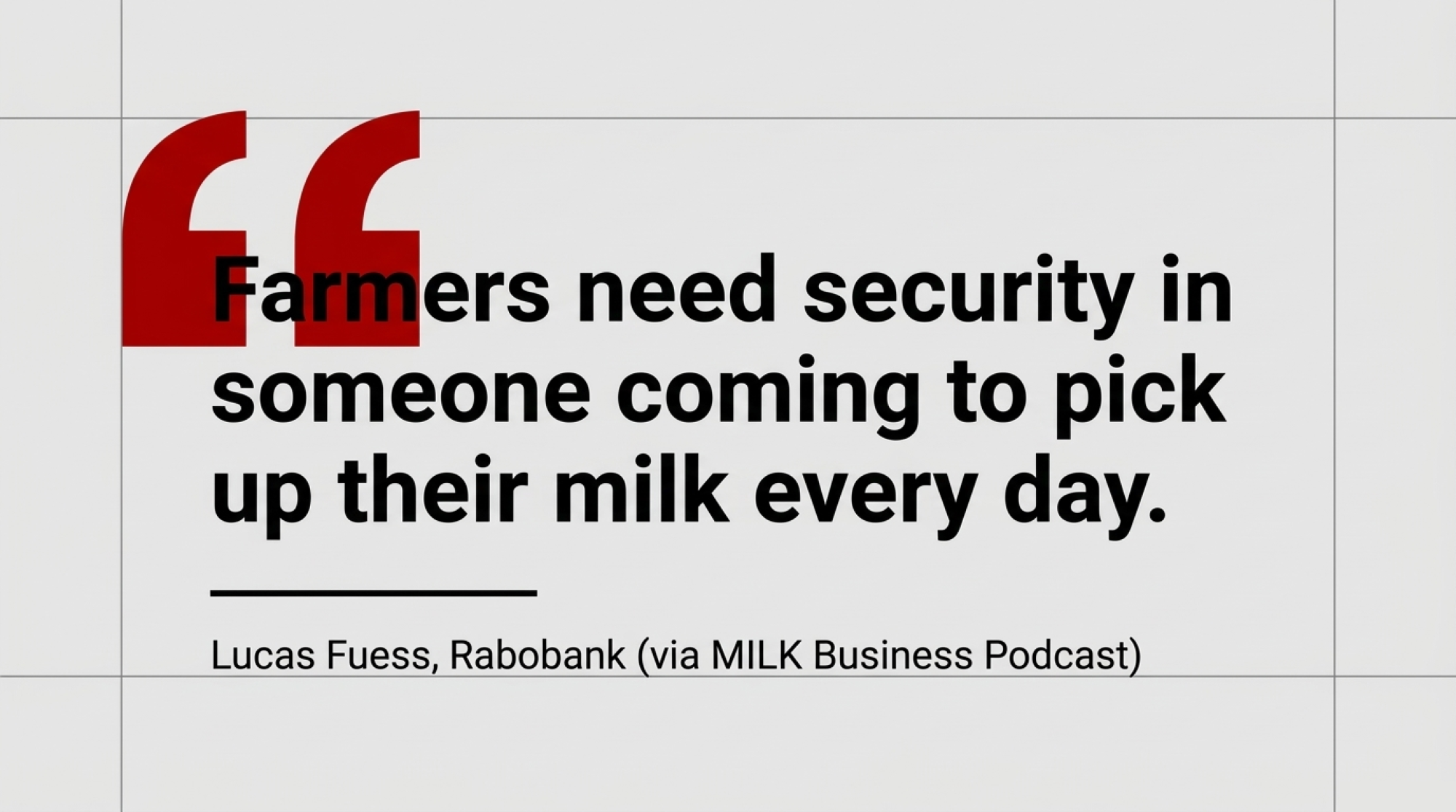
On the MILK Business Podcast, as reported by Lucas Fuess of Rabobank, a major dairy lender, described the standoff. Co-ops and processors won’t spend, “in some cases, $1 billion on a new plant” without security in milk supply growth, he said, and farmers need “security in someone coming to pick up their milk every day.”
Dykes said profitability has to exist “at the farm level and the processing level.” He also acknowledged that a farmer being able to switch milk buyers is “not necessarily the case today.”
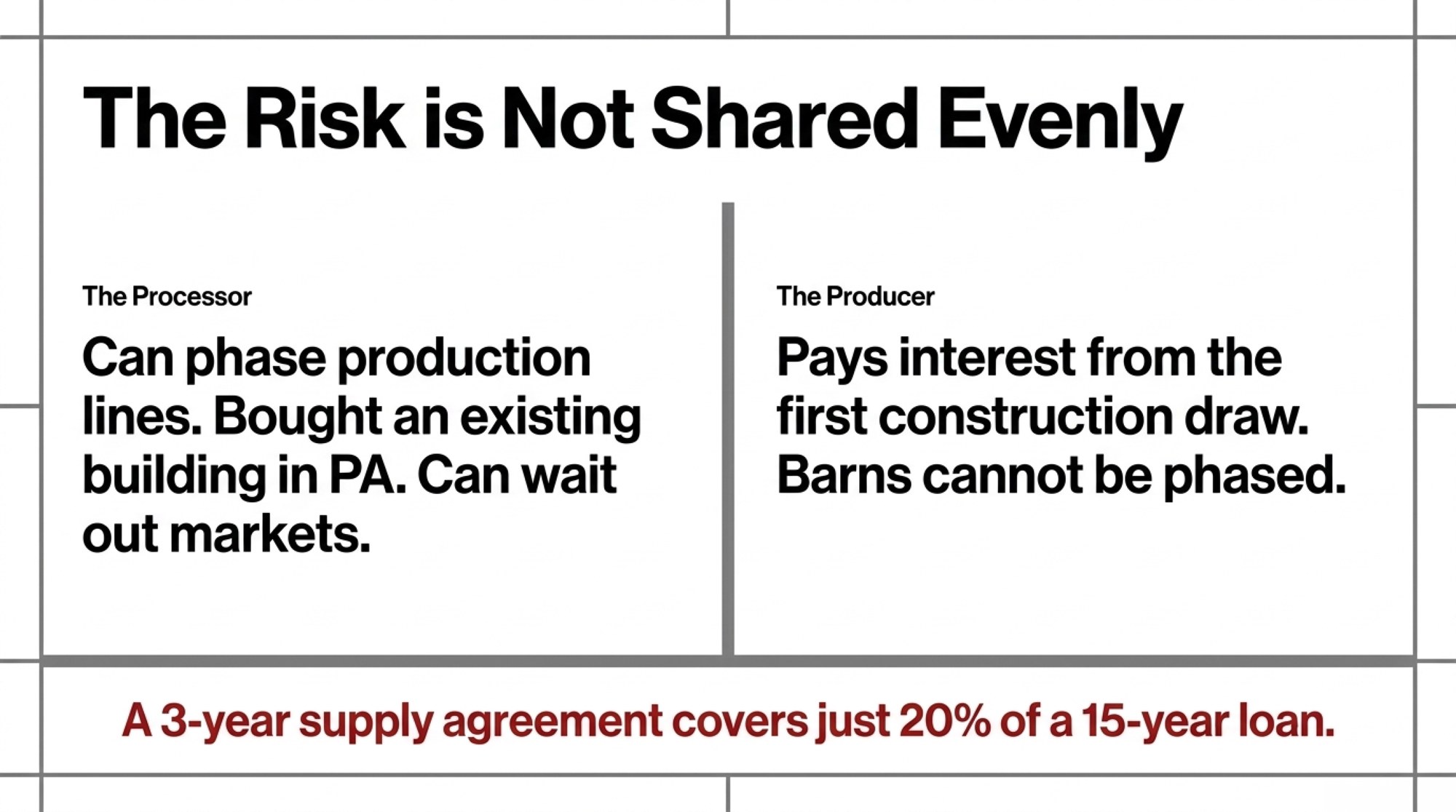
In our analysis, the risk isn’t shared evenly. Chobani can phase lines in, and in Pennsylvania it’s bought an existing building that starts producing sooner. A producer who builds a barn pays interest from the first construction draw, whether Rome takes milk in mid-2028 or late 2029.
Running the Numbers: Building ahead of a phased plant
Published evidence
- New York 2025 yield: 25,807 lb/cow (USDA NASS, April 30, 2026, state average).
- Capital: “maybe $25,000 a cow, depending on land prices,” from Dykes describing a whole new dairy.
- Construction-start window: spring 2027 to summer 2028, about 16 months (Rome Sentinel, August 11, 2026).
- 2027 U.S. all-milk price forecast: $19.80/cwt (USDA ERS, Livestock, Dairy, and Poultry Outlook, September 2026).
Stated assumptions
- A 400-cow New York herd adds 100 cows, shipping 25,807 cwt more a year.
- Capital per added cow: $25,000 high (Dykes’s whole-dairy figure), $20,000 central, $15,000 low. An addition on an existing site likely costs less, so the takeaways use the low case.
- Loan: 7% interest (illustrative, not a quoted rate), 15-year amortization with annual payments (factor 0.109795).
- Supply contract: three years, starting the same year as the loan.
Bullvine calculation (USD)
| Low | Central | High | |
| Expansion capital | $1,500,000 | $2,000,000 | $2,500,000 |
| Annual principal and interest | $164,692 | $219,589 | $274,487 |
| Debt service per added cwt | $6.38 | $8.51 | $10.64 |
| Debt service as share of $19.80 all-milk | 32% | 43% | 54% |
| Interest carry per month of delay | $8,750 | $11,667 | $14,583 |
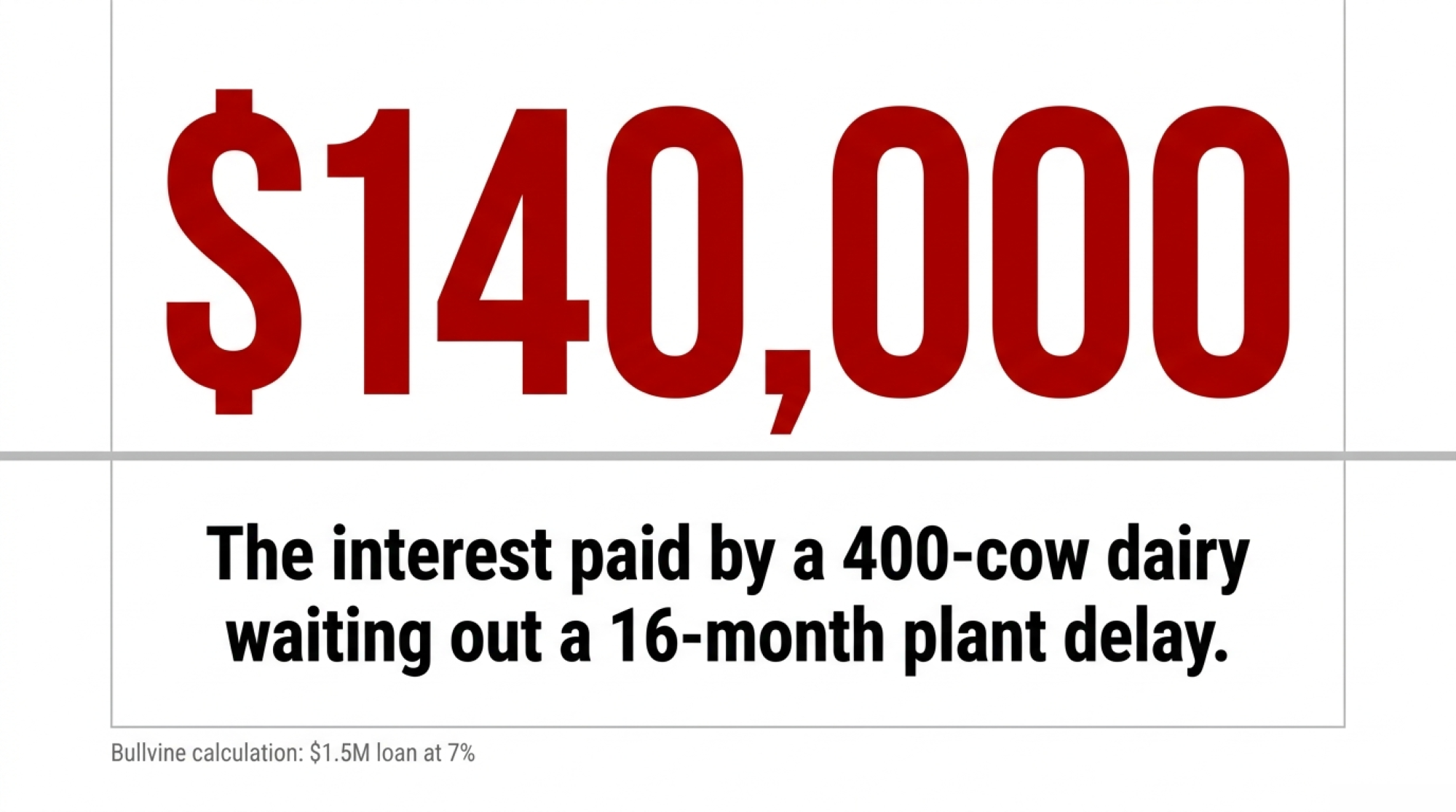
| Interest carry across a 16-month slip | $140,000 | $186,667 | $233,333 |
| Remaining payments after a 3-year contract ends (principal + interest) | $1.98 million | $2.64 million | $3.29 million |
On our low case, a producer who has drawn $1.5 million at 7% pays $8,750 a month in interest while waiting for the plant to take milk.
The principal still owed after three years is about $1.31 million on the low case. The table row is larger because it adds 12 years of interest to that balance.
On the low case:
- A 16-month slip, the spread between Chobani’s earliest and latest construction starts, costs $140,000 in interest.
- Debt service alone takes $6.38 of every $19.80 the added milk is forecast to earn in 2027, before feed, labour or heifers.
- Each $1.00/cwt over-base discount on the added milk costs $25,807 a year, or 9.4% to 15.7% of the annual loan payment across the three cases.
- A three-year agreement covers 20% of a 15-year loan.
Methodology note. Delay carry is interest-only on the full drawn balance. With monthly payments, the low case runs $161,790 a year and leaves $1.94 million in payments after the contract ends. The $19.80 forecast is a U.S. average; New York pay prices differ. The herd is a model, not a named farm’s books. For how a rally-year budget hides this exposure, see the $5.39/cwt debt trap in 2026 expansion budgets.
What does $15 billion tell New York producers?
The count grows as the window widens:
| Date | Count | Scope |
| October 2, 2025 | more than $11 billion | 50+ projects, 19 states, 2025 to early 2028 |
| October 1, 2026 | $14.4 billion | 77 projects, 21 states |
| Accessed October 5, 2026 | more than $15 billion | 2025–2030 |
IDFA, which represents dairy processors, split its October 2025 total by product: cheese $3.20 billion, milk and cream $2.97 billion, yogurt and cultured $2.81 billion. USDA ERS forecasts 238.6 billion pounds of U.S. milk for 2027.
That’s what the counts tell a New York producer: where processors are putting capital. They don’t report contracted farm pounds, so none of them tells you whether any of it is committed to your milk.
What does my co-op milk check actually show?
Under 7 CFR §1001.73(e), a Northeast handler paying producers must give each one a statement showing the minimum rate owed, any different rate actually paid, each deduction and the net payment. The rule carves out producers whose milk was received from a cooperative association acting as a handler under §1000.9(a) or (c). Under §1001.73(b), the handler pays the cooperative for that milk, and §1001.73 doesn’t set what the member’s own pay statement must show.
If your milk moves through a co-op, a Chobani premium paid to the co-op could arrive blended into your pay price, without its own line. That’s a visibility gap, and the rule alone says nothing about whether anything is withheld. You can’t confirm from the statement that Rome milk is worth more to you, so ask.
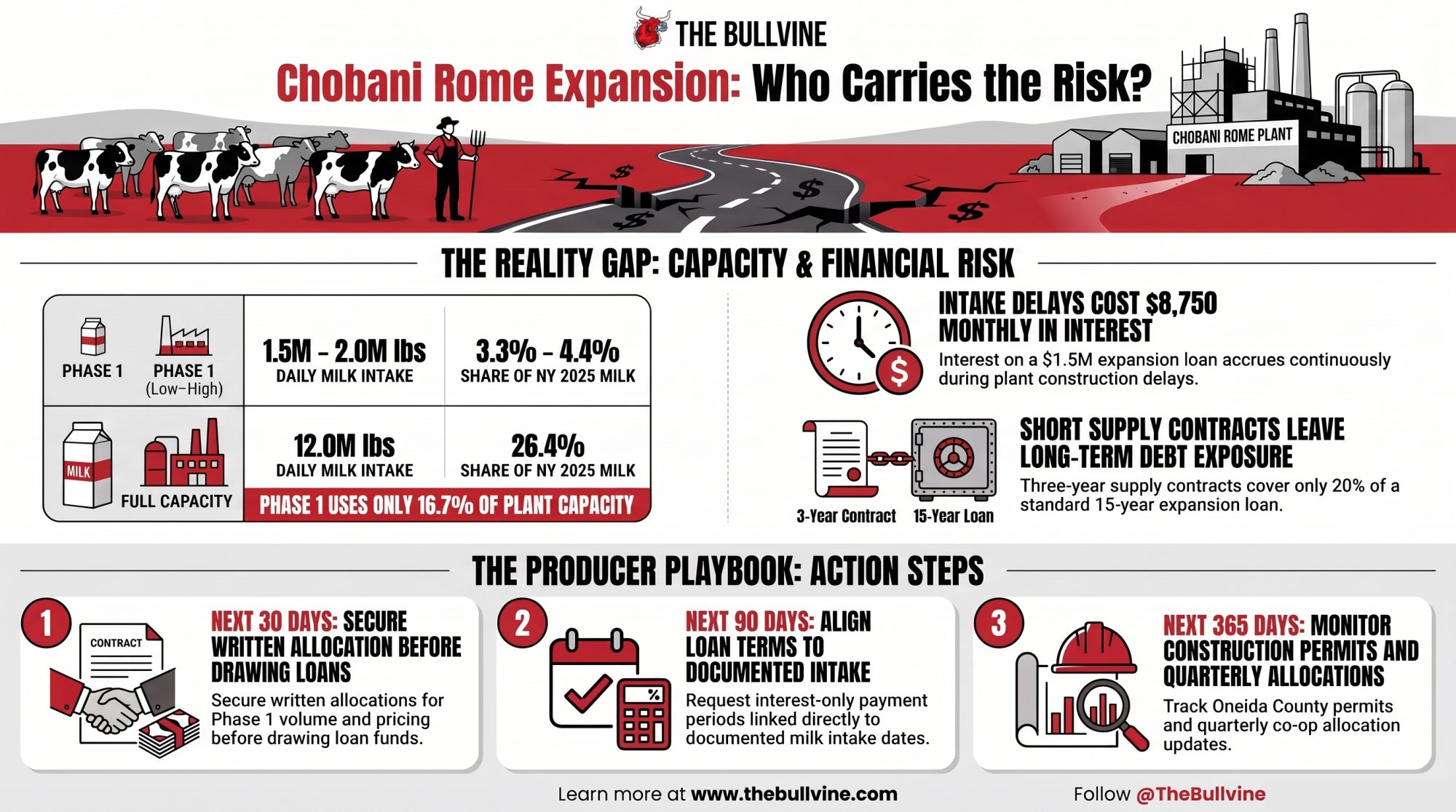
The Rome playbook: 30, 90 and 365 days
The same written questions apply to any producer being courted by a new plant, in New York, Pennsylvania or elsewhere.
Next 30 days: Get the supply answer in writing
The Action: Ask your co-op field rep or buyer for, in writing, Phase 1 committed pounds, which co-ops hold them, intake date, contract term, how over-base milk is priced, and whether your milk could be routed to Upper Macungie instead.
The Requirement: One email and 12 months of pay statements to compare against.
The Red Flag: You can’t get a written volume allocation for your added milk before your lender’s first construction draw. On the model above, every month between that draw and first intake costs $8,750 per $1.5 million borrowed at 7%.
The Backfire: Budgeting on Roy’s reported engagement with more than 400 farms and co-ops. Budget on pounds and dates in writing.
Next 90 days: Tie the loan to the contract
The Action: Ask your lender about an interest-only period tied to a documented intake date, or stage the build so cows arrive with the contract.
The Requirement: The written answer from step one, a cash-flow budget at your current net price and a lender meeting.
The Trigger: Your offered contract runs shorter than your loan. On the model, a three-year deal covers 20% of a 15-year note.
The Backfire: Staging raises per-cow cost or delays the herd past the intake date. Price both paths before choosing.
Next 365 days: Watch for the signal that changes the bargain
The Signal: A confirmed construction start, through a contractor award, building permit or Chobani announcement, would narrow the window in the model from 16 months to a date. That’s the point where co-ops have a reason to compete for added milk.
The Action: Track Oneida County and City of Rome planning records, watch Upper Macungie’s 2027 ramp, and ask your co-op each quarter whether your Phase 1 allocation has changed.
The Watch Item: Whether any offer prices protein specifically. Rome is a yogurt and cultured-products plant, and no Chobani premium schedule for Rome has been published.
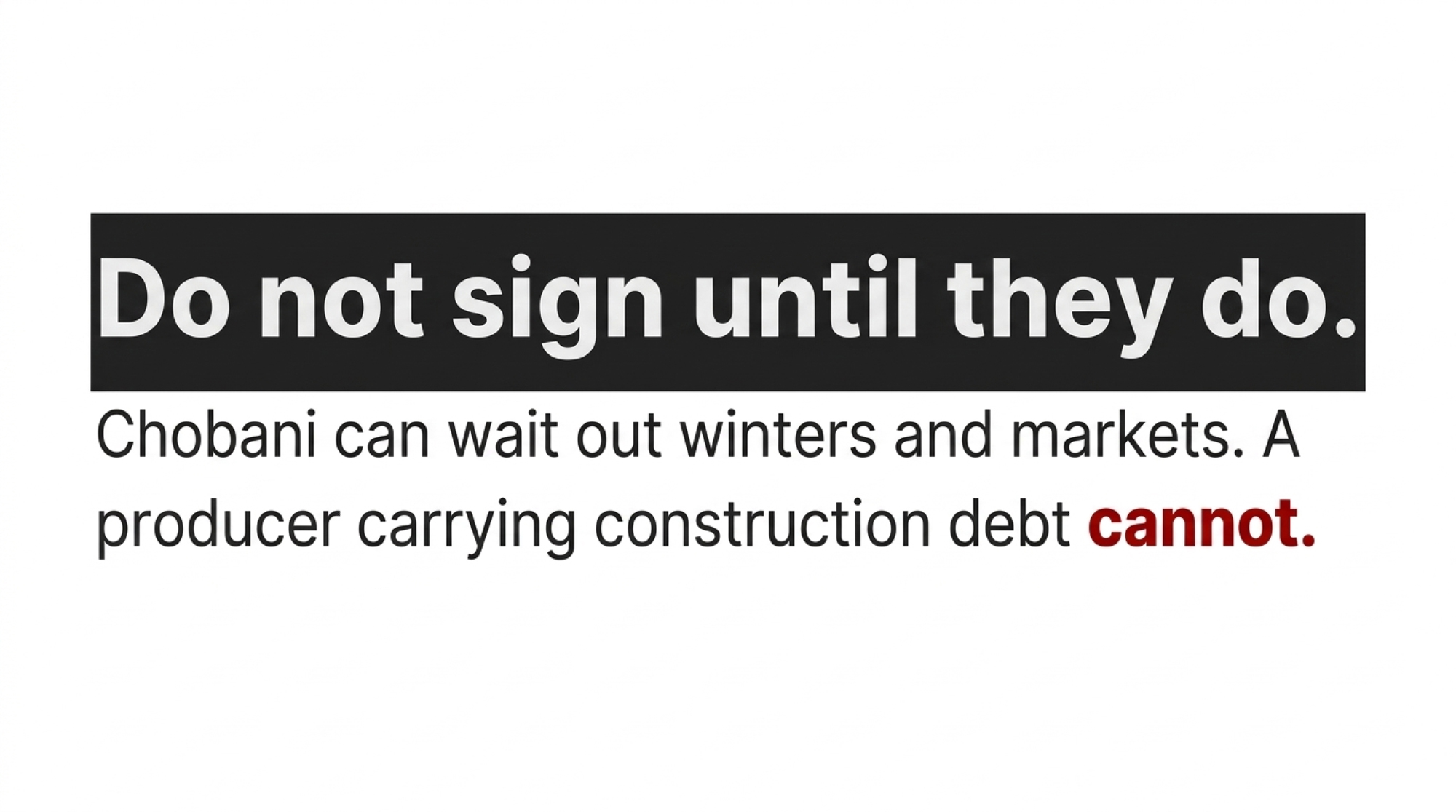
Chobani can wait out markets, winters and its existing sites. A producer carrying construction debt can’t. Before you sign a loan, can your co-op show you, in writing, how many pounds of your milk Rome has committed to take, and when?
Learn More
- The New Math of Dairy Expansion: Why “Bigger Land” Is Bleeding Your Profits Dry — Dismantles the long-held assumption that adding acreage automatically secures your dairy’s future. Before pouring capital into expansions for promised processing capacity, run these specific asset utilization formulas to stop bloated overhead from crushing your per-cow profitability.
- $18.95 Milk, 8% Money: Nathan Kauffman’s 18-Month Warning for the 10-15% of Dairies in Significant Stress— Surviving sub-$19 milk and 8% interest requires brutal honesty about your debt-service coverage ratios. Delivers the exact math on how rapidly thin margins kill highly leveraged expansions, forcing immediate balance sheet adjustments before your lender calls.
- Chobani Launches Shelf-Stable Super Milk to Aid Disaster Relief and Fight Food Insecurity — Consumer demand for shelf-stable, high-protein formulations is pulling processor capital away from the refrigerated aisle. Follows the money on this strategic Chobani launch to reveal which specific dairy categories will dictate future premium structures and long-term contracts.
 The Sunday Read Dairy Professionals Don’t Skip.
 The Sunday Read Dairy Professionals Don’t Skip.
Every week, thousands of producers, breeders, and industry insiders open Bullvine Weekly for genetics insights, market shifts, and profit strategies they won’t find anywhere else. One email. Five minutes. Smarter decisions all week.