






NMPF counts the contracts and checks the deliveries. Neither shows which exports needed the money.
NMPF’s NEXT export program, approved in June 2025 as CWT’s successor, runs on a 2¢/cwt contribution from participating cooperatives through 2028. NMPF reports contract commitments, with more than 315 million pounds in year one and 91 September contracts totaling 14.9 million pounds, and pays assistance only after delivery is verified. None of the NMPF documents cited estimates how much of that volume depended on the assistance. A consumer class action filed Oct. 5 alleges the program raises domestic prices, and that question belongs to the court. Bullvine built a two-part dashboard that members and directors of participating co-ops can request before deciding on the contribution past 2028, ending in assistance cost per estimated additional pound.
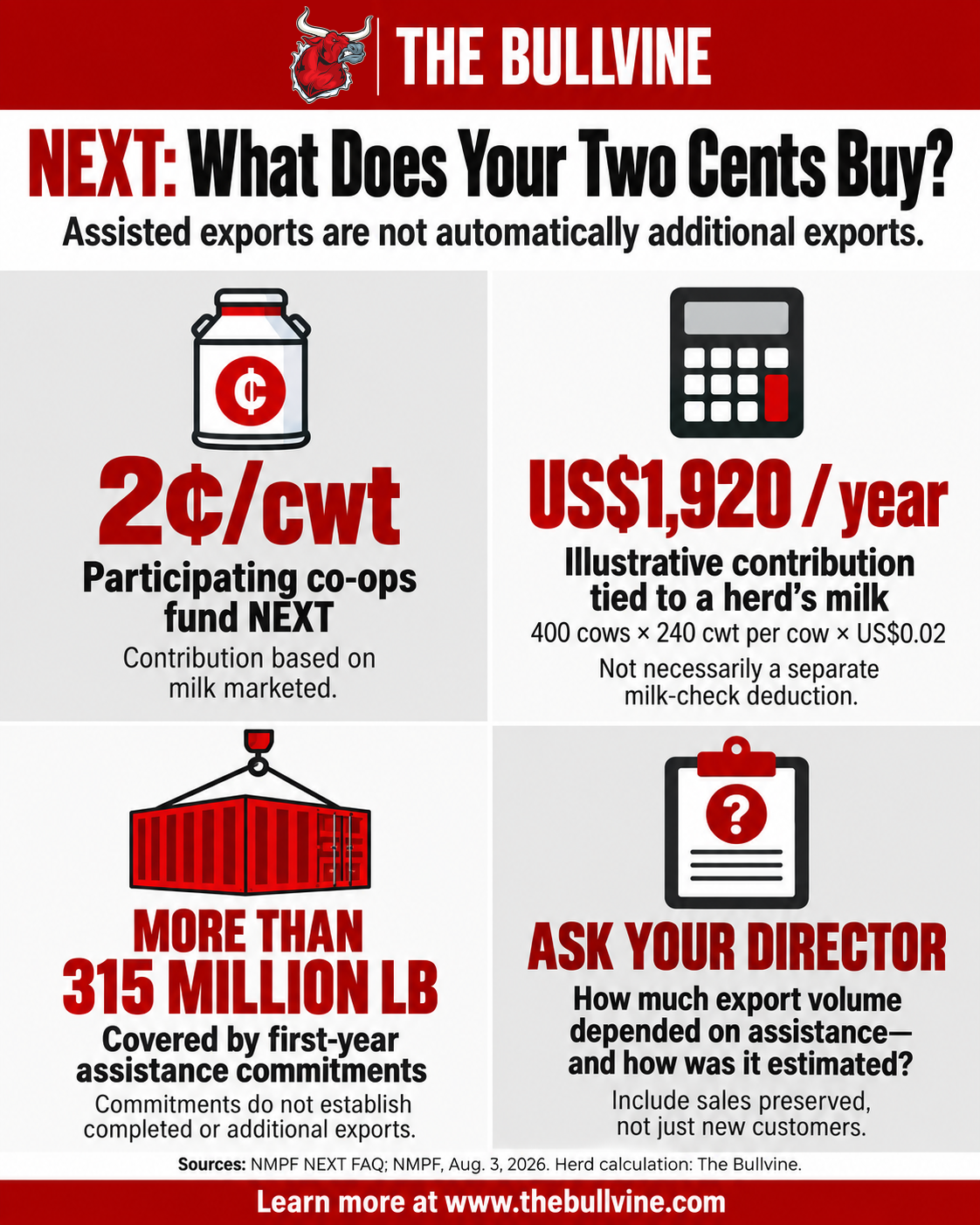
Participating cooperatives contribute 2¢/cwt on milk marketed to NMPF Exports & Trade (NEXT), and the money funds assistance to co-ops on export sales. The National Milk Producers Federation (NMPF) runs the program. Its board approved NEXT in June 2025 as the successor to Cooperatives Working Together (CWT), with the 2-cent contribution running through 2028. NMPF says the program will “help drive global demand for U.S. dairy products and support U.S. dairy prices.”
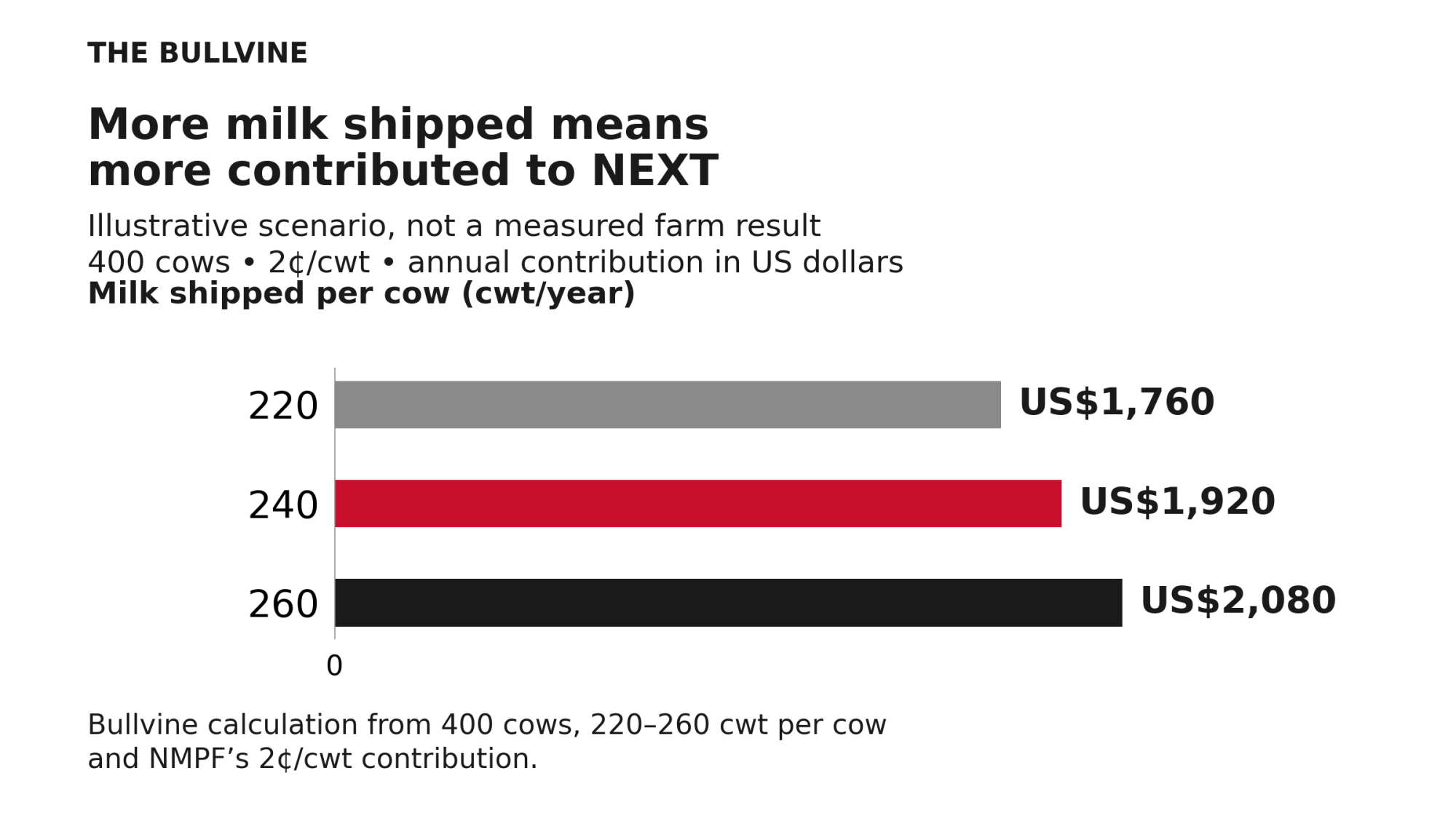
A 400-cow dairy in a participating co-op, shipping 240 cwt per cow a year, carries US$1,920 a year in NEXT contributions at 2 cents per hundredweight (Bullvine math). Whether that appears as a line on the milk check depends on the co-op. Either way, it’s calculated on that herd’s milk.
Additionality decides what the money buys. It is the estimated U.S. export volume that exists because of the assistance, including sales that would otherwise have been lost, compared with what would have shipped without it. Contract totals and delivery checks don’t measure it.
A consumer lawsuit filed Oct. 5 alleges the program artificially raises domestic prices by reducing domestic supply. Whether that’s true is for the court. For the farmer who funds the program, the open question is how many of those assisted exports would have happened anyway.
What NMPF Publishes (And What It Doesn’t)
NMPF’s Oct. 6, 2026 monthly release reported 91 September contracts adding 14.9 million pounds, shipping from September 2026 through July 2027. It labeled those amounts “current contracts for delivery, not completed export volumes.”
NEXT staff check delivery before money moves. NMPF’s FAQ says co-ops “do not receive payment from NEXT until documentation verifying product delivery to the end customer is received.” Before a bid is accepted, staff weigh the market, delivery timing, and global and U.S. prices. NMPF says the bid is accepted “when the level of assistance requested is economically justified.” It also says NEXT “aims to expand sales of U.S. dairy products in world markets, not displace existing sales,” and investigates any displacement claim. NEXT supports exports “to every country except Canada and Mexico in most cases,” though Doud’s August column describes a Mexico butter pilot.
None of the NMPF documents cited here (the FAQ, the July 2025 newsletter, the September sales release, or Doud’s August column) provides a quantified estimate of net additional exports or explains a method for producing one.
Which Exports Needed the Assistance?
A NEXT-assisted cheese sale to a buyer in South America who would have bought the same quantity of U.S. cheese anyway is assisted, not additional. Additionality is the estimated increase in U.S. export volume compared with what would have shipped without assistance. It includes sales the assistance preserved and extra quantity it added to an order, along with deals that wouldn’t otherwise exist.
A sale to a long-standing customer can count if that customer was about to switch to New Zealand or EU supply. A buyer switching from one U.S. exporter to the assisted co-op doesn’t, by itself, raise U.S. export volume.
No document settles that for a single sale. An estimate would rest on evidence such as:
- Competing offers: whether other suppliers were bidding, and whether the buyer was walking or cutting the order before assistance.
- The seller’s alternative: whether that product had a domestic home or an unassisted export buyer.
- Exporter returns: how the assisted sale compared with the best unassisted option after freight, tariffs, and other costs.
- Repeat orders: whether the buyer kept ordering after assistance stopped. That’s useful evidence, though it can’t prove the first sale depended on assistance.
Timing makes it harder. September’s contracts ship into July 2027, so one year’s deliveries trace back to earlier contracts. Confidentiality matters too. A report should aggregate by product and an appropriate reporting period, adding regions where useful, and combine or suppress any cell that could identify a transaction.
The public FAQ doesn’t say whether NMPF estimates additionality, or how. It isn’t the only channel, though. NEXT has a Strategic Advisory Group of co-op staff and farmers, and member co-ops can request the program’s bylaws and operating procedures. Participating boards may already see more than the public page shows.
| Public rule | What NMPF states | What it establishes | What it does not establish |
|---|---|---|---|
| Funding | Co-ops contribute 2¢/cwt marketed. | The contribution basis | The return to the funding herd |
| Bid review | Staff consider market conditions, delivery timing and prices. | Assistance is reviewed for economic justification | Whether the export depended on assistance |
| Payment | Delivery documentation is required before assistance is paid. | End-customer delivery is verified | How many U.S. export pounds were additional |
| Displacement | Claims that assistance displaced an unassisted sale are investigated. | A stated safeguard against displacement | A quantified net-additional-export estimate |
The NEXT Performance Dashboard (What to Ask For)
Program finances run on the program’s year, which in NEXT’s first ran from July 2025 to the beginning of July 2026. Export results run on a contract group, meaning contracts accepted in the same period, such as one quarter.
Program finances (the year)
| Measure | Definition |
| Calculated contribution | Participating cwt × 2¢ |
| Actual receipts | Contributions actually collected |
| Assistance paid | Payments on verified deliveries |
| Assistance owed | Owed on verified deliveries, not yet paid |
| Administration | Program operating costs |
| Outstanding commitments | Dollar value of approved assistance on quantities neither delivered nor cancelled, including the unshipped part of partly delivered contracts |
| Uncommitted funds at year end | Funds available at year end after assistance owed and outstanding commitments |
Export performance (the contract group)
| Measure | Definition |
| Contracted volume | Pounds under accepted bids, by product |
| Delivery status | Delivered, not yet due, overdue, and cancelled, as shares of contracted pounds |
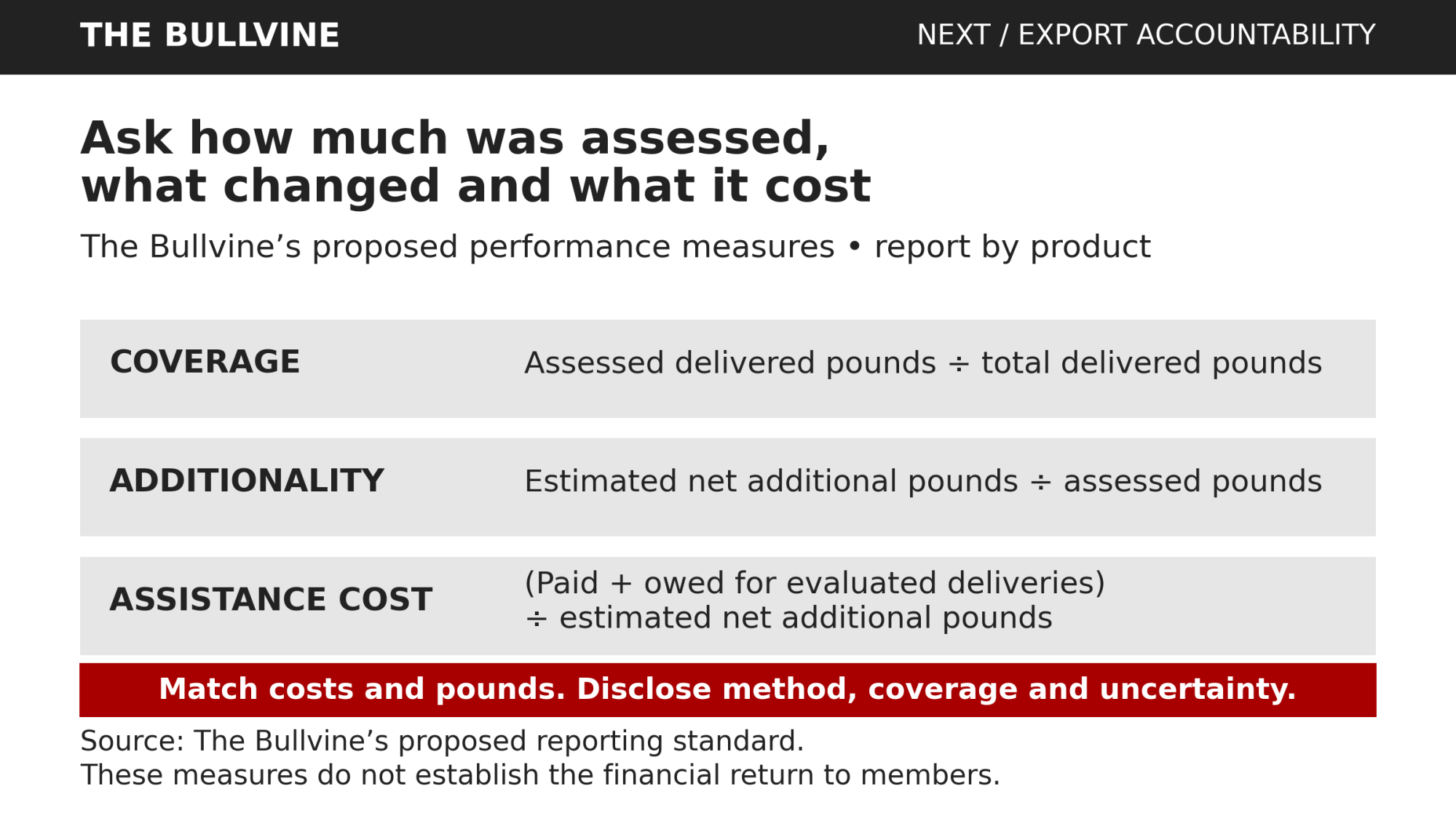
| Assessment coverage | Share of delivered pounds actually assessed for additionality |
| Estimated additionality within assessed volume | Estimated net additional pounds ÷ assessed pounds |
| Assistance cost per estimated additional pound | (Assistance paid + assistance owed on the deliveries evaluated) ÷ estimated net additional pounds |
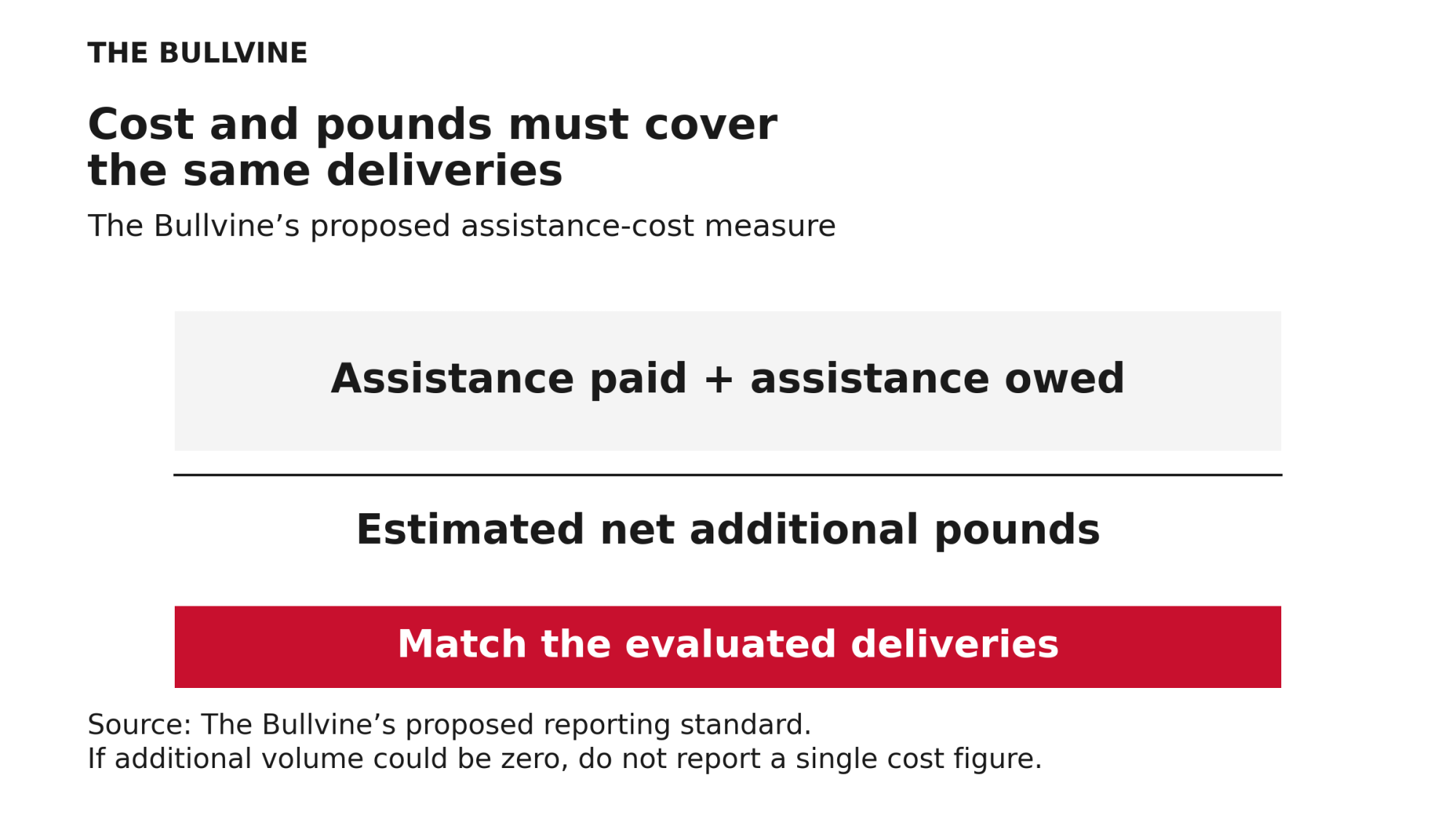
The two estimated rows need a stated method and an uncertainty range. If NMPF assessed only a sample, the result describes that sample, not every pound delivered. Cost and additional pounds must cover the same deliveries, and if the estimate of additional volume could be zero, NMPF shouldn’t publish a single cost-per-pound figure. Butter, cheese, and powder stay separate; any combined total needs a disclosed conversion method.
What the Dashboard Can’t Show
Whether a member’s 2 cents came back sits outside the dashboard, because answering it means tracing export effects through prices, co-op margins, and the member’s own milk check. The dashboard stops at shipped volume, estimated additional volume, and assistance cost per estimated additional pound. If a herd carries the full contribution and a higher milk price is the only benefit counted, it breaks even at a 2¢/cwt gain in its realized price.
The assistance itself goes to the exporting co-op, where it may simply offset a thinner export margin. That payment moves money between participants, and nothing in it guarantees a return to the members who fund it.
The 315-Million-Pound Question
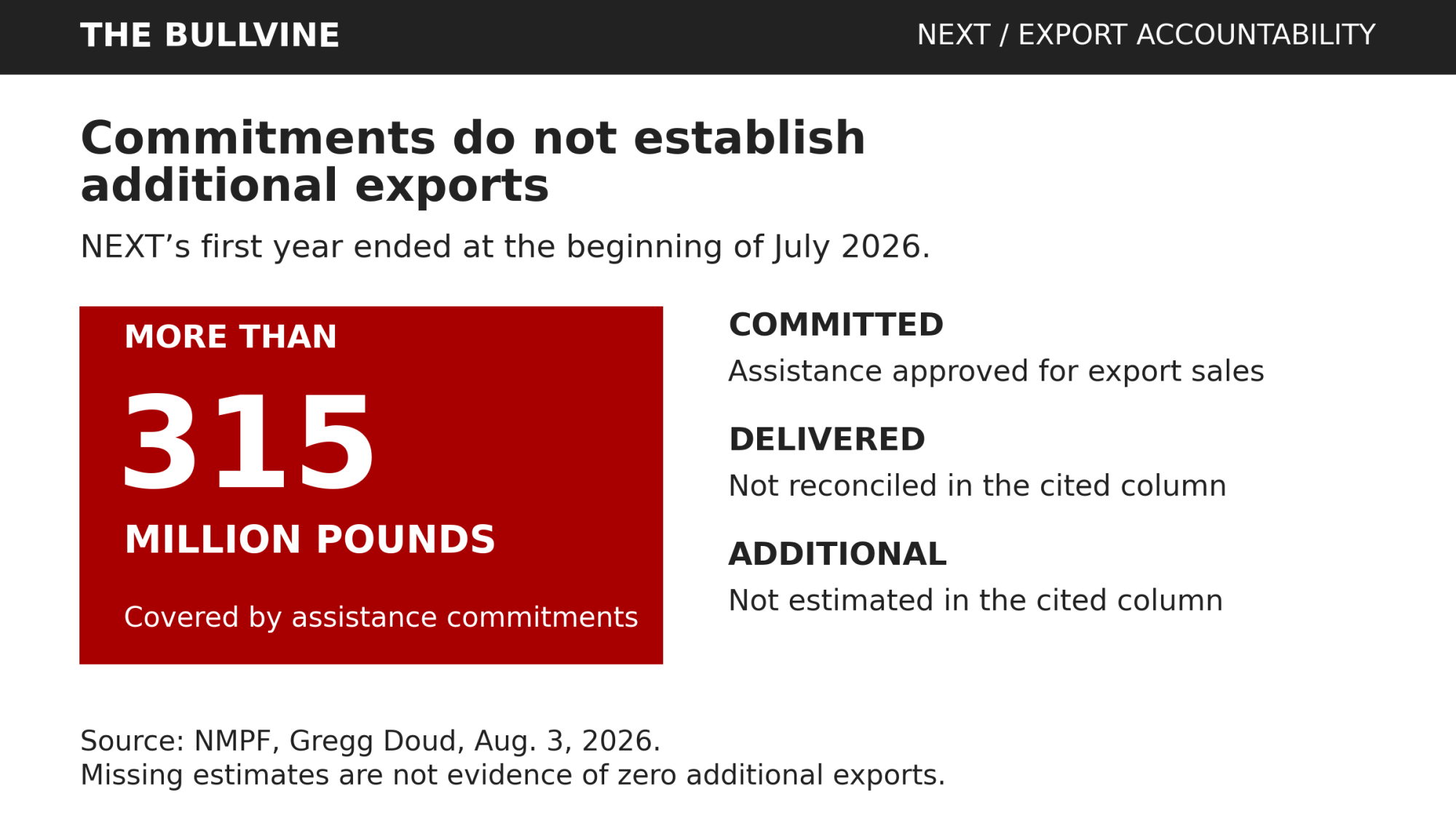
In an Aug. 3, 2026 column, NMPF President and CEO Gregg Doud said NEXT “committed export assistance on more than 315 million pounds of dairy products destined for international markets” in its first year, which ended at the beginning of July 2026. He wrote that “at a fundamental level, NEXT’s export investment has helped grow demand abroad for U.S. dairy and maintain the global competitiveness of participating cooperatives, even when U.S. prices have diverged from global markets.” He also wrote that it’s “a 73% greater volume than in 2024, the last year of the CWT program, at a cost to its members that’s half of the CWT assessment.” The column credits NEXT-supported volume with “over half of the total increase in U.S. sales” of butter to Mexico, and says NEXT commitments were “roughly 40% of the U.S. total Nonfat Dry Milk/Skim Milk Powder exports” to Indonesia over the past year.
Those are the column’s strongest numbers, and none of them measures additionality. A year-over-year volume comparison, a share of growth, and a share of exports all count assisted pounds. None says how many would have shipped without the money, or whether CWT’s 2024 total and NEXT’s first-year total were measured the same way.
What the Lawsuit Alleges
The proposed class action, Oriakhi v. National Milk Producers Federation, No. 2:26-cv-01093, was filed Oct. 5, 2026, in the U.S. District Court for the Eastern District of Virginia against NMPF and 13 cooperatives. The consumer plaintiffs allege that export assistance “directly reduces the domestic supply” of products like cheese and butter, so that “domestic prices rise above a competitive level” (¶5). Those are the plaintiffs’ allegations. CourtListener’s copy of the docket, last updated Oct. 20 and viewed Oct. 25, lists entries through the Oct. 13 issuance of summonses and shows no answer, motion, or merits ruling. That copy may not include later filings.
Estimating additional exports tests how the program performs. It doesn’t decide the lawsuit.
Three Requests for the Next Co-op Meeting
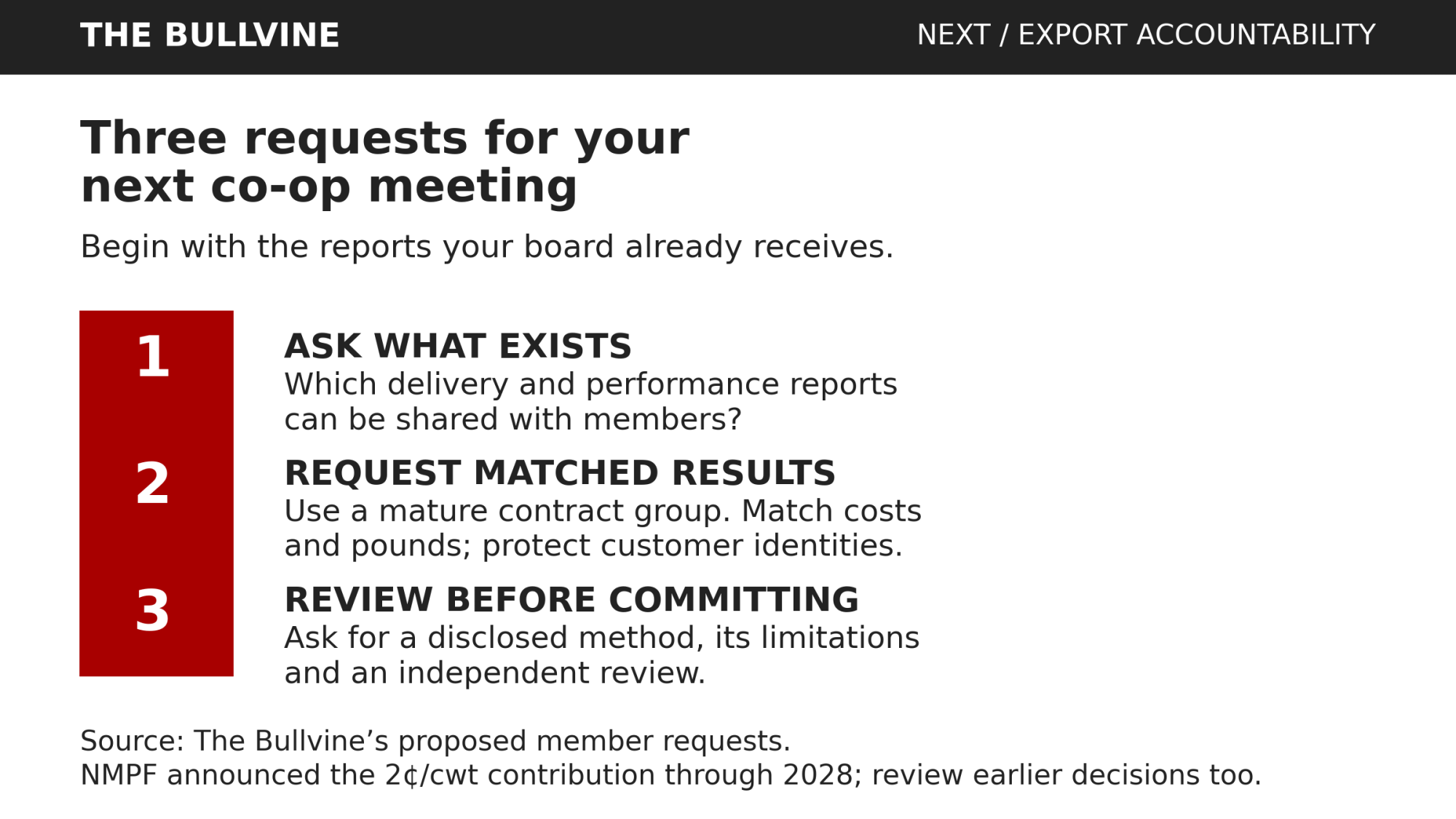
- Members can ask their director which delivery, cancellation, payment, and performance reports the board sees, and which aggregate information from those reports can be shared with members.
- At the next annual budget review, members asking for the dashboard can specify a contract group old enough that most deliveries are due, with any cell that could identify a transaction combined or held back, and no buyer names or prices.
- Before a co-op commits to the 2-cent contribution past 2028, members can ask the director for an estimate of additional export volume with its method disclosed where that’s feasible, a clear account of what can’t be estimated reliably, and an independent review of the approach.
Key Takeaways
- A share of export growth doesn’t measure additionality. NMPF credits NEXT with over half the increase in U.S. butter sales to Mexico, but doesn’t say how much of it needed the assistance.
- A 400-cow herd at 240 cwt a cow puts US$1,920 a year into NEXT (Bullvine math). If it carries the full contribution, it breaks even only at a 2¢/cwt gain in realized milk price.
- The assistance goes to the exporting co-op, where it may simply offset a thinner export margin. Nothing in that payment guarantees a return to the members who fund it.
- A cost-per-additional-pound figure only holds if cost and pounds cover the same deliveries. If the estimate of additional volume could be zero, there’s no single number to report.
Calculate Your Farm’s NEXT Contribution
Find out exactly how much your operation is paying into the NEXT export program each year.
Your Annual NEXT Contribution
Author’s note: All calculations are Bullvine’s. The 2¢/cwt rate and 2028 horizon come from NMPF’s July 2025 newsletter. Program-year dates and market claims are from Doud’s Aug. 3, 2026 column. The 400-cow herd is illustrative, not an industry average: US$1,920 a year at 240 cwt per cow, or US$1,760–US$2,080 at 220 to 260. The break-even line assumes the full contribution is allocated to the herd and doesn’t model alternative allocation methods or blend and component pricing; no price effect is estimated. The dashboard is a proposed reporting standard from The Bullvine, not a current NMPF requirement. Case details come from the complaint as filed Oct. 5, 2026. Docket details come from CourtListener’s copy of the federal docket, viewed Oct. 25, 2026.
Complete references and supporting documentation are available upon request by contacting the editorial team at editor@thebullvine.com.
Learn More
- The $300 Million Overrun You’re Paying For: Inside Dairy’s $11 Billion Labor Crisis — Arming yourself with targeted governance questions is critical before your board approves its next major capital expansion. The autopsy of Darigold’s catastrophic budget failure exposes exactly how a $4/cwt deduction gets forced onto members.
- Organic Valley FMMO Lawsuit: The $19.89 Risk on Your Farm — Protect your organic dairy against the devastating financial cliff that follows a canceled premium contract. Stress-testing a 200-cow herd reveals a brutal $875,000 annual margin drop, completely dismantling the myth of a reliable FMMO backstop.
- How 600 Irish Farmers Got Their Co-op to Finally Answer the Hard Questions — When entrenched management offers vague market excuses, producers can force written financial transparency using digital coordination. Grab the exact blueprint 600 farmers executed to extract clear pricing data from their €1.4 billion cooperative.
The Sunday Read Dairy Professionals Don’t Skip.

Every week, thousands of producers, breeders, and industry insiders open Bullvine Weekly for genetics insights, market shifts, and profit strategies they won’t find anywhere else. One email. Five minutes. Smarter decisions all week.