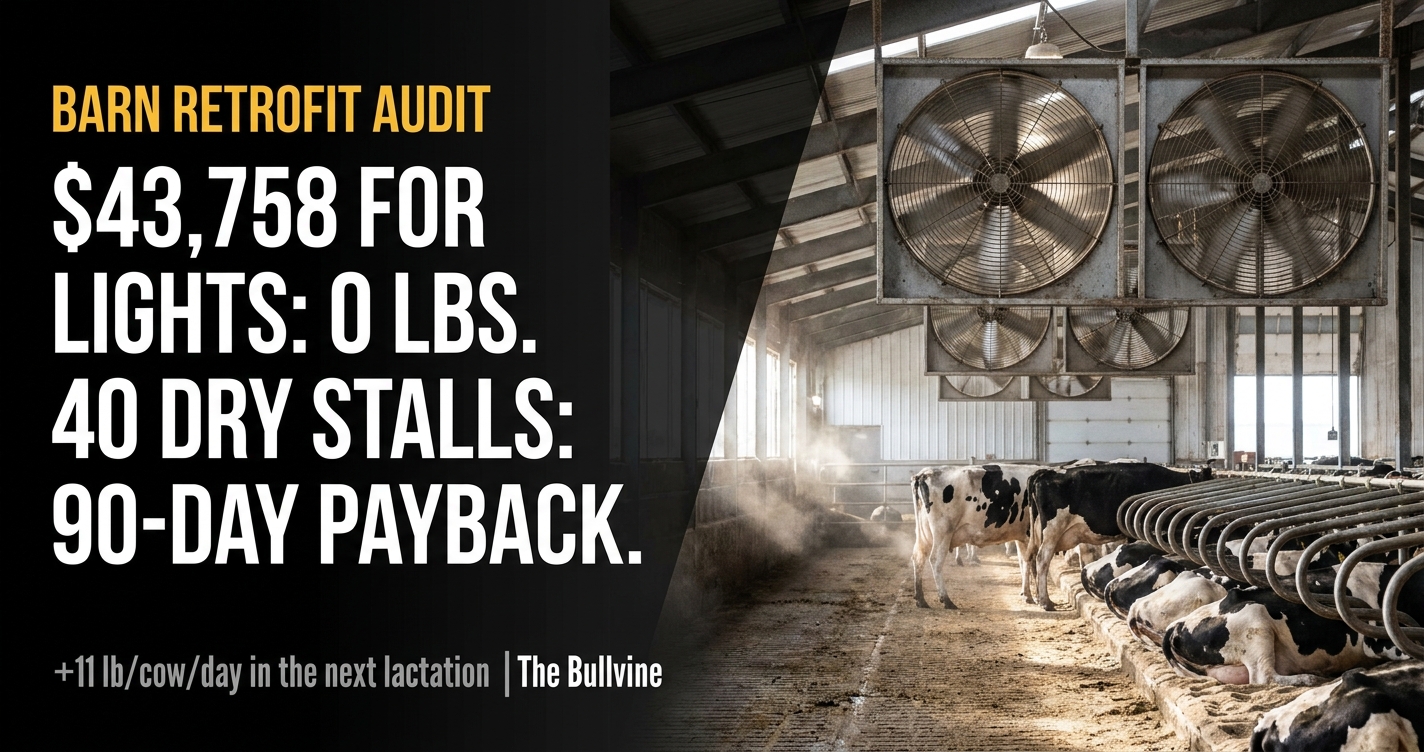
The lights measured zero. The dry pen didn’t. On a 250-cow herd that’s 41 freshenings a year at $459 each — and one hour in the herd software to find out.
EXECUTIVE SUMMARY
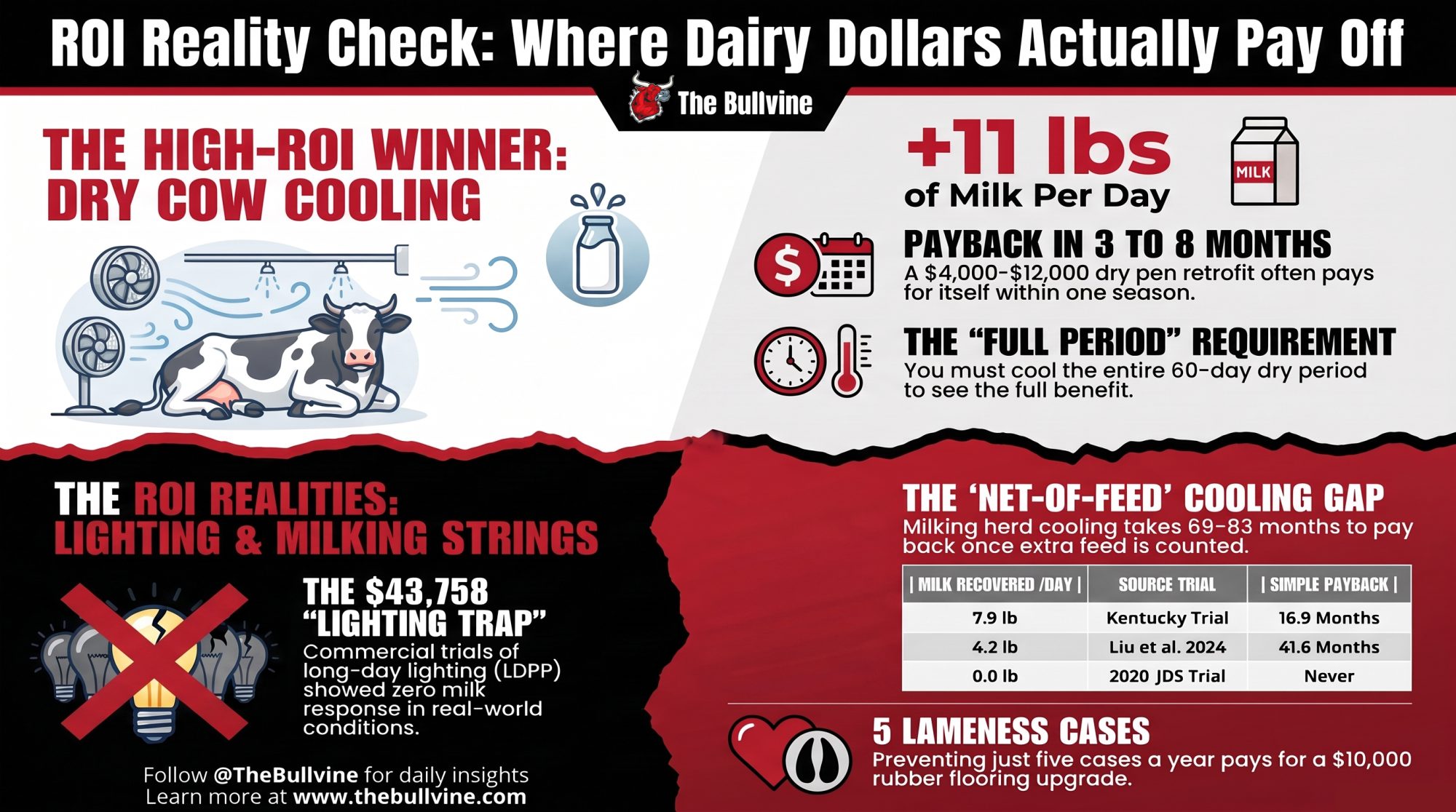
- The lighting trap. Cornell Cooperative Extension fitted a 1,000-cow western New York dairy with long-day lighting, tracked milk for 14 months against a true control, and measured zero response — turning a $43,758 install into a net loss across all fifteen sensitivity runs.
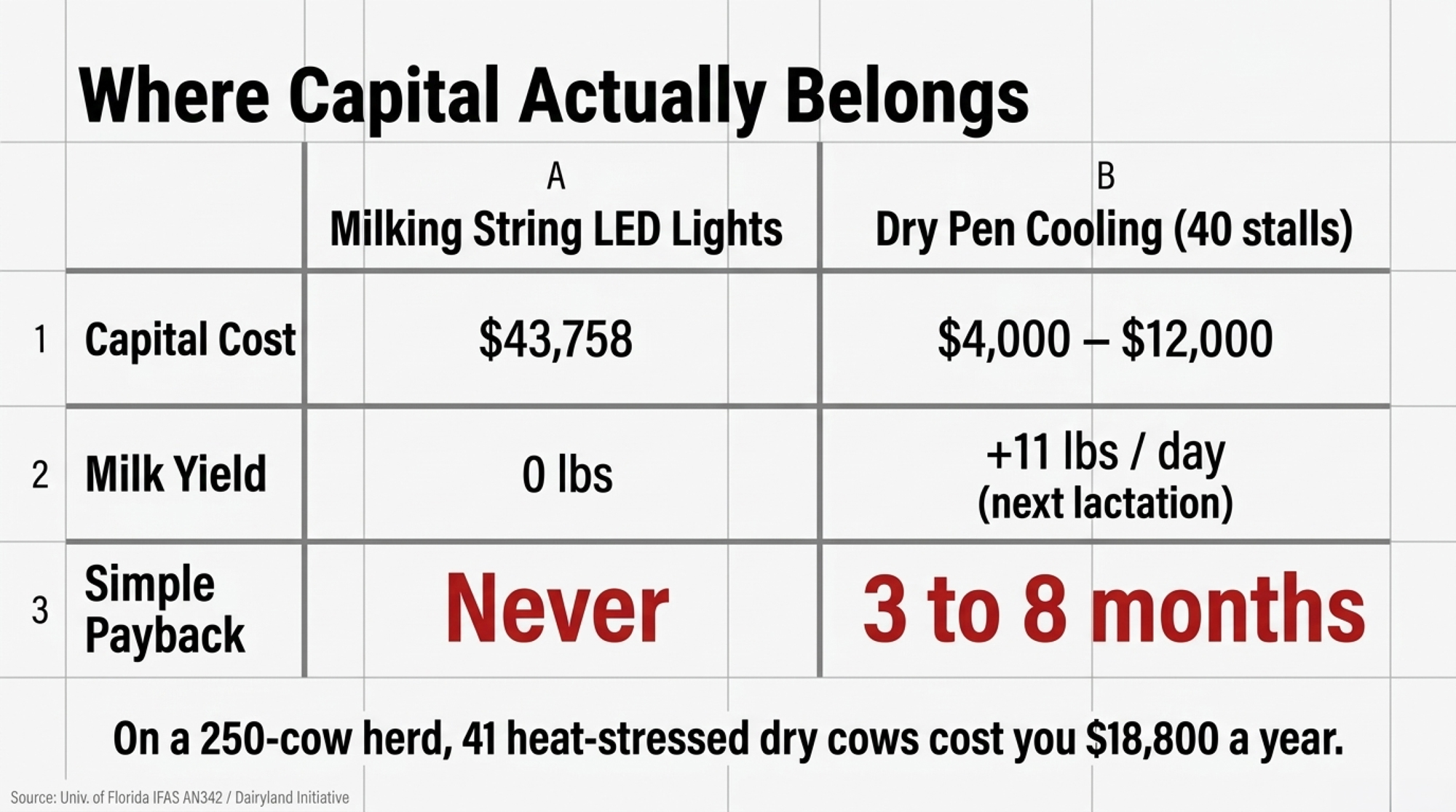
- The overlooked pen. University of Florida’s IFAS puts dry cows given cooling and shade at 11 lb/day more milk in the next lactation than cows given shade only. On a 250-cow herd with 60 heat-stress days, that’s 41 affected freshenings and $459 a cow — roughly $18,800 a year against a $4,000–$12,000 install, paying back in under three to eight months. The ranking holds at $17 milk as well as $22.
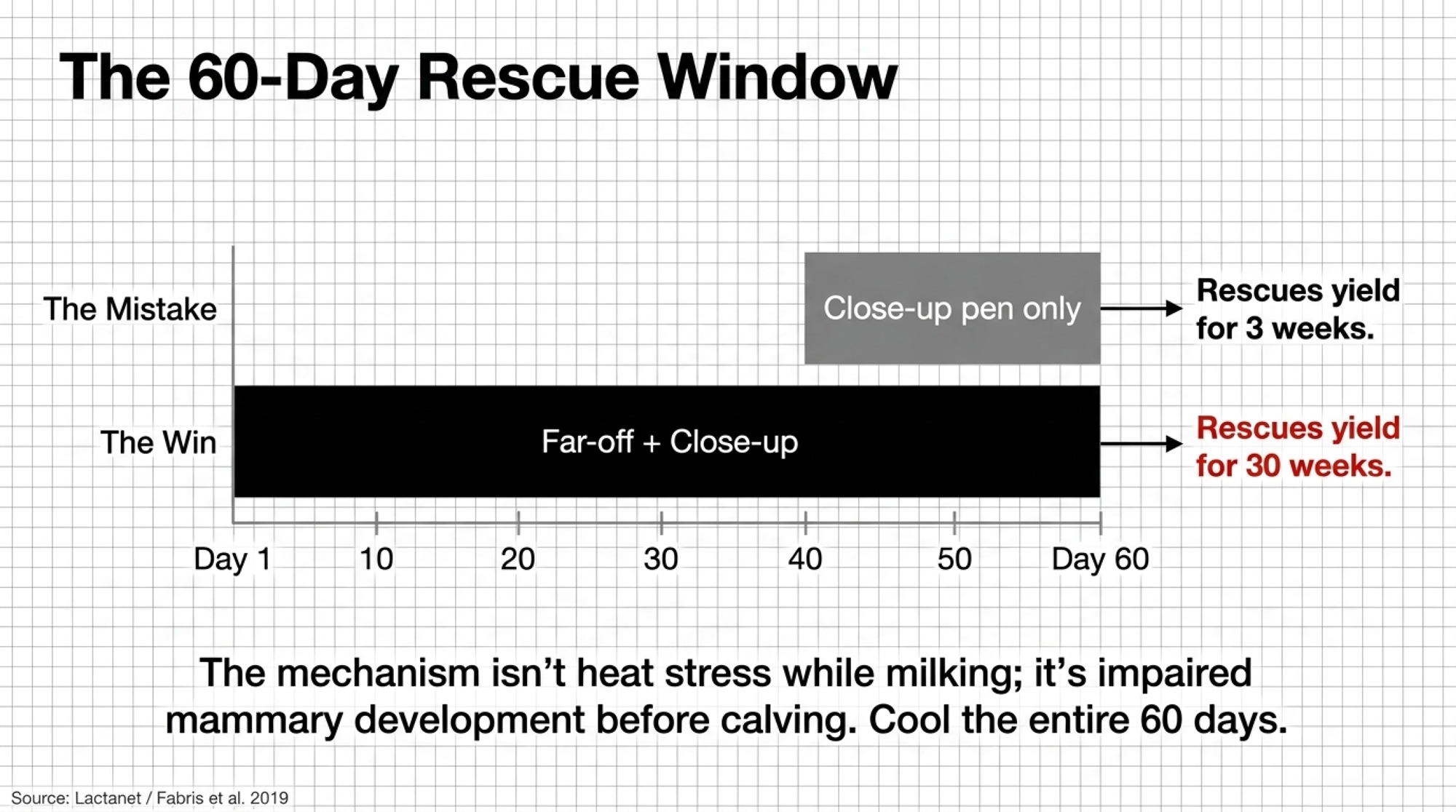
- The catches. Cool the entire 60-day dry period: partial cooling rescues yield for about three weeks instead of thirty. And count the feed. On the milking string, a $26,000 fan retrofit runs 16.9 months on gross milk recovery but 69 to 83 months once Kentucky’s net-of-feed figure is applied.
Equipment costs retrieved August 31, 2026. Milk price: $19.85 USD/cwt (USDA ERS Livestock, Dairy and Poultry Outlook, August 19, 2026 — the most recent all-milk forecast as of publication). Exchange rate: $1 USD = $1.3825 CAD (Bloomberg, September 10, 2026, 10:16 a.m. EDT). All dollar figures are USD unless marked CAD. Retrofit basis, not new construction.
In September 2012, Libby Eiholzer and Michael Capel started rewiring a dairy barn in western New York.
Eiholzer is a bilingual dairy specialist with Cornell Cooperative Extension’s North West New York Dairy, Livestock and Field Crops Team. Capel is a veterinarian at Perry Veterinary Clinic. On a NYSERDA-funded study, they built something the industry had talked about for thirty years and rarely actually measured on a working farm: a controlled test of long-day lighting, with a real control group, on a 1,000-cow commercial dairy, running fourteen months.
Three barns. LED on a 16-to-18-hour photoperiod. T8 fluorescent on the same photoperiod. And one barn deliberately held below the light threshold as a control. They checked it with a photometer — both treatment barns stayed above 150 lux; the control never cleared 115. Milk came off monthly DHIA tests across roughly 300 days per cow.
Clean design. And to be clear about what they were doing: testing a published hypothesis on a working farm, not going after anybody’s product.
What did the trial actually find?
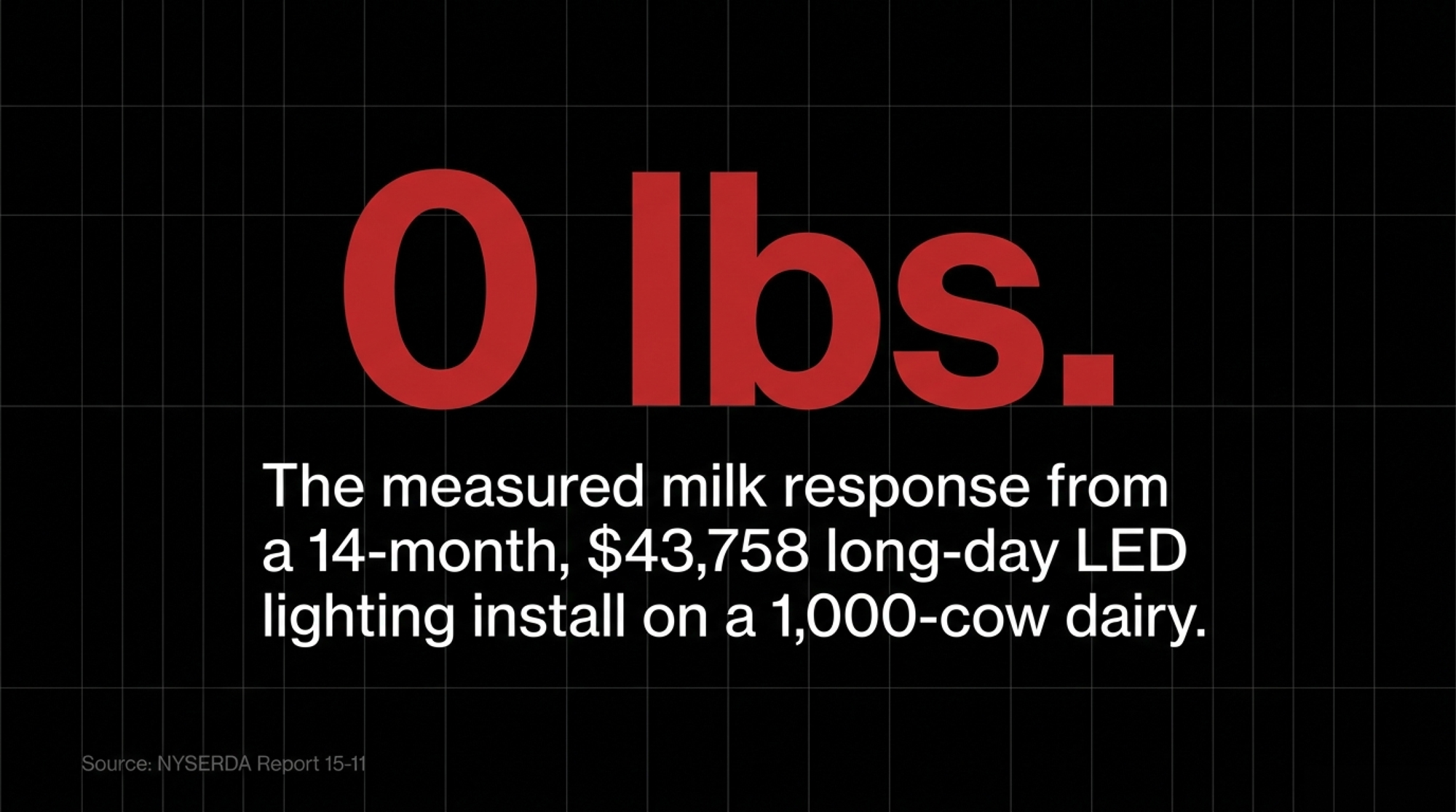
Nothing. No milk response at all.
From the conclusions of NYSERDA Report 15-11, April 2015: “Despite previous research results, LDPP did not result in an increase in milk yield in this study. There was no statistical difference in milk production detected between the first lactation animals in the LDPP LED and the LDPP T8 treatment groups, nor between the mature cattle in the LDPP LED, the LDPP T8 and the control T8 treatment groups.”
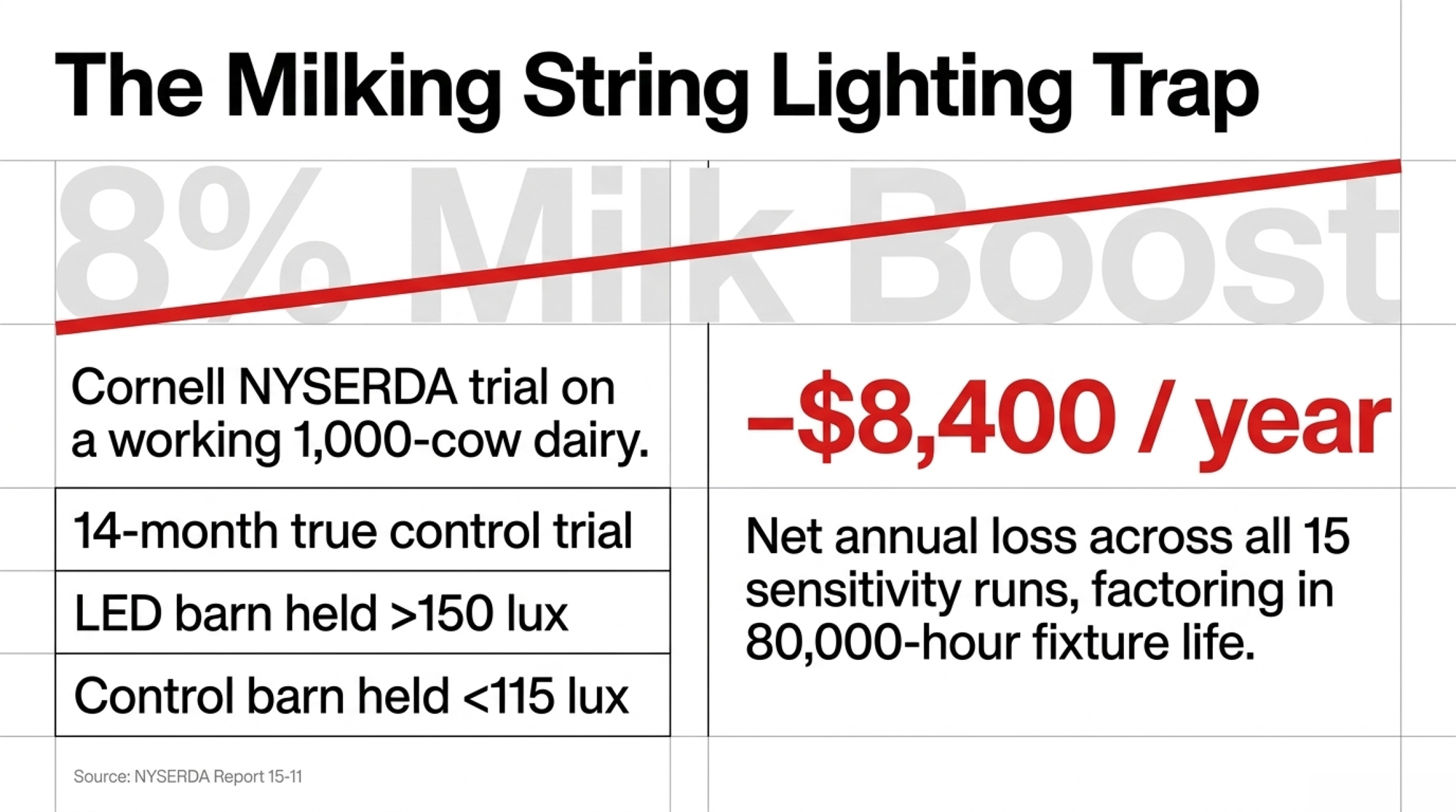
Fitting that LED barn cost $43,758 USD in 2012 dollars. With no milk response and an 80,000-hour fixture life, the partial budget came back at negative $8,400 a year. Then they ran fifteen combinations of fixture lifetime and electricity cost, looking for one that worked. All fifteen came back negative.
The biology isn’t junk. Peters and colleagues reported it in Science in 1978: sixteen hours of light daily at 114 to 207 lux raised milk yield 10 to 15% against cattle on natural photoperiods of 9 to 12 hours at 39 to 93 lux. Dahl, Buchanan and Tucker’s 2000 review in the Journal of Dairy Science confirmed long-day stimulation across numerous studies and pointed to IGF-I as the likely mediator. That’s the foundation under every lighting quote you’ve been handed — including our own coverage of the 8% claim, which this piece corrects.
That same 2000 review flagged something the industry mostly forgot. Relative to long days, short-day treatment during the dry period produced the largest magnitude of milk-yield response in the subsequent lactation. Hold that thought.
But Eiholzer and Capel were straight about why their farm might not have shown the lactating-cow effect. Long-day photoperiod needs six to eight hours of genuinely uninterrupted dark. Milking three times a day, cows kept ending up in the holding pen or the parlor under lights during what was supposed to be their dark window. Two waterers froze in the LED barn over the winter of 2013–14, restricting water for part of the season.
One trial isn’t a verdict. It’s also the only independent commercial trial, and it measured zero.
The pen you drive past on the way to the parlor
Here’s what holds up. And notice where it points — the same place the photoperiod work pointed twenty-six years ago.
The University of Florida program — Geoffrey Dahl, Sha Tao and colleagues — established that cows heat-stressed in late gestation give less milk in their next lactation than herdmates that were cooled. The mechanism is impaired mammary development before she calves, not heat stress while she’s milking. Tao and Dahl published the core work in JDS in 2013, and Fabris and colleagues extended it across the full dry period in 2019.
For the number to plan around, UF’s own extension economics publication is the place to go. IFAS document AN342, updated August 2026, puts it plainly: dry cows given evaporative cooling and shade produced on average 11 lb per day (5 kg) more milk in the next lactation than cows given shade only, citing do Amaral et al. 2009 and Tao et al. 2011 and 2012.
Other sources land higher or lower — University of Maryland Extension cites 9 pounds, and Purina’s summary of the same Florida work says 14 in the first 30 weeks. IFAS’s 11 is the conservative middle, and it comes from the publication written specifically to answer the economics question, so that’s what we use below.
Here’s the condition most people miss. Lactanet’s summary of the Florida work is blunt: cooling for the entire dry period raised milk yield out to 30 weeks into lactation. Cooling only the early or only the late dry period partially rescued yield for just the first three weeks. If you cool the close-up pen and leave the far-off pen in the sun, you’re buying three weeks of benefit, not thirty.
Run the number on your own herd
Say you milk 250 cows, your dry period runs 60 days, and you carry roughly 60 days a year where heat genuinely costs you milk. About 41 of your annual freshenings will have spent their dry period inside that window — 250 × 60 ÷ 365.
Take IFAS’s 11 pounds across the 30-week measurement window:
11 lb × 210 days = 2,310 lb, or 23.1 cwt — about $459 USD a cow.
Multiply by 41 cows, and you’re at roughly $18,800 USD a year. Milking 200? Thirty-three cows fall in that window — about $15,100.
That $459 moves with the milk price, obviously. At $17 — the number your lender is probably modeling — it drops to $393 a cow, or $16,100 across the herd. At $22, it’s $508 and $20,800. The ranking doesn’t change at any of those prices, which is more than you can say for most of what’s below.
One caveat on that 41: it treats partial heat exposure as proportional. Fabris found late-gestation exposure matters most, so a cow stressed for twenty of her sixty dry days may not take exactly a third of the hit. The number could move either way.
Why does it pay so fast? The dry pen is small. Cooling 40 stalls costs a fraction of cooling 250, and the return per cow is bigger and lasts longer. Scaling the University of Wisconsin–Madison Dairyland Initiative’s published figure of $104 USD per cow, fans and soakers over a 40-stall dry pen lands in the $4,000 to $12,000 USD range. Against roughly $600 USD a year to run them, that pays back in under three to eight months — the low end if you’re at the cheap end of that install range, the high end if you’re not.
Two things to know about that cost. It’s scaled from a published per-cow number, not a contractor quote. And the Dairyland figure comes from an 800-cow barn in Green Bay, so scaling down to 40 stalls understates it — electrical service and mobilization don’t shrink proportionally.
Nobody sends a rep out to quote a 40-stall dry pen. That’s most of the story right there.
And this model doesn’t count the upside. Urdaz and colleagues (2006) ran 475 prepartum cows and found adding shade and fans to an existing feed bunk sprinkler system produced a significant lift in 60-day milk production and an economic benefit over the cooling system already in place. Separately, UF extension work reports daughters of heat-stressed dry cows produce 4.9 lb/day less in first lactation and 5.1 lb/day less in second, with effects documented across up to three lactations. Cooling the dry pen buys milk you won’t see for three years.
Does cooling the milking herd actually pay at $19.85 milk?
The Dairyland Initiative publishes two numbers for a natural-ventilation retrofit with fans over the stalls: $104 USD per cow installed, and $20.05 USD per cow per year to run them. Our own first draft only used one of them. On 250 cows that’s $26,000 in and about $5,012 a year in electricity.
Now the part that matters. Fans and soakers mitigate heat stress — they don’t erase it. So the driver isn’t the milk you’re losing. It’s the milk cooling actually gets back, and that’s been measured across several trials.
University of Kentucky extension engineers pulled four sprinkler-and-fan trials into one table. Florida: 39.8 lb up to 44.4, a gain of 4.6 (11.6%). Kentucky: 50.1 to 58.0, a gain of 7.9 (15.8%). Missouri: 51.4 to 55.8, a gain of 4.4 (8.6%). Israel: 72.8 to 78.0, a gain of 5.2 (7.1%). Rectal temperature fell a full degree Fahrenheit in the Kentucky work.
Liu and colleagues, publishing peer-reviewed work in Animals in 2024, ran an automated sprinkler system and found milk yield of 31.3 kg against 29.4 in controls — up 1.9 kg, or 4.2 lb (P = 0.046, nine cows per group). And a 2020 JDSstudy of alternative cooling strategies found no milk difference at all, which the authors attributed to low heat load during the study period.
| Milk recovered /cow/day | Source trial | Net annual gain, 250 cows @ $19.85 USD/cwt | Simple payback on $26,000 USD install |
| 0 lb (low heat load year) | 2020 JDS trial | –$5,012 (electricity loss) | Never |
| 4.2 lb (1.9 kg) | Liu et al. 2024, Animals | $7,494 | 41.6 months |
| 4.4 lb | Missouri trial | $8,089 | 38.6 months |
| 5.2 lb | Israel trial | $10,471 | 29.8 months |
| 7.9 lb | Kentucky trial | $18,510 | 16.9 months |
Payback reflects gross milk recovery minus $5,012 USD in annual electricity. It doesn’t subtract the additional feed those cows will eat — see below.
Read the column header carefully. It says recovered, not lost.
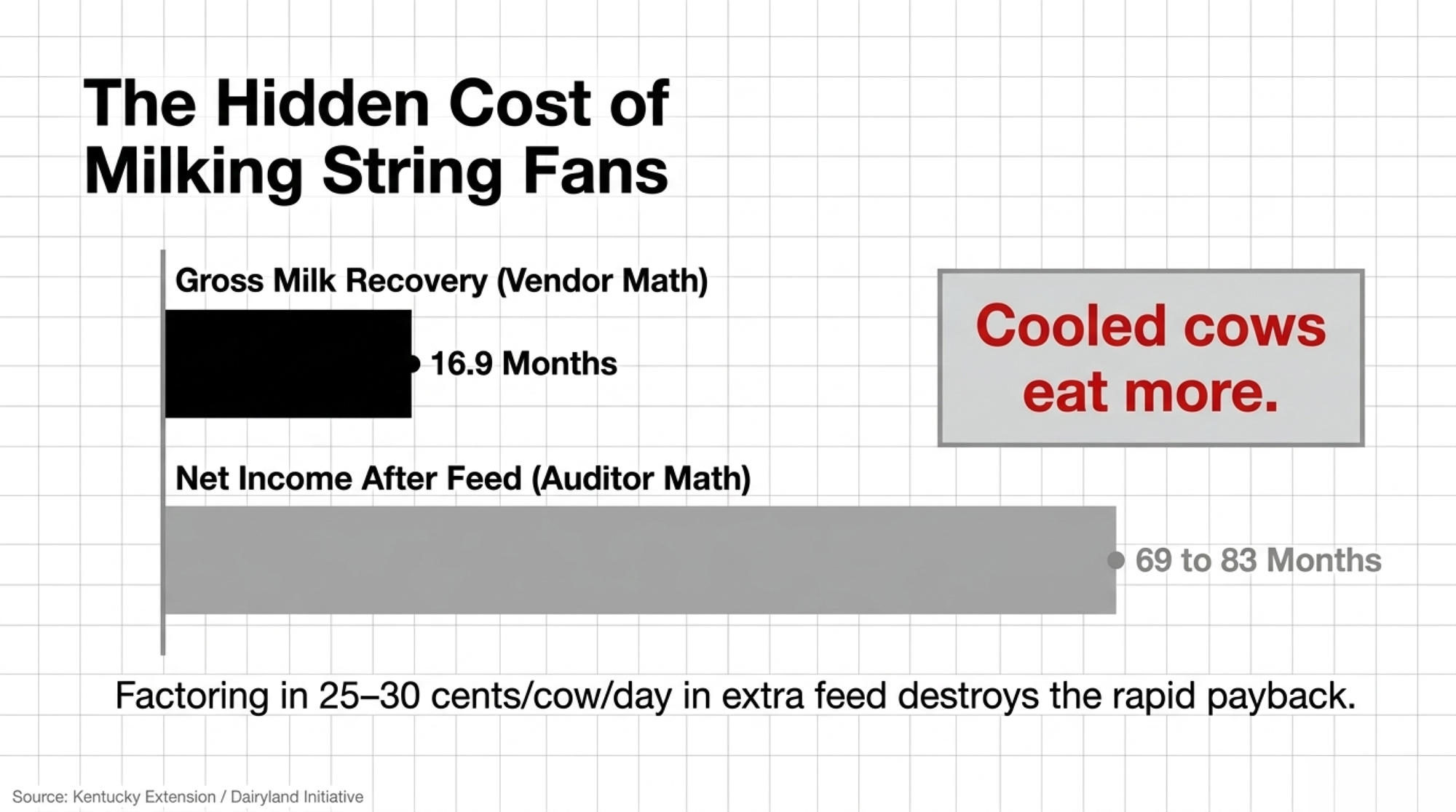
And here’s the cost that table leaves out, which is exactly the thing we’ve been complaining about. Cooled cows eat more. Rather than estimate the feed line ourselves, look at what Kentucky Extension reports as the bottom line: 25 to 30 cents USD per cow per day in additional net income, after paying for the increased feed, water, and electricity. On 250 cows across 60 days, that’s $3,750 to $4,500 a year — and a payback closer to 69 to 83 months.
That is a different investment than the one in the table. Same equipment, same barn. The gap is feed, and it’s the single largest omission in most cooling proposals — including our own, until we went looking.
| Basis | Milk recovered/cow/day | Annual value, 250 cows @ $19.85/cwt | Payback on $26,000 install |
|---|---|---|---|
| Gross milk recovery (Kentucky trial) | 7.9 lb | $18,510 | 16.9 months |
| Net-of-feed, water, electricity (Kentucky Extension) | 7.9 lb | $3,750–$4,500 | 69–83 months |
| Difference attributable to feed/water/power | — | $14,010–$14,760 | 52–66 months added |
Where you farm changes the answer
Gunn and colleagues (2019) projected abatement economics under mid- and late-century climate scenarios and put mean annual net values at –$30 to $190 a cow for High abatement, and –$20 to $590 for Intense. Note the negative floor on both — and that the biggest returns sit late-century rather than today. Reviewing that same paper in 2025, Hutchins and colleagues summarized it bluntly: heat abatement is only cost-effective in the most intense heat.
USDA’s ERS (Key et al., ERR-175) sorted states into four tiers by long-run THI load. The Pacific Northwest and Northeast carry the lightest exposure. The Desert Southwest, Southern Plains, and Southeast have the heaviest. If you’re farming in the top tier, everything in the table above moves toward the bottom row. If you’re in the lightest, it drifts toward the top — and the top row is a loss.
That doesn’t mean you’ve got nothing to spend on. It means the two break-evens further down — five lameness cases, seventeen minutes a day — are where your capital has to earn its keep instead, because neither one depends on how hot your July gets.
How do you know if your barn has a problem worth spending on?
Pull last July’s daily milk weights. Not the monthly test, and not the bulk tank — the per-cow dailies.
The Dairyland Initiative’s own diagnostic is a drop of more than 5 pounds per cow per day in warm weather. That tells you heat is costing you something. What you recover depends on what you install and how you run it. And it’s exactly why monthly testing misses this: heat comes and goes between tests, so a monthly number can look fine while you bled milk for nine straight days.
The management detail matters more than the equipment brochure. Ohio State extension guidance is specific: about 30 seconds of soaking at 0.9 to 1.4 gal/min to wet a cow’s coat through, then four to five minutes of fan-only time to dry her. Air should reach cow height at 8 to 10 ft/sec. Start the system at THI 65 to 68 — roughly 70 to 75°F with moderate humidity — because preventing a rise in body temperature is far easier than pulling one back down.
Flow rate is its own lever. Tresoldi and colleagues, in JDS in 2019, found milk yield roughly 5 kg/day higher in cows soaked at 1.25 and 2.0 L/min than at 0.5 L/min. Same fans, same barn, different nozzle.
For your own local picture, UW–Madison Extension’s Heat Abatement Investment Scouter turns your coordinates into ten years of hourly temperature and humidity and estimates annual hours above THI 68. In Wisconsin, that’s 1,000 to 2,000 hours a year — call it 42 to 83 full-day equivalents. Lactanet, working from a lower THI-60 threshold, reports the Canadian average at 117 days outside the comfort zone.
What Ontario’s incentive program changes
If you farm in Ontario, check the incentives before you price equipment. Everything in this section is in Canadian dollars.
Save on Energy’s Retrofit program lists recirculation ventilation fans as an eligible agriculture measure, and on the schedule effective June 30, 2026, the incentive runs up to $4,820 CAD per high-volume low-speed fan. High-efficiency ventilation exhaust fans draw up to $500 CAD each. Also on the agribusiness list: dairy plate coolers at $1,800 CAD, milk scroll compressors at $1,620 CAD, low-energy livestock waterers at $580 CAD, and solar hot water collectors for dairy at $2,380 CAD.
Two things to watch. The program’s per-cow natural ventilation measure — $56 CAD a cow — is written for tie-stalls, not freestalls, so a freestall dry pen doesn’t qualify. And every figure above is a maximum: IESO states plainly that actual amounts depend on equipment size and eligible cost caps.
Now convert before you compare. The Dairyland figure of $104 USD per cow is roughly $144 CAD at today’s rate, so a 40-stall dry pen at the middle of our range — $7,000 USD — is about $9,700 CAD installed.
Against that:
- At the HVLS rate, a $4,820 CAD incentive covers roughly half the project. Net cost lands near $4,900 CAD, or about $3,500 USD — a payback around two and a half months.
- Under the $500 CAD exhaust measure, net cost is about $9,200 CAD, or $6,700 USD — a payback of around four and a half months.
- If the project fits no prescriptive measure, the Custom stream pays $1,800 CAD/kW or $0.20 CAD/kWh, whichever is higher, up to 50% of eligible project costs — which on a larger cooling retrofit may beat the prescriptive route outright.
| Incentive stream | Max incentive (CAD) | Net install cost (CAD) | Net cost (USD) | Approx. payback |
|---|---|---|---|---|
| HVLS fan rate | $4,820 | ~$4,900 | ~$3,500 | ~2.5 months |
| Exhaust fan rate | $500 | ~$9,200 | ~$6,700 | ~4.5 months |
| Custom stream (if no prescriptive fit) | 50% of eligible costs | Varies by project | Varies | Case-by-case |
One honest limit on those paybacks: the milk revenue behind them uses the USDA all-milk price, because we don’t have a verified Ontario blend price for this analysis. Substitute your own, and the months will move. The cost side of the comparison is sound regardless — halving your install price halves your payback, whatever you’re getting paid for milk.
Either way, it’s the fastest thing in this article, and the difference between those numbers is one phone call: IESO at 1-844-303-5542 or retrofit@ieso.ca. Program terms change, and prescriptive measures require pre-approval and follow one-for-one replacement rules. Confirm eligibility and current amounts before you build a budget on any figure here.
Two upgrades you can settle with a break-even
For these, the cost side is well documented, and the benefit side isn’t. So here’s the break-even instead of a payback — check it against your own records.
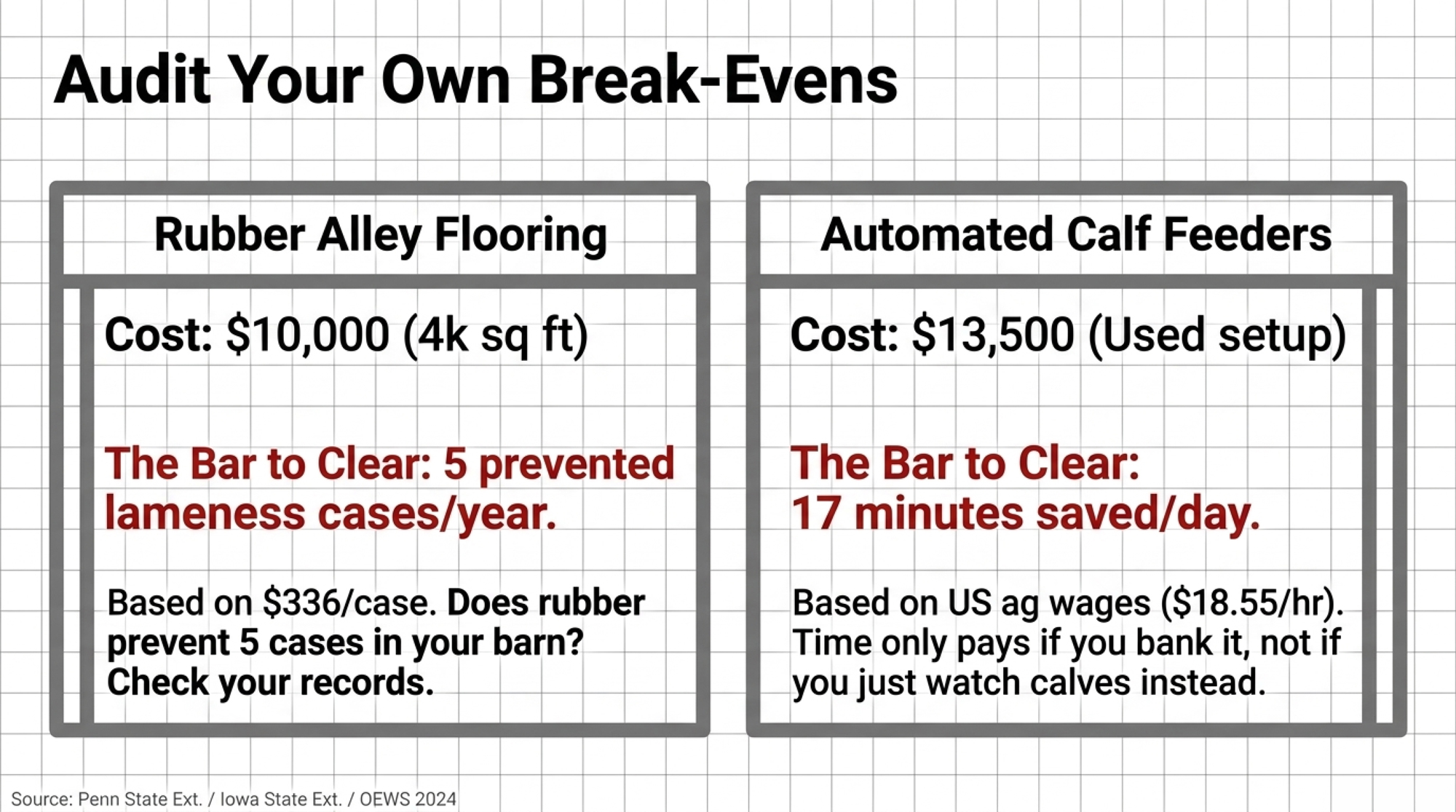
Rubber flooring in alleys. Cornell’s NYSCHAP flooring module puts grooved rubber belting at $2.25 to $2.75 USD per square foot installed. Cover 4,000 square feet of transfer alley and holding area, and you’re near $10,000. Vanegas and colleagues (2006) documented reduced claw growth and wear versus bare concrete — a real, peer-reviewed hoof-health benefit.
Lameness cost is documented too. Penn State Extension, updated January 2026, cites Dolecheck and Bewley’s summary at $76 to $533 USD per case, with one study averaging $336.91. Cha and colleagues (2010) broke it out by lesion: $216 for sole ulcer, $133 for digital dermatitis, $121 for foot rot.
So: $10,000 over eight years at 7% needs about $1,675 a year back. At $336.91 a case, you need to prevent five cases a year. At the low end of the published range, twenty-two. Whether rubber prevents five cases in your barn is the number nobody has published. Count last year’s cases and decide.
Automated calf feeders. Iowa State Extension puts stations at $2,000 to $28,000 USD, using $5,500 as a used-equipment default. CalfStar listed new CalfExpert units from $23,250 USD as of August 2026. Two used stations plus a computer runs about $13,500.
Run the break-even in your own currency, because the wage rates differ. In the US, OEWS 2024 puts livestock farmworkers at $18.55 USD an hour — against a $13,500 setup over ten years at 7%, break-even is 17 minutes a day. On the CalfStar figure, 29 minutes. In Ontario, FARMS Ontario’s October 1, 2025 schedule runs $17.60 CAD lower-skilled and $19.06 CAD higher-skilled, with the provincial minimum moving to $17.95 CAD on October 1, 2026 — and that same used setup converts to roughly $18,700 CAD, putting break-even nearer 25 minutes a day.
That US figure comes from OEWS now because USDA’s NASS canceled the Farm Labor Survey on August 28, 2025, and posted the discontinuance to the Federal Register on September 3. The long-running quarterly benchmark for farm wages no longer exists.
Iowa State’s producer survey found farms averaging 2.2 hours a day feeding calves, with some who switched reporting 1.5 hours a day saved — about a 16-month payback at the US wage. But the same survey recorded others saying flatly that no labor was saved at all; the hours just moved from feeding into monitoring. Seventeen minutes is a low bar. Whether you clear it depends on whether you bank the time or spend it watching calves.
| Upgrade | Install cost | Annualized cost (8yr @ 7% or 10yr @ 7%) | Break-even requirement |
|---|---|---|---|
| Rubber alley flooring (4,000 sq ft) | ~$10,000 | ~$1,675/yr | 5 prevented lameness cases/yr @ $336.91 avg |
| Used automated calf feeder (2 stations) | ~$13,500 USD / ~$18,700 CAD | — | 17 min/day saved (US wage) or ~25 min/day (Ontario wage) |
Three we won’t put a payback on
These fail for three different reasons — a contested effect, a missing cost, and a null result. Worth knowing which is which, because they don’t all mean the same thing.
Cow brushes — the effect size is contested. The 2.2-pound figure everyone cites traces to one 2009 Cornell study by Schukken and Young at Sprucehaven Farm. Their abstract puts it precisely: installing the brushes produced either no difference in daily milk production in lactation 1 and lactation 3-and-higher, or roughly a 3.5% (1 kg) increase— that increase falling in second lactation. Clinical mastitis dropped by more than 30% in second-and-higher lactation animals. We found the field study on a cow-brush manufacturer’s website. Readers can find the funding and disclosure details in the paper itself.
Two later studies don’t line up with it. Li and colleagues, in Veterinary Sciences in 2024, found the milk response in higher-parity animals — fourth and fifth — with no significant difference in second and third. Griffin’s 2025 Mississippi State thesis found brushes lowered cortisol, but milk didn’t differ statistically: 19.9 versus 22.4 kg/day, P = 0.18. The numerical gap ran the wrong way, with the brush group producing less, which usually means a sample too small to settle it either way.
Three studies, three answers. On Schukken’s number, five brushes pay back in about seven months. On Griffin’s, never. Buy brushes for the welfare case and the mastitis finding — both better supported than the yield claim.
Sand bedding — the cost side doesn’t exist. Where brushes have a disputed benefit, sand has a well-established one and no published price. OMAFRA puts sand at $8–10 per tonne against $40–50 for organic bedding, and the comfort case is solid. What nobody publishes is the retrofit manure-handling cost, and on an existing barn that decides everything. Patz names converting existing barns as a distinct cost. McLanahan notes reclaimed sand offsets 90–95% of purchase. Neither publishes a price for the separation system a barn without one has to add. We checked university, extension, and ministry sources across several passes and found no figure, so we’re not handing you one. Treat sand as a new-build decision until somebody prices that equipment.
Automated feed push-up — the one trial measured nothing. And this one has both a cost and a benefit study. The problem is what the study found. Kary Babb, working through a Vita Plus Dairy Technical Extended Internship in partnership with UW–Platteville, tested a Lely Juno against skid-loader push-up at the university’s Pioneer Farm over four months in an ABA design. Her result: “no significant change in milk production and only a slight change in dry matter intake.” That’s one machine, on one farm, over four months — a result about this trial, not a verdict on the technology.
The detail that lands hardest is Babb’s own explanation. “This farm has been well managed prior to implementing the Lely Juno 100. Feed was pushed up at least six times a day using the skidloader.” They tested the machine where it had almost nothing left to improve.
The labor case is better sourced and still tight. Jack Rodenburg of DairyLogix, working a Progressive Dairy Operators survey of 115 herds from 40 to over 1,000 cows, found the average herd pushing feed 4.27 times a day at 6.07 minutes a go — 158 hours a year, $2,256 in labor at $14.31 an hour. Against a then-quoted $24,675 machine at 5% over 15 years, his read: the average farm comes “about $100 per year short on covering the cost of ownership from the labour saved.” The two farms in that survey that already owned one pushed feed 11 and 18 times a day. Well above average.
That’s your rule — the labor case strengthens the more often you do it by hand, and collapses if you’re already at two. Same discipline we applied to sensors, where precision monitoring ran past a six-year payback on health benefits aloneonce Cornell’s real 2.1-day warning window replaced the five days in the marketing.
The Bullvine action checklist
Audit last July’s per-cow dailies. Not the monthly test, not the bulk tank. A drop over 5 lb/cow/day in warm weather tells you heat is costing you something. Under 3 lb and a $26,000 USD fan retrofit won’t clear its own $5,012 annual electricity bill, let alone the feed.
Price the dry pen before the milking string. Forty stalls at $4,000–12,000 USD return about $459 USD a cow, roughly $18,800 a year on a 250-cow herd, and it holds that ranking from $17 milk to $22. Cover the entire 60-day dry period — cooling one pen and not the other buys about three weeks of the effect instead of thirty.
Check the nozzles before you buy more fans. Tresoldi found roughly a 5 kg/day difference between cows soaked at 1.25–2.0 L/min and those at 0.5 L/min. Same equipment, different flow rate.
Strip two lines out of every quote you’re handed. Electricity at $20.05 USD/cow/year, and the feed those cooled cows will eat. Kentucky’s net-of-everything number is 25–30 cents USD per cow per day — compare any vendor’s milk-response math against that before you sign.
Work the break-even on the contested ones. Rubber flooring needs five prevented lameness cases a year. A used calf feeder needs 17 minutes a day at US wages, or about 25 in Ontario. Both are numbers sitting in your own records right now.
In Ontario, phone IESO before you phone a dealer. Whether your fans draw $4,820 CAD or $500 CAD roughly halves or barely touches your install cost — and that changes the ranking, not just the payback.

What’s your dry pen actually costing you?
Most of us can quote a robot to the dollar and a load of sand to the tonne. Fewer of us have ever put a number on forty stalls of dry cows standing in August heat, because nobody has driven out to the farm and asked us to.
Twenty-six years ago, a review in the Journal of Dairy Science said the largest photoperiod response showed up in the dry period. The industry went and sold lights for the milking string instead. That’s worth sitting with.
So run the hour. Count how many cows went dry between June and August, multiply by $459, and set that against whatever you were about to spend somewhere else. If it surprises you, you’re in good company — it surprised us enough that we threw out our first ranking and rebuilt it. Twice.
The full model goes out to Bullvine Weekly subscribers with the spreadsheet attached: every assumption, the NPV and IRR runs, milk-price sensitivity at $17 and $22, and the interaction math on which upgrades genuinely stack against which ones double-count each other through dry matter intake.
And if you’ve cooled a dry pen, send us the invoice. The weakest number in this article is what that retrofit actually costs, because no university publishes it and we won’t invent it. Reply with a real quote, and we’ll run it in next year’s update with your farm’s name on it.
Run Your Numbers
Dairy Profit Projector — Cooling only pays if the extra milk survives the extra feed. Drop in your herd size, production, milk price and ration cost, and the Projector returns your IOFC per cow per day and breakeven milk price — the two numbers that decide whether a cooling quote’s payback is real or gross.
Learn More
- Smart Barns, Dumb Investments: Why Dairy Tech Is Failing the ROI Test — Exposes vendor payback claims across robotic milkers and activity monitors, arming you with net-margin audits that factor in maintenance overhead and real-world culling rates before you sign equipment leases.
- Dairy Farming in 2026: The Economic Realities Reshaping the Herd — Maps the macro capital squeeze confronting commercial dairies over the next five years, pinpointing how rising interest rates and shifting component pricing dictate where retrofit dollars must flow to preserve equity.
- Breeding for Heat Tolerance: Can Genetics Outrun the Summer Slump? — Delivers an unvarnished assessment of slick-gene genetics versus steel-and-fan cooling retrofits, revealing whether genomic selection can realistically close the 11-pound production gap faster than shade, soakers, and structural airflow.
 The Sunday Read Dairy Professionals Don’t Skip.
 The Sunday Read Dairy Professionals Don’t Skip.
Every week, thousands of producers, breeders, and industry insiders open Bullvine Weekly for genetics insights, market shifts, and profit strategies they won’t find anywhere else. One email. Five minutes. Smarter decisions all week.