








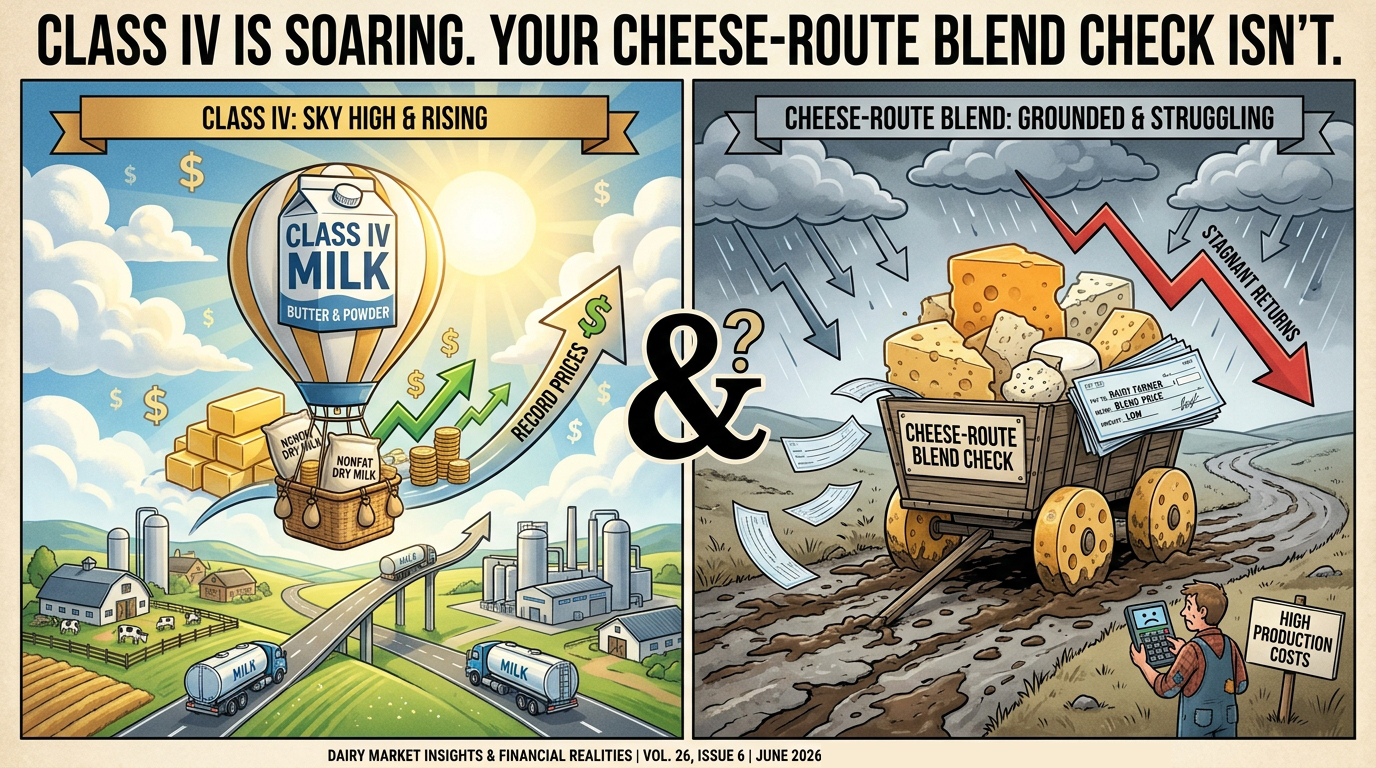
Class IV closed $5.40 over Class III in May. If your milk goes to cheese, almost none of that hits your blend check — and here’s the ten-minute math that proves it.
Executive Summary: Class IV closed in May 2026 at $22.32/cwt, against Class III at $16.92 — a $5.40 spread — after Class IV jumped $2.10 in a single month while Class III moved a dime (USDA AMS, CLS-0526). If your milk ships to a cheese plant in FMMO Order 30, almost none of that Class IV strength reached your blend check, because depooling lawfully let the high-value milk walk out of the pool and drag the blend down for everyone who stayed. Run the barn math, and it stings: a 500-cow herd at 75 lbs/day with 35% blend exposure is looking at roughly $259,000 in annual exposure at the May spread — about $310,000 at Krentz’s 600-cow scale. Kevin Krentz, who milks near Berlin, Wisconsin, already knows the number; he testified that a prior spread cost his farm nearly $200,000. The gap has widened in every month of 2026, and USDA’s May WASDE and FCS America both expect Class IV to remain strong through the back half of the year. There’s a ten-minute, three-milk-check calculation that tells you your own exposure — and a $10,000-a-month trigger for the call to your marketing desk that most 500-cow operations never make. The desk won’t ring you about this; the incentive runs the other way.
Kevin Krentz can tell you, almost to the dollar, what a milk price spread costs, because one has already cost him close to $200,000. He and his wife, Holly, milk about 600 cows near Berlin, in Waushara County, Wisconsin, and he runs the Wisconsin Farm Bureau.
Back in the 2023 federal order hearings, he testified that negative producer price differentials hit his farm for nearly that much (Krentz testimony, USDA AMS FMMO hearing, August 30, 2023; Brownfield Ag News, August 30, 2023). Different spread, opposite direction. Same trap.
That trap is open again in 2026, and it widened every single month this year.
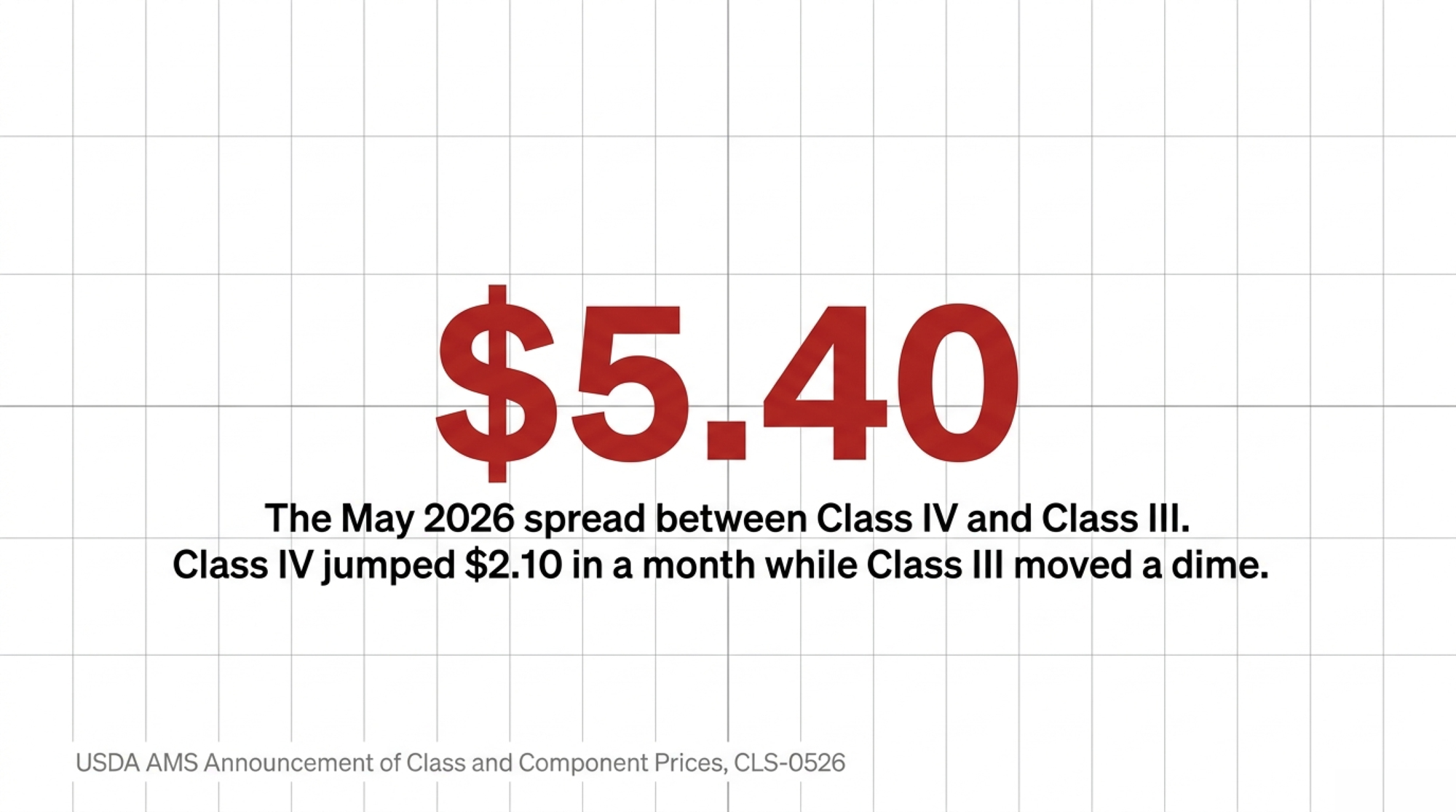
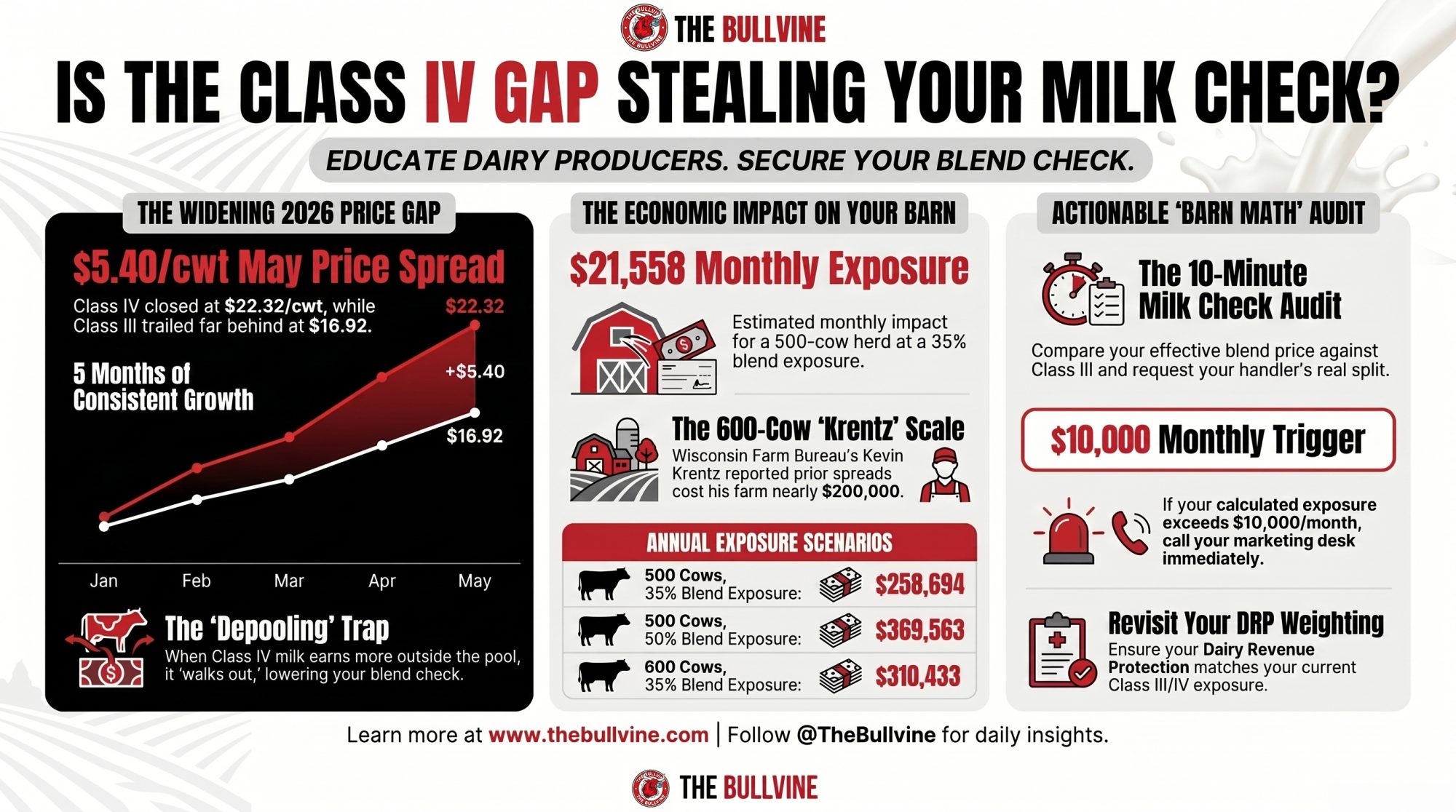
📊 The Number That Should Stop You — May 2026: Class IV closed at $22.32/cwt, Class III at $16.92. That’s a $5.40/cwt spread, Class IV on top — and Class IV jumped $2.10 in a month while Class III moved a dime. (USDA AMS Announcement of Class and Component Prices, CLS-0526, June 3, 2026)
If you ship to a cheese plant, almost none of that Class IV strength reached your blend check. This milk price spread doesn’t look like a crisis. It shows up as a milk check that’s quietly lighter than the headlines say it should be.
Why Doesn’t a Strong Class IV Show Up in Your Milk Check?
Here’s the part that trips people up. Every trade outlet is running a “strong dairy markets” story right now, and they’re not wrong.
Nonfat dry milk averaged $2.08/lb in the May class-price formula — the best sustained powder run in years (USDA AMS, CLS-0526). Powder is hot. Butter is firm. Class IV is flying.
But Class IV strength only helps you if your milk goes where Class IV gets made. In Federal Order 30 — the Upper Midwest — roughly four of every five pounds of producer milk heads to Class III cheese, with fluid use down in the single digits (FMMA30 order reports, 2025–26).
Krentz’s milk goes to cheese. It never sees a powder dryer. So when powder runs north of $2.00, that money lands with the butter-powder plants, not in the blend paid to the cheese-route producers sharing his pool.
Then depooling turns the screw. The order doesn’t pay you the Class III or Class IV price directly — it pays a blend, a weighted average of every class in the pool.
Here’s the nuance worth nailing down: even in a Class III–heavy pool, you’re still exposed to the Class IV gap. When Class IV milk can earn more outside the pool than the blend pays, those plants pull out — and the pool loses that high Class IV value entirely. Your blend drops because the money that should have lifted it walked out the door.
It’s legal. It’s in the fine print. And it drags the blend down for everyone who stays.
That’s not a theory this spring. Iowa State Extension laid out the mechanics in a May 12, 2026, analysis: by March, pooled milk in the Central order had dropped to 1.35 billion pounds, down from more than 1.50 billion a year earlier.
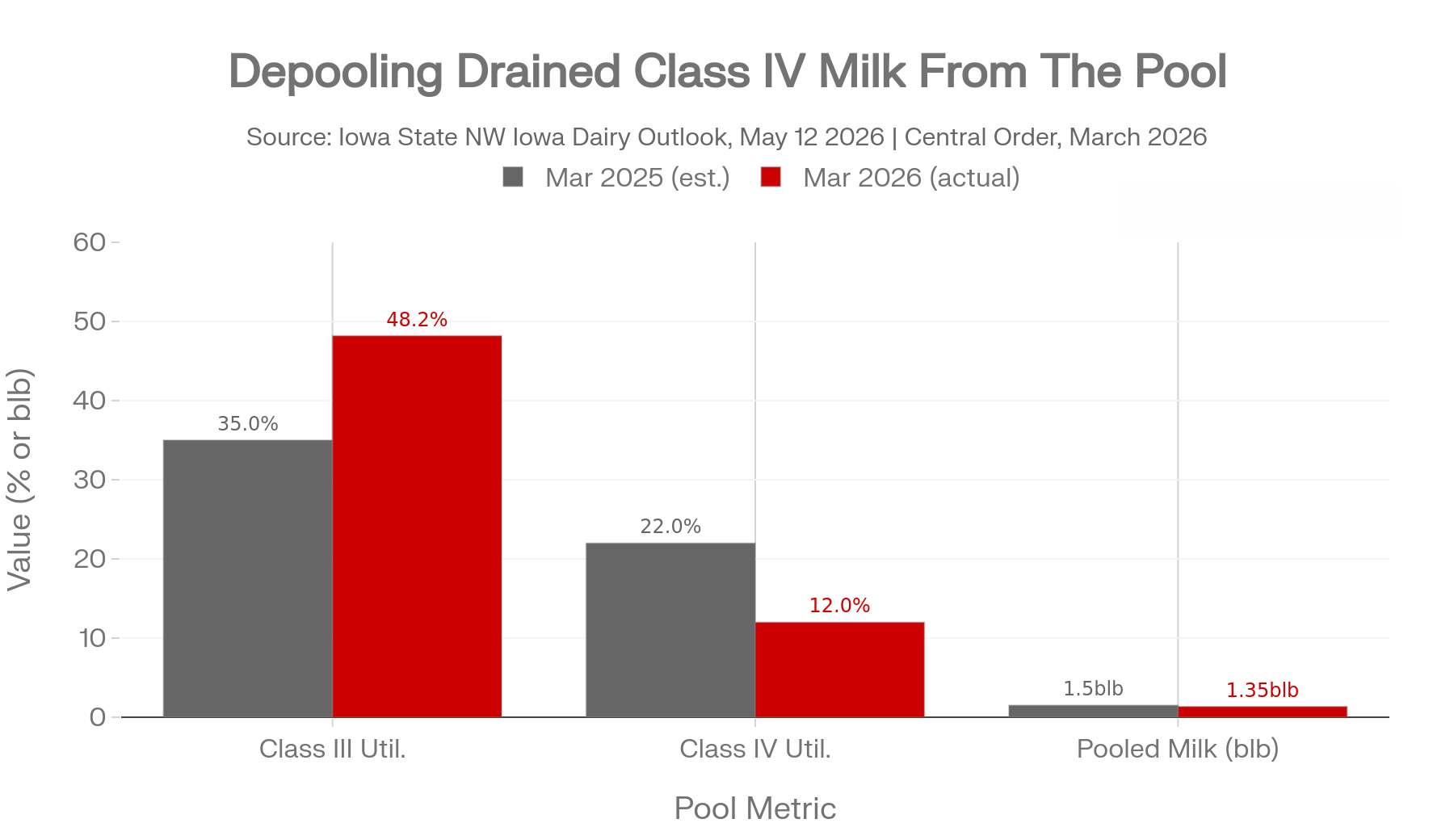
Class III utilization inside the pool jumped to 48.2%. Class IV fell to 12.0% (Iowa State NW Iowa Dairy Outlook, May 12, 2026). The high-value milk walked out, lawfully, and producers who stayed got a blend that no longer reflected what Class IV was worth.
Was This Always a Slow Build, or Did It Snap?
It built, then it snapped. Look at the Class IV-minus-Class III gap month by month, and the story tells itself.
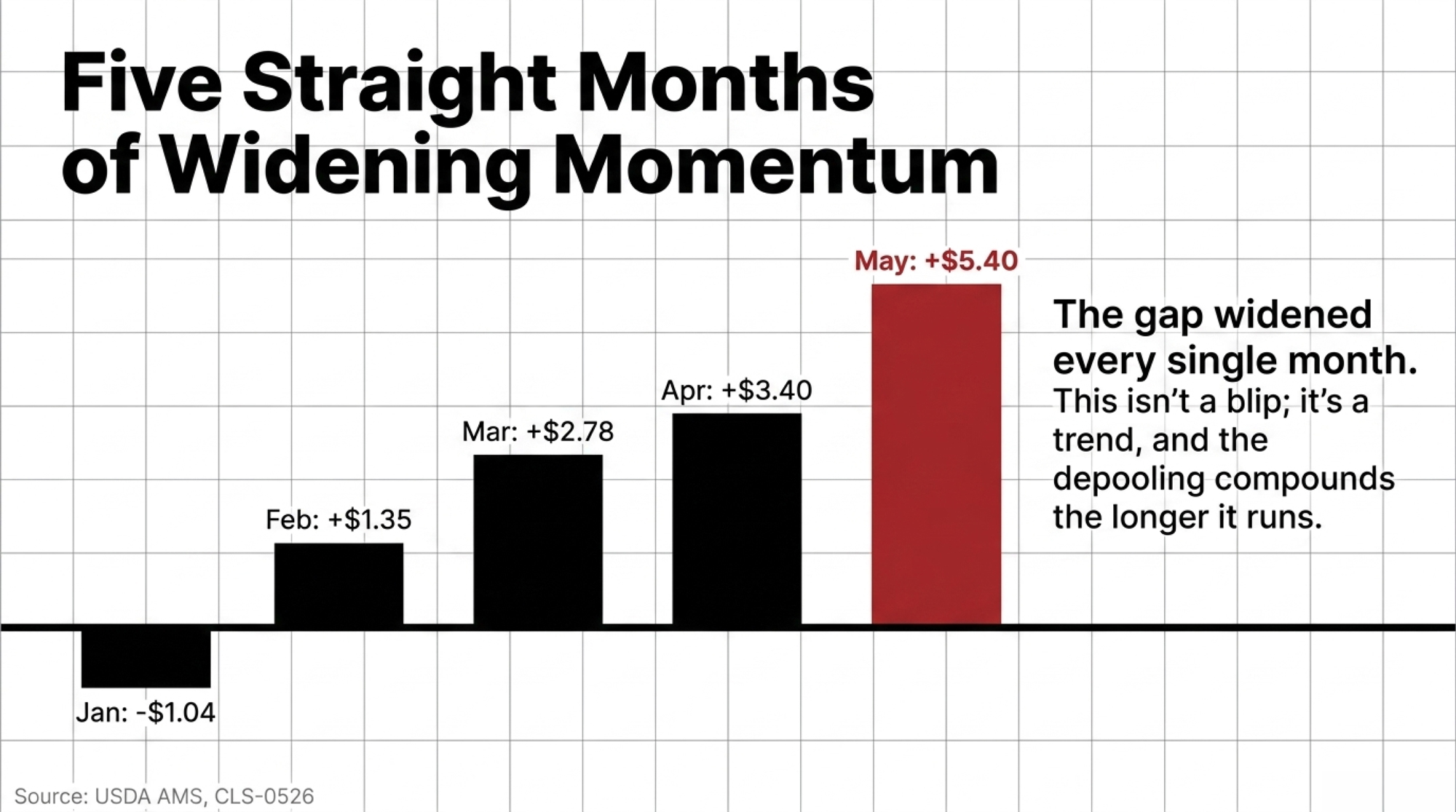
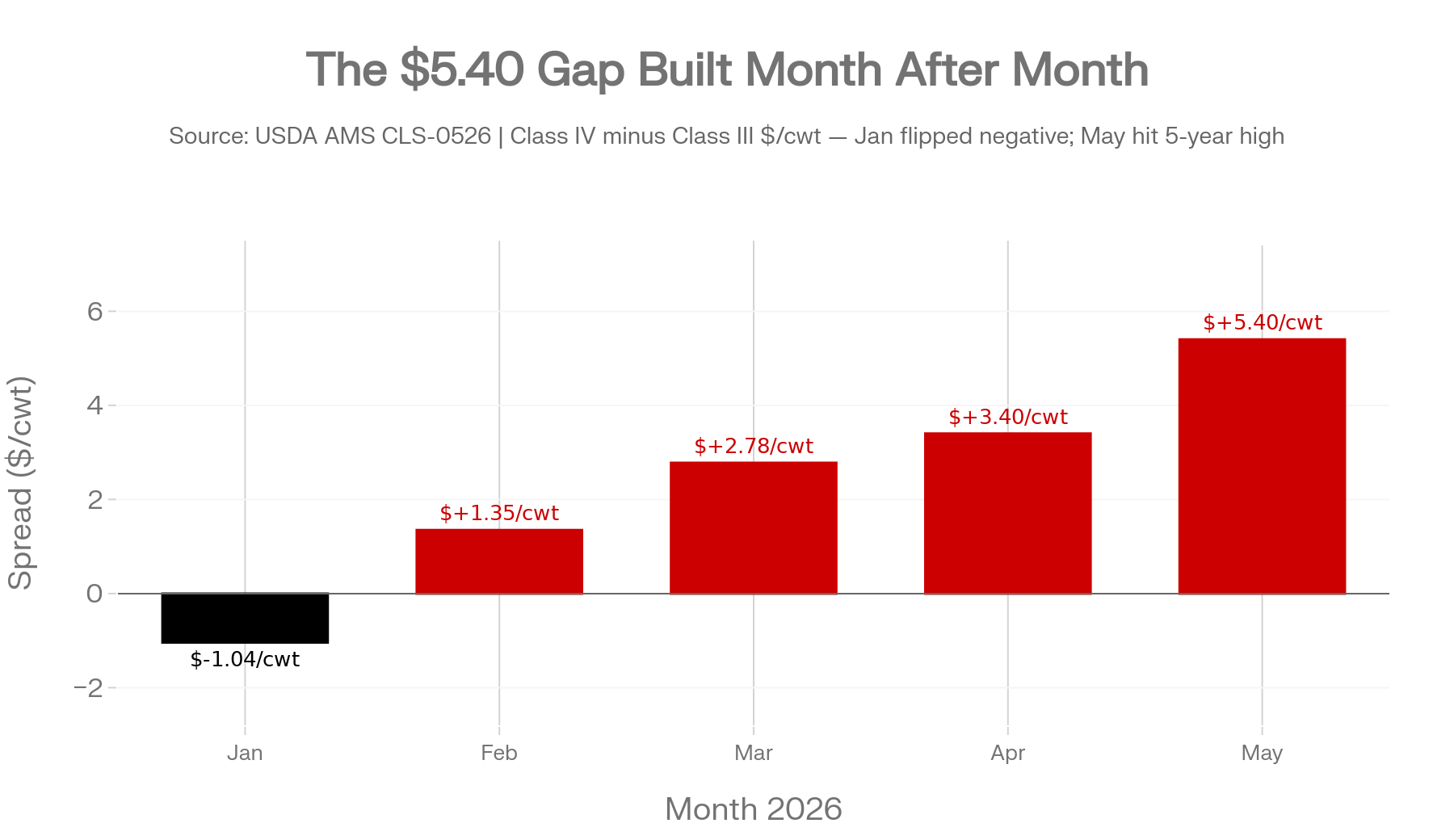
January opened with Class III actually above Class IV by about a dollar — the normal cheese-state order of things. February flipped it. By March, the spread had stretched to $2.78; by April, to $3.40; and by May, to $5.40 (USDA AMS, CLS-0526). Five straight months of Class IV pulling away, and the last jump was the biggest.
That progression matters because it kills the “wait and see” instinct. A one-month blip, you ride out. A gap that widens every month for five months running, with the biggest move most recent? That’s a trend with momentum, and the depooling that rides along with it compounds the longer it runs.
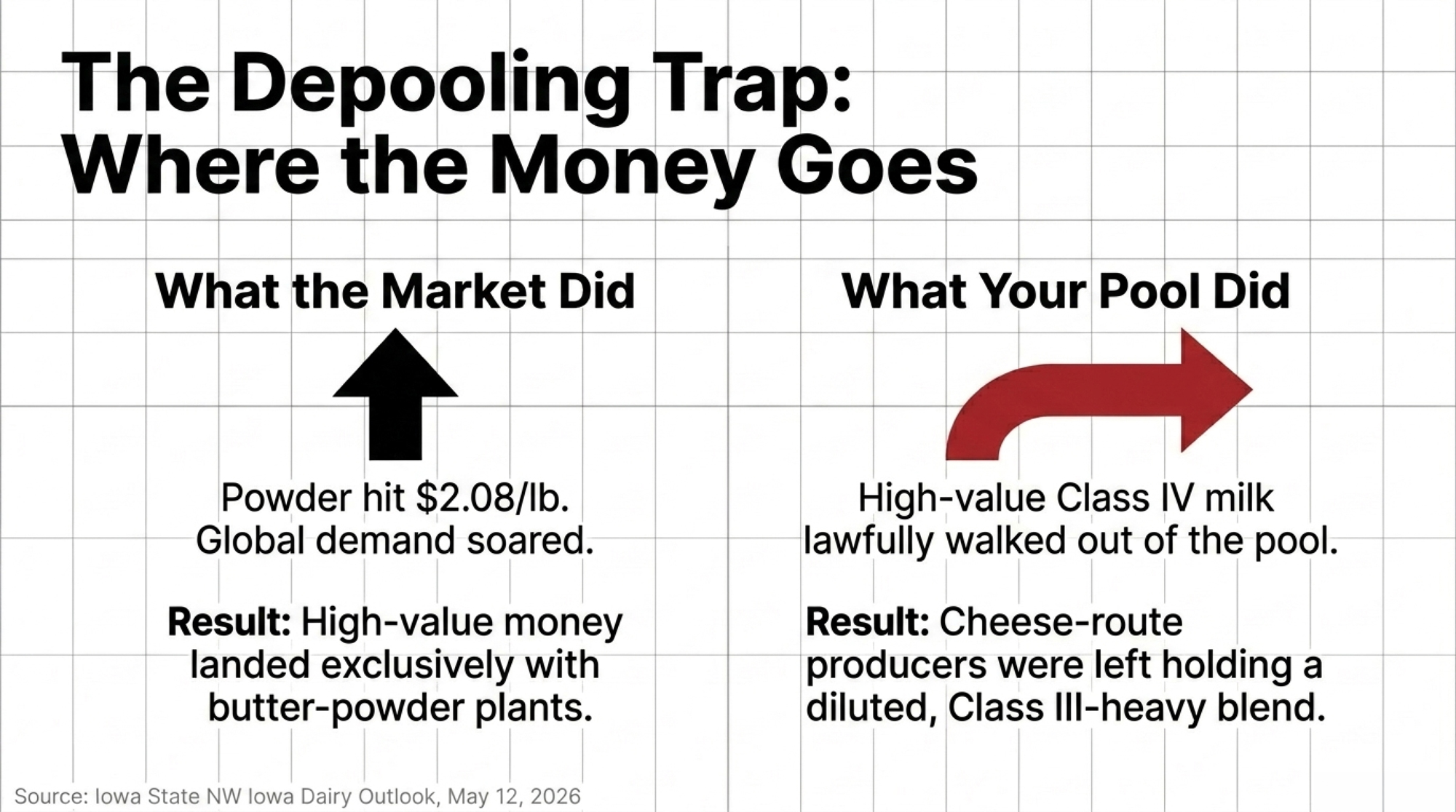
The Iowa State pool data shows the compounding in real time. When Class IV milk left the Central pool, the pounds that remained got more Class III–heavy — 48.2% by March, meaning the blend leaned harder on the lower-value class with each passing month. The math doesn’t reset at the start of every announcement. It stacks.
What Does a $5.40 Spread Actually Cost a 500-Cow Herd?
Stop thinking about the spread as a number on a futures screen. It only matters as spread times your milk times the share of your blend that’s exposed.
And the gap has done nothing but widen all year.
📊 The Spread Widened Every Month — Class IV minus Class III, 2026: Jan –$1.04 · Feb +$1.35 · Mar +$2.78 · Apr +$3.40 · May +$5.40. The June CME curve points higher still, with Class IV near $22.10 against Class III near $16.13 as of June 2–3. (USDA AMS CLS-0526, June 3, 2026; CME Group settlements via Barchart, June 2–3, 2026)
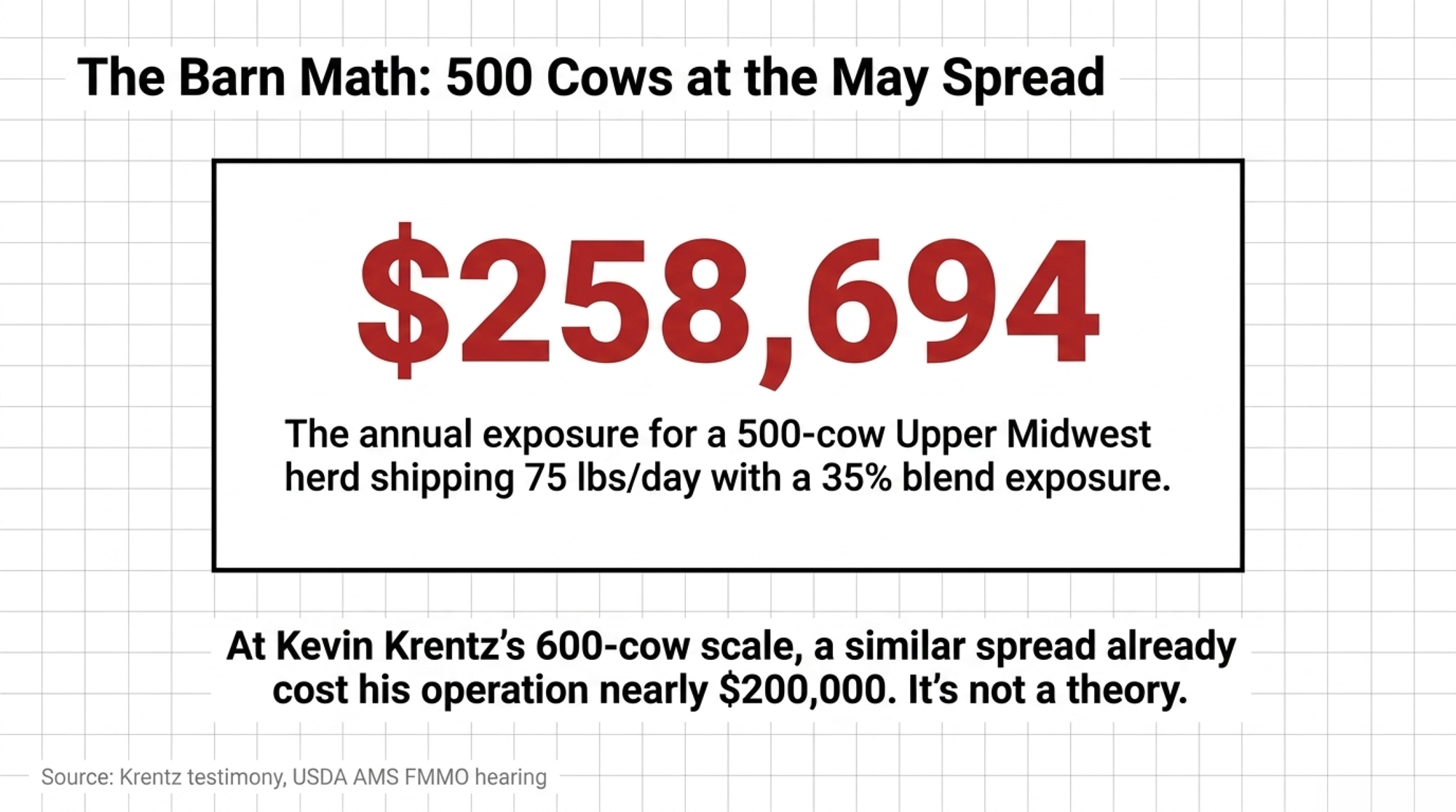
Take a 500-cow Upper Midwest herd shipping 75 lbs/cow/day. That’s 136,875 cwt a year. Here’s how the exposure scales — by spread, by blend percentage, by herd size.
| Herd | Spread | Blend exposure | Annual exposure | Per month |
| 500-cow | $3.40 (April actual) | 35% | $162,881 | ~$13,573 |
| 500-cow | $5.40 (May actual) | 35% | $258,694 | ~$21,558 |
| 500-cow | $5.40 (May actual) | 50% | $369,563 | ~$30,797 |
| 600-cow (Krentz scale) | $5.40 (May actual) | 35% | $310,433 | ~$25,869 |
That 600-cow figure now runs well past what Krentz testified a past negative-PPD stretch cost him.
A fair caution: that’s the scale of the decision, not a guaranteed transfer. Your real exposure depends on your handler’s plant mix and how your pool is built, not a dial you turn alone.
But the math answers the only question that matters here — is it worth a phone call? Above 300 cows, yes.
The Ten-Minute Check: Run Your Own Number Tonight
You don’t need the futures screen or a consultant for this. Three milk checks and ten minutes.
Step 1 — Find your effective blend price. Pull your last three milk checks and work out what you actually got paid per cwt after everything netted out.
Step 2 — Set it against Class III. Look up the announced Class III price for those same months — USDA AMS posts them by the 5th of the following month. Note the gap between what your milk earned and what it was paid.
Step 3 — Get your handler’s real split. Ask your marketing desk, in writing, for your handler’s most recent monthly Class III/Class IV utilization. It’s derivable from the public USDA FMMO pool reports for your order.
Step 4 — Do the one-line calc. Blend exposure × spread × your annual cwt. That’s your number.
🚩 The Trigger — If that figure clears $10,000/month at today’s spread and you haven’t called your marketing desk this quarter, treat it as urgent. Above 300 cows shipping 65+ lbs, the call pays for itself many times over.
One warning on Step 3: don’t accept an order average instead of a handler-level figure. Order averages hide everything.
Here’s how Step 4 plays out with real numbers. Say your handler comes back and tells you the plant ran 35% Class IV utilization in a normal month, but during the May depooling that dropped to 12% — the same collapse Iowa State documented across the Central order. On your 136,875 cwt, that 23-point swing at the $5.40 May spread is the difference between a blend that captured most of the Class IV premium and one that barely touched it. Plug your own utilization numbers into the same line, and you’ll see exactly where your check landed on that spectrum.
That’s the whole point of doing it yourself. The order average tells you what the pool did. Your handler’s split tells you what your milk did. Those two numbers can sit a long way apart in a depooling month, and only one of them shows up in your bank account.
Why the Powder Run Won’t Sort Itself Out by Fall
You might be tempted to wait this out. Markets swing, spreads close, why chase it? The problem is that this one’s built on concrete that never got poured.
Class IV lives on butter and powder. For years, processor money went into cheese and whey instead of new powder drying, so when global demand for powder showed up, the dryers weren’t there.
Nasonville Dairy in Marshfield, Wisconsin, makes around 150,000 pounds of cheese a day but breaks even on most of it — what keeps the lights on is whey, the New York Times reported in July 2025. That’s the math that built whey and cheese instead of dryers, all across the industry. Smart at the plant. Expensive at your end.
The forecasts don’t see it closing soon. USDA’s May 2026 WASDE bumped the 2026 Class III estimate to $17.00/cwt and the all-milk estimate to $21.25/cwt, citing strength across cheese, whey, and powder (USDA WASDE, May 21, 2026).
FCS America expects the Class III–IV spread to hold near $2.45/cwt through the back half of 2026 (FCS America Dairy Quarterly, March 25, 2026). Nobody credible is calling for the gap to vanish by harvest.
Why Won’t Your Co-op Call and Tell You This?
Fair question, and the answer isn’t a villain. It’s how the desk is built.
A co-op marketing desk exists to move milk and keep plant relationships humming. It has almost no reason to ring up 400 members and say, “Our cheese utilization means you’re not seeing the Class IV premium, and here’s what May cost you.”
That sentence is true. It’s useful. And it quietly raises a question the co-op would rather not field — would this member do better with a different handler?
So the call stays at the market level. Class IV’s strong, here’s the forward curve, here’s your DRP renewal. All accurate. None of it tells you what the spread is worth on your operation.
This isn’t bad faith — it’s incentives. The best, most honest marketing person on staff is still paid to keep milk in co-op plants.
There’s also a transparency gap baked into the rules: proprietary handlers have to itemize milk-check payments, but cooperatives — which handle the bulk of the nation’s milk — are largely exempt from those same disclosure requirements, a gap AFBF economist Danny Munch has been pushing USDA to close (Brownfield Ag News, June 11, 2025).
The myth to drop is that the desk is your advisor. Structurally, it isn’t. An independent milk marketing advisor, paid by you, can run this same math without the tug-of-war — and most 500-cow family operations, the ones most exposed in Order 30, never make that call.
Options and Trade-Offs
You’ve got a few honest paths here, and they’re not mutually exclusive.
Revisit your DRP weighting (the 90-day move). If you set a Class III–heavy weighting back in Q3 2025 when Class IV was soft and haven’t touched it, a market where Class IV leads by $5.40 means your coverage no longer matches your exposure.
What it requires: your current declaration and an open enrollment window. The trade-off: you gain protection against the gap, but over-weighting Class IV right before a reversal can sting — pair the move with the 2027 outlook, not just today’s number.
Look at your handler options (the long game). In competitive milk sheds — parts of Wisconsin, Idaho, some Northeastern markets — you actually have somewhere to go, and co-ops there tend to disclose more because opacity costs them members.
The signal to watch: if a competing plant carries meaningfully higher Class IV or fluid use while your basis holds, you’ve got room to negotiate.
The caution: USDA projects Class III rising and Class IV softening in 2027, with all-milk easing to $20.95/cwt (USDA WASDE, May 21, 2026). This window is 12 to 18 months, not forever. Don’t anchor a barn expansion to a spread the curve says compresses next year.
One more on the horizon: the USMCA six-year dairy trade review is due July 1, 2026. Export demand for powder is propping up Class IV right now — if Canadian market access becomes a bargaining chip, that’s a real pressure point on the spread.
Key Takeaways
- If the spread holds above $1.50/cwt for two announced months in a row, call your marketing desk — it cleared that line in March 2026 (Class III $16.16, Class IV $18.94) and ran to $5.40 by May. Five straight months of Class IV pulling away. The call’s overdue.
- If your blend-exposure math clears $10,000/month, the phone call pays for itself many times over. Above 300 cows shipping 65+ lbs, it almost always will.
- If your desk won’t give you handler-level Class III/IV utilization in writing, that’s your signal to bring in an independent advisor.
- If you set your DRP weighting before this spring, it no longer matches your exposure. Revisit it before your next enrollment window closes.

So here’s the question worth carrying into the barn tomorrow: when did you last pull your own utilization split and actually run this math — and what would it say if you did it tonight?
Run Your Numbers
Dairy Profit Projector — Drop in your herd size, blend, and current Class III and Class IV futures, then watch the spread move your IOFC, breakeven milk price, and 12-month margin. Pressure-test 35% versus 50% Class IV exposure before your next call to the marketing desk.
Complete references and supporting documentation are available upon request by contacting the editorial team at editor@thebullvine.com.
Learn More
- Class III Milk Price, DRP, and Your Spring 2026 Risk Plan — Arms you with a concrete tactical blueprint to adjust your Dairy Revenue Protection endorsements, preventing five-figure revenue gaps between operations with identical production profiles but vastly different class pool exposure.
- The $19 Milk Trap: How 2026 Prices Quietly Drain a 400‑Cow Dairy’s Equity — Delivers a rigorous multi-year stress test for your balance sheet, revealing the long-term capital erosion caused by lagging price transmission and forcing critical debt-service coverage conversations before margins squeeze equity.
- Is the Federal Milk Marketing Order Reform Benefiting Dairy Farmers or Only the Processors? — Exposes the structural regulatory battles rewriting U.S. milk pooling math, dismantling official modernization narratives to show how updated manufacturing allowances directly impact component values and processor margins.
 The Sunday Read Dairy Professionals Don’t Skip.
 The Sunday Read Dairy Professionals Don’t Skip.
Every week, thousands of producers, breeders, and industry insiders open Bullvine Weekly for genetics insights, market shifts, and profit strategies they won’t find anywhere else. One email. Five minutes. Smarter decisions all week.




