


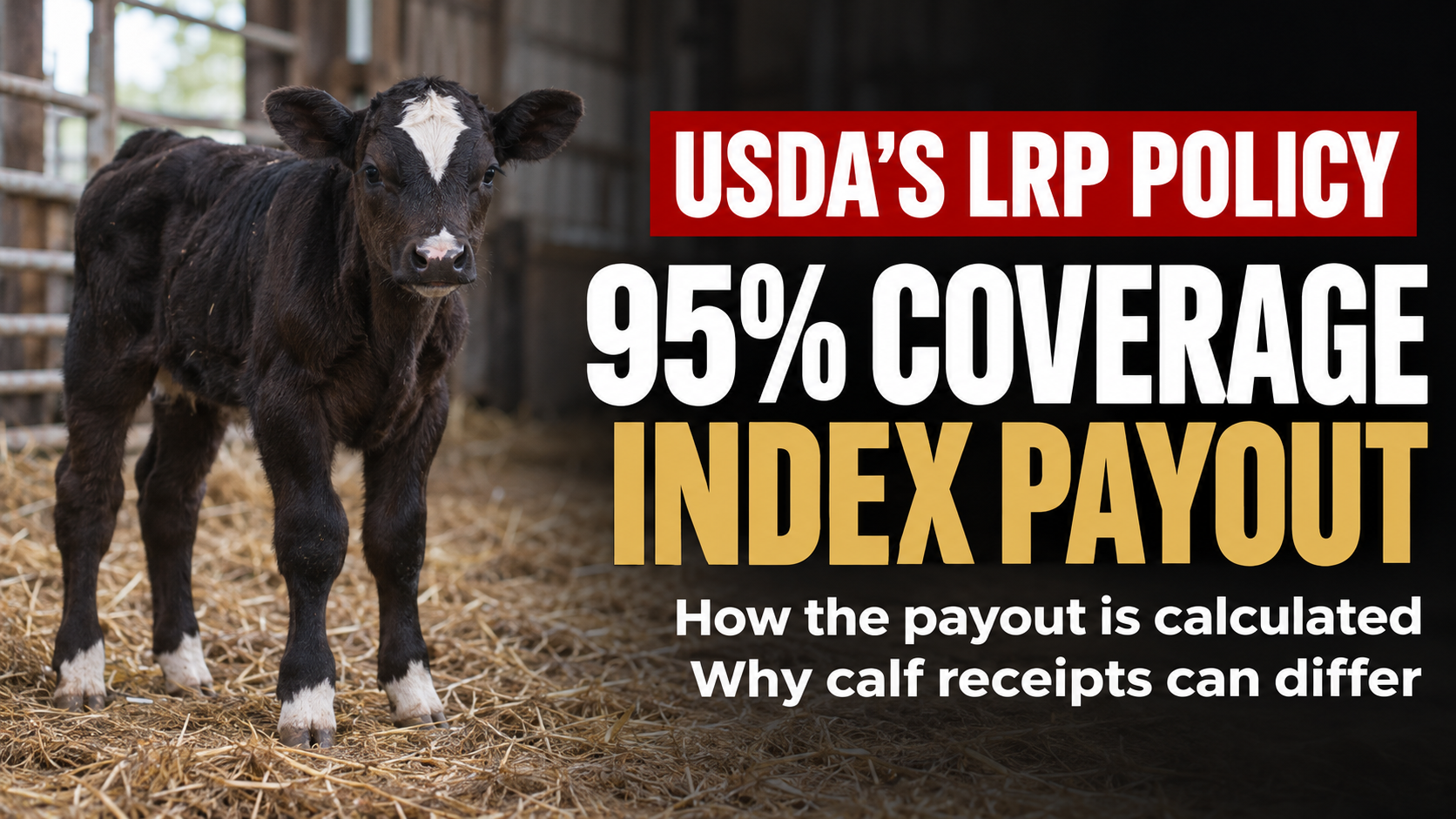





LRP insures your newborn calves at 60 to 99 lb. The index it pays on is built from 700- to 899-lb feeder steers. Pull your last settlement and see which number you actually followed.
A 95% Livestock Risk Protection endorsement does not guarantee 95% of your calf check. Under USDA’s 2027 LRP Basic Provisions, the coverage level is “the percent of the expected ending value” you choose. That’s the market value the policy expects at the end of coverage. The policy separately defines a deductible as 100% minus the coverage level, so 95% coverage carries a 5% deductible.
For eligible covered calves, the payment calculation starts with one comparison. If the actual ending value finishes below your coverage price, the policy pays the shortfall per hundredweight, multiplied by the number of head, the target weight and your insured share. If it doesn’t, the payment is zero, however far the benchmark fell along the way. So even if your calves sold exactly at the benchmark, 95% coverage wouldn’t return 95 cents of every dollar lost.
The second complication is basis risk. For beef-on-dairy calves, the benchmark isn’t your buyer’s price. It’s the CME Feeder Cattle Index, multiplied by an RMA adjustment factor, and that index is built from 700- to 899-pound feeder steers. Your calf price can move differently from it.
What are the terms for newborn calf coverage?
The policy covers beef and beef-dairy cross calves sold within two weeks after birth. The newborn-calf types use a target weight of 0.6–0.99 cwt (60 to 99 pounds), and unborn-calf endorsements run 13 to 43 weeks. RMA’s 2027 changes also added heavier unborn types, including Unborn Dairy Weight 2, at 6.0 to 9.0 cwt; they aren’t the newborn product this article covers.
That makes it a planning decision made months before the sale. Your calves have to be unborn on the endorsement’s effective date, and born and marketable before its end date. Your records must verify sales occurring no earlier than 30 days before and no later than 30 days after that end date.
What is the benchmark measuring?
CME Group’s Rulebook Chapter 102 defines the index as a seven-day weighted average of these sales:
- Cattle: Medium and Large Frame #1 and #1–2 feeder steers weighing 700 to 899 pounds.
- Sales counted: transactions reported by USDA’s Agricultural Marketing Service (AMS) in Colorado, Iowa, Kansas, Missouri, Montana, Nebraska, New Mexico, North Dakota, Oklahoma, South Dakota, Texas and Wyoming.
- Exclusions: cattle identified as predominantly dairy, exotic or Brahma breeding.
RMA multiplies that index by a price adjustment factor for each type, as published in the actuarial documents. The adjustment factor changes the scale of the ruler. It doesn’t change which cattle the ruler measured.
Different cattle do not automatically mean a poor hedge. The question is whether your calf price moves closely enough with the adjusted benchmark to protect the revenue you need. University of Nebraska–Lincoln’s Elliott Dennis and Jay Parsons put it plainly in 2022: LRP sets “a minimum price producers will receive subject to basis risk.” Among the times producers feel these tools fell short, they listed a dairy-specific case: “the Holstein market collapsing and LRP not paying out.”
How does the math work?
Illustration 1: How a newborn endorsement pays. These are illustrative inputs, not a current quote or adjustment factor.
| Input | Value |
| Expected ending value (adjusted) | $1,000/cwt |
| Coverage level → coverage price | 95% → $950/cwt |
| Target weight / insured share | 0.9 cwt / 100% |
| Outcome | Actual ending value | Gross indemnity per calf, before producer premium (Bullvine math) |
| Ends 2% below expected value | $980/cwt | $0. It finished above the $950 coverage price. |
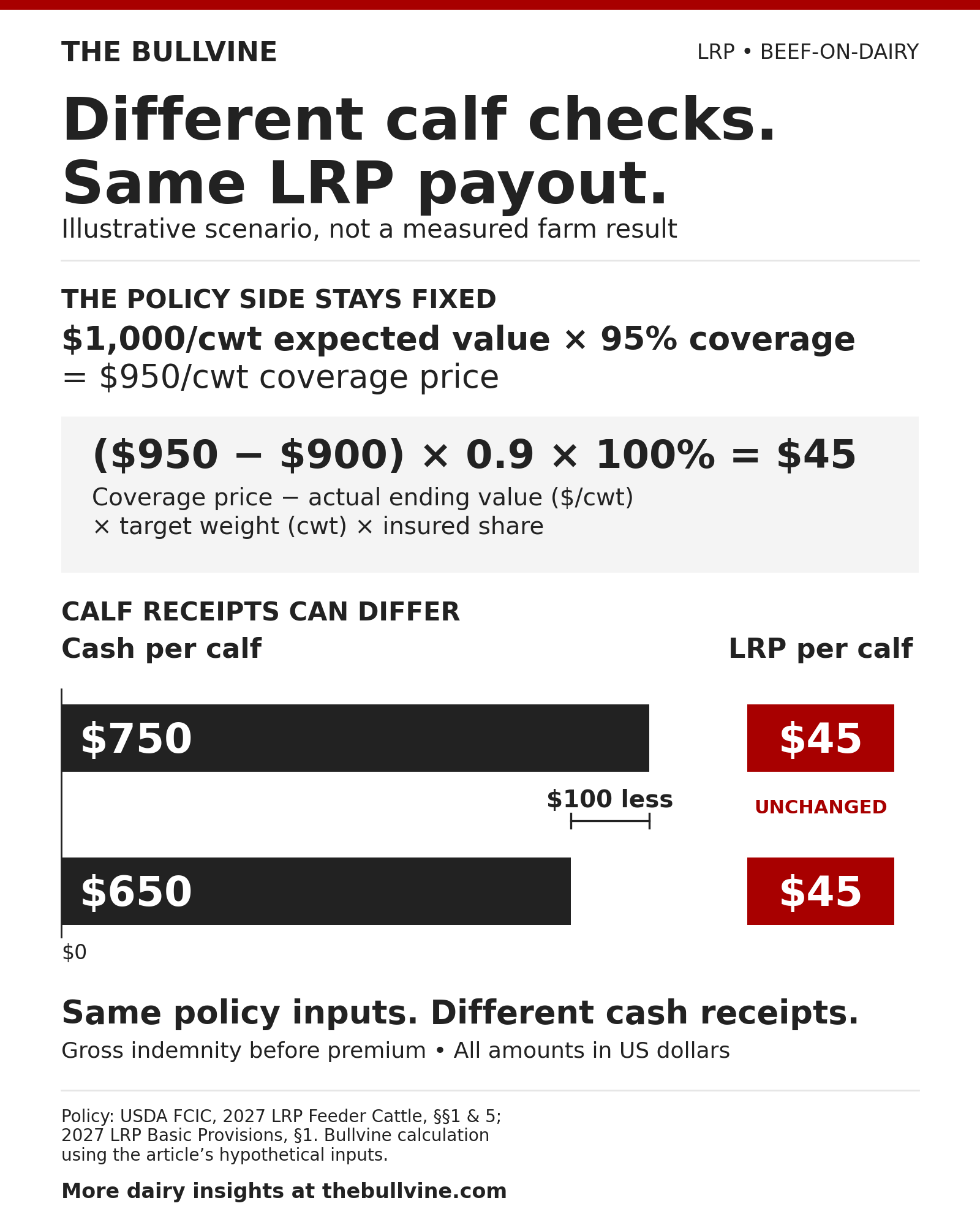
| Ends 10% below expected value | $900/cwt | ($950 − $900) × 0.9 cwt × 100% = $45 |
Your calf receipts sit outside that calculation. In the second outcome, the $45 is the same whether your buyer paid $750 a calf or $650. Both receipt figures are illustrative.
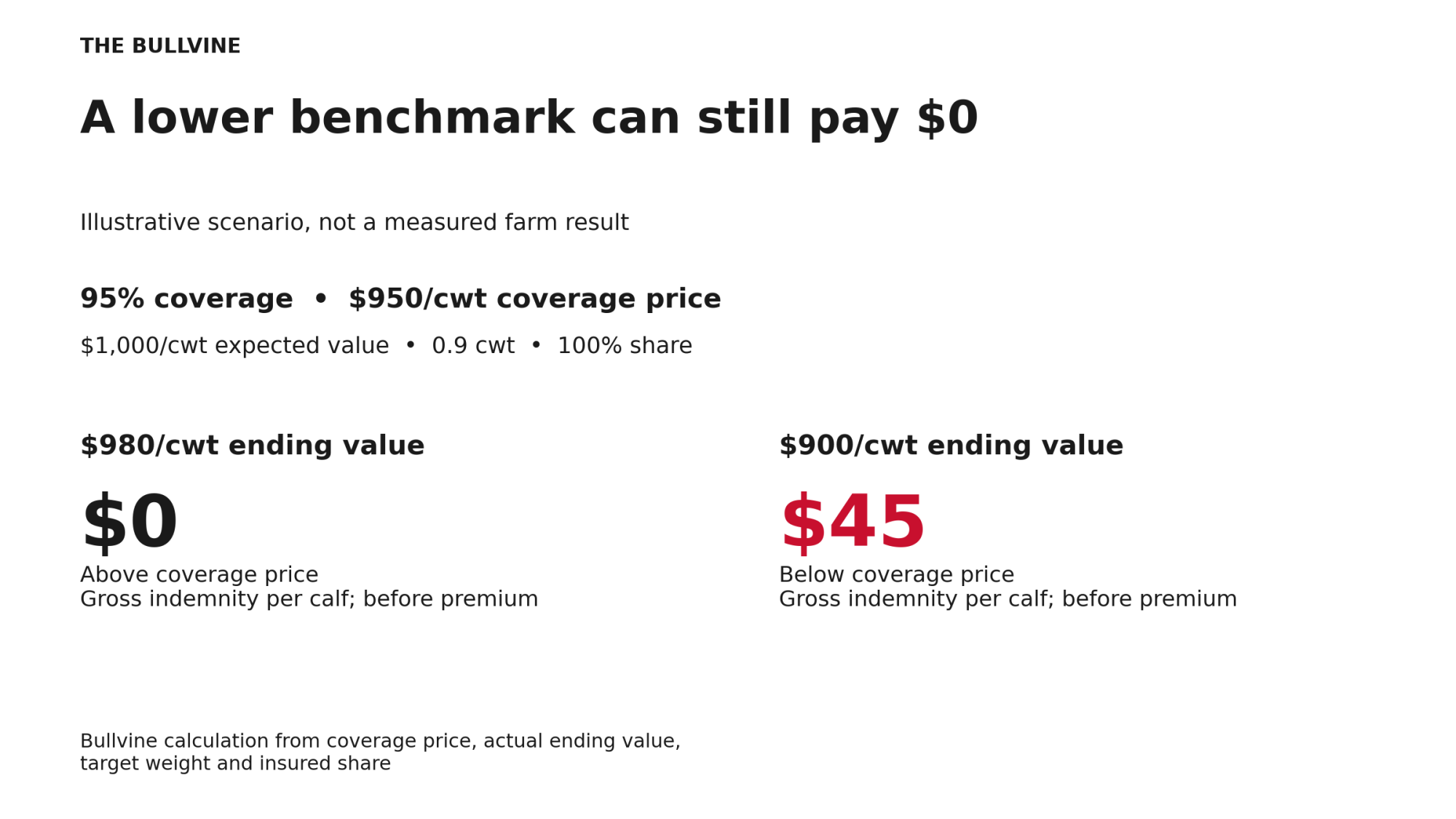
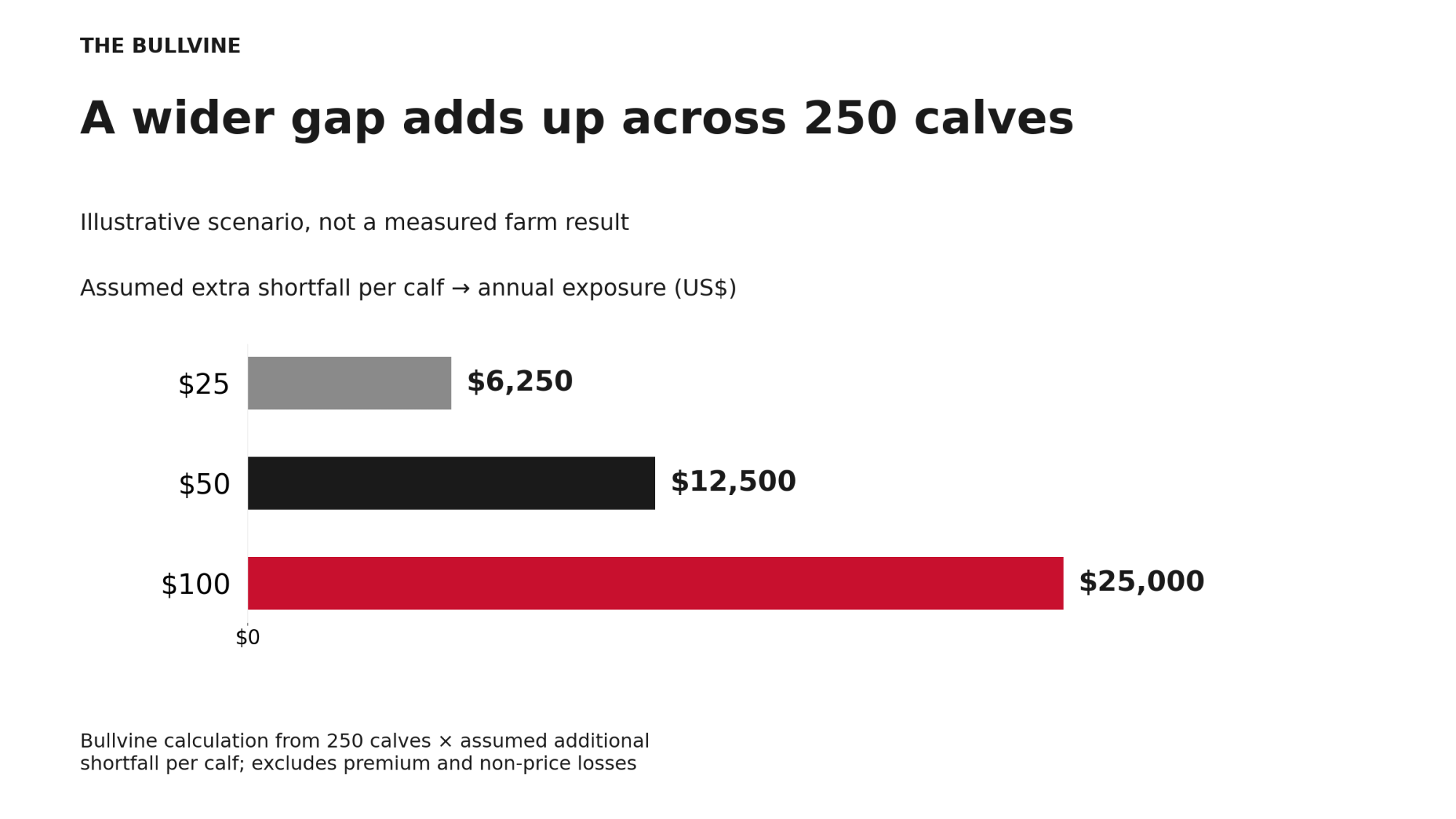
Illustration 2: What a widening price gap could cost. For 250 calves a year, the table shows the effect of an assumed deterioration in cash price relative to the benchmark, measured in dollars per head. These are hypothetical changes from a reference gap. They aren’t a forecast or an indemnity calculation, and they don’t simply mean a price below the benchmark.
| Assumed additional shortfall per calf | Calves affected | Illustrative annual exposure (US$) |
| $25 | 250 | $6,250 |
| $50 | 250 | $12,500 |
| $100 | 250 | $25,000 |
Annualizing assumes the stated shortfall hits every calf counted. The 250 is a round illustrative count, so use your own marketed beef-cross calves. The table excludes producer premium, rejections, death loss and buyer nonpayment. Use your own records to estimate your exposure.
Which buyer contract clauses affect your basis exposure?
How closely your revenue tracks the benchmark depends on market conditions, calf characteristics, deductions and timing. Three clause groups shape it.
- Pricing formula and pricing date. Is the price fixed, negotiated or tied to a named benchmark? If it’s tied to one, what’s the series, the multiplier and the unit (per head, per pound or per cwt)? Which day or averaging period sets it? The pricing clause tells you which market you follow. For one dated sale’s range, see our look at USDA’s Glasgow dairy auction beef-cross calf prices.
- Floor, deductions and rejection terms. Is the floor gross or net? List every charge, weight or health standard, and rejection right. The deduction clause tells you how much of that price survives. Keep rejection and death losses separate from basis. Those are real losses with a different cause.
- Ownership and whose insurance it is. The Basic Provisions define the insured as the person named on the approved application, and that definition “does not extend to any other person having a share or interest in the covered livestock.” A buyer’s LRP doesn’t make you the insured.
What should you do before your next endorsement?
Before the next endorsement. Take your last four settlements and recalculate each one from the written contract. If you can’t reproduce them, have that conversation with your buyer now. Then confirm three things with your agent:
- the livestock type and adjustment factor;
- whose name is on the application;
- that your expected sale dates fall inside the endorsement’s ±30-day window.
Don’t wait a year on an obvious contract or timing problem.
Over the next 90 days, start a record. For every lot, log:
- Net lot receipts divided by head sold, which gives you cash dollars per head.
- The adjusted benchmark, converted from dollars per cwt to dollars per head at your target weight.
- The buyer’s pricing date, the sale date and the endorsement end date, recorded separately.
- The livestock type, adjustment factor, target weight, coverage price and insured share.
- Recurring deductions, kept apart from rejections, death loss and other non-price losses.
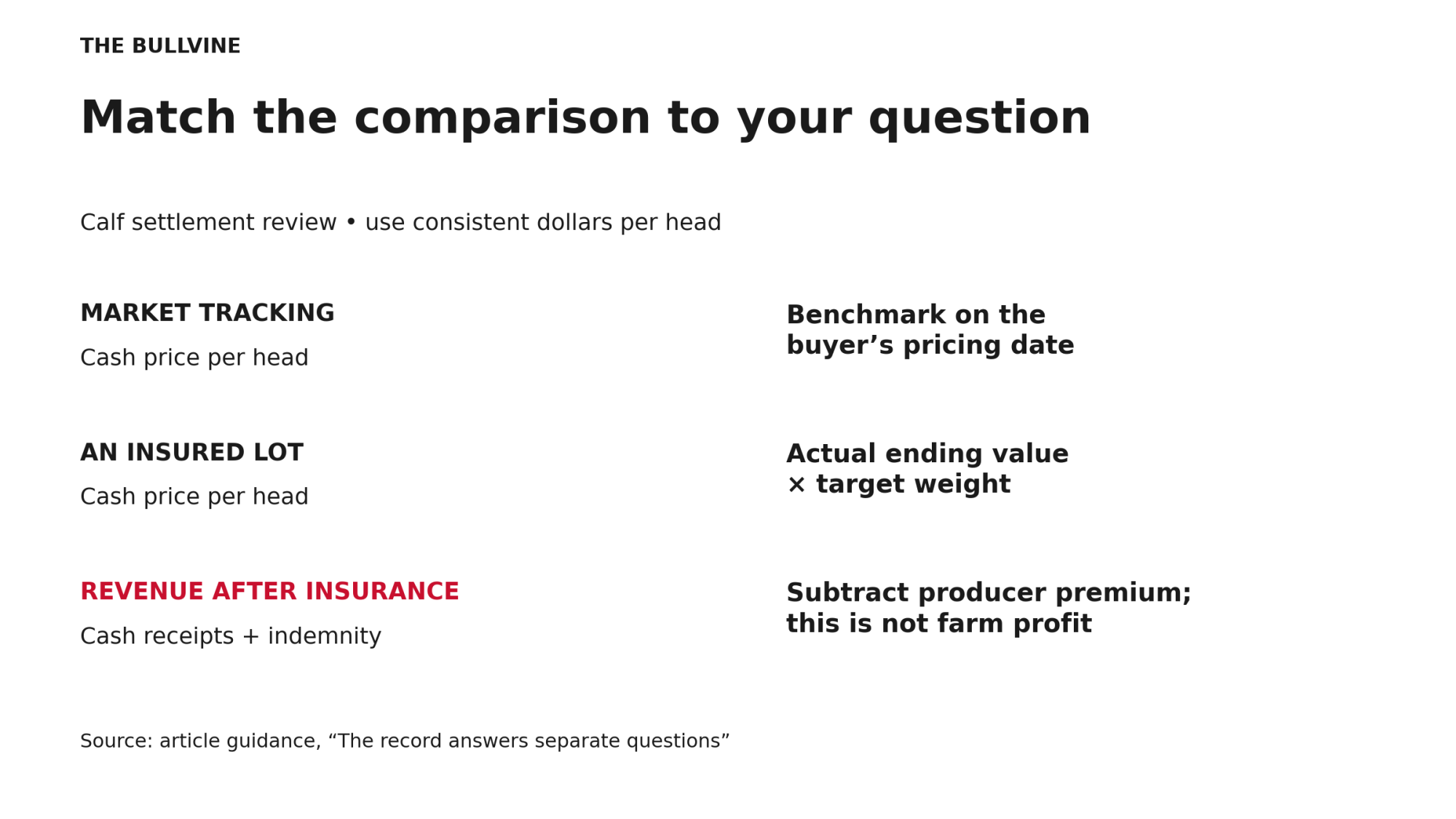
The record answers separate questions:
- Market tracking: to see how your buyer’s price tracks the market, compare cash dollars per head with a consistently defined benchmark on the pricing date.
- An insured lot: compare cash dollars per head with the endorsement’s actual ending value multiplied by target weight in cwt.
- Revenue after insurance: add the lot’s indemnity to its cash receipts and subtract its producer-paid premium. This is not farm profit.
Matching dates alone won’t reproduce the policy settlement. Ninety days starts the record; if prices haven’t fallen during that period, it won’t show how the match behaves in a downturn.
At renewal or your next contract negotiation, review what the record shows. Check whether the gap stayed stable or widened, especially when prices fell. A consistently lower calf price is not, by itself, evidence of basis weakening. Use the record to discuss pricing terms with your buyer. With your agent, compare the next endorsement’s protection with its producer-paid premium. Ask what a closer benchmark link or net floor would cost.
The check to run this week
Pull your last calf settlement and work out cash dollars per head. Then identify the right comparison value:
- For market tracking: use the benchmark on your buyer’s pricing date.
- To examine an insured lot’s settlement: use the actual ending value for its endorsement.
Convert either one to dollars per head. If you can’t say which one applies, that’s the first gap to close.
What’s your true LRP coverage gap?
LRP pays on an index of 700-899 lb steers, not your newborn calf price. Test your basis exposure in under 60 seconds.
From your endorsement (Art. Illus. 1: $1,000)
Typically 70-100% (Art. Illus. 1: 95%)
Newborn range: 0.6-0.99 cwt (Art. Illus. 1: 0.9)
Final RMA settlement index (Art. Illus. 1: $900)
Net receipts from buyer per calf
Your herd’s marketed beef-crosses
Total Annual Basis Exposure
Shortfall vs. your insured LRP floor
Coverage Price: Expected Value × Coverage %
Insured Floor: Coverage Price × Target Weight
Gross Indemnity: Max(0, Coverage Price – Actual Value) × Target Weight (assuming 100% share)
Actual Revenue: Cash Price + Gross Indemnity
Basis Gap per Head: Max(0, Insured Floor – Actual Revenue)
Illustrative estimate based on your inputs and USDA FCIC 2027 LRP Basic Provisions. Not financial advice. Bullvine calculation.
Don’t let basis risk erode your margins
Get exclusive dairy economics and market analysis delivered straight to your inbox.
Subscribe to The Bullvine Weekly