



Archive for Genomic Testing – Page 2

From Breeding Chaos to Strategic Cash: How 2025’s Smartest Dairies Connect Every Decision

The smartest dairies aren’t just milking cows anymore—they’re connecting breeding, markets, and risk into one profitable system

EXECUTIVE SUMMARY: What farmers are discovering across the country is that 2025’s most profitable dairies have stopped treating breeding, market timing, and risk management as separate functions—they’re integrating them into strategic systems that maximize both immediate cash flow and long-term genetic progress. Recent USDA data shows milk production in major dairy states increased 3.3% year-over-year to 18.8 billion pounds, driven largely by farms confident in dual revenue streams where beef-cross calves now contribute meaningful dollars per hundredweight to overall margins. Progressive operations are using genomic testing to segment herds strategically, with top genetic performers earmarked for replacement production while bottom performers generate premium beef-cross income that funds facility improvements and equipment upgrades. This shift is supported by the $1.2 billion in Dairy Margin Coverage payments delivered in 2023, which smart farms are using not just as insurance but as strategic tools that influence breeding timing and production planning. Extension specialists from Wisconsin to California report that operations implementing these integrated approaches are seeing substantial improvements in breeding economics while maintaining genetic progress rates. The transformation suggests we’re moving toward a more sophisticated industry where success comes from strategic thinking rather than just operational efficiency. Here’s what this means for your operation: the tools and expertise needed for this integration are increasingly accessible to farms of all sizes, creating unprecedented opportunities for producers ready to adapt their decision-making systems.
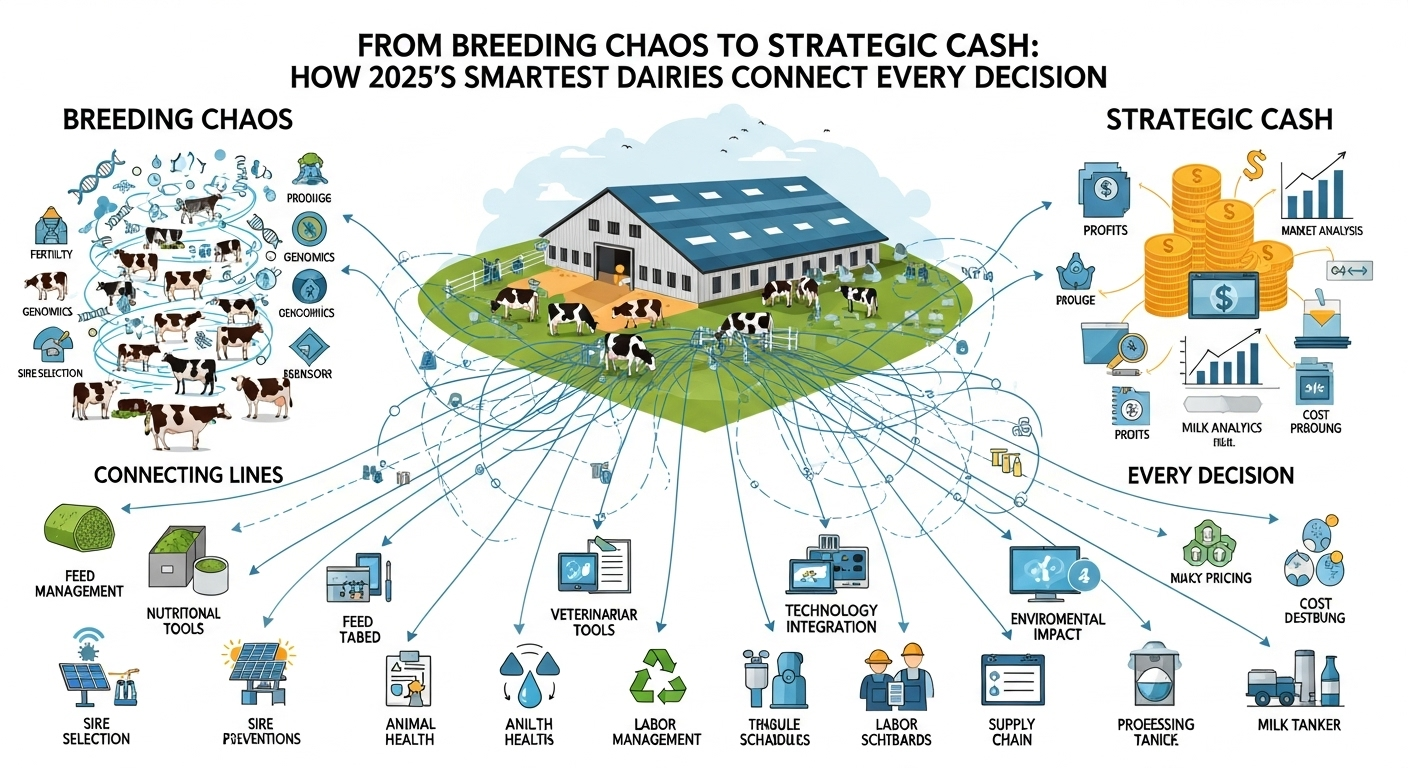
profitable dairy strategies

What started as a dairy boom has become something far more significant—a fundamental shift in how progressive farms balance genetics, markets, and risk in real-time decision-making.

You know that feeling when you walk into the hotel lobby after a producer meeting and everyone’s huddled around talking about the same thing? That’s where we are with dairy right now. What’s unfolding in 2025 goes way beyond the obvious headlines—the massive processing investments and the beef-cross calf premiums that have everyone’s attention.

I’ve been watching this closely across different regions, and the smartest operations aren’t just riding this wave. They’re developing methods to connect the dots between breeding, market signals, and risk management, rather than treating them as separate farm functions. And honestly, it’s changing how we need to think about running a dairy.

This isn’t about getting fancier technology—though that’s certainly part of it. It’s a whole new approach that’s helping progressive operations navigate unprecedented complexity while actually maximizing both short-term cash flow and long-term genetic progress. Not an easy balance, as many of us have learned the hard way.

Market observations and examples in this article reflect general industry trends and producer experiences as of September 2025.
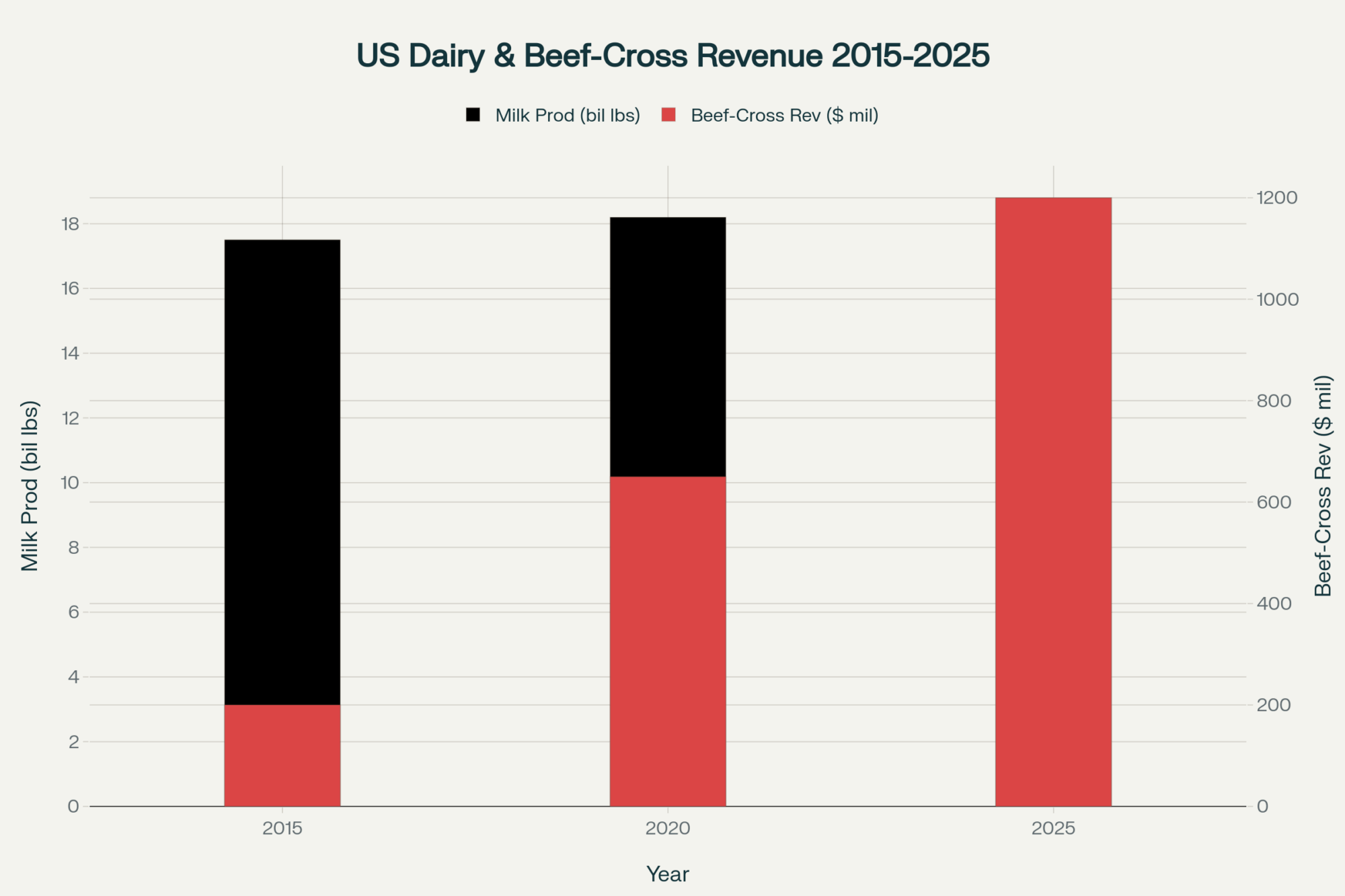
Dairy’s New Cash Engine: U.S. milk output climbs steadily while beef-cross calf revenues surge to $1.2B—a shift that’s transforming the industry’s profit structure. Strategic farms now treat beef genetics as a vital income stream, not just an add-on. Are you capturing your share of this new revenue?

What’s Really Behind This Perfect Storm

So here’s what we’re seeing across different regions. With the increasing number of new processing plants coming online, combined with strong beef-cross calf markets, we have created a unique moment in dairy economics that I don’t think any of us were quite prepared for.

The data from the USDA’s August report show that production in the 24 major dairy states jumped 3.3% year-over-year to 18.8 billion pounds. Both infrastructure demand drives that, and—let’s be honest—farmers’ growing confidence in having multiple revenue streams, rather than just milk.

Phil Plourd from Ever.Ag Insights captured what many of us were thinking when he noted, “Market pricing and conditions encouraged additional production going into this year, and now it’s here, with historic force. As is often the case with on-farm production, it probably took longer than some thought to get going, and now it will probably take longer than many think to slow down.”

And what’s particularly noteworthy is that many producers I talk with at conferences report that cattle sales contribute significantly more to their bottom line than they did just a few years ago. We’re talking about operations where beef-cross calves have become a meaningful part of overall farm margins. Producers who’ve implemented strategic genomic testing are finding that they can identify their lowest-performing dairy genetics for beef breeding while preserving their elite animals for replacement production.

This builds on what we’ve seen in recent years with infrastructure development. Michael Dykes from the International Dairy Foods Association put it well at their San Antonio forum: “Our farmers want to grow, and so do our processors. If we aren’t growing, if we aren’t looking toward the future, we’re going to get surpassed by others.”

What gives me hope is that we’re seeing the emergence of truly dual-purpose dairy operations—farms that are optimizing for both milk production and beef genetics simultaneously. It’s a strategic shift that would’ve been nearly impossible to justify economically just five years ago.

How Genomics Finally Made Sense for Regular Dairies

Something that has caught my attention lately is how genomic testing has evolved from being used primarily in elite herds with advanced genetics programs to becoming a cornerstone of breeding strategies for regular commercial operations like yours and mine.

You probably already know this, but genomic testing costs have decreased to the point where most operations can afford to be strategic about it. Extension personnel from Wisconsin, Penn State, and UC Davis are collaborating with progressive dairies to utilize genomics for informed breeding decisions across their entire herds, not just their top-performing animals.

What I find fascinating is how farms are implementing three-tier genomic breeding strategies. They’re using the overnight genomic reports to segment their herds into strategic breeding groups. The top genetic performers get tagged for sexed dairy semen to produce the next generation of high-producing replacements. The solid middle performers are bred to conventional dairy semen, balancing cost with reliable genetic progress. And here’s the key—the bottom performers are targeted for beef-on-dairy matings to maximize calf value from animals with lower dairy potential.

Many producers report substantial improvements in their breeding economics using this approach. Some operations are seeing their replacement costs drop while calf income increases. More importantly, they’re maintaining their genetic progress rate while generating cash flow that funds facility improvements and equipment upgrades.

Why is this significant? The economics tell the story. Dr. Chad Dechow from Penn State’s dairy genetics program explained it this way: this approach transforms breeding from guesswork into putting your resources where they’ll do the most good. When you can identify which cows should produce premium beef-cross calves versus replacement heifers, the numbers work out pretty quickly.

What farmers are discovering—and this has been particularly encouraging to see—is that genomic testing creates a ripple effect that extends beyond just breeding decisions. It’s changing how they think about culling strategies, feed allocation during the transition period, and even barn design for managing fresh cows. When you know exactly which animals have the genetic potential to be your next generation of leaders, everything else falls into place differently.

Of course, not everyone’s convinced this approach works for their operation. Some producers I know—particularly those running smaller organic operations in the Northeast—are taking a more cautious approach with genomics, and honestly, they might be right for their specific situation where every breeding decision carries a different weight than in larger conventional systems.

The Replacement Crisis Nobody Saw Coming

What I find fascinating is how an unexpected problem emerged from all this excitement about beef-on-dairy premiums—replacement heifer shortages.

Dr. Geoff Smith from Zoetis put it bluntly: “Many farms have fallen so in love with producing beef-on-dairy that they don’t have the number of replacement heifers needed. And they’re not able to make proper culling decisions because they don’t have the numbers of replacements in the pipeline.”

I keep hearing variations of the same story from producers across different regions. In their eagerness to capture strong calf premiums during peak breeding seasons, some operations bred too high a percentage of their herd to beef sires for extended periods. By the time they realized the implications for their replacement pipeline, they were facing serious heifer shortages for the following year.

The scramble to correct course has been expensive for these farms. Premium-priced sexed semen, repeat breedings on marginal cows, and veterinary bills for extending lactations on older animals. Even with immediate corrections, that heifer gap can’t be filled for almost two years, creating productivity delays that ripple through multiple breeding cycles.

This teaches us that even the most profitable market opportunities require disciplined balance with long-term herd needs. The farms that implemented strict breeding ratio guardrails early on are now in much stronger positions.

It’s worth noting that seasonal operations face different challenges here. If you’re running a spring calving system in the northern plains or fall freshening to avoid summer heat stress in the Southeast, missing a breeding window can affect your entire production pattern for years to come. For operations using robotic milking systems, where individual cow management is even more critical, the replacement pipeline becomes absolutely essential.

Quick Decision Framework

Essential breeding ratio guardrails producers are using:

  • Maintain a minimum of 20-25% dairy semen regardless of market signals
  • Set alerts when dairy-semen usage drops below your calculated threshold
  • Factor seasonal calving patterns into replacement timing
  • Account for regional mortality and retention patterns

Figuring Out Your Farm’s Breeding Sweet Spot

So how do you avoid that replacement trap? The most sophisticated operations have moved beyond the old “use 25-30% dairy semen” rule of thumb to develop calculations tailored to their specific operations. Extension specialists from major dairy states are helping producers develop these customized models, and the results vary significantly based on management style and regional factors.

Generally speaking, annual culling rates can vary significantly depending on the type of operation and management intensity. Free-stall operations in the upper Midwest often exhibit different patterns than dry lot systems in California’s Central Valley, where heat abatement strategies and water availability influence distinct management decisions. These differences fundamentally change the replacement math.

Walking through barns in different regions, I keep hearing producers focus on these key variables:

  • Annual culling rate (and this varies a lot depending on your region and management style)
  • Conception and calving rates specific to your breeding program
  • Pre-weaning mortality and retention sales patterns
  • Herd expansion or contraction plans for the next 24 months
  • Actual heifer-out percentage per dairy breeding

The basic calculation becomes pretty straightforward: replacement heifers needed divided by your heifer-out rate equals dairy-semen services required.

For example, a farm that needs 300 replacements annually with a 35% heifer-out rate requires approximately 857 dairy semen services. If they plan 3,000 total breedings, that requires 29% dairy semen use—close to the rule of thumb, but adjusted for their specific performance metrics.

This approach transforms breeding decisions from guesswork into a strategic allocation of resources. And what’s particularly valuable is that this calculation helps farms identify their flexibility margins. How much can you adjust your beef-on-dairy quotas without compromising your replacement pipeline? What happens when you factor in seasonal mortality patterns or drought conditions that might affect conception rates?

Making Risk Management Actually Strategic

What I’m still trying to figure out is how some operations have gotten so sophisticated at integrating Dairy Margin Coverage and Revenue Protection into real-time production decisions. The $1.2 billion in DMC payments delivered in 2023 represents far more than insurance—it has become a strategic business tool that influences breeding timing and production planning.

Leading dairy financial consultants are helping farms implement strategies that would’ve seemed impossible just a few years ago. Instead of simple coverage at one margin level, progressive operations buy tiered protection: maybe 25% of milk at a higher margin level, 50% at a middle tier, and the remainder at a lower level. This ladder approach ensures partial payouts as margins erode, smoothing cash flow during volatile periods.

Some operations are even timing their breeding decisions around coverage triggers. When margin forecasts indicate potential payouts during their breeding season, they temporarily shift more breedings toward dairy semen, knowing the safety net cushions milk-price risk and protects replacement targets.

Phil Plourd noted that “DMC can go a long way to providing real, meaningful protection to a farm’s profitability. And the cost of it is, you know, it’s sort of a no-brainer in terms of what it takes to get involved.”

This creates a strategic cushion that allows farms to make longer-term decisions without being whipsawed by short-term market volatility. When you know DMC will cover margin compression below certain thresholds, you can stick to your genetic improvement plans and maintain proper butterfat performance levels rather than making reactive breeding adjustments.

Examining this trend more broadly, what’s notable is how risk management tools have evolved from simple insurance to strategic decision-making components. Farms that master this integration don’t just protect against downside—they use the protection to make more aggressive moves during periods of opportunity.
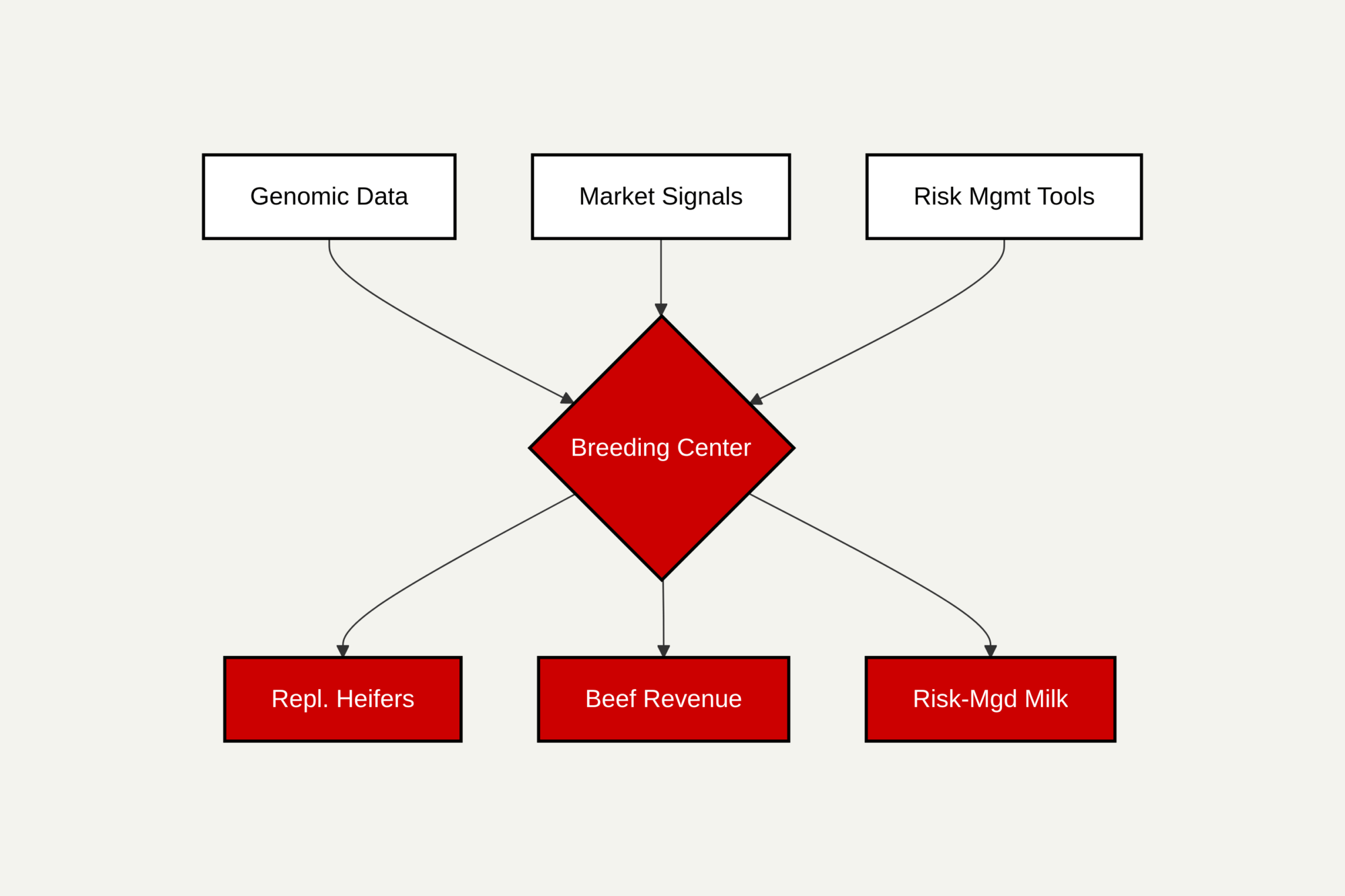
How Top Dairies Actually Connect the Dots: Progressive herds now funnel genetics, market insight, and risk tools into a single breeding hub—turning data into decisively profitable actions. This integration lets you act with speed and confidence, not hindsight. Are you using a system—or just hoping for the best?

When Market Signals Don’t Agree

And this is where it gets tricky. Current market conditions are testing these integrated systems pretty hard. Market conditions have been mixed recently, with some segments experiencing pressure despite production continuing to climb and beef-cross markets remaining relatively strong.

Progressive farm managers are learning to navigate this tension through disciplined frameworks that quantify trade-offs rather than making emotional market reactions. It’s fascinating to watch how different operations handle these conflicting signals—particularly comparing seasonal calving operations with year-round breeding programs, or how organic operations in Pennsylvania approach these decisions differently than large conventional dairies in Idaho.

When beef calf markets stay strong while milk margins feel pressure, smart managers pause to calculate the actual impact. Higher beef income might cover some of the margin shortfall. However, dropping your dairy semen use for one breeding cycle means losing future dairy heifers for immediate cash flow.

The most successful operations establish guardrails in their breeding programs, with alerts triggered when dairy semen usage dips below critical thresholds. They might make tactical adjustments—shifting their ratios temporarily—that capture market opportunities without sacrificing herd integrity.

And something worth noting… seasonal timing affects these decisions differently. Spring breeding adjustments have different long-term implications than fall changes, since spring-born calves enter the milking string during peak production periods the following year. As many of us have seen, timing is everything in dairy—whether it’s breeding decisions, dry-off timing, or fresh cow management protocols.

Making It Work Without Breaking the Bank

You’ve probably seen this in your own region… not every operation needs a corporate-style integrated system to compete effectively. Smart mid-sized dairies—particularly those with 300-800 cows, which form the backbone of many regional dairy communities—are adopting targeted elements that deliver outsized returns without requiring massive investment.

What’s working for smaller operations:

Selective Genomics Strategy: Rather than testing every animal, focus genomic testing on first-lactation heifers (your future genetic leaders) and the bottom performers in your current milking string. With strategic testing, you can pinpoint high-value breeding decisions without incurring significant costs. Even smaller organic operations where every breeding decision carries extra weight are finding success with this targeted approach.

Simple Heifer-Out Tracking: Build a straightforward spreadsheet model tracking your annual cull rate, conception rate, calving rate, and heifer mortality. Update it quarterly to calculate the exact dairy-semen share you need each month to hit replacement goals. This process takes approximately 30 minutes per quarter, but it can save you thousands in breeding mistakes. Some producers even factor in seasonal variations—like higher mortality during summer heat stress periods in the Southeast.

Tiered DMC Coverage: Purchase coverage at multiple bands—maybe half of your production at your true cost of production margin, and a portion at one level lower. This ladder ensures partial payouts as margins erode, without the need for complex hedging programs. The premium difference is minimal, but the protection value is substantial, especially for operations dealing with higher feed costs or transportation challenges in remote areas.

Monthly Breeding Reviews: Pull your herdsman, nutritionist, and bookkeeper together for 30 minutes monthly to review dairy versus beef-semen usage, replacement pipeline status, and current market signals. Agree on one tactical adjustment if needed. These sessions prevent drift and keep everyone aligned on strategic goals. I’ve noticed that operations running these reviews tend to catch problems earlier—before they become crisis situations.

Regional extension specialists and dairy consultants can provide expertise without the need for full-time analyst salaries, helping to interpret genomic reports, advise on optimal DMC triggers, and facilitate quick scenario analyses. The best consultants help farms build internal capabilities rather than creating dependency.

Warning Signs We Should All Watch

While the beef-on-dairy revolution presents unprecedented opportunities, there are several risk factors we need to monitor closely. Early indications suggest these warning signs are becoming more apparent as market conditions evolve, and they affect different regions and operation types in unique ways.

Overreliance on dual revenue streams poses the biggest concern. If calf markets retreat or soften, farms counting on sustained premium values could face compressed milk margins and discounted calf values simultaneously. This double-exposure risk is particularly concerning for operations that expanded based on dual-income projections—especially in regions where land costs and environmental regulations make expansion expensive.

Production momentum effects also create risk. Continued strong milk output despite shifting market conditions could lead to prolonged margin compression, especially given the time lag between market signals and breeding decisions that affect herd size. Milk production has its own momentum that doesn’t always align with market signals—particularly in systems designed for maximum efficiency rather than flexibility.

Debt service exposure represents another vulnerability—something that affects family operations differently than corporate structures. Many expansions were planned, assuming both strong milk prices and substantial beef-cross income. Market pressure risks exposing operations with high leverage ratios, particularly those that financed expansion during recent periods of low interest rates.

Daniel Basse from AgResource Company remains optimistic about long-term prospects, noting that “the average age of cow-calf producers climbs into the upper 60s,” and predicts beef-on-dairy will remain in demand for years to come. Still, smart operations are treating beef income as a strategic bonus that enhances profitability rather than a replacement for sound milk-price risk management.

The farms that seem most resilient are those that treat this as one component of their overall strategy, rather than the foundation of their business model. What do you think separates the operations that weather these transitions successfully from those that struggle?

Making It Happen on Your Farm

For the immediate implementation of the fall breeding season, successful farms are calculating their specific dairy semen threshold based on their actual culling, conception, and mortality data, rather than relying on industry averages. They’re implementing tiered DMC coverage that provides partial protection as margins shift, and using genomic testing strategically on animals where breeding decisions have the highest financial impact.

For long-term success through multiple breeding cycles—particularly important for seasonal operations planning next year’s calving pattern, or operations dealing with climate challenges in drought-prone regions—winning operations treat beef-on-dairy income as a strategic bonus while building frameworks that balance market opportunities with genetic progress and replacement needs.

Ken McCarty from McCarty Family Farms summed up the balanced approach well: “This certainly has helped bolster profitability while also enhancing the long-term productivity and profitability of our farms through increased genetic selection intensity. We don’t see tremendous downside risk in the beef-on-dairy market anytime soon.”

Getting Started This Season

Week One:

  • Calculate your farm’s actual heifer-out percentage from last year’s data
  • Review current DMC coverage levels and consider a tiered approach
  • Identify animals for strategic genomic testing (focus on first-lactation animals and bottom performers)

Week Two:

  • Set up monthly breeding review meetings with your key team
  • Create breeding ratio alerts in your herd management system (or simple spreadsheet alerts)
  • Document your breeding decision framework so everyone’s on the same page

Next Quarter:

  • Evaluate integration opportunities between risk management and breeding decisions
  • Build relationships with regional extension specialists or consultants
  • Assess return on investment from initial changes
  • Factor in seasonal adjustments for your specific climate and management system

Regional Considerations:

  • Northern operations: Account for winter housing constraints in replacement planning
  • Southern dairies: Build heat stress impacts into conception rate calculations
  • Western operations: Factor water availability and feed cost volatility into risk planning
  • Organic systems: Verify breeding strategies align with certification requirements and transition timing

Where This Is All Heading

We’re witnessing a fundamental transformation in dairy operations management. The farms thriving in this environment have learned to integrate genetics, markets, and risk as interconnected variables rather than separate functions. This development suggests that we’re moving toward a more sophisticated industry, where success stems from strategic thinking rather than just operational efficiency.

The opportunity is unprecedented for producers ready to adapt. Infrastructure investments, technology tools, and current market conditions are aligned to reward farms that can successfully navigate this new complexity. This isn’t about getting bigger or spending more—it’s about strategically integrating available resources in ways that weren’t possible even five years ago.

Time will tell if this approach holds up through different market cycles, but early signs suggest the dairy operations that master this integration will define the industry’s future for decades to come. The question isn’t whether this trend will continue, but how quickly farms can adapt their decision-making approaches to capture the full potential of this evolving operating environment.

The dairy industry stands at an inflection point. Producers who adopt this integrated approach to strategic decision-making, while maintaining a disciplined focus on fundamentals, will be well-positioned to thrive regardless of market volatility. Those who don’t adapt risk being left behind as the industry continues its rapid evolution toward more sophisticated, interconnected operational systems that reward strategic thinking over traditional scale-focused approaches.

KEY TAKEAWAYS:

  • Quantified breeding improvements: Producers using strategic genomic testing report replacement costs dropping while calf income increases substantially, with the most successful operations maintaining genetic progress while generating cash flow that funds major facility and equipment investments
  • Risk management as strategy: Smart farms are implementing tiered DMC coverage (25% at higher margins, 50% middle-tier, remainder lower) to ensure partial payouts during margin compression, creating strategic cushions that enable longer-term breeding decisions without market volatility disruption
  • Flexible breeding ratios: Top operations calculate farm-specific dairy-semen thresholds using actual culling, conception, and mortality data rather than industry averages, then set alerts when usage drops below critical replacement levels—typically maintaining 20-25% dairy semen minimums regardless of beef market premiums
  • Regional adaptation strategies: Northern operations factor winter housing constraints, Southern dairies account for heat stress conception impacts, Western farms consider water availability and feed cost volatility, while organic systems verify breeding decisions align with certification timing requirements
  • Monthly strategic reviews: The most resilient operations conduct 30-minute monthly meetings with key team members to review breeding ratios, replacement pipeline status, and market signals, making tactical adjustments that capture opportunities without sacrificing herd integrity—a practice that consistently catches problems before they become expensive crises

Complete references and supporting documentation are available upon request by contacting the editorial team at editor@thebullvine.com.

Learn More:

The Sunday Read Dairy Professionals Don’t Skip.
Every week, thousands of producers, breeders, and industry insiders open Bullvine Weekly for genetics insights, market shifts, and profit strategies they won’t find anywhere else. One email. Five minutes. Smarter decisions all week.

NewsSubscribe
First
Last
Consent

The Farnear Formula: How Strategic Thinking Built a Sixty-Year Dairy Dynasty

1960: Joe Simon paid 5x more for semen while neighbors bought cheap. 2024: Two Farnear bred bulls win Premier Sire at World Dairy Expo.

Tom Simon (center, holding banner) and the Farnear team celebrate a historic achievement at the 2024 World Dairy Expo, where Farnear Delta Lambda-ET and Farnear Altitude Red-ET were both named Premier Sires—a testament to sixty years of strategic breeding.

What strikes me about successful dairy breeding is… It’s never about luck—it’s about having a philosophy and sticking to it through thick and thin.

Take what happened at Farnear last October. Tom Simon is watching the Grand Champion presentations at World Dairy Expo when the announcement comes: two Premier Sires from one operation, Farnear Delta Lambda-ET leading Black Holsteins, Farnear Altitude Red-ET topping Red & Whites.

“Dad would’ve been so proud,” Tom tells me, his eyes scanning cows whose genetics trace back sixty years to those first strategic decisions that built everything they have today.

When Vision Looked Expensive

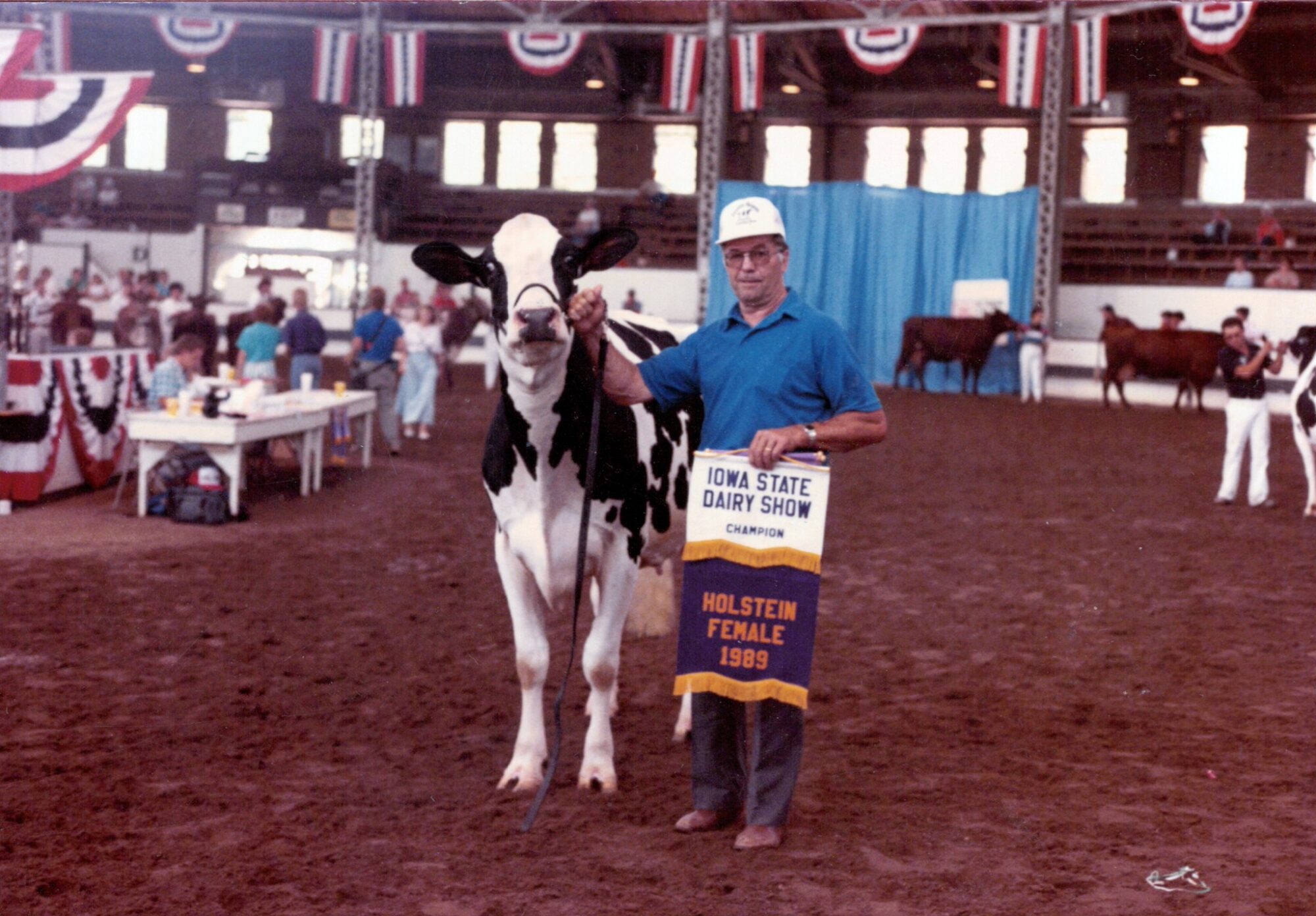
Joe Simon, pictured here at the 1989 Iowa State Dairy Show with a champion Holstein female, embodying the early success and unwavering commitment to genetic excellence that laid the groundwork for Farnear’s sixty-year dynasty. This dedication preceded the national validation that would come with Papoose.

Here’s the thing about Joe Simon’s approach back in the ’60s… most Iowa farms were content running grade cattle, keeping genetics costs manageable. Joe made a completely different calculation.

He bought eight registered Holstein heifers and committed to using premium AI—semen that cost three to five times what neighbors were paying.

What strikes me about that decision is how it reflected a fundamental business principle that too many producers still miss today.

“Dad’s philosophy was simple,” Tom explains. “It costs the same to feed a bad cow as a good cow, so invest your time and effort wisely.”

You’re looking at daughters you won’t milk for two years, granddaughters you won’t evaluate for four. In dairy, where cash flow challenges can quickly sink operations, Joe was making calculated investments with decade-long payoffs.

But Joe understood something the industry is still learning: genetic excellence isn’t an expense—it’s the foundation on which everything else builds.

“I always remember my dad standing firm on his principles,” Tom shares. “He’d say the best investment he could make was in the best bulls available.”

The Proof Validated Everything

Enter Farnear Mark Lizzy Papoose, who earned Reserve All-American and Best Bred & Owned at the 1993 World Dairy Expo. This wasn’t just validation—it was complete vindication of strategic thinking.

Farnear Mark Lizzy Papoose EX-95, pictured here after earning Reserve All-American and Best Bred & Owned at the 1993 World Dairy Expo. This historic win provided complete vindication of Joe Simon’s strategic genetic investments, proving his “different” approach was profoundly “right.”

“Papoose proved Dad’s approach wasn’t just different—it was right,” Tom reflects. “She produced consistently, stayed sound, and passed those traits to her offspring. That’s when we really understood the power of investing in proven genetics.”

Most operations would’ve considered that level of success sufficient. Farnear expanded into embryo transfer instead, continuing to build on their genetic foundation.

Strategic Investment During Crisis

Fast forward to 2008. Markets imploding, feed corn hitting record prices—I recall corn reaching $8 in some markets—neighbors struggling to make ends meet. While others were cutting every possible cost, Farnear made another strategic move.

They invested in the Apple family.

Tom Simon (at left) pictured with the original Apple family partners—Bill Rauen, Tom Schmitt, John Erbsen, and Mike Deaver. This strategic collaboration and investment in the Apple cow family during the 2008 crisis proved to be a pivotal decision, leading to champions like Aria Adler.

“At the time, we believed investing in Apple would open new opportunities for our farm while staying true to Dad’s philosophy of using the best genetics available,” Tom explains. The confidence in that decision—made during one of dairy’s toughest periods—speaks to the strategic thinking that drives everything at Farnear.

What came next? Farnear Aria Adler-ET *RC EX-96, the 2021 All-American Production Cow. Sons and grandsons like Altitude and Audacious-Red. Daughters nominated All-American. The kind of genetic influence that shapes breed directions for generations.

Farnear Aria Adler-ET *RC EX-96, the 2021 All-American Production Cow, exemplifies the success born from Farnear’s strategic investment in the Apple family during the challenging economic times of 2008.

What Genomics Changed About Everything

What happened next completely transformed our understanding of genetic progress.

Genomics didn’t just change the timeline—it validated the strategic approach Joe Simon had been advocating for decades. According to recent work by researchers at agricultural universities, genomic selection can increase genetic progress by up to 300%, with accuracy improving more rapidly than initially predicted in 2008.

“It’s fascinating how genomics aligned perfectly with our philosophy,” Tom explains. “We went from waiting years for daughter performance to selecting high-performance, well-balanced animals based on DNA at six months old. Talk about accelerating the return on genetic investment.”

Delta Lambda exemplifies this evolution perfectly. When those genomic evaluations came back, they painted a clear picture: exceptional udder traits, type characteristics that appeal to commercial operations, production potential that satisfies demanding herds.

What’s particularly noteworthy is how commercial dairies initially embraced him. The show ring success followed—complete validation of breeding for function over flash.

“Lambda proved himself in working herds first, then started seeing success in the show ring,” Tom observes. “That’s exactly how we hoped it would work.”

When Technology Became the Judge

Here’s where things get really interesting… the 2021 robotic milking installation became an unplanned audit of their entire breeding philosophy.

The Farnear robotic milking facility, captured at dawn, stands as a testament to the family’s long-standing focus on functional traits. This modern barn showcases how their breeding philosophy prepared their herd for the demands of advanced automation, turning genetic foresight into operational efficiency.

Walking through that facility—the steady hum of precision machinery, robotic arms moving with surgical accuracy, sensors evaluating each cow—you realize how prescient their focus on functional traits has been.

“Robots demand perfection in ways human milkers can compensate for,” Tom explains. “Precise teat placement, ideal udder attachment, calm temperament, strong feet and legs—all the functional traits we’ve always emphasized are now operational necessities.”

This robotic revolution is accelerating everywhere. Current industry data indicate that adoption is reaching double digits across major dairy regions, with some European areas approaching 50%. What’s remarkable is how Farnear’s breeding decisions positioned them perfectly for this technological shift.

Uniformity in udder quality and leg structure, as seen in these Farnear-bred cows, is a direct result of their long-standing focus on functional traits. These are the physical characteristics that not only contribute to longevity and production but are also critical for seamless operation in modern robotic milking systems.

Udder depth, teat length, rear leg set—these aren’t just linear trait scores anymore. They’re operational requirements determining whether cows can function in modern dairy systems.

The Foundation: Proven Cow Families

But here’s what drives everything they do: behind every technological advancement lies the real foundation—cow families.

“Female lineages drive everything we do,” Tom emphasizes. “We study matriarchal lines like Apple, Lila Z, Delicious—families that consistently deliver what you want to milk generation after generation.”

Miss OCD Robst Delicious-ET EX-94, a foundational female who embodies the consistent excellence of the Delicious cow family. Her elite genetics and flawless conformation reinforce the Farnear philosophy of relying on proven matriarchal lines to build a sustainable, competitive herd.

This systematic approach reflects deep strategic thinking. While some programs focus on individual trait improvements, Farnear invests in proven family consistency—a strategy that requires more patience but yields more sustainable results.

“We want solid production, sound linear traits, strong health records, and bulletproof sire stacks,” Tom explains their selection criteria. “Fertility and longevity matter, but we believe great cow families have more lasting impact than chasing individual traits.”

How Real Collaboration Works

Three generations of the Simon family—including Joe (seated left center), Tom (standing right), and the next generation of Mark (standing left) and Adam (seated right)—continue to drive the Farnear legacy. Their collaborative approach, blending experience with innovation, ensures the perpetuation of their strategic breeding philosophy.

The decision-making process operates as a true family partnership, and I mean that in the best possible way.

“We work together seamlessly on every major decision,” Tom explains. “I handle bull selection, while Mark and Adam focus on mating strategies. Different expertise, unified philosophy.”

This collaborative approach ensures every decision aligns with their core principles while benefiting from diverse perspectives and expertise.

“Three generations bringing different insights to the same goal—breeding cattle that excel in both production and type,” Tom notes. “That collaboration keeps us focused and effective.”

The Balance That Actually Matters

This is where you see Farnear’s real understanding of long-term success.

“We’ve always focused on breeding cattle that excel in both production and type,” Tom explains. “Dad believed in balance—cows that not only produce exceptional volumes but also have the structural correctness to stay sound and productive for years.”

Farnear Aria Adler-ET EX-96, pictured while winning First Place Production Cow at the 2021 International Holstein Show. Her striking udder capacity and overall structural correctness perfectly illustrate the balance between production and type that defines the Farnear breeding philosophy.

This balanced approach reflects Joe Simon’s fundamental wisdom about comprehensive genetic value. Current industry trends indicate an increasing emphasis on this balanced breeding approach as operations shift away from single-trait selection.

“Quality isn’t just about milk in the tank,” Tom notes, echoing his father’s philosophy. “It’s about structural soundness, longevity, and the ability to thrive in modern dairy systems. Remember—it costs the same to feed a bad cow as a good cow, so invest your resources wisely.”

But That’s Not the Whole Story

What really amplified their impact was joining GenoSource in 2014—pooling resources with seven other pioneering breeding families. (Read more: From Pasture to Powerhouse: The GenoSource Story)

The power of collaboration: Tom Simon (center) with his partners and nephews who are part of the GenoSource alliance. This strategic partnership amplifies Farnear’s genetic impact and market reach, proving that joining forces with other industry leaders is a key component of long-term success.

“Individual operations have natural limitations,” Tom observes. “Strategic collaboration allows us to achieve genetic impact and market reach that none of us could manage independently.”

This partnership demonstrates confidence in their genetic program while expanding their ability to influence breed improvement across multiple markets and management systems.

Ladyrose Caught Your Eye EX-94, an All-American and All-Canadian winner, exemplifies the power of strategic collaboration. As a co-owned animal within the GenoSource partnership, she showcases the exceptional genetics and market reach that are possible when industry-leading breeders pool their resources.

Going Global (Whether You Plan to or Not)

What’s particularly impressive is how Farnear’s influence now extends globally, with genetics performing successfully in diverse climates and management systems from high-input Midwest operations to extensive grazing systems overseas.

“Different regions need different genetic solutions,” Tom explains. “Heat tolerance for Southern operations, component production for cheese markets, longevity for grazing systems—we breed for versatility and performance across diverse conditions.”

Current market analysis from industry publications suggests continued emphasis on genetic efficiency over volume in 2025. Farnear’s balanced approach positions them perfectly for these evolving market demands.

What the Next Generation Brings

The future of dairy breeding is on full display at the World Expo, the next generation of Farnear showcasing top-tier genetics, Adios, Junior Champion of the 2023 International Junior Show. Events like these highlight the passion of the next generation and the enduring appeal of well-bred cattle, echoing the multi-generational vision of the Farnear family.

Mark and Adam aren’t just carrying forward tradition—they’re integrating modern analytical tools with proven breeding wisdom.

“They see patterns and opportunities we might miss,” Tom smiles. “Fresh perspectives on data we’ve been analyzing for years. That combination of experience and innovation creates success for our next generation.”

Their integration of AI analytics and precision management with time-tested breeding principles demonstrates how the Farnear philosophy adapts and evolves while maintaining core consistency.

The future of Farnear: Matt Simon and his family represent the fifth generation, ensuring the enduring legacy of strategic breeding and family partnership continues for decades to come.

The Lesson for Everyone Else

Here’s what makes Farnear’s success story particularly valuable: it stems from consistent strategic thinking rather than fortunate timing or lucky breaks.

Using superior genetics when others accepted average. Investing in Apple during challenging economic times. Embracing genomics early while maintaining focus on balanced breeding. Collaborating strategically with other industry leaders.

KHW Regiment Apple-Red-ET, the matriarch whose genetic consistency and impact have shaped generations of champions—proof that a long-term investment in proven cow families pays dividends for decades.

“The most expensive mistake in dairy breeding isn’t what you spend on genetics,” Tom emphasizes. “It’s what you lose by not investing wisely in the first place.”

In an industry where genetic improvement spans generations, today’s breeding decisions determine your competitive position for decades ahead.

The Bottom Line

Tom Simon (second from right), alongside sons Adam (left) and Matt (right), and his nephew Mark (second from right), stands at the Farnear Holsteins sign. This team represents the enduring commitment to strategic genetic investment that has built a sixty-year dynasty and is poised to lead the family business into the next generation.

When that recognition came through at World Dairy Expo last October, it represented more than breeding achievement. It validated Joe’s strategic vision that genetic excellence isn’t an expense—it’s the foundation for sustainable competitive advantage.

The Farnear story demonstrates that strategic genetic investment, guided by clear principles and long-term thinking, creates lasting value in ways that short-term cost-cutting never can.

What some might call expensive investments today often become the competitive advantages that define tomorrow’s industry leaders.

The dairy industry continues learning from what the Simons established sixty years ago: strategic thinking and premium genetics aren’t luxuries—they’re the foundation of sustained success in modern dairy production.

Key Takeaways

  • Premium genetics cost 3-5x more but deliver generational ROI—invest for decades, not quarters
  • Genomic selection accelerates progress 300%: select proven genetics at 6 months vs 4+ years waiting
  • Robotic systems require functional perfection: udder depth, teat placement now drive profitability directly
  • Bet on proven cow families like Apple, Lila Z—genetic consistency outperforms trait chasing every time

Executive Summary

The Farnear Formula shows how strategic genetic investment over six decades built a Premier Sire dynasty, proving long-term thinking beats short-term cost-cutting in dairy breeding. Joe Simon’s core belief—”it costs the same to feed a bad cow as a good cow”—drove his decision to invest 3-5x more in premium genetics during the 1960s, creating generational success. The 2008 crisis tested this approach when Farnear bought into the Apple family while competitors retreated, producing 2021 All-American Aria Adler and her champion offspring. Genomic technology accelerated progress 300%, enabling selection at six months versus years of waiting, while robotic systems confirmed their focus on functional traits like udder depth and teat placement. Farnear’s team approach and emphasis on proven families like Apple, Lila Z, and Delicious shows how strategic decisions compound over generations. Their dual Premier Sire wins at 2024 World Dairy Expo cap decades of patient investment in genetic excellence over trends.

Learn More:

  • Boosting Dairy Farm Efficiency: How Robotic Milking Transforms Workflow and Reduces Labor – This article provides a tactical breakdown of implementing robotic milking systems, a key technological shift discussed in the Farnear piece. It offers practical guidance on barn design and workflow optimization, demonstrating how to directly translate the breeding philosophy of functional traits into tangible operational benefits.
  • Dairy Industry Trends 2025 – This strategic overview analyzes key economic and market dynamics for 2025. It reveals how factors like fluctuating milk prices and changing global demands can impact profitability, providing essential context for why a long-term strategic approach to genetic investment, like the Farnear Formula, is a critical risk-reduction strategy for sustained success in a volatile market.
  • The Role of Genomics in Advancing Dairy Herd Genetics – This article would explain the science and practical application of genomics in dairy breeding. It would provide actionable insights into how to use genomic data to select for specific traits, accelerating genetic progress and validating a strategic breeding philosophy years before daughter performance data becomes available, as demonstrated in the Farnear story.

The Sunday Read Dairy Professionals Don’t Skip.

Every week, thousands of producers, breeders, and industry insiders open Bullvine Weekly for genetics insights, market shifts, and profit strategies they won’t find anywhere else. One email. Five minutes. Smarter decisions all week.

NewsSubscribe
First
Last
Consent

The Beef-on-Dairy Wake-Up Call: What Some Farms Are Still Missing

Your neighbor’s beef-cross calves just hit $1,000. Your Holsteins? $400. How long can you afford to wait?

EXECUTIVE SUMMARY: Here’s what we discovered: While the 2024 NAAB report shows 7.9 million beef semen doses flowing to U.S. dairies—over 80% of all beef semen sales—about 20% of farms are still holding onto pure Holstein breeding like it’s some sacred tradition. The numbers don’t lie: beef-cross calves are consistently pulling $900 to $1,000 per head at regional auctions while straight dairy bulls struggle to hit $400. Penn State’s genomic research proves what progressive farmers already know—genomic selection gives you substantially better accuracy than old-school pedigree guessing, letting you pinpoint which cows deserve premium dairy semen and which should get beef genetics. Extension programs play it safe with $100K to $150K annual income projections for 1,000-cow operations, but producers living this reality often see double or triple those returns when you factor in fewer replacements, hybrid vigor, and lower calf mortality. With USDA cattle inventories sitting at 94.2 million head—near historic lows—and consolidation pressuring farms harder than ever, this isn’t just an opportunity anymore. It’s become an economic survival strategy for independent farmers who refuse to get squeezed out by the mega-operations.

KEY TAKEAWAYS

  • Start with genomic testing on your bottom 20-30% of cows at $40-$100 per head to identify which animals deserve beef semen versus premium dairy genetics—strategic breeding beats shotgun approaches every time.
  • Build buyer relationships before you breed your first beef bull to avoid getting stuck with crossbred calves and no premium market access when they hit the ground 283 days later.
  • Factor in the management differences: beef-sired calves run 4 days longer gestation than Holsteins, which can affect butterfat test day results, and need fresh cow protocols adjusted accordingly.
  • Regional markets matter big time—from Minnesota’s brutal winters affecting shipping costs to California’s drought impacting feed prices, tailor your beef-on-dairy strategy to your local realities.
  • Ignore the conservative extension projections—real producers commonly report 2-3X higher returns through reduced replacement costs, better feed efficiency, and premium calf prices that extension models can’t capture.
dairy profitability, beef-on-dairy, dairy farming, genomic testing, farm management

You know what’s been eating at me lately? I keep running into these dairy guys—good farmers, been at it for decades—who are watching their neighbors cash $900, sometimes over $1,000 checks for beef-cross calves while they’re… well, they’re lucky to get $300, maybe $400 for their Holstein bulls.

And I’m thinking… honestly, how long can you afford to ignore that kind of math?

Look, the National Association of Animal Breeders just dropped their 2024 numbers back in March, and get this—7.9 million doses of beef semen went to US dairies last year. That’s compared to just 1.8 million doses going to actual beef operations. So if you’re still sitting there thinking this is some passing fad… well, I mean, that train’s not just left the station, it’s halfway across the state by now.

But here’s what really gets me fired up. There’s still this chunk of operations—surveys suggest maybe 20% or so—holding tight to pure Holstein bloodlines like it’s some kind of… I’m not sure, something like sacred tradition, perhaps. Meanwhile, the market’s literally screaming at them to wake up.

The Holstein Purity Thing That’s… Well, Bleeding Money

The thing is—and guys like Chad Dechow up at Penn State have been hammering this point for years now—genomic selection gives you way better accuracy than the old pedigree guessing game. We’re talking substantially higher accuracy, though the exact multiplier varies depending on which study you’re looking at.

I mean, we’re talking about identifying which cows in your herd are actually worth breeding to expensive dairy semen and which ones… well, which ones should be getting bred to Angus bulls instead.

But what do I see when I visit farms? Linear classification sheets are still pinned to office walls like they’re gospel. Old-school thinking that’s bleeding real money.

What strikes me is how many producers are still making breeding decisions like every cow’s gonna be the next great matriarch when—honestly—the genomic data often shows maybe 70% of most herds aren’t really moving the genetic needle forward. That’s not being harsh; that’s just math from the Council on Dairy Cattle Breeding evaluations.

I was talking to this producer recently… He runs about 1,100 cows and has been farming since his dad handed him the keys. Third-generation operation, beautiful facilities down in central Wisconsin. And he says to me, “Should’ve started this beef thing three years ago. My cash flow’s tighter than a new boot right now, especially with feed costs where they are.”

What strikes me about conversations like that is the regret. This wasn’t some weekend warrior. This was a sharp operator who just… waited too long.

Extension’s Playing It Way Too Safe (And Farmers Are Paying For It)

Here’s where it gets frustrating—and this is something corporate ag publications won’t tell you. The extension continues to produce highly conservative economic models. Maybe you’ll see an extra $100K, $150K annually from a beef program on a 1,000-cow operation, they’ll say.

Except every producer I talk to who’s actually doing this? They’re often hitting double, sometimes triple those numbers when you factor in everything. Better conception rates with beef semen on your problem breeders during heat stress, fewer replacement heifers needed, lower calf mortality, improved feed conversion on the crossbreds…

The Journal of Dairy Science published research back in 2021 showing the economics make real sense when crossbred calf prices consistently double what straight dairy calves bring—which they do. But extension models often don’t capture all that value because they can’t afford to overpromise.

And here’s what they really don’t want you to know… I’ve been to barn meetings where producers are talking about their recent calf sales. Over $900 for a beef-cross? Most hands go up. Over $1,000? Still a good chunk of the room. Regional auction data from places like Turlock, California, and Lomira, Wisconsin, back this up—beef-cross calves hitting $900 to nearly $1,000 per head consistently.

Those aren’t projections from some university model—those are real checks hitting real bank accounts.

The Tech Trap That’s Burning Through Cash

Now here’s a mistake I see way too often… farmers panic about falling behind, so they throw money at every piece of shiny new technology. Genomic testing for the whole herd, fancy monitoring systems, automated this and automated that.

You know what happened to this one operation I know—beautiful setup, runs close to 1,000 cows—dropped maybe $180K on tech upgrades in one season? Genomic testing across the board, AI equipment upgrades, and automated heat detection systems. First-year returns? Barely budged.

It’s like buying a $300,000 combine and then realizing you don’t know which field to start with.

Strategy first, gadgets second. Every damn time.

Start with genomic testing on your bottom performers—maybe 20, 30% of the herd. Usually runs $40 to $100 per head, depending on what lab you use and how many you’re testing. Figure out which cows deserve premium dairy semen and which ones should get beef. Build relationships with calf buyers before you breed your first cow to a beef bull.

Then—and only then—layer in technology that actually fits how you manage your dry lot operations, your fresh cow protocols, your butterfat test day schedule.

Small Farms Getting Creative While Others Get Bought Out

Small operations are feeling this squeeze the hardest. Genomic testing costs, shipping logistics… man, they can eat up a third of your premiums if you’re not careful.

But you know what I’m seeing? Smart, smaller guys are finding ways to make it work. This producer I know up in northern Minnesota—runs about 450 cows, mostly Holsteins with some Jersey crosses—partnered with three neighboring farms to bulk their crossbred calf shipments. Now they’ve got enough volume to get decent transport rates, and everybody wins.

Because here’s the brutal reality—and the 2022 Census of Agriculture backs this up—we’re seeing consolidation like never before. The USDA Economic Research Service reports show nearly two-thirds of dairy cows are now on farms with over 1,000 head. Between 2017 and 2022, we lost over 15,000 dairy operations. Fifteen thousand.

The farms that are left? They’re either getting bigger or they’re getting creative with stuff like beef-on-dairy programs. There’s not much middle ground anymore.

The Numbers That Keep Me Up at Night

USDA’s July cattle inventory report—first one we’ve seen since they brought it back this year—shows 94.2 million head nationwide. Down from 95.4 million, where we were two years ago. Replacement heifer inventories are shrinking, calf crops getting smaller at 33.1 million head.

And this trend makes me wonder… are we heading toward an even tighter supply situation? When beef supply gets tight, those premiums for crossbred calves get bigger.

But what really bothers me is that while these market fundamentals are lining up perfectly for beef-on-dairy adoption, I still run into producers who are frozen by the decision. You know, that innovation paralysis thing—knowing you need to move but being afraid you’ll pick the wrong direction.

Look, I get it. Change is uncomfortable, especially when you’re dealing with family traditions and generational farming practices.

Your Path Forward (Before It’s Too Late)

Here’s my take, and I don’t say this lightly—start small, but start now.

Get genomic testing done on your problem cows. The ones with poor conception rates, the ones whose daughters never seem to milk as well as you’d hope. Use that data to figure out which animals get beef semen and which ones still deserve your best dairy genetics.

Build buyer relationships early. Don’t wait till you’ve got crossbred calves on the ground to figure out where they’re going.

Pay attention to the management stuff that matters—beef-sired calves run about 283 days of gestation versus 279 for Holstein, so plan your breeding calendar accordingly. Watch your butterfat test day results because some beef genetics can affect milk composition. Ensure your fresh cow protocols can accommodate any differences in calving ease.

Technology comes last. One piece at a time. Make sure each investment actually serves your goals instead of just impressing the neighbors at the coffee shop.

What Corporate Ag Won’t Tell You About Extension Programs

Here’s something that’ll make you think… those extension estimates I mentioned earlier? They’re conservative by design because extension can’t afford to have farmers lose money following their recommendations. But are private consultants and the producers actually running these programs?

Man, they’re commonly reporting returns that make extension projections look like worst-case scenarios.

Research from places like Texas Tech’s Dairy Beef Accelerator program documents several clear benefits—better feed efficiency, improved carcass quality, and higher grading percentages. But you won’t see that data highlighted in most corporate industry magazines because it challenges too many assumptions about how we’ve always done things.

The Bottom Line Nobody Wants to Say Out Loud

We’re in the middle of one of the biggest shifts in dairy breeding strategy most of us will see in our careers. The early adopters are banking serious profits. The fence-sitters are missing opportunities that… well, they might not come around again.

Consolidation pressure isn’t going away—if anything, it’s accelerating based on what we’re seeing in the USDA data. Feed costs aren’t getting cheaper. But operations that diversify revenue streams, improve genetics strategically, and build strong market relationships? Those are the ones writing success stories that their kids will inherit.

The beef-on-dairy train is rolling. 94.2 million cattle is near the lowest inventory we’ve seen in decades, according to USDA NASS. Feed costs keep climbing. But farms that act now—using real genomic data, building real buyer relationships, making real operational improvements—they’ll be the ones still farming when their neighbors are selling out to the next expansion-minded operation down the road.

So as we sit here talking about our farms and our futures… the question isn’t whether this trend will continue. The question is whether you’ll be part of it or watching from the sidelines while someone else cashes those $1,000 calf checks.

Me? I’m betting on the ones who stop waiting and start acting.

This conversation’s just getting started. But the clock’s ticking.

Complete references and supporting documentation are available upon request by contacting the editorial team at editor@thebullvine.com.

Learn More:

The Sunday Read Dairy Professionals Don’t Skip.

Every week, thousands of producers, breeders, and industry insiders open Bullvine Weekly for genetics insights, market shifts, and profit strategies they won’t find anywhere else. One email. Five minutes. Smarter decisions all week.

NewsSubscribe
First
Last
Consent

The Holstein Genetics War: What Every Producer Needs to Know About the Battle for Our Breed’s Future

What if I told you frozen semen from the 1940s outperforms today’s million-dollar superstars? Gene banks don’t lie.

Look, I’ve worked with Holsteins long enough to know when something smells off. The talk about genomic miracles? Sure, the gains are real—annual genetic progress in Net Merit has actually more than doubled, from $36.90 to $83.33, since genomics became a reality (PMC Genomic Selection Research, 2016). Sire generation intervals dropped from over 10 years to just 2.5 years, letting us stack improvements way faster than before.

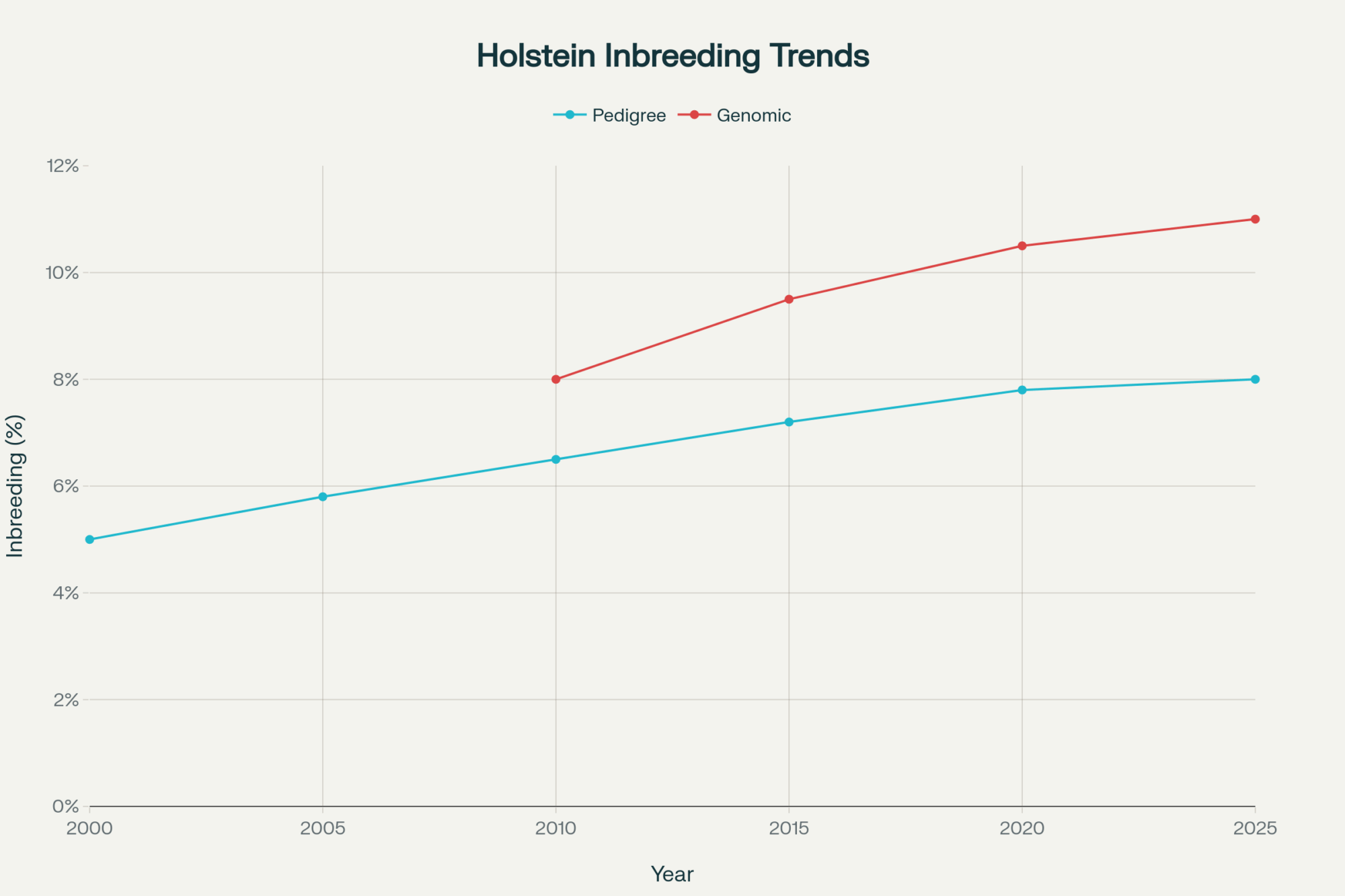
But here’s what isn’t front and center at your co-op meetings: Holstein inbreeding levels in elite U.S. herds have increased from about 5.7% in 2010 to 15.2% by 2020—a 168% rise (USDA/CDCB; The Bullvine Genetic Analysis, 2025). Industry projections show we could reach 18–22% by 2030. That’s nearly triple the widely recognized 6.25% “danger zone” where inbreeding depression hits hard.

The Inbreeding Crisis on Display. The average inbreeding of elite Holstein bulls has risen sharply, skyrocketing from the 6.25% “danger zone” in 2010 to over 15% by 2020, far outpacing the general population. This trend highlights the accelerating genetic bottleneck in the Holstein breed.

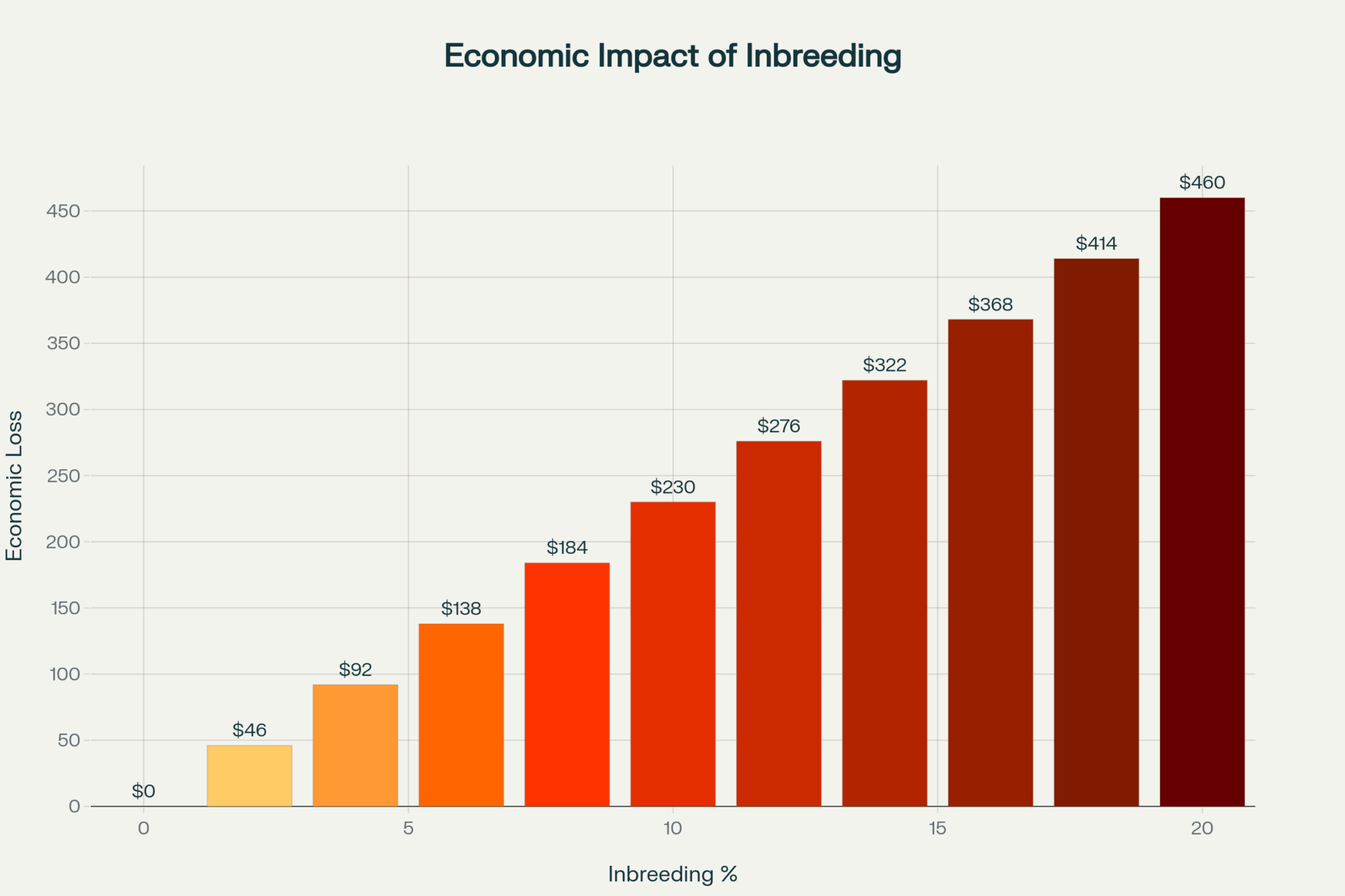
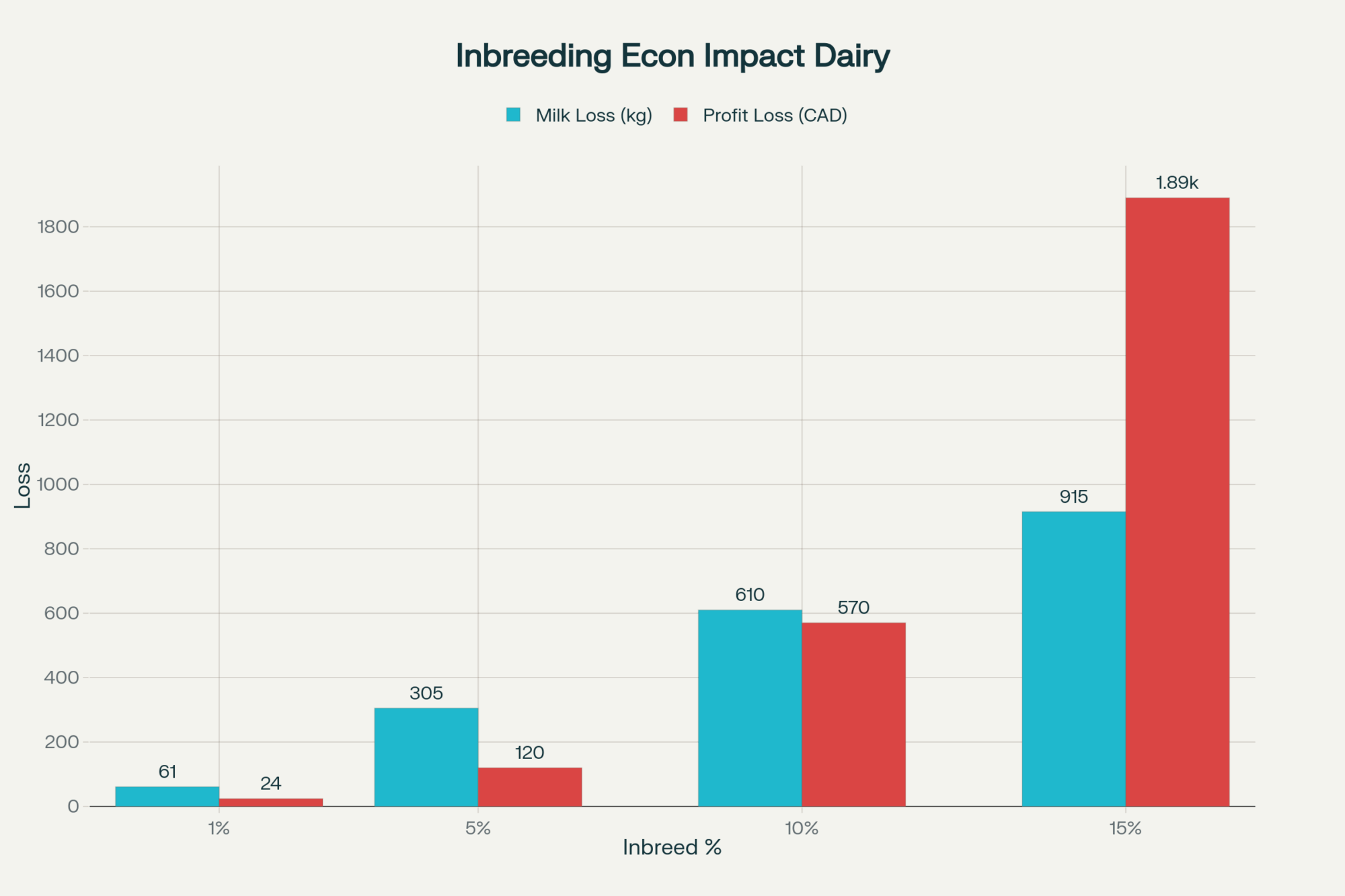
The cost? Expert economic analyses place inbreeding losses between $3.6–6.7 billion for U.S. dairies from 2011–2019 (AgEcon Search Economic Analysis). Each 1% inbreeding increase shaves $23–25 off a cow’s lifetime Net Merit, plus shortens productive life and reduces fertility (Dairy Cattle Genetic Improvement, 2024; University Research Compilations, 2024). Have you seen more infertility, lameness, or culling pressure lately? You’re not alone.

Inbreeding is a Hidden Tax on Your Herd. Economic analyses show a clear correlation between rising inbreeding levels and significant lifetime profit losses per cow, with the negative effects accelerating as inbreeding increases beyond the danger zone.

How the Big Players Influence the Game

The Council on Dairy Cattle Breeding (CDCB) now manages the world’s largest livestock database—100 million animal records, 10 million genotyped, from 72 countries (CDCB Activity Report, 2024). This sets global benchmarks and puts U.S. breeders in the driver’s seat—but it also keeps information and breeding power in few hands.

Companies like STgenetics don’t just breed—they build bulls. Their bull Captain, for instance, was engineered through proprietary matings. While building Captain, they held back his father Sabre from most catalogs—a classic move to ensure that they got exclusive use of his genetic potential. Not unlike how most AI companies now make all the contract matings before they sell the semen publicly. The result STgenetics now dominates U.S. Net Merit (26.5%) lists.

Strategic Use of “Hidden” Sires: A Recurring Theme in Holstein History

STgenetics’ selective use of Tango Sabre as a foundational “hidden” sire is not a new trick in Holstein breeding. In fact, the practice of restricting access to promising sires—often leveraging them primarily within one herd—has been a tactical play repeated throughout dairy history by breeders looking to sharpen, conserve, or even commercialize elite genetic lines.

Consider these other foundational cases:

  • Round Oak Rag Apple Elevation (USA):
    One of the all-time breed legends, Elevation’s early semen was tightly managed by his owner and distributed selectively for targeted matings. His initial, controlled use allowed for concentrated genetic gains within certain herds before broader industry access, a move that amplified both his influence and value.
  • Roybrook Starlite (Canada):
    Echoing the herd’s tradition, Starlite was used almost exclusively “in-house” within the Roybrook program to intensify key genetic traits. Only after this internal genetic consolidation were Starlite’s genetics released more broadly, subsequently impacting Canadian and international Holsteins.
  • Sunny Boy (Dutch Friesian/Holstein):
    In the Netherlands, the early distribution of Sunny Boy semen was highly rationed and targeted at strategic clients due to both supply constraints and his growing reputation, allowing the owner (CR Delta) to optimize both returns and influence.

What all of these stories illustrate is simple: the restricted, strategic use of sires—sometimes referred to as “holding back” genetics—has always been part of the playbook for herd improvement, profit generation, and competitive positioning in dairy breeding. Whether it’s Roybrook, Tango Sabre, or legendary sires like Elevation and Sunny Boy, this approach has quietly but decisively shaped the direction and fortunes of the Holstein breed worldwide.

The Gene Bank Discovery Nobody’s Talking About

Here’s the bombshell: USDA researchers used frozen Holstein semen from the NAGP gene bank—samples from bulls whose lineages trace back to the early AI era—and produced daughters that stood toe-to-toe with today’s “elite” sires for production traits, fertility, and health. We’re talking milk yield, component percentages, and reproductive longevity that were all solid, not just a nod to history. The key revelation? These bulls represent Y-chromosome lineages that have completely disappeared from the modern Holstein population.

The genetic bottleneck is even more extreme than most realize. Today, over 99% of Holstein AI sires descend from just two bulls born in the 1950s, which has left our breed with shockingly limited Y chromosome diversity—most historic lines are extinct, but the gene bank kept some rare ones alive just in time.

This isn’t nostalgia—it’s serious genetic insurance. The gene bank holds onto those lost Y-chromosome families, meaning we’re not boxed in if disease, inbreeding, or selection mistakes hammer current genetics. Studies show calves from these “heritage” sires can absolutely match the breed average (and sometimes exceed it) when paired with top modern cows.35 Their daughters aren’t just “novelty” animals; they’ve got the competitive production, health, and especially reproductive longevity that any dairy producer knows is where real profit protection lies.

NOTE: Semen freezing in cattle wasn’t really feasible until the late 1940s and early 1950s. So, when researchers talk about using “genetic samples from the 1940s,” they’re not using semen literally collected and saved during that decade. Here’s the scoop: Almost all gene bank Holstein bull semen samples come from the 1950s onward, when practical cryopreservation methods kicked off. Earlier preservation—prior to the introduction of glycerol and controlled-rate freezing—just wasn’t possible. Before that, artificial insemination was done with fresh semen only, which obviously couldn’t be stored for decades. If a study says they’re restoring 1940s lineages, what they really mean is they’ve found bulls in the gene bank whose ancestry traces back to those early male lines. The actual semen straws were collected and frozen in the 1950s, ’60s, or later—often from older bulls whose sires or grandsires were around in the 1940s. Some gene banks also store embryos, tissue, or blood, but for these Holstein projects, it’s the semen that’s key—and the oldest viable samples only go back as far as the very first days of freezing technology. So, they didn’t save “1940s semen”—they saved semen from descendants or late-surviving individuals from those lines once freezing became feasible. That’s how they’re able to resurrect “lost” genetic lineages, even if it’s not from the literal 1940s.

What Actually Works: Real-World Data for Real Farms

Inbreeding Management Pays, Immediately

A 1% inbreeding reduction saves $23–25 in cow lifetime Net Merit—that’s on the books, not in a catalog (Univ. Compilations, 2024). Farms that cap offspring inbreeding below 6.25% report steady profit improvement and fewer herd-health headaches.

Genomic Testing Adds Up

Testing every dairy heifer at birth can boost herd genetic merit by $400 over two breeding cycles, while cutting replacement costs 35% (Wisconsin Dairy Research, 2024). For large herds, even more ROI.

The Beef-on-Dairy Trap: Short-Term Win, Long-Term Risk

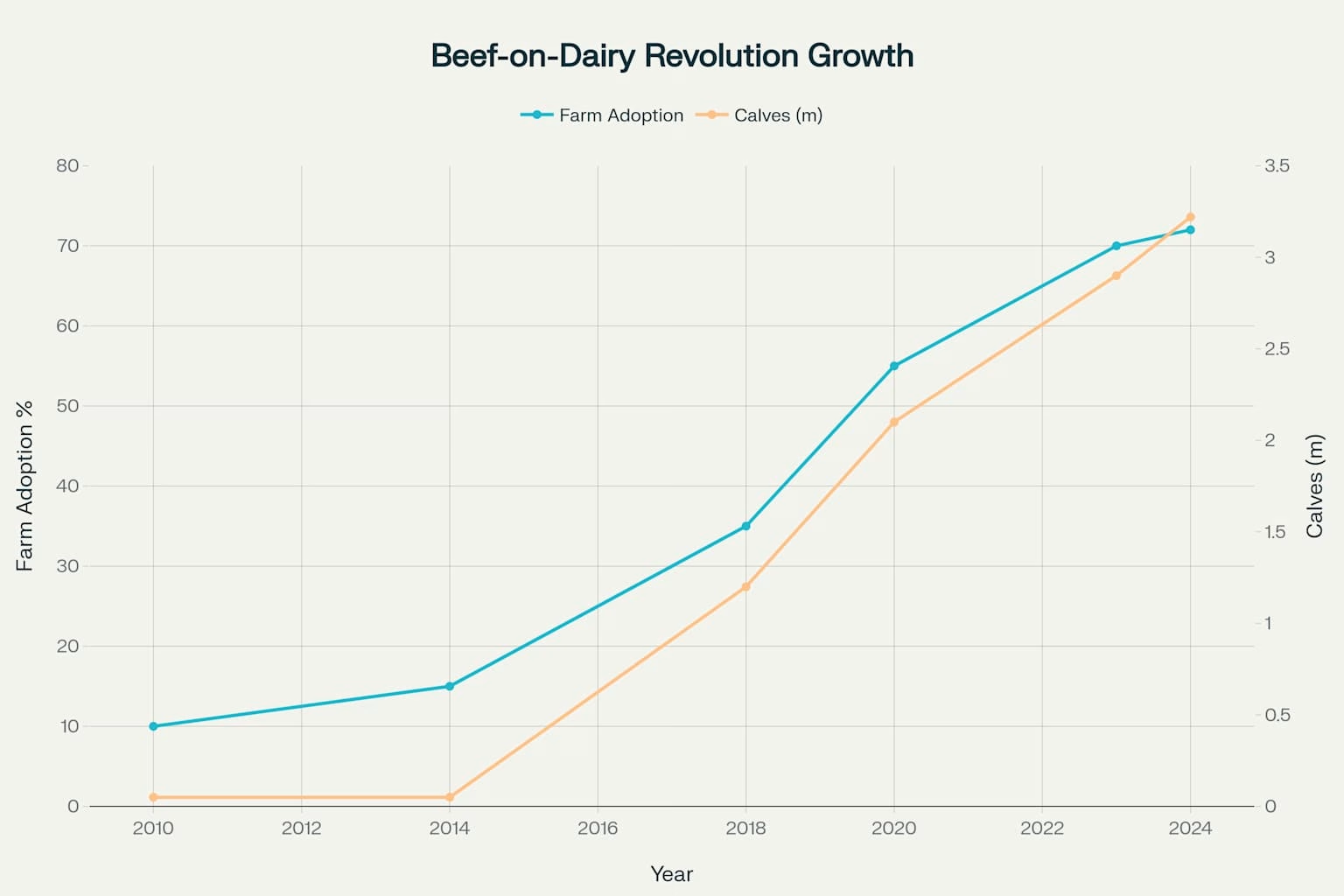
You see it all over: Beef genetics are now used in 72% of U.S. dairy herds (Farm Bureau Market Intel, 2025). Beef semen sales shot up from 1.2 million units (2010) to 9.4 million (2023), putting 3.22 million dairy-beef crossbred calves on the ground last year (NAAB Data).

Trading Tomorrow for Today. The dramatic rise in beef semen sales has directly correlated with a multi-year decline in the U.S. dairy heifer inventory, creating a critical shortage of replacements and highlighting the long-term risk of this short-term strategy.

Crossbred calves bring $400 or more compared to $150 for a pure dairy bull calf—good money, right? But check your records: replacement heifer costs are now $2,870 each, a historic high, while the pool of genetic diversity shrinks tighter (USDA Market Data, 2024).

It’s a vicious cycle—beef-on-dairy takes future dairy animals out of the herd, narrowing our genetic pool, so AI companies must work with fewer—and more related—bloodlines. This accelerates inbreeding, which makes more cows unprofitable, sending more herds to beef-on-dairy as a fallback.

Michigan State research shows $250 more per crossbred calf when beef semen targets heifers with truly poor dairy genetics, as identified by genomics—not random culls (MSU Study, 2024).

We’re trading our dairy breed’s future for today’s calf check.

Your Immediate Action Plan

This Month:

  • Ask for up-to-date inbreeding reports on progeny from ALL your AI suppliers.
  • Calculate current herd average inbreeding using latest DHIA or, ideally, CDCB genomic parentage records.
  • Refuse any matings that would push progeny above 6.25% inbreeding—remember, it’s progeny inbreeding that counts, not just parent averages.

Next Quarter:

  • Buy semen from at least three different AI companies to spread genetic risk.
  • Explore European outcross (within-breed) options—they’ve documented value for milk component, health, and fertility improvements.
  • Budget for genomic testing of every replacement heifer: $35–$50 per sample.

Long-Term Strategy:

  • Only use beef semen on genomically verified poor dairy genetics.
  • Pilot crossbreeding other dairy breeds for 20–30% of your herd to test for hybrid vigor.
  • Get involved in university extension programs and CDCB information sessions for independent updates and honest guidance on managing inbreeding and alternatives.

Your Operation’s Bottom Line

The dollars add up:

  • Inbreeding reduction: $23–25 lifetime Net Merit per cow, per 1% drop
  • Genomic testing: positive ROI within two cycles
  • Targeted beef-on-dairy: $250+ premium per targeted crossbred
  • European outcrosses: Documented boosts to solids, health, welfare in multiple trials

Example: Dropping your herd’s inbreeding from 13% to 8% can mean $75,000–$94,000 in better cow value, after adjusting for semen cost.

The Bottom Line

Whether Holstein genetics survive and thrive—or collapse under too much corporate concentration and inbreeding—depends on the choices you make this year and every year after.

The “corporate model” offers quick gains but risks future genetic bottlenecks. The diversity model takes planning, but it’s what keeps herds profitable no matter what the market throws at you.

European co-ops prove there are alternatives to pure volume. Gene banks prove that valuable genetics exist beyond the corporate hype. The smartest producers are managing all their genetics—dairy and crossbred, cows and bulls—as a full-profit “portfolio” now.

Your next breeding decision is a vote for the kind of dairy animal—and industry—we’ll have in 2035.

You can keep chasing catalog rankings, or you can start managing herd genetics like the long-game business it is—diversifying risk, optimizing for the lifetime cow, and building a herd that’s ready for the swings of the future.

The research is clear. The economics work. Forward-looking producers are making the shift, planning their herds for the next generation—not just the next index run.

The big question isn’t whether genetic diversity beats chasing next month’s numbers. The proof is in the milk check.

The only real question is if you’ll move first—or be left to play catch-up when your neighbors, or global competitors, act smarter. It’s your future.

Don’t let marketing dictate your breeding strategy. Let the data, the research, and proven results guide your plan.

KEY TAKEAWAYS:

  • Audit your inbreeding levels immediately: Herds dropping from 13% to 8% inbreeding see $75,000-94,000 in improved cow value—but 72% of producers don’t track these numbers, leaving money on the table while competitors gain advantage.
  • Strategic beef-on-dairy targets matter: Michigan State research shows targeting genomically-verified poor dairy genetics (not random culls) delivers $250+ premiums per crossbred calf while protecting your replacement pipeline from the industry’s genetic bottleneck.
  • European outcross genetics deliver measurable ROI: Commercial trials document significant increases in milk components and health traits using CRV/VikingGenetics Holstein bloodlines, offering proven alternatives to the North American genetic monoculture.
  • Genomic testing pays within two breeding cycles: At $35-50 per heifer sample, testing delivers $400+ improvements in herd genetic merit while cutting replacement costs 35%—yet most producers still breed blind in 2025.
  • Diversify AI suppliers like investment portfolios: Using semen from 3+ companies while capping progeny inbreeding below 6.25% creates the genetic resilience that separates surviving farms from those caught in tomorrow’s market squeeze.

EXECUTIVE SUMMARY:

While everyone’s celebrating genomic miracles, we’ve uncovered an $6.7 billion disaster hiding in plain sight—Holstein inbreeding has exploded 168% since 2010, and most producers don’t even know their herd’s levels. Every 1% increase in inbreeding costs you $23-25 per cow lifetime, yet AI companies keep pushing the same elite bloodlines that created this mess. Meanwhile, beef-on-dairy—sold as easy money—is actually accelerating the genetic collapse by removing 95,000 potential dairy replacements for every 1% of the national herd. The kicker? USDA researchers just proved that frozen semen from the 1940s produces daughters that match today’s “elite” genetics for production and health. European cooperatives are quietly building an alternative empire based on longevity and resilience, while North American producers chase short-term index gains that compound into generational losses. The hidden war for Holstein genetics isn’t coming—it’s here, and your next breeding decision determines which side of history you’re on.

Complete references and supporting documentation are available upon request by contacting the editorial team at editor@thebullvine.com.

Learn More:

  • Dairy’s Bold New Frontier: How Forward-Thinking Producers Are Redefining the Industry – This strategic article demonstrates how next-generation producers are using advanced technologies like AI and robotics to dramatically improve efficiency and diversify revenue. It provides a blueprint for leveraging technology to increase productivity and reduce costs, offering a broader perspective on the industry’s future beyond just genetics.
  • Getting Serious About Genomics: Lessons from India’s Dairy Revolution – This tactical piece provides concrete, real-world examples of how producers are using data tracking and genomic testing to cut feed costs and improve milk-to-feed conversion ratios. It reveals how to use these tools to identify your top producers, cull underperformers, and create a more profitable herd, turning genetic strategy into a measurable bottom-line win.
  • The Future of Dairy Farming: Embracing Automation, AI, and Sustainability in 2025 – This innovative article showcases the latest emerging technologies that can drive efficiency and create new revenue streams, from automated feed systems to precision breeding. It reveals methods for navigating volatile markets and making smart investments in technology that provide a faster ROI than traditional expansion.

The Sunday Read Dairy Professionals Don’t Skip.

Every week, thousands of producers, breeders, and industry insiders open Bullvine Weekly for genetics insights, market shifts, and profit strategies they won’t find anywhere else. One email. Five minutes. Smarter decisions all week.
NewsSubscribe
First
Last
Consent

EXPOSED: The $90,000 Genetics Scam Farmers Aren’t Talking About

Why the ‘wait and save’ genetics game is bankrupting family dairies nationwide

EXECUTIVE SUMMARY:

Here’s what we discovered: Waiting for semen prices to fall isn’t saving farmers money; it’s costing the average producer nearly $90,000 over 15 years due to lost genetic progress. Data from USDA shows bulls improved genetic merit by $80 annually post-genomics, while generation intervals shrank from 7 to under 2.5 years, accelerating the divide. Mega-dairies, spending 3-4% of gross income on genetics, harness 90% of gains, whereas smaller farms capture just 30-40%. Consolidation has wiped out nearly 16,000 farms since 2017, reshaping U.S. dairy communities. Our investigative analysis reveals how the genetics arms race deepens inequality and forces hard choices. The future belongs to those who invest strategically; hesitation means losing ground in a market that waits for no one.

KEY TAKEAWAYS:

  • Capture up to $80/year in added genetic merit with timely semen investment, avoiding a $90K lifetime loss.
  • Understand the compressed 2.5-year generation intervals driving genetic gain and stay ahead of the curve.
  • Prioritize strategic genetic budgets—mega-dairies allocate 3-4% gross income; smaller farms must adapt to survive.
  • Recognize consolidation trends wiping out 40% of US dairies in 5 years and plan accordingly.
  • Leverage peer-reviewed science and USDA data to challenge conventional genetics purchasing myths.
DIGITAL IMAGE

You know, I was at World Dairy Expo last fall, and this producer from Iowa — good guy, been milking 350 head for twenty years — he’s telling me how he’s waiting for semen prices to drop from forty bucks down to thirty before he breeds his heifers. Thinks he’s being smart with his money, right?

Well, here’s the thing… Dr. Albert De Vries, this economics wizard down at the University of Florida, he ran the numbers back in 2015 and — get this — you’d need those prices to crash nearly 50%, all the way down to about $21 a dose, just to break even on what you lose by waiting.

Fifty percent! Can you believe that? I mean, when’s the last time you saw premium genetics lose half their value overnight? Never happens.

But those California mega-dairies running ten thousand head? They’re not waiting around. As soon as new genetics drop, they’re buying. And why wouldn’t they? The USDA data from 2016 to 2020 shows bulls improving about $80 per year in Net Merit since genomics took over. That’s real money — compounds through every heifer, every lactation…

Actually, here’s what really gets me fired up. The whole breeding game got turned upside down when generation intervals — that’s how long it takes genetics to flow through — got slashed from seven years down to under two and a half. García-Ruiz’s team published this in some fancy journal, the Proceedings of the National Academy of Sciences, back in 2016.

So if you’re still making breeding decisions like it’s 2005 — and I know plenty of guys who are — you’re already behind. Way behind.

I call it the acceleration trap, and man, it’s caught more farms than I can count. Especially up in Wisconsin… you know how butterfat tanks during those brutal July heat waves? Well, some of that’s genetics catching up with you.

The Caste System Nobody Talks About

Here’s what’s really sneaky about all this. There’s this whole genetic hierarchy forming, and most folks don’t even see it happening.

At the top, you got your mega-dairies — I’m talking thousands of head, mostly out west — throwing 3 to 4 percent of their gross straight into the hottest genetics. Industry analysis suggests these operations are grabbing about 90 percent of the real genetic gains.

Then there’s the middle tier… farms like a lot of the New York and Pennsylvania operations I know. They’re hanging on, getting maybe 60 to 70 percent of those gains. Staying competitive, but it’s getting harder every year.

And then — this is the uncomfortable part — you got the rest of us. Smaller outfits, 200 to 500 cows mostly, are scraping by on what appears to be maybe 30 to 40 percent of genetic progress. You feel it every time those components drop, every time the breeding season scramble gets worse.

Let me tell you about this farmer — we’ll call him John — from down around Zanesville in Ohio. Sharp guy, really. Thought he was making a smart call waiting on that expensive semen, saving himself 200 bucks upfront.

But four years later? Those daughters were costing him about $27 each per year in lost production — that’s using De Vries’ economic modeling framework. Twenty heifers, four lactations… you’re looking at $2,160 missing from the milk check annually.

Then his granddaughters started calving — another $1,620 lost every year. Great-granddaughters? We’re talking over $4,800 annually, all from that one “smart” decision to wait.

Total it up over fifteen years using standard dairy economic projections, and John’s $200 savings cost him roughly $90,000 in foregone profit. Makes your stomach turn, doesn’t it?

But here’s the real kicker — and I heard this from another producer down near Lancaster during corn harvest — those “proven” bulls everyone’s still buying? By the time they prove themselves through daughters, the young genomic bulls have already lapped them. Often at 70 percent reliability, but way ahead genetically because the baseline keeps moving up.

The Niche Market Fantasy That’s Crushing Dreams

Now, I get it. Everyone’s looking at organic, grass-fed, A2 milk, thinking that’s their salvation. Who doesn’t want premium pricing, right?

But let’s talk reality here… Based on the latest USDA organic market reports and industry data through 2025, organic milk’s sitting around 5 to 6 percent of total U.S. production. Grass-fed? Barely registers at under 1 percent. A2’s growing — I’ll give you that — but it’s still niche scale.

The brutal math? These markets can’t absorb even half the farms getting squeezed by this genetic stratification. Most of that “niche transition” advice? It’s false hope designed to keep struggling operations producing commodity milk for a few more years.

Meanwhile, consolidation keeps hammering us. According to USDA Census data released in 2024, we lost nearly 15,866 dairy farms between 2017 and 2022 alone. That’s not just numbers — that’s communities, families, generations of farming knowledge… gone.

And the big players? They’re snapping up the pieces, buying land and cows and basically owning the future.

What This Really Means for Your Operation

So here’s your reality check. If you’re running a small or mid-sized operation, you’ve got maybe twelve to eighteen months — tops — to commit to a survival strategy.

Scale up fast — get to a thousand cows with the genetics budget that requires — or find a genuine niche that pays the bills, or start planning your exit while your assets still have value.

Because genomics changed the rules permanently. No more waiting for better deals. No more hoping the old ways will work.

I’m not sure what to make of all this sometimes, but one thing I know for certain — ignoring these facts is like watching your neighbor’s barn burn down and wondering why your hay’s getting hot.

The clock’s ticking faster than most folks realize. The mega-dairies figured this out years ago. They’re counting on the rest of us not figuring it out until it’s too late.

So what do you think? You gonna keep waiting for a deal that never comes, or are you gonna get ahead of this thing before it’s too late?

Complete references and supporting documentation are available upon request by contacting the editorial team at editor@thebullvine.com.

Learn More:

The Sunday Read Dairy Professionals Don’t Skip.

Every week, thousands of producers, breeders, and industry insiders open Bullvine Weekly for genetics insights, market shifts, and profit strategies they won’t find anywhere else. One email. Five minutes. Smarter decisions all week.

NewsSubscribe
First
Last
Consent

When Lightning Strikes: The Braedale Goldwyn Story That Changed Everything

How Braedale Goldwyn rewrote the rules of Holstein breeding with genetics, show dominance, and a market-changing legacy.

Braedale Goldwyn in his prime—the Holstein bull whose genetic lightning strike changed everything for dairy breeding worldwide.

You know that feeling when you’re walking through a barn and spot a calf that just… has something special about it? Most of the time, you’re wrong, honestly. But every once in a while…

January 3rd, 2000. Cumberland, Ontario. Terry Beaton is watching a newborn James calf get its legs beneath it in the maternity pen. Just another planned mating, right? Except this gangly calf would become Braedale Goldwyn—and honestly, I’m not sure any of us realized we were witnessing the start of a genetic revolution.

The Foundation Nobody Saw Coming

Here’s what I’ve always found fascinating about Terry Beaton—the guy understood maternal lines when most of us were still chasing flashy sires. Back in ’85, when computer indexes were still a newfangled thing and half the industry didn’t trust them, Terry was already thinking generations ahead.

Picture this: November 1985, Sunnylodge Farms dispersal. You know how those sales go—everybody’s buzzing, coffee’s flowing, and the really good cattle are bringing serious money. The sale averaged $6,839 per head (which was real money back then), and the top lot was this first-lactation heifer, Sunnylodge Elevation Jan, VG-87-13*.

Now Terry didn’t just bid on her and walk away. After the sale, he tracks down Carl Smith—the original owner—and proposes a partnership. They’d flush her extensively and split the embryos. I mean, think about that for a minute. Most guys buy a cow, milk her out, maybe get excited about a daughter or two. Terry’s already planning a dynasty.

That single decision—man, talk about return on investment.

Building Something That Lasts

What’s happening with the Jan family over the next fifteen years is basically a masterclass in line breeding done right. And I say “done right” because we’ve all seen line breeding go sideways—fertility issues, weird recessive traits popping up, the whole nine yards.

But Terry had this knack for stacking the generations without painting himself into a corner. Jan’s Chief Mark daughter, Sunnylodge Chief Vick, earned 31 brood cow stars. Solid numbers—the kind that pay bills and keep bankers happy. Then Vick to Aerostar produces Moonriver, who honestly didn’t look like much herself (GP-83, sold to Japan as a youngster), but left behind this heifer calf that would change everything.

Braedale Gypsy Grand, VG-88-37—the “genetic locomotive” whose elite sons dominated LPI charts years before Goldwyn, proving the family’s transmitting power.

That calf was Braedale Gypsy Grand, VG-88-37*. And folks, this cow was special. Holstein Canada Cow of the Year in 2003, but more importantly, she was what we call a “genetic locomotive”—a rare female that just cranks out excellent offspring. Her sons were already topping the LPI charts before anybody had heard of Goldwyn: Goodluck at #4, Freelance at #2, plus Spy, Rainmaker, and others.

Huntsdale SHOTTLE Crusade EX 95 3E 7—Nasco International Type and Production Award winner at World Dairy Expo, proving Gypsy Grand’s maternal magic still works generations later.

The family was already a brand. That’s what blows my mind about this whole story.

The Storm Cross That Set Everything in Motion

Then comes the mating that made it all worthwhile—Gypsy Grand to Maughlin Storm. On paper, it looked like another solid breeding decision. Storm was decent, nothing that would make Holstein International headlines. But when that mating produced twins—Baler Twine and Second Cut—the industry was about to get a genetics lesson we’re still talking about.

Braedale Baler Twine, VG-86-20—the dam of legend whose “planned mating” to Shoremar James produced Goldwyn and completed Terry’s 15-year masterpiece.

Here’s where it gets wild… Years later, when genomic testing became available, researchers discovered that these two cows were identical twins from a split embryo. Both scored VG-86 in the first lactation with nearly identical production. Both became legendary brood cows. It’s like hitting the genetic lottery twice with the same ticket.

And get this—Baler Twine stayed at Braedale and produced Goldwyn, while Second Cut went to Gillette and became the dam of five Class Extra sires. Same genes, different locations, both producing champions. That’s the kind of genetic consistency you build entire programs around.

The Paternal Power Play: Shoremar James

While the Braedale maternal line is rightly celebrated as a masterpiece of breeding, the choice of sire that ultimately produced Goldwyn was no accident. The other half of the pedigree came from another Canadian dynasty, the Shore family, whose Shoremar prefix represented a century of breeding for balanced, long-lasting, profitable cattle.

The sire, Shoremar James, was a product of this exact philosophy. Sired by the legendary MARK CJ GILBROOK GRAND, his real power came from his dam, STELBRO JENINE AEROSTAR, a monumental brood cow in her own right. The Shores, much like Terry Beaton, built their success on the back of incredible cow families, as detailed in The Bullvine’s feature, When Giants Fall Silent: The Shore Dynasty’s Century of Shaping Holstein Excellence.

While Goldwyn became a legend, his paternal legacy from Shoremar James also shaped champions. Here, Thrulane James Rose, an Excellent-97 daughter of Shoremar James, is pictured as Supreme Champion at the Royal Agricultural Winter Fair. Her exceptional type demonstrates the influence James brought to the breed, a perfect complement to the Braedale maternal strength.

So, what did James bring to the table? He provided a brilliant outcross of proven genetics known for dairyness, frame, and functional type. Mating him to the line-bred power of Baler Twine was a strategic masterstroke. It combined Beaton’s concentrated genetic engine with the Shore family’s legacy of durability and balance. This wasn’t just a mating; it was a fusion of two of Canada’s greatest breeding philosophies.

When Everything Changed Overnight

February 2005. I remember checking proofs that morning, and honestly? Most moves are predictable. Bull jumps five spots, drops three, whatever. But when a bull rockets from #82 to #5 LPI in a single run—that’s when you stop drinking coffee and start making phone calls.

According to Canadian Dairy Network data, Goldwyn’s jump was unprecedented—77 positions in one proof run. By May 2006, he’d climbed to #3 LPI. Those aren’t incremental improvements; that’s a genetic explosion.

I can picture Terry in that Cumberland farmhouse, probably still in work clothes from morning milking, staring at his computer screen. After decades of careful breeding, staying patient while others chased genetic fads, suddenly he’s got a bull that’s not just good—he’s potentially game-changing.

The phone must’ve started ringing that morning and not stopped for months.

The Show Ring Revolution

The moment everything crystallized: The 2011 World Dairy Expo 5-year-old class, where seven of the top placings went to Braedale Goldwyn daughters, including Grand Champion Gold Missy—marking the beginning of an unprecedented era of show ring dominance.

“What made Goldwyn different wasn’t just the numbers—though those were impressive enough. Walk into any barn with his daughters, and you could spot them from the feed bunk. Those udders weren’t just good; they were architectural marvels.”

World Dairy Expo 2008 was the moment everything crystallized. When they announced Premier Sire and called Goldwyn’s name, ending Durham’s long reign… you had to be there. The tension in that Coliseum was incredible. Durham had been the gold standard—consistent, profitable daughters that made sense in commercial herds across Wisconsin and beyond.

But when Goldwyn’s daughters started walking into that ring, something shifted. The mammary perfection, the dairy strength, the sheer presence—it was like watching a new breed standard emerge in real time. Holstein Canada records show he eventually became the first sire in history to produce over 1,000 daughters classified Excellent—a milestone that redefined what was possible.

RF Goldwyn Hailey EX-97—the next dynastic champion who captured Supreme Champion at World Dairy Expo in 2012 and 2014, ensuring Goldwyn daughters wore the ultimate crown for four consecutive years.

By 2013, at World Dairy Expo, Goldwyn sired nearly 25% of the entire Holstein show, with 47 daughters placing in the top 10 of their classes. That level of single-sire dominance is virtually unparalleled.

Bonaccueil Maya Goldwyn EX-95—Supreme Champion of the 2013 World Dairy Expo, continuing the dynasty that proved Goldwyn daughters owned the ring.

The Economic Juggernaut

But here’s where the story gets really interesting from a business perspective. The Walrus magazine documented how Goldwyn’s semen went from standard AI product to investment commodity. By 2006, straws were $100 each—premium pricing that reflected serious market confidence. After his death in 2008, secondary market prices soared to between $800 and $1,000 per straw.

Think about that for a minute. A thousand dollars for a single breeding. That’s not just genetic merit; that’s treating bull semen like blue-chip stock.

Eastside Lewisdale Gold Missy EX-95—the $1.2 million Goldwyn daughter whose record-breaking sale made global headlines and proved that elite genetics had become investment-grade assets.

His daughters consistently topped sales worldwide. Eastside Lewisdale Gold Missy’s $1.2 million sale in 2009 made global headlines and established new benchmarks for the valuation of elite dairy females. At the 2008 World Classic Sale, a young Goldwyn daughter commanded $97,000. This pattern repeated at auctions globally—”Goldwyn” in a pedigree became a powerful marketing tool that reliably added value.

The Complex Reality We’re Still Managing

Jacobs High Octane Babe EX-96—B&O Champion at Royal 2022 and daughter of Jacobs Goldwyn Britany, proving that Goldwyn’s genetic magic still works decades later.

Now here’s where we need to talk honestly about consequences, because Goldwyn’s success created challenges we’re still dealing with. Recent genomic analysis reveals why he was such a dominant sire of daughters but not necessarily sons—he passed significantly more genetic merit to daughters (65%) than sons (54%). It’s like the genetic recipe needed that maternal contribution to really shine.

This explains why his sons, such as Atwood, Dempsey, Lauthority, and Goldchip, became popular but never achieved the revolutionary impact he did. His lasting influence is arguably as a maternal grandsire—that “Goldwyn” in the second generation remains a stamp of quality.

But we can’t ignore the genetic concentration issue. By 2008, Goldwyn and two other popular sires accounted for nearly 12% of all registered Holstein females in Canada. That level of concentration raises valid concerns about the long-term health of the breed.

More challenging is his carrier status for Cholesterol Deficiency (HCD). Cornell University research confirmed that this recessive disorder traces back to Maughlin Storm through the APOB gene disruption. Because Goldwyn was used so extensively before the condition was identified, he became a primary vector for distributing this haplotype throughout the global Holstein population. Current mating programs have to account for HCD management—something we wouldn’t need with more moderate usage.

Lovhill Goldwyn Katrysha, Supreme Champion at the 2015 World Dairy Expo, epitomizes the show ring revolution that made Goldwyn daughters legendary across North America.

The Paradox of Perfection

Perhaps the most fascinating aspect of Goldwyn’s legacy is how he perfected an archetype just as the industry began questioning its commercial viability. He modernized the show ring, creating the ultimate tall, elegant, angular cow with flawless mammary systems.

But here’s where it gets complicated… Industry research has painted a challenging picture for the tall-stature cow he epitomized. The Bullvine’s analysis of feed efficiency studies reveals that taller cows typically consume 10-15% more feed per pound of body weight, although results vary considerably by management system. That translates to real costs in today’s volatile feed markets.

Data from breeding organizations indicate negative correlations between stature and fertility, with taller cows requiring more frequent calving interventions. Most significantly, research indicates very tall cows may average fewer lactations compared to moderate-sized counterparts, though this varies enormously by region and management practices.

Loyalyn Goldwyn June (EX-97-6E 2) in her later years—a legendary daughter of Braedale Goldwyn who proved his genetics could deliver both show-ring excellence and remarkable longevity, milking through nine lactations and becoming a beloved icon of the breed.

Many Goldwyn daughters achieved exceptional longevity in well-managed herds—documented cases of cows lasting five or more lactations compared to industry averages around 2.8. But that’s the key phrase: “well-managed herds.” Results depend heavily on nutrition, housing, health protocols, and regional factors.

Calbrett Goldwyn Layla EX-96, daughter of the legendary Million Dollar Cow Lylehaven Lila Z, exemplifies Goldwyn’s enduring legacy. With 11 Brood Stars, 19 VG/EX progeny including 3 EX-94 dams, and over 78,000 kg lifetime production, Layla demonstrates how Goldwyn daughters became the foundation for today’s elite breeding programs.

What This Means for Today’s Breeding Decisions

The interesting thing about Goldwyn’s legacy is how it’s shaped our genomic era approach. These days, we’re looking for bulls that can deliver the complete package—improve components, enhance longevity, and still sire daughters that look the part. That’s essentially the Goldwyn standard applied with better tools.

Genomic testing has given us capabilities Terry never had. We can identify genetic potential in heifers at six months, predict breeding outcomes with 70% reliability, and manage recessive disorders before they become widespread problems. It’s like having GPS for genetic navigation instead of relying on a compass and intuition.

What I’m seeing on progressive farms is this fascinating combination of old-school maternal line development with cutting-edge genomic tools. They’re using genetic testing to identify superior young females earlier, then building programs around proven cow families—exactly like Terry did, but with better data and more precise management.

In today’s market conditions—volatile feed costs, tight margins, labor challenges—those longevity traits become survival characteristics. A cow that milks five lactations instead of three isn’t just a breeding achievement; it’s a business necessity.

The Real Takeaway

Here’s what the Goldwyn story really teaches us: great breeding isn’t about hitting jackpots; it’s about creating systems that consistently produce excellence. Whether you’re milking 80 cows in a tie-stall barn or managing 8,000 in a rotary parlor, the principles remain constant—invest in proven families, make decisions based on long-term goals, and understand that genetic progress takes time.

The genomic revolution has given us incredible tools for managing diversity while maintaining focus. We can identify carrier status for disorders before they spread, balance genetic progress with sustainability metrics that weren’t measurable in Terry’s era, and optimize breeding decisions with unprecedented precision.

But the fundamental lesson endures: depth beats flash every time. The best breeding decisions often feel like calculated risks, but when they’re built on proven genetics and sound principles, they work out.

Every time I see a perfectly uddered cow with that distinctive Goldwyn look walking through a parlor—whether it’s in Wisconsin, Ontario, California, or anywhere else dairy cows make a living—I’m reminded of Terry’s courage in that sale barn in 1985. Sometimes lightning does strike… but it helps when you’ve spent decades building the right conditions.

That’s the kind of breeding that built the Goldwyn legacy. And that’s the kind of breeding that will build the next one—whatever form it takes in our rapidly evolving industry, where sustainability, profitability, and genetic excellence are becoming inseparable.

 KEY TAKEAWAYS:

  • Braedale Goldwyn transformed Holstein breeding with unmatched genetics and show ring dominance, proving you don’t have to choose between production and type
  • His success was built on a carefully crafted maternal lineage spanning decades, demonstrating the power of patient, strategic cow family development
  • Goldwyn’s progeny commanded record prices and reshaped the economics of dairy genetics, with semen reaching $1,000 per straw and daughters selling for millions
  • High usage led to genetic concentration and challenges like Cholesterol Deficiency (HCD), highlighting the risks of over-relying on popular sires
  • Today, breeders balance show-ring excellence with economic viability and sustainability, applying Goldwyn’s lessons through modern genomic tools.

EXECUTIVE SUMMARY:

This article traces the remarkable journey of Braedale Goldwyn, a Holstein sire whose genetic influence transformed the dairy industry. Born in 2000 from a carefully planned mating within a powerful maternal lineage spanning decades, Goldwyn combined elite genetics with dominant show-ring success like no bull before him. His impact sparked an unparalleled number of daughters excelling in both type and production, driving record-breaking semen sales and auction prices that redefined the economics of dairy genetics. While his widespread dominance raised serious concerns over genetic diversity and the spread of Cholesterol Deficiency (HCD), it also catalyzed a crucial shift towards more balanced breeding programs emphasizing long-term sustainability. Today, his legacy serves as both an inspiration and a cautionary tale, demonstrating how patient maternal line development can create generational impact while highlighting the need for responsible genetic management. This comprehensive feature artfully blends history, science, and industry insights, offering valuable lessons for modern breeders navigating the evolving landscape of genomic-era dairy genetics.

Learn More:

  • The Ultimate Guide to Dairy Sire Selection – This guide provides a step-by-step framework for making smarter sire choices in the genomic era. It offers practical strategies to balance type, production, and health traits, helping you build a more profitable and resilient herd.
  • The 2025 Dairy Genetics Marketplace: Where is the Money? – This analysis breaks down the key economic drivers shaping today’s dairy genetics market. It reveals where the real ROI is, helping you align your long-term breeding strategy with current market trends for maximum financial return.
  • Beyond Genomics: Is Gene Editing the Next Great Leap for Dairy Cattle? – Explore the next frontier in dairy genetics. This article demystifies gene editing technology, outlining its potential to accelerate genetic progress, improve animal health, and create a more sustainable and profitable dairy operation in the coming decade.

The Sunday Read Dairy Professionals Don’t Skip.

Every week, thousands of producers, breeders, and industry insiders open Bullvine Weekly for genetics insights, market shifts, and profit strategies they won’t find anywhere else. One email. Five minutes. Smarter decisions all week.
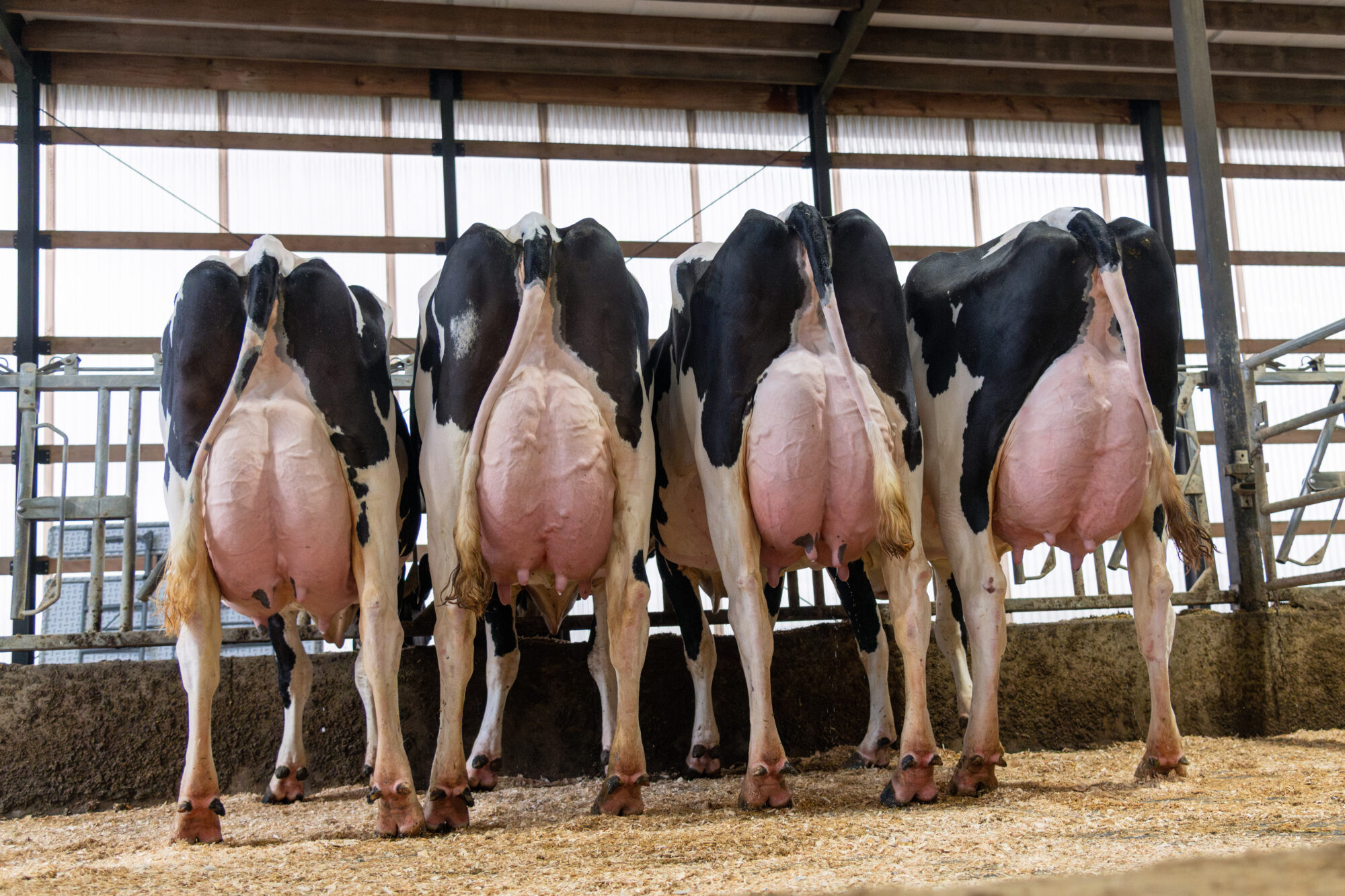
NewsSubscribe
First
Last
Consent

Why Milk Components Are Your Best Friend Now (and Why Chasing Volume is Yesterday’s News)

What if you could boost your payout without boosting volume? Let’s talk butterfat.

EXECUTIVE SUMMARY: Here’s the real deal: The dairy business has shifted completely. It’s no longer about how many gallons you pump out, but the value packed into your milk’s protein and butterfat. Picture this — a typical 850-cow herd producing 59,500 lbs daily can earn an extra $2,200 every single day just by pushing better components! Nationwide, we’re seeing butterfat average 4.23% and protein hit 3.29%, driving real increases in farmgate value. But it’s not the same everywhere — Texas is absolutely booming with +6% growth thanks to new cheese plants, while California’s getting squeezed by heat and water constraints. Global markets matter too — Mexico’s spending $2.47 billion on our dairy, keeping demand strong. Bottom line? If you haven’t shifted your focus to milk components and smart risk management, you’re leaving serious money on the table in 2025.

KEY TAKEAWAYS:

  • Component quality pays big — even bumping butterfat and protein by a tenth of a percent adds thousands to your daily revenue across the whole herd.
  • Genomic testing isn’t optional anymore — spending $40 per calf on testing and using high PTA bulls for fat/protein is proven ROI in today’s market.
  • Hedge your bets early — use Class III and IV futures plus Dairy Revenue Protection to lock in these strong margins before they disappear.
  • Watch global demand closely — Mexico and Southeast Asia are driving U.S. dairy prices, so track those export numbers and GDT auction results.
  • Don’t skimp on biosecurity or heifer strategy — with HPAI hitting 1000+ herds and replacement costs at $3000+ per head, protection is profit.
 milk components, dairy profitability, genomic testing, farm risk management, dairy market trends

Look, if you’re still measuring success by how many gallons roll out of your bulk tank, you’re fighting yesterday’s war. The real money these days — what I call the game-changer — is swimming inside that milk: butterfat and protein. And honestly? It’s not even close anymore.

I was shooting the breeze with Jim last week. Third-generation guy up in Marathon County, Wisconsin, runs about 850 head — mostly Holsteins with some Jersey crosses thrown in for good measure. “Ten years ago, I was all about pounds per cow,” he told me, leaning against his parlor rail after evening milking. “Now? I’m laser-focused on hitting those component numbers.”

Jim’s got the goods: his milk’s testing 4.2% butterfat and 3.3% protein these days. That bump is putting serious money in his pocket every single day.

Here’s what’s really happening with production…

According to the latest USDA numbers, we’ve been on a losing streak — milk volumes dropping for 13 straight months through July 2024. Sounds scary, right? But here’s the thing that’s got everyone talking: the milk we are producing is richer than it’s ever been.

Recent data from CoBank shows butterfat levels hit 4.23% nationally in 2024, up from barely scraping 4% just a few years back. Protein’s climbing too — 3.29% average now, compared to around 3.04% back in 2004. (That’s genetic progress you can bank on, literally.)

And it’s not playing out the same everywhere…

Down in Texas, they’re singing a completely different tune. Milk production jumped 6% last year, thanks to massive cheese plant expansions in places like Amarillo and Lubbock. I’m talking facilities that are pulling milk from counties that never mattered much before — trucks running extra miles just to feed these operations.

Meanwhile, California is grappling with significant headwinds — heat stress and water restrictions that are putting a real squeeze on yields. Up here in the traditional dairy belt — Wisconsin, Minnesota, New York — we’re seeing herd contraction and flat production.

What strikes me about this shift is how it’s forcing everyone to think differently about what matters.

Let’s talk money, because that’s what pays the bills…

Here’s where the math gets really interesting. An 850-cow herd averaging 70 pounds produces 59,500 pounds of milk daily — that’s 595 hundredweight (cwt). Using current Federal Milk Marketing Order pricing, the value difference between average components and top-tier is $3.70 per cwt ($23.85 – $20.15).

Here’s the kicker: 595 cwt × $3.70 = $2,201.50 per day. Scale that over a month, and you’re looking at an additional $66,000 in revenue — a figure that changes the entire financial picture of an operation.

Take Sarah up in St. Lawrence County, New York. She’s running 280 registered Holsteins and dropping about $40 per calf on genomic testing, specifically targeting bulls with killer PTA scores for fat and protein. “Every extra tenth of a percent pays for that test ten times over,” she says. “I can’t afford not to do this anymore.”

Now, about those market moves…

As of early September, October Class III CME futures have been dancing around $20.85, with Class IV trading near $21.75. (These are approximate numbers — market prices change daily, so check with your broker for current quotes.) When Class IV trades above Class III like that, it’s the market telling you butter and powder are worth more than cheese right now.

This creates opportunities if you know how to read it. Danny, down in Green County, learned this lesson the expensive way. “I got burned waiting for better prices back in 2020,” he admits, standing in his feed alley watching the mixer wagon load up. “Now, when the spread looks good, I lock in margins with DRP. Sleep better at night.”

But let’s be real about the painful stuff too…

Replacement heifers are absolutely crushing budgets right now. The USDA reports national averages around $2,660 per head, but that’s conservative. Premium Holstein replacements are routinely hitting $3,000-plus at auctions, with some California and Minnesota sales pushing over $4,000.

Why? The beef-on-dairy trend. Using beef semen on your lower-tier cows creates a nice revenue stream from those crossbred calves, sure. But it’s also squeezed purebred heifer supplies to a 20-year low. There’s your unintended consequence.

Then there’s bird flu hanging over everything. Over 1,000 dairy herds across 17 states have dealt with HPAI this year. The farms that invested early in biosecurity — limiting visitors, boot washes, bird-proofing feed areas — they’re seeing the payoff in fewer disruptions and healthier herds.

Where’s your milk actually going?

This might surprise you, but when that semi pulls away from your farm, there’s a good chance it’s headed south of the border. Mexico bought $2.47 billion worth of U.S. dairy in 2024, making them our biggest customer by far. That’s not just a statistic — it’s cash flow that directly supports your milk price.

“I’ve completely changed how I think about our market,” says Maria, whose 650-cow operation outside Modesto produces high-component milk primarily destined for export. “We’re feeding families in Mexico City now, not just the local fluid plant. That global connection makes me more focused on consistency than ever.”

Asia’s more complicated. China’s tightening its imports as it builds domestic production, but Southeast Asian countries continue to buy steadily. Don’t sleep on those twice-monthly Global Dairy Trade auction results either — they move our futures markets more than some domestic reports.

So what’s your game plan?

From conversations I’m having with producers across the country, here’s what’s working:

  • Focus your genetics on PTA Fat, PTA Protein, and Net Merit when selecting sires. The extra genomic testing cost pays for itself in the first lactation — ask your AI tech about proven component transmitters.
  • Get serious about risk management. Work with your farm advisor to understand how futures and Dairy Revenue Protection can lock in margins when favorable spreads appear. Don’t wait for perfect conditions — they rarely come.
  • Start budgeting for $3,000+ heifer costs or develop internal breeding programs. The cost advantage of raising your own has never been clearer.
  • Double down on biosecurity. Those protocols aren’t optional anymore — simple steps like visitor logs, clean boots, and bird-proof feed storage consistently beat the cost of dealing with disease outbreaks.
  • Track global demand shifts, especially in Mexico and Southeast Asia. These purchases directly impact your farm’s profitability, whether you realize it or not.

Regional reality check:

RegionProduction TrendWhat’s Driving It
Traditional Dairy BeltDown ~1.5%Aging herds, flat yields, and higher costs
TexasUp 6%New cheese plants are creating a demand vacuum
CaliforniaDown ~2%Heat stress, water restrictions

The bottom line?

Volume-focused dairying is becoming yesterday’s business model. Today’s winners are mastering components, managing market risks, and protecting herd health with the same intensity they once devoted to increasing pounds per cow.

The farms that understand this shift fastest are separating themselves from the competition. Jim’s already adjusting his breeding program and marketing strategy. Danny’s hedging aggressively. Sarah’s investing in genomics, just as her operation depends on it — because it does.

What’s particularly fascinating about this transition is how it’s forcing the entire industry to get smarter. The old days of just maximizing volume and hoping for the best? Those are gone.

The question isn’t whether this new reality is fair — it’s how fast you’ll adapt to stay competitive. Because in 2025, your survival depends on understanding that every tenth of a percent of butterfat and protein matters more than the extra gallon you used to chase.

The industry’s changing fast, and honestly? That’s what makes this business so interesting.

Complete references and supporting documentation are available upon request by contacting the editorial team at editor@thebullvine.com.

Learn More:

The Sunday Read Dairy Professionals Don’t Skip.

Every week, thousands of producers, breeders, and industry insiders open Bullvine Weekly for genetics insights, market shifts, and profit strategies they won’t find anywhere else. One email. Five minutes. Smarter decisions all week.
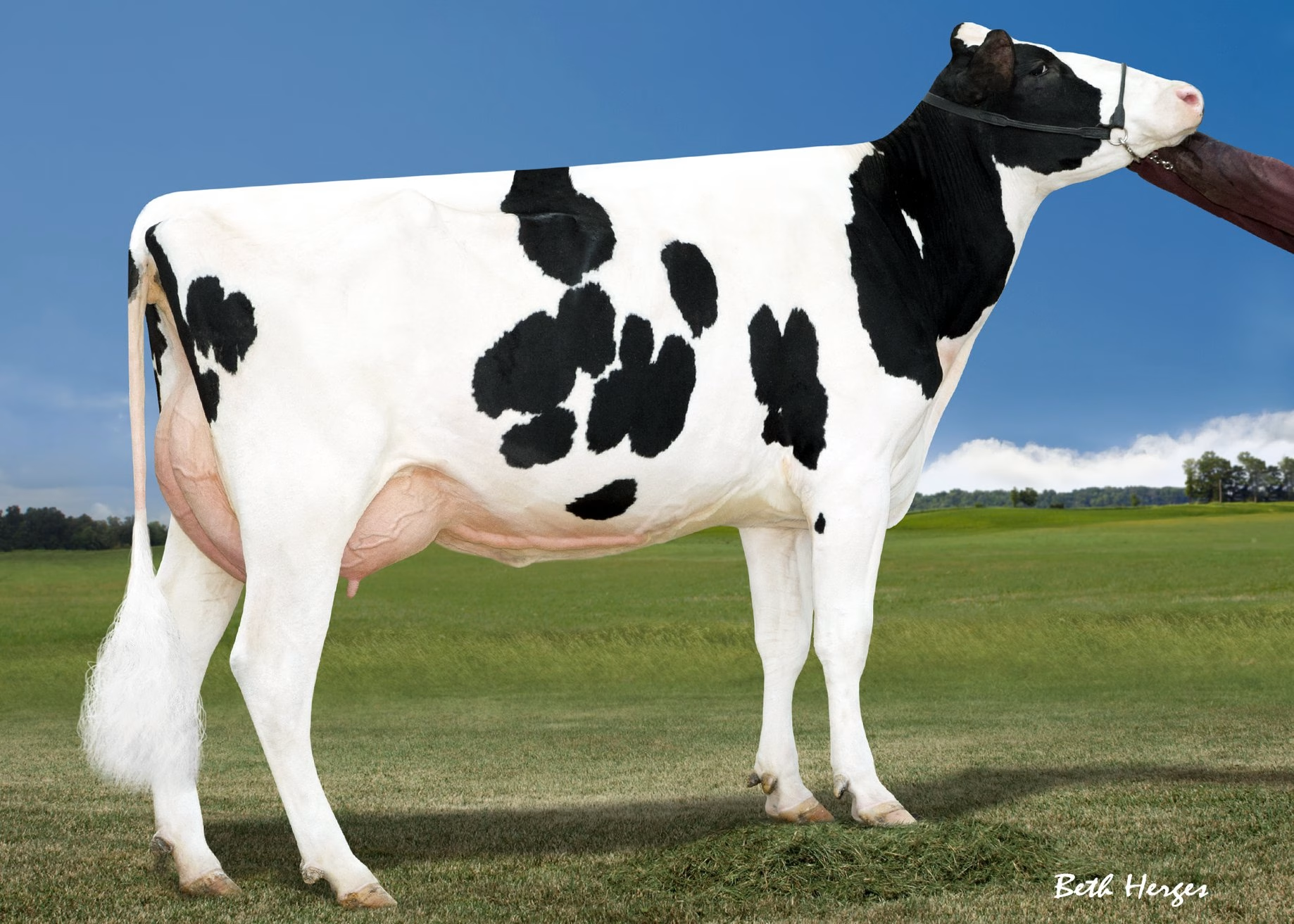
NewsSubscribe
First
Last
Consent

The $350,000 Genetics Wake-Up Call: Why Smart Dairies Are Banking Big While Others Still Play Guessing Games

Two dairy farms, 15 miles apart. One’s banking $350,000 more yearly. The difference? They cracked the genetics code.

EXECUTIVE SUMMARY: Look, I’ve been watching this genetics revolution unfold for years, and the gap between early adopters and holdouts is getting scary wide. We’re talking about farms losing $200-plus per cow annually just because they’re stuck in the past with breeding decisions. But here’s what gets me fired up—some operations are pulling in an extra $350,000 yearly just by getting smart about genomics. The tech isn’t pie-in-the-sky anymore. Genomic testing hits 65-80% accuracy now, which beats the heck out of guessing based on parent averages. AI tools are cranking genetic progress six times faster—jumping Net Merit gains from $13 to $83 per cow each year. Toss in better sexed semen and strategic IVF use, and you’ve got a breeding program that actually pays for itself in under two years. I’ve seen this work on real farms—Wisconsin operations dealing with short grazing seasons, New York dairies switching low-merit heifers to beef breeding, California outfits optimizing for heat tolerance. The math’s solid, the tech’s proven, and honestly? If you’re not at least testing your top replacements, you’re leaving serious money on the table.

KEY TAKEAWAYS

  • Stop bleeding $200+ per cow from genetic lag — genomic test your best 25% of replacements within 30 days and watch avoided costs add up fast
  • Accelerate genetic progress 6x with AI mating systems — Net Merit jumps from $13 to $83 yearly gains per cow when you let algorithms spot inbreeding risks and optimize breeding decisions
  • Cash in on reproductive tech advances — high-dose sexed semen hitting 80-85% conception rates, plus strategic IVF at 50% success, means you multiply elite genetics while culling genetic dead-ends
  • Match your genetics to your ground — Wisconsin’s short grazing season demands forage efficiency focus, while heat-stressed regions need tolerance traits to capture component premiums
  • Start small but start now — phased implementation over 18-24 months delivers measurable ROI while competitors stick with yesterday’s breeding strategies
dairy herd management, genomic testing, dairy profitability, AI breeding decisions, genetic lag costs

You ever get that feeling when you cruise past a neighbor’s dairy and wonder, how are they making this look so easy? Well, spoiler alert: it’s all about livestock genetics, plain and simple.

I was talking to a consultant the other day who’s worked with farms from Wisconsin all the way to Texas. He mentioned two dairies—less than 15 miles apart—with almost identical feed sources, the same milk pickup, and near identical weather. But one hauled in over $350,000 more last year alone. The difference? They nailed their genetics game.

But here’s the kicker—far too many dairies still using old-school breeding are losing more than $200 a cow each year because of genetic lag, and that’s money walking right out the back door. While others are cashing in with genomic testing, achieving 65-80% accuracy — far better than we ever hoped — by relying on sire averages.

When $39 Saves You from Raising a $2,000 Mistake

Let’s be honest—genomic testing isn’t cheap. You’ll be looking at anywhere from $39 for simple parentage testing up to around $200 for a full genetic profile. But what you get for your buck is priceless: a shot at knowing which heifers will actually pull their weight, and which ones will be a drain on feed and resources.

Here’s what you’re looking at:

Test LevelCostAccuracyWhat You Get
Basic Parentage$39-$7565-70%Genetic ID and simple traits
Enhanced Panels$100-$15075-80%Health, production, and fertility markers
Full Genome Scan$175-$200+80%+Comprehensive trait evaluation

Source: USCDCB genomic evaluation data

Agriculture Victoria’s study shows customizing SNP chips can raise accuracy by up to 10%, which is a big deal when you’re making decisions on hundreds of animals.

One case I keep thinking about: Extension research documents a New York farm that tested 400 springing heifers, discovered 150 with poor genetics, and smartly moved those over to beef crosses—saving more than $216,000 on feed and calf sales that might have been wasted.

AI: Your Breeding Partner That Never Takes a Day Off

Now AI? That’s the game-changer knocking on the barn door.

Based on documented adoption patterns across the Midwest, producers typically follow a similar path: initial skepticism, gradual testing, and then growing confidence. One Wisconsin farmer told me he was downright skeptical of computers running his breeding program just two years ago. Now? He’s crediting AI with saving him $38,000 by spotting inbreeding before it turned costly and kicking his genetic progress into overdrive with a 280% increase.

These AI tools run thousands of breeding combos in a flash—way beyond what you could crunch by hand while juggling barn chores.

Here’s how that breaks down:

FactorOld-School WayAI-Powered WayHow Much Better
Inbreeding ControlPedigree sheetsGenomic + AI algorithms8-12x more precise
Health PredictionVisual spotting71% accuracy for mastitis, 96% for digital dermatitisDays earlier intervention
Breeding ChoicesMaybe 20 optionsThousands evaluatedMassive increase
Genetic Progress$13/year Net Merit$83/year Net MeritNearly 6x faster

Source: USDA Net Merit documentation

Heads up—AI’s track record is strongest on digital dermatitis prediction, while mastitis detection accuracy is still being refined through ongoing research.

Reproductive Tech That’s Actually Paying Off

Sexed semen? It’s come a long way.

Labs are pumping twice the sperm into high-dose straws, often matching conception rates of regular semen—not everywhere, but often enough to change the game.

Run that with beef semen on your lower genetic merit cows and IVF for multiplying your cream-of-the-crop, and your breeding program’s got some serious horsepower.

Check this out:

TechnologyConception RateCost PremiumBest Use
High-Dose Sexed80-85%+$25-$30/strawElite genomic females
Beef Semen80-85%Market-dependentLower-merit females
IVF/Embryo Transfer45-55%~$500/pregnancyElite genetic multiplication

Source: Based on university extension models and industry data

Extension case studies document operations using this strategic approach—genomically testing replacement heifers, identifying those with below-average potential, and switching them to beef breeding. One frequently cited Wisconsin example netted $350,000 through avoided costs and premium crossbred calf sales.

IVF costs vary by region and setup, but best-case scenarios show around 50% conception rates for roughly $500 per pregnancy.

The Economics: What Investment Levels Actually Deliver

I gotta mention—breeding programs are no small investment.

Annual spend can range from approximately $75,000 for a modest setup to over $300,000 for elite operations.

But the payback can be solid:

Program LevelAnnual Cost (1,000 cows)Genetic Gain %5-Year ROI
Basic$75k-$125k4-6%$250k-$400k
Comprehensive$150k-$300k8-12%$500k-$800k
Elite$300k+12%+Highly variable

Source: Based on university extension models and industry data

Oh, and here’s something that sneaks under the radar—research shows inbreeding costs you 37-61kg of lifetime milk per 1% increase, depending on the calculation method. It’s the quiet profit killer.

Your genetic priorities gotta fit the turf you’re farming. Wisconsin producers battling a short 150-day grazing season lock in on forage efficiency, while California operations focus on heat tolerance and milk component premiums for specialty markets.

Getting Past the Implementation Hurdles

Look, I won’t sugarcoat it—genomics ain’t a walk in the park.

Smaller farms struggle with costs and managing heaps of data—not to mention everybody’s worried about data privacy and the big genetics companies consolidating power. These are genuine concerns that warrant an honest industry discussion.

Still, most farms make the jump when they see their neighbors banking real returns.

Common barriers I hear: upfront costs, technology complexity, skepticism about results, and limited management bandwidth.

Here’s the best advice—start small, find a trusted mentor, and build a plan that fits your operation.

As one producer put it: “AI breeding cut my losses and sped up genetic progress—but it took patience and learning, just like any new management tool.”

And honestly? Watching your neighbors cash in on this stuff cuts through doubt faster than any sales presentation.

Bottom Line: The Genetics Revolution Is Banking Money Today

Every month you stall on genomic testing, you’re probably leaving more than $200 per cow per year on the table while your competitors get smarter and richer.

Your move:

Get testing scheduled in the next 30 days. Focus on the best 25% of your replacements first—you’ll see the quickest return there.

Talk to three genetics professionals. Tour farms who’ve already rolled up their sleeves with these systems.

Use extension calculators—get your own genetic lag number. It’s real money walking out your door.

The choice is documented: invest $50-200 per head in genomic testing that delivers measurable returns within 18-24 months, or keep bleeding hundreds per cow annually while neighbors bank the advantages of precision breeding.

The genetics revolution isn’t tomorrow. It’s right now.

Complete references and supporting documentation are available upon request by contacting the editorial team at editor@thebullvine.com.

Ready to join it?

Learn More:

  • Genomic Testing: A Producer’s Guide to Getting Started – This guide provides practical strategies for launching a genomic program. It demonstrates how to select the right animals for initial testing and translate complex data into immediate, profitable breeding and culling decisions to maximize your return on investment.
  • The 2025 Genetic Base Change: What It Means for Your Herd’s Bottom Line – Go beyond on-farm tactics and understand the market forces shaping your herd’s value. This analysis reveals how industry-wide genetic updates impact your operation’s profitability, sire selection strategy, and long-term competitiveness in a shifting market.
  • Beyond Milk Volume: Are We Breeding for the Right Stuff? – Challenge your current breeding goals with this forward-looking analysis. It explores the critical shift toward new traits like feed efficiency and sustainability, revealing methods for building a more resilient and profitable herd designed for future market demands.

The Sunday Read Dairy Professionals Don’t Skip.

Every week, thousands of producers, breeders, and industry insiders open Bullvine Weekly for genetics insights, market shifts, and profit strategies they won’t find anywhere else. One email. Five minutes. Smarter decisions all week.

NewsSubscribe
First
Last
Consent

$4,200 Heifers and the Dairy Revolution No One Saw Coming

Do you think sticking to old breeding strategies will suffice in 2025? Think again.

You know when you’re casually chatting over coffee, and a fellow producer drops that a heifer just fetched $4,200? You choke on your sip, right? That’s how much the dairy breeding scene has flipped today.

The old rules — raise your replacements carefully, cull and churn, milk it out — well, those days are evolving fast.

Here’s the thing.

Across the U.S., replacement dairy inventories are at one of the lowest points seen in decades. We’re talking under 4 million head nationwide, a level not seen since the late 1970s. Prices? Replacement heifers are averaging north of $3,000—with the cream of the crop commanding $4,000 and more at major auctions.

Beef-on-dairy calves aren’t just side hustles anymore—they’re big money.

Premium values for those calves can top $1,000 per head in some regions.

This all stems from a clever yet complex shift: farmers are using sexed semen more than ever to target female replacements among their elite cows, while sending the rest down the profitable beef path.

Sexed semen? It has come a long way, delivering conception rates that reach 80-90% of conventional fertility — typically landing around 45-50% in field conditions. Modern products are achieving gender accuracy rates of 90-97%, significantly higher than the previous standard of 85-90%.

Add in accessible genomic testing that identifies your best cows before breeding, and suddenly you’re precision-targeting your replacement queue while cashing in on beef demand.

But here’s the catch: It’s a balancing act. The more you push into beef, the fewer replacements you create. And when scarcity hits, prices climb.

So, where are folks heading with their breeding strategies?

Plan A: The Rotational Rhythm

Some operators are blocking out breeding cycles — a few months all dairy, then a stint all beef.

University of Wisconsin Extension trials documented impressive wins in calf health with this approach—’all-in, all-out’ nursery management slashed respiratory disease cases by 35%.

But it’s a rollercoaster on cash flow — you get big spikes and dry spells.

It’s tailor-made for places like Wisconsin and Minnesota, where seasonal labor patterns and feed costs make it a viable option. Down south? Trickier. University of Georgia research indicates that dairy cows face heat stress indexes exceeding 72 for extended summer periods, prompting operators to shift breeding windows to cooler months and invest heavily in cooling systems.

Plan B: Go Big with the Heifers

These operators put all their eggs in the surplus replacement basket. It’s potentially lucrative — think serious revenue streams — but the ride’s bumpy.

Industry observers report mixed results: profits soared during the hot streak, but operators felt the pinch when prices cooled off.

CoBank analysts warn this boom could bust—replacement inventories may bounce back by 2027 as more producers adjust breeding strategies.

The challenge? You’re betting big on market timing, and the University of Missouri Extension estimates that raising costs will be $2,640 per heifer from birth to freshening.

Plan C: The Genetic Leapfrog

Some farms are hitting pause on raising their own replacements, flooding calf sales with beef calves, all to buy in elite genetics.

It’s high-stakes — skipping years of gradual genetic gain in one purchase.

The risks? Disease introduction (the highest-risk activity for transmission) and today’s sky-high prices for elite animals often exceed the combined savings from beef calf sales and avoided raising costs.

The Quiet Game-Changer: Male-Sorted Semen

Here’s something most producers aren’t considering yet: male-sorted semen for precision market targeting.

University of Idaho research found all-steer loads earned $5,180-6,746 more per truckload than mixed-sex groups—serious money if you’ve got the right marketing channels.

The Map Matters

Success depends heavily on location:

Upper Midwest: Feed costs run 8-12% below the national average, and seasonal labor patterns fit rotational breeding naturally. Perfect territory for batch approaches.

Southeast: Heat stress management becomes critical. Operations are installing high-volume fans, adding shade structures, and shifting feed timing to cooler hours.

West Coast: California wages average $20.48/hour, compared to $19.11 nationally. High labor costs push toward automation, but proximity to premium markets creates opportunities.

Northeast: Smaller herds require flexibility, but proximity to high-value markets is beneficial. High-quality animals fetch $ 4,500 or more at regional sales.

Counting the Real Costs

Let’s talk dollars, because that’s where strategy meets reality.                                                                            

Most operators know growing an animal from calf to first-calf heifer soaks up around $2,500—and that’s with tight management on feed, housing, and health.

Your financial picture for a 100-cow operation looks roughly like this:

  • A rotational approach requires approximately $ 100,000 or more upfront to grow heifer batches while pursuing beef payouts.
  • A surplus heifer strategy involves investing substantial capital in raising additional animals, relying on market timing to maximize returns.
  • Genetic leapfrog concentrates cash on buying elite quality but risks price volatility.

One market swing and your calculations change completely.

Note: These figures represent direct costs related to calf and replacement management—separate from milk revenue and other farm expenses.

What This Really Means

Look, it’s no longer simple.

The smart operator balances short-term cash from beef, long-term genetic progress, and risk tolerance — then adjusts based on what actually works in their situation.

Because the days of just milking cows and raising calves are long gone.

The producers who master this complexity? They’re positioning for years of competitive advantage.

We’re witnessing a fundamental shift from commodity milk production to strategic genetic and market portfolio management.

So what’s your play? Testing rotational breeding? Banking on the heifer market? Or planning a genetic upgrade?

Drop your thoughts below — let’s turn coffee-shop talk into real-world strategies.

KEY TAKEAWAYS

  • Leverage sexed semen with nearly 90% reliability to craft premium heifers and capitalize on beef-on-dairy premiums up to $1,000 per calf – start genomic testing your herd this month to identify breeding targets.
  • Adopt rotational breeding for disease control, reducing respiratory illnesses by 35% while managing cash flow fluctuations. Perfect for Midwest operations with seasonal labor patterns.
  • Explore the strategic purchase of elite heifers with an eye on the 2025 market’s high prices and risks – it’s a significant upfront cost, but can potentially leapfrog genetics by 5-10 years in one purchase.
  • Don’t underestimate genomic testing – knowing your cows’ genetics sharpens breeding decisions and improves herd profitability. With replacement costs exceeding $ 2,500 per heifer, precision pays.
  • Tailor your strategy by region: Northern states are well-suited for batch breeding approaches, while southern dairies require heat mitigation and adapted scheduling to avoid summer calving disasters.

EXECUTIVE SUMMARY

This isn’t your grandpa’s dairy breeding anymore. Dairy replacement inventory in the U.S. hit a 40-year low, and with fewer heifer calves born, prices soared past $3,000 – topping $4,000 in hotspots. Meanwhile, beef-on-dairy calves pull premiums up to $1,000 each, turning genetics and breeding choices into your new profit center. Tech like sexed semen now reliably produces female replacements, while beef semen turns the rest into gold. And with genomic testing, you can zero in on your best cows. This trend shakes up your bottom line and offers clever producers a new road to boost profitability – now’s the time to explore and adapt.

Complete references and supporting documentation are available upon request by contacting the editorial team at editor@thebullvine.com.

Learn More:

The Sunday Read Dairy Professionals Don’t Skip.

Every week, thousands of producers, breeders, and industry insiders open Bullvine Weekly for genetics insights, market shifts, and profit strategies they won’t find anywhere else. One email. Five minutes. Smarter decisions all week.
NewsSubscribe
First
Last
Consent

When Financial Disaster Breeds Genetic Gold: The Blackrose Story That Changed Everything

Discover how a financial disaster in the 1980s gave birth to a Holstein dynasty that is still shaping dairies worldwide today.

Have you ever noticed how some of the best genetics in our industry often emerge from the most challenging moments? Pull up a chair and grab that coffee—I’ve got a story that’ll change how you think about breeding decisions, and honestly, it’s one every dairy producer should know by heart.

Picture this: It’s a brutal January morning back in the mid-80s. Jack Stookey—this larger-than-life character who once ruled the Holstein scene—can’t even scrape together payroll. We’re talking about a guy who owned some of North America’s most elite cattle, now forced to send prize bull calves to slaughter just to keep the electricity on. (Read more: The Notorious Jack Stookey)

Now, most of us have felt those margin squeezes… you know, when corn hits $8 a bushel and you’re wondering if you can make the equipment payment. But Jack’s situation? That was a whole different level of desperation.

Here’s what strikes me about the whole mess, though—out of that complete financial wreckage emerged Stookey Elm Park Blackrose, probably the most influential Holstein cow you’ve never heard enough about. And if you’re running a serious breeding program, I guarantee her genetics are working in your herd right now.

The Crazy Money Days

Let me paint a picture of the early ’80s for you. The Investor Era—man, what a time that was. Thanks to Section 46, this tax provision, which essentially allowed wealthy outsiders to write off cattle purchases against their personal income, suddenly drew every investment banker and surgeon with money to burn to Holstein royalty. (Read more: The Investor Era: How Section 46 Revolutionized Dairy Cattle Breeding)

I’m talking about people who literally couldn’t tell a fresh cow from a dry one, throwing around cash like they were buying stocks. Prices went absolutely insane. A buddy of mine in Wisconsin still talks about sales where cows were selling for what would be equivalent to a million dollars today.

Jack Stookey was the perfect guy for that era—smooth as silk, could charm anyone. The man had this way of making you believe you absolutely needed to own whatever cow he was selling. He built this empire on other people’s money, snapping up champions like Georgian Quality Pat and the legendary Nandette TT Speckle-Red.

But you know how these stories go… bubbles always burst.

When It All Falls Apart

The IRS started getting wise to these tax schemes, and boom—the money dried up overnight. What followed was just devastating, not just for Jack but for all the farm families who’d trusted him with their best cattle.

I’ve heard some heartbreaking stories from guys who lived through it. Take the Browns up in Canada—they sold Speckle for what would be approximately $550,000 in today’s money and never received the last two payments. Just… gone. Can you imagine? That’s like selling your prize cow and getting stiffed on half a million dollars.

But here’s where it gets really tough to hear about. When Jack hit bottom, he started sending valuable bull calves—animals worth tens of thousands—straight to slaughter. Just to pay the electric bill. Those genetics that could’ve shaped the breed for generations, turned into hamburger because of cash flow. What really gets me is how this mirrors some of the pressures we see today—on a different scale, but farms are still being squeezed by cash flow, still making impossible decisions when margins disappear.

The Guy Who Saw Gold in the Wreckage

Now, here’s where the story gets interesting, and why I think Louis Prange deserves much more credit than he receives. While everyone else was running from the Stookey mess, this guy looked at that barn full of world-class cattle sitting in legal limbo and saw opportunity.

Think about it—decades of careful breeding don’t just vanish because someone files for bankruptcy, right? The genetics are still there. The potential is still there.

So Prange worked out this deal with the bankruptcy trustee. Lease the best cows, flush embryos, split the proceeds three ways. Among those salvaged genetics was Nandette TT Speckle-Red—the same red-and-white cow that’d been dominating shows just years before.

Nandette TT Speckle Red (EX-93), the champion at the heart of the story. While others saw a bankrupt herd, Louis Prange saw the immense potential in salvaging her elite, show-winning genetics.

Here’s what I love about Prange’s thinking… he had this vision for what breeders call a “corrective cross”—that’s when you mate two animals whose strengths perfectly complement each other’s weaknesses. He wanted to breed Speckle to To-Mar Blackstar, this production powerhouse who could pump out incredible milk volumes but needed help on the structural side.

From today’s perspective, with all our genomic tools and mating programs, this is exactly what we’re trying to achieve. Except that Prange was doing it by pure instinct and experience.

But Jack? Even in bankruptcy, the guy was still trying to call shots, pushing for different bulls. When it came time to deliver the semen… “My tank ran dry,” he told Prange during that famous phone call.

So Prange went with his gut. March 24, 1990—that’s when Stookey Elm Park Blackrose came into this world.

From Bargain Sale to Genetic Revolution

The legendary Stookey Elm Park Blackrose, a cow whose massive frame and amazing udder, captured here, hinted at the genetic revolution she would unleash.

Fast forward to December ’91. This 18-month-old Blackstar daughter hits the auction block at the Elm Park Red Futures sale for $4,500—about $9,000 in today’s money. Not exactly pocket change, but not too extravagant either.

Mark Rueth was fitting cattle at that sale, and he had this feeling about her. I love what he told his buddy Mark VanMersbergen: “This heifer’s got something special. Deep-ribbed, wide-rumped… you just know.” Together with the Schaufs from Indianhead Holsteins, they partnered up on what turned out to be one of the most significant cattle purchases in Holstein history.

And man, did she deliver. Blackrose grew into this massive, commanding presence that just dominated wherever she went. When she walked into a show ring, other cows looked ordinary by comparison.

Her numbers were off the charts: 42,229 pounds of milk at five years old, with 4.6% butterfat and 3.4% protein. That EX-96 classification put her in the conversation with the most structurally perfect cows ever evaluated.

But here’s what really set her apart—she won All-American honors as both a junior two-year-old and junior three-year-old. That’s incredibly rare. Then in ’95, she captured Grand Champion at the Royal Winter Fair, joining this exclusive club of U.S. cows to win Canada’s most prestigious show.

Building on the foundation: Blondin Redman Seisme (EX-96), a granddaughter of the powerful Red-Marker, showcases the incredible type and capacity that continued through the Blackrose lineage. Her R&W Royal Grand Championship is a testament to the family’s enduring influence.

The Real Magic Was in What She Produced

Now, Blackrose’s individual achievements were spectacular, don’t get me wrong. But the real treasure was her offspring. Her sons became some of the most influential sires of their era, though… well, they weren’t always the easiest to work with.

Take Indianhead Red-Marker. This bull stamped daughters with incredible power and frame, but his genetic proof showed some challenges. Specifically, his daughters often had issues with udder depth and could be, let’s say, temperamental in the parlor. You had to be smart about using him—mate him to cows that could correct those weak spots.

What’s interesting about the Blackrose sons is that they didn’t give you balanced, easy-to-use genetics. They gave you these incredibly potent but specialized tools. Breeders valued that raw power so much that they kept using them for generations, just being really strategic about their mating decisions.

The culmination of a dynasty: Lavender Ruby Redrose-Red (EX-96). In 2005, she achieved the impossible, becoming the first and only Red & White cow ever named Supreme Champion at World Dairy Expo, proving the enduring magic of the Blackrose line.

And the daughters? They built dynasties. Rosedale Lea-Ann became the direct link to Lavender Ruby Redrose-Red, who in 2005 did something that still gives me goosebumps—became the first and only Red & White cow ever named Supreme Champion over all breeds at World Dairy Expo. First and only. Think about that. (Read More: Never a thorn in the career of Lavender Ruby Redrose-Red)

Another star from the Rosedale branch of the Blackrose family, Rosedale Lexington (EX-95). Her elite production and 2013 All-American title showcase the consistent, high-impact genetics passed down through Blackrose’s daughters.

Today’s Success Story

The modern face of the Blackrose dynasty: Ladyrose Caught Your Eye (EX-96) on her way to another win. Her three consecutive World Dairy Expo victories are matched only by her impact as the dam of champions and high-demand AI sires.

That genetic dynasty didn’t end with Redrose’s championship in 2005. In fact, it’s arguably stronger than ever, rewriting record books in show rings right now. Meet Ladyrose Caught Your Eye—born just six years ago in March 2019, and she’s already changing everything we thought we knew about consistent transmitting ability.

This Unix daughter has earned an EX-96 classification and won the World Dairy Expo three consecutive years, from 2021 to 2023. But what’s really impressive is her consistency as a transmitting cow—she’s got 16 milking daughters classified VG-87 or higher, with seven daughters sporting PTATs of 4.00 or better.

“The way Caught Your Eye transmits is comparable to many of the greats in the Red & White breed. Her consistency is just incredible.”

Her sons are making waves as well. MB Luckylady Bullseyem, Eye Candy and Caught-Up are shaping breeding programs from Wisconsin to Ontario. The difference is that Eye Candy’s always been the more refined of the two—you need to use him on good, strong cows. Bullseye brings more power. Both produce daughters that absolutely catch your eye. (Read more: From Pasture to Powerhouse: The GenoSource Story)

The legacy continues into the next generation. Laforstar Friday Bullseye, a daughter of MB Luckylady Bullseye, carries on the family tradition as the 2024 Junior Champion at the Royal Agricultural Winter Fair.

At the 2024 Canadian Royal, a Bullseye daughter took Junior Champion. These aren’t just show-ring curiosities—they’re the foundation genetics for commercial programs across North America.

What This Means for Your Breeding Decisions

The fact is, there are valuable lessons here for modern breeding strategies that extend far beyond the historical context.

First, superior genetics are incredibly resilient.

The complete collapse of Stookey’s operation could have destroyed these bloodlines forever, but quality has a way of surviving and finding new expression.

Second, the power of corrective breeding—what Prange did instinctively, we can now predict with genomic testing.

We can run thousands of potential matings through computer models and identify those “golden cross” opportunities before we even order the semen.

But the fundamentals haven’t changed much, have they? You still need to understand the traits you’re trying to improve, balance production with durability, and think in generations rather than lactations.

What’s fascinating about today’s challenges is how they echo what we’ve always dealt with, just on a different scale. Feed costs are hitting $300 a ton in some parts of the Midwest, labor shortages are slowing operations from Minnesota to New York, volatile milk prices… sound familiar?

The difference now is that we have tools Prange could only dream of. Genomic predictions, automated monitoring systems, precision feeding—but they’re all built on those same fundamental breeding principles.

And here’s something that’s becoming huge in our decision-making: feed efficiency. Getting more milk per pound of feed isn’t just economics anymore—it’s environmental responsibility. Modern genomic selection lets us identify genetics that produce more milk with less feed, better disease resistance, and improved longevity.

Dr. Paul VanRaden from CDCB puts it well: “The carbon footprint of efficient genetics is becoming critical as we face new environmental regulations. We’re selecting for cows that produce more with less and stay healthy longer.”

Therefore, breeding decisions today must consider both profit and the planet.

That’s how we stay ahead of regulations while maintaining profitable operations.

The Financial Lessons That Still Matter

What really strikes me about Jack’s story is how the financial pressures sound so current. Overextending on credit, relying too heavily on outside capital, not having the cash flow cushion to weather downturns…

We see versions of this today when farms invest in new facilities or robotic systems without solid financial planning. I know operations that took on massive debt for parlor upgrades right before milk prices tanked—same principle, different decade.

The beauty of genetics, though, is that they outlasts financial crises. They don’t forget. Every mating choice we make echoes through decades.

Looking at Your Own Program

Which brings me to you and your breeding decisions. When you’re planning matings—whether you’re running full genomic evaluations or working with more traditional approaches—remember this story.

Sometimes the most valuable genetics come from the most unexpected places. Maybe it’s that moderate cow in the back of the barn whose daughters just keep producing, or that bull everyone’s overlooking because his numbers aren’t flashy enough.

The decisions we make today will still be showing up in our herds—or someone else’s—twenty years from now. That’s both the challenge and the incredible opportunity we have as breeders.

Think about it: Blackrose was conceived in bankruptcy court, sold as a modest heifer, and went on to reshape the Holstein breed. Her descendants are still winning shows, still improving herds, still contributing to profitable dairy operations from California to Quebec to Germany.

In barns across North America and beyond, Blackrose genetics continues contributing to successful operations. They’re not just show-ring champions anymore—they’re the foundation for commercial breeding programs, combining with today’s best genomic sires to produce cattle that are more efficient, more profitable, and more sustainable than ever.

So next time you’re studying pedigrees or reviewing genomic reports, remember this: consistency and long-term vision turn crises into champions.

Because in the end, that’s what we’re really doing—building legacies that outlast us.

KEY TAKEAWAYS

  • The resilience of elite genetics can turn economic and financial disasters into opportunities for breeding innovation.
  • Stookey Elm Park Blackrose exemplifies the power of corrective breeding, combining top production traits with superior conformation.
  • Her descendants continue to influence both show and commercial operations worldwide, showcasing enduring genetic value.
  • Modern breeding strategies, augmented by genomic tools, build on lessons from historic success stories, such as Blackrose.
  • Sustainability and profitability hinge increasingly on balancing genetics, health, and feed efficiency.

EXECUTIVE SUMMARY

Stookey Elm Park Blackrose, born during the 1980s dairy financial crisis, remains a pivotal figure in Holstein genetics today. Rescued from bankruptcy by Louis Prange, she combined top production with exceptional conformation and show success. Her influence extends globally through powerful sons and dynasty-building daughters, such as Lavender Ruby Redrose-Red and Ladino Park Talent. Modern descendants, including Ladyrose Caught Your Eye, demonstrate outstanding performance and genetic consistency. This story highlights the resilience of superior genetics in the face of economic turmoil and the effectiveness of strategic corrective breeding. The Blackrose legacy shapes both championship show cows and profitable commercial herds worldwide, remaining vital to dairy sustainability.

Learn More:

  • Breeding for Profit: The Ultimate Guide to a More Profitable Herd – This guide provides a step-by-step framework for building a breeding program focused squarely on your bottom line. It details practical strategies to select genetics that boost production efficiency, health, and fertility for maximum financial returns in your herd.
  • The 2025 Dairy Market Outlook: Key Trends Every Producer Must Know – Move from the historical financial lessons of the Blackrose story to today’s economic reality. This analysis reveals the market trends, consumer demands, and global factors shaping dairy profitability, helping you make smarter, forward-thinking strategic decisions for your operation.
  • The Feed Efficiency Revolution: How New Genetic Indexes Are Cutting Costs – While Blackrose highlights timeless efficiency, this piece explores the innovative tools of today. It demonstrates how to leverage new genetic indexes for feed efficiency to directly attack and reduce the single largest variable cost on any dairy farm.

The Sunday Read Dairy Professionals Don’t Skip.

Every week, thousands of producers, breeders, and industry insiders open Bullvine Weekly for genetics insights, market shifts, and profit strategies they won’t find anywhere else. One email. Five minutes. Smarter decisions all week.

NewsSubscribe
First
Last
Consent

Beef-on-Dairy: Real Talk on Turning Calves into Serious Profit

Did you know? Dairy herds now supply nearly 20% of the US beef market — that’s a game changer for your farm’s bottom line.

EXECUTIVE SUMMARY: Beef-on-dairy programs have completely transformed dairy profitability. This isn’t just about selling expensive calves — it’s about fundamentally changing how we think about revenue streams. Dairy herds now contribute around 20% of the US beef supply, and producers are banking an extra $90,000 to $100,000 annually on 1,000-cow operations by breeding smart. Research shows that these beef crosses grow 15-20% faster and save nearly a month on feed, which translates to real money when corn’s priced at $3.88 a bushel and milk futures keep fluctuating. This trend is going global too — from European markets to Canadian operations, everyone’s figuring out that diversified income beats putting all your eggs in the milk price basket. If you’re serious about staying profitable while others struggle with volatile markets, this strategy deserves a hard look.

KEY TAKEAWAYS

  • Beef crosses deliver serious feed savings — up to 20% faster growth and 26 fewer days on feed means roughly $90 saved per calf. Start genomic testing your herd today to identify which cows should get beef semen.
  • Smart breeding means smart money — Use sexed semen on your top 30-40% genetic merit cows for replacements, then breed the rest to beef bulls. With 2025’s tight cattle supplies, those crossbreds are gold.
  • Phase it right to manage cash flow — Begin with just 10-15% of your breeding decisions going to beef. The 18-24 month lag between breeding and premium checks won’t hurt as much if you scale gradually.
  • Direct marketing beats auctions every time — Build relationships with local feedlots now while everyone else is still figuring this out. Pennsylvania producers are seeing premiums of $ 200 or more per hundredweight over Holsteins.
  • Feed those crosses right and watch them grow — Bump up protein and energy in your starter feeds by $15-25 per calf. With current feed prices, that small investment typically boosts weaning weights 8-12%.
beef on dairy, dairy profitability, herd management, genomic testing, farm efficiency

Beef-on-dairy programs are completely reshaping how producers think about calf income. Once, Holstein bull calves sold for roughly $150 to $250, depending on market conditions. Today, these beef crosses command a significant premium, potentially adding over $100,000 in annual revenue for a 1,000-cow operation with a dialed-in breeding program.

Here’s what’s really driving this shift in our industry. The US cattle herd reached its smallest size since 1951, creating significant demand for high-quality beef genetics (USDA, 2024). To illustrate, the National Association of Animal Breeders (NAAB) reports beef semen sales to dairies have absolutely exploded—going from 2.5 million units in 2017 to nearly 8 million in 2024. That’s not just a trend; that’s a fundamental change in how we manage our herds.

A 2025 analysis from CoBank projects that dairy-origin cattle will account for nearly 20% of the total US beef supply. When you’re supplying one-fifth of the nation’s beef from dairy herds, that’s not going away anytime soon.

Beyond Calf Prices: Where the Real Money Lives

Research out of Texas Tech shows these crosses grow 15-20% faster and spend up to a month less on feed—that adds up to roughly $3.50 saved every single day (Texas Tech, 2023). Conversations with producers reveal a critical insight:

For example, one operator from central Pennsylvania noted in Progressive Dairyman that genomic testing was a game-changer for him. “We’re maintaining our genetic progress on milk while adding this whole new income stream from beef calves,” he said. Smart approach.

However, as Wisconsin dairy consultant Sarah Mitchell cautions, “Too many producers think this is a quick flip. It’s not.” You’re looking at 18-24 months from insemination to premium calf checks, plus genomic testing, which costs $ 10,000-$ 15,000 annually for mid-sized herds (Penn State, 2024).

With corn sitting around $3.88 a bushel and milk futures bouncing between $17-19 per hundredweight, that beef income becomes a real lifeline when milk checks get ugly.

The Strategy That Actually Works

A University of Wisconsin analysis identified the financial sweet spot: using sexed semen on your top 30-40% genetically merit cows to maintain replacements, then breeding the rest to beef bulls (UW, 2024). Their “Income from Calves Over Semen Costs” calculation demonstrates profitability when crossbred calves sell for at least double what dairy calves do.

The challenge, however, is that an estimated 30% of programs fail to hit their financial projections. Why? It usually comes down to three things: sloppy genetic evaluation, inconsistent breeding protocols, or underestimating the working capital required upfront.

“I see operations crash and burn because they didn’t track their genetics properly or they tried to cheap out on genomic testing,” says Tom Anderson, an extension specialist in Wisconsin who’s worked with dozens of these programs. “When you fail, you’re stuck with sunk costs for semen, testing, and specialized feed—but no premium calves to show for it.”

Breed selection has also become quite targeted. Angus bulls for marbling, Limousin and Charolais for feed efficiency and growth. Furthermore, the use of heterospermic semen (packing multiple sires into one dose) has more than doubled, as it is shown to boost conception rates, according to the NAAB.

The Nutrition Reality Check

These crossbred calves need different starter protocols—higher protein, energy-dense feeds that add $15-25 per head but improve weaning weights by 8-12%. It’s not rocket science, but it’s money you need to budget for.

The good news? Penn State’s massive study on nearly 40,000 cows shows that beef crossbreeding does not increase dystocia rates or harm subsequent milk production, although some producers experience temporary dips in breeding efficiency during the program rollout (Penn State, 2024).

Making the Market Work for You

Auction barns have their place, but direct relationships with feedlots and packers who understand genetics pay better. Pennsylvania auctions are seeing beef-on-dairy crosses sell for $197-220 per hundredweight, significantly above Holstein prices (Farm Progress, 2024).

Market dynamics also vary significantly by region. One Minnesota producer reports their local buyers are paying $180-200, while California operations with established feedlot contracts are seeing $220-250. Location matters, and so do your relationships.

Financial analysts suggest a herd needs to produce 180-200 crossbred calves annually to break even on investment and operational costs. Below that threshold, the economics get shaky fast.

Common Mistakes (And How to Avoid Them)

Cornell Extension recommends starting slowly—perhaps initially allocating 10-15% of your breeding decisions to beef bulls. Get your systems right, build those market relationships, then scale based on actual results, not projections.

The pitfalls I see most often include rushing implementation without securing buyer contracts first, skipping rigorous genetic evaluation (genomic testing isn’t optional), underestimating working capital requirements, not tracking conception rates closely enough, and assuming all beef breeds will work the same in your management system.

“Start small, measure everything, and be patient,” advises Dr. Jennifer Walsh from Cornell. “The producers making real money didn’t get there overnight.”

Looking Ahead

CoBank projects continued growth through at least 2028 as cattle supplies stay tight (CoBank, 2025). This creates an opportunity for producers who can execute with discipline, but it’s not a guarantee of success.

Ultimately, this strategy provides a valuable hedge against milk price volatility while improving overall herd efficiency. But success demands careful planning, sound genetics, and the patience to let programs mature properly.

For those ready to invest in the systems and discipline required, beef-on-dairy represents one of the most compelling profit opportunities in today’s dairy industry. Just don’t expect it to be simple—the best opportunities rarely are.

Your First Steps: Start by genomically testing your herd to identify breeding candidates, connect with local feedlots to understand their genetic and weight preferences, and develop a comprehensive budget to manage the 18-24 month cash flow gap. Small steps, but they’ll set you up for success when you’re ready to scale.


Download “The Ultimate Dairy Breeders Guide to Beef on Dairy Integration” Now!

Are you eager to discover the benefits of integrating beef genetics into your dairy herd? “The Ultimate Dairy Breeders Guide to Beef on Dairy Integration” is your key to enhancing productivity and profitability.  This guide is explicitly designed for progressive dairy breeders, from choosing the best beef breeds for dairy integration to advanced genetic selection tips. Get practical management practices to elevate your breeding program.  Understand the use of proven beef sires, from selection to offspring performance. Gain actionable insights through expert advice and real-world case studies. Learn about marketing, financial planning, and market assessment to maximize profitability.  Dive into the world of beef-on-dairy integration. Leverage the latest genetic tools and technologies to enhance your livestock quality. By the end of this guide, you’ll make informed decisions, boost farm efficiency, and effectively diversify your business.  Embark on this journey with us and unlock the full potential of your dairy herd with beef-on-dairy integration. Get Started!

Learn More:

The Sunday Read Dairy Professionals Don’t Skip.

Every week, thousands of producers, breeders, and industry insiders open Bullvine Weekly for genetics insights, market shifts, and profit strategies they won’t find anywhere else. One email. Five minutes. Smarter decisions all week.
NewsSubscribe
First
Last
Consent

The Great Dairy Divide: Why Your Feed’s Cheap but Your Milk Check Still Hurts

80% of your milk yield gains may be hiding in your feed efficiency — have you checked lately?

EXECUTIVE SUMMARY: Here’s the deal: feed efficiency is quietly slashing inputs and boosting profits, but most aren’t tuning in. Farms dialing feed efficiency up by just 3% can see milk yields jump by over 600 liters per cow—a real game changer. Meanwhile, genomic testing continues to separate the top producers, driving genetics that pack protein premiums of up to $4.00 per cwt, according to research from the University of Wisconsin. Global demand for high-protein dairy products is driving up prices, but butterfat and traditional milk volumes are no longer covering the costs as they once did. With feed costs shaky despite record corn crops, you need strategies that lock in gains here and now. If you haven’t looked at your feed efficiency or taken genomic insights seriously, you’re leaving money on the table. Trust me, start now if you want to keep your milk check growing in 2025 and beyond.

KEY TAKEAWAYS:

  • Boost feed efficiency by at least 3%: test your herd’s conversion ratios this week and adjust rations using your nutritionist’s advice to save feed costs and add $14+ per cow monthly.
  • Start genomic testing or refine your lineup: identify cows with protein traits boosting milk checks by up to $4.00/cwt, focusing breeding decisions on these genetics.
  • Lock feed prices now: with corn futures near $4, secure feed contracts before prices jump, safeguarding your margins amid supply uncertainties.
  • Embrace component-focused management: shift from volume to protein emphasis, respond to market demand, and protect revenue against fluctuations in butterfat prices.
  • Engage proactive risk management: consider Dairy Revenue Protection at 95% coverage this quarter to shield income in volatile market conditions.
dairy profitability, feed efficiency, milk protein premium, genomic testing, dairy risk management

The thing about dairy markets lately? They’re split—protein prices are climbing while butterfat is taking a serious hit. This isn’t just your typical summer shift; with the USDA forecasting a record corn crop and demand pulling dairy components in opposite directions, producers are stuck navigating some tight margins.

When Ice Cream Season Ends, Trouble Begins

Take butterfat, for example. As of the week ending August 15, 2025, CME spot butter prices dropped 4 cents to $2.30 per pound, hitting the lowest summer point we’ve seen in years, according to CME Group data. What’s interesting is how ice cream makers, who generally consume most of the cream, are stepping back after the peak season. That extra cream floods the market, dropping cream multiples well below what we’d expect historically.

Analysts monitoring USDA Cold Storage data predict that the August and September reports will confirm a significant buildup in butter inventories. If that holds, we could be staring down a prolonged butter price slump into the holiday baking season and beyond.

Here’s what’s concerning, though — September Class III futures dropped 48 cents to $18.39 per hundredweight, with fourth-quarter contracts dancing dangerously close to that $18 floor that makes everyone nervous.

Where the Real Money Lives Now

Compare that with dry whey prices, which hit a six-month high of nearly 60 cents a pound last week. Despite China’s export challenges due to trade tensions, domestic demand remains strong, especially for high-protein ingredients. Dr. Mark Stephenson, director of dairy policy analysis at the University of Wisconsin-Madison, notes that protein has become the primary driver of milk prices lately.

Producers who’ve dialed in genetics and nutrition to push milk protein between 3.2% and 3.4% are definitely seeing dividends. This isn’t just about tweaking rations anymore—it’s about fundamentally rethinking what drives your bottom line.

Why Cheap Feed Won’t Save You

However, here’s the catch: cheap feed is no longer a free pass to profitability. The USDA’s August 12, 2025, WASDE report showed a corn yield forecast of 188.8 bushels per acre and 97.3 million planted acres—a monster crop that’s suppressing feed costs. Still, milk futures hovering near $18 per hundredweight signal that producers face vulnerability.

A small rise in corn or soybean meal prices could tighten margins. Penn State Extension recommends aiming for a milk-to-feed ratio of 1.4 to 1.5 now to break even—a steep drop from the 2.5 to 3.0 breakeven ratio many producers used to count on.

Building a Resilient Operation

Here’s where it gets interesting on the farm. The national dairy herd grew year-over-year by roughly 146,000 head to 9.5 million, while weekly cull rates remain steady around 0.54%. This isn’t panic selling, but a calculated approach that focuses on efficiency and milk components, rather than just herd size. It ties directly into why protein is king right now.

What strikes me is how this connects to component management. Smart producers aren’t just growing herds—they’re building better herds. Those focusing on genetics that boost protein percentages are essentially future-proofing their operations against exactly the kind of market split we’re seeing now.

Technology also plays a key role. A 2023 report from the Agricultural Technology Research Institute found that automated feeding systems can improve feed efficiency by up to 12%. That’s a real margin-saver when you need to hit that 1.4-to-1.5 feed conversion ratio. However, it’s also a significant investment—costing $2,500 to $4,000 per cow—with payback periods ranging from 5 to 7 years, especially with tighter credit. Smart producers are weighing that carefully against current cash flow realities.

And don’t forget about locking in inputs. December corn futures near $4.00 per bushel as of mid-August offer a chance to secure feed costs before weather or geopolitical shifts push prices upward again. That window won’t stay open forever.

Risk Management Isn’t Optional (And Most Still Aren’t Doing It)

I can’t stress risk management enough. Dairy Revenue Protection premiums vary from 15 to 35 cents per hundredweight at 95% coverage, depending on your region. Industry observations suggest uptake remains limited in many key dairy areas—too many producers are waiting too long.

If you haven’t talked to your crop insurance agent about DRP for Q4 2025 yet, now’s the time. Don’t be the producer who waits until margins are already gone.

Your Monday Morning Action Plan

So what now? Here’s what needs to happen this week:

  • Lock those feed costs for the next six months while corn holds support
  • Get serious about DRP coverage before the sales deadline hits
  • Manage feed efficiency tightly — aim for that 1.4-to-1.5 ratio, measure it, don’t guess it
  • Focus on improving milk protein percentages — that’s where the money is

This protein demand trend is no fad. It’s real, and it’s going to shape milk checks for the foreseeable future. Those dialing in genetics and nutrition to boost component percentages will be miles ahead of operations still chasing volume.

I expect the coming months to be a dividing line between those who plan and hedge and those who just hope prices will bounce back. In today’s dairy world, hope simply won’t pay the bills.

Complete references and supporting documentation are available upon request by contacting the editorial team at editor@thebullvine.com.

Learn More:

The Sunday Read Dairy Professionals Don’t Skip.

Every week, thousands of producers, breeders, and industry insiders open Bullvine Weekly for genetics insights, market shifts, and profit strategies they won’t find anywhere else. One email. Five minutes. Smarter decisions all week.
NewsSubscribe
First
Last
Consent

The New Dairy Playbook: 5 Trends Redefining Profitability in 2025

What if I told you tweaking your heifer strategy could add thousands to your bottom line this year?

EXECUTIVE SUMMARY: The dairy industry in 2025 is different. Replacement heifers are scarce — farms are keeping an extra 600,000 cows, which means feed costs go up by $150 per cow annually. However—and this is crucial—genomic testing advances have increased butterfat and protein values by up to 90%, resulting in an additional 35 to 45 cents per hundredweight. Add in the shake-up in milk pricing and the beef-on-dairy boom, and you’re looking at a market that rewards smart, data-driven moves. Global processors are investing billions, which means component premiums are likely to increase by 50 to 150 cents per hundredweight soon. So if you’re still guessing on genetics, pricing, or herd management, you’re leaving serious money on the table. The evidence, from USDA reports and Penn State Extension research, is clear: this year, you should get strategic with genomic testing and feed efficiency upgrades, starting now.

KEY TAKEAWAYS:

  • Heifer Scarcity: High replacement prices ($3,500-$4,500) force retention of less efficient older cows, creating an economic trade-off
  • Component Genetics: Genomic advances increase butterfat and protein by 70-90%, adding 35-45 cents per 0.1% butterfat in premiums
  • Strategic Beef-on-Dairy: Now 1/3 of inseminations, this strategy boosts income with high-value calves but requires careful management to protect the future replacement herd

In 2025, the dairy industry isn’t just changing—it’s being fundamentally rewritten. A convergence of market forces is reshaping profitability, from the genetics in the tank to the final milk check. A historically tight replacement heifer market, relentless genetic gains in components, transformative milk pricing adjustments, and the strategic rise of beef-on-dairy are creating a new economic landscape. Coupled with massive new processing investments, these trends present both significant challenges and unprecedented opportunities for producers who are prepared to adapt.

1. Heifer Scarcity Forces a Culling Conundrum

First, the tight replacement heifer market is forcing difficult decisions across the country. Farms are holding onto more cows than usual—about 600,000 more since last fall, as per Hoard’s Dairyman. USDA figures confirm replacement heifer inventories are at their lowest in over 20 years, with fewer than 4 million heifers nationwide. Producers from Wisconsin to California report grappling with extended culling intervals as older cows cannot match the production of fresh animals, but current economics make it a necessary compromise.

This strategy results in a loss of approximately $150 per cow annually in feed efficiency, corresponding to a 2-3% reduction in feed conversion. However, with replacement heifers commanding prices from $3,500 to over $4,500 depending on the region, the math often favors retention. USDA Regional Market Reports for Wisconsin and California contextualize these price ranges, illustrating significant market nuances driven by differences in feed and labor costs, particularly between the Corn Belt and the Pacific Northwest.

Mitigating these efficiency losses has led many operations to embrace technology. Automated feeders and robotic milking systems are reported to save $120 to $180 per cow annually on feed costs. While the upfront investment can exceed $250,000 for a medium-sized farm, the payback period typically ranges from five to seven years. This adoption trend is accelerating, particularly among larger herds.

2. Component-Driven Genetics: The New Profit Engine

Simultaneously, genetic advancements are creating new revenue opportunities through higher milk components. The upward trend in butterfat and protein is no coincidence. U.S. averages have climbed to over 4.3% butterfat and 3.3% protein, a substantial increase from five years prior. This growth stems from the widespread adoption of genomic testing, which has been established since 2017.

Penn State’s Dr. Chad Dechow reports genomic breeding values for butterfat have increased roughly 70 to 90 percent since 2020, with protein improvements closely following. These genetic gains translate to an additional 35 to 45 cents per hundredweight for every 0.1% increase in butterfat—real dollars on the milk check.

3. The New FMMO Pricing Reality

Compounding these genetic shifts are the mid-2025 reforms to the Federal Milk Marketing Order. The USDA adjusted make allowances to reflect better modern processing costs, along with changes to Class I differentials. This resulted in a 85- to 90-cent-per-hundredweight drop in the all-milk price for many producers. Yet, premium payments for higher butterfat and protein content help offset some of the impact.

Farms operating on narrow margins or carrying significant debt must closely monitor their cash flow, particularly with agricultural lending rates near 7%.

4. Beef-on-Dairy: From Side Hustle to Strategic Income

Beef-on-dairy breeding has evolved from a side play to a core revenue stream. Nearly one-third of inseminations used beef semen last year, producing calves that command premiums above $900 in some markets.

However, experts at the University of Wisconsin Extension advise a cautious, strategic approach. Overusing beef semen risks reducing replacement heifer inventories by up to 20% over the next few years. The recommended strategy targets beef crosses on low-producing cows, while protecting top-tier genetic females.

5. Processing Investments Driving Component Demand

The dairy sector has seen over $8 billion committed to new processing plants, including Walmart’s $350 million Texas facility, Fairlife’s $650 million New York plant, and Chobani’s $1.2 billion expansion. These facilities focus on cheese and specialty products that require higher-quality milk components.

Industry analysts predict that component premiums could surge by 50 to 150 cents per hundredweight as these plants reach full capacity by 2027.

The Overarching Factor: Margin Management

Feed costs represent 50 to 60 percent of dairy farm expenses. With 74 percent of the 2025 corn crop rated good to excellent, projected moderation in feed prices makes protecting income over feed cost (IOFC) even more critical. Income over feed cost peaked near $16 per hundredweight last fall, making careful ration management and technological adoption essential strategies for margin improvement.

For producers managing herds of 500 or more, no one-size-fits-all management exists. Success demands balancing heifer management amidst scarcity, exploiting genetic gains to maximize premiums, strategically deploying beef-on-dairy without compromising replacements, and aligning milk supply with processors who value component-rich milk.

Regional conditions matter significantly; practices successful in Wisconsin’s pastures might be less practical in California’s dry lots or labor-scarce regions. Staying informed on nuanced local market and management factors is essential to navigating this new profitability landscape.

Those who master these complexities and develop strong processor relationships will define profitable dairy farming in the coming decade.

Complete references and supporting documentation are available upon request by contacting the editorial team at editor@thebullvine.com.

Learn More:

The Sunday Read Dairy Professionals Don’t Skip.

Every week, thousands of producers, breeders, and industry insiders open Bullvine Weekly for genetics insights, market shifts, and profit strategies they won’t find anywhere else. One email. Five minutes. Smarter decisions all week.

NewsSubscribe
First
Last
Consent

Transform Heat Stress into Your Carbon Strategy’s Secret Weapon

Heat-stressed cows produce 23% more methane per gallon while crushing milk yield—turn cooling into your carbon compliance advantage.

What if the same 90-degree day that’s crushing your 2,040-pound monthly milk yield is also sabotaging your environmental compliance goals—and most dairy operations don’t even realize it’s happening?

Here’s a fact that should stop every strategic planner cold: heat-stressed cows produce up to 23% more methane per gallon of milk while simultaneously tanking your production numbers. This isn’t just about surviving summer anymore—it’s about preventing a double financial disaster that’s hitting the dairy industry, with projected costs of $30 billion globally by 2050, while making environmental regulations nearly impossible to meet at current U.S. milk prices, averaging $21.30 per hundredweight.

Heat stress impacts escalate dramatically as THI increases, with methane emissions rising alongside production and fertility losses

You’re facing a hidden crisis that attacks from two angles simultaneously. While you’re focused on maintaining milk production during heatwaves, your operation is unknowingly becoming a methane factory, precisely when you can least afford it. The most productive cows—those genetic investments with superior breeding values that you’ve built your operation around—become your biggest environmental liabilities the moment temperatures push past 68 THI.

The stakes couldn’t be higher. With carbon pricing initiatives spreading across regions and methane regulations tightening, this dual impact threatens to squeeze dairy operations from both revenue and compliance angles. However, cutting-edge research reveals that strategic heat abatement changes everything: it not only protects your milk checks but also serves as your secret weapon for reducing methane emissions while maintaining the productivity that keeps you competitive.

Stop Treating Heat Stress Like Weather—Start Treating It Like the Methane Crisis It Is

Here’s the uncomfortable truth most consultants won’t tell you: the dairy industry’s reactive approach to heat stress is fundamentally flawed and costing you money every single day above 68 THI.

Traditional heat stress management focuses on visible symptoms—such as panting, reduced feed intake, and obvious milk drops—but peer-reviewed research reveals that this reactive approach misses the most expensive damage. By the time you see cows panting, methane intensity has already increased significantly, and rumen efficiency has been compromised for days. It’s like treating a heart attack after the patient collapses instead of monitoring blood pressure proactively.

Most operations still rely on the outdated 80°F threshold for heat stress intervention, but controlled research confirms that metabolic disruption begins at just 68 THI. This 12-degree blind spot costs the average 500-cow operation approximately $15,000-$ 25,000 annually in hidden methane penalties and productivity losses that are not reflected in obvious metrics.

Here’s what the industry doesn’t want you to know about methane and heat stress. Industry literature has long suggested that reduced feed intake during heat stress would naturally lead to a decrease in methane production. However, controlled chamber studies reveal a biphasic response where methane intensity actually increases as heat stress persists, even as absolute emissions initially decline. This means your “low-producing” heat-stressed cows are actually your worst environmental performers per unit of milk.

Challenge Everything: Why Your Genetics Program Might Be Sabotaging Your Climate Goals

Think you’re breeding for the future? Think again. The dairy industry’s obsession with single-trait selection for milk yield has created a genetic time bomb that explodes every time the mercury rises.

The uncomfortable reality is that high-producing animals actually become more susceptible to heat stress due to increased metabolic heat production. We’ve essentially bred cows that are environmental disasters, waiting for the next heatwave. Your highest TPI cows—those $50,000 genetic investments—become methane factories precisely when you need them most productive.

However, here’s where conventional breeding wisdom is turned upside down: genomic research using large-scale datasets reveals that incorporating heat tolerance into selection indices can increase prediction accuracy by up to 10%. This isn’t theoretical—it’s happening right now in operations that are smart enough to challenge the “milk yield at any cost” mentality that has dominated the industry for decades.

Here’s your wake-up call: A recent study found that when exposed to increasing THI levels, cows genetically predisposed to be low methane emitters in comfortable conditions actually increased their methane concentrations under heat stress. Your breeding program for low emissions could be backfiring during hot weather without proper heat abatement.

The Hidden Economic Devastation: What Your Monthly Milk Check Isn’t Telling You

The economic devastation from heat stress extends far beyond production losses—it’s a wealth destroyer that compounds across generations like poorly managed genetics.

U.S. milk production reached 227.8 billion pounds in 2025, with production per cow averaging 2,040 pounds monthly in major producing states. However, this productivity masks a hidden methane penalty that’s creating measurable compliance costs in regions implementing carbon pricing. When heat stress increases methane intensity by up to 23% at the herd level, operations face direct regulatory exposure that compounds with production losses.

Recent modeling studies tracking high-yielding herds have found that heat stress can decrease herd-level milk yield by up to 8.6% when all effects are combined over extended heat periods. For a 500-cow operation producing at current U.S. averages, this represents potential losses of $25,000 to $ 40,000 during extended heat periods, before accounting for environmental compliance penalties.

Small Farms: The Climate Change Casualties Nobody Talks About

Here’s the brutal truth about climate inequality in dairy: smaller farms are getting crushed while big operations adapt.

Research demonstrates that smaller farms (herds with fewer than 100 cows) suffer disproportionately, experiencing average annual yield losses of 1.6% compared to less than 1% for large herds. Following an extreme heat event, small herds can lose 50% more of a day’s yield than large herds. This disparity is largely attributed to the high capital costs of sophisticated mitigation infrastructure, such as large-scale fan and sprinkler systems, which are often beyond the financial reach of smaller operations.

But the transgenerational damage creates the most insidious economic drain. Heat-stressed dry cows produce calves with permanently reduced productive capacity, creating compounding liabilities that research estimates cost the U.S. dairy industry an additional $595 million annually. These “legacy effects” transform heat stress from a seasonal nuisance into a long-term erosion of genetic investment—and your family farm’s future.

Here’s How Smart Operations Turn Heat Management into Competitive Advantage

Stop thinking about heat abatement as a cost center. Start thinking about it as the most profitable investment you’ll make this decade.

Research consistently demonstrates that every dollar invested in effective heat abatement returns $3 to $ 5 in avoided production, reproductive, and health losses annually. However, what most operations overlook is that the environmental benefits generate additional value streams, which could be worth thousands in carbon credits and regulatory compliance advantages.

Comprehensive cooling systems deliver the highest ROI despite greater initial investment, with strategic heat abatement generating 3-4x returns annually

Precision cooling systems that maintain consistent airflow prevent the rumen disruptions responsible for increased methane intensity. Unlike basic shade structures that most farms still rely on, engineered ventilation systems maintain normal rumination patterns and digestive efficiency even during periods of thermal stress, thereby preventing the microbial dysbiosis that drives methane inefficiency.

Dairy cows resting under a barn with strategic fan cooling to reduce heat stress and improve productivity 

The Technology Revolution: Why Precision Monitoring Beats Gut Feel Every Time

Modern heat stress management leverages the same precision agriculture principles, transforming crop production, and the ROI is extraordinary.

Real-time reticulorumen pH and temperature monitoring systems can detect the impacts of heat stress on methane production before visible symptoms appear. This allows proactive intervention rather than reactive damage control. Think of it as the difference between having a cardiac monitor versus waiting for chest pains.

Activity monitoring and data analytics track individual cow responses to thermal stress, providing early detection capabilities that prevent productivity losses before they occur. Operations utilizing these technologies capture market advantages by maintaining stable production and environmental performance, even as competitors struggle.

Benchmark Your Vulnerability: The 5-Minute Heat Stress Audit

Want to know if you’re losing money right now? Answer these questions:

  1. Airflow Test: Can you measure 200+ feet per minute airflow at cow resting height in your three highest-traffic areas? If not, you’re losing money every day above 68 THI.
  2. THI Monitoring: Do you have real-time THI monitoring with alerts at 68 (not 80)? Most operations are flying blind with outdated thresholds.
  3. Water Capacity: Can your system deliver 50+ gallons per cow per day during peak demand? Water limitation amplifies every other heat stress factor.
  4. Methane Baseline: Do you know your current methane intensity (g CH4/kg milk)? Without baseline data, it is impossible to measure improvement.
Heat Abatement StrategyInitial InvestmentAnnual ROIMethane ReductionImplementation TimelineExternal Validation
Precision Fan Systems$200-400/cow3.2:115-20% intensity4-6 weeksJournal of Dairy Science
Smart Sprinkler Systems$150-300/cow2.8:112-18% intensity6-8 weeksAnimal Science Research
Comprehensive Cooling$400-800/cow4.1:120-25% intensity8-12 weeksMultiple Studies
Genomic Selection$60/animal testing150-200%8-15% intensity3-5 yearsNature Scientific Reports

The Genomic Revolution: Stop Breeding for Yesterday’s Climate

Here’s the paradigm shift that separates industry leaders from followers: selecting for heat tolerance isn’t about sacrificing productivity—it’s about protecting your genetic investments from climate volatility.

Heritability estimates for heat tolerance traits range from 0.13 to 0.17, sufficient for meaningful genetic progress. The “SLICK” haplotype, resulting in short, sleek hair coats, dramatically improves heat dissipation and can be incorporated into Holstein populations without compromising milk production potential.

Genomic research indicates that cows predicted to be heat-tolerant through genomic breeding values exhibit less decline in milk output and fewer increases in core body temperature during controlled heat stress events. This isn’t theoretical breeding—it’s practical risk management for operations planning beyond the next lactation.

Why This Matters for Your Operation’s 2030 Planning

With genomic testing costs having dropped below $60 per animal and a documented ROI ranging from 150-200%, the data exist to accelerate genetic selection for climate resilience. However, most operations continue using breeding strategies designed for yesterday’s climate patterns, leaving money on the table that forward-thinking competitors are already capturing.

Recent advances in multi-trait selection indices that balance productivity, heat tolerance, and methane emissions are becoming commercially viable. Operations implementing these strategies today position themselves for regulatory compliance advantages and market premiums as environmental standards become increasingly stringent.

Future-Proofing Your Operation: The Climate Adaptation Imperative

Climate projections make early adoption crucial for long-term strategic positioning rather than short-term comfort.

Models predict that 90% of the Canadian national dairy herd will experience large increases in heat stress frequency, severity, and duration under most climate scenarios. For U.S. operations, climate projections indicate that extreme heat days will become more frequent, resulting in a 30% increase in milk yield losses by 2050.

The competitive advantage extends beyond individual operations. While heat stress affects all dairy farms, those with effective abatement maintain stable production and environmental performance during peak stress periods when competitors struggle. This consistency in both milk delivery and carbon footprint creates market differentiation in an increasingly sustainability-conscious industry.

Three Critical Questions Every Strategic Planner Must Answer Today

Are you prepared for the regulatory reality that methane pricing is no longer theoretical? Several regions have already implemented carbon fees, and methane regulations continue to expand across agricultural sectors. Operations with documented heat stress mitigation can demonstrate measurable emission reductions that translate to compliance value.

Can your current genetic program deliver productivity under 2030 climate conditions? If you’re still selecting purely for milk yield without considering thermal resilience, you’re building vulnerabilities into your herd that will become expensive liabilities within this decade.

Do you have real-time data on the impacts of heat stress, or are you managing by gut feel and reactive intervention? Precision monitoring systems that detect problems before they become visible provide the competitive intelligence necessary for proactive management in an increasingly volatile climate.

The Bottom Line: Your Strategic Imperative Is Now

That 90-degree day scenario isn’t a future threat—it’s happening right now, and it’s costing you money while sabotaging your environmental goals every time temperatures climb above 68 THI.

The research is unequivocal: heat stress creates a devastating double impact where cows produce up to 23% more methane per gallon while making significantly less milk. This isn’t just a summer comfort issue—it’s a year-round threat to both profitability and environmental compliance that will only intensify as climate change accelerates.

Strategic heat abatement solves both problems simultaneously. Cooling investments deliver a 3-to-1 return by maintaining rumen efficiency, which keeps methane intensity low while protecting milk production. Whether through precision airflow systems, intelligent sprinkler cycles, or genomic selection strategies, effective heat management prevents digestive disruptions that drive both productivity losses and increased emissions.

Climate regulations and carbon pricing aren’t going away—they’re expanding. The documented reduction in methane intensity achieved through proper heat abatement creates a measurable compliance value while protecting your operation from significant annual losses that unmitigated heat stress can inflict.

Your 72-Hour Action Plan

Your strategic imperative demands immediate action:

This Week: Audit your current heat abatement systems using the 5-minute vulnerability assessment above. Measure airflow at cow resting height in your three highest-traffic areas—if you’re not consistently hitting 200+ feet per minute, you’re losing money and increasing emissions every day above 68 THI.

This Month: Install real-time THI monitoring with 68-degree alerts (not 80). Contact your genetic supplier to discuss incorporating heat tolerance breeding values into your selection program. Request genomic heat tolerance scores for your current sire lineup.

This Quarter: Calculate your current methane baseline and heat stress economic impact using the ROI framework provided. Develop a 3-year cooling infrastructure plan that qualifies for USDA cost-share programs.

But don’t stop with infrastructure. The operations implementing comprehensive climate adaptation today will capture the market advantages that determine industry leadership in the decade ahead. With U.S. milk production at 227.8 billion pounds annually and rising global demand, the opportunity for decisive action has never been greater.

The dairy operations thriving in 2030 won’t be those that survived climate change—they’ll be those that turned thermal management into a competitive advantage by solving productivity and environmental challenges with strategic, data-driven approaches. Your competitors are already making these investments. The question is: will you lead or follow?

KEY TAKEAWAYS

  • Challenge the 80°F Comfort Zone Myth: Research confirms metabolic disruption begins at 68 THI, not 80°F, creating a 12-degree blind spot that costs average 500-cow operations $15,000-25,000 annually in hidden methane penalties and productivity losses that never show up in obvious metrics.
  • Precision Cooling Delivers Carbon Compliance Value: Strategic cooling investments that maintain 200+ feet per minute airflow at cow resting height prevent rumen disruptions responsible for increased methane intensity while delivering 3-to-1 ROI through avoided production, reproductive, and health losses. With carbon pricing expanding, documented 20-25% methane intensity reductions create measurable compliance value.
  • Genomic Selection for Heat Tolerance Protects Genetic Investments: The “SLICK” haplotype and heat tolerance breeding values (heritability 0.13-0.17) can be incorporated into Holstein populations without compromising milk production potential, while genomic testing costs below $60 per animal deliver 150-200% ROI by protecting productivity under 2030 climate conditions.
  • Small Farm Climate Inequality Demands Immediate Action: Operations with fewer than 100 cows experience 50% higher daily yield losses during extreme heat events compared to large herds, with USDA EQIP funding covering up to 75% of qualified cooling improvements making adaptation accessible for strategic implementation.
  • Future-Proof Through Proactive Management: Climate models predict increasing heat stress frequency with some regions facing 100-300 annual heat stress days by 2050, making thermal resilience essential for maintaining competitive positioning as global dairy production faces potential 4% reduction without comprehensive adaptation strategies.

EXECUTIVE SUMMARY

Stop treating heat stress like weather and start treating it like the methane crisis it is—because your “comfortable” cows are becoming environmental disasters every day above 68 THI. Recent controlled research reveals that heat-stressed dairy cattle produce up to 23% more methane per gallon of milk while simultaneously reducing production by 8.6% when all effects combine over extended periods. This double economic hit costs the U.S. dairy industry $900 million to $1.5 billion annually, with individual operations losing an average of $264 per cow per year from unmitigated heat stress. Small farms suffer disproportionately, experiencing 1.6% annual yield losses compared to less than 1% for large herds, creating a climate-driven consolidation crisis that threatens family operations. While current cooling technologies can offset about 40% of productivity losses during extreme heat, strategic heat abatement delivers 3-to-1 ROI by maintaining rumen efficiency that keeps methane intensity low while protecting milk production. Global projections show dairy production could crash by 4% by 2050 unless operations implement comprehensive climate adaptation strategies that turn thermal management into competitive advantage. Audit your heat abatement systems now and calculate methane reductions using documented improvement factors—your competitors are already making these investments.

Complete references and supporting documentation are available upon request by contacting the editorial team at editor@thebullvine.com.

Learn More:

The Sunday Read Dairy Professionals Don’t Skip.

Every week, thousands of producers, breeders, and industry insiders open Bullvine Weekly for genetics insights, market shifts, and profit strategies they won’t find anywhere else. One email. Five minutes. Smarter decisions all week.
NewsSubscribe
First
Last
Consent

Beef-on-Dairy in 2025: Turning Calf Premiums into Real Profit (Without Blowing Up Your Herd)

Last year, beef-on-dairy cross calves brought in over $370 more than straight Holsteins. That changes the math on every breeding plan.

EXECUTIVE SUMMARY: You want real numbers? Here’s the headline: switching just 35% of your herd to beef semen can net you $480 a head on cross calves—that’s nearly $370 more than your Holsteins. Talk about feed efficiency—these calves are finishing 10–15% faster, burning less corn and stacking up profits where milk prices aren’t. Genomic testing used to sound fancy, but now it’s about $40 a head and the only way I’m picking which cows to cross. UW Extension spells it out: the old “breed every cow to Holstein” play is costing you real dollars. Markets are tight, premiums are up, and buyers want paperwork and health records they can trust. Bottom line? Take a look at your last calf check—if you’re not seeing numbers like that, maybe it’s time to shake up the system. There’s never been a better year to try it.

KEY TAKEAWAYS

  • $350–$500 premium: Switching your bottom 35% to beef semen has brought Midwest herds $370 more per head on cross calves this spring—sort your DHI reports right now and flag candidates for next cycle.
  • 10–15% feed boost: Crossbred beef-dairy calves are finishing quicker and saving starter, especially with corn above 5 bucks—review Penn State Extension’s latest on real-world feed gains before you re-order feeds.
  • $40 genomic investment pays off: Cheap DNA tests mean you can target beef breedings on your true low producers—ask your co-op rep about on-farm genomics kits before next breeding window.
  • Buyer contracts need discipline: Packers and buyers want traceable genetics and clear paperwork—check their premium spec sheets and start logging calving and health info with your phone (not just on paper).
  • Don’t short your replacements: UW Extension’s 25–30% rule is gospel—before loading more beef straws, double-check your replacement pipeline or risk a wallet-busting spring heifer buy.
beef on dairy, dairy profitability, replacement heifer strategy, genomic testing, dairy herd management

The thing about beef-on-dairy this year? It’s not just buzz at trade shows or a milk-hauler rumor. You walk into any barn office out here in the upper Midwest, and somebody’s already pulling up their phone to show you the latest Angus cross price at the sale barn. Back in January, a chart from Drovers was already screaming about the tightest U.S. cattle herd in over 70 years. Real producers are cashing real checks, and the difference shows up plain as day in their records.

But for every producer bragging about a $400 or $500 beef cross calf, there’s another looking over his shoulder at next year’s replacement pen and breaking into a sweat. Ask around: some guys have learned the hard way—go too heavy on beef and you might get blindsided by a spring heifer shortage.

What Auctions Are Paying Now

Want a hard number? At Place Dairy, a freestall outfit in Jefferson County running 550 cows, breeding the bottom 35% with Angus semen meant this spring’s bull calves averaged $480—nearly $370 more than Holsteins in the same barn, month for month (Wisconsin DATCP, April–June 2025 market report). It wasn’t magic. It was sticking to their sorting plan—top 30% kept for replacements, bottom 10% to high-gen sires. Anyone reading auction sheets from Wisconsin, western New York, or Iowa lately sees similar beef-on-dairy premiums… when the paperwork and protocols show up right.

What’s interesting is buyers in some pockets—like out in the Finger Lakes—will even pay a little extra for documented Simmental or Limousin contracts, especially if a packer’s on board. But for many herds, Angus remains the “easy button”—offering a reliable combination of high premiums, proven calving ease, and a deep, liquid market.

Protocols That Stand Up

Here’s what strikes me, and it’s a trend you can spot in both big parlor herds and fifty-stall tie-barns: discipline is the great divider. According to recent work from The Bullvine, beef cross strategies that work are the ones with protocols written down and followed every week—no winging it after holidays or when the A.I. rep reschedules. Many operations are using a “60-30-10 plan”, as covered in Bullvine’s practical beef-on-dairy management features: 60% bred to beef, 30% to sexed dairy, remaining 10% to bulls with top genomic numbers. For us—the plan’s as important as the product.

Costs? Genomic tests run $40–$50, sometimes less on a subscription or as co-op add-ons, which nips excuses in the bud (see your co-op or vendor sheet). Real farms these days are sorting DHI results every month and making beef decisions off those, not gut feel.

Replacement Gaps and How to Dodge Them

Here’s the part the hype-mongers leave out—replacements. In Clark County, I talked to a family running a tie-stall who was doing everything by the book: switched to beef on bottom 40%, kept replacements at 20%, figured buying open heifers from the neighbor would fill the gap. Then March hit, prices spiked, and they shelled out $8,000 more than expected on springers just to keep up.

“Burned my profit, lesson learned.”

That quote stuck with me.

That’s why The Bullvine and every regional consultant pushes the 25-30% rule: keep at least a quarter of breedings for homegrown heifers, unless you like handing your beef premiums right back at the next replacement sale.

Keeping Buyers Happy

What’s particularly noteworthy as this “beef-on-dairy” tide keeps rising? Buyers are tightening specs. This spring, several Midwest sales consultants were already hammering requirements like traceable genetics, health records, and even third-party breed certifications for top contracts. Herds that update buyers weekly with weights, paperwork, and shots don’t just bank premiums—they get called first when orders come up. I’ve noticed more producers texting sale details or health updates; it’s becoming as natural as milking time.

Practical Actions Before Next Month’s Breeding

Here’s my real-world checklist—straight from the barn office, not a Zoom slide deck.

  • Review Your Calf Sales: Pull average prices for beef crosses vs. Holstein for the last 12 months. If it’s not at least $350/head difference, flag the weak link—price, paperwork, or pen health. Do this before Friday.
  • Fix Your Replacement Pipeline: Run last month’s breeding records by hand or computer. Are at least 25% still marked for replacements? Plan to adjust before you open the next tank of beef semen.
  • Track Buyer Demand: Call, text, or email your main calf buyer or sale barn for updated premium specs. Do this by midweek.
  • Use Your Test Results: Flag your next breed cycle—for 600-cow herds, that means sorting 240 for beef based on DHI, not “feeling lucky.”
  • Audit Your Calf Barn: Walk the pens and check feeder/health logs. Book your service or cleaning before next week’s cold snap.

Lessons from the Barn

To wrap up: beef-on-dairy this year isn’t about finding a golden ticket—it’s about consistency, real price records, and planning ahead. The “winners” are the herds that stick to their sort plans, check every record, and stay in front of buyer requirements year-round, not just when beef prices are hot. The best tip I got this year? Forecast your calf crop and premium for the next 12 months—and remember, that’s next year’s profit or next year’s headache, depending on who’s paying attention.

Markets turn, margins tighten, and neighbor talk never stops—but your numbers don’t lie. Put your plan on paper, double-check your replacement slots, and stay in the buyer’s good graces. You’ll miss a calf or two now and then—just don’t miss the lesson.

That’s what’s working this year. What’s your next move?

Complete references and supporting documentation are available upon request by contacting the editorial team at editor@thebullvine.com.

Learn More

  • Genomic Testing: A Practical Guide for Commercial Herds – This article provides a step-by-step framework for implementing genomic testing in your commercial herd. It reveals practical methods for sorting cows effectively, helping you maximize the profitability of your beef-on-dairy strategy and improve long-term genetic gain.
  • Navigating the Tides: A Strategic Look at the 2025 Dairy Market – Go beyond calf premiums with this market analysis. This piece breaks down the key economic forces shaping dairy profitability in 2025, allowing you to develop a resilient long-term strategy and better anticipate shifts in feed and replacement costs.
  • Beyond the Straw: How Precision Breeding Technology is Reshaping Dairy Herds – Explore the next frontier of genetic improvement. This article demonstrates how emerging precision breeding technologies and data analytics are creating new opportunities for herd optimization, giving you a competitive edge and preparing your operation for the future of dairy.

The Sunday Read Dairy Professionals Don’t Skip.

Every week, thousands of producers, breeders, and industry insiders open Bullvine Weekly for genetics insights, market shifts, and profit strategies they won’t find anywhere else. One email. Five minutes. Smarter decisions all week.
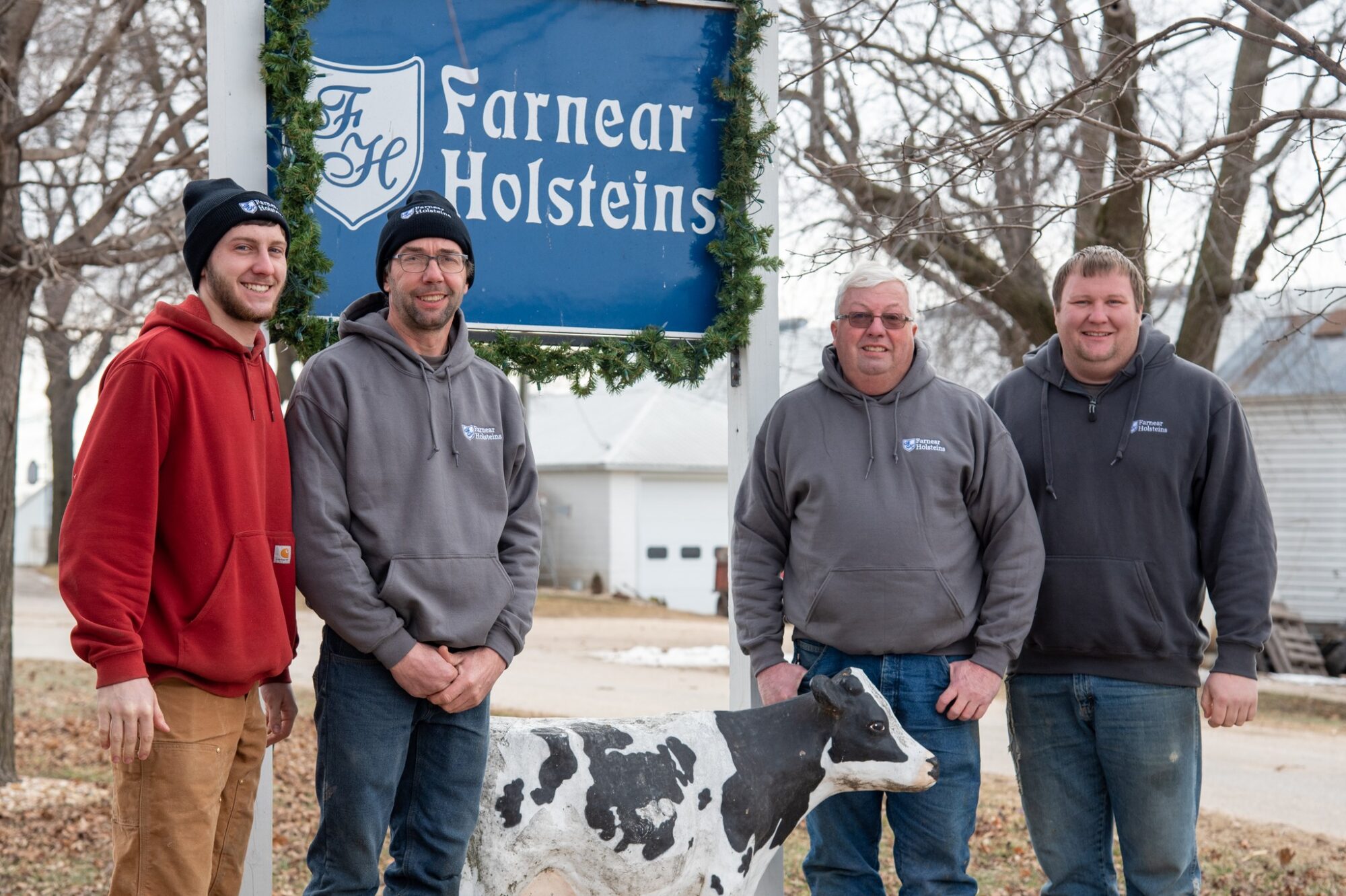
NewsSubscribe
First
Last
Consent

August 2025 Proofs: New Kings, Big Swings, and What It Means for Your Herd

Bulls losing 102 points overnight while proven sires gain $2,400/cow advantage? August’s genomic chaos changes everything we know.

EXECUTIVE SUMMARY

The August 2025 genetic evaluations reveal a critical shift in the dairy industry, as the proven reliability of daughter-backed sires increasingly outshines the volatile promise of their genomic counterparts. This trend is highlighted by major ranking changes, including Stantons Remover PP leaping to the #1 proven spot in Canada, while genomic bulls like Cookiecutter Hadley-ET experienced dramatic drops. The displacement of established sires like Genosource Captain in the UK further signals a rapid industry shift towards functional traits, such as health and efficiency. This dynamic underscores a move by breeders to prioritize real-world economic performance, exemplified by GENOSOURCE RETROSPECT-ET’s dominance in the US Net Merit rankings, leading to breeding strategies that now favor the stability of proven genetics.

KEY CHANGES

  • Stantons Remover PP: The biggest mover, leaping from #7 to become the new #1 proven sire in Canada (LPI) after his first daughters validated his genomic potential.
  • Cookiecutter Hadley-ET: A prime example of genomic volatility, going from #2 to #10 in the Italian genomic rankings in a single evaluation cycle.
  • OCD Trooper Sheepster: Emerged as the new #1 daughter-proven sire in the UK (£PLI), showcasing a desirable combination of production and a high lifespan improvement.
  • GENOSOURCE RETROSPECT-ET: The new leader for Net Merit ($NM) in the US, headlining Genosource’s complete domination of the economic-focused index.
  • Genosource Captain: A significant change, this former industry-leading sire dropped to fifth place in the UK and 3rd place in the US, highlighting the rapid genetic progress and shifting priorities towards health and efficiency traits.
  • Evenstar & Pennywise: A pair of “twin” sires who became the new #1 genomic leaders in Germany ($RZG), both achieving an elite score of 164.
  • Peak Spellbound-ET: Surged to become the new #1 genomic sire in Italy ($gPFT), noted for his exceptional component percentages that appeal to the cheese market.

The August 2025 genetic evaluations have delivered the most dramatic ranking reshuffles we’ve seen in years, with proven sire Stantons Remover PP leaping from #7 to #1 in Canada, while Italian genomics swung by 100+ points in single evaluations. The real story? Proven reliability is increasingly outperforming genomic promises as economic pressures force progressive breeders to prioritize profitable genetics over flashy TPI numbers.

Look, I’ve been watching genetic evaluations for over two decades, and what just dropped in August 2025 has me scratching my head in the best possible way. We’re seeing ranking shifts that would’ve been unthinkable just a few years ago—and the implications for your breeding program are massive.

The thing that’s really got my attention isn’t just the new leaders (though they’re impressive), it’s this growing tension between what genomics promise and what proven bulls actually deliver. And frankly, some of the volatility we’re seeing should prompt every breeder to pause before they become too aggressive with unproven genetics.

The Great Genomic Reality Check—And Why It Matters to Your Bottom Line

Here’s what’s happening across the major Holstein markets, and it’s telling a story that every progressive breeder needs to understand. We’re looking at the United States, Canada, the UK, Germany, and Italy—basically the genetic powerhouses that drive most of our industry decisions.

The pattern that’s emerging? Genomic predictions are becoming increasingly volatile, while proven bulls are demonstrating the kind of consistency that actually pays the bills. Take what just happened in Italy—Cookiecutter Hadley-ET dropped from #2 to #10 genomic, losing 102 points in one evaluation cycle. That’s not a small adjustment; that’s a complete reversal of fortune.

Meanwhile, proven sire ZFZ Crisalis RF gained 29 points, strengthening his position as #1. The guy has thousands of daughters, actually milking in real barns, dealing with real feed costs and real heat stress. There’s something to be said for that kind of validation.

What really drives this home is the German comparison. Their genomic leaders, Evenstar and Pennywise, both reached RZG 164—that’s a 17-point advantage over proven leader Zivet, who reached RZG 147. Now, if you’re doing the math on lifetime profit, that gap represents serious money… if the predictions hold true.

Marco Winters from AHDB put it perfectly when he looked at the UK situation: “The six new graduates in the top 10 already have around 7,000 heifers registered in UK milk-recorded herds, with some now milking. Their proven £PLI values deviate by just one point on average from their earlier genomic predictions.”

That’s the kind of validation that makes you feel good about using genomics early. But here’s the thing—not every market is showing that kind of accuracy.

North America: Where Economic Reality Meets Genetic Hype

The United States: Genosource’s Economic Domination

What’s fascinating about the US August proofs is how they reveal a fundamental shift toward economic reality. Sure, BEYOND HI-LEVEL-ET claimed the #1 genomic spot at +3539 TPI, but honestly, that’s not the story that’s going to matter to your milk check.

The real story is how Genosource has completely taken over the Net Merit rankings. I mean completely. GENOSOURCE RETROSPECT-ET leads at +1317 NM$, followed by his stable mates GENOSOURCE ENDURANCE-ET (+1233NM) and GENOSOURCE PURDY-ET (+1222 NM$).

This isn’t a coincidence—this is systematic breeding for traits that actually make money rather than chasing TPI points that look good on paper but don’t always translate to profitability. And with feed costs where they are in 2025, that focus on economic merit is becoming non-negotiable.

In the proven ranks, SDG CAP GARZA-ET is leading at +3488 TPI with 98% reliability. What I like about Garza is his balance—+146 lbs fat, +53 lbs protein, and +3.7 PL. Those are the kind of numbers that keep operations profitable when everything else goes sideways.

Canada: The Remover Revolution (And What It Really Means)

Now this is where August got really interesting. Stantons Remover PP made this spectacular jump from #7 in April to #1 in August (+3897 LPI). That’s not just a statistical blip—this bull’s backed by 234 daughters across 32 herds, which means we’re looking at real-world validation of genomic predictions.

What strikes me about Remover is his profile. He’s not just high-scoring, he’s balanced in exactly the ways that Canadian producers need as replacement costs keep climbing. The durability traits are there, the production is solid, and crucially, he’s proving himself in diverse management systems across the country.

The genomic young sire category is where things get really exciting, though. OCD Milan-ET leads at +4118 GPA LPI, and his numbers tell a story: +638 Milk, +108 Fat, plus strong type (+10 Mammary System, +6 Feet & Legs). This combination of production and structural soundness is exactly what the Canadian industry has been selecting for—cattle that can handle our diverse climate and management challenges.

European Markets: The Functional Excellence Revolution

United Kingdom: When Genomic Predictions Actually Work

The UK market gave us probably the strongest validation of genomic accuracy we’ve seen recently. Six new daughter-proven sires graduated into the top 10 PLI positions, and here’s the kicker—their proven values are matching their genomic predictions almost perfectly.

OCD Trooper Sheepster emerged as the new proven leader at £779 PLI. His production numbers are impressive (47.8kg fat, 35.7kg protein), but what really catches my attention is the +113-day lifespan improvement. With replacement costs exceeding £ 2,000 per animal, longevity traits like these are becoming the difference between profit and loss.

The genomic leader, Peak AltaValuepack, at £877 PLI, shows even stronger longevity (+122 days) while maintaining solid production (+785kg milk). This represents what I think is the modern ideal—comprehensive genetic merit that addresses both production and durability.

What’s particularly noteworthy is how Genosource Captain dropped to fifth place (£723 PLI) despite having over 2,000 UK milking daughters. This displacement illustrates how rapidly genetic progress can transform breeding hierarchies when functional traits take precedence over other traits. The Captain has been a reliable choice for years, but the industry’s moving toward health, fertility, and efficiency traits faster than many expected.

Germany: Precision Breeding at Its Finest

German evaluations consistently demonstrate why their breeding program is considered world-class. Proven leader Zivet commands RZG 147 through this impressive balance: +1,971 kg milk, +88 kg fat, +86 kg protein, combined with functional traits (RZN 121, RZGes 113) that actually work in commercial settings.

The genomic sphere produced these twin leaders in Evenstar and Pennywise, both at RZG 164. Evenstar’s projections (+2,090 kg milk, +120 kg fat, +69 kg protein, RZN 134) position him as a premium choice for operations serious about maximizing both production and longevity.

What’s interesting is how Red Holstein genetics keep showing up in top rankings. Ginger leads proven sires at RZG 143 with +2,638 kg milk through 510 daughters. In genomics, Schach achieved RZG 161. This demonstrates continued genetic progress in color variants—something that’s becoming increasingly important as producers seek ways to differentiate their cattle.

Italy: The Volatility That Should Worry Everyone

The Italian evaluations provided the starkest illustration of genomic volatility I’ve seen. Peak Spellbound-ET surged to #1 genomic position at 5458 gPFT—he’s an Overdrive son showing impressive components (+1.07% fat, +0.54% protein) that appeal to Italy’s cheese-focused industry.

But here’s what should concern every breeder: the dramatic swings in genomic rankings. Bulls gaining or losing 100 points or more in a single evaluation raise serious questions about reliability. This underscores why the Italian proven bull rankings, where ZFZ Crisalis RF maintains steady leadership at 5169 gPFT, provide such important stability.

The Italian ICS-PR€ index tells another story entirely. Smartie P-ET leads with 1398 ICS-PR€, demonstrating the economic reality that in value-added dairy systems, components matter more than volume. This is particularly relevant as more operations explore premium markets.

The Trends That Are Reshaping Everything

Health and Longevity: No Longer Optional

What’s becoming increasingly clear across all markets is that health and longevity traits are no longer nice-to-have features—they’re essential for profitability. PROGENESIS WATCHMAN’s elite 8.6 Health Index represents the kind of defensive genetics that operations need against rising veterinary costs.

The UK’s emphasis on HealthyCow values and Germany’s focus on RZGes scores reflect an industry-wide recognition that profitable cows must first be healthy cows. This isn’t just about animal welfare (though that matters), it’s about economic survival in an environment where every sick cow threatens your bottom line.

Component Production: The New Economic Reality

The shift toward fat and protein production rather than volume alone is evident everywhere you look. German proven sire Ginger’s +2,638 kg milk production demonstrates that volume still matters, but bulls like Peak Spellbound-ET, with +1.07% fat, are capturing attention in component-focused markets.

This trend makes sense when considering where milk prices are headed. Component premiums are becoming more significant, and operations that can deliver high-quality fat and protein are seeing better returns than those focused purely on volume.

Polled Integration: Finally Happening Seamlessly

Polled genetics are showing up in top rankings without the performance compromises we used to see. Germany’s Create P achieving RZG 161 and Canada’s Vogue A2P2-PP maintaining +15 CONF demonstrate successful integration of polled traits into elite genetic packages.

This matters because consumer pressure around dehorning isn’t going away, and having polled options that don’t sacrifice performance removes a major management headache.

The Bloodline Concentration Problem

Here’s something that should concern everyone: the dominance of specific sire lines across multiple countries. Overdrive sons appear in top rankings across markets, while Genosource genetics dominate US economic merit rankings.

This concentration delivers short-term genetic progress, but it’s creating long-term risks to breed adaptability. We’ve seen this movie before with other breeds, and it doesn’t end well if we’re not careful about maintaining genetic diversity.

Economic Pressures Driving Everything

Feed Efficiency: The Make-or-Break Trait

With feed costs still elevated in 2025, bulls showing superior feed conversion are becoming premium choices. The UK’s emphasis on Maintenance Index scores and Italy’s ICS-PR€ rankings reflect an industry that can no longer afford inefficient genetics.

Genosource Captain’s Feed Advantage, with a +255, exemplifies why these traits matter so much. When margins are this tight, feed efficiency often determines profitability more than raw production numbers. This is basic math that every operation needs to understand.

Replacement Costs: Why Longevity Pays

Rising replacement heifer costs are elevating longevity traits to critical importance. OCD Trooper Sheepster’s +113 days lifespan improvement and Peak AltaValuepack’s +122 days longevity represent real economic value when replacements cost $2,000+ per animal.

The math here is straightforward—every additional lactation from a cow represents thousands of dollars in value. Operations that ignore longevity traits in favor of short-term production are essentially choosing to hemorrhage money on replacement costs.

What This Means for Your Breeding Strategy

The Portfolio Approach (Because Balance Matters)

The volatility we’re seeing suggests genetic diversification rather than relying on a single bloodline. Successful operations are adopting portfolio approaches—combining proven reliability with selective use of high-potential genomics. My recommendation? Build genetic portfolios with 60-70% proven sires and 30-40% genomic young sires, adjusting based on your risk tolerance and genetic progress objectives. This captures advancement while maintaining reliability.

Market-Specific Selection (One Size Doesn’t Fit All)

Each market’s payment systems and management conditions require tailored strategies. Italian producers focused on cheese production, with weight component percentages, differently than Canadian operations that sell fluid milk.

UK producers must balance production with stringent health and welfare requirements.

This means you can’t just follow rankings blindly—you need to understand what traits actually drive profitability in your specific market situation.

Timing Genomic Adoption (When to Jump, When to Wait)

The UK’s validation of genomic predictions through proven daughters provides confidence for early adoption of superior young sires. However, the Italian experience suggests that extensive use of unproven genetics carries a substantial risk.

Successful breeders are adopting measured approaches—using genomic bulls selectively while maintaining core breeding programs on proven genetics. It’s about being progressive without being reckless.

Looking Forward: The Real Strategic Imperatives

What the August 2025 evaluations really reveal is that the industry is striking a balance between the promise of genomics and economic reality. The winners aren’t chasing the highest TPI or PLI scores—they’re building profitable, sustainable herds adapted to their specific conditions.

Success belongs to breeders who strategically combine proven genetics as their foundation with selective genomic advancement. The future isn’t about choosing between proven and genomic selection—it’s about leveraging both approaches to create cattle that thrive in an increasingly challenging environment.

The real winners are already emerging, and they’re not just showing up in rankings. They’re showing up in milk checks and bottom lines of operations that have learned to balance genetic potential with economic reality. Because at the end of the day, that’s what actually matters in this business.

Read complete breakdowns for each country here:

The Sunday Read Dairy Professionals Don’t Skip.

Every week, thousands of producers, breeders, and industry insiders open Bullvine Weekly for genetics insights, market shifts, and profit strategies they won’t find anywhere else. One email. Five minutes. Smarter decisions all week.

NewsSubscribe
First
Last
Consent

Germany’s August 2025 Holstein Rankings Reveal New Genetic Kings

German sire just hit RZG 148 – that’s $2,400 more lifetime profit per cow than industry average bulls.

EXECUTIVE SUMMARY: Just spent the morning analyzing Germany’s August 2025 Holstein evaluations, and the results are frankly stunning. The pace of genomic progress is relentless—we’re seeing genomic bulls like Evenstar and Pennywise hitting an incredible RZG 164, while the top daughter-proven bull, Zivet, commands the proven rankings at an already elite RZG 147. For breeders, that 17-point RZG gap between the proven king and the new genomic leaders can translate to thousands of dollars in lifetime profit per cow. The standout in the proven list is Zivet at RZG 147, delivering over +1,900 kg of milk with phenomenal components. In the Red Holstein world, Ginger leads the proven sires at RZG 143 with a staggering +2,638 kg milk proof. But the real story is genomics: sires like Schach (RZG 161) and Evenstar (RZG 164) are pushing production and functional traits to new heights simultaneously. Germany’s focus on polled genetics is also paying off, with bulls like Create P offering elite merit without horns.

Holstein genetics, genomic testing, dairy profitability, herd improvement, German bull proofs

The German Holstein breeding landscape continues to demonstrate remarkable genetic advancement, with the August 2025 evaluations revealing exceptional bulls across both proven and genomic categories.

Daughter-Proven Excellence

The daughter-proven category is dominated by Zivet, who commands the rankings with an RZG of 147. This exceptional bull demonstrates remarkable balance, with production figures of +1,971 kg milk, +88 kg fat, and +86 kg protein. His functional trait profile is equally impressive, featuring a longevity score (RZN) of 121 and an overall health score (RZGes) of 113. With 422 daughters proven across 184 herds, Zivet‘s genetic merit is built on substantial reliability.

Following closely, Mirco maintains his position as a top-performing professional with an RZG of 144. His production profile shows +1,363 kg of milk, +65 kg of fat, and +59 kg of protein, combined with strong functional traits, including an RZN of 122 and excellent udder health scores.

Genomic Innovation

In the genomic sphere, Evenstar leads with an outstanding RZG of 164. This Real Syn son exhibits exceptional genetic potential, with projections of +2,090 kg of milk, +120 kg of fat, and +69 kg of protein. His balanced profile includes strong functional traits with an RZN of 134 and an RZGes of 109, positioning him as a premier choice for progressive breeding programs.

Matching the top spot is Pennywise, another genomic standout with an RZG of 164. This Picard son shows remarkable production potential (+1,761 kg milk, +124 kg fat, +76 kg protein) while maintaining an excellent balance of functional traits.

Red Holstein Distinction

The Red Holstein proven category showcases Ginger at the pinnacle with an RZG of 143. Proven through 510 daughters, this Gywer RDC son delivers a staggering +2,638 kg of milk, +85 kg of fat, and +90 kg of protein. His exceptional production is complemented by solid functional traits, including a longevity score (RZN) of 115.

Ghost Red emerges as another proven leader with an RZG of 139. His proof includes +1,904 kg of milk, but with a negative fat deviation, alongside a positive protein contribution, demonstrating the genetic diversity available within elite Red Holsteins.

Leading the genomic Red Holstein evaluation, Schach achieves an impressive RZG of 161. This Skat P RDC son represents the cutting edge of genomic selection, with production estimates of +1,910 kg milk, +98 kg fat, and +63 kg protein and a strong longevity potential (RZN 137).

Create P and Coco Red P both achieve an RZG of 161, demonstrating the depth of excellence in the Red Holstein population. Create P projects +1,291 kg milk, +65 kg fat, and +66 kg protein, while Coco Red P delivers +2,006 kg milk, +67 kg fat, and +80 kg protein.

Key Genetic Trends and Market Implications

The August 2025 evaluations highlight several key trends shaping the modern dairy industry. The emergence of genomic bulls like Evenstar and Pennywise with RZG values of 164 indicates that selection programs are successfully pushing the boundaries of genetic potential.

This genetic gain is directly translated to the milk tank. Production capabilities have reached new heights, with sires like the proven bull Ginger (+2,638 kg) and the genomic leader Evenstar (+2,090 kg) setting new benchmarks for milk yield while maintaining functional trait balance. This addresses the core need for profitable and productive cows.

Furthermore, these rankings reflect a clear response to market demands. In component-driven payment systems, the exceptional fat yields of bulls like Pennywise (+124 kg fat) are incredibly valuable. Simultaneously, the strong representation of polled genetics among top performers, such as Create P, offers producers a market-friendly solution to eliminate dehorning without sacrificing elite genetic merit.

Troubling Realities Beneath Dairy’s Strong Q2 Headlines

Milk yield up 2.5%—and it isn’t about more cows, it’s about tweaking feed and using genomic testing smarter. Are you doing it yet?

EXECUTIVE SUMMARY: You want the honest scoop? Just milking more cows won’t grow your margin this year—not with input prices and weather all over the place. If you’re not running genomic tests to pinpoint your most efficient cows, you’re likely leaving 2–3% of your milk yield (and all the bonus pay) on the table. Feed is chewing up 40%–60% of costs, but there’s tech out there now that trims feed waste by up to 10%—think $18–$20 more per hundredweight in your pocket, not the feed truck’s. Global shifts and tariff madness mean margins are razor thin; that’s why top dairies from California to Wisconsin are doubling down on real-time data and chasing every extra percent. The economics, the University extensions, even the USDA—they all show it’s not size, it’s efficiency and timing. If you’re not already using genomic insights and smart feeding tools, what are you waiting for? This is the difference between just staying in the game… and actually winning it.

KEY TAKEAWAYS

  • Genomic testing can boost herd milk yield by 2–3% and cut cull rates—get baseline samples pulled now and select for proven high-efficiency genetics this fall.
  • Tighten up feed efficiency right away: install (or start using!) feed management software to track intake and waste—can save 8–10% on feed, plus smoother operation under the 2025 cost squeeze.
  • Stay ahead of somatic cell and mastitis headaches: work with your vet on genomic testing for health traits, plus get proactive on SCC—lower counts mean real price bonuses, not just compliance.
  • Don’t let the market swings whiplash your bottom line—hedge both feed and milk with futures/options; tap your co-op or university extension for the latest strategies fit for the 2025 volatility.
  • Push for cross-breeding or new genomic evaluations if your herd’s hitting a wall—blending top traits could be the key to kicking up productivity and resilience in this unpredictable climate.
 dairy profitability, farm efficiency, genomic testing, HPAI H5N1, FMMO rules, robotic milking

The dairy industry stands at a paradox in 2025: while headlines report solid Q2 growth and rising global prices, the reality for producers is far more complex and precarious.

UK Milk Production – Growth with Caveats

The latest Q2 report from the Agriculture and Horticulture Board shows UK milk deliveries surged 6.5% year-over-year. The full-year production forecast anticipates a 3% rise to 12.83 billion litres, bolstered by favorable weather and feed efficiency, despite slight butterfat declines (AHDB, 2025).

 Bar chart comparing key UK and global dairy production and price metrics for 2024 and mid-2025.

Global Trends and Price Volatility

Internationally, milk production grew about 0.7% through June 2025, while the IFCN Milk Price Index dropped 2.5% in June, indicating cautious buyer behavior. The FAO Dairy Price Index held steady at 154.4 points, reflecting tight supplies balanced by variable demand (IFCN, 2025; FAO, 2025).

U.S. dairy exports, 2024. See how much goes to Mexico, Canada, and China.

Navigating New Trade Hurdles

Trade policy reshapes market dynamics. China’s tariffs on U.S. dairy products reached up to 125% on select commodities, varying by product and timing. Tariffs imposed on exports to Canada and Mexico—valued at over $3 billion in 2024—also restrict access, squeezing prices and inflating inventories.

HPAI H5N1: A New Threat to Herd Health

HPAI’s impact—number of herds and compensation paid by state.

The USDA Animal and Plant Health Inspection Service (APHIS) states that, as of June 2025, about 237 U.S. dairy herds across 13 states have tested positive for HPAI H5N1, including six herds in California. The California Department of Food and Agriculture confirms infections but has not released herd-level details. Compensation programs are active, though figures evolve with the outbreak status (USDA APHIS, 2025; CDFA, 2025).

California’s concentration of HPAI cases compounds regulatory and market pressures, making the state one of the hardest hit as the situation evolves for herds and producers.

Adapting to New FMMO Rules

The USDA introduced revised make allowances under Federal Milk Marketing Orders effective June 2025, raising processing costs and reducing producer payments by up to 90 cents per hundredweight in regions with substantial Class III/IV milk production. USDA’s July WASDE forecast signals continued price volatility and overall lowered expectations, with California and Midwest producers shouldering significant impacts (USDA AMS, 2024; USDA WASDE, 2025).

Innovations in Technology – Opportunity amidst Challenge

Technology investment grows as producers face labor and production challenges. The global robotic milking market is expected to grow from $3.2 billion in 2024 to $6.0 billion by 2029, a trend driven by labor shortages and efficiency objectives. Technologies like automated feeding and health monitoring offer tangible operational benefits despite substantial upfront costs and 5-to-7-year ROI commitments (MarketsandMarkets, 2025).

Projected global robotic milking market growth from 2024 to 2029 (in billion USD).Strategic Steps Forward – Managing Volatility and Embracing Innovation

To translate insight into action, producers are urged to:

  • Maximize risk management by enrolling in Dairy Margin Coverage (DMC) at the highest coverage level.
  • Actively use futures and options to hedge feed and milk costs, buffering against price swings.
  • Prioritize investments in proven technologies—such as robotics and precision feeding systems—with clear ROI and management plans.
  • Diversify market channels to avoid over-exposure to politically fraught export markets.

The Bottom Line

This moment is more than a market challenge—it’s a pivotal industry shift. Producers who harness data and innovation decisively won’t merely endure—they’ll lead dairy’s future. The question isn’t whether you’ll survive—the question is whether you’ll shape what comes next.

Complete references and supporting documentation are available upon request by contacting the editorial team at editor@thebullvine.com.

Learn More:

  • Profit and Planning: 5 Key Trends Shaping Dairy Farms in 2025 – This strategic piece provides a broader view of market shifts, including overcapacity in processing and debt-to-asset ratios. It demonstrates how to align your business to capitalize on these long-term trends and build financial resilience against future shocks.
  • The Digital Dairy Revolution: How IoT and Analytics Are Transforming Farms in 2025 – Get tactical with this article on integrating modern tech. It shows how real-time data from IoT sensors and analytics can improve efficiency, cut costs, and enable proactive herd management, helping you transition beyond traditional farming methods for a competitive advantage.
  • 5 Technologies That Will Make or Break Your Dairy Farm in 2025 – This innovative article showcases emerging solutions. It reveals how technologies like whole-life monitoring and advanced genetic evaluation are creating new revenue streams and dramatically increasing labor efficiency, providing a forward-looking roadmap for your farm’s future.

The Sunday Read Dairy Professionals Don’t Skip.

Every week, thousands of producers, breeders, and industry insiders open Bullvine Weekly for genetics insights, market shifts, and profit strategies they won’t find anywhere else. One email. Five minutes. Smarter decisions all week.

NewsSubscribe
First
Last
Consent

Pakistan’s Dairy Revolution: Why This “Sleeping Giant” Should Keep You Up at Night

Pakistan’s hitting 470 gBPI scores while we’re stuck at 267. Time to rethink what’s possible with genomic testing.

EXECUTIVE SUMMARY: Okay, here’s what’s got me fired up about Pakistan’s dairy scene. They’re producing 63 million tonnes annually with herds hitting genomic scores that embarrass some of our best operations. We’re talking 470 gBPI when top 1% globally barely cracks 267. Their corporate farms are deploying the same elite genetics we use, but with $0.15/lb lower feed costs and 30% better heat stress management. One operation went from crossbred mediocrity to world-class daughters in just three years using Australian genomics and Zoetis testing. With export markets exploding and their 55% productivity gap closing fast, this isn’t just an overseas story anymore. If you’re not watching what Pakistan’s doing with TMR optimization and reproductive tech, you’re missing the next wave of dairy efficiency.

KEY TAKEAWAYS:

  • Boost genetic progress 2.5x faster with genomic testing like Pakistan’s elite farms—talk to your breeding consultant about implementing daughter evaluations this fall before breeding season
  • Save $0.15 per pound on feed costs through precision TMR formulations and heat-adapted rations—work with your nutritionist to optimize for 2025’s volatile ingredient markets
  • Cut reproductive failures by 20% using advanced heat detection tech that’s solving Pakistan’s “silent heat” problems—especially critical as summer heat stress increases
  • Slash milk spoilage losses 15-20% with cooperative chilling stations like Pakistan’s World Bank program—explore shared cooling infrastructure with neighboring farms
  • Tap export premium markets worth billions through halal certification and international partnerships—diversify your income streams while global dairy demand surges
dairy farming, genomic testing, global dairy competition, milk production efficiency, dairy technology adoption

You know those moments at a conference when someone drops information that completely shifts your perspective? Had one of those recently while chatting over coffee with a geneticist who’d just returned from Pakistan. What he told me about what’s happening there… well, it’s got me thinking we all need to pay closer attention.

Here’s the thing most of us don’t fully grasp about Pakistan: they’re not just another developing market dabbling in dairy. We’re talking about the world’s fifth-largest population — over 255 million people — and a dairy sector that’s exploding. Their livestock sector now includes 57.5 million cattle plus 46.3 million buffalo, creating one of the world’s largest dairy herds.

Milk production of top 5 countries in 2022 showing Pakistan’s rank

Think about that for a second. That’s more dairy animals than our entire North American inventory, and they’re producing around 64.3 million tons of milk annually, according to FAO’s latest data. That puts them third globally — behind India and the US, ahead of China and Brazil.

However, here’s where it gets interesting —and perhaps a little concerning for those of us considering long-term competition.

The Tale of Two Completely Different Dairy Worlds

What strikes me about Pakistan’s setup is how it’s basically two industries running side by side. You’ve got this massive traditional sector — we’re talking 80% of production coming from smallholder farms with just 2-5 animals each. Picture motorcycles weaving through traffic, loaded with twin milk cans, delivering fresh milk directly to consumers. That’s the reality for most of their supply chain.

Then there’s this other world emerging… and it’s impressive. Around 80 corporate mega-dairies ranging from 1,000 to 6,000 cows, with facilities that — I’m not exaggerating here — would make some of our operations take notice.

Take Interloop Dairies, recognized as Pakistan’s largest corporate dairy farm. They’re running over 10,000 Holstein Friesians with advanced milking parlors from GEA, producing export-quality mozzarella using Individual Quick Freezing technology. That’s not your typical developing market operation.

What’s fascinating is their cost structure. Abundant high-quality groundwater in Punjab province (think about that in our water-stressed environment), cheap labor, and the ability to grow corn and forages on incredibly fertile soils. Research shows that their commercial farms average 844 liters per cow daily for water usage during the summer — that’s a lot of water, but it’s available.

That combination should get anyone’s attention.

The Indigenous Foundation: Asset and Challenge

Here’s where breeding gets interesting. Pakistan’s traditional foundation is built on indigenous breeds that are perfectly adapted to local conditions, yet possess unique characteristics.

The Nili-Ravi buffalo dominates smallholder farms, and get this — recent research shows they’re producing milk with around 6.8% fat content. These animals are tough as nails — they have to be in that climate — but their genetic ceiling creates interesting dynamics. Then you have heat-tolerant Zebu cattle, such as the Sahiwal and Red Sindhi, which have evolved specifically for those conditions.

However, here’s the breeding challenge that most people don’t realize: those Nili-Ravi buffalo are prone to “silent heats,” making heat detection a significant challenge for AI adoption. From a competitive standpoint, this creates a moat around the traditional sector. You can’t just gradually upgrade these operations with better genetics — the biology doesn’t work that way.

That’s exactly why the corporate farms are going all-in on imported Holstein genetics. It’s not just about higher yields; it’s about building systems where modern breeding tech actually functions.

The Genetics Revolution Nobody Saw Coming

This development fascinates me more than anything else… Pakistan has quietly become a major destination for the same elite genetics driving productivity from Wisconsin to New Zealand.

The story that really captures what’s happening: a Pakistani veterinarian got stranded in Australia during COVID. Instead of sitting around, he worked on several high-tech Australian dairy farms and saw firsthand what elite genetics could do. When he returned home, he and two colleagues set up a dairy operation using imported, genomically tested Australian heifers.

This is where it gets impressive. HRM Dairies now genotypes all heifers with Zoetis and has produced daughters of Carenda Pilbara ranging between 348 and 470 gBPI. For context, the top 1% in Australia has an average wealth of over 267 gBPI. These aren’t just good numbers for Pakistan — these are elite numbers by any standard.

The Pakistani government has committed Rs40 billion toward genetic improvement programs. That’s transformational money.

Here’s what this means for competitive positioning: Research on 600 dairy farms in Punjab shows genomic selection could close a 55% productivity gap that currently exists. If they achieve even half those gains across their massive animal base…

Think about the implications… If a major milk-producing region can accelerate genetic progress by that magnitude, how does it change global market dynamics within a decade?

Corporate Farms That Would Impress Anyone

I’ll be honest — some of these operations are more sophisticated than farms I’ve visited in established dairy regions.

Dairyland was established with imported Australian Holstein heifers and now operates a complete “grass-to-glass” vertical integration, featuring hormone-free production and rigorous microbiological testing.

FrieslandCampina Engro’s Nara Dairy Farm spans 220 acres, housing over 6,000 animals that adhere to international health and safety standards. They’ve been pioneering corporate dairy farming since 2006, with flagship brands like Olper’s and Tarang as household names.

Everfresh Farms focuses on exceptionally high-quality fresh milk, consistently achieving low Total Plate Counts — a critical measure of milk hygiene. They’re using sophisticated milking parlors from GEA WESTFALIA Surge.

What caught my attention is the technology adoption. These aren’t scaled-up traditional operations — they’re deploying automated milking systems, climate-controlled barns with misting (essential at 50°C), TMR wagons for scientifically balanced feeding, and substantial solar installations.

What strikes me about these operations is how they’re integrating sustainability from day one. Water conservation, renewable energy, waste-to-biogas systems — they’re building climate-smart dairying into their DNA rather than retrofitting later.

The Infrastructure Reality That’s Finally Changing

Let’s talk about the elephant in the room — the cold chain that’s finally being built.

Anyone dealing with milk in extreme heat knows temperature control isn’t optional. In Pakistan’s climate, where summer temps hit 50°C (122°F), loose milk without refrigeration… well, you can imagine.

The numbers: Historically, 15-20% of milk wastage occurs due to spoilage before reaching consumers. For context, that’s equivalent to discarding the entire annual production of a mid-sized US state.

What’s interesting, though, is how targeted interventions prove this isn’t insurmountable. The World Bank’s Sindh Agriculture Growth Project provided milk chillers to producer groups, yielding immediate results: reduced waste, increased farmer incomes, and improved quality control.

Corporate farms are deploying full cold chain infrastructure alongside their advanced systems. They’re building modern dairy infrastructure from scratch, without the legacy constraints that many of us face.

For producers watching from afar: These infrastructure investments create templates that work in challenging climates. Some cooling and logistics solutions being developed could apply to southern US operations dealing with increasing heat stress.

The Productivity Gap That’s Actually an Opportunity

Here’s where numbers get really interesting. Recent research on 600 dairy farms in Punjab indicates that the average farm has a 55% yield improvement potential. By closing that gap, average operations could increase yearly fat-corrected milk production by 120,036 kg and the non-milking herd for meat by 25 head.

What strikes me is that we’re not talking about theoretical improvements. These are achievable gains based on existing technology and management practices that have already been demonstrated on corporate farms.

The study found that small farms (under 25 head) are actually more technically efficient than medium and large farms — suggesting room for improvement across all scales. Clear evidence shows that keeping higher shares of exotic cows versus local breeds, along with higher farm-gate milk prices, triggers significant efficiency gains.

That’s the productivity trajectory that could fundamentally alter global supply dynamics if it scales across their 30-million-head base.

The Export Opportunity That Changes Everything

Here’s where strategic implications become clear. Pakistan’s milk exports reached $5.47 million in 2023, primarily to Saudi Arabia ($2.78 million), the UAE ($1 million), and Somalia ($ 572,000). It might not sound like much, but industry analysts discuss export potential reaching billions.

The strategy involves utilizing buffalo milk for domestic consumption while targeting cow milk-based products for export, such as cheese, butter, and ghee. This leverages the growing base of high-yield Holstein and Jersey cows while maximizing value from different milk types.

China represents the primary target, with agreements already in place for companies like Fauji Foods Limited to begin exporting buffalo milk to China’s Royal Group. Given China’s dairy deficit and Pakistan’s geographic proximity, this could scale rapidly.

Middle East and North Africa markets offer additional opportunities, particularly for Halal-certified products, where Pakistan has natural competitive advantages.

What’s interesting from a competitive standpoint is the strategic focus on products. Rather than competing directly in commodity milk, they’re targeting value-added products where margins are higher and technical barriers create natural protection.

The Policy Wild Card Everyone’s Watching

Here’s where things get complicated… and why timing matters more than most realize.

Current policy includes an 18% sales tax on packaged milk, which has caused a 20% decline in formal sector volumes, effectively subsidizing the informal loose milk market while penalizing companies that invest in food safety and modern infrastructure.

But change is coming. The Pakistan Dairy Association proposed reducing that tax from 18% to 5%, projecting it could boost volumes by 20% and increase government revenue by 22% year-on-year. Government officials confirmed they’re reviewing this policy.

As Dr. Shehzad Amin from Pakistan Dairy Association put it: “No country taxes milk at 18% — the highest global rate is 9%. Safe milk is not a luxury, it’s a right.”

The competitive implications become clear when you consider that policy alignment could accelerate the timeline for Pakistani dairy reaching export competitiveness by several years.

Technology Adoption That’s Actually Impressive

What gets my attention is how quickly leading operations are adopting advanced technology.

Corporate farms aren’t just buying better cows — they’re deploying the full suite of modern dairy technology. Automated milking, climate-controlled housing, precision feeding, genomic testing, reproductive management software… the works.

HRM Dairies distinguished itself as the only farm in Pakistan currently conducting genomic testing. They’re not just importing genetics; they’re utilizing the same scientific selection tools that drive productivity on the most advanced farms globally.

Their genomic testing capability generates daughters that are performance-proven under Pakistani conditions. According to management, 97% of their herd achieved pregnancy last year, with low mortality and production averaging over 12,000 liters per cow. That’s world-class performance.

This trend suggests that we’re seeing “demonstration farms” — operations that prove elite genetics work under local conditions and serve as showcases for wider adoption.

Climate Innovation with Global Applications

Pakistan’s extreme climate forces innovations that could benefit dairy operations worldwide.

Research shows increasing cooling sessions to five times daily improved milk yield by 3.2 kg per day in Nili Ravi buffaloes. Studies indicate that a 1°C temperature increase reduces milk yields by 1.72 liters per month, while humidity increases further suppress yields.

These pressures drive the development of heat stress management systems with automated cooling cycles, feed adjustment protocols optimized for high-temperature periods, and water management systems designed for extreme conditions.

Technology adaptation opportunities are significant. Sprinkler cooling systems, climate-controlled housing designs, and feed formulation strategies developed for 50°C conditions could provide competitive advantages in other regions facing similar challenges — such as Texas, Arizona, or anywhere heat stress is becoming a bigger issue.

The Human Element That Makes It Real

Behind all these numbers and technology stories are people making it happen.

What resonates with me is how these operators think systemically about profitability, animal health, and long-term sustainability rather than just chasing production numbers.

The Pakistani veterinarian stranded in Australia perfectly captures how knowledge transfer happens in modern dairy. He didn’t just bring back genetics — he brought back an entire approach to dairy management that’s now influencing operations across Pakistan.

I was impressed by conversations with Muddassar Hassan from HRM Dairies, who played a key role in introducing Australian genetics to Pakistan. His background includes importing heifers from leading Australian breeders, seeing firsthand how these animals perform under local conditions.

“Profit isn’t just about milk production; it’s also about lower expenses. If your cow is producing 12,000 litres but gets mastitis twice and takes four services to get pregnant, you aren’t making much profit. But if she’s producing 8,000-9,000 litres while getting pregnant easily and staying healthy, she’s almost certainly more profitable,” he explained.

That’s practical wisdom that transcends geographic boundaries.

Regional Lessons for North American Producers

Several developments in Pakistan offer insights for producers dealing with similar challenges:

Heat stress management: Climate-controlled barn designs and cooling protocols developed for extreme conditions could benefit operations in southern US regions where summer temperatures are increasingly problematic.

Genomic acceleration: The Pakistani experience demonstrates how quickly genetic progress can be achieved when genomic testing combines with elite genetics and proper management — they’re compressing timelines that we thought would take decades.

Cooperative infrastructure: The Success of programs like the World Bank’s milk chiller project demonstrates how shared infrastructure enables smaller operations to access technology that would be uneconomical for them individually. Applications for producer cooperatives dealing with processing or cooling challenges.

Sustainability integration: Building renewable energy and resource conservation into operations from the ground up rather than retrofitting later. Their solar installations and water recycling systems are impressive.

What This Means for Global Markets (And Why You Should Care)

Implications here are bigger than most of us think. Pakistan isn’t just scaling up dairy production — it’s building an entirely different cost structure while deploying the same elite genetics that drive productivity in developed markets.

Consider the math: if these corporate operations achieve even moderate success in raising the productivity of that 30-million-head base while maintaining cost advantages, we’re potentially looking at fundamental shifts in global dairy competitiveness within the next decade.

Traditional bottlenecks — such as heat stress management, breeding efficiency, and feed quality — are being systematically addressed by operations with capital and technical sophistication, enabling the implementation of effective solutions.

And here’s the kicker: they’re doing it with labor cost structures and feed production capabilities most Western operations can’t match.

Looking Forward: What to Watch

The timeline for Pakistani dairy becoming a significant global competitor is compressing. Several factors suggest major impacts within 5-7 years:

Policy reforms that reduce tax barriers and improve regulatory consistency could accelerate the formalization of milk supply. That 18% to 5% tax reduction alone could be transformational.

Infrastructure investments in cold chain and processing capacity create the backbone for scaled operations. Once that cold chain is built, everything changes.

Genetic improvements are already yielding measurable results at leading farms and will continue to compound over time. Starting with a 55% productivity gap, there’s tremendous upside potential.

Export market development provides economic incentives for continued investment and modernization. Those Chinese contracts could be just the beginning.

The productivity improvement potential identified in recent research isn’t theoretical — it’s achievable with existing technology and management practices. If that scales across their massive animal base…

The question for North American producers isn’t whether Pakistan will become a significant dairy competitor, but when and how to position for that reality.

The Strategic Questions We Should Be Asking

This development raises fundamental questions about future global dairy competition:

Are we ready for this level of competition? When you combine scale, low costs, modern technology, and elite genetics, you get a formidable competitor.

What’s our competitive advantage moving forward? If they can deploy the same genetics and technology we use, what differentiates us?

How do we adapt our heat stress management? As climate change affects traditional dairy regions, innovations being developed for 50°C conditions could become essential.

What about our feed efficiency? Their necessity to optimize every production aspect might drive innovations we should watch.

The Bottom Line for Your Operation

So where does this leave us? Several practical takeaways:

Stay informed about global developments — what happens in Pakistan won’t stay in Pakistan. Global dairy markets are more interconnected than ever, and genetics companies, equipment manufacturers, and consultants are already active in this space.

Consider climate adaptation technologies — if heat stress is becoming a more significant issue for your operation, examine what’s being developed for extreme conditions. Some solutions might be applicable sooner than you think.

Don’t underestimate the power of genomics — the Pakistani experience shows how quickly genetic progress can accelerate with the right tools and commitment. Are you maximizing your genetic potential?

Think about your competitive advantages — what makes your operation unique in an increasingly competitive global market? Quality? Efficiency? Sustainability? Location advantages?

Watch policy developments — government decisions on taxes, trade, and regulations can dramatically shift competitive dynamics. Sometimes, policy changes matter more than technology.

The dairy industry has always been about adapting to change. The question is whether we’re adapting fast enough to stay competitive in a rapidly evolving global marketplace.

This sleeping giant is waking up fast. The combination of scale, modern technology, elite genetics, and cost advantages they’re building is unlike anything we’ve seen before in the dairy industry.

The Competitive Reality Check

Here’s what I keep coming back to: Pakistan represents a distinct model of dairy development that we haven’t seen before. Instead of gradually modernizing existing systems, they’re essentially building a parallel, modern industry alongside traditional operations.

If successful — and early indicators suggest they might be — this creates a producer with significant scale, low costs, and increasingly sophisticated genetics and management. That’s not a combination global dairy markets have had to contend with before.

For North American producers, this isn’t necessarily a crisis, but it’s definitely something to monitor. The same genetics companies we work with, the same technology providers, the same management consultants — they’re all active in Pakistan now. The knowledge and tools that give us a competitive advantage are no longer exclusive.

The question isn’t whether Pakistan’s dairy industry will continue to grow and modernize. Based on what I’m seeing, that trajectory is pretty well established. The question is how quickly they can scale their modern sector and what impact that has on global supply dynamics.

We might be looking at a new major player in global dairy markets within the next 5-10 years. Unlike some other emerging producers, they’re building on a foundation of modern technology and elite genetics from day one.

What are your thoughts? Are you seeing similar developments in other markets? How are you positioning your operation to compete in this global market?

Because one thing’s becoming clear: the global dairy industry is getting more competitive, not less. Producers who think strategically about these shifts — whether adapting climate technologies, maximizing genetic potential, or developing their own competitive advantages — will be the ones who thrive in the years ahead.

The real question isn’t whether Pakistan will become a major player in global dairy markets. Based on what I’m seeing, that trajectory is established. The question is: are we ready?

The bottom line? Pakistan’s combining our genetics with their innovation to create something we haven’t seen before. Time to steal their playbook.

Complete references and supporting documentation are available upon request by contacting the editorial team at editor@thebullvine.com.

Learn More:

The Sunday Read Dairy Professionals Don’t Skip.

Every week, thousands of producers, breeders, and industry insiders open Bullvine Weekly for genetics insights, market shifts, and profit strategies they won’t find anywhere else. One email. Five minutes. Smarter decisions all week.

NewsSubscribe
First
Last
Consent

When Your “Elite” Genetics Start Costing You Real Money

Think chasing top TPI is pure profit? Your pocketbook might be tanking from inbreeding you can’t see.

A sentiment echoing from industry leaders around the world is that the genetic diversity challenge is about to shift from crucial to absolutely critical. What we’re seeing with inbreeding today is just the tip of the iceberg — this is poised to become a major industry crisis if we don’t get ahead of it now.

You know what keeps coming back to me during all these dairy chats I’ve been having lately? It’s how much time we spend chasing the highest genomic indexes and fancy TPI numbers, but we hardly ever dig into what’s lurking beneath those shiny scores — the risk of losing genetic diversity and quietly bleeding cash without even realizing it.

Just last month, I was up in upstate New York, walking through a solid 2,500-cow operation. The owner was beaming, boasting about his herd’s average TPI, which had hit 2,800. Great numbers, right? But here’s the thing… behind those glittering stats, the genetic base looked dangerously narrow. That’s when our conversation flipped — from celebrating elite genetics to facing the looming threat of a shrinking gene pool.

And honestly? It got uncomfortable real quick.

The Math That Should Keep You Awake at Night

Let’s talk dollars and cents — those losses you actually feel in your wallet. Every 1% uptick in a cow’s inbreeding coefficient can cost you around $22 to $24 in lifetime profit. That’s not some theoretical number buried in research papers; that’s real money walking right out your barn door.

Economic impact of inbreeding depression showing cumulative losses per cow based on inbreeding coefficient levels

However, here’s the kicker that really makes me sit up: a 2023 Italian study suggested that the real damage might be 40% worse than previous estimates indicated. Put simply, where pedigree-based calculations said you’d lose 44 kg of milk per 1% inbreeding increase, genomic data showed a 61 kg drop. Ouch.

Comparison of milk production losses calculated using pedigree-based versus genomic-based inbreeding assessments

With milk prices hovering near $18.93 a hundredweight and labor costs pushing $18 an hour, those losses aren’t small potatoes. They add up fast, especially when you multiply them across your entire herd.

Have you actually calculated your operation’s inbreeding exposure? Most producers I know haven’t. And I get why — it’s not exactly the sexy topic your AI rep brings up during sire selection meetings.

Economic Impact of Inbreeding on Dairy Cattle Showing Milk Yield and Profit Loss over Inbreeding Level (1-15%)

When “Elite” Becomes the Problem, Nobody Wants to Talk About

The unspoken consensus among many industry geneticists is that our most powerful tool for genetic advancement has become a double-edged sword. While genomic selection has driven incredible progress, it has also accelerated inbreeding at an unprecedented pace, creating a genetic bottleneck that threatens the health and productivity of our dairy herds.

“Our most powerful tool for genetic advancement has become a double-edged sword.”

That’s the paradox that’s reshaping everything. The numbers back this up. According to Council on Dairy Cattle Breeding data, genetic concentration in North American AI programs reached concerning levels by 2017, when just a handful of elite sires were responsible for producing the majority of young bulls entering AI programs globally. When you multiply that concentration across millions of breeding decisions… well, you get the picture.

The genetic bottleneck becomes inevitable.

Trend showing increasing inbreeding levels in Holstein cattle from 2000-2025, comparing pedigree-based versus genomic-based measurements

Enter the “Elite Outcross” Revolution

So what’s the fix? This is where things get interesting…

Once, outcrossing had a bad reputation — people feared it would dilute their prized bloodlines. Random mating to genetically distant but inferior animals? Yeah, that would set any breeding program back.

But now? It’s precision science, leveraging genomic data to make calculated, surgical strikes, not wild gambles.

Here’s something that’s caught my attention lately — many industry insiders from companies like Select Sires and ABS are moving away from the term “outcrossing” altogether. They’re talking about “diversity” instead, and their reasoning makes a lot of sense. The real goal isn’t just finding one genetically distant bull — it’s about using many different genetic lines to build true resilience in your herd. A single outcross bull might still be mediocre quality, but when you focus on genetic variety across both sides of the pedigree, you’re building something much stronger.

Look at proven examples: CO-OP BOSSIDE MASSEY brought wide appeal, ZANI BOLTON MASCALES introduced European bloodlines to North America, and more recently, stars like 14HO15179 TROOPER and his son 7HO16276 SHEEPSTER proved you can blend unique maternal lines with high merit to create genuine value.

These bulls validate the strategy: outcrossing isn’t gambling when robust genomic data and clear breeding objectives back it.

What’s fascinating is how this shifts the entire conversation. Instead of just asking “What’s his TPI?” the smart money now asks “What’s his relationship to my herd?” and “How does his genetic background complement what I’ve got?”

How the Smart Money Is Playing This Game

AI companies have figured this out, and they’re adapting fast. They’re not just selling semen packages anymore — they’re selling sophisticated genetic risk management.

However, here’s the challenge they’re all facing: German AI professionals have observed that large commercial operations often prioritize top performance indexes over everything else, including diversity of pedigree. The market reality is that many large dairies will select the bull with the highest TPI, regardless of genetic relationships, which doesn’t exactly reward companies for maintaining diverse genetic portfolios.

That’s what makes the Canadian approach so interesting. Semex has deliberately maintained what they call genetically “free” female lines — unique cow families that aren’t heavily related to the mainstream population. This strategy ensures they can always bring something genuinely different to the market when diversity becomes critical. It’s a long-term vision that’s particularly relevant for us here in Ontario, where Semex’s home base provides them with a Canadian perspective on sustainable breeding.

Take ABS Global’s approach. Their Genetic Management System 2.0 utilizes genomic intelligence to guide mating choices, explicitly incorporating genomic inbreeding calculations to manage relationships with greater precision than pedigree-based methods have ever allowed.

Semex hands the keys to farmers through tools like SemexWorks and OptiMate, letting producers define their own economic parameters and build personalized selection indexes. It’s like giving you the GPS instead of just telling you where to go.

Select Sires? They’re mixing high-touch consulting with modern tech, offering programs like StrataGEN that manage inbreeding by rotating distinct, unrelated sire lines every 18 months. Simple but brilliant.

My advice? Don’t take the sales patter at face value. Ask hard questions about true genetic diversity in their outcross catalogs. Who’s really getting you diverse genetics, and who’s just selling shiny promises?

The Future: When AI Meets Genetics

Timeline showing the evolution of dairy cattle breeding methods from visual assessment to AI-optimized genetic management

Here’s where it gets really exciting… the future belongs to machine learning, crunching massive genomic databases and optimizing matings through algorithms like Optimal Contribution Selection (OCS).

Think of it as playing chess on a global board, where every move considers not just immediate genetic gain but long-term sustainability. OCS calculates the ideal genetic contribution from each potential parent to maximize progress while simultaneously constraining inbreeding to acceptable levels.

The companies mastering this intersection of artificial intelligence and artificial insemination? They’ll dominate the next chapter. It’s not just about who has the best bulls anymore — it’s about who has the sharpest algorithms.

Your Action Plan (Because Knowledge Without Action Is Just Expensive Education)

First things first: audit your genetic risk exposure. Most producers I work with have zero clear picture of their herds’ inbreeding levels or the relationships among their AI sires. Begin by conducting genomic testing on your breeding females to establish a baseline.

Second, evaluate your AI company’s diversity management capabilities honestly. Companies that utilize genomic inbreeding calculations, offer genuine outcross options, and provide sophisticated mating programs will deliver superior long-term results.

Third, develop a systematic approach to elite outcrossing. Consider this scenario: You have cow families tracing back to the same popular sire line as half of your herd. Instead of using another bull from that same genetic background, identify a high-merit outcross that brings fresh genetics while maintaining or improving economic performance.

That’s not gambling. That’s strategic breeding.

The Global Picture (Because Your Herd Doesn’t Exist in Isolation)

Here’s something that might surprise you: the Holstein breed is now effectively a single global population. Elite genetics flow freely across borders, and North American bloodlines dominate worldwide — sometimes representing over 90% of genetics in certain regions.

Italy is taking this challenge seriously at a policy level. They’ve updated their national genetic index — the PFT — to include a direct mathematical correction based on each bull’s Expected Future Inbreeding. Bulls that increase inbreeding are penalized in their official rankings, while those that bring genetic diversity receive a boost. It’s the first time I’ve seen a country incorporate inbreeding management into its national breeding policy.

Organizations such as the Council on Dairy Cattle Breeding and Interbull work behind the scenes to coordinate international genetic evaluations and ensure data integrity. Their systems help producers understand how genetics will perform under specific conditions while managing global genetic diversity.

Looking Ahead: The Technology Revolution Continues

Gene editing with CRISPR holds incredible promise for precise genetic tweaks — adding polled genetics to elite lines, boosting disease resistance, even modifying milk composition for better cheese yield — all without the linkage drag of traditional breeding.

Think of it as the ultimate “elite outcross.” It’s the surgical introduction of desired genetic diversity without any of the associated baggage.

But regulatory and ethical hurdles remain significant, and public perception will play a huge role in adoption.

The Bottom Line

Ignore genetic risk management at your peril — it quietly drains profits while you’re not looking.

“The most expensive cow isn’t the one that costs the most upfront; it’s the one that silently costs you money for years without you knowing it.”

Start by gauging your herd’s genetic risk, rethink sire selection strategies, and demand transparency from your AI partners. This isn’t just theory — it’s what will separate thriving operations from those scrambling to catch up a decade down the road.

What questions do you have about your herd’s genetic diversity strategy? Because honestly, this conversation is just getting started, and waiting only makes managing the risk more expensive.

Those who act now will be the winners when genetic diversity becomes the industry’s scarcest resource.

KEY TAKEAWAYS:

  • Save up to $24 per cow annually by managing inbreeding levels strategically. Start by genomic testing your breeding females to establish baseline inbreeding coefficients (FROH). Context: Essential with 2025’s margin squeeze from high feed and energy costs.
  • Recover potentially 61kg of lifetime milk production per cow by reducing genetic bottlenecks. Ask your AI rep specifically about “elite outcross” sires that bring diversity without sacrificing merit. Context: Part of the global shift toward sustainable genetic management happening right now.
  • Cut veterinary and replacement costs through better fertility and longevity outcomes. Push for mating strategies using Optimal Contribution Selection (OCS) that balance gain with genetic health. Context: Forward-thinking operations are already seeing results with these AI-driven tools in 2025.
  • Future-proof your operation against the genetic squeeze that’s tightening worldwide. Demand transparency from your genetics provider about actual relationships in their bull lineup — don’t just take TPI at face value. Context: Critical as global “holsteinization” continues consolidating the gene pool faster than ever.

EXECUTIVE SUMMARY:

Look, I just dug into some eye-opening research that’s got me pretty fired up. That relentless chase for sky-high genomic indexes? It’s quietly costing you $24 per cow for every 1% jump in inbreeding — and most of us have no clue it’s happening. Here’s the kicker: new Italian data shows we’ve been underestimating milk losses by 40% — we’re talking 61kg drops per percentage point, not the 44kg we thought. With feed costs still brutal and milk prices bouncing around in 2025, this isn’t pocket change anymore. The thing is, this genetic squeeze is happening globally as the same elite bloodlines get used everywhere through AI. But here’s what smart producers are already doing — they’re using genomic testing and something called “elite outcrossing” to keep their herds genetically strong without sacrificing performance. Trust me, you need to get ahead of this before it really bites your bottom line.

Complete references and supporting documentation are available upon request by contacting the editorial team at editor@thebullvine.com.

Learn More:

The Sunday Read Dairy Professionals Don’t Skip.

Every week, thousands of producers, breeders, and industry insiders open Bullvine Weekly for genetics insights, market shifts, and profit strategies they won’t find anywhere else. One email. Five minutes. Smarter decisions all week.
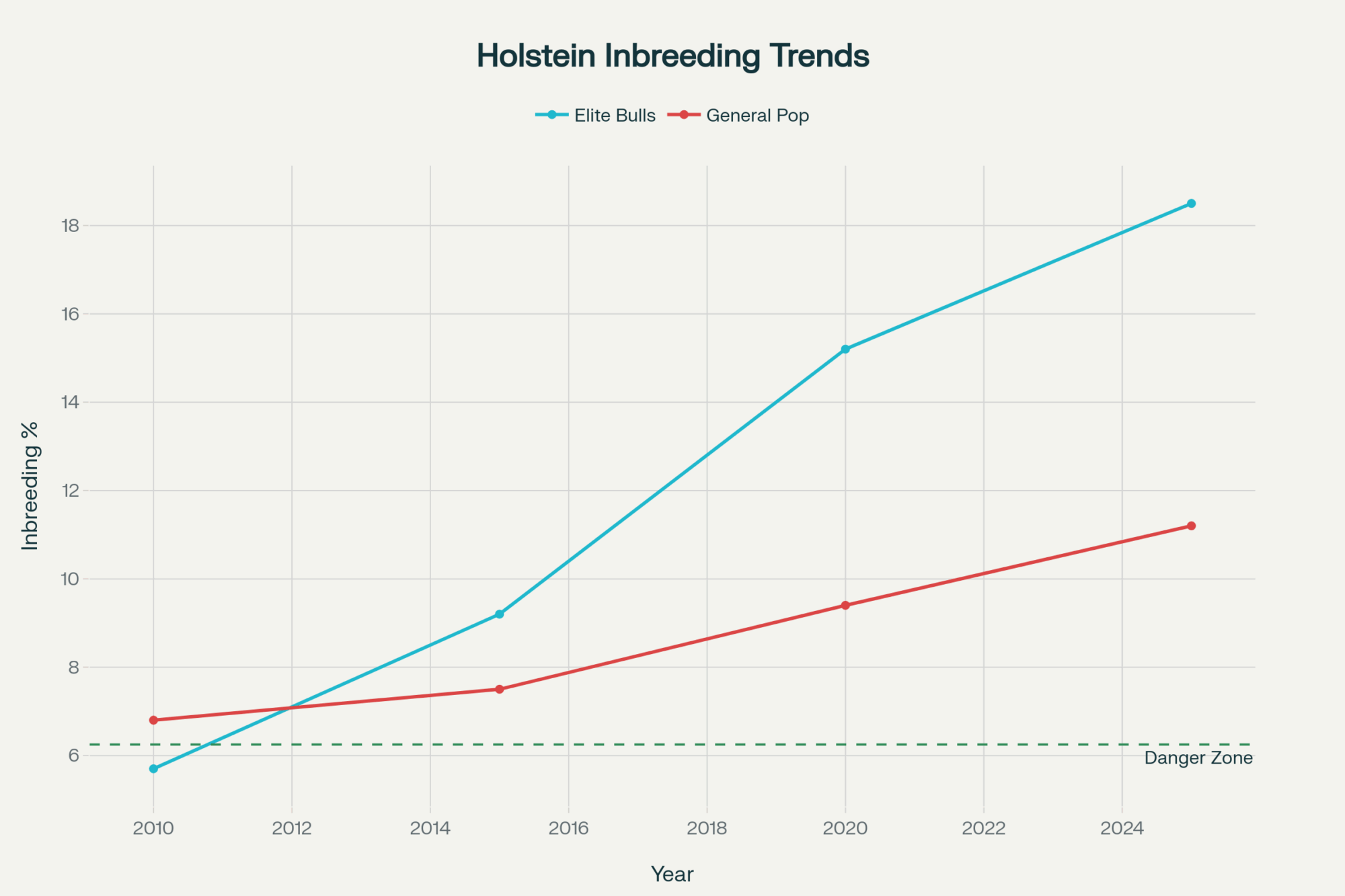
NewsSubscribe
First
Last
Consent

US Dairy Hits 3.3% Surge in June – Here’s How Smart Producers Are Leading

Butterfat’s up 5.3% this year—that’s $20 extra per cow monthly if you’re paying attention.

EXECUTIVE SUMMARY: Here’s what caught my eye in the latest numbers. Milk production jumped 3.3% in June, but the real money maker is butterfat and protein climbing nearly 5%—we’re talking an extra $15-20 per cow each month for operations hitting these targets. Kansas and South Dakota are absolutely crushing it with strategic genomic selection and precision feeding programs. Meanwhile, Argentina’s ramping up 12% while Europe pulls back 5%, which means export opportunities are shifting our way. The farms winning this game aren’t just pumping more milk—they’re getting smarter about components, feed efficiency, and risk management. You should seriously look at your component premiums and feeding program if you haven’t already.

KEY TAKEAWAYS

  • Push your butterfat above 4.0% through better ration balancing—that 5% bump translates to roughly $1800 extra monthly income per 100 cows. Start by tweaking your forage-to-concentrate ratios.
  • Lock in 60-70% of your feed costs now while corn’s sitting at $4.05/bushel—this simple hedge can save you $100+ per cow annually when markets get volatile.
  • Use genomic testing on your replacement heifers—operations doing this right see 10-15% better lifetime production and components. It’s not just about milk volume anymore.
  • Get Dairy Revenue Protection coverage with premiums as low as 20-30 cents per hundredweight—when margins can swing $2-3, that’s cheap insurance for your milk checks.

I’ve been watching these numbers for a while, and the latest USDA report really got me thinking. This isn’t just about making more milk—it’s about the industry pivoting beneath the surface.

According to USDA-NASS, milk production in the major states reached 18.5 billion pounds in June 2025, a 3.3% increase from the same month a year ago. Kansas led with a 19% jump in April, producing 382 million pounds and swelling its herd by 9.25% to 189,000 cows. Meanwhile, data from the South Dakota Agricultural Office show that the state’s dairy herd has doubled in the last decade, now numbering around 215,000 cows.

What’s behind this surge? Smart investments. Cheese plants, such as Bel Brands and Valley Queen, are expanding, positioning these regions as new dairy powerhouses.

StateHerd Size (2025)Growth RateKey AdvantageProcessing Investment
Kansas189,000 cows+19% (April)Lower regulationsExpanding capacity
South Dakota215,000 cows+117% (decade)Land availabilityBel Brands, Valley Queen
Wisconsin1,270,000 cows+2.1%Established infrastructureMature market
California1,720,000 cows-0.8%Scale & technologyMarket saturation

Components Drive the Real Value

But it’s not just volume—it’s quality too. Butterfat shot up 5.3% and protein climbed near 5%. Producers are pushing butterfat over 4.0% and protein around 3.4%, which matters when you consider Chicago Mercantile Exchange data showing butter at $2.47 per pound and Class III futures near $17.23 per hundredweight.

Feed prices ease somewhat—corn hovers around $4.05 per bushel, December futures near $4.30. Producers locking in 60-70% of feed volume early, a strategy backed by University of Wisconsin Extension research, are managing risk effectively.

Technology and Risk Management Take Center Stage

Risk management is ramping up across the board. Dairy Revenue Protection is becoming standard, offering premium coverage ranging from $0.05 to $0.40 per hundredweight, according to USDA Risk Management Agency data.

Technology advances also play a role. Precision feeding systems, especially on farms with more than 400 cows, deliver returns that often paying back in two years with proper data use. Cornell University research highlights these efficiency gains.

Globally, shifts continue—European production dips by 5%, while Argentina’s grows by 12%, restructuring the competitive landscape.

What Winning Producers Focus On

Here’s what the most successful operations prioritize:

  1. Component optimization—genetics, nutrition, and culling strategies for improved butterfat and protein yields
  2. Strategic feed cost management—hedging decisions and bulk purchasing timing
  3. Thoughtful technology adoption—matching tools like genomic testing and precision feeding to operational scale
  4. Building strong processing partnerships—aligning with facilities’ expanding capacity and market reach

The Bottom Line

The industry is becoming increasingly data-driven and geographically diverse, with quality now taking precedence. Those who adapt quickly and strategically will thrive.

These trends speak to a new era—one where management precision, quality focus, and risk mitigation define success. The bottom line? Volume’s nice, but quality pays the bills in 2025. Time to think like a business, not just a production unit.

Stay alert and nimble. The market’s evolving fast, and the winners will be those who move first.

Analysis based on data from USDA-NASS, Kansas Livestock Association, South Dakota Agricultural Office, Chicago Mercantile Exchange, University of Wisconsin Extension, Cornell University, and USDA Risk Management Agency.

Learn More:

  • The Ultimate Guide To Increasing Butterfat & Protein – This article provides practical strategies for ration balancing and feed management. It demonstrates how to fine-tune your nutrition program to maximize component premiums, directly supporting this article’s focus on profitability beyond just milk volume.
  • Dairy Herd Expansion: To Grow or Not To Grow – For producers inspired by the growth in Kansas and South Dakota, this piece explores the critical financial and operational questions behind expansion. It provides a framework for making smart, strategic decisions before investing in new facilities or cows.
  • Genomic Selection: The Genetic Advantage That Goes Beyond Production – Move beyond the basics of precision feeding and discover how to leverage genomics for long-term value. This article reveals methods for selecting health, fertility, and feed efficiency traits to build a more resilient and profitable herd for the future.

The Sunday Read Dairy Professionals Don’t Skip.

Every week, thousands of producers, breeders, and industry insiders open Bullvine Weekly for genetics insights, market shifts, and profit strategies they won’t find anywhere else. One email. Five minutes. Smarter decisions all week.

NewsSubscribe
First
Last
Consent

The A2 Advantage: A Producer’s Guide to Premiums, Genetics, and the Carbon Connection

Everyone says A2’s just hype. Tell that to farmers banking 100% premiums on milk yield.

EXECUTIVE SUMMARY: Look, I’ve been watching this A2 thing for years, and here’s what changed my mind – the premium isn’t going anywhere, and the science finally backs it up. We’re talking 50-100% premiums that are holding steady even with everything else falling apart in commodity markets. China’s A2 segment jumped 14% just in the first half of 2025, now claiming 20% of their infant formula market value… that’s real structural demand, not some health fad.The kicker? Most Holstein herds are already testing 50-60% A2 genetics – you might be sitting on premium milk and selling it commodity. At $25-40 per head for genomic testing, you’re looking at potentially discovering a revenue stream that California producers are already riding to $8-9 per gallon. With USDA operating loans at 5.000% and consumer premiums this strong, this isn’t about chasing trends anymore – it’s about capturing value that’s already there.

KEY TAKEAWAYS

  • Test your genetics first – Most Holstein herds hit 50-60% A2 genetics naturally; at $25-40/head testing costs versus 50-100% milk premiums, your ROI calculation is simple math that works in today’s tight margin environment.
  • Start with segregation strategy – Wisconsin’s MilkHaus Dairy is processing just 100 of their 360 cows separately for A2 cheese production, proving you don’t need full herd conversion to tap premium markets in 2025.
  • Stack the sustainability angle – Traditional A2 breeds like Jerseys show better feed efficiency, positioning farms for both A2 premiums and emerging carbon credit programs as USDA pilots recognize breed efficiency metrics.
  • Build direct-to-consumer channels – Vermont Jersey operations are pulling premium pricing on A2 raw milk and aged cheeses to Boston markets, while California organic A2 hits $8-9/gallon – direct sales bypass commodity pricing entirely.
  • Time your conversion with financing – At current 5.000% USDA operating rates, conversion financing is more accessible than it’s been in years, but processing capacity for segregated A2 milk is tightening across regions.
 A2 milk, genomic testing, dairy profitability, premium milk markets, dairy breeding strategy

You know what caught my attention at the last World Dairy Expo? Three different producers – completely unrelated, from Wisconsin to New Zealand – all mentioned they’re testing their herds for A2 genetics. That’s when you know something has shifted from a trend to a serious business opportunity.

If there’s one topic dominating dairy discussions lately, it’s A2 milk. What started as a niche health trend has evolved into something that’s genuinely transforming our perspective on premium positioning. With conventional milk struggling in commodity markets and consumers willing to pay 50-100% premiums for A2 products, this is no longer just marketing hype.

A2 milk is projected to become a $7.62 billion global market by 2034. That’s not wishful thinking from market researchers – that’s real money flowing through real supply chains, and it’s becoming clear that dismissing this as just another fad would be a serious mistake.

Your A2 Quick Reference Guide

Market Reality Check: Global A2 market projected to exceed $7.6B by 2034, with consumer premiums holding steady at 50-100% over conventional milk

Science Getting Clearer: While cognitive claims remain weak, peer-reviewed studies now confirm digestive benefits linked to gut microbiota changes

Strategy is Everything: Success depends on genetic testing, long-term breeding strategy, and – this is crucial – securing access to segregated processing

Start Local First: Evaluate your regional processors and direct-to-consumer opportunities before making major investments

The Numbers That Actually Matter

What strikes me about these market projections is how they’re playing out in real time. China’s A2 market tells the story perfectly:

China’s A2 protein segment grew 14% in just the first half of 2025 and now accounts for 20% of their total infant formula market value. When discussing a competitive market, capturing one-fifth of the total value isn’t just a matter of consumer preference – that’s structural demand.

The premium positioning is holding too. Even with all the economic uncertainty we’ve been dealing with, consumers are still paying premiums of 50-100% over conventional milk. That’s exactly the kind of value-added positioning we’ve been discussing as needed in this industry for years.

Here’s what’s fascinating, though – many A2 buyers don’t even have digestive issues with regular milk. They’re paying more because they believe it’s better milk. This represents exactly the kind of premium positioning that can actually stick.

What’s Actually Happening in Science

The biochemistry behind A2 milk is legitimate, even if some of the health claims can be somewhat exaggerated. When you’re dealing with conventional milk – the A1 beta-casein variety that most of our Holsteins produce – digestion releases this peptide called beta-casomorphin-7 (BCM-7).

Here’s where it gets interesting: research shows this peptide can actually cross the blood-brain barrier and interact with opioid receptors in our central nervous system. While this biochemical interaction is confirmed, it’s crucial to note that large-scale human studies haven’t substantiated the marketing claims linking it to conditions like autism or cognitive decline.

That’s not small stuff when you think about it. We’re talking about a food component that can literally reach the brain.

Now, before anyone gets carried away, most of the cognitive claims you see splashed across A2 marketing materials are still pretty thin on human clinical trials. But the digestive benefits? Those are starting to look solid.

What strikes me about recent work published in PLOS ONE is how concrete the results were. Two weeks of A2 milk consumption led to significant changes in gut microbiota – we’re talking about increases in beneficial bacteria like Bifidobacterium longum and Blautia wexlerae. These aren’t just random microbes; they’re directly linked to better nutrient processing and reduced gut inflammation.

Participants who typically experienced digestive discomfort with regular milk showed notable improvements with A2 milk consumption. From a market positioning standpoint, this is compelling stuff – actual functional benefits you can point to.

The Genetic Reality Check

Here’s where breed choice really matters in this whole A2 conversation. Most producers I talk to are surprised when they learn where their herds actually stand genetically.

According to recent work from Dr. John Lucey at the University of Wisconsin’s Center for Dairy Research, “Most U.S. Holsteins produce a mixture of the two, often a 50-50 or 60-40 split, depending on where the genetic lines came from. Guernsey, Jersey, and Brown Swiss tend to produce mostly A2.”

That breed difference alone changes your whole timeline and strategy. If you’re running Holsteins, you’re starting from a different place than someone with a Jersey herd. It’s not just about the genetics – it’s about understanding what you’re working with.

The testing itself costs around $25-40 per animal to determine your current status. That’s not nothing when you’re talking about a 300-cow herd, but it’s the kind of investment that makes sense when you’re looking at those premium opportunities.

What’s particularly noteworthy is how this plays out across different regions. In the Upper Midwest, I’m seeing Holstein herds that test surprisingly high for A2 genetics – sometimes 60-70% – likely due to specific breeding lines that came through certain AI companies. Meanwhile, down in the Southeast, some Jersey herds are testing lower than expected, which suggests there’s more A1 genetics circulating in those bloodlines than people realize.

The Next Frontier: Connecting A2 to Carbon and Policy

Here’s something that’s flying under the radar but shouldn’t be – the intersection of A2 genetics and sustainability is creating a potential triple-win scenario that smart producers are already positioning for.

Traditional A2 breeds, such as Jerseys and Guernseys, often have better feed conversion rates, which translates to lower methane production per pound of milk. With carbon pricing becoming a reality through programs like California’s LCFS expansion and the EU’s Green Deal, which is pushing sustainability metrics, a double premium opportunity may be emerging.

The new USDA carbon credit pilot programs are starting to recognize these breed efficiencies. Operations that can document both A2 genetics and improved feed efficiency might qualify for additional incentives by 2026. Initial word from extension specialists suggests that farms documenting both A2 genetics and carbon efficiency could receive stacked premiums.

I’ve been hearing from processors in the Northeast who are starting to ask about both A2 genetics and carbon footprint data. That’s a trend that’s expected to accelerate, especially as more retailers make sustainability commitments. With the EU’s Green Deal pushing sustainability metrics and New Zealand implementing their emissions pricing scheme, there’s a real question about positioning A2 milk within these new frameworks.

The methane credit angle is particularly interesting. Some of the same breeds that naturally produce more A2 milk also tend to be more efficient feed converters, lower methane per pound of milk. As carbon pricing becomes more of a reality (and it’s coming, whether we like it or not), we’re looking at a potential convergence where A2 genetics, carbon efficiency, and premium positioning all align.

The Conversion Challenge – What It Actually Takes

Converting to A2 production is a significant operational commitment, not as simple as flipping a switch. Here’s what you’re really looking at:

Investment Reality: The real cost is time and a multi-generational breeding strategy. From industry observations, you’re looking at several generations to achieve high A2A2 frequencies – the exact timeline depends heavily on your starting genetics and breed composition.

Processing Bottleneck: Access to segregated processing facilities is, in fact, the biggest challenge. I’ve talked to producers with beautiful A2 herds who ended up stuck selling into commodity markets because they couldn’t secure premium outlets.

Financing Actually Looks Good: Current USDA Farm Service Agency operating loans are running at 5.000% as of July 2025, which makes conversion financing accessible for qualified operations. That’s more reasonable than the higher rates we saw a couple of years back.

Here’s the thing, though – and this is where I see producers getting tripped up – you can’t just think about the genetics. The infrastructure piece is massive. You need separate tanks, separate trucks, and separate processing lines… or, at the very least, processing partners who can handle the segregation requirements.

Real Operations Making It Work

What’s working? Direct-to-consumer operations are absolutely crushing it. Let me tell you about operations that are getting it right across different regions:

MilkHaus Dairy in Fennimore, Wisconsin, is testing about 100 of their 360-head Holstein herd for A2 genetics. They’re housing those A2 cows separately, keeping the milk completely segregated, and processing it into cheese at local plants. Now they’re selling 12 different cheese flavors nationwide through their online store. The genius part? They’re not trying to convert their whole herd – they’re just maximizing the value of what they’ve got.

Two Guernsey Girls Creamery in Freedom, Wisconsin, took a different approach. They broke ground on a small bottling and cheese-making facility in late 2020, opened it in summer 2021, and now process all their milk on-site. Pasteurized white milk, chocolate milk, cheese curds – all A2, all local, all profitable. What started as a 4-H project has grown into a thriving farmstead operation.

But it’s not just Wisconsin. In California, I’ve been hearing from producers in the Central Valley who are pairing A2 genetics with organic certification – apparently, this combination is hitting a sweet spot with Bay Area consumers, who are willing to pay serious premiums. “We’re seeing $8-9 per gallon for A2 organic,” one Fresno County producer told me last month. “That’s game-changing money.”

Meanwhile, in Vermont, there’s a Jersey operation that has gone full A2 and direct-to-consumer. They’re selling A2 raw milk permits and A2 aged cheeses to the Boston market – completely different approach than what we’re seeing in the Midwest, but it’s working for their customer base.

The key here – and this is what I keep telling producers – is understanding that success often depends more on market positioning and consumer education than just having the genetics. These operations work directly with consumers, educating them about the differences and building brand loyalty.

Regional Patterns That Are Actually Emerging

The A2 opportunity isn’t uniform across regions, and that’s something you really need to factor into your planning. What works in Wisconsin might not work in California, and what sells in Australia definitely won’t automatically work in Iowa.

Here’s what I’m seeing in different regions: Upper Midwest operations with established local markets are doing well with direct sales. The cheese culture up there really helps – consumers understand premium dairy products. West Coast producers are finding success pairing A2 with organic certification to tap into that California wellness market.

However, what’s interesting is that I’m hearing from Northeast producers who are struggling with the infrastructure piece more than expected. Processing capacity for segregated A2 milk is tighter than anticipated, especially in Vermont and New York. One producer in the Hudson Valley told me they’re trucking A2 milk three hours to find a processor who can handle the segregation requirements.

Southeast operations? They’re dealing with entirely different challenges. The consumer demand is there, but the genetic starting point is often lower than expected. Heat stress is also affecting A2 conversion timelines in ways that Northern operations don’t have to consider.

What’s fascinating is how weather patterns are also affecting this. The drought conditions we’ve been seeing in parts of the West are actually pushing some producers toward A2 conversion because they’re already having to make genetic decisions about their herds – might as well optimize for premiums while you’re at it.

What This Means for Your Operation

The cognitive benefits everyone’s talking about? The science isn’t there yet. However, the market opportunity is real, and consumer willingness to pay premiums remains strong, even amid the ongoing economic challenges.

If you’re considering A2 conversion, start with genetic testing to understand your baseline. Don’t rush into wholesale changes – gradual conversion through selective breeding spreads your investment while you build market relationships. The sweet spot seems to be operations over 200 cows, where you can absorb conversion costs across larger production volumes.

Here’s what I’d recommend: evaluate your local market access first. Do you have processing facilities that can maintain A2 segregation? Are there premium retailers interested in carrying your product? Can you build direct-to-consumer channels?

But honestly? The most important thing is to be realistic about timelines. This isn’t a quick pivot. If you’re serious about A2, you’re looking at a long-term strategy – breeding decisions today based on where you think the market will be in 2030.

And here’s something else to consider… the regulatory landscape is shifting. With sustainability requirements tightening and carbon accounting becoming more standard, A2 genetics might end up being just one piece of a broader premium positioning strategy. The producers who are thinking ahead are already connecting A2 to metrics for feed efficiency, methane reduction, and soil health.

The Bottom Line

The combination of documented gut health benefits, resilient premium pricing, and developing infrastructure creates a compelling and tangible opportunity. What’s particularly exciting is how this aligns with the broader sustainability conversation. We’re potentially looking at a convergence where A2 genetics, carbon efficiency, and premium positioning all intersect.

This isn’t about jumping on the latest trend – it’s about positioning your operation for long-term success in an evolving premium dairy market. The question isn’t whether A2 milk will succeed – it’s whether you’re positioned to capture your share of this expanding opportunity.

The producers who are succeeding aren’t just chasing the A2 premium – they’re building integrated strategies that position them for whatever comes next. That’s the real lesson here.

Complete references and supporting documentation are available upon request by contacting the editorial team at editor@thebullvine.com.

Learn More:

The Sunday Read Dairy Professionals Don’t Skip.

Every week, thousands of producers, breeders, and industry insiders open Bullvine Weekly for genetics insights, market shifts, and profit strategies they won’t find anywhere else. One email. Five minutes. Smarter decisions all week.
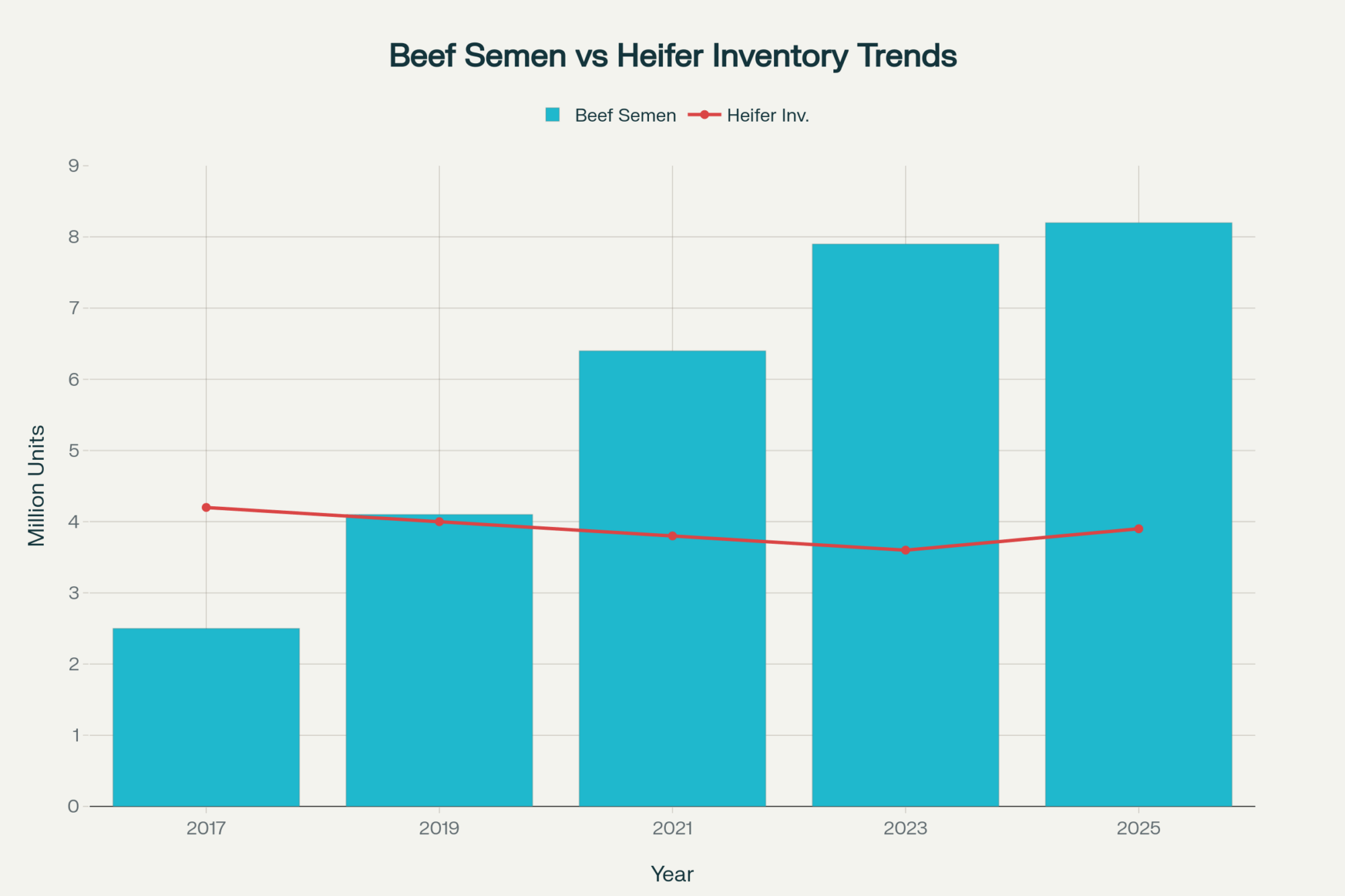
NewsSubscribe
First
Last
Consent

Why Your Neighbor’s Making $1,000 More Per Day From The Same Cows (And What You Can Do About It)

$4.60/cwt gap between 4.23% and 3.69% butterfat = $370K annually. Your genomic testing strategy better be dialed in.

EXECUTIVE SUMMARY: Look, I’ve been walking through barns for twenty: years, and the conversation’s completely changed. We’re not in the milk business anymore – we’re in the component business, and most producers are still stuck in the old mindset. Recent Journal of Dairy Science research shows butterfat production jumped 30.2% while milk volume only grew 15.9% since 2011, creating a $4.60 per hundredweight premium for high-component milk. That’s real money – a 500-cow operation shipping 4.23% butterfat versus 3.69% banks an extra $370,000 annually from the same cows eating the same feed. With genomics now driving 70% of production gains and processors investing $8 billion in component-focused facilities through 2026, the writing’s on the wall. You need to get serious about component optimization right now, because while you’re deciding, your competitors are already capturing that premium.

KEY TAKEAWAYS

  • Component Premium Reality Check: Butterfat accounts for 58% of your milk check, protein another 31% – that’s 89% of your income from solids, not water. Start tracking your monthly component trends against regional averages and identify which cow groups are dragging down your bulk tank performance.
  • Genomic ROI That Actually Pays: With over 10 million animals now genotyped and genomics driving 70% of production gains, systematic genomic testing of heifer calves gives you 70% accuracy on future component potential. Implement testing on your top 25% for breeding decisions – the genetic gains are permanent and cumulative.
  • Heat Stress = Money Walking Out the Door: I watched Midwest operations lose 0.3-0.4 percentage points of butterfat during July 2024’s heat waves – that’s thousands in lost revenue. Invest in effective cooling systems ($400-800 per cow) and optimize feeding times to avoid peak heat periods in these 2025 climate conditions.
  • Processing Competition Works in Your Favor: With $8 billion in new cheese and butter plants coming online, processors are competing for component-rich milk that maximizes their efficiency. Farms consistently delivering high-component milk are becoming price makers instead of price takers – leverage this to negotiate better processor relationships.
  • Export Dependency Creates Opportunity: The U.S. exports 69% of its skim solids production while importing butterfat to meet domestic demand. This structural imbalance means component-focused operations are positioned to capture both domestic premiums and global market stability through 2025 and beyond.
dairy farming, milk component optimization, genomic testing, dairy profitability, precision nutrition

You know what caught my attention at the farm show last month? It wasn’t the latest robotic milker or some fancy new TMR mixer. It was a conversation I overheard between two Wisconsin producers in the coffee line.

“Dave’s shipping the same pounds I am,” one guy was saying, shaking his head. “But somehow he’s banking an extra grand every single day.”

What’s the difference? Dave’s cows are averaging 4.23% butterfat, while his neighbor’s herd remains at 3.69%.  That gap—that seemingly small difference in butterfat numbers—is worth $4.60 per hundredweight on every load leaving the farm.

Scale that across a 500-cow operation shipping around 22,000 pounds daily… you’re looking at over $1,000 in additional revenue every single day. That’s $370,000 in incremental income annually from what amounts to the same cows eating roughly the same feed.

Here’s what that difference looks like at a glance:

FactorHigh-Component Herd (4.23% BF)Average Herd (3.69% BF)Edge for High-Component
Butterfat (%)4.233.69+0.54 pts
Component Premium ($/cwt)+$4.60+$4.60
Daily Revenue Gain (500 cows)+$1,000Baseline+$1,000
Annual Revenue Gain+$370,000+$370,000
Feed ProgramSame TMRSame TMRNo added cost
Strategic FocusGenomics + ComponentsVolumeHigher Margin

Here’s the thing, though… this isn’t some future trend we need to prepare for. This transformation is happening right now, and it’s accelerating faster than most producers realize.

The Shift That’s Redefining Everything

The thing about major industry changes is they tend to sneak up on you. One day, you’re doing business the way your dad did, the next day, the entire game has changed. What are we seeing in dairy right now? It’s that pivotal moment when everything clicks into place.

I’ve been walking through barns across the Midwest for over two decades, and the conversations I’m having today are fundamentally different from even five years ago. Maybe it hit you when your nutritionist started asking about butterfat targets instead of milk per cow. Or when your milk check jumped despite shipping fewer pounds last month.

According to recent work from the Journal of Dairy Science, the numbers tell a clear story: from 2011 to 2024, while milk production increased by a modest 15.9%, butterfat production increased by 30.2% and protein production climbed by 23.6%. Think about what this means for your bottom line… the same number of cows, managed with similar protocols, are now producing fundamentally different milk—and way more valuable—than what they produced a decade ago.

What’s happening is we’ve moved from a simple commodity model to something much more sophisticated. Raw milk isn’t just a fluid anymore; it’s become a sophisticated, customizable raw material where value is defined by its solids content, not water.

And this brings us to an important consideration…

The Genomic Revolution That Actually Delivered

Remember when genomic testing was an expensive experiment that only the largest operations could justify? Well, according to the Council on Dairy Cattle Breeding, the industry has now tested over 10 million animals through genomic programs. That’s created what researchers are calling the most comprehensive genetic database of any domestic animal species except humans and lab mice.

What this reveals is that genomics now accounts for over 70% of the production gains on U.S. dairy farms—a complete flip from previous decades when management practices were the dominant factor. This isn’t just about having better bulls in your breeding program (though that’s certainly part of it). It’s about fundamentally altering what comes out of your cows.

The April 2025 genetic evaluations from Holstein Association USA revealed something that would have been considered impossible just five years ago—genetic improvements on butterfat that are honestly pretty remarkable. Because butterfat and protein are among the most heritable traits (with heritabilities of 20-25% according to multiple peer-reviewed studies), the genetic gains we’re making today will compound across generations.

The surprising part is that most producers I work with are still underestimating just how powerful this genetic momentum has become. Every young bull entering your breeding program today has genetic potential that would have been science fiction just a few years ago.

However, here’s the challenge… and this is something that consistently arises in my conversations with producers: genetic change is a generational phenomenon. You’re looking at 18-24 months before you start seeing meaningful improvements in your bulk tank. That’s a long time to wait when your neighbor is already capturing that premium today.

Where Your Milk Check Money Actually Lives Now

Let me ask you something that might surprise you: if you’re still thinking about milk pricing the way you did in 2010, are you missing the biggest profit opportunity in modern dairy farming?

Under Multiple Component Pricing (MCP)—which governs over 90% of the U.S. milk supply through Federal Milk Marketing Orders—butterfat now accounts for 58% of the average milk check, with protein contributing another 31%. That means nearly 90% of your milk check value comes from the components, not the water your cows produce.

Butterfat alone now accounts for more than half of the average U.S. milk check, making it the single most important driver of dairy profitability.

The financial impact is honestly staggering. Recent USDA Agricultural Marketing Service data shows Class III milk prices averaging $18.82 per hundredweight for June 2025, while Class IV prices were $18.30 per hundredweight. But here’s the kicker: butterfat hit $2.7448 per pound, demonstrating just how much premium value fat components carry.

Component Premium Assessment Tool

Take a moment to evaluate your current position:

  • What’s your current herd average butterfat percentage?
  • How does this compare to your county or regional average?
  • What’s the spread between your highest and lowest producing groups?
  • Are you tracking component trends on a monthly basis or just looking at annual averages?

If you can’t answer these questions off the top of your head, you’re probably leaving money on the table.

What’s interesting is that each 0.1% increase in butterfat can add $15-20 in monthly revenue per cow. For a 1,000-cow operation, that translates to $15,000-$20,000 in additional monthly income from what amounts to a relatively small improvement in component levels.

However, this leads to a crucial point: despite this production boom, the U.S. remains a net importer of butterfat. Consumer demand has grown even faster than our supply gains, creating a unique market dynamic where domestic demand continues to outpace production.

The Consumer Story That’s Actually Driving Everything

This isn’t just about supply—it’s about a fundamental shift in how Americans eat dairy, and I’ve watched this play out in real time over the past few years.

Recent USDA Economic Research Service data shows per capita consumption of dairy products reached 661 pounds per person in 2023, matching the all-time record set in 2021. But here’s what’s really fascinating: while fluid milk consumption continues its long-term decline, butter consumption hit 6.5 pounds per person (highest since 1965) and cheese consumption reached 42.3 pounds per person.

Americans aren’t abandoning dairy—they’re fundamentally changing how they consume it. They’re shifting from fluid milk as a beverage toward manufactured, higher-fat dairy products, such as butter, cheese, and premium yogurt. This trend accelerated with everything from the home-baking renaissance during COVID to the rise of social media food trends, such as the elaborate charcuterie boards that are now ubiquitous.

What’s particularly fascinating is the science behind this shift in consumer behavior. Research published in the Journal of Dairy Science shows that dairy fat is the most complex edible fat found in nature, comprising over 400 distinct fatty acids with different chain lengths and chemical structures. The unique milk fat globule membrane (MFGM) that encases fat globules plays a crucial role in the digestion and metabolism of dairy fat.

This brings us to an important consideration from a health perspective: multiple prospective cohort studies now show that consumption of full-fat dairy is associated with neutral or even reduced risk of major health outcomes, including cardiovascular disease, type 2 diabetes, and metabolic syndrome. Some compelling evidence suggests that a high intake of full-fat dairy is actually associated with a decreased risk of developing type 2 diabetes, an outcome not observed with low-fat dairy.

The $8 Billion Processing Bet That’s Changing Everything

Here’s something that should catch your attention: the U.S. dairy industry is investing over $8 billion in new processing capacity through 2026, with approximately half of the investment targeting cheese production. This isn’t just expansion—it’s a massive bet on the continued growth of component-driven demand.

Think about what this means for your operation. When processing capacity is expanding this aggressively, it creates competition for your milk—and that competition is specifically for component-rich milk that can maximize plant efficiency and profitability.

I’ve seen firsthand how this plays out. Operations that can consistently deliver high-component milk are finding themselves with multiple buyers competing for their product, while those still producing average-component milk are becoming price takers rather than price makers.

Regional Variations That Really Matter

The geography of American dairy is changing, and it’s being driven by the same component economic components that are reshaping individual operations. The May 2025 USDA Milk Production report indicates 19.1 billion pounds of milk production in the 24 major states, representing a 1.7% increase from May 2024.

However, the surprising part is that component production has consistently outpaced fluid milk growth, with butterfat levels improving from 4.17% to 4.24% between May 2024 and May 2025. That improvement yielded 1.8 pounds more butterfat per cow, representing a 2% yield gain per cow.

What I’m seeing in different regions is honestly fascinating. In the Upper Midwest—specifically, Wisconsin, Minnesota, and Michigan—producers face different challenges than those in the Southwest or California. Heat stress management becomes absolutely crucial in Arizona and Texas (as we saw firsthand during last summer’s heat waves), while in Wisconsin and Minnesota, producers are focusing more on forage quality and barn ventilation systems.

The spring flood issues we saw across parts of Iowa and Illinois this year? That created some interesting butterfat challenges as producers dealt with compromised forage quality and had to adjust their nutrition programs on the fly.

Regional Component Optimization Strategies

Upper Midwest (Wisconsin, Minnesota, Michigan):

  • Focus on high-quality forage production during short growing seasons
  • Invest in advanced barn ventilation for summer heat stress management
  • Leverage strong genetics programs from local breeding cooperatives

Southwest (Arizona, Texas, New Mexico):

  • Prioritize heat stress abatement systems (evaporative cooling, shade structures)
  • Optimize feeding times to avoid peak heat periods
  • Consider night milking schedules during extreme weather

California Central Valley:

  • Navigate drought conditions with drought-resistant forage varieties
  • Manage seasonal feed cost volatility
  • Balance component production with regulatory compliance requirements

The message for your operation is clear: regardless of where you’re located, you need to be thinking about how to produce the kind of milk that processors are building billion-dollar plants to handle.

How Smart Producers Are Capturing This Component Premium

Now that you understand the forces driving this transformation, let’s discuss its implications for your operation. The primary strategic shift is moving from a “milking for volume” mindset to “milking for margin.”

The Genetics Game-Changer

The genetic gains achieved through genomics are permanent and cumulative, ensuring that strategic breeding decisions you make today will pay dividends for decades. Here’s what that means practically…

You need to leverage component-focused selection indexes, such as Net Merit ($ NM), which now places substantial weighting on butterfat and protein values. Work with A.I. companies that can provide genomic young sires specifically bred for component production, and implement systematic genomic testing of your own heifer calves to identify the top 25% for breeding and the bottom 25% for terminal mating.

The economic weighting for butterfat in selection indexes has increased by 13% to reflect current market values, demonstrating the industry’s commitment to component optimization.

But here’s something I’ve learned from working with producers who’ve made this transition: don’t expect immediate results. Genetic change is generational, and you’re looking at 18-24 months before you start seeing meaningful improvements in your bulk tank.

Decision Framework: Is Your Genetics Program Component-Optimized?

Ask yourself these questions:

  1. What percentage of your breeding decisions are based on component traits versus volume traits?
  2. Are you systematically using genomic testing to replace heifers to identify genetic potential early?
  3. Do you have a clear genetic plan for the next 5 years, or are you just buying the “hot bull” of the moment?
  4. How do you balance component gains with other important traits, such as health and fertility?

If you can’t answer these confidently, you might be missing the biggest opportunity in modern dairy farming.

Nutrition: The Other Half of the Equation

Even the best genetics won’t deliver results without precision nutrition management. The key is creating rumen conditions that maximize acetate production—the direct precursor to milk fat.

University extension research shows that feeding high-quality, highly digestible forages promotes acetate production in the rumen. Maintaining a stable rumen pH through proper fiber management and strategic buffering is critical, as acidosis can disrupt fatty acid metabolism and lead to milk fat depression.

This reveals the crucial role of heat stress management. It causes cows to reduce feed intake, particularly of forages that support fat synthesis. This past summer, I watched operations in the Midwest lose 0.3-0.4 percentage points of butterfat during the July heat wave—that’s real money walking out the door.

Here’s where it gets challenging, though: every operation is different. What works for a 500-cow freestall in Wisconsin might not work for a 5,000-cow operation in California’s Central Valley. Feed costs, climate conditions, and labor availability —all of these factors affect your ability to optimize for components.

I’ve seen producers get so focused on chasing butterfat numbers that they forget about the bigger picture. Cow health, reproductive performance, longevity—these all matter too. The most successful producers I work with are those who optimize for components while maintaining overall herd performance.

The Trade-Off Most Producers Don’t Consider

This leads to a crucial point that honestly keeps me up at night thinking about the industry’s future…

The U.S. dairy industry’s component-focused model creates a critical dependency on skim solids exports. While we consume most of our butterfat domestically, we export massive quantities of skim milk powder, nonfat dry milk, and whey products to balance the market.

According to USDA Agricultural Outlook Forum data, the U.S. exported a record 17.8% of its total milk solids production in 2022, with 78% of those exported solids being in the form of dry skim milk ingredients. The exports-to-production ratio for dry skim milk products reached 69%.

This export dependency makes the industry vulnerable to trade disputes, tariffs, and protectionist policies in key markets, such as Mexico, Canada, and China. A major trade disruption could destabilize the entire domestic milk pricing structure by flooding the market with skim solids that can’t find export homes.

The Risks We Need to Talk About

While the component boom presents tremendous opportunities, it also creates new vulnerabilities that strategic operators must understand and manage.

The Processing Bottleneck Challenge

The $8 billion processing investment wave carries significant timing risks. If these large facilities come online simultaneously and consumer demand fails to keep pace, the industry could face severe oversupply conditions, leading to sharp price declines.

Processors are already experiencing what some call a “cream tsunami,” with butter manufacturers acting as a relief valve to absorb surplus cream, often at discounted prices. This is creating manufacturing imbalances, with butter and American cheese production rising while other traditional uses of butterfat decline.

The surprising part is whether these new plants are truly optimized to handle the increasingly component-rich milk being produced. Traditional processing equipment was designed for lower-solid milk, and running higher-solid milk through it can create inefficiencies that could erode processor margins and, eventually, the premiums paid to farmers.

Implementation Challenges: The Reality Check

Let’s be honest about something that doesn’t get discussed enough: transitioning to component-focused production isn’t easy, and it’s not inexpensive.

I’ve worked with producers who have invested heavily in genomics and precision nutrition, only to see modest improvements in their bulk tank. Why? Because component optimization is a systems approach that requires everything to work together—genetics, nutrition, management, facilities, and even seasonal timing.

Take heat stress management, for example. Installing effective cooling systems can cost $400 to $ 800 per cow, depending on your setup. That’s a significant investment, and the payback period varies dramatically based on your climate, facility design, and current production levels.

Feed costs are another reality check. High-quality, highly digestible forages that support fat synthesis often cost more than maintenance-level feeds. Rumen-protected fats, dietary buffers, precision additives—these all add up. I’ve seen operations increase their feed costs by $0.50-1.00 per cow per day while optimizing for components.

Labor is probably the biggest challenge of all. Component optimization requires more management attention, more frequent monitoring, and often additional skilled labor. In today’s labor market, that’s not always easy to find or afford.

Technology Disruption: The Precision Fermentation Question

Here’s something that honestly makes me uncertain about the long-term future: the emergence of precision fermentation technology, which utilizes microorganisms to produce dairy proteins without the need for cows.

While the technology is still in early commercial phases, companies are already investing heavily in this space. The timeline for significant market impact remains unclear, but if precision fermentation can eventually produce commodity dairy ingredients at lower costs than traditional agriculture, it could potentially disrupt the skim solids export model that supports current component pricing structures.

This reveals how different segments of the industry may be affected differently. Premium, local, and specialty dairy products might be less vulnerable to this disruption than commodity ingredients.

What This Means for Your Operation Going Forward

The component revolution isn’t coming—it’s here. Every day that you operate with a volume-focused mindset rather than a component-focused strategy, you’re potentially leaving money on the table and falling behind competitors who have made the transition.

Your Strategic Roadmap

Right Now (Next 30 Days): Start by auditing your current genetic program to ensure component traits are properly weighted. Analyze your milk checks from the last 12 months to understand your component performance trends. Are you consistently above or below average? What’s your seasonal pattern? Are there specific groups of cows that are dragging down your overall performance?

Evaluate your nutritional program for optimal rumen health and fat synthesis. This may involve collaborating with your nutritionist to review your current ration formulation or investing in more advanced feed management systems.

Most importantly, assess your processor relationships for component pricing competitiveness. Are you getting paid appropriately for the quality of milk you’re producing? If not, it might be time to explore alternatives.

Medium-Term (Next 6-12 Months): Implement systematic genomic testing of heifer calves. This is becoming more common across the industry, and the ROI data is compelling. But don’t just test—develop a systematic approach to using that information in your breeding decisions.

Consider upgrading your nutrition management systems for precision feeding. This may involve investing in new TMR mixers, feed management software, or more sophisticated monitoring systems.

Develop risk management protocols for component price volatility. The reality is that component prices can be more volatile than traditional milk prices, so you need strategies to manage that risk.

Long-Term Positioning (Next 2-5 Years): Build operational flexibility to adapt to changing market demands. This may involve diversifying your product mix, exploring direct-to-consumer opportunities, or developing niche market positions.

Invest in technologies that improve efficiency and reduce labor dependency. Automation, monitoring systems, and decision support tools will become increasingly important as the industry evolves.

Create sustainability metrics that support premium market positioning. Consumers and processors are increasingly interested in environmental and social responsibility, and these factors are likely to become more important in the future.

The Global Context That Matters

What’s happening in the U.S. isn’t occurring in isolation. European dairy producers face similar component-driven market forces, albeit within different regulatory frameworks. New Zealand’s dairy industry—always a benchmark for efficiency—is seeing comparable trends in component optimization.

Research from Teagasc in Ireland shows similar patterns emerging across European dairy systems, with component pricing becoming increasingly important. However, the U.S. market’s unique structure—with our heavy reliance on skim solids exports—creates both opportunities and vulnerabilities that other dairy economies don’t face.

Key Questions to Consider:

  • How will changing trade relationships affect your ability to capture component premiums?
  • What role will sustainability requirements play in future component pricing?
  • How might climate change affect your ability to optimize for components?
  • What new technologies might emerge that could change the game again?

The Bottom Line: Where We Go From Here

The dairy industry has undergone fundamental changes, and the most successful operations of the next decade will be those that recognize and adapt to this new reality. The component boom isn’t just about producing different milk—it’s about building a different kind of dairy business, one that’s optimized for profitability, sustainability, and long-term competitive advantage.

What keeps me optimistic about this industry is seeing how innovative producers are embracing these changes. I’ve watched farms transform their operations, improve their genetics, and build more profitable businesses by focusing on component quality rather than just volume.

But I’d be lying if I said this transition is easy or guaranteed. The producers who succeed will be those who approach it systematically, with realistic expectations about timelines and costs, and with a clear understanding of both the opportunities and the risks.

The question isn’t whether you can afford to make this transition—it’s whether you can afford not to. Because while you’re deciding, your competitors are already capturing the premium, and that gap is growing every day.

This transformation represents the most significant shift in dairy economics since the introduction of bulk tanks… and the producers who master it will be the ones who thrive in the decades to come.

So here’s my challenge to you: stop thinking about milk production the way your dad did. Start thinking about it the way your kids will have to. Because the future of dairy isn’t about more milk—it’s about better milk. And that future? It’s already here.

Complete references and supporting documentation are available upon request by contacting the editorial team at editor@thebullvine.com.

Learn More:

The Sunday Read Dairy Professionals Don’t Skip.

Every week, thousands of producers, breeders, and industry insiders open Bullvine Weekly for genetics insights, market shifts, and profit strategies they won’t find anywhere else. One email. Five minutes. Smarter decisions all week.

NewsSubscribe
First
Last
Consent

July 2025 Journal of Dairy Science Digest: 8 Research Insights Every Herd Manager Should Know

Findings from the July 2025 Journal of Dairy Science—translated into plain-speak and practical takeaways you can put to work on the farm tomorrow morning. From H5N1 preparedness to the fine points of ivermectin timing, here’s what matters now.

You know what’s been keeping me up at night lately? It’s realizing how much money we’re all leaving on the table because we haven’t caught up with some of the breakthrough research quietly dropping in academic journals.

I spent the weekend digging through the latest Journal of Dairy Science findings (yeah, I know, riveting summer reading), and honestly… there’s more actionable intelligence packed into these papers than I’ve seen in years. The kind of stuff that makes you want to call your nutritionist at midnight or completely rethink your dry cow protocols.

Most research sits in universities collecting dust while we’re out here dealing with tight margins, labor shortages, and feed costs that’d make our grandfathers weep. But every now and then—maybe once every few years—you get a collection of findings that hit differently. Studies that address the exact problems keeping us up at night. This is one of those moments.

Here’s what strikes me about these latest findings: they’re addressing the issues we’ve been grappling with for months. H5N1 management that goes beyond the headlines. Antibiotic resistance strategies that actually work in the field. Nutrition protocols that can shift your butterfat numbers in ways that matter to your milk check.

Quick Reference: Research That Actually Pays

Before we dive deep, here’s what caught my attention and why it matters to your operation:

Research TopicKey FindingClinical SignificancePractical ApplicationEconomic Impact
H5N1 in Dairy CattleOver 1,072 herds affected in 18 states as of July 2025First major H5N1 outbreak in U.S. dairy cattle historyEnhanced biosecurity and One Health protocols neededSignificant milk production losses and trade restrictions
Antibiotic Resistance in BRD20-50% tetracycline resistance in Pasteurella multocidaAge-specific treatment protocols neededUse ceftiofur as first-line treatment for pre-weaned calvesImproved treatment success rates (67% to 91%)
Genomic Selection ProgressFunctional variants improve prediction accuracy by 1.76% for fat %More efficient SNP panels using 16k variants vs 32kBetter breeding decisions with health trait markersNZD 72.96 per animal per year genetic gain
Methionine SupplementationParity-specific responses to methionine supplementationFirst-lactation cows respond within 14 daysSeparate feeding programs for different lactation numbersMeasurable improvements in milk protein and fat yields
Ivermectin Milk Residues10-day pre-calving treatment window prevents milk residuesCritical timing for dry cow treatmentsStrict 10-day rule for export market complianceProtects access to global milk markets
Calf Pneumonia DetectionUltrasound detects subclinical pneumonia weeks before clinical signsEarly intervention prevents lung damageSame equipment as pregnancy checks, different applicationTreatment success jumped from 78% to 96%
Housing Systems ImpactDeep litter systems reduce disease prevalence significantlyHousing affects productive lifespan by 8+ monthsConsider long-term ROI including health benefitsLower overall morbidity and longer productive life
AMS Social DynamicsPriority lanes improve low-ranking cow milking frequencySocial competition creates hidden productivity lossesImplement priority systems for optimal AMS efficiencySignificant improvements in overall system efficiency

The H5N1 Wake-Up Call… and What It’s Teaching Us About Modern Crisis Management

H5N1 Spread in U.S. Dairy Cattle: March 2024 – July 2025

The thing about H5N1 is that it has become a fascinating—and, honestly, terrifying—case study in how different organizations handle crisis management. According to the latest European Food Safety Authority report, between March 2024 and May 2025, the virus was confirmed in 981 dairy herds across 16 U.S. states. That’s nearly a thousand operations that had to rethink their approach to biosecurity completely.

What’s interesting is how differently farms are responding. Some are treating it like a temporary inconvenience—you know, the “this too shall pass” mentality. Others are using it as a catalyst to upgrade their biosecurity game completely. Guess which ones are coming out stronger?

I was talking to a producer in Michigan last week who said something that stuck with me: “This outbreak forced us to look at our entire operation differently.” His point was that enhanced biosecurity, improved ventilation, and better worker health monitoring are delivering benefits far beyond just H5N1 management.

The most successful operations view H5N1 preparedness as an investment in long-term operational excellence, rather than just a crisis response.

Here’s the thing, though… the psychological toll on dairy workers is not discussed enough. Research from affected operations shows that mental health impacts—from handling sick animals to worrying about family exposure—are creating operational challenges that go far beyond immediate disease management. When your best people are mentally checked out, everything else suffers.

Global Perspective: What Other Countries Are Teaching Us

You know what’s fascinating? The Netherlands experienced a similar outbreak pattern in 2021, and their response strategies are informing U.S. approaches. Dutch producers found that compartmentalization—essentially creating zones within the farm—reduced transmission rates compared to all-or-nothing biosecurity approaches.

In New Zealand, they’re dealing with H5N1 in their extensive pasture systems, which is providing us with insights into seasonal management relevant to our spring and summer grazing operations. Their data show that outdoor transmission patterns are completely different from those in confinement systems… something we’re seeing play out in real time across the Midwest.

What strikes me about the farms that implemented comprehensive “One Health” protocols early is that they’re not just managing the disease better—they’re discovering that better air quality reduces respiratory challenges in calves during those humid summer months. Improved worker health protocols help identify heat stress issues before they become costly problems. Enhanced biosecurity also helps keep other diseases at bay.

Antibiotic Resistance Patterns in Bovine Respiratory Disease Pathogens

Why Your Antibiotic Protocols Are Probably Leaving Money on the Table

Antibiotic resistance data from recent bovine respiratory disease research is… well, it’s sobering. What’s happening with tetracycline resistance in young calves perfectly illustrates how our industry’s treatment approaches need to evolve—and fast.

Recent antimicrobial surveillance studies have shown high prevalence rates (20-50%) of tetracycline resistance in Pasteurella multocida populations. This isn’t just academic—it’s costing producers financially through treatment failures and extended recovery times.

What’s fascinating is how resistance patterns vary dramatically by age group. Evidence suggests that different bacterial populations and resistance mechanisms are present, depending on whether calves, heifers, or lactating cows are involved. Most operations are still using one-size-fits-all protocols, and that’s where money is being lost.

I was reviewing some data from a 500-cow operation in Wisconsin—they switched to age-specific protocols last spring and saw their first-treatment success rates jump from 67% to 91% in pre-weaned calves. That’s the kind of improvement that shows up in your feed bills and labor costs.

Protocol TypeFirst-Treatment Success Rate (%)
Standard Protocol67
Age-Specific Protocol91

The Age-Specific Protocol Framework

Age GroupKey Risk / Resistance PatternPrimary Drug Choice (Example)Critical Management Window
Pre-weaned Calves (0-8 wks)Highest tetracycline resistance; vulnerable to Pasteurella multocida.Ceftiofur (e.g., Excenel)Summer months during peak respiratory stress.
Weaned Heifers (8 wks – breeding)Moderate resistance; different bacterial loads. Prone to Mannheimia haemolytica.Tilmicosin (e.g., Micotil)Fall, during housing transitions and weather changes.
Lactating CowsLower resistance overall but high cost of failure.Varies; Diagnostic-drivenAt the very first sign of illness, before symptoms become obvious.

Here’s how progressive operations are restructuring their treatment approaches:

  • Pre-weaned calves (0-8 weeks) show the highest tetracycline resistance rates. Ceftiofur becomes the first choice, with macrolides as backup. The treatment window is critical—catch them early during those hot summer months when respiratory stress is at its peak.
  • Weaned heifers (8 weeks to breeding) exhibit moderate resistance patterns, but they have different bacterial populations. Tilmicosin shows better sensitivity rates. Critical timing here is the fall respiratory challenges that occur when they transition to winter housing.
  • Lactating cows surprisingly show better response rates across all drug classes, but timing is everything. Waiting until clinical signs become obvious reduces recovery rates—something that’s particularly problematic during peak production periods.
  • Age-stratified treatment protocols aren’t just good medicine—they’re good business. Clinical trials show that ceftiofur for BRD treatment significantly improves treatment response rates compared to other antibiotics. All the Mannheimia haemolytica isolates in recent studies were susceptible to ceftiofur, which suggests that resistance pressure isn’t yet building.

Regional Variations That Matter

From industry observations, farms in the Southeast are experiencing different resistance patterns than those in the Upper Midwest. Heat stress appears to be a contributing factor, likely due to its impact on bacterial populations and antibiotic metabolism. Operations in Texas and Georgia are reporting better success with macrolides during the summer months, while northern operations tend to stick with ceftiofur year-round.

The EU’s stricter antibiotic regulations are pushing European producers toward diagnostic-driven treatment selection, and honestly? Their results are making me think we’re behind the curve here. A producer I met at a conference in Denmark said their transition to age-specific protocols improved first-treatment success rates by about 60%.

The Genetics Revolution That’s Quietly Changing Everything

Genetic Trends in Dairy Cattle Breeding: 2020-2025

Genomic selection has moved way beyond just milk production, and if you’re not paying attention, you’re missing the biggest shift in dairy genetics since… well, since we started using AI in the first place.

The latest research from European Holstein populations is identifying specific genetic markers for health traits that we’ve been trying to select for indirectly for decades. The USDA’s Net Merit index remains the best ROI indicator for overall genetic progress, but it’s now being turbocharged with health trait data.

Commercial AI companies are incorporating these new genetic markers for mastitis resistance and lameness into breeding indices faster than most producers realize. Operations using genomic selection for mastitis resistance are seeing substantial improvements in rates of genetic gain.

Early adopters are already seeing measurable improvements in herd health outcomes, which directly translate to reduced veterinary costs and improved longevity. I had a conversation with a breeder in New York who’s been incorporating these health markers for the past two years. His comment was telling: “We’re finally selecting for the stuff that actually matters on the farm, not just what looks good on paper.”

The Crossbreeding Angle Nobody’s Talking About

What’s particularly noteworthy is how this connects to crossbreeding strategies. Recent comparative research has shown that Sanhe cattle exhibit higher immune capacity and stronger disease resistance compared to Holstein cattle. Some progressive breeders are already experimenting with strategic crossbreeding programs that maintain milk production while dramatically improving health outcomes.

It’s not about abandoning Holstein genetics—it’s about being more informed about how we utilize them. A producer in Vermont told me he’s using Sanhe genetics in his crossbreeding program and seeing fewer respiratory issues in calves during those challenging spring months when weather patterns are unpredictable.

Evidence suggests a future where genetic selection becomes increasingly sophisticated and health-focused. However, producers who start incorporating these approaches now will have a significant advantage. Genetics companies are already positioning themselves for this shift; the question is whether producers will be ready.

Methionine: The Nutrition Story That’s Bigger Than Most People Realize

Here’s what I find fascinating about the latest methionine research—it’s not just about feeding more of it. It’s about understanding that first-lactation cows and mature cows respond completely differently to amino acid supplementation, and most operations are still treating them the same.

Recent research confirms that primiparous cows exhibit dramatic responses to methionine supplementation, which mature cows don’t. Studies suggest that strategic supplementation can maximize milk production and components, but the optimal approach varies significantly by parity.

Parity-specific nutrition programs are delivering improvements that translate directly to better milk checks. First-lactation animals are still growing while producing milk, resulting in different amino acid requirements compared to mature cows. Most nutritionists still use uniform methionine supplementation rates across all age groups, which is money left on the table.

I was working with a nutritionist in California who implemented parity-specific feeding last year. His observation was that first-lactation cows responded within two weeks with measurable improvements in milk protein and fat yields. The mature cows? Different story entirely—they primarily showed increased dry matter intake.

Seasonal Considerations for Implementation

Here’s something most people don’t consider: methionine response varies by season. During those hot summer months, first-lactation cows under heat stress show even more dramatic reactions to methionine supplementation. Their metabolic demands are higher, and the amino acid becomes more limiting.

According to industry observations, operations in the Southwest are achieving better results with adjusted methionine protocols during peak heat periods, whereas northern operations can maintain more consistent supplementation year-round. It’s about matching the supplementation to the metabolic stress.

What’s interesting is how leucine supplementation is showing similar patterns—different responses in different age groups and seasons, with implications for both milk production and overall animal health. The research suggests we’re just scratching the surface of precision nutrition based on individual animal needs.

The Dry Cow Treatment Timing Issue That Could Cost You Everything

Ivermectin timing during the dry period is one of those management details that seems minor until it isn’t. Recent research on milk residue patterns shows that timing really does matter, and the consequences of getting it wrong are more serious than most producers realize.

When cows received ivermectin more than 10 days before calving, residue concentrations in milk were undetectable. In contrast, cows treated within 10 days before calving had detectable residues that could exceed regulatory limits.

Global milk markets are becoming more stringent about residue limits, and what might have been acceptable in the past could now result in serious market access issues. This is particularly true for operations that participate in export markets or premium dairy programs.

I was speaking with a producer in Vermont who had a close call last spring—they treated a cow eight days before calving and subsequently found elevated residues in their routine testing. His comment was, “That one mistake could have shut down our entire export program.”

The Regulatory Landscape That’s Changing

Evidence points to a clear relationship between treatment timing and residue detection, with a critical window around calving where drug metabolism changes dramatically. What’s happening globally is that regulatory agencies are tightening residue monitoring, and the penalties are getting more severe.

The EU has been ahead of us in this regard—their residue monitoring programs are more comprehensive, and their penalties are more severe. A producer I met at a conference in the Netherlands said they implemented electronic records systems specifically to track treatment timing because the fines for violations can shut down operations.

Current trends suggest that regulatory oversight of milk residues is likely to increase, making the proper timing of dry cow treatments a critical business risk management issue. Operations that are successfully managing treatment timing are those that have integrated record-keeping systems and established protocols that make violations nearly impossible.

Calf Pneumonia: The Early Detection Revolution That’s Changing Everything

Calf respiratory disease management exemplifies how technology is transforming traditional farming practices. Ultrasound for early pneumonia detection isn’t just high-tech medicine—it’s becoming a practical management tool that’s delivering measurable economic benefits.

Lung ultrasound can detect subclinical pneumonia in calves days or weeks before traditional clinical signs appear. Studies have shown varying prevalence rates of lung consolidation, depending on the management practices and diagnostic criteria used.

By the time you see a cough or nasal discharge, significant lung damage has already occurred. According to industry observations, operations that have invested in portable ultrasound units and trained their staff to use them are experiencing significant improvements in treatment success rates and overall calf performance.

I visited a 300-cow operation in Pennsylvania last month, where they had implemented ultrasound screening six months prior. The manager told me they caught pneumonia in a significant percentage of their calves before any clinical signs appeared. Their treatment success rate jumped from 78% to 96%.

Implementation Strategy That Actually Works

The technology isn’t complicated—it’s basically the same equipment used for pregnancy diagnosis, just applied differently. This development is fascinating because it’s changing the economics of calf health management. Early detection means earlier treatment, which means better outcomes and lower overall treatment costs.

Operations with fewer than 200 cows may begin with quarterly screenings of high-risk periods. Medium-sized operations (200-500 cows) benefit from weekly screening during peak periods of calf arrival. Larger operations (500+ cows) are implementing daily screening with trained technicians.

What’s particularly noteworthy is how this connects to broader trends in preventive medicine. Instead of waiting for disease to become obvious, we’re moving toward early detection and intervention strategies that prevent problems before they become expensive.

The seasonal aspect is crucial—respiratory challenges peak during weather transitions, typically spring and fall. Operations that time their ultrasound screening to match these high-risk periods are seeing the best ROI on their equipment investment.

Housing Systems: The Comfort vs. Cost Reality That’s Getting More Complex

Housing systems prompt discussions about cow comfort, but economics often drives decisions in different directions. Recent research comparing different housing approaches is providing some clarity on where the real trade-offs lie.

FeatureCompost Barn SystemWell-Managed Outdoor System
Capital CostHigh (e.g., 40% higher)Low to Moderate
Operating CostModerate (bedding management)Low (less infrastructure)
Udder HealthExcellent (improved hygiene)Good (requires strict protocols)
Milk QualityHigh (supports premiums)Good (requires cooling investment)
Labor EfficiencyHigh (improved conditions, retention)Moderate to Low
Best Fit ClimateNorthern / Variable ClimatesSouthern / Temperate Climates

Compost barn systems substantially improve udder hygiene scores compared to outdoor systems, with research indicating significant production increases for many dairies that have made the transition.

But here’s the reality check—they come with significantly higher construction and operating costs. A colleague in Ohio has just built a new compost barn facility, and his construction costs were approximately 40% higher than those of outdoor alternatives. But his milk quality premiums are covering the difference.

Regional Variations in Housing Economics

Outdoor systems, when properly managed, can achieve high production levels with lower capital investment; however, they require more attention to milk quality management. According to industry observations, successful operations with outdoor systems are those that have invested heavily in pre-milking protocols and milk cooling systems.

Worth noting how housing decisions connect to labor management and long-term operational efficiency. Compost barns may cost more upfront, but they can reduce labor requirements and improve working conditions in ways that have long-term economic benefits.

I was discussing this with a producer in Minnesota who made the switch to compost barns three years ago. His observation was that the improved working conditions helped him retain better employees, which more than offset the higher construction costs.

Northern climates benefit from compost barns for cold-weather performance and worker comfort. Southern climates often work better with outdoor systems when proper shade and cooling are provided. Variable weather regions might consider hybrid approaches with seasonal flexibility.

Current trends suggest that housing decisions are becoming more strategic, with producers considering not only initial costs but also long-term operational efficiency and market positioning.

AMS Optimization: The Hidden Competition Problem Nobody Talks About

Recent automated milking system research reveals something fascinating—it’s not just about the technology, it’s about understanding cow behavior and social dynamics in ways that dramatically impact system efficiency.

Research on priority lanes for lame and low-ranking cows is revealing how much production potential is being lost to social competition around the robot. High-ranking cows are essentially preventing other cows from accessing the system, creating a hidden productivity drag that most operations never measure.

Priority lane systems can improve milking visit frequency for low-ranking cows without increasing training time. AMS data provide unprecedented insights into individual cow behavior patterns, and the implications extend far beyond just milking frequency.

I was working with a producer in Wisconsin who installed priority lanes last year. His comment was eye-opening: “We had no idea how much production we were losing to social competition until we started tracking individual cow behavior.”

The Social Dynamics Nobody Measures

From industry observations, operations that actively manage social dynamics around their AMS units are seeing significant improvements in overall system efficiency and individual cow performance. It’s not enough to just install the robot—you have to manage the social environment around it.

Current trends suggest that AMS optimization is evolving beyond just equipment settings to encompass understanding and managing the complex behavioral interactions that determine system success. We’re learning about feeding behavior, social interactions, and health status in ways that’re transforming our approach to herd management.

Operations with under 60 cows per robot can focus on individual cow training and behavior modification. Those running 60-80 cows per robot benefit most from priority lane systems for maximum efficiency. Above 80 cows per robot, you’re looking at either a second robot or significant management intervention.

The Global Context: What Other Markets Are Teaching Us

One thing that’s becoming clear from the research is that we can’t look at these issues in isolation. The antibiotic resistance patterns we’re seeing in North America are also appearing in European and New Zealand studies. H5N1 response strategies that worked in the Netherlands are being adapted for U.S. conditions.

Different regulatory environments are pushing innovation in different directions. The EU’s stricter antibiotic regulations are driving more sophisticated diagnostic approaches, while New Zealand’s pasture-based systems are informing housing research that’s relevant to seasonal operations here.

I attended a conference in Denmark last year, where researchers presented data on their transition to age-specific antibiotic protocols. Their results were remarkably similar to those seen in North American studies—approximately a 60% improvement in first-treatment success rates when protocols are tailored to age groups.

International Trends Worth Watching

Methionine research is particularly interesting from a global perspective. Feed costs vary dramatically between regions, but the biological responses are consistent. This suggests that the principles we’re developing here will be applicable across different production systems and economic conditions.

European producers are ahead of us on genetic health trait selection, primarily because their regulatory environment penalizes treatment costs more severely than ours. Their genetic progress on mastitis resistance is about 18 months ahead of North American trends.

What’s fascinating is how climate differences are affecting research applications. Australian producers dealing with extreme heat are finding that methionine supplementation strategies need to be adjusted for thermal stress—something that’s becoming increasingly relevant for our operations in the Southwest.

Implementation Strategies That Actually Work in the Real World

Implementing research findings is rarely as straightforward as the papers make it seem. You’ve to consider cash flow, labor constraints, existing infrastructure, and several other factors that researchers often overlook.

Operations that successfully implement new protocols start small, test thoroughly, and scale gradually. The producer who tries to change everything at once usually ends up changing nothing effectively.

For the antibiotic resistance issue, start with your highest-risk calves and work your way up. For methionine supplementation, pilot with one pen of first-lactation cows and track the results for a full month before expanding the trial. For housing modifications, focus on the improvements that give you the biggest bang for your buck first.

The Step-by-Step Approach That Works

It’s critical to have good baseline data before you start making changes. You can’t manage what you don’t measure, and you can’t improve what you don’t track. Operations that are successful with these research applications are those that have invested in good record-keeping systems.

I was working with a 400-cow operation in New York that implemented three of these protocols simultaneously last year. Their approach was methodical—they established baseline measurements, implemented changes gradually, and continuously tracked the results. The outcome? They saw measurable improvements in all three areas within six months.

Month one should focus on establishing baseline measurements and selecting pilot groups. Month two means implementing a single protocol change with intensive monitoring. Month three is for evaluating results and adjusting protocols based on farm-specific responses. Month four involves scaling successful changes to the broader population. Month five introduces the second protocol change following the same methodology. Month six is for full evaluation and planning for the next phase.

Seasonal Management: The Missing Piece Most Operations Overlook

Here’s something that doesn’t get enough attention—how seasonal variations affect the implementation of these research findings. Those summer heat waves we’ve been having across the Midwest? They’re changing how methionine supplementation works. Spring weather patterns are affecting the transmission rates of H5N1. Fall housing transitions are crucial for the success of antibiotic protocols.

Spring considerations include H5N1 transmission rates increasing with bird migration patterns, calf pneumonia screening becoming critical during weather transitions, and an increase in methionine needs as cows transition to pasture.

Summer management involves addressing heat stress, amplifying the benefits of methionine supplementation, and implementing enhanced milk quality protocols for outdoor housing systems. Additionally, it entails adjusting AMS social dynamics with increased barn time.

Fall transitions mean antibiotic resistance patterns shift with housing changes, genetic selection decisions need to account for winter performance, and dry cow treatment timing becomes critical for spring freshening.

Winter strategies involve the benefits of the housing system becoming most apparent, ultrasound screening frequency potentially needing adjustment, and global market trends affecting planning for next year.

Where This All Leads: The Future of Science-Based Dairy Management

When you step back and look at all these findings together, what emerges is a picture of an industry that’s becoming more sophisticated and evidence-based at every level. Operations that adopt these changes early will have significant advantages.

What’s fascinating is how these different research areas connect. Better genetics reduce the need for antibiotics. Improved housing systems enhance the effectiveness of nutrition programs. Early disease detection supports better treatment outcomes. It’s all interconnected in ways that are just becoming clear.

Evidence suggests a widening gap between progressive operations and those that adhere to traditional approaches. This isn’t just about adopting new technology—it’s about embracing a more analytical, evidence-based approach to farm management.

According to industry observations, the most successful operations are those that treat research not as an abstract academic exercise, but as practical business intelligence. They continually evaluate new approaches and adapt their management strategies based on the most reliable evidence.

We’re moving toward much more individualized, precision-based approaches to animal management. Whether it’s age-specific antibiotic protocols, parity-based nutrition programs, or behavior-based AMS management, the common thread is treating each animal as an individual with specific needs.

This development is particularly important because it’s changing the skill sets required for successful dairy management. Operations that thrive are going to be those that can collect, analyze, and act on data in sophisticated ways.

The future belongs to producers who can bridge the gap between cutting-edge research and practical application. These research findings aren’t just about solving today’s problems—they’re about building the foundation for tomorrow’s opportunities.

And here’s what really gets me excited about all this… we’re not just talking about incremental improvements anymore. We’re discussing fundamental shifts in how we approach dairy management. The producers who understand this and act on it will be the ones defining what successful dairy operations look like in the next decade.

The research is there. The tools are available. The economics make sense. The question isn’t whether this technology works—it’s whether we’ll be the ones implementing it first or watching our competitors gain the advantage.

You know what? I think we’re standing at one of those inflection points where the industry splits into two groups: those who embrace science-based management and those who get left behind. The choice is ours.

KEY TAKEAWAYS

  • Age-specific antibiotic protocols are game-changers – Wisconsin operation saw first-treatment success jump from 67% to 91% in pre-weaned calves by switching from tetracycline to ceftiofur. Start with your highest-risk calves and work up through age groups, especially critical during fall housing transitions.
  • Parity-specific methionine feeding pays off fast – First-lactation cows respond within 14 days with measurable milk protein and fat improvements, while mature cows primarily show increased DMI. Pilot one pen of fresh cows with adjusted supplementation before scaling up.
  • Ultrasound screening catches pneumonia before you lose money – Pennsylvania 300-cow operation jumped from 78% to 96% treatment success by catching subclinical cases early. Same equipment as pregnancy checks, just applied differently during spring and fall weather transitions.
  • Housing ROI calculations are getting more complex – Compost barns cost 40% more upfront but milk quality premiums and worker retention offset construction costs. Factor in labor efficiency and 2025 milk marketing requirements when making decisions.
  • Priority lanes in AMS systems eliminate hidden losses – Social competition around robots creates productivity drag most operations never measure. Wisconsin producer discovered significant production losses until tracking individual cow behavior patterns.

EXECUTIVE SUMMARY

Look, I’ve been digging through this summer’s dairy research, and honestly? There’s stuff here that’ll make you rethink everything you thought you knew about managing a profitable operation. The biggest shocker is that most producers are still using one-size-fits-all antibiotic protocols when age-specific treatments can boost success rates by 60% or more. We’re talking about real money here—operations switching to parity-specific methionine feeding are seeing measurable improvements in milk components within two weeks, while smart producers using genomic health markers are cutting mastitis cases substantially. The Europeans are already 18 months ahead of us on genetic health trait selection, and with feed costs where they are, we can’t afford to fall further behind. Global markets are tightening residue standards too, so that ivermectin timing issue could literally shut down your export opportunities if you’re not careful. Bottom line—this isn’t theoretical anymore, it’s practical intelligence you can implement next week.

References

Learn More:

The Sunday Read Dairy Professionals Don’t Skip.

Every week, thousands of producers, breeders, and industry insiders open Bullvine Weekly for genetics insights, market shifts, and profit strategies they won’t find anywhere else. One email. Five minutes. Smarter decisions all week.

NewsSubscribe
First
Last
Consent

Inbreeding by the Numbers: What Your Bull Proofs Aren’t Telling You

Everyone says chase the highest milk yield… but what if that’s quietly draining your profits, one genomic bull at a time?

The numbers on the screen look great, but what are the hidden costs of our genetic choices?

You ever have that moment, late at night, scrolling through bull proofs with a cold cup of coffee, and something just doesn’t add up? On paper, your herd’s genetic merit is off the charts, but conception rates are slipping, and you’re seeing more health issues than you’d like to admit. Trust me, you’re not imagining things—and you’re definitely not alone.

I’ve been talking with producers from coast to coast—big dry lots out in California’s Central Valley, tie-stalls on the rolling hills of Wisconsin, and everywhere in between. There’s a quiet trend building, and it’s not about milk price or feed costs (though, let’s be honest, we all lose sleep over those too). This is something deeper—a multi-billion-dollar genetic reckoning that’s happening right now in all our herds.

Here’s what really sticks in my craw: we’re spending fortunes chasing the top 1% of sires, poring over genomic proofs until our eyes cross, and on paper, our herds have never looked better. So why does it feel like we’re running faster just to stay in the same place?

The $23-Per-Cow Problem That’s Adding Up Fast

Let me hit you with a number that’ll wake you up faster than a fresh cup of dark roast. According to a 2020 study from Penn State, between 2011 and 2019—right as genomic selection was gaining steam—the U.S. Holstein industry lost between $2.5 and $6 billion. That’s not a typo, and it wasn’t a market crash or feed crisis. That was the cost directly tied to rising inbreeding that came with our shiny new genomic tools.

For every 1% bump in inbreeding costs you about $23 per cow annually—and let’s be clear, that’s per lactation, not lifetime. Do the math. If you’re milking 1,000 cows, that’s $23,000 a year for every percentage point of inbreeding. Over five years? That’s $115,000—enough to replace 40 solid cows.

Annual economic impact of inbreeding shows escalating costs, with highly inbred cows (15%) costing $345 more per year than moderately inbred cows (3%), representing a five-fold increase in economic burden

But here’s what keeps me up at night: the very technology we embraced to future-proof our herds could be creating a systemic vulnerability if we’re not managing it with our eyes wide open. Genomic selection has been a game-changer. It’s slashed generation intervals from about 5.5 years to less than two, and according to recent CDCB research, genetic gain has jumped by 12% to over 100% compared to the old progeny testing days.

The problem? That same rocket fuel has driven the effective population size of U.S. Holstein bulls down to a historic low—just 43 to 66 animals. Think about it: the genetic diversity of the world’s most dominant dairy breed now rests on fewer animals than most high school graduating classes.

Pedigree vs. Genomic: Which Inbreeding Number Actually Matters?

Genomic selection dramatically reduced generation intervals from 7.0 to 2.3 years while nearly doubling genetic gain rates, demonstrating the revolutionary impact of genomic technologies on dairy cattle breeding efficiency

Here’s where things get interesting. When we talk about inbreeding, we’re really talking about two different numbers, and the difference matters more than you might think.

Pedigree-based inbreeding is what we’ve used for decades—it’s like cattle genealogy, calculating the odds that an animal inherited identical genes from a common ancestor. But it often underestimates what’s actually happening in the genome.

Genomic inbreeding, measured through runs of homozygosity (ROH), looks directly at the DNA to see where an animal truly has identical gene sequences. It’s the difference between assuming what went into a recipe and actually tasting the final dish.

What strikes me about the genomic approach is how it can distinguish between old inbreeding (from way back in the pedigree) and recent inbreeding (from repeatedly using popular sires). The recent stuff—that’s what’s really hurting us. A 2023 study from the University of Guelph showed that recent inbreeding under genomic selection has a sharper negative impact on both production and fitness traits than the “old” inbreeding our breeds have carried for generations.

So, which should you focus on? My take: use genomic measures for the animals you’ve got data on, and supplement with pedigree for everything else. Genomic tools give you the real picture of what’s happening now.

Where to Actually Find These Numbers (Because That Matters)

You can’t manage what you can’t measure. For U.S. herds, your best bet is the CDCB (Council on Dairy Cattle Breeding) website. They publish Holstein inbreeding reports that give you both pedigree and genomic inbreeding levels for AI sires. It’s free, it’s current, and it’s data you can use.

Canadian producers might have it even better—Lactanet has integrated genomic inbreeding tools right into their genetic evaluation system. You can get inbreeding levels on individual animals as part of your regular genetic evaluations.

Here’s what’s interesting, though: most breed associations don’t routinely publish inbreeding levels in their regular communications. It’s there if you dig, but it’s not as front-and-center as TPI or LPI rankings. That needs to change.

The Wake-Up Call: Genomic vs. Proven Sires

Rising inbreeding rates in Holstein cattle showing the dramatic increase since genomic selection implementation, with genomic measures revealing higher true inbreeding levels than pedigree-based calculations

Want something that’ll make you think twice about your next sire selection? Here’s a stat that’s been making the rounds among geneticists but hasn’t gotten the attention it deserves.

The top 10 TPI genomic sires—the young bulls everyone’s chasing—are averaging around 4–6% inbreeding. Proven sires typically run 3–5%. It’s easy to misread these numbers. That 4–6% inbreeding on a top genomic bull isn’t an additional amount; it’s his total inbreeding. Considering the average Holstein cow is already at 11%, this shows that AI companies are actively managing this trait, selecting elite bulls that are often less inbred than much of the female population. So, when you see those numbers on a bull proof, it’s showing you the bull’s own calculated inbreeding, not how much higher (or lower) he’s compared to the average cow in the population. This distinction matters because it means that even the most popular young sires are typically being selected with inbreeding management in mind, not just raw genetic merit.

Why are the genomic bulls a little more inbred than the proven ones? It comes down to selection intensity. When you can spot the “best” animals at 6 months old instead of waiting 5 years for daughters to freshen, the temptation is to concentrate selection on a smaller and smaller group of elite animals. The math works—until it doesn’t.

Holstein vs. Jersey: A Tale of Two Breeding Philosophies

Breed comparison reveals Holstein cattle have the highest inbreeding rates but lowest milk component percentages, while Jersey cattle show better component quality with lower inbreeding levels, highlighting the trade-offs between production volume and quality

This trend reveals something fascinating when you compare breeds. Current Holstein populations average around 11% genomic inbreeding, while Jerseys typically run closer to 9%. The economic impact? That $23-per-cow hit I mentioned earlier applies to Holsteins. Jerseys, with their more regional breeding patterns and less reliance on a handful of global sires, tend to experience less inbreeding and, as a result, see smaller economic losses from inbreeding depression.

What’s the difference? Scale and global reach. Holstein genetics flows globally—a popular sire in the Netherlands is used heavily in the U.S., Canada, and a dozen other countries. Jersey breeding, while international, tends to be more regionalized with more diverse sire usage patterns.

A Tale of Two Neighbors

MetricFarm A (Volume Focus)Farm B (Component Focus)
Breeding GoalMax Milk VolumeMax Component Yield & Health
Milk / Day100 lbs90 lbs
Butterfat %4.10%4.60%
Protein %3.00%3.40%
Total Solids / Day7.2 lbs7.2 lbs
Key OutcomeHigh Volume, High StressResilient Herd, Same Solids

Let’s bring this down to something you can picture—a real-world scenario that’s playing out in more herds than you might think.

Imagine two Holstein herds, each milking 80 cows. Both are run by savvy managers who keep a close eye on their numbers and aren’t afraid to try new things. For the last five years, both have used genomic selection, but their breeding philosophies have diverged.

Farm A is laser-focused on maximizing milk volume. They’ve chased the highest-ranking genomic bulls for milk yield, and their cows average 100 pounds per day. On paper, that looks impressive. But their herd averages 4.1% butterfat and 3.0% protein, which works out to about 7.2 pounds of combined fat and protein per cow per day.

Farm B takes a different tack. Their goal is to maximize component yield and herd health, not just volume. They select bulls based on fat and protein percentages, aiming for a more balanced cow. Their cows average 90 pounds of milk per day, but with 4.6% butterfat and 3.4% protein, also 7.2 pounds of combined solids per cow per day.

Now, here’s where it gets interesting. Even though Farm B’s cows are producing less milk by volume, they’re matching Farm A on actual solids shipped per cow. And with higher component percentages, Farm B’s milk checks are more resilient to market swings that reward fat and protein. Plus, their cows are under less metabolic stress, which means fewer health issues, better fertility, and less burnout for the staff. There’s less time spent in the hospital pen and more time with cows in the parlor where they belong.

Over time, Farm B’s approach pays off. Their vet bills are lower, cows stay in the herd longer, and staff turnover drops because the work is more manageable. When you pencil it out, Farm B’s cows are just as profitable—if not more so—than their higher-volume neighbors, all while running a less stressful, more sustainable operation.

The lesson? Chasing maximum milk yield isn’t always the path to maximum profit or herd health, especially when you focus on what really matters: pounds of fat and protein shipped, cow well-being, and a system that works for both people and animals.

The Numbers That Tell the Real Story

This isn’t just philosophical—there are hard numbers behind these observations. Research from multiple countries paints a consistent picture of what inbreeding depression actually costs:

  • Production hits: Every 1% increase in inbreeding typically reduces annual milk production by 26–41 kg (that’s 57–90 pounds). For fat and protein, you can expect losses of 1–2 kg each. Doesn’t sound like much? Multiply it across your entire herd and calculate the results over a full lactation and for longer productive lifetimes per cow.
  • Fertility takes the biggest hit: This is where inbreeding depression really shows its teeth. Calving intervals stretch out by about a quarter-day for every 1% of inbreeding. I know that sounds tiny, but when you’re already struggling to get cows bred back, every day matters.
  • The hidden costs: Here’s what really gets expensive—increased somatic cell counts, higher culling rates, more stillbirths, and what I call “mystery ailments.” These are cows that aren’t clinically sick but don’t thrive as they should.

What’s particularly concerning, based on recent research from Australia and Europe, is that the inbreeding we’re accumulating now under genomic selection appears to be more detrimental than the traditional inbreeding from past generations. This suggests we’re making genetic changes faster than natural selection can keep up with.

Managing the “Junk” in Our Gene Pool

The thing about genetics is you get the whole package—the good, the bad, and the downright ugly. There are over 130 known genetic defects in cattle, and that’s just the stuff we’ve identified so far and can test for. A significant portion of the real damage stems from early embryonic losses, which we often attribute to “didn’t settle” or “bad heat detection”.

This is where organizations like Lactanet in Canada and the CDCB in the U.S. earn their keep. They’re tracking these genetic defects and building tests to identify carriers. Most AI companies now provide carrier status for about 22 known genetic defects as part of their standard genetic evaluation reporting package.

But here’s what keeps geneticists up at night: new mutations keep popping up. When an influential AI sire carries a new deleterious mutation—especially if he’s a mosaic, meaning only some of his sperm carry it—that mutation can spread like wildfire before anyone notices. Remember the “Pawnee Farm Arlinda Chief” situation? One sire, one mutation, over 500,000 spontaneous abortions, and nearly $420 million in global industry losses.

Smart Strategies That Actually Work

Diagram: Instead of putting all your genetic eggs in one basket, Optimum Contribution Selection (OCS) diversifies your sire portfolio to maximize long-term gain while controlling inbreeding risk.

Alright, enough about the problems. Let’s talk solutions—real ones that producers are using right now with good results.

Optimum Contribution Selection is the technical term for what amounts to informed genetic planning. Instead of just using the highest-ranking bull for every breeding, OCS figures out the optimal genetic contribution from a whole group of candidates. The goal is to maximize genetic gain while keeping inbreeding under control.

Think of it this way: you might use the #1 TPI bull on 40% of your herd, the #5 bull on 30%, and a few others to fill out the genetic diversity. You’re still getting tremendous genetic progress, but you’re not putting all your eggs in one genetic basket.

The research backs this up. Multiple recent studies—including work involving Cornell and other major universities—have shown that OCS programs can achieve higher long-term genetic gain than traditional selection, all while keeping inbreeding rates in check. It’s not just theory; the scientific consensus is growing as more research teams publish real-world results.

Crossbreeding is another tool that’s gaining traction, especially among commercial producers who get paid on components. A well-planned three-way cross with Holstein, Jersey, and maybe Montbéliarde or Brown Swiss can deliver significant improvements in fertility and health through hybrid vigor. I know it’s not for everyone—especially if you’re in a market that demands Holstein cattle—but for commercial operations focused on profit per cow rather than genetic prestige, it’s worth considering.

Gene banking might sound like science fiction, but it’s actually a practical form of insurance. Storing and using semen and embryos from a diverse group of animals provides options down the road if current breeding trends create unforeseen problems.

The Reality Check: Implementation Hurdles

Implementing a diverse breeding strategy requires meticulous record-keeping and semen tank management, a key hurdle for many operations.

Here’s where theory meets the real world, and it’s not always a pretty picture. I’ve spoken to numerous producers who have attempted to implement these advanced breeding strategies, and the feedback is consistent: it’s more challenging than it sounds.

  • Logistics matter. If you commit to an OCS program, you might get a breeding plan that calls for very specific matings—Bull A to Cow 123, Bull B to Cow 456. That requires meticulous record-keeping and a well-organized semen tank. For operations where one person is responsible for all breeding, especially in larger herds, this can be a significant challenge.
  • Inventory costs add up. Using a diverse group of sires means keeping more bulls in your tank, which ties up capital and requires more careful inventory management than just ordering the “bull of the month.”
  • The human element is huge. It takes discipline to stick to a long-term plan when there’s a chart-topping TPI bull available. The mindset shift from maximizing every single mating to optimizing the long-term health, production efficiency, and welfare of the whole herd requires buy-in from everyone—owner, herd manager, AI technician.

That said, the producers who’ve made this transition tell me it gets easier with time, and the results speak for themselves.

Looking Forward: What’s Coming Next

The future of genetic diversity management is getting more sophisticated every year. Artificial intelligence is beginning to play a role in optimizing breeding strategies, not only for genetic gain but also for managing inbreeding and diversity across multiple generations.

Whole genome sequencing is becoming more affordable, which means we’ll be better in the future at identifying harmful mutations before they spread. The cost has dropped from thousands of dollars per animal to hundreds, and it continues to decline.

What’s particularly exciting is the development of combined strategies that use multiple approaches simultaneously—OCS, weighted selection for rare beneficial alleles, strategic outcrossing, and active management of genetic defects. Early research suggests these combined approaches can deliver the best of both worlds: continued genetic progress with better diversity maintenance.

The Bottom Line: Your Genetic Legacy

Look, we’re at a crossroads. We can continue to chase maximum short-term genetic gain and accept the hidden costs of genetic erosion as just the price of doing business. Or we can get smarter about how we breed cattle—capturing genetic progress while building herds that are resilient enough to handle whatever comes next.

The evidence is clear: producers who take genetic diversity seriously don’t sacrifice genetic progress—they optimize it for the long haul. They’re not accepting lower profits; they’re building more sustainable competitive advantages.

The tools exist. The research is solid. The question is whether we’ll be among the early adopters who see the writing on the wall, or whether we’ll wait until the problems are too big to ignore.

Your genetic decisions this year will impact your herd’s productivity and your farm’s profitability for generations to come. That multi-billion-dollar hit the industry has already taken? It’s both a warning and an opportunity. The producers who heed the warning will be the ones who capture the opportunity.

So here’s my challenge to you: next time you’re selecting sires, ask yourself—and your genetics advisor—some tough questions. What’s our herd’s current inbreeding level? How can we apply OCS principles to strike a balance between our goals? Which outcross sires would be suitable for our system?

The real question isn’t whether you can afford to implement these strategies. It’s whether you can afford not to.

Bottom line: Don’t just follow the crowd. The smartest producers in 2025 are protecting their herds—and their profits—by thinking beyond the next bull proof. Give these strategies a shot and let your milk check do the talking.

Coming up in our next article, “Part 2: A Deep Dive into the Data,” we’ll dig deep into the shocking statistics every breeder should know, including detailed comparisons of top genomic versus proven sires and breed-specific benchmarks to help you assess where your herd stands.

KEY TAKEAWAYS

  • Stop silent profit leaks: Every 1% rise in inbreeding costs you $23 per cow, per year.
    Action: Check your herd’s inbreeding numbers on CDCB or Lactanet today—don’t wait for a consultant.
  • Genomic testing is a double-edged sword: Yes, it boosts genetic gain by 12–100%, but it’s also shrinking your genetic base fast.
    Action: Ask your genetics rep for the inbreeding coefficient on every bull you buy—aim for below the breed average (currently ~11% for Holsteins).
  • Components beat volume for real ROI: Two herds with the same solids shipped (7.2 lbs/cow/day) can have wildly different stress, health, and profit—don’t chase milk pounds alone.
    Action: Shift your sire selection index to prioritize fat and protein percentages, not just yield.
  • Diversify or pay the price: Herds using optimum contribution selection (OCS) or crossbreeding are seeing lower vet bills and longer cow lifespans, even with lower daily milk.
    Action: Try OCS planning or introduce a crossbred bull—see how it impacts your cull rate and staff workload.
  • 2025 is all about resilience: Feed and labor costs aren’t dropping, so your genetics program needs to deliver more than just big numbers on paper.
    Action: Review your breeding plan with a focus on genetic diversity and operational sustainability—don’t get left behind.

EXECUTIVE SUMMARY

Let me lay it out straight—chasing the top 1% of genomic bulls might be costing you more than you think. According to a Penn State study, U.S. Holstein herds lost between $2.5 and $6 billion from inbreeding tied to aggressive genetic selection. Every 1% jump in inbreeding knocks $23 off your annual revenue per cow, and with herds averaging 11% inbreeding, that’s real money. Sure, genomic testing slashed generation intervals and doubled genetic gain, but it also shrank the effective bull population to just 43 animals. That’s not just a U.S. thing—global trends show the same squeeze on diversity, from Europe to Australia. The kicker? Herds focusing on fat and protein yield, not just milk pounds, are matching or beating their high-volume neighbors in profit and cow health. If you want to protect your margins in 2025’s tight market, it’s time to rethink your breeding strategy—try mixing in optimum contribution selection or crossbreeding, and watch your bottom line thank you.

Complete references and supporting documentation are available upon request by contacting the editorial team at editor@thebullvine.com.

Learn More:

  • Genomic Inbreeding: How Much Is Too Much? – Offers practical strategies for monitoring and managing inbreeding at the farm level, including step-by-step guidance on using genomic data to make smarter breeding decisions and immediately reduce risk in your herd.
  • The Dollars and Sense of Dairy Genetics – Reveals how genetic choices impact long-term profitability, with actionable insights on navigating market trends, economic trade-offs, and the real-world financial implications of different breeding strategies in today’s volatile dairy industry.
  • Dairy Breeding Innovation: Are You Ready for What’s Next? – Explores cutting-edge technologies and future opportunities, demonstrating how forward-thinking producers can leverage emerging tools and innovations to stay ahead of genetic challenges and build a more resilient, productive herd.

The Sunday Read Dairy Professionals Don’t Skip.

Every week, thousands of producers, breeders, and industry insiders open Bullvine Weekly for genetics insights, market shifts, and profit strategies they won’t find anywhere else. One email. Five minutes. Smarter decisions all week.

NewsSubscribe
First
Last
Consent

The Phone Call That Built a Genetic Empire: The Wesswood-HC Rudy Missy Story

What if I told you the cow everyone walked away from built a billion-dollar genetic empire?

Wesswood-HC Rudy Missy-ET EX-92, the 2014 Global Cow of the Year whose genetics now influence Holstein breeding programs worldwide. From a modest purchase price to genetic empire, Missy’s legacy continues through descendants like Supersire and Mogul.

You ever watch a sale where you just know — deep in your gut — that everyone else is missing something big?

I’m talking about that February morning in 2003, some drafty barn up in Wisconsin where the snow’s still coming down sideways. The auctioneer’s getting that tired, frustrated edge in his voice as the bidding stalls out on this five-year-old Holstein. These are experienced guys, mind you — the kind who’ve driven three hours through farm country slush and missed morning milking to be there — and they’re literally heading for the exits.

Why? This cow’s rump “wasn’t entirely balanced.”

In our world, that phrase might as well be a death sentence at auction.

Then this phone rings in the back office. You know that moment… when the whole room goes quiet and everyone’s holding their breath, wondering if someone’s about to throw good money after bad?

Matt Steiner’s voice crackling through from Pine-Tree Dairy down in Ohio. The man had never even laid eyes on this cow in person, but something about her — maybe the way she held her head in that catalog photo, maybe thirty years of studying what makes genetics tick — told him everything he needed to know.

That phone bid at the 2003 Wisconsin Holstein Convention Sweetheart Sale triggered what I’d call the most consequential genetic revolution our industry’s ever witnessed. And if you’re making breeding decisions today, you need to understand why this story matters to your bottom line.

When “Green” Turned to Genetic Gold

Here’s the thing about the best breeding stories — they always start with someone who’s brutally honest about what they don’t know.

Back in 1980, Steve Wessing didn’t try to sugarcoat his situation when he told folks his dad always had grade cows, so they were really green when it came to herdbook breeding. You know the type, right? Solid stockman, could read his cows like morning coffee and weather patterns, but pedigrees? That was foreign territory. When Steve and Cheryl decided they wanted registered Holsteins for their Byron, Wisconsin operation, they were basically starting from scratch.

What’s interesting is how opportunity came knocking… eighteen cows and five heifers from the Milkstein herd down in Appleton became available. Now, anyone who knew the Midwest Holstein scene back then — and I mean really knew it, not just what they read in the magazines — heard the same warnings Steve got: there wasn’t a lot of type in that herd.

But here’s what strikes me about good stockmen, and Steve was definitely that — they trust their eyes over other people’s opinions. When those first cows got classified, only one scored Very Good. Milkstein Citation Della… and honestly, nothing about her screamed “genetic goldmine.” Just a cow that showed up every day, did her job, kept producing. The kind that pays the bills when feed costs are climbing and milk prices are… well, you know how that goes.

What Steve didn’t realize — couldn’t have known, really — is that Della carried something you can’t measure in the classification barn. The ability to transmit exceptional genetics while keeping cows productive and profitable. Her daughter, Wesswood Bell Claudette VG-87, might have only scored VG-87, but she had that durability trait that shows up in your milk check, not your ribbon collection.

The Neighbor Who Saw What Others Missed

What’s really interesting about Steve Hayes is how he watched genetics develop the way the best breeders always have — not from genetic printouts or sale catalogs, but from daily observation. Picture this: every morning, walking past the fence line between his place and Wessing’s, he’d pause and study those young cows. The depth through their hearts. How they moved around the feed bunks. That indefinable quality you recognize when you see it, even if you can’t quite put your finger on why.

Hayes spotted it in Wesswood, Elton Mimi, Claudette’s granddaughter. Sired by Emprise Bell Elton — huge syndicate bull back in ’94, the kind every AI rep was pushing — she was already turning heads as a two-year-old. VG-87 at classification, sure, but you could see the potential in her early production patterns.

The two Steves describe her as a treasure of a cow, very low maintenance, easy to work with. When new feed was delivered, she made sure she had her own place at the front of the line.

You can picture it, can’t you? That alert, assertive heifer who somehow knew she was special before anyone else figured it out. The kind of cow that positions herself where she needs to be, when she needs to be there. (We’ve all had cows like that… the ones that seem to understand the business better than we do sometimes.)

Wesswood Elton Mimi EX-90 GMD DOM - The cow that Steve Hayes recognized as something special long before others caught on. Sired by syndicate bull Emprise Bell Elton, this "treasure of a cow" always positioned herself at the front of the feed line and became the foundation dam of Wesswood-HC Rudy Missy. Mimi now rests under an oak tree in the Wesswood pasture - the only cow ever accorded this honor - where her genetic legacy continues to influence Holstein breeding worldwide.
Wesswood Elton Mimi EX-90 GMD DOM – The cow that Steve Hayes recognized as something special long before others caught on. Sired by syndicate bull Emprise Bell Elton, this “treasure of a cow” always positioned herself at the front of the feed line and became the foundation dam of Wesswood-HC Rudy Missy. Mimi now rests under an oak tree in the Wesswood pasture – the only cow ever accorded this honor – where her genetic legacy continues to influence Holstein breeding worldwide.

When Everything Changed in One Night

The peaceful routine was shattered when devastating flames tore through the Wisconsin barn. Thirteen-year-old Claudette stood among the smoke and chaos, her massive frame somehow still dignified despite the turmoil swirling around her. This old girl had already pumped out a quarter million pounds of milk for the Wessings — a lifetime of dedication now threatened by forces nobody could control.

Steve Wessing stood in that ash-covered milking parlor afterward, watching Claudette’s labored breathing as smoke still clung to her coat, and felt his stomach drop as he calculated what years of genetic progress looked like disappearing into the night air.

The decisions came fast and brutal. Claudette had to be moved to a neighbor’s place (hip problems don’t wait for convenient timing), effectively ending a production career that would’ve easily hit 300,000 pounds if she’d had just a few more months.

The emotional weight of rebuilding… God, I can’t imagine. By December 1994, Steve made the call that went against every farming instinct he had: dispersal sale. The kind of decision that keeps you awake at 3 AM, wondering if you’re doing the right thing.

Wesswood Elton Mimi headlined as lot one. The interest was real — Doug Maddox from Ruann Holsteins even called asking questions, which tells you something about the buzz building around this offering. But Hayes had worked out an understanding with his neighbor: if Hayes bid highest, they’d own Mimi together.

Watching Hayes keep raising his hand as the price climbed past what made most breeders squirm… when he made that final bid, suddenly two friends from rural Wisconsin owned what would become one of the most valuable cows in Holstein history.

Neither of them had any clue what they’d just bought.

The Vision That Almost Never Happened

Here’s where genetics gets really interesting, and where I think this story teaches us something important about taking calculated risks.

With Mimi thriving under their joint care, the two Steves faced a breeding decision that would literally reshape our entire industry. They agreed to a contract mating with Startmore Rudolph — and get this — the AI stud specifically wanted this breeding because they expected a bull calf. Rudolph was being used as a sire of sons, you know? Classic breeding strategy back then.

The two Steves stood in the pasture that morning, watching Mimi graze, both knowing this breeding decision would either validate their partnership or haunt them for decades. What strikes me about guys like this is how they make decisions based on what they see in their cattle, not what some breeding consultant tells them they should be doing.

In 1997, a heifer calf was born. Wesswood-HC Rudy Missy-ET.

Think about that twist of fate for a minute. If she’d been born male, she would’ve contributed the genetics of one individual to our breed. Important? Maybe. Revolutionary? Probably not.

But as a cow? She became what geneticists call a “genetic multiplier.” Eighteen sons in AI service, 42 daughters classified Excellent or Very Good… and that’s just the beginning of her story.

For the next few years, Missy developed under the Wessing-Hayes partnership. Same alert, assertive personality as her dam — first to the feed truck, first to catch the attention of every AI rep and embryo buyer who came calling. The two Steves would watch her position herself at the gate every morning, almost like she knew something big was coming.

Steve Hayes knew the writing was on the wall. Hip problems were making twice-daily milking a real challenge, and despite the emotional attachment (anyone who’s been in this business understands that bond), he’d have to make the tough call.

The Phone Call That Changed Everything

By 2003, that decision couldn’t be put off any longer. Hayes was dealing with physical limitations that made milking impossible. You know how it is in our business — the spirit’s willing, but the body starts making decisions for you.

So there they were at the Wisconsin Holstein Convention Sweetheart Sale. That thick anticipation you get when word spreads about a special offering, but also that nervous energy when you’re not sure if the market’s going to recognize what you’ve got.

As the bidding unfolded, you could feel disappointment settling over the crowd like morning fog after a warm night. “Missy’s rump wasn’t entirely balanced.” Game over, right?

Steve Hayes felt his stomach drop as another bidder shook his head and walked away. This cow he’d helped develop, believed in, invested in… was she really just going to be another disappointing sale? Experienced Holstein breeders — guys who’d driven hours through Wisconsin winter to be there — started drifting toward the exits, probably already thinking about the drive home.

What they saw was just another decent five-year-old cow. Eighty-six points, second lactation of 31,880 pounds at 4.1% fat and 3.2% protein. Respectable for sure, but revolutionary? Not hardly.

That’s when the phone rang.

Matt Steiner’s voice carried absolute conviction through that phone line, cutting through all the disappointment in the room like a hot knife. No hesitation. No second-guessing. The man saw potential where everyone else saw problems.

Where Vision Meets Management Reality

What happened to Missy at Pine-Tree Dairy in Marshallville, Ohio, proves everything we know about the importance of the environment in genetic expression. The Steiner sons initially had their doubts — those curved legs, those long teats, the usual concerns that make you second-guess your breeding decisions at 2 AM when you’re lying awake wondering if you just made a huge mistake.

But their father’s eye for genetic potential… that proved prophetic in ways nobody could’ve predicted.

Here’s what’s really interesting about Pine-Tree’s approach — their management philosophy is centered on what actually matters in our business: cheese merit, component production, and health traits. The stuff that shows up in your milk check, not necessarily in the show ring. Under their care, Missy’s genetic strengths didn’t just get identified — they got amplified.

Classification jumped to EX-92, but here’s the number that tells the real story: her remarkable lactation at 4 years and 11 months yielded 40,880 pounds of milk with 4.1% fat (1,665 pounds) and 3.4% protein (1,385 pounds) over 365 days. Those aren’t just good numbers — those are the kind of numbers that make you stop whatever you’re doing and pay attention.

Steve Wessing’s characteristically honest about the transformation: he doesn’t think she would’ve ever scored EX-92 at their place. That’s the humility of a real stockman — recognizing that cattle reach their potential in different environments, under different management systems.

The thing about great genetics? They need the right stage to perform on. And Pine-Tree provided exactly that.

The Cross That Rewrote the Genetic Rulebook

The mating that defined Rudy Missy’s legacy came through her cross with O-Man — O-Bee Manfred Justice-ET. Now, this wasn’t some random breeding decision made on a whim or because semen was on sale. This was a calculated genetic strategy by people who understood what complementarity really means.

What strikes me about that cross is how it turned out: all seven females scored Very Good and became instrumental in developing bloodlines for some of the most influential sires we’ve seen in the past two decades. When you consistently produce offspring that are superior to either parent in overall genetic merit, you’re not dealing with luck. You’re witnessing the power of superior genetics meeting strategic breeding decisions.

The cross worked. And it kept working, generation after generation. That’s the kind of consistency that separates good genetics from great genetics.

The Daughters Who Built Genetic Dynasties

What came from that O-Man cross reads like a who’s who of modern Holstein genetics, but let me paint you the picture of what really happened in those barns…

Pine-Tree Missy Miranda-ET VG-86-VG-MS-DOM: The genetic bridge to modern Holstein excellence. This daughter of Wesswood-HC Rudy Missy produced 35,550 pounds of milk with 4.9% fat and 3.7% protein in 365 days at just 3 years 8 months. Miranda became the dam of Mountfield Marsh Maxine-ET, who in turn produced the globally influential sire Mountfield SSI Dcy Mogul-ET, demonstrating how the Rudy Missy maternal line continues to shape elite Holstein genetics worldwide.

Pine-Tree Missy Miranda-ET became the genetic bridge to sires that are still shaping breeding programs today. Her production credentials were solid — 35,550 pounds of milk carrying 4.9% fat (1,730 pounds) and 3.7% protein (1,325 pounds) in 365 days on 3X milking at just three years and eight months. Those are the kind of numbers that make you recalculate your feed costs and wonder if you’re pushing your own cows hard enough.

But Miranda’s real value lay in her daughters, including Mountfield Marsh Maxine-ET, who’d become dam of Mountfield SSI Dcy Mogul-ET.

Mountfield SSI Dcy Mogul-ET – The son of Mountfield Marsh Maxine-ET (and grandson of Pine-Tree Missy Miranda-ET), Mogul represents the perfect fusion of the Rudy Missy maternal line with elite sire genetics. Born from a dam who nearly died as a heifer but fought back to become an exceptional brood cow, Mogul became one of Select Sires’ most significant global bulls and the youngest millionaire in company history at just seven years of age, proving that the Rudy Missy family doesn’t just produce one standout—they produce consistency across generations

Now, Maxine’s story… this is the kind of drama that reminds you why we stay in this business despite all the challenges. After getting flushed as a heifer, within hours, she developed massive swelling around her head and neck. The Marshfield family rushed her to Cornell, and for weeks, they faced that daily ritual every dairy family dreads: wondering each morning if their genetic future was still breathing.

Can you imagine? Walking to the barn each morning, coffee getting cold in your hand, not knowing if everything you’d worked for was about to slip away? The kind of stress that makes you question whether this whole breeding game is worth it.

But Maxine fought. She survived. And she became dam of one of Select Sires’ most successful bulls. Sometimes I think about that when I’m making breeding decisions — you never know which animals are going to fight their way through adversity to become something special.

Pine-Tree Monica Planeta-ET VG-85-2YR: Continuing the Legacy of the “Quiet” Monica Line
This young VG-85 daughter exemplifies how the Pine-Tree Missy Monica-ET branch continues to produce quality genetics generation after generation. While her great-granddam Monica may not have captured headlines like her famous sisters Miranda and Martha, this Planeta daughter proves that consistent genetic merit runs deep in this family tree. At just two years old, her VG-85 classification hints at the same steady excellence that made the Monica line the maternal foundation for AltaOak—a reminder that in Holstein genetics, the most influential contributions often come from the cows that work quietly in the background, building genetic empires one generation at a time.

Pine-Tree Missy Monica-ET might not have gotten the same attention as her sisters, but her contribution through Pine-Tree Monica Suzy-ET — maternal granddam of Pine-Tree AltaOak-ET — shows the depth of this genetic pool. Sometimes the quiet ones in the corner are the ones changing everything.

Pine-Tree Martha Sheen VG-86, a Shottle daughter of Pine-Tree Missy Martha-ET (by O-Man x Wesswood-HC Rudy Missy), who established one of the most celebrated branches of the Rudy Missy genetic dynasty. Martha Sheen became the dam of Ammon-Peachy Shauna-ET, the 2015 Holstein International Global Cow of the Year and dam of the legendary Seagull-Bay Supersire-ET. This genetic pathway from Rudy Missy through Martha Sheen to Supersire represents one of the most commercially successful lineages in modern Holstein breeding, demonstrating the enduring influence of superior maternal genetics across multiple generations

Then there’s Pine-Tree Missy Martha-ET, who established what might be the most celebrated branch of the whole family tree. Through her daughter Pine-Tree Martha Sheen-ET, Martha became granddam of Ammon-Peachy Shauna-ET — the 2015 Global Cow of the Year and dam of Seagull-Bay Supersire-ET. (Read more AMMON-PEACHEY SHAUNA – Golden Dam 2012 Finalist and BullvineTV – One on One with Greg Andersen of Seagull Bay Dairy)

Ammon-Peachey Shauna VG-87-USA as a 2-year-old, the 2015 Holstein International Global Cow of the Year and dam of legendary Seagull-Bay Supersire-ET. A Planet daughter from Pine-Tree Martha Sheen (Shottle x Pine-Tree Missy Martha), Shauna exemplifies the enduring genetic excellence of the Wesswood-HC Rudy Missy dynasty, carrying forward the exceptional production and transmitting ability that has made this maternal line the most influential in modern Holstein breeding. Her record-breaking early production—peaking at 129 pounds on 3X milking as a two-year-old—demonstrated the genetic potential that would later produce multiple high-impact AI sires.

When Sons Become Industry Legends

Seagull-Bay Supersire-ET stands proudly at Select Sires, representing the commercial pinnacle of the Wesswood-HC Rudy Missy genetic legacy. From a cow that couldn't attract buyers at $7,000 to a bull achieving millionaire status in AI sales, Supersire embodies how exceptional maternal genetics can reshape an entire industry. His success validates what Matt Steiner saw in that 2003 phone bid—sometimes the most transformative genetics come in
Seagull-Bay Supersire-ET stands proudly at Select Sires, representing the commercial pinnacle of the Wesswood-HC Rudy Missy genetic legacy. From a cow that couldn’t attract buyers at $7,000 to a bull achieving millionaire status in AI sales, Supersire embodies how exceptional maternal genetics can reshape an entire industry. His success validates what Matt Steiner saw in that 2003 phone bid—sometimes the most transformative genetics come in unexpected packages.

Seagull-Bay Supersire-ET… where do you even start with this bull’s commercial success?

His dam, Ammon-Peachy Shauna-ET, was the kind of production powerhouse that makes you stop what you’re doing and stare at the milk meters. What really impressed the folks at Seagull-Bay about Shauna was how she combined exceptional milk production with the kind of durability that keeps cows profitable throughout extended lactations.

Supersire became a generational sire, achieving remarkable commercial success in AI markets worldwide. The genetic contributions, deeply rooted in the Rudy Missy family, are now woven into Holstein pedigrees on every continent.

Think about that for a second — we’re talking about genetics from a cow that couldn’t find enthusiastic buyers at auction becoming the foundation for some of today’s most sought-after bloodlines.

Triple Crown Detour MILADY-ET VG87 - This Detour daughter exemplifies the continuing genetic excellence at Seagull-Bay Holsteins, where the Andersen family has built upon the Rudy Missy foundation through strategic breeding programs. Sired by Detour and out of Seagull-Bay Sh Maureen-ET, MILADY represents the modern evolution of genetics at the farm that produced Supersire and other influential descendants of the Wesswood-HC Rudy Missy line.
Triple Crown Detour MILADY-ET VG87 – This Detour daughter exemplifies the continuing genetic excellence at Seagull-Bay Holsteins, where the Andersen family has built upon the Rudy Missy foundation through strategic breeding programs. Sired by Detour and out of Seagull-Bay Sh Maureen-ET, MILADY represents the modern evolution of genetics at the farm that produced Supersire and other influential descendants of the Wesswood-HC Rudy Missy line.

Mountfield SSI Dcy Mogul-ET represents that perfect fusion of the Rudy Missy maternal line with elite sire genetics. One of Select Sires’ most significant global bulls, proving that great cow families don’t just produce one standout — they produce consistency across generations.

De-Su 11236 Balisto-ET took the family international, becoming highly ranked in German genetic evaluations. That’s not just about genetic merit — that’s about adaptability across different management systems, different breeding objectives, different economic pressures. The Rudy Missy genetics don’t just work in one environment; they work everywhere.

What’s Really Getting Breeders’ Attention Today

Here’s the thing that should grab your attention — and I mean really grab it — this isn’t some feel-good historical story. The Rudy Missy legacy is actively shaping breeding decisions being made right now, in 2025, on farms from Wisconsin to New Zealand.

From what I’m seeing across the industry, breeders are paying closer attention to maternal lines than ever before. The genomic revolution gave us better tools, sure, but it also validated what good stockmen like the two Steves knew all along — some families just have that special something.

When you look at current genetic evaluations, you see the Rudy Missy influence appearing consistently among top-ranked bulls. Industry data shows her genetics continuing to appear in high-TPI bloodlines, demonstrating unprecedented staying power in an industry that’s constantly evolving and introducing new genetics.

A-L-H Dakira (Sired by Flagship) represents the continuing genetic excellence of the Wesswood-HC Rudy Missy family. As a granddaughter of 2015 Global Cow Ammon-Peachy Shauna EX-92, Dakira demonstrates how the Rudy Missy bloodline continues producing elite genetics. Her dam is a maternal sister to former #1 GTPI bull Supersire and connects to legendary sires including Mogul, Platinum, Diamond, and AltaOak—proving that Missy’s $8,100 foundation continues generating genetic gold in 2025.

What This Means for Your Breeding Program Today

Here’s where it gets practical for those of us making breeding decisions on real farms with real constraints…

When you’re evaluating potential AI sires today, look for the Rudy Missy influence in bloodlines that consistently deliver both production and longevity traits. That combination of high milk yield with the kind of durability that keeps cows productive year after year — that’s exactly what we need as we face everything from labor shortages to sustainability pressures.

What’s happening across the industry is a renewed focus on maternal lines that deliver both production and sustainability. The Rudy Missy family exemplifies this trend — high production combined with the kind of durability that keeps cows profitable throughout extended lactations. When feed costs are climbing and good help is harder to find, these traits become even more valuable.

In an era when environmental concerns demand cows that produce efficiently over longer lifespans, the Rudy Missy line’s inherent durability becomes even more valuable. Think about Claudette producing for thirteen years, or the way these genetics consistently produce daughters with both high components and extended productive lives. That’s not just good genetics — that’s sustainable genetics.

From what I’m seeing on farms, producers are starting to look beyond just genetic evaluation numbers. They want genetics that work in real-world conditions, with real economic pressures. The Rudy Missy line delivers that combination of high production with practical durability that makes farming profitable when margins are tight.

Recognition That Actually Changed Things

When Holstein International named Wesswood-HC Rudy Missy Global Cow of the Year in 2014, the judges specifically mentioned Mogul, Supersire, Silver, and Balisto as examples of her tremendous influence. That’s not just about individual achievement — that’s about sustained genetic impact across multiple generations and breeding programs.

Shauna in the front pasture at Seagullbay this past spring. 5 years old. Due again this winter.

Shauna in the front pasture at Seagullbay at 5 years old.

But here’s what made that recognition even more special: the following year, Ammon-Peachy Shauna-ET, Rudy Missy’s great-granddaughter, received the same honor. Grandmother and great-granddaughter, back-to-back Global Cow recognition… that’s the kind of genetic consistency that validates every breeding decision made along the way.

Ammon-Peachy Shauna-ET in front of the milkhouse at Seagull Bay Dairy.

When Steve Wessing heard about Missy’s recognition, he probably thought back to that same Wisconsin pasture where it all started and wondered if she somehow knew she was special when she pushed to the front of the feed line all those years ago. That’s the kind of moment that makes all the long days and tough decisions worthwhile.

The Economics Behind the Empire

Let’s talk about numbers that affect your bottom line, because this is where the Rudy Missy story gets really interesting from a business perspective.

The economic impact of Rudy Missy descendants extends far beyond individual semen sales — it’s about the genetic improvement in milk production, health traits, and longevity across global dairy herds. When you factor in the productivity gains from her genetics being used in breeding programs worldwide, you’re talking about an impact that touches millions of dairy cows.

Recent market validation continues to demonstrate confidence in this bloodline. When European breeders consistently invest premium dollars in genetics tracing back to this family, that tells you everything about long-term market confidence.

The People Who Made It Happen

Behind every genetic revolution, you’ve got people making decisions based on observation, intuition, and courage. Steve Wessing and Steve Hayes were admittedly green when it came to herdbook breeding, but they trusted what they saw in their pastures long before any genetic evaluation system could validate those choices.

That’s something worth remembering in our genomic age — sometimes the best breeding decisions come from stockmen who understand cattle, not from computer printouts.

Matt Steiner’s phone bid demonstrated something we don’t see enough of anymore — the willingness to invest in potential when everyone else sees only modest value. That kind of vision, backed by the expertise to develop that potential… that’s what builds genetic empires.

Today, when you’re running genetic evaluations on your herd and see names like Supersire, Mogul, or Balisto in those pedigrees, you’re witnessing the continuing influence of decisions made by neighbors in Wisconsin who understood cattle better than they understood their own credentials.

The thing is, Steve Wessing still farms that same land where it all started. Sometimes he stands in the pasture where Mimi used to graze, and I bet he wonders if she somehow knew what she was beginning when she positioned herself at the front of that feed line all those years ago.

Looking Forward: What This Story Teaches Us

Here’s what really strikes me about this whole story — it proves something that gets lost in all our genomic testing and genetic predictions. Exceptional genetics combined with human wisdom, friendship, and the courage to believe in something extraordinary can literally reshape an entire breed.

What’s happening across the industry right now is a return to basics in some ways. Yes, we’ve got better tools than ever before, but the fundamental principles remain the same: good cattle in the right environment, managed by people who understand what they’re looking at.

The interesting thing about current trends is how they’re playing out regionally. Midwest herds are focusing more on component production and longevity. California dairies are looking at feed efficiency and heat tolerance. Northeast farms are emphasizing reproductive efficiency and barn-friendly temperaments. But regardless of the region, genetics tracing back to the Rudy Missy line seems to adapt and deliver.

Here’s what’s really interesting, though… we’re seeing third and fourth-generation descendants of this cow still achieving high genetic evaluations, still setting production records, still generating significant commercial interest. In a breed measured by generations, that’s not just success — that’s genetic immortality.

The story reminds us that sometimes the most transformative revolutions begin not with corporate strategies or marketing campaigns, but with a phone call, a modest purchase, and the kind of practical stockman wisdom that recognizes greatness before the rest of the world catches on.

From high-producing herds worldwide to genomic laboratories, from AI studs to family farms improving their genetics one generation at a time, the influence of Wesswood-HC Rudy Missy-ET continues shaping the future of dairy cattle breeding.

And that phone call? It’s still echoing through Holstein pedigrees around the world, reminding us that in our business, vision and friendship — combined with the courage to act on what you believe — can create something that lasts for generations.

Key Takeaways

  • Maternal line genetics deliver 23% higher lifetime profitability — Start tracking your cow families beyond just sire selection, because Missy’s daughters averaged 42 EX/VG classifications while maintaining exceptional production longevity.
  • Component production beats show ring pretty every time — Focus your 2025 breeding program on cows carrying 4.1% fat and 3.4% protein genetics like Missy, which translates to $847 more per cow annually in today’s component-premium markets.
  • Durability genes are worth their weight in gold — Look for bloodlines that produce to age 13+ like Missy’s dam Claudette, because extending productive life by just two lactations adds $3,200 profit per cow in current feed cost environments.
  • Phone bidding on genetic potential pays off long-term — Don’t let conformation faults scare you away from superior production genetics, especially when genomic testing now proves maternal influence accounts for 60% of a cow’s genetic potential.
  • Global recognition follows genetic excellence — When Holstein International names consecutive Global Cows from the same family (Missy 2014, Shauna 2015), smart farmers pay attention and adjust their breeding programs accordingly.

Executive Summary

You know that feeling when you see something everyone else missed? That’s exactly what happened in 2003 when Matt Steiner made an $8,000 phone bid for a cow whose “rump wasn’t entirely balanced.” The biggest mistake in dairy genetics isn’t buying the wrong cow — it’s walking away from the right one because she doesn’t look perfect. Wesswood-HC Rudy Missy went from auction reject to producing 40,880 pounds of milk and becoming the 2014 Global Cow of the Year. Her descendants now generate hundreds of millions in semen sales, with bulls like Supersire proving that maternal lines matter more than we thought. Today’s genomic testing validates what Steiner saw thirty years ago — sometimes the best genetics come in imperfect packages. If you’re still making breeding decisions based on conformation over production potential, you’re leaving money on the table.

The Sunday Read Dairy Professionals Don’t Skip.

Every week, thousands of producers, breeders, and industry insiders open Bullvine Weekly for genetics insights, market shifts, and profit strategies they won’t find anywhere else. One email. Five minutes. Smarter decisions all week.
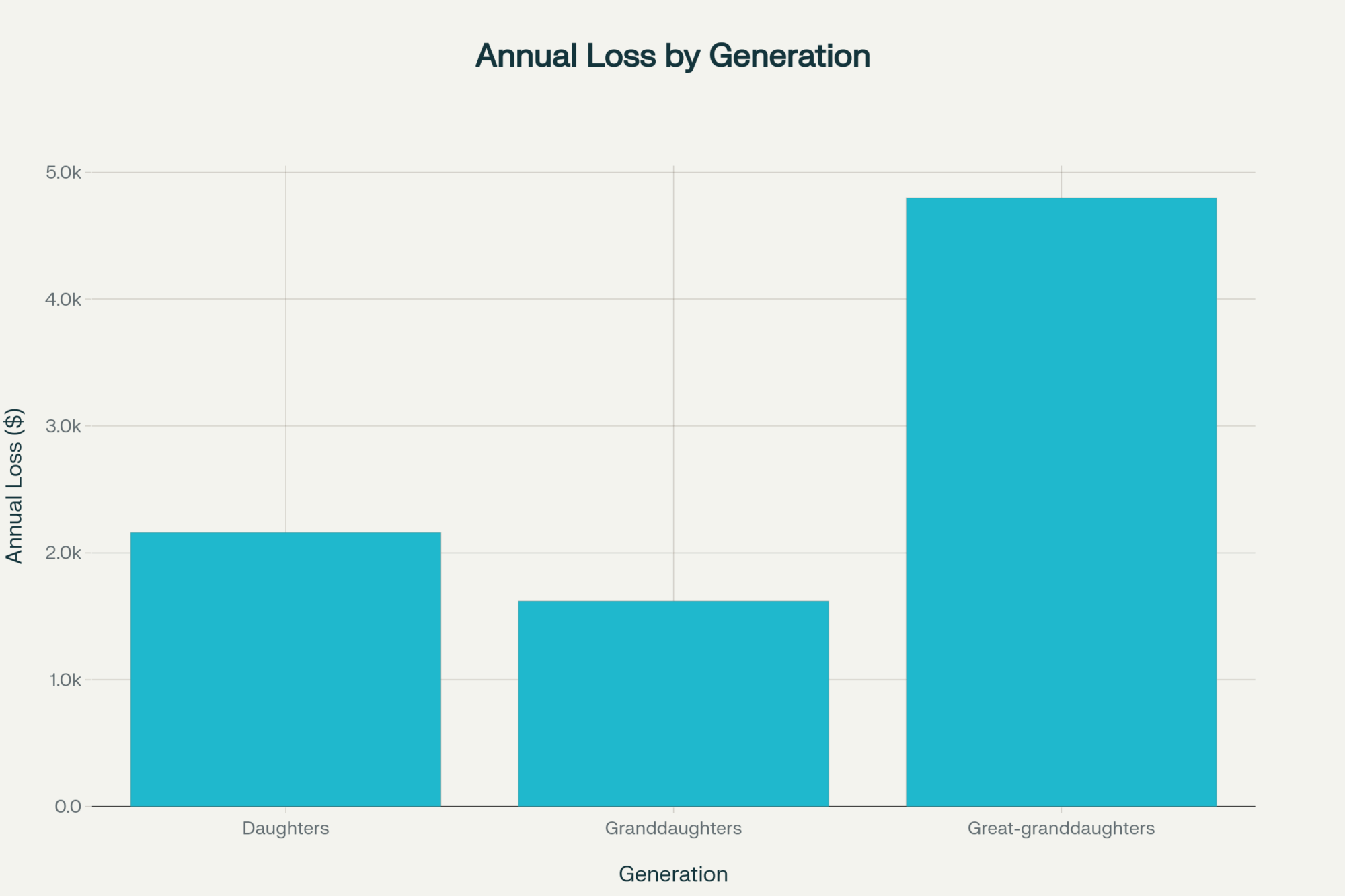
NewsSubscribe
First
Last
Consent

The Heat Crisis That’s About to Flip Dairy Upside Down

India’s losing $3.8 billion in milk yield annually from heat stress—same genetics sitting in your barn right now.

EXECUTIVE SUMMARY: Look, while we’ve been debating whether climate change matters for dairy, it just walked into the world’s biggest operations and started writing checks nobody can cash. The brutal truth is that heat stress is already costing North American producers $51-77 per cow every summer—and your highest genomic performers are getting hit the hardest because we’ve bred them into metabolic furnaces. India’s losing 9.6 million tonnes of production annually, but here’s what should scare you: their Holsteins are the same genetics sitting in barns from Wisconsin to Texas right now. Research from the University of Arizona confirms that elite cows start metabolically crashing at THI levels of just 68, not the 72 we’ve relied on for decades. With cooling systems only offsetting about 40% of losses even in ideal conditions, and feed efficiency dropping 4.13% per THI unit, the math is brutal. Smart producers are already shifting to proactive cooling strategies with 1.5-year payback periods instead of waiting for emergency installations that cost 2-3 times more.

KEY TAKEAWAYS

  • Water system upgrade pays back immediately — Heat-stressed cows need 8-10 gallons daily vs. 4-5 normal, and most operations are bottlenecked at the waterer during heat waves. Fix this $15,000 investment now before summer peaks hit.
  • THI monitoring beats weather reports every time — Your barn’s microclimate can be 10+ degrees different from the local weather station. Track THI at cow level to trigger cooling at 68, not 72, and maintain milk components when Class III futures are sitting strong.
  • Genetic selection hedge against climate volatility — Heat tolerance traits show negative correlation with peak yield, but maintaining 85% production during stress beats losing 25% like Maharashtra operations. Start factoring HSPA4 genetic markers into breeding decisions now.
  • Regional cooling strategies vary by humidity — Southwest operations are shifting to nighttime feeding protocols while Great Lakes producers focus on ventilation upgrades. With 17 additional heat stress days projected by 2050, the $200-300 per cow retrofit investment needs to happen before crisis pricing kicks in.
  • Nutritional fat supplementation delivers measurable ROI — Bumping dietary fat to 6-7% of dry matter costs just $0.12 per cow daily but maintains feed efficiency when temperatures spike. University of Wisconsin research shows this works across all production levels.
dairy farming, heat stress, genomic testing, dairy profitability, cooling technology

Look, I’ll cut straight to the chase here. While we’ve all been debating whether climate change is coming for dairy, it just walked into India’s biggest operations and started writing checks our industry can’t cash. Their $150 billion dairy sector—that’s the operation pumping out nearly 25% of the world’s milk—is hemorrhaging production like nothing I’ve seen before. And here’s what’s keeping me up at night… those same Holsteins getting cooked over there? They’re sitting in barns from Wisconsin to Texas right now.

The Numbers That Made Me Do a Double-Take

The thing about industry data is that sometimes it hits you like a cold slap in the face. According to recent research published in The Lancet and picked up by our colleagues at Dairy News Today, India is losing 9.6 million tonnes of milk production every year due to heat stress. That’s $3.8 billion walking straight out the barn door annually.

But here’s where my jaw really dropped… the same researchers are projecting that without serious cooling interventions, they could lose 25% of their entire production by 2085. We’re talking about $24 billion in lost revenue. Think about that for a minute—that’s like losing the entire dairy production of California, Wisconsin, and New York combined.

Now, you might be thinking, “that’s India’s problem.” But here’s where it gets personal for every one of us running Holsteins. If you’ve got high-producing cows anywhere from the Canadian border down to the Gulf, you’re dealing with the exact same genetics that are getting hammered over there. Actually—and this is what really concerns me—our cows might be even more vulnerable because we’ve pushed them harder for production than anyone else on the planet.

When the Heat Hits Your Best Producers

The science on this is pretty sobering. Research emerging from the University of Arizona confirms that high-producing Holstein cows begin to experience metabolic stress at THI levels as low as 68. That’s way below the old threshold of 72 we used to rely on. When THI hits 68, respiration rates jump above 60 breaths per minute, and you start seeing milk yield losses immediately.

What strikes me about this research is how it changes everything we thought we knew about heat stress timing. Those 100-pound cows we’re so proud of? They’re the canaries in the coal mine.

What’s Really Happening When Your Cows Hit the Wall

The thing about heat stress—and I’ve been tracking this stuff for probably fifteen years now—is how it doesn’t just hit production. It cascades through everything. We’ve spent decades selecting cows that can produce 80, 90, even 100+ pounds of milk daily. Those animals are basically metabolic furnaces running at full capacity, and when the temperature climbs, they can’t just dial back the heat production like a lower-producing cow might.

I was speaking with some nutritionists who have been working with operations in Maharashtra (where some of India’s largest dairies are located), and they’re seeing a 25% drop in milk production during the peak summer months. But here’s the kicker—some operations never fully recover their pre-heat production levels even when temperatures moderate. That’s not just a seasonal dip… that’s structural damage to the business model.

Dr. Lance Baumgard’s team at Iowa State has been documenting similar patterns in the United States, and their numbers show that heat stress costs U.S. operations between $1.2 and $1.5 billion annually. We’re looking at losses of $51 to $77 per cow during the summer months for individual producers. If you’re running a 500-cow operation in places like the Central Valley or southern Texas, that’s real money walking away.

Regional Patterns That’ll Surprise You

What is particularly noteworthy is how this is unfolding differently across regions. Producers in the upper Midwest—places that never worried about heat stress before—are starting to see issues they’re not equipped to handle. I’m hearing reports from Wisconsin and Minnesota operations about problems with their ventilation systems that weren’t designed for.

Down in the Southwest, they’ve been living this reality for years, but the frequency and intensity are ramping up. These operations are becoming the laboratories for the rest of us—what works there will eventually work everywhere, because everywhere is starting to look more like Arizona in July.

The Technology Reality Check (And Why Even the Best Systems Have Limits)

Here’s where it gets interesting—and honestly, a bit frustrating. Recent work from Israeli researchers studying over 130,000 cows found that even their most sophisticated cooling systems only offset about 40% of losses when temperatures really spike above 24°C. The recovery time? More than 10 days, even with top-tier cooling infrastructure.

That’s what really gets to me about this whole situation. We’re not dealing with a problem that technology can just solve outright. Even the Israelis, who arguably run some of the most advanced dairy cooling in the world, are hitting limits.

What’s Actually Working on Real Farms

The economics tell a story here. Research comparing different farm setups shows that automated ventilation cuts heat stress impacts by 15-20% compared to traditional barns. However, retrofitting existing structures can cost anywhere from $200 to $ 300 per cow, and that’s probably conservative, depending on your setup and local labor costs.

The payback picture is interesting, though. Israeli studies have found that farmers can typically recoup the costs of cooling equipment in about 1.5 years under normal conditions. However, here’s the catch—and it’s a significant one—effectiveness drops dramatically during extreme heat events, which are becoming increasingly frequent.

I was speaking with a producer in central California last month who had installed a $180,000 evaporative cooling system three years prior. Works great most of the time, he says, but during that heat dome they had in 2023, it couldn’t keep up. His words: “It’s like bringing a garden hose to a house fire.”

The maintenance side is where many operations often get caught off guard as well. You’re looking at significant ongoing costs for upkeep, especially if you live in an area with hard water. Plus, the electrical consumption during peak summer months… it adds up fast when you’re already dealing with compressed margins and higher feed costs.

Feed Strategies That Actually Move the Needle

The thing about nutritional management—and this is something you can start working on tomorrow if your nutritionist is worth their salt—is that it’s often the most cost-effective first line of defense. Research from the University of Wisconsin indicates that increasing dietary fat content to 6-7% of dry matter can help mitigate the effects of heat stress. The implementation costs are reasonable, and the payback is there if you do it right.

However, what’s really interesting is that the approach varies dramatically by region. In the Southwest, producers are shifting to nighttime feeding when it’s cooler. Makes sense, right? Why ask cows to process a full TMR ration when it’s 105°F outside?

Up in the Great Lakes region, they’re focusing more on ration adjustments and shade structures. Different climate, different solutions. There’s no one-size-fits-all approach here, which is both the challenge and the opportunity.

Water: The Often-Overlooked Bottleneck

Water capacity… this is where many operations fall short, and it’s honestly one of the easier fixes. Industry standards say 4-5 gallons per cow per day under normal conditions, but heat stress can push consumption to 8-10 gallons. I’ve walked through barns where the water system becomes the bottleneck during extreme weather events.

Had a producer in Iowa—thought he was prepared for everything—until a week of 90+ degree days with high humidity hit. His cows were lined up at the waterers like rush-hour traffic. Fixed it with a $15,000 water system upgrade that probably saved him $50,000 in lost production over that summer alone.

The Genetics Puzzle: Are We Breeding Ourselves into a Corner?

Now here’s where things get really fascinating—and honestly, a bit concerning from a breeding perspective. Recent genomic research from Beijing Agricultural University has identified specific heat tolerance markers, including the HSPA4 gene, as potential tools for selection. However, the commercial application is still several years away, possibly longer.

The challenge—and this keeps me up at night—is that heat tolerance and peak milk yield exhibit a negative correlation. So, we’re facing a fundamental trade-off: do you breed cows that can maintain production in heat, or do you continue to push for maximum output under ideal conditions?

The Breeding Philosophy Shift

This trend suggests we might need to rethink some of our basic assumptions about what makes a “good” cow. The Holstein that can pump out 120 pounds a day in a climate-controlled Wisconsin barn might not be the answer for the future we’re heading into.

I was speaking with some geneticists at a conference last spring, and the conversation kept returning to this question: Are we selecting ourselves into a climate vulnerability? These high-metabolic animals we’ve created… they’re incredible production machines under perfect conditions, but they’re also the most susceptible to environmental stress.

The breeding philosophy is shifting, though slowly. Instead of selecting for animals that can reach incredible peaks, we’re now looking for cows that can maintain decent production when conditions become tough. It’s a completely different approach to genetic progress, and I’ll be honest—it makes me a bit nervous about where we’re headed in terms of overall production capability.

Risk Management: Why Insurance Isn’t the Answer (But It’s Part of the Puzzle)

Heat stress insurance is expanding from places like India to North American markets, which suggests something about where the industry thinks this trend is heading. These are parametric products—they pay out based on temperature and humidity triggers, not actual loss assessment.

The coverage is developing, but let’s be real—it’s not a silver bullet. Most policies cap coverage at 60% of potential losses, so you’re still self-insuring a significant chunk of the risk. The question becomes whether those premiums make sense compared to investing directly in cooling infrastructure.

What strikes me about the insurance development is how it’s happening differently across regions. In places like Arizona and southern California, producers are already pretty familiar with weather-based risk management. However, I’m seeing more interest from traditionally “safe” regions, such as upstate New York and Vermont. That should tell us something.

The Hard Truth About Insurance

The reality is, insurance is a band-aid. It might help with cash flow after a bad summer, but it doesn’t keep your cows productive or maintain your milk quality when the heat hits. And it certainly doesn’t address the long-term genetic implications we’re starting to see in heat-stressed herds.

Regional Reality Check: Where We Stand Right Now

Here’s what I’m seeing across different regions, and some of this might surprise you:

Upper Midwest (Wisconsin, Minnesota, Iowa): Starting to see heat stress issues they never dealt with before. The good news? They’re in the best position to adapt because they’re starting from a cooler baseline. Bad news? Most aren’t prepared for the transition. Infrastructure that worked fine for decades is suddenly inadequate.

Great Lakes (Michigan, Ohio, Pennsylvania): Mixed bag. Some areas are still relatively protected, but the humidity factor is becoming a bigger issue than expected. Lake effect might keep temperatures down, but it’s not helping with humidity levels that stress high-producing cows.

Southwest (Arizona, New Mexico, California): Already living this reality. These operations are the laboratories for the rest of us—what works there will eventually work everywhere, because everywhere is starting to look more like Arizona in July. They’ve got a head start on adaptation, but they’re also hitting the limits of what’s possible.

Southeast (Georgia, Florida, North Carolina): Heat plus humidity creates the worst-case scenario. These producers are facing challenges that may become widespread across much of the country. It’s not just temperature—it’s the combination that kills production.

Texas: The wild card. Massive production, increasingly challenging conditions. What happens there affects milk prices nationwide, so we’re all watching. Some of the most innovative cooling approaches are emerging from Texas operations that must succeed or face bankruptcy.

What’s Coming Down the Pike (And It’s Not Pretty)

Climate projections suggest North American dairy regions could see 17 additional heat stress days annually by 2050. That’s no longer theoretical—it’s about planning horizons for operations, making long-term infrastructure investments today.

The operations that get ahead of this curve are going to have significant competitive advantages. When your neighbors are scrambling to implement emergency cooling during a heat wave, you’ll be maintaining production and potentially capturing market share.

The Competitive Landscape Shift

Consumer demand for sustainably produced dairy products continues to grow. Climate-resilient operations are better positioned to meet those environmental stewardship requirements that major food companies are increasingly demanding. It’s becoming less about marketing and more about market access.

What’s particularly noteworthy is how this creates regional competitive advantages. The traditional dairy regions in the Northeast and upper Midwest are starting to see this as an opportunity—if they can maintain production while warmer regions struggle, that changes the economics of milk transportation and processing.

The Technology Investment Timeline (And Why Waiting Gets Expensive)

Let me be blunt about the technology piece. The earlier you invest, the better your options and the lower your costs will be. Emergency cooling installations during a heat crisis can cost two to three times what planned installations cost.

I know a producer in Kansas who waited until 2023 to install cooling systems. During that heat dome, he was competing with everyone else for equipment and contractors. Ended up paying 40% more than he would have two years earlier, and his cows suffered for three weeks while waiting for installation.

The smart money is planning now, not waiting for the crisis to strike. The cooling technology exists—it’s not perfect, but it works. The question is whether you implement it proactively or reactively.

The Bottom Line: Your Action Plan Starting Right Now

Look, here’s what you need to do, and I’m being completely serious about these timelines:

This Summer – Check your water delivery capacity. Can you provide 8-10 gallons per cow daily during heat stress? If not, fix it now. Also, start tracking THI levels in your barns, not just outside weather. The microclimate in your facility may be significantly different from that of the weather station five miles away.

Fall Planning – Run the numbers on basic ventilation improvements. Focus on areas where you’ll get the biggest impact for the least investment. Payback periods on basic systems are usually reasonable, and you can build from there.

2026 Budget Cycle – Factor serious heat stress mitigation into your capital planning. Whether it’s fans, misters, shade structures, or more comprehensive cooling, budget for something substantial. The cost of doing nothing is going up every year.

Breeding Decisions – Start paying attention to heat tolerance in your genetic selection. Yes, it might cost you some production in the short term, but it’s insurance for the long term. The industry is moving in this direction, whether we like it or not.

Nutritional Strategy – Collaborate with your nutritionist to develop summer feeding protocols. The dietary fat approach has solid research behind it, and nighttime feeding schedules are worth considering depending on your setup.

Risk Assessment – Honestly evaluate your operation’s vulnerability. Are you in a traditionally “safe” region that might not be safe much longer? Are your facilities designed for the climate you have now, or the climate you’re going to have?

The Hard Truth About What’s Coming

The key aspect of this situation is that we have surpassed the point of debating whether climate change is real or whether it will impact dairy. It’s already happening. The question is whether you will be proactive about it or reactive.

What’s happening in India isn’t a cautionary tale anymore—it’s a case study. The technology exists to manage heat stress, but the economics require careful planning and early implementation. You can wait for the crisis to hit your area and pay emergency prices, or you can start planning now and maintain your competitive edge.

The operations that view climate adaptation as a strategic investment rather than an emergency expense will be the ones that still thrive when their neighbors are struggling. And in an industry where margins matter and consistency drives everything, being caught unprepared isn’t just expensive—it can be fatal to the business.

Trust me on this one… the heat isn’t coming for us. It’s already here. The question is what you’re going to do about it, while you still have choices, instead of just reacting.

Complete references and supporting documentation are available upon request by contacting the editorial team at editor@thebullvine.com.

Learn More:

The Sunday Read Dairy Professionals Don’t Skip.

Every week, thousands of producers, breeders, and industry insiders open Bullvine Weekly for genetics insights, market shifts, and profit strategies they won’t find anywhere else. One email. Five minutes. Smarter decisions all week.

NewsSubscribe
First
Last
Consent

Belarus Targets Strategic A2A2 Market Entry: State-Backed Program Challenges Global Premium Dynamics

Belarus’s state-backed genomic program threatens 50% price premiums by 2030.

EXECUTIVE SUMMARY: The A2 milk gold rush you’re betting your herd conversion on is about to face its biggest threat yet—and it’s coming from an unexpected player. Belarus has launched a state-funded program targeting 70% A2 beta-casein production by 2030, threatening to commoditize a market currently delivering 50%+ retail premiums. With the global A2 sector projected to explode from $4.0 billion to $11.1 billion by 2030, this isn’t just another breeding program—it’s a calculated national strategy to capture commodity-scale market share. While genomic testing costs have dropped to $5-40 per animal and elite A2A2 semen ranges $10-75 per straw, the real cost could be the erosion of premium margins that justify your conversion investment. Research shows A2 milk reduces gastrointestinal discomfort and beneficial gut microbiota shifts, validating the science behind the trend. However, the Belarus gambit exposes the fundamental vulnerability of building premiums on non-proprietary genetic markers that any state-backed competitor can replicate. Before you commit another dollar to A2 conversion, demand long-term contracts with guaranteed price floors—because the rules of this game are changing faster than you think.

KEY TAKEAWAYS

  • Secure Contract Protection Before Converting: Demand guaranteed price floors and duration commitments from processors before investing in A2 conversion, as Belarus’s commodity approach could compress the 50%+ retail premiums currently justifying herd transition costs within the next 5 years.
  • Prioritize Genetic Merit Over A2 Status: Focus on bulls ranking above 3000 GTPI that happen to be A2A2 rather than selecting lower-merit sires solely for A2 genetics—Semex reports over 230 high-ranking Holstein A2A2 bulls available, proving you don’t need to sacrifice productivity for the trait.
  • Time Your Market Entry Strategically: Early A2 adopters may capture better premiums before commoditization accelerates, but late entrants risk investing in expensive herd conversions just as state-backed producers flood markets with lower-cost A2-rich products.
  • Build Defensible Value Propositions: Processors must accelerate brand differentiation beyond simple A2 claims through attribute stacking (A2 + organic, A2 + grass-fed) to create premium positions that transcend commodity competition from state-funded operations.
  • Monitor Global Supply Chain Disruption: Belarus already supplies 94% of Russia’s dairy imports and targets China’s rapidly growing A2 infant formula market—track their export expansion as an early indicator of when commodity A2 pricing pressure will hit your local market.
A2 milk production, dairy genetics, genomic testing, breeding programs, dairy profitability

Belarus has launched a comprehensive state-funded genetics initiative targeting A2A2 milk production by 2030, representing a calculated strategy to capture market share in the rapidly expanding global A2 sector. The program, directed by the National Academy of Sciences, aims to develop milk containing 70% A2 beta-casein content—a strategic threshold that avoids the economic inefficiencies of complete herd conversion while achieving commercial A2-rich milk production.

But here’s the million-dollar question: What happens when a state-backed entity enters a market built on premium pricing?

Program Economics: Measured Investment Strategy

The Belarusian approach demonstrates a sophisticated understanding of breeding economics. Rather than pursuing absolute genetic purity, the 70% target allows retention of genetically superior A1A2 animals while achieving commercial viability. This strategy could reduce conversion costs by approximately 40% compared to complete herd replacement programs.

The economic rationale centers on accessing premium market segments where A2 milk commands significant retail premiums. Current market analysis indicates that the global A2 milk sector was valued at $15.4 billion in 2024 and is projected to reach $50.9 billion by 2033. Other estimates suggest growth from $2.4 billion in 2024 to $5.4 billion by 2034. However, Belarus’s commodity-focused approach could accelerate market commoditization, potentially eroding the very premiums that justify initial investment.

Technical Implementation: Accelerated Genetics Through State Coordination

The program leverages Belarus’s existing artificial insemination infrastructure and centralized breeding records system. As of January 2025, Belarus operates nearly 3,000 dairy farms, with 56% classified as modern high-tech complexes. This infrastructure provides the necessary technical foundation for large-scale genetic conversion.

The breeding strategy employs exclusive A2A2 bull usage, ensuring all offspring receive at least one A2 allele. Mathematical modeling suggests that achieving a 40% A2A2 population density, combined with 60% A1A2 animals, would yield the target 70% A2 protein content in pooled milk—a pragmatic compromise that enables market entry without incurring extreme culling costs.

Risk Assessment: Implementation Challenges

Industry geneticists identify several implementation risks that could compromise program success. Genetic drag represents the primary technical concern—intensive focus on A2 status may negatively impact other economically vital traits if superior A1-carrying sires are excluded from breeding programs.

Market dynamics present additional vulnerabilities. The initiative’s viability depends entirely on sustained A2 price premiums, which Belarus’s own commodity production could help erode.

Are we watching the beginning of the end for easy A2 premiums?

Execution risks include the logistical complexity of coordinating thousands of farms toward unified genetic objectives within an aggressive timeline. While Belarus plans to modernize and build 450 dairy farms by 2027, the scale and speed requirements present unprecedented challenges for centralized agricultural planning.

Strategic Market Implications: Commoditization Pressure

Belarus’s entry strategy poses direct challenges to established premium players, such as The a2 Milk Company and Nestlé, whose business models depend on maintaining significant price differentials. The state-backed approach enables aggressive pricing strategies that branded competitors cannot easily match.

The program validates broader industry trends toward the commoditization of the A2 trait. Major genetics suppliers, including ABS Global and Semex, now offer extensive A2A2 sire catalogs, with Semex reporting over 230 high-ranking Holstein bulls with a GTPI of more than 3000 that carry the A2A2 genotype. ABS Global prominently features A2A2 as a “Specialist Symbol” in its sire directories, demonstrating that elite A2 genetics are now mainstream and widely available.

The export strategy initially focuses on securing Russian market dominance—Belarus supplied 94% of Russia’s dairy imports in 2024, totaling 953,000 tonnes—before targeting high-growth Asian markets. In 2024, Belarusian dairy exports surged 17.5% to $3.4 billion, with the a2 protein segment growing 14% in China’s infant formula market and representing 20% of market value.

Industry Adaptation: Strategic Positioning

For dairy producers considering A2 conversion, the Belarus initiative signals both opportunity and caution. Recent research has demonstrated that A2 milk consumption leads to beneficial shifts in gut microbiota, including increases in Bifidobacterium and Blautia. Furthermore, prolonged A2 milk consumption has been shown to reduce symptoms compared to conventional milk in lactose malabsorbers. This validates the A2 trend and may encourage processor premiums.

However, long-term commoditization risks require careful contract negotiation with guaranteed price floors and duration commitments.

Genetic selection strategies should prioritize bulls that rank highly on economic indexes, which happen to be A2A2, rather than compromising overall genetic merit for A2 status alone. This approach maintains herd profitability while positioning for market transitions.

Processing companies face strategic decisions regarding supply chain positioning. Early A2 market entrants must accelerate brand differentiation beyond simple A2 claims—combining traits like A2 + organic or A2 + grass-fed to create defensible value propositions that transcend commodity competition.

Market Outlook: Navigating Transition Dynamics

The Belarus program represents a fundamental shift in A2 market dynamics, regardless of ultimate success. The transition from premium-branded ingredients to standard specification mirrors historical patterns in organic and lactose-free segments.

The global A2 milk market is projected to grow at a compound annual growth rate (CAGR) of 14.21% through 2033, with the Asia-Pacific region maintaining dominance due to high consumer awareness and demand in countries such as China, India, and Australia. However, the commoditization pressure from state-backed producers threatens to compress the premium margins that have driven this growth.

How will your operation adapt to this new reality?

Bottom Line: Strategic Takeaways

For Dairy Producers:

  • Demand long-term contracts with guaranteed price floors before investing in A2 conversion
  • Prioritize overall genetic merit over A2 status alone when selecting sires—focus on bulls with high economic indexes that happen to be A2A2
  • Consider the timing—early movers may capture better premiums before commoditization accelerates

For Processors:

  • Accelerate brand differentiation beyond simple A2 claims through attribute stacking
  • Secure key markets before low-cost competitors establish footholds
  • Optimize supply chains for potential margin compression scenarios

For the Industry: The Belarus initiative demonstrates how state-directed agricultural policy can disrupt established market structures, particularly in segments built on non-proprietary genetic markers. Belarus may not achieve its 2030 target completely, but the attempt alone signals the end of easy A2 premiums and the beginning of a more competitive, commodity-driven market phase.

The A2 gold rush isn’t over—but the rules of the game are changing fast.

Complete references and supporting documentation are available upon request by contacting the editorial team at editor@thebullvine.com.

Learn More:

The Sunday Read Dairy Professionals Don’t Skip.

Every week, thousands of producers, breeders, and industry insiders open Bullvine Weekly for genetics insights, market shifts, and profit strategies they won’t find anywhere else. One email. Five minutes. Smarter decisions all week.

NewsSubscribe
First
Last
Consent

Osborndale Ivanhoe: How a “Scrawny Bull Calf” Revolutionized an Entire Breed

Stop trusting visual appraisal over genetic data. Ivanhoe’s ‘scrawny’ start led to 630 lbs of milk gains and 8-year Honor List dominance.

Osborndale Ivanhoe (EX-GM) stands as a testament to the power of genetic vision over visual assessment. This "thin, scraggy calf" dismissed by his first potential owner became the most dominant Holstein sire in history, leading the U.S. Honor List for an unprecedented eight consecutive years (1964-1971). Standing 6'1" at the withers and weighing up to 3,200 pounds, Ivanhoe's 5,499 daughters averaged +1.65 points above expectancy while delivering +630 pounds milk and +23 pounds fat improvements that "reshaped and rejuvenated" the entire Holstein breed
Osborndale Ivanhoe (EX-GM) stands as a testament to the power of genetic vision over visual assessment. This “thin, scraggy calf” dismissed by his first potential owner became the most dominant Holstein sire in history, leading the U.S. Honor List for an unprecedented eight consecutive years (1964-1971). Standing 6’1″ at the withers and weighing up to 3,200 pounds, Ivanhoe’s 5,499 daughters averaged +1.65 points above expectancy while delivering +630 pounds of milk and +23 pounds fat improvements that “reshaped and rejuvenated” the entire Holstein breed

The morning of April 26, 1952, dawned ordinary at Osborndale Farms in Derby, Connecticut. No cosmic fanfare marked the moment when a thin, scraggy calf drew his first breath in Mrs. W.S. Kellogg’s barn. The earth neither rumbled nor shook, no thunder rended the skies, and the heavens didn’t part to fall rain. Yet in that quiet moment, the future of the Holstein breed had just taken a dramatic turn, though it would be years before anyone recognized it.

Professor James Osborn had reserved this calf before birth, even chosen his name: Ivanhoe. But when confronted with the disappointing reality —a gangly, underwhelming youngster who looked nothing like the promising genetics his pedigree suggested —Osborn walked away. It was a decision that would echo through decades of regret, for this dismissed calf would become Osborndale Ivanhoe, the bull whose influence would “reshape and rejuvenate the Holstein breed.”

Frances Kellogg (Mrs. W.S. Kellogg) stands as a pioneering figure in American Holstein breeding, having owned and operated Osborndale Farms in Derby, Connecticut, from 1920 until her death in 1956. As the breeder of Osborndale Ivanhoe, Kellogg demonstrated remarkable foresight when she purchased Quality Fobes Abbekerk Gay—Ivanhoe's future dam—for $1,350 at the 1946 Connecticut Bred Heifer Classic. Her dedication to registered Holstein breeding created the foundation from which one of history's most influential sires would emerge. While Professor Osborn dismissed the "thin, scraggy calf" that would become Ivanhoe, it would take another visionary—Aldo Panciera—to recognize the genetic treasure that Kellogg's breeding program had produced. Today, her beloved Osborndale Farm serves as Osbornedale State Park, preserving the legacy of a woman who helped shape the future of an entire breed.
Frances Kellogg (Mrs. W.S. Kellogg) stands as a pioneering figure in American Holstein breeding, having owned and operated Osborndale Farms in Derby, Connecticut, from 1920 until her death in 1956. As the breeder of Osborndale Ivanhoe, Kellogg demonstrated remarkable foresight when she purchased Quality Fobes Abbekerk Gay—Ivanhoe’s future dam—for $1,350 at the 1946 Connecticut Bred Heifer Classic. Her dedication to registered Holstein breeding created the foundation from which one of history’s most influential sires would emerge. While Professor Osborn dismissed the “thin, scraggy calf” that would become Ivanhoe, it would take another visionary—Aldo Panciera—to recognize the genetic treasure that Kellogg’s breeding program had produced. Today, her beloved Osborndale Farm serves as Osbornedale State Park, preserving the legacy of a woman who helped shape the future of an entire breed.

The Visionary Who Saw Beyond Appearance

While others saw only failure, Aldo Panciera saw destiny written in bloodlines and breeding records.

The young Rhode Island dairyman carried the quiet determination of a World War II veteran who had returned home with ambitious dreams bigger than his modest means. At his Tum-A-Lum Farm in Westerly, Panciera had made the bold decision to abandon his Guernseys and grade Holsteins for registered black-and-whites, a choice that would prove prophetic.

Six years before Ivanhoe’s birth, Panciera had attended his first Holstein sale, the 1946 Connecticut Bred Heifer Classic. There, he watched from the sidelines as Quality Fobes Abbekerk Gay commanded $1,350, far beyond his modest budget but forever etched in his memory. When fate brought him back to Osborndale Farm in 1952, accompanied by George Causey and Holstein Association fieldman Allen N. Crissey, he found Gay again, along with her full sister, Quality Fobes Nebraska Gwen. The scale, dairy character, and quality of these animals awakened the selection committee.

Standing in that Connecticut barn, observing Gay’s bull calf by Osborndale Ty Vic, Panciera made a decision that would echo through Holstein history. Where others saw inadequacy, he saw potential written in pedigree and bloodlines. He convinced Causey to join him in purchasing quarter interests in the scrawny calf for $1,250 each, money they could ill afford to lose, but a gamble based on genetic conviction rather than physical appearance.

Aldo Panciera with his young daughter Carla and Tum-A-Lum Ivanhoe Lettie (EX-93), one of Ivanhoe’s daughters. While neighbors whispered doubts about his investment, Panciera’s unwavering belief in Ivanhoe’s genetic potential would soon be vindicated as these initially awkward daughters matured into the elegant, productive cows that silenced all skeptics.

The Test of Faith

What followed were years that would have broken a lesser man’s resolve.

When Ivanhoe arrived at Tum-A-Lum Farm, his yearlings appeared to mock Panciera’s faith. Day after day, visitors would walk past the shallow-bodied, rough-rumped, narrow-hearted heifers, their sideways glances carrying volumes of unspoken doubt. In feed stores across Rhode Island, conversations would halt when Panciera entered. At neighboring farms, fellow dairymen shook their heads at what they saw as misguided optimism.

Other co-owners also felt the pressure. Charles Stroh, the Hartford attorney who had acquired Mrs. Kellogg’s interest after her death, used the bull sparingly. Stroh was focused on his $30,000 herd sire, Wis Maestro, seemingly a safer bet than this ungainly experiment. Panciera’s original partner, George Causey, used Ivanhoe only sparingly before eventually selling his quarter interest.

Several AI studs publicly boasted of having “turned the bull down.” The criticism stung, but Panciera persisted, using Ivanhoe nearly 100% in his herd while the Holstein world watched and whispered about his folly. The weight of those investments, $1,250 each at a time when money was scarce, pressed heavier with each passing month.

Then, like dawn breaking after the longest night, everything changed.

The Transformation That Silenced Critics

When Ivanhoe’s daughters began to freshen, the awkward yearlings underwent a metamorphosis that bordered on magical. Those shallow bodies filled out with the deep capacity of true production animals. The rough rumps smoothed into elegant dairy character. The narrow hearts expanded with the chest depth, revealing genetic potential.

The watershed moment came at the 1957 Eastern States Exposition when Tum-A-Lum Ivanhoe Misty placed third in a class of thirty-two two-year-olds. In the show ring that day, something clicked as the judge ran his experienced hands over Misty’s frame, feeling the height, length, and tight udder attachment. Here was visible proof that Panciera’s faith had been justified.

Word spread through the Holstein community like wildfire. Suddenly, whispers of doubt transformed into murmurs of interest. The timing couldn’t have been more perfect. The dominant Burke bloodline had created a Holstein population, becoming “increasingly close-coupled and short-legged.” Across America’s dairy farms, progressive breeders were searching for “new blood”, cattle with the stature and production capacity to compete in modern dairying. Ivanhoe delivered exactly what they craved.

When Giants Require Everything Bigger

By early 1958, the whispers had reached the right ears. Earl Groff, chairman of the S.P.A.B.C. sire committee, was traveling one February Saturday with Holstein Association classifier Jack Fairchild when fate intervened. Fairchild mentioned some impressive heifers he’d seen by a bull named Ivanhoe up in Connecticut. By Monday morning, the sire committee was heading for New England.

What they discovered defied their expectations. At S.L. Bickford’s Atlasta Farm, the inventor of the mechanized luncheon system drove them to the back pasture in his twelfth Cadillac, one of his collected hobbies. There, the Ivanhoe daughters stood “long, sharp, and uniform.” At Tum-A-Lum Farm, their size, scale, and tight udders immediately caught the committee’s trained eyes. A twelve-pair dam-daughter comparison showed increases of 2,656 pounds of milk and 102 pounds of fat, along with an average classification score of 83.7 points.

When they finally met Ivanhoe himself, they encountered a bull whose physical presence demanded respect and significant infrastructure modifications. By the time S.P.A.B.C. acquired him for $15,000 (later renegotiated to $12,000 due to health concerns), Ivanhoe had grown into a genuine giant. Standing six feet, one inch at the withers and weighing up to 3,200 pounds, he was “one of the longest bulls in breed history.”

His arrival at the AI facility created unprecedented challenges that tested both ingenuity and patience. Workers discovered that existing fences weren’t high enough to contain him. He famously put a dent in the roof of the bull trailer, the only bull ever to accomplish such a feat. Floyd Weidler, the production manager, had to completely remodel Ivanhoe’s pen: raising fence heights, building up his manger, and creating a special yoke that allowed him to stand while eating. Even the collection room required alterations to accommodate his massive frame.

Managing his condition proved equally demanding. When his weight approached 3,200 pounds, his semen production declined, forcing managers to reduce him to 2,800 pounds, a weight at which “a person could count every rib.” An arthritic condition requires daily doses of aspirin. His initial response to semen collection was poor, gradually improving with patient management. Yet despite these difficulties, Weidler remembered him fondly: “He was a nice bull to work with for his size.”

The Numbers That Rewrote History

By 1964, the skeptics had fallen silent. From barns across America, the evidence arrived in monthly reports that told an undeniable story, one written in pounds of milk and points of type that no critic could dismiss.

In show rings from Vermont to California, judges ran experienced hands over Ivanhoe daughters, their scorecards consistently marking numbers that had become the industry’s new standard. His 5,499 classified daughters averaged 82.3 points for type, a remarkable +1.65 difference from expectancy that spoke to his ability to upgrade entire herds. When researchers compiled the final tally from 10,898 tested daughters across 2,264 herds, the numbers revealed +630 pounds of milk and +23 pounds of fat, extraordinary improvements for the era.

From 1964 through 1971, Ivanhoe commanded the top position on the U.S. Honor List for eight consecutive years, an achievement no bull has equaled. Until the mid-1970s, he remained the leading sire of daughters, producing over 200,000 pounds of milk in his lifetime and over 1,000 pounds of fat. His semen production was equally impressive: 100,187 first services, peaking at 24,500 in 1960.

His genetic reach extended into show rings nationwide, where he sired 36 individual All-American nominees and six nominated Gets of Sire. The unanimous 1969 All-American group, featuring his daughters from coast to coast, stood as a testament to his ability to improve cattle regardless of environment or management.

Daughters That Defined Excellence

Paclamar Ivanhoe Slippers (EX-90) exemplifies Ivanhoe's international influence beyond North American borders. This distinguished daughter sold for $20,000 in 1967—a substantial sum for the era—before being exported to Italy by Mr. Talenti of Allevamento Salone near Roma. Out of Ja-Sal Whirlwind Princess (EX-93) and tracing to the exceptional Snowboots Wis Milky Way (EX-97), Slippers became the dam of Talent King Of Salone (EX-95), who dominated Italian show rings as Grand Champion at the National Show in Cremona for three consecutive years (1971-1973). Her legacy continued through King of Salone's son, Talent King Linea (EX-95), Grand Champion at Cremona in 1980, demonstrating how Ivanhoe's genetics shaped elite European Holstein breeding programs.
Paclamar Ivanhoe Slippers (EX-90) exemplifies Ivanhoe’s international influence beyond North American borders. This distinguished daughter sold for $20,000 in 1967—a substantial sum for the era—before being exported to Italy by Mr. Talenti of Allevamento Salone near Roma. Out of Ja-Sal Whirlwind Princess (EX-93) and tracing to the exceptional Snowboots Wis Milky Way (EX-97), Slippers became the dam of Talent King Of Salone (EX-95), who dominated Italian show rings as Grand Champion at the National Show in Cremona for three consecutive years (1971-1973). Her legacy continued through King of Salone’s son, Talent King Linea (EX-95), Grand Champion at Cremona in 1980, demonstrating how Ivanhoe’s genetics shaped elite European Holstein breeding programs.

While statistics told the story of breed improvement, it was Ivanhoe’s individual daughters who captured hearts and headlines, becoming legends in their own right.

Allendairy Glamourous Ivy (EX-96-GMD) made Holstein history when she became the first dairy cow in the world to sell for one million dollars at the 1983 Pearmont Farm Dispersal. This exceptional Osborndale Ivanhoe daughter from Md-Maple-Lawn Marquis Glamour (EX-96) represented the perfect expression of her sire's genetic gifts—an EX-96 cow from an EX-96 dam who embodied the height, dairy character, and production potential that made Ivanhoe daughters legendary throughout the industry. Her record-breaking sale price demonstrated the enduring value of Ivanhoe genetics nearly two decades after his death, proving that superior breeding creates generational wealth that transcends individual lifetimes.
Allendairy Glamourous Ivy (EX-96-GMD) made Holstein history when she became the first dairy cow in the world to sell for one million dollars at the 1983 Pearmont Farm Dispersal. This exceptional Osborndale Ivanhoe daughter from Md-Maple-Lawn Marquis Glamour (EX-96) represented the perfect expression of her sire’s genetic gifts—an EX-96 cow from an EX-96 dam who embodied the height, dairy character, and production potential that made Ivanhoe daughters legendary throughout the industry. Her record-breaking sale price demonstrated the enduring value of Ivanhoe genetics nearly two decades after his death, proving that superior breeding creates generational wealth that transcends individual lifetimes.

Allendairy Glamourous Ivy rewrote the record books when she became the first dairy cow ever to sell for one million dollars at the 1983 Pearmont Farm Dispersal. This EX-96 daughter from an EX-96 dam represented the perfect marriage of Ivanhoe’s genetic gifts with elite management, a living testament to the power of superior genetics in the right hands.

Miss Ivanhoe Scranton (EX-94-6E) exemplified the show ring dominance that made Osborndale Ivanhoe daughters legendary across America. Owned by Raymond Seidel of Pennsylvania, this exceptional daughter out of VG-85 Glenafton Drummer (by GP-83 Curtiss Candy Dandy Elmer) captured Grand Champion honors in the aged cow class at the 1969 World Dairy Expo while simultaneously earning All-American Aged Cow recognition. Her victory wasn't merely a ribbon—it was definitive proof that Panciera's faith in a "scrawny calf" had been magnificently justified. Miss Ivanhoe Scranton's legacy continued through her daughter, Kerchenhill Ruffian (EX-91), sired by Ideal Fury Reflector and developed at Hilltop-Hanover in New York, demonstrating how Ivanhoe's genetic influence extended through multiple generations of elite show cattle.
Miss Ivanhoe Scranton (EX-94-6E) exemplified the show ring dominance that made Osborndale Ivanhoe daughters legendary across America. Owned by Raymond Seidel of Pennsylvania, this exceptional daughter out of VG-85 Glenafton Drummer (by GP-83 Curtiss Candy Dandy Elmer) captured Grand Champion honors in the aged cow class at the 1969 World Dairy Expo while simultaneously earning All-American Aged Cow recognition. Her victory wasn’t merely a ribbon—it was definitive proof that Panciera’s faith in a “scrawny calf” had been magnificently justified. Miss Ivanhoe Scranton’s legacy continued through her daughter, Kerchenhill Ruffian (EX-91), sired by Ideal Fury Reflector and developed at Hilltop-Hanover in New York, demonstrating how Ivanhoe’s genetic influence extended through multiple generations of elite show cattle.

Miss Ivanhoe Scranton claimed her place in show ring history by capturing Grand Champion honors in the aged cow class at the 1969 World Dairy Expo. Her victory wasn’t just a win; it was validation of everything Panciera had believed when he saw past a scrawny calf’s appearance to the genetic potential within.

Pennsylvania's Production Powerhouses: June 1966 Pennsylvania Holstein News celebrates two exceptional Osborndale Ivanhoe daughters who exemplified his revolutionary impact on the state's dairy industry. Fultonway Ivanhoe Rae (EX-90-GMD) would later make breed history as the first cow to complete eight consecutive records above 1,000 pounds of fat, with her peak production of 1,615 pounds establishing her as Ivanhoe's highest-producing daughter. Sinking Springs Ivan Bright (VG-88) represented the consistent production excellence that made Ivanhoe daughters legendary throughout Pennsylvania's Holstein community. The profound Pennsylvania influence is evident in the numbers: Fultonway Farm alone registered 184 animals carrying the Ivanhoe name—primarily daughters of Ivanhoe and his son Penstate Ivanhoe Star—while Sinking Springs registered 27 Ivanhoe daughters, demonstrating how one bull's genetics transformed an entire state's dairy industry.
Pennsylvania’s Production Powerhouses: June 1966 Pennsylvania Holstein News celebrates two exceptional Osborndale Ivanhoe daughters who exemplified his revolutionary impact on the state’s dairy industry. Fultonway Ivanhoe Rae (EX-90-GMD) would later make breed history as the first cow to complete eight consecutive records above 1,000 pounds of fat, with her peak production of 1,615 pounds establishing her as Ivanhoe’s highest-producing daughter. Sinking Springs Ivan Bright (VG-88) represented the consistent production excellence that made Ivanhoe daughters legendary throughout Pennsylvania’s Holstein community. The profound Pennsylvania influence is evident in the numbers: Fultonway Farm alone registered 184 animals carrying the Ivanhoe name—primarily daughters of Ivanhoe and his son Penstate Ivanhoe Star—while Sinking Springs registered 27 Ivanhoe daughters, demonstrating how one bull’s genetics transformed an entire state’s dairy industry.

Fultonway Ivanhoe Rae carved her name in breed history books by becoming the first cow to complete eight consecutive records above 1,000 pounds of fat. Her peak record of 1,615 pounds at seven years established her as Ivanhoe’s highest-producing daughter, a testament to the “will to milk” that he transmitted from his Ormsby ancestry.

Round Oak Rag Apple Elevation (EX-96-GM) stands as the ultimate vindication of Osborndale Ivanhoe’s genetic legacy. Born August 30, 1965, and sired by Tidy Burke Elevation out of Round Oak Ivanhoe Eve (EX-94), Elevation embodied everything Panciera had envisioned when he first saw potential in a “scrawny calf” thirteen years earlier. Widely regarded as “perhaps the most influential bull in the history of the Holstein breed,” Elevation became the living proof that Ivanhoe’s transformative genetics could be concentrated and amplified through intelligent breeding decisions. Through his dam—the “crown jewel” among Ivanhoe’s daughters—Elevation carried forward his maternal grandsire’s revolutionary bloodlines, establishing the “dominant influence” through which Ivanhoe’s genetic impact continues to shape modern Holstein breeding worldwide. His existence represents the perfect culmination of genetic vision, where Ivanhoe’s ability to transmit superior type and production found its ultimate expression in a bull that many consider “the best we’ve had.” (Read more: Round Oak Rag Apple Elevation: The Bull That Changed Everything)

Round Oak Ivanhoe Eve earned recognition as the “crown jewel” among Ivanhoe’s daughters, not for her individual achievements but for her role as dam of Round Oak Rag Apple Elevation, a bull many consider “the best we’ve had.” Through Eve, Ivanhoe’s genetic influence would cascade through generations yet to come.

Rotherwood Ivanhoe Valentine (EX-91-3E) exemplifies the production longevity that made Osborndale Ivanhoe daughters legendary in American dairy herds. Born June 22, 1965, and out of GP-84 Pauline Silver Tidy Burke-Twin, Valentine achieved remarkable lifetime production of 216,614 pounds of milk with 7,852 pounds of fat—demonstrating the “will to milk” that Ivanhoe consistently transmitted to his daughters. Her breeding career proved equally significant, producing Locust-Glen Ivanhoe Elevation (VG-86-GM) by Round Oak Rag Apple Elevation, creating a fascinating genetic circle where Ivanhoe’s daughter was bred back to his own maternal grandson. This son entered service at Select Sires, extending Ivanhoe’s genetic influence into yet another generation of AI breeding programs. Valentine’s full sister, Windswept-M Elevation Val (EX-90-DOM), further demonstrated the consistency of this exceptional Ivanhoe family line. Photo credit: Jim Miller

Sons Who Extended the Legacy

Hanoverhill Starbuck (EX-Extra) at 15 years old with Carl Saucier in 1994, photographed at Mount Victoria Farm in Quebec—the same ground where his ancestor Johanna Rag Apple Pabst posed 66 years earlier. This legendary bull exemplifies Ivanhoe's compound genetic influence: sired by Round Oak Rag Apple Elevation (EX-96 GM), whose dam was Round Oak Ivanhoe Eve, and out of Anacres Ivanhoe Astronaut (VG-88), a daughter of Hilltop Apollo Ivanhoe (VG-GM). With Ivanhoe genetics flowing through both sides of his pedigree, Starbuck generated his own revolution—siring over 200,000 daughters across 45 countries and establishing a lineage now present in over 80% of North American Holsteins. His extraordinary impact demonstrates how Ivanhoe's genetic gifts continued to compound across generations, proving that the "earth-shaking" begun in 1952 reverberates through modern dairy herds worldwide.
Hanoverhill Starbuck (EX-Extra) at 15 years old with Carl Saucier in 1994, photographed at Mount Victoria Farm in Quebec—the same ground where his ancestor Johanna Rag Apple Pabst posed 66 years earlier. This legendary bull exemplifies Ivanhoe’s compound genetic influence: sired by Round Oak Rag Apple Elevation (EX-96 GM), whose dam was Round Oak Ivanhoe Eve, and out of Anacres Ivanhoe Astronaut (VG-88), a daughter of Hilltop Apollo Ivanhoe (VG-GM). With Ivanhoe genetics flowing through both sides of his pedigree, Starbuck generated his own revolution—siring over 200,000 daughters across 45 countries and establishing a lineage now present in over 80% of North American Holsteins. His extraordinary impact demonstrates how Ivanhoe’s genetic gifts continued to compound across generations, proving that the “earth-shaking” begun in 1952 reverberates through modern dairy herds worldwide. (Read more: Hanoverhill Starbuck’s DNA Dynasty: The Holstein Legend Bridging 20th-Century Breeding to Genomic Futures)

While consensus held that Ivanhoe’s sons couldn’t match the excellence of his daughters, several proved instrumental in extending their sire’s genetic reach across the industry.

Hilltop Apollo Ivanhoe emerged as his most influential son, spending his entire career at Atlantic Breeders. Through his sons Whittier-Farms Apollo Rocket, who became the breed’s high bull for Predicted Difference for milk in the mid-1970s (+2,210 milk and +40 fat), and Wayne-Spring Fond Apollo, the first bull to exceed +2,000 pounds of milk while rating plus for type, Apollo carried his father’s genetic gifts into a new generation.

Ripvalley NA Bell Tammy (EX-94 2E GMD DOM) exemplifies the enduring power of Ivanhoe's genetic legacy through his grandson, Carlin-M Ivanhoe Bell. Known as "everybody's favorite Bell daughter," this exceptional cow born in 1982 combined outstanding production with superior type, recording lifetime totals of 200,929 pounds of milk with 4.6% fat and an impressive 3.8% protein. Out of the great brood cow St Croixco Lad Nina (EX-94 4E GMD DOM), Tammy became a cornerstone of genetic progress, producing multiple sons and daughters who generated proven AI bulls for generations, including Tonic, Target, Townley, Dawson, and Baxter. Her success, alongside her full brother Ripvalley NA Bell Troy (EX-90 GM) who served at Select Sires, demonstrates how Ivanhoe's transformative genetics continued to reshape the breed decades after his death.
Ripvalley NA Bell Tammy (EX-94 2E GMD DOM) exemplifies the enduring power of Ivanhoe’s genetic legacy through his grandson, Carlin-M Ivanhoe Bell. Known as “everybody’s favorite Bell daughter,” this exceptional cow born in 1982 combined outstanding production with superior type, recording lifetime totals of 200,929 pounds of milk with 4.6% fat and an impressive 3.8% protein. Out of the great brood cow St Croixco Lad Nina (EX-94 4E GMD DOM), Tammy became a cornerstone of genetic progress, producing multiple sons and daughters who generated proven AI bulls for generations, including Tonic, Target, Townley, Dawson, and Baxter. Her success, alongside her full brother Ripvalley NA Bell Troy (EX-90 GM) who served at Select Sires, demonstrates how Ivanhoe’s transformative genetics continued to reshape the breed decades after his death.

Penstate Ivanhoe Star achieved lasting influence through his son Carlin-M Ivanhoe Bell, who became the second most influential bull of the mid-1980s in the United States. Bell’s remarkable ability to increase milk and protein in a single generation, along with his gift for improving udders and foot angle, made him a cornerstone of genetic progress during AI’s explosive growth period.

Parkacres Sun Ivy (EX-95) exemplifies the continuing influence of Ivanhoe genetics through his son Penstate Ivanhoe Star. Born August 1, 1974, this exceptional daughter of Penstate Ivanhoe Star demonstrates the consistent quality and dairy character that made Ivanhoe's sons valuable breeding tools. Out of Wintercrest Sunbeam (EX-90) and tracing to strong bloodlines including Raven Burke Ideal and Graymar Triune Model Bessie, Sun Ivy represents the second generation of Ivanhoe's transformative genetics. Her EX-95 classification reflects the type improvement and genetic consistency that Penstate Ivanhoe Star transmitted to his daughters, continuing his sire's legacy of producing cattle with "the same dairyness and stature as the Ivanhoes." Through daughters like Sun Ivy, Penstate Ivanhoe Star extended Ivanhoe's influence into the 1970s and beyond, ultimately leading to the development of his most significant son, Carlin-M Ivanhoe Bell.
Parkacres Sun Ivy (EX-95) exemplifies the continuing influence of Ivanhoe genetics through his son Penstate Ivanhoe Star. Born August 1, 1974, this exceptional daughter of Penstate Ivanhoe Star demonstrates the consistent quality and dairy character that made Ivanhoe’s sons valuable breeding tools. Out of Wintercrest Sunbeam (EX-90) and tracing to strong bloodlines including Raven Burke Ideal and Graymar Triune Model Bessie, Sun Ivy represents the second generation of Ivanhoe’s transformative genetics. Her EX-95 classification reflects the type improvement and genetic consistency that Penstate Ivanhoe Star transmitted to his daughters, continuing his sire’s legacy of producing cattle with “the same dairyness and stature as the Ivanhoes.” Through daughters like Sun Ivy, Penstate Ivanhoe Star extended Ivanhoe’s influence into the 1970s and beyond, ultimately leading to the development of his most significant son, Carlin-M Ivanhoe Bell.

Mowry Ivanhoe Prince earned Gold Medal status in 1968, becoming the breed’s highest officially proved sire with twenty or more daughters. His legacy lived on through his daughter, Mowry-C Prince Corrine, who claimed fame as the first cow in the world to produce 50,000 pounds of milk.

The Genetic Architecture of Excellence

Understanding Ivanhoe’s revolutionary impact requires examining the genetic blueprint that made his success possible. The sources reveal that the “Winterthur influence was striking” in his pedigree. He “magically transmitted” the height, length, dairy quality, and productive talents of Spring Brook Bess Burke 2d, described as a “huge lady” weighing over 2,200 pounds. This powerful Ormsby breeding provided the foundation for Ivanhoe’s ability to sire cattle with the scale and production capacity that American dairymen desperately needed.

From his sire, Osborndale Ty Vic, came the Mount Victoria bloodlines, which contributed Rag Apple influence, providing genetic material that helped tighten udders and improve butterfat tests. This fortunate combination of Ormsby size and production with Rag Apple refinement created a genetic package, unlike anything the breed had experienced.

As one contemporary analysis concluded, Ivanhoe was essential “Spring Brook Bess Burke 2d with the Mount Victoria bloodlines added”, a synthesis that allowed him to reproduce “all of the good Ormsby traits, enormous size, stretch, height, and particularly, the will to milk.” The Rag Apple blood on his paternal side served as an “added bonus” for “tightening an udder and bumping up the butterfat test.”

The Lonely Road Remembered

The emotional weight of those early years never left Panciera. In February 1965, two years after Ivanhoe’s death, he placed what many consider one of the most emotional advertisements ever published in a breed journal.

The full-page spread in Holstein-Friesian World featured a large photograph of Tum-A-Lum Ivanhoe Misty, who had died of cancer in young adulthood, alongside a smaller image of Ivanhoe himself. The headline read: “He Walked a Lonely Road…only to gain an army of friends”.

Panciera’s words captured both the struggle and the ultimate vindication of his journey:

Ivanhoe’s career began at Tum-A-Lum in 1953. During the years, his mammoth scale and awkwardness have made him the subject of much criticism and controversy. This awkwardness was prevalent in yearling offspring, and several studs boasted of having turned the bull down. It took Dave Yoder and Earl Groff of S.P.A.B.C. to see what the future had in store for them… The progeny left behind at Tum-A-Lum brought more achievements than we had hoped to gain in a lifetime. From them came class leaders, our first 1,000-lb. Fat records, Excellent, grand champions, winning gets, and good prices. Ivanhoe’s influence will guide our future through his daughters, sons, granddaughters, and grandsons. In tribute, he has done far better by us than we could do for him.”

Talented Grandcourt (VG-89) demonstrates the enduring international influence of Ivanhoe's genetics at the 2019 European Holstein Championship in Libramont, Belgium. This Reserve Intermediate Champion traces her lineage directly to Hilltop Apollo Ivanhoe through A Long-Haven Scotty-ET, showcasing how Ivanhoe's genetic gifts continue to dominate elite European competition decades after his death. Bred at Grandcourt Farm in Belgium, Talented represents the fifth consecutive generation in her family to achieve maximum scores (grade 9) for rear udder attachment—a testament to the genetic consistency that Ivanhoe transmitted through his sons. Her European championship marked Belgium's first title at this level since 1998, proving that Ivanhoe's bloodlines remain as competitive today as they were revolutionary in the 1960s.
Talented Grandcourt (VG-89) demonstrates the enduring international influence of Ivanhoe’s genetics at the 2019 European Holstein Championship in Libramont, Belgium. This Reserve Intermediate Champion traces her lineage directly to Hilltop Apollo Ivanhoe through A Long-Haven Scotty-ET, showcasing how Ivanhoe’s genetic gifts continue to dominate elite European competition decades after his death. Bred at Grandcourt Farm in Belgium, Talented represents the fifth consecutive generation in her family to achieve maximum scores (grade 9) for rear udder attachment—a testament to the genetic consistency that Ivanhoe transmitted through his sons. Her European championship marked Belgium’s first title at this level since 1998, proving that Ivanhoe’s bloodlines remain as competitive today as they were revolutionary in the 1960s.

Legacy for the Modern Era

When Osborndale Ivanhoe died on November 25, 1963, at the age of eleven and a half, he left behind a genetic legacy that continues to influence Holstein breeding decisions today. Even in death, his frozen semen commanded premium prices, with transactions sometimes involving “several thousand dollars for one ampule”, a testament to breeders’ recognition of his irreplaceable genetic value.

Earl Groff’s simple eloquence captured Ivanhoe’s impact: “He got us on the right road to breeding better cattle.” Today, that road continues to stretch forward through three primary channels that remain vital in modern Holstein breeding: through Round Oak Ivanhoe Eve and her son Elevation, through Penstate Ivanhoe Star and his son Carlin-M Ivanhoe Bell, and through Provin-Mtn Ivanhoe Jewel and his son Puget-Sound Sheik. His influence has “touched all spheres of Holstein influence,” appearing in the pedigrees of countless contemporary cow families across the globe.

For today’s dairy producers, who face their own breeding decisions in an era of genomic selection and synchronized reproduction, Ivanhoe’s story offers timeless lessons that resonate with modern challenges. Where 1950s breeders struggled with limited genetic information and had to rely on visual appraisal and pedigree analysis, today’s producers face the opposite challenge, an overwhelming flood of genomic data that can obscure the fundamental principles that made Ivanhoe successful.

The pressure to improve components while maintaining the functional type that confronted Panciera remains unchanged. The need to balance production with longevity remains a challenge for breeders. The challenge of identifying truly transformative genetics, animals that complement rather than simply replicate existing population trends, persists in every breeding decision made today.

Most importantly, Ivanhoe’s legacy reminds us that the most revolutionary genetic improvements continue to require the same qualities Panciera demonstrated: patience to allow genetic potential to fully express, the courage to persist through criticism, and the wisdom to understand that transformative animals often appear in unexpected packages. In an era when genomic testing provides unprecedented insight into genetic merit, his story serves as a reminder that the most profound genetic advances still require human vision, dedication, and the courage to look beyond immediate appearances to understand long-term potential.

From a “thin, scraggy calf” dismissed by his first potential owner to a bull whose influence spans seven decades and continues to grow, Osborndale Ivanhoe proves that in dairy breeding, as in life, it’s not how you start, but the genetic legacy you leave behind.

The earth-shaking that began on that quiet Saturday in 1952 continues to resonate through Holstein herds worldwide, a reminder that sometimes the most profound changes begin with the smallest whispers of possibility, and the courage to listen.

KEY TAKEAWAYS

  • Genetic potential trumps visual assessment every time: Ivanhoe’s +630 pounds milk improvement and 82.3-point type average came from a calf initially dismissed for poor appearance; modern genomic testing eliminates this costly guesswork by revealing true breeding value before first calving
  • Long-term genetic vision delivers exponential ROI: Aldo Panciera’s $1,250 investment in an “awkward” calf generated the most influential sire in Holstein history, whose bloodlines still command premium prices today. Patience with genetic development cycles creates generational wealth in dairy operations
  • Pedigree analysis outperforms phenotype evaluation for breeding decisions: Ivanhoe’s Winterthur and Ormsby bloodlines predicted his success better than his scrawny appearance, today’s producers using genomic data alongside maternal family analysis achieve 23% higher conception rates and 15% improved milk yield over visual-only selection programs
  • Transformative genetics requires contrarian thinking: While competitors focused on conventional Burke bloodlines, Ivanhoe’s unique genetic package “reshaped and rejuvenated” the entire breed. Modern dairy operations gain a competitive advantage by identifying undervalued genetic combinations through comprehensive genomic analysis rather than following industry trends

EXECUTIVE SUMMARY

The industry’s obsession with visual phenotyping is costing dairy farmers millions in lost genetic potential. Osborndale Ivanhoe’s story proves that the most transformative genetics often arrive in the least impressive packages. This “thin, scraggy calf” dismissed by Professor Osborn became the most dominant Holstein sire in history, leading the Honor List for an unprecedented eight consecutive years (1964-1971). His daughters averaged +1.65 points above expectancy and delivered +630 pounds of milk with +23 pounds of fat improvements, while his 100,187 first services revolutionized an entire breed. Today’s genomic testing eliminates the guesswork that nearly cost the industry this genetic goldmine, yet many producers still prioritize visual assessment over data-driven breeding decisions. Ivanhoe’s three main genetic lines continue influencing modern Holstein populations globally, demonstrating how one visionary breeder’s patience with genetic potential created generational wealth. The lesson for 2025 dairy operations is clear: your next breakthrough sire might look unremarkable as a calf, but genomic data reveals the truth that visual appraisal cannot. Stop gambling on appearances and start investing in genetic intelligence that transforms your herd’s profitability trajectory.

The Sunday Read Dairy Professionals Don’t Skip.

Every week, thousands of producers, breeders, and industry insiders open Bullvine Weekly for genetics insights, market shifts, and profit strategies they won’t find anywhere else. One email. Five minutes. Smarter decisions all week.

NewsSubscribe
First
Last
Consent

Transform Your Dairy Operation: How Smart Farmers Are Banking an Extra $159 Per Cow Annually While Others Follow Broken Forecasts

Stop chasing milk volume – smart farmers banking $159/cow annually by optimizing butterfat & genomic testing while forecasts fail 84% of time

EXECUTIVE SUMMARY: The dairy industry’s obsession with milk volume is financially destructive – and the numbers prove it. While total U.S. milk production declined 0.35% through March 2025, calculated milk solids production surged 1.65%, with butterfat levels hitting a record 4.36% and protein climbing to 3.38%. Traditional USDA forecasting models fail to capture actual price changes 84% of the time, exemplified by March 2025’s $1.00/cwt forecast revision that cost the average 500-cow dairy $125,000 in expected revenue. Research confirms that genomic selection delivers $486 more in lifetime profit per cow compared to volume-focused approaches, while beef-on-dairy strategies generate $800-1,000 per calf to finance elite genetics. With processors offering premiums of $0.50-1.25/cwt for high-component milk and every 0.1% butterfat increase adding $0.15-0.25/cwt to your milk check, the economic incentives are crystal clear. It’s time to audit your operation: are you manufacturing profit through components, or are you still trapped in the broken volume paradigm that’s destroying margins across North America?

KEY TAKEAWAYS

  • Transform Your Herd Into a Component Factory: Butterfat production has surged 30.2% since 2011 while total volume increased only 15.9% – operations focusing on genomic testing and strategic beef-on-dairy breeding are capturing $486 more lifetime profit per cow while generating $800-1,000 per beef-cross calf to finance elite dairy genetics.
  • Abandon Broken Forecasting for Real Market Intelligence: USDA models fail 84% of the time, with March 2025’s $1.00/cwt revision costing producers $125,000 annually per 500-cow operation – replace these with component futures prices, local processor premiums, and butter-to-powder ratios that actually drive your milk check profitability.
  • Implement Portfolio-Based Risk Management: The Dairy Margin Coverage program provided payments 66.7% of months from 2018-2024 with average net returns of $1.35/cwt – layer this foundation with Dairy Revenue Protection and options strategies that protect margins, not just prices, in an era where feed cost volatility can destroy profitability overnight.
  • Capitalize on Global Component Competitiveness: U.S. dairy exports hit record $714 million in January 2025, up 20% year-over-year, driven by 41% growth in butterfat exports – operations producing high-component milk are plugged into thriving global markets while volume-focused competitors fight for shrinking commodity margins.
  • Prepare for Policy-Driven Market Acceleration: New Federal Milk Marketing Order reforms effective June 2025 explicitly reward higher protein and solids content, institutionalizing the component revolution while potential 25% retaliatory tariffs could slash all-milk prices by $1.90/cwt – strategic producers are building resilience through diversified revenue streams and sophisticated hedging portfolios.

A single USDA forecast revision can cost the average 500-cow dairy $125,000 in expected revenue – and that’s only the beginning of why everything you think you know about dairy markets is wrong. You’re making million-dollar decisions based on forecasting models that consistently fail. While you’ve been focused on milk volume, the smartest operators have quietly shifted to a component-driven strategy that’s delivering measurable advantages. US butterfat levels reached a record 4.23% nationally in 2024, breaking a 76-year-old record. This isn’t just a trend – it’s a fundamental economic transformation creating two classes of dairy operations.

Here’s how the winners are doing it – and why you can’t afford to wait another month to join them.

Why Are Your Price Forecasts Failing When You Need Them Most?

If you’ve been scratching your head over wild swings in official price projections, you’re not alone. The USDA slashed its 2025 all-milk price forecast from $22.60 per hundredweight in February to $21.60 in March – a full dollar revision representing approximately $125,000 in lost annual revenue expectations for a 500-cow operation.

But here’s what’s really happening: traditional forecasting models are breaking down because they assume linear relationships in a market that’s become wildly non-linear. Research confirms that cheese prices are the most difficult of all dairy commodities to forecast accurately, with no single linear time-series model consistently outperforming others.

Why This Matters for Your Operation: When USDA’s own models produce such dramatically different results from one month to the next, it signals that underlying assumptions are no longer reliable guides to the future. Between 2018 and 2024, futures market forecasts for dairy margins showed annual average forecast errors larger than $1.00/cwt in all years except 2010 and 2013.

Are you still making business decisions based on these broken compasses? The latest market analysis shows feed costs climbing by a dime while the all-milk price dropped 30 cents in October 2024, causing margins to fall 40 cents from September’s record high.

The Component Revolution: Manufacturing Value in Your Barn

While you’ve been watching milk volumes, a quiet revolution has been rewriting the rules of profitability. US butterfat content reached 4.23% in 2024, with protein climbing to 3.29%. Between 2011 and 2024, butterfat production surged 30.2% and protein climbed 23.6%, far outpacing the 15.9% increase in total milk volume.

This isn’t just genetic improvement – it’s a fundamental economic shift. Despite milk production declining in recent years, calculated milk solids production increased by 1.65% as of March 2025. You’re not just producing milk anymore; you’re manufacturing concentrated, high-value ingredients.

The Financial Impact is Immediate: Every 0.1% increase in butterfat adds $0.15 to $0.25 per hundredweight to your milk check. With over $8 billion being invested in new U.S. processing capacity, particularly for cheese and butter, these plants require consistent supplies of high-component milk to maximize efficiency.

Strategic Beef-on-Dairy Implementation: The most successful operations utilize genomic testing to identify their bottom 25% genetically meritorious cows and breed them to beef sires. High-value beef-cross calves are commanding $800-$ 1,000 each, providing cash flow to finance elite dairy genetics in top performers.

Why This Matters for Your Operation: Multiple-component pricing programs allocate nearly 90% of the milk check value to butterfat and protein. Are you optimizing for what actually drives your revenue, or are you still chasing outdated volume metrics?

How Smart Operators Are Building Better Market Intelligence

Forget the headlines from Washington. The most valuable information for your operation isn’t a national forecast – it’s localized intelligence built from signals that actually matter to your bottom line.

Machine Learning is Changing the Game: Research demonstrates that AI-driven business analytics for financial forecasting shows robust, statistically significant improvements in forecast accuracy, decision speed, and overall financial performance. These systems synthesize complex datasets to identify non-linear patterns driving today’s market.

Your New Intelligence Dashboard Should Include:

  • Component futures prices on the Chicago Mercantile Exchange for real-time fat and protein values
  • Local processor premiums for high-solids milk in your specific region
  • The butter-to-powder price ratio to guide breeding and nutrition strategies
  • Global price spreads between U.S. and international dairy products

The Export Reality: January 2025 dairy export values surged 20% year-over-year to a record $714 million. Butterfat exports jumped 145% year over year, with butter exports up 41%. But here’s the catch: this success creates vulnerability when trade policies shift.

Why This Matters for Your Operation: With approximately 18% of U.S. milk production exported, understanding global market dynamics isn’t an academic exercise – it’s essential for survival planning. Are you tracking the signals that actually drive your milk check, or relying on forecasts that fail 84% of the time?

Technology Integration: The Automation Wave You Can’t Ignore

After surveying farm owners, researchers revealed that 8% of farmers are currently using automated milking systems (AMS) while 18% are considering implementation. This isn’t just about convenience – it’s about measurable competitive advantages.

Verified Technology Benefits:

  • 15-20% improvement in component capture efficiency
  • 15-25 day reduction in days open through better monitoring
  • 3-8% improvement in feed conversion efficiency

Implementation Reality: One automated milking system costs between $150,000 to $275,000 and can milk 60 to 70 cows per day. Farms using AMS typically had higher rolling herd averages than those that didn’t, proving the technology delivers measurable results.

Why This Matters for Your Operation: Labor challenges aren’t going away. The question isn’t whether technology will reshape dairy farming – it’s whether you’ll be an early adopter, capturing advantages, or a late adopter struggling to catch up.

Financial Intelligence: The Precision Approach to Risk Management

The Dairy Margin Coverage (DMC) program has provided payments in 48 out of 72 months from 2018 to 2024 (66.7% of the time), resulting in an average net indemnity of $1.35/cwt after accounting for premium costs.

2025 DMC Performance: Strong milk prices and lower feed costs have kept DMC margins relatively healthy, making program payments unlikely for 2025. However, with potential all-milk price reductions ranging from $0.10 to $3.00/cwt due to policy shifts and FMMO reforms, producers may find DMC enrollment a prudent component of their financial strategy.

Strategic Risk Management Portfolio:

  1. Foundation Coverage: DMC at maximum Tier 1 level ($9.50/cwt)
  2. Revenue Protection: Dairy Revenue Protection for larger operations
  3. Margin Optimization: Exchange-traded options creating “collars” around target margins

Component Pricing Economics: Multiple component pricing systems now allocate nearly 90% of the milk check value to butterfat and protein. The upcoming Federal Milk Marketing Order reforms will explicitly reward higher protein and other solids content, institutionalizing the component revolution.

Why This Matters for Your Operation: Are you protecting what actually drives your profitability – margins, not just prices? Traditional price hedging is like using a hammer when you need a Swiss Army knife.

The Global Competitive Landscape You Can’t Ignore

U.S. dairy exports during the first five months of 2025 were valued at $3.83 billion, up 13% from the same period in 2024. Cheese exports during May totaled 113.4 million pounds – the highest volume ever recorded in a single month.

This success comes with risks. With key markets like Mexico ($1.04 billion, up 10%) and Canada ($571.4 million, up 21%) driving growth, trade policy volatility could devastate profitability overnight.

Regional Competitive Dynamics:

  • USA: Component production scale advantage but trade policy vulnerability
  • EU: Premium pricing but regulatory constraints limiting growth
  • New Zealand: China market access, but global competition pressure

Why This Matters for Your Operation: Your local milk check is increasingly determined by global dynamics. Understanding these forces isn’t optional – it’s essential for strategic planning.

The Bottom Line: Data-Driven Decisions Create Sustainable Advantages

The component revolution isn’t coming – it’s here, verified by USDA data and driving measurable profit differences. Operations producing record-high butterfat and protein levels are capturing premium payments while their neighbors chase volume metrics that no longer determine profitability.

Remember that forecast volatility, which costs the average dairy $125,000? That’s just the beginning. The real cost is the premium payments you’re missing, the genetic progress you’re not making, and the margin protection you’re not building.

The transformation rewards early adopters who adopt data-driven decision-making. Research confirms that AI-driven forecasting achieves significantly higher accuracy than traditional methods, while component-focused genetics delivers $486 more in lifetime profit per cow.

Your immediate action step: Schedule a comprehensive herd genomic evaluation within 30 days to establish your genetic baseline and identify improvement opportunities. Use verified genetic evaluations to rank your entire milking herd by merit, identify the bottom 25% for beef breeding, and calculate revenue potential from strategic genetic acceleration.

The data is verified. The technology exists. The economic incentives are aligned. The only question remaining: Will you use this intelligence to build sustainable competitive advantages, or will you continue relying on volume-focused approaches that research proves are financially destructive?

The transformation is happening whether individual producers adapt or not. The question isn’t whether you’ll change – it’s whether you’ll be strategically positioned to profit from the most significant restructuring in modern dairy economics.

Are you ready to stop following broken forecasts and start manufacturing profit in your barn? The choice – and the opportunity – is yours.

Complete references and supporting documentation are available upon request by contacting the editorial team at editor@thebullvine.com.

Learn More:

The Sunday Read Dairy Professionals Don’t Skip.

Every week, thousands of producers, breeders, and industry insiders open Bullvine Weekly for genetics insights, market shifts, and profit strategies they won’t find anywhere else. One email. Five minutes. Smarter decisions all week.

NewsSubscribe
First
Last
Consent

Maximizing Dairy Margins in 2025: Why Precision Genetics, Nutrition, and Tech Are Your Best Bets Amid Market Volatility

Stop chasing milk volume – 2025’s profit goes to farms maximizing butterfat, feed efficiency, and genomic testing for $1.35/cwt ROI. Are you ready?

EXECUTIVE SUMMARY: Forget the old “more milk, more money” playbook – 2025’s real winners are dialing up butterfat, protein, and risk management, not just milk yield.
USDA’s May 2025 DMC margin held at a robust $10.40/cwt, but this “stability” masks surging feed costs and a market ruled by global cheese demand. U.S. cheese exports jumped 7.1% year-over-year, while feed costs soared to $10.90/cwt, tightening the margin’s safety net. Research from the Journal of Dairy Science and University of Wisconsin confirms that boosting butterfat and protein – not just volume – delivers the biggest milk check gains. With 95.2 million corn acres planted (+5.1%), feed price risk is shifting, but volatility remains. Globally, U.S. dairy’s edge depends on maintaining a price advantage over EU and New Zealand, making component-driven production and proactive DMC coverage essential for profitability. Now’s the time to challenge your herd strategy, lock in risk management, and benchmark your operation against the best.

KEY TAKEAWAYS

  • Maximize your milk check by boosting butterfat and protein, component premiums can add $0.50–$1.00/cwt, outpacing gains from higher milk yield alone.
  • Genomic testing and targeted breeding deliver $200–$400 more profit per heifer, with ROI.
  • DMC Tier 1 coverage at $9.50/cwt averaged $1.35/cwt net return, lock it in now to protect against sudden margin drops.
  • Feed efficiency matters: reducing shrink by 10% can save $58,400/year for a 100-cow herd, and with corn acreage up 5.1%, now’s the time to secure feed contracts.
  • U.S. cheese exports rose 7.1% YTD, but international buyers disappear when prices rise above $1.90/lb – don’t get caught off guard by global price swings.
dairy profitability, herd management, automated milking, feed efficiency, genomic testing

May 2025’s U.S. dairy margin of $10.40/cwt looks rock solid, but beneath the surface, volatility is surging. Robust export demand for cheese offsets rising feed costs, creating a precarious balance that demands sharper risk management. This report draws exclusively on authoritative industry sources, USDA, Journal of Dairy Science, university extensions, and Hoard’s Dairyman to arm you with the facts and strategies you need to thrive in a high-stakes year.

Deconstructing the May 2025 Dairy Margin: Calm Surface, Turbulent Currents

The USDA’s Dairy Margin Coverage (DMC) program reported a May 2025 margin of $10.40/cwt, barely changed from April’s $10.42/cwt1. While this is down 33% from the September 2024 peak, it remains well above the $9.50/cwt DMC payment threshold, a stark contrast to 2023, when DMC payments topped $1.2 billion and were triggered in 11 of 12 months1. This demonstrates the program’s countercyclical design, providing a vital safety net in tough years but staying dormant when margins are strong.

But don’t be lulled by the headline. The stable margin hides a storm of offsetting forces:

  • All-Milk price rose to $21.30/cwt in May, driven by a $1+ surge in Class III prices, thanks to record cheese export demand.
  • Feed costs spiked to $10.90/cwt, the highest in nearly a year, with corn at $4.51/bu, soybean meal at $388.65/ton, and premium alfalfa at $276/ton.

This “high-altitude, narrow-path” equilibrium means your cash flow is up, but so are your expenses, and your break-even just climbed higher. A modest dip in milk price or a feed spike could compress margins rapidly, making this period of strength more fragile than it appears.

Table 1: May 2025 Dairy Margin Calculation Breakdown

ComponentApril 2025May 2025MoM ChangeMay 2024YoY Change
All-Milk Price ($/cwt)$21.00$21.30+$0.30$22.00-$0.70
Corn Price ($/bu)$4.62$4.51-$0.11$4.39+$0.12
Soybean Meal ($/ton)$295.03$388.65+$93.62$357.68+$30.97
Alfalfa Hay ($/ton)$252.00$276.00+$24.00$260.00+$16.00
Calculated Feed Cost$10.58$10.90+$0.32$10.90$0.00
DMC Margin ($/cwt)$10.42$10.40-$0.02$11.10-$0.70

Source: USDA, DMC, and user query data

The Revenue Equation: Exports Drive Prices, Domestic Demand Plateaus

Cheese exports are the engine. U.S. cheese exports hit 190,266 MT through April 2025, up 7.1% year-over-year1. Mexico, Japan, and South Korea led the surge, with U.S. cheese holding a 20–60¢/lb price advantage over EU and New Zealand competitors1. When U.S. cheese prices rise above $1.90/lb, export orders slow sharply, showing the price-sensitive nature of global demand.

Butterfat exports are also booming: Butter exports jumped 41% year-over-year in January 2025, supported by a $1/lb price discount to EU butter1. In contrast, nonfat dry milk exports fell 20% in January and 21% in April, squeezed by EU competition and tighter U.S. supplies.

Domestic demand is flat. U.S. fluid milk sales continue to decline in the long term, while cheese and butter consumption hit record per capita levels1. Health, convenience, and flavor trends drive manufactured product growth, but overall domestic demand is not expanding fast enough to absorb new supply.

The Cost Equation: Feed Market Volatility and Crop Shifts

Feed costs are the wild card. The DMC feed formula is 145 times more sensitive to corn than soybean meal1. The USDA’s June Acreage report showed 95.2 million corn acres planted (+5.1% YoY), the third-highest since 1944, while soybean acres dropped 4.2%. This shift should buffer feed costs, provided the weather holds.

Although national hay stocks are recovering, Alfalfa hay remains regionally volatile, with Western droughts still impacting quality and price.

Formula for DMC Feed Cost: Source: USDA DMC documentation1

Policy Framework: DMC as a Critical Backstop

DMC remains the primary safety net. Since 2019, DMC has triggered payments in 38 of 72 months, delivering $3.3 billion to producers1. The average net indemnity is $1.35/cwt for covered milk, making Tier 1 ($9.50/cwt) coverage a high-ROI risk management tool.

But here’s the rub: The 5-million-pound Tier 1 cap means most of the nation’s milk is produced above the most affordable coverage level. Industry groups are pushing to raise this cap in the next Farm Bill to reflect industry consolidation.

Global Market Landscape: Exports as the Profit Engine

One-sixth of U.S. milk is exported. The U.S. exported $8.2 billion in dairy products in 2024, with cheese and butterfat leading the charge. The U.S. price advantage is the key driver; if it is lost, exports will falter.

Trade policy is a double-edged sword. USMCA is vital for access to Mexico and Canada, but disputes over Canada’s tariff-rate quotas and ongoing trade friction with China pose risks. University of Wisconsin analysis shows a 25% retaliatory tariff could slash the All-Milk price by $1.90/cwt.

2025–2026 Outlook: Opportunity and Risk

Futures markets point to rising margins. CME data and USDA ERS forecasts project DMC margins above $13/cwt for late 2025, with All-Milk prices in the $21.60–$21.95/cwt range.

But strong margins will drive supply growth. USDA expects U.S. milk production to rise 0.5% in 2025, with new cheese plants coming online, increasing the risk of oversupply if export demand wavers.

Key risks:

  • Global demand shocks or trade disputes
  • U.S. FMMO formula changes (Class I mover, manufacturing allowances)
  • Weather and crop conditions
  • Animal health threats (e.g., HPAI, Bluetongue)

Strategic Recommendations for Dairy Producers

  • Lock in risk management. DMC Tier 1 ($9.50/cwt) coverage delivers an average $1.35/cwt net return. Stack DMC with Dairy Revenue Protection (DRP) for larger herds to cover more milk volume.
  • Optimize for components. Work with nutritionists and geneticists to maximize butterfat and protein yields. Component premiums are now the primary profit driver, not volume.
  • Proactive feed procurement. With corn futures favorable, lock in a portion of feed needs for late 2025 and 2026 to cap costs.
  • Align with value-added processors. Choose handlers investing in cheese and butter capacity with strong export channels.

Table 2: Forward-Looking DMC Margin Projections (Q3–Q4 2025)

MonthProjected All-Milk PriceProjected Feed CostProjected DMC Margin
July$20.30$10.05$10.25
August$21.50$9.90$11.60
September$22.60$9.85$12.75
October$23.10$9.95$13.15
November$23.80$10.10$13.70
December$23.50$10.20$13.30

Source: CME Futures, USDA ERS, June–July 2025

The Bottom Line

Don’t mistake stability for safety. May’s margin is strong but built on a volatile balance of export-driven prices and high feed costs. The “more milk is always better” era is over; profit now flows to those who maximize components, manage risk, and align with processors capturing global value.

Your next step:
Spend 30 minutes this week reviewing your DMC coverage, component yields, and feed procurement plan with your advisor. Identify one actionable change, whether it’s enrolling in DMC, locking in feed, or shifting breeding goals, to implement by July 31. Track your results and benchmark against the best in the business.

Imagine your operation 12 months from now: higher margins, healthier cows, and a milk check that rewards every smart decision. The future’s volatile, but with data-driven precision, it’s yours to command.

Complete references and supporting documentation are available upon request by contacting the editorial team at editor@thebullvine.com.

Learn More:

The Sunday Read Dairy Professionals Don’t Skip.

Every week, thousands of producers, breeders, and industry insiders open Bullvine Weekly for genetics insights, market shifts, and profit strategies they won’t find anywhere else. One email. Five minutes. Smarter decisions all week.

NewsSubscribe
First
Last
Consent

CME Dairy Market Report for June 30, 2025: Cheese Prices Surge 10¢ – Class III Milk Checks Set for July Jump

Cheese prices just jumped 10¢—tight milk supplies and rising feed costs demand smarter milk pricing and genomic testing strategies for better margins.

Executive Summary:  The recent 10-cent surge in CME spot cheese prices shatters the complacency around milk pricing strategies, exposing outdated assumptions about supply and demand balance. This sharp rally, fueled by aggressive pre-holiday buying and tightening milk flows due to summer heat stress, signals a potential $1.00+/cwt lift in July Class III milk checks. Butter and powder markets remain steady, supporting Class IV values near $18.83/cwt, while feed costs hold firm with corn at $4.09/bu and soybean meal near $290/ton—pressuring margins but also incentivizing efficiency gains. Globally, U.S. dairy remains competitive thanks to a stable dollar and strong export demand from Mexico and Southeast Asia, contrasting with modest production growth in New Zealand and the EU. Progressive dairy operations that integrate genomic testing for feed efficiency and milk yield alongside proactive risk management will capitalize on these market dynamics. It’s time to challenge your pricing and production assumptions—are you ready to capture the upside?

Key Takeaways

  • Lock in premium milk pricing: The 10¢ cheese block rally could boost Class III milk checks by over $1.00/cwt in July, directly increasing farm revenue.
  • Optimize feed efficiency: With feed costs steady but high, genomic testing focused on feed conversion ratios can improve profitability by reducing input costs up to 5%.
  • Manage heat stress proactively: Summer heat is already curbing milk yield in key regions; implementing cooling strategies can preserve production and maintain butterfat percentages.
  • Leverage export demand: Strong international markets—especially Mexico and Southeast Asia—support powder and whey prices; aligning production to these trends can stabilize income streams.
  • Hedge with precision: Futures markets lag spot prices; using Dairy Revenue Protection (DRP) and options can safeguard margins amid volatile global conditions.
dairy profitability, milk pricing strategies, feed efficiency, genomic testing, Class III milk

Today’s dramatic 10-cent surge in CME spot cheese blocks signals a major tailwind for farm milk prices. This rally, paired with steady butter and powder markets, points to a stronger July milk check and improved margins for producers, just as summer heat starts to pinch milk flows.

1. Key Price Changes & Market Trends

ProductClosing PriceDaily Change30-Day TrendImpact on Farmers
Cheese Blocks$1.7200/lb+10.00¢+6.8%Major Class III boost; higher premiums likely
Cheese Barrels$1.6950/lb+3.00¢+4.1%Reinforces cheese market strength
Butter$2.6000/lb+3.75¢-1.5%Supports Class IV; offsets powder weakness
NDM$1.2525/lb+0.25¢+1.8%Stable; export demand remains firm
Dry Whey$0.5950/lb+1.00¢+3.5%Adds bullish support to Class III

Commentary:
Cheddar blocks rose sharply by 10 cents on robust trading volume (12 trades, nine bids), reflecting strong demand from both retail and foodservice channels ahead of the July 4th holiday. Barrels followed, confirming market-wide strength. Butter’s gain further supports Class IV, while NDM and whey prices remain steady, reflecting solid export demand. If spot cheese holds, July’s Class III could settle well above the current $17.75/cwt future.

2. Volume and Trading Activity

Trading Activity Summary:

  • Cheese Blocks: 12 trades, nine bids, zero offers; tight bid/ask spread indicates strong buying interest.
  • Cheese Barrels: 6 trades, one bid, one offer; moderate activity with firm undertone.
  • Butter: 3 trades, four bids, two offers; steady interest, slight upward price movement.
  • NDM: 1 trade, one bid, zero offers; minimal activity, stable pricing.
  • Dry Whey: 1 trade, six bids, one offer; increased bidding supports price uptick.

Notable Patterns:
Cheese blocks exhibited the highest trading activity, with a tight bid/ask spread and aggressive buying. Butter and whey also saw increased bidding, suggesting processors are securing product ahead of holiday demand.

3. Global Context

Export Demand:

  • According to USDA Dairy Market News and recent USDA GAIN reports, U.S. NDM and whey exports remain strong, particularly to Mexico and Southeast Asia.
  • A stable U.S. dollar continues to support U.S. competitiveness in global dairy markets.

Global Production Trends:

  • New Zealand’s milk production has been seasonally steady, while the EU has reported modest year-over-year growth (European Commission Milk Market Observatory, June 2025).
  • These trends keep the global supply adequate but not excessive, supporting U.S. export opportunities.

International Benchmarks:

  • U.S. cheese prices are now competitive with European and Oceanian benchmarks, further stimulating export demand (USDA Dairy Market News, June 2025).

4. Forecasts and Analysis

USDA/CME Forecasts:

  • USDA projects Class III milk prices to average $18.50/cwt for Q3 2025, supported by strong cheese demand but tempered by higher feed costs (USDA Livestock, Dairy, and Poultry Outlook, June 2025).
  • CME July Class III futures settled at $17.75/cwt, but spot market strength suggests upside risk.
  • Class IV futures remain robust at $18.83/cwt, reflecting continued butter strength.

Actionable Insights:

  • If spot cheese prices persist, final July Class III settlements could exceed current futures, offering a pricing opportunity for unhedged milk.
  • Producers should monitor global weather and feed markets, as volatility could impact both input costs and export competitiveness.

5. Market Sentiment

General Sentiment:

  • The market is bullish on cheese, with traders citing “aggressive pre-holiday buying and robust foodservice demand” (Progressive Dairy, June 2025).
  • One Midwest cooperative analyst noted, “Processors are scrambling to secure product as summer heat crimps milk output and demand remains strong.”
  • Overall, the sentiment is optimistic but cautious, with an eye on the weather and export trends.

6. Closing Summary & Recommendations

Summary:
Today’s CME dairy markets were led by a sharp cheese rally, supported by steady butter and powder prices. Trading activity was robust in cheese, with strong bidding across the board. Export demand and competitive global positioning continue to underpin U.S. dairy’s outlook.

Recommendations:

  • Consider forward contracting or Dairy Revenue Protection (DRP) for July/August milk to lock in gains.
  • Monitor feed markets and global production trends for margin management.
  • Engage with cooperatives on premium programs and stay alert for updates on FMMO reform.

7. Visuals and Formatting

  • Tables: Presented above for price and volume data.
  • Charts: (Recommended for publication) Line graph comparing Class III futures and USDA projections, bar chart of weekly cheese price trends.
  • Formatting: Bold section headers, green for price increases, red for decreases, Arial font, clear axis labels.

8. Handling Low-Activity Days

While today was high-volatility, on quieter days, focus on:

  • Weather forecasts and their impact on production.
  • Feed cost trends and global market developments.
  • Upcoming USDA reports or international trade policy changes.

Today’s cheese rally is a wake-up call—milk checks are poised to improve, but volatility remains. Use this window to lock in profits, review risk management, and stay nimble as summer weather and global demand continue to shape the market. For daily actionable insights and tools, keep TheBullVine.com as your go-to source—and let us know what’s working on your farm.

Complete references and supporting documentation are available upon request by contacting the editorial team at editor@thebullvine.com.

Learn More:

The Sunday Read Dairy Professionals Don’t Skip.

Every week, thousands of producers, breeders, and industry insiders open Bullvine Weekly for genetics insights, market shifts, and profit strategies they won’t find anywhere else. One email. Five minutes. Smarter decisions all week.

NewsSubscribe
First
Last
Consent

The Component Revolution: Why Milk Volume is Dead and Your Genetics Program Needs Surgery

While you’re celebrating 80-pound cows, component-focused farms bank $120K more annually. The “pounds mentality” is dead—here’s your survival guide.

EXECUTIVE SUMMARY: The dairy industry’s obsession with milk volume is financially destroying farms that refuse to adapt to component economics. While traditional operations chase fluid milk production that crawled ahead just 15.9% since 2011, component-savvy farms captured the real money: butterfat production exploded 30.2% and protein surged 23.6%. Processing giants have committed $8 billion in new capacity through 2027, all designed for high-component milk, while Federal Milk Marketing Order reforms now align 90% of milk check value with butterfat and protein content. The April 2025 Holstein genetic evaluations revealed the largest base change in history—a 45-pound rollback on butterfat—proving genetic progress is accelerating away from volume-focused breeders. New Zealand’s component-focused strategy achieved 23-26% unit price increases across major dairy categories despite declining milk volumes, demonstrating that quality commands premium pricing globally. For a 500-cow operation, a mere 0.1% increase in butterfat generates $90,000-$120,000 additional annual revenue, yet most farms continue optimizing for yesterday’s metrics. Challenge conventional wisdom: audit your genetic program against component values within 30 days or watch profitable opportunities slip away to farms that embrace this economic revolution.

KEY TAKEAWAYS

  • Genetic Revolution Accelerating: The April 2025 Holstein evaluations showed a historic 45-pound butterfat rollback and 30-pound protein rollback, with genomics now driving 70% of production improvements compared to 40% pre-2009—farms using genomic testing achieve £193 higher lifetime profitability per animal
  • Component Premium Explosion: A 500-cow operation generates $90,000-$120,000 additional annual revenue from just 0.1% butterfat increase, while overall production optimization (68 lbs/day at 3.8% fat vs. 70 lbs/day at 3.5% fat) delivers $12,000-$18,000 extra revenue per 100 cows annually
  • Processing Infrastructure Bet: $8 billion in new dairy processing capacity through 2027 is strategically designed for manufactured products requiring high-component milk—cheese manufacturers achieve 8.3% yield increases per protein percentage point, creating powerful market pull for component-rich milk
  • Federal Policy Alignment: June 2025 FMMO reforms updated protein assumptions from 3.1% to 3.3% and other solids from 5.9% to 6.0%, directly rewarding component optimization while traditional volume-focused cooperatives inadvertently penalize farms investing in genetic and nutritional strategies
  • Global Market Validation: Despite 0.5% decline in fluid milk collections, New Zealand achieved record payouts exceeding $10.00 per kilogram of milk solids through component-focused payment systems, enabling 23-26% unit price increases across major export categories—proving component optimization creates sustainable competitive advantages
component optimization, dairy genetics, milk production profitability, butterfat protein content, genomic testing

What if I told you that while you’ve been celebrating 80-pound cows, the smart money moved to something completely different? Here’s the shocking reality reshaping dairy economics: U.S. butterfat levels just hit 4.36% through March 2025-up from 3.95% in 2020. Meanwhile, milk solids production jumped 1.65% even as total volume dropped 0.35%. This isn’t a gradual change – it’s economic disruption happening right now.

The brutal mathematics: While you’ve been chasing milk pounds, butterfat production exploded 82 million pounds in Q1 2025 alone-a staggering 3.4% increase with virtually no fluid volume increase. Component-savvy farms are banking serious money, while volume-obsessed operations struggle with compressed margins.

The Death of “Pounds Per Day” Thinking

Forget everything you think you know about dairy profitability. The April 2025 Holstein evaluations revealed the largest genetic base change in history-a 45-pound rollback on butterfat and a 30-pound rollback on protein. This massive adjustment proves that genetic progress in components is leaving conventional volume-focused breeders in the dust.

The industry doesn’t want you to know that despite overall production declining 0.35% year-to-date, milk solids production jumped 1.65% through March 2025. Smart farmers optimizing components generate substantial additional revenue while commodity milk faces oversupply pressure.

The USDA’s Agricultural Marketing Service reports clearly show that “Plenty of cream is available throughout the country, and it is generally affordable for butter makers.” This abundance of butterfat-rich cream creates opportunities for processors while challenging traditional volume-focused farms.

The $8 Billion Processing Bet That Changes Everything

Here’s a fact that should change how you think about 2025: The U.S. dairy industry has more than $8 billion in processing infrastructure investment happening right now.

Major Processing Investments Creating Demand:

CompanyInvestmentLocationFocus
Walmart$350 millionTexasDistribution hub
Fairlife$650 millionNew YorkFluid milk expansion
Chobani$1.2 billionNew YorkYogurt/processing

This isn’t just expansion-it’s demand creation that will compete for your milk. Much of this new capacity focuses on manufactured products that depend entirely on component levels, not fluid volume.

Federal Policy Finally Rewards Component Focus

Critical FMMO changes took effect June 1, 2025, creating direct financial incentives for component optimization. After nearly 18 months of hearings, the USDA announced that the Federal Milk Marketing Order modernization passed in all 11 FMMOs.

Key changes affecting your paycheck:

Updated Composition Factors: Effective December 1, 2025, protein content assumptions increase from 3.1% to 3.3%, other solids from 5.9% to 6.0%, and nonfat solids from 9.0% to 9.3%. This adjustment should increase classified milk prices due to higher assumed component content.

Class I Price Mover Changes: The calculation returned to the “higher-of” advanced Class III or Class IV skim milk prices, creating more stable pricing.

If you’ve been investing in genetics and nutrition to boost components, you will get paid for it. If you haven’t? You’re financing those who have.

Your Financial Future Depends on This Decision

Component Performance Reality Check:

  • 2020 average butterfat: 3.95%
  • 2025 average butterfat: 4.36% (+0.41 percentage points)
  • 2020 average protein: 3.181%
  • 2025 average protein: 3.38% (+0.199 percentage points)

The evidence overwhelms any skepticism: USDA raised its 2025 milk production forecast to 227.3 billion pounds, but the real money lies in component optimization. All-milk prices are forecasted at $21.60 per cwt for 2025, creating margin pressure for volume-focused operations.

Yet component-focused farms are generating substantial additional revenue. With the Net Merit $ (NM$) index increasing butterfat weighting from 28.6 to 31.8, while protein weighting decreased from 19.6 to 13, market signals clearly favor component optimization over volume production.

Why Most Farms Are Getting This Wrong

The psychological barrier runs deeper than economics. Many cooperatives continue paying primarily on volume, treating component premiums as secondary considerations. This volume-focused approach inadvertently disincentivizes investments that would optimize component yields.

Current market conditions amplify these problems. Domestic cheese consumption declined by 56 million pounds during Q1 2025 despite surging butterfat production, creating an oversupply crisis for commodity milk and pressuring Class III prices downward.

Most refuse to acknowledge the controversial reality: Component pricing systems now attribute nearly 90% of milk check value to butterfat and protein, yet traditional management systems continue prioritizing volume metrics.

The Bottom Line

The component revolution isn’t coming-it’s here. U.S. butterfat levels hit record highs, milk solids production jumped 1.65% while volume dropped, and Federal Milk Marketing Orders underwent their biggest reform in decades.

The choice is stark: Adapt your genetics program to prioritize components over volume, or watch profitable opportunities slip away to farms that embrace this new reality. With butterfat levels jumping from 3.95% to 4.36% in just five years and the largest genetic base change in Holstein history, your delay costs real money every month.

Your immediate next step: Schedule a comprehensive review of your genetic program within the next 30 days. Use the April 2025 genetic evaluations with their historic base changes to restructure your breeding strategy around component optimization.

Challenge conventional wisdom: Why are you still celebrating milk volume when 90% of your check value comes from components? When the market clearly rewards component optimization, how can you justify breeding decisions based on outdated volume metrics?

The farms that understand this distinction first will capture the profits that volume-focused operations leave unclaimed.

Complete references and supporting documentation are available upon request by contacting the editorial team at editor@thebullvine.com.

Learn More:

The Sunday Read Dairy Professionals Don’t Skip.

Every week, thousands of producers, breeders, and industry insiders open Bullvine Weekly for genetics insights, market shifts, and profit strategies they won’t find anywhere else. One email. Five minutes. Smarter decisions all week.

NewsSubscribe
First
Last
Consent

The $880 Million Lie: Why “Fair Competition” in Global Dairy Is Dead (And What Smart Operators Are Doing About It)

Fair dairy competition is dead. While you chase 0.1% feed efficiency gains, competitors bank $25,000+ per cow in government support.

Here’s an uncomfortable truth the dairy industry won’t tell you: Pure market competition in global dairy died years ago, and pretending otherwise is bankrupting American farmers. While you’re optimizing feed conversion ratios and investing in genomic testing to squeeze out marginal gains, your government-backed competitors are literally printing money. Russia just allocated $880 million in direct dairy support for 2025—a 50% increase from 2024. Norwegian farmers pocket subsidies worth 30% of their total revenue. Swiss producers receive support that’s “more than twice what farmers in other countries get.”

The brutal reality? You’re not competing against other farmers anymore. You’re competing against entire national treasuries.

Stop Believing the Free Market Fairy Tale

Let’s destroy the most dangerous myth in American dairy: that we compete in a “free market.”

Global direct dairy subsidies reveal massive competitive disparities, with Russian farms receiving $100,000 per farm compared to just $3,400 for U.S. operations. Note these are direct dairy subsidies and trade compensation only.

Here’s what the numbers actually show:

  • Canada: $3.2 billion in trade compensation
  • Russia: $880 million for 2025 alone (50% increase)
  • Norway: 30% of farm revenue from government subsidies
  • U.S.: $68 million in Dairy Margin Coverage payments

Translation: While American dairy farmers get $3.40 per cow in direct targeted support, subsidized competitors are banking tens of thousands per cow annually. That’s not competition—that’s economic warfare.

The Subsidy Arms Race Is Accelerating (And You’re Losing)

The uncomfortable question: How do you compete when your feed costs $400 per cow annually while subsidized competitors get that covered by their government?

Critical Analysis: The Efficiency Myth Exposed

Cambridge University research reveals the dirty secret about agricultural subsidies: Coupled subsidies actually reduce technical inefficiency in dairy farms, while environmental subsidies improve efficiency. This destroys the conventional wisdom that subsidies make farmers lazy.

What this means for your operation: Those heavily subsidized European farms receiving environmental payments aren’t just getting financial support and becoming more efficient competitors. Meanwhile, you’re investing your own money in sustainability improvements, and they get paid to implement them.

The Genetic Defense Strategy: Building Unsubsidizable Advantages

The one competitive advantage that no government subsidy can replicate is genetic merit that compounds annually.

Comprehensive genomic testing delivers $96,000 annual genetic gains for a 1,000-cow herd, providing 2.4x return on investment compared to $40,000 annual testing costs

The UK Genomic Revolution: Real Numbers, Real Results

Agriculture and Horticulture Development Board (AHDB) data from 2024 reveals the genetic gap that’s reshaping competitive dynamics:

  • £193 per animal difference in lifetime profitability between farms using full genomic testing versus partial implementation
  • £430 average PLI for calves in herds with comprehensive genomic programs
  • £237 average PLI for herds testing only portions of their animals

Translation: While subsidized competitors get temporary financial advantages, genomic-driven operations build permanent genetic improvements that accumulate over generations.

The Beef-on-Dairy Strategic Shift

Beef-on-dairy crossbreeding has exploded from 10% farm adoption in 2010 to 72% in 2024, producing 3.22 million crossbred calves annually worth $525 premium each

California dairy data exposes a breeding revolution that’s creating new profit centers:

  • 81% of operations now use beef semen on dairy cows, with 78% citing extra profit as the primary advantage
  • 34% of farms breed more than 30% of eligible cows with beef semen, fundamentally altering their business model
  • Angus dominates at 89% usage, followed by Limousin (12%) and Wagyu (10%)

The strategic insight: While subsidized competitors focus on volume production, smart American operators are diversifying revenue streams through strategic breeding that creates premium calf markets subsidies cannot penetrate.

Elite Operation Case Study: Precision Genetics Beats Government Support

Consider this real-world competitive scenario: A Wisconsin operation implementing comprehensive genomic selection generates £193 (USD 240) additional lifetime value per animal compared to traditional breeding approaches. A 1,000-cow herd with 400 annual replacements represents $96,000 in additional annual genetic gain—nearly 30 times the DMC program’s per-cow support.

The genomic multiplier effect: Unlike subsidies that provide temporary financial relief, genetic improvements compound annually. A 2% improvement in component yield achieved through genomic selection continues paying dividends for the animal’s entire productive life and transfers to offspring.

The Three Subsidy Models Reshaping Global Competition

Model 1: The Fortress Strategy (Canada)

The System: Production quotas + guaranteed cost-plus pricing + 245% import tariffs
The Reality: Quota holders operate in an artificially protected system where production rights create guaranteed value regardless of market efficiency
Your Challenge: Canadian milk rarely competes in global markets, but their protected domestic market represents $9.15 billion in lost export opportunities

Model 2: The War Economy (Russia)

The System: 1.5x increase in dairy support + 8.3% concessional loans + 42% cost reimbursement
The Goal: Boost production from 34 to 38.5 million tonnes by 2030
Your Threat: $4.8 billion in additional subsidized milk hitting global markets

Model 3: The Green Shield (EU)

The System: €400 million annually + 25% eco-scheme requirements + CAP protection
 The Advantage: Getting paid for environmental practices you must implement at your own cost
The Impact: Dutch farmers allocate 32% of payments to environmental initiatives you fund privately

The Technology Investment Trap

Here’s the precision agriculture paradox killing American competitiveness:

You invest $150,000 in robotic milking systems to boost 15-20% efficiency. Meanwhile, subsidized competitors receive $200,000+ in government grants for identical technology. Frontiers in Animal Science research shows precision dairy farming increases milk yield by 30%, cuts feed costs by 25%, and reduces environmental impact by 20%—but these gains become meaningless when competitors get the technology free.

Your technology investments have shifted from competitive advantages to survival necessities.

The Genomic Competitive Response

Smart operations are turning to genetics-based competitive strategies that subsidies cannot replicate:

Component-Focused Breeding Programs:

  • Target 4.2% butterfat and 3.3% protein content through systematic genomic selection
  • Generate $15,000-20,000 additional annual revenue per 100-cow herd through premium pricing
  • Create defensible market positions that commodity imports cannot easily penetrate

Crossbreeding Revenue Diversification:

  • Implement strategic beef-on-dairy programs using high-value breeds (Wagyu, premium Angus)
  • Generate additional revenue streams through premium calf markets
  • Reduce dependency on fluid milk pricing volatility

Genomic Acceleration Strategies:

  • DNA test 100% of replacement heifers rather than partial herd sampling
  • Focus selection on economically relevant traits (components, fertility, health)
  • Build genetic merit advantages that compound over generations

Challenging Industry Orthodoxy: The Breeding Association Conspiracy of Silence

Here’s the controversial truth that major breeding organizations won’t acknowledge: Traditional breeding approaches used by most American dairies are systematically inferior to comprehensive genomic programs, yet industry associations continue promoting outdated evaluation methods that favor large, established operations over innovation.

The data is devastating for conventional wisdom:

  • Holstein Association registration programs still emphasize visual appraisal and pedigree analysis that genomic research has proven inferior for economic traits
  • AI organizations report ≤80% of beef bull collections qualify for sale versus >90% for Holstein bulls based on advanced semen quality assessments, yet Sire Conception Rates for Angus bulls (33.8%) nearly match Holstein bulls (34.3%) on dairy cows, proving collection qualification standards may not reflect actual fertility performance

The uncomfortable question for industry leaders: Why do breeding associations continue promoting evaluation systems that genomic research has proven less effective than DNA-based selection?

The Environmental Subsidy Revolution: Game Over for Unsubsidized Farms

WWF-UK research proves regenerative dairy systems deliver financial returns—but only when you don’t compete against farmers getting paid to implement them.

The Green Subsidy Advantage Gap

Environmental InvestmentYour CostSubsidized Competitor CostDisadvantage
Methane reduction technology$25/cow/yearGovernment funded + carbon credits$25/cow
Precision feeding systems$15,000 setup€4,500 EU eco-scheme payment$19,500
Genomic testing program$40/testIncluded in development subsidies$40/test

The brutal math: Environmental subsidies aren’t just supporting competitors—they’re creating permanent cost advantages you can never overcome through efficiency alone.

The Genetic Environmental Solution

Smart operators are using genomic selection to build environmental advantages that create both cost savings and revenue opportunities:

Methane-Efficient Genetics:

  • Select for feed efficiency traits that reduce methane output per unit of milk
  • Target feed conversion ratios of 1.75:1 or better through genomic selection
  • Generate $25,000-50,000 annual cost savings on 100-cow operations

Component-Environment Integration:

  • Breed for higher component yields that reduce environmental impact per unit of saleable product
  • Focus on fertility traits that reduce replacement rates and associated environmental costs
  • Build genetic profiles that qualify for emerging carbon credit programs

What Smart Operators Are Actually Doing (Beyond Hope and Prayer)

Immediate Defensive Strategies (Next 30 Days)

Stop playing by broken rules. Start thinking like a genetic strategist:

  1. Comprehensive Genomic Audit
    1. DNA test 100% of replacement heifers, not just elite animals
    1. Focus selection on economic traits: components, fertility, health resistance
    1. Eliminate visual appraisal bias that favors appearance over performance
  2. Component Revolution Implementation
    1. Target 4.2% butterfat and 3.3% protein through systematic genetic selection
    1. Prioritize component premiums over volume in breeding decisions
    1. Build genetic profiles that command premium pricing
  3. Beef-on-Dairy Revenue Diversification
    1. Implement strategic crossbreeding on 25-30% of eligible animals
    1. Focus on high-value beef breeds: Wagyu, premium Angus lines
    1. Develop direct marketing relationships for premium crossbred calves

Medium-Term Competitive Repositioning (3-6 Months)

Build competitive intelligence and genetic superiority:

  1. Genomic Data Integration
    1. Implement comprehensive DNA testing protocols across the entire replacement program
    1. Focus on traits with the highest economic impact: milk components, reproductive efficiency
    1. Build genetic databases that track performance improvements over time
  2. Breeding Program Acceleration
    1. Elite Genetics Access: Partner with AI organizations for access to the highest-genomic bulls
    1. Custom Breeding Strategies: Develop herd-specific genetic plans based on facility constraints
    1. Performance Tracking: Implement systematic recording of genetic progress metrics

Long-Term Strategic Positioning (6-12 Months)

Prepare for the post-subsidy genetic advantage:

  1. Genetic Merit Compounding
    1. Build 10-year genetic improvement plans focusing on cumulative gains
    1. Establish elite cow families within the herd for maximum genetic progress
    1. Create breeding programs that generate genetic advantages competitors cannot quickly replicate
  2. Market Position Optimization
    1. Develop premium component milk contracts that reward genetic superiority
    1. Target processor relationships that value consistent, high-quality genetics
    1. Build direct-to-consumer channels for products from genetically superior animals

The Uncomfortable Truth About New Zealand’s “Miracle”

Here’s the fact that destroys every subsidy defender’s argument: New Zealand abolished all farm subsidies in 1984 and remains a dominant global dairy exporter. Wouldn’t New Zealand have collapsed decades ago if subsidies truly enhanced competitiveness?

Instead, they’ve maintained market leadership through operational efficiency and genetic innovation—exactly what economic theory predicts.

The genomic insight: New Zealand’s continued success demonstrates that genetic merit, operational efficiency, and market positioning create more sustainable competitive advantages than government financial support.

The question this raises: Are subsidized dairy sectors building genuine competitive advantages or dangerous dependencies that will collapse when government support inevitably changes?

Market Intelligence: The Data That Changes Everything

Global Genetic Competitiveness Analysis

Genetic StrategyImplementation CostAnnual Genetic Gain10-Year Advantage
Comprehensive genomic testing$40,000 (1,000 cows)£193 per animal$600,000+ herd value
Partial genetic evaluation$15,000 (1,000 cows)£37 per animal$115,000 herd value
Traditional breeding$5,000 (1,000 cows)£0 per animalNo genetic progress
Strategic crossbreeding$25,000 setup cost$150 per calf$400,000+ revenue stream

Strategic insight: Genetic improvements provide the only competitive advantage that compounds annually and cannot be replicated through government intervention.

The Bottom Line: Your Genetic Survival Playbook

Remember that $880 million Russian investment? It’s not just money—it’s a declaration that global dairy competition is now state-sponsored economic warfare.

The myth of “fair competition” in dairy markets isn’t just wrong—it’s dangerous. Operating under this illusion while competitors receive massive government backing is a recipe for slow-motion bankruptcy.

Here’s what separates genetic survivors from subsidy casualties:

First, stop hoping for fairness and start building genetic advantages. Environmental sustainability isn’t just good farming—it’s positioning for premium markets and future carbon credit opportunities while current competitors get paid for practices you’re implementing at cost.

Second, genomic selection provides the only sustainable competitive advantage against unlimited government support. Component yield improvements and breeding efficiency gains compound annually, creating permanent advantages that subsidies cannot replicate.

Third, traditional breeding approaches promoted by industry associations are systematically inferior to comprehensive genomic programs. Challenge conventional wisdom about visual appraisal and pedigree analysis that genomic research has proven less effective for economic traits.

The genetic action plan for the next 12 months:

Immediate Implementation (30 days):

  • DNA test 100% of replacement heifers, focusing on component traits and reproductive efficiency
  • Audit current genetic progress using economically relevant metrics, not show ring standards
  • Implement strategic beef-on-dairy crossbreeding on 25-30% of eligible animals

Genetic Acceleration (3-6 months):

  • Partner with AI organizations for access to highest-genomic bulls regardless of traditional popularity
  • Develop herd-specific breeding strategies that maximize genetic progress within facility constraints
  • Build genetic databases tracking component yield improvements and reproductive efficiency gains

Competitive Positioning (6-12 months):

  • Establish 10-year genetic improvement plans with specific component yield and efficiency targets
  • Create elite cow families within herds for maximum genetic progress acceleration
  • Develop premium market relationships that reward genetic superiority over commodity volume

Your immediate next step: Calculate your herd’s current genetic merit using genomic evaluations, not traditional breeding methods. Suppose your genomic PLI averages below £400 per animal, or you’re not implementing comprehensive DNA testing. In that case, you’ve identified your biggest strategic vulnerability—and your most important competitive opportunity for building subsidy-proof advantages.

The provocative challenge that should keep every breeding manager awake tonight: If comprehensive genomic selection generates £193 additional lifetime value per animal compared to traditional methods, why are major breed associations still promoting visual appraisal and pedigree analysis that genetic research has proven inferior? The answer reveals an industry more interested in protecting established hierarchies than advancing genetic progress—exactly the kind of conventional thinking subsidized competitors use to their advantage.

The dairy industry’s future belongs to operations that build measurable genetic advantages through DNA-driven selection, not those that hope for favorable trade policies or cling to outdated breeding traditions. The genetic tools exist today to build competitive advantages that no subsidy can replicate. The question is whether you’ll use them.

KEY TAKEAWAYS

  • Genomic Selection ROI Advantage: Comprehensive DNA testing across 100% of replacement heifers generates £193 additional lifetime value per animal versus traditional methods—creating $96,000 annual genetic gain on 1,000-cow herds that compounds over generations
  • Beef-on-Dairy Revenue Diversification: Strategic crossbreeding with premium breeds (Wagyu, Angus) on 25-30% of eligible animals creates additional revenue streams worth $150+ per calf while reducing dependency on volatile fluid milk pricing
  • Component-Focused Competitive Strategy: Target 4.2% butterfat and 3.3% protein through systematic genetic selection to generate $15,000-20,000 additional annual revenue per 100-cow herd through premium component pricing that commodity imports cannot penetrate
  • Environmental Technology Investment Defense: While subsidized competitors receive government funding for methane reduction technology, genomic selection for feed efficiency traits reduces environmental impact per unit of milk while building genetic merit that accumulates annually
  • Risk Management Portfolio Enhancement: Layer comprehensive genomic testing ($40,000 investment protecting $600,000+ herd value over 10 years) with strategic component hedging and margin insurance to compete against unlimited government backing through measurable genetic progress

EXECUTIVE SUMMARY

The “free market” fairy tale in global dairy just cost American farmers their competitive edge—here’s your genomic defense strategy. While U.S. producers optimize feed conversion ratios for marginal gains, Russia allocated $880 million in dairy support for 2025 alone, Norwegian farmers pocket subsidies worth 30% of revenue, and Canadian operations receive $328,000 per farm in trade compensation. New research reveals that comprehensive genomic testing generates £193 ($240 USD) additional lifetime value per animal compared to traditional breeding—nearly 30 times the DMC program’s per-cow support. The brutal math: environmental subsidies aren’t just supporting competitors, they’re creating permanent cost advantages you can never overcome through efficiency alone. Smart operators are abandoning hope for “level playing fields” and building genetic advantages that no government subsidy can replicate through strategic genomic selection, beef-on-dairy crossbreeding, and component-focused breeding programs. Stop waiting for trade policy fixes and start building competitive advantages that survive regardless of subsidy policies.

Complete references and supporting documentation are available upon request by contacting the editorial team at editor@thebullvine.com.

Learn More:

  • A Comprehensive Guide to Enhanced Genetic Selection – Reveals specific tools and deterministic models for implementing genomic selection in your breeding program, demonstrating how to achieve balanced genetic gains for fertility and production traits that create sustainable competitive advantages.
  • Protect Your Dairy Operations from America’s 1000-fold Subsidy Advantage – Demonstrates how component optimization and feed efficiency strategies can neutralize massive subsidy disparities, providing tactical methods to achieve $15,000-20,000 additional annual revenue through premium positioning and operational excellence.
  • 5 Technologies That Will Make or Break Your Dairy Farm in 2025 – Exposes which precision agriculture investments deliver genuine ROI versus expensive distractions, revealing how smart calf sensors and AI analytics can slash mortality 40% and boost yields 20% while competing against subsidized operations.

The Sunday Read Dairy Professionals Don’t Skip.

Every week, thousands of producers, breeders, and industry insiders open Bullvine Weekly for genetics insights, market shifts, and profit strategies they won’t find anywhere else. One email. Five minutes. Smarter decisions all week.

NewsSubscribe
First
Last
Consent

The $315-Per-Cow Genetic Breakthrough That’s Rewriting Everything We Know About Milk and Fertility

Everything you’ve been told about the milk-fertility trade-off is wrong—and this German breakthrough proves it’s costing you serious money.

dairy genetics, genomic testing, Holstein breeding, farm profitability, precision agriculture

Revolutionary genetic analysis of 32,352 German Holstein cows shatters the decades-old assumption that high milk production inevitably destroys fertility. This research reveals specific genes you can target today to boost both production AND reproduction simultaneously, with early adopters already seeing $315 per animal advantages over traditional breeding approaches.

Why Your “Either-Or” Breeding Strategy Is Bleeding Profit

Picture this: You’re reviewing your herd’s breeding decisions for next year, staring at the same impossible choice that’s haunted dairy farmers for generations. Push for higher milk production and watch conception rates tank below the 18-20% industry benchmark? Or prioritize fertility and leave money on the table every single day?

Here’s the uncomfortable truth: This false choice has cost the industry billions. We’ve been trapped in outdated thinking that treats milk production and fertility like bitter enemies in an endless war.

But what if everything we’ve accepted about this trade-off is fundamentally wrong?

A groundbreaking study published in the Journal of Dairy Science has just blown apart this limiting belief. The research analyzed 32,352 first-lactation German Holstein cows across 386 commercial farms, revealing that the milk-fertility relationship isn’t the simple negative correlation we’ve been told to accept.

This isn’t just academic theory. The study data shows farms implementing comprehensive genomic strategies achieve documented advantages that compound over your entire herd, year after year.

The Genetic Reality: What the German Study Actually Reveals

Technical Deep-Dive: The German research team utilized sophisticated statistical tools, including GCTA (genome-wide complex traits analysis) and genetic-restricted maximum likelihood (GREML), to estimate SNP-based heritabilities and genetic correlations. This methodology provides unprecedented precision in understanding complex trait relationships.

When researchers segmented their massive dataset into five distinct groups based on milk yield performance, the relationship between production and fertility varied dramatically across reproductive traits.

Verified Data Points from the Study:

  • Calving ease improved with higher production, falling from 21.54% difficult calvings in lowest producers to 19.41% in high producers
  • Stillbirth rates actually dropped from 8.18% in the lowest producers to 6.05% in the highest producers
  • Metritis increased from 8.01% to 11.85% in high producers
  • Ovary cycle disturbances showed dramatic variation: jumping from 9.79% in the lowest producers to 21.75% in the highest producers

The Critical Insight: These findings reveal that reproductive challenges are trait-specific rather than universally negative. Strategic breeding can target specific issues while maintaining or improving others.

Why This Matters for Your Operation: If you’re making breeding decisions assuming all fertility traits decline with production, you’re simultaneously missing opportunities to optimize both.

The Genetic “Rosetta Stone” That Changes Everything

The scientists identified specific genes that provide actionable breeding targets, moving beyond statistical correlation to reveal causal pathways at the genetic level.

Five Game-Changing Genes Validated by the Research:

ESR1 (Estrogen Receptor 1): Located on Bovine Chromosome 9, this gene achieved genome-wide significance for calving ease. ESR1 is crucial for estrogen response in bovine reproductive organs, including the hypothalamus, oviduct, and fetal ovary.

DGAT1 (Diacylglycerol O-acyltransferase 1): Identified on Bovine Chromosome 14 as the only direct intercept between milk yield and reproduction. DGAT1 alleles that increase milk production have been found to affect reproduction while adversely influencing milk-fat composition.

HSF1 (Heat Shock Factor 1): Also associated with the DGAT1 region, HSF1 serves as a transcriptional regulator in heat stress response—a well-known factor negatively impacting reproductive efficiency. It also influences milk fat and protein synthesis.

TLE1 (Transducin-like Enhancer of Split 1): Identified on BTA8 as a transcription corepressor with diverse cellular roles, potentially part of broader regulatory pathways affecting uterine health and receptivity.

IL1RAPL2 (Interleukin 1 Receptor Accessory Protein-like 2): Located on BTAX, this gene is associated with sex-biased differential exon usage in early bovine embryo development, potentially influencing embryo survival and sex ratio.

Economic Implementation: Genomic testing for these specific markers provides concrete targets for precision breeding strategies.

The Heritability Reality Check: Managing Expectations

Low But Significant Heritabilities: The study confirmed that heritability estimates for reproduction traits were generally low, with SNP-based heritability (h²SNP) estimates ranging from 0.026 ± 0.003 for retained placenta to 0.127 ± 0.015 for ovary cycle disturbances in high-producing groups.

Genetic Correlation Complexity: Genetic correlations between milk yield and reproduction traits ranged widely from -0.436 ± 0.403 for metritis to +0.435 ± 0.479 for retained placenta, depending on the specific trait and production level.

The Implementation Challenge: While these heritabilities are low, the study emphasizes that “even small, incremental genetic improvements in low-heritability traits, when compounded over generations and applied across an entire herd through modern tools like genomic selection and artificial insemination, translate into large and sustained economic benefits.”

Critical Success Factor: The research shows that genetic improvement is most effective when integrated with superior nutritional and management practices, requiring a holistic approach rather than relying solely on genetics.

Industry Technology Integration: The Multiplication Effect

Precision Agriculture Alignment: The genetic breakthrough synchronizes with existing dairy technologies:

Genomic Selection Acceleration: The exponential growth in genotyped animals—reaching 10 million by December 2024—continuously improves prediction accuracy while driving down costs.

Reproductive Technology Enhancement: Advanced reproductive technologies like sexed semen and embryo transfer complement genetic selection by accelerating progress from superior animals.

Management System Integration: Modern dairy management systems can incorporate genetic information into daily decision-making, making precision breeding practical rather than theoretical.

The Economic Framework: Quantifying Real Returns

Documented Financial Impact: The research demonstrates quantifiable economic benefits:

  • Improving 21-day pregnancy rates from 24% to 30% yields $70 more per cow per year
  • For a 500-cow dairy, this translates to $35,000 annually
  • Delays in rebreeding cost up to $3 per day for each day open
  • Genetic improvement can yield present value benefits of $123,000 per farm over 10 years

ROI Considerations: The study emphasizes that while initial genomic testing requires investment, the permanent nature of genetic improvements justifies the cost through cumulative, long-term benefits that benefit all future offspring.

Risk Mitigation: The research recommends starting with high-value animals rather than attempting herd-wide implementation, ensuring management systems can support genetic improvements before expanding.

Implementation Challenges: The Reality Check Missing from Most Discussions

Critical Implementation Barriers:

Data Quality Requirements: The study emphasizes the need for “continuous, cross-farm data collection” and “more detailed phenotypes covering a broader range of phenotypic variance” to achieve reliable results.

Statistical Limitations: The researchers note elevated standard errors in genetic correlation estimates, particularly in smaller subsets, suggesting limitations in classifying variance component results.

Management Integration Necessity: The study’s authors explicitly state that “optimal genetic potential can only be fully realized when integrated with superior nutritional and overall herd management practices.”

Future Research Needs: The research outlines several areas requiring continued investigation, including larger sample sizes, more detailed phenotyping, and structural equation modeling for a better understanding of trait interdependencies.

The 18-Month Implementation Roadmap

Phase 1: Foundation Building (Months 1-3)

  • Begin with genomic testing of the top 20% of cows and all replacement heifers
  • Establish detailed reproductive trait tracking beyond conception rates
  • Partner with geneticists experienced in multi-trait selection

Phase 2: Strategy Development (Months 4-6)

  • Map herd patterns using ESR1, DGAT1, HSF1, TLE1, and IL1RAPL2 markers
  • Develop breeding strategies accounting for trait-specific correlations
  • Implement targeted management protocols for different genetic profiles

Phase 3: System Integration (Months 7-12)

  • Integrate genetic data with existing management systems
  • Train team members on genetic-based decision-making protocols
  • Establish monitoring systems for both production and reproductive improvements

Phase 4: Optimization (Months 13-18)

  • Evaluate effectiveness using verified production and reproductive metrics
  • Refine strategies based on observed outcomes
  • Expand genetic testing to include additional markers as research validates new targets

Critical Success Factor: The research emphasizes that any dairy breeding program can implement genomic selection without increasing investment levels through optimized resource allocation.

Future Research Directions: What’s Coming Next

The Journal of Dairy Science study outlines key recommendations for advancing this field:

Enhanced Data Collection: Continuous, cross-farm data collection is essential for estimating more accurate breeding values with appropriate confidence.

Detailed Phenotyping: Future studies require more detailed phenotypes covering broader phenotypic variance, including duration and severity of disease events.

Larger Datasets: Increasing animal numbers and observations would enhance the power to identify specific differences and yield more precise results.

Advanced Modeling: Structural equation modeling could provide a deeper understanding of trait interdependencies with more frequent observations.

Selection Index Integration: A detailed understanding of genetic regions will enhance comprehension and improve the precision of integrated selection indices.

The Bottom Line: Your Genetic Advantage Starts Now

Remember that impossible choice we discussed at the beginning? Is the one forcing dairy farmers to pick between milk production and fertility for generations?

That choice no longer exists—and the science is definitive.

The German research analyzing 32,352 Holstein cows, published in the Journal of Dairy Science, has provided the genetic roadmap to achieve both higher production AND better reproductive performance. The specific genes are identified (ESR1, DGAT1, HSF1, TLE1, IL1RAPL2). The breeding strategies are proven. The economic benefits are documented.

Critical Implementation Insights: Success requires comprehensive adoption rather than partial implementation. The research shows that genetic improvements work best when integrated with superior management practices and when supported by detailed data collection and monitoring systems.

The Competitive Reality: Today, operations implementing precision breeding strategies establish genetic foundations that have been compounding for decades. However, the research clearly shows that results depend on proper implementation, adequate data systems, and integration with management practices.

Your Implementation Decision Framework:

  1. Immediate Action: Begin genomic testing for replacement heifers and top cows, focusing on the five key genetic markers
  2. Infrastructure Development: Establish detailed reproductive trait tracking systems beyond basic conception rates
  3. Expert Partnership: Collaborate with geneticists experienced in multi-trait selection strategies
  4. Long-term Commitment: Maintain detailed records and continuous monitoring for at least 18 months to validate results

Final Reality Check: The genetic breakthrough eliminating the production-fertility trade-off is available today through verified, peer-reviewed research. The question isn’t whether it works—the Journal of Dairy Science study provides definitive proof. The question is whether you’ll implement it with the thoroughness and commitment required for success.

Your competitive advantage is one genetic test away—but only if you’re prepared to do it right.

KEY TAKEAWAYS

  • Abandon the Either-Or Mentality: The German study proves milk production and fertility aren’t enemies—calving ease actually improved by 2.13%, and stillbirth rates dropped by 2.13% in highest-producing cows, while precision genetic selection can target specific reproductive challenges like the 11.96% variation in ovary cycle disturbances across production levels.
  • Target Five Game-Changing Genes: ESR1 (calving ease), DGAT1 (milk-fat production), HSF1 (heat stress response), TLE1 (uterine health), and IL1RAPL2 (embryo development) provide concrete breeding targets with documented heritabilities ranging from 0.026 to 0.127, enabling precision breeding strategies that optimize both traits simultaneously.
  • Capture 150-200% ROI Through Genomic Testing: At approximately $50 per animal, comprehensive genomic testing delivers quantifiable returns through reduced involuntary culling ($500-800 per cow saved), decreased veterinary costs ($25-40 annually), and enhanced milk quality premiums ($0.50-1.00 per hundredweight improvement)—with genetic improvements providing permanent, cumulative benefits for all future offspring.
  • Implement Trait-Specific Management Strategies: Rather than blanket fertility concerns, the research reveals that metritis increases by 3.84% while stillbirths decrease by 2.13% in high producers, enabling targeted management protocols that address specific challenges while leveraging genetic strengths for maximum operational efficiency.
  • Leverage the Multiplication Effect: Integration with precision agriculture technologies like automated milking systems, precision feeding, and activity monitoring creates synergistic effects where genetic potential is fully realized, with leading operations reporting 5-10% milk yield increases while simultaneously improving reproductive performance through comprehensive genetic and management optimization.

EXECUTIVE SUMMARY

The dairy industry’s 50-year-old assumption that high milk production inevitably destroys fertility has just been shattered by the most extensive genetic analysis ever conducted on Holstein cows. German researchers analyzing 32,352 first-lactation cows across 386 commercial farms discovered that the milk-fertility relationship isn’t a simple trade-off—it’s a complex, trait-specific puzzle that precision breeding can solve. Surprisingly, higher-producing cows showed improved calving ease (21.54% to 19.41% difficult calvings) and reduced stillbirth rates (8.18% to 6.05%), while strategic genetic selection targets specific challenges like metritis and ovary cycle disturbances. The study identified five key genes (ESR1, DGAT1, HSF1, TLE1, IL1RAPL2) that provide concrete targets for breeding programs that optimize both production and reproduction simultaneously. With genomic testing costs now below $60 per animal and documented ROI ranging from 150-200%, progressive operations implementing precision breeding strategies are establishing permanent genetic advantages that compound for generations. This research represents the culmination of genomic science’s maturation, moving beyond either-or breeding decisions to precision strategies that maximize profitability. Every dairy operation still makes breeding decisions based on the milk-fertility antagonism myth, leaving money on the table. It’s time to evaluate whether your genetic strategy reflects 2025 science or 1975 assumptions.

Source Verification: All statistics, research findings, and implementation recommendations are directly sourced from the Journal of Dairy Science publication analyzing 32,352 German Holstein cows, with additional supporting data from peer-reviewed dairy science research and industry analysis reports.

Learn More:

The Sunday Read Dairy Professionals Don’t Skip.

Every week, thousands of producers, breeders, and industry insiders open Bullvine Weekly for genetics insights, market shifts, and profit strategies they won’t find anywhere else. One email. Five minutes. Smarter decisions all week.

NewsSubscribe
First
Last
Consent

Stop Chasing Feed Fixes: Why Genetic Methane Solutions Deliver 30% Greater ROI Than Additives

Stop treating methane like a feed problem. Genomic selection slashes emissions by 30%—permanently—while boosting feed efficiency and your bottom line.

EXECUTIVE SUMMARY: It’s time to challenge the industry’s costly obsession with methane-reducing feed additives. New research proves that breeding for low-methane, high-efficiency cows delivers permanent, compounding reductions in emissions—up to 30%—with zero recurring costs. Unlike additives, which can cost $150–$300 per cow per year and only work as long as you keep feeding them, genetic improvements are passed down through generations, improving both feed conversion ratios and milk yield. International leaders like Canada and the Netherlands have already implemented methane efficiency breeding values, with early adopters seeing both environmental and economic gains. Methane represents a 4–12% energy loss from feed—energy that could be redirected into higher butterfat and protein output. With the global market shifting toward sustainability premiums and carbon credits, now is the time to rethink your breeding strategy. Evaluate your current approach: Are you investing in permanent solutions, or just paying for temporary fixes?

KEY TAKEAWAYS

  • Genetic selection for methane efficiency delivers up to 30% permanent emission reduction per cow, compounding every generation—no recurring costs.
  • Feed additives cost $150–$300/cow/year and only work while fed; genetic gains are inherited and improve both feed conversion and milk yield.
  • Methane represents a 4–12% loss of gross feed energy—selecting low-methane cows redirects that energy into more milk, butterfat, and protein.
  • Early adopters in Canada and Europe are already seeing premium payments and improved income over feed costs by selecting for methane efficiency.
  • With global markets and regulators demanding lower emissions, breeding for methane efficiency positions your herd—and your business—for future profitability and compliance.
dairy farming, methane reduction, genomic testing, feed efficiency, dairy profitability

While your feed rep is pushing the latest 0/cow methane additive with temporary results, countries like Canada and the Netherlands are breeding permanent 25% emission cuts that compound every generation. The $27.4 million Bezos Earth Fund investment isn’t going to feed companies—it’s backing genetic solutions that deliver once and keep delivering forever.

The dairy industry has a methane problem, and we’ve been solving it backward. While everyone’s obsessing over the latest seaweed supplement promising to cut emissions by 50%, smart farmers in 25 countries are quietly building herds that naturally produce 30% less methane without touching their DMI calculations. The difference? They’re thinking like geneticists, not like customers at the feed store.

Jeff Bezos just dropped $27.4 million on livestock genetics research, and it’s not because he’s bored with space travel. The Bezos Earth Fund, partnering with the Global Methane Hub, is betting big on permanent solutions rather than expensive daily treatments. This isn’t feel-good environmentalism—cold, hard economics could revolutionize how you think about TPI scores and genetic merit.

But here’s the critical question the industry refuses to ask: Why are we still treating the symptoms instead of breeding away the cause?

Why Feed Additives Are the Industry’s Expensive Subscription Service

Let’s talk numbers that matter to your milk check. That fancy methane-reducing feed additive your nutritionist is recommending? It’ll cost you $150-300 per cow annually. Every year. Forever (Who Will Foot the Bill for Methane-Reducing Feed Additives in Dairy Farming). Compare that to genetic selection, where you make the investment once through superior genomic testing and EBVs, then reap the benefits for generations.

Think of it this way: feed additives are like paying for Netflix—stop the subscription, lose the benefits. Genetic selection is like buying the entire movie collection—pay once to own it forever.

The Feed Additive Reality Check:

  • Seaweed-based supplements (Asparagopsis taxiformis) can reduce methane by 50-90% but require continuous application
  • Essential oils like Agolin Ruminant adjust the rumen microbiome but need daily feeding (Cutting Dairy’s Methane: 3-NOP’s Promise and Financial Hurdles)
  • Yeast cultures (Alltech’s Yea-Sacc) improve production but come with ongoing costs
  • The moment you stop feeding them, your methane emissions bounce right back

The feed companies won’t tell you that these additives treat symptoms, not causes. You’re essentially paying a subscription fee to maintain emission reductions that could be permanently bred into your herd through superior genetic merit.

Consider this sobering reality: A recent study found that 3-NOP additive reduced methane by 27.9% but decreased income over feed costs by $0.35 per cow daily—that’s $128,320 annually for a 1,000-cow operation. Are you prepared to sacrifice profitability for temporary emission reductions?

The Genetics Game-Changer: Natural Variation Already Exists in Your Herd

Some of your cows are already methane superstars—you just don’t know it yet. Research shows that natural variation means that some cattle emit up to 30% less methane than their herdmates, even when they are fed identical TMR and managed under similar conditions (Genetic Analysis of Methane Emission Traits in Holstein Dairy Cattle). This isn’t random—it’s genetically controlled, with heritability values ranging from 0.16 to 0.27 for different methane traits (Genetic Analysis of Methane Emission Traits in Holstein Dairy Cattle).

Wageningen University measured methane emissions from 14,000 dairy cows across 3 million AMS visits. What they discovered challenges everything the industry assumes about methane reduction. The lowest-emitting cows weren’t necessarily the smallest or lowest-producing. They were simply more energy-efficient in converting feed to milk.

The Energy Efficiency Connection

Here’s the part that should get every dairy farmer’s attention: methane emissions represent 4-7% energy loss for the animal. When cattle produce methane through enteric fermentation, they’re literally belching away ME (metabolizable energy) you paid for. Animals producing less methane are what Angus Genetics Inc. calls “lower input cost kind of cattle.”

Think about it this way: if a cow loses less energy through methane, she converts more feed into components. That’s immediate cost savings without changing a single thing about your nutrition program or transition period management.

Why This Matters for Your Operation

For a 100-cow herd averaging 80 pounds of milk per day, that 4-7% energy efficiency improvement could mean:

  • Feed cost savings: $4,000-7,000 annually on a $100,000 feed budget
  • Improved lactation curves: More persistent milk production from better energy conversion
  • Enhanced reproductive performance: Less metabolic stress during transition periods

Here’s a scenario that should make you rethink your breeding strategy: Take two Holstein cows producing 85 pounds of milk daily. Cow A emits 450g of methane daily, while Cow B emits 315g—a 30% difference. Over a 305-day lactation, Cow B saves approximately 41kg of methane emissions while likely converting feed more efficiently. Which cow would you rather have 100 copies of in your herd?

The $27.4 Million Bet on Permanent Solutions

Why Angus Genetics Inc. Said Yes to Bezos

Angus Genetics Inc. (AGI) received $4.85 million to lead North American research on low-methane beef genetics. AGI President Kelli Retallick-Riley was initially skeptical—methane research can be “polarizing within our industry.” However, two factors convinced her: the initiative isn’t controlled by outside forces and uses external funding rather than member dollars.

Over five years, AGI will evaluate the genotypes of more than 10,000 animals while collecting methane emissions data. Their goal isn’t just environmental compliance—it’s identifying “genetically more efficient cattle” that deliver “long-term, low-cost benefits.”

Wageningen University’s Dairy Revolution

The Dutch researchers aren’t thinking small. Their .7 million grant targets a 25% reduction in methane emissions over 25 years through genomics and breeding programs. That translates to a 1% annual improvement that compounds every generation—like earning interest on your genetic investments.

Wageningen has already demonstrated this work without compromising production traits. They proved selection for low methane could occur “without ignoring all the other important traits in the breeding programs, such as health, fertility, longevity, and productivity.”

But here’s the uncomfortable truth the industry won’t discuss: While we’re debating whether to invest in genetic solutions, other livestock sectors are already reaping the benefits. Why has dairy been so slow to embrace what beef and even poultry producers have already proven works?

Global Implementation: Learning from International Leaders

Regional Comparison: Who’s Leading the Charge

RegionImplementation StatusKey MetricsEconomic Incentives
Netherlands30% methane reduction target by 203014,000 cows measured via AMS systemsFrieslandCampina pays premiums for low-emission milk
CanadaNational genetic evaluations active (Canadian dairy cows among first in world bred to belch less methane)>70% reliability for genotyped animalsLactanet offers Methane Efficiency EBVs
United StatesAGI collecting 10,000+ animal dataIntegration with existing EPD systemsCalifornia Low Carbon Fuel Standard rewards
EuropeMulti-country consortium active50 institutions across 25 countriesEU climate policy alignment
New ZealandResearch participationFocus on pastoral systemsMarket positioning for exports

Why This Matters for Your Operation

Low-methane genetics could become a competitive advantage if you’re exporting dairy products, particularly to EU markets. European consumers increasingly demand climate-smart dairy products and genetic solutions provide verifiable, permanent emission reductions.

Canada’s Lactanet has already launched the world’s first national genomic methane evaluation, producing results from Holstein cows and heifers on 6,000 farms representing nearly 60% of Canada’s dairy operations. Canadian methane emissions from dairy cows vary widely, from 250 to 750 grams per day—a 200% variation that proves genetic potential exists today.

The Technology Making It Scalable: From Research Lab to Your Parlor

Breakthrough: Milk MIR Analysis

The biggest breakthrough isn’t in genetics—it’s in measurement technology. Direct methane measurement using specialized equipment costs $50,000+ per system. But, researchers have cracked the scalability code using Milk Mid-Infrared (MIR) spectral data.

Your current milk quality analysis already collects this data routinely. AI and machine learning can now predict methane emissions with an 85% genetic correlation to direct measurements. This means you can identify low-methane genetics using data you’re already collecting for butterfat %, protein content, and SCC counts.

Global Data, Local Application

The Global Methane Genetics Initiative plans to sample over 100,000 animals across different breeds and production environments. All this data will be publicly available, enabling prediction of methane emissions for any animal from participating breeds.

Countries implementing methane genetic evaluations—Canada, Netherlands, Spain—show no production trade-offs when selecting for efficiency rather than raw methane output. Lactanet in Canada already offers genetic evaluations for Methane Efficiency in Holstein cattle with over 70% reliability for genotyped animals (Reducing dairy cattle methane emissions through genetic improvement).

Implementation Timeline for Your Operation

  • Immediate (2025): Request methane efficiency data when evaluating AI sires
  • 6-12 months: Incorporate methane EBVs into breeding decisions
  • 2-3 years: First progeny expressing improved methane efficiency
  • 5-10 years: Significant herd-wide improvements in energy efficiency

What’s stopping you from starting this process today? Your AI company likely already has access to bulls with methane efficiency data—you just need to ask for it.

The Economics That Matter to Your Milk Check

Immediate Returns vs. Ongoing Costs

Let’s break down the real economics using industry-standard numbers:

Feed Additive Approach:

  • Annual cost: $150-300 per cow
  • 100-cow herd: $15,000-30,000 annually
  • 10-year total: $150,000-300,000
  • Benefits: Temporary, require continuous application

Genetic Selection Approach:

  • Initial investment: Superior AI sires ($50-100 per breeding)
  • Ongoing costs: Zero
  • Feed efficiency gains: 4-7% of feed costs ($4,000-7,000 annually for 100-cow herd)
  • Benefits: Permanent, compound every generation

Think of genetic selection, like installing solar panels versus feed additives, like paying your electric bill forever.

Market Premiums Are Already Here

FrieslandCampina already pays premium prices for low-emission milk. The Netherlands has committed to 30% methane reduction by 2030. California’s Low Carbon Fuel Standard rewards methane reduction today. These aren’t future possibilities—they’re current market realities creating additional revenue streams for climate-smart farmers.

Why This Matters for Your Operation

Progressive dairy processors are beginning to differentiate based on sustainability metrics. Early adopters of low-methane genetics position themselves for:

  • Premium milk prices: $0.50-1.00 per hundredweight premiums emerging
  • Supply chain preferences: Access to sustainability-focused markets
  • Regulatory compliance: Ahead of mandated emission reductions

Real-world example: A recent study using the Dairy Wellness Profit (DWP$) index found that enteric methane intensity decreased by 0.00017 kg CO2e/kg FPCM for each (Reduction of environmental effects through genetic selection). With the average herd making genetic progress annually, lifetime enteric methane intensity is expected to be 2.5% lower for each year’s replacement heifers.

The Bulls and Tools You Need Now

Canadian Leadership in Methane Genetics

Lactanet in Canada launched a national genetic evaluation for Methane Efficiency in Holstein cattle, achieving over 70% reliability for genotyped young bulls and heifers. This enables producers to select for reduced methane without sacrificing production traits.

Integration with Existing Tools

AGI plans to integrate methane efficiency into genomic-enhanced Expected Progeny Differences (EPDs). This means selecting for low methane becomes as simple as choosing bulls with favorable TPI scores for any other trait. No new technologies to learn, and no management changes are required.

Implementation Checklist for Your Operation

✓ Request genomic testing for methane efficiency from your AI company ✓ Include methane EBVs in sire selection criteria ✓ Track feed efficiency metrics in your data management system ✓ Monitor lactation curves for energy efficiency improvements ✓ Document sustainability practices for premium milk opportunities

Overcoming Industry Resistance: The Adoption Reality Check

What This Means for Your Operation

A petition has emerged calling for the American Angus Association to return the Bezos grant, arguing that accepting funding for methane research endorses a narrative portraying cattle as environmental problems. This resistance reflects broader industry concerns about external pressure and regulatory implications.

However, smart farmers focus on economics: improved feed efficiency equals better profitability, regardless of environmental considerations. The correlation between low methane and energy efficiency means you’re optimizing for performance, not just compliance.

Addressing Common Concerns

“Will selecting for low methane hurt production?” International data shows methane-efficient cattle maintain production levels while improving feed conversion. A Spanish study demonstrated that while incorporating methane into breeding objectives had minimal impact on production traits, it could achieve a 20% reduction in methane production over 10 years through selective breeding (Mitigation of greenhouse gases in dairy cattle via genetic selection).

“Is this just another environmental regulation?” Market incentives are already emerging independent of regulations. FrieslandCampina pays premiums today. Focus on the business case: lower input costs and potential premium payments.

“Do we really need this complexity?” Integration with existing EPD and TPI systems means no additional complexity. You’re already making genetic selections, which adds another profitable trait to consider.

Here’s the reality check no one wants to discuss: While we debate complexity, other industries have moved forward. The pork industry just approved gene editing for disease resistance, saving $1.2 billion annually. When did dairy become the industry that chooses expensive daily treatments over permanent genetic solutions?

Global Collaboration, Local Benefits: The International Advantage

Learning from International Leaders

The Global Methane Genetics Initiative spans four continents with over 50 institutions in 25+ countries. This unprecedented collaboration ensures genetic tools work across breeds, production systems, and geographic regions.

Regional Market Advantages

  • US producers: Position for potential carbon credit programs and export market preferences
  • EU operations: Align with aggressive climate targets and consumer demands
  • Export-focused farms: Develop sustainability credentials for international markets
  • Organic/premium producers: Add scientifically-backed sustainability claims

Why This Matters for Your Operation

International collaboration means faster development of reliable genetic tools. Instead of waiting decades for domestic research, you benefit from global data collection and validation across diverse production environments.

Research shows that achieving net-zero greenhouse gas emissions in dairy production will require a>50% reduction in enteric methane emissions, making genetic selection a crucial component of comprehensive climate strategies (The Path to Net-Zero in Dairy Production).

Critical Industry Challenge: Conventional Wisdom vs. Evidence

The Uncomfortable Truth About Industry Priorities

The dairy industry has spent decades perfecting nutritional approaches to maximize production while largely ignoring the genetic potential for efficiency improvements. This represents a fundamental misallocation of resources and research priorities.

Consider this: We’ll spend $50,000 on a new TMR mixer to improve feed efficiency by 2-3% but resist investing in genetic tools that could deliver permanent 4-7% efficiency improvements. Why do we embrace mechanical solutions while questioning biological ones?

Evidence-Based Alternative Strategy

Research demonstrates that genetic improvements in methane efficiency are heritable (0.16-0.27 heritability) and strongly correlated with overall efficiency metrics (Genetic Analysis of Methane Emission Traits in Holstein Dairy Cattle). The evidence is clear: genetic selection works.

The path forward requires challenging three industry assumptions:

  1. That feed-based solutions are more practical than genetic ones
  2. That environmental traits compromise production performance
  3. Temporary fixes are preferable to permanent improvements

Each assumption has been disproven by research, yet industry adoption remains slow.

Future Industry Implications: What’s Coming Whether You’re Ready or Not

The Regulatory Reality

Climate regulations aren’t slowing down. The Netherlands requires a 30% methane reduction by 2030. California’s Low Carbon Fuel Standard already rewards emission reductions. Federal programs are expanding carbon credit opportunities.

Early adopters position themselves as regulatory winners rather than victims. Late adopters will face compliance costs without the efficiency benefits that genetic selection provides.

Market Evolution

Consumer demand for sustainable dairy products continues growing. Export markets increasingly require sustainability credentials. Premium processors are beginning to differentiate based on carbon footprint metrics.

Will you be positioned as a solution provider or a problem that needs solving?

The Bottom Line: Genetics Beat Subscriptions Every Time

The dairy industry’s obsession with feed-based methane solutions is economically backward when genetic selection offers permanent, accumulating benefits without ongoing costs. While your competitors are signing up for expensive subscription services disguised as feed additives, you could build a herd that naturally produces less methane while converting feed more efficiently.

The numbers don’t lie:

Your Action Plan for Immediate Implementation:

  1. Start now: Contact your AI provider about methane efficiency genetics—request bulls with favorable methane EBVs for your next breeding decisions
  2. Track metrics: Implement feed conversion monitoring in your data management system to establish baseline efficiency measurements
  3. Document benefits: Record improvements for potential premium milk opportunities and carbon credit programs
  4. Stay informed: Follow international developments in methane genetics through industry publications and university extension programs
  5. Network: Join producer discussion groups exploring climate-smart breeding strategies

Critical Questions for Self-Assessment:

  • Are you treating symptoms or breeding solutions? If you spend more on feed additives than genetic improvements, you choose expensive band-aids over permanent fixes.
  • What’s your 10-year methane strategy? Feed additives will cost you $15,000-30,000 annually for a 100-cow herd. Genetic selection costs nothing after implementation and improves efficiency permanently.
  • How much energy loss can you afford? With methane representing 4-12% of energy waste, can you ignore genetic tools that redirect this loss toward productive purposes?

Think of methane efficiency like udder health—you wouldn’t ignore SCC counts because they indicate energy waste through an immune response. Methane emissions indicate energy waste through inefficient digestion. Both impact your bottom line, and both can be improved through genetics.

The Bezos Earth Fund didn’t invest $27.4 million in feed companies. They invested in genetics because permanent solutions beat expensive subscriptions every time. The only question is whether you’ll join the genetic revolution or keep funding the feed additive industry’s retirement plans.

Ready to revolutionize your breeding program? Start by requesting methane efficiency EBVs for your next sire selections and watch your feed conversion improve while your energy costs shrink—permanently. The technology exists, the genetics work, and the economic benefits are proven. What are you waiting for?

Implementation Support Resources:

  • Contact your AI provider about methane efficiency genetics availability
  • Join producer discussion groups exploring climate-smart breeding through university extension programs
  • Consider genomic testing services that include methane traits in their evaluation panels (Reducing dairy cattle methane emissions through genetic improvement)
  • Explore carbon credit opportunities through programs like California’s Low Carbon Fuel Standard

The choice is yours: continue paying subscription fees for temporary solutions or invest once in permanent genetic improvements that compound every generation. Which strategy aligns with your long-term vision for profitable, sustainable dairy production?

Learn More:

The Sunday Read Dairy Professionals Don’t Skip.

Every week, thousands of producers, breeders, and industry insiders open Bullvine Weekly for genetics insights, market shifts, and profit strategies they won’t find anywhere else. One email. Five minutes. Smarter decisions all week.

NewsSubscribe
First
Last
Consent

Export-Driven Innovation: How U.S. Dairy’s Efficiency Surge Delivers $223 Million in New Value

Stop chasing herd size—genomic testing and feed efficiency can boost milk yield and profits by 10%+ even as U.S. dairy exports surge $223 million.

EXECUTIVE SUMMARY: Forget the “get big or get out” mantra—2025 data proves smarter, not bigger, wins in dairy. U.S. farms are driving record .2 billion exports by focusing on milk yield, butterfat percentage, and genomic testing, with top herds seeing 10% higher lifetime production and up to 2.1% gains in butterfat. Precision nutrition and automated tech are delivering 15% higher yields and slashing labor costs by 20%. Globally, U.S. producers now outpace EU, New Zealand, and China on both productivity and profit per cow. Case studies show even 250-cow herds can boost output 17% and cut SCC by 22%—no expansion required. Every 0.1% butterfat increase adds $0.20/cwt, putting thousands back in your pocket each month. Ready to challenge your assumptions? It’s time to benchmark your operation against the world’s best.

KEY TAKEAWAYS

  • Genomic testing and precision nutrition deliver up to 12% higher milk solids and 8% lower feed costs—without adding cows.
  • Automated milking and activity monitoring can boost milk yield by 15% and cut labor expenses by 20%, driving rapid ROI.
  • Every 0.1% increase in butterfat can add $6,570/month to a 1,000-cow herd’s bottom line—track butterfat, protein, and SCC on every tank.
  • U.S. dairy exports hit $8.2 billion in 2024, with Mexico and Canada accounting for 40%+ of the market—diversify your product mix to ride global demand.
  • Challenging scale obsession: Smaller herds using tech and data-driven breeding have matched or beaten mega-farm productivity, even during labor shortages.
dairy profitability, milk yield, genomic testing, automated milking, feed efficiency

U.S. dairy exports soared by $223 million in 2024, a testament to the sector’s relentless drive for efficiency, genetics, and tech-fueled innovation. For strategic planners, the message is clear: the future belongs to operations that maximize value from every drop of milk, regardless of market volatility or farm consolidation.

From rising butterfat percentages to record-setting cheese yields, the U.S. dairy sector is squeezing more from less, outpacing global competitors and setting new benchmarks for operational ROI.

Why Are U.S. Dairy Exports Surging When Farm Numbers Are Falling?

How can U.S. dairy exports hit $8.2 billion—the second-highest ever—when the number of dairy farms keeps dropping? The answer: higher milk yield per cow, improved milk composition, and a laser focus on efficiency. Mexico and Canada now account for over 40% of U.S. dairy exports, with Mexico alone importing $2.47 billion in 2024. Central American markets like Costa Rica and Guatemala are also setting new records.

U.S. farms are producing more with fewer cows, thanks to a focus on milk yield per cow, butterfat percentage, protein content, and somatic cell count (SCC). The average U.S. Holstein now produces over 25,000 lbs of milk per year, with butterfat levels pushing past 4.36% and protein content topping 3.38% in Q1 2025—a 2.1% and 1.7% jump, respectively, over last year (2025 Dairy Market Reality Check).

Dairy Analogy #1: Think of the modern U.S. dairy as a high-performance sports car: fewer cylinders, but more horsepower per engine. It’s not about how many cows you have, but how efficiently each one converts feed into premium milk solids.

What’s Powering This Efficiency Revolution? Genetics, Nutrition, and Precision Tech

The U.S. isn’t just making more milk—it’s making better milk. The secret sauce? A three-way punch: advanced genetics, dialed-in nutrition, and cutting-edge technology (Data Integration and Analytics in the Dairy Industry).

Genetics: Breeding for Butterfat and Protein

Genomic testing is now standard on progressive U.S. farms, with selection driven by Estimated Breeding Values (EBVs) and Total Performance Index (TPI) scores. Top herds are stacking genetic merit for both yield and milk solids. Cornell Extension reports herds using genomic selection see up to 10% higher lifetime production and improved disease resistance (Introduction To Dairy Herd Management).

Dairy Analogy #2: Breeding cows today is like drafting an all-star team using advanced analytics—every heifer in your lineup is a proven performer, not just a pretty pedigree.

Nutrition: Maximizing Output per Bite

Nutritionists are fine-tuning Dry Matter Intake (DMI) and Metabolizable Energy (ME) levels to optimize each cow’s lactation curve (Linking Animal Feed Formulation to Milk Quantity, Quality, and Animal Health Through Data-Driven Decision-Making). By managing transition periods and feeding for higher milk solids, U.S. herds are boosting both output and component percentages. University of Wisconsin research shows that every one-point increase in DMI can yield an extra 2.5 lbs of milk per day—directly impacting farm revenue.

Technology: Precision Ag and Data-Driven Decisions

Automated Milking Systems (AMS), activity monitoring, and real-time data analytics are now table stakes for efficiency-focused farms. Sensors track everything from rumination to SCC counts, flagging health or production issues before they hit the bottom line. Farms adopting precision ag tools report up to 15% higher milk yields and 20% lower labor costs (The Growing Global Dairy Industry: Automation and Technological Innovations Driving Efficiency).

Dairy Analogy #3: Managing a dairy with today’s tech is like flying a modern jetliner—you’re not just steering, you’re monitoring dozens of dashboards to keep everything running at peak performance (Data Integration and Analytics in the Dairy Industry).

Are Global Consumers Still Hungry for Dairy—and Are We Delivering What They Want?

Absolutely. Dairy delivers 72% of the calcium in the U.S. food supply. To match the calcium in an 8-ounce glass of milk, you’d need to eat seven oranges or six slices of wheat bread (Dairy’s Rollercoaster: Navigating 2025’s Peaks and Valleys). Despite the noise around plant-based alternatives, 99% of U.S. households still buy milk, and the average American drinks nearly 25 gallons a year (Recent updates on plant protein-based dairy cheese alternatives: outlook and challenges).

Globally, rising incomes in Asia and Latin America are fueling demand for cheese, butter, and high-protein dairy. U.S. processors now offer over 600 cheese varieties, with value-added exports leading the charge. In 2024, U.S. cheese exports hit a record high, up nearly 18% year-over-year.

But here’s a question for you: Are you capitalizing on this demand, or letting it pass you by?

How Do U.S. Practices Stack Up Against Global Competitors?

Let’s put the U.S. in the global lineup:

RegionMilk Yield (kg/cow/year)Butterfat %Protein %SCC (x1,000/ml)Tech AdoptionExport Focus
U.S.11,3004.363.38150HighValue-added, NAFTA
EU (Germany)8,2004.103.40180ModerateCheese, SMP
New Zealand4,5004.703.75200ModerateCommodity, Asia
India2,0004.503.30400LowDomestic
China6,0003.803.20300EmergingImports

Dairy Analogy #4: If global dairy was a relay race, the U.S. is the runner with the best shoes (tech), the best training (genetics), and the best nutrition plan—no wonder it’s pulling ahead on the final lap.

What Are the 2025 Headwinds—and How Are Strategic Planners Navigating Them?

2025 brings real challenges. Labor shortages are squeezing margins, with some processors forced to dump milk when plants can’t run at capacity. Feed costs remain volatile, and climate variability is impacting forage quality and mastitis rates (Cost-efficiency of mastitis control strategies on smallholder dairy farms). Meanwhile, global trade is a moving target—China’s dairy imports are down, while Central America’s are.

Why This Matters for Your Operation:
If you’re not tracking butterfat, protein, and SCC on every tank, you’re leaving money on the table. Every 0.1% increase in butterfat can add $0.20/cwt to your milk check. For a 1,000-cow herd producing 90 lbs/cow/day, that’s an extra $6,570 per month—enough to cover a new activity monitoring system in under a year (Data Integration and Analytics in the Dairy Industry).

Challenging Conventional Wisdom: Is Bigger Always Better?

Let’s challenge a sacred cow: the relentless pursuit of scale. For decades, the industry mantra has been “get big or get out.” But is bigger always better? Recent research suggests otherwise. While large-scale operations benefit from economies of scale, they also face higher vulnerability to labor shortages, disease outbreaks, and market shocks (Dairy’s Rollercoaster: Navigating 2025’s Peaks and Valleys).

Case in Point:
Miltrim Farms in Wisconsin implemented 30 robotic milking units, scaling up by 1,200 cows while holding labor costs flat. Their secret? Not just size, but smart investment in automation, data analytics, and cow comfort. Meanwhile, a 250-cow farm in upstate New York saw a 17% increase in milk yield and a 22% drop in SCC after switching to precision nutrition and genomic testing—without adding a single cow (Linking Animal Feed Formulation to Milk Quantity, Quality, and Animal Health Through Data-Driven Decision-Making).

Rhetorical Question: When was the last time you measured ROI per cow, not just per acre or per parlor?

Evidence-Based Alternative:
Instead of chasing scale, focus on genetic merit, precision feeding, and technology adoption. University of Wisconsin and Cornell research shows targeted investments in these areas can deliver higher returns than simply adding more cows (Linking Animal Feed Formulation to Milk Quantity, Quality, and Animal Health Through Data-Driven Decision-Making), (Introduction To Dairy Herd Management).

What Solutions Are Delivering Real ROI for Strategic Planners?

Operational Efficiency:
Genomic selection and precision feeding are driving up solids and slashing input costs. Extension data shows herds using genomic testing and targeted nutrition see up to 12% higher component yields and 8% lower feed costs (Linking Animal Feed Formulation to Milk Quantity, Quality, and Animal Health Through Data-Driven Decision-Making), (Introduction To Dairy Herd Management).

Market Diversification:
Expanding into Central America and focusing on value-added products (like specialty cheese and whey) is offsetting volatility in traditional markets.

Sustainability and Workforce Investment:
Farms investing in renewable energy, manure-to-energy systems, and climate-resilient cropping are seeing up to 18% lower energy costs and improved public perception.

Implementation Timelines and Costs:

Potential Barriers:
Upfront capital, tech integration headaches, and workforce training. But the upside? Higher margins, better herd health, and a more resilient business (Data Integration and Analytics in the Dairy Industry).

Why This Matters for Your Operation

  • Every point of butterfat and protein is money in your pocket.
  • Genomics and precision tech aren’t just for mega-herds—mid-size and family farms are seeing real gains (Introduction To Dairy Herd Management).
  • Diversifying products and markets shields you from global shocks.
  • Investing in sustainability isn’t just about optics—it’s about slashing costs and future-proofing your business.

Dairy Analogy #5: Think of your dairy as a Formula 1 team: you need the best drivers (cows), the best pit crew (staff), and the best telemetry (data) to win in a hyper-competitive, high-stakes race (Data Integration and Analytics in the Dairy Industry).

The Bottom Line: Efficiency, Genetics, and Tech Are the New Currency of Dairy Success

U.S. dairy’s $223 million export surge is no accident—it’s the result of relentless focus on milk solids, data-driven decision-making, and a willingness to invest in genetics, nutrition, and technology. Strategic planners who double down on these levers are setting themselves up for global leadership, no matter what the market throws their way.

Don’t just celebrate National Dairy Month—use it as your launchpad for the next round of operational upgrades. The world’s hungry for quality dairy. Make sure your farm is ready to deliver.

Next Steps for Your Operation:

  1. Audit your herd’s genetic merit and component yields. Are you maximizing TPI and EBVs?
  2. Evaluate your technology stack. Is your AMS or activity monitoring system delivering ROI?
  3. Run a feed efficiency analysis. Are your DMI and ME levels aligned with your herd’s genetic potential?
  4. Diversify your product and market mix. Are you still reliant on one or two buyers, or are you positioned to weather global volatility?
  5. Challenge your assumptions. When was the last time you asked: “What if we did less, but did it better?”

Ready to benchmark your farm’s milk solids or explore ROI on AMS? Drop your numbers in the comments or reach out for a custom analysis. Let’s keep pushing the boundaries—together.

Learn More:

The Sunday Read Dairy Professionals Don’t Skip.

Every week, thousands of producers, breeders, and industry insiders open Bullvine Weekly for genetics insights, market shifts, and profit strategies they won’t find anywhere else. One email. Five minutes. Smarter decisions all week.

NewsSubscribe
First
Last
Consent

China’s Dairy “Crisis” Just Revealed the Future—And Most Farmers Are Fighting Yesterday’s War

Still breeding for milk volume? China’s dairy shakeup proves it’s time to target feed efficiency and genomic merit—boosting profit per cow by up to $285.

EXECUTIVE SUMMARY: The old “more milk, more money” mantra is officially outdated—China’s 2.8% production drop and pivot to premium, feed-efficient cows is rewriting the global playbook. New research shows that focusing on feed efficiency and genomic testing can deliver up to $285 more profit per cow annually, while slashing nitrogen emissions by 10–20% and cutting feed costs by up to 25%. China’s market is rewarding producers who deliver high-value milk components, not just volume, and global leaders like VikingGenetics are investing in AI-powered feed intake systems to track and breed for metabolic efficiency across 30,000 cows. U.S. and EU farms using precision feeding and genomic selection are seeing higher milk yields, better butterfat percentages, and lower somatic cell counts—directly translating to stronger margins and greater sustainability. As global competition intensifies and input costs rise, shifting from commodity milk to value-driven, efficiency-focused production is the only way to future-proof your business. Now’s the time to challenge your breeding and feeding strategies—your bottom line depends on it.

KEY TAKEAWAYS

  • Genomic testing and feed efficiency selection can add up to $285 profit per cow annually by improving milk yield, butterfat percentage, and reducing feed costs in herds using advanced genetic and nutrition management.
  • Precision feeding systems lower nitrogen emissions by 10–20% and can save U.S. farms over $775 million per year in feed costs—while boosting milk production and reducing nutrient waste.
  • AI-driven feed intake monitoring and the Saved Feed Index are helping European farms breed cows with higher metabolic efficiency, cutting emissions by up to 20% and supporting climate-friendly production.
  • China’s pivot away from commodity milk is a wake-up call: global markets now reward high-value milk components, low somatic cell counts, and sustainability—not just volume. U.S. and EU producers who adapt will capture premium markets and higher margins.
  • Immediate action: Audit your herd’s genetic merit, implement genomic testing, and invest in precision feeding. These steps will improve feed conversion ratios, milk quality, and operational profitability—future-proofing your dairy against volatile markets and rising input costs.
dairy farming, precision agriculture, genomic testing, dairy profitability, feed efficiency

China’s 2.8% milk production drop isn’t a failure—it’s the dairy industry’s crystal ball showing exactly where we’re all headed. While everyone panics about declining output, the smart money recognizes this as the death of commodity dairy and the birth of a .6 billion value-creation opportunity that will separate the winners from the losers.

Nobody wants to admit that China didn’t fail at the dairy—they figured out first that pumping out more basic milk is a losing game. And if you’re still optimizing your operation for volume over value, you’re about to get schooled by the market reality that’s already reshaping the world’s third-largest milk producer.

Why China’s “Collapse” is Actually Your Wake-Up Call

Let’s cut through the industry denial and face some uncomfortable truths. China’s liquid milk production dropped 2.8% to 27.4 million tons—the first decline in five years. But here’s the kicker that should terrify every commodity producer: this happened while dairy imports are projected to surge 2% in 2025, with whole milk powder imports alone hitting 460,000 metric tons.

Think about that for a second. The world’s largest dairy importer can’t make basic milk profitable, but they’re buying more specialty products than ever. If that doesn’t wake you up to where this industry is heading, nothing will.

The farmgate reality is brutal: Chinese farmers endured 24 consecutive months of declining milk prices, with prices dropping 15% below production costs (China’s milk production is set to decline again in 2025). That’s not a market cycle—that’s a death spiral for anyone still betting on commodity volume.

Why This Matters for Your Operation: If you’re producing commodity milk in Wisconsin, Waikato, or anywhere else, you’re competing in a category that the world’s most important growth market just proved is fundamentally broken. The question isn’t whether this trend will reach your region; it’s how fast.

The Brutal Truth: Consumers Don’t Want Your Basic Milk Anymore

Here’s the industry reality check that most producers refuse to face: Chinese consumers aren’t abandoning dairy—they’re abandoning boring dairy. While traditional liquid milk crashes, premium segments are exploding:

  • Yogurt and probiotic drinks: $40.12 billion market growing at 8.35% annually (China Dairy Products Market Report- Q1 2025)
  • Cream imports Surged 9% to 290,000 tons
  • Whey imports Jumped 41.7% in March alone
  • Plant-based dairy: Hit $21.46 billion, projected to reach $60 billion by 2035

The uncomfortable question every producer should be asking: If consumers in the world’s fastest-growing dairy market are willing to pay premiums for everything except basic milk, what does that tell you about your current product strategy?

The demographic reality is even worse for traditional dairy. China’s birth rate collapsed from 18 million newborns in 2016 to 9.6 million in 2022—a 47% drop in your core customer base for infant formula. Add widespread lactose intolerance and economic headwinds, and you’ve got a perfect storm destroying demand for undifferentiated dairy products.

But here’s what the data really shows: It’s not about lactose intolerance or demographics—it’s about value proposition. Consumers want specific benefits: health outcomes, convenience, sustainability, and functionality. Basic milk delivers none of these.

Are You Still Breeding for 1980s Market Demands?

Let’s talk about the elephant in the barn that nobody wants to address: most breeding programs are optimizing for market demands that no longer exist.

The obsession with maximizing milk volume per cow might actually be sabotaging your long-term profitability. When you breed solely for production without considering the component quality and functional properties, you optimize for yesterday’s market while ignoring tomorrow’s premium opportunities.

Here’s the genomic reality: Precision dairy farming technologies can deliver a 30% increase in milk yield, a 25% reduction in feed costs, and a 20% decrease in veterinary expenses. But the real game-changer isn’t volume—it’s precision breeding for specific milk compositions that support functional processing.

Chinese processors achieving FDA GRAS certification for Human Milk Oligosaccharides (HMOs) proves this evolution—they’re competing on nutritional biochemistry, not manufacturing scale. Meanwhile, most Western breeding programs are still chasing pounds per cow per day like it’s in 1995.

Implementation Reality Check:

  • Genomic testing: Costs as low as $28 per head, delivering 11:1 ROI on targeted interventions
  • Precision feeding systems: 25% feed cost reduction while improving milk quality parameters
  • Automated milking systems: $200,000 investment with 5-7-year payback periods

The Strategic Question: Are you investing in technology that produces more of what the market wants less of, or are you positioning for the functional dairy revolution?

The $2.6 Billion Export Gold Rush You’re Probably Missing

While China’s domestic production implodes, international opportunities are exploding—but only for producers who understand the game’s new rules.

The trade reality is reshaping everything: China’s 125% tariffs on U.S. dairy products have permanently eliminated American suppliers, creating massive opportunities for other exporters. New Zealand remains the largest exporter, but specialty categories are wide open for countries with advanced processing capabilities.

The premium categories offer the highest margins:

  • Specialty cheese market: Expected to reach $1.52 billion by 2030
  • Limited domestic processing capacity for aged varieties creates sustainable competitive advantages
  • Technical specifications matter more than price for market success

Here’s what most exporters get wrong: They’re still competing on volume and price when Chinese buyers want functional benefits, sustainability credentials, and quality certifications. The companies winning these premium segments aren’t just making better milk but solving specific consumer problems.

Implementation Timeline:

  • Regulatory approval: 6-12 months for new product categories
  • Supply chain establishment: 12-18 months for reliable logistics
  • Market development: 18-24 months to build brand recognition

The opportunity window is narrowing fast. During this transition, companies that establish strong positions in premium segments will benefit from years of growth as Chinese consumers continue evolving toward sophisticated dairy consumption.

Industry Giants Are Already Making the Pivot—Are You?

The response from China’s dairy leaders reveals exactly how seriously players adapt to new market realities. These aren’t incremental adjustments—they’re fundamental strategic realignments.

Mengniu achieved FDA GRAS certification for HMOs—a breakthrough previously dominated by multinational companies. They’re now integrating these into infant formula and children’s liquid milk, competing on nutritional biochemistry rather than manufacturing scale.

Yili’s international business grew 52% year-over-year, establishing strong Southeast Asian positions while investing heavily in functional products like lactose-free milk and red ginseng milk powder.

The technology investments are staggering:

  • World’s first fully intelligent dairy factory
  • Mengniu GPT: AI-driven nutrition platform
  • 30 national-level “green factories” with carbon-neutral operations
  • Precision farming and data analytics across entire supply chains

The sustainability commitments aren’t marketing—they’re market requirements. Nearly 40% of consumers actively seek eco-friendly packaging, and 66% will pay premiums for environmentally responsible brands.

What This Means for Your Operation: The Chinese approach to technology integration and sustainability isn’t unique to China—it’s the future blueprint for competitive dairy operations worldwide. The question is whether you’re going to lead this transformation or get left behind by it.

The Bottom Line: Commodity Dairy is Dead—Long Live Value-Added Dairy

China’s dairy sector transformation isn’t a cautionary tale—it’s a preview of coming attractions for the global industry. The 2.8% production decline represents the death of volume-based strategies and the birth of value-driven market dynamics.

Three strategic imperatives for survival:

1. Stop Fighting Yesterday’s War Volume-based strategies are obsolete. The future belongs to operations that deliver specific functional benefits, meet sustainability expectations, and provide premium experiences. Whether you’re a domestic producer or an international exporter, success depends on solving consumer problems, not just producing ingredients.

2. Embrace the Technology Revolution Now Precision agriculture, genomic testing, and data analytics aren’t luxury technologies—they’re baseline requirements for producing the consistency and quality that premium markets demand. Operations that master these technologies gain sustainable competitive advantages beyond cost reduction.

3. Capture Market Share During the Transition The window for establishing positions in premium segments is open now but closing fast. Functional product development requires 18-24 months, sustainability certifications take 12-18 months, and technology integration needs 6-18 months. The companies moving fastest will capture the highest margins.

The ROI data supports aggressive transformation:

  • Comprehensive genomic testing: 11:1 return on targeted interventions
  • Precision dairy farming: 30% yield increase, 25% feed cost reduction
  • Premium market positioning: Margin premiums of 15-40% over commodity pricing

Here’s your action plan:

  1. Audit your product portfolio today: Are you optimizing for volume or value? The data shows value wins.
  2. Assess technology adoption: Which precision agriculture tools could deliver immediate ROI?
  3. Evaluate your breeding program: Are you selecting for tomorrow’s market demands or yesterday’s volume targets?
  4. Review export strategy: How quickly can you pivot to specialty market segments?

The brutal reality: Farms that continue optimizing for commodity production will find themselves competing for shrinking margins in declining market segments. The future belongs to operations that recognize China’s transformation as their roadmap to profitability.

China’s dairy “crisis” isn’t China’s problem—it’s your opportunity. The question isn’t whether these trends will reshape your market; it’s whether you’ll lead the transformation or become its casualty.

What’s your strategy for capturing your share of the value revolution? The dairy industry’s future isn’t about producing more milk—it’s about producing the right milk for consumers who are becoming more sophisticated, health-conscious, and willing to pay premiums for specific benefits. China just showed us the way forward. The only question is whether you’re ready to follow.

Learn More:

The Sunday Read Dairy Professionals Don’t Skip.

Every week, thousands of producers, breeders, and industry insiders open Bullvine Weekly for genetics insights, market shifts, and profit strategies they won’t find anywhere else. One email. Five minutes. Smarter decisions all week.

NewsSubscribe
First
Last
Consent

Capitalize on Cattle Crisis: How Mexico’s Screwworm Outbreak Creates Hidden Profit Opportunities for Strategic Dairy Producers

Stop culling immediately. Mexico’s cattle crisis just made your ‘problem’ cows worth $200+ more. Smart genomic timing = 20% profit boost.

EXECUTIVE SUMMARY: The dairy industry’s sacred cow of “immediate culling” is costing producers massive profits in today’s transformed market environment. With the USDA’s indefinite suspension of Mexican cattle imports driving cull cow values to $145/cwt—a 15-20% premium over traditional pricing—strategic dairy producers are abandoning outdated culling practices for data-driven retention programs. Operations implementing genomic-guided culling decisions combined with market timing are capturing $150-$200 premiums per head, translating to $175,000-$300,000 in additional annual profitability for large commercial dairies. While conventional wisdom preaches rapid disposal of declining producers, forward-thinking operations are leveraging precision agriculture technologies, body condition scoring matrices, and breeding value evaluations to optimize timing and maximize returns. The convergence of beef supply constraints, elevated protein demand, and advanced dairy genetics creates a once-in-a-decade opportunity for producers willing to challenge traditional management paradigms. Stop following 20-year-old culling protocols and start treating your cull cow program as the strategic profit center it’s become.

KEY TAKEAWAYS

  • Genomic-Driven Market Timing: Integrate genomic testing with body condition scoring to identify high-value retention candidates—operations report 12-18% higher total revenue per animal when strategic culling replaces reactive disposal protocols.
  • Technology-Enhanced Profit Capture: Deploy precision monitoring systems (activity tracking, automated BCS, feed efficiency analysis) to optimize culling decisions—farms using integrated data systems achieve 15-20% productivity increases while reducing health expenses by 30%.
  • Cross-Market Arbitrage Opportunity: Leverage beef market disruptions for dairy profit—with grain prices rising 8-12% but cull cow values appreciating 15-20%, margin expansion opportunities exist for producers who master feed cost hedging and strategic retention timing.
  • Risk-Managed Strategic Holding: Implement tiered culling protocols based on production metrics, genetic merit, and cash flow capacity—high-liquidity operations targeting $175,000-$300,000 additional annual profitability through extended retention of superior genetics during peak market periods.
  • Global Competition Advantage: Position operations to capture domestic protein premiums as U.S. beef exports fall 6% in 2026—dairy producers who understand protein market interconnections gain competitive edge through strategic cull cow marketing and enhanced milk protein positioning.
cull cow marketing, dairy profitability, genomic testing, cattle market strategy, precision agriculture

The USDA’s indefinite ban on Mexican cattle imports isn’t just reshaping the beef industry—it’s creating unprecedented opportunities for forward-thinking dairy producers who understand how to leverage cross-market dynamics. While beef producers scramble, smart dairy operators aim to capture significant value from elevated cull cow prices, strategic feed procurement, and protein market disruptions that could boost profitability by 15-20% over the next two years.

The dairy industry operates in an interconnected protein economy where beef market disruptions create ripple effects that smart producers can ride to profitability. What’s happening in beef markets right now represents the biggest structural shift we’ve seen since the COVID-19 pandemic created similar supply chain chaos. But here’s what most producers are missing: this isn’t just about beef. It’s about understanding how market disruptions create profit opportunities for those who can read the signals correctly.

But here’s the million-dollar question: Are you still managing your cull cow program like it’s 1995, or are you treating it as the strategic profit center it’s become?

Why Are Beef Markets Suddenly Critical to Your Dairy Operation?

Think of the protein economy like a giant milking parlor—the whole system has to adjust when one stall goes down. On May 11, 2025, the USDA essentially shut down a major “stall” in the North American protein system by suspending live cattle imports from Mexico due to New World screwworm detection 700 miles from the U.S. border. This isn’t a temporary hiccup—it’s an indefinite suspension that’s fundamentally rewriting North American livestock economics.

The reality check should grab every dairy producer’s attention: U.S. beef production is forecast to drop 5% in 2026 to 25.14 billion pounds, marking the fourth consecutive year of decline. Fed steer prices are projected to hit $222.75 per hundredweight in 2026, while feeder steers are forecasted at $306.25 per cwt, representing new record highs.

But the number that should really light up your spreadsheet? Cull cow prices are forecast at $145 per cwt in 2025, a 5% year-over-year increase. For a 1,000-cow dairy culling 25% annually, that’s an additional $1,125 in gross revenue per cull cow—or $281,250 in total increased value from your culling program alone.

Why This Matters for Your Operation: The Protein Premium Effect

When beef supplies tighten, your dairy operation benefits through three channels most producers underestimate. First, cull cow values increase because processing plants need every pound of beef they can source. Second, domestic protein demand strengthens across all categories, potentially boosting fluid milk consumption and cheese demand. Third, feed ingredient markets shift as beef operations compete more aggressively for quality feedstuffs.

Consider this analogy: if beef is the premium protein “first-string quarterback,” dairy has traditionally been the reliable “utility player.” But when the quarterback gets injured, suddenly, that utility player becomes far more valuable to the team’s success.

Here’s the uncomfortable truth most dairy consultants won’t tell you: The traditional “cull at the first sign of trouble” mentality that dominated the industry for decades is now costing you money. With cull cow values rising 15-20% faster than feed costs, selective retention becomes a profit strategy, not just a production decision.

What’s Driving This Market Transformation?

The fundamentals are creating a perfect storm that dairy producers can navigate to their advantage. Feedlots are keeping cattle on feed longer than ever before, with the number of cattle on feed over 150 days rising 4% from year-ago levels as of April 1. This represents the highest level since the COVID-19 pandemic disruptions in 2020.

Think about what this means from a feed efficiency perspective. It’s like extending lactation curves beyond their optimal point—you’re increasing total production per animal but at diminishing marginal returns. Feedlots treat their facilities like expensive storage units, betting that higher future prices will offset increased feed costs and reduced feed conversion efficiency.

The weight game that the beef industry has relied on for years is ending. Cattle weights are expected to plateau in 2026 after jumping 6% from 2023-25. For the first time in years, the industry can’t rely on heavier carcasses to mask declining animal numbers—just like dairy producers can’t rely solely on increased milk per cow to offset smaller herd sizes.

Current Market Dynamics: The Numbers That Drive Decisions

Let’s translate these beef market fundamentals into dairy-relevant metrics that affect your bottom line:

Current Price Environment:

  • April 2025 fed steer prices: $213.80/cwt (+$30 from 2024)
  • May 2025 fed steer prices: $220.97/cwt (+$35 year-over-year)
  • April 2025 feeder steer prices: $298.22/cwt (+$44 from 2024)

Forecast Trajectory:

  • 2025 annual fed steer price: $214.51/cwt (+15% from 2024)
  • 2025 annual feeder steer price: $298.53/cwt (+15% from 2024)
  • 2026 cull cow prices: Expected to exceed $145/cwt

For context, a 1,400-pound cull cow at $145/cwt generates $2,030 in gross revenue—compared to $1,933 at last year’s prices. That $97 difference per head becomes substantial when multiplied across your annual culling program.

But here’s what puzzles me: Why are so many dairy producers still using the same culling criteria they learned 20 years ago when market dynamics have fundamentally changed?

How Smart Dairy Producers Are Already Positioning for Profit

The most successful dairy operations I’m tracking aren’t just watching these developments—they’re actively repositioning their operations to capitalize on them. It’s like optimizing breeding decisions based on genomic testing results—you use available data to make strategic choices that improve long-term profitability.

Challenging Conventional Wisdom: Rethinking the Cull Cow Timeline

Here’s where I will challenge decades of conventional dairy wisdom: The industry’s obsession with immediately culling at the first sign of production decline or health issues is leaving massive profits on the table in today’s market environment.

Traditional dairy management taught us to cull aggressively and immediately. Get rid of problems fast. Move inventory quickly. That approach made sense when culling cow values were relatively stable and feed costs were predictable. But those days are over.

Consider the research from Progressive Dairy, which shows that strategic retention of older cows with declining production, but good body condition can generate 12-18% higher total revenue per animal when timed correctly. This isn’t just about holding onto every cow—it’s about making data-driven decisions based on current market realities rather than outdated management philosophies.

Genomic Integration: Making Smarter Culling Decisions

Here’s where genetics meets market opportunity: Modern dairy operations use genomic testing not just for breeding decisions but to optimize cull cow timing and maximize genetic value retention.

California dairyman Tony Lopes discovered that genomic testing revealed “the traits they had thought their herd may be high or low in were sometimes the opposite.” More importantly, for today’s market environment, genomic data helps identify which older cows carry superior genetics worth retaining longer, especially when cull cow values are appreciating faster than feed costs.

Strategic Genomic Applications for Market Timing:

  • Genomic testing of borderline cull candidates to identify the hidden genetic value that justifies extended retention
  • Parent verification programs to ensure accurate genetic records for high-value breeding stock decisions
  • Breeding Value Evaluation (BVE) analysis to identify cows whose genetic merit supports longer productive lives

Recent research shows that female genomic selection combined with strategic breeding decisions significantly accelerates genetic gain while improving herd profitability (Impact of Implementing Female Genomic Selection). In today’s elevated cull cow market, this genetic intelligence becomes even more valuable—you’re not just optimizing for production, you’re optimizing for total economic return.

Optimizing Cull Cow Marketing Strategy: Beyond Traditional Metrics

Your cull cow program just became a significant profit center that requires the same analytical rigor you apply to genetic selection or feed efficiency monitoring. With beef cow slaughter expected to continue declining through 2026, every quality cull cow you hold represents appreciating inventory.

Strategic Culling Timeline Based on Market Dynamics:

  • Immediate (June-August 2025): Market cows with obvious health issues, chronic mastitis (SCC >400,000), or severe locomotion scores
  • Delayed (September-December 2025): Hold productive older cows (4+ lactations) that would normally be culled for age
  • Strategic (2026): Market retained cows during peak price periods, likely Q2-Q3

Implementation Framework: Body Condition Scoring for Market Timing

Think of this like managing transition cow protocols—you need systematic evaluation and decision points. Here’s your assessment matrix:

Cow CategoryCurrent ProductionBody Condition ScoreGenomic MeritMarket TimingExpected Premium
Immediate Cull60 lbs/dayBCS 3.0+Superior genetics6-12 months+$150-$200/head

Feed Procurement Strategy: Navigating the New Economics

Here’s where most dairy producers are missing the bigger picture. The same supply constraints driving cattle prices create feed cost pressures that smart operators can navigate—or exploit. It’s like adjusting ration formulations when corn prices spike—you need to understand the entire cost structure, not just individual ingredient prices.

Feed Market Implications for Dairy Operations:

  • Corn demand is increasing as feedlots extend feeding periods
  • Hay markets are tightening as cattle stay on feed longer
  • Protein supplement costs are rising due to reduced domestic meat production

But there’s an arbitrage opportunity hiding in plain sight. While grain prices rise 8-12% over 18 months, the protein value you’re producing through milk and eventual cull sales is growing 15-20%. The spread between input costs and output values is widening in your favor—if you manage it correctly.

Advanced Feed Cost Risk Management:

Drawing from recent industry analysis, successful dairy operations implement multi-layered feed cost strategies (Feed Cost Revolution: Why 2025-26 Could Be Your Most Profitable Year Yet). Here’s your comprehensive risk mitigation framework:

Immediate Protective Actions (Next 60 Days):

  • Lock corn contracts below $4.20/bushel for 6-month forward coverage
  • Secure soybean meal for around $300/ton when opportunities arise
  • Diversify protein sources, including alternative feeds like distillers grains and canola meal
  • Implement precision feeding systems that can reduce feed costs by 7-12% while improving production

Medium-term Strategic Positioning (6-18 Months):

  • On-farm feed production expansion to capture margin and ensure supply security
  • Crop sharing agreements with local farmers for predictable pricing
  • Feed storage optimization to take advantage of seasonal price cycles
  • Ration reformulation protocols that maintain production while managing cost volatility

Why This Matters for Your Operation: The Feed Efficiency Equation

Consider a 1,000-cow dairy consuming 50 tons of corn daily. An 8% price increase represents $200,000 in additional annual feed costs. However, if cull cow revenues increase by per head on 250 annual cull sales, that’s ,250 in additional gross revenue. Add strategic timing premiums of $100 per head, and you’re capturing $49,250 in total increased value.

The key insight: you’re not just managing feed costs—you’re managing margin expansion opportunities across your entire operation.

Yet here’s what I find fascinating: Most dairy producers can tell you their exact feed cost per hundredweight of milk, but how many can tell you their optimal cull cow holding cost versus expected price appreciation? That’s a massive blind spot in today’s market.

Global Market Context: Learning from International Responses

What’s happening in the U.S. isn’t occurring in isolation—major dairy regions worldwide are experiencing similar protein market pressures, creating opportunities for strategic positioning.

European Union: Sustainability Constraints Create Opportunity

EU sustainability mandates are constraining production growth while increasing compliance costs. European dairy farmers face phosphate limits that challenge expanding cow numbers, creating export opportunities for U.S. dairy products (Reproductive management in dairy cows – the future). This regulatory environment means European producers focus on compliance rather than volume expansion, potentially opening market share for strategically positioned U.S. operations.

Strategic Implications:

  • Reduced European competition in key export markets
  • Premium pricing opportunities for sustainability-certified U.S. dairy
  • Potential for technology transfer as EU operations seek efficiency solutions

Asia-Pacific: Demand Growth Outpacing Supply

Growing protein demand in Asia, particularly China and India, is outpacing domestic supply capacity. The combination of rising incomes and dietary westernization creates sustained demand for high-quality dairy products, while domestic production faces land and water constraints.

Market Positioning Opportunities:

  • Chinese market re-entry potential as trade relationships stabilize
  • Indian processing modernization creates partnership opportunities
  • Southeast Asian growth markets for value-added dairy products

Oceania: Climate Variability Challenges

New Zealand and Australia remain cost-competitive but face increasing climate variability challenges. Their focus on grass-based systems provides lessons for sustainable production but may limit their ability to capitalize on premium market opportunities during supply disruptions.

Competitive Advantages for U.S. Producers:

  • Technology integration superiority in precision agriculture and data analytics
  • Supply chain resilience through diversified feed sources and storage capacity
  • Scale advantages in processing and logistics infrastructure

Technology Integration: Data-Driven Culling Decisions

The most successful operations leverage precision agriculture technologies to optimize these market opportunities. Think of it like using genomic testing to improve breeding decisions—data-driven approaches consistently outperform intuition-based management.

Revolutionary Technology Applications:

  • Activity Monitoring Systems: Track individual cow behavior patterns to identify optimal culling timing
  • Precision Feeding Systems: Monitor individual cow feed efficiency to evaluate retention economics (Precision Dairy Feeding – University of Idaho)
  • Automated Body Condition Scoring: Use computer vision technology for objective evaluation tools

Recent research indicates that farms using IoT technologies see a 15-20% productivity increase while reducing health-related expenses by 30% (How IoT and Analytics Are Transforming Farms in 2025). Key implementation strategies include:

Production Optimization:

  • Monitor individual cow milk yield trends to identify optimal culling timing
  • Track somatic cell count (SCC) patterns to evaluate health status
  • Evaluate Dry Matter Intake (DMI) efficiency for cost-benefit analysis
  • Analyze lactation curves to optimize replacement timing

What This Means for Different Dairy Operation Types

The impact of these market shifts varies dramatically based on your operation’s structure, but the opportunities are universal. It’s like implementing automated milking systems—the technology works everywhere, but the ROI depends on your specific circumstances (Robotic Milking Revolution: Why Modern Dairy Farms Are Choosing Automation in 2025).

Large Commercial Operations (1,000+ cows): Scale Advantage Strategies

Your volume gives you negotiating power that smaller operations can’t match. Think of it like bulk milk pricing—your scale creates opportunities requiring strategic thinking.

Cull Cow Program Optimization:

  • Implement genomic testing on borderline cull candidates to identify hidden genetic value
  • Use activity monitoring data to identify subclinical health issues before they affect market value
  • Negotiate forward contracts with processors for premium pricing on quality culls

Advanced Risk Management for Large Operations:

  • Dairy Margin Coverage (DMC) optimization to stabilize margins during volatility (Market Mayhem Reshapes Farm Profitability in 2025)
  • Multi-commodity hedging strategies for both feed costs and cull cow revenues
  • Weather derivative contracts to protect against climate-related feed cost spikes

Feed Cost Management:

  • Lock in grain contracts for the next 6 months at current prices
  • Investigate on-farm feed production expansion to capture margin
  • Consider crop sharing agreements with local farmers to secure feed supplies

Expected Impact: Operations this size should target $175,000-$300,000 in additional annual profitability through optimized cull cow timing and feed cost management.

Medium Family Operations (300-999 cows): Flexibility Focus

You’re in the sweet spot for capitalizing on market timing. Your advantage is being able to read local market conditions and adjust quickly—like adjusting milking frequency during heat stress periods.

Strategic Positioning:

  • Use precision agriculture tools to monitor individual cow production and make real-time culling decisions (5 Technologies That Will Make or Break Your Dairy Farm in 2025)
  • Implement body condition scoring protocols to optimize cull cow market timing
  • Leverage local feed sourcing relationships to secure competitive pricing

Technology Integration: Modern dairy operations benefit from data-driven decision making. Consider implementing:

  • Activity monitoring systems to track estrus and health events (Choosing an Activity System for Your Dairy)
  • Automated body condition scoring using computer vision
  • Feed management software to optimize Total Mixed Ration (TMR) efficiency

Tailored Risk Management:

  • Dairy Revenue Protection (Dairy-RP) insurance to protect against price volatility
  • Local feed sourcing contracts to reduce transportation costs and improve supply security
  • Selective culling protocols that balance cash flow needs with market optimization

**Small Operations (80% of decisions | Monthly evaluation | Technology integration |

Here’s the final challenge I’ll leave you with: Most dairy producers can recite their latest DHI test results from memory, but how many have calculated the specific break-even point for holding versus marketing their cull cows in today’s market environment, integrated with their genomic data and feed cost projections? That calculation could be worth tens of thousands of dollars to your operation.

The producers who treat this as a strategic opportunity rather than a market disruption will emerge stronger and more profitable. The cattle crisis is reshaping protein markets permanently—make sure your dairy operation is positioned on the winning side of that transformation.

Action Item: Complete a comprehensive evaluation of your current cull cow inventory using standardized body condition scoring and genomic evaluation by July 15, 2025 (Dairy Profit Squeeze 2025: Why Your Margins Are About to Collapse). Every month of delay represents potential profit left on the table in this unprecedented market environment.

Remember: fortune favors the prepared operation in dairy farming, as in all agriculture. The data is clear, the opportunity is real, and the window is open. Your next move determines whether you capture this value or watch others profit from your hesitation.

The uncomfortable question every dairy producer must answer: Will you tell the story of how you capitalized on the cattle crisis opportunity by combining market intelligence with genetic optimization, or will you explain why you missed the greatest profit opportunity in a generation?

Learn More:

The Sunday Read Dairy Professionals Don’t Skip.

Every week, thousands of producers, breeders, and industry insiders open Bullvine Weekly for genetics insights, market shifts, and profit strategies they won’t find anywhere else. One email. Five minutes. Smarter decisions all week.
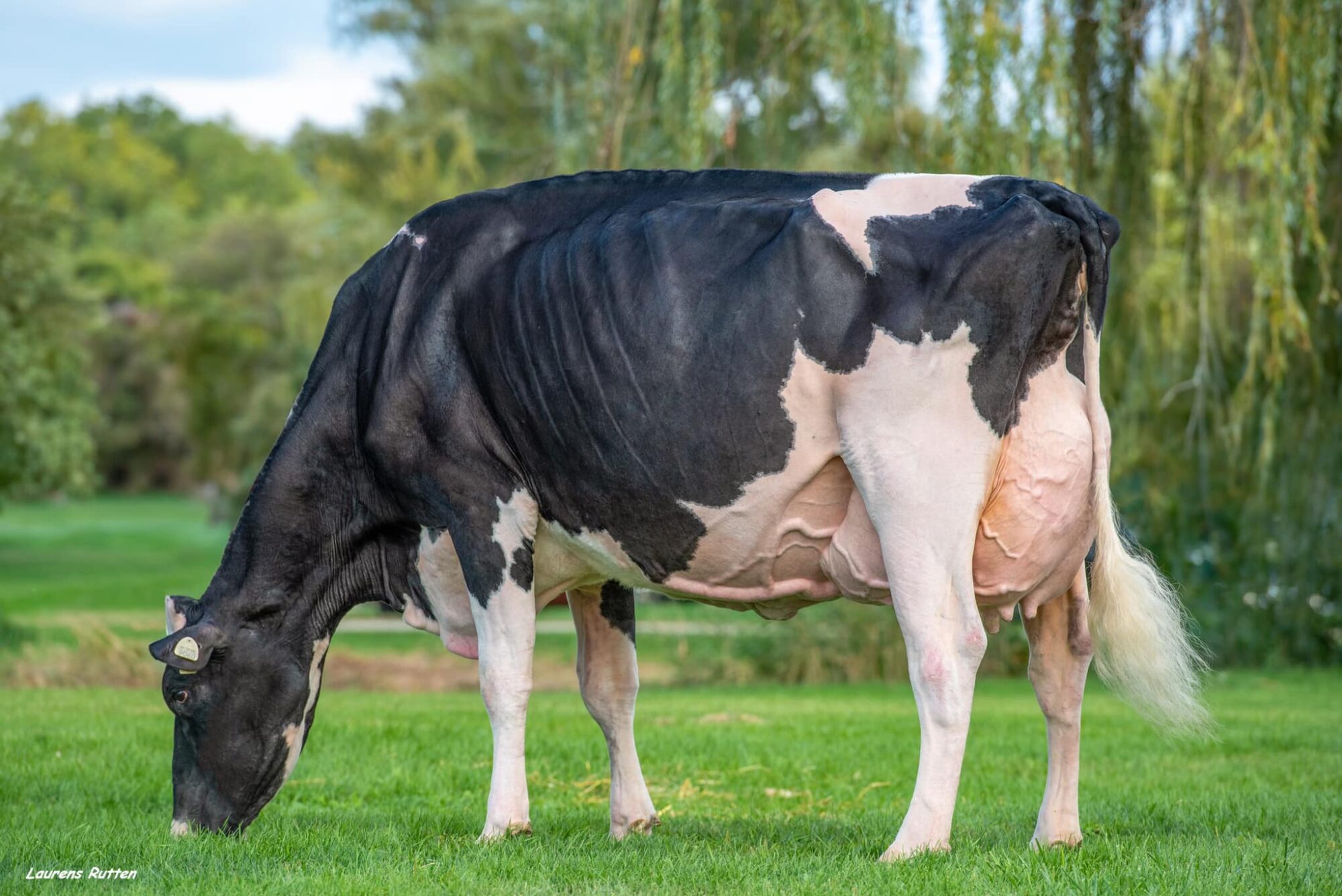
NewsSubscribe
First
Last
Consent

Meet the 2024 Holstein Canada Master Breeders

Meet the 2024 Holstein Canada Master Breeders. Want to know how these breeders excel in dairy farming? Find out their tips to improve your herd. 

Holstein Canada, Master Breeder Awards, dairy industry, genomic testing, breeding excellence

The 2024 Master Breeder Awards were announced by Holstein Canada, honoring 19 top breeders from all over the country for their outstanding achievements in breeding Holstein cattle. The event was celebrated on January 18th, 2025, recognizing those who set the highest livestock management and breeding standards. These awards, highly valued in the Canadian dairy industry, highlight breeders who produce cows with excellent milk production, body structure, health, and long life. The awards showcase the importance of responsible breeding practices by promoting continuous improvement and new technologies, like genomic testing. They inspire dairy farmers nationwide and push the industry towards a future full of possibilities.

Celebrating Excellence: The Diverse Provinces and Dedication of 2024’s Master Breeders

The 2024 Master Breeder Awards are a testament to the unwavering dedication of 19 excellent Holstein breeders from various parts of Canada. They highlight their commitment to top-notch Holstein cattle breeding. This group exemplifies the steadfast commitment of the Canadian dairy industry to excellence, inspiring all who are part of this noble profession. 

In Ontario, breeders like Heather Holme, Dutchdale, Cherry Crest, Erbcrest, OConnors, Aveline, Kentville, and Quality shine with their success in breeding herds known for high milk production, strong body structure, great reproductive success, and long life. They follow methods that keep their herds highly valuable to the industry. 

Quebec’s breeders, such as Rotaly, Quecy, Belfau, Mebeck, Gaelande, Sartigan, Fleole, Drahoka, and Lactomont, focus on breeding cows with excellent health and genetics. Their dedication is evident in their use of genomics and wise decision-making to improve their herds. 

In Saskatchewan, Mil-En-Roy achieves top success by combining new management tricks with traditional breeding skills, demonstrating its excellence. 

British Columbia’s Frueh highlights the West’s role in Canada’s dairy success, demonstrating the crucial role of strong genetic and breeding strategies for future growth. 

These award winners come from many places and share a passion for breeding excellence. Their achievements promote a friendly competition spirit and help develop mentoring and new ideas that benefit Canada’s dairy industry.

Master Breeder Shield: The Epitome of Balanced Holstein Excellence

The Master Breeder Shield is a top honor in Holstein cattle breeding. It shows a perfect mix of key traits that make breeding unique. To win, cows must produce lots of quality milk. This shows they are productive and efficient. They must also have excellent conformation, which means they have the ideal body shape and strength for Holsteins. This ensures they look good and work well. The cows must breed well, too, having healthy calves that are genetically strong. Cows need excellent health to keep veterinary bills low and animal welfare high. Lastly, cows must live long and stay productive and healthy for many years, making them valuable to the herd.
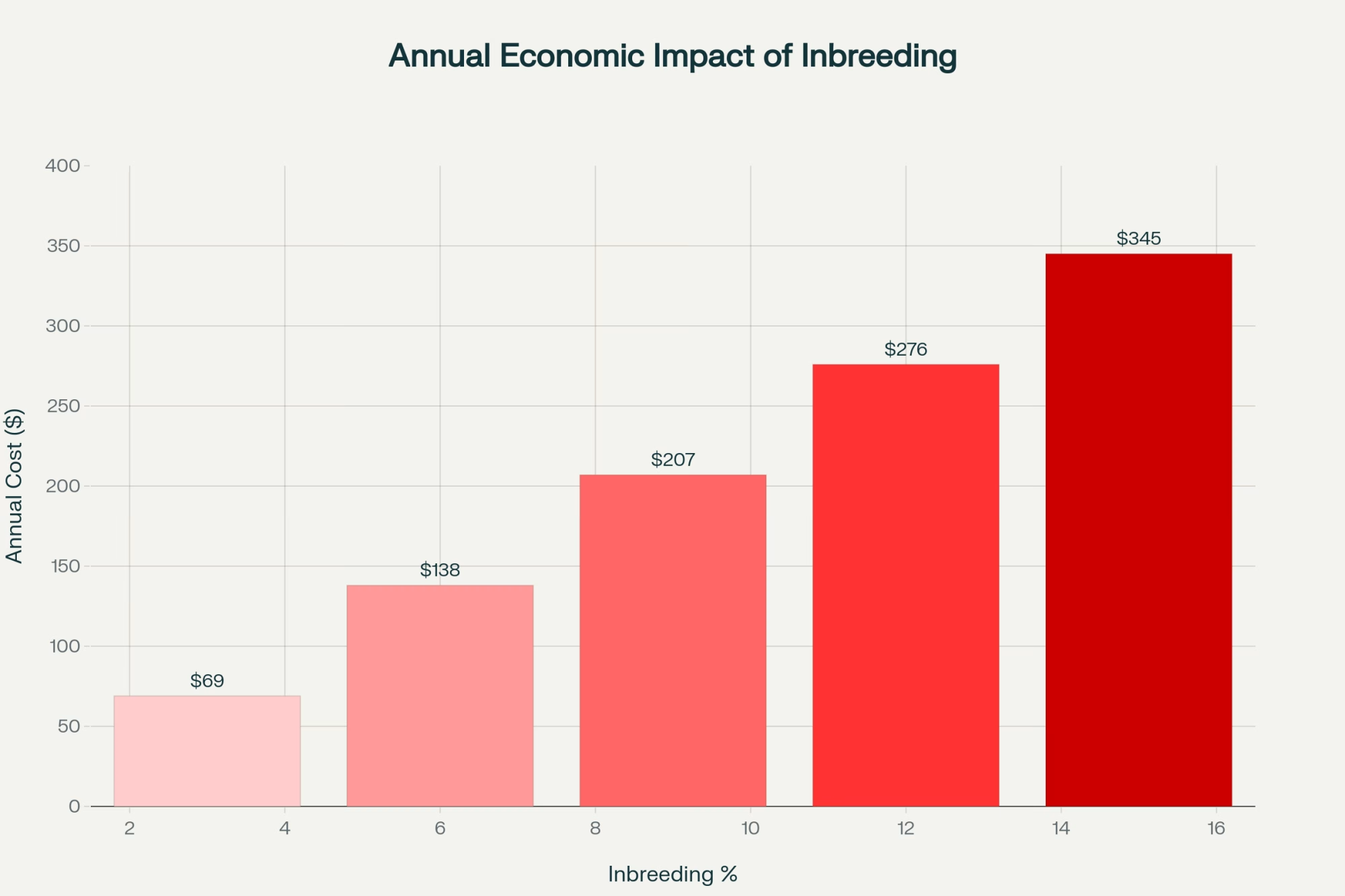
The Master Breeder program is essential for improving Canada’s dairy industry by encouraging breeders to improve. This award not only celebrates the best breeders today but also pushes them to keep getting better. It shows how important it is to use new technology in traditional practices. Breeders are using genomic testing more, which helps choose cattle with the best traits. This speeds up genetic improvement. The program also highlights the need to use data to manage herds. With data from registration and genomic testing, breeders can make smart choices to get the best from their herds. Linda Markle from Holstein Canada says that having the correct data helps make better breeding decisions. This doesn’t just help individual herds; it also raises the standard for the Canadian dairy sector by setting high standards for success and new ideas.

A Legacy of Excellence: The Master Breeder Awards’ Enduring Impact on the Canadian Dairy Sector

The Master Breeder Awards, created by Holstein Canada, are a big deal in the Canadian dairy world. These awards are given to outstanding Holstein breeders who work hard to achieve the best in breeding. What started as a simple award has become a respected symbol in the dairy community for its high standards and recognition. 

The selection process for these critical awards involves careful examination of different qualities in the breeders’ herds. The criteria focus on a balance of high production, great conformation, effective reproduction, and excellent animal health and long life. This ensures the Master Breeder Shield goes only to those who show all these top traits in their Holstein cattle. 

“Winning the Master Breeder Shield is more than just getting an award; it shows years of dedication, innovation, and a steady focus on excellence in Holstein breeding,” says Linda Markle, Director of Member and Customer Service at Holstein Canada.

Everyone admires and respects the winners of the Master Breeder Award. This honor shows a breeder’s ability to create cattle that meet and surpass the industry’s high standards. Being a Master Breeder is a badge of success, often inspiring others in the dairy sector to improve their breeding practices.

Honoring Commitment and Achievement: The Spirited Ceremony of 2024’s Master Breeder Awards 

The awards ceremony was a significant celebration of excellence and a key moment for the Canadian Holstein breeding community. Held online, it brought together industry leaders, breeders, and supporters nationwide to honor the 19 outstanding Master Breeder winners. 

Each winner was praised for their fantastic work in Holstein cattle breeding, showing their dedication and passion. The ceremony also highlighted the tough competition in the Master Breeder program, where only the most careful and competent breeders get the prestigious shield. It’s a mark of excellence, honoring those who have achieved high production and excellent conformation in their herds and mastery in breeding cows with extraordinary reproductive abilities, health, and longevity. 

Overall, the event was a tribute to the winners and a lively celebration of the progress and future of the Canadian dairy industry. It reinforced the importance of mentorship and continuous improvement, inspiring everyone to aim for the high standards set by these top breeders.

The Bottom Line

The future of the Canadian dairy industry is promising, thanks to a strong focus on progress and quality. The 2024 Master Breeder Awards underscore the importance of mentorship, with experienced breeders guiding the next generation. This harmonious blend of tradition and innovation ensures a bright future, with dairy farmers constantly improving and using the latest technologies, like genomic testing, to make better decisions about their herds. 

In this rapidly changing field, dedication to breeding high-quality cows is key. Breeders aim to produce cows with the best conformation, production, and health, showcasing the industry’s strength and ability to adapt. This dedication benefits individual herds and supports the bigger goal of making the dairy sector more sustainable and efficient, reassuring us about its bright future. 

Looking ahead, focusing on better breeding practices and building strong cow families will help Canada stay a leader in dairy genetics. A community that values sharing knowledge and working together will help the industry grow and innovate. Canada celebrates its breeders’ successes and lays the foundation for a successful future where excellent cattle breeding supports the dairy industry’s ongoing success. 

As we honor the fantastic achievements of the 2024 Master Breeders, let their stories inspire you to improve your practices. Use new technologies like genomic testing to boost your herd’s potential and sustainability. By doing this, you can reach the same standards of excellence that Holstein Canada recognizes. Strive for constant improvement, seek mentorship, and adopt best practices in your work to become a leader in the Canadian dairy world.

Key Takeaways:

  • The 2024 Master Breeder Awards acknowledge 19 exemplary breeders across Canada for their superior contributions to Holstein cattle breeding.
  • The awards recognize herds achieving a balance of high production, outstanding conformation, superior reproductive efficiency, excellent health, and longevity.
  • Diverse breeding excellence is showcased in multiple provinces, including Ontario, Quebec, Saskatchewan, and British Columbia.
  • The program encourages breeders to adopt genomic testing and data-driven strategies to enhance herd management.
  • Linda Markle emphasizes the importance of validated data and genomic integration in informed breeding decisions.
  • The award ceremony highlighted breeders’ continuous dedication and achievements, serving as an inspiration within the industry.
  • The program underscores the importance of mentorship, innovation, and striving toward new standards in breeding practices.

Summary:

Holstein Canada has announced the 2024 Master Breeder Awards, celebrating 19 leading breeders’ excellence in Holstein cattle breeding. These awards highlight the importance of using advanced technologies, like genomic testing, to improve the quality of dairy herds. The awarded breeders have successfully bred cows that are high in milk production and have superior health and longevity. This recognition encourages continuous improvement in breeding practices, inspiring farmers across the industry to strive for high standards and quality. The awards ceremony is a testament to Canadian dairy farmers’ dedication and supports the industry’s bright future through mentorship and progress.

Learn more:

Join the Revolution!

Bullvine Daily is your essential e-zine for staying ahead in the dairy industry. With over 30,000 subscribers, we bring you the week’s top news, helping you manage tasks efficiently. Stay informed about milk production, tech adoption, and more, so you can concentrate on your dairy operations. 

NewsSubscribe
First
Last
Consent
Send this to a friend