Crisalis RF just added +67 gPFT and pulled his own son in behind him at #2 proven—while 5 fresh bulls quietly shoved veterans out of Italy’s top 10.
Executive Summary: Crisalis RF just tightened his grip on Italy’s April 2026 proven gPFT list, jumping +67 to gPFT 5247 while his son Boero debuts right behind him at #2. Half of the proven top 10 is new this run, and the proven top-10 average jumped +153 points, so anyone still mating off the December sheet is effectively working with a different lineup than ANAFIBJ’s current board. Ecbert and Rascasse still hold the domestic genomic 1–2, but that list has compressed into a 144‑point band, making “who’s #3 vs #8” more noise than signal. Vivify and Gladius blood is heavily represented and easy to over‑use on genomic and foreign lists, which is great for index but a real inbreeding trap if 30%+ of your recent matings already carry those lines. On the opportunity side, Boero, Glorydays, and Mantra give you proven‑tier options that actually out‑kicked their genomic calls, especially on components and IQC for cheese milk. The article walks through which bulls to anchor with, where the genomic risk sits, and how to patch fertility, type, or feet and legs without blowing up gPFT. If you’ve got more than 200 cows on Italian or MACE semen and haven’t audited your sire sheet since December, this run is big enough to justify a 30‑minute rethink.
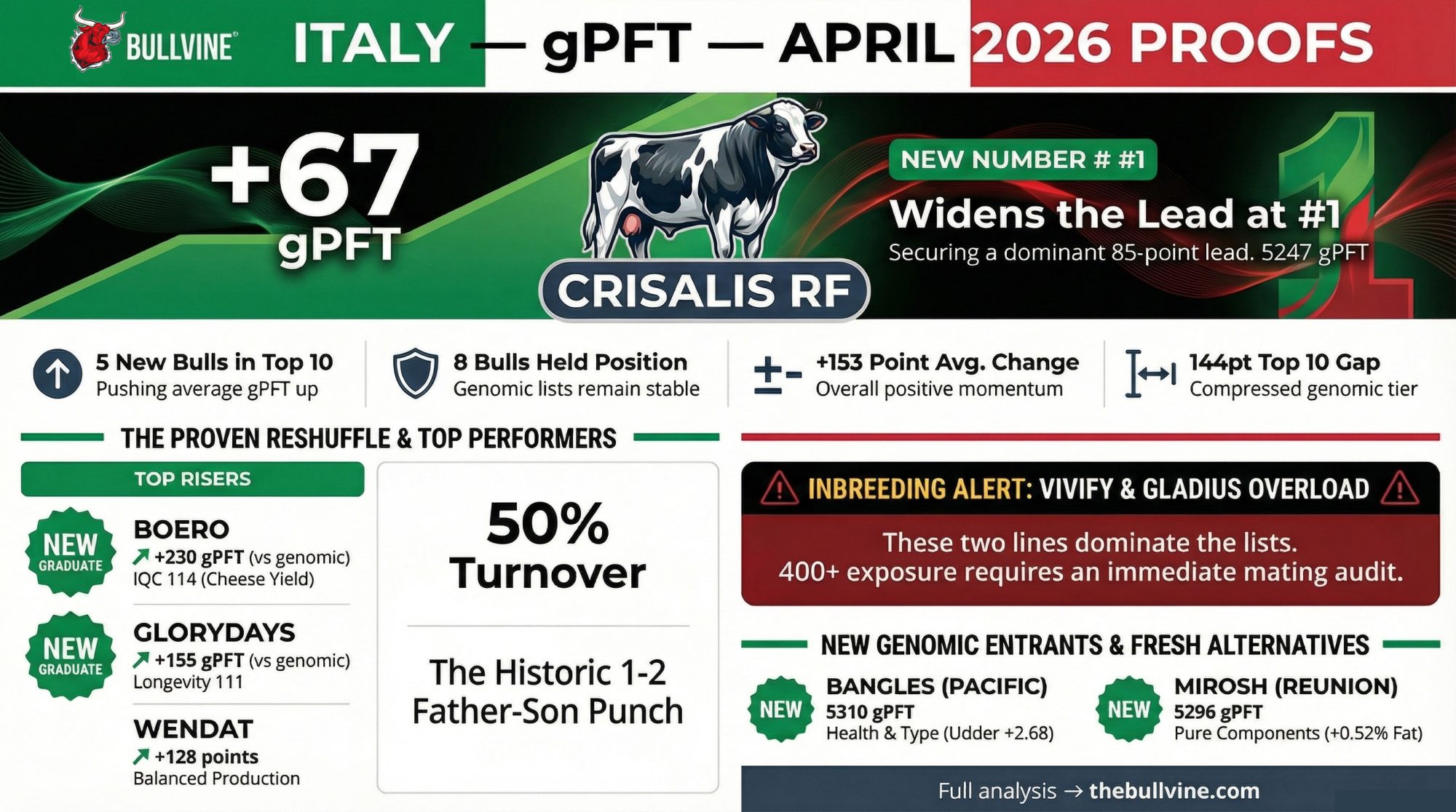
Crisalis RF just widened the gap. The Gywer son added +67 gPFT points between the December 2025 and April 2026 Italian evaluations (ANAFIBJ, data updated April 1, 2026) to reach gPFT 5247 — and then his own son Boero graduated from the genomic list straight to #2 proven at gPFT 5162. That’s the first father-son 1-2 on Italy’s domestic daughter-proven gPFT ranking in recent memory, and it signals something bigger: the proven tier is no longer just catching up to genomic projections — it’s compressing hard toward them.
Across all four ANAFIBJ lists (domestic genomic, domestic proven, foreign genomic, foreign proven), this run reshuffled the proven ranks more aggressively than any Italian evaluation since early 2025. Five new bulls entered the domestic proven top 10. The proven top-10 average leaped +153 points (from 4934 to 5087, December 2025 vs April 2026 gPFT). Meanwhile, the domestic genomic top group barely moved (+61 points on average), and the spread between #1 and #10 compressed from 203 to just 144 points — making it harder than ever to separate genomic contenders on index alone.
Here’s what it all means for your matings this spring.
What Changed at the Top?
Domestic Genomic: Stability With Two New Faces
The domestic genomic top 10 is the calmest list this run. Eight of ten bulls held their positions from December 2025. Ecbert (Gladius × Dateline) remains #1, edging from gPFT 5349 to 5371 (+22, April 2026 Italian gPFT). Rascasse (Vivify × Geyser P) is again #2 at gPFT 5342 (+21).
The two new entrants both bring distinctive packages:
| Bull | Sire × MGS | April 2026 gPFT | Key Trait Notes |
| Bangles(Isolabella) | Pacific × Royalflush | 5310 | Udder composite +2.68, Longevity 119, Fertility 111 — the health-and-type specialist in the top group |
| Mirosh (Go-Farm) | Reunion × Mookie | 5296 | +0.52% Fat, +111 Kg Fat, IQC 108 — a components-first bull |
They replaced Stormur (dropped to gPFT 5216, rank ~11) and Enola (gPFT 5165, rank ~17). Neither dropped dramatically — this is normal genomic shuffling, not collapse.
Top-group compression is the real story. The gap between Ecbert (#1, gPFT 5371) and Jegolo (#10, gPFT 5227) is just 144 points, down from 203 in December 2025. With all ten bulls carrying Rk 99 (ANAFIBJ’s top reliability band for genomic sires), this tight clustering means the rank order within the top 10 could easily reshuffle in the next run. Treat positions 3–10 as essentially one band.
Domestic Proven: The Big Reshuffle
This is where the action is. Five of the December 2025 top 10 dropped out, and five new bulls entered — a 50% turnover rate that’s unusually high for Italy’s proven tier.
April 2026 Domestic Proven gPFT Top 10 (ANAFIBJ, data updated April 1, 2026):
| Rank | Bull | Sire × MGS | gPFT Apr 2026 | gPFT Dec 2025 | Δ | AI Center |
| 1 | Crisalis RF (ZFZ) | Gywer × Mr Salvatore | 5247 | 5180 | +67 | Intermizoo |
| 2 | Boero (Go-Farm) | Crisalis RF × Pursuit | 5162 | 4932* | NEW | Intermizoo |
| 3 | Royal Inseme Carlomagno(Idevra) | Bramante × Tabasco | 5140 | 5068 | +72 | Inseme |
| 4 | Gewiss (G-Plus) | Guitar × VH Crown | 5120 | — | NEW | Intermizoo |
| 5 | Smilodon | Bennie × Deluxe | 5061 | — | NEW | Intermizoo |
| 6 | Glorydays (GPlus FIS) | Gladius × Youngster | 5056 | 4901** | +155 | GPlus – IT |
| 7 | Distefano (Isolabella) | Hothand × Toohot | 5053 | 4982 | +71 | Inseme |
| 8 | Noyz (Pine-Tree RUW) | Dublin × Legacy | 5017 | — | NEW | ABS Italia |
| 9 | Wendat (All Nure) | Einstein × Padawan | 5008 | 4880 | +128 | Intermizoo |
| 10 | Mantra (Cirio Agricola Inseme) | Try Me × Yoda | 5005 | 4969 | +36 | Inseme |
* Boero was listed at gPFT 4932 on the December 2025 genomic domestic list; he has now transitioned to the proven list. ** Glorydays was on the December 2025 genomic domestic list at gPFT 4901; his proven debut at 5056 is a +155-point jump.
Dropped from the proven top 10: NT Isarco (was #6, gPFT 4871 Dec 2025 → gPFT 4951 Apr 2026, now rank ~12), SFH Redshift R (was #7 → gPFT 4941), Wilder Holocron (was #8 → gPFT 4937), KNO Ecuador P (was #9 → gPFT 4941), and Barone Rosso R (was #10 → gPFT 4885). Notably, most of these bulls gained points but still fell out of the top 10 — the new entrants pushed the floor higher.
The proven top-10 spread compressed from 346 points (December 2025: 5180 to 4834) to 242 points (April 2026: 5247 to 5005). That’s still wider than the top 10 in the genome, but the gap is closing fast.
The Big Movers: Up, Down, and In
Biggest Gainers (Proven Domestic)
- Glorydays: +155 gPFT transitioning from genomic to proven debut at 5056 — his daughters confirmed a Gladius-line profile of solid ICS-PR (€957) with strong Longevity (111) and above-average Fertility (104), April 2026 Italian gPFT.
- Wendat: +128 gPFT (4880 → 5008) — now carrying Rk 99 with a balanced Kg Milk (1182), components (Kg Fat 62, Kg Pr 70), and Longevity (110).
- Royal Inseme Carlomagno: +72 gPFT (5068 → 5140) — held #3 and narrowed the gap to Boero by delivering higher Protein % (+0.26) and the best Kcas rating (BE) in the proven top 5.
- Crisalis RF: +67 gPFT (5180 → 5247) — extended his #1 lead to +85 points over Boero, driven by improved SCS (107), while his production base held steady (Kg Milk 1189, Fat% +0.16, Pr% +0.20).
Genomic Graduates Worth Tracking
Boero and Glorydays both performed better than their genomic predictions. Boero’s December 2025 genomic gPFT was 4932; his April 2026 proven gPFT is 5162 — a +230-point gain that likely reflects an accumulation of more daughter data. Glorydays jumped from 4901 genomic to 5056 proven. Both are Rk 99 with high reliability — these are durable results, not noise.
Who Slid?
No dramatic collapses this run. The biggest relative loser in the proven top 20 is Sebulba (was gPFT 4786 in Dec 2025; no longer in the April 2026 top-20 visible range, with 93 bulls published). The drop-outs from the top 10 (NT Isarco, Redshift, Holocron, Ecuador, Barone Rosso) all actually gained 70–100+ points but were outpaced by the new entrants.
What Is Italy’s gPFT Rewarding This Run?
The April 2026 proven top 10 is skewed more heavily toward components and ICS-PR economic value than December’s list.
| Trait Shift | Dec 2025 Proven Top-10 Profile | Apr 2026 Proven Top-10 Profile |
| Top-10 avg gPFT | 4934 | 5087 (+153) |
| Avg ICS-PR (€) | ~770 | ~870 (estimated from top-10 values) |
| Avg IQC | ~106 | ~109 (higher cheese-yield emphasis) |
| Avg Longevity | ~108 | ~109 |
| Avg Fertility | ~106 | ~105 (slight dip) |
The top group now has higher averages for Kg Fat and Kg Protein, and IQC (cheese quality) has firmed up. This reflects Italy’s Parmigiano-Reggiano premium: the gPFT formula inherently rewards cheese-relevant traits, and the bulls whose daughters deliver high-component, high-casein milk are being rewarded disproportionately as more data accumulates.
On the genomic domestic side, the Vivify sons (Rascasse, Liverpool, Odino — three of the top 8) dominate the health-and-type sub-indexes: Liverpool carries Udder composite +1.96, Fertility 112, and Type 110 (April 2026 Italian gPFT). But Mirosh (Reunion × Mookie) breaks that mold with a pure components play: +0.52% Fat, 111 Kg Fat, and only average health traits (Fertility 108, Longevity 104). Ecbert (Gladius × Dateline) bridges both profiles — IQC 111, solid IES (€1148), and balanced health.
Trade-off to watch: The proven #1 Crisalis RF (gPFT 5247) carries the weakest Type score in the top 5 (Type 0.94 →his weakest area in the top 5). If your herd needs functional type improvement alongside index, look further down the list to Distefano (Type 1.75, Udder 2.81) or Glorydays (Type 0.46, F&L 0.88 — moderate but balanced).
AI Companies and Bloodlines: Who Owns the Italian Top?
AI Center Shifts
Intermizoo continues to dominate the domestic proven top 10, holding 5 of 10 slots in April 2026. But the notable shift is what’s happening with the Italian Genetics → Inseme transition. In December 2025, Distefano and Barone Rosso were listed under “ITALIAN GENETICS” as their AI center. In April 2026, Distefano now appears under “INSEME.” Similarly, on the genomic domestic list, both Stormur and Jegolo switched from Italian Genetics to Inseme between runs. This almost certainly reflects the Inseme rebrand/restructuring — not a marketing shift, but a real organizational consolidation that breeders sourcing Italian semen should note for ordering purposes.
April 2026 AI Center Share — Domestic Proven Top 10:
| AI Center | Bulls in Top 10 | Notable Names |
| Intermizoo | 5 | Crisalis RF, Boero, Gewiss, Wendat, Smilodon |
| Inseme | 3 | Royal Inseme Carlomagno, Distefano, Mantra |
| GPlus – IT | 1 | Glorydays |
| ABS Italia | 1 | Noyz |
On the foreign genomic list, the distribution is broader. Novagen holds 4 of the top 10; Inseme has 2; Semex Italia has 2; and ABS Italia, Cosapam, and ST Gen Group hold 1 each. The Novagen concentration is driven by their Peak and Smartie P connections.
Bloodline Concentration
Vivify is the dominant sire in the domestic genomic top 10, with three sons (Rascasse, Liverpool, Odino) plus Stormur just outside at #11. This is a significant concentration risk for breeders relying heavily on this list for matings — if you’ve already used two Vivify sons, your next genomic pick from Italy’s top group is likely to be Ecbert (Gladius), Bangles (Pacific × Royalflush), or Mirosh (Reunion × Mookie).
Gladius has emerged as the cross-list anchor sire:
- Ecbert (#1 domestic genomic, gPFT 5371) — sired by Gladius
- Delta Morgan (#8 foreign genomic, gPFT 5446) — sired by Gladius
- Gigantic (#3 foreign proven, gPFT 5212) — sired by Gladius
- Gladius himself ranks #4 foreign proven at gPFT 5173
That’s four top-10 placements across three different lists for the Gladius sire line. Any breeding program that has used Gladius, Ecbert, Morgan, and Gigantic all needs to audit its mating list for inbreeding coefficient stacking.
Rad sons dominate the extended foreign genomic list (Lightsaber gPFT 5440 in the top 10, plus Judo gPFT 5421, Rad Lad gPFT 5406, Beige gPFT 5410, and Ballot gPFT 5266 in the top 20). However, most Rad sons carry below-average F&L (Feet & Legs) scores — Lightsaber at -0.99, Judo at -1.13, Rad Lad at -0.05. For herds with concrete-floor housing, that’s a real functional risk despite the index appeal.
Outcross space: Bangles (Pacific × Royalflush) and Mirosh (Reunion × Mookie) on the domestic side, and Smartie P (Sega P RDC × Arrozo) on the foreign side, offer the cleanest pedigree breaks from the Vivify-Gladius-Rad concentration.
How Volatile Are Italy’s gPFT Rankings Right Now?
Domestic genomic: Low volatility. 8 of 10 held, 2 entered, top-10 spread compressed from 203 to 144 points. The Ecbert-Rascasse 1-2 looks stable; both gained modest points. Genomic bulls at Rk 99 in Italy carry high reliability within the genomic framework, but these are still genomic predictions — treat any individual bull’s exact rank as provisional. The tight 144-point band means a ±50-point swing in the next run could significantly reshuffle positions 3–10.
Domestic proven: High volatility by Italian standards. 50% top-10 turnover, +153-point average gain, and multiple genomic-to-proven graduates entering the list. This isn’t instability in the system — it’s the proven tier catching up as large daughter groups report. The Rk 99 designation on all top-10 proven bulls means these evaluations are high-reliability. Crisalis RF at #1 is about as safe a bet as Italy’s proven list offers.
Foreign genomic: The top of this list is genomic-only and subject to the usual re-ranking risk. Locust (gPFT 5527, April 2026) leads by just 8 points over Tiberius (5519). Both are Rk 99, but with no Italian daughter data, their gPFT is MACE-derived from their home-country genomic predictions. International breeders should weigh these as directional rather than definitive for Italian conditions.
Foreign proven: Powerhouse (gPFT 5394) has a commanding 165-point lead over Percival (5229). Powerhouse is heavily daughter-proven globally; his Italian gPFT is among the most reliable numbers on any of these lists. Percival at #2 is also well-proven (Captain × Gymnast, Rk 99) with 2011 Kg Milk and strong Kg Fat (125) — a Volume + Fat specialist.
What This Means for Your Matings This Spring
All recommendations below reference April 2026 Italian gPFT evaluations (ANAFIBJ, data updated April 1, 2026). Every bull discussed is Rk 99 unless otherwise noted.
If Your Herd Prioritizes Cheese Yield and Component Value (Parmigiano-Reggiano / Grana Padano Herds)
The proven list gives you Crisalis RF (gPFT 5247, IQC 101, Kcas AA) and Boero (IQC 114, Kcas AA) as the obvious father-son pair — but watch the IQC gap: Boero’s 114 vs Crisalis’s 101 means Boero contributes more directly to cheese-quality economics. If you need casein kappa genetics, Mantra (IQC 113, Kcas BB, +0.46% Fat, +88 Kg Fat) is the proven-tier cheese specialist. On the genomic side, Mirosh (IQC 108, +0.52% Fat) and Saxony (IQC 108, +0.47% Fat) offer strong component packages.
Be cautious with: Locust and the Rad sons (foreign genomic) carry high milk volume but relatively lower IQC scores (106 and 107, respectively); for cheese-yield herds, volume without components can dilute vat efficiency.
If Your Herd Prioritizes Health, Longevity, and Fertility
Liverpool (genomic domestic, gPFT 5267, Fertility 112, Longevity 114, Udder +1.96) is the standout functional bull in Italy’s genomic top group. On the proven side, Distefano (Longevity 115, Fertility 110, Udder +2.81) has the best health-trait package in the proven top 10 — and he’s now fully daughter-proven at Rk 99.
If your conception rate is below 40%: Prioritize Fertility scores above 110. Liverpool, Distefano, and the genomic newcomer Faktor (Fertility 116, Longevity 117, gPFT 5152, April 2026) are your short list. Avoid Crisalis RF (Fertility 107 — solid but not a specialist) if fertility is your limiting factor.
If You Run a Robot Herd
Udder composite and milking speed (IMA) matter. On the domestic proven list, Distefano leads with Udder +2.81 and IMA 106. Crisalis RF carries Udder +1.76, IMA 107. On genomic, Bangles (Udder +2.68, IMA 106) is the robot-herd pick from the new entrants.
Avoid for robot herds: Mirosh (Udder -0.25) and any Rad son with negative F&L scores — lameness and poor udder attachment will cost you throughput in a robotic system.
If You Show or Sell Seedstock (Type-Focused Program)
Distefano (Type 1.75, Udder 2.81, F&L 1.12, proven gPFT 5053) is the clear type improver with a competitive index. On the genomic side, Bangles (Type 1.62, Udder 2.68, F&L 1.39) offers the Royalflush maternal line — useful for mating programs targeting both type and outcross pedigrees.
Trade-off: Crisalis RF (Type 1.25) and Boero (Type 1.01) are fine for commercial herds but won’t win you type competitions.
If You Want to Anchor With Proven Safety
Use Powerhouse (foreign proven #1, gPFT 5394, Rk 99 with deep global daughter data) as your portfolio anchor. His 1750 kg of milk, +136 kg of fat, and +102 kg of protein are among the highest absolute production numbers on any Italian list. Pair him with a health-trait specialist like Distefano or Liverpool to offset his weaker Fertility (97) and Type (F&L +0.36).
30-Day Action Items
- Audit your Gladius and Vivify exposure. If more than 30% of your matings from the last 12 months trace to either sire line, flag those females for outcross matings using Bangles, Mirosh, or Smartie P this cycle.
- Pull your current mating list and cross-check against the April 2026 proven movers. If you were using NT Isarco, Redshift, or Holocron based on their December rank, they haven’t collapsed — but the new entrants (Boero, Gewiss, Smilodon, Glorydays, Noyz) offer fresher daughter data and a higher index.
- Re-evaluate any Rad-son heavy lineups for F&L risk, especially in housed herds on concrete. If you can’t give up the index, at a minimum, pair Rad sons with dams that carry positive F&L proofs.
- If you source from Italian Genetics / Inseme: Confirm your ordering codes and semen inventory labels reflect the consolidated Inseme branding — some catalogs may still list these bulls under the old Italian Genetics name.
Key Takeaways:
- Crisalis RF and his son Boero now sit 1–2 on Italy’s April 2026 proven gPFT, with Crisalis up +67 points and five new sires pushing into the proven top 10.
- The proven top-10 average jumped +153 gPFT in four months, meaning a “safe” December sire lineup can now be 150+ index points off the pace in Italy.
- Domestic genomic rankings stayed stable but compressed into a 144‑point band, so fine‑tuning off who’s #3 vs #8 makes less sense than picking by trait package and risk.
- Vivify and Gladius blood heavily dominate the top genomic and foreign lists, creating real inbreeding risk if 30%+ of your recent matings already trace to those lines.
- There’s genuine upside in this run—Boero, Glorydays, Mantra and a few others proved up better than their genomic calls, especially for high‑component and cheese‑milk herds.
Full Lists:
- ITALY – Genomic PFT (Domestic) – 04/26
- ITALY – Genomic PFT (International) – 04/26
- ITALY – Dtr proven PFT (Domestic) – 04/26
- ITALY – Foreign Dtr proven PFT – 04/26
 The Sunday Read Dairy Professionals Don’t Skip.
 The Sunday Read Dairy Professionals Don’t Skip.
Every week, thousands of producers, breeders, and industry insiders open Bullvine Weekly for genetics insights, market shifts, and profit strategies they won’t find anywhere else. One email. Five minutes. Smarter decisions all week.