




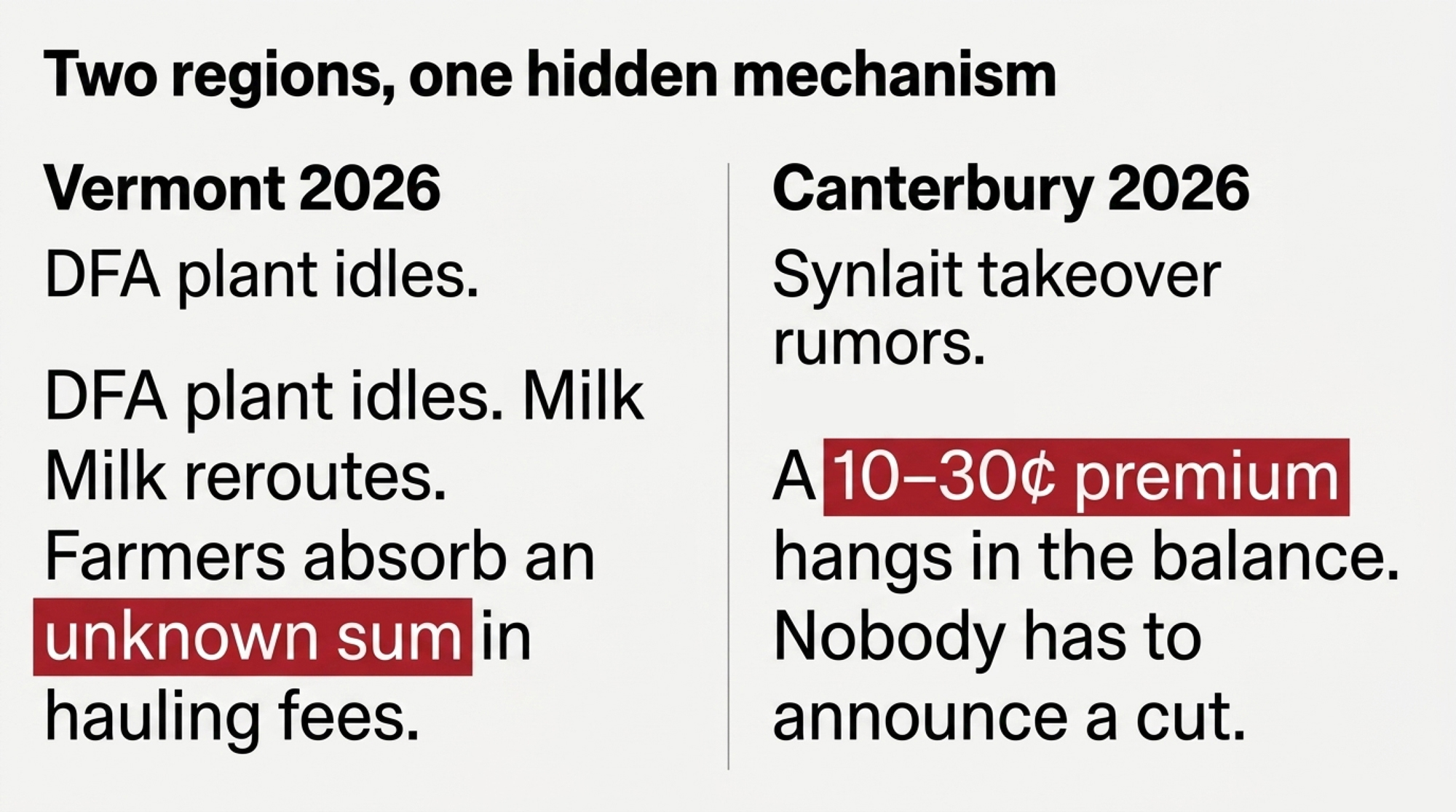
St. Albans went dark today, and the milk still moves — the freight bill just changed hands. Canterbury’s premium is 10 to 30 cents. Nobody has to announce cutting it.
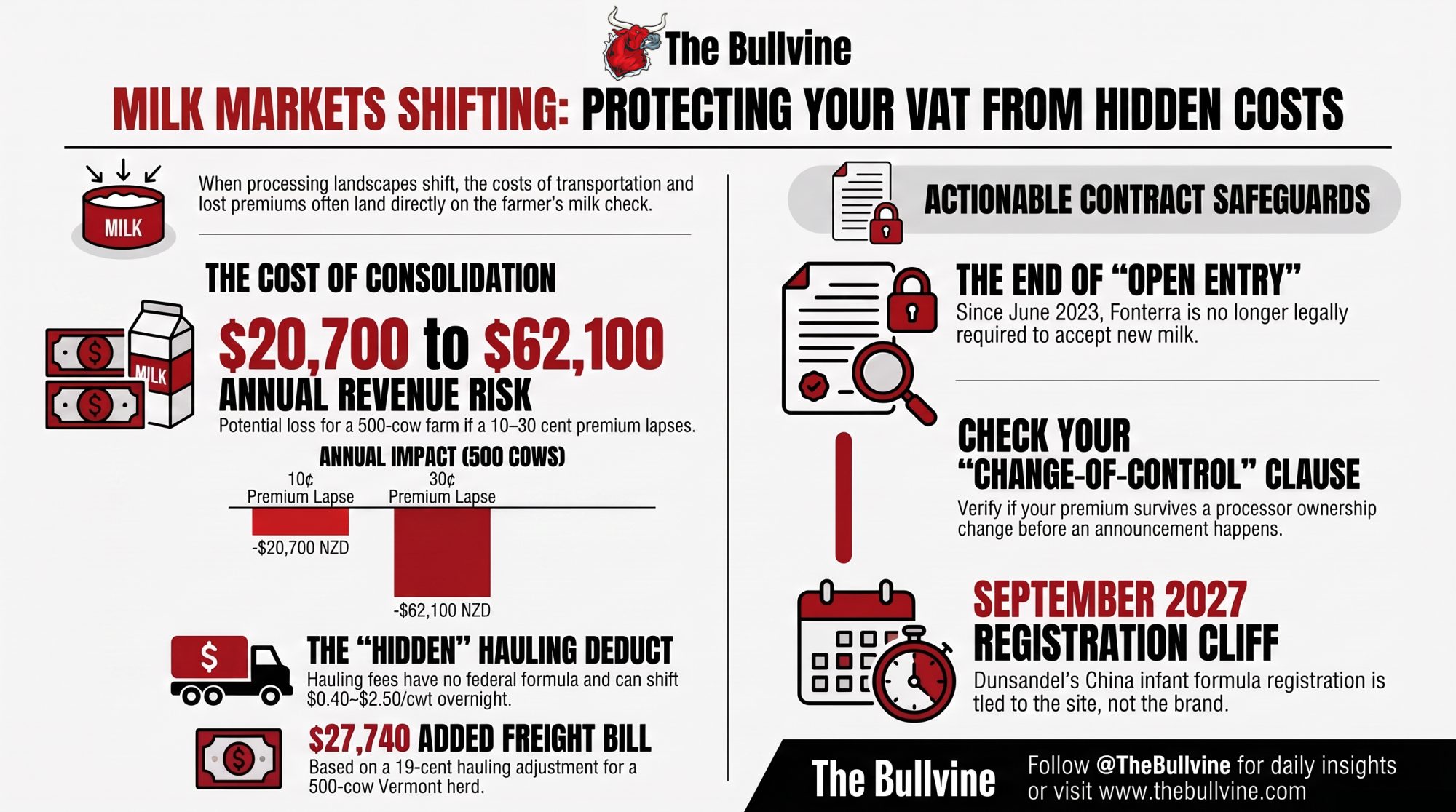
Executive Summary: DFA idled its St. Albans, Vermont plant today after a US$30 million upgrade six years ago, and the milk is still moving — VTDigger reported farmers now cover the freight to Maine, Massachusetts and New York, “an unknown sum” added to hauling fees on a line no federal formula governs. That’s the mechanism worth watching, because The Australian’s DataRoom reported August 15–16 that Fonterra and a2 Milk are exploring a joint take-private of Synlait, and Synlait’s NZX reply denied “discussions” and nothing else. Roughly 204 Canterbury suppliers ship into Dunsandel on a blended NZ$9.90/kgMS against Fonterra’s NZ$9.60–$9.80 draft base — a 10 to 30 cent spread worth NZ$20,700 to NZ$62,100 a year on 500 cows at DairyNZ’s record 414 kgMS. Bright Dairy’s 65.25% stake means no deal clears a shareholder vote without Shanghai, and no published report says Bright’s even been asked. Here’s the part most suppliers haven’t checked: Fonterra hasn’t been required to accept new milk since 1 June 2023, and the duty that replaced open entry only weighs farm viability for farms that supplied Fonterra last season — which a Synlait supplier didn’t. Pull your supply agreement this week, find the premium expiry date and the change-of-control clause, and price the cartage line separately, because a 19c/cwt hauling move like DFA’s 2008 Western adjustment runs US$27,740 a year on 500 cows.
Editor’s note: The 500-cow Canterbury model below is a composite scenario, not a specific farm. Full methodology at the end of this article.
Kevin Kouri chairs the Vermont Dairy Producers Alliance and works as director of nutrition and sales at Phoenix Feeds & Nutrition, which means he watches processor consolidation from both sides of the fence. When Dairy Farmers of America announced it was idling its St. Albans plant, Kouri didn’t talk about jobs first. He went straight to the money: the closure “will directly increase processing and transportation costs,” he said in the Alliance’s June 19 statement.
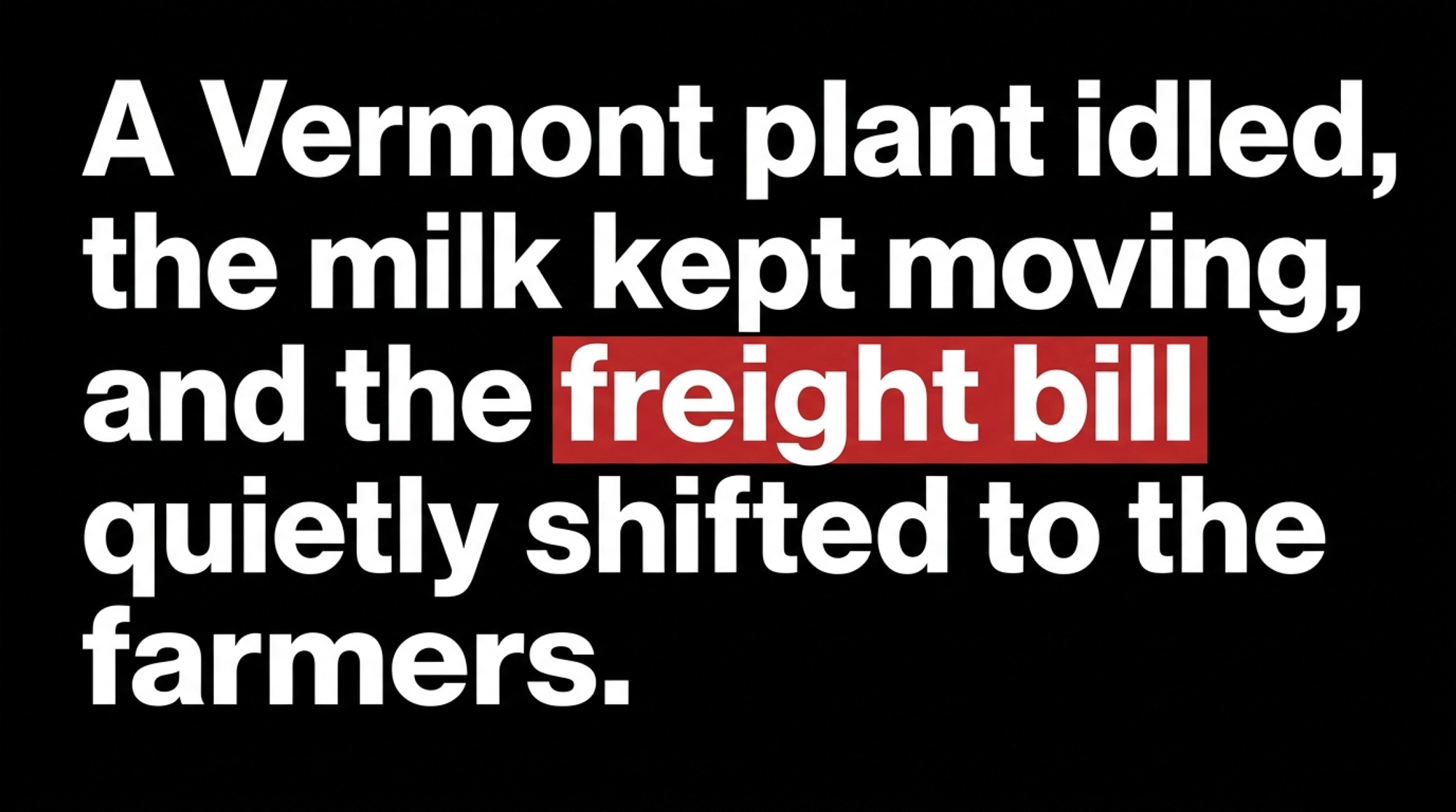
That plant goes dark today — August 17 — after six years and a US$30 million upgrade, taking roughly 80 jobs with it. DFA says the milk “will continue to be processed,” rerouting to Maine, Massachusetts and New York. And VTDigger reported in July that Vermont farmers now pay to move that milk out of state, adding “an unknown sum of money to members’ hauling fees.” The plant closed. The milk kept flowing. The freight bill changed hands.
Remember that order, because roughly 11,000 kilometres away, the same mechanism is being set up on a different continent.
On August 15 and 16, 2026, The Australian’s DataRoom column reported that Fonterra and The a2 Milk Company were exploring a joint proposal to take Synlait Milk private. Synlait answered through the NZX the following Monday, confirming it “is not involved in any discussions with The a2 Milk Company or Fonterra regarding the matters referred to in those reports.” No further comment. Fonterra and a2 Milk said nothing at all — both declined to comment on market speculation.
One denial. Two silences. And underneath all three, roughly 204 Canterbury suppliers whose milk cheque depends on a premium that exists only because Fonterra is currently a competitor. We’ll come back to what that Vermont freight shift actually cost, in dollars.
Why Canterbury Was Always the Fight Worth Having
In September 2024, Synlait sent two different offers to two groups of farmers. South Island suppliers were offered a one-off 20 cents per kilogram of milk solids to withdraw their cessation notices — formal notice to stop supplying. North Island suppliers were offered 5 cents. Same company, same crisis, same season — a 15-cent gap in what Synlait would pay to keep two groups from walking.
That gap wasn’t an accident. Synlait had already stopped processing raw milk at Pōkeno in Waikato and handed collection to Open Country Dairy, so North Island suppliers had no retention decision left to buy. Canterbury did. The company closed its 2024 financial year with 274 suppliers total, managing about 4% of the country’s milk supply as New Zealand’s third-largest processor, per BusinessDesk reporting from October 2024. By March 2025, BusinessDesk put the South Island pool at roughly 204 farmers feeding Dunsandel.
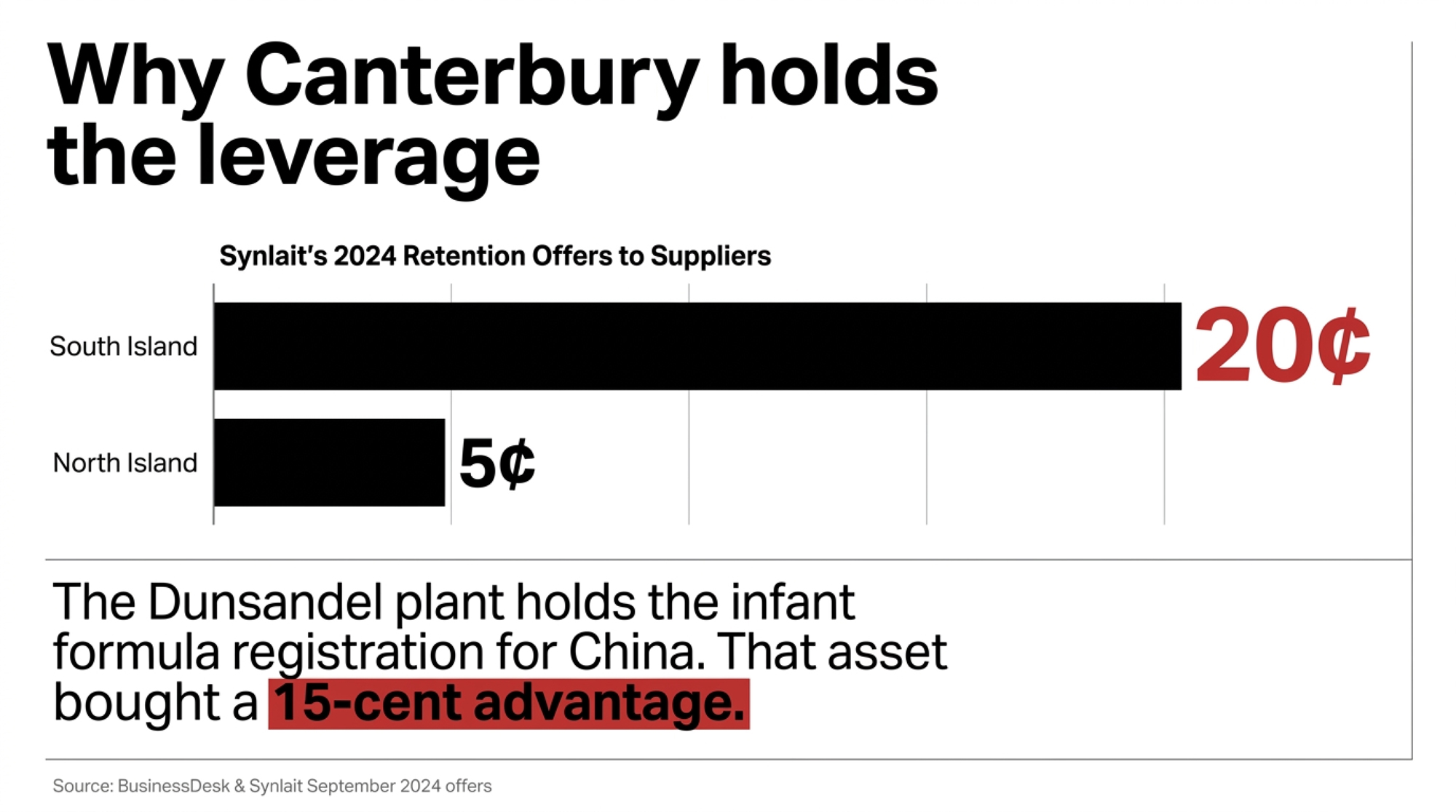
And Dunsandel isn’t just a plant. China’s State Administration for Market Regulation approved re-registration of a2 Milk’s 至初® infant formula — stages one, two and three — at that facility in June 2023, running through September 2027. Synlait holds the registration. It’s attached to the Dunsandel site itself, not to a2 Milk, and it doesn’t travel to another plant.
Canterbury held the asset. That’s why it got paid four times what Waikato got.
Who Actually Gets a Vote
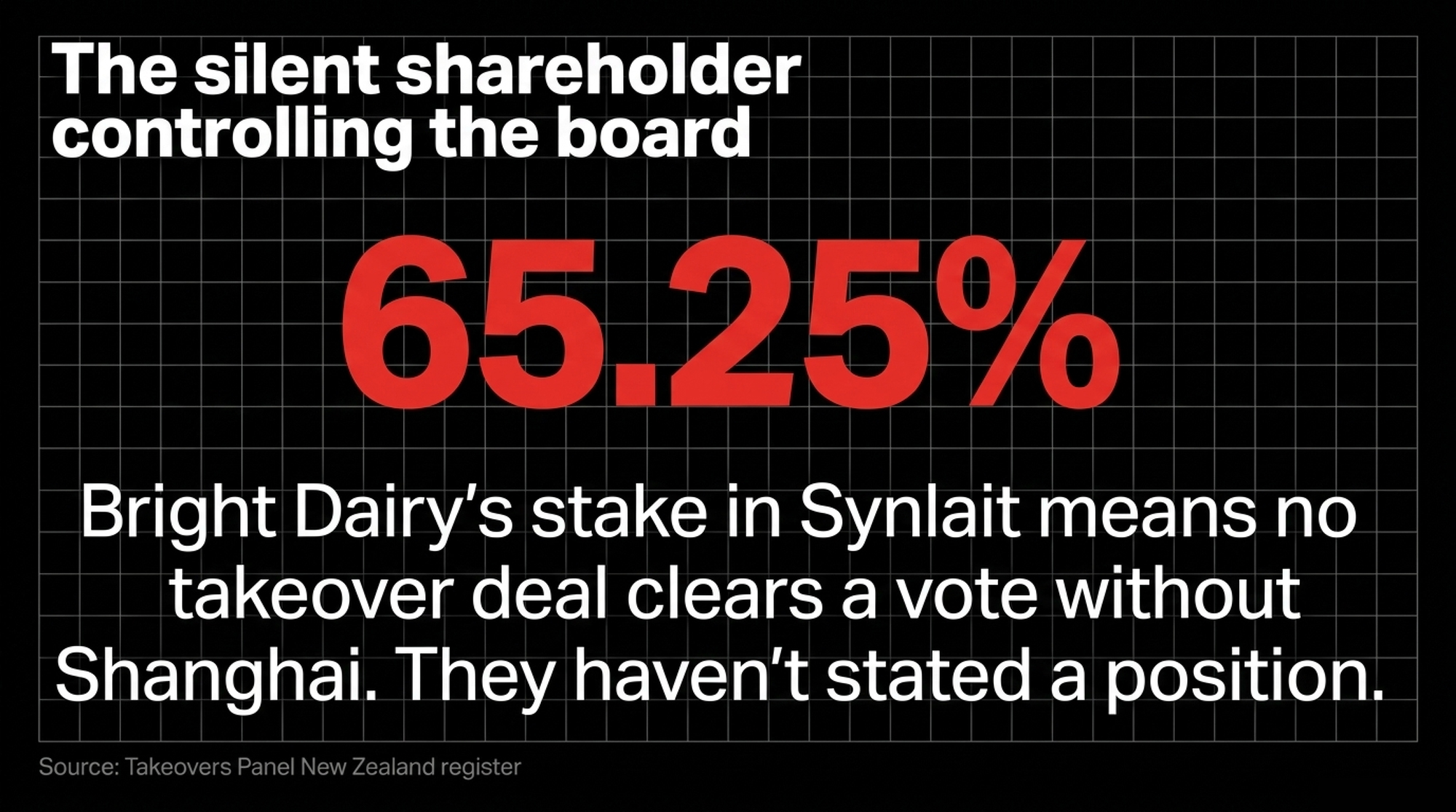
Bright Dairy, based in Shanghai, owns 65.25% of Synlait following a NZ$185 million share placement completed in October 2024. A2 Milk holds 19.83%, per the Takeovers Panel New Zealand register. Fonterra — which collected 77.7% of the national milk pool in the 2024/25 season against a long-term internal target of 78%, per BusinessDesk and eDairyNews reporting from July 2025 — is the party reportedly discussing a funding and operating role.
Neither company has said what it would want from Synlait. But Dunsandel’s infant-formula capability and its China registration are assets with obvious strategic value to anyone marketing formula into that market, and Synlait’s distress has been public for two years.
Here’s the structural fact almost nobody has written about. Any transaction requiring a shareholder vote requires Bright Dairy’s vote. That’s not analysis — that’s arithmetic at 65.25%. The exact threshold depends entirely on structure: a Takeovers Code offer, a scheme of arrangement, and a major-transaction approval under NZX rules all set different bars, and nothing public says which structure, if any, is on the table.
| Shareholder | Stake in Synlait | Vote Required for Deal? | Public Position |
|---|---|---|---|
| Bright Dairy (Shanghai) | 65.25% | Yes — controls outcome | No published report says it’s been asked |
| The a2 Milk Company | 19.83% | Yes, but non-controlling | Declined to comment on speculation |
| Fonterra | 0% (reported prospective partner) | N/A — not a current shareholder | Declined to comment on speculation |
| Synlait (company itself, via NZX) | — | N/A | Denied “discussions”; no further comment |
No published report suggests Bright has been approached or consulted, and it hasn’t stated a position. That silence is the biggest single factor in whether anything happens at all. Worth knowing what Bright has done before, though — in October 2025, when Synlait sold its North Island assets to Abbott for roughly NZ$307 million, Bright confirmed its vote in favour ahead of the shareholder meeting. One documented instance of cooperation. Not a prediction.
What a Premium Collapse Would Actually Cost You
Here’s the math on your own vat.
Synlait committed in early 2025 to pay South Island farmers a 10c/kgMS premium for those without a cease notice in place, on top of matching Fonterra’s base price and advance rates, per Rural News Group reporting from February 2025. Its half-year results, filed with the NZX on February 28, 2026, put it plainly: “Forecast base milk price for the 2025/26 season is $9.50 per kg MS with additional premium payments taking the total forecast average milk payment to $9.90 per kg MS.”
Fonterra’s side comes from the Commerce Commission’s draft review dated August 3, 2026: the forecast base milk price is “currently $9.60 – $9.80 per kgMS for the season under review in this draft report, which ended on 31 May 2026.” The Commission’s final report is due by 15 September 2026. Two-thirds difference between those two landings. So here’s both.
DairyNZ’s statistics released in November 2025 put average national production at 414 kg of milksolids per cow — the highest on record.
| Production level | Synlait blended (NZ$9.90) | Fonterra base (NZ$9.60) | Gap at 30¢ | Fonterra base (NZ$9.80) | Gap at 10¢ |
| 380 kgMS/cow (190,000 kgMS) | $1,881,000 | $1,824,000 | $57,000 | $1,862,000 | $19,000 |
| 414 kgMS/cow (207,000 kgMS) | $2,049,300 | $1,987,200 | $62,100 | $2,028,600 | $20,700 |
| 450 kgMS/cow (225,000 kgMS) | $2,227,500 | $2,160,000 | $67,500 | $2,205,000 | $22,500 |
All figures NZ$.
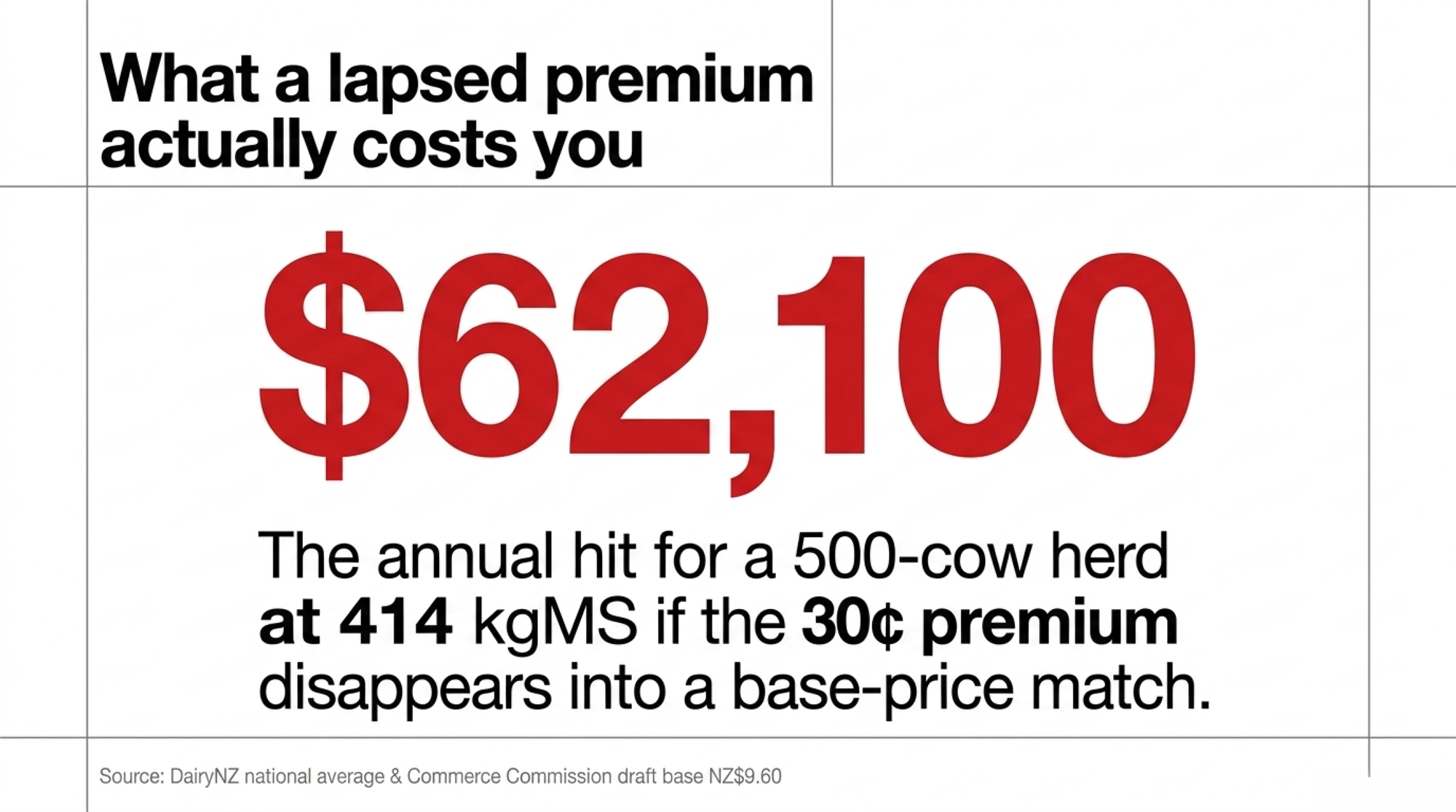
Find your row, then decide which column you’re planning against. Every extra 10 kgMS/cow adds roughly $1,500 to the 30-cent gap and $500 to the 10-cent gap on 500 cows. Nobody would have to announce a price cut to get there. A premium that only has to lapse at rollover produces the same result on your cheque.
How Much Does Checking Your Contract Actually Cost You?
An afternoon. That’s the honest answer.
Your existing premium commitments run on their own timeline regardless of what any newspaper printed this month. Waiting doesn’t hit your August cheque. What it costs you is knowing your own expiry dates and renegotiation triggers at the exact moment every other supplier in the district starts calling the same field reps with the same questions.
Pull the contract. Find the premium expiry date. Find out whether an ownership-change clause exists. If you can’t find one, that’s information too.
Is Your Region’s Buyer Concentration Already the Real Problem?
Ask the blunt version: if your processor’s terms shifted next season, how many buyers could realistically take your milk?
For many Canterbury operations, the honest answer is one, maybe two. Czapp’s May 2026 analysis puts numbers on it: total national collections peak each October at roughly 250–270 million kgMS, while non-Fonterra volumes peak at around 50–60 million kgMS. Competing processors capture roughly 20–23% of peak-season supply, leaving Fonterra with 77–80%. Czapp notes the drift toward independents has been gradual — incremental gains, not displacement.
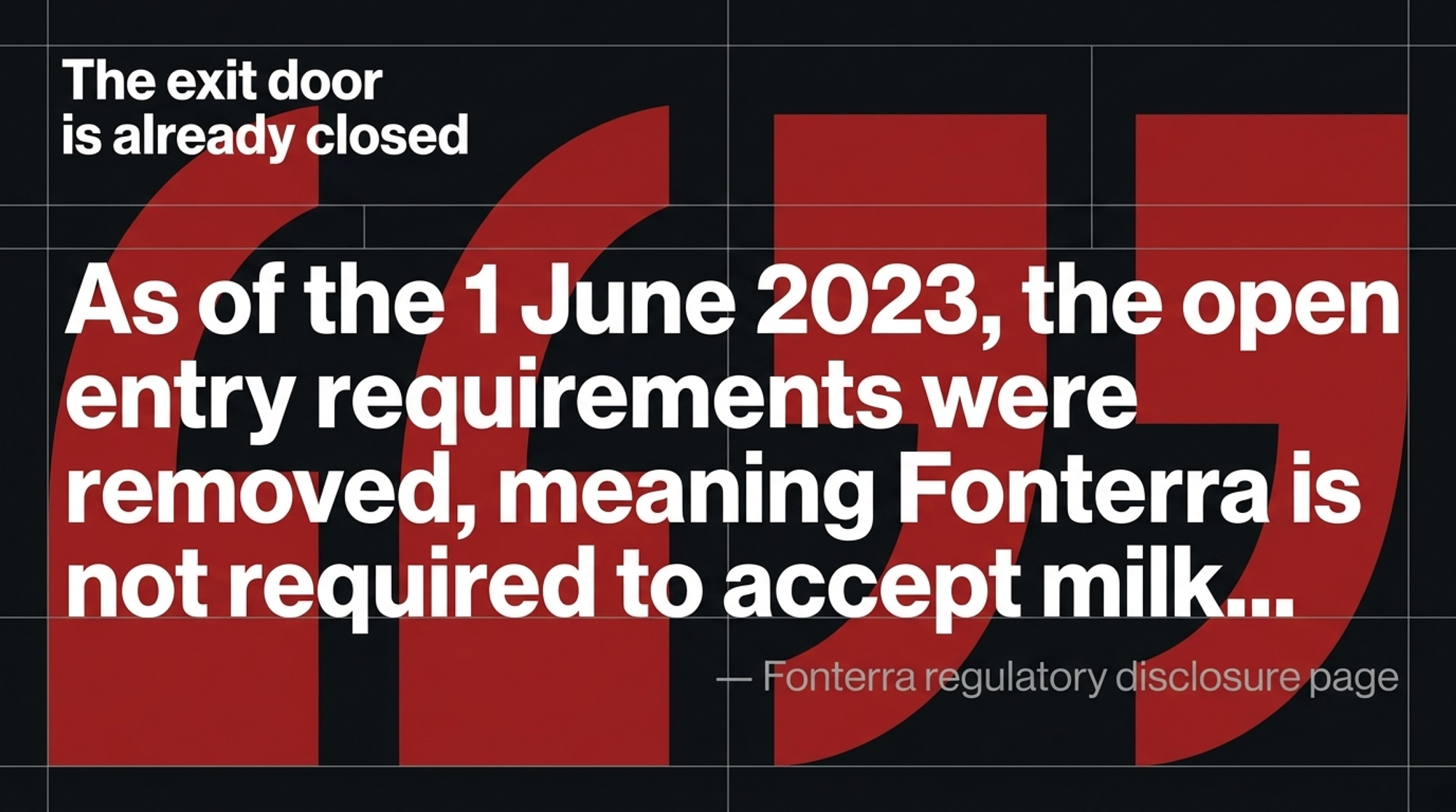
Here’s the part that changes the calculus, and it’s easy to miss because the rules changed quietly. Fonterra is no longer required to accept your milk. In Fonterra’s own words on its regulatory disclosure page: “As of the 1 June 2023, the open entry requirements were removed, meaning Fonterra is not required to accept milk from farmers wishing to join Fonterra.” What replaced the obligation is a duty to “have regard to” two things — the effect of the decision on the ongoing viability of the farm if that farm supplied Fonterra in the previous season, and the land-use opportunities available to the applicant.
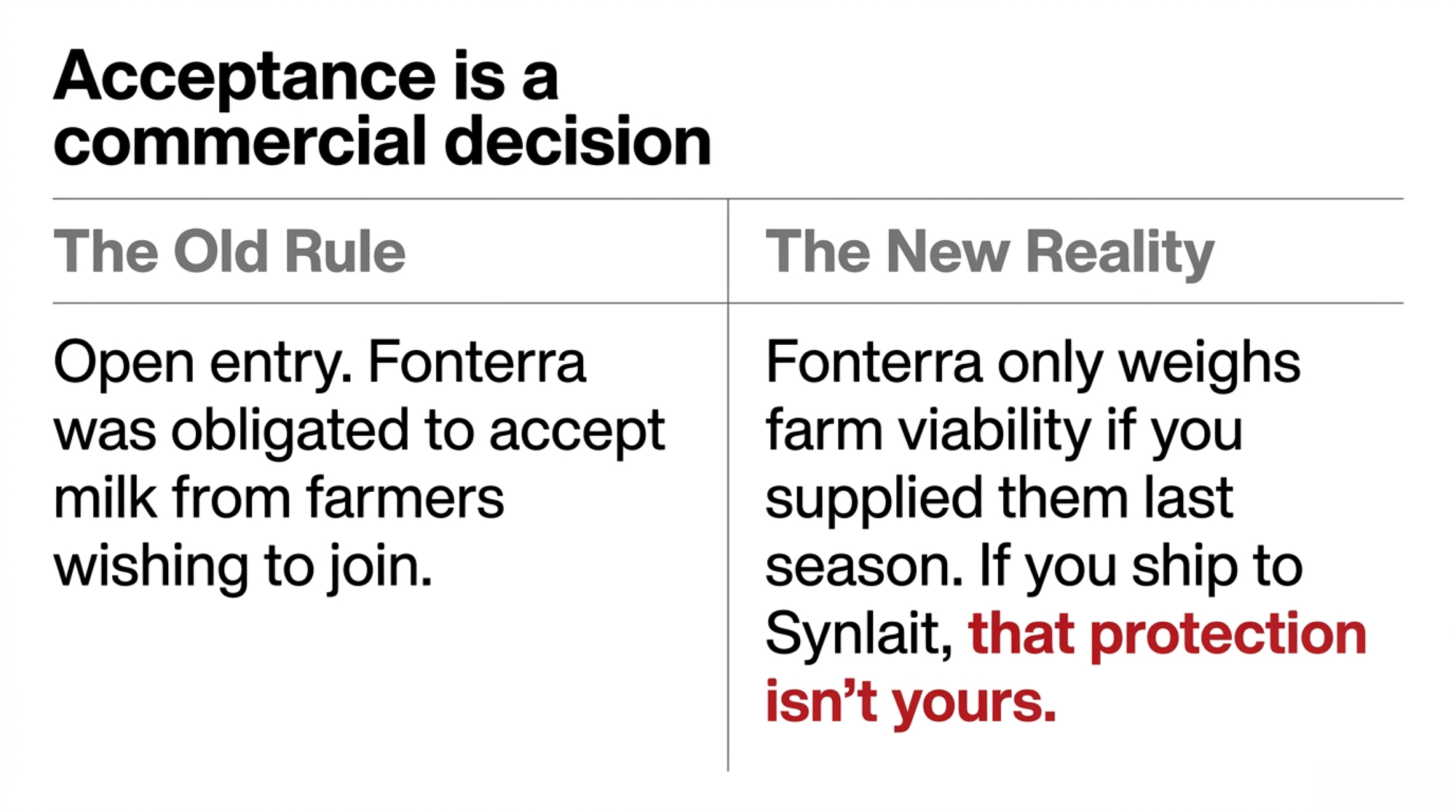
Read that again. If you’ve been shipping to Synlait, you didn’t supply Fonterra last season — so that protection isn’t yours. Fonterra also amended its constitution in November 2020 to require accepting supply from any farm already supplying Fonterra at the time of application. That one doesn’t reach you either.
| Farmer scenario | Fonterra obligated to accept? | Legal basis | Practical status |
|---|---|---|---|
| Supplied Fonterra last season, wants to stay | Yes | 2020 constitutional amendment | Protected |
| Supplied Fonterra last season, moved away, wants back in | Have-regard duty only (viability + land use) | Post-June 2023 rules | Weak — commercial decision, not a right |
| Currently supplies Synlait or another processor | No | Open entry removed 1 June 2023 | Unprotected |
| New entrant with no prior Fonterra supply history | No | Same removal | Unprotected |
So acceptance is a commercial decision about vat capacity and cartage economics in your catchment, not an entitlement you already hold.
What Does the Vermont Version Cost, in Dollars?
Kouri’s warning wasn’t abstract, and the Vermont numbers show why. St. Albans was a balancing plant handling over 3 million pounds a day — the facility that absorbs surplus when fluid demand dips. It’s the fourth Vermont plant lost in 2026, and the Vermont Farm Bureau tallied roughly 4 million pounds of daily processing capacity and about 390 jobs gone inside a single year, three of the four in Franklin County.
Watch what happened to the milk from an earlier closure, though, because that’s the tell. When Hood’s Booth Bros. plant in Barre closed April 1 after nearly 80 years, that volume began hauling to Concord, New Hampshire — and per the Vermont Farm Bureau’s July 16 analysis, the added transportation cost landed on farm producers.
Why it travels to Canterbury: the hauling deduct is the one milk-check line with no federal formula behind it. Cooperatives set it, and nobody publishes it. Bullvine’s own reporting has tracked that line moving anywhere from US$0.40 to US$2.50/cwt depending on the market. DFA’s Western Area Council moved its hauling charge from 6 cents to 25 cents per cwt inside a single year in 2008. On a 500-cow Vermont herd shipping roughly 146,000 cwt annually, that 19-cent shift runs US$27,740 a year — same order of magnitude as the Canterbury premium gap, arriving through a line item nobody announced.
Options and Trade-Offs for Farmers
Immediate (0–30 days): Document your contractual rights. Pull your supply agreement. Verify premium expiration dates. Inspect it for change-of-control provisions and ask your rep directly whether one exists in the standard terms. Costs nothing but time and gives you a documented baseline if terms move. Downside is a mildly awkward conversation — worth it.
Near-term: Secure written terms if you’re in the Waikato pool. Suppliers routed through Open Country Dairy need formal written clarity on contract continuity through any restructuring. Your near-term exposure is lower than Canterbury’s because your milk is already collected elsewhere. Where this fails: even Synlait staff may not know more than what’s public, so a polite non-answer is possible. Ask anyway — the request goes on record.
Risk hedging: Benchmark Fonterra entry — verify, don’t assume. Contact local field reps about vat collection capacity and cartage economics in your catchment. Since 1 June 2023, this is a commercial negotiation, not a right, and the “have regard to” duty gives you less protection than a previous-season Fonterra supplier would have. Ask specifically about collection cost, not just acceptance — Vermont says that’s where the money moves.
Policy monitoring: Track the DIRA review. MPI published its terms of reference on 19 May 2026 for the statutory review of the competition provisions regulating Fonterra — including open entry and exit, base milk price settings, and regulated milk supply to other processors. Submissions closed 29 June. Issues paper September 2026, submissions November, draft report February 2027, final report to Parliament 1 June 2027. Open Country Dairy has already warned publicly against “complacency” in the review, per Rural News Group in July 2026. The same review could widen that door again — or close it further.
Key Takeaways
- If you supply Synlait in Canterbury and can’t state your premium expiry date from memory, pull the contract this week — before an announcement forces the question.
- If you’re modelling exposure, run both columns: the 30-cent gap only holds if the Commission lands at NZ$9.60, and a NZ$9.80 landing cuts your exposure by roughly two-thirds.
- If you’ve assumed Fonterra has to accept your milk, check that assumption — open entry was removed 1 June 2023, and the replacement duty is weaker for farms that supplied someone else last season.
- If your supply agreement contains no change-of-control clause, ask whether one sits in the standard terms — silence isn’t the same as absence.
- If you’re weighing a processor switch, price the cartage line separately from the milk price. DFA’s 2008 Western adjustment moved 19 cents/cwt, which is US$27,740 a year on 500 cows.
- If a processor tells you milk “will continue to be processed” through a transition, ask who pays the freight. That’s the question Vermont farmers got answered on the statement, not in the announcement.
- If the DIRA issues paper lands in September and you supply an independent processor, read it — that document shapes whether you’ll still have a second buyer to threaten your first one with.
Where This Leaves You
Nobody has confirmed a deal. Not Synlait, not Fonterra, not a2 Milk, and not Bright Dairy — which no published report suggests has been asked. What’s confirmed is narrower and more useful: a 65.25% shareholder whose vote any transaction needs, a Canterbury milk pool holding a facility-attached China registration that expires September 2027, and a premium Synlait told the market it built to hold suppliers who could otherwise go to Fonterra.
Kouri’s worry in Vermont ran past any single plant. “We potentially may continue to see an exodus of dairies from the state,” he told VTDigger in July, “and the trickle-down effect that that has not only to local communities… but also the infrastructure and the allied businesses like mine.” So here’s the question for your accountant rather than your Facebook feed. If your milk price dropped 10 to 30 cents next season with no announcement and no negotiation — just a premium that quietly lapsed — where would that leave your debt servicing, and who’s actually obliged to take your milk if you walk? We’re running the full model in Bullvine Weekly, including the Bright Dairy voting mechanics and how long premiums survive an ownership change.
Methodology: The 500-cow Canterbury model in this article is a composite scenario built from Synlait’s published supplier terms, DairyNZ national production benchmarks, and Commerce Commission draft filings. It illustrates regional financial exposure and is not drawn from any specific farm’s balance sheet. Per-cow production of 414 kgMS is DairyNZ’s national average released November 2025; Canterbury operations commonly run above national average, so the 450 kgMS row may fit irrigated systems better. Vermont figures are US dollars; New Zealand figures are NZ dollars. The Bullvine is currently speaking with South Island suppliers on background. All filings and published reports cited are as of August 17, 2026. No party has announced a transaction.
Learn More
- $34.4 Million Later, the Rule That Hid Your Pay Price Is Still on the Books — Arms you with an immediate 30-day milk-check audit protocol, exposing how cooperative exemptions under federal orders obscure hauling deducts and pay-price calculations that leave shippers flying blind during processor disputes.
- Why 88% of Fonterra Farmers Just Voted to Sell Their Brands for 12 Cents on the Dollar — Breaks down the long-term corporate governance and debt mechanics driving mega-cooperative consolidation, revealing why 88% of supplier-shareholders surrendered downstream brand equity for short-term balance-sheet survival.
- Two Barns Run 60 Cows Per Robot. One’s Broke — Dismantles manufacturer spec sheets by tracking real-world box efficiency and fetch lists, proving how a 1.4 kg/min box bottleneck quietly burns cash flow across automated installations.
 The Sunday Read Dairy Professionals Don’t Skip.
 The Sunday Read Dairy Professionals Don’t Skip.
Every week, thousands of producers, breeders, and industry insiders open Bullvine Weekly for genetics insights, market shifts, and profit strategies they won’t find anywhere else. One email. Five minutes. Smarter decisions all week.