










Three companies, four levers, four failure points. The €16,950 figure your rep quotes was published by a company selling one of them. Seven things to measure before you buy.
Executive Summary: The €16,950 milk fever cost figure your nutritionist quotes was published in February 2021 by Phibro Animal Health’s Business Manager Europe — a company that sells anionic minerals for the problem the model prices. That’s not a reason to discard it, because the per-case costs underneath it trace to Guard (1996) and Oetzel (2011), and Oetzel’s own worked example holds up cleanly: a 2,000-cow dairy loses about $12,000 a year to clinical cases it treats and roughly $48,750 to subclinical cases it never sees. Four approaches are on the table and every one has a real failure point. Before any of them, three measurements cost almost nothing and decide which lever could even work on your farm — read on if your transition numbers have been stuck for three years and you can’t say for certain whether the last thing you changed actually worked.
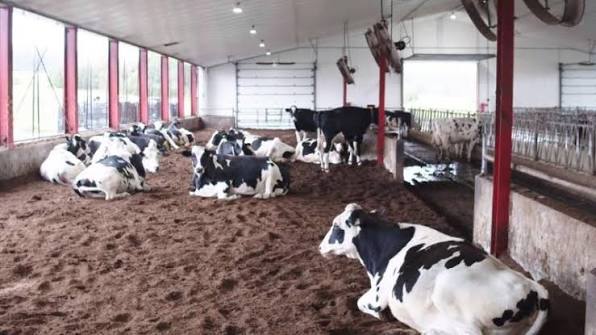
Sabrina Caron doesn’t soften what her Quebec herd went through. “For a long time we had a lot of problems with calvings and with cows not having a good start to the lactation. It was a horror,” she in a recent interview. She’d tried plenty. The one that stuck was X-Zelit, and she credits it with lifting her herd average from 40 to 48kg per cow per day inside a year.
Caron and Danny Giguère run 105 Holstein milking cows at Ferme Roland Caron in Laurierville, Quebec — third-generation ground, and named Agropur’s 2024 Grand Champion for animal welfare. Her account is a real producer describing a real result. Whether it’s a result you can copy is a different question, and the research on transition failure explains why.
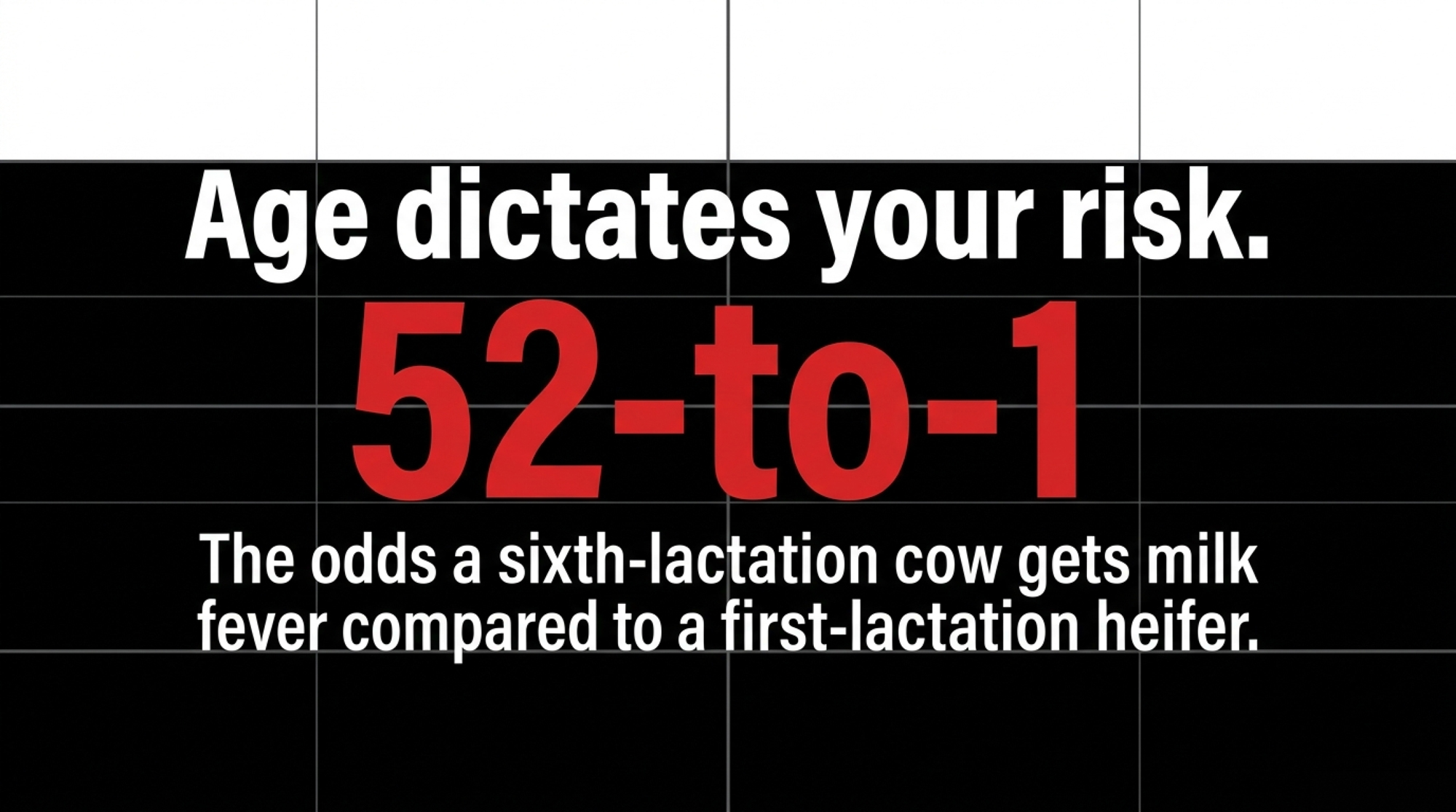
A 2017 Journal of Dairy Science study of Costa Rican grazing herds found parity dominated every other risk factor for milk fever, at an odds ratio of 52.59 for cows in their sixth lactation or later. That figure comes from the study’s base model; the same paper’s full model, which adjusts for more herd-level variables, puts the same group at OR 12.84. Both models found parity was by far the largest factor. We quote the base-model figure because it’s the one the literature circulates — which is exactly the kind of choice this article is about. A producer weighing it should know the range, and know these were grazing herds in Costa Rica, not confinement herds in Wisconsin or Ontario.
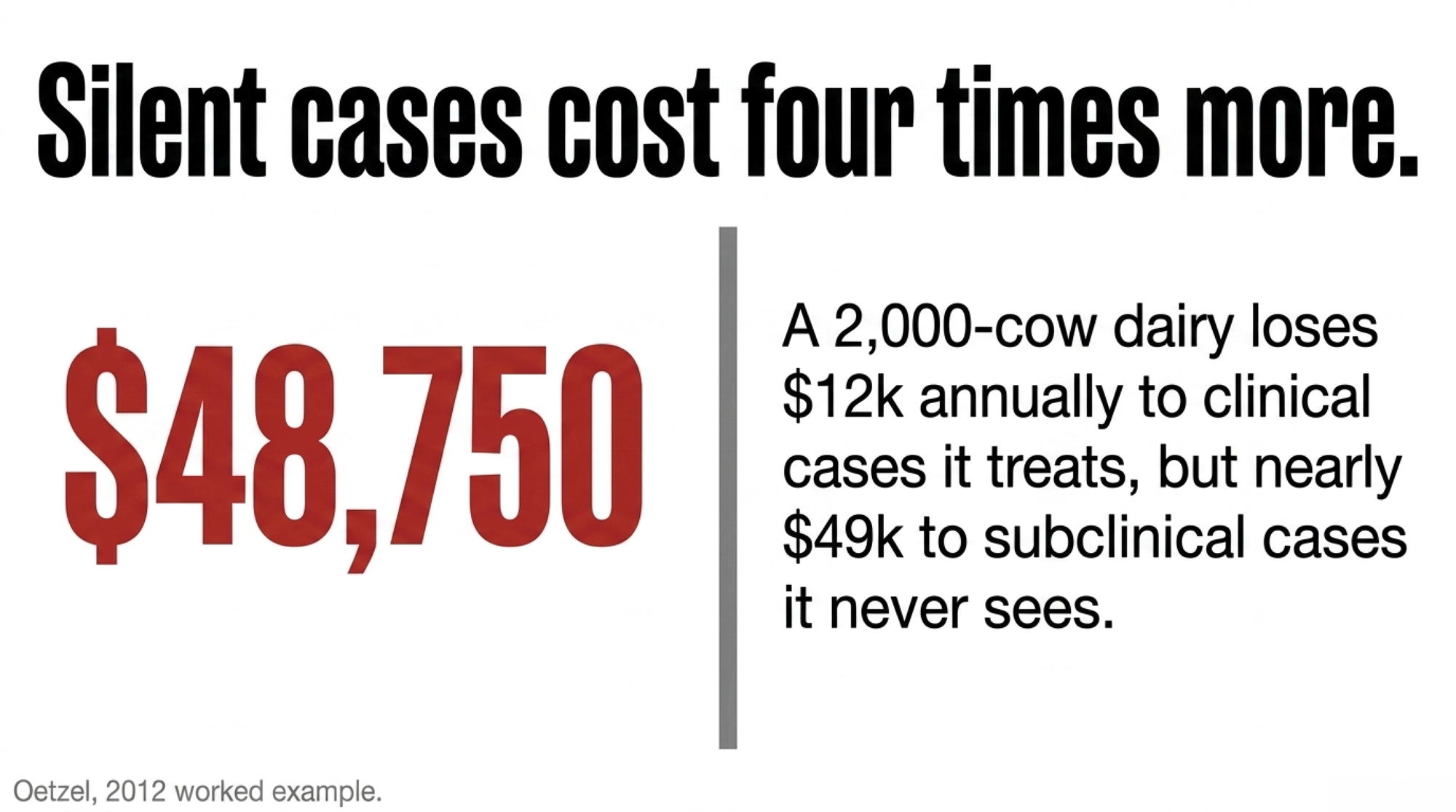
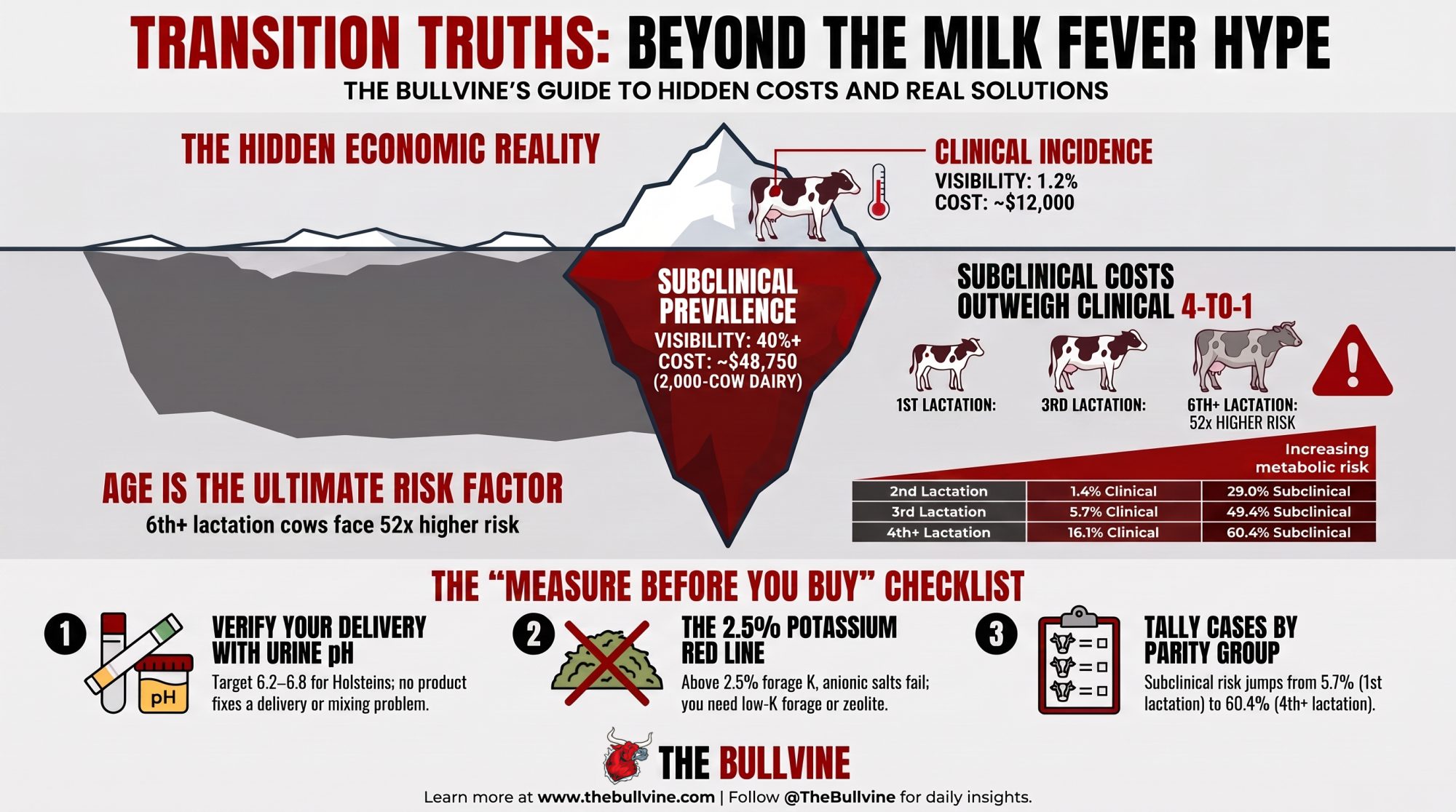
Either way, nothing you buy changes a cow’s parity. And here’s the inversion that reframes the economics. Oetzel’s 2012 worked example put it plainly: a 2,000-cow dairy with 2% clinical incidence at $300 a case loses about $12,000 a year, while the same herd with 30% subclinical incidence among second- and later-lactation cows at $125 a case loses about $48,750. Four times more, from cases nobody treats.
Three Things to Measure Before You Buy Anything
The full decision guide is further down, but if you read nothing else: pull urine pH on your close-up cows, test your dry cow forage potassium, and tally your clinical cases by lactation group. All three cost almost nothing. All three change which of the four approaches below could plausibly work on your farm. None of them require a sales call.
What’s Actually Changed in Transition Prep
Transition prep used to be one conversation. Get dietary cation-anion difference right in the final three weeks, check urine pH, hope. That’s still the backbone: University of Wisconsin–Madison Extension puts the research-based DCAD target at -100 to -200 mEq/kg DM, with -100 often preferred because pushing toward -200 risks too severe a metabolic acidosis response. NASEM’s 2021 requirements land in the same place, recommending -100 mEq/kg DM inside the final 21 days. Target urine pH for Holsteins runs 6.2 to 6.8.
What’s new is that the field now has genuinely different biochemical routes to the same endpoint — with independent research confirming they aren’t the same thing wearing different labels. A 2024 Journal of Dairy Science trial from Wisconsin compared synthetic zeolite A head-to-head against negative DCAD and found both improve postpartum calcium metabolism, but “they appear to work through different mechanisms.” That’s a controlled comparison saying the physiology diverges, not a marketing claim.
Dry-Off Isn’t the End of Anything
The third route steps outside feeding altogether, and it starts earlier than most protocols do. Julien Redor, Ruminant Technical Manager at the French company Natual, frames it this way: drying off “should no longer be seen as the end of milk production, but rather as a phase of immunological preparation” directly after the last milking, with active metabolic preparation across the final three weeks before calving.
That framing has independent research behind it. A 2025 Journal of Dairy Science review approaches the dry-to-lactation window through immunometabolism — metabolic and immune function wired together rather than stacked in sequence. A heavily cited 2017 review put the interdependence bluntly: metabolic diseases like milk fever and ketosis raise a cow’s risk of infectious disease, and infectious disease raises her metabolic risk right back.
Here’s what it looks like as a protocol rather than a concept. On a French farm running roughly 250 Holsteins with a stated goal of cutting antibiotic use at dry-off, the sequence is specific: no over-milking at the last milking, minimal teat stimulation afterward, Natual’s Taribol bolus administered systematically within two hours, then straight into a separate dry group on a high-fiber, low-energy ration — physically separated from the milking herd so nothing re-stimulates production. Metrabol follows post-calving, aimed at uterine involution and getting the cycle restarted.
Read that list again and notice how much of it costs nothing. The over-milking, the teat handling, the physical separation, the ration split — those are protocol decisions, not purchases. Whatever you conclude about the boluses, the handling sequence around them is available to any herd that decides to run it.
The Farms Where Everything Looks Right and It Still Goes Wrong
Ask a nutritionist about their problem farms and you’ll often hear the same profile: textbook rations, sporadic milk fever anyway. Dr. Norbert Göres has spent years on that list. He’s a veterinarian with a TiHo Hannover doctorate on cattle feeding and, since 2021, Director of Business Development for the EU market on Sano’s SmartDairyNutrition program.
“There are farms where everything seems to be right — low potassium dry cow rations, optimal mineral supplementation and a perfectly mixed ration, but they continue to be confronted with cases of milk fever here and there,” Göres said in a European trade interview on transition management. “These types of cases made us rethink existing concepts and further develop them.”
Sano’s answer is Mipro Close-Up 700 — acidification held across the full dry period instead of the close-up phase alone, paired with rumen-protected methionine and choline for liver support. The company reports clinical milk fever effectively eliminated on client farms and fresh cows averaging 7.9kg more milk per day, with the biggest gains in older cows. Those are company-reported field results from Sano’s own advisory work. We could not locate the underlying trial data in the published literature, which doesn’t mean the results aren’t real — field results rather than published trials are common practice across on-farm nutrition advisory programs — but it does mean you’re weighing a vendor’s client outcomes rather than an independent trial.
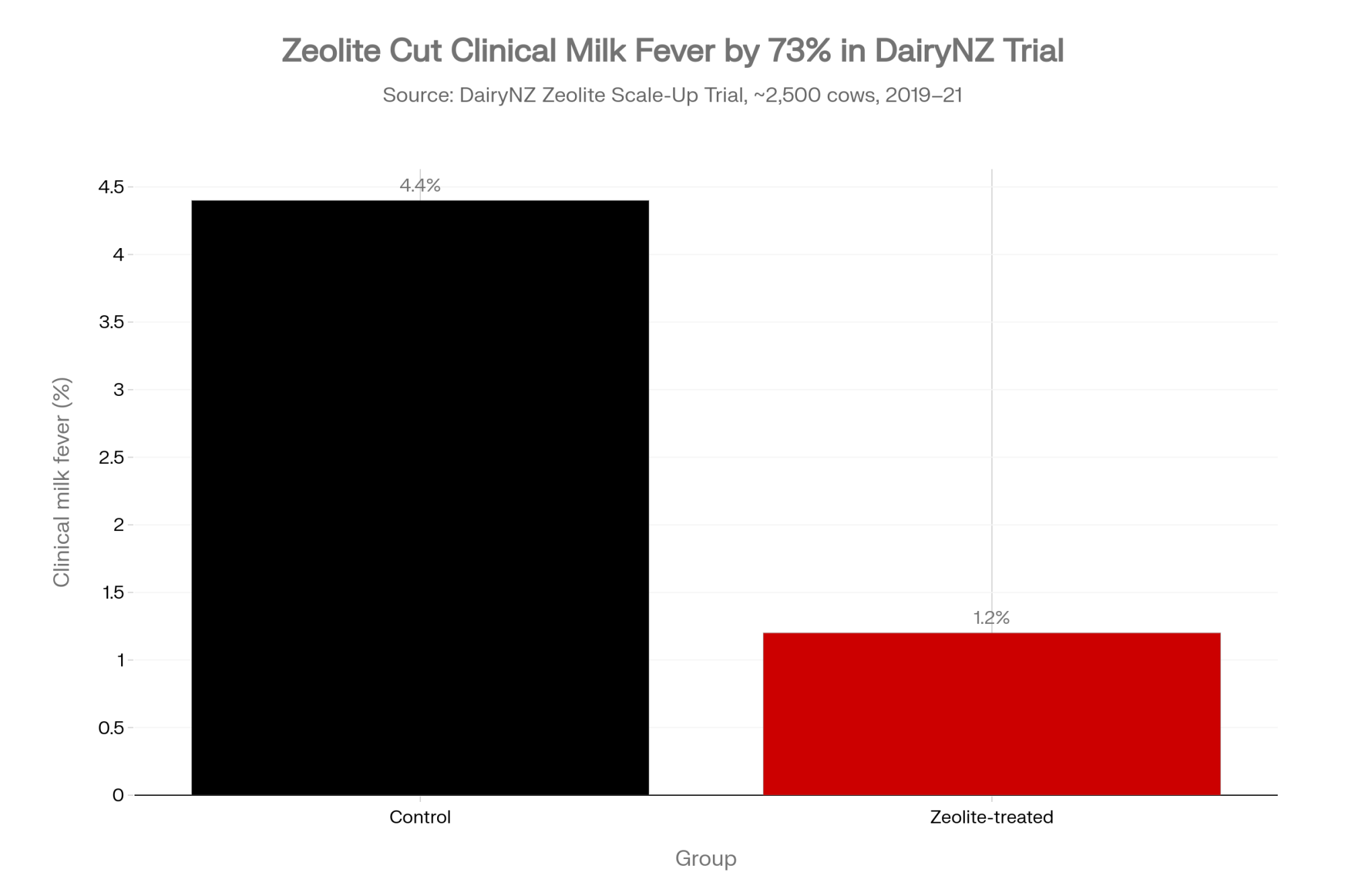
Zeolite’s trail is more traceable, and it doesn’t rest on one trial. Kerwin and colleagues, publishing in the Journal of Dairy Science in 2019, found synthetic zeolite A fed prepartum produced markedly improved serum calcium around calving in a housed Cornell herd — and DairyNZ’s scale-up work is the most recent large-scale confirmation. DairyNZ — funded by New Zealand dairy farmers through the levy and by the Ministry for Business, Innovation and Employment — ran its Zeolite Scale-Up Trial across roughly 1,000 cows in three Waikato herds in 2019/20 and another 1,500 cows across three herds the following season. Half of each herd got 500g/day of synthetic zeolite for three weeks pre-calving. Clinical milk fever fell from 4.4% in controls to 1.2% in treated cows.
Worth noting where the commercial interest sits on this one too. Vilofoss, which markets X-Zelit, calls the product “a definitive solution for the control of hypocalcemia” and “a significant and disruptive advance” in its own 2026 conference material. Strong independent evidence and strong marketing aren’t mutually exclusive. They’re just different things, and only one went through peer review.
Four Levers, Four Failure Points
| Approach | Mechanism | Best fit | Where it fails |
| Close-up negative DCAD | Acidosis activates TRPV5/TRPV6 calcium channels; mechanism still debated | Confinement herds, controlled and testable rations | No benefit below pH 6.0 or -100 mEq/kg DM; failed entirely at dietary Ca above 1.6% in a 1992 trial |
| Extended acidification — Sano Mipro Close-Up 700, full dry period plus methionine and choline | Same acidification route held longer, with liver support | Persistent cases despite textbook close-up formulation | Needs precise DCAD calculation, mineral balancing, cow comfort, routine urine pH. Results are company-reported, not independently published |
| Synthetic zeolite — Vilofoss X-Zelit, 500g/day for 2–3 weeks, stop at calving | Binds calcium and minerals in the rumen; large pre-calving blood phosphate drop documented | Grazing and high-K forage systems where DCAD is hard to hit | Not on fodder beet or low-P diets; not mined natural zeolite; magnesium needs active management; cuts prepartum intake ~13% versus negative DCAD |
| Dry-off bolus support — Natual Taribol within 2 hours of last milking, Metrabol post-calving | Anti-inflammatory and immune support at dry-off, layered on any feeding program | Herds targeting antibiotic reduction at dry-off | No peer-reviewed trial located on either product as of publication; the 85-minute lying-time study used a different bolus type |
Running the Barn Math, and Naming Who Built It
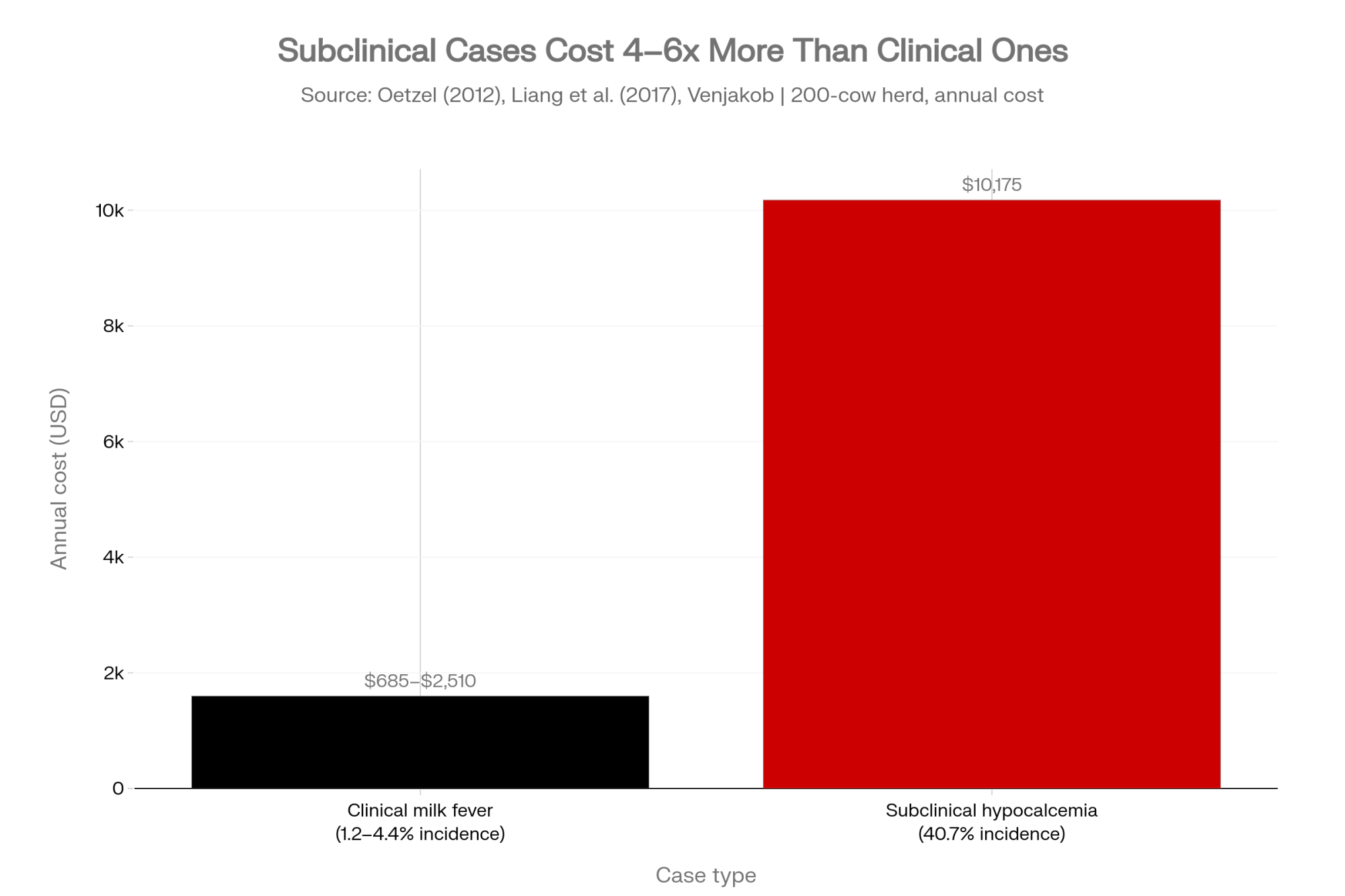
| Condition | Cost per case | Incidence | Annual cost, 200-cow herd |
| Clinical milk fever | $285 per multiparous case (Liang et al. 2017, JDS) | 1.2–4.4% in DairyNZ trial herds | Roughly $685 to $2,510 |
| Subclinical hypocalcemia | $125 per affected cow (Oetzel, 2012 worked example) | 40.7% measured across 1,380 German cows at a 2.0 mmol/L threshold | Roughly $10,175 |
Incidence figures pair DairyNZ’s pasture-trial herds with US per-case costs and a German prevalence survey. Oetzel applied his $125 to second-and-greater-lactation cows; Venjakob’s 40.7% covers all parities, so the herd figure runs slightly high. Directional, not transferable — run your own incidence.
The direction holds across both currencies and both continents: the subclinical column is always the bigger number. The multiple doesn’t hold. It runs about 3.6:1 in Phibro’s model, 4.1:1 in Oetzel’s own example, and closer to 6:1 using the figures above. Which tells you the incidence assumption is doing most of the work — and that it’s the number worth arguing about.
| Cost figure | Published by | Company sells | Underlying source | Year |
| €16,950/yr subclinical model | Phibro Animal Health (Arnout Dekker) | Anionic minerals (Animate) | Oetzel (2011) per-case cost | 2021 |
| €312 clinical case | Guard et al. | — (academic) | Original 1996 study | 1996 — 30 yrs old |
| “Definitive solution” language | Vilofoss | Synthetic zeolite (X-Zelit) | Company conference material | 2026 |
| 7.9kg/day milk gain, milk fever “eliminated” | Sano | Mipro Close-Up 700 | Company-reported, no published trial | Ongoing |
| Clinical milk fever 4.4%→1.2% | DairyNZ (farmer levy-funded) | Nothing — independent | Zeolite Scale-Up Trial | 2019–21 |
So here’s the model most often quoted at producers. That 250-cow European breakdown — clinical at €312 a case and 6% incidence giving €4,680 a year, subclinical at €113 and 60% giving €16,950 — was published in February 2021 by Arnout Dekker, Business Manager Europe for Phibro Animal Health. Phibro markets Animate, an anionic mineral used in negative-DCAD programs.
The per-case costs underneath the table aren’t Phibro’s own: €312 traces to Guard et al. (1996), €113 to Oetzel (2011). The 6% and 60% incidence figures are the model’s. Don’t convert between the euro model and the US numbers — different cost assumptions, different years, different decades in the case of Guard.
If you want to see what a single fresh-cow line item does at scale, our reporting on Steve Jaeger’s $511 fresh cow problem tracks a $111-per-cow fix across 4,495 cows.
Different Doors, Same Room
Negative DCAD acidifies the cow, so her own calcium regulation switches on before she needs it. It’s a systemic metabolic intervention, and it only works if she eats the ration you formulated.
Zeolite goes through a different door, and the sources disagree about which door. DairyNZ describes synthetic zeolite binding dietary calcium and other minerals in the rumen, stimulating increased intestinal absorption — while also documenting a large pre-calving phosphate drop as part of the mechanism. Martín-Tereso’s 2011 review reports the original calcium-binding hypothesis has been challenged by a hypophosphatemia-driven explanation, where lower blood phosphorus reduces FGF23 signaling and triggers bone mobilization. A 2025 review adds that zeolite likely acts on several systems at once, including the ruminal environment and immune modulation.
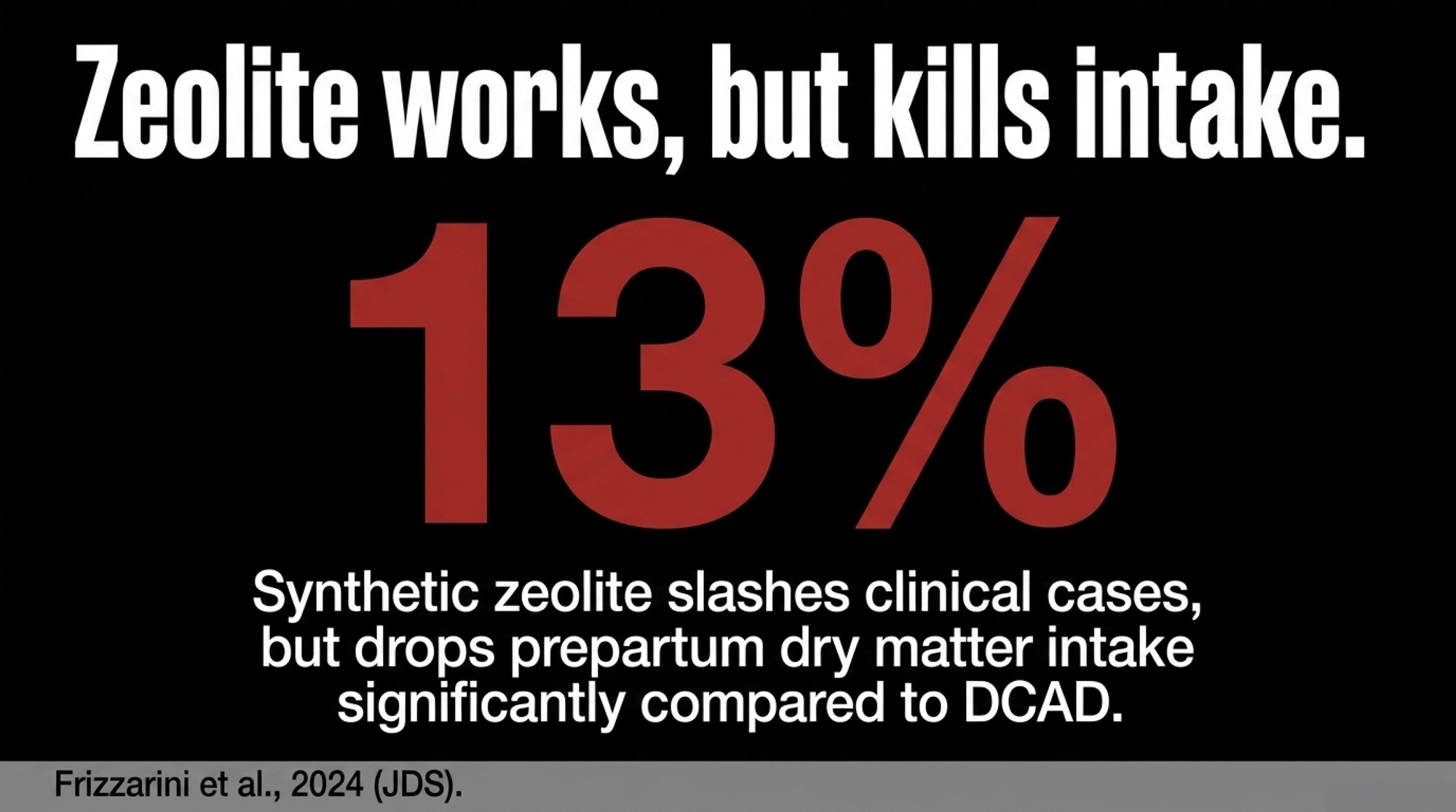
Here’s the trade-off you should expect, and it’s substantial. Frizzarini and colleagues, in that 2024 Wisconsin trial, measured prepartum dry matter intake at 11.7 kg/day on zeolite against 13.5 on negative DCAD and 13.9 on the control — a 13% drop versus DCAD and 15.7% versus control. Rumination fell too: 487 minutes a day against 527 and 531. Both differences were significant at P<0.01.
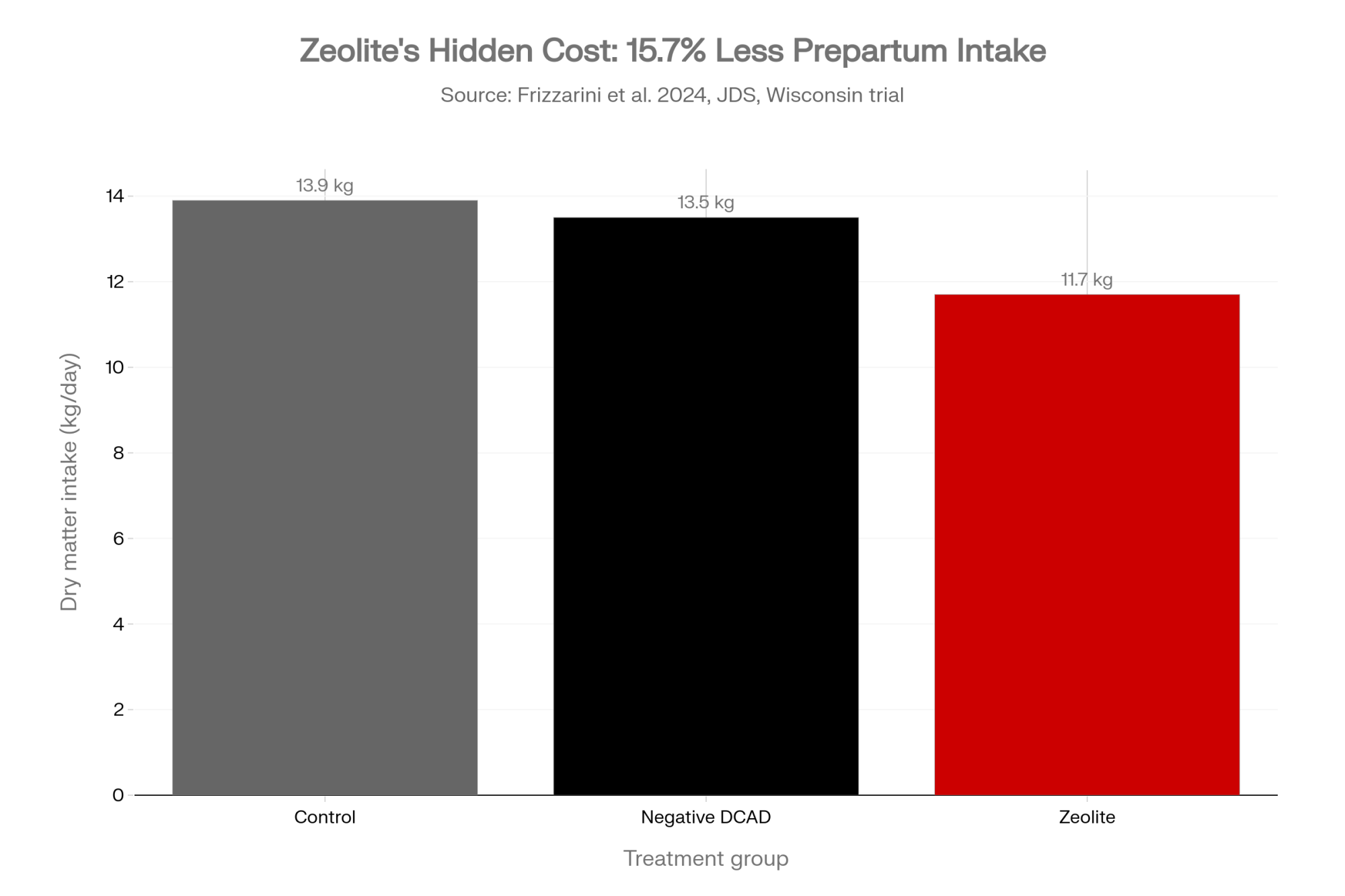
That’s not a small dip, and any nutritionist will flag it. What the same trial found, though, is that blood BHB didn’t change, body fat mobilization postpartum didn’t increase, and rumination came back to parity after calving. The authors concluded zeolite “does not affect energy metabolism” despite the intake reduction, and reported higher colostral IgG plus the most milk from third-lactation-and-older cows on zeolite. So the prepartum intake loss appears to be a cost the cow absorbs without metabolic consequence — but you should know it’s there before a rep tells you the product is free of downsides.
The Mechanic Nobody Sells Against
Delivery. Urine pH testing exists precisely because correctly formulated DCAD rations fail in practice. Cows running out of feed and slug feeding, under- or over-mixing, and unexpected shifts in forage mineral levels all change what the cow receives versus what’s on the spec sheet. A ration is a plan. Urine pH is the only thing that tells you whether she actually got the memo.
Why One Farm’s Number Can’t Settle It
Savaron’s recent history is a matter of public record: fire destroyed a barn at the Laurierville farm in March 2020, a new facility came into operation in December 2021, and the herd is milked robotically. Caron has spoken publicly about the rebuild.
Nothing in this section reflects on Caron’s management or on her herd’s performance. Ferme Roland Caron holds a national animal-welfare award, which is not something a poorly run operation collects. The confounders here are structural, and they would apply identically to any farm that rebuilt and automated across the same seasons — including, most likely, yours.
That’s the point. When a facility change, a new milking system, and a transition protocol all land inside a few seasons, nobody can cleanly separate afterward what moved the tank. X-Zelit has independent trial evidence of its own; none of it rests on Savaron. But if you can’t tell which of your own changes moved the needle, you can’t repeat it, scale it, or stop paying for the part that didn’t matter.
Your Dry Pen Decision Guide
Work down in order. Each step is a gate, not a suggestion.
IF you haven’t measured urine pH on close-up cows in 60 days ➔ don’t spend another dollar on additives until you do. Target 6.2 to 6.8. Mixer accuracy and slug feeding are the documented failure points, and no product fixes a delivery problem.
IF your dry cow forage K is above 1.5% of DM ➔ you’re into anionic-salt territory. Above 2.5% ➔ salts won’t rescue it. Published guidance sets the dry cow forage target under 1.5% K, treats 2–2.5% as the range where anionic salts become necessary, and calls above 2.5% almost impossible to correct with salts alone. Cornell puts the grass target under 2% K for a workable anionic diet. Past 2.5%, low-K forage or zeolite is the answer, not more salt.
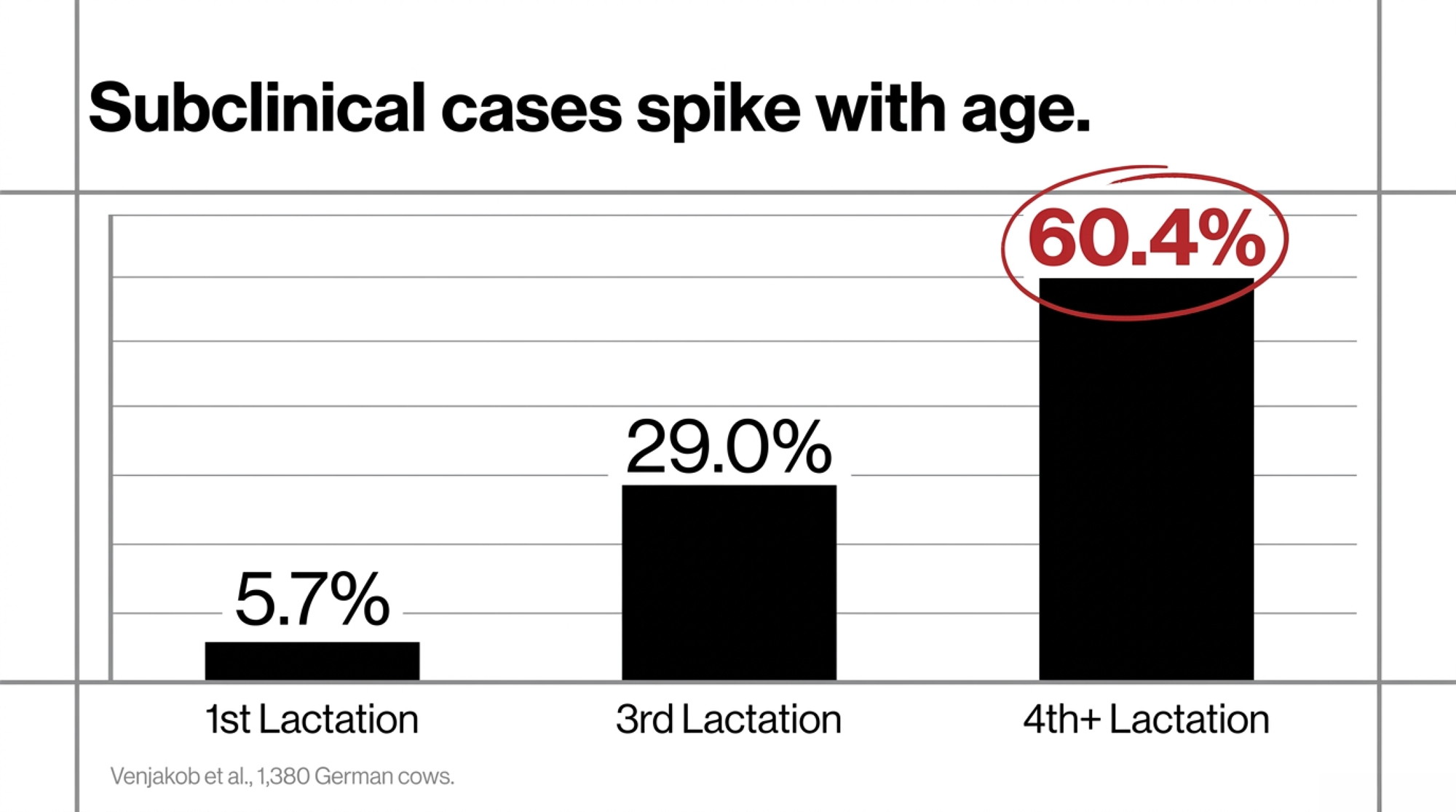
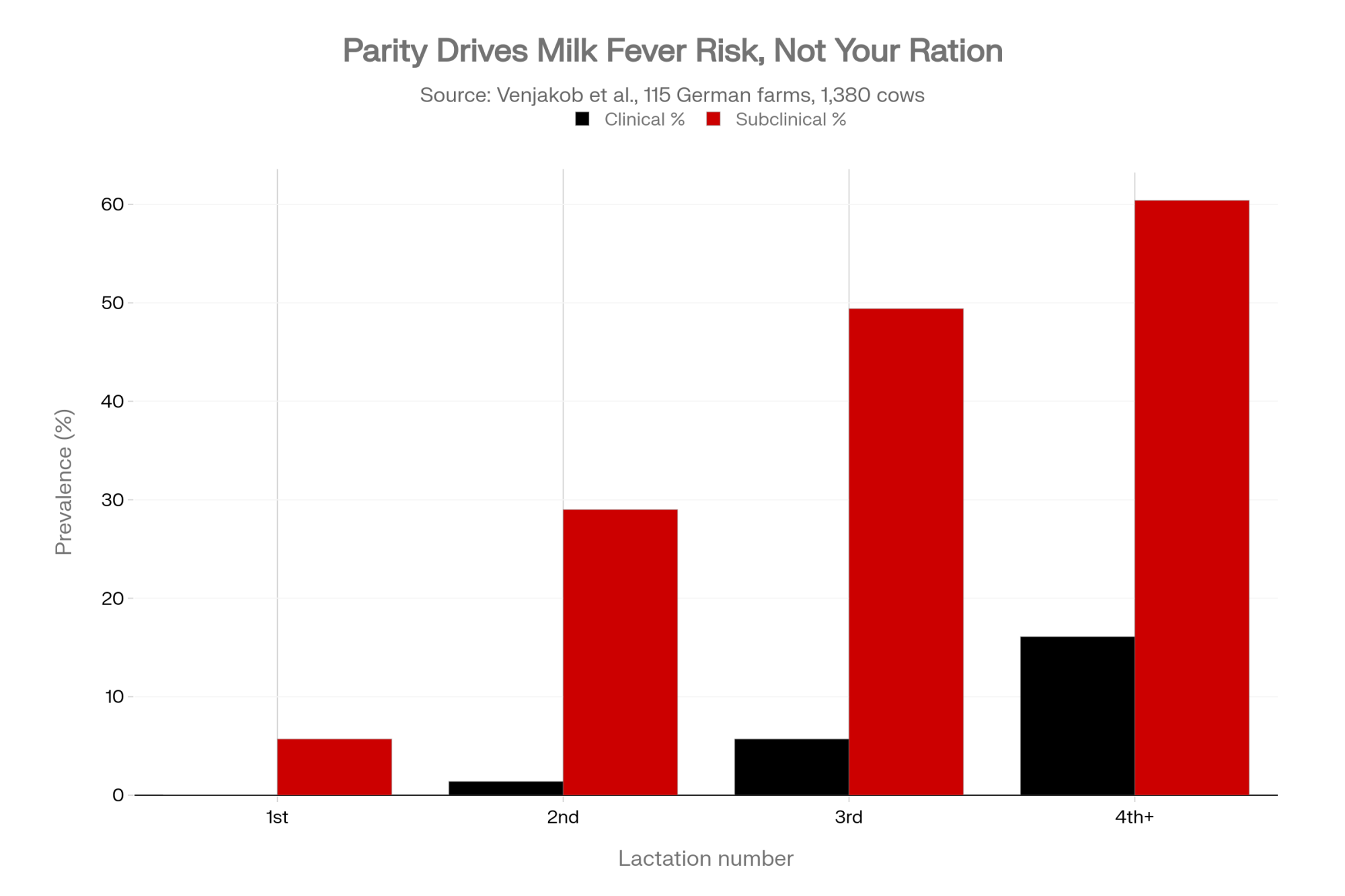
IF your clinical cases cluster in fourth-lactation-and-older cows ➔ split your dry cow ration by parity. Venjakob’s survey of 1,380 cows across 115 German farms found clinical milk fever at zero in first lactation, then 1.4%, 5.7% and 16.1% in second, third and fourth-plus. Subclinical prevalence at a 2.0 mmol/L threshold ran 5.7%, 29.0%, 49.4% and 60.4% across the same four groups. One group ration treats two different risk populations identically.
IF lameness in your dry pen is unmeasured ➔ score it before you buy anything. In Neves and colleagues’ 2017 work, cows that were lame but normocalcemic at calving were 3.2 times more likely to be subclinically hypocalcemic by two days in milk than non-lame normocalcemic cows — the paper’s abstract renders the same comparison as 3.4. Either way, that’s a facility problem wearing a mineral problem’s clothes.
IF more than 15% of first-week fresh cows show BHB above 1.2 mmol/L ➔ calcium isn’t your bottleneck. That threshold signals significant herd-level disease risk and real production loss. Steeneveld’s 2020 analysis put clinical ketosis at €709 a case and subclinical at €150, running €3,613 a year on a default 130-cow Dutch farm and €7,371 on a high-risk one. For comparison, the clinical milk fever figure in Phibro’s model above is €312 a case, sourced to Guard et al. (1996) — a different study, a different decade, and not Steeneveld’s number.
IF you’re changing two things at once ➔ stagger them. A product alongside a facility upgrade, a robot startup, or a grouping change means you won’t know which one worked.
IF a vendor shows you a testimonial ➔ ask three questions. Is there an independent, peer-reviewed trial on this specific product, or only on the ingredient class? Who funded it? Who co-authored it? Kerwin’s 2019 Cornell zeolite trial lists co-authors from outside the university alongside the Cornell team — standard and disclosed in applied nutrition research, and worth factoring in.
Sørensen and colleagues said the underlying thing plainly back in 2002: the most suitable milk fever control strategy for any herd depends on herd-specific circumstances — the farmer’s skills, the production system, and the economics of that particular choice. Two decades on, nothing has displaced it. DairyNZ’s own scale-up data points the same way, noting that herds with a milk fever history benefit most from zeolite.
Run Your Own Numbers Before You Run a Trial
If your transition numbers have been stuck for three years, the honest question isn’t which of these approaches to buy. It’s whether you’ve got enough measurement in place to know whether the last thing you changed actually worked.
The European Food Safety Authority requires a minimum of three independent in vivo studies showing significant effects before an efficacy claim is supported for a feed additive. Our own view is that the design details matter as much as the count — control groups, randomization, blinding, enough animals to rule out chance — but that’s editorial framing, not EFSA’s wording. Either way, three independent studies is a workable bar to hold in mind when a rep shows you one farm’s numbers. It’s a fair bar to hold yourself to, too.
Start with your own figures: The Bullvine’s Ketosis Cost Calculator will put your fresh-cow BHB rate against Steeneveld’s per-case costs, and the Health ROI Calculator will tell you whether the input you’re weighing clears its own price. We’re publishing the seven gates as a printable one-pager for the office wall — watch for it in this week’s Bullvine Weekly.
Key Takeaways
- Before you buy anything, pull urine pH on close-up cows and check you’re inside 6.2 to 6.8, and get a forage K test. If K is above 1.5% of DM, you’re into anionic-salt territory; past 2.5% salts won’t rescue it, and you need low-K forage or zeolite.
- Zeolite cut DairyNZ’s clinical milk fever from 4.4% to 1.2%, but it also drops prepartum dry matter intake around 13% and needs magnesium watched. Extended acidification rests on company-reported field results, and there’s no published trial on the dry-off boluses specifically.
- On 200 cows, the clinical bill runs roughly $685 to $2,510 a year while subclinical sits near $10,175. Tally your cases by lactation group — subclinical prevalence goes from 5.7% in first-lactation cows to 60.4% in fourth-plus, so one dry ration is treating two different herds.
- When someone hands you a cost-per-case model, check who published it before you check the number. The €16,950 figure came from a company selling anionic minerals — the academic work under it is sound, but the incidence assumptions are theirs.
Research and product claims reflect published literature and company statements available as of publication. Sano, Natual and Vilofoss were not asked for comment before publication; this article will be updated if any party provides trial data or a response.
Learn More
- The $500 Transition Gap: Why Your Neighbor’s Fresh Cows May Outperform Yours by Next Winter — Delivers an actionable, targeted intervention protocol that replaces costly blanket treatments, cutting early-lactation disease rates to 18–24% and yielding $200–$500 net benefit per cow.
- Rethinking Cow Health: How Immune Activation Shapes Transition Dairy Cow Performance — Dissects the underlying physiological driver behind fresh-cow failures, proving how inflammation-induced nutrient partitioning forces metabolic shifts that traditional calcium and NEFA management strategies fail to resolve.
- Fans Won’t Fix It – Heat-Stressed Cows Go Leaky in 3 Days — Exposes why fan cooling only recovers 60% of summer milk losses, providing a multi-path audit to protect gut permeability, manage close-up DCAD drifts, and stop hidden inflammation from destroying late-summer transitions.
 The Sunday Read Dairy Professionals Don’t Skip.
 The Sunday Read Dairy Professionals Don’t Skip.
Every week, thousands of producers, breeders, and industry insiders open Bullvine Weekly for genetics insights, market shifts, and profit strategies they won’t find anywhere else. One email. Five minutes. Smarter decisions all week.




