






Valacta’s 2025 territory held 2,807 herds and 255,062 recorded cows. Lactanet says Valacta relaunches there, but names no start date. Get price and data terms in writing before you renew.
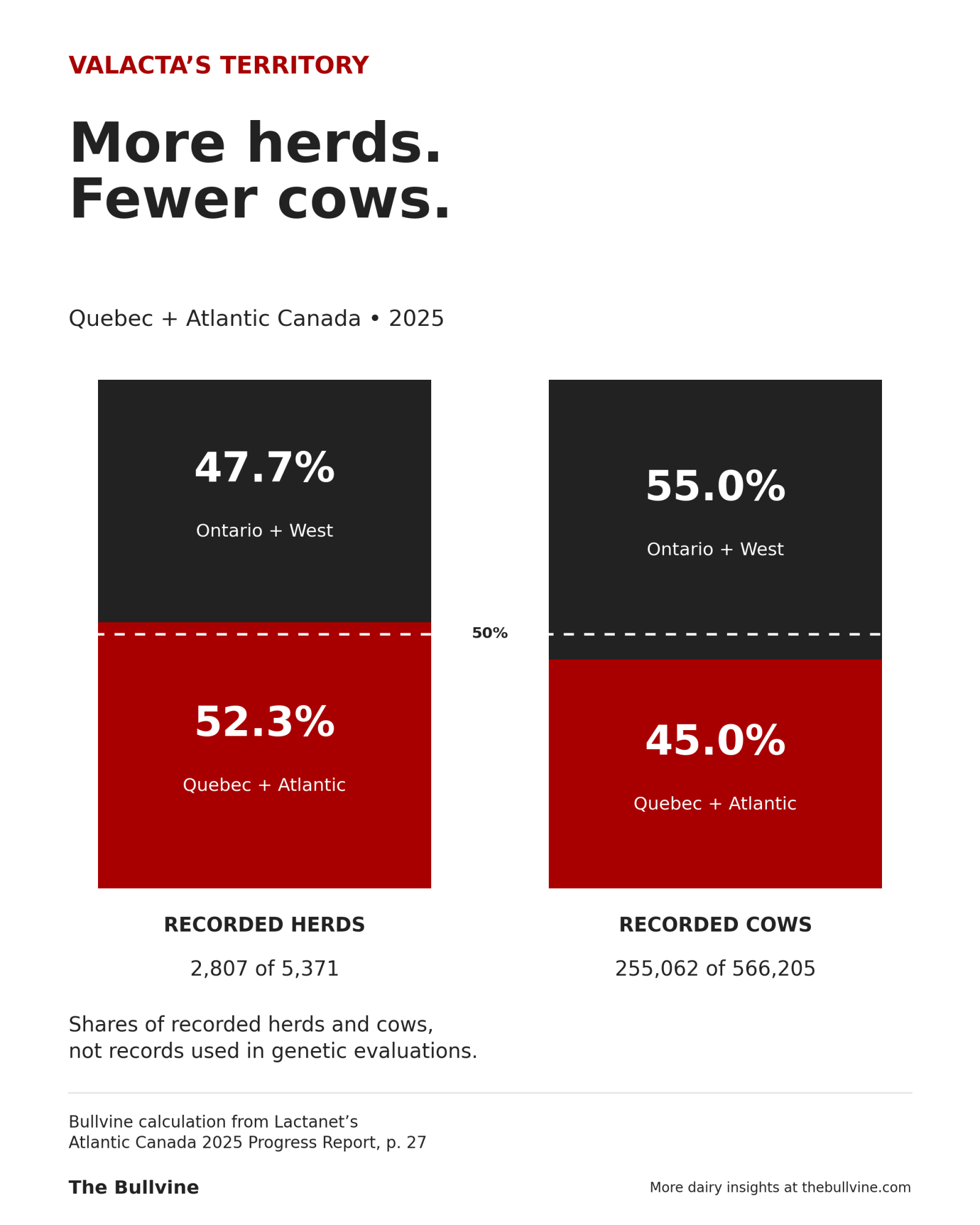
Before your next milk-recording renewal, confirm the price, where your records go and who provides support. In its November 6 announcement, Lactanet said Valacta will relaunch its brand in Quebec and Atlantic Canada and deliver milk recording, advisory and knowledge-transfer services there. Lactanet keeps national genetic evaluation, traceability, herd management software, and milk recording in Ontario and the West. According to the release, Lactanet and Valacta will “operate independently” while keeping “a strategic collaboration in the delivery of milk recording services across Canada.”
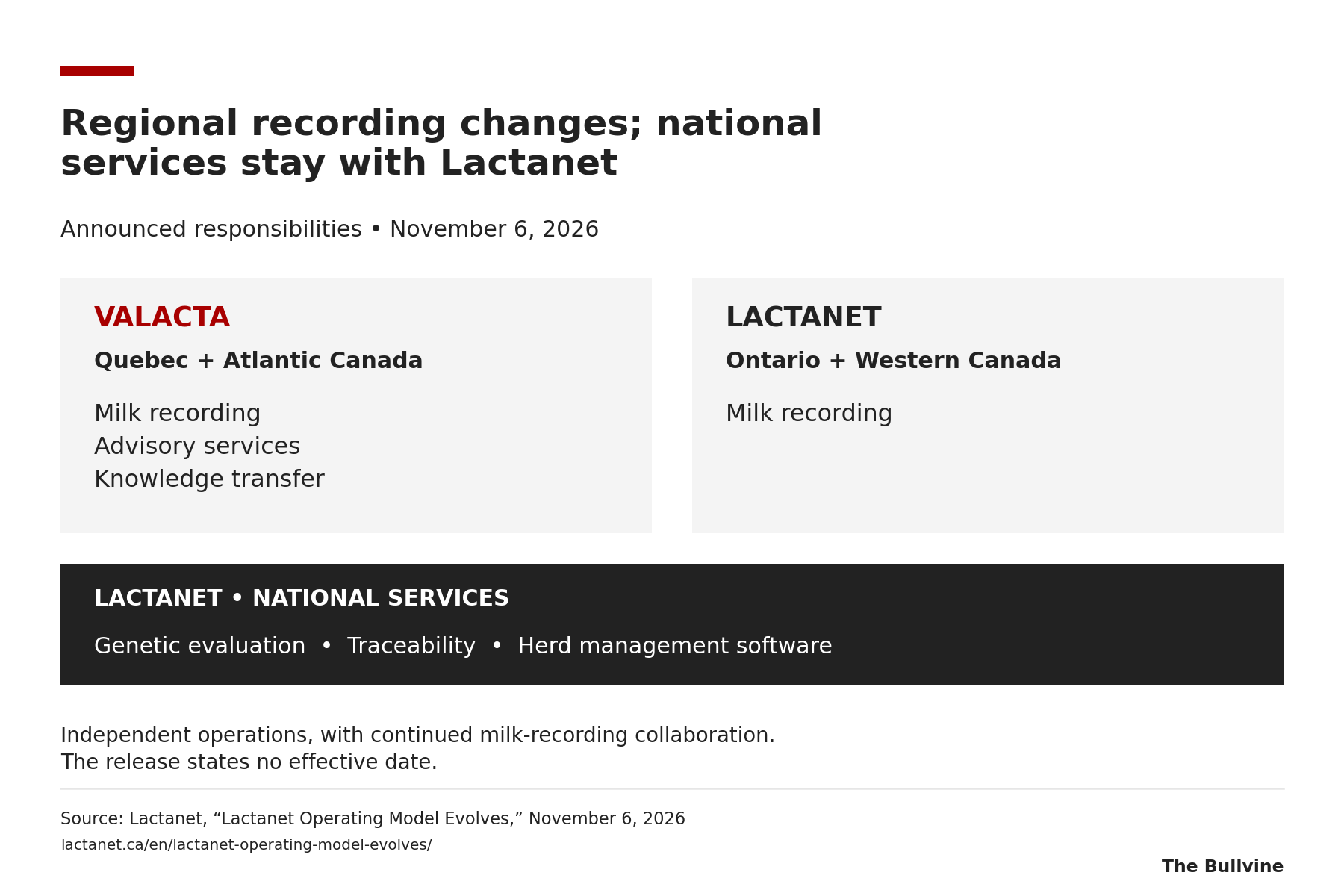
In 2025, Valacta’s territory held 2,807 recorded herds and 255,062 recorded cows. That is about 45% of the recorded cows in the report, not a measured share of the records used in genetic evaluations. The release gives no effective date, and it promises “continuity of services.”
The split, herd by herd
Lactanet’s Atlantic Canada 2025 Progress Report lists recorded herds and cows for all ten provinces. The table matches those counts to the new territory lines. The split, percentages and averages are Bullvine calculations.
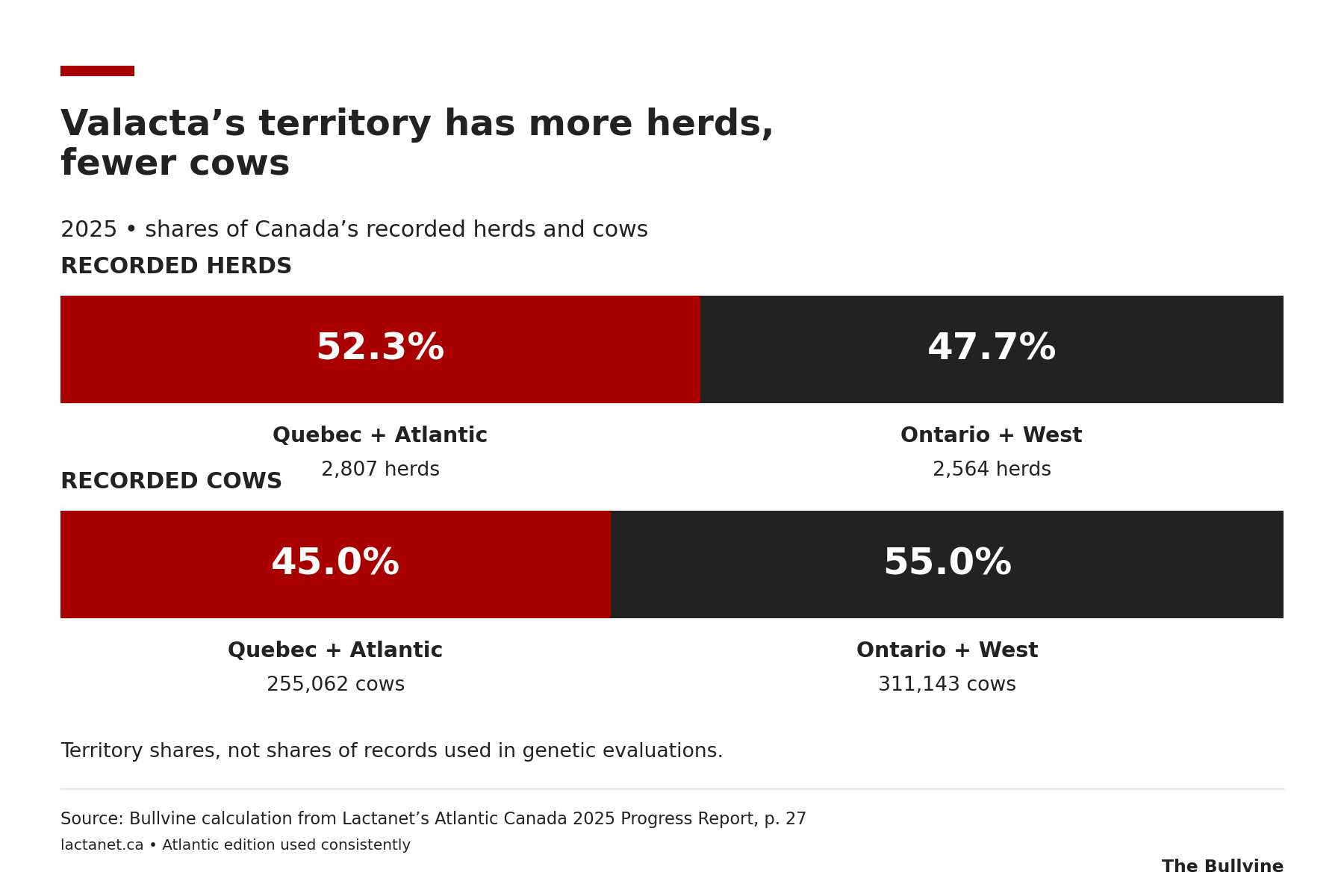
| 2025 | Valacta territory (QC + Atlantic) | Lactanet territory (ON + West) | Canada |
| Recorded herds | 2,807 (52.3%) | 2,564 (47.7%) | 5,371 |
| Recorded cows | 255,062 (45.0%) | 311,143 (55.0%) | 566,205 |
| Average recorded herd | 91 cows | 121 cows | 105 cows |
Quebec alone had 2,539 recorded herds and 224,581 recorded cows. The four Atlantic provinces add 268 herds and 30,481 cows.
Lactanet’s two 2025 regional reports differ by up to 15 herds per province. The Ontario-West edition shows Quebec at 2,554 herds and Ontario at 1,920. Both editions list all ten provinces. We use the Atlantic edition consistently for the territory calculations, and the territory shares differ by less than half a percentage point between editions.
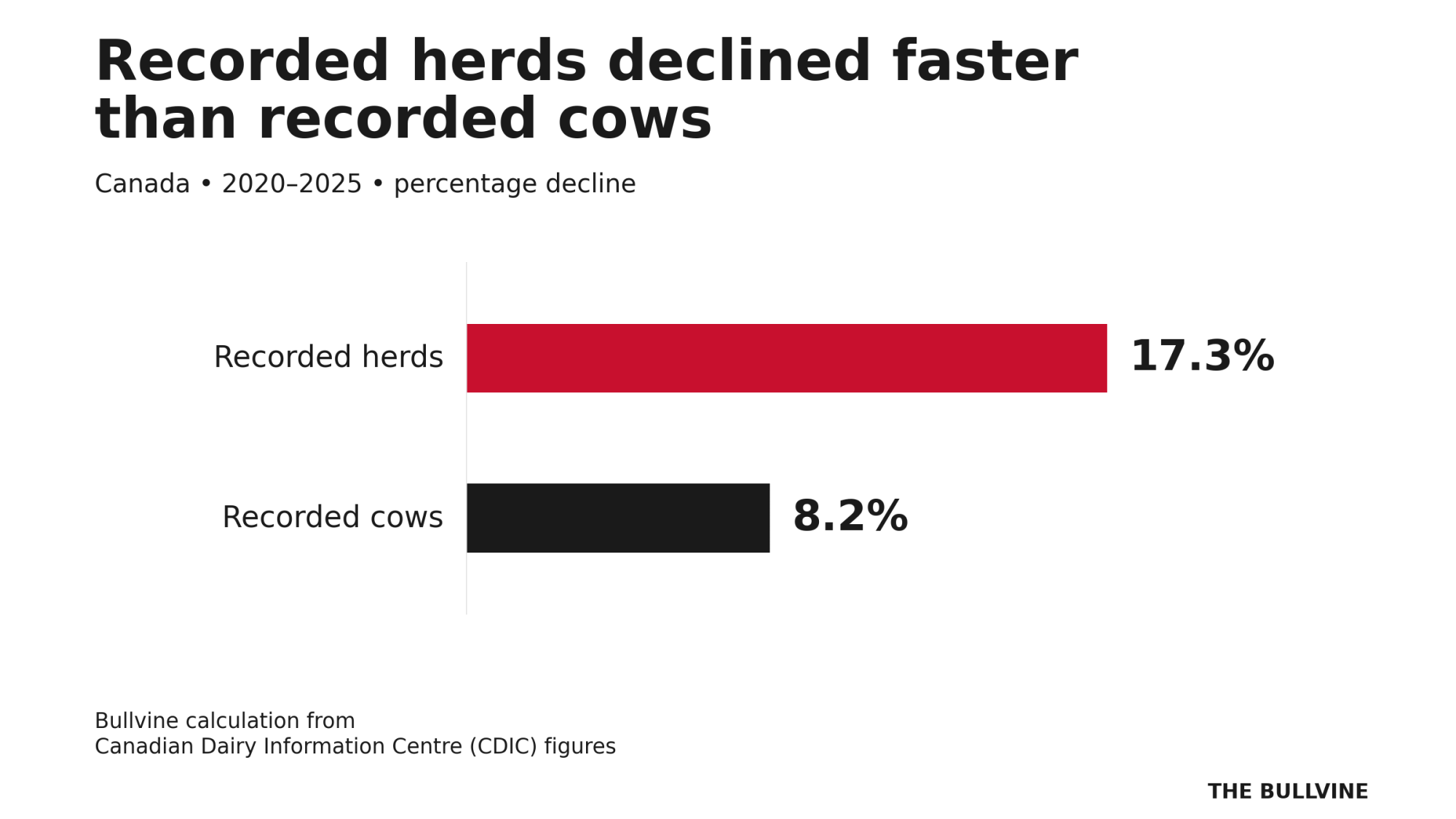
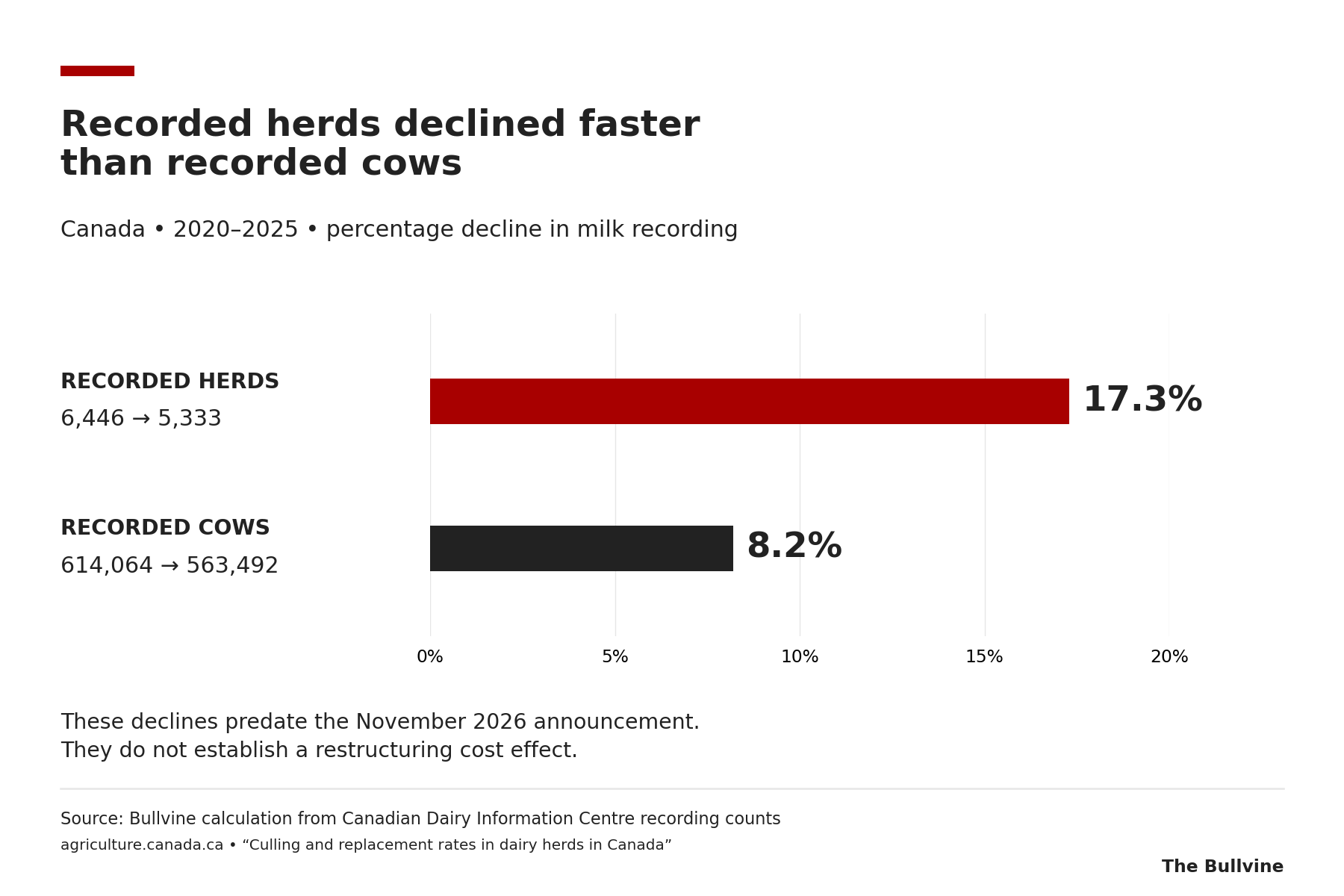
Lactanet keeps fewer herds, but they’re larger, and together they hold most of the cows. The base was already shrinking toward that shape. Canadian Dairy Information Centre (CDIC) figures show recording herds declining from 6,446 in 2020 to 5,333 in 2025, and recorded cows from 614,064 to 563,492. Those are declines of 17.3% and 8.2%, respectively, by Bullvine’s calculation. CDIC’s 2025 herd count is 38 lower than the Atlantic edition’s total, so the territory split uses Lactanet’s figures.
It was never a merger
CanWest DHI, Valacta and the Canadian Dairy Network formed Lactanet in 2019. Seven years later, the partnership is dividing along the old regional line.
The partnership retained separate legal entities. In 2024, Daniel Lefebvre, then Lactanet’s chief innovation officer, told Le Bulletin des agriculteurs: « Ce n’est pas une fusion, dans le sens où les entités légales demeurent. C’est un partenariat. » (“It’s not a merger, in the sense that the legal entities remain. It’s a partnership.” Bullvine translation.) He added that all the entities still existed legally and shared the right to use the Lactanet name.
Valacta’s 2023–24 annual report identifies its limited partners as Les Producteurs de lait du Québec (PLQ), McGill University and Quebec’s agriculture ministry (MAPAQ). The report separately lists their Class A shares in Valacta Inc., the general partner, as 52, 24 and 24. When the partnership formed, Farmtario noted that the founders ran on different funding models, “including a closer connection by Valacta to the Quebec government.”
As recently as June 3, 2026, Lactanet appointed Mariette Gagnon to its board “as the Valacta representative.” In that announcement, Lactanet said Gagnon also serves on the PLQ and Valacta boards (Lactanet). The November release doesn’t say whether the seat survives the split.
What MAPAQ’s payment disclosure shows
Through an access-to-information request, MAPAQ released a list of financial assistance of $10,000 or more, cumulative from April 1, 2018 to March 31, 2024. The MAPAQ disclosure lists six cumulative program amounts for Valacta, société en commandite:
| MAPAQ program | Paid to Valacta (C$) |
| Partenariats pour l’innovation | $7,540,044.92 |
| Innovation bioalimentaire (PIB) | $1,602,720.00 |
| Programme de développement sectoriel | $1,489,004.00 |
| Programme Innov’Action agroalimentaire | $194,795.00 |
| Programme Services-conseils (PSC) 2023-2028 | $120,000.00 |
| Programme d’appui à la lutte contre les changements climatiques en agriculture | $80,000.00 |
| Total, six fiscal years | C$11,026,563.92 |
That averages C$1.84 million a year across six fiscal years (Bullvine math). It is historical assistance, not a current cash balance or a recurring annual commitment. The disclosure doesn’t split provincial and federal money, and it doesn’t say how research costs, staff or access to funded tools will be shared after the transition.
What happens to access to funded tools
Funding acknowledgements show who helped pay for particular tools, not who owns them:
- Selacta: Lactanet’s AI cow-selection dashboard on MySite. Lactanet says it “was developed with support from MAPAQ funding” and was released “in select provinces” in spring 2026, “with additional provinces to follow” (Lactanet Atlantic report). The Ontario-West report credits MAPAQ the same way.
- PROFILab: a bulk-tank fatty-acid service. Lactanet says it was funded through the Innov’Action agri-food program “as part of an agreement between the governments of Canada and Quebec” (Lactanet). In 2025, 42% of Quebec and Atlantic herds tested with it (Lactanet Atlantic report).
- Sainte-Anne-de-Bellevue lab: Lactanet’s lab services page lists it under the Valacta name (Lactanet).
For customers, the question is whether access, pricing or support will change. The announcement does not provide those details.
Genetics: confirm how records will reach evaluations
Ask both organizations whether data submission, validation or customer consent will change.
The cost-sharing debate predates this announcement. In April 2025, La Terre de chez nous reported a resolution Holstein Québec members adopted in February. It asked Lactanet and the AI centres to « trouver une solution à cette iniquité » (“find a solution to this inequity,” Bullvine translation). Their complaint was that participating farms pay to supply data that also benefit producers who do not pay for recording. Holstein Québec’s then-president Pascal Martin said: « Ce n’est pas juste quelques personnes qui devraient payer pour ça » (“It shouldn’t be just a few people paying for this,” Bullvine translation).
Lactanet answered in the same La Terre piece. Daniel Lefebvre, then its chief operating officer and head of its centre of expertise, said 62% of Canadian dairy farms still took part in milk recording, which he called more than enough for reliable data: « On est loin d’être rendus à parler d’une perte de valeur des données » (“We’re a long way from talking about a loss of value in the data,” Bullvine translation). He said compensating contributing farms would need an industry-wide agreement on how to share the cost of recording.
The Centre d’insémination artificielle du Québec told La Terre that AI centres already make a financial contribution to Lactanet for processing the farm data used in bull evaluations. It didn’t give an amount. The paper also reported that Ontario producers all fund milk recording through deductions from their milk cheques, and that, according to PLQ, nobody had raised the same idea in Quebec. Dairy Farmers of Ontario’s own deductions table lists a CanWest DHI deduction of $0.060 per hectolitre for August 2026.
That history makes cost allocation worth asking about. It isn’t evidence that new data-transfer charges are being negotiated.
What a smaller recording base could mean for costs
The November 6 announcement provides no regional cost breakdown. In a May 2019 Q&A published by Progressive Dairy, Lactanet said each business activity would “continue to operate as a separate division,” with fees representing “the actual costs of delivering services in the respective areas of operation or provinces as they do now.”
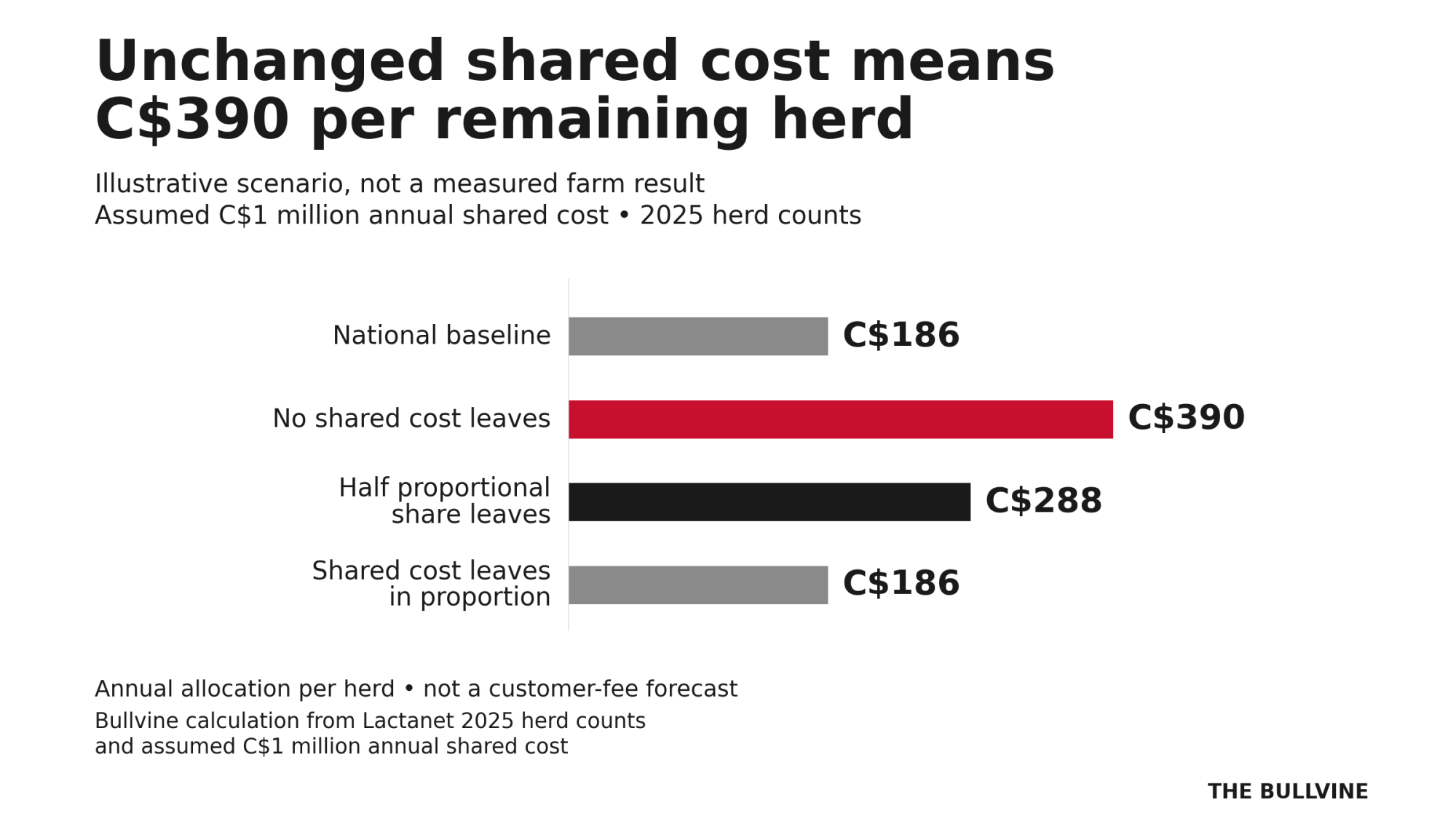
The question is how much shared milk-recording cost remains and who pays it. This Bullvine illustration allocates C$1 million of assumed annual shared cost using 2025 herd and cow counts. It excludes genetic evaluation by assumption and is not Lactanet’s budget:
| Scenario | Annual allocation per herd (C$) | vs. national baseline | Annual allocation per cow (C$) | vs. national baseline |
| 2025 national base (5,371 herds / 566,205 cows) | $186 | 1.00× | $1.77 | 1.00× |
| No shared cost leaves | $390 | 2.09× | $3.21 | 1.82× |
| Half the proportional share leaves | $288 | 1.55× | $2.49 | 1.41× |
| Shared cost leaves in proportion | $186 | 1.00× | $1.77 | 1.00× |
How the model works:
- Remaining base: 2,564 herds and 311,143 cows.
- “Proportional” means 52.3% of costs leave in the per-herd column and 45.0% in the per-cow column.
- The middle row is a midpoint assumption, not an estimate.
- The herd and cow columns are separate allocation examples, not two views of one remaining budget.
- The model assumes no other revenue or cost changes and does not predict customer fees.
- The calculation is ours.
Producer departures predate the announced restructuring. John Greig reported in farm media that Chris Nooyen told Lactanet’s 2026 Dairy Open Industry Forum that Brabantdale Farms no longer used classification or external milk recording. “There have been some services that have been cut, and you know what, our business is flourishing as good as ever,” Greig quoted Nooyen as saying. He challenged Holstein Canada and Lactanet to talk to the farms that have stopped using their services.
DairyComp is another customer relationship to watch. It is made by Valley Agricultural Software (VAS), and Lactanet sells and supports it in Canada (Lactanet). Lactanet’s FAQ puts DairyComp’s share at 55% of milk-recorded cows in Ontario and Western Canada. Customers should confirm who will handle their software contract and support.
What this means for your operation
- Quebec and Atlantic herds:
- Ask Valacta when the change takes effect.
- Before your next renewal, confirm which records from your service qualify for official evaluations and how they will reach Lactanet.
- Ask whether your renewal price or any data-submission charge will change.
- FCC customers on Valacta recording: The FCC–DFC–Lactanet sustainability incentive offers eligible borrowers up to C$2,000 or C$4,000 a year, depending on the criteria met; payment also depends on FCC lending. Applications close January 31, 2027. Herds not on Lactanet milk recording can still qualify “by providing similar metrics” (FCC). If your recording provider or application route changes before you apply, confirm the required documents with FCC before the deadline.
- Ontario and Western herds: Compare the total annual renewal quote with your current bill for the same services and testing frequency. Ask for an explanation of changed charges; the model above cannot identify their cause.
- Selacta and PROFILab users: Ask whether access, pricing and development continue on your side of the line.
- DairyComp users in Quebec and Atlantic Canada: Confirm who provides support after the split.
- Breeders and AI staff: Ask Lactanet and Valacta to confirm submission deadlines and how missing or rejected records will be identified and corrected during the transition.
What the organizations still need to explain
Beyond individual customer arrangements, the announcement leaves three questions unanswered: how shared costs will be allocated, whether access to funded tools will change, and how Valacta will be represented in Lactanet’s governance.
Before your next renewal, get the effective date, total price, data-submission arrangements and support contact in writing. Those are the terms your operation needs to compare.
Complete references and supporting documentation are available upon request by contacting the editorial team at editor@thebullvine.com.
Learn More
- April 2025 Canadian Genetic Evaluation Updates: What Dairy Farmers Need to Know Now — Recalibrate your sire selection thresholds to match Lactanet’s modernized LPI and Pro$ formulas. Breaks down the base changes—including the +89kg milk bump—so you can adjust your next semen order before your herd falls behind the new averages.
- U.S. Dairy Genetic Evaluations Set for Historic Reset in April 2025 — CDCB’s aggressive Net Merit overhaul fundamentally shifts how you build a profitable genetic pipeline. Details the 13% jump in butterfat weighting and 41% climb in feed efficiency impact, arming you to defend margins against escalating feed costs.
- Dairy Innovation Act 2025: A Lifeline for America’s Milk Producers — Securing a piece of the proposed $36 million in federal DBII funding requires moving fast. Delivers the tactical roadmap operators need to finance robotic milking retrofits and on-farm processing expansions before application windows close.
The Sunday Read Dairy Professionals Don’t Skip.

Every week, thousands of producers, breeders, and industry insiders open Bullvine Weekly for genetics insights, market shifts, and profit strategies they won’t find anywhere else. One email. Five minutes. Smarter decisions all week.