








A working dairy consultant kept chasing a herd’s stuck income over feed cost with better rations. The fix wasn’t in the spreadsheet — it was riding shotgun in the feed mixer.
Executive Summary: A consultant spent months tweaking one herd’s “perfect” ration while income over feed cost stayed flat, until he finally rode a full feeding shift and found the leak sitting in the mixer cab. The written TMR and the real mix had drifted apart — loading order off, scale uncalibrated, silage moisture changed — thanks to a long‑tenured feeder freelancing for reasons that made sense from his side of the bunk. That gap between ration-on-paper and ration-in-wagon is quietly costing many herds more per cow per day than they’ll ever save by shaving a few dollars off wages or additives. The piece walks through a five-step sequence you can copy: ride the route, check three silent drift points, understand why the feeder freelances, rebuild the protocol with them, then run your own IOFC math on the slip. It also makes the uncomfortable case that treating feeders as interchangeable labor caps your margin just as hard as bad forage does, because every turnover resets the learning curve on your silage, mixer, and cows. If you’ve got respectable milk per cow but mediocre IOFC or feed efficiency, this is worth a read before you approve the next ration change or cut to the payroll.
The ration checked out. Strong forages, sound genetics, facilities you’d photograph for a brochure. And the feed efficiency and income over feed cost still wouldn’t move off mediocre.
That’s the puzzle one dairy consultant kept circling on a particular herd — visit after visit, ration tweaks, regrouping, component rebalancing, all of it backed by the math. Nothing budged. The answer, when it finally surfaced, wasn’t in a spreadsheet. It was in the cab of a feed mixer, on a shift he finally rode start to finish. If you’ve ever stared at a herd that should be performing and isn’t, you already know the feeling.
What’s Really Going On Under the Numbers
Here’s the uncomfortable part about feed efficiency and income over feed cost: they’re outputs, not inputs. They’re the scoreboard reading of a system that’s mostly human — who mixes the feed, who sets the bunk targets, who trains the night crew, who checks whether the written protocol still matches what’s actually happening at the mixer.
Feed is the single largest operating cost on most dairies, which is why income over feed cost — milk income minus the feed cost to produce it, per cow per day — has become the go‑to profitability lens in extension and applied nutrition work. With feed and milk prices both swinging hard through 2024 into 2026, that margin per cow has been a moving target, and the herds protecting it best are the ones holding their feeding consistency steady while the markets don’t.
Feed efficiency, energy‑corrected milk divided by dry matter intake, rides shotgun, because how consistently cows convert feed into solids is tightly linked to IOFC and profitability. A herd can post respectable milk per cow and still bleed margin if it’s buying that milk with too much feed, mixed too loosely.
But most consultants don’t lead with the human system behind those numbers. They lead with the ration, the additives, the cost‑per‑cwt math. That’s the comfortable, controllable ground. Numbers have clean answers. People don’t.
When the Spreadsheet Stops Working
Early in his career, this consultant was exactly that guy. Show up, drop a sharp ration, present fresh benchmarks, suggest a couple of smart ingredient swaps to tighten cost and lift solids. On paper, it all worked.
Then nothing happened. Or worse — things got noisier. Fresh cows stayed inconsistent. Bunks looked good the day he visited, then went sideways three days later. The owner grumbled about employees “not doing what they’re told.” The feeders rolled their eyes at “another new idea.”
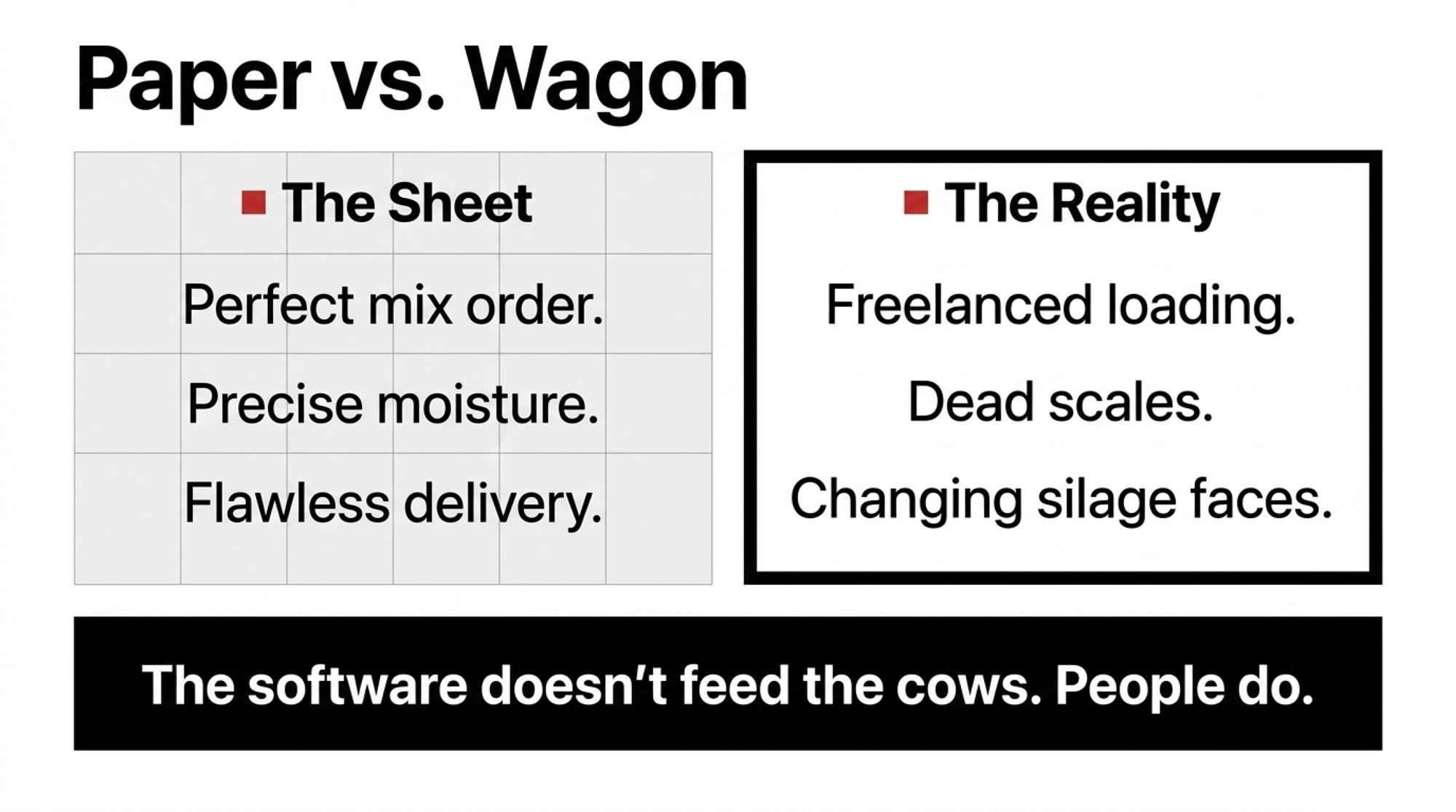
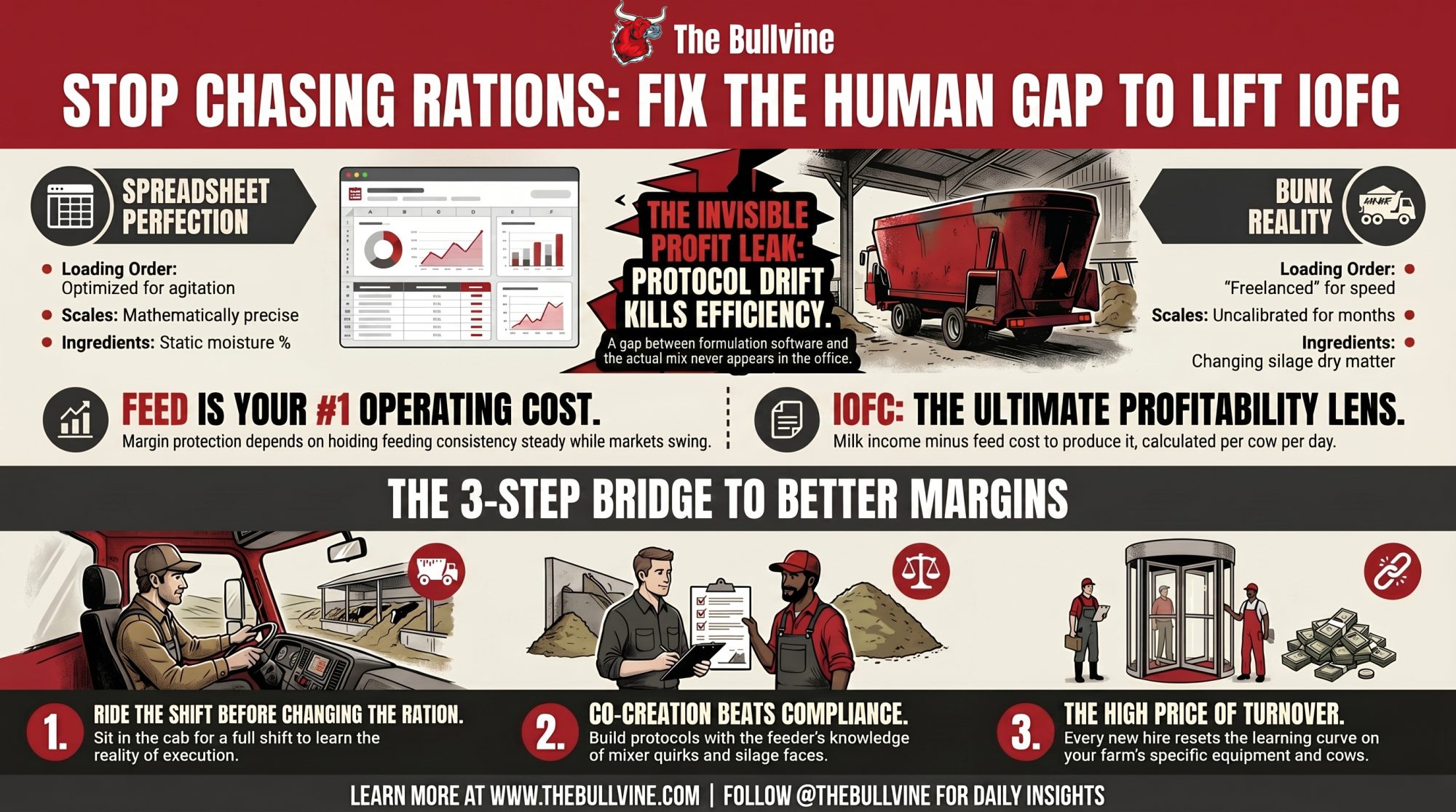
That tracks with what the labor and management work keeps finding: poor training and “protocol drift” are system failures that quietly erode performance and product quality — not individual moral failings. The ration on paper can be flawless while the ration in the wagon slowly drifts away from it. And drift is sneaky. It doesn’t announce itself with a blown mix or a sick pen. It shows up as a slow, steady gap between what the formulation software says the cows are eating and what they’re actually getting — a gap that never appears in the office.
What He Found in the Cab
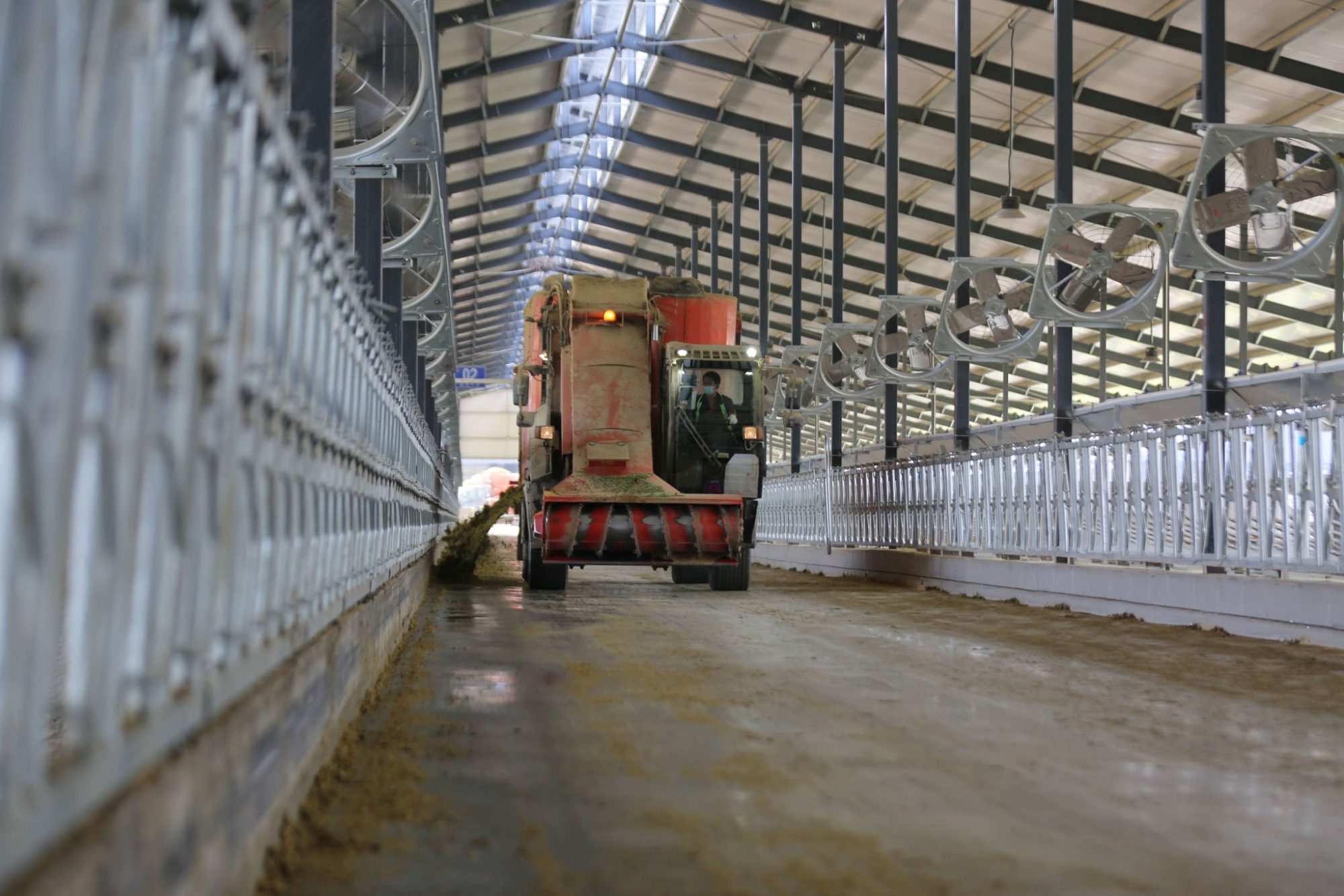
On the farm that finally broke the pattern, he did the thing he should’ve done from the start. He shut up and rode a full feeding shift.
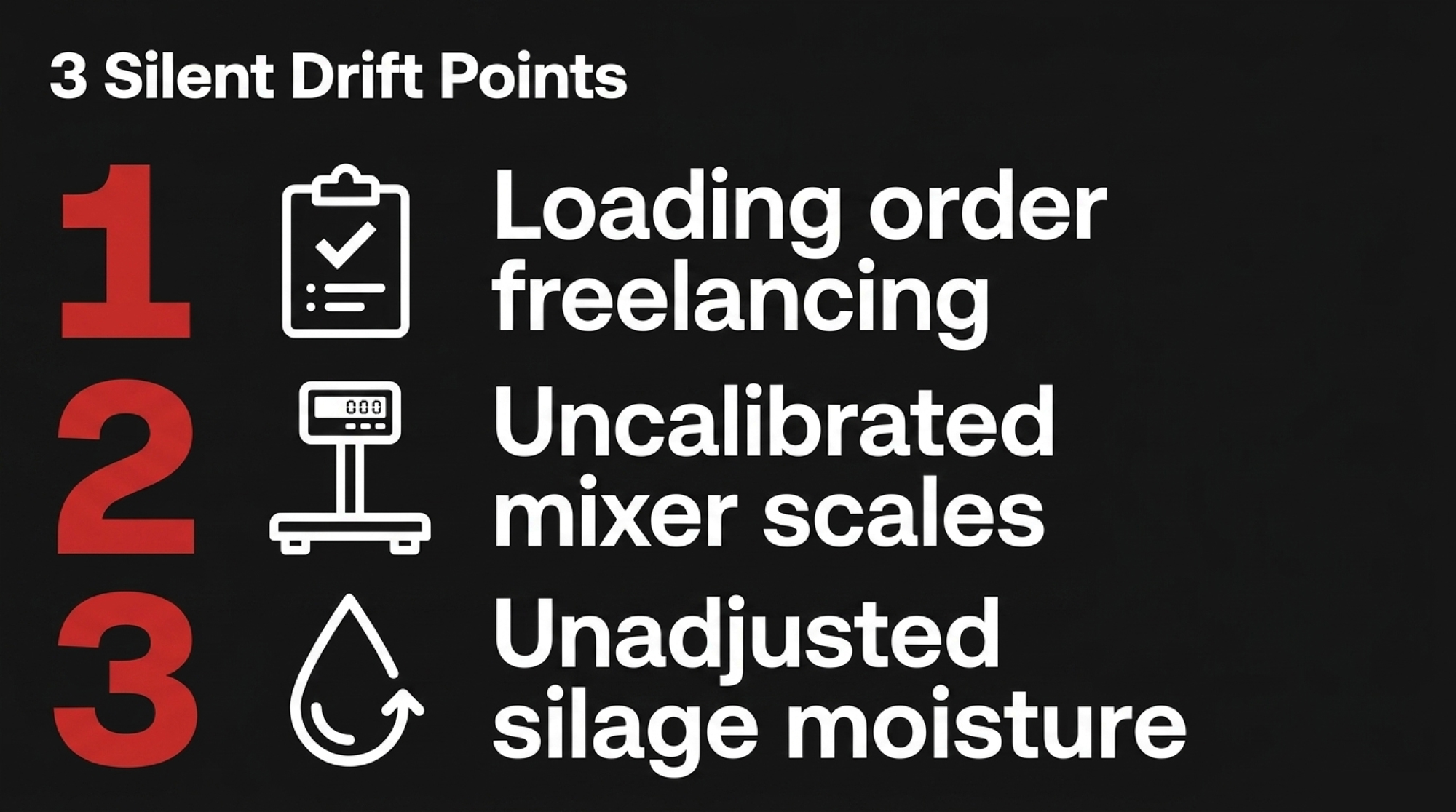
What he saw wasn’t sabotage. It was drift. Loading order that almost matched the sheet. A scale nobody had recalibrated in months. Silage moisture that clearly moved while the inclusion rate never did. And, by the consultant’s account, a long‑tenured feeder who’d drifted toward his own routine — for reasons that, from the floor, made sense to him.
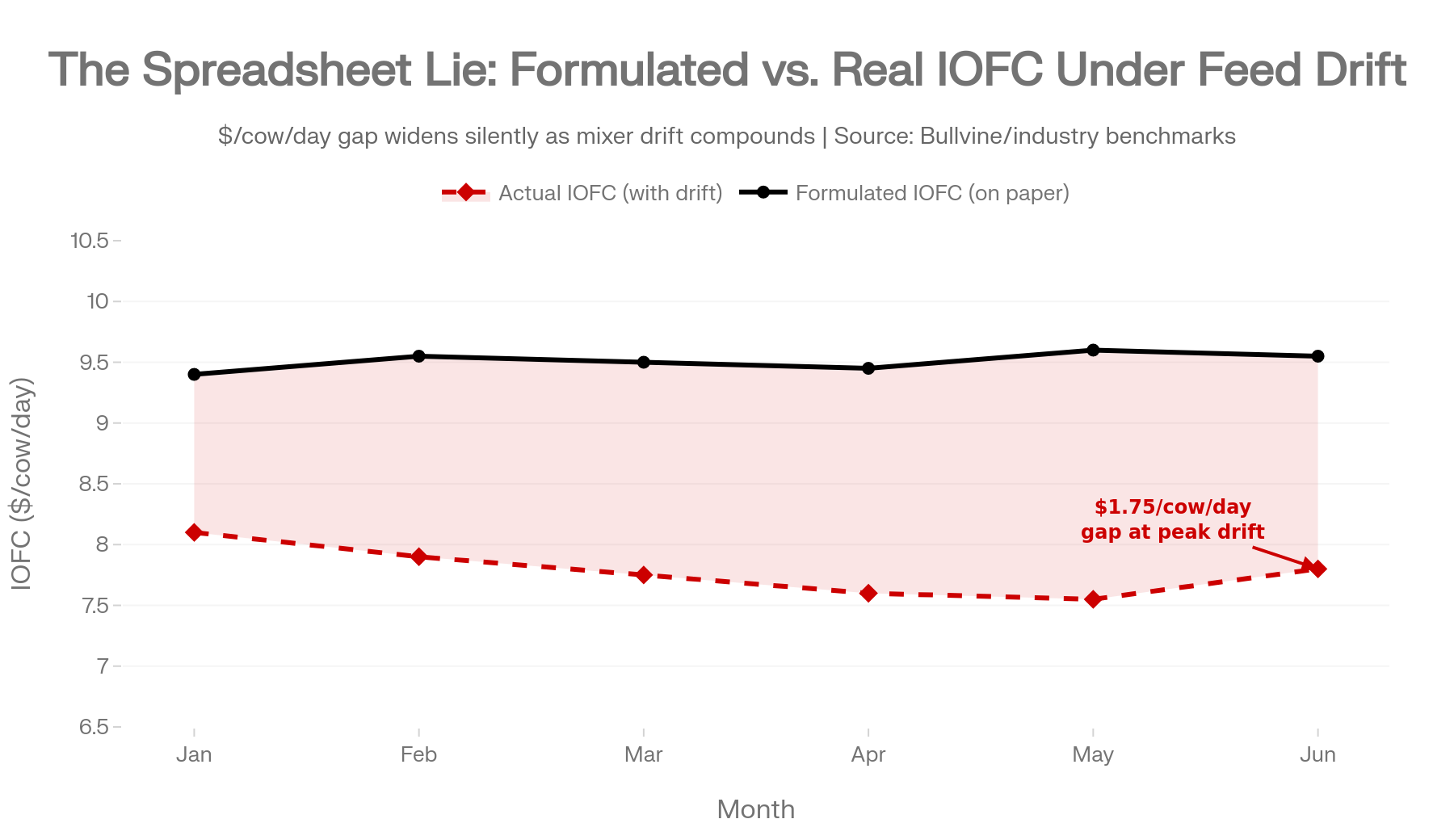
That picture lines up with what nutrition‑labor guidance has said for years — feeders are key professionals, and consistency in mixing and delivery is one of the biggest single drivers of feeding‑program performance. Mix order, mix time, load accuracy, push‑up frequency — none of it lives on the ration sheet, and all of it moves the result. What the consultant found wasn’t one bad employee. It was a common gap: a skilled feeder running a routine the written ration had quietly drifted away from.
The way he frames it now, the ration was never his main tool on that farm. The people were. That realization didn’t come from a conference room. It came from the buddy seat.
“Honestly? A Cocktail of ‘Oh Shit’ and Embarrassment”
Ask the consultant what he felt watching the mix go wrong, and he doesn’t reach for the polished answer.
The first hit was how did I miss this. He’d been on that farm repeatedly, tweaked the ration, run the IOFC scenarios — and never once sat next to the person who touches every kilo of feed. Then came the embarrassment. From the feeder’s chair, he figured he probably looked like every consultant who breezes in with a new sheet and never sees how it plays out at the mixer.
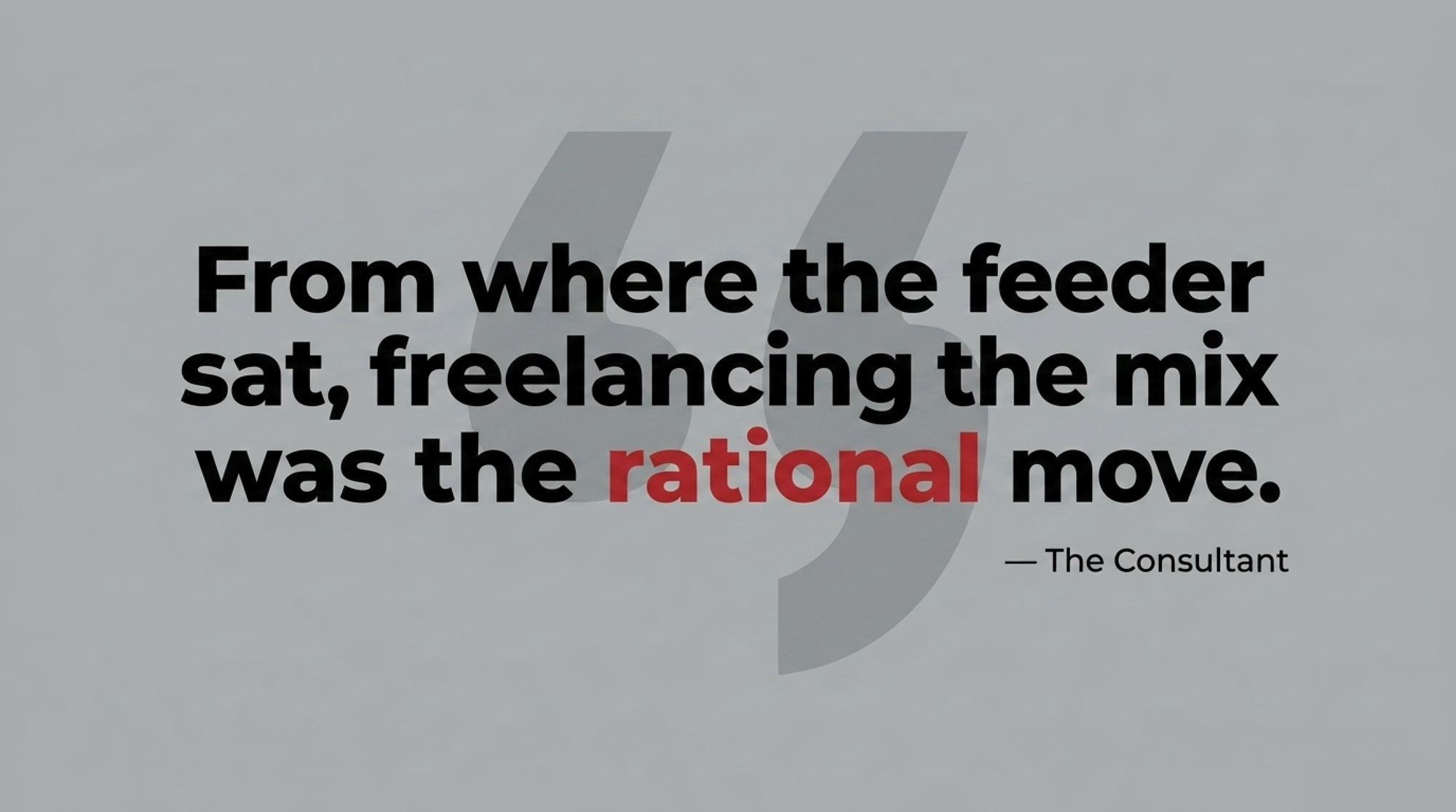
The frustration flickered — why can’t you follow the sheet? — then turned inward. As the consultant tells it, the feeder had practical reasons: silage quality that hadn’t been addressed, past rations that hadn’t worked for fresh cows, and a scale no one had maintained. From where the feeder sat, freelancing the mix was the rational move. That read on the feeder’s thinking comes from the consultant, not the feeder himself — a limitation worth keeping in mind.
Underneath all of it sat something quieter. Relief. The disconnect finally made sense. Not bad cows, not tough markets — one human, fixable gap between what they thought was happening and what actually was. Plenty of consultants, faced with being wrong, double down and find another number to tweak. He sat with it instead.
From Cab to Fix: A Five‑Step Sequence
Here’s the move that came out of that ride, broken into the order the consultant now runs it. It’s the bridge between “I found drift” and “we fixed the margin” — and it’s deliberately boots‑first.
- Ride the shift before you touch the ration. Sit in the cab for a full feeding, start to finish. You’re not inspecting — you’re learning what actually happens between the sheet and the bunk.
- Check the three silent drift points. Does loading order match the sheet? When was the scale last calibrated? How often were key pens actually out of feed? None of these show up in the office.
- Find out why the feeder freelances. Drift almost always has a reason — wet silage, a dead scale, a past ration that flopped on fresh cows. Until you know the reason, you can’t fix the system.
- Rebuild the protocol with the feeder, not over them. Visual SOPs in their first language, “show‑me” training, and a real feedback loop. The decade‑long feeder knows things the software doesn’t.
- Run the IOFC math on what you found. Put a believable number on the daily slip, multiply across the herd, and weigh it against the cost of training and keeping that person. That’s your business case.
| Drift Point | How It Hides | IOFC Impact Est. | Catch It By | Red Flag Threshold |
|---|---|---|---|---|
| Loading order deviation | Mix looks normal visually | $0.20–$0.50/cow/day | Compare sheet vs. cab video | Any ingredient out of sequence |
| Uncalibrated scale | Numbers print, no one checks | $0.30–$0.60/cow/day | Scale cert. log; weigh-backs | >90 days since last calibration |
| Silage moisture shift | Inclusion unchanged despite wet face | $0.40–$0.80/cow/day | Weekly moisture probe, ration re-run | >3% swing from baseline |
| Mix time creep | “Looks mixed enough” | $0.15–$0.35/cow/day | Timer log on mixer | >20% deviation from protocol |
| Bunk management gaps | “Cows eat what’s there” | $0.10–$0.30/cow/day | Push-up frequency log; slick bunk time | Slick bunks >2× daily or excessive refusals |
The Math You Can Run on Your Own Herd
Here’s where the people story turns into a margin story — and where you do the arithmetic, not us.
Skip any scary headline number. Run your own. Take a realistic guess at how much energy‑corrected milk a freelanced, inconsistent mix is costing per cow per day on your dairy. Multiply by your milk price and your cow count. The point isn’t the exact figure — it’s that even a small, believable slip at the mixer, multiplied across the whole milking string every single day, usually dwarfs the cost of paying and training that feeder better.
The reason this works is documented, not hypothetical. Lifting IOFC even modestly compounds fast, because it applies to every cow, every day — which is exactly why extension work treats feed efficiency and IOFC together as the profitability pair, rather than chasing milk per cow alone. A herd can post respectable milk per cow and still bleed margin if it’s buying that milk with too much feed, mixed too loosely.
If you want a foundational walk‑through of that metric before you run your own numbers, start with a good IOFC explainer from extension or your nutritionist.
Run Your Numbers
Dairy Profit Projector — This article argues your IOFC leak is at the mixer, not the spreadsheet. Run your herd through the Dairy Profit Projector to see what your feeding actually does to IOFC per cow per day, breakeven milk price, and your next 12 months of whole-herd margin before the market moves first.
Why “Labor as a Cost” Quietly Caps Your IOFC
Changing the feeder usually means changing the owner first.
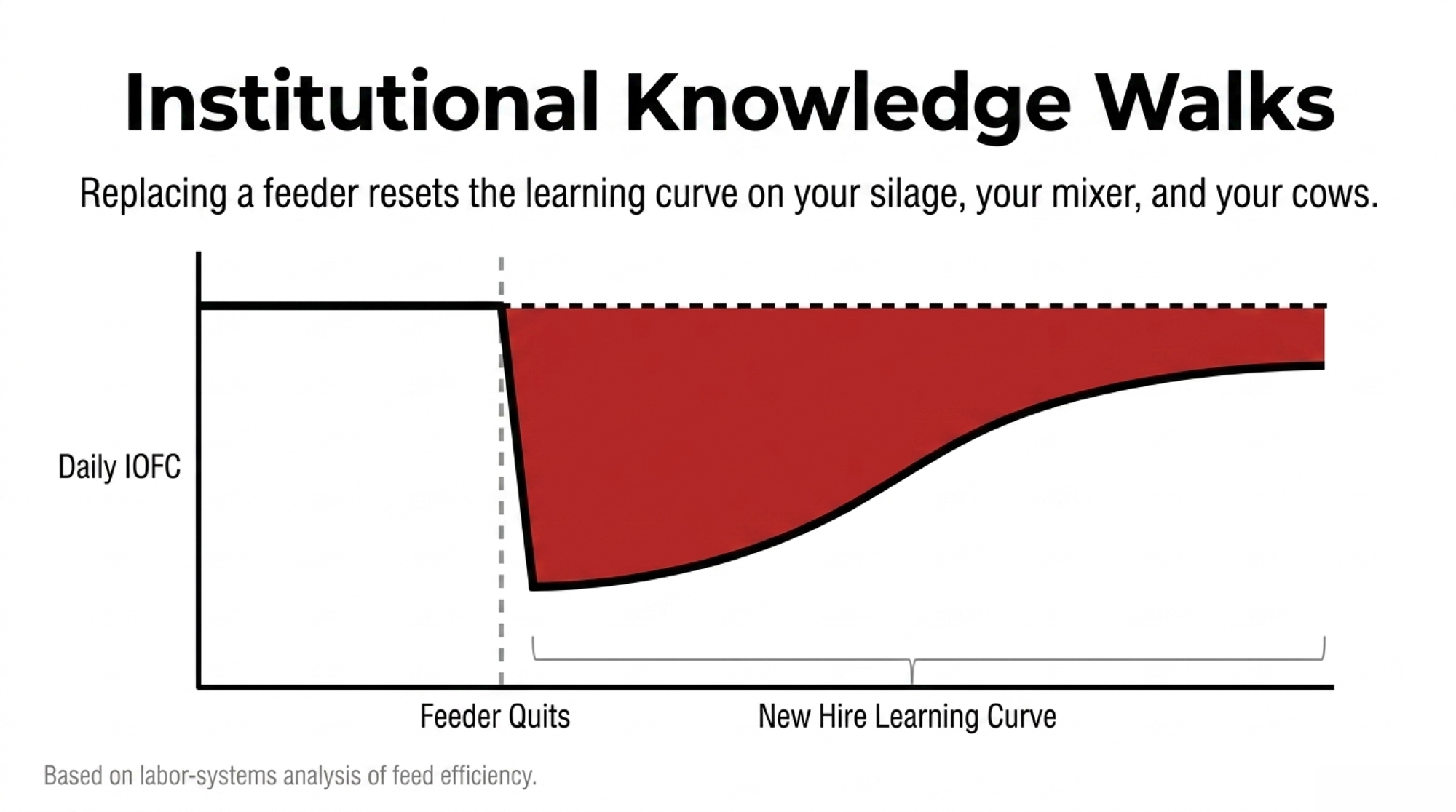
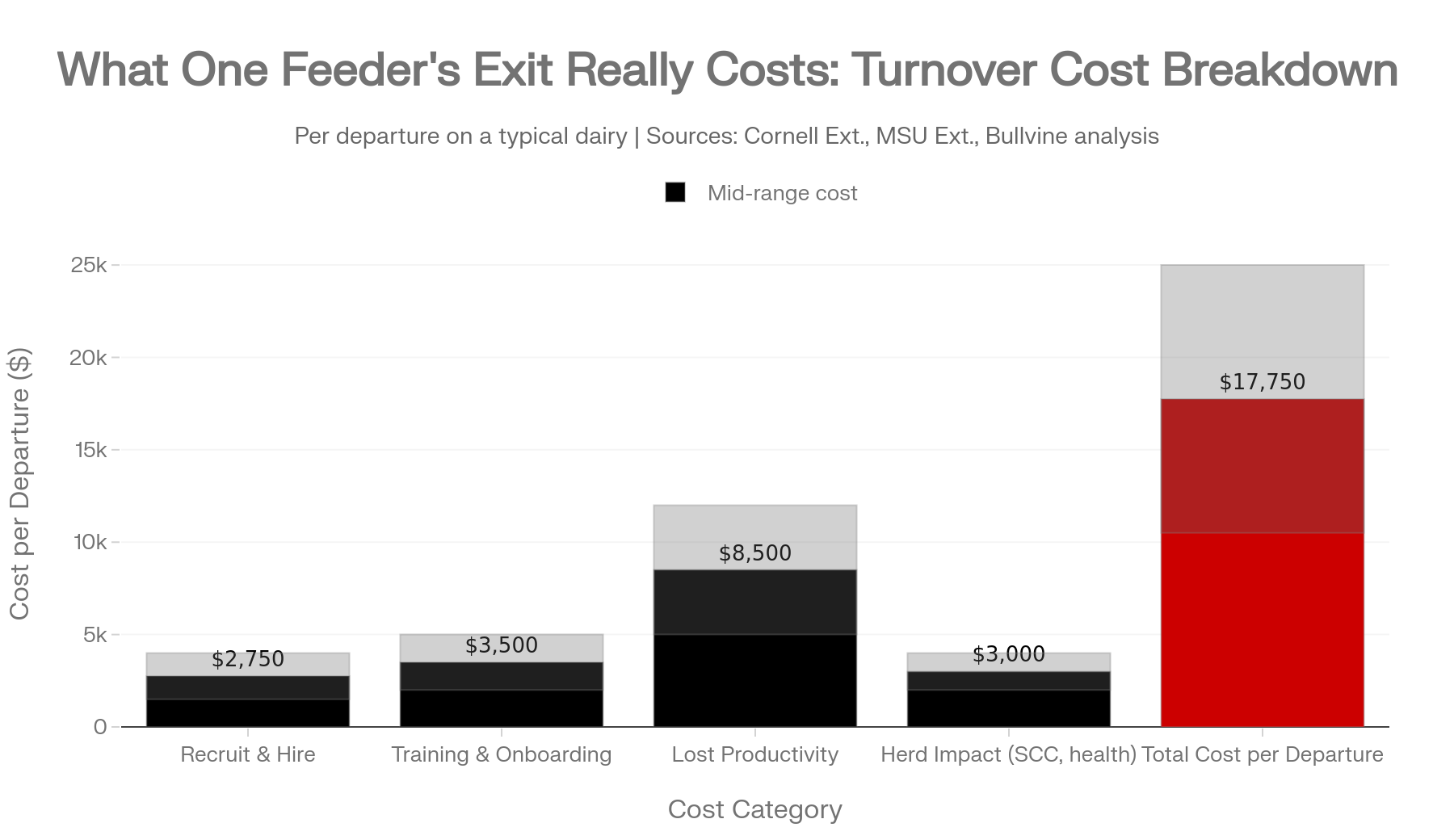
On many dairies, owners still treat the feeder as a wage line to trim rather than a lever to pull. But farm‑business and labor work point the other way: strong culture and employee development correlate directly with better financial performance and lower risk, and high turnover carries a brutal price tag once you load in recruitment, onboarding, and the lost performance of a half‑trained replacement. Treating people as a disposable cost doesn’t just bruise morale — it undermines the efficiency and profitability you’re trying to protect.
There’s a hidden compounding here, too. Every time a feeder leaves, the institutional knowledge of this farm’s silage faces, this mixer’s quirks, and this herd’s fresh‑cow patterns walks out with them. The replacement starts the learning curve from zero. The dairies that hold their feed people aren’t just saving on hiring — they’re protecting the one person whose daily consistency the whole ration depends on.
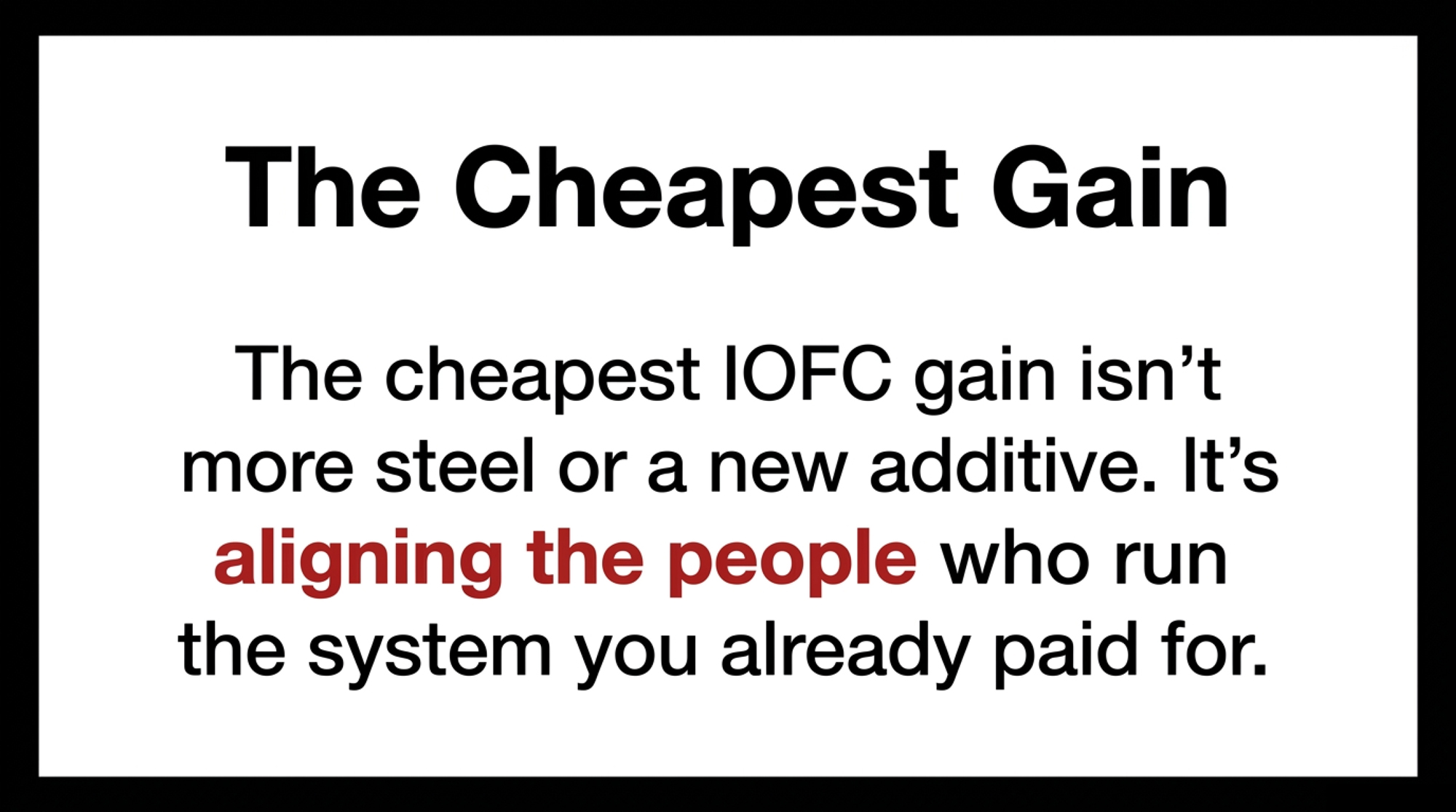
So the reframe with an owner isn’t soft. It’s financial: You’ve already bought the mixer, the software, and the tracker. The cheapest way left to move your IOFC isn’t more steel — it’s getting the person who runs it all aligned with what you actually paid for. A growing line of farm‑business analysis argues that the competitive gap on many dairies now is workforce and execution as much as parlor size.
If you want the deeper version of that argument, your own labor/culture playbook or a solid labor‑management resource is the next click.
Turning a Feeder Into a Feed Manager
If the lever is the person, then the upgrade is in how you train and equip them — and most dairies do this badly, not from neglect, but from habit.
The default is the hand‑down: here’s the new sheet, do it this way. That produces compliance theater — the feeder nods, then goes back to the routine that’s kept the cows alive through three other consultants. What labor‑systems work actually recommends looks different. Visual SOPs in the worker’s first language. “Show‑me” training over “do‑you‑understand,” because nodding isn’t knowing. And a real feedback loop, so the feeder hears when the mix is right, not only when something breaks.
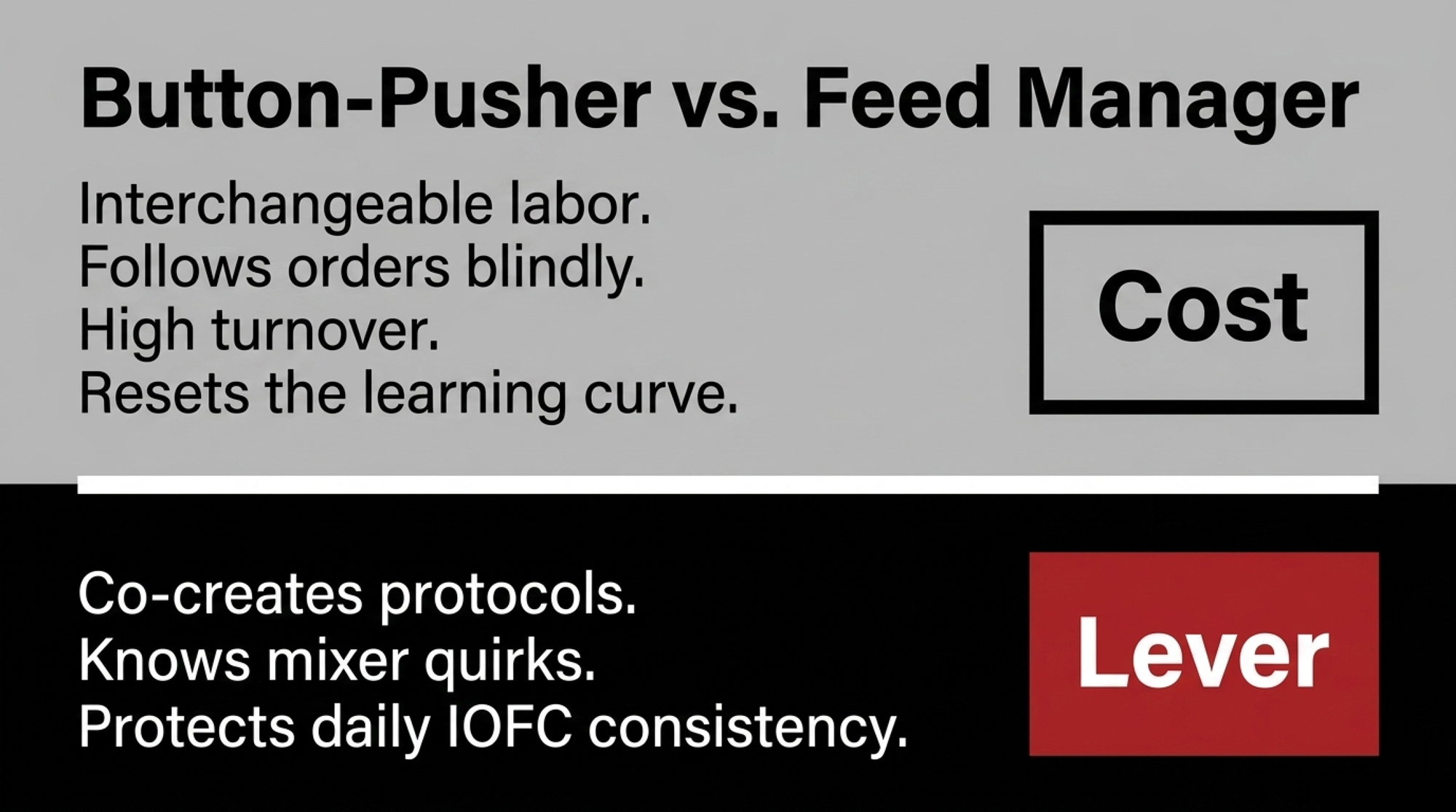
The deeper move is co‑creation. The feeder who’s been on the farm a decade knows things the ration software doesn’t — which silage face is wetter, which group sorts hardest, when the scale started reading funny. Build the protocol withthat knowledge instead of on top of it, and you get two things at once: a more accurate mix and a feeder who owns the result. That’s the difference between a button‑pusher and a feed manager, and it’s mostly free.
If you want a broader management playbook around this, look for good precision‑feeding and feed‑efficiency resources that tie bunker management, mixing, and IOFC together.
| Dimension | Feeder (Button-Pusher) | Feed Manager | IOFC Implication |
|---|---|---|---|
| Protocol ownership | Follows sheet (usually) | Co-authored the protocol | Mix accuracy improves 10–20% |
| Scale & moisture checks | When told | Part of daily routine | $0.30–$0.60/cow/day saved |
| Training language | English-only sheet handed over | Visual SOP in worker’s language | Error rate drops 30–50% |
| Feedback loop | Hears about problems only | Gets scorecard: right mix = recognition | Turnover drops from 45% → 15% |
| Silage face knowledge | “It’s in the ration” | “Face 3 is wet — I adjusted” | Prevents $0.40–$0.80/cow/day drift |
| Annual turnover cost if lost | $15,000–$25,000 | $8,000–$12,000 (lower; higher retention) | Net positive after training invest |
Options and Trade‑Offs for Your Operation
The five‑step sequence is the how. These are the strategic paths — pick the one that fits where your operation actually is.
- Ride along before you re‑formulate. Best when the numbers say “should be performing” and the herd isn’t. Costs you a few hours in the cab and the humility to assume the office story is half the picture. Backfires if you treat it as an inspection — the feeder clams up and you learn nothing.
- Turn “feeder” into “feed manager.” Best for herds large enough that the owner can’t watch every mix. Demands visual SOPs in the worker’s language, “show‑me” training, and a real feedback loop. Backfires if you hand down a finished protocol instead of building it together.
- Fix the owner’s mindset first. Best when labor is still a cost line, not a lever. Demands framing wages and training as IOFC return. Backfires if you lead with feelings instead of the wallet — skeptics need the margin case before the morale case.
The forward signal lives in that first path. As sensors, cameras, and AI move from research into the barn, the bottleneck shifts from data to whether your people can act on it. The dashboards will flag the morning load running light on forage — but only a trained, trusted feed manager will fix it before the next one. More technology raises the ceiling on what a good feeding team can deliver. It does nothing for a farm whose feed manager is freelancing the mix.
What This Means for Your Operation
Run this quick mental audit before your next ration meeting — three checks, honest answers:
- The eyes check: Have you actually watched your highest‑impact feeding shift this quarter — or are you trusting the feed software’s version of events ?
- The status check: Does your best feeder carry the responsibility of a feed manager but the status of a button‑pusher? That mismatch is where IOFC leaks.
- The framing check: When a long‑tenured employee runs things “their way,” are you treating it as a discipline problem or a systems‑and‑training problem? The framing decides the outcome.
Key Takeaways
- If your IOFC and feed efficiency are stuck despite a clean ration on paper, ride the feed shift before you change a single ingredient.
- If you can’t say when your mixer scale was last calibrated, you’ve got a measurement problem wearing a nutrition problem’s clothes.
- If you treat labor as a cost to minimize rather than a lever to pull, you’ve quietly handed control of your margins to whoever answered your last job ad.
- If a long‑tenured feeder is running “their way,” build the new protocol with them, not over them — co‑creation beats compliance every time.
- The cheapest IOFC gain on most dairies isn’t more steel or a new additive — it’s aligning the people who already run the system you paid for.
The honest tension is this: ultimately, the owner owns the cows — the checkbook, the risk, the final call all sit with them. But an owner who keeps treating key people as interchangeable is making a decision, too, just not on purpose. So before your next ration meeting, ask the question worth sitting in the cab with — is the person mixing your feed a cost you’re trying to shrink, or the lever you haven’t pulled yet?
Some details of this account have been anonymized at the source’s request.
Complete references and supporting documentation are available upon request by contacting the editorial team at editor@thebullvine.com.
Learn More
- Feed as Science: How the Penn State Particle Separator Turns TMR Consistency into Butterfat and Profit — Protect up to $60,000 in annual component returns by auditing TMR physical structure instead of overmixing. Weekly five-minute particle tests prevent invisible fiber breakdown leaks, stabilizing rumen function and restoring butterfat within 21 days.
- The Feed Squeeze: Why Rising Milk Numbers Hide the Real Crisis on Dairy Farms — Armed with monthly Income Over Feed Cost tracking, producers can navigate critical financial territory when feed costs cross the dangerous 60% threshold. This macro analysis delivers the risk management tools necessary to protect multi-year operational viability.
- Should You Breed for Feed Efficiency? — Unpacks the genetic realities of selecting for Residual Feed Intake and long-term metabolic conversion. It exposes why relying solely on young genomic ratings fails to replace the immediate, high-ROI profitability impact of daily bunk management.
 The Sunday Read Dairy Professionals Don’t Skip.
 The Sunday Read Dairy Professionals Don’t Skip.
Every week, thousands of producers, breeders, and industry insiders open Bullvine Weekly for genetics insights, market shifts, and profit strategies they won’t find anywhere else. One email. Five minutes. Smarter decisions all week.




