Two fans at the front of an 80-by-40 pen, 120 cows waiting, and a July preg rate that always slid under 15 percent. Then she staged the controller, and it stopped at 18.
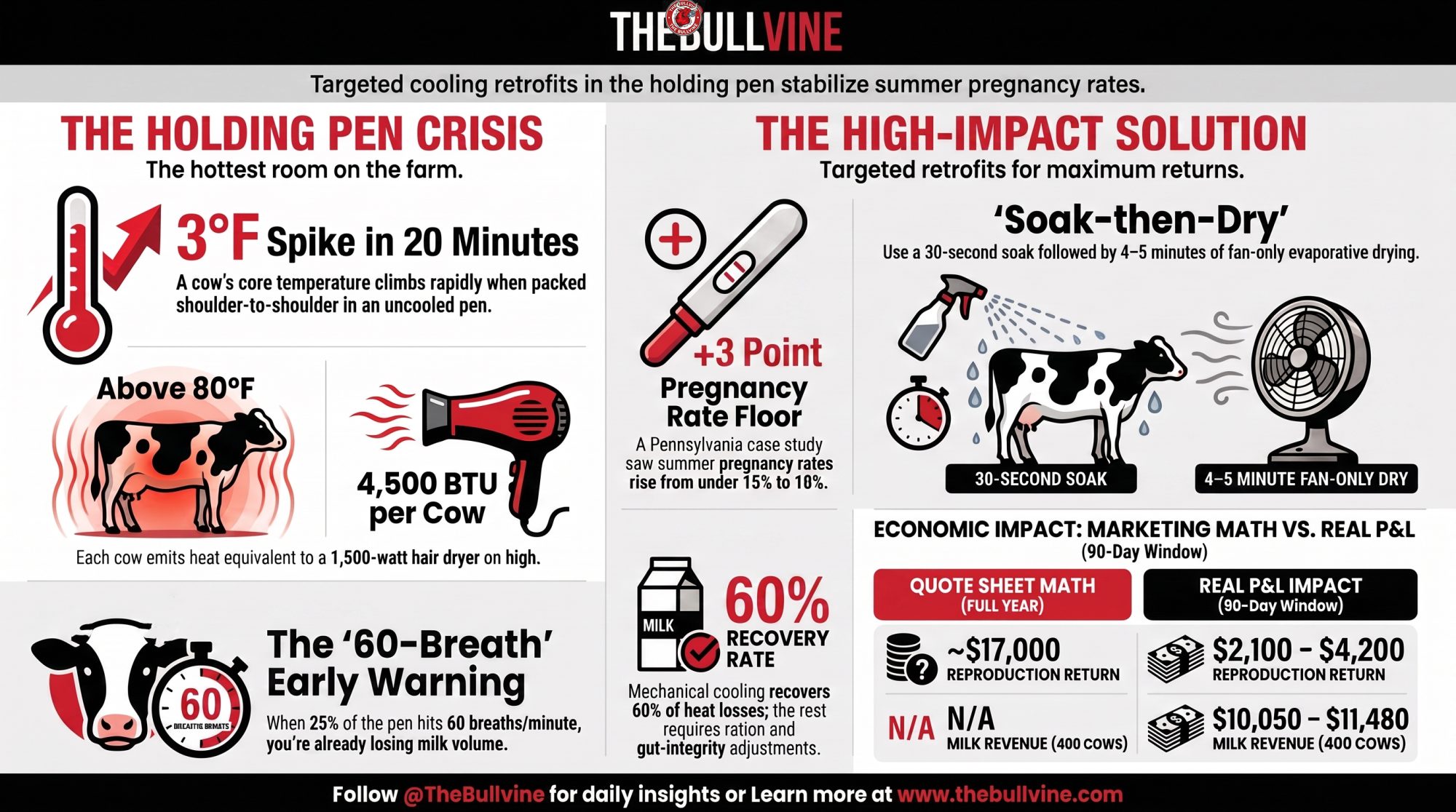
The Problem — A cow’s core temperature climbs 3°F within 20 minutes of walking into an uncooled holding pen, the room where she stands two to six hours a day throwing 4,500 BTU an hour above 80°F.
The Field Result — A +3 point summer 21-day preg rate floor, from under 15% to 18%, at Paul Dotterer and Sons after a 2016 retrofit: six 50-inch fans, drop-down nozzles, one staged controller on a cow-height probe.
The Economic Reality — $2,100 to $4,200 a year on a prorated 90-day heat window, against the misleading $17,000 that full-year coefficient math puts on a quote sheet.
The Limit — Roughly 3 kg (~6.6 lb) ECM per cow per day leaks through gut permeability. Fans recover only about 60% of what heat stress takes.
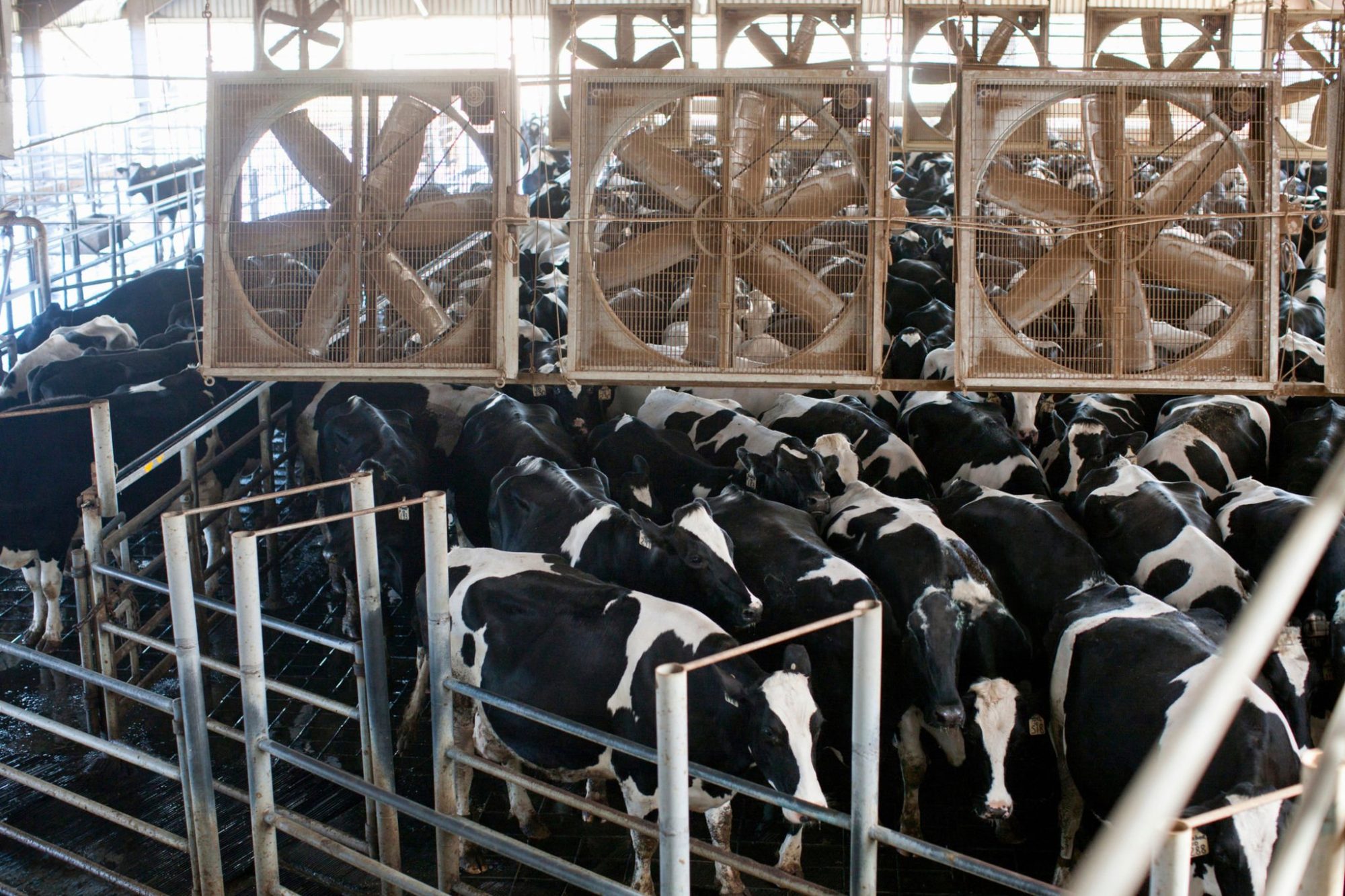
Cows were sluggish. That was the tell at Paul Dotterer and Sons Inc. near Mill Hall, Pennsylvania — not a spreadsheet, not a bulk tank number, but animals dragging through the holding pen and in and out of the parlor through warm, humid Northeastern summers. “You could just tell they were hot in there,” Candice (Dotterer) White told Peggy Coffeen at Progressive Dairyman.
She wasn’t guessing. A couple of fans at the front weren’t moving enough air to cool a group of 120 cows in an 80-by-40-foot pen. So the dairy — 940 cows at the time — put its money where it would touch every animal. “We figured the biggest bang for our buck was the holding area because it affects all of the cows,” White said.
The retrofit went in ahead of the 2016 season. White described the results the following spring: “Normally, our 21-day preg rate drops down below 15 percent in the summertime. This last year, it only dropped down to 18 percent, so we still had the summer drop, but it wasn’t nearly like before.” Her figures, her records, one summer. Same brutal heat, three points higher floor.
Why Does the Worst Room on the Farm Get the Last Fan?
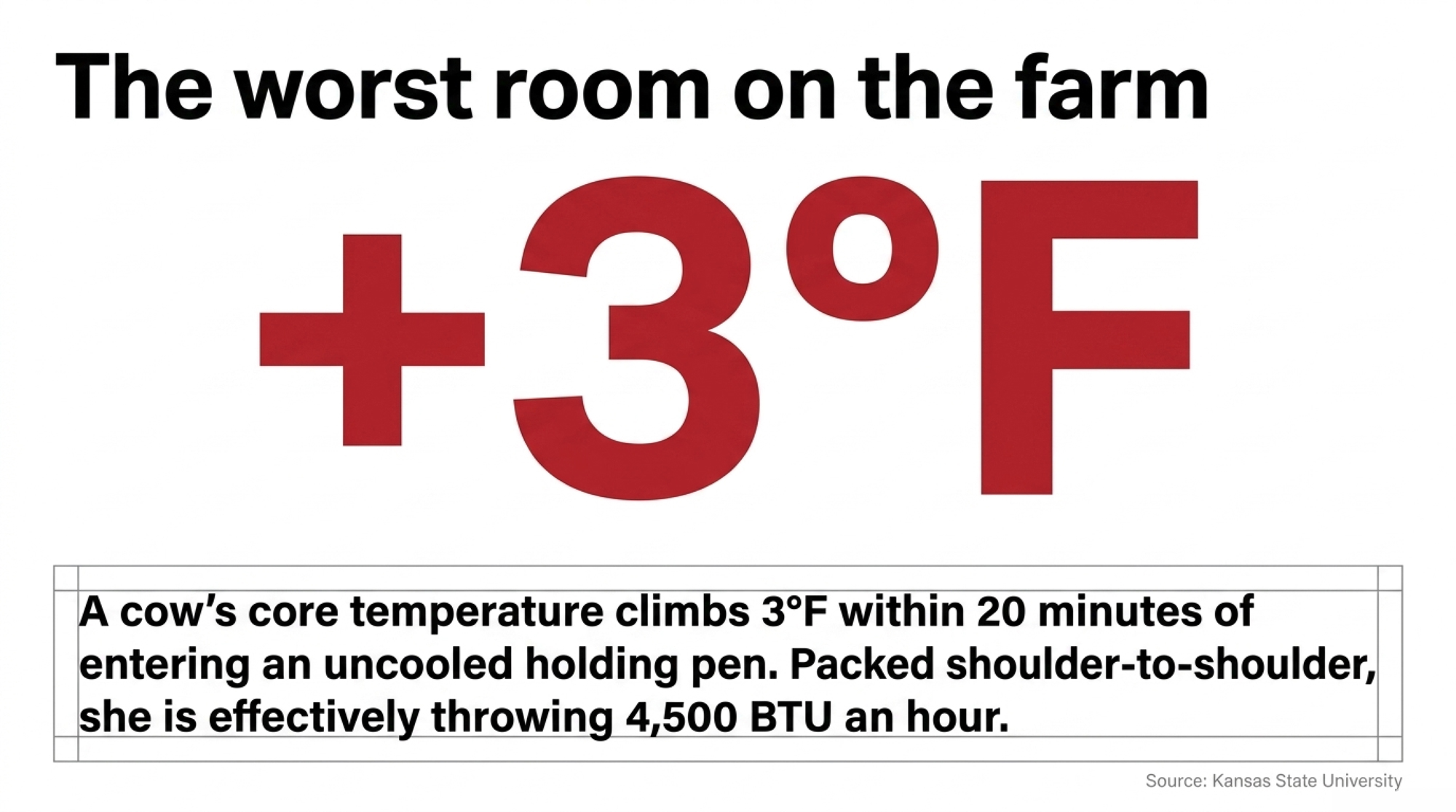
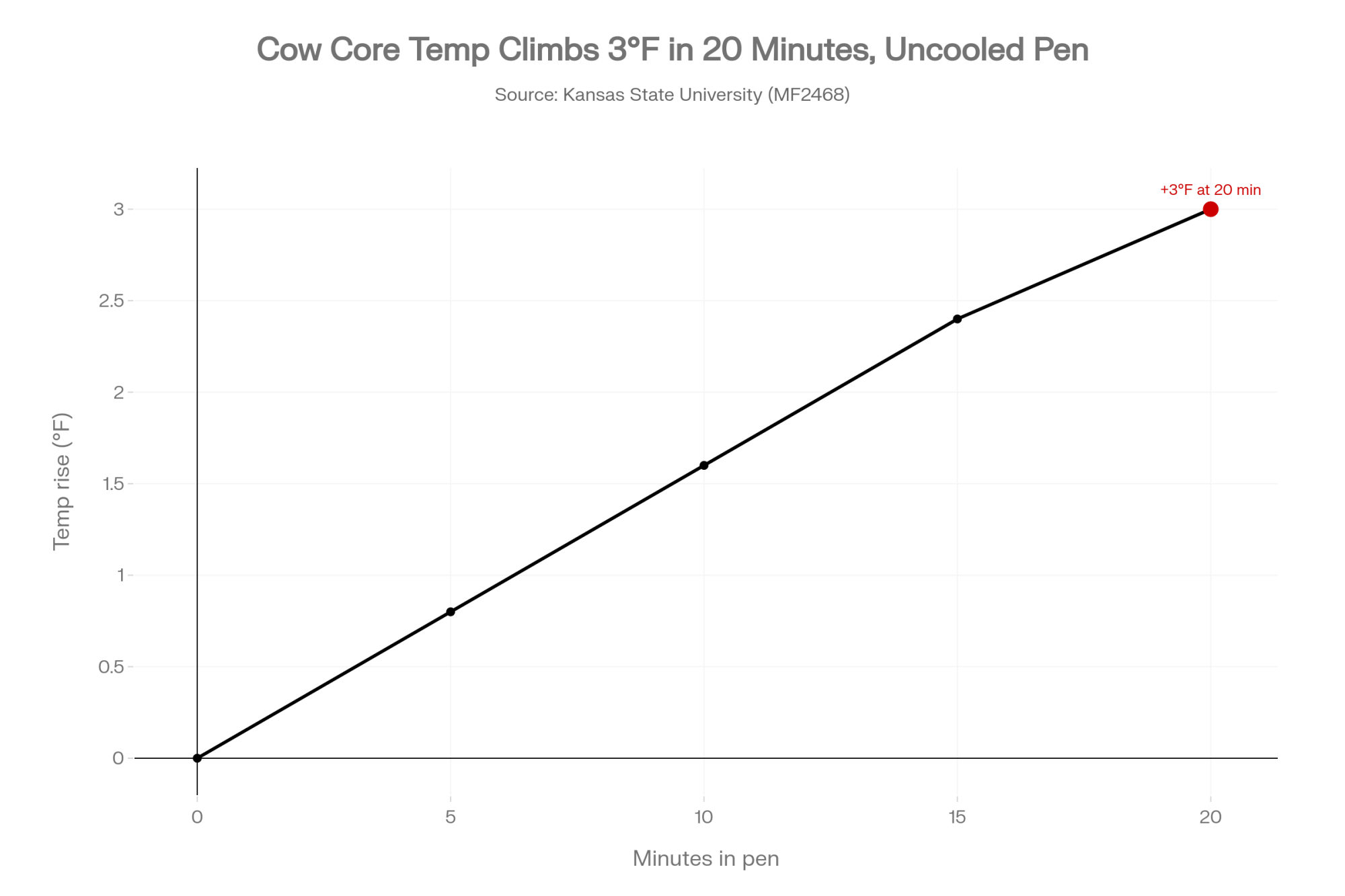
Walk through most freestall barns in August, and you’ll find fans over the stalls, soakers down the feed lane, and a token effort over the holding pen. The physiology says that’s backward. Kansas State’s Harner, Smith, Brouk, and Murphy documented cows standing in the holding pen anywhere from 2 to 6 hours a day depending on parlor throughput, and measured core temperature climbing 3°F within 20 minutes of entering an uncooled pen.
Stocking density is the whole reason. A cow in a barn alley has room to shed heat. A cow packed shoulder-to-shoulder is absorbing radiant load off every animal touching her — and throwing roughly 4,500 BTU an hour above 80°F herself, which Kansas State compares to a 1,500-watt hair dryer running continuously on high. Put 120 of those in a 3,200-square-foot room and do the arithmetic.
That bulletin also quantifies the fix. Overhead spray plus fans dropped body temperature 3.5°Fduring the cows’ time in the pen. Cooled cows gave 1.7 lb (0.77 kg) more milk per day than uncooled pen-mates in one trial, up to 5 lb (2.3 kg) more in another where cows got cooled five times daily for 30 minutes.
One caveat, stated plainly: Kansas State’s MF2468 was published in September 2000. Fan technology has moved on, and today’s high-efficiency models beat what those trials used. Cow physiology hasn’t moved, and the genetic-progress argument cuts against us — a modern high-producing cow throws more metabolic heat than the cow those researchers measured, not less.
What Dotterer Built
Two direct-drive 50-inch fans at the front of the pen, 5 horsepower each, moving air at 32 mph — 2,800 feet per minute — still felt at 5 mph a hundred feet out. Misters affixed to both. Four more 50-inch fans on 1-horsepower motors along the side, pushing fresh air across the waiting group. Eight sets of drop-down nozzles throughout the pen, creating what Coffeen described as a light rain of larger droplets rather than fog.
And the piece that mattered most: one automatic controller operating both fans and water, staged off a temperature probe sitting in the pen where the cows actually stood.
The staging was the design. At 55°F the two front fans came on low, picking up speed as the pen warmed. By 65°F they ran at full speed. At 69°F, the attached misters kicked in with two of the four side fans. At 74°F, the third fan and the sprinklers triggered. By 80°F, everything ran flat out.
White worked with a cow cooling company that designed and installed the system and handled the first seasonal drain and reset. Her own contribution came after. She watched how wet cows were getting and tweaked from there, hunting the balance between spraying enough water to cool and getting them too wet before entering the parlor. Every soaking system needs on-farm calibration — barn geometry, group size, and parlor throughput vary too much for factory defaults to land perfectly anywhere. And wet udders at the unit is a mastitis conversation, not a cooling one.
The February Problem Nobody Predicted
White’s first summer with the system was, in her words, “a really brutal summer” — and she observed less significant drops in performance. Reproduction, specifically, held better.
But the result she flagged as most unexpected had nothing to do with July. “I never thought cows might be experiencing heat stress in February,” she said. On warmer winter days, when temperatures peaked in the 50s or 60s, the pen probe activated the first level of cooling on its own, without anyone deciding it was a hot day.
“I don’t have to run around looking at the thermometer and turning on fans,” White said. “It’s nice to have something looking out for the cows.”
Worth knowing who was making these calls. White managed the dairy side of an operation started by her grandfather, Paul, and carried forward by her father, Larry, and uncle, John. She was third generation, working alongside her sister and two cousins. This wasn’t a consultant’s recommendation imposed on a farm. It was a family reading its own cows — then a manager fine-tuning what got installed.
Run the Numbers — and Watch Where the Math Gets Slippery
Take Kansas State’s conservative figure, 1.7 lb (0.77 kg) per cow per day from holding pen cooling alone. A 400-cow herd × 1.7 lb × 90 heat-stress days = 61,200 lb (27,760 kg).
Now price it, and be careful which price you grab. At the announced August 2026 Class III price of $18.76/cwt, that’s roughly $11,480 in a single season. Price the same volume off the futures curve instead — Class III was trading in the mid-$16s through late 2026 — and you’re closer to $10,050. Neither is your mailbox price. Use your own.
The reproduction side is where the arithmetic gets treacherous, and it’s worth walking through because the mistake is easy and expensive. Lauber and colleagues modeled net return at $3 to $6 per one-percentage-point gain in 21-day pregnancy rate, per cow, per year. Multiply that by three points and 940 cows, and you land near $17,000 — a number that looks great on a quote sheet.
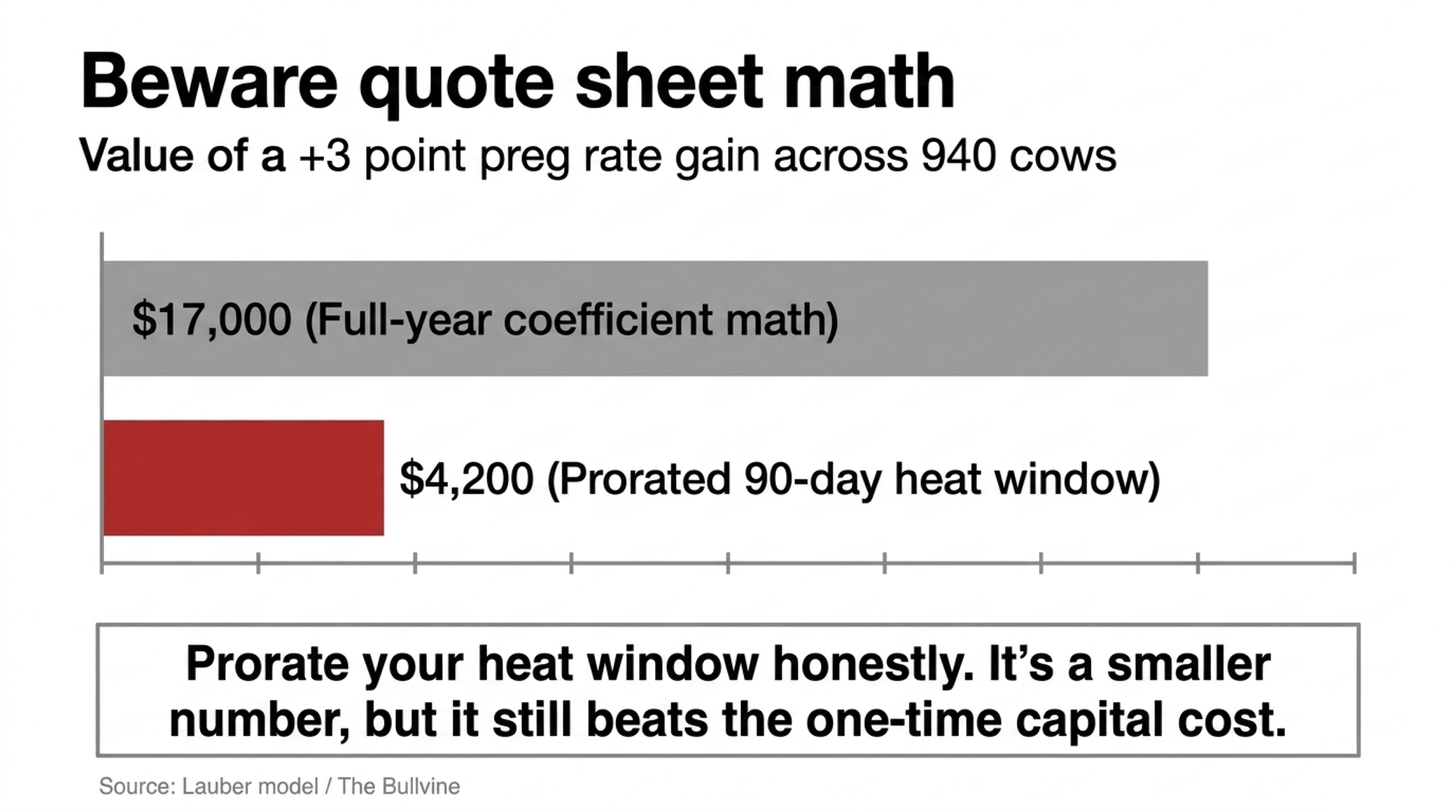
It’s wrong. Lauber’s coefficient prices a sustained, full-year improvement. Dotterer’s gain was a summer-season floor, roughly a 90-day window out of 365. Prorate it honestly — 90 over 365 — and three points across 940 cows sits closer to $2,100 to $4,200 a year, and even that assumes every cow was bred inside the heat window. Smaller number. Still recurring every summer against a one-time capital cost, which is the part that actually matters.
| Metric | Full-Year (Quote Sheet) Math | Prorated (90-Day) Math | Reality Check |
|---|---|---|---|
| Preg rate gain | 3 points | 3 points | Same underlying data |
| Herd size | 940 cows | 940 cows | Same |
| Coefficient basis | $3–$6/point/cow/year, full 365 days | Same coefficient, prorated 90/365 | Lauber et al. coefficient priced for sustained gain |
| Annual dollar value | $17,000 | $2,100–$4,200 | Vendor number overstates gain ~4x |
| Assumption required | None stated | Every cow bred inside heat window | Rarely true on a real farm |
Reproduction is noisy year to year, and one summer in one herd isn’t a controlled trial. But it moved in the direction the physiology predicts, and it moved the number the farm was worried about. One industry account has put payback on targeted holding pen and parlor upgrades as low as three years — secondhand, without herd size or year attached. If you want to run your own version rather than take anyone’s word for it, our pregnancy-rate economics calculatordoes the cycle-factor weighting for you.
Canadian readers, your math is different. Under Canadian Dairy Commission component pricing effective February 1, 2026 through January 31, 2027, Class 3(d) butterfat runs $11.6208/kg and protein $10.1476/kg. Higher component value per unit than a U.S. Class III conversion — but quota changes the marginal-milk logic entirely. Extra summer milk you can’t ship isn’t revenue. The cooling case in a quota market is about protecting components, reproduction and cow longevity, not chasing volume.
One more caution on that 18 percent figure: two herds can post the same 21-day pregnancy rate for completely opposite reasons, and a manager watching conception rate alone can’t tell which problem he owns. Split heat detection from conception before you spend a dollar on either.
The Ceiling Fans Can’t Break
Here’s where the whole cooling argument hits its limit, and the research is blunt. A Cornell trial in the Journal of Dairy Science ran a pair-fed group — cows kept cool but eating the same reduced diet as the heat-stressed cows. The cool group still out-milked them. Roughly 3 kg (~6.6 lb) of energy-corrected milk per cow per day leaves through gut-wall permeability, independent of intake. No fan reaches that.
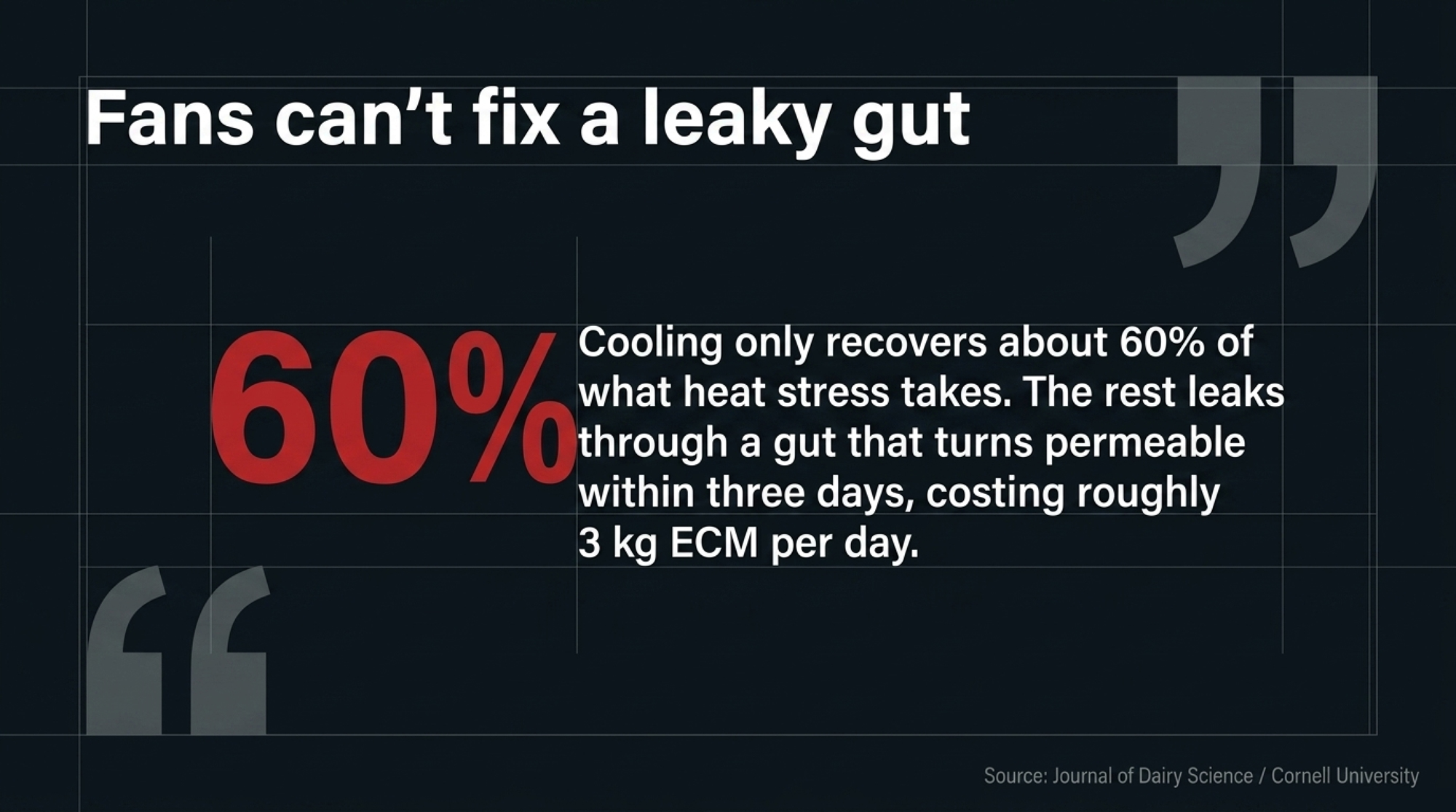
Reduced intake explains only 30 to 50% of the total loss. Cooling recovers around 60% of what heat stress takes; the rest leaks through a gut that turns permeable within three days.
Which is why White’s own account is worth reading carefully. She reported less significant drops in performance and a summer preg rate that still fell — “we still had the summer drop, but it wasn’t nearly like before.” The rebuild bought back part of what the farm had been losing on breeding. It didn’t buy immunity, and she never claimed it did.
Farms getting fuller ROI run cooling as one layer: holding pen and feedline work paired with heat-stress ration adjustments — sodium bicarbonate buffers, elevated dietary potassium, honest attention to DCAD. Ohio State and the Iwaniuk/Erdman meta-analysis point to +350 to +400 mEq/kg as the working DCAD target under heat stress. Get the specific potassium and sodium inclusion rates from your own nutritionist against your current ration — the DCAD number is the target, not the recipe. A cooled cow that’s still under-buffered got half a fix.
The Cows Tell You Days Before the Bulk Tank Does
Most producers wait for the tank to talk. By then you’ve been bleeding for a week.
Behavior shifts first. University of Wisconsin Extension flags increased standing and reduced lying time as the earliest visible signs, along with cows bunching at water troughs — evaporative cooling off the water surface pulls them in — and drifting toward whichever end of the barn has better airflow as the afternoon builds. Watch a group migrate between morning and mid-afternoon, and you’ve mapped your airflow problem for free.
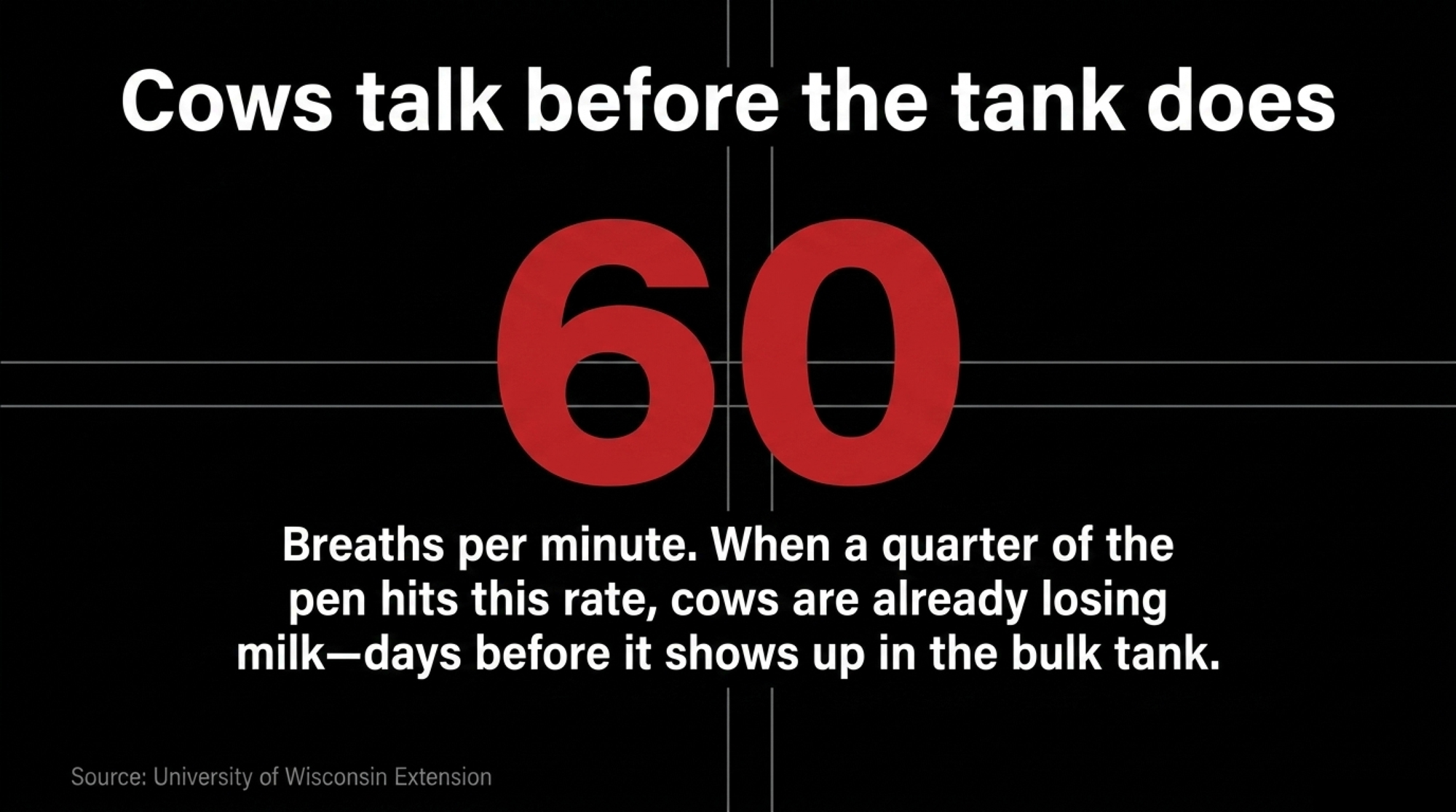
Field benchmark — respiration rate. 60 breaths per minute, or one breath per second. When a quarter of the pen hits that rate or faster, those cows are already losing and the bulk tank hasn’t caught up yet. Open-mouth panting with the tongue out and stringy drool is severe, not early.
Frequency matters as much as hardware. Israeli work cited in a 2025 Animals review found multiparous Holsteins cooled eight times daily above THI 68 held respiration at 60.2 breaths per minute, against 73.1 for cows cooled three times daily.
Where the Money Gets Wasted
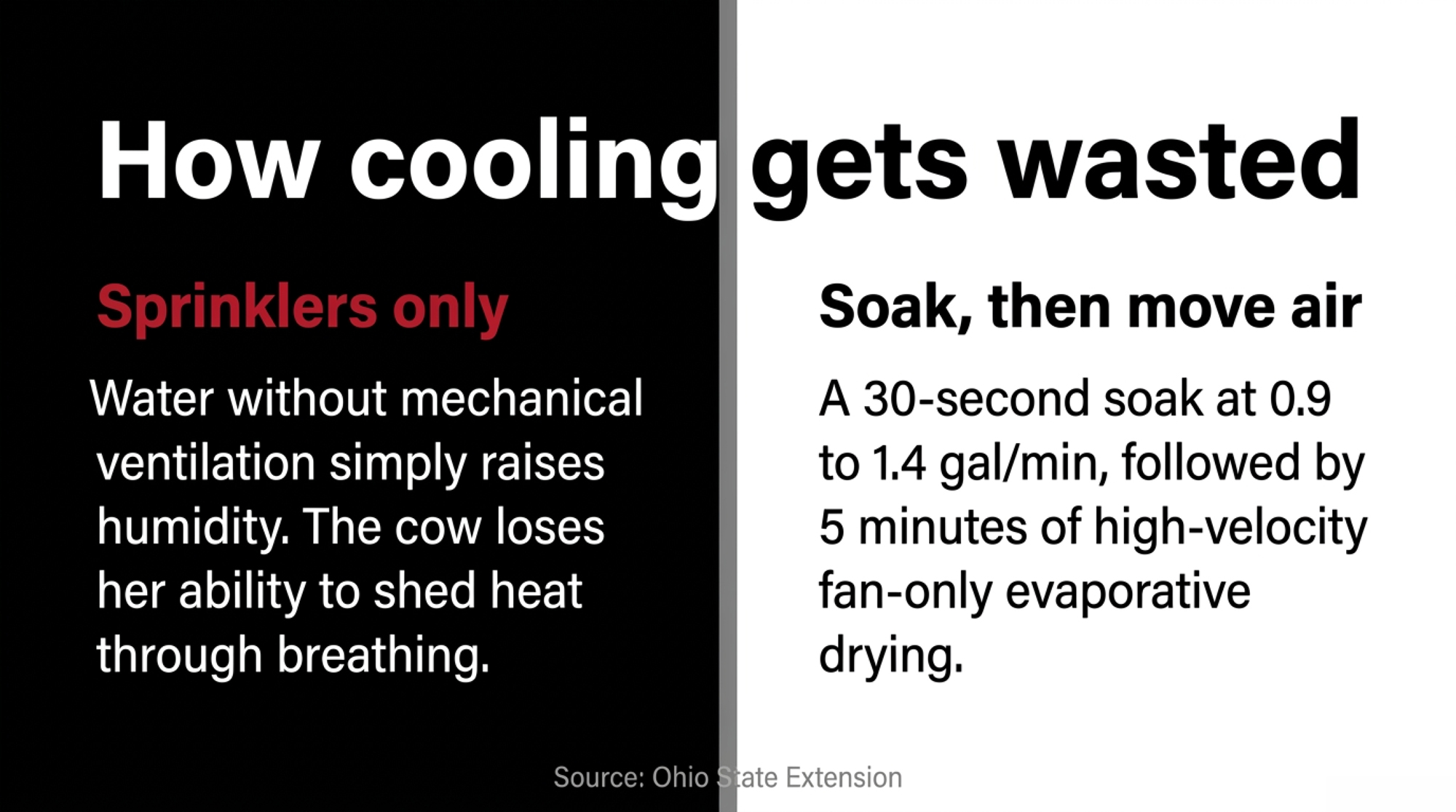
Installing fans and soakers isn’t the same as installing cooling that works. Ohio State’s extension engineers have cataloged the classic failure modes across commercial barns: fans hung dead-level so air sweeps over cows instead of onto them, undersized supply lines where pressure drops to a dribble at the end of the run, and soaking cycles that either saturate stall bedding into an environmental mastitis nightmare or run too short to penetrate the coat down to the skin.
The benchmark sequence is straightforward: a 30-second soak at 0.9 to 1.4 gal/min (3.4–5.3 L/min), followed by 4 to 5 minutes of fan-only evaporative drying. Soak, then move air. Reverse the sequence or run them continuously without breaks, and you’ve simply added humidity without removing heat.
Holding Pen Engineering Specs
| Parameter | Specification | Primary Reference |
| Fan density | 1 fan per 10 cows (150 sq ft / 14 m²) for 30–36 in.; 1 per 20 cows (300 sq ft / 28 m²) for 48 in. | Kansas State University |
| Air volume | 1,000 cfm (1,700 m³/hr) per cow, based on maximum pen capacity | Kansas State University |
| Fan distribution | 60–70% of fan capacity placed in the half nearest the parlor exit | Kansas State University |
| Sprinkler flow | 0.03 gal/min per sq ft (1.2 L/min per m²); approx. one 360° nozzle per 3 cows | Kansas State University |
| Cycle timing | 1 min on / 6 min off — distinct from feedline timing | Kansas State University |
| Holding time limit | Under 60 min/turn on 2x milking; under 45 min/turn on 3x | Kansas State University |
| Group capacity | Parlor stalls × 4.5 | Kansas State University |
| Sidewall openings | 60% minimum open sidewall; continuous ridge vent at 2 in. per 10 ft (5 cm per 3 m) of building width | Kansas State University |
Feedline and Freestall Alley Specs
| Parameter | Recommended Specification | Source |
| Soaking cycle | 30-sec soak at 0.9–1.4 gal/min (3.4–5.3 L/min), then 4–5 min fan-only drying | Ohio State Extension |
| Fan pitch and layout | Tilted downward 15–30°, spaced 6–8 ft (1.8–2.4 m) apart in-line; rows 20 ft / 6 m (30–36 in. fans) or 40 ft / 12 m (48 in. fans) apart | Kansas State University |
| Feedline spacing | 48–55 in. panel every 24–30 ft (7–9 m); 72 in. cyclone every 40–60 ft (12–18 m) | Ohio State Extension |
| Airspeed at cow’s back | 8–10 ft/sec (480–600 ft/min; 2.4–3.0 m/s) | Ohio State Extension |
| Airspeed over stalls | 200 ft/min minimum (1.0 m/s), 400 ft/min target (2.0 m/s), at 20–30 in. (51–76 cm) above stall base | UW Dairyland Initiative |
| Building air exchange | 40–60 full air changes per hour during summer heat stress | UW Extension |
| Soaker activation | Trigger at THI 65–68, roughly 70–75°F (21–24°C) ambient depending on humidity | UW / Ohio State Extension |
Two rules from that Kansas State bulletin are worth more than the whole table. Put sprinklers in a pen without mechanical ventilation, and you’ve built a sauna — the water raises humidity, humidity raises THI, and above 90°F (32°C) with 70% relative humidity, a cow can’t shed heat through breathing at all. You’d have spent the money to make her worse. And run the well capacity before you spec a single nozzle. The system has to hit that flow rate on top of parlor washdown and waterer demand, and many farm distribution systems simply can’t deliver it. Finding that out in July is expensive.
Field benchmark — stall airspeed. 200 ft/min (1.0 m/s) minimum at cow height, 400 ft/min (2.0 m/s) target. A March 2023 report prepared by West Coast Robotics for the BC Dairy Association, covering eight Fraser Valley dairies through the 2021 heat dome, found the four farms hitting target over more than half their stalls lost an average of 1.71% fat-corrected milk. The four managing under 20% of stalls at target lost 7.49%, with the worst two at 9.69% and 9.38%. Same heat event, same province. The variable was whether air reached the lying cow.
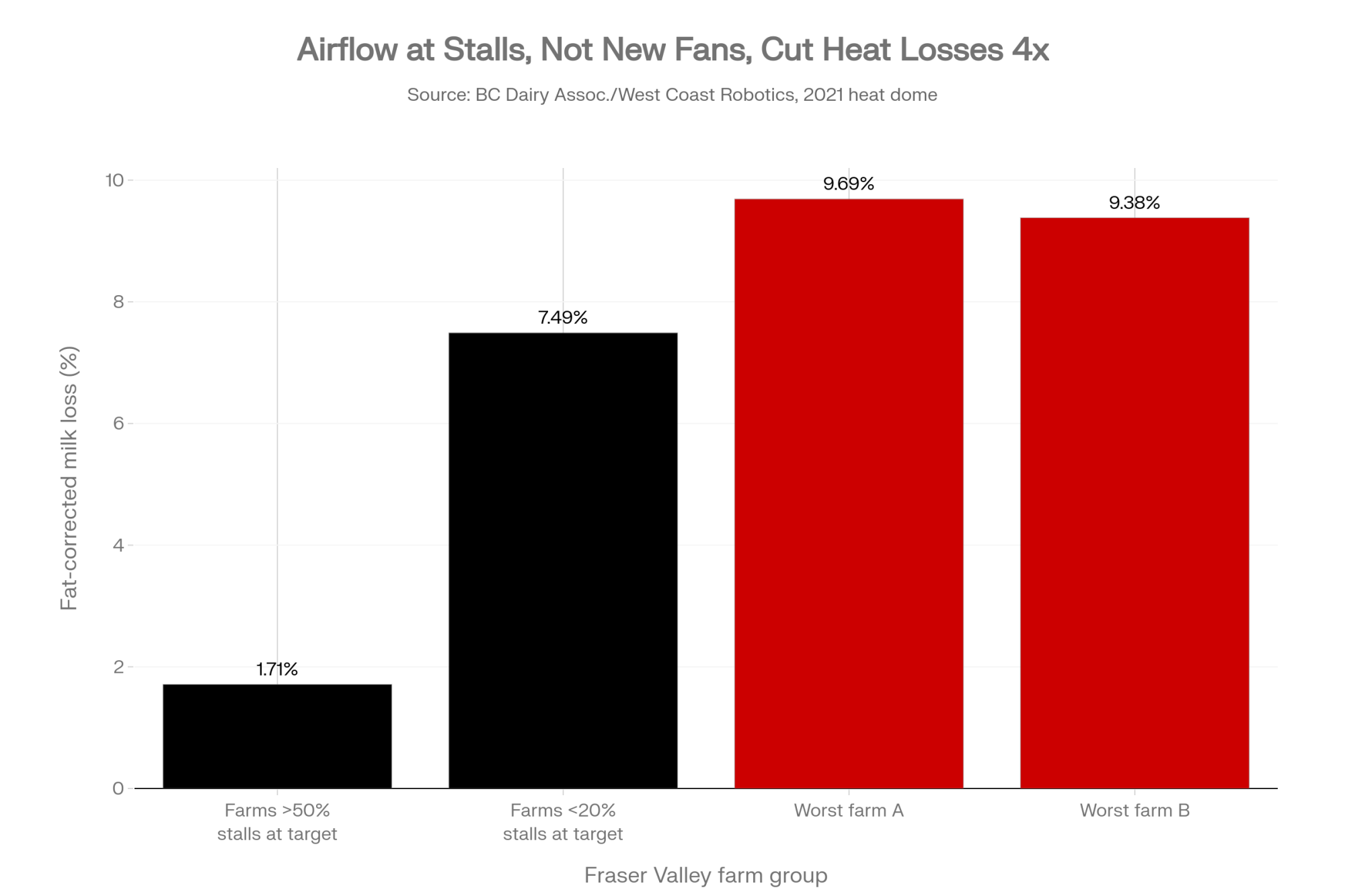
Nobody in that study bought new fans to get from 7.49% to 1.71%. They just had air reaching the stalls. If you’re building the barn map that finding implies, start with consistent air speeds at resting height and work outward from the dead zones.
Soakers, Sensors, and the Number You Have to Ask For
A 2019 Journal of Dairy Science trial found milk yield tended to rise 1.5 kg (3.3 lb) per day at higher soaker flow rates — but the authors flagged that their cows stayed relatively cool throughout, which limits how hard you can lean on it. Volume mattered more than spray frequency. “We installed sprinklers” and “we installed effective cooling” are two different sentences.
Sensor-triggered soaking is the current upgrade path, and it finally has independent data behind it. In one 2025 peer-reviewed trial, a smart soaker system delivered cooling effectiveness equal to conventional soakers while cutting water use from 225.3 L (59.5 gal) to 80.6 L (21.3 gal) per cow per day — about 64% less, with no loss of performance. Single study, but a published one, and more conservative than the 75–80% savings Kansas State’s Joe Harner projected in 2017.
Water-savings percentages are the number that gets marketed. Installed cost per cow is the number you have to ask for. Get both from any vendor — installed cost and projected water and pumping savings against your own utility rate — and evaluate the pair rather than the headline figure.
Don’t Stop at the Milking String
Your dry cows are usually the last group to get a fan, and they’re the group where the damage compounds into next lactation. Think about what that heifer already cost you — bred, carried, calved, raised, fed for two years. University of Florida research found daughters of heat-stressed dry cows gave roughly 5 lb (2.3 kg) less milk per day across their first three lactations than heifers from properly cooled dams. You discounted her before she ever walked into the parlor, and you paid full price to raise her.
The barn math backs it up, with one caveat. For a 200-cow herd where 40% of cows dry off above 25 kg (55 lb), fixing dry-cow cooling alone runs about $1,800 a year before counting a drop of daughter milk, and Florida’s model puts payback near five to six years for new construction — faster on a retrofit or in a hotter region. Treat that as an order-of-magnitude figure rather than a quote; the underlying model doesn’t state its currency year. Slower than a holding pen fix, sure. But the holding pen doesn’t reach into next lactation.
Minimum-effective setup: shade, consistent airspeed over feed and lying areas rather than just down the alley, a feedline soaker that wets skin instead of fogging, and automated controls so nobody has to remember.
Your Operational Diagnostic Checklist
Work through these in order. Each one is a decision you can make with numbers you already have or can get in an afternoon.
1. Pull your summer 21-day preg rate against your winter baseline. If the gap runs more than three points, your holding pen is a reproduction problem, not a comfort problem. Price the loss before you price the fans — and prorate the coefficient to your heat window, not the full year, or you’ll overstate the gain by roughly 4×. That prorating step is the one most equipment quotes skip.
2. Watch your cows at the gate. Hesitation going in, dragging coming out. That behavior was the diagnosis at Dotterer before any instrumentation confirmed it, and it costs nothing to read.
3. Find out who your controller is. If it’s a person remembering to flip switches, you’re cooling reactively. A cow-height probe caught heat stress on 50- and 60-degree February days nobody would have flagged by hand.
4. Time your holding pen. Past 45 minutes on 3x milking, fix grouping before you buy hardware. Parlor stalls × 4.5, plus gates or electric fence to subdivide, costs a fraction of a fan bank.
5. Check your parlor hours. Running under 12 hours a day means you can shift milking out of the 1 p.m. to 7 p.m. window — free cooling. Kansas State’s example moves a 2x herd from 5-and-5 to 10-and-10.
6. Count your compliant stalls. Fewer than half hitting 200 ft/min (1.0 m/s) at cow height puts you in the 7 to 9% summer loss range, not the 2% range. That’s what separated eight Fraser Valley farms in a single heat event.
7. Look at your dry pen. No fan there means you’re discounting heifers you haven’t met — 5 lb (2.3 kg) a day across three lactations.
8. If you’re on quota, rerun the whole case on components and longevity. At $11.62/kg butterfat under the current CDC schedule, protecting component yield through a heat wave is the return. Milk you can’t ship isn’t.
9. Audit your existing equipment against the two failure modes that make things actively worse. Sprinklers without mechanical ventilation raise THI instead of lowering it. Fans mounted dead-level move air over cows instead of onto them — target 8 to 10 ft/sec (2.4–3.0 m/s) at her back with 15 to 30 degrees of downward tilt.
10. If you’re still losing 2 to 3 kg (4.4–6.6 lb) ECM per cow per day with fans and soakers running, stop calling it a cooling failure. Cornell’s work points to gut integrity, which lives in the ration, not the ceiling.
The 30-Day Field Test
Two jobs, one afternoon, and you’ll know whether you own an equipment problem or a design problem.
Job one: walk your holding pen with an anemometer during afternoon milking. Take airspeed readings at cow height at ten points across the pen and log them on a sketch of the pen. You’re hunting dead zones, not an average — an acceptable mean can hide a corner where a third of the group stands still.
Job two: check delivery pressure at the last nozzle on your feedline soaker run, not the rated pressure at the pump. If it dribbles at the far end, your nozzle count is irrelevant until you sort the supply line.
The uncomfortable part of this story isn’t the fan spec. It’s how easily a summer number becomes background noise. White’s herd ran below 15 percent every July until sluggish cows in the holding pen pointed at a fixable cause. Every dairy has a number like that, bad long enough that it stopped registering as a problem. What’s yours currently writing off as just July?
Key Takeaways
- Your holding pen heats cows faster than any other room on the farm — 3°F in twenty minutes uncooled — yet it’s usually the last place fans go. Fix grouping and pen time before you spend on hardware.
- Sixty breaths a minute in a quarter of the pen means those cows are already losing, days before the tank shows it. That check costs you nothing but a few minutes standing still during afternoon milking.
- When a vendor prices a summer cooling fix on repro gains, ask whether they prorated the coefficient to your heat window or the full calendar year. Full-year math on a 90-day gain overstates the return roughly fourfold.
- Cooling only recovers about 60% of what heat stress takes. If you’re still losing 2 to 3 kg (4.4–6.6 lb) ECM per cow per day with fans and soakers running, the rest of that milk is leaking through the gut, and the answer is in the ration.
Reporting on Paul Dotterer and Sons Inc. is drawn from Peggy Coffeen’s reporting for Progressive Dairyman, published March 2017. The Bullvine did not independently interview the Dotterer family for this piece. Equipment specifications, herd size, and reproductive figures reflect the operation as of 2017 and may have changed since. Milk pricing reflects August 2026 announced Class III and CDC component schedules.
Learn More
- Why Consistent Air Speeds Are Key to Reducing Heat Stress in Dairy Cows — Arms you with resting-height ventilation benchmarks to eliminate dead zones over stalls before uncooled lying time robs peak milk yield.
- 21-Day Pregnancy Rate: Two Herds, Same 18%, Opposite Problems — Exposes why identical headline preg rates hide opposing breeding failures, showing you how to split heat detection from conception rate before misallocating capital.
- Cornell Found the 3 kg/Day Heat-Stress Leak Your Fans Were Never Going to Fix — Delivers the nutritional roadmap to seal leaky gut syndrome, recovering the 40% of metabolic production losses that ventilation hardware cannot reach.
 The Sunday Read Dairy Professionals Don’t Skip.
 The Sunday Read Dairy Professionals Don’t Skip.
Every week, thousands of producers, breeders, and industry insiders open Bullvine Weekly for genetics insights, market shifts, and profit strategies they won’t find anywhere else. One email. Five minutes. Smarter decisions all week.