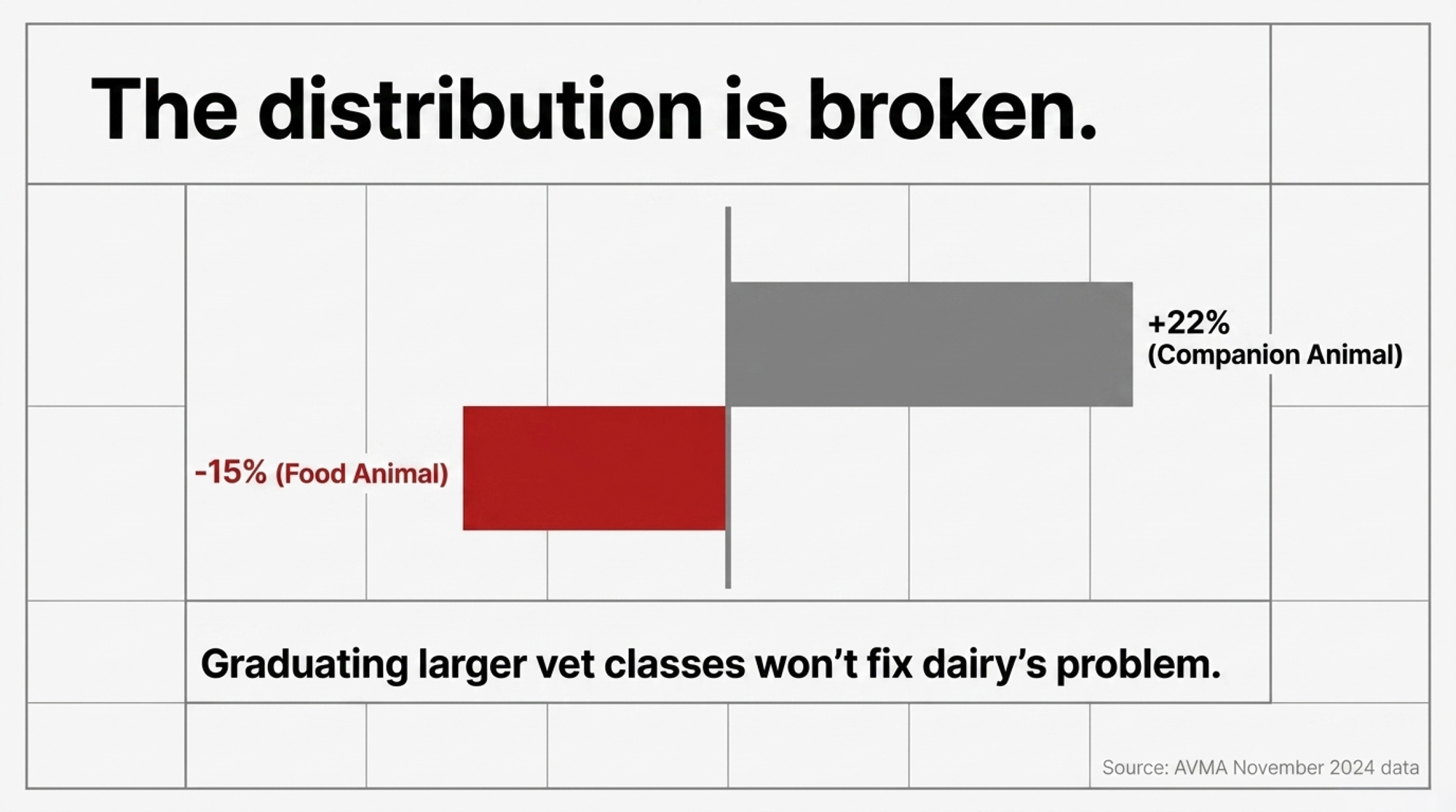
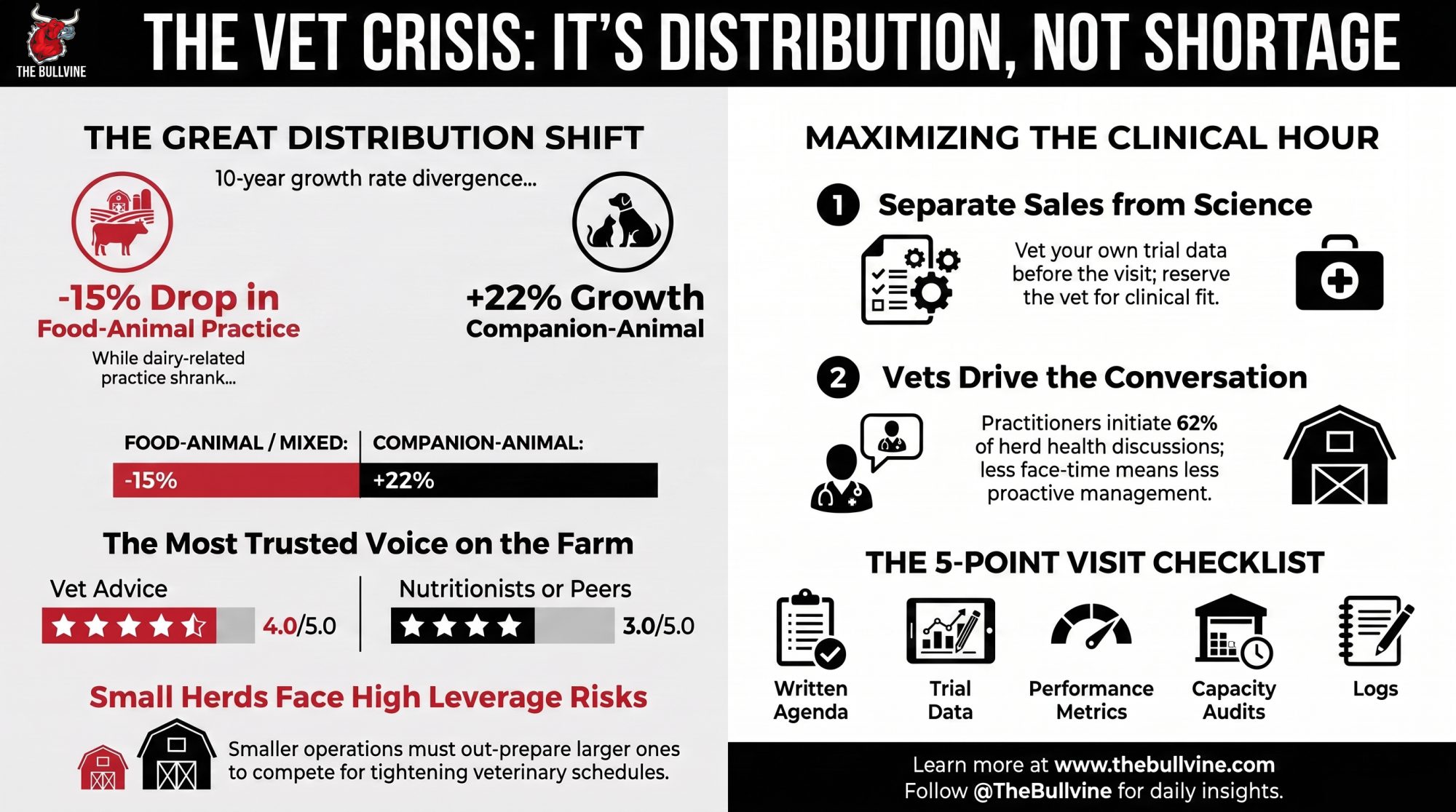
The profession isn’t shrinking — food-animal practice is. Down 15% in a decade while companion-animal practice grew 22%. Same graduating classes, opposite directions, and your barn is on the losing side.
Executive Summary: An AAVMC workforce study modeling supply through 2032 found the veterinary profession isn’t short overall. So why can’t you get one out to the barn? Because this is a distribution problem, not a supply collapse. With peer-reviewed research ranking the vet’s opinion at 4.0 out of 5.0 on farm management decisions, against 3.0 for nutritionists and peers, your most trusted technical channel is thinning where you need it most. The preparation burden is quietly shifting onto your shoulders.
Why “Shortage” Is the Wrong Word
AVMA data reported in November 2024 counted roughly 8,100 veterinarians in food-animal or mixed-animal practice across the United States. Over the prior decade, that cohort dropped 15% while companion-animal practice grew 22%.
An AAVMC workforce study modeling supply through 2032 found no basis for calling this a profession-wide shortage. AVMA News summarized the finding plainly in October 2024: the projections “do not justify a conclusion of overall excess capacity or capacity shortage by 2030 or 2035.”
The profession is holding its numbers. The food-animal slice isn’t.
That’s a distributional shift, not a supply collapse — meaning larger graduating classes won’t fix it on their own. The pull runs toward companion-animal practice, and dairy sits on the wrong side of that ledger.
Anyone selling a crisis narrative skips that distinction. The precise version is more useful anyway, because it tells you the problem won’t resolve itself on someone else’s timeline.
What the Research Says About Who You Actually Listen To
The veterinary literature is remarkably consistent: your veterinarian remains the single most influential technical voice on your dairy.
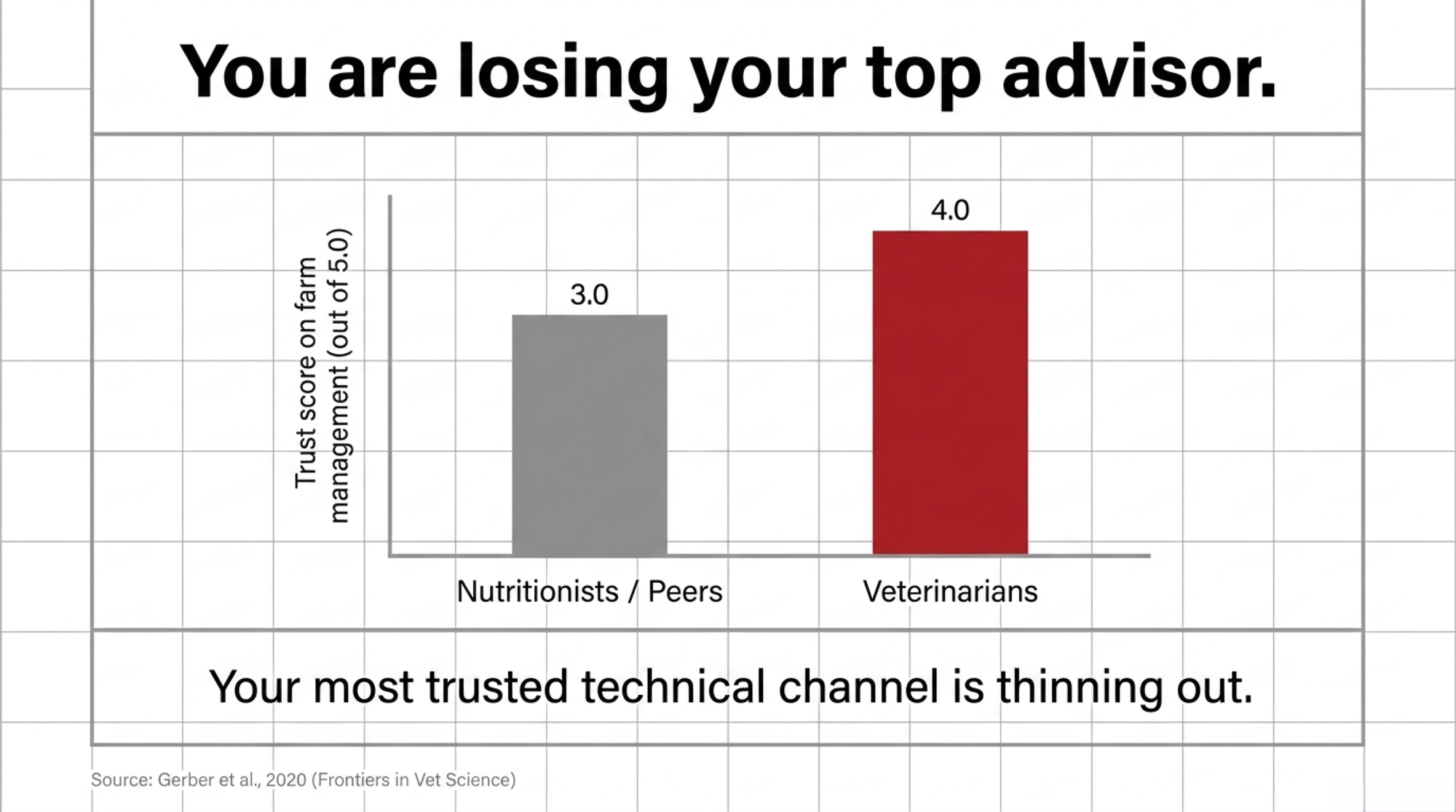
- Baseline management trust. Gerber and colleagues (2020, Frontiers in Veterinary Science) surveyed Swiss dairy farmers on what drives management decisions. On a five-point scale, the veterinarian landed at a median of 4.0 (interquartile range 4–5) — significantly outranking nutritionists, work colleagues, and family members, who all came in at a median of 3.0 (p < 0.001, Kruskal-Wallis).
- Biosecurity authority. Brennan and Christley — working from 2013 data, cited by Power and colleagues in the Journal of Dairy Science in 2024 — found 95% of producers would take biosecurity advice from their vet, compared with just 32% who’d take it from their governing body. Rivera-Gomis and colleagues (2025, Preventive Veterinary Medicine) reached the same conclusion: vets are the most frequent, most preferred, and most trusted information source farmers have.
- The decision limit. That influence isn’t universal. The same Gerber study found that on reducing antimicrobial use specifically, the vet’s opinion barely moved the needle — median 2.5, IQR 1–3. Anyone claiming the vet drives everything hasn’t read past the headline finding.
A necessary limitation: this advisory research draws on Swiss, British, and Canadian operations, and that UK figure is thirteen years old. Four countries pointing in the same direction is real evidence. It still hasn’t been measured on U.S. farms.
| Study | Country/Region | Metric | Key Finding | Limitation |
|---|---|---|---|---|
| Gerber et al., 2020 (Frontiers in Vet Science) | Switzerland | Median trust score (1-5) | Vet = 4.0, nutritionists/peers = 3.0 | Swiss dataset, not US-validated |
| Brennan & Christley, 2013 (cited in J. Dairy Science 2024) | United Kingdom | % trusting biosecurity advice | Vet = 95%, governing body = 32% | Data is 13 years old |
| Rivera-Gomis et al., 2025 (Prev. Vet. Medicine) | Not specified (EU-region) | Qualitative ranking | Vets = most frequent, preferred, trusted source | Confirms but doesn’t quantify |
| Gerber et al., 2020 (antimicrobial subset) | Switzerland | Median trust score (1-5) | Vet influence drops to 2.5 on antimicrobial use | Same limitation as above |
Is Your Region Already Short, or Just Getting Busier? The Zip-Code Lottery
A 15% net decline across food- and mixed-animal practice is a national figure, and national figures rarely distribute evenly. The federal designation system suggests this one doesn’t.
- The national benchmark. USDA NIFA designates official veterinary shortage situations annually through the Veterinary Medicine Loan Repayment Program (VMLRP), published by state and practice type each nomination cycle. The fact that designations are issued county by county rather than nationally tells you coverage gaps cluster rather than spreading thin everywhere at once.
- The commercial reality. Merck Animal Health — which sells into this same veterinary channel — cites 500-plus underserved counties across 46 states, alongside a 90% decline in food-animal veterinarians since the 1950s. Vendor-published and not independently verified against the federal list, but the shape of the claim matches how the designation system is built.
- The leverage factor. A 900-cow operation is a bigger share of any practitioner’s revenue than a 90-cow operation, and that shows up in who gets the Tuesday morning slot when the schedule tightens. If you’re the smaller herd in a designated county, you’re competing for the same hours with less leverage.
Which is exactly the situation where preparation stops being optional. Check your own county against the federal list rather than trusting any aggregate count — including that one.
🔍 Go deeper: What a federal shortage designation actually means for your herd.
The Mechanics: Why the Advisory Vacuum Matters
When the overwhelming majority of animal-health trust routes through a single professional channel, and that channel’s field capacity shrinks, remaining hours carry premium decision weight.
As clinical hours thin out, who fills the technical advisory gap on dairy operations? The commercial supply channel has both the incentive and the field personnel to step in.
McKinsey’s Global Farmer Insights 2024 found input distributors already dominating farmers’ general ag-input and soil-health advice, with integrated distributors ranking as top advisers across Europe and North America. That’s agronomy, not animal-health protocols — but the mechanism travels. It’s not a conspiracy. It’s the predictable shape of a market where demand for technical guidance outlasts the supply of independent people qualified to give it. Nobody has measured how much of that shift has already happened.
Here’s the boundary, stated once: no study cited here measures whether you face more sales pressure per visit than a decade ago, or whether anyone’s advisory independence has been compromised. The structural conditions are documented. Harm isn’t. What matters is how you manage the hours you do have.
How Much Is Your Vet’s Hour Actually Worth to You?
Not the invoice line. The decision value.
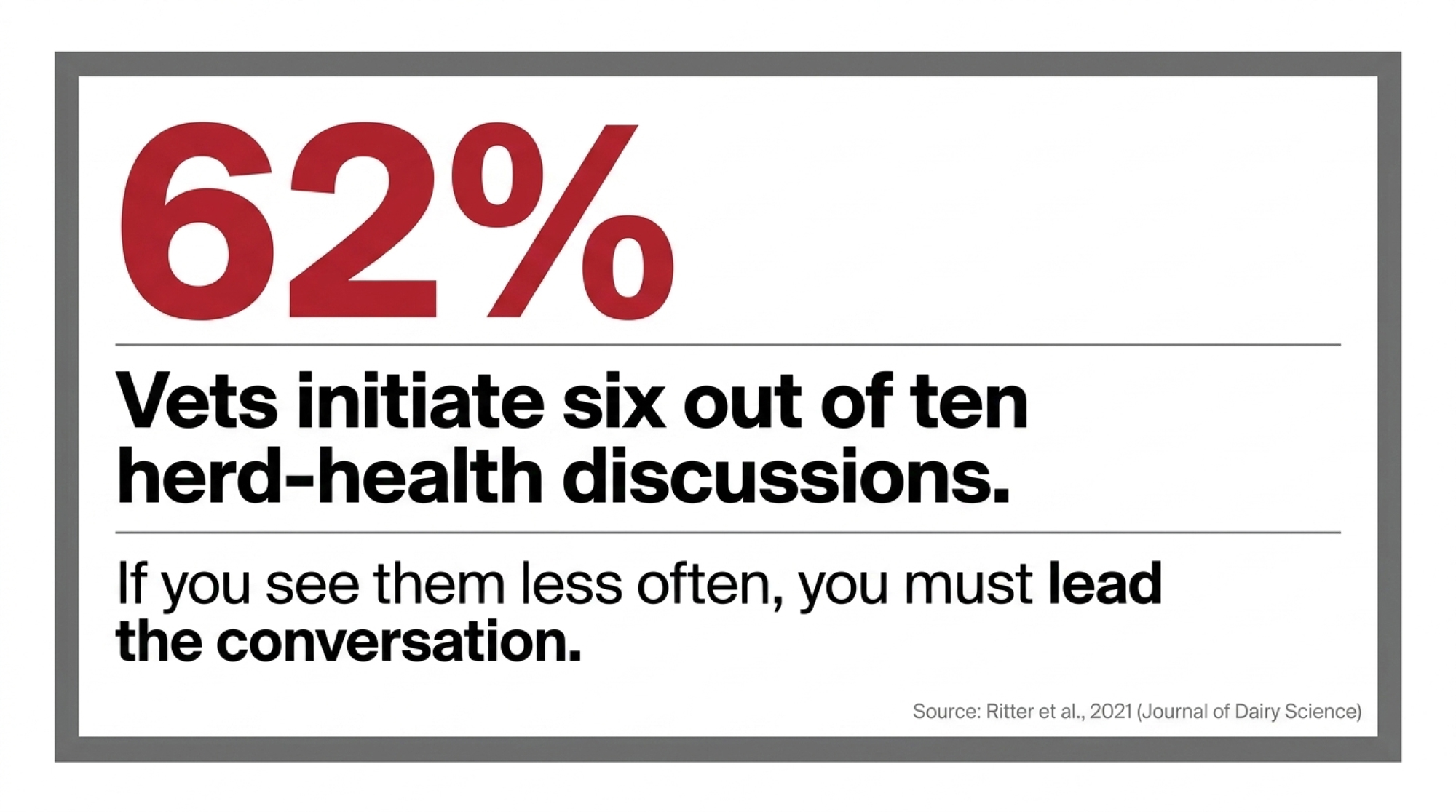
Ritter and colleagues (Journal of Dairy Science, 2021) observed that during Canadian herd-health visits, veterinarians initiated 62% of discussions about herd issues, while farmer-initiated discussions turned to herd health in 39% of cases. Those percentages measure different things and don’t sum to a hundred — they’re not two halves of one pie.
Scope it honestly: Canadian herd-health visits, not a universal pattern. But the implication travels. If your practitioner is initiating roughly six of every ten conversations about herd issues, and you see them less often than you did five years ago, the return on your own preparation has climbed whether or not your bill has.
So where does your prep time sit right now — an hour before each visit, or ten minutes in the parlor?
📋 Go deeper: How to structure a herd-health visit that earns its cost.
Options and Trade-Offs for Farmers
Path 1: Walk in with the product question already answered
Pull the independent trial data, label claims, and pricing before the truck pulls in. Then spend your vet’s time on the only question they can answer: does this fit my herd, given what you know about my history? Do this before your next scheduled visit.
- Trade-off: costs you an hour of prep and a willingness to read a trial abstract. And if a product turns out to have no independent trial data to pull, that’s your answer — delivered early and free.
🔬 Go deeper: How to read a feed-additive trial before your rep does — who funded it, what the control group looked like, and whether the effect size survives your herd’s conditions.
Path 2: Split commercial evaluation from clinical judgment
Send pricing, volume discounts, and distributor comparisons to your sales rep. Send protocol fit, clinical risk, and disease interaction to your vet. Works best where one person is currently doing both jobs — and on a lot of operations, that’s what’s happened by default, not by decision.
- Trade-off: requires the discipline to say “let me review the clinical fit with my vet first” when a rep is standing in your parlor with a sample case. Where it breaks down: on smaller operations the vet genuinely is the only technical adviser within driving distance, and there’s no second channel to route anything to. If that’s your situation, Path 1 matters more, not less.
Path 3: Move from emergency-only calls to scheduled visits
The AVMA divergence isn’t reversing on a timeline that helps you next spring. It’s reasonable to expect that operations already on a scheduled-visit footing are easier for a stretched practitioner to keep serving than those who only call in a crisis — though no study cited here measures that directly.
- Trade-off: it competes for capacity rather than creating any, which is worth being clear-eyed about.
| Path | Best For | Time Cost | Key Trade-Off | Risk If Skipped |
|---|---|---|---|---|
| 1. Answer the product question first | Any herd size | ~1 hour prep before visit | Requires reading trial abstracts yourself | Vet time wasted re-explaining basics rep should’ve covered |
| 2. Split commercial vs. clinical advice | Larger operations with rep access | Ongoing discipline, low time cost | Must say “let me check with my vet first” under sales pressure | One person (often the vet) ends up doing both jobs by default |
| 3. Move to scheduled visits | Smaller/underserved-county herds | No added hours, just rescheduling | Competes for capacity, doesn’t create it | Emergency-only calls get bumped when schedules tighten |
Before Your Next Herd-Health Visit: The 5-Point Checklist
- [ ] Ranked question list. Arrive with a prioritized, written agenda — not one improvised while the vet is unpacking the truck.
- [ ] Trial and source data. Pull independent trial data and funding disclosures on any new product or feed additive under consideration.
- [ ] Internal performance metrics. Have your recent SCC trend, conception rates, and fresh-cow treatment logs on the table.
- [ ] Capacity audit. Ask directly: “How many herds are you covering this year compared to three years ago?”
- [ ] Decision log. Document the agreed protocol and rationale immediately, so the next visit builds on the last rather than restarting.
Key Takeaways
- If you’ve been waiting for the vet shortage to resolve → stop. A distribution problem doesn’t fix itself on someone else’s timeline.
- Check your county’s NIFA designation status → if you’re in a designated shortage area, a second technical adviser moves from optional to necessary.
- If you’re weighing an antimicrobial protocol change → your vet’s opinion carries less weight there than on general management, per the Swiss data. Bring your own numbers.
- Smaller herds have to out-prepare larger ones → you’re competing for the same hours with less revenue leverage.
- Don’t outsource trial evaluation to the parlor → do the product homework ahead of time and reserve vet time for clinical validation.
- If a rep brings you a new product → ask for the trial data and who funded it before your vet’s next visit. No data available? That’s the answer.
- If you’re seeing your vet less than three years ago → ask them directly what their next twelve months look like.

Your veterinarian remains the most trusted voice on your dairy, and food-animal practice capacity keeps contracting. Both facts are settled. What your operation does about it isn’t.
At your next herd-health visit, ask the question that matters: how many other herds are you covering this year compared to three years ago? The answer tells you how much of the analytical weight is shifting back into your own hands.
(Workforce figures reflect AVMA data reported in November 2024 for the 2023 practice year. Influence research spans 2013–2025.)
Learn More
- The High Cost of Cheap Advice: Why Cutting Corners on Dairy Consultants Is Costing You Thousands — Delivers an economic audit of your advisory bench, showing how under-investing in independent expertise leaks margin through delayed clinical intervention and misaligned ration formulation.
- Dairy Farming in 2025: Why Old Playbooks Are Failing — Exposes the structural shifts reshaping farm margins over the next five years, arming producers with forward-looking strategies to protect cash flow as traditional service models fragment.
- Smart Barns, Real Profits: How Sensor Tech is Revolutionizing Herd Health — Breaks down how automated rumination and health-monitoring systems fill the labor gap, catching subclinical mastitis and metabolic disorders days before acute symptoms demand an emergency vet call.
 The Sunday Read Dairy Professionals Don’t Skip.
 The Sunday Read Dairy Professionals Don’t Skip.
Every week, thousands of producers, breeders, and industry insiders open Bullvine Weekly for genetics insights, market shifts, and profit strategies they won’t find anywhere else. One email. Five minutes. Smarter decisions all week.