










It’s 2 a.m., week six of calving. That colostrum’s been in the bucket for hours, the refractometer’s in the vet box, and the calf looks fine. In a benchmark study, 82% of samples were over the bacteria limit — and the cow was never the problem.
Executive Summary: A calf can hit 4 L of ≥22% Brix colostrum, on time, and still fail passive transfer — because high bacterial load physically blocks IgG absorption at the gut wall, so the number looks right while the immunity isn’t there. In a benchmark study, 82% of colostrum samples tested over the 100,000 CFU/mL bacteria limit by the time they reached the calf, and the failure lived in the two-to-six-hour handling window, not in the cow. Calves with failed passive transfer carry 2.46× the odds of dying and cost about €60 a head up front — and on a 200-cow herd at Ontario’s 37% FPT rate, that’s roughly 67 calves and C$6,450 leaking out before you count the first-lactation milk those heifers never make. It hits hardest on compact-calving herds, where the SOP written wide-awake gets handed to someone running on six hours of sleep in week six. The fixes are cheap and closeable: move the tools to the pen, run a laminated four-check card, pasteurize at 60°C/60 min (not 63, where you lose 34% of your IgG), and blood-sample calves at the start and end of the block to catch the drift. Miss it, and the bill doesn’t show up now — it lands three years out on a DHIA sheet, and nobody connects it back to a 2 a.m. bucket. Worth the full read if you’re calving in a tight window and have never actually measured what your calves absorbed.
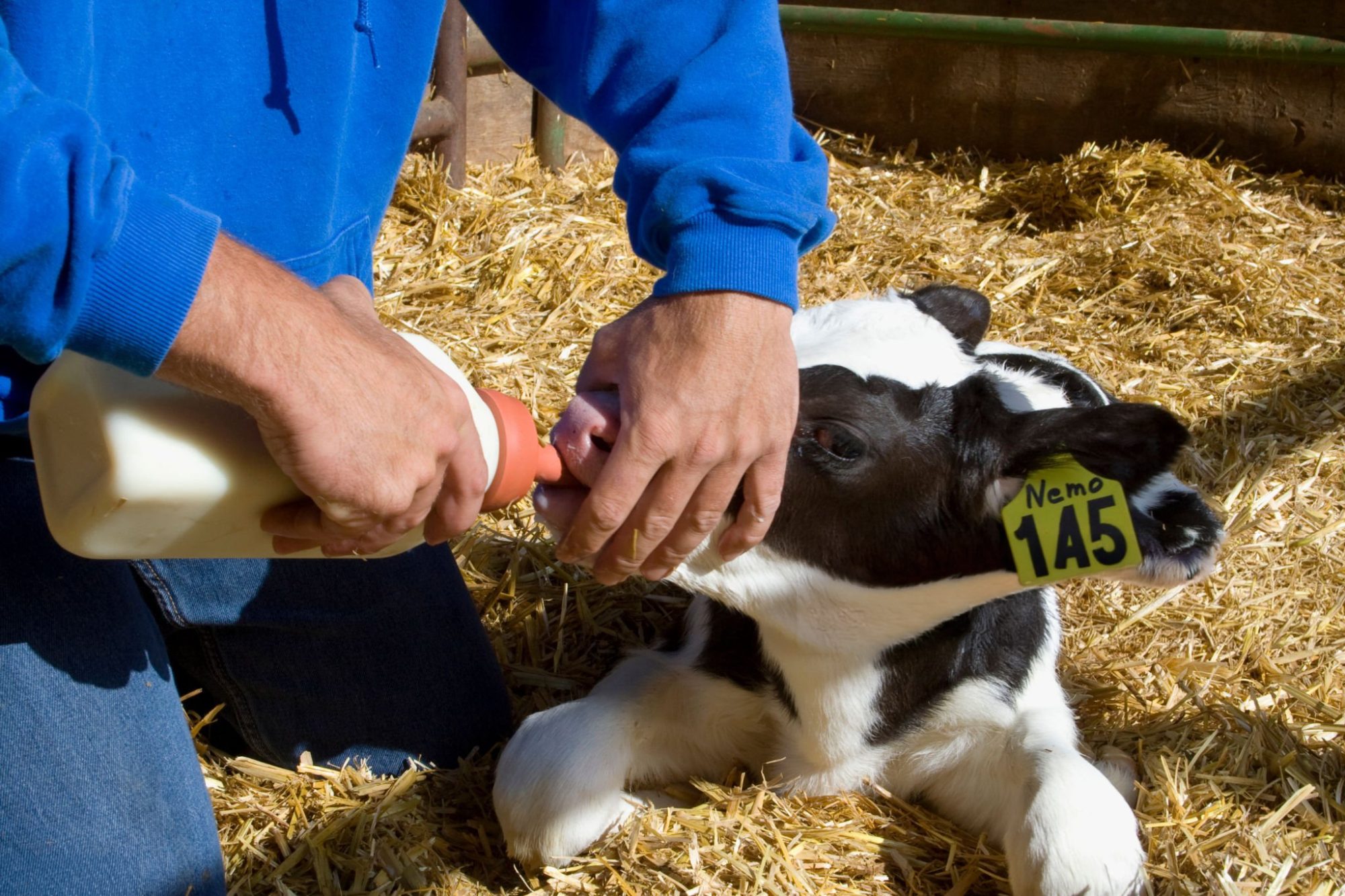
It’s 2 a.m. in week six of a compact spring calving. Your best calf person — the one you’d trust with anything — has been awake since before yesterday’s afternoon milking. Three calves hit the ground in the last two hours. The refractometer is in the vet box across the yard. The tube feeder is somewhere. And the colostrum from that first heifer has been sitting in a bucket at barn temperature for longer than anybody’s tracking.

Nobody’s writing down a timestamp. Nobody’s culturing that bucket. And the calf standing in front of everyone looks absolutely fine. That’s the trap. Whether that calf got real immunity or just a warm meal is being decided right now, in the dark, by a tired human — and you won’t find out which for three years, when a first-lactation heifer quietly underperforms, and nobody connects it back to this night.
The Failure Nobody Can See Coming
Here’s the reframe that changes how you run the whole block: the colostrum leaving the cow is usually fine. Westhoff’s invited review in the Journal of Dairy Science (2024) makes the point plainly — colostrum IgG concentrations from first-, second-, and later-lactation dams often aren’t significantly different, and udder quality is frequently adequate. Shivley’s US preweaned heifer study (JDS, 2018) lands in the same place: failure of passive transfer traces back to how colostrum gets harvested, handled, and delivered — not to inherently bad cows.
So the weak link isn’t bovine. It’s the two- to six-hour window when people, protocols, and equipment decide the calf’s fate. And that’s oddly hopeful, because it means the failure is almost entirely inside your control.
One upstream lever does sit at the cow, and it’s worth naming: quality at the udder is usually fine, but if you’re chasing a genuine quality problem at the source, look at dry-period length and close-up protein before you blame the cow. Short dry periods and thin close-up rations cut the IgG mass a cow packs into that first milking. That’s the exception, though — not the rule. For most herds, the leak is downstream.
But it’s invisible in the moment. Beam’s foundational US work (JDS, 2009) tied failure of passive transfer to higher neonatal death and lower first- and second-lactation milk. And the Raboisson meta-analysis put hard odds on what that failure costs a calf.
WHAT FAILURE OF PASSIVE TRANSFER DOES TO A CALF Raboisson et al. meta-analysis, Veterinary Medicine International, 2016; mortality odds ratio confirmed in Abdallah et al., JDS, 2022
- 2.46× the odds of dying (Raboisson 2016; confirmed Abdallah 2022)
- Roughly 2× the odds of being treated for disease
- Elevated overall preweaning morbidity
- €60 average added cost per dairy calf (prediction interval €10–€109)
You can’t see any of that by looking at a calf on day one. You can’t see passive transfer with your eyes.
Where Does a Compact Block Actually Break First?
Ask where compact calving breaks, and the honest answer — pulled from the labor studies, not a gut feeling — is that it breaks on people and calves long before it breaks on the milk cheque.
Hogan’s labor time-use study of spring-calving Irish farms (JDS, 2022) found average labor input of about 2,200 hours per farm, with milking the single most time-consuming task at 31% and calf care second at 14%. The daily load climbs hard into the calving months. Beecher’s Irish work (2023) underlines who carries it: the farmer and farm family account for roughly 77.5% of the annual labor requirement — exactly the people who can’t clock out when calving peaks.
Then there’s sleep. Hall’s study of block-calving workers in New Zealand (JDS, November 2024) clocked average sleep during peak calving at six hours and 15 minutes a night — below the 7-to-9 hours needed for sound cognitive function — and it dropped further as the season wore on. That’s the setup for failure. Tired people making hundreds of micro-decisions on short sleep don’t skip the big visible jobs — milking still happens, calves still get fed. What slips are the small, time-sensitive, hygiene-heavy steps: the rinse, the Brix test, the timing.
Palczynski’s stakeholder interviews in England (Animals, 2021) found farmers and vets repeatedly describing calf outcomes as hinging on small, easily-skipped tasks — the first casualties when the barn’s on fire. Mulkerrins’ qualitative analysis of compact calving (JDS, 2022) identified the trade-off directly: pushing the six-week calving rate delivered more days in milk and better cash flow, but it also brought a heavier workload and the challenge of managing a large number of calves born in a condensed window. Northern Ireland’s DAERA advisory (2022) put it plainer still, cautioning that a poorly managed compact block can drive inefficiency or burnout among family and paid labor.
None of that argues against compact calving. The grass efficiency is real. The cash-flow gain from a tight block is real. The friction lands somewhere the pasture budget doesn’t track.
The fault line runs through the people who don’t sleep in April — and the calves who look fine tonight. That’s the part the spreadsheet never shows.
Design the Protocol for the Tired Person, Not the Fresh One
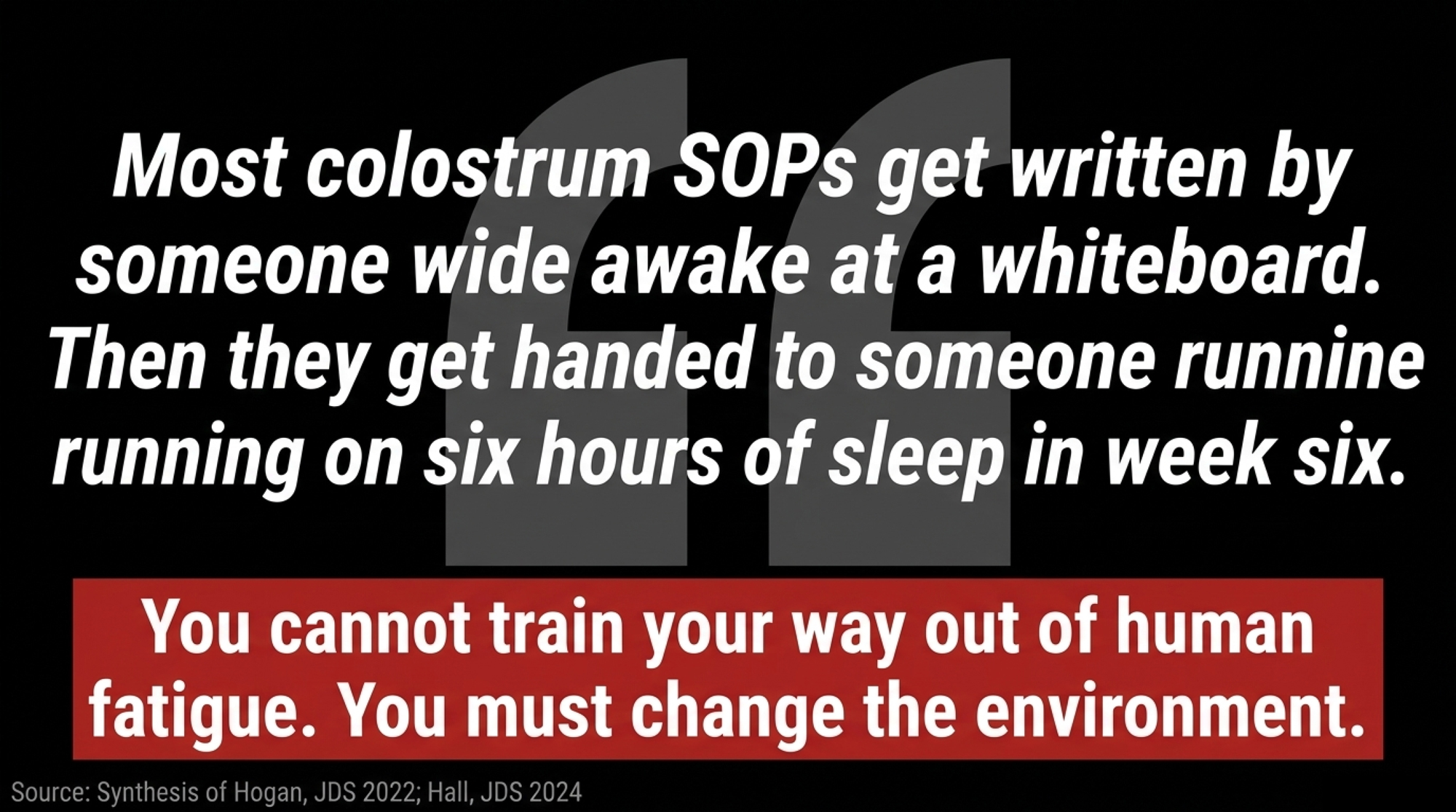
Most colostrum SOPs get written by someone wide awake at a whiteboard. Then they get handed to someone running on six hours of sleep in week six. That’s the design gap. And you can’t train your way out of it.
The National Dairy FARM Safety Manual (2021) makes the case that people are vulnerable to error and fatigue, and that ergonomic design is needed to cut performance error. The fix, borrowed from human-factors work in healthcare and aviation, is to stop relying on memory and vigilance and start building the trigger into the physical environment. Ontario’s OABP veterinary SOP guidance (2017) recommends numbered bullet-point steps, short sentences, fewer than 10 steps for a simple task, and — critically — keeping the SOP physically accessible at the point of use rather than filed in the office.
Put it simply. If the refractometer lives in the vet box, it gets used when things are calm. If it lives on a hook at the maternity pen, it gets used at 2 a.m. Location is protocol design.
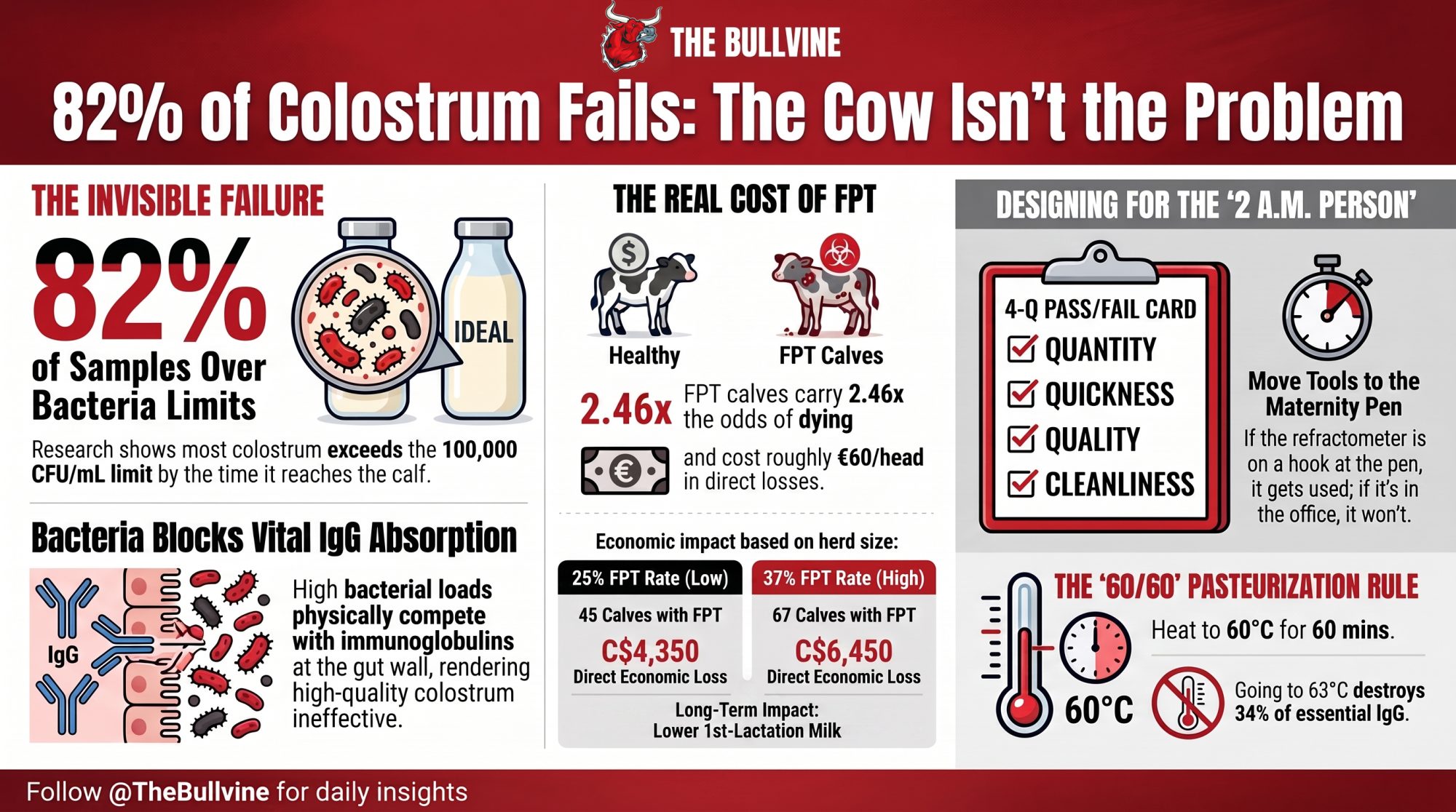
Ontario’s OMAFA colostrum factsheet (August 2024) boils the whole decision down to four pass/fail checks — no judgment call, no decision tree. Print it. Laminate it. Hang it on the pen.
🐄 THE 4-Q COLOSTRUM CARD — HANG IT ON THE PEN Four yes/no checks. Any “NO” = fix it before the calf drinks. Source: OMAFA, “Colostrum for the Dairy Calf,” Aug 2024
| # | CHECK | THE STANDARD | ☐ YES / ☐ NO |
| 1 | QUANTITY | 4 L (about 1 gallon), or 8.5–10% of birth weight, at first feeding | ☐ |
| 2 | QUICKNESS | Fed within 1–2 hours of birth (no later than 6) | ☐ |
| 3 | QUALITY | ≥22% on the Brix refractometer | ☐ |
| 4 | CLEANLINESS | Clean udder prep + clean equipment | ☐ |
All four YES → feed it. Any NO → don’t guess. Fix the gap first.
Four yes-or-no questions a tired person can answer without thinking. And benchmarking is what actually shifts behavior. Sumner’s UBC work (JDS, 2018) found that “benchmarking encouraged farmers to make changes in their calf management by identifying areas needing attention” — not through shame, but by giving them evidence of how their own calves were really performing.
The Bacteria Count That Makes the Decision for You
There’s a failure mode beyond timing and fatigue: sometimes the colostrum itself is the source of contamination. This is where the tired old “natural versus processed” debate ends.
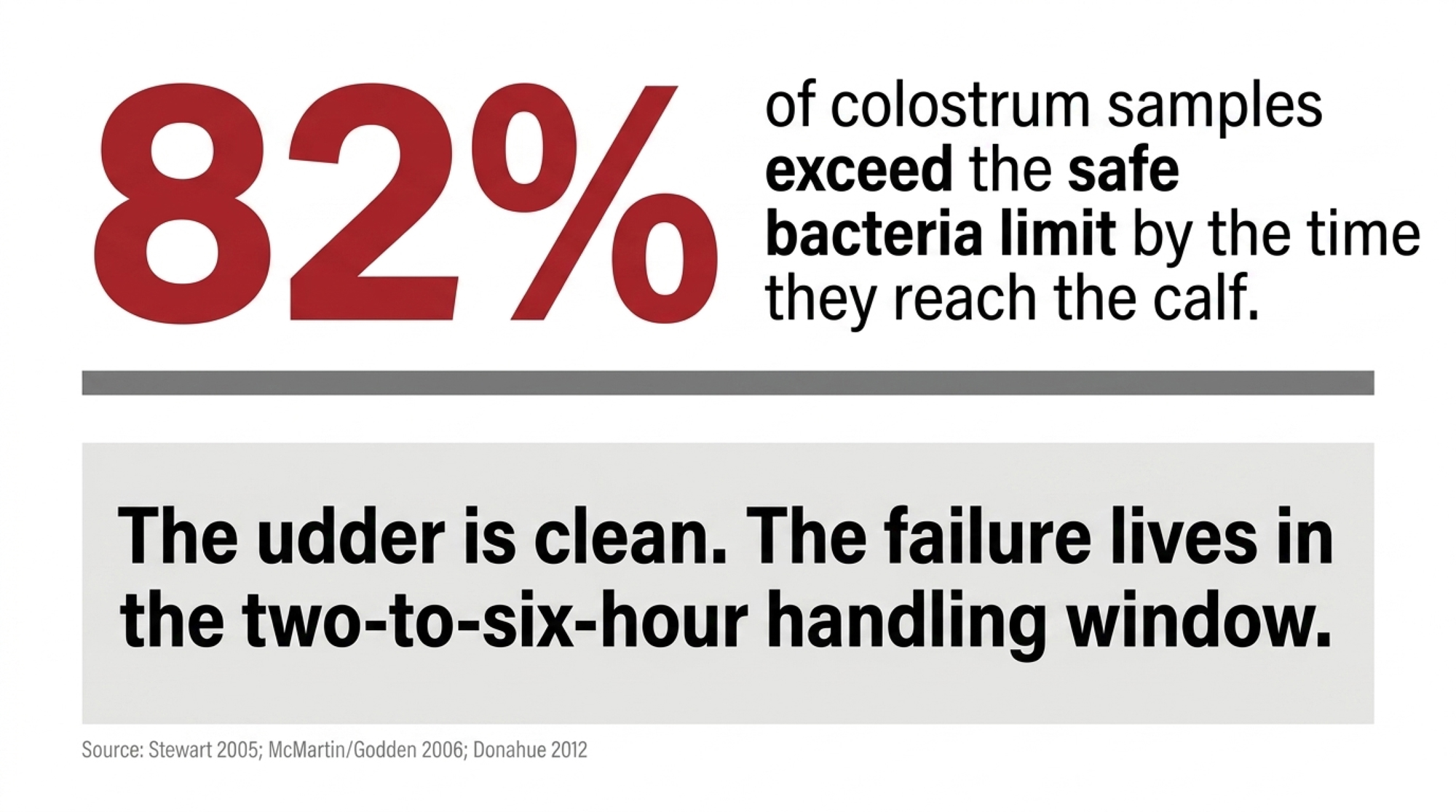
The accepted thresholds, per Godden’s work at the University of Minnesota, are a total plate count under 100,000 CFU/mL and coliforms under 10,000 CFU/mL for good-quality colostrum. The uncomfortable number: in the benchmark work behind Godden and McMartin’s heat-treatment studies (JDS, 2006) — and in Stewart’s critical-control-point study (JDS, 2005) — 82% of sampled colostrum exceeded that 100,000 CFU/mL ceiling, plenty of it with perfectly acceptable IgG. Later commercial-farm work found the same pattern, with 82–92% of samples over the limit (Donahue et al., JDS, 2012). High bacterial load doesn’t just ride along. It competes with immunoglobulins at the gut wall, physically blocking absorption during the narrow window before gut closure. Feed that, and you’re not feeding colostrum anymore. You’re feeding a bacterial slurry with some IgG dissolved in it.
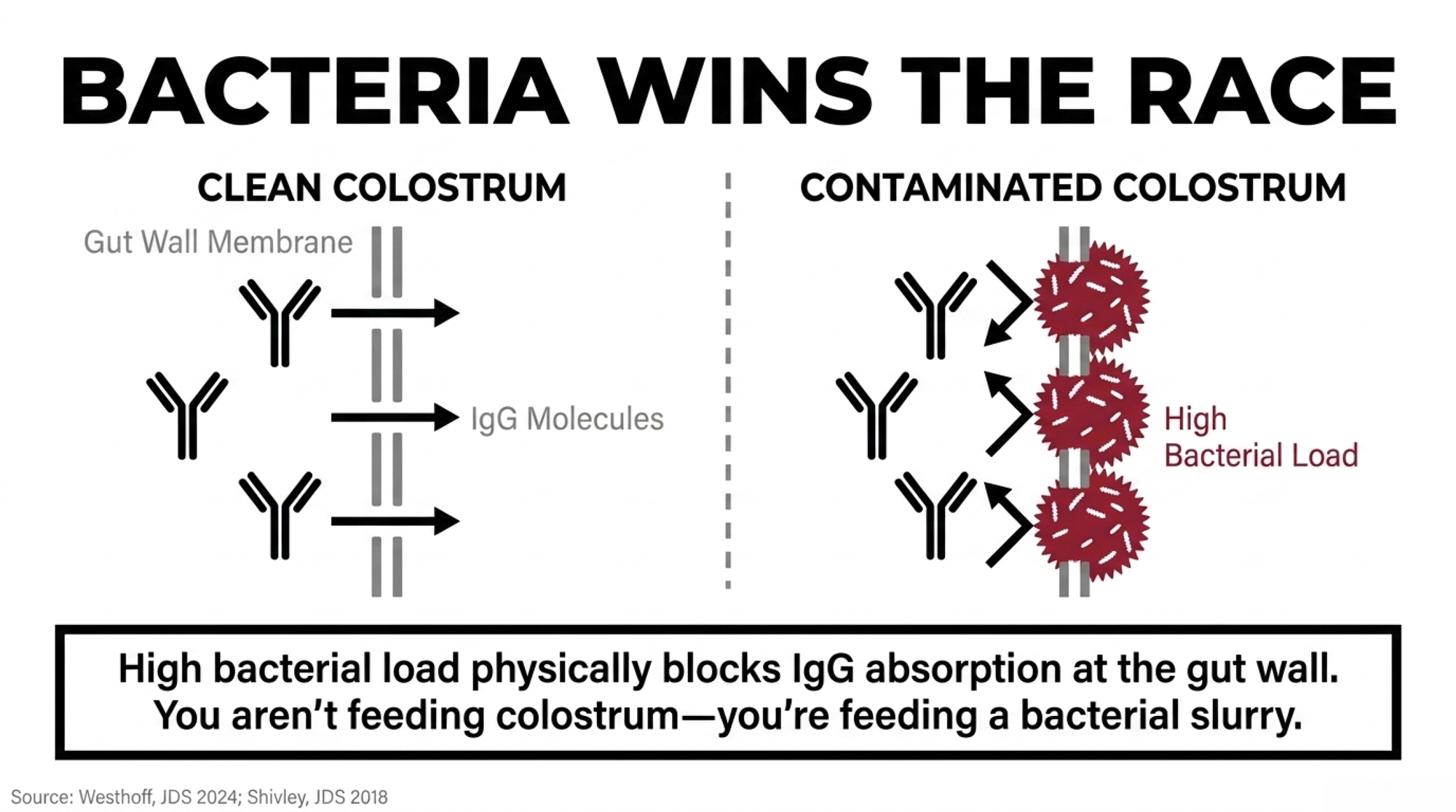
Where does the contamination come from? Not the udder, mostly. Šlosárková’s study of Czech farms (JDS, 2021) isolated E. coli from 9.0% of harvested colostrum samples and found high overall microbial contamination — pointing squarely at hygiene and sanitation around collection, not the cow. Coliforms multiply fast when colostrum sits warm; the longer it’s in a bucket, the worse the count. Pooling makes it worse again — one dirty sample compromises the whole batch, and a 2023 review in Antibiotics (Miranda et al.) flagged raw and pooled raw colostrum as a route for spreading antibiotic-resistant pathogens.
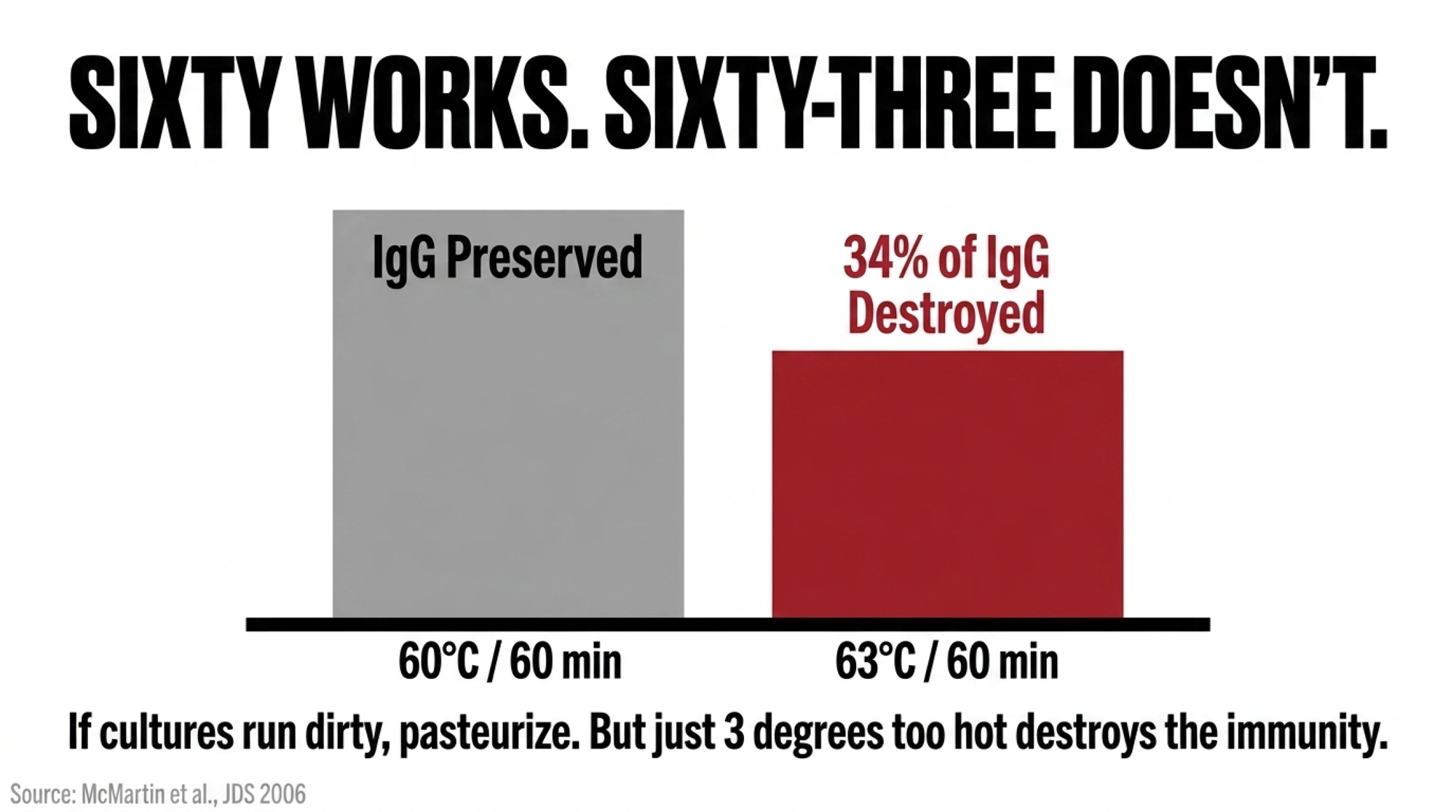
Once your own culture results keep coming back dirty, pasteurization stops being a luxury add-on and becomes arithmetic. Heating colostrum to 60°C for 60 minutes (140°F) — the “60/60” protocol validated in Godden’s on-farm trials — reduces bacterial and coliform counts well below the threshold while preserving IgG and fluidity. Godden’s randomized trial across six dairies in Minnesota and Wisconsin (JDS, 2012) showed that heat treatment reduced microbial counts and calf morbidity while maintaining IgG concentration. The old trials that scared people off pasteurization ran hotter: McMartin’s batch study (JDS, 2006) found a 34% loss of IgG and a jump in viscosity at 63°C. Sixty and sixty works. Sixty-three doesn’t.
What It Actually Costs — A Barn-Math Walk-Through
Run the numbers on a herd you can picture. A 200-cow operation calving 180 live calves through a compact block. Published FPT prevalence runs wide — Trotz-Williams found 37% on Ontario farms, against 19% on US farms (Beam, JDS, 2009), and dairy-calf reviews put the range anywhere from roughly 13% to 44% depending on test and cutoff (Male Here et al., 2025). Take the high, honest end — 25% to 37% — and see where the leak sits.
THE FPT LEAK — 200-COW HERD, 180 LIVE CALVES / BLOCK
| Metric | Low end (25% FPT) | High end (37% FPT, Ontario) |
| Calves starting life immunologically short | 45 calves | 67 calves |
| Direct cost @ €60/calf (Raboisson 2016, EU basis) | €2,700 | €4,000 |
| ≈ Canadian dollars (mid-2026 rate, ~1.61 EUR→CAD) | C$4,350 | C$6,450 |
| ≈ US dollars (mid-2026 rate, ~1.17 EUR→USD) | US$3,150 | US$4,650 |
Direct cost only — treatment + mortality per Raboisson 2016. Excludes the deferred first-lactation milk loss and early culls, which are the bigger bill.
That’s before you count a drop of the first-lactation milk those heifers won’t make, or the ones culled early.
The direct bill is the small part. The deferred bill — the one that lands on a DHIA sheet three years out — is the part nobody budgets for.
This isn’t a scare tactic. It’s a range built from peer-reviewed cost and prevalence figures, and your own number depends on your calf crop and your actual FPT rate. Which is exactly why it matters: you can’t manage what you’ve never measured.
Options and Trade-Offs for Your Operation
The story points to a few real paths, depending on where your herd sits.
- Move the tools, not the people (start here). Relocate the refractometer, tube feeder, and a laminated 4-Q card to the maternity pen. When it makes sense: every operation, right now. What it demands: almost nothing but the decision. Where it backfires: a card nobody helped design gets ignored — so build it with the person who actually works nights.
- Benchmark before you invest. Blood-sample at least 12–14 calves aged 1–7 days, once at the start of the block and again near the end. When it makes sense: before spending on equipment. What it demands: modest vet coordination. Where it backfires: if you sample once and stop, the value lies in the start-versus-finish comparison that exposes fatigue-driven drift.
- Pasteurize when the cultures say so. When it makes sense: when your own plate counts sit above threshold, and hygiene fixes haven’t moved them. What it demands: real capital — an Iowa State producer survey (2009, in 2009 dollars, so budget higher today) pegged pasteurizers at an average of $8,329 plus about $3,370 in added equipment — plus disciplined time-temperature and cleaning routines. Where it backfires: too-hot or too-long protocols cost you IgG; run 60/60, not 63.
- This month: blood-sample a batch of calves against the current passive-transfer standard. The 2021 categories put Excellent at serum total protein above 6.2 g/dL (IgG ≥25 g/L) and Poor below 5.1 g/dL (IgG <10 g/L), with a herd goal of more than 40% of calves in the Excellent band and under 10% in Poor (Lombard, 2021; Michigan State Extension, 2023). Fall short of that split, and you’ve found a process failure — not bad luck — and now you know where to aim.
What This Means for Your Operation
- The single most important shift: assume the colostrum leaving the cow is fine, and treat everything that happens to it in the next six hours as your system’s responsibility.
- Where does your refractometer actually live — the vet box, or a hook at the maternity pen?
- Do you know your own colostrum plate counts, or are you assuming clean because you can’t see dirty?
- If you blood-sampled calves at the start and end of the block, would the numbers hold — or drift as your crew ran down?
- Is your colostrum SOP written for the person who wrote it, or the person working the 2 a.m. shift in week six?
- At your herd’s FPT rate, how much future milk are you quietly converting into current stress?
Key Takeaways
- If a benchmark study found 82% of commercial colostrum over the bacteria threshold, then assume yours could be too until a culture proves otherwise — measure before you trust it.
- If your plate counts keep coming back dirty after hygiene fixes, then pasteurize at 60°C for 60 minutes (140°F). Just don’t run it hotter — 63°C cost McMartin’s samples 34% of their IgG.
- If your SOP needs a rested brain to run, it’ll fail in week six — redesign it for the tired person, with the tools at the pen and the decision cut to four yes/no checks.
- If fewer than 40% of your sampled calves hit the Excellent band, or more than 10% land in Poor, you’ve got a process problem — and only a start-and-end-of-block audit will show you where it cracked.
The block will compress. The workload will spike. Your best calf person will drift toward six hours of sleep whether you plan for it or not. So the real question to carry back to your own barn isn’t whether your cows make good colostrum — they probably do. It’s whether your system can protect that colostrum at 2 a.m. on the fortieth day, when nobody’s writing down the timestamp. What are you going to change before the next block starts?
Run Your Numbers
Calf Feed ROI Tool — Colostrum failure shows up as sick calves and dead heifers you paid to raise. This tool turns better early-life calf investment into a per-calf number, weighing added growth, survival, and treatment savings so you can see whether tightening your program actually pays before the bill lands three years out.
Complete references and supporting documentation are available upon request by contacting the editorial team at editor@thebullvine.com.
Learn More
- 4 Golden Rules for Optimal Colostrum Feeding — Arms you with an objective, pass-fail blueprint to eliminate 2 a.m. maternity pen guesswork. This breakdown details the specific collection windows and sanitizing practices required to consistently hit the 50 mg/mL immunoglobulin target.
- $3010 Per Heifer. 800000 Short. Your Beef-on-Dairy Bill Is Due. — Exposes the hidden long-term financial risk of cannibalizing your replacement pipeline for immediate crossbred premiums. Learn to recalculate your breeding spreadsheet before a shrinking heifer crop forces a six-figure capital deficit on your operation.
- Top 5 Must-Have Tools for Effective Calf Health and Performance — Delivers a concrete diagnostic checklist to transition your calf barn from reactive treatments to automated data tracking. You will leverage precision tools, including serum refractometers and ammonia monitors, to protect calf lungs and boost preweaning daily gains.
 The Sunday Read Dairy Professionals Don’t Skip.
 The Sunday Read Dairy Professionals Don’t Skip.
Every week, thousands of producers, breeders, and industry insiders open Bullvine Weekly for genetics insights, market shifts, and profit strategies they won’t find anywhere else. One email. Five minutes. Smarter decisions all week.




