



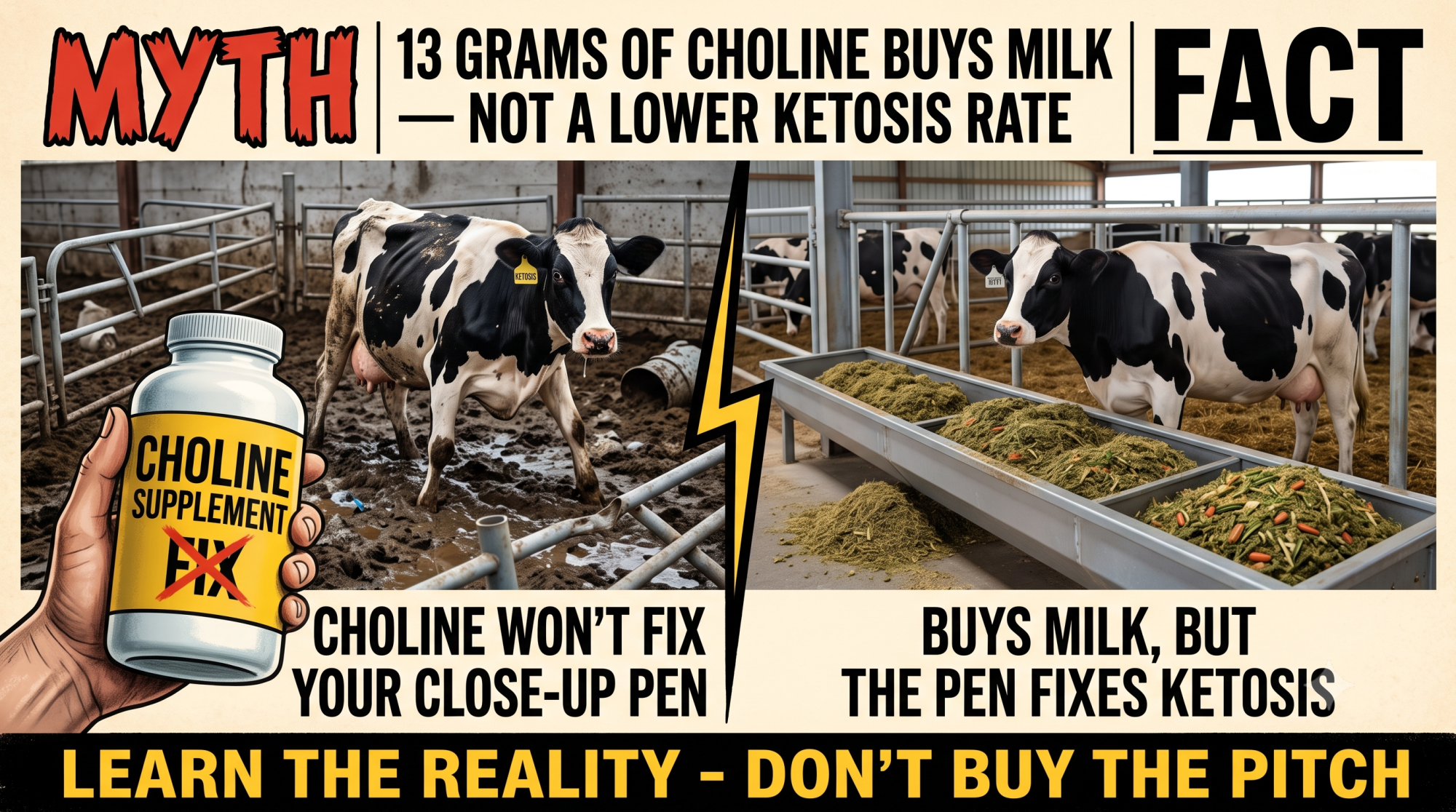
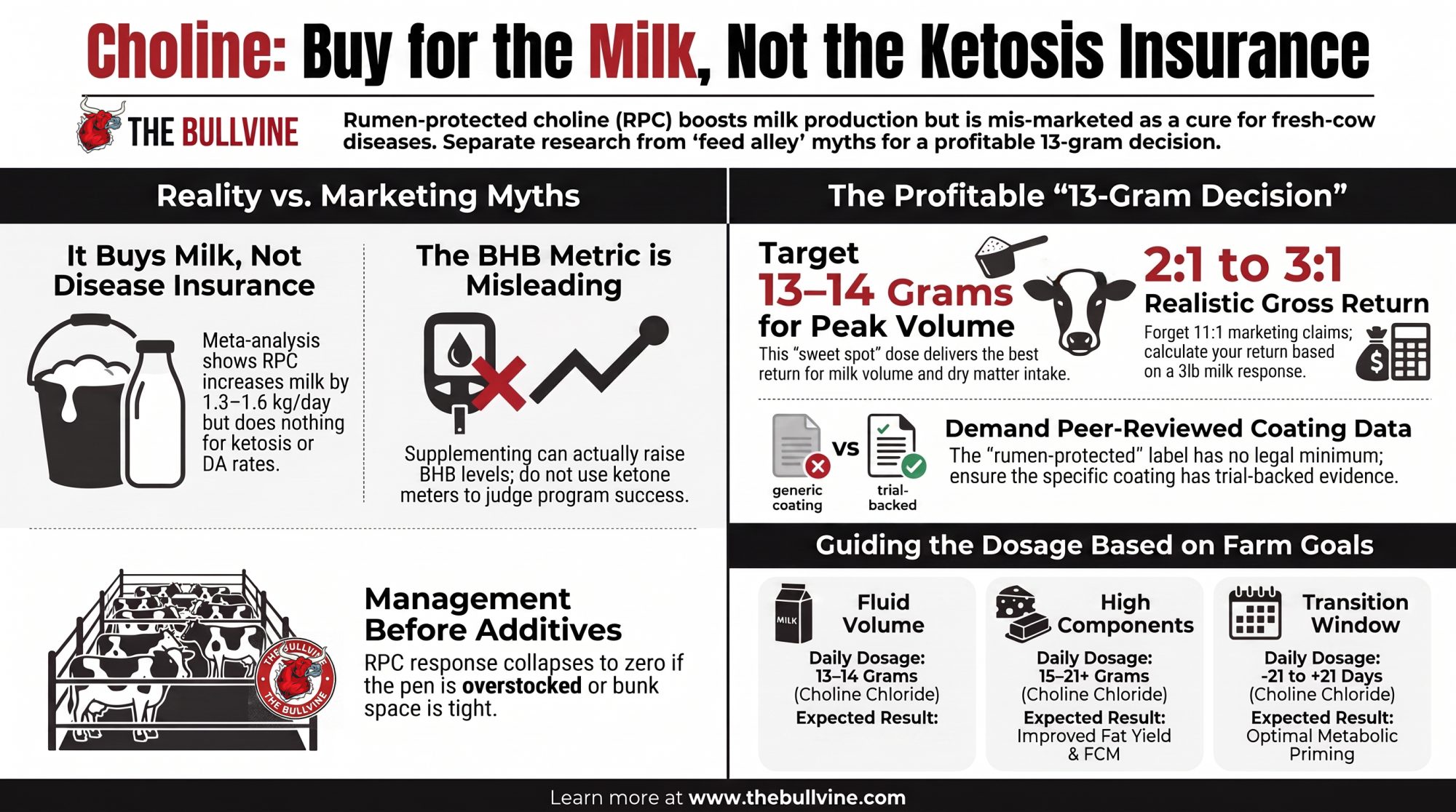
The meta-analysis is blunt: 13–14 grams of rumen-protected choline reliably increases milk production but does nothing for your ketosis or DA rate. Buy it for the right reason — or don’t buy it.
Executive Summary: Rumen-protected choline reliably buys you milk — about 1.3 to 1.6 kg a day at the sweet-spot dose of 13–14 grams — but the biggest meta-analysis we’ve got (21 trials, 1,313 cows) found it does nothing for your ketosis, DA, or milk fever rate. That’s the whole spending decision in one line: buy it for the milk, not as fresh-cow-disease insurance the research won’t underwrite. One 2023 dose study even saw BHB go up in supplemented cows, so your ketone meter won’t tell you whether the program’s working. The honest return is 2:1 to 3:1 gross over product cost on your own numbers — real money, but a long way from the 11:1 that gets quoted. And none of it rescues a close-up pen that’s overstocked, short on bunk space, or drifting positive on DCAD; stack choline on a broken transition and your response collapses to zero while the bag still costs $14.70 a cow. Fix the pen first, then decide if 13–14 grams of a truly rumen-protected product — one with a peer-reviewed trial behind its coating, not just a label claim — earns a spot in your ration.
The 13-gram decision, at a glance: 13–14 g/day choline chloride · +1.3–1.6 kg milk/day (meta-analysis average) · realistic 2:1–3:1 gross return on your own numbers · the window that matters runs −21 to +21 days around calving.
You know the conversation. A producer’s standing in the feed alley with a nutritionist who just said the words “rumen-protected choline.” The pen behind them is overstocked, the close-up DCAD is drifting positive, and bunk space is tight. The pitch sounds good — meta-analysis numbers, an 11:1 ROI, more milk.
But here’s the question nobody in that alley asks first: is choline the best next dollar this farm can spend? Or is it about to get blamed for problems it was never built to solve — a positive-DCAD close-up pen, tight bunk space, cows that were already behind before the additive showed up?
What’s Really at Stake
“Can I afford choline?” is the wrong place to start. The sharper question is whether your herd actually looks like the herds where rumen-protected choline is delivered — and whether you’re buying it for the thing it actually does.
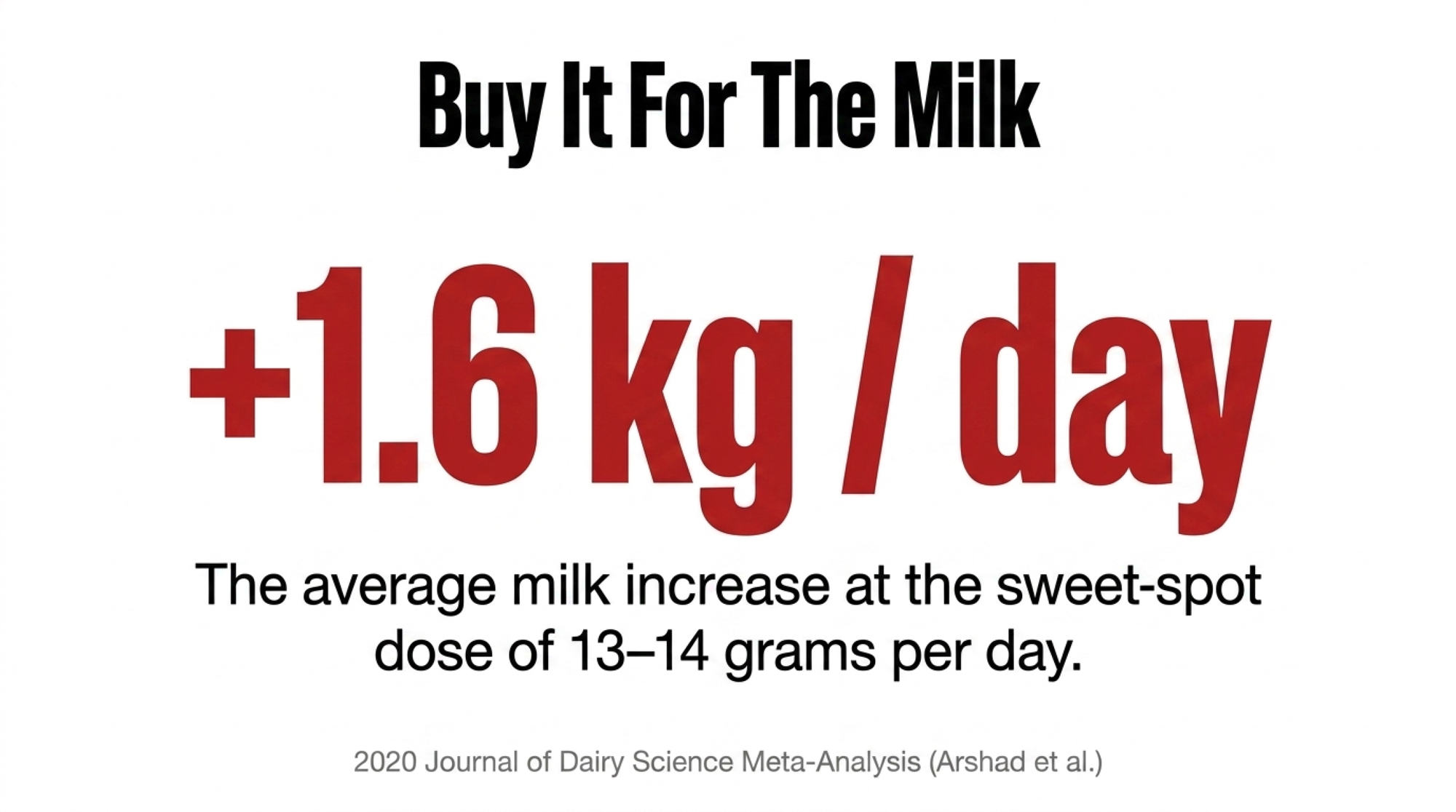
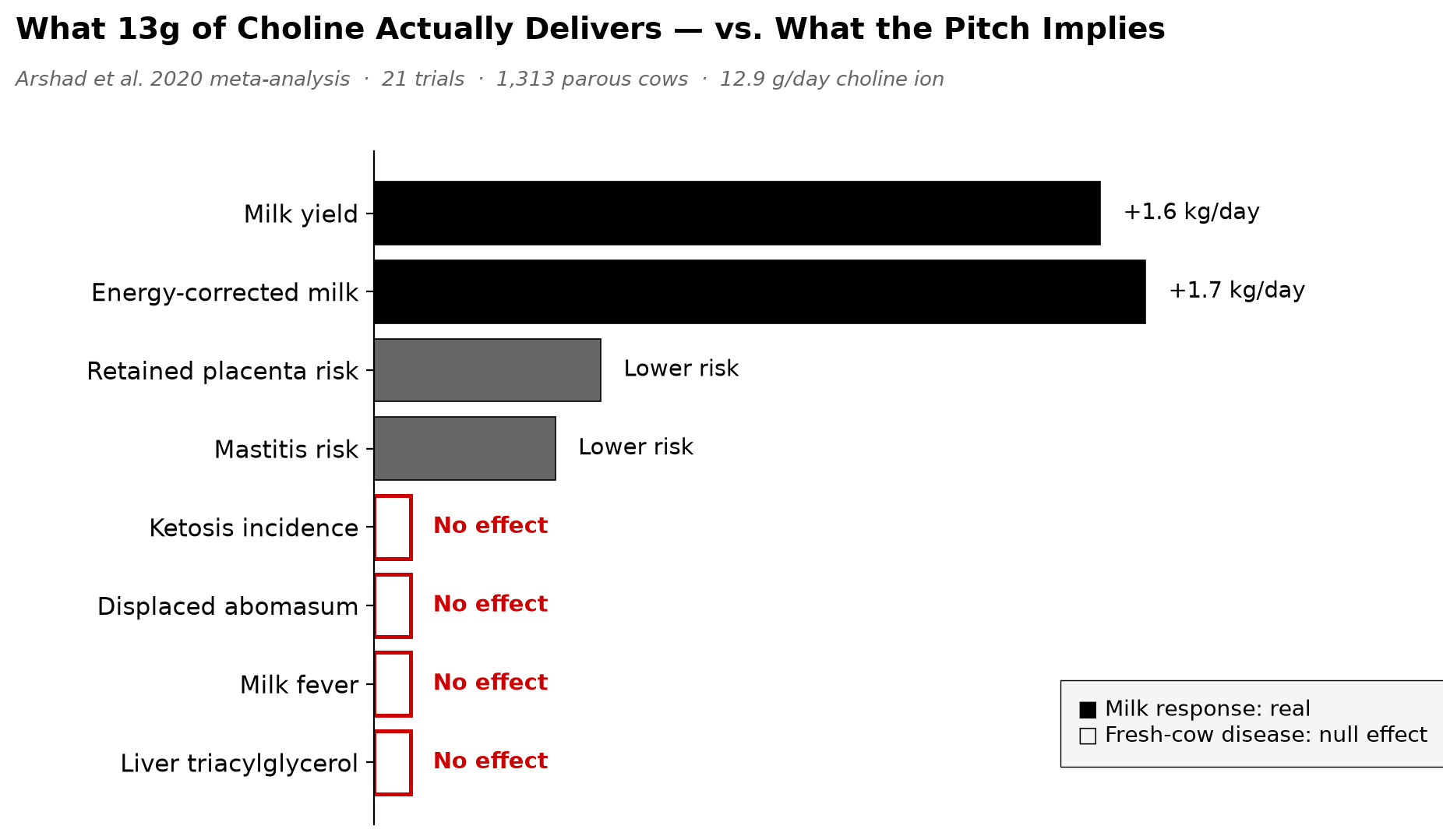
The evidence base is solid, but it’s specific. A 2020 Journal of Dairy Science meta-analysis by Arshad and colleagues pooled 21 trials and 1,313 parous cows, and found that feeding rumen-protected choline at a median 12.9 grams of choline ion per day — from roughly 21 days before calving through early lactation — raised milk yield by about 1.6 kg/day and energy-corrected milk by 1.7 kg/day, and lowered the risk of retained placenta and mastitis. A separate 2025 dose-response meta-analysis in the same journal landed the sweet spot at 13 to 14 grams per day of choline chloride, with milk peaking at +1.29 kg/day (95% CI: 0.17–2.41) and dry matter intake up 0.48 kg/day at that dose.
The catch: those numbers came from controlled research herds. Reasonable bunk space. Sensible grouping. Rations that broadly met requirements. That’s the part the best-case math tends to skip.
This story is for the producer who’s already past the basics — and for the one who isn’t yet, but thinks an additive can paper over the gap.
The Claim That Doesn’t Hold: Choline as a Ketosis Cure
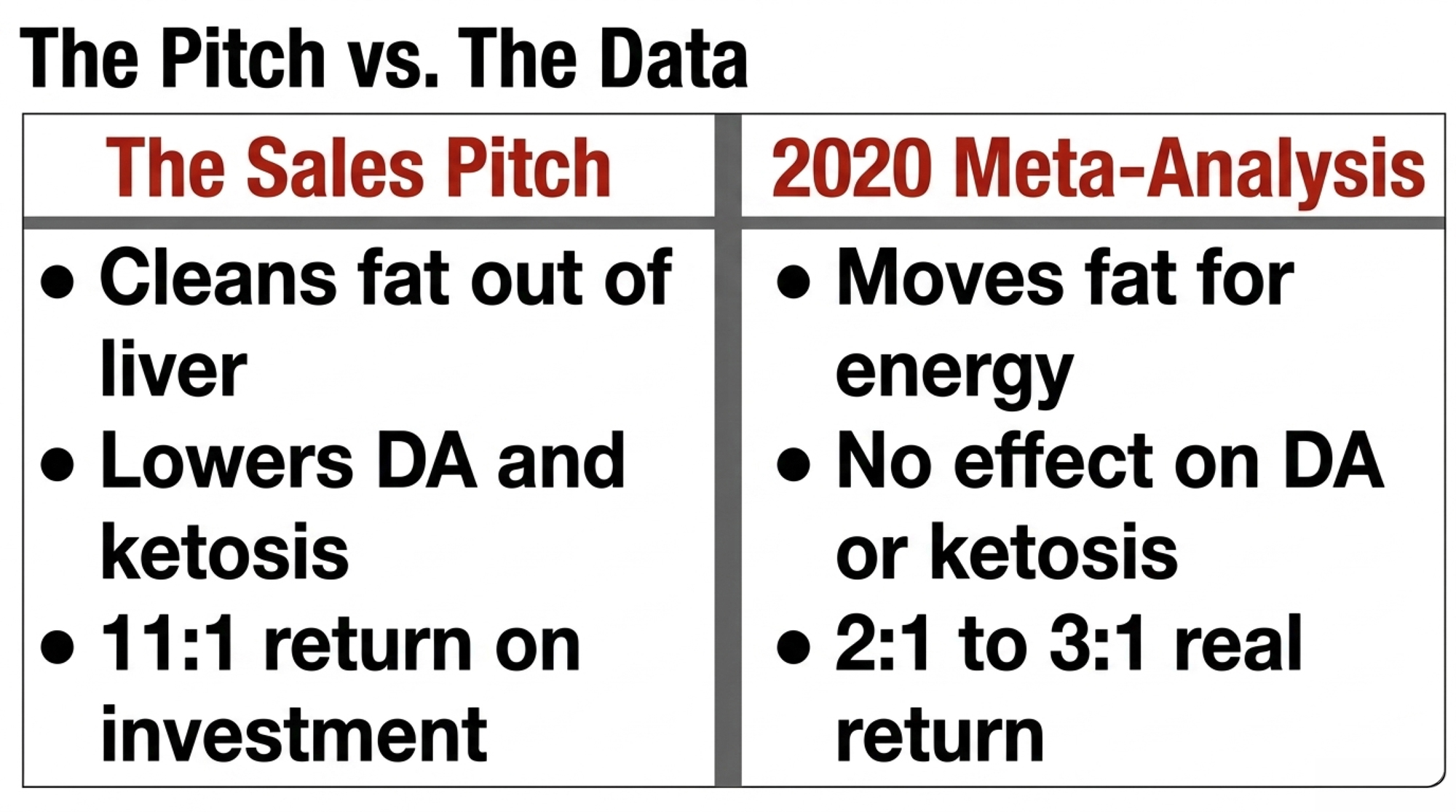
This is where a lot of choline pitches quietly overreach, and it’s worth getting straight before you spend. The sales logic goes like this: choline cleans fat out of the liver, so it must cut your ketosis and displaced-abomasum rates. Intuitive story. The strongest data doesn’t back it.
That same Arshad meta-analysis — 21 trials, the most authoritative pool we’ve got — found no significant effect of rumen-protected choline on the incidence of ketosis, displaced abomasum, or milk fever, and no significant change in postpartum liver triacylglycerol. The milk response was real and repeatable. The “fewer sick fresh cows” response, on the metrics that matter most, wasn’t. So if your fresh pen is lighting up with clinical and subclinical ketosis, choline is not the fix. That’s a transition-management problem — energy density, intake, grouping, body condition — and an additive layered on top won’t rescue it. Buy choline for the milk. Don’t buy it as ketosis insurance the research won’t underwrite.
Why the Liver Still Matters — and Where Choline Fits
The liver story is real; it’s just narrower than the pitch. In late gestation, the cow’s dry matter intake falls while her energy demand climbs. She mobilizes body fat, and it lands in the liver as non-esterified fatty acids. The liver repackages that fat into very-low-density lipoproteins — VLDL — and ships it back out for energy and milk. University of Georgia extension reviewed the same mechanism in March 2026: choline supports the phosphatidylcholine the liver needs to build those VLDL particles and move fat out.
The dairy cow is genuinely poor at exporting VLDL compared to other species, so that pathway is a real bottleneck. Choline helps open it. What the meta-analysis tells us is that opening it reliably produces more milk — but doesn’t reliably show up as lower measured liver fat or fewer ketosis cases across trials. The mechanism is sound. The downstream disease claims just outran the data.
Read it straight: choline buys you milk and a smoother metabolic transition. It does not buy you a guaranteed drop in your ketosis or DA rate. If a rep promises the second thing, ask for the trial.
The BHB Surprise: It Can Go Up, Not Down
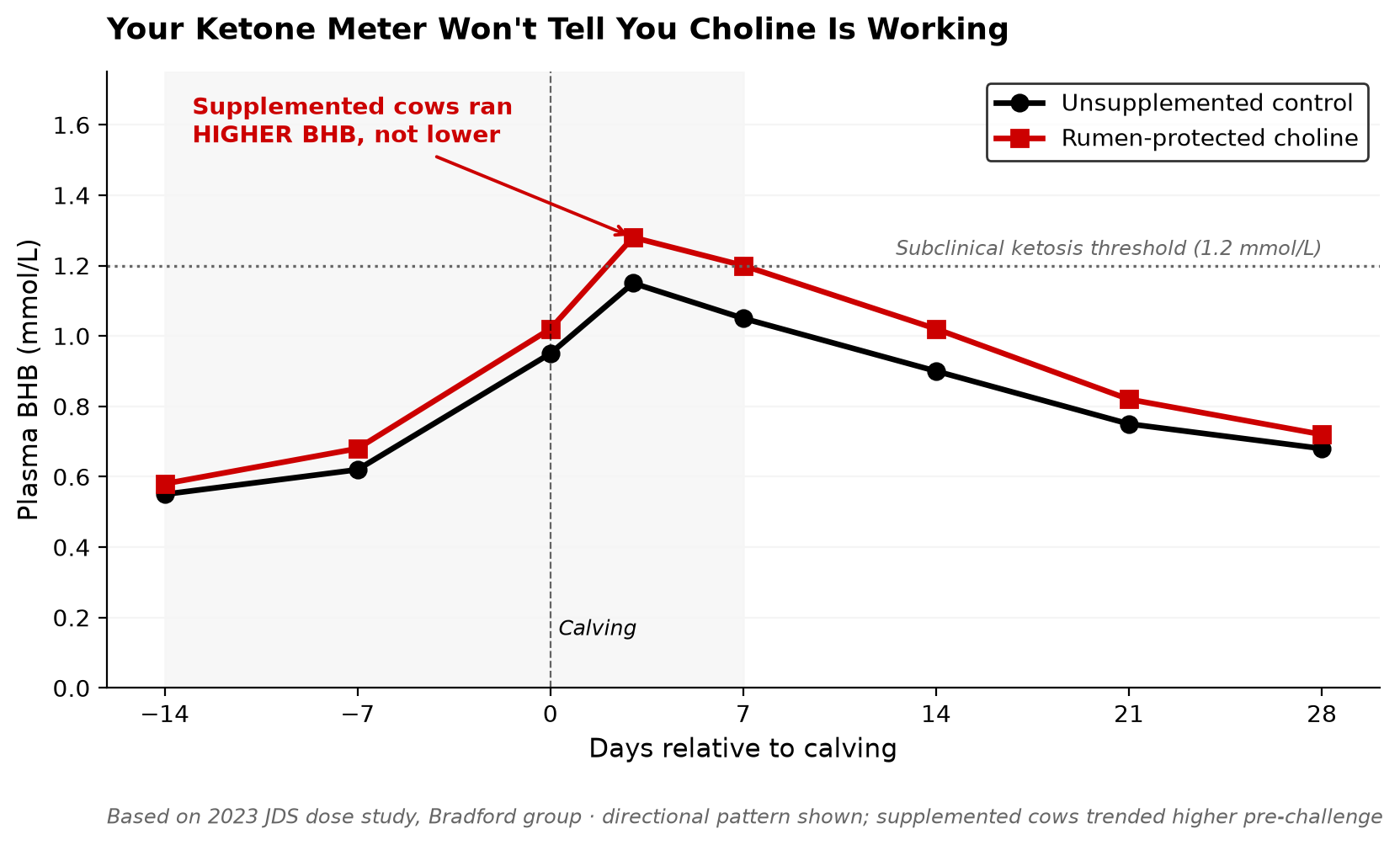
Here’s the finding that should retire the “choline lowers your BHB” talking point for good. A 2023 Journal of Dairy Science dose study from Bradford’s group didn’t just fail to lower blood ketones — supplemented cows showed higher plasma BHB in a pre-challenge window, and the authors concluded the milk benefit was metabolic and “unlikely to be related to resolution of inflammation”.
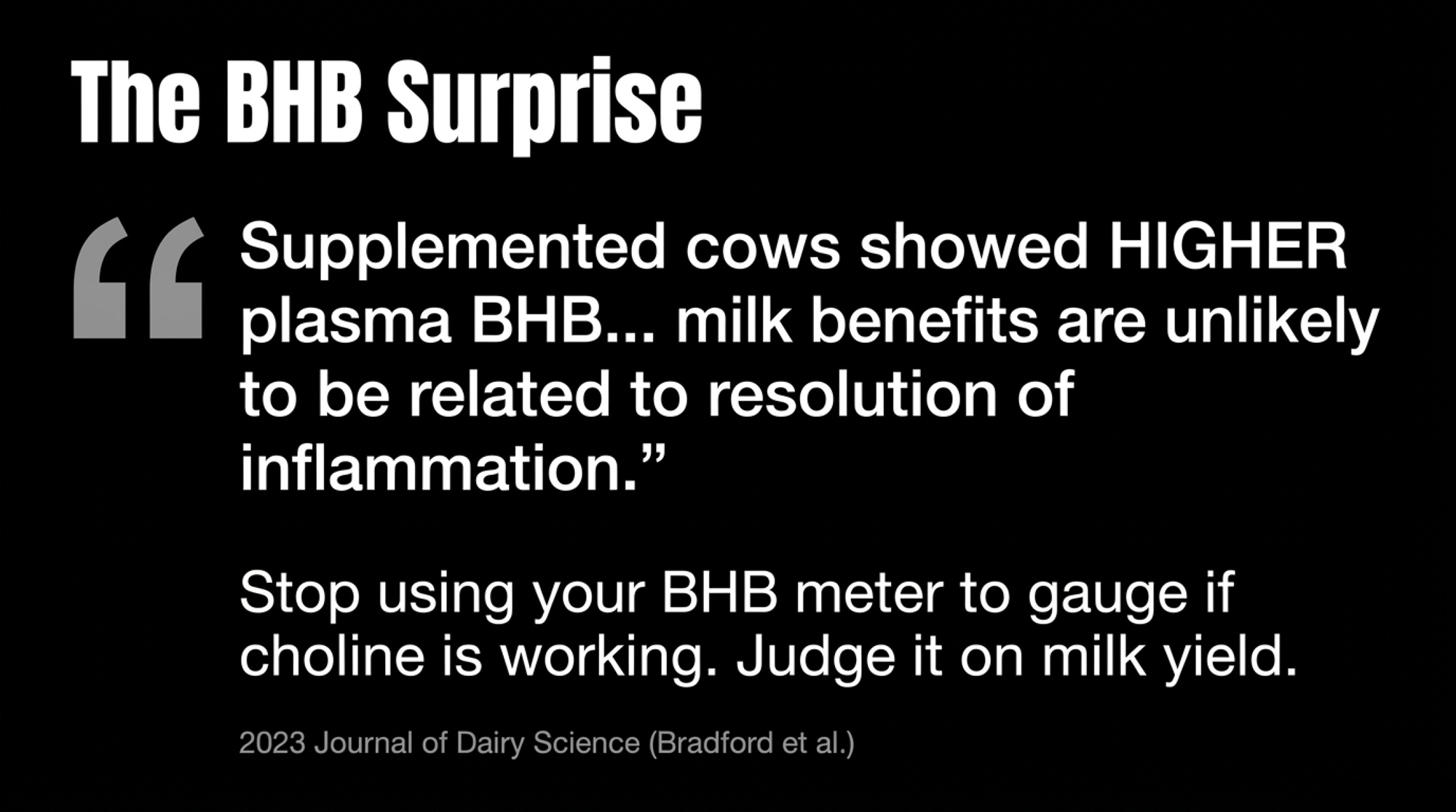
Sit with that. The nutrient marketed in part as a liver-and-ketone helper raised the very number some folks expect it to lower, in at least one careful dose study. That doesn’t make choline a bad buy. It makes the simple “choline = lower BHB” story wrong, and it means you can’t use your BHB meter to tell whether your choline program is “working.”
The inflammation and immune-function angle reads the same way: mixed. Some work suggests choline modulates inflammatory and immune markers around calving; the most directly on-point dose study points instead to a metabolic mechanism and away from inflammation resolution. Bet on choline for an anti-inflammatory effect, and you’re betting ahead of the evidence.
The Methionine Question Almost Nobody Asks
Producers get tripped up here before they even reach the product shelf. If you’re already feeding rumen-protected methionine, you’ve got a different choline math problem than your neighbor who isn’t.
Methionine and choline aren’t the same lever. Choline works mainly as a lipotropic nutrient — it supports the phosphatidylcholine the liver needs to package fat into VLDL and ship it out. Methionine does different work: it drives milk protein yield and feeds the cow’s antioxidant and methylation systems. Complements, not substitutes. (For the wider methionine and one-carbon picture, see The Bullvine’s transition nutrition coverage.)
But the Arshad meta-analysis found something a methionine herd needs to hear. The choline milk response trended smaller at higher dietary methionine concentrations. Still positive — just smaller. The honest framing: choline still earns its keep on top of methionine in most herds, but the incremental pounds shrink, and the only way to know your number is to run it on your own ration — not borrow your neighbor’s.
Don’t Buy a Label, Buy a Delivery System
Say the producer decides choline pencils out. Now they’re staring at bags that all claim roughly the same thing. This is where it gets murky fast.
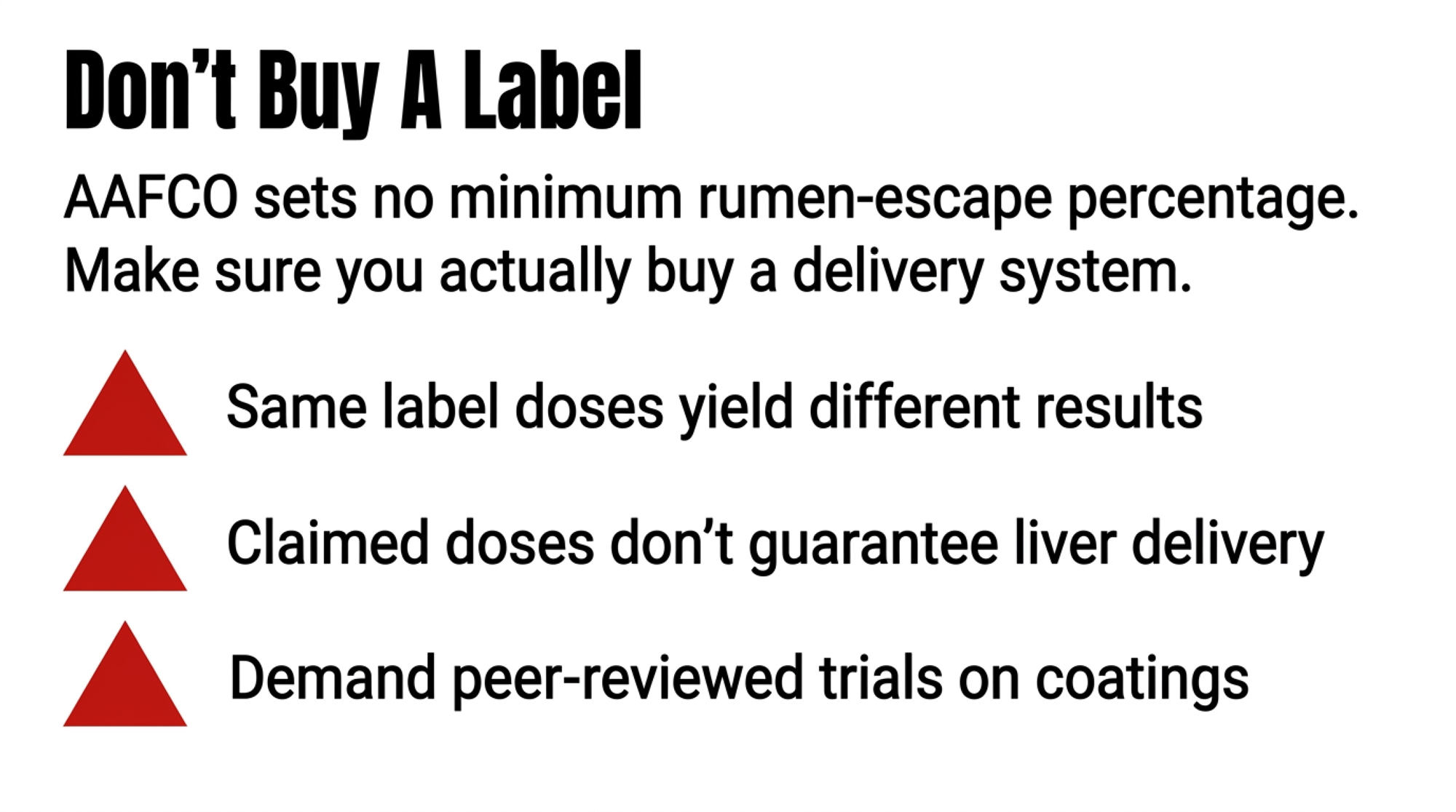
Choline gets destroyed in the rumen unless it’s protected — that’s the whole point of the “rumen-protected” label. And here’s the loophole worth understanding. AAFCO does define “rumen protected” — a nutrient “that does not result in a change in rumen fermentation parameters yet is available to the animal in the intestine”. But the definition attaches no minimum rumen-escape percentage, as The Bullvine has reported. A product can call itself “rumen-protected” whether it delivers 70% of its choline past the rumen or a fraction of that. There’s no floor to clear and no requirement to print the one number that decides whether the cow ever sees the dose on the tag.
The label tells you what’s in the bag. It tells you nothing about what reaches the liver. Two products at the same declared dose can deliver very different amounts of choline to the cow.
A 2025 study in the Italian Journal of Animal Science (Sáinz de la Maza-Escolà and colleagues) put that gap to the test with 24 multiparous Holsteins, comparing two commercial products — one microencapsulated at 25% choline chloride, one fluidized-bed coated at 60% — both formulated to deliver 15 grams per day of choline chloride from 21 days pre- to 35 days post-calving. Same label dose. The researchers reported no overall difference in milk yield or ECM, with a treatment-by-time interaction suggesting the two sources differed in feed efficiency and production patterns. With only 24 cows and no overall effect, they frame it as a signal, not a ranking — and both products are commercially used with their own data behind them. The practical point holds: identical label doses don’t guarantee identical results in the cow.
| Product attribute | Product A (microencapsulated) | Product B (fluidized-bed coated) | What it means for the cow |
| Choline chloride concentration in product | 25% | 60% | Higher % lets you feed less product for the same label dose |
| Label dose to deliver 15 g/day choline chloride | 60 g/head/day | 25 g/head/day | Same target on paper — very different bag draw |
| Rumen-escape rate disclosed on label | Not disclosed | Not disclosed | AAFCO sets no minimum floor — “rumen-protected” is a claim, not a number |
| Peer-reviewed trial on this coating technology | Required — ask supplier | Required — ask supplier | If they can’t produce one, you’re buying marketing, not liver protection |
| Observed milk-yield difference at 15 g/day (Sáinz de la Maza-Escolà 2025, n=24) | No overall difference reported | No overall difference reported | Signal, not a ranking — but identical label doses don’t guarantee identical results |
| Practical grams choline reaching the intestine | Unknown without trial data | Unknown without trial data | The one number that decides whether the cow ever sees the dose |
The walk-away signal is simple. If a supplier can only show you generic “choline works” literature with no named, peer-reviewed trial on their coating technology, at a dose and window resembling your herd, you’re relying on a marketing claim, not a tested result. (For the full breakdown of how coating technology changes what reaches the liver, see The Bullvine’s Rumen-protected choline: the delivery number suppliers hide.)
More Isn’t Better — Unless You’re Paid on Components
If 13 grams is good, is 20 better? Mostly no — and that’s a useful guardrail when a rep starts talking about loading the ration.
The 2023 dose study from Bradford’s group found no milk-yield bump from pushing rumen-protected choline above standard feeding rates. The cow appears to use choline up to the point where her VLDL-export and methyl-donor systems are satisfied, and past that, extra grams mostly cost money for milk volume. But there’s a nuance worth knowing. Dellait’s December 2025 analysis notes that while milk yield peaks at 13–14 g/day, fat-corrected milk kept climbing at 15–21 g/day — over 2 kg/day more FCM — with fat yield improving up to about 24 g/day.
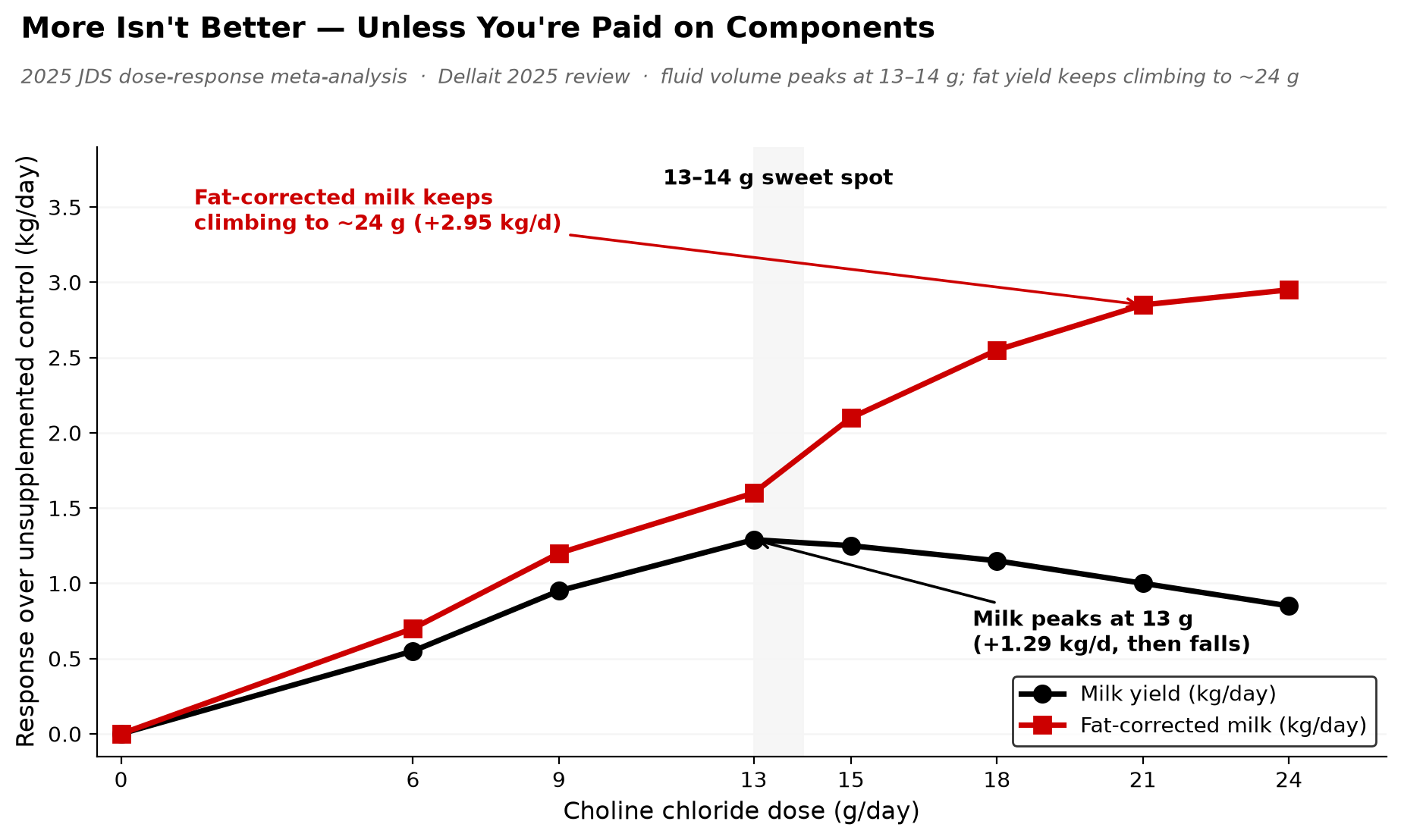
So the dose answer depends on your milk check. If you’re paid heavily on components, a higher dose might pencil. For fluid volume, 13–14 grams is the sweet spot. Either way, the target isn’t “as much as the budget allows” — it’s “enough to clear the bottleneck, in a form that actually reaches the liver, across the whole window,” set against how your milk gets paid.
The 11:1 ROI Is a Best-Case Thought Experiment
That 11:1 number gets thrown around like a law of physics. It isn’t. It’s a model, and it breaks the moment you change one input.
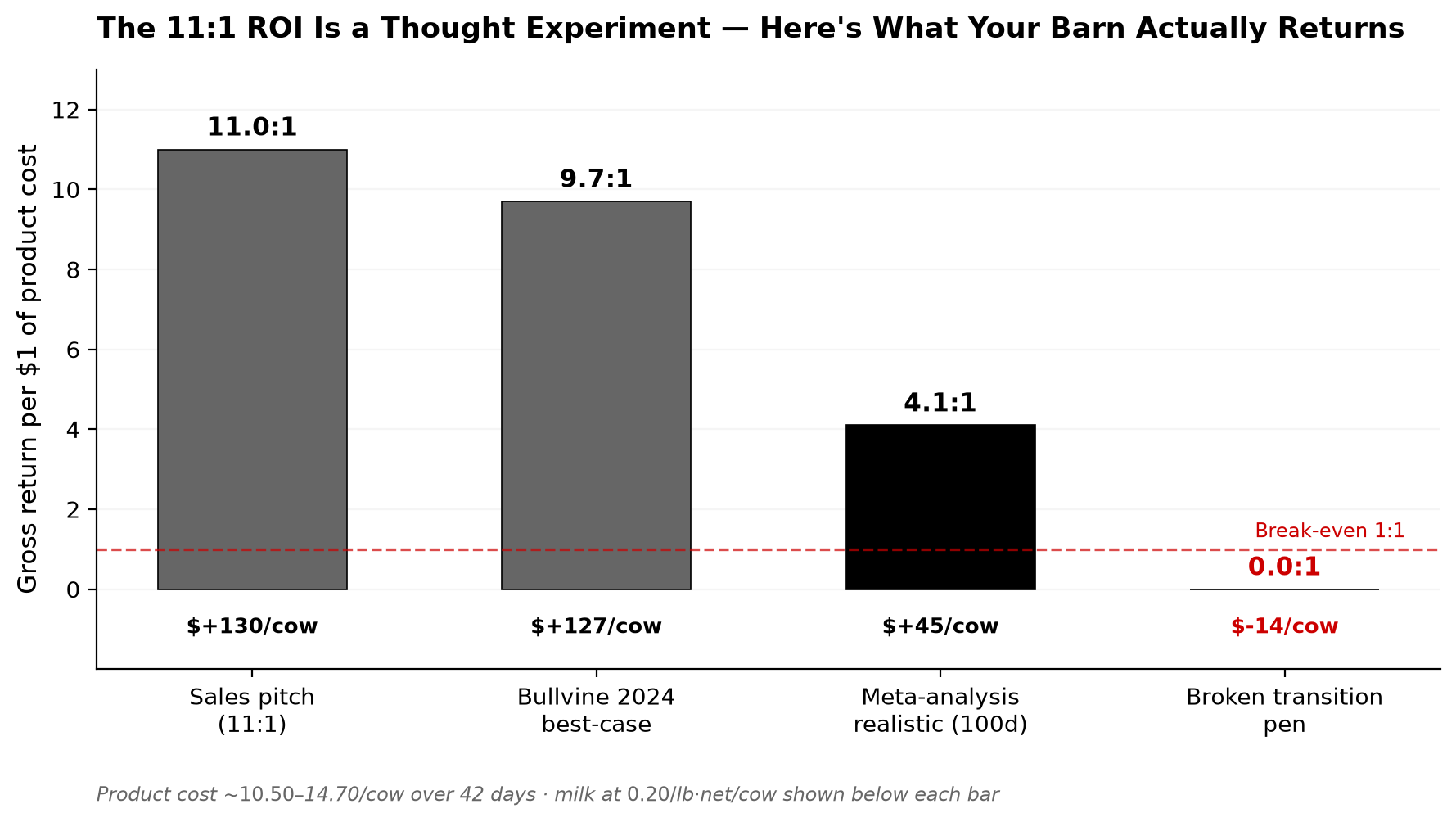
The Bullvine’s own 2024 example assumed about $14.70 per cow for a 42-day program and up to $142 per cow in extra milk revenue — which only works if you stack a roughly 4 lb/day response across about 25 weeks at around $20/cwt (USD, U.S. component pricing). Run the arithmetic and even that pencils closer to 10:1 — a reminder of how loosely the headline ratio gets quoted. Dellait’s December 2025 analysis in Feed & Additive Magazine is more conservative: at 13–14 g/day, cows ate about 0.5 kg more dry matter and gave about 1.3 kg (2.9 lb) more milk per day.
Here’s the barn math, run off the meta-analysis average rather than a best-case projection. Take 1.6 kg ≈ 3.5 lb/day of extra milk. At about $0.20/lb milk and roughly $0.25–$0.35/day in product, that’s $0.70/day in revenue — a gross return in the 2:1 to 3:1 range over product cost, before you net out the extra half-kilo of intake. Real money. But a long way from 11:1.
Run It On One Pen, Start to Finish
Generic ratios don’t pay bills, so walk a single group through the whole window. The numbers below are an illustrative worked example, not a specific farm’s results — but every input is anchored to the sourced figures above, so you can drop in your own and see where you land.
Say you feed choline across the 42-day transition — 21 days before, 21 after — to the cows freshening this month. At roughly $0.25 to $0.35 a day, that’s about $10.50 to $14.70 per cow in product before she ever hits the parlor with the supplement on board.
Now the return side, kept deliberately conservative. Use the meta-analysis midpoint of about 1.3 to 1.6 kg — call it 3 lb of extra milk a day. Hold it for just the first 100 days, ignore any carryover past that, and price milk at $0.20/lb. That’s $0.60/day, or roughly $60 over 100 days, against your $10.50 to $14.70 cost. Net her out and you’re near $45 to $50 a cow, this lactation, on the cautious end.
Push it across 30 cows freshening in a month, and you’re spending roughly $315 to $440 to generate about $1,800 in extra gross milk revenue over those cows’ first 100 days — call it $1,400 net of product. That’s the case for trying it. The case for caution sits right beside it: that whole calculation assumes you actually capture the meta-analysis response. Stack it on a heat-stressed, overstocked close-up pen and your real-world number can collapse to zero — while the bag still costs full price.
The Window You Can’t Make Up Later
Timing is where a lot of choline money gets wasted. The response in the literature comes from feeding across the transition — roughly 21 days pre-fresh through 21 to 35 days in milk. Dellait’s review makes the point bluntly: feeding choline before calving alone didn’t change intake — it’s the consistent feeding through early lactation that pays off. Start late, after she’s already calved, and you’ve missed the priming. Stop early, the day she leaves the fresh pen, and you cut off the tail of the response.
This is the practical trap on farms running a single close-up group with constant turnover. A cow that lands in the pen 10 days before calving instead of 21 gets barely half the priming dose, and nobody notices because she’s in the “choline pen” on paper. If your grouping or pen moves can’t reliably deliver three weeks of pre-fresh supplementation, you’re paying for a 42-day program and feeding something shorter. Fix the pen flow before you blame the additive.
The Colostrum Angle — Promising, but Don’t Overcount It
There’s one more output people rarely put in the spreadsheet: colostrum. Some research has reported meaningful colostrum-yield increases from prepartum choline — more volume at the same quality means more passive immunity to transfer to the calf. A genuine second dividend, if it holds on your farm.
But hold it loosely. A 2026 study evaluating rumen-protected choline from 21 days pre-calving through 28 days postpartum found the lactation and metabolic effects without a clear, consistent boost to colostrum IgG or calf growth. So the colostrum and calf-side benefits are plausible and worth watching — not a number to bank in your ROI math yet. Want to know if it’s real in your barn? Measure colostrum volume and Brix on a treated group before you credit it.
What This Means for Your Operation
Choline is a scalpel, not a bulldozer. Before you spend a dollar, find your herd in one of these groups — then follow the integrity rule no matter which one you land in.
| Herd profile | Buy choline now? | Target dose | Next 30-day action | Realistic return |
| Fundamentals-first — close-up pen >100% stocked, bunk <30 in/cow, DCAD drifting positive, subclinical ketosis >15% of fresh cows | No — fix pen first | N/A until management fixed | Pull fresh-cow BHB logs; identify real subclinical ketosis rate | ≈$0/cow — response collapses on broken transition |
| Fine-tuning — stocking, bunk space, DCAD, and methionine dialed in | Yes — with verified coating | 13–14 g/day (or 15–21 g if paid on components) | Request peer-reviewed trial on the supplier’s specific coating technology | $45–$50/cow net over first 100 DIM |
| Progressive evaluator — can track discrete fresh pens and run trials | Yes — split-group trial | 13–14 g/day across −21 to +21 window | Run a phased trial; measure milk to 60 DIM, weigh and Brix colostrum on treated group | Farm-specific — judge on milk yield, not BHB |
| Any of the above using a product with no named coating trial | No — that’s marketing, not liver protection | N/A | Ask the supplier for the peer-reviewed dose study on their coating | Unknown — you’re buying a label, not a delivered dose |
The Fundamentals-First Herd (high transition turbulence). If your close-up pen runs over 100% stocked, bunk space is under 30 inches per cow, or DCAD is drifting positive, don’t buy choline yet. Pull your fresh-cow BHB logs this month and find your real subclinical ketosis rate — if more than about 15% of your fresh cows test above 1.2 mmol/L in the first two weeks, you’ve got a transition problem an additive can’t touch. The Bullvine’s reporting on subclinical ketosis hiding in “good” herds shows how far guesses drift from the meter. And remember: choline won’t pull that number down — the meta-analysis found no ketosis effect. Fix the management first.
The Fine-Tuning Herd (dialed-in management). If stocking, bunk space, and methionine are already handled, layering 13–14 grams of true rumen-protected choline across the window is your next logical step — bought for the milk, 2:1 to 3:1 gross over product cost, with the response shrinking the more methionine you already feed. Paid hard on components? Talk to your nutritionist about whether 15–21 g pencils for fat-corrected milk. (For the wider margin picture, see The Bullvine’s transition cow economics coverage.)
The Progressive Evaluator (split-group testing). For operations that can track discrete fresh pens: run a phased trial across the exact 42-day window (−21 to +21). Watch early-lactation milk out to 60 DIM, and if you’re curious about the colostrum angle, weigh and Brix-test it on the treated group. Judge it on milk, not on BHB — that gauge can move the wrong way.
The integrity rule for all three: if a supplier can’t show a named, peer-reviewed study on their specific coating technology at a 13–14 gram dose across the transition window, you’re buying a marketing story, not a liver-protection strategy.
Key Takeaways
- If you’re buying choline to cut your ketosis or DA rate, stop — the strongest meta-analysis found no effect on either; buy it for the milk.
- If you use BHB to judge whether choline is “working,” switch metrics — one dose study found supplemented cows ran higher BHB, not lower. Judge it on milk yield.
- If your close-up pen is over 100% stocked or under 30 inches of bunk, fix that before you spend — an additive can’t out-run social stress and sorting.
- If you already feed rumen-protected methionine, model choline on your own ration — the response is real but shrinks as methionine rises.
- If you’re paid heavily on components, ask about 15–21 g — milk volume peaks at 13–14 g, but fat-corrected milk kept climbing higher.
- If a product can’t show a peer-reviewed trial on its own coating technology at 13–14 g, treat the label as marketing — “rumen-protected” carries no legal escape-rate floor.
- In the next 30 days, pull your fresh-cow BHB logs and find your real subclinical ketosis rate — then decide whether choline, or better transition management, is your best next dollar.
Walk back to that feed alley. The pitch hasn’t changed, but your approach should. Rumen-protected choline reliably buys more milk for parous cows in a sound system — and just as reliably won’t rescue a pen that’s failing for other reasons. So the real question isn’t “can I afford choline?” It’s whether you’ll treat those six transition weeks as the capital project they are, and buy the additive for what it actually does — not what the brochure wishes it did.
Pour the concrete first. Then reach for the precision tools.

Run Your Numbers
Health ROI Calculator — This article says choline won’t cut your ketosis or DA rate, so fix the transition problem first. Run your culling rate, mastitis incidence, and replacement cost through the Health ROI Calculator to see whether the management fix — not the additive — is where your real fresh-cow money is hiding.
Complete references and supporting documentation are available upon request by contacting the editorial team at editor@thebullvine.com.
Learn More
- Rumen-protected choline: the delivery number suppliers hide — Arms you with the specific math needed to calculate cost per gram of actual absorbed nutrient, exposing how low-efficiency coatings bleed your wallet while hiding behind generic label claims.
- Dairy Cow Nutrition 2026: Ration Formulation, Forage Quality & Feed Efficiency — Delivers the long-term strategic benchmarks for building a foundational transition diet, focusing on the latest NASEM requirements, starch tiers, and fiber restrictions that decide peak lactational volume.
- Stop Throwing Away $48,000 Per Year: How Smart Dairy Operators Are Turning Cow Burps into Cold Hard Cash — Exposes the disruptive, high-return potential of next-generation synthetic feed additives, dismantling traditional “natural is better” assumptions by documenting a clear
return on investment in commercial herds.
The Sunday Read Dairy Professionals Don’t Skip.

Every week, thousands of producers, breeders, and industry insiders open Bullvine Weekly for genetics insights, market shifts, and profit strategies they won’t find anywhere else. One email. Five minutes. Smarter decisions all week.