




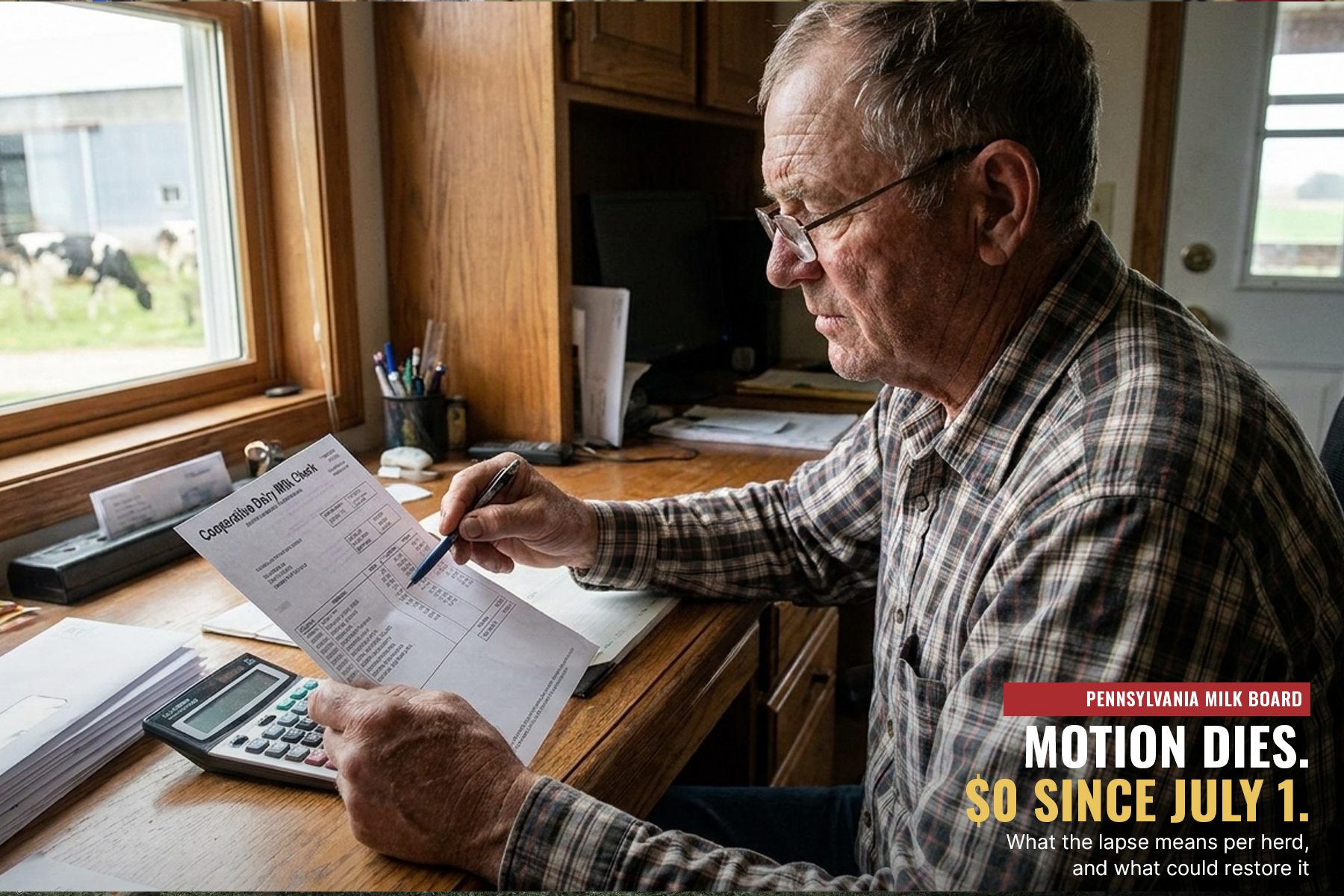
June’s combined premium rate was $1.16/cwt. The rate has been zero since July 1, and an October 7 motion to schedule a new hearing failed to win a second. The board’s next regular meeting is November 4.
Key Takeaways
- October 7 didn’t cancel a new premium or bring back the old one. A-1022 had already expired June 30, and the hearing motion went nowhere.
- Board hearing records include testimony from Grange President Matt Espenshade that his statement lines showed 12, 14 and 13 cents/cwt while the base premium was $1.00. Bullvine’s cooperative-level benchmark, built on the board’s finding that 30–35% of his co-op’s milk is Pennsylvania Class I, is roughly 38–44 cents on the combined rate. That gap needs explaining. It isn’t proof of loss.
- Restoring a $1 base wouldn’t restore June’s check. Of June’s $1.16 combined rate, 66¢ (57%) was diesel add-on, which pays nothing while diesel averages below $2.70.
- SB 689 sets no rate and doesn’t require direct payments to farmers. Its committee-review language raises an open question about how it would work. Even a fast rollout would still need enactment, board action, committee review and publication.
What happened at the October 7 meeting
The Pennsylvania State Grange, led by President Matt Espenshade, asked the Pennsylvania Milk Board (PMB) to hold another over-order premium hearing. Lancaster Farming described the request as covering “an unspecified period.”
The request came up as new business at the board’s October 7 meeting. Chairman Rob Barley moved to hold the hearing. Board members Jim Van Blarcom and Kristi Harper, the consumer member, declined to second it. Lancaster Farming reported that the board “rejected the State Grange’s petition.” The board didn’t vote to set a zero rate. The rate was already zero.
Lancaster Farming’s report doesn’t record a reason from Van Blarcom or Harper for declining to second the motion. Their earlier positions, set out below, are background. They don’t explain what either member was thinking on October 7.
A-1022 expired on June 30 with nothing to replace it, and that won’t change without a new hearing and order. PMB chief counsel Doug Eberly explained the rule in June: “Issuing an order requires two members to agree on the terms.” Lancaster Farming reported that premium hearings “have customarily been held at six-month intervals as requested by Grange.”
As of October 9, PMB’s public-hearings page listed no further over-order premium hearing. The only one listed was June 3, 2026. The board’s next regular meetings are November 4 and December 2, so it has two scheduled chances before January 1.
General Order A-1022 set the base at $1.00/cwt for January through March 2026 and 50 cents for April through June, with a diesel add-on on top. The industry remains split over who benefits, as the section on the board’s split below lays out.
The lack of an order doesn’t establish a statewide dollar loss. Every farm figure below is an illustrative benchmark, not a payment owed.
What the expired premium meant on a milk check
A-1022 required the premium to appear as a line item on producer statements. General Order A-999, in effect since October 2017, ties the diesel add-on to the EIA’s average retail on-highway diesel price for the Central Atlantic region. The add-on is $0.00 while the monthly average is below $2.70 a gallon. It adds 2 cents/cwt for each 10-cent bracket above that, so $2.70–$2.799 pays 2 cents, $2.80–$2.899 pays 4 cents, and so on. The premium applies only to Class I milk produced, processed and sold in Pennsylvania.
A-1022 sets the base premium, and A-999 governs the diesel add-on. PMB’s producer price schedules report the two as one combined premium and give the fuel adjustment separately in a footnote.
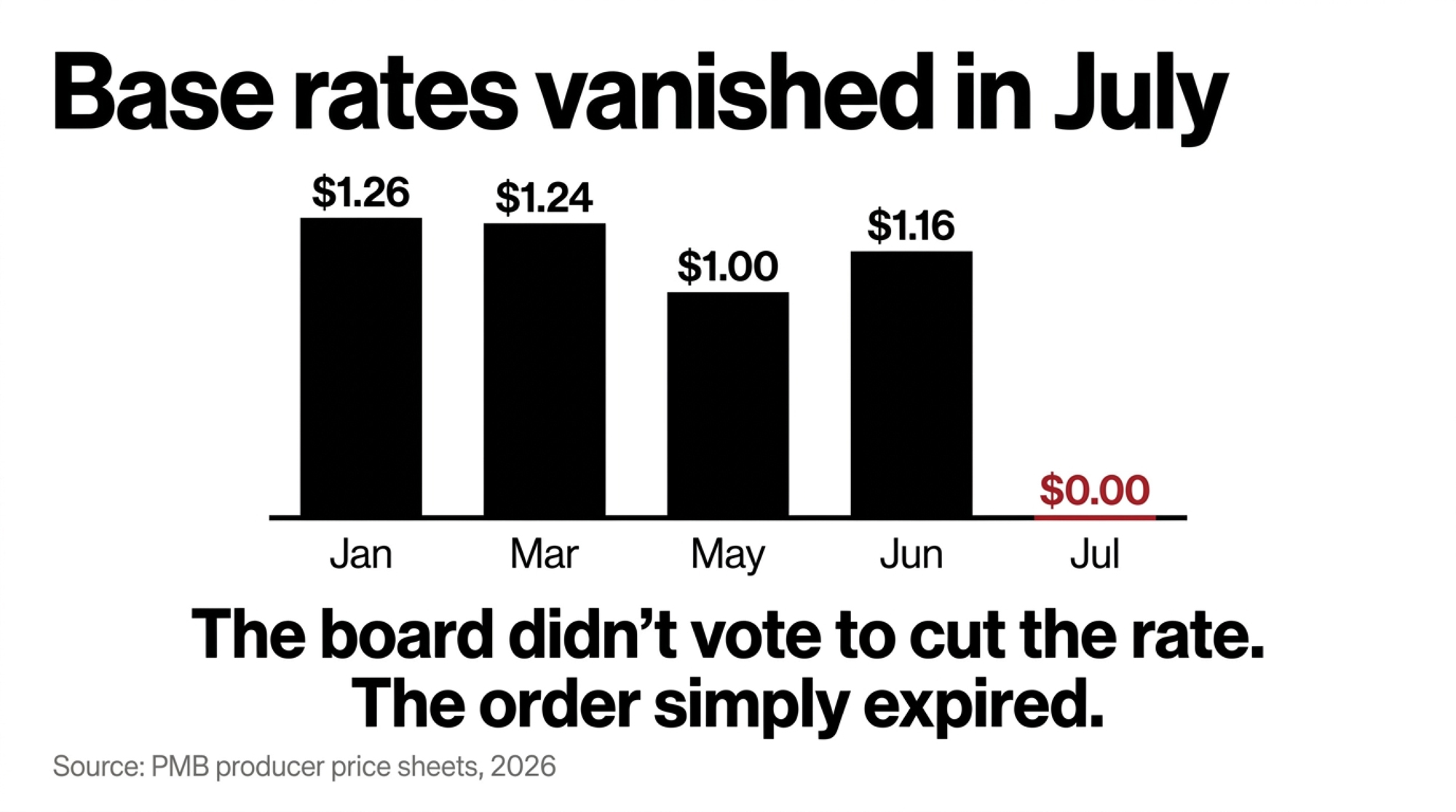
| Milk month | Base rate (A-1022) | Diesel add-on (A-999) | Combined rate |
| January | $1.00 | $0.26 | $1.26 |
| February | $1.00 | $0.26 | $1.26 |
| March | $1.00 | $0.24 | $1.24 |
| April | $0.50 | $0.28 | $0.78 |
| May | $0.50 | $0.50 | $1.00 |
| June | $0.50 | $0.66 | $1.16 |
| July–September | $0.00 | $0.00 | $0.00 |
Sources: PMB producer price sheets for January, February, March, April and June 2026; A-1022 base rates. May per June 19, 2026. These are official rates, not payments received.
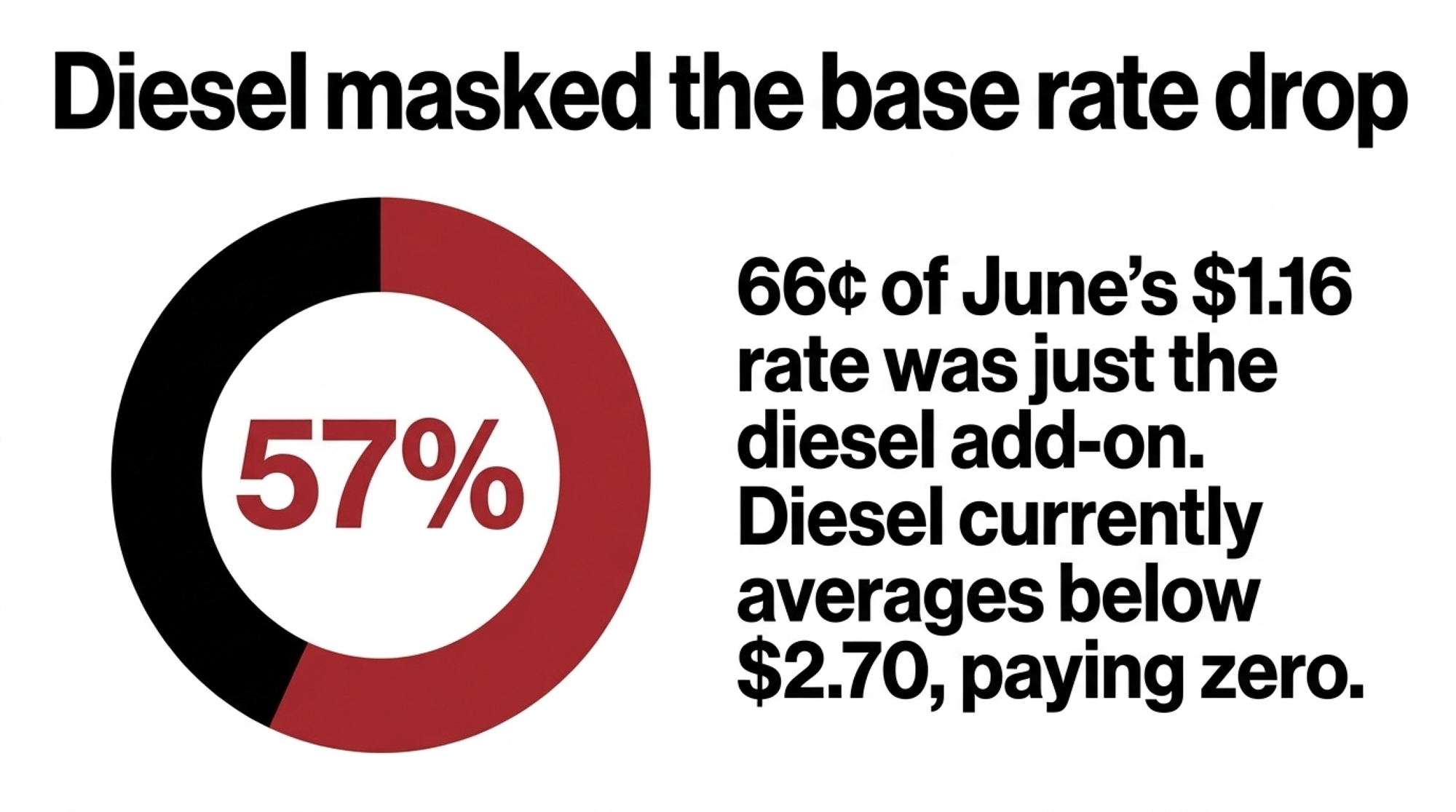
Eberly explained that no diesel add-on applies without an order. In June, the add-on made up 57% of the $1.16 combined rate (Bullvine calculation: $0.66 ÷ $1.16).
How much could the expired premium have paid herds of different sizes?
Running the Numbers: illustrative scenarios, not amounts owed
Published evidence
- June 2026 combined rate: $1.16/cwt (PMB June 2026 producer price sheet).
- Espenshade’s January–March 2026 statement lines averaged 13 cents/cwt, per his June 3 testimony.
- About 30–35% of his cooperative’s milk goes to Class I plants and is sold in Pennsylvania (A-1022 findings).
Stated assumptions
- 75 lb/cow/day over July 1–September 30 (92 days).
- June’s combined rate held flat, although no order set July–September rates.
Bullvine math for a 300-cow herd
- Milk shipped: 300 × 75 × 92 ÷ 100 = 20,700 cwt.
- At the historical 13-cent statement line: $2,691.
- If 30% of the milk qualified at $1.16: 30% × $1.16 = $0.348/cwt, or $7,204.
- Upper bound, if every cwt passed the in-state test: $24,012.
| Herd | Cwt (Jul–Sep) | Historical 13¢ line | 30% qualifies at $1.16 | Upper bound: 100% qualifies at $1.16 |
| 60 cows | 4,140 | $538 | $1,441 | $4,802 |
| 120 cows | 8,280 | $1,076 | $2,881 | $9,605 |
| 300 cows | 20,700 | $2,691 | $7,204 | $24,012 |
Bullvine calculation. These scenarios show what payments could have looked like under the stated assumptions. They are not money legally due, because no premium was owed on milk marketed after June 30. The 13¢ column applies a January–March line, earned at a combined rate averaging about $1.25, to a June-rate scenario.
For a real farm’s number, Butler County producer Jeffrey Ansell testified that his 55-cow herd received $7,155 in premium in 2025, about 2.5% of his milk income.
Why is my Pennsylvania over-order premium line lower than the board’s rate?
The line on your statement is your cooperative’s calculation, not the board’s rate. Under 7 Pa. Code §143.15, the cooperative divides the total Pennsylvania premium it was paid by its total Pennsylvania member pounds marketed. The resulting rate, rounded down to the lower cent, is applied to each member’s Pennsylvania pounds and reported in cents/cwt. In any month with no premium, the cooperative has to disclose that none was received.
Subsection (e) says nothing in the section requires a cooperative to cut or change information about its own premium programs on member statements. Other money can appear elsewhere on the same statement.
In A-1022, the board found that Espenshade’s cooperative “spreads the over-order premium it receives across all its members, regardless of the milk’s class, processor location, and final destination.” It found that roughly 30–35% of that cooperative’s milk goes to Class I plants and is sold in Pennsylvania.
Applying that 30–35% share to the average January–March combined rate gives a simplified pooled benchmark of about 38–44 cents/cwt across all member milk. The base alone gives 30–35 cents.
The calculation:
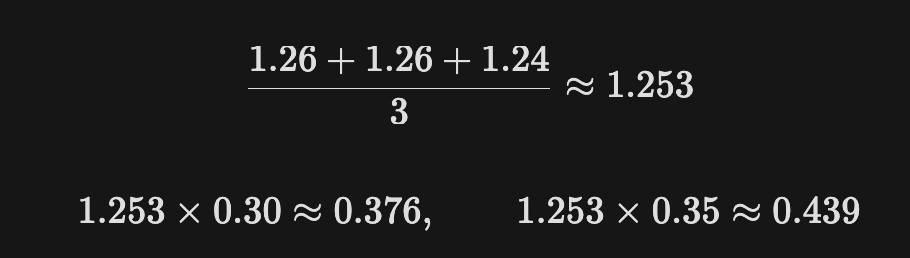
Bullvine illustration.
This is a cooperative-level pooled benchmark, not what any individual farm should have received. It assumes the board’s qualifying share applies to the cooperative’s milk overall and uses a simple average of monthly rates. Members’ destination mixes can differ, and the figure isn’t audited.
Board hearing records include Espenshade’s testimony that his statement lines showed 12, 14 and 13 cents/cwt while the base premium was $1.00:
| Record | Statement line reported | Base rate then |
| A-1020 (Dec 2024 order) | 12¢ | $1.00 |
| A-1022 (Dec 2025 order) | 14¢ | $1.00 |
| June 3, 2026 hearing | 13¢ (Jan–Mar average) | $1.00 |
Sources: A-1020 and A-1022, each recording testimony about the “most recent monthly statement” at its hearing. June 5, 2026. These are testimony on the record, not a board audit. The comparison band is Bullvine math.
A-1022 also records where the money goes. Espenshade testified that part of the premium money is paid directly to each member. The rest subsidizes quality premiums and defrays transportation and office expenses. The board recorded his testimony that the funds “are used to cover costs which would otherwise come out of the pockets of the dairy farmer members.” Those uses may not show up on the premium line itself.
The published record doesn’t establish that the gap between the benchmark and the statement line is unaccounted for. It raises an allocation question.
Independent shippers’ figures are thinner. Farm Bureau’s Paul Hartman ships to Clover Farms Dairy and Swiss Premium Dairy, according to A-1022. A-1020 records a 25-cent premium for August 2024 at the facility he helps manage. At the June 3, 2026 hearing, he testified to receiving 19 cents. Those figures come from different periods and contexts, so the gap between them isn’t evidence of a shortfall.
Why a statewide premium estimate is still unavailable
The rates are public, but the qualifying volume isn’t. A statewide figure needs each month’s pounds that passed the produced-processed-sold test, multiplied by that month’s rate.
Federal Order 1 Class I utilization can’t stand in for those pounds. It covers the broader Northeast and includes milk that fails Pennsylvania’s test. The qualifying pounds sit in the monthly PMMB-62 reports that dealers file with the board. Any statewide estimate depends on PMB releasing or summarizing that series.
The background to the board’s split
Until 2026, the premium had been $1 per hundredweight plus a fuel adjuster for several years, Lancaster Farming reported. Then A-1022 cut April–June to 50 cents.
Van Blarcom has dissented from every rate above zero since 2023. By his own count in A-1022, that order was his seventh straight dissent. “The system is so flawed that I cannot approve it continuing, even in the modified fashion approved by the majority,” he wrote in December 2025.
That December 2025 majority agreed with the core of his objection. “While those Pennsylvania consumers pay the entire over-order premium, Pennsylvania producers only receive a portion of the premium,” the order reads. It found that 50 cents “strikes a better balance among the various segments of the dairy industry.” Asking itself why the system remained in place, the majority answered: “Because the Board has not changed it.”
The Grange and the state’s independent fluid processors support the premium, according to Lancaster Farming. Pennsylvania Farm Bureau and Agriculture Secretary Russell Redding say it’s unfairly distributed and should be reformed. The hearing record turns on distribution:
- The Grange and the Pennsylvania Association of Milk Dealers backed $1 at the June 3 hearing.
- Farm Bureau backed that level while pressing for reform.
- DFA’s Drew Frommelt declined to endorse a level and said DFA couldn’t support elimination. He backed collection at retail with more equitable distribution.
- Tioga County dairy farmer Johnny Painter urged a pause at zero.
- Redding, per A-1022 (December 2025), didn’t oppose the Grange’s proposal and favored distributing any premium uniformly to all Pennsylvania dairy farmers.
What could restore or replace the premium?
Will SB 689 restore Pennsylvania’s over-order premium?
Even if SB 689 moves, passage wouldn’t set a restoration date. A new premium would need the bill to become law, then a board order, then legislative review, then publication.
SB 689 was reported out of the Senate Agriculture and Rural Affairs Committee on May 6, 2025. It was set aside (“laid on the table”) under Senate Rule 9 on June 23, 2025, and the official record shows no action since. Sen. Elder Vogel Jr. (R-47) introduced it with Sen. Judy Schwank (D-11) and eight other senators. The 2025–26 session ends November 30, 2026, and both chambers return to Harrisburg on October 19.
The bill text (Printer’s No. 668) would:
- let the board set a “board-established premium” on Class I fluid milk “based on evidence presented on cost of production, price received and return on equity”;
- have the Department of Revenue “facilitate the collection”;
- have the board distribute money moved from the General Fund into the Milk Marketing Fund, by order, “to producers, dealers or handlers”;
- exempt premium orders from the Regulatory Review Act and the Commonwealth Documents Law.
The bill sets no rate and names no collection point. It would allow payment directly to producers but doesn’t require it. Distributions would be audited within six months of the first payout, then every year.
The committee-review language needs clarifying. The bill gives each agriculture committee 30 calendar days or six legislative session days, whichever is later, to notify the board whether it approves or disapproves an order. A “legislative session day” is any day either chamber is in session.
The next sentence matters. If the Senate committee “or” the House committee doesn’t notify the board of a disapproval by the deadline, the order “shall be deemed approved.” Read literally, one committee’s silence could approve an order even though the other disapproved it. The text doesn’t say how a split between the committees would be handled.
An approved or deemed-approved order then goes to the Legislative Reference Bureau for “the next available issue of the Pennsylvania Bulletin,” and the premium takes effect on publication.
There’s a second open question: how much process comes before the order. The board’s existing premium orders run through the Milk Marketing Law’s hearing sections. A-999’s conclusions state that its hearing was held under sections 801 and 803, and that the order may be amended under section 801’s procedures. SB 689’s new premium section doesn’t say whether those existing hearing procedures would apply in full to a board-established premium. It also doesn’t say whether hearing notice could go out during the 60 days before the act takes effect.
An accelerated scenario, which depends on how those questions are answered. Assume the bill is enacted November 30, the last day of the session, and takes effect 60 days later, on January 29, 2027.
Then assume three more things:
- the board can hold a hearing and issue an order with no further procedural steps;
- the 30-calendar-day review period is the later one;
- the order runs in the next available Bulletin issue.
Under those assumptions, a board-established premium couldn’t take effect before March 2027 (Bullvine scenario, based on the bill text). That’s not a statutory deadline. If the existing hearing procedures apply in full, or any step slips, the date moves later.
What dairy farms should do now
In the next 30 days, pull your January–September 2026 statements. If you market through a cooperative, look for the no-premium disclosure §143.15(d) requires for July onward. If you ship independently, ask your buyer how its statements reflect the expired order and any premium paid before June 30.
Then send five questions to your cooperative or buyer, in writing:
- Was the statement line calculated under 7 Pa. Code §143.15?
- What total Pennsylvania over-order premium did the cooperative receive each month?
- How many Pennsylvania member pounds were in the denominator?
- Did the calculation include the diesel add-on where it applied?
- How much premium revenue was returned directly, or used for quality premiums, hauling or other member costs?
Set your own benchmark. If your cooperative pools Pennsylvania premium money across member milk, multiply its qualifying in-state Class I share by the base rate. That gives a base-only comparison, and adding the diesel adjustment gives a combined-rate one. Either way it’s a diagnostic, not a prediction of what an individual farm should get. The real figure depends on the cooperative’s qualifying volume, pooling formula and distribution practices. If your line comes in well under the benchmark, ask for the calculation. A gap is a question, not evidence of wrongdoing.
For lenders: carry the premium at $0 in 2027 projections until a signed order exists, and model any restoration as a separate upside case.
Over the next 90 days, watch the board. The November 4 meeting is at 1 p.m. in Room 202 of the Agriculture Building in Harrisburg. Confirm call-in and comment instructions on the live sunshine meetings page. If neither November 4 nor December 2 schedules a hearing, watch for a special meeting like the one the board held on June 12. Contact: ra-pmmb@pa.gov · 717-787-4194.
Over the next 12 months, document your in-state Class I share. Independent shippers to Pennsylvania bottlers have the most riding on whatever distribution formula comes next, and so do cooperatives with high in-state Class I shares. If SB 689 moves and a board order names producers as recipients, that money wouldn’t have to pass through a cooperative pool.
The premium is one piece of the revenue pressure on Pennsylvania milk checks. Read it alongside USDA’s higher make allowances, and keep it separate from insurable risk like ISO’s dairy-cow cap.
The premium stays at zero until a new order says otherwise. Pull your latest statement: does it clearly show the post-June status, and can your cooperative or buyer explain how the premium was calculated and distributed before the order expired?
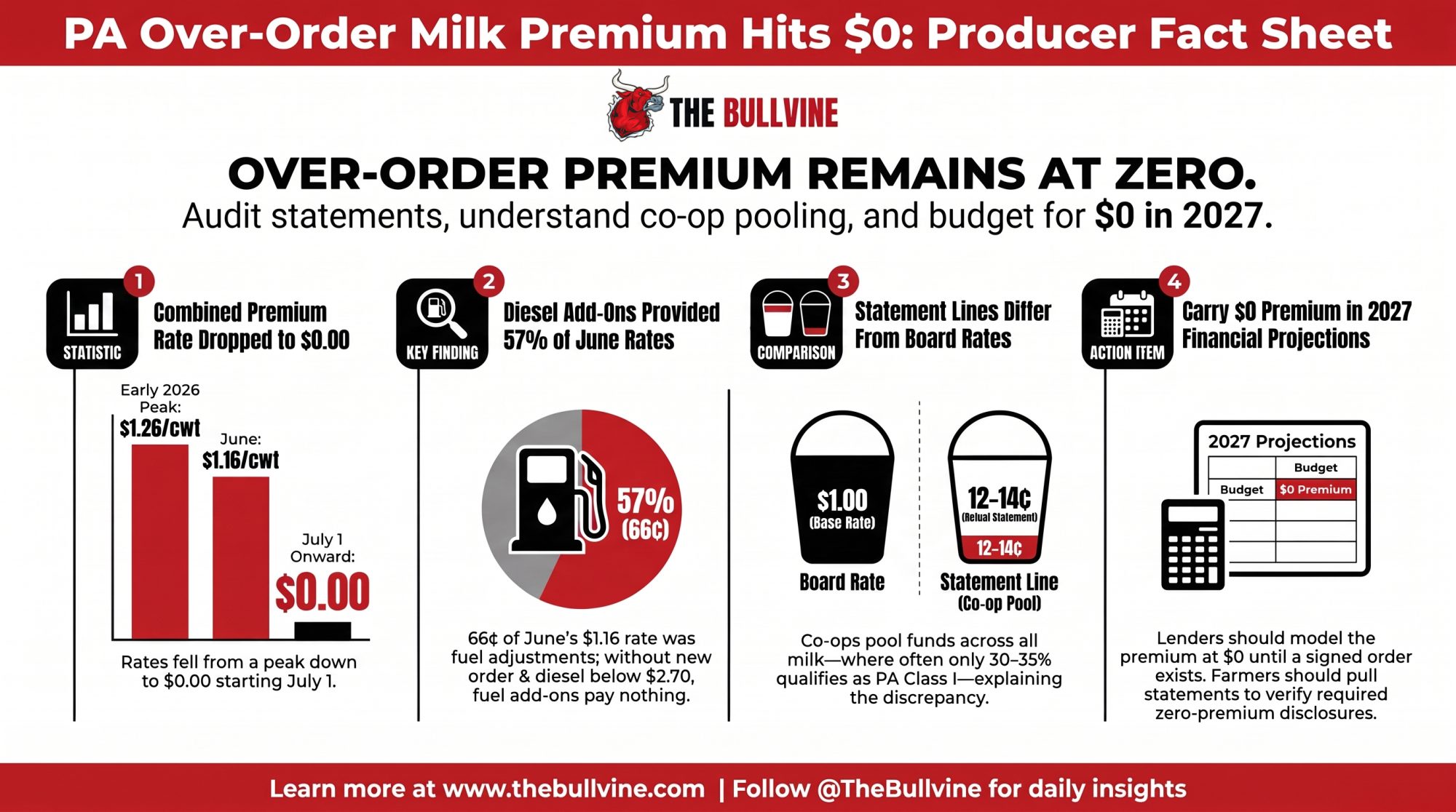
Complete references and supporting documentation are available upon request by contacting the editorial team at editor@thebullvine.com.
Learn More
- Unlock Hidden Dairy Profits Through Lifetime Efficiency: How Modern Genetics and Strategic Nutrition Can Cut Feed Costs by $251 Per Cow — Turn feed-cost pressure into a herd-level action plan: the research connects residual feed intake selection and early-life calf nutrition to a reported $251 in annual feed savings per cow and potential first-lactation milk gains.
- Dairy Farm Economics 2026: Milk Pricing, Margins & Risk Playbook — Put Pennsylvania’s expired premium in the wider milk-check equation. This 2026 playbook tracks U.S. FMMO changes, Canadian pricing shifts, cost-of-production benchmarks and risk tools that shape margin forecasts and borrowing decisions over the next few years.
- Dairy’s $444 Problem Has a 90% Solution – And It Lives Inside Victor Cabrera and the University of Wisconsin’s Dairy Brain. — See how integrated herd data can flag mastitis before visible symptoms and sharpen replacement decisions. Karen Hunt’s interview with Dairy Brain’s developer argues data-sharing barriers—not a shortage of software—are holding back better farm decisions.
 The Sunday Read Dairy Professionals Don’t Skip.
 The Sunday Read Dairy Professionals Don’t Skip.
Every week, thousands of producers, breeders, and industry insiders open Bullvine Weekly for genetics insights, market shifts, and profit strategies they won’t find anywhere else. One email. Five minutes. Smarter decisions all week.