





A locked server at Fairlife froze a $4B dairy on July 16. On a 200-cow herd, one month’s milk is ~$70,000 — and a delayed check hits before the hacker ever does.
Executive Summary: Coca-Cola’s Fairlife just had every U.S. plant knocked offline by ransomware on July 16 — Canada kept running; the American operations didn’t. If a $4 billion processor with real IT budget can get locked out of its own systems, your parlor full of networked robots, feeders, and RFID readers is squarely in range. This isn’t a one-off: Dairy Farmers of America got hit in 2025 and left producers waiting up to 17 days for milk checks, an Ontario dairy ate a $9,999,000 ransom demand after attackers sat in its network for three years, and a Swiss farmer lost a cow and calf when his milking robot data got locked. Here’s the part that should worry you more than the hacker: nearly two-thirds of U.S. dairies carry under two weeks of operating capital, so on a 200-cow herd shipping 75 lbs at roughly $15.74/cwt Class III, a delayed check strands better than half of a $70,000 month while feed and payroll keep marching. The fixes that actually move the needle cost a Saturday afternoon, not a fortune — separate your office network from the parlor, keep one backup fully unplugged and tested, and turn on MFA everywhere (CISA says it makes you 99% less likely to get hacked). Processors are already starting to treat NIST cyber benchmarks the way they treat SCC and quality premiums, which means “are your systems secure” is about to become a condition of shipping, not a suggestion. Read on for the three-tier defense playbook — DIY, managed detection, and the co-op pooling model — plus the four questions to put on your next board agenda.
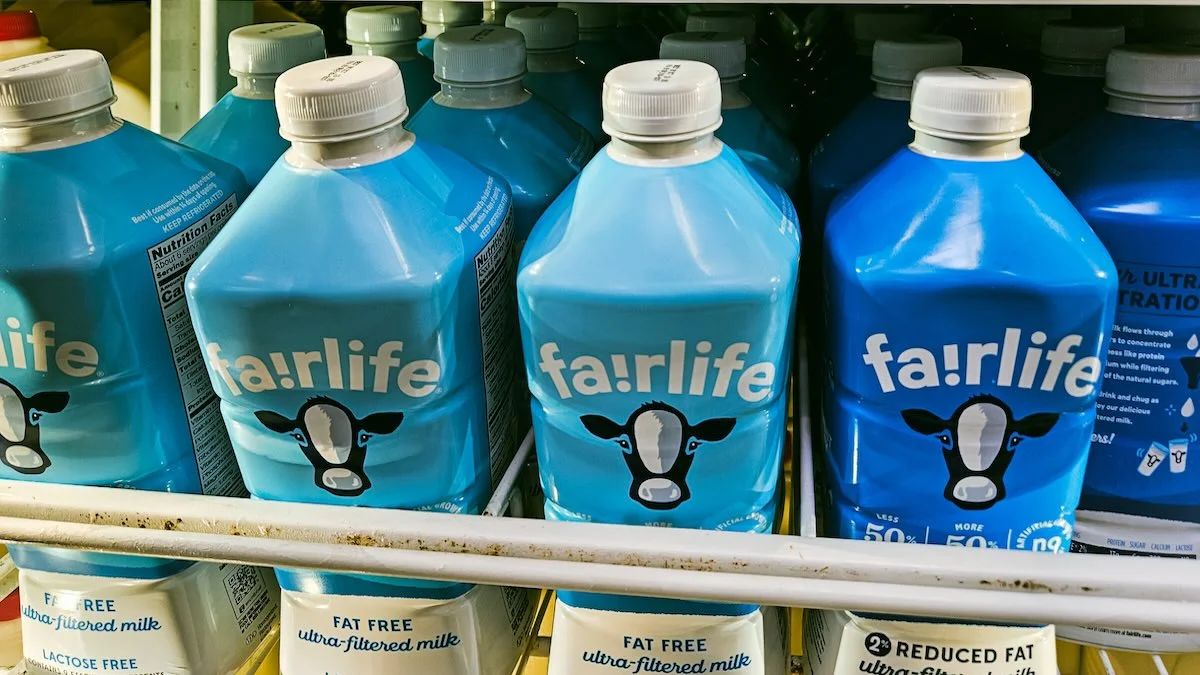
A milking robot and a corporate server run on the same kind of network — and share the same kind of vulnerability. Fairlife found that out on July 16, 2026, when Coca-Cola told the SEC that ransomware had frozen its dairy subsidiary’s production systems. The plants didn’t slow down. They stopped.
So if a roughly $4 billion operation — with U.S. plants in Goodyear, Arizona; Dexter, New Mexico; Coopersville, Michigan; and Fair Oaks, Indiana, plus the new $650 million Webster, New York, facility — can get locked out of its own systems, the question isn’t whether smaller operations are exposed. It’s whether you’d even see it coming.
What Actually Happened in Atlanta
Coca-Cola’s SEC filing said fairlife LLC identified “unauthorized access by a third party to a portion of its systems,”including production-related systems, “in connection with a ransomware event.” Strip out the legal language, and it means someone got inside, locked things down, and the plants went quiet. Canadian production kept running without a hitch — the disruption was U.S.-only.
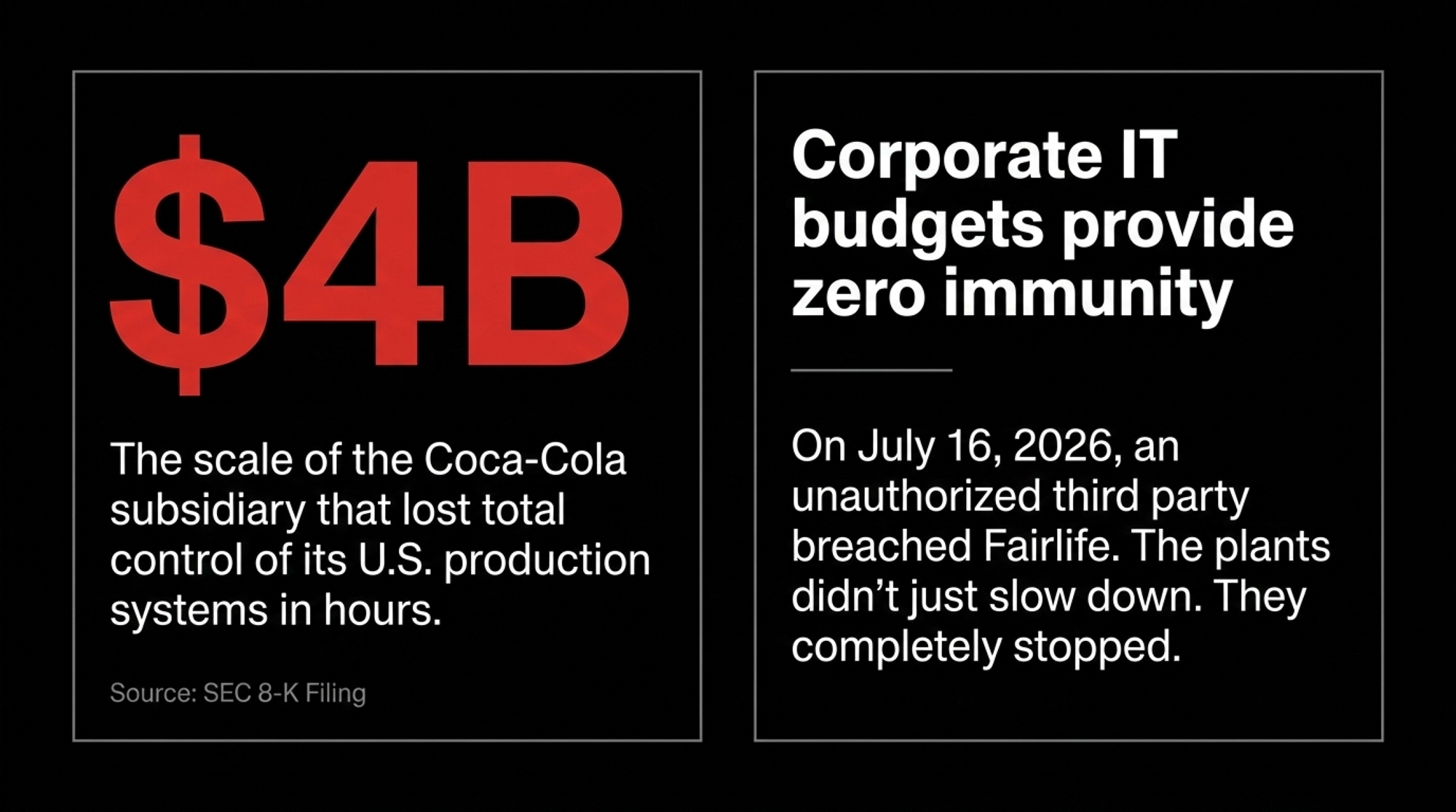
The company did the right things fast. It activated its incident response and business continuity protocols, brought in outside cybersecurity experts, and looped in law enforcement. Product already on shelves is safe, they say.
But watch what Coca-Cola hasn’t said. No ransomware group has claimed the hit, and the company hasn’t attributed it to anyone — the filing describes the intruder only as an unauthorized third party. Nobody’s confirmed whether data walked out the door, and there’s no extortion figure on the record. The filing admits the full impact is still being evaluated and that it’s uncertain whether the incident will materially affect the company. Translation: they’re still counting the damage, same as the rest of us.
Why do hackers keep targeting dairy farms?
Because the thing that makes your barn efficient is the same thing that makes it a target. Robotic milkers, automated feeders, RFID herd software, environmental controls — all of it sits on a network. And on a lot of farms, that network never got separated from the laptop checking email in the office. If you’ve never mapped how your automated systems connect, that audit is worth ten minutes before you read further.
Attackers know the math. Cows can’t wait. Feed schedules can’t slip for long. A lockout that would be a headache at a widget factory turns into an animal-welfare emergency in a dairy barn within hours. FBI Special Agent Gene Kowel has pointed to that exact combination — operations that can’t pause, security budgets that stay thin — as the reason criminals and even state-linked actors keep circling farm and food infrastructure.
There’s a second angle that gets less attention. Cybersecurity researcher Ali Dehghantanha has flagged rising activist attacks in which the goal isn’t a payout at all — it’s footage or data to fuel campaigns against how you farm. Different motive. Same broken lock.
This Wasn’t the First Warning Shot
Fairlife is just the biggest name on a list that’s been growing for two years. Dairy Farmers of America — the largest co-op in the country — got hit by the Play ransomware gang in mid-2025 across multiple plants. The fallout landed on producers, not just IT departments: milk pickups were disrupted and payments delayed up to 17 days, against a system built for a 3-to-5-day turnaround. HP Hood and Schreiber Foods have both experienced plant shutdowns, and Hood’s disruption reportedly rippled all the way into the New England school milk carton supply. The DFA case is the clearest processor-level warning yet.
It gets more personal at the farm gate. Dehghantanha documented an Ontario dairy hit three separate times — attackers sat undetected in the network for three years before the final strike encrypted the RFID reader, the robotic milkers, and the backups all at once, with a $9,999,000 ransom demand attached. In Switzerland, farmer Vital Bircher refused a $10,000 demand after his milking robot’s data got locked in 2023. During the outage, with Bircher cut off from the robot’s data while his herd needed it, a cow and her calf died.
| Who Got Hit | Year | What Locked Up | What It Cost Them |
| Fairlife (Coca-Cola) | 2026 | U.S. production systems | All U.S. production halted; Canada spared. |
| Dairy Farmers of America | 2025 | Multiple plants | Pickups disrupted; payments delayed up to 17 days. |
| Ontario Dairy Farm | 2022–2024 | RFID reader, robots, backups | $9,999,000 ransom demand after 3 years of silent intrusion. |
| Swiss Dairy (Vital Bircher) | 2023 | Milking robot data | $10,000 demand refused; a cow and calf died during outage. |
| Lactanet | 2025 | Credentials stolen, MDR caught it | Barely a scratch — active monitoring flagged it early. |
Food and ag ransomware climbed 27% in 2024, to 212 recorded incidents from 167 the year before, and the FBI now ranks agriculture among its most-targeted sectors. This isn’t a rare-event story anymore. It’s a weather pattern.
Could your operation survive two weeks offline?
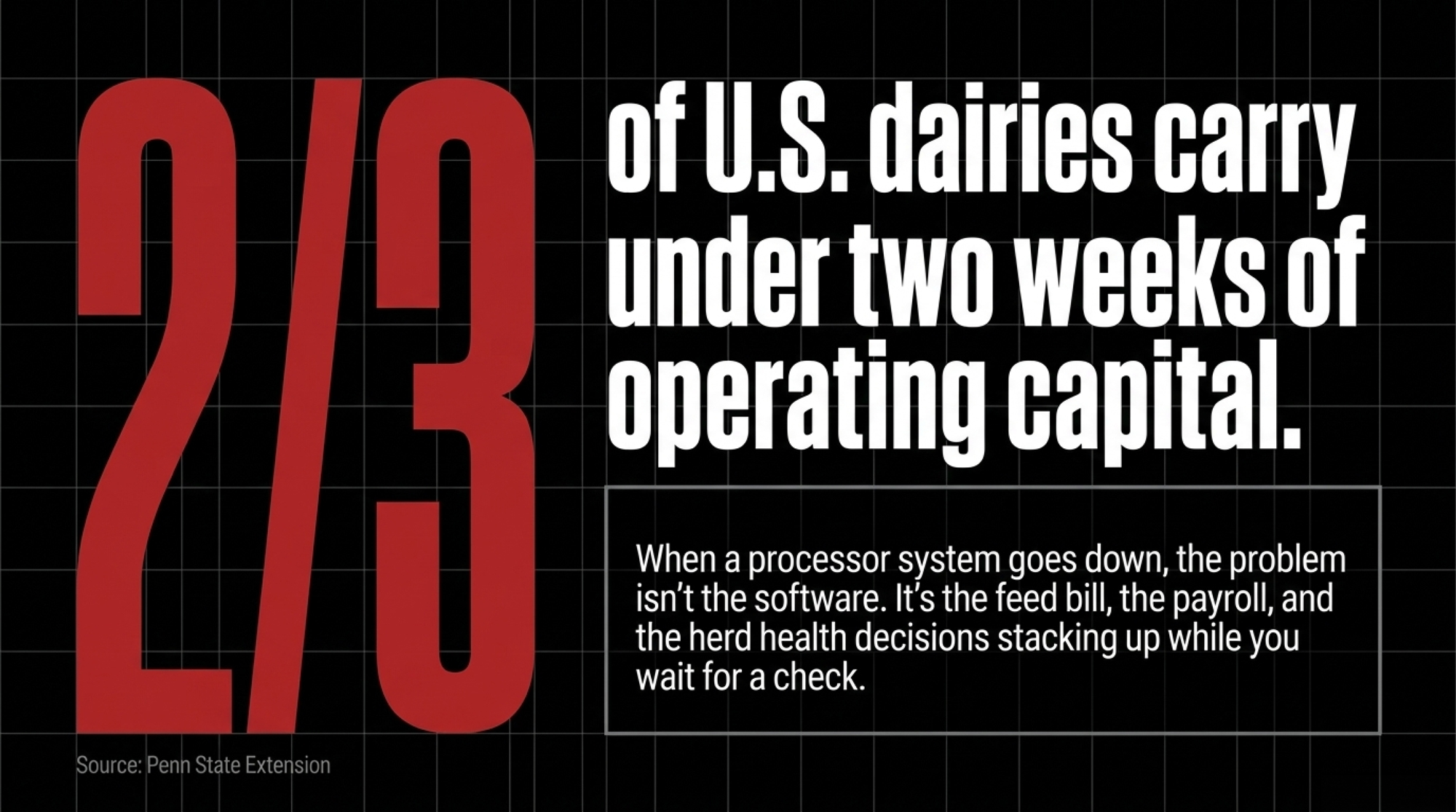
Here’s the number that should stop you cold. Penn State Extension data shows nearly two-thirds of U.S. dairy farms carry less than two weeks of operating capital. So when a system goes down and the milk check gets delayed — as DFA’s producers waited up to 17 days — the problem isn’t the software. It’s the feed bill, the payroll, and the herd health decisions stacking up while you wait.
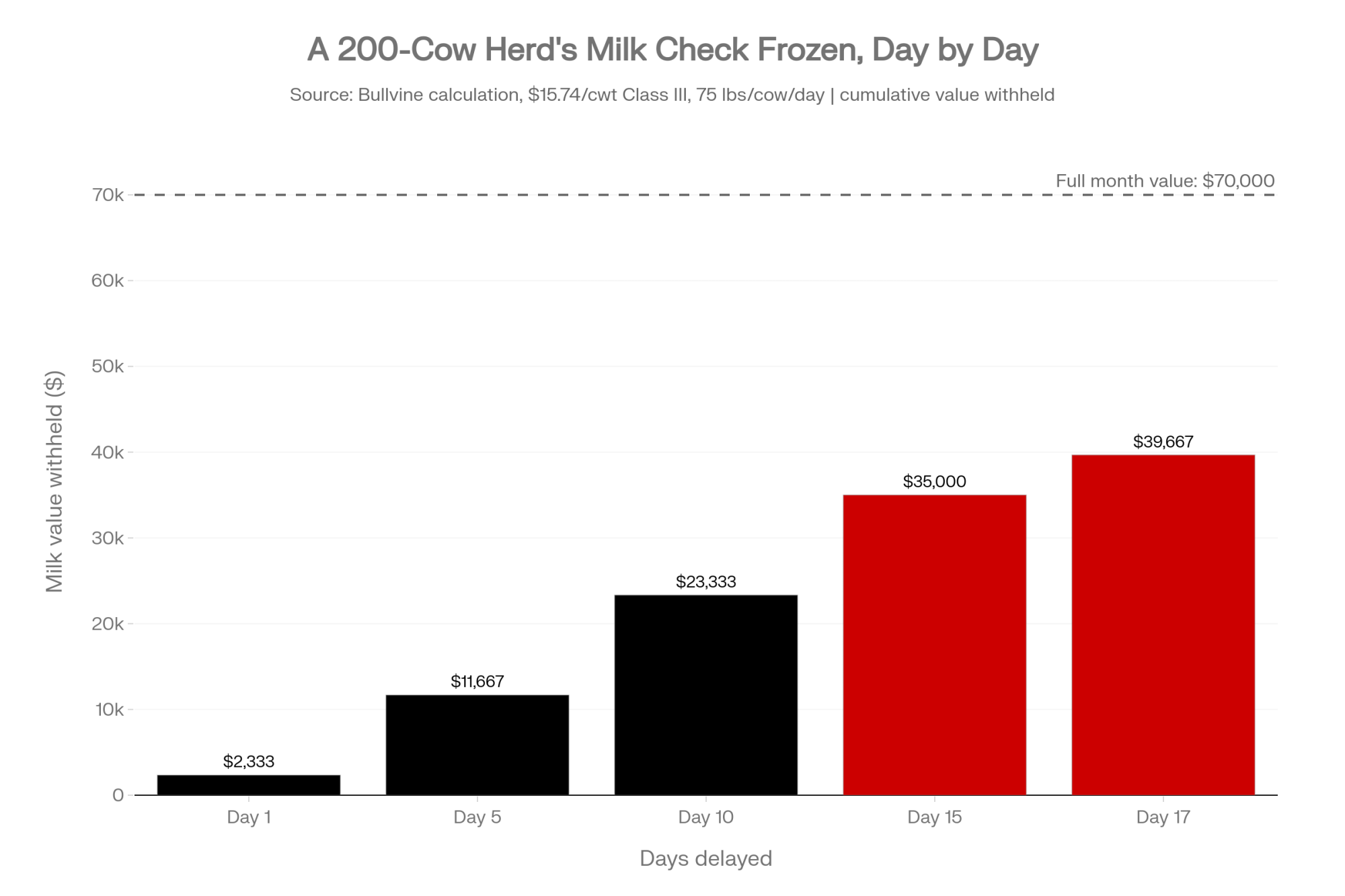
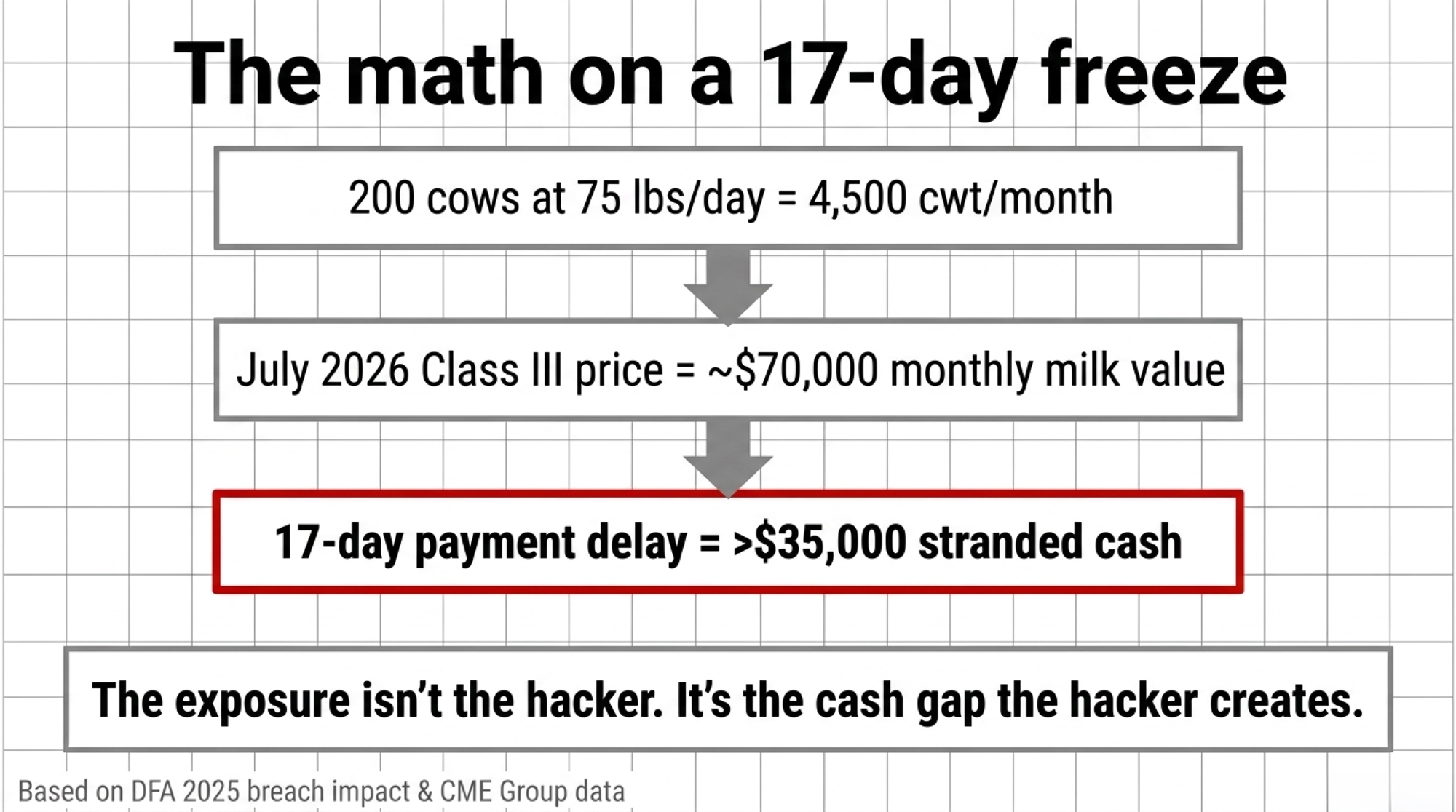
Run the barn math on it. Say you’re milking 200 cows at 75 lbs a day. That’s 15,000 lbs of milk daily, or about 4,500 hundredweight over a 30-day cycle. With the July 2026 Class III benchmark near $15.74/cwt — the component price, not what actually lands in your mailbox — that’s roughly $70,000 of milk value riding on a single month’s production. A payment held even 17 days locks up better than half of that while your fixed costs keep marching. Most operations don’t have that kind of cushion sitting idle. That’s the real exposure — not the hacker, the cash gap the hacker creates.
The Things Worth Doing Before Monday
Skip the generic password lecture. Researchers and extension folks keep landing on the same short list, and the top of it costs you almost nothing.
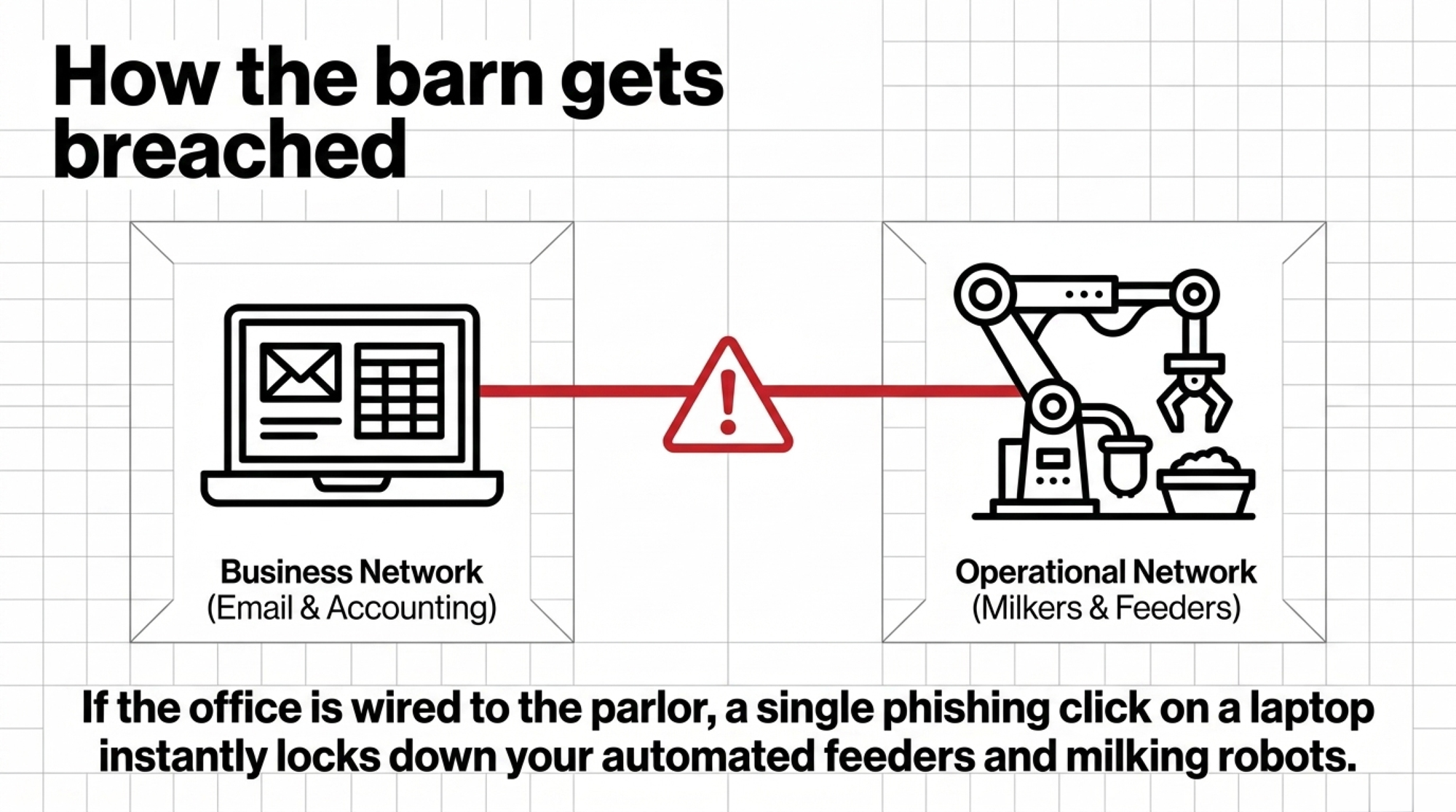
1. Air-Gap Your Networks (Keep the Office Out of the Parlor). Your business side — email, accounting, the office computer — should not sit on the same network as your milking robots, feeders, and controls. When those two are wired together, a phishing click in the office can reach the parlor. CISA’s own guidance is blunt about this: keep operational networks, such as production, segmented from business networks.
2. Enforce the 3-2-1 Backup Rule (And Pull the Plug). Three copies, two types of media, one copy fully disconnected from the network. That last part is exactly the failure Dehghantanha described in the Ontario case — network-connected backups that got encrypted right alongside the live systems. And a backup you’ve never tested restoring isn’t a backup. It’s a hope.
3. Turn On Multi-Factor Authentication Everywhere. Farm software, email, remote access — all of it. CISA says MFA makes you 99% less likely to get hacked. It takes an afternoon. Do it this week.
4. Write Down an Incident Response Plan Before You Need One. Who do you call, in what order, when the parlor software won’t boot at 4 a.m.? Most farms have no answer, and that’s the single biggest reason a recovery drags into weeks instead of days.
One more habit, and it’s free: train everyone on the payroll — family included — to spot a phishing email, because that’s still one of the most common ways in.
Options and Trade-Offs
The DIY route — do it yourself, this month. Network separation, offline backups, and MFA are within reach for almost any operation and cost more in a Saturday afternoon than in dollars. This is the 30-day action: pick those three, knock them out before month’s end. The limit is that DIY covers the basics, not active monitoring. You’re hardening the doors, not watching them.
Managed detection — pay someone to watch. This is the Lactanet model, and it’s worth studying. Two years before attackers hit them, the organization brought in KPMG for risk assessments and hired a 24/7 managed detection and response team, even running mock phishing drills on staff. When the breach came — stolen credentials, real network access — they caught it fast and contained it. Compare that to DFA, where producers waited up to 17 days for their milk checks after the 2025 attack. The catch: a full MDR contract runs real money that most single farms can’t justify on their own.
The co-op path — pool the cost. Here’s where scale solves what a single farm can’t. Rural electric cooperatives have already built a shared cybersecurity monitoring system that cut member outage time nearly in half and trimmed technology costs by about 40% compared with going it alone. USDA rural development offices and state councils are reportedly considering adapting that model to food and dairy. Dairy already pools equipment, testing labs, and marketing — pooling cyber defense is the same muscle. The friction is organizational, not technical: someone has to lead it.
| Approach | Cost | What It Covers | Key Limitation |
|---|---|---|---|
| DIY (network split, offline backup, MFA) | A Saturday afternoon, near-$0 | Hardens the doors | No active monitoring — you’re not watching, just locking |
| Managed Detection (Lactanet model) | Real ongoing contract cost | 24/7 monitoring, mock phishing drills, fast containment | Out of reach for most single farms financially |
| Co-op pooled model (electric co-op precedent) | Shared cost across members | Cut outage time ~50%, trimmed tech costs ~40% | Organizational friction — someone has to lead it |
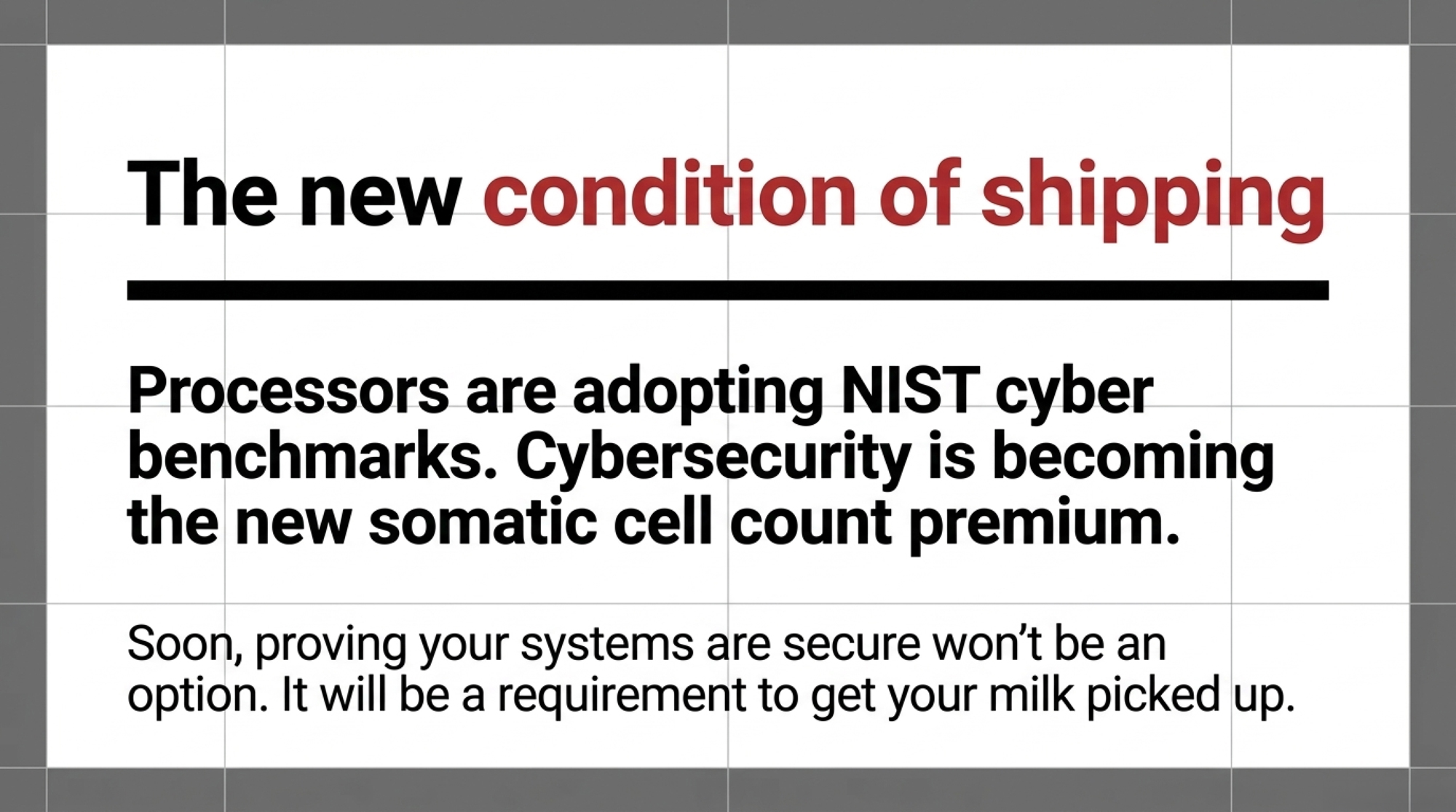
One more signal worth reading. Some national processors are starting to push suppliers toward NIST Cybersecurity Framework benchmarks — treating cyber readiness the way they’ve long treated milk quality and traceability. If that spreads, “are your systems secure” stops being optional and becomes a condition of shipping. The farms that get ahead of it now won’t be scrambling when the buyer’s letter arrives.
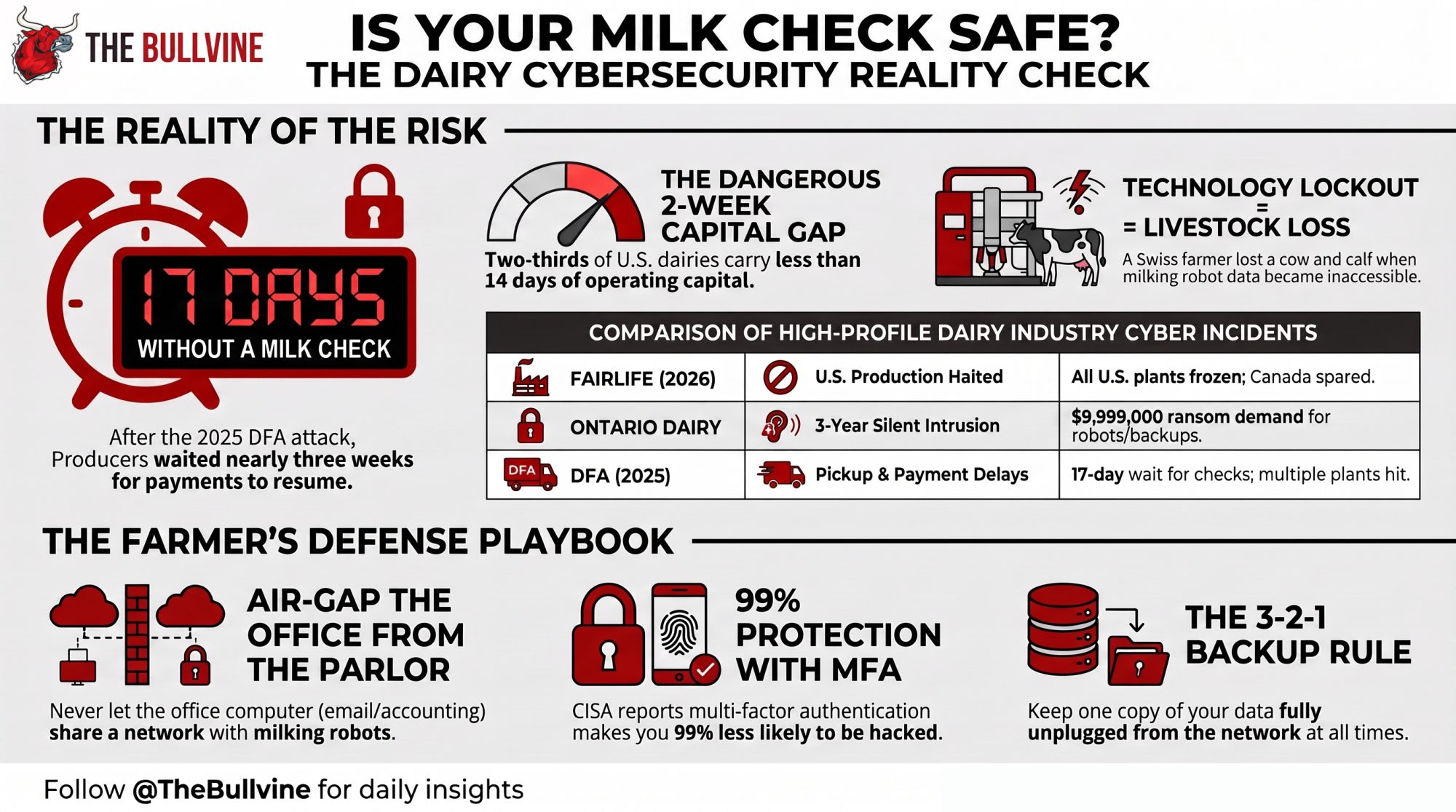
Key Takeaways
- If your milking robots and your office email share one network, treat that as your top exposure — segment them before you do anything else.
- If your backups are connected to the network, they’re not backups — get one copy fully offline and test a restore this month.
- If you carry less than two weeks of operating capital — like most U.S. dairies — build a written 72-hour continuity plan, because a payment delay will hurt you before the hacker does.
- If you’re on a co-op board, put four questions on the next agenda: how quickly can payments recover, when was the last tested backup restore, does insurance cover producer payment delays or only hardware, and who vets your outside vendors’ security?
| Board Question | Why It Matters | Red Flag Answer |
|---|---|---|
| How quickly can producer payments recover after an outage? | DFA producers waited 17 days in 2025 | “We don’t have a documented recovery timeline” |
| When was the last tested backup restore? | Untested backups are “a hope,” not a plan | “We’ve never actually tried restoring it” |
| Does insurance cover payment delays, or only hardware? | Payment delays hit cash flow before hardware costs do | “Insurance only covers equipment/data loss” |
| Who vets outside vendors’ security? | Ontario dairy attackers sat undetected for 3 years | “No one — we trust the vendor’s word” |
Before You Close the Laptop
The hard truth is that a payment freeze hurts your cash flow long before a hacker ever touches your hardware. In next week’s Bullvine Weekly, we’ll break down the exact math on pricing cyber insurance against a two-week Class III freeze. Until then, ask yourself before you close the laptop tonight: where are your backups right now, and when did you last prove they actually work?
Run Your Numbers
Farm Benchmark Snap Check — This story hinges on one question: could your cash cushion absorb a delayed milk check? The DVI Risk Check plugs your working capital, debt load, and feed share into three numbers and tells you — Strong, Watch, or Risk — whether you’re built to ride out a shock or scrambling when it lands.
Complete references and supporting documentation are available upon request by contacting the editorial team at editor@thebullvine.com.
Learn More
- Is Your Herd Safe? Cybersecurity Essentials for Modern Dairy Farms — Arms you with a systematic tech inventory method to audit SCR collars and herd management software, protecting your carefully curated embryo inventory and preventing rogue ration changes from causing a sudden drop in component margins.
- When Firewalls Meet Milk Checks: The Cyber Threat Every Dairy Should Plan For — Exposes the vulnerabilities of third-party vendor payment contracts and delivers critical questions for your next co-op board meeting to survive a 17-day cash flow freeze before processing networks collapse.
- Hackers in the Milk House: Ransomware Is Now a Fresh Cow Problem — Reveals how data blackouts impact cow traffic and fresh heifer transitions, proving that missing a single automated health alert can cost a high-producing cow and her calf when automated lasers run blind.
 The Sunday Read Dairy Professionals Don’t Skip.
 The Sunday Read Dairy Professionals Don’t Skip.
Every week, thousands of producers, breeders, and industry insiders open Bullvine Weekly for genetics insights, market shifts, and profit strategies they won’t find anywhere else. One email. Five minutes. Smarter decisions all week.




