



Sept. 17: USDA tells the checkoff to quit Net Zero work. Its own 2024 report lists 8 Net Zero research entries and not one dollar figure. Your 15¢/cwt still comes off the milk check.
Executive Summary: USDA gave the National Dairy Board until Sept. 30 to list current and planned checkoff projects supporting ESG activities. No copy has surfaced in the records The Bullvine reviewed through Oct. 12. We matched that order against AMS’s report on 2024 activities: Net Zero and Greener Cattle research is listed, with no project amounts. The same records count 639 approval actions and $131.64 million in 2025 funding to DMI, none of it broken out by initiative. On Sept. 17, the day of the order, a federal judge stayed three Wisconsin farmers’ checkoff lawsuit. Buyer sustainability requirements are a separate question; producers should get those terms in writing.

The Sept. 17 Mandate Meets the 2024 Ledger
On Sept. 17, 2026, USDA told National Dairy Board chair Lolly Lesher that, “effective immediately,” checkoff projects must focus on “long-term value creation for future generations.” They can’t fund activities advancing ESG (environmental, social and governance) frameworks, net-zero or climate-neutrality initiatives. The board had until Sept. 30 to send USDA “a detailed listing of all projects (current and planned) supporting ESG activities.” The listing also had to include any contract termination limitations and a proposed plan for termination.
That deadline has passed. The list was due to USDA, not to the public. None of the sources The Bullvine reviewed through Oct. 12 contains it, or any dollar figure tied to it.
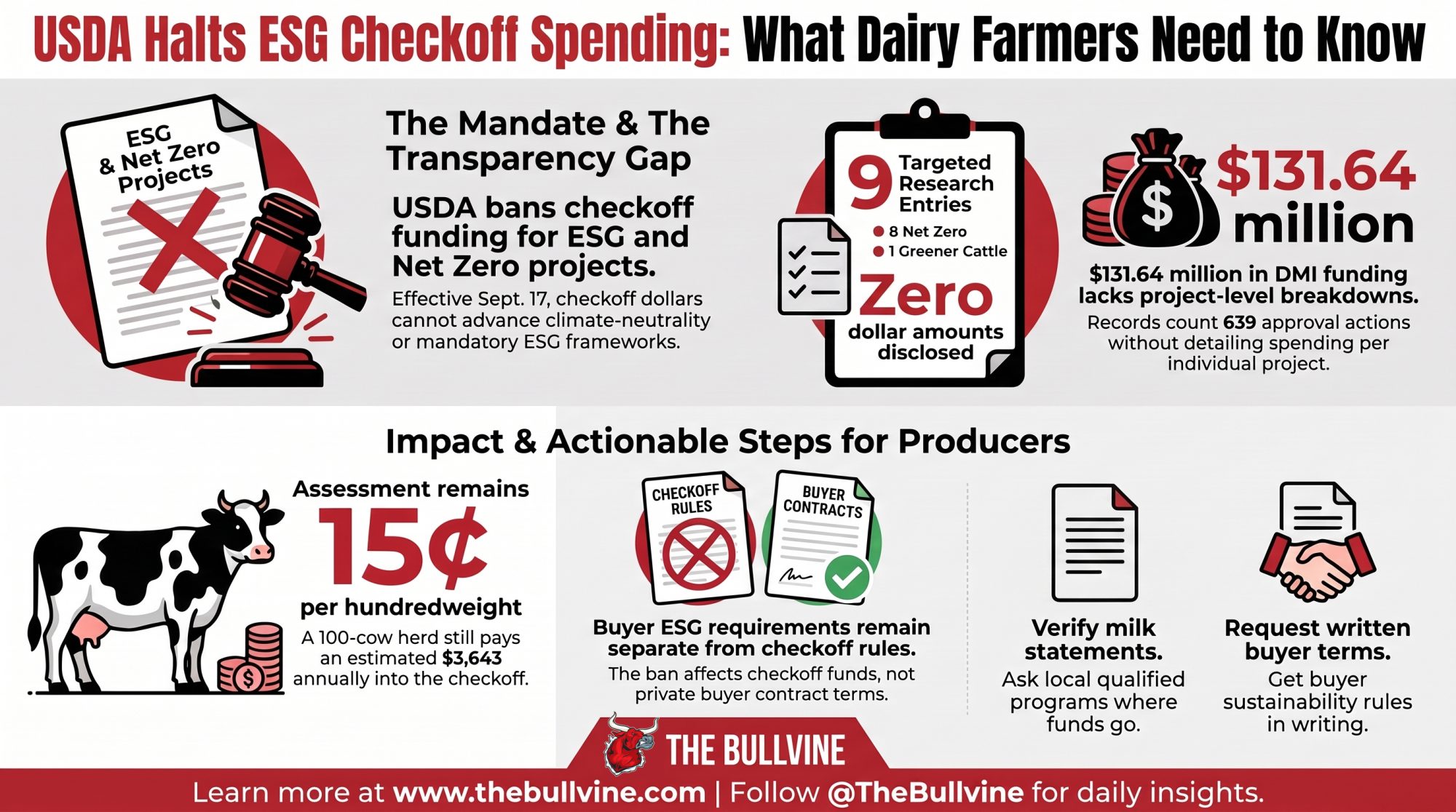
What farmers can see is USDA’s report to Congress on 2024 checkoff activities. AMS’s report page, which carries that report, lists a Sept. 23, 2026 publication date. USDA AMS, Report to Congress page The report lists eight research entries under the U.S. Dairy Net Zero Initiative and one for the Greener Cattle Initiative, and the letter names both initiatives. None of those entries carries a project amount. An entry marked ongoing in 2024 isn’t confirmed to be active now.
Farmers keep paying the standard 15¢ assessment. By our estimate, a 100-cow herd at national-average output pays about $3,643 a year. Still, no record reviewed puts a dollar figure on what the directive changes. Which of those entries were still funded on Sept. 17, what did they cost, and where does that money go now?
What USDA Told the Board to Stop
The letter says its list of DMI items “is not an exhaustive list.” Three items come with qualifiers:
| Listed item | What the letter targets |
| Scope 3 greenhouse-gas accounting | Mandatory participation by dairy producers |
| FARM (Farmers Assuring Responsible Management) Environmental Stewardship | Mandatory participation by dairy producers |
| 2050 environmental stewardship goals | Only where they involve ESG commitments, GHG-intensity reduction campaigns or soliciting ESG commitments |
Six more are named without qualifiers:
- U.S. Dairy Materiality Assessment
- U.S. Dairy Net Zero Initiative
- Pathways to Dairy Net Zero
- Greener Cattle Initiative
- Sustainability Alliance
- U.S. Dairy Stewardship Commitment
Don’t read the matching totals as a match. The 9 research entries relate to only 2 of the letter’s 9 items: the Net Zero Initiative and the Greener Cattle Initiative.
Two of the listed items target mandatory participation by producers, and the 2050 goals are covered only in part. But the letter’s opening restriction is broader, and the list is explicitly incomplete. How USDA treats related research and voluntary participation still needs clarification.
USDA’s same-day press release says the action “ends checkoff support for those ESG-related projects while allowing necessary administrative functions that do not advance such agendas.” It also directs AMS to make sure no research and promotion funds in other commodity checkoffs advance ESG mandates. USDA press release, Sept. 17, 2026 A separate USDA Under Secretary memorandum to all research and promotion boards says assessments “should not underwrite environmental, social, and governance (ESG) frameworks, net-zero, or climate-neutrality initiatives that impose non-statutory costs, restrictions, or commitments on domestic producers or processors.”
The board’s submission was due at AMSDairycomments@usda.gov. The letter says USDA will work with the board to determine which activities require termination. It expressly includes state, regional and importer qualified programs. USDA letter, Sept. 17, 2026 The letter set no date for releasing anything publicly.
DMI said in a statement: “We will work closely with USDA to review our projects and to take necessary steps to modify or terminate contracts and activities as needed while maintaining our commitment to our authorized promotion, research, and consumer information functions.”
The Lawsuit, Stayed the Same Day
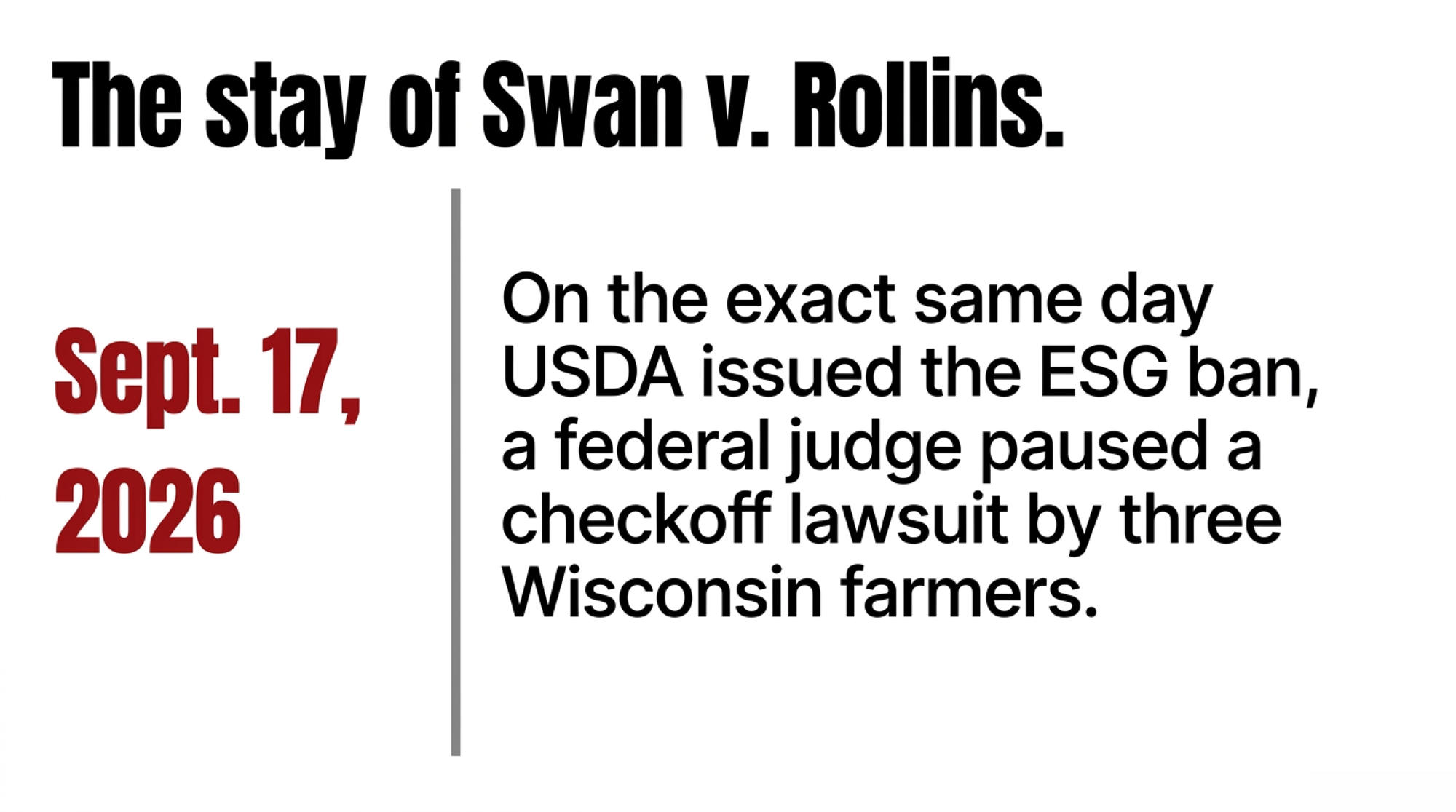
A court case sits behind the letter. On June 9, 2026, Wisconsin dairy farmers Abby Swan, Christopher Baird and Adam Faust sued the National Dairy Board and Agriculture Secretary Brooke Rollins, in her official capacity. The case is Swan v. Rollins, No. 1:26-cv-01033, in the U.S. District Court for the Eastern District of Wisconsin. Clearinghouse, Swan v. Rollins The defendants filed a consent motion to stay the case. On Sept. 17, the same day as the letter, Judge William C. Griesbach granted it. His order stayed all proceedings, including the defendants’ deadline to respond to the complaint. CourtListener docket, Dkt. 1, 9, 10 Hoard’s Dairyman reported that USDA’s decision came in the wake of the suit.
Stayed isn’t dismissed. The docket’s last known filing is the Sept. 17 order, and the case remains open. That makes the court record a second place, after AMS’s reports, where a record of what’s been ended could turn up.
For background, see our earlier coverage of the June lawsuit and the case that came before it.
The Assessment Hasn’t Changed
The assessment is 15¢ per hundredweight of milk for commercial use. AMS Report to Congress, 2024 Farmers can send up to 10¢ of that to a USDA-qualified state or regional program.
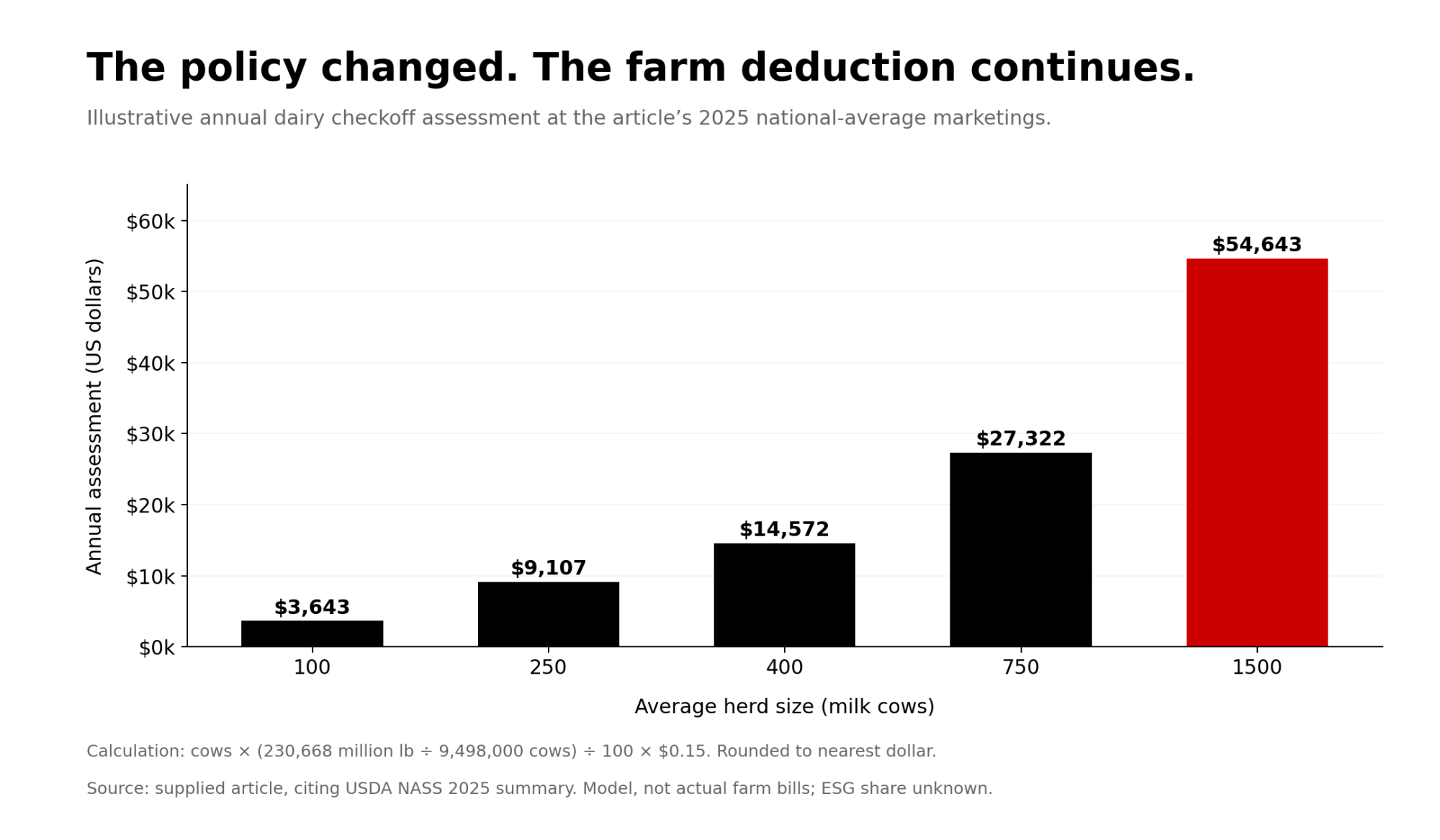
| Average milk cows | Illustrative annual assessment | Up to this much to a qualified program |
| 100 | $3,643 | $2,429 |
| 400 | $14,572 | $9,714 |
| 1,500 | $54,643 | $36,429 |
These are our calculations from NASS’s 2025 figures: 230,668 million lb of milk marketed and an average of 9,498,000 milk cows, which works out to about 24,286 lb per cow. NASS counts marketings as whole milk sold to plants and dealers, plus milk sold directly to consumers, so this is a national-average model. USDA NASS, Milk Production, Disposition, and Income 2025 Summary, April 2026 For your own farm: annual assessed hundredweight × $0.15.
No document reviewed shows what share of any farm’s assessment went to the listed items.
Organic producers can apply each year for exemption from the federal assessment.
The Gap Between Approvals and Dollars
AMS oversees the checkoff. In 2024 it “reviewed and approved 639 Dairy Board and DMI agreements, amendments, and annual plans.” Those are approval actions, not 639 projects. AMS describes DMI as “a management and staffing corporation” run jointly by the National Dairy Board and the United Dairy Industry Association.
USDA’s records count the approvals but not their cost. The same report that tallies 639 approval actions lists the Net Zero and Greener Cattle research without a dollar beside any entry.
The board’s audited statements show $131.64 million in total funding to DMI for 2025: $86.58 million for programs and $45.06 million in core funding. The notes also disclose reimbursements through DMI for export promotion and the Innovation Center for U.S. Dairy. A separate $127.73 million program-expense figure is a different accounting presentation, so the two totals aren’t expected to match. None of these figures is broken out by initiative or project. The auditors issued an unmodified opinion, finding the statements fairly presented in material respects. That opinion doesn’t supply the project accounting this story is looking for.
The research listing has its own limits. Several Net Zero entries repeat the same title under different investigators, so eight entries don’t necessarily mean eight contracts. The listing doesn’t show what’s still committed, or which projects are being kept, changed or ended. USDA approving this research and later restricting it is a policy change. The accounting gap is a separate, narrower problem: these records can’t connect named entries to dollars.
| Record | What it shows | What this record does not establish |
| 639 approval actions (AMS, 2024) | Number of agreements, amendments and annual plans approved | Which projects, what amounts |
| Approved sustainability research listing (AMS, 2024) | Investigators, entry titles, 2024 status | Project amounts; whether entries are separate contracts; status after 2024 |
| Ernst & Young contractor audits (AMS, 2024) | AMS’s summary: “No material exceptions were found” for five contractors | Whether the research entries were covered, or what was spent on them |
| NDB audited financial statements, 2025 and 2024 | Funding to DMI, related reimbursement details, program expenses by function | Spending by project or initiative |
These gaps in disclosure don’t establish that any money was misspent.
Most of the Money Runs Through Local Programs
In 2024, most assessment money went to state, regional and importer qualified programs. They received $219.6 million of the $343.6 million collected, compared with $124.0 million for the National Dairy Board. AMS separately reports $266.9 million in qualified-program spending for 2024. That includes $101.8 million in local spending put toward national programs through the Unified Marketing Plan. The first figure is assessment receipts and the second is spending, so they measure different things. AMS Report to Congress, 2024
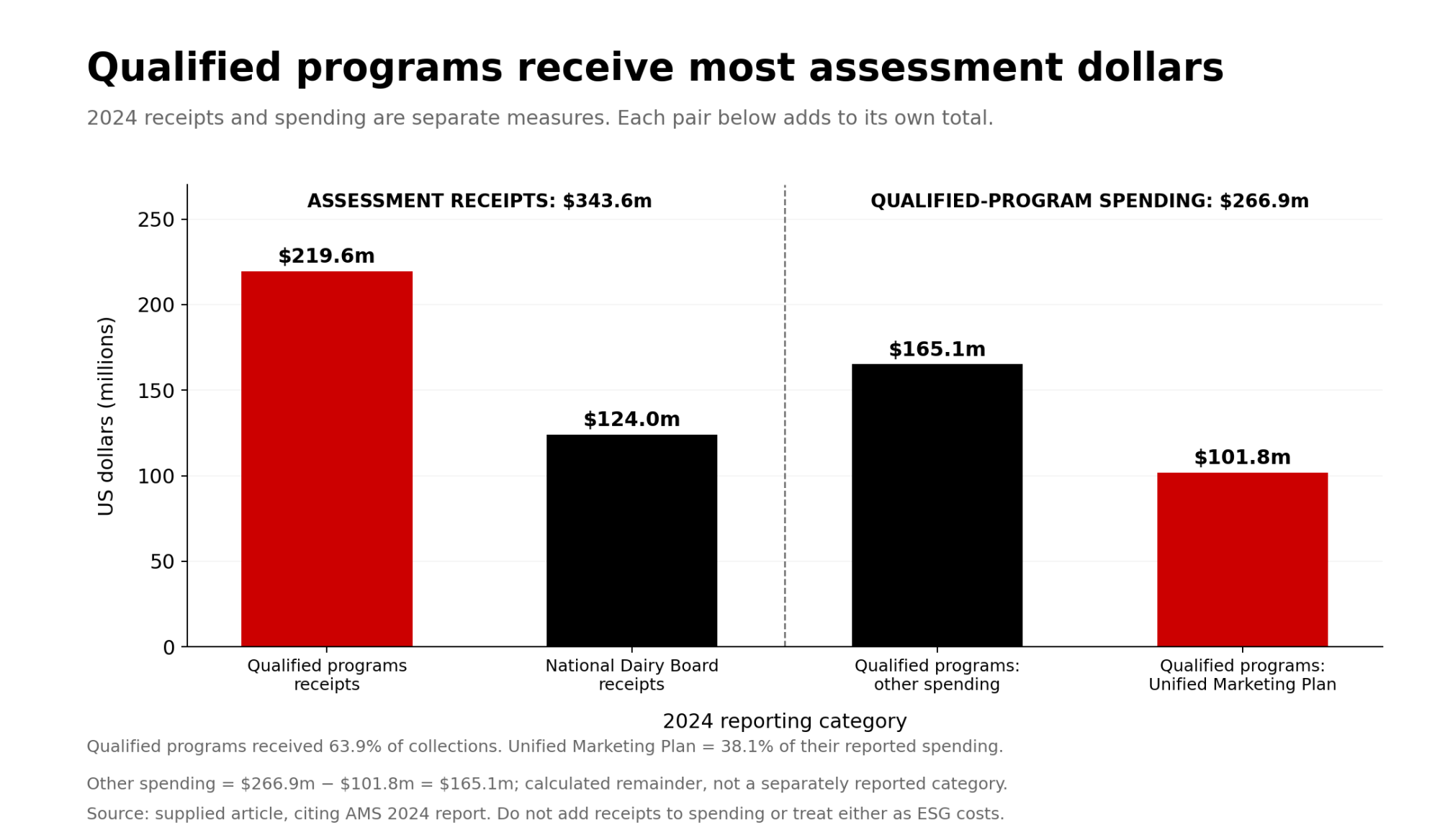
In the pages The Bullvine reviewed, USDA’s combined figures for these programs don’t break out sustainability spending. Any such spending can’t be pulled out of USDA’s combined categories. Individual programs may publish more in their own reports, and USDA’s Sept. 17 letter expressly brings them into the review.
Your Buyer’s Rules Are a Separate Question
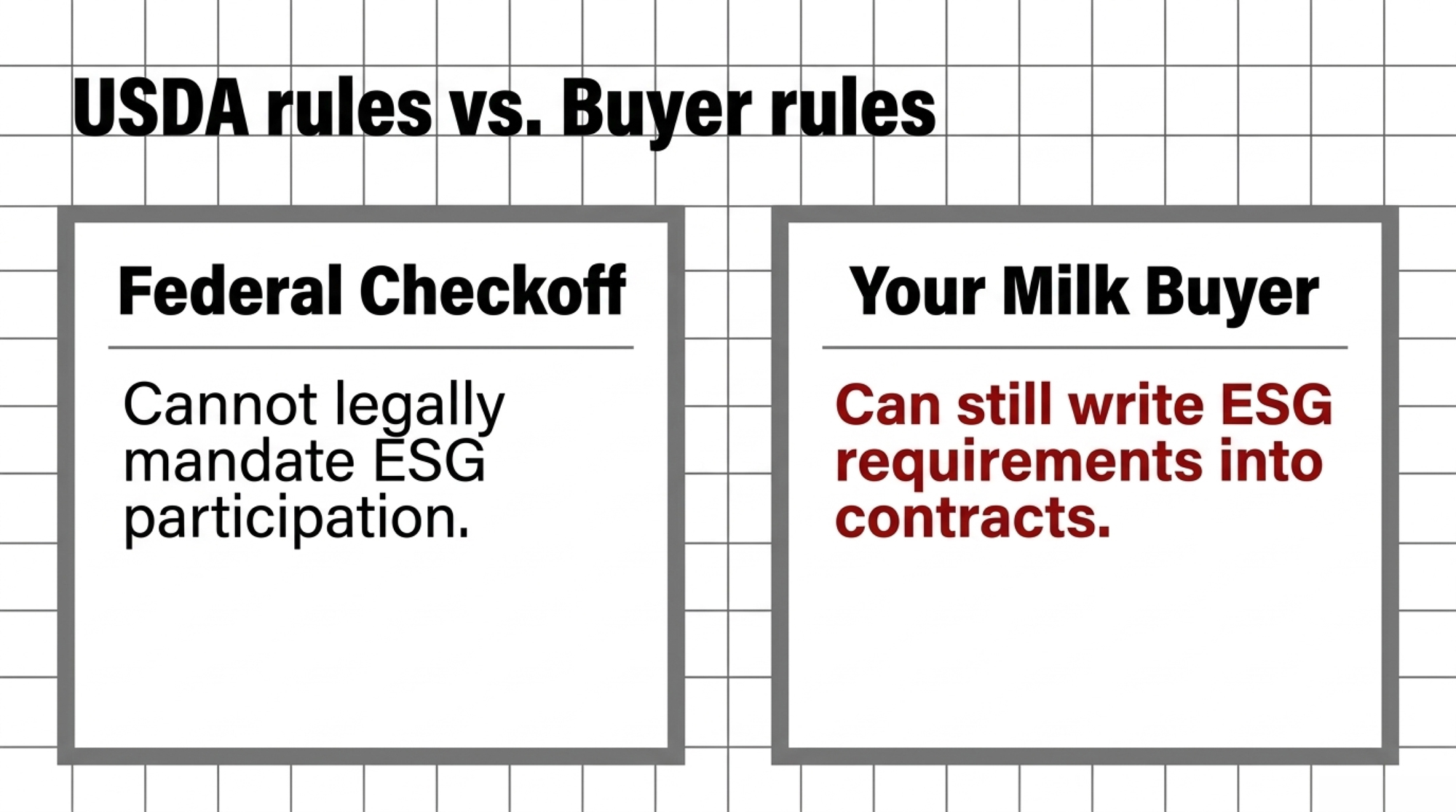
USDA’s list targets mandatory participation by producers in Scope 3 accounting and FARM Environmental Stewardship. USDA letter, Sept. 17, 2026 The Under Secretary memorandum also bars checkoff funds from supporting “the solicitation or enforcement of mandatory ESG commitments, pledges, scorecards, reporting requirements, or similar frameworks.” USDA Under Secretary Memorandum, Sept. 17, 2026 That language covers checkoff money. Nothing reviewed here shows it reaches a buyer’s own contract terms, or that any existing buyer requirement has been canceled. Ask your buyer for written confirmation, and check your contract, the program administrator’s terms and, if needed, your legal adviser.
What to Do Now
- Check your milk statement. Confirm your assessed hundredweight and the 15¢ deduction, or your organic exemption.
- Ask your qualified program which program gets your local share. Ask what funding goes to the named initiatives, where farmers can review that information, and whether any project has changed since Sept. 17.
- Get your buyer’s answers in writing. Ask which sustainability or data requirements stay in effect, whether they’re mandatory, who pays for them, and whether fees or data arrangements are changing.
- Watch the record. Look for new filings in Swan v. Rollins, any public release of the board’s Sept. 30 submission or USDA’s termination decisions, and AMS’s next report to Congress.
The Bullvine sent questions to USDA AMS and DMI on Oct. 12, 2026. We asked about the board’s submission, which research entries remained funded and what contract decisions have been made. This story will be updated with any responses.
Will USDA and the checkoff publish which listed entries were still funded on Sept. 17, what they cost, and what happens to them now?
Key Takeaways
- USDA’s own 2024 research list shows 8 Net Zero entries and 1 Greener Cattle entry with no project amounts. So no public record that we reviewed yet shows what the Sept. 17 order takes out of checkoff spending.
- The Sept. 30 project list was due to USDA, not to farmers. Swan v. Rollins was stayed Sept. 17, not dismissed, so watch that docket and AMS’s next report for what’s been ended.
- Count isn’t cost: 639 approval actions and $131.64 million in 2025 DMI funding sit in the records, none of it broken out by initiative. That’s a disclosure gap, not proof of misspending.
- The 15¢/cwt assessment hasn’t changed, and USDA’s memo limits checkoff money, not your buyer’s contract. Those are separate questions with separate answers.
Complete references and supporting documentation are available upon request by contacting the editorial team at editor@thebullvine.com.
Learn More
- The $73-a-Cow Gap Hiding in Your 2027 Bovaer Contract — Breaks down the hidden math on enteric methane additives, exposing a $73-per-cow shortfall between Bovaer feed costs and sustainability premiums. Arms you with the genomic filtering strategies needed to protect your margin before 2027 contract renewals.
- Adam Faust Beat USDA in 11 Months. The Checkoff May Be Next. — Securing your state checkoff credit takes one phone call. Follows the money on the federal lawsuit targeting mandatory assessments, delivering exact farm-level calculations and four immediate operational steps producers can execute while the constitutional battle plays out.
- The State of the Dairy Industry 2026: Policy, Markets & Change — Processor contracts are rewriting the rules on Scope 3 emissions reporting. Details how FMMO make-allowance updates and component pricing pivots dictate revenue, proving why sustainability compliance now functions as a strict baseline for shipping milk.
 The Sunday Read Dairy Professionals Don’t Skip.
 The Sunday Read Dairy Professionals Don’t Skip.
Every week, thousands of producers, breeders, and industry insiders open Bullvine Weekly for genetics insights, market shifts, and profit strategies they won’t find anywhere else. One email. Five minutes. Smarter decisions all week.