






IgG starts loading into the udder around day 40 of the dry period. Dry off at 77 lbs, and that window closes before it opens.
Composite Story — read this first. This is a composite story. The herd, manager, vet, nutritionist, and owner described here are not a single real farm or real individuals — they’re a composite drawn from multiple U.S. Holstein operations facing the same dry‑off and colostrum issues. Quotes are illustrative composites, not the words of any real person.The science, dollar figures, mastitis odds, and FPT data are real and sourced to published research.
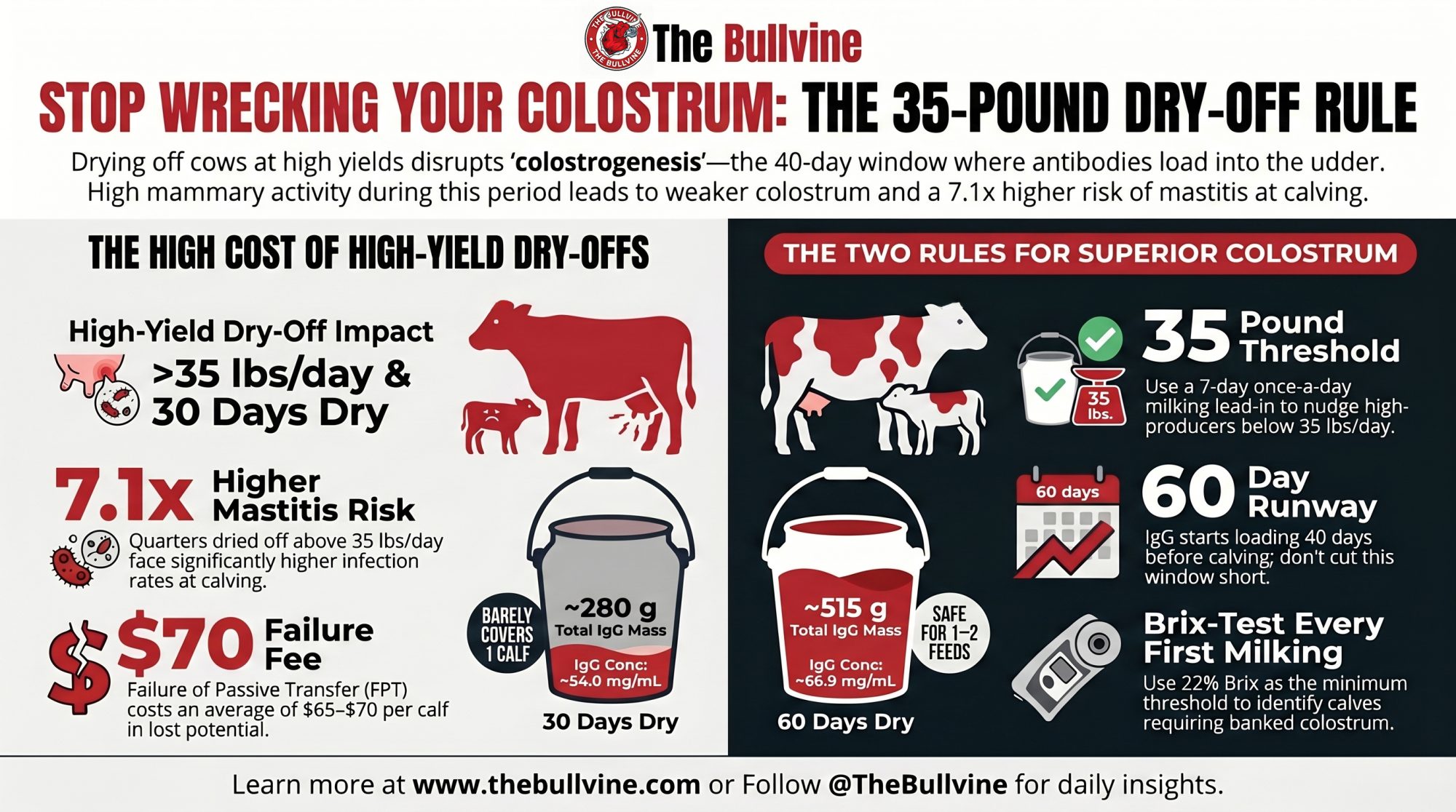
Executive Summary: IgG starts loading into the udder around day 40 of the dry period — which means a cow dried off at 65–70 lbs/day may still be in late-lactation mode when that window opens, and her first-milking colostrum pays the price. University of Guelph colostrogenesis research shows cows with high mammary activity in the far-off period consistently produce weaker IgG at calving, and a single-herd 0/30/60-day dry-period trial puts hard numbers on it: 60-day cows averaged ~515 g total IgG per first milking versus ~280 g for 30-day cows — barely enough to clear the 200–300 g delivery floor Lombard et al. (2020, J Dairy Sci) set for adequate passive transfer in a single feed. Quarters dried off above ~35 lbs/day carry 7.1× the new intramammary infection risk at calving, and FPT calves run roughly double the pre-weaning mortality and cost your operation an average of $65–$70 USD per calf (Raboisson et al., 2016, Prev Vet Med) — a bill that traces back to the far-off pen, not the calf barn. One composite U.S. Holstein herd fixed it with two rules: nothing over 35 lbs/day at dry-off, and a hard target of 45–60 days dry, enforced with a seven-day once-a-day milking lead-in for high producers. A 30-cow pilot showed a clear right-shift in first-milking Brix and fewer dry-period mastitis events — no new products, no close-up ration changes. If a third of your cows are still over 55 lbs/day when you stop milking them, the colostrum problem you keep chasing in the close-up pen started six weeks earlier than you’re looking.
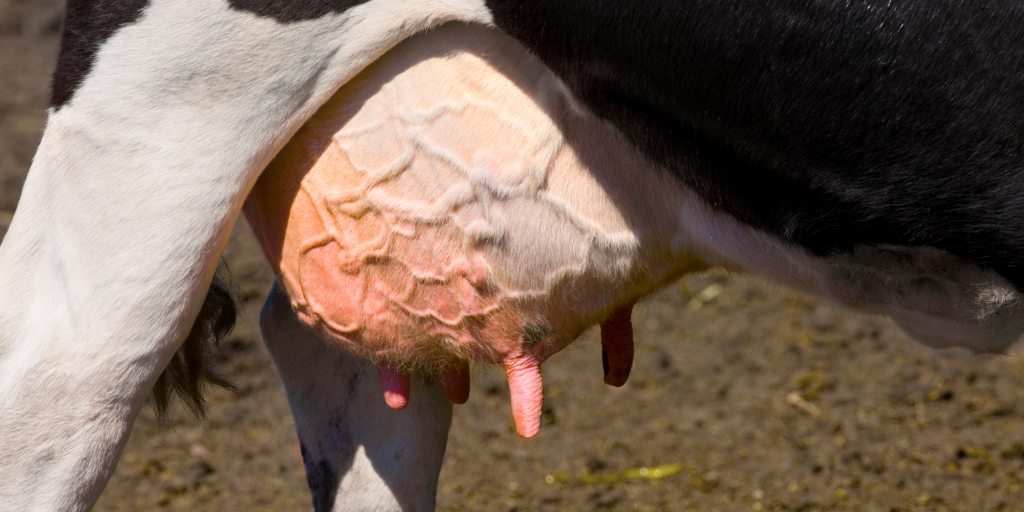
A 500‑cow Holstein dairy in the U.S. Upper Midwest thought it had colostrum dialed in.
The herd manager could recite the close‑up ration by heart. The calf‑barn protocol was laminated on the wall — “1 gallon within 2 hours, 22% Brix minimum.” Then the vet stopped in front of a three‑weeks‑dry cow with a rock‑hard, leaking bag and asked one question that landed harder than anyone expected, highlighting why your colostrum feeding protocol has to match what the cow’s actually doing six weeks before calving:
“How many pounds was she giving the day you dried her off?”
Nobody knew. Two months later, that cow’s heifer calf came in borderline failure of passive transfer on a serum total protein test. That’s when the herd realized the real colostrum quality story didn’t start in the close‑up pen. It started six weeks earlier — in how hard they were asking their best cows to slam into the dry period.
“We Were Obsessing Over the Wrong Two Weeks”
This is a high‑output dairy — about a 90‑lb (≈40‑kg) rolling herd average, with plenty of cows peaking well over 100 lbs. The culture is classic 2026: push production, protect fresh cows, hit repro numbers, grow the milk check.
On paper, they were nailing it. Calf records said otherwise. Failure of passive transfer (FPT) rates were drifting up. Brix readings bounced around more than they should in a herd this tight on everything else. Each round of FPT failures sent them back to the close‑up ration — tweaking energy, tweaking minerals, tweaking the close‑up move date. Nothing moved the needle.
Then the vet brought in slides summarizing colostrogenesis research published by the University of Guelph in the early 2020s, where Holstein cows had pre‑partum udder secretions sampled at frequent intervals before calving — a running log of when IgG first appeared and how it climbed.
The result reframed the conversation. In some cows, IgG started moving into the udder as early as six weeks before calving. Cows that started earlier and accumulated gradually ended up with better first‑milking colostrum. Cows that only ramped up in the last 7–14 days didn’t catch up. When that same group measured mammary blood flow and nutrient uptake, the picture sharpened: cows with high mammary activity during the far‑off dry period — the cows that didn’t really shut off — were the ones with poorer colostrum IgG at calving.
“That’s literally the cow we’re staring at in the dry pen,” the herd manager said. “Three weeks dry, still tight, still dripping. And we kept telling ourselves colostrum is all about the last two weeks.”
Two Cows, Same Pen, Two Very Different Calves
After seeing the Guelph data, the team walked the far‑off pen with the vet 10 days post‑dry‑off, notebook in hand. The plan was simple: write down what each udder looked like and match it to the dry‑off yield later.
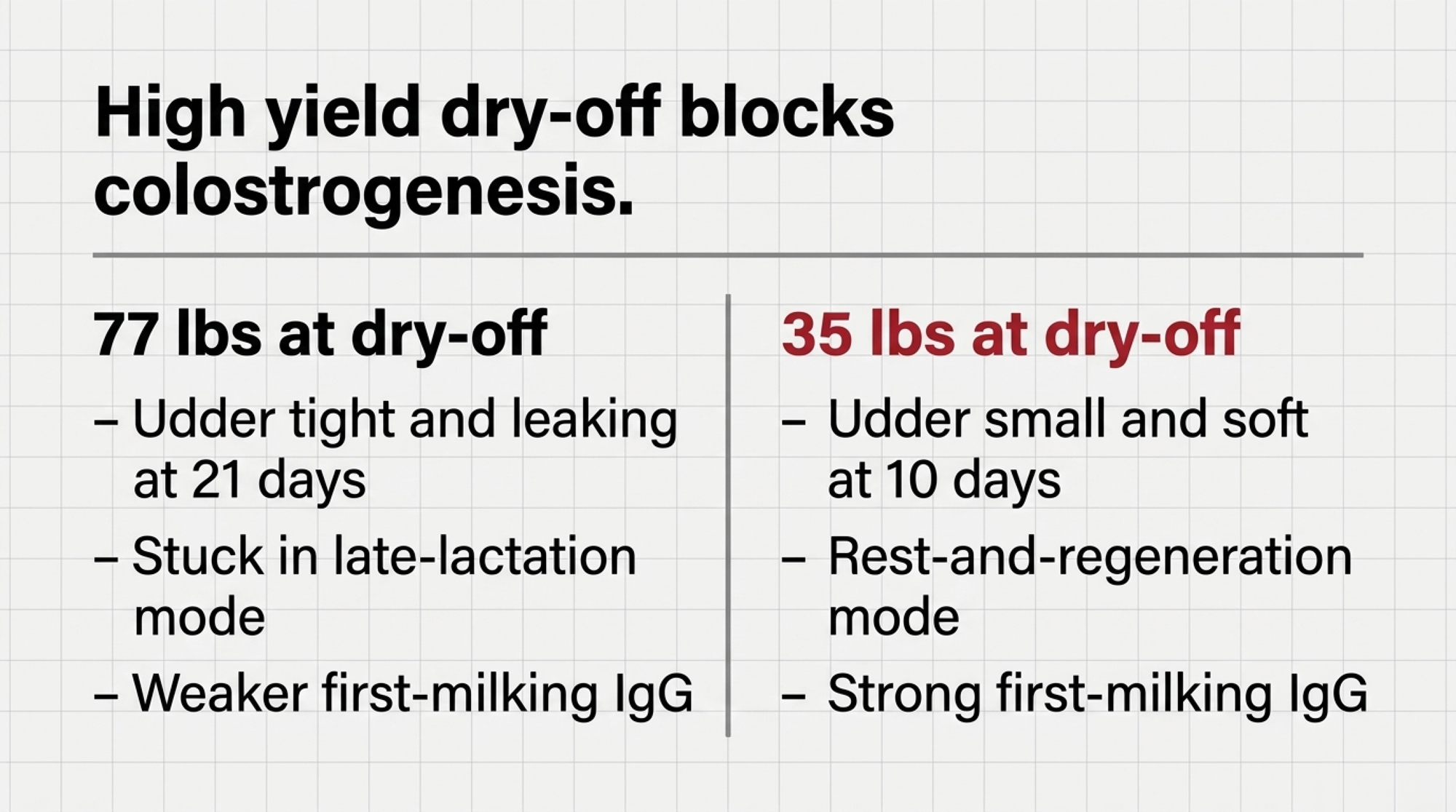
Cow A had peaked over 100 lbs and was still around 77 lbs/day (≈35 kg) on her last test before dry‑off. The morning after they stopped milking her, her udder looked like they’d missed a milking — tight, shiny, under pressure. A week in, nothing had really changed. By 21 days dry, dried milk was tracked down her legs and her teat ends were crusted. Her mammary gland was still in late‑lactation mode, not in the rest‑and‑regeneration state colostrogenesis appears to require.
Cow B is the cow every dry‑cow manager quietly loves. Solid producer, but she tails off on her own. By her dry‑off date she was down to about 35 lbs/day (≈16 kg). Ten days later her udder was small and soft. No leaks. No drama. The kind of low‑idle gland that quietly starts making colostrum on schedule.
The Guelph data lined up with what they were seeing in real time. The “Cow A” profile — high mammary activity in the far‑off period — corresponded to weaker IgG in the first milking. The “Cow B” profile — early involution, low activity — lined up with earlier IgG accumulation and stronger colostrum.
| Metric | Cow A (High Yielder) | Cow B (Natural Taper) |
|---|---|---|
| Yield at dry-off | 77 lbs/day (~35 kg) — RED FLAG | 35 lbs/day (~16 kg) |
| Udder at 10 days dry | Tight, shiny, under pressure | Small, soft, no leaks |
| Udder at 21 days dry | Still leaking; crusted teat ends | Quiet, fully involuted |
| Mammary activity (far-off) | High — late-lactation mode | Low — rest & regeneration mode |
| IgG accumulation timeline | Delayed ramp-up | Early onset, gradual build |
| First-milking Brix (expected) | <22% — likely FPT risk | 24–26%+ — adequate PT |
| Mastitis IMI risk at calving | 7.1× elevated | Baseline |
| Calf passive transfer outcome | Borderline/FPT likely | Adequate PT likely |
The vet put it bluntly: “If we’re drying off a third of this herd over 55 pounds a day, we’re fighting the biology of colostrum, not helping it.”
What a 0/30/60-Day Dry Period Trial Made Impossible to Ignore
A week later the nutritionist came back with a single‑herd European trial on her laptop and a one‑line message: “This isn’t just theory.”
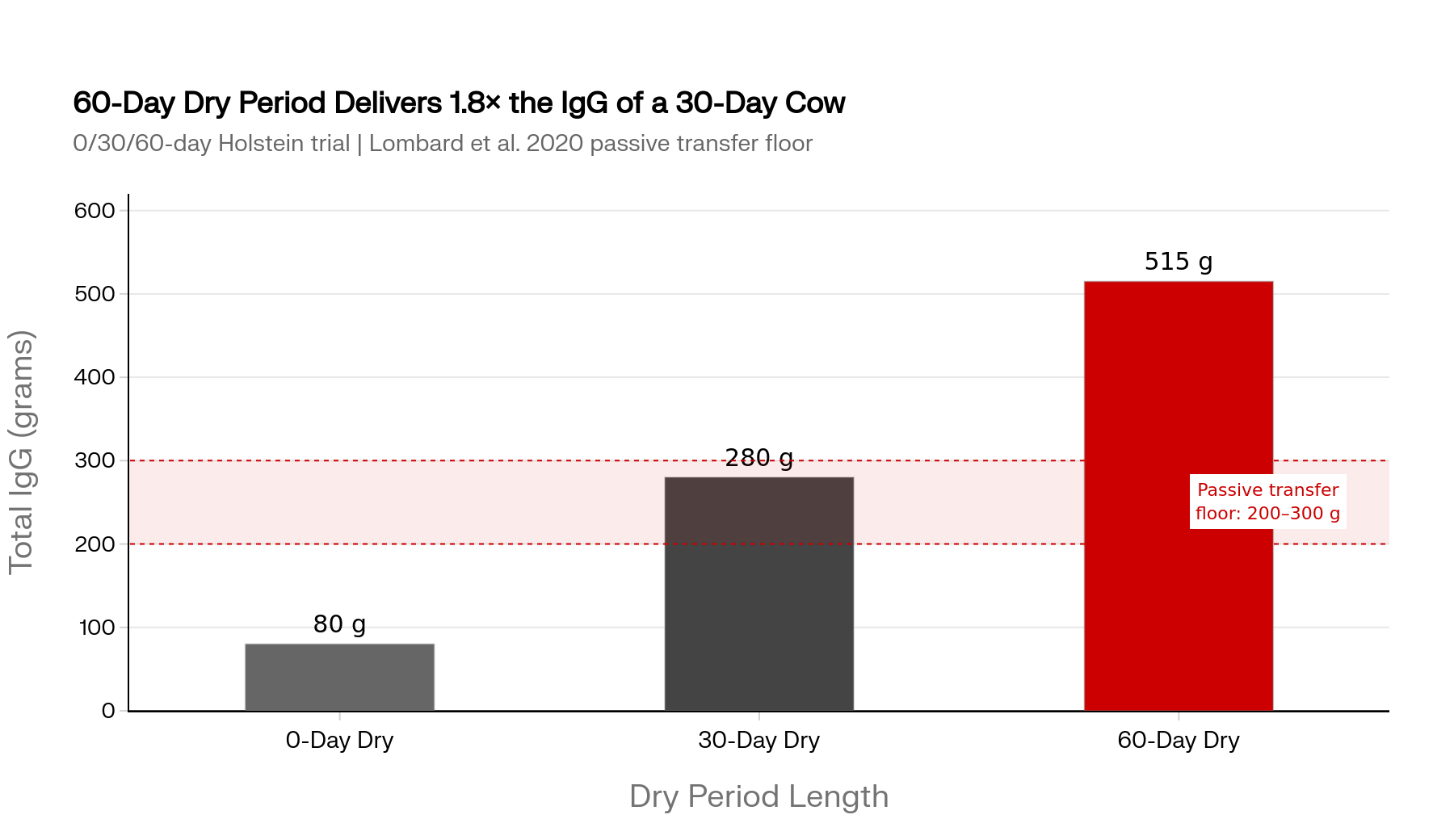
In that commercial Holstein herd, cows were randomized to 0‑, 30‑, or 60‑day dry periods, with first‑milking colostrum yield and IgG measured directly. The numbers are uncomfortable for anyone flirting with shorter dry periods:
| Dry Period Length | First‑Milking Colostrum Yield | IgG Concentration | Total IgG Mass Supplied |
| 60 Days | ~17 lbs (≈7.7 kg) | ~66.9 mg/mL | ~515 g (safely covers 1–2 feedings) |
| 30 Days | ~11–12 lbs (≈5.1–5.3 kg) | ~54.0 mg/mL | ~275–286 g (barely covers 1 calf) |
Field and extension guidelines point dairy producers at 200–300 g of total IgG delivered in the first 24 hours, consistent with the four‑category passive‑transfer thresholds published by Lombard and colleagues in the Journal of Dairy Science in 2020. In the trial, a 60‑day cow could cover that target with a single 1‑gallon feed and still bank a backup. A 30‑day cow had just enough total IgG to barely cover one calf at the high end — with nothing left for a twin, a slow drinker, or the next morning’s calf.
When researchers followed those calves, the pattern carried. Calves out of 0‑day dry dams had lower natural antibody levels in the first two weeks of life than those from 30‑ or 60‑day cows, even when later vaccine responses looked fine. Those first two weeks are exactly when scours and pneumonia hit hardest.
Zoom out across multiple herds and the economics get ugly.
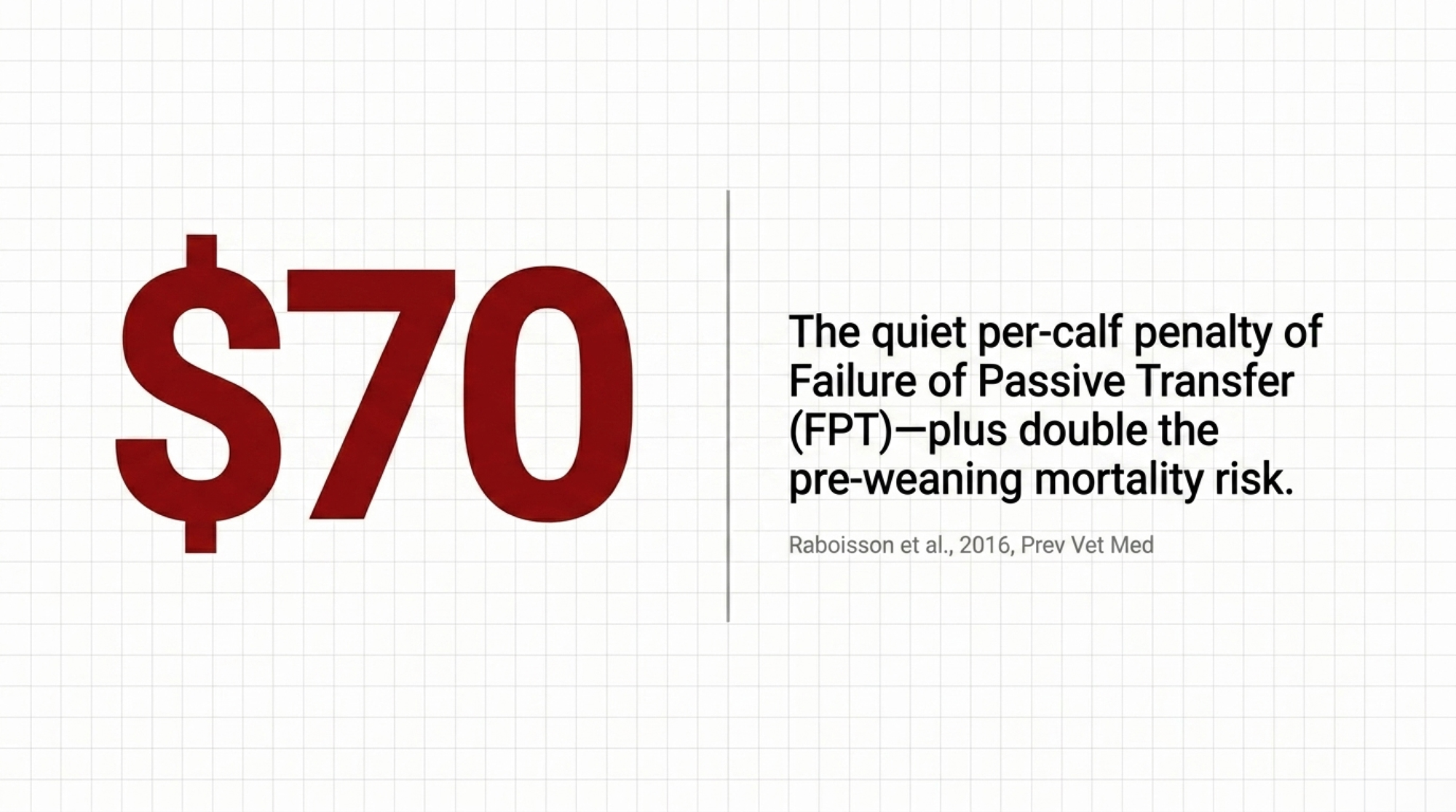
The True Cost of FPT: Meta‑analyses show FPT calves face roughly double the mortality risk and up to 1.9× the disease risk before weaning. On average, FPT quietly drains around $65–$70 USD per dairy calf right off your bottom line, with a published range running from a few dollars per calf to well over $100 depending on herd context (Raboisson et al., 2016, Preventive Veterinary Medicine — original figure €60, range €10–109).
Published clinical‑outcome work has reported sharply higher mortality among FPT calves than among calves with adequate passive transfer on the same dairy — in one frequently cited study, roughly a tenfold gap between the two groups before weaning.
At the kitchen table, the owner cut the discussion short. “We’ve bred cows to milk like crazy. Now we’re finding the weak point we never thought we had is 60 days before calving.” That triggered a deeper look into what shorter dry periods really do to milk yield, colostrum and calf immunity.
“Our Dry-Off Program Was Still Built for 33-Pound Cows”
The next hard look was at their own records. One year of dry‑off dates pulled against test‑day yields. The pattern was familiar to anyone running modern, high‑yield genetics, and it tracks with what 30-kg dry-off cows are doing to colostrum six weeks before calving.
Plenty of cows were under 45 lbs/day at dry‑off. Those weren’t the worry. But a third of cows scheduled for dry‑off in the next two weeks were still 55 lbs/day (≈25 kg) or higher, and a chunk of older cows were banging out 65–70 lbs/day (≈30–32 kg). All of them got the same treatment: full milk one day, “dry” the next.
That worked when most cows naturally coasted down to about 33 lbs/day (≈15 kg) on their own. That’s the era much of the older dry‑off guidance was built around. This herd had pushed performance so far that they were now asking 65‑lb cows to do what 33‑lb cows used to do — and were surprised when the glands didn’t cooperate.
Then came the mastitis piece, and it landed hard.
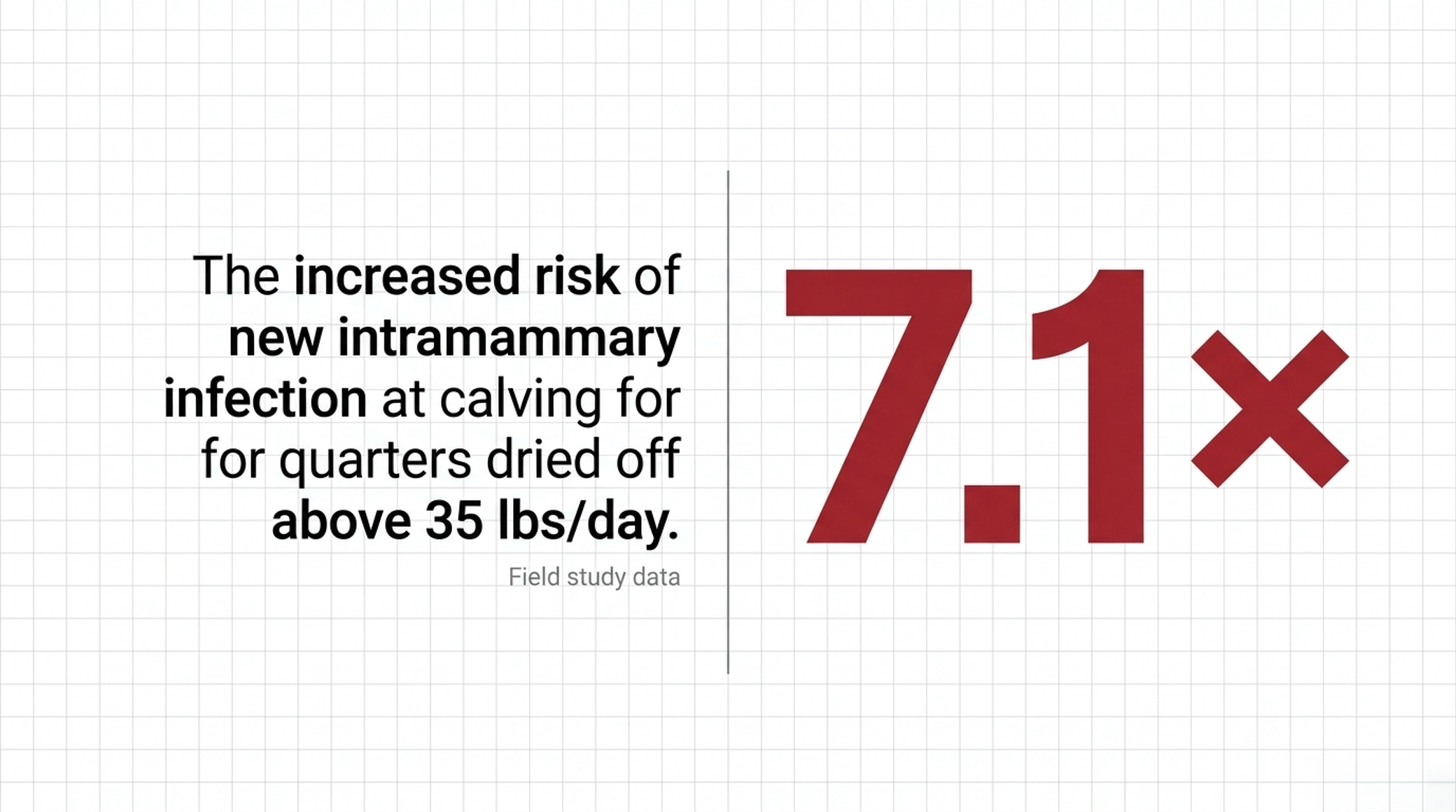
The 35‑Pound Rule for Mastitis Prevention: Quarters from cows producing more than ~35 lbs/day (≈16 kg) at dry‑off are 7.1 times more likely to develop a new intramammary infection at calving compared with cows dried off under that threshold. A separate field study showed that for every extra 11 lbs (≈5 kg) of milk at dry‑off above ~27 lbs (≈12.5 kg), the odds of an environmental IMI at calving climbed by at least 77%.
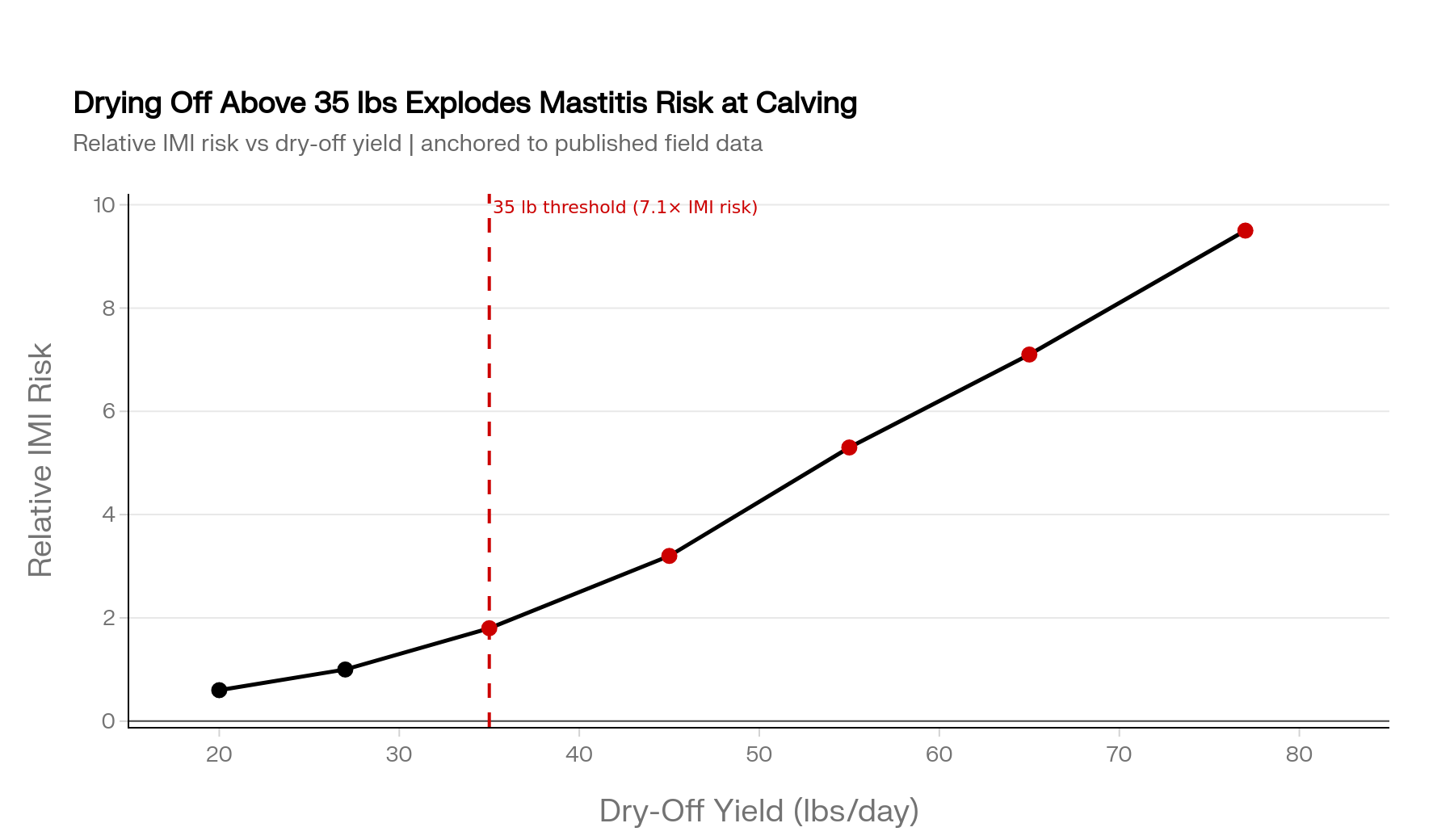
Tight, full, leaking udders in the far‑off pen aren’t cosmetic. They’re associated with more new intramammary infections at calving and, per the Guelph work, with a gland that hasn’t shifted out of late‑lactation mode into the rest‑and‑regeneration state colostrogenesis appears to require. This herd wasn’t just taking a colostrum hit. They were doubling down on fresh‑cow mastitis risk at the same time.
Is 35 Pounds the Line in the Sand at Dry-Off?
Nobody in the room wanted a change that would blow up the milking routine. Fixed parlor, finite labor, a lot of cows to get through twice or three times a day. They needed something simple and enforceable.
They drew one line they could live with:
“We don’t dry a cow off if she’s over about 35 pounds a day, unless we absolutely can’t avoid it.”
Once that decision was made, the work became how to get more cows under that line without wrecking the rest of the system.
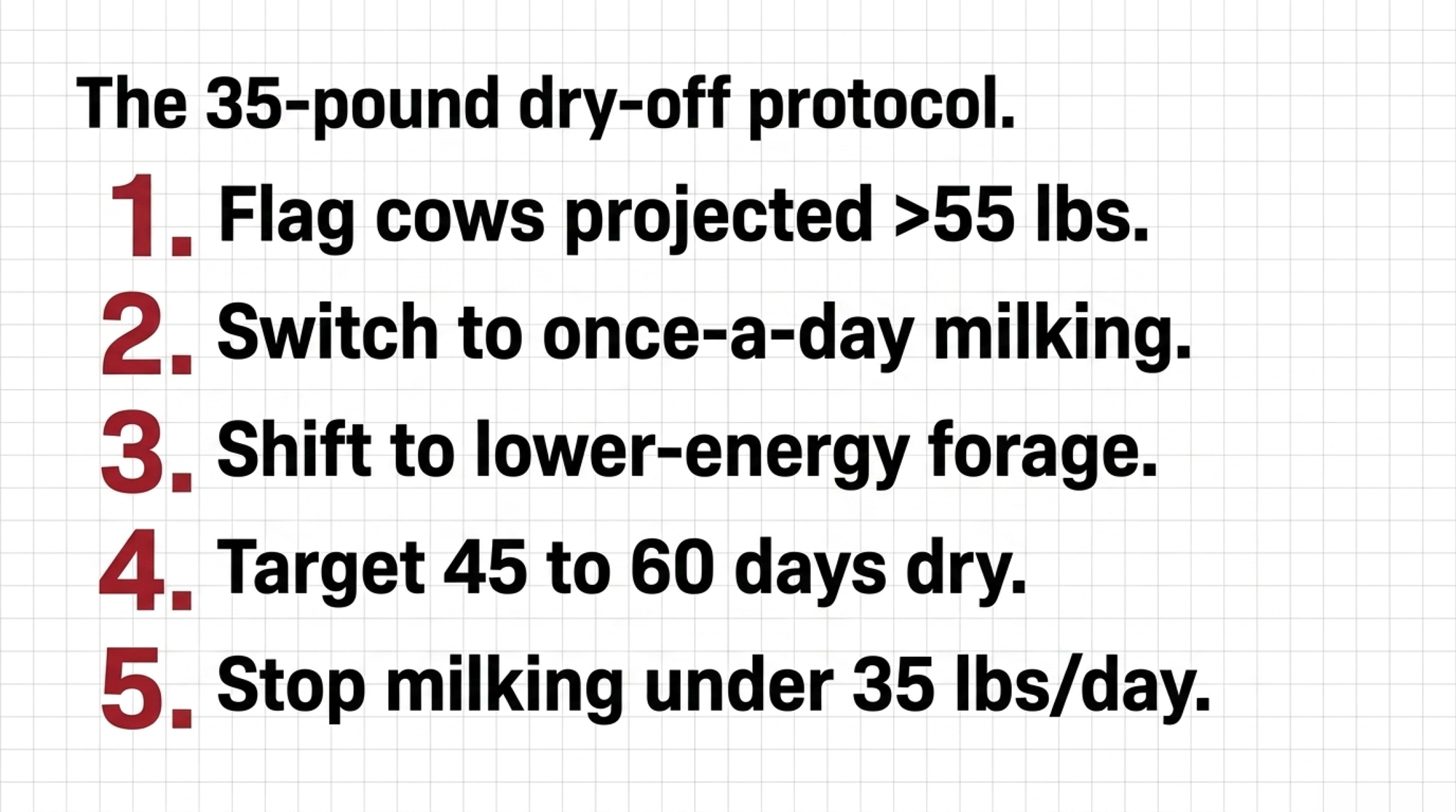
Step One: Find the Cows Doing the Most Damage
The first pass was data triage. The manager used the herd software to flag cows due to calve in roughly 60 days, sorted by projected daily yield.
Anything projected at 55 lbs/day or higher at dry‑off got a red mark and became a “managed dry‑off.” Lower‑yield cows kept the existing protocol. Nobody was trying to overhaul everything on day one.
“We wanted to take the high‑pressure cows out of the blind spot,” the manager said. “Those are the udders working against us when we get to colostrum and mastitis.”
Step Two: One Week of Once-a-Day Milking
The second step was small but powerful: a one‑week, once‑a‑day milking lead‑in for those flagged cows.
Seven days before the planned dry‑off date, those cows moved into a small group, milked once a day in the morning. The ration shifted to a slightly lower energy mix — more straw or low‑energy forage, a bit less grain — to nudge yields down without crash‑dieting.
Field experience and research suggest once‑a‑day milking in late lactation can drop yield by roughly a third in a week. That’s exactly what they saw. Many of the 55–65 lb cows drifted into the high 30s and low 40s by day seven. A few hard‑milking outliers stayed high, but the overall picture changed.
The actual dry‑off step didn’t change — same antibiotic and sealant protocol, same pen move. They’d just stopped asking 65‑lb udders to slam into involution overnight.
Step Three: Respect the 45–60-Day Dry Period
Days dry was the other half of the equation. Their numbers showed more short dry periods than anyone liked. Some of it was late preg checks. Some of it was “just how we’ve always done it.”
A second rule went on the whiteboard: where they could control it, the target was 45–60 days dry. Shorter dry periods were only allowed with a documented reason. That meant tighter pregnancy diagnosis and more discipline around final breeding decisions. Not glamorous work — but it built the runway IgG actually needs.
Together, those two rules — under 35 lbs at dry‑off, and 45–60 days dry — gave the gland both the signal and the timeto drop into the low‑activity state colostrogenesis appears to need.
Did the 35-Pound Rule Actually Move Brix?
The vet knew the team would trust barn‑level numbers more than any paper. So they ran a small pilot on roughly 30 high‑yielding cows going through the new program, knowing they’d need at least one full dry‑off cycle of data before drawing conclusions.
For those 30 cows, the team tracked:
- Milk yield in the last week before the once‑a‑day switch and at dry‑off.
- Udder condition and leakage at ~10 and ~21 days dry.
- Brix on first‑milking colostrum at calving.
- Any dry‑period or fresh‑cow mastitis cases.
Nothing else changed. No new products. No tweaks to calf feeding. Just data.
By the end of the pilot, the office whiteboard told the story. The managed cows showed:
- Far fewer tight, leaking udders in the far‑off pen.
- A clear right‑shift in colostrum Brix versus the same cohort six months earlier.
- Fewer dry‑period mastitis events in that group.
Not perfect. Some stubborn cows. Some messy data points. But the direction of travel was obvious enough that nobody wanted to roll it back.
Banking Colostrum While the System Catches Up
Even with better dry‑off, this herd would be living with past decisions for a while. Cows already in late gestation couldn’t be retro‑fixed. So they shored up the calf side at the same time, knowing exactly why failure of passive transfer quietly shows up on your milk check over the next two lactations.
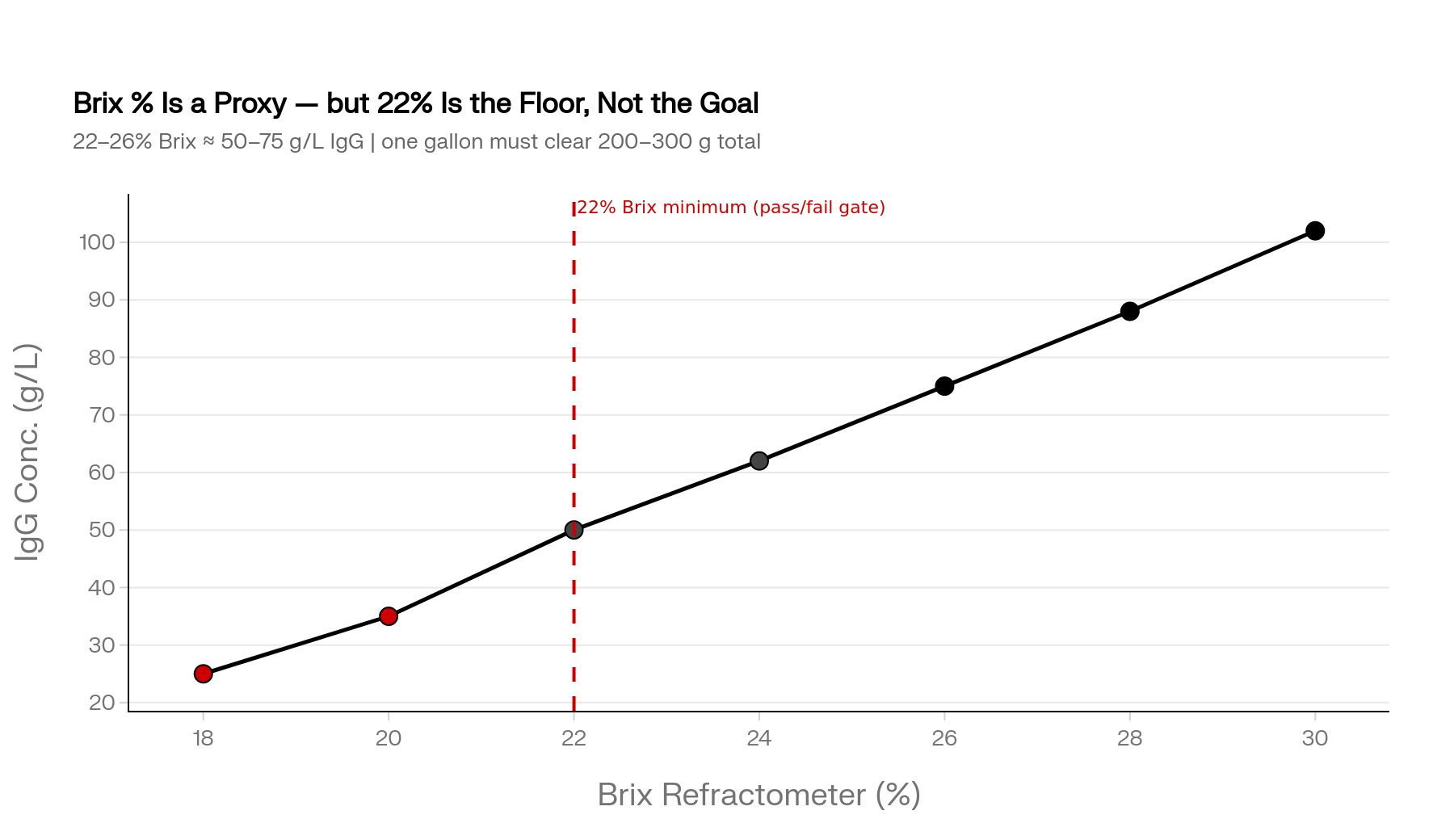
Every first‑milking colostrum sample now got a Brix reading, with percent and cow ID written right on the bucket. Research suggests 22–26% Brix maps roughly to 50–75 g/L IgG. Feed a gallon promptly and a cow at the upper end of that range clears the 200–300 g IgG target on a single feed; cows on the low end (right at 22% Brix) come in just under it, which is why a second feed within 12 hours matters. Anything in that range from cows with decent dry periods went into a labeled freezer bank. Cows that calved with low‑Brix colostrum — especially older cows with short dry periods — had their heifer calves fed from the bank or a high‑quality replacer instead of a single weak milking.
It didn’t solve the whole problem. But fewer calves were now at the mercy of any one high‑yield, short‑dry cow. As more cows passed through the new dry‑off program, the freezer became a backstop instead of a crutch.
What This Means for Your Operation
You don’t need to copy this herd bolt‑for‑bolt. But if you’ve pushed production hard over the last decade, their experience gives you sharp questions to ask in your own barn.
| Audit Check | Old Standard (33 lb avg cow) | High-Output Standard (90 lb RHA herd) | Your Herd? |
|---|---|---|---|
| Dry-off yield threshold | 45–55 lbs acceptable | ≤35 lbs target; flag >55 lbs | lbs |
| Dry period length target | 45–60 days | 45–60 days strict; document exceptions | days avg |
| % cows >55 lbs at dry-off | Not tracked | <15% of dry-offs; >33% = problem | % |
| Lead-in protocol for high producers | None | 7-day once-a-day milking group | Yes / No |
| Far-off pen udder walk | Not standard | 10–14 days post dry-off; count leakers | Yes / No |
| First-milking Brix testing | Occasional | 100% tested; cow ID recorded | % |
| FPT rate (serum TP or IgG) | Not measured | <15% FPT target; test 20 calves/cycle | % |
| Colostrum freezer bank | Rare | Maintained as backstop, not crutch | Yes / No |
- Do you actually know your dry‑off yields? In the next 30 days, pull last month’s dry‑off list and write down how many cows were still over 55 lbs/day on their last test. That number tells you how big your high‑pressure group really is.
- What does your far‑off pen look like 10–14 days after dry‑off? Take a slow walk and count full, tight, or leaking udders. Those are the “Cow A” glands the Guelph data ties to high mammary activity and weaker IgG.
- How many cows are actually getting 45–60 days dry? Run a simple report on days dry over the last 12 months. A long tail under 40 days is IgG runway you’re cutting off before the cow can build the colostrum you’re expecting.
- Are you using Brix as a learning tool, or just a pass/fail gate? For one week, Brix‑test every first‑milking and write the reading and cow ID on the bucket. Then overlay those numbers against dry‑off yields and days dry. Patterns you can’t unsee will show up.
- Do you know your FPT rate, or just your calf treatment bill? Work with your vet to pull serum total protein or IgG on the next 20 heifer calves. If more than about 15% come back in failure of passive transfer, the real problem probably started in the dry period — not the calf room.
- Can you manage a small once‑a‑day group, even if you can’t overhaul the barn? Start with the 20–30 highest‑yielding cows at dry‑off. It’s a manageable trial, and your own numbers will tell you fast whether the 35‑pound target is worth chasing in your system.
Run Your Numbers
Health ROI Calculator — Put a dollar value on tightening your dry-off threshold. The calculator stress-tests how fewer fresh-cow mastitis cases, lower FPT-driven calf losses, and reduced replacement pressure stack up against the labor of running a once-a-day lead-in group. Run it before you decide the 35-pound rule isn’t worth the hassle.
Key Takeaways
- If your best cows are still over 35 lbs/day at dry‑off, you’re asking their udders to slam from full production into involution at exactly the moment IgG transfer needs to ramp up.
- If your herd routinely runs less than 45 days dry, especially on older high producers, the 0/30/60‑day data say you’re leaving total IgG on the table and shrinking your colostrum safety margin.
- If you’re not Brix‑testing first‑milking colostrum and tying it back to dry‑off yield and days dry, you’re guessing about where your colostrum and FPT problems actually start.
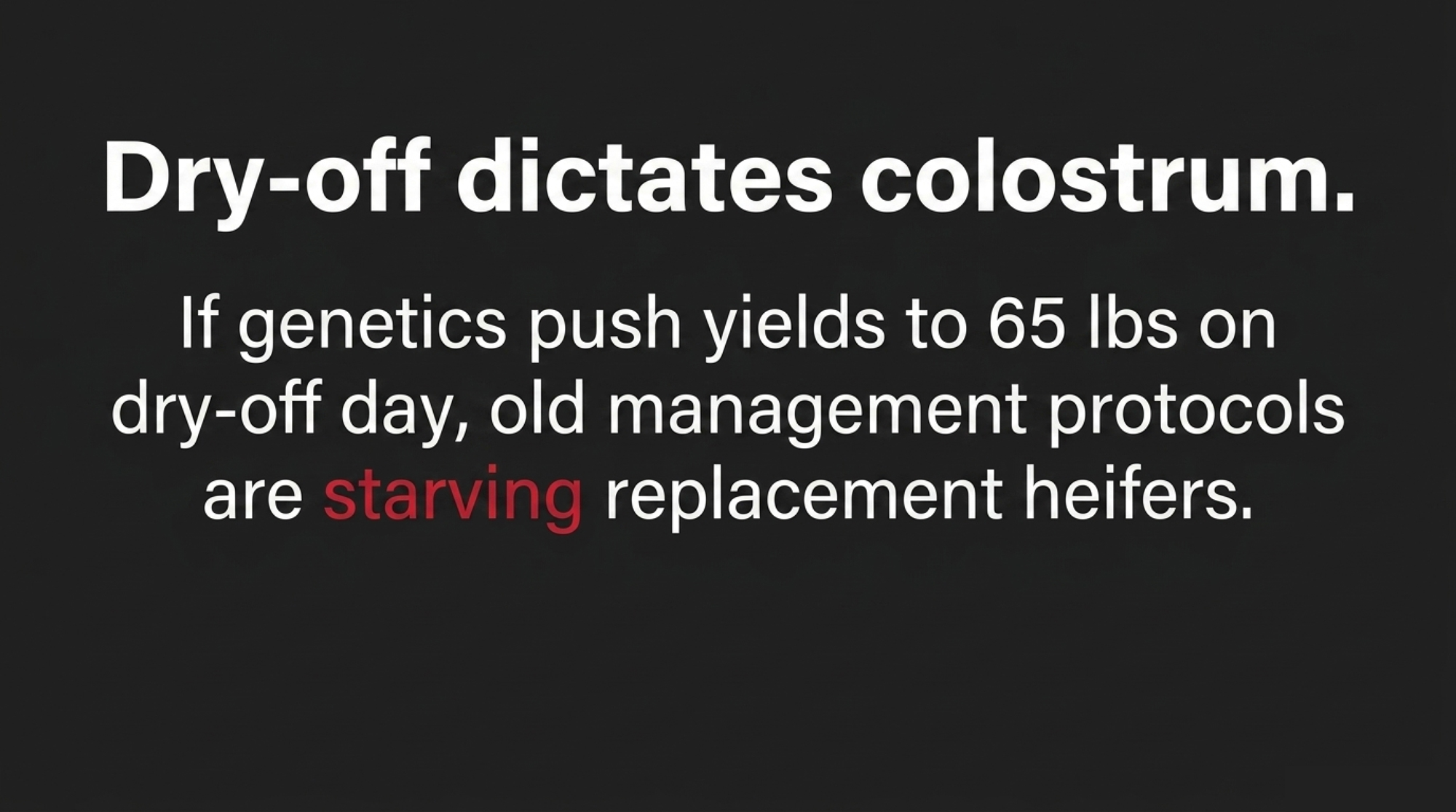
- If you’re breeding cows that will sit at 65 pounds on the day you’d like them dry, the question isn’t whether your close‑up nutrition is good enough. It’s whether your dry‑off program has kept up with the genetics you’ve created.
So the next time you’re in the far‑off pen and see a three‑weeks‑dry cow with a full, leaking udder, don’t shrug and walk past. Ask the harder question: is that udder still working for your milk check — or is it quietly stealing from your next generation of heifers?
Complete references and supporting documentation are available upon request by contacting the editorial team at editor@thebullvine.com.
Learn More
- Dam-Sourced Colostrum Drops Calf Mortality from 8.9% to 6.2% – Inside the 93-Herd Protocol — Arms you with hard field data proving that maternal, unpooled colostrum secures an immediate 2.7% drop in calf mortality by leveraging localized immune memory cells that frozen banks and synthetic replacers simply lack.
- Dairy Calf Nutrition for Healthier, Higher‑Producing Cows — Delivers a structured, multi-phase operational strategy spanning birth through structural weaning that prevents severe digestive slumps, optimizes early rumen microbial environments, and maximizes lifetime milk production.
- Your Repeat Mastitis Cows Have a 72-Hour Secret – Here’s How to Break It — Exposes the hidden biofilm timeline that shields chronic pathogens from traditional dry-cow therapies, offering an innovative, non-antibiotic approach to eliminate recurring infections before they wreck your next lactation’s milk quality.
 The Sunday Read Dairy Professionals Don’t Skip.
 The Sunday Read Dairy Professionals Don’t Skip.
Every week, thousands of producers, breeders, and industry insiders open Bullvine Weekly for genetics insights, market shifts, and profit strategies they won’t find anywhere else. One email. Five minutes. Smarter decisions all week.




