







Same morning, same flat look, both in third lactation. By day 4, one’s your top cow and one’s a train wreck — and Cornell’s Jess McArt says rumination told you which on day 2.
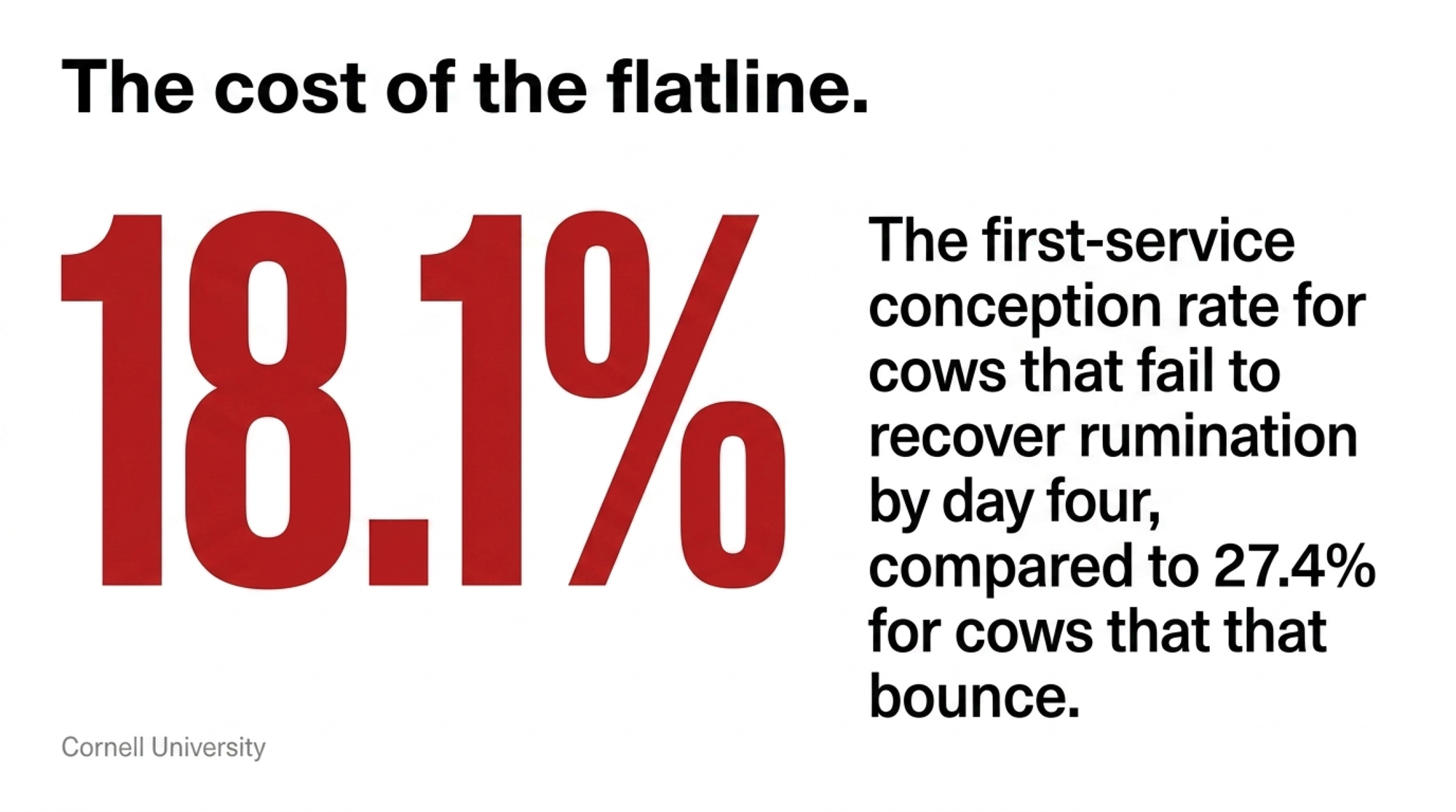
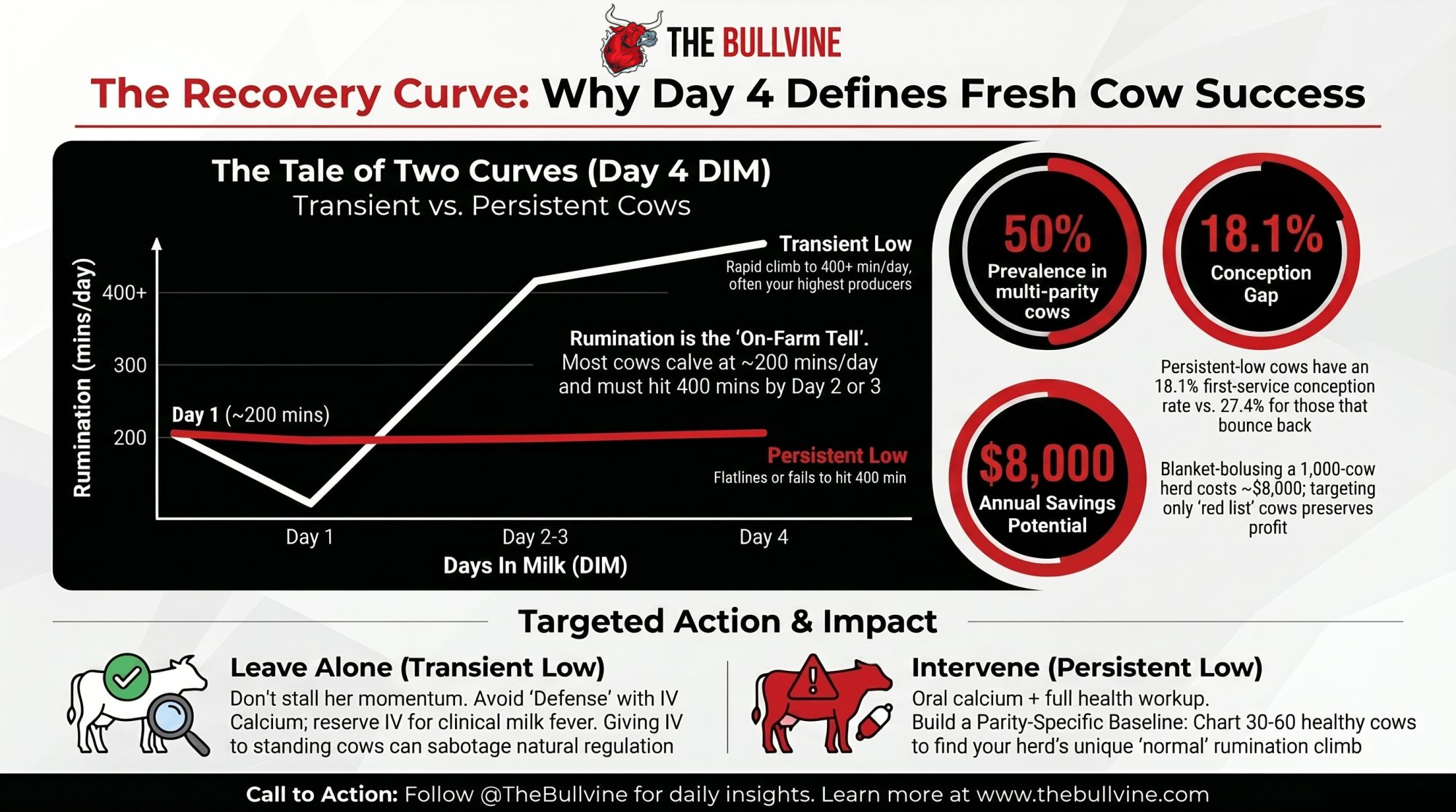
Executive Summary: Subclinical hypocalcemia is the fresh-cow problem hiding in plain sight, and Cornell’s Dr. Jess McArt says the cow worth chasing isn’t the one that drops calcium hardest — it’s the one still flat at four days in milk. Her group stopped sorting cows by how low they go and started watching how fast they recover, because the day-1 dipper that climbs back is often your top producer, while the cow that holds flat carries roughly double the adverse-event odds and a first-service conception rate of 18.1% versus 27.4% for cows that bounce. The cheap on-farm tell is rumination: most cows calve around 200 minutes a day and should push toward 400 by two to three days fresh, and the ones that don’t make that climb are your real red list. That matters for the milk check because blanket bolusing every fresh cow in a 1,000-cow herd runs about $7,000–$8,000 a year, much of it spent on cows already winning the lactation. McArt’s call is to target rather than treat-them-all: oral calcium for the cows whose curve indicates they’re struggling, leave the climbers alone, and reserve IV for genuine clinical milk fever, since spiking a standing cow is usually detrimental. The catch — she’s blunt: most of this is still observational, and the trials to nail down exactly which cows benefit are in progress. Read the full piece if you run a multiparous-heavy herd with collars and want the day-4 protocol spelled out.
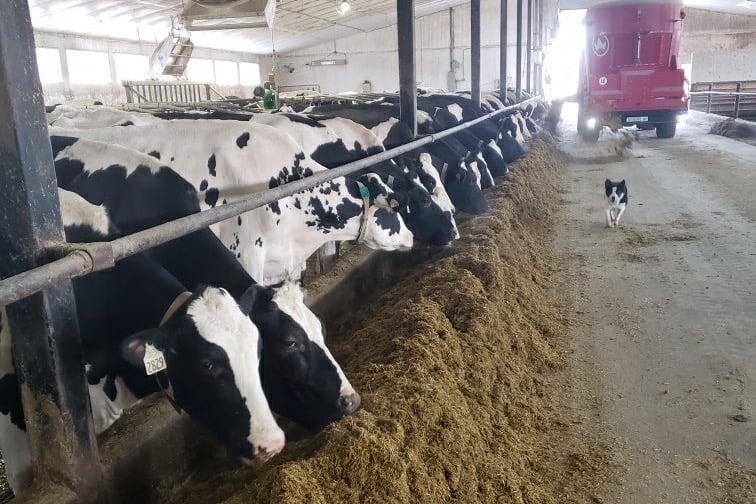
She’s standing. She’s chewing. She walked to the bunk this morning like nothing was wrong. And on day one, you genuinely can’t tell whether she’s about to be your best cow of the year or the most expensive animal in the fresh pen.
That’s the uncomfortable truth at the center of Dr. Jess McArt’s discussion of subclinical hypocalcemia on The Dairy Podcast Show hosted by Barry Bradford (Episode 196, “Hypocalcemia and Inflammation in Dairy Herds,” released May 2026). McArt is a professor of ambulatory and production medicine at the Cornell University College of Veterinary Medicine, and chairs its department of population medicine and diagnostic sciences. The dramatic down cow — classic milk fever, cold ears, flat out — is the problem the industry has mostly beaten. The fresh cow she worries about today never goes down at all. She fails to recover, loses a chunk of her lactation, and never lands on your treatment list until the money’s already gone.
The Problem You Already Solved Was Hiding a Bigger One
Twenty years ago, calcium was simple. Watch for milk fever. Hang a bottle. The cow stands up and walks away. McArt learned it that way in vet school. So did most of the people reading this.
Negative DCAD diets changed the game. By acidifying the prepartum cow — dropping her blood pH just slightly — you give her better access to calcium right when lactation starts pulling it out, so she rebounds faster. In some large herds, McArt says clinical milk fever has declined to the point that training new employees to recognize a case is genuinely hard now. They rarely see one. That’s a real win, and nobody should undersell it. (Transition Cow Success: the high-stakes game that makes or breaks your dairy’s profit)
But pull blood from a hundred fresh cows, and you’ll still find a stack of them sitting below normal calcium levels. They’re just not falling over. The subclinical form affects nearly half of multiparous cows as they transition into lactation, going back to Reinhardt’s 2011 national prevalence survey, and in older, third-plus-lactation cows the share has been reported as high as 73%. For years, McArt says, the subclinical problem was too hard to study because everyone tested on different days in milk and used different cut points. There was no agreed-upon number to point to. So her group went after the more useful question: which day in milk actually predicts whether a cow is in trouble.
The old habit was to treat every low number the same. McArt’s work says that’s exactly the mistake — and it’s costing herds in ways the records don’t make obvious.
Stop Chasing the Wrong Cow
Here’s the reframe that changes how you walk the pen. McArt’s group stopped sorting cows by how low they drop and started sorting them by when — and whether — they bounce back. The split at four days in milk is stark enough to put in a table and tape to the parlor wall:
| Cow Type at Day 4 DIM | Day 1 Rumination | Trajectory by Day 3–4 | First-Service Conception | Adverse-Event Odds | Recommended Action |
|---|---|---|---|---|---|
| Transient (Bouncer) | ~195 min/day | Climbs to 400+ min/day | 27.4% | 1.0× (reference) | Leave alone — don’t interrupt momentum |
| Persistent (Flat-liner) | ~190 min/day | Stays at 195–205 min/day | 18.1% | ~2.0× | Oral Ca bolus (Day 1 + Day 2 if flat) |
| Clinical Milk Fever | Recumbent / off bunk | N/A — cow is down | Not applicable | High — emergency | IV calcium — genuine clinical case only |
| Healthy No-dip Heifer | 180–220 min/day | Steady climb, parity-adjusted | Baseline for group | 1.0× (reference) | Monitor vs. your parity benchmark |
So the cow you panicked about on day one might be your best producer, and the one quietly coming apart on day four might never even have made your list. You’re not hunting low calcium. You’re hunting for failure to recover. (The $42,000 Transition Mistake: Why Blanket Protocols Are Failing Your Best Cows)
Two Cows, Same Morning, Different Endings
Picture the split with two cows out of the same fresh group — a composite drawn from the patterns McArt describes, not one real barn, but the shape plays out in pens everywhere. Call them 412 and 388. Both calve overnight, both third-lactation, both look a little flat at the morning check. On a blanket protocol, they’d get the same two boluses and the same shrug.
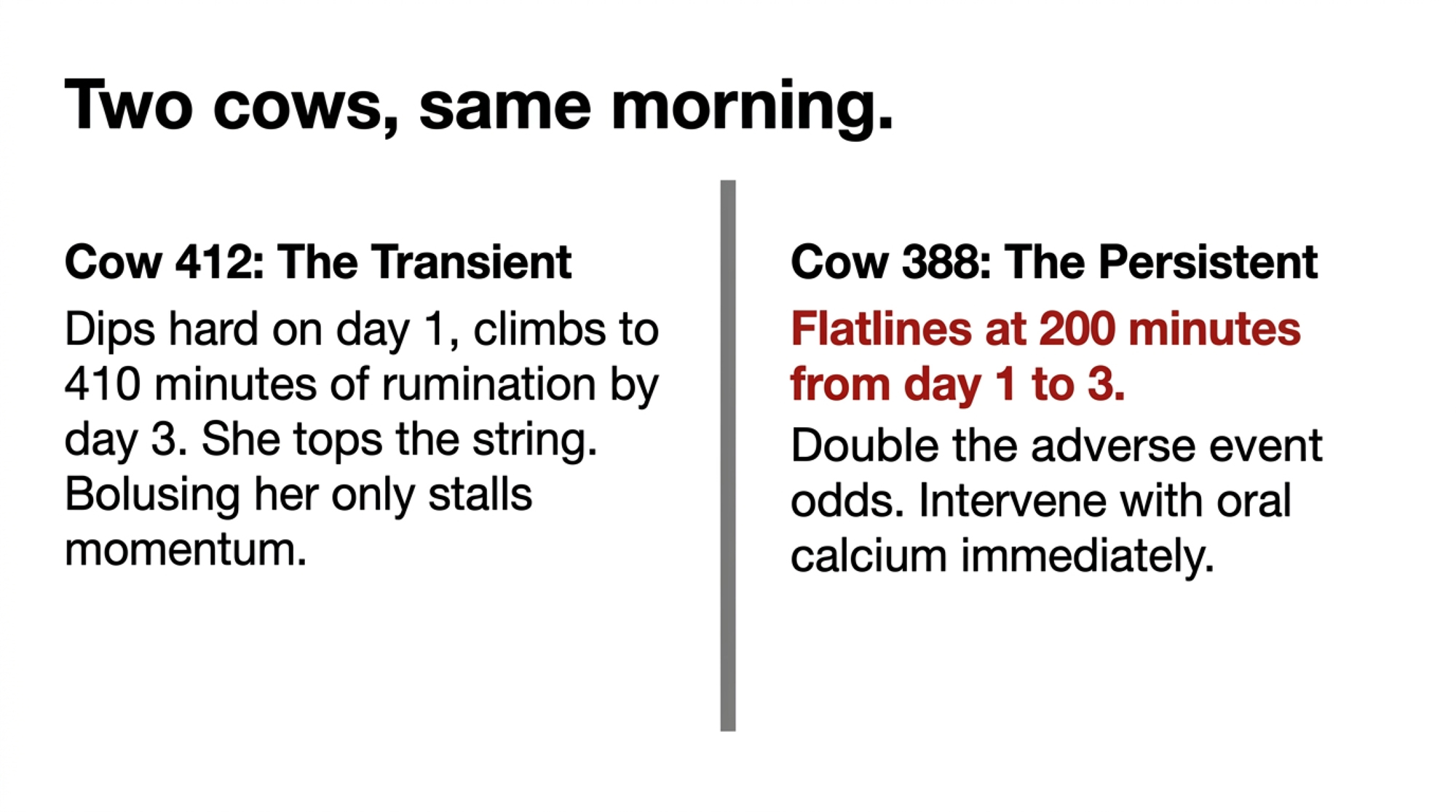
Cow 412’s rumination collar tells one story: 195 minutes the day she calves, 310 the next morning, pushing 410 by day three. She’s the textbook transient — dipped hard, climbed hard, and she’s the cow who’ll top the string by 100 days. Bolus her twice “to be safe” and the best case is you did nothing; the realistic case is you spent labor and product stalling a cow who was already winning.
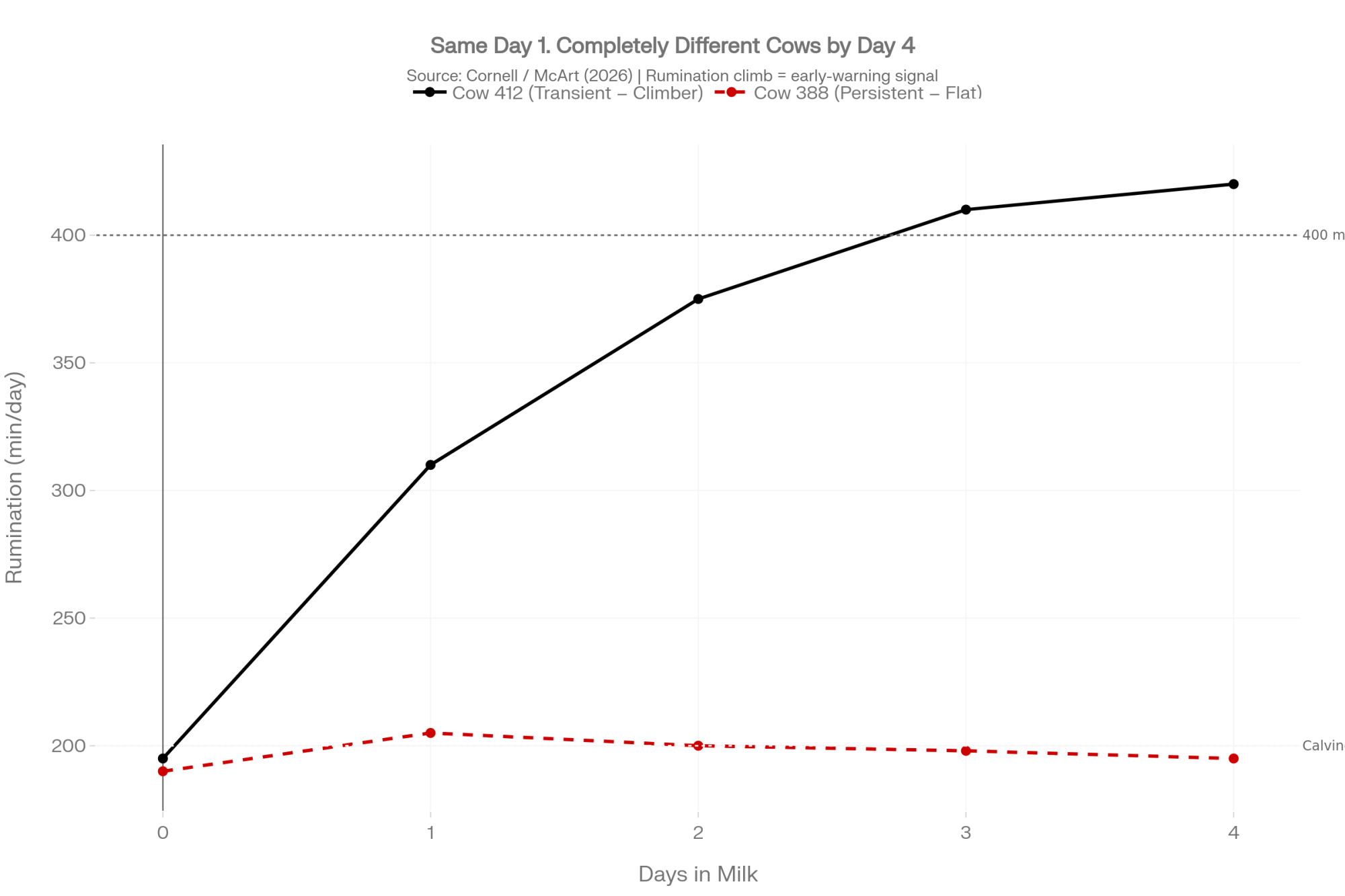
Cow 388 reads the opposite. She opens at 190 minutes and sits there: 205 the next day, 200 the day after that, no climb. That flat line is the warning the cow throws before she looks sick. She’s the persistent-low animal in the table: roughly double the odds of an adverse event, a few kilos down on intake, and a first-service breeding that’s far likelier to come up empty. Same morning, same look, completely different cow — and the only thing that separated them by day four was the slope of a line you already had on a screen.
Why McArt Is Watching Inflammation Now
Most producers still see the calcium drop as the problem. McArt’s group is chasing something underneath it. She’s blunt that most of their work so far is observational — they’re still trying to figure out why these dynamics happen — but one thing keeps surfacing: it’s all highly tied to intake.
Cows that calve, start eating well, and stay on a good ration don’t look back. The cows that end up dyscalcemic at four days often look fine for a few hours after calving, and then their rumination and intake start to slide. It might only last four or five days, but that’s long enough in early lactation to bend the whole lactation curve.
That’s why her newer work is digging into how these calcium dynamics tie to inflammation, and which cows might actually benefit from treatment and when. She isn’t saying calcium stopped mattering. She’s saying the calcium number is one readout of a system that may already be under stress, and the answers aren’t in yet.
And this is where the honest limits of the science show. Most of what McArt’s group has done so far is observational. They can see the associations between low day-four calcium, dropping intake, and more disease, but observation can’t tell you which way the arrow points or which cow an anti-inflammatory would actually help. That’s the gap the next wave of work has to close before anybody starts reaching for a different bottle. (Mastering the Transition: a holistic approach to dairy cow health)
Putting the Science to Work: How Do You Actually See Her?
With your eyes? You usually can’t — not early enough. By the time she looks sick, she’s already paid the bill. And here’s the wall McArt keeps hitting: there’s still no easy, cheap, on-farm test for most of this. Calcium’s hard enough; an inflammatory marker like haptoglobin, which she admits she spends a borderline-crazy amount of time thinking about, can’t be measured cowside at all yet. That gap is exactly what stops many producers from acting — they don’t know which cows to treat.
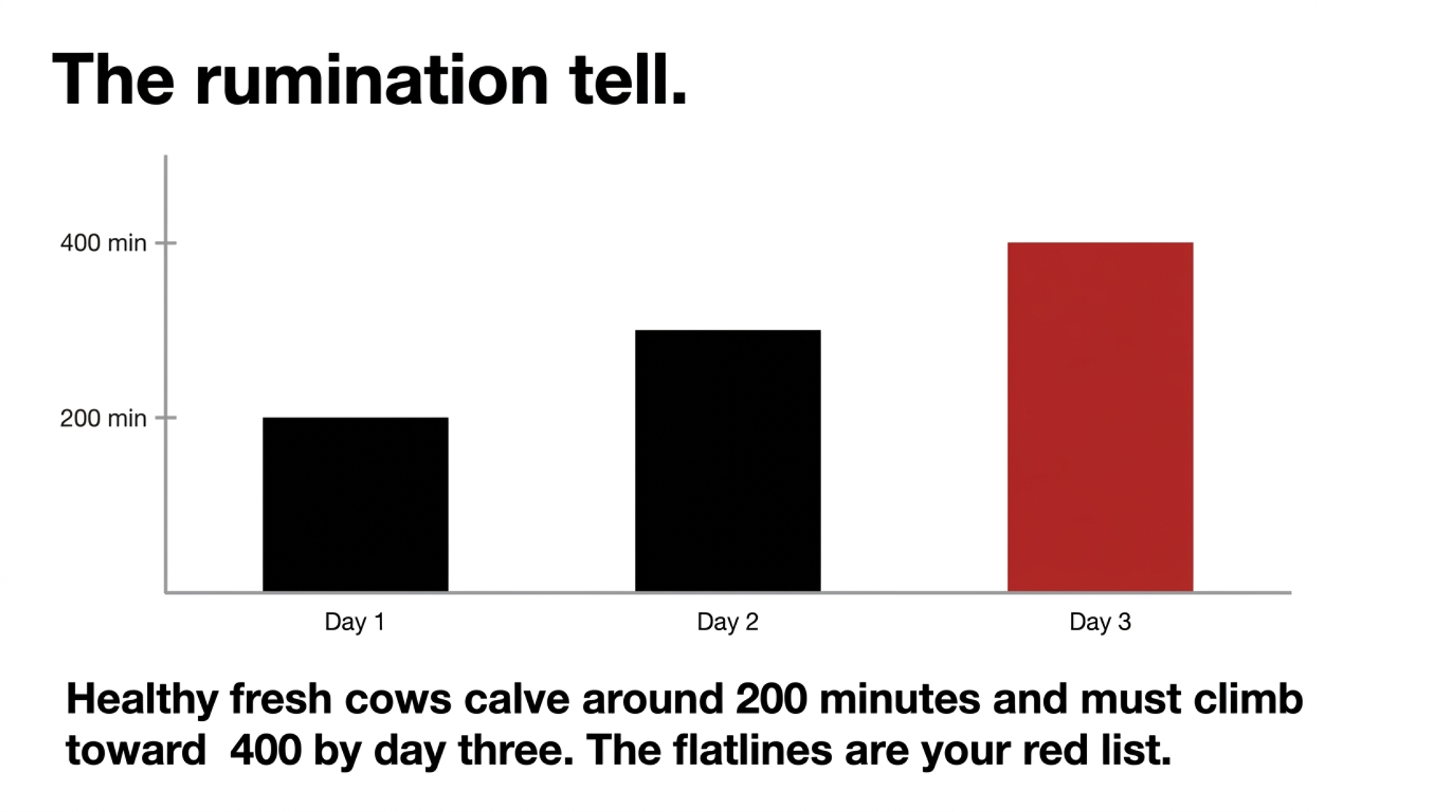
So McArt’s favorite practical tool right now is the one many herds already have: rumination time. Rumination tracks intake closely, and the faster a cow’s rumination climbs after calving, the higher her milk yield tends to be. A flat or slow-rising line is an early warning the cow throws before she ever looks off.
THE NUMBER TO TAPE TO THE WALL: Most cows calve in around 200 minutes of rumination a day and should climb toward 400 minutes by two to three days fresh. The cows that don’t make that climb are your red list.
Her own worked example is the barn-math worth stealing. The cows that haven’t made that 200-to-400 climb are the ones you bolus — one that day, one the next — and the cows tracking up, you leave alone. That’s a real threshold you can build off your own collar data this week, not a research abstraction.
Build Your Own Baseline Before You Trust the Threshold
One caution before you bolt McArt’s 200-to-400 numbers onto your barn: those are her illustrative figures, not a universal cutoff. Rumination baselines drift with your collar brand, your ration, your housing, even your breed mix. The smart move is to pull 30 to 60 of your own healthy, no-treatment fresh cows from the last few months and chart their average minutes per day for the first week.
Do it by parity, because a mature cow and a first-calf heifer don’t ramp the same way, and a heifer benchmark borrowed from the cow pen will have you chasing animals that are fine. Once you’ve got your own healthy curve, the flag isn’t a magic number. It’s any fresh cow tracking well below her own parity group’s normal climb by day two or three. That turns a borrowed rule of thumb into a threshold your own data earned.
What the Live Research Is Still Working Out
McArt’s rumination idea isn’t settled science yet. It’s an active research front, and she names the people running it. Clara Seeley at the University of New Hampshire and Luciano Caixeta at the University of Minnesota are looking specifically at how oral calcium bolusing affects rumination time after calving.
The logic they’re testing is exactly the one a producer would want proven before betting labor on it: if rumination is such a tight proxy for intake, then a cow whose rumination slope climbs faster after a bolus is probably a cow the bolus actually helped, and one whose line stays flat probably wasn’t going to benefit no matter what you hung on her. Get that right, and rumination stops being a vague “she looks slow” hunch and becomes a tool you can use to both diagnose the cow on-farm and confirm whether your treatment did anything.
That’s the honest state of play. The threshold logic is sound, and McArt is comfortable recommending rumination as today’s best on-farm proxy. But the trials to nail down exactly how much, how fast, and for which cows are still in progress. Read it as a strong working rule, not a finished protocol.
The Elite Cow, and the Mistake That Costs You Both Ways
Tell a producer that some of his low-calcium cows are his best, and you’ll get a look. But that’s what the dynamics show, and McArt thinks it’s an underused opening. We spend all our energy dragging the stragglers up to the herd, she points out. But those transient cows that crash on day one and fire right back up because they’re milking and eating hard? Maybe we should be asking how to push their ceiling higher and get them onto a high-energy diet faster, instead of only ever patching the bottom of the pen.
So the difference between elite and in trouble isn’t the depth of the dip. It’s the recovery. The calcium system is almost absurdly good at this — the cow turns over her entire blood calcium pool roughly every two hours, and as McArt puts it, it’s incredible how well it works the vast majority of the time. Almost set up to fail. Dips early, eats hard, rumination climbs, normal by day four: that’s a machine doing her job. Still low at day four, curve flat or falling: that’s the cow in trouble.
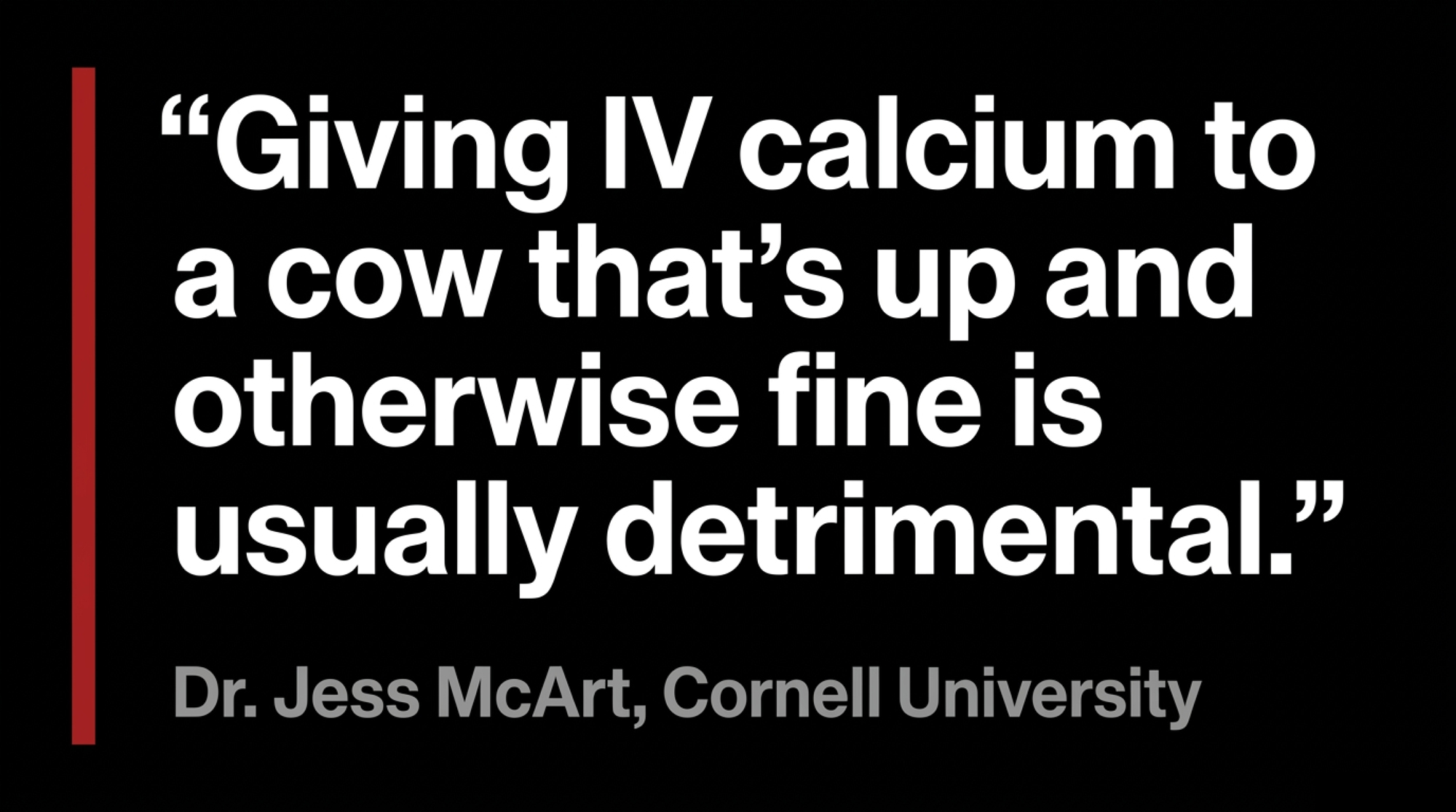
Here’s the part worth sitting with. McArt’s preference for oral calcium over IV in standing cows comes down to harm. Giving IV calcium to a cow that’s up and otherwise fine is usually detrimental — Wisconsin’s extension guidance is just as blunt, warning against giving IV calcium to a cow with subclinical milk fever and no symptoms. Reaching for the IV bottle on a standing cow isn’t just unnecessary; it’s an elegant way to sabotage her own regulatory system. You aren’t being diligent. You’re playing defense against a machine that’s trying to do its job. Oral calcium is the opposite bet: it does no harm, and give it to too many cows and the only thing you bruise is your pocketbook — a very different gamble than an anti-inflammatory with milk withhold and pen moves.
| Treatment | Indication | Cow Status | Benefit Profile | Harm Risk | Approx. Cost/Dose | McArt / Wisconsin Guidance |
|---|---|---|---|---|---|---|
| IV Calcium | Clinical milk fever only | Down / recumbent | Fast blood calcium correction | Detrimental in standing cows — disrupts regulatory system | ~$5–10/bottle | Reserve strictly for recumbent or near-recumbent cows |
| Oral Calcium Bolus | Persistent flat curve (Day 2–4) | Standing, off-feed pattern | Supports recovery without override | Minimal — worst case is wasted spend | ~$8/bolus | Preferred for subclinical cases; safe even if over-applied |
| No Treatment | Transient dipper with climbing rumination | Standing, eating, rumination rising | Cow is already self-correcting | None — intervention would stall momentum | $0 | Active recommendation: leave climbers alone |
| Anti-inflammatory | Inflammatory co-morbidity (research stage) | Any | TBD — trials in progress | Milk withhold, pen move, economic disruption | $15–25+ | Not yet a standard protocol — observational data only |
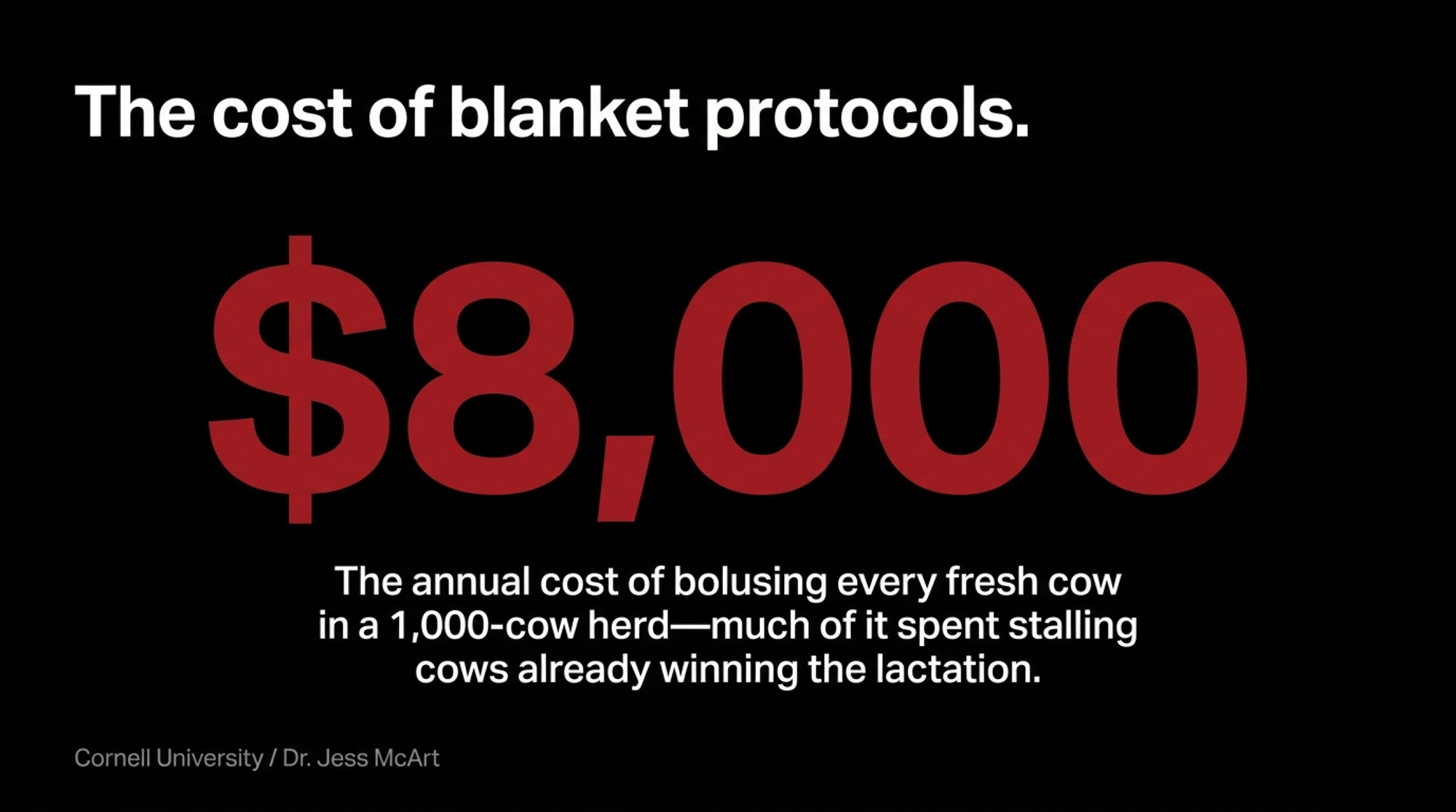
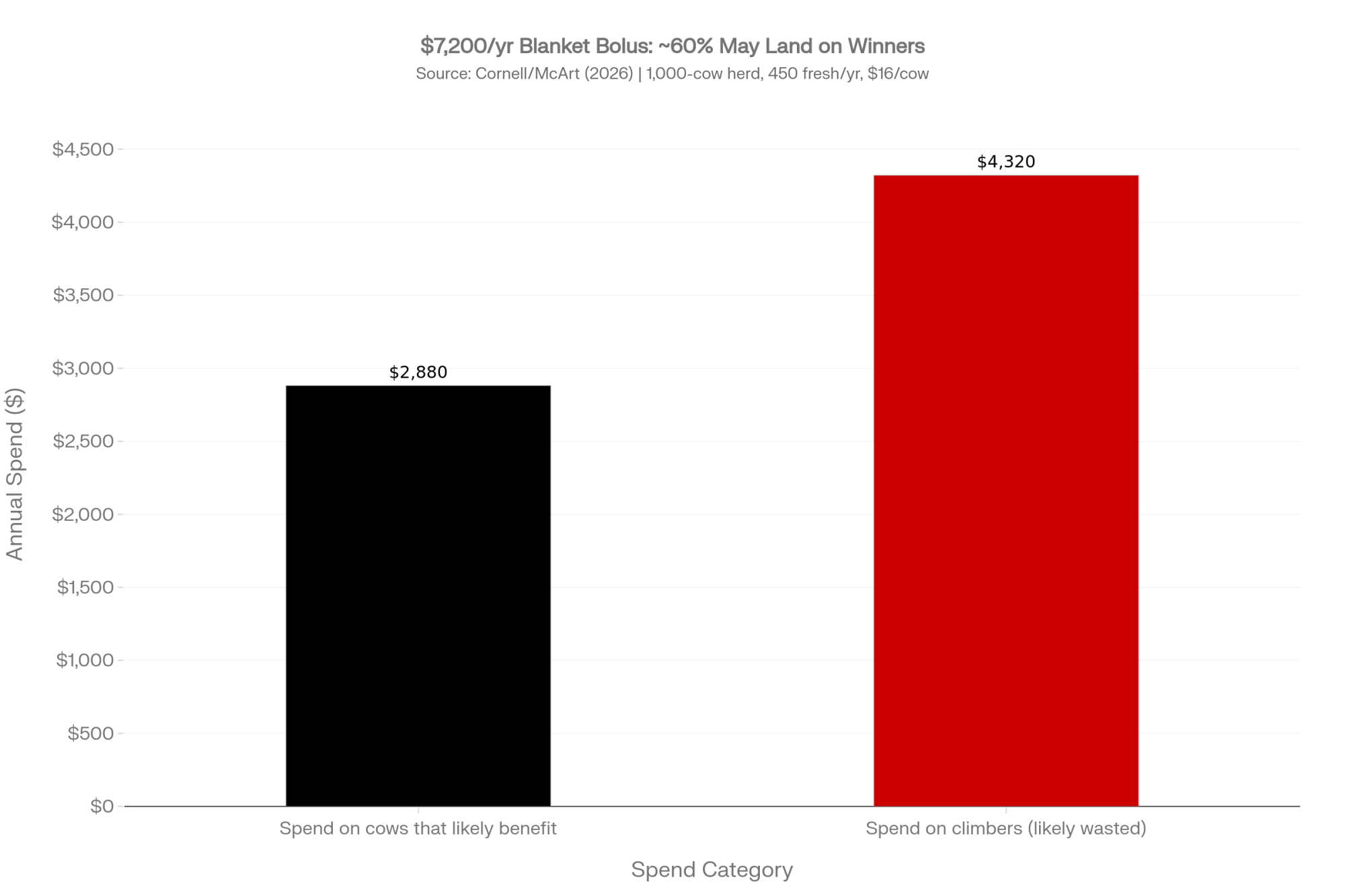
THE BLANKET-BOLUS MATH (illustrative): At roughly $8 a bolus — about $16 a cow for two doses — a 1,000-cow dairy freshening 35-40 head a month spends around $7,000-$8,000 a year dosing every fresh cow twice. Cornell’s work says only a subgroup actually benefits.
Run the pocketbook side of it, and treat those numbers as a back-of-the-envelope scenario, not a quote from any one farm. A big slice of that spend lands on animals already winning the lactation. Bolus the cows whose curves show they’re struggling, leave the ones who are climbing, and you stop paying on both ends.
A Realistic Monday-Morning Protocol for a Big Herd
Big numbers, high throughput, labor stretched thin. The cow that fails to recover is hardest to catch in exactly that environment, so let the data sort before anyone walks the pen.
Start at the computer, not the pen. Pull the fresh-cow rumination report for multiparous cows 0 to 4 days fresh, and compare each one to your own herd’s “healthy fresh cow” benchmark — the parity-specific curve you built above. On a big pen that shortlists a handful of cows, not 80 head. The software triages; your people only see the red list. (Ditch the Daily Walks: how precision monitoring cuts labor by 40%)
Then a ten-minute red-list check. Your fresh-cow person walks only the flagged IDs: quick visual, bunk behavior, and temperature if she’s three to four days fresh with a flat curve. Clears the screen and trending up? Watch, don’t treat. Fails it? That’s the cow who popped on rumination before she ever looked sick.
Tie the intervention to the curve, not the calendar. A flagged cow gets oral calcium now, and a second bolus the next day only if her rumination doesn’t start climbing, which is close to the day-one/day-two bolus logic McArt floats off her own threshold example. A cow still flat at four days gets worked harder, with a hard look for metritis, mastitis, and a displaced abomasum. You’re not bolusing every fresh cow twice because that’s the routine. You’re spending labor and product on the cows whose curve says they’re failing the adaptation test.
No Collars? You Can Still Run This
Plenty of good herds don’t have rumination sensors, and the thinking doesn’t change. You trade the algorithm for a structured set of eyes. The trap is the casual walk-through, where a standing, cudding cow reads as “fine” and the slow-fading one blends in until she’s sick. The fix is to make the read deliberate and repeatable. Implement a 2x-Daily Fresh Pen Audit and run it with the same discipline a collar herd runs its software:
- The Timing: Audit exactly 20 minutes after fresh feed delivery, when a healthy fresh cow should already be driving for the bunk.
- The Target: Flag cows that fail to lock up, show gaunt flanks, or stand idle while herdmates chew.
- The Rule of Two: One slow read is noise. The same cow flagged morning and afternoon — or two days running — is your manual “flat-line” warning.
The action threshold is the same as the sensor herd’s: a cow who keeps showing up two to three days fresh gets oral calcium and a real exam, and a cow still hanging back at four days gets the harder workup for the inflammatory triggers underneath. It’s cruder than a rumination graph, and it leans on consistent labor. But the principle is identical: you’re tracking the trajectory across days, not judging a single snapshot.
The Once-a-Year Mystery Cluster
Keep one eye on the calendar’s odd visitor: the sporadic mid-lactation hypocalcemia cluster that shows up once or twice a year, then vanishes no matter what you do. McArt — who’s fielded the same question from vets as far away as Germany — thinks it’s usually a high-yielding cow with an abrupt stop in intake, whether from a heat or a bunk left empty too long.
Run the math, and it stops looking mysterious. At the onset of lactation, a cow’s daily calcium excretion jumps from roughly 10 grams to 30 grams almost overnight, and with the blood pool turning over every couple of hours, a heavy milker doesn’t have much buffer. So even a half-day off feed — a heat that’s got her walking and bawling instead of eating, a bunk that ran empty during a staffing gap — can be enough to tip her into a recumbent calcium crash that looks like it came out of nowhere. Pull her rumination or intake history after the fact, and you’ll often find the drop that came first. The cluster isn’t random; it’s a management event you didn’t see, hitting the cows with the least margin.
Seven Questions for Your Own Barn
Run these against your own barn before the next fresh group calves. Half are decisions to make, half are thresholds to act on:
- Can you tell today which fresh cows recovered by day four — or do you only ever learn which ones eventually got sick? If you can’t answer that, you don’t yet have a fresh-cow system; you have a sick-cow system.
- Build your baseline before you trust any threshold. Pull 30-60 healthy, untreated, fresh cows by parity and chart their first-week rumination climb; flag cows that track well below their own group’s normal by day two or three.
- If a cow dips early, eats hard, and is normal by day four, leave her alone. Cornell’s data show those transient cows out-milk cows that never dipped at all; bolusing her only stalls momentum.
- Reserve IV calcium for genuine clinical milk fever. In standing cows, oral calcium is the safer bet, and even overusing it mostly hurts the checkbook, not the cow.
- Audit the blanket-bolus spend. On a 1,000-cow herd freshening 35-40 a month, that’s roughly $7,000-$8,000 a year, much of it landing on cows already winning the lactation; targeting the curve stops you paying on both ends.
- This month, pull your last year of fresh-cow records. Flag every cow treated, pulled, or dead before 60 DIM, and check whether a drop in rumination or activity appeared first. If it did, your early-warning system is already in the data — you’re just not acting on it yet.
- When the once-a-year mid-lactation cluster hits, check the bunk and the breeding board first. A heat or an empty feed alley usually beats the calcium crash to the punch.
The hardest sell in all of this isn’t the science. It’s telling someone who’s run a profitable dairy for 30 years to do less — fewer reflex bottles, fewer blanket boluses, fewer cows worked twice “because that’s what we do.” Doing more feels like diligence. McArt argues that we finally have the technology to stop managing every fresh cow the same and start telling them apart. So here’s the question to chew on before your next fresh pen fills up: if you pulled your own cull list and treatment records tomorrow, would they tell the story you think they’re telling — or hers?
Key Takeaways
- The cow that drops calcium hardest on day 1 isn’t your problem — the one still flat at day 4 is. Recovery speed, not the low number, separates your top producer from the train wreck.
- Rumination is the cheap proxy you likely already own. Most cows calve near 200 minutes and should climb toward 400 by two to three days fresh; the flat lines are your real red list. Build your own baseline by parity before you trust any cutoff.
- Blanket-bolusing every fresh cow can run $7,000–$8,000 a year on a 1,000-cow herd, much of it spent on cows already winning. Treat flat curves with oral calcium, leave the climbers alone, and reserve IV for true clinical milk fever.
- This month, pull your last year of fresh-cow records — flag every cow treated, pulled, or dead before 60 DIM, and check whether a drop in rumination or intake showed up first.
Run Your Numbers
Health ROI Calculator — This article argues the expensive damage happens before a fresh cow ever looks sick. Run your culling rate, mastitis incidence, and replacement cost through the Health ROI Calculator to put a dollar value on what those hidden transition failures are costing you — and whether tightening your fresh-cow protocol actually pays.
Complete references and supporting documentation are available upon request by contacting the editorial team at editor@thebullvine.com.
Learn More
- Is Your Fresh Pen Costing You $90000? The 90-Day Transition Fix for Pregnancy Rate — Arms you with immediate operational thresholds for BHBA, body condition loss, and fat-to-protein ratios to protect your herd’s reproductive performance, revealing how fresh pen failures permanently reduce first-service conception rates.
- Retained Placenta Rates Cut in Half: How a $10 Calcium Protocol Delivers $15,000 Annual Returns — Delivers the financial blueprint for managing the structural shifts of subclinical hypocalcemia over the next three to five years, quantifying the exact timeline and multi-dose investment metrics required to curb downstream fresh-cow disorders.
- Ditch the Daily Walks: How Precision Monitoring Cuts Labor by 40% While Boosting Transition Success — Breaks down how emerging pre-fresh accelerometer data alters the game, allowing innovators to identify at-risk cows up to five days before clinical symptoms show, drastically changing routine labor requirements.
 The Sunday Read Dairy Professionals Don’t Skip.
 The Sunday Read Dairy Professionals Don’t Skip.
Every week, thousands of producers, breeders, and industry insiders open Bullvine Weekly for genetics insights, market shifts, and profit strategies they won’t find anywhere else. One email. Five minutes. Smarter decisions all week.