








Ten weeks between the FDA’s recall and the powder plant operator’s notification. The 55 dairies behind him? They got it from the news. Pull your marketing agreement — odds are the clause isn’t there.
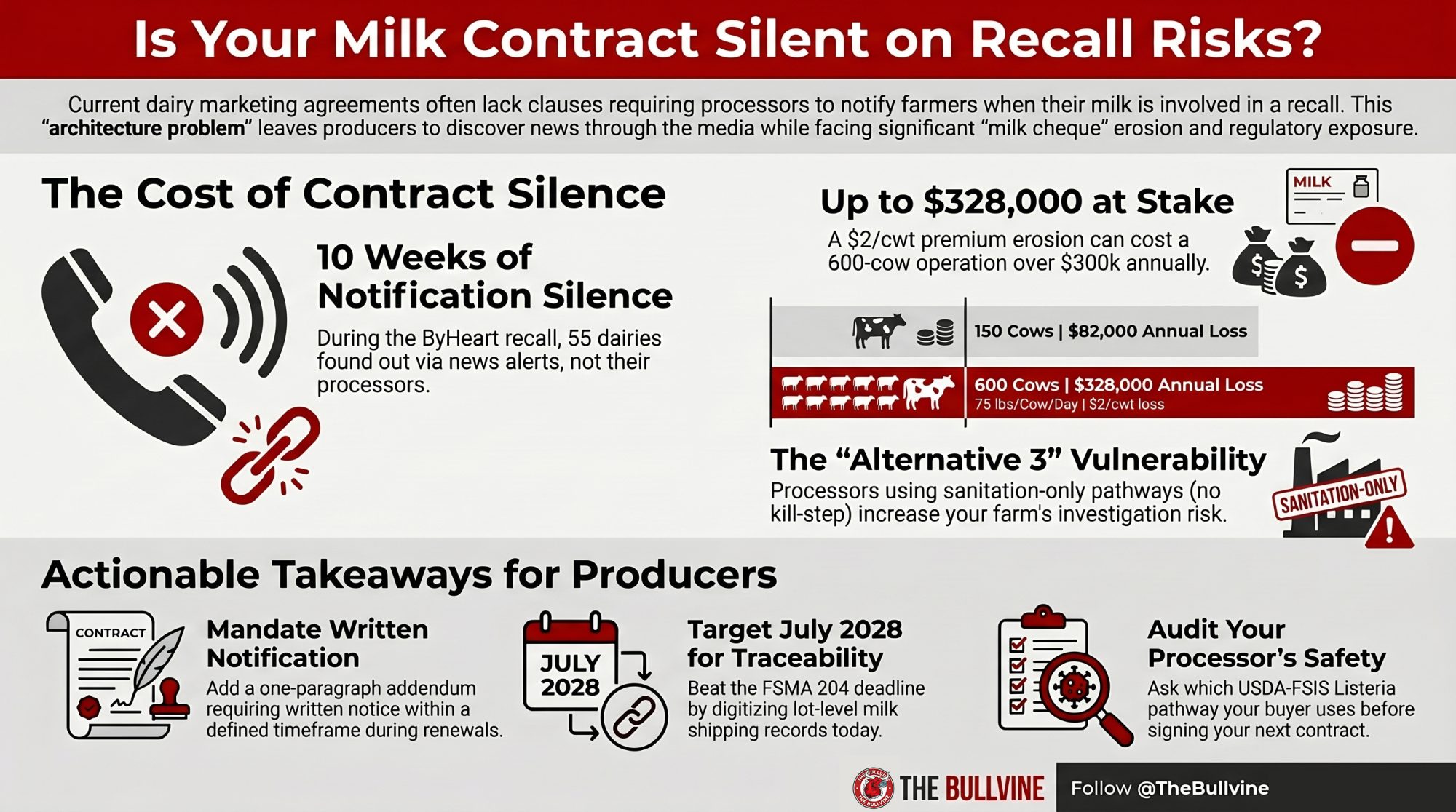
Executive Summary: The 55 organic dairies supplying the powder plant behind ByHeart’s November 2025 nationwide recall didn’t get a phone call — they got a news alert, and the powder plant operator himself wasn’t notified until late January 2026, roughly ten weeks after the FDA went public. Pull your milk marketing agreement and you almost certainly won’t find a clause requiring written upstream notification when product made with your milk hits a recall, hold, or regulatory action; that gap is the default in U.S. co-op contracts, not a loophole. On a 150-cow organic operation shipping 75 lbs/cow/day, even a $2/cwt premium erosion over twelve months runs roughly $82,000 absorbed at the farm gate; at 600 cows the same shift works out to about $328,000 — illustrative, but the cost of contract silence isn’t theoretical. The exposure widens once you factor in processor-side decisions you can’t audit, like USDA-FSIS Listeria Alternative 3 — the sanitation-only pathway operating at Boar’s Head’s Jarratt facility before the 2024 outbreak that killed at least 10 people and pulled 7 million pounds of product. FSMA 204’s lot-level traceability mandate has been pushed to July 2028, which means the upstream end of the chain isn’t getting easier to investigate any time soon. The 30-day action: pull your contract, identify the renewal window, and draft a one-paragraph addendum requiring written notification within a defined timeframe — and find out which counterparties take the ask seriously.
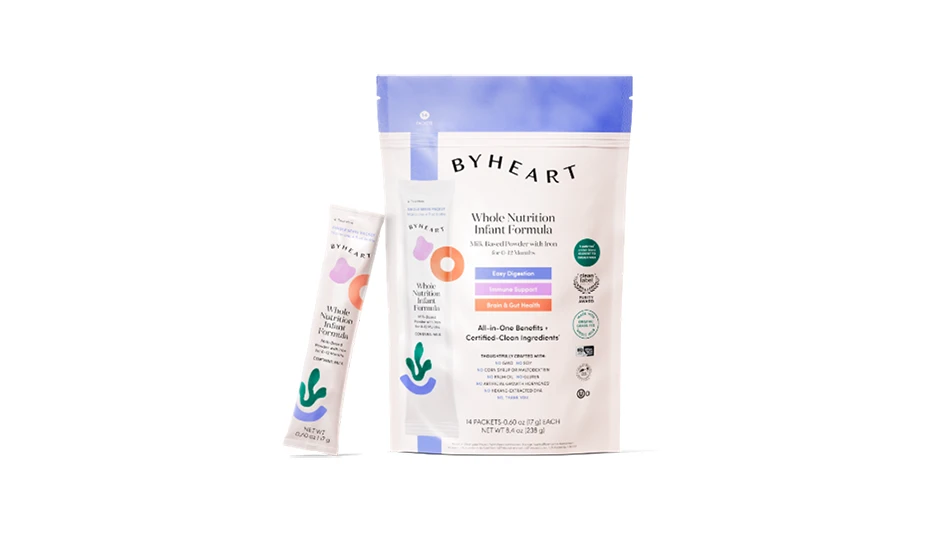
The first cases turned up in California in August 2025. The state’s Infant Botulism Treatment and Prevention Program was logging unusual Type A clusters — the kind that aren’t supposed to cluster like that. By November 8, 2025, the FDA had contacted ByHeart, a premium organic infant formula brand, and recommended a voluntary recall of two production lots. Three days later, ByHeart pulled every can of every lot it had ever sold, nationwide.
According to FDA outbreak reporting at the time of the recall, dozens of infants were hospitalized across more than a dozen states, with a significant share in intensive care. Somewhere in that chain — supplying organic whole milk into a powder plant in Fallon, Nevada, which fed into ByHeart’s single production facility — were 55 certified organic dairy farms whose milk was now part of the story.
Those farms found out the same way you probably did. From the news.
Not from ByHeart. Not from the powder plant. Not from their co-op, their organic certifier, or the fieldman who’d been out to verify their practices last spring. The FDA press release went public. A wire story moved. For most of those 55 farms, that’s how the news arrived — through a feed, not a phone call.
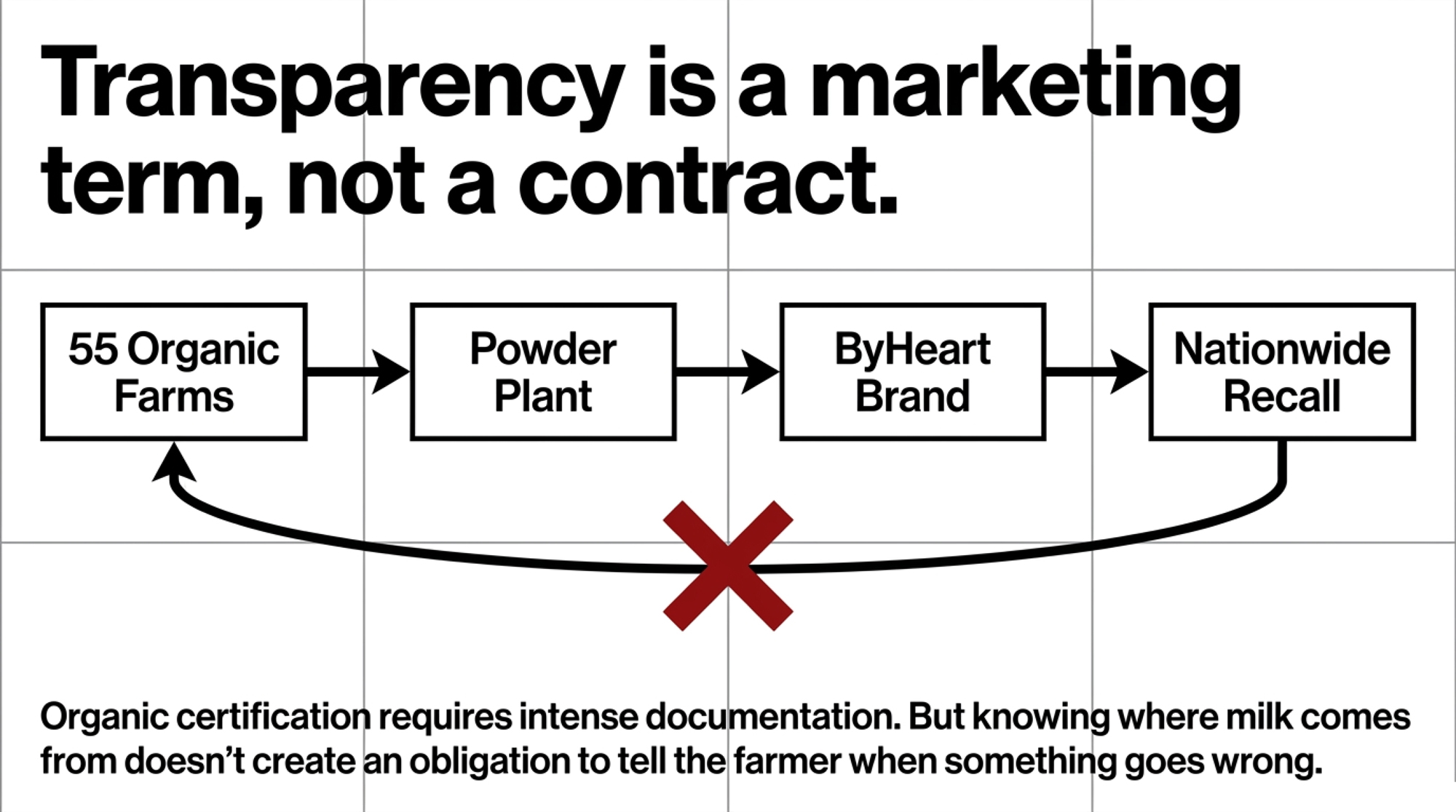
That gap — between a supply chain marketed as traceable and a notification system that stayed silent — is the architecture every producer needs to understand. It’s not a ByHeart problem. It’s an architecture problem. And it matters for every producer shipping milk into a processed product, whether you’re organic or conventional, 80 cows or 800.
What’s Changing — and Why the Old Assumptions Don’t Hold
For most of the last 40 years, dairy farmers operated on a reasonable assumption: the co-op was close enough, the chain was short enough, and the people involved were known enough that informal accountability filled the gaps in the paperwork. Your fieldman knew your name. The plant down the road processed your milk into cheese. If something went wrong, someone called.
That assumption was never written into a contract. It was held together by proximity and relationship. Consolidation has been quietly dismantling it for decades.
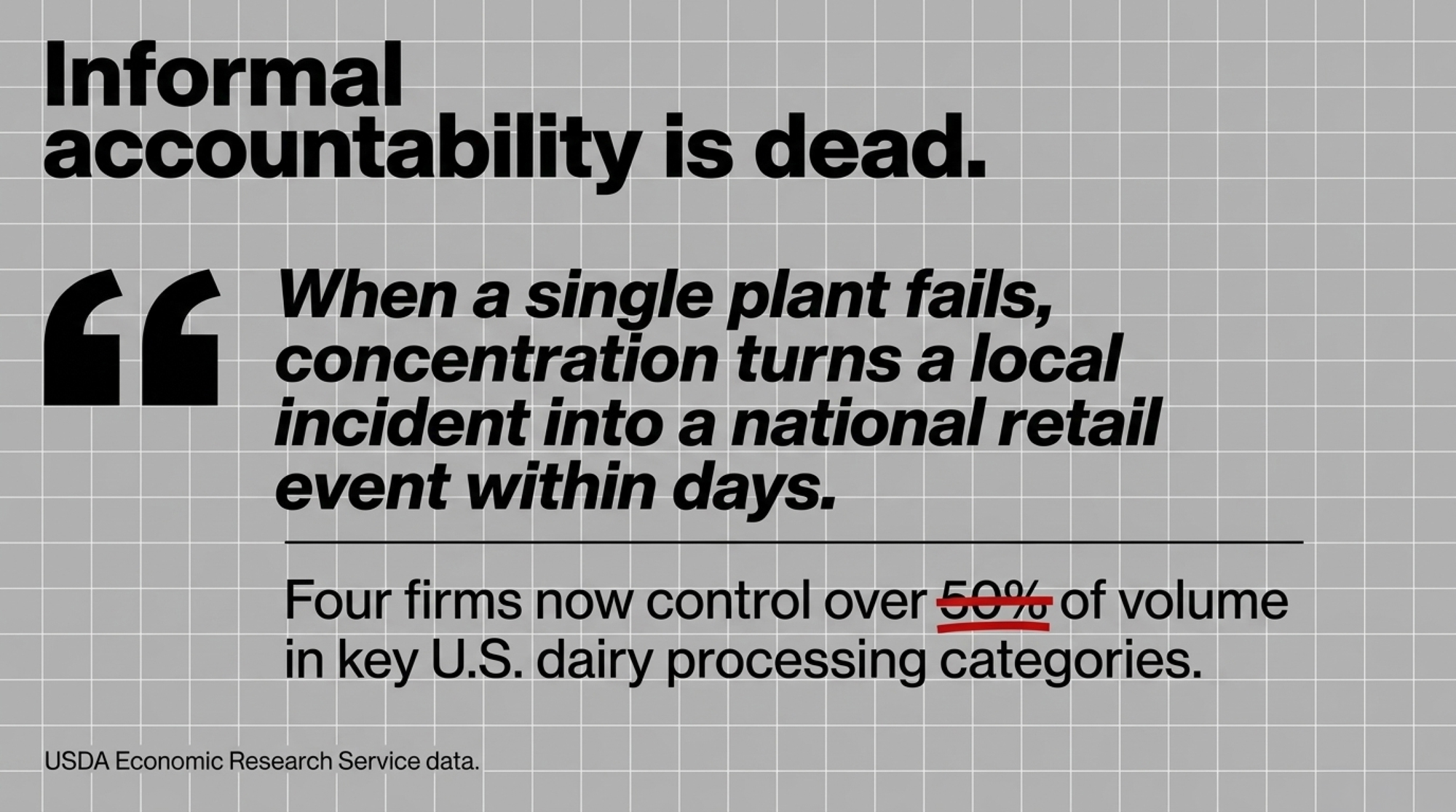
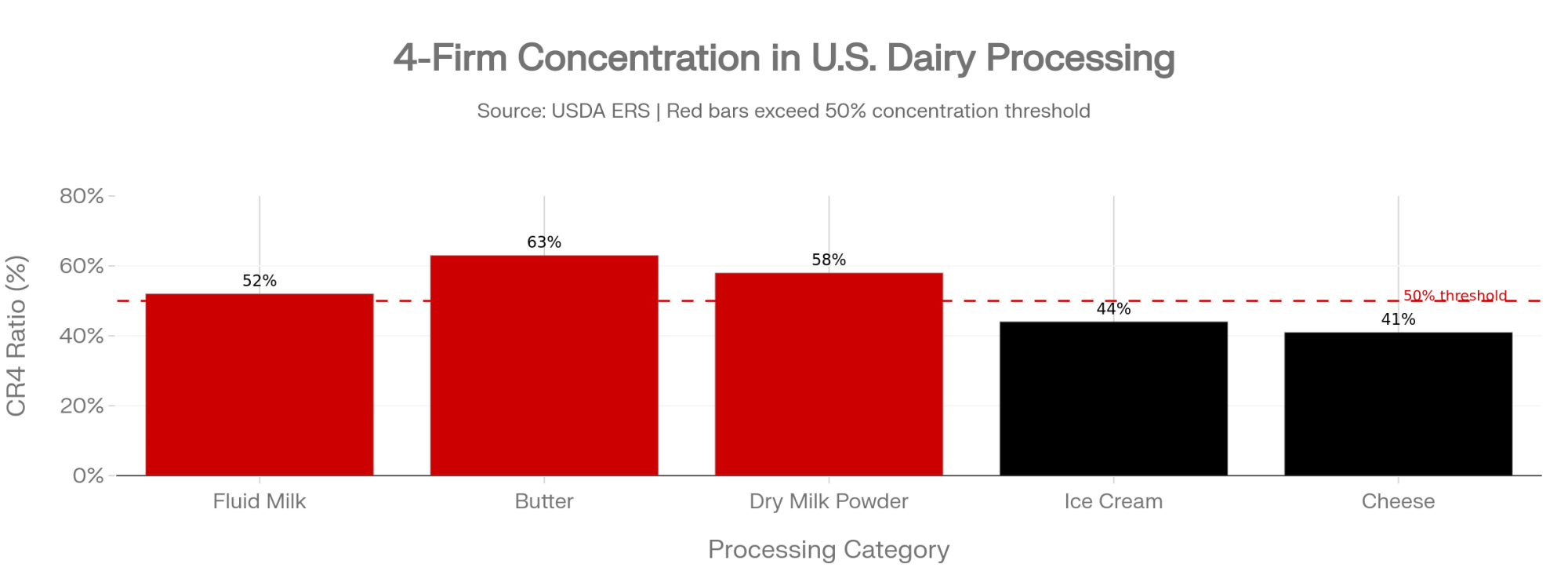
According to USDA Economic Research Service data, the four-firm concentration ratio in U.S. dairy processing has climbed past the 50 percent threshold in several key manufacturing categories. Translation: in segments such as fluid milk and certain cheese categories, four firms account for more than half the volume. When a single plant fails, that concentration turns a local incident into a national retail event within days.
A converter like Great Lakes Cheese Co. can pack private-label cheese for multiple national retail chains simultaneously from a single Ohio facility, which is exactly why a single quality event there moves product across dozens of states at once. When Great Lakes Cheese issued a metal-fragment recall in December 2025, FDA notices documented a pullback across multiple major retailers in roughly two dozen states. The farms supplying raw milk into that system had nothing to do with the metal fragment. They were two steps upstream.
Upstream doesn’t mean insulated. When a converter that size pulls product, the ripple finds the milk cheque.
How This Plays Out on Real Farms
The ByHeart case is the sharpest version of this because of what those 55 farms believed they’d signed up for. Organic certification costs real money — input restrictions, the documentation burden, premium feed, annual inspections. Farmers who go through that process aren’t just selling a commodity. They’re joining a supply chain that’s supposed to mean more transparency, more accountability, and a closer relationship with whoever buys their milk.
ByHeart’s brand was built on the language of trust and traceability. That language was probably true in a narrow sense — the certifications were on file, the farm names sat in a database somewhere. But knowing where something came from and having an obligation to tell the farmer when something goes wrong are two completely different commitments. Only one was in the contract.
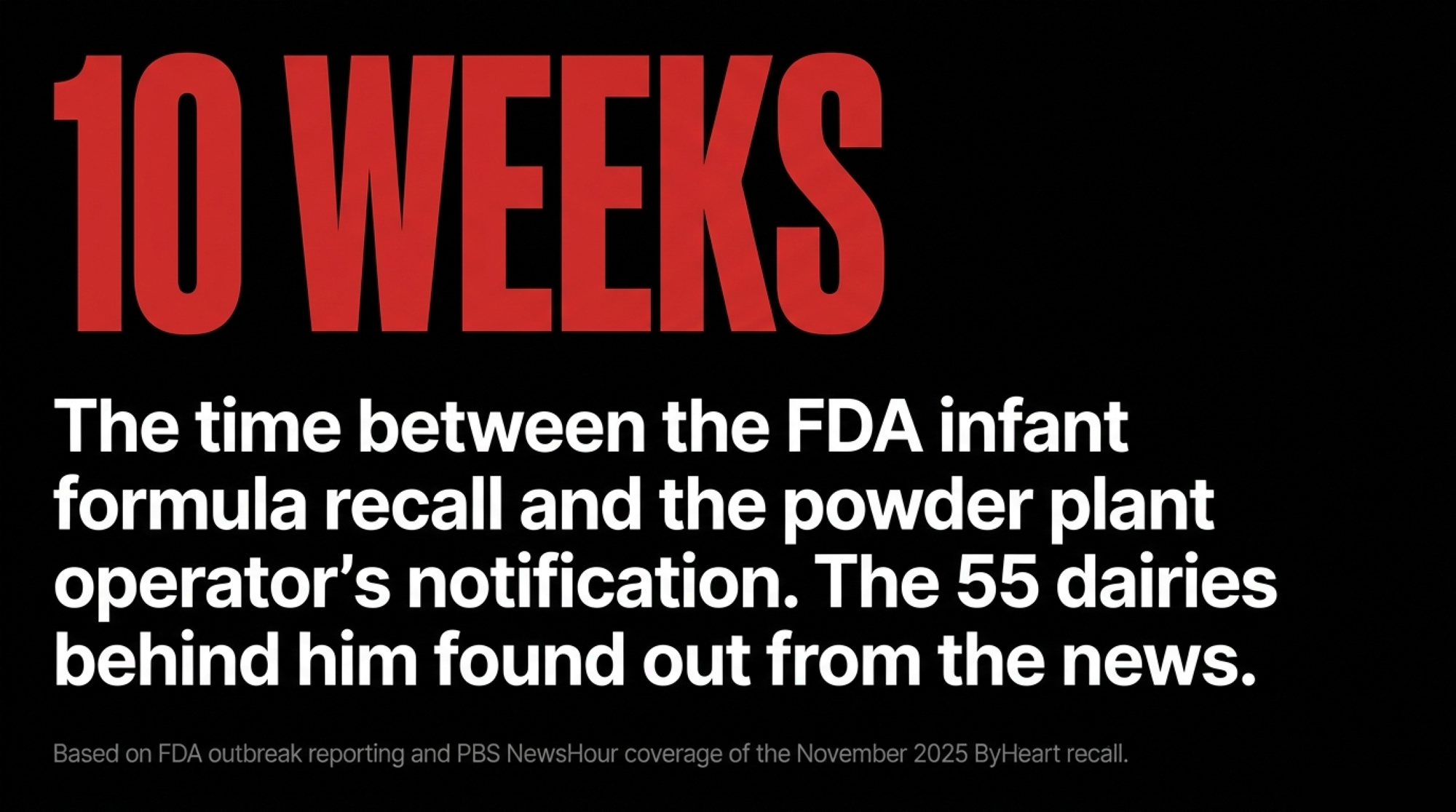
According to PBS NewsHour reporting on the recall, the operator of the organic powder plant identified as ByHeart’s whole milk powder supplier said he was informed that his product had tested positive in late January 2026 — roughly ten weeks after the public recall. The farms supplying him were even further back in the notification queue. That timeline tells you the architecture: if the powder plant didn’t know until late January, the dairies behind the powder plant didn’t know on any defined schedule at all.
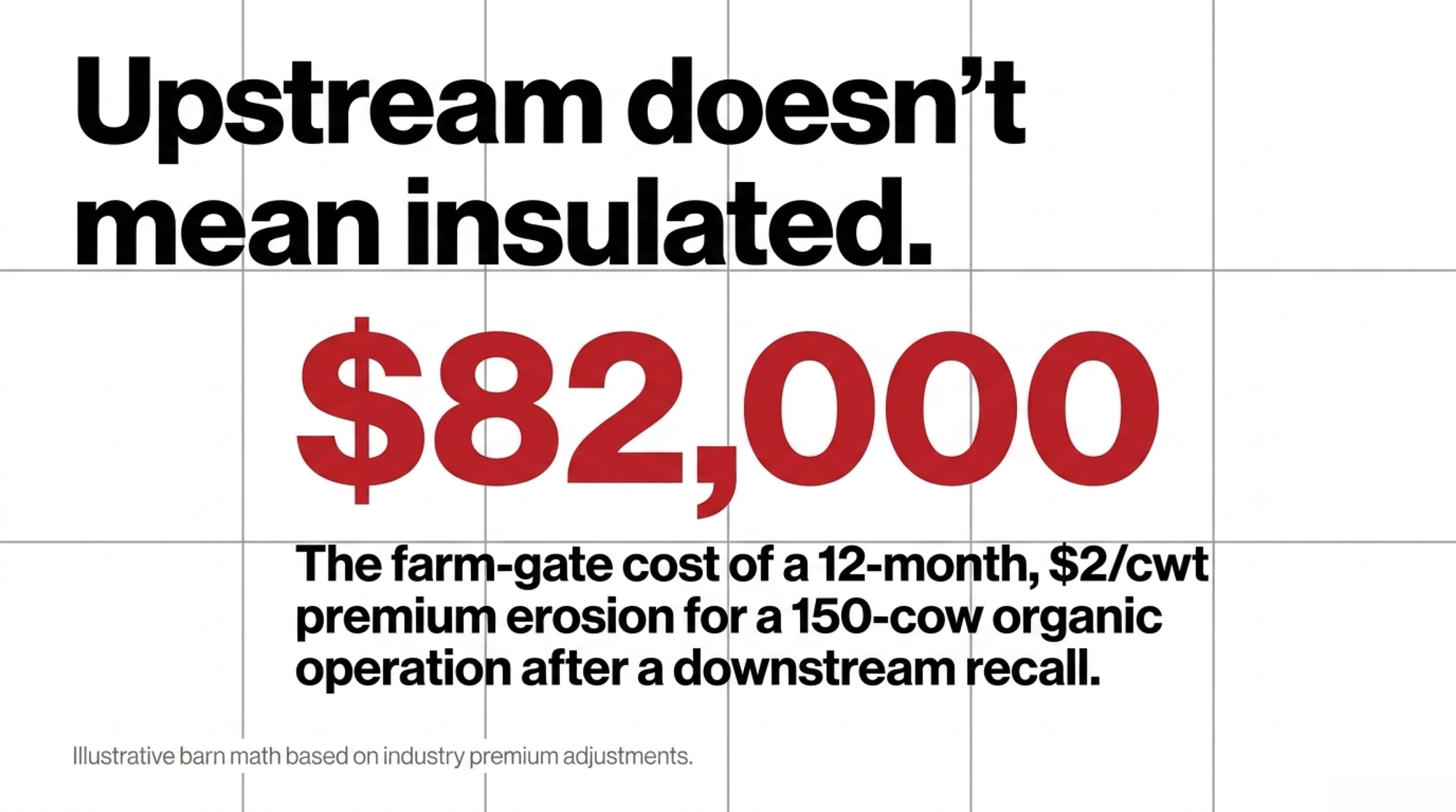
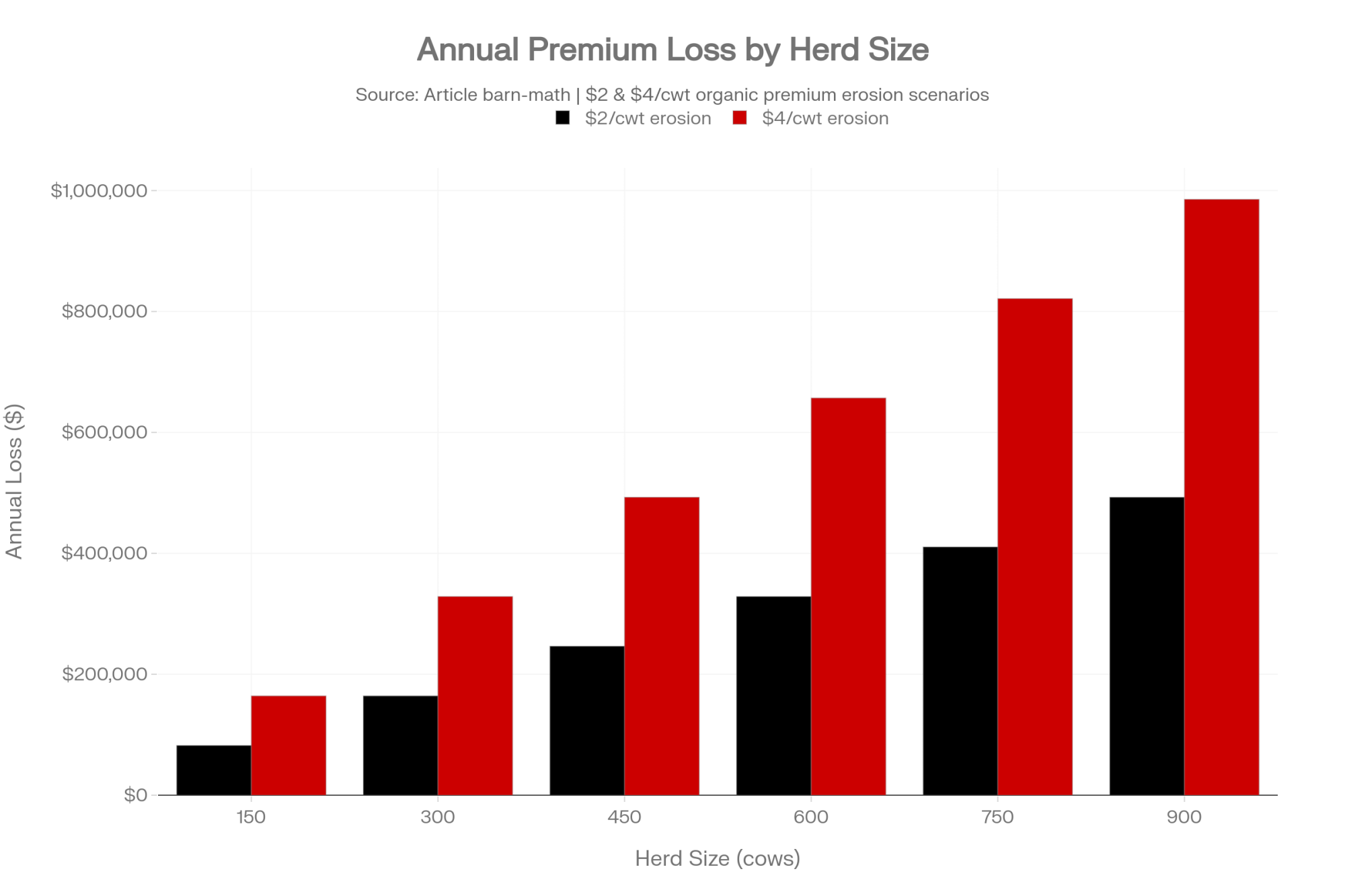
Here’s the barn-math version of why the delay matters. Organic fluid milk has historically earned a meaningful premium above the conventional blend price. Picture a 150-cow organic operation shipping 75 lbs/cow/day. That’s roughly 4.1 million lbs/year, or 41,000 cwt. If a recall event triggers customer questions, processor routing changes, or premium adjustments — and even a $2/cwt erosion of premium follows for twelve months — that’s roughly $82,000absorbed at the farm gate. Scale that to a 600-cow organic operation and the same $2/cwt shift works out to roughly $328,000. The $2/cwt figure is illustrative, not a documented post-recall outcome. The farm didn’t cause the problem. It would absorb part of the cost anyway.
The Mechanics Behind the Outcomes
The reason no one calls the farmer isn’t malice. It’s architecture.
Standard U.S. co-op marketing agreements — the contracts that govern most farmer-to-co-op relationships — were designed around one transaction: the farmer delivers milk, the co-op accepts, grades, and markets it. The legal relationship is considered complete at the loading dock. What happens downstream is the co-op’s and processor’s business. The farmer was never a party to those downstream contracts.
In that legal frame, the recall is a downstream event. It happens in the processor-to-brand-to-retailer chain. The farmer has no standing in any of those contracts, so there’s no natural hook to pull anyone into a phone call. Notification flows through the chain that owns the legal relationships — and the farm is sitting outside that chain, even though its milk is inside the product.
The Fairlife/Fair Oaks settlement made the cost of opacity in dairy supply chains a matter of public record. The class action — driven by the 2019 undercover footage of animal abuse at Fair Oaks Farms, the high-profile supplier behind Fairlife branding — concluded with a court-approved consumer-class settlement of approximately $21 million. That was the price tag for a transparency promise the supply chain couldn’t keep. The farms supplying milk into that system weren’t named defendants. But the brand collapse, the routing disruptions, and the premium erosion that followed didn’t stop at the processor’s gate. Different ledger. Same address.
How Much Does Contract Silence Actually Cost You?
This is the question every producer should be running right now. Pull your milk marketing agreement. Look for any clause that obligates the buyer to notify you, in writing, within a defined window, when product made with your milk is subject to a recall, hold, or regulatory action.
You probably won’t find one.
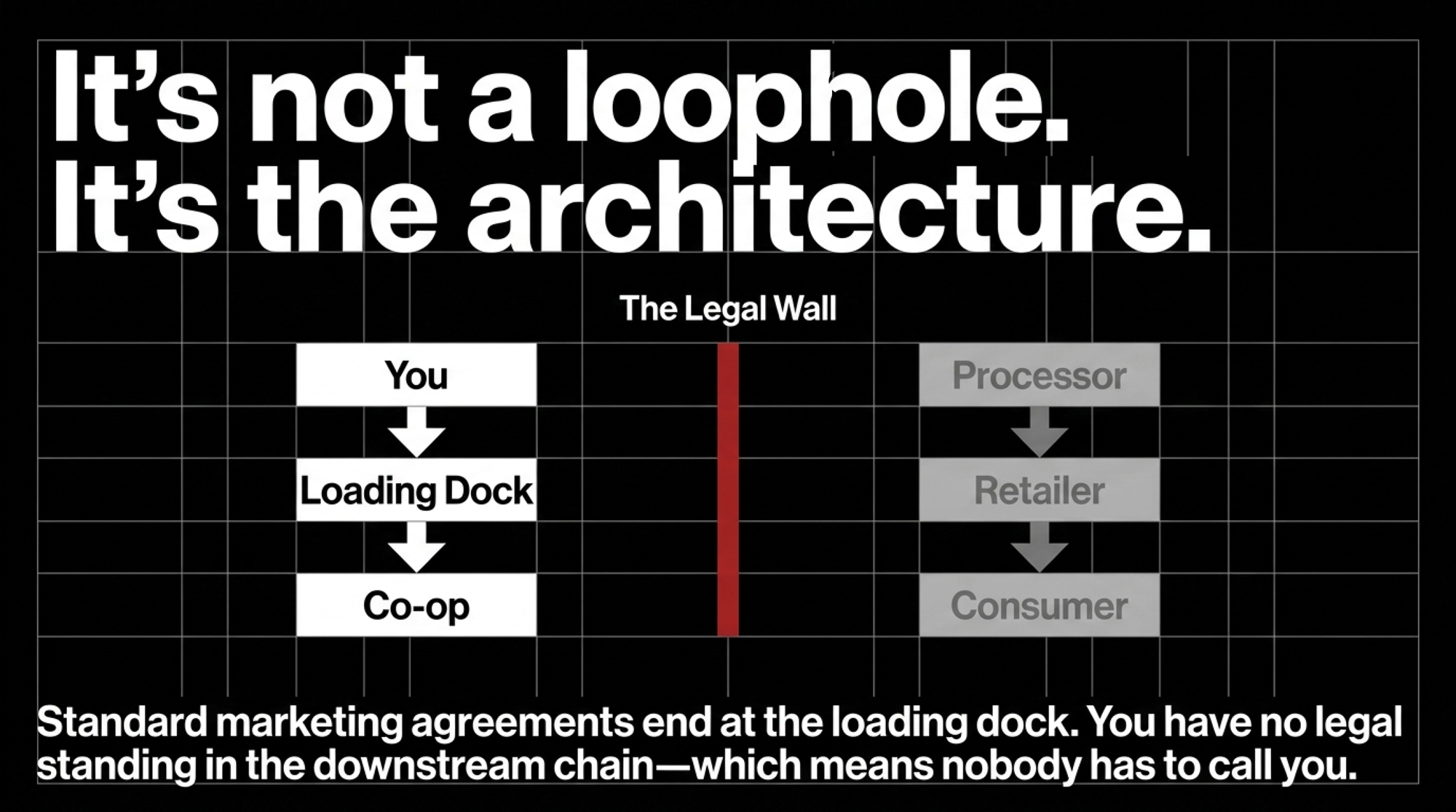
U.S. co-op marketing agreements typically don’t include any provision requiring upstream notification when a downstream recall occurs — a gap industry legal reviews have flagged repeatedly without producing a model template producers can ask for. That’s not a loophole. It’s the default. The co-op marketing agreement was designed around grading, hauling, and pay price. It wasn’t designed for a world where one converter feeds two dozen states’ worth of retail in a single week.
The financial exposure isn’t theoretical. Premium erosion, customer questions, processor routing changes, and inspection cascades land on the farm gate even when no upstream party is named in any litigation. Producers two or three steps upstream don’t sit at any settlement table — and that’s exactly the problem.
Why Should a Dairy Farmer Care About a Processor’s Listeria Alternative?
Here’s where the Boar’s Head case becomes a teaching moment for every milk producer in the country, not just deli operators.
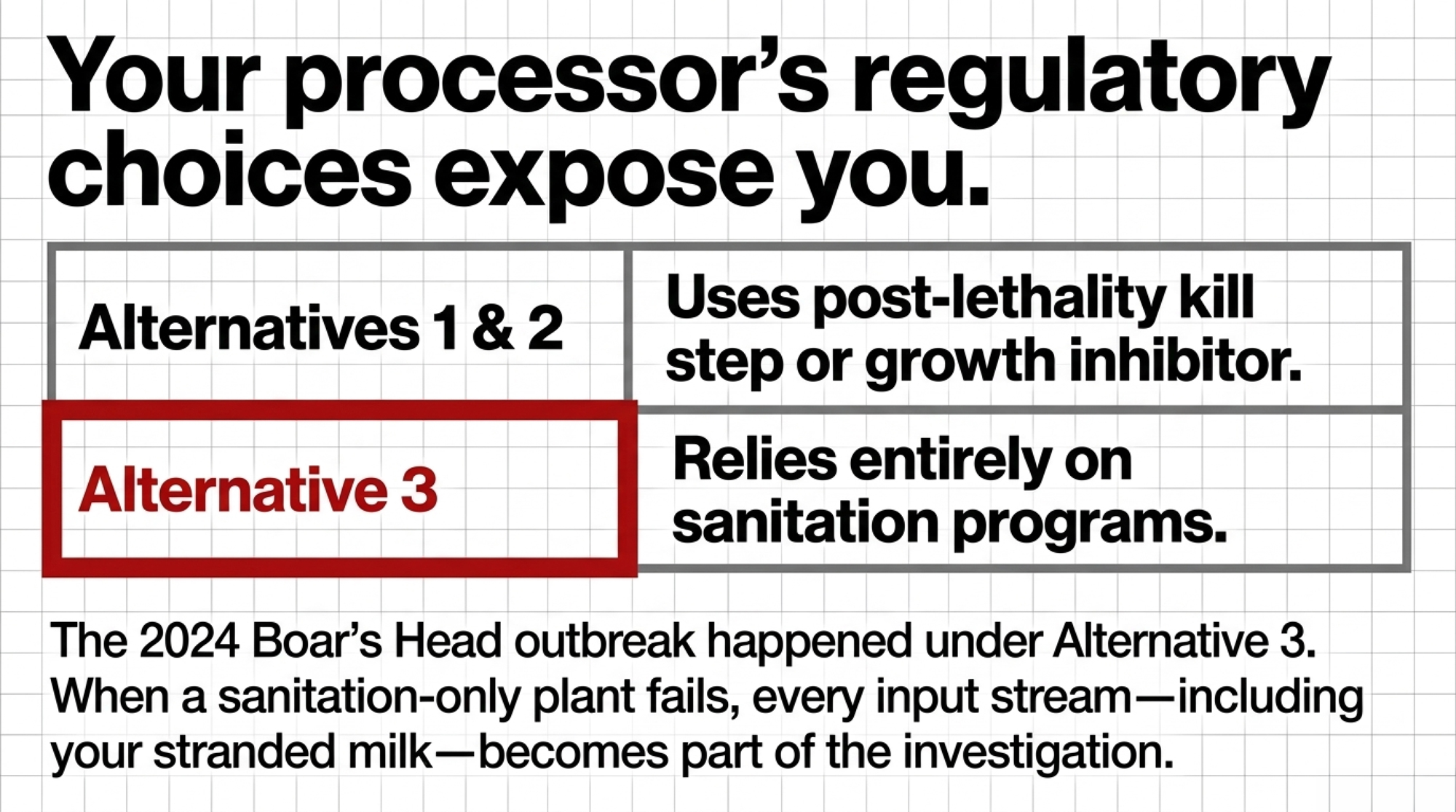
USDA-FSIS gives ready-to-eat processors three pathways for managing Listeria. Alternative 1 combines a post-lethality treatment (like high-pressure processing) with a growth inhibitor in the product. Alternative 2 uses one of those tools — either the kill step or the inhibitor. Alternative 3 uses neither. It relies entirely on sanitation programs to keep the pathogen out of the plant in the first place. No post-lethality kill step. No in-product growth inhibition. Just rigorous cleaning, environmental swabbing, and the assumption that the sanitation regime will hold.
None of the three alternatives is illegal. Alternative 3 is fully sanctioned under USDA-FSIS rules. The point isn’t that your processor is breaking the law. The point is that you have no contractual right to know which legal pathway they’ve chosen — and the choice changes how exposed your milk cheque is when something goes wrong.
According to publicly released USDA-FSIS records, the Boar’s Head Jarratt facility was operating under Alternative 3 in the period leading into the 2024 outbreak, and the facility had accumulated dozens of documented noncompliance citations during that period. The 2024 outbreak associated with the facility was linked, according to CDC outbreak reporting, to at least 10 deaths and triggered a recall of more than 7 million pounds of product. Congressional letters and oversight reports issued in the wake of the outbreak have described Alternative 3 as the weakest of the three options available under the framework, particularly when paired with weak environmental controls.
This is why it matters to you, even if you’ve never set foot in a Virginia deli plant. When a processor relies on sanitation alone and gets hit with a recall, every input stream in that plant becomes part of the investigation. Your milk, sitting in a holding tank or already converted into product, is suddenly stranded — held, tested, rerouted, downgraded, or in the worst case destroyed. The processor’s regulatory choice — made in a room you weren’t in, recorded in a document you can’t see — determines how exposed your milk cheque is when something goes wrong.
The traceability tool that would shorten future investigations — FDA’s Food Safety Modernization Act Section 204 final rule, which mandates digital lot-level tracking for high-risk foods — has had its compliance deadline pushed to July 2028. According to FDA and CDC outbreak reporting, the Prairie Farms Listeria investigation closed in May 2025 spanned roughly seven years across one dairy product category. Faster traceability might have shortened that investigation considerably, according to public health investigators.
What Can You Audit Before You Sign Again?
Here’s the operational angle most producers haven’t actually walked through. Before your next contract renewal — whether co-op marketing agreement, direct-ship contract, or organic supply agreement — there are four questions worth getting on paper.
- Which Listeria management alternative does your processor operate under, and is that listed anywhere in your file?
- What is the processor’s facility inspection history, and does the contract give you any right to request it?
- What’s the notification protocol — by entity, by timeframe, in writing — when product containing your milk enters a recall, hold, or investigation?
- Where in the supply chain does your milk actually go after the loading dock, and how often does that routing change?
You may not get straight answers on all four. But the process of asking changes the conversation. And it surfaces which of your buyers treat you as a partner versus a sealed-off input.
Options and Trade-Offs for Farmers
There’s no single fix here, and anybody selling you one is probably selling something else. But there are four paths producers are actively walking, and each has a real-world economics signature.
Path 1 — Add a notification clause at renewal (do this within 30 days). This is the lowest-friction action and the one worth taking this month. Pull your contract. Identify the renewal window. Draft a one-paragraph addendum requiring written notification within a defined timeframe — most retail food-supply contracts measure these windows in hours, not days, so “reasonable promptness” isn’t a sufficient standard — when product containing your milk enters a recall, hold, or regulatory action. Bring it to your fieldman or contract manager. You may not get every word you ask for. You will learn quickly which counterparties take your concerns seriously. When it works: mid-size to large operations with direct relationships and renewal leverage. Where it fails: small operations in pooled-supply co-ops where the contract is a take-it-or-leave-it template.
The bottom line: If your marketing agreement doesn’t require written notice when your milk ends up in a recall, you don’t have a notification problem — you have a contract problem. Fix the contract.
Path 2 — Diversify processor exposure. If 100% of your milk routes through one buyer that converts into one downstream brand, a single event can move your whole margin. Producers who’ve split supply — even partially — between a fluid co-op and a manufacturing-grade buyer have absorbed shocks better. When it works: operations with the volume and logistics to ship multiple buyers. Where it fails: solo-buyer regions, organic supply contracts that require exclusivity, or operations where the second buyer’s pickup costs eat the diversification benefit.
The bottom line: One buyer feeding one downstream brand is a single point of failure with your name on it. Even a partial split changes how hard the next event hits your margin.
Path 3 — Push your co-op for governance reform. Member-director elections, district meetings, and resolution processes are still the formal channels through which producers shape co-op decision-making, and they remain the legitimate venue for asking what notification protocols your co-op has negotiated on your behalf. Show up with specific contract questions. Ask which processors your co-op markets to, what those processors’ Listeria alternatives are, and what notification protocol exists when downstream events occur. When it works: co-ops with active districting and engaged member-directors. Where it fails: co-ops where the contract terms with downstream processors are treated as confidential and outside the scope of member governance.
The bottom line: Your co-op is negotiating downstream terms on your behalf whether you participate or not. The question is whether your district meeting hears producer concerns or rubber-stamps the management slide deck.
Path 4 — Build farm-side documentation that survives an investigation. Lot-level milk shipping records, on-farm sanitation logs, mastitis treatment records, and tank temperature data don’t prevent a downstream contamination event. They do something else — they let you defend your operation cleanly when the investigation arrives at your gate. With FSMA 204 compliance pushed to July 2028, the upstream end of the chain isn’t going to get easier to investigate. The farms with the cleanest paper survive that scrutiny best. When it works: every operation, regardless of size. Where it fails: nowhere — but it requires real time and probably one new line item in your management software.
The bottom line: Treat July 2028 as your real deadline, not the day FSMA 204 enforcement begins. The farms with audit-ready records when the next investigation lands are the ones that route around the worst of the disruption.
Key Takeaways
- If your milk marketing agreement contains no upstream-notification clause, treat your next renewal — not your next recall — as the deadline to add one.
- If 100% of your volume routes through a single buyer feeding a single downstream brand, you’re carrying a concentration risk your contract won’t acknowledge. Run the diversification math against your pickup-cost reality and decide.
- If your processor operates under USDA-FSIS Listeria Alternative 3, the contract should give you a documented right to know — and a documented notification protocol when an investigation begins.
- If your farm-side records aren’t lot-traceable today, July 2028 is your working deadline, not the FSMA 204 enforcement date. The investigation that lands at your gate before then will use whatever paper you already have.
- If your co-op district meeting doesn’t put downstream processor terms and recall protocols on the agenda, that’s the agenda item to bring.
Closing
The question isn’t whether the next recall comes. It’s whether your contract, your processor relationship, and your farm-side records hold up when it does — and whether you find out by phone call or by news alert.
Editor’s note: This article is based on FDA recall notices, USDA-FSIS records, CDC outbreak reporting, USDA Economic Research Service data, FDA FSMA 204 rulemaking documents, and PBS NewsHour reporting on the November 2025 ByHeart recall and its supply chain. ByHeart, the operator of the Nevada-based organic powder plant identified in PBS NewsHour reporting, Boar’s Head, and Prairie Farms were not contacted for this piece, which is built on publicly released regulatory records and previously published reporting. Case totals from the August–November 2025 ByHeart outbreak reflect figures available at the time of the recall.
Complete references and supporting documentation are available upon request by contacting the editorial team at editor@thebullvine.com.
Learn More
- Your Milk Check Is at the Mercy of a Cheese Shredder: What the Great Lakes Recall Reveals About Dairy’s Broken Supply Chain — Deliver your operation from asymmetric middleman risk by mapping how a single quality failure 500 miles away forces immediate 5% to 15% farm-gate intake cuts regardless of your individual somatic cell count or management excellence.
- You Only Get 15.9¢ of the Food Dollar: A Dairy Farmer’s Playbook for Hauling, Co‑ops, and Premium Milk — Exposes the structural erosion of the producer’s slice of the retail dairy dollar and maps out strategic positioning maneuvers to secure critical 60- to 90-day change-notice periods from downstream processors.
- 2000 Cows, a $21 Million Settlement, and Fairlife’s Woodcrest Dairy Traceability Gap — Arms you with an operational audit strategy to identify brand-contamination loopholes in your marketing agreement, protecting your premium before another member farm’s regulatory investigation triggers a massive litigation cascade.
 The Sunday Read Dairy Professionals Don’t Skip.
 The Sunday Read Dairy Professionals Don’t Skip.
Every week, thousands of producers, breeders, and industry insiders open Bullvine Weekly for genetics insights, market shifts, and profit strategies they won’t find anywhere else. One email. Five minutes. Smarter decisions all week.




