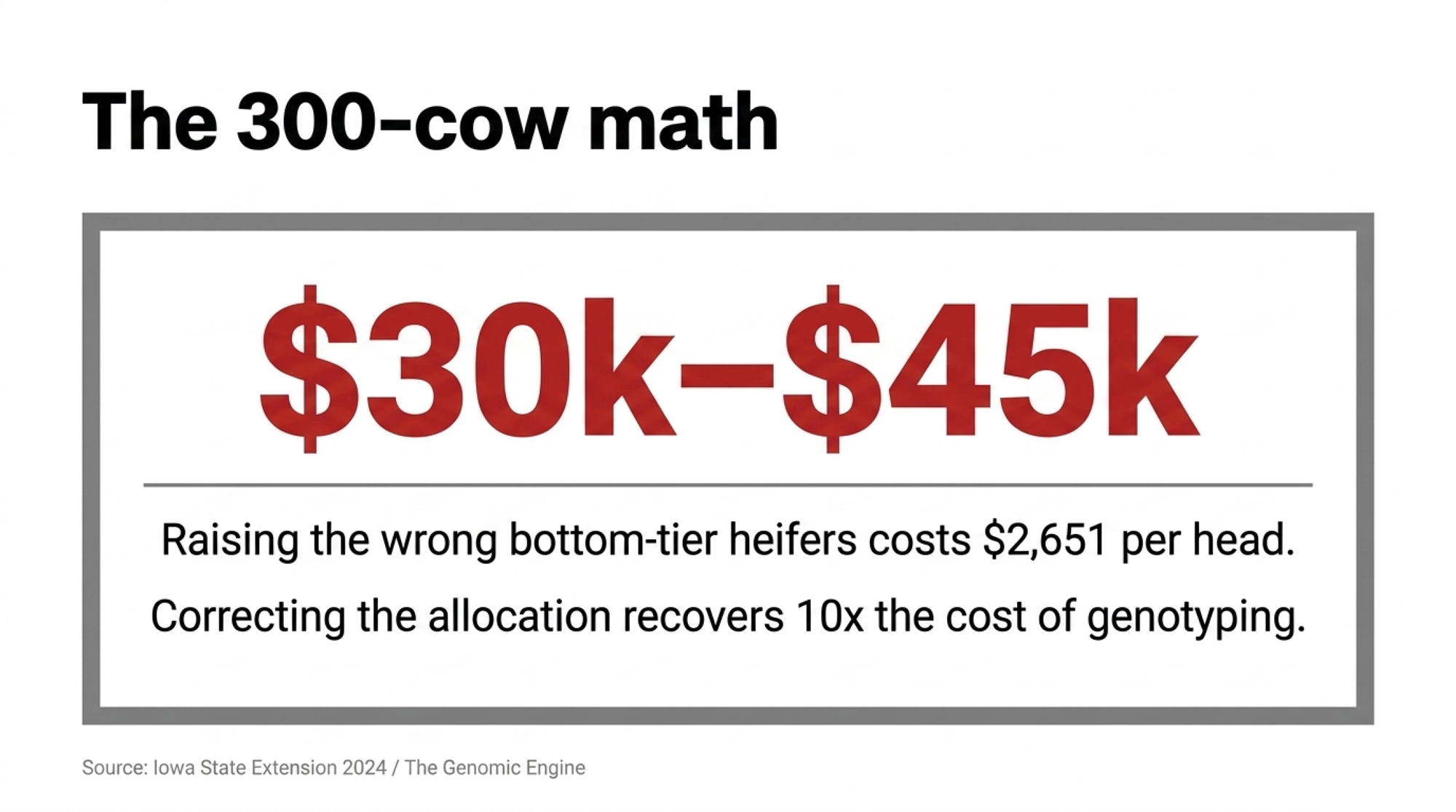
$3,150 a year buys whole‑herd genotyping on 300 cows. The Genomic Engine puts the leak at $30,000–$45,000 — most of it bleeding through misallocated sexed semen and beef straws.
Executive Summary: $3,150 a year buys whole‑herd genotyping on 300 cows. The Genomic Engine analysis puts the annual leak at close to $30,000–$45,000 on that scale — and $120,000–$180,000 on a 1,200‑cow operation — most of it bleeding through sexed semen and beef‑on‑dairy straws allocated at 20–25% parent‑average reliability instead of 70%‑range genomic reliability. Producers running early‑2026 USDA AMS beef‑on‑dairy premiums of about $377 per head and Iowa State’s $2,651 conventional heifer rearing cost are the ones losing the most to coin‑flip allocation. The March 2, 2026, Zoetis–Neogen $160M deal raises a second decision: enroll, but build CDCB data flow, 48‑hour SNP portability, and dual‑track NM$/DWP$ cow‑side display into the contract before signing. Wait until 2027, and three things don’t come back — the calf crops you didn’t sample, the multi‑year FSAV trend data processor sustainability programs will reward by 2028, and the compounding generations of health and fertility selection parent averages can’t deliver. Under‑150‑cow herds are honestly flagged: the full program doesn’t pencil; target specific cow families instead. The 30‑day move is small — pull last year’s sexed‑semen invoices against your yearling list and run retroactive PA rankings on the top and bottom 20 — and the disagreement you’ll find usually pays for year one of genotyping before the audit is finished.
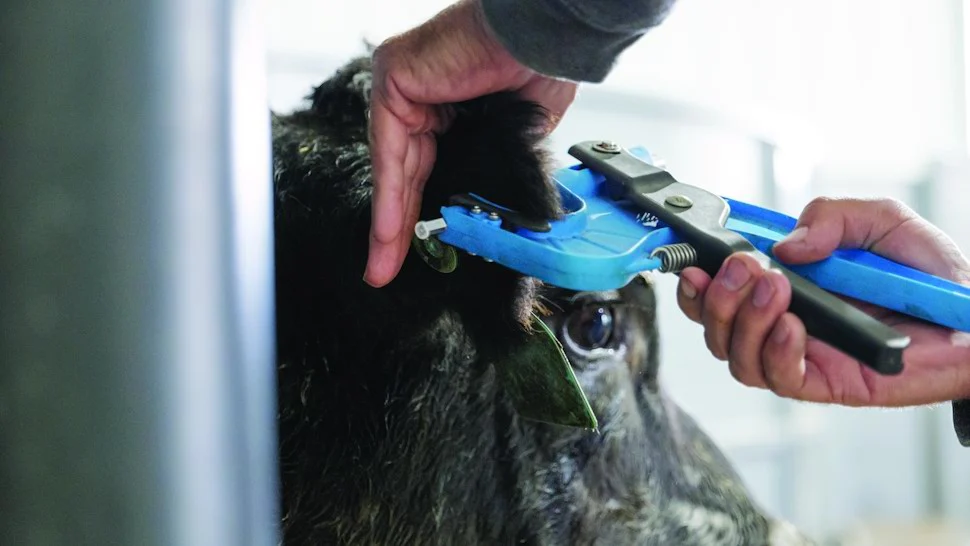
Editor’s note: The 300‑cow operator and the allocation‑meeting scene in this piece are illustrative composites drawn from The Genomic Engine analysis and recent Bullvine conversations with progressive US producers. They are not based on any single named individual or farm. The dollar figures come straight from the source analysis cited throughout.
Picture an operator working through this season’s breeding plan. Good cows. High‑reliability sires in the tank. Sexed dairy on the front end, beef semen on the back. A herd manager he trusts and an AI tech who’s been with him for a decade. He’s writing six‑figure checks on reproductive technology every year, and he takes genetics seriously.
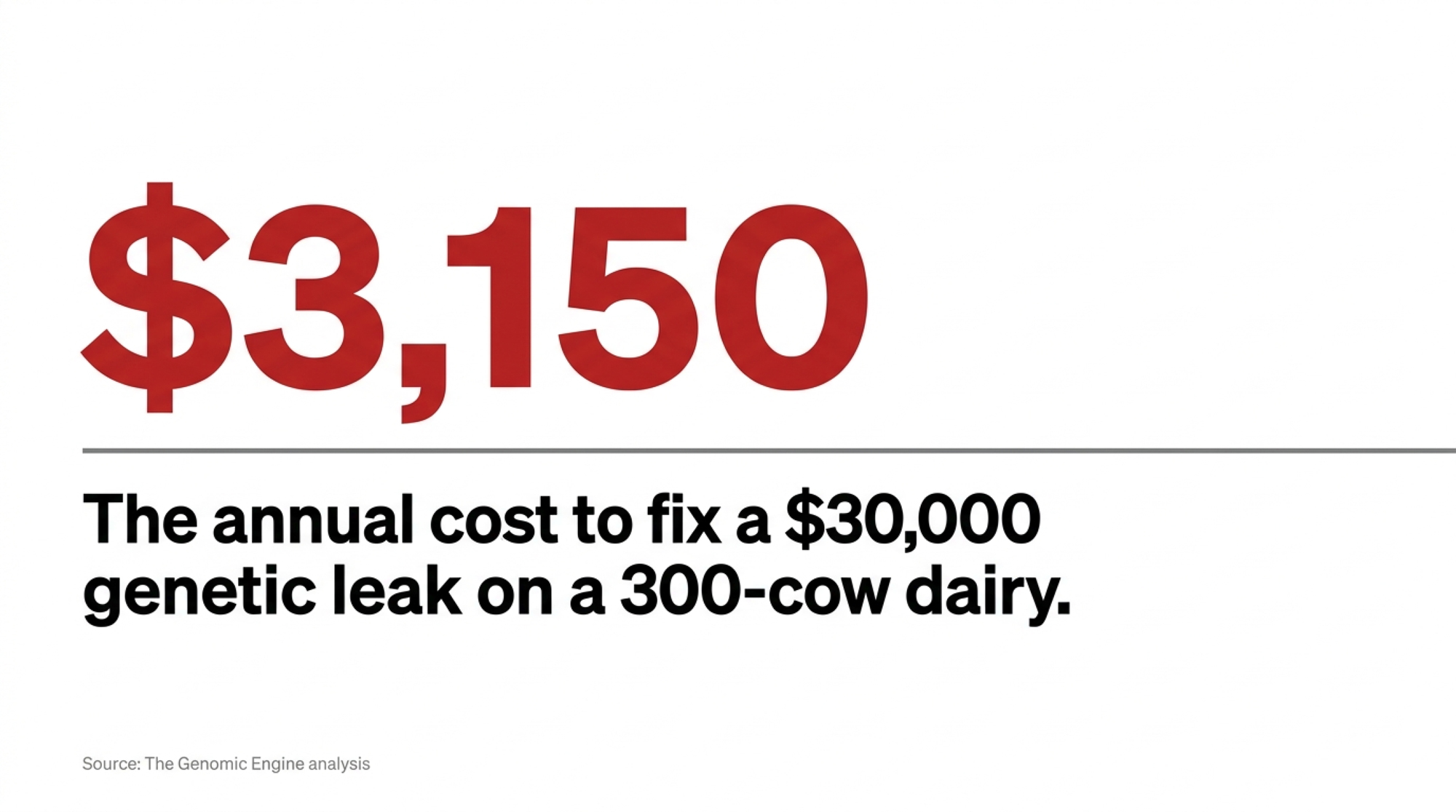
He’s also making most of those decisions on parent averages. That gap — between the tools he’s paying for and the information layer underneath them — is where The Genomic Engine analysis puts the annual leak at $30,000 to $45,000 on a 300‑cow herd running whole‑herd genotyping. On a 1,200‑cow herd in the same analysis, the leak runs $120,000 to $180,000. The fix on the small end costs about $3,150 a year.
What’s Really at Stake on a 300‑Cow Operation
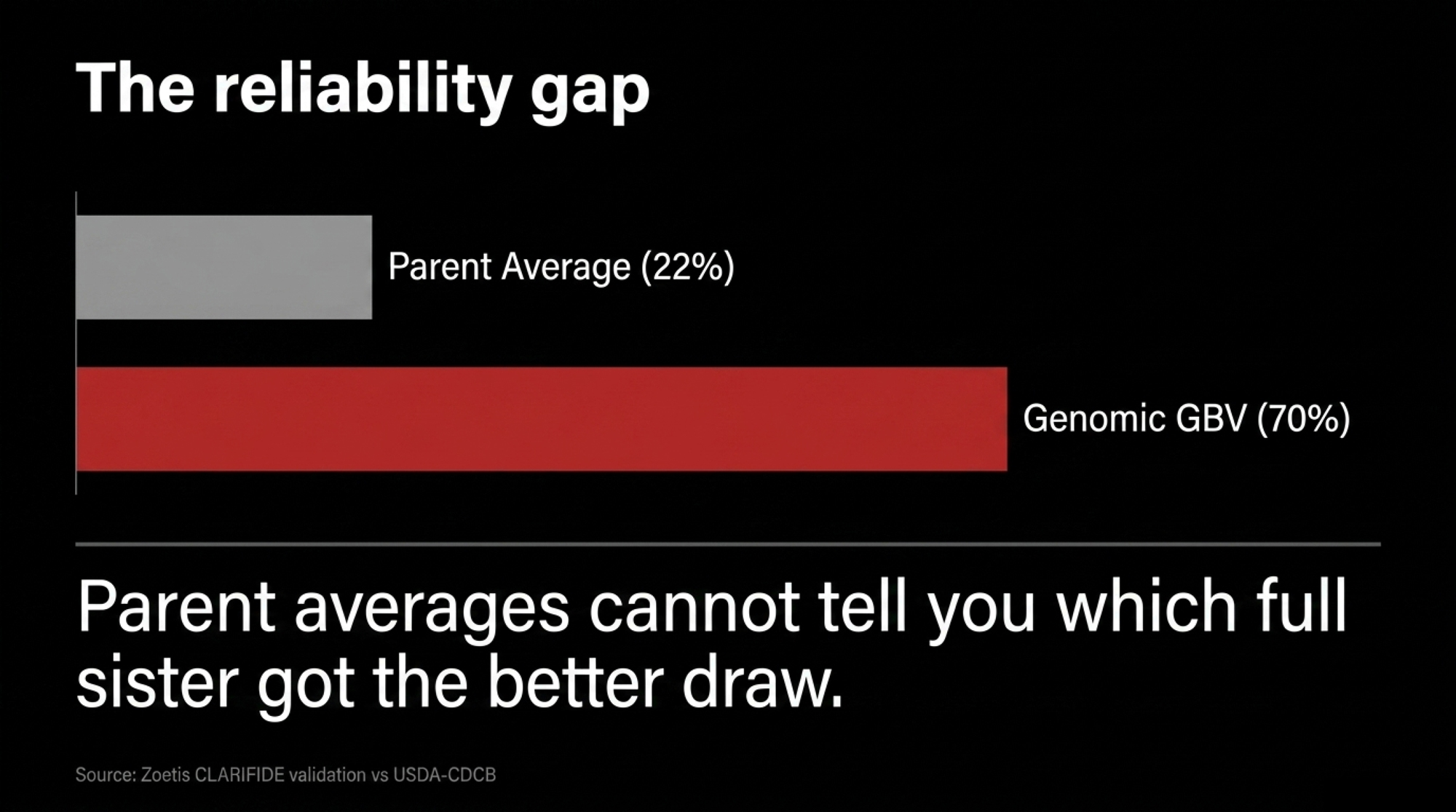
The tension isn’t whether the cows are good. They are. The tension is whether the decisions about which heifers to breed forward, sell, or designate as beef crosses are running on 20–25% reliability or 70–77% reliability — the gap between pedigree‑based parent averages and genomic breeding values at birth for young Holstein females on NM$, per CDCB, and the Lactanet reference figures cited in The Genomic Engine. Zoetis’s own CLARIFIDE validation work against USDA‑CDCB data put traditional NM$ reliability for young Holstein females (≤12 months) at 22%, and CLARIFIDE genomic reliability approaching 70% — per the Zoetis CLARIFIDE technical bulletin, based on USDA‑CDCB evaluation as of April 2014. CDCB has recalibrated NM$ and genomic reliability several times since 2017, with further recalibrations in 2021 and ongoing; the gap between parent‑average and genomic reliability has remained meaningful, though the absolute percentages have shifted. Treat the 22% / ~70% figures as illustrative of the directional gap, not as 2026 absolute values.
The operator who’ll recognize this setup isn’t the laggard. He’s the one already doing the expensive work. He’s writing checks for sexed semen at roughly 2x the price of conventional straws, running a beef‑on‑dairy program pulling early‑2026 US auction premiums of about 7 per head over straight dairy calves, per USDA AMS auction data cited in the same analysis.
He’s just pointing those tools at the wrong animals more often than he realizes.
How It Plays Out in the Barn
Picture a typical allocation conversation on a herd this size. The herd manager, the AI tech, the genetics consultant — looking down a list of about 105 yearling heifers (35% replacement rate on 300 cows, roughly 105 heifer calves a year).
Without genotypes, they’re sorting on dam records, sire EBVs, and the herd manager’s read of the animal. Informed judgment. Not guesswork. But it’s running on a reliability ceiling that Mendelian sampling puts at roughly a quarter of the truth. Two full sisters out of the same 99% reliability sire and the same dam can end up in opposite percentiles of the herd. Parent averages can’t tell you which sister got the good draw.
So here’s what’s happening on herds in this profile, as the source analysis describes it:
- Some of the expensive sexed dairy straws are landing on heifers who’ll rank middle‑of‑the‑pack once genotyped.
- Some of the genuinely elite heifers — the ones whose pedigrees under‑predict them — are getting conventional or beef semen because nothing on the record flagged them.
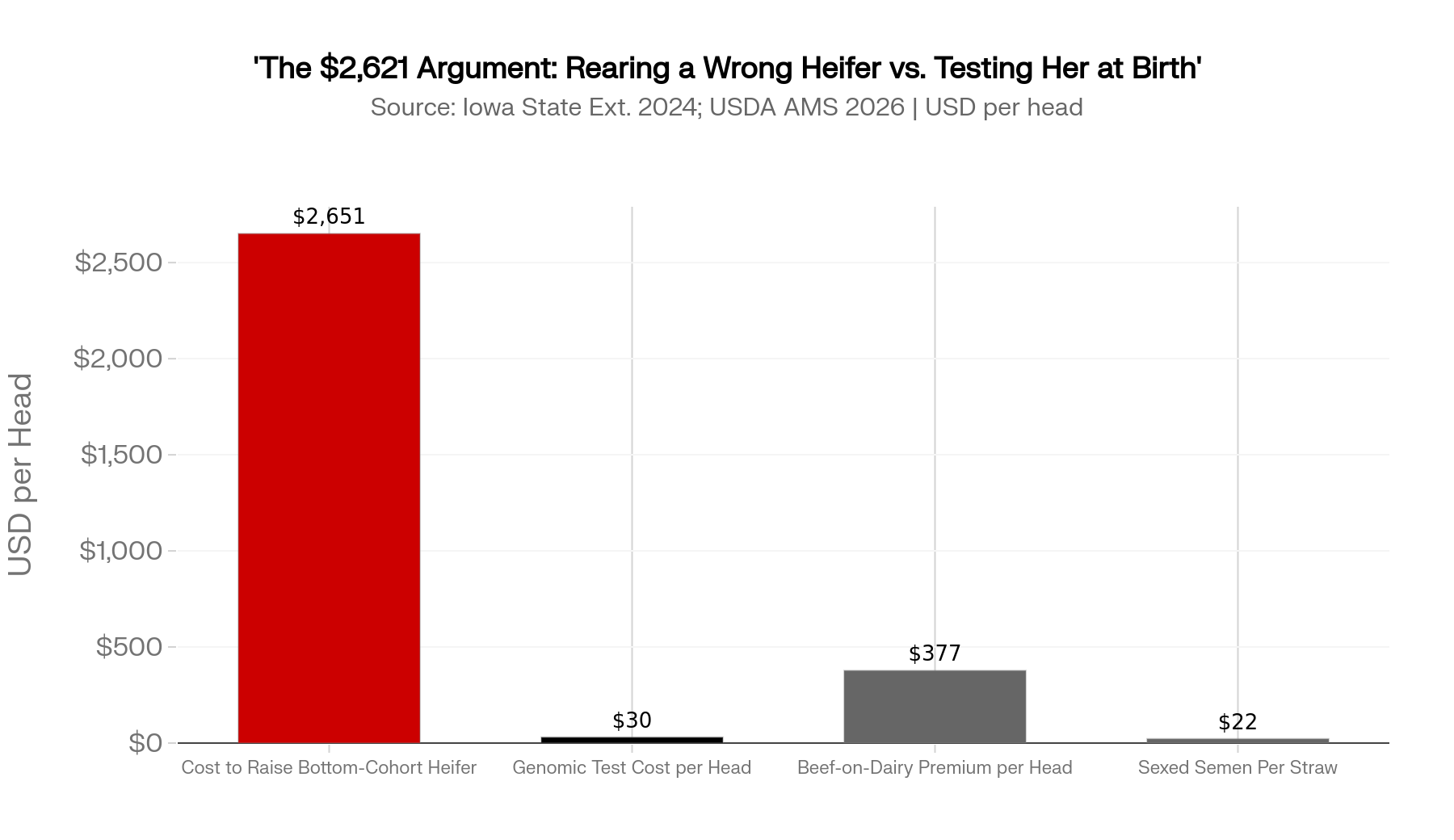
- The bottom ~15% of the cohort, who should be sold or designated beef‑only at eight weeks, are being raised to 22–24 months at a total cost of about $2,651 per head on a conventional 26,000 lb herd, per Iowa State Extension’s 2024 heifer raising cost study. Jersey and pasture‑based systems run a few hundred dollars less; higher‑input Northeast herds run higher.
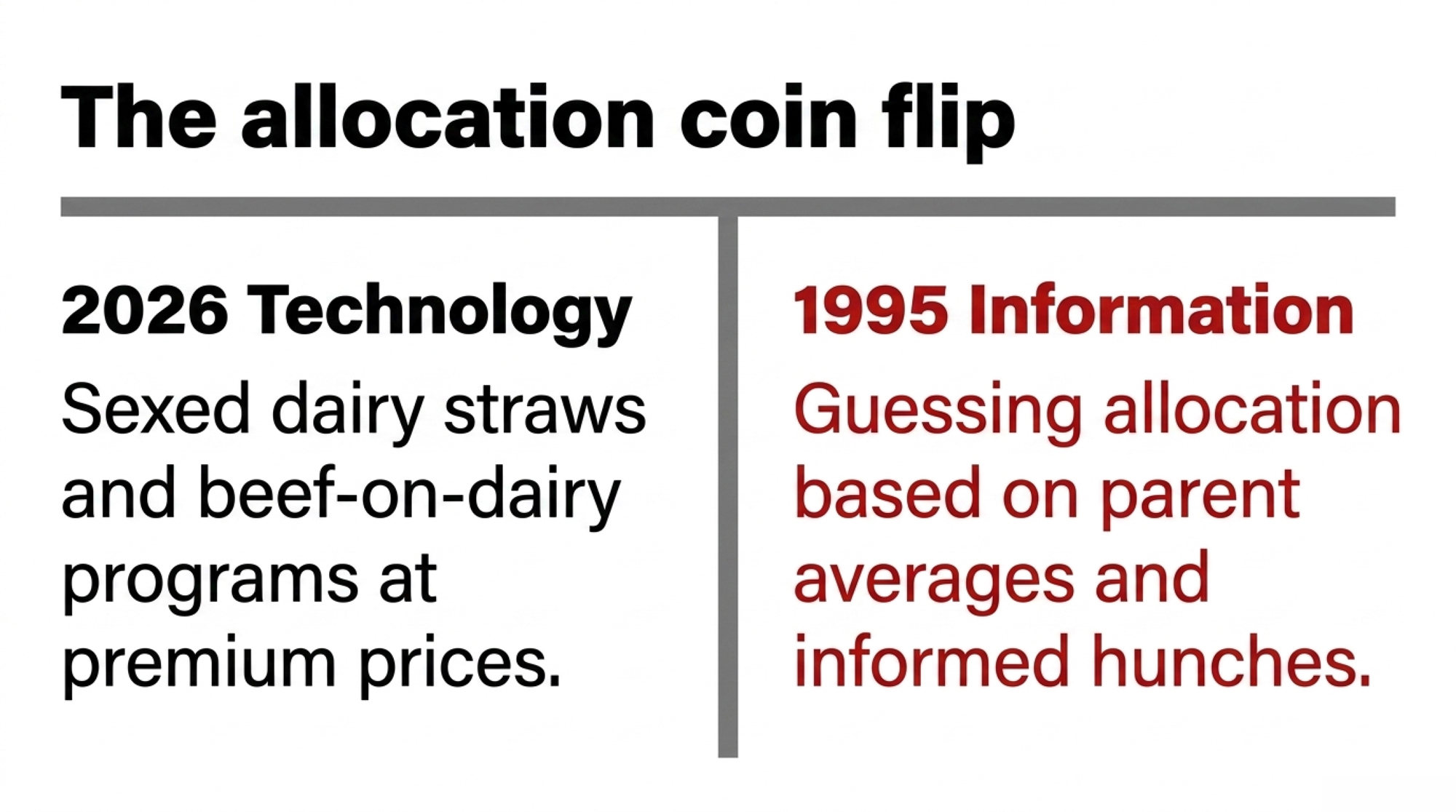
The herd is good. The allocation is a coin flip wearing a lab coat.
How Does the Barn Math Really Work?
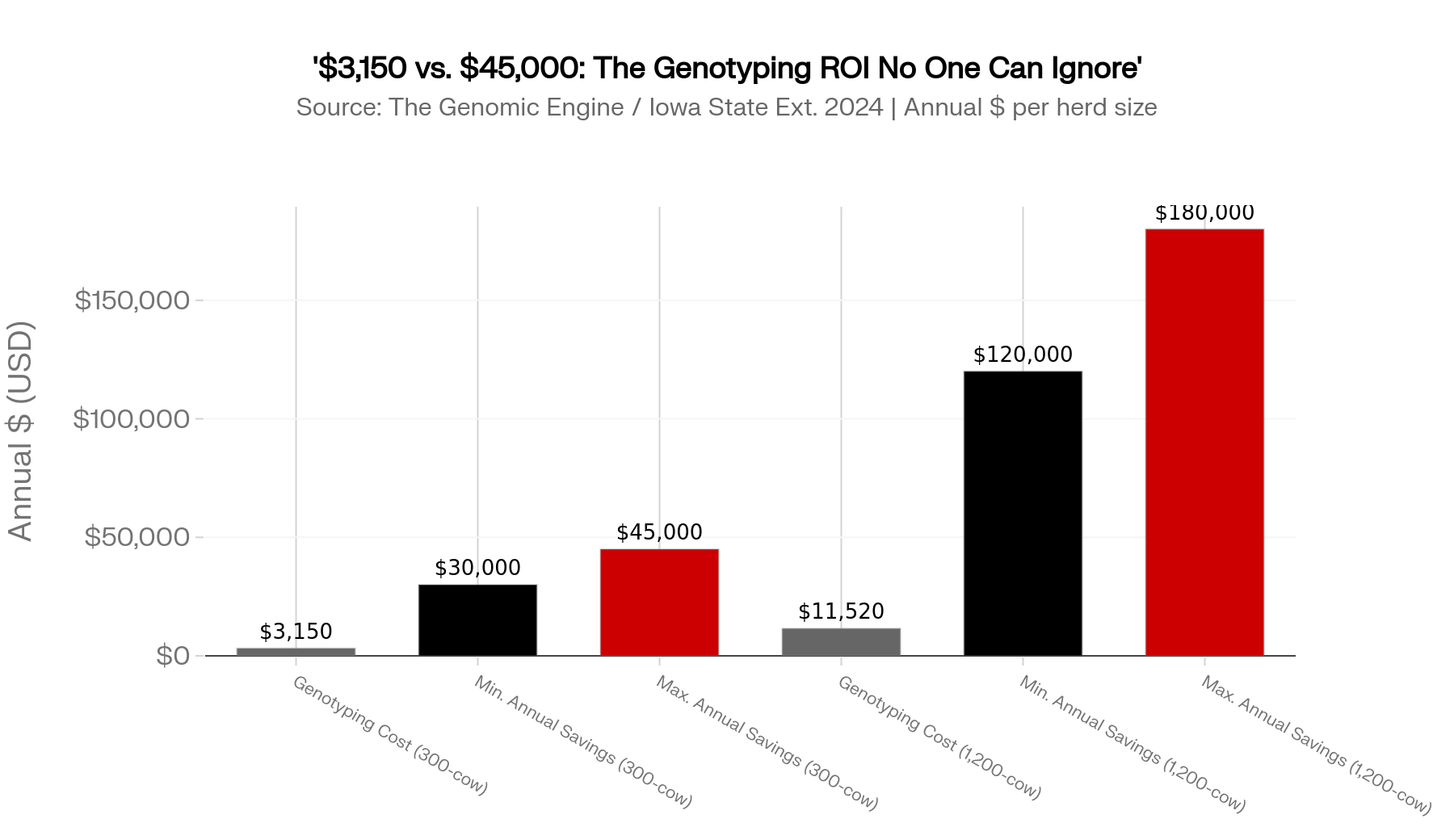
The test bill is four figures. The leak is five or six. — 300‑cow model: $3,150 test vs $30,000–$45,000 recovered. 1,200‑cow model: $11,520 test vs $120,000–$180,000 recovered. (The Genomic Engine)
| Metric | 300‑Cow Herd Profile | 1,200‑Cow Herd Profile |
| Annual heifer cohort | ~105 heifer calves (35% replacement) | ~384 heifer calves (32% replacement) |
| Annual genotyping cost | $3,150 ($30/test) | $11,520 ($30/test) |
| Bottom‑cohort culls | ~15 animals culled at 8 weeks | ~40 animals culled at 8 weeks |
| Rearing cost saved | ~$30,000 ($2,000–$2,651/head avoided) | ~$80,000 ($2,000/head avoided) |
| Added revenue capture | Optimized sexed semen + beef‑on‑dairy allocation | Correctly targeted beef‑on‑dairy + IVF donor discipline |
| Total net annual return | $30,000–$45,000 | $120,000–$180,000 |
Sources: The Genomic Engine analysis; Iowa State Extension 2024 heifer raising cost study ($2,651 on a conventional 26,000 lb herd); USDA AMS auction data, early 2026. The lower end of the rearing cost range accounts for partial recovery via cull‑heifer or bull‑calf sale revenue. The 1,200‑cow model assumes a 32% replacement rate vs the 300‑cow model’s 35%, consistent with how The Genomic Engine scales replacement rates by herd size. The 10% vs 15% cull threshold is a management call every operator makes differently.
The takeaway: For both operation sizes modeled by The Genomic Engine, the cost to build the data layer runs roughly 10% or less of the direct capital leaking out of the barn through misallocated reproductive decisions.
A 600‑cow operator sits between those two models and can do the arithmetic on his own replacement rate and heifer costs, but the shape of the curve is clear.
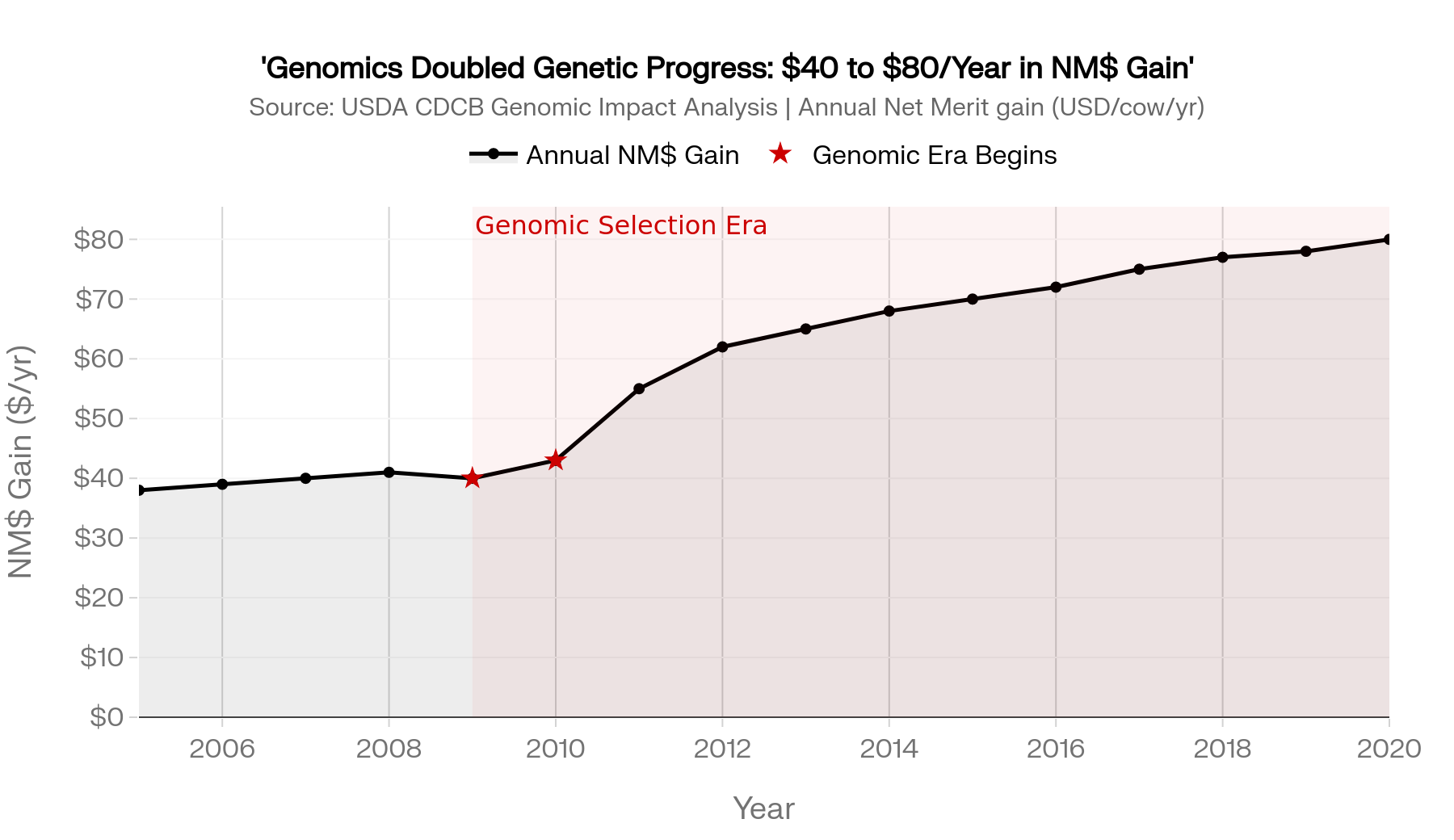
The harder‑to‑price gain is the one that compounds. CDCB’s own genomic impact analysis shows average annual Net Merit gain roughly doubled from $40.33 per year (2005–2010) to $79.20 per year (2016–2020) as genomic selection matured in the US Holstein population. Running parent averages on most of the herd means genetic progress on low‑heritability traits — mastitis, metritis, daughter pregnancy rate — progresses meaningfully more slowly than in operations using GEBVs, particularly on traits parent averages predict poorly. Five years of that gap compounds into the equivalent of losing roughly a decade of genetic progress by 2040 — editorial math, not a cited projection, but the direction is clear.
The Cost of Delay: A Chronological View
Three landmarks you can’t get back. Each one becomes more expensive the closer you get to it.
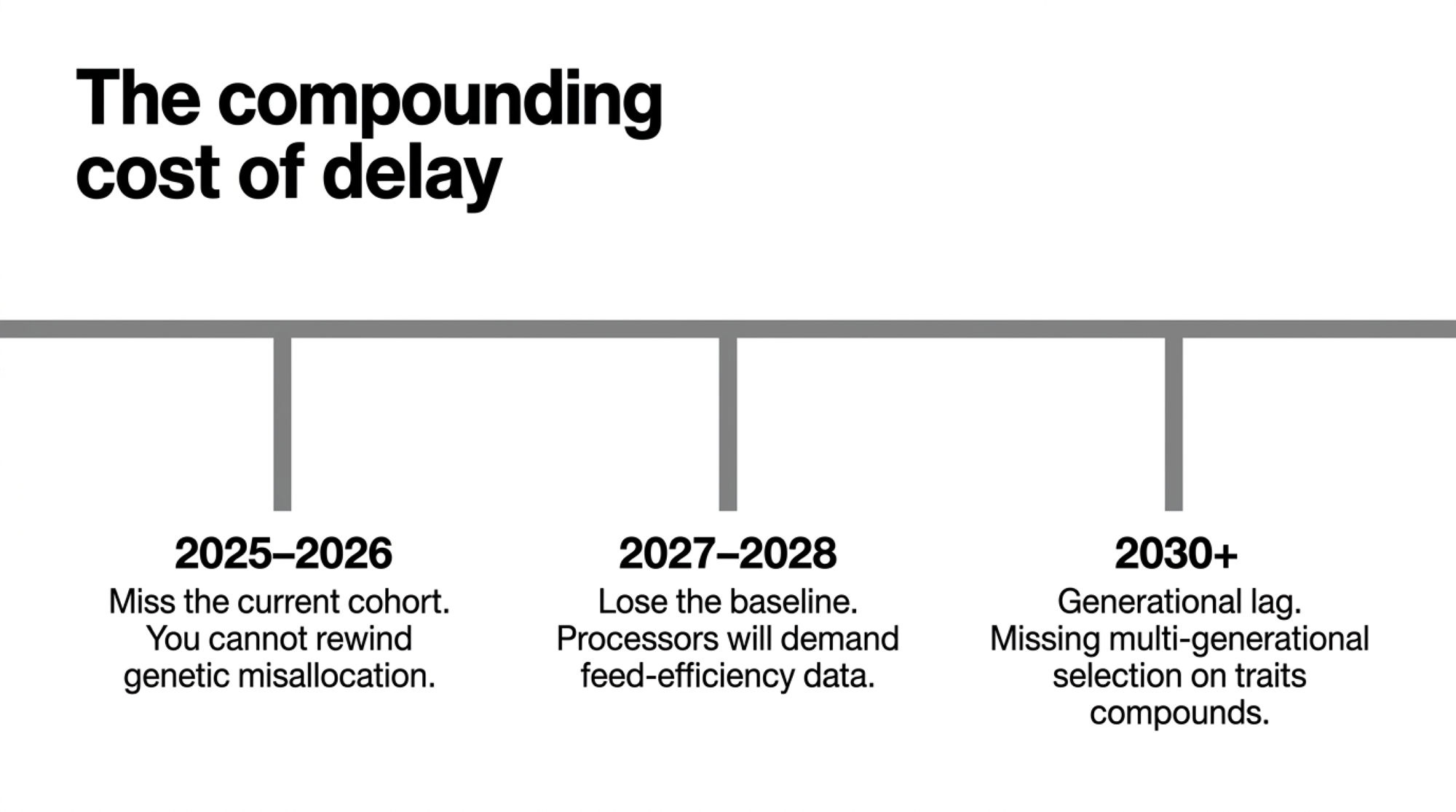
The Current Cohort — 2025–2026. Every heifer calf you skip is selected on a 20–25% parent‑average reliability ceiling. These animals will become your dominant milking string by 2028–2030. There is no retroactive rewind button on genetic misallocation, and there’s no way to genotype a calf crop that has already left the farm.
The Sustainability Baseline — 2027–2028 Processor frameworks begin tying premium payouts to documented resource efficiency. Early adopters leverage two to three years of historical Feed Saved (FSAV) trend data — the US evaluation CDCB has published since December 2020, with a documented link to methane output through residual feed intake. Canadian producers have a separate tool: Lactanet launched what it described as the world’s first national genetic evaluation for direct methane efficiency in April 2023, built on mid‑infrared spectroscopy with an 85% genetic correlation to GreenFeed measurement (per Lactanet). US producers don’t have a parity methane evaluation yet, so for an American operation, FSAV is the trend line that matters today. Delayed operations start at zero with a baseline and an explanation.
The Compounding Generation Gap — 2030+ Low‑heritability traits — mastitis resistance, daughter pregnancy rate, metritis — require multi‑generational, high‑reliability selection to move the needle. Missing three generations of selection on those traits creates a genetic lag that no checkbook fixes in year four.
The remaining kinks, as of 2026, aren’t technical. They’re operational: sample collection discipline, staff buy‑in at the “cull the healthy calf” moment, and contract structure with the genomic vendor. Waiting doesn’t make those easier.
The Platform Question Worth Raising Before You Sign
What follows is editorial analysis. The factual record on the Zoetis–Neogen transaction is summarized below; the commentary on platform consolidation reflects The Bullvine’s editorial perspective on what integrated genomic platforms mean for producer leverage.
Here’s the piece that’s starting to surface in operator conversations. On March 2, 2026, Zoetis announced a definitive agreement to acquire Neogen Corporation’s animal genomics business for 0 million, subject to customary closing adjustments. Zoetis expects to close in the second half of 2026; Neogen’s filing says the transaction is expected to close by the end of the first half of Neogen’s 2027 fiscal year, pending regulatory approval. The deal brings the GeneSeek laboratory network — five labs across the US, Brazil, Australia, China, and the UK, serving customers in 120+ countries — into Zoetis’s Precision Animal Health platform.
That consolidation concentrates the full genomic value chain — the test, the lab, the proprietary wellness index (CLARIFIDE Plus / DWP$), the mating software integration, and increasingly the processor‑facing sustainability verification — under one roof. Credit where it’s due on the components: DWP$ is a substantive, wellness‑weighted tool, GeneSeek brings real lab capacity and accreditation, and CLARIFIDE’s automatic CDCB submission is a genuinely producer‑friendly default. The editorial concern here is what integrated platforms mean for producers’ leverage over the long haul — not about the underlying technology or lab capability.
The defensible move isn’t to refuse the platform. It’s to build optionality into the relationship from day one — and to do it in this order, before money or samples change hands.
The Dual‑Track Enrollment Protocol
| Contract Clause | What to Confirm | Risk if Missing |
|---|---|---|
| CDCB Data Flow | NM$/Pro$ actively visible on cow-side screen, not just background submission | You’re paying for national evaluation but flying blind on the public index |
| SNP File Portability | Raw SNP files delivered to producer within 48 hours of written request, in standard format | Platform switch requires re-genotyping entire herd — sunk cost trap |
| Dual-Index Display | DWP$ and NM$ shown side-by-side in DairyComp/PCDART/BoviSync active cow screen | Proprietary index runs unchecked; no independent benchmark for mating decisions |
| Data Deletion Rights | Exit clause specifies what happens to your herd’s genomic data if contract ends | Genomic profile of your genetics may remain on vendor servers post-exit |
| Lab Accreditation | Processing lab is CDCB-approved and genotypes submitted under your herd ID | Delays or denials in national evaluation submission; loss of CDCB history |
1. Verify CDCB data flow — Pre‑Enrollment. Confirm with your vendor representative that the national CDCB evaluation data is actively flowing back into your local interface. Every CLARIFIDE sample carries a CDCB service fee that Zoetis collects and forwards to CDCB (per the published Zoetis CDCB Fee Schedule and CDCB’s genomic evaluations documentation), so the national evaluation is happening in the background. Visual presentation of the NM$ metric on the cow‑side screen is a software configuration choice, not a universal default.
2. Secure SNP portability clauses — Contract Review. Require a written guarantee in the service contract specifying that raw genomic SNP files must be ported directly to the producer in a standardized format within 48 hours of a formal request. Before signing, confirm at least one alternate CDCB‑approved lab is on your short list — not because you expect to switch, but because optionality is cheaper to build in upfront than to retrofit.
3. Configure cow‑side displays — Day 1 Integration. Set up your herd management software (DairyComp, PCDART, BoviSync) to display the proprietary index (DWP$) and the public national index (NM$ or Pro$) side‑by‑side on the active cow screen. If only one index is visible, your dual‑track strategy remains theoretical.
The plumbing already exists. National evaluations are built to accept genotypes from accredited labs, including GeneSeek, and CDCB fees accompany every commercial submission. These three steps — CDCB flow, SNP portability, cow‑side display — aren’t always front and center in genomic vendor enrollment conversations. Whether your specific representative covers them in detail can vary. Either way, the prudent move is to add them to your enrollment checklist before signing.
The Bullvine’s editorial position on platform consolidation reflects analysis of publicly disclosed transaction terms; Zoetis has been invited, on standing terms, to respond to producer‑leverage concerns raised in our coverage.
Options and Trade‑Offs for Your Operation
Not every operator needs the same playbook. A few realistic paths, with honest trade‑offs:
Full whole‑herd genotyping with dual‑track data governance. Test every heifer calf, route results to both a commercial index and the national evaluation. Fits operations above roughly 300 cows running sexed semen and beef‑on‑dairy. Demands contract scrutiny at enrollment. It backfires if the 90‑day implementation is botched and the “dual‑track” stays theoretical because the software was never configured to display both indexes.
Top‑half genotyping as a phased entry. Genotype only heifer calves from the top 50% of dams in Year 1 — about 53 calves on a 300‑cow herd. Cuts the test bill in half and captures most of the bottom‑cohort identification. Fits cash‑flow‑tight operations, staging the investment. It backfires if the underlying dam rankings are themselves off, meaning high‑potential outliers in bottom‑50% dams never get tested.
Do nothing, but with a calendar date. If an operator genuinely isn’t ready, the defensible version is to set a specific review date — spring 2027, for example — track current reproductive‑technology spending, and commit to dual‑track setup at that point. The indefensible version is drift. Drift costs calf crops.
One honest caveat: for herds of about 150 cows or fewer, the full program often doesn’t pencil out the same way. The Retention Payoff infrastructure and mating software integration carry fixed costs that don’t scale down gracefully, which the source analysis describes as small herds being “structurally excluded.” Those operators are better served by targeted genotyping of specific cow families rather than whole‑herd barcoding.
The 30‑Day Action, Regardless of Which Path You Pick
In the next month, pull the last 12 months of sexed semen invoices against the current yearling list. Mark, which heifers received sexed dairy semen, which received beef semen, and which received conventional semen. Then ask the genetics consultant to run retroactive parent‑average rankings on the 20 highest and 20 lowest animals in that cohort.
You won’t get genomic reliability. But you’ll see how much spread parent averages alone hide on animals your program already treats as interchangeable. Most operators who run this exercise find enough disagreement between the allocation and the ranking to pay for the first year of genotyping before the audit is finished.
By day 90, the follow‑up check is simple: your herd management software should display DWP$ (or whatever proprietary index you use) and NM$ side by side on the cow screen. If only one number is visible, the dual‑track isn’t real yet. That’s a 30‑day check and a 90‑day configuration — not a 12‑month genetic strategy overhaul — and it’s the sequence that makes every other decision in this article concrete.
What This Means for Your Operation
- How many of your last 12 months of sexed semen straws landed on heifers you’ve never genotyped? If the answer is most of them, your reproductive technology is running on a coin flip.
- Pull your current heifer inventory. Raising more than 110% of replacement need means you’re raising “just‑in‑case” animals and paying about $2,651 per head, per Iowa State’s 2024 figures, to find out which ones didn’t work.
- Check your last IVF donor list. How many of those cows would still be on it if you’d ranked the herd on 70%‑range reliability data instead of pedigree and hunches?
- If your processor announces a tiered methane or feed‑efficiency incentive in 2028, can you produce three years of herd‑level FSAV trend data — or a baseline and an apology?
- Audit your current or proposed genomic vendor contract for three clauses specifically: raw SNP file portability within 48 hours of request, cow‑side display of both proprietary and national‑evaluation indexes, and exit data‑deletion rights. CDCB submission happens automatically on a CLARIFIDE invoice; the rest does not.
- Name the single person on your org chart accountable for reproductive‑technology allocation outcomes. If nobody owns the leak, nobody will fix it.
- Have the barn conversation before the first cull list is issued. A long‑tenured herdsperson asked to cull a healthy eight‑week‑old needs to hear the stewardship reframe — “we’re not culling your work, we’re pointing your labor at the right animals” — long before the first calf leaves.
Key Takeaways
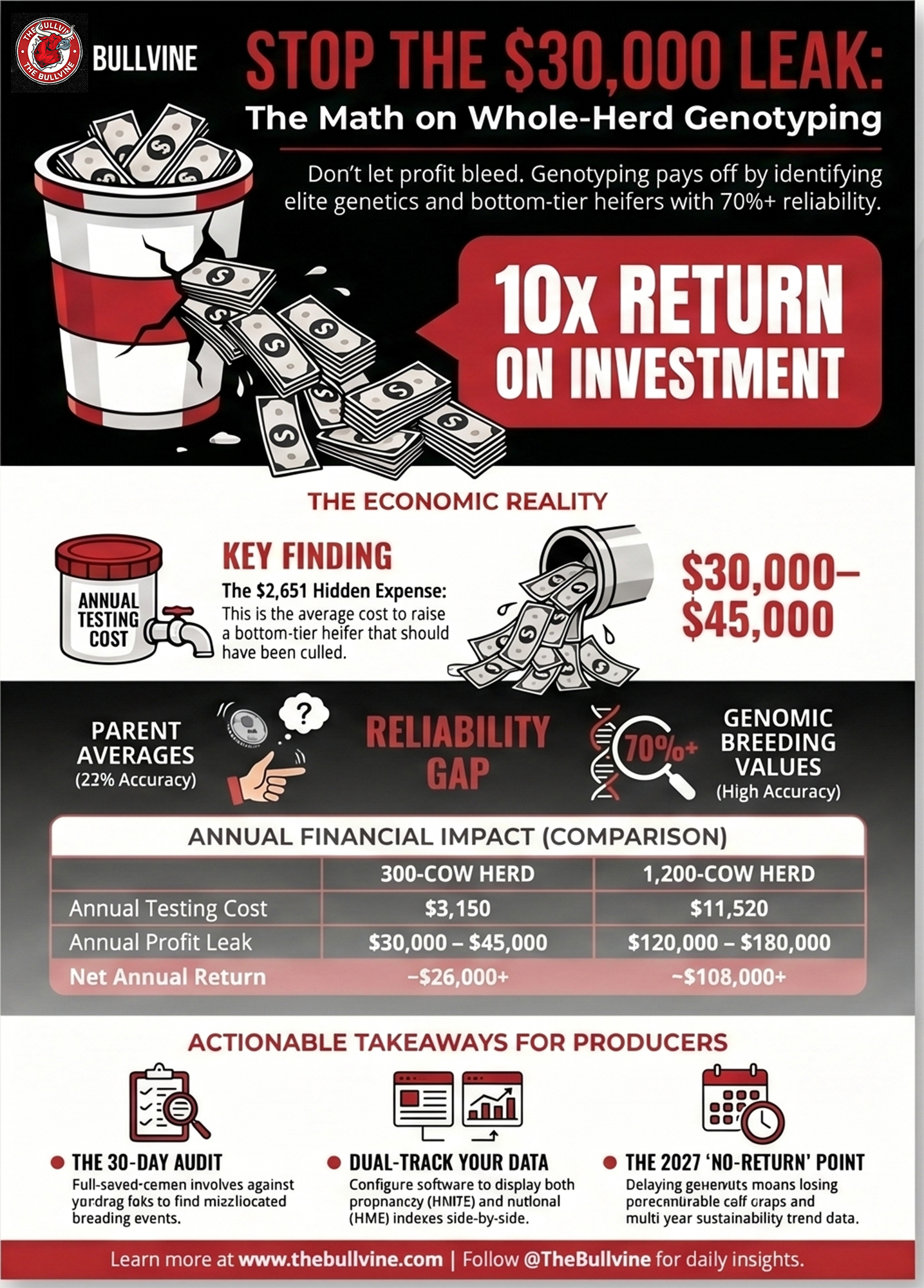
- If you’re running sexed semen and beef‑on‑dairy without genotyping, the tools are 2026, and the information layer is 1995. The Genomic Engine analysis puts that gap at $30,000–$45,000 a year on a 300‑cow herd against a $3,150 test bill.
- If you wait until 2027 to start, three things are non‑recoverable: the calf crops you didn’t sample, the multi‑year FSAV trend data processor sustainability programs will reward, and the compounding generations of health and fertility selection that parent averages can’t deliver.
- If you adopt, adopt a dual‑track on day one. CDCB evaluation is already running in the background on every CLARIFIDE invoice; the battle is whether NM$ shows up next to DWP$ on the cow‑side screen. The incremental cost to configure that at enrollment is small. The cost to retrofit in year three is not.
- If you’re under 150 cows, don’t force the full program. Target specific cow families instead, and push your breed association and genomic vendor on the fixed‑cost problem — the “structurally excluded” gap is real and worth making noise about.

The Decision Underneath the Decision
The operator picturing himself in this scenario isn’t really deciding whether to spend $3,150 on genotyping. He’s deciding whether the cows in his milking string in 2028, 2029, and 2030 were selected on parent‑average reliability or genomic reliability. He’s deciding whether, when a processor program lands with real premium money attached, he walks into that meeting with a four‑year trajectory or a one‑year baseline.
Money, he can catch up on. Three calf crops of compounding genetic lag, and the data history that proves improvement, don’t come back on any timeline a checkbook can fix. So the real question isn’t whether the technology is proven. It’s the chair the operator is going to be sitting in when the 2030 processor meeting happens — and whether the allocation decisions his herd manager makes in the next 90 days are the ones he’ll want to defend to his kids in 2035.
Complete references and supporting documentation are available upon request by contacting the editorial team at editor@thebullvine.com.
Learn More
- Stop Breeding by Color: Genomics, Heat Stress and Beef‑on‑Dairy Math That Can Add Over $4/cwt to Holstein Margins — Arms you with a concrete framework to sort heifer cohorts using a single economic index. This management protocol aligns high-cost sexed semen with accurate genetic merit, exposing how proper allocation adds more than $4.00/cwt to commercial margins.
- Beef-on-Dairy’s $6,215 Secret: Why 72% of Herds Are Playing It Wrong — Delivers a critical benchmark strategy for long-term heifer inventory management based on reproductive pregnancy rates. It reveals how high-performing herds generate $6,215 monthly by optimizing beef semen on adult cows while preserving the replacement pipeline.
- Dairy Cattle Genetics 2026: TPI, NM$ and Genomics — Dismantles the financial assumptions behind current index selection formulas following the recent benchmark base changes. It exposes the widening gap between TPI’s protein pivot and Net Merit’s feed-efficiency weighting, protecting producers from building unintended herd traits.
 The Sunday Read Dairy Professionals Don’t Skip.
 The Sunday Read Dairy Professionals Don’t Skip.
Every week, thousands of producers, breeders, and industry insiders open Bullvine Weekly for genetics insights, market shifts, and profit strategies they won’t find anywhere else. One email. Five minutes. Smarter decisions all week.