








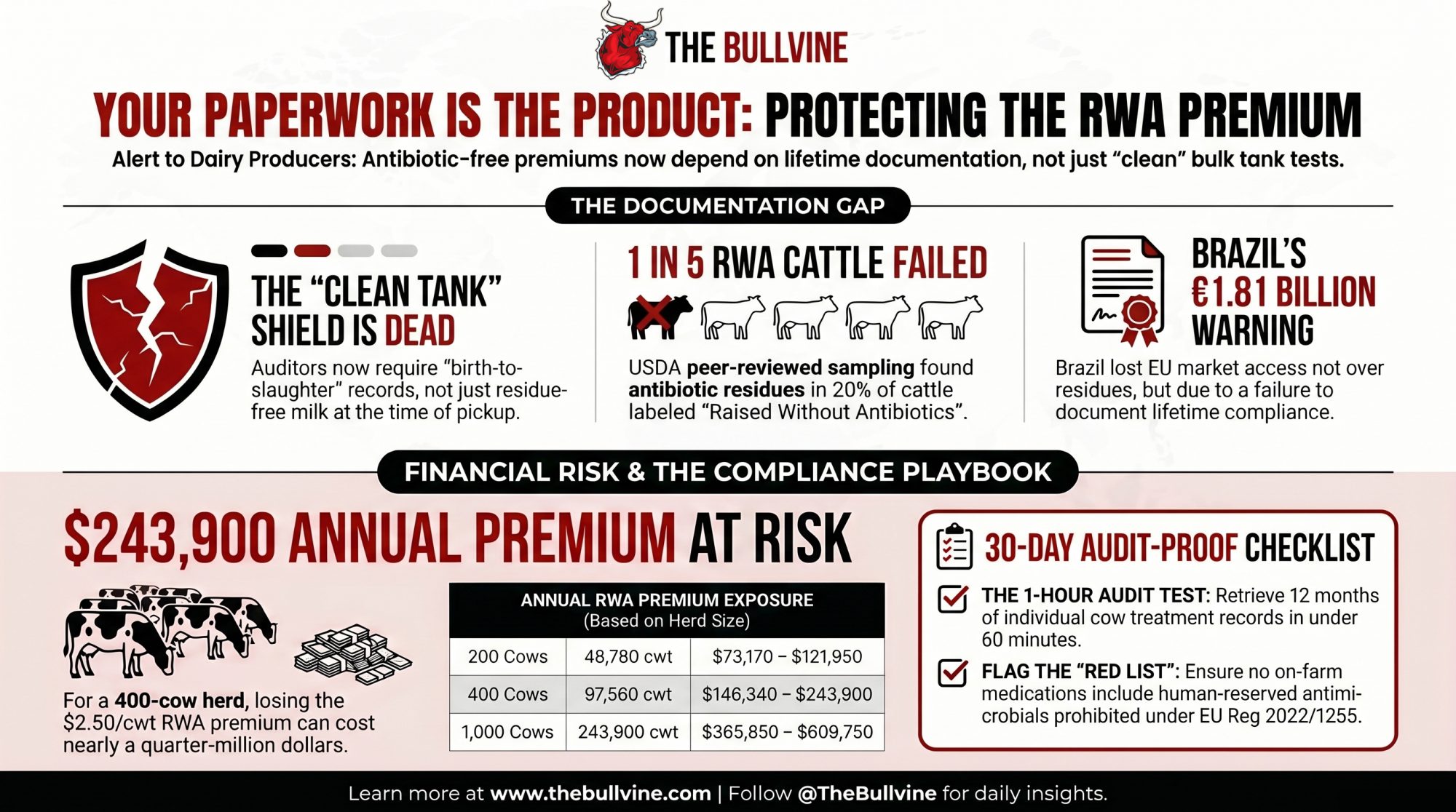
USDA’s own peer-reviewed sampling found antibiotic residues in 37 of 185 RWA-labeled cattle. On September 3, the EU’s documentation rules go live — and your AB-free premium math changes overnight.
Executive Summary: On May 12, 2026, the European Commission cut Brazil from its authorized animal-product exporters list — €1.81 billion in annual trade suspended September 3, not over residues, but over Brazil’s failure to document lifetime antimicrobial compliance under EU Reg 2023/905. The same standard is now heading for every North American AB-free, RWA, and quality-program dairy premium, and your bulk-tank test is no longer a legal shield. USDA’s own FSIS sampling, published peer-reviewed in JAFC in December 2024, found antibiotic residues in 37 of 185 cattle from RWA-labeled beef plants — roughly 1 in 5 — and FSIS’s August 2024 guideline now requires substantiation of controls “valid from birth to slaughter.” For a 400-cow U.S. herd at the 2025 NASS average of 24,390 lbs/cow, that’s 97,560 cwt/year, and an AB-free differential of $1.50–$2.50/cwt puts $146,340–$243,900 of annual premium revenue on top of records most operations couldn’t pull cow-by-cow inside an hour. Six months of suspended premium during a documentation rebuild runs ,000–3,000 on a 300–600 cow herd — not a gap most mid-size dairies absorb without touching herd size or debt structure. Canadian operators sit closer to compliance through proAction’s cow-level architecture, but processors shipping into EU-aligned export chains inherit the same audit logic. The premium isn’t disappearing; the right to collect it on a supplier affidavit is, and the read-or-skip question is whether your last 12 months of treatment records would survive a buyer audit landing tomorrow.
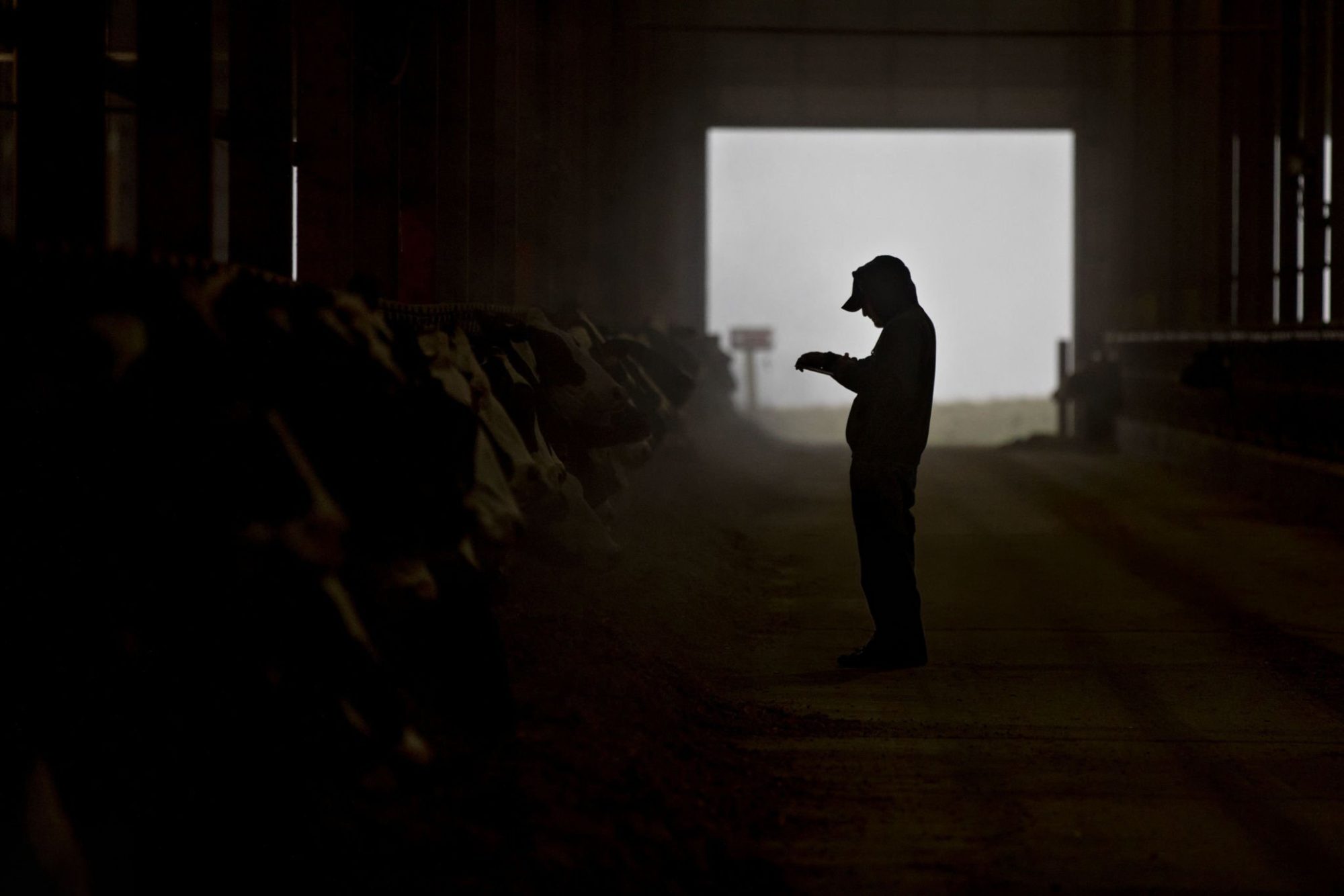
The May 12 announcement caught the trade press. The September 3 effective date should be catching every North American AB-free dairy supplier, processor compliance lead, and quality-program contract administrator with documentation gaps they haven’t tested. The trigger wasn’t a contaminated container — it was a missing paper trail, and the same logic is heading for the supplier affidavit propping up your per-cwt premium.
If you’re a mid-size dairy collecting a per-cwt premium for “raised without antibiotics” or equivalent claims, the question isn’t whether your milk is clean today. It’s whether your records can prove every cow’s drug history on demand. That’s a different standard than most North American AB-free and RWA programs were built to meet.
| Evaluation Metric | Typical North American RWA Program | EU Lifetime Compliance Standard |
| Scope of Coverage | Program enrollment forward | Lifetime (birth to slaughter or full milking life) |
| Prohibited Substances | Withdrawal-managed antimicrobials | Permanently excluded human-reserved list (Reg 2022/1255) |
| Verification Method | Supplier affidavit + bulk tank testing | Cow-level digital records + official certification |
| Enforcement Trigger | Chemical residue detected at slaughter or tank | Documentation failure or missing paper trail |
| Financial Exposure | Loss of per-batch or localized premium | Full market access suspension and retroactive clawbacks |
What the EU Just Did, in Plain Terms
The legal mechanism is Article 118 of EU Regulation 2019/6, paired with Delegated Regulation 2023/905. Trade lawyers call it the “mirror measure.” It applies the same antimicrobial rules EU farmers have operated under since January 28, 2022, to anyone shipping animal products into the bloc, with import-side enforcement effective September 3, 2026.
Two prohibitions matter most. Antibiotics used as growth promoters have been off the EU table for years under the broader veterinary medicinal products framework established by Reg 2019/6. The second category — antimicrobials reserved for human medicine — is set out in Implementing Regulation (EU) 2022/1255. That’s the list any animal headed for an EU plate must never have touched, from birth forward.
The shift that changes everything operationally is the move from Maximum Residue Limits at slaughter to compliance throughout the life of the animal. A clean tank test doesn’t fix a treatment from two lactations ago. A respected withdrawal period doesn’t matter if the drug is on the prohibited list. The drug history is the product.
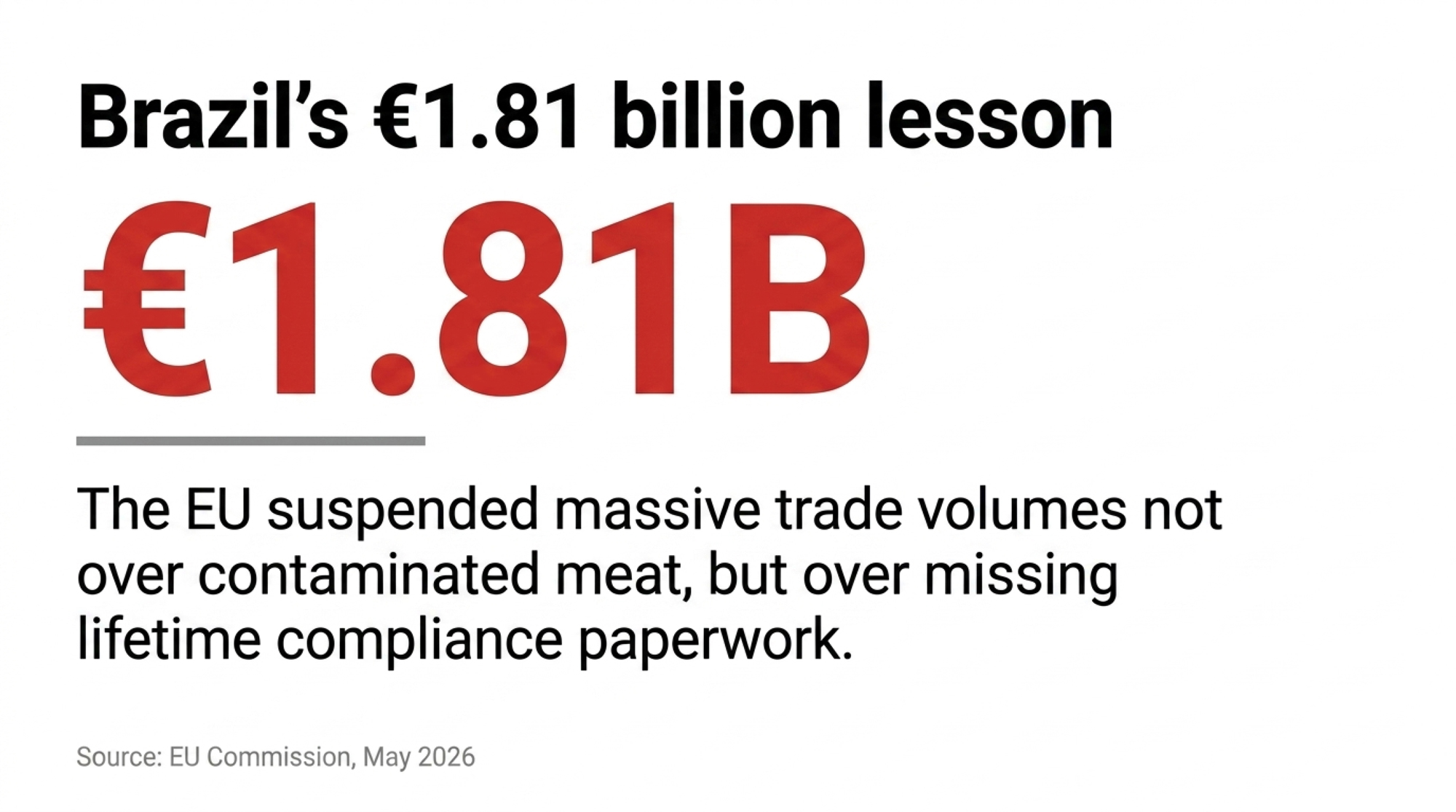
Brazil’s €1.81 Billion Lesson
Brazil’s exposure breaks down into roughly €1.04 billion in beef and €762.9 million in poultry, with smaller volumes in honey, aquaculture, and live equines. The other Mercosur members — Argentina, Paraguay, Uruguay — kept their access. They had paperwork to back the claim.
India’s case is the more useful precedent for North American operators. Delisted from EU aquaculture exports in October 2024, reinstated around the same time Brazil was cut, after upgrading residue monitoring and lab-backed certification systems. The mechanism rewards documentation and punishes its absence. It doesn’t care whether your product is actually clean — only whether you can prove it. For a North American dairy processor reading this story, a clean bulk-tank test is no longer the legal shield it used to be. It’s the baseline.
The Tension: Your AB-Free Premium Sits on Three Weak Points
Most published North American AB-free programs share three structural features that don’t survive a lifetime-compliance audit. Treatment logs are typically built around withdrawal compliance, not lifetime exclusion. Program rules generally apply from enrollment, not from the day the calf hits the ground. Verification leans on supplier affidavits and tank-level residue tests rather than cow-level treatment histories cross-referenced against a prohibited substance list.
USDA’s own Food Safety and Inspection Service ran the most uncomfortable test of this gap. In September 2023, FSIS and USDA’s Agricultural Research Service launched a sampling program targeting cattle from establishments processing “raised without antibiotics”-labeled beef, screening for more than 180 veterinary drugs.
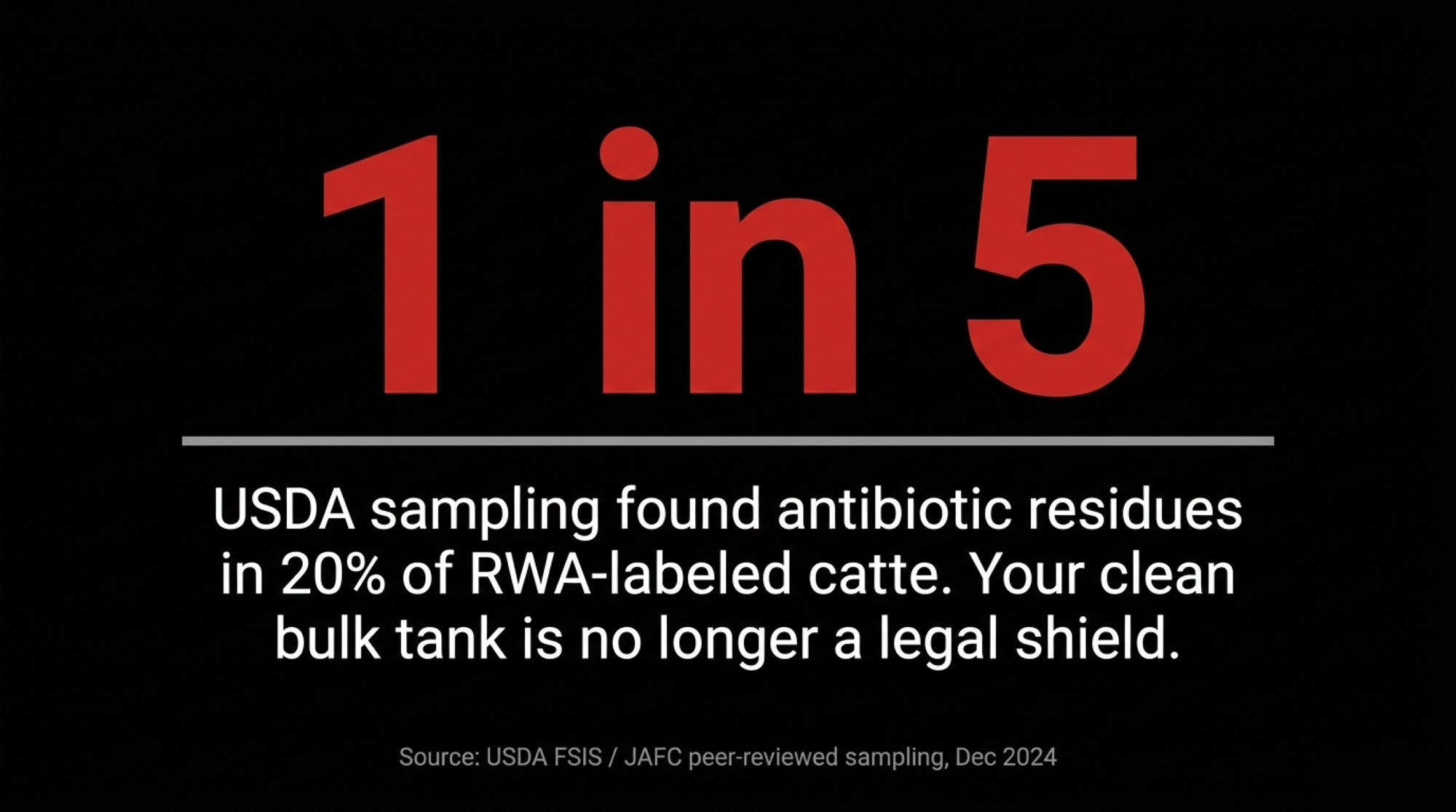
1 in 5. A peer-reviewed analysis of the FSIS sampling, published in the Journal of Agricultural and Food Chemistry in December 2024, reported antibiotic residues in 37 of approximately 185 sampled animals, with multiple antibiotics confirmed in 11 of those.
FSIS’s response: the August 28, 2024, Guideline on Substantiating Animal-Raising or Environment-Related Labeling Claims, which requires written documentation of controls “valid from birth to slaughter” as the preferred substantiation path and strongly encourages third-party certification and routine sampling.
What it stopped short of: mandatory testing.
That’s the language regulators use right before they start enforcing.
Mastitis is where the whole structure bends the hardest. Industry literature consistently identifies mastitis as a leading driver of antimicrobial use on dairy farms, with treatment frequency varying by region, season, and herd management system. The protocol most likely to fail an audit runs at 4:30 a.m. under time pressure, with the person on the morning shift deciding in 90 seconds whether to treat with an intramammary tube or culture and wait. On paper, that treatment flips the cow out of the AB-free pool permanently. In practice, the flag often doesn’t follow her milk through shift changes, software handoffs, and the next pickup.
Running the Numbers: The Financial Risk Profile
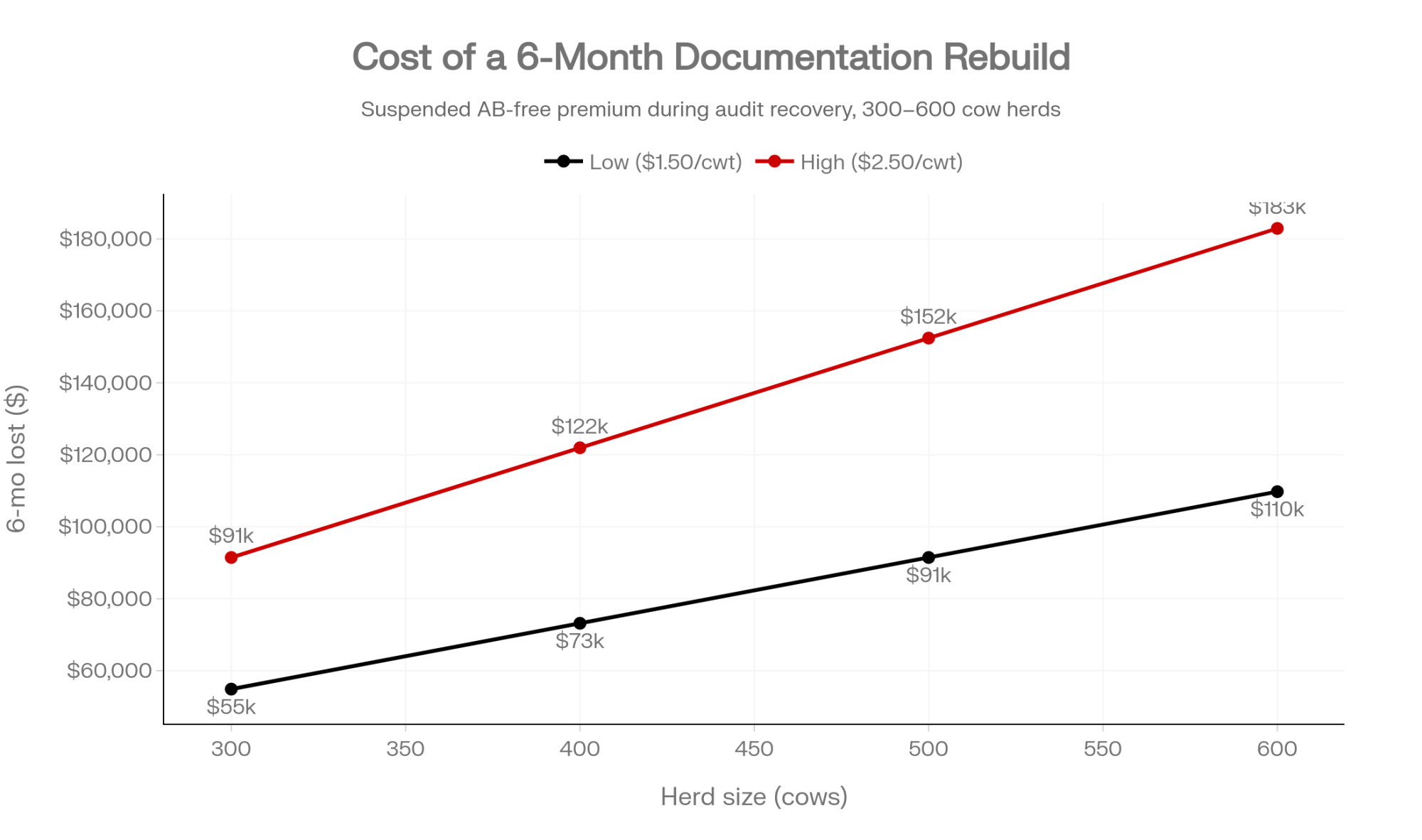
Using the 2025 USDA NASS national average of 24,390 lbs/cow as the production baseline, here’s the documentation-failure exposure across common herd sizes. The AB-free premium range below ($1.50–$2.50/cwt) is illustrative for U.S. AB-free programs — Canadian premium structures differ under quota — and you should verify your actual differential against your own contract or processor program before acting on these figures.
Inputs
- Herd size: 400 cows
- Milk per cow per year: 24,390 lbs (USDA NASS Milk Production annual summary, 2025 U.S. national average)
- Annual production: 400 × 24,390 ÷ 100 = 97,560 cwt
- AB-free premium range (illustrative, U.S. context): $1.50–$2.50/cwt
Annual premium revenue at risk — 400-cow herd
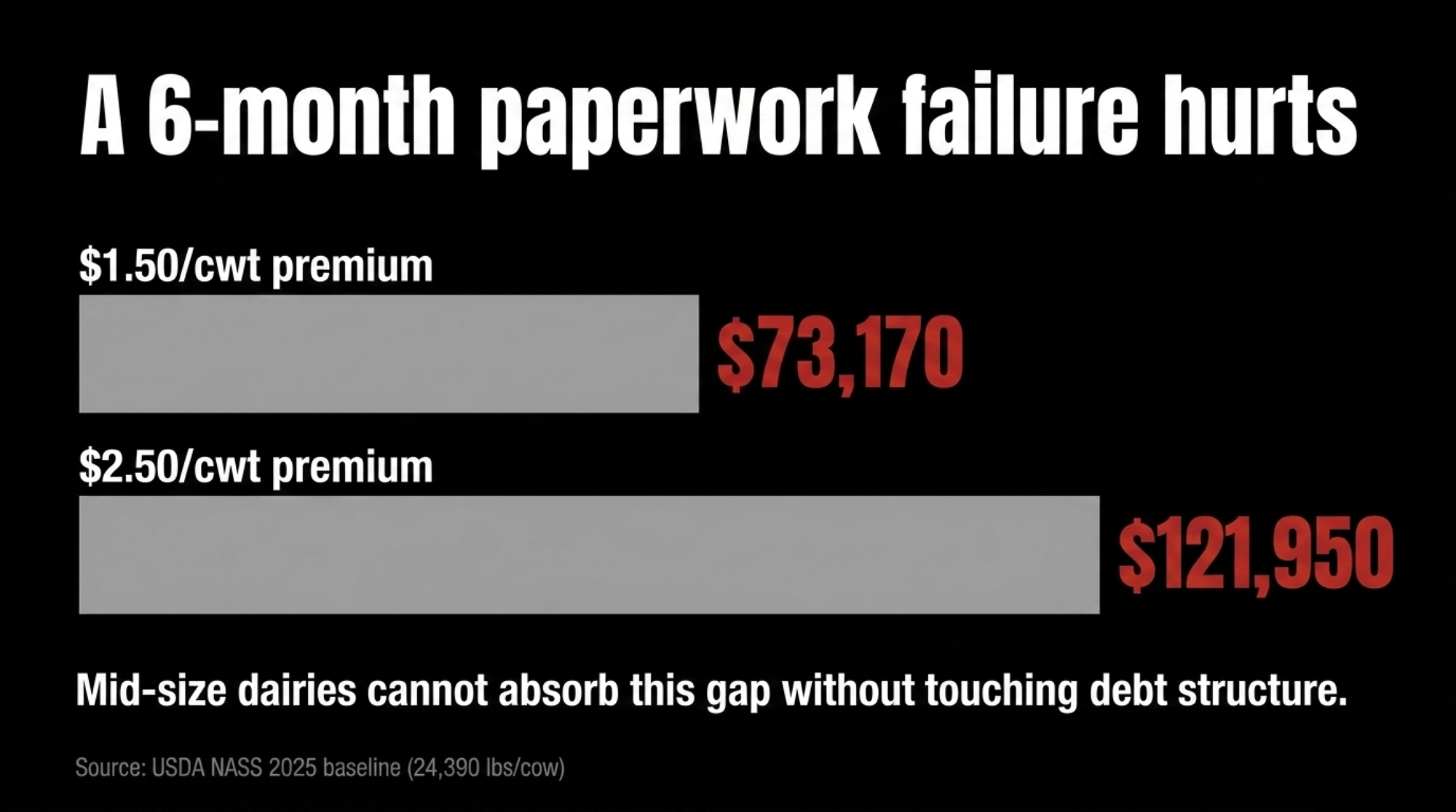
| Premium | 6-month exposure | 12-month exposure |
| $1.50/cwt | $73,170 | $146,340 |
| $2.50/cwt | $121,950 | $243,900 |
Scaling by herd size
- 200-cow herd: 48,780 cwt → $73,170–$121,950/year at $1.50–$2.50/cwt
- 1,000-cow herd: 243,900 cwt → $365,850–$609,750/year
Threshold to act on
| Herd size | Annual cwt (24,390 lbs/cow) | Premium @ $1.50/cwt | Premium @ $2.50/cwt | Action posture |
| 200 cows | 48,780 | $73,170 | $121,950 | Stage the work |
| 300 cows | 73,170 | $109,755 | $182,925 | Stage / monitor |
| 400 cows | 97,560 | $146,340 | $243,900 | Act this contract cycle |
| 600 cows | 146,340 | $219,510 | $365,850 | Urgent — 3× rule triggered |
| 1,000 cows | 243,900 | $365,850 | $609,750 | Urgent — capex-justified |
If your AB-free or quality-program premium covers a credible compliance build-out by 3× or more on annual revenue, urgency is high. Under 1.5× coverage, you have room to watch and stage the work.
What this box can’t tell you
The cost of building EU-grade documentation is harder to pin down than the premium-loss exposure. Industry estimates range from the tens of thousands for farm-side software, cow ID upgrades, and protocol changes to the low six figures for processor-level traceability platform builds — with significant variation by vendor, existing infrastructure, and supply-base size. The premium-loss number is more sharply quantifiable today than the compliance-cost number. The next piece in this series prices out those build costs with named platform examples.
📋 The 30-Day Audit-Proof Checklist
Run this diagnostic immediately. If any answer is No, your premium is exposed.
- Individual Traceability: Can you retrieve the last 12 months of individual treatment records by distinct cow ID in under an hour?
- Substance Mapping: Do you have a documented list of every active antimicrobial ingredient used on-farm this calendar year?
- The “Red List” Check: Have you verified that zero on-farm medications sit on the EU Reg 2022/1255 human-reserved list?
- Data Hand-off: Does your herd management software automatically flag treated animals so the data travels cleanly to your processor?
- Paper Trail: Do you have your processor’s written, formal substantiation, and audit protocols on file?
- Baseline Math: Have you calculated your exact premium differential using your last three consecutive milk checks?
What’s Different for Canadian Suppliers Under Quota?
Canadian operators read this story through a different lens than their U.S. peers. Quota and pooled pricing dampen immediate per-cwt premium volatility, and proAction’s existing record-keeping and traceability architecture already captures treatment data at the cow level. Many Canadian dairies are closer to lifetime documentation standards than they realize.
The exposure is on the export side. Canadian processors shipping cheese, ingredients, or branded fluid into EU-aligned markets — or into U.S. customers who in turn supply Europe — will inherit the same lifetime-compliance expectations. The question for a Canadian supplier isn’t “will my milk check change tomorrow?” It’s “which of my processor‘s export programs am I in, and can my proAction treatment records map cleanly into their export documentation chain?”
No equivalent CFIA dairy export advisory specific to antimicrobial lifetime compliance has been published as of this writing. That’s a watch-list item, not an all-clear.
The Turn: This Stopped Being a Marketing Claim
The assumption baked into most North American AB-free programs has been that USDA and CFIA would stay on the “guidance and encouragement” path indefinitely. That assumption is starting to look strained.
FSIS has already moved once. The September 2023 sampling program was the signal. The December 2024 peer-reviewed publication of its findings was the evidence. The August 2024 guideline’s explicit “birth to slaughter” documentation language was the formal shift. That’s not the posture of a regulator planning to keep relying on affidavits.
Outside North America, the direction is harder to argue with. Australia’s Department of Agriculture communicated to its beef sector in March 2026 that EU antimicrobial rules apply from September 3, “regardless of exporting country,” and updated its EUCAS certification scheme accordingly. EU member states are tightening internal compliance under the same regulation. EU-aligned export markets are writing those expectations into buyer specs.
The signal isn’t that AB-free is going away. It’s that AB-free is shifting from a marketing claim verified by the seller to a documentation standard verified by the auditor. The premium isn’t disappearing. The right to collect it without lifetime records is.
How Much Does Waiting Actually Cost a 300–600 Cow Dairy?
The honest answer is that waiting costs nothing — until it costs the entire premium in a single cycle. When a buyer pulls a misbranded line, three things tend to happen at once. Affected lots lose the premium retroactively. Claw-back charges hit historical sales. Volume shifts to a competitor with cleaner records.
For a 300–600 cow herd at 24,390 lbs/cow/year, annual premium revenue runs from roughly 0,000 (low end: 300 cows × .50/cwt) to 5,850 (high end: 600 cows × .50/cwt). Six months of suspended premium during a documentation rebuild is $55,000 to $183,000. That’s not a gap most mid-size operations absorb without adjusting herd size, debt structure, or both.
The trade-off is straightforward. You spend money up front to make the premium audit-proof, or you carry the audit risk against the full annual premium. Neither path is free.
Is Your Mastitis Protocol Already an Export Liability?
Most farms run mastitis treatment as a clinical decision. Diagnose, treat, respect withdrawal, and get the cow back in the tank. Under EU-style rules, the same decision becomes a compliance event with a paper trail attached.
Did the active ingredient come from the human-reserved class under Reg 2022/1255? Does your vet know which products in your current intramammary rotation are on that list, and does your herd software flag that distinction at the individual cow level? Did the cow’s status update in the system, and does that flag travel with her milk to the processor? Can you reconstruct the full decision six months from now, on demand, when an auditor asks?
The dairies that hold their premium when others lose it aren’t the ones with no mastitis. They’re the ones whose mastitis decisions are captured as structured data, governed by written protocols, and integrated upstream into the processor’s traceability system. That operating standard is achievable on a 12–18 month build for most mid-size operations. It’s also exactly where buyer specs are quietly heading.
The 30/90/365-Day Playbook for a 300–600 Cow AB-Free Dairy
30-Day Actions — Find the Gap
- Pull your last 12 months of treatment records and your full list of on-farm antimicrobials. Cross-check against the EU prohibited-substance list under Implementing Regulation 2022/1255. If you can’t produce a cow-level history in under an hour, that’s the gap — the same documentation gap that cost Brazil its market access. Red-flag trigger: if your annual AB-free premium differential covers a credible compliance build-out by 3× or more and your records can’t pass a 1-hour cow-level audit, treat this as urgent before your next contract cycle.
- Calculate your real annual premium dollars at risk. Use your last three milk checks. Annualize the AB-free or quality-program differential per cwt and multiply by your annual cwt shipped. Compare that number to the realistic cost of digital treatment recording and cow ID upgrades. Where it can backfire: anchor on your best month, and you’ll overstate urgency. Use a conservative 12-month trailing average.
- Request your processor’s traceability roadmap in writing. Ask specifically: Is my milk currently in a premium SKU touching export markets? What is your substantiation protocol for that claim? What cost-share is available for farm-side documentation upgrades? A processor that can’t answer all three in writing is its own signal about where your premium sits in their risk stack.
90-Day Actions — Close the Largest Single Gap
- Standardize digital treatment entry across the parlor and hospital pen. The goal is structured, time-stamped antimicrobial entries tied to individual cow IDs in your herd software — not handwritten board notes transcribed twice and delivered to the processor as a supplier affidavit. What it requires: a written protocol, software discipline, and roughly 90 days of consistent capture before records become defensible as audit evidence. Where it can backfire: a half-built system with inconsistent entry is worse than no system if it creates the impression of documentation that doesn’t actually hold up.
- Rewrite your mastitis SOPs around culture-guided treatment and selective dry cow therapy where clinically appropriate. This isn’t about treating fewer sick cows. It’s about generating cleaner records and reducing the total number of antimicrobial events in the protocol most likely to trip an audit. Where it can backfire:pushing selective dry cow therapy without the lab infrastructure to support it raises somatic cell counts, which hits a different line of the milk check.
- Map your intramammary rotation against Reg 2022/1255 with your vet. If any active ingredient in your standard first-line treatment is on the human-reserved list and that cow’s milk is entering a premium pool, the product swap is your first compliance move. What it requires: one conversation, a willingness to adjust the protocol, and a modest shift in drug cost.
365-Day Moves — Position for the Next Premium Tier
- Achieve cow-level treatment integration with your processor’s traceability platform. This is the structural lift — capex on the processor side, protocol discipline on yours — and it’s the move that converts your operation from claim-eligible to audit-ready. Negotiate it into your supply agreement as a defined deliverable, not a goodwill gesture. Where it can backfire: committing to the platform upgrade without a defined premium structure in exchange locks you into cost without revenue.
- Push for explicit cost-share in your supply contract. If your processor is building or planning an EU-aligned or export-spec premium tier, mid-size farms have significantly more leverage on software, ID equipment, and training subsidies than they typically exercise. Get it in writing before the build is complete, and the leverage is gone.
- Watch for the three triggers that signal the window is closing: FSIS moving from guidance to enforcement on RWA label claims; your top retail or export buyers tightening substantiation requirements in writing; competitors marketing “third-party verified” where you’re still on “program-enrolled.” When two of three are moving simultaneously, the cost of waiting has likely crossed the cost of acting. Opportunity signal: if a processor in your region launches an EU-aligned premium tier and your records are already 80% of the way to audit-ready, you’re positioned to capture incremental $/cwt while operations still on affidavits get downgraded or removed from the program.
What This Means for Your Operation
The Brazil delisting isn’t a Brazil story. It’s a documentation story that happens to carry a €1.81 billion price tag. The same machinery — lifetime compliance, official certification, cow-level traceability — is being written into more buyer specs and more export markets every quarter.
For a 300–600 cow North American dairy in an AB-free or RWA program, the math is unsentimental. The premium is real. The records behind it are uneven. The cost to upgrade is meaningful but increasingly knowable as more processors and co-ops build out their documentation platforms. The cost of getting caught short is also meaningful — and only knowable in retrospect.
The trade-off won’t get easier. You either spend now to make the premium audit-proof, or you carry the audit risk against the full annual premium until the day a buyer asks for proof you don’t have.
What does your current AB-free contract actually say about premium eligibility if a buyer audits cow-level treatment data — and what would your last 12 months of records prove if that audit landed tomorrow?
Key Takeaways
- The September 3 EU rule isn’t about residues — it’s about records. Brazil lost €1.81 billion because its paperwork couldn’t prove lifetime antimicrobial compliance, and the same audit logic is heading toward every North American AB-free, RWA, and quality-program premium contract.
- Run the 3× rule before your next contract cycle. If your AB-free differential covers a credible documentation build by 3× or more on annual premium revenue, treat it as urgent; under 1.5×, you can stage the work — but only if you can pull a cow-level treatment history inside an hour.
- Mastitis is where the audit breaks. If your standard intramammary rotation includes anything on the EU Reg 2022/1255 human-reserved list and that milk’s entering a premium pool, the product swap and the cow-level flag are your first two compliance moves — not a 365-day project.
- Canadian operators on quota sit closer to compliance than they think through proAction’s cow-level architecture, but processors shipping into EU-aligned export chains inherit the full audit standard. Get your processor’s substantiation protocol and cost-share position in writing before the build, not after.
Complete references and supporting documentation are available upon request by contacting the editorial team at editor@thebullvine.com.
Run Your Numbers
Component Value Tracker — Translates your AB-free or quality-program differential into per-cow, per-day, and annual revenue impact using your actual production. Stress-test the 3× rule against your real premium dollars before your next contract cycle — and see exactly what’s at risk if a buyer audits cow-level treatment data.
Learn More
- Stop Tubing Every Mastitis Cow: The $15 Strip Cup Playbook That Beats Blanket Treatment – and Your Robot Alerts – on Cost and Cure — Delivers a diagnosis-guided treatment protocol that cuts antibiotic use without losing cure rate or bumping bulk tank SCC. Arms you with a six-week on-farm culture workflow to preserve premium milk eligibility and trim unnecessary treatment costs.
- 2000 Cows, a $21 Million Settlement, and Fairlife’s Woodcrest Dairy Traceability Gap — Exposes the severe financial liabilities lurking in cooperative marketing agreements when processor-lot tracking fails. Follows the money on unpriced brand-contamination risks, giving you a 90-day review framework to safeguard your herd’s premium tier from neighbor-farm defaults.
- From Udder to Pizza: Blockchain’s Dairy Revolution Hits the Table – Are You Ready to Ride the Wave? — Reveals how ledger technology slashes traceability response time from days to seconds, weaponizing individual cow data into verified consumer premiums. Dismantles traditional bulk supply assumptions by tracing exact genetic profiles from the parlor straight to the retail market.
 The Sunday Read Dairy Professionals Don’t Skip.
 The Sunday Read Dairy Professionals Don’t Skip.
Every week, thousands of producers, breeders, and industry insiders open Bullvine Weekly for genetics insights, market shifts, and profit strategies they won’t find anywhere else. One email. Five minutes. Smarter decisions all week.




