Archive for Genomic Testing

The Six-Figure Execution Leak Happening on Most Dairies: Broken Protocols, Heifer Costs, and Dairy‑Beef Checks

If your best employee can’t hit the protocol, your farm has a six‑figure problem — not a training issue.

Executive Summary: In a heifer‑short, dairy‑beef market where it costs US$2,094–2,607 to raise a replacement, and day‑old beef‑on‑dairy calves can bring about US$1,400, sloppy execution has turned into a six‑figure problem for many dairies. This article uses McCarty Family Farm’s “top half only” genomic rule to show what happens when breeding, colostrum, and culling decisions actually match the math instead of the emotion. Data from MSU, Taiwanese sire‑checks, and large‑herd audits make the leak obvious: only 36% of farms hit FTPI targets, 27.78% of recorded sires are wrong, and even small timing errors in Double‑Ovsynch leave roughly a quarter of cows off‑protocol. From there, you get four concrete paths — harder genomic cutoffs with heifer‑inventory guardrails, redesigning impossible protocols instead of retraining, tracking results by person, and treating consistency as infrastructure — plus the trade‑offs on each. The summary farm‑level math on RPO, stall value, STP, and calf checks gives you simple “run your own numbers” thresholds so you can decide when to breed dairy, breed beef, or ship a cow based on what that stall can really earn over the next 12–24 months.

dairy herd management protocols

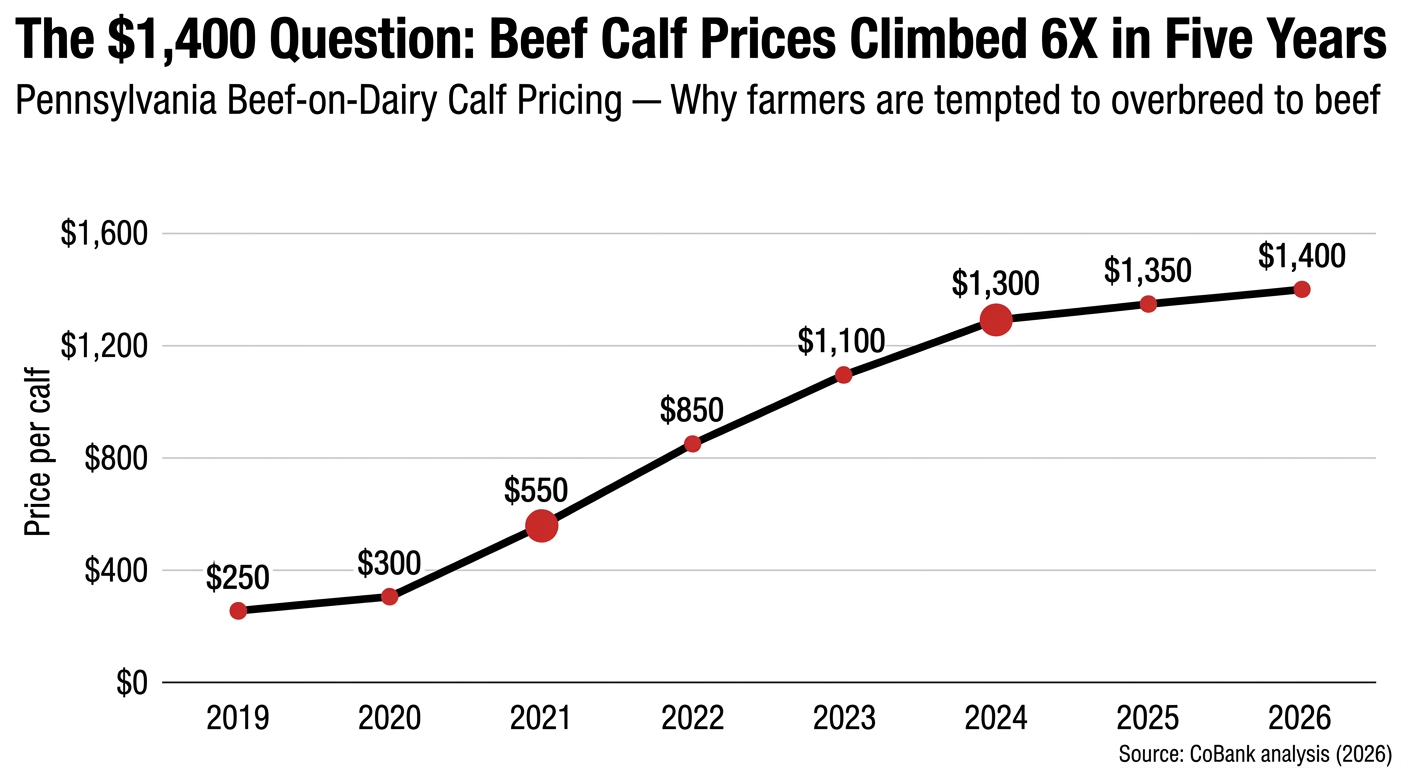
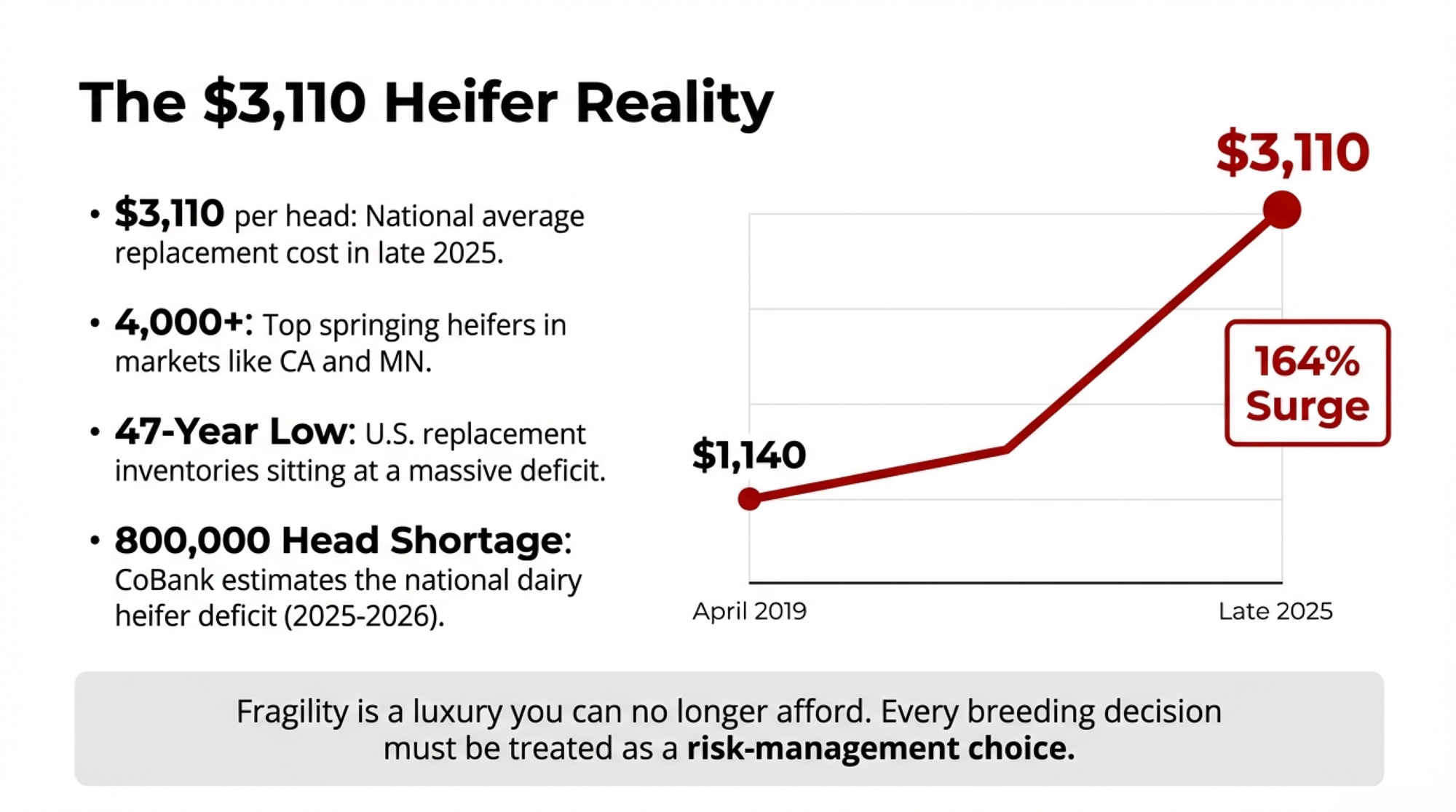
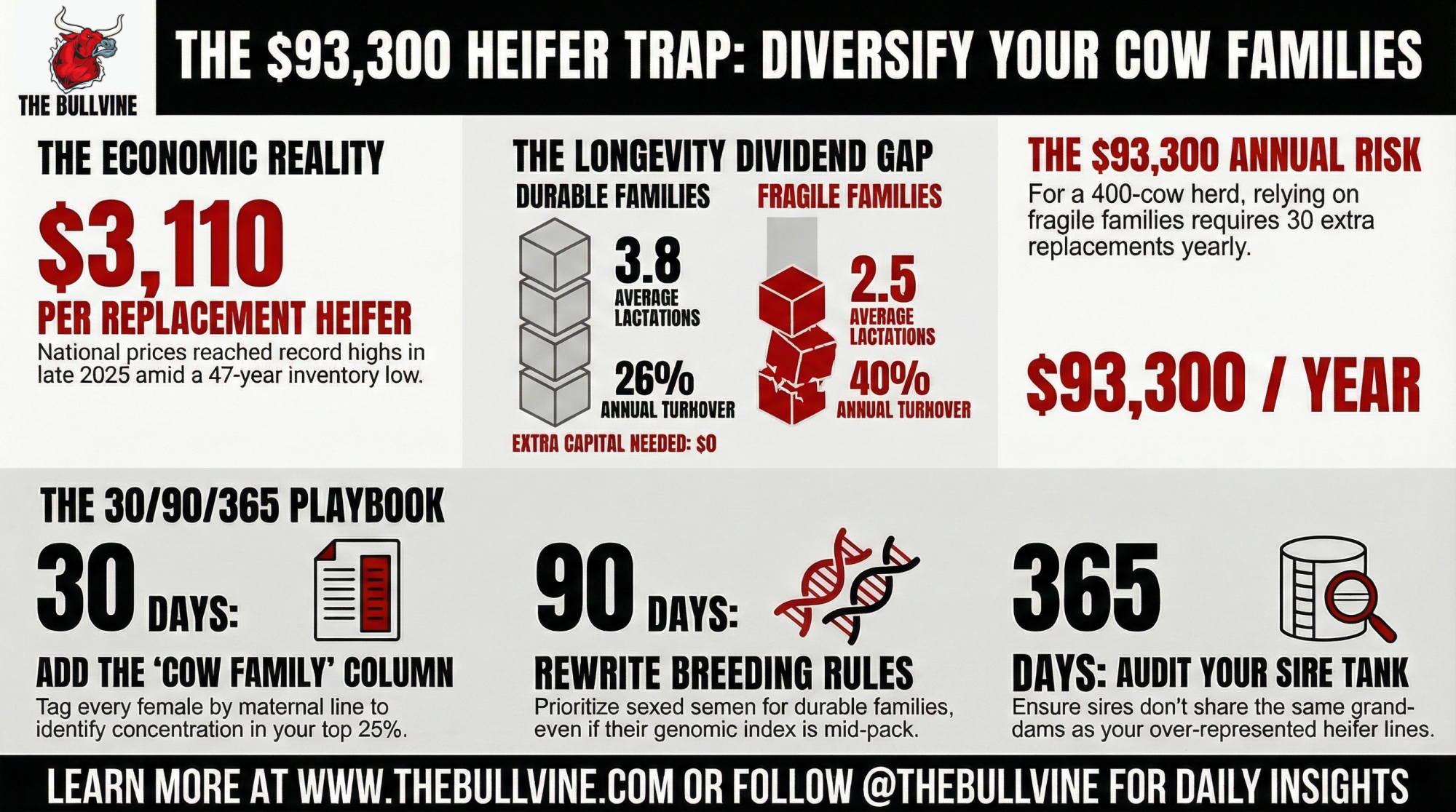
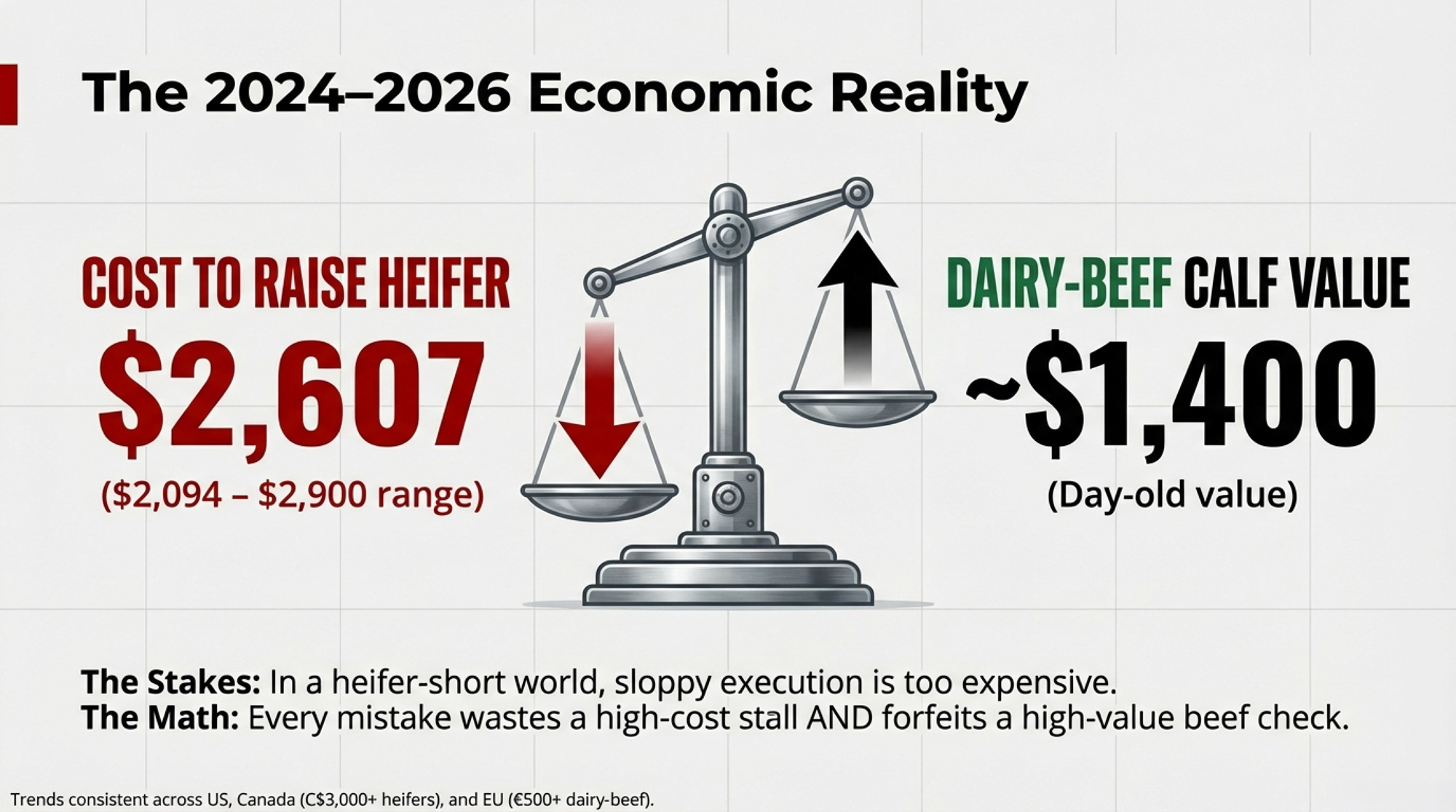
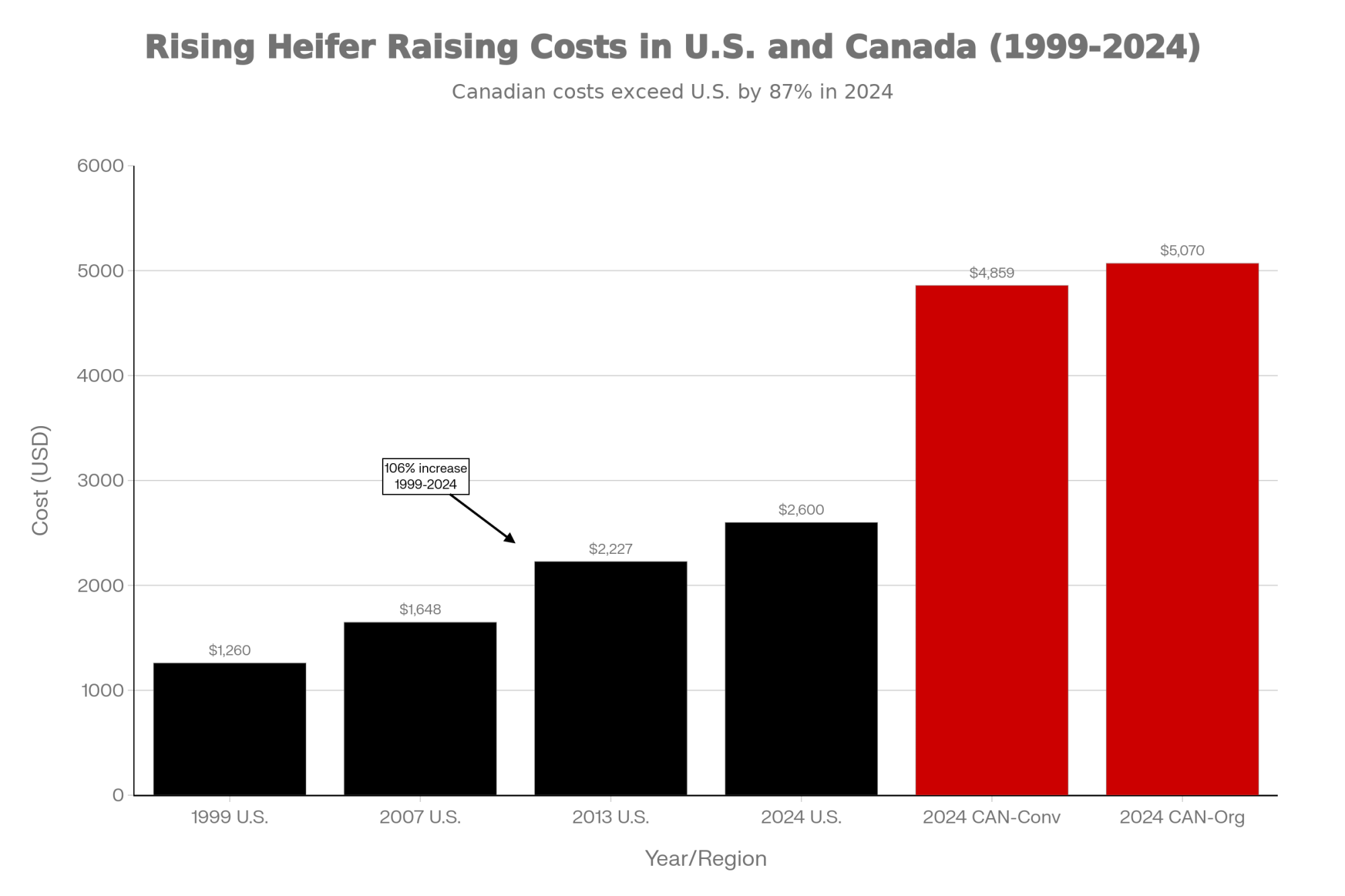
The most expensive execution gap on your dairy isn’t your semen bill, your ration, or even the latest heifer price spike. It’s the distance between what your protocols say and what actually happens when someone is standing in front of a cow with the wrong straw in his hand. In a heifer‑short, dairy‑beef world where total raising cost runs US$2,094–US$2,607 per heifer on many U.S. farms and can approach US$2,900 in higher‑cost systems, while top dairy‑beef calves in strong programs are bringing around US$1,400 per head, that gap adds up fast. 

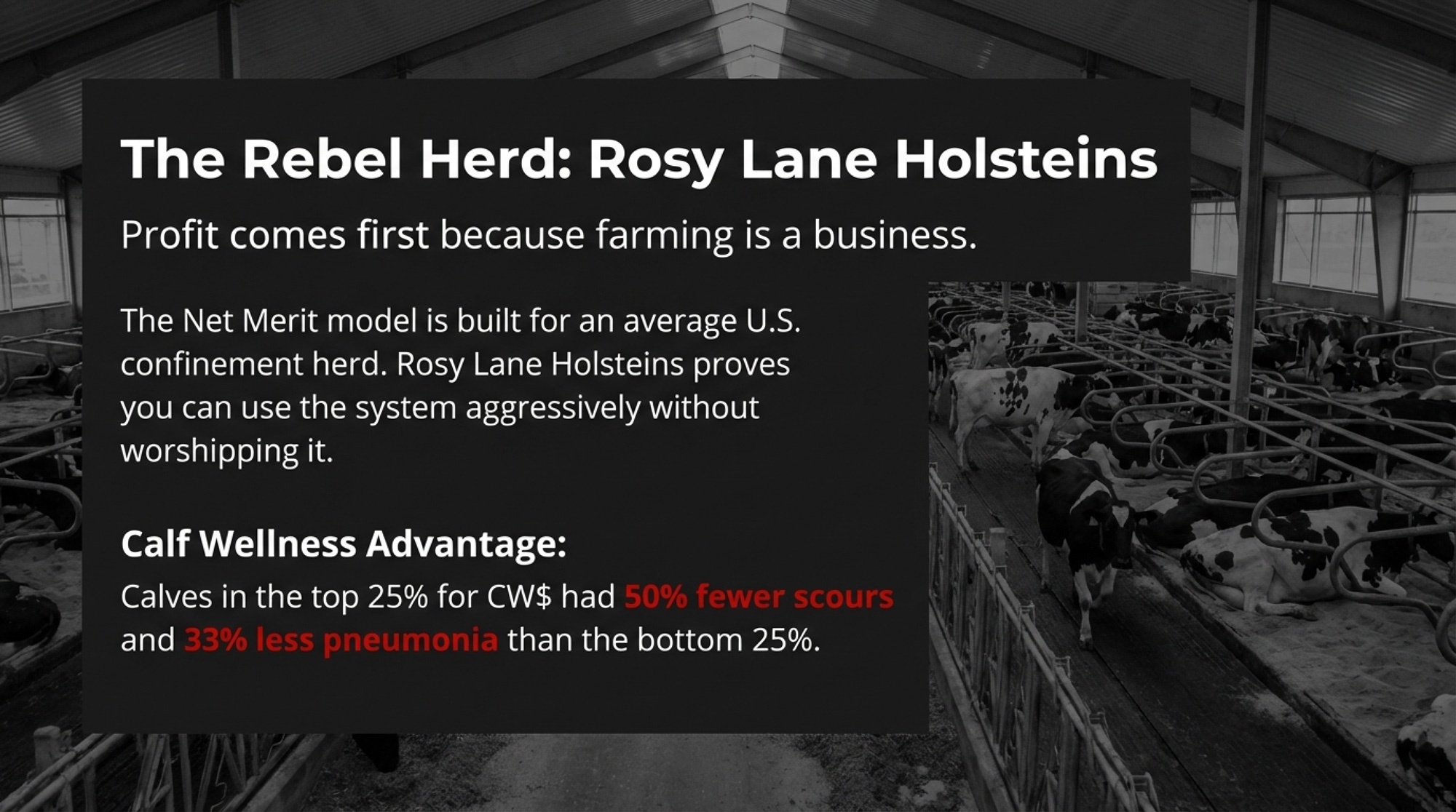
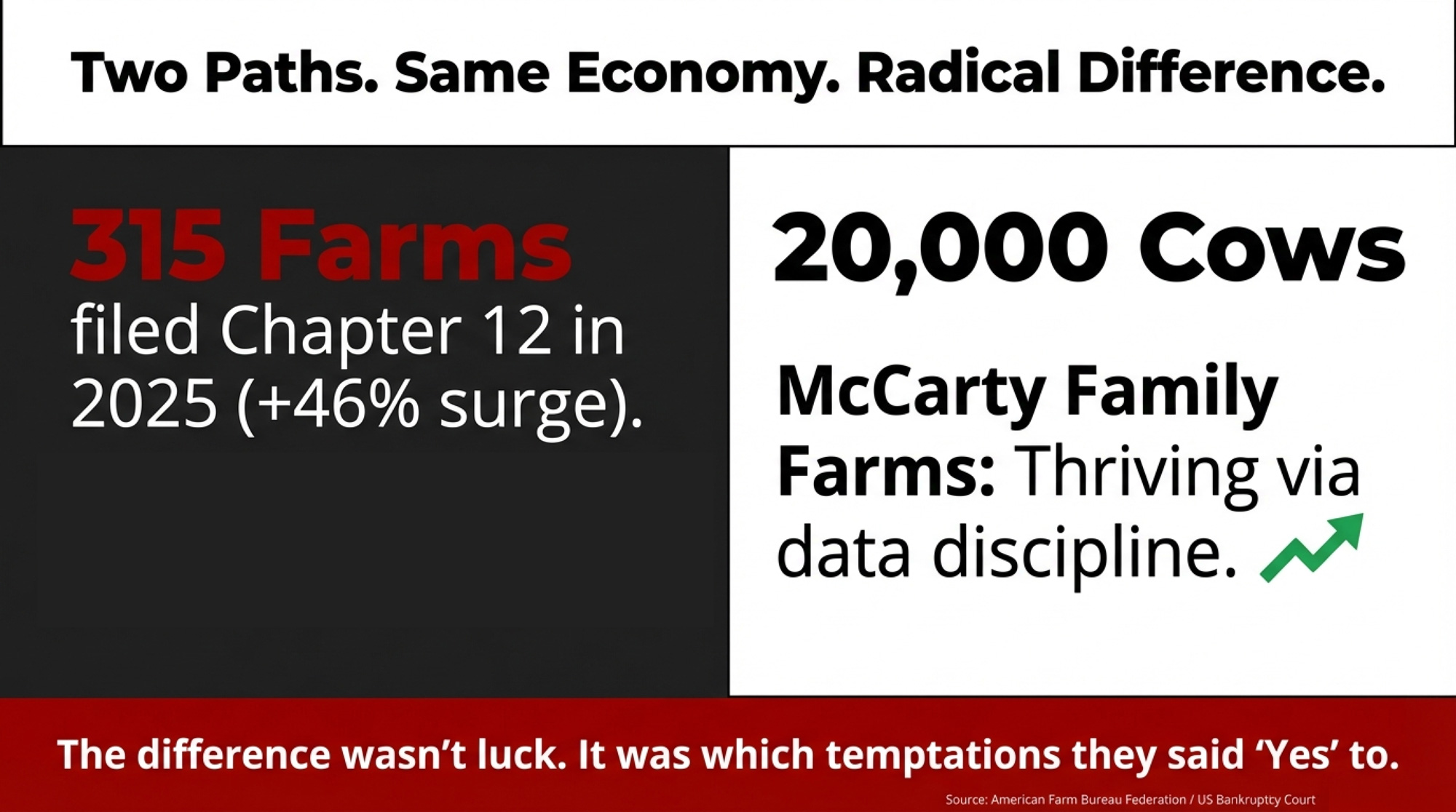
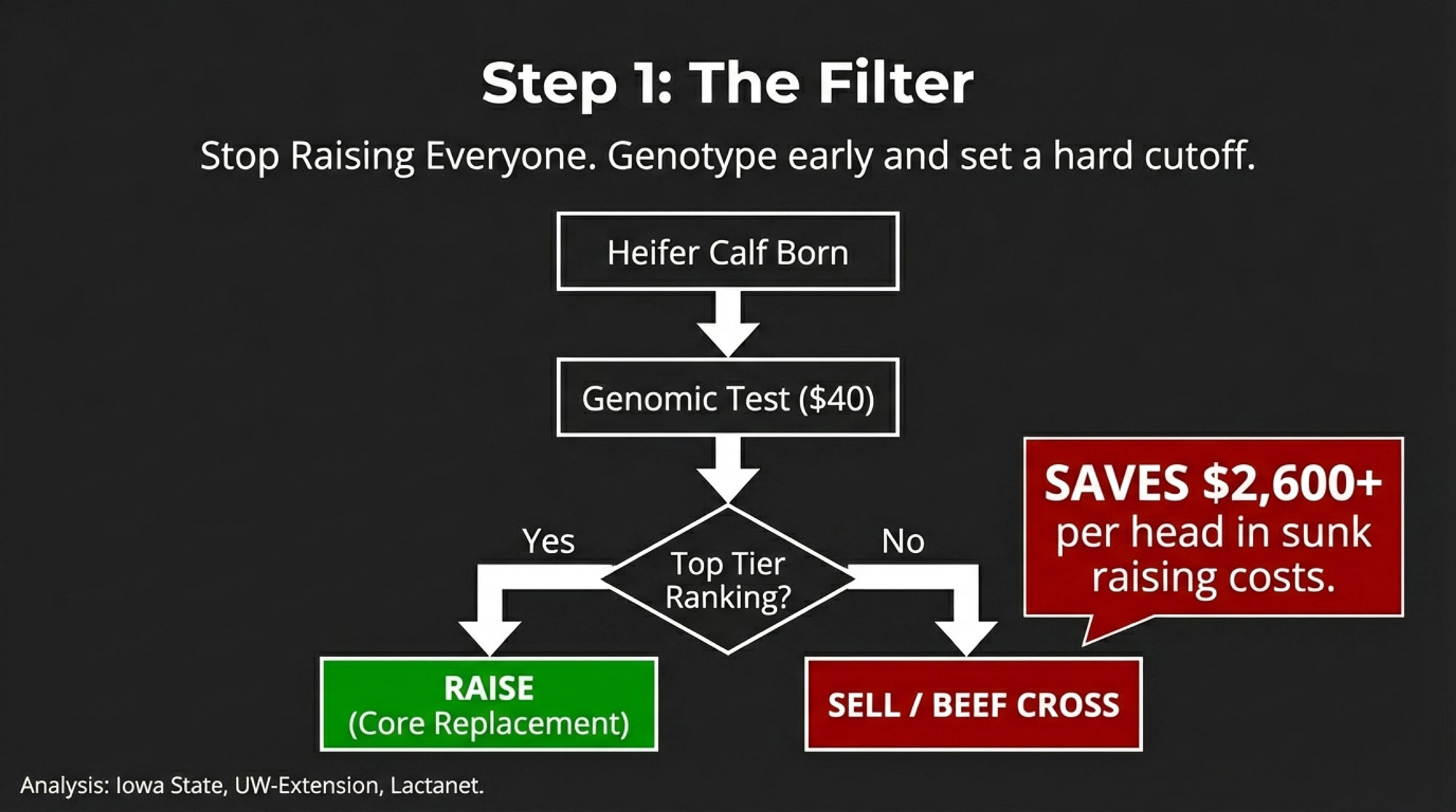
McCarty Family Farm in Kansas reports, based on its own records, that it has genomically tested more than 75,000 females since 2018. Their rule is brutally simple: the top half of the breeding herd creates the next generation, the bottom half goes to beef — regardless of age or stage. Applied consistently across breeding, colostrum, and culling, that kind of discipline can drive a six‑figure annual swing in profitability for larger herds compared to “raise every heifer” systems once you factor in stall value, heifer cost, and dairy‑beef calf prices. 

If you’re running genomics, dairy‑beef, or both, this isn’t theory. This is your milk cheque, your replacement pipeline, and your risk exposure for 2024–2026. 

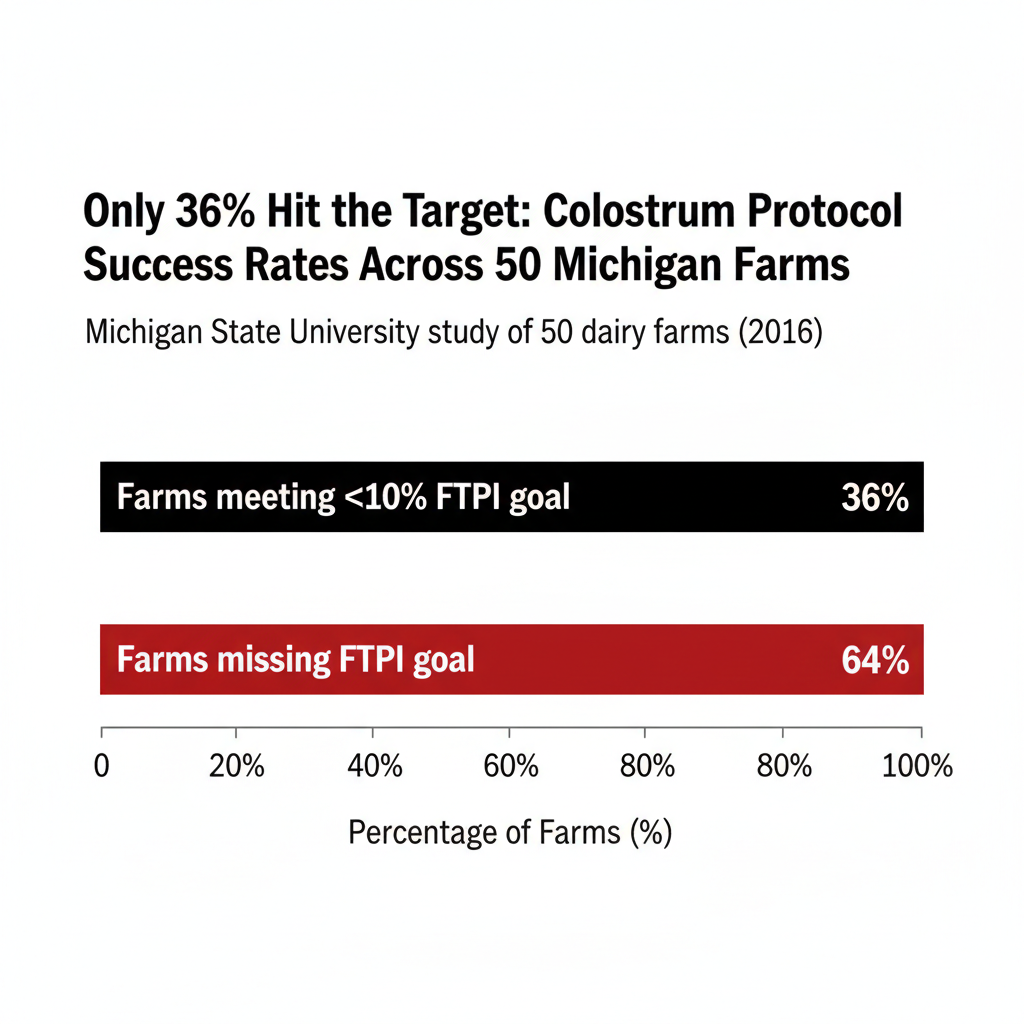
Only 36% of Farms Hit Their Colostrum Targets

Back in 2016, Michigan State University Extension and collaborators looked at the failure of passive transfer (FTPI) and colostrum management on 50 Michigan dairy farms. Only 18 of those 50 farms (36%) hit the industry goal of less than 10% FTPI, meaning at least 90% of calves achieved successful passive transfer. That left 32 farms missing the target, and on six of those herds, half or more of the calves failed. These weren’t wrecks. They were farms that thought their colostrum program worked. 

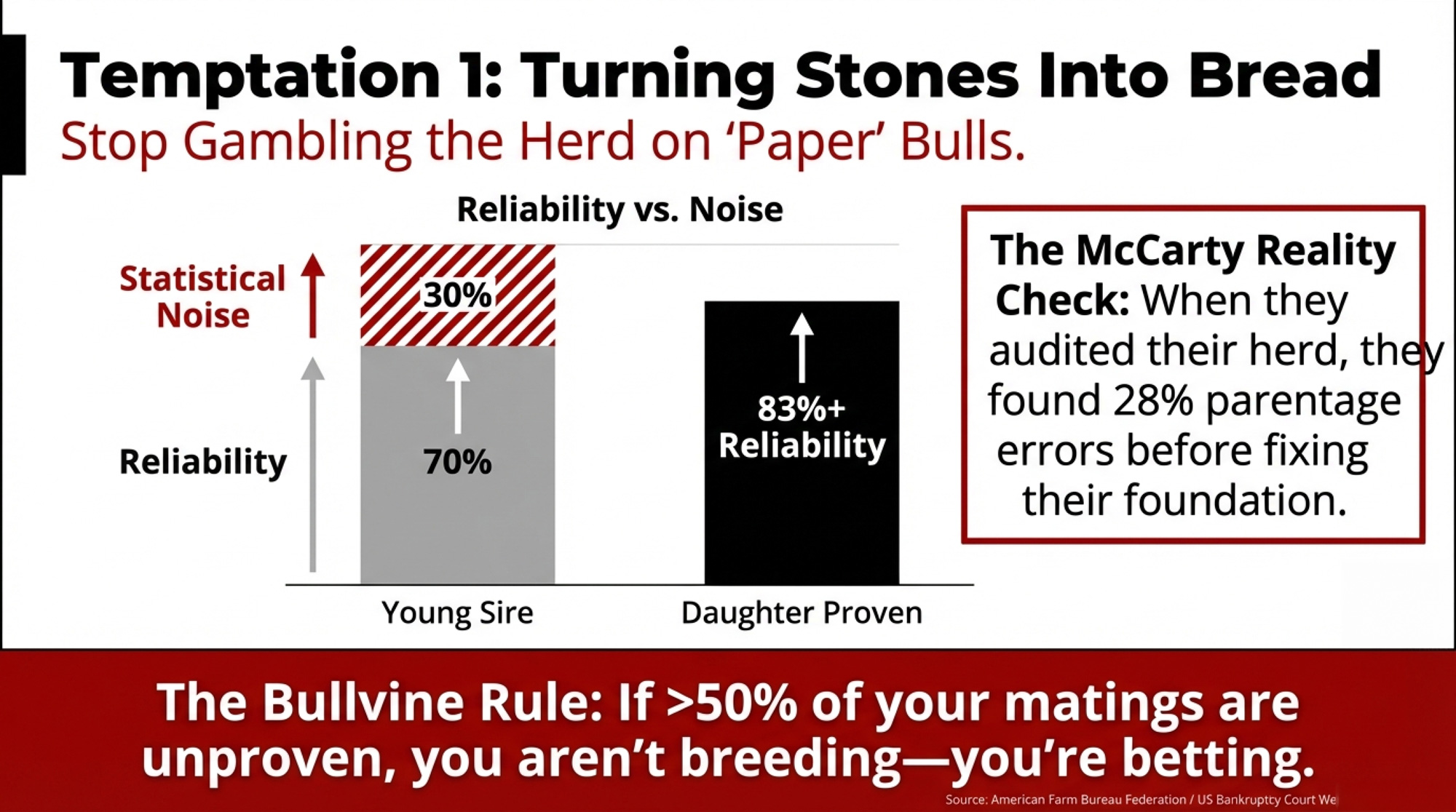
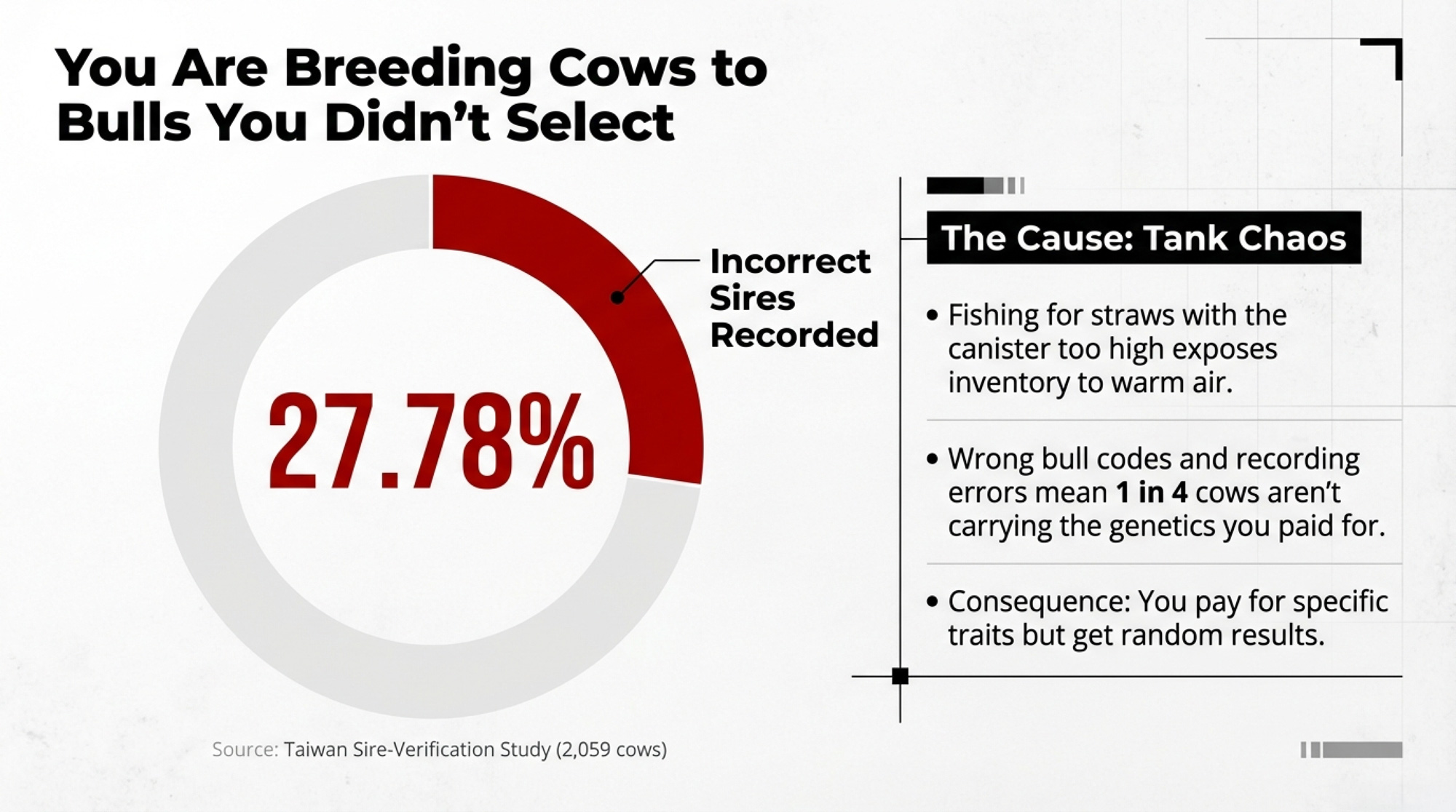
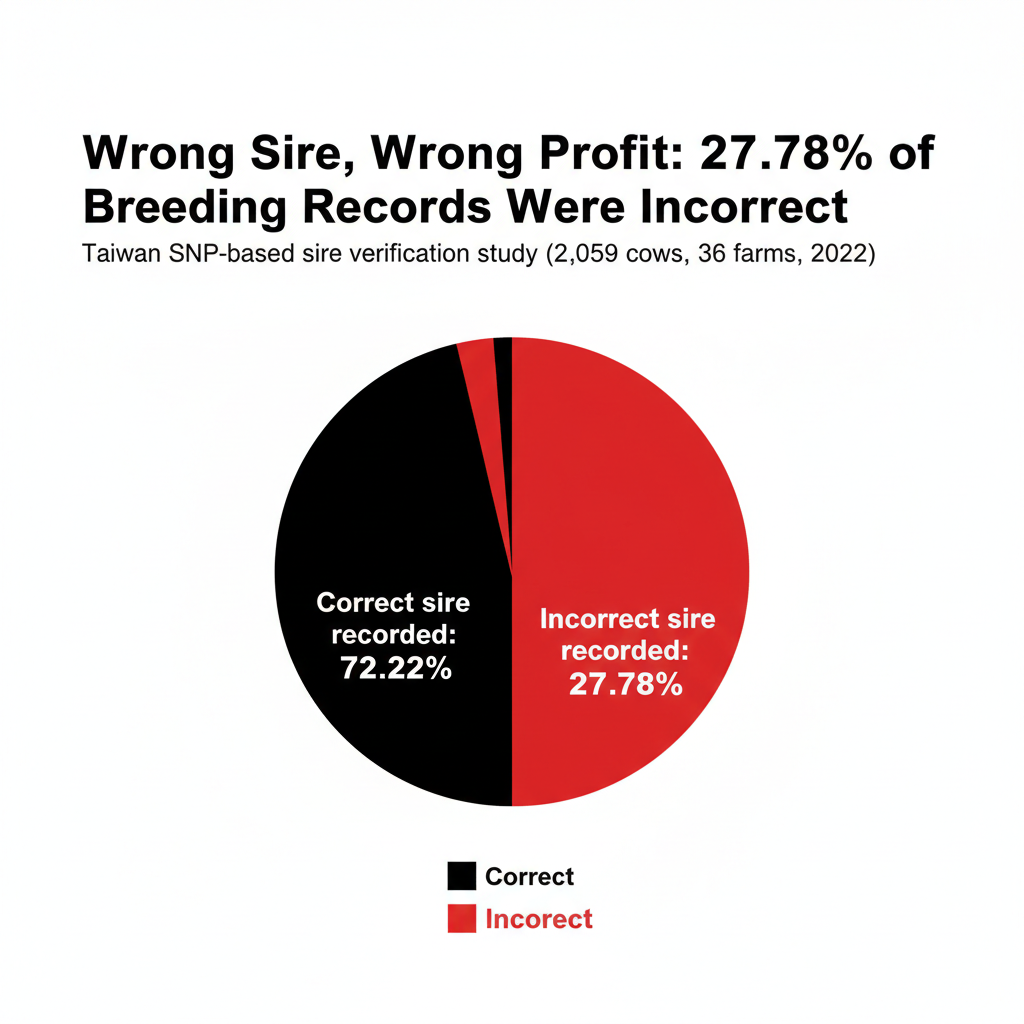
You see the same pattern in breeding records. A 2022 SNP‑based sire‑verification study from Taiwan checked 2,059 cows on 36 dairy farms and found that 27.78% of recorded sires were incorrect — wrong bull codes, wrong storage location, or recording errors. In other words, more than one in four matings went to a different bull than the records claimed. 

Semen handling has its own quiet leak. Extension and A.I. handling guidelines generally recommend that sexed semen be deposited within about 10 minutes of thawing to protect fertility. On a busy timed‑AI morning with 40–80 cows, that window gets stretched more often than anyone likes to admit. 

Feed isn’t immune. Nutritionists will tell you there are three rations on every dairy: the ration on paper, the ration delivered, and the ration cows actually consume. Forage dry matter swings, over‑mixing that chews up effective fiber, and real intakes drifting several percentage points from the estimate are common. A lot of the math you use on feed cost and income over feed cost still assumes a ration that your cows never really eat. 

This isn’t a “people don’t care” problem. It’s a “protocols don’t fit reality” problem. 

The Retraining Fallacy

Here’s the default move that quietly costs you: a protocol misses its target, so you schedule more training. Another meeting. Another sign. 

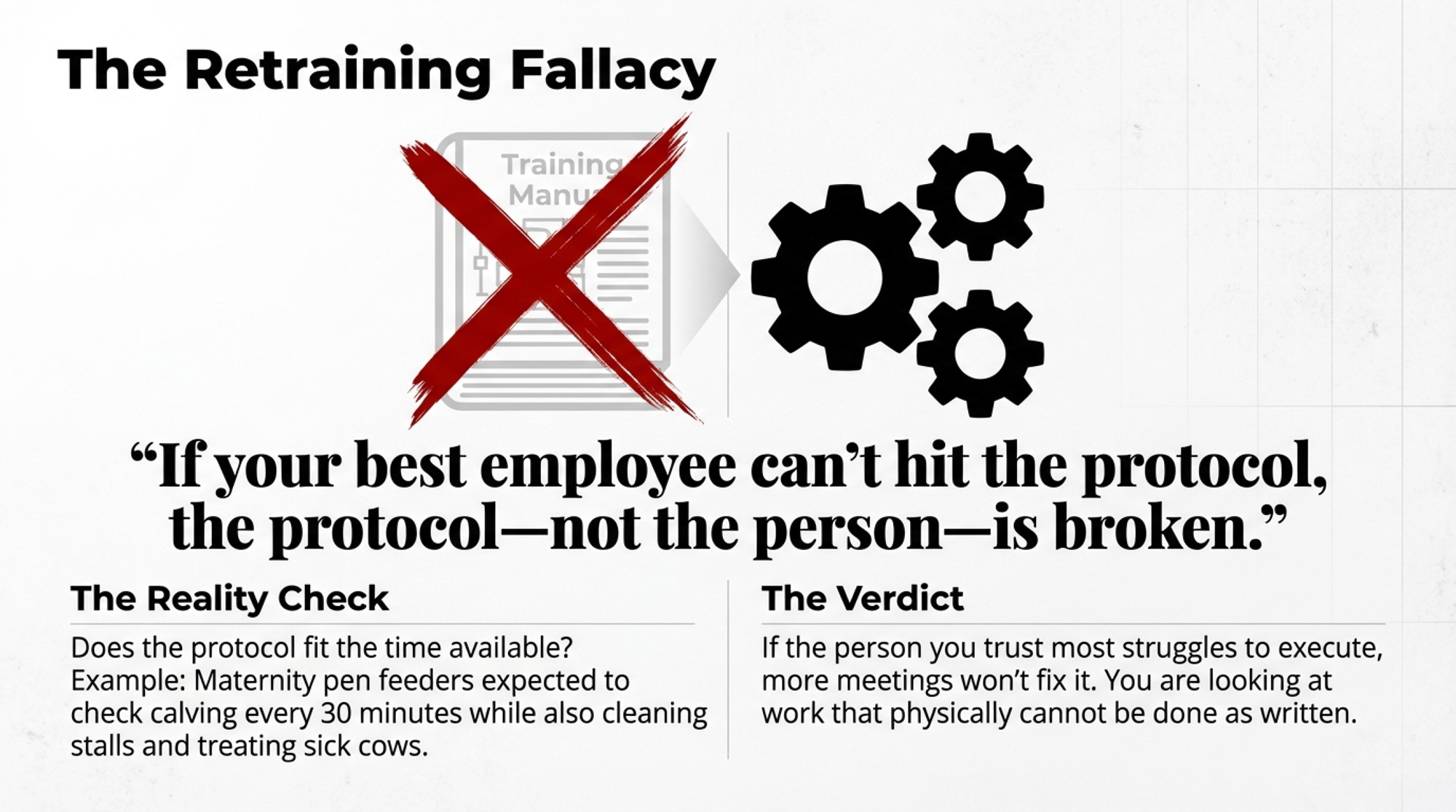
But when the same protocol keeps failing after you’ve retrained more than twice, you’re almost never looking at a knowledge problem. You’re looking at work that simply can’t be done the way it’s written. 

MSU’s colostrum work shares a good example from the maternity pen. Feeders in one herd were expected to check calving progress every 30 minutes, in addition to cleaning stalls, processing newborns, and treating sick cows. On paper, that looks like “best practice.” On a rough day, it’s physically impossible. 

There’s a sharper question than “Who screwed up?” Ask this instead: Does your best employee also struggle with this protocol? If the person you trust most can’t hit it consistently, the protocol is broken—not them. At that point, more training isn’t a solution. It’s self‑deception. 

And if you’ve watched a good A.I. tech or feeder drowning in a pile of “must‑do” tasks, you’ve seen exactly how that plays out. 

“If your best employee can’t hit the protocol, the protocol — not the person — is broken.” 

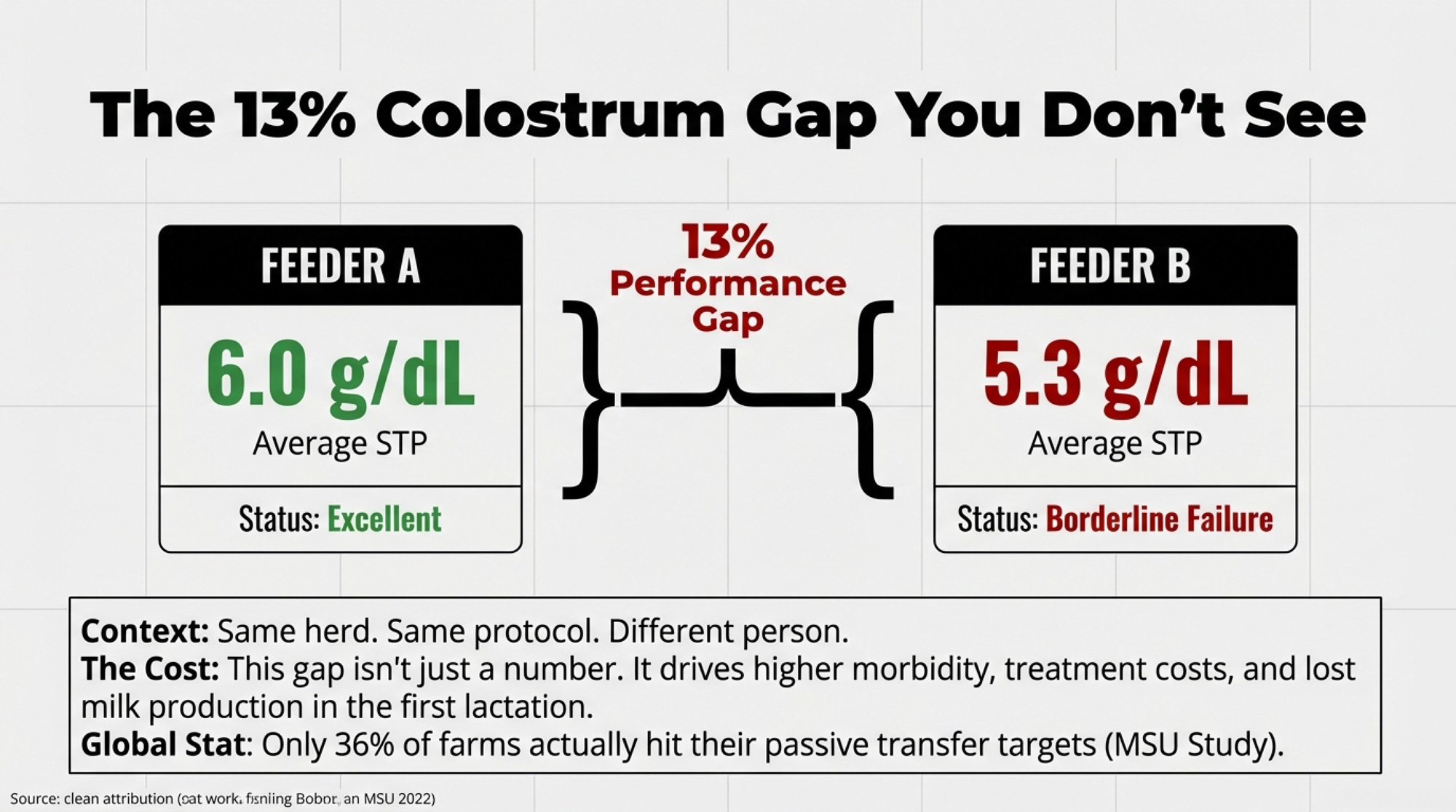
The 13% Colostrum Gap You Don’t See Until You Measure It

At one large U.S. dairy, a retrospective review of colostrum results showed that an employee measured serum total protein (STP) using a simple refractometer. Same herd, same colostrum, same written protocol — just different people doing the work. 

  • One feeder averaged 6.0 g/dL STP.
  • Another averaged 5.3 g/dL STP. 

On that farm, that’s roughly a 13% performance gap between 6.0 g/dL “excellent” results and 5.3 g/dL borderline passive transfer. The only real difference was who mixed and fed the colostrum.

Economically, FTPI is a slow bleed. Calves with FTPI have higher morbidity and mortality, weaker pre‑weaning growth, and higher treatment costs. Some never reach first calving. Others enter the milking string and never deliver the production their genetics suggest they can. Spread that 13% gap over a few hundred calves, and you’re looking at a five‑figure cost that never shows up as a separate line on the milk cheque. 

Now layer in dairy‑beef. A 2025 Purina/CattleFax analysis put average day‑old dairy‑beef calves around US$1,400, up from roughly US$650 three years earlier — more than double in a short window. Hoard’s Dairyman has been blunt that dairy‑beef calf prices are “breaking records” at many U.S. sales. A calf that ships at three days old with poor passive transfer is more likely to get sick, die, or need heavy treatment, and those problems pull down the prices buyers are willing to pay. 

Colostrum research from MSU, Wisconsin, and others all point the same way: what you did with colostrum this morning is one of the main predictors of that heifer’s health and productivity down the road. If you haven’t pulled STP by employee lately, you’re relying on a farm average that might be hiding your weakest link. 

Where Good Breeding Programs Quietly Go Sideways

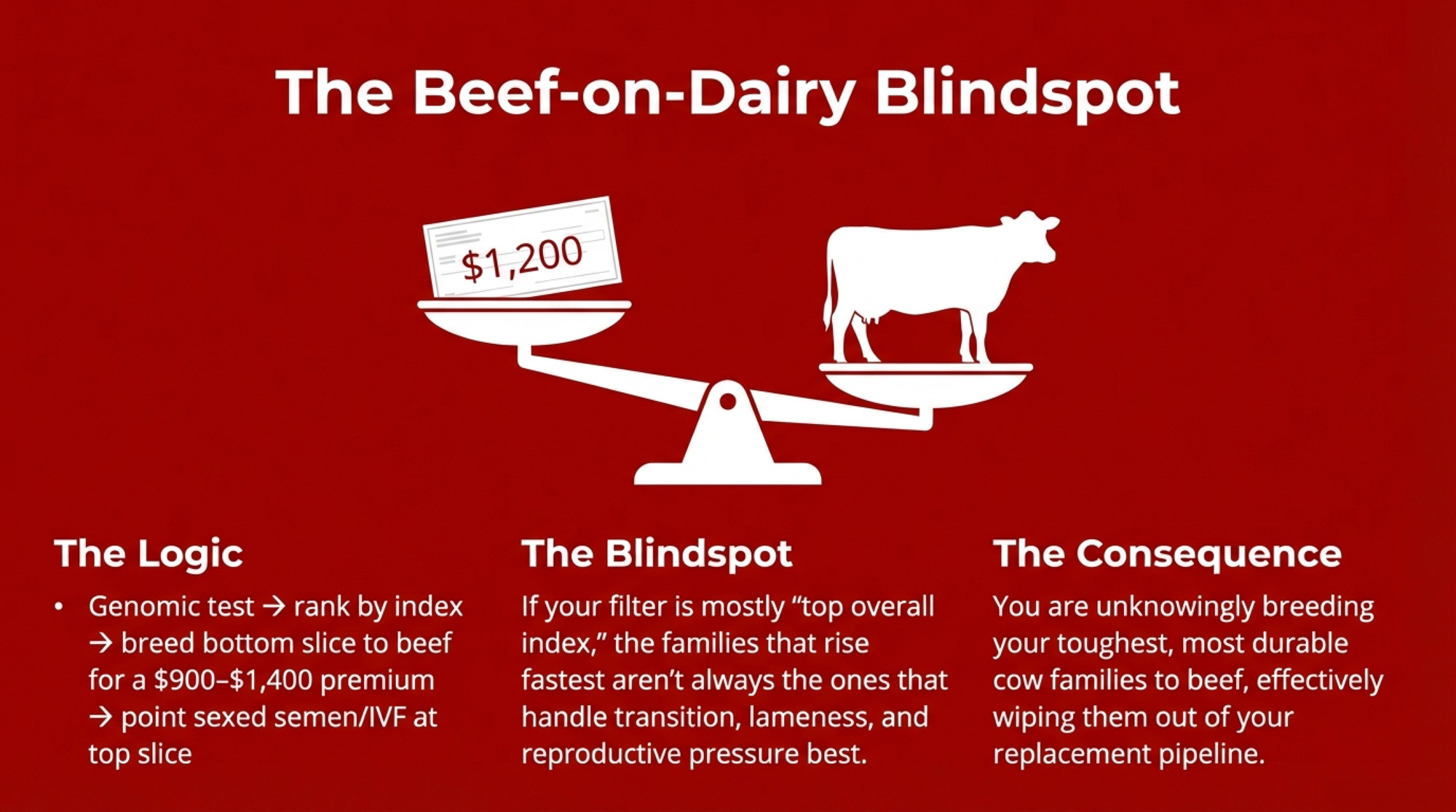
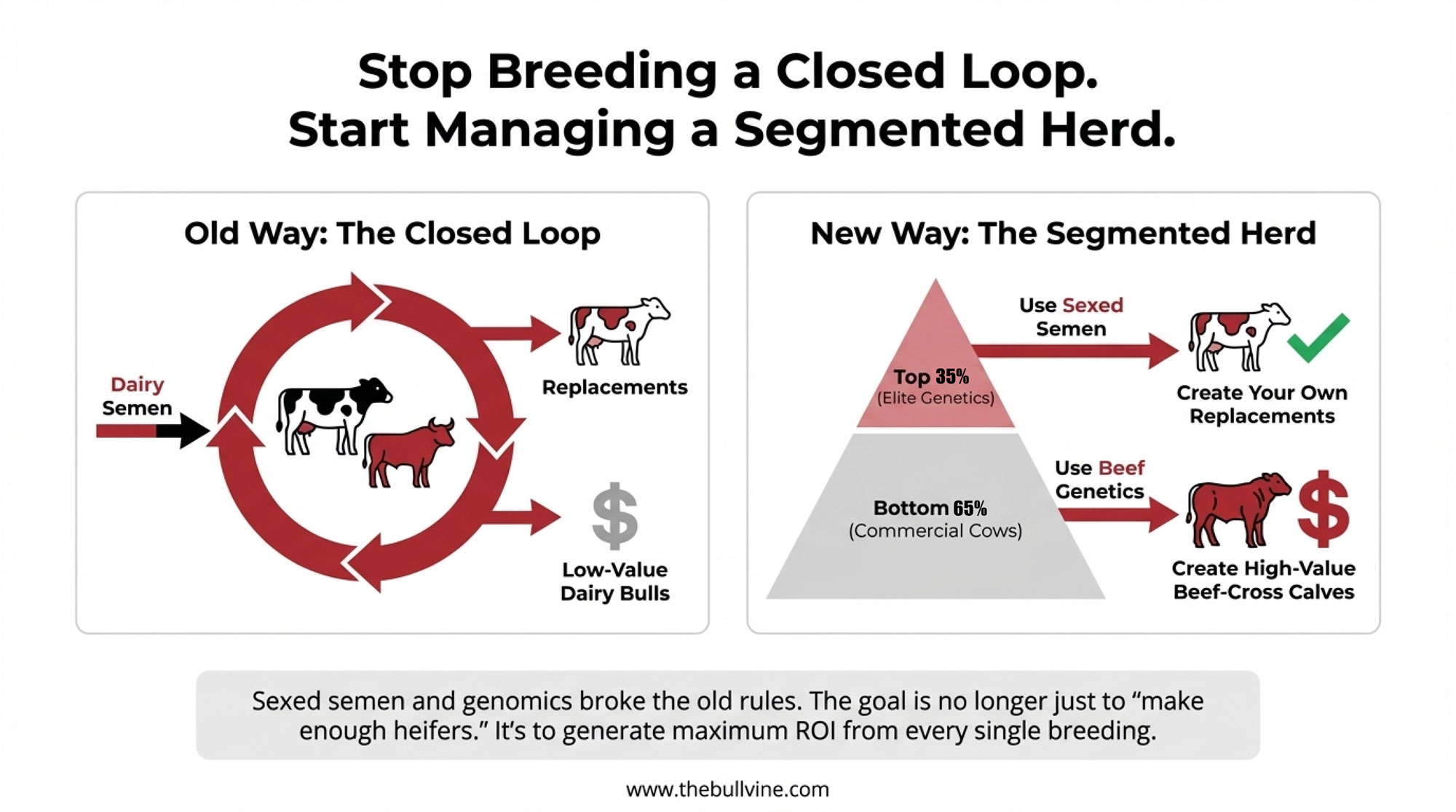
On paper, your breeding plan might be elite. Genomics. Customized matings. Sexed semen on your best heifers. Beef semen on the bottom half. 

But if the wrong semen ends up in the cow, or the right straw gets mishandled, the whole thing quietly falls apart. 

The Taiwanese SNP‑based sire‑verification study puts hard numbers to that risk: 27.78% of recorded sires were wrong across 36 herds and 2,059 cows. That’s not a rounding error. That’s more than one in four cows with a different sire than your records say. 

Here’s where the leaks show up on‑farm:

  • Tank chaos. Straws from multiple bulls share a goblet. The breeder fishes for the right code with the canister too high in the neck, exposing every straw they aren’t using to warm air. Semen‑handling guides warn that when liquid nitrogen depth drops below about 6 inches, the temperature in the neck can rise sharply; straws left above the frost line quickly take damage. Late nights, cramped spaces, and tanks tucked into corners all make it easier to stay above the frost line longer than you should. 
  • Service‑number blind spots. Your plan says: sexed dairy for first and second service, beef from third service on. But if service numbers aren’t updated promptly, the person with the gun can’t follow the plan, no matter how good the spreadsheet looks. 
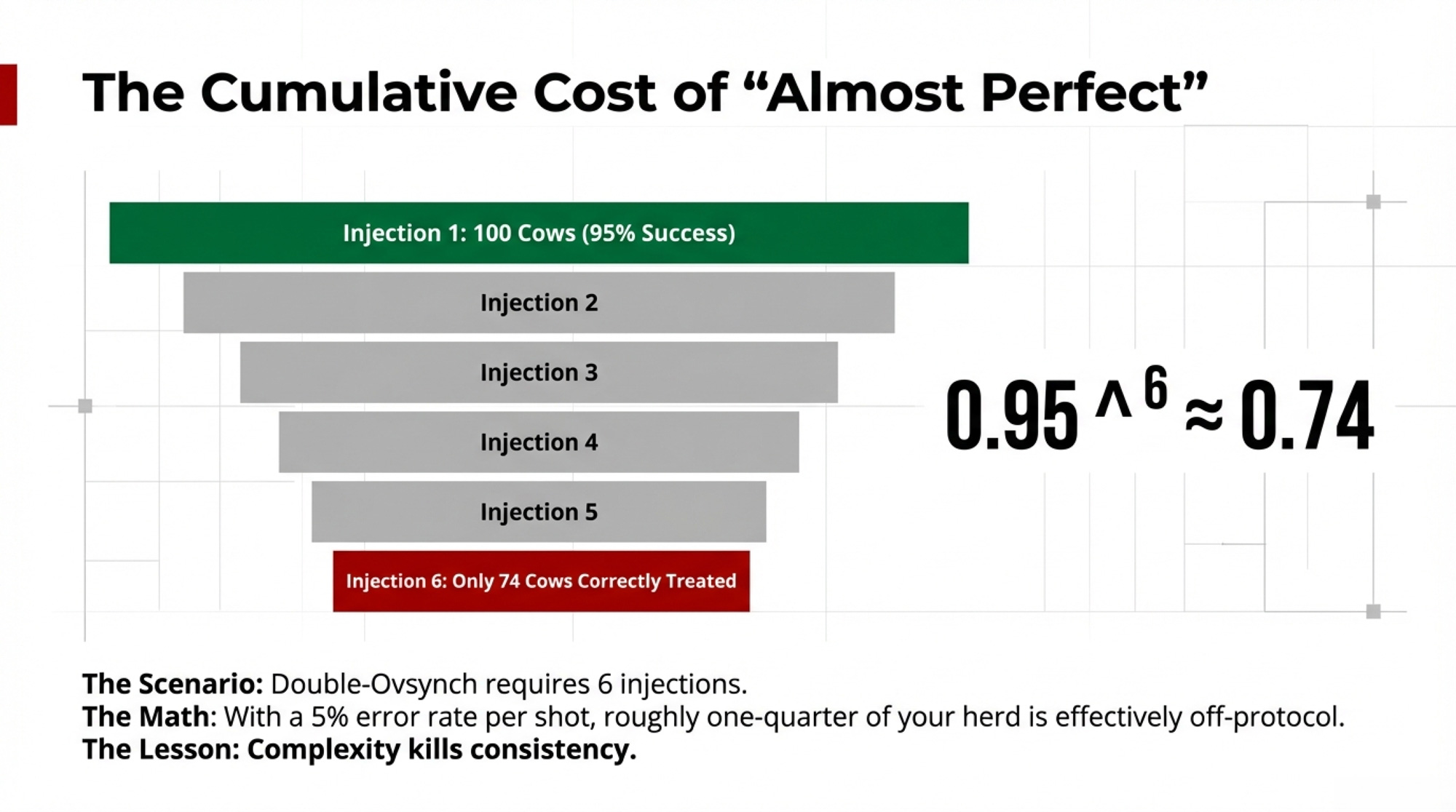
  • Synchronization drift. Double‑Ovsynch is powerful — six injections, tight timing, strong conception when done right. Do the math: at just a 5% error rate per shot, the chance of a cow receiving all six injections correctly is about 74%, because 0.95 6 ≈ 0.735. That means roughly a quarter of your herd is on some other version of the protocol than you think. 

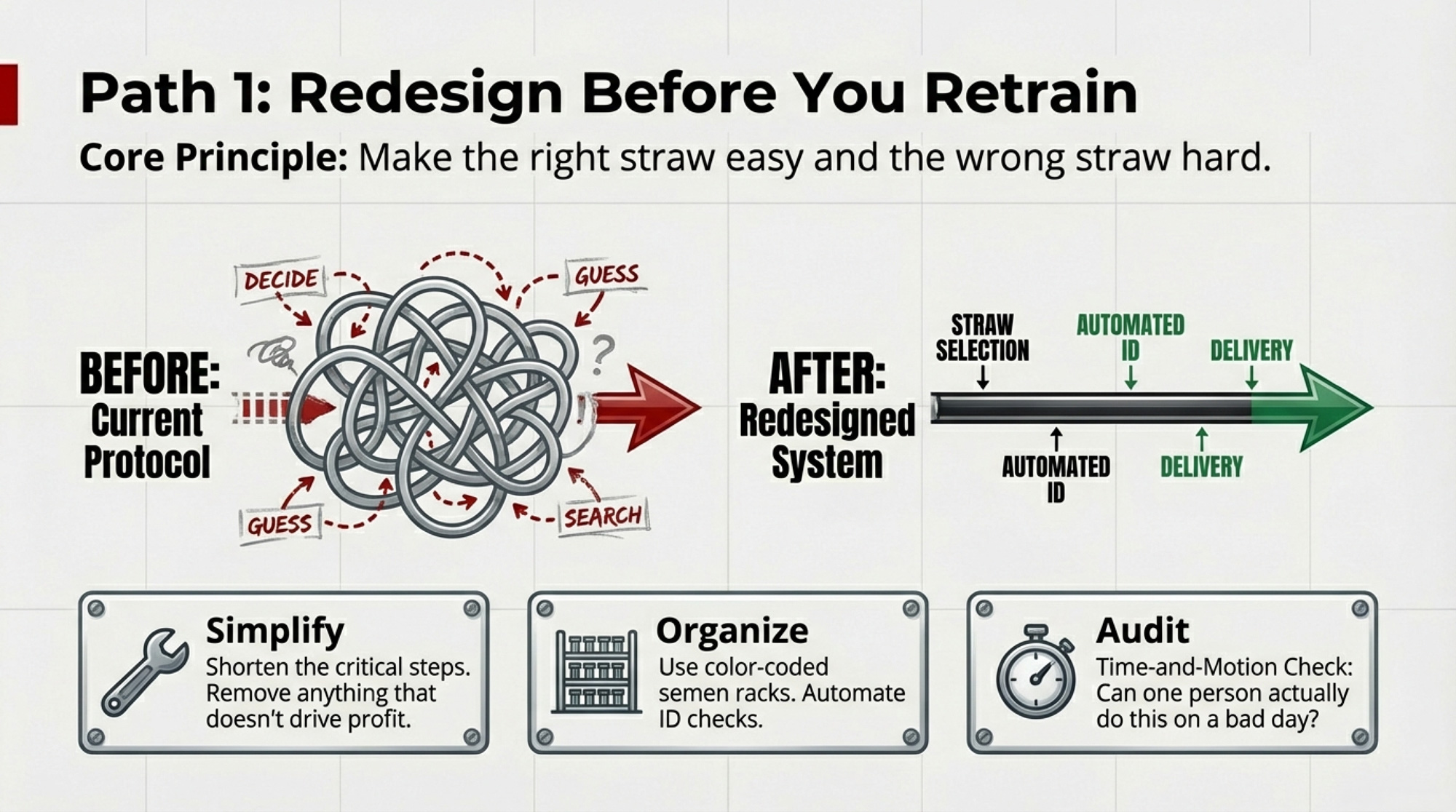
The herds that consistently post top‑end reproduction numbers almost always share one habit: the same person both breeds and records, backed by a setup that makes the right straw easy and the wrong straw hard. Every handoff — between people, between shifts, between paper and software — is another leak you have to pay for. 

Why That 95‑Pound Cow Is Still Standing in Your Barn

McCarty’s “top half only” rule sounds ruthless until you stand in front of a cow who’s right on the bubble. 

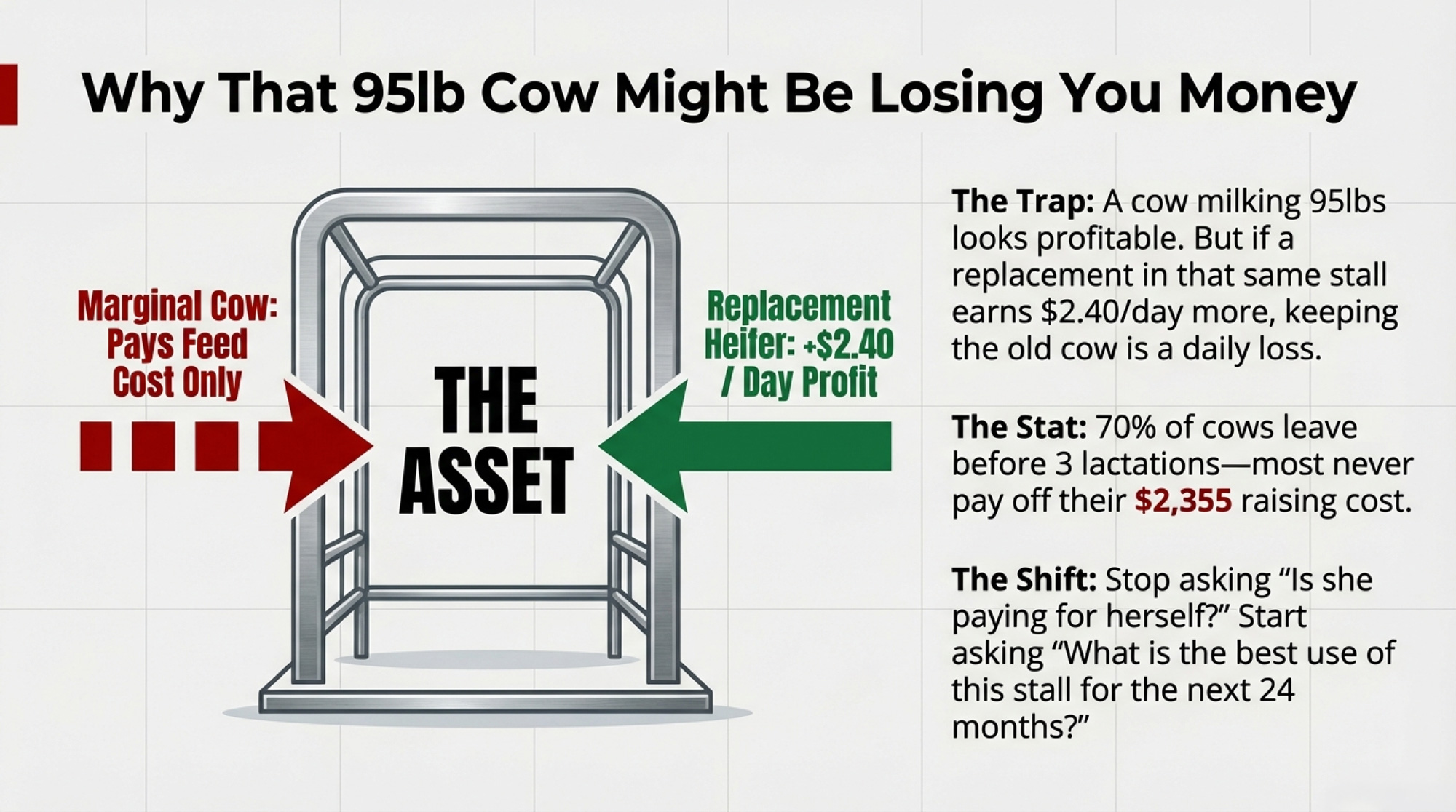
Picture a second‑lactation cow giving 95 pounds, sitting in your bottom‑third genomically. On your genetic ranking, she’s an easy cull. In the parlor, she looks like money. Human brains are wired to value today’s visible rewards — that full unit of milk — more than abstract, future gains like a higher‑merit daughter calving in three years. 

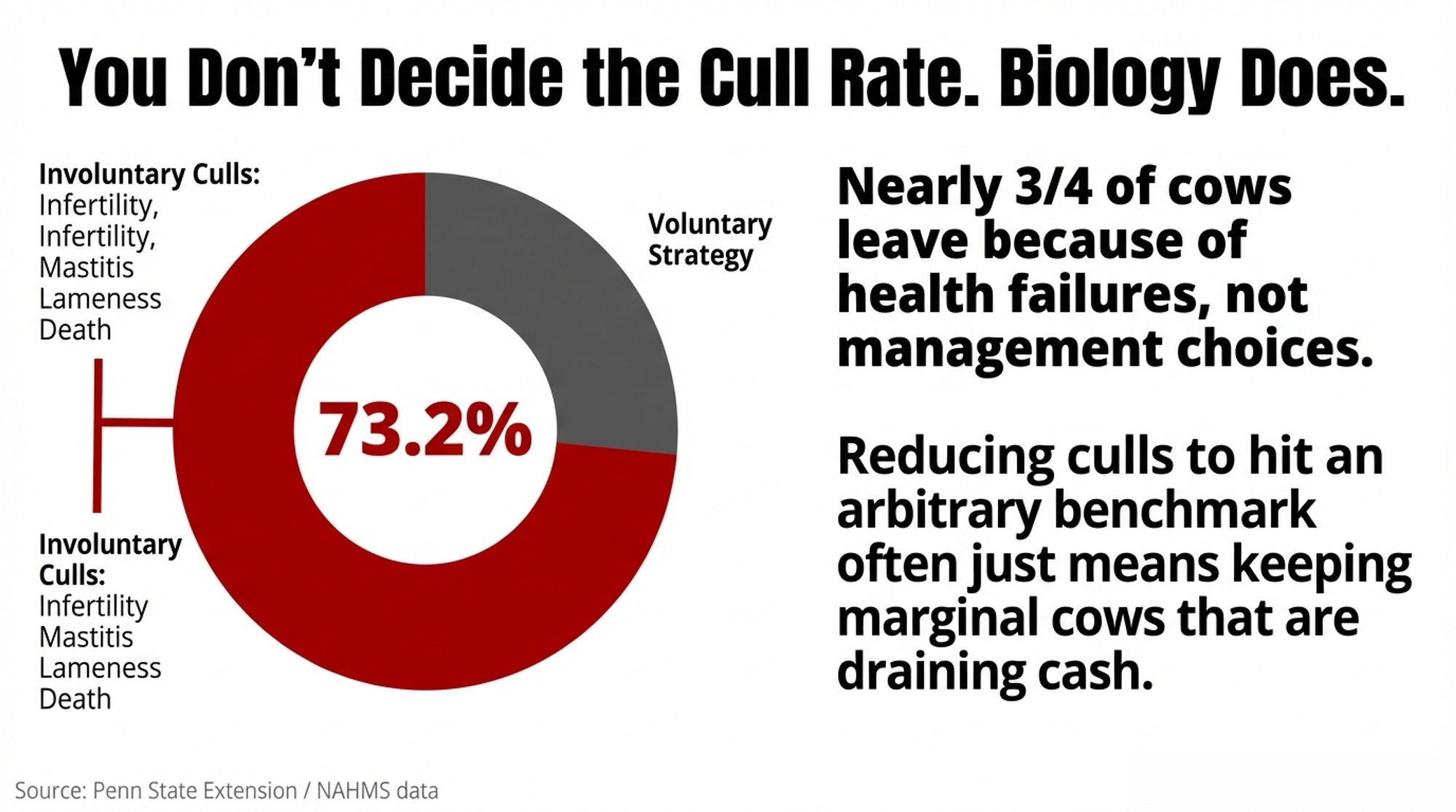
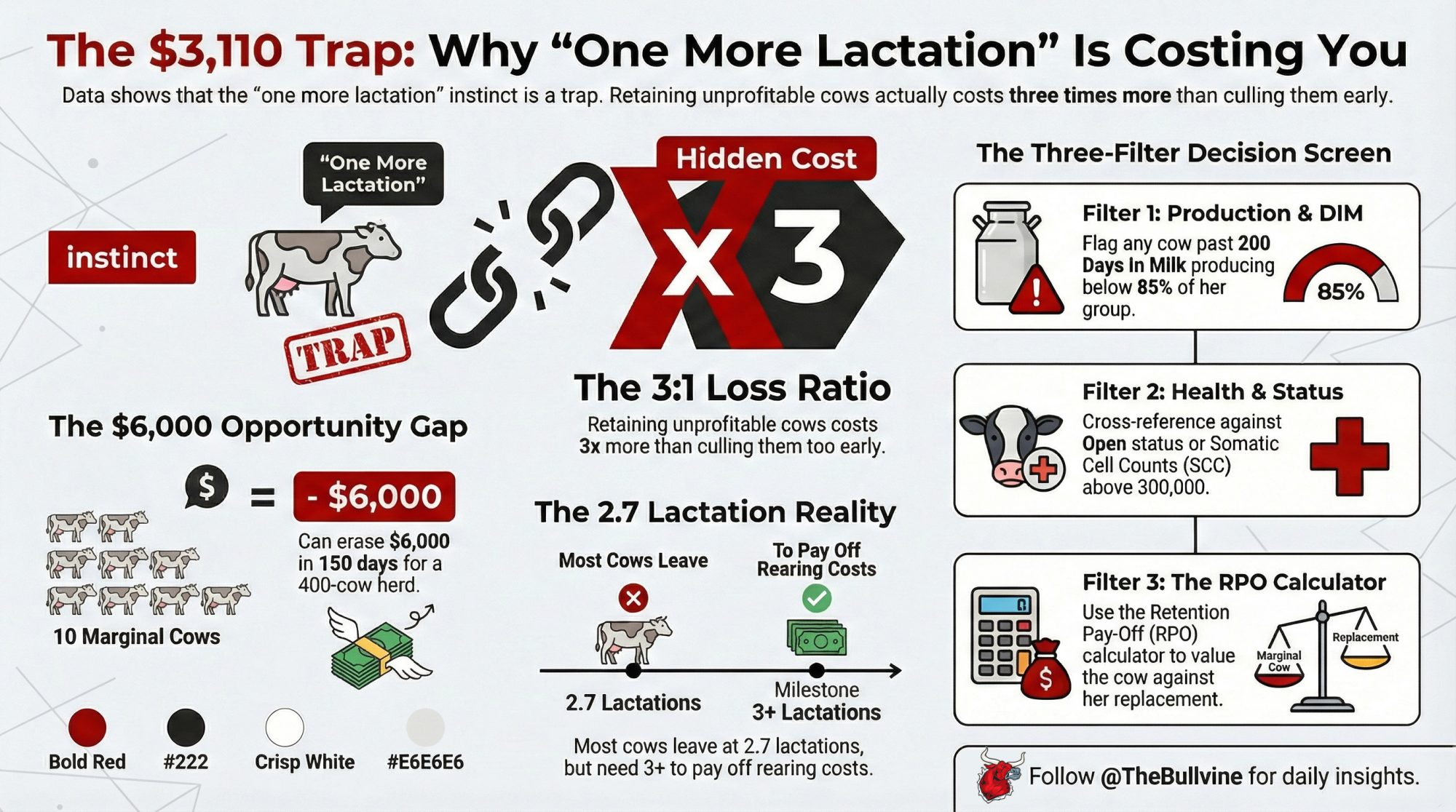
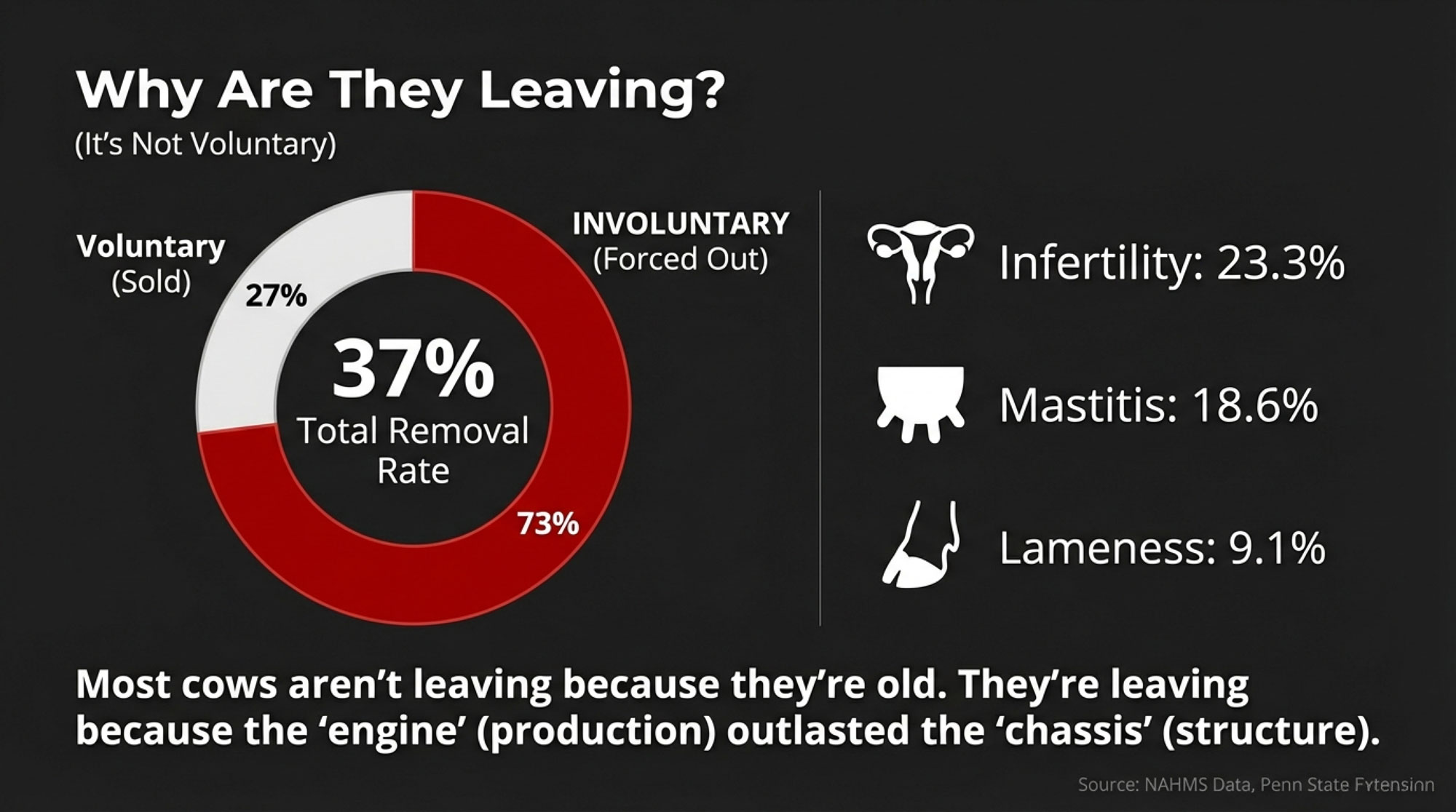
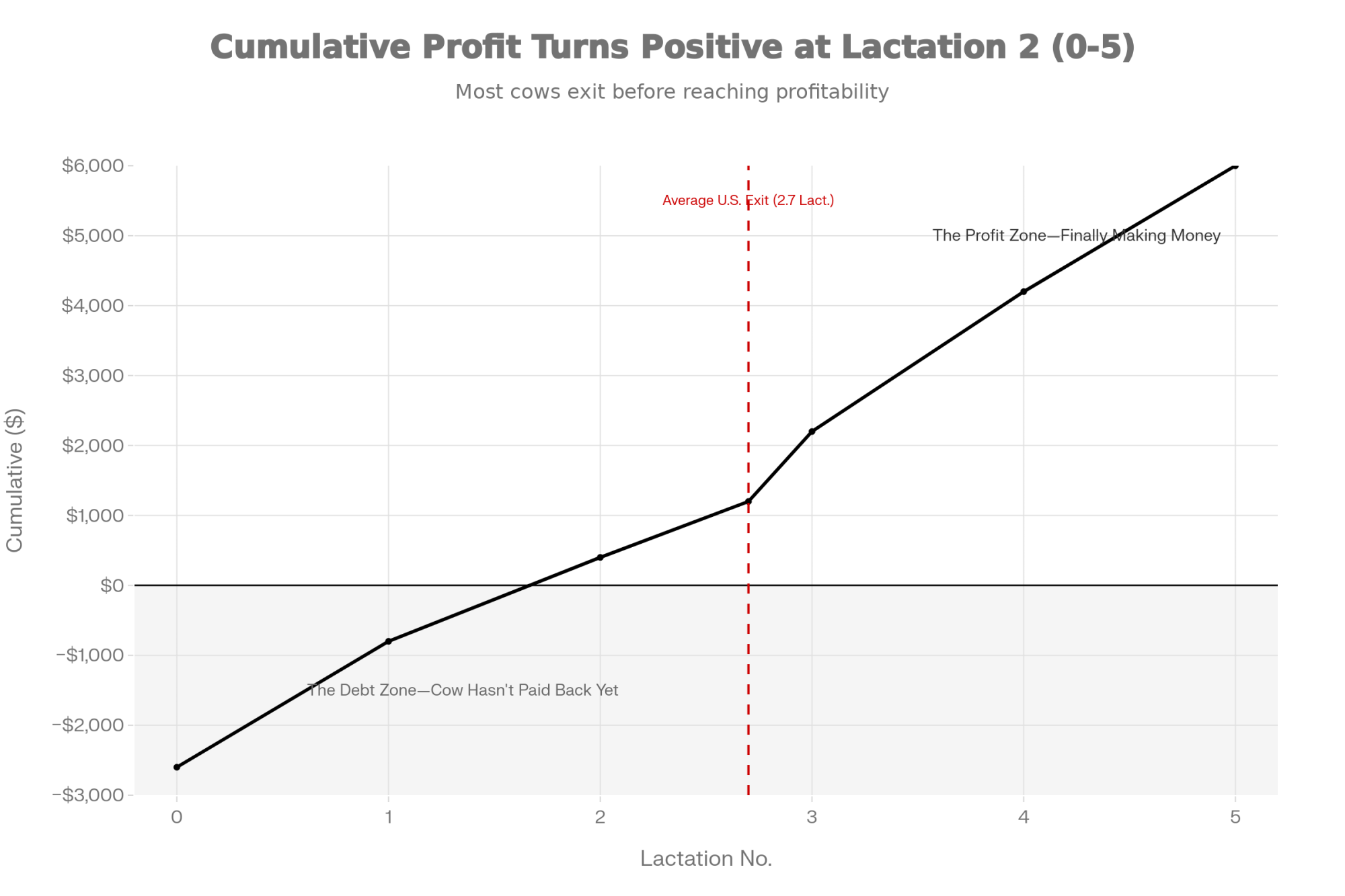
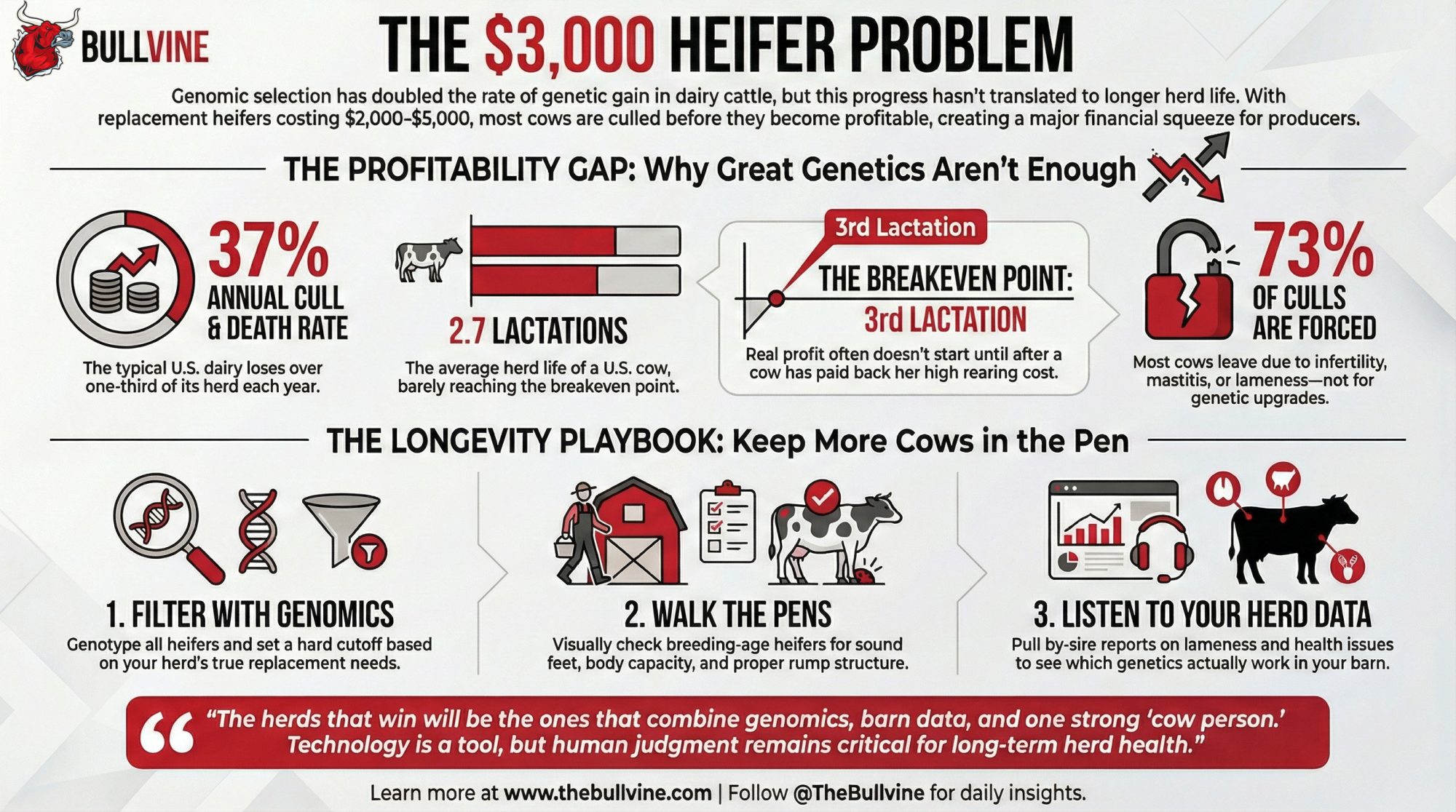
Culling work backs this up. Dairy Herd Management’s 2024 review of USDA/NAHMS data shows that about 70% of cows leave the herd within their first three lactations, and the average productive life is just 2.7 lactations. That same piece notes it takes more than three lactations to recoup roughly US$2,000 in raising cost. In other words, the “she hasn’t paid herself off yet” argument doesn’t hold up for most cows — they’re likely to leave before that point anyway. 

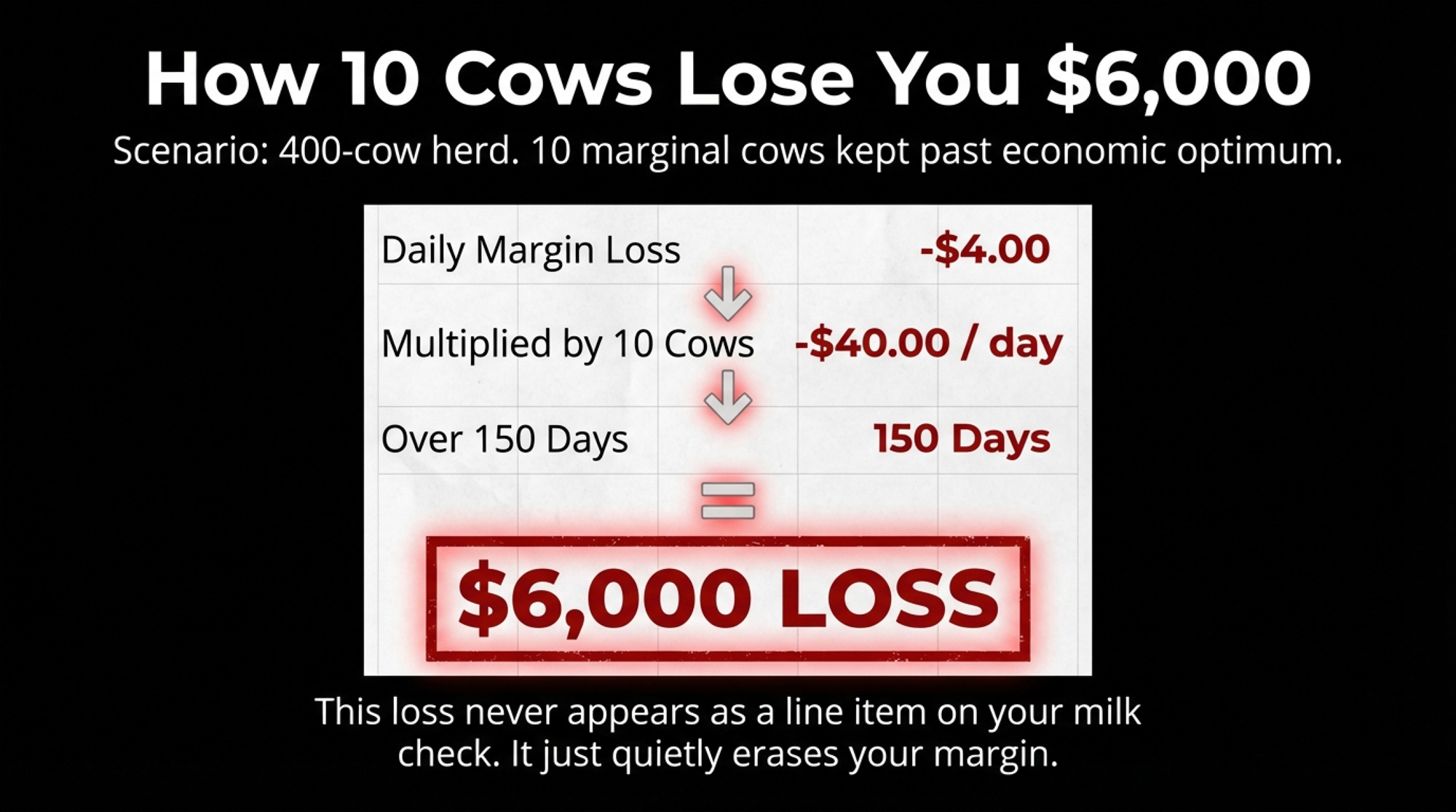
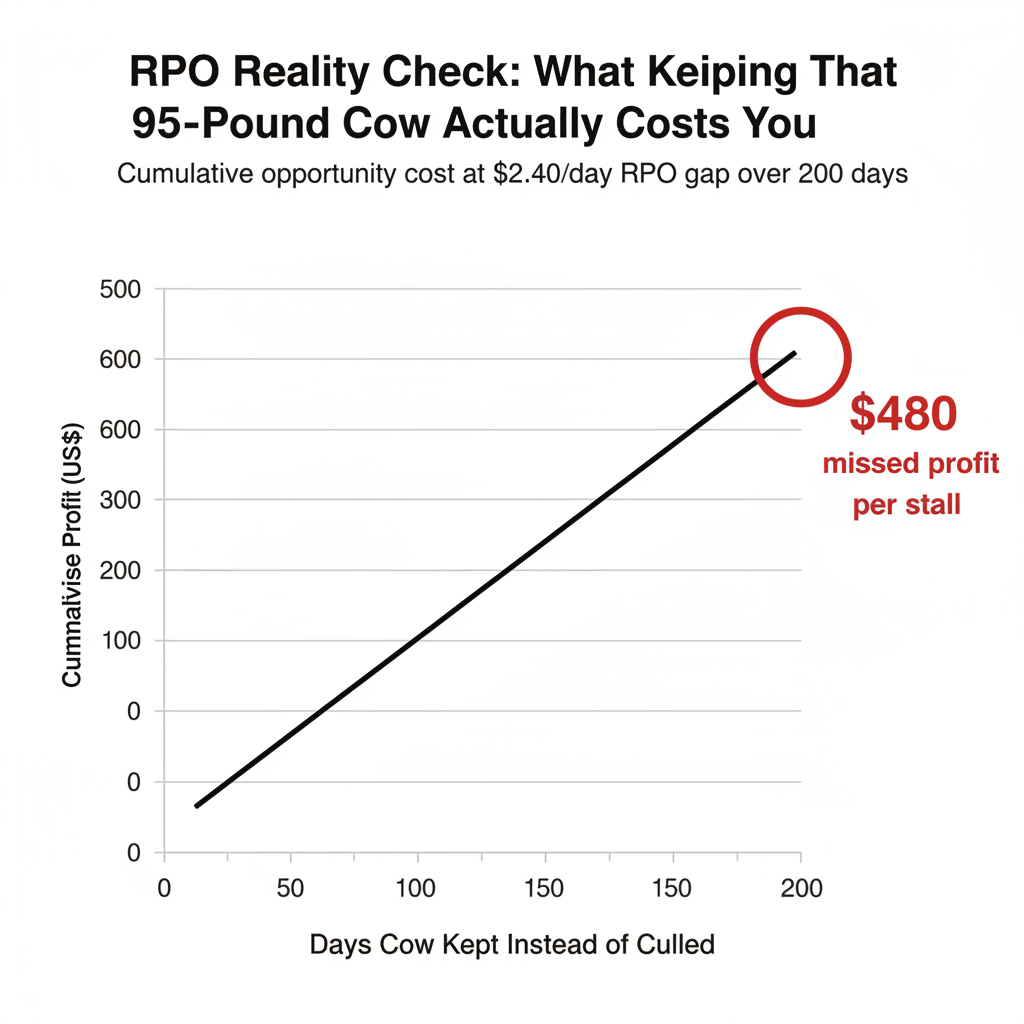
This is where Retention Pay‑Off (RPO) earns its keep. RPO is the expected profit difference between keeping a cow versus replacing her in that stall. That 95‑pound cow might be cash‑positive day to day. But if a replacement would generate US$2.40/day more in the same stall, you’re effectively giving up US$2.40/day by keeping her. Over 200 days, that’s US$480 in missed profit per stall. The cow isn’t necessarily losing money — she’s just blocking a more profitable animal from using that space. 

Recent reports show that average U.S. raising cost at US$2,355 per head, with most farms between US$2,094 and US$2,607. Other cost‑of‑raising work shows some systems pushing near US$2,900 per heifer. With those numbers and a 2.7‑lactation average productive life, hanging onto every decent cow just because she’s milking OK is usually the more expensive choice, not the safer one. 

So the real money question isn’t “Is she still paying for herself?” It’s: “What’s the best use of this stall over the next 12–24 months?”

Four Practical Paths to Close the Execution Gap — and Protect Profit

You don’t close this gap with a nicer poster or one more meeting. You close it by picking an approach that fits your people and facilities, then building systems that still hold together on the worst days. 

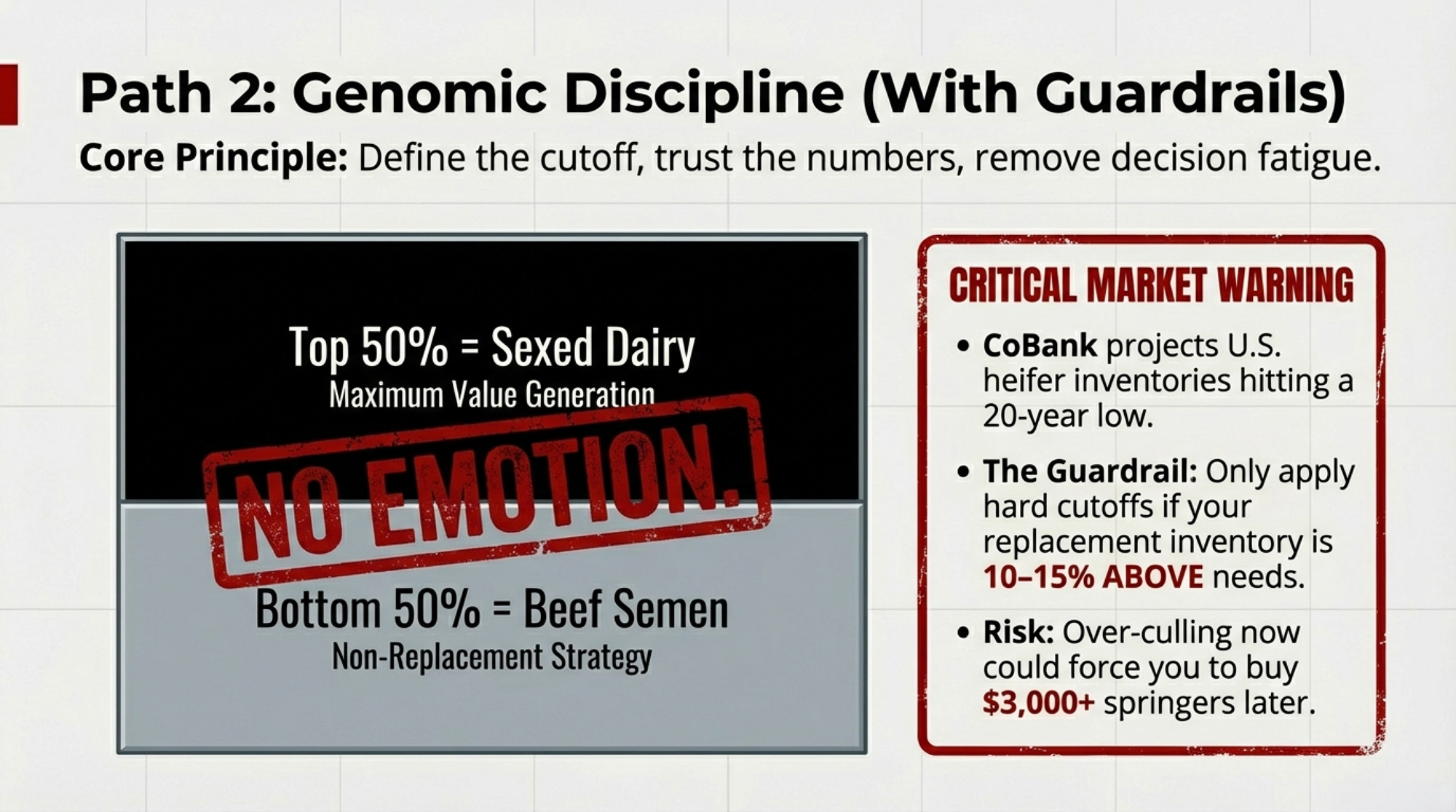
Path 1: Genomic Ranking With Hard Cutoffs

When it fits.
You’re already genomic‑testing, you’ve got more heifers than you absolutely need, and you’re willing to let numbers overrule emotion when it comes to who gets dairy semen versus beef. 

What it takes.

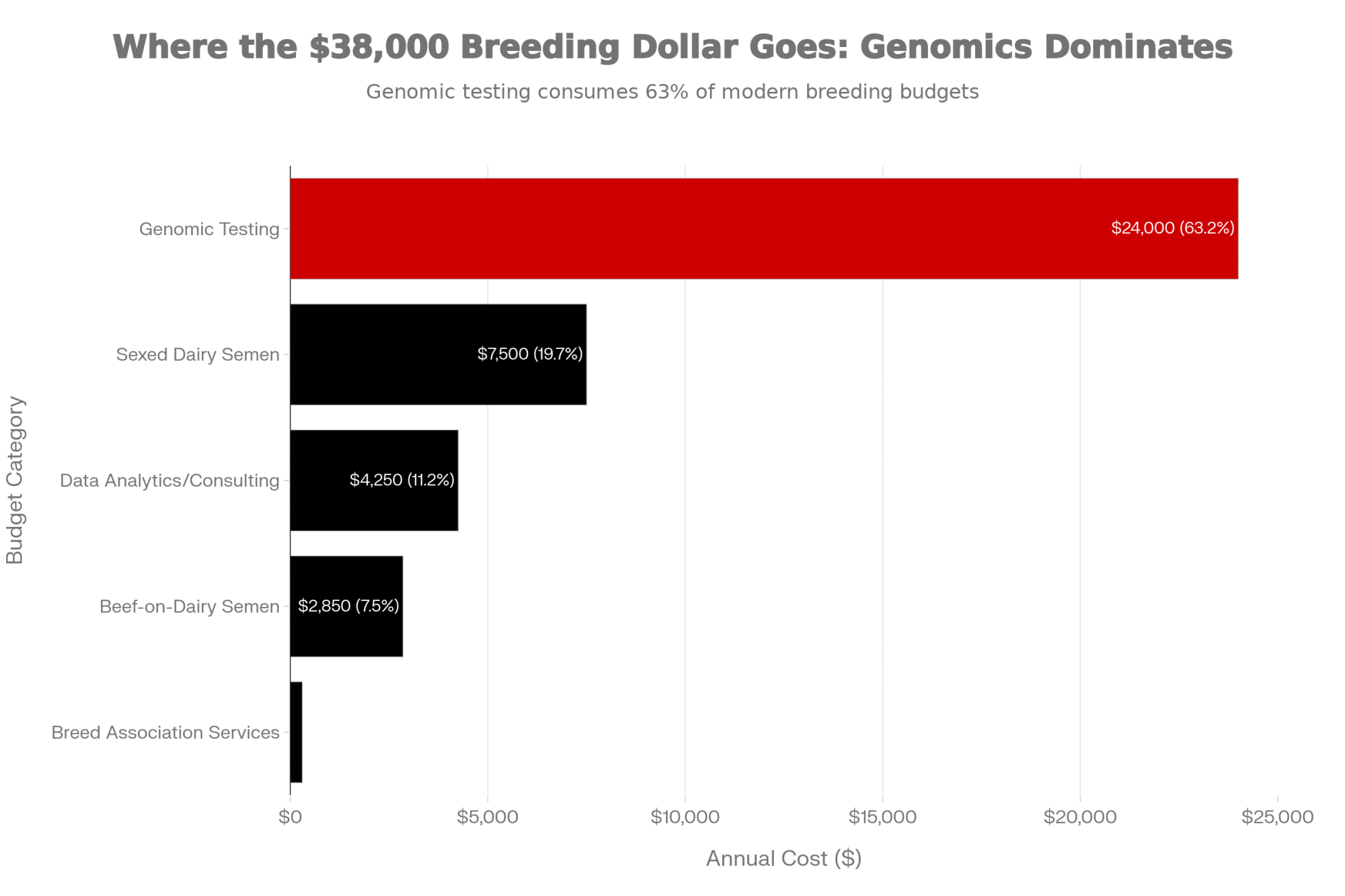
  • Genomic tests running roughly US$40–US$50 per head in many programs. 
  • Software and discipline to rank animals, keep that list current, and get it in front of whoever is breeding. 
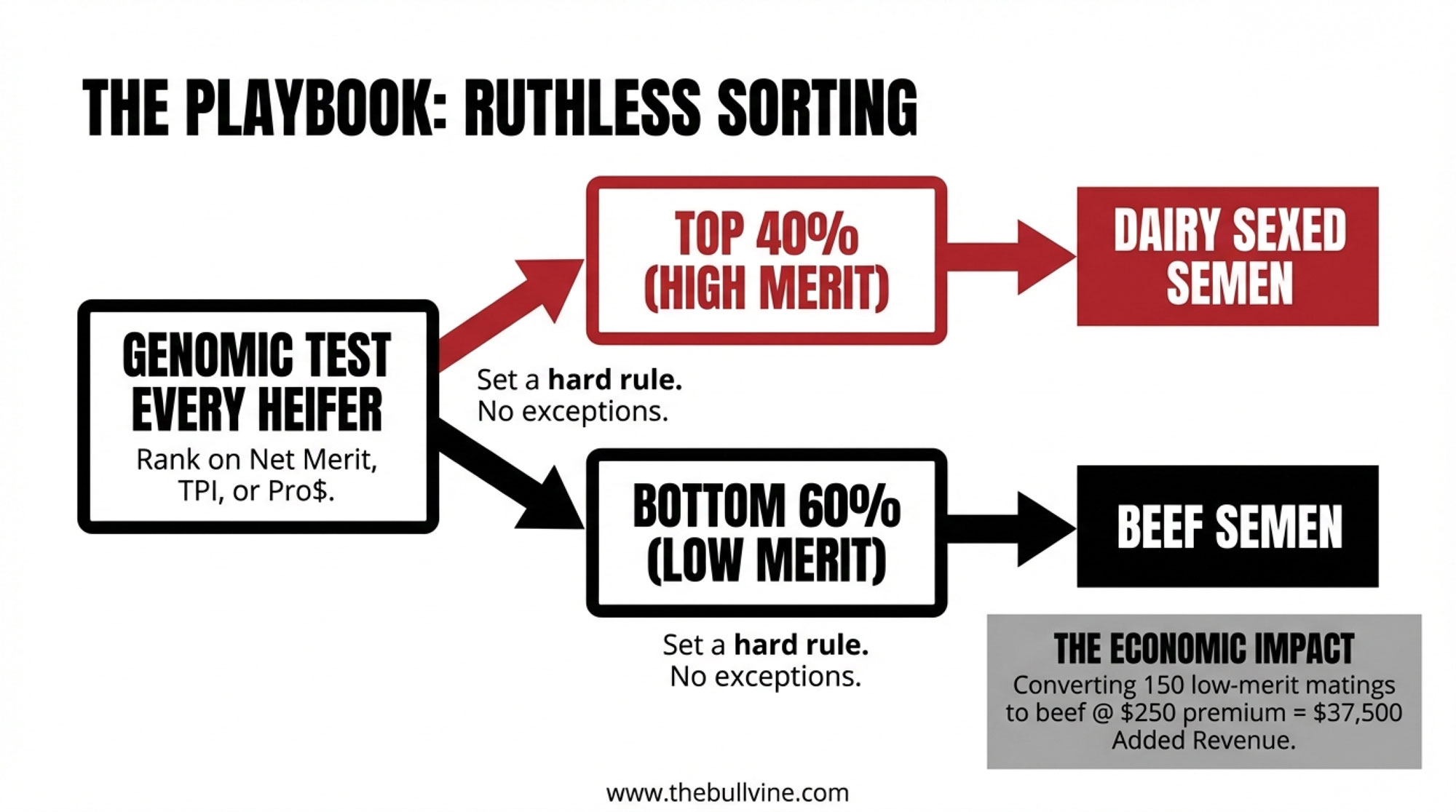
  • A clear rule: top 40–60% by index get dairy semen, the rest get beef. No exceptions. 

Where it bites back.
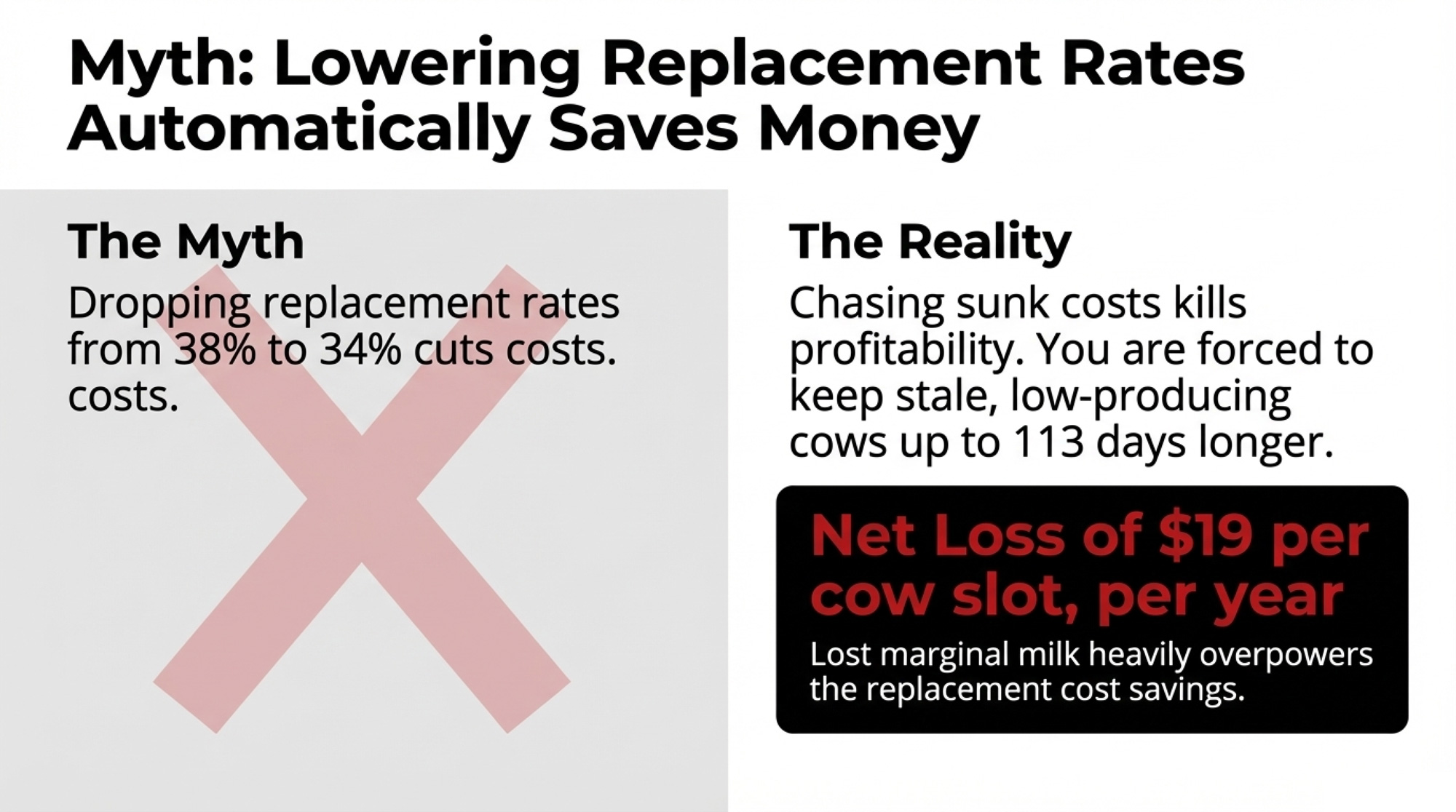
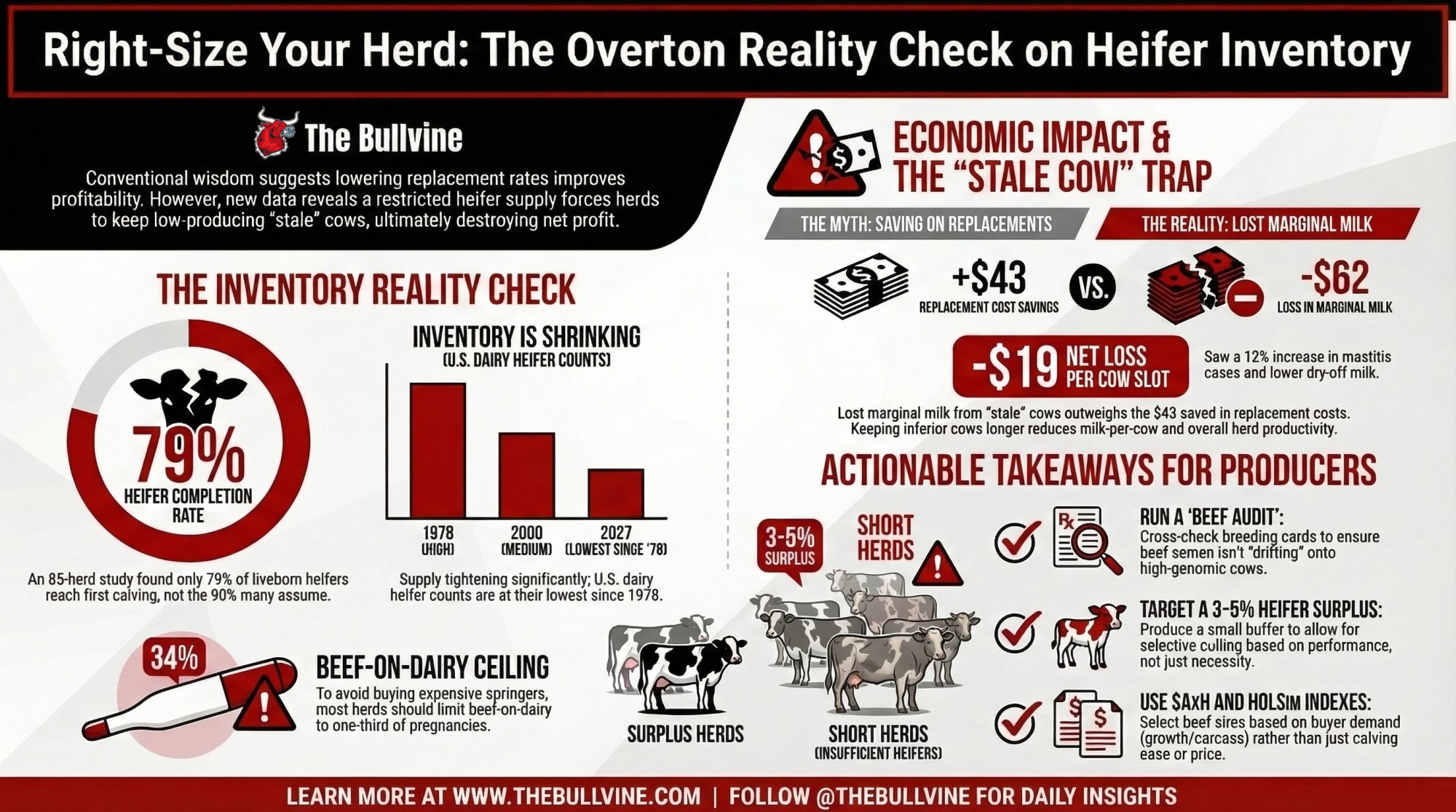
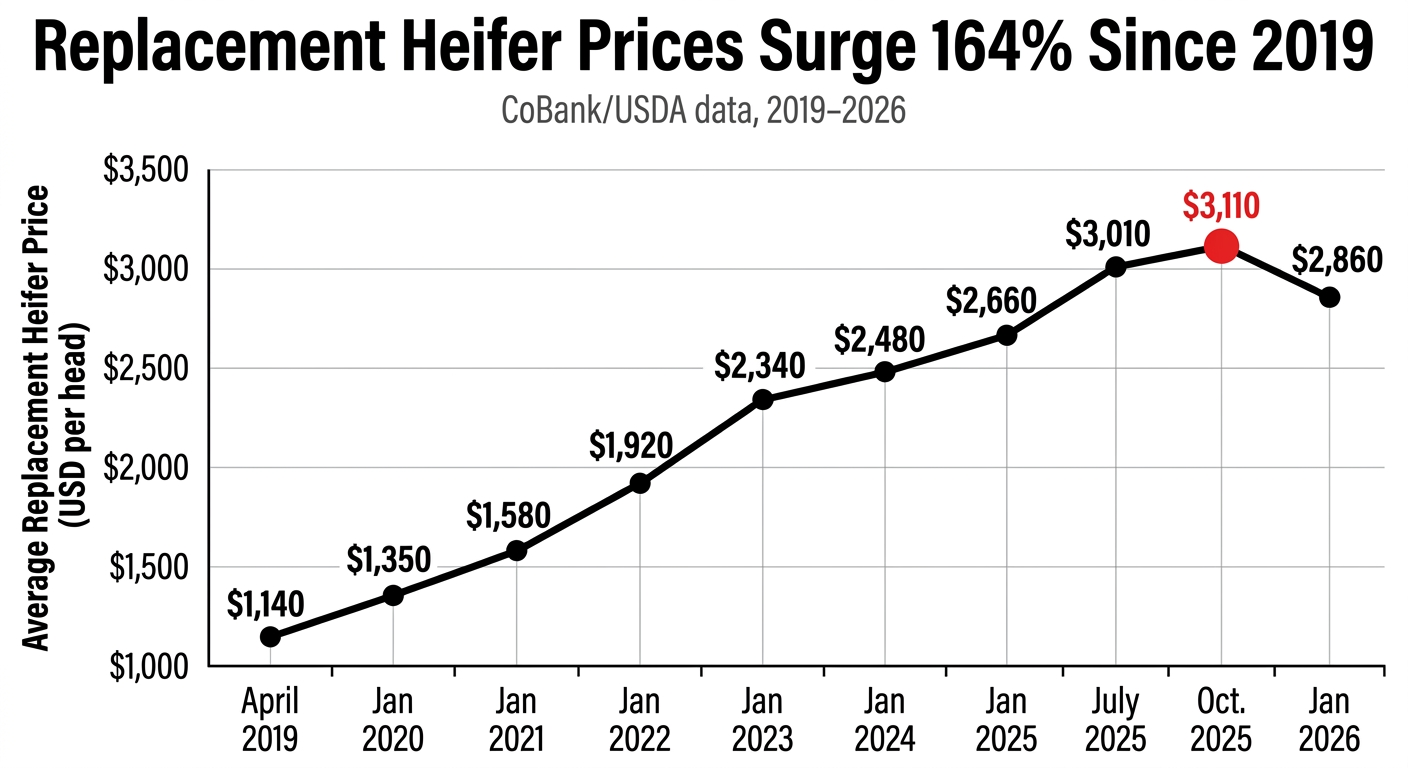
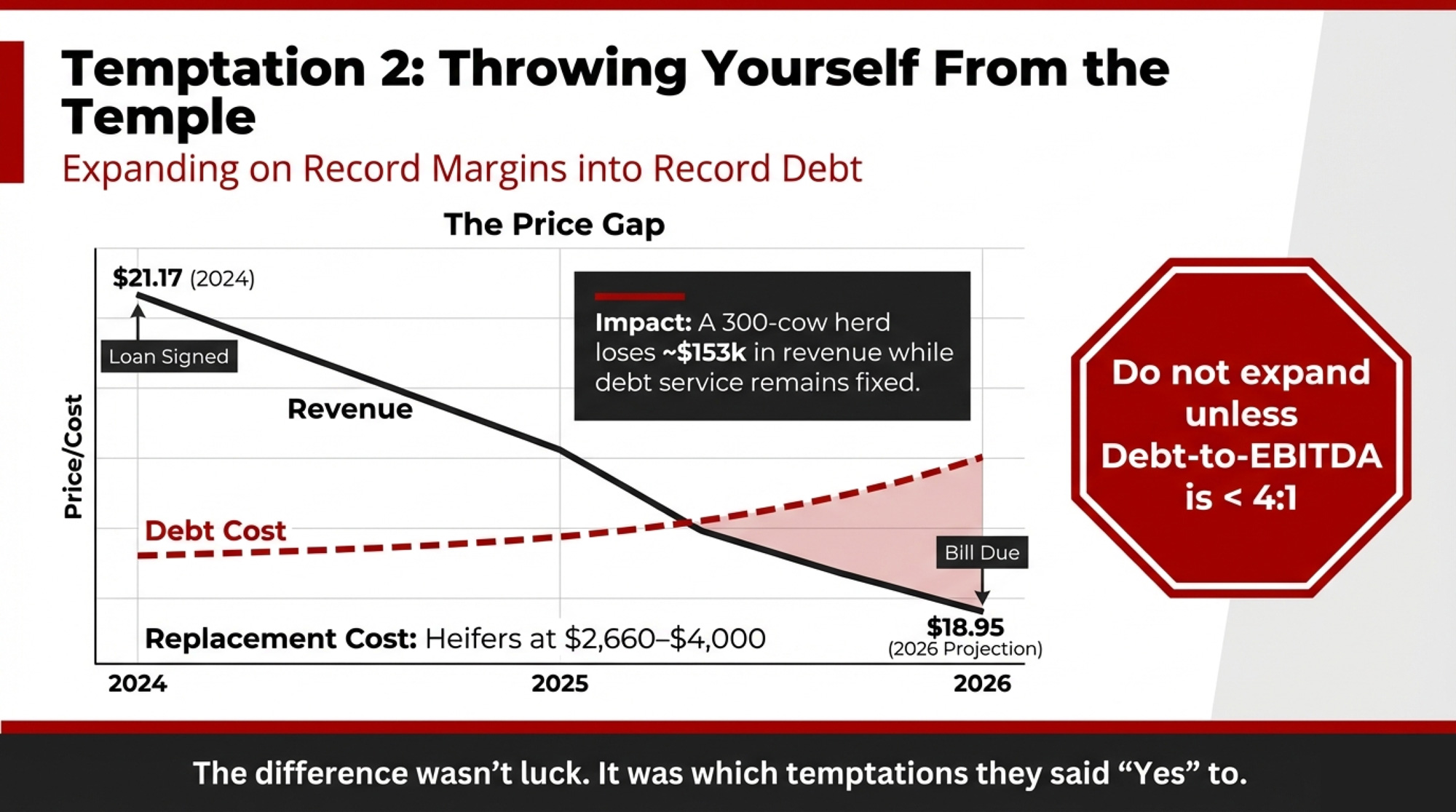
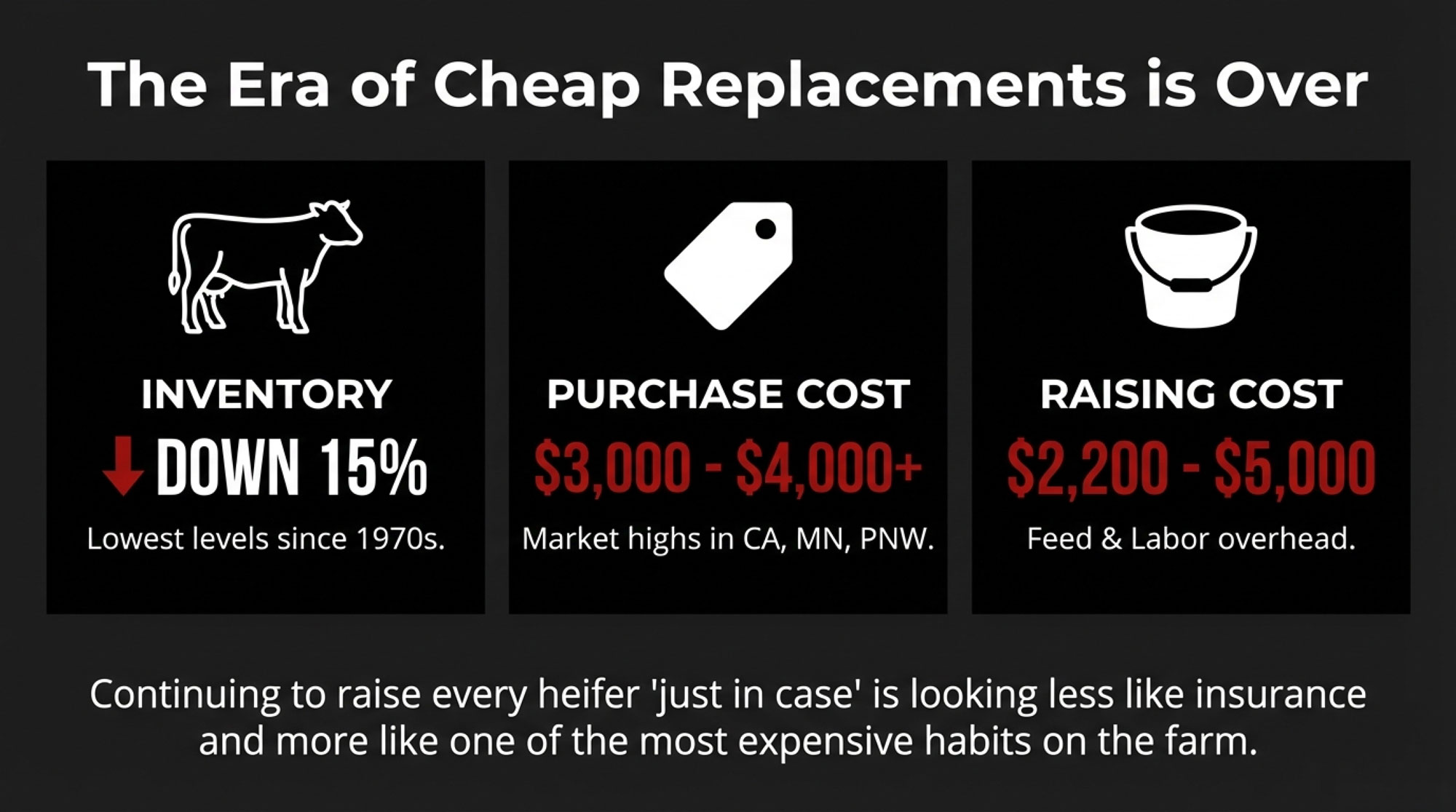
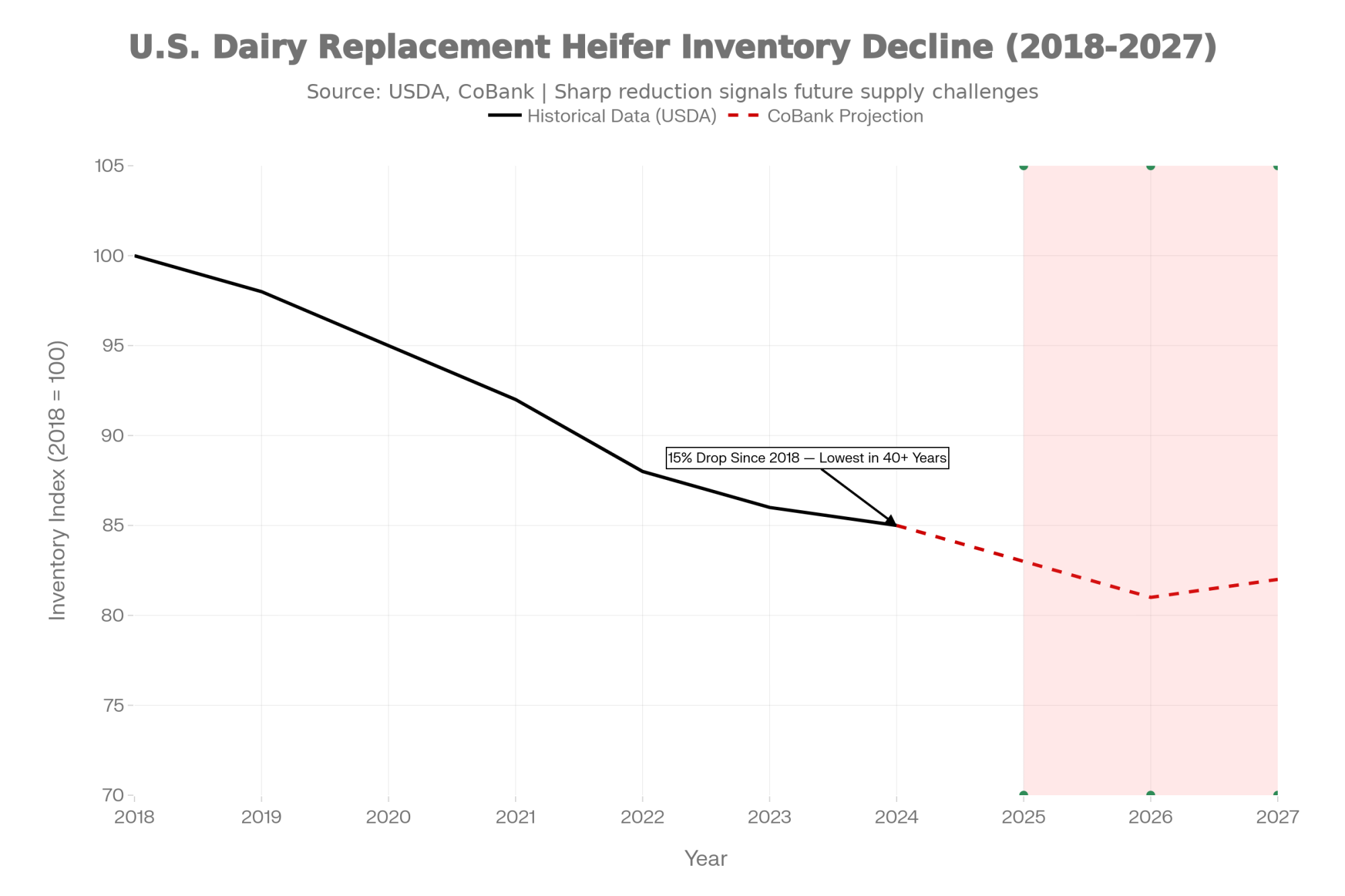
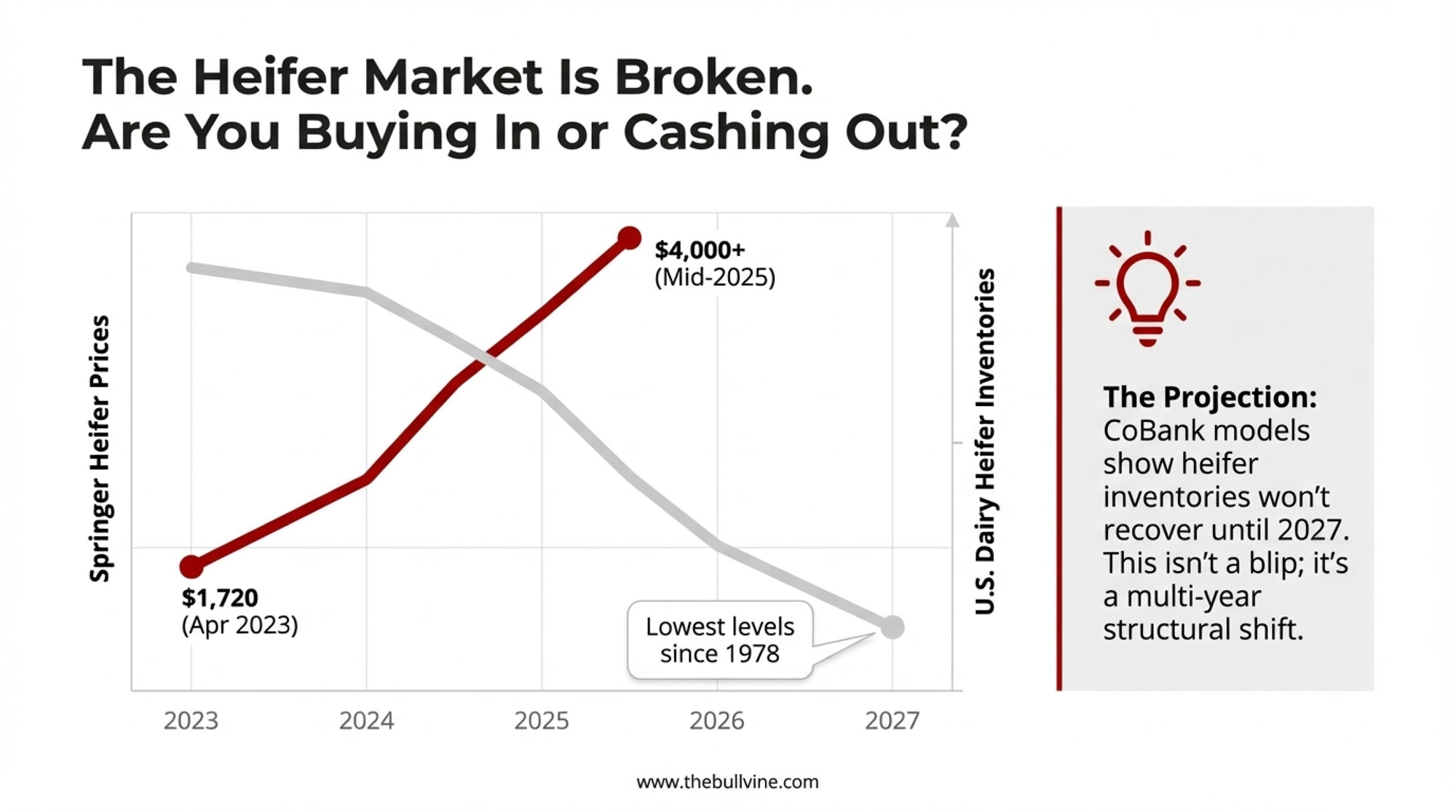
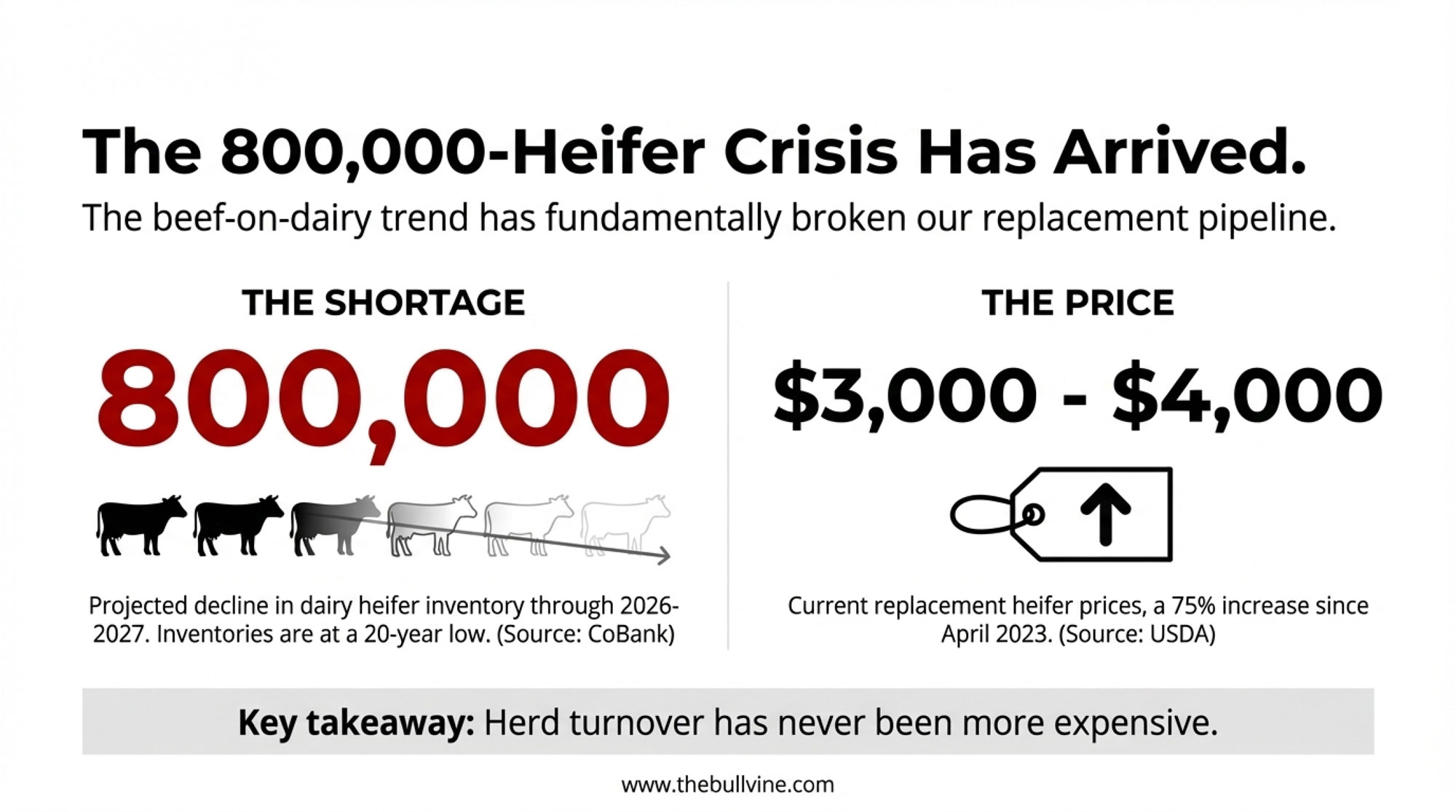
CoBank’s August 2025 analysis — echoed by Hoard’s Dairyman and other outlets — projects U.S. replacement heifer inventories hitting a 20‑year low, dropping by roughly 800,000 head before they start rebounding in 2027. Fresh heifer prices “vaulted far into record territory” in spring 2025, with baseline pregnant heifers averaging about US$2,870 and premium groups fetching “upward of US$4,000” per head. Over‑culling in that environment can easily push you into US$3,000–US$4,000 heifer purchases just to refill stalls. If your replacement inventory isn’t at least 10–15% aboveminimum needs, going full “top half only” overnight is asking for trouble. 

Phone‑friendly takeaway: Use genomics to steer dairy vs. beef, but only go harsh on the bottom half if you’ve clearly got a 10–15% replacement surplus and you’re truly comfortable buying heifers at US$3,000+ if you mis‑judge it. 

Path 2: Redesign the System Before You Rewrite the Protocol

When it fits.
You’ve already retrained a protocol two or three times, and you’re still not seeing the results move. Your best employees are missing steps or improvising on the fly. 

What it takes.

  • A blunt look at time and motion: can one person actually do what you’re asking on a bad day?
  • A shorter list of critical steps that really move the needle (for colostrum, that usually means timing, volume, and quality at the first and second feeds). 
  • Tools that remove choices: organized semen racks, simple color‑coding, auto‑ID checks, and checklists that must be signed off. 

Where it bites back.
You can absolutely overcorrect and strip out tasks that genuinely pay — like a documented second colostrum feeding — in the name of simplicity. The sweet spot is the simplest protocol that still pays, given your milk price, calf value, and labor cost. 

Phone‑friendly takeaway: If your best person can’t hit the protocol, shorten it until they can. Then, only add back steps that clearly improve profit. 

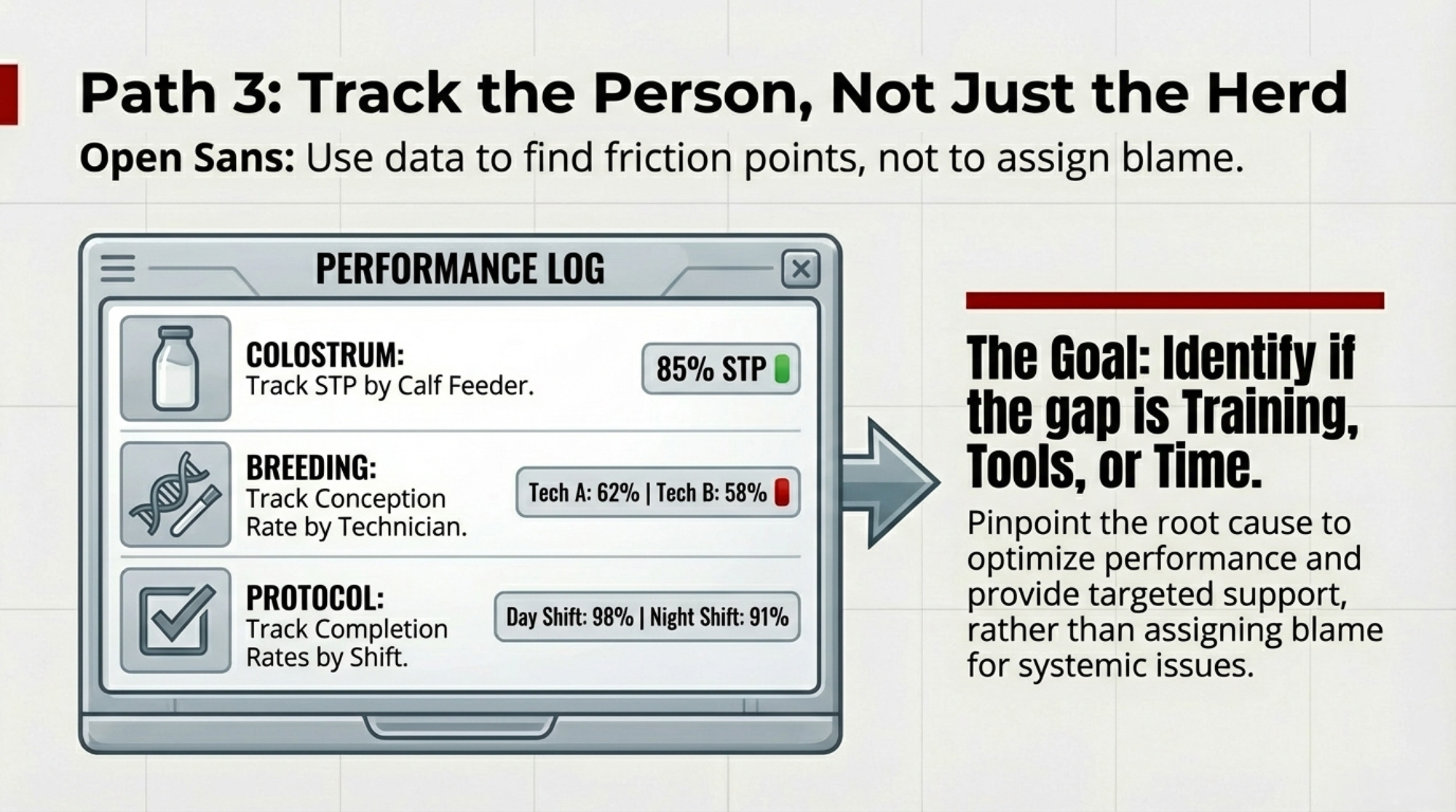
Path 3: Track Results by Person, Not Just Herd

When it fits.
You know there are good days and bad days, but you’re not sure where the swings are coming from. 

What it takes.

  • STP by calf feeder for the next 30–60 days. 
  • Conception rate and pregnancy risk by A.I. technician and by protocol (e.g., Double‑Ovsynch vs. natural heats). 
  • Protocol completion rates by shift for things like second colostrum feeds, vaccines, and synchronization shots. 

The Michigan colostrum work and that large‑herd STP example both show it: the gap between “excellent” and “fair” passive transfer can sit almost entirely in who mixes and feeds colostrum. 

Where it bites back.
If you jump straight from data to blame, you’ll destroy trust. The order has to be:

  1. Check whether they had the time, tools, and information.
  2. Fix those gaps.
  3. Then, coach, reassign, or change staffing if you still see the same pattern. 

Phone‑friendly takeaway: Use the numbers to identify friction points and training needs—not to pin everything on one person. 

Path 4: Treat Consistency as Infrastructure

When it fits.
Every operation, regardless of size or system. 

What it takes.

  • Written, non‑negotiable checklists for key jobs (colostrum, transition cows, breeding, semen tank handling). 
  • Documented second colostrum feeding where your disease risk and calf value justify the extra pass. 
  • Scheduled mixer‑wagon calibrations and forage dry‑matter checks so your ration on paper stays close to the ration in the bunk. 
  • Feeding times that stay within a tight window day after day to smooth out intakes. 

Where it bites back.
Consistency without review can lock you into executing a plan that no longer fits 2024–2026 economics. Feed prices, calf values, and heifer costs have all moved since 2020. Consistency has to be paired with regular “does this still make money?” checks. 

Phone‑friendly takeaway: Lock in consistency for the handful of jobs that really drive calf health, conception, and stall value — then put a date on the calendar to re‑run the math. 

Running the Numbers: Dairy‑Beef Calves vs. Raising Replacements

ScenarioRaise as Dairy ReplacementSell as Dairy‑Beef Calf
Raising costUS$2,094–US$2,607 per heifer on typical U.S. farms; some systems near US$2,900≈US$50–US$75 in first‑week costs
Forgone dairy‑beef sale≈US$1,400/calf (recent U.S. average in strong programs)N/A
Total exposure per headRoughly US$3,250–US$4,350 (raising cost + forgone calf sale)≈US$75
ReturnDepends on genetics, health, and reaching 3+ lactations; average life ≈2.7 lactations≈US$1,400 day‑old income in active programs
Break‑even requiresMore than 3 lactations to recoup the raising costEssentially week one

Exact numbers depend on your region and marketing channel. Recent U.S. commentary shows day‑old dairy‑beef calves averaging around US$1,400, with some lots higher and some lower, while straight Holstein bull calves still trail by several hundred dollars. 

This isn’t a blanket order to stop raising heifers. It’s a reminder that every “just in case” heifer carries a real opportunity cost in a heifer‑short, dairy‑beef world. 

Regional Sidebar: Calf and Heifer Prices Outside the U.S.

If you’re reading this from outside the U.S., the exact dollar or euro values look different. But the pattern is starting to feel very familiar. 

  • Canada.
    Manitoba and national beef‑market reviews for 2024–2025 point to stronger calf prices lifted by tighter beef cow inventories. At the dairy end, Ontario auction reports show fresh milk cows and bred heifers trading in the C$3,000–C$4,400 range at selected sales, with individual top cows over C$5,000 and quality springers frequently around C$3,000–C$3,800, while open heifers often fall in the C$1,500–C$2,250 band. That’s not a national average, but it’s a clear signal that replacements aren’t cheap. 
  • European Union (example: Ireland and Denmark).
    In June 2025, the Irish Farmers Journal reported that Friesian bull calf averages jumped to €209, nearly three times the roughly €67 average a year earlier, while Angus and Hereford dairy‑beef calves were regularly trading in the mid‑€200s to mid‑€300s. Teagasc’s mid‑2025 update noted that €500–€700 for very strong dairy‑beef calves had become “the new normal” for the top of the trade in some rings. In Denmark, there is a national calf‑pricing scheme where a 60 kg Holstein x beef calf earns about €100, plus bonuses that can add another €100 for the best male calves. 

The exact dollar or euro values are different, but the pattern is similar: stronger beef prices and constrained replacement supplies are lifting both dairy‑beef calf values and in‑calf heifer prices in Canada and parts of Europe. The stall‑value and opportunity‑cost questions in this article still apply — you just need to plug in your local calf and heifer prices. 

The Execution Cost in One Table

Leak PointStatistical FrequencyEconomic Impact (per event)
Incorrect sire recording27.78% of cows had a wrong recorded sire in one Taiwanese datasetLoss of expected genetic gain; weaker matings; less reliable proofs 
Colostrum execution (STP)13% performance gap between 6.0 g/dL and 5.3 g/dL by an employee on one large herdHigher morbidity and mortality, more treatments, and lost milk in the first lactation 
Timed‑AI protocol errors5% error per shot ≈ , 26% of cows missing at least one of six Double‑Ovsynch injectionsMore open cows, longer calving intervals, fewer high‑value dairy pregnancies 
Culling delay (RPO)N/A (herd‑specific)Example: ≈US$480 missed profit per stall over 200 days at US$2.40/day lost opportunity 

Signals to Watch Over the Next 24–36 Months

Your own execution data.

If you want to know where your biggest leaks are:

  • Pull STP distributions by feeder for the next 30–60 days. 
  • Track conception and pregnancy risk by technician and by protocol type. 
  • Audit how many cows actually complete full synchronization protocols and second colostrum feeds. 

Until you see those numbers by person and protocol, you’re guessing where your execution gap really sits. 

Replacement pipeline stress.

CoBank’s August 2025 report predicts that: U.S. replacement heifers are expected to hit a 20‑year low, with an ~800,000‑head reduction before inventories start to rebuild in 2027. Heifer prices have already “vaulted far into record territory,” with baseline bred heifers near US$2,870 and premium groups “upward of US$4,000.” Any aggressive culling or dairy‑beef plan has to start with an honest count of how many replacements you have and how many you really need. 

Dairy‑beef premium durability.

Dairy‑beef calves are benefiting from tight beef supplies and expanded fed‑beef capacity. CoBank’s outlook suggests 2027 as a likely turning point in the heifer cycle, and broader beef‑market work points to eventual easing of the tightest supply conditions. That doesn’t mean the bottom falls out, but it does mean the easiest premiums can narrow. Herds with consistently low FTPI and strong calf health should stay at the top of the dairy‑beef market even when everyone else starts catching up. 

What This Means for Your Operation

  • If your best person can’t hit a protocol, stop retraining and start redesigning. Before the next “training session,” audit the time, tools, and information they actually have. If the protocol doesn’t fit reality, fix the protocol—not the person. 
  • Audit colostrum by person, not just herd average. If STP by employee shows a spread of 0.5–1.0 g/dL, you’ve got an execution gap that will come back at you in treatment costs, death loss, and weak first‑lactation cows. 
  • Run RPO, not emotions, on your bottom third. When a cow’s projected daily profit is clearly below what a replacement could do in that stall — and your heifer inventory is solid — it’s time to let her go, even if her current milk looks good. 
  • Use genomic ranks to control who gets dairy semen, but only as aggressive as your replacement math allows. If your replacement count isn’t at least 10–15% above minimum needs, phase in hard cutoffs instead of flipping the switch to “top half only” overnight. 
  • Treat dairy‑beef as a serious margin tool, not a fad. It only really pays if your colostrum and calf care are strong enough to deliver high‑value calves consistently. If FTPI is shaky, fix that first before you chase top‑tier calf checks. 
  • Spend time in the parlor and by the tank. Watch how IDs are read, how long the canister stays in the neck, and how often people hunt for the right straw above the frost line. The cheapest fixes usually hide in daily habits, not in new technology. 

Key Takeaways

  • Execution gaps — not genetics or feed alone — may be one of the biggest hidden costs on modern dairies, once you line up the FTPI data, sire‑error rates, and heifer economics against what you thought your protocols were delivering. 
  • Only 36% of the 50 Michigan farms in a major colostrum project actually met passive transfer goals, even though most believed their routines were solid. Until you track STP by person, you honestly don’t know where your farm sits. 
  • When you’ve retrained a protocol twice, and results haven’t moved, the problem is almost always the system — not the people. Redesign the work, remove failure points, and then retrain with a protocol that fits real‑world conditions. 
  • Retention Pay‑Off and stall opportunity cost matter more than whether a cow is “still paying for herself” on paper, especially when 70% of cows leave before three lactations and the average heifer raising cost sits around US$2,355 per head. 
  • Tight heifer inventories and record dairy‑beef calf values make poor execution more expensive than ever.In 2024–2026, every protocol miss has the potential to waste a historically valuable calf and a historically valuable stall. 

The Bottom Line

The herds that win over the next few years won’t be the ones with the fanciest protocols in a binder. They’ll be the ones that build simple, durable systems their people can hit on the worst days, not just the best. 

If you pulled your numbers tomorrow, which protocol would look the worst — and what’s your plan to rebuild it before it costs you another year? 

Complete references and supporting documentation are available upon request by contacting the editorial team at editor@thebullvine.com.

Learn More

Join the Revolution!

Join over 30,000 successful dairy professionals who rely on Bullvine Weekly for their competitive edge. Delivered directly to your inbox each week, our exclusive industry insights help you make smarter decisions while saving precious hours every week. Never miss critical updates on milk production trends, breakthrough technologies, and profit-boosting strategies that top producers are already implementing. Subscribe now to transform your dairy operation’s efficiency and profitability—your future success is just one click away.
NewsSubscribe
First
Last
Consent

Stop Breeding by Color: Genomics, Heat Stress and Beef‑on‑Dairy Math That Can Add Over $4/cwt to Holstein Margins

Spending $2,000 to raise a heifer because she’s got more white? Genomics says that’s a losing bet. Beef-on-dairy says there’s $4+/cwt on the table.

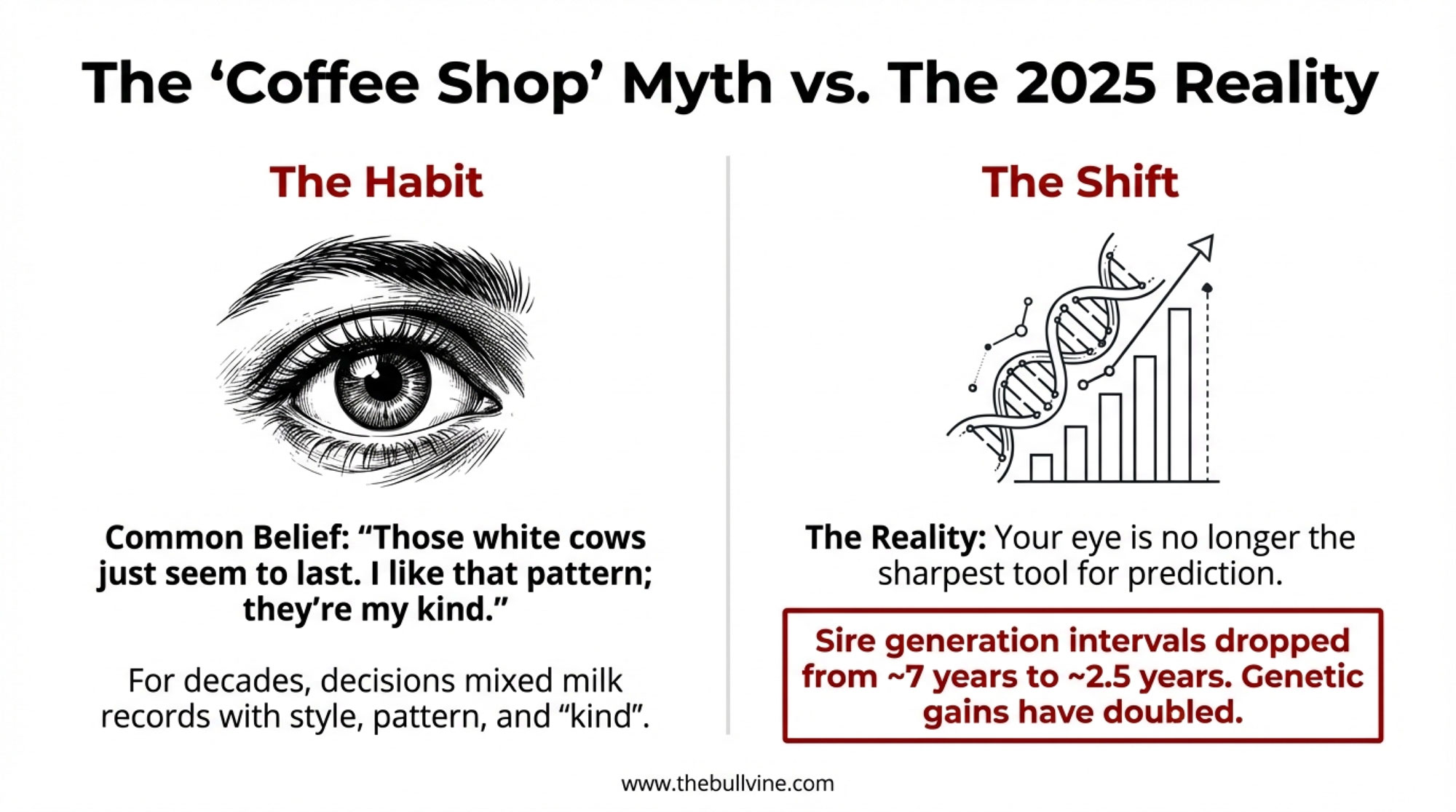
If we were sitting over coffee at a winter meeting in Ontario or Wisconsin, you’d probably hear someone say, “Those white cows just seem to last,” or “I like that kind of pattern; they’re my kind.” A lot of us grew up with that way of thinking. For decades, the way a Holstein looks—her color, pattern, and style—has sat right beside milk records, butterfat levels, and fresh cow management notes when we’ve made breeding decisions, just like breed associations and coat‑color labs still describe for Holsteins today, especially around the red factor and MC1R work coming out of places like the University of Saskatchewan and VHLGenetics.

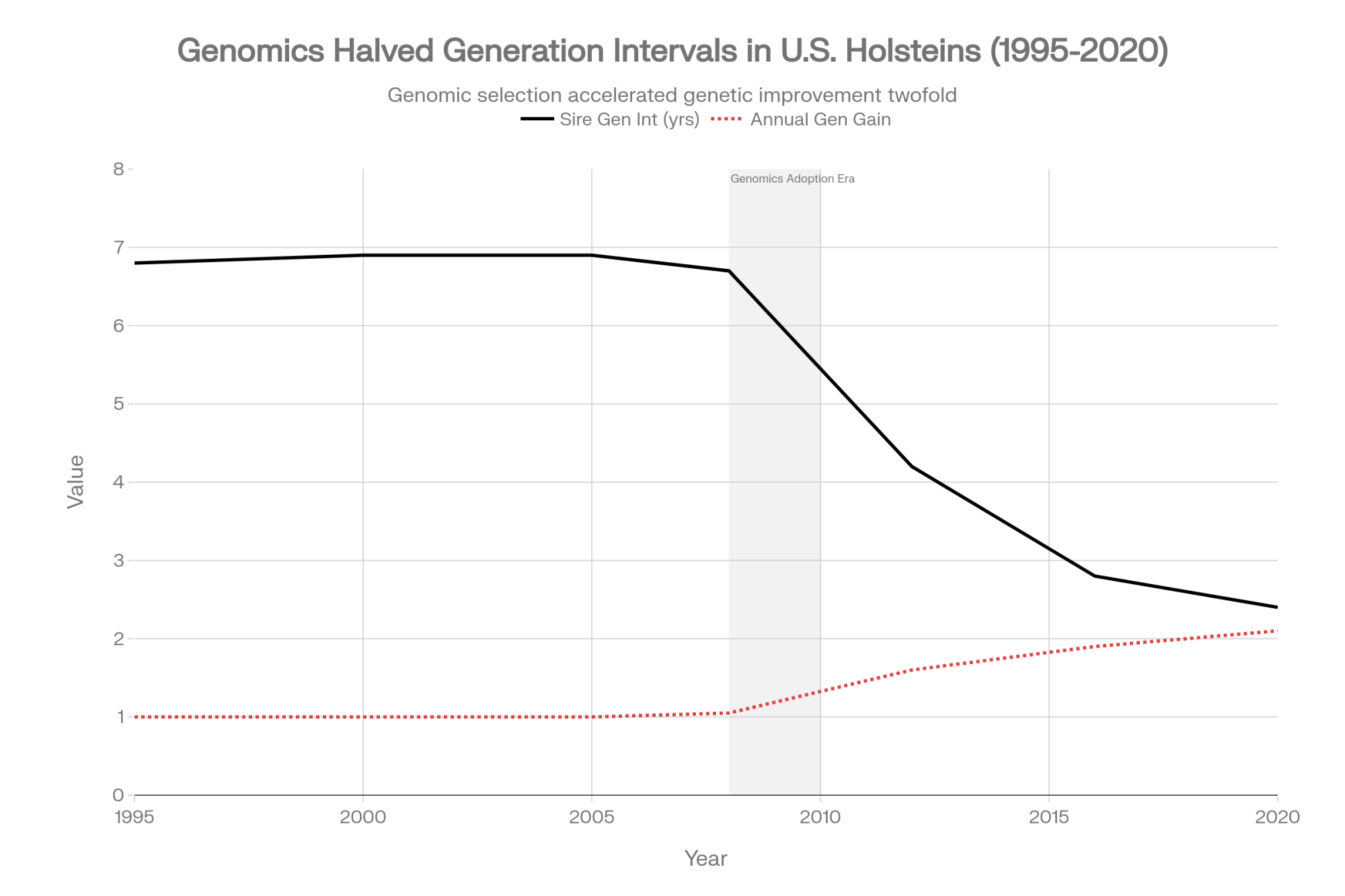
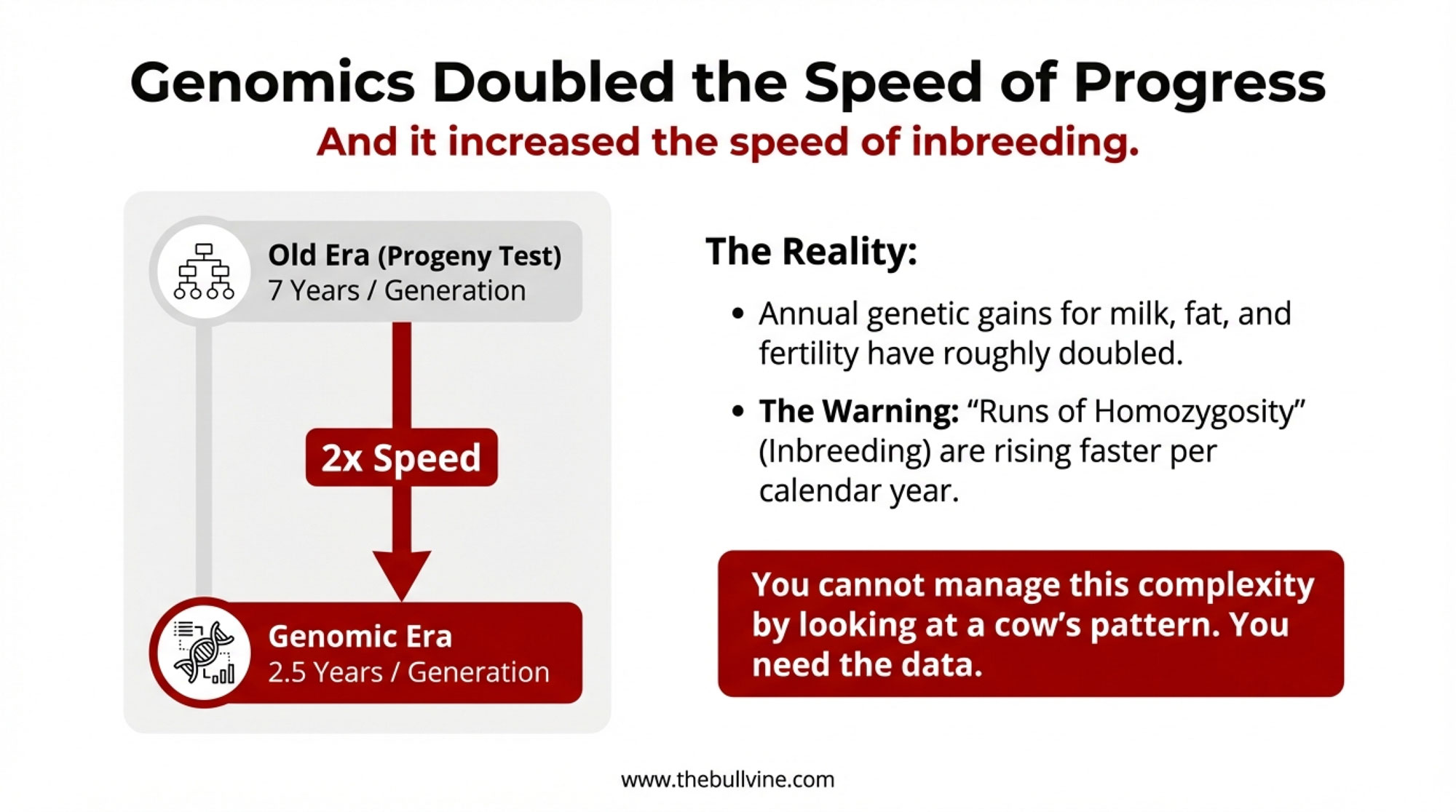
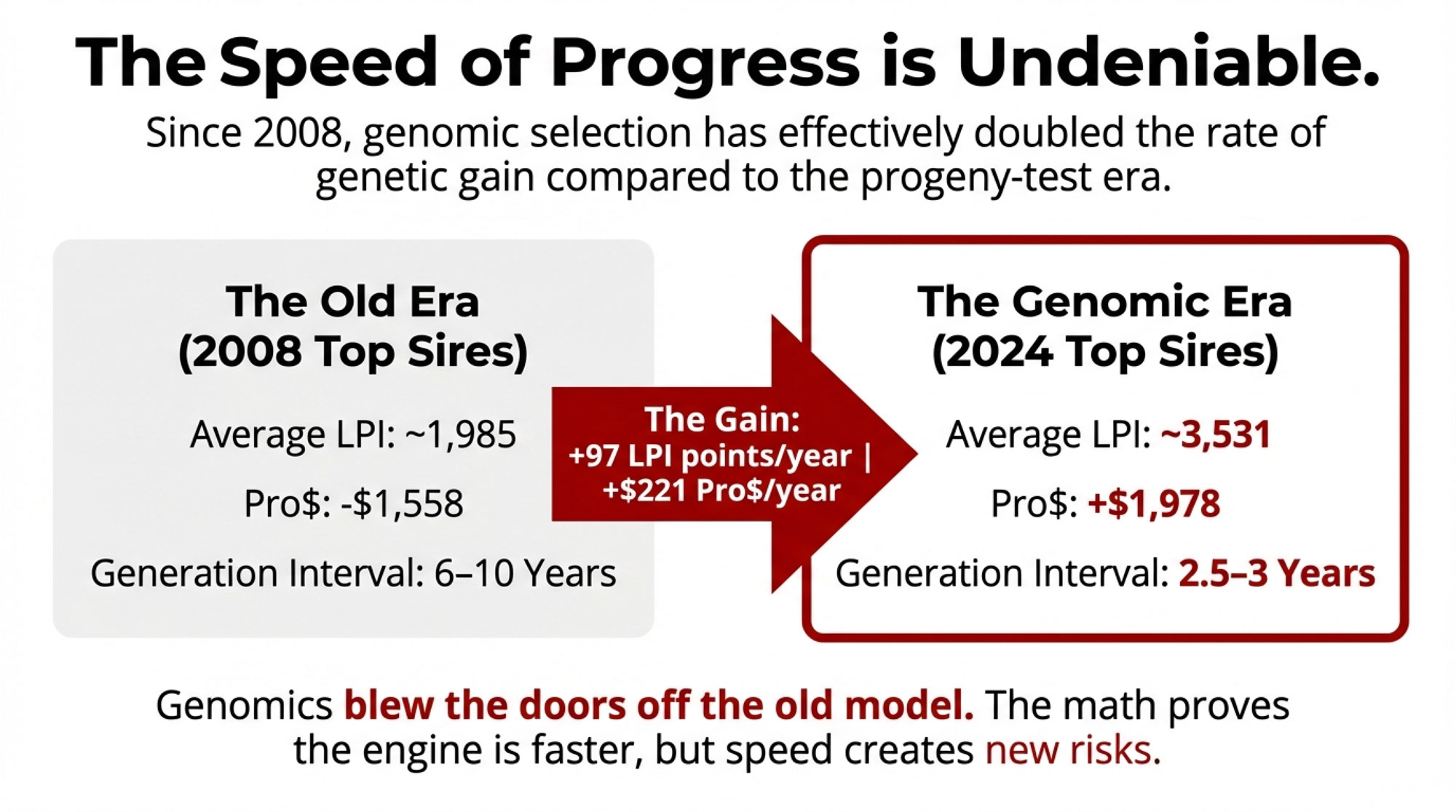
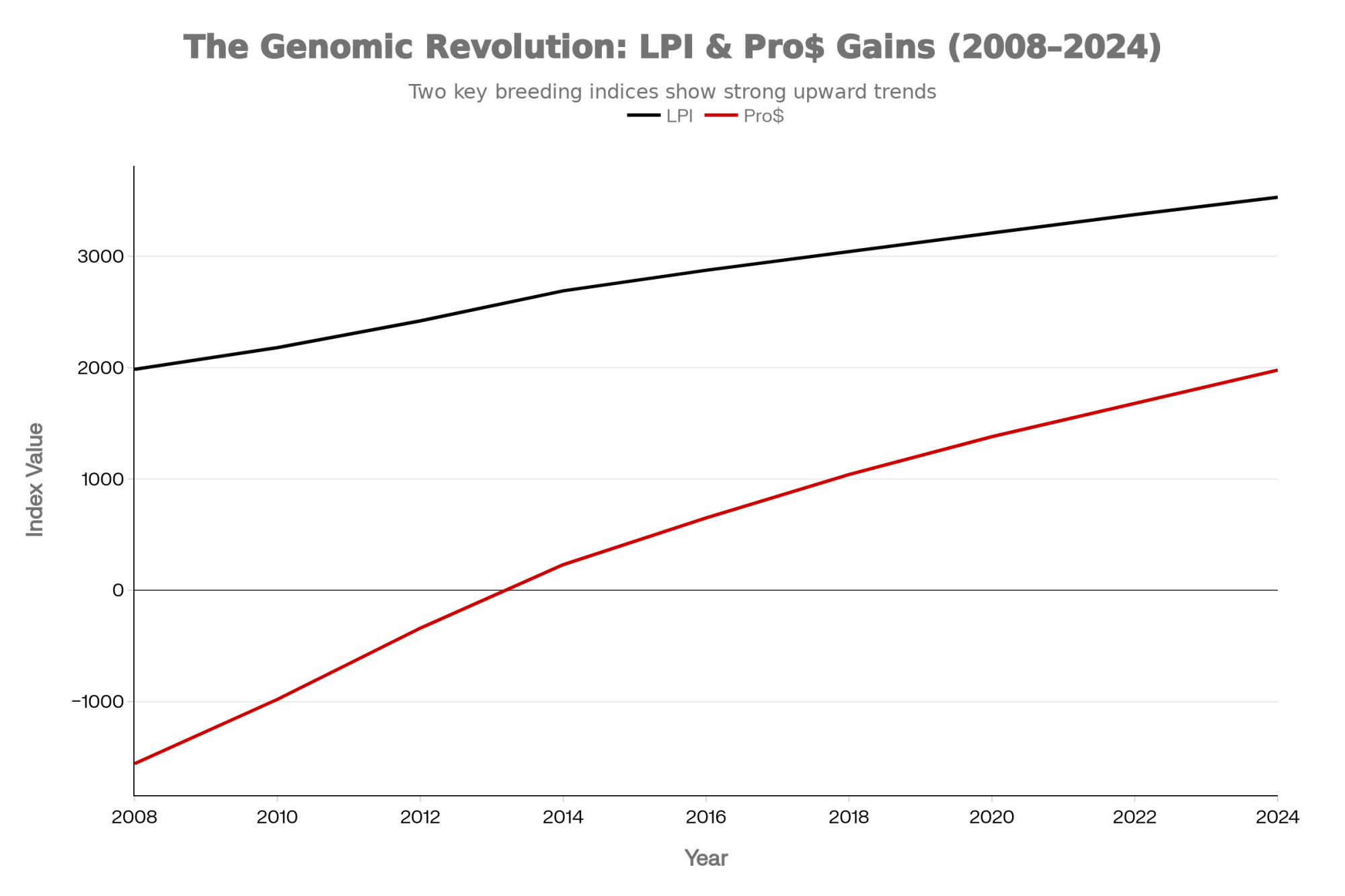
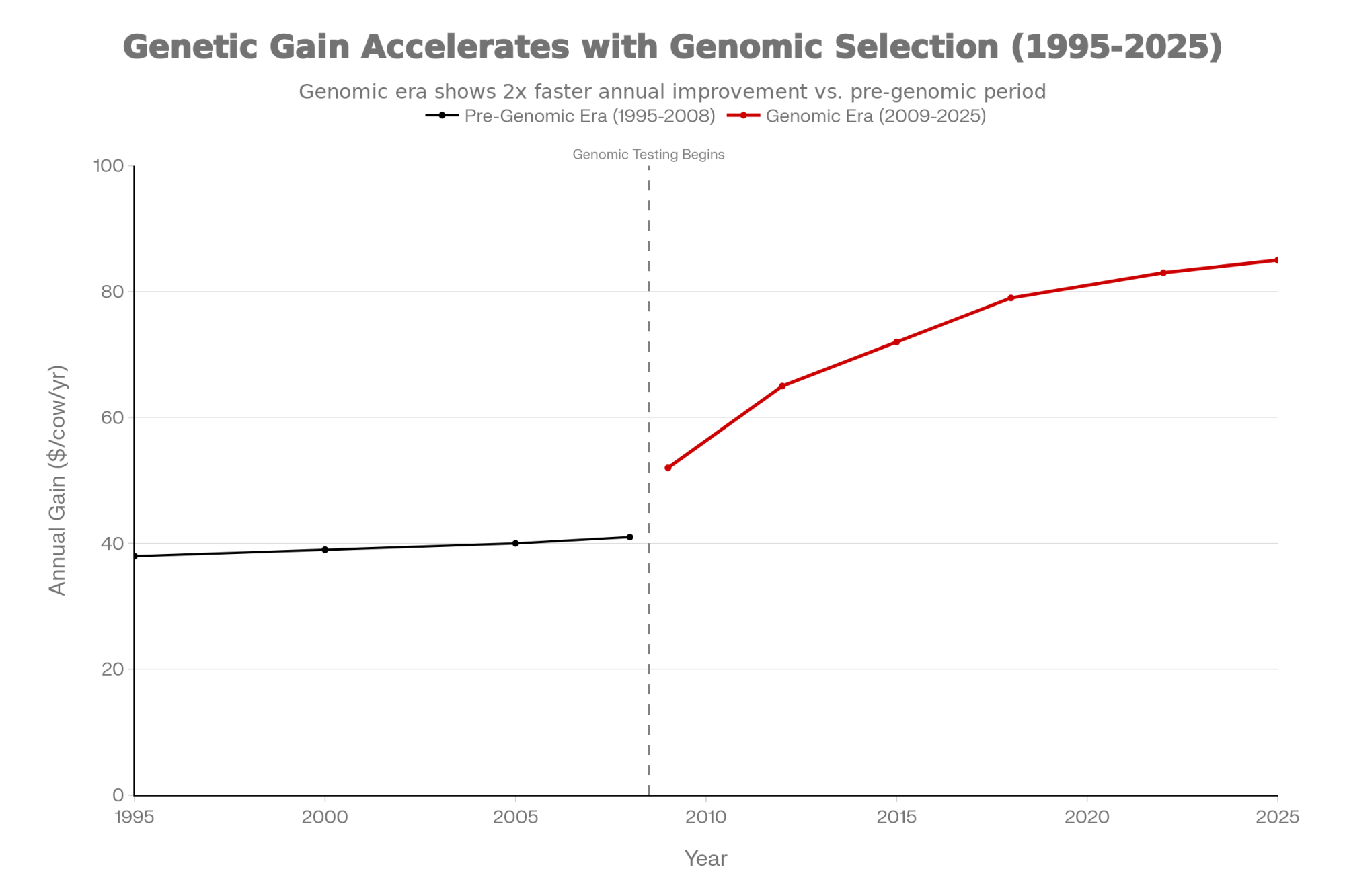
Here’s what’s interesting in 2025. The ground under that old habit has shifted. Genomic evaluations, population‑genetics work on inbreeding, new heat‑stress research, and some pretty eye‑opening 2025 beef‑on‑dairy economics are all pointing in the same direction: your eye still matters a lot, but it’s no longer the sharpest tool for predicting which calves will pay back rearing costs and stay productive through multiple lactations. A big U.S. Holstein study in the journal Proceedings of the National Academy of Sciences showed that once genomic selection came in, the generation interval for sires of young bulls dropped from roughly seven years down to about two and a half, and the annual genetic gains for milk, fat, protein, fertility, and productive life basically doubled compared with the old progeny‑test era.

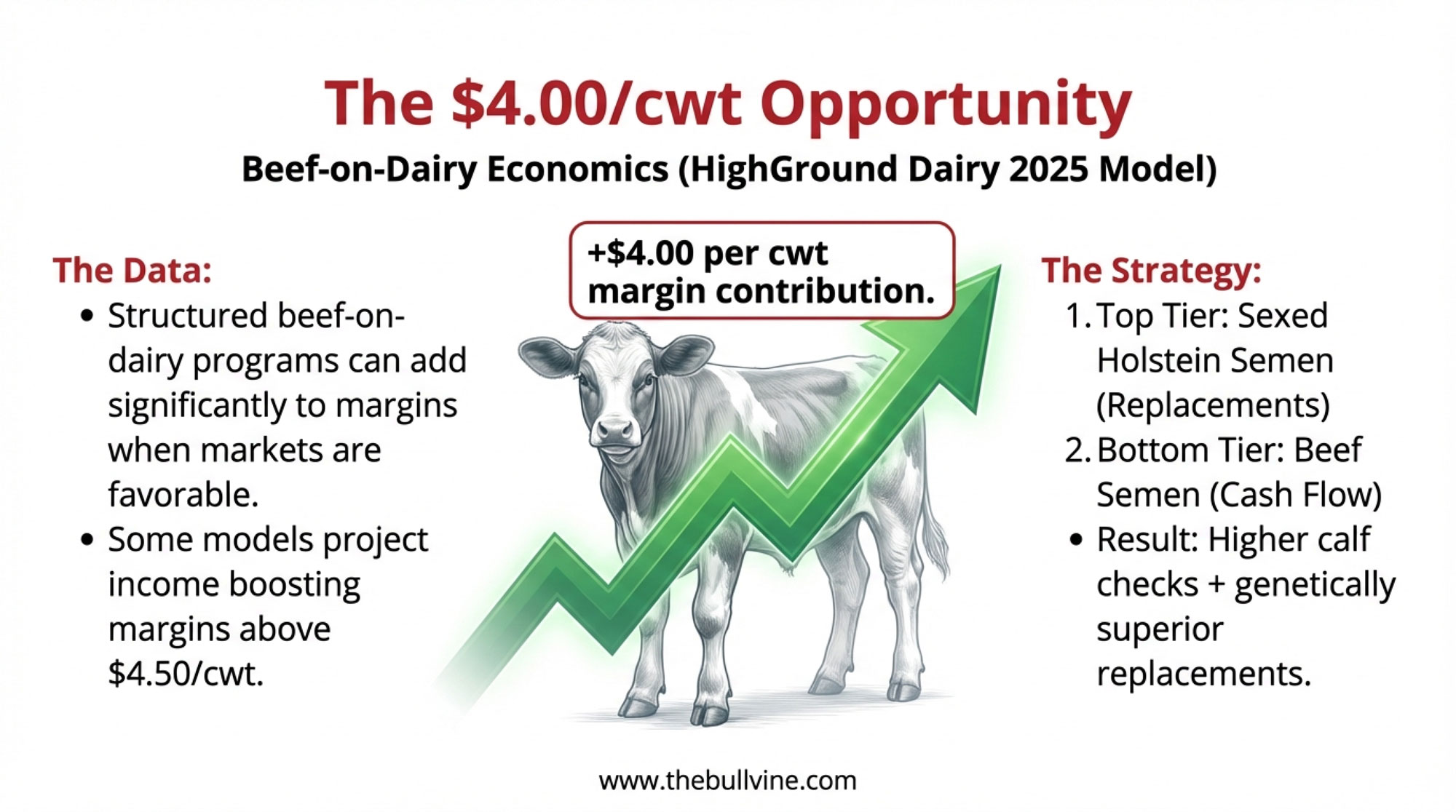
When you put that next to the economics, the stakes get very real. A Canadian study by CanFax and the Beef Cattle Research Council found that the average cost to raise a replacement heifer was about CA$2,904 in 2023, with a range of CA$1,900 to CA$3,800 across farms. North American dairy budgets generally put that in the US$1,800–2,500 range to get a heifer to calving, once you factor in feed, housing, labor, health, and breeding. At the same time, market analysis from HighGround Dairy in late 2025 estimated that, under strong beef markets and structured beef‑on‑dairy programs, cull cows and beef‑on‑dairy calves together could add more than US$4.00 per hundredweight of milk shipped on some operations, and in another model, they projected beef‑related income above US$4.50 per hundredweight, with several months over US$5.00.

So those breeding calls—who gets sexed Holstein, who gets beef, which heifers you raise—aren’t cosmetic anymore. They’re big‑ticket cash‑flow decisions.

What I’ve found, talking with progressive herds in Ontario, Wisconsin, the northern Plains, and over in parts of Europe, is that the farms making the most consistent progress are letting genomics and economics set the main breeding direction. Then they use their eye to manage cows and fine‑tune individual decisions, not the other way around.

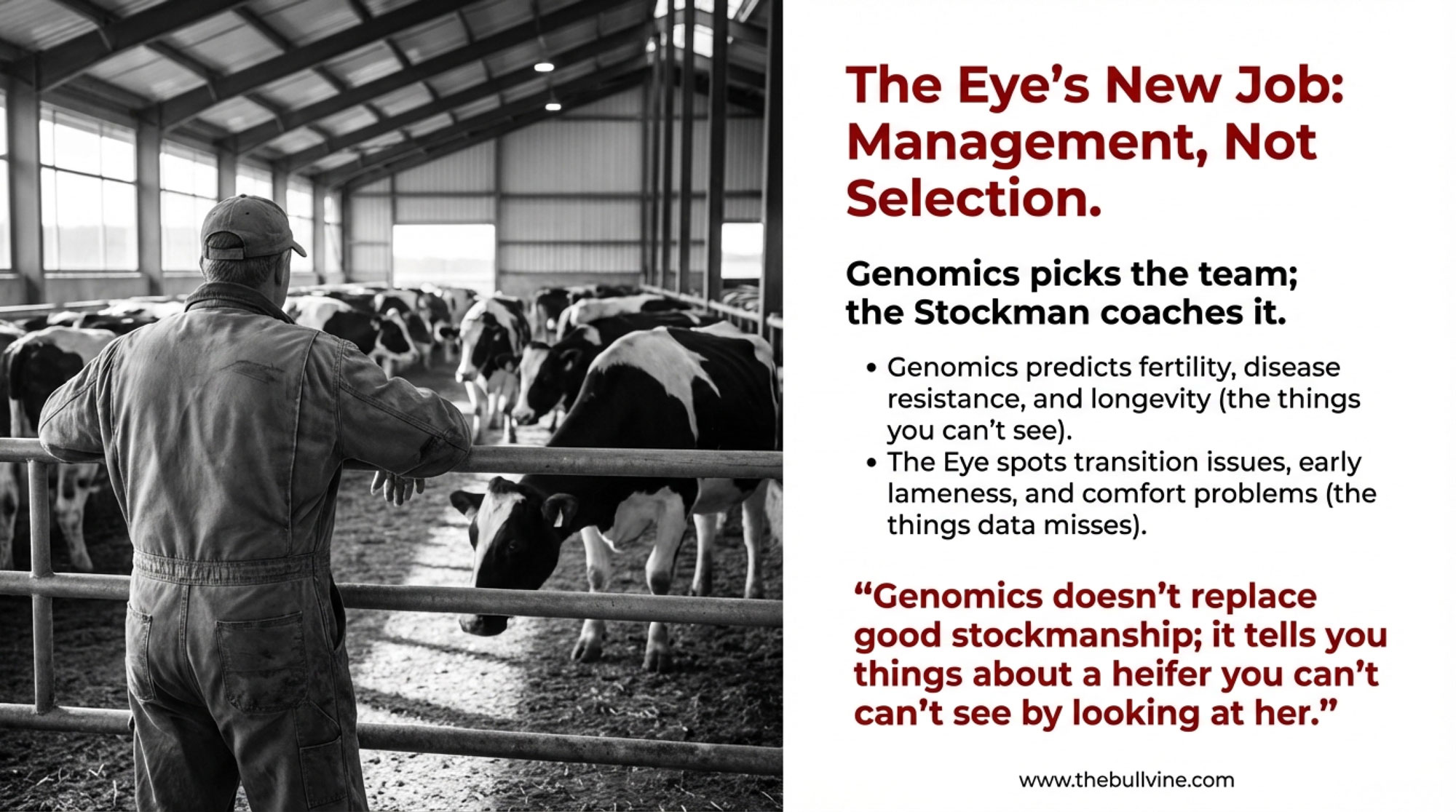
As Kent Weigel, who teaches dairy cattle genetics at the University of Wisconsin–Madison and has spent years working with Holstein producers, likes to tell producer groups, genomics doesn’t replace good stockmanship; it just tells you things about a heifer you can’t see by looking at her—things like fertility, disease resistance, and how long she’s likely to stay in the herd. The eye still matters a lot for the day‑to‑day management side.

Looking at This Trend: What Color Really Tells You

Let’s start with the big myth on the coffee‑shop circuit: does coat color actually tell you anything reliable about a Holstein’s genetic merit for milk, fertility, or health?

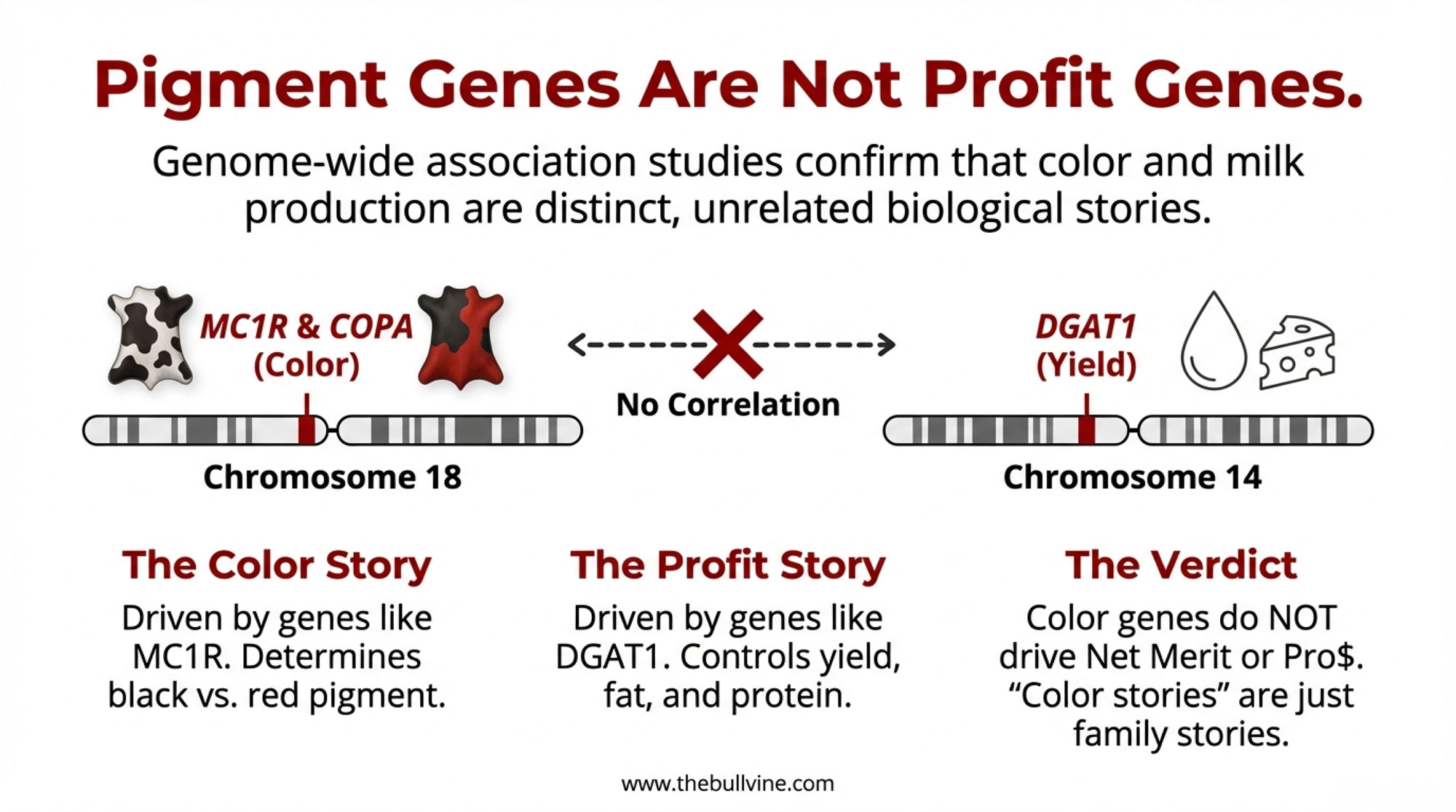
On the black‑versus‑red side, a lot of the story runs through the melanocortin 1 receptor gene—MC1R—on chromosome 18. Geneticists have known for quite a while that MC1R is a central switch between black pigment and red/brown pigment across many species, and Holsteins fit right into that pattern. Holstein‑specific work from Canadian and U.S. labs shows that the main MC1R alleles—often called Dominant Black, Black/Red, wild‑type, and Recessive Red—largely determine whether a Holstein shows up as black‑and‑white or red‑and‑white on the outside.

A really interesting twist came in 2015, when a team publishing in PLOS ONE described a new Dominant Red coat pattern in Holsteins and tied it to a missense mutation in the COPA gene. They showed that this COPA variant acts through the pigment pathway and essentially overrides the usual MC1R signal, turning black areas red. The important point here is that their work was about coat color; they didn’t find evidence that COPA itself was a major driver of milk yield or fertility.

The classic black‑and‑white patch pattern has its own genetic story. Genome‑wide analyses in Holstein‑Friesians have repeatedly identified strong signals around the KIT gene on chromosome 6 and other pigmentation genes, such as MITF, as key players in spotting and patterning. That matches what many of us see in sire families—certain bulls stamp a recognizable pattern on their daughters.

Now, set that beside what we know about the heavy‑hitter milk genes. Large genome‑wide association studies in Holsteins, including recent work from Asia and Europe, continue to confirm major effects for milk yield, fat, and protein near DGAT1 on chromosome 14 and at several other regions. Reviews of milk‑trait genomics and meta‑analyses don’t flag MC1R or COPA as major milk‑yield QTL. They’re busy with DGAT1 and a suite of other production loci scattered around the genome.

So when you map this out, you see two fairly separate stories. One is the pigment story—MC1R, COPA, KIT, MITF. The other is the production story—DGAT1 and dozens of other loci that drive yield, fat, protein, and things like somatic cell score. Color genes just don’t show up as the big drivers of milk or fertility that we see in genomic evaluations.

That doesn’t mean you won’t find a cow family where “the red ones” or “the ones with more white” seem to be your better cows for a while. In a tight family, that absolutely happens. But genetically, what’s going on there is that you’re seeing a family package, not a universal rule. Across the breed, coat color by itself just isn’t a reliable shortcut to Net Merit, Pro$, or the overall profit indexes that matter to the milk cheque.

What Farmers Are Finding: Popular Sires and “Color Stories”

What farmers are finding, especially when you look back over a few decades of AI use, is that our “color stories” are usually really “family stories.”

Most of us can name the bulls that left a big genetic footprint in our barns: Shottle, Goldwyn, Planet, Mogul, Supersire, and now the current crop of genomic sires. Population geneticists call this “popular‑sire” or “founder” effect—when a relatively small number of bulls contribute a large share of the genes in a breed over a short period. A high‑density genomic study in Genetics Selection Evolution examined these selection signatures in Holstein‑Friesians and other breeds and found long stretches of DNA—haplotypes, where variation had been squeezed out by strong selection for milk, components, stature, and udder traits.

When you use a bull like that heavily, his daughters don’t just share his “under the hood” production package; they also share his visible stamp. So for a few generations, a particular pattern or “kind” can feel like it always goes with a particular level of performance. That’s real at the family level. But those haplotype blocks are made up of many linked genes, including both color and production loci. As time goes on and mating gets more diverse again, those blocks break up and recombine.

So inside a family, coat pattern can be a reasonable clue that you’re looking at daughters or granddaughters of a particular bull. At the breed level, the big studies just don’t support simple rules like “more white cows are always better cows.” The family resemblance is real; the population‑wide rule based on color is not.

Where Color Really Does Matter: Heat, Sun, and Lost Milk

Now, there is one place where coat color genuinely shows up in performance, and it has nothing to do with type scores or classification sheets. It’s heat.

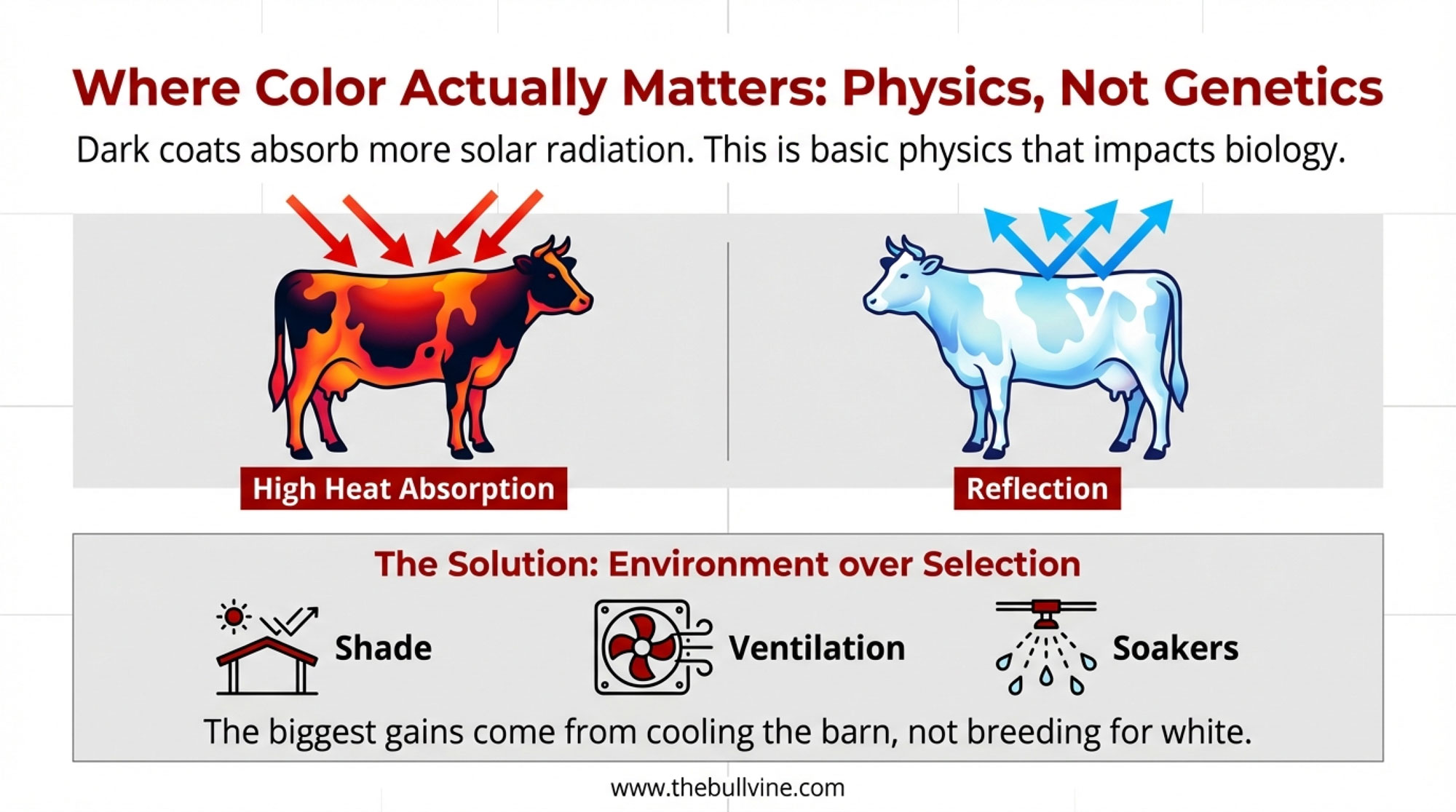
Dark surfaces absorb more solar radiation than light surfaces; that’s just basic physics. Studies using thermal imaging and surface temperature sensors have shown that black patches of hair on cattle backs can run several degrees hotter than adjacent white patches when animals are in full sun. That extra absorbed heat adds to the load the cow has to get rid of.

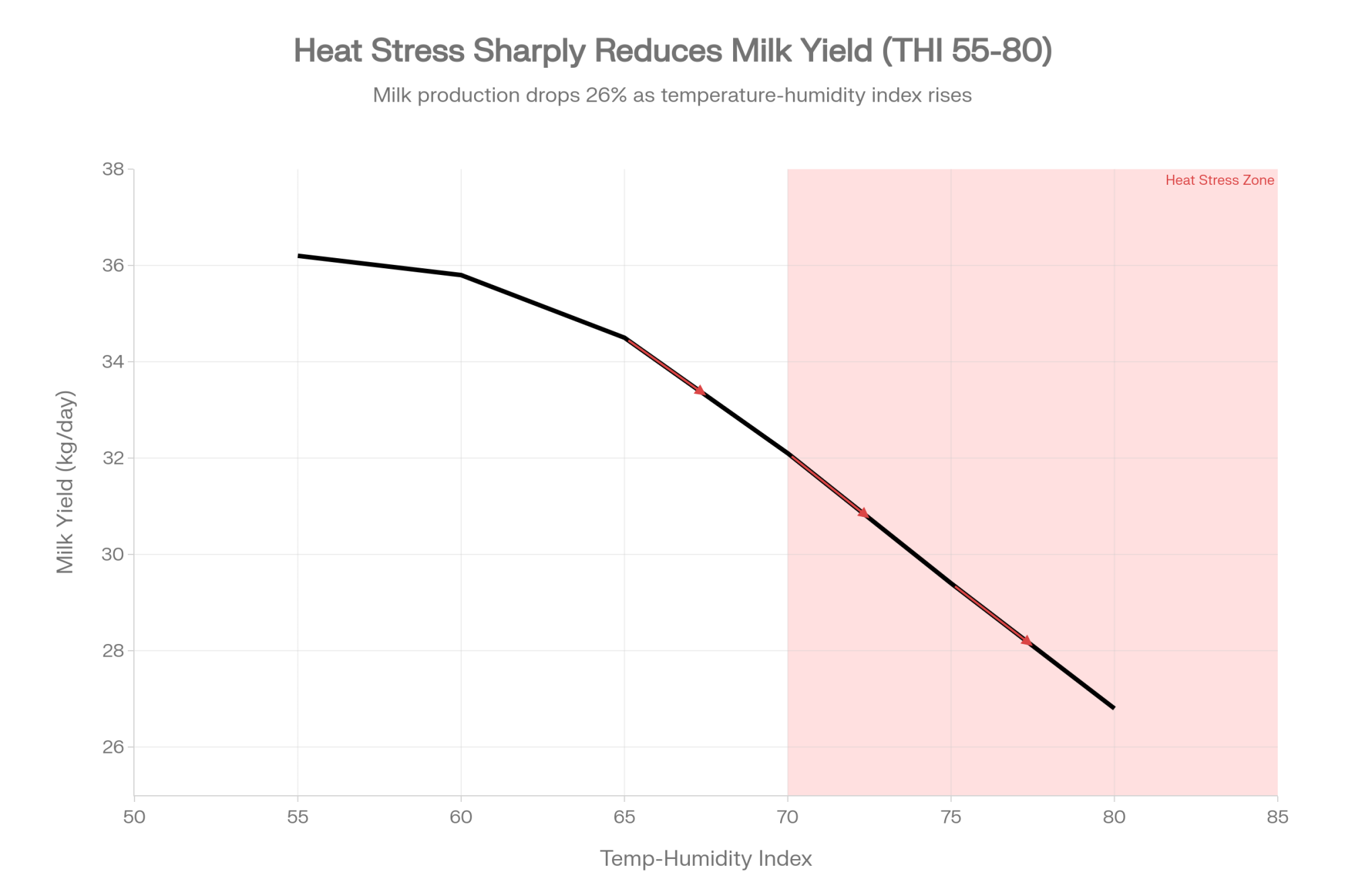
A 2024 paper in the Journal of Dairy Science examined Holstein–Friesian crossbred cows in Tanzania and drew on earlier THI work on Holsteins. As the temperature‑humidity index moved into heat‑stress ranges, the researchers observed that rectal temperature, respiration rate, and panting scores all increased. At the same time, milk yield, milk fat percentage, and solids‑not‑fat percentage dropped. In other words, as cows got hotter, they gave less, and the component tests slipped too.

On pasture‑based systems in New Zealand and Australia, extension folks and researchers have seen the same basic pattern. Under heat stress, cows stand and pant more, graze less, and produce less milk unless they’ve got shade, water, and some form of cooling. Some work suggests that cows with lighter coats or slicker hair hold up a bit better under those conditions, which is why there’s been interest in breeding for heat tolerance in grazing systems.

One pretty eye‑catching example came out of CSIRO. Their team produced Holstein–Friesian calves from embryos edited at a coat‑dilution gene called PMEL. Those calves had lighter coats and, when they were put in the sun, took on less radiative heat than their darker‑coated herdmates. They’re strict research animals, not anything you’ll find on a commercial farm, but it shows how seriously some groups are taking the connection between coat, heat, and performance.

What This Means on Your Farm

Here’s how color and heat pencil out in different setups:

Your situationFocus first on
Hot, high‑sun region or dry lot with limited shade (Central Valley, CA, parts of Texas/Florida, southern Europe)Shade structures, fans, sprinklers, and good water access. Don’t count on breeding for more white to solve heat stress. Fix the environment first, because that’s where the biggest gains are.
Moderate climate with decent ventilation (Ontario, Wisconsin, Quebec, northern Europe)Solid ventilation and transition‑period management first. Genomic testing and index‑based selection will move the needle more than fussing over color, though heat‑abating investments still pay on the worst days.
Pasture‑based with limited infrastructure (NZ‑style or U.S. grazing herds)Shade and water access, careful grazing management on hot days, and—if the genetics are available—looking at heat‑tolerant and slick‑hair lines can help, especially as summers get hotter.

So yes, color does play a role in heat load, especially in hot, bright environments and in dry lot systems. It can absolutely show up as lost milk and tougher breeding if cows are constantly fighting heat stress. But even in those regions, coat color is one part of a bigger heat‑stress and cow‑comfort picture. It’s not a substitute for good ventilation, shade, or water, and it’s not a stand‑alone selection tool for profit.

What Genomics Has Actually Changed for Your Bottom Line

Now let’s talk about genomics, because that’s where the biggest shift has happened in how Holstein genetics translate into dollars.

When genomic evaluations came onto the scene in the U.S. and Canada around 2008–2010, the promise was pretty simple: use DNA information from young animals to predict their genetic merit before they have milking daughters, shorten generation intervals, and speed up genetic progress.

That big U.S. Holstein study in the National Academy Journal really put numbers to it. Once genomics was adopted, the sire‑of‑bull generation interval came down from roughly 6.8–6.9 years to about 2.4 years. Annual genetic gains for milk, fat, and protein almost doubled. For health and fertility traits such as somatic cell score, daughter pregnancy rate, and productive life, gains were three- to four‑fold.

More recent work, including a 2023 paper in the journal G3, has combined fertility traits into a single reproductive index and shown that there’s sufficient genomic signal to select for fertility, not just milk effectively. That lines up with what many of us have seen on real farms: herds that use genomic information well can walk that tightrope of driving production up while also improving fertility and udder health, rather than trading one off against the other.

So genomics gives you a much clearer window into traits your eye just can’t judge in a young heifer. You can’t see the daughter pregnancy rate or expected survival to third lactation by looking across the calf pen, but the DNA markers give you a probability estimate that, while not perfect, is a lot better than guessing.

The Cost Reality

Then there’s the math.

That Canadian heifer‑cost study we talked about pegged the average replacement cost at CA$2,904 per head, with many farms running well over CA$3,000. North American dairy budgets usually land in the US$1,800–2,500 range when you include feed for the entire rearing period, housing, labor, vet bills, and breeding costs.

On the testing side, commercial genomic panels—like CLARIFIDE and similar offerings—typically price out at US$35–50 per heifer in North America, depending on the panel and your volume.

Cost ComponentTypical RangeStrategic Note
Feed (to 12–18 months)$800–$1,200 USDLargest single expense; improves with forage/commodity costs
Housing, bedding, utilities$300–$500 USDPer-heifer share of fixed barn and infrastructure
Labor (handling, health, records)$250–$400 USDOften underestimated; includes AI tech/vet time
Veterinary, vaccines, breeding$200–$350 USDReproduction drugs, health treatments, AI straw(s)
TOTAL REARING COST (pre-calving)$1,800–$2,500 USDAverage: ~$2,000 USD or ~$2,900 CAD per head
Genomic test (commercial panel)$35–$50 USD= 1.75–2.8% of total rearing cost
% of Heifers Typically Culled by Index (bottom 20–30%)$360–$750 USDWaste eliminated: cost of rearing low-index heifers avoided
Payoff: Genomi test cost recovered if you cull just 1–2 poor heifers per yearBreak-even: ~$40–75 per yearRisk management, not a luxury

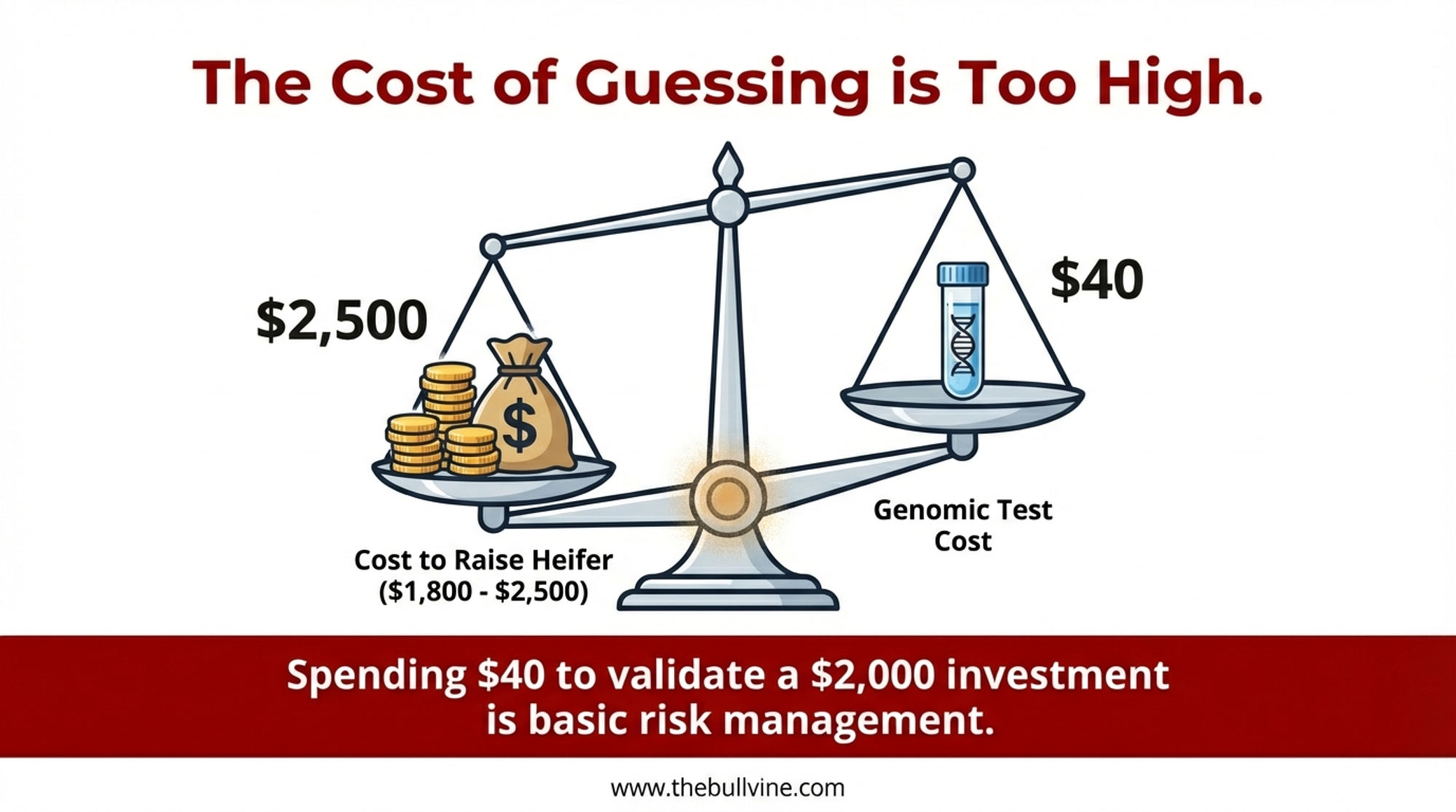
So when you step back, you’re talking about spending forty dollars to find out whether an animal is worth a two‑thousand‑dollar investment. For a lot of herds, that’s not a luxury; it’s basic risk management.

Looking at Inbreeding: Faster Progress, Tighter Gene Pools

Here’s where the story gets a bit uncomfortable. The same genomic tools that gave us faster gains have also made it very clear that tightening up the gene pool in Holsteins.

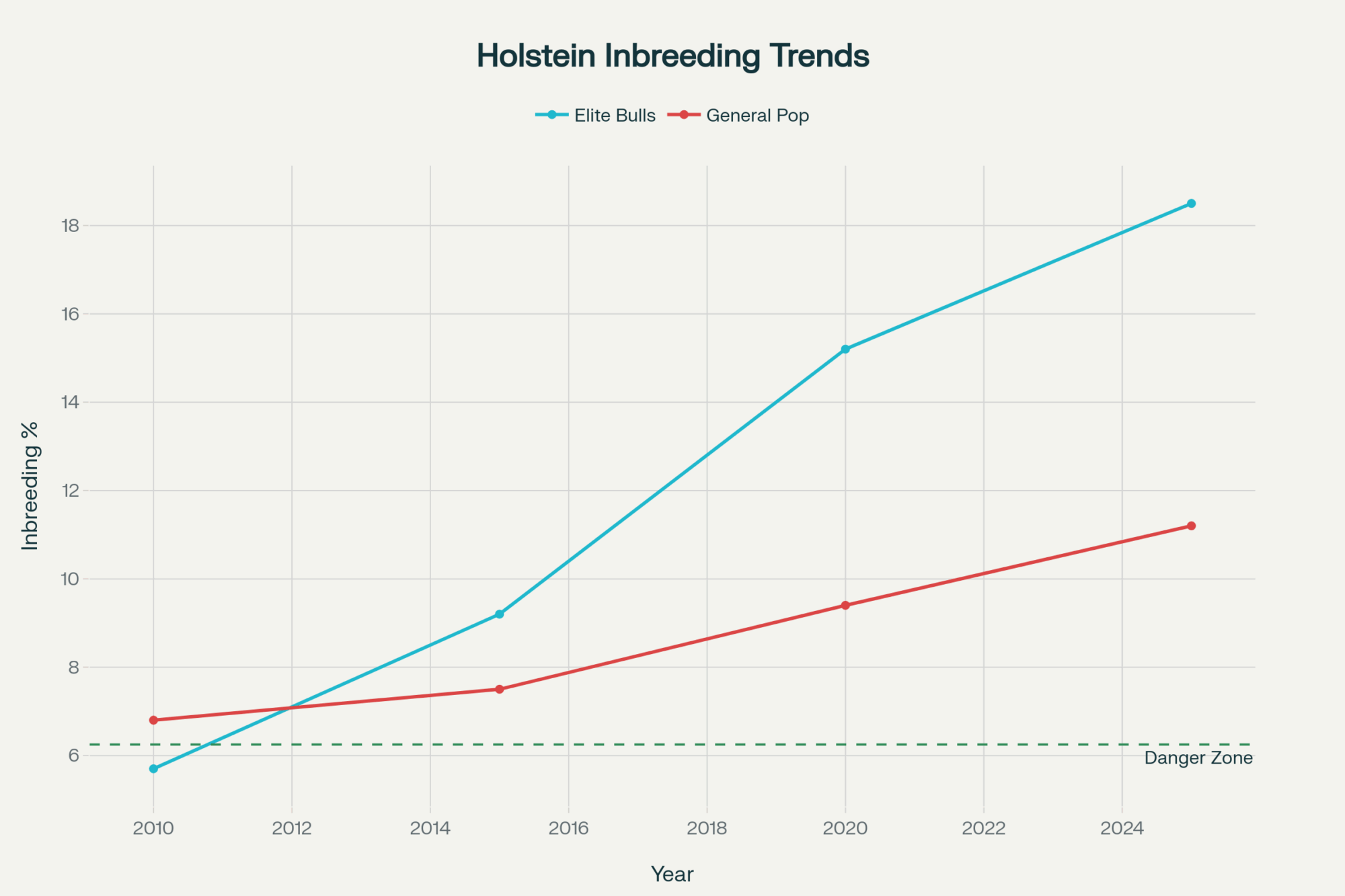
A North American Holstein study in BMC Genomics dug into runs of homozygosity—those long stretches of identical DNA on both chromosomes—and tracked them from animals born in 1990 through to 2016. They found that the average number of ROH segments at least 1 megabase long per animal went from around 57 in the 1990 cohort to about 82 in animals born by 2016. In the last five years of that period—right when genomic selection really took off—the yearly increase in these ROH segments was almost double what it had been earlier.

The authors made an important point: on a per‑generation basis, the increase in inbreeding wasn’t dramatic. But because the generation interval was so much shorter, you were stacking generations faster and building inbreeding per calendar year much more quickly.

Italian Holstein data tell a similar story. A 2022 paper in Frontiers in Veterinary Science looked at genetic diversity before and after genomic selection. Pedigree‑based inbreeding was around 7%, but genomic inbreeding, based on ROH, was clearly higher and rising faster, and the effective population size—a measure of how many “independent” genetic contributors you really have—was dropping. Follow‑up work linked higher genomic inbreeding to reduced stayability: more inbred cows simply didn’t stay in the herd as long.

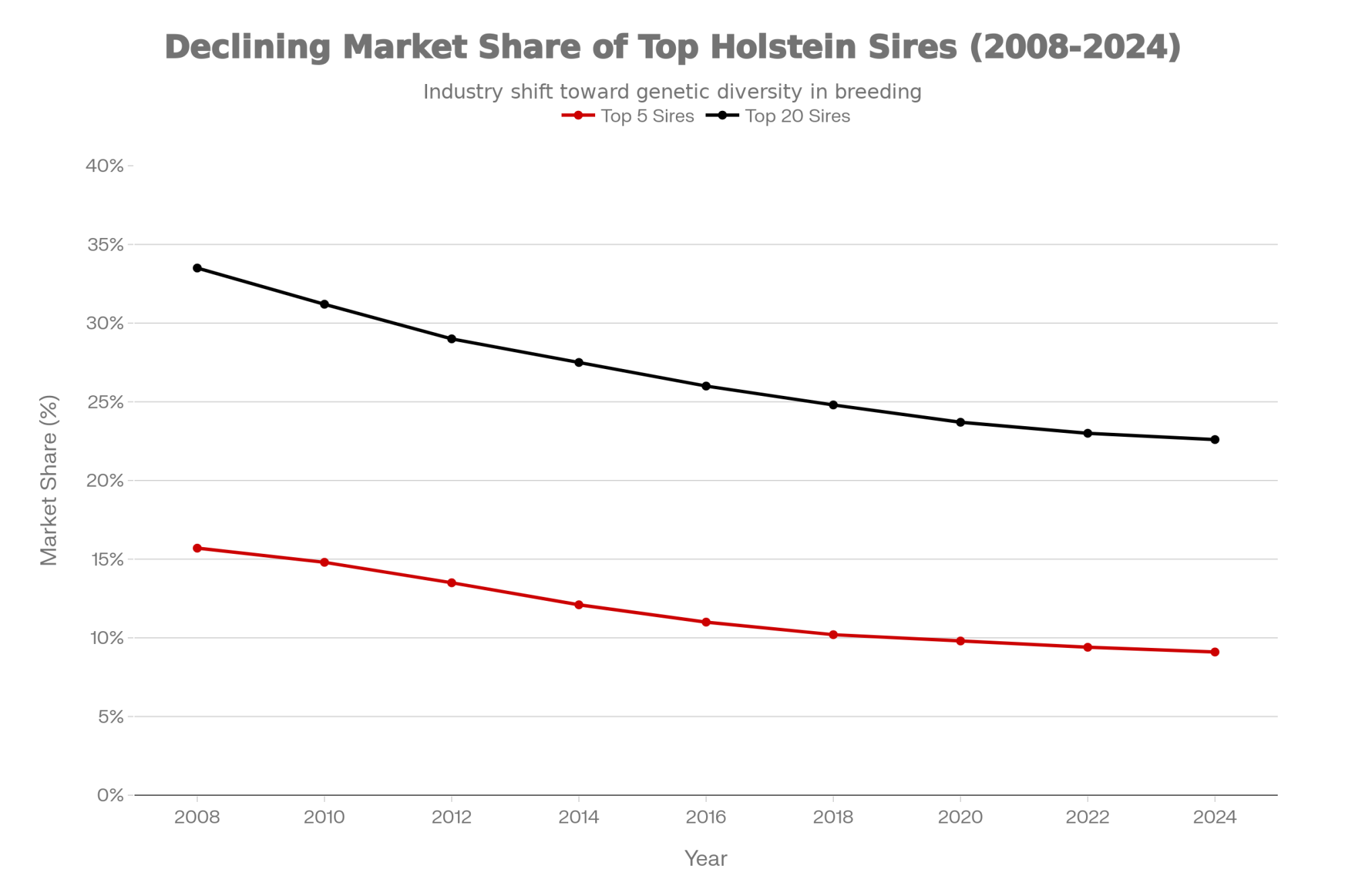
So here’s the irony that’s worth sitting with for a minute. For years, a lot of us chased a very particular “look”—the Goldwyn kind, Shottle daughters, that tall, sharp cow. Then genomics came along, and many herds stopped worrying as much about that look and started chasing the top indexes instead. The data now say that in the process, we’ve pushed a lot harder on the same gene pool, faster, especially through very heavy use of a small number of elite bulls.

You look across your pens today, and the cows may not look as cookie‑cutter as those ‘90s flush families. But under the skin, genetically, they’re more closely related than most of us realize.

What You Can Do About It

The good news is that the same genomic tools that measure inbreeding can help you manage it.

A recent review from Italy on on‑farm genetic management describes how using genomic relationship matrices and “optimal contribution” strategies can balance genetic gain and inbreeding in dairy herds. What that means in practice is this: instead of just looking at pedigree inbreeding, you use the actual genomic relationships between your cows and potential sires to decide who should be the parents of the next crop of replacements.

On a real farm, that often comes down to:

  • Using mating programs that incorporate genomic relationship data, not just sire stacks and pedigree inbreeding.
  • Being careful about breeding a bull back too heavily to his own daughters and granddaughters.
  • Spreading your bull usage across a team of high‑index sires instead of hammering one or two “super sires.”
  • Sometimes, being willing to use a slightly lower‑index bull if he’s less related to your cow family and still meets your key trait goals.

It’s worth noting that no one is saying “stop selecting hard.” The point is to keep the inbreeding curve from getting too steep, so you don’t quietly paint yourself into a corner when it comes to health, fertility, or adaptability down the road.

Why the Eye Still Matters—and Where It Fits Now

So with all this talk about genomics and indexes, it’s fair to ask: where does your eye fit now?

In a lot of barns, what I’ve seen is that the role of the eye has shifted from being the primary genetic gatekeeper to being the primary management tool.

You know how this goes. You still need to walk pens and:

  • Spot a cow that’s just starting to limp before she’s three‑legged lame.
  • Watch body condition as cows move through the transition period to prevent crashes right after calving.
  • See how cows actually use stalls, bedding, waterers, robots, and feed lanes in your specific barn layout.
  • Catch fresh cows that are “just off” a bit before they show up in the software as a health case.

Genomic indexes and national evaluations can’t do that job. What they can do is take some of the guesswork out of which heifers you invest in and which cows you want daughters from.

At a genetics workshop in Ontario, one Holstein producer described that evolution nicely. He said he used to think his eye was the best tool he had. Now he sees it as his best management tool, while genomic tests tell him which heifers are actually worth raising. A lot of Midwestern and Quebec producers I’ve talked with would say something similar in their own words.

What This Means for Your Holstein Breeding Strategy

So let’s bring this back to your breeding plan, because that’s where all this needs to land.

Picture a 280‑cow Holstein freestall herd in Wisconsin or southwestern Ontario, shipping into a cheese market where butterfat and protein premiums really drive the cheque. Cows are averaging mid‑30s kilos per day with good components, the transition cows get a lot of attention, and the farm already uses some sexed semen and a bit of beef‑on‑dairy.

You could just as easily imagine a 120‑cow tie‑stall in Quebec or a 600‑cow dry lot system in California. The genetics math is the same; you just adjust the heat‑stress and housing parts.

Here’s what a practical, 2025‑ready strategy can look like.

1. Run a One‑Year Genomic Trial

One very low‑risk way to start is a “learn from your own data” trial over 12 months.

  1. Test every heifer calf for a year. Take hair or tissue samples in the first week or two and send them to your preferred lab—Zoetis, Neogen, Lactanet, or your national provider—and ask for the main economic index your market uses, whether that’s Net Merit, Pro$, or LPI.
  2. Keep making keep/cull and breeding decisions exactly the way you do now, based on dam performance, cow family, and what you see in the pen.
  3. At the end of the year, sit down with your vet, nutritionist, or a genetics advisor and compare your actual decisions to the genomic rankings.

In many herds that have tried this, a familiar pattern pops up: there are some heifers you really liked visually that sit only middle‑of‑the‑pack on fertility and longevity indexes, and a few plainer heifers that rank near the top. Seeing that in your own animals tends to carry more weight than any sales pitch.

If your main criterion for keeping a heifer is how much white she has, what the genomic work and the big GWAS studies are saying is that you’re effectively betting a couple of thousand dollars on a trait that doesn’t even show up as a major driver in Net Merit or Pro$. That’s a tough bet to justify once you’ve seen your own data.

2. Let One Economic Index Be Your Compass

To keep it from being overwhelming, most herds do best if they pick one total merit index—Net Merit, Pro$, LPI, or the relevant national index—and let that act as the primary compass.

Heifer Tier (by Index Rank)% of HerdSemen StrategyExpected Calf OutcomeEconomic NoteAction
TOP 20–30% (High Index)20–30%Sexed Holstein(maximize daughters)Female calves; all raised as dairy replacements (or top beef-cross if surplus)Highest genetic merit; drives herd average; replacements carry forward strong geneticsPrioritize nutrition, health, transition management; track 1st lactation performance
MIDDLE 40–50%40–50%Conventional Holstein OR 50% sexed + 50% beefHolstein bull calves (sold); crossbred calves (beef market); daughters retained if above-average herdBalances dairy replacement supply with beef revenue; some genetic gain but not peakMonitor calf sex ratio; align with real replacement needs; consider beef-market strength
BOTTOM 15–25%15–25%Beef Semen(Angus, Simmental, etc.)Crossbred calves premium beef market (black hides command premium); no dairy daughtersMaximizes calf value ($400–600/head vs. $50–100 for dairy bull); eliminates low-merit dairy genetics; often breaks even or profitable on rearing costFast-track to beef channel; NO heifer rearing; recoup heifer costs via calf value
PROBLEM COWS (repeat breeders, chronic mastitis, severe structural defects)5–10%Beef SemenCrossbred calves to beefRemoves undesirable traits from breeding; converts problem cows into profitable calf sourceTerminal decision; one more calf, then cull

Then you:

  • Rank all heifers and young cows by that index, high to low.
  • Decide on a cutoff—maybe the bottom 10–20% or a certain dollar amount below your herd average—below which you don’t raise heifers as dairy replacements.
  • Use that ranking to structure semen use:
    • Top tier: sexed Holstein semen on the females you want daughters from.
    • Middle tier: conventional Holstein semen.
    • Bottom tier and problem cows (chronic mastitis, very poor feet, reproduction issues): beef semen.

This is where the math really shows up. If you’re putting US$35–50 into a genomic test and US$1,800–2,500 into rearing a heifer, using that index ranking to decide who gets a replacement slot and who doesn’t will change your cost per hundredweight over the next few years.

3. Use Mating Programs to Manage Inbreeding

The next step is to ensure your mating program uses genomic data to mitigate inbreeding.

It’s worth asking your AI rep or mating service a couple of direct questions:

  • Are you using genomic relationship information, or just pedigree, to calculate inbreeding risk?
  • Can you show me the expected genomic inbreeding for each proposed mating?

Given that both the North American and Italian Holstein studies show faster increases in genomic inbreeding and more ROH in the genomic‑selection era, it makes sense to watch this. Some advisors suggest targeting expected genomic inbreeding for replacement heifers in the mid‑single digits, where practical, and only accepting higher values when you’re getting a very significant bump in other traits. The exact target will depend on your herd and sire options, but the principle is to avoid stacking closely related bulls on closely related cows over and over.

In practice, that often looks like still using the elite bulls, but spreading their use across more unrelated cow families, rotating between several high‑index sires instead of just one or two, and sometimes choosing the “second‑highest” bull on a list because he’s less related to your cows, while still very strong on your key traits.

4. Line Up Sexed and Beef Semen With Your Index and Markets

Genomics also helps answer a very practical question: which cows should make your next generation of Holstein replacements, and which should be making calves for the beef market?

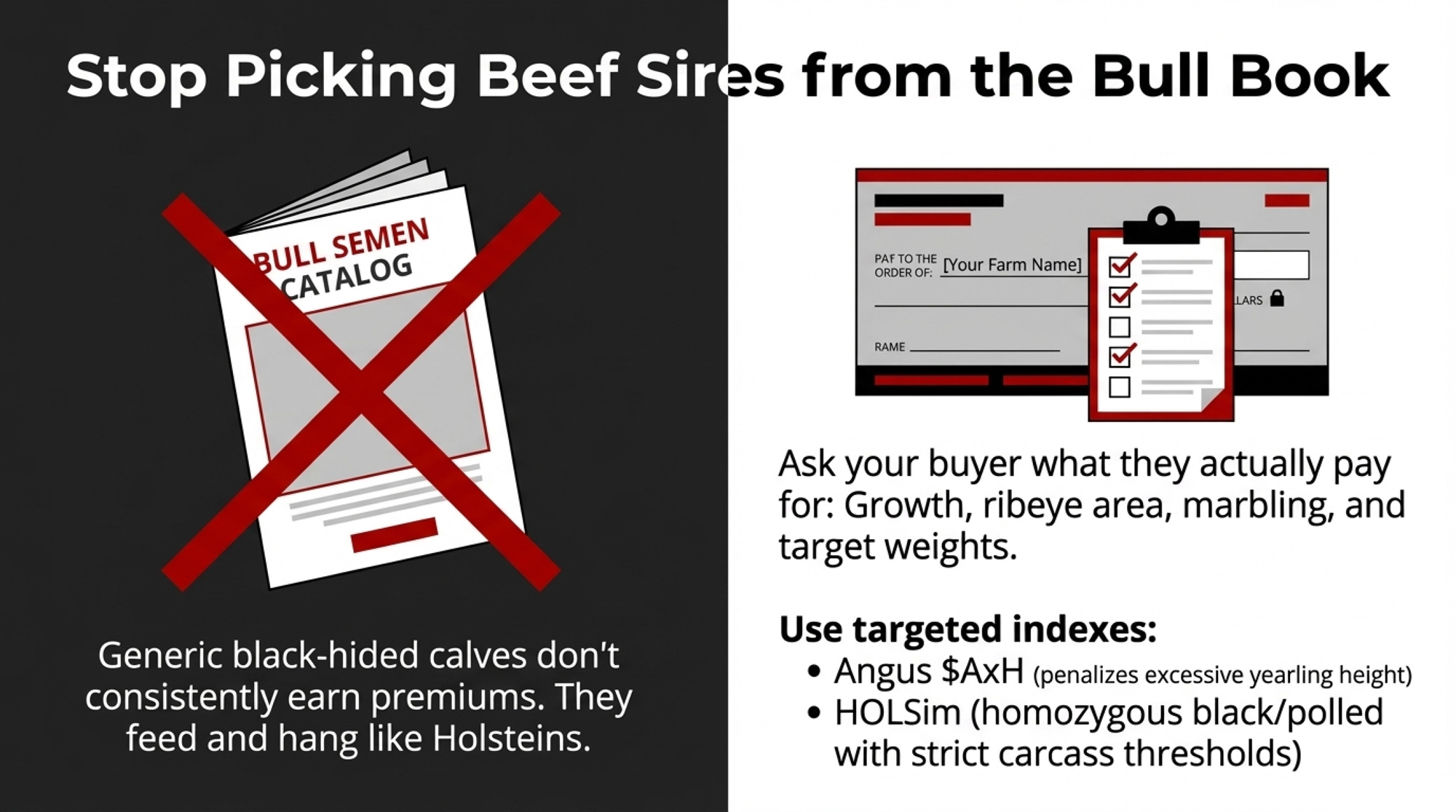
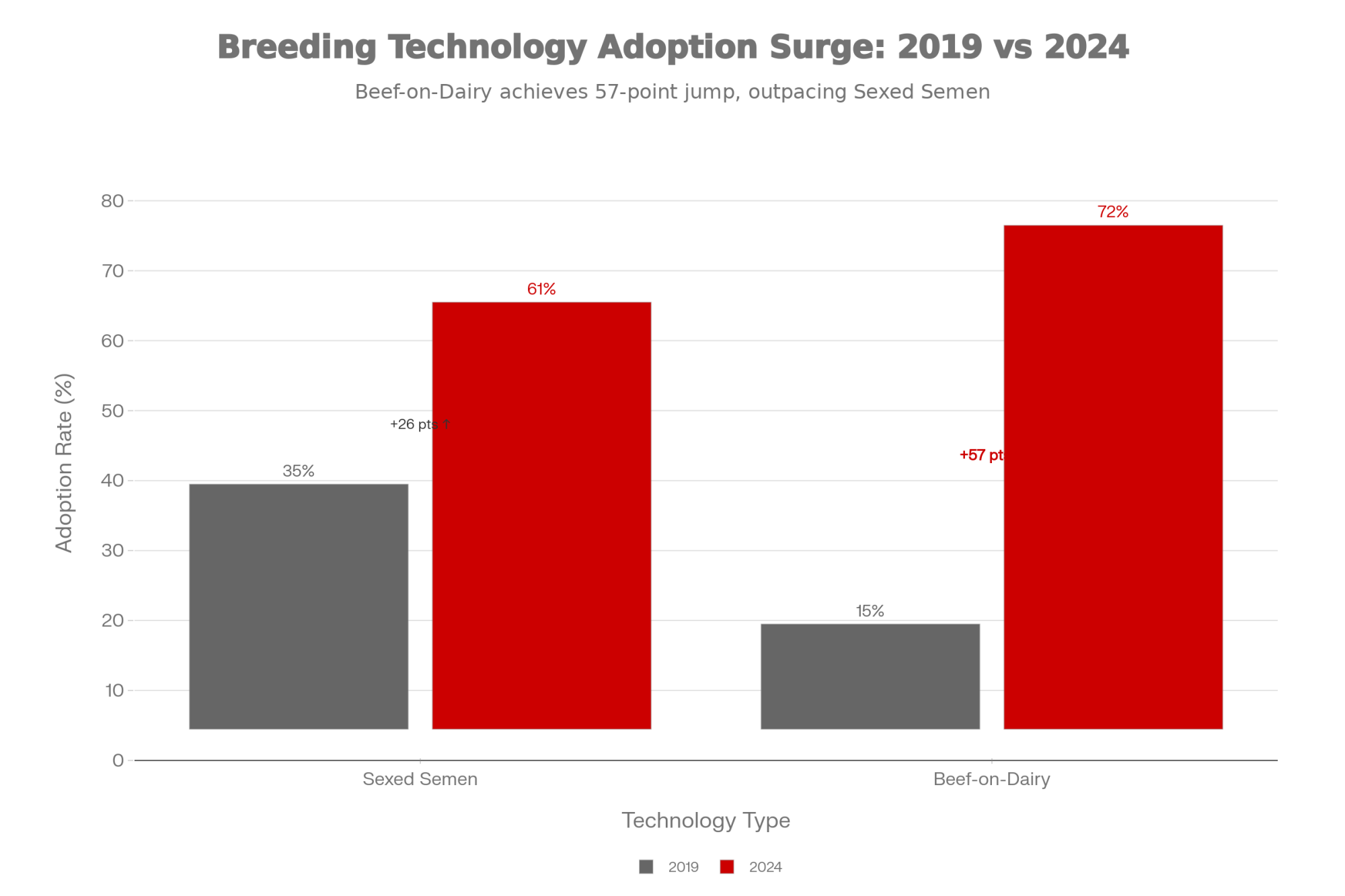
Those HighGround Dairy numbers we talked about—over US$4.00 per hundredweight of milk in some scenarios from cull cow and beef‑on‑dairy calf revenue, and earlier projections with several months over US$5.00—show just how big that lever has become on the income side when beef markets are favorable. At the same time, semen‑sales trends and processor programs in North America and Europe show beef‑on‑dairy has become mainstream, especially where packers and branded programs pay up for black‑hided crossbred calves.

A genomics‑aligned plan that a lot of progressive herds are using looks like this:

  • Sexed Holstein semen on the top 20–40% of females by your chosen index—the ones you really want daughters from.
  • Conventional Holstein semen is on the middle group, where you still want some dairy bull calves and a share of replacements.
  • Beef semen on the bottom tier and on cows with traits you don’t want to multiply, such as chronic mastitis, repeat breeders, or severe structural issues.

Combine that with your heifer‑raising cost numbers and your local calf market, and you start to get a very clear picture of where your breeding dollars and semen investments are actually coming back to you.

5. Keep Your Eye in Its Best Role

Through all of this, your eye stays central. It’s just playing a different position on the team.

You know your cows. You know who milks through tough rations, who bounces back after a hard calving in the transition period, and who always seems to find trouble. That day‑to‑day cow sense is the piece no index can replicate.

What genomics does is help you decide which calves deserve the chance to become that kind of cow in the first place. It narrows the group, so you’re not putting full rearing costs into animals that were never likely to reach third or fourth lactation under your system.

Looking Ahead: Diversity, Climate, and the Holstein of 2050

If we zoom out past next year’s milk cheque and think about the Holstein cow of 2040 or 2050, three big forces keep coming up in both research papers and barn‑aisle conversations: genetic diversity, climate, and markets.

On the diversity side, the North American ROH work and the Italian Holstein studies send a pretty consistent message: genomic inbreeding is rising, and effective population size is shrinking in intensively selected Holstein populations. No one credible is predicting a sudden cliff, but there is a very real concern that if we keep pushing hard on a narrow gene pool, we could slowly chip away at the breed’s ability to adapt to new diseases, production systems, or environmental pressures.

On the climate side, more frequent heat waves and higher average summer temperatures are already a reality in parts of the U.S., southern Europe, and elsewhere. That 2024 Journal of Dairy Science review that pulled together heat‑stress studies put numbers on what many of you see in the barn: as THI climbs, cows eat less, energy‑corrected milk drops, and the strain shows up in both milk yield and reproduction. Some of the work digs into the biology—oxidative stress, rumen changes—but the bottom line is simple enough: hot cows don’t use feed efficiently and don’t breed as well.

On the market side, we’re seeing more beef‑on‑dairy programs, more milk cheques driven by components and quality premiums, and more processor attention to consistency and welfare. All of that favors cows that stay in the herd, handle stress, and breed back reliably, not just cows that peak high in first lactation.

What’s encouraging is that we’ve got better tools than ever to work with:

  • Genomic inbreeding and relationship data, not just pedigree estimates.
  • Mating strategies like optimal contribution that let you balance genetic gain and inbreeding.
  • Economic indexes that include fertility, udder health, productive life, and sometimes feed efficiency, alongside milk and butterfat.
  • A growing body of heat‑stress research to guide decisions on ventilation, shade, sprinklers, and water management.
  • Beef‑on‑dairy programs and pricing signals that can pay you properly for the right kind of crossbred calves.

The challenge is putting those tools together in a way that fits your herd size, your barns, your labor situation, and the markets you’re shipping into.

The Bottom Line

So if we’re back at that kitchen table and you ask, “Alright, what should I actually do with all this?”, here’s how I’d boil it down into concrete moves for the next year or two.

  1. Run a one‑year genomic test trial on all heifer calves. Don’t change your decisions for that year—just compare what you did to what the index ranking suggests at the end and see where your eye and the DNA agree or disagree.
  2. Pick one economic index—Net Merit, Pro$, LPI, or your national equivalent—and use it as your main compass to sort females into top, middle, and bottom tiers for semen strategy and replacement decisions.
  3. Ask your mating program provider to show you genomic inbreeding for planned matings, not just pedigree inbreeding, and work together to avoid pushing replacement heifers into very high genomic inbreeding levels.
  4. Line up sexed Holstein and beef semen use with both your index ranking and your real replacement needs, keeping today’s heifer‑raising costs and beef‑on‑dairy calf values in mind.
  5. Take a hard look at your heat‑stress plan before next summer—especially if you’re in hot regions or dry lot systems—and ask whether your shade, fans, sprinklers, and water access match what the research and your own cows are telling you.

The herds that lean into this in the next five years will quietly build cows that last longer and earn more per stall. The ones that keep breeding by color and habit will feel it in higher heifer costs, more inbreeding‑related headaches, and fewer options when weather or markets shift on them.

What this whole development suggests is that the next chapter in Holstein breeding isn’t about arguing whether the eye or the computer is “right.” It’s about putting them in the right jobs and letting them work together.

And if we keep sharing what’s actually working—how herds are using genomic tests, indexes, mating programs, heat‑stress strategies, and beef‑on‑dairy opportunities—then, as a group, we’re in a strong position to keep Holsteins productive, profitable, and adaptable well into 2050.

As for color? It’ll probably always be part of how we talk about Holsteins and the kind of cow we like to look at. It just doesn’t need to be driving the bus anymore.

Key Takeaways:

  • Breeding by coat color won’t move your index. Pigment genes like MC1R and COPA are far from the major milk and fertility loci, so selecting heifers based on “more white” doesn’t reliably improve Net Merit or Pro$.
  • Genomics doubled genetic gain—and sped up inbreeding. Sire generation intervals dropped from ~7 years to ~2.5 years, nearly doubling annual progress, but genomic inbreeding and runs of homozygosity are climbing faster per calendar year as a result.
  • Color matters for heat stress, not genetic merit. In hot climates and dry lots, darker coats absorb more solar load, pushing cows into heat stress sooner and costing milk, components, and fertility when cooling falls short.
  • Beef-on-dairy can add $4+/cwt when done right. HighGround Dairy’s 2025 modelling shows well-structured beef programs can add more than US$4.00/cwt to margins in favorable markets—real money that changes breeding math.
  • A $40 genomic test protects a $2,000 bet on a heifer. With rearing costs often US$1,800–2,500, using index rankings to decide who gets sexed semen and a replacement slot is risk management, not a luxury. Your eye then shifts to its best role: daily cow management and fresh-cow troubleshooting.

Executive Summary: 

Many Holstein herds are still quietly letting coat color and “kind” influence breeding decisions, even though pigment genes like MC1R and COPA sit on different parts of the genome than the big milk and fertility loci that large Holstein GWAS keep identifying. Genomic selection has roughly doubled genetic gain in U.S. Holsteins by cutting sire generation intervals from about 7 years to about 2.5 years, but North American and Italian data also make it clear that genomic inbreeding and runs of homozygosity are rising faster per calendar year as a result. New heat‑stress research backs up what producers in hot regions and dry lot systems see every summer—darker coats absorb more solar load, cows hit heat stress sooner, and milk and components slip—while 2025 modelling from HighGround Dairy shows well‑designed beef‑on‑dairy programs can contribute more than US$4.00 per hundredweight of milk shipped to margins when markets are favorable. With heifer‑raising costs often in the US$1,800–2,500 (or CA$2,000–3,000) range, spending about US$40 on a genomic test to decide which calves actually justify that investment is, in many cases, simple risk management rather than a luxury. This article gives producers a concrete playbook: run a one‑year “test every heifer” trial, use one economic index as the main compass, use genomic mating tools to manage inbreeding, and align sexed Holstein and beef semen use with both index rankings and true replacement needs. The core message is that if you stop breeding by color and start breeding by genomics, heat‑stress realities, and beef‑on‑dairy math, you give your Holstein herd a much better shot at stronger per‑stall margins between now and 2030.

Complete references and supporting documentation are available upon request by contacting the editorial team at editor@thebullvine.com.

Learn More

  • Selective Breeding: The Art and Science of Beef-on-Dairy – Stop guessing at the bunk and start capturing market premiums. This breakdown delivers a field-tested protocol for selecting terminal sires that guarantee the carcass quality beef buyers demand, transforming your bottom-tier cows into high-margin profit centers.
  • Navigating the 2025 Dairy Economy: Maximizing Margins in a Volatile Market – Master the shifting financial landscape by aligning your herd expansion goals with current global supply trends. This analysis arms you with the economic foresight to hedge against rising input costs while maximizing your milk-to-beef revenue ratio through 2028.
  • Gene Editing and the Dairy Industry: Beyond the Horizon – Break past traditional breeding limits by leveraging CRISPR and slick-gene technology to heat-proof your herd. This deep dive exposes the genetic advancements that will define cow comfort and performance as climate volatility becomes the new normal for global producers.

Join the Revolution!

Join over 30,000 successful dairy professionals who rely on Bullvine Weekly for their competitive edge. Delivered directly to your inbox each week, our exclusive industry insights help you make smarter decisions while saving precious hours every week. Never miss critical updates on milk production trends, breakthrough technologies, and profit-boosting strategies that top producers are already implementing. Subscribe now to transform your dairy operation’s efficiency and profitability—your future success is just one click away.
NewsSubscribe
First
Last
Consent

The 2026 Breeding Playbook: Using Calf‑Health Genomics and Beef‑on‑Dairy to Unlock $50,000 in Your Herd

Sick calves can drain $27,000/year from your herd. By 2026, genomics will let you stop breeding them. Here’s the playbook.

EXECUTIVE SUMMARY: USDA research now confirms what many producers have long suspected: calf scours and respiratory disease are partly genetic—and by 2026, you’ll be able to select against them. The numbers are hard to ignore. Sick calves can drain $27,000 a year from a 1,000-cow herd, while wrong breeding calls leave another $30,000-plus on the table in missed beef-on-dairy premiums and wasted heifer slots. With replacements at a 20-year low, beef-cross calves topping $1,000, and heifers costing north of $2,500 to raise, every semen straw now carries real economic weight. This article lays out a five-step breeding playbook—genomic testing, rule-based beef-versus-dairy decisions, calf-health sire screening, calving-pressure management, and ongoing market adjustments—that forward-thinking herds are already putting to work. Producers who start now can realistically expect to shift $50,000 or more in annual herd economics within 18-24 months.

Calf-health genomics

You know how the talk goes once the parlor’s washed down and the coffee’s on. Somebody mentions a nasty run of scours or a bunch of calves that just won’t quit coughing in the group pen, and five minutes later, you’re into genomics, beef‑on‑dairy, heifer prices, and whether some cows should ever see a dairy straw again. That’s not small talk anymore. That’s survival planning. 

What’s interesting right now is that the genetics and the economics are finally lining up with what a lot of you have been seeing in your own hutches. Some cow families just throw tougher calves. Others seem to live in the treatment book every winter. And those sick calves quietly eat money long before they get a chance to show what they can really do on butterfat performance, fertility, or longevity. 

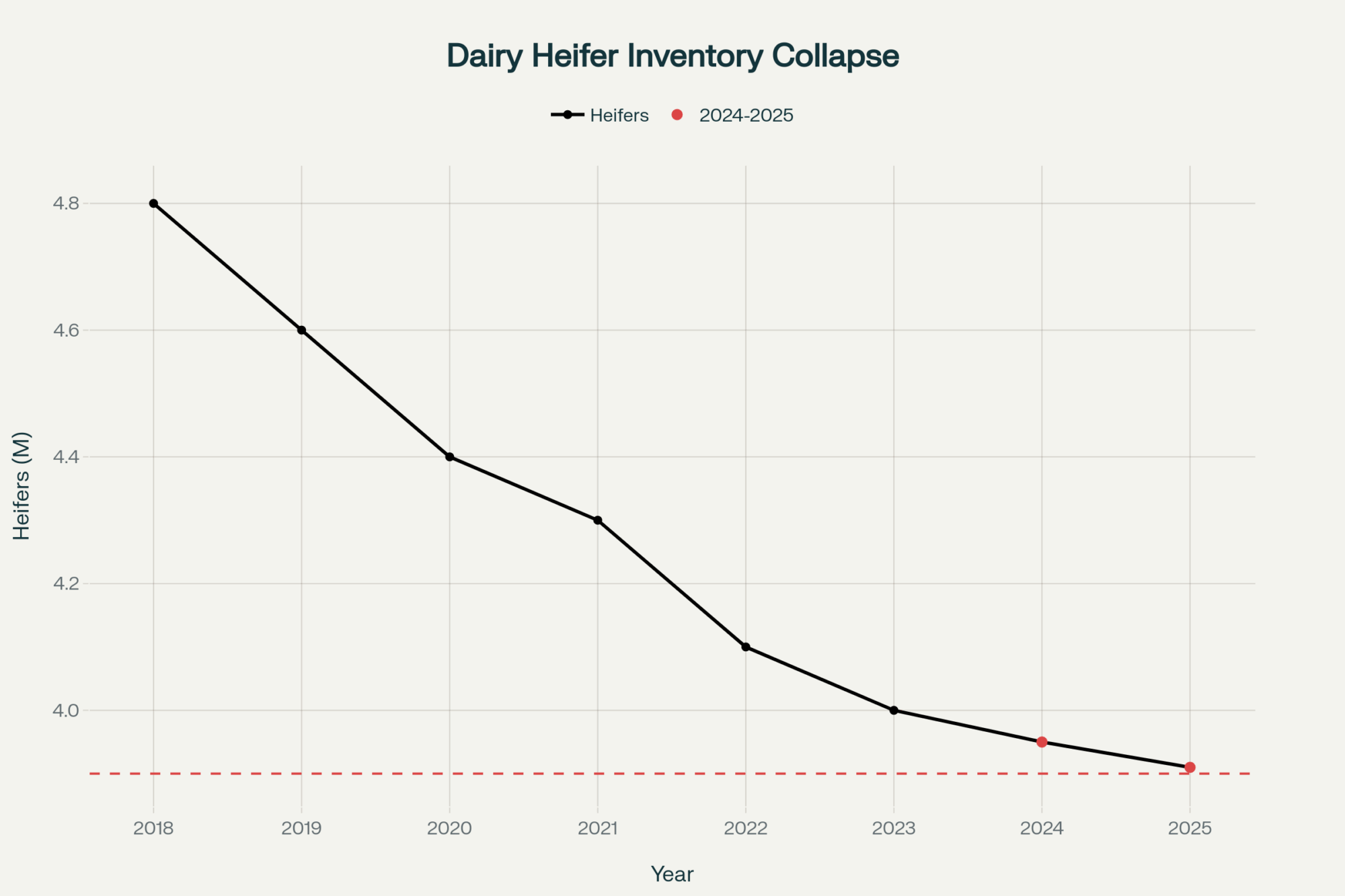
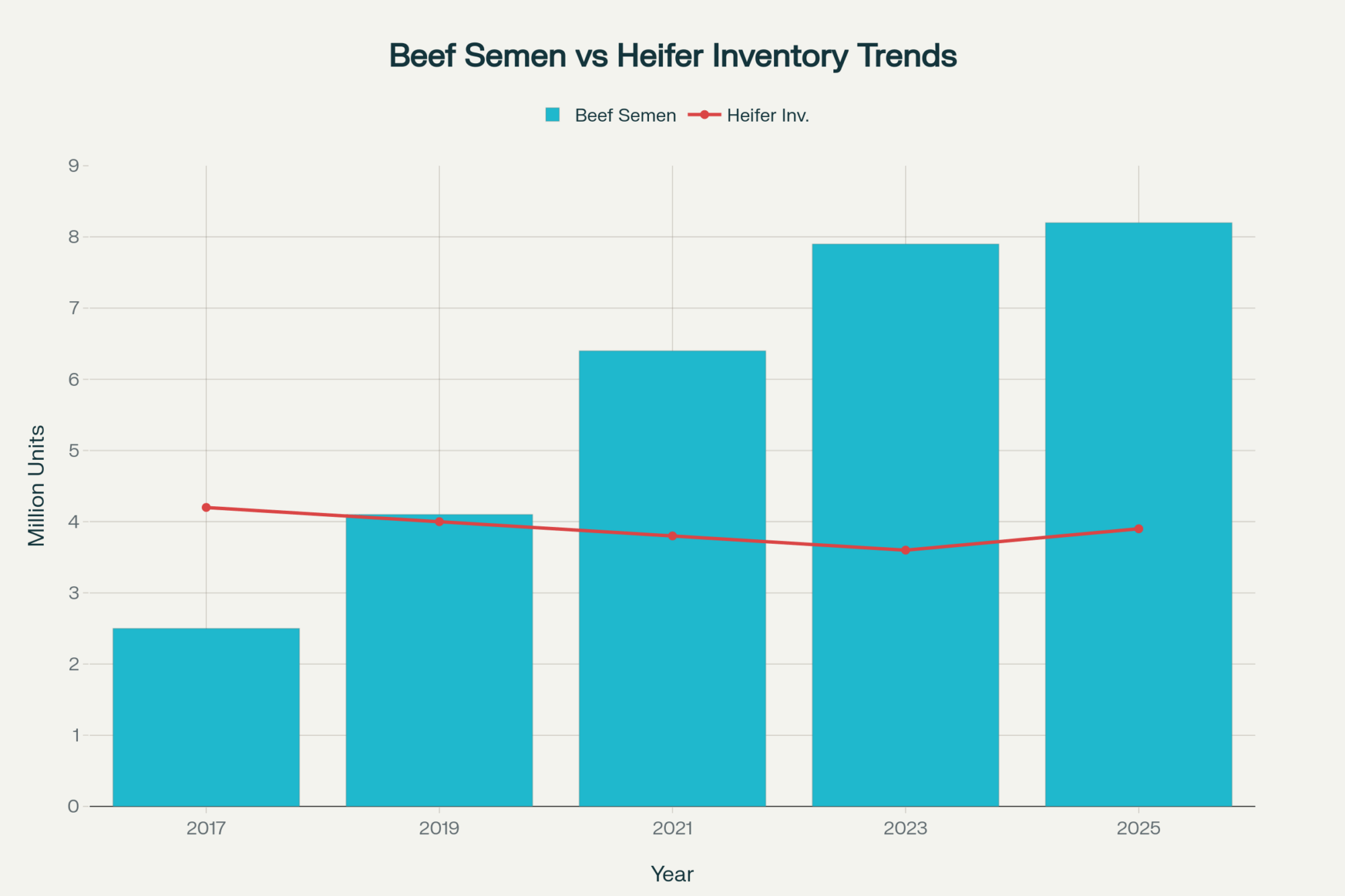
At the same time, beef‑on‑dairy has turned into serious money in a lot of sale barns and contract deals, right when replacement heifers have slid to the lowest levels we’ve seen in about 20 years and gotten expensive to either raise or buy. A 2025 CoBank report describes US dairy heifer inventories as sitting at roughly a 20‑year low and projects they could tighten by as much as 800,000 head before gradually rebounding after 2027 as roughly 10 billion dollars of new processing capacity comes online and needs milk. Analysts used USDA Cattle Inventory data to show that the number of dairy heifers over 500 pounds dropped from about 4.76 million in 2018 to roughly 4.06 million by early 2024—almost a 15% decline in the pool of future milkers. 

Put all of that together, and the question changes from “How do we get fewer sick calves?” to something a lot sharper:

Which calves do you actually want to be making in 2026—and which ones are you better off never creating in the first place?

Let’s walk through what the newest science says about calf‑health genetics, how it connects to beef‑on‑dairy money and replacement economics, and what a practical breeding plan looks like on real dairies.

Looking at This Trend: What the New Calf‑Health Genetics Actually Show

If you’re going to let genetics influence how you think about scours and pneumonia, the first question is simple: are these traits heritable enough to move the needle?

A 2025 paper in the Journal of Dairy Science from USDA’s Animal Genomics and Improvement Laboratory went straight at that. The team led by geneticists Babu Neupane, PhD, and John B. Cole, PhD, pulled producer‑recorded calf health data from the National Cooperator Database and built what’s probably the most comprehensive calf‑health dataset we’ve ever seen for North American Holsteins and Jerseys. 

Here’s what they worked with:

  • 207,602 calf records for diarrhea between 3 and 60 days of age.
  • 681,741 records for respiratory disease between 3 and 365 days.
  • Calves born from 2013 to 2024, with about 97.5% of the data coming from Holsteins and Jerseys. 

When they summarized those records, they found that 14.46% of calves had a recorded case of diarrhea in that 3‑ to 60‑day window, and 16.05% had a recorded respiratory case between 3 and 365 days. If you’ve ever watched a damp March wind whistle through hutches in Wisconsin or Ontario, those numbers probably sound about right. Scours tends to bully the youngest calves; as they get older, respiratory problems slowly take over. 

On the genetic side, they estimated heritabilities of 0.026 (2.6%) for resistance to diarrhea and 0.022 (2.2%) for resistance to respiratory disease. That’s modest, but it’s right in line with what’s been reported for cow‑health traits like clinical mastitis, metritis, and ketosis that we already include in Net Merit, Pro$, and other indexes. In plain language: calf‑health traits behave like other health traits we’re already comfortable breeding for. 

TraitHeritabilitySimilar Industry TraitTop 5% Sires (% Healthy Calves)Bottom 5% Sires (% Healthy Calves)Practical Implication
Diarrhea Resistance2.6%Clinical Mastitis (1.5%–3%)88%71%17 percentage-point spread; top sires prevent ~200+ sick-calf events per 1,000 calves born
Respiratory Resistance2.2%Ketosis (1–2%)88%70%Same order of magnitude; respiratory RBV predicts > 1 fewer pneumonia case per 10–12 calves
Cow Mastitis1.5%–3%Industry standard~85%~72%Calf-health heritability is comparable to traits we’ve been selecting on for 20+ years
Genetic Correlations0.0 to -0.1Low cross-trait pullN/AN/AImproving calf health does not sacrifice milk, fat, protein, or fertility gains

What’s encouraging is that when USDA‑AGIL ran genomic evaluations for these traits, the genomic predictions were noticeably more reliable than simple parent averages, particularly for young bulls with no daughter data yet. They also found that genetic correlations between calf‑health traits and most other traits—production, fertility, cow health—were low, with only a modest link between diarrhea and respiratory resistance and very little pull against milk or component traits. That matters. It means you can add calf‑health traits into a balanced index without giving up the gains you’re making in milk, fat, protein, or cow fitness. 

USDA‑ARS and the Council on Dairy Cattle Breeding (CDCB) have been presenting this work through ICAR and industry meetings. The consistent message has been that these calf‑health traits are ready for inclusion in US national genetic evaluations for Holsteins and Jerseys as soon as data quality and validation milestones are met, with 2026 targeted as the window for implementation. The exact month depends on final testing and governance, but the direction is clear. 

So, from a genetics point of view, we’re not talking about “maybe someday” anymore. These are real traits with real proofs coming.

What Sick Calves Really Cost: From $25 Per Case to $27,000 Per Year

You probably don’t need a scientist to tell you that sick calves are expensive, but it helps to put some hard numbers behind your gut feel.

A 2023 study in JDS Communications examined health costs at 16 certified organic Holstein dairies in the US. The researchers, including Laura C. Hardie, MSc, used on‑farm treatment records and standardized cost estimates for veterinarian time, medications, and producer labor. 

On the calf side, they found average direct costs of:

  • 25.21 dollars per case of scours.
  • 56.37 dollars per case of respiratory disease. 

Those figures are just what you can see on the invoice—vet visits, drugs, and some labor. They don’t include slower growth, extra days on milk replacer or starter, extra days to breeding, or the way a rough start can nibble away at first‑lactation milk and component performance. Reviews on calf health and heifer rearing, along with herd‑level calf‑health investigations, keep showing what many of you have already noticed: calves that get hammered early often lag behind, even when they survive and make it into the milk string. 

So it’s reasonable—based on those cost estimates and the documented performance impacts—to say that a serious pre‑weaning disease episode can trim a few hundred dollars off a heifer’s lifetime economic value on many farms once you add up treatment, extra rearing time, and lost milk later on. The exact figure will move with your feed costs, labor rate, housing system, and milk price, but the order of magnitude is real. 

If you want to see how that plays out across a herd, let’s do some simple math. Picture a 1,000‑cow dairy calving about 900 heifers a year. Say 15% of those calves—135 animals—have a significant scours or respiratory event. If you assign a conservative 200‑dollar economic hit per case, combining Hardie’s direct treatment costs with some allowance for long‑term performance losses, you end up at:

  • 135 calves × 200 dollars ≈ 27,000 dollars per year in calf‑health‑related losses.
Cost ComponentAmount (USD)Percentage of Total
Direct Vet & Drug Costs5,10019%
Producer Labor (extra time)4,05015%
Slow Growth & Extended Rearing8,10030%
Lost First-Lactation Milk/Components9,75036%
Total$27,000100%

That’s not a published national average—it’s a realistic illustrative example built from current cost data and what we know about early‑life disease. On herds with higher disease burden, more expensive inputs, or longer rearing periods, that number can easily climb into the higher tens of thousands. 

And that’s before you count the extra time and stress your team spends on repeated treatments and nursing fragile calves through bad weather.

So when we say calf health isn’t a “minor line item,” that it’s a major factor in your annual profit and loss, that’s the level of math we’re talking about.

Beef‑on‑Dairy and Tight Heifer Numbers: Why Every Calf Turned Strategic

Now layer the beef‑on‑dairy story and the heifer shortage on top of that.

On the beef side, you’ve watched this play out: the US beef cow herd has been slow to rebuild, and beef supplies have been tight enough that packers and feedlots are looking harder at dairy‑origin cattle, especially high‑health dairy‑beef cross calves. At the same time, dairy herds have become much more consistent with reproduction—timed AI, sexed semen, improved fresh cow management through the transition period—so you have more control over whether a given pregnancy is a “dairy heifer” or a “beef‑on‑dairy” calf. 

Economists who work with both dairy and beef have been frank about the impact. In a 2025 interview, Mike North, an economist and risk‑management advisor with Ever.Ag, who works with many Midwest dairies, explained that beef‑on‑dairy breeding programs are generating “upwards of two and a half dollars per hundredweight in revenue back to the farm just in beef breeding” on some operations. In that same segment, he pointed out that in the current market environment, it’s not unusual to see a well‑bred, three‑day‑old dairy‑beef cross calf bring more than 1,000 dollars at certain sales, which really changes how that calf looks compared to a straight Holstein bull calf. 

On the replacement side, CoBank’s 2025 heifer‑inventory analysis describes a sector at a “unique inflection point,” with dairy heifer numbers already at a 20‑year low and not expected to rebound until around 2027, as new processing plants draw more milk and heifer demand slowly pulls numbers up again. USDA Cattle Inventory reports shows that heifers over 500 pounds dropped from roughly 4.76 million in 2018 to 4.06 million in early 2024, while noting that stronger milk prices and processing expansion could drive replacement values higher. At the same time extension economists have pointed out that the total cost to raise a replacement heifer—from birth to first calving—often sits somewhere between 1,600 and 2,400 dollars under pre‑inflation conditions, with more recent budgets and Canadian/US benchmarking suggesting that on many units today, full economic rearing cost runs in the 2,300–3,000‑dollar range per head once you factor in feed, labor, housing, and overhead. 

So across North America right now:

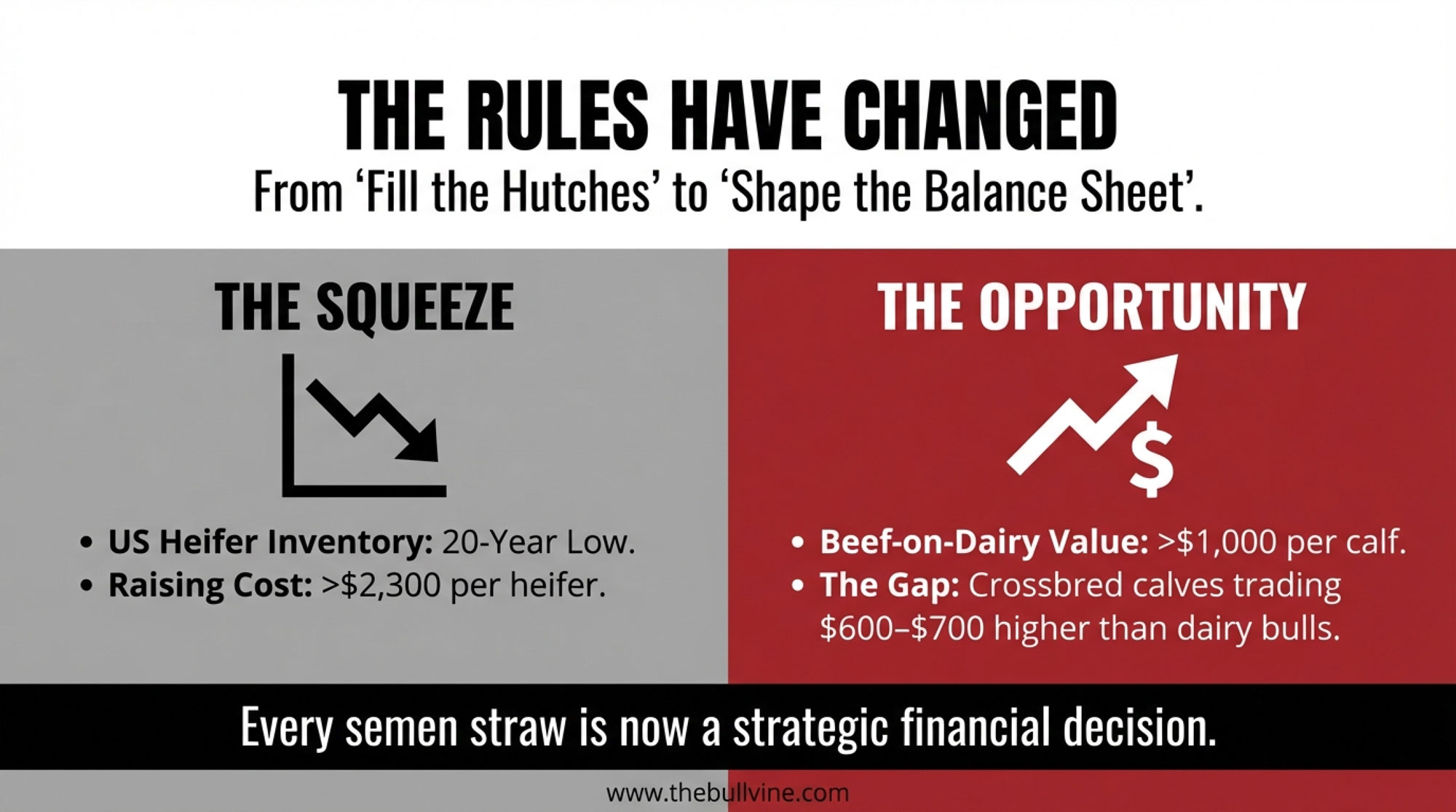
  • Dairy‑beef cross calves commonly bring a few hundred dollars more than straight Holstein bull calves at auction, with recent reports showing crossbred calves trading around 600–700 dollars in some Midwest sales while conventional bull calves lag behind. 
  • In certain barns and weeks, especially in strong markets, three‑day‑old beef‑on‑dairy calves have topped 1,000 dollars. 
  • Replacement heifers are scarce and expensive by historic standards, with multiple analyses pointing to rearing costs comfortably north of 2,000 dollars per head and market values for springers often pushing into the upper‑2,000 to 3,000‑dollar range in tight regions. 

This development suggests that calves have shifted from “fill the hutches” to “shape the balance sheet.” Whether a pregnancy produces a dairy heifer or a dairy‑beef calf now has a direct and significant impact on both your future herd and your short‑term cash flow.

What Farmers Are Finding: A Five‑Step Breeding Framework That Actually Works

Looking at this trend across herds in Ontario, Wisconsin, California, and the Northeast, what I’ve noticed is that the operations making this work aren’t doing anything mystical. They’re just being very deliberate and consistent.

Most of them follow some version of a five‑step framework:

  1. Use genomics to see which cow families are truly driving your herd.
  2. Make a clear, rule‑based beef‑versus‑dairy decision for each breeding.
  3. For dairy matings, add calf‑health genetics to your sire criteria as those proofs become available.
  4. Factor in gestation length and calving pressure so you don’t overload high‑stress windows.
  5. Re‑run the economics regularly as calf prices, heifer values, and milk markets move.

Let’s unpack that in barn‑level terms.

Step 1: Use Genomics to See Which Families to Grow—and Which to Let Go

Most herds that are serious about this are genomic‑testing their heifer calves, and some have also done a one‑time pass on younger cows to avoid missing high‑value animals that might be hiding behind older genetics. 

A good real‑world example comes from a 5,000‑cow Holstein herd in the western US profile in 2024. The dairy, managed by veterinarian and producer Dr. Sergio Lopes, began genomic testing heifers in 2016 when they realized they were simply overrun with replacements and needed a better way to decide which heifers were truly worth raising. 

Genomic results showed them a few things very quickly:

  • Some cows they had always considered “average” based on current production actually had very strong genetic merit.
  • Some of their highest‑producing cows were benefiting more from management and environment than genetics.
  • There were identification problems—wrong semen recorded, calves linked to the wrong dams—that genomics helped uncover and correct. 

After a couple of years of working with the data, Lopes said they were confident enough to change their breeding strategy completely. They dropped conventional semen, used sexed dairy semen only on their best families, and bred the rest to beef. Today, they have a background of roughly 12,000 dairy‑beef cross animals tied to their 5,000‑cow dairy and partner herds, with beef calves and fed cattle now a major income stream alongside milk. 

On a 300‑ to 600‑cow family herd—say a free‑stall in Wisconsin or a tie‑stall in Ontario—the same pattern shows up on a smaller scale. Producers genomic‑test their heifer calves, rank them on the index that matters most—Net Merit, TPI, Pro$, LPI, maybe with extra weight on health—and discover they have:

  • A top group, often the top 20–30%, they absolutely want to build daughters and granddaughters from.
  • A middle group they can flex up or down based on heifer inventory and cash flow.
  • A bottom group that’s tough to justify raising to calving when replacements are expensive, and barn space is tight. 

Once you see your herd laid out like that, it becomes a lot easier to say, “These families deserve sexed semen and more daughters,” and “These cows can contribute better through beef‑cross calves than through more low‑merit heifers.”

Step 2: Make Beef‑Versus‑Dairy Decisions Simple and Rule‑Based

Once you’ve got a handle on your cow families, the next step is to stop making beef‑versus‑dairy calls on the fly in the parlor and start following a simple rule you can execute every week.
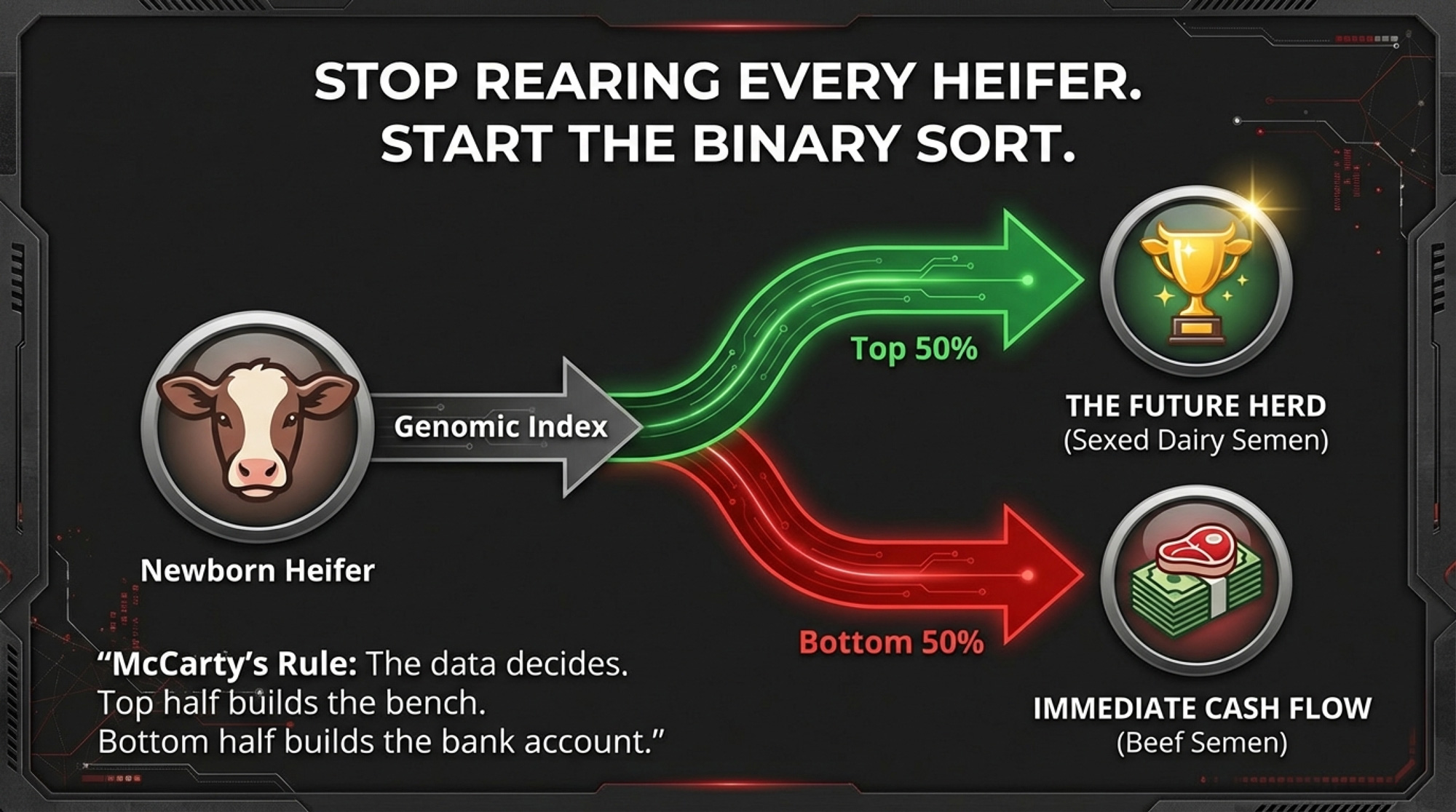
A rule that’s working on a lot of herds looks something like this:

  • First‑ and second‑lactation cows whose most recent heifer ranks in the top 40% of your genomic list get bred to dairy semen, often sexed.
  • Cows whose daughters fall below that line, plus older cows without strong family backing, get bred to beef.

When herds stick to that for a full year, they usually end up with roughly 30–40% of cows getting dairy semen and 60–70% getting beef. That mix often covers replacement needs—because dairy semen is concentrated on the right cows—while generating a steady stream of well‑bred dairy‑beef calves.

Here’s where the big math starts to bite in your favor. In many Midwestern markets right now, it’s common to see a beef‑on‑dairy calf sell for a few hundred dollars more than a straight Holstein bull calf. For example, in early 2024, it was reported that crossbred calves were selling for around 675 dollars per head in some US sales, while conventional Holstein bull calves lagged far behind, and noted that “beef on dairy” was becoming a “big money” factor in the heifer shortage conversation. If you take 150 matings that would have produced low‑merit dairy calves and, instead, flip them to beef‑on‑dairy matings with a 250‑dollar average premium, you’re looking at: 

  • 150 calves × 250 dollars ≈ 37,500 dollars in added gross calf revenue.

Even if you trim that for calf‑price volatility or the occasional calf that doesn’t quite hit the premium, you’re still talking about tens of thousands of dollars per year from one simple change in breeding policy. 

And on the cost side, you’re not spending all the feed, bedding, labor, and barn space to raise heifers from those bottom families. Long‑term work out of places like Cornell, Penn State, and western Canadian benchmarking suggests that when you spread all the costs out, total rearing cost per dairy heifer—from birth to first calving—often sits in the 2,000–3,000‑dollar range once you include feed, bedding, labor, health, and overhead, with the exact figure depending on system (confinement, pasture, dry lot) and region. So not raising heifers that were never likely to pay you back is a big part of this story, too. 

Step 3: Add Calf‑Health Genetics to Your Dairy Sire List

Now bring calf‑health genetics back into the picture.

We’ve already seen that calf diarrhea and respiratory disease are heritable and can be evaluated genomically. Canada gives us a clear preview of how those traits can look in practice. 

In August 2025, Lactanet—the national genetics and data organization for Canadian dairy producers—launched a Holstein calf‑health genetic evaluation that combines recorded cases of respiratory disease from birth to 180 days and diarrhea from birth to 60 days. The new trait is expressed as a Relative Breeding Value (RBV) centered at 100 with a standard deviation of 5. Higher RBVs indicate sires whose daughters are more likely to stay free of recorded calf‑health events in that early‑life window. 

Lactanet geneticist Colin Lynch, MSc, explained in that a five‑point increase in calf‑health RBV corresponds to about 5.4% more healthy calves with no recorded diarrhea or respiratory problems. Their analysis showed that, among proven sires, the top 5% for calf‑health traits had around 88% healthy daughters, while the bottom 5% averaged closer to 70–71% healthy daughters—depending on whether you’re looking at diarrhea or respiratory disease. In real‑world terms, that’s the difference between a family where “most calves just start and go” and one where you feel like you’re forever pulling buckets and syringes. 

Sire Rank% Calves NO Diarrhea% Calves NO Respiratory DiseaseCombined Healthy Rate (Est.)Per 100 Calves: Sick EventsEconomic Cost per Cohort (100 calves)
Top 5%92%90%~88%~12 sick calves$2,400 in direct treatment + losses
Middle 50%87%84%~80%~20 sick calves$4,000 in treatment + losses
Bottom 5%82%76%~70%~30 sick calves$6,000+ in treatment + losses
Spread (Top vs. Bottom)+10 pts+14 pts+18 pts+18 more sick calves+$3,600 annually per 100-calf cohort

Here’s how herds are starting to use that kind of information:

  • For heifers and first‑calf cows, they insist on bulls that meet their production and cow‑health criteria and also clear a minimum calf‑health RBV. Bulls with poor calf‑health scores simply don’t get used on young animals. 
  • For older cows, calf‑health RBV becomes a tie‑breaker among bulls with similar milk, components, fertility, and cow‑health profiles. 
  • In regions with tough winter respiratory seasons—Wisconsin, Minnesota, Quebec, Northern New York—some producers are deliberately matching higher calf‑health bulls to matings that will calve into late winter and early spring, when pneumonia risk is highest. 

Of course, these evaluations live or die on the quality of the health records behind them. A 2023 Canadian Journal of Animal Science case study on calf respiratory illness and diarrhea recording in Ontario found that the share of milk‑recorded herds logging calf disease rose from 2.6% in 2009 to 11.1% in 2020, but also pointed out several places where data can be lost or misclassified between the farm and the national database. Neupane and Cole have likewise emphasized in USDA‑ARS communications that clear, consistent on‑farm recording of calf health is critical if we want reliable calf‑health proofs. 

So one very practical step you can take this year—before US calf‑health numbers even hit your AI catalogs—is to tighten how you record scours and pneumonia. Sit down with your vet, agree on what counts as a case, and make sure those events get logged consistently in your herd software. That way, when calf‑health proofs land, you can trust them more and know your herd is contributing good data.

Step 4: Factor in Gestation Length and Calving Pressure

You don’t need a statistician to tell you that what you do with calving‑ease and gestation length can make or break certain months. Stack too many long‑gestation, big‑calf bulls on heifers or smaller cows that all calve in a tight two‑week window, and you’ll see it in stillbirths, tough pulls, exhausted staff, and shaky fresh cow performance through the transition period. 

Most modern proofs include calving‑ease and stillbirth rates, and many now list gestation length as well. Genetic evaluation organizations like CDCB and Lactanet have been gradually building more of these functional traits into their indexes and tools. They may not be as glamorous as milk or fat numbers, but they matter a lot when you’re planning calving pressure. 

What farmers are doing, once they’ve set beef‑versus‑dairy and calf‑health rules, is using calving‑ease and gestation length as the next filter:

  • In herds with heavy winter or early‑spring calving in the Northeast, Great Lakes, and Upper Midwest, producers keep a short list of easy‑calving, shorter‑gestation bulls for dairy matings that will calve into February and March, when calving barns and fresh pens are under the most stress. 
  • In Western dry lot systems, where summer heat is the big enemy, producers avoid long‑gestation bulls on matings that would calve into the hottest weeks and lean instead on sires with moderate gestation and favorable calving‑ease profiles. 

You don’t need a complicated spreadsheet to manage this. Just mark a handful of bulls as “tight‑window sires” based on calving‑ease, gestation length, and acceptable production and health traits, and use them where the calendar and weather suggest you can’t afford added calving problems.

Step 5: Keep Re‑Running the Math as Markets Move

The last step—and this is the one that never really ends—is to keep re‑checking whether your thresholds still make sense as markets and costs move around.

Calf prices rise and fall with the beef cycle. Replacement heifer values swing with inventory, feed costs, and interest rates. Milk prices and component premiums fluctuate with supply, demand, and processor product mix. The herds that keep these breeding strategies working don’t treat them as set‑and‑forget decisions.

In practical terms, that looks like:

  • Watching local calf prices at sale barns, through order buyers, and with any calf contracts, so you know the current spread between dairy bull calves and dairy‑beef calves.
  • Tracking replacement heifer prices through USDA Cattle on Feed and Cattle Inventory reports, CoBank and other industry analysis, and local auctions, and comparing those numbers against your estimated cost per raised heifer. 
  • Adjusting your beef‑versus‑dairy cutoff as those numbers shift. When dairy‑beef calves are bringing strong premiums and replacements are expensive, a lot of herds are comfortable breeding only the top 30% of cows and heifers (by genomic merit) to dairy semen; if the spread shrinks or they need more replacements, they might widen that to 40%. 

One helpful thing about the new calf‑health traits is that USDA‑AGIL has designed them to slot into the same kind of multi‑trait indexes we already use. Because genetic correlations between calf‑health traits and production or fertility are low, you can improve calf health without sacrificing milk, components, or cow survival, as long as you keep using balanced indexes instead of chasing single traits. 

What Year One Really Feels Like on the Farm

On a PowerPoint slide, all of this looks tidy. On your own farm, Year One feels a little different.

At the start, it’s mostly invoices and extra work:

  • You’re genomic‑testing heifer calves, and the lab bills arrive long before any calves from your new breeding plan hit the ground. 
  • You’re tightening up calf‑health recording with your vet and staff, which means training, more detailed entries, and a few evenings spent cleaning up your database. 
  • You’re adjusting semen orders—more sexed semen on the top families, more beef semen on the bottom end, fewer “just in case” dairy breedings on cows that were never likely to give you high‑value daughters. 

In the calf barn, nothing magical happens overnight. Your heifer pens still look full. Calf checks look familiar. It’s easy to wonder if the effort and expense are worth it.

By mid‑year, a few things usually start to shift:

  • You may find yourself selling or culling more lower‑merit heifers earlier—especially if you’re long on replacements—which frees up feed, bedding, and barn space. 
  • Pregnancies conceived under the new beef‑versus‑dairy rules are in gestation, but only a handful of calves have actually hit the ground.
  • On paper, your breeding lists and heifer rankings make more sense. In the parlor and calf barn, daily routines feel largely unchanged.

Late in Year One and into Year Two is where most producers say they start to feel real differences:

  • Beef‑on‑dairy calves begin arriving as a more uniform, intentional group. You see stronger buyer interest, better feedback from feedlots, and often better average prices. 
  • Your heifer pens gradually tilt toward a more consistent, higher‑index group instead of a random mix of stars and passengers. When those heifers freshen, you notice differences in how they come through the transition period and what they do in first‑lactation milk and components. 
  • If you’ve matched genetics with solid colostrum management, good housing and ventilation, and steady fresh cow management, you often see calf treatment rates and pre‑weaning mortality start to trend in the right direction, similar to what regional calf‑health and barn‑fogging projects have reported when calf environments improve. 

Producers highlighted in university extension projects tend to say the same thing: these strategies pay, but the payoff shows up over 18–24 months, not two pay periods. So if you’re going to go down this road, it really helps to think in years instead of months. 

Looking Ahead: Getting Ready for Calf‑Health Proofs in the US

Looking at where this is heading, timing matters if you want to be ready.

The USDA‑AGIL work in the Journal of Dairy Science has already shown that calf diarrhea and respiratory traits can be evaluated at a national genomic scale, with usable heritabilities and low correlations with other key traits. USDA‑ARS publications and ICAR genetic evaluation reports have laid out the models and confirm that these calf‑health traits are being prepared for inclusion in US national evaluations for Holsteins and Jerseys. 

The Council on Dairy Cattle Breeding has indicated, through meetings and industry communications, that the goal is to add calf‑health traits to the US genetic evaluation system in 2026, once data quality, validation, and governance steps are complete. The exact date will depend on final testing, but the intent is clear enough that seedstock suppliers and AI companies are already watching those traits closely. 

Meanwhile, Canada is already using calf‑health RBVs in everyday breeding decisions. Lactanet launched the trait in 2025 and is working it into the Lifetime Performance Index (LPI) and other tools, so Canadian producers now see calf‑health expectations right alongside production, fertility, and cow‑health numbers when picking sires. 

If you think about how quickly somatic cell score, daughter fertility, and cow‑health traits became “just part of the proof” once they were introduced, it’s reasonable to expect something similar with calf health. Early on, there will probably be bulls that are quietly excellent on calf‑health traits without a big semen price premium for that advantage. Over time, as more herds use those bulls and see calf‑barn results, market demand and pricing will adjust.

The herds that stand to benefit most from the early years of calf‑health proofs are the ones that:

  • Already genomic‑test most or all of their heifer calves.
  • Already have a written rule for which cows get dairy semen and which get beef.
  • Already work from weekly breeding lists and can easily add one more column when calf‑health numbers show up.

A Practical Game Plan for 2025–2026

If you’re thinking, “This all adds up, but what do I actually do next?”, here’s a straightforward plan you can take back to the office or kitchen table.

1. Build your information base.

  • Genomic‑test your next one or two calf crops so you can see how big the gap really is between your best and worst heifers on your preferred index. 
  • Sit down with your veterinarian and team and define what counts as a reportable scours case and a pneumonia case on your farm, then make sure those cases are consistently recorded in your herd software. 

2. Put a simple beef‑versus‑dairy rule on paper.

  • For example: “Only cows whose most recent heifer ranks in the top 40% genomically get dairy semen; the rest get beef.”
  • Plan to revisit that 40% threshold once a year based on calf‑price spreads, replacement heifer values, and your own heifer needs. 

3. Talk with your AI and genetics partners about calf‑health traits.

  • Ask when they expect US calf‑health proofs to show up in their catalogs and computerized mating programs. 
  • Identify a short list of bulls that fit your production and cow‑health goals and are also likely to be above average on calf‑health traits once those numbers are official. 

4. Build a weekly breeding list.

  • Include cows eligible to breed, days in milk, parity, last calving date, and the genomic rank or index of their most recent heifer. 
  • Mark each cow as “dairy” or “beef” based on your rule, then assign bulls from a short list that meet your criteria for production, components, fertility, cow health, calf health (once proofs are live), calving ease, and gestation length. 

5. Track a few key metrics over the next 24 months.

  • Calf diarrhea and respiratory treatment rates, ideally by season.
  • Pre‑weaning mortality.
  • Age at first calving for heifers bred under the new system. 
  • First‑lactation milk and component yield, and major health events in that first lactation.
  • Number and average sale price of beef‑on‑dairy calves. 
  • Total heifer inventory and your best estimate of cost per raised heifer. 

If you’re tracking those numbers, you’ll be able to tell whether genomics, beef‑on‑dairy, and calf‑health traits are actually changing the economics on your own farm—not just in theory, but in your barn with your markets.

Different Regions, Different On‑Ramps—Same Core Question

It’s worth saying that not every region, or every herd size, is going to use these tools in exactly the same way.

  • In Wisconsin, Minnesota, and the Upper Midwest, long winters and naturally ventilated barns make respiratory disease a constant battle. Research supported by the Northern New York Agricultural Development Program and Cornell PRO‑DAIRY has shown that improvements in ventilation, barn‑fogging protocols, and calf‑barn layout can significantly reduce respiratory problems, with scours most common early in the rearing period and pneumonia more common later. Producers there are now layering calf‑health genetics on top of these management changes. 
  • In Ontario and Quebec, where Lactanet calf‑health RBVs are already available, and LPI updates have brought more health and functional traits into the mix, many herds are simply adding calf health to breeding programs that already lean heavily on genomics. 
  • In Western dry lot systems, such as those in California and the Southwest, heat and dust are greater challenges than cold. Work comparing confinement, dry‑lot, and pasture‑based heifer systems has shown that dry‑lot and pasture can lower some costs but demand strong management of shade, airflow, and group size. Producers there are combining calf‑health genetics with shade structures, better airflow, and early‑detection technologies for respiratory disease, plus close relationships with beef buyers who value uniform, high‑health dairy‑beef calves. 
  • On smaller family herds in the Northeast or Great Lakes region, the most realistic first step might be to genomic‑test one year’s worth of heifers, use those results to decide which families get sexed dairy semen and which get beef, and then let the AI company’s mating program start incorporating calf‑health traits as they come into US proofs. 

Different barns. Different weather. Different processor relationships and quota setups. But underneath all that, the strategic question you’re trying to answer is the same.

The Bottom Line

When you strip the jargon away, here’s where all of this leads.

We now have solid data showing that calf diarrhea and respiratory disease are common, costly, and heritable enough to improve through genetics. The same infrastructure that gave us cow‑health traits in our indexes is being used to bring calf‑health traits into US proofs, with Canada already showing how calf‑health RBVs can fit alongside production, fertility, and cow‑health information on a bull card. 

We also have economic work on calf health, heifer rearing, and calf markets, telling us that:

  • Direct treatment costs per sick calf stack up quickly.
  • Serious early‑life disease can pull heifers off their full potential in growth, age at first calving, and first‑lactation performance. 
  • Dairy‑beef cross calves can be a bright spot in the check when milk prices soften.
  • Replacement heifers are expensive enough that raising the wrong ones is a luxury most farms can’t really afford right now. 

The tools—genomics, beef‑on‑dairy, calf‑health proofs—are all coming together just as those pressures peak. And you don’t need a PhD to use them. A simple, consistent five‑step approach—test, sort, decide beef vs dairy, add calf health and calving‑ease filters, and keep re‑running the math—will get you most of the way there.

What I’ve noticed, looking at both the research and what’s happening in real barns, is that we’re moving from a world where calf health was “just management” to one where genetics, markets, and management are all pulling in the same direction.

So maybe the real question for 2026 isn’t “Should I genomic‑test?” or “Should I try beef‑on‑dairy?” Those are just tools.

The bigger question—the one that can easily swing tens of thousands of dollars a year on many dairies—is this:

Given your barns, your local markets, your cash‑flow reality, and the calf‑health genetics coming into proofs, which calves do you truly want more of—and which calves are you better off never making in the first place?

If your breeding plan can answer that clearly, and you’re willing to line up your genetics, your fresh cow management, and your calf program behind that answer, then the next few years offer a real chance to tilt the math of your dairy in your favor quietly.

KEY TAKEAWAYS 

  • Calf-health proofs hit US genetics in 2026. USDA data on 680,000+ calves confirms scours and respiratory resistance are heritable—and selectable.
  • Sick calves drain $27,000/year from a 1,000-cow herd. That’s treatment, slower growth, and daughters that never reach their genetic potential.
  • The breeding math has changed. Beef-cross calves are topping $1,000. Heifers cost $2,500+ to raise. Replacements just hit a 20-year low. Every straw matters.
  • Five steps shift the money your way. Genomic-test heifers. Set a hard beef-versus-dairy rule. Screen bulls for calf health. Manage calving pressure. Re-check the economics quarterly.
  • Act now, bank returns in 18-24 months. Herds implementing this playbook today can realistically add $50,000+ to their bottom line.

Complete references and supporting documentation are available upon request by contacting the editorial team at editor@thebullvine.com.

Learn More

Join the Revolution!

Join over 30,000 successful dairy professionals who rely on Bullvine Weekly for their competitive edge. Delivered directly to your inbox each week, our exclusive industry insights help you make smarter decisions while saving precious hours every week. Never miss critical updates on milk production trends, breakthrough technologies, and profit-boosting strategies that top producers are already implementing. Subscribe now to transform your dairy operation’s efficiency and profitability—your future success is just one click away.
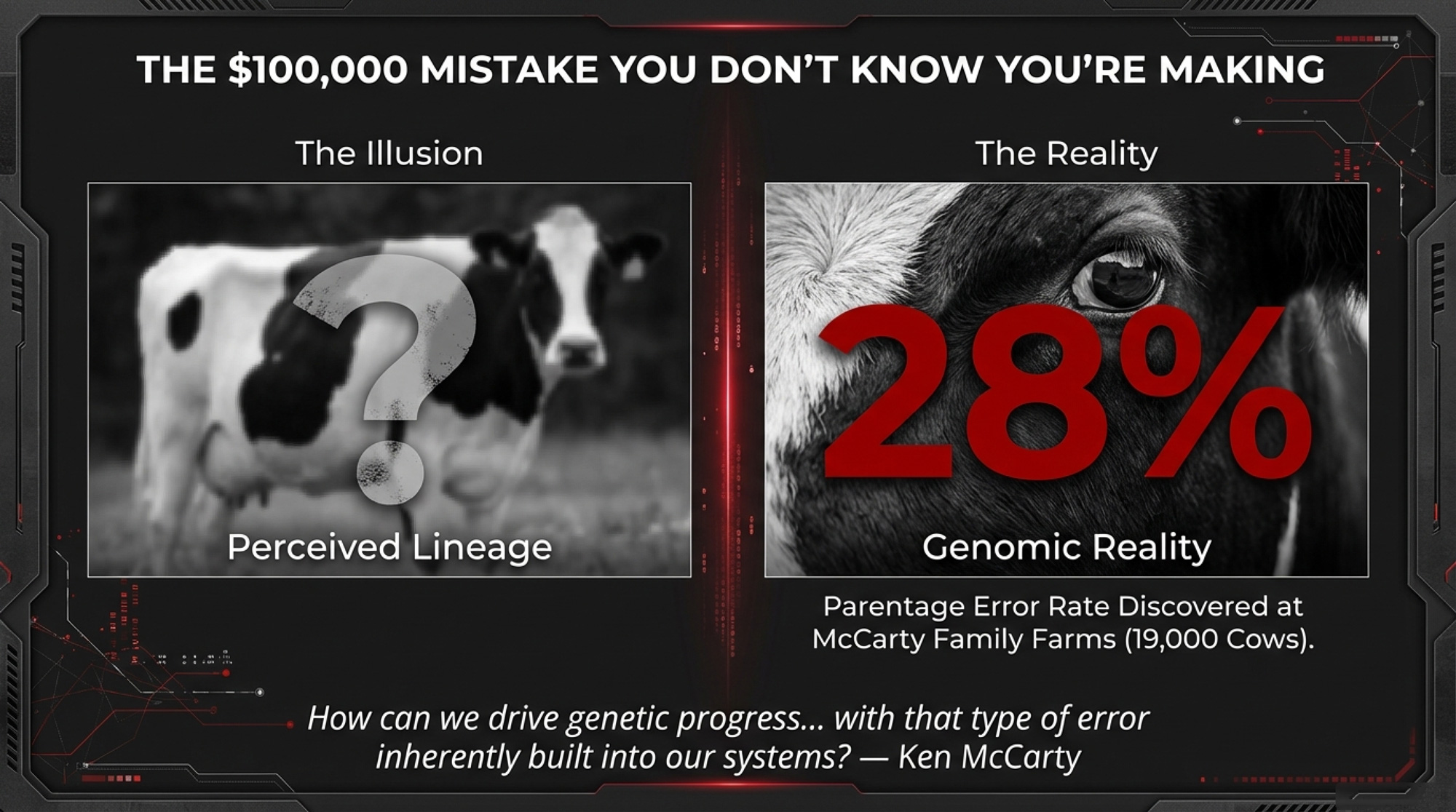
NewsSubscribe
First
Last
Consent

Did Genomics Really Deliver What We Think It Did? $238,000 Says Yes – If You Steer It Right

Did genomics really deliver what you think it did—or is that extra $238,000 in profit still stuck in your semen tank?

Let’s sit with a big number for a minute: a couple thousand dollars more lifetime profit per cow. That’s the kind of difference Lactanet uses in its Pro$ examples when it compares daughters of today’s high‑Pro$ sires to daughters of a decade older, lower‑ranking bulls, because Pro$ is built to reflect expected lifetime profit per cow based on real Canadian revenue and cost data up to six years of age or disposal.

If you spread that kind of genetic advantage across a few hundred cows over several breeding seasons, you’re quickly into tens of thousands of dollars in extra lifetime profit per year, the result of breeding decisions—assuming your fresh cow management, herd reproduction, and culling strategy actually lets those genetics show up in the tank.

That’s not hype. That’s the math behind Pro$, and it aligns with what genomic selection has achieved globally, where genetic progress in milk, fat, protein, health, and longevity has accelerated by 50–100% compared with the pre‑genomic era.
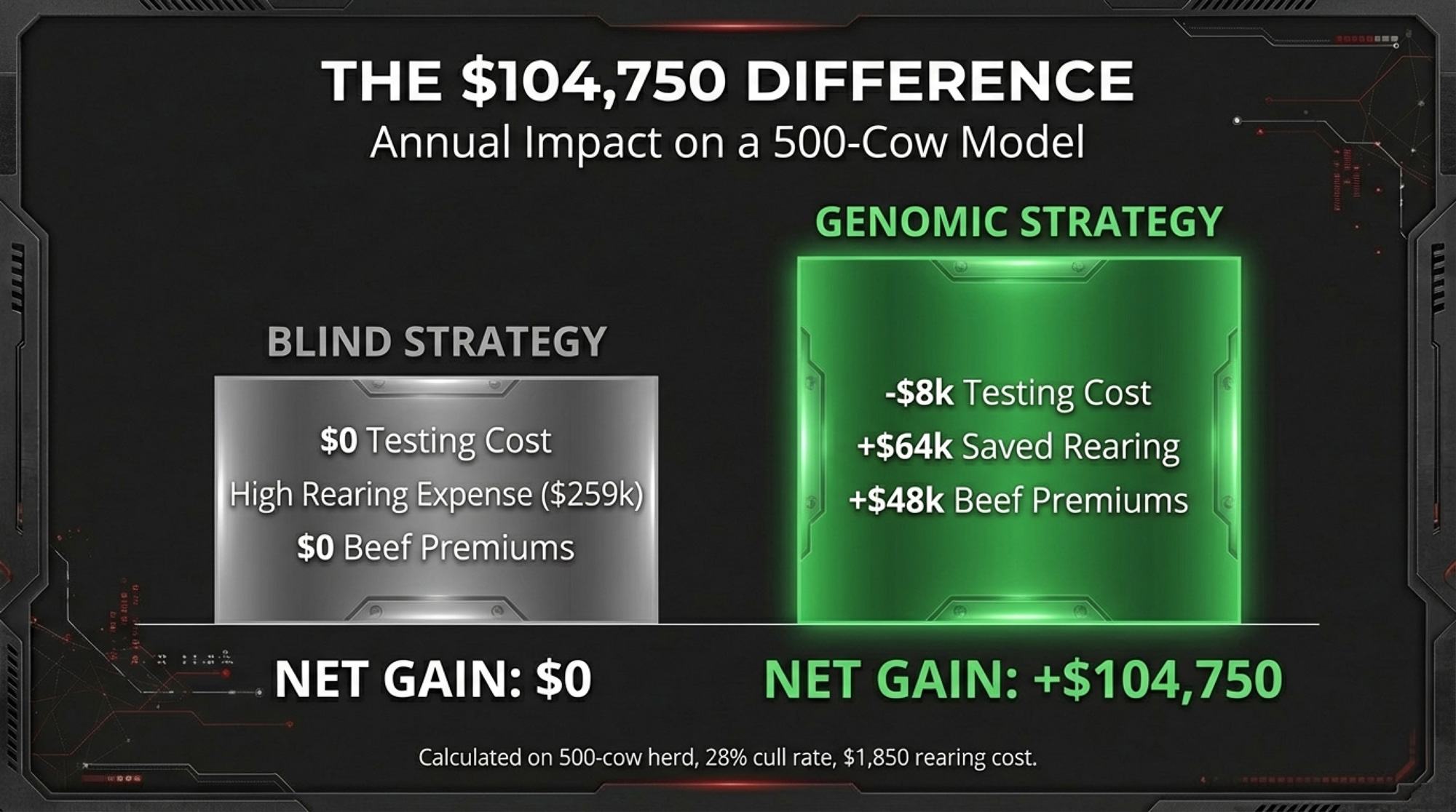
What’s interesting, though, is that when you start peeling back the layers on how we got here, you see both huge wins and some red flashing lights—especially around diversity, fertility, and hidden genetic risks.

That’s what this conversation is really about.

When Banners Steered the Breeding Bus

If you look back 15–20 years, you can probably still picture the late‑2000s bull lists. In Canada, Holstein Canada sire‑usage data from that era show a relatively tight group of sires—Goldwyn, Buckeye, Dolman, and their close relatives—accounting for a significant share of registrations.

In 2008, just three bulls (Dolman, Goldwyn, Buckeye) accounted for about 12% of all registered Holstein females in Canada, and the top five sires together made up roughly 15.7% of registrations. That kind of concentration perfectly reflected the breeding philosophy of the time: moderate yield, “true type” conformation, and pedigrees that lit up both classifier sheets and show‑ring banners, but not always the enterprise balance sheet.

On many commercial freestall and tie‑stall farms, those cows were often the ones that:

  • Struggled harder through the transition period
  • Needed more care of their feet and legs
  • Didn’t routinely make it to that profitable fourth or fifth lactation

That isn’t just coffee‑shop talk. Work from the University of Guelph and Agriculture and Agri‑Food Canada has consistently shown that lifetime profitability is closely tied to lifetime milk revenue, length of productive life, days dry, age at first calving, and reproductive-related interventions. Cows that leave early, spend more time open, racking up vet bills, and simply don’t deliver their potential lifetime profit—even if they look great and milk well in first lactation.

Producers like Don Bennink at North Florida Holsteins have been lightning rods on this topic for years. He’s been very blunt that high production, strong health traits, and feed efficiency are the bywords for breeding profitable cows—not show ribbons—and that genomics has “increased our progress at a rate we could never have dreamed of previously,” creating a huge profitability gap between herds that use genomic information and those that don’t.

So even before we talk about SNP chips and genomic proofs, there was already a clear split between what wins banners and what pays bills in freestalls, robots, parlors, and dry‑lot systems.

From Pedigree and Type to Profit and Function

The Canadian Holstein breeding landscape has gone through one of the most profound shifts in its history since about 2008. Over 16 years, selection has moved from pedigree‑driven, visually focused decisions to a much more complete “facts‑first” approach that prioritizes profitability, health, and functionality based on accurate animal and herd data.

You can see this change clearly in which sires actually sired the most daughters in Canada. In 2008, the most‑used 20 sires accounted for about 33.5% of all registered females, and the average “top‑sire” had over 4,300 daughters. By 2024, that share dropped to around 22.6%, and the average daughters per top sire fell to roughly 2,984. At the same time, the top five sires in 2024 (Pursuit, Alcove, Lambda, Fuel, Zoar) represented only about 9.1% of registrations—down from that 15.7% level in 2008.

Overview of Top Sires of Canadian Holstein Female Registrations

Category20082012201620202024
Total Female Registrations257,040272,264273,785297,192263,149
Five Sires with Most DaughtersDolmanWindbrookImpressionLautrustPursuit
GoldwynFeverSuperpowerImpressionAlcove
BuckeyeSteadyJett AirAlcoveLambda
FrostyLauthorityDempseyBardoFuel
Sept StormJordanUnoUnixZoar
Percent of Registrations
– Top Five Sires15.70%14.80%7.30%7.50%9.10%
– Top Ten Sires23.70%22.20%13.50%12.60%14.90%
– Top Twenty Sires33.50%30.10%22.20%20.20%22.60%
– Top Thirty Sires39.90%34.70%28.10%25.90%28.70%
Top Twenty Sires – avg # Daus4,3094,0933,0353,0012,984
Highest Ranking Genomic Sire30th27th8th6th5th
No. Genomic Sires in Top Ten00145
Percent of Sires – A2A220%25%35%50%60%

That’s not a “bull of the month” world anymore. That’s breeders intentionally spreading genetic risk, targeting specific trait profiles, and using more bulls per herd for shorter periods, while still driving genetic gain.

The underlying philosophy has evolved from two narrow extremes—high‑conformation or high‑milk two‑lactation cows that were often culled early—to a more complete target: four‑plus‑lactation, healthy, fertile, self‑sufficient, high‑solids cows that can survive modern housing, automation, and economic pressure.

What Genomics Actually Changed

When genomic evaluations hit around 2008–2009, they blew the doors off the old progeny‑testing model. Researchers like Adriana García‑Ruiz and Paul VanRaden, working with US national Holstein data at USDA‑AGIL, showed that once genomics was adopted, sire‑of‑sons generation intervals were effectively cut in half, dropping from roughly 6–10 years down to around 2.5–3 years. Canadian data tracked the same pattern.

That shorter generation interval, combined with higher selection intensity and more accurate young‑animal evaluations, is exactly why genetic gains picked up speed. Analyses of Holstein breeding programs published in the Journal of Dairy Science and the Proceedings of the National Academy of Sciences report:

  • 50–100% higher rates of genetic gain for milk, fat, and protein in the genomic era
  • 3–4x higher genetic progress in some health and productive‑life traits between 2008 and 2014
Metric2008 (Progeny-Testing Era)2024 (Genomic Era)
Average LPI (Top 20 Sires)1,9853,531
Average Pro$ (Top 20 Sires)-$1,558+$1,978
Milk Proof (kg)-578+860
Fat Proof (kg)-33 (-0.10%)+85 (+0.31%)
Protein Proof (kg)-27 (-0.07%)+50 (+0.15%)
Top 5 Sires’ Market Share15.7%9.1%
Daughters per Top Sire4,3002,984
Top 20 Sires’ Market Share33.5%22.6%
Inbreeding (Top Sires’ Daughters)~9.5%11.5%

Canada’s own data comparing bull April 2025 indexes on the 20 most‑used sires, 2008 vs 2024, makes this very real:

  • The average LPI of those bulls climbed from about 1,985 in 2008 to around 3,531 in 2024—roughly +97 LPI points per year.
  • Pro$ swung from about –$1,558 in 2008 to about +$1,978 in 2024—roughly +$221 per year in predicted daughter lifetime profit.
  • Average proofs for those sires went from roughly –578 kg milk, –33 kg fat (–0.10%F), and –27 kg protein (–0.07%P) in 2008 to about +860 kg milk, +85 kg fat (+0.31%F), and +50 kg protein (+0.15%P) by 2024.

That works out to about +90 kg of milk, +7.4 kg of fat, and +4.8 kg of protein in genetic improvement per year in the bulls that Canadian Holstein breeders actually used the most.

YearLPIPro$
20081,985-$1,558
20102,180-$980
20122,420-$340
20142,690+$230
20162,875+$650
20183,045+$1,040
20203,210+$1,380
20223,375+$1,680
20243,531+$1,978

Put simply: genomics, combined with LPI and Pro$, did exactly what it was supposed to do in Canada—faster genetic gain for production and overall profit.

Indexes for Twenty Sires with the Most Registered Daughters

YearLPIPro$MilkFat / %FProtein / %PCONFMammaryFeet & LegsD StrengthRump
20081985-1558-578-33 / -.10%-27 / -.07%-6-6-410
20122378-728-415-14 / .01%-17 / -.02%1-1043
201626801731306 / .00%2 / -.05%10123
20203054101655545 / .21%25 / .04%53344
20243531197886085 / .31%50 / .15%86875
Change/Year97221907.44.80.880.750.750.380.31

*Lactanet Indexes Published in April 2025

Where biology pushes back is on which traits move fastest. Higher‑heritability traits like milk, fat, and protein, as well as major type traits, make faster genetic progress than lower‑heritability traits like fertility, health, and productive life. Genomics improves accuracy across the board, but when semen catalogs and marketing materials still lead with production and type, it’s easy for those traits to keep outrunning fertility and health on the genetic trend lines.

That’s how we end up with a proof landscape that shows: extreme strength in production and conformation, modest but improving gains in fertility and health, and some nagging functional issues that still frustrate producers.

The Diversity Question: Are We Painting Ourselves Into a Corner?

One major concern that doesn’t appear directly on a proof sheet is genetic diversity.

Geneticists talk about effective population size—the number of prominent sires contributing progeny, especially genomic sires entering AI programs and daughters being used as bull dams. Dutch and Italian Holstein genomic studies have examined this closely. In one well‑cited Dutch‑Flemish analysis, effective population size in AI bulls born between 1986 and 2015 ranged from about 50 to 115 prominent sires at different periods, with lower values during times of intense selection. Italian and Nordic Holstein work using both pedigree and SNP data has reported similar patterns—effective population sizes are often below 100, with prominent sires trending downward in the genomic era.

International guidelines from the FAO and genetic diversity experts generally suggest that an effective population size of 100 or more prominent sires is acceptable. Values below about 50 for prominent sires raise concerns about inbreeding depression and lost adaptability.

At the same time, genomic and pedigree analyses across multiple countries have shown that inbreeding is rising faster each year in the genomic era—often increasing by 0.3–0.5 percentage points annually. At current generation intervals, that can mean 1.5–2.5% per generation. Pedigree studies summarized by Chad Dechow at Penn State and reported in Hoard’s Dairyman have also highlighted how a disproportionate share of modern Holstein ancestry traces back to just a handful of bulls (Chief, Elevation, Ivanhoe), underlining how concentrated the global gene pool has become.

In the Canadian context, that broader story plays out in very practical ways. The 20 most‑used sires in 2024 have daughters with an average inbreeding coefficient of about 11.5%—above a Holstein breed average already considered uncomfortably high at around 10.6%. That means the bulls delivering the most genetic progress on paper are also nudging herds further into undesirable inbreeding territory.

Practically, if you always grab the top two or three bulls on the list:

  • You’ll quickly improve your herd’s genetic level.
  • While you’ll also make your heifers more closely related to each other, especially if those bulls also share cow families.

On farm, that’s when inbreeding starts to show up in ways you feel: more fertility trouble, more health events, and cows that don’t seem as robust as the previous generation—even while milk solids and type keep improving.

Hidden Passengers: Haplotype and Recessive Stories

Another layer that genomics exposed is fertility haplotypes and single‑gene defects.

Over the past decade, collaborations between the USDA’s Animal Genomics and Improvement Lab, European institutes, and AI organizations have identified several Holstein haplotypes—HH1, HH2, HH3, HH4, HH5, HH6—and defects like cholesterol deficiency (CD/HCD) that are tied to embryonic loss or weak calves.

The pattern is pretty straightforward:

  • These haplotypes are stretches of DNA where homozygous calves (same version from sire and dam) often die early in gestation or are born weak and fail to thrive.
  • Carrier frequencies in many national populations sit in the low single digits but can reach 5–10% for some haplotypes in certain birth years and cow families.

The cholesterol deficiency story is a good cautionary tale. CD traces back to lines including Maughlin Storm and involves a mutation affecting fat metabolism; affected calves often die within weeks due to diarrhea and failure to thrive, while carriers look normal and can be high‑index animals.

The good news:

  • Major AI studs routinely test their bulls for these defects, and they, their breeds, and genetic evaluation centers publish the carrier status of animals.
  • Mating programs can automatically avoid carrier × carrier matings once herd and sire statuses are known.

If you don’t use those tools, the math can quietly bite you. Even a few percent of pregnancies lost to lethal combinations in a 400–500 cow herd can mean thousands of dollars in dead calves, extra breedings, and longer calving intervals each year—losses that are largely avoidable with the data breeders already have access to.

The 2025 Modernized LPI: A Better Dashboard

All of this—faster genetic gain, tighter diversity, more trait data, and new environmental pressure—is why genetic evaluation systems are updating how they calculate and present information.

In Canada, Lactanet launched a modernized Lifetime Performance Index (LPI) framework in April 2025. The old three‑group structure (Production, Durability, Health & Fertility) was replaced with six subindexes for Holsteins and five subindexes for the other breeds:

  • Production Index (PI)
  • Longevity & Type Index (LTI)
  • Health & Welfare Index (HWI)
  • Reproduction Index (RI)
  • Milkability Index (MI)
  • Environmental Impact Index (EII)

For Holsteins, these subindexes carry specific weightings in the new LPI formula: about 40% on Production, 32% on Longevity & Type, 8% on Health & Welfare, 10% on Reproduction, 5% on Milkability, and 5% on Environmental Impact. As well, Lactanet has an online routine where breeders can rank bulls by assigning their own weightings for the subindexes.

Two important comfort points from Lactanet:

  • The correlation between the current and modernized LPI is expected to be around 0.98, so the bulls you like don’t suddenly become “bad”—their strengths and weaknesses just become more visible.
  • Splitting Health & Fertility into Health & Welfare and Reproduction, plus the creation of a separate Milkability subindex, allows new traits such as calving ability, daughter calving ability, milking speed, temperament, and environmental traits (such as feed and methane‑related efficiencies) to be properly handled in the indexing.

For a lot of producers, the practical value is this: you can now see at a glance where a bull stands not only on overall LPI or Pro$, but on:

  • Reproduction
  • Health & Welfare
  • Environmental footprint

On separate scales, without having to decode 20 individual trait proofs.

What the Top 2024 Sires Miss—and What That Means for 2026 Matings

Here’s where the Canadian sire usage data really tells a story.

April ’25 Indexes for Twenty 2024 Sires with Most Registered Daughters

CategoryAvg IndexIndex%RKRange in %RK% Sires Below AVG
Lifetime Performance Index (LPI)353198%RK81 – 99 %RK0%
Production Subindex (PI)65993%RK70 – 99 %RK0%
Longevity & Type Subindex (LTI)67898%RK57 – 99 %RK0%
Health & Welfare Subindex (HWI)50050%RK02 – 93 %RK60%
Reproduction Subindex (RI)45029%RK01 – 65 %RK75%
Milkability Subindex (MI)51652%RK10 – 92 %RK45%
Environmental Impact Subindex (EII)47540%RK02 – 96 %RK75%

When you line up the 20 sires with the most registered daughters in 2024 and score them on the new subindexes, you get a clear pattern:

  • They’re elite for LPI, Pro$, the Production, and the combined Longevity & Type subindexes.
  • They’re roughly breed average for Health & Welfare and Milkability subindexes.
  • They’re significantly below the breed average for Reproduction and Environmental Impact subindexes.
  • Their daughters are running about 11.5% inbreeding vs a breed average of 10.6%.

In plain language:

  • We’ve done an excellent job selecting bulls that lead the pack in production, type, and overall profit indexes.
  • We’ve been less aggressive on fertility, cow survival under stress, and environmental footprint.
  • The bulls that did the most “work” in Canadian herds in 2024 also nudged inbreeding higher.

That sets up the key question for 2026: What are you going to do when you breed those daughters?

If you continue stacking similar high‑production, below‑average‑fertility, high‑relationship sires on top of them, you’ll keep moving LPI and Pro$ up—but you may also:

  • Push inbreeding higher.
  • Put more strain on reproduction and transition‑cow programs.
  • Lag on traits processors and regulators are starting to reward, like feed efficiency and methane‑related performance.

The alternative is to stay aggressive on genetic gain where it matters most for your herd, while using the new LPI subindexes and genomic tools to protect functional traits and diversity.

It’s worth noting that many AI companies are now actively promoting outcross or lower‑relationship bulls and subindex “balanced” sires to help address future genetic needs. Those options are on the semen delivery truck—it just comes down to whether we actually use them.

What Progressive Herds Are Doing Differently

Across Canadian Lactanet‑profiled herds, US herds highlighted in Hoard’s and Dairy Herd, and European setups facing tight environmental rules, the most progressive operations tend to do four things with their breeding programs.

1. They Don’t Stop at the Top Line Index

Most of us have, at some point, just circled the top two or three bulls on our preferred total merit index list—LPI, Pro$, Net Merit, etc.—and then called it a breeding plan. It’s quick—and to be fair, it used to work “well enough.”

The herds that are pulling ahead now ask:

  • What are my top three herd problems right now—reproduction, mastitis, lameness, culling age, transition disease?
  • How do those problems line up with the Reproduction, Health & Welfare, Longevity & Type, and Milkability subindexes?

Then they pick bulls that are high enough on LPI/Pro$/Net Merit and are very strong where their herd is weakest.

Examples:

  • A Western Canadian quota herd shipping into a butterfat‑heavy market may load more weight on fat %, reproductive efficiency, and Environmental Impact (feed efficiency, methane efficiency), because contract and policy pressures are moving in that direction.
  • A robot barn in Ontario may rank bulls first on Milkability (speed, temperament, udder/teat traits compatible with robots), then on LPI/Pro$, because slow‑milkers drag down box throughput.

The point is: the overall index gets you in the right ballpark; the subindexes and trait profiles decide whether you actually fix the problems that cost you money.

2. They Set Clear Inbreeding and Relationship Limits

Modern mating programs—whether through AI company software or integrated herd tools—let you set an expected inbreeding ceiling per mating.

A common approach:

  • Target: keeping individual matings under about 8% expected inbreeding (roughly “cousin‑level” or less).
  • Cap: avoid using any one sire providing more than 5–10% of replacements in a given year, so you don’t wake up in five years and realize half the herd traces back to only two bulls.

Genomic relationship data give much sharper views of how closely related bulls actually are, so herds and advisors are using it to:

  • Avoid stacking very closely related sires on the same cow families.
  • Balance high‑index sires across different lines to keep the gene pool wider.

This isn’t about avoiding genomics—it’s about using genomics to capture speed without painting yourself into a corner.

3. They Treat Haplotypes and Recessives as Standard Inputs

In 2026, ignoring fertility haplotype and genetic defect data is a bit like ignoring somatic cell counts. You can do it, but it will cost you.

The practical rule of thumb:

  • Carrier sires are okay if they bring needed strengths.
  • Carrier × carrier matings are not made.

On the farm, that means:

  • Genomically test all replacement heifers.
  • Make sure genomic testing and AI reports clearly identify carrier cows and bulls for known Holstein defects (HH1–HH6, CD/HCD, and others tracked by your provider).
  • Turn on “block carrier × carrier” in mating programs.
  • Review your herd’s carrier percentages; if a high proportion of heifers carry a given defect, re‑balance the sire lineup to avoid stacking that issue deeper.

Preventing even a handful of lost pregnancies or weak calves per year more than pays for the time it takes to configure those filters.

4. They Mix “Rocket Fuel” and “Workhorse” Genetics on Purpose

A pattern that shows up in data‑driven herds is deliberate stratification of matings.

For example:

  • Use a select group of very high‑index “rocket fuel” sires (top LPI/Pro$/Net Merit) on the very best genomic heifers and cow families to keep the top of the herd pushing forward fast.
  • Use a broader group of balanced “workhorse” sires—above average for Reproduction and Health & Welfare, solid for Longevity & Type—on the rest of the herd, especially family lines that have given you trouble on fertility or health.

That way, you:

  • Capture the upside of genomics where it pays the most.
  • Build a herd that isn’t full of fragile “one‑and‑done” cows that leave before third lactation.

A Quick Ontario Illustration

Imagine a 400‑cow Holstein herd.

The numbers say:

  • Too many cows are leaving before their fourth lactation.
  • Reproduction is “okay” but not great.
  • The current sire used list is heavy on very high LPI/Pro$ bulls that are below breed average for Reproduction Index and only average for Health & Welfare, with some matings up around 12–14% expected inbreeding.

A revised 3–4 year strategy might look like this:

  • Keep one or two of those elite genomic or proven sires for your best genomic heifers and highest‑index cows.
  • Add three to four “workhorse” genomic or proven less inbred bulls that are at or above breed average for Reproduction Index and Health & Welfare Index, and still have solid LPI/Pro$ numbers, even if they’re 200–300 points lower than the “rocket fuel” bulls.
  • Set an inbreeding ceiling goal of around 8% in the mating program.
  • Turn on avoidance for key haplotypes and genetic defects.

Over the next few years, you’re likely to see:

  • Modest improvement in pregnancy rate and fewer days open.
  • More cows are making it into fourth and fifth lactation without a parade of health or welfare events.
  • Slightly slower LPI/Pro$ progress on paper, but higher actual milk shipped per cow over a lifetime, because more cows stick around long enough to exceed paying back their rearing cost and reach peak productivity.

Here’s the rough math on that last point. If shifting your sire mix means an average cow stays an extra 0.3–0.5 lactations, and each additional lactation is worth roughly $1,500–$2,000 in net margin after feed and overhead, you’re looking at $450–$1,000 extra net income per cow over her lifetime. In a 400‑cow herd turning over 30–35% of cows per year, that trade‑off can easily be worth $50,000–$100,000+ per year on the income side—money that more than offsets a slightly slower climb on paper index.

Metric“Rocket Fuel Only” StrategyBalanced “Rocket + Workhorse” StrategyDifference
Avg LPI/Pro$ Annual Gain+110 LPI / +240PRO$+85 LPI / +190PRO$-25 LPI / -50PRO$
Avg Productive Life (Lactations)2.83.3+0.5 lactations
% Cows Reaching 4th Lactation32%48%+16 percentage points
Avg Inbreeding (%)12.8%9.2%-3.6 percentage points
Pregnancy Rate (21-day)18.5%22.0%+3.5 points
Extra Net Income per Cow (Lifetime)Baseline+$650–$900+$650–$900
400-Cow Herd (Annual Impact)Baseline+$65,000–$90,000/year+$65,000–$90,000/year
3–5 Year Cumulative ROIBaseline$195,000–$450,000$195,000–$450,000

That trade‑off—slightly less “flash” for more “cows that work longer and require less individual care”—is where the real money often sits.

Three Questions to Ask Your AI Rep This Spring

If you’re not sure where to start, these questions cut through the catalog noise fast:

  1. “Which bulls in your lineup are above breed average for both Reproduction and Health & Welfare subindexes, and still strong on LPI/Pro$?”
    This forces the conversation beyond the very top LPI or Net Merit names.
  2. “Can you run a report showing my herd’s average expected inbreeding and carrier status for major Holstein haplotypes and genetic defects?”
    This gives you a baseline for both diversity and hidden risk.
  3. “If I wanted to balance my sire lineup between a few elite ‘rocket fuel’ bulls and more ‘workhorse’ functional sires, what would that look like for my herd?”
    This turns a product pitch into a strategy discussion tailored to your data.

A Straightforward Pre‑Order Checklist

Before your next semen order or breeding push, a simple checklist ties all of this together:

  • Pull the last 2 years of herd data.
    • Look at culling reasons and ages; how many cows leave before fourth lactation?
    • Check key KPIs: pregnancy rate, days open, mastitis/health events, SCC trends.
  • Review your current sire lineup by subindex.
    • For each bull, jot down Production, Longevity & Type, Reproduction, Health & Welfare, Milkability, and Environmental Impact scores under the new LPI structure.
    • Flag bulls that are strong for Production but clearly below breed average for Reproduction or Health & Welfare.
  • Decide on an inbreeding ceiling and diversity plan.
    • Work with your advisor to set a mating target (e.g., an expected inbreeding level below 8%).
    • Consider setting limits on how much any single bull can contribute to replacements over the next 1–2 years.
  • Make sure haplotype and recessive filters are turned on.
    • Confirm your mating software blocks carrier × carrier matings for known Holstein haplotypes and genetic defects.
    • Ask for a herd‑level carrier summary so you know your starting point.
  • Balance your sire list.
    • Keep a select group of elite “rocket fuel” sires for the very top females.
    • Add at least one or two “workhorse” sires that are clearly strong for Reproduction and Health & Welfare to shore up your everyday cows.

If you remember nothing else, remember those three pillars: protect functional traits, manage diversity, and balance elite and workhorse genetics. Together, they do more for long‑term profitability than chasing any single proof list.

So, Did Genomics Deliver? The $238,000 Answer

If we’re honest, the answer is “yes—and.”

Yes, genomics delivered faster progress and more precise selection. Studies from the US, Canada, and Europe are very clear: genetic gains in production, health, fertility, and longevity traits are higher now than in the old progeny‑testing era.

And at the same time, genomics amplified both the strengths and the weak spots in our breeding goals:

  • We pushed production and type forward fast.
  • We made positive strides in some health and fertility traits, but they still lag behind production in terms of genetic gain rate.
  • We leaned hard on a relatively small set of sire and cow families, tightening the gene pool and increasing inbreeding.
  • We uncovered haplotypes and genetic defects hitchhiking on high‑index lineages, reminding us that progress always comes with complexity.

The good news is that the tools to manage those trade‑offs—modernized LPI, Pro$, genomic testing, mating software, and herd analytics—are better than ever.

The Bottom Line

Here’s the critical point: without genomics, there is no measurable ROI on genetic improvement. In the pre‑genomic era, you couldn’t reliably capture this kind of return because you couldn’t accurately identify high‑profit genetics early enough or fast enough. Today you can—and the math works out. A 400‑cow herd making smarter breeding decisions with genomic tools can realistically capture $50,000–$100,000+ per year in additional lifetime profit from cows that stay longer, breed back faster, and require less intervention. Over a typical planning horizon of three to five years, that’s the $238,000 question answered: genomics delivered the tools; your breeding decisions determine whether you actually capture that ROI.

Most of us aren’t in this to win a banner once and sell the herd. The goal is herds we actually like milking: cows that calve in with ease, handle transition without a parade of treatments, breed back on a reasonable schedule, stay sound on their feet, and survive long enough to make heifer raising pencil out positively.

The bulls you choose this year will still have daughters freshening in your barn in 2032. The closer those daughters are to the cows you actually want in your parlor—on reproduction records, on health reports, and on your balance sheet—the more of genomics’ promise you’ll actually capture.

Genomics gave us the speed. Now the job is making sure we’re steering it in the right direction for our own future dairy enterprise.

Key Takeaways

  • Genomics delivered: Genetic gains for milk, fat, protein, health, and longevity have roughly doubled since 2008—faster than progeny testing ever achieved.
  • But there’s a catch: Intense selection on a small elite group has pushed inbreeding past 11% and narrowed the gene pool, quietly eroding fertility and robustness.
  • New tools help you see the trade-offs: Lactanet’s six LPI subindexes show exactly where a bull stands on Reproduction, Health & Welfare, Milkability, and Environmental Impact—not just total merit.
  • Progressive herds are steering, not chasing: They mix “rocket fuel” and “workhorse” sires, cap inbreeding under 8%, and block carrier × carrier matings for haplotypes and defects.
  • The payoff is real: A 400-cow herd using these strategies can capture $50,000–$100,000+ per year in extra lifetime profit—that’s the $238,000 answer over 3–5 years.

Executive Summary: 

Genomic selection has roughly doubled the rate of genetic gain for milk, fat, and protein, while also improving health and longevity traits compared with the old progeny‑testing era. Canadian data on the 20 most‑used Holstein sires show LPI and Pro$ values rising so fast since 2008 that daughters now generate several thousand dollars more lifetime profit per cow, adding up to $50,000–$100,000 or more per year in a well‑run 400‑cow herd. The flip side is that heavy reliance on a small group of elite families has increased inbreeding and reduced effective population size, which can chip away at fertility, health, and robustness if it’s ignored. Lactanet’s modernized LPI, with subindexes for Reproduction, Health & Welfare, Milkability, and Environmental Impact, gives breeders the dashboard they need to see those trade‑offs instead of just chasing one total merit number. Leading herds are using genomics to cap inbreeding, avoid carrier‑to‑carrier matings for haplotypes and defects, and deliberately mix a few high‑index “rocket fuel” sires with more balanced “workhorse” bulls that protect functional traits. In that context, the “$238,000 question” has a clear answer: genomics really can deliver that level of return over a few years, but only for farms that actively steer their breeding programs rather than letting the proof list do the driving.

Complete references and supporting documentation are available upon request by contacting the editorial team at editor@thebullvine.com.

Learn More

Join the Revolution!

Join over 30,000 successful dairy professionals who rely on Bullvine Weekly for their competitive edge. Delivered directly to your inbox each week, our exclusive industry insights help you make smarter decisions while saving precious hours every week. Never miss critical updates on milk production trends, breakthrough technologies, and profit-boosting strategies that top producers are already implementing. Subscribe now to transform your dairy operation’s efficiency and profitability—your future success is just one click away.

NewsSubscribe
First
Last
Consent

The Missing Piece in Genomic Selection: Why the Best Herds Still Walk the Pens

In 2025, you’re spending 2,000–5,000 dollars per heifer. Are those cows really staying long enough to pay you back?

Executive Summary: Right now, genomics has doubled Net Merit genetic gain in U.S. Holsteins—from about 40 to 85 dollars per cow per year—but many herds are still watching cows leave at roughly 2.7 lactations, just as they finally start to repay 2,000–5,000 dollar heifer‑raising costs. NAHMS culling data and Penn State’s longevity work show combined cull‑plus‑death rates near 37 percent and confirm that, with today’s higher rearing costs, real profit often doesn’t begin until third lactation or later. At the same time, UW–Extension, Lactanet, and CoBank document rising heifer‑raising costs, a roughly 15–18 percent drop in U.S. replacement inventories, and 2025 replacement heifer prices that commonly top 3,000 dollars, with top animals over 4,000 dollars in some regions. The article argues that if you keep raising every heifer in that environment, the real problem isn’t your proofs—it’s your replacement strategy—and the missing piece is using genomics as a hard filter on which heifers deserve a stall, backed by a simple breeding‑age structural check on feet, heels, capacity, and calving structure. It then lays out a concrete playbook: genotype and set a clear cutoff tied to your true replacement needs, walk breeding‑age heifers once with structure in mind, use corrective mating only where it removes real structural risk, and pull by‑sire reports on lameness, fresh cow problems, and early culls so you’re not blindly trusting early genomic proofs. Finally, it looks ahead to tools like 3D BCS/weight and AI lameness detection and makes the case that, in 2025’s tight heifer and margin environment, the herds that win will be the ones that combine genomics, barn data, and one strong “cow person” to keep more cows walking the pens into their fourth and fifth lactations.

You know, when you look back over the last 15–20 years, it’s pretty wild what we’ve all lived through on the genetics side of dairy. Genomic testing has changed which bulls you pick, which heifers you raise, and how fast your herd moves genetically. Geneticist George Wiggans, PhD, with USDA’s Animal Genomics and Improvement Laboratory, and his co‑authors laid this out in a 2022 Frontiers in Genetics review: once genomic evaluations came in, the average annual increase in Net Merit in U.S. Holsteins essentially doubled—from about 40 dollars per cow per year in the five years before genomics to about 85 dollars per cow per year in the genomic era—and they clearly state that this “doubled the rate of genetic gain” in U.S. dairy cattle based on CDCB trend data across millions of animals.

What’s interesting here is that it wasn’t just more milk. A landmark analysis by Ana García‑Ruiz, PhD, and colleagues in Proceedings of the National Academy of Sciences dug into the U.S. national dairy database. It showed that once genomic selection was implemented, generation intervals for sires shrank from roughly 6.8 years to under 3 years in key sire pathways. The annual genetic gains for low‑heritability traits such as somatic cell score, daughter pregnancy rate, and productive life increased by four‑ to fifteen‑fold compared to the pre‑genomic era. They based that on decades of Holstein pedigree, genomic, and performance data across the national system.

Genomic Selection Doubled Genetic Progress—From $40 to $85 Per Cow Per Year 

So the data suggest genomics hasn’t just helped you chase production; it’s sped up progress in those “hard‑to‑move” traits many of us thought would take a whole career to shift. The problem is that a lot of that progress is still walking out the cull gate before it’s actually paid you back.

Looking at This Trend: What’s Actually in Net Merit Now?

Looking at this trend a bit closer, it helps to ask a simple question: what exactly are you selecting on today?

USDA’s most recent “Net merit as a measure of lifetime profit” revision, along with the Wiggans genomic selection review, makes it clear that U.S. dairy evaluations are now calculated for over 50 traits across production, fertility, health, calving, conformation, and efficiency. Net Merit pulls a large group of these into a single lifetime profit index using economic weights based on U.S. milk prices, feed costs, and culling patterns. That index includes milk, fat, and protein yields; several fertility traits such as heifer and cow conception rates and daughter pregnancy rate; cow and heifer livability; mastitis and other health traits; calving performance and stillbirth; age at first calving; a body‑weight composite; and feed efficiency via the Feed Saved trait, which uses body‑weight and residual feed intake data.

Over the last decade, USDA and the Council on Dairy Cattle Breeding (CDCB) have deliberately shifted the emphasis in Net Merit. When new health traits and Feed Saved were added, the economic weight on disease resistance and feed efficiency went up, while the weight on large body size was reduced because research showed that heavier cows require more maintenance feed and don’t necessarily return that cost in profit. Net Merit is now driven less by raw milk yield and more by health, fertility, and feed efficiency than it was in the early 2000s.

On the reliability side, invited reviews on genomic prediction in Holsteins report that genomic reliabilities for milk, fat, and protein in young bulls often sit in the 60–80 percent range when backed by a strong reference population, while fertility and health traits have lower reliabilities but are still significantly higher than the 20–30 percent levels typical of parent‑average evaluations. Those figures come from comparisons of genomic vs traditional proofs using large U.S. and Canadian datasets.

So, on paper, genomics and Net Merit give you a more complete, profit‑focused toolbox than we’ve ever had. And the genetic gains are real. The catch is that not everything you care about shows up on that proof sheet—and 2025 economics are unforgiving if cows don’t stay long enough to pay you back.

What Farmers Are Finding: Culling, Payback, and Short Careers

What farmers are finding, when they move from the proof sheet to the cull list, is that the picture gets uncomfortable pretty fast.

USDA’s National Animal Health Monitoring System (NAHMS) 2024 data reports that the typical overall cull rate for U.S. dairies—counting death losses—is about 37 percent per year. That’s in line with the 2018 NAHMS survey in the Northeastern U.S., which documented an annual cull rate of 31.4 percent plus a 6.2 percent death rate, for a combined 37.6 percent removal rate. Penn State Extension’s “Cull Rates: How is Your Farm Doing?” uses those exact numbers as the benchmark.

When you look at why cows leave, the NAHMS data show that only 26.8 percent of removals in the Northeast were voluntary—cows sold for dairy or lower producers. The other 73.2 percent were involuntary, driven mainly by infertility (23.3 percent of removals), mastitis (18.6 percent), lameness (9.1 percent), and on‑farm deaths (6.2 percent). Penn State highlights these figures to emphasize that reproductive problems, udder health, and lameness remain the big three behind most culls.

Removal CategoryShare of Total Removals (%)What This Means
Combined Annual Removal Rate37.0%Cows + deaths leaving your herd every year (NAHMS, Northeast U.S.)
Voluntary Culls26.8%Low production, dairy sales—you decided
Involuntary Culls73.2%Forced exits—health, fertility, injury
└ Infertility23.3%Cows that won’t rebreed on your timeline
└ Mastitis18.6%Chronic udder health failures
└ Lameness9.1%Foot/leg problems that won’t resolve
└ On-Farm Deaths6.2%Metabolic disease, injury, sudden death

So most cows aren’t leaving because they’re old, paid for, and you’re trading up. They’re leaving because something went wrong—often in the transition period or early in their productive life.

Now put that right next to the cost of raising replacements. A multi‑herd study from the University of Wisconsin–Extension calculated that the total cost to raise a replacement from birth to freshening averaged 2,227 dollars in 2013, not counting the calf’s initial value. That was up from 1,648 dollars in 2007 and 1,260 dollars in 1999, with feed as the largest single expense. The UW fact sheet “Heifer raising costs continue climbing upward” breaks down those costs and shows that feed alone accounted for over half the total.

More recent U.S. work hasn’t shown those costs going down. A 2025 article, drawing on Iowa State University Extension, reported that 2024 heifer‑raising costs in the Midwest were “just over 2,600 dollars” for a 24‑month heifer in many systems once you include feed, labor, housing, bedding, and overhead.

On the Canadian side, Lactanet’s “Analysis of the cost and value of dairy rearing programs” found that average rearing costs per heifer in Quebec were approximately 4,859 dollars for conventional herds and 5,070 dollars for organic herds, with a range from roughly 3,500 to over 7,000 dollars depending on housing, feeding, and management. Their 2023 follow‑up on the cost and profitability of rearing programs reinforces that rearing is a major capital commitment under supply management.

Raising Replacements Now Costs $2,600–$5,000—Up 106% Since 1999

So generally speaking, you’re tying somewhere between 2,000 and 5,000 dollars into each heifer before she ever steps into the parlor, depending on where you are and how you raise them.

Penn State Extension took those rearing costs and asked a blunt question in their 2025 article “Have Your Cows Repaid Their Debts?” Their analysis, based on NAHMS data and economic modeling, shows that with current heifer‑raising costs, it often takes until at least the third lactation for a cow to repay her development cost. They also point out—citing NAHMS‑based summaries and regional data—that the average U.S. cow only stays in the herd for about 2.7 lactations and that many cows are culled by the end of their third lactation. Morning Ag Clips picked up similar points in a 2024 piece titled “How Long Do Your Cows Stay in the Herd?”, quoting extension specialists who warn that a large share of cows leave before they’ve yielded a strong return.

Most Cows Leave Right As They Start Making Money—The 2.7 Lactation Squeeze 

So the data suggest a tight squeeze: more expensive heifers, a payback point around three lactations, and an average cow productive life just shy of that. In a 2025 margin environment—where feed costs are still elevated, and component pricing is volatile—that’s a rough place to be.

If you run some simple numbers on a 200‑cow herd, the economic impact comes into focus. At a 37 percent cull‑plus‑death rate, you’re replacing roughly 74 cows per year. If you can move that combined rate down to 30 percent, you’re replacing about 60 cows. That’s 14 fewer heifers to raise. Using the documented U.S. cost range of 2,000–2,600 dollars per heifer, that’s 28,000–36,400 dollars per year in avoided heifer‑raising costs, before you even count the extra milk and butterfat performance from a higher proportion of mature cows. In Canadian quota herds, where Lactanet shows average rearing costs near 4,800–5,000 dollars, the same reduction in replacement needs could be worth 67,000–70,000 dollars annually.

MetricBaseline (37% Removal)Improved (30% Removal)Annual Impact
Heifers Raised per Year746014 fewer
U.S. Cost per Heifer$2,600$2,600
U.S. Total Rearing Cost$192,400$156,000Saves $36,400
Canadian Cost per Heifer$5,000$5,000
Canadian Total Rearing Cost$370,000$300,000Saves $70,000

Here’s the thing I’ve noticed: once producers see that math with their own cull rates and rearing costs plugged in, continuing to raise every heifer “just in case” starts to look less like being conservative and more like one of the most expensive habits on the farm.

The Replacement Squeeze: Fewer Heifers, Higher Prices

As if the economics of raising replacements weren’t enough, the broader replacement market has been tightening the screws, too.

CoBank analysis of USDA cattle inventory reports shows that the number of dairy heifers weighing 500 pounds or more in the U.S. has fallen to its lowest levels in decades. CoBank’s 2025 analysis estimates about a 15 percent decline in dairy replacement heifer numbers over the past six years and notes that current inventories are at their lowest since the late 1970s. Their forecast suggests that heifer numbers will shrink further before beginning to rebound around 2027.

U.S. Dairy Replacement Inventories Down 15%—Lowest Since the Late 1970s

On the price side, market reporting describes multiple 2024–2025 sales where good Holstein replacement heifers routinely brought more than 3,000 dollars, with some top groups selling for over 4,000 dollars per head in California, Minnesota, and the Pacific Northwest. Market analysts have characterized current replacement heifer prices as “vaulting into record territory,” and these numbers align with both rearing costs and the tight national inventories reported.

So the data suggest that both raising and buying heifers are expensive right now, and that the industry as a whole doesn’t have a big surplus of replacements to fall back on. In a year when many herds are still feeling the aftershocks of 2025’s margin squeeze and processor pressure on components and quality, that makes your replacement strategy a high‑stakes business decision, not just a habit.

Structure, Environment, and Why Some Cows Don’t Make It to Third Lactation

Looking at this trend from the barn floor, the piece that doesn’t fully show up in Net Merit or genomic reliabilities is structured cow health in your specific environment.

On the hoof‑health side, multiple studies published in the Journal of Dairy Science and other veterinary journals have shown that cows with shallow heel depth and low foot angle are at greater risk for claw horn lesions and lameness on concrete, especially in freestall systems with higher cow traffic. Those studies link shallow heels, weak rear feet, and poor claw conformation with increased incidence of sole ulcers, white line disease, and chronic lameness—conditions strongly tied to reduced milk production, poorer fertility, and higher culling risk.

On the metabolic side, transition‑cow reviews and field studies emphasize that low body condition score and insufficient dry matter intake around calving increase the risk of negative energy balance, ketosis, and displaced abomasum. That’s particularly true in high‑producing cows fed energy‑dense diets to maximize early‑lactation yield and butterfat performance. Research on late‑gestation heat stress has documented “programming” effects: dry cows exposed to heat during the close‑up period produce less milk and experience more health issues in the subsequent lactation; some studies have even found effects on daughters’ performance. This is especially relevant in dry-lot systems and Southern herds, where late‑gestation cows and heifers are walking longer distances in the heat.

In Wisconsin freestall herds, hoof trimmers and UW–Extension educators have commented—both in extension meetings and in trade articles—that daughters from certain sire lines with flatter feet and thinner heels show up more often in trimming lists and lameness treatments, even when those bulls look acceptable for feet‑and‑legs composites on paper. While those observations are anecdotal, they align closely with the published links between heel depth, foot angle, and the risk of claw lesions on concrete.

In Western dry lot systems in California and parts of the High Plains, producers often report that very tall, angular cows with lighter bone and less body capacity don’t handle long walks between lots and parlors in summer heat as well as medium‑sized, deeper‑bodied cows that hold condition better through the transition period. When you overlay those barn‑floor stories with the heat‑stress and transition‑cow research, the pattern makes sense: cows whose structure and metabolism aren’t well suited to that environment are more likely to end up as early culls, no matter what their genomic index says.

If you swing your attention to pasture‑based seasonal systems, you see a different set of pressures. Ireland’s Economic Breeding Index (EBI) and New Zealand’s national breeding goals have been built around cows that can walk, graze, maintain body condition, and rebreed on a tight seasonal schedule. Research from Teagasc and New Zealand spring‑calving herds shows that higher fertility, genetic merit, and better body condition scores are associated with improved reproductive performance, survival, and profitability in those grazing systems, while very large, high‑output Holsteins bred for North American TMR feeding often struggle to hold condition and pregnancy on grass.

All of that suggests that Net Merit and similar indexes capture part of the story indirectly—through traits like productive life, fertility, health, and body‑weight composite—but they can’t fully see how structure and environment interact in your particular freestall, tie‑stall, parlor, robotic setup, or grazing platform.

And this is where I’d say we run into a quiet myth: that as long as the genomic index is high, the cow will “work” anywhere. The data and the barns both say that’s not always true.

What Farmers Are Finding: How High‑Performing Herds Actually Use Genomics

What farmers are finding, especially those who’ve been in the genomic game for a while, is that the herds quietly pulling ahead tend to follow a three‑part pattern. They use genomics as a strong filter, they add a simple structural check at the right time, and they let their own herd data tell them when a bull isn’t working in their environment—even if his proof still looks good.

1. Let Genomics Decide Who Deserves a Stall

First, they use genomics to decide which heifers even get to compete for a stall.

In many progressive Midwest and Northeast operations, every heifer is genotyped between three and six months of age. CDCB reports that hundreds of thousands of female dairy cattle are genotyped every year, and case studies profile farms that use whole‑herd genotyping to drive their replacement and beef‑on‑dairy strategies.

The pattern in those herds often looks like this:

  1. Genotype the heifer group. All heifers—or at least all heifers from core cow families—get tested.
  2. Rank on a profit index. Heifers are ranked on Net Merit in the U.S. or Pro$/LPI in Canada, and key functional traits—daughter fertility, productive life, mastitis resistance, calving traits, body size—are checked against herd goals.
  3. Set a clear cutoff. An internal threshold is set based on how many replacements the herd truly needs annually, not “everything that hits the ground.”
  4. Sort replacements vs beef. Heifers clearly below that line are designated for beef‑on‑dairy matings or other marketing paths instead of being automatically raised as core replacements.

Economic analyses from Iowa State, UW–Extension, and Lactanet all support this kind of triage. If genotyping costs around 40–50 dollars per heifer and the information lets you avoid raising 10–15 low‑merit animals that would each cost 2,000–2,600 dollars in the U.S. or 4,800–5,000 dollars in Canada, you’re avoiding 20,000–75,000 dollars of future rearing costs for a testing investment of maybe 4,000–7,500 dollars. Iowa State’s heifer‑inventory work and Lactanet’s rearing‑cost modeling both illustrate this scale of impact.

A lot of herds then pair this with beef‑on‑dairy. Extension surveys and industry reports from Iowa State, Kansas State, and High Plains fieldwork confirm that using beef semen on lower‑merit dairy cows and heifers has become a common way to add value to non‑replacement pregnancies and concentrate dairy replacements among the top genomic group. ROI analyses show improved calf value and better alignment between replacement supply and milk‑herd needs when this is done with clear genomic cutoffs.

Under the Canadian quota, Lactanet’s rearing‑program analysis and their work on cost and profitability emphasize that cows must stay in the herd long enough to repay higher rearing costs and generate a return on quota. Their numbers show average rearing costs around 4,800–5,000 dollars per heifer and a wide variation in cost per litre associated with heifer inventory, age at first calving, and productive life. Many Canadian advisors use those figures to support the rule of thumb that cows generally need three or more lactations to generate strong returns under quota.

So the first big step that successful herds have taken is to let genomics decide who deserves the chance to become a cow, instead of raising every heifer and hoping it works out. If you’re still raising every heifer in 2025, this development suggests you’re tying a lot of capital up in animals that will never pay you back.

2. Walk the Pens Before First Breeding

Second, the herds that are combining genomics with longevity add a simple structural check at breeding age.

Usually, that’s around 12–14 months for Holstein heifers in freestalls or tie‑stalls, and a bit later for seasonal grazing herds that breed heifers to fit a calving block. Someone—often the breeder, herd manager, or an experienced employee—walks through the breeding‑age pens with a few key questions in mind:

  • Compared to the older cows that come through the transition period well in this herd, does this heifer have enough body depth and chest width to eat what she’ll need on the diets and in the facilities you actually have?
  • Do her feet and heels look comparable to the heifers and cows that stay sound on your floors and paths, or are they noticeably flatter and weaker?
  • Does her rump and hip structure look like it will help or hinder calving and day‑to‑day movement in your barns or on your laneways?

Lameness research has tied shallow heels and low foot angle directly to higher odds of claw lesions and lameness on concrete, and transition‑cow research has linked limited intake and low body condition around calving to higher metabolic disease risk and weaker early‑lactation performance. Those are exactly the kinds of problems that drive early culling and drag down fresh cow management.

In a 70‑cow tie‑stall in Quebec, this might mean flagging just a few heifers as “structural concerns” and thinking about different mating or marketing plans for them. In a 400‑cow freestall in Wisconsin or an 800‑cow dry lot system on the High Plains, some producers have built simple 1‑to‑3 scoring systems and trained staff to mark heifers with clear structural issues during routine handling, then revisit that list when making breeding decisions.

Chasing tall, show‑style cows in freestalls or dry lots can be a costly luxury if they don’t walk and last. The herds that are winning on both banners and bank accounts are the ones that match their type to their environment rather than copying someone else’s ideal.

3. Use Corrective Mating Where It Really Pays

Third, these herds use corrective mating selectively, focusing on the animals where it’s most likely to pay off.

For the majority of cows and heifers—the ones that clear both the genomic filter and the structural walk—they keep breeding plans straightforward. They choose high‑index sires based on Net Merit, Pro$, or LPI that are solid for daughter fertility, livability, mastitis resistance, calving ease, and feet and legs, and they avoid bulls that are extreme for body size, or that carry trait weaknesses that clearly don’t fit their barns. USDA’s Net Merit documentation and our own Bullvine articles on genetic tools both suggest that letting multi‑trait economic indexes handle most of the weighting is a sound base strategy, as long as you pay attention to a few critical traits for your system.

For the smaller group of structurally marginal heifers, they still use good bulls—just more carefully. On narrower, shallow‑bodied heifers, they’ll lean toward bulls that are known to add strength and capacity without giving up too much on profit. On heifers with flat, thin‑heeled feet in concrete or dry lot systems, they’ll favor bulls with strong feet‑and‑legs evaluations and, where available, better claw‑health and locomotion scores. On heifers with awkward rumps, they reach for sires with more functional rumps and better daughter calving ease.

Herd‑level evaluations and extension case studies suggest that trading 50–100 dollars of index on these specific matings can be worthwhile if it reduces early structural culls and improves fresh cow management, especially when you look at lifetime milk and component yield instead of just first‑lactation performance.

Raising every heifer and then breeding them all to the same top‑index bull might feel simple. In 2025, it’s also a good way to waste both semen and stall space.

StepActionFinancial Impact
1. The FilterGenotype and set a hard cutoff.Avoids $2,600+ in costs for “low-merit” calves.
2. The WalkVisual check for feet, capacity, and rump.Reduces involuntary culls in 1st/2nd lactation.
3. The MatchCorrective mating for structural outliers.Ensures the best genetics actually survive to pay back debt.

Looking at This Trend from Your Own Records

There’s one more piece that high‑performing herds have learned to lean on, and that’s their own herd data.

Geneticists working on the U.S. genomic system have been clear that even with high average reliabilities, individual genomic bulls—especially the young, high‑ranking ones—can move once daughters calve across a range of environments. That point appears in Wiggans’ work as well as in invited reviews on breeding goals and selection strategies.

What farmers are finding is that by‑sire reports from their own herd management software are one of the best early warning systems they have. The pattern usually looks like this:

  • Once or twice a year, they pull reports that show lameness events, hoof‑trimmer findings, fresh cow problems (ketosis, DA, metritis), calving difficulty, and early culls by sire.
  • They compare each sire’s daughters to herd baselines: if daughters from one bull show significantly higher rates of lameness, fresh cow treatments, calving issues, or early culls, that bull moves onto a “caution” list.
  • They dial back that sire’s usage, especially in heifers, and watch how his official proofs move in the next couple of evaluation runs.

Extension educators and consultants in the Northeast, Midwest, and West have highlighted farms that do this, and their experiences align with what geneticists recommend: use national proofs for the big picture and your own data for local calibration.

In Western dry lot and Southern herds, some producers are also starting to sort these problem lists by calving season and sire to see whether certain bulls’ daughters struggle more when they calve into heavy heat. Research on late‑gestation heat stress suggests that cows calving after hot, dry periods may be at higher risk of poor performance and health problems. A few herds are using that insight to adjust which bulls they use on cows expected to calve in the hottest windows.

So here’s a fair question: do you know, off the top of your head, which bulls sired your last 20 early culls or your worst fresh cows? If the answer is no, your herd software probably does—and it’s worth asking.

New Tools Coming: 3D Cameras, AI Gait, and Why People Still Matter

Looking out a few years, it’s pretty clear that technology is going to keep adding tools to this mix.

Several recent studies and technical articles have evaluated three‑dimensional camera systems that estimate body weight and body condition score automatically from overhead images. These systems use depth sensors and algorithms to reconstruct the cow’s shape and have shown good agreement with scale weights and experienced BCS scorers in research settings and early commercial trials.

At the same time, dairy tech companies and research groups have been developing automated lameness detection systems that use cameras, accelerometers, or pressure mats with AI‑based gait analysis. Peer‑reviewed studies and industry case reports document systems that can detect subtle gait changes before cows are obviously lame, with high sensitivity and specificity. That kind of early warning can help target hoof trimming and fresh-cow management, and reduce the severity and cost of lameness cases.

Some research teams are already experimenting with combining these high‑frequency phenotypes—weight, BCS, locomotion, rumination—with genomic information to improve predictions for traits like resilience, feed efficiency, and long‑term health that are hard to measure at scale today. A 2024 bibliometric review on genomic selection in animal breeding and recent overviews of bovine genomics highlight this as a major emerging direction.

This development suggests that, in the future, we may be able to quantify and select for “resilience” and “structural soundness” more objectively. That’s exciting, especially for larger herds that need help catching subtle changes in body condition, movement, and fresh cow behavior.

But even as these tools roll out, every one of them still needs a human in the loop. Someone has to review the alert, examine the cow, and decide whether the system’s flags match reality. Judging coaches, classifiers, and long‑time herd managers have been saying for years that as our industry has gotten better at reading proofs and genomic reports, fewer people have had deep training in reading cows—feet, legs, capacity, udders, and how cows handle the transition period in real barns. Workshops and classifier training materials echo that concern.

From what I’ve seen, the herds that are making the most of genomics and new tech are the ones that still have at least one strong “cow person” in the mix. That person can look at a genomic report, look at a heifer, look at the hoof‑trimmer’s notes, and connect those dots. In 2025, when capital is tight and processors are picky, that skill might be as valuable as any piece of hardware you can bolt into the barn.

What To Do This Year: A Short List

If you’re thinking, “Okay, what do I actually do with all this?”, here’s a short, practical list based on the data and what successful herds are doing:

  1. Genotype the heifers you’re serious about and set a real cutoff.
    Test all heifers or at least those from your best cow families. Rank on Net Merit or Pro$/LPI, check fertility, productive life, mastitis, calving traits, and size, then draw a line based on how many replacements you truly need. Heifers below the line become beef‑on‑dairy or are marketed differently, instead of automatically being raised.
  2. Walk your breeding‑age heifers once with structure in mind.
    Before first breeding, take one good look at body capacity, feet and heels, and rump structure, comparing heifers to the cows that last in your herd. Use what we know about lameness and transition‑cow risk to flag structural outliers that are more likely to become expensive early culls.
  3. Use corrective mating where it matters most.
    For structurally marginal heifers, pick high‑merit sires that also bring better feet, legs, capacity, or calving traits—even if it means giving up a bit of index on those matings. For the rest, let multi‑trait indexes do the heavy lifting and avoid extremes that don’t fit your facilities or fresh cow management reality.
  4. Pull one by‑sire problem report this year.
    Use your herd software, vet records, and hoof‑trimmer logs to see which sires’ daughters show up more often in lameness events, fresh cow treatments, calving problems, or early culls. If one bull looks worse than the herd average, dial back his usage and watch how his proof moves in coming runs. Doing nothing with this information is also a strategy—and in 2025, it’s one of the riskiest ones you can pick.
  5. Start planning how you’ll use new tech, but keep people at the center.
    If you’re considering 3D cameras or lameness‑detection systems, think about who on your team will own those alerts and how you’ll use that data alongside genomics and good old‑fashioned pen walking. The tech can sharpen your view, but it won’t replace judgment.

The Bottom Line

So, looking at this trend as a whole, the data and the barns are pointing in the same direction.

The herds that are quietly getting ahead aren’t “all genomics” or “no genomics.” They’re the ones that:

  • Use genomic tests and economic indexes to decide which heifers truly deserve a place in the replacement pipeline, instead of raising every calf and hoping it works out.
  • Bring a straightforward, honest look at structure into the picture at breeding age to make sure those heifers’ bodies fit their stalls, floors, and walking distances.
  • Use corrective mating where it actually pays—on the smaller group of structurally marginal animals—while letting Net Merit or Pro$/LPI guide most matings.
  • Listen to their own herd data on bulls and adjust usage when their cows tell a different story than early proofs suggest.
  • And keep at least one strong “cow person” in the mix to connect what the numbers say with what’s happening in the pens, especially through the transition period and fresh cow management.

You’re already paying for genomics. You’re already paying a lot to raise replacements. Either you use genomics, structure, and herd data together to keep more cows past three, four, or five lactations—or you keep pouring 2,000–5,000 dollars into replacements that walk out just as they reach breakeven.

What’s encouraging is that you don’t need to overhaul everything overnight. Testing a few more heifers, drawing a firmer line on who you raise, walking one heifer group with structure in mind, and pulling one by‑sire problem report this year can start nudging your herd in the direction the data—and the best herds—are already heading. 

Key Takeaways 

  • Genomics doubled genetic gain—but not cow longevity. Net Merit now climbs about 85 dollars per cow per year versus 40 dollars pre‑genomics, yet the average cow still exits around 2.7 lactations—often before paying back her 2,000–5,000 dollar raising cost.
  • Most culls aren’t planned—they’re forced. NAHMS data show a 37 percent combined cull‑plus‑death rate, driven by infertility, mastitis, and lameness. Penn State’s analysis confirms real profit typically doesn’t start until the third lactation or later.
  • Raising every heifer is now a high‑cost gamble. U.S. replacement inventories have dropped roughly 15 percent to multi‑decade lows, and 2025 heifer prices commonly exceed 3,000 dollars. “Just in case,” heifer programs may be your most expensive habit.
  • Top herds treat genomics as a filter, not a trophy. They genotype early, set a hard cutoff tied to true replacement needs, walk heifers at breeding age for structural fit, and use corrective mating only where it actually reduces cull risk.
  • Your own herd data can catch what the proofs miss. Pull by‑sire reports on lameness, fresh cow problems, and early culls at least once a year—bulls whose daughters don’t hold up in your barns will show up there before proofs fully adjust.

Complete references and supporting documentation are available upon request by contacting the editorial team at editor@thebullvine.com.

Learn More

Join the Revolution!

Join over 30,000 successful dairy professionals who rely on Bullvine Weekly for their competitive edge. Delivered directly to your inbox each week, our exclusive industry insights help you make smarter decisions while saving precious hours every week. Never miss critical updates on milk production trends, breakthrough technologies, and profit-boosting strategies that top producers are already implementing. Subscribe now to transform your dairy operation’s efficiency and profitability—your future success is just one click away.
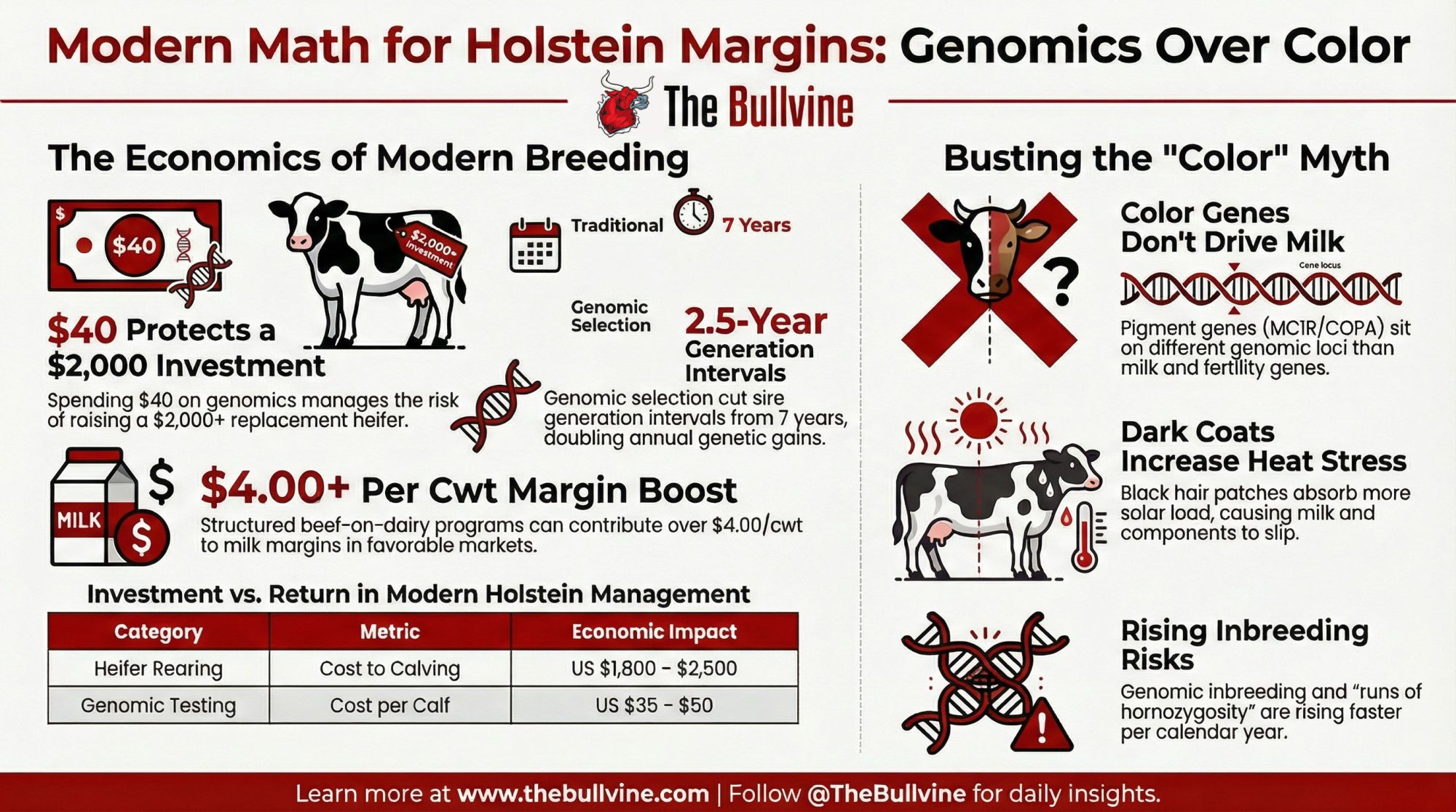
NewsSubscribe
First
Last
Consent

Why the A2 Boom Bypassed Heritage Breeds – And What’s Actually Working

Your Guernseys might be naturally A2—but if you’re not hitting 50,000 lb per run, your premium is probably disappearing in someone else’s silo.

U.S. Guernsey cattle are now officially sitting in the “Watch” category on The Livestock Conservancy’s Conservation Priority List, which is the tier reserved for breeds with fewer than 2,500 annual U.S. registrations and an estimated global population under 10,000 registered animals according to the Conservancy’s parameters.  The latest list still places Guernseys in that Watch bracket, which gives you a pretty clear sense of how small the registered population has become compared with where it once was in North America.

Over roughly the same period, the business around A2 milk has gone from a niche curiosity to serious money. Precedence Research pegs the global A2 milk market at about 2.86 billion U.S. dollars in 2025 and projects it out to around 7.62 billion by 2034 if current demand growth holds, which works out to roughly an 11‑plus percent annual growth rate over that stretch.  So you’ve got a rapidly growing premium segment on one hand, and on the other, you’ve got heritage breeds like Guernsey that, based on both breed descriptions and on‑farm A2 testing results, tend to show a very high frequency of the A2 β‑casein variant when samples are sent in.

The global A2 milk market is projected to nearly triple from $2.86B in 2025 to $7.62B by 2034—an 11%+ annual growth rate that explains why heritage breed owners thought they had a goldmine

On paper, you’d think those two things would line up a lot better than they have. As many of us have seen over coffee at meetings or in the bleachers at shows, they mostly haven’t.

What’s interesting here is that once you strip this back to what’s actually in the genes, how plants are built, and where the dollars really move, the answer is pretty straightforward… and a bit uncomfortable.

Looking at the genetics, not the sales pitch

Looking at this trend from the genetics side first, A2 isn’t some magical “heritage package.” It’s one specific change in the β‑casein protein coded by the CSN2 gene—a single nucleotide substitution that flips one amino acid at position 67 from histidine (A1) to proline (A2).  Reviews on A2 milk from food science and nutrition researchers keep coming back to the same point: the distinction between A1 and A2 β‑casein is that single amino acid difference, not a wholesale change in the cow or in other milk proteins.

That’s very different from things like butterfat performance, fertility, or how a cow holds up through the transition period in a grazing system, which all involve many genes and years of selection pressure. A2 is more like a light‑switch trait. If you’ve got genomic tools and access to semen catalogues that clearly label A2A2 sires, you can shift the A2 status of a Holstein herd pretty quickly.

A group led by B.A. Scott in Australia pulled together Holstein genomic data and published it in 2023 in Frontiers in Animal Science. They showed that the proportion of A2A2 Holstein cows in their dataset rose from about 32 percent in 2000 to roughly 52 percent in 2017 as selection for the A2 allele increased in the population.  That’s a big shift in less than two decades, driven mainly by AI studs and breeders nudging A2 sires up their lists once the trait started to matter commercially.

Holstein herds went from 32% A2A2 in 2000 to 52% by 2017 through simple genomic selection—proving that the “heritage A2 advantage” was never a sustainable moat 

Once brands like The a2 Milk Company started talking about A2 in grocery aisles, studs did what they always do: they flagged A2A2 sires clearly in proofs and catalogs and, where feasible, folded A2 into their mating tools and marketing.  If a bull was already strong on production, health traits, and type, A2 became one more box that was easy to tick when planning matings.

You can see how fast this can move when you look at operations like Sheldon Creek Dairy in Ontario. Their own story describes how they used Holstein genetics and careful sire selection to transition their herd to produce only A2 β‑casein, then built a bottled milk brand around that.  They didn’t need to change breeds to do it.

So if you’ve been told that Guernseys or other heritage breeds had a “baked‑in A2 advantage” that nobody else could catch, the genetics really don’t support that. The initial advantage was real—many Guernsey herds do test very high for A2—but it was easy for Holstein programs to copy once there was a commercial reason to do so.

The plant math that quietly decided everything

Now, genetics is only half the story. The other half is the part that doesn’t show up in glossy brochures: how milk actually moves through a plant, and what it costs to treat a stream as “special.”

Let’s walk through two real‑world scenarios the way you’d probably talk them through around a table with a pencil and a notepad. The numbers themselves will feel familiar if you’ve ever sat down with an extension engineer or a processing consultant.

In Scenario A, imagine a 5,000‑cow Holstein herd. If you decide to test all those cows for A2 using a typical genomic panel that includes β‑casein, you’re probably looking at something in the $45–50 per head range based on current commercial lab pricing in North America. Call it roughly $225,000 to test the whole string.

If around 45 percent of those cows test A2A2—which lines up with where a lot of Holstein herds land once A2 has been on the radar for a while—that’s about 2,250 cows. If those cows are averaging roughly 70 pounds of milk per day, that subset alone is producing around 157,000 pounds of A2 milk per day. Even if a processor only pulls part of that into a dedicated stream, you’re still comfortably over the 50,000‑pound volume that makes a separate A2 run realistic.

Most large plants can justify a separate A2 run at that kind of volume, including a full clean‑in‑place cycle between the A2 product and regular milk. Processors running A2 programs in markets like the U.S., Australia, and New Zealand report premiums of $1.50 to $2.50 per hundredweight over conventional pay prices, depending on contract structure and the products they’re making.  Stack that over a month, and you’re talking tens of thousands of dollars in extra revenue, without changing barns, freestall layout, dry lot systems, or core fresh cow management—just sorting cows, managing groups, and scheduling dedicated loads.

Daily production from that herd might be in the 7,500 to 9,000 pound range if cows are giving 50–60 pounds apiece, depending on components, fresh‑cow management, and days in milk. And that’s where the problem starts. In many Guernsey herds that have actually done the testing, a very high proportion of cows do come back A2A2, which matches what breed descriptions and breeders report, even though there isn’t a single global genomic survey that pins down one exact percentage.

Daily production from that herd might be in the 3,000 to 4,000 pound range, depending on butterfat performance, fresh cow management, and days in milk. And that’s where the problem starts. The same plants that are happy to schedule a special A2 run at 50,000 pounds in Scenario A can’t justify a completely separate run for 7–9,000 pounds a day from one small herd. By the time you factor in hauling logistics, testing, and the time and chemicals for a full CIP, that small stream just doesn’t carry its weight in a conventional plant.

Unless you and several neighbours can pool your milk into a unified, A2‑only stream that gets into the tens of thousands of pounds per week, your A2 milk is simply going to disappear into the regular tank. The premium doesn’t vanish because anyone dislikes Guernseys; it vanishes because the plant can’t afford to treat that small volume as a separate product under its current design.

In the Upper Midwest, for example, plant managers will tell you candidly that every new product run means lining up dedicated loads, testing them, possibly tweaking process settings, and then doing a full CIP before switching back. For many plants, a rough threshold where that becomes feasible is somewhere around 50,000 pounds per run, not as a hard rule but as the point where per‑unit costs start to look sensible.

So a lot of heritage herds find themselves at a three‑way fork:

  • One path is to invest in some level of on‑farm processing. When you talk to extension specialists and farmstead processors, a modest 50–150 cow setup—pasteurizer, bottling line, food‑grade processing room, cold storage, licensing, and working capital—often lands in the $175,000 to $325,000 range once everything’s on paper.
  • Another path is to organize a serious pooled stream with like‑minded neighbours so you can show up at the plant door with enough volume and consistency to justify a separate A2 or heritage run.
  • The third path, which many people end up on by default, is to accept that as long as you’re shipping into a conventional pool, A2 alone won’t change your milk cheque much, if at all.

A Vermont producer who priced all this out with advisors summed it up bluntly in a regional article: the A2 premium at the plant is real, he said, but they couldn’t see how to capture it “without becoming a completely different kind of business.”  That’s a pretty honest read on the gap between the A2 sales pitch and plant‑level infrastructure.

What on‑farm processing really looks like when you sharpen the pencil

If you’re seriously kicking the tires on processing your own milk—even just part of it—those big ballpark numbers start to look a lot more real once you break them down into line items.

Extension publications and small dairy plant consultants tend to put the major capital costs into a few familiar buckets. A decent-sized batch or HTST pasteurizer, plus a filler and basic controls, might run in the $75,000–$125,000 range, depending on whether you’re buying new or reconditioned equipment.  Building out or upgrading a room to meet food‑grade standards—floors, walls, floor drains, CIP‑friendly design, HVAC, and electrical—can easily add another $40,000–$80,000.

Then there’s the regulatory and compliance side. Between design review, permits, inspections, and initial lab work, many farms end up in the $15,000–$40,000 range just to get through licensing.  Add in $20,000–$40,000 for packaging and cold storage—bottles, caps, labels, cases, coolers, or a small walk‑in—and whatever you’re comfortable holding as working capital for a few months of payroll and utilities, which might be another $25,000–$40,000.

Put all of that together, and that’s how so many farmstead dairies land in that $175,000–$325,000 startup range for a 50–150 cow operation.  It’s a big step, especially when you’re still milking mornings and evenings and trying to keep cows moving cleanly through the transition period.

So what does that investment actually buy you on a per‑hundredweight basis?

When you talk to direct‑market farms that are selling whole milk under their own label and turning some of the tank into cheese, yogurt, or ice cream, you hear similar patterns in their back‑of‑the‑envelope math. Once they reverse‑engineer their retail sales back to the farm gate, many find that bottled whole milk is effectively returning somewhere in the high‑30s to mid‑40s per hundredweight equivalent.  Value‑added products like cheese or yogurt often come out in the mid‑50s to maybe around $80/cwt equivalent in some markets, especially near cities with strong local‑food demand.

Nobody is suggesting that every farm will hit those exact numbers; it depends heavily on your location, customer base, product mix, and ability to manage both the plant and the cows. But when you blend it all together—a portion of the milk as bottled whole, some as chocolate, some as yogurt or cheese—a lot of these operations report blended returns in the roughly $48–$65/cwt equivalent range.

Compare that to a commodity price in the low‑20s per hundredweight in many recent U.S. mailbox averages, and you start to see why some heritage herds are making that jump, even if it means learning to run a pasteurizer in the afternoon instead of heading straight from the parlor to the shop.

Heritage herds that successfully process on-farm report blended returns of $48–$65/cwt versus low-$20s in bulk pools—a 2–3× multiplier that justifies the capex if you can realistically climb this ladder in your market 

The real question for your yard isn’t “Is on‑farm processing a good idea?” It’s “Can I realistically see a path to that blended $45+/cwt equivalent in my own postcode with the time, talent, and markets I have—or can build?”

Who’s actually making heritage genetics pay?

What farmers are finding is that the heritage herds that are growing or at least holding steady aren’t hanging their hats on A2 alone. They’re building full business models around their cows.

Two Guernsey Girls Creamery in Wisconsin is a good example. Owner Tammy Fritsch runs a state‑licensed micro‑dairy near Freedom, milking a small Guernsey herd and processing the milk right there on the farm.  The idea didn’t start with spreadsheets; it started with years of showing Guernseys at the Wisconsin State Fair and hearing visitors ask where they could still buy Golden Guernsey milk like they remembered.

Today, that operation tests cows to confirm A2 status, pasteurizes milk on‑farm, and bottles non‑homogenized milk so the cream rises in the bottle—something customers notice right away.  They also make Guernsey cheese curds and other products, selling through farm pickup, local stores, and outlets that want something distinct and local.  A2 is part of the story, but it sits alongside breed identity, the visible cream line, and a direct relationship between the family and their customers.

In Ontario, Eby Manor near Waterloo has done something similar with its Golden Guernsey label. Their own materials describe their Guernsey milk as naturally rich and A2, and they bottle that into milk, chocolate milk, cream, yogurt, and cheeses under their family brand.  They’re working inside a quota system, but the basic approach is similar: don’t wait for a processor to create a Guernsey A2 silo—build your own lane and brand.

When you lay these examples side by side, the pattern is fairly consistent. The heritage herds that are really making it work often share a few traits:

  • They’ve taken control of at least some processing and packaging under their own roof.
  • They’ve built direct‑to‑consumer channels—farm stores, markets, local grocers, cafés, and delivery.
  • They’ve diversified beyond fluid milk into at least one or two value‑added products, often including cheese or yogurt.
  • They’re stacking A2 with other premiums like grass‑based feeding, local identity, sometimes organic certification, and the heritage angle itself.
  • They’ve built a community of customers who know the farm and the cows by sight.

For heritage herds that are still shipping everything into a single tanker and hoping a processor will someday decide to pay more just because the milk is A2, that’s the real gap.

The consumer confusion that muddies the water

There’s another piece here that’s easy to underestimate when you’re living in the barn: what’s going on in the consumer’s mind.

You probably know this already, but a lot of people use “lactose intolerance” as a catch‑all label for any discomfort they feel after drinking milk, even though true lactose intolerance is about low lactase enzyme levels and not about casein proteins. Reviews that look over the A2 literature point out that many consumers don’t clearly distinguish between issues with lactose and possible differences in how they respond to A1 versus A2 β‑casein.

So someone who’s genuinely lactose intolerant sees A2 milk on the shelf, hears that it’s “easier to digest,” and decides to give it a try. Since A2 milk still contains essentially the same lactose content as regular milk, that person may not feel any better. They walk away thinking, “That was just expensive milk that didn’t help me.”

At the same time, some people do report feeling better on A2 milk in controlled digestion studies, especially in terms of bloating or GI discomfort, but those are often individuals whose issues weren’t driven purely by lactose in the first place.  That nuance is tough to convey in three lines on a label or in a 15‑second ad.

For small heritage herds trying to build a local A2 niche, that confusion creates headwinds. The big A2 brands have done a lot to get the term “A2” into consumer vocabulary, which helps.  But they haven’t always helped shoppers understand why a local Guernsey A2 milk, sold in glass with a visible cream line and a pasture story, is another step different again.

So what stands out in conversations with farmers here is that A2 can be a door‑opener. It might be the reason someone tries your milk for the first time. But the reasons they keep coming back—flavour, mouthfeel, how they feel after they drink it, the kids’ reactions, what they see when they visit the farm—go way beyond that one gene marker.

What processors are really up against

As many of us have seen, it’s tempting to chalk all this up to processors “not getting it.” But when you actually sit in a plant office and ask how they’d make a heritage A2 run work, the answer often comes down to mechanics: plant design, labour, and scheduling.

In many Midwest plants, managers will tell you that every new product run means lining up dedicated loads, verifying composition, possibly adjusting process settings, and then performing a full CIP before switching back. That’s a lot of labour and downtime for a small stream. For many plants, the rough threshold at which this becomes feasible is around 50,000 pounds per run; below that, the extra cost per unit can erode the premium quickly.

There have been attempts in states like Wisconsin and Vermont to set up specialty pools—grass‑based pools, local pools, sometimes A2 pools. Some of those have made progress; others have run into predictable problems: not enough consistent volume, too much compositional variation, too much scheduling complexity relative to plant capacity.  In California’s Central Valley, where a lot of milk moves through very large, highly optimized plants tied to big Holstein herds in freestalls or dry lot systems, there’s even less room to carve out tiny lanes for heritage milk.

So if your business plan is built on a conventional plant paying a stable, meaningful premium just because your milk is both A2 and heritage, at a relatively small volume, you’re basically betting against the way most plants are currently engineered. That doesn’t make processors villains; it just means the system wasn’t built to do what we now wish it could do.

The pasture angle we don’t want to lose sight of

It’s also worth stepping back from the plant for a minute and looking at where these cows actually earn their keep: on the ground.

Teagasc, the Irish agriculture research and advisory organization, has done a lot of work comparing straight Holstein‑Friesian cows with Holstein‑Friesian × Jersey crossbreds in grass‑based, seasonal systems. In several of those multi‑year pasture studies, the crossbreds have come out ahead on profit per cow and per hectare, mainly because of better fertility, survival, and components, even when straight Friesians had an edge on pure volume.  An analysis highlighted by Agriland reported that crossbred cows at Teagasc’s Clonakilty research farm were generating around €162 more profit per cow per lactation than straight Holsteins in that grass‑based system.

Those aren’t Guernseys, but they do back up what many graziers in the Northeast and Upper Midwest have already noticed on their own farms: the cow that’s a star on a high‑input TMR in a big freestall isn’t always the cow that makes you the most money when you’re walking to the back paddock in April, dealing with wet springs, and trying to get an efficient bite off grass.

Heritage breeds like Guernsey, Ayrshire, and Brown Swiss, evolved in environments closer to those of grazing systems. The Livestock Conservancy, breed associations, and extension sources describe Guernseys as good grazers that can do well on quality pasture, hardy across a range of climates, and relatively easy to manage.  Ayrshires have long been known for strong feet and legs and good performance on rougher ground.  Brown Swiss carry a reputation for longevity and for producing milk with protein and casein profiles that work well for cheesemaking, especially in alpine‑style cheeses.

So if you’re in a pasture‑heavy system—think New York’s hill farms, Vermont and Quebec grazing herds, Wisconsin seasonal dairies, or coastal British Columbia—chasing A2 might be less important than asking, “Which genetics give me the best lifetime production and profit per acre on this land base?” A2 can still be part of that picture, but fertility, days in milk, hoof health, and how well a cow converts your grass into fat and protein are often the real levers.

Crossbreeding: where heritage genes quietly move into big herds

There’s also a quieter trend that doesn’t show up in breed registration numbers: heritage genetics getting into commercial herds through deliberate crossbreeding.

Many larger Holstein herds frustrated by fertility, lameness, and short productive lifespans have already considered crossbreeding with Jerseys, Montbéliardes, or Scandinavian Reds, and the literature on crossbred systems consistently shows heterosis benefits for functional traits such as fertility and survival.  Adding Guernsey, Ayrshire, or Brown Swiss sires into that mix—especially sires that are A2A2—is another way to bring in hybrid vigor and some of those pasture or functional traits without flipping the whole herd overnight.

Guernsey breeders like Tom Ripley, who has worked extensively with the American Guernsey Association, have shared field reports from producers who use Guernsey sires on Holstein cows and report improvements in calving ease, component levels, and, sometimes, fertility in the resulting crossbreds.  These aren’t controlled university trials, and they’re not going to show up in Journal of Dairy Science the same way Teagasc’s work does, but they do line up with the broader crossbreeding literature from New Zealand and Ireland that shows heterosis boosting “functional” traits in many three‑breed systems.

What’s encouraging about that is it opens up revenue beyond the milk cheque for heritage breeders who are paying attention. If you’ve got a Guernsey, Ayrshire, or Brown Swiss family with real performance behind it—good components, sound udders, durable feet and legs—you may have an opportunity to sell semen or breeding stock into commercial herds that want those traits, even if your own milk still goes into a conventional pool.

The bigger genetic picture and why it matters

One more piece that matters more in the long run than in any given month’s milk statement is genetic diversity.

Geneticists working on dairy cattle have been pointing out for years that the effective population size of Holsteins—the number of unrelated founders you’d need to reproduce the existing genetic variation—is relatively small compared with the actual number of Holsteins in barns. That’s what happens when you run intense selection on a fairly narrow group of elite sires for multiple generations.  It’s been great for yield and components, but it has nudged inbreeding steadily upward.

Scott’s 2023 analysis of selecting for A2 in the Australian Holstein population went a step further and showed that selecting for the A2 allele alone, without careful management of relationships, could increase both regional and genome‑wide inbreeding, because it narrows the sire pool even more.  That’s not a reason to avoid A2 completely, but it’s a reminder that stacking too many selection criteria on top of each other in a single breed can have side effects you don’t fully feel until years down the road.

Heritage breeds like Guernsey, Ayrshire, and Brown Swiss carry trait combinations that aren’t easy to rebuild if we lose them—heat tolerance paired with decent components, strong grazing instincts with solid structure, and cheese‑friendly casein variants, just to name a few.  The fact that Guernseys sit in that Watch category, with thresholds of fewer than 2,500 annual U.S. registrations and fewer than 10,000 registered animals globally, is a quiet alarm bell that those options are not endless.

BreedAnnual U.S. RegistrationsEst. Global PopulationConservation Status
Holstein>200,000>10 millionNot at risk
Jersey~40,000~1 millionNot at risk
Guernsey<2,500<10,000Watch
Ayrshire<1,000<5,000Threatened
Brown Swiss~5,000~50,000Watch
Milking Shorthorn<500<3,000Critical

Source: The Livestock Conservancy Conservation Priority List; breed association estimates

It doesn’t mean every commercial herd needs to go buy a string of Guernseys tomorrow. But it does mean that breed associations, co‑ops, and policy folks should be thinking consciously about whether they want those tools still available when our kids and grandkids are the ones making the breeding decisions.

So, where does this leave you in 2026?

Looking at this trend as a progressive producer, you start to see where the real decision points sit once the dust from the A2 hype settles.

A few things stand out:

  • Consumer preferences around A2, local, grass‑based, and heritage products are real in certain markets, especially urban and higher‑income areas, but they’re patchy. Survey‑based work on A2 consumer preferences in Europe and Oceania shows that some shoppers will pay a noticeable premium for A2 milk, while others don’t see enough perceived benefit to justify switching from conventional milk, which mirrors what many of us see in farm stores and markets.
  • Heat stress and climate volatility are already costing the dairy sector serious money in lost production and fertility, and those costs are expected to grow rather than shrink. Economic analyses of heat stress in U.S. dairy herds estimate total losses in the billion‑dollar range annually, once you add up milk yield, reproduction, and health impacts.  Cows that handle heat and weather swings better are going to become more valuable in most regions.
  • Infrastructure support for new models is becoming increasingly flexible. Vermont’s Working Lands Enterprise Initiative, Wisconsin’s Dairy Innovation Hub, and similar programs are investing public funds in on-farm processing, small regional plants, and broader dairy innovation projects.  That doesn’t guarantee success, but it does mean there’s some help out there if you want to test a new model rather than go it completely alone.
  • Genetic diversification remains an under‑valued hedge. Whether it’s crossbreeding, bringing in some heritage lines, or just broadening your selection goals beyond the next hundred pounds of milk, diversifying your genetics can give you more room to manoeuvre when markets, policies, or weather patterns shift.

Coffee‑table takeaways, now that the mugs are half empty

If you’re already milking heritage cows, the big takeaway is that A2 is a nice card to have, but it’s not the ace by itself. The herds that are winning with heritage breeds right now are stacking A2 on top of strong butterfat performance, good grazing fit, on‑farm processing, and deep customer relationships.  Before you spend a couple of hundred thousand dollars on stainless and concrete, it’s worth asking yourself whether you can realistically see a blended return in that $45+/cwt equivalent range through bottled milk and value‑added products in your area.  If you can’t, you may find that your energy is better spent tightening your grazing, strengthening your direct‑to‑consumer channels, or positioning your herd as a source of genetics for crossbreeding and semen sales.

If you’re thinking about moving into heritage breeds, it’s worth starting not with the cow but with the market. Who exactly would buy this milk? In which form? At what price? Is there a realistic path to processing either on‑farm or through a small creamery that’s willing to build a heritage or A2 brand with you? Spending a day or two with people who already made that jump—walking their plant, talking about their transition period, and listening to their cash‑flow stories—is probably one of the best investments you can make before you call a Guernsey breeder.  And don’t forget to think about genetic revenue: semen, embryos, and breeding stock can all sit alongside the milk cheque if you build the reputation and the data.

If you’re looking at things more from the 30,000‑foot view—maybe you’re involved in a co‑op board, a breed organization, or a policy group—then the message is that heritage breeds aren’t going to be “saved” by the A2 boom alone. But they still have important roles to play in crossbreeding programs, in pasture‑based systems, and as a reservoir of traits we may need badly in years to come.  Supporting more flexible processing infrastructure, targeted grants, and thoughtful breeding work may do more to keep those options alive than any single A2 marketing campaign.

In the end, the A2 boom didn’t so much ignore heritage breeds as flow into the channels that were already built: big Holstein herds, big plants, big distribution. That’s frustrating if you’ve been sitting on a naturally A2 herd for decades. But once you see it clearly, it also frees you up.

Instead of waiting for the system to notice and reward you, you can decide whether you want to build a different kind of business around your cows, or whether you’re better off using their genetics as one tool in a broader, more diversified strategy. It’s more work either way, no doubt about it. But as many of us have seen on farms that have made these choices with clear eyes and solid numbers, that’s also where the real, lasting opportunities tend to live. 

Key Takeaways:

  • A2 isn’t a heritage lock‑in. It’s a single‑gene trait Holsteins copied fast once the market cared—Guernseys’ natural head start didn’t last.
  • Plant math decides who gets the premium. Most processors need ~50,000 lb A2 runs to justify segregation; a 150‑cow Guernsey herd’s 3–4,000 lb/day just disappears into the bulk tank.
  • On‑farm processing can pay, but know your numbers. Expect $175K–$325K capex and aim for $45+/cwt blended returns—if you can’t see that path in your market, stainless may not be your move.
  • Winning heritage herds stack premiums, not just genes. A2 opens doors, but repeat customers come back for cream‑top bottles, local identity, pasture stories, and real relationships.
  • Heritage genetics still matter—for crossbreeding, grazing, and the long game. Functional traits, heat tolerance, and diversity are worth more as inbreeding and climate pressure keep rising.

Executive Summary: 

This feature digs into a simple question a lot of producers are asking: if A2 milk is headed toward a $7.6 billion global market, why are Guernseys still on the Watch list instead of cashing in? It shows that A2 is just a single‑gene switch Holsteins adopted quickly, while the real gatekeeper is plant design—big processors need 50,000‑lb A2 runs from 5,000‑cow herds, not 3–4,000 lb/day from 150‑cow heritage barns. You’ll see the hard numbers on on‑farm processing—typical $175,000–$325,000 capex and blended $48–$65/cwt returns—so you can tell if a bottling room pencils out for your postcode or just steals sleep and cashflow. The article profiles Two Guernsey Girls in Wisconsin and Eby Manor in Ontario to show how some herds are actually making heritage genetics pay by stacking A2 with grass‑based stories, cream‑top bottles, and value‑added products. It also walks through where heritage genes fit into crossbreeding, pasture‑based systems, and long‑term genetic diversity, especially as heat stress and inbreeding pressure keep rising. The piece ends with clear, coffee‑table style takeaways that help you decide whether your best move is chasing A2 contracts, investing in stainless, leaning into crossbreeding, or staying bulk and focusing on the cows and markets you already do best.

Complete references and supporting documentation are available upon request by contacting the editorial team at editor@thebullvine.com.

Learn More

Join the Revolution!

Join over 30,000 successful dairy professionals who rely on Bullvine Weekly for their competitive edge. Delivered directly to your inbox each week, our exclusive industry insights help you make smarter decisions while saving precious hours every week. Never miss critical updates on milk production trends, breakthrough technologies, and profit-boosting strategies that top producers are already implementing. Subscribe now to transform your dairy operation’s efficiency and profitability—your future success is just one click away.
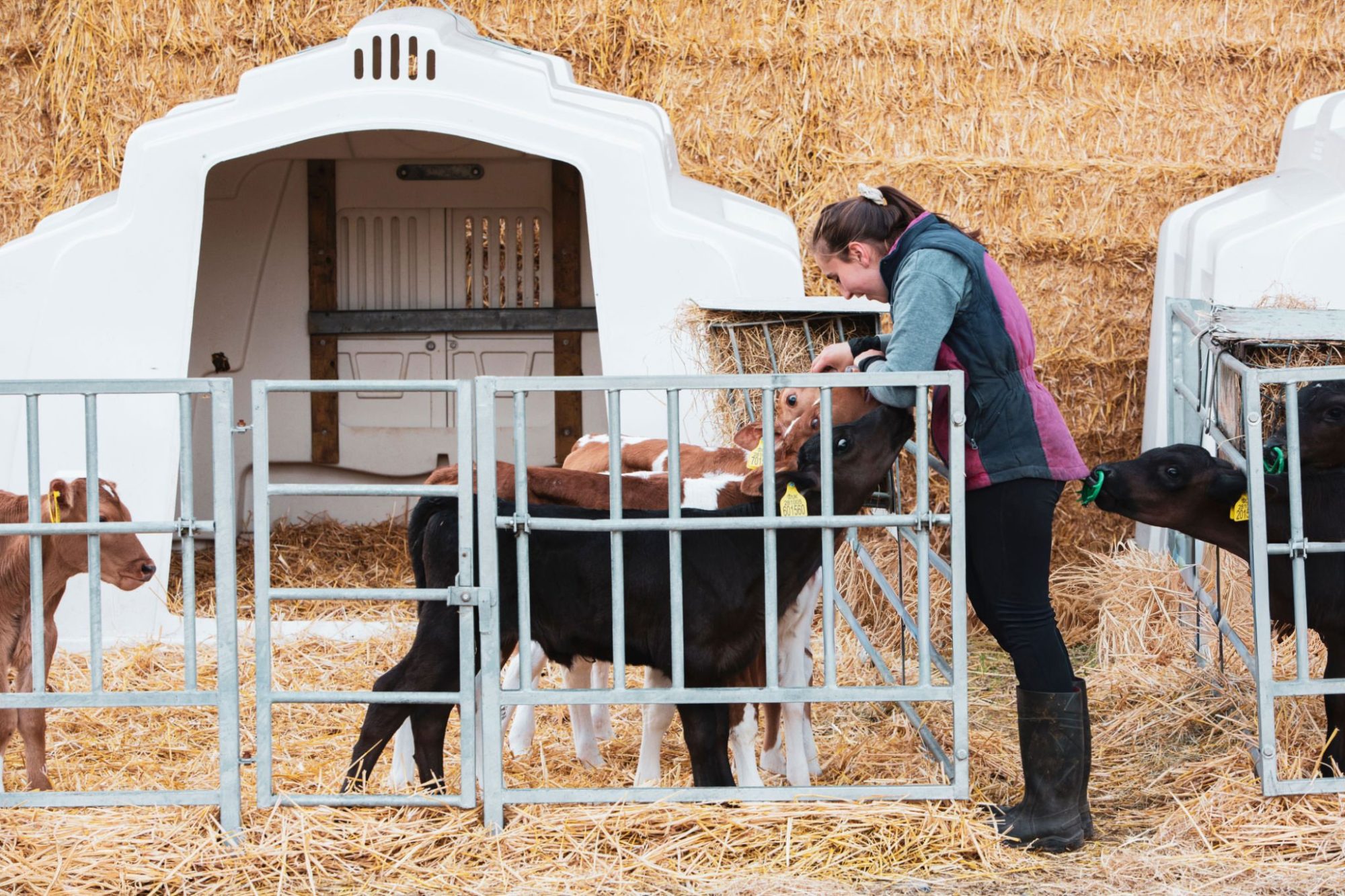
NewsSubscribe
First
Last
Consent

The 18-Month Protein Window: $11 Billion in New Plants Signals It’s Time to Rethink Your Sire Lineup

$11 billion in new processing capacity. A protein-hungry consumer base. And an 18-month breeding window that will shape your milk check through 2030.

Executive Summary: The protein line on your milk check is about to matter more—and your next 18 months of breeding decisions will determine whether your herd is positioned to benefit. GLP-1 weight-loss medications now reach 15.5 million Americans, with clinical guidance steering patients toward protein-dense dairy like Greek yogurt and cottage cheese. Processors have responded by locking in $11 billion in new cheese and cultured capacity across 19 states, scheduled to come online by 2028. University of Minnesota research shows many Holstein herds already carry significant A2 and favorable kappa-casein genetics without active selection, and genomic testing at $30-50 per head makes it practical to know where you stand. The timeline is clear: calves from 2026 matings will hit peak production just as this new capacity reaches full stride. Whether you’re scaling for growth, navigating mid-career capital decisions, or planning a clean exit, the protein opportunity is real, and the window to position for it is now.

Healthcare analysts tracking GLP-1 medications like Ozempic, Wegovy, and Mounjaro are projecting that this class of drugs could grow from about 64.42 billion dollars in annual sales in 2025 to roughly 170.75 billion by 2033—around 13 percent growth per year, according to MarketsandMarkets’ latest global forecast. And that number may have more to say about your protein line than any milk market report you’ve read this year.

Here’s what’s interesting: analysts have been telling food and agriculture reporters that a market that big doesn’t just change what’s in the pharmacy aisle. It spills over into what people put in their carts and on their plates, because these drugs influence appetite, satiety, and what doctors and dietitians tell patients to look for in the grocery store.

And that’s where our dairy conversation really starts to get interesting over coffee.

Why Protein Seems to Be Doing More of the Work

Not long ago, I was at a winter meeting in Wisconsin and a producer leaned over between sessions and said, “You know, I’m starting to see protein doing more of the heavy lifting on my milk check than it used to. It’s not huge yet, but it’s moving.” In a lot of Midwest herds, when folks actually line up a few years of milk cheques, they see the same thing—the protein line quietly pulling a bit more weight relative to butterfat performance than it used to.

If you look north of the border, the Canadian Dairy Commission has adjusted support prices and farm-gate returns to reflect rising feed and operating costs, and those decisions feed into the detailed component-based payment formulas that provincial boards publish. When you study those formulas in Ontario or across Western Canada, you can see that protein and other non-fat solids account for a substantial share of the value, especially in classes tied to cheese and yogurt.

On the U.S. side, federal order component pricing and plant pay schedules in cheese-oriented markets show the same general pattern: butterfat still matters a lot, but protein has become more important as plants capture value from cheese, powders, and high-protein ingredients.

The thing that jumps out to me is that this shift at the pay-stub level isn’t happening in isolation. If you step back and connect a few dots—the GLP-1 story, a growing stack of gut-health research around yogurt and fermented dairy, and more than 11 billion dollars in new processing investments that IDFA says are already locked in—you start to see a pretty coherent picture pointing toward solids, and especially protein.

That’s why I keep coming back to this simple idea: the bulls you pick over the next 18 months are a direct bet on what your milk check looks like in 2029.

GLP-1: The Drug Class Turning Up the Volume on Protein

Looking at this trend, we’ve got to spend a little time on GLP-1 drugs, even though they can feel a long way from the parlor.

Peer-reviewed clinical reviews published in PubMed-indexed journals describe how these medications mimic incretin hormones and work on several fronts: they reduce appetite, slow gastric emptying, improve insulin secretion, and lead to substantial weight loss in people with type 2 diabetes and obesity when used as prescribed.

What the clinical literature also shows—and this is where it becomes relevant for us—is that rapid weight loss can involve loss of lean mass if patients don’t maintain adequate protein intake and engage in some resistance activity. That’s why many clinicians now emphasize maintaining a solid protein intake, or even increasing it, when patients start GLP-1 therapies.

Dairy-focused outlets have begun connecting that clinical guidance to what’s happening in the dairy case. Analysis that combined polling and retail data showed that around 15.5 million U.S. adults were using GLP-1 injectables as of 2023, with adoption expected to reach roughly 9% of the adult population by 2030. Those users reported cutting daily calories by about 20 percent—roughly 800 kilocalories—while shifting away from high-sugar products toward lean proteins.

Registered dietitians explained that they often recommend Greek yogurt, dairy-based protein drinks, and cottage cheese to patients on GLP-1s because these foods deliver convenient, high-quality protein and align with satiety- and gut-friendly patterns supported by the clinical literature.

Now, it’s worth saying out loud that not every GLP-1 user suddenly becomes a model high-protein eater. Real-world adherence, side effects, out-of-pocket costs, and insurance coverage limits all affect how many people stay on these medications and how they actually use them.

But when you put tens of billions of dollars in current GLP-1 sales together with a well-publicized forecast that the market could more than double, and you pair that with a consistent medical message—”eat less overall, but don’t short yourself on protein”—it’s not surprising that food companies and retailers are re-examining their high-protein offerings.

If your cows are producing the milk that ends up in those products, that’s a signal worth keeping in mind the next time you’re standing in front of the semen tank.

Gut Health, Fermented Dairy, and the Slow Burn That’s Paying Off

At the same time, yogurt and fermented dairy have been building their own steady momentum, well before GLP-1 became a household word.

Large prospective nutrition cohorts, such as the Nurses’ Health Study and the Health Professionals Follow-up Study, have tracked people’s diets and health outcomes for decades. Analyses of those cohorts published in journals like the American Journal of Clinical Nutrition have repeatedly found that higher yogurt consumption is associated with a lower risk of type 2 diabetes, even after adjusting for body mass index, smoking, and physical activity.

Umbrella reviews that pool data from multiple observational studies have reached similar conclusions, reporting that yogurt intake tends to align with modestly lower diabetes risk and somewhat better cardiometabolic profiles overall.

On the intervention side, randomized controlled trials have tested yogurt enriched with prebiotic fibers, such as inulin and konjac glucomannan, in adults with type 2 diabetes. Over a few weeks to months, those enriched yogurts improved insulin sensitivity, fasting glucose levels, lipid profiles, and, sometimes, inflammatory markers compared with control products.

Reviews of fermented dairy and the gut microbiome describe how specific cultures and fermentation processes can shift gut bacteria toward profiles that appear beneficial for metabolic and digestive health.

So what do shoppers do with all that? Market research shows that consumers consistently rank yogurt, kefir, and other cultured dairy products among the foods they see as “good for their gut,” and sales data indicate these categories have grown into multi-billion-dollar markets with high single-digit or better growth in many recent years.

Put that together with the GLP-1 protein push, and you can see why there’s so much interest in milk that shows up with consistent protein and butterfat performance, not just volume.

What Jumps Out: The 11-Billion-Dollar Vote for Components

One of the clearest signals in all of this isn’t in survey data at all; it’s in concrete and stainless.

In October 2025, IDFA kicked off Manufacturing Month by highlighting that U.S. dairy processors are investing more than 11 billion dollars in new and expanded processing capacity across 19 states, spread across more than 50 individual building projects scheduled between 2025 and early 2028.

IDFA president and CEO Michael Dykes, D.V.M., has said this reflects a “growth mindset” among processors who expect U.S. milk production to rise by about 15 billion pounds by the end of the decade and want to be ready to turn that milk into higher-value products rather than dumping it into lower-value uses.

When you look at the breakdown, cheese facilities are attracting about $ 3.2 billion. Milk and cream operations account for nearly 3 billion, while yogurt and cultured products draw another 2.8 billion.

By state, New York is slated to receive about 2.8 billion in projects, Texas roughly 1.5 billion, Wisconsin around 1.1 billion, and Idaho and Iowa about 720 million each, making those states some of the biggest beneficiaries of this capex wave.

In New York, those projects layer onto a milk shed already producing roughly 16 billion pounds of milk per year, according to USDA NASS data. Texas has climbed into the top three milk-producing states, anchored by large dry lot systems in the Panhandle and High Plains. Wisconsin continues to deepen its role as a cheese and whey hub, while Idaho and Iowa are adding cheese and powder capacity that fits their existing dairy and feed bases.

You can see where this is going: when processors put that kind of money into cheese vats, separators, and dryers, they’re voting for solids. You don’t design a modern cheese plant or whey protein line around thin, low-component milk. You design it around protein and fat. That doesn’t mean volume suddenly doesn’t matter—but it does change what kind of volume they value most.

The Genetics: You Might Be Closer Than You Think

Now, at this point, somebody usually asks, “Okay, but how far behind am I really?”

Here’s where the data is a bit more encouraging than a lot of folks expect.

When the University of Minnesota genotyped its entire research herd in 2019, more than 50 percent of the Holstein cows turned out to be A2A2 for beta-casein, even though the herd hadn’t been selected for that trait. A separate 1964 Holstein genetic line in the same project had only 26 percent A2A2, showing how selection can shift things over time, and their crossbred cows and heifers ranged from 36 to 50 percent A2A2.

Herd Type / PopulationSelection Pressure for A2?A2A2 Frequency (%)Key Insight
UMN Holstein Research Herd (2019)None50%Half the herd was A2A2 without trying
UMN 1964 Genetic LineNone (frozen 1964 genetics)26%Shows effect of modern selection drift
General Holstein Population (est.)Minimal to moderate~33%Roughly 1 in 3 Holsteins could be A2A2
Jersey / Guernsey / Brown SwissLow to moderate70%+Heritage breeds carry higher baseline
UMN Holstein-Jersey CrossesNone (F1 crosses)36-50%Crossbreeding can accelerate A2 shift

Broader genetic research published in peer-reviewed animal science journals suggests the A2 allele frequency in Holsteins runs somewhere in the 50 to 60 percent range, which mathematically implies that roughly a third of Holsteins in general might be A2A2, with the rest mostly A1/A2.

Jersey, Guernsey, Normande, and Brown Swiss populations tend to carry higher A2 frequencies—often 70 percent or more in Swiss breeds and even higher in some heritage populations.

Now, that doesn’t mean every commercial Holstein herd is sitting at UMN-level A2A2 percentages. Actual numbers vary with sire usage and the age of sire lines. But the university data and industry allele estimates suggest that many herds probably have more A2 genetics—and more favorable kappa-casein genotypes—walking around than you’d guess just by looking at cows in the freestalls.

Over the past 10 to 15 years, genomic testing has really changed how we can use that information. Modern genomic panels routinely report beta-casein type, kappa-casein genotype, predicted transmitting abilities for fat and protein yield and percentages, and indices for health, fertility, and even feed efficiency.

In practical terms, most commercial genomic panels used on heifers and cows today cost between $ 30 and $ 50 per head, depending on the panel and the volume of samples. Holstein Canada’s 2024 fee schedule shows base animal testing at $ 33, which aligns with what extension budgets and on-farm case studies report.

AI catalogs from major studs show that A2A2, high-component, favorable kappa-casein bulls often carry a small price premium over more “average” Holstein sires, but still sit within what most breeding programs can handle.

This suggests that for many herds, this isn’t a “start from scratch” situation. It’s more a case of figuring out what you already have and then nudging your breeding decisions in a direction that lines up with where the plants and the people seem to be going.

A Wisconsin Coffee Shop Scenario

Let’s ground this with a scenario that’ll feel familiar to a lot of Midwest producers.

Say you’re running 450 Holstein cows in south-central Wisconsin. You’re milking in a double-12. You’ve got sand-bedded freestalls, respectable butterfat performance, and good enough fresh-cow management in the transition period that you don’t dread opening the DHI packet. At the same time, your stall bases and manure system are over 20 years old, and every January you catch yourself wondering which piece of steel or concrete is going to cause trouble this year.

If you look at UW-Extension summaries and USDA cost-of-production data for similar-sized freestall herds in Wisconsin, total economic breakevens often fall in the mid- to high-teens per hundredweight, once you account for hired labor and realistic debt service. Let’s say your true breakeven is around 17 dollars. A lot of Wisconsin operations would recognize that as a believable number when they work through their own books.

You’re 48. Your daughter is finishing a dairy science degree and wants to come back, but she wants to see a path that looks like building a business for the next 15 to 20 years, not just hanging onto tired infrastructure.

In that position, here’s the kind of path I’ve seen work in real herds:

  • You decide to test all milking cows and heifers genomically. At roughly 40 dollars a head and 600 head total, that’s about 24,000 dollars—a noticeable check to write, but still a fraction of any major building project.
  • The results come back and, like UMN, you discover a decent chunk of your Holsteins are A2A2 and that a meaningful fraction carry kappa-casein genotypes that cheese makers like.
  • You sit down with your genetics advisor and draw up a simple plan: the top tier of heifers and cows on components and health get bred to A2A2, high-protein, favorable kappa-casein bulls; the bottom tier gets beef semen. Your overall semen bill goes up a bit—maybe a thousand or two a year—but you stop multiplying the genetics that hold back components and cow health.
Investment ItemCost / ValueTimelineNotes
Genomic Testing (600 head)$24,000One-time upfrontTests all cows + heifers; identifies A2, kappa-casein, component PTAs
Premium A2/High-Component Semen+$1,500-$2,000/yearOngoingSmall incremental cost vs. standard Holstein semen
Total First-Year Investment~$26,000Year 1One-time test + first year of premium semen
Milk Production (450-cow herd)20-22 million lbs/yearBaselineTypical for well-managed Midwest freestall herd
Component Value Improvement (conservative scenario)+$0.15-$0.25 per cwtYears 3-5+Even modest protein % gains + favorable casein = higher pay
Annual Return (conservative)$15,000-$30,000+/yearOngoing after calves freshenBased on 20M lbs at $0.15-0.25/cwt improvement
Simple Payback Period<2 years$26K investment / $15-30K annual return
10-Year Net Benefit (conservative)$120,000-$270,000Years 1-10Assumes modest component gains hold across herd lifecycle

On the calendar, calves from those matings in 2026 are born through early 2027. Those heifers freshen in your parlor in 2028. By 2029-2030, a big slice of your herd is in second lactation with more consistent protein percentages and solid butterfat performance, as long as your nutrition and cow comfort keep pace.

A 450-cow herd milking well could easily be shipping on the order of 20 to 22 million pounds of milk a year. In some component pay systems used by cheese-oriented plants, even a small improvement in how protein is valued—a couple of cents per pound of protein, depending on the exact formula—can turn into tens of thousands of dollars a year for a herd that size when you run real solids and volume numbers through actual federal order and plant pay schedules.

Nobody can guarantee exactly what your protein line will look like in 2030. Pay formulas and markets change. But when the cost side of the strategy is a one-time genomic investment and a modest ongoing semen premium, and the upside sits in that “tens of thousands per year” range in a world that’s clearly leaning into protein-dense dairy, you can see why more producers are at least sharpening their pencils.

Western Dry Lot Systems: When Components Become “Exported Water”

Now, slide that coffee mug over to a friend running 3,000 cows in a dry lot system in the Texas Panhandle or eastern New Mexico, and the conversation sounds a little different. The underlying theme is the same, though.

In those systems, water and purchased feed are usually the top two headaches.

U.S. Geological Survey data on the Ogallala Aquifer shows that in heavily irrigated parts of western Kansas and the Texas High Plains, groundwater levels have dropped significantly over the past several decades—in some areas, declines of 50 to 70 feet or more in the most heavily pumped townships. USDA Climate Hubs data shows similar patterns in Texas and Oklahoma. That’s a long-term structural issue, not just a “bad year.”

Climate and hydrology work on the Colorado River basin tells a similar story. Multiple research studies and federal data confirm that since about 2000, average river flows have been roughly 20 percent below the 20th-century average. The Nature Conservancy, Colorado State University researchers, and coverage in High Country News all point to reduced snowpack and higher temperatures—a “hot drought” pattern that’s likely to persist under current climate projections.

At the same time, USDA hay market reports and Western extension bulletins regularly show Supreme and Premium alfalfa in states like California, Arizona, Idaho, and New Mexico, bringing noticeably higher prices per ton than comparable hay in Wisconsin or Minnesota, reflecting irrigation costs and freight.

Delivered costs for corn and other concentrates are also higher when you’re far from the Corn Belt, something our previous coverage has been highlighting in its pieces on regional profitability and the “processing gap” between where milk is produced and where it’s processed.

So in that context, when Western producers talk about components, they’re often thinking less about a formal protein premium line on the cheque and more in terms of “How many pounds of fat and protein can I ship for each unit of water I’m legally and affordably pumping and each ton of feed I’m buying?”

That’s what people really mean when they talk about components as a way of “exporting water.” You’re not literally putting your irrigation water in the tanker, but the more solids you produce per acre-inch of water and per ton of dry matter, the more value you’re effectively moving off the farm with each load of milk.

In practical terms, that’s where genomic selection for traits like protein percentage, feed efficiency, and health, paired with sharp ration work and solid fresh cow management during the transition period, becomes a survival tool rather than just a nice genetics project.

Why the Next 18 Months Matter More Than They Seem

If you lay all this out on a simple timeline, you can see why a lot of conversations keep circling around an “18-month window.”

From breeding to first calving is about nine months of gestation. Then you’ve got a couple of months for the heifer to get through the transition period and settle in, and at least one full lactation before you really know who she is in terms of components, health, and fertility. Realistically, it takes several years of consistently breeding in a chosen direction before that genetic shift really shows up in the bulk tank.

On the processing side, most of the projects in that 11-billion-dollar wave are slated to start up between now and the end of the decade. If they stay roughly on schedule, the new cheese, yogurt, and ingredient plants will be running full out right when the calves you breed in the next 18 months are in their first and second lactations.

GLP-1 use and gut health awareness aren’t expected to disappear over that same period, either, based on current clinical and market outlooks.

So, whether you think about it this way or not, every sire selection you make today is a kind of futures contract on your 2029 milk check. You’re deciding how much of your herd, three to five years from now, will be built mainly for volume, and how much will be built for components that match the products and markets your milk will flow into.

Talking With Your Processor: Three Questions Worth Asking

I’ve noticed that the farms that navigate this best aren’t just tweaking genetics in a vacuum; they’re also having better conversations with the folks who cut the checks.

If you pick up the phone or catch your field rep in the yard, three simple questions can open up a lot:

  • First: “Looking at the new plants we’re building into, how do you expect protein and butterfat to be valued over the next five to ten years compared to today?”
  • Second: “Are there specific quality or composition targets—like protein percentage, A2 status, or other specs—that you expect to reward more as these projects come online?”
  • Third: “Based on your data, where does my herd stand today on components and quality relative to your overall supplier base?”

Processors and co-ops often have more visibility into future product mix than we do from the farm side. Asking these questions doesn’t mean you’ll get a perfect forecast—nobody has that—but it can help you decide how aggressively to steer your genetics, nutrition, and fresh cow management toward components.

And honestly, that’s the kind of conversation that separates the farms steering the bus from the ones just along for the ride.

Different Farms, Different Plays—And That’s Okay

As many of us have seen over the years, there’s never just one “right” answer that fits every farm.

If you’re a younger operator—say under 45—with a competitive cost of production and a realistic plan to be milking for another 15 to 20 years, this protein-heavy future probably looks more like an opportunity than a threat. Genomic testing a meaningful share of your herd, tightening sire selection around protein, butterfat, and casein while still protecting fertility and cow health, and working with your nutritionist to support solids as well as volume, are all moves that research and extension work suggest can pay back over a longer time horizon.

If you’re in that mid-career zone—mid-40s to mid-50s—and staring at a parlor, freestalls, or manure setup that’s near the end of its useful life, your decisions get more complicated. Industry data shows robotic milking units typically ranging from 150,000 to 230,000 dollars per unit, and full conversions for 400- to 600-cow herds can easily clear a million dollars once buildings and support systems are included. Payback estimates often fall in the seven- to ten-year range, depending on actual labor savings, component shifts, and day-to-day management.

In that situation, what a lot of mid-career producers are doing is leaning first on lower-capital levers: improving genetics for components and health, tightening fresh cow management in the transition period, putting serious effort into forage quality and consistency, and, where appropriate, using tools like Dairy Margin Coverage or private revenue protection to soften some of the income swings while they make those improvements.

If you’re closer to retirement and there’s no clear successor ready to step in, the smartest move may be different again. USDA and land-grant land value reports show that farm real estate in good dairy regions—especially around the Great Lakes—has held value well and, in many cases, has increased substantially over the past 15 years. In some strong dairy counties, values have doubled or more.

In that context, it often makes sense for someone in their late 50s or 60s to focus on maintaining cow health and respectable components, avoid taking on major new debts that won’t realistically be paid off during their working years, and keep the place clean and marketable so they can sell or rent out on their own terms when the time feels right.

None of these paths is “better” in every situation. They’re just different ways of responding to the same set of signals, depending on where you and your family are in your own story.

A Note for Canadian Producers

For those of you milking under quota north of the border, the component picture plays out a little differently—but the underlying direction is similar.

Canadian Dairy Commission support prices and provincial board formulas have always valued butterfat heavily, and that hasn’t changed. But the rising importance of protein in cheese yields and in high-protein consumer products is shaping how milk classes are structured and valued.

If you’re considering A2 or kappa-casein genetics, the economics work a bit differently under quota than under U.S. federal orders, but the potential for premium marketing channels—particularly for fluid A2 milk and specialty cheese—is growing in Canada too.

Reports show that in early 2025 that Minnesota dairy farmers are increasingly interested in A2 milk, and that interest is mirrored across the border as Canadian processors explore differentiated product lines.

The strategic question is similar: know your herd’s genetic profile, understand where your processor is headed, and make breeding decisions that line up with both.

The Long Game: Water, Land, and Where Dairy Stands

Before we drain the coffee pot, it’s worth zooming out one last time and thinking about the long game.

Those water trends I mentioned earlier—the Ogallala declines, the Colorado “hot drought”—are already forcing Western agriculture, including dairies, to adjust cropping patterns, scale back irrigated acres, and in some cases rethink long-term viability.

RegionPrimary Water SourceStatus / TrendLong-Term OutlookStrategic Implication
Texas / Kansas / Oklahoma High PlainsOgallala Aquifer-50 to -70 feet in heavily pumped areas since 2000Continued decline; fossil waterRisk: Rising costs, limited expansion, potential exit
Southwest / Colorado River BasinColorado River-20% avg. flow since 2000; persistent “hot drought”Likely permanent reduction per climate modelsRisk: Competing demands, regulatory limits on ag water
Great Lakes Region (WI, MI, NY, PA, OH)Great Lakes + groundwaterStable; 20% of global fresh surface water; renewableSecure; regulated but abundantOpportunity: Water-secure base for high-component dairy
Northeast / Upper Midwest (MN, IA)Surface + renewable groundwaterGenerally stable; localized stress in some areasSecure to moderately secureOpportunity: Can support expansion near processing hubs
Idaho / Pacific NorthwestSnake River, Columbia BasinModerate stress; dependent on snowpack trendsVariable; snowpack declines a concernMixed: Secure short-term; watch long-term snowpack

Meanwhile, regions around the Great Lakes and much of the Northeast, while facing their own regulatory and environmental pressures, sit over comparatively robust and renewable water supplies.

In outlook meetings and trade coverage, economists from places like UW-Madison and the Food and Agricultural Policy Research Institute have pointed out that, over the long term, water-secure regions in the mid-section and upper Midwest are likely to remain very competitive bases for high-value, component-dense dairy production, especially as water limits and climate volatility tighten elsewhere.

So when you put all of this together—GLP-1 nudging people toward higher-protein diets, gut-health research backing fermented dairy, processors pouring billions into cheese and cultured capacity, herd genetics already carrying more A2 and kappa-casein variation than many of us realized, and export demand for high-protein powders and cheeses continuing to grow in markets like Asia and the Middle East—it’s not surprising that so many barn-office and meeting-hall conversations keep circling back to components.

Key Takeaways for Your Farm

If you like things boiled down, here are a few questions and actions worth mulling over in the next 18 months:

  • Know your genetics: Do you actually know your herd’s A2, kappa-casein, and component profile, or are you guessing? A targeted genomic test can answer that.
  • Align sires with where plants are going: Are you picking bulls that match the protein-heavy, cheese-and-cultured future your local plants are investing in?
  • Talk to your buyer: Have you asked your processor how they expect to value protein and fat over the next five to ten years, and how your herd stacks up today?
  • Match strategy to stage: Given your age, equity, and family plans, are you better off leaning into growth, tightening the current system, or focusing on a clean exit with strong land value?

The Bottom Line

If we were actually sitting at your kitchen table, I wouldn’t pretend there’s an easy, one-size-fits-all answer.

What I’ve seen, watching a lot of different farms, is that the ones that come through big shifts like this in the best shape aren’t always the biggest or the fanciest. They’re the ones that stay curious, pay attention to where the science and the money are pointing, and then make a handful of well-timed, thoughtful decisions instead of either doing nothing or trying to change everything at once.

When you lay the GLP-1 billions, the 11-billion-processor bet, and your own protein line side by side, it’s hard to argue that this is just another passing fad. The genetics are already in your pens, at least to some degree. The concrete is being poured at the plants. The health trends aren’t evaporating next week.

The real question is how you want to position your herd—and your milk check—for the chapter that’s already starting to unfold.

Complete references and supporting documentation are available upon request by contacting the editorial team at editor@thebullvine.com.

Learn More

Join the Revolution!

Join over 30,000 successful dairy professionals who rely on Bullvine Weekly for their competitive edge. Delivered directly to your inbox each week, our exclusive industry insights help you make smarter decisions while saving precious hours every week. Never miss critical updates on milk production trends, breakthrough technologies, and profit-boosting strategies that top producers are already implementing. Subscribe now to transform your dairy operation’s efficiency and profitability—your future success is just one click away.

NewsSubscribe
First
Last
Consent

Beef-on-Dairy’s $500,000 Swing: What 72% of Farms Know That’s Costing You $1,000/Cow Every Year

$4,000 for a replacement heifer. $875 for a dairy bull calf. But 72% of farms get up to $1,450 for beef-cross calves, AND cut replacement needs by 30%. The $500K swing isn’t theory—it’s math.

Last spring, I was talking with a Wisconsin dairy producer who described a moment that’s becoming increasingly common across the industry. He’d just finished reviewing his 2024 breeding costs—nearly $38,000 between sexed semen, genomic testing, and beef genetics—and realized he was spending six times what his father had budgeted for the same line item in 2018. The question that kept him up that night wasn’t whether the investment was worthwhile. It was whether he was even measuring the right outcomes anymore.

You know, that producer’s experience captures something significant happening across North American dairy right now. For generations, farmers identified themselves by the breed they milked. Holstein operators pointed to volume records and global market dominance. Jersey advocates countered with components, feed efficiency, and longevity. These conversations shaped industry gatherings, show ring rivalries, and breeding decisions for the better part of a century.

But something’s shifted over the past decade. While traditionalists continued debating which breed was superior, many producers started asking a different question entirely: “What combination of genetics—regardless of color—maximizes my return on investment?”

The answers to that question are reshaping dairy genetics in ways that would have seemed unlikely just 15 years ago.

The Numbers Behind the Shift

The breeding landscape has changed dramatically in just five years, and the National Association of Animal Breeders’ 2024 year-end report tells the story pretty clearly. Gender-selected semen now accounts for 61% of all dairy breeding decisions in the United States—that’s 9.9 million units out of 16.1 million total domestic dairy units sold. We’ve come a long way from roughly 35% back in 2019.

Technology2019 Rate2024 RateGrowth
Sexed Semen35%61%+26 pts
Beef-on-Dairy15%72%+57 pts

And beef-on-dairy? Those crosses have surged to 7.9 million units annually, making beef genetics the fastest-growing category in dairy barns across the country. According to American Farm Bureau analysis, 72% of dairy farms are now using beef genetics to boost the value of calves from lower-performing cows—a remarkable adoption rate for a strategy that barely existed a decade ago.

Meanwhile, USDA data confirms that replacement heifer inventories have dropped to historic lows. The January 2025 Cattle report shows heifers expected to calve this year at roughly 2.5 million head—the lowest since USDA started tracking this series back in 2001. Total dairy heifers are sitting at levels we haven’t seen since 1978.

YearHeifer Shortage (thousands)Springer Price ($)
202301,720
2024-2002,400
2025-4003,010
2026-4383,800
2027-1534,500

These trends connect in important ways, reshaping how dairy operations think about genetic investment, replacement economics, and long-term profitability.

How Technology Changed the Breeding Playbook

Understanding today’s genetics landscape means recognizing how fundamentally the rules have changed since 2010.

The traditional purebred breeding model rested on a straightforward biological constraint: farmers needed to produce enough replacement heifers from their own herds to maintain herd size. This meant breeding most cows to bulls of their chosen breed, creating an inherent link between breed loyalty and operational necessity.

Gender-selected semen technology changed that equation entirely.

Here’s how to think about it: The old model was essentially a closed loop—every cow bred to a dairy bull, every heifer raised as a potential replacement, every bull calf sold for whatever the market offered. Today’s model is more of a segmented herd approach. Your top 15-20% of cows get sexed dairy semen to produce your replacements. Your bottom tier gets beef genetics to produce premium calves. And your middle tier? That’s where the economic optimization happens—balancing replacement needs against beef calf revenue based on your pregnancy rate and market conditions.

This shift from “closed loop” to “segmented herd” represents a fundamental change in how dairy barns function economically.

When farmers can achieve 90%+ heifer conception rates with sexed semen—something that’s become routine with modern sorting technology—they no longer need to breed their entire herd for replacements. A 500-cow operation that needs 110 replacement heifers annually can now direct its top genetics to dairy sires and point the remaining breedings elsewhere.

For most operations, “elsewhere” increasingly means beef genetics. Research by Dr. Victor Cabrera and his team at the University of Wisconsin-Madison has documented that beef-cross calves command substantial premiums over pure dairy bull calves at auction. Current market data shows beef-cross calves bringing $1,250-$1,700 per head compared to$750-$1,000 for dairy bull calves—a premium of $500-$700 per calf that adds up fast across a herd.

Pregnancy RateBreeding StrategyBeef Breeding %Risk Level
Below 25%FIX REPRODUCTION FIRST0-10%N/A – Focus on fertility
25-28%Limited beef breeding15-25%Moderate
28-30%Balanced approach40-50%Low
Above 30%Aggressive beef program60-70%Very Low

That revenue shift matters. On a 500-cow operation producing 350+ calves from non-replacement breedings, the difference between $875 average for dairy bulls and $1,450 average for beef-crosses represents over $200,000 in additional annual revenue—before you even factor in the replacement heifer math.

The Quiet Crisis at Breed Associations

Here’s where we need to have an honest conversation about what’s happening to breed associations—and whether the current model can adapt.

Holstein Association USA CEO Lindsey Worden acknowledged the situation directly in her 2024 State of the Association address: registrations decreased 8% from 2023, and participation in core programs like Herd Complete dropped 4% in both animals and herds. What’s notable is that Worden attributed the decline directly to fewer Holstein heifers being born as more dairies breed cows to beef.

Industry data shows Holstein’s share of the U.S. dairy herd has declined from around 90% in the early 2010s. Meanwhile, crossbred dairy animals have grown significantly—Council on Dairy Cattle Breeding data shows their numbers increased from fewer than 3,000 in 1990 to over 207,000 by 2018, with continued growth since as crossbreeding programs have expanded.

Budget CategoryAnnual Cost% of Total
Genomic Testing$24,00063.2%
Sexed Dairy Semen$7,50019.7%
Data Analytics/Consulting$4,25011.2%
Beef-on-Dairy Semen$2,8507.5%
Breed Association Services$3000.8%

Breed association fees now represent less than 1% of what commercial operations spend on genetics. When registrations, classification, and breed services capture such a tiny slice of the breeding dollar, you have to ask: Is the current association model serving today’s commercial dairy industry, or is it serving a shrinking segment that values pedigree for its own sake?

The Bullvine has been asking this question for years. As we noted in our analysis, “Are Dairy Cattle Breed Associations Nearing Extinction?” Breed associations face mounting pressure from technological advancements, shifting market demands, and environmental concerns—all while struggling with leadership transitions and declining relevance to commercial producers.

The Case for Associations: A Different Perspective

To be fair, association leaders push back on the “declining relevance” narrative—and they have some data to support their position.

Worden, in a recent interview, offered a direct counter-argument: “Animal identification is the foundation to any genetic program, and that’s our core business. From there, the goal is to make it easy for every herd, large or small, to capture value with the Holstein cow.”

She points to growth in other metrics even as registrations decline. In 2024, Holstein USA officially identified 544,438 Holsteins in the herdbook—up 16% from the prior year. The Basic ID program, which provides official ear tags, sire/dam identification, and birthdate recording at a lower cost than full registration, grew 10%.

“Basic ID is an inexpensive way for herds to get involved,” Worden explained. “With an official ear tag, sire, dam, and birthdate, plus genomic testing, we can start showing the value of having data in the national database, not just in Dairy Comp on the farm.”

She also highlighted breed performance gains: In 2024, Holstein USA’s TriStar 305-day mature equivalent averages surpassed 1,200 pounds of fat for the first time, protein topped 900 pounds, and milk hit 28,443 pounds.

“We still offer all the same programs our longtime members value,” Worden commented in a recent interview. “If someone wants to register a calf with a photo and a paper application, we’ll do that. But we’ve also streamlined programs, invested in I.T., and created automated processes for large herds. We have herds milking 10,000 cows or more, so we’ve made it as efficient and seamless as possible.”

The question isn’t whether breed associations will survive. Some will. The question is whether they can evolve from membership organizations selling breed identity to service organizations selling genetic value—and do so fast enough to remain relevant when the value proposition has fundamentally shifted.

What Crossbreeding Adopters Are Experiencing

The documented results from systematic crossbreeding programs offer useful data points for producers evaluating their options.

The ProCROSS system—a structured rotation of Holstein, VikingRed, and Montbéliarde genetics developed through collaboration between Coopex Montbéliarde in France, VikingGenetics in Scandinavia, and CRV in the Netherlands—has accumulated over a decade of commercial data across multiple countries.

A University of Minnesota study led by Dr. Amy Hazel, Dr. Brad Heins, and Dr. Les Hansen tracked 3,550 cows across seven commercial dairies from first calving through multiple lactations. Their findings, published in the Journal of Dairy Science in 2017, showed ProCROSS crossbreds produced at least as much milk solids, gave birth to more live calves, were more fertile, and returned to peak production sooner than their pure Holstein herdmates.

The economics are worth examining closely. Research published in the Journal of Dairy Science by Clasen and colleagues in 2020 calculated crossbreeding advantages, including:

  • €20-59 higher contribution margin per cow per year compared to pure Holsteins
  • 30.1% replacement rate versus 39.3% for pure Holsteins—roughly 45 fewer replacements needed annually on a 500-cow dairy
  • Improved fertility is driving most of the economic gain, with health cost reductions adding further margin

Ongoing research at the University of Minnesota’s West Central Research and Outreach Center in Morris continues to track these outcomes. According to recent NIMSS project reports, crossbred cows in their studies show daily profit 13% higher for two-breed crossbreds and 9% higher for three-breed crossbreds compared to their Holstein herdmates, with lifetime death loss 4% lower for both crossbred groups.

From Wisconsin to California: U.S. Operations Are Implementing at Scale

It’s one thing to see research data. It’s another to see it work on commercial farms across different scales and regions.

Dornacker Prairies is a 360-cow dairy in Wisconsin run by fifth-generation farmer Allen Dornacker and his wife Nancy, in partnership with Allen’s parents Ralph and Arlene. According to VikingGenetics case study materials, the farm has embraced both crossbreeding and robotic milking as part of their strategy to future-proof the operation.

The Dornackers transitioned to robotic milking in 2018, installing Lely A5 robots, and have built their ProCROSS program alongside the technology investment. Their production runs around 9,200 kg per year, with 4.6% fat and 3.6% protein—strong component levels that align with research findings on crossbred performance. They also rear dairy-cross beef calves, capturing value on both sides of the breeding decision.

What’s notable about the Dornacker operation is how it represents a typical Wisconsin dairy in scale—the state averages around 350 cows per farm—while implementing progressive breeding and technology strategies. They’re 90% self-sufficient in feed, growing their own soybeans, alfalfa, corn, and winter wheat across 405 hectares.

But crossbreeding isn’t just for medium-scale family operations. In California—the nation’s largest milk-producing state—approximately 81% of dairy operations reported using beef semen in a 2020 survey cited in Choices Magazine research by Latack and Carvalho. These include many of the state’s large-scale operations, which run 2,000-5,000+ cows.

The scale of adoption is remarkable. According to The Bullvine’s market analysis, nearly 4 million crossbred calves were born nationally in 2024, with forecasts projecting that number could reach 6 million by 2026. Texas alone saw herd counts increase by 50,000 cows in 2024, complemented by a production spike of over 10% per cow—with beef-on-dairy breeding playing a significant role in the economics.

Tom and Karen Halton converted their 500-cow UK operation to ProCROSS roughly fifteen years ago. According to ProCROSS case study materials, Tom offered a candid perspective: “Without these cows doing what they have done, we wouldn’t still be farming.”

These results are encouraging, though it’s worth noting that crossbreeding success depends heavily on consistent implementation and appropriate genetic selection within the rotation.

When Master Breeders Face Commercial Realities

What’s particularly telling is how even elite breeders—those who’ve achieved the industry’s highest recognition—are adapting to commercial pressures.

Take Cherry Crest Holsteins in Ontario. Don Johnston and Nancy Beerwort, along with their son Kevin and wife Tammy, secured their third Master Breeder shield in 2024—a remarkable achievement made more impressive by the fact that the farm has undergone three complete herd dispersals in its history. Their philosophy prioritizes animal well-being, balanced breeding, and practical, economically sound decisions.

“The Master Breeder shield gives you the satisfaction that you’ve been making some of the right decisions,” Johnston said in an interview.

The ability to achieve elite breeding recognition despite multiple dispersals demonstrates an important point: successful breeding today requires adaptability and economic pragmatism, not just genetic idealism. The Johnstons rebuilt their program three times by consistently applying sound principles—identifying superior genetics, making economically rational decisions, and staying focused on what actually works.

This pragmatic approach is increasingly common among recognized breeders. The 2024 Holstein Canada Master Breeder class included operations running robots alongside tie-stalls, farms that started from scratch and achieved recognition in less than two decades, and multi-generational operations that have evolved their programs significantly to remain competitive.

The message from these elite breeders is clear: genetic excellence and commercial viability aren’t opposing forces. The best breeders find ways to achieve both.

The Case for Focused Purebred Programs

Crossbreeding isn’t the right answer for every operation, and some producers are achieving excellent results with focused purebred programs. This deserves equal attention.

The approach relies on intensive genomic testing of every heifer calf, strategic culling of bottom-tier genetics, and careful bull selection emphasizing productive life and fertility alongside traditional production traits. Producers with strong management systems, good facilities, and the discipline to cull strategically can build highly profitable purebred herds averaging 32,000+ pounds per cow with solid pregnancy rates.

Here’s what’s worth recognizing: the genetic tools that enable crossbreeding—genomic testing, sexed semen, data-driven selection—also enable more sophisticated purebred programs. The key consideration isn’t which approach is universally “better,” but whether a breeding program aligns with an operation’s management capacity, market access, and operational goals.

Jersey producers have seen particularly strong results in recent years. The US Jersey Journal reported in March 2025 that the breed achieved record production levels in 2024: 20,719 lbs milk with 5.08% fat and 3.77% protein on a mature equivalent basis—numbers that would have seemed ambitious a generation ago. For operations selling to processors with strong component premiums, Jersey genetics continue delivering compelling economics.

Why Components Are Driving Breeding Decisions

And those component premiums matter more than ever. According to CoBank’s lead dairy economist, Corey Geiger, multiple component pricing programs now allocate nearly 90% of the milk check value to butterfat and protein.

Here’s what that looks like in practice: Under Federal Milk Marketing Order pricing for December 2025, butterfat is valued at $1.7061 per pound according to the USDA’s Announcement of Class and Component Prices. For a producer shipping 100 pounds of milk, the difference between 3.5% and 4.5% butterfat represents roughly $1.70 per hundredweight—over $17,000 annually on a 1,000-cow dairy shipping 80 pounds per cow per day.

Real dollars at the farm level: According to MilkPay’s June 2025 component analysis, with butterfat valued at $2.66 per pound and protein at $2.48 per pound, increasing butterfat from 3.90% to 4.25% adds $0.93 per hundredweight. Increasing protein from 3.16% to 3.32% adds another $0.40 per hundredweight. Combined, that’s $1.33 per hundredweight of additional revenue—roughly $13,300 annually on a 1,000-cow operation.

Some cooperatives go further with quality incentives. Curtis Gerrits, senior dairy lending specialist at Compeer Financial, noted that Upper Midwest processors work with farmers who consistently deliver high-quality milk, offering approximately $0.85 per hundredweight in quality premiums for consistent volume and good components. That’s enough to make a real difference in margin.

The University of Wisconsin Extension’s February 2025 Dairy Market Update confirmed that U.S. butterfat tests hit 4.218% as of November 2024—up 0.088 percentage points from the prior year. Protein reached 3.29%. Both represent continued genetic progress, and both reward producers who’ve selected for components.

The message is clear: genetics that deliver components are genetics that deliver revenue. Whether that’s Jerseys, crossbreds emphasizing Montbéliarde or VikingRed, or Holsteins selected for component indexes—breeding decisions that ignore component trends are leaving money on the table.

The Genomics Paradox: Worth Understanding

This next point challenges some assumptions about genetic investment.

Genomic selection, introduced commercially in 2008-2009, promised to accelerate dairy breeding by nearly halving generation intervals. And genetic progress on paper has accelerated substantially—bulls are improving at rates that would have seemed unlikely under the old progeny-testing system.

Yet a peer-reviewed analysis by the Agricultural & Applied Economics Association in late 2024 found something worth noting: while genetic milk yield potential increased approximately 60-70% following genomic selection implementation, actual farm-level milk yield growth remained essentially unchanged at approximately 1.3% annually—the same rate as before genomics arrived.

“If your genetics are improving at 2% annually but your replacement costs are rising at 10%, you aren’t winning—you’re just running faster on a treadmill. The goal isn’t better cows in the abstract. It’s better margins on your operation.”

Why the disconnect? Management constraints often matter more than genetics—facilities, nutrition, and labor frequently limit genetic expression. Feed economics have shifted, meaning that higher production doesn’t always translate into higher profit. And inbreeding is accumulating faster under intensive genomic selection, with measurable implications for fertility and health traits.

Recent Canadian research adds another dimension. A study published in the Canadian Journal of Animal Science in December 2025 found that “While milk yield had improved, profitability had shown a negative genetic trend, which means that an exclusive focus on higher milk production is detrimental to long-term economic efficiency.”

This doesn’t mean genomic testing lacks value—for parentage verification, genetic defect screening, and informed culling decisions, it remains genuinely useful. But evaluate genomic investments against realistic expectations rather than theoretical maximums.

What Could Go Wrong: Risks Worth Understanding

Before diving into the economics comparison, let’s be honest about what could derail these strategies. No breeding approach is risk-free.

Beef market volatility is real—and it can move fast. In October 2025, cattle markets experienced a sharp correction. According to The Bullvine’s market analysis, crossbred calf values dropped significantly—an 11.5% decline in just twelve days. Drovers magazine noted that “tight supplies and strong demand could push cattle prices to even higher highs in 2025, but uncertainty is infusing more risk and volatility into the markets.”

Sexed semen isn’t foolproof. While the technology has improved dramatically, conception rates still run below those of conventional semen. According to ICBF data, the relative performance of sexed semen compared to conventional semen is about 92%. Industry data from British Dairying suggests that the current 4M technology achieves roughly 82-84% of conventional conception rates in well-managed herds. Herds that tried sexed semen and stopped reported much lower results—averaging just 37% conception with sexed versus 58% with conventional. Management and timing matter enormously.

Crossbreeding implementation failures happen. Research reviews have documented that crossbreeding programs can fail due to “insufficient funding, low return on investment in biotechnology, poor monitoring and evaluation of breeding programs.” Operations with excellent Holstein management may see less benefit from switching than operations struggling with purebred health and fertility issues.

Managing Beef Market Risk: New Tools Available

The good news? Risk management options have expanded significantly.

As of July 1, 2025, the USDA’s Livestock Risk Protection (LRP) program added a game-changing option: Unborn Calves Coverage specifically designed for beef and beef-on-dairy crossbred calves. According to Farm Credit East, this federally subsidized insurance program now allows dairy producers to lock in price protection for calves before they’re even born.

Here’s how it works: producers can protect calves intended for sale within 14 days of birth, with coverage levels allowing protection of up to $1,200 per calf. The program uses a price adjustment factor (multiplier) so producers can protect values closer to what they’re actually receiving at market.

Other risk mitigation strategies:

  • Forward contracting with calf buyers when prices are favorable
  • Diversifying beef sire selection across multiple breeds (Angus, Limousin, Simmental)
  • Maintaining breeding flexibility by keeping pregnancy rates high enough to shift back toward dairy replacements if beef markets weaken
  • Staggering calf sales throughout the year, rather than selling in large batches

What This Looks Like in Practice

CategoryTraditional ApproachSexed + Beef-on-Dairy
Annual Breeding Budget$12,000$38,000
Calf Revenue (200-350 calves)$150,000 – $200,000$437,500 – $595,000
Replacement Purchases Needed($120,000 – $160,000)($40,000 – $60,000)
Net Annual Position($12,000) to +$28,000+$340,000 to +$495,000
THE SWINGBASELINE+$340K to +$500K

THE ECONOMICS THAT MATTER: A 500-COW COMPARISON

This is the calculation every dairy should run with their own numbers.

Traditional Approach (Conventional + Some Sexed Dairy Semen):

  • Breeding budget: ~$12,000 annually
  • Dairy bull calf value: ~$750-1,000/head × ~200 calves = $150,000-$200,000
  • Replacement heifer purchases needed: 30-40 head at $4,000 = $120,000-$160,000
  • Net breeding/replacement position: -$12,000 to +$28,000

Optimized Sexed + Beef-on-Dairy Approach:

  • Breeding budget: ~$38,000 annually (sexed dairy on top 20%, beef on remainder)
  • Beef-cross calf value: ~$1,250-1,700/head × 350 calves = $437,500-$595,000
  • Replacement heifer purchases needed: 10-15 head at $4,000 = $40,000-$60,000
  • Net breeding/replacement position: +$340,000 to +$495,000

The Swing: $340,000 to $500,000+ difference in annual economics

Here’s the key insight: Dairy bull calves are finally worth real money—$750-$1,000 is nothing to dismiss. But beef-cross calves at $1,250-$1,700 are worth 50-70% MORE. That $500-$700 premium per calf, multiplied across 350 calves, is where the swing comes from.

RUN YOUR OWN NUMBERS

Plug in your operation’s actual figures to see where you stand:

Your VariableYour NumberIndustry Benchmark
Current pregnancy rate___%28-30% minimum for flexibility
Annual replacement rate___%30-35% typical, 25% achievable
Cost to raise a heifer$___$2,800-3,500
Current springer purchase price$___$3,800-4,200 (projected $4,500+ by 2027)
Dairy bull calf sale value$___$750-1,000
Beef-cross calf value (local market)$___$1,250-1,700
Sexed semen conception rate___%82-92% of conventional
Current butterfat test___%4.22% national average
Current protein test___%3.29% national average
Processor component premium$___/cwt$0.85-1.33/cwt typical

If your pregnancy rate is below 28%, focus there first. The best breeding strategy won’t overcome poor reproductive performance.

The Replacement Heifer Challenge Ahead: 2026-2027 Projections

One consequence of widespread beef-on-dairy adoption deserves attention for anyone planning breeding programs through 2027—and the projections are sobering.

With heifer inventories at multi-decade lows and springer prices reaching $4,000 or more in major dairy markets—CoBank reported top dairy heifers in California and Minnesota auction barns bringing upwards of $4,000 per head by mid-2025—replacement economics have fundamentally shifted.

But here’s what’s coming: According to CoBank’s modeling published in August 2025, dairy replacement inventories will not rebound until 2027. The numbers are stark:

  • 2025 and 2026 combined: Nearly 800,000 fewer dairy replacements than needed
  • 2026 specifically: The model predicts 438,844 fewer dairy heifers compared to 2025
  • 2027 outlook: A potential net gain of 285,387 dairy heifers available for replacements compared to 2026—the first positive turn in years

The price trajectory tells the story. According to the USDA’s July 2025 Agricultural Prices report, dairy replacement prices have jumped from $1,720 per head in April 2023 to $3,010 per head—a 75% increase in just over two years.

University of Illinois dairy economist Mike Hutjens, in his 2026 Feed and Forage Outlook, summarized the situation: “The critical heifer shortage is expected to persist, with replacement heifer inventories projected to shrink further before a potential rebound in 2027. Farmers are already ‘hoarding’ older cows and adopting gender-sorted semen to maintain herd sizes.”

What this means for your 2025-2026 breeding decisions: Every heifer you breed to beef today affects your replacement availability in 2028-2029. The 30-month biology of dairy cattle doesn’t negotiate.

Dr. Victor Cabrera at the University of Wisconsin-Madison has modeled this extensively. His research suggests that operations need pregnancy rates of 28-30% to achieve meaningful flexibility in beef-on-dairy programs without compromising replacement availability. Herds below that threshold face harder tradeoffs.

Farmers navigating this environment are employing several strategies:

  • Extended productive life focus: Keeping healthy cows in the herd through 4-5 lactations reduces replacement needs by 20-30%
  • Precision replacement breeding: Using genomic testing to identify the top 15-20% of genetics for heifer production
  • Earlier breeding programs: Achieving first calving at 22-23 months rather than 24-26 months
  • Custom heifer partnerships: Contracting heifer development to manage capital constraints

Regional Realities: Context Matters

Optimal breeding strategies vary significantly by region, scale, and market access. There’s no universal answer.

  • Western mega-dairies in California, Idaho, Texas, and New Mexico, operating 3,000+ cows, often have dedicated reproduction teams and processor relationships that reward consistent volume. With 81% of California dairies already using beef semen and Texas adding 50,000 cows in 2024 alone, the Western region has embraced this shift at scale.
  • Midwest family operations in Wisconsin, Minnesota, Michigan, and Iowa, averaging 200-500 cows, face different considerations. Tighter labor availability and the need for management simplicity often make single-breed programs more practical. Operations like the Dornackers show that medium-scale farms can successfully implement crossbreeding—but it requires commitment and consistent execution.
  • Northeast and Mid-Atlantic producers contend with higher land costs and often-limited expansion options. For these farms, maximizing income per cow frequently drives breeding decisions toward higher-component breeds or crossbreeding systems emphasizing longevity.
  • Grazing-based operations prioritize different traits—moderate body size, strong feet and legs, and fertility under seasonal breeding pressure. These systems have long embraced crossbreeding or alternative breeds that don’t appear prominently in conventional AI catalogs.

The principle that emerges: matching genetic strategy to operational reality matters more than following any single approach.

Your Next 90 Days: Practical Steps

For farmers evaluating breeding strategies heading into 2025-2026, here are specific actions:

In the next 30 days:

  • Calculate your actual cost per replacement heifer—including all raising costs, not just purchase price. Many operations underestimate this by $500-800 per head.
  • Pull your pregnancy rate trend for the last 12 months. Is it above 28%? This single number determines how much flexibility you have.

In the next 60 days:

  • Get current beef-cross calf quotes from your local auction or buyer. Prices vary significantly by region and genetics—current ranges are $1,250- $1,700 for quality beef crosses.
  • Review what your processor is actually paying for. Check your milk statement for actual dollars per pound of butterfat and protein.

In the next 90 days:

  • Run the 500-cow comparison with your own numbers. See where your operation actually stands.
  • Talk to your AI rep about a pilot program. Start with 20% of breedings rather than a wholesale shift.
  • Contact your crop insurance agent about LRP Unborn Calves Coverage. The new coverage could protect up to $1,200 per calf against market downturns.

Questions to discuss with your advisors:

  • Can my management system capture the genetic potential I’m paying for?
  • Do I have the reproductive performance to support aggressive beef-on-dairy programs?
  • What’s my contingency if beef markets drop 15-20%?
  • Given CoBank’s projections of continued heifer tightness through 2026, should I be more conservative on beef breeding this year?

Looking Forward

The breed wars, as traditionally understood, may be evolving into something different. What’s emerging is a dairy genetics landscape where farmers can select from an expanding toolkit of genetic resources—purebred, crossbred, and integrated beef programs—based on what delivers sustainable profit for their specific operation.

This doesn’t mean breed identity disappears. Holstein, Jersey, and other purebred programs will continue serving producers who find success with focused genetic selection. Show rings will still draw interest. Elite breeders will still command premium prices for exceptional genetics. And as Lindsey Worden’s data shows, breed associations are finding new ways to deliver value—even if registrations decline, services like Basic ID and genomic integration are growing.

But for the commercial dairy industry—the operations producing the majority of North America’s milk supply—breeding decisions increasingly follow economic logic rather than breed loyalty alone.

The Bottom Line

That $340,000 to $500,000+ annual swing in breeding economics is real. Dairy bull calves at $750-$1,000 are finally worth something—but beef-crosses at $1,250-$1,700 are worth substantially more. The $500-$700 premium per calf, multiplied across hundreds of breedings, is where fortunes are being made or missed.

Whether that swing works in your favor depends on running the numbers—your numbers, not industry averages—and on making decisions that align with your management capacity, your market access, and your operation’s specific goals.

For producers willing to evaluate their options thoughtfully, that half-million-dollar swing represents a genuine opportunity.

KEY TAKEAWAYS:

  • The $500,000 breeding flip. Optimized operations capture $1,450 beef-cross calves instead of $875 dairy bulls—a $575 premium per head. Traditional approach: Still selling $875 calves when you could be netting $1,700. The annual swing on 500 cows: $340,000-$500,000+.
  • 72% already pivoted. The 28% are leaving money on the table. Three-quarters of U.S. dairies use beef genetics. Haven’t switched? You’re missing $500-$700 per calf while competitors capture it.
  • Pregnancy rate is the gating factor. Below 28%? Fix reproduction—beef-on-dairy won’t save a broken repro program. Above 30%? Every dairy-bred bottom-tier cow costs $500-700 in missed calf premium per year.
  • Today’s breeding decision locks in 2028 economics. CoBank: heifer inventories won’t recover until 2027. Springers: $4,000+. The 30-month biology of cattle means this quarter’s breedings set replacement costs for three years.
  • New hedging tools match the strategy. USDA’s LRP Unborn Calves Coverage (launched July 2025) protects beef-cross calves up to $1,200/head—critical after October 2025’s 11.5% market correction.

EXECUTIVE SUMMARY: 

The $500,000 question every dairy faces: Are you capturing the beef-on-dairy swing, or funding your competitors’ replacement heifers? Seventy-two percent of U.S. farms have already pivoted—using sexed semen on top genetics for replacements while turning bottom-tier breedings into $1,250-$1,700 beef-cross calves instead of $750-$1,000 dairy bull calves. The result: an annual economics flip of $340,000 to $500,000+, transforming breeding from modest revenue to a major profit driver. But timing matters—CoBank projects heifer inventories won’t recover until 2027, springer prices have hit $4,000, and every beef breeding today locks in your 2028 replacement position. This analysis delivers the complete breakdown: the threshold pregnancy rates that determine if beef-on-dairy works for you (hint: below 28%, fix that first), the October 2025 market correction that exposed downside risk, and a concrete 90-day action sequence. The 28% of operations still breeding traditional aren’t just missing upside—they’re leaving $500-$700 per calf on the table while subsidizing the heifer market for everyone else.

Complete references and supporting documentation are available upon request by contacting the editorial team at editor@thebullvine.com.

Learn More

Join the Revolution!

Join over 30,000 successful dairy professionals who rely on Bullvine Weekly for their competitive edge. Delivered directly to your inbox each week, our exclusive industry insights help you make smarter decisions while saving precious hours every week. Never miss critical updates on milk production trends, breakthrough technologies, and profit-boosting strategies that top producers are already implementing. Subscribe now to transform your dairy operation’s efficiency and profitability—your future success is just one click away.

NewsSubscribe
First
Last
Consent

The Traits That Should Disqualify Bulls- But Often Don’t: How Genomic Selection Changed the Rules of Knockout Traits

What dairy breeders are discovering about the gap between traits that theoretically eliminate bulls and the ones that actually prevent collection and sale

EXECUTIVE SUMMARY: The traits that should disqualify bulls increasingly don’t—and that gap is costing commercial producers real money. While genomic screening has driven lethal haplotype carriers below 2% according to Lactanet data, problematic traits like elevated SCS and marginal udders now get marketed with management caveats rather than screened out. Operations ranging from small tie-stalls to 20,000-cow multi-state enterprises share a striking philosophical alignment: cow families and validation matter more than catalog numbers alone. GenoSource tracks cow families across generations—their matriarch, Miss OCD Robust Delicious, Holstein International Cow of the Year in 2018, still contributes embryos today. McCarty Family Farms discovered that roughly a quarter of their parentage records were incorrect before implementing systematic tracking that now achieves compliance in the mid-to-high 90s. Canadian operations like Walnutlawn, Lovholm, and Bosdale have bred World Dairy Expo champions while focusing on cow families rather than chasing the latest rankings. Their shared conviction: genomics tells you what genes an animal carries, but pedigree analysis reveals whether families actually transmit predictably. Commercial producers can close this gap through greater sire diversification, realistic expectations about young genomic predictions, and systematic tracking of what actually works in their own herds.

Here’s a number that caught my attention when I first saw it: according to a 2023 paper in Animals describing the BullVal$ decision-support model developed at the University of Wisconsin-Madison, when researchers applied their economic framework to actual AI company inventory, they recommended culling 49% of bulls because their projected net present value was negative.

Nearly half. That’s not a typo.

Whether those bulls were actually removed from service? The paper doesn’t say. And honestly, that gap between “should cull” and “actually culled” tells you a lot about how knockout traits really work today.

For decades, the industry operated on a pretty straightforward premise: certain genetic weaknesses could render an otherwise elite bull unmarketable. Terrible udders on a high-production bull? Knockout. Daughters that couldn’t get pregnant despite great indexes? Knockout. These single-trait failures were supposed to disqualify bulls regardless of their other merits.

But the reality has gotten more nuanced. The traits that actually prevent bull collection have narrowed considerably, while the traits that probably deserve more scrutiny often get marketed around rather than screened out. With component prices holding strong and butterfat premiums rewarding production efficiency, the economic stakes of genetic decisions have rarely been higher. Understanding this dynamic matters whether you’re running 200 cows in Vermont or 5,000 in the Central Valley.

What Actually Constitutes a Knockout Trait Today

Let’s start with what genuinely prevents a bull from being collected and marketed. Based on industry data and published research, true knockouts fall into surprisingly narrow categories.

Physical impossibilities remain absolute barriers. Bulls that can’t produce viable semen, have poor libido, or produce semen that doesn’t survive freezing simply can’t generate revenue. Studies on breeding bull disposal consistently show that subfertility issues—especially poor semen quality, inadequate libido, and poor semen freezability—are among the leading reasons bulls get culled from AI programs. These physical limitations account for the vast majority of young bull removals, not genetic trait concerns.

Genomically verifiable defects create binary decisions. Haplotypes like HH1 through HH6, which cause embryonic loss or calf mortality, are now routinely screened via genomic testing. Genetic evaluation centers like CDCB publish carrier status for these defects on most bulls marketed in North America—it’s become standard practice.

The screening has been effective. Lactanet reports that for Canadian Holsteins born between 2020 and 2023, carrier frequencies for HH1 through HH4 are now below the 2% level. HH5 carriers have dropped to close to 5%, and HH6—discovered only in 2019—has reached nearly 2% for 2023 births. The newer concern is Early Onset Muscle Weakness Syndrome (MW), which Lactanet added to its routinely published evaluations in 2024. Because it’s a more recent addition to screening panels, carrier frequency remains higher and warrants continued attention. But for the established haplotypes, genomic testing has largely solved the problem before bulls ever reach collection—exactly what the technology was supposed to do.

Trait CategoryIndustry PerformanceCurrent StatusFeedback Loop SpeedFarmer Action Needed
Lethal Haplotypes (HH1-HH4)✓ SolvedBelow 2% carriersImmediate (genomic test)Trust genomic screening
HH5 Haplotype⚠ Improving~5% carriersImmediate (genomic test)Verify carrier status
Somatic Cell Score (SCS)⚠ UnresolvedBulls >3.00 SCS still marketed1-2 lactationsApply personal cutoffs
Inbreeding Accumulation✗ WorseningDoubling annually vs. pre-genomic era3-5+ generationsDiversify bloodlines now
Young Bull Prediction Accuracy✗ OverstatedCommon 100+ NM$ downward drift5-6 years (daughter proof)Mentally discount 10-15%
Stature Extremes✓ Self-correctedMarket shifted to moderate1-2 lactationsSelect <+2.0 stature

You either carry the mutation, or you don’t. There’s simply no gray zone to work around.

Market-specific requirements have emerged as conditional knockouts—and they vary more by geography than most North American producers realize.

For Jersey programs in some regions, sexed semen production capability has become nearly essential. In VikingJersey herds, sexed semen usage reached 72% of all dairy inseminations by March 2021, according to VikingGenetics. In Norway, 99% of VikingJersey semen sales are sexed. In the United States, the trend is growing but less dramatic—Journal of Dairy Science data shows Jersey sexed semen usage increased from 24.5% to 32.1% between 2019 and 2021. Still, a Jersey bull that can only produce conventional semen faces a shrinking market regardless of his genetic merit.

Market/RegionBreedSexed Semen Usage (%)Implication for Bulls
NorwayJersey99%Cannot produce sexed = unmarketable
VikingJersey Herds (Mar 2021)Jersey72%Sexed capability near-essential
United States (2019)Jersey24.5%Conventional bulls still viable
United States (2021)Jersey32.1%Growing pressure for sexed capability

A2A2 status has become essential for producers targeting A2 milk premiums—a consideration that barely existed ten years ago.

In Dutch and Flemish markets, the NVI total merit index places substantially more weight on functional traits—longevity, health, udder health, fertility, and claw health—than on production, according to CRV documentation. That’s a fundamentally different emphasis than TPI’s production-heavy weighting. Buyers in these markets apply stricter thresholds for feet and legs, udder health, and milking speed than typical US selection criteria.

What does that fragmentation mean practically? A bull that ranks elite on TPI may look mediocre on NVI or RZG because those indexes weigh traits so differently. Getting a sire that fits all systems requires more, not less, due diligence, as genomic selection has expanded internationally.

The Gray Zone: Traits That Deserve Attention But Don’t Stop Collection

Experienced breeders often report similar patterns when it comes to somatic cell score. Bulls with SCS predictions around 3.00 or higher tend to leave daughters with noticeable cell count issues. The correlation isn’t perfect, but it’s consistent enough that many elite operations treat elevated SCS as a serious concern regardless of other merits.

You’ve probably noticed this in your own cows. Genetic evaluations consistently show that higher SCS breeding values are associated with a higher genetic predisposition to mastitis, which is why many breeders treat elevated SCS as a red-flag trait when choosing sires.

But here’s the market reality—elite genetics operations represent a small fraction of total semen purchases. When a breeder decides not to use a bull because of concerning SCS, the AI company’s sales numbers barely register the difference. They’ve already moved thousands of units to commercial operations that evaluated the NM$ ranking and placed orders.

Regional Threshold Differences

What constitutes a knockout varies substantially by market—and understanding those differences matters if you’re selling genetics internationally or evaluating bulls developed for other markets.

European buyers, particularly in the Netherlands and Belgium, tend to apply harder cutoffs on functional traits than North American selectors. The Dutch-Flemish NVI devotes substantial weighting to health, fertility, longevity, and conformation, with claw health and saved feed costs explicitly included since 2018. A bull borderline on udder health or feet and legs might move thousands of units in Wisconsin but struggle to gain traction in the Dutch-Flemish market. Conversely, some international markets still use raw milk volume as a primary screening threshold—which might seem outdated to producers focused on fat-plus-protein economics, but reflects local pricing structures.

The practical implication: when evaluating an imported bull or one heavily marketed for “global” appeal, check how he actually ranks in his home market’s index system. Elite TPI doesn’t guarantee elite LPI, RZG, or NVI performance—and the gaps can be substantial.

Industry geneticists at major AI companies acknowledge that severely negative mammary scores effectively disqualify bulls in most international markets. That sounds like a knockout trait. But what actually happens when an elite genomic bull tests at + with a slightly negative udder composite?

In practice, the marketing materials emphasize his exceptional production genetics and outstanding feet and legs. The udder concern gets mentioned—but perhaps framed as “best suited for herds with excellent management protocols.” Let me be direct about what that language means: when a catalog says a bull is “best suited for excellent management,” it’s a signal that his daughters will need him. The bull gets collected. The semen gets sold. And to be fair, in many well-managed operations, those daughters may perform just fine.

This isn’t meant as criticism of AI companies—they’re responding to market signals and customer demand. But it does mean commercial producers benefit from understanding that “knockout trait” and “marketed with management caveats” represent different categories.

The Stature Correction: How Trait Priorities Actually Shift

Perhaps no trait better illustrates how genetic priorities evolve—and why some corrections happen faster than others—than stature.

For decades, the dairy industry selected for taller cows. Show rings rewarded height. Classification systems scored it positively. The prevailing assumption was that a bigger frame meant bigger capacity for high production.

That’s changed. Tall bulls that would have commanded premiums a decade ago now face resistance in many markets—a change driven largely by commercial producer feedback rather than show ring preferences.

What changed wasn’t the underlying biology. What changed was that commercial producers—particularly those with freestall facilities—accumulated enough direct experience to question the institutional preference for height. Many breeders with freestall operations learned the same lesson independently: their tallest cows didn’t hold up as well in the stalls, often ending up moved to alternative housing or culled earlier than expected.

Research eventually caught up to what farmers were observing. A Canadian Dairy Network analysis found that stature had essentially no meaningful correlation with herd life compared with other functional traits—despite decades of positive selection for tall cows. European research has similarly shown that very heavy cows are often less efficient than moderate-weight animals, producing less milk per unit of feed intake at the extremes of body size.

Why did the stature correction actually work? A few key characteristics made the difference:

The problem was visible within individual herds. Farmers could see their tall cows go lame, struggle with stall fit, and get culled earlier. Attribution was relatively clear—tall cows had specific, observable problems that were harder to blame on nutrition or management alone. The solution was straightforward: select for moderate stature. And crucially, there was no competitive penalty—shorter bulls still carried high genetic merit for production.

This last point matters enormously. When you can address a problem without sacrificing production, the market tends to self-correct. When fixing a problem means accepting lower genetic merit… those corrections stall. Sometimes for decades.

The Problems That May Not Self-Correct

Here’s where the conversation gets more complicated—and more important for long-term planning.

Inbreeding rates are increasing. A 2022 study in Frontiers in Veterinary Science analyzing Italian Holstein populations found that genomic inbreeding has been increasing measurably since the adoption of genomic selection, with annual genomic inbreeding growth roughly doubling compared to the pre-genomic era. Studies in Dutch-Flemish, French, and North American populations show broadly similar patterns.

Why doesn’t this trigger a market correction like stature did? Probably because inbreeding depression manifests through diffuse symptoms—slightly lower fertility here, slightly higher disease incidence there, somewhat shorter productive life. No individual producer can easily identify inbreeding as the specific cause of their herd’s challenges. The effect appears real, but it’s invisible primarily at the individual farm level.

Genomic predictions for young bulls tend to be optimistic. Canadian and US evaluation centers have documented that daughter proofs for genomically preselected sires often drift downward relative to their original genomic predictions. The mechanism makes sense: when you genomically test millions of animals and select the absolute best fraction of a percent as bull mothers, you’re selecting from an already pre-selected population. The genomic model assumes something closer to random sampling. Reality works differently.

We’ve seen this pattern play out as daughter data accumulates. Several heavily-used young sires from 2021-2022 have come in meaningfully below their original predictions—in some cases by 100 points or more on NM$. The pattern isn’t universal—some bulls hold or even improve—but the downward drift is common enough that mentally discounting those catalog numbers reflects reality better than taking them at face value.

What does this mean practically? Consider this scenario: if you’re selecting bulls at +900NM$ expecting +$900 performance, but reality delivers something closer to +$720, that’s a meaningful gap in genetic merit you’re not capturing. Across 100 replacement heifers per year, that kind of shortfall adds up to real money—potentially tens of thousands of dollars annually in genetic value you expected but didn’t receive. That’s not a published industry average; it’s a realistic scenario producers should be prepared for when relying heavily on young genomic bulls.

Heat tolerance is becoming increasingly relevant. Genetic and management research has highlighted a tension between high production and heat tolerance. Higher-producing cows generate more metabolic heat, making them more vulnerable to heat stress in hot, humid conditions—a relationship that Lactanet and other organizations have flagged in their heat-tolerance extension materials.

This tension between genetic selection and climate adaptation may not self-correct through normal market mechanisms. The feedback is slow, attribution is difficult, and any producer who prioritizes heat tolerance typically accepts some trade-offs in production metrics. For operations in the Southeast or Southwest, this is already pressing. Upper Midwest operations have more runway, but increasingly intense summer heat events are changing that calculus.

The Feedback Loop Challenge

What really distinguishes problems that get market correction from problems that persist?

Stature got corrected because problems became visible in 1-2 lactations, cause-and-effect was reasonably clear, solutions didn’t require sacrificing production, and individual farmer decisions aggregated into a market signal.

Challenges like inbreeding accumulation, genomic prediction bias, and heat tolerance adaptation may persist because problems emerge gradually across 3-5+ lactations, attribution is genuinely difficult at the individual herd level, solutions often involve trade-offs against genetic merit, and there’s no clear mechanism for individual observations to aggregate into market pressure.

Here’s a concrete timeline that illustrates the problem: A bull marketed heavily in early 2021 produces daughters that start calving in late 2022. You get meaningful first-lactation performance data by mid-2024. By the time you have enough information to evaluate whether he delivered on his genomic promise—late 2025—you’ve already bred to his sons and grandsons for two or three generations. If there’s a problem, it’s already propagated through your herd before you knew it existed.

Genomic selection compressed generation intervals to 2.3 years—bulls have grandsons breeding before their daughters even finish first lactation. Meaningful validation requires 5-6 years, creating a catastrophic timing mismatch

Genomic selection now proceeds in 2-3 year cycles—generation intervals have dropped from around 5 years pre-genomic to as low as 2.3 years for some selection pathways. But daughter performance feedback still takes 5-6 years to accumulate. The math doesn’t work in the producer’s favor.

To be fair, genomics has delivered substantial progress on many traits—something AI company geneticists rightly point to when defending the system. US data from CDCB and Holstein USA show that rates of severe calving difficulty have dropped substantially over the past few decades as breeders have consistently selected for calving ease. But calving ease had characteristics that enabled rapid correction: immediate feedback, clear attribution, and universal agreement that it was worth addressing.

The traits that concern forward-thinking breeders today often lack those same characteristics.

What Elite Operations Do Differently

Two operations—one placing around 200 bulls into AI annually from a large Iowa herd, the other managing the largest registered Holstein herd in the United States across multiple states—share a striking philosophical alignment with smaller, elite breeders: cow families and validation matter more than catalog numbers alone.

The Genomic Validators

“We’re not afraid to mate apparent opposites. Progress requires calculated risks,” says Kyle Demmer, COO of GenoSource, a family-owned Iowa operation that’s become a global genetics powerhouse since eight families combined their herds in 2014. But those calculated risks aren’t blind bets on genomic numbers—they’re grounded in cow-family evaluation spanning generations.

When GenoSource CEO Tim Rauen discusses his favorite cow, the answer isn’t their highest-testing heifer. It’s T-Spruce Jaela 47718 VG-87. As Rauen explained in The Bullvine’s profile of the operation: “Out of her, already more than 50 sons, grandsons, and great-grandsons have left for AI, so she will truly have a lot of influence.” That’s not a genomic prediction—that’s multi-generational transmitting consistency you can actually verify.

Their legendary Miss OCD Robust Delicious proves the point even more dramatically. Named Holstein International Cow of the Year in 2018, this bovine matriarch still contributes valuable embryos to their program today. Her genetic fingerprint is evident across their top GTPI sires. Rauen notes that Delicious combines high genetic merit with strong mammary traits and efficiency, which is why her influence shows up in so many of GenoSource’s highest-ranking bulls. In an industry where youth often reigns supreme, Delicious demonstrates that longevity and productivity can validate genomic promise—but only if you’re tracking results long enough to see it.

GenoSource’s approach to show cattle reinforces this philosophy. Their three-time World Dairy Expo champion Ladyrose Caught Your Eye-ET isn’t just a show animal—sixteen of her daughters score VG-87 or higher and are productive members of working herds, according to The Bullvine’s coverage. That’s the kind of validation genomics alone can’t provide.

The operation tests a large number of bull candidates annually, placing around 200 in AI programs with companies such as Select Sires, Semex, ABS, and others. But what separates GenoSource from operations that simply chase genomic numbers is their insistence on tracking cow families across generations—verifying whether genomic promise translates into barn performance.

The Data-Driven Approach at Scale

At McCarty Family Farms—2025 World Dairy Expo Dairy Producers of the Year, operating the largest herd of registered Holsteins in the United States across Kansas, Nebraska, and Ohio—the approach scales differently, but the principle holds.

“Unlike managing by feel, we allow the data to drive many of our decisions,” Ken McCarty has explained. But critically, that data isn’t just genomic predictions—it’s actual performance systematically tracked across their operation.

When the McCartys first implemented comprehensive genomic testing, they discovered something sobering: roughly a quarter of recorded parentage in their herd was incorrect. As Ken reflected in interviews, how can you drive appropriate genetic progress or make the breeding decisions that will propel your business forward with that kind of foundational error? Today, after overhauling data capture and mating systems, their monthly compliance reports for mating recommendations consistently reach the mid-to-high 90% range.

McCarty’s standardization approach offers a template for commercial operations. Each farm operates the same synchronization protocols, treatment protocols, breeding strategies, and vaccination strategies. This consistency across their multi-site operation creates the statistical power to identify which sire families actually deliver—and which disappoint.

Since the early 2010s, they’ve increased both milk yield and overall output per cow substantially as the operation expanded, reflecting the combined impact of genetics, nutrition, and management changes. Their focus on genetic enhancement of milk protein content, which is notably harder to improve via diet than butterfat, serves both customer demand and sustainability goals.

Ken acknowledges they haven’t abandoned traditional cow sense—they’ve augmented it with technology and analytics. Being able to sharpen the focus on traits where the herd may be deficient has been transformational, he notes. Their newest facility in Rexford, Kansas, completed in 2023, reflects this commitment to both scale and precision management.

The Common Thread

What GenoSource and McCarty share with smaller elite breeders isn’t rejection of genomics—both operations embrace genomic testing extensively. What they share is a conviction that validation matters.

GenoSource tracks cow families across generations. Jaela’s 50+ descendants to AI, Delicious still producing and contributing embryos, Captain’s daughters showing up in global herds while his grandsons continue the legacy. McCarty standardizes protocols specifically to enable performance comparison—consistent data entry, identical definitions across locations, real-time feedback on what’s actually working. Both prioritize multi-generational transmitting consistency over single-point genomic tests.

Rauen captures the philosophy when discussing their flagship bull GenoSource Captain: “Captain’s consistency across generations is unprecedented. His daughters dominate global herds while his grandsons, like Garza, continue the legacy.” Consistency—that’s what genomic predictions alone can’t guarantee.

The practical application for commercial producers is clear: when evaluating bulls, verify how the cow family has performed across multiple generations and multiple environments. Check if daughters from that line actually delivered on the genomic promise in similar operations to yours. Elite operations at every scale don’t trust catalog numbers alone.

Proof of Concept From Small Herds

While operations like GenoSource and McCarty demonstrate these principles at commercial scale, it’s worth noting what smaller operations have accomplished. Recent Bullvine profiles have highlighted Canadian herds such as Walnutlawn, Lovholm, and Bosdale, which have bred World Dairy Expo champions and amassed impressive numbers of Excellent-classified cows relative to their herd sizes.

“Cow families are probably number one,” says Michael Lovich of Lovholm Holsteins. “If I don’t like the cow family the bull comes from, we won’t use him. When I see bulls that are out of three unscored dams, I don’t care what the numbers are.”

Their cows average considerably longer productive lives than the industry norm. When you can keep cows productive that much longer than average, your entire economic model shifts.

The common thread across all these operations—whether 72 cows or approaching 20,000—is disciplined focus on cow families and consistent transmission, not just chasing the latest bull rankings.

Practical Strategies for Commercial Operations

Given these market realities, what can commercial producers actually do? You can’t completely insulate yourself from system-wide dynamics—but you can meaningfully reduce your exposure.

StrategyBulls UsedAvg. Genetic MeritRisk if 2 Bulls DisappointAnnual Cost/CowVerdict
Concentrated “Elite”4-6 bullsTop rankings (+NM$)$20,000-$40,000 lossacross 3-4 years(40-50% of breedings affected)$0 genetic trade-off+ high disappointment riskHigh risk
Diversified Insurance10-15 bulls85th-95th percentile(20-30 NM$ lower)$4,000-$8,000 lossacross 3-4 years(15-20% of breedings affected)$8-15/cow(~50 lbs milk/lactation)genetic trade-offInsurance wins
Proven Bull Hedge10-15 bulls(30% proven)Similar to diversified+ reliability premium$2,000-$5,000 lossacross 3-4 years(proven bulls anchor herd)$12-20/cow(proven semen premium+ moderate genetic lag)Best risk-adjusted

Diversify more than conventional wisdom suggests. If you’re currently using 4-6 bulls, consider spreading across 10-15. The genetic merit trade-off is real—you might average 20-30 NM$ lower across breedings compared to concentrating in your top picks. On a 500-cow herd, that’s foregone genetic potential.

But here’s the math that matters: if two of your concentrated bulls disappoint significantly—which happens more often than catalog marketing suggests—you’ve absorbed that loss across a large portion of your herd. When you spread breedings across more sires, individual disappointments hurt less. The insurance usually wins.

Recognize which predictions deserve more confidence. Production traits (milk, fat, protein) and linear type traits have relatively strong genomic prediction accuracy—reliability often above 70%—because they’re highly heritable and measured on enormous reference populations.

Trait CategoryReliability(%)Confidence Level
Milk production75%High – Trust prediction
Fat production75%High – Trust prediction
Protein production73%High – Trust prediction
Linear type traits68%High – Trust prediction
Somatic cell score40%Medium – Moderate confidence
Longevity15%Low – Skepticism warranted
Metabolic resilience8%Low – Skepticism warranted
Daughter fertility (DPR)4%Very Low – Near guesswork

Daughter fertility (heritability around 4%), metabolic resilience, and longevity have substantially lower prediction accuracy. When choosing between bulls with similar production indexes, consider breaking the tie based on proven functional traits from older bulls in the pedigree.

Develop your own red flag checklist:

  • SCS above +2.8 (potential mastitis pressure—could cost $100-200/cow annually based on university extension estimates)
  • Stature above +2.0 (mobility and facility-fit considerations)
  • DPR below -1.5 (reproduction concerns worth investigating)
  • Extreme production combined with a negative udder composite (potential antagonism)
  • Heavy concentration of single bloodlines in recent generations (inbreeding risk)

Consider the 85th-95th percentile rather than chasing top rankings. Bulls in the 85th-95th percentile typically deliver strong genetic gain without the extreme trait combinations that sometimes accompany absolute top rankings. You might sacrifice 50-100 pounds of milk per lactation—call it $8-15 per cow annually at current component prices—but potentially avoid antagonisms that accompany extreme selection.

Track performance systematically in your own herd. Most modern DHI programs and herd management software—DC305, PCDART, DairyComp, BoviSync—can generate sire-based performance reports when appropriately configured. After 3-4 years, you’ll start seeing patterns emerge. When three consecutive bulls from the same bloodline show similar problems in your operation, that’s a signal worth acting on.

Learn from operations that actually track results. McCarty’s discovery that roughly a quarter of their parentage records were incorrect before implementing systematic tracking should concern every producer who hasn’t verified their own data quality. Their subsequent improvement to compliance in the mid-to-high 90s shows what’s possible when you take data integrity seriously.

Use proven bulls strategically. You can’t use daughter-proven bulls exclusively without falling behind on genetic progress. But for your best cow families, your older cows that have already proven their value, and animals with reproductive challenges? The predictability of proven genetics has genuine worth.

What This Means for Your 2026 Breeding Decisions

With the spring breeding season approaching and proof updates coming in April and August, here’s how to put this analysis to work.

  • Before your next semen order: Pull your current bull lineup and honestly assess concentration. How many distinct sire lines are you actually using? If fewer than 8-10, you’re probably overconcentrated.
  • Apply realistic expectations. When evaluating young genomic bulls, remember that daughter proofs often come in below initial predictions. If a bull is still attractive, assuming some regression from his current numbers, proceed. If your enthusiasm depends entirely on that top-end number being accurate, that’s a warning sign.
  • Ask better questions of your AI rep. Instead of “who’s your hottest young bull,” try: “Which bulls have you seen daughters from, and how are they holding up?” Good reps appreciate being treated as consultants rather than order-takers.
  • For Southeast and Southwest operations: Heat tolerance should already be a significant factor in your bull selection. Don’t wait for more data—the direction is clear.
  • For Upper Midwest and Northeast operations: You have more runway on heat tolerance, but start tracking summer performance by sire now. The data you collect this year will inform decisions in 2027-2028.
  • For Canadian producers: The same principles apply to LPI—the prediction mechanics and preselection dynamics work the same way, even if the index construction differs.

Looking Ahead

Heat tolerance is transitioning from academic interest to practical necessity. Lactanet and other organizations are beginning to publish heat tolerance metrics worth monitoring.

Feed efficiency selection is entering mainstream genetic programs, which introduces complexity. French national research has highlighted the importance of preserving robustness and reproductive performance while pursuing efficiency gains—flagging concerns about excessive body condition loss during the transition period when cows are genetically selected for extreme efficiency.

Early data on residual feed intake shows it’s heritable (estimates generally range from 0.12 to 0.38), which means we can select for it. Whether aggressive selection before we fully understand the reproductive and health implications makes sense is worth careful consideration.

Regional data-sharing cooperatives represent one mechanism that could strengthen market feedback. If 10-15 commercial dairies in your area agreed to pool anonymized daughter performance data by sire, you’d collectively have enough statistical power to identify performance patterns years before official evaluations reflect them. Your local DHI cooperative or breed association can tell you what’s available in your region.

Six Things to Do This Breeding Season

The system won’t protect you from genetic disappointment. AI companies are doing their job: selling semen. Your job is the hard part—living with the results. A 72-cow tie-stall operation has bred World Dairy Expo champions by trusting cow families. A 20,000-cow operation discovered that a quarter of its parentage records were incorrect before fixing them. Your job is to find your own version of that balance: diversify against the bulls that won’t deliver, be realistic about predictions that may be optimistic, and track what actually works in your barn. That’s not cynicism. That’s what people who breed elite cattle have been doing all along.

  1. This week: Pull your current bull lineup. Count distinct sire lines—if you’re under 8-10, start planning to diversify.
  2. Before your next order: Be realistic about young bull predictions. If he’s still your pick, assuming some regression from catalog numbers, proceed with confidence.
  3. This breeding season: Reserve your proven bulls for your top 20% cow families and any animals with reproduction challenges.
  4. Within 90 days: Set up sire-based reporting in your herd management software. The capability is probably there—you just haven’t configured it yet.
  5. This season: Verify your parentage data before trusting it for your genetic decisions. What McCarty found wasn’t unique; it’s what they found when they actually looked.
  6. This year: Start a conversation with 3-4 neighboring operations about comparing sire performance informally. Shared observations over coffee can reveal patterns that help everyone.

Your cows are generating information about which genetics actually work in your operation. The question is whether you’re capturing that information systematically—and whether you trust it as much as you trust the marketing materials.

Key Takeaways

  • True knockouts have shrunk to physical impossibilities and verified genetic defects. Lactanet data shows haplotype carriers HH1-HH4 are now below 2% in recent Holstein births. Meanwhile, traits like elevated SCS and marginal udders get marketed with “best suited for excellent management” caveats—translation: his daughters will need it.
  • Be realistic about young bull predictions. Canadian and US evaluation centers have documented that genomic proofs for heavily preselected sires often decline when daughters are added. That gap between expectation and reality can cost you meaningful genetic progress over time.
  • Validation beats prediction at every scale. GenoSource tracks cow families across generations—Delicious is still contributing embryos after being named the 2018 Cow of the Year. McCarty discovered roughly a quarter of their parentage records were wrong before implementing mid-to-high 90s mating compliance. Canadian operations have bred WDE champions by focusing on cow families rather than catalog rankings. The common thread: multi-generational transmitting consistency.
  • Diversify harder than you think you should. Use 10-15 bulls, not 4-6. When concentrated bulls disappoint, you’ve absorbed that loss across a large portion of your herd. Spreading breedings means individual disappointments hurt less. The insurance math usually wins.
  • Your cows are generating data—use it. Elite operations from small tie-stalls to multi-state enterprises track sire performance systematically. The question isn’t whether that information exists; it’s whether you trust your barn data as much as the marketing materials.

Complete references and supporting documentation are available upon request by contacting the editorial team at editor@thebullvine.com.

Learn More

Join the Revolution!

Join over 30,000 successful dairy professionals who rely on Bullvine Weekly for their competitive edge. Delivered directly to your inbox each week, our exclusive industry insights help you make smarter decisions while saving precious hours every week. Never miss critical updates on milk production trends, breakthrough technologies, and profit-boosting strategies that top producers are already implementing. Subscribe now to transform your dairy operation’s efficiency and profitability—your future success is just one click away.

NewsSubscribe
First
Last
Consent

From $1.5 Million to $150,000: The Dairy Genetics Shakeout and Your Next Move

The dairy genetics business that built family operations for generations? It’s been restructured. $1.5M down to $150K. But some breeders are finding new paths. Here’s what they figured out.

I was talking with a third-generation Holstein breeder from central Wisconsin not long ago, and what he shared really stayed with me. Back in 2012, his operation moved about $900,000 in genetics—semen, embryos, and a handful of elite females. Last year? Around $85,000. Same dedication, arguably better cows, and he’s generating roughly a tenth of what he used to.

His story isn’t unusual. Based on conversations across the industry and market data, a well-managed seedstock operation with 50 elite cows could realistically generate over $1.5 million annually from genetics sales. Today, that same operation might see $100,000 to $200,000. The genetics haven’t declined. If anything, they’ve improved considerably. But the economics have shifted in ways that caught many breeding families by surprise. (Read more: Master Breeder Killed in Triple Homicide and Who Killed The Market For Good Dairy Cattle?)

What’s worth understanding here isn’t simply that the industry changed—it always does. The more useful question is where the value actually went, and what realistic options remain for producers navigating this new landscape.

AT A GLANCE: Key Numbers Shaping Dairy Genetics

  • $170 million — What URUS paid for Trans Ova Genetics back in 2022
  • 9.99% — Average inbreeding level for Canadian Holstein heifers born in 2024
  • 400% — Growth in U.S. grass-fed organic dairy farmers since 2016
  • $8.5 billion — U.S. organic dairy and egg sales in 2024, up 7.7% from the year before
  • 18% — Portion of Holstein PTA changes now tied to inbreeding adjustments
  • $14.78 billion — Where the global animal genetics market is headed by 2032

How the Breeding Model Changed

Dimension2012 Model2025 Model
Bull OwnershipBreeder retains full ownership; collects and markets semen independentlyAn AI company typically controls collection rights; the breeder may own the animal, but not the revenue stream
Elite Female SalesDirect sales to other breeders at market-negotiated prices; ongoing relationships24-month purchase options at preset prices; females enter corporate nucleus herds
Revenue StreamsSemen royalties, embryo sales, show winnings, private treaty females, consultingPrimarily one-time sale; limited ongoing participation in genetic value
Data RightsBreeder controls genetic information; shares selectivelyPerpetual, royalty-free licenses to AI companies through testing agreements
Market AccessDirect relationships with commercial farms and other breedersCorporate distribution channels; limited independent marketing
Capital RequirementsModerate investment in facilities and marketing$2-5 million+ to compete at the elite level with JIVET infrastructure

The Technology That Reshaped Everything

The transformation really began with genomic testing around 2009, though the full impact emerged when reproductive technologies matured enough to compress generation intervals in ways few anticipated.

Here’s the development that matters most: Juvenile IVF—sometimes called JIVET—now allows oocyte recovery from heifer calves as young as two to three months old. Consider what that means. Traditional breeding required waiting until an animal reached puberty, typically 10 to 14 months, before any embryo work could begin. That single advancement compressed generation intervals from roughly 36 months down to around 12 months for operations with the capital and infrastructure to implement it.

The Council on Dairy Cattle Breeding has documented how genomic selection approximately doubled the rate of genetic progress compared to the pre-genomic era—a finding confirmed by research published in Frontiers in Genetics and validated through years of industry data. Combine that with shortened generation intervals through juvenile IVF, and you’re looking at genetic advancement rates that simply weren’t achievable under the previous model.

Dr. Paul VanRaden—the research geneticist with USDA’s Animal Genomics and Improvement Laboratory—noted in CDCB documentation that the April 2025 genetic base change reflects the improvements in genetics and management accumulated over the previous five years. Those gains are real, and commercial farmers are genuinely benefiting from better cattle arriving faster than ever before.

But here’s the catch: the technology that accelerated genetic progress also concentrated its benefits. Running a competitive juvenile IVF program generally costs $1,500 or more per attempt, with success rates showing considerable variability—often ranging from 10 to 30 percent for transferable embryos, depending on stimulation protocols and individual donor response. At scale, those economics work well. For individual operations without that scale, each attempt carries meaningful risk.

Technology Compressed Generation Intervals by 67%—And Changed Who Wins” — Juvenile IVF and genomics slashed breeding cycles from 36 months to 12, tripling genetic progress. But only operations with $2-5M in capital can compete at this speed 
Technology EraGeneration Interval (months)Annual Genetic Gain (%)
Pre-Genomic (2008)361.0
Early Genomic (2012)301.5
Genomic + IVF (2016)222.0
JIVET Era (2020)152.8
Current (2025)123.2

Following the Corporate Realignment

The past seven years have brought consolidation that has significantly restructured market access. For those who haven’t been closely tracking corporate developments, here’s the landscape.

In 2018, URUS formed through the merger of Koepon Holding (Alta Genetics’ parent company) and Cooperative Resources International, which owned GENEX. That created the second-largest global cattle genetics company. Four years later, URUS acquired Trans Ova Genetics—North America’s leading embryo transfer and IVF services provider—for $170 million in upfront cash plus a potential $10 million earnout. Those figures come directly from the SEC filings for the deal, which closed in August 2022.

David Faber, the veterinarian who serves as Trans Ova’s CEO and President, explained at the time that the company looked forward to working with URUS to add strategic resources that would further enhance their reproductive technology capabilities.

Meanwhile, ABS Global—owned by UK-based Genus PLC—moved to full ownership of De Novo Genetics in September 2024, consolidating control over its elite female nucleus. Genus PLC’s 2025 annual report showed the ABS division with adjusted operating profit up 53 percent year-over-year. That’s substantial growth in a mature industry segment.

What does this mean practically? When a single company controls elite females, IVF infrastructure, semen distribution, and genomic evaluation tools, the traditional breeder’s role in that value chain changes considerably. That’s neither inherently good nor bad—it’s just different from how things worked before, and it requires different strategies.

The Contract Terms Worth Understanding

Contract ElementBreeder Retains (2012 Model)Breeder Retains (2025 Model)Value Transfer to Corporate
Bull Semen Rights100%0%Complete
Elite Female Purchase Options100%0%Complete
Genomic Data Ownership100%0%Complete
Male Offspring Sales100%15-25%Substantial
Ongoing Royalties100%0-5%Near-Complete

Modern elite genetics programs typically come with contractual arrangements that differ from how breeding partnerships worked a generation ago. While terms vary by program and continue evolving, here’s what many current structures look like.

Under programs in the past, breeders using elite genetics generally sign contracts that transfer the rights to collect semen to the AI company. The breeder may own the bull, but the company controls—and captures revenue from—semen production and sales. Male offspring from elite matings are typically directed to beef markets or sold to the AI company at predetermined prices. Breeders usually cannot retain bulls for independent semen collection or sell them to competing operations.

For elite females, purchase options often extend 24 months, during which the genetics company holds first right of refusal at preset prices—frequently in the $40,000 to $100,000 range for top-ranked animals based on current market activity. After that transaction, the cow typically enters a corporate nucleus herd, and the original breeder captures no further value from her offspring.

Genomic testing agreements generally grant AI companies perpetual, royalty-free licenses to use all submitted genetic data. That information—aggregated across thousands of herds—becomes the proprietary database that powers genetic indices and breeding recommendations.

These arrangements are disclosed in publicly available terms and conditions. Understanding them before committing helps breeders make informed decisions about whether specific programs align with their business objectives.

BEFORE YOU SIGN: Questions for Elite Genetics Programs

  • Who controls semen collection rights if I raise a high-genomic bull?
  • What are the purchase option terms and timeline for elite females?
  • How is my genomic data used, and do I retain any ownership rights?
  • What happens to male offspring from elite matings?
  • Are there restrictions on selling genetics to competing programs?

Want more detail? Download our expanded Contract Negotiation Guide at thebullvine.com/resources—including term-by-term analysis, red flags to watch for, and questions your attorney should ask before you commit.

The Inbreeding Question

One development that deserves attention alongside consolidation is the acceleration of inbreeding within major dairy breeds. It’s a pattern that accompanies rapid genetic progress under concentrated selection, and it warrants thoughtful monitoring.

Lactanet’s August 2025 inbreeding update reports that average inbreeding levels for Canadian Holstein heifers born in 2024 reached 9.99 percent, with Jerseys at 7.56 percent. U.S. figures from CDCB show similar patterns, with genomic inbreeding in Holsteins running notably higher than a decade ago.

The April 2025 CDCB genetic base change revealed something worth noting: Expected Future Inbreeding adjustments now account for roughly 18 percent of PTA changes in Holsteins. As the National Association of Animal Breeders explained in their base change documentation, CDCB introduced additional changes to their genetic evaluations that weren’t included in earlier estimates, including updated EFI calculations.

What this means, practically, is that a portion of apparent genetic progress is offset by inbreeding depression. Industry estimates, including those from the Holstein Association USA, suggest each percentage point of inbreeding costs approximately $22 to $24 per cow per lactation in reduced productivity, health, and fertility.

BreedCurrent Inbreeding %Cost per 1% ($/cow/lactation)Total Annual Cost per Cow ($)Warning Level
Holstein9.99%$23$230High
Jersey7.56%$22$166Elevated
Brown Swiss6.80%$23$156Moderate
Ayrshire5.20%$22$114Acceptable

Is this tradeoff problematic? Not necessarily. Faster genetic gain may still outweigh inbreeding costs for most operations, particularly those using crossbreeding strategies or careful mating programs. But the calculation isn’t as straightforward as index numbers might suggest—something worth considering for breeders making long-term decisions about bloodline diversity.

Real-World Adaptations

I’ve been watching how different operations respond to these shifts, and the approaches vary considerably based on scale, goals, and regional markets. What’s encouraging is that several breeders are finding genuine opportunities in segments the major programs don’t prioritize.

The grass-fed and organic dairy sector offers a compelling example. According to Market Growth Reports, the global grass-fed milk market reached approximately $63.7 billion in 2024, with projected compound annual growth exceeding 20 percent through 2033. North America represents the largest share of that consumption.

The Organic Trade Association reported that organic dairy and egg sales rose 7.7 percent to $8.5 billion in 2024, with organic yogurt growing 10.5 percent—what they called the second highest growth rate in the category in more than 15 years.

Why does this matter for genetics? Corporate programs optimize primarily for high-producing operations using concentrate-based feeding systems. Grass-fed operations need different trait combinations: grazing efficiency and forage intake capacity; metabolic stability across seasonal pasture variations; component percentages (butterfat and protein performance on grass-only diets); fertility and calving ease with minimal intervention; and structural soundness for pasture locomotion across multiple lactations.

Those traits don’t receive priority in mainstream selection indices. Which creates a genuine opportunity for breeders willing to specialize.

A University of Vermont survey led by researchers Heather Darby and Sara Zeigler found that U.S. grass-fed organic dairy farmers have expanded by over 400 percent since 2016. The Northeast Organic Dairy Producers Alliance reports continued movement toward grass-fed certification, with companies like Maple Hill actively signing new farms in Pennsylvania and New York.

Some breeders are already building genetics programs around these requirements. Jersey and Jersey-cross genetics perform well in grazing systems due to component density and moderate frame size. Scandinavian Red influence—Norwegian Red, Swedish Red, VikingRed—contributes health and fertility traits developed under Nordic grazing conditions. Careful selection within Holstein for grazing efficiency, emphasizing moderate stature, strong feet and legs, and metabolic resilience, can effectively serve this market segment.

For breeders positioned to develop genetics suited explicitly to these systems, there’s an addressable market that larger programs haven’t captured.

The Mid-Size Challenge—And an Unexpected Opportunity

What’s becoming clear is that genetics questions can’t be separated from broader farm economics. Many mid-size operators are navigating this tension daily.

Industry analysts have observed that dairies without defined strategic plans tend to lose equity gradually through deferred maintenance, inefficiency, and missed opportunities—a pattern that compounds over time. It’s the gradual erosion that proves most damaging.

A 600-cow operator from southern Minnesota described it well at a Dairy Strong conference session: “We thought doing nothing was the safe move. Turns out, the slow leak was killing us.”

USDA data shows significant dairy consolidation continued through 2024, with over 1,400 operations exiting, resulting in a roughly 5 percent annual decline. Many of those closures were concentrated among mid-size operations caught between rising costs and tighter credit without the scale advantages of larger competitors.

But here’s something that’s changed the math for a lot of those 600-cow herds: beef-on-dairy. The numbers have gotten hard to ignore.

CattleFax estimates that crossbred calf production exploded from just 50,000 head in 2014 to 3.22 million in 2024, according to American Farm Bureau analysis. That’s not a trend—that’s a transformation. A 2024 Purina survey found that 80 percent of dairy farmers now receive a premium for beef-on-dairy calves, with reported revenues of $350 to $700 per head over straight dairy calves. USDA-verified auction reports show beef-cross calves selling for $680 to $1,160 per head at markets like New Holland, Pennsylvania.

YearCrossbred Calves Produced (millions)Revenue per 600-cow herd ($)
20140.05$9,000
20160.4$60,000
20181.2$126,000
20202.1$189,000
20222.8$231,000
20243.22$253,500

For mid-size operations, the economics add up quickly. University of Wisconsin research led by Dr. Victor Cabrera found that herds maintaining 30 percent or higher pregnancy rates can generate over $6,200 in net calf income per month through optimized beef-on-dairy programs. University extension services are documenting operations that implemented beef-on-dairy strategies in early 2024, projecting $100,000 to $150,000 in additional annual revenue from crossbred calves alone.

The genetics piece matters here, too. Beef semen sales to dairy operations reached 7.9 million units in 2024, according to NAAB data—up dramatically from 3.7 million total beef units in 2014. That creates demand for breeders who understand both sides of the equation: which beef genetics produce calves that finish efficiently, grade well, and don’t create calving problems on Holstein or Jersey dams.

This isn’t the traditional seedstock model, but it’s a way mid-size operations can leverage genetic knowledge to generate real revenue without competing directly with corporate nucleus herds for elite dairy genetics.

For seedstock operations specifically, the challenge compounds differently: genetic income has compressed while production economics have tightened simultaneously. The wait-and-see approach carries increasing risk. But diversification—whether into grass-fed genetics, beef-on-dairy optimization, or vertical integration—offers paths forward that pure dairy genetics increasingly doesn’t.

A Note on Regional Dynamics

Most of what I’ve covered here reflects the reality for operations in the Upper Midwest and Northeast—where the traditional seedstock model developed and where most family breeding operations still operate. But it’s worth acknowledging that dairy economics look quite different in other parts of the country.

According to Progressive Dairy statistics, dairy herds averaged more than 2,000 head in several Western states—including New Mexico, Arizona, and Texas—while seven additional states averaged more than 1,000 head. The locational contrast is stark—states with small herds are concentrated entirely in the Midwest and Northeast, while Western dairy states operate at substantially larger scale.

Texas added 50,000 cows to its dairy herd in just 12 months, growing from 640,000 to 690,000 head according to USDA state-level data. That single-state expansion accounted for 56 percent of the entire national herd growth in 2024. Idaho ranked fourth nationally in milk production, accounting for about 7.5 percent of U.S. output, according to Capital Press reporting. Meanwhile, Kansas posted 11.4 percent production growth, emerging as another major expansion center.

California remains the national leader with 1.7 million cows and a $23.2 billion economic contribution to state GDP in 2024, according to the California Milk Advisory Board and UC Davis research. But the state’s regulatory environment—including methane reduction mandates and LCFS credit changes—is creating consolidation pressure that an ERA Economics analysis suggests could push 20 to 25 percent of small California dairies to exit.

These Western mega-dairy operations face different genetics decisions than a 200-cow Wisconsin seedstock farm. Their scale allows direct negotiation with AI companies, in-house reproductive programs, and purchasing power that smaller operations can’t match. The consolidation dynamics—and the opportunities for independent breeders—may look quite different in those markets.

We’re planning a follow-up piece exploring how genetics economics play out differently in California’s mega-dairy environment and the rapidly expanding Texas and Idaho sectors. If you’re operating in those regions and have insights to share, reach out—we’d like to hear your perspective.

Strategic Options Worth Considering

Looking at what’s working for breeding operations in this environment, several approaches show promise. The right choice depends on individual circumstances, available capital, and where you see opportunity.

Market SegmentGrowth Rate 2016-2025 (%)Corporate Dominance (%)Breeder Opportunity
Traditional Elite Genetics-65%95%Limited
Grass-Fed/Organic+400%15%Strong
Beef-on-Dairy+6,400%25%Strong
A2/A2 Specialty+180%30%Moderate
Crossbreeding Programs+225%20%Moderate

Premium market specialization means building genetics for segments that corporate programs underserve. Grass-fed, organic, A2/A2 milk, alternative breeds for specific production systems—these markets are smaller but growing faster than commodity dairy, and they offer pricing flexibility that commodity genetics typically don’t provide.

The capital requirements are substantial. Current market conditions suggest a range of $2 to $5 million to build a competitive reference population and marketing infrastructure. But the economics can work for well-positioned operations. A heifer bred specifically for grass-fed systems might command $5,000 to $8,000 versus $2,500 to $4,000 for a comparable commodity Holstein. Embryos can move at $1,500 to $3,000 rather than $500 to $800.

Cooperative and collaborative models draw inspiration from European structures such as the Alpine Genetic Evaluation Team, which coordinates breeding programs across multiple countries through shared infrastructure, phenotype recording, and research partnerships. This approach requires substantial coordination and typically depends on public research support, making North American implementation more challenging. But it represents a proven alternative for breeders willing to invest in collective infrastructure.

Vertical integration means using elite genetics to build your own production operation rather than relying on genetic sales as your primary source of revenue. Income flows perhaps 80 percent from milk or beef, 20 percent from surplus genetics. You become your own multiplier, independent of external semen sales volatility.

Strategic exits remain viable for operations with genuinely elite bloodlines. Corporate genetics companies are active acquirers. Breeders with exceptional genetics may find that well-timed sales—whether specific cow families or entire herds—capture more value than competing independently in consolidated markets.

Which Path Fits Your Operation?

If Your Operation Has…Consider This StrategyKey RequirementsTimeline Pressure
Strong cow families + limited capitalPremium market specialization (grass-fed, organic, A2)Market research, breed adaptation, and direct customer relationshipsModerate—market growing, but competition emerging
Regional network + shared valuesCooperative modelCoordination capacity, public research partnerships, and long-term commitmentLow—but requires a 3-5 year development horizon
Elite genetics + production infrastructureVertical integrationMilk market access, management bandwidth, and capital for expansionLow—can implement gradually
Top-tier bloodlines + exit timelineStrategic sale to an AI companyProfessional valuation, legal counsel, and timing awarenessHigh—value erodes as consolidation continues
Mid-size herd + reproductive efficiencyBeef-on-dairy optimizationPregnancy rate management, beef sire selection knowledge, and calf marketingLow—can start immediately
Under $200K genetics revenue + no clear edgeAccelerated decisionHonest assessment, financial planning, family alignmentCritical—12-month decision window

What the Numbers Suggest Going Forward

Fortune Business Insights projects the global animal genetics market will grow from $8.31 billion in 2024 to $14.78 billion by 2032. That growth will flow predominantly through corporate channels—the infrastructure investments are already in place, and competitive advantages compound over time.

For commercial dairy farmers focused on milk production, the consolidated system delivers genuine value: faster access to genetics, sophisticated breeding tools, and reduced complexity in sourcing genetics. The August 2025 CDCB evaluations showed continued progress on production, health, and fertility traits. That benefits most producers directly.

For breeding operations, the calculation differs. The traditional model—developing elite genetics and capturing value through semen sales, embryo production, and female marketing—faces structural headwinds unlikely to reverse.

Practical Implications

For commercial operations:

  • Current genetics delivery systems offer real advantages in accessibility and genetic progress
  • Match selection to your specific production system and management approach
  • Monitor inbreeding levels when making mating decisions, particularly in purebred Holstein programs—Lactanet’s inbreeding calculator and similar tools help identify concerning combinations
  • Consider whether alternative breeds or crossbreeding strategies might benefit your specific goals

For seedstock operations:

  • Operations generating under $200,000 in genetic revenue need a 12-month decision timeline—not a five-year plan
  • Evaluate niche market positioning in segments where corporate programs are less dominant
  • Assess whether vertical integration economics compare favorably to a continued genetic sales focus
  • Review contract terms thoroughly before committing to elite genetics programs
  • Recognize that strategic options narrow as consolidation continues—the window for positioning is measured in years, not decades

For the industry broadly:

  • Genetic diversity management deserves increased attention as selection intensity rises
  • Public genetic evaluation systems like CDCB and Lactanet remain valuable reference points alongside proprietary indices
  • Alternative breeding approaches, even at a smaller scale, provide resilience and options that pure consolidation doesn’t

The Bottom Line

The dairy genetics industry has always evolved. Proven sires gave way to genomics, conventional AI gave way to IVF, and distributed breeding gave way to concentrated nucleus herds. Each transition created winners and losers, opportunities and challenges.

What distinguishes this moment is the pace of change and the scale of capital required to remain competitive at the elite level. Understanding that reality—neither resisting it nor ignoring it—is the starting point for any strategic decision about where breeding fits in your operation’s future.

The genetics are better than they’ve ever been. The infrastructure to deliver them has never been more sophisticated. And for producers willing to work within the new system, access has never been easier.

But if you’re a breeder who built something over generations—who selected, culled, tested, and refined bloodlines that carry your family’s name—the question isn’t whether the new system works. It’s whether there’s still a place in it for you.

That answer isn’t written yet. But the window to write it yourself is closing faster than most people realize.

Key Takeaways 

  • The money moved—it didn’t vanish — Seedstock revenue dropped from $1.5M to $150K for many operations. Value shifted to corporate infrastructure because technology changed who captures genetic gains—not because the genetics got worse.
  • Read the contracts before you sign — Elite programs often transfer semen rights, lock in female purchase options at preset prices, and claim perpetual licenses to your genomic data. Know whether you’re sharing in value creation or just supplying raw material.
  • Inbreeding carries a real cost — Holstein heifers now average nearly 10% inbreeding. At $22-24 per cow per lactation per percentage point, this quietly offsets the genetic progress everyone’s celebrating.
  • The old model closed—but new ones opened — Grass-fed genetics (400% market growth since 2016), beef-on-dairy programs ($100K+ annual revenue), and vertical integration are working for breeders who’ve repositioned.
  • Your window is measured in months, not years — operations with $200K or less in genetics revenue need a 12-month action plan. Strategic options narrow as consolidation continues. Waiting is its own decision.

Executive Summary: 

Here’s the reality facing dairy breeders: a seedstock operation that generated $1.5 million in genetics revenue a decade ago might see $150,000 today—even with better cows. The money didn’t disappear. It moved. Genomic testing and juvenile IVF compressed generation intervals from 36 months to 12, while corporate consolidation put companies like URUS and ABS Global in control of elite females, reproductive infrastructure, and genetic data. Commercial producers benefit through faster access to improved genetics at lower complexity. Independent breeders face a harder calculation—compressed margins, restrictive contracts, and rising inbreeding levels approaching 10% in Holsteins. But genuine opportunities exist for those willing to adapt: grass-fed and organic genetics serving a market that’s grown 400% since 2016, beef-on-dairy programs adding $100,000+ in annual revenue, and strategic repositioning before options narrow further. The window is measured in years, not decades. This analysis traces where value migrated, breaks down the contracts worth scrutinizing, and maps which paths are actually working for breeding operations in 2025.

Complete references and supporting documentation are available upon request by contacting the editorial team at editor@thebullvine.com.

Learn More

Join the Revolution!

Join over 30,000 successful dairy professionals who rely on Bullvine Weekly for their competitive edge. Delivered directly to your inbox each week, our exclusive industry insights help you make smarter decisions while saving precious hours every week. Never miss critical updates on milk production trends, breakthrough technologies, and profit-boosting strategies that top producers are already implementing. Subscribe now to transform your dairy operation’s efficiency and profitability—your future success is just one click away.

NewsSubscribe
First
Last
Consent

Editor’s Choice 2025: 10 Articles Your Competitors Already Read Twice

Every breeding decision you’ll make next year connects to lessons buried in this year’s best journalism. A $260,000 gamble from 1926 that critics called insanity. A bankruptcy that produced three generations of World Dairy Expo champions. A bull whose daughters added $6,500 per head in today’s dollars, while his modern genomic evaluation shows negative Net Merit—a $2,117 swing from December 2025’s top bull. These aren’t just stories – they’re the strategic frameworks top breeders reference when everyone else is guessing.

Look, we published over 300 feature articles this year. Breeder profiles, sire spotlights, donor stories, industry investigations. When our editorial team sat down to identify which ones actually mattered—not which got the most clicks, but which ones readers bookmarked, shared with their herd managers, or referenced in breeding meetings—ten articles kept coming up.

These pieces combined a strong readership with lasting impact. Our Elevation story generated over 340 comments and was shared more than 2,800 times across platforms. The Blackrose piece prompted eight separate emails from readers who’d reconsidered their approach to dispersal auctions. The “Death of Get Big” article? At least a dozen producers told us they’d shared it with their lenders.

That’s the standard we used. Months after publication, readers were still emailing about these stories, arguing about them, applying them.

If you’re planning your 2026 breeding strategy, reviewing dispersal auction opportunities, or just trying to understand why certain genetic decisions matter more than others, these articles deserve your attention. Your competitors have probably already read them twice.

Four Bets, Five Legends: The Holstein Visionaries Who Built Everything You’re Breeding Today

Here’s the thing about Holstein history—most of us think we know it. We can name the big bulls, recite a few famous prefixes. But this article did something different. It traced four distinct breeding philosophies through five legendary figures and showed how each remains valid today.

Take T.B. Macaulay’s gamble on Johanna Rag Apple Pabst in 1926. According to Bank of Canada inflation calculations, that $15,000 purchase represents roughly $260,000 in today’s dollars—for one animal, in a post-WWI economy when farmers were still digging out from agricultural depression. The critics thought he’d lost his mind.

And here’s what makes this relevant to your operation right now: Holstein Canada pedigree records confirm that virtually every registered Holstein walking the planet today carries that bull’s blood.

Why Macaulay’s Math Still Works

What made Macaulay different? He came from actuarial science, not cattle breeding. He was doing progeny testing—evaluating bulls by their daughters’ actual performance—decades before Holstein Association formalized the practice in the 1930s. The man treated genetic improvement like a math problem while everyone else bred on gut instinct and show-ring appearance.

The article pairs Macaulay’s data-driven approach against Stephen Roman’s empire-building through marketing muscle, Roy Ormiston’s patient cow-family development, and Heffering and Trevena’s paradigm-shifting partnership at Hanover Hill.

The question worth asking yourself: Are you breeding like Macaulay (data-first), Roman (marketing-first), Ormiston (cow-family-first), or some combination? Your answer shapes every semen purchase you’ll make in 2026. Knowing your bias reveals your blind spots.

Round Oak Rag Apple Elevation: The Bull That Changed Everything

You can’t have a serious conversation about Holstein breeding without talking about Elevation. But this article went beyond the usual tribute piece—it interrogated his legacy while respecting it. That tension is exactly what makes it Editor’s Choice material.

Born in 1965 on a modest Virginia farm from what the article calls “a questionable mating,” this unassuming black-and-white calf became the most significant genetic influencer Holstein breeding has ever seen. His bloodline now runs through nearly 9 million descendants. Almost every glass of milk you’ve ever enjoyed likely came from a cow with some connection to this sire.

His numbers were off the charts for the era: daughters averaging 29,500 pounds of milk during their first lactations—beating their peers by 15%—while sporting picture-perfect udders described by Charlie Will of Select Sires as having “high and wide rear udders with exceptional shape and symmetry”.

Here’s where it gets interesting for your bottom line. Those udders stayed attached for 2-3 lactations longer than average, translating into an extra $1,200 in profit per cow in 1970s dollars. Adjusted for inflation, that’s roughly $6,500 per cow today—the difference between a profitable and breakeven herd on longevity alone.

The Paradox Every Breeder Should Understand

What sets this piece apart is how it handles the tension between Elevation’s historical importance and his modern genomic evaluation. His current CDCB summary shows a Net Merit of -$821. Compare that to December 2025’s #1 Net Merit bull, Genosource Retrospect-ET, sitting at +$1,296 NM. That’s a $2,117 swing—representing six decades of genetic progress built on Elevation’s foundation.

That seems damning until you understand—as the article carefully explains—that these numbers compare him to a modern Holstein population he helped create. As Will put it: “Elevation’s genes form the baseline against which we measure progress—you can’t delete the foundation of a skyscraper and expect it to stand”.

Six decades after his birth, his DNA still runs through 14.5% of active proven Holstein sires. Understanding why matters when your genetics rep is pushing the latest trendy lineup. Foundation sires created the genetic architecture you’re building on. Ignoring that context leads to concentration mistakes.

READER ACTION: Before your next mating batch, review CDCB’s relationship tools to understand how heavily your current herd relies on Elevation and Chief genetics. Concentration you don’t see is concentration you can’t manage.

When Financial Disaster Breeds Genetic Gold: The Blackrose Story

This is the kind of story conventional dairy media won’t touch—financial ruin, bankruptcy, bull calves sent to slaughter just to keep the electricity on. But it’s also a story about vision, opportunity recognition, and the staying power of superior genetics.

Picture it: mid-80s, brutal January morning. Jack Stookey—once a larger-than-life figure who owned some of North America’s most elite cattle—can’t scrape together payroll. Decades of careful breeding sitting in legal limbo. And Louis Prange looks at that situation and sees a buying opportunity where everyone else sees disaster.

Prange worked out a deal with the bankruptcy trustee: lease the best cows, flush embryos, split proceeds three ways. His vision was what breeders call a “corrective cross”—mating two animals whose strengths perfectly complement each other’s weaknesses. He wanted to breed the red-and-white champion Nandette TT Speckle to To-Mar Blackstar, a production powerhouse who needed help on the structural side.

On March 24, 1990, Stookey Elm Park Blackrose came into this world.

From $4,500 Purchase to Dynasty

Sold as an 18-month-old for $4,500—about $10,400 in today’s money—she grew into a commanding presence that dominated wherever she went. Her numbers: 42,229 pounds of milk at five years old, 4.6% butterfat, 3.4% protein, EX-96 classification. She won All-American honors as both a junior two-year-old and a junior three-year-old, then captured the Grand Champion title at the Royal Winter Fair in 1995, joining an exclusive club of U.S. cows to win Canada’s most prestigious show.

But what really earns this story Editor’s Choice status is tracing Blackrose’s influence forward. Her descendants include Lavender Ruby Redrose-Red, who in 2005 became the first and only Red & White cow ever named Supreme Champion over all breeds at World Dairy Expo. And Ladyrose Caught Your Eye—a Unix daughter born in 2019 who’s won World Dairy Expo three consecutive years (2021-2023) with 16 milking daughters classified VG-87 or higher.

Financial disaster. Genetic gold. Same story, same cow family. If you’re not looking at dispersal auctions and bankruptcy sales as potential genetic opportunities, this article might change your mind.

READER ACTION: Before your next dispersal auction, ask: what second-chance genetics might be available that well-funded operations are overlooking? The Blackrose story suggests financial distress creates buying opportunities—if you know what you’re looking for.

When Giants Fall Silent: The Shore Dynasty’s Century of Excellence

“Have you ever gotten one of those calls that just stops you cold? Mine came the day after Christmas, 2013. Hardy Shore Jr. was gone.”

That opening line sets the tone for something different—not just a breeder profile, but a meditation on legacy, creative genius, and the personal costs of relentless pursuit of excellence.

The Shore story spans four generations, from William H. Shore’s leap into purebreds in 1910 (when most thought he’d lost his mind) to Hardy Jr.’s embryo exports in the genomic era. It’s a century of dairy evolution through one family’s decisions.

Why This History Matters Right Now

What really struck me, rereading this article, is how it mirrors challenges producers face today. Consider William’s decision to buy those first purebred Holsteins from Herman Bollert when mixed farming was safe, predictable, and profitable. Sound familiar? How many of us are weighing similar pivots right now with robotic milking systems, precision nutrition protocols, or carbon-neutral initiatives?

The genetic throughline is extraordinary. Follow it from Hardy Sr.’s twin bulls Rockwood Rag Apple Romulus and Remus, through Shore Royal Duke, to Fairlea Royal Mark—described as “possibly the best bull to come out of Western Ontario”—and you’ll find it leads directly to Braedale Goldwyn. Breeding decisions made in the 1940s shaped the breed through to the 2000s and beyond.

The article doesn’t shy away from Hardy Jr.’s personal struggles either. “The same creative fire that produced breakthrough genetics also fueled personal demons that few understood”. The industry’s response—celebrating his contributions while acknowledging his difficulties—showed the best of our community.

That’s nuanced, human storytelling. The dairy industry deserves more of it.

The $4,300 Gamble That Reshaped Global Dairy: The Pawnee Farm Arlinda Chief Story

If Elevation changed everything, Chief changed it alongside him. According to CDCB data cited in this article, up to 99% of AI bulls born after 2010 can be traced back to either Round Oak Rag Apple Elevation or Pawnee Farm Arlinda Chief. That’s not influence—that’s near-total genetic dominance of the modern Holstein population.

This piece opens with a pregnant cow traveling 1,152 miles by train from Nebraska to California in 1962, then traces how her calf would revolutionize milk production worldwide. Chief contributed nearly 15% to the entire Holstein genome—a level of genetic concentration unprecedented in livestock breeding.

The Question That Makes This Essential Reading

What earns this story Editor’s Choice status isn’t just the historical account—though that’s compelling. It’s the article’s willingness to honestly interrogate the legacy.

Chief transmitted tremendous production, yes. But he also passed along udder conformation challenges that breeders spent decades managing. The piece asks a provocative question: would Chief still have become the most influential Holstein sire in history if today’s genomic tools had been available? Would we have managed his genetics differently if we’d known what we know now from the start?

That’s not second-guessing history. That’s learning from it. And it’s exactly the kind of uncomfortable question we exist to ask.

READER ACTION: Run your herd through CDCB’s haplotype and relationship tools. Understanding your concentration on foundation sires like Chief helps you make smarter outcross decisions—and avoid repeating mistakes the breed made when we couldn’t see what we were building.

Death of ‘Get Big or Get Out’: Why Tech-Savvy 500-Cow Dairies Are Outperforming Mega-Farms

For years, the industry’s biggest voices told mid-size dairies to expand or exit. This article asked: what if that conventional wisdom was incomplete—and what if the data revealed something more nuanced?

Every decade has its orthodoxy. For the past fifty years, dairy’s orthodoxy has been scale. This piece challenged it directly, examining how mid-size operations leveraging precision technology achieve profitability metrics that compete with operations several times their size in specific market conditions.

Now, to be clear: scale advantages are real. Recent USDA data shows larger operations generally achieve lower per-unit costs, and the correlation between size and overall profitability remains strong in aggregate. The article didn’t dispute that.

What the Article Actually Found

What it documented was more specific: certain 500-cow operations in the Upper Midwest using robotic milking, precision feeding, and intensive management protocols were achieving component yields and margin-per-cwt figures that challenged the assumption that they were simply waiting to be consolidated out of existence.

The key variable wasn’t size—it was technology adoption intensity and management focus. Operations that couldn’t compete on scale were competing on precision.

That’s a different argument than “small is better.” It’s an argument that technology can substitute for some—not all—of the scale advantages when management intensity matches the investment.

The response from readers was telling. At least a dozen producers emailed us about sharing this article with their lenders when justifying technology investments over expansion. One Wisconsin producer credited the piece with helping secure $180,000 in automation financing instead of a $2.4M expansion loan that would have stretched his operation thin.

If you’re running a mid-size operation and feeling pressure to “grow or go,” this article offers a more nuanced framework for evaluating your options.

The Human Stories: Hearts, Tragedy, and Triumph

Not every Editor’s Choice selection centers on breeding decisions and production records. Two articles this year reminded us why the human element matters—and earned their place through reader impact rather than genetic analysis.

Hearts of the Heartland

This Youth Profile documented young dairy farm girls battling extraordinary health challenges while their families remained committed to dairying. What struck readers wasn’t just the adversity—it was the community response. The article traced how neighboring operations stepped in during medical crises, how 4-H networks mobilized support, and how the fabric of rural dairy communities showed its strength when tested.

The piece generated more reader emails than any other youth profile we’ve published. Several readers mentioned sharing it with family members who questioned why they stayed in dairy when the economics got tough. It captured something data can’t measure—the emotional core of agricultural life, the values that keep operations running when spreadsheets say they shouldn’t.

From Tragedy to Triumph: Nico Bons

This profile showed how setbacks can catalyze the kind of focused intensity that produces greatness. Bons’s trajectory—tragedy, rebuilding, excellence—provided both inspiration and a practical framework for breeders facing their own obstacles.

The article documented specific decisions Bons made during his lowest points that positioned him for later success: doubling down on cow families he believed in when others suggested selling, maintaining classification standards when cutting corners would have been easier, and building relationships that paid dividends years later.

For anyone dealing with challenges right now—and honestly, between labor pressures, feed costs, and processor consolidation, who isn’t?—this piece offers more than motivation. It offers a model.

The Holstein Genetics War: What Every Producer Needs to Know

Some topics require going beyond surface-level reporting. The competing visions for Holstein breeding’s direction—the economic forces, policy implications, and philosophical tensions shaping the breed’s future—demanded exactly that treatment.

This article examined the battle lines between different approaches to genetic improvement: index-driven selection versus holistic breeding programs; concentration of elite genetics versus diversity; and short-term gains versus long-term sustainability. It named the tensions other publications dance around—including specific industry voices pushing concentration and the researchers warning against it.

Whether you’re navigating US component pricing shifts, EU Green Deal compliance costs, Canadian quota considerations, or NZ emissions regulations, the strategic questions this article raises apply across markets. The breed’s direction isn’t being set in a vacuum. Policy, economics, and genetic decisions interact in ways this piece helped readers understand.

The article generated exactly the kind of productive disagreement we aim for—readers with strong opinions engaging substantively rather than nodding along. When industry professionals argue thoughtfully about something we’ve written, that tells us we hit a nerve worth hitting.

If your genetics rep is pushing hard for one approach, this article gives you a framework for asking better questions and evaluating whether their recommendations align with your operation’s long-term interests.

The Controversial Canadian System That Could Save American Dairy

Trade policy isn’t sexy. We made it essential reading anyway.

By connecting Canada’s supply management debate to real-world implications for American producers, this article transformed dry policy discussion into a story about survival, fairness, and the future of family farming. It examined the evidence honestly—acknowledging both legitimate criticisms of supply management and the genuine problems it addresses that free-market systems struggle with.

The response was polarized. Some readers sent passionate disagreements, arguing that any government intervention distorts markets and punishes efficiency. Others thanked us for finally explaining a system they’d heard criticized but never understood—and pointed to the stability Canadian producers enjoy while American operations ride brutal price cycles.

Both responses tell us the same thing: this was journalism that mattered to people trying to understand their competitive environment.

Whether you think Canadian dairy policy is a model worth studying or a cautionary tale about protectionism, understanding how it actually works—rather than relying on political talking points from either side—makes you a better-informed decision maker.

Articles That Almost Made the List

A few pieces came close and deserve mention for readers looking to go deeper:

Bell’s Paradox: The Worst Best Bull in Holstein History examined a bull who excelled in production traits while transmitting significant type faults—challenging comfortable assumptions about what “best” even means in genetic evaluation. Strong engagement, genuine controversy, but slightly narrower application than our final selections.

The Robot Truth: 86% Satisfaction, 28% Profitability—Who’s Really Winning? found that robotic milking adopters reported high satisfaction rates, but far fewer achieved projected profitability targets within expected timeframes. If you’re considering automation investments, add this to your reading list before signing anything.

The Silent Genetic Squeeze documented inbreeding coefficients in the Holstein population rising steadily over recent decades, with specific data on haplotype frequency changes that affect fertility and calf survival. Important reading for anyone concerned about where genomic selection’s concentration is taking the breed.

The Bottom Line: Your 2026 Reading List

Looking at this collection, patterns emerge. We gravitate toward stories that challenge assumptions rather than reinforce them, connect historical decisions to present-day implications, humanize the industry without losing analytical rigor, and tackle uncomfortable topics when the evidence demands it.

You can read publications that confirm what you already believe, or you can read the ones that make you uncomfortable enough to improve. These ten articles fall in the second category. That’s why they earned Editor’s Choice.

The conversations these articles started aren’t finished. Genomic selection keeps evolving—as the December 2025 proofs showed, with Genosource capturing 22 of the top 30 Net Merit positions and reshaping the competitive landscape overnight. The tension between consolidation and resilience intensifies. Component pricing shifts and processor relationships tighten. And the human stories—the triumphs, the setbacks, the stubborn persistence of people who believe in this industry—keep unfolding.

We’ll be here to cover them. Starting in January with our deep-dive into what the December 2025 proof run means for your spring matings—and why three bulls everyone’s talking about might not deserve the hype.

With data. With nuance. And with the same commitment to making you think rather than just nod along.

That’s what these ten articles delivered in 2025. That’s what we’re aiming for in 2026.

EXECUTIVE SUMMARY: 

‘We published 300 articles in 2025—these ten are the ones readers bookmarked, argued about, and shared with lenders and genetics reps months later. Inside: the $260,000 gamble that put one bull’s blood in every registered Holstein alive today, a bankruptcy that spawned three consecutive World Dairy Expo champions, and data showing tech-savvy 500-cow dairies beating mega-farms on margin-per-cwt. You’ll find Elevation’s $6,500/cow longevity advantage explained against his -$821 Net Merit—a $2,117 swing from today’s #1 bull representing sixty years of progress built on his foundation. Each piece delivers actionable breeding frameworks for 2026, not just history. One Wisconsin producer used our scale article to secure $180,000 in automation financing instead of a $2.4M expansion loan. Your competitors already read these twice—have you?

Join the Revolution!

Join over 30,000 successful dairy professionals who rely on Bullvine Weekly for their competitive edge. Delivered directly to your inbox each week, our exclusive industry insights help you make smarter decisions while saving precious hours every week. Never miss critical updates on milk production trends, breakthrough technologies, and profit-boosting strategies that top producers are already implementing. Subscribe now to transform your dairy operation’s efficiency and profitability—your future success is just one click away.

NewsSubscribe
First
Last
Consent

Joe Simon Spent 63 Years on One Principle. His Grandchildren Just Won Premier Sire – Twice

How One Iowa Grandfather’s ‘Best Bull, Not Cheapest Bull’ Principle Built GenoSource Into a 4,000-Cow, Genetics Powerhouse

There’s a photograph I keep coming back to.

Eight families standing together in front of their Blairstown, Iowa operation. The Carrolls, the Simons, the Rauens, the Demmers. Husbands and wives. Partners who became family. Three generations of dairy people captured in a single frame.

The GenoSource partnership: Eight families, one philosophy. From left: Steve Rauen, Kyle Demmer, Tim Rauen, Bill Rauen, Tom Simon, Pat Carroll, Rick Simon, and Matt Simon stand in front of their Blairstown, Iowa facility—the operation built on Joe Simon’s 63-year conviction that it costs the same to feed a bad cow as a good one.

What moves me isn’t the scale of what they built—though 4,000 cows producing 93 pounds daily at 4.8% butterfat and 3.6% protein is genuinely extraordinary. What moves me is that they’re all still standing there together. Eleven years into a partnership that most consultants would say couldn’t work. Eight families who somehow agreed on the one thing that matters most.

Joe Simon started it all.

Here’s the part of this story I can’t stop thinking about: Joe lived to see everything. He passed away in September 2025 at age 97—just three months before the Dairy First Award was announced.

I find myself turning that timing over in my mind more than I probably should. Ninety-seven years old. Sixty-three years of living by a principle most people would’ve abandoned the first time it got expensive. And he left just before this final piece of validation arrived.

I don’t know if that’s tragic or perfect. Maybe both. Maybe by the time you’ve watched two of your bulls win Premier Sire at the same World Dairy Expo—which happened in October 2024, less than a year before he passed—maybe you’ve already seen everything you needed to see. Maybe the award was just paperwork at that point.

The Simon family philosophy has always been clear: never use the cheapest bull—use the best bull.

I’ve covered this industry long enough to know that everyone claims to believe in quality. What moves me about this story is that these families actually lived it—through market crashes, through a derecho that destroyed half their farm, through every moment when the cheap option sat right there waiting.

That philosophy changed everything for these families. It might change something for you, too.

The Man Who Refused to Compromise

Joe Simon founded Farnear Holsteins in 1962 with a principle so simple it almost sounds naive: invest your resources wisely, because it costs the same to feed a bad cow as it does a good one.

I imagine him saying it—probably in a barn somewhere, probably to one of his ten children or forty grandchildren who’d just suggested cutting corners on a breeding decision. The kind of quiet wisdom that doesn’t feel revolutionary until you try to actually live by it when money gets tight, and the cheap option is sitting right there.

Joe lived by it for sixty-three years. Right up until the end.

Tom Simon (center, holding banner) and the Farnear team celebrate a historic achievement at the 2024 World Dairy Expo, where Farnear Delta Lambda-ET and Farnear Altitude Red-ET were both named Premier Sires—a testament to sixty years of strategic breeding.

I think about what his face must have looked like when he heard that two Farnear-bred bulls had won Premier Sire at World Dairy Expo in October 2024. Delta-Lambda taking the black-and-white honor. Altitude Red is claiming the red-and-white title. The same show, the same year, the same family philosophy validated twice over.

In his late nineties at that point. Watching his life’s conviction proven on the biggest stage in dairy.

There’s a moment in every family when wisdom stops being “what Grandpa says” and becomes “what we believe.” Joe Simon didn’t just live long enough to see that moment—he lived to see it matter.

We all pay lip service to quality. But when milk checks shrink, and feed costs rise, “quality” is usually the first line item cut from the budget. That’s where the Simon family differed.

Joe held onto it anyway. And somehow, that stubbornness (because that’s what it is—a kind of holy stubbornness) passed down through the family like genetics itself.

The Conversation That Started Everything

I wish I could have been there in 2014 when the eight families first sat down together.

Pat Carroll. Tom Simon. Rick Simon. Matt Simon. Tim Rauen. Bill Rauen. Steve Rauen. Kyle Demmer. Their spouses, their hopes, their fears about what they were considering.

I picture the scene: maybe someone’s kitchen table, coffee going cold as the conversation stretched longer than anyone expected. Probably some uncomfortable silences. Definitely some hard questions about money, risk, and what happens if this doesn’t work. Someone’s kid wandering through asking when dinner would be ready, not understanding that the adults were deciding something that would shape their family’s next fifty years.

Tim Rauen, who would become CEO, describes their founding vision this way: “GenoSource was founded to create a modern, efficient cow capable of excelling in free-stall environments with few health issues and high feed efficiency. Each of our partners already had a start on their own genetic lines, and we believed bringing these bloodlines together could ultimately create a great genetic offering not only to our farm but to dairymen across the country.”

I don’t know if everyone said yes immediately. I’d be surprised if they did—eight families means eight different risk tolerances, eight different financial situations, eight different ideas about what “quality” actually means when you’re writing checks. But somehow, through whatever conversations I wasn’t there to hear, they found their way to the same answer.

That’s the part that still amazes me.

They formed GenoSource LLC with three cousins at the helm: Tim as CEO, handling vision and genetics strategy; Matt as CFO, managing the financial weight of their collective bet; and Kyle as COO, turning philosophy into daily operational reality.

“We don’t want to milk just any cow,” Tim explains. “We want to milk the best cow.”

What strikes me about that quote is who’s saying it. The conviction runs so deep now that it doesn’t matter whose grandfather first said it. That’s the thing about principles you actually mean—they don’t stay in one family. Somehow, they spread until everyone owns them.

The eight families didn’t just agree to use good genetics; they agreed to live by it. They agreed that “best bull, not cheapest bull” would be the non-negotiable foundation of every decision they’d make together.

“It costs the same to feed a bad cow as a good cow, so invest your resources wisely.” — Joe Simon, founding philosophy of Farnear Holsteins, 1962

When Teams Actually Work

Here’s something Matt Simon shared earlier this year that I keep thinking about: “Each member of our partner team brings their own area of expertise, whether it’s genetics, milk markets, finances, construction, cow care, or other specialties. We depend on each other to offer the best solutions, collaborating openly.”

That sounds like corporate boilerplate until you hear what comes next.

“With such a diverse team of partners and employees, we approach challenges with a focus on what’s best for the farm, leaving emotions aside. Disagreements or better suggestions don’t hold us back; we understand that everyone shares the same ultimate goal. We have discussions, make decisions, and move forward together.”

Eleven years. Eight families. “We have discussions, make decisions, and move forward together.”

The fact that they made it work for eleven years says something profound about what shared conviction can accomplish. Or maybe they’re all just really good at group texts.

I’ve seen partnerships like this fracture over less—over one family wanting to exit when another wanted to expand, over different ideas about debt tolerance, over whose kids get leadership roles and whose don’t. Eight families is a lot of futures to keep aligned.

But they did it. And six of their original team members have been with them since 2014. That kind of loyalty doesn’t happen by accident.

When Everything Falls Apart

Five years ago, the skies over Iowa darkened.

A derecho—a wall of wind with hurricane-force intensity—tore across the state in August 2020. When it passed, half of GenoSource lay in ruins.

[IMAGE: Aerial view of GenoSource facility damage following the August 2020 derecho]

Matt described the moment of decision that followed: “We had to decide whether to make quick fixes or invest in long-term improvements. True to GenoSource’s style, we chose to invest and started making upgrades.”

That’s not a small sentence. “True to GenoSource’s style” means they saw a destroyed farm and an opportunity to build something better. Most operations would have patched what they could and moved on. These eight families decided to rebuild toward a vision rather than back toward what they’d lost.

“Since then, we’ve been in a continuous state of construction,” Matt continued. “We’ve added stalls to all our barns, installed tunnel ventilation with smart controls, built a new 90-stall rotary, created a sand separation facility, and incorporated numerous cattle monitoring systems.”

They’re still not done. A methane digester is coming online. A state-of-the-art maternity barn is in progress.

“When we set our minds to something, we dive in fully.”

That’s the same philosophy Joe Simon lived by for sixty-three years. Never the cheapest option. Never the easy path. Always the best choice for the long term, even when the short term is screaming for relief.

The derecho didn’t break them. It revealed what they were made of.

The Numbers That Tell the Story

Today, GenoSource milks 4,000 cows in that 90-stall rotary parlor, with plans to expand to 4,500. They milk three times daily—a practice most large dairies avoid because the labor economics seem impossible. They’re producing 18,000 embryos annually from a donor group of about 250 head and placing around 200 bulls into AI collection each year.

Their herd averages 93 pounds per cow daily at 4.8% butterfat and 3.6% protein. Those aren’t just impressive numbers individually—achieving them consistently across 4,000 cows is where management discipline and genetic foundation intersect in ways that matter.

And here’s the detail that shows me the philosophy actually works at scale: they test every female calf genomically. Every single one. All to identify which animals carry the legacy forward and which don’t.

Kyle Demmer captures the mindset driving all of this: “If you are not progressing, you are dying. We don’t believe in sitting still in any space of our business.”

Most operations would call genomic testing on every calf excessive. GenoSource calls it the whole point.

When Welfare and Economics Stop Fighting

Here’s something that surprised me in researching this story.

GenoSource milks three times daily across all 4,000 cows—not just the elite genetics tier, not just the registered animals, but everyone. That’s expensive. That’s labor-intensive. Most large operations avoid it because the math doesn’t seem to work.

Running a 90-stall rotary three times daily means cows are moving through that parlor around the clock—early morning, midday, and evening. It means staffing patterns that most operations can’t sustain. It means every cow, every day, getting that third milking, whether she’s a $50,000 donor or a commercial animal. No exceptions. No shortcuts.

But three-times-daily milking reduces udder pressure. It improves cow comfort. It lowers mastitis risk when properly managed. At their component levels—4.8% fat, 3.6% protein—the extra production from 3x milking actually pays for the additional labor.

They didn’t choose 3x milking because it was profitable. They chose it because it was right for the cows—and then they built a system where being right for the cows also happened to be right for the business.

Tim puts the broader philosophy this way: “Our milk check tells the story. Higher pregnancy rates, lower vet costs, and premium components all trace back to smart genetics.”

That’s not an accident. That’s what happens when you start every decision with “what’s actually right?” instead of “what’s cheapest?” Sometimes—not always, but sometimes—you discover that right and profitable aren’t as far apart as everyone assumes.

The Recognition That Kept Coming

The validation came in waves during 2024 and 2025—each one a quiet answer to sixty-three years of conviction.

First, Tim Rauen was named Holstein Association USA’s 2025 Distinguished Young Holstein Breeder. Then came the 2024 World Dairy Expo, where Farnear Delta-Lambda-ET won Premier Sire of the International Holstein Show and Farnear Altitude Red-ET won Premier Sire of the International Red & White Show. Two Premier Sires from the same breeding program in the same year. That almost never happens.

Joe Simon was still alive for that. In his late nineties, watching his philosophy proven on the biggest stage in dairy.

Then, in December 2025—three months after Joe’s passing—Boehringer Ingelheim announced that GenoSource had won the 2025 Dairy First Award for their commitment to milk quality and animal welfare.

I’ll admit I’m always a little skeptical when pharmaceutical companies hand out awards. There’s usually a business relationship underneath, and recognition programs are rarely pure altruism. But here’s what matters: GenoSource had actually to perform to be award-worthy. You can’t fake 4.8% butterfat across 4,000 cows. You can’t fake the three-times-daily milking commitment when there’s no one watching.

Tim Rauen’s response captures something real: “We take great pride in the products we create for the end user. Whether it’s the milk or cheese, or selling semen around the world, we’re producing the best products to the best of our abilities, and feel really proud of what we’re doing.”

Pride. That word echoes through this whole story. Not pride in the scale—though the scale is impressive. Pride in knowing that every cow in that rotary, whether she’s registered elite or commercial milk, gets the same 3x milking, the same baseline of care. Pride in the philosophy holding up when it would’ve been easier to let it slip.

The Uncomfortable Math Most Farms Face

I want to be honest about something that bothers me about award stories: they can make success seem inevitable. They can make the distance between “you” and “them” feel unbridgeable.

So let me be clear about what GenoSource has that most farms don’t.

They have 63 years of genetic inventory, which began with Joe Simon in 1962. You can’t replicate that in a decade. They have eight families’ combined capital cushion—enough to absorb bad years, fund long-term investments, and rebuild after a derecho without betting the whole operation.

They have scale economics that make technology investments cost far less per cow than they would on a smaller operation. They have relationships with genetics companies that took years to build—partnerships with STgenetics, Select Sires, Semex, ABS, and others developed through consistent performance.

A 200-cow dairy reading this story cannot simply “do what GenoSource does.”

I need you to hear that, because pretending otherwise would be dishonest.

But—and this is the part I keep coming back to—a 200-cow dairy can absolutely do what Joe Simon did.

You can decide, today, that you’ll never use the cheapest bull again. Premium semen versus budget options might cost several thousand dollars more annually, but the genetic gain compounds over decades.

You can genomically test your top heifer calves and make smarter culling decisions. That’s a few thousand dollars per year for information that used to be impossible to get.

You can identify your elite cows and produce embryos for regional sales. That’s investment for genetics revenue that most farms leave on the table.

You can focus on milk components that earn premium pricing and invest in welfare practices that reduce health costs while improving cow comfort.

That’s not GenoSource at 200-cow scale. That’s Joe Simon at any scale—a commitment to something better, applied to whatever you’re working with.

The eight families didn’t start with 4,000 cows. They started with a shared belief. The cows came later.

What Keeps Me Up at Night

Here’s the question nobody asks at award ceremonies: What happens next?

Eight families can agree on a philosophy when they’re building something together. It’s harder to stay aligned when you’re protecting something valuable, and everyone has different ideas about how to do so.

The generation with direct memory of Joe Simon is getting older. Tim, Matt, and Kyle are running the operation beautifully. But their kids are growing up too—some already showing cattle on the national circuit. Within ten years, they’ll be in their 30s, asking their own questions about what “best bull” means in 2035.

Some families will have kids ready to enter the business. Some will be approaching retirement. Some will have children with no interest in dairy. What happens when those interests diverge?

Tim said something earlier this year that gives me hope: “We want to pass our farm down to our kids and in order to do that we have to make all our decisions count.”

That’s not just about genetics. That’s about building something durable enough to survive the transitions that break most partnerships.

I don’t know how that story ends. Nobody does. That’s the article someone will write in 2035.

But here’s what gives me hope: they’ve already done the hard thing once. They’ve already proven that eight families can share one vision, that cousins can lead together, that a grandfather’s wisdom can scale beyond anything he imagined. They’ve already rebuilt from a derecho that would have ended most operations.

If they did it once, maybe—just maybe—they can keep doing it.

What This Story Actually Means

I’ve been thinking about why this matters to farmers who will never have 4,000 cows, produce 18,000 embryos, or win industry awards.

It matters because Joe Simon’s principle isn’t really about bulls at all.

“Never use the cheapest—use the best” is a decision framework for life. It applies to the genetics you choose, yes. But it also applies to the people you hire, the equipment you maintain, the corners you refuse to cut, the standards you hold when nobody’s watching.

Every dairy farmer faces that choice daily. The easy path or the right path. The cheap option or the quality option. Good enough or actually good.

Kyle Demmer captures this mindset: “If you are not progressing, you are dying. We don’t believe in sitting still in any space of our business.”

The choices add up. Joe Simon understood that in 1962. His grandchildren proved it in 2024. And somewhere in the math of sixty-three years of breeding decisions, the compounding became undeniable.

The Photograph, One More Time

Look again at those eight families standing together in Blairstown, Iowa.

Pat Carroll. Tom Simon. Rick Simon. Matt Simon. Tim Rauen. Bill Rauen. Steve Rauen. Kyle Demmer. Their spouses. Their children. Their shared conviction.

What you’re seeing isn’t just a 2025 award winner. You’re seeing a sixty-three-year experiment in whether the choices actually add up, whether families can stay united around shared principles, whether a grandfather’s simple stubbornness can survive industrialization and scale, and whether a derecho that destroyed half of everything they’d built can be overcome.

The experiment is still running. The next generation is already learning the philosophy—some of them probably rolling their eyes at another “Grandpa Joe story” while secretly taking notes. The future is already being shaped by decisions made today.

Joe Simon isn’t here to see what comes next. He passed in September 2025, at 97, having witnessed more validation of his life’s philosophy than most people ever do. Two Premier Sires. An operation that kept his principle at its center. Eight families still standing together. Grandchildren who speak his wisdom as their own.

And somewhere, right now, a farmer is reading this story and thinking about next spring’s breeding decisions. Not because they’ll ever have 18,000 embryos or win industry awards. Because they recognize the truth in what Joe Simon figured out before most of us were born.

Joe bet sixty-three years on a simple idea. Eight families bet their futures on it. The awards and the photograph already answered whether they were right.

The question is what you’ll bet on, the next time you’re standing in front of a choice that could go either way.

For the complete story of GenoSource’s genetic program, technology innovations, and Captain’s remarkable legacy, see our in-depth profile: From Pasture to Powerhouse: The GenoSource Story and The Farnear Formula: How Strategic Thinking Built a Sixty-Year Dairy Dynasty

Learn More

  • Unlock Hidden Dairy Profits Through Lifetime Efficiency – Cut your feed costs by $251 per cow using the specific RFI genetic selection and nutrition protocols detailed here. This guide moves beyond theory to show you exactly how efficiency compounds on your balance sheet, regardless of milk price volatility.
  • Bred for Success, Priced for Failure: Your 4-Path Survival Guide – Decide your operation’s future before the market decides for you. We break down the only four viable business models left in the genomic era—from hyper-scale to specialized niche—so you can stop guessing and start positioning your farm for 2030.
  • The Epigenetic Edge: How UK Herds Are Achieving a 7:1 ROI – See the technology that makes standard genomic testing look outdated. Discover how European herds are generating a 7:1 return by measuring gene expression (not just potential), delivering a 22% yield bump that most U.S. producers don’t even know is possible yet.

Join the Revolution!

Join over 30,000 successful dairy professionals who rely on Bullvine Weekly for their competitive edge. Delivered directly to your inbox each week, our exclusive industry insights help you make smarter decisions while saving precious hours every week. Never miss critical updates on milk production trends, breakthrough technologies, and profit-boosting strategies that top producers are already implementing. Subscribe now to transform your dairy operation’s efficiency and profitability—your future success is just one click away.

NewsSubscribe
First
Last
Consent

Four Bulls That Changed the Holstein Breed: Genius, Gambles, and the Price We’re Still Paying

Four bulls. Four gambles. The genetics that doubled milk production—and the hidden costs nobody saw coming.

The auctioneer’s voice cracked through the humid September air at the 1972 Hanover Hill Sale. In the ring stood a calf unlike any the Holstein world had seen—a vibrant, almost copper-red bull calf with alert eyes and legs that seemed too elegant for his age.

Ken Young sat in the crowd representing American Breeders Service, and his heart was pounding so hard he could feel it in his throat. His spending limit had evaporated three bids ago. His bosses back at the office had no idea what he was about to do.

But as Young watched that calf circle the ring, something shifted—or maybe broke—in him. Later, he wouldn’t be able to explain it fully. The balance sheet still existed. His bosses still existed. His job, his reputation, his career—all of it hung in the air every time his paddle rose. But somehow, in that moment, none of it mattered as much as what he was seeing.

His paddle went up again. And again.

When the gavel finally fell at $60,000—a world record for a Red & White Holstein—the room didn’t just react. It erupted. Breeders who’d spent entire careers avoiding red genetics stood slack-jawed. Young would later face his superiors with a response that has echoed through dairy breeding lore for over fifty years:

“It was easier to ask for forgiveness than to ask for permission.”

That red calf was Hanover-Hill Triple Threat. And here’s what stays with me about his story—along with three other legendary bulls whose genetics would reshape the dairy industry—it’s not really about DNA or milk production quotas at all. It’s about people who saw possibilities where others saw problems. About farmers and breeders who bet their reputations on their convictions. About the complicated, sometimes painful dance between ambition and consequence that defines every great leap forward.

Triple Threat: The Man Who Wouldn’t Go Home

Hanover-Hill Triple Threat (1972–1989): The $60,000 “genetic defect” that built the modern Red Holstein breed. When this photo was taken, the industry dismissed his copper-red coat as a flaw to be culled. Fifty years later, his descendants include every elite Red & White Holstein alive. 

Before Ken Young’s legendary bid, before Triple Threat drew his first breath, there was a young Swiss agricultural graduate named Jean-Louis Schrago standing in the rolling farmland of Ontario with nothing but conviction and what must have seemed like a crazy idea.

It was 1968. Schrago had traveled across the Atlantic because he’d seen something the North American dairy establishment couldn’t—or wouldn’t—see. In Europe, there was a market starving for elite red genetics. But in North America, a red and white coat on a Holstein wasn’t just unfashionable. It was treated as a genetic mistake, a defect to be culled from the herd. Red calves were barred from the prestigious main herdbook, their potential sealed away before they ever had a chance.

Schrago refused to accept this.

His search led him to Pete Heffering of Hanover Hill Holsteins, where he proposed something that made experienced breeders shake their heads: breed one of your finest cows to a red-factor bull. Heffering, understandably, shut him down.

Most people would have gone home after that. Most people would have accepted that the industry knew better, that maybe the establishment was right. I’m not sure how Schrago found the stubbornness to keep going—three years of being dismissed, three years of industry veterans suggesting, politely and not so politely, that he was wasting his time. Whatever doubts he harbored (and he must have had them, because anyone who’s ever chased an unpopular idea knows those 3 AM moments of wondering if everyone else is right), he kept them to himself.

He returned in 1971 with a plan so audacious it bordered on the miraculous. He’d found his answer in Roybrook Telstar—a Canadian superstar celebrated for refinement and exceptional udders. What most didn’t know was that Telstar carried the rare “Black-Red gene.” There was just one problem: Telstar had been exported to Japan.

What happened next speaks to the lengths dreamers will go when something inside them refuses to quit. Schrago located two precious units of semen on the other side of the Pacific and arranged their importation for $2,500—serious money in 1971. He then convinced Heffering to use Telstar on Tara-Hills Pride Lucky Barb, a phenomenal cow who carried the true recessive red gene.

The genetic math was elegant. The wait was agonizing.

On April 24, 1972, a vibrant red calf slid into the world. Schrago would later describe him with words that still carry wonder: “He looked like a small deer—delicate, alert, unmistakably special.”

Standing in that barn, watching that calf find his legs—I think about what that moment must have felt like. Three years of persistence. Continents crossed. Skeptics ignored. And now, this small creature blinking in the light, carrying the genetic blueprint that would change everything.

Schrago would spend the rest of his life championing Red Holstein genetics, eventually founding ABC Genetics in Switzerland and becoming one of the breed’s most influential advocates. He passed away in December 2017 after a battle with cancer, but his vision lives on in every crimson champion that enters a show ring today. Some dreams outlive the dreamers.

What Made Triple Threat a Legend

That calf didn’t just break the color barrier. He shattered it.

At a time when Red & White Holsteins were considered genetic afterthoughts, Triple Threat injected elite refinement into the population in a single generation. His daughters were tall, angular, with superior udder texture and exceptional feet and legs. They transmitted high butterfat percentages when the industry was obsessed with volume alone—a trait that proves even more valuable in today’s component-focused markets.

But perhaps the most beloved part of his legend came from adversity. A leg injury in his mature years earned him the nickname “the three-legged bull.” Whether literally true or lovingly embellished by the industry over time, the message resonated: this bull kept working. His drive, his resilience, his constitutional strength—these weren’t just traits he possessed. They were gifts he passed to generation after generation of long-lasting, productive daughters.

Triple Threat never produced a famous line of sons. He was a “daughters bull” through and through. But those daughters? They became matriarchs who founded dynasties that continue to shape the breed today.

Consider KHW Regiment Apple-Red—known as “The Million Dollar Cow” and arguably the most influential Red Holstein of the 21st century. She carries the red factor passed from Triple Threat through his son Meadolake Jubilant to her granddam. Without Schrago’s persistence, without Young’s unauthorized bid, Apple doesn’t exist. Neither do thousands of elite Red & White animals milking in herds around the world today.

At the 2025 National Red & White Show in Toronto, Golden-Oaks Temptres-Red walked away as Grand Champion under Judge Steve Fraser—then went on to claim Supreme Champion at World Dairy Expo. Another link in the chain, Triple Threat, started over fifty years ago.

I was talking with a Wisconsin breeder at a show last fall, watching her prep a gorgeous red heifer, when I asked what Triple Threat meant to her program. She didn’t hesitate.

“When I lead a red cow into the ring, I’m leading fifty years of people refusing to quit. That’s Triple Threat’s real legacy. Not just the color—the stubbornness.”

Something about the way she said it—matter-of-fact, like she was stating the obvious—struck me. She wasn’t being sentimental. She was being precise.

This is Golden-Oaks Temptress-Red-ET—the 2024 World Dairy Expo Supreme Champion who just dethroned a three-time reigning queen. Fifty-two years after Ken Young bet his career on a red calf nobody wanted, a Red & White Holstein stood at the pinnacle of the most prestigious show on earth. That’s the arc of Triple Threat’s legacy. From $60,000 gamble to Supreme Champion crowns. From “cull her, she’s red” to the kind of type that makes judges stop and stare.

Read more: They Called Him the Three-Legged Bull. He Created the Modern Red Holstein: The Untold Story of Hanover-Hill Triple Threat-Red

Carlin-M Ivanhoe Bell: The Devil’s Bargain

Carlin-M Ivanhoe Bell (1974–1991): The bull who promised the future—and delivered it, along with secrets nobody could see. His daughters poured milk like no generation before. His hidden genetic burden would force an entire industry to grow up. Photo: Select Sires archives.

The story of Carlin-M Ivanhoe Bell begins not with a master plan, but with two Kansas dairy farmers who had no idea they were about to change the history of breeding.

John Carlin and Lawrence Mayer were partners in a Holstein breeding operation. Carlin would later serve as governor of Kansas from 1979 to 1987, and eventually as Archivist of the United States—but in the early 1970s, he was simply a dairy farmer making breeding decisions the same way everyone else did: with instinct, visual appraisal, and faith in pedigree knowledge.

In an era before genomic testing, Select Sires agreed to mate Creamelle to Penn State Ivanhoe Star. The result was a bull named Carlin-M Ivanhoe Bell—co-bred by Carlin and Mayer.

And Bell changed everything.

His primary impact was dramatic: he offered an unprecedented promise of milk production that breeders had only dreamed of. Daughters that poured milk. Numbers that seemed impossible. The dairy industry, hungry for progress, embraced him with open arms.

But genetic progress, it turns out, can carry hidden costs. And what came next would force an entire industry to confront what it means to wield that kind of power.

The Phone Calls Nobody Wanted to Make

In 1999, Danish researchers made a startling discovery. They’d been tracing a lethal genetic disorder called Complex Vertebral Malformation (CVM) through countless pedigrees, following the trail backward through generations of breeding records. In every single case, when traced to its source, it led to one animal.

Carlin-M Ivanhoe Bell.

He was also found to carry another lethal recessive gene, Bovine Leukocyte Adhesion Deficiency (BLAD). Unusually, Bell carried both—a genetic burden no one could have detected with the tools available when he was in active service.

What the clinical language doesn’t capture is what this meant for the people who had built their breeding programs around Bell’s genetics.

Imagine the phone calls. Imagine being a breeder who had used Bell heavily for years—trusting the system, trusting the science as it existed—and then learning that you’d been unknowingly producing calves destined to die. The guilt doesn’t arrive all at once. It comes in waves. Every calf you remember losing and couldn’t explain. Every breeding decision you made with confidence. The science told you Bell was the future. And he was. But he was also carrying something nobody could see.

One industry veteran—we spoke at a breeding conference a few years back—described those months after the discovery as “the longest year of my career.” Breeding decisions that had seemed brilliant now felt reckless, even though everyone had been operating with the best information available at the time.

“We weren’t careless,” he said, and there was something in his voice—not defensiveness, exactly, but a kind of hard-won peace with an impossible situation. “We just didn’t know what we didn’t know.”

I think about that phrase often. It captures something essential about the Bell story—and about progress itself. Every generation works with incomplete information. Every breakthrough carries risks we can’t yet see. The question isn’t whether we’ll make mistakes. It’s what we do when we discover them.

The Bell crisis forced an entire industry to grow up. An age of innocence and trust gave way to an era of accountability and data. His story became the catalyst for widespread genetic testing, carrier screening, and the mandatory disclosure requirements that protect the breed today.

Here’s what makes Bell’s legacy so complicated, so deeply human: his genetics had genuine staying power. His contribution to production potential was so immense that breeders learned to manage the risks rather than abandon his line entirely. They screened matings carefully, avoided producing affected calves, and over time, perfected the Bell line—harnessing its power while mitigating its flaws.

In 2016, Sheeknoll Durham Arrow—a daughter of Bell descendant Regancrest Elton Durham—was crowned Grand Champion of the International Holstein Show at the World Dairy Expo. Proof that with wisdom and responsibility, even a complicated legacy can produce champions.

Today, Bell’s story is why genetic testing isn’t optional anymore—it’s foundational. Every screening panel, every carrier designation, every transparent disclosure traces back to what we learned the hard way from one bull’s hidden burden.

The ultimate proof of successful line breeding. Sheeknoll Durham Arrow, a daughter of the legendary Bell descendant Regancrest Elton Durham, was crowned Grand Champion at the 2016 World Dairy Expo, showcasing how breeders perfected the Bell line to achieve both elite, show-winning type and immense production.

Read more: Bell’s Paradox: The Worst Best Bull in Holstein History

The King of Milk

Pawnee Farm Arlinda Chief (1962–1978): Nearly one-sixth of every Holstein alive traces back to this bull. Born twenty-five days after a $4,300 gamble arrived by train in California, he almost died from bloat at eight months old. The man who bred his dam never lived to see what he’d created. 

The story of Pawnee Farm Arlinda Chief begins in the heart of Nebraska, with a man named Lester Fishler who fellow breeders simply called gifted.

Fishler founded his Pawnee Farm on the southern edge of Central City, Nebraska—practically within the city limits—methodically building what he proudly called a “strictly Rag Apple” herd. He could look at a cow and see generations forward. Not magic—just thousands of hours of paying attention when others had stopped looking. His breeding records suggest a man who thought in decades, not seasons. Every mating decision was part of a larger architecture only he could see.

Where others selected for next year’s milk check, Fishler was building toward something he might never see completed.

And that’s exactly what happened.

On April 14, 1962, the Pawnee Farm herd was dispersed at auction, with potential buyers from seven states gathering in Central City. In the crowd sat Wally Lindskoog of Arlinda Farms in California, with instructions and a spending limit that was about to be tested.

The bidding war for a pregnant cow named Pawnee Farm Glenvue Beauty was fierce. Other buyers saw a good cow. Lindskoog saw something more—or at least, he was willing to bet that Fishler had seen something more when he bred her. His paddle kept rising until he secured her for $4,300—a sum that raised eyebrows and probably a few concerns back home.

Twenty-five days after Beauty arrived by train in Turlock, California, she gave birth to a bull calf on May 9, 1962. That calf would make that $4,300 look like the bargain of the century.

They named him Pawnee Farm Arlinda Chief.

His journey nearly ended at eight months old. A severe case of bloat—the kind that kills calves in hours—almost claimed his life. I try to imagine that scene: a young bull gasping for air, the frantic veterinary intervention, everyone who believed in his potential watching and waiting and hoping. The hours before anyone knew if he’d survive.

Chief survived. He developed into a deep-bodied bull with a trademark ravenous appetite that seemed to foreshadow the milk-producing machines his daughters would become.

Fishler never saw any of it. He passed away before Chief’s first daughters ever freshened, before anyone knew what his careful breeding had created. All those years of patient work, and he never got to see the payoff. That’s the part of this story that catches in my throat.

“One of the Great Milk Bulls of All Time”

Chief’s defining genetic gift was an extraordinary, almost relentless ability to transmit massive milk production. His daughters were known for their deep bodies, wide fronts, and an appetite that fueled incredible output. Breeders called it “the will to milk”—a drive that seemed to pulse through every animal that carried his genetics.

The herdsman at Arlinda Farms watched Chief’s first four daughters freshen. Just four. But what he saw in those four animals—the depth of body, the capacity, the way they hit the feed bunk hard and then walked to the parlor like they were ready to work—told him everything. These weren’t just good cows. These were a different kind of cow.

“One of the great milk bulls of all time,” he declared.

After just four daughters. He’d seen enough.

And he was right.

Chief became one of the most genetically dominant sires in the history of any livestock breed. His genetic contribution is estimated at 14.95% of the entire Holstein genome—nearly one-sixth of every Holstein alive today traces back to this one bull. A staggering concentration that no one planned for and few saw coming until it was already a reality.

O’Katy, a stunning 3-year-old Stantons Chief daughter and descendant of the legendary Decrausaz Iron O’Kalibra, shines as Grand Champion at Schau der Besten 2025, proudly carrying on Chief’s enduring legacy in modern Holstein breeding.

The revolution: Chief’s genetics helped double the milk volume of the average Holstein cow. Billions of dollars in value added to the global dairy industry. Efficiency gains that fed families and sustained farms through decades of economic pressure.

The risk: With so many animals tracing back to a single sire, genetic diversity narrowed in ways the industry is still working to address. The breed became more efficient but also more vulnerable, its genetic foundation more concentrated than anyone had intended.

O’Katy, a stunning 3-year-old Stantons Chief daughter and descendant of the legendary Decrausaz Iron O’Kalibra, shines as Grand Champion at Schau der Besten 2025, proudly carrying on Chief’s enduring legacy in modern Holstein breeding.

Read more: The $4,300 Gamble That Reshaped Global Dairy Industry: The Pawnee Farm Arlinda Chief Story

The Total Package

S-W-D Valiant was born from a mating many considered foolish. His sire was the milk production king, Pawnee Farm Arlinda Chief. But his dam, Allied Admiral Rose Vivian, had what breeders diplomatically called a “questionable udder”—she scored VG-85 overall, but only “Good Plus” on her mammary system.

The decision to make that mating wasn’t made lightly. Someone looked at Rose Vivian’s flaws, looked at Chief’s raw power, and decided to roll the dice anyway. History doesn’t record who made that call, but it should. Because sometimes in genetics—as in life—the math doesn’t predict what actually happens. A flawed dam. A dominant sire. And somehow, a calf that inherited exactly what he needed and left behind exactly what he didn’t.

But nobody knew that yet. For years, Valiant was just another young bull waiting for his daughters to freshen, waiting for the data to come in. The industry had seen plenty of promising pedigrees disappoint. There was no reason to assume this one would be different.

And then… in July 1978, the numbers on Valiant’s first proof stopped conversations in dairy co-ops from Wisconsin to California. The figures seemed almost impossible: +1,541 pounds of milk, +44 pounds of fat, AND top type scores.

You have to understand what this meant. Bulls delivered either high production or elite type. Finding both at world-class levels in a single animal was like finding a pitcher who could also hit home runs. It just didn’t happen.

Valiant was the “total package.”

The 1980s became his era. His daughters, described by those who saw them as animals that “milked like machines and looked like movie stars,” dominated both the parlor and the show ring. Champions wearing his genetics claimed banners at major shows across North America.

His son Fisher-Place Mandingo reportedly became the first bull in history to sell a million doses of semen—a testament to the industry’s insatiable appetite for Valiant’s genetics. Another son, Hanover-Hill Inspiration, launched a genetic line so powerful it produced later legends like Goldwyn, Shottle, and Storm—names that anyone who’s bought semen in the last two decades will recognize instantly.

The Warning Nobody Wanted to Hear

Valiant’s incredible success created the ultimate cautionary tale about what happens when the industry falls in love with one animal too completely.

By January 1987, thirty-one of the top 100 TPI bulls were Valiant sons, and ninety-eight of the top 400 carried his genetics. Let that sink in. Nearly a quarter of the breed’s genetic elite, all connected to one sire. The industry had put too many eggs in one genetic basket, and few people were asking what would happen if some of those eggs were cracked.

Modern DNA research has shown that Valiant himself didn’t carry the HH1 genetic defect that his sire, Chief, passed along. But his story remains the primary example of what happens when success breeds overuse. When a single sire is used so extensively, it amplifies the risk of spreading both known and unknown problems through the population.

I had coffee with an Ontario breeder after a show last year, and when I asked about his mating philosophy, his answer surprised me with its directness.

“Every mating decision I make, I think about what happened with Bell and Valiant,” he said. “That history isn’t academic for us—it’s operational. It’s why I check inbreeding coefficients before I check anything else.”

He paused, stirring his coffee, then added something that’s stuck with me: “Those bulls taught us what happens when we get careless with concentration. The lesson cost the breed. I’d rather learn from their mistakes than make my own.”

Du-Ma-Ti Valiant Boots Jewel EX-93 DOM 8*, a celebrated Valiant daughter, was a dominant force in the show ring, taking home Grand Champion honors at the Royal Winter Fair and Reserve Grand at the International Holstein Show in 1988. Her powerful genetics and classic type were a testament to her sire’s legacy, earning her numerous All-American and All-Canadian titles.

Today, Valiant’s modern genetic evaluations show negative numbers. If you didn’t know the history, you might wonder why anyone ever used him. But those numbers aren’t an indictment—they’re a measuring stick. They show how far the breed has traveled since his reign, how much genetic progress has accumulated in the decades since he dominated every proof sheet.

Read more: The S-W-D Valiant Story: How Genetics Promised Everything and Changed How We Think About Breeding

What These Bulls Mean for Us Now

After months of interviews, archives, and late-night reading, what stays with me isn’t the genetics. It’s the people.

Schrago, waiting years for a vision nobody shared, crossing oceans for two units of semen because something inside him wouldn’t let go. Young, raising his paddle past all reason because some moments demand courage over caution—and hoping, probably, that his bosses would eventually understand. Fishler, building a breeding program cow by cow toward a future he’d never see. The unnamed breeder who decided to mate Chief to a cow with a questionable udder, taking a chance that no spreadsheet would have recommended.

These weren’t reckless people. They were people who understood that the safest path rarely leads anywhere worth going—and that the price of never risking anything is never building anything either.

But they also learned—sometimes painfully—that risk without responsibility is just gambling. That power without accountability leaves wreckage. That the greatest gift you can give the next generation isn’t just better genetics, but the wisdom to use them well.

If you’re breeding cattle today, you’re working with tools these four bulls helped create. Every genetic screen you run before making a mating decision exists because of what Bell taught us. Every Red & White animal that freshens with elite type and components carries Triple Threat’s dream forward. Every time you think about genetic diversity and concentration risk, you’re standing on lessons Chief and Valiant paid for.

Their legacies aren’t just in the tank or the show ring. They’re in every AI training program that teaches young geneticists about concentration risk. They’re in every breeding company’s diversity guidelines. They’re in the quiet moment when a breeder pauses before using the hottest bull in the lineup and asks: “Is this wise, or just popular?”

In the genomic era, where we can map a calf’s potential before she takes her first breath, these lessons matter more than ever. Today’s tools give us power Schrago and Fishler could only dream of—and responsibility to match. Young bulls can achieve widespread use faster than Chief or Valiant ever did. The temptation toward concentration hasn’t diminished. It’s accelerated.

But so has our wisdom. Because of these four bulls—and the people who bred them, bought them, used them, and learned from them—we know better now. We test before we trust. We balance power with diversity. We ask harder questions earlier.

The next bull who builds the breed is being born somewhere today. Maybe on your farm. Maybe on mine. The question isn’t whether we’ll find him.

The question is whether we’ll have the wisdom to use him well.

BullPrimary ContributionThe “Hidden Cost”Modern Legacy
Triple ThreatRefinement, Red Factor, ComponentsIndustry Skepticism/BarriersFoundation of the Red & White Breed
Ivanhoe BellMassive Milk ProductionLethal Recessives (CVM/BLAD)Catalyst for Mandatory Genetic Testing
Arlinda Chief15% of Holstein Genome; OutputExtreme Genetic ConcentrationEfficiency gains; Doubled Milk Yields
S-W-D ValiantThe “Total Package” (Type + Production)Bottlenecking; Overuse of SiresThe standard for “Balanced Breeding”

Key Takeaways 

  • What the industry calls a defect, a dreamer might call an opportunity: Triple Threat’s dismissed red coat became the foundation of modern Red Holsteins after one unauthorized $60,000 bid
  • Trust, but verify—then trust: Bell revolutionized production but carried hidden lethal genes for decades; his crisis gave us the genetic testing that protects the breed today
  • Concentration is a feature until it becomes a risk: Chief’s DNA runs through 15% of all Holsteins—doubling milk yields while creating diversity challenges we’re still managing
  • Even greatness requires restraint: Valiant’s “total package” success became the textbook example of why overusing any sire creates dangerous genetic bottlenecks
  • Before using the hottest bull in the lineup, ask the question that matters: Is this wise, or just popular?

Executive Summary: 

Every Holstein alive carries genetics shaped by four bulls—and four breeders who bet everything on their convictions. Ken Young’s $60,000 bid for a “defective” red calf gave us Triple Threat, who built the modern Red Holstein from an animal the industry had written off. Carlin-M Ivanhoe Bell delivered revolutionary production but carried lethal genes undetected for decades; his legacy is both the milk in your tank and the genetic testing that now protects the breed. Pawnee Farm Arlinda Chief contributed 15% of all Holstein DNA—doubling milk yields while creating concentration risks we’re still managing today. His son Valiant offered the “total package” but became the industry’s starkest lesson in why even greatness requires restraint. For anyone making breeding decisions now, these aren’t just origin stories—they’re the hard-won wisdom that separates building something lasting from repeating costly mistakes.

Join the Revolution!

Join over 30,000 successful dairy professionals who rely on Bullvine Weekly for their competitive edge. Delivered directly to your inbox each week, our exclusive industry insights help you make smarter decisions while saving precious hours every week. Never miss critical updates on milk production trends, breakthrough technologies, and profit-boosting strategies that top producers are already implementing. Subscribe now to transform your dairy operation’s efficiency and profitability—your future success is just one click away.

NewsSubscribe
First
Last
Consent

From -43% to +0.8%: The Genetic Shift Powering Dairy’s First Fluid Milk Growth Since 2009

How Net Merit changes, fairlife’s $7.4 billion success, and the premium pivot are reshaping what your genetics are worth.

Dairy Genetic Shift

Executive Summary:  For the first time since 2009, fluid milk sales grew in 2024—up 0.8%, ending a 14-year decline. The turnaround didn’t come from better marketing of commodity milk; it came from building what consumers actually wanted: lactose-free, high-protein, premium products that command real price premiums. fairlife proved the model works spectacularly, generating $7.4 billion in total value for Coca-Cola and reshaping the value of dairy genetics. The April 2025 Net Merit revision tells the story: butterfat emphasis jumps to 31.8% while protein drops to 13.0%—volume-only genetics are losing economic ground. But here’s the hard truth: 40% of U.S. dairy farms exited between 2017 and 2022, and premium market access isn’t equally distributed. The strategic question for every producer is no longer whether this shift is real—it clearly is—but whether your operation’s genetics, scale, and processor relationships position you to capture value from it.

After decades of falling fluid milk sales, the industry posted growth in 2024 for the first time since 2009. The story behind that turnaround holds lessons for every farmer making decisions today.

By the Numbers: Dairy’s Turnaround at a Glance

MetricThenNow
Per capita fluid milk consumption247 lbs (1975)141 lbs (2020)
2024 fluid milk sales vs. 202314-year decline+0.8% growth
U.S. dairy farms39,303 (2017)24,082 (2022)
Milk from farms with 1,000+ cows60% (2017)68% (2022)
Holstein butterfat average3.9% (2019)4.23% (2024)
fairlife annual retail sales$90M (2015)$1B+ (2022)
Net Merit protein emphasis19.6% (2021)13.0% (April 2025)
Net Merit butterfat emphasis28.6% (2021)31.8% (April 2025)

Here’s something that caught a lot of people off guard last year. Fluid milk sales actually grew in 2024—not just stabilized, but genuinely increased. USDA data show total U.S. fluid milk sales were up about 0.8% from 2023, ending a 14-year streak of annual declines. The National Milk Producers Federation called it the first year-over-year gain since 2009.

That’s worth sitting with for a moment.

What’s interesting here isn’t just the number itself. It’s what had to happen to get there. This wasn’t a lucky break or some temporary consumer fad. The growth came after roughly a decade of strategic decisions that ran counter to almost everything the dairy industry had believed about competition and survival.

I’ve been watching this unfold for years now. The more you dig into what actually changed, the more you realize there’s a playbook here that matters to producers navigating what comes next.

Understanding How Deep the Decline Really Was

To make sense of the comeback, you need to understand how challenging things had gotten. Not just the headlines—the structural shift that was reshaping the entire category.

Between 1975 and 2020, per capita fluid milk consumption in the United States dropped by nearly 43%, according to Federal Milk Market Administrator data. We went from around 247 pounds annually down to about 141 pounds per person. Penn State Extension’s dairy trends research shows similar figures—they tracked a decline from 247 pounds in 1975 to 134 pounds by 2021. That’s not a temporary dip. That’s a generational shift away from a product that used to be on every breakfast table in America.

The reasons were accumulating, as many of us observed firsthand. Beverage options multiplied—sports drinks, bottled water, energy drinks, and the expanding coffee culture. Plant-based alternatives began to claim serious shelf space in the mid-2010s. Younger consumers, especially, seemed to be reconsidering whether dairy belonged in their daily routine.

And the financial pressure kept building. Class III prices dropped below $14 per hundredweight multiple times during 2018 and 2019. The Class III average for 2018 was just $14.61, the lowest in years. If you were shipping milk during those months, you remember.

Then came Dean Foods. The largest fluid milk processor in the country filed for Chapter 11 bankruptcy on November 12, 2019, in the Southern District of Texas—USDA’s Agricultural Marketing Service confirmed the filing date in subsequent proceedings. When a company of that size goes down, it sends a signal about industry direction. Or at least, that’s what everyone assumed at the time.

The Strategic Pivot: Asking a Different Question

The turning point, looking back, came when industry leadership started asking a fundamentally different question.

Instead of “How do we convince people to drink more regular milk?”—which promotion campaigns had been attempting for years—they asked: “What do modern consumers actually want that dairy could provide better than alternatives?”

Why does that distinction matter? Because it shifts the entire strategic framework.

Dairy Management Inc., the organization that manages the national dairy checkoff, commissioned extensive consumer research starting around 2014-2015. According to DMI’s published partnership reports, what they found reshaped the entire strategic approach.

Here’s what the research revealed: consumers weren’t rejecting dairy’s core benefits—protein, nutrition, taste. They were rejecting the format and the limitations. The National Institutes of Health estimates that somewhere between 30 and 50 million American adults are lactose intolerant—MedlinePlus and federal health resources have consistently cited this range. Many of those people wanted dairy’s nutritional benefits but couldn’t tolerate conventional milk. Others wanted higher protein for fitness goals, lower sugar for health reasons, or longer shelf life for convenience.

This consumer insight work became the foundation for everything that followed. DMI announced more than $500 million in fluid milk partnerships with seven major companies—Dairy Herd and other industry publications covered the announcement extensively. What’s particularly noteworthy is the leverage structure: most of that investment came from partners putting money into processing plants and infrastructure, while the checkoff’s direct commitment was about $30 million. That ratio—partners investing roughly $15 for every checkoff dollar—represents a fundamental strategic pivot from defending commodity milk to building new categories where dairy had natural advantages.

The fairlife Case Study

No single product illustrates the transformation better than fairlife, which has become Coca-Cola’s fastest-growing brand acquisition. The timeline is worth examining because it shows what patient long-term investment actually looks like in practice.

fairlife launched as a joint venture in 2012 between Select Milk Producers—a Texas-based dairy cooperative with just 99 member farms, as confirmed by multiple industry sources, including the Texas Agricultural Council and the University of Guelph—and Coca-Cola, which took an initial 42.5% ownership stake. The product uses ultrafiltration technology (not new technology exactly, but newly commercialized at scale) to concentrate protein, remove lactose, and reduce sugar while maintaining dairy’s nutritional profile.

National rollout came in late 2014, after test markets in Denver showed something remarkable. Coca-Cola’s Mike Saint John, speaking to industry groups, noted that the Denver test showed fairlife driving a 4% increase in fluid milk sales—not just capturing share from other brands, but actually growing the category. That distinction matters considerably when you’re trying to reverse a multi-decade decline.

The growth trajectory tells the story. By the mid-2010s, fairlife had reached about $90 million in annual sales. Industry estimates put 2019 sales at around $500 million. In January 2020, Coca-Cola acquired the remaining 57.5% stake for $979 million, according to SEC filings.

Here’s where the economics get striking. fairlife surpassed $1 billion in annual retail sales by 2021-2022, as Dairy Reporter and Coca-Cola’s earnings communications confirmed. The company’s SEC filings now show that total payments for fairlife—including the original acquisition plus performance-based earnouts—have reached approximately $7.4 billion. That earnout structure meant Coca-Cola paid more because fairlife exceeded financial targets.

YearRetail sales (USD billions)Cumulative value/investment (USD billions)
20150.090.50
20190.501.50
20221.005.00
20241.207.40

Today, fairlife sells at a clear premium to conventional milk in most retailers. High Ground Dairy’s analysis highlights these strong price premiums, while USDA retail price tracking shows conventional milk averaging about $4.39 per gallon in 2024. Consumers are paying meaningful premiums for a product delivering 50% more protein, 50% less sugar, no lactose, and a longer shelf life.

But Can Other Cooperatives Replicate This?

Here’s the question many producers are asking: Is the fairlife playbook actually replicable, or do you need Coca-Cola’s balance sheet to make it work?

The honest answer is complicated.

fairlife didn’t just have good milk—it had a partner with essentially unlimited capital, global distribution networks, and decades of beverage marketing expertise. Select Milk Producers brought the supply chain and dairy knowledge; Coca-Cola brought everything else. That’s not a model most regional cooperatives can simply copy.

fairlife’s own FAQ clarifies the supply structure: “As a milk processor, fairlife does not own farms or cows. We partner with dairy co-ops in geographies where we have plant locations to source milk.” All supplying farms must meet fairlife’s specific animal care requirements and maintain both FARM and Validus third-party certifications. That creates a meaningful barrier for farms not already connected to fairlife’s supply network.

Consider this: Select Milk Producers has just 99 member farms. That’s a deliberately small, carefully managed supplier base—not an open door for any operation wanting premium market access. And when Organic Valley, the largest organic dairy cooperative in the country, added new farms in 2023, they brought on just 84 operations, according to Dairy Herd reporting. Premium market access is growing, but it’s not unlimited.

For mid-sized cooperatives exploring this space, the entry barriers are substantial: processing infrastructure for ultrafiltration runs into the tens of millions; third-party certification programs require ongoing investment; and finding a retail or foodservice partner willing to commit long-term distribution adds another layer of complexity.

That said, some regional cooperatives are finding their own paths. Cobblestone Milk Cooperative in Virginia built its model around exceptionally high-quality standards—bacteria and somatic cell counts far below industry norms, as Dairy Herd has documented—creating differentiation without the use of ultrafiltration technology. The approach requires different capabilities than the fairlife model, but it shows there’s more than one route to premium positioning.

The key insight: fairlife’s success proves the premium fluid milk market exists and can grow. Replicating it requires either a massive corporate partnership or finding alternative differentiation strategies appropriate to your cooperative’s scale and capabilities.

The Genetics Angle: Why “Volume-Only” Selection Is Losing Ground

For Bullvine readers, here’s where the story gets especially relevant. The shift toward premium, composition-focused products isn’t just changing processor strategies—it’s fundamentally reshaping what genetics are worth money.

The April 2025 Net Merit revision from CDCB clearly tells the story. According to the official USDA-AGIL research document “Net merit as a measure of lifetime profit: 2025 revision,” the updated NM$ formula shifts emphasis significantly:

Trait2021 NM$ WeightApril 2025 NM$ WeightDirection
Protein19.6%13.0%↓ Decreased
Fat28.6%31.8%↑ Increased
Feed Saved12.0%17.8%↑ Increased
Productive Life11.0%8.0%↓ Decreased

Why the shift? Dr. Paul VanRaden, Research Geneticist at USDA and lead author of the Net Merit revision, describes NM$ 2025 as “a strategic response to the evolving dairy industry,” integrating recent economic data and market signals. Butterfat emphasis increased because consumer demand for butter and high-fat dairy products has strengthened. Protein emphasis decreased partly because the cheese market has matured, and premium fluid products like fairlife actually remove some protein during ultrafiltration.

The real-world expression of these genetic shifts is already visible. Corey Geiger with CoBank told Brownfield Ag News that Holstein butterfat levels reached a record 4.23% in 2024, while protein levels were 3.29%. The April 2025 genetic base change reflects this: Holsteins saw a 45-pound rollback on butterfat—that’s 87.5% higher than the 24-pound adjustment in 2020, and the largest base change in the breed’s genetic history. Protein rolled back 30 pounds.

Geiger’s projection is striking: he told Brownfield he believes butterfat levels “could pass five percent in the next decade” based on current consumer demand and genetic momentum.

What this means practically: bulls selected purely for milk volume without strong component percentages are becoming less valuable relative to high-component, high-health-trait sires. TPI formula adjustments reflect similar trends—Holstein Association USA has been increasing emphasis on fat and protein pounds while rebalancing type traits.

For breeding decisions today, the implications are clear:

  • Component percentages matter more than ever. A sire with +0.10% Protein and +0.35% Fat commands attention in ways volume-only genetics don’t.
  • Feed efficiency is gaining weight. The Feed Saved emphasis increase from 12% to 17.8% in NM$ reflects tighter margins and environmental pressure.
  • Health and longevity traits remain important but are being rebalanced against productivity gains.

The premium pivot isn’t just about finding a processor who’ll pay more for your milk. It’s about recognizing that the entire genetic selection framework is shifting toward what those premium products require.

The Two-Tiered Reality: Who Actually Benefits?

This brings us to what might be the most uncomfortable part of the story. The premium pivot and genetic evolution I’ve been describing don’t affect all operations equally. In fact, there’s a reasonable argument that these trends are accelerating the exit of smaller producers who can’t afford the entry costs.

The numbers are sobering. The 2022 USDA Census of Agriculture found just 24,082 U.S. dairy farms—down from 39,303 in 2017. That’s nearly a 40% decline in five years, as Brownfield Ag News and Dairy Reporter both reported. Lucas Fuess, senior dairy analyst at Rabobank, points out that 68% of U.S. milk now comes from farms with 1,000 or more cows—operations that represent only 8% of total farms.

Category20172022
Number of U.S. dairy farms39,30324,082
Share of milk from farms with 1,000+ cows60%68%
Estimated share of farms with 1,000+ cows6%8%
Cost advantage of >2,000-cow farms vs. 100–199$8/cwt cheaper$10/cwt cheaper

The cost dynamics are stark. USDA data show farms milking more than 2,000 cows can operate roughly $10 per hundredweight cheaper than farms with 100-199 cows. That’s not a small gap—it’s the difference between profitability and struggling to break even.

Meanwhile, the 50-99 cow category—traditionally the heart of family dairy—has seen dramatic declines according to USDA census data, with the segment nearly halving between 2017 and 2022. Dr. Frank Mitloehner at UC Davis has noted that one of the main reasons smaller dairy farms are disappearing is “ever-tightening profit margins,”—and larger farms’ cost advantages enable them to “achieve much higher net returns,” as Dairy Global reported.

Peter Vitaliano, economist for the National Milk Producers Federation, told Brownfield that 2023 saw nearly 6% of licensed dairy farms exit, and he expected “an even higher rate of dairy farm closures” in 2024. Industry analysts project that this consolidation trend will continue, with production increasingly concentrated on the largest operations.

So when we talk about genomic testing at $25-50 per head, third-party certification programs, and processor relationships that require data transparency and infrastructure investment—who can actually afford that?

For a 2,000-cow California operation, genomic testing the replacement heifer crop might run $50,000-100,000 annually—a meaningful but manageable investment against a multi-million dollar revenue base. The same testing for a 150-cow Vermont farm costs $3,750-7,500—proportionally similar, but coming out of a much tighter margin with far less negotiating leverage on the premium side.

The infrastructure requirements for premium programs add another layer. FARM certification, video monitoring at handling points, sustainability documentation, and unannounced audit preparation—these require administrative capacity that larger operations can absorb more easily than smaller ones running lean.

Does “Collaborative Competition” Help the Small Producer?

The DMI partnership model—where checkoff dollars leverage private investment—has clearly grown the premium category. But does that growth help the 150-cow operation, or does it primarily benefit the large farms and cooperatives already positioned to capture that value?

The evidence is mixed.

On one hand, composition-based pricing tiers are expanding across cooperatives of various sizes. FarmFirst, Foremost Farms, and DFA all have programs that, in theory, reward any member farm that ships high-component milk. Genetic improvement is available to everyone who chooses to pursue it.

On the other hand, premium market access often requires scale. fairlife’s supplier base is deliberately limited to 99 member farms in Select Milk Producers. Organic Valley added just 84 farms in 2023 despite significant producer interest. The infrastructure investments driving premium product growth—like fairlife’s $650 million Webster, New York facility—create jobs and markets, but they don’t automatically open doors for every nearby farm.

The most honest assessment: the premium pivot has created new opportunities, but those opportunities aren’t equally accessible. Farms with existing cooperative relationships, geographic proximity to premium processors, capital for certification and genetic investment, and administrative capacity for compliance requirements are better positioned than those without. The “collaborative competition” model has grown the pie, but the slices aren’t being distributed equally.

For smaller operations, the strategic question becomes: what premium pathways are actually accessible given your scale, location, and cooperative membership? Direct-to-consumer sales, farmstead processing, local food networks, and quality-differentiated regional cooperatives like Cobblestone may offer more realistic paths than trying to break into fairlife’s supply chain.

Navigating the Fair Oaks Crisis

Every turnaround has a moment where the whole thing nearly falls apart. For dairy’s innovation strategy, that moment came in June 2019.

The Animal Recovery Mission, an animal welfare organization, released undercover footage from Fair Oaks Farms—one of fairlife’s primary milk suppliers in Indiana. The footage showed systematic mistreatment of calves, and Dairy Reporter, along with other trade publications, covered the story extensively.

The response from retailers was immediate. Industry reporting confirmed that major chains, including Jewel-Osco, Tony’s Fresh Market, and several others, pulled fairlife from shelves within days. Consumer boycotts gained momentum. Class action lawsuits were filed alleging deceptive marketing around animal welfare claims.

What happened next offers lessons for crisis management across the industry.

Rather than minimize the situation or deflect blame, fairlife and Coca-Cola chose transparency. They immediately suspended all milk deliveries from Fair Oaks Farms. Dairy Reporter confirmed they increased unannounced audits at supplier farms from once annually to 24 times per year—a dramatic escalation in oversight. They installed video monitoring systems at animal handling points and commissioned independent investigations of all supplying farms.

fairlife’s 2024 Animal Stewardship Report, as covered by Food Dive, notes the company has invested, along with its suppliers, nearly $30 million in its animal welfare program since the crisis. The company eventually paid $21 million to settle related litigation—Food Dive called it one of the largest settlements ever in an animal welfare labeling case.

It was expensive. It was risky—admitting failure often accelerates brand damage in the short term. But the approach preserved something more valuable: trust in the brand and in the category. By 2020-2021, fairlife had returned to most retail shelves. By 2022, it reached $1 billion in sales.

Practical Implications for Producers

So that’s the industry-level narrative. But what does it mean for someone actually running a dairy operation? That’s the question that matters most.

The shift affecting producers most directly is the changing economics around milk composition. The traditional model rewarded volume—more pounds shipped meant more revenue. The emerging model increasingly rewards components and quality characteristics that premium products require.

I’ve talked with several Upper Midwest producers who are seeing this play out in real time. Farms focusing on protein percentage and butterfat rather than volume alone are reporting meaningful improvements in their milk checks—even when shipping slightly less total volume. It requires a different way of thinking about what you’re actually producing.

Here’s the practical reality. Current Class III prices have been running in the mid-to-upper teens per hundredweight according to USDA milk pricing data, with month-to-month variation. Farms meeting premium composition targets through preferred supplier programs can access additional premiums, though specific rates vary considerably by processor and region.

MetricHerd A – Volume FocusHerd B – Premium Components
Avg. milk shipped/cow/day90 lb82 lb
Butterfat / Protein test3.7% F / 3.05% P4.2% F / 3.25% P
Base milk price$18.00/cwt$18.00/cwt
Component & quality premiums$0.40/cwt$1.30/cwt
Net mailbox price$18.40/cwt$19.30/cwt

Regional dynamics matter here. Upper Midwest cooperatives like FarmFirst and Foremost Farms have been building out composition-based pricing tiers, according to their published producer communications. California’s larger operations often negotiate directly with processors. Southeastern producers working through DFA have seen new preferred supplier programs emerge over the past couple of years. Pacific Northwest operations shipping to Darigold have their own regional dynamics. The opportunity exists, but access varies.

What many producers are discovering is that capturing these premiums requires intentional decisions rather than hoping the bulk tank tests well:

Genomic testing is typically the starting point. Testing replacement heifers for protein traits, A2 beta-casein status, and kappa-casein genotype generally runs in the $25-50 range per animal through commercial services, though prices vary by service level and volume. University extension dairy genetics research confirms these trait associations translate to real composition differences in the bulk tank over time. For a 100-heifer crop, you’re looking at a few thousand dollars—an investment that can return value within the first year of improved milk checks if you’re making culling and breeding decisions based on the results.

Sire selection follows from testing—and this is where the Net Merit shifts become directly actionable. Bulls ranking high on protein percentage, fat percentage, A2A2 genetics, and kappa-casein BB genotypes are increasingly valuable. A2A2 milk commands premiums in some markets because consumers perceive it as easier to digest. Research published in the Journal of Dairy Science confirms that kappa-casein BB genetics improve the processing characteristics of milk for ultra-filtered products.

Given the April 2025 NM$ revision, which emphasizes butterfat (+31.8% weight) and feed efficiency (+17.8% weight) while de-emphasizing protein pounds, sire selection strategies should reflect these economic realities. Volume-only genetics—high milk pounds without strong component percentages—are losing ground in the index and in the marketplace.

It’s worth noting that these genetic shifts take time. We’re talking about a 3-5 year timeline before you see the full expression in your herd. Decisions made today won’t show up meaningfully in bulk tank averages until 2028-2030. That’s the reality of cattle genetics—no shortcuts available.

Processor relationships are becoming strategic rather than purely transactional. I’d encourage any producer reading this to contact your processor’s sourcing or sustainability department and ask directly: What composition targets are you looking for? What premiums do you offer for hitting them? Do you have a preferred supplier program?

Some processors—DFA, Darigold, Land O’Lakes, and others—have formal programs that offer price premiums, contract stability, and technical support to farms that commit to composition targets and data transparency. These programs aren’t always well-publicized, but they exist.

Certification requirements are expanding as well. fairlife, Horizon Organic, and other premium brands increasingly require third-party sustainability verification from their suppliers. FARM certification, DHI participation, and documented environmental practices are becoming baseline expectations rather than differentiators.

Challenges and Uncertainties Ahead

It would be incomplete to discuss this turnaround without acknowledging the challenges that remain. Success creates its own vulnerabilities.

  • Capacity constraints are affecting the market right now. fairlife is production-limited, according to Coca-Cola’s Q3 2024 earnings commentary. CEO James Quincey explicitly stated they couldn’t meet demand until new capacity comes online. Cowsmo reported on a 745,000-square-foot, $650 million facility under construction in Webster, New York, that should help, but it’s been a bottleneck.
  • Policy changes create uncertainty. The Federal Milk Marketing Order reform, taking effect in 2025, is expected to affect milk pricing in various ways. The exact impact depends on your region and class utilization, so it’s worth checking with your cooperative or university extension for current projections specific to your situation.
  • Plant-based competition continues. The category keeps growing, with various market research firms projecting continued expansion through the early 2030s. Growth has moderated from the rapid 2018-2020 period, but oat milk in particular continues gaining ground with younger consumers.
  • Consolidation pressure isn’t easing. The trajectory from the 2022 census—40% fewer farms in five years—continues to pressure mid-size operations caught between the flexibility of small farms and the cost advantages of large ones.
  • Complacency may be the biggest risk. The discipline that built the turnaround—long-term research investment, consumer-centric product development, collaborative strategy—is exactly what successful industries tend to abandon once growth returns. If checkoff boards redirect funding from innovation to short-term promotion, or if processors reduce R&D as margins improve, the momentum could stall.

The Underlying Lesson

Looking at this entire arc, there’s a counterintuitive insight that applies beyond dairy.

The instinct when an industry faces decline is to work harder at the existing business. Cut costs. Improve efficiency. Fight for market share. Promote more aggressively.

Dairy tried all of that for years. It wasn’t sufficient—because when the market itself is shifting away from your core product, being better at the old thing only delays the inevitable.

What changed around 2014-2015 was a fundamental acceptance that commodity fluid milk, as traditionally sold, was unlikely to return to growth. Instead of fighting that reality, industry leaders asked what they could build that consumers actually wanted, using the infrastructure and supply chain already in place.

Same farms. Same cows. Same processing facilities. But instead of trying to sell more commodity milk at mid-teens per hundredweight, the focus shifted to creating categories where dairy had genuine advantages: ultra-filtered, lactose-free, high-protein, composition-specific products commanding meaningful premiums.

Volume is flat or slightly declining. Revenue per farm is higher. Margin per cow improved. Farm sustainability is better—for those who can access the premium markets.

That last qualifier matters. The turnaround is real, but its benefits aren’t flowing equally to all producers. The strategic question for any individual operation isn’t whether the premium pivot worked at the industry level—it clearly did—but whether and how you can position to capture some of that value given your specific scale, location, genetics, and cooperative relationships.

The Bottom Line

The dairy industry in late 2025 sits at an interesting inflection point. The turnaround appears real—2024’s growth wasn’t an anomaly, and analysis suggests the trajectory is continuing. Premium categories are expanding. Consumer perceptions of dairy are improving among key demographics. Genetic selection is evolving to support composition-focused production.

But the foundational work isn’t complete. New processing capacity is still coming online. Composition-focused genetics will take another 3-5 years to express in herds that are now fully selecting. Policy and trade uncertainty could affect even well-planned operations. And the consolidation pressure that’s eliminated 40% of U.S. dairy farms since 2017 shows no sign of reversing.

For producers, the practical implications come down to several key considerations:

  • Assess your herd’s genetic profile if you haven’t already. The information shapes every breeding decision going forward. With NM$ now emphasizing butterfat and feed efficiency more heavily, your selection criteria may need updating.
  • Initiate conversations with your processor about composition premiums. Programs exist but aren’t always well-publicized. Ask specifically what they’re seeking and what they offer for hitting targets.
  • Be realistic about premium market access. Not every farm can break into fairlife’s supply chain or join Organic Valley. Understand which premium pathways are actually accessible given your scale and cooperative membership—and consider alternatives, such as quality-focused regional cooperatives or direct marketing—if the major premium programs aren’t realistic options.
  • Plan for the 2028-2030 timeframe, not just next year’s milk check. Genetic decisions compound over time. Processor relationships require time to develop. The farms positioned well three years from now are making those decisions today.
  • Watch the consolidation dynamics. If you’re a mid-size operation, clearly understand whether your cost structure and market access can remain competitive as larger operations continue to gain share.

The turnaround didn’t happen because someone discovered a compelling marketing message that made consumers embrace commodity milk again. It happened because the industry stopped trying to preserve something consumers had moved past and started building what they actually wanted.

That’s perhaps the most transferable insight here. Not the specific technology or product. The willingness to accept that what worked for 50 years may not work for the next 20—and to build something new while there’s still time.

Key Takeaways

  • The 15-year decline is over. Fluid milk sales grew 0.8% in 2024—driven by premium products like fairlife, not commodity milk marketing.
  • Your genetics are being repriced. April 2025 Net Merit boosts butterfat to 31.8% and cuts protein to 13.0%. Volume-only bulls are losing economic ground.
  • $7.4 billion proves the premium model. Coca-Cola’s total fairlife investment shows the upside is real—but capturing it requires scale, certifications, and cooperative positioning most farms don’t have.
  • 40% of U.S. dairy farms are already gone. Operations dropped from 39,303 (2017) to 24,082 (2022). Premium market benefits are concentrating in larger herds.
  • The question has changed. It’s no longer whether this shift is real—it’s whether your operation’s genetics, processor relationships, and market access position you to benefit from it. The farms winning in 2028 are making those decisions now.

Complete references and supporting documentation are available upon request by contacting the editorial team at editor@thebullvine.com.

Learn More:

Join the Revolution!

Join over 30,000 successful dairy professionals who rely on Bullvine Weekly for their competitive edge. Delivered directly to your inbox each week, our exclusive industry insights help you make smarter decisions while saving precious hours every week. Never miss critical updates on milk production trends, breakthrough technologies, and profit-boosting strategies that top producers are already implementing. Subscribe now to transform your dairy operation’s efficiency and profitability—your future success is just one click away.

NewsSubscribe
First
Last
Consent

Bred for $3 Butterfat, Selling at $2.50: Inside the 5-Year Gap That’s Reshaping Genetic Strategy

Bred for $3 fat. Paid $2.50. The 5-year genetic timing gap just got real—and the smartest dairies are already adapting.

Executive Summary: October 2024 delivered record U.S. butterfat at 4.30%—genomic selection is doing exactly what it promised. The problem is timing: those genetics were chosen when fat topped $3.00 per pound, and today’s market pays $2.50. This 5-7 year gap between breeding decisions and bulk tank reality is dairy’s toughest planning challenge, made more complex by an April 2025 Net Merit $ revision that increased butterfat emphasis just as prices softened. Factor in heifer inventories at 20-year lows—CoBank projects 800,000 fewer replacements through 2027—and record cheese exports making protein the processing bottleneck, and genetic strategy looks different than it did three years ago. The producers navigating this well are leaning on economic indices rather than chasing premiums, building health traits into their programs, and treating extended productive life as the new margin strategy. The window for assessing your positioning runs through 2026—before current selections fully express into whatever market awaits.

You know what struck me when I was looking at the October milk production numbers? That month delivered the highest butterfat production in U.S. dairy history. We’re talking 1.947 billion pounds at 4.30% concentration—that’s straight from USDA’s November report. By any measure, genomic selection delivered exactly what it promised. The science worked.

But here’s what’s interesting. Those genetics trace back to breeding decisions made in 2021-2022, when butterfat was running north of $3.00 per pound on CME spot markets. Some of you probably remember that October 2022 peak at $3.18. Farmers making aggressive butterfat selections back then were doing exactly what the numbers told them to do. Made perfect sense at the time.

Now those genetics are expressing into a market paying $2.50-2.80 per pound. That’s just how it played out.

And look, this isn’t about second-guessing anyone. It’s about understanding something we all have to work with: genetic cycles run on 5-7-year timelines, while commodity markets… well, you’ve seen how fast those can shift. That timing mismatch creates challenges, no matter how sound the original thinking was.

QUICK TAKE: The Numbers That Matter

  • 4.30% butterfat — October 2024’s record test, up from 4.08% five years ago
  • 0.77 protein-to-fat ratio — Below the 0.82-0.84 optimal range for cheese plants
  • $3,000-$4,000 — Current replacement heifer prices (75% increase since April 2023)
  • 508,808 metric tons — Record U.S. cheese exports in 2024, first time exceeding 1 billion pounds
  • 800,000 head — Projected dairy heifer inventory decline through 2026-2027

Sources: USDA NASS, USDEC, CoBank Knowledge Exchange

What the Numbers Actually Tell Us

Let me walk through the data, because there’s a nuanced story here worth understanding.

U.S. dairy cows hit 4.30% butterfat in October—up from 4.08% just five years back.

That 5.4% increase in concentration doesn’t sound like much until you multiply it across 9.36 million cows producing roughly 226 billion pounds of milk a year. That’s a real shift in what’s going into bulk tanks nationally.

Now, it’s worth noting that October typically shows higher butterfat tests anyway—fall milk tends to run richer than summer production due to temperature effects on cow metabolism and feed intake patterns. But even accounting for seasonal variation, we’re seeing a structural increase that goes beyond normal fluctuation. The trend line has moved.

Protein’s held pretty steady at 3.30%, which brings us to what might be the most telling metric:

The protein-to-fat ratio has dropped to 0.77 — and that matters more than it might seem at first glance.

If you’ve spent any time around cheese operations—and many of you have—you know processors generally like to see that ratio closer to 0.82-0.84 for optimal standardization and yield. Dr. David Barbano over at Cornell has published extensively on this in the Journal of Dairy Science, and his milk standardization work documents these ranges pretty clearly.

When milk comes in heavy on fat relative to protein, plants have to adjust. Dr. John Lucey at the Center for Dairy Research in Madison describes it as “real operational adjustments at the plant level—not unmanageable, but it affects processing economics in ways that eventually work back through the value chain.”

I’ve heard similar things from cooperative procurement managers in the Upper Midwest. One large regional co-op’s field services director told me their standardization costs have increased noticeably over the past two years, which is starting to factor into component premium structure discussions at the board level. The genetic decisions we made five years ago are genuinely showing up in plant economics today. It’s worth being aware of.

The Timing Question—And the Ironic Twist in the 2025 Index Update

The Timing Trap: How Genetic Decisions Lag Market Reality by 5-7 Years

Here’s something I’ve been thinking about a lot lately. Genetic selection success depends heavily on when decisions get made—not just what traits you’re selecting for.

And here’s where it gets really interesting—even our selection tools were caught in this timing paradox.

The April 2025 Net Merit $ revision, documented in USDA-AGIL’s technical report, actually increased emphasis on butterfat and decreased emphasis on protein compared to the 2021 formula. Why? Because NM$ economic weights are based on recent price trends—specifically, the previous three-year average. Butterfat prices from 2021-2024 averaged $2.88 per pound, well above the $2.10 forecast used in the 2021 index. Meanwhile, protein prices averaged only $2.27, below the $2.60 that had been projected.

The Ironic Index Trap: How April 2025’s NM$ Formula Emphasized Butterfat Just as Prices Fell

So the index that’s supposed to help us hedge against market uncertainty was itself responding to high butterfat prices—just as those prices were beginning to soften. The 2025 NM$ formula now places 31.8% relative emphasis on fat and only 13% on protein for Holsteins. There’s a certain irony in that timing.

This doesn’t mean NM$ is broken—far from it. The 2025 and 2021 formulas correlate at 0.992, meaning most animals rank similarly. But it does illustrate how even our best tools reflect backward-looking price data. Nobody’s crystal ball works perfectly.

Consider two groups of producers who approached genomics differently.

The early adopters—those who started genomic testing between 2010 and 2015—were operating in a different world entirely. Back then, reliability scores for production traits in young animals ranged from 41% to 50%. That’s from VanRaden’s foundational work in the Journal of Dairy Science. Better than parent average, sure, but with enough uncertainty that most folks spread their selection emphasis across multiple traits almost by necessity.

I was talking with a producer in southwest Wisconsin not long ago—a third-generation operation running about 650 Holsteins. “We started genomic testing in 2012 and were pretty conservative about it,” he told me. “The reliability numbers just weren’t high enough to justify betting heavy on any single trait. We focused on steady progress across the board.”

That approach, whether he planned it that way or not, positioned his herd well for different market scenarios. Including this one.

The more recent selectors—those making decisions in 2021-2023—faced different conditions. Genomic reliability had improved to 70-78% on young animals according to CDCB documentation. The tools were more precise. And butterfat prices were at historic highs. The economic signals seemed pretty clear.

Dr. Kent Weigel at UW-Madison, who’s done as much genomic selection research as anyone, puts it this way: “When you’re looking at butterfat premiums that high, and you’ve got genomic tools with that kind of reliability, the math seems obvious. The challenge is that nobody can reliably predict commodity prices five to seven years out. The genetics will do what the genetics do. Markets are another matter.”

Both approaches made sense given what people knew at the time. That’s important to acknowledge.

The Breed Diversity Conversation

There’s been more discussion lately about genetic diversity in Holsteins, and it deserves thoughtful consideration. Not alarm, not dismissal—just honest assessment.

The breed has achieved remarkable progress. CDCB’s periodic genetic base adjustments document substantial merit increases. That’s a real achievement, and we shouldn’t lose sight of it.

But that progress has come alongside increasing genetic concentration. Dr. Chad Dechow at Penn State has researched this extensively—his work in the Journal of Dairy Science shows Holstein inbreeding levels around 8% on average now, with young bulls running somewhat higher at 9-10%.

“What we’re seeing is the natural consequence of intense selection on a relatively narrow genetic base,” Dr. Dechow explains. “The bulls ranking highest on TPI and NM$ tend to be related to each other, so when everyone selects from the top of the list, inbreeding accumulates. It’s not a crisis yet, but it’s a trend worth monitoring.”

The Hidden Cost of Genetic Progress: Why Inbreeding Now Costs $23 Per Percentage Point Per Cow

It’s worth noting that we’re not alone in grappling with this. Dairy industries in New Zealand and across the EU have been addressing similar questions about genetic diversity within their own populations. The Dutch, in particular, have invested significantly in maintaining broader genetic bases in their Holstein-Friesian herds, and there’s been interesting research coming out of Wageningen on balancing selection intensity with diversity preservation. Different systems, different approaches—but the underlying challenge is universal when you’re selecting intensely from elite genetics.

The practical effects show up gradually. Published research from several groups—Pryce’s team in 2014 and Smith’s in 2019, both in the Journal of Dairy Science—has documented that each percentage point of inbreeding correlates with roughly 0.2-0.3 additional days in the calving interval. Not dramatic on its own. But it compounds over time, as many of us have seen.

What’s encouraging is that tools now exist to proactively manage this. CDCB publishes Expected Future Inbreeding scores through uscdcb.com that help identify high-merit genetics with less relationship to your existing herd. Several AI organizations have built mating programs around this. These are practical solutions for folks who want to stay ahead of the trend.

What Seems to Be Working

I’ve had a lot of conversations with producers and consultants across the Midwest and Northeast over the past year. Some patterns keep coming up among operations that seem to be navigating current conditions well.

Letting Economic Indices Do the Heavy Lifting

The operations that appear best positioned aren’t chasing whatever component pays best this month. They’re using economic indices—particularly Net Merit $—as their primary guide.

What makes NM$ useful is that USDA updates those economic weights periodically based on current conditions. Yes, those updates lag the market somewhat—as the April 2025 revision illustrates—but over time, the adjustments provide more systematic hedging than trying to guess where prices will be in five years.

A producer I know in Sheboygan County, Wisconsin—400-cow operation—made this shift about three years back. “We used to lean into whatever component was paying well,” he said. “Now we focus on NM$ and let the index handle the economic weighting. Our genetic progress has actually been more consistent.”

You hear variations of this story across different regions. California, Upper Midwest, Northeast—the specifics vary, but the principle holds.

Rethinking Replacement Economics

Here’s something that’s changed the math for a lot of operations—and it ties directly to one of the biggest structural shifts in our industry.

With heifer prices sustained at $3,000-$4,000 across many markets, herd turnover economics look dramatically different than they did five years ago. USDA data shows a 75% increase in heifer prices from April 2023 to mid-2025, moving from $1,720 per head to over $3,000—reaching unprecedented levels.

The driver? The beef-on-dairy trend has fundamentally reshaped our replacement pipeline. According to CoBank’s August 2025 analysis, dairy replacement heifer inventories have fallen to a 20-year low and could shrink by an estimated 800,000 head through 2026-2027 before beginning to recover. The National Association of Animal Breeders tracked the shift: of 9.7 million units of beef semen sold in 2024, 7.9 million went to dairy farmers—up from 5 million of 7.2 million units in 2020.

The Replacement Reckoning: How 800,000 Missing Heifers Reshape Genetic Strategy

The Financial Reality

Any genetic strategy conversation has to acknowledge what most of us are actually dealing with. Dairy farms generally run on tight margins with real debt service obligations. That’s just the reality.

Annual summaries consistently document substantial debt across dairy operations. When milk prices run in that $22-23 per cwt range—roughly where USDA forecasts have pointed for early 2025—margins support current operations but don’t leave much cushion for experiments.

Dr. Weigel acknowledges this: “You have to be realistic about financial constraints. The best genetic strategy doesn’t matter if it creates a cash flow problem. For most operations, the answer is gradual adjustment—incorporating diversity and health traits incrementally while maintaining production genetics that support current obligations.”

What seems to work is matching the strategy to your actual situation:

If you’ve got some balance sheet flexibility: Consider incorporating Expected Future Inbreeding scores in selection. Explore health trait emphasis. Build reserves that give you room to adjust.

If margins are tighter: Focus first on extending herd life to reduce replacement costs. Use economic indices rather than chasing component premiums. Address refinancing conversations while conditions are favorable.

Both approaches make sense—they just align with the circumstances.

(For more on this dynamic, see our previous coverage: “America’s 800,000-Heifer Crisis: How Chasing Beef Premiums Broke Our Replacement Pipeline“)

The calculation that keeps coming up: extending herd average from 2.2 to 2.5 lactations through improved fertility and health genetics can reduce heifer purchases by 10-15%. On a 500-cow operation, that potentially keeps $100,000-$150,000 annually in the business rather than flowing out for replacements.

The genetic tools to support this exist. Productive Life and Livability carry reasonable genomic reliability. The daughter pregnancy rate directly influences how long cows stay productive. It’s a different way of thinking about genetic investment—through cost reduction rather than just chasing more production.

Taking Health Traits Seriously

This is one area where the tools have really improved. Modern genomic evaluations include predictions for health traits that weren’t reliably measurable a decade ago. CDCB documentation shows mastitis resistance predictions now achieving around 40% reliability. Lower than production traits, sure, but meaningful enough for selection purposes.

Research from Canadian dairy genetics programs—including University of Guelph work in the Journal of Dairy Science—has documented that herds emphasizing health traits can achieve substantially lower lifetime antibiotic use alongside improved productive life. The economic benefit often runs $150-200 per cow annually when you factor in reduced vet costs and culling.

Dr. Filippo Miglior at Lactanet Canada sees this as the emerging opportunity: “Health traits are where I think we’ll see the most practical progress over the next decade. The genomic tools have become reliable enough for meaningful selection, and the economic payback is real even when it’s harder to see on individual milk checks.”

That resonates with what I’ve seen on farms.

The Export Picture—And Why Protein Is Becoming the Bottleneck

One more piece worth understanding, because it adds important context to the milk composition discussion.

U.S. cheese exports are on a historic run. According to the U.S. Dairy Export Council, 2024 set a new record at 508,808 metric tons—the first time ever exceeding 1 billion pounds. That’s 17% above the previous record set in 2022. As USDEC president Krysta Harden noted, “U.S. suppliers posted record-high cheese exports, strengthened their presence across Latin America, lifted U.S. dairy export value, and demonstrated their commitment to global markets.”

U.S. suppliers set records in several key markets in 2024, including Mexico, Central America, South America, and the Caribbean. Strong demand continues across Asia, particularly in Southeast Asian markets.

Here’s why this matters for milk composition: cheese production is protein-limited, not fat-limited. When we’re shipping record volumes of cheese overseas—and new processing capacity keeps coming online—protein becomes the bottleneck. Our current high-fat, relatively lower-protein milk actually creates challenges for exporters trying to maximize cheese output.

So while we’ve been genetically optimizing for butterfat premiums, the export market that’s driving so much of our growth needs protein. That’s not to say fat doesn’t matter—it absolutely does, especially for butter exports, which rebounded strongly in 2024 with AMF shipments more than doubling year-over-year according to USDEC data. But it does suggest that balanced milk composition may have more strategic value than we’ve been pricing in.

Dr. Mark Stephenson at UW-Madison, who directs dairy policy analysis, notes that “the export growth reflects genuine U.S. competitiveness on price and quality. Maintaining that position long-term depends partly on genetic resources—having flexibility to produce milk that meets diverse market specifications.”

As we compete globally, our ability to produce milk suited to different end uses becomes a competitive factor. Our genetic flexibility—or lack of it—shapes what market opportunities we can pursue.

Some Questions Worth Asking Yourself

As genetics selected in 2023-2024 move toward full expression in 2026-2028, there’s time to evaluate where you stand.

  • What’s happening with inbreeding in your herd? CDCB provides coefficients at uscdcb.com, and AI organizations often do herd-level analysis. If you’re trending toward 8-9%, it might be worth a conversation with your genetic advisor.
  • How balanced is your selection emphasis? Heavy concentration in any single area creates market exposure. Looking at where you stand across production, health, and fertility gives a useful perspective.
  • What’s your replacement rate telling you? Elevated involuntary culling often signals underlying fertility or health issues that compound over time. Sometimes it’s worth addressing root causes at the genetic level.
  • How dependent is your milk check on specific premiums? Understanding what happens if butterfat premiums compress further helps inform genetic emphasis going forward.

Looking Ahead

  • Timing matters as much as trait selection. That 5-7 year expression cycle means today’s decisions meet future conditions we can’t fully predict. October’s record butterfat illustrates this pretty clearly.
  • Even index formulas chase prices. The April 2025 NM$ update increased butterfat emphasis based on recent high prices—just as those prices were softening. It’s a reminder that all our tools are, to some degree, backward-looking.
  • Economic indices still offer systematic hedging. Despite their limitations, NM$ balances multiple trait values and adjusts as conditions change. Generally beats trying to forecast commodity prices years out on your own.
  • Breed diversity warrants attention. Progress has been remarkable, and tools exist to balance improvement with diversity maintenance. Expected Future Inbreeding scores make this practical.
  • The heifer shortage is real and structural. With replacements at 20-year lows and 800,000 fewer heifers projected through 2026-2027, extending productive life through genetics has never been more valuable.
  • Protein matters more than we’ve been pricing. Record cheese exports mean protein is increasingly the bottleneck. Balanced composition may have strategic value beyond what component premiums currently reflect.
  • Assessment time is now through 2026. Genetics selected will fully express in a few years. Evaluating your positioning while there’s time for adjustments makes sense.

The Bottom Line

Today’s genomic tools are genuinely more capable than anything we’ve had before. What experience keeps teaching us is that effective use requires careful consideration of timing, market uncertainty, and the development of genetic flexibility that works across different conditions. The producers who seem to navigate these cycles best tend to balance ambition with appropriate humility about what any of us can actually predict.

For ongoing coverage of genetic trends, market analysis, and practical strategies, visit www.thebullvine.com.

Resource Note

CDCB offers several free tools at uscdcb.com—Expected Future Inbreeding scores, individual inbreeding coefficients, and genetic evaluations across production, health, and fertility. Your AI rep can help interpret these for your situation. Most organizations can also pull a herd-level inbreeding trend report that shows where you’ve been heading over the past several breeding cycles.

Key Takeaways:

  • Timing beats genetics: The $3 butterfat genetics you selected in 2021-2022 are now producing into a $2.50 market—the 5-7 year cycle creates risk no breeding decision can fully hedge
  • Even the indices lag: April 2025’s Net Merit $ revision increased fat emphasis based on recent high prices—just as those prices softened. All tools look backward.
  • Productive life is the new ROI: Heifer inventories at 20-year lows and 800,000 fewer replacements through 2027 mean extending herd life now pays faster than chasing production gains
  • Protein is the emerging bottleneck: Record 2024 cheese exports—first year over 1 billion pounds—mean processors need balanced composition more than current component premiums suggest
  • Your window is now through 2026: Genetics selected today will fully express by 2028-2030. Assess your herd’s positioning while adjustment time remains.

Complete references and supporting documentation are available upon request by contacting the editorial team at editor@thebullvine.com.

Learn More:

Join the Revolution!

Join over 30,000 successful dairy professionals who rely on Bullvine Weekly for their competitive edge. Delivered directly to your inbox each week, our exclusive industry insights help you make smarter decisions while saving precious hours every week. Never miss critical updates on milk production trends, breakthrough technologies, and profit-boosting strategies that top producers are already implementing. Subscribe now to transform your dairy operation’s efficiency and profitability—your future success is just one click away.

NewsSubscribe
First
Last
Consent

The $16/CWT Reality: Why Mid-Size Dairies Can’t Out-Work Structural Economics – And What Actually Works

Mid-size dairies face a $16/cwt cost gap against mega-operations. You can’t out-work structural economics. But you might out-think them.

Executive Summary: The gap between thriving dairies and struggling ones isn’t about who works harder—it’s structural. Mid-size operations (250-1,000 cows) face a cost disadvantage of up to $16 per hundredweight compared to mega-dairies, driven by differences in labor efficiency, purchasing power, and organizational capacity that longer hours alone can’t bridge. These aren’t cyclical pressures waiting to pass; USDA data shows 40% of dairy farms exited between 2017 and 2022, while operations with 1,000+ cows now produce 68% of U.S. milk. Three strategies are helping producers navigate this divide: beef-on-dairy breeding programs capturing significant calf revenue, component-driven culling aligned with today’s pricing, and precision feeding that compounds efficiency gains over time. For farms facing margin pressure, timing proves critical—acting early preserves substantially more equity than waiting for conditions that may not improve. Understanding these dynamics won’t guarantee any particular outcome, but it enables clearer decisions while meaningful options still exist.

dairy profitability strategies

There’s a number from the latest Zisk Report that’s worth pausing on. Looking at their 2025 profitability projections, operations milking more than 5,000 cows were expected to earn around $1,640 per cow. Smaller herds under 250 cows in the Southeast? Roughly $531 per cow. That’s not just a performance gap you can chalk up to management differences. It reflects fundamentally different economic realities.

What makes this moment feel different from the cyclical downturns we’ve weathered before is that this gap isn’t closing. The farms caught in the middle—those 250- to 1,000-cow operations that have traditionally formed the backbone of American dairy—face a structural squeeze that traditional approaches alone may not address.

I want to be clear about something upfront. This isn’t a story about who deserves what outcome. It’s about understanding what’s actually driving profitability, why certain strategic moves create compounding advantages, and what realistic options exist for operations navigating an increasingly challenging landscape.

The Scale of Change Already Underway

Before digging into strategy, it’s worth sitting with how much has already shifted. USDA’s 2022 Census of Agriculture shows licensed dairy farms with off-farm milk sales declining from 39,303 in 2017 to 24,082 in 2022—a reduction of almost 40%. University of Illinois economists at Farmdoc Daily noted that it was the largest decline between adjacent Census periods since 1982.

The consolidation squeeze: Total dairy farms dropped 59% between 2012-2022, while mega-operations now control 68% of U.S. milk production—up from 52% a decade ago

Here’s the part that surprises people: total milk production actually increased slightly during that same period.

Why? Because remaining farms are larger, more productive, and increasingly concentrated. Rabobank’s analysis of the Census data estimates that farms with 1,000 or more cows—roughly 2,000 operations—now produce about 68% of U.S. milk, up from 60% in 2017. Meanwhile, farms with fewer than 500 cows account for about 86% of all operations but contribute only about 22% of total production.

The profitability chasm: Large dairies earn triple what mid-size operations make per cow, driven by structural cost advantages rather than management quality

The profitability breakdown by herd size tells the story. According to Zisk’s 2025 projections, those massive 5,000+ cow herds were looking at $1,640 per cow, with profitability declining steadily as herd size decreased. Their 2026 projections suggest smaller herds will continue to lag, with sub-250-cow farms hovering near break-even and mid-size herds projected somewhere in the low hundreds per cow.

These aren’t random variations. They reflect structural cost advantages that compound at scale—advantages in labor efficiency, feed purchasing, risk management infrastructure, and capital access that mid-size operations struggle to replicate, regardless of management quality.

The “No-Man’s Land” Problem: Why 750 Cows Is the New 100

Here’s something I’ve been thinking about a lot lately. Back when I started paying attention to this industry, a 100-cow operation was considered the minimum viable scale for a full-time dairy. Based on current cost structures and margin realities, that threshold has shifted dramatically upward.

Mid-size operations—those running roughly 250 to 1,000 cows—find themselves stuck in what I’d call economic no-man’s land. They’re too big to run primarily on family labor, the way smaller operations can. But they’re not big enough to justify the specialized management teams, dedicated risk managers, and infrastructure investments that large operations deploy.

Consider what a 300-cow operation still needs:

  • Full-time hired labor (family alone can’t handle 24/7 milking schedules)
  • Modern parlor equipment and maintenance
  • Compliance infrastructure for environmental and labor regulations
  • Professional nutritional consulting
  • Financial management beyond basic bookkeeping

But that same 300-cow operation typically can’t afford:

  • A dedicated herd manager separate from the owner
  • Full-time HR staff to handle employee recruitment and retention
  • A risk management specialist monitoring DRP enrollment and forward contracts
  • The volume discounts in feed purchasing that large operations secure

University of Minnesota Extension data in FINBIN show the math clearly: herds with up to 50 cows face costs of around $20.22 per cwt, compared to $16.70 for herds over 500 cows. That gap of several dollars per hundredweight? It often represents the entire margin at current milk prices.

At stressed margins, a mid-size operation can lose approximately $15,000-$20,000 per month, according to industry analysis. That’s not a sustainable position, and no amount of 80-hour weeks changes the structural economics.

Reality Check: The Cost of Waiting

The hardest conversation I have with producers involves timing. Industry analysis from agricultural lenders suggests that farms making strategic decisions during months 8-10 of financial stress preserve significantly more equity—often hundreds of thousands of dollars more—than those waiting until months 16-18.

The cost of waiting: Farms that delay strategic decisions until month 18 preserve half the equity of those acting at month 12—a difference often exceeding $200,000 in lost family wealth

Every month of delayed decision-making at stressed margins burns equity that families will never recover. The pattern is consistent across regions: waiting for conditions to improve when structural forces are at work rarely improves outcomes.

The difficult truth is that the only wrong choice is often no choice at all.

Understanding What Creates the Cost Gap

When we talk about economies of scale, it can sound abstract. On working farms, though, this shows up in tangible ways.

Structural Cost Comparison: Mid-Size vs. Large Operations

Cost FactorMid-Size Operation (250-1,000 cows)Large Scale (5,000+ cows)
Total Cost per CWT$19-22 (University of Minnesota FINBIN)$16-18 (USDA ERS, Cornell data)
Labor StructureOwner + generalist hired workersSpecialized department managers
Risk ManagementOwner-operated, part-time attentionDedicated full-time staff
Feed SourcingMarket price/spot purchasesContracted volume discounts
Genomic TestingSelective/occasional useUniversal/systematic across the herd
Equipment Cost per CowHigher (fixed costs spread across fewer animals)Lower (fixed costs spread across more animals)

Sources: University of Minnesota FINBIN, USDA ERS milk cost studies, Cornell

Where the Differences Come From

Cost ComponentMid-Size Operations (250-1,000 cows)Large Scale (5,000+ cows)Gap Impact
Labor Cost per CWT$4.50$2.80$1.70 disadvantage
Feed Cost per CWT$11.20$9.90$1.30 disadvantage
Equipment Cost per CWT$3.50$2.00$1.50 disadvantage
Total Operating Cost per CWT$20.22$16.70$3.52 total gap
Net Cost Disadvantage+$3.52BASELINE21% higher costs

Labor efficiency represents the most significant structural gap. MSU Extension research found labor costs ranging from less than $3 per cwt on well-organized, larger farms to more than $4.50 per cwt on operations averaging around 258 cows. University benchmarking consistently shows large herds support substantially more cows per full-time worker—often roughly double the cows per FTE compared to smaller family operations.

Think about what this means practically. A 500-cow farm requiring 10 employees at an average cost of $45,000 runs $450,000 in labor annually. A 3,000-cow operation with better labor efficiency spends significantly less per cow. And there’s only so much you can do about this—someone still needs to be monitoring fresh cows at 2 AM, whether you’re milking 400 or 4,000.

Feed purchasing power compounds the advantage. What I’ve found, talking with nutritionists and lenders, is that larger dairies consistently secure meaningful volume discounts on purchased feed compared to smaller buyers who purchase at spot prices. With feed typically accounting for the majority of operating costs, even modest percentage savings translate into real-dollar advantages.

Capital costs follow similar patterns. Equipment amortization illustrates this well: the same piece of equipment costs more per cow annually when spread across 350 animals than when spread across 3,000. That’s not about management quality—it’s pure math. And it affects everything from parlor systems to feed storage to manure handling.

When you stack these factors together, USDA ERS research found that dairy farms with fewer than 50 cows had total economic costs of $33.54 per cwt while herds of 2,500+ cows achieved costs of $17.54 per cwt. That’s a $16 difference—nearly the entire milk price in some months.

The Organizational Capacity Challenge

Here’s something that doesn’t get discussed enough, and honestly, it’s an aspect I didn’t fully appreciate until digging into this data: organizational infrastructure may matter as much as any single cost factor.

Organizational Comparison: Who’s Managing What?

Critical FunctionMid-Size (250-1,000 cows)Large Scale (5,000+ cows)Impact
Risk ManagementOwner part-timeDedicated marketing staffLower DRP enrollment
Genetic Program StrategyAI tech recommendationsIn-house geneticistReactive vs. systematic
Nutritional ManagementConsultant quarterly visitsFull-time on-staff nutritionistSlower optimization
Employee Recruitment & TrainingOwner handlesHR departmentHigher turnover costs
Financial Planning & AnalysisAnnual lender meetingCFO with monthly analysisDelayed interventions
Regulatory ComplianceOwner learns as neededCompliance officerViolation risk

Consider risk management specifically. Large dairy operations increasingly employ dedicated staff for milk marketing, futures hedging, and Dairy Revenue Protection enrollment. A much higher share of large operations actively use DRP and forward contracting than mid-size farms do. What’s interesting is that the tools themselves are identical—DRP costs the same per hundredweight regardless of herd size.

So why the adoption gap?

The answer comes down to organizational capacity. Effective risk management requires:

  • Accurate cost-of-production projections 6-12 months forward
  • Quarterly decision-making discipline for DRP enrollment
  • Understanding of basis risk and Class III correlations
  • Coordination between the lender, the nutritionist, and the marketing decisions

Large operations have staff dedicated to these functions. Mid-size farms have owner-operators trying to manage risk alongside daily operations, employee supervision, equipment maintenance, and family responsibilities. As extension economists often note, it’s not that mid-size farms can’t afford the premiums—they don’t have the bandwidth to execute consistently. And inconsistent execution often performs worse than no strategy at all.

From the Field: A Wisconsin Operation’s Strategic Pivot

I recently spoke with operators running a 480-cow dairy in Dane County, Wisconsin, who implemented beef-on-dairy breeding starting in early 2024. They moved from modest bull calf revenue to well over $200,000 in beef-cross calf sales within 18 months. The key was starting with genomic testing to identify which cows warranted investment in sexed semen. “Once we knew our top 35% genetically, the breeding decisions got clearer. We’re not guessing anymore.” They acknowledged that the transition took about two complete breeding cycles before they felt the system was truly optimized.

Three Strategic Moves Separating Top Performers

What are genuinely successful operations doing differently? Three specific strategies keep appearing among farms outperforming their peer groups. These aren’t theoretical—they’re moves I’m seeing executed on working dairies right now.

Beef-on-Dairy as a Revenue Strategy

The shift toward beef-on-dairy breeding represents one of the most significant strategic pivots in dairy today. American Farm Bureau analysis describes beef-on-dairy crossbreeding as one of the fastest-growing trends in dairy genetics, with a substantial share of commercial herds now breeding part of the milking string to beef sires.

The traditional approach—breeding all cows to dairy sires and selling bull calves for whatever the market offers—often yields disappointing returns. Top performers instead use genomic testing to identify their top 35-40% of cows genetically, breed those with sexed semen for replacement heifers, and breed the remainder to beef sires.

USDA Agricultural Marketing Service reports show that well-grown beef-cross calves bring several hundred dollars more than straight dairy bull calves at auction. Recent sale barn data often shows beef-on-dairy calves trading in the low four figures while dairy bull calves bring a fraction of that (depending on weight and region).

Based on current price differentials, that gap can translate into substantial additional annual calf revenue—potentially six figures for a 500-cow herd, depending on local market conditions.

The beef-on-dairy revenue multiplier: A 500-cow herd switching to strategic beef breeding can add $225,000 in annual calf revenue—enough to cover several full-time employees

Execution requires infrastructure that many mid-size farms lack, though:

  • Genomic testing: $35-55 per head, depending on test panel (one producer reported average costs around $38)
  • Breeding discipline: Consistent heat detection and sexed semen protocols
  • Market development: Building feedlot relationships that value beef-on-dairy genetics
  • Timeline: 2-3 years to fully optimize the program

Component-Driven Culling Decisions

Traditional culling logic focuses on milk volume: keep high producers and cull low producers. What I’m seeing among top performers is a shift to income-over-feed-cost analysis that accounts for component value—and it’s changing which cows stay and which go.

Why does this matter more now than it did five years ago? Federal order component pricing in 2025 has rewarded solids heavily, with butterfat prices often in the $2.50-2.70 per pound range and protein in the low-to-mid $2.00s per pound. It’s worth noting there’s been significant month-to-month volatility—August 2025 saw butterfat above $2.70, while October dropped closer to $1.80. That kind of swing matters for planning.

This pricing structure means a cow producing 60 pounds daily with average components generates different revenue than one producing 48 pounds at notably higher butterfat and protein tests. In many cases, that “lower-producing” high-component cow delivers more monthly value than her high-volume counterpart.

Recent USDA/NAHMS-based summaries indicate the typical overall cull rate runs about 37% of the lactating herd annually, with roughly 73% of those culls classified as involuntary in Northeast datasets—driven by reproductive failure, mastitis, and lameness. Penn State Extension reported similar figures. Extension specialists emphasize that moving more culling into the voluntary category (strategically removing low-IOFC cows rather than reacting to health breakdowns) improves long-term herd economics.

Here’s a number worth sitting with: it takes more than three lactations to recoup the cost of raising a replacement heifer—about $2,000 per head—but average productive life currently runs about 2.7 lactations. That gap between investment and return is where considerable money quietly disappears.

Precision Feeding Implementation

Emerging technology enables individual-cow nutritional optimization rather than pen-based feeding. While still early in adoption, farms implementing precision feeding systems report meaningful gains in milk income minus feed costs, with results varying by implementation quality and starting-point efficiency.

Systems like Nedap or SCR by Allflex integrate with automated milking and grain dispensers, continuously analyzing individual cow data to optimize nutrient delivery. Initial investment varies significantly by herd size and configuration, representing a substantial capital commitment for mid-size operations.

Early adopters are building optimization data that compounds into structural advantages as the technology matures. This isn’t something you implement overnight—farms report 12-18 months before fully realizing efficiency gains.

The Premium Market Reality

For struggling mid-size operations, “go premium” often sounds like an obvious solution. Organic, grass-fed, and A2 milk command notable premiums. So why not transition?

The economics prove more complicated than they appear.

Organic transition requires 2-3 years of certification, during which farms follow organic protocols while selling at conventional prices. Case studies and extension reports note that transition periods typically involve lower yields, higher purchased-feed costs, and additional capital investments. Producers and lenders describe the certification window as a period of thinner or negative margins, with favorable returns often appearing only after full certification and stable market access.

That’s a considerable risk for farms already under financial pressure.

Market access presents additional challenges. Organic Valley, the largest organic dairy cooperative, added 84 farms to its membership in 2023—meaningful, but limited given interest levels. What’s encouraging for the broader market: USDA AMS data show organic fluid milk accounting for around 7.1% of total U.S. fluid milk sales by early 2024-2025, up from 3.3% in 2010. The market continues growing, but processor capacity limits how quickly supply can expand.

Regional dynamics matter considerably. Premium markets concentrate near urban population centers. A farm in central Wisconsin faces different market access than one in Pennsylvania’s Lehigh Valley or New York’s Hudson Valley. Transportation costs for specialty products often determine viability as much as production capability.

Regional Realities: How Geography Shapes Options

The geographic dimension of this profitability divide deserves more attention than it typically receives. Recent USDA data shows milk production expanding in parts of the High Plains—Texas reached 699,000 head of dairy cows this year, the most in the state since 1958, according to the USDA. Production in Texas has increased approximately 8-10% year-over-year.

Meanwhile, California output has flattened under higher costs, water constraints, and tightening environmental regulations. I recently spoke with a Central Valley producer running 1,200 cows who noted their cost structure has shifted dramatically—water costs alone have nearly doubled over five years, and labor competition keeps pushing wages higher.

Mid-size operations in expanding regions face structural disadvantages when competing with neighbors that are rapidly adding scale. Your region shapes strategic options more than generic industry advice typically acknowledges.

Understanding Decision Timelines

For operations facing compressed margins without premium market access or scale advantages, understanding realistic timelines becomes essential. This is difficult territory, I know. For families who’ve farmed for generations, these calculations extend beyond spreadsheets to identity, legacy, and community.

Industry data from Farm Credit Services and agricultural lenders suggests the progression from sustained negative margins to necessary transition decisions typically spans 18-36 months, depending on starting financial position.

Months 1-6: Working capital reserves absorb losses. Operators often don’t recognize the structural nature of the challenge—it feels like a temporary downturn, another cycle to ride out.

Months 6-12: Operating lines get drawn, and lenders request more frequent reporting. Equity erosion accelerates in ways that become clear on balance sheets.

Months 12-18: The decision window opens. Farms acting during this period typically preserve substantially more equity through planned transitions—strategic sales to neighboring operations, partnership restructuring, or managed wind-downs.

After month 18: Options narrow significantly. Crisis liquidation scenarios preserve far less—often a difference of hundreds of thousands of dollars.

What economists and lenders consistently emphasize: timing matters as much as the decisions themselves. Farms that recognize structural challenges early and act decisively preserve substantially more equity than those that wait for conditions to improve.

The Labor Factor Reshaping Everything

Beyond financial metrics, labor availability increasingly shapes farm viability in ways that profitability data doesn’t fully capture. This is something I’ve been watching closely, and the implications concern me.

National Milk Producers Federation research (conducted by Texas A&M) found that immigrant employees make up about 51% of the U.S. dairy workforce, with farms employing immigrant labor contributing roughly 79% of the nation’s milk supply. UW-Extension confirmed these figures remain current in their 2024 workforce research. Unlike seasonal crop agriculture, dairy can’t access H-2A visa programs—the program specifically excludes year-round operations. This leaves the industry uniquely exposed to changes in immigration policy.

What I’m noticing among top-performing operations is aggressive automation investment—not primarily for current efficiency gains, but as hedges against labor volatility. Automated milking systems, robotic feeders, and activity monitoring reduce labor dependency while maintaining or improving productivity.

For mid-size operations, meaningful automation investments require careful analysis. But farms that view automation solely through current efficiency metrics may be underweighting the risk-management dimension.

Practical Guidance Based on Where You Stand

Understanding these dynamics creates opportunities for informed decision-making. Here’s how I’d think about next steps based on the current situation.

For operations with 18+ months of financial runway:

  • Take beef-on-dairy seriously as a revenue strategy—budget $35-55 per head for genomic testing and expect 2-3 breeding cycles before full optimization
  • Know your actual cost-of-production within a dollar per hundredweight
  • Consider organizational partnerships—shared services, consulting relationships, and peer learning groups provide capacity that individual operations struggle to build alone
  • Evaluate automation economics as risk management, not just efficiency

For operations facing immediate financial pressure:

  • Act earlier rather than later—the equity preservation difference between early and delayed decisions often runs hundreds of thousands of dollars
  • Understand your full range of options—strategic sales, partnership structures, and planned transitions typically preserve more value than crisis liquidations
  • Engage advisors before crisis mode, not during
  • Look at succession realistically—if it’s uncertain, that should factor into timing decisions

For operations positioned for growth:

  • The acquisition environment favors prepared buyers with capital access and clear expansion plans
  • Infrastructure quality matters more than simple herd additions
  • Acquiring cows from liquidating operations while building modern infrastructure often outperforms acquiring aging facilities

Questions Worth Discussing With Your Advisor

  • What’s our precise break-even milk price, and how does it compare to current projections?
  • Are we capturing full value from our genetic program through beef-on-dairy or other strategies?
  • What’s our debt service coverage ratio, and what milk price would put us below 1.0?
  • Do we have a written plan for labor disruption scenarios?
  • If we needed to transition the operation in 18 months, what would that look like?

The Bottom Line

The profitability divide reshaping American dairy isn’t primarily about who works hardest or cares most about their cows. It’s about structural economics, organizational capacity, and strategic positioning in a rapidly evolving industry.

Understanding these dynamics won’t guarantee any particular outcome—but it helps you make decisions with a clear vision. And in an industry where timing and positioning increasingly determine outcomes, that understanding may be the most valuable asset available.

Key Takeaways:

  • The gap is structural, not cyclical. Mid-size dairies face up to $16/cwt in cost disadvantages that longer hours can’t close—driven by differences in labor efficiency, purchasing power, and organizational capacity.
  • 750 cows is the new 100. Operations running 250-1,000 cows are caught in economic no-man’s land: too large to run on family labor, too small to support specialized management teams.
  • Three strategies are creating real separation: Beef-on-dairy breeding, adding significant calf revenue, component-driven culling optimized for current pricing, and precision feeding that compounds gains over time.
  • Timing matters more than optimism. Farms acting early in financial stress preserve substantially more equity than those waiting for conditions to improve—often by hundreds of thousands of dollars.
  • Labor is the underpriced risk. With immigrant workers comprising 51% of dairy labor and producing 79% of U.S. milk, workforce disruption could reshape the industry faster than consolidation.

Complete references and supporting documentation are available upon request by contacting the editorial team at editor@thebullvine.com.

Learn More:

Join the Revolution!

Join over 30,000 successful dairy professionals who rely on Bullvine Weekly for their competitive edge. Delivered directly to your inbox each week, our exclusive industry insights help you make smarter decisions while saving precious hours every week. Never miss critical updates on milk production trends, breakthrough technologies, and profit-boosting strategies that top producers are already implementing. Subscribe now to transform your dairy operation’s efficiency and profitability—your future success is just one click away.

NewsSubscribe
First
Last
Consent

Fertility Bulls Failing? Your PTAs Are 30% Inflated – Here’s the Fix

31% of dairy services now use beef semen. Fertility evaluations? Still pretending it’s 2005. No wonder your PTAs don’t work.

Executive Summary: If you’ve spent years selecting elite fertility bulls with zero improvement, you’re not alone—and you’re not failing. The genetic evaluation system has been broken for 20 years, inflating fertility PTAs by an estimated 25-30% based on the timing bias and management misalignment Dr. McWhorter described and costing the average 500-cow dairy $25,000 annually. Modern management broke the system: it assumes you breed at 50 days when the industry average is 67.5, can’t account for 31% of services using beef semen, and actively punishes progressive practices like extended VWP as genetic deficiencies. CDCB admits the problems and promises fixes in 2026, but smart producers aren’t waiting—they’re already discounting elite PTAs by 25-30%, trusting proven bulls with 750+ daughters, and spreading services across 8-12 sires. Your cows aren’t broken, your management isn’t failing—the measurement system just hasn’t caught up to how modern dairies actually operate.

Inflated Fertility PTAs

You know, I’ve been having the same conversation at every producer meeting lately—from Wisconsin to Pennsylvania, even down in Georgia where—let’s be honest, the heat stress alone should explain everything. Folks who’ve spent five to ten years selecting top-tier fertility bulls are seeing pregnancy rates that just… aren’t budging.

Here’s what’s interesting: the disconnect between what the PTAs promise and what shows up in the tank has left many questioning their management. But after sitting through Dr. Taylor McWhorter’s presentation at World Dairy Expo this year—and digging into the research behind it—I’m convinced we’ve been measuring the wrong thing, in the wrong environment, for about two decades now.

What Dr. McWhorter laid out at Madison this October were nine major updates to fertility evaluations scheduled for 2026. And while CDCB is presenting these as routine improvements, if you read between the lines… well, they’re quietly acknowledging that our fertility evaluations have been systematically miscalculating genetic merit for herds using modern management practices.

The economic modeling CDCB has done suggests we’re looking at tens of millions in foregone genetic progress over the past decade. That’s real money left on the table.

Click the link to view the presentation. Modern Herds, Modern Hurdles: Aligning Fertility Evaluations Taylor McWhorter, Ph.D., CDCB Geneticist Slides

The Hidden Cost of Assumptions That No Longer Match Reality

So here’s how something as basic as your voluntary waiting period created this mess.

For over 20 years, the genetic evaluation system has assumed that everybody’s breeding cows at 50 days after calving. Made perfect sense back when that’s what we all did, right? I remember my dad’s operation in the ’90s—50 days was gospel.

But here’s the thing: CDCB’s own data shows that by 2020, the actual industry average VWP had crept up to 67.5 days. And I know operations pushing 80-85 days, especially those high-producing herds out West trying to let cows get their metabolic act together before breeding. Even smaller operations I work with in the Northeast are extending to 70 days based on their vets’ recommendations.

As Dr. McWhorter explained it—and this really hit home for me—the evaluation methodology was assuming all cows had the opportunity to become pregnant starting at 50 days in milk. But when you’re actually waiting 70 days, there’s this phantom 20-day window where cows physically can’t be pregnant, yet the evaluation expects them to be.

What this means for your breeding decisions is pretty straightforward, and honestly, kind of frustrating. Bulls whose daughters were in extended-VWP herds looked artificially poor for fertility. Not because the daughters weren’t getting pregnant—they just couldn’t even be bred during the timeframe the evaluation was looking for.

The economic modeling suggests this mismatch alone costs an estimated $50 per cow annually based on CDCB economic modeling of missed genetic progress in distorted selection decisions and missed genetic progress. You do the math on your herd… for a 500-cow operation, that’s $25,000 every single year. It adds up fast.

Time PeriodIndustry Average VWP (Days)Evaluation System AssumptionTiming Gap (Days)Annual Cost Per Cow
1990s-200550500$0
201052502$5
201558508$15
202067.55017.5$50
2024 (Progressive Herds)75-855025-35$75-100

When Beef-on-Dairy Changed Everything We Thought We Knew

But the VWP issue? That was just the warm-up act.

You probably know this already, but the beef-on-dairy explosion happened faster than anyone expected. The National Association of Animal Breeders’ data shows beef semen sales to dairy farms hit 7.9 million units in 2023—that’s 31% of all semen sold to dairies. Five years ago? That number was basically nothing.

Holstein semen dropped from complete market dominance to just 43% of cow services by 2024, with Angus alone accounting for nearly 29% according to CDCB’s April evaluation summary. I mean, that’s a fundamental shift in what we’re doing reproductively.

The beef-on-dairy explosion happened faster than anyone predicted—Holstein semen dropped from 95% market dominance to just 43% in five years, while Angus alone captured 29% of dairy services by 2024

And it’s not just a market trend—it’s changed what “fertility” even means in a modern breeding program.

The research McWhorter presented from her University of Georgia work shows Angus semen produces slightly different conception rates than Holstein semen—we’re talking 33.8% versus 34.3% in lactating cows. But here’s what really matters: beef semen gets used strategically on problem breeders, averaging a service number of 3.04, compared to Holstein’s 2.13.

Conception rates look nearly identical—Angus at 33.8%, Holstein at 34.3%. But the story’s in the service numbers. Beef semen goes to problem breeders averaging 3.04 services, nearly 50% higher than Holstein’s 2.13. When 30% of your services use beef strategically on cows that already failed dairy breeding, the evaluation system can’t tell the difference. It attributes all that reproductive struggle to the dairy bull’s genetics. Bulls in heavy beef-on-dairy herds look artificially poor—even when their actual dairy daughters are doing just fine.

What I’ve found is that when 40-50% of services in a herd use beef semen—and those services concentrate on cows that already struggled with dairy breeding—the evaluation system can’t tell the difference. It attributes all of that to the dairy bull’s genetics.

So bulls in herds doing extensive beef-on-dairy look artificially poor for fertility, even when their actual dairy-breeding daughters are doing just fine.

The Five Games: When One Size Doesn’t Fit Anyone

Here’s what’s become crystal clear from analyzing all that data in the National Cooperator Database—you know, that massive collection of over 100 million lactation records we all contribute to…

“Fertility” has basically fragmented into at least five distinct biological processes. And each one selects for different genetic capacities.

Modern dairies aren’t playing one fertility game—they’re juggling five distinct breeding strategies simultaneously. With genetic correlations of only 0.65-0.75 between these systems, a bull ranking top 10% for elite replacements might rank bottom 30% for problem breeders. The evaluation system averages them all together and calls it “fertility merit.” No wonder your PTAs don’t work.

Think about it this way:

The elite replacement game. These are your nucleus herds using sexed Holstein semen on high-merit heifers and first-lactation cows at optimal timing. They’re pushing for maximum conception rates to produce superior replacements. Based on DHI participation patterns, about 20% of herds operate primarily this way.

You know the type—those big registered operations in Wisconsin and New York.

Commercial dairy breeding. Your typical commercial operation using conventional semen on mid-tier cows after standard VWP. This probably represents 35% or so of operations, based on what CDCB sees in their herd management surveys. Most of the 200-500 cow herds across the Midwest fall here.

Problem breeder salvage. We’ve all been there—service number four or five, just trying to get that cow pregnant before you have to cull her.

The Wisconsin research suggests this affects about 30% of the breeding-eligible population at any given time.

Beef-on-dairy terminal breeding. Strategic use of beef genetics on lower-genetic-merit cows to maximize calf value. NAAB data shows this grew from basically zero to representing 15-20% of breeding decisions in just five years. And it’s still growing.

The ET programs. Elite genetics multiplied through embryo transfer, bypassing natural breeding entirely. Small percentage overall, but concentrated in high-value genetics.

Now, current evaluations average performance across all five of these “games” into a single Daughter Pregnancy Rate or Cow Conception Rate score. But—and this is where it gets really interesting—the genetic correlations between these management systems have dropped to 0.65-0.75, based on recent genotype-by-environment research.

What’s that mean in plain English? A bull ranking in the top 10% for elite replacement production might rank in the bottom 30% for problem breeder management. Same genetics, completely different outcomes depending on which game you’re playing.

What Progressive Producers Are Learning the Hard Way

I was talking with a producer managing about 1,800 cows in Wisconsin—he’d been selecting exclusively on top-tier genomic bulls for fertility since 2019. His pregnancy rate? Still stuck around 28%.

He told me, “I kept thinking we were screwing something up with our management. We extended VWP to 72 days based on the University of Wisconsin recommendations for better first-service conception. We adopted beef-on-dairy for inventory control—now using about 35% beef semen. Everything the consultants said should help.”

What he didn’t realize—and what nobody was really talking about clearly—was that his progressive management practices were systematically penalized by the evaluation methodology.

Here’s the kicker that CDCB research has shown: high-fertility daughters enter genetic databases 6-12 months before low-fertility daughters. It’s this timing bias thing. Young bulls get their first evaluations based predominantly on their best-performing daughters. The PTAs look fantastic initially, then drift downward as more complete data rolls in.

Young bulls enter the market with fertility PTAs inflated by 25-30% because high-fertility daughters report 6-12 months earlier than struggling daughters. It’s like judging a pitcher’s ERA by only counting scoreless innings—the evaluation looks fantastic until complete data rolls in. By month 36, that elite +3.0 PTA has eroded to +2.0. Your breeding decisions weren’t wrong. You were sold incomplete scorecards.

Kind of like judging a pitcher’s ERA after only counting the scoreless innings, you know?

And it’s not just one or two operations seeing this. I’ve heard similar stories from California to Idaho—producers who thought they were doing something wrong when, in reality, the evaluation system wasn’t capturing what they were doing right.

One producer near Boise who made the shift told me his pregnancy rates reportedly improved notably after he started ignoring genomic fertility PTAs and selecting more on within-herd performance. Sometimes going backwards is actually going forwards.

Practical Steps for Managing Through the Uncertainty

What I’ve noticed is that savvy producers aren’t waiting for the 2026 updates. They’re already adjusting their selection strategies based on what they’re seeing in their own barns.

After talking with consultants and progressive producers across the country, several strategies keep coming up.

First, you’ve got to discount those sky-high PTAs. Many consultants I work with are recommending haircuts of 25-30%on top-ranked fertility PTAs. A large-herd manager I know in Idaho put it pretty bluntly: “A bull showing +3.0 DPR? We treat him like he’s maybe a +2.0, +2.2 at best for our operation.” It’s not perfect, but it’s more realistic.

Trust proven bulls for fertility. Dr. Kent Weigel at Wisconsin-Madison has published extensively on this—progeny-proven bulls with 750+ daughters have already been through the timing bias wringer. While their genetics may be a generation older, their fertility predictions have proven more reliable in field conditions.

Match your bulls to your management. If you’re running an extended VWP with substantial beef-on-dairy, bulls evaluated in traditional 50-day VWP environments may underperform pretty dramatically. With those genetic correlations of 0.65-0.75 between evaluation and deployment environments, you’re looking at only 65-75% of predicted gains actually showing up.

And don’t ignore your own data. For herds that are substantially different from national averages, selecting replacement heifers based on actual performance in your environment may outperform genomic predictions. A heifer that conceives on first service in your system? She’s carrying genetics that work for you, regardless of what her genomic PTA says.

I know one producer in Pennsylvania who’s been tracking this meticulously—he’s seen better results selecting on within-herd performance than chasing high genomic PTAs for fertility. Sometimes the old ways still work.

They’re also diversifying bull selection. Rather than putting all their eggs in 3-5 elite bull baskets, they’re spreading services across 8-12 sires. When top-ranked bulls prove overestimated—which history suggests some will—the damage is contained.

Many are building custom indices, creating herd-specific selection criteria that weight production traits (where evaluations remain pretty accurate) more heavily than fertility traits (where accuracy has… degraded).

Producer networks are sharing real outcome data. “This bull delivered, that one didn’t”—the kind of real-world validation that matters more than PTAs sometimes.

Keep in mind, with generation intervals what they are, you’re looking at 2-3 years before these breeding strategy adjustments really show up in your pregnancy rates. It’s a marathon, not a sprint.

Selection StrategyOld Approach (Pre-2024)New Reality (2024+)Impact
Trust Top Genomic PTAsUse +3.0 DPR at face valueTreat +3.0 as +2.0-2.225-30% inflation risk
Apply 25-30% DiscountNot appliedApplied to all elite PTAsMore realistic expectations
Young Bulls (<750 daughters)Primary selection poolHigh risk for inflationTiming bias exposure
Proven Bulls (750+ daughters)Considered “”outdated genetics””More reliable predictionsAlready corrected
Bull Diversification3-5 elite bulls8-12 bulls minimumRisk mitigation
Selection Weight on Fertility35-40% of TPI weight15-20% of custom indexReduce unreliable traits
Custom Index ApproachStandard TPI/NM$Production-heavy weightingWeight what works

Industry Trends Reshaping How We Think About Fertility

The changes coming in 2026 aren’t happening in a vacuum. They’re responses to massive shifts that caught the evaluation system flat-footed:

You’ve got management fragmentation—DHI data shows VWP now ranges from 50 to 85+ days across herds, compared to that narrow 45-55 day range we had two decades ago.

The beef integration explosion is real. NAAB reports show that 7.9 million units of beef semen were produced in 2023, up from 7.6 million the previous year. That’s not a trend anymore—it’s the new normal.

Then there’s the problem of missing data. CDCB estimates that about 6.6% of breedings have unknown or unrecorded service sires. Hard to evaluate what you can’t even identify, right?

Technology adoption is huge, too. The 2024 National Dairy FARM Program data suggests that around 68% of herds with 500 or more cows now use some form of automated heat detection. That’s creating management variation that the evaluations just can’t capture yet.

And here’s what really accelerates everything: generation intervals have collapsed from about 7 years pre-genomics to 2.5 years now, according to Holstein Association USA genetic trend reports. So evaluation errors multiply through breeding pyramids faster than… well, faster than the system can correct them.

What’s Actually Changing in 2026 (If Everything Goes Through)

Dr. McWhorter outlined nine specific updates at World Dairy Expo, pending Interbull validation this January. Let me break down what actually matters for us:

They’re finally going to adjust for variable VWP, accounting for herd-specific waiting periods from 50 to 85 days. About time, right?

Service sire breed effects will be adjusted for differences in conception rates between dairy and beef semen. That should help with the beef-on-dairy distortion.

There’s a 36-month age restriction coming to prevent that timing bias from early-reporting daughters I mentioned.

They’re introducing First Service to Conception as a new trait that measures only the post-breeding interval. That’s actually pretty clever—sidesteps a lot of the VWP confusion.

The variance components are being updated using the most recent 10 years of data rather than… well, let’s just say, much older averages.

Plus improvements to genomic validation, methods for handling those unknown service sires, some tweaks to the Early First Calving trait, and better modeling across multiple lactations.

If these pass Interbull validation in January, we’ll see implementation in April 2026 evaluations at the earliest. Miss that window? Add another 6-12 months minimum. So don’t hold your breath.

The Bigger Picture: Why Change Takes Forever

You might wonder why it takes 20 years to fix problems everyone can see. I’ve been asking the same question for… well, a long time.

The answer lies in how genetic evaluation governance works. CDCB operates through consensus among groups with very different priorities. Breed associations worry about the continuity of genetic trends. AI studs are protecting bull valuations. Data providers are managing costs. Getting them all to agree? It’s challenging, to put it mildly.

As Dr. Paul VanRaden explained at his retirement seminar last year, the system is designed for stability and credibility, not rapid adaptation. That served us well when management practices changed slowly. But when beef-on-dairy transforms the industry in 5 years, our 15-20 year update cycle just can’t keep pace.

What’s fascinating—and maybe a bit frustrating—is that this governance structure is working exactly as designed. It just wasn’t designed for the pace of modern dairy innovation.

Looking Ahead: What This Means for Different Operations

The impact varies quite a bit depending on your operation. And our friends north of the border in Canada are dealing with similar challenges through their own evaluation system—affecting international semen trade in ways we’re just starting to understand.

Smaller herds—say, under 200 cows—are often less affected because many still operate closer to traditional management. But those adopting beef-on-dairy to capture calf premiums? They face the same evaluation distortions as anyone.

Large Western dairies have been hit hardest. They led beef-on-dairy adoption and VWP extension. Their progressive management gets penalized most severely by these outdated evaluation assumptions.

In the Southeast, heat stress complicates everything, making it harder to separate management effects from genetic merit. The evaluation updates may actually help these herds most by reducing some of those confounding factors.

And grazing operations? That’s a different ballgame entirely. Seasonal breeding and pasture-based systems create genotype-by-environment interactions that the evaluation system barely acknowledges. Many have already moved to within-herd selection just out of necessity.

For seasonal calving systems in places like New Zealand or Ireland? They’re playing an entirely different game that the evaluation system barely recognizes.

Key Takeaways for Your Breeding Program

After all this, several lessons really stand out:

  • Your management wasn’t failing—the measurement was. If fertility hasn’t improved despite selecting high-PTA bulls for years, evaluation bias likely explains most of that gap. So you can stop second-guessing yourself.
  • Progressive practices have been getting penalized. Extended VWP, beef-on-dairy integration, those individualized strategies that actually improve fertility? They can make genetic evaluations look worse. The system has been interpreting sophistication as genetic failure.
  • Production traits remain reliable, thankfully. Milk yield, components, and type evaluations maintain high accuracy with genetic correlations above 0.90 across different management systems, according to recent published research. So focus your genetic selection firepower there.
  • For fertility specifically? Proven beats potential right now. Young bulls’ fertility PTAs are most inflated. Bulls with large progeny groups provide predictions you can actually bank on.
  • And honestly? Local performance beats global predictions. For traits with high management sensitivity, your herd’s actual outcomes predict future performance better than national evaluations that measure different environments.
  • Change is coming—slowly. The 2026 updates will help, but won’t fully resolve the fragmentation across management systems or the historical bias already baked into current breeding pyramids.

Fertility by the Numbers: A Quick Review

  • Discount elite fertility PTAs by 25-30%
  • Prefer bulls with 750+ daughters for fertility
  • Spread services across 8-12 bulls
  • Genetic correlation between evaluation and your environment: 0.65-0.75
  • Cost of VWP mismatch: $50/cow annually

For now, those of us who understand these limitations can make smarter breeding decisions: discounting inflated predictions, preferring proven performance, and trusting our own herds’ outcomes when genomic promises don’t match what we see in the barn.

The evaluation system is adapting, just at a pace that ensures progressive producers will keep operating at least one management revolution ahead of the genetic measurements trying to catch up. But that’s not necessarily a crisis; it’s just the new reality we need to factor into our breeding decisions.

After all, we’ve been dealing with the difference between promise and performance since the first bull stud opened, and we’ll figure it out, like we always do.

Complete references and supporting documentation are available upon request by contacting the editorial team at editor@thebullvine.com.

Learn More:

Join the Revolution!

Join over 30,000 successful dairy professionals who rely on Bullvine Weekly for their competitive edge. Delivered directly to your inbox each week, our exclusive industry insights help you make smarter decisions while saving precious hours every week. Never miss critical updates on milk production trends, breakthrough technologies, and profit-boosting strategies that top producers are already implementing. Subscribe now to transform your dairy operation’s efficiency and profitability—your future success is just one click away.

NewsSubscribe
First
Last
Consent

What Separates Top Beef-on-Dairy Programs from Average Ones

New data: 80% of dairy producers optimize beef sires for convenience, not value. It’s costing them $300/calf.

EXECUTIVE SUMMARY: Your beef-cross calves should be worth $1,400. If you’re getting $700, you’re not alone—but you’re fixable. After analyzing operations from Wisconsin to California, the pattern is clear: successful beef-on-dairy programs aren’t built on superior genetics but on three systematic differences—documentation protocols that add $300 per head, early nutrition investments that return 4:1, and buyer feedback loops that enable continuous improvement. The data is compelling: 20% of beef bulls that excel on beef cows fail on dairy, high-protein milk replacer ($25-40 investment) delivers $100-150 at harvest, and managing liver abscesses (50-60% in dairy crosses vs 30% in native beef) through adjusted feeding saves $50 per head. But here’s the critical warning: replacement heifers now cost $3,800-4,000, meaning over-aggressive beef breeding creates a three-year financial time bomb. This guide provides the exact 90-day implementation framework and performance benchmarks that separate operations earning $200,000+ annually from those barely covering costs.


I recently visited two dairy operations in south-central Wisconsin, both breeding beef-on-dairy calves, both using similar Angus genetics, both selling day-old calves. The first operation consistently receives $1,400 per calf. The second? They’re fortunate to clear $700—barely above straight Holstein bull prices.

This $700 gap has become one of the most discussed topics at producer meetings this year. After analyzing operations from the Central Valley to the Northeast, talking with feedlot buyers from Texas to Nebraska, and reviewing university research on crossbred performance, a pattern emerges. The operations capturing premiums approach to beef-on-dairy views it as a data-driven enterprise. Those settling for commodity prices treat it as a convenient alternative for breeding.

Understanding Today’s Beef-on-Dairy Market Dynamics

The Beef-on-Dairy Market Explosion charts a 3,000% growth trajectory from barely 100,000 calves in 2015 to 3.1 million projected for 2026, now representing 15% of fed cattle as the beef cow herd shrinks to 1960s levels—a fundamental industry transformation

The landscape for dairy-beef crosses has shifted dramatically. According to the USDA’s latest cattle inventory analysis, we’re producing 2.92 million dairy-beef calves in 2025, with industry projections suggesting continued strong growth exceeding 3 million by 2026. What’s particularly noteworthy is these animals now represent 12% to 15% of annual fed cattle slaughter—a remarkable transformation from virtually nothing a decade ago.

This growth coincides with historically low beef cow inventories. USDA’s National Agricultural Statistics Service reports the smallest beef herd since the early 1960s, while Rabobank’s global beef outlook indicates a roughly 1% decline in global beef supply this year. The beef industry needs these dairy-origin cattle to maintain supply.

Yet despite strong demand, price variation for seemingly comparable calves regularly exceeds 100%. At a recent Pennsylvania auction, I observed crossbred calves from different operations sell for $650 and $1,350 within the same hour. Why such disparity? The answer lies in documentation quality, genetic verification, and established performance history.

It’s also worth noting that seasonal patterns affect pricing. Spring calves typically command premiums of $50 to $100 over fall-born animals due to feedlot timing preferences. Gender matters too—steers generally bring $50 to $100 more than heifers in most markets, something to consider when using sorted semen.

Quick Reference: Key Numbers at a Glance

Premium Targets:

  • Beef calf premium: $700-900 per head
  • Revenue per cwt milk: $4.00-5.50
  • Beef income goal: 15-20% of total farm revenue

Investment Guidelines:

  • High-protein milk replacer (27-30%): +$25-40 per calf
  • Genomic testing: $40-60 per animal
  • Expected return on nutrition: $100-150 at harvest

Performance Benchmarks:

  • Difficult calvings: <3%
  • Pre-weaning mortality: <3%
  • Liver abscess target: 30-35% (down from 50-60%)
  • Documentation completion: >95%

Sire Selection: Where Value Creation Begins

Michigan State University’s October 2024 beef-on-dairy survey reveals an interesting disconnect. Most dairy producers prioritize conception rate (78% of respondents), calving ease (67%), and semen cost (58%) when selecting beef sires. These are certainly important considerations for dairy management. But the traits that create downstream value—ribeye area, marbling score, frame size, growth rate—receive far less attention. Only 22% consider the ribeye area. Just 14% evaluate marbling potential.

This focus on convenience over calf value represents a fundamental misalignment. As Wisconsin dairy specialists often observe, many producers are optimizing for dairy operational efficiency rather than beef chain requirements. That disconnect typically costs $200 to $300 per calf in lost premiums.

ABS Global’s Real World Data program, which analyzed over 50,000 beef-on-dairy calvings, uncovered something every producer should understand: approximately 20% of bulls performing well for calving ease in beef herds fail to meet acceptable thresholds when bred to dairy cows. The biological differences between beef and dairy females—particularly pelvic structure and gestation length—make dairy-specific performance data essential.

I spoke with a Central Valley dairyman who learned this lesson expensively. He’d selected an Angus bull with excellent traditional EPDs and strong calving ease predictions. After losing three Holstein heifers to calving difficulty within a month, he pulled that bull from the rotation. Those weren’t just calf losses—those were future productive cows eliminated from the herd.

The most successful beef-on-dairy programs I’ve studied work exclusively with AI organizations offering dairy-validated sire data. Companies including Select Sires (NxGEN program), Alta Genetics (BULLSEYE platform), and Semex (XSire portfolio) maintain databases tracking the actual performance of beef bulls on dairy females. This distinction matters more than many producers realize.

What’s encouraging is that beef breed associations are increasingly recognizing this need, developing dairy-specific EPDs and working with AI companies to validate performance on dairy females. This industry-wide collaboration benefits everyone. Some producers are also experimenting with SimAngus and even Charolais crosses for specific markets, though Angus remains the predominant choice for good reason—market acceptance and predictable performance.

Regional Market Variations Shape Opportunities

What works in California’s integrated systems may not translate directly to Midwest cooperative structures or Northeast family operations. Understanding these regional dynamics is crucial for program success.

California’s Central Valley features vertical integration, with established calf ranches maintaining direct relationships with dairies. These operations know their genetic preferences and pay accordingly for documented quality. Wisconsin and Minnesota producers often market through cooperative structures where calves are pooled. In these systems, individual documentation becomes even more critical for capturing premiums above pool averages.

Texas presents yet another model. Major feedlots, including Friona Industries and Cactus Feeders, operate procurement programs that contract directly with dairies, sometimes months before calves are born. These arrangements often specify genetic requirements and health protocols in exchange for premium pricing.

Smaller dairy regions—Vermont’s hillside farms, Idaho’s Magic Valley operations, New Mexico’s desert dairies—each face unique challenges. Vermont producers might focus on grass-finished programs for local markets. Idaho operations often integrate with nearby feedlots. New Mexico dairies face water constraints that affect their feeding strategies. Each region requires adapted approaches.

Even within regions, smaller operations are finding success. A 60-cow organic farm in Vermont recently told me they’re getting $1,200 for grass-fed beef-cross calves sold to local finishers—not quite the $1,400 conventional premium, but exceptional for their scale and market.

The Critical First Eight Months

Every calf has an 8-week biological window that closes permanently. Feed high-protein milk replacer ($40 extra cost) during this period and you’ve locked in 4.8 extra pounds that compound to 50-100 additional pounds at harvest—worth $100-150. Miss this window with standard nutrition and no amount of expensive finishing ration recovers the loss. Yet 80% of operations still feed beef-cross calves like unwanted Holstein bulls.

Here’s a biological reality that fundamentally shapes beef-on-dairy economics: muscle fiber numbers and intramuscular fat cell populations are established during the first eight months of life. After this developmental window closes, you’re working with what you’ve got. No amount of superior finishing nutrition can compensate for deficiencies during this critical period.

When beef-cross calves receive standard 20% to 22% protein dairy heifer milk replacer—the formulation most farms already stock—they’re being nutritionally shortchanged. Research from Texas Tech University’s animal science department demonstrates that calves fed 27% to 30% protein milk replacers gain an additional 4.8 pounds by eight weeks and develop 14% larger muscle fiber cross-sectional area. While 4.8 pounds may seem modest, this advantage compounds throughout the feeding period, translating to 50 to 100 pounds of additional carcass weight at harvest.

The economics are compelling. Higher-protein milk replacer costs approximately $25 to $40 more per calf based on current industry pricing from major manufacturers. Feedlot performance data suggests returns of $100 to $150 per head from improved muscling and marbling development—a strong return on investment.

Yet university surveys indicate only about 20% of operations use 28% or higher protein formulations for beef-cross calves. Most producers inadvertently limit genetic potential during the most critical developmental phase.

I should note that several successful operations achieve excellent results with standard protein levels by compensating through higher feeding rates (8 quarts daily vs. the standard 6), superior colostrum management, and comprehensive stress-reduction protocols. A Jersey operation in Oregon feeds standard protein but delivers 10 quarts daily in three feedings, achieving exceptional growth rates. Multiple pathways can lead to success, but the biological principle remains constant: early nutrition establishes lifetime performance potential.

Addressing the Liver Abscess Challenge

The Liver Abscess Crisis exposes dairy-beef crosses’ 55% abscess rate versus 30% in native beef—costing operations $45,000 annually per 1,000 head and risking $3,000-per-minute processing shutdowns until Kansas State research proved 45% forage diets solve the problem without sacrificing gains

Liver abscess incidence presents a significant yet often overlooked challenge in beef-on-dairy production. Dr. T.G. Nagaraja from Kansas State, with four decades of research in this area, reports native beef cattle typically show 30% abscess rates, while dairy-beef crosses reach 50% to 60%. Some operations experience rates approaching 70%.

Beyond direct economic losses from condemned organs and reduced performance (approximately $30 to $50 per head based on packer data from National Beef and Cargill), there’s operational risk at processing facilities. A ruptured abscess can contaminate equipment, requiring line shutdown and intensive cleaning. Based on industry estimates from multiple major processors, these stoppages cost approximately $3,000 per minute in lost throughput. The Packers remember which cattle sources cause these disruptions.

Recent findings from the USDA Agricultural Research Service’s Lubbock Livestock Issues Research Unit reveal that bacterial colonization pathways are more complex than previously understood. Dairy-influenced cattle appear particularly susceptible, possibly due to inherited differences in gut architecture—larger digestive capacity from Holstein genetics combined with lifetime exposure to high-concentrate diets.

Progressive feedlots have adapted their protocols accordingly. Rather than pushing traditional 90% concentrate rations to maximize gains, they’re incorporating 20% to 45% forage. They’re limiting starch to 45% to 55% rather than 60% or higher. They’re ensuring consistent provision of 10% to 12% effective fiber.

Kansas State research demonstrates that increasing corn silage from 15% to 45% of the ration significantly reduces abscess incidence without compromising performance—same daily gains, equivalent feed efficiency, healthier livers. This builds on what we’ve learned about the unique nutritional requirements of dairy-beef crosses.

External factors can complicate management, too. Drought conditions affecting forage quality, international trade disruptions impacting grain prices, and even weather extremes during the feeding period—all influence liver health outcomes. Successful operations build flexibility into their feeding programs to adapt to these variables.

Looking ahead, some operations are exploring carbon credit opportunities for efficiently raised beef-on-dairy cattle, particularly those with lower methane emissions from optimized feeding strategies. While still developing, this could add another revenue stream for well-managed programs.

The Replacement Heifer Cost Consideration

The Replacement Heifer Crisis shows how heifer costs exploded 164% from $1,140 to $3,900 while beef calf values declined, creating a devastating $2,860 per-head margin collapse that transformed profitable programs into financial disasters

Perhaps no factor has surprised more producers than replacement heifer economics. Many operations that aggressively shifted to beef breeding in 2022-2023, motivated by $1,400 crossbred calves and $1,140 replacement costs, now face what economists term a “replacement inventory crisis.”

USDA’s January data shows national heifer inventory at 3.914 million head—the lowest since 1978. California’s major auction markets, including Producers Livestock in Tulare and Overland Stockyards in Fresno, report springer heifer prices of $3,800 to $4,000. That represents a 164% increase over three years—a change few operations anticipated in their financial modeling.

I’ve worked with several 500-cow Midwest operations facing this reality. They projected $700 premiums per beef-cross calf with 65% of the herd bred to beef, assuming $2,200 replacement costs based on 2023 prices. They anticipated $210,000 in additional annual revenue.

Current reality? Replacement heifers at $3,800 represent an additional $1,600 per head. For 150 annual replacements, that’s $240,000 in unplanned expense. Net result: negative $29,000 rather than the projected profit.

Dr. Victor Cabrera from Wisconsin’s Center for Dairy Profitability recommends limiting beef revenue to 10% of total farm income, maintaining strategic heifer inventory through balanced breeding (typically 35% to 40% dairy genetics, 60% to 65% beef), and utilizing the USDA’s Livestock Risk Protection insurance now available for beef-on-dairy calves.

International factors add complexity. Export demand for U.S. beef, Mexican cattle import policies, and even global grain markets influence both beef calf values and replacement heifer costs. Producers must consider these macro factors when planning breeding strategies.

Building Performance Feedback Systems

What truly distinguishes operations capturing consistent premiums is their commitment to performance tracking and continuous improvement. These producers document comprehensive data from birth through harvest, share information with buyers to build premium relationships, and—critically—obtain feedlot and carcass performance data to refine their programs.

Consider Cogent’s UK Beef Breeding Programme, which partners with Pathway Farming to track calves from birth through retail placement. With over 318,000 data points collected since 2021, they’ve achieved remarkable results: average days to slaughter of 512 (versus 580+ UK average), 87.4% achieving target fat grades, and 97% meeting conformation standards. The program produced the top 11 Angus bulls for intramuscular fat in recent UK breed evaluations—all through systematic data collection and analysis.

Most U.S. operations lack this feedback loop. They breed, sell, and move forward without learning whether their genetic selections performed, which bulls consistently underperform, or why their calves command different prices than neighboring operations.

A Practical 90-Day Implementation Framework

For producers initiating or refining beef-on-dairy programs, the first 90 days establish the foundation for long-term success. Here’s what I’ve seen work across different operation sizes and regions.

Days 1-30: Strategic Planning

Begin with replacement heifer modeling. A 500-cow operation with 30% annual turnover requires 150 replacements. Calculate backwards to determine sustainable beef breeding percentages without creating future heifer shortages. Remember to factor in conception rate differences—beef semen typically runs 8% to 12% below conventional dairy semen.

Model financial scenarios, including worst-case projections. What happens if beef prices decline to $1,000 while heifer costs reach $4,500? Build sufficient financial reserves to weather market volatility. Consider the impacts of drought on feed costs, potential trade disruptions, and even local packing plant closures.

Establish buyer relationships before breeding. One California producer I know invested three weeks contacting calf ranches and feedlots, securing written pricing commitments from two buyers before ordering beef semen. When calves arrived nine months later, marketing was predetermined.

Complete genomic testing if it has not already been implemented. At $40 to $60 per animal through providers like Zoetis CLARIFIDE or Neogen Igenity, this investment identifies which females should produce replacements versus beef calves. Using top genetic females for beef production because they didn’t conceive to dairy semen reverses proper selection logic.

Days 31-60: Infrastructure Development

Source appropriate milk replacer formulations for beef-cross calves. The 27% to 30% protein products cost more but deliver measurable returns through improved muscle development—unless you’ve developed proven compensatory management systems.

Implement documentation systems, whether through existing software like DairyComp 305 or simple spreadsheets. Track sire identity, dam information, birth metrics, colostrum quality (invest in a Brix refractometer if you don’t have one), health interventions, and growth measurements. An Oregon producer recently showed me three years of data revealing conception rates, calving ease scores, and buyer feedback for every sire used.

Develop buyer documentation packages. Providing genetic background, health protocols, and performance data transforms commodity calves into documented products that command premiums of $200 to $300, according to Kansas State agricultural economics research.

Days 61-90: Strategic Execution

Select sires using dairy-validated performance data. Target bulls in the top third for calving ease (verified on dairy, not beef females), top 70% for marbling, positive ribeye area EPDs, and moderate frame scores. Consider seasonal breeding patterns—some producers use different sires for spring versus fall calvings based on anticipated marketing conditions.

Monitor all metrics systematically. Track conception rates by sire, document calving ease, and identify patterns. When bulls consistently underperform despite favorable EPDs, remove them from rotation. Your herd’s actual performance supersedes population predictions.

Benchmarks for Year Three Success

Well-executed programs demonstrate clear performance indicators by year three:

Financial metrics include consistent $700 to $900 calf premiums regardless of market cycles, $4.00 to $5.50 revenue per hundredweight of milk produced, beef income representing 15% to 20% of total farm revenue (enough to matter without creating dangerous dependency), and twelve months of operating reserves accumulated.

Production achievements show difficult calvings below 3% (versus 5% to 8% industry average per the National Association of Animal Breeders), pre-weaning mortality under 3%, quality grades of 80% to 85% Choice or better when receiving carcass data, and liver abscess rates reduced to 30% to 35% from initial 50% to 60% levels.

Operational excellence is demonstrated by 95% complete documentation for all calves, carcass performance data received for 80% of animals sold, and 60% to 80% of production committed through established buyer relationships.

The resilience test came in October 2025, when beef markets declined 7% following new tariff-rate quotas on Argentine beef imports, as reported by DTN livestock analyst ShayLe Hayes and confirmed by Farm Bureau reporting. Well-managed programs absorbed $30,000 to $50,000 impacts while continuing operations. Poorly positioned operations incurred substantial losses, casting doubt on the program’s viability.

Essential Principles for Success

Several key insights emerge from analyzing successful beef-on-dairy enterprises across diverse operational contexts:

Documentation creates more value than genetics alone. Average genetics with complete documentation consistently outsell superior genetics lacking paperwork by $300 per head. Every time.

Early nutrition establishes lifetime potential. The first eight weeks prove especially critical. Biological development windows close permanently—feed beef-cross calves as the premium products they represent, not as unwanted byproducts.

Liver abscesses respond to adjusted feeding strategies. Dairy-beef crosses require more forage, moderate starch levels, and gradual transitions. This reflects biological differences, not management preferences.

Replacement heifer planning cannot be deferred. Problems arise not from selecting incorrect sires but from overcommitting to beef breeding without modeling future replacement needs. The three-year lag between breeding decisions and heifer availability catches many operations unprepared.

Performance feedback enables continuous improvement. Each breeding cycle without carcass data represents a missed opportunity for refinement. Today’s leading programs resulted from three years of systematic improvement based on actual performance data, not theoretical projections.

Success requires adopting a beef producer mindset while maintaining dairy operational excellence. This shift from viewing calves as byproducts to managing them as products transforms every decision from genetics through marketing.

Looking Forward

The $700 premium gap between successful and struggling beef-on-dairy programs reflects systematic execution differences, not market luck. These crossbred animals require specialized management acknowledging their unique biology—neither purely dairy nor purely beef.

With beef cattle inventories at historic lows and dairy-origin cattle becoming a foundational part of the U.S. beef supply—exceeding 3 million head annually per USDA Economic Research Service projections—the opportunity remains substantial. However, easy premiums have disappeared. As more producers enter this market and buyers become increasingly selective, only operations with documented genetics, proven health protocols, optimized nutrition, and continuous improvement systems will capture maximum value.

The path forward is clear: invest 90 days building proper infrastructure before breeding, or spend three years wondering why neighbors receive double your calf prices. Having observed both approaches across numerous operations from small Vermont hillside farms to large New Mexico desert dairies, the successful path is evident.

Markets compensate documented, predictable, continuously improving performance—not good intentions or fortunate genetics. Producers understanding this principle generate $200,000 or more annually from beef-on-dairy enterprises. Others barely cover costs while blaming market conditions.

The framework exists. Research from land-grant universities supports it. Successful examples multiply monthly across every dairy region. As you plan next season’s breeding strategy, consider which approach aligns with your operational goals and risk tolerance.

Because ultimately, this isn’t about choosing between dairy and beef production—it’s about optimizing both within your unique operational context. The producers who understand this are building sustainable, profitable enterprises that strengthen both their operations and the broader beef supply chain.

KEY TAKEAWAYS

  • Documentation > Genetics: Complete health and breeding records add $300/head to any calf—superior genetics without paperwork sell at commodity prices
  • Invest $40 in the first 8 weeks, harvest $150 in value: High-protein milk replacer (27-30%) during early development creates permanent muscle and marbling advantages
  • Liver abscesses aren’t inevitable: Increase forage from 15% to 45% in finishing rations—same gains, 50% fewer condemned livers
  • The 65% Rule: Never breed more than 65% of your herd to beef—replacement heifers at $3,800-4,000 will destroy three years of premiums
  • No feedback = No improvement: Top operations track performance from birth to harvest and adjust quarterly; average operations repeat the same mistakes annually

Complete references and supporting documentation are available upon request by contacting the editorial team at editor@thebullvine.com.

Learn More:

Join the Revolution!

Join over 30,000 successful dairy professionals who rely on Bullvine Weekly for their competitive edge. Delivered directly to your inbox each week, our exclusive industry insights help you make smarter decisions while saving precious hours every week. Never miss critical updates on milk production trends, breakthrough technologies, and profit-boosting strategies that top producers are already implementing. Subscribe now to transform your dairy operation’s efficiency and profitability—your future success is just one click away.

NewsSubscribe
First
Last
Consent

Beyond the Milk Check: How Dairy Operations Are Building $300,000 in New Revenue Today

Milk at $20. Costs at $22. Some dairies are panicking. Others are building $300K in new revenue. The difference? Three moves you can make today.

Executive Summary: The $20 milk check that sustained dairy operations for years now falls $2 short of covering real production costs—and that gap isn’t closing. But while many producers wait for $25 milk that isn’t coming, successful operations are actively building $300,000 in new annual revenue from resources they already have. Beef-cross calves are commanding $1,600 each (up from $400 in 2019), feed shrink costing most farms $60,000 annually can be cut in half with basic management changes, and the Dairy Margin Coverage program is paying 495% returns to those who enroll. The catch? This window closes fast—operations implementing these strategies in Q1 2025 will capture $250,000 more value than those waiting until Q3. Based on verified data from USDA, and progressive dairy consultants, this report provides a proven 90-day roadmap that’s already helping operations transform their financial position. The difference between thriving and merely surviving isn’t about farm size or waiting for markets to improve—it’s about acting on these opportunities now.

You know that feeling when something you’ve counted on for years suddenly isn’t enough? That’s exactly where many of us find ourselves with milk prices right now.

Gary Siporski, the dairy financial consultant from Wisconsin who’s been looking at balance sheets for decades, saw this coming. His data tells quite a story. Back in 2016, his Midwest clients were breaking even around $16.50 per hundredweight. By late 2023? That number had climbed to $20.25. And now—here’s where it gets interesting—operations from California to Vermont are reporting production costs north of $22 when you factor in everything… depreciation, heifer raising, the whole nine yards.

What’s encouraging, though, is that the operations finding their way through this aren’t just sitting around waiting for milk prices in 2025 to bounce back. They’re actively building what amounts to $180,000 to $340,000 in improved financial position through some pretty creative approaches to dairy profitability.

The widening gap between production costs and milk prices reveals why traditional approaches are failing—costs have jumped $5.50 per hundredweight while prices lag behind

Understanding What’s Really Driving Costs

Here’s what the latest University of Illinois Farmdoc Daily and USDA reports are showing us. Feed costs—you know, that 30 to 50 percent chunk of everyone’s budget—have actually come down from those crazy 2022-2023 peaks. Corn’s projected at $4.60 per bushel for 2025, down from $4.80. Soybean meal dropped from $330 to $290 per ton. Alfalfa? Down from $201 to $159.

Sounds like good news, right? Well… hold on a minute.

Everything else keeps climbing. Labor costs are up 3.6 percent for 2025, according to USDA’s agricultural labor report—we’re talking a record $53.5 billion across agriculture. And if you’re in Texas or other areas where the energy sector is hiring? Good luck keeping experienced workers without matching those oil field wages. Producers in these regions report wage competition they never imagined dealing with.

Then there’s interest. After hitting 16-year highs in 2023-2024, according to Federal Reserve data, borrowing costs have fundamentally changed the game. Think about it—if you’re running a 500-cow operation with somewhere between $1.2 and $1.5 million in operating loans (pretty typical these days), that four percentage point jump from 2020 means an extra $48,000 to $60,000 annually just in debt service. That’s nearly fifty cents per hundredweight before you even start milking.

And equipment? The Association of Equipment Manufacturers’ 2024 report shows machinery prices jumped 30 percent in four years. The average new tractor now costs $491,800, up from $363,000 in 2020. Some specialized equipment? We’re talking $1.2 to $1.4 million.

Brad Herkenhoff from Compeer Financial, who works with operations all across Minnesota and Wisconsin, doesn’t mince words: “There won’t be enough to cover depreciation, so capital improvements won’t be made. Bills will stretch beyond 30 days, and every month becomes a financial strain.”

What we’re dealing with is what economists call a “ratchet effect”—costs rise quickly but resist coming down. You can’t undo wage increases once they’re in place. Interest on existing debt? That’s locked in. And you’re still depreciating that nearly half-million-dollar tractor at 2023 prices. This reality is reshaping dairy profitability 2025 in fundamental ways.

The Beef-on-Dairy Window: Real Opportunity or Hype?

Now, let me share something that might be the biggest dairy profitability opportunity I’ve seen in twenty years. And I really mean that.

CattleFax and USDA’s July 2025 cattle inventory reports point to a 3- to 5-year window in which beef-on-dairy returns make extraordinary financial sense. We’re not talking about incremental improvements here—this could be transformative for milk prices in 2025.

Right now, in November 2025, day-old beef-cross calves are bringing $900 to $1,600 at auctions from Pennsylvania to Minnesota. Compare that to the $350 to $400 they brought in 2018-2019, according to USDA’s Agricultural Marketing Service data. That’s a premium that makes you rethink beef-on-dairy returns.

Beef-cross calves now command $1,600—quadruple the 2019 price—turning what was once a disposal problem into a $100,000+ annual revenue stream for mid-size operations

But here’s why this isn’t just a temporary spike. The U.S. cattle inventory is at a 64-year low—we haven’t seen numbers like this since 1951, per USDA’s latest report. Meanwhile, the National Association of Animal Breeders tells us nearly 4 million crossbred calves were born in 2024, and Beef Magazine projects that could hit 6 million within two years.

You might be thinking, “Won’t that flood the market?” Here’s the thing—beef production is actually declining. USDA projects it’ll drop 4 percent in 2025 and another 2 percent in 2026. The beef industry desperately needs these dairy-beef crosses just to maintain supply.

Herkenhoff’s analysis shows producers are seeing a $2.50 to $4 per hundredweight boost from the combination of better cull cow values and beef-cross calf sales. Think about what that means for dairy profitability in 2025. Data shows that, before this beef market rally, milk checks accounted for about 93 percent of total farm income. Now? That’s down to 75 to 80 percent, with cattle sales making up 20 to 25 percent.

The numbers are pretty striking when you dig in. Revenue contribution jumping from $1.12 per hundredweight in 2022 to $2.57 in 2024. That’s a 130 percent increase in two years.

Traditional vs. Diversified: The Numbers Tell the Story

Quick Financial Comparison:

Here’s what we’re seeing:

  • Traditional Single-Revenue Operation (500 cows):
  • Milk revenue: 93% of income
  • Cattle sales: 7% of income
  • Breakeven: $22-24/cwt
  • Annual volatility: $150,000-$300,000
  • Diversified Multi-Revenue Operation (500 cows):
  • Milk revenue: 75-80% of income
  • Beef-cross cattle sales: 20-25% of income
  • Additional streams: 5-10% of income
  • Breakeven: $18-20/cwt
  • Annual volatility: $75,000-$150,000

Bottom line difference: About $200,000 in improved annual cash flow with significantly reduced risk exposure.

Diversified operations cut volatility in half while lowering breakeven costs by $2-4 per hundredweight—making 20% from beef-cross cattle creates a financial buffer traditional dairies don’t have

Feed Efficiency: The Money You’re Already Losing

Here’s something that still surprises me after all these years. Producers will negotiate feed contracts for hours, tweak rations endlessly, but meanwhile… many operations are unknowingly losing $50,000 to $180,000 annually through feed shrink and excessive refusals.

Penn State Extension and University of Wisconsin research show that average U.S. dairy silage shrinkage runs 10 to 20 percent. Poorly managed bunkers? Can hit 25 percent. And those feed refusals—should they be 2 to 3 percent, according to Journal of Dairy Science studies? I see operations running 4 to 6 percent all the time.

Real Dollar Impact per 100 Cows:

  • Silage shrink reduction (15% to 10%): Saves $9,000-$18,000 annually
  • Refusal reduction (5% to 3%): Recovers $5,000-$10,000 annually
  • Daily face management: Cuts spoilage by 50%
  • Oxygen barrier films: Pay for themselves in 6-8 months

Sources: Cornell Cooperative Extension, University of Minnesota dairy extension, Lallemand Animal Nutrition research

The key insight—and nutritionists keep hammering this point—isn’t about cutting feed quality. That’s a disaster. It’s about not throwing away the good feed you already bought.

For a 500-cow operation, even modest management improvements—basic stuff, really—can return $45,000 to $60,000 annually. That’s real money from things you’re already doing, just doing them better. This directly impacts dairy profitability in 2025 outcomes.

Most operations throw away $45,000-$60,000 annually in feed waste—money that’s already been spent on feed you never actually fed. Basic management changes recover this immediately

Government Programs: Setting Aside the Politics

I know, I know. Half of you are already skeptical when I mention government programs. But hear me out—the USDA Farm Service Agency data on Dairy Margin Coverage is pretty compelling for dairy profitability in 2025.

In 2023, producers enrolled at the $9.50 level paid about $1,500 in premiums per million pounds. What’d they get back? According to FSA payment data, $8,926.53 per million pounds. That’s a 495 percent return. On paperwork.

While 25% of producers left money on the table, those who enrolled in DMC at the $9.50 level saw 495% returns—$8,927 back for every $1,500 paid in 2023

DMC by the Numbers:

A 500-cow operation producing 11 million pounds:

  • Paid: $16,500 in premiums
  • Received: $98,192 in payments
  • Net benefit: $81,692

The program distributed over $1.27 billion through October 2023, with the average enrolled operation receiving $74,453. About 17,059 operations participated—that’s 74.5 percent of those eligible. Which means roughly a quarter of producers left that money on the table.

Katie Burgess from Ever.Ag’s risk management team notes that DMC has triggered payments 57% of the time over the past 42 months at the $9.50 level. That’s better than a coin flip, and when it pays, it pays big.

The mistake I see most often? Producers are choosing catastrophic coverage at $4.00 to save on premiums. Sure, it costs less upfront, but you’re leaving massive money on the table. The $9.50 level costs more, but historically returns five to ten times as much during tight margins.

The Human Side: Why Change Is So Hard

You know, research from agricultural psychology studies—the kind published in journals like Applied Farm Management—reveals something we probably all know deep down. Resistance to change isn’t really about the data. It’s about identity.

We don’t just run dairy operations. Being a “dairy producer” is part of who we are. So when someone suggests beef-on-dairy returns or revenue diversification, it can feel like they’re asking us to fundamentally change who we are. That’s not easy.

The generational piece makes it even tougher. Iowa State Extension’s succession planning research shows 83.5 percent of family dairy operations don’t make it to the third generation. First to second generation? Only 30 percent succeed. Second to third? Just 12 percent.

We’ve all seen this—Dad won’t let go because that means confronting his own mortality, and the kids can’t make changes without feeling like they’re disrespecting everything their parents built. Meanwhile, equity slowly bleeds away.

Research from agricultural universities in New Zealand and Europe shows we’re all influenced by what our neighbors do. Nobody wants to be first, but nobody wants to be last either. So everyone waits…

I’ve heard from plenty of producers who understood the financial benefits of beef-on-dairy perfectly well but worried what the coffee shop crowd would think. Were they giving up on “real” dairy farming?

A Practical 90-Day Framework for Dairy Profitability 2025

Alright, let’s get down to brass tacks. Based on what’s working for operations that are successfully navigating this transition, here’s a framework that can improve your financial position in three months:

Month 1: Immediate Actions for Cash Flow

Week 1: Know Your Numbers

First thing—and I mean within 48 hours—calculate your working capital per cow. Current assets minus current liabilities, divided by herd size. Then figure your monthly burn rate from the last 90 days. This tells you exactly how much runway you’ve got.

If you’ve got genomic test results, pull them now. If not, consider ordering tests. Yes, it’s $40 to $50 per head—about $12,000 to $15,000 for 300 head. But you’ll know within 2 to 3 weeks exactly which cows should get beef semen for optimal beef-on-dairy returns.

Order 150 to 200 units of beef semen right away. Angus and Limousin consistently perform well in feedlots. That’s an investment of $2,250 to $5,000. Contact three calf buyers to ensure competitive pricing. Got beef-cross calves ready? Selling them this week could bring $3,600 to $6,400 in immediate cash.

DMC Enrollment: Don’t Wait

Call your FSA office—actually call them, don’t just email. The $9.50 coverage on Tier 1 (first 5 to 6 million pounds) at 95 percent often makes the most sense. Larger operations might consider catastrophic on Tier 2 to manage costs. For a 250-cow operation, you’re looking at about $7,225 in costs, with potential returns of $35,000 to $80,000 in tight-margin years.

Week 2: Strategic Culling Decisions

Review your IOFC reports, SCC data, and Days Open. Identify your bottom 10 to 15 percent—chronic health issues, SCC over 200,000, Days Open beyond 150.

With cull prices averaging $145 per hundredweight according to the USDA, strategically marketing 25 cows averaging 1,400 pounds could generate $50,000 to $62,500. Direct that straight to your operating line.

Month 2: Building Operational Efficiency

Labor Optimization

Progressive Dairy’s benchmarking shows that top operations maintain over 65 cows per full-time worker and produce over 1 million pounds of milk per worker annually. If you’re at 45 cows per worker… well, there’s your opportunity.

Energy Efficiency Quick Wins

Energy typically runs 400 to 1,145 kWh per cow annually. Quick improvements:

  • LED lighting: 60% electrical reduction
  • Variable frequency drives: 20-30% fan energy savings
  • Heat recovery systems: $20-40 per cow annual savings

A 100-cow operation can save $2,000 to $4,000 annually in energy costs alone.

Component Production Focus

Here’s what’s interesting—DHI data shows operations producing over 7 pounds of components per cow daily generate about $3 more per cow at similar costs. That flows straight to the bottom line—potentially $547,500 annually for 500 cows.

Work with your nutritionist on butterfat performance and protein, not just volume. Especially valuable in the Northeast, where component premiums are strong, or the Southwest, where cheese plants pay big butterfat bonuses.

Month 3: Strategic Positioning

Additional Revenue Streams

By month three, explore these opportunities:

  • Digesters: EPA’s AgSTAR database shows 270+ on dairy farms generating ~$100/cow annually
  • Solar leases: $500-1,500 per acre annually in suitable locations
  • Carbon credits: $10-30 per cow, emerging market

University extension case studies document operations pulling $300,000 to $400,000 annually from combined energy contracts, beef-cross premiums, and environmental programs.

Risk Management Layers

Layer additional coverage atop DMC:

  • Dairy Revenue Protection for Tier 2 production
  • Livestock Gross Margin for Margin Protection
  • Forward contracting on favorable component premiums

Build that safety net while you can afford it.

90-Day Roadmap Summary Box:

By Day 90, a 500-cow operation typically achieves:

  • Strategic culling cash: $50,000-$62,500
  • Feed efficiency savings: $45,000-$60,000 (annualized)
  • Beef-on-dairy pipeline: $60,000-$80,000 (9-month revenue)
  • Component optimization: $30,000-$50,000 (annualized)
  • DMC protection: $35,000-$80,000 (potential in tough years)

Total improved position: $220,000-$332,500 within 12 months

Within 90 days, a 500-cow operation can improve its financial position by $220,000-$332,000 without adding debt or expanding—just managing smarter across five key areas

Regional Realities: From the Plains to the Coasts

These strategies play out differently depending on where you farm, and that’s important to understand.

Regional Strategy Highlights:

  • California: Smaller feed efficiency gains but higher beef-on-dairy returns near feedlots
  • Wisconsin: Focus on forage quality optimization over shrink reduction
  • Northeast: Component premiums crucial—can’t match Western volume but butterfat pays
  • Southeast: Triple cooling costs vs. Wisconsin—every energy efficiency gain magnified
  • Plains States (Kansas/Nebraska): Uniquely positioned near feedlots AND grain—seeing the strongest beef premiums with lower feed costs
  • Mountain West: Altitude affects production, but proximity to Western beef markets creates beef-on-dairy opportunities

Timing matters too. Implementing beef-on-dairy in November versus March affects breeding cycles and calf markets. Spring calves bring premiums in some areas, fall calves in others.

But the fundamental principle—diversified revenue beats single-source dependency—that holds everywhere.

What We’re Learning Industry-Wide

University extension services and farm consultants are documenting consistent patterns. Operations implementing beef-on-dairy in early 2024 project $100,000 to $150,000 additional annual revenue from crossbred calves. Those focusing on feed efficiency report recovering $50,000 to $60,000 annually. DMC participants collected $40,000 to $80,000 in 2023, depending on size and coverage.

What’s encouraging is these aren’t just huge, sophisticated operations. They’re regular farms that recognized the shift early and acted. While transitioning from traditional dairy to a diversified operation can feel uncomfortable initially, the financial results tend to validate the decision quickly.

The Bottom Line for Dairy Producers

Accept the New Reality Production costs have shifted from $16.50 per hundredweight in 2016 to over $22 today. This is structural, not temporary. Earlier acceptance means more options for dairy profitability in 2025.

Diversification Is Essential. Successful operations are building $180,000 to $340,000 in improved position through beef-on-dairy ($100,000 to $200,000 annually), feed efficiency ($45,000 to $60,000 annually), and risk management ($35,000 to $80,000 in challenging years).

Time Matters The beef-on-dairy window extends 3 to 5 years based on cattle cycles, but peak premiums are now. DMC has fixed deadlines. Feed savings compound daily. Every month of delay costs money and options. This isn’t about panic—it’s about positioning.

Small Changes, Big Impact. You don’t need revolution. Reducing silage shrink 5 percent and refusals by 2 percent can generate $45,000 to $60,000 annually. These are management tweaks, not overhauls.

Use Your Network. The most resilient operations leverage their networks. Engage lenders proactively. Work with nutritionists. Use FSA resources. Going it alone makes everything harder.

Looking Ahead: Key Indicators to Watch

As we approach 2026, watch these indicators:

USDA’s quarterly cattle inventory reports matter. If beef cow numbers grow faster than Rabobank’s projected 200,000 head annually through 2026, the premium window might compress. But current dynamics suggest that’s unlikely.

Monitor your basis—what plants pay above Class III or IV. Over $5 signals strong demand. Under $2 means tight margins ahead.

The One Big Beautiful Bill Act extended DMC through 2031 and increased Tier 1 coverage to 6 million pounds starting in 2026. Details matter, so stay engaged with your co-op and industry groups.

Watch seasonal patterns. Upper Midwest operations should track winter energy costs. Southwest producers need to monitor the impacts of heat stress on components. These create opportunities for prepared operations.

The Path Forward: Your Decision Point

After looking at all the trends and talking with producers who are making it work, one thing’s clear: The operations thriving in 2028 won’t necessarily be the biggest or most sophisticated. They’ll be the ones that recognized the shift early and acted on the dairy profitability 2025 opportunities.

They understood that building $300,000 in diversified revenue through strategic changes beat waiting for $25 milk prices in 2025. They pushed through the psychological barriers and evolved from traditional dairy farmers to agricultural entrepreneurs who happen to produce milk.

The tools exist. The programs are available. The opportunities—especially beef-on-dairy returns—are real. But here’s the thing—implementing changes in Q1 2025 versus Q3 2025 could mean a $242,500 to $362,500 difference over three years. That’s not marginal. That’s the difference between thriving and surviving.

What it comes down to is this: Operations that accept reality quickly maintain options. Those waiting for more confirmation may find their options have expired when they’re ready to act.

The clock’s ticking. Beef-on-dairy returns, DMC enrollment, feed efficiency—they’re all time-sensitive. The question isn’t whether change is necessary, but whether you’ll drive it or have it forced on you.

What is the difference between those paths? About $300,000 and possibly your operation’s future.

Key Takeaways:

  • Your Milk Check Will Never Be Enough Again: Production costs hit $22/cwt while prices hover at $20—this isn’t temporary, it’s the new reality requiring immediate action
  • $300,000 in Hidden Revenue Exists in Your Operation Today: Beef-cross calves bringing $1,600 (vs. $400 in 2019) + recovering $60,000 in feed waste + DMC paying 495% returns = game-changing income
  • The 90-Day Window That Changes Everything: Operations implementing these strategies Q1 2025 will capture $250,000 more value than those waiting until Q3—procrastination literally costs $20,000/month
  • You Don’t Need Capital, You Need Courage: No expansion, no debt, no new equipment required—just the willingness to manage differently and diversify beyond the milk check
  • The Math is Proven, The Choice is Yours: 500-cow operations following this roadmap achieve $220,000-$332,500 improved position in 12 months—the only variable is when you start

Complete references and supporting documentation are available upon request by contacting the editorial team at editor@thebullvine.com.

Learn More:

Join the Revolution!

Join over 30,000 successful dairy professionals who rely on Bullvine Weekly for their competitive edge. Delivered directly to your inbox each week, our exclusive industry insights help you make smarter decisions while saving precious hours every week. Never miss critical updates on milk production trends, breakthrough technologies, and profit-boosting strategies that top producers are already implementing. Subscribe now to transform your dairy operation’s efficiency and profitability—your future success is just one click away.

NewsSubscribe
First
Last
Consent

Forget Volume: China’s 18% Premium Surge Means $150,000+ More for Component-Focused Farms – But the Window Closes Fast

The surprising market shift that’s making component quality more valuable than volume—and what producers are learning about the 3-5 year window ahead

EXECUTIVE SUMMARY: China’s premium dairy surge is handing component-focused producers $150,000-$200,000 in extra annual revenue—no expansion required. While premium imports rocket up 18%, commodity imports are tanking 12%, creating a historic quality-over-quantity shift driven by 670 million Chinese middle-class consumers who prioritize safety and nutrition over price. Here’s the critical part: the 3-5 year window to lock in premium supplier status is already 40% gone, with October 2025 marking a crucial decision point. Producers implementing targeted nutrition changes see results in 12-18 months, while genomic improvements take 36-48 months—both achievable before the 2027 market saturation deadline. Right now, component-optimized milk commands $24/cwt versus $18 for commodity, a $6 gap that represents survival versus thriving. Bottom line: farms that pivot to components this winter will count premium checks in 2026, while volume-chasers will still be wondering what happened when the window slams shut.

You know, last week I was going through Chinese customs data, and something really caught my attention. China’s economy is slowing down to 4.6% GDP growth—we all know that story. But here’s what’s interesting… their dairy import patterns are telling a completely different tale, one that’s got progressive American producers rethinking how they value every pound of milk in the bulk tank.

So the USDA Foreign Agricultural Service released its May 2025 report, showing that China’s overall dairy imports grew by about 6% through September. Not bad, nothing spectacular. But when you dig into the specific categories—and this is where it gets really fascinating—premium dairy products are advancing nearly 18% year-over-year while commodity products are retreating around 12%, based on what we’re seeing in Chinese customs data and the latest Tridge market analysis. For those of us who’ve built our operations around maximizing volume for generations, well… this divergence is something we need to talk about.

Component-optimized milk commands $24/cwt versus $18 for commodity—a $6 gap that separates profitable farms from struggling ones. Right now, this premium represents the difference between counting checks in 2026 or wondering what happened.

What the latest customs reports are showing is cheese imports rising 13.5% and butter—get this—surging 72.6% year-over-year. Meanwhile, skim milk powder? That’s heading the other direction. I’ve been talking with dairy market analysts who’ve tracked this stuff for the past decade, and they’re telling me this isn’t just another market fluctuation. It looks like we’re seeing a fundamental shift in what the world’s largest dairy import market actually values.

Butter imports to China exploded 73% while skim milk powder declined 8%—proof that premium components crush commodity volume. Chinese consumers are voting with their wallets for quality over quantity.

“The premium shift isn’t temporary—it’s structural. Producers who position themselves now will capture long-term value that commodity markets simply can’t match.”

And here’s what really makes you think… China’s middle class is continuing to expand—the USDA projects they’ll add 80 million people by 2030—and we’re observing similar patterns across Southeast Asia, India, and parts of Africa, according to Rabobank’s December 2024 analysis. What I’ve found is this could represent the most meaningful value shift in global dairy markets we’ve seen in decades.

China’s dairy market is splitting in two—premium products rocket up 18% while commodity imports crater 12%. This historic quality-over-quantity shift represents survival versus thriving for global dairy exporters.

Understanding What’s Really Driving This Premium Shift

When you look at the forces reshaping China’s dairy demand, they actually make a lot of sense—wealth creation, food safety consciousness, evolving consumer preferences. Understanding these drivers helps explain why this shift feels different from the usual market cycles we’ve all ridden out before.

The Food Safety Factor That Won’t Go Away

It’s been seventeen years since that 2008 melamine incident—the World Health Organization reports documented six infant deaths and 300,000 illnesses. Yet Chinese consumers still show a strong preference for imported dairy products, especially when it comes to their kids. The China Dairy Industry Association’s data shows imports of infant formula increased from 28% of dairy imports in 2008 to 45% by 2019.

What’s particularly telling—and this surprised me—is that premium infant formula now represents 37% of market share, up from 32.8% just a year ago, according to July 2025 market research from Innova. The Chinese Academy of Agricultural Sciences recently published consumer research showing Chinese consumers prioritize nutritional value at 59%, quality at 45%, and safety at 39%. Price? That ranks at just 6% when they’re selecting a formula. That preference hierarchy creates real pricing opportunities for suppliers who can demonstrate superior quality and traceability.

How Middle Class Growth Changes Everything

The scale here is… well, it’s something else. China’s middle class expanded from 3.1% of the population in 2000 to 50.8% in 2018, according to McKinsey Global Institute data. We’re talking about roughly 670 million people joining the ranks of consumers with discretionary income. The National Bureau of Statistics of China reports per capita income grew at a 6.1% compound annual rate from 2019 to 2024, reaching 41,300 RMB—that’s about $5,792 annually.

What I’m seeing in the consumption data is these folks aren’t looking for the cheapest option on the shelf. They want Western-style products with clear quality differentiation. USDA estimates show cheese consumption alone could hit 495,000 metric tons by 2030, growing at a 9.1% compound annual rate. And here’s the kicker—60 to 75% is being consumed in foodservice settings like Western restaurants and pizza chains.

Why China Can’t Make These Premium Products Themselves

This caught me off guard when I first looked into it. China aims to achieve 75% dairy self-sufficiency under its 14th Five-Year Plan, but its domestic production focuses mainly on fluid milk and basic dairy products. The USDA’s May 2025 China dairy report shows Chinese farms are actually reducing output—down 0.5% in 2024 with another 1.5% decline forecast for 2025—as farmgate prices hit decade lows around 3.20 RMB per kilogram.

But here’s the real issue… China lacks the processing infrastructure for specialty cheese production, premium protein concentrates, and other high-value categories. The USDA report notes that while “domestic cheese production will increase gradually, with growing investment in natural cheese capacity,” current production is just 30,000 MT, compared to 178,000 MT imported.

Dr. Leonard Polzin from the University of Wisconsin’s Center for Dairy Profitability calls this “structural import dependency” for premium products—and it’s likely to persist given the technical expertise and infrastructure requirements. Makes sense when you think about it.

How Payment Systems Shape Who Wins in Export Markets

What’s really revealing about the competition between major dairy exporters is how payment structures influence what farmers produce, which ultimately determines export success. New Zealand is capturing 46% of China’s dairy imports? That’s not luck—it’s directly tied to how they pay farmers.

The Fonterra Approach Makes You Think

So Fonterra pays farmers solely on the basis of kilograms of milk solids—butterfat plus protein. Water? Doesn’t matter. Lactose? Not counted. Their 2025/26 forecast, announced in May, stands at $10.00 NZD per kilogram of milk solids.

Research published this year by dairy economics specialists shows the New Zealand payment system essentially discourages chasing volume. When volume isn’t the main metric, farmers naturally optimize for component density instead of pushing cows for maximum daily production. It’s a different mindset entirely.

What I find interesting is how this payment structure aligns farmer incentives with premium market demand almost automatically. When Chinese buyers want high-protein cheese or concentrated dairy ingredients, New Zealand farmers are already producing that milk profile—not specifically for exports, but because that’s what their payment system rewards.

Where American Payment Systems Create Challenges

And this is where it gets tricky for us. Most American cooperatives still use volume-focused payment systems with base prices per hundredweight, treating component premiums as add-ons rather than the main event. This creates an interesting situation—we’re optimizing for volume because that’s what payment systems reward most directly, even as global markets increasingly value component density.

Cornell University’s 2020 research on payment structures, led by Dr. Chris Wolf, found something eye-opening: non-cooperative handlers allocated 37% of premiums to quality incentives, while cooperatives allocated just 18% to quality. As the research shows, some cooperatives reward production excellence while others… well, they basically reward showing up.

“We spent decades asking, ‘How much milk can we ship?’ Now we ask, ‘How much value can we create?’ That change in thinking transformed everything about our operation—and our future.”

Learning from European Approaches

What’s interesting is looking at how European producers handle this. In the Netherlands, FrieslandCampina’s payment system includes substantial sustainability and quality bonuses that can add up to 15% to the base price. German cooperatives like DMK have shifted toward value-based pricing models that reward both components and environmental metrics. These systems took years to implement, but they’re now seeing the payoff in premium export markets.

What Progressive Producers Are Learning

I’ve been talking with forward-thinking dairy operations across the country, and many aren’t waiting around for payment system reform. They’re discovering that transitioning from volume to value can happen faster than we’ve traditionally thought—often with pretty encouraging financial results.

The Nutrition Strategy That Works Right Now

A Wisconsin producer I spoke with recently—runs about 500 cows near Eau Claire—told me something interesting: “We figured component improvement would take years, but our nutritionist showed us we could see real changes within a single lactation cycle.”

Based on Penn State Extension research and field trials across the Midwest, here’s what’s delivering results:

  • Amino acid balancing targeting 6.5-7.2% lysine and 2.4-2.6% methionine in metabolizable protein: University of Wisconsin trials show 0.1-0.2% protein increases are worth approximately $71,000 annually for a 500-cow operation
  • Fatty acid supplementation using rumen-protected fats: Michigan State research demonstrates 0.2-0.3% butterfat increases valued at $98,000+ annually
  • Forage quality optimization, maintaining 26-32% neutral detergent fiber: Cornell studies confirm this supports efficient rumen fermentation for better component production

Dr. Mike Hutjens, Professor Emeritus of Animal Sciences at the University of Illinois—he’s worked with dozens of component-focused operations—tells me farms are capturing $150,000 to $200,000 in additional annual revenuethrough nutrition changes alone, before even touching genetics.

How Genomics Accelerates the Timeline

The genomic testing revolution has really changed the game here. Chad Ryan, genetic programs manager at Select Sires, puts it this way: “What used to take 6-7 years now happens in 36-48 months for herds committed to change.”

The Council on Dairy Cattle Breeding reports that as of April 2025, the average Holstein heifer calf produces 45 more pounds of butterfat and 30 more pounds of protein annually compared to one born in 2015—purely through genetic selection. That’s progress.

Strategic Approaches by Farm Size

Through conversations with producers nationwide, it’s becoming clear that farms of every size can access premium value—though the best strategies vary quite a bit based on scale, location, and market access. Now, not every region has equal access to premium processors—let’s be honest about that—but opportunities are expanding faster than many folks realize.

Mid-Size Operations (300-800 cows): Finding the Balance

These operations often have that nice combination of enough scale for efficiency while maintaining flexibility to adapt. A producer milking 550 cows near Green Bay shared this with me: “We’re big enough to matter to processors but small enough to pivot when we need to.”

Wisconsin’s Department of Agriculture reports that operations focusing on cheese-quality milk are seeing annual revenue increases of $150,000-$200,000 through component optimization. You know what’s interesting about this size operation? They can often implement changes faster than larger dairies while still having enough volume to negotiate favorable terms with processors.

Large Operations (1,500+ cows): Leveraging Scale

California’s larger dairies are taking a different approach. A manager running a 2,100-cow operation in Tulare County explained their strategy: “We provide consistent, high-volume premium supply for export contracts.”

What I’ve noticed with these larger operations is that they’re often dealing with tighter margins per cow, so even small percentage improvements in components can make a huge difference to the bottom line. And with California’s ongoing water challenges and environmental regulations, maximizing value per gallon of water used is becoming critical.

Small Family Farms (Under 200 cows): The Niche Advantage

What’s been really encouraging—and honestly, kind of surprising—is how smaller farms are finding lucrative opportunities in specialty markets. A Pennsylvania family running 165 cows who switched to A2 production three years ago now gets $24 per hundredweight. “Would’ve seemed impossible five years ago,” they told me.

Penn State Extension specialist Lisa Holden confirms what we’re seeing: “Small farms using modern management systems are proving that farmstead-scale operations can achieve competitive margins. The key is identifying and serving premium niches that value authenticity and story alongside quality.”

The Window of Opportunity—And Its Limits

Dr. Mary Ledman, global dairy strategist at Rabobank, sees a clear but limited window here. “Producers have about 3-5 years to establish themselves as premium suppliers before market saturation occurs,” she explained at a recent industry conference. “China’s premium import growth won’t stay at 18% forever.”

What makes this particularly compelling is that nine out of ten emerging markets—Southeast Asia, India, Africa—are reporting double-digit gains in premium dairy demand according to IFCN Dairy Research Network data. Southeast Asia’s dairy market alone is projected to grow at 7-8% annually through 2030, according to FAO projections.

But let’s be realistic here. Not every producer has convenient access to premium processors. Transition costs can be substantial upfront. And yeah, there’s risk in shifting away from what’s worked for generations. Plus, with the way weather patterns have been changing—we all saw what happened with the flooding in California’s Central Valley last spring—maintaining consistent component levels through environmental challenges adds another layer of complexity.

Practical First Steps You Can Take

Based on everything I’ve learned researching this shift, here’s what I’d suggest doing in the next 30 days:

Week 1: Figure Out Where You Stand

  • Calculate your average components from the past year (and compare them seasonally—summer depression is real)
  • Compare your payment structure to what others in your region are getting
  • Identify processors in your area who pay component premiums

Week 2: Look at Nutrition Options

  • Set up a meeting with your nutritionist about amino acid balancing
  • Get quotes for rumen-protected fat supplements
  • Test your current forage quality—NDF digestibility, particle size, the works

Week 3: Explore Your Market

  • Call three specialty processors or cheese makers within reasonable hauling distance
  • Research what certifications the premium markets in your area require
  • Talk with your cooperative about their export programs and premium opportunities

Week 4: Build Your Plan

  • Set component targets for the next 12 months
  • Budget for genomic testing of heifer calves
  • Pick your first step—nutrition usually offers the quickest payback

Where This All Leads—And Why Time Matters Now

Looking at everything together—the data, what producers are experiencing, where markets are heading—this shift from volume to value in global dairy markets isn’t just talk anymore. It’s happening right now, and we’re seeing clear differences between those adapting and those holding steady.

What really strikes me is how China’s market is basically showing us the future. That surge of nearly 18% in premium dairy imports, while commodity products decline around 12%? That’s not just noise. We’re seeing similar patterns across emerging markets—FAO, Rabobank, and IFCN are all documenting this—which creates multiple opportunities for well-positioned suppliers.

I’ll be straight with you—the window for action feels tighter than many producers might expect. Those who establish premium positioning in the next 3-5 years will likely lock in long-term contracts and relationships. If we look at historical patterns in agricultural markets, waiting for others to prove the model usually means competing for whatever’s left in increasingly crowded markets.

And here’s the thing that should really get your attention: we’re already ten months into 2025. If that 3-5 year window started when these trends became clear in early 2024, we’re already approaching the halfway point of year two. The producers making moves now—this fall, this winter—are the ones who’ll be established when the real competition for premium contracts heats up in 2026 and 2027.

What gives me hope is that farms of every size genuinely have pathways forward. From 150-cow family operations I’ve visited who’re targeting local specialty markets to 2,000-cow enterprises supplying export containers, there are viable strategies across the board.

The window’s open right now—but with 2025 nearly in the books and premium market competition accelerating, every month of hesitation means watching another competitor lock in the contracts and relationships that could’ve been yours. Based on everything I’m seeing and hearing, by the time the 2026 harvest rolls around, the early movers will already be counting their premium checks while others are still debating whether to make the shift.

The clock is ticking. The question isn’t whether this shift will happen—it’s whether you’ll be part of it.

Key Takeaways:

  • The Opportunity: Premium dairy imports to China up 18% while commodity down 12%—this isn’t temporary
  • The Timeline: 3-5 year window to establish premium positioning before market saturation
  • The Money: $150,000-$200,000 potential annual revenue increase for 500-cow operations through component optimization
  • The Path: Nutrition changes deliver results in 12-18 months; genetic improvements in 36-48 months
  • The Reality: Not every producer has equal access to premium markets, but opportunities are expanding rapidly

Complete references and supporting documentation are available upon request by contacting the editorial team at editor@thebullvine.com.

Learn More:

Join the Revolution!

Join over 30,000 successful dairy professionals who rely on Bullvine Weekly for their competitive edge. Delivered directly to your inbox each week, our exclusive industry insights help you make smarter decisions while saving precious hours every week. Never miss critical updates on milk production trends, breakthrough technologies, and profit-boosting strategies that top producers are already implementing. Subscribe now to transform your dairy operation’s efficiency and profitability—your future success is just one click away.

NewsSubscribe
First
Last
Consent

Lovholm Holsteins: The Only Farm to Breed 2 World Dairy Expo Holstein Champions Milks 72 Cows in Tie-Stalls

Small farm. Big dreams. Historic achievement. How 72 cows beat every Holstein powerhouse on Earth—twice.

Game over. Kandy Cane is crowned Grand Champion at World Dairy Expo. While the banner will hang in the Lambs’ barn, it’s the Lovholm prefix, belonging to a 72-cow farm in Saskatchewan, that’s now etched twice into Holstein history.

Look, I get it. When you hear a tie-stall operation from Saskatchewan—Saskatchewan!—just bred their second World Dairy Expo Grand Champion, your first thought is probably “that can’t be right.” Mine was too.

But here’s what nobody in the industry wants to admit: While their fancy mating programs and big marketing budgets were chasing genomic rabbits down expensive holes, Michael and Jessica Lovich were quietly proving that old-school cow sense still beats computer algorithms.

And while they don’t have the purple banners to show for it—those hang in other people’s barns—they’ve got something better: their prefix in the history books.

The Day That Changed Everything (Again)

October 3, 2025. Michael Lovich was in the stands at World Dairy Expo, his heart feeling like it was gonna pop out of his chest.

You know that spot, right where you can see everything? That’s where he sat, watching Judge Aaron Eaton work through that incredible five-year-old class. You’d think after breeding one WDE champion a decade earlier, he’d have nerves of steel.

Not even close.

“I was probably the most nervous guy in the barn because I was shaking so bad I couldn’t even hold my phone for pictures,” he told me later.

Back home near Balgonie—that’s about 30 minutes east of Regina, for those keeping track—Jessica had given up pretending to eat lunch. She was puttering around the kitchen, laptop streaming the show, while their three daughters huddled around various screens in their car at school. The smell of morning silage still hung in the air from chores, mixing with untouched sandwiches.

School? Yeah, they got permission to skip class. Some things matter more than algebra.

“Somebody tapped me and said, ‘Are you happy?'” Michael recalls about that first pull. “I said, ‘Nope, not until we’re in the final lineup.’ There’s no sitting down until he does his reasons, and we get the nod for first place. It’s only the first pull.”

That’s the difference between people who’ve been there and wannabes. Michael knew that the first pull meant nothing, as he had changed his mind several times earlier in the day. But the judge, Aaron Eaton, had made up his mind, as he would say in his reasons: “When she came in the ring, it was game over.”

And let me tell you, in a class that deep—every single cow could’ve been champion at most other shows—nothing was guaranteed.

The Ornery Heifer Nobody Else Wanted

Here’s the kicker about Kandy Cane: she wasn’t even supposed to be their keeper.

“She was always that cow,” Jessica laughs, and if you’ve ever had one of those in your barn, you know exactly what she means. Born October 20, 2020, headstrong from day one. The kind that makes you check the calendar when she’s due to calve because you know she’ll pick the worst possible night.

They’d actually assigned her as a 4-H project calf to a local town kid. Their own daughters picked different heifers—ones that looked more promising, walked better, didn’t fight you every step to the milk house.

But Jessica’s dad saw something when she was boarding at his place in Alberta: he spotted her out on the pasture as a bred heifer, standing apart from the others, her deep body already showing, even though she was immature.

“He’s like, ‘I really like that heifer. Who is she? What is she? How much do you want for her?'” Jessica remembers.

“She’s not for sale, Dad. She’s got to come home.”

Fast forward to Saskatoon Dairy Expo 2024. Kandy Cane’s being her usual difficult self in the ring—with the Lovichs themselves trying to keep her moving forward. Interested buyers approach with decent offers—we’re talking decent money, the kind that pays for half a year’s worth of grain—but not quite what they were asking.

Then boom—she wins the four-year-old class.

After that win, suddenly everyone wanted to pay. Michael’s response? “That’s like betting on a hockey game and waiting for the third period to be done before you place your bet.”

Price had gone up.

Most walked away. But when the Lambs from Oakfield, New York, finally came calling—after a fateful bus conversation would seal the deal—they paid it.

The handshake was on a bus; the result is in the barn. Kandy Cane settles into her new home at Oakfield Corners in May 2024, beginning the historic partnership between the Lovichs and the Lambs that was built on a shared belief in honest, great-boned cows.

The Partnership That Actually Worked

The real magic started on a bus, of all places.

You know those convention buses—too hot, smells like coffee and exhaustion. Michael found himself sitting next to Jonathan Lamb, heading to a Master Breeder banquet during the 2024 National Holstein Convention.

They got to talking—not about indexes or genomics, but about honest cows. Real cows. The kind that work in anybody’s barn, whether you’re milking in a brand-new rotary or your grandfather’s tie-stalls.

That conversation planted the seed. When the Lambs decided they wanted Kandy Cane after Saskatoon, the relationship was already there. The trust was built.

“The coolest part of the whole Kandy Cane story?” Jessica tells me. “We gained a friendship out of the deal.”

The result of a partnership built on trust. Here, Lovhill Sidekick Kandy Cane displays the championship ‘bloom’ she gained under the expert care of Jonathan and Alicia Lamb, winning at the Northeast Spring National Show—a powerful preview of the history she was about to make.

Under the Lambs’ management, with Jamie Black finally getting his hands on the halter, Kandy Cane transformed. She filled out, gained that bloom that separates good cows from champions. The kind of condition where the hair shines like silk, and every step looks purposeful.

But here’s what matters: she stayed honest.

The Breeding Philosophy Nobody Wants to Hear

The matriarchal link: Lovhill Gold Karat (EX-95). As Kandy Cane’s grandam and Katrysha’s full sister, her influence runs deep through the Lovholm herd. She’s a living testament to why the Lovichs prioritize proven genetics and cow sense over chasing the latest genomic numbers.

“Genomics? What are those?” Michael jokes when I ask about his breeding strategy.

Except it’s not really a joke.

“Cow families are probably number one,” Michael states flatly. “If I don’t like the cow family the bull comes from, we won’t use him. When I see bulls that are out of three unscored dams, I don’t care what the numbers are.”

Think about that for a second. In October 2025, when we have genomic testing on 10 million cattle globally and everyone’s breeding for indexes that change every four months, these individuals are breeding the way their parents (Ev and Marylee Simanton and Garry and Dianne Lovich) and their closest mentors taught them twenty years ago.

And they’re beating everyone.

The Lovichs’ cows typically have an average productive lifespan of 8-10 years. Industry average? Four to five, if you’re lucky. That’s five extra years of milk checks versus the cost of replacement. Do the math on that ROI—it’s not about peak lactation, it’s about lifetime profitability.

Saskatchewan: The Last Place You’d Look (Which Is Why It Works)

When Michael and Jessica left Alberta in 2015 to buy Prairie Diamond Farm, people thought they were crazy. Leaving established dairy country for… Saskatchewan?

The succession plan with Michael’s parents hadn’t worked out. “We don’t dwell on it,” Jessica says diplomatically. “And you know what? Maybe it was the best move that could have ever happened to us.”

Saskatchewan offered something unexpected: freedom to farm their way.

The Dairy Entrant Assistance Program gave them 20 kilos of free quota if they matched it. The Strudwick farm was available, and they were seeking someone to carry on their legacy.

“People think we’re out here on the prairies completely alone,” Jessica explains. “But there’s 10 or 12 of us that are quite close together. We help each other. And a three-hour drive to go visit a friend? That’s nothing.”

Long before their second World Champion, the Lovichs were already being recognized for their vision. Pictured here after being named Saskatchewan’s 2021 Outstanding Young Farmers, it was proof their risky move from Alberta had blossomed into a model of agricultural success.

Here’s what gets me: 72 cows in tie-stalls. Every cow gets individual attention. Nobody’s pushing for 40,000-pound lactations that burn cows out by third calving.

They’re growing as much of their own feed as possible on 500 acres. Selling some straw and compost to neighbors. Building a sustainable operation that works with the land, not against it.

Three Daughters and the Farm’s Future

The Lovich girls—Reata, Renelle, and Raelyn—aren’t just farm kids. They’re the next generation of this breeding philosophy.

“It’s a matter of survival around here,” Jessica laughs. “If you’re not in the barn doing chores, you’re in the kitchen cooking supper.”

Reata’s planning to be the farm vet. Renelle will handle the cropping. Raelyn? She’s already declared herself future farm manager “because she knows all the cows already.”

They’ve got their own cattle—including a Jersey their Uncle Jon and Auntie Sandy sent for Christmas. “Now I’ve got to keep Jersey semen in the tank,” Michael grumbles, but you can see he’s proud.

When Kandy Cane won at Expo?  They were crying, they were laughing, they were super excited,” Jessica recalls. “They’ve been coming with me to shows since they were born. They’ve slept on hay bales at shows for 14, 16 years.”

These kids aren’t learning dairy from textbooks. They’re learning it at 5 a.m. before school, one cow at a time.

The heart of Lovholm Holsteins: Michael, Jessica, Reata, Renelle, and Raelyn Lovich. These three daughters represent the next generation carrying forward a breeding philosophy that prioritizes cow sense, hard work, and faith over fads, ensuring the farm’s future.

The Faith Component Nobody Talks About

“You can’t take any of this with you when you leave this earth,” Jessica says, and she means it. “But all of it can be taken from you in an instant. So every day, we just give God the glory.”

It is evident in how they conduct business. They price cattle fairly. Sell to people who’ll treat them right. Maintain relationships long after cheques clear.

When Jessica mentions that Jonathan Lamb “just happened” to sit next to Michael on that bus? She sees providence.

Either way, it worked.

The Numbers That Should Terrify Every Mega-Dairy

Let’s talk brass tacks. In a 72-cow herd, the Lovichs have built this:

LOVHOLM BY THE NUMBERS:

  • 19 Multiple Excellent cows
  • 14 Excellent
  • 38 Very Good
  • 11 Good Plus
  • 2025: 1 Super 3
    • 12 Superior Lactations
    • 12 * Brood Cows
    • 11 Longtime production awards, including 1- 120 000kg 
  • Average productive life: 8-10 years (vs. 4-5 industry average)
  • 2 World Dairy Expo Grand Champions bred
  • 72 total milking cows

Bulls like Sidekick were used—not because of genomics, but because “he had what we figured we needed.”

That’s the difference. They’re breeding for their barn, their management, their future. Not for some index that’ll change next proof run.

What This Really Means (The Part That’ll Piss People Off)

Two World Dairy Expo Grand Champions from one prefix. Nobody else has done it.

Not the operations that have been breeding Holsteins for 100 years. Not the genetic companies with donor programs. Not the show string specialists.

A 72-cow tie-stall farm in Saskatchewan did it. Twice.

The industry’s consolidating faster than ever. Three farms close daily, while mega-dairies expand. Operations with 2,500+ cows control nearly half of milk production.

But when you can breed cows that last twice as long? Your economics change completely.

Lower overhead. Fewer replacements. Less transition cow drama.

Suddenly, that 72-cow operation doesn’t look so backward.

The Morning After Nothing Changed (Everything Changed)

The morning after Kandy Cane won, Jessica was back in the barn at 5 a.m. with the girls. Michael was still in Madison, probably hadn’t slept.

But back home? Same 72 cows needing milked. Same routine.

“For all the acclaim we have, we still don’t have a grand champion banner hanging anywhere on our farm,” Jessica points out.

No bitterness. Just a fact.

The first of two. Lovhill Goldwyn Katrysha’s historic win at the 2015 World Dairy Expo. Her victory put the Lovholm prefix on the map and set the stage for her herdmate, Kandy Cane, to make them the only breeders in history to achieve this twice.

Both champions’ banners hang in other people’s barns. Kandy Cane’s purple and gold heads to New York. Katrysha’s from 2015? Hangs proudly at MilkSource Genetics.

They bred Holstein history twice, but don’t have the banners. Because sometimes you sell your best to keep the lights on. That’s dairy farming in 2025.

But breeding great cattle is its own reward. The Lovholm name in those pedigrees? Worth more than any banner.

So What’s Next?

“Is there a third one coming?” I had to ask.

Jessica laughed. “We always got to dream bigger, right?”

Then she got serious: “We want to keep breeding functional cows. Cows we enjoy milking. Cows that can maybe have a little bit of fun at shows.”

Not world-beaters. Not genomic wonders.

Functional cows.

And that’s exactly why they’ll probably breed another champion.

The Lesson Nobody Wants to Learn

Here’s what bothers me: We all know this story. Small farm beats big guys. David and Goliath, dairy edition.

We love these stories at Expo, standing around at 2 a.m. with a beer, talking about the good old days.

But come Monday morning? We go right back to chasing the newest index. The hottest sire. The genomic flavor of the month.

The Lovichs aren’t just breeding better cows. They’re proving there’s another way.

Not backwards. Different. Focused on what actually matters when you’re trying to make a living milking cows.

You want to know why a 72-cow farm just schooled the entire Holstein industry?

Because they were actually farming. Not playing a genetic lottery. Not building cow factories. Farming.

And twice now, when the best cattle in the world stood in Madison, their way won.

The Walk We All Need to Take

The longest walk isn’t from barn to show ring. It’s from yesterday’s assumptions to tomorrow’s reality.

Michael and Jessica Lovich have walked it twice. With Saskatchewan stubbornness and the radical belief that good cows, raised right, still matter most.

The question isn’t whether they’ll breed a third champion. They probably will.

The question is whether the rest of us will finally realize what they’ve been showing us: Sometimes the future of dairy farming looks a lot like its past.

Just with better cattle, stronger families, and the courage to trust what you see in your barn more than what you read on a screen.

And if a 72-cow farm from Saskatchewan can breed two World Champions by ignoring what everyone else is doing, maybe we’ve all been looking in the wrong places.

KEY TAKEAWAYS 

  • First in History: Lovholm is the ONLY prefix to breed 2 World Dairy Expo Holstein Grand Champions—from a 72-cow tie-stall operation in Saskatchewan
  • Longevity = Profitability: Their 8-10-year productive average vs. the industry standard of 4-5 means 2x the lifetime profit per cow. Do that math on your replacements.
  • Banners vs. Legacy: They sold both champions to survive and don’t own the banners—but “Lovholm” in those pedigrees forever proves that excellence transcends ownership
  • Your Wake-Up Call: If a 72-cow farm can beat every unlimited-budget operation twice, maybe it’s time to stop looking at screens and start looking at cows

EXECUTIVE SUMMARY

What farmers are discovering through the Lovich story: everything you think you know about breeding champions is wrong. Michael and Jessica Lovich just became the first and only breeders to produce TWO different World Dairy Expo Holstein Grand Champions—from a 72-cow tie-stall operation in Saskatchewan. They achieved this by completely rejecting genomics in favor of cow families and visual appraisal, the same approach their parents taught them 20 years ago. Their cows average 8-10 productive years, versus the industry standard of 4-5, transforming the economics of their operation through longevity rather than peak production. Despite having to sell both champions to keep their farm afloat (the banners hang in other barns), the Lovholm prefix now stands alone in Holstein history. While the industry consolidates into mega-dairies chasing quarterly genomic updates, this couple proved that 72 cows, managed right, can beat operations with unlimited budgets—twice.

Learn More:

Join the Revolution!

Join over 30,000 successful dairy professionals who rely on Bullvine Weekly for their competitive edge. Delivered directly to your inbox each week, our exclusive industry insights help you make smarter decisions while saving precious hours every week. Never miss critical updates on milk production trends, breakthrough technologies, and profit-boosting strategies that top producers are already implementing. Subscribe now to transform your dairy operation’s efficiency and profitability—your future success is just one click away.

NewsSubscribe
First
Last
Consent

The 920% Growth Gap: What Danone’s Asia Success Reveals About North American Dairy’s Future

31,000 farms today. 19,000 by 2035. The 920% Asia growth gap reveals exactly who survives—and how.

Executive Summary: When Danone reported 13.8% growth in Asia versus 1.5% in North America—a 920% difference—it exposed what every dairy farmer already feels: the game has fundamentally changed, and your response determines whether you’re still milking in 2035. Three paths are proving profitable today. Wisconsin farmers optimizing protein for export processors are capturing an extra $140,000-225,000 annually, while small Vermont organic operations are netting $489 per cow—six times conventional returns. Large-scale operations over 1,000 cows achieve $250,000-375,000 higher profits through efficiency, but here’s what any farm can implement tomorrow: beef-on-dairy crossbreeding delivers $122,500-183,750 extra revenue on 500 cows for just $23,500 investment. Geography now matters as much as management, with farms over 100 miles from processors facing $10,000+ annual disadvantages. December 1st’s Federal Order reforms will lock in advantages for those who’ve already optimized components, making the next 30 days critical. Of today’s 31,000 dairy farms, only 19,000 will survive to 2035—and the market is already choosing winners based on who adapts fastest to these new realities.

You know that feeling when you’re looking at your milk check and wondering if you’re missing something? I had that exact conversation with a Wisconsin dairy farmer last month—let’s call him Tom. He’s got his October statement in one hand, tablet in the other showing Danone’s latest earnings report. “Makes you wonder,” he said, pushing back from his kitchen table, “if we’re even in the same business anymore.”

Here’s what caught both our attention: Danone’s reporting 13.8% growth in their Asia-Pacific specialized nutrition business while North America’s crawling along at 1.5%. That’s a 920% difference, folks. Not a typo—920%.

And you know what? That conversation’s been rattling around in my head ever since, because it’s not really about Danone at all. It’s about what’s happening to all of us.

The stark reality: Danone’s 13.8% Asia-Pacific growth dwarfs North America’s 1.5%—a 920% differential that reveals exactly where dairy value is accumulating globally and which farmers are positioned to capture it.”

What’s Really Behind Those Numbers

So here’s what’s interesting—everyone immediately jumps to China’s infant formula market when they see these growth figures. Sure, China represents about two-thirds of the global infant formula market according to industry tracking, somewhere north of $90 billion. Can’t ignore that.

But there’s more going on here, and this is what I’ve been digging into…

The USDA’s Foreign Agricultural Service has been tracking something remarkable: 670 million people have joined Asia’s middle class since 2000. We’re talking about twice the entire U.S. population moving into dairy-consuming income brackets. And get this—another 80 million are expected by 2030.

Now, what really puts this in perspective is per capita consumption. In China, they’re consuming about 42 kilograms of dairy annually. Meanwhile, we’re sitting at 653 pounds per person here in the States according to USDA’s Economic Research Service data from 2024.

That’s… well, that’s about seven times more. Think about that for a second. Seven times more room to grow.

Meanwhile—and this is where it gets uncomfortable for those of us in North America—Dairy Management Inc.’s been tracking fluid milk consumption, and it’s declined for 70 consecutive years. Not quarters, not even decades. Seven decades straight.

The International Dairy Foods Association published some research in September showing Gen Z drinks about 20% less milk than millennials did at their age.

So we’ve got this massive growth potential over there, and over here? We’re basically rearranging deck chairs, fighting over market share in a pie that’s not getting any bigger.

I’ve been talking with economists and processor reps about this disconnect, and what keeps coming up is how differently they’re positioning themselves depending on whether they’re chasing Asian markets or focusing on domestic sales. And that positioning—here’s the kicker—directly affects what kind of milk they need from us.

Three Approaches That Are Actually Working

What I’ve found visiting farms from Vermont to California over the past few months is that there are basically three models that seem to be working. Not perfectly, mind you, and not for everyone, but they’re working.

The brutal math of survival: From 31,000 farms today to 19,000 by 2035, with conventional operations collapsing (red) while strategic ingredient suppliers (black), premium producers (dark grey), and large-scale operators (light grey) capture the future. Which category are you in?

The Strategic Ingredient Approach

I visited a 680-cow operation in Wisconsin recently where the owner showed me something that made my eyes pop. He’s pulling $3.40 per hundredweight above Federal Order minimums. Not from organic. Not from grass-fed. From protein optimization.

“Started working with the university folks on amino acid balancing,” he explained, spreading out his ration sheets on the office desk. “We’re adding about $75 per cow annually in rumen-protected lysine and methionine. But here’s the thing—we went from 3.12% to 3.38% protein in about eight weeks.”

Now, the University of Wisconsin Extension’s research backs this up. They’re showing farms implementing these protocols typically see returns of 2.5 to 1, sometimes up to 5.5 to 1, within 90 days. Income over feed cost improvements of forty to fifty cents per cow daily. That’s real money, not theoretical projections.

What’s driving this demand? Well, the U.S. Dairy Export Council’s been tracking how processors are investing in ultrafiltration systems to extract whey protein isolate. When that product’s selling for $5 to $8 per pound to medical nutrition companies in Singapore or Seoul, that extra 0.3% protein per tanker? Makes a huge difference to their bottom line.

Here’s what this looks like on the ground:

  • Getting your protein to 3.4-3.6%, butterfat to 4.0-4.2%—mostly through nutrition tweaks, not waiting for genetic progress
  • Keeping somatic cells under 100,000—Michigan Milk Producers Association’s paying forty to sixty cents per hundredweight bonuses for this
  • Finding processors who are actually investing in fractionation technology
  • Capturing $2 to $4 per hundredweight above base pricing

Premium Markets That Actually Pencil Out

I’ll be honest with you—I used to roll my eyes at some of these premium market stories. Seemed like a lot of work for uncertain returns.

Then I spent time with an 85-cow operation in Vermont that netted $489 per cow last year according to the Northeast Organic Farming Association’s financial benchmarks.

That’s… let me repeat that… nearly six times what similar-sized conventional operations are achieving.

What really opened my eyes was data from the University of Minnesota’s farm management folks showing Upper Midwest organic operations averaging $131,839 in total net farm income. This isn’t just a Vermont thing anymore. Wisconsin alone sold $125.7 million in organic milk in 2023—that’s third nationally, only behind California and New York.

“Can’t change the global market, but I can sure change how I respond to it.” —Wisconsin dairy farmer

And then there’s this A2 angle that’s fascinating. Visited a small operation in Pennsylvania—maybe 40 cows total—selling A2 milk at their farm store for $8.50 per gallon. “Testing cost us about $40 per cow through one of the genetics companies,” the farmer told me. “One-time expense. Now we’re capturing premiums that make the whole operation work.”

The market research on A2 is pretty compelling—we’re looking at a market that hit $15.4 billion last year and is projected to reach $50.9 billion by 2033. That’s over 14% compound annual growth. Not a fad when you see numbers like that.

Current premium pricing based on what I’m seeing in the market:

  • Organic’s running $31 to $39 per hundredweight versus $18 to $24 conventional
  • Grass-fed with intensive grazing: $36 to $52
  • A2 milk’s capturing 50% to 100% retail premiums
  • Direct-to-consumer: $6 to $10 per gallon versus $2 to $3 commodity

Scaling Up—If You’ve Got What It Takes

Now let’s talk about the other end of the spectrum. Visited a 2,100-cow operation in California that’s expanding to 2,800. Their production costs? $14.80 per hundredweight.

Cornell’s dairy farm business folks show 500-cow operations typically running $16.30 to $17.80. That’s… that’s a massive difference when you multiply it out over millions of pounds.

“Look, this isn’t for everyone,” the owner told me straight up, standing next to his new rotary parlor. “We’re $4.2 million into this expansion. Both my kids have advanced degrees—one’s got an MBA, the other’s a vet. Without that next generation ready and committed? I wouldn’t even consider it.”

USDA’s Economic Research Service data from September backs up what he’s experiencing—operations over 1,000 cows are capturing roughly $250,000 to $375,000 more in annual profit than 500-cow dairies. It’s mostly about labor efficiency and input cost advantages.

But man, that capital requirement…

Your Strategic Options: Side-by-Side Comparison

Business ModelInvestment RequiredTypical Annual Returns*Timeline to ProfitBest Suited For
Strategic Ingredient Supply$20,000-30,000$140,000-225,0003-6 monthsOperations near processors, 300-1,000 cows
Premium Differentiation$10,000-50,000**$130,000-245,0001-3 yearsFarms near urban markets, any size
Strategic Scale$2-5 million$250,000-500,0003-5 yearsOperations with capital access, next generation

*Returns based on actual farm performance data from University of Wisconsin Extension (ingredient supply), Northeast Organic Farming Association and University of Minnesota benchmarks (premium markets), and USDA Economic Research Service analysis (scale operations). Individual results vary based on management, location, and market conditions.

**With USDA organic transition assistance covering 50-75% of costs

The Beef-on-Dairy Opportunity (Seriously, Do This Yesterday)

If there’s one thing—just one thing—that every dairy farmer should’ve started yesterday, it’s beef-on-dairy. And I mean that literally. The economics are almost too good to believe, but the numbers absolutely check out.

UC Davis has been tracking this, and crossbred calf production’s jumped from about 50,000 head in 2014 to 3.2 million in 2024. Current market data shows these crossbred calves averaging around $1,300. Holstein bulls? You’re lucky to get $250 to $600 on a good day.

Talked with a Pennsylvania producer in October who’s all over this. “We genomic test every heifer calf—costs about $40 per head. Bottom third of our genetics gets bred to beef. Using Angus and SimAngus semen at maybe $22 per straw versus $8 for conventional Holstein. But those beef-cross calves? They’re selling for $1,400 at three days old. Three days!”

Stop leaving $131,250 on the table: Beef-cross calves at $1,300 versus Holstein bulls at $425 means a 500-cow operation captures an extra $131,250 annually for just $23,500 investment—this isn’t optional anymore.

CattleFax’s October analysis projects beef-on-dairy could represent one-sixth of the entire fed beef market within two years. Why? Because the U.S. beef cattle herd hit 73-year lows—we’re at 28.2 million head as of January 2024. That shortage isn’t fixing itself anytime soon.

Here’s your action plan—and I mean implement this now:

  • Test your herd if you haven’t already ($40 per cow, one-time expense)
  • Breed the bottom 30-35% to beef (but keep that 25-30% replacement rate)
  • Budget for $600 premiums long-term, not today’s $1,000-plus
  • On 500 cows? You’re looking at $122,500 to $183,750 in additional revenue first year
December 1st splits the industry permanently: Federal Order reforms lock in advantages for farms optimizing components now, with premiums jumping from $0 to $3.80 per CWT—this 30-day window determines who captures profit and who faces deductions.

Critical: Federal Order Changes Coming Fast

Effective December 1, 2025:

  • Protein factors jump from 3.1% to 3.3% per hundredweight
  • Other solids increase from 5.9% to 6.0%
  • If you’re below these levels, you’re facing deductions, not just missing premiums

Source: USDA Agricultural Marketing Service Final Decision

Geography Is Becoming Destiny (Unfortunately)

Your address determines your survival: From $3,600 near processors to $21,900 in remote areas, geography creates an automatic $18,300 annual disadvantage before management even matters—location is no longer just real estate

This is tough to talk about, but we need to face it—your location might matter more than your management now.

Recent research on milk hauling charges across the Upper Midwest is pretty eye-opening. Some Wisconsin counties near Madison? They’re paying less than twelve cents per hundredweight for hauling.

But if you’re in northern Minnesota or parts of North Dakota? You’re looking at fifty to seventy-three cents.

For a 500-cow operation, that’s nearly ten grand in annual disadvantage before you even start talking about market access. Distance to processing infrastructure correlates directly with profitability now. It’s not fair, but it’s real.

That said—and this is encouraging—Midwest operations are finding creative workarounds.

Visited a 240-cow grazing operation near Viroqua, Wisconsin, where they’ve really figured something out. “Our feed costs run about $4.20 per cow daily versus $6.80 for the confinement operation down the road,” the farmer explained while we watched his cows heading out to pasture. “Yeah, we produce less milk—46 pounds versus their 85—but our profit per cow? Actually higher.”

Recent grazing systems research from Missouri backs this up—their pasture-based operations are achieving $14.08 per hundredweight production costs versus $14.52 for conventional confinement. Not a huge difference, but when every penny counts…

What Your Region Means for Your Strategy

If you’re in the Northeast: You’ve got proximity to those premium markets, but land competition is absolutely brutal. Recent data shows Vermont farmland averaging around $4,100 per acre versus about $2,800 in Wisconsin. Your path probably runs through differentiation—organic, grass-fed, or direct marketing. You’ve got the population density to support it. For specific guidance, check with your state extension service—Cornell for New York, UVM for Vermont, Penn State for Pennsylvania.

Midwest folks: Feed cost advantages and land availability are your strengths. But if you’re over 100 miles from a major processor? The math gets tough. I’d be focusing hard on cutting production costs through grazing or looking at partnership models with neighbors. University of Wisconsin-Madison Extension and University of Minnesota have excellent resources on managed grazing economics.

Western operations: Scale is your game, no question. But water rights and environmental regulations keep tightening. California’s new sustainability requirements are adding compliance costs that really bite into margins. You’ve got to factor that in. UC Davis and Oregon State have been doing great work on water efficiency in dairy systems.

The Cooperative Question: Choose Your Risk Profile

When Danone terminated contracts with 89 Northeast organic farms back in August 2022, it sent shockwaves through the whole industry. According to the Northeast Organic Dairy Producers Alliance, fifteen of those farms went out of business entirely.

Organic Valley ended up absorbing 65 of them.

One affected farmer told me—and this still gets me—”We thought we had security with a big buyer. Turns out we were just suppliers they could optimize away when it suited them.”

Here’s the reality: you’re choosing between two different risk profiles. With a corporate buyer like Danone, you might get higher prices short-term, but you’re vulnerable to sudden termination when their strategy shifts. With a cooperative like Organic Valley, you get more stability through member ownership, but you’re subject to supply management decisions and triggering controls.

What’s interesting about Organic Valley’s response is their triggering system. They commit to purchasing milk one to three years before farms even finish their organic transition. Yes, they control who gets triggered based on their supply needs. But once they trigger you, they honor that commitment even when they’re in oversupply. During the 2016 organic oversupply crisis, they kept taking milk from triggered farms even while stopping new enrollments.

The Government Accountability Office did a report back in 2019 on dairy cooperatives—Senator Gillibrand requested it after getting complaints from constituents. They found that these consolidated cooperatives face what they called “competing interests that can create power imbalances” between large and small members.

Organic Valley’s at over 1,600 members now, adding about 84 farms annually. That’s 5.3% growth while overall farm numbers are declining.

The bottom line? Both models have trade-offs. Corporate buyers offer market pricing but zero governance control. Cooperatives provide member ownership but require you to work within their supply management framework. Neither is perfect, but understanding the trade-offs helps you make an informed choice based on your risk tolerance and long-term goals.

For farms considering organic transition, the smart move is securing your buyer commitment—whether cooperative or corporate—before investing in the three-year transition. That $180,000 mistake that Iowa farmer made? Completely avoidable with upfront buyer agreements.

Export Markets: Opportunity and Risk All Mixed Together

Let’s address the elephant in the room—China achieved 85% dairy self-sufficiency in 2023, a full year ahead of their own schedule.

According to Rabobank’s latest quarterly, their whole milk powder imports crashed 36% to just 430,000 metric tons. That’s the lowest since 2010.

Then came April’s tariff mess. By April 10, we hit 125% tariffs going both directions. U.S. dairy exports to China—which were $584 million in 2024—basically vanished overnight.

But here’s what’s interesting—Southeast Asia is a completely different story.

The six ASEAN countries represent 566 million people with a projected 19 billion liter dairy deficit by 2030. That’s actually bigger than China’s 15 billion liter gap, according to the International Dairy Federation’s latest global report.

Industry analysts I’ve talked with increasingly point out that farmers supplying processors focused on Southeast Asian markets have more stable growth prospects than those dependent on China. It’s that old wisdom about not putting all your eggs in one basket, but with real numbers behind it now.

Learning from What Doesn’t Work

Not every strategy succeeds, and we need to talk about that too.

One Iowa operation tried transitioning to organic back in 2019 without securing a buyer first. “We spent three years paying organic feed prices while getting conventional milk prices,” the farmer admitted when we talked. “Lost $180,000 before we pulled the plug.”

Another farm near Fond du Lac expanded from 400 to 800 cows in 2021. “We completely underestimated the management complexity,” they told me. “Thought we’d just double everything. Doesn’t work that way. We’re selling the expansion facilities and going back to 500.”

These aren’t failures of farming—they’re strategy lessons worth learning from before you make the same mistakes.

What Actually Needs to Happen Now

Looking at all this—the growth gaps, what’s working, what isn’t—certain decisions just can’t wait anymore.

If you’re under 500 cows:

Start beef-on-dairy immediately. I can’t stress this enough. The investment’s minimal—about $23,500 for a 500-cow operation. Returns come fast—$122,500 to $183,750 in the first year. And it doesn’t require changing your whole operation.

Also, be honest about your geography. More than 100 miles from processing? Over 200 from a metro area? Your options narrow considerably, and you need to face that reality.

If you’re 500 to 1,000 cows:

You’re in what I call the squeeze zone. Either commit to scaling up—if you’ve got the capital and management depth—or pivot hard to differentiation. Standing still is just slow bleeding at this size.

For everyone:

By November 30, you need to ask your milk buyer these questions:

  • What percentage of our milk goes into export products?
  • Which Asian markets are you actually targeting?
  • What component premiums will you pay after December 1?
  • Are you investing in protein fractionation capacity?

If those answers disappoint you, start exploring options. Now. Not next year.

The View from Here

Danone’s 13.8% Asian growth versus 1.5% in North America tells us exactly where dairy value is accumulating globally. That’s not changing anytime soon.

What can change is how we position ourselves in that reality.

The industry that emerges from all this transformation will have fewer farms—that’s just math. But those remaining will be more specialized, more efficient, or more strategically positioned. That’s not a judgment on anyone. It’s just the economic reality we’re all trying to navigate.

Remember that Wisconsin farmer I mentioned at the start? Tom? He’s implementing beef-on-dairy now, hired a nutritionist for component optimization, and he’s talking to Organic Valley about membership. “Can’t change the global market,” he told me last week. “But I can sure change how I respond to it.”

And that’s really it, isn’t it? The market’s sending us signals—loud ones. The question isn’t whether to adapt anymore. It’s how fast and how smart we can position ourselves for what’s already here.

For the 31,000 dairy farmers operating in North America today, these aren’t abstract discussions over coffee. They’re decisions that compound into survival or exit. Understanding what’s happening—really understanding it—that’s what separates the operations that’ll be milking in 2035 from those that won’t.

Sometimes the kindest thing we can do is be honest about hard truths. Even when they’re uncomfortable.

Especially then, actually.

Whether you’re in Vermont, Wisconsin, or Washington State, the fundamentals remain the same: position yourself strategically, move decisively, and don’t wait for the market to make decisions for you. Because it will.

Don’t wait: Federal Order reforms take effect December 1, 2025. If you haven’t evaluated your component levels and processor relationships yet, you’re already behind. The competitive advantages are about to lock in for those who moved early. Don’t get caught watching from the sidelines while others capture the premiums you could’ve had.

Resources for Next Steps

Northeast: Cornell PRO-DAIRY (prodairy.cals.cornell.edu), UVM Extension (uvm.edu/extension/agriculture), Penn State Extension Dairy Team (extension.psu.edu/animals/dairy)

Midwest: University of Wisconsin Dairy Extension (fyi.extension.wisc.edu/dairy), University of Minnesota Extension Dairy (extension.umn.edu/dairy), Michigan State Extension (canr.msu.edu/dairy)

West: UC Davis CLEAR Center (clear.ucdavis.edu), Washington State Dairy Extension (dairy.wsu.edu), Oregon State Dairy Extension (smallfarms.oregonstate.edu/dairy)

KEY TAKEAWAYS:

  • Beef-on-dairy pays for your next pickup truck: Bottom third of your herd + beef semen = $122,500-183,750 extra revenue this year (500-cow operation, $23,500 investment)
  • The 920% gap reveals three winners: Premium markets (organic/A2 earning 6x conventional), protein optimization ($140-225K extra annually), or 1,000+ cow scale—everything else is managing decline
  • Your address matters more than your management: Same exact operation, wrong zip code = $10,000+ annual penalty if you’re 100 miles from processing
  • December 1 splits the industry in two: Farms hitting 3.3% protein and 6.0% other solids capture premiums; everyone else faces deductions—this deadline won’t come again
  • 19,000 survivors from 31,000 farms: Asia’s exploding demand rewards farmers who adapt to export markets, while domestic-focused operations fight over crumbs—choose your side now

Complete references and supporting documentation are available upon request by contacting the editorial team at editor@thebullvine.com.

Learn More:

Join the Revolution!

Join over 30,000 successful dairy professionals who rely on Bullvine Weekly for their competitive edge. Delivered directly to your inbox each week, our exclusive industry insights help you make smarter decisions while saving precious hours every week. Never miss critical updates on milk production trends, breakthrough technologies, and profit-boosting strategies that top producers are already implementing. Subscribe now to transform your dairy operation’s efficiency and profitability—your future success is just one click away.

NewsSubscribe
First
Last
Consent

Argentina Beef Imports: The Immediate Stakes for Your Dairy Operation

Imports are rising. Futures are falling. Here’s what every dairy herd should know before the market moves again.

Executive Summary: A plan to import more Argentine beef may seem distant, but it’s already reshaping U.S. agriculture. The proposal to quadruple import quotas to 80,000 metric tons has dropped cattle futures nearly $100 per head and sparked tough conversations for dairies that now rely on beef‑on‑dairy calves for revenue. With 70 percent of large herds breeding to beef, and an average $250,000 in annual calf income at stake, every shift in the beef market touches the milk check. Farmers remember 1986 and 2020—years when fast policy moves caused lasting pain. What’s interesting now is how calmly producers are responding: adjusting breeding ratios, locking in forward contracts, and fine‑tuning rations instead of panicking. The broader reminder? Real stability in both beef and milk still starts in the barn, not the import ledger.

Beef on Dairy

Every so often, a government policy hits the headlines and you can almost feel it ripple across the countryside. The latest is a proposed White House plan to quadruple Argentine beef imports—from about 20,000 to 80,000 metric tons.

At first, that might sound like a beef industry story, but it’s quickly becoming a dairy conversation. The reason is simple: our operations are tied together through the beef‑on‑dairy market more than ever before. And as many farmers are noticing, market decisions made in Washington—or Buenos Aires—have a way of showing up in the calf barn faster than you’d expect.

11,000% Growth Story Dairy Can’t Ignore — From backyard experiment to industry game-changer: beef-on-dairy exploded from 50,000 head to potentially 5.5 million by 2026, reshaping American beef production forever.

Looking at What’s Behind the Policy

According to the USDA’s October Livestock, Dairy & Poultry Outlook, the U.S. cattle inventory now sits at its lowest level in 75 years. The causes aren’t new—multi‑year drought, high feed prices, and slower herd rebuilding across the Plains and West.

Crisis in Numbers: America’s Cattle Vanish — The steepest herd liquidation since World War II puts every dairy farm’s beef-on-dairy income at risk as supply fundamentals reshape decades of agricultural stability.

To ease those supply pressures, the administration is considering expanded beef imports to steady retail prices, which hit a record $6.30 per pound for ground beef this fall (Bureau of Labor Statistics).

On paper, that makes basic economic sense. But markets always react before the first kilogram of product moves. Just a week after the announcement, CME Group data showed futures prices down roughly $100 per head—or about 3 percent.

As Dr. Derrell Peel, livestock economist with Oklahoma State University Extension, put it: “You can’t rebuild a herd—or confidence—in a single policy cycle.”

And confidence is what sustains both cow‑calf ranches and dairies that depend on steady cross‑market signals.

The Beef‑on‑Dairy Link That’s Now Essential

Looking at this trend, it’s remarkable how fast beef‑on‑dairy has become a cornerstone of herd economics. In 2024, University of Wisconsin–Madison Extension researchers reported that nearly 70 percent of large dairies bred a portion of their cows to beef bulls.

The strategy significantly increased the average calf value. USDA AMS market data shows beef‑cross calves bringing $1,200 to $1,400 at birth, compared with $150 to $250 for pure Holstein bulls.

For a 1,500‑cow dairy breeding 40 percent to beef, that’s $240,000–260,000 in additional annual income. It’s the sort of capital that pays for genomic testing, sand bedding replacements, or that new holding pen upgrade.

A producer milking 1,200 cows in eastern Wisconsin told me recently, “Those beef calves have carried our barn loan for two years running. If prices fall much, we’ll need to rethink replacement plans.”

That’s real money—and real vulnerability—tied directly to policy decisions made thousands of miles from the farm.

What History Tells Us: The 1986 Buyout

What’s particularly interesting here is how this mirrors an earlier moment in ag policy—the 1986 Dairy Termination Program. Back then, USDA spent $1.8 billion to eliminate milk surpluses, buying out 14,000 farms and taking 1.5 million dairy cows off the grid.

It achieved its short‑term goal—but the cascade stunned markets. Surplus cows hit beef channels at once, and prices plunged 10–15 percent. Within two years, milk output had rebounded while much of the infrastructure serving small dairies had not.

The lesson still resonates today: market interventions can change prices quickly, but they rarely rebuild capacity at the same pace.

Psychology Trumps Physics in Cattle Markets — Import volumes climbed steadily while prices soared until policy psychology triggered the $7/cwt reality check, validating Andrew’s thesis about market sentiment over supply fundamentals

2020’s Big Reminder: When Efficiency Becomes Fragility

If 1986 was about overcorrection, then 2020 was about over‑efficiency. During the first months of COVID‑19, International Dairy Foods Association data showed 450–460 million pounds of milk dumped in April alone, while USDA ERS recorded beef and pork processing down more than 25 percent after plant shutdowns.

That period revealed how vulnerable “just‑in‑time” logistics can be. When processors or ports stall, milk and beef lose nearly all momentum.

Increasing reliance on imports—without parallel investment in domestic resilience—carries a similar risk. Once local capacity is allowed to wither, it’s slow and costly to bring back.

How Farmers Are Adjusting Already

Here’s what many Extension specialists and lenders are seeing so far:

  • Breeding Ratios Are Shifting. Herds that were 60 percent beef are easing down toward 35–40 percent to maintain heifer pipelines.
  • Feedlot Contracts Are Narrowing. Where buyers offered $1,300 per crossbred calf last spring, they’re now closer to $1,000 (USDA AMS Feeder Cattle Summary, October 2025). Forward contracting remains a critical stability tool.
  • Genomic Programs Are Staying Put.Dr. Heather Huson, associate professor of animal genomics at Cornell University, warns that cutting testing “saves pennies now but costs years of progress in herd performance and butterfat output.”
  • Ration Formulas Are Being Fine‑tuned. Nutritionists are rebalancing energy‑dense transition diets to maintain reproductive stability and milk components without increasing feed costs.

What’s encouraging is the tone—measured, thoughtful, and proactive. Dairies aren’t panicking; they’re preparing.

Regional Strategies, Shared Outlooks

Across the U.S., adaptation looks different but points to the same principle—resilience:

  • Western dry‑lot systems, stretched by feed and water constraints, are leaning back toward dairy genetics to maintain replacements.
  • Upper Midwest co‑ops, long integrated with beef‑on‑dairy programs, are renegotiating calf contracts to lock in 2026 pricing.
  • Northeast fluid dairies balancing organic quotas and beef‑cross sales are prioritizing efficiency rather than retreating from diversification.

Different regions, same balancing act—protect cash flow today while safeguarding production capacity tomorrow.

The Bigger Question: Can We Stay Self‑Sufficient?

The U.S. currently produces about 83 percent of its own beef supply, according to USDA ERS Trade Data (2025).Economists caution that, if herd recovery stays slow while imports increase, that number could slide toward 70 percent within ten years.

That’s not about politics—it’s about security. Kansas State University Extension specialists remind us that “food sovereignty” doesn’t mean cutting trade; it means keeping enough domestic capability to respond when global systems falter.

For dairy, the same applies. Once cull markets, local plants, or skilled herd labor disappear, rebuilding them isn’t a quick turnaround—it’s generational work.

Signs of Progress Worth Watching

The good news is, practical resilience efforts are underway. Wisconsin’s Dairy Innovation Hub and USDA’s Regional Food Business Centers are channeling new funding into herd research, small processor support, and cold‑chain infrastructure.

As Dr. Mark Stephenson, director of UW–Madison’s Center for Dairy Profitability, said during a recent producer panel, “Resilience isn’t about size—it’s about diversity. The more ways we move milk and beef through our systems, the better we weather volatility.”

The Bottom Line

What’s interesting here is that every generation faces its own version of policy shockwaves. This one just happens to merge global trade with a cow management strategy.

Markets shift overnight. Herds don’t. Successful farms are the ones that use these moments not to retreat, but to reinforce what already works.

If history has taught us anything—from 1986’s buyout to 2020’s pandemic fallout—it’s that capacity equals security.Protect the cows, the genetics, and the local systems, and the rest finds its balance.

Progress in agriculture has always moved at the cow’s pace—and that’s still the pace that feeds the world.

Key Takeaways:

  • A policy shift abroad can hit your milk check at home. Rising beef imports risk lowering calf values just as beef‑on‑dairy becomes vital to dairy income.
  • With 70% of dairies breeding to beef and nearly $250,000 a year on the line per farm, small price swings now carry outsized impact.
  • History is warning us: quick policy fixes in 1986 and 2020 show how capacity lost early takes decades to recover.
  • Smart dairies are preparing now—tweaking breeding ratios, securing forward contracts, and tightening transition nutrition to stay profitable.
  • Resilience beats reaction. Protect herd quality, diversify markets, and collaborate locally to keep your dairy strong through shifting trade winds.

Complete references and supporting documentation are available upon request by contacting the editorial team at editor@thebullvine.com.

Learn More:

Join the Revolution!

Join over 30,000 successful dairy professionals who rely on Bullvine Weekly for their competitive edge. Delivered directly to your inbox each week, our exclusive industry insights help you make smarter decisions while saving precious hours every week. Never miss critical updates on milk production trends, breakthrough technologies, and profit-boosting strategies that top producers are already implementing. Subscribe now to transform your dairy operation’s efficiency and profitability—your future success is just one click away.

NewsSubscribe
First
Last
Consent

From $275 to $1,475 in Five Years: Argentine Beef Imports Now Threaten Dairy’s $500K Beef-Cross Revolution

Five years ago, these calves paid for groceries. Today, they pay for college. Tomorrow? That’s up to us.

EXECUTIVE SUMMARY: Remember when dairy bull calves brought $50 and you practically paid someone to take them? Fast forward five years: those same genetics crossed with Angus now bring $1,475, generating $360,000-500,000 annually for operations like yours. But here’s what changed this week—the Trump administration announced a potential doubling of Argentine beef imports, threatening to slash your calf values by 40% and costing you $288,000 per year. Markets immediately reacted (CME futures dropped 2.4%), and producers are running scared, with calculations showing that $1,200 calves could be worth just $720 by next year. Add in foot-and-mouth disease risks from a country vaccinating 53 million cattle twice yearly, plus four packers controlling 80% of processing who can source beef globally, and you’ve got a perfect storm threatening dairy’s most successful innovation. Wisconsin operations breeding 50% to beef face maximum exposure, while even premium local markets won’t escape commodity price pressure. The bottom line: that beef-cross revenue keeping your farm profitable and your kids interested in taking over? It’s now on Washington’s negotiating table.

beef-on-dairy risk

You know, I was talking with a Pennsylvania producer last week who showed me his auction results on his phone—$1,475 gross for his Angus-cross calves. Impressive numbers that would make anyone smile. But then he said something that’s been on my mind ever since: “Five years ago, these same calves brought maybe $275 at the sale barn. Today, they’re covering college tuition and keeping us financially stable. But with these potential Argentine beef imports? The whole economics could shift.”

Here’s what’s interesting—and honestly, what’s keeping a lot of us up at night. This October, we’re watching international trade discussions intersect with our most successful revenue diversification strategy in ways nobody really anticipated. The speed of it all is remarkable… from the October 14th White House meeting to today’s market uncertainty, we’re talking about fundamental shifts in just over a week.

Five-year transformation showing beef-cross calf values surging from $275 to $1,475 while Holstein bulls lag far behind—illustrating the dairy industry’s most successful revenue diversification in decades

When Innovation Transformed Our Operations

Looking back at how beef-on-dairy took off, it’s one of those success stories we don’t see often in agriculture. The National Association of Animal Breeders tracked this transformation—beef semen sales to dairy farms grew from about 50,000 units in 2014 to over 3.2 million recently. That’s not just growth, that’s a complete rethinking of how we approach genetics and revenue.

Explosive growth: beef-on-dairy breeding surged 64-fold in just ten years, from 50,000 head to 3.22 million—transforming from niche experiment to mainstream profit strategy for dairy farmers nationwide

What I’ve found particularly encouraging is how this has played out financially. Farm Credit East’s profitability work shows cattle sales now contribute nearly 6% of total dairy farm revenue, up from 2% just three years back. For a typical 1,200-cow operation breeding 40% to beef—and many of you are probably in this range—we’re talking about $360,000 to $500,000 in additional annual profit. Real profit, after accounting for semen costs and those replacement heifers you’re not raising.

The elegance of this system, as many of us have discovered, is that your lower-genetic-merit cows—you know, those animals ranking in the bottom third for Net Merit, typically below , or falling under breed average for Dairy Wellness Profit Index—can produce beef-cross calves that bring $1,200 to $1,600 gross at auction. Meanwhile, you concentrate elite dairy genetics on your best animals. You’re actually improving herd quality while diversifying income.

Even smaller operations with 300-500 cows are seeing benefits, though the approach differs slightly. As a Vermont producer told me, “We can’t always get the volume premiums larger farms negotiate, but our local buyers appreciate the consistency of our beef-cross calves.”

How We’ve Made This Work

You probably know this already, but it’s worth reviewing what’s made this so successful. Most operations genomic test their herds and identify that bottom 30-40% based on genetic indexes—we’re usually looking at cows with Net Merit below $400 or Cheese Merit under $350, depending on your milk market. Then you use sexed dairy semen on your top performers for replacements, while breeding the rest to quality beef bulls—typically Angus, SimAngus, or Charolais.

The math is compelling and real-world, not theoretical. A Holstein bull calf might bring $50 to $150 gross at auction these days. That same cow bred to a good Angus bull? You’re looking at $800 to $1,600 gross for that calf. Even after the $30-35 semen cost, you’re ahead $700 or more per animal before considering marketing costs.

Quick Reference: Revenue Impact Scenarios

The financial reality: a 40% price decline from Argentine imports could slash your beef-cross profits by $288,000 annually—turning a revenue revolution into a survival challenge

Current Market (Baseline)

  • Gross auction price: $1,200/calf
  • 600 calves = $720,000 gross
  • Net profit after all costs: $507,000

20% Price Decline

  • Gross auction price: $960/calf
  • 600 calves = $576,000 gross
  • Net profit: $363,000 (-$144,000)

40% Price Decline

  • Gross auction price: $720/calf
  • 600 calves = $432,000 gross
  • Net profit: $219,000 (-$288,000)

All calculations include semen costs, foregone heifer value, and 8% marketing expenses

The Trade Development That Changed Everything

So here’s where things get complicated. On October 14th, President Trump welcomed Argentine President Milei to the White House and announced a $20 billion financial support package for Argentina. Within a week—and this is what caught many of us off guard—Agriculture Secretary Rollins confirmed on CNBC that they’re exploring expanded beef imports from Argentina.

The existing trade relationship tells an interesting story. USDA’s Foreign Agricultural Service has tracked this—Argentina exports about $801 million in beef to us, while we send them roughly $7 million. That’s a massive imbalance reflecting their various import barriers.

The paradox: Argentine imports represent less than 1% of U.S. beef consumption, yet the 4x expansion to 80,000 tons triggered immediate futures crashes—proving markets react to signals, not just volume

Currently, Argentina ships about 44,000 metric tons annually under existing agreements. Word from the National Cattlemen’s Beef Association and others is that the administration is considering doubling this. And while that’s less than 1% of total U.S. consumption, as Derrell Peel at Oklahoma State’s Extension service has noted, markets react to signals as much as actual volumes.

Looking at history, this isn’t our first experience with expanded beef imports affecting prices. Back in 2003-2004, when BSE closed Canadian beef exports temporarily, U.S. cattle prices jumped 20-30%. When trade resumed in 2005, prices adjusted downward almost as quickly.

Understanding How These Trade Deals Work

Let me walk you through the mechanics here, because it matters for your operation. Argentina can currently ship 20,000 metric tons at minimal tariffs—we’re talking pennies per kilogram. Everything above that faces 26.4% tariffs according to USDA trade data. If they expand that low-tariff quota to, say, 80,000 tons, that fundamentally changes the competitive landscape.

Here’s the key point: Lower tariffs mean Argentine beef can undercut our prices while still being profitable for them. That pricing pressure flows straight back to what feedlots pay for your calves at auction. It’s not abstract; it’s direct cause and effect.

How Markets Are Already Responding

I’ve noticed that CME futures tell the story before anything else. When the Argentine import news broke on October 19th, live cattle futures dropped over 2% in one session. CME Group data shows that translates to about $100 less per finished steer.

Immediate impact: CME live cattle futures dropped $10/cwt in just nine days following Trump’s Argentine beef import announcement, with a brutal 2.6% single-day plunge showing how fast policy talk becomes market reality

A trader I’ve known for years explained it simply: “Feedlots buy dairy-beef calves based on what they expect 18-22 months out. When futures signal lower prices ahead, that immediately affects what they’ll bid at today’s auction.” Makes perfect sense, doesn’t it?

I’ve been tracking sales at Pennsylvania’s Belleville market, Wisconsin’s Equity locations, and Texas auctions—beef-cross dairy calves are bringing anywhere from $800 to $1,700 gross, depending on genetics and condition. Those premium Angus crosses with good frame scores, they’re getting top dollar. But that premium exists because beef supplies sit at just 28.7 million head, according to USDA’s July inventory—the lowest since 1961.

The Disease Risk We Can’t Ignore

Secretary Rollins acknowledged during her October 22nd CNBC interview that Argentina faces the threat of foot-and-mouth disease. This deserves our attention because the implications are serious.

The World Organization for Animal Health classifies Argentina’s main regions as “FMD-free with vaccination.” They vaccinate 53 million cattle twice yearly, according to SENASA, Argentina’s animal health service, because the disease remains endemic in neighboring countries. They haven’t had an outbreak since 2006, which is good, but those vaccination programs continue because the risk persists.

We haven’t seen FMD since 1929. We don’t vaccinate because the disease simply doesn’t exist here. USDA-APHIS’s 2024 analysis suggests an outbreak could cost between $2 billion and over $200 billion, depending on how it spreads.

For dairy operations specifically? An outbreak means movement stops. No shipping calves, no culling, potential depopulation. The UK’s 2001 experience—6 million animals destroyed, £12 billion in economic damage according to their National Audit Office—happened despite their response plans.

Who Controls the Market Matters

You probably already sense this, but the concentration in beef processing affects everything. USDA’s Packers and Stockyards Division data from 2024 shows four companies—JBS, Tyson, Cargill, and National Beef—control over 80% of processing capacity.

Market concentration reality: Just four companies—JBS, Tyson, Cargill, and National Beef—control 80% of U.S. beef processing, giving them massive leverage over what you’ll get paid for those beef-cross calves

JBS runs nine major U.S. plants while maintaining Argentine operations. Cargill’s been in Argentina since 1947 and, according to their own corporate statements, imports more products from there than anyone else. When you’ve got that flexibility, you source cattle wherever economics work best.

Brian Perkins at Kansas State’s ag econ department has observed what we all know intuitively—packers manage regardless of cattle origin. It’s producers who face the price pressure. What’s particularly interesting is that JBS announced $200 million in U.S. expansion in February 2025, despite reporting losses. Why expand when you’re losing money? Unless you expect cheaper cattle ahead…

Regional Differences Tell Different Stories

RegionAdoption RateAvg Herd SizeCurrent Calf ValueAnnual Risk 40 DropExposure Level
Wisconsin50%450$1,285$116KHigh
Minnesota48%750$1,300$176KHigh
Idaho42%1800$1,250$378KVery High
Pennsylvania40%320$1,475$61KMedium
California38%5200$1,350$996KExtreme
New York38%280$1,400$47KMedium
Texas35%850$1,285$178KHigh

The impact varies dramatically by region, and understanding these differences is crucial.

Down in Texas and the Southwest, they’re already dealing with the screwworm situation that closed Mexican imports. That removed nearly a million feeder cattle, according to the Texas Cattle Feeders Association October report. Producers breeding heavily to beef report current gross auction premiums around $1,285 per calf. Add Argentine imports? As one told me, “It’s a one-two punch we didn’t see coming.”

Wisconsin and Minnesota really embraced beef-on-dairy. Extension specialists at UW-Madison report that most operations use beef semen, with many breeding 40-50% of their herds. A third-generation farmer near River Falls told me, “We went all-in because the economics were compelling. But we’re also more exposed if prices drop.”

Pennsylvania and New York operations often sell into local premium programs, which might provide some buffer. The Center for Dairy Excellence notes that many beef-cross calves stay regional. Still, even premium markets feel pressure when commodity prices shift.

California’s large operations—those with 5,000-plus cows—have financial depth but maximum exposure. When you’re breeding 38-40% to beef and generating $425 per cow in additional revenue, according to California Department of Food and Agriculture data, half-million-dollar swings become very real.

Out in Idaho, where operations average 1,800 cows, the infrastructure investment concerns me. As one Treasure Valley dairyman explained, “We built calf barns specifically for beef-cross programs. That’s capital we can’t easily redeploy.”

And let’s not forget the Southeast—Georgia, Florida, North Carolina operations. They’re dealing with heat-stress challenges but have found that beef-cross calves handle the climate better than pure Holsteins. Different market, same concerns about import pressure.

What Producers Are Doing Right Now

I’ve been talking with farmers across the country this week. Are you considering any of these strategies?

Many are accelerating breeding programs. If you planned 35% beef breeding and can push to 45% immediately, that might capture an extra $40,000-60,000 in gross revenue before markets shift. Yes, fewer replacements later, but with bred heifers at $2,800-3,200 according to Holstein Association USA October reports, you can buy them if needed.

Forward contracting’s getting serious attention. Some feedlots—Cactus Feeders in Texas, Five Rivers Cattle Feeding in Colorado—offer 6-12 month locks. As an Ohio producer with 900 cows told me, “I’d rather lock $1,100 gross now than risk $800 next fall.”

Others are reassessing everything. If the beef premium over dairy calves shrinks from $400 to $100, the math changes completely. An Illinois producer running 1,100 cows explained: “At $100 premium, I’m better breeding everything dairy and raising replacements.”

The Next Generation’s Decision

Here’s something not showing in projections but could reshape everything—succession planning.

A Minnesota producer I know well has an 850-cow operation. His daughter just finished her dairy science degree at the University of Minnesota, works full-time on the farm. But as he told me, “She’s looking at milk prices projected weak through 2026 by USDA, rising costs, potentially losing beef-cross revenue… and asking if this is viable long-term.”

When beef-cross programs generate $300,000-500,000 annually, that’s the difference between an operation worth inheriting and a marginal business. Remove that income, and that college graduate with options—she could make $65,000 starting at a dairy cooperative—reconsiders her future.

Christopher Wolf at Cornell’s Dyson School emphasizes we’re not just talking current economics. We’re discussing whether the next generation sees opportunity or a trap.

Practical Risk Management Today

For those reading this between milkings, here’s what needs attention:

Run scenarios at current gross prices, 20% lower, 40% lower. Know when pressure becomes critical. If 30% lower for 18 months creates problems, you need plans now.

Talk to your lender immediately. Discuss how beef-cross revenue affects debt coverage. Better to address issues using the available options.

Document your calf quality. Premium genetics and health protocols may maintain differentials even if commodity prices soften. Make sure buyers understand your value.

Consider risk tools seriously. Livestock Risk Protection insurance through USDA-RMA provides price floors. On 500-pound calves valued at $1,000, coverage might cost $40-80 per head for 6-month protection, depending on coverage level. CME futures work for operations selling 50-plus calves monthly. Some feedlots are exploring shared-risk models where price changes are split 50-50.

Connect with other producers. Through cooperatives, associations, or coffee shop conversations, collective voices matter.

Getting Your Voice Heard

Key organizations coordinating producer response include the National Cattlemen’s Beef Association at 303-694-0305, American Farm Bureau Federation at 202-406-3600, National Milk Producers Federation at 703-243-6111, and your state associations.

When calling representatives, be specific: employment numbers, local economic contribution, and exact revenue projections carry more weight than general concerns.

Where We Go from Here

Looking at this situation comprehensively, it demonstrates the complexity of modern dairy. We successfully innovated, creating revenue through genetics and smart adaptation. We invested in infrastructure, relationships, and profitable programs.

Now international trade and corporate dynamics threaten that progress. Not because we failed, but because Washington decisions could alter market fundamentals.

The Argentine discussion evolves daily. Producer organizations stay engaged, political pressure builds—especially in Nebraska and South Dakota—and the administration weighs factors. The implementation timeline remains uncertain, with some sources suggesting Q1 2026 and others suggesting it could move faster.

For those who’ve built successful beef-on-dairy programs, the immediate future requires navigating between protecting current revenue and preparing for shifts. Operations that’ll thrive maintain flexibility, strengthen relationships, and stay informed.

One thing’s certain—integrating dairy and beef through crossbreeding permanently changed resource utilization and profitability. Whatever happens with imports, that innovation won’t reverse. The question is whether American dairy farmers capture full value, or whether trade politics redirects benefits elsewhere.

As that Pennsylvania producer told me while we looked at his operation, “We’ll figure it out—we always do. But it would be nice if policy helped us succeed instead of making it harder.”

Watching the sun set over the hills here, thinking about all of you checking futures tonight, calculating scenarios, navigating another challenge… We’ll adapt, as we always have. The real $360,000 question isn’t just the money—it’s what it represents: our ability to innovate, diversify, and build sustainable operations for the next generation. That’s what’s truly at stake.

KEY TAKEAWAYS 

  • Your Bottom Line: That $360,000-500,000 you’re making from beef-cross? A 40% price drop means losing $144,000-288,000 annually—run your numbers at $1,200, $960, and $720 per calf
  • Market Signal Already Sent: CME futures dropped 2.4% within days of announcement; feedlots adjusting bids now based on expected 2026-27 prices, not today’s market
  • The Risk Nobody’s Discussing: Argentina vaccinates 53 million cattle twice yearly for foot-and-mouth disease—importing from them gambles our FMD-free status maintained since 1929
  • Window Closing Fast: Forward contract locks available at $1,100 today vs. potential $800 spot prices tomorrow; LRP insurance still affordable at $40-80/head, but premiums will spike
  • Your Voice Matters: Specific calls work—tell representatives your employee count, local economic impact, and exact revenue loss (generic complaints get ignored)

Complete references and supporting documentation are available upon request by contacting the editorial team at editor@thebullvine.com.

Learn More:

Join the Revolution!

Join over 30,000 successful dairy professionals who rely on Bullvine Weekly for their competitive edge. Delivered directly to your inbox each week, our exclusive industry insights help you make smarter decisions while saving precious hours every week. Never miss critical updates on milk production trends, breakthrough technologies, and profit-boosting strategies that top producers are already implementing. Subscribe now to transform your dairy operation’s efficiency and profitability—your future success is just one click away.

NewsSubscribe
First
Last
Consent

The 800,000-Heifer Shortage Reshaping Dairy: Why Some Farms Will Thrive While Others Exit

Week-old beef calf: $1,400. Replacement heifer: $4,000. Still breeding beef? You’re not crazy—you’re doing the math.

EXECUTIVE SUMMARY: What started as desperate survival in 2018 has become an irreversible trap: beef-cross revenue now provides 16% of dairy farm income, forcing farmers to keep breeding beef at $1,400 per calf even as replacement heifers hit $4,000. This has driven U.S. heifer inventory to 3.9 million—the lowest since 1978—with 800,000 fewer coming before any recovery in 2027. Simultaneously, processors who invested $11 billion expecting 2-3% growth face just 0.4% milk expansion, guaranteeing plant closures and $3-5/cwt regional price swings. The industry is restructuring into three distinct survivors: fortress farms with over 1,500 cows capturing component premiums, strategic operations with 200-500 cows in profitable niches (organic/A2A2/grass-fed), and those exiting now at peak cattle prices. Wisconsin’s 10,000-heifer gain versus Texas’s 10,000-head loss proves that processor relationships and location now matter more than size. Behind the numbers, 2,400-3,700 dairy families face elimination—transforming not just an industry but entire rural communities.

Dairy Heifer Shortage

You know something’s off when you’re seeing beef-cross calves bringing $1,000 to $1,400 at a week old while replacement heifers are hitting $4,000 at auction. It doesn’t make sense at first—but then you dig into what’s actually happening out there, and suddenly it all clicks.

We’re not looking at just another market swing here. What we’re seeing is the collision of desperate decisions farmers made back in 2018 and 2019 with billions in processing investments that assumed a completely different future. And if you’re wondering why your neighbor’s still breeding 40% of the herd to beef despite those heifer prices…well, let me walk you through what I’ve been hearing from producers across the country.

The 800,000 Heifer Crisis Timeline – From 4.8 million in 2018 to 3.4 million projected by 2027, this isn’t a market cycle—it’s industry transformation

Note: Throughout this article, some producers and industry professionals spoke on condition of anonymity to discuss sensitive business details. All financial figures and operational data have been verified against industry benchmarks.

The Numbers Paint a Picture Nobody’s Prepared For

So, CoBank released its latest dairy heifer inventory analysis in August, and the numbers are… honestly, they’re worse than most people realize. According to the USDA’s National Agricultural Statistics Service January 2025 cattle report, the national number of replacement heifers stands at 3.914 million. That’s the lowest since 1978—back when the average herd was what, 30-something cows?

But here’s the kicker that really got my attention: only about 2.5 million of those heifers are expected to actually calve into milking herds this year, based on CoBank’s projections. That’s tracking to be the lowest since the USDA started keeping those specific records in 2001. The ratio’s collapsed, too—USDA’s July calculations show we’re down to 27 heifers per 100 cows. Ten years ago? That was 31 per 100.

And it gets rougher. CoBank’s projects indicate that we’ll lose another 357,490 heifers in 2025, followed by an additional 438,844 in 2026. They’re saying maybe we’ll get back 285,387 or so in 2027, but…that’s still a massive hole. Add it up and we’re talking about 800,000 fewer replacements before any real recovery kicks in.

The 216% Explosion That Changed Everything – Beef semen sales to dairy farms surged from 2.5M to 7.9M units, creating the heifer shortage crisis

How Seven Years of Survival Mode Created Today’s Crisis

You can trace this whole thing back to that brutal stretch from 2015 through 2021. Class III milk prices averaged below $18 per hundredweight for most of those years—not continuously, but often enough to cause significant harm. University of Illinois dairy economist John Newton documented this period in his 2018 farmdocdaily analysis, calling it an extended period of sustained losses that fundamentally changed the industry.

By April 2019, according to the USDA’s Agricultural Marketing Service reports, replacement heifers that cost $ 2,000 or more to raise were only bringing $1,140 at market. Think about that for a second. You’re losing $860 to $1,360 on every single replacement you raise.

Then the technology all came together at once. Sexed semen finally worked reliably—industry data from Select Sires and other major AI companies shows you can get 90% female calves with 85-95% of conventional conception rates. Genomic testing through companies like Zoetis and Neogen dropped to about $40 per animal. And beef prices? Through the roof. Suddenly, those Holstein bull calves that might bring $200 on a good day were being replaced with Angus crosses worth anywhere from $600 to over $1,400, depending on genetics and your local market.

I mean, what would you have done?

The National Association of Animal Breeders has been tracking this transformation in their annual Semen Sales Reports. Beef semen sales to dairy farms went from about 2.54 million doses in 2017 to over 7.2 million by 2020. That’s nearly triple in three years. Their March 2025 industry update shows we’re now sitting at about 7.9 million units, and it’s just…stuck there. Meanwhile, conventional dairy semen sales have crashed almost 46.5% since 2020.

Why $4,000 Heifers Still Can’t Fix the Problem

Examining what doesn’t add up for many people: according to the USDA’s October 2025 Agricultural Prices report, heifers are currently worth a significant amount of money. Wisconsin’s averaging close to $2,860. Vermont’s around $2,930. Premium animals in California and Minnesota are fetching over $4,000, according to recent livestock auction reports. So why isn’t everyone breeding dairy again?

What I’m hearing from nutritionists working with Wisconsin herds is pretty consistent. Consider a typical 500-cow operation that breeds 40% of its cows for beef. They’re bringing in maybe $200,000 a year just from those beef calves. Add in cull cows at current prices, and you’re looking at $350,000 in cattle revenue.

The Revenue Revolution – Cattle sales jumped from 6.7% to 16% of dairy income – this structural shift is permanent and changes everything

According to USDA Economic Research Service data, that’s approximately 16% of total farm income for many operations now. Back in 2020? Cattle sales were maybe 6.7% of dairy farm revenue.

As one nutritionist put it to me, “It’s not just extra money anymore. It’s structural. These guys can’t just flip a switch and go back. Walking away from that revenue would mean completely restructuring the operation.”

From Crisis to Gold Rush – Heifer prices crashed to $1,140 in 2019, now average $2,860 with premiums hitting $4,000

The Processing Overcapacity Challenge Coming in 2027

And here’s where it gets really messy. According to the International Dairy Foods Association’s industry investment tracking, the processing sector has invested more than $10 billion in new facilities over the past three years—some estimates put the total closer to $11 billion. New York’s Department of Agriculture reports that the state alone has $3 billion in processing investments that require an additional 10 to 12 million pounds of milk per day.

These plants were all designed assuming we would continue to grow milk production at a rate of 2-3% annually, as we have for decades, based on USDA historical data from 1995 to 2020. Instead? USDA’s October 2025 World Agricultural Supply and Demand Estimates project just 0.4% growth next year. That’s not a typo—zero point four percent.

Mike North from Ever.Ag’s Risk Management division put it bluntly at the September 2025 Milk Business Conference: “We don’t have enough cows to fill all these plants.” He thinks we’ll see inefficient plants close, and others running way under capacity. That’s billions in stranded investment.

What’s worth noting here is that we’re already seeing some policy discussions emerging. The National Milk Producers Federation has formed working groups to study the situation, though no concrete proposals have emerged. Meanwhile, some state agriculture departments are exploring incentive programs for heifer retention, but the scale of these initiatives remains small compared to the challenge.

Three Different Worlds Emerging

What’s really interesting—and I’ve been watching this develop over the past year or so—is how the industry’s basically splitting into three completely different business models.

The Big Operations (Your “Fortress Farms”)

These 1,500 to 5,000-cow dairies have basically built moats around their businesses. They’re conducting genomic testing on every single heifer through programs like Zoetis’ CLARIFIDE Plus, utilizing AI-powered systems like DairyComp for informed decision-making. According to the Penn State Extension’s 2025 component premium tracking, they’re achieving component premiums that add $1.50 to $2.50 per hundredweight.

Large Midwest operations I’ve talked with are reporting revenue per cow that’s approaching $6,000 to $7,000—numbers that would’ve been fantasy five years ago. They’re generating base milk revenue in the millions, plus substantial component premiums, and nearly a million dollars from beef calves in some cases.

What’s interesting here is something I noticed visiting a couple of these operations recently: they’re not just bigger—they’re fundamentally different businesses. One manager showed me their real-time component monitoring system. “We know within 0.1% what our butterfat’s gonna test every single day,” he said. “That consistency is worth an extra $750,000 a year to us.”

It’s worth noting that these operations are also exploring emerging technologies. Embryo transfer programs, automated calf feeding systems, precision nutrition through AI…they’re positioning themselves for whatever comes next. Some are even experimenting with automated milking systems that can handle 500-plus cows, completely changing labor dynamics.

The Strategic Middle

This is where it gets interesting for those with 200-500 cows. According to the USDA’s organic dairy market reporting, they’re finding ways to make it work through specific niches. Organic products typically sell for $7-12 more than conventional ones. University of Wisconsin extension studies on pasture-based dairy show grazing systems are cutting costs by 30-50%. Some are going direct-to-consumer and getting $4 more per gallon.

I visited an organic operation in Vermont last month, which had transitioned to organic in 2022, with 280 cows. The producer told me she’s actually more profitable now than when she had 350 conventional. The premium’s real—she’s averaging about $9.50 over conventional—and her vet bills dropped 40%.

Out in California, there’s a different approach. One Jersey producer with about 450 cows is locked into a specialized cheese contract. Between base and components, he’s getting close to $24.50 when commodity milk’s at $21. On 10 million pounds, that $3.50 spread is…well, you can do the math.

Down in Georgia—and this is something you don’t hear much about—a 300-cow operation switched to A2A2 milk production exclusively. They’re selling direct to Atlanta-area health food stores at premium prices. “It’s niche as hell,” the owner admits, “but it works for us.”

The Ones Choosing to Exit

Then there are the operations using these high cattle prices as their exit opportunity. After a decade of barely hanging on, they’re done—and honestly, who can blame them?

I caught up with a couple who recently sold their 185-cow place in Wisconsin. After accounting for debt service, living expenses, and reinvestment, they were netting maybe $18,000 a year for 70-hour weeks. Now they’ve got a solar lease on the land, bringing in $52,000 with zero labor. Can’t really argue with that decision.

 Industry Darwinism – Only 20% of small farms will survive the heifer shortage, while 95% of large operations thrive – consolidation is accelerating

Global Perspective: How Other Countries Face Similar Dynamics

What’s fascinating is seeing how this isn’t just a U.S. problem. The European Union’s dealing with their own version of this crisis, though for different reasons. Environmental regulations and nitrogen limits are forcing Dutch and German producers to reduce herd sizes, just as their processing sector has expanded to meet export market demands. According to European Dairy Association reports, EU milk production is expected to decline 1.5% annually through 2027.

New Zealand’s taking a different approach. Fonterra’s latest annual report shows they’re actually encouraging farmers to reduce production intensity and focus on value-added products. Their winter milk premiums now exceed NZ$11 per kilogram milk solids—that’s roughly equivalent to a $7/cwt premium in U.S. terms—specifically to maintain year-round supply for their specialty ingredient plants.

Brazil and India, meanwhile, are ramping up production. Brazil’s domestic consumption is growing at a rate of 3% annually, and the country is investing heavily in genetics and infrastructure. India’s cooperative model—completely different from ours—is actually expanding smallholder participation. It’s a reminder that there’s more than one way to structure a dairy industry.

What’s interesting is watching how other countries handled similar situations. Dairy Australia’s market analysis shows that in 2023, when their production hit 30-year lows, processors like Goulburn Valley Creamery started paying AUS$9.70 per kilogram milk solids—equivalent to about $28 per hundredweight U.S.—just to keep smaller farms from shutting down. We’re starting to see hints of that in the Upper Midwest—smaller co-ops offering bonuses that weren’t on the table two years ago.

Why Some Regions Are Winning While Others Lose

The shortage’s not hitting everywhere the same. USDA’s January 2025 cattle report shows Wisconsin actually added 10,000 replacement heifers last year. Meanwhile, Kansas dropped 35,000, Idaho lost 30,000, and Texas shed 10,000.

Why the difference? Extension specialists at UW-Madison point to several factors. It’s partly infrastructure, partly processor relationships, but mostly it’s about positioning. Wisconsin cheese plants require consistent, high-quality milk, and they’re willing to pay for it. They’re offering retention bonuses, multi-year contracts—things that make raising heifers actually pencil out.

Down in Texas, it’s brutal. One producer recently told me that he paid $4,200 per head for bred heifers from Wisconsin, plus an additional $380 each for trucking. “It hurt,” he said, “but dropping our ship volume would’ve cost us our quality premiums. That’s $140,000 gone.”

Out in the Mountain West states—Colorado, Wyoming, parts of Montana—they’re dealing with different challenges. Water rights, urban expansion, and feed costs… it’s pushing many smaller operations out. One Colorado producer told me, “Between Denver sprawl and water restrictions, we’re done in five years regardless of heifer prices.”

The “Obvious” Solution That’s Actually a Trap

You’d think with heifers at $4,000, somebody would be raising extras to cash in. Spend $2,400 raising them, pocket $1,600 profit. Simple, right?

Not really. The heifer management experts at UW-Madison have thoroughly reviewed this. First problem: mortality. The USDA’s 2022 Dairy Cattle Management Practices study shows you lose about 21% of heifers from birth to freshening when you factor in all causes of mortality and culling. So that $2,400 cost becomes over $3,000 per surviving heifer.

Then add labor—extension economists calculate $400-600 per head through freshening. Feed costs can fluctuate by $400 based solely on corn prices—we’ve seen a variation of $2.80 per bushel over the past 18 months. And you’re making a 24-month bet with no way to hedge the price risk.

As one extension specialist explained, “The only people successfully raising heifers for sale have paid-off facilities, family labor, and grow their own feed. That’s not a business model most can replicate.”

Industry Response: Fragmented Approaches to a Systemic Challenge

You’d think there’d be some coordinated response, but…not really. The National Milk Producers Federation has been discussing the situation, but they’re mostly focused on data collection and suggesting best practices. No real market intervention, though they are exploring potential policy recommendations for the next Farm Bill discussions.

Some cooperatives are exploring different approaches to help members finance replacement raising, though the details vary significantly by region. But as one board member mentioned in a recent meeting, the scale of what’s needed versus what’s being offered is pretty mismatched. We need hundreds of thousands, not tens of thousands, of additional heifers.

What’s encouraging is seeing some innovation at the regional level. A group of farms in Minnesota formed what they’re calling a “heifer pool”—basically sharing genetics and breeding decisions to optimize replacement production across multiple operations. It’s early days, but the concept’s interesting.

Meanwhile, some states are getting creative. Pennsylvania’s Department of Agriculture is piloting a heifer retention incentive program, offering $200 per head for farms that increase replacement numbers. It’s small—only $2 million allocated—but it’s something.

2027: The Year Everything Changes

Based on everything I’m hearing from processors, economists, and producers—plus what we’re seeing in reports from CoBank and Rabobank’s latest dairy quarterly analysis—here’s what’s probably coming:

Milk prices will diverge significantly regionally—possibly $3-5 per hundredweight between shortage and surplus areas. I’m already seeing it start. Some cooperatives in Texas are offering $2.40 location premiums for new farms near their plants.

Industry analysts suggest that processing plants will operate at 72-76% capacity, rather than the 85-90% required for profitability. Smaller regional processors will either close or get bought for significantly less than their construction cost. As one former cheese plant executive explained to me, “The consolidation is coming, it just hasn’t started yet.”

Heifer prices are likely to peak around $4,200-$4,800 in early 2027, based on historical price patterns from similar periods of shortage. They will then moderate back to $3,800-$ 4,200 as more sexed semen is used and the supply improves slightly.

According to NAAB’s projections, beef-on-dairy sales are expected to decline slightly—possibly to 6.5-7 million unitsfrom the current 7.9 million—but they are unlikely to return to pre-2020 levels. As one large-herd manager put it, “Once you’ve built those calf buyer relationships and you’re getting $1,000 to $1,400 per head, you don’t just walk away.”

The Human Cost We’re Not Calculating

What gets lost in all these numbers is what this means for actual people. Back in 2018, Agri-Mark started including suicide prevention hotline numbers with milk checks after losing three members to suicide, as documented in their member communications. The CDC’s 2020 Morbidity and Mortality Weekly Report shows farmers have the highest occupational suicide rate in America—43.7 per 100,000 workers, over 3 times the general population.

When 10-15% of dairy operations close over the next decade—that’s 2,400 to 3,700 families based on current USDA numbers—we’re not just losing businesses. These are communities that have been built around dairy farming for generations.

Researchers studying farmer mental health, such as those at the University of Illinois’ Agricultural Safety and Health Program, have found that after a decade of financial stress, decision-making processes undergo fundamental changes. As one researcher explained, “These aren’t people making strategic business decisions anymore. They’re making survival decisions from a place of chronic stress.”

I see it visiting farms. The producer who won’t look you in the eye when money comes up. The couple who stopped talking about succession because their kids made it clear they’re not coming back. The neighbor who sold out and now won’t answer calls because the shame’s too heavy.

That’s the real cost we’re not calculating.

Your Survival Playbook for the Next 18 Months

Look, every operation’s different, but here’s what seems to make sense based on what I’m seeing:

If You’re Under 200 Cows

Be honest about whether this still works for you. I know that’s hard, but extension economists have shown pretty clearly that the economics are brutal at this scale unless you’ve got a real niche.

If you’re staying, pick your lane now. Organic certification takes three years, but it adds significant premiums, according to USDA data. Grass-fed certification is faster. Direct sales need the right location. However, you have to pick one and commit to it completely. Half-measures don’t work anymore.

Consider teaming up with neighbors. I’m seeing more informal cooperatives forming—sharing equipment, coordinating breeding, even pooling milk for better bargaining power. It’s worth exploring.

If You’re 200-500 Cows

This is your moment to choose. The middle ground’s gone.

Invest smart. Extension research indicates that testing the top 30% of animals genomically costs approximately $3,000-$ 4,000 per year, but can significantly advance your genetics. Activity monitors from companies like SCR by Allflex run $150-200 per cow, but their field data shows conception rate improvements of 8-12%.

Build relationships with your processor now. The farms that’ll get premiums when things get crazy in 2027 are the ones building trust today. Consistent quality, reliable volume, good communication—that’s what processors are looking for.

And keep beef breeding at a maximum of 35-40%. Yeah, those $1,000-plus checks are nice, but you need flexibility when markets shift.

If You’re Over 500 Cows

Focus on component consistency. Penn State’s data show that farms with less than 2% daily variation are earning significant premiums—$375,000 to $750,000 annually on 50 million pounds of product.

Test everything genomically. University research consistently shows that herds testing all their females make genetic progress over twice as fast. At $40 per test, it pays for itself quickly through increased production efficiency.

Be ready to expand strategically when neighbors exit. But like one Idaho dairyman told me, “Don’t expand just because you can. Expand because it makes your operation better.”

What This All Really Means

We’re sitting at 3.914 million heifers—the lowest since 1978, according to the USDA—with 800,000 fewer expected to arrive before anything improves, based on CoBank’s modeling. We’re not going back to the dairy industry we knew.

What started as desperate survival with beef-on-dairy has triggered a complete restructuring. When cattle revenue reaches 16% of farm income, according to USDA ERS data, and large operations capture premiums that smaller farms cannot match, when $10 billion in processing investment faces milk shortages nobody predicted—this is creative destruction happening in real-time.

What’s emerging isn’t necessarily better or worse; What’s emerging isn’t necessarily better or worse. It’s fundamentally different.. The broad middle that defined dairy for generations is disappearing, replaced by high-tech large operations and strategic niche players.

The decisions you make in the next 18-24 months about breeding, technology, and positioning will determine not just profitability but survival. There’s opportunity in this chaos, but only if you recognize the game has completely changed.

The heifer shortage isn’t the crisis. It’s the catalyst exposing a transformation that was always coming. The question now is whether you’re positioned for what’s next or still trying to preserve what was.

KEY TAKEAWAYS: 

  • The Numbers: 3.9 million heifers (lowest since 1978) with 800,000 fewer coming by 2027—yet farmers won’t stop breeding beef because it’s now 16% of revenue vs 6.7% in 2020
  • The Collision: $11 billion in new processing capacity built for 2-3% growth will get 0.4%—expect plant closures and $3-5/cwt regional price swings by 2027
  • Your 18-Month Strategy: Scale to 1,500+ cows for premiums | Find your niche at 200-500 (organic/A2A2/grass-fed) | Exit under 200 while cattle prices are high

Complete references and supporting documentation are available upon request by contacting the editorial team at editor@thebullvine.com.

Learn More:

Join the Revolution!

Join over 30,000 successful dairy professionals who rely on Bullvine Weekly for their competitive edge. Delivered directly to your inbox each week, our exclusive industry insights help you make smarter decisions while saving precious hours every week. Never miss critical updates on milk production trends, breakthrough technologies, and profit-boosting strategies that top producers are already implementing. Subscribe now to transform your dairy operation’s efficiency and profitability—your future success is just one click away.

NewsSubscribe
First
Last
Consent

From Barn to Banner: The World Dairy Expo Stories That Prove Hope Still Wins

In Madison’s barns, I watched ‘old’ cows and small dreams demolish everything experts said was impossible. My heart still pounds.

A dream realized: Tessa Schmocker, overcome with emotion, celebrates with her Supreme Champion Luck-E Merjack Asalia at the Junior Show. For Tessa, her sister Stella, and for every producer who’s poured their heart into their herd, this victory was a powerful testament to the quiet hopes and persistent belief that truly become champions.

I’ll never forget the feeling in the barn aisle that Sunday night. Exhaustion, hope, and the kind of quiet reverence you only find at the close of a long Junior Holstein Show. Madison had pressed on—show halters still in hand, nerves humming, memories being written with every final lap. The moment Luck-E Merjack Asalia was named Grand Champion, something shifted. What moved me most wasn’t just the banner—it was the affirmation for every producer who still believes in hard-won wisdom and the worth of experience. Against all odds, Tessa and Stella Schmocker of Whitewater, Wisconsin, had a trusted heart and history. Their barn had, in every way, saved their dreams.

Judge Pierre Boulet—humble, thoughtful, a master of his craft—sorted through over three hundred hopefuls with associate Richard Landry. When he pointed to Asalia, it was as if he placed every sunrise, every storm endured, at the center of the ring. That’s Madison at its best: resilience rewarded and hope rekindled.

The Courage to Trust Your Gut

B-Wil Kingsire Willow, the International Ayrshire Grand Champion, represents a victory built on pure intuition. Her owners, Budjon Farms and Peter Vail, saw something special and acted on it, proving that the most profound choices in this business aren’t always found on a spreadsheet.

Wednesday sent a jolt through the barns. There was an urgency to the Ayrshire show—a pulse that belonged to every farmer watching B-Wil Kingsire Willow capture Grand Champion for Budjon Farms and Peter Vail. It wasn’t just conformation; it was intuition. The wisdom I witnessed was extraordinary: bets made without guarantees, risks measured not in numbers but in decades spent chasing possibility.

For a third consecutive year, Stoney Point Joel Baile proved she was a living legend, once again capturing the International Jersey Show Grand Champion title for Vierra Dairy Farms. In the face of new challenges, her quiet determination was a powerful reminder that the spirit that withstands disappointment is the same one that drives every comeback.

And then Jersey legend Stoney Point Joel Bailey stepped into the spotlight—once more, Grand Champion, three years running. Standing ringside with her, all humility and resolve, you saw the spirit that withstands disappointment and persists beyond recognition. That spirit, humble and proud, is the quiet engine that drives every barn at dawn, every comeback after a setback.

When Giants Fall and New Legends Rise

With 468 entries, the International Holstein Show was a battle for the crown. In a powerful moment, judge Aaron Eaton points to Lovhill Sidekick Kandy Cane, owned by Alicia and Jonathan Lamb, as his Grand Champion. Her victory signaled a profound shift, proving that even a reigning champion can be toppled and that tomorrow’s legend is always just one step away.

The International Holstein Show brought its own kind of drama—468 entries, each one carrying dreams that had been months, sometimes years, in the making. When Judge Aaron Eaton pointed to Lovhill Sidekick Kandy Cane as his Grand Champion, owned by Alicia and Jonathan Lamb of Oakfield, New York, you could feel the shift in the barn’s energy. This wasn’t just another win; it was the passing of a torch.

What struck me most was watching last year’s sensation, Jeffrey-Way Hard Rock Twigs—the cow who’d dominated headlines and completed the coveted North American double—stand as Reserve. In that moment, I witnessed something profound: even the most celebrated champions eventually step aside for the next generation. Kandy Cane’s victory reminded every exhibitor in that massive class that no reign is permanent, and tomorrow always belongs to someone willing to believe in their next great cow.

Standing there among nearly five hundred hopefuls, each handler knew they were part of something bigger than ribbons. They were writing the next chapter of Holstein excellence, one careful step at a time. That’s the beauty of Madison—it doesn’t just crown champions; it creates legends and teaches us that even giants, eventually, must make room for new dreams to take flight.

When Confidence Meets Courage: The Guernsey Moment

A champion built on quiet courage and unwavering confidence: Kadence Fames Lovely, pictured here with her lead, embodies the spirit of the Guernsey ring. Her victory as Grand Champion for the Dorn Family of New Glarus was a powerful testament to the beauty of showing up with your best, proving that the loveliest victories are the ones you never see coming.

The Guernsey show in Madison brought its own bright spark, thanks to Kadence Fames Lovely, bred and exhibited by the Dorn Family of New Glarus. Lovely had a presence that seemed to light up the ring, her poise and confidence drawing attention well before the judges made their choice.

When the hush broke and Lovely was named Grand Champion, it felt like more than a win—it was a triumph for every farm that had weathered setbacks and kept believing. That moment in the Guernsey ring was a quiet testament to courage and connection: proof that the most beautiful victories come not from perfection, but from the strength to show up and the faith that hope, sometimes, really does prevail.

When Age Becomes a Badge of Honor

That harvest of hope,” grown from patience and persistence, felt personal as Iroquois Acres Jong Cali (pictured) claimed her second Grand Championship at 10 years old. Here, age became an asset—a badge proudly earned, showing every sunrise and every storm endured together.

Thursday’s Brown Swiss ring held its own kind of truth. Iroquois Acres Jong Cali, a ten-year-old in her seventh lactation, stood among younger rivals and glided for judges Alan “Spud” Poulson and Brian Olbrich like she’d never known a hard day. When Brian Pacheco’s Cali was crowned Grand Champion for the second time, you could sense every old hand in the barn take a breath. That “harvest of hope,” grown from patience and persistence, felt personal.

There’s something sacred in the relationship with the animals who become family—not just for the ribbons, but for the years of partnership and worry, faith and gratitude. Age, for once, was recognized as a badge earned—not just endured.

When Small Dreams Become Big Victories

Emily Fisher, with her Grand Champion Milking Shorthorn, Mountainview TC Fired Up, proves that hope, not herd size, carries you to the winner’s circle. Her family’s triumph resonated deeply, a powerful reminder that small dreams can indeed become big victories in Madison.

Friday, nobody expected what happened next. In the Milking Shorthorn ring, Emily Fisher brought Mountainview TC Fired Up out of Pittsfield, New Hampshire, and left with the Grand Champion banner. I’ll always remember the gratitude and happiness on her face, shared with family and friends in a tight barn aisle. “Hope is enough,” she’d said. Watching her celebrate, you could see the strength built on sleepless nights. Her win belonged to every small farm fighting to hold on when times get tough.

The impossible became real because someone refused to quit, because a family believed their modest hope mattered. Emily’s victory was a moment for everyone.

The Supreme Moment

Against all odds, the Red & White Grand Champion Golden-Oaks Temptres-Red captured the ultimate title. Her victory, shared here with an emotional member of the Milk Source team, was the culmination of a week that proved that in the face of dynasties, courage and persistence will always win out.

No one could have predicted how Supreme would unfold. Golden-Oaks Temptres-Red-ET, the Red & White champion from Milk Source and partners, faced off with Bailey as the pulse in the Coliseum slowed, collective breath hanging in the air. The underdog prevailed, and the barn erupted. Tears. Hugs. Laughter. The roar was for every comeback and every hope reborn when disappointment whispered “try again.”

But there were other victories. Across the barn, I caught sight of a young exhibitor leading her heifer home with no ribbon but a fire in her step. “I’ll be back. You just watch,” she said, her determination outshining any prize. That, right there, is the heart of dairy—the spirit that refuses to break.

The Strength That Refused to Break

In a powerful moment that defined the week’s true meaning, the industry’s highest honor—the Klussendorf Award—was given to Clark Woodmansee III (right), pictured here with Showbox’s Matt Lange. Clark’s lifetime of humility and sportsmanship was a poignant reminder that while ribbons are won in a day, true legacy is built over a lifetime of mentorship and kindness.

If you only watch the ring, you’ll miss some of the truest moments at Expo. The handshake between Clark Woodmansee III, who was collecting the Klussendorf Award, and Matt Sloan, who was honored with the Klussendorf-MacKenzie Award, said everything about legacy. Respect, kindness, and knowledge passed quietly from one generation to the next, with gratitude and humility as the glue.

As Clark Woodmansee III was honored with the Klussendorf Award, the young-gun of dairy leadership, Matt Sloan (left), received the Klussendorf-MacKenzie award. Their handshake was a powerful, silent moment that said everything about legacy: a story of mentors and mentees, and the essential lessons of kindness and hard work being passed down from one generation to the next.

What changed me most? It wasn’t a singular victory; it was the community of people who keep showing up, who choose hope during tough times, and who believe in each other despite what the world tells them. This isn’t just farming—it’s partnership, faith, and the unwavering belief that tomorrow can bring a harvest of hope.

The Promise That Lives in Every Barn

As trucks rolled out, and the lights faded to memory, new stories stirred in quiet barns across the country. Madison doesn’t just crown champions—it rekindles the fire everywhere, from California to Quebec, from Iowa to New Hampshire.

Here’s to barns that save dreams, cows that become family, and a spirit that, no matter what, refuses to break. If you have a story worth telling, let’s keep this circle unbroken. Every hope matters—here, and in the hearts of dairy farmers everywhere.

This story honors every person and every moment with respect and full consent, rooted in the lived truth and the verified triumphs of 2025. For every dream not yet realized, remember: the next sunrise is yours.

Key Takeaways:

  • Age defeated algorithms: 10-year-old Jong Cali proved longevity beats genomics
  • David beat Goliath: New Hampshire’s small dairy outshone industry giants
  • Three-year dynasty ended: Red & White underdog toppled Jersey legend Bailey
  • Instinct trumped indexes: judges chose gut feelings over genetic data
  • Madison’s message: The heart of dairy farming still beats stronger than technology

Executive Summary:

World Dairy Expo 2025 shattered industry assumptions, awarding Grand Championships to barn veterans and unlikely contenders alike. Ten-year-old Jong Cali’s triumph sent a message: age and experience still matter in the ring. Emily Fisher’s 18-cow dairy showed the world that hope, grit, and small dreams transform into big wins, inspiring anyone who ever doubted their place on the colored shavings. Madison’s Supreme Champion drama saw a Red & White challenger topple Jersey icon Bailey, signaling a new era where dynasties fall and belief rises. Trust, instinct, and tenacity defined the week—judges and farmers alike proved that spreadsheets can’t measure heart. More than ribbons, these victories marked a return to the soul of dairy farming, rekindling optimism for producers facing storms ahead. The true lesson of Madison? The heart and hope we cultivate at home are still what make champions.

Learn More:

Join the Revolution!

Join over 30,000 successful dairy professionals who rely on Bullvine Weekly for their competitive edge. Delivered directly to your inbox each week, our exclusive industry insights help you make smarter decisions while saving precious hours every week. Never miss critical updates on milk production trends, breakthrough technologies, and profit-boosting strategies that top producers are already implementing. Subscribe now to transform your dairy operation’s efficiency and profitability—your future success is just one click away.

NewsSubscribe
First
Last
Consent

The $3,800 Heifer Problem: How Smart Dairies Are Adapting When Beef Premiums Don’t Cover Replacement Costs

What if the beef-on-dairy strategy that made sense at $2,200 heifers is now costing you $280K yearly?

EXECUTIVE SUMMARY: What farmers are discovering about today’s replacement market fundamentally challenges the beef-on-dairy strategies that seemed bulletproof just two years ago. With springer heifers commanding $3,800 to $4,000 across most regions — a 73% jump from 2023’s $2,200 average — while actual beef-cross premiums hover around $20-30 after all costs, the economics have completely inverted. Research from Penn State’s dairy team and Wisconsin’s Center for Dairy Profitability confirms what producers are experiencing firsthand: operations that shifted to aggressive 65% beef breeding are now facing an additional $200,000 to $280,000 annually in replacement costs. Here’s what this means for your operation — the traditional 70/30 dairy-to-beef ratio is making a comeback, but with strategic twists like genomic testing every animal and tiered breeding programs that maximize both genetic progress and cash flow. Forward-thinking producers are already locking in 2026-2027 heifer contracts at today’s prices, essentially buying insurance against further market volatility. The path forward isn’t about abandoning beef-on-dairy entirely… it’s about finding the sweet spot where replacement security meets revenue opportunity, and that calculation looks different for every farm.

 dairy breeding strategy

Let me share what’s been on my mind lately. You know something’s fundamentally different when processing plants appear to have capacity while replacement heifers are commanding historically high prices across the country. It’s not following the patterns we’ve come to expect, is it? And if you’re trying to figure out when to ship cull cows or whether that beef-on-dairy program is actually paying for itself… well, these dynamics matter more than most of us initially realized.

What’s particularly noteworthy is how these patterns are playing out differently across regions. Industry reports suggest California’s vertically integrated systems are seeing different market signals than what’s emerging in Wisconsin’s co-op model or the grazing-based operations down South. This builds on what we’ve been observing since spring 2024 — a fundamental shift in how breeding strategies and replacement economics interact.

As we head into winter feeding season, these decisions become even more critical.

What Current Market Observations Are Telling Us

So here’s what’s interesting about the conditions we’re seeing. The beef processing industry generally runs facilities at high utilization rates when everything’s functioning properly — that’s basic industrial economics. In normal times, we’d expect to see something around 95% capacity utilization. But recent industry observations suggest we’re nowhere near that level.

Kevin Grier, that Canadian economist who’s been tracking North American beef markets for decades through his Market Analysis and Consulting firm, has been documenting this fascinating disconnect between available processing capacity and actual cattle throughput. Why is this significant? The economics suggest patterns that go beyond simple supply and demand.

Producers across Wisconsin and other dairy states are reporting similar experiences — cattle ready to ship, processing capacity theoretically available, yet prices that don’t reflect what we’d expect from those conditions. The math doesn’t seem to add up.

This pattern — and this is what’s really caught the attention of many observers — isn’t isolated to one region. Whether you’re looking at traditional dairy states like Wisconsin and New York with their smaller family operations, the larger feedlot-integrated systems in Texas and New Mexico, or even California with its unique market dynamics… similar patterns keep emerging. Dr. Derrell Peel from Oklahoma State’s agricultural economics department, one of the respected voices in livestock market analysis, suggests in his recent Extension publications that these patterns indicate something beyond typical market cycles.

The Beef-on-Dairy Reality Check

Geography determines survival: Minnesota premiums hit $3,850 while Texas stays ‘only’ $2,900 – but even the cheapest market doubled in two years, proving Andrew’s point that this is a structural, not cyclical, shift.

Remember those genetic company presentations from 2022 and 2023? The promise of significant premiums for beef-cross calves seemed like a genuine opportunity to diversify revenue streams. And conceptually, it made perfect sense — capture premium markets, reduce exposure to volatile dairy calf prices, improve cash flow.

But here’s where reality has diverged from projection. Industry reports and producer feedback across multiple states suggest that actual returns often fall significantly short of initial projections. After accounting for transportation costs (and with diesel prices where they’ve been), shrink at sale barns, and various marketing fees, many operations are finding net premiums considerably lower than anticipated.

What Extension services across Pennsylvania, Wisconsin, Minnesota and other states have been observing reveals that real-world returns can differ dramatically from those PowerPoint projections we all saw. Penn State’s dairy team, Wisconsin’s Center for Dairy Profitability, and Minnesota’s Extension dairy program all report similar findings — the gap between projected and actual returns is substantial.

I’ve noticed operations that are making beef-on-dairy work really well tend to have specific advantages — direct marketing relationships with particular buyers, consistent quality that commands loyalty, or local markets that value certain attributes. Success often comes down to matching your operation’s strengths with specific market opportunities.

And then there’s the replacement heifer situation…

Multiple market sources, including reports from the National Association of Animal Breeders and various regional heifer grower associations, confirm what producers across the country are experiencing — springer heifer prices have reached levels that fundamentally alter breeding economics. Custom heifer growers in traditional dairy regions report being booked solid through mid-2026, with waiting lists growing.

Consider what this means for a typical 500-cow operation that shifted from a traditional 70-30 breeding strategy (70% dairy, 30% beef) to a more aggressive 35-65 approach. You’re potentially purchasing significantly more replacements at these elevated prices. The financial implications can run into hundreds of thousands of dollars annually in additional replacement costs. One Wisconsin producer recently calculated his operation’s additional replacement cost at nearly $280,000 annually — enough to make anyone reconsider their breeding strategy.

Understanding the Replacement Market Dynamics

So what’s driving these unprecedented heifer prices? It’s really a convergence of factors, and while market data is still developing on some aspects, the pattern is becoming clearer.

There’s the supply situation — when the industry collectively shifted breeding strategies over a relatively short period, it created replacement availability challenges. Dr. Jeffrey Bewley at Holstein Association USA, who analyzes breeding data extensively, points out in his industry presentations that different breeding strategies have compounding effects over time. Research published in the Journal of Dairy Science consistently shows beef semen generally has lower conception rates than conventional dairy semen — often running 8-12 percentage points lower depending on management and season — and those differences accumulate in ways that weren’t immediately obvious.

Then consider milk price dynamics. When Class III futures trade at relatively attractive levels, as they have periodically through 2025, producers naturally want to maintain or expand cow numbers. But when replacement availability is constrained… well, basic economics takes over.

What’s particularly interesting is the regional variation we’re observing. Larger operations in the West sometimes have different market dynamics than smaller farms in traditional dairy areas. California’s integrated systems might negotiate directly with heifer growers, while Midwest operations often compete on the open market. They might have scale advantages in negotiating, but they’re also competing with each other for limited replacements.

Industry economists, including those at agricultural lenders like CoBank and Farm Credit who track these markets closely in their quarterly dairy outlooks, suggest these inventory dynamics aren’t likely to shift dramatically in the near term. This appears to be more structural than cyclical — a distinction that matters for long-term planning.

Strategies Emerging Across the Industry

What’s encouraging is observing how different operations are adapting. There are some genuinely innovative approaches emerging across various regions.

Many operations are restructuring their breeding programs entirely. Some are using genomic testing more strategically — and the economics are interesting here. With genomic tests running around $35-45 per animal through major breed associations, operations are testing their entire herd to make targeted breeding decisions. Bottom-tier genetics might receive beef semen, solid performers get conventional dairy semen, and top genetics receive sexed semen (which typically runs $15-30 premium per unit over conventional). Yes, it costs more upfront, but it helps maintain that replacement pipeline while still capturing some beef revenue.

This development suggests producers are thinking more strategically about genetic progress and cash flow simultaneously. It’s not just about maximizing one or the other anymore.

What’s also emerging is renewed interest in contract heifer growing arrangements. Some operations are securing replacements eighteen to twenty-four months in advance. The prices might include a premium for certainty — think of it like buying insurance — but as many producers note, you can plan around known costs. It’s the unknowns that create problems.

The Contract Market Many Don’t Consider

Here’s something worth noting — custom heifer growers, particularly in traditional dairy regions like eastern Wisconsin, Minnesota, and upstate New York, are often interested in longer-term commitments. These arrangements typically involve predetermined pricing and delivery schedules over multiple years.

Both parties can benefit from these arrangements. Growers get predictable cash flow (which lenders appreciate when it comes to operating loans), and dairy operations get cost certainty. The challenge, naturally, is that many producers hope for price improvements. But what if prices don’t drop? Or what if they actually increase? That’s the risk-reward calculation each operation needs to make.

New Processing Capacity — Context Matters

The vanishing herd: 900,000 heifers disappeared as the industry chased short-term beef profits and ignored long-term replacement needs.

You’ve probably heard about new processing facilities being developed. Recent industry reports, including those from Rabobank’s North American beef quarterly and CattleFax market updates, indicate several major projects underway, each with different capacity targets and business models.

What distinguishes many of these new operations is their structure. Unlike traditional commodity plants that buy on the spot market, many feature integrated supply chains or specific retail partnerships. Their procurement models often involve contracting cattle well in advance with specific quality parameters — think Certified Angus Beef specifications or natural program requirements.

The question worth considering is why new capacity is being built when existing facilities aren’t maximizing utilization. Various theories exist among market analysts, but it suggests these new plants might be operating under fundamentally different business assumptions than traditional facilities. Are they positioning for future supply? Creating regional competition? Building branded programs? The answer probably varies by project.

Global Factors Adding Complexity

International beef markets increasingly influence our domestic situation. USDA’s Foreign Agricultural Service October 2025 Livestock and Poultry report tracks significant production shifts in countries like Brazil and Australia. When Brazilian exports increase substantially (up 15% year-over-year according to their latest data) or Australia recovers from drought-induced liquidation, it affects global beef flows.

Major processors operate internationally, and their strategies reflect global opportunities. Companies like JBS, Tyson, and Cargill balance operations across continents. When operations in different regions show varying profitability patterns, it influences domestic investment and operational decisions.

For U.S. dairy producers, these international factors contribute to price volatility in ways that weren’t as pronounced even five years ago. Global beef trade essentially influences domestic price ceilings — when imported product can fill demand at certain price points, our cull cow values face pressure.

Canadian producers, despite their different regulatory framework providing some buffer through supply management, are experiencing similar dynamics with beef-on-dairy economics. The fundamentals transcend borders, as recent reports from the Canadian Cattlemen’s Association indicate.

Practical Considerations for Current Conditions

After observing various operational approaches this season, here are some considerations worth discussing:

It’s crucial to track actual returns versus projections. Many land-grant universities have developed tools for this purpose — Wisconsin’s Center for Dairy Profitability has spreadsheets, Penn State offers decision tools, Cornell’s PRO-DAIRY program provides calculators. These resources can reveal important gaps between expectations and reality. Success metrics vary, but operations reporting improved cash flow often see 15-20% better performance when they track actual versus projected returns closely.

When calculating replacement costs, remember it extends beyond purchase price. There’s financing (and with interest rates where they are, that matters), transportation (fuel costs add up quickly), and that transition period when fresh heifers adjust to your system — different water, new TMR, group dynamics. University research, including work from Michigan State and Cornell, suggests these additional costs can add 10-15% to the sticker price.

If you’re committed to a particular breeding strategy, explore risk management tools. The Livestock Risk Protection for Dairy (LRP-Dairy) program offers price floor protection. Forward contracting through organizations like DFA or your local co-op might provide stability. Various hedging products exist through the CME — they all have costs, certainly, but weigh those against the risks you’re managing.

The optimal breeding strategy varies by operation. Your conception rates (which vary seasonally and by management), voluntary culling patterns, facilities (tie-stall versus freestall versus robotic), available labor — they all factor in. What works for a 2,000-cow operation with its own feed mill won’t necessarily translate to a 200-cow grazing operation. And that’s okay — diversity has always been one of dairy’s strengths.

Market timing has become increasingly complex. Those traditional seasonal patterns we relied on for decades — shipping cull cows before grass cattle hit the market, buying replacements in spring — they’re less predictable now. Price swings within monthly periods can be substantial. Local and regional market intelligence has become more valuable than ever.

Maintaining Perspective in Uncertain Times

Markets evolve — sometimes gradually, sometimes surprisingly quickly. What functions in one region might not translate to another. What makes sense for a large, integrated operation might not pencil out for a traditional family farm. And that’s the diversity that’s always characterized our industry.

Before implementing significant changes, consultation with your advisory team becomes crucial. Your nutritionist sees things from the feed efficiency and production angle. Your veterinarian considers herd health and reproduction implications. Your lender evaluates cash flow and debt service coverage. Each perspective contributes to better decision-making.

And let’s acknowledge — some operations are finding genuine success with various strategies. Direct marketing relationships with specific buyers who value consistency. Genetic programs that command buyer loyalty. Local markets that pay premiums for specific attributes. These successes remind us that opportunities exist even in challenging markets. Success often comes down to matching your operation’s strengths with market opportunities.

Looking Forward Together

This market environment certainly isn’t what any of us anticipated back in 2023 when beef-on-dairy really took off. The interaction between processing capacity, replacement availability, and breeding economics has created unprecedented challenges.

But what’s encouraging is how producers are adapting. Whether through adjusted breeding strategies, innovative contracting arrangements, or collaborative marketing efforts (like the producer groups forming in several states to pool beef-cross calves for better marketing leverage), paths forward exist. The dairy industry has weathered significant challenges over the decades — the 1980s farm crisis, the 2009 collapse, the 2020 pandemic disruptions. This situation, while unique in certain aspects, represents another test of our collective resilience.

The fundamentals remain constant: understand your actual costs (not what you hope they are or what someone projected they’d be), know your markets (both what you’re selling into and buying from), and base decisions on real data rather than projections. Every farm faces unique circumstances — facilities, labor availability, local markets, financial position. But understanding broader patterns helps inform better individual decisions.

We really are navigating this together. The conversations at co-op meetings, information shared at winter dairy conferences, neighbor-to-neighbor discussions over fence lines or at the feed store — that’s how our industry has always moved forward. Whether you’re milking 50 cows or 5,000, whether you’re in Vermont or California, we all face these markets together.

These are certainly interesting times. But with solid information, realistic planning, and thoughtful adaptation, operations will find their way through. That’s what we do, isn’t it? We observe, we adapt, we support each other, and we keep moving forward.

Always have. Always will.

KEY TAKEAWAYS:

  • Contract heifer growing arrangements can reduce replacement uncertainty by 100% while typically costing 20-25% less than panic buying on spot markets — Wisconsin and Minnesota growers report strong interest in 18-24 month contracts at $2,800-$3,200 delivered, providing both parties predictable cash flow
  • Strategic genomic testing at $35-45 per animal enables precision breeding that maintains genetic progress while capturing beef revenue — bottom 20% get beef semen, middle 50% conventional dairy, top 30% sexed semen, optimizing both cash flow and herd improvement
  • Regional market variations create opportunities smart operators are exploiting — California’s integrated systems negotiate direct contracts while Midwest co-ops pool beef-cross calves for 15-20% better premiums than individual marketing
  • Risk management tools like LRP-Dairy provide price floor protection that costs $15-25 per head but prevents catastrophic losses when replacement markets spike or cull values crash — essentially disaster insurance for volatile times
  • The optimal breeding ratio depends on your conception rates, culling patterns, and local markets — 60/40 might work with excellent reproduction, but operations with challenges find 70/30 provides essential cushion against today’s $3,800 replacement reality

Complete references and supporting documentation are available upon request by contacting the editorial team at editor@thebullvine.com.

Learn More:

Join the Revolution!

Join over 30,000 successful dairy professionals who rely on Bullvine Weekly for their competitive edge. Delivered directly to your inbox each week, our exclusive industry insights help you make smarter decisions while saving precious hours every week. Never miss critical updates on milk production trends, breakthrough technologies, and profit-boosting strategies that top producers are already implementing. Subscribe now to transform your dairy operation’s efficiency and profitability—your future success is just one click away.

NewsSubscribe
First
Last
Consent

From Breeding Chaos to Strategic Cash: How 2025’s Smartest Dairies Connect Every Decision

The smartest dairies aren’t just milking cows anymore—they’re connecting breeding, markets, and risk into one profitable system

EXECUTIVE SUMMARY: What farmers are discovering across the country is that 2025’s most profitable dairies have stopped treating breeding, market timing, and risk management as separate functions—they’re integrating them into strategic systems that maximize both immediate cash flow and long-term genetic progress. Recent USDA data shows milk production in major dairy states increased 3.3% year-over-year to 18.8 billion pounds, driven largely by farms confident in dual revenue streams where beef-cross calves now contribute meaningful dollars per hundredweight to overall margins. Progressive operations are using genomic testing to segment herds strategically, with top genetic performers earmarked for replacement production while bottom performers generate premium beef-cross income that funds facility improvements and equipment upgrades. This shift is supported by the $1.2 billion in Dairy Margin Coverage payments delivered in 2023, which smart farms are using not just as insurance but as strategic tools that influence breeding timing and production planning. Extension specialists from Wisconsin to California report that operations implementing these integrated approaches are seeing substantial improvements in breeding economics while maintaining genetic progress rates. The transformation suggests we’re moving toward a more sophisticated industry where success comes from strategic thinking rather than just operational efficiency. Here’s what this means for your operation: the tools and expertise needed for this integration are increasingly accessible to farms of all sizes, creating unprecedented opportunities for producers ready to adapt their decision-making systems.

profitable dairy strategies

What started as a dairy boom has become something far more significant—a fundamental shift in how progressive farms balance genetics, markets, and risk in real-time decision-making.

You know that feeling when you walk into the hotel lobby after a producer meeting and everyone’s huddled around talking about the same thing? That’s where we are with dairy right now. What’s unfolding in 2025 goes way beyond the obvious headlines—the massive processing investments and the beef-cross calf premiums that have everyone’s attention.

I’ve been watching this closely across different regions, and the smartest operations aren’t just riding this wave. They’re developing methods to connect the dots between breeding, market signals, and risk management, rather than treating them as separate farm functions. And honestly, it’s changing how we need to think about running a dairy.

This isn’t about getting fancier technology—though that’s certainly part of it. It’s a whole new approach that’s helping progressive operations navigate unprecedented complexity while actually maximizing both short-term cash flow and long-term genetic progress. Not an easy balance, as many of us have learned the hard way.

Market observations and examples in this article reflect general industry trends and producer experiences as of September 2025.

Dairy’s New Cash Engine: U.S. milk output climbs steadily while beef-cross calf revenues surge to $1.2B—a shift that’s transforming the industry’s profit structure. Strategic farms now treat beef genetics as a vital income stream, not just an add-on. Are you capturing your share of this new revenue?

What’s Really Behind This Perfect Storm

So here’s what we’re seeing across different regions. With the increasing number of new processing plants coming online, combined with strong beef-cross calf markets, we have created a unique moment in dairy economics that I don’t think any of us were quite prepared for.

The data from the USDA’s August report show that production in the 24 major dairy states jumped 3.3% year-over-year to 18.8 billion pounds. Both infrastructure demand drives that, and—let’s be honest—farmers’ growing confidence in having multiple revenue streams, rather than just milk.

Phil Plourd from Ever.Ag Insights captured what many of us were thinking when he noted, “Market pricing and conditions encouraged additional production going into this year, and now it’s here, with historic force. As is often the case with on-farm production, it probably took longer than some thought to get going, and now it will probably take longer than many think to slow down.”

And what’s particularly noteworthy is that many producers I talk with at conferences report that cattle sales contribute significantly more to their bottom line than they did just a few years ago. We’re talking about operations where beef-cross calves have become a meaningful part of overall farm margins. Producers who’ve implemented strategic genomic testing are finding that they can identify their lowest-performing dairy genetics for beef breeding while preserving their elite animals for replacement production.

This builds on what we’ve seen in recent years with infrastructure development. Michael Dykes from the International Dairy Foods Association put it well at their San Antonio forum: “Our farmers want to grow, and so do our processors. If we aren’t growing, if we aren’t looking toward the future, we’re going to get surpassed by others.”

What gives me hope is that we’re seeing the emergence of truly dual-purpose dairy operations—farms that are optimizing for both milk production and beef genetics simultaneously. It’s a strategic shift that would’ve been nearly impossible to justify economically just five years ago.

How Genomics Finally Made Sense for Regular Dairies

Something that has caught my attention lately is how genomic testing has evolved from being used primarily in elite herds with advanced genetics programs to becoming a cornerstone of breeding strategies for regular commercial operations like yours and mine.

You probably already know this, but genomic testing costs have decreased to the point where most operations can afford to be strategic about it. Extension personnel from Wisconsin, Penn State, and UC Davis are collaborating with progressive dairies to utilize genomics for informed breeding decisions across their entire herds, not just their top-performing animals.

What I find fascinating is how farms are implementing three-tier genomic breeding strategies. They’re using the overnight genomic reports to segment their herds into strategic breeding groups. The top genetic performers get tagged for sexed dairy semen to produce the next generation of high-producing replacements. The solid middle performers are bred to conventional dairy semen, balancing cost with reliable genetic progress. And here’s the key—the bottom performers are targeted for beef-on-dairy matings to maximize calf value from animals with lower dairy potential.

Many producers report substantial improvements in their breeding economics using this approach. Some operations are seeing their replacement costs drop while calf income increases. More importantly, they’re maintaining their genetic progress rate while generating cash flow that funds facility improvements and equipment upgrades.

Why is this significant? The economics tell the story. Dr. Chad Dechow from Penn State’s dairy genetics program explained it this way: this approach transforms breeding from guesswork into putting your resources where they’ll do the most good. When you can identify which cows should produce premium beef-cross calves versus replacement heifers, the numbers work out pretty quickly.

What farmers are discovering—and this has been particularly encouraging to see—is that genomic testing creates a ripple effect that extends beyond just breeding decisions. It’s changing how they think about culling strategies, feed allocation during the transition period, and even barn design for managing fresh cows. When you know exactly which animals have the genetic potential to be your next generation of leaders, everything else falls into place differently.

Of course, not everyone’s convinced this approach works for their operation. Some producers I know—particularly those running smaller organic operations in the Northeast—are taking a more cautious approach with genomics, and honestly, they might be right for their specific situation where every breeding decision carries a different weight than in larger conventional systems.

The Replacement Crisis Nobody Saw Coming

What I find fascinating is how an unexpected problem emerged from all this excitement about beef-on-dairy premiums—replacement heifer shortages.

Dr. Geoff Smith from Zoetis put it bluntly: “Many farms have fallen so in love with producing beef-on-dairy that they don’t have the number of replacement heifers needed. And they’re not able to make proper culling decisions because they don’t have the numbers of replacements in the pipeline.”

I keep hearing variations of the same story from producers across different regions. In their eagerness to capture strong calf premiums during peak breeding seasons, some operations bred too high a percentage of their herd to beef sires for extended periods. By the time they realized the implications for their replacement pipeline, they were facing serious heifer shortages for the following year.

The scramble to correct course has been expensive for these farms. Premium-priced sexed semen, repeat breedings on marginal cows, and veterinary bills for extending lactations on older animals. Even with immediate corrections, that heifer gap can’t be filled for almost two years, creating productivity delays that ripple through multiple breeding cycles.

This teaches us that even the most profitable market opportunities require disciplined balance with long-term herd needs. The farms that implemented strict breeding ratio guardrails early on are now in much stronger positions.

It’s worth noting that seasonal operations face different challenges here. If you’re running a spring calving system in the northern plains or fall freshening to avoid summer heat stress in the Southeast, missing a breeding window can affect your entire production pattern for years to come. For operations using robotic milking systems, where individual cow management is even more critical, the replacement pipeline becomes absolutely essential.

Quick Decision Framework

Essential breeding ratio guardrails producers are using:

  • Maintain a minimum of 20-25% dairy semen regardless of market signals
  • Set alerts when dairy-semen usage drops below your calculated threshold
  • Factor seasonal calving patterns into replacement timing
  • Account for regional mortality and retention patterns

Figuring Out Your Farm’s Breeding Sweet Spot

So how do you avoid that replacement trap? The most sophisticated operations have moved beyond the old “use 25-30% dairy semen” rule of thumb to develop calculations tailored to their specific operations. Extension specialists from major dairy states are helping producers develop these customized models, and the results vary significantly based on management style and regional factors.

Generally speaking, annual culling rates can vary significantly depending on the type of operation and management intensity. Free-stall operations in the upper Midwest often exhibit different patterns than dry lot systems in California’s Central Valley, where heat abatement strategies and water availability influence distinct management decisions. These differences fundamentally change the replacement math.

Walking through barns in different regions, I keep hearing producers focus on these key variables:

  • Annual culling rate (and this varies a lot depending on your region and management style)
  • Conception and calving rates specific to your breeding program
  • Pre-weaning mortality and retention sales patterns
  • Herd expansion or contraction plans for the next 24 months
  • Actual heifer-out percentage per dairy breeding

The basic calculation becomes pretty straightforward: replacement heifers needed divided by your heifer-out rate equals dairy-semen services required.

For example, a farm that needs 300 replacements annually with a 35% heifer-out rate requires approximately 857 dairy semen services. If they plan 3,000 total breedings, that requires 29% dairy semen use—close to the rule of thumb, but adjusted for their specific performance metrics.

This approach transforms breeding decisions from guesswork into a strategic allocation of resources. And what’s particularly valuable is that this calculation helps farms identify their flexibility margins. How much can you adjust your beef-on-dairy quotas without compromising your replacement pipeline? What happens when you factor in seasonal mortality patterns or drought conditions that might affect conception rates?

Making Risk Management Actually Strategic

What I’m still trying to figure out is how some operations have gotten so sophisticated at integrating Dairy Margin Coverage and Revenue Protection into real-time production decisions. The $1.2 billion in DMC payments delivered in 2023 represents far more than insurance—it has become a strategic business tool that influences breeding timing and production planning.

Leading dairy financial consultants are helping farms implement strategies that would’ve seemed impossible just a few years ago. Instead of simple coverage at one margin level, progressive operations buy tiered protection: maybe 25% of milk at a higher margin level, 50% at a middle tier, and the remainder at a lower level. This ladder approach ensures partial payouts as margins erode, smoothing cash flow during volatile periods.

Some operations are even timing their breeding decisions around coverage triggers. When margin forecasts indicate potential payouts during their breeding season, they temporarily shift more breedings toward dairy semen, knowing the safety net cushions milk-price risk and protects replacement targets.

Phil Plourd noted that “DMC can go a long way to providing real, meaningful protection to a farm’s profitability. And the cost of it is, you know, it’s sort of a no-brainer in terms of what it takes to get involved.”

This creates a strategic cushion that allows farms to make longer-term decisions without being whipsawed by short-term market volatility. When you know DMC will cover margin compression below certain thresholds, you can stick to your genetic improvement plans and maintain proper butterfat performance levels rather than making reactive breeding adjustments.

Examining this trend more broadly, what’s notable is how risk management tools have evolved from simple insurance to strategic decision-making components. Farms that master this integration don’t just protect against downside—they use the protection to make more aggressive moves during periods of opportunity.

How Top Dairies Actually Connect the Dots: Progressive herds now funnel genetics, market insight, and risk tools into a single breeding hub—turning data into decisively profitable actions. This integration lets you act with speed and confidence, not hindsight. Are you using a system—or just hoping for the best?

When Market Signals Don’t Agree

And this is where it gets tricky. Current market conditions are testing these integrated systems pretty hard. Market conditions have been mixed recently, with some segments experiencing pressure despite production continuing to climb and beef-cross markets remaining relatively strong.

Progressive farm managers are learning to navigate this tension through disciplined frameworks that quantify trade-offs rather than making emotional market reactions. It’s fascinating to watch how different operations handle these conflicting signals—particularly comparing seasonal calving operations with year-round breeding programs, or how organic operations in Pennsylvania approach these decisions differently than large conventional dairies in Idaho.

When beef calf markets stay strong while milk margins feel pressure, smart managers pause to calculate the actual impact. Higher beef income might cover some of the margin shortfall. However, dropping your dairy semen use for one breeding cycle means losing future dairy heifers for immediate cash flow.

The most successful operations establish guardrails in their breeding programs, with alerts triggered when dairy semen usage dips below critical thresholds. They might make tactical adjustments—shifting their ratios temporarily—that capture market opportunities without sacrificing herd integrity.

And something worth noting… seasonal timing affects these decisions differently. Spring breeding adjustments have different long-term implications than fall changes, since spring-born calves enter the milking string during peak production periods the following year. As many of us have seen, timing is everything in dairy—whether it’s breeding decisions, dry-off timing, or fresh cow management protocols.

Making It Work Without Breaking the Bank

You’ve probably seen this in your own region… not every operation needs a corporate-style integrated system to compete effectively. Smart mid-sized dairies—particularly those with 300-800 cows, which form the backbone of many regional dairy communities—are adopting targeted elements that deliver outsized returns without requiring massive investment.

What’s working for smaller operations:

Selective Genomics Strategy: Rather than testing every animal, focus genomic testing on first-lactation heifers (your future genetic leaders) and the bottom performers in your current milking string. With strategic testing, you can pinpoint high-value breeding decisions without incurring significant costs. Even smaller organic operations where every breeding decision carries extra weight are finding success with this targeted approach.

Simple Heifer-Out Tracking: Build a straightforward spreadsheet model tracking your annual cull rate, conception rate, calving rate, and heifer mortality. Update it quarterly to calculate the exact dairy-semen share you need each month to hit replacement goals. This process takes approximately 30 minutes per quarter, but it can save you thousands in breeding mistakes. Some producers even factor in seasonal variations—like higher mortality during summer heat stress periods in the Southeast.

Tiered DMC Coverage: Purchase coverage at multiple bands—maybe half of your production at your true cost of production margin, and a portion at one level lower. This ladder ensures partial payouts as margins erode, without the need for complex hedging programs. The premium difference is minimal, but the protection value is substantial, especially for operations dealing with higher feed costs or transportation challenges in remote areas.

Monthly Breeding Reviews: Pull your herdsman, nutritionist, and bookkeeper together for 30 minutes monthly to review dairy versus beef-semen usage, replacement pipeline status, and current market signals. Agree on one tactical adjustment if needed. These sessions prevent drift and keep everyone aligned on strategic goals. I’ve noticed that operations running these reviews tend to catch problems earlier—before they become crisis situations.

Regional extension specialists and dairy consultants can provide expertise without the need for full-time analyst salaries, helping to interpret genomic reports, advise on optimal DMC triggers, and facilitate quick scenario analyses. The best consultants help farms build internal capabilities rather than creating dependency.

Warning Signs We Should All Watch

While the beef-on-dairy revolution presents unprecedented opportunities, there are several risk factors we need to monitor closely. Early indications suggest these warning signs are becoming more apparent as market conditions evolve, and they affect different regions and operation types in unique ways.

Overreliance on dual revenue streams poses the biggest concern. If calf markets retreat or soften, farms counting on sustained premium values could face compressed milk margins and discounted calf values simultaneously. This double-exposure risk is particularly concerning for operations that expanded based on dual-income projections—especially in regions where land costs and environmental regulations make expansion expensive.

Production momentum effects also create risk. Continued strong milk output despite shifting market conditions could lead to prolonged margin compression, especially given the time lag between market signals and breeding decisions that affect herd size. Milk production has its own momentum that doesn’t always align with market signals—particularly in systems designed for maximum efficiency rather than flexibility.

Debt service exposure represents another vulnerability—something that affects family operations differently than corporate structures. Many expansions were planned, assuming both strong milk prices and substantial beef-cross income. Market pressure risks exposing operations with high leverage ratios, particularly those that financed expansion during recent periods of low interest rates.

Daniel Basse from AgResource Company remains optimistic about long-term prospects, noting that “the average age of cow-calf producers climbs into the upper 60s,” and predicts beef-on-dairy will remain in demand for years to come. Still, smart operations are treating beef income as a strategic bonus that enhances profitability rather than a replacement for sound milk-price risk management.

The farms that seem most resilient are those that treat this as one component of their overall strategy, rather than the foundation of their business model. What do you think separates the operations that weather these transitions successfully from those that struggle?

Making It Happen on Your Farm

For the immediate implementation of the fall breeding season, successful farms are calculating their specific dairy semen threshold based on their actual culling, conception, and mortality data, rather than relying on industry averages. They’re implementing tiered DMC coverage that provides partial protection as margins shift, and using genomic testing strategically on animals where breeding decisions have the highest financial impact.

For long-term success through multiple breeding cycles—particularly important for seasonal operations planning next year’s calving pattern, or operations dealing with climate challenges in drought-prone regions—winning operations treat beef-on-dairy income as a strategic bonus while building frameworks that balance market opportunities with genetic progress and replacement needs.

Ken McCarty from McCarty Family Farms summed up the balanced approach well: “This certainly has helped bolster profitability while also enhancing the long-term productivity and profitability of our farms through increased genetic selection intensity. We don’t see tremendous downside risk in the beef-on-dairy market anytime soon.”

Getting Started This Season

Week One:

  • Calculate your farm’s actual heifer-out percentage from last year’s data
  • Review current DMC coverage levels and consider a tiered approach
  • Identify animals for strategic genomic testing (focus on first-lactation animals and bottom performers)

Week Two:

  • Set up monthly breeding review meetings with your key team
  • Create breeding ratio alerts in your herd management system (or simple spreadsheet alerts)
  • Document your breeding decision framework so everyone’s on the same page

Next Quarter:

  • Evaluate integration opportunities between risk management and breeding decisions
  • Build relationships with regional extension specialists or consultants
  • Assess return on investment from initial changes
  • Factor in seasonal adjustments for your specific climate and management system

Regional Considerations:

  • Northern operations: Account for winter housing constraints in replacement planning
  • Southern dairies: Build heat stress impacts into conception rate calculations
  • Western operations: Factor water availability and feed cost volatility into risk planning
  • Organic systems: Verify breeding strategies align with certification requirements and transition timing

Where This Is All Heading

We’re witnessing a fundamental transformation in dairy operations management. The farms thriving in this environment have learned to integrate genetics, markets, and risk as interconnected variables rather than separate functions. This development suggests that we’re moving toward a more sophisticated industry, where success stems from strategic thinking rather than just operational efficiency.

The opportunity is unprecedented for producers ready to adapt. Infrastructure investments, technology tools, and current market conditions are aligned to reward farms that can successfully navigate this new complexity. This isn’t about getting bigger or spending more—it’s about strategically integrating available resources in ways that weren’t possible even five years ago.

Time will tell if this approach holds up through different market cycles, but early signs suggest the dairy operations that master this integration will define the industry’s future for decades to come. The question isn’t whether this trend will continue, but how quickly farms can adapt their decision-making approaches to capture the full potential of this evolving operating environment.

The dairy industry stands at an inflection point. Producers who adopt this integrated approach to strategic decision-making, while maintaining a disciplined focus on fundamentals, will be well-positioned to thrive regardless of market volatility. Those who don’t adapt risk being left behind as the industry continues its rapid evolution toward more sophisticated, interconnected operational systems that reward strategic thinking over traditional scale-focused approaches.

KEY TAKEAWAYS:

  • Quantified breeding improvements: Producers using strategic genomic testing report replacement costs dropping while calf income increases substantially, with the most successful operations maintaining genetic progress while generating cash flow that funds major facility and equipment investments
  • Risk management as strategy: Smart farms are implementing tiered DMC coverage (25% at higher margins, 50% middle-tier, remainder lower) to ensure partial payouts during margin compression, creating strategic cushions that enable longer-term breeding decisions without market volatility disruption
  • Flexible breeding ratios: Top operations calculate farm-specific dairy-semen thresholds using actual culling, conception, and mortality data rather than industry averages, then set alerts when usage drops below critical replacement levels—typically maintaining 20-25% dairy semen minimums regardless of beef market premiums
  • Regional adaptation strategies: Northern operations factor winter housing constraints, Southern dairies account for heat stress conception impacts, Western farms consider water availability and feed cost volatility, while organic systems verify breeding decisions align with certification timing requirements
  • Monthly strategic reviews: The most resilient operations conduct 30-minute monthly meetings with key team members to review breeding ratios, replacement pipeline status, and market signals, making tactical adjustments that capture opportunities without sacrificing herd integrity—a practice that consistently catches problems before they become expensive crises

Complete references and supporting documentation are available upon request by contacting the editorial team at editor@thebullvine.com.

Learn More:

Join the Revolution!

Join over 30,000 successful dairy professionals who rely on Bullvine Weekly for their competitive edge. Delivered directly to your inbox each week, our exclusive industry insights help you make smarter decisions while saving precious hours every week. Never miss critical updates on milk production trends, breakthrough technologies, and profit-boosting strategies that top producers are already implementing. Subscribe now to transform your dairy operation’s efficiency and profitability—your future success is just one click away.

NewsSubscribe
First
Last
Consent

The Farnear Formula: How Strategic Thinking Built a Sixty-Year Dairy Dynasty

1960: Joe Simon paid 5x more for semen while neighbors bought cheap. 2024: Two Farnear bred bulls win Premier Sire at World Dairy Expo.

Tom Simon (center, holding banner) and the Farnear team celebrate a historic achievement at the 2024 World Dairy Expo, where Farnear Delta Lambda-ET and Farnear Altitude Red-ET were both named Premier Sires—a testament to sixty years of strategic breeding.

What strikes me about successful dairy breeding is… It’s never about luck—it’s about having a philosophy and sticking to it through thick and thin.

Take what happened at Farnear last October. Tom Simon is watching the Grand Champion presentations at World Dairy Expo when the announcement comes: two Premier Sires from one operation, Farnear Delta Lambda-ET leading Black Holsteins, Farnear Altitude Red-ET topping Red & Whites.

“Dad would’ve been so proud,” Tom tells me, his eyes scanning cows whose genetics trace back sixty years to those first strategic decisions that built everything they have today.

When Vision Looked Expensive

Joe Simon, pictured here at the 1989 Iowa State Dairy Show with a champion Holstein female, embodying the early success and unwavering commitment to genetic excellence that laid the groundwork for Farnear’s sixty-year dynasty. This dedication preceded the national validation that would come with Papoose.

Here’s the thing about Joe Simon’s approach back in the ’60s… most Iowa farms were content running grade cattle, keeping genetics costs manageable. Joe made a completely different calculation.

He bought eight registered Holstein heifers and committed to using premium AI—semen that cost three to five times what neighbors were paying.

What strikes me about that decision is how it reflected a fundamental business principle that too many producers still miss today.

“Dad’s philosophy was simple,” Tom explains. “It costs the same to feed a bad cow as a good cow, so invest your time and effort wisely.”

You’re looking at daughters you won’t milk for two years, granddaughters you won’t evaluate for four. In dairy, where cash flow challenges can quickly sink operations, Joe was making calculated investments with decade-long payoffs.

But Joe understood something the industry is still learning: genetic excellence isn’t an expense—it’s the foundation on which everything else builds.

“I always remember my dad standing firm on his principles,” Tom shares. “He’d say the best investment he could make was in the best bulls available.”

The Proof Validated Everything

Enter Farnear Mark Lizzy Papoose, who earned Reserve All-American and Best Bred & Owned at the 1993 World Dairy Expo. This wasn’t just validation—it was complete vindication of strategic thinking.

Farnear Mark Lizzy Papoose EX-95, pictured here after earning Reserve All-American and Best Bred & Owned at the 1993 World Dairy Expo. This historic win provided complete vindication of Joe Simon’s strategic genetic investments, proving his “different” approach was profoundly “right.”

“Papoose proved Dad’s approach wasn’t just different—it was right,” Tom reflects. “She produced consistently, stayed sound, and passed those traits to her offspring. That’s when we really understood the power of investing in proven genetics.”

Most operations would’ve considered that level of success sufficient. Farnear expanded into embryo transfer instead, continuing to build on their genetic foundation.

Strategic Investment During Crisis

Fast forward to 2008. Markets imploding, feed corn hitting record prices—I recall corn reaching $8 in some markets—neighbors struggling to make ends meet. While others were cutting every possible cost, Farnear made another strategic move.

They invested in the Apple family.

Tom Simon (at left) pictured with the original Apple family partners—Bill Rauen, Tom Schmitt, John Erbsen, and Mike Deaver. This strategic collaboration and investment in the Apple cow family during the 2008 crisis proved to be a pivotal decision, leading to champions like Aria Adler.

“At the time, we believed investing in Apple would open new opportunities for our farm while staying true to Dad’s philosophy of using the best genetics available,” Tom explains. The confidence in that decision—made during one of dairy’s toughest periods—speaks to the strategic thinking that drives everything at Farnear.

What came next? Farnear Aria Adler-ET *RC EX-96, the 2021 All-American Production Cow. Sons and grandsons like Altitude and Audacious-Red. Daughters nominated All-American. The kind of genetic influence that shapes breed directions for generations.

Farnear Aria Adler-ET *RC EX-96, the 2021 All-American Production Cow, exemplifies the success born from Farnear’s strategic investment in the Apple family during the challenging economic times of 2008.

What Genomics Changed About Everything

What happened next completely transformed our understanding of genetic progress.

Genomics didn’t just change the timeline—it validated the strategic approach Joe Simon had been advocating for decades. According to recent work by researchers at agricultural universities, genomic selection can increase genetic progress by up to 300%, with accuracy improving more rapidly than initially predicted in 2008.

“It’s fascinating how genomics aligned perfectly with our philosophy,” Tom explains. “We went from waiting years for daughter performance to selecting high-performance, well-balanced animals based on DNA at six months old. Talk about accelerating the return on genetic investment.”

Delta Lambda exemplifies this evolution perfectly. When those genomic evaluations came back, they painted a clear picture: exceptional udder traits, type characteristics that appeal to commercial operations, production potential that satisfies demanding herds.

What’s particularly noteworthy is how commercial dairies initially embraced him. The show ring success followed—complete validation of breeding for function over flash.

“Lambda proved himself in working herds first, then started seeing success in the show ring,” Tom observes. “That’s exactly how we hoped it would work.”

When Technology Became the Judge

Here’s where things get really interesting… the 2021 robotic milking installation became an unplanned audit of their entire breeding philosophy.

The Farnear robotic milking facility, captured at dawn, stands as a testament to the family’s long-standing focus on functional traits. This modern barn showcases how their breeding philosophy prepared their herd for the demands of advanced automation, turning genetic foresight into operational efficiency.

Walking through that facility—the steady hum of precision machinery, robotic arms moving with surgical accuracy, sensors evaluating each cow—you realize how prescient their focus on functional traits has been.

“Robots demand perfection in ways human milkers can compensate for,” Tom explains. “Precise teat placement, ideal udder attachment, calm temperament, strong feet and legs—all the functional traits we’ve always emphasized are now operational necessities.”

This robotic revolution is accelerating everywhere. Current industry data indicate that adoption is reaching double digits across major dairy regions, with some European areas approaching 50%. What’s remarkable is how Farnear’s breeding decisions positioned them perfectly for this technological shift.

Uniformity in udder quality and leg structure, as seen in these Farnear-bred cows, is a direct result of their long-standing focus on functional traits. These are the physical characteristics that not only contribute to longevity and production but are also critical for seamless operation in modern robotic milking systems.

Udder depth, teat length, rear leg set—these aren’t just linear trait scores anymore. They’re operational requirements determining whether cows can function in modern dairy systems.

The Foundation: Proven Cow Families

But here’s what drives everything they do: behind every technological advancement lies the real foundation—cow families.

“Female lineages drive everything we do,” Tom emphasizes. “We study matriarchal lines like Apple, Lila Z, Delicious—families that consistently deliver what you want to milk generation after generation.”

Miss OCD Robst Delicious-ET EX-94, a foundational female who embodies the consistent excellence of the Delicious cow family. Her elite genetics and flawless conformation reinforce the Farnear philosophy of relying on proven matriarchal lines to build a sustainable, competitive herd.

This systematic approach reflects deep strategic thinking. While some programs focus on individual trait improvements, Farnear invests in proven family consistency—a strategy that requires more patience but yields more sustainable results.

“We want solid production, sound linear traits, strong health records, and bulletproof sire stacks,” Tom explains their selection criteria. “Fertility and longevity matter, but we believe great cow families have more lasting impact than chasing individual traits.”

How Real Collaboration Works

Three generations of the Simon family—including Joe (seated left center), Tom (standing right), and the next generation of Mark (standing left) and Adam (seated right)—continue to drive the Farnear legacy. Their collaborative approach, blending experience with innovation, ensures the perpetuation of their strategic breeding philosophy.

The decision-making process operates as a true family partnership, and I mean that in the best possible way.

“We work together seamlessly on every major decision,” Tom explains. “I handle bull selection, while Mark and Adam focus on mating strategies. Different expertise, unified philosophy.”

This collaborative approach ensures every decision aligns with their core principles while benefiting from diverse perspectives and expertise.

“Three generations bringing different insights to the same goal—breeding cattle that excel in both production and type,” Tom notes. “That collaboration keeps us focused and effective.”

The Balance That Actually Matters

This is where you see Farnear’s real understanding of long-term success.

“We’ve always focused on breeding cattle that excel in both production and type,” Tom explains. “Dad believed in balance—cows that not only produce exceptional volumes but also have the structural correctness to stay sound and productive for years.”

Farnear Aria Adler-ET EX-96, pictured while winning First Place Production Cow at the 2021 International Holstein Show. Her striking udder capacity and overall structural correctness perfectly illustrate the balance between production and type that defines the Farnear breeding philosophy.

This balanced approach reflects Joe Simon’s fundamental wisdom about comprehensive genetic value. Current industry trends indicate an increasing emphasis on this balanced breeding approach as operations shift away from single-trait selection.

“Quality isn’t just about milk in the tank,” Tom notes, echoing his father’s philosophy. “It’s about structural soundness, longevity, and the ability to thrive in modern dairy systems. Remember—it costs the same to feed a bad cow as a good cow, so invest your resources wisely.”

But That’s Not the Whole Story

What really amplified their impact was joining GenoSource in 2014—pooling resources with seven other pioneering breeding families. (Read more: From Pasture to Powerhouse: The GenoSource Story)

The power of collaboration: Tom Simon (center) with his partners and nephews who are part of the GenoSource alliance. This strategic partnership amplifies Farnear’s genetic impact and market reach, proving that joining forces with other industry leaders is a key component of long-term success.

“Individual operations have natural limitations,” Tom observes. “Strategic collaboration allows us to achieve genetic impact and market reach that none of us could manage independently.”

This partnership demonstrates confidence in their genetic program while expanding their ability to influence breed improvement across multiple markets and management systems.

Ladyrose Caught Your Eye EX-94, an All-American and All-Canadian winner, exemplifies the power of strategic collaboration. As a co-owned animal within the GenoSource partnership, she showcases the exceptional genetics and market reach that are possible when industry-leading breeders pool their resources.

Going Global (Whether You Plan to or Not)

What’s particularly impressive is how Farnear’s influence now extends globally, with genetics performing successfully in diverse climates and management systems from high-input Midwest operations to extensive grazing systems overseas.

“Different regions need different genetic solutions,” Tom explains. “Heat tolerance for Southern operations, component production for cheese markets, longevity for grazing systems—we breed for versatility and performance across diverse conditions.”

Current market analysis from industry publications suggests continued emphasis on genetic efficiency over volume in 2025. Farnear’s balanced approach positions them perfectly for these evolving market demands.

What the Next Generation Brings

The future of dairy breeding is on full display at the World Expo, the next generation of Farnear showcasing top-tier genetics, Adios, Junior Champion of the 2023 International Junior Show. Events like these highlight the passion of the next generation and the enduring appeal of well-bred cattle, echoing the multi-generational vision of the Farnear family.

Mark and Adam aren’t just carrying forward tradition—they’re integrating modern analytical tools with proven breeding wisdom.

“They see patterns and opportunities we might miss,” Tom smiles. “Fresh perspectives on data we’ve been analyzing for years. That combination of experience and innovation creates success for our next generation.”

Their integration of AI analytics and precision management with time-tested breeding principles demonstrates how the Farnear philosophy adapts and evolves while maintaining core consistency.

The future of Farnear: Matt Simon and his family represent the fifth generation, ensuring the enduring legacy of strategic breeding and family partnership continues for decades to come.

The Lesson for Everyone Else

Here’s what makes Farnear’s success story particularly valuable: it stems from consistent strategic thinking rather than fortunate timing or lucky breaks.

Using superior genetics when others accepted average. Investing in Apple during challenging economic times. Embracing genomics early while maintaining focus on balanced breeding. Collaborating strategically with other industry leaders.

KHW Regiment Apple-Red-ET, the matriarch whose genetic consistency and impact have shaped generations of champions—proof that a long-term investment in proven cow families pays dividends for decades.

“The most expensive mistake in dairy breeding isn’t what you spend on genetics,” Tom emphasizes. “It’s what you lose by not investing wisely in the first place.”

In an industry where genetic improvement spans generations, today’s breeding decisions determine your competitive position for decades ahead.

The Bottom Line

Tom Simon (second from right), alongside sons Adam (left) and Matt (right), and his nephew Mark (second from right), stands at the Farnear Holsteins sign. This team represents the enduring commitment to strategic genetic investment that has built a sixty-year dynasty and is poised to lead the family business into the next generation.

When that recognition came through at World Dairy Expo last October, it represented more than breeding achievement. It validated Joe’s strategic vision that genetic excellence isn’t an expense—it’s the foundation for sustainable competitive advantage.

The Farnear story demonstrates that strategic genetic investment, guided by clear principles and long-term thinking, creates lasting value in ways that short-term cost-cutting never can.

What some might call expensive investments today often become the competitive advantages that define tomorrow’s industry leaders.

The dairy industry continues learning from what the Simons established sixty years ago: strategic thinking and premium genetics aren’t luxuries—they’re the foundation of sustained success in modern dairy production.

Key Takeaways

  • Premium genetics cost 3-5x more but deliver generational ROI—invest for decades, not quarters
  • Genomic selection accelerates progress 300%: select proven genetics at 6 months vs 4+ years waiting
  • Robotic systems require functional perfection: udder depth, teat placement now drive profitability directly
  • Bet on proven cow families like Apple, Lila Z—genetic consistency outperforms trait chasing every time

Executive Summary

The Farnear Formula shows how strategic genetic investment over six decades built a Premier Sire dynasty, proving long-term thinking beats short-term cost-cutting in dairy breeding. Joe Simon’s core belief—”it costs the same to feed a bad cow as a good cow”—drove his decision to invest 3-5x more in premium genetics during the 1960s, creating generational success. The 2008 crisis tested this approach when Farnear bought into the Apple family while competitors retreated, producing 2021 All-American Aria Adler and her champion offspring. Genomic technology accelerated progress 300%, enabling selection at six months versus years of waiting, while robotic systems confirmed their focus on functional traits like udder depth and teat placement. Farnear’s team approach and emphasis on proven families like Apple, Lila Z, and Delicious shows how strategic decisions compound over generations. Their dual Premier Sire wins at 2024 World Dairy Expo cap decades of patient investment in genetic excellence over trends.

Learn More:

  • Boosting Dairy Farm Efficiency: How Robotic Milking Transforms Workflow and Reduces Labor – This article provides a tactical breakdown of implementing robotic milking systems, a key technological shift discussed in the Farnear piece. It offers practical guidance on barn design and workflow optimization, demonstrating how to directly translate the breeding philosophy of functional traits into tangible operational benefits.
  • Dairy Industry Trends 2025 – This strategic overview analyzes key economic and market dynamics for 2025. It reveals how factors like fluctuating milk prices and changing global demands can impact profitability, providing essential context for why a long-term strategic approach to genetic investment, like the Farnear Formula, is a critical risk-reduction strategy for sustained success in a volatile market.
  • The Role of Genomics in Advancing Dairy Herd Genetics – This article would explain the science and practical application of genomics in dairy breeding. It would provide actionable insights into how to use genomic data to select for specific traits, accelerating genetic progress and validating a strategic breeding philosophy years before daughter performance data becomes available, as demonstrated in the Farnear story.

Join the Revolution!

Join over 30,000 successful dairy professionals who rely on Bullvine Weekly for their competitive edge. Delivered directly to your inbox each week, our exclusive industry insights help you make smarter decisions while saving precious hours every week. Never miss critical updates on milk production trends, breakthrough technologies, and profit-boosting strategies that top producers are already implementing. Subscribe now to transform your dairy operation’s efficiency and profitability—your future success is just one click away.

NewsSubscribe
First
Last
Consent

The Beef-on-Dairy Wake-Up Call: What Some Farms Are Still Missing

Your neighbor’s beef-cross calves just hit $1,000. Your Holsteins? $400. How long can you afford to wait?

EXECUTIVE SUMMARY: Here’s what we discovered: While the 2024 NAAB report shows 7.9 million beef semen doses flowing to U.S. dairies—over 80% of all beef semen sales—about 20% of farms are still holding onto pure Holstein breeding like it’s some sacred tradition. The numbers don’t lie: beef-cross calves are consistently pulling $900 to $1,000 per head at regional auctions while straight dairy bulls struggle to hit $400. Penn State’s genomic research proves what progressive farmers already know—genomic selection gives you substantially better accuracy than old-school pedigree guessing, letting you pinpoint which cows deserve premium dairy semen and which should get beef genetics. Extension programs play it safe with $100K to $150K annual income projections for 1,000-cow operations, but producers living this reality often see double or triple those returns when you factor in fewer replacements, hybrid vigor, and lower calf mortality. With USDA cattle inventories sitting at 94.2 million head—near historic lows—and consolidation pressuring farms harder than ever, this isn’t just an opportunity anymore. It’s become an economic survival strategy for independent farmers who refuse to get squeezed out by the mega-operations.

KEY TAKEAWAYS

  • Start with genomic testing on your bottom 20-30% of cows at $40-$100 per head to identify which animals deserve beef semen versus premium dairy genetics—strategic breeding beats shotgun approaches every time.
  • Build buyer relationships before you breed your first beef bull to avoid getting stuck with crossbred calves and no premium market access when they hit the ground 283 days later.
  • Factor in the management differences: beef-sired calves run 4 days longer gestation than Holsteins, which can affect butterfat test day results, and need fresh cow protocols adjusted accordingly.
  • Regional markets matter big time—from Minnesota’s brutal winters affecting shipping costs to California’s drought impacting feed prices, tailor your beef-on-dairy strategy to your local realities.
  • Ignore the conservative extension projections—real producers commonly report 2-3X higher returns through reduced replacement costs, better feed efficiency, and premium calf prices that extension models can’t capture.
dairy profitability, beef-on-dairy, dairy farming, genomic testing, farm management

You know what’s been eating at me lately? I keep running into these dairy guys—good farmers, been at it for decades—who are watching their neighbors cash $900, sometimes over $1,000 checks for beef-cross calves while they’re… well, they’re lucky to get $300, maybe $400 for their Holstein bulls.

And I’m thinking… honestly, how long can you afford to ignore that kind of math?

Look, the National Association of Animal Breeders just dropped their 2024 numbers back in March, and get this—7.9 million doses of beef semen went to US dairies last year. That’s compared to just 1.8 million doses going to actual beef operations. So if you’re still sitting there thinking this is some passing fad… well, I mean, that train’s not just left the station, it’s halfway across the state by now.

But here’s what really gets me fired up. There’s still this chunk of operations—surveys suggest maybe 20% or so—holding tight to pure Holstein bloodlines like it’s some kind of… I’m not sure, something like sacred tradition, perhaps. Meanwhile, the market’s literally screaming at them to wake up.

The Holstein Purity Thing That’s… Well, Bleeding Money

The thing is—and guys like Chad Dechow up at Penn State have been hammering this point for years now—genomic selection gives you way better accuracy than the old pedigree guessing game. We’re talking substantially higher accuracy, though the exact multiplier varies depending on which study you’re looking at.

I mean, we’re talking about identifying which cows in your herd are actually worth breeding to expensive dairy semen and which ones… well, which ones should be getting bred to Angus bulls instead.

But what do I see when I visit farms? Linear classification sheets are still pinned to office walls like they’re gospel. Old-school thinking that’s bleeding real money.

What strikes me is how many producers are still making breeding decisions like every cow’s gonna be the next great matriarch when—honestly—the genomic data often shows maybe 70% of most herds aren’t really moving the genetic needle forward. That’s not being harsh; that’s just math from the Council on Dairy Cattle Breeding evaluations.

I was talking to this producer recently… He runs about 1,100 cows and has been farming since his dad handed him the keys. Third-generation operation, beautiful facilities down in central Wisconsin. And he says to me, “Should’ve started this beef thing three years ago. My cash flow’s tighter than a new boot right now, especially with feed costs where they are.”

What strikes me about conversations like that is the regret. This wasn’t some weekend warrior. This was a sharp operator who just… waited too long.

Extension’s Playing It Way Too Safe (And Farmers Are Paying For It)

Here’s where it gets frustrating—and this is something corporate ag publications won’t tell you. The extension continues to produce highly conservative economic models. Maybe you’ll see an extra $100K, $150K annually from a beef program on a 1,000-cow operation, they’ll say.

Except every producer I talk to who’s actually doing this? They’re often hitting double, sometimes triple those numbers when you factor in everything. Better conception rates with beef semen on your problem breeders during heat stress, fewer replacement heifers needed, lower calf mortality, improved feed conversion on the crossbreds…

The Journal of Dairy Science published research back in 2021 showing the economics make real sense when crossbred calf prices consistently double what straight dairy calves bring—which they do. But extension models often don’t capture all that value because they can’t afford to overpromise.

And here’s what they really don’t want you to know… I’ve been to barn meetings where producers are talking about their recent calf sales. Over $900 for a beef-cross? Most hands go up. Over $1,000? Still a good chunk of the room. Regional auction data from places like Turlock, California, and Lomira, Wisconsin, back this up—beef-cross calves hitting $900 to nearly $1,000 per head consistently.

Those aren’t projections from some university model—those are real checks hitting real bank accounts.

The Tech Trap That’s Burning Through Cash

Now here’s a mistake I see way too often… farmers panic about falling behind, so they throw money at every piece of shiny new technology. Genomic testing for the whole herd, fancy monitoring systems, automated this and automated that.

You know what happened to this one operation I know—beautiful setup, runs close to 1,000 cows—dropped maybe $180K on tech upgrades in one season? Genomic testing across the board, AI equipment upgrades, and automated heat detection systems. First-year returns? Barely budged.

It’s like buying a $300,000 combine and then realizing you don’t know which field to start with.

Strategy first, gadgets second. Every damn time.

Start with genomic testing on your bottom performers—maybe 20, 30% of the herd. Usually runs $40 to $100 per head, depending on what lab you use and how many you’re testing. Figure out which cows deserve premium dairy semen and which ones should get beef. Build relationships with calf buyers before you breed your first cow to a beef bull.

Then—and only then—layer in technology that actually fits how you manage your dry lot operations, your fresh cow protocols, your butterfat test day schedule.

Small Farms Getting Creative While Others Get Bought Out

Small operations are feeling this squeeze the hardest. Genomic testing costs, shipping logistics… man, they can eat up a third of your premiums if you’re not careful.

But you know what I’m seeing? Smart, smaller guys are finding ways to make it work. This producer I know up in northern Minnesota—runs about 450 cows, mostly Holsteins with some Jersey crosses—partnered with three neighboring farms to bulk their crossbred calf shipments. Now they’ve got enough volume to get decent transport rates, and everybody wins.

Because here’s the brutal reality—and the 2022 Census of Agriculture backs this up—we’re seeing consolidation like never before. The USDA Economic Research Service reports show nearly two-thirds of dairy cows are now on farms with over 1,000 head. Between 2017 and 2022, we lost over 15,000 dairy operations. Fifteen thousand.

The farms that are left? They’re either getting bigger or they’re getting creative with stuff like beef-on-dairy programs. There’s not much middle ground anymore.

The Numbers That Keep Me Up at Night

USDA’s July cattle inventory report—first one we’ve seen since they brought it back this year—shows 94.2 million head nationwide. Down from 95.4 million, where we were two years ago. Replacement heifer inventories are shrinking, calf crops getting smaller at 33.1 million head.

And this trend makes me wonder… are we heading toward an even tighter supply situation? When beef supply gets tight, those premiums for crossbred calves get bigger.

But what really bothers me is that while these market fundamentals are lining up perfectly for beef-on-dairy adoption, I still run into producers who are frozen by the decision. You know, that innovation paralysis thing—knowing you need to move but being afraid you’ll pick the wrong direction.

Look, I get it. Change is uncomfortable, especially when you’re dealing with family traditions and generational farming practices.

Your Path Forward (Before It’s Too Late)

Here’s my take, and I don’t say this lightly—start small, but start now.

Get genomic testing done on your problem cows. The ones with poor conception rates, the ones whose daughters never seem to milk as well as you’d hope. Use that data to figure out which animals get beef semen and which ones still deserve your best dairy genetics.

Build buyer relationships early. Don’t wait till you’ve got crossbred calves on the ground to figure out where they’re going.

Pay attention to the management stuff that matters—beef-sired calves run about 283 days of gestation versus 279 for Holstein, so plan your breeding calendar accordingly. Watch your butterfat test day results because some beef genetics can affect milk composition. Ensure your fresh cow protocols can accommodate any differences in calving ease.

Technology comes last. One piece at a time. Make sure each investment actually serves your goals instead of just impressing the neighbors at the coffee shop.

What Corporate Ag Won’t Tell You About Extension Programs

Here’s something that’ll make you think… those extension estimates I mentioned earlier? They’re conservative by design because extension can’t afford to have farmers lose money following their recommendations. But are private consultants and the producers actually running these programs?

Man, they’re commonly reporting returns that make extension projections look like worst-case scenarios.

Research from places like Texas Tech’s Dairy Beef Accelerator program documents several clear benefits—better feed efficiency, improved carcass quality, and higher grading percentages. But you won’t see that data highlighted in most corporate industry magazines because it challenges too many assumptions about how we’ve always done things.

The Bottom Line Nobody Wants to Say Out Loud

We’re in the middle of one of the biggest shifts in dairy breeding strategy most of us will see in our careers. The early adopters are banking serious profits. The fence-sitters are missing opportunities that… well, they might not come around again.

Consolidation pressure isn’t going away—if anything, it’s accelerating based on what we’re seeing in the USDA data. Feed costs aren’t getting cheaper. But operations that diversify revenue streams, improve genetics strategically, and build strong market relationships? Those are the ones writing success stories that their kids will inherit.

The beef-on-dairy train is rolling. 94.2 million cattle is near the lowest inventory we’ve seen in decades, according to USDA NASS. Feed costs keep climbing. But farms that act now—using real genomic data, building real buyer relationships, making real operational improvements—they’ll be the ones still farming when their neighbors are selling out to the next expansion-minded operation down the road.

So as we sit here talking about our farms and our futures… the question isn’t whether this trend will continue. The question is whether you’ll be part of it or watching from the sidelines while someone else cashes those $1,000 calf checks.

Me? I’m betting on the ones who stop waiting and start acting.

This conversation’s just getting started. But the clock’s ticking.

Complete references and supporting documentation are available upon request by contacting the editorial team at editor@thebullvine.com.

Learn More:

Join the Revolution!

Join over 30,000 successful dairy professionals who rely on Bullvine Weekly for their competitive edge. Delivered directly to your inbox each week, our exclusive industry insights help you make smarter decisions while saving precious hours every week. Never miss critical updates on milk production trends, breakthrough technologies, and profit-boosting strategies that top producers are already implementing. Subscribe now to transform your dairy operation’s efficiency and profitability—your future success is just one click away.

NewsSubscribe
First
Last
Consent

The Holstein Genetics War: What Every Producer Needs to Know About the Battle for Our Breed’s Future

What if I told you frozen semen from the 1940s outperforms today’s million-dollar superstars? Gene banks don’t lie.

Look, I’ve worked with Holsteins long enough to know when something smells off. The talk about genomic miracles? Sure, the gains are real—annual genetic progress in Net Merit has actually more than doubled, from $36.90 to $83.33, since genomics became a reality (PMC Genomic Selection Research, 2016). Sire generation intervals dropped from over 10 years to just 2.5 years, letting us stack improvements way faster than before.

But here’s what isn’t front and center at your co-op meetings: Holstein inbreeding levels in elite U.S. herds have increased from about 5.7% in 2010 to 15.2% by 2020—a 168% rise (USDA/CDCB; The Bullvine Genetic Analysis, 2025). Industry projections show we could reach 18–22% by 2030. That’s nearly triple the widely recognized 6.25% “danger zone” where inbreeding depression hits hard.

The Inbreeding Crisis on Display. The average inbreeding of elite Holstein bulls has risen sharply, skyrocketing from the 6.25% “danger zone” in 2010 to over 15% by 2020, far outpacing the general population. This trend highlights the accelerating genetic bottleneck in the Holstein breed.

The cost? Expert economic analyses place inbreeding losses between $3.6–6.7 billion for U.S. dairies from 2011–2019 (AgEcon Search Economic Analysis). Each 1% inbreeding increase shaves $23–25 off a cow’s lifetime Net Merit, plus shortens productive life and reduces fertility (Dairy Cattle Genetic Improvement, 2024; University Research Compilations, 2024). Have you seen more infertility, lameness, or culling pressure lately? You’re not alone.

Inbreeding is a Hidden Tax on Your Herd. Economic analyses show a clear correlation between rising inbreeding levels and significant lifetime profit losses per cow, with the negative effects accelerating as inbreeding increases beyond the danger zone.

How the Big Players Influence the Game

The Council on Dairy Cattle Breeding (CDCB) now manages the world’s largest livestock database—100 million animal records, 10 million genotyped, from 72 countries (CDCB Activity Report, 2024). This sets global benchmarks and puts U.S. breeders in the driver’s seat—but it also keeps information and breeding power in few hands.

Companies like STgenetics don’t just breed—they build bulls. Their bull Captain, for instance, was engineered through proprietary matings. While building Captain, they held back his father Sabre from most catalogs—a classic move to ensure that they got exclusive use of his genetic potential. Not unlike how most AI companies now make all the contract matings before they sell the semen publicly. The result STgenetics now dominates U.S. Net Merit (26.5%) lists.

Strategic Use of “Hidden” Sires: A Recurring Theme in Holstein History

STgenetics’ selective use of Tango Sabre as a foundational “hidden” sire is not a new trick in Holstein breeding. In fact, the practice of restricting access to promising sires—often leveraging them primarily within one herd—has been a tactical play repeated throughout dairy history by breeders looking to sharpen, conserve, or even commercialize elite genetic lines.

Consider these other foundational cases:

  • Round Oak Rag Apple Elevation (USA):
    One of the all-time breed legends, Elevation’s early semen was tightly managed by his owner and distributed selectively for targeted matings. His initial, controlled use allowed for concentrated genetic gains within certain herds before broader industry access, a move that amplified both his influence and value.
  • Roybrook Starlite (Canada):
    Echoing the herd’s tradition, Starlite was used almost exclusively “in-house” within the Roybrook program to intensify key genetic traits. Only after this internal genetic consolidation were Starlite’s genetics released more broadly, subsequently impacting Canadian and international Holsteins.
  • Sunny Boy (Dutch Friesian/Holstein):
    In the Netherlands, the early distribution of Sunny Boy semen was highly rationed and targeted at strategic clients due to both supply constraints and his growing reputation, allowing the owner (CR Delta) to optimize both returns and influence.

What all of these stories illustrate is simple: the restricted, strategic use of sires—sometimes referred to as “holding back” genetics—has always been part of the playbook for herd improvement, profit generation, and competitive positioning in dairy breeding. Whether it’s Roybrook, Tango Sabre, or legendary sires like Elevation and Sunny Boy, this approach has quietly but decisively shaped the direction and fortunes of the Holstein breed worldwide.

The Gene Bank Discovery Nobody’s Talking About

Here’s the bombshell: USDA researchers used frozen Holstein semen from the NAGP gene bank—samples from bulls whose lineages trace back to the early AI era—and produced daughters that stood toe-to-toe with today’s “elite” sires for production traits, fertility, and health. We’re talking milk yield, component percentages, and reproductive longevity that were all solid, not just a nod to history. The key revelation? These bulls represent Y-chromosome lineages that have completely disappeared from the modern Holstein population.

The genetic bottleneck is even more extreme than most realize. Today, over 99% of Holstein AI sires descend from just two bulls born in the 1950s, which has left our breed with shockingly limited Y chromosome diversity—most historic lines are extinct, but the gene bank kept some rare ones alive just in time.

This isn’t nostalgia—it’s serious genetic insurance. The gene bank holds onto those lost Y-chromosome families, meaning we’re not boxed in if disease, inbreeding, or selection mistakes hammer current genetics. Studies show calves from these “heritage” sires can absolutely match the breed average (and sometimes exceed it) when paired with top modern cows.35 Their daughters aren’t just “novelty” animals; they’ve got the competitive production, health, and especially reproductive longevity that any dairy producer knows is where real profit protection lies.

NOTE: Semen freezing in cattle wasn’t really feasible until the late 1940s and early 1950s. So, when researchers talk about using “genetic samples from the 1940s,” they’re not using semen literally collected and saved during that decade. Here’s the scoop: Almost all gene bank Holstein bull semen samples come from the 1950s onward, when practical cryopreservation methods kicked off. Earlier preservation—prior to the introduction of glycerol and controlled-rate freezing—just wasn’t possible. Before that, artificial insemination was done with fresh semen only, which obviously couldn’t be stored for decades. If a study says they’re restoring 1940s lineages, what they really mean is they’ve found bulls in the gene bank whose ancestry traces back to those early male lines. The actual semen straws were collected and frozen in the 1950s, ’60s, or later—often from older bulls whose sires or grandsires were around in the 1940s. Some gene banks also store embryos, tissue, or blood, but for these Holstein projects, it’s the semen that’s key—and the oldest viable samples only go back as far as the very first days of freezing technology. So, they didn’t save “1940s semen”—they saved semen from descendants or late-surviving individuals from those lines once freezing became feasible. That’s how they’re able to resurrect “lost” genetic lineages, even if it’s not from the literal 1940s.

What Actually Works: Real-World Data for Real Farms

Inbreeding Management Pays, Immediately

A 1% inbreeding reduction saves $23–25 in cow lifetime Net Merit—that’s on the books, not in a catalog (Univ. Compilations, 2024). Farms that cap offspring inbreeding below 6.25% report steady profit improvement and fewer herd-health headaches.

Genomic Testing Adds Up

Testing every dairy heifer at birth can boost herd genetic merit by $400 over two breeding cycles, while cutting replacement costs 35% (Wisconsin Dairy Research, 2024). For large herds, even more ROI.

The Beef-on-Dairy Trap: Short-Term Win, Long-Term Risk

You see it all over: Beef genetics are now used in 72% of U.S. dairy herds (Farm Bureau Market Intel, 2025). Beef semen sales shot up from 1.2 million units (2010) to 9.4 million (2023), putting 3.22 million dairy-beef crossbred calves on the ground last year (NAAB Data).

Trading Tomorrow for Today. The dramatic rise in beef semen sales has directly correlated with a multi-year decline in the U.S. dairy heifer inventory, creating a critical shortage of replacements and highlighting the long-term risk of this short-term strategy.

Crossbred calves bring $400 or more compared to $150 for a pure dairy bull calf—good money, right? But check your records: replacement heifer costs are now $2,870 each, a historic high, while the pool of genetic diversity shrinks tighter (USDA Market Data, 2024).

It’s a vicious cycle—beef-on-dairy takes future dairy animals out of the herd, narrowing our genetic pool, so AI companies must work with fewer—and more related—bloodlines. This accelerates inbreeding, which makes more cows unprofitable, sending more herds to beef-on-dairy as a fallback.

Michigan State research shows $250 more per crossbred calf when beef semen targets heifers with truly poor dairy genetics, as identified by genomics—not random culls (MSU Study, 2024).

We’re trading our dairy breed’s future for today’s calf check.

Your Immediate Action Plan

This Month:

  • Ask for up-to-date inbreeding reports on progeny from ALL your AI suppliers.
  • Calculate current herd average inbreeding using latest DHIA or, ideally, CDCB genomic parentage records.
  • Refuse any matings that would push progeny above 6.25% inbreeding—remember, it’s progeny inbreeding that counts, not just parent averages.

Next Quarter:

  • Buy semen from at least three different AI companies to spread genetic risk.
  • Explore European outcross (within-breed) options—they’ve documented value for milk component, health, and fertility improvements.
  • Budget for genomic testing of every replacement heifer: $35–$50 per sample.

Long-Term Strategy:

  • Only use beef semen on genomically verified poor dairy genetics.
  • Pilot crossbreeding other dairy breeds for 20–30% of your herd to test for hybrid vigor.
  • Get involved in university extension programs and CDCB information sessions for independent updates and honest guidance on managing inbreeding and alternatives.

Your Operation’s Bottom Line

The dollars add up:

  • Inbreeding reduction: $23–25 lifetime Net Merit per cow, per 1% drop
  • Genomic testing: positive ROI within two cycles
  • Targeted beef-on-dairy: $250+ premium per targeted crossbred
  • European outcrosses: Documented boosts to solids, health, welfare in multiple trials

Example: Dropping your herd’s inbreeding from 13% to 8% can mean $75,000–$94,000 in better cow value, after adjusting for semen cost.

The Bottom Line

Whether Holstein genetics survive and thrive—or collapse under too much corporate concentration and inbreeding—depends on the choices you make this year and every year after.

The “corporate model” offers quick gains but risks future genetic bottlenecks. The diversity model takes planning, but it’s what keeps herds profitable no matter what the market throws at you.

European co-ops prove there are alternatives to pure volume. Gene banks prove that valuable genetics exist beyond the corporate hype. The smartest producers are managing all their genetics—dairy and crossbred, cows and bulls—as a full-profit “portfolio” now.

Your next breeding decision is a vote for the kind of dairy animal—and industry—we’ll have in 2035.

You can keep chasing catalog rankings, or you can start managing herd genetics like the long-game business it is—diversifying risk, optimizing for the lifetime cow, and building a herd that’s ready for the swings of the future.

The research is clear. The economics work. Forward-looking producers are making the shift, planning their herds for the next generation—not just the next index run.

The big question isn’t whether genetic diversity beats chasing next month’s numbers. The proof is in the milk check.

The only real question is if you’ll move first—or be left to play catch-up when your neighbors, or global competitors, act smarter. It’s your future.

Don’t let marketing dictate your breeding strategy. Let the data, the research, and proven results guide your plan.

KEY TAKEAWAYS:

  • Audit your inbreeding levels immediately: Herds dropping from 13% to 8% inbreeding see $75,000-94,000 in improved cow value—but 72% of producers don’t track these numbers, leaving money on the table while competitors gain advantage.
  • Strategic beef-on-dairy targets matter: Michigan State research shows targeting genomically-verified poor dairy genetics (not random culls) delivers $250+ premiums per crossbred calf while protecting your replacement pipeline from the industry’s genetic bottleneck.
  • European outcross genetics deliver measurable ROI: Commercial trials document significant increases in milk components and health traits using CRV/VikingGenetics Holstein bloodlines, offering proven alternatives to the North American genetic monoculture.
  • Genomic testing pays within two breeding cycles: At $35-50 per heifer sample, testing delivers $400+ improvements in herd genetic merit while cutting replacement costs 35%—yet most producers still breed blind in 2025.
  • Diversify AI suppliers like investment portfolios: Using semen from 3+ companies while capping progeny inbreeding below 6.25% creates the genetic resilience that separates surviving farms from those caught in tomorrow’s market squeeze.

EXECUTIVE SUMMARY:

While everyone’s celebrating genomic miracles, we’ve uncovered an $6.7 billion disaster hiding in plain sight—Holstein inbreeding has exploded 168% since 2010, and most producers don’t even know their herd’s levels. Every 1% increase in inbreeding costs you $23-25 per cow lifetime, yet AI companies keep pushing the same elite bloodlines that created this mess. Meanwhile, beef-on-dairy—sold as easy money—is actually accelerating the genetic collapse by removing 95,000 potential dairy replacements for every 1% of the national herd. The kicker? USDA researchers just proved that frozen semen from the 1940s produces daughters that match today’s “elite” genetics for production and health. European cooperatives are quietly building an alternative empire based on longevity and resilience, while North American producers chase short-term index gains that compound into generational losses. The hidden war for Holstein genetics isn’t coming—it’s here, and your next breeding decision determines which side of history you’re on.

Complete references and supporting documentation are available upon request by contacting the editorial team at editor@thebullvine.com.

Learn More:

  • Dairy’s Bold New Frontier: How Forward-Thinking Producers Are Redefining the Industry – This strategic article demonstrates how next-generation producers are using advanced technologies like AI and robotics to dramatically improve efficiency and diversify revenue. It provides a blueprint for leveraging technology to increase productivity and reduce costs, offering a broader perspective on the industry’s future beyond just genetics.
  • Getting Serious About Genomics: Lessons from India’s Dairy Revolution – This tactical piece provides concrete, real-world examples of how producers are using data tracking and genomic testing to cut feed costs and improve milk-to-feed conversion ratios. It reveals how to use these tools to identify your top producers, cull underperformers, and create a more profitable herd, turning genetic strategy into a measurable bottom-line win.
  • The Future of Dairy Farming: Embracing Automation, AI, and Sustainability in 2025 – This innovative article showcases the latest emerging technologies that can drive efficiency and create new revenue streams, from automated feed systems to precision breeding. It reveals methods for navigating volatile markets and making smart investments in technology that provide a faster ROI than traditional expansion.

Join the Revolution!

Join over 30,000 successful dairy professionals who rely on Bullvine Weekly for their competitive edge. Delivered directly to your inbox each week, our exclusive industry insights help you make smarter decisions while saving precious hours every week. Never miss critical updates on milk production trends, breakthrough technologies, and profit-boosting strategies that top producers are already implementing. Subscribe now to transform your dairy operation’s efficiency and profitability—your future success is just one click away.

NewsSubscribe
First
Last
Consent

EXPOSED: The $90,000 Genetics Scam Farmers Aren’t Talking About

Why the ‘wait and save’ genetics game is bankrupting family dairies nationwide

EXECUTIVE SUMMARY:

Here’s what we discovered: Waiting for semen prices to fall isn’t saving farmers money; it’s costing the average producer nearly $90,000 over 15 years due to lost genetic progress. Data from USDA shows bulls improved genetic merit by $80 annually post-genomics, while generation intervals shrank from 7 to under 2.5 years, accelerating the divide. Mega-dairies, spending 3-4% of gross income on genetics, harness 90% of gains, whereas smaller farms capture just 30-40%. Consolidation has wiped out nearly 16,000 farms since 2017, reshaping U.S. dairy communities. Our investigative analysis reveals how the genetics arms race deepens inequality and forces hard choices. The future belongs to those who invest strategically; hesitation means losing ground in a market that waits for no one.

KEY TAKEAWAYS:

  • Capture up to $80/year in added genetic merit with timely semen investment, avoiding a $90K lifetime loss.
  • Understand the compressed 2.5-year generation intervals driving genetic gain and stay ahead of the curve.
  • Prioritize strategic genetic budgets—mega-dairies allocate 3-4% gross income; smaller farms must adapt to survive.
  • Recognize consolidation trends wiping out 40% of US dairies in 5 years and plan accordingly.
  • Leverage peer-reviewed science and USDA data to challenge conventional genetics purchasing myths.
DIGITAL IMAGE

You know, I was at World Dairy Expo last fall, and this producer from Iowa — good guy, been milking 350 head for twenty years — he’s telling me how he’s waiting for semen prices to drop from forty bucks down to thirty before he breeds his heifers. Thinks he’s being smart with his money, right?

Well, here’s the thing… Dr. Albert De Vries, this economics wizard down at the University of Florida, he ran the numbers back in 2015 and — get this — you’d need those prices to crash nearly 50%, all the way down to about $21 a dose, just to break even on what you lose by waiting.

Fifty percent! Can you believe that? I mean, when’s the last time you saw premium genetics lose half their value overnight? Never happens.

But those California mega-dairies running ten thousand head? They’re not waiting around. As soon as new genetics drop, they’re buying. And why wouldn’t they? The USDA data from 2016 to 2020 shows bulls improving about $80 per year in Net Merit since genomics took over. That’s real money — compounds through every heifer, every lactation…

Actually, here’s what really gets me fired up. The whole breeding game got turned upside down when generation intervals — that’s how long it takes genetics to flow through — got slashed from seven years down to under two and a half. García-Ruiz’s team published this in some fancy journal, the Proceedings of the National Academy of Sciences, back in 2016.

So if you’re still making breeding decisions like it’s 2005 — and I know plenty of guys who are — you’re already behind. Way behind.

I call it the acceleration trap, and man, it’s caught more farms than I can count. Especially up in Wisconsin… you know how butterfat tanks during those brutal July heat waves? Well, some of that’s genetics catching up with you.

The Caste System Nobody Talks About

Here’s what’s really sneaky about all this. There’s this whole genetic hierarchy forming, and most folks don’t even see it happening.

At the top, you got your mega-dairies — I’m talking thousands of head, mostly out west — throwing 3 to 4 percent of their gross straight into the hottest genetics. Industry analysis suggests these operations are grabbing about 90 percent of the real genetic gains.

Then there’s the middle tier… farms like a lot of the New York and Pennsylvania operations I know. They’re hanging on, getting maybe 60 to 70 percent of those gains. Staying competitive, but it’s getting harder every year.

And then — this is the uncomfortable part — you got the rest of us. Smaller outfits, 200 to 500 cows mostly, are scraping by on what appears to be maybe 30 to 40 percent of genetic progress. You feel it every time those components drop, every time the breeding season scramble gets worse.

Let me tell you about this farmer — we’ll call him John — from down around Zanesville in Ohio. Sharp guy, really. Thought he was making a smart call waiting on that expensive semen, saving himself 200 bucks upfront.

But four years later? Those daughters were costing him about $27 each per year in lost production — that’s using De Vries’ economic modeling framework. Twenty heifers, four lactations… you’re looking at $2,160 missing from the milk check annually.

Then his granddaughters started calving — another $1,620 lost every year. Great-granddaughters? We’re talking over $4,800 annually, all from that one “smart” decision to wait.

Total it up over fifteen years using standard dairy economic projections, and John’s $200 savings cost him roughly $90,000 in foregone profit. Makes your stomach turn, doesn’t it?

But here’s the real kicker — and I heard this from another producer down near Lancaster during corn harvest — those “proven” bulls everyone’s still buying? By the time they prove themselves through daughters, the young genomic bulls have already lapped them. Often at 70 percent reliability, but way ahead genetically because the baseline keeps moving up.

The Niche Market Fantasy That’s Crushing Dreams

Now, I get it. Everyone’s looking at organic, grass-fed, A2 milk, thinking that’s their salvation. Who doesn’t want premium pricing, right?

But let’s talk reality here… Based on the latest USDA organic market reports and industry data through 2025, organic milk’s sitting around 5 to 6 percent of total U.S. production. Grass-fed? Barely registers at under 1 percent. A2’s growing — I’ll give you that — but it’s still niche scale.

The brutal math? These markets can’t absorb even half the farms getting squeezed by this genetic stratification. Most of that “niche transition” advice? It’s false hope designed to keep struggling operations producing commodity milk for a few more years.

Meanwhile, consolidation keeps hammering us. According to USDA Census data released in 2024, we lost nearly 15,866 dairy farms between 2017 and 2022 alone. That’s not just numbers — that’s communities, families, generations of farming knowledge… gone.

And the big players? They’re snapping up the pieces, buying land and cows and basically owning the future.

What This Really Means for Your Operation

So here’s your reality check. If you’re running a small or mid-sized operation, you’ve got maybe twelve to eighteen months — tops — to commit to a survival strategy.

Scale up fast — get to a thousand cows with the genetics budget that requires — or find a genuine niche that pays the bills, or start planning your exit while your assets still have value.

Because genomics changed the rules permanently. No more waiting for better deals. No more hoping the old ways will work.

I’m not sure what to make of all this sometimes, but one thing I know for certain — ignoring these facts is like watching your neighbor’s barn burn down and wondering why your hay’s getting hot.

The clock’s ticking faster than most folks realize. The mega-dairies figured this out years ago. They’re counting on the rest of us not figuring it out until it’s too late.

So what do you think? You gonna keep waiting for a deal that never comes, or are you gonna get ahead of this thing before it’s too late?

Complete references and supporting documentation are available upon request by contacting the editorial team at editor@thebullvine.com.

Learn More:

Join the Revolution!

Join over 30,000 successful dairy professionals who rely on Bullvine Weekly for their competitive edge. Delivered directly to your inbox each week, our exclusive industry insights help you make smarter decisions while saving precious hours every week. Never miss critical updates on milk production trends, breakthrough technologies, and profit-boosting strategies that top producers are already implementing. Subscribe now to transform your dairy operation’s efficiency and profitability—your future success is just one click away.

NewsSubscribe
First
Last
Consent

When Lightning Strikes: The Braedale Goldwyn Story That Changed Everything

How Braedale Goldwyn rewrote the rules of Holstein breeding with genetics, show dominance, and a market-changing legacy.

Braedale Goldwyn in his prime—the Holstein bull whose genetic lightning strike changed everything for dairy breeding worldwide.

You know that feeling when you’re walking through a barn and spot a calf that just… has something special about it? Most of the time, you’re wrong, honestly. But every once in a while…

January 3rd, 2000. Cumberland, Ontario. Terry Beaton is watching a newborn James calf get its legs beneath it in the maternity pen. Just another planned mating, right? Except this gangly calf would become Braedale Goldwyn—and honestly, I’m not sure any of us realized we were witnessing the start of a genetic revolution.

The Foundation Nobody Saw Coming

Here’s what I’ve always found fascinating about Terry Beaton—the guy understood maternal lines when most of us were still chasing flashy sires. Back in ’85, when computer indexes were still a newfangled thing and half the industry didn’t trust them, Terry was already thinking generations ahead.

Picture this: November 1985, Sunnylodge Farms dispersal. You know how those sales go—everybody’s buzzing, coffee’s flowing, and the really good cattle are bringing serious money. The sale averaged $6,839 per head (which was real money back then), and the top lot was this first-lactation heifer, Sunnylodge Elevation Jan, VG-87-13*.

Now Terry didn’t just bid on her and walk away. After the sale, he tracks down Carl Smith—the original owner—and proposes a partnership. They’d flush her extensively and split the embryos. I mean, think about that for a minute. Most guys buy a cow, milk her out, maybe get excited about a daughter or two. Terry’s already planning a dynasty.

That single decision—man, talk about return on investment.

Building Something That Lasts

What’s happening with the Jan family over the next fifteen years is basically a masterclass in line breeding done right. And I say “done right” because we’ve all seen line breeding go sideways—fertility issues, weird recessive traits popping up, the whole nine yards.

But Terry had this knack for stacking the generations without painting himself into a corner. Jan’s Chief Mark daughter, Sunnylodge Chief Vick, earned 31 brood cow stars. Solid numbers—the kind that pay bills and keep bankers happy. Then Vick to Aerostar produces Moonriver, who honestly didn’t look like much herself (GP-83, sold to Japan as a youngster), but left behind this heifer calf that would change everything.

Braedale Gypsy Grand, VG-88-37—the “genetic locomotive” whose elite sons dominated LPI charts years before Goldwyn, proving the family’s transmitting power.

That calf was Braedale Gypsy Grand, VG-88-37*. And folks, this cow was special. Holstein Canada Cow of the Year in 2003, but more importantly, she was what we call a “genetic locomotive”—a rare female that just cranks out excellent offspring. Her sons were already topping the LPI charts before anybody had heard of Goldwyn: Goodluck at #4, Freelance at #2, plus Spy, Rainmaker, and others.

Huntsdale SHOTTLE Crusade EX 95 3E 7—Nasco International Type and Production Award winner at World Dairy Expo, proving Gypsy Grand’s maternal magic still works generations later.

The family was already a brand. That’s what blows my mind about this whole story.

The Storm Cross That Set Everything in Motion

Then comes the mating that made it all worthwhile—Gypsy Grand to Maughlin Storm. On paper, it looked like another solid breeding decision. Storm was decent, nothing that would make Holstein International headlines. But when that mating produced twins—Baler Twine and Second Cut—the industry was about to get a genetics lesson we’re still talking about.

Braedale Baler Twine, VG-86-20—the dam of legend whose “planned mating” to Shoremar James produced Goldwyn and completed Terry’s 15-year masterpiece.

Here’s where it gets wild… Years later, when genomic testing became available, researchers discovered that these two cows were identical twins from a split embryo. Both scored VG-86 in the first lactation with nearly identical production. Both became legendary brood cows. It’s like hitting the genetic lottery twice with the same ticket.

And get this—Baler Twine stayed at Braedale and produced Goldwyn, while Second Cut went to Gillette and became the dam of five Class Extra sires. Same genes, different locations, both producing champions. That’s the kind of genetic consistency you build entire programs around.

The Paternal Power Play: Shoremar James

While the Braedale maternal line is rightly celebrated as a masterpiece of breeding, the choice of sire that ultimately produced Goldwyn was no accident. The other half of the pedigree came from another Canadian dynasty, the Shore family, whose Shoremar prefix represented a century of breeding for balanced, long-lasting, profitable cattle.

The sire, Shoremar James, was a product of this exact philosophy. Sired by the legendary MARK CJ GILBROOK GRAND, his real power came from his dam, STELBRO JENINE AEROSTAR, a monumental brood cow in her own right. The Shores, much like Terry Beaton, built their success on the back of incredible cow families, as detailed in The Bullvine’s feature, When Giants Fall Silent: The Shore Dynasty’s Century of Shaping Holstein Excellence.

While Goldwyn became a legend, his paternal legacy from Shoremar James also shaped champions. Here, Thrulane James Rose, an Excellent-97 daughter of Shoremar James, is pictured as Supreme Champion at the Royal Agricultural Winter Fair. Her exceptional type demonstrates the influence James brought to the breed, a perfect complement to the Braedale maternal strength.

So, what did James bring to the table? He provided a brilliant outcross of proven genetics known for dairyness, frame, and functional type. Mating him to the line-bred power of Baler Twine was a strategic masterstroke. It combined Beaton’s concentrated genetic engine with the Shore family’s legacy of durability and balance. This wasn’t just a mating; it was a fusion of two of Canada’s greatest breeding philosophies.

When Everything Changed Overnight

February 2005. I remember checking proofs that morning, and honestly? Most moves are predictable. Bull jumps five spots, drops three, whatever. But when a bull rockets from #82 to #5 LPI in a single run—that’s when you stop drinking coffee and start making phone calls.

According to Canadian Dairy Network data, Goldwyn’s jump was unprecedented—77 positions in one proof run. By May 2006, he’d climbed to #3 LPI. Those aren’t incremental improvements; that’s a genetic explosion.

I can picture Terry in that Cumberland farmhouse, probably still in work clothes from morning milking, staring at his computer screen. After decades of careful breeding, staying patient while others chased genetic fads, suddenly he’s got a bull that’s not just good—he’s potentially game-changing.

The phone must’ve started ringing that morning and not stopped for months.

The Show Ring Revolution

The moment everything crystallized: The 2011 World Dairy Expo 5-year-old class, where seven of the top placings went to Braedale Goldwyn daughters, including Grand Champion Gold Missy—marking the beginning of an unprecedented era of show ring dominance.

“What made Goldwyn different wasn’t just the numbers—though those were impressive enough. Walk into any barn with his daughters, and you could spot them from the feed bunk. Those udders weren’t just good; they were architectural marvels.”

World Dairy Expo 2008 was the moment everything crystallized. When they announced Premier Sire and called Goldwyn’s name, ending Durham’s long reign… you had to be there. The tension in that Coliseum was incredible. Durham had been the gold standard—consistent, profitable daughters that made sense in commercial herds across Wisconsin and beyond.

But when Goldwyn’s daughters started walking into that ring, something shifted. The mammary perfection, the dairy strength, the sheer presence—it was like watching a new breed standard emerge in real time. Holstein Canada records show he eventually became the first sire in history to produce over 1,000 daughters classified Excellent—a milestone that redefined what was possible.

RF Goldwyn Hailey EX-97—the next dynastic champion who captured Supreme Champion at World Dairy Expo in 2012 and 2014, ensuring Goldwyn daughters wore the ultimate crown for four consecutive years.

By 2013, at World Dairy Expo, Goldwyn sired nearly 25% of the entire Holstein show, with 47 daughters placing in the top 10 of their classes. That level of single-sire dominance is virtually unparalleled.

Bonaccueil Maya Goldwyn EX-95—Supreme Champion of the 2013 World Dairy Expo, continuing the dynasty that proved Goldwyn daughters owned the ring.

The Economic Juggernaut

But here’s where the story gets really interesting from a business perspective. The Walrus magazine documented how Goldwyn’s semen went from standard AI product to investment commodity. By 2006, straws were $100 each—premium pricing that reflected serious market confidence. After his death in 2008, secondary market prices soared to between $800 and $1,000 per straw.

Think about that for a minute. A thousand dollars for a single breeding. That’s not just genetic merit; that’s treating bull semen like blue-chip stock.

Eastside Lewisdale Gold Missy EX-95—the $1.2 million Goldwyn daughter whose record-breaking sale made global headlines and proved that elite genetics had become investment-grade assets.

His daughters consistently topped sales worldwide. Eastside Lewisdale Gold Missy’s $1.2 million sale in 2009 made global headlines and established new benchmarks for the valuation of elite dairy females. At the 2008 World Classic Sale, a young Goldwyn daughter commanded $97,000. This pattern repeated at auctions globally—”Goldwyn” in a pedigree became a powerful marketing tool that reliably added value.

The Complex Reality We’re Still Managing

Jacobs High Octane Babe EX-96—B&O Champion at Royal 2022 and daughter of Jacobs Goldwyn Britany, proving that Goldwyn’s genetic magic still works decades later.

Now here’s where we need to talk honestly about consequences, because Goldwyn’s success created challenges we’re still dealing with. Recent genomic analysis reveals why he was such a dominant sire of daughters but not necessarily sons—he passed significantly more genetic merit to daughters (65%) than sons (54%). It’s like the genetic recipe needed that maternal contribution to really shine.

This explains why his sons, such as Atwood, Dempsey, Lauthority, and Goldchip, became popular but never achieved the revolutionary impact he did. His lasting influence is arguably as a maternal grandsire—that “Goldwyn” in the second generation remains a stamp of quality.

But we can’t ignore the genetic concentration issue. By 2008, Goldwyn and two other popular sires accounted for nearly 12% of all registered Holstein females in Canada. That level of concentration raises valid concerns about the long-term health of the breed.

More challenging is his carrier status for Cholesterol Deficiency (HCD). Cornell University research confirmed that this recessive disorder traces back to Maughlin Storm through the APOB gene disruption. Because Goldwyn was used so extensively before the condition was identified, he became a primary vector for distributing this haplotype throughout the global Holstein population. Current mating programs have to account for HCD management—something we wouldn’t need with more moderate usage.

Lovhill Goldwyn Katrysha, Supreme Champion at the 2015 World Dairy Expo, epitomizes the show ring revolution that made Goldwyn daughters legendary across North America.

The Paradox of Perfection

Perhaps the most fascinating aspect of Goldwyn’s legacy is how he perfected an archetype just as the industry began questioning its commercial viability. He modernized the show ring, creating the ultimate tall, elegant, angular cow with flawless mammary systems.

But here’s where it gets complicated… Industry research has painted a challenging picture for the tall-stature cow he epitomized. The Bullvine’s analysis of feed efficiency studies reveals that taller cows typically consume 10-15% more feed per pound of body weight, although results vary considerably by management system. That translates to real costs in today’s volatile feed markets.

Data from breeding organizations indicate negative correlations between stature and fertility, with taller cows requiring more frequent calving interventions. Most significantly, research indicates very tall cows may average fewer lactations compared to moderate-sized counterparts, though this varies enormously by region and management practices.

Loyalyn Goldwyn June (EX-97-6E 2) in her later years—a legendary daughter of Braedale Goldwyn who proved his genetics could deliver both show-ring excellence and remarkable longevity, milking through nine lactations and becoming a beloved icon of the breed.

Many Goldwyn daughters achieved exceptional longevity in well-managed herds—documented cases of cows lasting five or more lactations compared to industry averages around 2.8. But that’s the key phrase: “well-managed herds.” Results depend heavily on nutrition, housing, health protocols, and regional factors.

Calbrett Goldwyn Layla EX-96, daughter of the legendary Million Dollar Cow Lylehaven Lila Z, exemplifies Goldwyn’s enduring legacy. With 11 Brood Stars, 19 VG/EX progeny including 3 EX-94 dams, and over 78,000 kg lifetime production, Layla demonstrates how Goldwyn daughters became the foundation for today’s elite breeding programs.

What This Means for Today’s Breeding Decisions

The interesting thing about Goldwyn’s legacy is how it’s shaped our genomic era approach. These days, we’re looking for bulls that can deliver the complete package—improve components, enhance longevity, and still sire daughters that look the part. That’s essentially the Goldwyn standard applied with better tools.

Genomic testing has given us capabilities Terry never had. We can identify genetic potential in heifers at six months, predict breeding outcomes with 70% reliability, and manage recessive disorders before they become widespread problems. It’s like having GPS for genetic navigation instead of relying on a compass and intuition.

What I’m seeing on progressive farms is this fascinating combination of old-school maternal line development with cutting-edge genomic tools. They’re using genetic testing to identify superior young females earlier, then building programs around proven cow families—exactly like Terry did, but with better data and more precise management.

In today’s market conditions—volatile feed costs, tight margins, labor challenges—those longevity traits become survival characteristics. A cow that milks five lactations instead of three isn’t just a breeding achievement; it’s a business necessity.

The Real Takeaway

Here’s what the Goldwyn story really teaches us: great breeding isn’t about hitting jackpots; it’s about creating systems that consistently produce excellence. Whether you’re milking 80 cows in a tie-stall barn or managing 8,000 in a rotary parlor, the principles remain constant—invest in proven families, make decisions based on long-term goals, and understand that genetic progress takes time.

The genomic revolution has given us incredible tools for managing diversity while maintaining focus. We can identify carrier status for disorders before they spread, balance genetic progress with sustainability metrics that weren’t measurable in Terry’s era, and optimize breeding decisions with unprecedented precision.

But the fundamental lesson endures: depth beats flash every time. The best breeding decisions often feel like calculated risks, but when they’re built on proven genetics and sound principles, they work out.

Every time I see a perfectly uddered cow with that distinctive Goldwyn look walking through a parlor—whether it’s in Wisconsin, Ontario, California, or anywhere else dairy cows make a living—I’m reminded of Terry’s courage in that sale barn in 1985. Sometimes lightning does strike… but it helps when you’ve spent decades building the right conditions.

That’s the kind of breeding that built the Goldwyn legacy. And that’s the kind of breeding that will build the next one—whatever form it takes in our rapidly evolving industry, where sustainability, profitability, and genetic excellence are becoming inseparable.

 KEY TAKEAWAYS:

  • Braedale Goldwyn transformed Holstein breeding with unmatched genetics and show ring dominance, proving you don’t have to choose between production and type
  • His success was built on a carefully crafted maternal lineage spanning decades, demonstrating the power of patient, strategic cow family development
  • Goldwyn’s progeny commanded record prices and reshaped the economics of dairy genetics, with semen reaching $1,000 per straw and daughters selling for millions
  • High usage led to genetic concentration and challenges like Cholesterol Deficiency (HCD), highlighting the risks of over-relying on popular sires
  • Today, breeders balance show-ring excellence with economic viability and sustainability, applying Goldwyn’s lessons through modern genomic tools.

EXECUTIVE SUMMARY:

This article traces the remarkable journey of Braedale Goldwyn, a Holstein sire whose genetic influence transformed the dairy industry. Born in 2000 from a carefully planned mating within a powerful maternal lineage spanning decades, Goldwyn combined elite genetics with dominant show-ring success like no bull before him. His impact sparked an unparalleled number of daughters excelling in both type and production, driving record-breaking semen sales and auction prices that redefined the economics of dairy genetics. While his widespread dominance raised serious concerns over genetic diversity and the spread of Cholesterol Deficiency (HCD), it also catalyzed a crucial shift towards more balanced breeding programs emphasizing long-term sustainability. Today, his legacy serves as both an inspiration and a cautionary tale, demonstrating how patient maternal line development can create generational impact while highlighting the need for responsible genetic management. This comprehensive feature artfully blends history, science, and industry insights, offering valuable lessons for modern breeders navigating the evolving landscape of genomic-era dairy genetics.

Learn More:

  • The Ultimate Guide to Dairy Sire Selection – This guide provides a step-by-step framework for making smarter sire choices in the genomic era. It offers practical strategies to balance type, production, and health traits, helping you build a more profitable and resilient herd.
  • The 2025 Dairy Genetics Marketplace: Where is the Money? – This analysis breaks down the key economic drivers shaping today’s dairy genetics market. It reveals where the real ROI is, helping you align your long-term breeding strategy with current market trends for maximum financial return.
  • Beyond Genomics: Is Gene Editing the Next Great Leap for Dairy Cattle? – Explore the next frontier in dairy genetics. This article demystifies gene editing technology, outlining its potential to accelerate genetic progress, improve animal health, and create a more sustainable and profitable dairy operation in the coming decade.

Join the Revolution!

Join over 30,000 successful dairy professionals who rely on Bullvine Weekly for their competitive edge. Delivered directly to your inbox each week, our exclusive industry insights help you make smarter decisions while saving precious hours every week. Never miss critical updates on milk production trends, breakthrough technologies, and profit-boosting strategies that top producers are already implementing. Subscribe now to transform your dairy operation’s efficiency and profitability—your future success is just one click away.

NewsSubscribe
First
Last
Consent

Why Milk Components Are Your Best Friend Now (and Why Chasing Volume is Yesterday’s News)

What if you could boost your payout without boosting volume? Let’s talk butterfat.

EXECUTIVE SUMMARY: Here’s the real deal: The dairy business has shifted completely. It’s no longer about how many gallons you pump out, but the value packed into your milk’s protein and butterfat. Picture this — a typical 850-cow herd producing 59,500 lbs daily can earn an extra $2,200 every single day just by pushing better components! Nationwide, we’re seeing butterfat average 4.23% and protein hit 3.29%, driving real increases in farmgate value. But it’s not the same everywhere — Texas is absolutely booming with +6% growth thanks to new cheese plants, while California’s getting squeezed by heat and water constraints. Global markets matter too — Mexico’s spending $2.47 billion on our dairy, keeping demand strong. Bottom line? If you haven’t shifted your focus to milk components and smart risk management, you’re leaving serious money on the table in 2025.

KEY TAKEAWAYS:

  • Component quality pays big — even bumping butterfat and protein by a tenth of a percent adds thousands to your daily revenue across the whole herd.
  • Genomic testing isn’t optional anymore — spending $40 per calf on testing and using high PTA bulls for fat/protein is proven ROI in today’s market.
  • Hedge your bets early — use Class III and IV futures plus Dairy Revenue Protection to lock in these strong margins before they disappear.
  • Watch global demand closely — Mexico and Southeast Asia are driving U.S. dairy prices, so track those export numbers and GDT auction results.
  • Don’t skimp on biosecurity or heifer strategy — with HPAI hitting 1000+ herds and replacement costs at $3000+ per head, protection is profit.
 milk components, dairy profitability, genomic testing, farm risk management, dairy market trends

Look, if you’re still measuring success by how many gallons roll out of your bulk tank, you’re fighting yesterday’s war. The real money these days — what I call the game-changer — is swimming inside that milk: butterfat and protein. And honestly? It’s not even close anymore.

I was shooting the breeze with Jim last week. Third-generation guy up in Marathon County, Wisconsin, runs about 850 head — mostly Holsteins with some Jersey crosses thrown in for good measure. “Ten years ago, I was all about pounds per cow,” he told me, leaning against his parlor rail after evening milking. “Now? I’m laser-focused on hitting those component numbers.”

Jim’s got the goods: his milk’s testing 4.2% butterfat and 3.3% protein these days. That bump is putting serious money in his pocket every single day.

Here’s what’s really happening with production…

According to the latest USDA numbers, we’ve been on a losing streak — milk volumes dropping for 13 straight months through July 2024. Sounds scary, right? But here’s the thing that’s got everyone talking: the milk we are producing is richer than it’s ever been.

Recent data from CoBank shows butterfat levels hit 4.23% nationally in 2024, up from barely scraping 4% just a few years back. Protein’s climbing too — 3.29% average now, compared to around 3.04% back in 2004. (That’s genetic progress you can bank on, literally.)

And it’s not playing out the same everywhere…

Down in Texas, they’re singing a completely different tune. Milk production jumped 6% last year, thanks to massive cheese plant expansions in places like Amarillo and Lubbock. I’m talking facilities that are pulling milk from counties that never mattered much before — trucks running extra miles just to feed these operations.

Meanwhile, California is grappling with significant headwinds — heat stress and water restrictions that are putting a real squeeze on yields. Up here in the traditional dairy belt — Wisconsin, Minnesota, New York — we’re seeing herd contraction and flat production.

What strikes me about this shift is how it’s forcing everyone to think differently about what matters.

Let’s talk money, because that’s what pays the bills…

Here’s where the math gets really interesting. An 850-cow herd averaging 70 pounds produces 59,500 pounds of milk daily — that’s 595 hundredweight (cwt). Using current Federal Milk Marketing Order pricing, the value difference between average components and top-tier is $3.70 per cwt ($23.85 – $20.15).

Here’s the kicker: 595 cwt × $3.70 = $2,201.50 per day. Scale that over a month, and you’re looking at an additional $66,000 in revenue — a figure that changes the entire financial picture of an operation.

Take Sarah up in St. Lawrence County, New York. She’s running 280 registered Holsteins and dropping about $40 per calf on genomic testing, specifically targeting bulls with killer PTA scores for fat and protein. “Every extra tenth of a percent pays for that test ten times over,” she says. “I can’t afford not to do this anymore.”

Now, about those market moves…

As of early September, October Class III CME futures have been dancing around $20.85, with Class IV trading near $21.75. (These are approximate numbers — market prices change daily, so check with your broker for current quotes.) When Class IV trades above Class III like that, it’s the market telling you butter and powder are worth more than cheese right now.

This creates opportunities if you know how to read it. Danny, down in Green County, learned this lesson the expensive way. “I got burned waiting for better prices back in 2020,” he admits, standing in his feed alley watching the mixer wagon load up. “Now, when the spread looks good, I lock in margins with DRP. Sleep better at night.”

But let’s be real about the painful stuff too…

Replacement heifers are absolutely crushing budgets right now. The USDA reports national averages around $2,660 per head, but that’s conservative. Premium Holstein replacements are routinely hitting $3,000-plus at auctions, with some California and Minnesota sales pushing over $4,000.

Why? The beef-on-dairy trend. Using beef semen on your lower-tier cows creates a nice revenue stream from those crossbred calves, sure. But it’s also squeezed purebred heifer supplies to a 20-year low. There’s your unintended consequence.

Then there’s bird flu hanging over everything. Over 1,000 dairy herds across 17 states have dealt with HPAI this year. The farms that invested early in biosecurity — limiting visitors, boot washes, bird-proofing feed areas — they’re seeing the payoff in fewer disruptions and healthier herds.

Where’s your milk actually going?

This might surprise you, but when that semi pulls away from your farm, there’s a good chance it’s headed south of the border. Mexico bought $2.47 billion worth of U.S. dairy in 2024, making them our biggest customer by far. That’s not just a statistic — it’s cash flow that directly supports your milk price.

“I’ve completely changed how I think about our market,” says Maria, whose 650-cow operation outside Modesto produces high-component milk primarily destined for export. “We’re feeding families in Mexico City now, not just the local fluid plant. That global connection makes me more focused on consistency than ever.”

Asia’s more complicated. China’s tightening its imports as it builds domestic production, but Southeast Asian countries continue to buy steadily. Don’t sleep on those twice-monthly Global Dairy Trade auction results either — they move our futures markets more than some domestic reports.

So what’s your game plan?

From conversations I’m having with producers across the country, here’s what’s working:

  • Focus your genetics on PTA Fat, PTA Protein, and Net Merit when selecting sires. The extra genomic testing cost pays for itself in the first lactation — ask your AI tech about proven component transmitters.
  • Get serious about risk management. Work with your farm advisor to understand how futures and Dairy Revenue Protection can lock in margins when favorable spreads appear. Don’t wait for perfect conditions — they rarely come.
  • Start budgeting for $3,000+ heifer costs or develop internal breeding programs. The cost advantage of raising your own has never been clearer.
  • Double down on biosecurity. Those protocols aren’t optional anymore — simple steps like visitor logs, clean boots, and bird-proof feed storage consistently beat the cost of dealing with disease outbreaks.
  • Track global demand shifts, especially in Mexico and Southeast Asia. These purchases directly impact your farm’s profitability, whether you realize it or not.

Regional reality check:

RegionProduction TrendWhat’s Driving It
Traditional Dairy BeltDown ~1.5%Aging herds, flat yields, and higher costs
TexasUp 6%New cheese plants are creating a demand vacuum
CaliforniaDown ~2%Heat stress, water restrictions

The bottom line?

Volume-focused dairying is becoming yesterday’s business model. Today’s winners are mastering components, managing market risks, and protecting herd health with the same intensity they once devoted to increasing pounds per cow.

The farms that understand this shift fastest are separating themselves from the competition. Jim’s already adjusting his breeding program and marketing strategy. Danny’s hedging aggressively. Sarah’s investing in genomics, just as her operation depends on it — because it does.

What’s particularly fascinating about this transition is how it’s forcing the entire industry to get smarter. The old days of just maximizing volume and hoping for the best? Those are gone.

The question isn’t whether this new reality is fair — it’s how fast you’ll adapt to stay competitive. Because in 2025, your survival depends on understanding that every tenth of a percent of butterfat and protein matters more than the extra gallon you used to chase.

The industry’s changing fast, and honestly? That’s what makes this business so interesting.

Complete references and supporting documentation are available upon request by contacting the editorial team at editor@thebullvine.com.

Learn More:

Join the Revolution!

Join over 30,000 successful dairy professionals who rely on Bullvine Weekly for their competitive edge. Delivered directly to your inbox each week, our exclusive industry insights help you make smarter decisions while saving precious hours every week. Never miss critical updates on milk production trends, breakthrough technologies, and profit-boosting strategies that top producers are already implementing. Subscribe now to transform your dairy operation’s efficiency and profitability—your future success is just one click away.

NewsSubscribe
First
Last
Consent

The $350,000 Genetics Wake-Up Call: Why Smart Dairies Are Banking Big While Others Still Play Guessing Games

Two dairy farms, 15 miles apart. One’s banking $350,000 more yearly. The difference? They cracked the genetics code.

EXECUTIVE SUMMARY: Look, I’ve been watching this genetics revolution unfold for years, and the gap between early adopters and holdouts is getting scary wide. We’re talking about farms losing $200-plus per cow annually just because they’re stuck in the past with breeding decisions. But here’s what gets me fired up—some operations are pulling in an extra $350,000 yearly just by getting smart about genomics. The tech isn’t pie-in-the-sky anymore. Genomic testing hits 65-80% accuracy now, which beats the heck out of guessing based on parent averages. AI tools are cranking genetic progress six times faster—jumping Net Merit gains from $13 to $83 per cow each year. Toss in better sexed semen and strategic IVF use, and you’ve got a breeding program that actually pays for itself in under two years. I’ve seen this work on real farms—Wisconsin operations dealing with short grazing seasons, New York dairies switching low-merit heifers to beef breeding, California outfits optimizing for heat tolerance. The math’s solid, the tech’s proven, and honestly? If you’re not at least testing your top replacements, you’re leaving serious money on the table.

KEY TAKEAWAYS

  • Stop bleeding $200+ per cow from genetic lag — genomic test your best 25% of replacements within 30 days and watch avoided costs add up fast
  • Accelerate genetic progress 6x with AI mating systems — Net Merit jumps from $13 to $83 yearly gains per cow when you let algorithms spot inbreeding risks and optimize breeding decisions
  • Cash in on reproductive tech advances — high-dose sexed semen hitting 80-85% conception rates, plus strategic IVF at 50% success, means you multiply elite genetics while culling genetic dead-ends
  • Match your genetics to your ground — Wisconsin’s short grazing season demands forage efficiency focus, while heat-stressed regions need tolerance traits to capture component premiums
  • Start small but start now — phased implementation over 18-24 months delivers measurable ROI while competitors stick with yesterday’s breeding strategies
dairy herd management, genomic testing, dairy profitability, AI breeding decisions, genetic lag costs

You ever get that feeling when you cruise past a neighbor’s dairy and wonder, how are they making this look so easy? Well, spoiler alert: it’s all about livestock genetics, plain and simple.

I was talking to a consultant the other day who’s worked with farms from Wisconsin all the way to Texas. He mentioned two dairies—less than 15 miles apart—with almost identical feed sources, the same milk pickup, and near identical weather. But one hauled in over $350,000 more last year alone. The difference? They nailed their genetics game.

But here’s the kicker—far too many dairies still using old-school breeding are losing more than $200 a cow each year because of genetic lag, and that’s money walking right out the back door. While others are cashing in with genomic testing, achieving 65-80% accuracy — far better than we ever hoped — by relying on sire averages.

When $39 Saves You from Raising a $2,000 Mistake

Let’s be honest—genomic testing isn’t cheap. You’ll be looking at anywhere from $39 for simple parentage testing up to around $200 for a full genetic profile. But what you get for your buck is priceless: a shot at knowing which heifers will actually pull their weight, and which ones will be a drain on feed and resources.

Here’s what you’re looking at:

Test LevelCostAccuracyWhat You Get
Basic Parentage$39-$7565-70%Genetic ID and simple traits
Enhanced Panels$100-$15075-80%Health, production, and fertility markers
Full Genome Scan$175-$200+80%+Comprehensive trait evaluation

Source: USCDCB genomic evaluation data

Agriculture Victoria’s study shows customizing SNP chips can raise accuracy by up to 10%, which is a big deal when you’re making decisions on hundreds of animals.

One case I keep thinking about: Extension research documents a New York farm that tested 400 springing heifers, discovered 150 with poor genetics, and smartly moved those over to beef crosses—saving more than $216,000 on feed and calf sales that might have been wasted.

AI: Your Breeding Partner That Never Takes a Day Off

Now AI? That’s the game-changer knocking on the barn door.

Based on documented adoption patterns across the Midwest, producers typically follow a similar path: initial skepticism, gradual testing, and then growing confidence. One Wisconsin farmer told me he was downright skeptical of computers running his breeding program just two years ago. Now? He’s crediting AI with saving him $38,000 by spotting inbreeding before it turned costly and kicking his genetic progress into overdrive with a 280% increase.

These AI tools run thousands of breeding combos in a flash—way beyond what you could crunch by hand while juggling barn chores.

Here’s how that breaks down:

FactorOld-School WayAI-Powered WayHow Much Better
Inbreeding ControlPedigree sheetsGenomic + AI algorithms8-12x more precise
Health PredictionVisual spotting71% accuracy for mastitis, 96% for digital dermatitisDays earlier intervention
Breeding ChoicesMaybe 20 optionsThousands evaluatedMassive increase
Genetic Progress$13/year Net Merit$83/year Net MeritNearly 6x faster

Source: USDA Net Merit documentation

Heads up—AI’s track record is strongest on digital dermatitis prediction, while mastitis detection accuracy is still being refined through ongoing research.

Reproductive Tech That’s Actually Paying Off

Sexed semen? It’s come a long way.

Labs are pumping twice the sperm into high-dose straws, often matching conception rates of regular semen—not everywhere, but often enough to change the game.

Run that with beef semen on your lower genetic merit cows and IVF for multiplying your cream-of-the-crop, and your breeding program’s got some serious horsepower.

Check this out:

TechnologyConception RateCost PremiumBest Use
High-Dose Sexed80-85%+$25-$30/strawElite genomic females
Beef Semen80-85%Market-dependentLower-merit females
IVF/Embryo Transfer45-55%~$500/pregnancyElite genetic multiplication

Source: Based on university extension models and industry data

Extension case studies document operations using this strategic approach—genomically testing replacement heifers, identifying those with below-average potential, and switching them to beef breeding. One frequently cited Wisconsin example netted $350,000 through avoided costs and premium crossbred calf sales.

IVF costs vary by region and setup, but best-case scenarios show around 50% conception rates for roughly $500 per pregnancy.

The Economics: What Investment Levels Actually Deliver

I gotta mention—breeding programs are no small investment.

Annual spend can range from approximately $75,000 for a modest setup to over $300,000 for elite operations.

But the payback can be solid:

Program LevelAnnual Cost (1,000 cows)Genetic Gain %5-Year ROI
Basic$75k-$125k4-6%$250k-$400k
Comprehensive$150k-$300k8-12%$500k-$800k
Elite$300k+12%+Highly variable

Source: Based on university extension models and industry data

Oh, and here’s something that sneaks under the radar—research shows inbreeding costs you 37-61kg of lifetime milk per 1% increase, depending on the calculation method. It’s the quiet profit killer.

Your genetic priorities gotta fit the turf you’re farming. Wisconsin producers battling a short 150-day grazing season lock in on forage efficiency, while California operations focus on heat tolerance and milk component premiums for specialty markets.

Getting Past the Implementation Hurdles

Look, I won’t sugarcoat it—genomics ain’t a walk in the park.

Smaller farms struggle with costs and managing heaps of data—not to mention everybody’s worried about data privacy and the big genetics companies consolidating power. These are genuine concerns that warrant an honest industry discussion.

Still, most farms make the jump when they see their neighbors banking real returns.

Common barriers I hear: upfront costs, technology complexity, skepticism about results, and limited management bandwidth.

Here’s the best advice—start small, find a trusted mentor, and build a plan that fits your operation.

As one producer put it: “AI breeding cut my losses and sped up genetic progress—but it took patience and learning, just like any new management tool.”

And honestly? Watching your neighbors cash in on this stuff cuts through doubt faster than any sales presentation.

Bottom Line: The Genetics Revolution Is Banking Money Today

Every month you stall on genomic testing, you’re probably leaving more than $200 per cow per year on the table while your competitors get smarter and richer.

Your move:

Get testing scheduled in the next 30 days. Focus on the best 25% of your replacements first—you’ll see the quickest return there.

Talk to three genetics professionals. Tour farms who’ve already rolled up their sleeves with these systems.

Use extension calculators—get your own genetic lag number. It’s real money walking out your door.

The choice is documented: invest $50-200 per head in genomic testing that delivers measurable returns within 18-24 months, or keep bleeding hundreds per cow annually while neighbors bank the advantages of precision breeding.

The genetics revolution isn’t tomorrow. It’s right now.

Complete references and supporting documentation are available upon request by contacting the editorial team at editor@thebullvine.com.

Ready to join it?

Learn More:

  • Genomic Testing: A Producer’s Guide to Getting Started – This guide provides practical strategies for launching a genomic program. It demonstrates how to select the right animals for initial testing and translate complex data into immediate, profitable breeding and culling decisions to maximize your return on investment.
  • The 2025 Genetic Base Change: What It Means for Your Herd’s Bottom Line – Go beyond on-farm tactics and understand the market forces shaping your herd’s value. This analysis reveals how industry-wide genetic updates impact your operation’s profitability, sire selection strategy, and long-term competitiveness in a shifting market.
  • Beyond Milk Volume: Are We Breeding for the Right Stuff? – Challenge your current breeding goals with this forward-looking analysis. It explores the critical shift toward new traits like feed efficiency and sustainability, revealing methods for building a more resilient and profitable herd designed for future market demands.

Join the Revolution!

Join over 30,000 successful dairy professionals who rely on Bullvine Weekly for their competitive edge. Delivered directly to your inbox each week, our exclusive industry insights help you make smarter decisions while saving precious hours every week. Never miss critical updates on milk production trends, breakthrough technologies, and profit-boosting strategies that top producers are already implementing. Subscribe now to transform your dairy operation’s efficiency and profitability—your future success is just one click away.

NewsSubscribe
First
Last
Consent

$4,200 Heifers and the Dairy Revolution No One Saw Coming

Do you think sticking to old breeding strategies will suffice in 2025? Think again.

You know when you’re casually chatting over coffee, and a fellow producer drops that a heifer just fetched $4,200? You choke on your sip, right? That’s how much the dairy breeding scene has flipped today.

The old rules — raise your replacements carefully, cull and churn, milk it out — well, those days are evolving fast.

Here’s the thing.

Across the U.S., replacement dairy inventories are at one of the lowest points seen in decades. We’re talking under 4 million head nationwide, a level not seen since the late 1970s. Prices? Replacement heifers are averaging north of $3,000—with the cream of the crop commanding $4,000 and more at major auctions.

Beef-on-dairy calves aren’t just side hustles anymore—they’re big money.

Premium values for those calves can top $1,000 per head in some regions.

This all stems from a clever yet complex shift: farmers are using sexed semen more than ever to target female replacements among their elite cows, while sending the rest down the profitable beef path.

Sexed semen? It has come a long way, delivering conception rates that reach 80-90% of conventional fertility — typically landing around 45-50% in field conditions. Modern products are achieving gender accuracy rates of 90-97%, significantly higher than the previous standard of 85-90%.

Add in accessible genomic testing that identifies your best cows before breeding, and suddenly you’re precision-targeting your replacement queue while cashing in on beef demand.

But here’s the catch: It’s a balancing act. The more you push into beef, the fewer replacements you create. And when scarcity hits, prices climb.

So, where are folks heading with their breeding strategies?

Plan A: The Rotational Rhythm

Some operators are blocking out breeding cycles — a few months all dairy, then a stint all beef.

University of Wisconsin Extension trials documented impressive wins in calf health with this approach—’all-in, all-out’ nursery management slashed respiratory disease cases by 35%.

But it’s a rollercoaster on cash flow — you get big spikes and dry spells.

It’s tailor-made for places like Wisconsin and Minnesota, where seasonal labor patterns and feed costs make it a viable option. Down south? Trickier. University of Georgia research indicates that dairy cows face heat stress indexes exceeding 72 for extended summer periods, prompting operators to shift breeding windows to cooler months and invest heavily in cooling systems.

Plan B: Go Big with the Heifers

These operators put all their eggs in the surplus replacement basket. It’s potentially lucrative — think serious revenue streams — but the ride’s bumpy.

Industry observers report mixed results: profits soared during the hot streak, but operators felt the pinch when prices cooled off.

CoBank analysts warn this boom could bust—replacement inventories may bounce back by 2027 as more producers adjust breeding strategies.

The challenge? You’re betting big on market timing, and the University of Missouri Extension estimates that raising costs will be $2,640 per heifer from birth to freshening.

Plan C: The Genetic Leapfrog

Some farms are hitting pause on raising their own replacements, flooding calf sales with beef calves, all to buy in elite genetics.

It’s high-stakes — skipping years of gradual genetic gain in one purchase.

The risks? Disease introduction (the highest-risk activity for transmission) and today’s sky-high prices for elite animals often exceed the combined savings from beef calf sales and avoided raising costs.

The Quiet Game-Changer: Male-Sorted Semen

Here’s something most producers aren’t considering yet: male-sorted semen for precision market targeting.

University of Idaho research found all-steer loads earned $5,180-6,746 more per truckload than mixed-sex groups—serious money if you’ve got the right marketing channels.

The Map Matters

Success depends heavily on location:

Upper Midwest: Feed costs run 8-12% below the national average, and seasonal labor patterns fit rotational breeding naturally. Perfect territory for batch approaches.

Southeast: Heat stress management becomes critical. Operations are installing high-volume fans, adding shade structures, and shifting feed timing to cooler hours.

West Coast: California wages average $20.48/hour, compared to $19.11 nationally. High labor costs push toward automation, but proximity to premium markets creates opportunities.

Northeast: Smaller herds require flexibility, but proximity to high-value markets is beneficial. High-quality animals fetch $ 4,500 or more at regional sales.

Counting the Real Costs

Let’s talk dollars, because that’s where strategy meets reality.                                                                            

Most operators know growing an animal from calf to first-calf heifer soaks up around $2,500—and that’s with tight management on feed, housing, and health.

Your financial picture for a 100-cow operation looks roughly like this:

  • A rotational approach requires approximately $ 100,000 or more upfront to grow heifer batches while pursuing beef payouts.
  • A surplus heifer strategy involves investing substantial capital in raising additional animals, relying on market timing to maximize returns.
  • Genetic leapfrog concentrates cash on buying elite quality but risks price volatility.

One market swing and your calculations change completely.

Note: These figures represent direct costs related to calf and replacement management—separate from milk revenue and other farm expenses.

What This Really Means

Look, it’s no longer simple.

The smart operator balances short-term cash from beef, long-term genetic progress, and risk tolerance — then adjusts based on what actually works in their situation.

Because the days of just milking cows and raising calves are long gone.

The producers who master this complexity? They’re positioning for years of competitive advantage.

We’re witnessing a fundamental shift from commodity milk production to strategic genetic and market portfolio management.

So what’s your play? Testing rotational breeding? Banking on the heifer market? Or planning a genetic upgrade?

Drop your thoughts below — let’s turn coffee-shop talk into real-world strategies.

KEY TAKEAWAYS

  • Leverage sexed semen with nearly 90% reliability to craft premium heifers and capitalize on beef-on-dairy premiums up to $1,000 per calf – start genomic testing your herd this month to identify breeding targets.
  • Adopt rotational breeding for disease control, reducing respiratory illnesses by 35% while managing cash flow fluctuations. Perfect for Midwest operations with seasonal labor patterns.
  • Explore the strategic purchase of elite heifers with an eye on the 2025 market’s high prices and risks – it’s a significant upfront cost, but can potentially leapfrog genetics by 5-10 years in one purchase.
  • Don’t underestimate genomic testing – knowing your cows’ genetics sharpens breeding decisions and improves herd profitability. With replacement costs exceeding $ 2,500 per heifer, precision pays.
  • Tailor your strategy by region: Northern states are well-suited for batch breeding approaches, while southern dairies require heat mitigation and adapted scheduling to avoid summer calving disasters.

EXECUTIVE SUMMARY

This isn’t your grandpa’s dairy breeding anymore. Dairy replacement inventory in the U.S. hit a 40-year low, and with fewer heifer calves born, prices soared past $3,000 – topping $4,000 in hotspots. Meanwhile, beef-on-dairy calves pull premiums up to $1,000 each, turning genetics and breeding choices into your new profit center. Tech like sexed semen now reliably produces female replacements, while beef semen turns the rest into gold. And with genomic testing, you can zero in on your best cows. This trend shakes up your bottom line and offers clever producers a new road to boost profitability – now’s the time to explore and adapt.

Complete references and supporting documentation are available upon request by contacting the editorial team at editor@thebullvine.com.

Learn More:

Join the Revolution!

Join over 30,000 successful dairy professionals who rely on Bullvine Weekly for their competitive edge. Delivered directly to your inbox each week, our exclusive industry insights help you make smarter decisions while saving precious hours every week. Never miss critical updates on milk production trends, breakthrough technologies, and profit-boosting strategies that top producers are already implementing. Subscribe now to transform your dairy operation’s efficiency and profitability—your future success is just one click away.

NewsSubscribe
First
Last
Consent

When Financial Disaster Breeds Genetic Gold: The Blackrose Story That Changed Everything

Discover how a financial disaster in the 1980s gave birth to a Holstein dynasty that is still shaping dairies worldwide today.

Have you ever noticed how some of the best genetics in our industry often emerge from the most challenging moments? Pull up a chair and grab that coffee—I’ve got a story that’ll change how you think about breeding decisions, and honestly, it’s one every dairy producer should know by heart.

Picture this: It’s a brutal January morning back in the mid-80s. Jack Stookey—this larger-than-life character who once ruled the Holstein scene—can’t even scrape together payroll. We’re talking about a guy who owned some of North America’s most elite cattle, now forced to send prize bull calves to slaughter just to keep the electricity on. (Read more: The Notorious Jack Stookey)

Now, most of us have felt those margin squeezes… you know, when corn hits $8 a bushel and you’re wondering if you can make the equipment payment. But Jack’s situation? That was a whole different level of desperation.

Here’s what strikes me about the whole mess, though—out of that complete financial wreckage emerged Stookey Elm Park Blackrose, probably the most influential Holstein cow you’ve never heard enough about. And if you’re running a serious breeding program, I guarantee her genetics are working in your herd right now.

The Crazy Money Days

Let me paint a picture of the early ’80s for you. The Investor Era—man, what a time that was. Thanks to Section 46, this tax provision, which essentially allowed wealthy outsiders to write off cattle purchases against their personal income, suddenly drew every investment banker and surgeon with money to burn to Holstein royalty. (Read more: The Investor Era: How Section 46 Revolutionized Dairy Cattle Breeding)

I’m talking about people who literally couldn’t tell a fresh cow from a dry one, throwing around cash like they were buying stocks. Prices went absolutely insane. A buddy of mine in Wisconsin still talks about sales where cows were selling for what would be equivalent to a million dollars today.

Jack Stookey was the perfect guy for that era—smooth as silk, could charm anyone. The man had this way of making you believe you absolutely needed to own whatever cow he was selling. He built this empire on other people’s money, snapping up champions like Georgian Quality Pat and the legendary Nandette TT Speckle-Red.

But you know how these stories go… bubbles always burst.

When It All Falls Apart

The IRS started getting wise to these tax schemes, and boom—the money dried up overnight. What followed was just devastating, not just for Jack but for all the farm families who’d trusted him with their best cattle.

I’ve heard some heartbreaking stories from guys who lived through it. Take the Browns up in Canada—they sold Speckle for what would be approximately $550,000 in today’s money and never received the last two payments. Just… gone. Can you imagine? That’s like selling your prize cow and getting stiffed on half a million dollars.

But here’s where it gets really tough to hear about. When Jack hit bottom, he started sending valuable bull calves—animals worth tens of thousands—straight to slaughter. Just to pay the electric bill. Those genetics that could’ve shaped the breed for generations, turned into hamburger because of cash flow. What really gets me is how this mirrors some of the pressures we see today—on a different scale, but farms are still being squeezed by cash flow, still making impossible decisions when margins disappear.

The Guy Who Saw Gold in the Wreckage

Now, here’s where the story gets interesting, and why I think Louis Prange deserves much more credit than he receives. While everyone else was running from the Stookey mess, this guy looked at that barn full of world-class cattle sitting in legal limbo and saw opportunity.

Think about it—decades of careful breeding don’t just vanish because someone files for bankruptcy, right? The genetics are still there. The potential is still there.

So Prange worked out this deal with the bankruptcy trustee. Lease the best cows, flush embryos, split the proceeds three ways. Among those salvaged genetics was Nandette TT Speckle-Red—the same red-and-white cow that’d been dominating shows just years before.

Nandette TT Speckle Red (EX-93), the champion at the heart of the story. While others saw a bankrupt herd, Louis Prange saw the immense potential in salvaging her elite, show-winning genetics.

Here’s what I love about Prange’s thinking… he had this vision for what breeders call a “corrective cross”—that’s when you mate two animals whose strengths perfectly complement each other’s weaknesses. He wanted to breed Speckle to To-Mar Blackstar, this production powerhouse who could pump out incredible milk volumes but needed help on the structural side.

From today’s perspective, with all our genomic tools and mating programs, this is exactly what we’re trying to achieve. Except that Prange was doing it by pure instinct and experience.

But Jack? Even in bankruptcy, the guy was still trying to call shots, pushing for different bulls. When it came time to deliver the semen… “My tank ran dry,” he told Prange during that famous phone call.

So Prange went with his gut. March 24, 1990—that’s when Stookey Elm Park Blackrose came into this world.

From Bargain Sale to Genetic Revolution

The legendary Stookey Elm Park Blackrose, a cow whose massive frame and amazing udder, captured here, hinted at the genetic revolution she would unleash.

Fast forward to December ’91. This 18-month-old Blackstar daughter hits the auction block at the Elm Park Red Futures sale for $4,500—about $9,000 in today’s money. Not exactly pocket change, but not too extravagant either.

Mark Rueth was fitting cattle at that sale, and he had this feeling about her. I love what he told his buddy Mark VanMersbergen: “This heifer’s got something special. Deep-ribbed, wide-rumped… you just know.” Together with the Schaufs from Indianhead Holsteins, they partnered up on what turned out to be one of the most significant cattle purchases in Holstein history.

And man, did she deliver. Blackrose grew into this massive, commanding presence that just dominated wherever she went. When she walked into a show ring, other cows looked ordinary by comparison.

Her numbers were off the charts: 42,229 pounds of milk at five years old, with 4.6% butterfat and 3.4% protein. That EX-96 classification put her in the conversation with the most structurally perfect cows ever evaluated.

But here’s what really set her apart—she won All-American honors as both a junior two-year-old and junior three-year-old. That’s incredibly rare. Then in ’95, she captured Grand Champion at the Royal Winter Fair, joining this exclusive club of U.S. cows to win Canada’s most prestigious show.

Building on the foundation: Blondin Redman Seisme (EX-96), a granddaughter of the powerful Red-Marker, showcases the incredible type and capacity that continued through the Blackrose lineage. Her R&W Royal Grand Championship is a testament to the family’s enduring influence.

The Real Magic Was in What She Produced

Now, Blackrose’s individual achievements were spectacular, don’t get me wrong. But the real treasure was her offspring. Her sons became some of the most influential sires of their era, though… well, they weren’t always the easiest to work with.

Take Indianhead Red-Marker. This bull stamped daughters with incredible power and frame, but his genetic proof showed some challenges. Specifically, his daughters often had issues with udder depth and could be, let’s say, temperamental in the parlor. You had to be smart about using him—mate him to cows that could correct those weak spots.

What’s interesting about the Blackrose sons is that they didn’t give you balanced, easy-to-use genetics. They gave you these incredibly potent but specialized tools. Breeders valued that raw power so much that they kept using them for generations, just being really strategic about their mating decisions.

The culmination of a dynasty: Lavender Ruby Redrose-Red (EX-96). In 2005, she achieved the impossible, becoming the first and only Red & White cow ever named Supreme Champion at World Dairy Expo, proving the enduring magic of the Blackrose line.

And the daughters? They built dynasties. Rosedale Lea-Ann became the direct link to Lavender Ruby Redrose-Red, who in 2005 did something that still gives me goosebumps—became the first and only Red & White cow ever named Supreme Champion over all breeds at World Dairy Expo. First and only. Think about that. (Read More: Never a thorn in the career of Lavender Ruby Redrose-Red)

Another star from the Rosedale branch of the Blackrose family, Rosedale Lexington (EX-95). Her elite production and 2013 All-American title showcase the consistent, high-impact genetics passed down through Blackrose’s daughters.

Today’s Success Story

The modern face of the Blackrose dynasty: Ladyrose Caught Your Eye (EX-96) on her way to another win. Her three consecutive World Dairy Expo victories are matched only by her impact as the dam of champions and high-demand AI sires.

That genetic dynasty didn’t end with Redrose’s championship in 2005. In fact, it’s arguably stronger than ever, rewriting record books in show rings right now. Meet Ladyrose Caught Your Eye—born just six years ago in March 2019, and she’s already changing everything we thought we knew about consistent transmitting ability.

This Unix daughter has earned an EX-96 classification and won the World Dairy Expo three consecutive years, from 2021 to 2023. But what’s really impressive is her consistency as a transmitting cow—she’s got 16 milking daughters classified VG-87 or higher, with seven daughters sporting PTATs of 4.00 or better.

“The way Caught Your Eye transmits is comparable to many of the greats in the Red & White breed. Her consistency is just incredible.”

Her sons are making waves as well. MB Luckylady Bullseyem, Eye Candy and Caught-Up are shaping breeding programs from Wisconsin to Ontario. The difference is that Eye Candy’s always been the more refined of the two—you need to use him on good, strong cows. Bullseye brings more power. Both produce daughters that absolutely catch your eye. (Read more: From Pasture to Powerhouse: The GenoSource Story)

The legacy continues into the next generation. Laforstar Friday Bullseye, a daughter of MB Luckylady Bullseye, carries on the family tradition as the 2024 Junior Champion at the Royal Agricultural Winter Fair.

At the 2024 Canadian Royal, a Bullseye daughter took Junior Champion. These aren’t just show-ring curiosities—they’re the foundation genetics for commercial programs across North America.

What This Means for Your Breeding Decisions

The fact is, there are valuable lessons here for modern breeding strategies that extend far beyond the historical context.

First, superior genetics are incredibly resilient.

The complete collapse of Stookey’s operation could have destroyed these bloodlines forever, but quality has a way of surviving and finding new expression.

Second, the power of corrective breeding—what Prange did instinctively, we can now predict with genomic testing.

We can run thousands of potential matings through computer models and identify those “golden cross” opportunities before we even order the semen.

But the fundamentals haven’t changed much, have they? You still need to understand the traits you’re trying to improve, balance production with durability, and think in generations rather than lactations.

What’s fascinating about today’s challenges is how they echo what we’ve always dealt with, just on a different scale. Feed costs are hitting $300 a ton in some parts of the Midwest, labor shortages are slowing operations from Minnesota to New York, volatile milk prices… sound familiar?

The difference now is that we have tools Prange could only dream of. Genomic predictions, automated monitoring systems, precision feeding—but they’re all built on those same fundamental breeding principles.

And here’s something that’s becoming huge in our decision-making: feed efficiency. Getting more milk per pound of feed isn’t just economics anymore—it’s environmental responsibility. Modern genomic selection lets us identify genetics that produce more milk with less feed, better disease resistance, and improved longevity.

Dr. Paul VanRaden from CDCB puts it well: “The carbon footprint of efficient genetics is becoming critical as we face new environmental regulations. We’re selecting for cows that produce more with less and stay healthy longer.”

Therefore, breeding decisions today must consider both profit and the planet.

That’s how we stay ahead of regulations while maintaining profitable operations.

The Financial Lessons That Still Matter

What really strikes me about Jack’s story is how the financial pressures sound so current. Overextending on credit, relying too heavily on outside capital, not having the cash flow cushion to weather downturns…

We see versions of this today when farms invest in new facilities or robotic systems without solid financial planning. I know operations that took on massive debt for parlor upgrades right before milk prices tanked—same principle, different decade.

The beauty of genetics, though, is that they outlasts financial crises. They don’t forget. Every mating choice we make echoes through decades.

Looking at Your Own Program

Which brings me to you and your breeding decisions. When you’re planning matings—whether you’re running full genomic evaluations or working with more traditional approaches—remember this story.

Sometimes the most valuable genetics come from the most unexpected places. Maybe it’s that moderate cow in the back of the barn whose daughters just keep producing, or that bull everyone’s overlooking because his numbers aren’t flashy enough.

The decisions we make today will still be showing up in our herds—or someone else’s—twenty years from now. That’s both the challenge and the incredible opportunity we have as breeders.

Think about it: Blackrose was conceived in bankruptcy court, sold as a modest heifer, and went on to reshape the Holstein breed. Her descendants are still winning shows, still improving herds, still contributing to profitable dairy operations from California to Quebec to Germany.

In barns across North America and beyond, Blackrose genetics continues contributing to successful operations. They’re not just show-ring champions anymore—they’re the foundation for commercial breeding programs, combining with today’s best genomic sires to produce cattle that are more efficient, more profitable, and more sustainable than ever.

So next time you’re studying pedigrees or reviewing genomic reports, remember this: consistency and long-term vision turn crises into champions.

Because in the end, that’s what we’re really doing—building legacies that outlast us.

KEY TAKEAWAYS

  • The resilience of elite genetics can turn economic and financial disasters into opportunities for breeding innovation.
  • Stookey Elm Park Blackrose exemplifies the power of corrective breeding, combining top production traits with superior conformation.
  • Her descendants continue to influence both show and commercial operations worldwide, showcasing enduring genetic value.
  • Modern breeding strategies, augmented by genomic tools, build on lessons from historic success stories, such as Blackrose.
  • Sustainability and profitability hinge increasingly on balancing genetics, health, and feed efficiency.

EXECUTIVE SUMMARY

Stookey Elm Park Blackrose, born during the 1980s dairy financial crisis, remains a pivotal figure in Holstein genetics today. Rescued from bankruptcy by Louis Prange, she combined top production with exceptional conformation and show success. Her influence extends globally through powerful sons and dynasty-building daughters, such as Lavender Ruby Redrose-Red and Ladino Park Talent. Modern descendants, including Ladyrose Caught Your Eye, demonstrate outstanding performance and genetic consistency. This story highlights the resilience of superior genetics in the face of economic turmoil and the effectiveness of strategic corrective breeding. The Blackrose legacy shapes both championship show cows and profitable commercial herds worldwide, remaining vital to dairy sustainability.

Learn More:

  • Breeding for Profit: The Ultimate Guide to a More Profitable Herd – This guide provides a step-by-step framework for building a breeding program focused squarely on your bottom line. It details practical strategies to select genetics that boost production efficiency, health, and fertility for maximum financial returns in your herd.
  • The 2025 Dairy Market Outlook: Key Trends Every Producer Must Know – Move from the historical financial lessons of the Blackrose story to today’s economic reality. This analysis reveals the market trends, consumer demands, and global factors shaping dairy profitability, helping you make smarter, forward-thinking strategic decisions for your operation.
  • The Feed Efficiency Revolution: How New Genetic Indexes Are Cutting Costs – While Blackrose highlights timeless efficiency, this piece explores the innovative tools of today. It demonstrates how to leverage new genetic indexes for feed efficiency to directly attack and reduce the single largest variable cost on any dairy farm.

Join the Revolution!

Join over 30,000 successful dairy professionals who rely on Bullvine Weekly for their competitive edge. Delivered directly to your inbox each week, our exclusive industry insights help you make smarter decisions while saving precious hours every week. Never miss critical updates on milk production trends, breakthrough technologies, and profit-boosting strategies that top producers are already implementing. Subscribe now to transform your dairy operation’s efficiency and profitability—your future success is just one click away.

NewsSubscribe
First
Last
Consent

Beef-on-Dairy: Real Talk on Turning Calves into Serious Profit

Did you know? Dairy herds now supply nearly 20% of the US beef market — that’s a game changer for your farm’s bottom line.

EXECUTIVE SUMMARY: Beef-on-dairy programs have completely transformed dairy profitability. This isn’t just about selling expensive calves — it’s about fundamentally changing how we think about revenue streams. Dairy herds now contribute around 20% of the US beef supply, and producers are banking an extra $90,000 to $100,000 annually on 1,000-cow operations by breeding smart. Research shows that these beef crosses grow 15-20% faster and save nearly a month on feed, which translates to real money when corn’s priced at $3.88 a bushel and milk futures keep fluctuating. This trend is going global too — from European markets to Canadian operations, everyone’s figuring out that diversified income beats putting all your eggs in the milk price basket. If you’re serious about staying profitable while others struggle with volatile markets, this strategy deserves a hard look.

KEY TAKEAWAYS

  • Beef crosses deliver serious feed savings — up to 20% faster growth and 26 fewer days on feed means roughly $90 saved per calf. Start genomic testing your herd today to identify which cows should get beef semen.
  • Smart breeding means smart money — Use sexed semen on your top 30-40% genetic merit cows for replacements, then breed the rest to beef bulls. With 2025’s tight cattle supplies, those crossbreds are gold.
  • Phase it right to manage cash flow — Begin with just 10-15% of your breeding decisions going to beef. The 18-24 month lag between breeding and premium checks won’t hurt as much if you scale gradually.
  • Direct marketing beats auctions every time — Build relationships with local feedlots now while everyone else is still figuring this out. Pennsylvania producers are seeing premiums of $ 200 or more per hundredweight over Holsteins.
  • Feed those crosses right and watch them grow — Bump up protein and energy in your starter feeds by $15-25 per calf. With current feed prices, that small investment typically boosts weaning weights 8-12%.
beef on dairy, dairy profitability, herd management, genomic testing, farm efficiency

Beef-on-dairy programs are completely reshaping how producers think about calf income. Once, Holstein bull calves sold for roughly $150 to $250, depending on market conditions. Today, these beef crosses command a significant premium, potentially adding over $100,000 in annual revenue for a 1,000-cow operation with a dialed-in breeding program.

Here’s what’s really driving this shift in our industry. The US cattle herd reached its smallest size since 1951, creating significant demand for high-quality beef genetics (USDA, 2024). To illustrate, the National Association of Animal Breeders (NAAB) reports beef semen sales to dairies have absolutely exploded—going from 2.5 million units in 2017 to nearly 8 million in 2024. That’s not just a trend; that’s a fundamental change in how we manage our herds.

A 2025 analysis from CoBank projects that dairy-origin cattle will account for nearly 20% of the total US beef supply. When you’re supplying one-fifth of the nation’s beef from dairy herds, that’s not going away anytime soon.

Beyond Calf Prices: Where the Real Money Lives

Research out of Texas Tech shows these crosses grow 15-20% faster and spend up to a month less on feed—that adds up to roughly $3.50 saved every single day (Texas Tech, 2023). Conversations with producers reveal a critical insight:

For example, one operator from central Pennsylvania noted in Progressive Dairyman that genomic testing was a game-changer for him. “We’re maintaining our genetic progress on milk while adding this whole new income stream from beef calves,” he said. Smart approach.

However, as Wisconsin dairy consultant Sarah Mitchell cautions, “Too many producers think this is a quick flip. It’s not.” You’re looking at 18-24 months from insemination to premium calf checks, plus genomic testing, which costs $ 10,000-$ 15,000 annually for mid-sized herds (Penn State, 2024).

With corn sitting around $3.88 a bushel and milk futures bouncing between $17-19 per hundredweight, that beef income becomes a real lifeline when milk checks get ugly.

The Strategy That Actually Works

A University of Wisconsin analysis identified the financial sweet spot: using sexed semen on your top 30-40% genetically merit cows to maintain replacements, then breeding the rest to beef bulls (UW, 2024). Their “Income from Calves Over Semen Costs” calculation demonstrates profitability when crossbred calves sell for at least double what dairy calves do.

The challenge, however, is that an estimated 30% of programs fail to hit their financial projections. Why? It usually comes down to three things: sloppy genetic evaluation, inconsistent breeding protocols, or underestimating the working capital required upfront.

“I see operations crash and burn because they didn’t track their genetics properly or they tried to cheap out on genomic testing,” says Tom Anderson, an extension specialist in Wisconsin who’s worked with dozens of these programs. “When you fail, you’re stuck with sunk costs for semen, testing, and specialized feed—but no premium calves to show for it.”

Breed selection has also become quite targeted. Angus bulls for marbling, Limousin and Charolais for feed efficiency and growth. Furthermore, the use of heterospermic semen (packing multiple sires into one dose) has more than doubled, as it is shown to boost conception rates, according to the NAAB.

The Nutrition Reality Check

These crossbred calves need different starter protocols—higher protein, energy-dense feeds that add $15-25 per head but improve weaning weights by 8-12%. It’s not rocket science, but it’s money you need to budget for.

The good news? Penn State’s massive study on nearly 40,000 cows shows that beef crossbreeding does not increase dystocia rates or harm subsequent milk production, although some producers experience temporary dips in breeding efficiency during the program rollout (Penn State, 2024).

Making the Market Work for You

Auction barns have their place, but direct relationships with feedlots and packers who understand genetics pay better. Pennsylvania auctions are seeing beef-on-dairy crosses sell for $197-220 per hundredweight, significantly above Holstein prices (Farm Progress, 2024).

Market dynamics also vary significantly by region. One Minnesota producer reports their local buyers are paying $180-200, while California operations with established feedlot contracts are seeing $220-250. Location matters, and so do your relationships.

Financial analysts suggest a herd needs to produce 180-200 crossbred calves annually to break even on investment and operational costs. Below that threshold, the economics get shaky fast.

Common Mistakes (And How to Avoid Them)

Cornell Extension recommends starting slowly—perhaps initially allocating 10-15% of your breeding decisions to beef bulls. Get your systems right, build those market relationships, then scale based on actual results, not projections.

The pitfalls I see most often include rushing implementation without securing buyer contracts first, skipping rigorous genetic evaluation (genomic testing isn’t optional), underestimating working capital requirements, not tracking conception rates closely enough, and assuming all beef breeds will work the same in your management system.

“Start small, measure everything, and be patient,” advises Dr. Jennifer Walsh from Cornell. “The producers making real money didn’t get there overnight.”

Looking Ahead

CoBank projects continued growth through at least 2028 as cattle supplies stay tight (CoBank, 2025). This creates an opportunity for producers who can execute with discipline, but it’s not a guarantee of success.

Ultimately, this strategy provides a valuable hedge against milk price volatility while improving overall herd efficiency. But success demands careful planning, sound genetics, and the patience to let programs mature properly.

For those ready to invest in the systems and discipline required, beef-on-dairy represents one of the most compelling profit opportunities in today’s dairy industry. Just don’t expect it to be simple—the best opportunities rarely are.

Your First Steps: Start by genomically testing your herd to identify breeding candidates, connect with local feedlots to understand their genetic and weight preferences, and develop a comprehensive budget to manage the 18-24 month cash flow gap. Small steps, but they’ll set you up for success when you’re ready to scale.


Download “The Ultimate Dairy Breeders Guide to Beef on Dairy Integration” Now!

Are you eager to discover the benefits of integrating beef genetics into your dairy herd? “The Ultimate Dairy Breeders Guide to Beef on Dairy Integration” is your key to enhancing productivity and profitability.  This guide is explicitly designed for progressive dairy breeders, from choosing the best beef breeds for dairy integration to advanced genetic selection tips. Get practical management practices to elevate your breeding program.  Understand the use of proven beef sires, from selection to offspring performance. Gain actionable insights through expert advice and real-world case studies. Learn about marketing, financial planning, and market assessment to maximize profitability.  Dive into the world of beef-on-dairy integration. Leverage the latest genetic tools and technologies to enhance your livestock quality. By the end of this guide, you’ll make informed decisions, boost farm efficiency, and effectively diversify your business.  Embark on this journey with us and unlock the full potential of your dairy herd with beef-on-dairy integration. Get Started!

Learn More:

Join the Revolution!

Join over 30,000 successful dairy professionals who rely on Bullvine Weekly for their competitive edge. Delivered directly to your inbox each week, our exclusive industry insights help you make smarter decisions while saving precious hours every week. Never miss critical updates on milk production trends, breakthrough technologies, and profit-boosting strategies that top producers are already implementing. Subscribe now to transform your dairy operation’s efficiency and profitability—your future success is just one click away.

NewsSubscribe
First
Last
Consent

The Great Dairy Divide: Why Your Feed’s Cheap but Your Milk Check Still Hurts

80% of your milk yield gains may be hiding in your feed efficiency — have you checked lately?

EXECUTIVE SUMMARY: Here’s the deal: feed efficiency is quietly slashing inputs and boosting profits, but most aren’t tuning in. Farms dialing feed efficiency up by just 3% can see milk yields jump by over 600 liters per cow—a real game changer. Meanwhile, genomic testing continues to separate the top producers, driving genetics that pack protein premiums of up to $4.00 per cwt, according to research from the University of Wisconsin. Global demand for high-protein dairy products is driving up prices, but butterfat and traditional milk volumes are no longer covering the costs as they once did. With feed costs shaky despite record corn crops, you need strategies that lock in gains here and now. If you haven’t looked at your feed efficiency or taken genomic insights seriously, you’re leaving money on the table. Trust me, start now if you want to keep your milk check growing in 2025 and beyond.

KEY TAKEAWAYS:

  • Boost feed efficiency by at least 3%: test your herd’s conversion ratios this week and adjust rations using your nutritionist’s advice to save feed costs and add $14+ per cow monthly.
  • Start genomic testing or refine your lineup: identify cows with protein traits boosting milk checks by up to $4.00/cwt, focusing breeding decisions on these genetics.
  • Lock feed prices now: with corn futures near $4, secure feed contracts before prices jump, safeguarding your margins amid supply uncertainties.
  • Embrace component-focused management: shift from volume to protein emphasis, respond to market demand, and protect revenue against fluctuations in butterfat prices.
  • Engage proactive risk management: consider Dairy Revenue Protection at 95% coverage this quarter to shield income in volatile market conditions.
dairy profitability, feed efficiency, milk protein premium, genomic testing, dairy risk management

The thing about dairy markets lately? They’re split—protein prices are climbing while butterfat is taking a serious hit. This isn’t just your typical summer shift; with the USDA forecasting a record corn crop and demand pulling dairy components in opposite directions, producers are stuck navigating some tight margins.

When Ice Cream Season Ends, Trouble Begins

Take butterfat, for example. As of the week ending August 15, 2025, CME spot butter prices dropped 4 cents to $2.30 per pound, hitting the lowest summer point we’ve seen in years, according to CME Group data. What’s interesting is how ice cream makers, who generally consume most of the cream, are stepping back after the peak season. That extra cream floods the market, dropping cream multiples well below what we’d expect historically.

Analysts monitoring USDA Cold Storage data predict that the August and September reports will confirm a significant buildup in butter inventories. If that holds, we could be staring down a prolonged butter price slump into the holiday baking season and beyond.

Here’s what’s concerning, though — September Class III futures dropped 48 cents to $18.39 per hundredweight, with fourth-quarter contracts dancing dangerously close to that $18 floor that makes everyone nervous.

Where the Real Money Lives Now

Compare that with dry whey prices, which hit a six-month high of nearly 60 cents a pound last week. Despite China’s export challenges due to trade tensions, domestic demand remains strong, especially for high-protein ingredients. Dr. Mark Stephenson, director of dairy policy analysis at the University of Wisconsin-Madison, notes that protein has become the primary driver of milk prices lately.

Producers who’ve dialed in genetics and nutrition to push milk protein between 3.2% and 3.4% are definitely seeing dividends. This isn’t just about tweaking rations anymore—it’s about fundamentally rethinking what drives your bottom line.

Why Cheap Feed Won’t Save You

However, here’s the catch: cheap feed is no longer a free pass to profitability. The USDA’s August 12, 2025, WASDE report showed a corn yield forecast of 188.8 bushels per acre and 97.3 million planted acres—a monster crop that’s suppressing feed costs. Still, milk futures hovering near $18 per hundredweight signal that producers face vulnerability.

A small rise in corn or soybean meal prices could tighten margins. Penn State Extension recommends aiming for a milk-to-feed ratio of 1.4 to 1.5 now to break even—a steep drop from the 2.5 to 3.0 breakeven ratio many producers used to count on.

Building a Resilient Operation

Here’s where it gets interesting on the farm. The national dairy herd grew year-over-year by roughly 146,000 head to 9.5 million, while weekly cull rates remain steady around 0.54%. This isn’t panic selling, but a calculated approach that focuses on efficiency and milk components, rather than just herd size. It ties directly into why protein is king right now.

What strikes me is how this connects to component management. Smart producers aren’t just growing herds—they’re building better herds. Those focusing on genetics that boost protein percentages are essentially future-proofing their operations against exactly the kind of market split we’re seeing now.

Technology also plays a key role. A 2023 report from the Agricultural Technology Research Institute found that automated feeding systems can improve feed efficiency by up to 12%. That’s a real margin-saver when you need to hit that 1.4-to-1.5 feed conversion ratio. However, it’s also a significant investment—costing $2,500 to $4,000 per cow—with payback periods ranging from 5 to 7 years, especially with tighter credit. Smart producers are weighing that carefully against current cash flow realities.

And don’t forget about locking in inputs. December corn futures near $4.00 per bushel as of mid-August offer a chance to secure feed costs before weather or geopolitical shifts push prices upward again. That window won’t stay open forever.

Risk Management Isn’t Optional (And Most Still Aren’t Doing It)

I can’t stress risk management enough. Dairy Revenue Protection premiums vary from 15 to 35 cents per hundredweight at 95% coverage, depending on your region. Industry observations suggest uptake remains limited in many key dairy areas—too many producers are waiting too long.

If you haven’t talked to your crop insurance agent about DRP for Q4 2025 yet, now’s the time. Don’t be the producer who waits until margins are already gone.

Your Monday Morning Action Plan

So what now? Here’s what needs to happen this week:

  • Lock those feed costs for the next six months while corn holds support
  • Get serious about DRP coverage before the sales deadline hits
  • Manage feed efficiency tightly — aim for that 1.4-to-1.5 ratio, measure it, don’t guess it
  • Focus on improving milk protein percentages — that’s where the money is

This protein demand trend is no fad. It’s real, and it’s going to shape milk checks for the foreseeable future. Those dialing in genetics and nutrition to boost component percentages will be miles ahead of operations still chasing volume.

I expect the coming months to be a dividing line between those who plan and hedge and those who just hope prices will bounce back. In today’s dairy world, hope simply won’t pay the bills.

Complete references and supporting documentation are available upon request by contacting the editorial team at editor@thebullvine.com.

Learn More:

Join the Revolution!

Join over 30,000 successful dairy professionals who rely on Bullvine Weekly for their competitive edge. Delivered directly to your inbox each week, our exclusive industry insights help you make smarter decisions while saving precious hours every week. Never miss critical updates on milk production trends, breakthrough technologies, and profit-boosting strategies that top producers are already implementing. Subscribe now to transform your dairy operation’s efficiency and profitability—your future success is just one click away.

NewsSubscribe
First
Last
Consent

The New Dairy Playbook: 5 Trends Redefining Profitability in 2025

What if I told you tweaking your heifer strategy could add thousands to your bottom line this year?

EXECUTIVE SUMMARY: The dairy industry in 2025 is different. Replacement heifers are scarce — farms are keeping an extra 600,000 cows, which means feed costs go up by $150 per cow annually. However—and this is crucial—genomic testing advances have increased butterfat and protein values by up to 90%, resulting in an additional 35 to 45 cents per hundredweight. Add in the shake-up in milk pricing and the beef-on-dairy boom, and you’re looking at a market that rewards smart, data-driven moves. Global processors are investing billions, which means component premiums are likely to increase by 50 to 150 cents per hundredweight soon. So if you’re still guessing on genetics, pricing, or herd management, you’re leaving serious money on the table. The evidence, from USDA reports and Penn State Extension research, is clear: this year, you should get strategic with genomic testing and feed efficiency upgrades, starting now.

KEY TAKEAWAYS:

  • Heifer Scarcity: High replacement prices ($3,500-$4,500) force retention of less efficient older cows, creating an economic trade-off
  • Component Genetics: Genomic advances increase butterfat and protein by 70-90%, adding 35-45 cents per 0.1% butterfat in premiums
  • Strategic Beef-on-Dairy: Now 1/3 of inseminations, this strategy boosts income with high-value calves but requires careful management to protect the future replacement herd

In 2025, the dairy industry isn’t just changing—it’s being fundamentally rewritten. A convergence of market forces is reshaping profitability, from the genetics in the tank to the final milk check. A historically tight replacement heifer market, relentless genetic gains in components, transformative milk pricing adjustments, and the strategic rise of beef-on-dairy are creating a new economic landscape. Coupled with massive new processing investments, these trends present both significant challenges and unprecedented opportunities for producers who are prepared to adapt.

1. Heifer Scarcity Forces a Culling Conundrum

First, the tight replacement heifer market is forcing difficult decisions across the country. Farms are holding onto more cows than usual—about 600,000 more since last fall, as per Hoard’s Dairyman. USDA figures confirm replacement heifer inventories are at their lowest in over 20 years, with fewer than 4 million heifers nationwide. Producers from Wisconsin to California report grappling with extended culling intervals as older cows cannot match the production of fresh animals, but current economics make it a necessary compromise.

This strategy results in a loss of approximately $150 per cow annually in feed efficiency, corresponding to a 2-3% reduction in feed conversion. However, with replacement heifers commanding prices from $3,500 to over $4,500 depending on the region, the math often favors retention. USDA Regional Market Reports for Wisconsin and California contextualize these price ranges, illustrating significant market nuances driven by differences in feed and labor costs, particularly between the Corn Belt and the Pacific Northwest.

Mitigating these efficiency losses has led many operations to embrace technology. Automated feeders and robotic milking systems are reported to save $120 to $180 per cow annually on feed costs. While the upfront investment can exceed $250,000 for a medium-sized farm, the payback period typically ranges from five to seven years. This adoption trend is accelerating, particularly among larger herds.

2. Component-Driven Genetics: The New Profit Engine

Simultaneously, genetic advancements are creating new revenue opportunities through higher milk components. The upward trend in butterfat and protein is no coincidence. U.S. averages have climbed to over 4.3% butterfat and 3.3% protein, a substantial increase from five years prior. This growth stems from the widespread adoption of genomic testing, which has been established since 2017.

Penn State’s Dr. Chad Dechow reports genomic breeding values for butterfat have increased roughly 70 to 90 percent since 2020, with protein improvements closely following. These genetic gains translate to an additional 35 to 45 cents per hundredweight for every 0.1% increase in butterfat—real dollars on the milk check.

3. The New FMMO Pricing Reality

Compounding these genetic shifts are the mid-2025 reforms to the Federal Milk Marketing Order. The USDA adjusted make allowances to reflect better modern processing costs, along with changes to Class I differentials. This resulted in a 85- to 90-cent-per-hundredweight drop in the all-milk price for many producers. Yet, premium payments for higher butterfat and protein content help offset some of the impact.

Farms operating on narrow margins or carrying significant debt must closely monitor their cash flow, particularly with agricultural lending rates near 7%.

4. Beef-on-Dairy: From Side Hustle to Strategic Income

Beef-on-dairy breeding has evolved from a side play to a core revenue stream. Nearly one-third of inseminations used beef semen last year, producing calves that command premiums above $900 in some markets.

However, experts at the University of Wisconsin Extension advise a cautious, strategic approach. Overusing beef semen risks reducing replacement heifer inventories by up to 20% over the next few years. The recommended strategy targets beef crosses on low-producing cows, while protecting top-tier genetic females.

5. Processing Investments Driving Component Demand

The dairy sector has seen over $8 billion committed to new processing plants, including Walmart’s $350 million Texas facility, Fairlife’s $650 million New York plant, and Chobani’s $1.2 billion expansion. These facilities focus on cheese and specialty products that require higher-quality milk components.

Industry analysts predict that component premiums could surge by 50 to 150 cents per hundredweight as these plants reach full capacity by 2027.

The Overarching Factor: Margin Management

Feed costs represent 50 to 60 percent of dairy farm expenses. With 74 percent of the 2025 corn crop rated good to excellent, projected moderation in feed prices makes protecting income over feed cost (IOFC) even more critical. Income over feed cost peaked near $16 per hundredweight last fall, making careful ration management and technological adoption essential strategies for margin improvement.

For producers managing herds of 500 or more, no one-size-fits-all management exists. Success demands balancing heifer management amidst scarcity, exploiting genetic gains to maximize premiums, strategically deploying beef-on-dairy without compromising replacements, and aligning milk supply with processors who value component-rich milk.

Regional conditions matter significantly; practices successful in Wisconsin’s pastures might be less practical in California’s dry lots or labor-scarce regions. Staying informed on nuanced local market and management factors is essential to navigating this new profitability landscape.

Those who master these complexities and develop strong processor relationships will define profitable dairy farming in the coming decade.

Complete references and supporting documentation are available upon request by contacting the editorial team at editor@thebullvine.com.

Learn More:

Join the Revolution!

Join over 30,000 successful dairy professionals who rely on Bullvine Weekly for their competitive edge. Delivered directly to your inbox each week, our exclusive industry insights help you make smarter decisions while saving precious hours every week. Never miss critical updates on milk production trends, breakthrough technologies, and profit-boosting strategies that top producers are already implementing. Subscribe now to transform your dairy operation’s efficiency and profitability—your future success is just one click away.

NewsSubscribe
First
Last
Consent

Send this to a friend