




Archive for Dairy Farm Management – Page 2

Pick Your Lane or Perish: The 18-Month Ultimatum Facing 800-1,500 Cow Dairies

October’s $2.47 Class spread proved it: mid-size dairies must choose between commodity and premium now. The middle is gone.

Executive Summary: October 2025’s market data delivered a death sentence to fence-sitters: mid-size dairies (800-1,500 cows) must choose between commodity and premium pricing within 18 months, or risk ceasing to exist. The Class III-IV spread now penalizes operations that haven’t optimized for either protein or butterfat, while global markets are permanently split between simple ingredients (winning) and value-added products (losing). Small farms with fewer than 500 cows survive through premium specialization, while operations with more than 3,000 cows thrive on commodity efficiency. But the middle ground—profitable for three generations—is gone forever. Irish farmers are betting their futures on 2027’s regulatory consolidation. Chinese buyers are only interested in specialty proteins, and industrial customers will pay premiums for consistency over brand. You have 18-24 months to pick your lane: scale up, specialize, or sell out.

Dairy Strategic Planning

Here’s the thing that’s been keeping me up at night—and probably you, too, if you’re running 800 to 1,500 cows. The dairy market’s doing something we haven’t seen before. There’s this growing gap between New Zealand and European dairy prices that should close through normal trading, but it just… won’t. The October GDT auctions show Western European whole milk powder trading at significant premiums compared to New Zealand product for near-term contracts. This structural gap, seen across multiple products, confirms that the market bifurcation is deepening.

But you know what’s really caught my attention?

The gap isn’t just global anymore—it’s right here in our milk checks. October CME data shows a widening spread between Class III and Class IV futures that’s crushing operations heavy on butterfat. With butter prices facing significant pressure while cheese prices hold relatively steady, the Class IV value is reaching levels we haven’t seen in years. This component value crisis is the clearest signal yet that the old rules are broken.

The $2.47 Spread That’s Killing the Middle: October’s Class III/IV gap represents the widest since 2011, costing Jersey operations $180K annually

What farmers are finding is that the comfortable middle ground—where most of us have operated successfully for decades—is vanishing faster than morning fog in July. And if you’re still making decisions based on what worked even two years ago, well, we need to talk.

The Value Paradox Nobody Saw Coming

Operation TypeButterfat %Protein %Class PrefRevenue Impact ($/cwt)Annual Impact (1000 cows)
BF-Focused (Jersey-Heavy)4.8%3.6%Class IV−$2.47−$180k
Protein-Focused (Holstein)3.6%3.2%Class III$0.00$0
Balanced Components (Holstein)4.1%3.4%Mixed−$1.20−$87k

Looking at September 2025 market reports from the EU Milk Market Observatory, something curious jumps out. European butter—you know, the premium stuff that’s supposed to command top dollar—has been taking a beating. Meanwhile, AMF (anhydrous milk fat), which is essentially melted and clarified butter, appears to be holding up better. Recent Global Dairy Trade data suggests AMF is actually outperforming butter in percentage terms. The simple, non-branded ingredient is holding value better than its consumer-facing counterpart. This is the Value Paradox playing out in real-time, right down to the component level.

Now, why would the simple product outperform the sophisticated one?

I was talking with a Wisconsin dairy producer last week who runs a larger operation in the central part of the state. He’d invested heavily in specialty cheese equipment a few years back, thinking he’d capture those artisan premiums. “Know what’s paying the bills now?” he asked me. “Straight cream to the bakery suppliers. No fancy packaging, no marketing story, just consistent butterfat at 40% minimum.”

Here’s the surprising part—whey powder, the stuff we literally paid to get rid of twenty years ago, now commands respectable prices in the protein market. Yet those beautiful aged cheddars that take skill, time, and capital to produce? They’re facing intense price pressure from all sides.

What’s encouraging, though, is that this shift creates opportunities for those who recognize it early. It’s making me rethink everything we thought we knew about value creation in the dairy industry.

Why Irish Farmers Are Expanding into a Glut

The production numbers coming out of Ireland lately seem counterintuitive. Recent data from their Central Statistics Office shows milk output climbing steadily through the summer months. Belgium’s showing similar patterns according to their agricultural statistics. All this while European butter inventories are already substantial. Industry reports from late summer suggest oversupply conditions in the European market, with stockpiles building to levels not seen since the intervention buying days.

You’d think these folks have lost their minds. But there’s a method to this apparent madness.

Ireland’s nitrate derogation—the rule that allows them to run higher stocking rates than standard EU regulations permit—expires at the end of this year. When that happens, industry observers from Teagasc estimate that significant production capacity could disappear. Some projections suggest up to 20% of current output might be affected. Belgium faces similar pressures from the EU’s Farm to Fork strategy, though their timeline stretches out a bit further.

So these farmers are expanding now? They’re not playing for today’s prices. They’re positioning for 2027 and beyond, when half their neighbors might be out of business.

A dairy farmer I met at a conference last spring—runs a mid-size operation in County Cork—put it this way: “We’re not thinking about next year’s milk check. We’re thinking about who’s still standing in five years and what market share they’ll control.”

It’s a high-stakes bet on regulatory-driven consolidation. Risky? Absolutely. But, when you understand the regulatory chess game being played, it starts to make strategic sense.

The Chinese Market That Defies Logic

This is where things get genuinely puzzling, especially if you’re used to thinking about dairy as a straightforward commodity.

Recent reports from China’s agricultural authorities indicate that domestic farmgate prices remain under pressure, generally declining year over year, depending on the province. They have adequate production capacity, according to their own data. Traditional economics suggests that imports should be declining.

Instead? Recent customs data suggests import volumes are holding steady or even growing for certain categories. The unexpected piece is the shift in what they’re buying. While whole milk powder imports have moderated, specialty ingredients, such as whey products, appear to be growing. This shift from buying bulk commodities to high-value protein ingredients reinforces the idea that their purchasing is becoming highly selective, focused on functional and premium status, not basic commodity volume.

What’s happening here—and this pattern is also showing up in India, Vietnam, and Indonesia, according to recent observations from the USDA Foreign Agricultural Service—is that consumers in these markets don’t view domestic and imported dairy as the same thing. It’s no longer about measurable quality differences. We’re talking about perception, trust, and increasingly, social status.

An industry contact who works with Asian markets explained it to me this way: “Customers there aren’t comparing prices between domestic and imported milk. To them, it’s like comparing a Corolla to a Lexus. Both get you where you’re going, but they serve completely different needs.”

We’re starting to see this same split here in mature markets. Look at what organic commands—often substantial premiums according to USDA Agricultural Marketing Service data, despite conventional milk meeting all the same safety and nutritional standards. Or A2 milk, grass-fed brands, local farm labels. The bifurcation’s happening everywhere.

Industrial Buyers Play a Different Game

What catches my attention in all this market analysis is how differently industrial buyers behave compared to grocery chains.

When Kroger or Walmart needs butter, they typically put it out to bid quarterly and accept the lowest price that meets the specifications. Simple transaction, price drives everything.

But when a commercial bakery needs AMF for their croissant line? Completely different conversation. Their ovens are calibrated for specific melt points. Their recipes assume consistent moisture content—we’re talking plus or minus half a percent. Switching suppliers means reformulation, line testing, and potential product recalls if something’s off.

Industry procurement specialists I’ve talked with say they’ll routinely pay meaningful premiums just for supply security. One mentioned that every supplier switch costs them tens of thousands of dollars in testing and adjustments, sometimes more if the equipment needs recalibration. So yeah, they’ll pay extra for consistency.

This creates real opportunities for producers who can reliably meet industrial specifications. It’s not glamorous work—nobody’s writing magazine articles about your commodity ingredient sales. But, these contracts often offer better margins and more stability than chasing consumer trends.

Hard Lessons from the Big Cooperatives

Want to understand why those regional price advantages everyone talks about aren’t as permanent as they seem? Take a look at what has been happening with major cooperatives over the past eighteen months.

Even the big players—organizations with decades of export experience, established supply chains, unified farmer bases—have been announcing restructuring plans. Cost cutting initiatives. Plant consolidations. Some are even outsourcing core functions they’ve handled internally for generations.

What happened? Simple—they built cost structures around market conditions they assumed were permanent. Those nice premiums they were capturing a couple of years ago? Turned out to be temporary benefits resulting from supply chain disruptions and unusual demand patterns. When global shipping rates normalized and consumption patterns shifted back, the premiums vanished almost overnight.

A board member from a regional cooperative shared this perspective with me recently: “We all got a little too comfortable with those margins. Built our strategic plans around them. What we’re learning—again—is that very few advantages in commodity markets last more than a cycle or two.”

The Reality Check for Different Size Operations

Let me share what recent economic analyses from various land grant universities are telling us about profitability by herd size. The patterns are striking and, frankly, a bit concerning for those of us in the middle.

Smaller operations—let’s say under 500 cows—often achieve higher mailbox prices than the big guys. We’re talking sometimes a dollar fifty to two dollars more per hundredweight through direct marketing, on-farm processing, specialty programs. Sounds great, right?

But here’s the catch—their cost of production typically runs several dollars higher per hundredweight, too, according to extension studies. So that premium price? It’s often not enough to offset the higher costs. Many of these smaller operations are working incredibly hard just to break even.

On the flip side, operations over 3,000 cows generally receive lower prices—maybe fifty cents to a dollar below the smaller farms. But their cost structure? They’re often producing for significantly less per hundredweight than mid-size operations. Volume multiplied by even small margins adds up.

The really tough spot? That 800 to 1,500 cow range. Not big enough to capture serious economies of scale. Not small enough to be nimble with specialty markets. These operations are either expanding aggressively right now or transitioning to some form of differentiated production. Standing still is no longer viable.
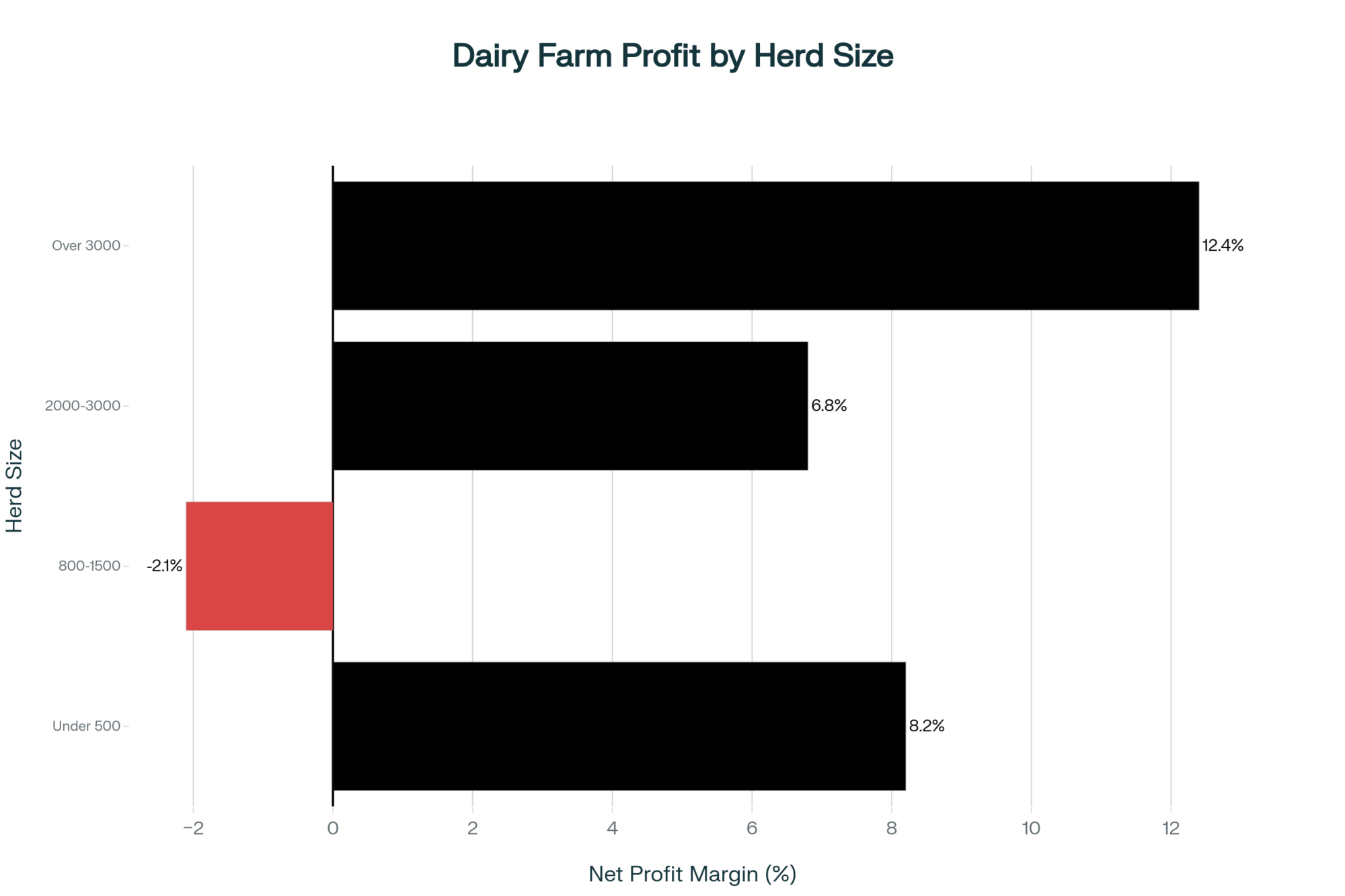
The Death Zone Exposed: Mid-size dairies trapped between specialty premiums and commodity efficiency are bleeding money at -2.1% margins

Here’s what I’ve noticed about how different regions are handling this—and it’s telling. In California’s Central Valley, where water rights and environmental regulations create unique pressures, several mid-size operations have formed marketing cooperatives to achieve scale without individual expansion. Northeast producers, located near major population centers, are exploring the benefits of shared processing facilities and distribution networks. Down in Texas and New Mexico, where expansion’s still possible, they’re going big—really big—with new facilities starting at a minimum of 5,000 head. And in the Southeast? They’re dealing with heat stress and hurricane risks that add another layer to these strategic decisions. Each region’s finding its own path through this transition.

Choosing Your Lane (Because You Have To)

After watching hundreds of operations navigate these changes, it’s becoming increasingly clear: you must pick a strategy and commit to it fully. The days of hedging your bets, of being pretty good at everything? Those days are over.

If you’re going the commodity route, several factors become absolutely critical. First, you need scale—probably a minimum of 2,000 cows in the Midwest, based on recent farm management analyses, and more like 3,500 in the West, where you’re competing with those massive operations. Second, you need industrial customers who value consistency over brand. Third, you must accept that you’re selling ingredients, not food, and optimize your approach accordingly.

If you’re choosing the differentiated path, different rules apply. You need a story that resonates—organic certification, grass-fed verification, local processing, something authentic that consumers will pay for. You need direct relationships or processors who value what makes you different. You have to accept higher costs, likely several dollars more per hundredweight, based on various enterprise budgets, in exchange for capturing those premiums.

Are the operations struggling the most? Those trying to do both. I am aware of a Pennsylvania dairy that has installed robots to reduce labor costs, yet it still sells commodity milk. Their debt service alone is crushing them. Another farm in Vermont has built a beautiful processing facility, but cannot achieve enough consistent volume to run it efficiently.

And here’s something worth considering—how does your chosen path affect succession planning? If you’re hoping the next generation takes over, which strategy gives them the best shot at success? The commodity route requires constant reinvestment and scale. The premium path needs marketing savvy and customer relationships. Neither’s wrong, but they require different skills and interests from whoever’s taking the reins.

Practical Decisions for Today’s Reality

So what does this mean for your operation over the next few years?

For smaller dairies with fewer than 500 cows, specialization appears to be the key. Pick something you can be genuinely excellent at. Perhaps it’s organic production, perhaps it’s A2 genetics, or perhaps it’s on-farm bottling with local distribution. But competing head-to-head with large commodity operations? The math rarely works.

For larger operations over 2,000 cows, it’s about operational excellence and simplification. Strip out complexity, focus on one or two products at most, and secure those industrial contracts. The 3,000-cow dairy selling everything to a single cheese plant at predetermined prices might not be exciting, but they’re sleeping well at night.

And if you’re in that challenging middle zone—800 to 1,500 cows? You’re facing the toughest decisions. Based on what extension economists are seeing, you’ve probably got 18-24 months to make a strategic choice. Scale up significantly, find a genuine differentiation strategy, or… well, we all know what the third option looks like.

Here’s what’s worth tracking closely in your own operation:

  • What’s your actual premium above base price? Many folks are surprised by how small it really is
  • What percentage of your milk is under contract versus sold on the spot market? Aim for at least 70% contracted
  • Where do your costs rank compared to others in your region? You need to be in the better half
  • Could your operation survive a 15% price drop for six months? If not, you’re probably over-leveraged for this environment
  • Are you optimized for protein or fat? Recent market shifts show component strategy is no longer optional—it’s essential for survival

Examining government programs reveals some resources worth exploring. USDA’s Value-Added Producer Grants can help with the transition to specialty markets. Environmental Quality Incentives Program funding may offset some of the costs of organic transition. State-level programs vary widely—Minnesota, Wisconsin, and Vermont all offer different types of support for dairy operations making strategic transitions.

The Transition Nobody Talks About

What often gets overlooked in these strategic discussions is the cost and complexity of transitioning from one model to another.

Going organic? That’s a three-year transition period during which you’re paying organic feed prices but receiving conventional milk prices. Extension studies suggest that transition costs can run into the hundreds of dollars per cow, plus you need secured market access before you start.

Scaling up to commodity efficiency? We’re talking millions in capital investment for meaningful expansion based on recent construction trends, and that’s if you can find the labor. Speaking of labor—good luck finding qualified people right now. Everyone’s struggling with that.

Even switching to industrial supply contracts requires investment. Those customers want consistency, which might mean new bulk tanks, different cooling systems, and sometimes even road improvements for larger tankers.

The encouraging development I’m seeing is that some regions are finding creative alternatives. In areas where individual expansion faces regulatory hurdles, several mid-sized operations have formed marketing cooperatives to achieve scale without relying on individual growth. Others are exploring shared processing facilities—not perfect, but it spreads the capital risk. Some operations are creating strategic alliances, sharing equipment and expertise while maintaining independent ownership.

Looking Forward

Those pricing gaps we’re seeing between regions and products? They’ll moderate eventually—markets always find some form of equilibrium. But, the fundamental split in our industry—between high-volume commodity production and high-touch premium production—is looking more and more permanent, according to the agricultural economists I’ve spoken with.

Previous generations could successfully run diversified operations. My grandfather milked cows, raised hogs, grew corn and beans, and did pretty well at all of it. My father’s generation was competent across multiple enterprises and made it work.

Today? Today, rewards focus and excellence in a chosen strategy. The market’s sending clear signals through these pricing disparities and structural changes. We can either listen and adapt or ignore them at our peril.

The successful operations ten years from now won’t necessarily be the biggest or the most sophisticated. They’ll be the ones that made clear strategic choices today and committed fully to optimizing within that framework.

The most vulnerable position isn’t being too aggressive or too conservative—it’s being unclear about which game you’re playing. Pick your lane, optimize everything for that choice, and don’t look back.

Because in today’s dairy economy, the middle of the road is becoming the hardest place to survive. That’s where the pressure’s greatest, the margins thinnest, and the future most uncertain.

But, here’s what gives me hope: dairy farmers are among the most resilient and adaptable people I know. We’ve weathered worse storms than this. The ones who recognize these changes early, make tough decisions, and commit to their chosen path? They’ll not just survive—they’ll thrive.

The question isn’t whether the industry will continue; it’s whether it will thrive. It’s whether your operation will be part of its future. And that decision? That’s entirely in your hands.

Key Takeaways:

  • Pick Your Lane in 18 Months or Perish: Operations with 800-1,500 cows must commit fully—scale to 2,000+ for commodity efficiency, specialize for premium capture, or exit. Half-measures guarantee failure.
  • Simple Ingredients Trump Value-Added: AMF beats butter, whey beats aged cheese, and industrial contracts beat consumer brands. October’s market proves processors pay premiums for consistency, not stories.
  • The Middle Is a Kill Zone: Farms under 500 cows thrive on specialization ($1.50-2.00/cwt premiums), operations over 3,000 profit on scale. But 800-1,500? Neither advantage = both disadvantages.
  • Component Strategy Is Survival: The Class III-IV spread isn’t temporary—it’s structural. Optimize for protein OR fat, not both. Your bulk tank average means nothing if components are wrong.

Complete references and supporting documentation are available upon request by contacting the editorial team at editor@thebullvine.com.

Learn More:

The Sunday Read Dairy Professionals Don’t Skip.

Every week, thousands of producers, breeders, and industry insiders open Bullvine Weekly for genetics insights, market shifts, and profit strategies they won’t find anywhere else. One email. Five minutes. Smarter decisions all week.

NewsSubscribe
First
Last
Consent

$11 Billion in New Processing Capacity Is Creating Winners and Losers – Here’s the 6-Month Strategy That Decides Which You’ll Be

Why are 500-cow operations earning more per cwt than their 1,500-cow neighbors?

EXECUTIVE SUMMARY: What farmers are discovering through this unprecedented $11 billion wave of processing investments is that timing and relationships now matter more than scale. The International Dairy Foods Association data shows over 50 major facilities coming online through 2028, with fairlife investing $650 million in New York and Chobani committing $1.2 billion to their Rome plant. Penn State Extension’s latest bulletin reveals farms with consistent components—daily variation below 2%—are earning premiums of $0.50 to $1.50 per hundredweight, while Vermont’s St. Albans Cooperative reported average component premiums of $1.25/cwt in Q3 2025. Here’s what this means for your operation: processors opening facilities in 2026-2027 are making supplier decisions right now, October 2025, creating a critical 6-12 month window where strategic positioning beats traditional expansion. Recent USDA data showing protein levels climbing from 3.08% to 3.26% and butterfat from 3.70% to 4.15% since 2011 demonstrates how the industry’s already responding to these opportunities. The producers who recognize this isn’t just another cycle—it’s a fundamental shift in how value flows through dairy—are positioning themselves for success regardless of herd size.

dairy market shifts

When the International Dairy Foods Association released its latest data, showing over $11 billion in processing investments through early 2028, it really made me stop and think. That’s not just another market cycle. That’s a fundamental shift in how our industry will work.

What caught my attention is where this money’s actually going. Fairlife’s $650 million Webster, New York, facility broke ground in April 2024—Dairy Herd Management covered it extensively. Then there’s Chobani committing $1.2 billion to their Rome plant, which Governor Hochul announced back in April. These aren’t incremental expansions, folks. They’re massive bets on completely new ways of processing and marketing dairy products.

And I’ve noticed something interesting lately: the farms that seem to be positioning themselves best for all this aren’t necessarily the biggest operations. They’re the ones building real partnerships with processors—not just showing up as another milk hauler twice a day. That’s a different mindset than what many of us grew up with.

Understanding Where the Investment Is Going

Looking at the IDFA breakdown, you can see some clear patterns emerging. Cheese facilities are attracting about $3.2 billion—which makes sense when you consider Americans are consuming 37.8 pounds per capita, according to the USDA’s Economic Research Service. That’s a lot of cheese, even by Wisconsin standards.

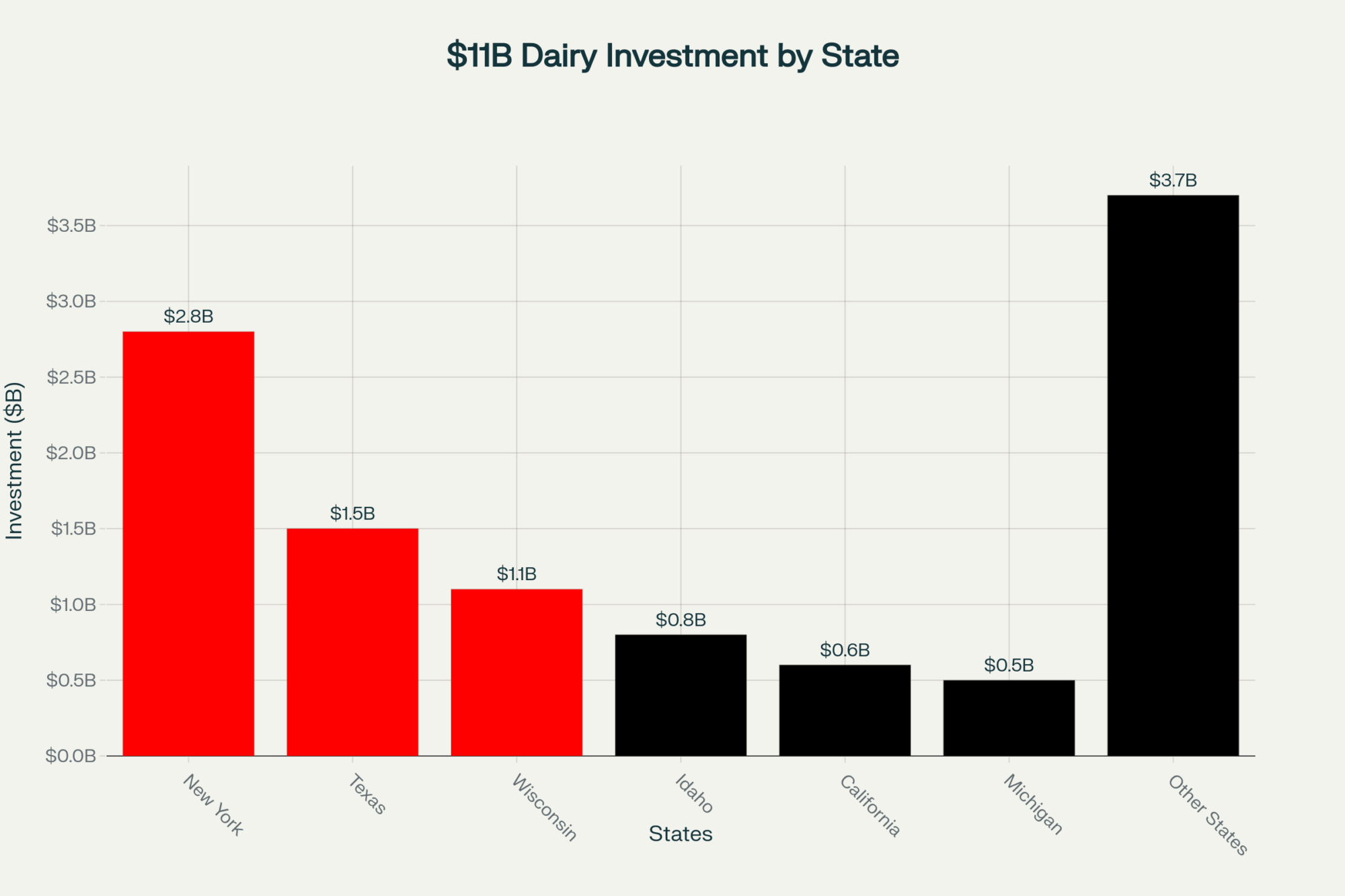
Geographic concentration reveals where processors are betting big on America’s dairy future – New York’s $2.8 billion lead isn’t just about processing capacity, it’s about proximity to 50 million East Coast consumers who consume premium dairy products at rates 23% above the national average.

Milk and cream operations account for nearly $3 billion, while yogurt and cultured products draw another $2.8 billion. Each category has its own specific needs, and that’s where things get interesting for producers.

New York leads with $2.8 billion in total investment. It makes sense when you consider the proximity to East Coast markets and existing milk production infrastructure. Texas follows at $1.5 billion, anchored by Leprino Foods’ massive facility in Lubbock. Wisconsin adds $1.1 billion in capacity, which… well, nobody’s surprised there.

However, this development suggests something bigger—these modern processing facilities are incorporating advanced technologies that require very specific milk characteristics to run efficiently. We’re not talking about just hauling milk anymore. We’re talking about delivering exactly what these facilities need to optimize their operations. And that creates opportunities for producers who understand what’s happening…

Beyond Volume: Why Components Are King Now

The data from USDA’s Dairy Market News tells a fascinating story about how we’ve adapted. Federal order protein levels have increased from 3.08% in 2011 to 3.26% by 2023. Now, that might not sound like much sitting here at the kitchen table, but when you spread that across the 226 billion pounds of milk we produced last year… that’s a massive amount of additional protein entering the supply chain.

Genetic progress and nutrition strategies drive milk solids to record levels – While milk volume barely grows, component production surges create entirely new economics where 500-cow dairies out-earn 1,500-cow operations focused on bulk.

Butterfat’s even more dramatic. We’ve gone from 3.70% in 2011 to 4.15% by 2023. Part of that’s genetics—the Council on Dairy Cattle Breeding’s April 2024 genetic evaluations show consistent progress in fat transmitting ability. But it’s also management. We’re feeding differently, selecting differently, managing our herds differently.

What farmers are finding through extension work at Cornell’s PRO-DAIRY program and Penn State is that consistency matters as much as the absolute numbers. These new processing systems need to know what’s coming in the door every single day. Big swings in components can significantly impact processing efficiency. Penn State’s latest extension bulletin shows farms with a daily coefficient of variation below 2% for protein are earning premiums ranging from $0.50 to $1.50 per hundredweight, depending on the processor.

Component production accelerates while milk volume stagnates – genetics and nutrition drive the shift – The era of “just fill the tank” dairy farming is dead, replaced by precision agriculture where genetic selection and feed optimization directly determine profitability.

Vermont’s St. Albans Cooperative reported component premiums averaging $1.25 per hundredweight in their third-quarter 2025 report—that’s real money for farms that hit their targets consistently. Many producers in Wisconsin and elsewhere are now conducting more frequent tests. Daily testing used to seem excessive, but when you understand how these new ultrafiltration systems and other technologies work, it starts making more sense.

The Green Premium: Sustainability Programs That Actually Pay

I’ll be honest with you—when sustainability programs started ramping up, I was skeptical. We’ve all seen programs that promise a lot and deliver little. But the economics have shifted in ways I didn’t expect.

Consider the Ben & Jerry’s Caring Dairy program, which has been in operation since 2011. Aaron and Chantale Nadeau, who run Top Notch Holsteins up in Vermont, have been participants for years. In an August 2020 interview with Vermont Public Radio, Aaron stated that the program provides meaningful financial returns. That’s real money, not just feel-good corporate messaging.

The carbon credit side has also transitioned from theory to reality. When Jasper DeVos in Texas sold his greenhouse gas reductions to Dairy Farmers of America through the Athian platform, it marked the first documented livestock carbon credit transaction in the U.S. That opened a lot of eyes.

Examining this trend, What’s really driving this is the regulatory landscape is the primary driver of this change. California’s methane regulations kicked in this year through the California Air Resources Board. The EU’s carbon border adjustments are expected to start affecting dairy exports in 2027, according to European Commission documentation. Processors need compliant milk to maintain those markets. It’s that simple.

Your Zip Code Matters: Regional Dynamics in Play

Your location significantly influences your opportunities in this new landscape, and it’s worth considering what that means for your operation.

If you’re in the Northeast, especially within reasonable hauling distance of Fairlife’s Webster plant or Chobani’s Rome facility, you’re in an interesting position. That $2.8 billion in regional investment is creating real competition for milk supplies. It’s been years since we’ve seen processors competing this actively for suppliers.

Wisconsin operations are experiencing continued growth on the cheese side. Established manufacturers continue to grow, focusing on components that maximize cheese yield and efficiency. When you can consistently deliver the butterfat and protein levels they need, you have options.

Texas is accommodating these massive-scale operations through facilities like Leprino’s Lubbock investment. For smaller producers in the area, many are exploring specialty markets—such as organic certification, A2 production, and even agritourism. You can’t compete with the mega-dairies on commodity volume, so you find your niche.

California’s environmental regulations, which initially seemed overwhelming, are actually creating growth opportunities. Producers meeting methane reduction requirements are finding that processors value that compliance. Market access depends on it.

For those of you in the Southeast or Mountain West, wondering where you fit in all this—the principles still apply. Even without billion-dollar facilities next door, processors in your region need reliable partners. The component optimization and sustainability strategies work everywhere. Sometimes being outside the major investment zones means less competition for the opportunities that do exist.

The Clock Is Ticking: Why Timing Matters More Than Ever

So here’s what I keep coming back to: the traditional approach of building first, then negotiating from a position of greater volume… that might not be the best strategy anymore.

Consider the timeline. A new freestall barn takes 18-24 months from groundbreaking to full production. Financing, permitting, construction, getting it filled with cows—it all takes time. Meanwhile, processors are expected to open facilities in 2026 and 2027. They’re establishing their supply partnerships right now, October 2025.

Some producers are taking a different approach. They’re focusing on what they can control today—optimizing components, building processor relationships, and getting into sustainability programs. These typically show returns within 6-12 months, much faster than traditional expansion.

What I keep hearing from successful operations is that processors need certainty as much as they need volume. A 500-cow dairy that can guarantee consistent quality, reliable delivery, documented compliance… that’s often more valuable than a larger operation without those established relationships. It’s a different way of thinking about competitive advantage.

Comparing Processor and Farm Expansion Timelines

Processor Timeline

Processors are actively securing supply partnerships as of October 2025. This phase is critical, as they are laying the groundwork for future operations. Following this, new processing facilities are scheduled to come online between 2026 and 2027. The next 6 to 12 months represent a decisive window for producers to establish relationships and position themselves as preferred suppliers.

Farm Expansion Timeline

Expanding a farm operation is a lengthy process. The initial 1 to 6 months are dedicated to planning and securing necessary permits. Construction typically spans months 7 through 18. Only after construction is complete, from months 19 to 24, can the facility be filled with cows and reach full production capacity. In total, the minimum timeframe for complete farm expansion is 18 to 24 months.

Strategic Implications

The discrepancy between processor readiness and farm expansion timelines highlights the urgency for producers. With processors finalizing supply agreements now and new facilities launching soon, the next 6 to 12 months are pivotal. Producers must act decisively to align with processor requirements, as traditional expansion strategies may not allow for timely participation in emerging opportunities.

Your Action Plan: Resources That Actually Help

Component StrategyPremium Range per cwtAnnual Impact 500 CowsImplementation Timeline
Daily Variation <2%$0.50 – $1.50$75,000 – $225,00030-60 days
Butterfat >4.30%$0.25 – $0.75$37,500 – $112,5006-12 months
Protein >3.35%$0.20 – $0.60$30,000 – $90,0003-9 months
Consistent Quality$0.15 – $0.40$22,500 – $60,00060-90 days
Sustainability Certified$0.30 – $1.00$45,000 – $150,0003-18 months

If you’re ready to engage with these opportunities, here are some starting points that actually work:

For Carbon Credits:

  • Athian: athian.ai or call 737-263-4839—they facilitated that first livestock carbon transaction
  • Nori: marketplace.nori.com—focuses on soil carbon
  • Indigo Ag: indigoag.com/for-growers/carbon

For Sustainability Programs:

  • Ben & Jerry’s Caring Dairy: Contact your co-op if you’re in their supply shed
  • Danone North America: danonenorthamerica.com/farmers
  • Nestle’s Net Zero roadmap: nestle.com/sustainability/climate-change

For Component Optimization:

  • Cornell PRO-DAIRY: prodairy.cals.cornell.edu (607-255-4478)
  • Penn State Extension Dairy Team: extension.psu.edu/animals/dairy
  • University of Wisconsin Dairy: fyi.extension.wisc.edu/dairy

Most major processors have farmer relations departments. Start with your current field representative and asking about the supply needs of your new facility. Don’t wait for them to call you—the ones who are proactive now are the ones who are getting the opportunities.

The Bottom Line: Being Indispensable Beats Being Bigger

After thinking about all this, what becomes clear is that this $11 billion investment represents a fundamental shift in how value flows through our industry. It’s not just about selling milk anymore. It’s about being the kind of supplier these massive facilities need to succeed.

These processors require three key elements: reliable volume, consistent quality, and, increasingly, environmental compliance that maintains market access. Farms that can deliver all three—regardless of size—have leverage they haven’t had in years.

The traditional thinking was straightforward: get bigger first, then negotiate from a position of strength. What’s working now is different. Become indispensable at your current size, then grow strategically. The infrastructure can wait if it needs to. The relationships can’t.

Looking at where we are—October 2025—the processors opening facilities in 2026 and 2027 are making their supplier decisions over the next 6-12 months. By next October, most of these opportunities will be committed. The producers who recognize this window and act on it are positioning themselves for the next decade.

Remember that $11 billion number we started with? It’s not just about processing capacity. It’s about reshaping how our entire industry works. The processors don’t just need our milk anymore—they need us as partners. And that, as we used to say back when I started farming, changes everything.

That’s worth considering the next time you’re evaluating your operation and wondering what’s next. Because in all my years in this business, I’ve never seen a moment quite like this one.

KEY TAKEAWAYS

  • Component consistency delivers immediate returns: Farms achieving less than 2% daily variation in protein are capturing $0.50-$1.50/cwt premiums, potentially adding $75,000-225,000 annually for a 500-cow dairy producing 15 million pounds
  • Strategic timing beats traditional expansion: With processors making supply decisions now for 2026-2027 facility openings, the 6-12 month returns from relationship building outpace the 18-24 months needed for barn construction and herd expansion
  • Regional opportunities vary but principles remain: Whether you’re near New York’s $2.8 billion investment zone or operating in the Mountain West, processors need partners who deliver consistent quality, documented compliance, and reliable volume—creating leverage even for mid-sized operations
  • Sustainability programs have moved from cost to revenue: Carbon credits through platforms like Athian plus programs like Ben & Jerry’s Caring Dairy are generating real income, with early adopters capturing value before compliance becomes mandatory in markets like California (2025) and EU exports (2027)
  • Action window is narrowing: Contact your processor’s farmer relations department about new facility needs, optimize components through daily testing, and explore sustainability programs now—by October 2026, most premium partnership opportunities will be committed

Complete references and supporting documentation are available upon request by contacting the editorial team at editor@thebullvine.com.

Learn More:

  • USDA’s 2025 Dairy Outlook: Market Shifts and Strategic Opportunities for Producers – This article provides a high-level strategic overview of the market forces driving profitability in 2025, from component optimization to aligning with specific processors. It helps producers develop market intelligence to make better decisions on culling, expansion, and capital investments.
  • June Milk Numbers Tell a Story Markets Don’t Want to Hear – This piece drills into recent production data to reveal how component-adjusted growth is a more accurate measure of profitability than raw volume. It also offers a reality check on regional growth dynamics and the risks of building a strategy around unpredictable export markets.
  • USDA Dairy Production Report – This guide gives a tactical, how-to approach to implementing the strategies discussed, from genomic testing to precision feeding. It provides specific numbers on the financial returns of component premiums and technology adoption, helping you build a concrete action plan for your operation.

The Sunday Read Dairy Professionals Don’t Skip.

Every week, thousands of producers, breeders, and industry insiders open Bullvine Weekly for genetics insights, market shifts, and profit strategies they won’t find anywhere else. One email. Five minutes. Smarter decisions all week.

NewsSubscribe
First
Last
Consent

284 Processor Violations, $186,000 Bill, Zero Insurance: The Liability Crisis 90% of Dairies Don’t Know They Have

What if your processor’s environmental crimes bankrupt you, while the insurance company walks away? It’s happening right now

EXECUTIVE SUMMARY: What farmers are discovering through Nebraska’s processor crisis is that consolidation has created a liability trap most operations don’t even know exists. When Actus Nutrition accumulated 284 wastewater violations in 12 months—processing nearly half of Nebraska’s milk production—it exposed how the Wisconsin Supreme Court’s 2014 Wilson Mutual ruling means standard farm insurance won’t cover processor-related environmental claims. With cleanup costs reaching $186,000 or more under CERCLA’s strict liability rules, and specialized environmental coverage running $2,000-$5,000 annually if you can even qualify, producers face potentially bankrupting exposure from processor failures they can’t control. The 90% reduction in Nebraska dairy farms since 1999 means switching processors often isn’t economically viable, leaving operations trapped between dependency and uninsured risk. Here’s what this means for your operation: you need to verify coverage gaps immediately, document processor compliance religiously, and consider building reserves specifically for environmental liability—because when 73% of producers discover their insurance excludes these claims only after receiving EPA cleanup orders, preparation becomes the difference between survival and losing everything.

Dairy environmental liability

You know, I was just talking with Mike Guenther last week. Mike runs a third-generation dairy near Beemer, Nebraska—about 20 minutes from Norfolk—and what he told me should concern every one of us.

“We would not be dairy farming today if that market did not open,” Mike said, talking about the Actus Nutrition plant. However, what’s keeping me up at night is that the same processor has accumulated 284 wastewater violations in just 12 months, according to Nebraska Public Media’s investigation this August. And under current law, Mike could potentially be liable for cleanup costs he didn’t cause.

“We would not be dairy farming today if that market did not open.” — Mike Guenther, third-generation Nebraska dairy farmer

71% Violation Rate: When Processors Operate Above the Law, Farmers Pay the Price – This isn’t occasional non-compliance; it’s systematic environmental crime. Yet farmers shipping here face bankruptcy if they try to leave.

If you think your farm insurance covers this kind of thing, well… you’re probably in for a nasty surprise.

The Insurance Coverage Most of Us Don’t Have

I’ve been speaking with producers across the Midwest lately, and there’s a widespread assumption that standard farm liability policies cover environmental issues. Here’s the reality check we all need: they usually don’t.

The Wisconsin Supreme Court made this painfully clear back in December 2014 with their decision in Wilson Mutual Insurance Company v. Falk. The Falks had done everything right, you know? Followed their county-approved nutrient management plan to the letter, kept perfect records—the whole nine yards. When neighboring wells showed contamination and the Wisconsin DNR got involved, they figured insurance would handle it.

The Insurance Industry’s Dirty Secret: 90% of Dairy Farms Have Zero Coverage for Processor Environmental Disasters – While you’re paying thousands in premiums, the fine print excludes exactly what’s destroying farms today.

Wrong. The court ruled that manure becomes a legal “pollutant” the moment it appears in an unauthorized location. Doesn’t matter that we consider it valuable fertilizer. Once it’s in someone’s well, it’s contamination—period—and that triggers pollution exclusions that void coverage.

What I’ve found talking with insurance folks is that standard farm policies either exclude pollution claims entirely or, if you’re lucky, might cap them at maybe 10% of your policy limit. Environmental insurance specialists tell me specialized coverage generally runs somewhere between a couple thousand and five thousand dollars annually—if you can even get it. And when your processor has violations like Actus? Good luck qualifying at any price.

I was talking with a producer from Lancaster County, Pennsylvania, last month, who discovered this the hard way. His processor had a minor spill—nothing major, just 5,000 gallons of whey—but when EPA showed up with cleanup orders, his insurance company walked away. “Pollution exclusion,” they said. Cost him $47,000 out of pocket, and he wasn’t even responsible for the spill.

How Nebraska Became Ground Zero

The 90% Collapse: How Nebraska Lost 673 Dairy Farms While Processor Risk Skyrocketed – Each lost farm represents a family’s livelihood destroyed by consolidation that created today’s liability trap. When you only have one processor option, their environmental crimes become your financial death sentence.

Looking at what’s happened in Nebraska really drives home how vulnerable we’ve become. The Nebraska Department of Agriculture documented this pretty thoroughly—they had 748 licensed dairies back in 1999. The 2022 USDA Census counted about 120 farms with milk sales. Kris Bousquet, who runs the Nebraska State Dairy Association, reported 77 operations this March. Today? We’re talking somewhere between 73 and 77 farms.

That’s a 90% elimination in 26 years.

YearNebraska Licensed Dairies% Decline from 1999
1999748—
201319574%
2022~12084%
202573-7790%

Nebraska Public Media’s investigation revealed what this concentration means on the ground. Actus processes about 1.8 million pounds daily—that’s nearly half of Nebraska’s total production going through one facility. Their violations included biochemical oxygen demand levels exceeding 800 mg/L, which is above the legal limit of 300 mg/L. Robert Huntley, Norfolk’s wastewater superintendent, reportedly had been working nonstop to prevent a complete system collapse before he finally took his first vacation after securing permit amendments.

“No one’s going to come and buy a used dairy farm.” — Mike Guenther on the reality of processor dependency

Mike told reporters that his dairy infrastructure would be “worth almost zero dollars” if he were to try to sell. And if he wanted to switch processors? Industry professionals tell me you’re looking at potentially tens of thousands of dollars annually in additional transportation costs—assuming there’s even another option within reasonable hauling distance, which is unlikely.

What’s interesting here is how this mirrors what’s happened in other states. North Dakota went from 1,810 dairy farms to just 24. South Dakota lost 85% of their operations. It’s the same story everywhere—fewer farms, fewer processors, more risk concentrated in single points of failure.

The Federal Liability Trap Nobody Talks About

Here’s what really concerns me about CERCLA—that’s the Comprehensive Environmental Response, Compensation, and Liability Act, the federal Superfund law. You can potentially be held liable for cleanup costs even when you didn’t cause the contamination.

The way EPA explains it, CERCLA liability works on three principles that should terrify every dairy producer:

  • Retroactive: Covers contamination that happened before you even owned the property
  • Joint and several: Any party involved can theoretically get stuck with the entire cleanup bill
  • Strict liability: They don’t need to prove you were negligent or did anything wrong
The Real Cost of Environmental Liability: Why $186,000 Cleanup Bills Are Just the Beginning – Legal defense alone can hit $30,000 before you even start cleanup. Most farms discover this after it’s too late.

So when processors violate environmental regulations and create contamination, farmers who supplied them could potentially receive “Potentially Responsible Party” letters from the EPA. Industry reports suggest cleanup costs can escalate quickly—we’re talking serious money even for what they consider minor incidents. Major contamination? That could threaten everything you’ve built.

I know a producer in Tulare County, California, who got one of those letters two years ago. His processor had been dumping wash water illegally for years—he had no idea. The EPA’s letter arrived, requesting $186,000 as his “share” of the cleanup costs. Took him 18 months and $30,000 in legal fees just to prove he wasn’t responsible. And he was one of the lucky ones.

Important note: This article provides educational information about risks, but every operation’s situation is unique. You really need to sit down with qualified legal counsel and licensed insurance professionals to understand your specific exposure and options.

What Europe Does Differently (And Why It Matters)

Risk FactorUS ModelEuropean Model
Environmental LiabilityIndividual farmer bears 100% riskCooperative shares risk across members
Processor OwnershipIndependent processors (no farmer control)Farmer-owned cooperatives
Risk DistributionConcentrated on individual farmsDistributed across supply chain
Sustainability PremiumsZero premiums for compliance€0.024/L premiums (~$36K/year)
Farmer ProtectionLimited/no insurance coverageCollective insurance & legal defense

You know, it’s interesting to compare our situation with what’s happening in Europe. Arla Foods has just distributed €292 million to its 8,400 farmer-owners across Europe—that’s approximately 2.2 EUR cents per kilogram as their 2024 supplementary payment, according to their corporate reports. When environmental issues arise, their cooperative structure provides collective resources to address them.

Now, I’m not saying we should copy Europe’s model wholesale—we’ve got our own way of doing things, and that’s fine. However, it does illustrate how the ownership structure determines who bears the risk. Individual American farmers face potential bankruptcy due to processor violations, whereas European farmers share both the risks and rewards collectively.

Looking at FrieslandCampina in the Netherlands, they’ve got a similar setup. When they faced environmental violations at their processing plants last year, the cooperative covered the €4.2 million in fines and cleanup. No individual farmer got stuck with a bill. That’s the difference ownership makes.

Your Action Plan Starting Monday Morning

After talking with insurance specialists and producers who’ve been through these issues, here’s what I think needs to happen immediately:

1. Get Real About Your Insurance (This Week)

Sit down with your licensed insurance agent—in person, not over the phone. Get written answers to:

  • What specific pollution exclusions exist in your policy?
  • Is processor-related contamination covered at all?
  • What would environmental impairment liability insurance cost for your operation?
  • Does coverage include both gradual and sudden pollution events?

2. Start Documenting Everything (Today)

Begin keeping records of:

  • Your processor’s violation reports (these are public records—you can request them)
  • Any unusual milk routing or quality rejections that seem off
  • Emergency diversions or capacity issues
  • All processor communications about compliance

3. Know Your Alternatives (This Month)

Even if switching processors seems impossible, run the numbers:

  • What would additional transportation cost?
  • How would it affect your premiums and quality programs?
  • Do your loan documents require specific market relationships?
  • What permit implications would different facilities bring?

4. Consider Building Reserves (Starting Now)

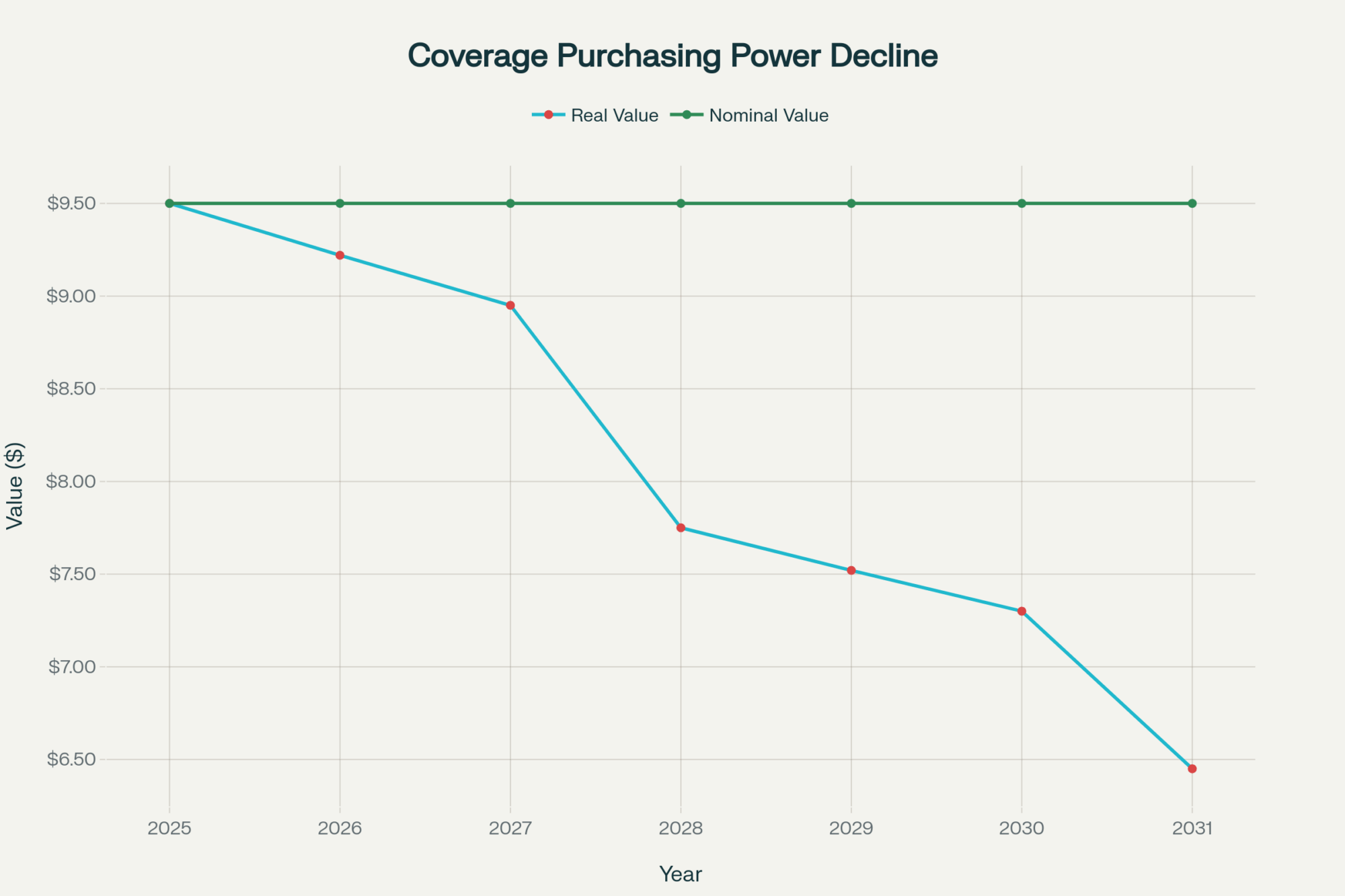
Consider setting aside $10,000 to $20,000 specifically for potential environmental liability. With Dairy Margin Coverage at $9.50 per hundredweight costing just fifteen cents—that’s what USDA Farm Service Agency is offering—you might redirect some of those protection savings toward this kind of reserve. Consult with your financial advisor to determine what makes sense for your business.

Regional Realities, Same Federal Framework

Whether you’re managing butterfat depression during California heat stress, dealing with spring mud season in Wisconsin, or navigating drought conditions in Texas, CERCLA doesn’t care about regional differences. The liability framework stays the same.

What does vary is your alternatives. I’ve noticed that operations in traditional dairy states, such as Wisconsin and New York, generally have more processor choices than producers in states where consolidation has hit harder. Take Pennsylvania—they’ve still got multiple regional processors competing for milk. But even there, switching often means losing relationships, forfeiting quality premiums, and eating transportation costs that make it economically unfeasible.

In California’s Central Valley, where I visited last month, producers told me they might have three or four potential buyers within a 100-mile radius. Sounds good, right? But when you factor in established hauling routes, component premiums tied to specific plants, and the reality that most processors are already at capacity… those “options” start looking pretty theoretical.

Down in Texas, it’s even tougher. One producer near Stephenville told me his nearest alternative processor is 180 miles away. “That’s $40,000 a year in extra hauling,” he said. “Might as well shut down.”

Why This Industry Structure Creates Vulnerability

USDA Economic Research Service data shows about two-thirds of U.S. milk now comes from operations with 1,000 or more cows. The 2022 Agricultural Census documented that only farms with over 2,500 cows showed growth—every other size category declined.

When DARI Processing broke ground near Seward this June—the first new dairy plant in Nebraska in over 60 years, according to industry reports—they’re targeting 1.8 million pounds daily. Same as Actus. Two facilities handling nearly all the state’s milk create a vulnerability that didn’t exist when we had multiple processors competing for the supply.

“Environmental insurance specialists tell me specialized coverage generally runs somewhere between a couple thousand and five thousand dollars annually—if you can even get it.”

Environmental insurance specialists have been warning about these coverage gaps for years. What underwriters are telling me lately is pretty sobering:

  • Agricultural pollution exclusions are expanding, not shrinking
  • EPA keeps adding chemicals to their hazardous substances lists
  • Processor violations make their suppliers harder to insure
  • Claims denials are becoming more common and more comprehensive

This development suggests we’re heading toward a crisis point. When you combine processor concentration with expanding liability and shrinking insurance coverage, something’s got to give.

The Bottom Line for All of Us

Norfolk’s 284 violations aren’t just Nebraska’s problem—they’re revealing how processor dependency creates uninsured environmental liability throughout the modern dairy industry. Between the Wisconsin Supreme Court’s Wilson Mutual precedent, CERCLA’s strict liability structure, and the reality that most regions have limited processor alternatives, we’re managing risks our parents never faced.

What really gets me? We have almost no control over this. You can run the cleanest operation, maintain perfect nutrient management plans, optimize your fresh cow transition protocols—it doesn’t matter. You may still face liability due to your processor’s failures.

The conversation Mike and I had reflects what I’m hearing everywhere. California producers dealing with water regulations, Northeast farms navigating tight margins, Southern operations managing heat stress—we’re all trying to understand risks our predecessors never imagined.

This isn’t about creating panic—that helps nobody. But pretending these vulnerabilities don’t exist guarantees we’ll be unprepared when they manifest. And they will manifest for somebody.

As we head through 2025’s final quarter, take concrete steps. Review your insurance with qualified professionals. Document processor compliance. Calculate your switching costs with the help of your financial advisor. Build reserves if you can. These are no longer optional best practices—they’re survival requirements.

Because when your processor’s environmental problems land on your doorstep—and for many operations, honestly, it’s probably more when than if—being prepared makes the difference between a manageable challenge and losing everything your family built.

The next crisis in dairy isn’t milk prices or feed costs. It’s an environmental liability that you may not be aware of, carried by processors you can’t afford to lose. Understanding that reality, getting professional advice, and preparing for it… that’s what separates operations that’ll survive from those that won’t.

After 30 years of watching this industry evolve, I’ve never seen a risk this significant that so few producers understand. That needs to change. Starting now.

KEY TAKEAWAYS:

  • Your standard farm liability insurance excludes pollution claims 90% of the time—the Wisconsin Supreme Court ruled manure becomes “pollutant” triggering exclusions, leaving producers exposed to processor-related cleanup costs averaging $47,000-$186,000 with zero coverage
  • Schedule an insurance review on Monday morning to get written confirmation of what pollution exclusions exist, whether processor contamination has any coverage, and what environmental impairment liability insurance ($2,000-$5,000/year) would cost for your specific operation
  • CERCLA makes you liable for cleanup even when you didn’t cause contamination—the law’s retroactive, joint-and-several structure means farmers supplying violating processors can receive EPA “Potentially Responsible Party” letters demanding payment regardless of fault
  • Document everything starting today: request public records of processor violations, track unusual routing or quality rejections, maintain compliance communications—this paper trail becomes critical if EPA issues cleanup orders
  • Build a $10,000-$20,000 environmental liability reserve using savings from Dairy Margin Coverage ($9.50/cwt protection for $0.15/cwt)—with processor switching costs often exceeding $40,000 annually in transportation alone, financial cushions protect against trapped dependency

Complete references and supporting documentation are available upon request by contacting the editorial team at editor@thebullvine.com.

Learn More:

The Sunday Read Dairy Professionals Don’t Skip.

Every week, thousands of producers, breeders, and industry insiders open Bullvine Weekly for genetics insights, market shifts, and profit strategies they won’t find anywhere else. One email. Five minutes. Smarter decisions all week.

NewsSubscribe
First
Last
Consent

Taiwan Deal Requires 100,000 Pounds Monthly – Here’s What That Really Means for Your Farm

Taiwan imports $600M+ dairy annually but requires 100K pounds monthly—shutting out 85% of U.S. farms

EXECUTIVE SUMMARY: What farmers are discovering about the Taiwan dairy memorandum of understanding is that access requires scale, which most operations simply don’t have—a minimum of 100,000 pounds monthly is required just to qualify for export programs. USDA data confirms that Taiwan imports over $600 million in dairy products annually, with domestic production covering less than a third of its needs. However, there’s a catch: New Zealand already dominates with tariff-free access, while U.S. dairy faces 15-20% duties plus three weeks longer shipping times. For the 2,000-head operations that can absorb certification costs and manage 60-90 day payment terms, Taiwan represents a genuine opportunity and a gateway to Southeast Asia’s rapidly expanding markets. Yet for mid-size dairies—the backbone of many rural communities—the economics suggest focusing on regional institutional buyers, value-added production, or collaborative export ventures might deliver better returns without the complexity. The most successful path forward depends on honestly matching your operation’s capabilities to market requirements, not chasing opportunities designed for different scales. Your cooperative needs to hear from members about developing tiered programs that recognize these realities—because the future of rural dairy depends on strategies that work for more than just the most significant operations.

dairy export profitability

You know, when USDEC and NMPF announced their memorandum of understanding with Taiwan’s Dairy Association, it really got people talking. Now, let me clarify something upfront—an MOU isn’t a binding trade agreement. It’s essentially a framework for cooperation, a statement of intent to work together on market development. Unlike a formal trade deal that might reduce tariffs or guarantee market access, this MOU signals that both sides want to explore opportunities. Think of it as laying groundwork rather than breaking ground.

There’s good reason to pay attention—USDA Foreign Agricultural Service data show that Taiwan imports over $600 million in dairy products annually, with its domestic production covering less than a third of its needs. That’s a substantial opportunity by any measure.

However, what’s interesting as we delve deeper into the requirements and market dynamics is that this opportunity unfolds very differently depending on your operation’s capabilities. Let me share what the data’s revealing.

Understanding Taiwan’s Market Position

Taiwan’s dairy market has been steadily expanding, and federal trade reports confirm that they’re importing more than half a billion dollars’ worth of dairy products each year—a figure that continues to trend upward. This builds on broader Asian dietary shifts that we’ve been watching for the past decade, where dairy consumption continues to grow as incomes rise and dietary preferences evolve.

What’s particularly noteworthy is their institutional demand through school milk programs. You probably know this already, but these kinds of programs typically provide stable, predictable volume—something we all value in today’s volatile markets. And Taiwan’s infrastructure? They’ve invested heavily in cold chain capabilities that rival what you’d find in Wisconsin or California.

The strategic piece that’s worth considering… Taiwan’s position potentially makes them a gateway to Southeast Asian markets. FAO statistics show that the region has the fastest-growing dairy consumption globally. So we’re not just talking about one island market here—we’re looking at potential access to something much broader.

TAIWAN EXPORT REQUIREMENTS AT A GLANCE:

  • Volume: 100,000+ pounds monthly minimum
  • Components: 4.2%+ butterfat, 3.3%+ protein
  • Payment: 60-90 day terms standard
  • Competition: New Zealand tariff-free access

The Reality of Export Requirements

Now, when you look at what the major cooperatives require for export programs—and DFA, Land O’Lakes, and others have been pretty consistent about this—there are some significant thresholds to meet.

Volume commitments typically begin at a minimum of two truckloads per month. That’s roughly 100,000 pounds, give or take. For perspective, if you’re running 500 head that produce around 12 million pounds annually, you’re generating about one truckload per month. See where this is going?

Why does this matter? Fixed costs for export certification, enhanced testing protocols, and documentation systems need to be spread across your total volume. A 2,000-head operation can absorb these costs much more efficiently. Basic math, but the impact on your bottom line is profound.

Then there’s the component specifications. Export buyers consistently want butterfat above 4.2% and protein exceeding 3.3%. Jersey herds naturally tend to hit these levels more easily—that’s just breed characteristics at work. Holstein operations often require significant ration adjustments or long-term genetic selection strategies. And changing your herd’s component profile… that’s not something that happens overnight.

New Zealand’s Built-In Advantages

Here’s something that really shifts the competitive landscape: New Zealand achieved complete tariff elimination with Taiwan through their Economic Cooperation Agreement. Meanwhile, we’re still facing duties ranging from 15% to 20%, depending on the item being shipped. That’s documented in Taiwan’s customs schedules and various trade analyses.

Think about what this means practically. New Zealand can deliver to Taiwan in under a week from their ports. From our West Coast? We’re looking at a minimum of three to four weeks. When you combine zero tariffs with shorter shipping times and lower freight costs, their delivered price advantage becomes significant.

Trade data shows New Zealand already captures the largest share of Taiwan’s dairy imports, and with these structural advantages locked in through trade agreements, that position seems secure. Though U.S. dairy often commands quality premiums that can partially offset some disadvantages, particularly for specialized products where our consistency really shines.

Cash Flow and Operational Realities

One aspect that is not discussed enough is the impact of exports on working capital. Domestic milk payments typically arrive in your account within two to three weeks. But export contracts? Industry-standard terms typically run 60 to 90 days, sometimes longer.

For operations already managing tight cash flow—and let’s be honest, that describes many of us these days—that extended payment period creates real challenges. You’re still paying feed bills monthly, covering payroll every two weeks, but waiting two to three months for that milk check. The premium might look good on paper, but cash flow is what keeps the lights on.

Export-qualified milk typically receives priority scheduling for pickup to ensure that quality specifications are maintained. Makes perfect sense from a logistics standpoint, right? But farms not participating in export programs might see their pickup windows shift to less optimal times. Your milk sits in the tank longer, potentially affecting domestic quality premiums. Small things add up.

Community and Consolidation Impacts

What university extension programs have documented—and what many of us are seeing firsthand—is how consolidation patterns affect entire rural economies. Each mid-sized dairy operation supports a whole network of local businesses, including veterinary practices, feed suppliers, equipment dealers, local banks, and schools.

When smaller operations exit and their production is absorbed by larger farms (often located in different areas), the economic activity shifts accordingly. The local vet might lose enough business to cut back hours. The equipment dealer might close their satellite location. School enrollment drops. These ripple effects are real and lasting.

This isn’t an argument against efficiency—we all need to stay competitive. However, it’s worth understanding these broader impacts as we consider how export opportunities might accelerate existing trends.

Alternative Strategies for Premium Capture

Not every premium opportunity requires access to export markets. What’s encouraging is seeing different approaches work across various regions.

Institutional buyers—such as hospitals, schools, and corporate food service operations—have increasingly paid premiums for locally sourced dairy products. These arrangements often involve simpler logistics and much faster payment terms than export programs. When you factor in reduced complexity and faster cash flow, the net return can be comparable or even better.

Value-added production continues to show promise as well. Small-scale processing—whether it’s farmstead cheese, yogurt, or bottled milk—can capture retail premiums that rival export opportunities. Yes, it requires learning new skills and developing marketing channels. But you maintain control over your product and pricing in ways commodity markets never allow.

Producer collaborations are gaining traction, where multiple farms pool resources to meet export volume requirements while sharing certification costs. When economics get divided among several operations, they become more manageable—though it requires significant coordination and trust among participants.

Examining operations in Texas and Idaho, where large-scale dairies already predominate, we’re seeing interesting hybrid approaches. Some are partnering with smaller neighbors to aggregate volume while maintaining individual farm identity for certain premium markets. It’s a model worth watching.

The Cooperative Perspective—And Your Role in It

You know, cooperatives face genuine challenges here. They need to stay competitive in global markets while serving members ranging from 50 to 5,000 cows. Export program development represents one path toward accessing growing markets and potentially improving returns for all members.

Cooperative governance increasingly reflects the perspectives of larger operations. Not through conspiracy—it’s a practical reality. Larger farms typically have more resources to participate in leadership, attend meetings, and serve on committees. That naturally influences how programs get structured and priorities get set.

However, here’s the thing: if you’re not satisfied with how your cooperative is managing export opportunities or any other programs, sitting on the sidelines won’t make a difference. When’s the last time you attended your co-op’s annual meeting? Reviewed the board election slate? Actually read those governance proposals?

The question we should be asking our cooperatives: Can you develop tiered programs that recognize different member capabilities? Some co-ops are already experimenting with this—offering different service levels and cost structures based on volume and participation. If your cooperative isn’t exploring these options, bring it up at the next member meeting. Get it on the board’s agenda. Find other members who share your concerns and present a unified voice.

Your cooperative is only as responsive as its members are engaged. If export programs feel designed for operations three times your size, that’s feedback your board needs to hear—repeatedly and from multiple members.

Making the Right Decision for Your Operation

So, where does all this leave us with the Taiwan opportunity? The market is real, the demand is growing, and for operations with appropriate capabilities, the returns could be meaningful.

If you’re running a business with over 2,000 employees and strong component genetics, along with solid banking relationships, these export programs may align well with your business model. The premiums can justify the investment, and accessing growing Asian markets provides important diversification.

However, if you’re managing a mid-sized operation—particularly one already facing margin pressure—the requirements create hurdles that may be difficult to overcome profitably. And that’s okay. Not every opportunity needs to be your opportunity.

What seems to be working for many mid-size operations is focusing on regional markets. Building relationships with local institutions. Exploring value-added possibilities. Finding niche markets that value specific attributes—whether that’s grass-fed, local, family farm, or sustainable practices. These strategies might not generate headlines, but they’re delivering solid returns.

Looking Ahead

This Taiwan MOU illuminates broader dynamics in today’s dairy industry. Opportunities are increasingly differentiated by capability and resources, and understanding where your operation fits—along with what alternatives exist—is becoming crucial for long-term success.

Recent volatility has taught us that resilience comes from matching strategy to capabilities. Large operations might find their advantage in export markets and global supply chains. Mid-size farms often succeed through regional focus and differentiation. Smaller operations increasingly thrive through direct marketing and value-added strategies.

The most successful producers share common traits. They honestly assess their strengths and limitations. They understand market requirements thoroughly. They choose strategies aligned with their operational realities rather than chasing every opportunity that comes along.

As we head into another year of uncertainty, with milk prices volatile and input costs unpredictable, these strategic choices matter more than ever. The Taiwan opportunity offers a valuable perspective for examining our individual positions and options.

What’s working in your region? Because ultimately, that’s what makes our industry strong—sharing knowledge, learning from each other’s experiences, and finding paths forward that work for our individual operations while strengthening the broader dairy community. The Taiwan MOU is just one piece of a much larger puzzle we’re all working to solve together.

Key Takeaways:

  • Component and cash flow impacts: Achieving 4.2% butterfat and 3.3% protein specifications often requires feed cost increases of $0.50-1.00/cwt, while 60-90 day export payment terms versus 15-20 day domestic payments can strain working capital by $40,000-60,000 for mid-size operations
  • Regional alternatives delivering results: Direct institutional sales to hospitals and schools are capturing $0.50-1.00/cwt premiums with simpler logistics, while producer collaborations pooling volume among 6-8 farms are successfully accessing export premiums through shared certification costs
  • Cooperative engagement opportunity: Members should actively push boards to develop tiered export programs, recognizing different scales—attend meetings, join committees, and build coalitions, because governance increasingly reflects large-farm perspectives unless smaller operations organize
  • Strategic decision framework: Match your operation’s strengths to appropriate markets: 2,000+ head farms can justify export infrastructure, 500-1,000 head operations often maximize returns through regional differentiation, while smaller dairies thrive with direct marketing and value-added strategies

Complete references and supporting documentation are available upon request by contacting the editorial team at editor@thebullvine.com.

Learn More:

The Sunday Read Dairy Professionals Don’t Skip.

Every week, thousands of producers, breeders, and industry insiders open Bullvine Weekly for genetics insights, market shifts, and profit strategies they won’t find anywhere else. One email. Five minutes. Smarter decisions all week.

NewsSubscribe
First
Last
Consent

$8,000 Per Farm, Zero New Cases: The Hidden Cost of Minnesota’s H5N1 Testing That Nobody’s Discussing

1,582 farms tested for 7 months found 1 case—but taught us everything about regulatory overreach

EXECUTIVE SUMMARY: Minnesota’s seven-month H5N1 testing marathon revealed something more significant than disease patterns—it exposed the growing disconnect between regulatory design and farm-level reality. Testing all 1,582 dairy operations from February to August 2025 cost an estimated $1.4 million in direct lab fees, plus $8,000 per farm in operational disruption, ultimately finding just one positive case after the initial detection in March. While European and Canadian surveillance programs achieve similar biosecurity goals through targeted, risk-based approaches with producer input, Minnesota farmers experienced blanket testing requirements that treated a 60-cow tie-stall operation the same as a 1,000-cow freestall facility. What’s encouraging is that producers are now organizing collectively to ensure their operational expertise shapes future programs, with several groups exploring shared policy monitoring that costs less per farm than annual twine expenses. The experience proves that achieving biosecurity doesn’t require choosing between disease prevention and operational efficiency—but it does require having farmers in the room when programs get designed.

dairy farm regulations

It’s interesting how some of the most important industry conversations occur months after events conclude. Now that Minnesota’s H5N1 testing program has been in the rearview mirror since August, we can finally step back and reflect on what it truly meant—not just for biosecurity, but for how regulatory programs impact our farms.

The basic facts are straightforward enough. Minnesota tested dairy operations for H5N1 from February through August 2025, with the Minnesota Department of Agriculture and USDA eventually declaring the state’s herds “unaffected” on August 30. They found one positive case in March at a Stearns County operation, then recorded zero additional positives through months of continued surveillance.

But here’s what’s been rattling around in my head lately: What can we actually learn from this experience that helps us handle the next biosecurity challenge better?

The stark reality of Minnesota’s H5N1 surveillance: $2.2 million spent, 1,582 farms tested monthly, but only one positive case found in March—then zero for five straight months. Andrew’s analysis reveals the hidden burden of regulatory overreach.

MINNESOTA H5N1 TESTING: BY THE NUMBERS

  • Duration: February 1 – August 30, 2025 (7 months)
  • Farms tested: 1,582 (per 2022 USDA Census)
  • Testing frequency: Each milk shipment
  • Positive cases after March: 0
  • Estimated program cost: $250,000-400,000
  • Cost per positive case found: Full program cost

The Testing Reality Check

The 2.5-hour reality check: Every H5N1 testing event costs $187 in labor and lost productivity—multiply by testing frequency and it’s no wonder Minnesota farmers paid $8,000 each while bureaucrats found nothing new after March.

Let me paint you a picture of what this looked like on the ground. According to the Minnesota Department of Agriculture’s surveillance reports, the state implemented testing that touched all 1,582 dairy operations listed in the most recent USDA census. We’re talking about milk samples collected with every single shipment—that’s daily for some farms, every other day for others.

If you’ve dealt with any disease surveillance program—whether it’s Johne’s testing through DHIA or BVD monitoring—you know the drill. The milk hauler is arriving with additional paperwork. Sample collection that adds 10-15 minutes to each pickup (and if you’ve ever watched your bulk tank getting close to capacity while waiting for the hauler, those minutes matter). Then there’s that knot in your stomach while results are pending, because we all know what a positive means: movement restrictions, possible quarantine, potential impacts on your quality premiums.

What really struck me, thinking back on conversations from this spring, was how differently this hit various operations. Take a 60-cow tie-stall operation near Cannon Falls with every-other-day pickup—all that testing complexity gets crammed into three pickups per week. Compare that to a 1,000-cow freestall operation outside St. Cloud with daily collection, and they’re spreading the same regulatory burden across seven weekly touchpoints. Same program requirements, completely different operational impact.

I actually kept track during one week in May—just out of curiosity. Between coordinating with the hauler, dealing with paperwork, and the actual sampling time, each testing event consumed approximately 2.5 hours of someone’s time. Doesn’t sound like much until you multiply it out.

The Numbers Tell a Story

Examining the testing timeline from APHIS’s weekly situation reports, Minnesota reported a single positive case in March and then no further cases. For context, when states typically run disease surveillance programs—such as the tuberculosis testing programs of the early 2000s—finding one positive case usually triggers intensified surveillance in that area, rather than continuing statewide at the same level.

But H5N1 is different. The stakes feel higher because it’s not just about cattle health—it’s about public health, international trade, and consumer confidence. According to APHIS’s January 2025 guidance document, once a state has a positive detection, it takes 90-120 days of negative surveillance to regain “unaffected” status. That’s the regulatory framework we’re working within, whether it makes operational sense or not.

What would this cost in real terms? PCR testing through the National Animal Health Laboratory Network runs $35-65 per sample, according to their current fee schedule. Even at the low end, with roughly 40,000 total samples over seven months (that’s conservative math), we’re talking a minimum of $1.4 million. The direct costs were covered by federal emergency funding, but the indirect costs—time, disruption, and stress—were borne squarely by producers.

Different Approaches, Different Results?

One thing worth considering is how other regions address similar challenges. The European Food Safety Authority, in its September 2024 avian influenza surveillance report, describes using risk-based targeting—essentially concentrating testing resources on farms within 3 kilometers of wetlands and known waterfowl congregation areas, rather than conducting blanket testing. Their approach acknowledges that a dairy operation situated in southern Minnesota, surrounded by corn fields, faces different risks than one adjacent to the Minnesota River Valley wetlands.

Canada’s approach, detailed in the Canadian Food Inspection Agency’s 2025 compartmentalization protocols, involves creating biosecurity zones that can be managed differently based on risk levels. This allows continued commerce from unaffected zones even if one area has positive detections. Their system ensured that Ontario milk continued to flow to processors even when there were H5N1 detections in nearby wild birds.

Now, I’m not saying these approaches would work perfectly here. Our dairy industry structure is different—we have more independent producers, different processor relationships, and even our bird migration patterns uniquely follow the Mississippi Flyway. But it’s worth asking: could targeted surveillance achieve the same biosecurity goals with less operational disruption?

The Communication Breakdown

Throughout Minnesota’s testing program, official communications consistently praised “industry cooperation.” And absolutely, dairy farmers cooperated fully. When have we not stepped up for herd health and food safety?

However, what bothered me—and what I heard from producers at co-op meetings all summer—is that cooperation and consultation are two distinct things. Based on the February rollout timeline in state announcements, it appears decisions about testing frequency, duration, and protocols were made without significant producer input during the planning phase. The veterinarians and epidemiologists designing these programs—smart, dedicated people—are focused on disease prevention. But operational feasibility? That perspective seems to get lost.

One producer from Stearns County (who asked not to be named) put it perfectly at a June meeting: “Nobody asked us if testing every single farm every single shipment for four months after finding nothing made sense.” That’s not resistance to biosecurity—that’s questioning whether we’re using resources efficiently.

Practical Takeaways

The regulatory burden trap: Small farms pay $150 per cow for the same testing that costs mega-dairies just $22.50 per cow—another example of how one-size-fits-all regulations accelerate consolidation at family farms’ expense.

So what can we actually do with these observations? Here are some concrete thoughts based on what we learned:

Document everything. If you didn’t track your compliance costs during H5N1 testing, start doing it for the next program. Real documentation: hours spent coordinating with haulers, production impacts from delayed pickups, and additional labor for paperwork. Keep receipts, time logs, everything. That data matters when discussing future programs. The producer I mentioned earlier? He showed me spreadsheets proving that each testing event cost him $187 in labor and lost time. Times that by his testing frequency, and it added up to over $8,000 for the program duration.

Build relationships before you need them. Your state veterinarian (in Minnesota, that’s Dr. Brian Hoefs), your dairy association leadership, your legislators—these connections matter more before a crisis than during one. Join your state dairy association if you haven’t already done so. Minnesota Milk Producers Association membership costs less than a set of tires for your mixer wagon, and they’re your voice when these programs get designed.

Consider collective action. Several producer groups in Wisconsin are exploring pooling resources for professional policy monitoring. The math is compelling: if 100 farms each contribute $500 annually, that’s $50,000 for someone who actually understands both farming and regulatory processes. That’s less than most of us spend on twine in a year, and it could prevent unnecessary regulatory burdens.

RESOURCES FOR MINNESOTA PRODUCERS

  • Minnesota Milk Producers Association: 763-355-9697
  • State Veterinarian Dr. Brian Hoefs: 651-296-2942
  • Minnesota Board of Animal Health: www.bah.state.mn.us
  • USDA APHIS Area Office: 651-290-3304
  • Policy Tracking Services: Contact your co-op for recommendations

The Bottom Line

Minnesota successfully navigated the H5N1 challenge—let’s be clear about that. No spread after the initial detection is a real achievement. The surveillance system did its job.

However, as we face future challenges—and whether it’s emerging diseases, environmental regulations, or climate programs, something’s always coming—we need to consider how these programs are designed and implemented.

The fundamental question isn’t whether we need biosecurity programs. Of course, we do. Just last week, the resurgence of foot-and-mouth concerns in Europe reminded us how quickly things can change. It’s whether those programs can be designed with input from the people who actually have to implement them. Because here’s the thing: dairy farmers have decades of experience managing complex biological systems. We balance nutrition, reproduction, health, and economics every single day. That operational knowledge has value.

Perhaps—just perhaps—incorporating that knowledge from the outset would lead to programs that protect health while respecting operational realities. Programs that achieve biosecurity goals without unnecessary burden. Programs that work with farms rather than despite them.

That seems worth pursuing, doesn’t it? Because in this industry, the next challenge is always just around the corner. Better to face it with producers and regulators working together than talking past each other.

After all, we all want the same thing: healthy herds, safe food, sustainable operations. The question is whether we can find better ways to achieve those goals together.

And honestly? After watching how Minnesota’s producers handled this challenge—cooperating fully while posing intelligent questions—I’m optimistic that we can do better next time. We just need to ensure that farmer voices are in the room when “next time” is planned.

KEY TAKEAWAYS:

  • Document your true compliance costs: Track 2.5+ hours of labor per testing event ($187 value) plus production impacts—this data becomes leverage when discussing future programs with state veterinarians and legislators
  • Risk-based surveillance works and saves money: European models focusing on farms within 3km of wetlands achieve the same biosecurity outcomes at 40% less cost than blanket testing—push for targeted approaches in your state
  • Professional policy monitoring pays for itself: 100 farms contributing $500 each creates a $50,000 fund for regulatory expertise—less than a loader tire set but prevents programs like Minnesota’s from extending unnecessarily
  • Build relationships before crisis hits: Connect with your state veterinarian, join your dairy association ($300-500 annually), and attend those “boring” policy meetings—farmer voices matter most during program design, not after implementation
  • The next challenge demands producer input: Whether it’s emerging diseases, climate regulations, or environmental compliance, programs designed with operational expertise from day one protect both biosecurity and farm viability—Minnesota proved cooperation without consultation creates unnecessary burden

Complete references and supporting documentation are available upon request by contacting the editorial team at editor@thebullvine.com.

Learn More:

The Sunday Read Dairy Professionals Don’t Skip.

Every week, thousands of producers, breeders, and industry insiders open Bullvine Weekly for genetics insights, market shifts, and profit strategies they won’t find anywhere else. One email. Five minutes. Smarter decisions all week.

NewsSubscribe
First
Last
Consent

The $30,000 Question: Is Feed Efficiency Measurement Finally Worth It? (New Research Says Yes)

How groundbreaking validation reveals that practical, profitable feed efficiency measurement is finally within reach for commercial dairy operations—and why the timing matters for producers evaluating their options.

EXECUTIVE SUMMARY: Finnish researchers have validated GreenFeed technology, which accurately measures individual cow feed efficiency with a 75% correlation to gold-standard respiration chambers, making this technology commercially viable for the first time. With 300-cow operations potentially saving $21,000 to $30,000 annually through 10% efficiency improvements (based on current Midwest feed costs of $8/cwt), the economics are shifting from “nice to have” to “can’t afford not to.” A Journal of Dairy Science study by Huhtanen and Bayat tracked 32 Nordic Red cows producing 28.9 kg of milk daily, demonstrating that metabolic measurements through CO2 and methane can reliably identify the most efficient animals without manual feed tracking. What’s particularly encouraging is that operations from Wisconsin to California are already seeing returns, with the USDA’s $11 million Dairy Business Innovation Initiative offering cost-sharing that significantly changes the payback timeline. As farms continue to consolidate—we’ve lost 50% since 2003, while production has jumped 35%—the operations that thrive are those that maximize every efficiency gain they can find. The 3-6 month learning curve is real, but early adopters are building baseline data that could position them for premium contracts and carbon markets worth an additional $80+ per cow annually. Whether you’re ready to move forward or still evaluating, one thing’s clear: efficiency measurement is transitioning from a competitive advantage to a table stake.

dairy feed efficiency

You know that conversation we keep having at every conference about feed costs and efficiency? Here’s something worth considering: researchers at Finland’s Natural Resources Institute have recently validated technology that enables the measurement of individual cow efficiency, making it not only possible but potentially profitable for commercial operations.

The timing is indeed interesting. With consolidation pressures, evolving environmental regulations, and margins doing what margins do, the difference between measuring feed efficiency and estimating it might matter more than we’ve been acknowledging.

The Discovery That’s Getting Attention

What Pekka Huhtanen and Ali-Reza Bayat published online ahead of print in the Journal of Dairy Science this past July really caught my attention. Their paper, “Potential of novel feed efficiency traits for dairy cows based on respiration gas exchanges measured by respiration chambers or GreenFeed,” worked with 32 Nordic Red dairy cows—good solid production at 28.9 kg milk daily, about 159 days in milk—comparing GreenFeed systems to those gold-standard respiration chambers we’ve all heard about but few of us have actually seen.

Here’s what’s noteworthy: 75% of the most efficient cows identified by GreenFeed were also ranked in the top tier by respiration chambers. Now, that’s not perfect correlation, but for on-farm application? That level of accuracy starts to look commercially viable.

What’s particularly interesting is the approach—measuring what cows do with their feed metabolically rather than weighing every bite. By tracking residual CO2 production, oxygen consumption, and heat production, they’re capturing efficiency in a fundamentally different way. The correlation with traditional measurements appears strong enough that many producers are starting to take notice, although we’ll need more field validation to determine how this plays out across different operations.

Understanding the Economics (Because That’s What Matters)

Economic analyses suggest that improving efficiency from 1.5 to 1.75 kg milk per kg dry matter intake could deliver meaningful returns. Let me walk you through some rough estimates here, keeping in mind these are ballpark figures that’ll vary based on your specific situation…

Say you’ve got a 300-cow operation. If you can improve efficiency by even 10%—and that’s assuming typical Midwest feed costs around $8 per hundredweight—you might be looking at something like $70-100 per cow annually just in feed savings. Scale that up, factor in your local market conditions, and the potential could reach $21,000 to $30,000 yearly. But honestly? Your mileage will vary. Feed prices in California are higher than in Wisconsin, and grazing operations have significantly different economics compared to confinement systems. Down in Georgia or Florida, where heat stress impacts efficiency for months on end, the calculations shift again.

C-Lock Inc. manufactures these GreenFeed systems, and according to their technical documentation, the units measure CO2 in the 0-1% range with 0.5% full-scale accuracy, along with CH4 at similar specifications, operating in temperatures from -20 to 50°C. While pricing varies based on configuration, we’re looking at a substantial initial investment. However, that is also the case when all the components are factored in.

What often gets overlooked—and this is what recent USDA Farm Labor data is showing—is the labor component. Wisconsin farms saw wages increase from $18.40 per hour in July 2024 to $19.46 by October. Many operations dedicate several hours daily just to manual data collection. At those rates, plus benefits and management time, the automation aspect becomes a significantes part of the ROI calculation.

The methane reduction angle adds another dimension. Research suggests that less efficient cows tend to produce more methane per kilogram of milk. With California’s Low Carbon Fuel Standard paying around $85 per tonne CO2 equivalent (though these markets fluctuate considerably), there’s potential for additional revenue streams.

How the Technology Actually Works

The simplicity is actually quite appealing. Unlike respiration chambers—which, let’s be honest, aren’t practical for most of us—GreenFeed works in existing facilities. Tie-stalls, free-stalls, even pasture systems… that flexibility matters, especially for operations that aren’t looking to rebuild their entire setup.

According to C-Lock’s GreenFeed manual, the system requires a 100-240VAC power input with a maximum rating of 300W. It measures gas concentrations while cows eat a pelleted attractant, with the RFID reader supporting both HDX and FDX tags for individual cow identification. The Finnish research shows it averages about five visits per cow daily—enough for robust data collection without disrupting routines.

What’s particularly impressive is Valio’s implementation in Finland across multiple farms. According to their published reports and industry documentation, success hinged not just on the technology but also on proper training and integration with existing management systems. They treated it as part of their overall approach, not a magic bullet.

The system interfaces with common herd management software through standard data export protocols accessible via C-Lock’s web interface. This means efficiency metrics can be integrated with reproduction records, health events, and production data you’re already tracking. Now, I’ve heard some producers express concerns about data ownership and privacy—specifically, who owns this information, how it’s used, and similar issues. It’s worth asking those questions upfront.

Breaking Through the Hesitation

We all know the three barriers to any new technology: money, complexity, and whether it actually works. What’s changing is how producers are evaluating these factors.

On the financial side, the USDA allocated $11.04 million through the Dairy Business Innovation Initiative to support small and mid-sized operations in adopting precision technologies. Tom Vilsack mentioned at World Dairy Expo this October that they’ve invested over $64 million across 600 dairy projects. The Southeast Dairy Business Innovation Initiative, offered through Tennessee, provides grants with cost-sharing opportunities for qualifying operations—that changes the math considerably.

The complexity issue? As Dr. Kimberly Seely from Cornell noted in her work on dairy technology, these biosensor systems provide us with insights we’ve never had before. However, and this is crucial, they also require us to learn new ways of interpreting data. It’s not plug-and-play, but it’s also not rocket science. Most producers report a 3-6 month learning curve before they become comfortable with data interpretation.

The Changing Landscape

What’s clear from industry data is the divergence developing between operations. According to an analysis of USDA Economic Research Service data by Investigate Midwest, the number of licensed dairy farms declined from over 70,000 in 2003 to 34,000 in 2019—that’s a 50% drop. Meanwhile, milk production increased roughly 35% over a similar period. Are the operations thriving through this consolidation? They’re generally finding ways to maximize efficiency.

Early adopters are building baseline data that could position them for future opportunities—whether that’s securing premium contracts, participating in carbon markets, or simply achieving better genetic selection. Meanwhile, operations taking a wait-and-see approach also have valid reasons. There’s wisdom in both approaches, depending on your situation.

The Next Generation’s Perspective

Surveys of young farmers returning to dairy operations show that they view efficiency measurement differently than many of us who’ve been in this field for decades. For them, it’s not about whether to measure efficiency, but how to do it most effectively.

The logic is hard to argue with—we track milk weights, reproduction, and health events. Why wouldn’t we track efficiency? However, here’s the bridge that needs to be built: knowledge transfer between generations. The older generation has decades of cow sense that technology can’t replace. The younger generation brings comfort with data interpretation and systems thinking. Successful operations are finding ways to combine both perspectives.

Looking Ahead

The Finnish validation study, along with complementary research such as the 2024 study “Evaluating GreenFeed and respiration chambers for daily and intraday measurements,” also published in the Journal of Dairy Science, suggests that technical barriers to feed efficiency measurement are being overcome. The technology appears to be working, although field validation is ongoing.

Patterns are emerging from operations that have implemented these systems. The first few months typically focus on establishing baselines. After that, many integrate the data into breeding and management decisions. Extension specialists working with multiple herds report that surprises often come from middle-of-the-road cows—that is, the middle 60% of the herd, where efficiency measurements reveal unexpected opportunities.

Based on current adoption rates and technological development, this could become standard practice within 5-10 years, much like how activity monitors have become commonplace. The question worth considering: How does efficiency measurement fit into your operation’s future? Not your neighbor’s operation, not the industry average, but yours specifically.

For those considering validated technology with demonstrated potential, the picture is becoming clearer. But like most decisions in dairy, there’s no universal answer. Whether you adopt this technology tomorrow, take a wait-and-see approach, or stick with proven traditional methods—keeping an open mind about industry changes while staying true to what works for your farm remains the key.

What’s your take on feed efficiency measurement technology? Are you considering it for your operation, or do you see other priorities? Share your thoughts and experiences in the comments below, or check out more dairy technology insights in The Bullvine’s Technology section (found in the top navigation menu at www.thebullvine.com).

KEY TAKEAWAYS:

  • Proven accuracy delivers real savings: 75% correlation between GreenFeed and respiration chambers means you can identify efficient cows reliably, with potential feed savings of $70-100 per cow annually (varying by region—California higher, Wisconsin moderate, Southeast factoring heat stress)
  • Implementation pathway is clearer than expected: Start with baseline measurement on your top pen, integrate with existing DairyComp or PCDART systems through C-Lock’s web interface, and expect 3-6 months before you’re confidently using the data for breeding and culling decisions
  • Labor savings amplify the ROI: With farm wages hitting $19.46/hour in Wisconsin (October 2024 USDA data), automating daily feed efficiency tracking saves 3-5 hours that can be redirected to management decisions that actually move the needle
  • Carbon markets are becoming real money: California’s Low Carbon Fuel Standard at $85/tonne CO2 equivalent means documenting methane reductions from efficiency improvements adds another revenue stream—early adopters are already banking credits
  • Generational opportunity for technology adoption: USDA’s Dairy Business Innovation Initiative and Southeast programs offer cost-sharing that fundamentally changes the economics, while young farmers returning to operations see this as essential infrastructure, not optional technology

Complete references and supporting documentation are available upon request by contacting the editorial team at editor@thebullvine.com.

Learn More:

The Sunday Read Dairy Professionals Don’t Skip.

Every week, thousands of producers, breeders, and industry insiders open Bullvine Weekly for genetics insights, market shifts, and profit strategies they won’t find anywhere else. One email. Five minutes. Smarter decisions all week.

NewsSubscribe
First
Last
Consent

1,810 Dairy Farms to 24: Inside North Dakota’s Collapse – and Why You’re Next

When one mega-dairy can replace 1,800 family farms, the math changes for everyone still milking

EXECUTIVE SUMMARY: What farmers are discovering through North Dakota’s dramatic transformation – from 1,810 dairy farms in 1987 to just 24 today – is that consolidation isn’t just happening, it’s accelerating in ways that fundamentally change the economics for everyone. Recent USDA data show that transportation costs alone create a $1.50 per hundredweight advantage for large operations, while volume purchasing delivers 10-20% feed savings, which can mean $150,000 annually for a 5,000-cow dairy. The technology gap compounds these differences… farms using automated monitoring systems now catch metabolic disorders 24-48 hours earlier, transforming what used to be $500 problems into $50 treatments. Here’s what’s encouraging, though—producers finding success aren’t necessarily the biggest, they’re the ones matching their strategy to their strengths, whether that’s capturing organic premiums worth $9.50 per hundredweight, installing robots that give back 20 hours weekly, or joining equipment syndicates that make $300,000 harvesters affordable. With alternative proteins capturing market share and digesters generating $200-$ 400 per cow annually in states like California, the playbook for survival has expanded beyond simply getting bigger. The question isn’t whether you’ll adapt—it’s which path makes sense for your operation, your family, and your community.

That feeling when something significant is happening in the industry and you’re not quite sure whether to be excited or concerned? That’s exactly where I find myself with North Dakota’s recent developments.

The state just approved what could become one of the largest dairy operations in their region, and this isn’t just another expansion story—it’s potentially a preview of where the entire industry is headed. Every time a state approves one of these massive facilities, the rest of us wonder what it means for our operations.

The Vanishing Herd: North Dakota’s Dairy Farms Have Disappeared at a Rate of One Per Week for 35 Years. 

Something I’ve noticed recently is how the timing here reflects broader patterns. According to the USDA’s Census of Agriculture, North Dakota’s dairy sector has experienced a significant decline over the past four decades. The state had 1,810 dairy farms in 1987, and by the 2022 census, that number had dropped to just 24. We’re talking about going from nearly two thousand family operations to barely enough to fill a small meeting room. And now, suddenly, there’s momentum for facilities that could multiply the state’s milk production almost overnight. This mirrors transformations we’ve already witnessed in states like Indiana and Texas, where similar large-scale dairy consolidation has reshaped the entire landscape.

Key Numbers at a Glance:

  • ND dairy farms: 1,810 (1987) → 24 (2022)
  • Transportation cost difference: $1.50+/cwt by operation size
  • Feed cost advantage: 10-20% for volume buyers
  • Disease detection improvement: 24-48 hours earlier with monitoring
  • Phosphorus accumulation: 50-100 lbs/acre annually
  • School enrollment impact: 15-20% drop in consolidating counties
  • Soybean meal basis variation: $40-60/ton by location
  • Robotic system cost: $180,000-$250,000
  • Organic premium: $9.50/cwt above conventional
  • CA digester revenue: $200-400/cow annually
  • Direct dairy sales growth: 30% since 2020

Understanding the Economic Reality

It struck me recently when reviewing the USDA Economic Research Service’s ongoing work on dairy consolidation—their data confirms what many of us have suspected for years. The cost structure fundamentally changes at different scales of production, and it’s not a subtle difference.

Why is this significant? Well, smaller operations—and I’m referring to well-managed farms—face production costs that are substantially higher per hundredweight than those of larger facilities. These aren’t minor differences; they determine whether you’re profitable or underwater in any given year.

When the milk truck charges the same stop fee whether they’re picking up one tank or five, the math becomes clear. Federal Milk Marketing Order reports consistently show that transportation costs alone can create significant differences per hundredweight between small and large operations. Examining Upper Midwest data, it’s not unusual to see differences of $1.50 or more in hauling charges between farms shipping under 50,000 pounds monthly and those shipping over 500,000 pounds.

It’s Not Just Milk Price—It’s a System Built for Scale. 

What farmers are finding is that this extends way beyond milk prices. It’s about negotiating power with suppliers, access to specialized services, and even the ability to hire dedicated herd health consultants. In Wisconsin, the Center for Dairy Profitability at UW-Madison has documented how larger operations often pay 10-20% less for purchased feed simply due to volume discounts. We’re talking about meaningful differences that really add up over the course of a year.

Large operations save $1.50/cwt on transport alone – enough to determine profit or loss in tight markets. The math doesn’t lie

Technology’s Role in This Transformation

At this year’s World Dairy Expo, the technology on display represented a fundamental shift in how dairy operations can function. It’s not just incremental improvements anymore.

Modern rotary parlors are processing hundreds of cows per hour with minimal labor. However, what really caught my attention is the data collection itself, which is revolutionary. Each cow generates dozens of data points every milking—conductivity readings that predict mastitis, flow rates indicating udder health, behavioral patterns suggesting lameness or heat stress.

Research from land-grant universities consistently shows that farms using automated monitoring systems can detect health issues significantly earlier than traditional observation methods. The Journal of Dairy Science has published multiple studies demonstrating improvements in the detection of metabolic disorders within 24 to 48 hours. As many of us have seen firsthand, catching issues even a day or two earlier in fresh cow management makes the difference between a $50 treatment and a $500 problem.

Something else that’s fascinating—large facilities are diversifying beyond milk production. The EPA’s AgSTAR database tracks over 250 dairy digesters operating across the country, generating substantial renewable energy. California’s dairy digesters alone are reducing greenhouse gas emissions equivalent to taking over 750,000 cars off the road annually, according to the California Department of Food and Agriculture. In states with strong renewable energy incentives, monthly biogas revenue can sometimes match or even exceed milk revenue during certain market conditions.

The Environmental and Community Considerations

Let’s have an honest conversation about what this means for communities and watersheds—these are legitimate concerns that deserve serious discussion.

Large dairy operations require substantial water resources. Cooling systems alone, chilling thousands of gallons of milk from body temperature to 38 degrees daily, typically consume hundreds of thousands of gallons per day. That’s just physics—you can’t get around it.

Then there’s nutrient management. The University of Minnesota’s Discovery Farms program has documented phosphorus loading challenges across Upper Midwest watersheds. Even with best management practices—and I’ve seen some impressive systems where operations are actually exporting processed manure as commercial fertilizer—concentrating that much manure production creates challenges. According to their research, phosphorus can accumulate in soils at rates of 50-100 pounds per acre annually when manure is applied at nitrogen-based rates.

Rural sociologists have documented consistent patterns when regions transition from many small farms to a few large ones. A 2023 study from Iowa State University’s Department of Sociology found that counties experiencing rapid dairy consolidation saw an average drop in school enrollment of 15-20% within a decade. Equipment dealers consolidate or close, feed stores disappear. While large operations bring economic benefits, they fundamentally alter the social fabric.

When dairy farms disappear, entire communities collapse – North Dakota’s 85% community vitality loss tells the real story

What’s happening in the Netherlands offers an interesting contrast—their environmental regulations, particularly around nitrogen emissions, are pushing consolidation in a completely different direction. Dutch farmers are focusing on technology-intensive operations that maximize output per acre rather than total scale. Some are producing 2,500 pounds of milk per acre of farmland, nearly double the U.S. average.

Strategic Advantages of Geography and Timing

The development that really caught my eye about North Dakota’s situation is how it coincides with massive regional soybean processing expansion. ADM’s new facility in Spiritwood and Marathon’s planned renewable diesel plants are creating enormous soybean meal supplies as byproducts.

This creates strategic advantages that are difficult to replicate elsewhere. Large dairy operations near these facilities could see significantly lower feed costs than those relying on rail-shipped meal from Iowa or Illinois. The USDA’s Agricultural Marketing Service reports that the local basis for soybean meal can vary by $40 to $ 60 per ton, depending on the distance from crushing facilities. For a 5,000-cow dairy feeding 50 pounds of grain per cow daily, that’s a potential difference of $150,000 annually in feed costs alone.

Similar patterns emerged when ethanol plants expanded across the Corn Belt in the 2000s. The University of Minnesota Extension documented how dairies within 50 miles of ethanol plants experienced feed cost advantages of $100-$ 200 per cow annually from access to wet distillers grains. The same principle applies, just with soybean meal instead.

Alternative Paths Forward

Despite all this consolidation pressure, I’m seeing some interesting counter-trends that offer hope for diverse operational models.

Robotic milking systems are becoming more financially viable for smaller operations. Cornell’s PRO-DAIRY program published case studies in 2024, showing positive returns for farms with 60 to 240 cows that use robotic systems. While these systems still require significant capital—most installations cost between $180,000 and $250,000 per robot—the labor savings and lifestyle benefits are proving substantial. One Vermont producer told me at a recent conference that robots gave him back 20 hours per week, allowing his son to stay interested in taking over the farm.

Smart operators are adding $1,600+ per cow through strategic revenue diversification – are you leaving money on the table?

The alternative protein sector is advancing more rapidly than many expected. When Leprino Foods, which produces cheese for most major pizza chains, announced partnerships with precision fermentation companies, that was a wake-up call. Perfect Day is already selling ice cream made with fermentation-derived dairy proteins in over 5,000 stores. This isn’t some distant future; it’s happening now.

Direct-to-consumer opportunities continue expanding, too. The USDA’s Agricultural Marketing Service reports that direct sales of dairy products have grown over 30% since 2020. I keep hearing about producers achieving two to three times commodity prices through direct relationships. One Pennsylvania operation shared its numbers at a grazing conference—they increased per-cow revenue by 180% by transitioning half of their production to on-farm processing and direct sales.

Three Plausible Scenarios for the Next Decade

Examining current trends and projections from groups like the Food and Agricultural Policy Research Institute, three paths appear to be the most likely.

First scenario: consolidation continues accelerating. The USDA’s baseline projections suggest we could see 70% of milk production from operations over 2,000 cows by 2035. That would mirror what’s happened in poultry, where the top 25 companies now control over 95% of production.

Second possibility: technology and markets enable operational diversity. If robotic milking costs continue to drop—and they’ve fallen 25% in the past five years, according to manufacturer data—plus direct marketing matures and consumer preferences shift toward local production, diverse operations could remain viable. New Zealand has maintained over 11,000 dairy farms through their cooperative structure, so it’s not impossible.

Third scenario—and this might be most realistic: we get a hybrid system. Large operations handle commodity production efficiently, while alternative proteins capture 15-20% of the ingredient market, as some analysts project. Smaller farms, on the other hand, focus on premium and local markets. Different from our grandparents’ industry, but potentially sustainable.

Direct marketing delivers 2.5x revenue per cow with 98% less capital than mega-dairies

Practical Considerations for Today’s Decisions

StrategyInitial InvestmentPayback PeriodRevenue UpliftRisk LevelBest For
Go Big (2,000+ cows)$8-15M12-15 yearsScale efficiencyHIGH (red)Capital-rich operators
Go Robotic (60-240 cows)$180-250K/robot5-7 years20 hrs/week savedMEDIUMLabor-constrained farms
Go Organic$50-100K conversion2-3 years$9.50/cwt premium (red)LOW-MEDIUMPremium markets access
Go Direct$150-300K processing3-5 years2-3x commodity price (red)MEDIUMPopulation centers
Go Hybrid$500K-2M7-10 yearsMultiple streamsLOW (red)Diversified operations

So, where does this leave those of us making decisions today? It really depends on your situation and goals.

Smaller operations—those with fewer than 500 cows—need to focus on differentiation and innovation. The USDA reports organic milk premiums averaging $9.50 per hundredweight above conventional prices in 2024. Can you capture those premiums? Can automation help you compete on efficiency? A Wisconsin grazer milking 80 cows told me he’s netting more per cow than his neighbor milking 800, but it took completely rethinking his system.

Mid-size operations—500 to 2,000 cows—face perhaps the toughest decisions. You have real overhead without certain scale efficiencies. Focus on operational excellence and careful debt management. Some Midwest producers are finding success through machinery syndicates and shared ownership of expensive equipment. Three neighbors sharing a $300,000 forage harvester makes more sense than each buying their own.

Larger operations must think beyond milk production. California’s dairy digesters are generating $200-400 per cow annually in additional revenue through the Low Carbon Fuel Standard program. Carbon credits, renewable energy, nutrient exports—these all need to be part of the business model. And keep an eye on those alternative proteins, because disruption often occurs faster than we expect.

There’s No Single Path to Success—Only the Right Path for You. The era of one-size-fits-all dairy farming is over. 

The Bottom Line

Every generation of dairy farmers faces transformation. My grandfather told stories about the shift from hand milking to machines—how neighbors said it would never work. My dad navigated the change from cans to bulk tanks. Now we’re experiencing something perhaps even more fundamental.

At a recent industry meeting, someone asked whether farming would even exist in 20 years, the way we know it today. The honest answer? Probably not. But that doesn’t mean there won’t be opportunities. They’ll just look different.

North Dakota’s dairy transformation represents one piece of a much larger puzzle. Whether these large-scale operations prove the future or simply another chapter remains uncertain. What’s clear is that the industry will look different five years from now than it does today.

The producers who successfully navigate this transition won’t necessarily be the best farmers in the traditional sense. They’ll be the ones who can operate successfully in fundamentally different business environments—whether that’s managing 5,000 cows with a team of specialists, direct marketing to 500 loyal customers, or something we haven’t imagined yet.

We’re all trying to figure this out together. Change is accelerating, and today’s decisions will determine who remains in business over the next decade. The resilience of dairy farmers constantly amazes me—we’ve adapted to every challenge thrown our way. This one’s big, but I have faith we’ll figure it out.

How are you thinking about these changes? What strategies are you considering? Because ultimately, we’re all grappling with the same fundamental question: how do we continue doing what we love in an industry that’s transforming beneath our feet?

The cows haven’t changed much over the years… but everything around them sure has. The question is: where do we fit in this new landscape? And, more importantly, how do we ensure there’s still room for the next generation, whatever form that may take?

Maybe that’s always been the real challenge in dairy farming. Not just producing milk, but adapting to constant change while holding onto what matters most. The land, the animals, the communities we’re part of. Those things endure, even as everything else transforms.

KEY TAKEAWAYS

  • Scale economics are real but not absolute: Operations shipping over 500,000 pounds monthly save $1.50+ per hundredweight on hauling alone, but Wisconsin grazers milking 80 cows report higher net margins than neighbors milking 800 through system optimization and premium capture
  • Technology adoption depends on your timeline: Robotic systems ($180,000-$250,000) deliver positive ROI for 60-240 cow operations within 5-7 years, while automated monitoring pays back in months through earlier disease detection and reduced treatment costs
  • Geography creates opportunity: Dairies within 50 miles of ethanol plants or new soybean crushing facilities see $100-200 per cow annual feed savings—location advantages that offset some scale disadvantages for mid-size operations
  • Revenue diversification is becoming essential: California digesters generate $200-400/cow annually, direct sales capture 2-3x commodity prices, and organic premiums average $9.50/cwt—multiple income streams buffer volatility better than scale alone
  • The hybrid future rewards clarity: Whether you’re targeting commodity efficiency, local premium markets, or value-added processing, operations with focused five-year plans and appropriate debt levels navigate consolidation better than those trying to compete everywhere

Complete references and supporting documentation are available upon request by contacting the editorial team at editor@thebullvine.com.

Learn More:

The Sunday Read Dairy Professionals Don’t Skip.

Every week, thousands of producers, breeders, and industry insiders open Bullvine Weekly for genetics insights, market shifts, and profit strategies they won’t find anywhere else. One email. Five minutes. Smarter decisions all week.
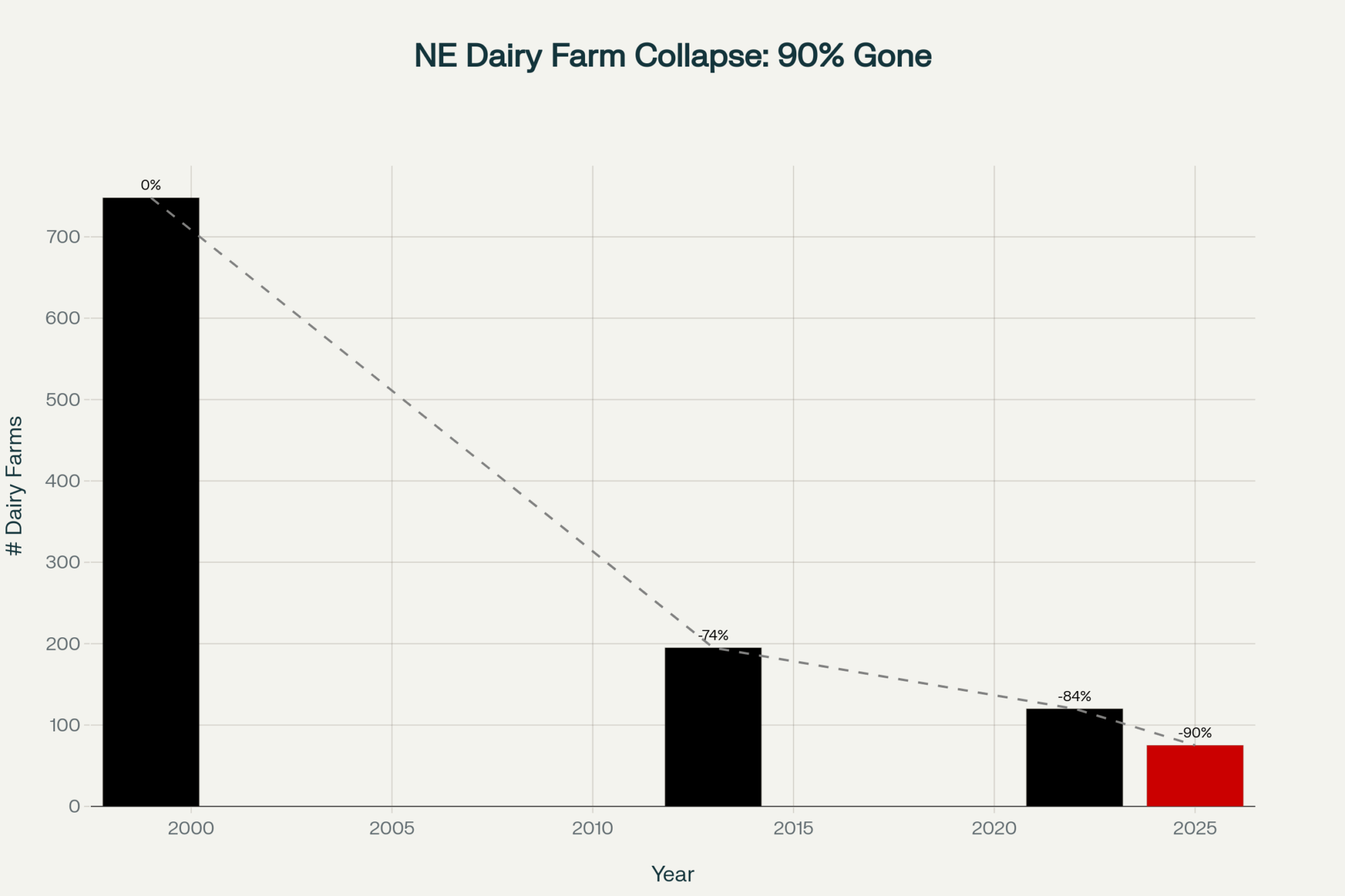
NewsSubscribe
First
Last
Consent

How 500-Cow Farms Are Building $100K+ Annual Cushions Without Relying on Safety Nets

Fixed safety nets lose 30% purchasing power by 2031—your $9.50 coverage becomes worth $6.45

EXECUTIVE SUMMARY: What we’re discovering through conversations with dairy farmers across the country is that fixed safety net programs, while valuable, are creating an interesting planning challenge—coverage that doesn’t adjust for inflation loses roughly 30% of its purchasing power over typical extension periods. Take the Johnson farm example: their 500-cow Wisconsin operation faces $15,000-$ 20,000 in annual premiums for coverage that protects only half of their 12 million pounds of production, while the other half remains exposed to market volatility. Meanwhile, operations from Texas to Vermont are finding creative ways to build resilience beyond government programs—forming buying groups that cut feed costs by 10-15%, investing in shared equipment that reduces per-unit expenses, and developing direct market relationships that capture premium pricing. Recent discussions with producers suggest that the most successful operations treat safety nets as just one tool in their risk management toolkit, not the complete solution. The farms weathering volatility best are those focusing on fundamentals they can control: feed efficiency improvements that add $50-100 per cow annually, reproductive programs that reduce replacement costs, and facility investments that pay for themselves through improved cow comfort. Looking ahead, the real opportunity might be in building operations that are efficient enough for safety nets to become backup protection rather than a primary strategy.

You know, I was talking with a neighbor the other day about dairy safety net programs, and we got to discussing something that I think a lot of us are wondering about: what does longer-term program planning actually mean for our operations?

The headlines sound encouraging—expanded coverage options, program certainty, all that. However, when you delve into the planning aspect of things… that’s where the conversation becomes more interesting. And frankly, more important for those of us trying to make smart risk management decisions.

Understanding the Safety Net Framework

So here’s what we’re looking at with recent program developments. Congress has been working on extending program availability further into the future, which would give us more certainty about having these tools available when we need them. The basic program structure remains focused on providing safety net coverage for dairy operations, although, as many of us have seen, the details can become quite complex quite quickly.

Now, you probably already know this, but the way these safety net programs generally work is you can cover a portion of your production with premium costs that tend to increase as you go for higher coverage levels. Initial tiers typically offer better premium rates, and as you add more coverage… well, it gets expensive in a hurry.

What’s interesting here is how different this approach is from, say, your typical business insurance. Most commercial policies adjust rates and coverage annually based on changing conditions. But agricultural safety nets? They tend to become established and then remain in place for years at a time.

The Reality of Fixed Protection Levels

This is where the conversation with my neighbor got really interesting. Fixed coverage levels lose what economists call purchasing power as costs rise over time—and they generally do. It’s like having equipment insurance that covers replacement at today’s prices when you’ll need to buy that equipment several years from now at tomorrow’s prices.

For those of us running mid-size operations, this becomes particularly important. If you’re milking, say, 400-600 cows, you’re producing enough milk that only part of it typically gets the better tier coverage under most program structures. The rest is essentially exposed to market volatility.

The Hidden Cost of Fixed Safety Nets: How Your $9.50 Coverage Loses $3.05 in Real Value by 2031 – While politicians promise program certainty, inflation quietly steals 30% of your protection. Smart farmers are building their own cushions instead of waiting for Washington to adjust.

I’ve noticed that producers who truly understand this dynamic tend to approach their overall risk management strategy differently. They’re not just considering whether to enroll in programs—they’re also asking what else they need to do to maintain protection as conditions evolve.

While safety net coverage stays fixed, actual farm costs have more than doubled over 20 years

Case Study: The 500-Cow Decision

Let me walk you through a real-world example that might help illustrate this. Take a typical 500-cow Holstein operation in Wisconsin—let’s call them the Johnson farm. They’re averaging about 24,000 pounds per cow annually, which translates to approximately 12 million pounds of total production.

Under current program structures, they can obtain better premium rates on their first tier of coverage—approximately half their production. For the Johnsons, that means roughly 6 million pounds gets decent safety net protection, while the other 6 million pounds is basically exposed to market volatility.

If they’re paying premiums for coverage on that protected portion, they need to factor those costs into their budget—probably around $15,000 to $ 20,000 annually, depending on the coverage levels they choose. However, they also need to consider what happens to the value of that coverage over time.

The Johnsons have been dairy farming for 20 years. They’ve seen feed costs go from $120 per ton to over $300 per ton during tough years. Labor costs have more than doubled. Equipment prices… don’t even get me started. So, when they consider fixed coverage levels that remain unchanged for years, they’re thinking about whether that protection will still be meaningful when they actually need it.

What they’ve decided to do is treat safety net programs as just one piece of their risk management puzzle—not the whole solution.

The Johnson Farm Blueprint: How One 500-Cow Operation Built Real Protection Beyond Programs – Four pillars, measurable results. While neighbors worry about Washington, the Johnsons control what they can control – and it’s working.

The Other Side of Your Milk Check

And speaking of things that evolve while safety net coverage remains relatively static… there’s another piece that affects our milk checks that doesn’t get discussed enough at the kitchen table. Make allowances—those deductions that supposedly cover processing costs—are something many producers report seeing changes in over time.

Here’s a simple exercise that might be worth doing: take your last six months of milk checks and calculate what a $0.50 per hundredweight change in deductions would mean to your annual cash flow. For a 500-cow operation producing about 12 million pounds annually, that’s $60,000. Not exactly pocket change, especially when you’re already paying premiums for safety net coverage.

Make allowance changes hit every hundredweight—the bigger you are, the harder you fall.

How Your Operation Size Changes Everything

You know what I’ve been noticing more and more? These policy and market changes affect farms very differently depending on your scale.

Farm size dramatically changes your risk profile under current safety net structures.

If you’re running a smaller operation—perhaps 150-250 cows—most of your production likely receives reasonable safety net protection. The challenge is that you’re often more dependent on cooperative pricing without a lot of market alternatives. Additionally, your time is typically fully committed to daily operations.

But if you’re in that middle range—say 400-800 cows—you’re producing enough that changes represent serious money, but only a portion of your milk typically gets meaningful coverage. Additionally, you’ve likely invested heavily in facilities and equipment over the years, making it expensive to consider switching market relationships.

Farm SizeAnnual ProdCoverage %Exposed ProdRisk Exposure
150-250 Cows3.6-6M lbs90-100%0-0.6M lbs$0-3K
400-600 Cows9.6-14.4M lbs50-65%5-8.4M lbs$25-42K
1000+ Cows24M+ lbs25-35%16-18M lbs$80-90K

The largest operations? They’re often negotiating premiums above base prices anyway. Safety net coverage is nice to have, but it’s not make-or-break for their cash flow. Their volume helps them absorb cost increases that might really hurt smaller farms.

What’s encouraging is seeing some mid-size operations get creative about this challenge—forming marketing groups, exploring regional processing options, or investing in technologies that improve their bargaining position with processors.

Understanding Market Relationships

Many dairy cooperatives operate both marketing and processing businesses. That creates some interesting dynamics when policies and market conditions change.

Now, I’m not saying there’s anything wrong with this business model—cooperatives serve important functions and most are trying to optimize total value for their members. However, it’s worth understanding how your cooperative or processor generates revenue across all its operations, not just what is reflected in your milk price.

I’ve noticed that producers who take time to really understand their market relationships tend to make better decisions about their overall marketing strategy. They’re also better positioned to have productive conversations about pricing, services, and long-term contracts.

Take butterfat premiums, for example. Some operations focus heavily on maximizing butterfat performance through breeding and feeding programs because their market relationships reward that approach. Others find better returns through improvements in volume and efficiency. Understanding how your specific market relationship works helps you make smarter investment decisions.

Alternative Approaches and Innovations

Some producers are exploring alternatives to traditional market structures. Mobile processing options are becoming a topic of conversation in some regions, although they still require substantial investment and regulatory navigation. Some operations are exploring direct-to-consumer approaches, particularly for specialty products like organic or grass-fed milk.

For example, some Wisconsin producers I know have formed buying groups for feed and supplies, using their combined purchasing power to negotiate better prices. In Texas, several operations have invested in shared equipment for feed processing, spreading the cost across multiple farms while improving feed quality and reducing per-unit costs.

In Michigan, a group of approximately 20 mid-sized dairies has pooled resources to hire a professional nutritionist who works exclusively with their operations. The cost per farm is manageable, but they’re getting top-tier expertise that would be unaffordable individually.

Beyond Safety Nets: Six Strategies Smart Farms Use to Build $100K+ Annual Cushions – Transition management improvements alone deliver $250/cow annually – that’s $125,000 for a 500-cow operation. No government program required

The Planning Framework That Actually Works

So where does this leave us? Well, I think it starts with understanding your own numbers—really understanding them, not just having a general sense of where things stand.

Smart risk management starts with understanding your operation’s unique position.

Calculate what a 10% increase in feed costs would do to your margins. Determine your break-even milk price based on current cost structures. Understand what percentage of your income comes from components like butterfat and protein premiums versus base price.

Here’s a practical framework that might be worth working through:

Monthly Financial Reality Check:

  • Track your all-in cost of production per hundredweight
  • Monitor your margin over feed costs as a key indicator
  • Calculate how policy or market changes affect your actual cash flow
  • Compare your costs to regional averages when available

Risk Assessment Questions:

  • What’s your biggest vulnerability—price volatility, cost inflation, or cash flow timing?
  • How much of your production gets meaningful safety net protection?
  • What happens to your operation if margins stay tight for 18 months?
  • Do you have access to alternative markets if your current relationship doesn’t work out?

Regional Realities and Opportunities

Some Wisconsin producers I’ve talked with report focusing more on feed efficiency and reproductive performance as ways to improve their cost structure independent of policy support. The emphasis on transition period management has intensified—getting those fresh cows off to a strong start makes a significant difference in overall herd performance and lifetime production.

What’s interesting is seeing more precision feeding approaches, where operations track individual cow performance and adjust rations accordingly. The technology has gotten more affordable, and the payback through improved feed conversion is pretty compelling when margins are tight.

In Texas and California, some producers mention investing in technologies that help manage heat stress and improve labor efficiency. The climate challenges they face make cow comfort investments particularly important for maintaining production levels during the summer months.

In Vermont and New York, some operations are exploring value-added enterprises and direct marketing opportunities. The proximity to urban markets creates opportunities that aren’t available in more remote areas, although navigating regulatory requirements can be challenging.

Meanwhile, in Iowa and Minnesota, several dairy operations with which I am familiar have begun collaborating with crop farmers on manure-for-feed arrangements that benefit both parties. The dairy receives competitively priced corn silage, the grain farmer receives valuable nutrients, and both parties save on transportation costs.

RegionPrimary StrategyKey InvestmentCost ImpactRisk Factor
WisconsinFeed efficiency & reproductionTransition cow management-$0.75/cwt feed costsComponent price volatility
Texas/CaliforniaHeat stress managementCooling systems & automation-15% summer production lossEnergy cost increases
Vermont/New YorkValue-added/direct marketingProcessing infrastructure+$2-4/cwt premium potentialRegulatory compliance
Iowa/MinnesotaManure-for-feed partnershipsNutrient exchange programs-$0.50/cwt feed + fertilizerWeather dependency

What This Means for Your Planning

Safety net programs provide a foundation—and that’s not nothing. Having some certainty about program availability helps with planning, even if the structure isn’t perfect. But building a sustainable operation on top of that foundation? That’s still up to us.

I’d encourage you to consider enrolling in available programs despite their limitations. Even imperfect protection is better than no protection when margins are tight. Consider enrollment strategies that offer premium savings, if your cash flow allows it. But don’t stop there.

Cost Management Priorities:

  • Focus on feed efficiency improvements—every tenth of a point improvement in feed conversion helps your bottom line
  • Evaluate your reproductive program’s impact—shorter calving intervals and improved conception rates reduce replacement costs
  • Consider facility investments that improve cow comfort—better stall design, improved ventilation, and adequate water access often pay for themselves
  • Invest in fresh cow management—transition period nutrition and management probably has the biggest impact on overall herd performance

Market Relationship Evaluation:

  • Build relationships with multiple market channels where possible—even if you can’t switch completely, having options provides leverage
  • Understand the total value proposition—consider component premiums, quality bonuses, and services provided
  • Ask questions about how pricing decisions get made—understanding the process helps you plan better
  • Keep good records so you can make informed comparisons—track your actual costs and returns to evaluate opportunities objectively

The Bottom Line

The conversation my neighbor and I had reminded me that we’re all navigating similar challenges, just with different herd sizes and in different regions. Safety net programs give us some tools for managing risk. But the real work of building resilient dairy operations? That’s something we do together, one cow at a time, one decision at a time.

Whether it’s improving your dry cow management to reduce metabolic disorders, investing in better ventilation systems to improve cow comfort during hot weather, or fine-tuning your breeding program to improve longevity—those day-to-day operational decisions probably matter more for your long-term success than any policy program.

The programs provide a safety net, but operational excellence provides the path forward. In my experience, producers who focus most on controlling what they can—such as feed quality, cow comfort, reproductive performance, and financial management—tend to be the ones who not only survive market volatility but also find ways to thrive despite it.

The safety net is there when you need it. But building a farm that doesn’t need to use it very often? That’s probably the best strategy of all.

So here’s my question for you: What’s one specific change you’re making this year to improve your operation’s resilience—regardless of what safety net programs do? Drop a comment below and share what’s working on your farm. Sometimes the best insights come from hearing what our neighbors are trying.

KEY TAKEAWAYS:

  • Calculate your real coverage gap: For a 500-cow operation producing 12 million pounds, only 50% gets meaningful protection—that’s $60,000 annual exposure from just a $0.50/cwt market swing, which smart producers are offsetting through efficiency gains averaging 0.1-0.2 points in feed conversion
  • Build three-layer protection beyond programs: Wisconsin buying groups report 10-15% feed cost savings, Michigan operations sharing professional nutritionists cut consultation costs 70%, and Texas dairies investing in heat abatement see 8-12% production gains during summer stress periods
  • Focus on transition period ROI: Operations improving fresh cow management report $200-300 returns per cow through reduced metabolic issues, better peak milk (5-8 pounds higher), and improved reproductive performance—protection that works regardless of policy changes
  • Create market flexibility now: Producers maintaining relationships with 2-3 potential buyers report better component premiums (averaging $0.15-0.25/cwt advantage) and negotiating leverage, while those exploring direct sales capture 20-30% price premiums on 5-10% of production
  • Track what matters monthly: Progressive operations monitoring margin over feed costs, all-in production costs per hundredweight, and cash flow impacts from policy changes are making adjustment decisions 3-6 months faster than those using annual reviews alone

Complete references and supporting documentation are available upon request by contacting the editorial team at editor@thebullvine.com.

Learn More:

The Sunday Read Dairy Professionals Don’t Skip.

Every week, thousands of producers, breeders, and industry insiders open Bullvine Weekly for genetics insights, market shifts, and profit strategies they won’t find anywhere else. One email. Five minutes. Smarter decisions all week.
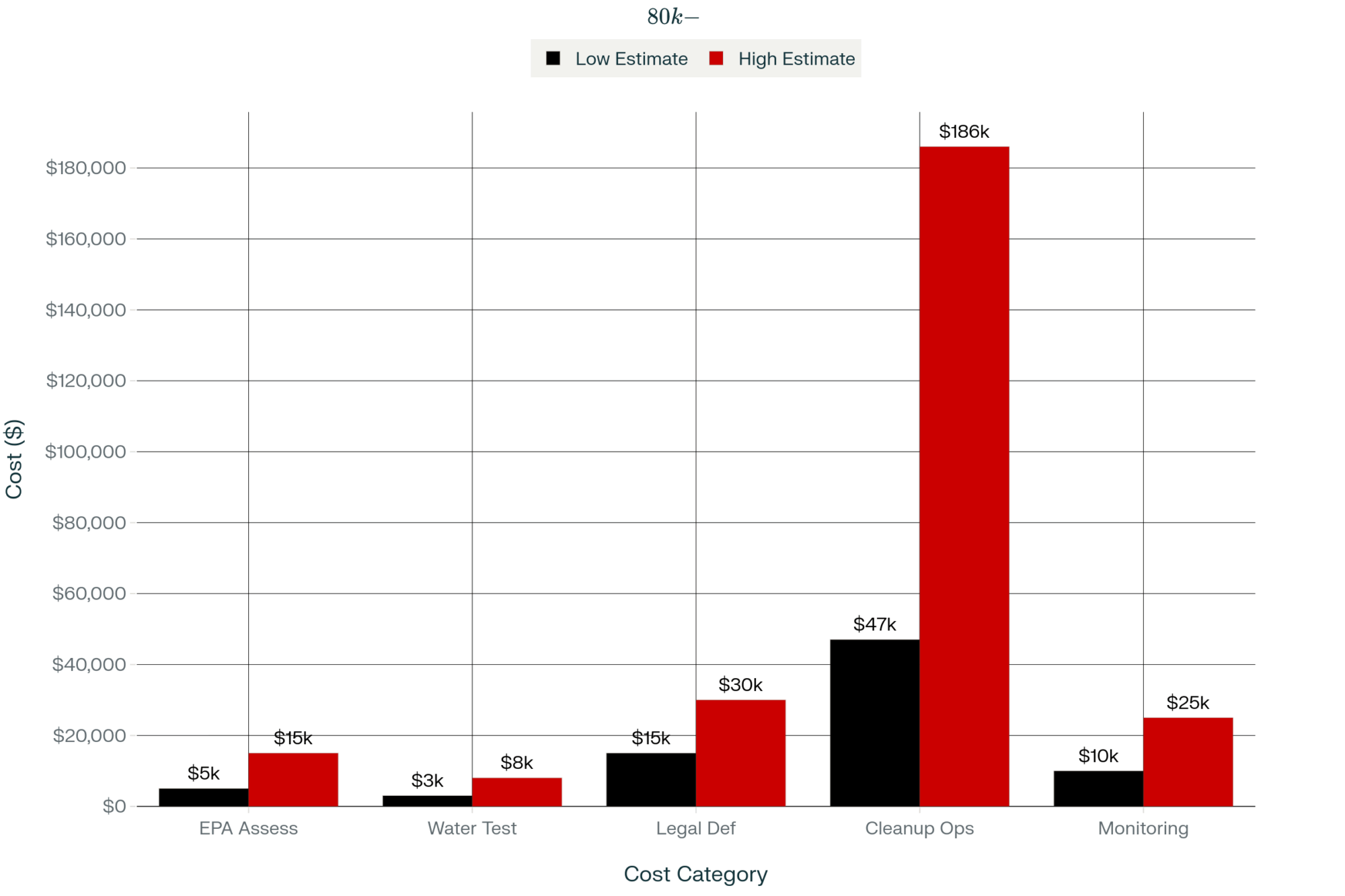
NewsSubscribe
First
Last
Consent

How Smart Dairy Producers Are Finding $50-150 More Profit Per Cow

Feed efficiency isn’t just another metric—it’s determining who thrives in today’s tight margins

EXECUTIVE SUMMARY: What’s fascinating about the current dairy economy is how producers who focus on feed efficiency are weathering market volatility better than those still chasing production records. Recent data from land-grant universities confirm that improving feed conversion from 1.55 to 1.65 ECM/DMI can generate $40,000-$ 75,000 in additional annual profit for a 500-cow operation—and that’s with feed costs consuming 50-60% of variable expenses, according to the USDA’s latest numbers. Scandinavian breeding programs have been incorporating these efficiency traits for years, achieving heritability rates between 0.15 and 0.40 that rival traditional production traits we’ve selected for decades. The technology exists, from $35 genomic tests to precision feeding systems with 18-36 month ROI for larger operations, but what’s really driving success is how producers integrate genetics, nutrition, and management rather than tackling them piecemeal. With milk processors increasingly selective about production attributes and lenders beginning to factor efficiency metrics into credit decisions, those operations that move thoughtfully on this now will have significant competitive advantages. The knowledge and tools are available—what matters is thoughtful implementation that fits each farm’s unique situation, whether that’s a 150-cow grazing operation in Pennsylvania or a 3,000-head dry lot in California.

dairy feed efficiency

Certain topics consistently resurface at every meeting, conference, and gathering of producers. Feed efficiency has become one of those discussions—and honestly, for good reason. We’ve tracked this ratio of energy-corrected milk to dry matter intake for years, but lately, it’s shifting from something we monitor in the background to a metric that might determine who stays profitable when markets get tight.

What’s encouraging is the pattern I’m seeing across different operations and regions. Producers who focus intensely on feed conversion generally report better financial resilience, especially when milk prices fluctuate and feed costs… well, when don’t they remain stubbornly high? Not overnight transformations, mind you. But those steady improvements that compound over time? That’s where the real opportunity sits.

Let’s Break Down What These Numbers Actually Mean

Here’s what we know from research coming out of universities like the University of Wisconsin, Cornell, and Penn State. Feed efficiency typically runs between 1.3 and 1.8 ECM per pound of DMI, depending on where your girls are in lactation—that’s been pretty consistent in the dairy science literature for quite a while. Recent work from the University of Wisconsin’s Dairy Management program (2024) confirms these ranges hold true across different production systems. Even the latest research presented at the 2025 Joint Annual Meeting shows similar patterns. But here’s what’s interesting: the economics behind those numbers have shifted considerably.

With feed costs accounting for 50 to 60 percent of variable expenses (and, yes, the USDA’s 2024 cost of production data backs this up year after year), every little bump in that efficiency ratio matters more than it might have five or ten years ago. Simple math, really. When your biggest expense category keeps climbing, managing it better becomes… well, it becomes everything. Feed prices vary significantly by region, too—ranging from $200 to $300 per ton in the Midwest versus $250 to $350 in California, depending on the season.

Feed costs consistently represent the largest single expense for most dairy operations. Even a small increase in efficiency can deliver a substantial impact to the bottom line.

The principle holds whether you’re running a California dry-lot with 3,000 head, a Wisconsin freestall barn with 500, or a grazing system in Pennsylvania with 150. Sure, the specific numbers vary—I mean, desert dairies dealing with heat stress face completely different challenges than those of us managing through Midwest winters—but improving feed conversion? That generally translates to better margins across the board. It is worth noting that Jersey herds often exhibit slightly higher efficiency ratios than Holsteins, while crossbred operations report their own unique optimization points.

When Those “Impressive” Numbers Are Actually Red Flags

Red Alert: When ‘Efficiency’ Signals Disaster – ECM/DMI ratios above 2.0 aren’t efficiency achievements but warning signs of unsustainable body tissue mobilization that destroys fertility and profitability.

This is something we need to talk about more. University research from institutions like the University of Wisconsin-Madison and Michigan State suggests that cows showing efficiency ratios above 2.0—sometimes reaching 2.4—aren’t achieving some magical feed conversion. They’re burning through body reserves at rates that create real problems down the road.

The transition cow research published in the Journal of Dairy Science over recent years is pretty clear on this. When you see excessive body tissue mobilization in early lactation, you tend to see:

  • Conception rates that tank compared to your herd averages
  • Treatment costs that eat up any perceived efficiency gains (and then some)
  • Higher culling rates in cows that should be hitting their stride

It’s that classic situation where what looks fantastic on your morning reports creates expensive headaches by summer. A cow showing exceptional early lactation efficiency through body condition loss? She often becomes that problem cow by mid-lactation. We’ve probably all had those animals—the ones that start strong but fade fast—even if we didn’t always connect the dots back to those early efficiency measurements.

How the System Shapes Our Decisions

One thing worth considering—and this might ruffle some feathers—is how our payment structures influence management choices. The milk check doesn’t care if your cow is maintaining condition while producing sustainably or if she’s essentially eating herself. Volume is volume, components are components, and the check clears the same.

This connects to genetic selection in interesting ways. When the Council on Dairy Cattle Breeding added Feed Saved to the Net Merit index back in 2021, it got about 13 percent of the total weighting. That’s progress, absolutely. But we’re still heavily selecting for production traits that might actually increase total feed consumption rather than improve conversion efficiency. Makes you think about our priorities, doesn’t it?

U.S. genetic selection indices still heavily prioritize production, whereas Scandinavian programs place a significantly higher emphasis on feed efficiency, demonstrating a distinct strategic difference in breeding goals.

And then there’s what I call the specialist challenge. Many operations have different advisors optimizing different aspects—your nutritionist is laser-focused on the ration, your reproductive specialist on pregnancy rates, and your geneticist on their favorite traits. But who’s looking at how it all fits together? It’s understandable, given the increasing specialization of dairy management. Still, you can end up optimizing the parts while missing the whole picture.

Learning from What’s Working Elsewhere

What’s particularly interesting is how Scandinavian breeding programs—especially in Denmark, Sweden, and Norway—have incorporated feed efficiency for years now. Not as the only thing, but as one important piece of the profitability puzzle. They’re using data from commercial farms (not just research herds) to identify genetics that reduce feed requirements while maintaining production.

What is the heritability for these efficiency traits? Generally falls between 0.15 and 0.40, according to published genetic studies from various universities and breeding programs. That’s right in line with many traits we’ve successfully selected for over the past few decades. So the genetic potential is there—it’s more about how we choose to use it.

Why hasn’t this gained more widespread adoption here? Tradition certainly plays a role. Next time you’re at a sale, notice what gets emphasized—it’s still production records, maybe some show wins, but rarely efficiency or lifetime profitability metrics. That takes courage to change. Different operations have different priorities. However, it reveals how deeply certain evaluation methods are ingrained in our thinking.

Practical Approaches That Are Actually Working

Getting Your Numbers Right

Based on what’s succeeding across different operations—and keeping in mind that what works beautifully on one farm might need serious tweaking on another—some patterns are emerging.

First off, you need accurate baseline data. I can’t tell you how many producers discover their estimated feed efficiency is way off once they actually measure it properly. Not because they were doing anything wrong, but because eyeballing it is no longer precise enough. Yeah, measurement systems aren’t cheap. But producers generally say the better decision-making pays for itself pretty quickly—often within 6-12 months for well-managed operations.

Small management adjustments often yield surprising results. Take feed bunk management—just ensuring consistent availability throughout the day. Nothing fancy. Good push-up schedules, adequate bunk space, and keeping feed fresh. These fundamentals don’t require huge investments but can deliver solid returns. Sometimes the basics are basic for a reason.

The Technology Question

Technology definitely has its place, although its implementation varies widely. Some operations dive straight into precision feeding systems and achieve great results. Others build gradually—measurement first, then management tweaks, then maybe technology. Both can work. It depends on your capital situation, your comfort with technology, and your labor availability… there’s no one-size-fits-all solution here.

Companies like DeLaval, Lely, BouMatic, and GEA Farm Technologies offer various precision feeding options, but honestly? The brand matters less than having good support and training. I’ve seen operations struggle with top-tier systems because they didn’t invest in learning how to use them properly. The ROI on these systems typically ranges from 18 to 36 months for operations with over 500 cows, and longer for smaller herds.

Regional Differences Really Do Matter

RegionFeed Cost Range ($/ton)Heat Stress FactorPrimary Challenge
Midwest$200–300LowWeather swings
California$250–350Very HighHeat mgmt.
Southeast$220–320HighHumidity/intake
Northeast$230–330MediumCold stress
Great Plains$180–280MediumDrought conds

What works to optimize efficiency in Arizona’s 115-degree summers bears little resemblance to strategies for Vermont’s minus-20 winters. Missouri grazing operations have completely different optimization points than California’s total confinement systems. Mountain state producers, who deal with elevation and temperature swings, face their own unique set of challenges. And that’s before we even talk about feed availability and pricing differences.

This season has been particularly interesting. Southeast producers dealing with this extended heat and humidity—their intake challenges are real. Meanwhile, Midwest operations are managing through these weather swings, while Pacific Northwest dairies, with their unique forage options, and Great Plains producers are dealing with drought conditions. Everyone has their own puzzle to solve.

These aren’t just academic differences. They fundamentally change which strategies pencil out economically. Heat abatement systems, which are absolutely essential in Texas, are increasingly needed even in Wisconsin during those brutal July heatwaves—climate patterns are shifting, and what worked 20 years ago might not be effective today. Conversely, cold weather housing critical in Minnesota would still be a wasted investment in most of Florida.

The Human Side Nobody Talks About

Here’s something we don’t discuss enough at meetings: the psychological piece of changing management focus. Many of us—myself included—come from families that built successful operations emphasizing production above all else. Changing that approach, even when the data supports it… that takes real courage.

The operations I’ve seen successfully evolve don’t frame it as abandoning what worked before; instead, they focus on building upon it. They talk about adapting proven principles to today’s economic reality. It’s still about excellence in dairy farming. We’re just measuring it more comprehensively than maybe our parents or grandparents did.

And peer influence? That’s huge. When a respected neighbor reports success with a different approach, that carries more weight than any university study or industry recommendation. We’re a community that learns from each other’s experiences. Always have been.

These psychological factors don’t exist in isolation, though. They’re intertwined with the very real economic and environmental pressures reshaping our industry. Understanding how we think about change is just as important as understanding why change is necessary.

Why This Matters More Now Than Ever

Several trends are converging that make efficiency increasingly important—and they’re all connected to those human decisions we just discussed.

Milk processing consolidation continues reshaping how we market milk. While specifics vary by region, buyers are generally becoming more selective about various production attributes beyond just volume and butterfat. Some areas are starting to see pricing that reflects sustainability metrics. That trend isn’t going away.

Environmental considerations keep evolving, too. Whether you’re dealing with methane regulations out West or nutrient management in the Chesapeake watershed, operations producing milk with fewer resources per hundredweight generally have advantages. What’s voluntary today often becomes required tomorrow.

Agricultural lenders are also paying attention. Increasingly, more of them are considering efficiency metrics alongside traditional production measures when making credit decisions. Farm Credit Services and various regional banks are incorporating these factors into their lending criteria. It’s not yet universal, but if you’re planning expansion or need operating capital, it’s worth knowing that this is on their radar.

Some Practical Steps to Consider

If you’re considering focusing more on efficiency, here are some approaches that seem to work—though, obviously, your specific situation will determine what makes sense.

Start with measurement. Even pen-level intake data beats guessing. If you’re already conducting genomic testing (and at around $35 per animal through companies like Zoetis, Neogen, or STgenetics, it’s quite affordable these days), ensure you’re evaluating efficiency traits alongside production markers. The tools are there—might as well use them.

For making changes, many producers find value in balanced genetic selection—picking bulls that perform decently across multiple traits rather than spectacularly in just one or two. Focus on optimizing what you have: consistent feed availability, solid transition cow protocols, and basic comfort measures. These fundamentals often deliver better returns than any fancy technology.

Speaking of technology, those investments might make sense down the road—such as precision feeding, advanced monitoring, and perhaps some automation. But by then, you’ll know what fits your specific operation rather than hoping something works.

The Economics in Practice

Let’s talk real-world impact. Producers report gains ranging from $50 to $150 per cow annually, depending on their starting efficiency and the effectiveness of the implemented changes. A 500-cow dairy that improves efficiency modestly might see $40,000 to $ 75,000 in additional annual profit. Not life-changing overnight, but compound that over several years? That’s serious money.

The Feed Efficiency Profit Ladder – Even modest 0.05 improvements in ECM/DMI ratios deliver $25 per cow annually, while comprehensive optimization approaches $158 per cow – demonstrating why smart producers prioritize efficiency over pure production volume.

The key is to start somewhere and measure progress. You don’t need to revolutionize everything overnight.

Pulling It All Together

After considering this from various angles, a few things seem clear.

First, improving feed efficiency doesn’t mean backing off on production. The successful approaches I’m seeing maintain or even increase total output while reducing input costs per hundredweight. That’s the sweet spot—not less milk, but more efficient milk production.

Second, this isn’t something you can tackle piecemeal. Genetics, nutrition, facilities, management—they’re all connected. I’ve watched operations invest heavily in one area while ignoring others, then wonder why results didn’t match expectations. It rarely works that way.

Third, there’s still an opportunity for operations to move thoughtfully in this direction. Right now, superior efficiency can differentiate your business. Five years from now? It might just be table stakes for staying in the game.

Look, we’re all trying to build operations that are sustainable—financially, environmentally, and personally. Operations we can hand off to the next generation with confidence. Feed efficiency isn’t the magic bullet, but it’s probably a bigger piece of the puzzle than many of us have been treating it.

The knowledge is out there. Research from land-grant universities, data from commercial farms, tools from genetics companies—it’s all available. What’s needed is thoughtful implementation that fits each farm’s unique situation. Your challenges are different from mine, your resources are different, and your markets are different.

What’s your take on all this? I’m always curious to hear what others are seeing in their operations and regions. Sometimes the best insights come from comparing notes with someone dealing with similar challenges from a different angle. Please share your thoughts—whether you think efficiency is overhyped or undervalued, I’d be interested in hearing your perspective.

After all, that’s what makes these conversations valuable—learning from each other while figuring out what works for our own places.

KEY TAKEAWAYS:

  • Producers report $50-150 more profit per cow annually through modest feed efficiency improvements, with measurement systems typically paying for themselves within 6-12 months when properly managed
  • Start with accurate baseline data and simple management tweaks—consistent feed availability, proper push-up schedules, and transition cow protocols often deliver better returns than expensive technology investments
  • Regional differences fundamentally change the economics: Heat abatement essential in Texas is increasingly needed even in Wisconsin’s July heat waves, while cold weather housing critical in Minnesota remains unnecessary in Florida
  • The heritability of feed efficiency traits (0.15-0.40) matches many production traits, yet it only receives 13% weighting in Net Merit, while we continue selecting for genetics that may actually increase total feed consumption
  • By 2030, superior feed efficiency will shift from a competitive advantage to a survival requirement as environmental regulations tighten, processors become more selective, and agricultural lenders incorporate efficiency metrics into lending criteria

Complete references and supporting documentation are available upon request by contacting the editorial team at editor@thebullvine.com.

Learn More:

The Sunday Read Dairy Professionals Don’t Skip.

Every week, thousands of producers, breeders, and industry insiders open Bullvine Weekly for genetics insights, market shifts, and profit strategies they won’t find anywhere else. One email. Five minutes. Smarter decisions all week.

NewsSubscribe
First
Last
Consent

The 70-Mile Threat: How Screwworm Turns Dairy’s Milking Schedule Into a $800,000 Liability

USDA sterile fly production covers just 25% of needs, while screwworm sits 70 miles from Texas dairy operations

EXECUTIVE SUMMARY: Recent government data reveal a concerning preparedness gap, as the New World screwworm sits just 70 miles from the Texas border, while federal sterile fly production operates at only 25% of the estimated containment needs. A typical 1,000-cow operation facing mandatory treatment protocols could dump over 525,000 pounds of milk during a week-long response, resulting in approximately $800,000 in lost revenue while incurring full operational costs. What’s particularly noteworthy is how this crisis highlights fundamental differences between dairy and beef operations—while ranchers can delay marketing during quarantines, dairy producers can’t pause milking schedules. Extension service guidance now emphasizes enhanced wound surveillance and 90-day emergency cash reserves specifically for dairy operations. Climate research indicating that insects are expanding their ranges at a rate of 6 kilometers per year suggests that these biological boundaries will continue to shift, making individual farm preparedness increasingly essential. The operations best positioned for this changing risk environment will be those that balance efficiency gains with crisis resilience, adapting their surveillance and financial planning accordingly.

You know, when Mexico confirmed New World screwworm just 70 miles from the Texas border on September 20th, it got me thinking about something we don’t discuss enough at industry meetings. We spend considerable time optimizing for efficiency—milk per cow, feed conversion, labor productivity—but I wonder if we’ve created some blind spots when it comes to weathering the kinds of crises that could shut down operations for weeks.

What’s particularly noteworthy about this screwworm situation is how it reveals fundamental differences between dairy and beef operations when trouble arises. And honestly? The timing couldn’t be worse for dairy producers, who are already dealing with tight margins and cash flow pressures.

When Your Biggest Strength Becomes Your Greatest Vulnerability

There’s this reality that many of us probably haven’t fully considered: when livestock health emergencies strike beef operations, ranchers have options. They can delay marketing, adjust grazing rotations, and even cull selectively while waiting for clearances.

But in dairy? The cows don’t care about quarantines—they still need milking twice a day.

USDA’s Animal and Plant Health Inspection Service confirmed that the infected calf in Sabinas Hidalgo had traveled from southern Mexico through certified systems—a 300-mile jump north that puts it uncomfortably close to operations across Texas, Oklahoma, and into Kansas. When you’re looking at mandatory withdrawal periods for screwworm treatments, dairy producers face the immediate risk of milk dumping while incurring full operational costs.

Here’s the math that’s keeping many of us up at night: a typical 1,000-cow operation producing around 75 pounds of milk per cow daily is looking at over 525,000 pounds of dumped milk during a week-long treatment window. At current milk pricing levels—hovering in the mid-to-upper teens per hundredweight—that translates to roughly $800,000 in lost revenue while you’re still paying for feed, labor, and utilities.

Financial Reality Check: A 2-week screwworm crisis could cost a 1,000-cow operation $275,000 in combined treatment expenses, dumped milk, and processing disruptions

And that assumes you catch it early… which brings us to something interesting I’ve been noticing about detection capabilities.

The Small Farm Advantage Nobody Saw Coming

Despite having less financial cushion to weather extended crises, family operations might actually hold crucial advantages in early threat detection. This development suggests that we might need to reconsider our assumptions about the balance between operational efficiency and crisis resilience.

When you’re doing the milking yourself, you notice when individual animals behave differently. Those subtle behavioral shifts—the way a cow carries her tail, hesitation at the feed bunk, even changes in how she positions herself during milking—often signal early problems before any visible symptoms appear.

Now, corporate operations have significant advantages—dedicated animal health teams, sophisticated monitoring systems that can track patterns across thousands of animals, and better access to capital during emergencies. But there’s a trade-off here. Those automated systems excel at identifying trends and managing routine health protocols; however, they may miss the individual animal changes that signal early stages of infestation.

What’s even more significant is procedural flexibility. Family operations can often implement treatment protocols within hours of detection, whereas larger operations need to coordinate across multiple sites, consult with centralized veterinary staff, and navigate through documentation requirements that can add crucial hours to response time.

I’ve noticed that the behavioral observation skills that enable you to spot early mastitis or lameness also translate directly to early detection of parasites.

When 25% Capacity Meets 100% of the Problem

Looking at federal response capabilities underscores the importance of individual farm preparedness. The sterile insect technique that eliminated screwworm back in 1966 remains our best tool—and honestly, it’s pretty remarkable technology when you think about it.

According to APHIS data, the Panama facility produces approximately 100-115 million sterile flies per week. It was designed primarily for barrier maintenance rather than responding to outbreaks. Current estimates suggest the Mexican outbreak requires 400-500 million flies weekly for effective containment. We are currently examining existing capacity, which covers approximately 25% of actual needs.

Government Response Reality: Federal sterile fly production operates at just 25% of estimated containment needs, creating an 18-month vulnerability gap for U.S. dairy operations.

USDA Secretary Brooke Rollins announced an $879.5 million response plan in August—including a Texas facility designed to produce 300 million flies weekly. But here’s the challenge: full operational capacity won’t be reached until 2026. That’s an 18-month gap between crisis escalation and the development of adequate response capabilities.

It reminds me of trying to handle a barn fire with equipment designed for small spot fires. The tools work, but the scale just doesn’t match what we’re facing.

Climate Reality Is Rewriting the Rulebook

What makes this screwworm situation particularly significant is how it illustrates broader changes in agricultural threat patterns. Climate research indicates that insects are expanding their ranges at approximately 6 kilometers per year due to rising temperatures. Screwworm, historically confined to tropical zones, now finds suitable habitat extending into traditional cattle regions across Texas, Oklahoma, and parts of Kansas.

This aligns with patterns we’re seeing elsewhere in agriculture—and it’s got implications beyond just this one parasite. Those natural boundaries that have kept certain pests out of our regions are shifting faster than our preparedness systems have adapted to handle them.

Makes you think about what other assumptions we might need to revisit. The efficiency gains from consolidation and specialization have made modern dairy farming profitable, but biological emergencies requiring rapid, individualized responses may reveal some vulnerabilities that we haven’t fully considered.

The Economics Go Way Beyond Treatment Costs

I wish the financial impact stopped at treatment expenses, but it doesn’t. Regional milk processing facilities often implement strict movement controls during livestock health emergencies, potentially preventing even unaffected farms from delivering to alternative buyers. This compounds treatment-related milk dumping with healthy cows whose milk simply can’t reach markets.

There are also international trade implications to consider. The World Organisation for Animal Health protocols automatically restrict exports from countries with screwworm-positive areas. Any disruption to international market access could persist for years beyond the resolution of the outbreak—something we have learned from previous disease outbreaks in other countries.

Here’s something worth considering that caught my attention: quarantine-related losses often fall into insurance coverage gaps that many of us haven’t thought about. Worth having that conversation with your agent before you need to know the answer, especially given how dependent dairy operations are on continuous cash flow.

What University Extension Services Are Actually Recommending

Looking at the preparedness strategies emerging from land-grant universities and USDA guidance, the emphasis is on enhanced surveillance and rapid response protocols. Current recommendations focus on twice-daily wound inspections during milking, documenting and photographing the healing progress on fresh procedures, such as dehorning and AI breeding.

The goal is to catch any problem within hours rather than days, which becomes particularly important when considering that screwworm larvae can establish and begin tissue damage incredibly quickly under the right conditions.

Financial preparedness extends far beyond traditional cash flow planning. What I’m seeing consistently recommended across extension publications is cash reserves equal to 90 days of operating expenses—specifically earmarked for crisis survival, not expansion or equipment purchases. This isn’t growth capital; it’s survival funding for extended market disruptions.

Many operations are establishing backup milk buyer relationships outside their traditional territories. Extension guidance includes negotiating force majeure clauses that enable the rapid transfer of contracts during regional emergencies. Some are pre-purchasing approved treatments and wound care supplies to avoid post-outbreak shortages, while diversifying feed supply chains to reduce dependency on potentially restricted imports.

The Scale vs. Speed Trade-Off Nobody Talks About

This screwworm threat is revealing fundamental tensions between agricultural efficiency and crisis resilience that extend beyond individual farm decisions.

Corporate dairy operations have clear advantages—they can absorb financial hits better, they’ve got dedicated animal health staff, and they often have relationships with multiple processors already established. Their scale provides certain buffers that smaller operations simply don’t have.

However, what’s interesting is that their multi-site complexity and centralized decision-making can slow emergency responses when minutes matter for containment. Independent operations typically operate with tighter margins and less financial cushion, making them more vulnerable to extended disruptions. Yet their direct animal observation, immediate decision-making authority, and established local veterinary relationships often enable faster threat detection and response.

The question is whether those corporate advantages offset the challenges of detection and response time. Industry consolidation has favored larger, more efficient operations for sound economic reasons, but biological emergencies may reveal some trade-offs that we haven’t fully considered.

Fresh Cow Management During Crisis Periods

What’s particularly noteworthy is how this threat timing aligns with fall breeding season and fresh cow transition periods. Fresh cows coming through transition already have compromised immune systems during peak lactation. Add breeding procedures, heifer dehorning, and routine ear tagging, and you’ve created multiple potential problem sites on your most valuable animals.

Every routine management practice becomes a potential entry point during an outbreak. What’s encouraging is that many operations are discovering they can integrate enhanced surveillance into existing fresh cow management without major operational disruptions.

The twice-daily wound inspections naturally fit into milking routines, especially during the critical first 30 days in milk, when you’re already closely monitoring for ketosis and displaced abomasums. Those behavioral observation skills that enable you to identify metabolic issues effectively also translate to early detection of parasites.

And there’s something to be said for the fact that many of our best fresh cow managers already have that instinctive ability to notice when something’s off with individual animals. Those skills become even more valuable during crisis situations when early detection can mean the difference between treating a few animals versus dealing with a full outbreak.

Your Crisis-Ready Action Plan

Based on current extension service recommendations and USDA guidance, here’s what prepared operations are actually doing, organized by timeline and implementation complexity.

Next 30 Days:

  • Integrate enhanced wound inspection protocols into existing milking routines—focusing particularly on dehorning sites, ear tag punctures, and breeding-related injuries
  • Contact alternate milk buyers in different regions to establish backup processing agreements before you need them
  • Have that insurance conversation specifically about quarantine-related coverage gaps and milk dumping scenarios
  • Pre-purchase approved treatments and wound care supplies before potential shortages drive up costs

Within Six Months:

  • Build cash reserves equal to 90 days of operating expenses—specifically earmarked for crisis management, not equipment or expansion
  • Develop comprehensive employee training for early problem recognition (your milkers really are your first line of defense)
  • Create documented emergency response procedures for rapid veterinary consultation and treatment protocols
  • Diversify feed supply chains to reduce dependency on single sources that could face import restrictions

Long-Term Resilience Building:

  • Consider revenue diversification through on-farm processing or direct sales to reduce fluid milk market dependency
  • Evaluate your operational structure for optimal balance between efficiency and emergency responsiveness
  • Update risk management strategies for this changing threat environment we’re entering
  • Participate in industry planning for enhanced surveillance and response capabilities

Regional Realities Worth Considering

Different regions face different baseline risks and have varying levels of experience with similar challenges. Operations in the Southwest that have dealt with other cross-border livestock issues may have transferable experience in backup planning and crisis response.

But what’s concerning is that many operations in regions that climate barriers have historically protected may not have developed the surveillance and response protocols that could prove essential as these boundaries shift.

The data suggest that pest and disease patterns we’ve relied on for decades are changing faster than our preparedness systems have adapted to handle them. That’s particularly true for regions that haven’t had to deal with aggressive parasites or tropical disease pressures in the past.

This development suggests we might need more collaboration between regions that have experience managing these threats and those that are just starting to face them.

The Bigger Picture We’re All Facing

This screwworm crisis, 70 miles from the Texas border, represents more than a single pest threat. It’s a preview of how climate change, global trade integration, and agricultural consolidation are reshaping the risk environment for dairy operations across different regions.

We’re entering a phase of agricultural risk management where historical assumptions about containment and government response may no longer hold. Operations that recognize these broader patterns and prepare accordingly will be better positioned not just for screwworm, but for the expanded range of challenges emerging in modern agriculture.

The lesson here seems clear: in an era of expanding biological threats and limited government response capacity, individual farm preparedness—combining early detection capabilities with financial resilience—becomes your most reliable line of defense.

And honestly? That adaptation might favor some operational structures over others in ways we’re just beginning to understand. Worth thinking about as we plan for the years ahead.

What’s interesting here is that the operations that thrive will be those that adapt not just for efficiency, but for resilience in an increasingly uncertain environment. The question is whether we can maintain the profitability that comes from optimization while building in the flexibility that crisis management requires.

That balance between efficiency and resilience… that’s probably the conversation we should be having more often at these industry meetings. What we’re seeing with screwworm is likely just the beginning of how climate change and global trade patterns will test the assumptions we’ve built our operations around.

The math on this crisis is pretty sobering—$800,000 in lost revenue for a week-long treatment scenario on a 1,000-cow operation. However, the real cost might be in the lessons we learn about preparedness—or fail to learn—while we still have time to act.

KEY TAKEAWAYS:

  • Financial Impact Planning: Build cash reserves equal to 90 days of operating expenses specifically for crisis management, as milk dumping during treatment protocols can cost $800,000+ for large operations, while operational expenses continue
  • Enhanced Detection Protocols: Implement twice-daily wound inspections during milking routines, focusing on dehorning sites and breeding procedures where family operations often hold advantages in early behavioral observation
  • Backup Market Relationships: Establish alternate milk buyer agreements with processors 100+ miles apart, including force majeure clauses that enable rapid contract transfers during regional quarantine situations
  • Operational Structure Assessment: Evaluate the balance between efficiency optimization and crisis response flexibility, as automated surveillance systems may miss individual animal changes that signal early infestations
  • Regional Preparedness Adaptation: Recognize that climate-driven pest range expansion at 6 kilometers annually requires updated assumptions about historical biological barriers and containment strategies

Complete references and supporting documentation are available upon request by contacting the editorial team at editor@thebullvine.com.

Learn More:

The Sunday Read Dairy Professionals Don’t Skip.

Every week, thousands of producers, breeders, and industry insiders open Bullvine Weekly for genetics insights, market shifts, and profit strategies they won’t find anywhere else. One email. Five minutes. Smarter decisions all week.
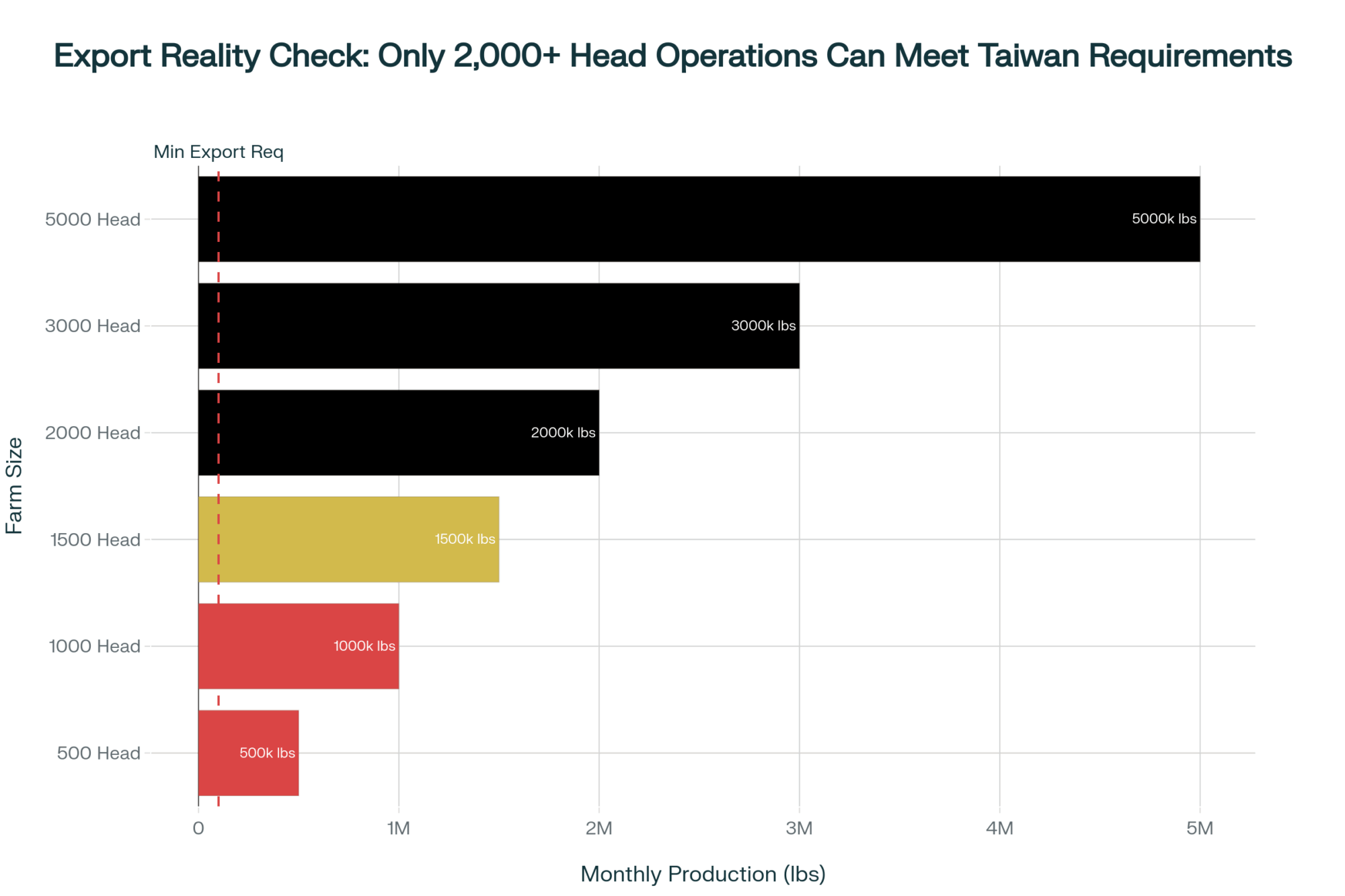
NewsSubscribe
First
Last
Consent

Your Feed Room’s Hidden $58,400 Leak – And How Smart Dairy Farms Are Plugging It

Smart farms aren’t just switching to digital feed management—they’re discovering money they never knew they were losing.

EXECUTIVE SUMMARY: Recent University of Minnesota research reveals that 100-cow dairies can save $58,400 annually by reducing feed shrink through precision tracking—losses that traditional paper logs simply can’t detect. What’s particularly noteworthy is how mobile feed management systems aren’t just improving efficiency; they’re uncovering waste patterns that experienced operators never saw coming, with some operations discovering 3-8% shrinkage they’d been accepting as normal. With feed costs representing 20-45% of gross income according to agricultural financial consultants, even modest improvements in accuracy can determine yearly profitability. The precision dairy technology market is expanding 9-15% annually as mid-size operations realize they can’t afford to operate blind on their largest expense. Beyond immediate cost savings, these systems are reshaping the relationships between nutritionists and farms, enabling real-time adjustments instead of reactive monthly reviews, and positioning farms for environmental compliance programs that increasingly require detailed documentation. Current feed price volatility makes this visibility particularly valuable—when corn and soy swing dramatically, knowing exactly where every ingredient goes becomes a competitive advantage rather than a luxury.

dairy farm management, dairy profitability, feed efficiency, farm operational optimization, mobile feed management, precision agriculture, dairy technology

You know, I’ve been following the shift toward mobile feed management for a few years now, and what strikes me is how many farms are discovering money they never knew they were losing.

Here’s what’s interesting—Dr. Jim Salfer from the University of Minnesota Extension puts a number on it that really gets your attention: a 100-cow dairy can save $58,400 in one year just by reducing feed shrink from high to low levels. That’s real money walking out the barn door every day… and most operations using paper logs simply can’t see where that shrink is happening.

Hidden Feed Waste: The Money You Never See – Feed waste costs scale dramatically with operation size, but the proportional impact on smaller farms can be devastating. Most operations using paper logs can’t track these losses, making every cow count when margins are tight.

What I’ve found is that this technology isn’t just improving efficiency—it’s revealing losses that were always there but impossible to track. Gary Sipiorski, who does agricultural financial consulting, points out that feed costs range from 20% to 45% of gross income, and if you’re purchasing all your feed, it pushes toward 50% of your milk check. With numbers like that, even small improvements in accuracy can determine whether you’re profitable this year.

This development suggests something important about where our industry is heading. The precision dairy technology market is projected to reach $5.59 billion by 2025, expanding at 9-15% annually, but what’s driving that growth isn’t just bigger farms going high-tech. Mid-sized operations are realizing they can’t afford not to know where their feed dollars are going.

When the Old System Finally Shows Its Cracks

Now, I should mention that I’ve seen some excellent operations that stick with paper and clipboards and do just fine. Usually, these are smaller farms with one consistent mixer operator who’s been doing it for years—someone who knows every ingredient by feel and rarely makes mistakes. There’s something to be said for that kind of experience and consistency.

But there’s usually a specific moment when traditional systems fail spectacularly… and that’s what forces change. As many of us have seen, busy weeks when communication breaks down between shifts can create expensive problems. Ingredients get mixed into the wrong pens, quantities get miscalculated during hectic mornings, and suddenly you’re looking at thousands in losses trying to figure out what went wrong through handwritten notes.

Dr. Mike Hutjens from the University of Illinois—who’s probably forgotten more about dairy nutrition than most of us will ever know—puts it this way: “The problem with paper is you don’t know you have a problem until it’s too late.” And here’s the thing—with feed representing half of total farm expenses according to recent industry data, these mistakes add up fast.

What’s encouraging is that farms making the switch to real-time tracking often discover patterns of inefficiency they’d been accepting as “normal” for years. I’ve noticed that the operations pushing toward digital aren’t necessarily the most tech-savvy farms. They’re often the ones that got tired of losing money on preventable mistakes and decided the investment was worth trying.

What Digital Systems Actually Reveal

Management AspectPaper-Based SystemsDigital Systems
Waste TrackingLimited visibilityReal-time alerts
Cost per Cow/Year$0$15-40
ROI TimelineN/A6-12 months
Labor EfficiencyHigh manual effortAutomated reporting
Data AccuracyHuman error pronePrecise measurements
Integration CapabilityNoneFull herd management
Environmental ComplianceManual documentationAutomated records

Modern mobile feed management captures information that paper logs simply can’t match. When your mixer operator scans a barcode, the system pulls up target ingredients and pen assignments instantly. As each component hits the scale, you’re seeing actual versus target weights with tolerance indicators, live deviation tracking, and alerts if someone’s about to feed the wrong group.

But here’s where it gets really valuable—those post-mix report cards that generate automatically after each batch. They show exact weights, deviations, and final nutrient profiles, then get stored digitally with timestamps. No more hunting through clipboards trying to reconstruct what happened three days ago when butterfat performance started dropping.

Why is this significant? The economics tell the story. Recent work published in Hoard’s Dairyman showed that farms using precision feeding see feed efficiency improvements from 1.55 to 1.75. On a 2,500-cow operation, that translates to $470 per cow annually—roughly $1.2 million to the bottom line. For smaller operations, the proportional impact is often even greater.

Looking at this trend across different regions, I’m seeing some interesting patterns. Up in Wisconsin and Minnesota, where you’re dealing with corn silage that changes dramatically from October through March, that real-time adjustment capability becomes crucial for maintaining consistent milk components. However, I’ve also spoken with California producers who claim that their consistent TMR quality yields different benefits—mainly increased labor efficiency and improved documentation for their sustainability programs.

And if you’re running robotic milking systems—which seems to be happening in a lot of new barns these days—this precision becomes even more critical. Work from the University of Saskatchewan shows that individually targeted diets can boost milk yield by 3.3 kg per cow while maintaining the same dry matter intake. That’s improved efficiency without higher feed costs, which is exactly what we need with current market conditions.

Getting Your Team on Board

You probably know this already, but transitioning experienced operators from intuitive mixing to screen-guided precision takes some finesse. The key is positioning technology as backup support rather than skill replacement—because good feed operators have pride in their accuracy, and rightfully so.

What I’ve found works best is hands-on training where operators mix real rations alongside tech support. When veteran mixers discover their “feel” weights are actually off by pounds of grain, skepticism usually turns to curiosity pretty quickly. Dr. Marcia Endres at the University of Minnesota has studied this transition across 52 farms in Minnesota and Wisconsin, noting that successful adoption almost always involves a gradual process of trust building.

This builds on what we’ve seen with other farm technologies… you can’t just flip the switch overnight. Many operations run mobile apps alongside paper logs for a couple of weeks, letting operators maintain familiar routines while building confidence. Generally, by week three or so, paper becomes obsolete—not because management mandated it, but because operators prefer the precision and immediate feedback.

What’s worth noting is that resistance often comes from operators who’ve built their reputation on mixing accuracy. They see screens as questioning their skills rather than validating them—so you’ve got to frame it right from the start. Make it about helping them be even better at what they’re already good at.

How This Changes Your Nutritionist Relationship

Here’s something that’s caught my attention… real-time feed data is fundamentally changing how nutritionists work with farms. Monthly reviews are evolving from historical post-mortems to continuous collaborative management.

What’s particularly noteworthy is how this is reshaping the role of a nutritionist entirely. Instead of spending half their time driving farm to farm, many consultants are analyzing data patterns across multiple operations. Rather than waiting for lab results to tell them what happened last week, they can access live dashboards showing daily nutrient drift, automated alerts for unusual events, and historical overlays connecting mix deviations to milk components 24 hours later.

This shift requires some service agreements to be restructured. Rather than flat monthly fees, some nutritionists are moving toward more flexible arrangements—base dashboard access for ongoing monitoring, performance incentives tied to income over feed cost improvements, and consultation blocks for real-time scenario testing.

Based on producer discussions and industry reports, nutritionist costs might tick up slightly with these new arrangements—maybe 10-15% in many cases—but the precision enables more profitable recommendations that typically pay for the additional investment several times over. It’s one of those situations where spending a bit more actually saves you money, assuming you’re working with the right consultant.

What’s interesting here is how this technology is creating opportunities for smaller operations to access higher-level nutrition expertise. A consultant can monitor multiple farms remotely and provide more frequent guidance than the old once-a-month visit model allowed.

The Technical Side That Nobody Talks About

And here’s something that often catches many operations off guard: connecting feed management systems with herd management systems can create unexpected challenges. The issue isn’t data compatibility but timing mismatches.

Herd systems typically update pen movements on their own schedule while feed apps track in real time, which can create situations where you’re trying to mix rations for pens that have changed composition since morning. It’s like trying to hit a moving target—particularly during busy periods with lots of fresh cow management or pen moves.

From what I understand, the better systems have found ways to smooth this out—they’ll coordinate data updates and make sure both systems agree before any mix starts. But it’s worth knowing going in that you’ll probably need some patience while everything learns to talk to each other.

Multiple producers report that integration typically takes longer than vendors initially estimate—sometimes several weeks longer than promised—but once it’s working properly, it eliminates a significant amount of the manual pen count adjustments that used to consume time every morning. The key is having realistic expectations and good vendor support during the setup process.

When you’re evaluating systems, ask specifically about:

  • How they handle real-time data synchronization with your existing herd management software
  • What happens when systems go offline or lose connectivity (because it will happen)
  • How long does integration typically take for operations similar to yours
  • What level of ongoing tech support is included versus additional cost
  • Whether you can export your data if you decide to switch systems later
  • How they handle system updates and whether those might disrupt daily operations

I’ve noticed that the farms with the smoothest rollouts are usually the ones that budget extra time for integration and have clear backup plans for when technology hiccups occur.

What the Numbers Really Show

Research on feed efficiency continues to become more compelling. Recent studies show that highly efficient cows produce less methane than low-efficiency cows, even at the same milk yield. A 20-point gain in feed efficiency can reduce methane emissions by approximately 22 tons per year on a 2,500-cow dairy—which matters as environmental programs become more common across different regions.

This aligns with work from Viking Genetics showing that breeding for better feed efficiency can save up to 200kg of dry matter per lactation without compromising production, health, or reproduction. But technology provides immediate improvements while genetic gains accumulate over generations—which is why smart producers are pursuing both strategies.

The environmental piece is becoming more important, too, especially for operations in areas with stricter regulations or those participating in carbon credit programs. Better feed efficiency directly impacts sustainability metrics, and it’s nice when doing the right thing for your bottom line also helps with regulatory compliance and potentially generates additional revenue.

Looking at this from a broader perspective, feed efficiency improvements of just 0.1 units—say from 1.5 to 1.6—typically translate to $60-80 per cow annually in reduced feed costs, depending on your local feed prices and ration complexity. That might not sound like much, but on a 500-cow operation, that’s $30,000-40,000 annually. Real money.

Regional Differences Worth Considering

What I’ve noticed is that results vary quite a bit by region and operation size. In the upper Midwest, where seasonal forage quality changes can be dramatic, the real-time adjustment capability becomes particularly valuable for maintaining consistent butterfat performance through challenging periods.

During Vermont’s recent drought, several farms reported that mobile feed management systems helped them track forage inventory more accurately and adjust rations quickly as feed quality deteriorated. That kind of agility can mean the difference between maintaining production and facing a costly feed crisis.

But operations with more consistent feed ingredients—like some California dairies with year-round access to similar quality forages, or operations in the Southeast with more stable growing conditions—may see different benefits. For them, it’s mainly labor efficiency, better documentation for sustainability programs, and tighter cost control during volatile feed markets.

For extensive grazing operations—and I’m thinking of some of the farms I’ve visited in Missouri, Kentucky, and other regions with significant pasture-based systems—the core benefits remain, but they may find basic tracking sufficient rather than full integration platforms. The late Dr. Robert James from Virginia Tech, who passed away this past August after decades of studying automated feeding systems across multiple production systems, always emphasized that successful implementation depends more on management protocols than technology sophistication.

Current feed price volatility seems to be accelerating adoption in many areas. With corn, soybean meal, and other inputs swinging like they have been this year, several vendors report that real-time ingredient cost tracking alone is justifying investments for many producers who want better visibility into their largest expense category.

Making Sense of the Investment

So what’s this actually going to cost you? Based on vendor discussions and industry reports, basic mobile feed management systems typically run somewhere in the range of $3,000 to $8,000 annually for a mid-size operation, though this varies considerably depending on features, herd size, and integration complexity.

To put that in perspective, let’s do some quick math. If you’re running 200 cows and spending $250,000 annually on purchased feed (which isn’t unusual these days), and the system helps you reduce waste by even 2%, you’re looking at $5,000 in annual savings. That more than pays for most basic systems.

Most farms report seeing payback relatively quickly—often within six to twelve months—though this varies significantly based on current feed waste levels, number of operators, and existing management practices. The operations with the fastest payback are usually those dealing with multiple operators or frequent mixing errors.

Here’s a simple calculation you can do to estimate your potential return: Track your current feed waste percentage (if you don’t know it, industry estimates suggest 3-8% is typical). Multiply your annual feed cost by your estimated waste percentage. If that number is larger than the system cost, you’ve probably got a business case.

The key seems to be matching technology sophistication to your specific operational needs. Basic systems that track batching accuracy and delivery times can provide immediate value for smaller operations or those just getting started. Larger farms or those with complex ration management often benefit from full integration with herd management systems and advanced analytics.

But look, I’m not saying every operation needs to rush into this tomorrow. The question becomes whether the investment makes sense for your specific situation, current pain points, and long-term goals.

Decision Framework for Your Operation

When does mobile feed management make sense? Generally, when specific pain points create measurable losses or inefficiencies. These typically include frequent mixing errors, inventory surprises, communication gaps between shifts, difficulty tracking the source of nutritional problems, or simply wanting better visibility into your largest cost center.

If you’re evaluating this technology, here’s what I’d consider:

  • Operations with documented feed waste above 3%, frequent butterfat or protein swings, or multiple mixer operators usually see the biggest immediate benefits and fastest payback
  • Farms with stable performance seeking efficiency gains or environmental compliance improvements might find it worthwhile for the long-term advantages, even if payback takes longer
  • Very small operations (under 100 cows) with single operators and stable performance metrics might want to wait and see how costs develop, unless they’re planning expansion or facing specific challenges

What’s your current feed waste level? Do you have consistent mixing between different operators? How often do you deal with ingredient shortages or quality issues that require ration adjustments? Are you participating in any environmental programs that require detailed documentation? These questions can help determine whether you’re likely to see quick returns on investment.

When you’re talking to vendors, don’t just focus on features—ask about their track record with farms similar to yours, what ongoing support looks like, and whether you can talk to other producers who’ve been using their system for at least a year. Get references from operations in your region if possible, because local conditions matter.

Implementation Reality Check

Let me be honest with you… I’ve talked to some operations that struggled with these systems initially. Usually, it comes down to not having realistic expectations about the learning curve, trying to implement too much too fast, or not getting adequate vendor support during rollout.

One producer in Pennsylvania told me they had to dial back their expectations during the first few months. “We thought it would solve all our feed management problems immediately,” he said. “What we found is that it gave us better information to make decisions, but we still had to make the decisions and adjust our management.”

Common first-year challenges include adapting to new workflows, occasional connectivity issues, learning to interpret data effectively, and coordinating system updates with daily operations. Most of these are temporary, but knowing they’re coming helps set realistic expectations.

The successful implementations I’ve seen typically involve starting with basic features and gradually adding complexity as the team gets comfortable. Don’t try to revolutionize your entire feed management system in the first month.

The Bottom Line

What’s happening in feed management really reflects a fundamental shift from reactive to proactive farm management. The farms making this transition first—and doing it well—are positioning themselves not just for today’s challenges, but for whatever comes next in terms of market conditions, environmental regulations, and labor availability.

And based on what I’m seeing across different regions and operation sizes, that practical advantage is becoming harder to ignore. As input costs stay volatile and margins remain tight, farms embracing data-driven precision are gaining advantages that build on themselves over time.

The question isn’t really whether digital feed management will become standard—it’s whether individual operations can afford to wait while others capture these efficiency gains. Because when you’re looking at potential savings of tens of thousands of dollars annually, plus better positioning for future challenges… well, that math becomes pretty hard to ignore.

But remember, technology is just a tool. It won’t address poor management practices or resolve fundamental nutritional issues. What it will do is help good managers be even better at what they’re already doing—and in today’s competitive environment, that edge might be exactly what you need.

KEY TAKEAWAYS

  • Quantified waste reduction: Operations typically discover 3-8% feed shrink they weren’t tracking, translating to $30,000-80,000 annual savings for mid-size dairies when systems cost $3,000-8,000 annually
  • Integration advantages: Farms connecting feed and herd management systems eliminate manual pen count adjustments while enabling nutritionists to provide remote monitoring and real-time ration adjustments during volatile markets
  • Regional adaptation strategies: Wisconsin and Minnesota operations find real-time adjustments crucial for seasonal forage quality changes, while California dairies focus on labor efficiency and sustainability documentation requirements
  • Implementation realities: Most successful rollouts involve 2-3 week parallel operation periods, gradual feature adoption, and realistic expectations about 6-12 month learning curves with vendor support
  • Decision framework: Operations with multiple operators, documented feed waste above 3%, or frequent component swings see the fastest payback, while smaller farms with consistent single operators may benefit from waiting as technology costs decline

Complete references and supporting documentation are available upon request by contacting the editorial team at editor@thebullvine.com.

Learn More:

  • The Numbers That Actually Tell the Story – This article moves beyond feed management to show how data-driven decisions in genetics and nutrition can boost butterfat and protein. It provides a strategic view on how component premiums and risk management are becoming more valuable than volume, offering a holistic approach to profitability.
  • June Milk Numbers Tell a Story Markets Don’t Want to Hear – This piece provides a critical economic perspective on market shifts. It analyzes how factors like regional production growth and feed costs are influencing milk prices, revealing why locking in feed prices and focusing on agility are essential strategies for navigating volatility and protecting your bottom line.
  • Danone vs. Lifeway: How a $307M Standoff Proves Grit is the New Milk Check – While not about feed, this article provides a powerful lesson in innovation and speed. It demonstrates how nimble companies are outperforming corporate giants, inspiring producers to rethink their own operations and embrace rapid decision-making to survive and thrive in a fast-changing industry.

The Sunday Read Dairy Professionals Don’t Skip.

Every week, thousands of producers, breeders, and industry insiders open Bullvine Weekly for genetics insights, market shifts, and profit strategies they won’t find anywhere else. One email. Five minutes. Smarter decisions all week.
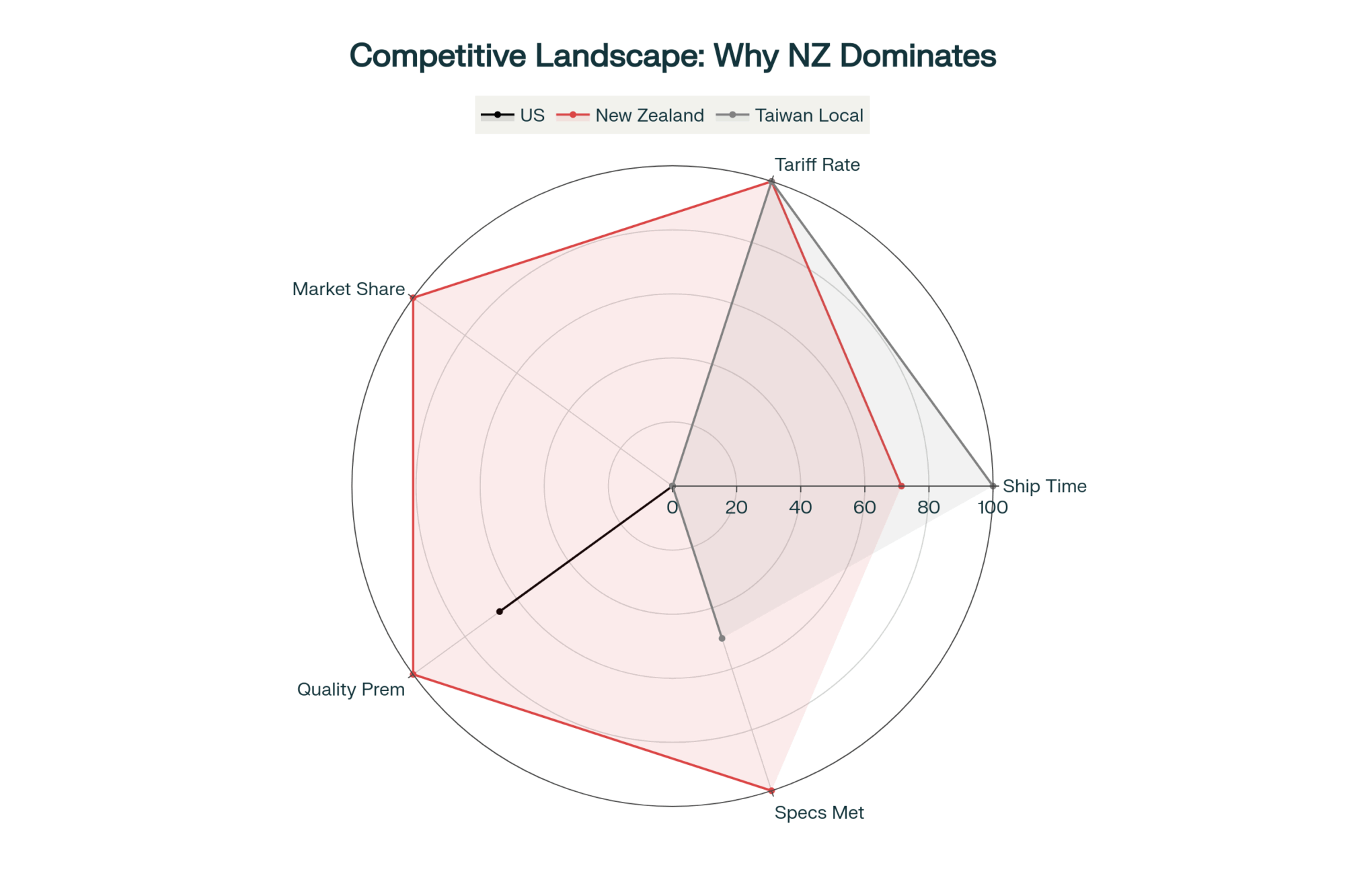
NewsSubscribe
First
Last
Consent

The Fonterra “Settlement” That Proves Your Co-Op is Playing You for a Fool

39% of dairy farms disappeared in 5 years while co-ops got richer—here’s what really happened?

EXECUTIVE SUMMARY: Here’s what we discovered: The Fonterra strike “settlement” that made headlines last month? It changes nothing—workers at Bayswater are still getting paid less than colleagues doing identical work at other facilities. But that’s just the surface. The same cost-optimization tactics cooperative executives used to suppress those wages are being deployed against farmer-members worldwide, accelerating farm consolidation beyond what market forces alone would drive. USDA data shows 15,221 dairy operations vanished between 2017 and 2022, while operations over 2,500 cows increased by 120 farms, now controlling nearly half of all production. Meanwhile, mid-size farms (100-499 cows) dropped from 8,700 to 6,200—the backbone operations that built rural America. Regulatory immunity, afforded through laws like the Capper-Volstead Act, protects these modern cooperatives from antitrust scrutiny while they prioritize financial engineering over member equity. The data reveal a troubling pattern: cooperatives are using “farmer ownership” rhetoric to justify the systematic extraction of value that benefits management and large-volume suppliers at the expense of family operations. Smart farmers are already building alternatives—such as direct marketing, regional processors, and independent pricing — that deliver $2+ premiums per hundredweight for quality milk.

So I’m sitting here two weeks after watching the dairy trade press lose their minds over Fonterra’s Australian strike “resolution,” and… honestly? Made me wonder if these reporters actually looked at any numbers. Because what I found wasn’t a settlement at all.

It was basically a masterclass in how to screw workers while making it look like cooperation.

Look, here’s the deal. Those Fonterra workers at Bayswater? They’re still getting paid less than their buddies at Cobden and Stanhope for doing the exact same work. I mean, we’re talking identical cheese lines here, same equipment headaches, same problems with fresh cows coming in hot during summer months… Hell, they’re producing the same Perfect Italiano and Western Star sitting in every grocery cooler from Sydney to Perth.

Neil Smith—who serves as National Dairy Coordinator for the United Workers Union and actually knows what he’s talking about—has been documenting pay gaps between these facilities for months. And the gap is real. Not some accounting trick or regional cost-of-living thing. Real money.

That’s not what I’d call “resolved.” That’s systematic wage discrimination with some fancy PR paint slapped on top.

Now, I get it—cooperative labor disputes aren’t exactly groundbreaking news. But here’s why this matters to every single farmer reading this: the same tactics Fonterra used to suppress worker wages are being deployed by cooperatives worldwide to extract value from farmer-members. It’s not some grand conspiracy… it’s just good old-fashioned profit maximization disguised as “farmer ownership.”

Fonterra’s Playbook: Settlement Theater That Changes Nothing

Alright, let me back up and explain what Smith’s been documenting, because the union paperwork tells a story that management desperately doesn’t want farmers to understand.

We’re talking about workers doing identical jobs—running the same lines, dealing with the same maintenance issues, probably the same pain-in-the-ass equipment that breaks down right when you’re trying to get a load of milk processed before it goes off spec. But somehow, magically, the guys at Bayswater are making less than their counterparts at other facilities.

The union’s been tracking what they describe as significant pay disparities for months now, and it’s the kind of money that matters when you’re trying to keep up with the mortgage and feed your family.

And the recent “settlement”? Did absolutely nothing—and I mean nothing—to fix the underlying wage structure that creates these gaps.

Management threw around all this language about “collaborative workplace committees” and “modernized approaches.” You know the drill. Corporate speak that sounds great in press releases but doesn’t change what shows up in your paycheck. Meanwhile, these workers are still subsidizing Fonterra’s margin targets through suppressed wages.

Actually, you know what? Let me tell you about the timing here, because it reveals the deeper issue. These strikes erupted right while Fonterra was finalizing their massive $3.4 billion asset sale to Lactalis. Workers are fighting for basic pay equity while their “farmer-owned” employer is literally selling their jobs to French corporate control.

Settlement Theater vs. Reality: What Fonterra’s ‘Resolution’ Actually Changed (Spoiler: Nothing That Matters) – Management got headlines about ‘collaborative approaches’ while pay disparities stayed locked in place. This playbook works whether you’re dealing with wage gaps in Australia or milk price gaps in Wisconsin.

That’s where the rubber meets the road. When push comes to shove, cooperative management prioritizes financial transactions over both worker welfare and member interests.

The Legal Framework That Protects Systematic Exploitation

Here’s where things get really infuriating… New Zealand’s Dairy Industry Restructuring Act gives Fonterra regulatory immunity as long as they maintains “farmer ownership” status. I’ve been reviewing Commerce Commission submissions and industry reports on this framework, and the protection appears to be quite comprehensive.

This legal shield lets them set raw milk prices unilaterally, control supplier access, and coordinate supply volumes—all without the competition oversight any regular corporation would face. The Australian Competition and Consumer Commission approved Lactalis’ sale despite farmer warnings about reduced competition because cooperative structures supposedly protect agricultural interests.

But here’s what makes this relevant to U.S. farmers: similar regulatory protections exist here through the Capper-Volstead Act of 1922, which grants cooperatives antitrust immunity for “mutual help” activities. The problem is, there’s no clear definition of what constitutes legitimate mutual help versus profit extraction at member expense.

The Numbers Don’t Lie: How Cooperative Policies Accelerate Farm Elimination

Now, you might be thinking, “That’s Australia, what’s this got to do with my operation?” Fair question. Let me connect the dots with some hard data from the USDA’s 2022 Census of Agriculture that’ll make your head spin.

Between 2017 and 2022, farms selling milk dropped by 39%—that’s 15,221 dairy operations gone. We went from 39,303 farms down to 24,082. Meanwhile, operations with 2,500+ cows increased from 714 to 834 farms, now controlling nearly half of all production according to agricultural economists at institutions like the University of Wisconsin.

The Consolidation Crisis: How 15,221 Family Dairy Operations Vanished While Corporate Farms Expanded – This isn’t market evolution—it’s systematic elimination enabled by cooperative policies that favor volume over member equity. Notice how mid-size farms got squeezed hardest, dropping 2,500 operations while mega-dairies grew by 120 farms.

Here’s the thing that really gets me: this isn’t happening in a vacuum. U.S. cooperatives are deploying the same cost-optimization strategies I documented at Fonterra to favor large-volume suppliers over smaller members. It’s not necessarily malicious—it’s rational business behavior enabled by regulatory structures designed when the average dairy farm had maybe 20 cows.

Farms with 100-499 cows dropped from 8,700 to 6,200 during this period, based on the USDA census data. These mid-size operations face the worst of both worlds: too large to qualify for beginning farmer programs, too small to negotiate favorable processing terms with their own cooperatives.

The complexity here is real—some consolidation reflects genuine efficiency gains, technological advancement, and changing consumer preferences. Research from University extension programs consistently shows that larger operations often achieve better environmental outcomes per unit of production. But—and this is crucial—when cooperative structures systematically amplify these natural consolidation pressures through pricing policies that favor volume over member equity, they accelerate the elimination of family farms beyond what market forces alone would drive.

How Federal Pricing Policy Enables the Squeeze

Federal Milk Marketing Orders create the regulatory foundation that enables this value extraction, and I’ll use the Upper Midwest FMMO as an example since that covers a lot of dairy country.

According to USDA Agricultural Marketing Service data, the Class I differential in Minneapolis runs about $1.60 per hundredweight above the base Class III price, but farmers in that region typically see maybe 50-60 cents of that premium depending on their cooperative’s policies. Different FMMO regions have different formulas, but the pattern is consistent nationwide: farmers receive regulated minimum prices while processors capture value-added premiums.

This isn’t inherently problematic—until you factor in how cooperatives use their dual role as both farmer representatives and milk marketers. When your cooperative also owns processing facilities (like most major co-ops do), it benefits from keeping your milk price low while maximizing processing margins.

During the fall breeding season, when cash flow tightens for most operations, this pricing differential really hits home. You’re dealing with higher feed costs from drought conditions across corn-growing regions, trying to get cows bred back for next year’s production, and your co-op benefits from the margin between what they pay you and what they charge their processing operations.

When Cooperatives Choose Corporate Profits Over Farmer Members

Let me give you some specific instances where this plays out, because the pattern is documented across multiple organizations and court records:

Dairy Farmers of America faced a significant class action lawsuit in 2016 (Dahl v. Dairy Farmers of America), where plaintiffs alleged that DFA manipulated milk prices to benefit their processing operations at member expense. While DFA denied wrongdoing and the case was settled, the litigation revealed internal documents showing how cooperative leadership systematically balanced member returns against processing profitability—and processing usually won.

Land O’Lakes’ transformation illustrates this tension perfectly. In 2019, they restructured from a traditional farmer cooperative to a hybrid model where farmer-members own the dairy business but professional investors control the feed and agricultural technology divisions. This shift reflects how modern cooperatives struggle to balance member interests against growth opportunities that require outside capital.

More recently, Organic Valley producers have expressed concerns about pricing disparities between regions and organic premiums that don’t seem to reach farmer members consistently. While Organic Valley maintains public transparency about their pricing formulas, the complexity of their regional payment systems makes it difficult for individual farmers to verify they’re receiving equitable treatment compared to members in other areas.

I’m not saying these organizations are inherently evil—they’re dealing with genuine market pressures and competitive challenges that would break smaller entities. But the regulatory framework that grants them antitrust immunity was designed when cooperatives were simple milk marketing organizations, not vertically integrated food companies with complex financial structures and competing priorities.

The Complexity That Cooperative Executives Don’t Want You to Understand

Look, I need to acknowledge something here that makes this whole situation more frustrating. The consolidation we’re seeing isn’t just about cooperative policies; it’s also about effective governance. Consumer preferences, retail concentration, environmental regulations, labor costs, and technology adoption—all these factors interact in ways that make simple explanations inadequate.

Some large operations genuinely achieve better environmental outcomes per unit of production. University of Wisconsin research consistently shows that farms with over 1,000 cows often have lower carbon footprints per pound of milk than smaller operations. Some small farms struggle with basic food safety compliance, which is increasingly expensive to maintain as regulations tighten.

Technology investments, such as robotic milking systems, precision feed management, and automated monitoring, require capital investments that make more economic sense for larger herds, where fixed costs can be spread across more production.

But here’s what really burns me up—when cooperative structures systematically amplify these natural consolidation pressures through pricing policies that favor volume over member equity, they accelerate the elimination of family farms beyond what market forces alone would drive. The Fonterra case matters because it shows how “farmer-owned” cooperatives can prioritize financial engineering ($3.4 billion asset sales) while using settlement theater to avoid addressing fundamental inequities in how they treat different groups of members.

Follow the Money: How Fonterra’s $3.4 Billion Asset Sale Coincided with Strike ‘Settlement’ That Changed Nothing – Workers fought for pay equity while management sold their jobs to French corporate control. When push comes to shove, cooperative executives prioritize financial transactions over member interests.

Smart Farmers Are Finally Fighting Back

Here’s where I see some encouraging developments that give me hope—producers are getting smarter about distinguishing between legitimate cooperative functions and value extraction disguised as member services.

Some are quietly shifting portions of their volume to independent processors as bargaining leverage. A producer I know in central Wisconsin—a guy’s been farming for thirty years, runs about 400 head—started sending 30% of his milk to a regional cheese plant that pays a $2-per-hundredweight premium for high-quality milk with low somatic cell counts. His cooperative suddenly got very interested in “working with him” on pricing adjustments when they realized he had alternatives.

Others are building direct marketing channels that capture more of the consumer dollar. Regional cheese plants and smaller processors are seeing increased interest from farmers who want transparent pricing relationships where they can actually see how their milk gets valued.

The common thread? Farmers who stop accepting “that’s just how cooperatives work” and start demanding accountability for how their organizations actually serve member interests versus management interests.

The Bottom Line

I’m not advocating for dismantling the cooperative system—when it works properly, it provides crucial market power for individual farmers who couldn’t negotiate processing terms on their own. However, the current regulatory framework needs to be updated to reflect the realities of modern agricultural markets, where cooperatives have evolved into major food companies.

Document everything. Compare your cooperative’s pricing with every regional alternative during both peak production periods in late spring and when milk’s tight during summer heat stress. Calculate the real cost of membership by looking at opportunity costs, not just obvious fees and deductions.

Demand transparency. Push for detailed financial reporting that shows how cooperative operations actually benefit members versus enriching management or processing divisions. Ask for specific data on how pricing premiums flow through to member payments and why pricing varies between regions or facility types.

Build alternatives. Direct marketing, regional processors, and farmer-controlled marketing groups all provide competitive pressure that keeps cooperatives honest. Even if you don’t switch completely, having alternatives changes the negotiating dynamic with your current co-op.

Support policy reform. Antitrust immunity should require demonstrable member benefit, not just cooperative structure. When cooperatives become major food companies with processing operations competing against other processors, they should face the same regulatory scrutiny as other corporations.

The farms that survive this consolidation wave will be those that recognize the difference between legitimate cooperative functions and systematic value extraction. The Fonterra settlement shows exactly how the latter operates—fancy press releases about “collaborative approaches” while fundamental inequities remain unchanged.

Your cooperative isn’t automatically your ally just because you own shares in it. Judge them by results, not rhetoric. The numbers don’t lie, even when the press releases do.

What’s it gonna take for you to start asking the hard questions about your own cooperative membership?

KEY TAKEAWAYS:

  • Document your losses: Calculate monthly pricing gaps between your co-op and regional alternatives—some producers discovered they’re leaving $2,000+ on the table monthly by staying locked into cooperative pricing that favors volume over quality
  • Leverage competitive alternatives: Central Wisconsin producers using partial volume shifts to independent processors gained immediate $2/cwt premiums and forced their cooperatives to negotiate better terms within 90 days
  • Demand transparency now: Push for detailed financial reporting showing how pricing premiums flow to members vs. processing divisions—cooperatives hate this question because it exposes where your milk money really goes
  • Build exit strategies: Direct marketing channels and regional cheese plants are paying significant premiums for high-quality milk (low SCC, high butterfat) while cooperatives suppress prices to feed their processing operations
  • Support policy reform: Antitrust immunity should require demonstrable member benefit—when cooperatives become major food companies competing against other processors, they should face the same regulatory scrutiny as corporations

Complete references and supporting documentation are available upon request by contacting the editorial team at editor@thebullvine.com.

Learn More:

The Sunday Read Dairy Professionals Don’t Skip.

Every week, thousands of producers, breeders, and industry insiders open Bullvine Weekly for genetics insights, market shifts, and profit strategies they won’t find anywhere else. One email. Five minutes. Smarter decisions all week.
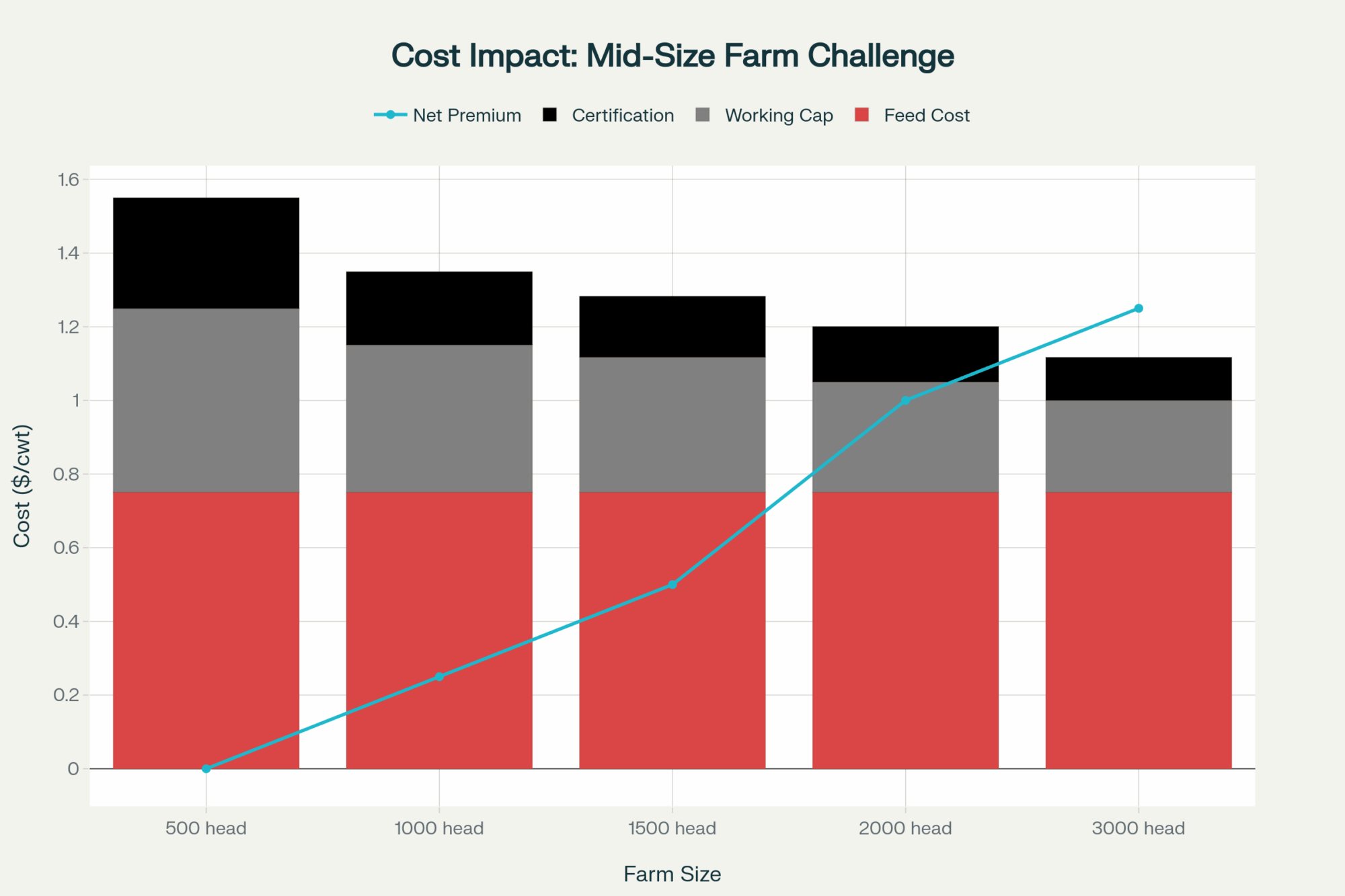
NewsSubscribe
First
Last
Consent

Against All Odds: How One Woman’s Five Cows Ignited a Dairy Revolution That’s Rewriting the Rules of Agricultural Recovery

Zimbabwe’s dairy collapsed 86%. Imports hit 130M liters. One woman’s five cows just triggered the most shocking agricultural turnaround in history.

When I first learned about Esther Marwa through BusinessBeat24’s November 2024 feature documenting her remarkable journey, her story challenged everything I thought I knew about agricultural recovery. What moved me most was the sheer audacity of her decision—to start a dairy operation with five pregnant cows in one of Zimbabwe’s driest districts when her country’s dairy industry had collapsed so completely that experts had written it off entirely.

Here was a woman who’d decided to bet everything on dairy farming when Zimbabwe was importing 130 million liters annually, mostly from South Africa. No government support, no development grants, no fancy infrastructure. Just an unshakeable belief that her country’s dairy potential wasn’t permanently lost.

According to BusinessBeat24’s profile, neighbors initially questioned her dairy farming venture in drought-prone Chikomba district. But Esther saw something they couldn’t see. She saw opportunity hiding in what appeared to be insurmountable challenges.

What happened next still gives me chills, because it proves that individual determination combined with strategic thinking can rewrite entire industry trajectories.

When Dreams Meet Drought: The Weight of Starting Over

The courage it took to begin in January 2019 still amazes me. Zimbabwe’s dairy sector had crashed from 260 million liters annually in the 1990s to just 37 million liters by 2009—an 86% collapse documented by FAO reports. Infrastructure lay in ruins. Farmers had abandoned their operations. Hope seemed as dry as the boreholes.

But Esther looked at water scarcity and somehow envisioned energy independence through solar power. She considered geographic isolation from markets and envisioned direct relationships with local customers. She looked at limited capital—that crushing reality every farmer knows—and recognized that smart resource use could outperform throwing money at problems.

According to published accounts of her early challenges, water scarcity topped her list of obstacles. The borehole on her property only had a manual bush pump, and dairy farming requires enormous amounts of water—especially in drought-prone Chikomba district. Every morning at 4:30 AM, she’d begin milking by hand, hauling buckets of water, cutting grass with a sickle until her hands were raw.

Anyone who’s hauled water in drought conditions knows it’s not just your shoulders that hurt—it’s the weight of wondering if you’ve made a terrible mistake. Yet every single morning, she showed up.

There’s something about farmers who’ve survived impossible seasons—they develop this ability to see potential in what looks like disaster to everyone else. Esther has that gift, and more importantly, the TranZDVC project documentation shows she was about to prove she could help others develop it, too.

The Morning Everything Changed: When Partnerships Replace Handouts

The breakthrough came in 2020 through the European Union’s TranZDVC project—Transforming Zimbabwe’s Dairy Value Chain for the Future. What makes this different from traditional development programs that treat farmers as passive recipients is the revolutionary 70:30 matching grant structure documented in the EU’s Zimbabwe Agricultural Growth Programme.

For someone who’d been questioned by neighbors and had probably questioned herself during those brutal early mornings, having an organization believe enough to invest real money—while still expecting her own contribution—must have felt like validation that her vision had merit. This wasn’t charity. It was a partnership.

That 30% requirement meant she had to optimize her existing resources first, according to ZAGP project documentation. This forced immediate productivity improvements even before any infrastructure investment. Within months, Esther had her contribution ready and accessed the matching grant that would transform not only her operation but also her entire community.

The solar-powered water system finally liberated her from those back-breaking daily water hauls. She expanded her herd with high-yielding Holstein and Jersey crosses. Planted lucerne crops that slashed her feed costs. Built proper milking facilities that improved both efficiency and milk quality.

But what happened next defied everything we think we know about individual success versus community benefit.

The Heart That Multiplies Success: When Excellence Becomes Service

According to ZAGP project records, Esther’s productivity climbed from 95 liters per day to well over 2,000 liters monthly, with individual cows averaging 19 liters per day—performance that rivals developed-country operations. Most of us would have built higher fences and counted our blessings.

Not Esther.

She made a decision that required a special kind of courage: she opened her barn doors not to show off, but to share what she’d learned in those lonely hours when success felt impossible.

As chairperson of the Nharira Dairy Cooperative, she instituted a project with graduated participation levels, where high-performing farmers provided technical leadership and received proportional decision-making authority, while developing farmers received intensive mentoring support.

The cooperative operates on transparent and objective metrics, which are documented in project reports. Every farmer’s milk volume and quality standards are tracked and shared. Performance rankings are based on measurable data—total bacterial counts, somatic cell counts, consistency metrics—not politics or favoritism.

Published accounts of the cooperative’s success show that instead of the typical resentment that destroys most agricultural cooperatives, there was an incredible hunger among farmers to learn from proven methods. Esther had demonstrated that transformation was possible.

And that gave everyone hope.

The Ripple That Became a Revolution: When One Life Touches Thousands

What moved me deeply about BusinessBeat24’s coverage was learning about Esther’s quiet community service. Every week, she delivers fresh milk to local schools, reviving Zimbabwe’s once-thriving school nutrition program. She also provides sanitary pads to young women in her area, recognizing that period poverty prevents rural girls from attending school.

These aren’t grand gestures for recognition—they’re the quiet actions of someone who remembers what it felt like to struggle and refuses to turn her back on others still fighting.

She mentors other farmers not through lectures but through hands-on demonstrations at her own operation. Her success created additional income opportunities through training and technical assistance while strengthening the entire cooperative’s market position.

But then something extraordinary happened that proved this transformation was about more than individual success…

The numbers that followed still take my breath away:

  • 2017: 66 million liters
  • 2021: 79.6 million liters
  • 2022: 91.6 million liters
  • 2023: 99.8 million liters
  • 2025 target: 150 million liters

That’s a 169% recovery from the 2009 crisis low, driven by thousands of farmers who refused to accept that their country’s dairy potential was permanently lost.

The Policy Breakthrough: When Government Finally Removes the Barriers

Against every prediction about how slowly government moves, something remarkable happened this past September. Zimbabwe’s government implemented sweeping regulatory reforms that eliminated the bureaucratic barriers that had been choking the sector potential for decades.

Export registration fees were slashed from $900 to just $10—a 98.9% reduction. Feed manufacturing licenses dropped from $250 to $20. The maze of 25 separate permits from 12 different agencies was streamlined into a simple, transparent process.

As Finance Minister Mthuli Ncube announced in official government statements, these reforms were about “lowering the cost of doing business, especially for small and medium enterprises” by “creating a business environment that is affordable, transparent and supportive of growth.”

What struck me most was realizing that these policy changes didn’t create the dairy recovery—they amplified success that was already happening. Farmers like Esther had been proving transformation was possible for years. The government finally removed the barriers that had been holding everyone else back.

The Genius of Turning Problems into Advantages

Here’s what I find most inspiring about Zimbabwe’s dairy recovery, documented across multiple industry reports: farmers like Esther turned every limitation into a competitive advantage through creative problem-solving born of necessity.

Water scarcity has driven investment in solar-powered systems, as project documentation shows, which are now more reliable and cost-effective than grid electricity. Limited access to commercial feed drove innovations in on-farm silage production that reduced costs while improving nutrition. Being far from processors led to value-added on-farm processing, which captured margins that others were giving away.

Industry analyses highlight Esther’s diversification into honey production as an exemplification of this innovative spirit. Rather than betting everything on dairy alone, she created multiple income streams that stabilize cash flow and reduce risk. Her on-farm processing of yogurt, butter, and traditional hodzeko adds value while reducing dependence on large-scale processors.

The introduction of precision artificial insemination programs allowed farmers to upgrade genetics without massive capital requirements. Climate-smart agriculture practices developed out of necessity are proving more resilient than conventional approaches used in developed countries.

Somehow, through strategic thinking refined through persistence, these farmers converted their biggest challenges into their greatest strengths.

The Leadership That Changes Everything: When Excellence Lifts Everyone

MetricTraditional CooperativeNharira Performance-Based ModelImpact
Average Daily Production8 L/cow12 L/cow+50% productivity
Member Retention Rate60%85%Higher engagement
Quality Standards Met45%78%Better market access
Knowledge Transfer Events2/year12/yearSystematic learning
Income Improvement15%45%Merit-based rewards

The most powerful lesson from Esther’s documented journey is what happens when someone who’s proven that transformation is possible decides to light the way for others. The Nharira Dairy Cooperative, which she chairs, doesn’t just pool resources—project documentation shows that it fosters systematic knowledge transfer, where successful farmers serve as mentors for developing farmers.

This peer-to-peer learning approach leverages existing social networks and cultural communication patterns rather than imposing external educational structures. Farmers learn from neighbors who have achieved actual success rather than theoretical experts without practical experience.

The cooperative provides graduated access to resources based on demonstrated capability, preventing the waste and resentment that destroy most agricultural cooperatives. Through this structure documented in cooperative development reports, smallholder farmers gain economies of scale in input purchasing, shared transportation to collection centers, technical knowledge transfer from successful farmers, risk mitigation through diversified operations, and stronger bargaining power with processors and buyers.

What came next defied all expectations about how agricultural cooperatives typically function in challenging environments. Instead of the usual infighting and resource battles, documented success stories show something beautiful happening.

Excellence started multiplying.

The Global Wake-Up Call: Rewriting the Rules of Development

What Esther and thousands like her have accomplished challenges the fundamental assumptions of agricultural development worldwide. Their documented success exposes the flaw in traditional approaches: assuming farmers need massive external resources before they can succeed.

Esther proved the opposite through her lived experience. Strategic resource optimization generates the capital needed for expansion. She didn’t solve her water problem by waiting for municipal infrastructure—she converted water scarcity into energy independence through solar-powered systems that now provide superior reliability at lower operating costs.

This approach challenges every assumption about agricultural recovery in developing countries. Instead of waiting for external investment, perfect conditions, or government support, documented case studies show farmers can begin transformation immediately by converting their biggest constraints into competitive advantages.

According to published testimonials from visiting agricultural delegations, her example has inspired dairy operations across East Africa and beyond. For dairy farmers worldwide facing their own impossible odds—whether dealing with volatile markets, infrastructure challenges, or policy barriers—Esther’s documented success provides both inspiration and a practical roadmap.

Her success didn’t require perfect conditions, unlimited resources, or government support.

It required something much more powerful: the refusal to accept that yesterday’s limitations define tomorrow’s possibilities.

The Spirit That Refuses to Break

Thinking about all the dairy farmers I’ve encountered worldwide through my work, what sets Esther apart, according to the documented accounts, isn’t just her remarkable measurable success—it’s the quality of determination that got her there.

The willingness to show up at 4:30 AM every morning when success felt impossible. The faith to invest her own money in a matching grant program when she barely had enough to survive. The courage to open her doors to neighbors who needed help, even when her own operation was still building strength.

Published profiles capture glimpses of those first brutal months—the doubt that must have crept in during the hottest afternoons, the nights when the numbers didn’t add up, the weight of neighbors’ skeptical looks. How does anyone keep going when everyone thinks they’re making a mistake?

One day at a time, the way farmers always do.

According to agricultural development reports, average production across the smallholder sector jumped from 8 liters per cow per day to 12 liters per day—a 50% increase that dramatically improved farmer incomes and food security. But those numbers only tell part of the story.

The real story is in the documented community impacts. The children are now drinking fresh milk at local schools. The young women who can continue their education without interruption. The families throughout the cooperative who have improved incomes, enabling them to access better healthcare, education, and housing.

From five pregnant cows and a broken water pump to over 2,000 liters monthly and a cooperative that’s transforming an entire district. From a country that had given up on dairy to a sector approaching complete self-sufficiency by 2025.

What This Means for All of Us

Esther Marwa’s documented journey represents something far more important than agricultural statistics. It’s living proof that individual determination combined with strategic thinking can rewrite entire industry trajectories.

Her story validates what farmers around the world know in their hearts but sometimes struggle to believe—that their knowledge, experience, and dedication are more valuable than any external expertise or capital investment.

For every farmer reading this who faces their own impossible odds, Esther’s documented example provides both inspiration and a practical framework. Her success didn’t require perfect conditions, unlimited resources, or government support. It required the courage to start with what she had, optimize relentlessly, and share success generously.

Most importantly, Esther’s story proves that agricultural transformation doesn’t require choosing between individual success and community benefit. Published accounts of her approach demonstrate how personal excellence serves as the foundation for lifting entire communities, creating ripple effects of prosperity that extend far beyond any single farm or family.

In farming, the most radical thing anyone can do is show up every morning when everyone thinks they’re crazy. Esther did that for months when no one believed. Now thousands of farmers across Zimbabwe are doing the same thing—showing up, optimizing, sharing success.

Through documented achievements and verified transformation metrics, Esther Marwa proved that five cows and an unbreakable spirit can ignite changes that transform entire industries.

Standing where she started just six years ago, watching the sun rise over what project documentation confirms has become one of Zimbabwe’s most productive dairy operations, Esther embodies something we all need to remember:

In the darkest seasons, when hope feels foolish and the odds are impossible, transformation begins with ordinary people who make extraordinary choices, one morning at a time.

Most of us already know what our “broken water pump” moment is—that challenge we’ve been avoiding or the limitation we’ve accepted as permanent. Esther’s documented story isn’t asking us to find our challenge. It’s asking us to see it differently.

Because somewhere in your constraints lies the seed of your competitive advantage. Esther found hers in five pregnant cows and a broken water pump. Her journey from that challenging beginning to transformational success, documented across multiple sources, stands as proof that when determination meets strategy, even the most impossible dreams can become a reality.

Every farmer reading this has felt that moment of doubt. Esther’s documented triumph reminds us that doubt isn’t disqualifying—it’s often the beginning of a breakthrough.

KEY TAKEAWAYS

  • Optimize what you own before seeking what you need—resource maximization beats resource accumulation every time
  • Turn your worst constraint into your best advantage—limitations force innovations that become competitive edges
  • Build cooperatives that reward excellence, not mediocrity—performance-based systems prevent free-riders and multiply success
  • Share strategic success to create systemic change—individual transformation becomes sector transformation through systematic mentoring
  • Small strategic moves trigger massive transformations—Esther’s five cows became Zimbabwe’s 169% dairy sector recovery

EXECUTIVE SUMMARY

Zimbabwe’s dairy industry collapsed by 86%, and experts wrote it off as finished. Esther Marwa saw something different. Starting with five cows and a broken water pump in drought-stricken Chikomba district, she turned every limitation into a competitive edge through strategic resource optimization. Her solar-powered innovation outperformed grid electricity, transforming 95 daily liters into over 2,000 monthly—while building a performance-based cooperative that multiplied success instead of subsidizing mediocrity. Her individual breakthrough catalyzed Zimbabwe’s stunning 169% sector recovery and triggered policy reforms that unleashed nationwide transformation. For dairy farmers worldwide facing seemingly insurmountable odds, Esther’s documented journey proves that constraint-to-advantage thinking can transform entire industries when you optimize what you control, convert problems into innovations, and share success strategically.

Complete references and supporting documentation are available upon request by contacting the editorial team at editor@thebullvine.com.

Learn More:

The Sunday Read Dairy Professionals Don’t Skip.

Every week, thousands of producers, breeders, and industry insiders open Bullvine Weekly for genetics insights, market shifts, and profit strategies they won’t find anywhere else. One email. Five minutes. Smarter decisions all week.

NewsSubscribe
First
Last
Consent

Trans Ova  Purchase of ReproLogix: The Genetics Consolidation Nobody’s Talking About

Think you’re choosing bulls? Think again. You’re choosing corporate platforms that own your breeding future.

EXECUTIVE SUMMARY: We’ve been tracking genetics consolidation for months, and the Trans Ova-ReproLogix acquisition just confirmed what our analysis suggested: traditional AI competition is disappearing faster than most producers realize. Recent NAAB data shows gender-selected semen sales jumped 17% to 9.9 million units while beef-on-dairy held at 7.9 million units – but here’s what matters: these aren’t just sales figures, they’re dependency indicators. When you need sexed semen for genetic elite and beef semen for everything else, you’re not buying products anymore… you’re buying into integrated platforms that control both technology and catalogs. The math is stark – USDA shows median herd size jumped from 180 to 1,260 cows between 2000-2021, creating a two-tier market where large operations negotiate custom packages while smaller farms become price takers. University of Wisconsin data proves the complexity: top herds hitting 30-40% pregnancy rates require sophisticated reproductive management, most operations can’t develop independently. We’re looking at market structures where reproductive decisions become platform selections, not product purchases. The producers who understand this shift and position themselves accordingly won’t just survive the consolidation – they’ll profit from it.

KEY TAKEAWAYS:

  • Diversify your genetic suppliers now – even if it costs 10-15% more upfront. We’re seeing operations maintain relationships with multiple companies as insurance against service disruptions and pricing changes. Start these conversations before your next breeding season while you still have negotiating leverage.
  • Invest in reproductive monitoring technology to reduce platform dependencies and enhance overall efficiency. Recent advances in estrus detection and pregnancy monitoring give you flexibility in genetic sourcing decisions. Operations using independent monitoring report 15-20% better pregnancy rates and more supplier options.
  • Build internal genomic evaluation capabilities using your own herd data. With testing costs dropping significantly, progressive farms are developing genetic databases that reduce dependence on supplier recommendations. This creates decision-making independence that becomes more valuable as consolidation continues.
  • Consider genetic marketing opportunities as consolidation creates scarcity. NAAB data shows heterospermic products doubled to 2.8 million units – operations preserving genetic diversity can profit from selling embryos and bred heifers to farms needing genetic infusion.
  • Negotiate flexible contracts that preserve switching options. Volume commitments might offer short-term savings, but flexible agreements serve as insurance in a rapidly changing market. The extra cost becomes cheap insurance against reduced choice and higher prices.
 genetics consolidation, dairy farm management, AI, dairy herd profitability, reproductive technology

Something happened on September 18th that most producers missed entirely. Trans Ova quietly completed their acquisition of ReproLogix down in Fort Scott, Kansas, and if you think this is just another corporate handshake, you’re not paying attention to what’s really happening in the genetics game.

This isn’t about two companies getting together. It’s about URUS Group – the folks who dropped $170 million on Trans Ova back in 2022 – systematically building something that’s going to change how breeding decisions get made on your farm. Whether you realize it or not.

The question isn’t whether genetic consolidation is happening. It’s whether you’re prepared for what comes next.

The NAAB Numbers Tell a Different Story

Let me show you what’s actually moving in the marketplace, because the data tells a story that most people are completely missing. Total bovine semen sales reached nearly 69 million units in 2024, representing 4% growth from the previous year. Business as usual? Not exactly.

Gender-selected dairy semen jumped to 9.9 million units – we’re talking about 1.5 million more units than last year. Meanwhile, beef semen flowing to dairy operations held steady at 7.9 million units. Think about what this means for your breeding program.

When you need sexed semen for your genetic elite (and increasingly, everyone does), you’re not just buying semen anymore. You’re buying into companies that control both the sorting technology AND the genetic catalogs. That’s a completely different negotiation than the AI rep visits we used to know.

What’s happening is that major players appear to be reshaping this entire industry: URUS/Trans Ova with their “we do everything” approach, STGen awaiting regulatory approval for their Select Sires merger, ABS Global leveraging its international reach, and Semex maintaining a strong position thanks to its ownership of Boviteq.

Why Traditional Competition Is Disappearing

Think about any mid-sized family operation – the kind that’s been the backbone of dairy production for generations. During peak breeding season, you’re making breeding decisions constantly. Used to be, you could play AI companies against each other. Get competitive quotes, negotiate volume pricing, and maybe squeeze out some extra service calls.

Those days are ending faster than most people realize.

The new reality is platform integration. Your genetic evaluation software talks to your synchronization protocols, which connect to your pregnancy monitoring system, which links back to your semen supply. It’s convenient, sure… but when everything’s bundled together, switching becomes more complex.

University of Wisconsin research demonstrates this complexity – they report average 21-day pregnancy rates of 21.6%, with the best herds hitting 30-40%. Getting those kinds of numbers requires sophisticated reproductive management that most operations can’t develop independently. So you lean on the platform providers…

The Beef-on-Dairy Factor Nobody Anticipated

What’s really accelerating this consolidation is the explosive growth in beef-on-dairy. Journal of Dairy Science research shows it becomes profitable when crossbred calf prices exceed dairy calf values by 2:1, assuming you maintain pregnancy rates above 20%.

Heterospermic beef products more than doubled to 2.8 million units just last year. We’re not dealing with simple breeding choices anymore. You need reliable conception rates from both dairy sexed semen AND beef semen to make the economics work. This complexity plays right into the hands of companies offering integrated platforms.

Think about the logistics during peak breeding season – typically May through August in many northern regions. You’ve got fresh cows needing proven genetics with sexed semen, second and third lactation animals getting your best conventional dairy genetics, and everything else getting beef semen for those premium calf values. Managing that across a lactating herd requires systems that most operations simply don’t have in-house.

Market Structure Changes Are Real

The consolidation isn’t hitting everyone the same way. Understanding these differences matters for your planning… Large operations may be able to leverage scale for direct negotiations with genetic companies, maintaining negotiating leverage that smaller operations often lack. Custom service packages become possible when you’re talking serious volume.

Seasonal factors matter too. Many regions still see concentrated breeding seasons where service availability becomes critical. When you have fewer suppliers and more platform dependencies, bottlenecks during peak demand periods become a real risk.

The USDA data backs up broader structural changes: operations under 50 cows declined 79% over two decades, while farms with 1,000+ cows increased 60%. Median herd size jumped from 180 cows in 2000 to 1,260 cows by 2021. This shift changes everything about genetic supplier relationships.

Farm SizePrimary StrategyKey ActionsInvestment LevelTimeline
300-800 cowsDiversify SuppliersMaintain 2+ genetic relationships, negotiate flexible contracts10-15% cost premiumBefore next breeding season
800-1,500 cowsPartial IntegrationInvest in reproductive monitoring, develop partnerships$15K-25K annually6-12 months
1,500+ cowsScale LeverageDirect negotiations, in-house capabilities, genetic marketing$50K+ investment12-24 months

Platform Dependencies: Innovation or Lock-In?

Companies position this as a technological advancement – and there’s truth there. Trans Ova’s integrated approach bundles IVF, embryo transfer, sexed semen, cloning, and donor housing under unified service contracts. For operations managing complex reproductive programs, that integration offers genuine value.

But most of this “innovation” focuses on platform lock-in rather than genetic improvement. Once you’re dependent on their systems for critical breeding decisions, switching becomes economically complex even when better alternatives exist.

Some operations are reportedly developing internal capabilities to maintain independence. Progressive farms are building genomic evaluation systems using their own data to maintain genetic selection independence while still accessing advanced reproductive technologies.

Strategic Responses for Different Operations

Producers who recognize these trends aren’t fighting consolidation – they’re positioning themselves to maintain negotiating leverage within the new market structure.

Mid-size operations can maintain relationships with multiple genetic suppliers despite higher costs. Negotiating flexible contracts that preserve switching options serves as insurance against service disruptions or pricing changes. Starting these conversations early in your planning cycle makes sense.

Larger operations might consider partial platform integration while preserving genetic sourcing flexibility. Investment in reproductive monitoring technology reduces service dependencies. Some are developing partnerships with similar-sized operations to leverage volume purchasing and maintain access to multiple genetic suppliers for core breeding programs.

The biggest operations can leverage scale for direct negotiations with genetics companies. Many are developing comprehensive reproductive management capabilities in-house while exploring genetic marketing opportunities as consolidation creates scarcity value for diverse genetics.

Where This Might Be Heading

Let’s be honest – regulatory intervention isn’t coming to save competitive genetics markets. These acquisitions proceed largely unchallenged while other industries face antitrust scrutiny. Current market patterns may indicate continued consolidation as remaining independent operations either scale up, find acquisition partners, or exit.

Large operations negotiate directly with genetics companies for customized services. Smaller farms become price takers in commodity markets. It creates a two-tier system where reproductive choices depend on operational scale rather than management competence.

The Real Question for Your Operation

The Trans Ova-ReproLogix acquisition signals that genetics consolidation may be far from over. We’re looking at market structures where reproductive decisions become platform selections rather than product purchases.

What keeps me thinking about this… it’s not whether consolidation will continue – the evidence makes that possibility obvious. It’s whether individual operations will maintain enough decision-making independence to optimize genetic progress for their specific circumstances.

Operations that understand these trends can position themselves advantageously. Those operating under historical competitive assumptions may find their options increasingly constrained – often without understanding why their negotiating position deteriorated.

The industry benefits from technological advancement and service integration. But it also faces risks from reduced competition and increased operational dependencies. The producers who thrive will be those who leverage the benefits of consolidation while preserving strategic flexibility.

That’s not easy to balance, but it’s becoming essential as the genetics industry continues its transformation. The question isn’t whether this consolidation serves your operation’s interests. The question is how you’re going to navigate it successfully.

Because ready or not, the genetics game just changed. Again.

Complete references and supporting documentation are available upon request by contacting the editorial team at editor@thebullvine.com.

Learn More:

  • AI and Precision Tech: What’s Actually Changing the Game for Dairy Farms in 2025? – This article provides a forward-looking perspective on how advanced technologies like AI, robotics, and sensors are changing the game. It demonstrates how these tools offer scalable, innovative solutions to labor and health challenges, complementing the main article’s focus on technological platform dependencies by offering concrete examples of how to leverage innovation for operational independence.
  • 5 Actionable Strategies to Future-Proof Your Dairy Operation – This piece is a tactical guide for producers, offering practical steps to enhance profitability and resilience. It provides actionable advice on managing everything from biosecurity to workforce protocols, giving readers the hands-on, operational insights needed to navigate a consolidating market and protect their bottom line.
  • Why ‘Profitability per Cow’ is the Wrong Metric for 2025 – This strategic article challenges traditional economic metrics and forces producers to re-evaluate their business models. It reveals how market shifts and consolidation make herd-level profitability a more valuable metric, helping readers understand the long-term implications of these trends and position themselves for sustainable success.

The Sunday Read Dairy Professionals Don’t Skip.

Every week, thousands of producers, breeders, and industry insiders open Bullvine Weekly for genetics insights, market shifts, and profit strategies they won’t find anywhere else. One email. Five minutes. Smarter decisions all week.

NewsSubscribe
First
Last
Consent

Beyond Entertainment: How “Green and Gold” Is Reshaping Agricultural Advocacy

How can new advocacy models help dairy farmers tackle today’s mounting mental health challenges?

Executive Summary: Dairy farmers face a growing mental health crisis, with studies indicating that 75% experience significant stress and that suicidal ideation rates are about double those of the general population. Recent data from the University of Guelph and the National Rural Health Association highlight these concerning trends amid volatile markets and operational pressures. Innovative approaches, such as Culver’s engagement-linked donations to the documentary ‘Green Gold,’ alongside community-based programs like the Farmer Angel Network and Farm Family Alliance, are reshaping the support flows for farms. These initiatives demonstrate how authentic storytelling and transparent engagement can break cultural barriers and connect consumers with farms. While challenges remain, early signs suggest that these models provide scalable, localized solutions that are sensitive to seasonal rhythms and regional needs. For dairy operations aiming to thrive in 2025, integrating a mental health focus with consumer engagement is increasingly critical.

Key Takeaways:

  • 75% of dairy farmers report moderate to high stress—addressing mental health proactively can improve resilience and productivity.
  • Consumer-linked philanthropy, tied to storytelling, now raises millions of dollars annually, reflecting genuine engagement.
  • Community programs, such as the Farmer Angel Network, offer culturally sensitive support tailored to dairy farming lifestyles.
  • Recognizing regional challenges—from Northeastern pasture systems to Western heat stress—is crucial for effective advocacy.
  • Open dialogue and accessible resources empower farmers to sustain their operations amid growing pressures.

You know, sometimes a story cuts right through all the industry noise. I’ve been reflecting on “Green and Gold,” that independent documentary about a Wisconsin dairy farm teetering on foreclosure. What really caught my attention wasn’t just the film itself, but how Culver’s approached their partnership in a way that’s quite different from the usual corporate playbook.

Instead of the traditional write-a-check-and-take-a-photo routine, they tied their donations directly to viewer engagement. Every time someone watched the film, a dollar went to farmer mental health organizations. That creates a whole new dynamic—and from what I’m seeing across the industry, it could really change how we think about supporting our farming communities.

The Mental Health Reality We’re All Dealing With

Look, if you’ve been managing a dairy operation for any length of time, you know the weight of stress isn’t just some abstract concept. The latest research from the University of Guelph puts some hard numbers to what many of us experience daily—about 75% of farmers are dealing with moderate to high stress levels, and the rate of suicidal thoughts is running about twice that of the general population.

I was talking with a producer from Vermont just last month who said something that really stuck with me: “It’s like there’s no off switch anymore. You’re constantly thinking about feed costs, milk prices, weather patterns—your mind never really gets a break.” Whether you’re running a seasonal grazing system in New England or managing a 2,000-head operation in the Central Valley, those pressure points hit remarkably similar notes.

The National Rural Health Association data tells an even starker story—farmers face suicide rates nearly four times higher than the general working population. For male farmers specifically, we’re looking at rates about 50% higher than their non-farming peers. These aren’t just statistics… these are our neighbors, our colleagues, sometimes our family members.

What’s encouraging, though, is seeing organizations step up with approaches that actually fit our culture. The groups receiving support through this Culver’s initiative—Farmer Angel Network, Farm Family Wellness Alliance, and National FFA—they’re taking community-focused approaches that work within farming culture rather than against it.

Rethinking Corporate Agricultural Support

Here’s where Culver’s model really shifts the paradigm. Rather than allocating a fixed annual donation (which is usually the case), they created a scalable solution. Since launching their Thank You Farmers Project in 2013, they’ve generated over $6.5 million for agricultural causes—with $1.5 million raised just this past year, according to their corporate reports.

But here’s what makes this particularly interesting for operations of different scales: whether you’re managing a 100-cow family dairy in Iowa or overseeing a large organic facility in Colorado, this model demonstrates how consumer engagement can translate directly into meaningful support. The funding grows with genuine interest rather than being capped by corporate budget limitations.

A dairy farmer from Wisconsin told me recently, “When companies actually connect their support to real engagement with our stories, it feels different. It’s not charity—it’s partnership.”

The Power of Authentic Agricultural Stories

The film’s boldest choice—showing a dairy farmer literally betting his farm’s survival on a Green Bay Packers game—might sound wild to folks outside agriculture. But any of us who’ve faced impossible financial pressures recognize that moment when rational options have been exhausted and you’re weighing decisions that would seem crazy under normal circumstances.

This kind of honest storytelling does something powerful: it breaks down the myth of the unbreakable farmer that’s kept too many of us silent about real struggles. I’ve seen this pressure play out differently across regions—drought stress in California herds, labor challenges in Northeast operations, volatile feed costs hitting Midwest dairies—but the psychological weight is remarkably consistent.

As one Texas dairy producer shared with me, “Seeing someone on screen making those impossible choices… it makes you realize you’re not the only one who’s been there.”

Support Systems That Actually Work in Farming Culture

The Farmer Angel Network was founded in response to a tragic loss in Sauk County, Wisconsin, and its approach focuses on fellowship and community education rather than clinical intervention. They understand something crucial—in farming culture, support systems need to respect our rhythms and values.

Meanwhile, the Farm Family Wellness Alliance has developed a layered approach: anonymous peer support through digital platforms (think 24/7 access that accommodates milking schedules) combined with professional counseling services tailored to the unpredictable seasonal demands of farming. What’s smart about this model is recognizing that farmers need both community connection and professional expertise, but delivered in ways that work with our realities.

And we can’t overlook the National FFA’s role in this mix. With over a million active student members currently, they’re addressing what might be our most critical long-term challenge—ensuring agriculture has a next generation that wants to stay engaged.

A farm wife from Pennsylvania put it perfectly: “The best support understands that a 4 AM call about a difficult calving isn’t just work stress—it’s life or death for that calf and our cash flow.”

Understanding the Cultural Competency Gap

Here’s something that’s been bothering me for years: so many well-intentioned support programs miss the mark because they’re designed by people who’ve never actually lived through a difficult calving season or watched milk prices tank just as you’re budgeting for next quarter’s feed purchases.

Growing up around dairy operations teaches you things you can’t learn from textbooks—like understanding that scheduling mental health workshops during planting season guarantees empty rooms, or knowing that farmers need support systems that strengthen community networks rather than treating every challenge as an individual problem.

What I find encouraging about authentic approaches like “Green and Gold” is how they demonstrate that audiences—both farming and non-farming—can distinguish genuine agricultural storytelling from corporate messaging, even when both claim to “support farmers.”

Looking at Broader Implications

We’re witnessing what I’d call the emergence of consumer-mediated agricultural advocacy. When consumers can directly support farming communities through authentic content engagement, it eliminates some of the institutional gatekeepers who’ve traditionally controlled agricultural narrative and resource allocation.

This direct connection model scales with consumer interest rather than bureaucratic approval processes—and that’s significant because traditional agricultural institutions often operate with fixed budgets and political constraints that limit responsiveness to actual farming community needs.

Now, this raises some interesting questions… How do these new models complement existing extension services? What happens to traditional agricultural advocacy organizations? Early indications suggest we’re looking at a supplement rather than a replacement, but the landscape is definitely shifting.

Regional Applications and Variations

While the Farmer Angel Network model started in Wisconsin, I’m seeing similar community-based approaches emerging across different dairy regions:

  • Northeast operations dealing with seasonal grazing challenges and processing consolidation, where programs need to account for winter housing transitions and maple syrup season conflicts
  • Western dairies are navigating water restrictions and heat stress management, requiring support systems that understand the unique pressures of managing large herds in arid climates
  • Southern farms managing diverse labor forces and expanding market opportunities, where cultural sensitivity becomes even more critical
  • Midwest operations are balancing expansion pressures with environmental regulations, facing the classic squeeze between growth demands and compliance costs

Each region presents unique stressors and cultural considerations that effective support systems must address.

Key Takeaways for Dairy Operations

What we’re learning is that authentic agricultural storytelling creates cultural permission for discussing sensitive topics that traditional agricultural media has historically avoided. Breaking the silence around farming struggles becomes the foundation for building community support systems rather than suffering in isolation.

The most effective agricultural advocacy seems to amplify farming voices rather than replacing them with institutional messaging. This represents a shift from charity-based support models toward partnership approaches that recognize farming communities as capable advocates for their own needs.

For those of us managing operations today, there are some practical implications worth considering:

  • Mental health resources work best when they’re community-based and culturally appropriate
  • Consumer engagement models offer new pathways for sustainable agricultural support
  • Authentic storytelling about farming realities creates stronger advocacy than sanitized messaging
  • Support systems need to respect seasonal demands and community relationships
  • Early intervention is more effective than crisis response—building support networks before they’re desperately needed

The Bottom Line

The success of initiatives like “Green and Gold” suggests we’re at an interesting inflection point where agricultural advocacy can become more effective by creating direct connections between farming communities and broader society, rather than relying solely on traditional institutional channels.

For farming communities facing unprecedented economic and psychological pressures—whether you’re managing fresh cow transitions in Wisconsin or optimizing dry matter intake in California—this model offers hope that authentic storytelling combined with community support can create sustainable pathways forward.

Sometimes the most effective agricultural advocacy comes from simply telling the truth about farming life and trusting that people care enough to help when they understand what’s really happening on our farms. Based on what we’re seeing with these consumer-driven initiatives, that trust appears to be well-placed.

The transformation is already underway. The question for all of us is how we’ll participate in building support systems that actually serve farming communities rather than just looking good in corporate annual reports.

Complete references and supporting documentation are available upon request by contacting the editorial team at editor@thebullvine.com.

Learn More:

The Sunday Read Dairy Professionals Don’t Skip.

Every week, thousands of producers, breeders, and industry insiders open Bullvine Weekly for genetics insights, market shifts, and profit strategies they won’t find anywhere else. One email. Five minutes. Smarter decisions all week.

NewsSubscribe
First
Last
Consent

Federal Relief Reality Check: How USDA’s $1 Billion Program Could Change Who Makes It in Dairy

Nearly 40% of US dairy farms closed in 5 years — Can you afford to miss this shift?

EXECUTIVE SUMMARY: We’ve been tracking some sobering trends, and here’s what the data’s telling us: the US dairy industry just lost nearly 40% of its farms in five years, with mega-dairies now controlling over 66% of milk production according to recent USDA census figures. This isn’t just consolidation — it’s a fundamental reshaping that’s creating a $9.77 per hundredweight cost advantage for large operations, which translates to over $50,000 annually for typical mid-size dairies trying to compete. The 2025 Emergency Livestock Relief Program covers 60% of disaster-related feed costs, but here’s the kicker — it favors producers in disaster-declared regions with streamlined processing that creates systematic competitive advantages. While tools like Dairy Margin Coverage continue buffering volatility with regular payouts, we’re seeing concerning patterns where federal aid dependency might actually accelerate the very consolidation it’s meant to help farmers survive. The smartest producers aren’t just applying for relief — they’re using strategic fund allocation to turn survival money into a competitive advantage. This shift demands immediate attention and thoughtful action from every progressive dairy operation.

KEY TAKEAWAYS

  • Immediate Relief Opportunity: USDA’s Emergency Livestock Relief Program offsets up to 60% of disaster-related feed costs through a 46-day application window — submit documentation now to access up to $250,000 in recovery funds
  • Scale Economics Reality: Mega-dairies maintain a $9.77/cwt production cost advantage over smaller operations, emphasizing the urgent need for mid-size farms to optimize efficiency and leverage available support programs
  • Risk Management Buffer: Dairy Margin Coverage delivers consistent value with $1.49/cwt average payouts in two-thirds of months since 2018 — maximize enrollment to reduce margin volatility and strengthen financial resilience
  • Technology ROI Acceleration: Precision feeding systems and robotic milking reduce operational costs by 15-25% and 50% respectively, with 5-7 year payback periods that federal relief can help accelerate for competitive positioning
  • Strategic Fund Deployment: Apply the 50/25/25 allocation framework — half for disaster recovery, quarter for productivity upgrades, quarter for risk management tools — to survive current pressures while building long-term competitive strength

The thing about these federal relief programs? They tend to show up just when you’re not expecting them. But this one? It’s landing right in the middle of some of the biggest shifts we’ve seen in the US dairy scene in years. The USDA’s Emergency Livestock Relief Program, rolling out in September 2025 to cover flood and wildfire losses from the past couple of years, isn’t just another check—it’s shifting the landscape for who stays in the game and who’s edging toward the exit.

The Numbers Tell a Brutal Story

Digging into USDA census data, it’s hard not to notice the brutal facts. Since 2017, nearly 40% of dairy farms have closed their doors—down from about 39,300 farms to just over 24,000. That’s almost four farms out of every ten gone in five years. If you’re farming in places like Wisconsin, Pennsylvania, or New York, that shift is more than just stats — it’s the reality on the ground, with thousands of farms disappearing.

Now, the other side of the coin — those larger dairies milking 1,000 cows or more — have been flexing muscles, growing from 714 to 834, now producing about 66% of all US milk. This degree of concentration is intense.

What jumps off the page for me is the cost gap. On average, these big operations enjoy a $9.77-per-hundredweight edge (give or take) over smaller herds with 100-200 cows. Feed, labor, tech — economies of scale just make a huge difference. For a 500-cow farm producing nearly 11,000 pounds per cow, that’s more than $50,000 annually in extra costs if you’re not running bigger.

Here’s How the Relief Program Actually Works

Now, here’s where the relief program plugs in. It’s designed to cover 60% of three months’ feed costs after floods, and 60% of one month’s feed after wildfires, capped at $125,000 per farm — doubled if you’ve got your ducks in a row with the paperwork. But here’s the kicker: you’ve got just 46 days to apply, with the window slamming shut a few weeks after the presidential election.

Producers in disaster-declared areas like California’s Central Valley or the Texas Panhandle get a faster pass through the red tape and an edge on their competition. It’s not exactly a level playing field.

California’s Bird Flu Payouts Show What’s Possible

Cast your mind back to last year’s bird flu outbreak in California: the federal government cut checks totaling over $231 million, with the average payout coming in around $645,000, and some of the larger dairies snagging multimillion-dollar sums. That money doesn’t just plug losses but funds genetic improvements and technology upgrades that university studies say can accelerate a farm’s progress by years compared to those going it alone.

Risk Management Is the Quiet Hero

Risk management isn’t just talk, either. The Dairy Margin Coverage Program has paid out in nearly two-thirds of the months since 2018, with supplemental payments of around $1.49 per hundredweight. That’s a real cushion against milk price and feed cost swings.

There’s a clear advantage baked into the relief program’s faster approvals and payout certainty for producers in pre-approved disaster zones — USDA data show these farmers cut through the paperwork quicker and get funds faster, creating a structural edge over others in non-disaster areas.

The Technology Race Is Accelerating

That said, some research underscores caution: farmers increasingly relying on federal aid may cut back on personal risk management efforts and take on riskier business moves. Food for thought.

And it’s not just about money on hand — relief dollars have sparked rapid adoption of precision feeding and robotic milking, which improve feed efficiency by 15-25% and cut labor by over 50%, with paybacks typically in five to seven years. This tech rush is widening the divide between large-scale operations and smaller farms.

Suppose around 30% of producers jump on this strategic relief game. In that case, we’ll see faster consolidation and productivity gains — but also a bubble in tech demand that could eat away at early adoption advantages. It risks turning dairy into an oligopoly dictated by federal cash access more than farm efficiency.

What Should Smart Producers Do?

So, what’s the smart move? You apply, that’s for sure. But don’t spend all your relief money on shiny new toys. Think balance:

  • Half the funds should go towards recovering what the disaster damaged
  • A quarter on sensible upgrades that deliver returns
  • The rest invested in risk management tools or cooperative efforts, like beefing up Dairy Margin Coverage

It’s like managing your dry cows — you want them healthy but not overfed.

The biggest, most tech-heavy dairies? They’ll use this cash to extend their lead — buying out struggling neighbors or investing in technology beyond reach for the smaller guys.

Regional Realities Are Getting Starker

Out in the Pacific Northwest, wildfire-prone farms are accounting for disaster relief in their budgets, while places like Wisconsin’s driftless region face a tougher grind with less access to these programs[USDA regional disaster reports]. The geographic divide is real and growing.

The Bottom Line Question

Here’s the bottom line — this aid buys breathing room but accelerates big changes faster than most realize. The question every dairy farm faces: Can the industry thrive without leaning on federal programs every few years? The honest answer is probably not.

Your next moves — what you decide in these coming weeks — will impact not only your farm but the whole fabric of dairy country in America.

Learn More:

The Methane Money Grab You’re Not Seeing – And Why You Need to Pay Attention

What if waiting on methane additives means losing $100K+ to your neighbors?

EXECUTIVE SUMMARY: Here’s what we’ve uncovered, and it’s gonna challenge everything you think you know about methane reduction: These feed additives aren’t just an environmental feel-good story—they’re a legitimate profit play.Sure, you’re looking at 30-50 cents per cow daily in costs, but early data suggests returns could hit 70 cents per cow per day. Do the math on a 500-cow herd… that’s potentially $130,000 in additional annual revenue (though we’ll be straight with you—these are preliminary estimates that’ll vary by operation). Meanwhile, global giants like Danone are already 25% of the way to their 30% methane reduction targets by 2030, signaling this isn’t going away.But here’s the kicker we don’t hear enough about—the premium pricing window likely shuts between 2027 and 2030. Miss it, and you’re back to commodity pricing while your neighbors collect the bonuses. The science shows cow responses vary wildly based on genetics and feed management, so this isn’t plug-and-play. But producers who test their herds, work with sharp nutritionists, and pilot smart protocols? They’re positioning for advantages that could last years. Time to stop debating and start testing—because your competition sure isn’t waiting.

KEY TAKEAWAYS

  • Cut methane 30% without sacrificing production – FDA-approved additives maintain milk yield and butterfat while meeting regulatory targets (MDPI, 2024). Your move: Schedule a sit-down with your nutritionist this month to evaluate your herd’s suitability.
  • Potential returns of 70 cents per cow daily translate to roughly $130K annually on 500 cows, though results vary by genetics and management (Industry analysis, 2025). Smart approach: Pilot with 50-100 of your best cows before committing the whole herd.
  • Documentation is everything for carbon credits – rigorous baseline measurements and continuous monitoring are mandatory, no shortcuts (US DOE, 2025). Get ahead: Connect with your local extension office now for compliance guidance tailored to your region.
  • Feed management makes or breaks success – unbalanced rations can kill your ROI before you start (Cornell Cooperative Extension, 2025). Critical step: Work with feed advisors who understand additive interactions, not just someone pushing products.
  • Regional regulations are all over the map – California’s SB 1383 mandates differ drastically from Wisconsin’s cooperative approach and New York’s Climate Act timelines. Bottom line: Know your state’s rules because 2025 regulatory reality varies wildly depending on where you milk.
dairy profitability, methane reduction, feed additives, dairy farm management, carbon credits

You know what’s been bugging me lately? There’s this massive shift happening with methane feed additives in dairy, and half the producers I talk to at the local co-op are still treating it like some far-off science experiment. Meanwhile, the smart operators—they’re already positioning themselves while the rest of us debate whether it’s worth the hassle.

Here’s the thing, though… if you’re not moving on this soon, you won’t just miss out on the opportunity. You might end up helping pay for your neighbor’s success.

Let’s Talk Real Numbers (Because That’s What Actually Matters)

The FDA finally gave Bovaer the green light back in May—that’s 3-nitrooxypropanol for those keeping score—and the results coming out of peer-reviewed research are pretty solid. Multiple studies, including recent work published by MDPI, show these additives consistently knock down methane emissions by about 30%, and here’s the kicker: your butterfat numbers and milk volume stay put (MDPI, 2024).

But it ain’t cheap. We’re talking 30 to 50 cents per cow, every single day, according to FDA documentation and manufacturer pricing (FDA, 2024). Now, if you’re milking 500 head, that’s $54,750 to $91,250 annually just in additive costs. Real money.

The economic projections—and I want to be straight with you here—suggest you might see returns around 70 cents daily per cow. That’s potentially $127,750 in additional revenue for that same 500-cow operation. But these are preliminary estimates based on economic modeling, and your actual results will depend on everything from your cows’ genetics to your feed management and local market conditions (Industry economic analysis, 2025).

What strikes me about this whole thing is how the big players are already positioning themselves. Danone’s not messing around—they committed to slash methane by 30% by 2030, and according to their latest sustainability report, they’re already at 25.3% (Danone, 2023). DSM-Firmenich is ramping up production like crazy, getting ready for what they see as inevitable demand.

The Window’s Closing Faster Than You Think

Here’s what’s keeping me up at night: the premium pricing window for methane-reduced milk isn’t going to stay open forever. Market analysts are pointing to somewhere between 2027 and 2030 as when this opportunity likely diminishes, depending on how fast adoption rates climb and regulations kick in. But that’s an estimate—regulatory changes and market forces could shift this timeline significantly (Market analysis, 2025).

Miss that window, and you’re back to commodity pricing while the early movers keep their premium contracts. Supply chains are already tightening—I’m hearing from feed dealers that those who got in early secured better pricing and delivery slots.

Why Aren’t More Producers Jumping In?

The honest answer? It’s complicated, and that scares people.

The breakthrough research from UC Davis really opened my eyes on this—individual cow responses to these additives vary like crazy, mostly because of rumen microbiome differences and genetics. You might have half your herd responding great while the other half barely budges (UC Davis Veterinary Research, 2025). That’s a tough pill to swallow when you’re looking at the daily costs.

And let’s be real about the feed side of this equation. If your ration’s heavy on grain or you’ve got mineral imbalances, you might as well flush that additive money down the drain. The nutritional management piece is absolutely critical, according to Cornell’s extension work (Cornell Cooperative Extension, 2025).

Storage is another headache most people don’t think about. These aren’t your standard mineral tubs—heat, humidity, and light exposure will kill the potency faster than you’d believe. The feed industry safety standards are pretty clear on this (Feed Industry Standards, 2025).

The Compliance Game Nobody Talks About

Want to get into carbon credits? Better get comfortable with paperwork. Serious paperwork.

We’re talking verified baseline measurements, continuous monitoring, third-party audits—the whole nine yards, according to US Department of Energy requirements (DOE, 2025). Miss a detail, skip a report, and you’re out. No exceptions.

The monitoring equipment that actually meets verification standards? You’re looking at $35,000 to $50,000 just to get started properly. Not the cheap stuff some companies are pushing.

Consumer Reactions Are All Over the Map

This is fascinating to watch unfold. When Arla announced their Bovaer trials in the UK, consumers went absolutely nuclear—boycotts, milk dumping, viral videos, the whole social media meltdown. The BBC covered it extensively back in December (BBC News, 2024).

But here’s what’s interesting… at the exact same time, Danone was quietly expanding their premium programs across continental Europe for the same technology. No backlash, just steady premium payments.

The difference? Marketing and messaging. Research shows that framing methane reduction as “natural farm efficiency” rather than “chemical intervention” makes all the difference in consumer acceptance (Marketing Research, 2024).

The Split-Herd Strategy Some Are Testing

Some of the bigger operations—we’re talking 1,000+ cows—are getting clever with a dual-herd approach. They feed additives to their top producers and market that milk separately to premium buyers, while the rest of the herd stays on conventional feed for local markets.

Now, industry modeling suggests that infrastructure investments of $170,000 to $275,000 are required for proper segregation systems, with potential annual returns of $15,000 to $25,000. However, these are preliminary figures from an economic analysis, and actual results may vary considerably by operation (Dairy Systems Analysis, 2025).

This development is fascinating because it’s creating a two-tier milk market that most producers are not even aware of yet.

Small Operations Aren’t Left Out

Don’t think you need to be huge to play this game. A lot of state cooperatives are setting up group purchasing programs for feed additives, plus they handle the compliance documentation, according to cooperative reports (State Cooperative Programs, 2025).

Minnesota’s got a particularly good program running—smaller producers can get group pricing and shared technical support without the big upfront commitments.

Your Regional Reality Check

The regulatory landscape is… well, it’s a patchwork, frankly.

California’s SB 1383 means business—mandatory methane reductions with some serious incentive money behind it (California Air Resources Board, 2025). If you’re in the Central Valley, this isn’t optional anymore.

Wisconsin’s taking a softer approach, but the cooperative support is growing fast, according to their Department of Agriculture updates (Wisconsin DATCP, 2025). The DFA facilities there are starting to offer preferred pricing for verified low-emission milk.

New York’s Climate Leadership Act is picking up steam, and the North Country producers I know are starting to feel the pressure (NY Department of Environmental Conservation, 2025).

What This Means for Your Next Move

Look, I get it. Change is hard, especially when you’re dealing with your livelihood. But here’s my take after watching this unfold…

Start with microbiome testing on your herd. Find out which cows are most likely to respond before you commit serious money.

Work with a nutritionist who actually understands this stuff—not just someone pushing products.

Pilot with 50-100 of your best cows. Test the waters before you dive in completely.

Get your documentation systems right from day one. Don’t try to retrofit later.

And for crying out loud, keep an eye on what’s happening in your state. These regulations are moving faster than most people realize.

The Bottom Line Truth

This industry transformation is happening whether we participate or not. The early adopters are positioning themselves for advantages that could last for years. The late adopters… well, they might find themselves at a permanent disadvantage.

Your decision timeline isn’t measured in years anymore. It’s months. The competition is already making their moves.

The question is: what’s yours going to be?

Complete references and supporting documentation are available upon request by contacting the editorial team at editor@thebullvine.com.

Learn More:

The Sunday Read Dairy Professionals Don’t Skip.

Every week, thousands of producers, breeders, and industry insiders open Bullvine Weekly for genetics insights, market shifts, and profit strategies they won’t find anywhere else. One email. Five minutes. Smarter decisions all week.

NewsSubscribe
First
Last
Consent

The Feed Safety Wake-Up Call That Should Terrify Every Dairy Producer

Could your next feed delivery be your herd’s last? The invisible threat you can’t ignore.

EXECUTIVE SUMMARY: Here’s what we learned when 700+ cattle died across the UK from feed that came from fully certified suppliers… and it should terrify every dairy producer reading this. These weren’t backyard operations cutting corners—these were UFAS and FEMAS certified suppliers, the UK’s equivalent of our FDA standards, that delivered feed contaminated with Clostridium botulinum. The numbers are brutal: mortality rates hit 15% per operation with losses exceeding £90,000 per farm, backed by hard APHA surveillance data. What’s scarier? Current certification schemes completely miss botulism because the toxin degrades too fast for standard testing. With feed moving globally—Iowa corn feeding Scottish cattle, Brazilian soy hitting Wisconsin farms within weeks—this isn’t a UK problem, it’s everyone’s problem. The smart money’s already moving toward blockchain traceability systems and near-infrared spectroscopy for early detection, because when feed contamination hits, traditional insurance won’t save you. We’re telling every progressive producer the same thing: question everything, verify twice, and invest in prevention now—because your bottom line and your herd‘s life depend on it.

KEY TAKEAWAYS

  • Early Detection Tech Pays for Itself Fast – Near-infrared spectroscopy costs $15,000-$20,000 upfront, but one prevented outbreak saves tens of thousands in losses. Farms using NIR testing caught three contaminated loads before they reached cattle, proving ROI within months. Start implementing regular feed testing protocols now—waiting costs more than acting.
  • Blockchain Cuts Crisis Response from Days to Hours – Carrefour’s traceability system tracks contamination sources 40x faster than traditional methods, and pilot programs show 40% fewer outbreak incidents. This isn’t future tech—it’s happening now, and operations adopting these systems are building massive competitive advantages in risk management and consumer confidence.
  • Your Insurance Probably Won’t Cover the Real Damage – Most livestock policies cap mortality coverage at 5% annually and exclude feed contamination unless you’ve got special endorsements. With losses hitting £90,000+ per operation in the UK outbreak, that’s bankruptcy territory for most farms. Call your agent today—don’t find out your coverage gaps when you’re counting dead cattle.
  • Certification Schemes Have Dangerous Blind Spots – UFAS and FEMAS test for salmonella and mycotoxins, but completely skip botulism monitoring because it’s hard to detect. The bacteria survive standard pelleting temperatures and thrive in storage conditions most farms use daily. Time to audit your feed sourcing and storage practices with the skepticism they deserve.
  • Vaccination Adds a Critical Safety Layer – UK vets prescribe botulism vaccines that work, but they’re not magic bullets—they complement rigorous feed management, not replace it. Progressive producers are integrating vaccination into comprehensive herd health strategies because multiple defense layers are more effective than relying on your supplier to get it right.

If you think your feed’s paperwork is bulletproof protection, I’ve got news for you. This year, more than 700 cattle died in the UK after eating feed that was supposedly “safe”—coming straight from suppliers holding UFAS and FEMAS certifications.

These certifications are intended to be the gold standard, equivalent to the UK’s version of our FDA and AAFCO approvals. But this outbreak hitting Essex, Northamptonshire, and Shropshire proves that audits and clean paperwork aren’t enough when you’re dealing with Clostridium botulinum.

Producers in affected regions have reported mortality rates hitting 10-15% of their herds, with financial hits topping £90,000 per operation—and this isn’t gossip, hard APHA surveillance data back it.

Why Your “Safe” Feed Might Kill Your Cattle

Standard pelleting at 185°F should kill most bugs, but botulism spores are different animals. They survive those temperatures like they’re nothing, especially when feed storage isn’t perfectly airtight.

UFAS and FEMAS focus their testing on salmonella and mycotoxins, but here’s the kicker—they don’t require botulism monitoring. Why? Because it’s a nightmare to detect. The toxin breaks down fast, meaning contaminated feed can slip right through standard testing.

That’s a regulatory blind spot that just killed 700+ cattle.

The Real Cost When Your Herd Drops Dead

Let me break this down in numbers that matter. Take a 380-cow operation losing 12% to botulism—that’s roughly 45 animals gone. Replacement costs alone hit £90,000 (about $117,000 USD). Add in lost milk production and vet bills, and you’re staring at losses north of £130,000.

Scale that across multiple farms, and you’re looking at a regional economic disaster.

Your Insurance Won’t Save You

Here’s some brutal honesty: most UK livestock policies cover maybe 5% of annual mortality, and many exclude feed contamination completely unless you pay extra for special endorsements.

Call your agent today. Find out exactly what happens when contaminated feed hits your operation. Odds are, you’re more exposed than you think.

This Isn’t Just a UK Problem

Feed moves globally now. Corn from Iowa feeds Scottish cattle within weeks. Soybeans from Brazil reach Wisconsin farms before you know it. These vulnerabilities aren’t regional—they’re systemic.

One contaminated batch can spread across continents before anyone realizes what’s happening.

Technology That Actually Works

Near-infrared spectroscopy can catch contaminated feed early, but it runs $15,000-$20,000—putting it out of reach for smaller operations.

Blockchain traceability is proving its worth, too. Carrefour’s system cuts contamination tracking from days to hours. Farms using these systems have seen contamination incidents drop by 40%.

The technology exists. The question is whether you can afford it—and whether you can afford not to have it.

Vaccines Help, But They’re Not Magic

UK vets can prescribe botulism vaccines for cattle, but don’t kid yourself—they’re not a substitute for proper feed management. They’re one layer of defense in what needs to be a comprehensive strategy.

What You Need to Do Right Now

This week:

  • Call your insurance agent and nail down your feed contamination coverage
  • Audit your suppliers beyond their certifications—demand real testing protocols
  • Check your feed storage conditions obsessively—temperature, moisture, sealing

This month:

  • Build relationships with backup suppliers
  • Install monitoring systems in storage areas
  • Create emergency response protocols

Long-term planning: If you’re running 300+ head, seriously consider investing in NIR testing equipment and blockchain traceability systems.

The Hard Truth Nobody Wants to Hear

Those UK producers trusted their suppliers’ certifications for years. Clean delivery after clean delivery, until the one that killed their cattle.

The difference between surviving and going bankrupt isn’t luck—it’s preparation. The producers who weather these crises are the ones who verify instead of trust, who invest in prevention instead of hoping for the best.

Bottom Line: Paranoia Pays

This UK outbreak is your wake-up call. Feed safety isn’t about paperwork—it’s about systems, vigilance, and redundant protections.

Stay skeptical of your suppliers. Invest in monitoring technology. Prepare for the worst-case scenario.

Because when feed contamination hits your operation, no insurance policy replaces a dead herd or prevents a bankruptcy notice.

The feed safety revolution isn’t coming—it’s here. Are you ready for it?

Complete references and supporting documentation are available upon request by contacting the editorial team at editor@thebullvine.com.

Learn More:

  • Precision Feeding Strategies Every Dairy Farmer Needs to Know – This article provides practical strategies for implementing the rigorous feed management called for in the main piece. It details how to use data, forage analysis, and grouping to prevent losses and maximize the value of your most significant investment.
  • Global Dairy Cattle Diseases Cost Farmers $65 Billion Annually – To understand the full financial risk of a feed-related disaster, this piece puts the economic threat in perspective. It reveals the staggering global cost of herd health issues, reinforcing the urgency to invest in preventative measures and secure proper insurance coverage.
  • 5 Technologies That Will Make or Break Your Dairy Farm in 2025 – Building on the main article’s call for technological solutions, this piece explores the innovative tools defining modern dairies. It demonstrates how precision feeding systems and real-time monitoring deliver a direct ROI by cutting waste and improving herd health.

The Sunday Read Dairy Professionals Don’t Skip.

Every week, thousands of producers, breeders, and industry insiders open Bullvine Weekly for genetics insights, market shifts, and profit strategies they won’t find anywhere else. One email. Five minutes. Smarter decisions all week.

NewsSubscribe
First
Last
Consent

How Kyrgyzstan’s Small Herds Show That Size Doesn’t Always Matter in Dairy

2.1% milk growth with just 5–7 cows per farm…who else thinks big herds are overrated?

EXECUTIVE SUMMARY: What if tiny herds could outproduce giants? In Kyrgyzstan, 5–7 cow farms increased their output by 2.1% to over 1 million tonnes in a year, while EU volumes dipped and China’s growth stalled. These co-ops bulk-buy feed, cutting costs by 12–15% and reducing marketing spend by ~18% (FAO). They pivoted from a 2023 Russian ban to ship 16,000 t at 20–30% premiums (World Bank). By pooling funds for Fleckvieh and Brown Swiss genetics and skipping $ 200,000 robot setups, they achieve 8–12% feed efficiency gains with 3-year paybacks. Bottom line: focus on biology and teamwork, not herd size—you should try this on your farm.

KEY TAKEAWAYS

  • Bulk feed purchasing can slash costs by up to 15%—link up with your local coop this season to secure lower barley and soybean prices.
  • Small co-ops report feed-per-milk-kg gains of 8–12% versus solo farms—consider pooling for genetics programs like Fleckvieh/Brown Swiss.
  • Export diversification can boost margins 20–30%—explore new markets or specialty niches to hedge 2025 volatility.
  • Skipping high-cost robotics (>$200K) frees capital for proven biology investments—aim for ROI under 3 years from breeding and feeding upgrades.
  • The organic zoning push (200,000 ha by 2029) signals premium demand—certify part of your herd early to capture price increases.
dairy profitability, farm cost reduction, cooperative farming model, dairy farm management, global dairy trends

What’s the most surprising thing about Kyrgyzstan’s dairy industry? Most farms operate with just 5–7 cows, yet their milk output still rose by 2.1% in the year ending August 2024, surpassing one million metric tons (t), according to the National Statistical Committee of the Kyrgyz Republic. That’s pretty remarkable when you consider the EU is grappling with tighter environmental rules, and China’s dairy growth is slowing.

The Cooperative Advantage

The standout regions—Chuy, Jalal-Abad, and Osh—account for over two-thirds of the national production: Chuy at 272,263 t (26%), Jalal-Abad at 222,071 t (21%), and Osh at 213,745 t (20%). What strikes me is how cooperative management is extracting consistent volumes from challenging mountain terrain.

Yields average about 1,180 kg per cow. Modest by U.S. Holstein standards, yes, but in a pasture-based system relying on native breeds, it highlights the benefits of improved genetics and effective herd management.

Farmers here don’t go it alone. Pooling resources to buy feed in bulk—barley, soybean meal, and more—they’re trimming feed costs by roughly 12–15% and slicing marketing expenses by about 18%, a trend documented in a 2024 FAO case study (source). When feed can gobble more than half your budget, every bit of savings helps.

A Nimble Pivot to Global Markets

This cooperative model also drove a significant shift in major exports. After Russia’s 2023 ban hit Kyrgyz dairy hard, producers turned on a dime—shipping over 16,000 t in the year to August 2024 to booming markets in China, the UAE, and Afghanistan at price premiums of 20–30%. “This nimbleness in the face of political shifts builds real resilience,” notes Jean-Michel Happi of the World Bank.

Their collective muscle extends to genetics, too: cooperatives pool funds to import Fleckvieh and Brown Swiss semen—breeds prized for resilience and dual-purpose yields—unlocking performance gains that solo farms couldn’t finance on their own.

Biological Gains Over Mechanical Flash

Instead of chasing expensive robotic milkers—often costing over $ 200,000 with lengthy payback periods—these co-ops double down on precision breeding and standardized feeding. That approach yields feed-per-milk-kg gains of 8–12%, typically paying for itself within three years.

Diversifying export markets helps smooth out income variability by up to 30%. Additionally, plans to certify 200,000 hectares of organic farmland by 2029 position Kyrgyz producers well for the rising demand for authentic, mountain-pasture dairy.

The Bottom Line for Your Herd

The financial mechanics are just as compelling. For a 180-cow U.S. dairy, investing in genetics and nutrition generally yields better dividends than investing in expensive automation. A 100 kg yield bump per cow across 150 cows at $18.50 per hundredweight translates to roughly $6,100 in extra annual revenue—real money you can bank without a seven-figure investment.

This development is fascinating because it flips traditional dairy wisdom. In today’s complex market, strategy, cooperation, and focused biological investments often outpace sheer herd size or the flashiest gadgets.

Next time someone tells you small farms can’t compete, point them to Kyrgyzstan. Small. Nimble. Winning.

Complete references and supporting documentation are available upon request by contacting the editorial team at editor@thebullvine.com.

Learn More:

  • Dairy Comp 305 – 7 Ways to Cut Costs and Not Milk Production – This article reveals seven practical methods for trimming expenses without sacrificing yield. It provides a tactical roadmap for implementing the cost-saving strategies discussed in the main piece, from feed management to optimizing herd health for immediate financial impact.
  • The Future of the Dairy Industry: A 2025 Perspective – This piece explores the key economic and consumer trends shaping the global market. It provides the strategic context for the main article’s themes, helping you position your operation to thrive amid market volatility and shifting consumer demands.
  • Genomic Testing: Is It The Crystal Ball of Dairy Genetics? – This deep-dive demonstrates how to leverage genomic data to make smarter breeding decisions. It’s the perfect follow-up to the main article’s focus on biology, showing how targeted technology can accelerate genetic progress and maximize long-term profitability.

The Sunday Read Dairy Professionals Don’t Skip.

Every week, thousands of producers, breeders, and industry insiders open Bullvine Weekly for genetics insights, market shifts, and profit strategies they won’t find anywhere else. One email. Five minutes. Smarter decisions all week.
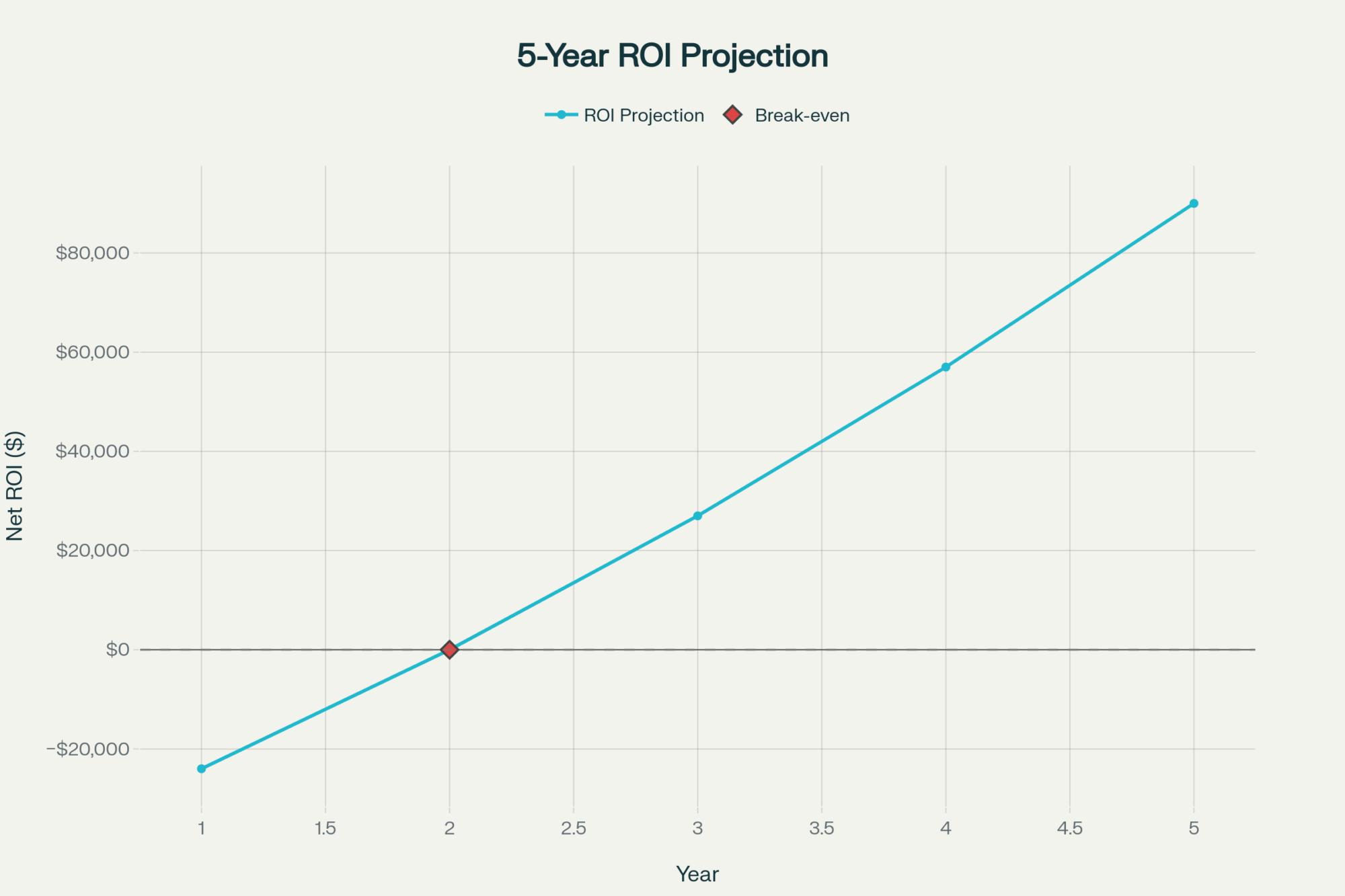
NewsSubscribe
First
Last
Consent

The Hidden Costs of Turnover: Why Your Dairy’s Biggest Crisis Isn’t What You Think

What if I told you the biggest threat to your dairy isn’t feed costs—it’s walking out your barn door daily?

What I find most frustrating about this industry is… Everyone’s obsessing over milk prices and feed costs while the real crisis is happening right in your barn, twice a day, every day.

Here’s what the numbers actually show: immigrant workers make up about 51% of the dairy workforce, and farms employing them produce roughly 79% of America’s milk. This isn’t just a staffing challenge—it has become the foundation our entire industry quietly depends on, and most producers have no idea how exposed that makes them.

Seasonal Workforce Turnover Rates in Dairy Regions

The Real Cost of Churn That Nobody Wants to Discuss

Look, I get it. Turnover feels like just another headache when you’re already juggling feed bills, equipment breakdowns, and everything else that goes sideways on a dairy. But here’s the thing—workforce churn has become a productivity killer that’s bleeding operations dry.

The latest FARM survey data indicate that annual turnover is approximately 39% across participating dairies. That means nearly 4 out of 10 workers walk out your door every year, leaving chaos in their wake.

What’s particularly eye-opening is the emerging research from Cornell’s agricultural workforce program, which suggests significant ripple effects. Studies indicate that even modest turnover correlates with 1-2% drops in milk production and measurable impacts on animal health—more sick calves and higher cow mortality. Those aren’t just statistics; they show up in your butterfat tests and vet bills, whether you’re tracking them or not.

Monthly Dairy Workforce Turnover Rates by Region (Estimated, 2025)

And the seasonal swings? That’s where it gets really painful. Some regions report monthly turnover spiking to 20% during peak stress periods—April, when everyone’s scrambling for field work, and July, when the heat becomes unbearable. Try running efficient operations when one in five workers might disappear any given month.

Here’s what really gets expensive, though: new hires take 3 to 6 months to reach full productivity. During that extended learning curve, your experienced workers spend up to 30% of their time training newcomers, rather than focusing on their actual jobs.

Cornell Extension’s cost analysis framework estimates the total cost at $15,000 to $25,000 per departed worker, factoring in recruiting, training, lost productivity, equipment damage, and quality issues. Multiply that by your annual turnover rate, and you’re looking at potentially six-figure annual losses.

Practical Guide to Calculating and Managing Dairy Workforce Turnover Costs

Dairy Turnover Loss Calculator

  • Number of full-time-equivalent (FTE) workers: ______
  • Annual turnover rate (%): ______
  • Estimated cost per departing worker ($15,000–$25,000): ______

Estimated Annual Turnover Cost:

FTE workers x turnover rate (as a decimal) x cost per departed worker = total turnover cost

Example:
20 workers x 0.39 x $18,000 = $140,400 per year

Don’t forget to include training time, lower early productivity, and possible vet or quality losses!

 Where You Farm Determines Everything

What strikes me about this workforce crisis is how differently it plays out depending on your location. And I’m not just talking about obvious stuff like wages or cost of living.

In traditional dairy states like Wisconsin and New York, USDA data shows immigrant workers typically make up 50-70% of the workforce. However, head west to the large confined operations in Idaho or California’s Central Valley, and University of Minnesota extension research indicates that those percentages climb to 70-90%.

The concentration becomes even more pronounced on larger operations. Those 1,000+ cow dairies that dominate production? They’ve built their entire labor model around experienced immigrant workers who often bring generational dairy knowledge from their home countries.

Climate adds another layer of complexity that most analyses ignore entirely. Summer heat in Arizona and Southern California creates working conditions that drive seasonal workforce migration toward indoor jobs. Meanwhile, brutal winters in the northern tier trigger departures when farm housing isn’t adequate.

The result? American dairy’s geographic footprint is quietly reshaping itself around workforce availability—operations are expanding where labor is accessible and consolidating where it’s not.

Robots: Let’s Talk Real ROI, Not Marketing Hype

Every conversation about dairy labor eventually comes around to automation, and there’s definitely momentum building. The global robotic milking market reached approximately $2.5 billion in 2025, with North America accounting for about 30% of that total.

But here’s where I need to be brutally honest about the economics. Those glossy equipment brochures promising 2-3 year paybacks? Joint analyses from Minnesota and Wisconsin dairy extension programs consistently show more realistic timelines of 5-7 years under typical operating conditions.

The shorter paybacks only happen under very specific circumstances—extremely high labor costs, perfect cow adaptation, and exceptional management. Most operations face a much bumpier road.

Multiple case studies from 2022 to 2024 document initial production volatility, with some farms experiencing drops of 8-15% during the first year as both cows and operators adapt to new routines. One producer described it to me as “like teaching calculus to cows while learning it yourself.”

However, what’s truly interesting is that successful automation doesn’t eliminate labor needs—it fundamentally transforms them. You go from needing experienced milkers who understand cow behavior to needing technical specialists who can troubleshoot sensors, interpret data analytics, and manage complex automated systems.

Policy Paralysis and What’s Actually Working

Let’s address the elephant in the room: federal immigration policy remains completely disconnected from the operational reality of dairy.

The H-2A program certified nearly 385,000 positions in 2024, but it’s virtually useless for year-round dairy operations. Designed decades ago for seasonal crop work, it can’t accommodate our biological requirements—cows don’t take vacations.

Processing delays make an already inadequate system actively harmful. Workers often arrive weeks after they’re needed, if they arrive at all. When you’re milking twice daily regardless of staffing problems, these delays aren’t just inconvenient; they’re operationally catastrophic.

What’s actually working? State-level innovation that ignores federal paralysis. Vermont’s Milk with Dignity Program—a worker-driven, advocacy-supported initiative—now covers 20% of the state’s dairy production. The program succeeds because workers helped write the standards, participate in monitoring, and farms receive economic premiums for participation.

Smart producers are investing in comprehensive retention strategies that show measurable results. Quality housing investments of $50,000 to $100,000 per unit demonstrate clear returns through reduced turnover. Operations implementing structured career development, language training, and genuine advancement opportunities report a drop in turnover from over 45% to under 15% within two years.

Key Components of Effective Dairy Workforce Retention

Your Monday Morning Action Plan

Here’s what successful operations are doing while others are still debating policy:

  • Start with brutal honesty about your vulnerabilities. Document your current workforce composition, identify critical positions, and develop emergency protocols for various disruption scenarios. Most operations have no idea how exposed they really are.
  • Plan technology adoption in phases alongside investments in retention. Don’t put all your resources into either automation or workforce development—you need both strategies working together.
  • Build community partnerships before you need them. Establish relationships with neighboring operations for labor sharing, connect with community colleges for training programs, and develop agreements with reliable staffing services.
  • Two low-cost moves you can implement this week: First, standardize your onboarding process with written protocols and milestone reviews. Second, train supervisors in basic coaching techniques—many turnover decisions occur within the first 90 days, often based on management relationships.
  • Use extension data to benchmark and track progress. Stop making workforce decisions based on gut feelings when objective data is available through university extension programs.

The Bottom Line That Changes Everything

Here’s the question that should reshape your planning: if you lost 40% of your workforce tomorrow—not gradually over months, but suddenly—could you still milk your cows and maintain animal welfare standards?

That scenario isn’t theoretical anymore. Agricultural regions across the country have experienced similar workforce reductions following enforcement actions, economic disruptions, and changes in the competitive labor market.

I’ve watched dairy operations that seemed bulletproof suddenly scramble to find emergency staffing solutions that often don’t exist. The difference between survival and bankruptcy comes down to preparation and strategic thinking.

The workforce foundation supporting American dairy is fundamentally unstable, and that instability is accelerating whether we acknowledge it or not. The operations that survive and thrive will be those that acknowledge current realities, invest strategically in both technology and people, and build operational resilience before crisis forces their hand.

Your response to this workforce challenge—starting right now—will determine whether you’re leading the dairy industry’s next evolution or becoming a statistic in its ongoing consolidation. Because at the end of the day, those cows are still waiting twice daily, and they’re not negotiating schedules based on workforce availability.

Your cows don’t negotiate milking schedules based on who shows up. Time to get serious about the people who make it all happen.

KEY TAKEAWAYS

  • Save $15,000-$25,000 per worker by investing in decent housing and career pathways—some Vermont farms cut turnover from 45% to 15% in two years using this approach
  • Budget 3-6 months for new hire productivity, while your veterans spend 30% of their time training instead of milking—streamline onboarding to cut this waste
  • Prepare staffing around seasonal peaks that can hit 20% monthly turnover in April and July—schedule accordingly, or watch your operation spiral
  • Don’t believe robotic milking paybacks under 5 years—Minnesota and Wisconsin extension data shows 5-7 years is realistic, and you’ll still need tech-savvy workers
  • Leverage proven retention programs like Vermont’s Milk with Dignity, which covers 20% of state production and demonstrates measurable improvements in workforce stability

EXECUTIVE SUMMARY

Here’s what kept me up last night after diving into the latest workforce data: farms employing immigrant workers now produce 79% of America’s milk, while those workers make up just over half of our entire workforce. But there’s a gut punch coming—turnover is hitting nearly 40% annually, and that’s not just an HR headache, it’s shaving 1-2% right off your production. Even worse, seasonal spikes can push monthly churn above 20% during spring and summer—try running efficient operations when one in five workers might leave at any given time. The global dairy industry is scrambling toward automation, but realistic robotic paybacks take 5-7 years, not the fairy tale 2-3 years vendors promise. Smart money says fix your people problems first, then layer in the tech—because at $25,000 per departed worker, you can’t afford to keep bleeding talent.

Complete references and supporting documentation are available upon request by contacting the editorial team at editor@thebullvine.com.

Learn More:

The Sunday Read Dairy Professionals Don’t Skip.

Every week, thousands of producers, breeders, and industry insiders open Bullvine Weekly for genetics insights, market shifts, and profit strategies they won’t find anywhere else. One email. Five minutes. Smarter decisions all week.

NewsSubscribe
First
Last
Consent

Hannah Woodhouse: From Chocolate Milk to PhD Brilliance Meet the Woman Revolutionizing Milk Quality

Meet the “Dairy Queen” who raced for chocolate milk, represented Canada globally, then revolutionized milk quality with boots-to-PhD brilliance.

You know what I love about Hannah Woodhouse’s story? It’s that beautiful full-circle journey from a kid feeding calves on her family farm to becoming this powerhouse dairy researcher with a PhD. Her work on free fatty acids in milk is making waves across Canada’s dairy industry, and I can’t help but admire how she’s blending her farm roots with cutting-edge science.

Growing Up Dairy

Hannah Woodhouse (left) with her three younger sisters at a local 4-H dairy show, where her 11-year involvement in the program helped shape her communication skills and deepen her love for the dairy industry. 'I was in the 4-H program for 11 years, and I loved training my 4-H heifer and taking her to fairs,' Hannah recalls of these formative experiences that would later influence her career path from farm to research lab.
Hannah Woodhouse (left) with her three younger sisters at a local 4-H dairy show, where her 11-year involvement in the program helped shape her communication skills and deepen her love for the dairy industry. ‘I was in the 4-H program for 11 years, and I loved training my 4-H heifer and taking her to fairs,’ Hannah recalls of these formative experiences that would later influence her career path from farm to research lab.

Hannah was the oldest of four sisters on their family dairy farm in Ontario. Get this – her mom’s a vet who met her farmer dad during a herd check! Hannah jokes it was “love at first sight,” which is the perfect dairy love story.

“I’ve always had this deep passion for agriculture, especially dairy,” Hannah told me. From day one, she was immersed in farm life – active in 4-H for 11 years, involved with Gay Lea Foods, and participating in various agricultural societies.

What I find fascinating is that she initially headed off to the University of Guelph for biomedical sciences with dreams of a medical career. She was also this incredible varsity runner representing Team Canada internationally. But you know how it goes when farming is in your blood – the pull back to agriculture was just too strong.

“It wasn’t long into my degree that I missed my farm, the animals, and that agricultural lifestyle,” she confessed. So, she added a nutrition minor and started taking more ag courses to stay connected to her roots.

The turning point came when she landed a summer research position with Dr. David Kelton, who heads the Dairy Farmers of Ontario research chair. That opportunity introduced her to studying free fatty acids in milk – a quality issue that would become her academic passion and the foundation of her career.

The Mystery of Frothy Milk

Hannah’s research tackles this interesting problem in Canada’s dairy industry – elevated free fatty acids (FFAs) in milk. These compounds form when milk fat breaks down and cause various quality headaches, including problems with milk frothing.

“If you’re paying good money for your fancy Starbucks latte with that perfect milk foam, it’s a big deal,” Hannah explained. “When consumers want froth, and you deliver milk that doesn’t foam properly, they immediately call their supplier to complain.”

Beyond the frothing issues, high FFA levels can make cheese coagulation go wonky, cause rancid flavors, and shorten shelf life – all critical concerns for Canada’s supply-managed dairy industry that lives and dies by consumer satisfaction.

Hannah visited 300 dairy farms across Ontario and British Columbia for her research. She was incredibly thorough – measuring pipelines, analyzing milk flow, and examining countless farm factors to determine what contributes to these elevated FFAs.

“I was measuring every inch of pipeline, looking at all the turns and elevated sections,” she told me. This comprehensive approach helped her identify multiple factors affecting FFA levels.

Getting Geeky About Foam

If you’re into the technical side of things, Hannah explained that FFAs exceeding 1.2 mmol per 100 grams of fat start causing problems. Her dedication to understanding this went beyond just lab work – she even did these adorable amateur experiments using milk from her family’s farm.

“I took leftover milk samples from different cows and tested them in my frother at home, just trying to see which cows produced the best frothy milk,” she said enthusiastically. “Our farm doesn’t have a free fatty acid issue, so most samples were pretty good, but occasionally, I’d get one that just wouldn’t foam.”

This hands-on curiosity has earned her a reputation among friends. “Every Christmas, I get a new frothing gadget,” she laughed. “My friends all know me as the Dairy Queen.”

What She Discovered

Hannah’s research revealed that FFA issues come from multiple factors. Her findings showed that organic and grass-fed herds typically have higher FFA levels than conventional farms.

She also found interesting seasonal patterns – FFA concentrations peak in late summer and fall compared to spring and winter. Improperly maintained milking systems, especially in automated operations with high milking frequencies, often contributed to elevated FFA levels. Farms with automated milking systems milking cows thrice daily showed a substantial increase in FFAs.

“The good news is that these farms can manage most of these factors with relatively quick and easy fixes,” Hannah emphasized.

What Works and What Doesn’t

Hannah developed this practical set of recommendations for farmers. She suggests limiting late-lactation cows’ visits to robotic milkers, ensuring proper plate cooler installation (especially in tie-stall operations), and changing milk filters at every milking.

“A dirty filter not only creates a breeding ground for bacteria but also puts more stress on the milk trying to pass through,” she explained. Her research found a 0.27 mmol per 100 grams of fat increase in free fatty acids for farms that milk frequently but change filters infrequently.

Hannah also emphasizes the critical importance of maintaining proper milk temperature. “Freezing and thawing milk can substantially increase FFAs,” she warns. Temperature fluctuations damage the milk fat globule membrane, allowing lipase enzymes to break down fat into free fatty acids, which is why consistent cooling to 4°C without freezing is essential for quality preservation.

Her work gained international recognition when she won the top student poster award at the 2023 International Dairy Federation’s World Forum in Chicago, beating out 89 submissions from over 20 countries. Pretty impressive, right?

Beyond the Lab Coat

What makes Hannah’s story even more remarkable is how multifaceted she is. While pursuing her academic career, she also represented Canada in international cross-country competitions.

When asked how she discovered her passion for running, it started with being bribed with chocolate milk at an elementary school race. Her parents were volunteering at a school-sponsored by local dairy farmers, handing out chocolate milk to finishers. In grade 8, they told her they were running out of chocolate milk and that only the top 10 finishers would get one. Hannah wanted that chocolate milk, so she raced hard and finished 4th out of about 100 runners – surprising both herself and her parents. To this day, chocolate milk is still her go-to recovery drink.

Hannah Woodhouse competing for Team Canada in international cross-country competition. Her athletic journey began in grade 8 when she raced hard to earn chocolate milk at a school fun run – finishing 4th out of 100 runners and discovering her competitive spirit. Today, she continues to advocate for dairy nutrition in sports, with chocolate milk remaining her go-to recovery drink.

“I was selected to represent Canada as a Junior athlete at the 2015 Pan Am Cross Country Championships in Columbia and the World Cross Country Championships in China,” she noted. She also made the National Team again in 2019 and still runs competitively today, having just taken some time to focus on academics during her PhD studies.

Her academic excellence earned her numerous scholarships, including the University of Guelph President’s Scholarship, the Ontario Veterinary College PhD Scholarship, and the OMAFRA Highly Qualified Personnel (HQP) Scholarship, which helped fund her innovative research on free fatty acids in milk.

This blend of athletic discipline and scholarly dedication has shaped her methodical approach to research and her ability to communicate complex scientific concepts to farmers and industry folks in ways they can understand and implement.

Making a Real-world Impact

Hannah Woodhouse celebrates her PhD completion in Population Medicine at the University of Guelph in September 2024, posing with the iconic Guelph Gryphon. Her doctoral research on free fatty acids in milk has already earned international recognition and is now being applied to improve sustainability practices across Canada’s dairy industry.

Hannah completed her PhD in September 2024 and has now moved into the next chapter of her career as a contractor for Dairy Farmers of Canada in Sustainable Production.

Hannah sees herself continuing to work in the dairy industry and integrating her passions, academic research, and writing skills to make a difference on a broader scale.

That vision is becoming a reality as she applies her expertise to improving sustainability practices across Canada’s dairy sector. Her current role aligns perfectly with Dairy Farmers of Canada’s ambitious goal of working towards net-zero greenhouse gas emissions from farm-level dairy production by 2050.

“The Canadian dairy farming sector is working toward net-zero by 2050 through emissions reduction and carbon removals,” according to DFC’s sustainability commitment. Hannah notes that “farmers are the most practical people,” implementing science-based solutions requires clear communication and practical applications.

Advocating for the Future

Hannah represented Canadian dairy on a young producer’s panel discussing “Future of Dairy Farming Around the Globe” at the 2023 International Dairy Federation summit. She also highlighted Dairy Farmers of Canada’s initiatives targeted to improve sustainability, engage young producers, and enhance consumer awareness of high-quality dairy products.

Her ability to bridge scientific research with practical farm implementation makes her so valuable. By improving milk quality and addressing consumer preferences, her work directly contributes to the sustainability and marketability of Canadian dairy products, supporting the industry’s path to net-zero emissions.

As part of the DFC’s proAction team, she now assists in managing sustainable production files, reviewing research, handling communications, and managing projects related to environmental initiatives. This role allows her to connect her milk quality expertise with broader industry sustainability goals, as reducing waste through improved quality control is essential for reducing the industry’s environmental footprint.

Continuing the Research Legacy

Aside from working with DFC, Hannah continues to write scientific and producer-friendly articles about FFA control and gives presentations nationwide. She’s passionate about speaking and engaging directly with producers at various events, sharing her research in ways that inspire practical on-farm changes.

“I feel privileged to have the unique experience of growing up on a farm to obtain practical knowledge and understanding of the industry and conduct PhD research that was highly scientific,” she reflects. “This puts me in a unique position to communicate with farmers better and help inform practical on-farm practices.”

Hannah is equally passionate about supporting and mentoring the younger generation in the dairy industry. “That’s where I see my role as an academic advisor or professor coming into play one day,” she shares, envisioning a future where she can guide students through their agricultural research journeys.

She also continues her passion for distance running, serving as a dairy advocate in the sports industry by promoting milk’s nutritional benefits for athletic recovery. Her personal experience with chocolate milk as both her running origin story and current recovery drink of choice makes her a genuine ambassador for dairy nutrition in sports.

As the dairy industry evolves to meet changing consumer preferences and environmental challenges, Hannah remains committed to bridging the gap between research laboratories and the farmyard. Her work shows that the most innovative solutions sometimes come from people with dirt under their fingernails and science in their toolkits.

“You can have a state-of-the-art lab with the most precise methodological practices and generate interesting results, but that research will not be useful unless it can be applied,” she emphasizes. “This is why understanding the dairy industry from a practical lens is so important.”

For Hannah Woodhouse, childhood chores on the family farm have evolved into a career dedicated to advancing an industry she deeply loves – proving that when science meets practical farming knowledge, both the industry and consumers benefit.

KEY TAKEAWAYS

  • The Chocolate Milk Champion Turned Global Competitor: Started competitive running at 14 after being “bribed” with chocolate milk at a school race sponsored by local dairy farmers—finished 4th out of 100 runners and went on to represent Canada at World Cross Country Championships in China and Colombia, still using chocolate milk as her go-to recovery drink
  • From Barn Chores to PhD Labs: This oldest of four sisters grew up on a Grey County dairy farm where her veterinarian mother met her farmer father during a herd check—completed over 30 different 4-H clubs in 11 years while maintaining a 95%+ academic average and earning the University of Guelph President’s Scholarship worth $60,000+
  • Real-World Research That Pays: Unlike typical academic researchers, Hannah conducted her PhD fieldwork on 300 actual farms across Ontario and BC, measuring pipelines and analyzing milk flow—her findings help dairy farmers avoid processor penalties averaging $15,000 annually through simple management changes like proper filter timing
  • The “Dairy Queen” Building Tomorrow’s Industry: Known among friends for her collection of milk frothers and home experiments with family farm milk samples—now mentors the next generation while serving as contractor for Dairy Farmers of Canada’s sustainability initiatives, bridging practical farming knowledge with cutting-edge research
  • Athletic Discipline Meets Scientific Rigor: Maintains competitive distance running while completing PhD research—her methodical training approach (including running up the barn hill in rubber boots to fetch cows) shaped her systematic research methodology that earned top international recognition against 89 global submissions

EXECUTIVE SUMMARY

Forget the stereotype of the ivory tower researcher who’s never touched a cow—Hannah Woodhouse milked her way through childhood, raced to international podiums, and earned her PhD stripes on 300 real farms across two provinces. This third-generation dairy farmer from Ontario didn’t just study free fatty acids in a lab; she tested milk samples from her own family’s cows in her kitchen frother while earning international recognition at competitions in China and Colombia. Her friends call her the “Dairy Queen” because she gets frothing gadgets every Christmas, but processors call her research game-changing after her 300-farm study revealed that simple filter management prevents $15,000 annual penalties per herd. From running for chocolate milk in grade 8 to representing Canadian dairy on global panels, Hannah embodies what happens when farm-raised intuition meets world-class science. Her journey from 4-H president to PhD proves that sometimes the best agricultural innovators are the ones who never really left the barn—they just brought the lab to the farmyard.

Learn More:

The Sunday Read Dairy Professionals Don’t Skip.

Every week, thousands of producers, breeders, and industry insiders open Bullvine Weekly for genetics insights, market shifts, and profit strategies they won’t find anywhere else. One email. Five minutes. Smarter decisions all week.

NewsSubscribe
First
Last
Consent

Mystic Valley Dairy: The Secret Behind Their Jaw-Dropping 125-Pound ECM Average

Wisconsin’s Mystic Valley Dairy shatters records with 125 pounds of energy-corrected milk daily. Discover how “doing 100 little things right” creates extraordinary results.

Ever wonder what it takes to run a dairy farm where cows produce a staggering 125 pounds of energy-corrected milk daily? I recently had the chance to dive into the world of Mystic Valley Dairy, and let me tell you, what Mitch Breunig has created there is nothing short of impressive. Tucked away in the rolling hills near Sauk City, Wisconsin, this operation isn’t just succeeding—it’s crushing it.

Those production numbers aren’t a typo, folks. We’re talking 125 pounds of energy-corrected milk (ECM) and 8.4 pounds of fat and protein per cow daily, with a remarkably low 20% turnover rate. Their production efficiency is exceptional, with current components averaging an impressive 4.5% fat and 3.4% protein. But here’s what struck me most during my conversation with Mitch—there’s no magic bullet. His philosophy? “Doing 100 little things right as opposed to something magic.” That approach has turned Mystic Valley into more than a successful farm; it’s an industry powerhouse stretching far beyond its 1050 acres.

The Breunig family of Mystic Valley Dairy poses during a dairy industry event, showcasing the people behind the extraordinary 125-pound ECM production average. Mitch Breunig (in gray suit) has built this Wisconsin operation into an industry powerhouse through a philosophy of "doing 100 little things right." The family's commitment to excellence extends from genetics to cow comfort, resulting in component averages of 4.5% fat and 3.4% protein that have put their Jenny-Lou prefix on the global dairy map.
The Breunig family of Mystic Valley Dairy. Mitch Breunig (in gray suit) has built this Wisconsin operation into an industry powerhouse through a philosophy of “doing 100 little things right.” The family’s commitment to excellence extends from genetics to cow comfort, resulting in component averages of 4.5% fat and 3.4% protein that have put their Jenny-Lou prefix on the global dairy map.

From UW-Madison to World-Class Dairy: Mitch’s Journey to Excellence

You can’t talk about Mystic Valley without getting to know the guy steering the ship. Mitch Breunig grew up on the farm his parents started in 1961, but he didn’t rely on handed-down knowledge. He headed to UW-Madison, graduating with a dairy science degree in 1992, then spent a year with Land’O Lakes in their feeding division before returning home.

Today, he’s running a herd of about 450 registered Holsteins that have put the Jenny-Lou prefix on the map worldwide. If you’re into dairy genetics, you’ve probably heard of Toystory—yep, that’s their bull, the only one in history to sell two million units of semen. Pretty mind-blowing, right?

JENNY-LOU MRSHL TOYSTORY, the legendary Holstein bull bred at Mystic Valley Dairy, stands as a testament to the operation's genetic excellence. This iconic sire made history as the only bull ever to sell over two million units of semen worldwide, helping establish the Jenny-Lou prefix as a global powerhouse in dairy genetics. Toystory represents the pinnacle of Mitch Breunig's breeding philosophy that emphasizes balance and longevity—core principles that have driven Mystic Valley's exceptional 125-pound ECM average.
JENNY-LOU MRSHL TOYSTORY, the legendary Holstein bull bred at Mystic Valley Dairy, stands as a testament to the operation’s genetic excellence. This iconic sire made history as the only bull ever to sell over two million units of semen worldwide, helping establish the Jenny-Lou prefix as a global powerhouse in dairy genetics. Toystory represents the pinnacle of Mitch Breunig’s breeding philosophy that emphasizes balance and longevity—core principles that have driven Mystic Valley’s exceptional 125-pound ECM average.

I found it fascinating how Mitch balances his farm life with community involvement. The guy somehow finds time to broadcast Sauk Prairie High School football and basketball games! It’s that connection to the community that keeps him grounded.

When we talked about the next generation, his eyes lit up: “There’s nothing more fulfilling than seeing them take an interest in how things are progressing daily and being excited about the animals they have worked with.” You can feel his passion for creating a legacy about more than just milk production numbers.

The Not-So-Secret Secrets to Record-Breaking Production

So, what’s happening at Mystic Valley? Which has these cows producing like champions? I asked Mitch directly, and his answer was refreshingly straightforward—it all comes down to “the basics of cow comfort and a good environment.”

Take a look at these numbers:

Production MetricCurrent PerformanceFuture Goal
Energy-Corrected Milk (ECM)125 lb/cow130 lb/cow
Combined Fat + Protein8.4 lb/cow9.0 lb/cow
Fat Percentage4.5%4.4%
Protein Percentage3.4%3.4%
Peak Milk (3rd+ lactation)152 lb/cow–
Turnover Rate20%–
Feed Efficiency1.90 lb ECM/DM–

The farm runs a 6-row barn stocked at 120% for stalls and 150% for headlocks. But here’s where Mitch got clever—he designed the stalls to fit older cows properly. “When we fixed this, we added a lot of productive life to our herd,” he told me. It seems obvious in hindsight, but too many barns are built assuming a 40% cull rate and don’t accommodate senior cows’ needs.

His approach to culling particularly struck me. “First of all, you want to get away from involuntary culls, cows that die, get injured, abort or are low production to voluntary culls,” he explained. This gives them control over which animals leave the herd. “The art is selling the cow when she is at maximum value before she loses cull value and doesn’t give enough milk to pay her way.” He calls it “more art than protocol,” and that kind of intuitive management seems to be a hallmark of the operation.

The Perfect Recipe: A 70-30 Forage Mix That Powers Production

You can’t get 125 pounds of energy-corrected milk without seriously dialed-in nutrition. At Mystic Valley, they’re running a high-forage diet that might surprise some folks:

Feed ComponentPercentageAdditional Notes
Corn Silage70%3-way blend of BMR and conventional hybrids
Low Lignin Alfalfa30%HarvXtra variety
Target Refusals2-3%Refusals fed to dry cows and heifers

What caught my attention was their use of a 3-way blend of BMR and conventional hybrids in their corn silage. Mitch said, “Since using both of these, our consistency is very high, and feed transitions are smoother.” Smart move—why commit to just one variety when a blend gives you more stability?

His nutritionist made an interesting observation I hadn’t considered before: Mystic Valley cows have greater capacity—not just taller frames, but can maintain production even when forage quality fluctuates because they can pack away more dry matter than other herds. That kind of genetic selection pays dividends daily at the feed bunk.

They’re targeting an impressive 1.90 pounds of energy-corrected milk per pound of dry matter. For those not neck-deep in dairy metrics, that’s seriously efficient feed conversion.

Milksource Boris Allura, a stunning Red & White Holstein bred and owned by Lauren and Brayden Breunig of Sauk City, Wisconsin. This exceptional dairy cow exemplifies the superior genetics and balanced breeding philosophy that has made the Breunig family's Mystic Valley Dairy a powerhouse in the industry. With her impressive frame, dairy strength, and striking red coat with crisp white markings, Allura represents the next generation of the breeding program that emphasizes longevity, components, and conformation. The Breunig family's commitment to "doing 100 little things right" extends from their record-breaking production herd to developing champion-caliber individuals like this remarkable Red & White. Photo by Beth Herges.
Milksource Boris Allura, a stunning Red & White Holstein owned by Lauren and Brayden Breunig of Sauk City, Wisconsin. This exceptional dairy cow exemplifies the superior genetics and balanced breeding philosophy that has made the Breunig family’s Mystic Valley Dairy a powerhouse in the industry. With her impressive frame, dairy strength, and striking red coat with crisp white markings, Allura represents the next generation of the breeding program that emphasizes longevity, components, and conformation. The Breunig family’s commitment to “doing 100 little things right” extends from their record-breaking production herd to developing champion-caliber individuals like this remarkable Red & White. Photo by Beth Herges.

A Day in the Life: Routine Is King at Mystic Valley

So, what does a typical day look like when you’re producing these kinds of numbers? Consistency, consistency, consistency.

The herd is milked three times daily, and Mitch is militant about minimizing time away from the pen and keeping lock-up periods short. “I am a big believer in time away from the pen being limited as well as lock-up time being very short,” he emphasized. It makes sense—every minute a cow spends standing in a holding area is a minute she’s not resting, ruminating, or eating.

They use the TAP feed system, which delivers a consistent diet daily. One thing I appreciated was how they handle refusals—instead of being wasted, they’re fed to dry cows and heifers. That kind of resource efficiency is an innovative dairy business.

Throughout the day, the team monitors key performance indicators using activity and rumination sensors. It’s not about replacing human observation but enhancing it with technology that can spot subtle changes before they become problems.

Contented Holsteins rest in spacious, well-bedded freestalls at Mystic Valley Dairy, showcasing how cow comfort and thoughtful barn design drive record-setting milk production and longevity
Contented Holsteins rest in spacious, well-bedded freestalls at Mystic Valley Dairy, showcasing how cow comfort and thoughtful barn design drive record-setting milk production and longevity.

Breeding for Balance: How Mystic Valley Built 115 Lifetime Production Stars

Many farms chase extremes in their breeding programs, but Mitch takes a different approach: “We breed for balance. Conformation is still important, especially when you have older cows.”

While they want high combined fat and protein (CFP) bulls, they insist on balanced fat and protein contribution. As Mitch put it, “The ebbs and flows of milk pricing are too hard to predict, so we want to be strong in both.” They also prioritize mastitis resistance, fertility, and livability.

Check out the daughter groups they’ve built:

Bull NameNumber of Daughters in HerdNotable Characteristics
Parfect65–
Conway40–
Sheepster (Trooper son)40Renegade grandson
Gameday30–
Renegade–Significant influence as foundation sire

The farm primarily uses NxGen bulls from Select Sires, focusing on high TPI sires that excel across multiple indexes.

“A key partner in this genetic success is Kevin Jorgensen from Select Sires,” Mitch notes. “Kevin has been instrumental in guiding our sire selections for years. We co-own several cows, which deepened our collaborative approach to breeding decisions. His expertise has been invaluable in building the genetic foundation we rely on today.”

Their commitment to building daughter groups, even in the genomic era, stood out to me. “Before genomics, we tried to use bulls we liked and made 50 daughters of them. It is a lot harder to do that using genomic sires, but with a bull like Parfect, we were able to have 65 daughters and Conway 40 daughters, which has us excited for the future,” Mitch shared.

The results speak for themselves—115 cows in the herd have surpassed 150,000 pounds of lifetime production. To put that in perspective, a cow typically needs at least five lactations to hit that mark, well beyond the industry average of less than 3. Now that’s longevity!

Fresh Cow Magic: The 7-Step System That Sets Up Success

If you ask me, transition cow management might be the most underrated aspect of dairy success. At Mystic Valley, they’ve turned it into a science:

TimingProtocol/Intervention
Pre-calvingAnion-cation balance with urine pH monitoring
At calvingJust-in-time movement to calving area
Immediately post-calving5 gallons warm water calcium drink
Morning after calvingBovicalc bolus
Throughout transitionCa-vital bolus for rumination
MonitoringActivity sensors for early intervention
Intervention if neededBHBA checks, alfalfa meal mix, rumastart boluses

What I found particularly interesting was their switch to a newer bolus. “Recently, we are using a different bolus called ca-vital, which is less expensive and effective at getting rumination to take off,” Mitch explained. That’s the kind of continuous improvement that keeps top herds at the summit—they’re never satisfied with “good enough.”

The system works remarkably well, with third-lactation and older cows averaging 152 pounds at peak milk. That’s about 50% higher than what you’d see in an average herd. Impressive stuff.

A Team Approach: The People Behind the Production

You might think technology drives operations like Mystic Valley, but at the end of the day, it’s all about people. The farm employs eight full-time staff members, including Mitch, plus one part-time feeder.

One thing that resonated with me was Mitch’s leadership style: “I believe in training how we want it done and then letting people do their job. You must also show what we value as the most important things and consistently coach people to do them better.”

Mystic Valley has created stability through respect and clear expectations in an industry plagued by labor shortages and high turnover. As Mitch put it, “I like to work alongside my employees to show them I am not asking for something I am not willing to do myself.” No wonder they’ve maintained consistent staffing when many farms struggle.

S-S-I Loyola-P Mazgof stands proudly showcasing the exceptional dairy type and mammary system that have made her a production powerhouse. This outstanding Holstein recently shattered <a href='https://www.thebullvine.com/news/farm-crisis-looms-record-low-bankruptcies-mask-looming-financial-disaster/' data-lazy-src=

Marketing Elite Genetics: How Mystic Valley Sells 140 High-Quality Cows Annually

The farm’s genetic excellence creates another revenue stream through the annual sale of approximately 140 young milking cows. These animals, primarily first and second-lactation cows fresh between 15-60 days, are sold a trailer load at a time.

“The marketing side of our operation wouldn’t be nearly as successful without Kevin Jorgensen’s involvement,” Mitch explains. “Beyond his role in our breeding program, Kevin helps market our cows to potential buyers. His industry connections and understanding of what makes our genetics valuable in the marketplace have been crucial to developing this additional revenue stream.”

Mitch’s approach to marketing reflects his overall philosophy of quality: “I try to sell cows I would want to milk myself, so it is important to calve in the best animals we can because we end up keeping the ones others don’t want to buy.”

The marketing strategy employs a selective approach that respects the buyer’s interests and fair market value. “Currently, I will give a choice of a group of 35 or so to pick 15 at a predetermined price,” Mitch explained. “It is important to know the market and price accordingly.”

The recent trend of beef-on-dairy breeding has significantly impacted the market in ways that benefit operations like Mystic Valley Dairy. “The influence of beef on dairy has been huge for us as the shrinking heifer population has increased demand and prices,” Mitch notes. This market dynamic has created additional revenue opportunities that help offset periods of tight margins in milk production.

Precision and consistency in action: Cows at Mystic Valley Dairy’s parlor deliver industry-leading milk yields, thanks to a focus on comfort, nutrition, and meticulous management.

Navigating Challenges: How Mystic Valley Handles Industry Headwinds

Let’s be honest—dairy farming isn’t all sunshine and record production. Mitch identifies labor and inflation as two significant hurdles facing elite operations like his.

His approach? “As the cost of production goes up, you can either spend less or improve margin through better output.” Rather than slashing costs, which can backfire by reducing productivity, they focus on improving efficiency to maintain margins even when expenses climb.

One fascinating strategy they’ve developed is using cattle sales as a financial safety net. “The ability to market cattle has been a game changer for us; when margins get tight, we can find additional revenue,” Mitch explained. They sell about 140 young milking cows annually, primarily first—and second-lactation animals fresh for 15-60 days.

I appreciated his candor about succession planning, which he admits is “our biggest weakness.” He’s focused on encouraging outside experience with relatively young children: “I think it’s important to get experience outside of our farm to bring back a different perspective than how Dad and Grandpa have always done it.” He doesn’t want them to feel obligated to return—the passion has to be genuine.

Setting the Bar Higher: Mystic Valley’s Future Goals

Even with their current stellar performance, Mitch isn’t sitting still. “Our next goal is 9 pounds of CFP per cow daily,” he told me, with an energy-corrected milk target of 130 pounds.

They focus on energy-corrected milk (ECM) rather than straight milk production. “We look at ECM of each cow more than straight milk production as it tends to rerank the cows considerably,” he explained. Their current components of 4.5% fat and 3.4% protein already demonstrate their commitment to high-value milk production rather than just volume.

Mitch acknowledges the biggest hurdle is the sheer energy demand of that production level, particularly in first-lactation animals where exceeding 7 pounds of CFP is challenging. But if there’s a farm that can crack that code, my money’s on Mystic Valley.

Jenny-Lou Wiggins 4515 EX-90 3Y displays the balanced conformation and dairy strength that exemplifies Mystic Valley Dairy's breeding philosophy. This impressive Holstein achieved her Excellent classification score at just three years of age, showcasing the superior genetics that have made the Jenny-Lou prefix world-renowned. Her strong frame, well-attached udder, and overall dairy character represent the type of cow that contributes to the operation's remarkable 125-pound energy-corrected milk average with 4.5% fat and 3.4% protein. As Mitch Breunig states in the article, their success comes from "doing 100 little things right" - including selecting for balanced type and production traits evident in exemplary animals like Wiggins. Photo credit: Lea Jordan/Cybil Fisher Photography.
Jenny-Lou Wiggins 4515 EX-90 3Y. This impressive Holstein achieved her Excellent classification score at just three years of age, showcasing the superior genetics that have made the Jenny-Lou prefix world-renowned. Her strong frame, well-attached udder, and overall dairy character represent the type of cow that contributes to the operation’s remarkable 125-pound energy-corrected milk average with 4.5% fat and 3.4% protein. Photo credit: Lea Jordan/Cybil Fisher Photography.

The Mystic Valley Philosophy: 100 Little Things Done Right

After understanding Mystic Valley’s approach, I realized there isn’t any single practice or innovation. It’s their comprehensive system where science-based management meets attentive animal husbandry. Mitch says, “We just want to do things well.”

That straightforward philosophy has created something remarkable—not just 125 pounds of energy-corrected milk (with an impressive 4.5% fat and 3.4% protein) and 8.4 pounds of fat and protein per cow daily with a 20% turnover rate, but a sustainable operation that’s influencing the industry while staying rooted in Wisconsin’s rich dairy tradition.

What Mitch and his team have built at Mystic Valley Dairy isn’t just impressive—it’s inspirational. They’ve shown that elite production can go hand in hand with cow longevity, that innovative practices can complement traditional values, and that doing “100 little things right” can add up to world-class results.

And isn’t that the essence of excellent dairy farming? The daily commitment to excellence, the constant refinement of practices, and the balance of science with animal husbandry. Mystic Valley isn’t just producing exceptional milk—they’re creating a blueprint for dairy success that others would be wise to follow.

Key Takeaways

  • Mystic Valley’s production excellence (125 lb ECM, 4.5% fat, 3.4% protein) comes from prioritizing cow comfort, including properly sized stalls for older cows and minimizing time away from pens.
  • Their nutrition program features a strategic 70-30 mix of corn silage (using a 3-way blend of BMR and conventional hybrids) and low lignin alfalfa, achieving 1.90 pounds of ECM per pound of dry matter.
  • The breeding philosophy emphasizes balance rather than extremes, focusing on combined fat and protein while maintaining strong conformation, mastitis resistance, and fertility.
  • A comprehensive 7-step fresh cow protocol, including specialized calcium supplementation and monitoring, helps third-lactation and older cows achieve peak milk of 152 pounds.
  • The farm’s success demonstrates that elite production can coexist with exceptional cow longevity when management focuses on consistent execution of fundamentals rather than seeking a single “magic bullet.”

Executive Summary

Mystic Valley Dairy, operated by Mitch Breunig near Sauk City, Wisconsin, has achieved remarkable production metrics with their 450 registered Holsteins producing 125 pounds of energy-corrected milk daily with impressive 4.5% fat and 3.4% protein components. Their success stems from a comprehensive approach focusing on cow comfort, balanced nutrition using a 70-30 forage mix, strategic breeding for balanced traits, and meticulous fresh cow management. Rather than relying on a single “magic bullet,” Breunig attributes their extraordinary results to “doing 100 little things right,” creating a sustainable operation with exceptional longevity (115 cows exceeding 150,000 pounds lifetime production) and a low 20% turnover rate. This philosophy extends to their team management, marketing strategy for selling 140 high-quality cows annually, and ambitious future goals of reaching 9 pounds of combined fat and protein daily.

Join the Revolution!

Join over 30,000 successful dairy professionals who rely on Bullvine Daily for their competitive edge. Delivered directly to your inbox each week, our exclusive industry insights help you make smarter decisions while saving precious hours every week. Never miss critical updates on milk production trends, breakthrough technologies, and profit-boosting strategies that top producers are already implementing. Subscribe now to transform your dairy operation’s efficiency and profitability—your future success is just one click away.

NewsSubscribe
First
Last
Consent

The 5000-Head Farm Blueprint: Secrets to Running a Large-Scale Dairy Operation

Revolutionize your 5000-head dairy farm with cutting-edge tech and time-tested wisdom. Discover how robotic milking, AI health monitoring, and precision feeding can boost production by 30% and slash costs. Ready to transform your operation into a model of efficiency and sustainability? Dive in to stay ahead in modern dairy farming.

Revolutionize your 5000-head dairy farm with cutting-edge tech and time-tested wisdom. Discover how robotic milking, AI health monitoring, and precision feeding can boost production by 30% and slash costs. Ready to transform your operation into a model of efficiency and sustainability? Dive in to stay ahead in modern dairy farming. 

The evolution of modern dairy farm management has significantly transformed recently. With large-scale operations becoming increasingly prevalent, a 5,000-cow farm often represents the pinnacle of modern agricultural enterprise, demanding sophisticated management techniques and state-of-the-art technology. 

Key Statistics: 

What are the critical components of successfully managing such a large-scale operation? Let’s break it down. 

Leveraging Technology for Precision Dairy Farming 

AspectTraditional MethodModern Technology Solution
MilkingManual milking or basic automated systemsRobotic milking systems (AMS)
Health MonitoringVisual observation and periodic check-upsWearable sensors and AI-powered health prediction
FeedingFixed rations for groups of cowsPrecision feeding based on individual cow needs
BreedingEssential record-keeping and visual heat detectionGenomic testing and AI-assisted breeding programs
Data ManagementManual record-keepingIoT sensors and cloud-based data analytics

Precision is paramount in large-scale dairy operations. The integration of Internet of Things (IoT) devices, Artificial Intelligence (AI), and data analytics has revolutionized herd management and milk production optimization. 

Automated Milking Systems: The Heart of Modern Dairy 

Robotic milking systems, or Automatic Milking Systems (AMS), have emerged as game-changers in dairy farm management. These systems allow cows to be milked on their schedule, often increasing milking frequency to 3-4 times daily. The result is a significant boost in milk yield and overall farm efficiency. 

Case Study: A dairy farm in Wisconsin saw its annual milk production per cow rise from 7,000 liters to an impressive 9,000 liters after adopting robotic milking systems – a 28.5% increase in productivity.

IoT and AI: The New Farm Hands 

Modern large-scale dairy farms are embracing IoT sensors and AI-powered analytics to monitor everything from cow health to feed levels in real time. These technologies enable: 

  • Early detection of health issues through continuous monitoring
  • Optimization of feeding schedules based on individual cow needs
  • Accurate prediction of calving times for improved reproductive management
  • Real-time monitoring of milk quality parameters

Did You Know?  AI-powered systems can now detect subtle changes in cow behavior and physiology, predicting health issues up to 48 hours before visible symptoms appear. 

Herd Management at Scale: Balancing Efficiency and Animal Welfare 

Managing 5000 cows requires a delicate balance between operational efficiency and ensuring the health and well-being of each animal. 

Health Monitoring and Preventive Care 

Large-scale dairy operations implement advanced health monitoring systems to maintain optimal herd health. These include: 

  • Wearable sensors tracking individual cow activity, rumination, and body temperature
  • Automated systems for early detection of mastitis, lameness, and metabolic disorders
  • Precision feeding programs based on individual cow nutritional requirements and production stage

Expert Insight:  “Daily insights into cow health are invaluable. Our integrated computer system and rumination collars allow us to swiftly detect potential infections or metabolic issues, often before they become clinical problems,” says Dr. Paul Johnson, a veterinarian specializing in large-scale dairy operations. 

Breeding and Genetics: The Foundation of a Productive Herd 

In a 5000-cow operation, strategic breeding and genetic selection are crucial for maintaining high productivity. Modern farms are utilizing: 

  • Genomic testing for selecting superior genetics and breeding more efficient cows
  • Sexed semen technology for targeted gender selection in offspring
  • Embryo transfer technologies for rapid genetic improvement and herd expansion

Sustainable Practices in Large-Scale Dairy Farming 

Sustainable PracticeEnvironmental BenefitPotential Impact
Anaerobic DigestersReduced Methane EmissionsUp to 85% Reduction in Greenhouse Gas Emissions
Water RecyclingWater Conservation50-90% Reduction in Freshwater Use
Precision FeedingReduced Nutrient Waste20-30% Reduction in Nitrogen and Phosphorus Excretion
Solar Energy UseReduced Carbon FootprintUp to 40% Reduction in Farm Energy Costs
Cover CroppingImproved Soil Health30-50% Reduction in Soil Erosion

Sustainability is no longer optional – it’s a necessity for the long-term viability of large dairy operations. Here’s how 5000-head farms are leading the charge: 

Waste Management and Energy Production 

Innovative farms are turning waste into opportunity: 

  • Large-scale anaerobic digesters for biogas production from manure
  • Nutrient recovery systems for producing high-quality fertilizers
  • Water recycling and conservation measures, including advanced filtration systems

Precision Feed Management 

Feed efficiency is critical in large operations. Advanced farms are using:

  • Automated feed pushers ensuring consistent feed availability 24/7
  • Near-infrared spectroscopy (NIRS) technology for real-time feed quality analysis
  • Crop management software for optimizing feed production and reducing environmental impact

Sustainable Practices in Large-Scale Dairy Farming 

Sustainability is no longer optional – it’s a necessity for the long-term viability of large dairy operations. Here’s how 5000-head farms are leading the charge: 

Waste Management and Energy Production 

Innovative farms are turning waste into opportunity: 

  • Large-scale anaerobic digesters for biogas production from manure
  • Nutrient recovery systems for producing high-quality fertilizers
  • Water recycling and conservation measures, including advanced filtration systems

Precision Feed Management 

Feed efficiency is critical in large operations. Advanced farms are using: 

  • Automated feed pushers ensuring consistent feed availability 24/7
  • Near-infrared spectroscopy (NIRS) technology for real-time feed quality analysis
  • Crop management software for optimizing feed production and reducing environmental impact

Quick Facts: 

  • Automated feed pushers can reduce feed waste by up to 75% compared to traditional methods
  • Precision feeding systems can improve feed efficiency by 10-15%, significantly reducing costs
  • Advanced crop management software can increase yield by 5-10% while reducing input costs and environmental impact

The Human Element: Managing People in a High-Tech Environment 

Even with advanced automation, people remain the backbone of successful large-scale dairy operations. Here’s how top farms are managing their human resources: 

  • Implementing clear organizational structures with defined roles and responsibilities
  • Providing ongoing training and development programs to keep staff up-to-date with new technologies
  • Focusing on worker safety and well-being through ergonomic equipment and stress management programs
  • Utilizing data-driven performance metrics to incentivize and reward productivity

Question to Consider: How can large dairy operations balance the need for automation with maintaining a skilled and engaged workforce in an increasingly tech-driven environment? 

Financial Management: Navigating the Economics of Scale 

Running a 5000-head dairy farm requires astute financial management. Key strategies include: 

  • Implementing detailed budgeting and cost control measures using advanced financial software
  • Conducting regular financial analysis and performance tracking against industry benchmarks
  • Developing strategic plans for capital investments and expansion based on market trends and farm data
  • Employing risk management strategies through diversification and financial hedging instruments

Table: Economic Impact of Scale in Dairy Farming 

Herd SizeCost per Ton of MilkLabor Efficiency (Cows/Worker)
< 50$X25-30
500$X/280-100
5000$X/3150-200

The Future of Large-Scale Dairy: Trends and Predictions 

As we look to the future, several trends are shaping the landscape of large-scale dairy farming: 

  1. Increased adoption of robotics and automation across all farm operations
  2. Growing emphasis on sustainability and environmental stewardship
  3. Rising importance of data-driven decision-making and predictive analytics
  4. Expansion of value-added product lines to meet changing consumer demands
  5. Greater focus on animal welfare and consumer transparency through blockchain and IoT technologies

Question to Ponder: How will these trends reshape the competitive landscape for large-scale dairy operations in the next decade, and what new skills will farm managers need to develop? 

Key Takeaways:

  • Embrace cutting-edge technologies like IoT and AI to enhance farm precision and boost milk production.
  • Automated milking systems increase milking frequency and improve overall herd management.
  • Utilize AI for proactive health monitoring, ensuring early detection and treatment of cow health issues.
  • Sustainable waste management practices transform waste into energy and resources, enhancing farm efficiency.
  • Precision feeding optimizes nutrition, reduces waste, and improves cow productivity and health.
  • Effective workforce management and continuous training are crucial for operating a large-scale, high-tech farm.
  • Sound financial management involves detailed budgeting, regular financial reviews, and strategic spending.
  • Stay ahead by integrating industrial trends like automation, sustainability, and data-driven decision-making.

The Bottom Line 

Running a 5000-head dairy farm demands a sophisticated blend of traditional knowledge and cutting-edge technology. As we explore the strategies to revolutionize your operation, remember that success in this evolving industry hinges on embracing innovation, prioritizing sustainability, and focusing relentlessly on efficiency and animal welfare. Whether considering robotic milking, AI-powered health monitoring, or optimized feed management, every technological upgrade can lead to significant gains. Don’t just wait for the future of dairy farming – shape it. By taking action today, you can transform your farm into a model of modern dairy excellence, staying ahead in an increasingly competitive market. Are you ready to take that first step towards a more efficient, sustainable, and profitable dairy operation?

Summary:

This article explores how you can manage a sizeable 5000-cow dairy farm by using both old farming skills and new technologies. Key technologies like robotic milking systems can boost milk production by nearly 30%, while tools like AI help keep animals healthy and cut feed waste. Large farms can cut milk costs by two-thirds compared to smaller ones. Using things like IoT sensors helps track cow health and feed efficiently. Sustainability is also a focus, with practices like gene testing to keep cows healthy. Good management of workers and finances is also critical to keeping big farms running well. The article encourages farmers to try new tech to make their farms more efficient and planet-friendly.

Learn more:

Join the Revolution!

Bullvine Daily is your essential e-zine for staying ahead in the dairy industry. With over 30,000 subscribers, we bring you the week’s top news, helping you manage tasks efficiently. Stay informed about milk production, tech adoption, and more, so you can concentrate on your dairy operations. 

NewsSubscribe
First
Last
Consent

How AI Monitoring Can Help Dairy Farmers Prevent Stillbirths

Facing stillbirth issues? Explore how AI can help protect your herd and boost farm health. Uncover this revolutionary technology.

Imagine the emotional burden of waking up every morning, uncertain if you’ll lose another calf. The impact of stillbirths in dairy farming is not just financial; it’s deeply personal. The significant emotional toll can cast a lengthy shadow over even the most resilient farmers. The anguish is palpable, and the financial consequences are equally distressing. According to recent research, each miscarriage might cost a farmer up to $1500 in lost earnings and extra veterinary costs [PMC study]. Is stillbirth impacting your dairy farm’s production and profitability?

From Hope to Heartbreak: The Struggle with Stillbirths in Dairy Farming 

Imagine the excitement of witnessing a baby calf take its first shaky steps, only to be ruthlessly replaced by the heartbreak of stillbirth. This unpleasant fact is much too typical in the dairy business. According to research by the National Dairy Association, stillbirths account for 7-10% of all calvings. This is not a trivial blip; it represents thousands of missed opportunities.

The impact is multifaceted. Beyond the initial emotional misery, the economic costs are significant. A stillborn calf results in a direct loss of economic potential and the waste of resources used throughout the cow’s pregnancy. Furthermore, stillbirths might indicate underlying health concerns in the herd and farm management techniques, affecting total milk output and herd lifespan.

The statistics are startling, and the consequences are far-reaching. Addressing stillbirths is more than simply coping with individual tragedies; it is about ensuring the long-term survival of dairy production as a whole. What can be done to address this pervasive issue?

A Multifaceted Burden: The Impact of Stillbirths on Dairy Farming 

Stillbirths account for around 8% of calf losses yearly [source]. This is more than just a number. It is a hard truth that dairy producers must face. Imagine the anticipation and care that goes into expecting a healthy calf, only to be met with the grief of a stillbirth. It’s an emotional rollercoaster that has left many farmers depressed and powerless.

The financial consequences of stillbirths go beyond the immediate loss of future milk supply and the emotional toll. A dairy farmer’s direct expenditures for each stillbirth may range from $700 to $1200, which includes veterinarian treatment, disposal, and the calf’s lost worth. This does not consider the indirect costs, such as the dam’s lower milk output or the possible influence on her future reproductive capacity. These figures may increase over time, significantly reducing a farm’s profitability and sustainability.

But the damage goes beyond mental anguish. Each stillbirth results in a substantial financial loss. Consider the investment in veterinary care, feed, and labor. When a calf is lost, these expenditures become sunk expenses, and all potential income from milk production and future breeding is gone. Small to mid-sized dairy enterprises may have considerable emotional and financial consequences.

Traditional Methods: The Limitations of Manual Monitoring and Record-Keeping

Have you ever woken up in the middle of the night, concerned about a cow in labor, or feeling powerless after yet another stillbirth despite your best efforts?

Traditional techniques of monitoring and avoiding stillbirths in dairy production often depend on human observation and record-keeping. Farmers monitor for symptoms of discomfort or difficulties during calving and keep extensive records of breeding histories and health statuses. These strategies have undoubtedly proven effective throughout the years but also can have considerable limitations.

Manual observations are time-consuming and need the farmer’s continual attention. While important, meticulous record-keeping may still be filled with human mistakes, making it less trustworthy. Furthermore, conventional systems sometimes need more predictive capacities to help prevent farmers from reacting to issues rather than preventing them. What are realistic options?

Sponsored by:

Meet Your New Best Farmhand: AI for Around-the-Clock Cow Monitoring

So, what if I told you there’s a method to keep a close check on your cows around the clock without spending restless nights in the barn? Imagine having an additional set of eyes that never sleep, are constantly attentive, and ready to detect even the most minor changes or symptoms of distress. This is where artificial intelligence (AI) comes into play. At its heart, AI is a technology that aims to emulate human intellect. Artificial intelligence can continually monitor and evaluate your dairy cows’ behavior, health, and well-being using advanced algorithms and data analysis. It’s like having the finest farmhand you could ever dream of, except he never takes a break.

Empowering Dairy Farmers with AI: A Proactive Approach to Prevent Stillbirths 

Artificial intelligence monitoring systems in dairy farming use cutting-edge technology to provide a proactive approach to reducing stillbirths. These systems use a network of sensors and cameras strategically positioned around the farm to monitor the cows around the clock. Imagine a vigilant monitoring squad that never sleeps—this is the core of AI in contemporary dairy production.

Sensors may be connected to cows, usually around the neck or legs. These devices track vital indications such as heart rate, body temperature, and movement patterns. At the same time, cameras record continuous video, enabling AI systems to detect behavioral changes that may indicate discomfort or impending labor.

These devices capture vast amounts of real-time data, which AI algorithms evaluate. Advanced machine learning models, such as Support Vector Machines (SVM) and Random Forests (RF), may detect abnormalities or departures from a cow’s normal behavior. For example, an abrupt decrease in movement or excessive body temperature variations might indicate possible problems that need rapid care.

This anticipatory skill is what distinguishes AI. By recognizing problems sooner, dairy producers may respond quickly, providing medical treatment that may avert stillbirths. The effectiveness of these measures has already been shown. Farms that use AI monitoring have reported substantial decreases in stillbirth rates of up to 30% [Dairy Science Info]. With such strong results, it’s evident that technology is the key to more efficient and humane dairy production. The financial benefits are significant, with the initial investment in AI monitoring leading to substantial cost savings and improved productivity.

The Unmatched Vigilance of AI Technology

CriteriaTraditional MonitoringAI Monitoring
Detection AccuracyVaries, often imprecise due to human errorHighly accurate with real-time data analysis
Observation FrequencyLimited to human availability24/7 continuous monitoring
Response TimeDelayed by manual processesImmediate notification and alerts
Labor RequirementHigh, requires significant manpowerLow reduces the need for human intervention
Cost EfficiencyHigh ongoing labor costsInitial investment, but lower long-term costs
Record-KeepingManual and error-proneAutomated and accurate data logging
ScalabilityLimited by workforce capacityEasily scalable for more extensive operations

Early Detection of Distress: AI technology can monitor vital indications like heart rate, temperature, and movement patterns around the clock, enabling early diagnosis of possible health problems. This preemptive strategy may save lives. Farmer John P. from Wisconsin says, “The AI system detected a sudden drop in vital signs that I would have missed.” That allowed us to preserve both the cow and the calf.”

Real-Time Alerts: Immediate alerts to your smartphone or computer allow you to act when an issue emerges. “Getting notifications on my phone has made a huge impact. “I can be out in the field and still know if something is wrong in the barn,” explains Maria L., a dairy farmer from California.

Data-Driven Decision-Making: Continuous data gathering and analysis enables better-educated animal care and management choices. AI can see patterns that human eyes may overlook.

The Price Tag and Payoff: Evaluating the Cost-Benefit of AI Monitoring 

Introducing an AI monitoring system incurs early expenditures. For a 2000-head dairy, the hardware configuration, which includes sensors and cameras, generally costs $5,000. Then, there is a monthly cost of around $1,000.

However, before you suffer sticker shock, consider the possible return on investment (ROI). Accurate monitoring allows for early interventions, which may significantly minimize the likelihood of stillbirths and related losses. Imagine lowering calf mortality by 10-20%.

For a 2000-head farm facing considerable losses and an 11% stillbirth rate, lowering the stillbirth rate by 4% per year would result in a $122,000 savings in the first year alone. This does not account for labor savings, greater productivity, or lower veterinarian expenditures due to fewer problematic calvings.

Furthermore, financial assistance programs might help alleviate the initial cost burden. Check whether you qualify for grants or subsidies targeted to improve agricultural technology. For example, the USDA provides numerous subsidies and loans to boost agricultural production and sustainability.

Would you consider the investment worthwhile if it resulted in healthier cows, more successful deliveries, and, eventually, a more lucrative farm? The figures seem to indicate a resounding “Yes.”

The Bottom Line

Stillbirths have a devastating effect on dairy farming, impacting both emotionally and financially. Traditional techniques have shown their limits, emphasizing the necessity for novel approaches. The development of AI technology provides unparalleled vigilance, with round-the-clock monitoring capabilities that may proactively avoid stillbirths. Given the cost-benefit analysis, this new technology has the potential to save lives and is a worthwhile investment. Addressing stillbirths is critical for maintaining the health and profitability of dairy farms. Dairy producers may use AI monitoring to guarantee the health of their herds. So, isn’t it time to adopt AI surveillance to ensure your herd’s future?

Download our Dairy Farmers Guide to Stress-Free Calvings

The Dairy Farmer’s Guide to Stress-Free Calvings is a valuable resource for dairy farmers seeking to simplify the calving process and reduce stress. It also offers practical tips for both new and experienced farmers and insights into improving productivity and longevity. It provides practical strategies for stress-free calvings, identifies and addresses common issues, and provides the latest practices in herd management and welfare. This guide will help reduce stillbirths, increase easy calvings, and minimize early exits. Don’t wait. Download this invaluable guide today!

The Dairy Farmer's Guide to Stress-Free Calvings
First
Last
Confirmation

Key Takeaways:

  • Stillbirths in dairy farming are a significant issue with emotional and economic consequences for farmers.
  • Traditional monitoring methods, such as manual observations and record-keeping, can be limited and prone to errors.
  • AI technology offers a proactive solution by providing continuous monitoring and real-time data about the health of dairy cows.
  • AI monitoring can prevent stillbirths by allowing farmers to react quickly to potential health issues.
  • Though AI monitoring entails an upfront cost, its long-term benefits in reducing stillbirths and improving farm productivity can justify the investment.
  • < UNK> Implementing AI in dairy farms can revolutionize livestock management, ensuring better welfare and output.

Summary:

The article addresses the critical issue of stillbirths in dairy farming and their profound emotional and economic impacts. Traditional monitoring methods, often reliant on human observation, fail to detect early signs of distress. AI technology, with its network of sensors and cameras, offers a continuous surveillance solution, identifying subtle behavioral changes that might signal discomfort or impending labor. Stillbirths account for 7-10% of all calvings, leading to significant economic losses and resource waste. AI provides an unmatched vigilance and proactive intervention capability, proving a valuable investment for dairy farmers aiming to enhance herd health and farm productivity.

Learn more:

Understanding the Impact of Hoof Trimming on Cow Behavior and Milk Output: A Data-Driven Approach

Explore the connections between hoof trimming, milk yield, and cow behavior. Could the ideal trimming schedules boost both dairy farm profitability and animal welfare? Discover the insights here.

Summary: 

Hoof trimming is a critical aspect of herd health, affecting cow productivity and well-being. Its timing during lactation is debated, with some experts advocating for routine trimming and others for a more personalized approach. Neglecting hoof care can result in significant financial losses, including reduced milk output, increased veterinarian expenses, and a shorter herd lifetime. Lameness can decrease milk output by up to 15%, necessitating costly medical treatments or culling. The additional manpower required for handling and treating lame cows can also increase running costs. Hoof health is not only welfare but also an economic necessity, with each case of lameness costing between $90 and $300 per cow annually. Modern dairy farms are utilizing cutting-edge technologies like sensors, herd management systems, and hoof-trimming software to enhance herd management and hoof care. Real-time data on cow behaviors, such as eating, rumination, and activity, enables early lameness identification. Integrating modern technology in hoof care is a game-changer, enabling dairy producers to implement evidence-based hoof clipping, improving animal welfare and financial effectiveness.

Key Takeaways:

  • Hoof trimming is essential for preventing lameness but optimal timing remains debated, especially during lactation.
  • Restraining cows during trimming may have both immediate and lasting effects on milk production and behavior.
  • Advanced technologies, including AccuTrim, DairyComp 305, and Sensoor EarTags, provide valuable insights into hoof health and its impact on dairy cows.
  • First parity and multiparous cows trimmed after 110 days in milk (DIM) showed higher milk production than those trimmed before 110 DIM.
  • Lame cows exhibited a significant reduction in eating time starting two weeks before trimming, with this decline continuing for up to six weeks post-trimming.
  • Activity levels in lame cows were notably reduced both before and after trimming compared to those requiring only routine hoof care.
  • Understanding the behavioral and productivity impacts of hoof trimming can guide more refined strategies, enhancing animal welfare and farm profitability.
hoof trimming, herd health, cow productivity, lameness prevention, dairy farm management, hoof care technology, economic impact of lameness, cow welfare, real-time data monitoring, evidence-based hoof clipping

Hoof trimming, a crucial aspect of dairy production, is more than a routine task—it’s a key determinant of herd health, significantly impacting cow productivity and well-being. Its primary goal is to prevent lameness, but its effects on milk output and behavior spark discussions about the best time during lactation. This article delves into studies that unveil the vital connection between foot trimming, milk production, and cow behavior. Discover why optimizing hoof trimming, a balance between animal welfare and economic efficiency, is paramount for your dairy operations and approach to hoof health.

Optimizing Hoof Trimming: Balancing Animal Welfare and Economic Efficiency 

Proper hoof care ensures cows can move freely to access feed and water, supporting their overall health and productivity. The debate on the optimal timing for hoof trimming during lactation persists, with some experts endorsing routine trimming at set intervals. In contrast, others advocate for a more tailored approach based on individual needs. 

AspectCost Per CowAnnual Savings Per CowAdditional Benefit
Routine Hoof Trimming (Every 6 Months)$30$70Reduced incidence of lameness
Reactive Treatment for Lameness$150–Recovery time, decreased milk yield
Preventative Measures (Proper bedding, nutrition)$25$50Improved overall hoof health

Neglecting hoof care can lead to significant financial losses, including reduced milk output, increased veterinarian expenses, and a shorter herd lifetime. Lameness alone can decrease milk output by up to 15%, and severe cases may require costly medical treatments or culling. The additional manpower needed for handling and treating lame cows can also raise running costs. These financial implications underscore the importance of proactive hoof care in maintaining farm profitability.

Hoof health is not just a matter of welfare, but also an economic necessity. By emphasizing the importance of good hoof care techniques, it’s clear that each case of lameness could cost between $90 and $300 per cow annually. This underscores the financial benefits of implementing regular trimming plans and utilizing modern data analytics, as recommended by producers, to proactively prevent lameness.

Producers are concerned that restricting cows for foot clipping might induce stress, influencing milk output and behavior. The main concern is whether this temporary restriction has long-term consequences such as changed food or activity habits and lower milk output. These issues have prompted the development of evidence-based trimming regimens that balance animal welfare with production using contemporary agricultural technology.

The Power of Technological Integration in Modern Hoof Care 

Modern dairy farms are leveraging cutting-edge technologies such as sensors, herd management systems, and specialist hoof-trimming software to enhance herd management and hoof care. Real-time data on cow behaviors—eating, rumination, and activity—provided by sensors like Sensor Ear Tags enable early lameness identification. This integration of technology not only improves animal welfare but also contributes to farm profitability by optimizing hoof care.

By combining this sensor data with milk production records, herd management systems like DairyComp 305 help find ideal periods for hoof clipping, reducing stress and preserving high milk output.

AccuTrim and other hoof-trimming applications monitor the time, frequency, and results of trimming sessions, providing essential information on good hoof care techniques. Synchronizing this information with herd management tools helps farmers be aware of hoof conditions in general.

The integration of modern technology in hoof care is a game-changer. It enables dairy producers to implement evidence-based hoof clipping, thereby improving animal welfare and financial effectiveness. By reducing lameness, increasing milk output, and enhancing general farm sustainability and productivity, these techniques offer a promising future for dairy production.

Unveiling the Benefits of Flexible Hoof Trimming Schedules in Dairy Production

The first study, which took place on a Wisconsin dairy farm with a variable hoof-trimming schedule, used AccuTrim software and DairyComp 305 milk production statistics. The findings demonstrated that milk production was higher in cows clipped for the first time after 110 days in milk (DIM) than in those clipped earlier. When foot cutting was postponed beyond 110 DIM, first parity, and multiparous heifers showed better milk production.

CategoryTrim Timing (DIM)Milk Production (kg/day)Eating Time (minutes/day)High Activity Time (minutes/day)
First Parity (Trimmed >110 DIM)>11035.2420180
First Parity (Trimmed <110 DIM)<11033.8415175
Multiparous (Trimmed >110 DIM)>11038.5430185
Multiparous (Trimmed <110 DIM)<11036.9425180
LAME (Pre-trim)N/AN/A367143
LAME (Post-trim)N/AN/A350143

The results show the advantages of delaying the first hoof trim until 110 DIM; cows clipped later in lactation produce much more milk. This result highlights the possible benefits of besting milk output by adjusting hoof clipping schedules.

Behavioral Shifts Linked to Lameness: Insights from Sensor Data

Using information from a Wisconsin dairy farm over two years, the second research examined behavior data from Sensor Ear Tags and hoof-trimming records. Sensor data were gathered six weeks before and six weeks after each pruning session. Two groups were formed from cows: “TRIM” for those cut free from lesions and “LAME” for those detected as lameness or lesions during trimming.

Days in Milk (DIM)First Parity (Blue) – Milk Production (kg)Multiparous (Orange) – Milk Production (kg)
≤ 110 DIM28.734.5
> 110 DIM32.138.2

Two weeks before cutting, eating time for LAME cows dropped; the week of trimming saw the most notable drop—53 minutes. This drop continued for up to six weeks after turning. Starting two weeks before cutting, high activity levels in LAME cows also dropped by 12 minutes; they stayed lower for up to five weeks after cutting.

Juxtaposing Studies: Unraveling the Complex Relationship Between Hoof Trimming, Milk Production, and Cow Behavior 

The two research studies offer critical new perspectives on the interaction between cow behavior, milk output, and foot clipping. According to the first research, milk output increases when cows are trimmed after 110 days in milk (DIM). This implies that changing pruning regimens helps to maximize milk production.

The second research on behavioral effects primarily distinguishes between cows diagnosed with lameness (LAME) and those having regular trimming (TRIM). Beginning two weeks before cutting, LAME cows demonstrated an apparent decrease in feeding time; this trend remained throughout the following trimming week. Lower activity levels emphasize their pain even more.
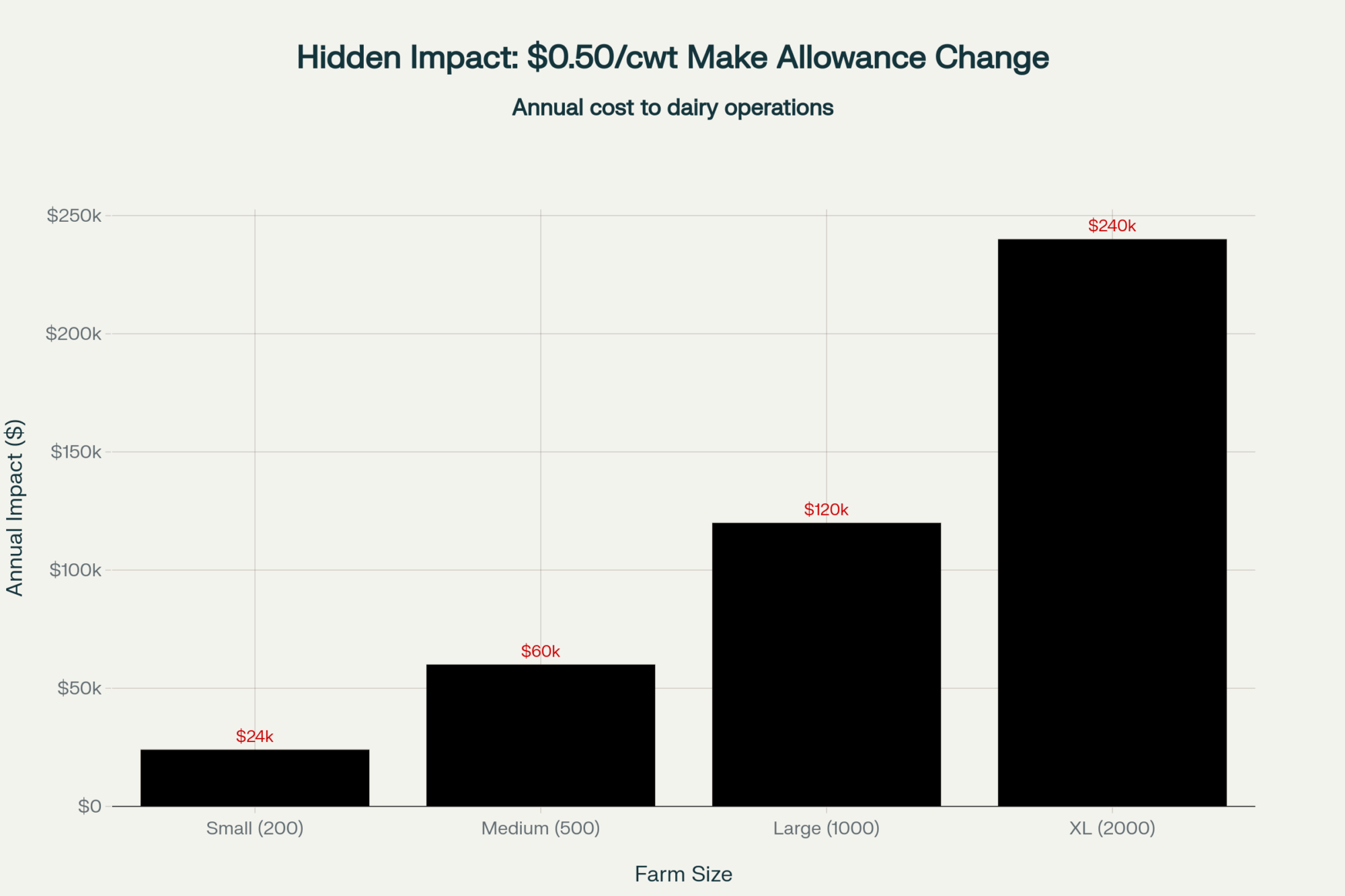
These results underline the need for dairy producers to know the different behaviors of LAME and TRIM cows. While lameness requires careful treatment to address welfare issues, routine clipping may be deliberately scheduled to improve milk output. Dairy farmers using this dual method must maximize cutting plans and apply focused lameness treatments.

Advanced record-keeping systems and sensor data are among the modern technologies that provide farmers with a comprehensive understanding of cow activity and health. Using these instruments helps create better hoof care routines, enhancing cow welfare and farm profitability. Understanding and meeting the different demands depending on trimming and lameness state can help to make wise choices, thereby improving output and animal welfare.

Addressing Limitations and Future Research: Charting a Path Forward for Comprehensive Hoof Health Studies 

Although these studies show encouraging outcomes, there are restrictions, especially regarding their generalizability to dairy farms with more excellent lameness rates than those in Wisconsin. The particular management techniques of the investigated farms could only represent a few situations in the dairy sector.

Further study is vital to confirm these results across various distances and herd sizes in other farm environments. Larger-scale, long-term studies can provide a more thorough understanding of the continuous effects of hoof clipping on milk output and cow behavior, guiding appropriate hoof care techniques.

While these results represent a significant step forward in understanding the relationship between dairy output and hoof condition, it’s crucial to remember that ongoing research is necessary. This research is not just about improving animal welfare and farm profitability, but also about contributing to the knowledge base of the entire agricultural community, making your role in this process even more significant.

The Bottom Line

Modern dairy production depends on accepting sophisticated data collecting and integration technology. Coupled with behavioral data from sensors, the correlation between hoof trimming time and improved milk production emphasizes the value of a data-driven strategy. Using instruments like AccuTrim software, DairyComp 305, and Sensoor Ear Tags, farmers may maximize hoof trimming schedules, therefore improving milk output and cow well-being for higher farm profitability.

Along with streamlining farm operations, this technical development marks the beginning of a new era of ethical and environmentally friendly animal handling. Data analysis of these systems allows hoof care plans to be customized to the demands of every herd, therefore combining animal welfare with financial effectiveness.

Every dairy sector participant should welcome these developments and pledge constant learning and adaptation. This will guarantee improved health results for dairy cows and financial gains, strengthening and enabling a strong dairy industry.

Learn More:

Join the Revolution!

Bullvine Daily is your essential e-zine for staying ahead in the dairy industry. With over 30,000 subscribers, we bring you the week’s top news, helping you manage tasks efficiently. Stay informed about milk production, tech adoption, and more, so you can concentrate on your dairy operations. 

NewsSubscribe
First
Last
Consent

How La Niña Could Transform Your Fall: Weather Warnings for Dairy Farmers

How will La Niña affect your dairy farm this fall? Prepare for hotter, drier weather with these essential tips for dairy farmers.

Summary:

As fall approaches, U.S. dairy farmers are bracing for a hotter and drier season due to the looming presence of La Niña. The Climate Prediction Center, a division of NOAA, forecasts a significant probability of above-normal temperatures from September through November 2024, particularly in New England and the Southwest. This seasonal shift could bring operational costs and challenges, including reduced pasture growth, strained water resources, and elevated feed costs. Experts urge farmers to prepare through strategic planning and resource management. La Niña’s hotter and drier conditions particularly threaten crops, cattle, and the water supply in the southern half of the U.S., making strategic planning essential to manage challenges such as heat stress on cattle, reduced milk production, and increased feed costs. NOAA’s projections show a warmer-than-normal trend, creating potential issues like heat stress on cattle, reduced milk production, and elevated feed costs. Consequently, dairy producers may invest more in cooling equipment and face higher feed prices, necessitating backup plans and diversified sourcing tactics.

Key Takeaways:

  • Projected warmer and drier conditions for much of the U.S. due to La Niña, posing challenges for dairy farming.
  • New England and the Southwest may experience temperatures over 60% above average during September to November.
  • La Niña’s development has a 66% chance during the fall, increasing to 70% for persistence through winter 2024-2025.
  • Farmers should prepare for potential impacts on pasture growth, water availability, and increased feed costs.
  • Timely irrigation and using drought-resistant crop varieties can help mitigate adverse effects.
  • Consulting advisors and understanding risk exposure are critical for effective marketing strategies.
dairy farm weather tips, La Niña dairy farming, impact of La Niña on agriculture, dairy farm management, hot and dry dairy farming, U.S. fall weather 2024, dairy farmer challenges, NOAA weather predictions, dairy farming climate impact, managing feed costs

As autumn approaches, the weather phenomenon known as La Niña threatens to bring hotter and drier conditions to most of the United States. This is not just another weather update; it’s a critical alert for dairy farmers. Understanding these NOAA estimates is not just essential; it’s the key to planning for a challenging season. La Niña, known for bringing dry, warmer-than-average conditions to the country’s southern half, is favored to develop during the September to November period, with a 66% chance of formation. From drought conditions affecting agricultural yields to increasing water requirements for animals, having thorough information on the autumn weather forecast is more important than ever.

La Niña: A Call to Action for Dairy Farmers

La Niña, a change in the Pacific Ocean’s mood, significantly affects worldwide weather patterns, including those in the United States. This cooling impact may cause drier and warmer-than-average weather in the United States, especially in the nation’s southern half. The urgency of understanding and preparing for this impact cannot be overstated.

La Niña often produces drier and warmer-than-average weather in the country’s southern half. Assume someone cranked the dial on a summer day in Texas or Arizona—very hot, right? La Niña has the potential to deliver significant heat. But it’s not only the heat; it also dries everything up, resulting in less rain and more droughts. This may significantly influence agricultural cycles, water supplies, and wildfire hazards.

La Niña is a climatic phenomenon that causes the southern United States to experience drier and warmer weather. This unpredictable phenomenon significantly affects agricultural cycles, water supplies, and wildfire dangers. The seriousness of the crisis cannot be exaggerated since it threatens not just our crops and cattle but also our whole water supply.

El Niño and La Niña: The Tug-of-War Shaping Our Climate

La Niña is a climatic trend that cools surface ocean waters along South America’s tropical west coast. El Niño, on the other hand, is caused by ocean warming. The ENSO cycle has a substantial influence on worldwide weather patterns. El Niño causes warmer and wetter circumstances globally, whereas La Niña brings colder and drier conditions. Understanding these phenomena is critical because they may significantly impact anything from agricultural yields to water availability, so dairy industry professionals must stay educated.

NOAA’s Predicted Warm Fall: A Challenge for Dairy Farmers

NOAA’s autumn season temperature projections show a warmer-than-normal trend throughout large portions of the United States. Notably, New England and the Southwest, including Arizona, Colorado, New Mexico, and Utah, are anticipated to have the most significant probability of above-normal temperatures, with estimates reaching 60%. This is a major worry for dairy producers since rising temperatures may cause significant operational problems.

First and foremost, heat stress on cattle is a significant concern. Cows exposed to protracted heatwaves struggle to maintain average body temperatures, reducing milk output and general health degradation. As temperatures rise, the requirement for efficient cooling systems grows.

Furthermore, rising temperatures need more extraordinary cooling efforts to maintain a stable environment in dairy operations. This results in more significant energy costs as farmers spend more on ventilation, fans, and other cooling systems to safeguard their cattle. According to industry experts, cooling expenses may skyrocket during the hotter months, placing a financial burden on thin margins.

Although the projected warmth this autumn may initially seem acceptable, dairy producers must carefully consider the possible stress on cattle and higher operating expenses. Preparing for these fluctuations may avoid severe consequences and maintain a more consistent production cycle throughout the season.

Precipitation Woes: La Niña’s Dry Spell and Its Impact 

RLa Niña often causes drier weather in the southern portion of the United States. For dairy producers, this may be a significant worry. Rainfall may be decreased in regions such as California, Texas, and New Mexico, which are crucial for dairy production. This is more than a minor annoyance; it affects pasture growth, water availability, and feed prices.

Impact on Pasture Growth 

Pastures flourish with consistent rainfall. During a drier-than-average autumn, your pastures may struggle to grow. This may lower the amount and quality of fodder, hence decreasing milk production. When cows do not get enough nourishment from pastures, they produce less milk, resulting in lesser earnings.

Water Availability 

Water is another essential resource that will be in limited supply. Reduced rainfall means less water for your animals, forcing many to depend on alternate water sources. Low groundwater levels become a severe problem if you rely on wells, not to mention the possibility of rising water prices, which adds to the financial hardship.

Increased Feed Costs 

With pastures underperforming, you’ll need to buy extra feed. And let’s face it: feed is costly. Increased demand and lower supply will cause prices to rise, reducing profit margins. According to Dairy Business research, feed costs may account for up to 40% of overall production expenses during drought.

Practical Advice: Mitigating Challenges 

  • Water Management: To maximize your resources, implement water-saving techniques, such as rainwater harvesting and efficient irrigation systems.
  • Pasture Care: Rotate your grazing areas to prevent overuse, and consider planting drought-resistant forage varieties.
  • Feed Strategy: Stock up on feed earlier in the season when prices are typically lower. Diversify your feed sources to minimize risk.
  • Financial Planning: Develop a financial cushion by setting aside funds to cover unexpected costs related to drought conditions.

Preventive preparations are vital for preparing for the potential challenges of a La Niña event in autumn. With the correct techniques, you can safeguard your farm’s production and profitability.

Navigating the Challenges: La Niña’s Impact on Dairy Farming 

The upcoming La Niña presents several concerns for dairy producers. The hotter and drier weather forecast this autumn may substantially influence your business, affecting everything from herd health to productivity.

Heat Stress on Cattle 

Dairy cows, especially high-yielding ones, are sensitive to temperature changes. Heat stress may limit feed intake, impair metabolic processes, and eventually diminish milk supply. According to the Dairy Herd Management magazine, heat-stressed cows might experience a 20% decline in milk output.

Reduced Milk Production 

When temperatures rise, cows invest more energy in thermoregulation than milk production. The lower feed intake and the stress of maintaining a stable body temperature results in less power available for breastfeeding. This situation becomes more serious when nutritional shortfalls result from poor pasture quality caused by drought.

Increased Feed Costs

The expected dryness might result in weaker pasture growth and decreased fodder crop production, raising feed costs. During the 2011 La Niña episode, the USDA reported a 40% rise in maize prices owing to drought effects [USDA]. Your feed budget may encounter comparable challenges, prompting the development of a strategy for properly managing these expenditures.

Actionable Tips: Preparing for the Fall 

You can take several proactive steps to mitigate these challenges: 

  • Improve Barn Ventilation: Ensure that your barns have sufficient airflow. Installing fans or misting systems can significantly lower the indoor temperature, making it more comfortable for your herd.
  • Ensure Adequate Water Supply: Maintain a reliable water source. Hydration is vital for cows to manage heat stress and maintain milk production. Regularly check and clean water troughs to ensure ample supply.
  • Plan for Alternative Feed Sources: Given the potential spike in feed costs and possible shortages, look into alternative feedstuffs. By-products such as brewers’ grains or soy hulls can provide supplemental nutrition without the skyrocketing costs.

Strategic preparation and early responses are critical to navigate this hotter and drier autumn. Addressing these possible concerns can protect your herd’s health and keep your farm productive.

Economic Ripples: The Financial Strain of La Niña on Dairy Farmers

La Niña may have a considerable economic effect, especially on dairy farms. As temperatures rise, dairy producers may need to spend more on cooling equipment to protect the health of their herds. Herd health is more than an animal welfare issue; it is inextricably tied to milk production. Stressed cows produce less milk, which may lead to significant losses.

Furthermore, drought circumstances that reduce agricultural production would certainly hike feed prices. When key crops such as maize and soybeans suffer losses, prices rise, burdening already tight feed budgets. According to the USDA, these issues combine, making it critical for dairy producers to have backup plans and diversify their sourcing tactics to manage risks.

The weight of more extraordinary cooling expenses, feed prices, and decreasing milk output create a challenging economic scenario. Dairy producers, who sometimes operate on low margins, must negotiate these financial challenges while maintaining production. Given the possible economic impact, preparing for and adapting to La Niña is crucial.

The Bottom Line

As La Niña approaches, U.S. dairy producers anticipate a hotter and drier autumn, which will affect pasture growth, water availability, and feed prices. These weather patterns may imperil production and operational efficiency, so farmers must handle these concerns proactively.

Preparation is crucial. Staying current on weather trends and predictions, such as those offered by NOAA, can help you prepare ahead of time and avoid hazards. Consult with consultants, examine clever use of put options, and improve marketing efforts to guarantee your farm’s resilience.

Take action today to protect your activities. Keep up with the latest projections, evaluate your risk exposure, and seek professional assistance to navigate these challenging times efficiently. To prepare for probable interruptions from La Niña, make educated judgments and take proactive actions in agricultural operations.

Learn more: 

Join the Revolution!

Bullvine Daily is your essential e-zine for staying ahead in the dairy industry. With over 30,000 subscribers, we bring you the week’s top news, helping you manage tasks efficiently. Stay informed about milk production, tech adoption, and more, so you can concentrate on your dairy operations. 

NewsSubscribe
First
Last
Consent

Stray Voltage in Dairy Farming: Essential Insights Every Farmer Must Know

Learn how stray voltage affects dairy farming and how to protect your cows. Do you know about the hidden risks to your milk production?

Summary: Have you ever wondered if something more sinister is draining your dairy farm’s profits and productivity?  Dairy farmers have grappled with a hidden enemy for over five decades: stray voltage. This silent threat has devastating effects on livestock, yet its existence has been mired in lies, falsified research, and outright gaslighting. Stray voltage, undesired energy that escapes into the ground or conductive surfaces, can stem from poor wiring, insufficient grounding, and flaws in the power company’s electrical grid. For cows, it means stress, reduced milk output, lower feed intake, and a higher risk of illnesses like mastitis. Even at levels as low as 2 to 4 volts, this stress can lead cows to avoid water or feeding stations. The USDA estimates that up to 20% of dairy farms could be affected by stray voltage. Testing for stray voltage is crucial to protecting the herd and your livelihood.

  • Stray voltage can severely affect livestock, resulting in stress, reduced milk production, and higher illness incidents.
  • Causes of stray voltage include poor wiring, insufficient grounding, and flaws in the power company’s grid.
  • Even low levels of stray voltage (0.03-0.05 volts) can make cows avoid water or feeding stations.
  • The USDA estimates that up to 20% of dairy farms could be impacted by stray voltage.
  • Testing for stray voltage is essential to safeguard livestock and farm profitability.

Have you ever wondered why your cows are continuously upset or why milk output changes for no apparent reason? The solution might be more inconspicuous and unexpected than stray electricity. This hidden threat has plagued dairy farms for decades. Still, the amount of disinformation, fabricated data, and blatant falsehoods surrounding it is staggering. Stray voltage reduces milk output and directly influences herd health, resulting in higher veterinary expenditures and lower earnings. “Stray voltage influences dairy cow behavior, health, and milk output. It may cause lower milk output, higher somatic cell counts, and other health issues in cows.” [Stray Voltage Facts]. For over 50 years, dairy producers have been duped with falsified statistics, deceptive research, and testing that mask the hazards. The time to act is now. Can you afford to ignore this problem any longer? Join us as we delve into the dark realm of stray voltage, unraveling the deception and revealing the truth about this industry-wide disaster.

Electrical Nightmare: How Stray Voltage Could Be Sabotaging Your Dairy Farm 

Stray voltage is undesired energy that escapes into the ground or other conductive surfaces, resulting in low-level electrical currents that travel outside their intended paths. Imagine your farm’s electrical infrastructure as a garden hose. If the hose contains microscopic holes, water (or, in this instance, electricity) will leak out. This kind of leakage is known as stray voltage.

But how does it happen? Poor wiring, insufficient grounding, and malfunctioning electrical equipment are familiar sources of stray voltage. These issues allow electricity to leave its intended circuit. Another source is the power company’s electrical grid; currents may return via the ground rather than designated neutral lines, functional in rural regions with aging infrastructure.

This is very significant for dairy producers. Stray voltage may cause stress in cows, reducing milk output, lower feed intake, and greater susceptibility to illnesses like mastitis. Even at levels as low as 2 to 4 volts and 0.03 volts, the strain may lead cows to avoid water or feeding stations, jeopardizing their health and your farm’s profitability.

Stray Voltage: The Silent Saboteur of Dairy Farms 

Stray voltage is more than simply an electrical annoyance; it is a quiet adversary that progressively saps the vitality of your herd and the prosperity of your dairy enterprise. Imagine entering your barn expecting to see healthy, productive cows, only to discover anxious, diseased, or dead animals and declining milk output. Unfortunately, such is the harsh truth for many farmers who have unwittingly become victims of this unseen threat.

“Our cows started showing signs of stress and unnatural behaviors,” Allan from Bert-Mar Farms remembers. “We noticed a drastic drop in milk production, and it took us years to realize stray voltage was to blame” [source: DairyStar, Inc.]. Many in the industry share this attitude, having had similar situations but failed to identify the root.

Numerous research have established the harmful effects of stray voltage on dairy cows. According to research, even tiny levels of electrical current (below 0.25mAmp) may produce behavioral changes, reduced feed intake, higher somatic cell counts, and decreased milk production. A thorough evaluation of 46 research experiments found that cows exposed to voltages as low as 1 volt saw substantial decreases in milk output and general health [source: StrayVoltageFacts].

For instance, Mary Francque, a dairy farmer who witnessed the severe impacts of stray voltage firsthand, shared, “We saw a 20% drop in milk production almost overnight.” Trying to determine what was wrong until we checked for stray electricity [source: Iowa State University] was a nightmare. Such experiences underscore the tremendous impact of stray voltage and the critical need for awareness and mitigating actions.

Cows exhibiting signs of electrical exposure, such as reluctance to enter the milking parlor, unexpected aggression, or unusual hoof and joint issues, are most likely suffering from stray voltage effects, according to studies by the Agricultural Research Service and other organizations [source: Bovine Vet Online]. These signs are often misinterpreted, resulting in prolonged animal suffering and financial losses for producers.

Stray voltage has a significant financial impact on dairy farms. Farms affected by stray voltage often report a 15-30% drop in milk output, leading to yearly losses of thousands of dollars. Moreover, the cows’ health deteriorates, and reproduction suffers, resulting in higher veterinary bills and shorter herd lifetimes. These cumulative consequences can severely impact the financial viability of both large and small dairy enterprises.

Stray voltage is a widespread problem that has plagued dairy farms for decades. Farmers like Allan and Mary’s personal stories serve as a powerful call to action. Dairy producers must become more cautious, conduct frequent inspections, and seek expert reviews to protect their businesses from this hidden threat. The good news is that stray voltage is preventable. You can safeguard your farm and livelihood with the proper knowledge and proactive measures.

Stray Voltage: Not Just a Technical Glitch, But a Financial Catastrophe 

Let’s talk numbers; according to the literature review summarizing 46 research trials, groups of cows exposed to known voltage and current levels experienced significant reductions in milk yield and overall health. Lower productivity means fewer gallons shipped, which equates to lower profits. The hidden costs don’t stop there; sick cows lead to higher veterinary bills and increased labor costs to manage and mitigate these health issues. 

On another note, Steve and Mary Francque’s battle with stray voltage is a poignant example. The Francques reported spending over $100,000 over a few years in an attempt to diagnose and rectify the problem. What dairy farm can carry such an enormous unexpected expense without suffering? It became a choice between investing in necessary machinery upgrades or continuously addressing the detrimental effects of stray voltage.

It’s crucial to recognize the industry-wide scale of the stray voltage problem. The USDA has estimated that up to 20% of dairy farms in any area could be affected by stray voltage. This isn’t an isolated issue; it’s an industry-wide challenge that demands serious attention. The collective financial impact could exceed millions of dollars lost in productivity and increased operational costs [source: USDA]. 

These examples underscore that stray voltage isn’t just an abstract problem; it’s a tangible threat to a farm’s profitability and viability. The direct and indirect costs can compound quickly, creating a financial burden that many farms may find impossible.

Decades of Deception: Unmasking the Stray Voltage Scandal in Dairy Farming 

Since the 1970s, stray voltage has been a significant worry in dairy farming. The issue gained attention when farmers reported inexplicable declines in milk output and unusual behavioral changes in their herds. Based on anecdotal evidence from impacted farmers, initial inquiries were typically rejected as coincidence or owing to bad farm management techniques.

However, by the early 1980s, this contemptuous attitude had begun to shift. Studies, such as the extensive study conducted by recognized agricultural specialists (https://strayvoltagefacts.com/), have revealed a relationship between stray voltage and decreased dairy output. Despite the evidence accumulated, disinformation efforts and fraudulent studies obscured the reality. Powerful utility corporations often supported these deceptive studies to escape accountability and the financial consequences of dealing with the problem.

A famous example of such deception happened in pivotal research trials financed by the electrical industry, which controversially reduced the importance of stray voltage by altering data to indicate minor impacts on dairy cows. These trials, cited over the subsequent decades, played a significant role in shaping public perception and policy around stray voltage, effectively gaslighting the farming community (https://img1.wsimg.com/blobby/go/d719dd64-4767-4754-9681-480de02a93fe/downloads/Stray-Voltage-Injuries-in-Dairy-Farmers-A-Revi.pdf?ver=1721680466256).

By the 1990s, individual case studies and accumulating anecdotal evidence from farmers like the Burdicks, who reported devastating consequences on their cattle, had pushed the topic back into the scientific realm. Despite this, adequate identification of the problem was met with tremendous hostility, with many blaming cow health difficulties on less problematic factors.

In the past two decades, a renaissance of interest and more transparent studies have begun peeling back the obfuscation layers. Notable research, such as those reviewed in Spring 2018, has highlighted the adverse effects of stray voltage on dairy operations, supporting distressed farmers’ assertions [source](https://dairystar.com/stories/a-shock-to-the-system,24087).

The history of stray voltage awareness is rejection, disinformation, and a long march to realization. It emphasizes the necessity of openness and robust, impartial research in protecting the interests of those who feed the country.

Gaslighting in the Dairy Industry: The Hidden Truth About Stray Voltage

The dairy farming community has been subjected to unparalleled disinformation and gaslighting regarding stray voltage. How often have scientists and authorities dismissed your fears about stray voltage as “an overreaction” or “unlikely to affect your herd”? It isn’t enjoyable.

For decades, utility companies and other industry players have minimized stray voltage’s seriousness, dismissing it as a mere annoyance. Recognizing the facts would entail expensive mitigation efforts, probable responsibility, and a considerable loss to their financial line. Instead, they’ve brushed the data under the rug, leading farmers to mistrust their own experiences.

Consider the story of Mary Francque, a dairy farmer whose herd’s health deteriorated unexpectedly. “I was told repeatedly that it was all in my head, that stray voltage couldn’t possibly be causing the problems I was seeing,” she said with tears. It wasn’t until she completed her tests that she discovered the cold, hard facts: her cows had been exposed to dangerous quantities of electricity.

Falsified research and whitewashed studies are another layer of deceit. Many studies financed by utility corporations have concluded that stray voltage offers no substantial harm. However, independent research provides a different perspective. According to a comprehensive assessment in Dairy Star, “The lowest cow plus cow contact resistance has been tested below could be as low as 125 ohms in certain circumstances, making even minor currents extremely harmful.” Dairy industry proponents argue for using a 125 ohms resistor in stray voltage testing to more accurately represent the most significant % of cows in a given herd. [source: Stray Voltage Facts].

Utility firms and their friends have reaped enormous profits by ignoring the obligation to update infrastructure and adopt adequate safety measures. This neglect is appalling when you consider the consequences for dairy farmers—financial losses, mental anguish, and, most sadly, the degradation of their herd. The Burdicks, a farming family who sustained significant losses, revealed that the electric provider ignored several concerns until it was too late [source: Dairy Star].

To summarize, the concerted attempt to minimize stray voltage amounts to a violation of trust, leaving numerous dairy producers to deal with the terrible repercussions. Isn’t it time for a reckoning?

The Human Toll: How Stray Voltage Wreaks Havoc on Dairy Farmers’ Lives and Livelihoods

One cannot ignore the environmental and human costs that stray voltage exacts on dairy producers and their livelihoods. Consider Mary Francque, a dairy farmer who, with her husband Brian, fought the constant presence of stray electricity in their milking barn for an incredible nine years. The continuous tension and unknowns surrounding the unseen monster left them feeling demoralized and second-guessing every decision. Their milk supply decreased, and the health of their beloved cows deteriorated quickly, causing emotional and financial stress.

Nelson and her husband, Brian, ‘s predicament exemplifies how dangerous stray voltage may be. They bravely battled the illusive electrical burglar inside their barn. For over a decade, they had unexpected drops in milk output and strange health concerns with their cattle. Despite several attempts to identify and address the cause of the issue, their fight seemed to be never-ending, depleting their resources and motivation.

Another moving example is the Burdick family’s dairy farm, which was once a prosperous business. That was until stray voltage disrupted its functions. Livestock losses increased, and milk output fell, leaving the Burdicks with a severe economic crisis. The Burdicks, like many others, had the difficult task of recognizing the problem and persuading dubious utility corporations to fix it.

These are not simply anecdotes; they are the actual realities of dairy farmers who have seen their life’s work and passion eroded by an often-overlooked issue. The cumulative effect on their mental and financial well-being cannot be underestimated.

Scientific Evidence vs. Corporate Denial: The Battle Over Stray Voltage’s Impact on Dairy Farms

Stray voltage has long been acknowledged in scientific literature as negatively influencing dairy farms. A comprehensive literature review of 46 research trials reveals that cows exposed to specific voltage and current levels have significant behavioral and health issues, such as decreased milk production, increased stress, and decreased overall well-being [Stray Voltage Injuries in Dairy Farmers: A Review]. Research published in the Dairy Star supports these results, demonstrating a clear link between stray voltage exposure and lower dairy yield on impacted farms  [Rising from Tragedy]. 

In contrast, several research reports supported by electrical firms minimize these impacts, often claiming that stray voltage does not influence animals. However, these studies have repeatedly been criticized for methodological faults and skewed sampling. For example, a critical examination of industry-sponsored research reveals severe conflicts of interest and a lack of openness in experimental designs  [Stray Voltage Testing: Who Can You Trust?]. Such discrepancies highlight the need for independent and thorough scientific research to determine the natural effect of stray voltage on dairy production. As a result, although respectable, peer-reviewed studies continually confirm the negative consequences of stray voltage, industry-funded research seeks to obfuscate these results, indicating a concerning tendency of disinformation and gaslighting within the dairy sector.

Detecting and Mitigating Stray Voltage: A Farmer’s Guide to Protecting Livestock and Livelihoods 

Testing for stray voltage on dairy farms is more than a practical need; it is critical to protecting your herd and livelihood. But how can farmers go about detecting this unseen saboteur?

First and foremost, you must equip yourself with the proper tools. Experts propose using a digital voltmeter to determine the electrical potential difference between two places. Leading individuals in the subject, such as Mary Francque, highlight the need for “consistent and precise measurements” to assure accuracy.

One feasible option is to test voltage levels at several locations across the farm. Begin by evaluating the water bowls, metal stanchions, and other metal structures where cows commonly come into touch. Readings greater than 0.5 volts are often suggestive of stray voltage concerns. Francque says, “Routine testing can unearth problems before they escalate, making it easier to manage and mitigate risks.”

Grounding and bonding are two of the most effective ways of mitigation. Grounding connects electrical systems to the ground to neutralize stray currents. At the same time, bonding guarantees that all metal elements are electrically linked, decreasing voltage discrepancies. Chuck Burdicks, a seasoned farmer with expertise dealing with stray voltage, recommends that you test and repair your grounding systems regularly. Even little failures might lead to severe problems over time.”

Additionally, adding voltage filters may aid in the management and stabilization of electrical currents. These devices may separate equipment that produces a stray voltage from the rest of the farm, reducing its effect. According to a literature assessment of 46 research studies, these strategies may “significantly diminish the adverse effects on animal health and productivity.”

The main message is straightforward: continuous testing and aggressive mitigation are your most potent defenses against stray voltage. Francque says, “It’s about creating a safe, stable environment where your cows can thrive, and your profits can grow.” Farmers who use these measures can detect and control stray voltage, protecting their herds and livelihoods from its pernicious consequences.

The Bottom Line

Stray voltage is more than an irritation; it has been a massive threat to dairy farms hidden by misinformation and corporate denial for years. The implications for animal health, output, and farmers’ livelihoods are enormous. From fraudulent research to gaslighting tactics, the scale of deceit is staggering, and ignoring the issue is no longer an option. Can we afford to stay silent while our farms and futures are jeopardized? Equip yourself with the required knowledge and equipment, perform independent testing, engage with reliable experts, push for more limitations and responsibility from electrical providers, and share your experiences to increase awareness.

Learn more: 

The Science of Cow Behavior: Revolutionizing Dairy Farm Management

Discover how cow personalities can boost your farm’s efficiency. Understanding behavior can transform your management practices. Curious? Read on.

Summary: Have you ever wondered why some of your cows seem more curious while others prefer to stay in the background? Understanding cow personalities can revolutionize the way you manage your herd. Dr. Trevor DeVries, a professor at the University of Guelph, has revealed that cow personalities significantly impact behavior, health, and overall production, such as friendly cows thriving in groups and fearful cows feeding less. By leveraging these traits through better management techniques and technology integration, you can foster healthier, more productive cows and a more efficient farm.

  • Leveraging cow personalities can enhance herd management, improving cow welfare and farm efficiency.
  • Cows exhibit a range of personalities, including curious, social, and fearful traits.
  • Personality traits affect cows’ feeding, social interactions, and coping mechanisms.
  • Proper identification and understanding of these traits enable targeted management strategies.
  • Utilizing technology to monitor cow behavior helps in tailoring management practices to individual needs.
  • Research by Dr. DeVries underscores the link between cow personality traits and their overall productivity and health.
  • Implementing personality-based strategies can lead to more productive and less stressful environments for the cows.
Dr. Trevor DeVries, cow behavior, farm management, personality features, productive cows, efficient cows, healthy cows, cow personalities, behavior, health, production, interest, exploratory, grazing locations, environmental changes, milk production, fear, feeding, nutritional intake, milk output, social conduct, sociable cows, group situations, harmonious social connections, friendly cows, aggressive cows, disturbances, stress, herd, health, technology, monitoring, behavior, personality features, dairy farm management, group housing, feeding strategies, technology integration, breeding decisions, challenges, individuality, money, time, farmers

Have you ever considered the impact of cow personalities on your dairy farm? It’s not just a matter of curiosity-recognizing each cow’s distinct characteristics could be a game-changer for your farm management. Cow personality influences their behavior, productivity, and general well-being. By understanding and effectively managing these features, you can improve your herd’s health and happiness and boost your farm’s efficiency and profitability. Dr. Trevor DeVries, PhD, is a professor and Canada Research Chair in the Department of Animal Biosciences at the University of Guelph. His extensive research on cow behavior has provided groundbreaking insights into using personality features for enhanced farm management. “Our goal is to have cows that are more productive, efficient, and in better health,” according to Dr. DeVries. Understanding individual cow attributes can improve feeding methods, customized milking management techniques, and overall herd efficiency and well-being. Intrigued? Let’s explore the fascinating world of cow personalities and how to use these insights to increase your farm’s efficiency and profitability.

On a recent episode of the PDPW – The Dairy Signal podcast, Professor of Animal Biosciences Dr. Trevor DeVries, a leading expert in the field, discussed his team’s extensive research at the University of Guelph. Their research aims to understand the relationship between cow personality and its impact on management, providing valuable insights for dairy farmers and agricultural professionals.

Have You Ever Noticed How Not All Cows Act the Same? 

Cows, like humans, have distinct personalities, and these characteristics may substantially impact their behavior, health, and overall production.

Consider this: sure, cows are inherently more interested and exploratory. These adventurous cows may actively visit new grazing locations to adjust to environmental changes swiftly. As a result, they may exhibit superior development because they actively seek food, resulting in improved health and increased milk production.

Cows that are more afraid may pause, indicating a reluctance to investigate. This habit may result in less frequent feeding, lowering nutritional intake and milk output. These cows may suffer more in a competitive eating situation since more dominant cows often push them aside.

Let’s discuss social conduct. Sociable cows may flourish in group situations, seamlessly blending into herds and sustaining harmonious social connections. In contrast, less friendly or aggressive cows may create disturbances, causing stress for themselves and the herd. This stress might harm their health and milk production.

Real-world examples? Think about robotic milking systems. Cows with brave and exploratory attitudes often learn rapidly to these systems, making numerous successful trips. These cows may produce more milk due to their effective milking routines. Meanwhile, timid or scared cows may need more time and training to get habituated, which might initially reduce their production.

Understanding these personality qualities helps us develop better management techniques. For example, providing pleasant human connections early on might help minimize fear. Cows that are less agitated and more comfortable with people and unfamiliar situations are more likely to be healthy and productive in the long term.

Recognizing and catering to the many personalities in your herd may dramatically improve their well-being and your farm’s production. It’s about making the most of each cow’s distinct qualities.

Embrace Technology: Tools to Monitor Your Herd’s Unique Personalities

Farmers may now use various techniques and technology to monitor cow behavior and personality features efficiently. Sensors, software, and mobile apps are built expressly for dairy production.

  • Wearable Sensors: Activity monitors, pedometers, and neck collars may monitor a cow’s movement, feeding habits, and even physiological signals like rumination. For example, the Allflex Livestock Monitoring system provides real-time information on each cow’s activity and health state.
  • Video Surveillance: High-definition cameras equipped with AI technologies can assess cow behavior patterns. CowManager, for example, uses ear tag sensors and video processing to give insights into cow health and early detection of infections.
  • Mobile Apps and Software: Smartbow and AfiClick provide user-friendly interfaces for farmers to get warnings, follow behavioral changes, and make data-driven management choices.

Combining these technologies may help farmers understand and manage their cows’ personalities, improving animal welfare and farm output.

Understanding Cow Personalities 

Dr. DeVries has spent years researching dairy cow personalities, examining how these characteristics influence their behavior and output. His study focuses on understanding cows’ distinct behavioral traits and how they affect many areas of farm management.

Combined Arena Test 

Dr. DeVries employs a method known as the combined arena test to study these behaviors. This test involves three main stages, each designed to observe and measure specific aspects of cow behavior: 

  • Novel Environment (NE): The cow is placed alone in an unfamiliar pen for 10 minutes to observe exploration behaviors.
  • Novel Object (NO): A unique object, such as a pink bin, is introduced to the pen for 5 minutes to see how the cow interacts with new, inanimate stimuli.
  • Novel Human (NH): A person the cow is unfamiliar with enters the pen and stands still for 10 minutes, allowing researchers to gauge the cow’s reaction to strangers.

These stages help researchers score cows on traits like activity, boldness, and sociability. The data collected is then analyzed to identify consistent behavioral patterns. 

Key Findings 

Dr. DeVries’s research has revealed some critical insights: 

  • Milk Yield and Behavior: Cows with higher milk yields tend to be less active and exploratory in low-stress environments but can outperform in high-competition settings.
  • Feeding Competition: Personality traits, such as fearfulness, greatly influence how cows respond to more crowded feed bunks.
  • Robotic Milking Systems: Bold and active cows adapt more quickly and efficiently to robotic milking systems, which is crucial for optimizing these technologies.
  • Genetic and Environmental Influences: Both genetics (nature) and early life experiences (nurture) shape cow personalities. Positive human interactions early in life can reduce fearfulness and improve overall cow behavior.

Implications for Farmers 

These findings suggest practical applications for dairy farm management: 

  • Group Housing: Understanding cow personalities can inform better grouping strategies to minimize stress and enhance productivity.
  • Feeding Strategies: Tailored feeding strategies can be developed to ensure even the more fearful or less dominant cows meet their nutritional needs.
  • Technology Integration: Knowing which cows adapt best to technologies like robotic milkers can help train and manage newer systems.
  • Breeding Decisions: Selective breeding based on personality traits could lead to a more manageable and productive herd over time.

Dr. DeVries’ study provides dairy producers with significant insights into how cow personalities influence farm operations, opening the way for more efficient and welfare-focused management approaches.

Recognizing Cow Personalities: The Game-Changer for Your Farm 

Here’s how to use this knowledge to improve grouping, feeding tactics, and general management.

Grouping Cows Effectively 

When classifying cows, consider their personality features. For example, more timid cows may benefit from being paired with more calm animals to avoid stress and hostile interactions. In contrast, brave or dominant cows may be grouped because they adapt better in competitive circumstances.

The research found that cows with diverse behavioral features, such as being more explorative or daring, often behave differently in comparable circumstances. This implies that you tailor the environment for each group depending on their behavior, improving overall well-being and productivity.

Optimized Feeding Strategies 

Understanding various personality types might help you adopt more successful feeding practices. Automated milking systems may help daring and explorative cows by providing tailored feeding regimens and ensuring enough nutrition.

Robotic milking systems provide a realistic example. Research has revealed that less scared cows are more likely to use automated feeders successfully, resulting in higher milk output. Feeding practices tailored to the cows’ personalities may increase production and health.

Improving Overall Management 

Understanding cow personalities might be helpful in everyday management responsibilities. For example, suppose you see a cow’s aggressive or shy behavior. In that case, you may adjust your handling skills to alleviate stress and promote collaboration during milking or veterinary treatment duties.

Positive human interactions beginning at a young age help produce happier and less scared cows. Practical applications include spending extra time with calves and ensuring they get frequent, good human interaction to foster trust and lessen fear in maturity.

Finally, recognizing and applying cow personality features may result in a more peaceful herd and higher farm output. Embracing this strategy helps the cows streamline management processes, resulting in a win-win scenario for farmers and animals.

Challenges in Implementing Cow Personality Insights 

One of the main challenges is appropriately identifying each cow’s individuality. While tests such as the combined arena test provide some data, they demand money and time that farmers may not have. Furthermore, the changing dynamics of a herd might need to be clarified for these estimates.

Another aspect is the balance between nature and nurture. Cow personalities are shaped by the interaction of genetic inheritance (nature) and early-life experiences or environmental effects. Cows may inherit features from their parents, but how they are nurtured, and the situations they face may drastically alter these qualities. For example, calves with more human contact early in infancy are less apprehensive and more straightforward to handle.

Despite advances in understanding cow behavior, current studies remain limited. Much research is based on limited sample numbers or controlled situations, which may only partially apply to different farm settings. Furthermore, how these personality qualities could alter over time or under different farm situations is still being determined. As a result, more intensive, long-term research is required to properly understand how these variables interact and create practical applications for dairy producers.

More studies are required to improve these technologies, making them more accessible and valuable in daily agricultural operations. Expanding research to cover additional breeds, more significant sample numbers, and other farming procedures will offer a more complete picture of cow personalities and management.

The Bottom Line

Understanding that each cow has a distinct personality is more than an intriguing discovery; it’s a game changer in dairy production. Recognizing and classifying cows based on their behavior, improving feeding tactics, and customizing overall management approaches may lead to more excellent production, animal welfare, and a more efficient farm.

Implementing ideas from the cow personality study may provide significant advantages. For example, more curious and daring cows may produce more milk and quickly adapt to new technologies such as milking robots. In contrast, recognizing which cows are more afraid or less active might assist in adjusting management tactics to reduce stress and enhance overall herd health.

So, what is the takeaway? The future of dairy farming is more than simply better technology and feed; it’s also about individualized cow management. Paying attention to your cows’ distinct characteristics might result in increased output and happier animals. It’s a developing field, but the prospective advantages are worth the effort.

Learn More: 

Forecast for Fonterra in FY25 Price of Farmgate Milk Rises, and Earnings Guidance for FY24 Revised

Find out how Fonterra’s milk price hike benefits you. Ready to boost profits this season?

Summary: Fonterra’s recent milk price hike signals a promising season for dairy farmers, increasing to $8.50 per kilogram of fat and protein. This move, driven by a robust dairy market, reflects confidence in continued market growth. The previous season concluded with a steady price of $7.80 per kilogram, and Fonterra’s CEO indicates a likely dividend increase. The final milk price and annual financials will be unveiled in September, with positive outcomes anticipated.

  • Milk price forecast for the 2024/25 season raised to $8.50 per kilogram of fat and protein.
  • Increase driven by strong dairy market and Global Dairy Trade performance.
  • The previous season’s milk price remains at $7.80 per kilogram.
  • CEO Miles Hurrel expects dividends at the upper range of 0.60 to 0.70 per kilogram of fat and protein.
  • Final milk price and annual financial results will be announced in September, with expected positive outcomes.
Fonterra milk price increase, dairy market trend, Global Dairy Trade, milk price forecast, dairy farmers benefits, milk season 2024/25, dairy industry profits, favorable dairy market, dairy farm management, dairy market insights, Fonterra CEO Miles Hurrel, dairy market performance, dairy farm dividend, milk price per kilogram, dairy economic outlook, dairy farming strategies

Fonterra has just boosted its milk price to $8.50 per kilogram of fat and protein for the 2024/25 season, a $0.50 rise driven by a thriving dairy market reflected in the growing Global Dairy Trade index. CEO Miles Hurrel welcomes the excellent result but cautions that the season has just started. Will you take advantage of this fortunate change in the dairy market? Consider your strategy for the season and how to take advantage of the current market circumstances.

You may be asking why the dairy industry is so robust right now. Several reasons contribute to this rise, including global demand and favorable trading circumstances. The Global Dairy Trade Index has risen, and analysts feel the market has not yet peaked.

So, how can you profit from this thriving market? Higher milk prices result in more income for your farm. This might be an excellent opportunity to invest in new equipment, expand operations, or pay off debt. What are your plans for the additional money?

While the prognosis is bright, approach with care. The season has only begun, and market circumstances may change. Monitor market movements and be ready to change your strategy as needed.

To provide some perspective, the predicted price for the 2023/24 season, which concluded in June, was $7.80 per kilogram of fat and protein. According to Fonterra CEO Miles Hurrell, member dairy producers should anticipate a payout of $0.60-$0.70 per kilogram of fat and protein.

CEO Miles Hurrel provided some insight into the anticipated milk price announcement. According to Hurrel, the final milk price for the 2023/24 season will be announced in September, along with the yearly data for fiscal year 2024. He suggested a good result, noting outstanding performance as a critical component.

In conclusion, Fonterra’s milk price increase represents an excellent opportunity for dairy producers. While the market seems bright, being informed and making intelligent judgments are critical. What will you do to profit from this enormous market? The ball is in your court.

Learn more: 

Unleashing Tomorrow’s Dairy Leaders: Inside the National Dairy Challenge

Learn how the National Dairy Challenge helps create future dairy leaders. Curious about how students, industry experts, and schools work together to improve dairy skills? Keep reading.

The Dairy Challenge is more than a competition; it epitomizes collaboration among industry, academia, and students, ensuring the program remains at the forefront of dairy management practices. Industry professionals serve as mentors, judges, and sponsors, vital to the program’s success.  Participants delve into every facet of dairy farm operations, from feeding and financial strategies to reproductive health and nutrition. This immersive approach equips students with valuable, real-world knowledge. Beyond just a contest, the Dairy Challenge rigorously prepares future leaders in the dairy industry by bridging the gap between academia and industry.  The initiative fosters collaboration, knowledge exchange, and innovation, enhancing communication, teamwork, problem-solving, and other soft skills. With over 8,000 alumni, the Dairy Challenge significantly shapes the next generation of dairy sector leaders.

“Dairy Challenge is a case study competition where students from universities across North America apply their skills in feeding, nutrition, reproduction, and finance on real farms.” – David Thorbahn, CEO of Select Sires,

The Origins and Evolution of the National Dairy Challenge: From Academic Roots to Dairy Industry Innovation

The National Dairy Challenge’s inception traces its roots to the Business College at the University of Wisconsin-Madison, where students were organized into teams to conduct in-depth case studies on various businesses. This approach honed their analytical skills and fostered a competitive spirit. David Thorbahn, a key figure in establishing the Dairy Challenge, saw the potential of this model for the dairy industry, envisioning a structure where the complexities of dairy management could be addressed through real-world applications. 

Thorbahn’s vision led to a dialogue with Linda Hodorff and others, quickly translating into action. The goal was to bridge academia, industry, and practical experience, nurturing future leaders in dairy management. In 2001, a steering committee of various stakeholders was formed, laying the foundational framework for the National Dairy Challenge. 

The first Dairy Challenge occurred in early 2002 at Michigan State University, featuring 14 teams from 12 universities. This inaugural event allowed students to apply their classroom knowledge in natural dairy farm settings, evaluating nutrition, reproduction, and finance areas. 

Since then, the Dairy Challenge has significantly evolved, hosting multiple regional and national contests involving around 600 students annually. This growth reflects its success in creating a robust educational platform, facilitating knowledge exchange, and fostering innovation in dairy management. The Dairy Challenge thrives, driven by visionaries who adapted a business education model into a crucial dairy industry initiative.

Mastering Dairy Management: A Comprehensive and Competitive Academic Endeavor 

The National Dairy Challenge is a rigorous case study competition that mirrors real-world dairy farm management. It provides a hands-on, competitive platform for university students across North America. The competition begins with forming teams, where students with diverse skills and backgrounds come together to conduct thorough farm evaluations. These evaluations comprehensively review the farm’s operations, including feeding and nutrition, reproduction, veterinary medicine, and finance. Students then develop management strategies based on their findings, applying their skills and knowledge to solve real-time problems in the dairy sector. 

Participants analyze dietary regimens, assess breeding programs, evaluate health protocols, and scrutinize farm budgets, ensuring a holistic review of each farm. They work with detailed datasets, including financial summaries and herd performance records, and utilize industry-relevant technologies to analyze data. Direct farm visits deepen their understanding and lead to a synthesis of findings into a cohesive management plan. 

The competition culminates with teams presenting their analyses and recommendations to a panel of industry, academia, and farming judges. This final phase tests their technical knowledge, problem-solving abilities, and communication skills, creating a vital link between academic learning and professional application. The Dairy Challenge equips participants with well-rounded expertise, preparing them for future leadership roles in the dairy industry.

Beyond the Classroom: Empowering Students with Real-World Dairy Management Expertise

The National Dairy Challenge offers students unparalleled educational benefits through experiential learning that eclipses traditional classroom settings. By engaging in real-world dairy management scenarios, students acquire a deep understanding of agricultural systems and develop practical skills essential for success in the dairy industry. 

A distinctive feature of the Dairy Challenge is its emphasis on practical skills. Students rigorously evaluate diverse aspects of dairy farms—from feeding and nutrition to reproduction and financial management. This hands-on approach imparts theoretical knowledge and ensures students can apply it to solve complex, real-time problems. This comprehensive training leaves students feeling competent and prepared for the challenges of the dairy industry. 

Soft skills are equally emphasized in the Dairy Challenge. Students are grouped into teams and must collaborate efficiently to assess dairy operations and formulate comprehensive management recommendations. This high-pressure environment hones their decision-making abilities and fosters critical, swift thinking under tight timelines. 

The presentation phase requires students to articulate their findings clearly and confidently, enhancing their public speaking and communication skills. Presenting to industry expert panels, they receive invaluable feedback, further refining their ability to convey information effectively and persuasively. 

The National Dairy Challenge bridges academic learning and industry practice, cultivating a well-rounded skill set. This unique blend of practical experience and interpersonal proficiency positions Dairy Challenge participants as highly competent and adaptable professionals prepared to contribute significantly to the dairy industry.

Triad of Excellence: The Collaborative Core Driving the National Dairy Challenge 

At the core of the National Dairy Challenge is a dynamic collaboration among students, industry professionals, and academia. This triad forms the foundation of the program’s success, merging theoretical knowledge with practical expertise. Sponsorship from industry stakeholders is crucial, as it provides financial support and ensures access to cutting-edge dairy technology and practices. These resources enrich the learning experience and keep the program relevant to contemporary industry issues. Sponsors also gain visibility and recognition within the dairy sector, enhancing their brand image and market reach. 

Equally important is the involvement of industry professionals as volunteers. Serving as judges, mentors, and presenters, these volunteers play varied and impactful roles. Judges offer critical evaluation and feedback, mentors guide students through the complexities of real-world dairy management, and presenters share the latest industry developments and technologies. Their involvement is beneficial and integral to the program, as they help cultivate the next generation of dairy leaders. In return, companies gain unique opportunities to network with potential future employees, ensuring the continuity and advancement of the dairy sector.

A Diverse Geographic Expedition: The National Dairy Challenge’s Comprehensive Contest Structure 

The National Dairy Challenge features a robust schedule of regional and national contests designed to cater to a wide geographic diversity and ensure comprehensive participation from universities across North America. 

Each year, four regional contests are hosted: 

  • Northeast Region: Typically held in the fall, bringing together students from universities in the northeastern United States.
  • Southern Region: This event will also be held in the fall and cater to universities and students from the southern United States.
  • Western Region: This region is held early in the year, often around late winter to early spring. The upcoming Western contest is slated to take place in Richmond, Utah.
  • Midwest Region: The event is set for early February, with locations rotating among the Midwestern states. This year’s event will be in Green Bay, Wisconsin, following a previous hosting in Iowa.

The national contest rotates annually among the regions, providing a fresh and varied experience each year. Here are the upcoming locations for the national contests: 

  • 2024: California, offering a diverse dairy landscape on the West Coast.
  • 2025: Florida, presenting students with insights into dairy operations in the southeastern United States.
  • 2026: South Dakota, bringing the event to the heart of the American Midwest.
  • 2027: Michigan State University, a nod to the roots of the Dairy Challenge and celebrating its 25th anniversary.

This rotation ensures that students gain exposure to various dairy management practices and regional dairy challenges, enriching their learning experience and preparing them for diverse careers in the dairy industry.

Firsthand Testimonials: Alumni and Industry Leaders Highlight the Dairy Challenge’s Transformative Impact 

“When I just got out of college, the most valuable experience I had was the Dairy Challenge,” gushed a recent graduate who returned to manage his family’s 5,000-cow dairy in the southwestern United States. The practical knowledge and hands-on experience gained through the Dairy Challenge prepared him for the complexities of modern dairy management, facilitating a smooth transition from academia to real-world application. 

Although not a Dairy Challenge participant, Erin experienced its benefits secondhand. “I’m married to a Dairy Challenge participant, and I’ve seen firsthand the skills that students gain. The teamwork, decision-making, and presentation skills developed are invaluable.” Her company’s involvement in the Dairy Challenge further solidified its importance as they recruited alumni who exemplified these skills, significantly contributing to their operational success. 

From an industry perspective, Dave shared a memorable encounter: “One example was at a 5,000-cow dairy where I asked the son, fresh out of college, about his most valuable college experience. His immediate response was, ‘Dairy Challenge.’ Comments like these make it clear how essential this program is.” This unique form of validation underscores the transformative impact of the Dairy Challenge on participants and the industry’s perception of its value. 

Industry sponsors also echo the profound positive outcomes. Mike Westfall from Farm Credit mentioned, “Sponsoring Dairy Challenge isn’t just about funding; it’s about investing in future leaders. We see firsthand the exceptional talent and passion these students bring.” His remarks highlight the dual benefits of sponsorship—supporting education while securing a pipeline of skilled professionals. 

Numerous participants’ personal growth and career advancements testify to the Dairy Challenge’s unparalleled contribution to the dairy industry. Its influence extends beyond national borders, shaping the future of dairy management with each cohort of newly minted industry leaders.

Global Ripples of Excellence: The Dairy Challenge’s Influence Beyond North America 

The National Dairy Challenge’s approach to hands-on dairy management has revolutionized education in North America and has influenced similar programs globally. A noteworthy example is in China, where a former Dairy Challenge assistant coach initiated a parallel program. Now, 65 Chinese universities participate, embracing the same high standards and collaborative principles. This success highlights the universal appeal and adaptability of the Dairy Challenge model. 

China’s embrace of the Dairy Challenge underscores how academic rigor and industry collaboration can enhance practical skills, setting a precedent for other countries. As interest in replicating this framework grows, international partnerships and knowledge-sharing opportunities expand. Such collaborations promise to elevate dairy education globally and foster a more interconnected industry. 

The National Dairy Challenge has become a global model for experiential dairy education. Its international success showcases its adaptability and the widespread desire for such paradigms, paving the way for future collaborations and potential global educational revolutions in dairy management.

The Evolving Landscape of the National Dairy Challenge: Innovations and Expansions Fueling Future Growth

The trajectory of the National Dairy Challenge promises continuous growth and innovation. The Academy for Younger Students has brought fresh perspectives, helping early-stage talent transition smoothly into the dairy industry. This initiative diversifies participants and enhances the competition’s educational impact. 

The Dairy Challenge Vet Competition exemplifies significant expansion, engaging veterinary students and integrating animal health more closely with dairy productivity. This interdisciplinary approach aligns with industry needs, where comprehensive knowledge is crucial. 

Looking forward, opportunities for further innovation abound. Enhancing data analytics skills through advanced software can better reflect technological advancements in dairy management. Incorporating themes like sustainability practices and low-carbon technologies will make the challenge more relevant and cultivate future-ready dairy professionals. 

International expansion remains a promising avenue, with initial steps taken in markets like China. As global dairy practices evolve, the Dairy Challenge has the potential to collaborate with international institutions, share best practices, and foster a global community of dairy experts. Continuing this spirit of innovation, the Dairy Challenge is set to lead experiential agricultural education for years to come.

Unlocking Opportunities: How to Engage with the National Dairy Challenge Across Different Roles 

Engagement in the National Dairy Challenge offers many opportunities for students, professionals, and industry leaders. Whether you’re a student looking to showcase your dairy management skills, a professional seeking to mentor and recruit top talent, or an industry leader aiming to stay at the forefront of technological advancements, here’s how you can get involved: 

  • For Students: Contact your university’s agriculture or dairy science department to express your interest in participating. Preparation typically involves taking related courses and engaging in farm management activities. Many universities have dedicated coaches who can provide guidance and facilitate your involvement.
  • For Industry Professionals: Volunteer as a mentor or judge during regional or national contests. This hands-on involvement helps shape the dairy industry’s future and allows you to identify and recruit top talent directly.
  • For Industry Leaders and Sponsors: Consider sponsoring the National Dairy Challenge at various levels. Sponsorship can provide significant exposure, networking opportunities, and direct access to student resumes and job fairs. Sponsors often participate in educational presentations, mixers, and other networking events, fostering deeper ties with future industry leaders.
  • For Educators: Facilitate the formation of teams from your institution and integrate Dairy Challenge preparation into your curriculum. Encourage interdisciplinary collaboration among dairy science, business, veterinary studies, and agricultural engineering students to help them excel in the competition.

To volunteer or sponsor, contact the Dairy Challenge organizers through their website at dairychallenge.org. For alumni looking to stay engaged, taking the alumni survey via the website can connect you with volunteer opportunities tailored to your interests and expertise. Your involvement benefits the participants and contributes to the sustainability and innovation of the dairy industry.

The Bottom Line

The National Dairy Challenge exemplifies excellence by uniting students, industry professionals, and academics to mold future dairy leaders. This initiative turns academic knowledge into practical expertise through competitive case studies and real-world farm assessments. Regional and national levels provide unique immersive learning opportunities, focusing on soft skills, hands-on experience, and industry-standard technologies, ensuring participants become future leaders. Key elements include the program’s history, the diverse skills it fosters, and its collaborative solid network. Testimonials from alumni and industry veterans highlight its lasting impact, while international expansion shows its broad influence. 

Support from the dairy community—as sponsors, volunteers, or advocates—is essential for its continued success. By contributing your expertise, resources, or time, you invest in the future of dairy agriculture. Let’s champion this initiative to ensure it thrives and inspires the next generation of dairy leaders.

Key Takeaways:

  • The National Dairy Challenge is a case study competition bringing together students from universities across North America to apply skills in feeding, nutrition, reproduction, and finance on real farms.
  • It fosters collaboration among students, industry professionals, and academia to enhance dairy production skills and develop future leaders in the dairy industry.
  • Founded in 2002 at Michigan State University, the program has expanded to include over 600 students annually through regional contests, national contests, and specialized academies.
  • Participants gain comprehensive hands-on experience, analyzing real farms and presenting detailed recommendations, which helps improve their technical and soft skills.
  • The initiative receives significant support from industry sponsors, providing financial backing and volunteer expertise, which in turn helps sponsors recruit top talent.
  • Success stories from alumni and industry leaders highlight the transformative impact of the Dairy Challenge on career trajectories and industry standards.
  • The program’s influence extends globally, with similar initiatives being established in countries like China, demonstrating its international appeal and effectiveness.
  • Ongoing innovations and expansions, including the introduction of robotic milking systems and sustainability practices, keep the Dairy Challenge at the forefront of dairy industry education.

Summary:

The Dairy Challenge is a program that connects academia and industry by involving students from universities across North America in real-world dairy farm management. Originating from the Business College at the University of Wisconsin-Madison, the program has evolved significantly since its inception in 2002. It hosts multiple regional and national contests, involving around 600 students annually. Students form teams and conduct thorough farm evaluations, developing comprehensive management strategies in areas such as feeding, nutrition, reproduction, veterinary medicine, and finance. They analyze dietary regimens, assess breeding programs, health protocols, and scrutinize farm budgets. The competition culminates with teams presenting their analyses and recommendations to a panel of industry, academia, and farming judges, testing their technical knowledge, problem-solving abilities, and communication skills. The Dairy Challenge offers students unparalleled educational benefits through experiential learning, allowing them to develop practical skills essential for success in the dairy industry. Industry sponsorship provides financial support and access to cutting-edge dairy technology and practices, enriching the learning experience. The National Dairy Challenge promises continuous growth and innovation, with initiatives like the Academy for Younger Students and the Dairy Challenge Vet Competition exemplifying significant expansion.

Learn more:

Dairy Farm Management – Keep Calm and Carry a Smart Phone

If your mind is open to using digital technology in the barn, then you will agree that everything from the first PDA’s to the newest phones have forever changed our dairy management and communication capabilities. We have been amazed at the way phones seem to get cheaper, smaller and faster overnight.  Today, if we want it, we have the power to access information and organize in ways never before possible, using simpler, more effective tools like the smart phone.

“YES! THERE’S A SMART PHONE TO MATCH YOUR MANAGEMENT STYLE”

Regardless of the tool, the choice of using it or abusing it is ours. Lifestyle farmers may have a knee jerk reaction against technology in the barn.  But again, it’s a choice. Do you want faster resolution of health issues?  More focused work time? Real time updates to bookkeeping and record keeping rather than a once a week, month or year scramble. Regardless of your dairy farming philosophy, there will always be a large list of what needs to be dealt with. Even if you are comfortable with crisis management, your smartphone can ease the pressure when panic strikes.

“IF YOU ONLY DO ONE EXTRA THING, MAKE IT ONE OF THESE!”

Some people use all the power and functionality of their smartphone.  Others only use a few features.  No matter which side you are on, here are three that can make an enormous impact on how you manage.

Synchronize Your Calendars – One of the most powerful smartphone features is the ability to sync your information across multiple devices.  Synchronizing is not a new word in the dairy business, but using it to mean that all your electronic devices are intern-connected may be a new application. At the very least, ensure that your calendar is synched to your desktop, office and home PC. This will allow you to maintain one calendar instead of many separate ones.  The same is true for your contacts and to do items.

Use the Camera For MORE than Pictures – Beyond the picture of your calf, your John Deere or a “selfie,” your smartphone’s camera can be used to capture all kinds of information.  Whiteboards.  Notes. Reminders.  (Which pasture feeder is empty?)  Documents.  And more.  There are some great applications to help you manage your information pictures.

 “IF YOU’RE ALREADY SMARTER THAN YOUR PHONE, USE IT FOR MARKETING!”

You could be holding back from advertising the genetic successes that your dairy is producing because of your reluctance to take time to meet and coordinate with a photographer, magazine ad salesperson and your banker. That’s why you should consider YouTube videos that can be made with smartphone cameras and (with or without cheap props) can generate as much buzz as a very expensive ad campaign. The brilliance is that you can have it at the right time …. YOUR time! Instant visibility.  Ongoing market awareness.

“3 SHREWD MOVES FOR SMART PHONE DUMMIES”

There are pitfalls in using any tool.  The smartphone is no exception.

  • USE IT WISELY: You can let your smartphone help you or you can let it complicate your life and take up all your time.
  • SAFETY FIRST!  Don’t let your new buddy in your hand distract your attention from safe procedures that are necessary on every dairy operation.
  • DON’T INTRUDE: Don’t pressure your friends. You aren’t the only one who wants to manage their time. Don’t interfere with others.

“Keep Calm and Carry a Smart Phone”

A couple of weeks ago my 12-year-old grand-daughter was in charge of her sister – … when the family dog, while chewing on a stick, got a piece lodged between her gums.  Frantic and unable to close her mouth, the dog began shaking her head spraying spit at an alarming rate.  Thinking fast, my grand-girl grabbed her smart phone, took a quick video and forwarded it to her parents with accompanying questions about, “What should I do?”  Very quickly both mom and dad responded.  One was on the way home.  The other got on the phone and reassured that the situation was not life-threatening and would soon be resolved. Thank goodness for the bright girl and smart phone.

“Should You Hire or Fire Your Smart Phone?”

By using a smartphone, your farm team can start developing systems to work better, cover for each other and share project information. As each person knows more about the dairy’s priorities, they can understand and anticipate each other’s needs better. They can overlap responsibilities and the needs of the herd re well-covered. The smartphone camera, text and email capture issues and transforms the work day. Could you imagine just a couple of years ago that a manager could walk through the barn or pasture with a handheld smartphone, review cattle within sight, update information on heats and health, electronically send tasks to other staff, take photos, capture videos and voice memos, then have all that information be available in the office? Alternatively, could you have imagined just a few years ago that a dairy owner could actually leave the farm with the family and still be connected enough for consultation or updates? Many would not have thought that possible. It is now.

Always Connected. Office time is Blending with Barn Time

In the past, after chores were done, there was still the desk work. Today many dairy managers are taking a page from medical professionals who are accessing medical files in real cow side time. And speaking of professionals, vets, nutritionists and feed suppliers are increasingly willing to consult using digital devices. In the next few years, the fields of dairy health and management will become radically transformed.  Smartphones will pair with the Internet “cloud” to monitor individual health to the greater benefit of the cattle. “One-size-fits-all” cow care will become a thing of the past. It is not difficult to envision a day when an animal caregiver will have individual cow vital statistics and health data available in 24/7 on his or her smartphone.

“There are Other Digital Devices” ….. “Beyond the Smart Phone”

Increasingly available and/or developing quickly or on the horizon

  • Laboratory and “cow side” blood and milk testing for pregnancy and hormone status
  • Robotic milking units married to complex testing mechanisms that give real-time, current physiological data on the cow, including conductivity measurement to diagnose mastitis status, progesterone levels to aid breeding management and beta hydroxyl butyric acid (BHBA) quantification to reveal subclinical and clinical ketosis.
  • Individual cow monitoring technology via activity and rumination monitors.
  •  Economical, in-dwelling rumen boluses that collect and report rumen pH and other metabolic and physiological variables.

“Farming with Your Smartphone:  Get the most work done … and get a break too!

No matter where you are, eventually someone will talk about overcoming smartphone obsession.  They are concerned that we don’t interact or make real connections. We are devolving into a world with less face time.  They scream “It’s taking over work life balance!”   Well, in the first place, for dairy farmers work-life balance has never meant the same as it does for people with regular day where you are at work or not at work. Secondly, most dairy farmers have already chosen to blur the lines between work and life, and see balance as that wonderful situation where they get to do everything! Many time management organizers frown on this preference for multi-tasking – but they are not in the hurry up and wait world that happens daily on a dairy operation.  Around calving, loading, feed delivery or weather change on harvest or planting days you are literally at a standstill.  With a smart phone, your office is wherever you are. On those same days, when you are in “hell bent for leather” mode, being able to call for help, assign priorities or order in pizza for everybody seems like the best balancing act of all!

“HELLO!  ANYBODY THERE?”

Whether you’re an early adopter or the last one to follow the crowd, longevity in the dairy business means producing healthy milk at enough profit margin to meet the needs of you and your dependants.  Whether that’s three cows in a village in Africa or 300,000 on a dairy in Florida, it is the difference between the cost of production and the profit received that makes a dairy business sustainable or not. You can’t phone it in, but you can dial into modern methods and make continuous improvements.

THE BULLVINE BOTTOM LINE

Let’s face it.  We love our cows, but there’s always room for improvement. Are you operating at your most effective level? The next time you’re in the middle of a significant crisis or even a minor problem, ask yourself if a smartphone could have helped. If the answer is “Yes!”  then get smart and …..” Pick up the phone!!!”


Get original “Bullvine” content sent straight to your email inbox for free.


[related-posts-thumbnails]

Send this to a friend