




Archive for stray voltage

45 Pounds, 500 Cows, “Within Guidelines”: The Wisconsin Stray Voltage Case Every Mid‑Size Dairy Should Read

500 cows, 45 lbs on 3x, calf losses past 50%, and every utility test came back “within guidelines.” The Den Hoeds brought in ~2,000 heifers before an independent consultant found 2–7 volts in the dirt.

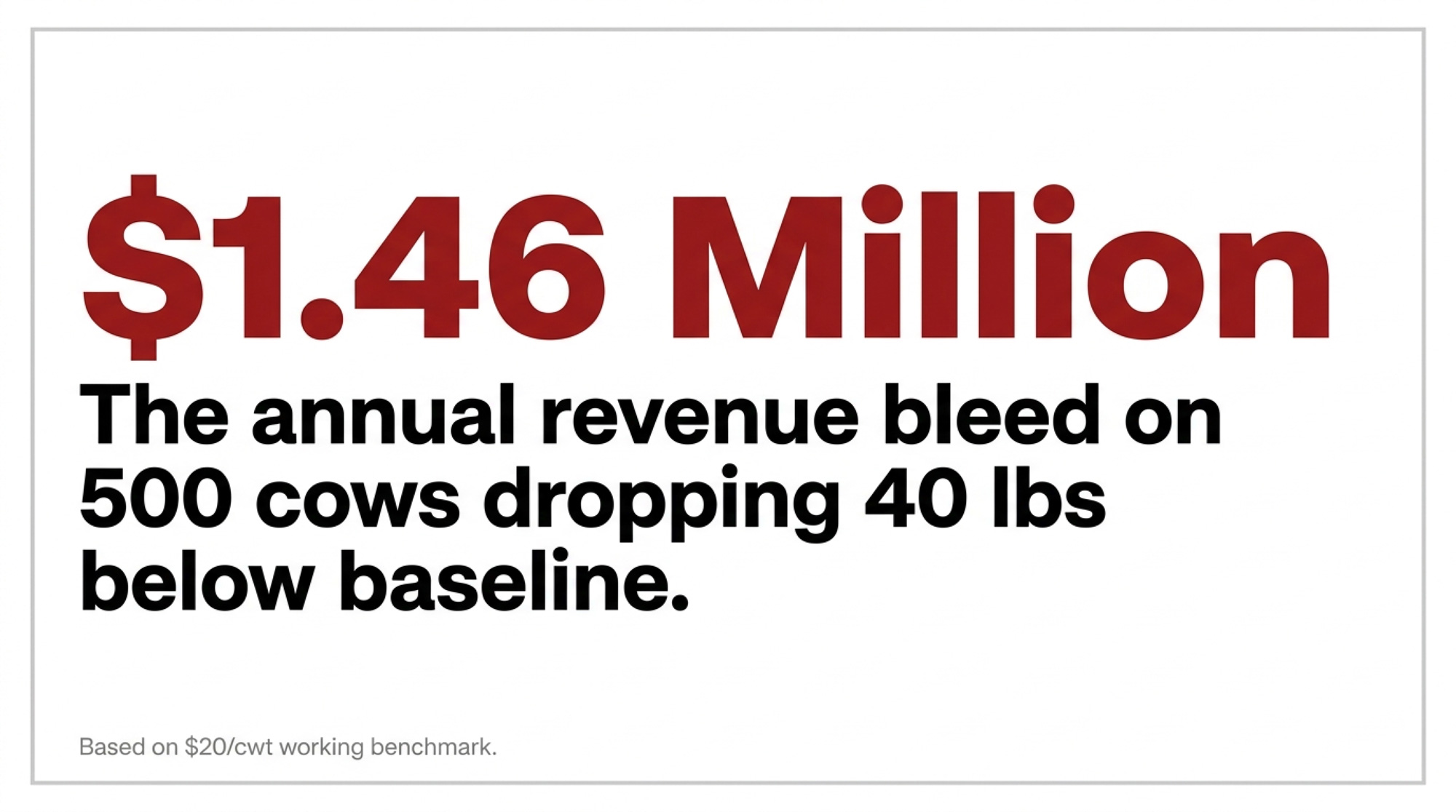
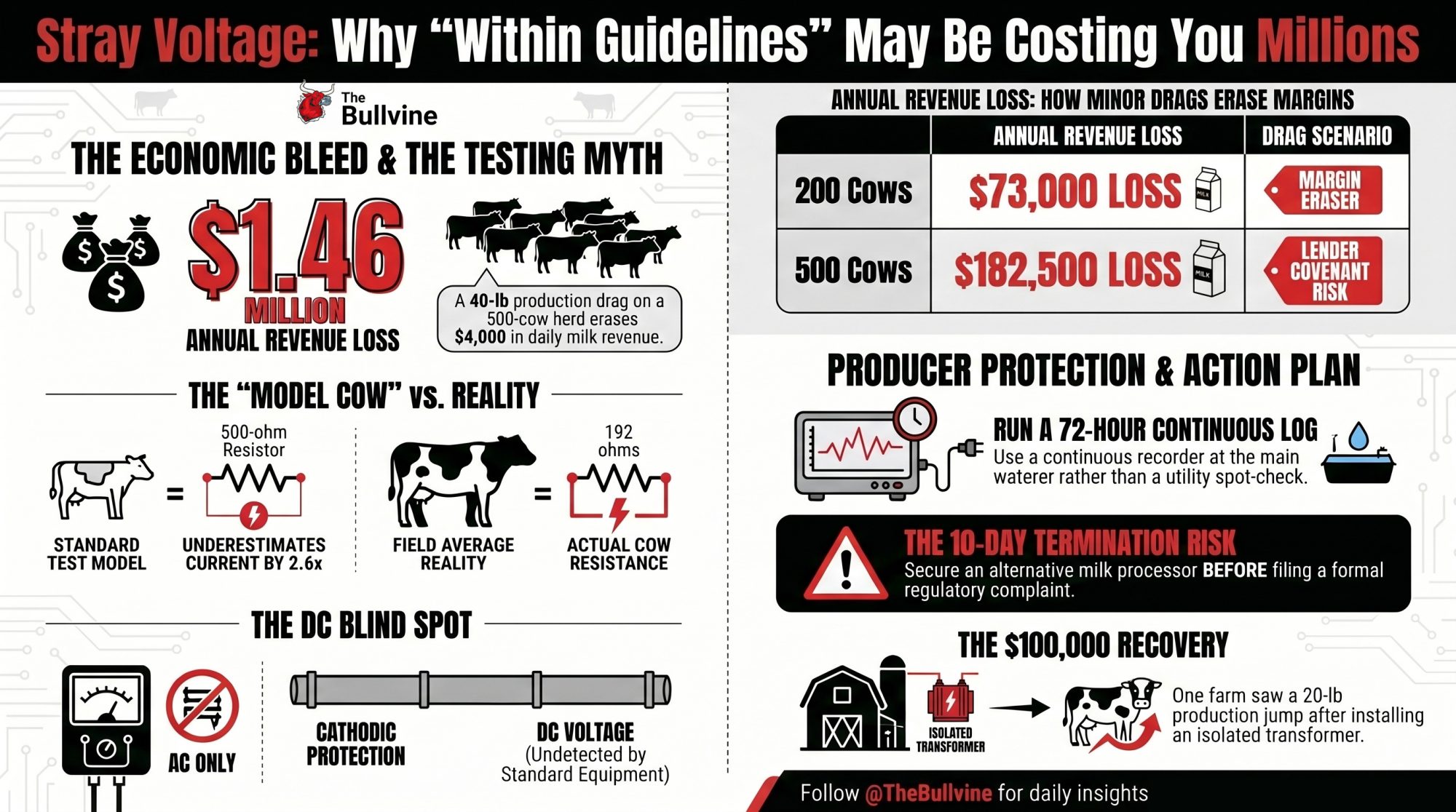
Executive Summary: On 500 cows, 40 lb below baseline at a $20/cwt working benchmark is a $1.46M annual bleed — and the Den Hoeds of Burnett County, Wisconsin say that’s the math they’ve been living since their 2014 freestall build, while every utility test came back “within guidelines.” Jayce Den Hoed told Dairy Star the family fell to 45 lb on 3x milking, calf losses past 50%, and they brought in roughly 2,000 replacement heifers before an independent consultant measured 2–7 volts of ground current moving between two substations 13 miles apart. The pivot point producers need to see: Wisconsin PSC’s own Phase II database — roughly 3,500 investigations — puts average cow-contact resistance at 192 ohms, while the standard utility test uses a 500-ohm resistor, meaning the protocol tests a “model cow” that pulls about 2.6x less current than the field average. Three affirmed Upper Midwest verdicts (Halderson, Vagts, Norman) now total more than $18M, and the Vagts case turned on DC stray voltage from a pipeline’s cathodic protection — a signal standard AC-only utility equipment cannot see. The operator implication scales: a 5-lb drag on 500 cows runs ~$182,500/year; on 200 cows, ~$73,000 — margin-eraser territory that compounds into lender-covenant territory by year five if the cause is never named. The 30-day move is cheap — a 72-hour continuous voltage log at the main waterer, matched to DHIA weights — but Jayce also describes a 10-day certified termination letter from their milk cooperative after they pushed the regulatory complaint, so pull your milk marketing agreement before you file anything. If your herd has sat on an unexplained plateau for more than a year with normal ration, genetics, and health metrics, this is the piece to read before the next consultant retainer clears.
For the Den Hoed family of Frederic, Wisconsin, the crisis didn’t arrive as a storm. It arrived as a slow, 40-pound-per-cow drain that no nutritionist and no vet could explain.

Based on Dairy Star reporting published in August 2025, by the time the family went public their 500-cow herd had fallen to 45 pounds per cow on three-times-a-day milking — down from a pre-crisis baseline of 85. Calf losses, per the same account, had climbed past 50%. Every test the electric utility ran came back “within guidelines.”

“In the midst of it, you feel like a failure,” Jayce Den Hoed told Dairy Star.
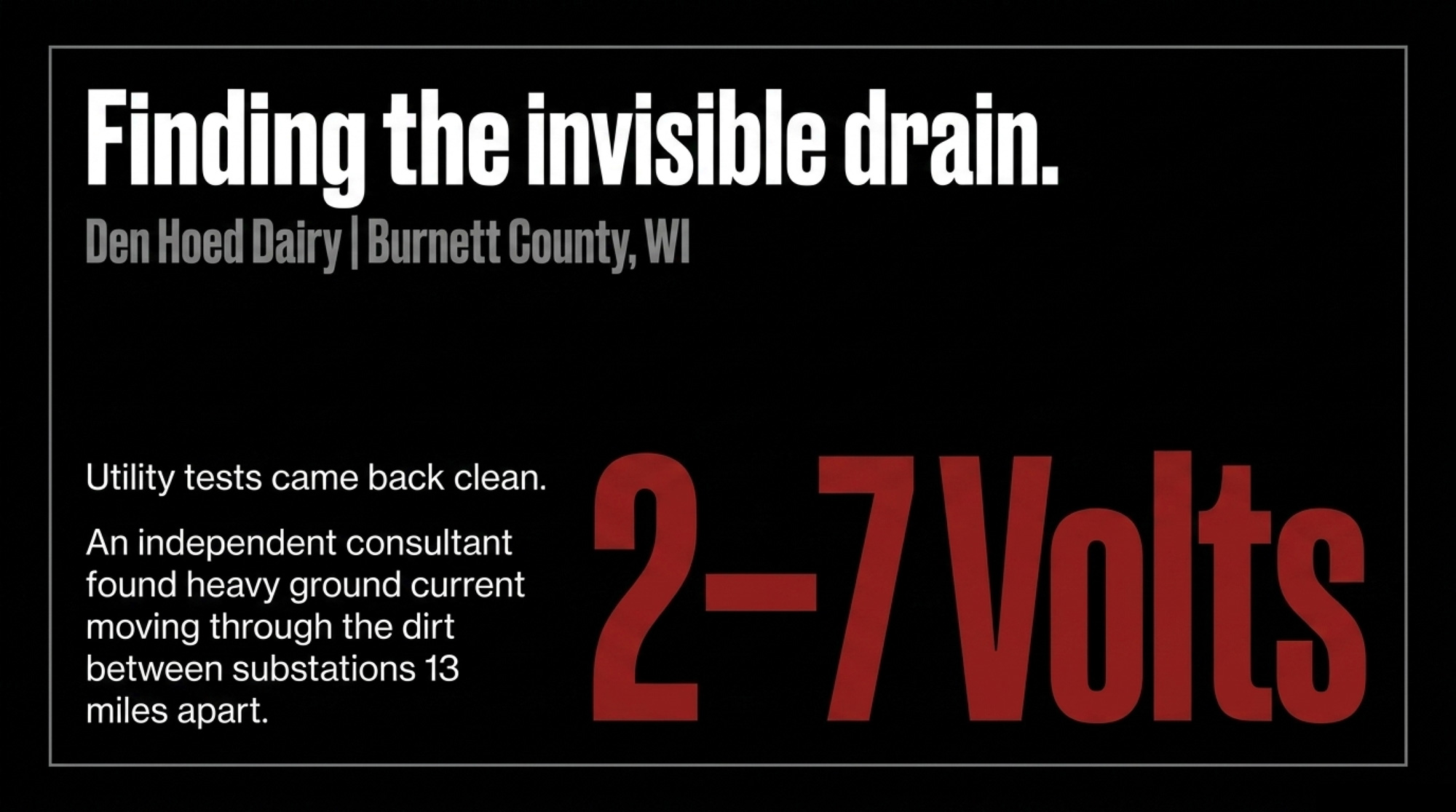
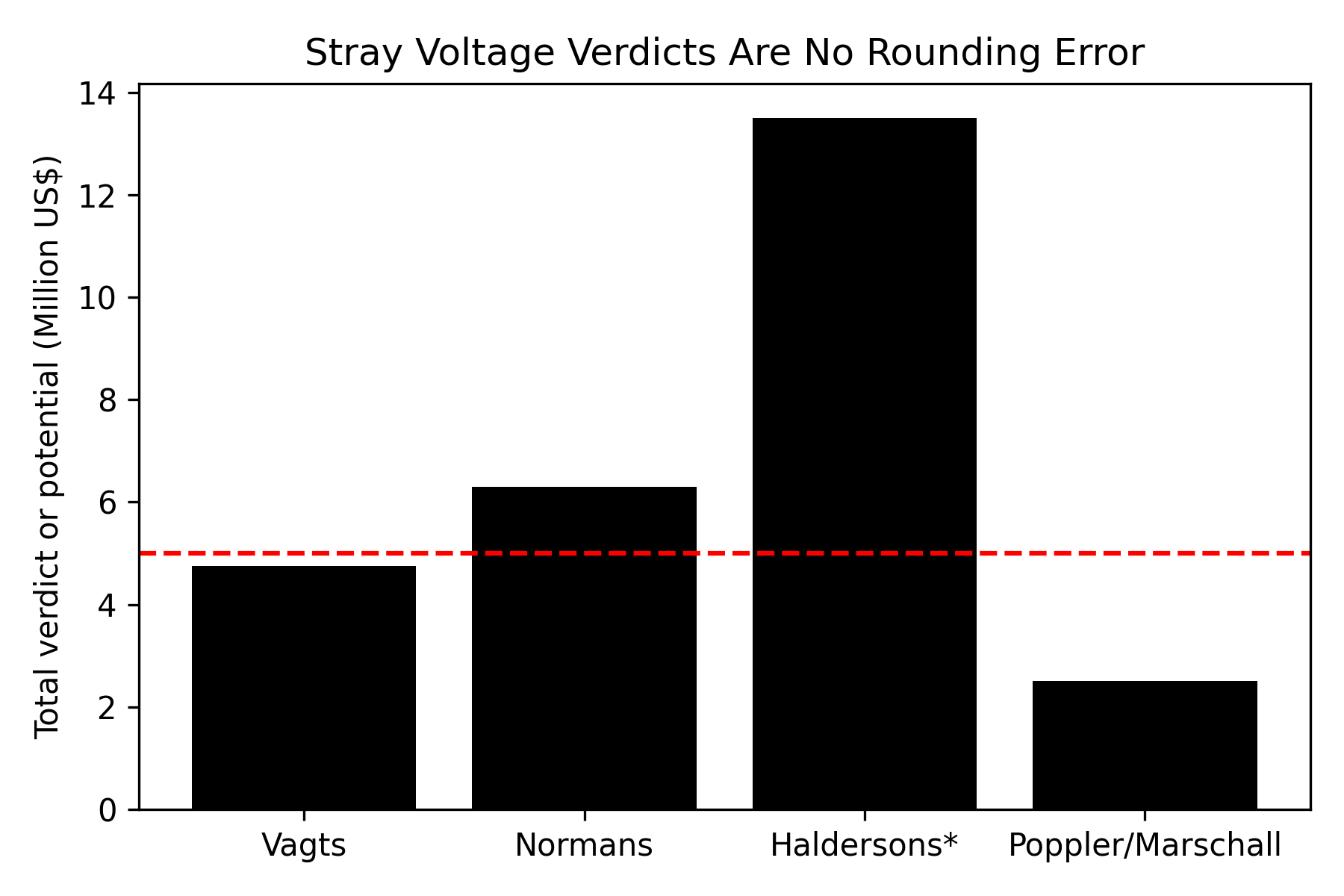
According to the family’s account, they weren’t failing. What they describe is stray voltage — 2 to 7 volts they say an independent consultant measured in the ground between two substations roughly 13 miles apart. The 500-ohm testing resistor built into the standard utility protocol, they argue, was quietly guaranteeing the problem stayed invisible. The Den Hoeds are one of three Upper Midwest families whose cases have, per primary court records, produced more than million in combined jury verdicts and affirmed awards against utilities and a pipeline operator — Halderson v. Xcel/Northern States Power (Trempealeau County, Wisconsin, $4.5M jury verdict August 2017, with a willful-and-wanton finding that opened the door to treble damages up to $13.5M); Vagts v. Northern Natural Gas Company (Fayette County, Iowa, $4.75M jury verdict January 2023, upheld by the Iowa Supreme Court on June 21, 2024); and Norman v. Crow Wing Cooperative Power & Light (Minnesota, $4.86M economic and $1.5M nuisance jury verdict October 2014, affirmed by the Minnesota Court of Appeals, eventually approximately $9M with interest and fees).
The testing standard producers say misses the worst cases

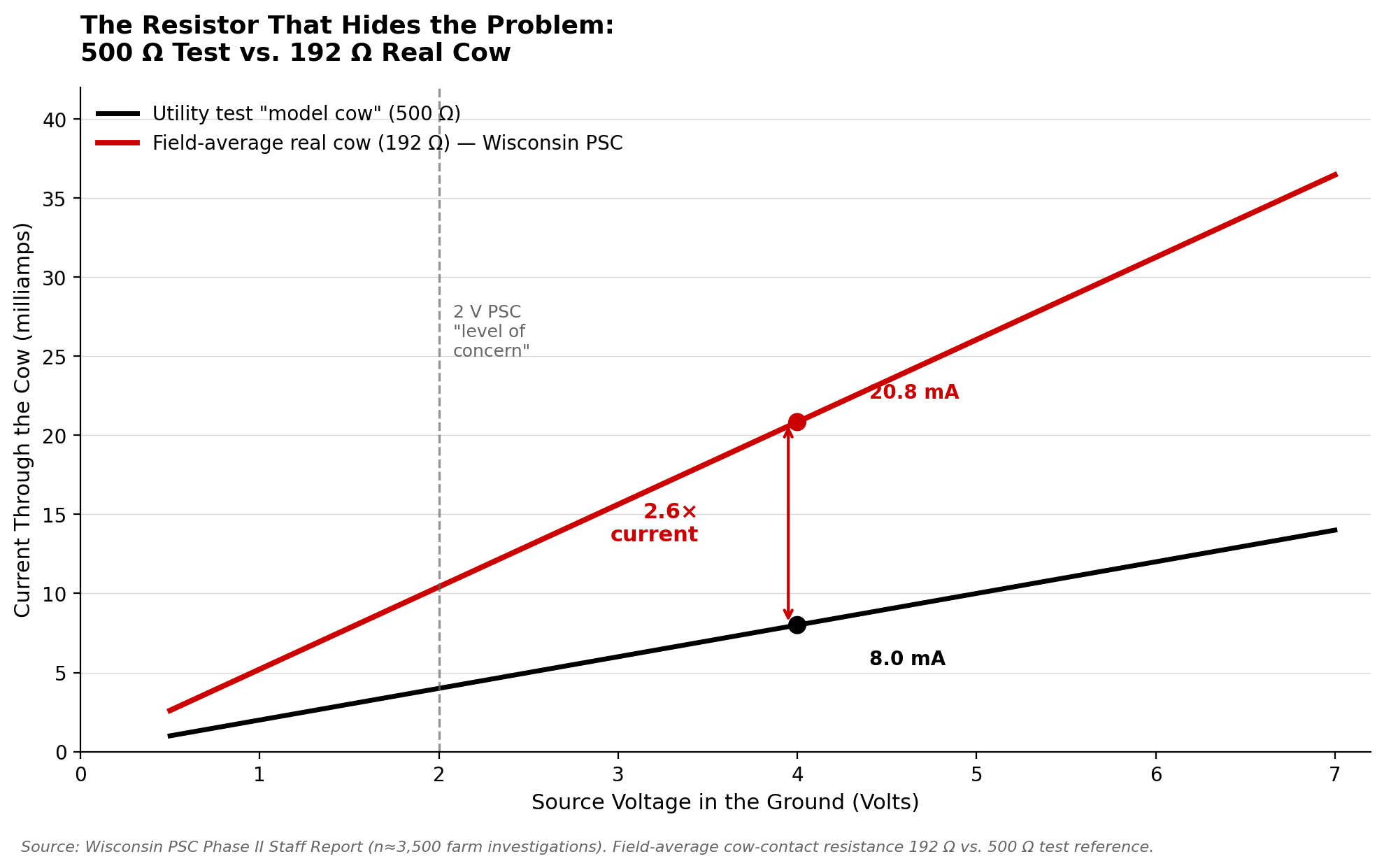
Wisconsin’s Public Service Commission runs one of the largest stray voltage databases in the country, covering roughly 3,500 farm investigations under its Phase II protocol. The average source resistance measured at cow contact points in that database is 192 ohms, per the PSC Staff Report on the Phase II Stray Voltage Testing Protocol. The standard testing resistor used by utilities is 500 ohms — the reference level the PSC’s Phase II documentation identifies for evaluating cow contact current and voltage.
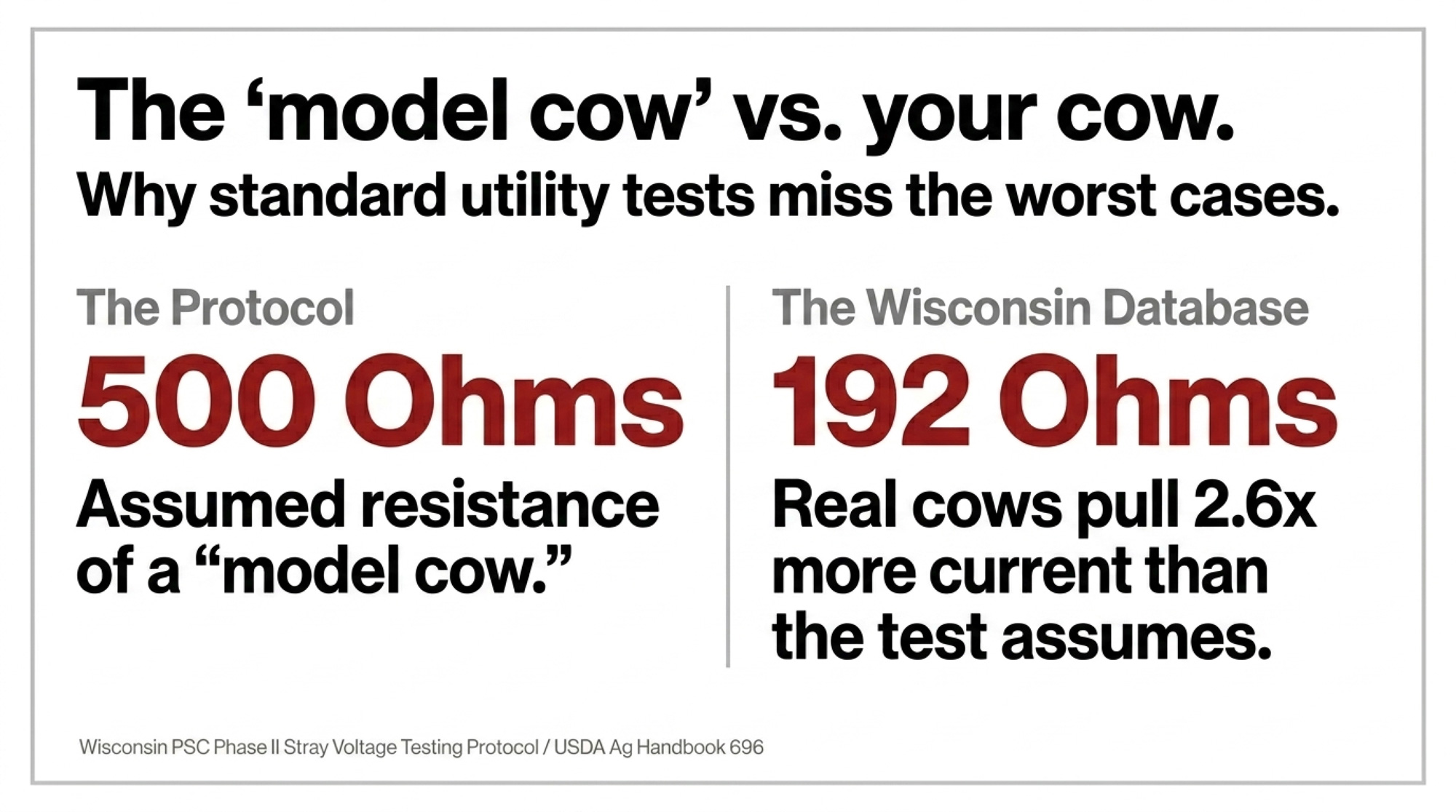
That’s not a rounding issue. The protocol tests a “model cow,” not your cow. At any given source voltage, a real cow circuit at 192 ohms pulls about 2.6 times the current the 500-ohm model assumes (500 ÷ 192 ≈ 2.6). The field average sits well below the test assumption. The Wisconsin PSC was contacted for comment on that framing.
USDA Agriculture Handbook 696 — the federal reference on stray voltage, published in 1991 and not substantially updated since — estimated that a meaningful share of U.S. dairy operations encounter stray voltage at some level. Wisconsin had 5,661 licensed dairy herds as of January 2024 per DATCP records, and the count has continued to fall. Even a conservative prevalence read puts hundreds of Wisconsin dairies somewhere on the spectrum — most sub-clinical, an unknown subset operationally significant.

CaseDefendant & StateSource IdentifiedVerdict / Affirmed Award
Halderson (Aug 2017)Xcel / Northern States Power — Trempealeau Co., WIAC ground current; willful-and-wanton finding$4.5M jury; up to $13.5M (treble)
Vagts (Jan 2023, aff’d June 2024)Northern Natural Gas Company — Fayette Co., IADC stray voltage from pipeline cathodic protection — invisible to AC-only testing$4.75M, affirmed Iowa Supreme Court
Norman (Oct 2014, aff’d)Crow Wing Cooperative Power & Light — MNAC ground current / nuisance$4.86M economic + $1.5M nuisance; ~$9M w/ interest & fees
Den Hoed (active, per Dairy Star Aug 2025)Utility(ies) not yet named publicly — Burnett Co., WI2–7 V ground current between two substations 13 mi apart (per independent consultant)Pending; 11-yr fight per family account

Sources: Trempealeau Co. WI court records (Halderson); Iowa Supreme Court opinion 21-1899 (Vagts, June 21, 2024); Minnesota Court of Appeals (Norman); Dairy Star, Aug 2025 (Den Hoed). The Bullvine has not independently verified the Den Hoed cooperative-side timeline.

Risk concentrates in specific farm profiles, as described in UW Extension stray voltage resources and borne out in the case record of the three affirmed verdicts. Operations sitting between two substations. Barns built on aging grounding infrastructure. Dairies within a mile of recent substation or pipeline construction — as in Vagts, where a Northern Natural Gas cathodic-protection system was identified as the source. The Den Hoeds describe checking the substation and freestall-expansion boxes. Their acute crisis, per the Dairy Star account, tracked with the 2014 freestall build.

When the data said they were fine and the cows said otherwise

The family bought their Burnett County land and moved the operation from Washington’s Yakima Valley in 2010. By 2014 they’d built the new freestall. Then, according to the Dairy Star account, the herd started coming apart in ways nothing on the books could explain.

Production fell to 45 pounds per cow. Calf losses climbed past 50%. Across what the family describes as the crisis window, they brought in roughly 2,000 replacement heifers trying to hold herd size together.
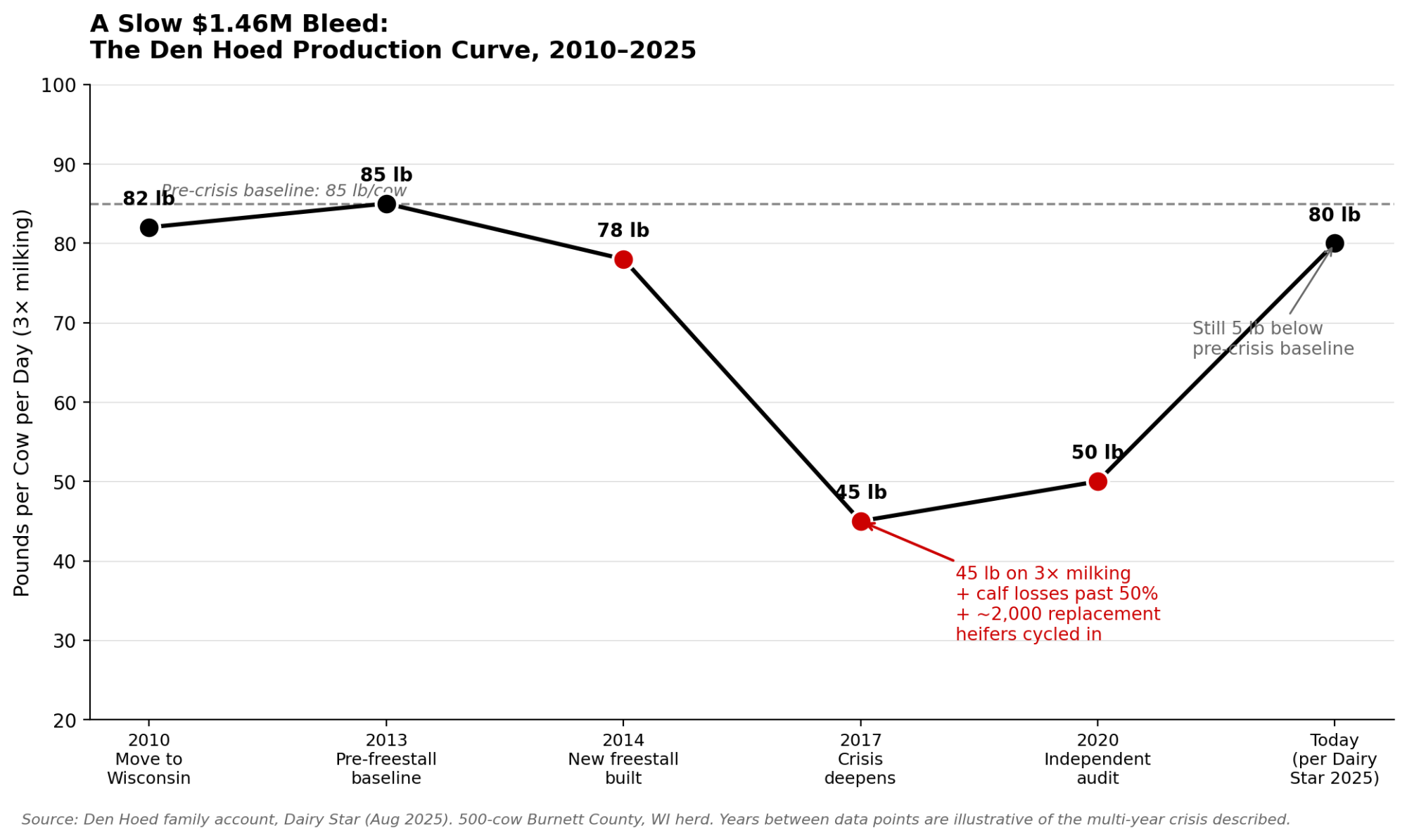
Here’s the math they were living inside. On 500 cows, 40 pounds per cow per day below baseline at a /cwt working benchmark — a defensible midpoint across the 2014–2022 Class III range reported by USDA ERS, which swung from the low teens to the mid-s:

  • Daily loss: $4,000 in milk that never shipped
  • Annual loss: $1.46 million in revenue, before a dollar goes to replacement heifer capital
  • Replacement capital drain: roughly 2,000 heifers cycled through the herd during the crisis window, per the family’s account to Dairy Star
  • Equity strategy: buying nearby land at $2,000 an acre, improving it with wells, carrying it on the books at closer to $6,000 to keep the operating line alive.

“We were buying land,” Jayce told Dairy Star, “so we could keep borrowing.” That’s not growth. That’s a financing strategy to survive.

The 10-day letter, as the family describes it

When the family pushed their electric cooperative into a formal regulatory process, the consultant they’d hired warned them what might come next. Jayce’s account to Dairy Star:
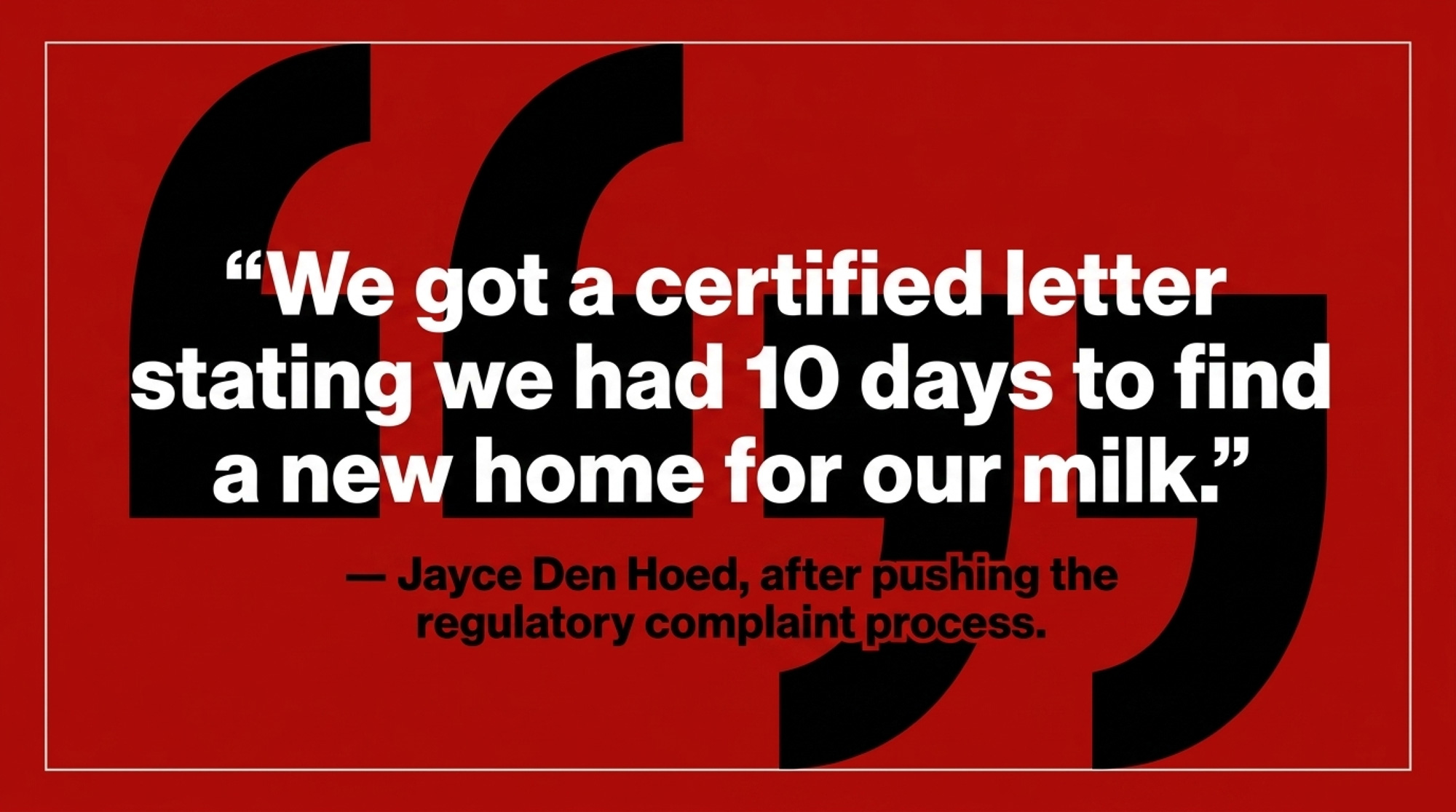
“He told us that they all borrow their money from the same place. We thought he was nuts for a while, but sure enough there started being discrepancies in our milk tests and we got a certified letter stating we had 10 days to find a new home for our milk.”

The Bullvine has not independently verified the milk-test sequence or the termination timeline described in that quote. The cooperatives involved are not identified in the Dairy Star account or elsewhere in the public record, and have not been reached for comment. If any party identified in subsequent reporting wishes to respond, this piece will be updated.

What is verifiable: milk marketing cooperatives and rural electric cooperatives in the Upper Midwest often draw on overlapping federal financing sources, including USDA Rural Utilities Service, CoBank, and Farm Credit. How those shared financing relationships shape — or don’t shape — the handling of member disputes is a question the Den Hoed account raises. Not one the public record currently resolves.

⚠️ PRODUCER WARNING: Read before you file

The risk below is drawn from Jayce Den Hoed’s published Dairy Star interview; The Bullvine has not independently verified the cooperative-side timeline.

If you’re planning to file a PSC stray voltage complaint or commission an independent audit that could contradict your utility’s findings, the Den Hoed account describes a risk you need to price in before you act.

According to Jayce’s Dairy Star interview, the family received a certified letter giving them 10 days to find a new home for their milk after pushing the complaint process forward. The Bullvine has not independently verified that timeline, and the cooperatives involved are not public. But the precedent described in a published, attributed account is one a prudent operator cannot ignore.

Before you file or audit:

  • Pull your milk marketing agreement and read the termination-notice clause.
  • Identify at least one alternative processor inside your hauling radius.
  • Get a written quote for a temporary hauling contingency.
  • Talk to your lender before — not after — initiating the process.

Do this in the weeks before you act. Not the ten days after.

The breakthrough no one was looking for

Standard utility testing under the Wisconsin PSC Phase II protocol measures voltage at cow contact points inside the parlor, evaluates both primary and secondary sources, runs a 24-hour motor-start transient recording in most complaint cases, and reports against a 1-milliamp / 2-volt level-of-concern threshold at the cow. None of that architecture, the Den Hoed consultant concluded, was going to find what was happening on their farm.

According to the family’s account, when an independent stray voltage specialist finally ran the farm, readings showed 2 to 7 volts in the dirt itself — not at the waterers, not at the feed alley, not in the parlor. They say the voltage persisted even after the farm’s own power lines were fully disconnected, and that ground current was traveling between two substations 13 miles apart.

“If you place your manure pit wrong on your farm, in relation to the transformer, your well and distribution boxes,” Jayce put it, “you can sink your farm.”

The Den Hoeds argue the utility’s “within guidelines” reports were technically accurate against the protocol the utility was using. And that the protocol was looking in the wrong place.

A fix that paid back in months — if you can find the problem

Compare the Den Hoed trajectory to a Minnesota operation that eventually got to the other side. As reported in Bovine Veterinarian (September 2022) and Bullvine’s November 2025 stray voltage coverage, Olmar Farms — Jill and Brian Nelson’s registered Holstein operation near Sleepy Eye — went through roughly eight years of standard utility testing by Brown County Rural Electrical Association before an independent specialist identified the source. The Nelsons paid almost $100,000 out of pocket to install three-phase electric service and an isolated transformer. Production gained nearly 20 pounds per cow per day once the isolated transformer was in. In summer 2017, when most Upper Midwest herds are trying to hold ground through heat stress, not add it.

On 400-plus cows at prevailing 2017 milk prices, Bovine Veterinarian reported the capital outlay paid back inside a few months on recovered milk alone. The gap between the Den Hoed eleven-year fight and the Olmar eight-year fight isn’t the fix. It’s how long the standard testing protocol stayed between each family and the answer.

Why did standard utility testing miss what the Den Hoeds say was there?

Standard protocols evolved around secondary-system faults: a bad neutral, a grounding failure inside a farm’s own distribution. Those show up at cow contact points within a short testing window, and the 500-ohm resistor assumption works well enough to catch them. Ground current between distant substations — or from a pipeline cathodic-protection system, as in Vagts — is a different animal.

It’s a primary-transmission or external-source problem. And it can run on DC. That matters, because cathodic protection systems on buried pipelines work by injecting low-voltage direct current into the ground to prevent steel pipe from corroding — and standard AC-only utility test equipment cannot see DC signals at all. That’s the blind spot Lawrence Neubauer exposed on the Vagts farm near West Union, Iowa in September 2020, finding DC stray voltage at cow-contact points that AC-only testing had been ruling out for years. The problem may also only spike during specific load conditions. At night. During irrigation season. When a neighbor’s large motor cycles on. A 48-hour spot test at the wrong time of week can catch nothing.

An independent audit with AC and DC capable, millisecond-resolution equipment — Fluke or Dranetz class instruments, run continuously for 72 hours or longer — is what UW Extension stray voltage specialists and the consultants in the Vagts, Norman, and Halderson cases generally used to find what the utility testing missed. AC-only equipment, by design, would have missed the cathodic-protection source that won the Vagts verdict. For the full technical breakdown, see our Is Stray Voltage Stealing 20 Pounds Per Cow from Your Dairy?

That’s the diagnostic gap the Den Hoed account surfaces. It’s also the connective thread across the three Upper Midwest verdicts producers have so far won against utilities and pipelines. The full pattern across those named cases — Vagts, Normans, Haldersons — is broken out in our $18 Million in Stray Voltage Verdicts and a $3,000 Test No One Told Them About. If you read one companion piece before calling a consultant, that’s it.

How much does an unexplained production gap actually cost your operation?
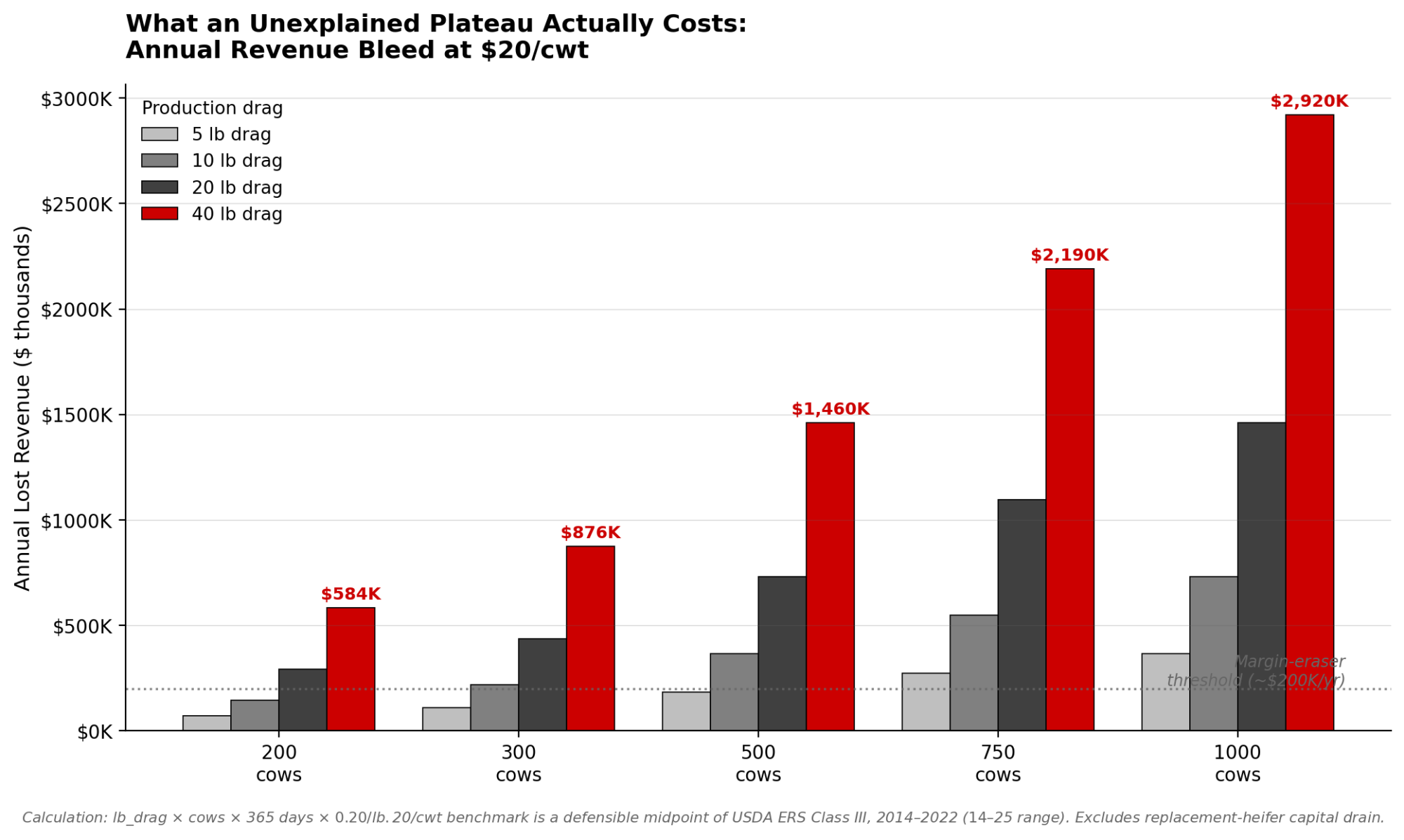
Before you budget another consultant retainer, run the math on what the gap is already costing you. A 5-pound-per-cow-per-day drag on a 500-cow herd at a $20/cwt working benchmark (USDA ERS Class III ranged roughly $14–$25 across 2014–2022) works out to roughly $182,500 in annual lost revenue. On a 200-cow herd at the same 5-lb drag, it’s about $73,000 a year. Not a farm-ender in year one. A margin-eraser.

By year three, with compounding debt service, working capital tightens. By year five, on standard leverage ratios, the equity position for a mid-size Wisconsin operation can cross from “restructure” to “exit” without anyone ever naming the actual cause — the same lender-covenant threshold mapped in our The $287,500 Equity Decision Facing Mid-Size Wisconsin Dairies.

The severe case is the $1.46 million annual bleed before replacement heifer capital. Add the multi-year heifer drain the Den Hoeds describe and you’re into fourth-generation-scale damage — the same pattern that shows up in our 490 PA Dairies Gone in 2025. Two Spent $40,500 to Not Be Next.

Is the pattern showing up on your farm, and how would you know?
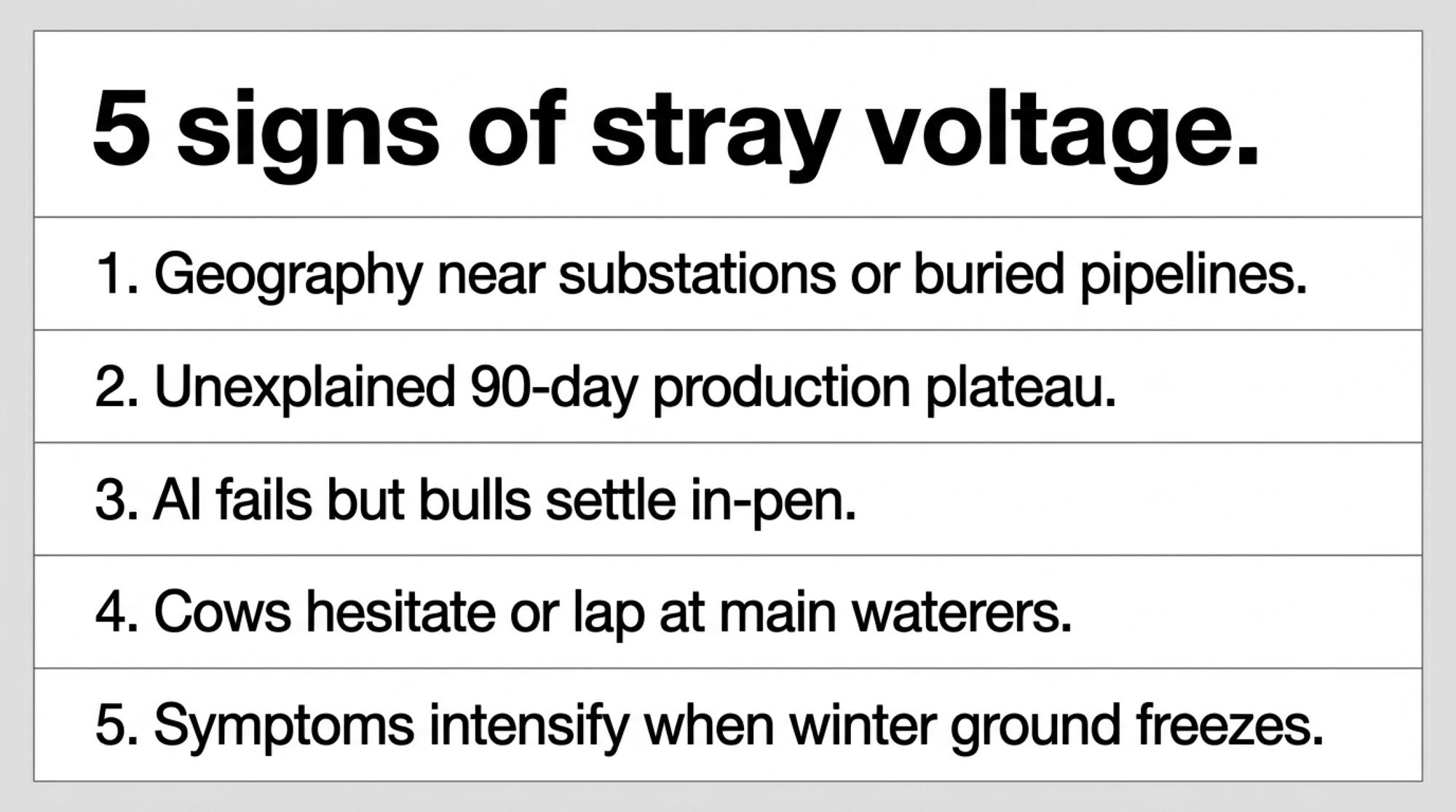
The symptom pattern, consistent across UW Extension stray voltage resources and the Vagts, Norman, Halderson, and Olmar case records, is specific enough to use as a screening tool. Production plateau despite optimized nutrition. Cows hesitating or lapping at waterers rather than drinking deep, or avoiding one wet metal spot. Breeding failure at normal investment levels — a bull works in the pen but AI doesn’t hold. Calf mortality that won’t map to a consistent pathogen. Elevated culls without a clean reason.

And critically: symptoms that get worse in winter, when frozen ground intensifies current conduction, and ease in summer. If three or more of those fit your last two years, the cheapest test you haven’t run is a 72-hour continuous voltage recording at the main waterer. Not a utility spot-check. A continuous log. Done before the next consultant retainer gets cut.

Options and trade-offs

Do this within 30 days — install a continuous monitor. A 72-hour continuous voltage recorder at the main waterer, logged against daily milk weights for the same window, typically runs a few hundred dollars in rental from UW Extension or a stray voltage consultant. A fraction of a single reproductive workup on a mid-size herd. Matched against DHIA records from the same dates, it either exonerates the electrical system or gives you the first piece of hard evidence you’ve ever had. The limit: you still need a qualified specialist to interpret anomalies and rule a DC ground-current source in or out. But you’re no longer testing blind.

Commission an independent electrical audit (90-day path). A stray voltage specialist running AC and DC capable millisecond-resolution equipment typically charges in the low four figures for a full protocol — cheaper than one round of reproductive workups on a mid-size herd, and roughly a week of the milk an affected herd is already losing on a 5-lb-per-cow drag. Ask the consultant directly for a current quote and scope. Trade-off: results that contradict a utility’s testing trigger a regulatory process you’ll need to be ready to run. Don’t commission this test unless you’re prepared for what you might find — and you’ve read the Producer Warning above.

File a PSC complaint with your documentation package already built (365-day path). Wisconsin’s DATCP Rural Electric Power Services program and the PSC’s three-phase investigation process give producers a real lever. The Den Hoeds describe a multi-year process through those channels. Trade-off: the 10-day termination precedent in their account isn’t something a prudent operator can ignore. Secure an alternative processor in your hauling radius before filing anything.

Remediate after diagnosis — isolated transformer or bonding fix. The Olmar Farms remediation ran about 0,000 and paid back inside a few months on production recovery, per Bovine Veterinarian. The specific cost and structure of the Den Hoed remediation are not public. Trade-off: remediation without litigation is faster but forfeits recovery of years of losses. Remediation with litigation recovers losses but runs two to five years in parallel. With three affirmed Upper Midwest verdicts totaling more than million across 2014–2024, early documentation materially changes what a producer can recover.
Key takeaways

  • If your herd has run more than 90 days below DHIA-projected baseline with no confirmed diagnosis, and your ration, genetics, and health metrics are normal — budget for an independent electrical audit before the next consultant engagement.
  • If your farm sits between two substations, built a new freestall in the last decade, or is within a mile of recent substation or pipeline construction — install the continuous monitor as baseline documentation, regardless of current symptoms.
  • Pull every utility test report you’ve ever received. Matched against DHIA production records from the same dates, those documents are the strongest evidence any future case will have.
  • If your utility’s standard test doesn’t include DC capability, outdoor ground contact points, and a minimum 48-hour continuous recording window — you don’t have a stray voltage test result. You have a partial snapshot.
  • Before filing any regulatory complaint — secure an alternative processor inside your hauling radius and review your milk marketing agreement’s termination-notice clause.
  • If symptoms intensify November through March and ease in summer — document the seasonal pattern before August. Spot-checks run in summer will miss a textbook signature.
The four-test question. When was the last time an unexplained production gap on your farm was evaluated against the right standard, with the right equipment, at the right contact points, for the right duration? If you can’t answer yes to all four, the next conversation with your nutritionist probably isn’t going to close it.

According to the August 2025 Dairy Star feature, the Den Hoeds are running at 80 pounds per cow today. Five pounds below their pre-crisis baseline of 85. The 24/7 voltage meter is still on the wall. “What damage has been done to the DNA that they’ll pass on to future generations?” Jayce asked. “Will it ever truly go away?”

Nobody has answered that question for the Den Hoeds yet. The full barn-math model — cost-per-cwt impact by herd size, the replacement-heifer capital drain, and the lender-covenant thresholds that move an operation from restructure to exit — is coming in next week’s Bullvine Weekly. If your production plateau has been unexplained for more than a year, that’s the piece to read before the next vet visit.

📋 Am I at risk? A 5-point screening checklist (screenshot this)

Risk SignalWhy It Points to Stray VoltageSeverity WeightScore
Grid geography — between two substations or within 1 mile of recent substation/pipeline buildSource of every named verdict (Halderson, Vagts, Norman); ground current travels miles between substationsHigh1 pt
Unexplained production plateau — ≥5 lb/cow below DHIA projection for 90+ days, normal ration & geneticsSub-clinical current depresses milk letdown; nutrition/genetics workups will not close the gapHigh1 pt
Calf and repro signature — calf mortality with no consistent pathogen; AI fails where bull settlesStray current disrupts implantation and immune development; bull-vs-AI gap is a textbook tellMedium1 pt
Waterer behavior — cows hesitate, lap, or avoid one wet metal spot rather than drinking deepCows feel current at the wet metal contact point before any meter doesMedium1 pt
Seasonal pattern — symptoms intensify Nov–Mar, ease by midsummerFrozen ground intensifies conduction; spot-checks run in summer will miss the signatureHigh (diagnostic)1 pt
Total Score30-Day Move90-Day Move
0–2Document baselines; pull every utility test report you’ve received and match to DHIA recordsRe-screen quarterly
372-hr continuous voltage log at main waterer before next consultant retainer clearsEngage independent specialist if anomalies appear
4–572-hr log + commission AC/DC-capable independent auditRead Producer Warning; secure alternate processor BEFORE filing PSC complaint

Symptom set drawn from UW Extension stray voltage resources and the Vagts, Norman, Halderson, and Olmar Farms case records.

Score one point for each statement that applies to your operation over the last 24 months.

  1. Grid geography. Your farm sits between two substations, or within one mile of recent substation, transmission, or buried pipeline construction.
  2. Unexplained production plateau. Your herd has held 5 or more pounds per cow per day below DHIA-projected baseline for 90+ days despite normal ration, genetics, and health metrics.
  3. Calf and repro signatures. Calf mortality that won’t map to a consistent pathogen, or AI conception that won’t hold on cows a bull will settle in-pen.
  4. Waterer behavior. Cows hesitating, lapping, or avoiding one wet metal spot rather than drinking deep at the main waterer.
  5. Seasonal pattern. Symptoms intensify November through March when the ground freezes, and ease measurably by midsummer.

3 or more: budget a 72-hour continuous voltage log at the main waterer before your next consultant retainer clears. 4 or more: commission an independent AC/DC audit, and read the Producer Warning above before you file anything.

Complete references and supporting documentation are available upon request by contacting the editorial team at editor@thebullvine.com.

Learn More

The Sunday Read Dairy Professionals Don’t Skip.

Every week, thousands of producers, breeders, and industry insiders open Bullvine Weekly for genetics insights, market shifts, and profit strategies they won’t find anywhere else. One email. Five minutes. Smarter decisions all week.
NewsSubscribe
First
Last
Consent

Vagts, Normans, Haldersons: $18 Million in Stray Voltage Verdicts. And a $3,000 Test No One Told Them Existed.

Three dairy families fought utilities for decades over unexplained herd losses. The testing blind spot and insurance trap they exposed threatens every operation milking on concrete.

Executive Summary: Three Upper Midwest dairies have already won more than $18 million in stray‑voltage verdicts, and the barn‑math says a hidden 4 lb/cow/day loss on a 500‑cow herd can quietly burn about $185,000/year off your milk check. The article walks through what happened to the Vagts (Iowa), Normans (Minnesota), and Haldersons (Wisconsin) when DC current from utility and pipeline systems ran through concrete barns while standard AC‑only tests kept saying “you’re fine.” It shows how insurance language like “death by electrocution” and “necessary suspension of operations” often pays for dead cows and wiring, but not years of lost milk if you keep milking through the problem. You’ll see exactly when to suspect voltage — cows avoiding one wet metal spot, 2–4 lb/cow/day unexplained loss, and no clear biological cause — and why a low‑thousands‑of‑dollars AC+DC test is basically eight days’ worth of the milk you’re probably already losing. There’s a clear 30‑day plan: schedule an independent DC‑capable test if you see those red flags, email your agent a 4–7 lb/cow/day scenario and ask what actually pays, and start logging production, behavior, and utility work like a future plaintiff. If you’re milking a few hundred cows or more on concrete, especially on older rural lines, this is the kind of “invisible loss” story you read once and then immediately go check your own numbers.

dairy stray voltage

Editor’s note: These cases are centered in the Upper Midwest United States, but the technical blind spots in stray‑voltage testing and the “Catch‑22” in farm insurance language are risks any modern dairy on concrete can face, regardless of region.

Lawrence Neubauer walked onto the Vagts dairy near West Union, Iowa, in September 2020 and quickly found DC stray voltage at cow‑contact points. He spent three more days documenting it. By then, Mark, Joan, and Andrew Vagts had already burned through about seven years of vet calls, nutrition consults, and equipment checks trying to explain why cows that looked “fine” on paper were sick, nervous, and underperforming.

Their troubles started after 2013, when a nearby Northern Natural Gas pipeline’s cathodic protection system began leaking current into their ground. A Fayette County jury later awarded the Vagts $4.75 million — $3 million in economic damages, $1.25 million for personal inconvenience and distress, and $500,000 for loss of use and enjoyment of their property. The Iowa Supreme Court upheld every dollar on June 21, 2024.

That’s one family. Across Iowa, Minnesota, and Wisconsin, stray‑voltage verdicts now total well over $18 million, even if you use conservative numbers. The real total is closer to $20–30 million once you add interest, fees, and multiple trials. Farm legal expert Roger McEowen, a professor at Washburn University School of Law whose March 2026 analysis was published through Kansas State’s AgManager, put it bluntly: if this happened on your farm tomorrow, your insurance probably wouldn’t cover the part that hurts the most.

What’s Changing — and Why These Verdicts Matter Now

Stray voltage used to be a weird problem from the 1980s that only showed up in old extension bulletins. Four recent cases have turned it into a very current, very expensive risk.

In Minnesota, Randy and Peggy Norman ran a dairy near Pine River and did a lot of things right. Minnesota Lawyer reports that in 1994, they were 27 percent above the state average in milk production, and by 2012, they were 20 percent below. Over those years, their cows’ health would wax and wane without a good diagnosis that would fix the issue, their attorney Jeremy Stevens told the paper. “The cow would be culled or die.” After repeated accusations that they were mismanaging the herd, the Normans’ lender issued an ultimatum in 2012: sell the cows and quit milking. They did.

A Cass County jury trial in October 2014 produced the largest stray‑voltage jury award in Minnesota history: $4,861,478 in economic loss and $1.5 million in nuisance damages. With interest and fees, the total climbed to roughly $6.3 million. The Minnesota Court of Appeals affirmed it, and trial‑law publications later highlighted the case as a landmark.

Near Galesville, Wisconsin, Paul and Lyn Halderson operate a nearly 1,000‑cow dairy. Their lawsuit alleged that Northern States Power (an Xcel Energy subsidiary) had found “excessive voltage” in one of their barns starting in 1996 and never told them. Over the next 15 years, the Haldersons watched cows struggle with health and production while enduring accusations that they were substandard farmers. In 2011, they hired their own consultant, who traced the high electricity levels to the utility’s distribution system. Court records show the family claimed $5.8 million in lost profits between 2004 and 2011. A Trempealeau County jury found Xcel’s conduct “willful, wanton or reckless” and awarded just under $4.5 million — an amount that, under Wisconsin statute, can be tripled to $13.5 million when a utility violates certain safety laws. Appeals and post‑trial motions will determine the final number.

In Wright County, Minnesota, a jury initially awarded Harlan and Jennifer Poppler and Roy Marschall more than $750,000 in a stray‑voltage case against Wright‑Hennepin Cooperative Electric Association. After the Minnesota Court of Appeals ordered a new trial on damages, a second Wright County jury in 2015 returned a verdict of nearly $2.5 million. Minnesota’s appellate courts later upheld that award.

Taken together, these cases show a pattern where farm families spent years battling unexplained herd problems and litigating with utilities before juries and judges ultimately ruled in their favor. The cases didn’t just move money; they pulled back the curtain on how testing protocols, infrastructure, and insurance language actually behave when current starts leaking through concrete.

And in every single case, the big money didn’t come from insurance.

How This Actually Shows Up in Your Barn

The Vagts didn’t sit on their hands. They did what you’d probably do.

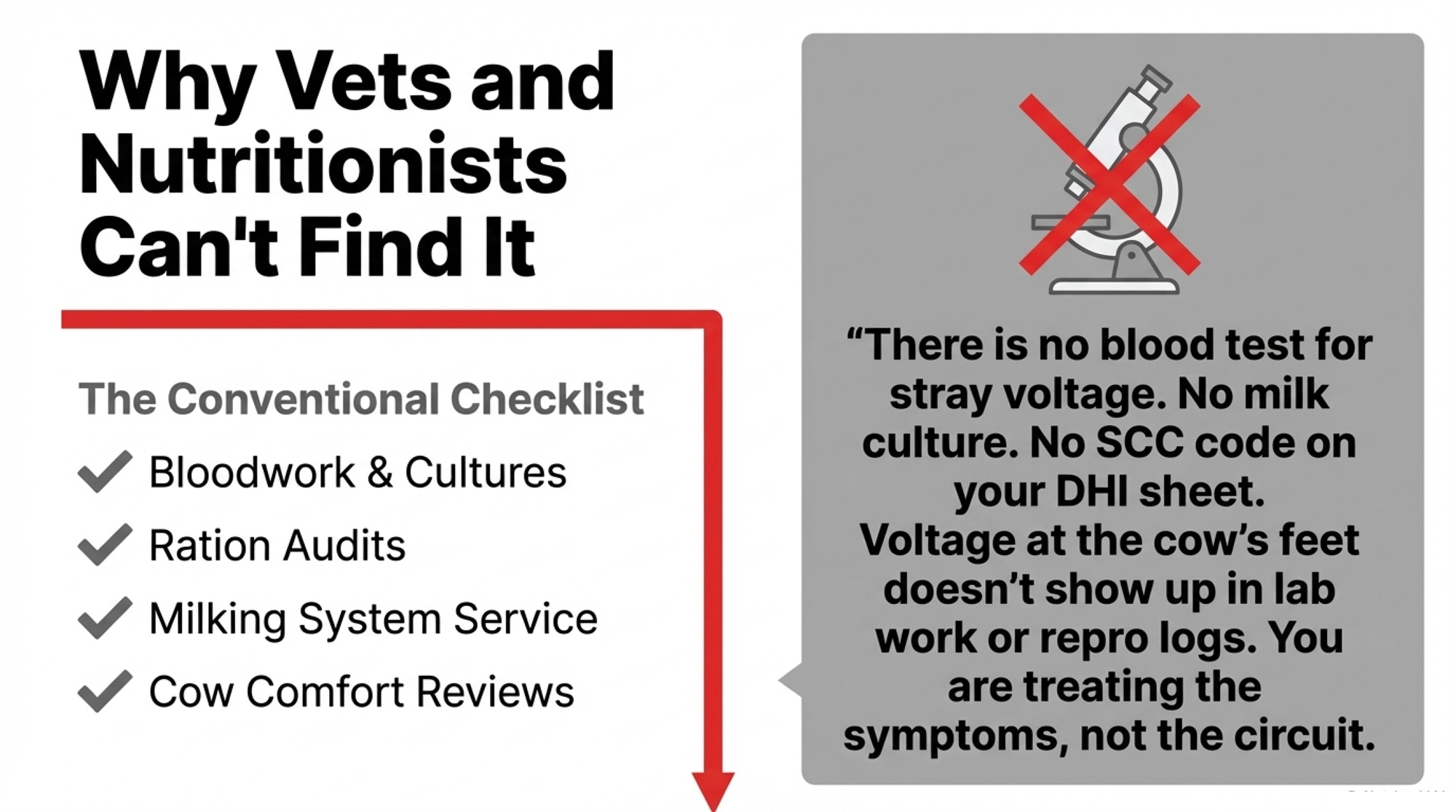
They called the vet. They adjusted rations with their nutritionist. They had the milking system serviced. They checked ventilation, bedding, and cow flow. For years, every professional who walked through that barn worked through the same checklist you and your advisors would use: bloodwork, cultures, necropsies, ration audits, cow comfort reviews. Nobody found a single “smoking gun.”

Here’s the hard truth buried in Wisconsin’s own stray‑voltage program documents: ” Stray voltage “is an electrical issue and can only be identified through standardized electrical testing protocols. There’s no blood test for it. No milk culture. No special SCC code on your DHI sheet.

Your vet can see the effects — chronic mastitis, odd behavior, production that doesn’t match the ration — but her toolkit is built to rule out disease, metabolic issues, and management mistakes. Voltage at the cow’s feet doesn’t show up in her lab work. It’s not in your nutritionist’s software. It’s not in your repro logs.

So how much did all that troubleshooting cost the Vagts before Neubauer showed up with the right meter?

You don’t have a published survey that nails down that figure. But on a 400–500 cow herd chasing an unresolved “mystery problem,” it doesn’t take long for extra vet calls, nutrition visits, milking‑equipment service, and outside consultants to add up to a noticeable line item. Over several years, that easily climbs into the five‑figure range — money that, in hindsight, would have covered a comprehensive independent electrical test many times over.

Then layer on what the Vagts eventually proved in court: about $3 million in lost production.

The Three Blind Spots That Let Stray Voltage Hide

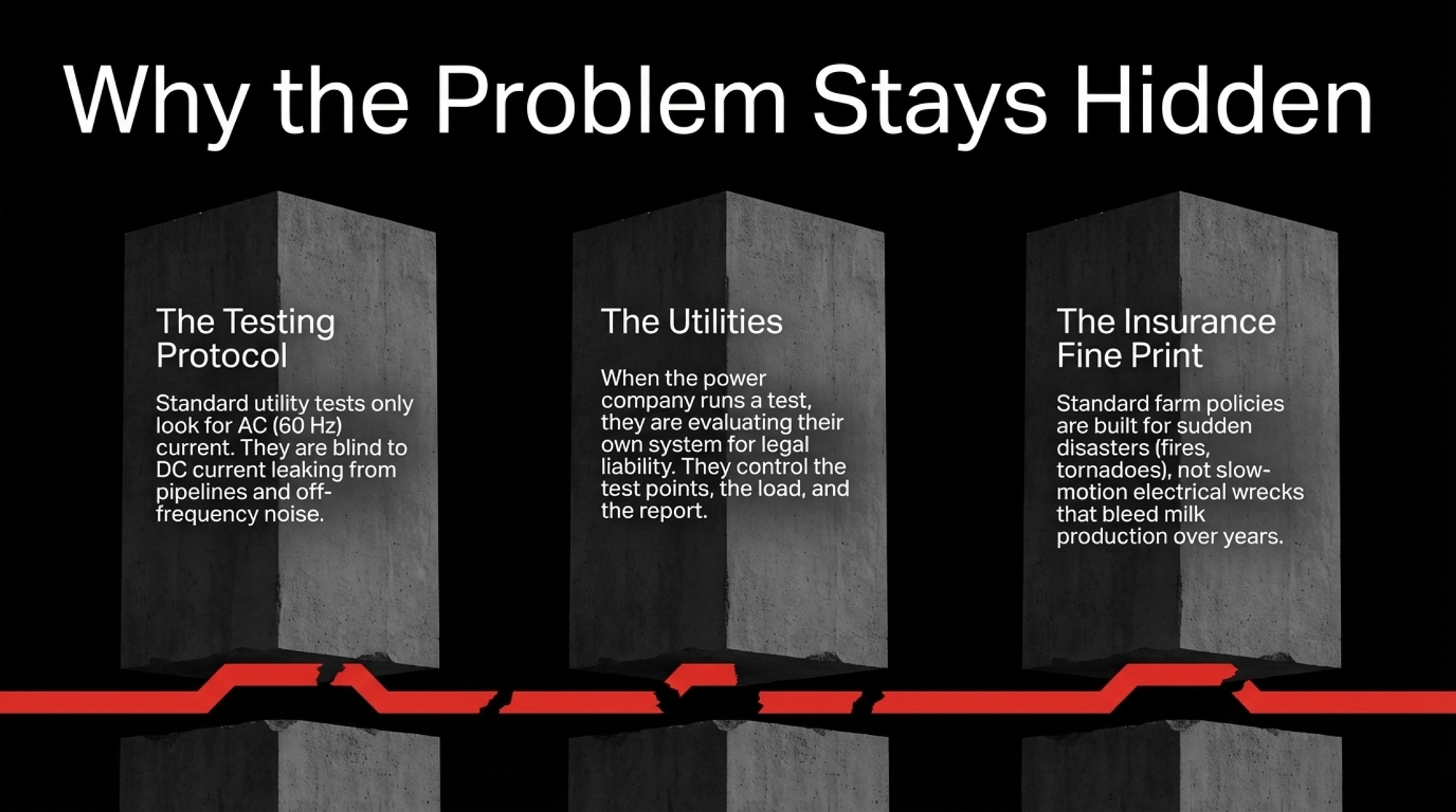
Stray voltage becomes expensive because three systems you rely on — testing, utilities, and insurance — are built with blind spots.

Blind Spot 1: The Testing Protocol

Wisconsin’s PSC Phase II protocol — the standard many utilities use and point to — explicitly measures only AC, 60 Hz, RMS, steady‑state animal‑contact voltages at cow contact points. That’s the right test if your problem is classic 60‑cycle current leaking off the utility neutral. It’s almost useless if the source is DC stray voltage from a pipeline rectifier, like on the Vagts farm, or if the current rides in on frequencies outside the 60 Hz band.

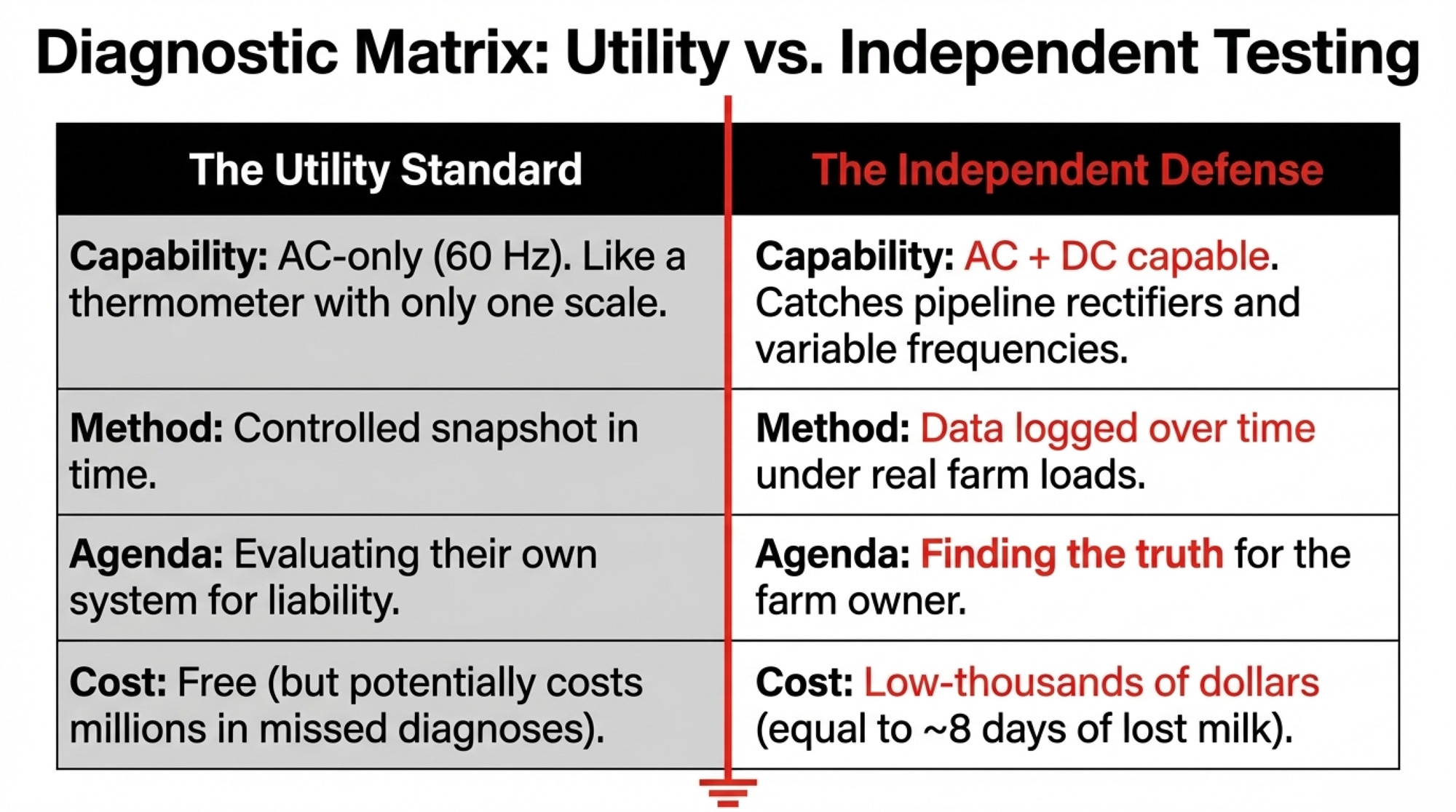
When utilities test under that protocol, they’re essentially using a thermometer that only reads one scale. If the problem is DC, the meter can sit close to zero, even while cows are still getting enough current through their legs to change behavior and milk.

Pro tip: A standard utility stray‑voltage test is tuned for AC at 60 Hz. If your problem is DC from something like a pipeline cathodic protection system, that DC current can slip right past that setup — which is exactly what happened before Neubauer showed up with a DC‑capable meter on the Vagts farm.

Blind Spot 2: Who Runs the Test

When your power company tests your farm, they’re evaluating their own system for potential legal exposure. They pick the test points, the timing, and the load conditions. They write the report. In states like Wisconsin, they follow PSC rules that set thresholds and protocols, which is better than nothing. But it’s still the entity whose system is being evaluated.

The Halderson case shows how that can go wrong. According to court documents and farm‑media coverage, Northern States Power measured excessive voltage in one of the Halderson barns starting in 1996 and recorded it internally. The Haldersons say nobody told them. They kept milking. They spent years battling health problems and production shortfalls. It wasn’t until 2011 — fifteen years later — that they paid for their own independent testing and finally had numbers they could use in court.

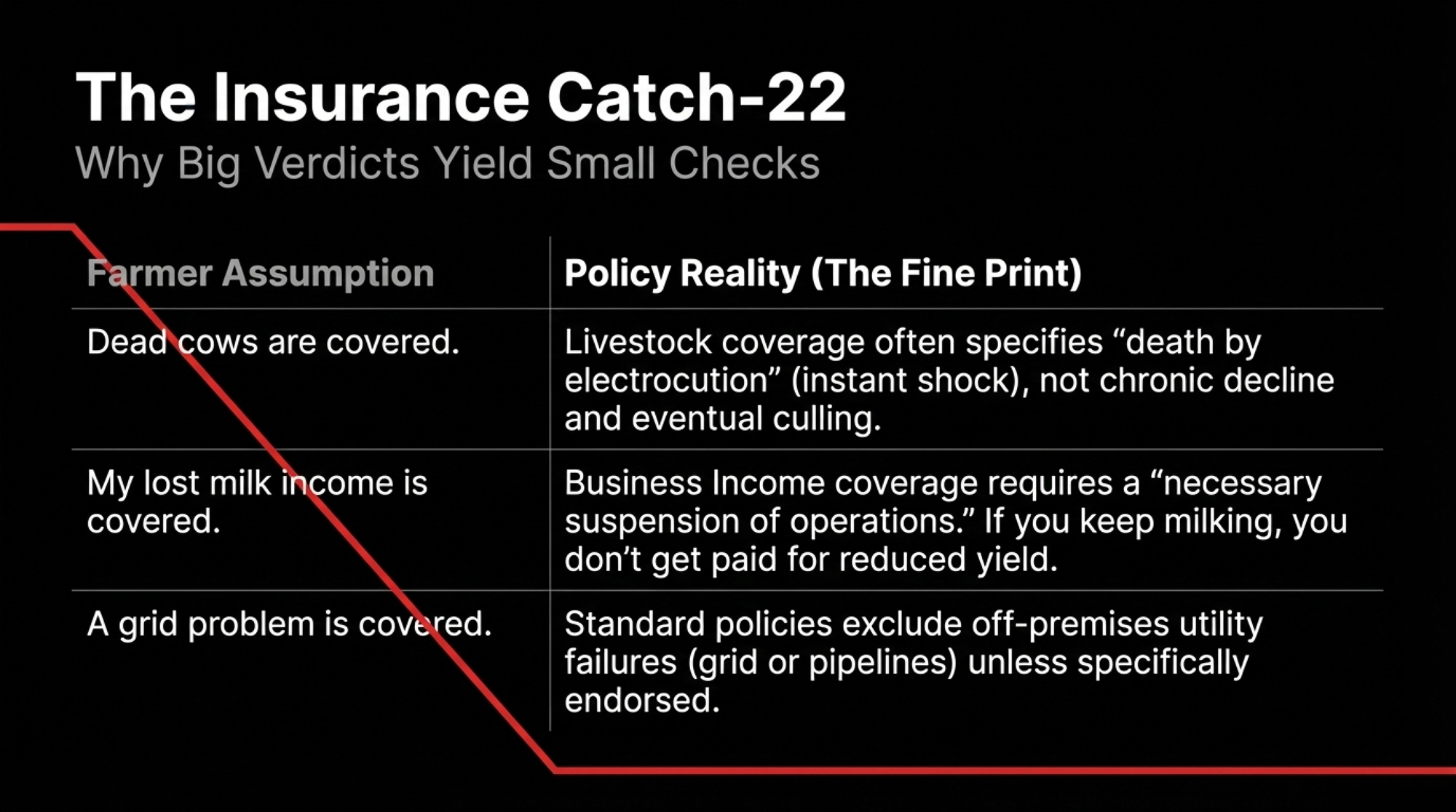
Blind Spot 3: The Insurance Fine Print

Standard farm packages were built for sudden events: fires, storms, and building collapses. Stray voltage is a slow‑motion wreck that doesn’t fit neatly into that box. The Mengel Dairy Farms case is the clearest lesson here.

Hastings Mutual insured Mengel, and its own investigation confirmed stray voltage as a cause of damage. The company paid for dead cows and electrical work. Then it denied coverage for years of reduced milk production, arguing two key policy clauses never kicked in:

  • Livestock coverage: “death of livestock by electrocution.”
  • Business income coverage: loss of income due to the necessary suspension of your operations caused by a covered cause of loss

Mengel cut back cow numbers but kept milking. The cows didn’t die instantly from a visible shock. That, Hastings said, meant no business‑income coverage. A federal district court agreed, and the Sixth Circuit Court of Appeals affirmed in July 2021. As McEowen put it in his March 2026 article, it’s “a Catch‑22 for many farmers: if you keep working to save your business, you may disqualify yourself from insurance payouts for lost income.”

What Does Undetected Stray Voltage Actually Cost Per Cow Per Year?

Let’s do the barn math in plain numbers you can plug into your own herd.

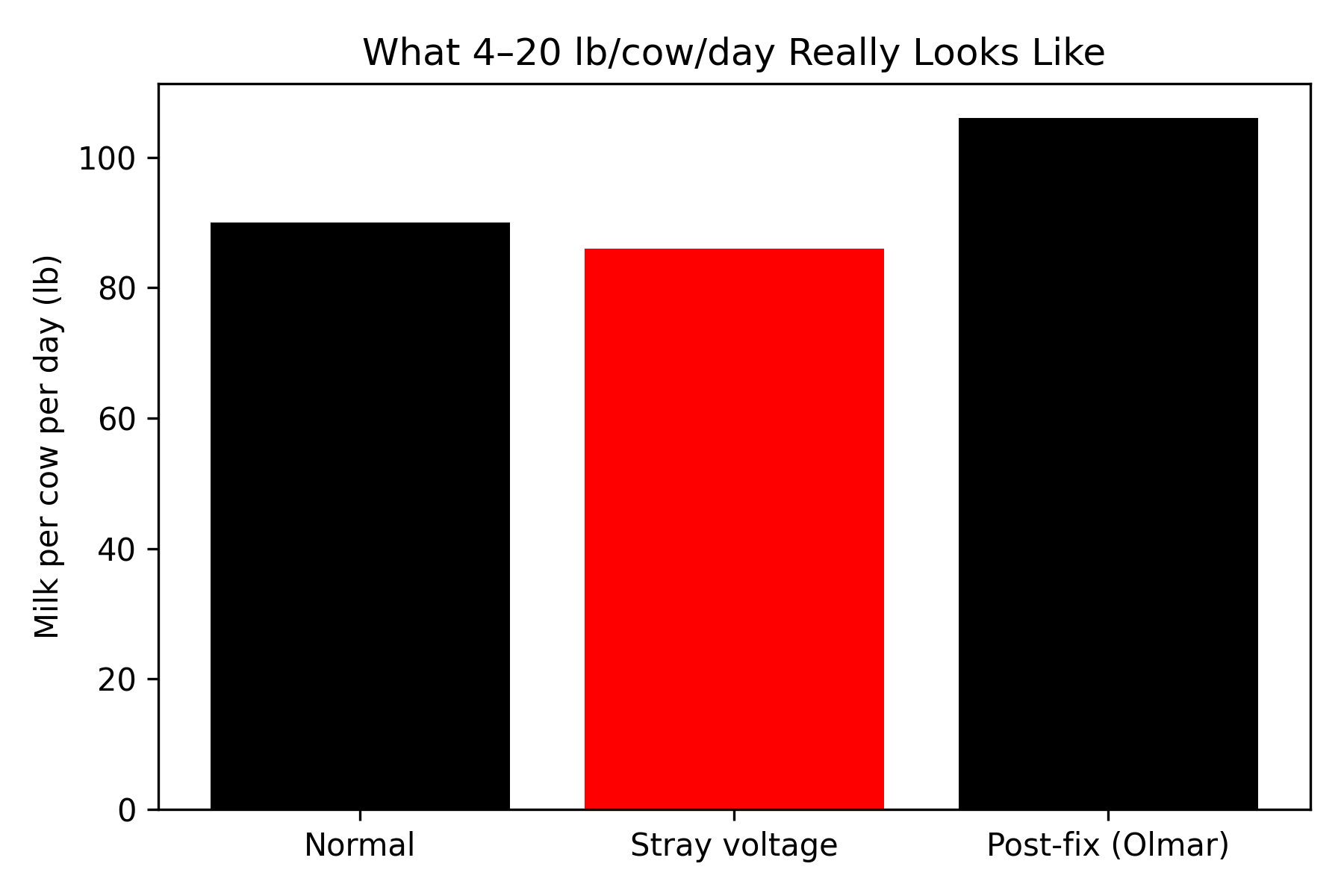
Take a 500‑cow operation. Suppose stray voltage quietly knocks 4 lb/cow/day off production — conservative compared to what families like the Vagts and Haldersons documented in court, and close to but below the nearly 20 lb/cow/dayproduction gain Jill Nelson at Olmar Farms in Sleepy Eye, Minnesota, saw after installing an isolated transformer and investing almost $100,000 to separate her farm from utility infrastructure.

Use a mid‑range milk price of $18.00/cwt — you can swap in your own number.

Barn Math at a Glance (500 cows)

Impact CategoryEstimated Loss (Per 500 Cows)Per Cow/Year
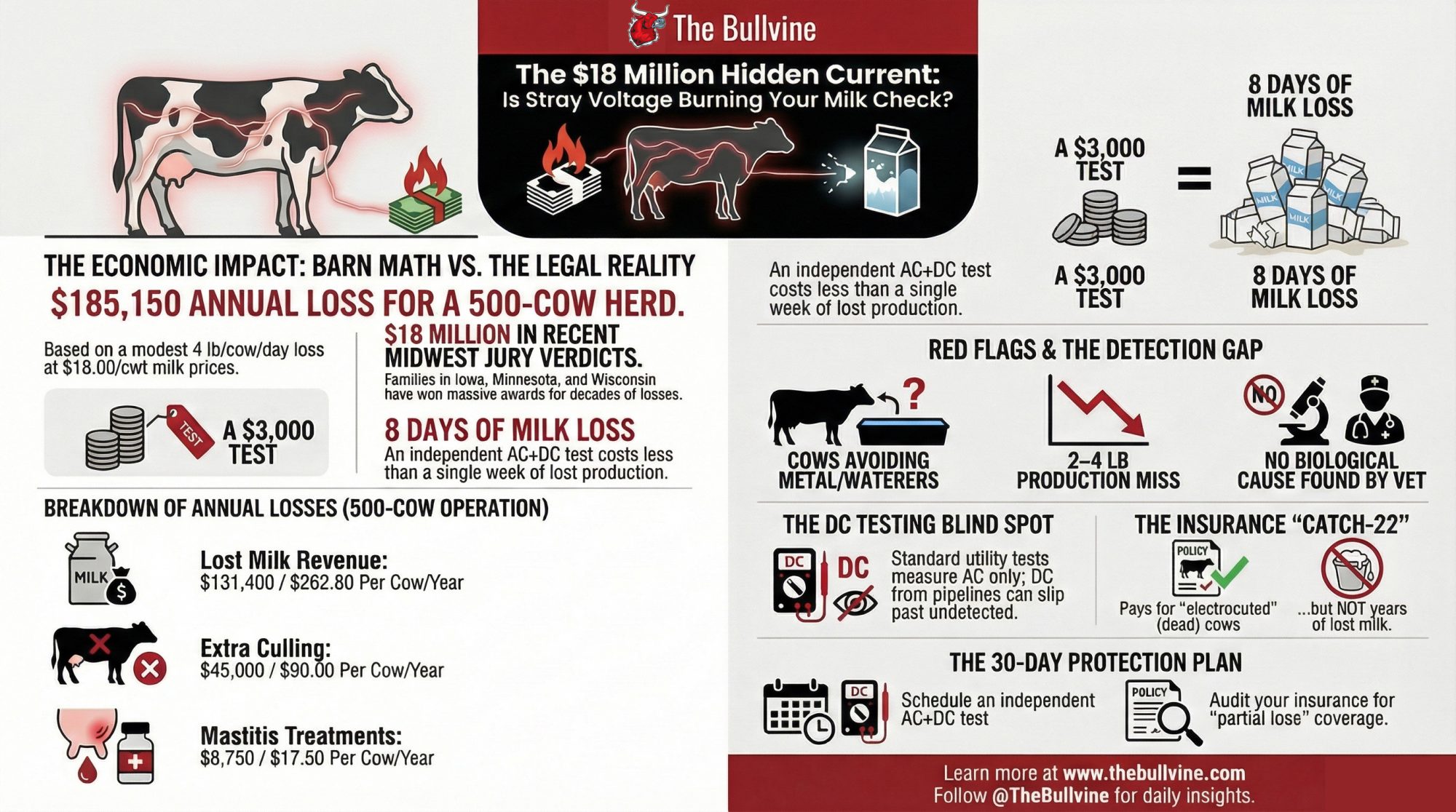
Milk revenue (4 lb loss @ $18/cwt)$131,400$262.80
Extra culling (5 more culls per 100 cows)$45,000$90.00
Mastitis treatment (1 extra case per 10 cows)$8,750$17.50
TOTAL ANNUAL LOSS$185,150$370.30

How it pencils out:

  • Daily lost milk: 500 cows × 4 lb = 2,000 lb = 20 cwt
  • Daily lost revenue: 20 cwt × $18.00 = $360
  • Annual: $360 × 365 = $131,400
  • Extra culls: 25 cows × $1,800 = $45,000
  • Extra mastitis: 50 cases × $175 = $8,750

Rounded, that’s about $370 per cow per year on a 500‑cow herd.

And that’s using a modest 4 lb/cow/day loss. Nelson’s experience — nearly 20 lb/cow/day more milk after an isolated transformer and major electrical upgrade — shows how quickly these numbers get ugly when you’re on the wrong side of the current for years.

A comprehensive independent electrical assessment that measures both AC and DC at cow‑contact points often lands in the low‑thousands of dollars for a mid‑size dairy — for many 400–700 cow herds, that means writing a check in the low‑thousands range once you factor in travel and time on farm. At $360/day in milk‑only losses, a $3,000 test is equal to about eight days of the production loss it’s designed to catch. Even if your numbers are half that, the math doesn’t take long to pencil out.

Does Your Farm Insurance Actually Cover Stray Voltage Damage?

Short version: your farm policy likely covers a sliver of the damage — dead cows and maybe some electrical repairs — but not years of lost milk.

McEowen’s stray‑voltage insurance piece walks through the Mengel case in detail. The key lessons match what shows up over and over in real farm policies and public farm‑insurance endorsements:

  • Electrocution means “instant death,” not chronic decline.
    The livestock section in many policies uses language like “death of livestock by electrocution.” In Mengel, the court interpreted “electrocution” broadly enough to cover cows that didn’t die instantly — good news for direct animal‑loss claims. But that clause only applied to dead animals, not reduced milk flow.
  • Business income often requires “necessary suspension of operations.”
    The business‑income section typically says something like “we will pay for the actual loss of business income you sustain due to the necessary suspension of your operations caused by a covered cause of loss.” Mengel reduced cow numbers but kept milking. Because the farm didn’t fully shut down, the court held that the business‑income coverage never kicked in. Hastings Mutual didn’t have to pay for the years of reduced production.
  • Off‑premises utility language can leave a gap.
    Many standard farm policies include wording that limits coverage for problems with utility service before power reaches your meter. If the source of your stray voltage is a grid problem or a pipeline cathodic protection system, that language may mean your insurer has no obligation to cover the loss under the current wording.

That’s why you see big verdicts but small insurance checks. The utilities and pipeline companies are paying because juries found them liable. The insurers, in cases like Mengel, have covered direct physical losses, while courts have held that policy wording doesn’t extend to long‑term production loss.

How Do You Close That Gap Before a Problem Hits?

You’re not going to find a clean “Stray Voltage Rider” in your agent’s menu. But you can use the tools that do exist to close most of the hole.

Ask for business‑income coverage that doesn’t require a full shutdown.
Sit down with your agent and walk through this specific scenario: “If stray voltage or another electrical issue reduces our production by 4–7 lb/cow/day for three years while we keep milking, what does this policy actually pay?” Ask about:

  • A farm business‑income or “loss of farm income” endorsement that covers partial production loss, not just total shutdown.
  • Whether “necessary suspension” can include a partial interruption or whether you truly have to stop milking to trigger coverage.

Don’t accept a hand‑wave answer. Ask them to put their explanation in an email.

Add utility service interruption coverage that reaches past your meter.
Standard property coverage often excludes damage caused by off‑premises utility failures. You want:

  • A utility service interruption endorsement that covers losses if a problem on the grid or pipeline causes damage at your farm.
  • Wording that explicitly includes overhead lines, distribution equipment, and, where possible, third‑party systems like pipelines if they’re feeding current into your ground.

On many mid‑size Upper Midwest dairies carrying full farm property, liability, auto, and umbrella, total annual premiums often end up in a five‑figure range. Endorsements like business‑income and utility‑service interruption usually add only a small percentage on top of that, not a second premium. In real terms, you’re talking about something in the ballpark of one smaller load of milk a year to close a six‑figure coverage gap.

And again, get it in writing. A clean email that says “here’s exactly how your policy would respond if stray voltage quietly took 4 lb/cow/day off your production for three years” is gold if you ever have to argue with a claims adjuster.

When Is It Time to Pay for a Stray Voltage Test?

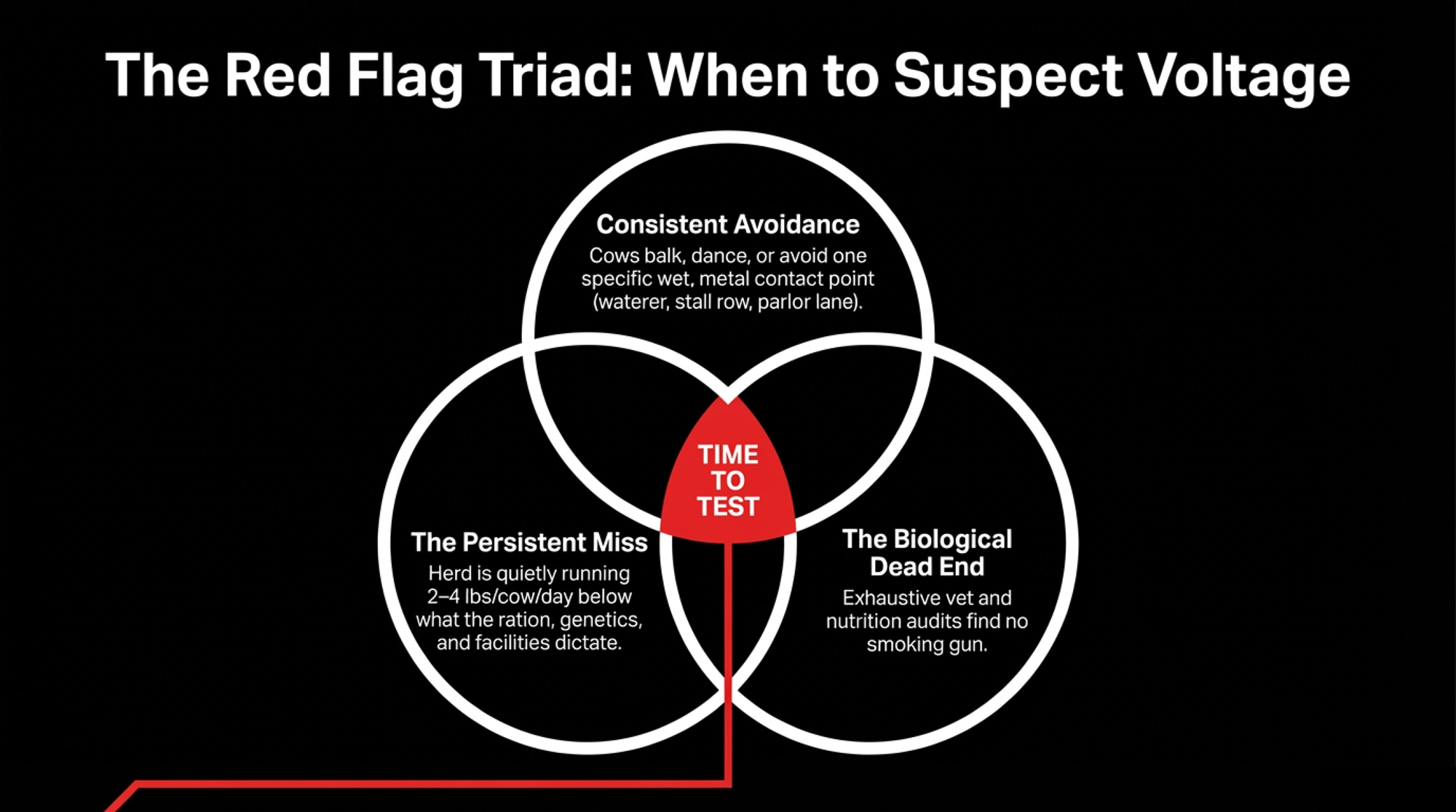
You don’t wait until your vet says, “I have no more ideas,” and your milk check has been light for three years. You pick up the phone when three things show up together.

  • Cows consistently avoid one specific wet, metal contact point.
    They balk, dance, or drink less at one waterer, stall row, or parlor lane — but use others without hesitation. Shadows, footing, and boss cows can cause some avoidance. But when it’s pinned to one specific piece of wet metal over time, you should get suspicious.
  • You’ve got a subtle but persistent production miss.
    One group or the whole herd is running 2–4 lb/cow/day under what your ration, genetics, and facilities should deliver, and minor tweaks never quite close the gap. You’ve got a sense your numbers “should be better than this,” even if you can’t prove it on paper.
  • Your vet and nutritionist can’t find a clear biological or management cause.
    You’ve worked through the checklist — fresh cow protocols, mastitis patterns, rumen health, feed quality, ventilation, milking routine — and you keep hearing some version of: “Honestly, this herd should be milking better than this. I don’t see a smoking gun.”
SignalTypical dairy explanationStray‑voltage interpretation
Cow behaviorAvoiding one trough is “cow politics”High‑risk: one wet metal point consistently avoided
Production numbers2–4 lb/cow/day miss blamed on geneticsHigh‑risk: ration and housing say you should be higher
Vet & nutrition work“Nothing obvious, herd should milk better”High‑risk: biology ruled out, electrical not tested yet
Recommended actionTweak feed or stall setup againHigh‑risk: book independent AC+DC test within 30 days

When those three line up, that’s your signal. You treat a low‑thousands‑of‑dollars independent AC+DC electrical assessment as cheap insurance, not a luxury.

What the “Cow Model” Actually Means

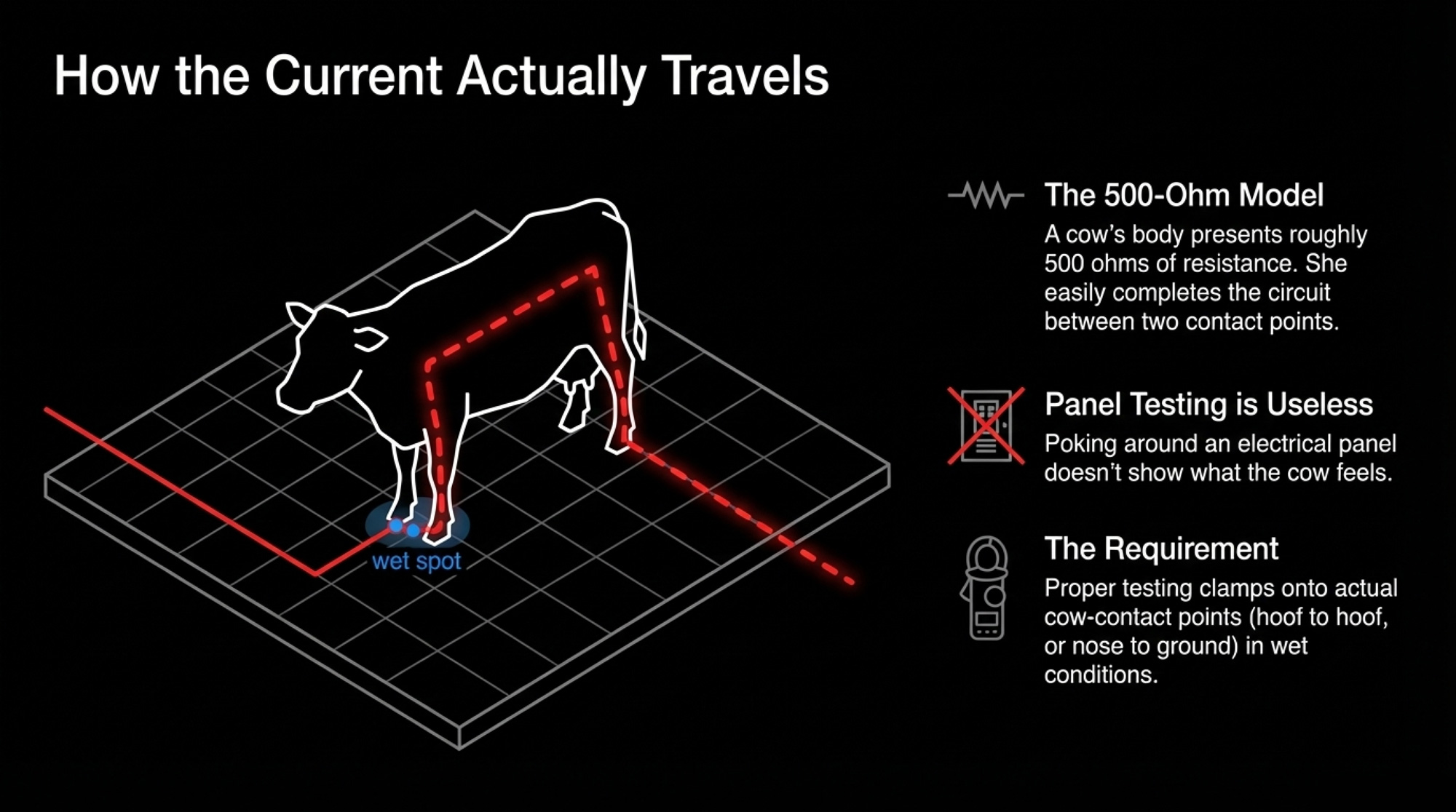
When consultants or PSC documents talk about a “500‑ohm cow model,” they’re just describing how easily a cow completes a circuit through her body — from a front foot in one wet spot to a back foot or nose touching another. The meter stands in for the cow, using about 500 ohms of resistance (roughly what a cow’s body presents), and measures how much voltage really exists from hoof to hoof or nose to ground. That’s why proper testing clamps onto actual cow‑contact points in wet conditions instead of just poking around in the panel.

And you start with someone who doesn’t have skin in the utility game. In Wisconsin, you can absolutely call your power provider and request a PSC‑compliant test, and you should. But remember: their protocol measures only AC, 60 Hz, RMS, steady‑state voltage. If your problem is DC from a pipeline or mixed‑frequency noise from aging infrastructure, that test literally can’t see it.

An independent dairy‑focused electrical consultant will:

  • Measure both AC and DC at cow‑contact points with a realistic “cow model” (usually around 500 ohms).
  • Log data over time, not just take snapshots.
  • Look at your farm wiring and the grid as a system, not in isolation.
  • Put findings in a written report of your own.

A simple, quick screen you can do yourself today: set a basic digital multimeter to low‑range AC volts, and check between the water in a suspect trough and a good ground reference. If you consistently see a few tenths of a volt or more — especially if it jumps when motors kick on — you’ve got enough reason to book a proper test. It’s not definitive, but it’s a useful filter between “cow politics” and “electrical problem.”

Why Do These Cases Keep Coming From Wisconsin, Minnesota, and Iowa?

It’s not that stray voltage only happens in the Upper Midwest. It’s that the conditions for big, provable cases cluster there. And those conditions are showing up in more regions every year.

First, the grid. Some Minnesota farm and energy advocates have described parts of the state’s rural electrical infrastructure as “crumbling.” Long rural feeders, multiple splices, and heavy livestock loads on circuits that were never designed for today’s 500–2,000 cow herds push a lot of current through a lot of grounded metal. Add in big barns built with concrete and steel — great for cow comfort, great for stray‑voltage pathways — and you’ve got more opportunities for dangerous “cow contact voltage” per mile of line than in smaller, pasture‑heavy regions.

Second, Wisconsin’s stray‑voltage program changed the game. Since the late 1980s, the PSC and DATCP have run a structured program with:

  • Standardized Phase I and Phase II testing protocols.
  • A defined “level of concern” threshold at about 2 milliamps (roughly 1 volt at a 500‑ohm cow model) at cow contact.
  • A hard rule that utilities must keep their own contribution under 1 milliamp.

That framework created a paper trail. When a utility knows it measured above those thresholds and didn’t fix it, a jury has something concrete to latch onto. That’s exactly what happened with NSP and the Haldersons.

Third, once a few big verdicts land, the flywheel spins. Law firms and consultants build expertise. Producers talk. Neighbors recognize similar patterns of herd problems when they hear the story. The infrastructure for proving stray‑voltage cases — technical, legal, and cultural — exists in Wisconsin, Minnesota, and Iowa in a way it doesn’t yet in many other dairy regions.

That doesn’t mean other states are safe. It likely means they have under‑measured, under‑documented problems, which is exactly why this kind of piece belongs in your reading stack even if you live a thousand miles from the Upper Midwest.

Options and Trade-Offs for Farmers

You’ve got a few realistic paths here. None involves crossing your fingers and hoping.

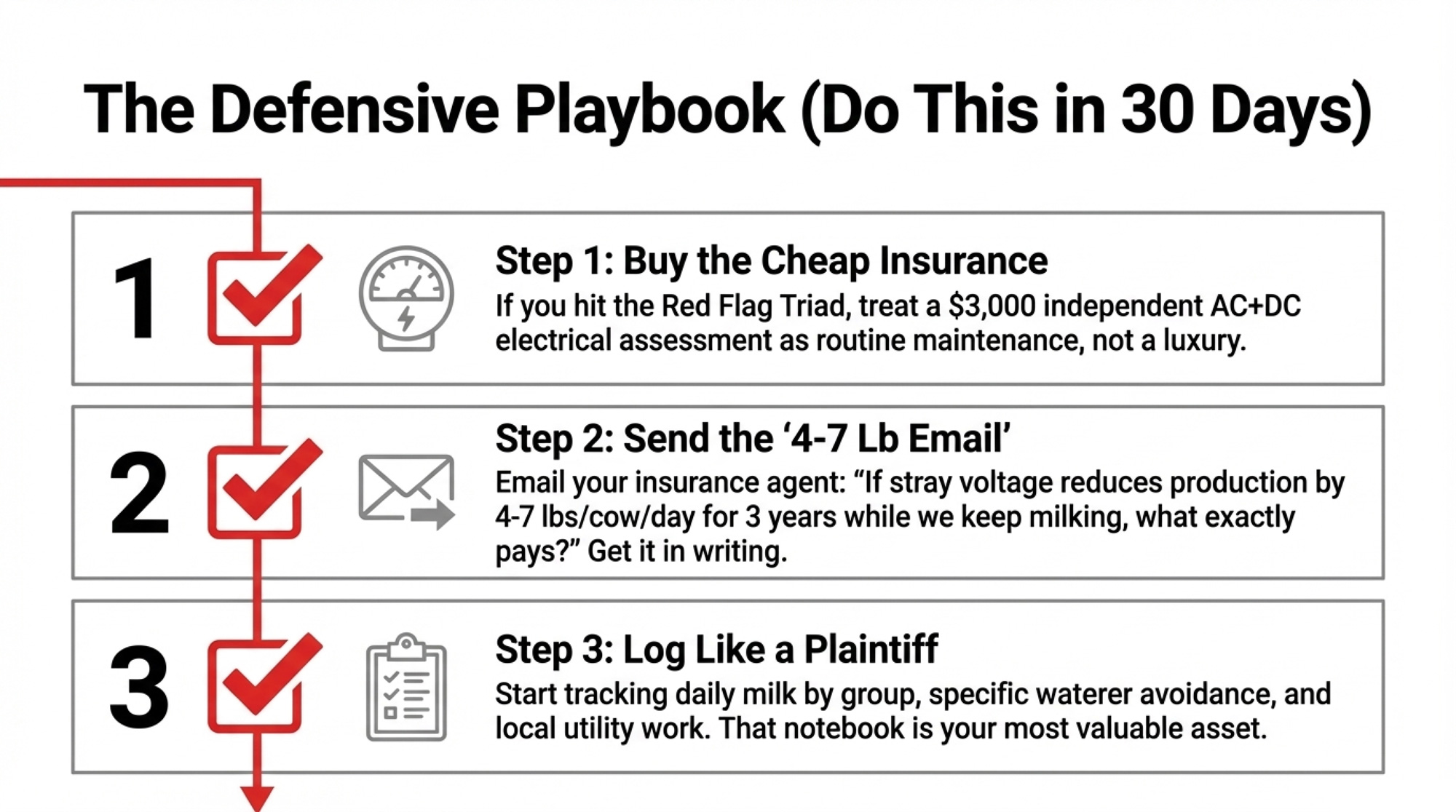
Path 1: Treat a comprehensive electrical test as routine maintenance (30‑day action).
In the next month, schedule a full AC+DC stray‑voltage assessment if:

  • Your cows avoid specific wet metal areas,
  • Your herd is quietly a few pounds under where it should be, and
  • Your advisors can’t find a good reason.

Think of it like a major parlor service or a feed audit. On a 500‑cow Upper Midwest dairy, a low‑thousands‑of‑dollars test is a line item. The risk of not knowing — $185,150 per year in quiet damage, plus the legal mess if you end up in a dispute — is not.

Path 2: Audit your insurance with stray voltage in mind.
Within the next 30 days, pull your farm policy and send your agent a simple email:

“If stray voltage or another electrical issue reduces our production by 4–7 lb/cow/day for three years while we keep milking, what parts of this policy actually pay, and what doesn’t?”

Ask them to walk through:

  • The definition of “electrocution” in livestock coverage.
  • Whether business‑income coverage requires “necessary suspension of operations.”
  • Whether off‑premises utility issues (grid or pipeline) are excluded.
  • Whether you can add business‑income and utility‑service endorsements that respond to partial production loss.

Get the answers in writing. Then decide whether that small percentage bump in premium is worth closing a six‑figure coverage gap.

Path 3: Start documenting like a future plaintiff, even if you never plan to be one.
If you’re not ready to spend on a test or endorsements this month, at least start a simple log:

  • Daily or weekly milk by group.
  • SCC trends.
  • Culling reasons and dates.
  • Behavior notes at waterers, stalls, and parlor lanes.
  • Dates and descriptions of any electrical, utility, or pipeline work near your farm.

If you ever do end up in a fight — with a utility or an insurer — that notebook will be the single most important asset you own that isn’t a cow.

Path 4: Use your utility’s free test — but don’t stop there.
If you’re in Wisconsin, you can and should request a PSC‑standard stray‑voltage investigation. It’s a no‑cost way to establish a baseline. Just understand what it can’t see: DC, non‑60 Hz problems, and anything outside the narrow test setup. Treat it as a starting point, not a verdict.

Key Takeaways

  • If your herd is consistently 2–4 lb/cow/day below where your ration, genetics, and facilities say it should be — and your vet and nutritionist can’t find a clear biological cause — you should treat a low‑thousands‑of‑dollars electrical test as a reasonable next step, not a last resort.
  • If cows are avoiding one specific wet metal area (a waterer, stall row, or parlor lane) and not others, and minor changes don’t fix it, that’s your cue to suspect voltage before you accept “cow behavior” as the explanation.
  • If your business‑income coverage requires “necessary suspension of operations,” assume it won’t pay for years of reduced milk unless you literally shut down — and talk to your agent about endorsements that cover partial production loss.
  • If your policy limits coverage for utility problems before power reaches your meter, assume damage caused by the grid or a pipeline could fall in that gap until an agent puts in writing that it’s covered.
  • If you’re milking 400–1,000 cows on concrete on older rural lines in the Upper Midwest, your risk profile looks uncomfortably close to the Vagts, Normans, Haldersons, and Popplers — and a low‑thousands‑of‑dollars test is about eight days’ worth of the loss it’s designed to catch.

The Normans spent more than twenty years fighting unexplained herd problems before a jury finally vindicated them. The Vagts dug through seven years of vet bills and underperformance before someone ran the right test. The Haldersons milked through at least fifteen years of documented voltage problems while their utility sat on a 1996 measurement that never made it back to the barn.

Cases like these are why families who’ve been through similar battles often say they wish they’d pushed for answers sooner.

Your vet can’t see voltage on a lab report. Your nutritionist can’t taste it in a TMR. Your utility will generally follow the testing protocol it has in place, which focuses on a narrow slice of possible electrical problems. And your insurer — if the Mengel case is any indication — can pay for dead cows and wiring fixes while denying years of reduced‑production claims because the policy language never contemplated a slow, stray‑voltage wreck.

So the real question isn’t whether stray voltage could be happening somewhere in your county. It’s whether you’re willing to spend one bad week’s worth of milk money this year to find out if it’s happening on your concrete.

We’re building a full insurance audit checklist, a 5‑question script you can use with your agent, and an independent testing directory for Upper Midwest dairies — with copy‑and‑paste email templates — in an upcoming Bullvine Weekly. That’s where we’ll get into the deeper contract language and dollar‑by‑dollar model that didn’t fit here.

If you had to pick one to do this month — schedule a DC‑capable stray‑voltage test or send that 4–7 lb/cow/day email to your agent — which one would you actually do first?

Complete references and supporting documentation are available upon request by contacting the editorial team at editor@thebullvine.com.

Learn More

The Sunday Read Dairy Professionals Don’t Skip.

Every week, thousands of producers, breeders, and industry insiders open Bullvine Weekly for genetics insights, market shifts, and profit strategies they won’t find anywhere else. One email. Five minutes. Smarter decisions all week.
NewsSubscribe
First
Last
Consent

Is Stray Voltage Stealing 20 Pounds Per Cow from Your Dairy?

Cows avoiding water? Nervous in the parlor? Production dropping? You’re not imagining it—20% of dairies have stray voltage that utilities can’t detect.

You know, I spoke with a producer from Minnesota who shared something that many of us might recognize: her best cow had died unexpectedly after a completely normal 70-pound milking. Every consultant she’d brought in confirmed her management was exemplary. Yet cows kept declining, and nobody could explain why.

This was Jill Nelson from Olmar Farms in Sleepy Eye, and her eight-year journey to discover what was affecting her elite registered Holstein herd reveals an issue that—honestly—deserves more attention than it gets. After installing an isolated transformer to separate her farm from utility electrical infrastructure (we’re talking about an investment approaching $100,000 here), production increased by nearly 20 pounds per cow per day. And this happened during summer 2017, when most of us are just trying to maintain production through heat stress.

What’s particularly noteworthy is that Nelson’s experience aligns with estimates from that old USDA Agriculture Handbook 696—you might have seen it referenced—suggesting that up to 20% of dairy operations may encounter some level of stray voltage issues. While the data is still developing on the exact prevalence, this potential scope… well, it merits serious consideration as we evaluate those unexplained herd health and production challenges we all see from time to time.

Here’s what’s interesting from an economics standpoint: With a 20-pound daily increase on 150 cows at current milk prices, Nelson’s investment paid for itself in approximately six months. Not many farm improvements deliver that kind of return, right?

Understanding the Technical Challenge

So here’s where things get a bit complicated—but stick with me because this matters.

The complexity of stray-voltage diagnosis begins with how we measure it. Standard utility testing protocols use a 500-ohm resistor to simulate your cow’s electrical resistance. This standard, believe it or not, was established in that 1991 USDA handbook I mentioned. And it’s still what utilities use when they come out to test your farm today.

The Testing Gap reveals why 20% of dairies struggle with hidden electrical issues—utilities test at 500 ohms, but real cows measure 109-400 ohms, experiencing double to quadruple the current that standard tests report as “safe.”

What makes this significant? Well, field research from agricultural electrical consultants has documented dairy cattle with actual body resistance ranging from approximately 100 to 400 ohms—substantially lower than what the testing standard assumes. Dr. Richard Norell, who’s the Extension dairy specialist up at the University of Idaho, has examined electrical resistance in dairy cattle as part of broader agricultural electrical research, and his work contributes to our understanding of this variation.

The practical implications… they deserve consideration. You probably remember Ohm’s Law from somewhere—current equals voltage divided by resistance, right? Well, if the testing equipment assumes 500 ohms but the actual cow resistance is closer to 200 ohms, the measured current significantly underestimates what your animals actually experience. It’s somewhat like calibrating feed measurements with equipment that doesn’t account for actual dry matter intake—the numbers look fine, but reality’s telling a different story.

When utilities measure, say, 1.0 volts using standard protocols, they calculate approximately two milliamperes of current flow—within accepted guidelines, according to veterinary references such as the Merck Manual. But here’s the thing: cattle with lower resistance are experiencing higher current levels proportionally. Norell’s research and data collected at UW–Madison showed cows reacted to current at the lowest tested levels—just 0.25 milliAmps, which is eight times lower than the standard utilities use to define possible harm to cattle. In fact, 25% of cows in those studies showed behavioral responses at only 0.25 mA, much lower than the traditional 2 mA threshold long reported in the industry.You can see the problem here.

Learning from Progressive Operations

What I find valuable about the Olmar Farms case is that they followed best management practices—and still got hammered.

Their operation, which received Holstein Association USA’s Elite Breeder Award in 2017, maintained a rolling herd average of 26,192 pounds before encountering these challenges. They’d invested in modern facilities, including equipotential planes (you know, those conductive grid systems designed to prevent electrical differentials), tunnel ventilation, sand-bedded freestalls—basically everything we’re told makes a difference.

Nelson brought in respected consultants. Dr. Tom Oldberg analyzed nutrition. Dr. Reid evaluated the milking systems. Dr. Gary Neubauer, a well-known dairy veterinarian, was also part of the diagnostic team. Each one confirmed management met or exceeded industry standards. As many of us have experienced, sometimes you can do everything right and still have problems.

Yet the herd exhibited concerning behavioral changes. Previously calm animals became difficult to handle during milking. Some cows required leg restraints for safe milking—and that’s unusual for well-managed herds, wouldn’t you say? Mastitis incidence increased despite proper protocols. Water consumption patterns changed dramatically, with cows hesitating at troughs or displaying unusual lapping behaviors rather than normal drinking.

⚠️ Warning Signs We Should All Watch For:

  • Cows hesitating or “dancing” at water troughs
  • Unusual lapping instead of normal drinking
  • Parlor nervousness is developing in previously calm animals
  • Drinking from puddles while avoiding standard waterers
  • Multiple health issues appearing simultaneously without a clear cause
  • High producers are dying unexpectedly without an obvious illness

Standard utility testing repeatedly showed “acceptable” voltage levels. The graphs looked normal, measurements within guidelines. This continued for eight years—eight years!—until 2016, when Nelson connected with an electrical specialist with specific experience in agricultural applications. Using equipment capable of millisecond-resolution recording (typically from manufacturers such as Fluke or Dranetz) and testing with more representative resistance values, this specialist documented electrical issues throughout the facility, including outdoor water systems.

Olmar Farms’ dramatic recovery after resolving stray voltage—production crashed 978 pounds during their 8-year battle, then surged 3,295 pounds above baseline after a $100,000 isolated transformer installation that paid for itself in just six months

Court records from July 2019 confirm the operation converted to three-phase power with an isolated transformer installation on May 1, 2017. There was a reported an 18-pound increase in production during the subsequent summer months, with current production exceeding 30,318 pounds rolling herd average as of March 2025. That’s quite a turnaround.

The Biological Response to Chronic Electrical Exposure

Here’s something that really fascinates me about this whole issue—the biology behind it.

Research from institutions like the University of Wisconsin-Madison helps explain what’s happening at the biological level. Doug Reinemann and co-researcher Dr. Louis Sheffield, both with Wisconsin’s biological systems engineering department, have published on how electrical stress affects dairy cattle biology. And what he’s found… it’s eye-opening.

This research shows that repeated low-level electrical exposure triggers cortisol release—the primary stress hormone. While acute stress responses serve important biological functions (we’ve all seen how a fresh cow reacts to a single stressor during transition), chronic exposure can maintain elevated baseline cortisol levels, which can affect multiple body systems. This builds on what we’ve learned about other chronic stressors in dairy production.

The cascade effects are fascinating… and concerning. We’re talking suppressed immune function, with reduced T-cell production and weakened antibody responses. This explains the varied symptoms Nelson observed: treatment-resistant mastitis in some cows, reproductive failures in others, sudden production crashes or unexpected mortality in high producers.

As Nelson put it—and I think this really captures the frustration—”It looked like we were failing at everything simultaneously. Nutrition problems AND health problems AND reproduction problems AND behavior problems all at once.” Makes perfect sense when you understand it’s all coming from the same electrical source, doesn’t it?

Research in veterinary literature also documents transgenerational effects, with calves from electrically stressed dams showing reduced immune competence, impaired vaccine responses, and various developmental issues. Nelson reported observing congenital disabilities and cardiac abnormalities during the most challenging period. That’s something that really makes you think about the long-term implications for your replacement program.

Distinguishing Source and Responsibility

Alright, so here’s where things get complicated—and expensive. The source of electrical issues fundamentally determines resolution approaches and costs.

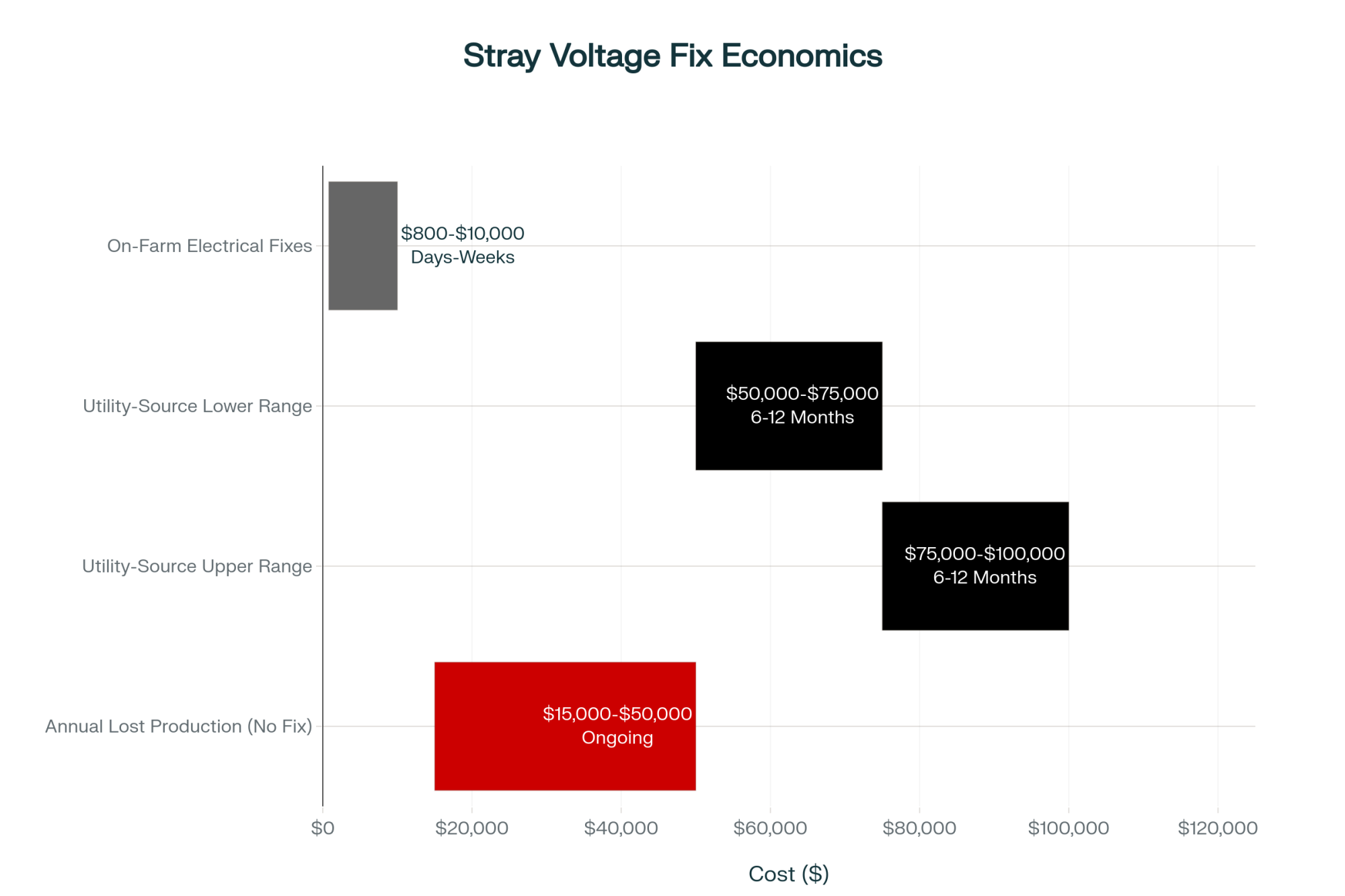
On-farm sources (damaged motor insulation, corroded connections, inadequate grounding) typically cost between $800 and $10,000 to address, depending on scope. Any qualified agricultural electrician can handle these repairs. That’s manageable for most operations.

But utility-source issues? That’s a different story altogether.

Every North American farm connects to multi-grounded neutral systems—the National Electrical Safety Code requires it. The utility-neutral conductor is repeatedly grounded between the substation and your farm, with your farm’s electrical systems bonded to this neutral at the transformer. You probably know this already, but it’s worth reviewing.

Under ideal conditions, this system works well. But when utility neutrals can’t adequately carry return current—maybe due to undersized conductors for modern loads, deteriorated connections from age, or phase imbalances—that current seeks alternate paths through earth ground. And since your farm’s grounding system is bonded to theirs… well, that current can flow right through your agricultural facilities.

The primary solution is to install isolated transformers to create electrical separation between the farm and utility systems. Based on documented cases, these installations can cost $50,000 to $100,000 or more. The Nelson operation’s investment approached $100,000, including a three-phase power installation located more than 100 yards from the buildings. And despite the problem originating from utility infrastructure, farms often bear these costs themselves. That still frustrates me when I think about it.

The financial fork in the road—on-farm electrical issues cost under $10K and resolve quickly, while utility-source stray voltage demands $50-100K investments that take months but pay back in 6-12 months through production recovery

What about insurance? Most standard farm policies generally don’t specifically address stray voltage losses, though some carriers now offer specialized riders. I always tell producers: verify coverage with your agent rather than assuming protection exists. Better to know before you need it.

Best Practices from Affected Operations

Looking at successful resolutions, I’m seeing consistent patterns that are worth sharing.

Documentation proves crucial. Producers who achieve resolution create comprehensive evidence before engaging utilities or consultants. This includes video documentation of behavioral changes—hesitation at water sources, unusual drinking patterns, and parlor nervousness. They maintain detailed production records showing systematic changes despite consistent management. Health events, treatments, mortality patterns—it all merits careful tracking.

Paul Halderson’s Wisconsin operation, which prevailed in litigation against Xcel Energy, maintained decades of documentation. This record proved invaluable when addressing utility claims about management deficiencies. The lesson here is clear: document everything, even if it seems minor at the time.

Independent testing before utility engagement often proves worthwhile. Specialists familiar with agricultural electrical systems, using appropriate protocols and resistance values, typically charge $3,000 to $5,000 for a comprehensive assessment. While that’s significant, this investment can prove valuable if negotiation or—God forbid—litigation becomes necessary.

Understanding state-specific standards helps producers navigate the system. Wisconsin and Minnesota use 1-volt or 2-milliamp action thresholds. Knowing these standards—and their basis in that 500-ohm testing protocol we discussed—helps you advocate for appropriate testing when utilities respond.

Regional Variations and Current Context

The 2025 dairy economy makes hidden production losses particularly challenging, doesn’t it? While feed costs have moderated from recent peaks (thankfully), maintaining production efficiency remains crucial for profitability. A 15% production loss from undiagnosed electrical issues—not uncommon based on documented cases—that can determine operational viability.

I’ve noticed regional patterns emerging from infrastructure age and agricultural practices. Wisconsin and Minnesota operations, particularly those served by infrastructure dating back 40-50 years, report more utility-source issues as equipment struggles with modern electrical loads. Similar patterns appear in Vermont and upstate New York, especially where utility consolidation has deferred infrastructure updates.

Newer dairy regions present different challenges. Texas and Idaho operations may have more modern infrastructure, but they face issues stemming from shared distribution lines used by center pivot irrigation systems. Seasonal voltage fluctuations during peak irrigation can affect nearby dairy facilities. And Southeastern operations? They contend with how seasonal variations in ground moisture affect current flow through the soil—I heard about this recently from a Georgia producer dealing with mysterious summer production drops.

California’s large-scale operations, with their substantial electrical loads for cooling and milk processing, sometimes encounter unique challenges when utility infrastructure hasn’t kept pace with dairy consolidation and expansion. It’s a different set of problems, but the underlying issue remains the same.

Recognition and Response Strategies

Based on documented cases and producer experiences, if you’re seeing behavioral changes at water sources—hesitation, unusual lapping behaviors, complete avoidance despite obvious thirst—that’s particularly telling. Same with parlor nervousness that develops in previously calm animals, especially during milking preparation.

For producers observing these patterns, here’s what works: Begin with thorough documentation using available technology—smartphones can capture behavioral evidence effectively these days. Engage independent testing through specialists who understand agricultural applications. Eliminate on-farm sources by systematically evaluating motors, connections, and grounding systems. Only then engage utilities, preferably in writing, with documentation already assembled.

Budget considerations should include $3,000-$5,000 for comprehensive independent testing. If utility infrastructure proves problematic, resolution costs can reach $50,000 to $100,000 or more for isolated transformer installation. Yes, that’s significant. But remember Nelson’s six-month payback period. Sometimes the investment, painful as it is, makes sense.

Industry Evolution and Future Considerations

Recent legal precedents suggest evolving recognition of these challenges. The Iowa Supreme Court’s June 2024 decision upholding Vagts Dairy’s verdict against Northern Natural Gas for pipeline-related electrical issues establishes important precedent for infrastructure liability. That’s encouraging, at least.

Most producers won’t pursue lengthy litigation—and shouldn’t have to. Practical solutions matter more than legal victories. That’s why farmers like Jill Nelson are developing resources to share knowledge. Her website, strayvoltagefacts.com, provides research and guidance based on her direct experience. It’s worth checking out if you’re dealing with unexplained issues.

What’s encouraging is how the industry conversation has evolved. A decade ago, debates centered on whether stray voltage even existed. Today’s discussions focus on identification and mitigation strategies. This represents meaningful progress, even if implementation remains inconsistent.

Nelson’s operation now maintains a rolling herd average of over 30,318 pounds on twice-daily milking, according to March 2025 data. While genetics were damaged during the affected period, the operation survived and recovered. As Nelson has shared in various forums, early recognition of testing limitations and documentation requirements might have shortened their eight-year challenge considerably.

Given the substantial number of operations potentially experiencing some level of electrical issues, it is important to acknowledge that “acceptable” testing results may not ensure the safety of sensitive animals. Just as we’ve embraced precision management for nutrition and reproduction, electrical safety may require similar individualized approaches.

Dairy farmers are winning big in court—$32+ million awarded across four major cases from 2010-2024, with the June 2024 Iowa Supreme Court ruling establishing critical precedent that negligence isn’t required to prove nuisance from stray voltage

This builds on what we’ve learned about variation in biological systems—what works for the average may not protect the sensitive. Until testing protocols better reflect this reality, those of us who combine careful observation with independent verification will be best positioned to protect our herds.

The Bottom Line

You know, the difference between management challenges and electrical issues can be subtle but significant. Understanding this distinction—and knowing how to investigate it properly—that’s valuable knowledge for any operation experiencing unexplained herd challenges.

Sometimes what appears to be a management problem stems from infrastructure issues that standard testing protocols weren’t designed to detect. And that’s not a failure of management—it’s a limitation of how we’ve been measuring things.

What’s your experience been with unexplained herd health or production challenges? Have you noticed behavioral changes that didn’t quite fit typical patterns? The conversation continues as we work together to understand and address the complex interactions between modern dairy operations and aging electrical infrastructure.

For more resources and to share experiences, visit strayvoltagefacts.com or reach out through The Bullvine’s producer network. Because sometimes the best solutions come from farmers sharing what they’ve learned the hard way. And that’s how we all get better at this business we’re in.

KEY TAKEAWAYS:

  • If cows are hesitating at water or dying unexpectedly, it’s likely stray voltage—affecting 1 in 5 dairy farms, not management failure
  • Standard utility testing misses the problem: They test at 500 ohms resistance when actual cow resistance is 200-400 ohms, underreporting exposure by half
  • Your documentation strategy determines your outcome: Video behavior changes, track production/health data, get independent testing ($3-5K) BEFORE calling utilities
  • Resolution costs vary wildly: On-farm electrical fixes are manageable (under $10K), but utility-source problems requiring isolated transformers can hit $100K—though payback can be swift (20 lbs/cow/day gains)
  • You’re not imagining it: Courts are awarding millions in stray voltage cases, proving this hidden problem is real and fixable when properly diagnosed

EXECUTIVE SUMMARY: 

Your cows avoiding water troughs and dying after perfect production days might not be a management problem—it’s likely stray voltage, a hidden electrical issue affecting up to 20% of dairy operations nationwide. The crisis stems from a fundamental testing flaw: utilities measure using 500-ohm resistance standards established in 1991, but research shows dairy cattle actually average 200-400 ohms, meaning your animals experience double the electrical current that standard tests report as “safe.” Jill Nelson’s award-winning Minnesota Holstein operation suffered eight years of mysterious losses before discovering this truth—her $100,000 investment in an isolated transformer delivered 20 pounds of milk per cow per day, paying for itself in six months. The difference between financial recovery and bankruptcy often comes down to recognizing symptoms early (behavioral changes at water sources, parlor nervousness, unexplained deaths) and getting independent testing with proper equipment. While on-farm electrical fixes typically cost under $10,000, utility-source problems can exceed $100,000, making documentation and proper diagnosis critical before accepting utility test results that miss what’s really happening to your herd.

Complete references and supporting documentation are available upon request by contacting the editorial team at editor@thebullvine.com.

Learn More:

The Sunday Read Dairy Professionals Don’t Skip.

Every week, thousands of producers, breeders, and industry insiders open Bullvine Weekly for genetics insights, market shifts, and profit strategies they won’t find anywhere else. One email. Five minutes. Smarter decisions all week.
NewsSubscribe
First
Last
Consent

Stray Voltage in Dairy Farming: Essential Insights Every Farmer Must Know

Learn how stray voltage affects dairy farming and how to protect your cows. Do you know about the hidden risks to your milk production?

Summary: Have you ever wondered if something more sinister is draining your dairy farm’s profits and productivity?  Dairy farmers have grappled with a hidden enemy for over five decades: stray voltage. This silent threat has devastating effects on livestock, yet its existence has been mired in lies, falsified research, and outright gaslighting. Stray voltage, undesired energy that escapes into the ground or conductive surfaces, can stem from poor wiring, insufficient grounding, and flaws in the power company’s electrical grid. For cows, it means stress, reduced milk output, lower feed intake, and a higher risk of illnesses like mastitis. Even at levels as low as 2 to 4 volts, this stress can lead cows to avoid water or feeding stations. The USDA estimates that up to 20% of dairy farms could be affected by stray voltage. Testing for stray voltage is crucial to protecting the herd and your livelihood.

  • Stray voltage can severely affect livestock, resulting in stress, reduced milk production, and higher illness incidents.
  • Causes of stray voltage include poor wiring, insufficient grounding, and flaws in the power company’s grid.
  • Even low levels of stray voltage (0.03-0.05 volts) can make cows avoid water or feeding stations.
  • The USDA estimates that up to 20% of dairy farms could be impacted by stray voltage.
  • Testing for stray voltage is essential to safeguard livestock and farm profitability.

Have you ever wondered why your cows are continuously upset or why milk output changes for no apparent reason? The solution might be more inconspicuous and unexpected than stray electricity. This hidden threat has plagued dairy farms for decades. Still, the amount of disinformation, fabricated data, and blatant falsehoods surrounding it is staggering. Stray voltage reduces milk output and directly influences herd health, resulting in higher veterinary expenditures and lower earnings. “Stray voltage influences dairy cow behavior, health, and milk output. It may cause lower milk output, higher somatic cell counts, and other health issues in cows.” [Stray Voltage Facts]. For over 50 years, dairy producers have been duped with falsified statistics, deceptive research, and testing that mask the hazards. The time to act is now. Can you afford to ignore this problem any longer? Join us as we delve into the dark realm of stray voltage, unraveling the deception and revealing the truth about this industry-wide disaster.

Electrical Nightmare: How Stray Voltage Could Be Sabotaging Your Dairy Farm 

Stray voltage is undesired energy that escapes into the ground or other conductive surfaces, resulting in low-level electrical currents that travel outside their intended paths. Imagine your farm’s electrical infrastructure as a garden hose. If the hose contains microscopic holes, water (or, in this instance, electricity) will leak out. This kind of leakage is known as stray voltage.

But how does it happen? Poor wiring, insufficient grounding, and malfunctioning electrical equipment are familiar sources of stray voltage. These issues allow electricity to leave its intended circuit. Another source is the power company’s electrical grid; currents may return via the ground rather than designated neutral lines, functional in rural regions with aging infrastructure.

This is very significant for dairy producers. Stray voltage may cause stress in cows, reducing milk output, lower feed intake, and greater susceptibility to illnesses like mastitis. Even at levels as low as 2 to 4 volts and 0.03 volts, the strain may lead cows to avoid water or feeding stations, jeopardizing their health and your farm’s profitability.

Stray Voltage: The Silent Saboteur of Dairy Farms 

Stray voltage is more than simply an electrical annoyance; it is a quiet adversary that progressively saps the vitality of your herd and the prosperity of your dairy enterprise. Imagine entering your barn expecting to see healthy, productive cows, only to discover anxious, diseased, or dead animals and declining milk output. Unfortunately, such is the harsh truth for many farmers who have unwittingly become victims of this unseen threat.

“Our cows started showing signs of stress and unnatural behaviors,” Allan from Bert-Mar Farms remembers. “We noticed a drastic drop in milk production, and it took us years to realize stray voltage was to blame” [source: DairyStar, Inc.]. Many in the industry share this attitude, having had similar situations but failed to identify the root.

Numerous research have established the harmful effects of stray voltage on dairy cows. According to research, even tiny levels of electrical current (below 0.25mAmp) may produce behavioral changes, reduced feed intake, higher somatic cell counts, and decreased milk production. A thorough evaluation of 46 research experiments found that cows exposed to voltages as low as 1 volt saw substantial decreases in milk output and general health [source: StrayVoltageFacts].

For instance, Mary Francque, a dairy farmer who witnessed the severe impacts of stray voltage firsthand, shared, “We saw a 20% drop in milk production almost overnight.” Trying to determine what was wrong until we checked for stray electricity [source: Iowa State University] was a nightmare. Such experiences underscore the tremendous impact of stray voltage and the critical need for awareness and mitigating actions.

Cows exhibiting signs of electrical exposure, such as reluctance to enter the milking parlor, unexpected aggression, or unusual hoof and joint issues, are most likely suffering from stray voltage effects, according to studies by the Agricultural Research Service and other organizations [source: Bovine Vet Online]. These signs are often misinterpreted, resulting in prolonged animal suffering and financial losses for producers.

Stray voltage has a significant financial impact on dairy farms. Farms affected by stray voltage often report a 15-30% drop in milk output, leading to yearly losses of thousands of dollars. Moreover, the cows’ health deteriorates, and reproduction suffers, resulting in higher veterinary bills and shorter herd lifetimes. These cumulative consequences can severely impact the financial viability of both large and small dairy enterprises.

Stray voltage is a widespread problem that has plagued dairy farms for decades. Farmers like Allan and Mary’s personal stories serve as a powerful call to action. Dairy producers must become more cautious, conduct frequent inspections, and seek expert reviews to protect their businesses from this hidden threat. The good news is that stray voltage is preventable. You can safeguard your farm and livelihood with the proper knowledge and proactive measures.

Stray Voltage: Not Just a Technical Glitch, But a Financial Catastrophe 

Let’s talk numbers; according to the literature review summarizing 46 research trials, groups of cows exposed to known voltage and current levels experienced significant reductions in milk yield and overall health. Lower productivity means fewer gallons shipped, which equates to lower profits. The hidden costs don’t stop there; sick cows lead to higher veterinary bills and increased labor costs to manage and mitigate these health issues. 

On another note, Steve and Mary Francque’s battle with stray voltage is a poignant example. The Francques reported spending over $100,000 over a few years in an attempt to diagnose and rectify the problem. What dairy farm can carry such an enormous unexpected expense without suffering? It became a choice between investing in necessary machinery upgrades or continuously addressing the detrimental effects of stray voltage.

It’s crucial to recognize the industry-wide scale of the stray voltage problem. The USDA has estimated that up to 20% of dairy farms in any area could be affected by stray voltage. This isn’t an isolated issue; it’s an industry-wide challenge that demands serious attention. The collective financial impact could exceed millions of dollars lost in productivity and increased operational costs [source: USDA]. 

These examples underscore that stray voltage isn’t just an abstract problem; it’s a tangible threat to a farm’s profitability and viability. The direct and indirect costs can compound quickly, creating a financial burden that many farms may find impossible.

Decades of Deception: Unmasking the Stray Voltage Scandal in Dairy Farming 

Since the 1970s, stray voltage has been a significant worry in dairy farming. The issue gained attention when farmers reported inexplicable declines in milk output and unusual behavioral changes in their herds. Based on anecdotal evidence from impacted farmers, initial inquiries were typically rejected as coincidence or owing to bad farm management techniques.

However, by the early 1980s, this contemptuous attitude had begun to shift. Studies, such as the extensive study conducted by recognized agricultural specialists (https://strayvoltagefacts.com/), have revealed a relationship between stray voltage and decreased dairy output. Despite the evidence accumulated, disinformation efforts and fraudulent studies obscured the reality. Powerful utility corporations often supported these deceptive studies to escape accountability and the financial consequences of dealing with the problem.

A famous example of such deception happened in pivotal research trials financed by the electrical industry, which controversially reduced the importance of stray voltage by altering data to indicate minor impacts on dairy cows. These trials, cited over the subsequent decades, played a significant role in shaping public perception and policy around stray voltage, effectively gaslighting the farming community (https://img1.wsimg.com/blobby/go/d719dd64-4767-4754-9681-480de02a93fe/downloads/Stray-Voltage-Injuries-in-Dairy-Farmers-A-Revi.pdf?ver=1721680466256).

By the 1990s, individual case studies and accumulating anecdotal evidence from farmers like the Burdicks, who reported devastating consequences on their cattle, had pushed the topic back into the scientific realm. Despite this, adequate identification of the problem was met with tremendous hostility, with many blaming cow health difficulties on less problematic factors.

In the past two decades, a renaissance of interest and more transparent studies have begun peeling back the obfuscation layers. Notable research, such as those reviewed in Spring 2018, has highlighted the adverse effects of stray voltage on dairy operations, supporting distressed farmers’ assertions [source](https://dairystar.com/stories/a-shock-to-the-system,24087).

The history of stray voltage awareness is rejection, disinformation, and a long march to realization. It emphasizes the necessity of openness and robust, impartial research in protecting the interests of those who feed the country.

Gaslighting in the Dairy Industry: The Hidden Truth About Stray Voltage

The dairy farming community has been subjected to unparalleled disinformation and gaslighting regarding stray voltage. How often have scientists and authorities dismissed your fears about stray voltage as “an overreaction” or “unlikely to affect your herd”? It isn’t enjoyable.

For decades, utility companies and other industry players have minimized stray voltage’s seriousness, dismissing it as a mere annoyance. Recognizing the facts would entail expensive mitigation efforts, probable responsibility, and a considerable loss to their financial line. Instead, they’ve brushed the data under the rug, leading farmers to mistrust their own experiences.

Consider the story of Mary Francque, a dairy farmer whose herd’s health deteriorated unexpectedly. “I was told repeatedly that it was all in my head, that stray voltage couldn’t possibly be causing the problems I was seeing,” she said with tears. It wasn’t until she completed her tests that she discovered the cold, hard facts: her cows had been exposed to dangerous quantities of electricity.

Falsified research and whitewashed studies are another layer of deceit. Many studies financed by utility corporations have concluded that stray voltage offers no substantial harm. However, independent research provides a different perspective. According to a comprehensive assessment in Dairy Star, “The lowest cow plus cow contact resistance has been tested below could be as low as 125 ohms in certain circumstances, making even minor currents extremely harmful.” Dairy industry proponents argue for using a 125 ohms resistor in stray voltage testing to more accurately represent the most significant % of cows in a given herd. [source: Stray Voltage Facts].

Utility firms and their friends have reaped enormous profits by ignoring the obligation to update infrastructure and adopt adequate safety measures. This neglect is appalling when you consider the consequences for dairy farmers—financial losses, mental anguish, and, most sadly, the degradation of their herd. The Burdicks, a farming family who sustained significant losses, revealed that the electric provider ignored several concerns until it was too late [source: Dairy Star].

To summarize, the concerted attempt to minimize stray voltage amounts to a violation of trust, leaving numerous dairy producers to deal with the terrible repercussions. Isn’t it time for a reckoning?

The Human Toll: How Stray Voltage Wreaks Havoc on Dairy Farmers’ Lives and Livelihoods

One cannot ignore the environmental and human costs that stray voltage exacts on dairy producers and their livelihoods. Consider Mary Francque, a dairy farmer who, with her husband Brian, fought the constant presence of stray electricity in their milking barn for an incredible nine years. The continuous tension and unknowns surrounding the unseen monster left them feeling demoralized and second-guessing every decision. Their milk supply decreased, and the health of their beloved cows deteriorated quickly, causing emotional and financial stress.

Nelson and her husband, Brian, ‘s predicament exemplifies how dangerous stray voltage may be. They bravely battled the illusive electrical burglar inside their barn. For over a decade, they had unexpected drops in milk output and strange health concerns with their cattle. Despite several attempts to identify and address the cause of the issue, their fight seemed to be never-ending, depleting their resources and motivation.

Another moving example is the Burdick family’s dairy farm, which was once a prosperous business. That was until stray voltage disrupted its functions. Livestock losses increased, and milk output fell, leaving the Burdicks with a severe economic crisis. The Burdicks, like many others, had the difficult task of recognizing the problem and persuading dubious utility corporations to fix it.

These are not simply anecdotes; they are the actual realities of dairy farmers who have seen their life’s work and passion eroded by an often-overlooked issue. The cumulative effect on their mental and financial well-being cannot be underestimated.

Scientific Evidence vs. Corporate Denial: The Battle Over Stray Voltage’s Impact on Dairy Farms

Stray voltage has long been acknowledged in scientific literature as negatively influencing dairy farms. A comprehensive literature review of 46 research trials reveals that cows exposed to specific voltage and current levels have significant behavioral and health issues, such as decreased milk production, increased stress, and decreased overall well-being [Stray Voltage Injuries in Dairy Farmers: A Review]. Research published in the Dairy Star supports these results, demonstrating a clear link between stray voltage exposure and lower dairy yield on impacted farms  [Rising from Tragedy]. 

In contrast, several research reports supported by electrical firms minimize these impacts, often claiming that stray voltage does not influence animals. However, these studies have repeatedly been criticized for methodological faults and skewed sampling. For example, a critical examination of industry-sponsored research reveals severe conflicts of interest and a lack of openness in experimental designs  [Stray Voltage Testing: Who Can You Trust?]. Such discrepancies highlight the need for independent and thorough scientific research to determine the natural effect of stray voltage on dairy production. As a result, although respectable, peer-reviewed studies continually confirm the negative consequences of stray voltage, industry-funded research seeks to obfuscate these results, indicating a concerning tendency of disinformation and gaslighting within the dairy sector.

Detecting and Mitigating Stray Voltage: A Farmer’s Guide to Protecting Livestock and Livelihoods 

Testing for stray voltage on dairy farms is more than a practical need; it is critical to protecting your herd and livelihood. But how can farmers go about detecting this unseen saboteur?

First and foremost, you must equip yourself with the proper tools. Experts propose using a digital voltmeter to determine the electrical potential difference between two places. Leading individuals in the subject, such as Mary Francque, highlight the need for “consistent and precise measurements” to assure accuracy.

One feasible option is to test voltage levels at several locations across the farm. Begin by evaluating the water bowls, metal stanchions, and other metal structures where cows commonly come into touch. Readings greater than 0.5 volts are often suggestive of stray voltage concerns. Francque says, “Routine testing can unearth problems before they escalate, making it easier to manage and mitigate risks.”

Grounding and bonding are two of the most effective ways of mitigation. Grounding connects electrical systems to the ground to neutralize stray currents. At the same time, bonding guarantees that all metal elements are electrically linked, decreasing voltage discrepancies. Chuck Burdicks, a seasoned farmer with expertise dealing with stray voltage, recommends that you test and repair your grounding systems regularly. Even little failures might lead to severe problems over time.”

Additionally, adding voltage filters may aid in the management and stabilization of electrical currents. These devices may separate equipment that produces a stray voltage from the rest of the farm, reducing its effect. According to a literature assessment of 46 research studies, these strategies may “significantly diminish the adverse effects on animal health and productivity.”

The main message is straightforward: continuous testing and aggressive mitigation are your most potent defenses against stray voltage. Francque says, “It’s about creating a safe, stable environment where your cows can thrive, and your profits can grow.” Farmers who use these measures can detect and control stray voltage, protecting their herds and livelihoods from its pernicious consequences.

The Bottom Line

Stray voltage is more than an irritation; it has been a massive threat to dairy farms hidden by misinformation and corporate denial for years. The implications for animal health, output, and farmers’ livelihoods are enormous. From fraudulent research to gaslighting tactics, the scale of deceit is staggering, and ignoring the issue is no longer an option. Can we afford to stay silent while our farms and futures are jeopardized? Equip yourself with the required knowledge and equipment, perform independent testing, engage with reliable experts, push for more limitations and responsibility from electrical providers, and share your experiences to increase awareness.

Learn more: 

Supreme Court Upholds $4.75 Million Verdict for Iowa Dairy in Stray Voltage Case

Find out why the Iowa Supreme Court upheld a $4.75 million award for a dairy farm harmed by stray electricity. What does this important case mean for the dairy industry?

The Iowa Supreme Court has upheld a $4.75 million verdict for Vagts Dairy, an Iowa farm impacted by stray voltage from a nearby gas pipeline. This landmark decision not only marks a pivotal win for the family, addressing years of losses in their dairy operations but also draws attention to infrastructure-induced problems for agricultural communities

“Sometimes you get to the point you don’t even want to get up in the morning because you don’t know what you’re going to find out there,” Mark Vagts testified, underscoring the family’s unwavering determination in the face of daily challenges.

The Price of Protection: How an Essential Pipeline System Became a Dairy’s Worst Nightmare

Vagts Dairy, run by Mark, Joan, and Andrew Vagts, faced severe challenges due to alleged stray voltage, which refers to the presence of unwanted electrical energy from Northern Natural Gas Company’s pipeline. This pipeline’s corrosion-prevention system reportedly caused electrical issues that impacted their dairy herd. The Vagts family filed a lawsuit in 2021, seeking compensation for their livestock and livelihood damage.

Decades of Protection Turned Enigma: The Historical Backdrop of a Landmark Case

This case involves a pipeline built 60 years ago, stretching about 14,000 miles from Texas to Michigan. It includes an electrical system, known as a cathodic protection system, required by federal regulations to prevent corrosion. This system uses a low-level electrical current to counteract the natural corrosion tendency of metals in a conductive environment.

2013: The Year of Unwanted Currents and Deepening Woes

The onset of issues can be traced back to 2013 when part of the electrical system was replaced. This marked the beginning of troubling times for the Vagts’ dairy farm. The cows started showing abnormal behavior and health problems, their milk production dropped, and mortality rates soared, plunging the dairy operators into distress and uncertainty.

2017: A Year of Ambitious Growth Met with Unforeseen Challenges

In 2017, the Vagts expanded their dairy, extending a barn closer to the electrical system. This move, part of their ambitious growth plan to increase milk production, worsened the stray voltage issue, severely affecting their herd. By 2022, over 17 percent of their cattle had died, far above the typical 5 percent mortality rate. The cows showed unusual behavior, like standing in waterers to avoid electric shocks and refusing milking equipment. The financial and physical toll was enormous, highlighting the devastation stray voltage can cause if unchecked.

Pain and Resilience: Heartfelt Testimonies Highlight the Human Cost of Stray Voltage 

During the January 2023 trial, Mark Vagts shared the toll the situation had on their dairy and personal lives. “Sometimes you don’t even want to get up in the morning because you don’t know what you’re going to find out there,” he said, highlighting the daily stress and uncertainty. 

Andrew Vagts added, “What sucks is telling my kids why their fair calf had to be shot or put down or sold.” His testimony illuminated the emotional burden on their family, particularly on the younger generation, emphasizing the personal cost of the stray voltage issue. This emotional toll, in addition to the financial and physical losses, underscores the severity of the issue.

Vindication and Remediation: Jury Awards $4.75 Million to Vagts Family

The jury awarded the Vagts family $4.75 million: $3 million for economic damages, $1.25 million for personal inconvenience and discomfort, which includes the emotional distress and disruption to their daily lives caused by the stray voltage issue, and $500,000 for loss of use and enjoyment of their property, which includes the impact on their ability to use and enjoy their farm due to the stray voltage issue.

An Acrimonious Battle Over Damages: The Company’s Counter-Arguments and Legal Maneuvering

Despite the jury’s decision, Northern Natural Gas Company disputed the claims, questioning the link between their electrical system and the cows’ ailments. They argued that the Vagts family didn’t definitively prove that the pipeline caused their dairy cows’ issues and economic losses. The company also challenged the damages awarded, claiming the amount lacked sufficient evidence. On appeal, they insisted negligence was necessary to establish liability for the nuisance.

Majority Opinion: Upholding Justice Through Established Records, Beyond Negligence Requirements

Justice Christopher McDonald, writing for the majority, upheld the jury’s verdict, confirming it was well-supported by the record. He clarified that proving negligence was unnecessary to establish a nuisance in this case.

In his separate opinion, Justice Edward Mansfield agreed with the majority on procedural grounds. Still, he emphasized that negligence should have been a critical consideration. He argued that the unique vulnerability of dairy cattle to electrical currents, which can cause significant health issues and even death, creates an unusual nuisance scenario. He believed this required reevaluating how negligence is factored into such cases.

The Tightrope of Tradition: Justice Mansfield’s Call for Caution in Expanding Nuisance Law

Justice Edward Mansfield cautioned against expanding the strict liability nuisance law, which holds a party liable for damages regardless of fault, stressing the importance of sticking to long-standing legal precedents. He argued that courts should balance fair compensation for significant damage with maintaining established legal frameworks. Mansfield warned that shifting from traditional precedents might necessitate considering negligence in future cases involving sensitive issues, such as those impacting dairy cattle.

The Bottom Line

The Iowa Supreme Court’s $4.75 million verdict for Vagts Dairy underscores how stray voltage impacts farms, particularly livestock health and productivity. This ruling vindicates the Vagts family after years of turmoil and highlights the complexities of nuisance law in agriculture. 

The Vagts, through testimonies and expert opinions, showed the connection between Northern Natural Gas Company’s pipeline and their dairy herd’s decline. The jury’s award highlights the contentious nature of liability and damages in environmental cases. 

The justices’ disagreement on proving negligence in nuisance claims signals a need for a balanced interpretation of strict liability principles versus legal precedents, setting a precedent for similar disputes in the future.

Key Takeaways:

  • The Iowa Supreme Court upheld a $4.75 million jury verdict for Vagts Dairy, affirming the significant impact of stray voltage from Northern Natural Gas Company’s pipeline.
  • Justice Christopher McDonald’s opinion emphasized that negligence was not a required finding for creating a nuisance in this case, highlighting the jury’s award as well-supported by evidence.
  • Justice Edward Mansfield concurred with the verdict but cautioned against expanding strict-liability nuisance law, arguing that negligence should have been considered.
  • The Vagts experienced severe disruptions to their dairy operations, including abnormal cattle behavior, elevated mortality rates, and reduced milk production.
  • The legal dispute centered around whether Northern Natural Gas Company’s corrosion-protection electrical system caused the stray voltage affecting the dairy farm.

Summary:

The Iowa Supreme Court has upheld a $4.75 million verdict for Vagts Dairy, an Iowa farm affected by stray voltage from a nearby gas pipeline. The Vagts family, run by Mark, Joan, and Andrew Vagts, faced severe challenges due to alleged stray voltage, which refers to the presence of unwanted electrical energy from Northern Natural Gas Company’s pipeline. The pipeline’s corrosion-prevention system reportedly caused electrical issues that impacted their dairy herd. The onset of issues can be traced back to 2013 when part of the electrical system was replaced, leading to abnormal behavior, health problems, decreased milk production, and soared mortality rates. In 2017, the Vagts expanded their dairy, extending a barn closer to the electrical system, which worsened the stray voltage issue. By 2022, over 17% of their cattle had died, exceeding the typical 5% mortality rate.

Send this to a friend