







500 cows, 45 lbs on 3x, calf losses past 50%, and every utility test came back “within guidelines.” The Den Hoeds brought in ~2,000 heifers before an independent consultant found 2–7 volts in the dirt.
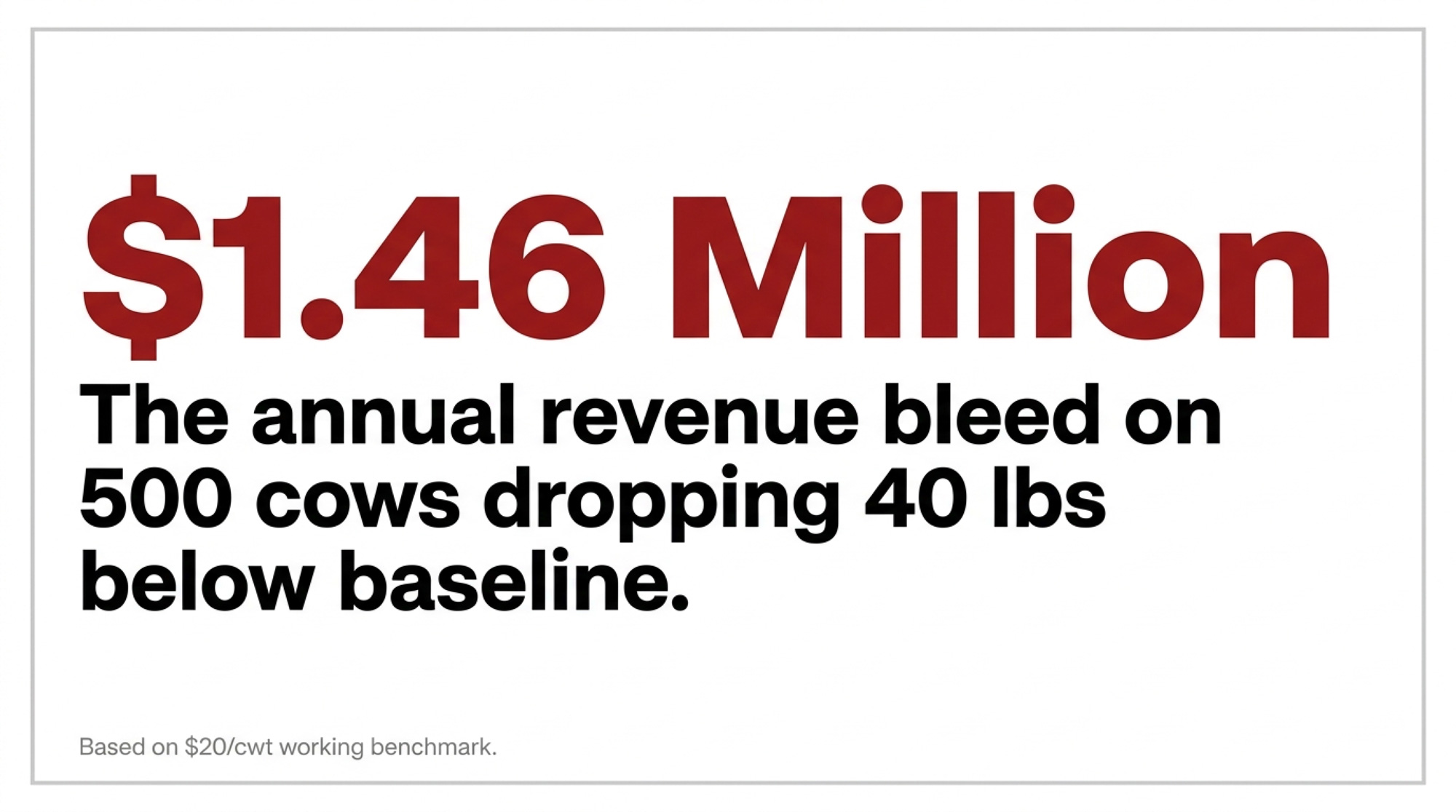
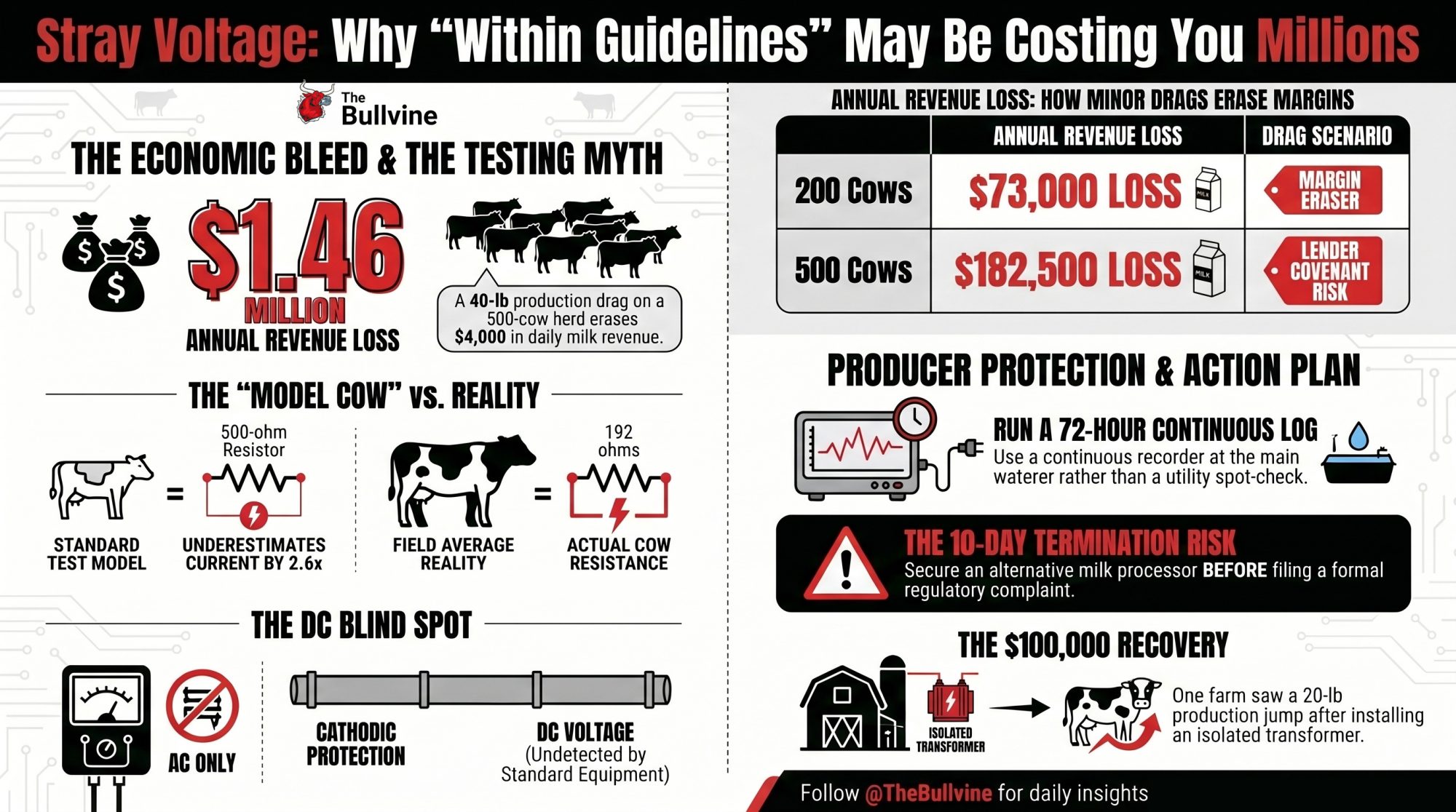
Executive Summary: On 500 cows, 40 lb below baseline at a $20/cwt working benchmark is a $1.46M annual bleed — and the Den Hoeds of Burnett County, Wisconsin say that’s the math they’ve been living since their 2014 freestall build, while every utility test came back “within guidelines.” Jayce Den Hoed told Dairy Star the family fell to 45 lb on 3x milking, calf losses past 50%, and they brought in roughly 2,000 replacement heifers before an independent consultant measured 2–7 volts of ground current moving between two substations 13 miles apart. The pivot point producers need to see: Wisconsin PSC’s own Phase II database — roughly 3,500 investigations — puts average cow-contact resistance at 192 ohms, while the standard utility test uses a 500-ohm resistor, meaning the protocol tests a “model cow” that pulls about 2.6x less current than the field average. Three affirmed Upper Midwest verdicts (Halderson, Vagts, Norman) now total more than $18M, and the Vagts case turned on DC stray voltage from a pipeline’s cathodic protection — a signal standard AC-only utility equipment cannot see. The operator implication scales: a 5-lb drag on 500 cows runs ~$182,500/year; on 200 cows, ~$73,000 — margin-eraser territory that compounds into lender-covenant territory by year five if the cause is never named. The 30-day move is cheap — a 72-hour continuous voltage log at the main waterer, matched to DHIA weights — but Jayce also describes a 10-day certified termination letter from their milk cooperative after they pushed the regulatory complaint, so pull your milk marketing agreement before you file anything. If your herd has sat on an unexplained plateau for more than a year with normal ration, genetics, and health metrics, this is the piece to read before the next consultant retainer clears.
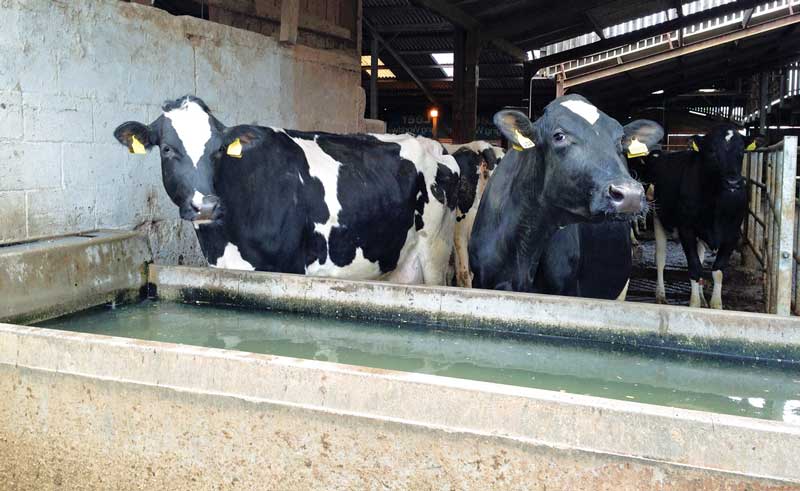
For the Den Hoed family of Frederic, Wisconsin, the crisis didn’t arrive as a storm. It arrived as a slow, 40-pound-per-cow drain that no nutritionist and no vet could explain.
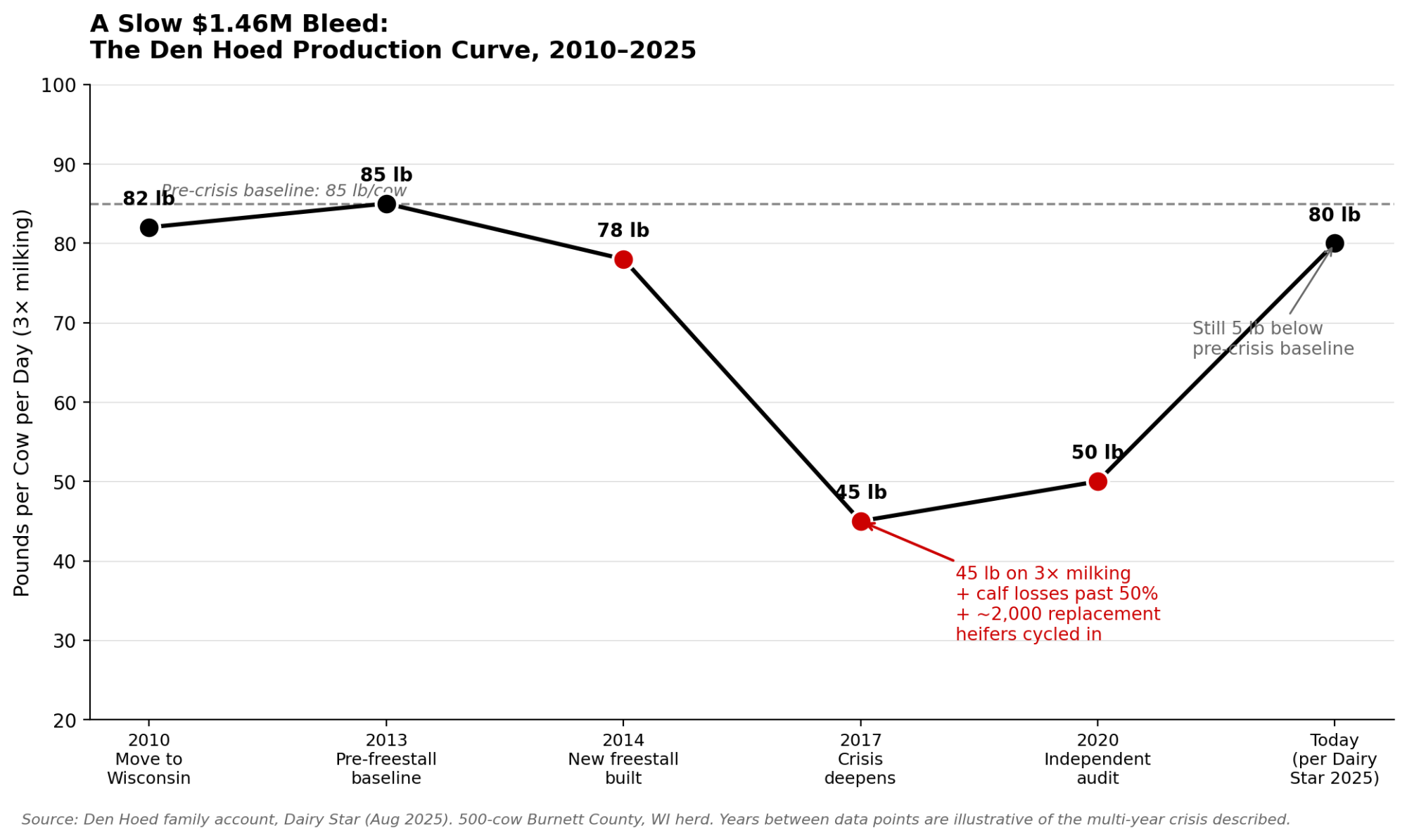
Based on Dairy Star reporting published in August 2025, by the time the family went public their 500-cow herd had fallen to 45 pounds per cow on three-times-a-day milking — down from a pre-crisis baseline of 85. Calf losses, per the same account, had climbed past 50%. Every test the electric utility ran came back “within guidelines.”
“In the midst of it, you feel like a failure,” Jayce Den Hoed told Dairy Star.
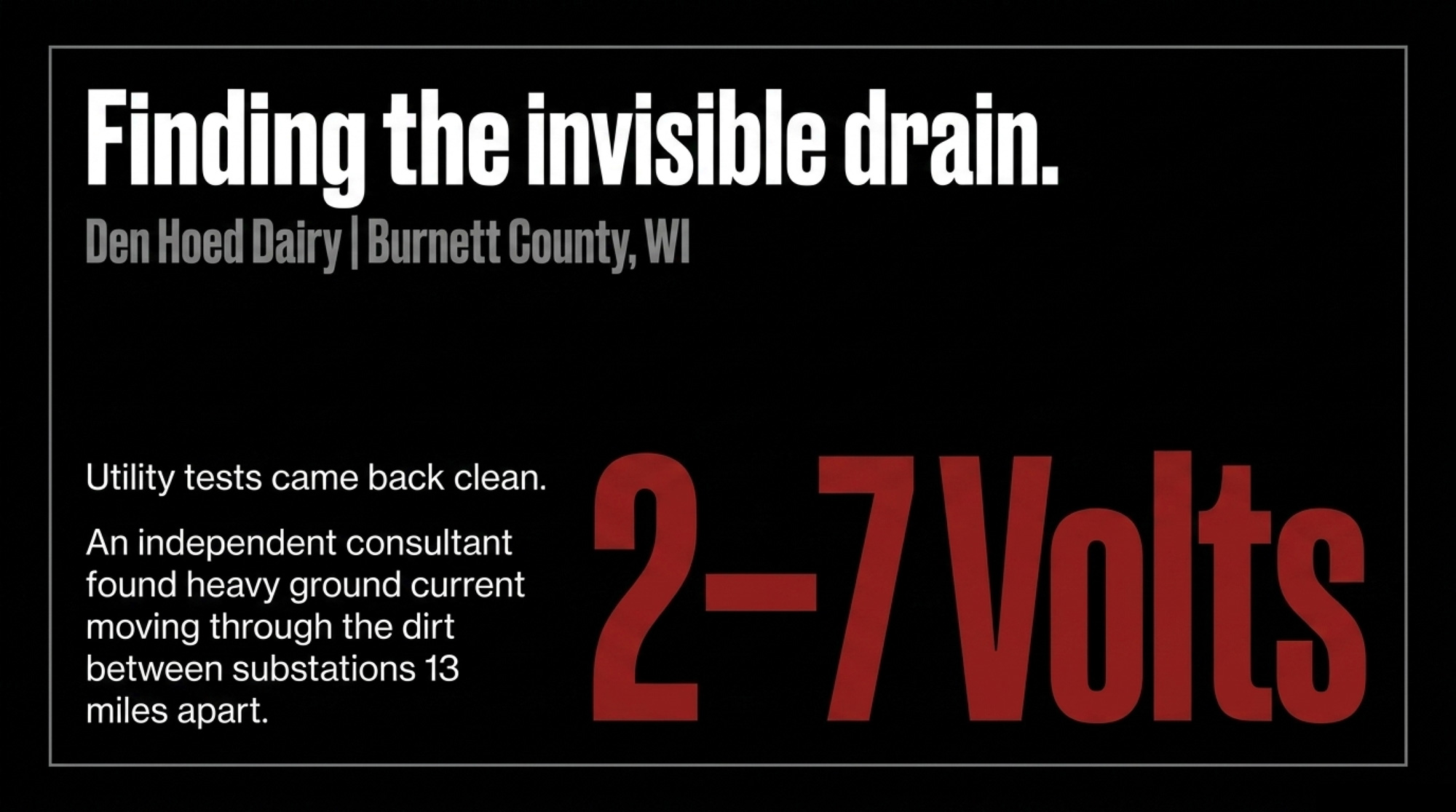
According to the family’s account, they weren’t failing. What they describe is stray voltage — 2 to 7 volts they say an independent consultant measured in the ground between two substations roughly 13 miles apart. The 500-ohm testing resistor built into the standard utility protocol, they argue, was quietly guaranteeing the problem stayed invisible. The Den Hoeds are one of three Upper Midwest families whose cases have, per primary court records, produced more than million in combined jury verdicts and affirmed awards against utilities and a pipeline operator — Halderson v. Xcel/Northern States Power (Trempealeau County, Wisconsin, $4.5M jury verdict August 2017, with a willful-and-wanton finding that opened the door to treble damages up to $13.5M); Vagts v. Northern Natural Gas Company (Fayette County, Iowa, $4.75M jury verdict January 2023, upheld by the Iowa Supreme Court on June 21, 2024); and Norman v. Crow Wing Cooperative Power & Light (Minnesota, $4.86M economic and $1.5M nuisance jury verdict October 2014, affirmed by the Minnesota Court of Appeals, eventually approximately $9M with interest and fees).
The testing standard producers say misses the worst cases
Wisconsin’s Public Service Commission runs one of the largest stray voltage databases in the country, covering roughly 3,500 farm investigations under its Phase II protocol. The average source resistance measured at cow contact points in that database is 192 ohms, per the PSC Staff Report on the Phase II Stray Voltage Testing Protocol. The standard testing resistor used by utilities is 500 ohms — the reference level the PSC’s Phase II documentation identifies for evaluating cow contact current and voltage.
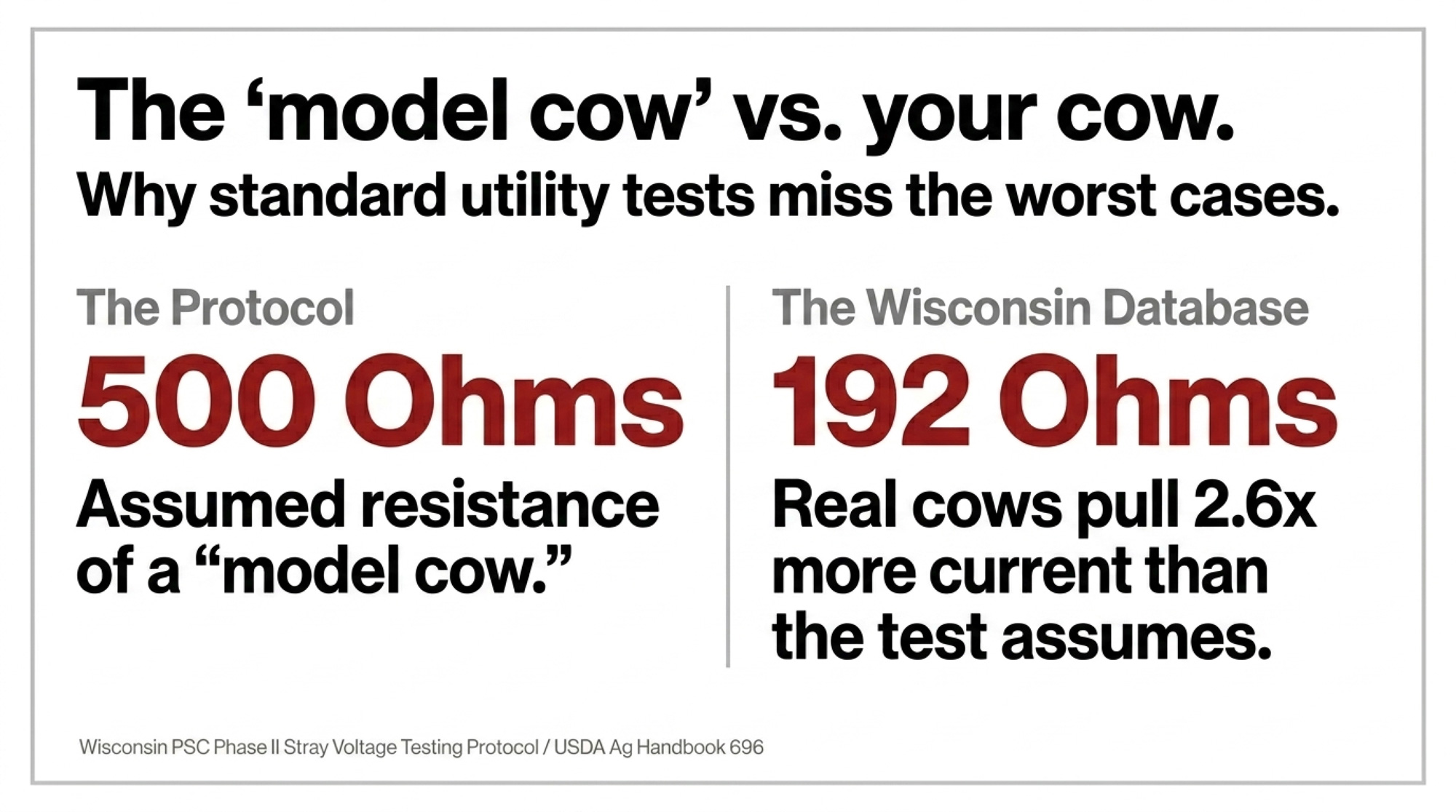
That’s not a rounding issue. The protocol tests a “model cow,” not your cow. At any given source voltage, a real cow circuit at 192 ohms pulls about 2.6 times the current the 500-ohm model assumes (500 ÷ 192 ≈ 2.6). The field average sits well below the test assumption. The Wisconsin PSC was contacted for comment on that framing.
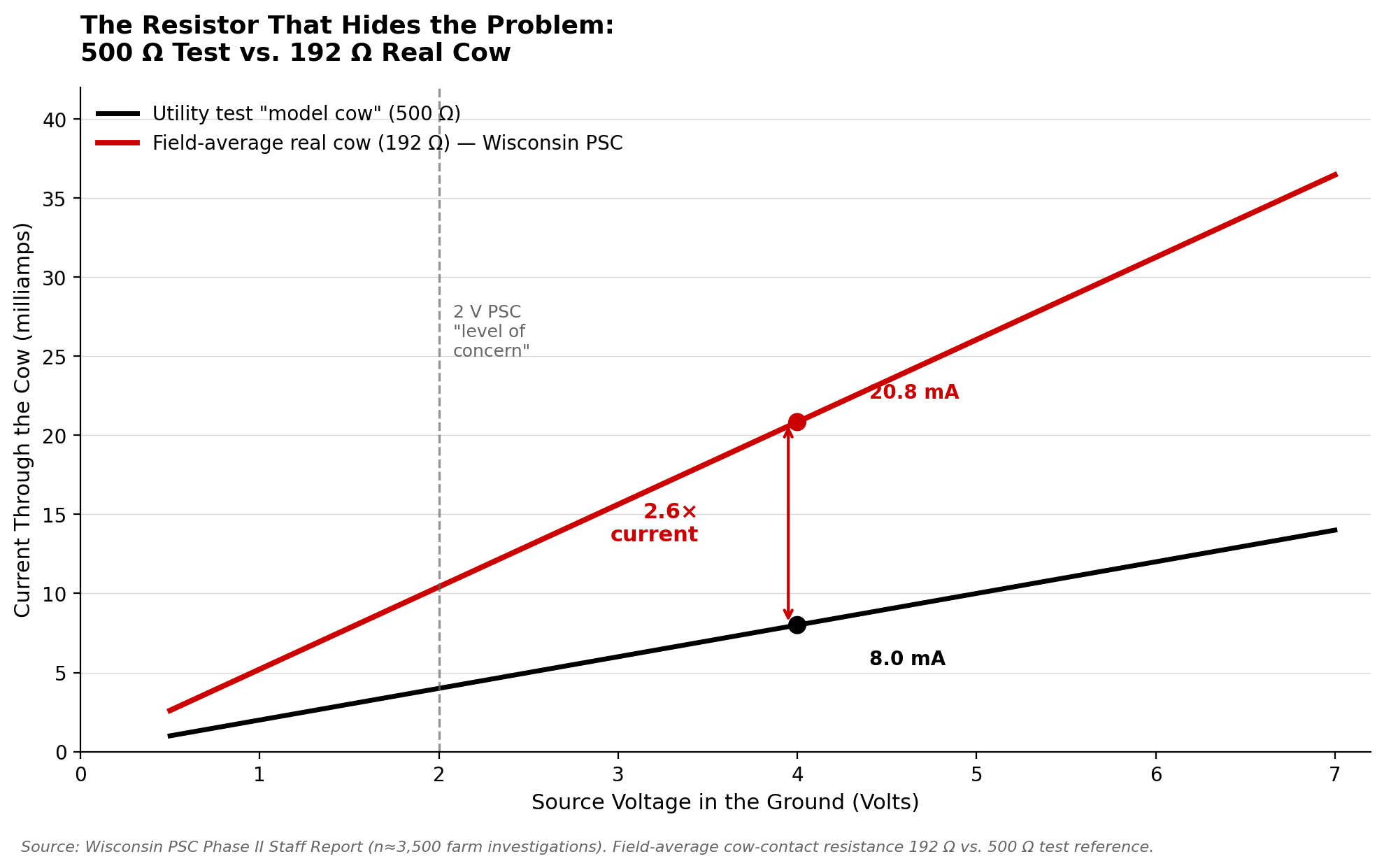
USDA Agriculture Handbook 696 — the federal reference on stray voltage, published in 1991 and not substantially updated since — estimated that a meaningful share of U.S. dairy operations encounter stray voltage at some level. Wisconsin had 5,661 licensed dairy herds as of January 2024 per DATCP records, and the count has continued to fall. Even a conservative prevalence read puts hundreds of Wisconsin dairies somewhere on the spectrum — most sub-clinical, an unknown subset operationally significant.
| Case | Defendant & State | Source Identified | Verdict / Affirmed Award |
| Halderson (Aug 2017) | Xcel / Northern States Power — Trempealeau Co., WI | AC ground current; willful-and-wanton finding | $4.5M jury; up to $13.5M (treble) |
| Vagts (Jan 2023, aff’d June 2024) | Northern Natural Gas Company — Fayette Co., IA | DC stray voltage from pipeline cathodic protection — invisible to AC-only testing | $4.75M, affirmed Iowa Supreme Court |
| Norman (Oct 2014, aff’d) | Crow Wing Cooperative Power & Light — MN | AC ground current / nuisance | $4.86M economic + $1.5M nuisance; ~$9M w/ interest & fees |
| Den Hoed (active, per Dairy Star Aug 2025) | Utility(ies) not yet named publicly — Burnett Co., WI | 2–7 V ground current between two substations 13 mi apart (per independent consultant) | Pending; 11-yr fight per family account |
Sources: Trempealeau Co. WI court records (Halderson); Iowa Supreme Court opinion 21-1899 (Vagts, June 21, 2024); Minnesota Court of Appeals (Norman); Dairy Star, Aug 2025 (Den Hoed). The Bullvine has not independently verified the Den Hoed cooperative-side timeline.
Risk concentrates in specific farm profiles, as described in UW Extension stray voltage resources and borne out in the case record of the three affirmed verdicts. Operations sitting between two substations. Barns built on aging grounding infrastructure. Dairies within a mile of recent substation or pipeline construction — as in Vagts, where a Northern Natural Gas cathodic-protection system was identified as the source. The Den Hoeds describe checking the substation and freestall-expansion boxes. Their acute crisis, per the Dairy Star account, tracked with the 2014 freestall build.
When the data said they were fine and the cows said otherwise
The family bought their Burnett County land and moved the operation from Washington’s Yakima Valley in 2010. By 2014 they’d built the new freestall. Then, according to the Dairy Star account, the herd started coming apart in ways nothing on the books could explain.
Production fell to 45 pounds per cow. Calf losses climbed past 50%. Across what the family describes as the crisis window, they brought in roughly 2,000 replacement heifers trying to hold herd size together.
Here’s the math they were living inside. On 500 cows, 40 pounds per cow per day below baseline at a /cwt working benchmark — a defensible midpoint across the 2014–2022 Class III range reported by USDA ERS, which swung from the low teens to the mid-s:
- Daily loss: $4,000 in milk that never shipped
- Annual loss: $1.46 million in revenue, before a dollar goes to replacement heifer capital
- Replacement capital drain: roughly 2,000 heifers cycled through the herd during the crisis window, per the family’s account to Dairy Star
- Equity strategy: buying nearby land at $2,000 an acre, improving it with wells, carrying it on the books at closer to $6,000 to keep the operating line alive.
“We were buying land,” Jayce told Dairy Star, “so we could keep borrowing.” That’s not growth. That’s a financing strategy to survive.
The 10-day letter, as the family describes it
When the family pushed their electric cooperative into a formal regulatory process, the consultant they’d hired warned them what might come next. Jayce’s account to Dairy Star:

“He told us that they all borrow their money from the same place. We thought he was nuts for a while, but sure enough there started being discrepancies in our milk tests and we got a certified letter stating we had 10 days to find a new home for our milk.”
The Bullvine has not independently verified the milk-test sequence or the termination timeline described in that quote. The cooperatives involved are not identified in the Dairy Star account or elsewhere in the public record, and have not been reached for comment. If any party identified in subsequent reporting wishes to respond, this piece will be updated.
What is verifiable: milk marketing cooperatives and rural electric cooperatives in the Upper Midwest often draw on overlapping federal financing sources, including USDA Rural Utilities Service, CoBank, and Farm Credit. How those shared financing relationships shape — or don’t shape — the handling of member disputes is a question the Den Hoed account raises. Not one the public record currently resolves.
⚠️ PRODUCER WARNING: Read before you file
The risk below is drawn from Jayce Den Hoed’s published Dairy Star interview; The Bullvine has not independently verified the cooperative-side timeline.
If you’re planning to file a PSC stray voltage complaint or commission an independent audit that could contradict your utility’s findings, the Den Hoed account describes a risk you need to price in before you act.
According to Jayce’s Dairy Star interview, the family received a certified letter giving them 10 days to find a new home for their milk after pushing the complaint process forward. The Bullvine has not independently verified that timeline, and the cooperatives involved are not public. But the precedent described in a published, attributed account is one a prudent operator cannot ignore.
Before you file or audit:
- Pull your milk marketing agreement and read the termination-notice clause.
- Identify at least one alternative processor inside your hauling radius.
- Get a written quote for a temporary hauling contingency.
- Talk to your lender before — not after — initiating the process.
Do this in the weeks before you act. Not the ten days after.
The breakthrough no one was looking for
Standard utility testing under the Wisconsin PSC Phase II protocol measures voltage at cow contact points inside the parlor, evaluates both primary and secondary sources, runs a 24-hour motor-start transient recording in most complaint cases, and reports against a 1-milliamp / 2-volt level-of-concern threshold at the cow. None of that architecture, the Den Hoed consultant concluded, was going to find what was happening on their farm.
According to the family’s account, when an independent stray voltage specialist finally ran the farm, readings showed 2 to 7 volts in the dirt itself — not at the waterers, not at the feed alley, not in the parlor. They say the voltage persisted even after the farm’s own power lines were fully disconnected, and that ground current was traveling between two substations 13 miles apart.
“If you place your manure pit wrong on your farm, in relation to the transformer, your well and distribution boxes,” Jayce put it, “you can sink your farm.”
The Den Hoeds argue the utility’s “within guidelines” reports were technically accurate against the protocol the utility was using. And that the protocol was looking in the wrong place.
A fix that paid back in months — if you can find the problem
Compare the Den Hoed trajectory to a Minnesota operation that eventually got to the other side. As reported in Bovine Veterinarian (September 2022) and Bullvine’s November 2025 stray voltage coverage, Olmar Farms — Jill and Brian Nelson’s registered Holstein operation near Sleepy Eye — went through roughly eight years of standard utility testing by Brown County Rural Electrical Association before an independent specialist identified the source. The Nelsons paid almost $100,000 out of pocket to install three-phase electric service and an isolated transformer. Production gained nearly 20 pounds per cow per day once the isolated transformer was in. In summer 2017, when most Upper Midwest herds are trying to hold ground through heat stress, not add it.
On 400-plus cows at prevailing 2017 milk prices, Bovine Veterinarian reported the capital outlay paid back inside a few months on recovered milk alone. The gap between the Den Hoed eleven-year fight and the Olmar eight-year fight isn’t the fix. It’s how long the standard testing protocol stayed between each family and the answer.
Why did standard utility testing miss what the Den Hoeds say was there?
Standard protocols evolved around secondary-system faults: a bad neutral, a grounding failure inside a farm’s own distribution. Those show up at cow contact points within a short testing window, and the 500-ohm resistor assumption works well enough to catch them. Ground current between distant substations — or from a pipeline cathodic-protection system, as in Vagts — is a different animal.
It’s a primary-transmission or external-source problem. And it can run on DC. That matters, because cathodic protection systems on buried pipelines work by injecting low-voltage direct current into the ground to prevent steel pipe from corroding — and standard AC-only utility test equipment cannot see DC signals at all. That’s the blind spot Lawrence Neubauer exposed on the Vagts farm near West Union, Iowa in September 2020, finding DC stray voltage at cow-contact points that AC-only testing had been ruling out for years. The problem may also only spike during specific load conditions. At night. During irrigation season. When a neighbor’s large motor cycles on. A 48-hour spot test at the wrong time of week can catch nothing.
An independent audit with AC and DC capable, millisecond-resolution equipment — Fluke or Dranetz class instruments, run continuously for 72 hours or longer — is what UW Extension stray voltage specialists and the consultants in the Vagts, Norman, and Halderson cases generally used to find what the utility testing missed. AC-only equipment, by design, would have missed the cathodic-protection source that won the Vagts verdict. For the full technical breakdown, see our Is Stray Voltage Stealing 20 Pounds Per Cow from Your Dairy?
That’s the diagnostic gap the Den Hoed account surfaces. It’s also the connective thread across the three Upper Midwest verdicts producers have so far won against utilities and pipelines. The full pattern across those named cases — Vagts, Normans, Haldersons — is broken out in our $18 Million in Stray Voltage Verdicts and a $3,000 Test No One Told Them About. If you read one companion piece before calling a consultant, that’s it.
How much does an unexplained production gap actually cost your operation?
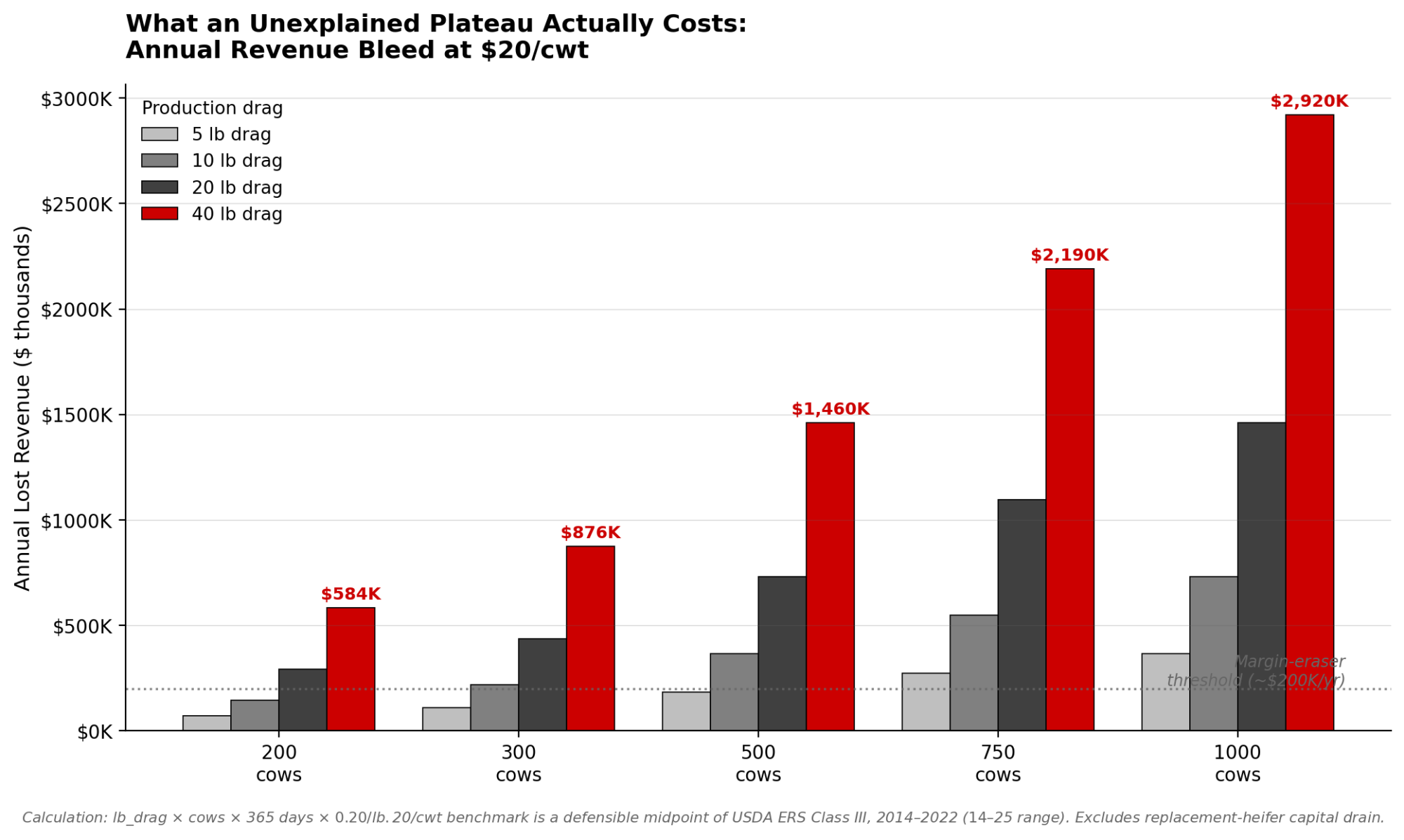
Before you budget another consultant retainer, run the math on what the gap is already costing you. A 5-pound-per-cow-per-day drag on a 500-cow herd at a $20/cwt working benchmark (USDA ERS Class III ranged roughly $14–$25 across 2014–2022) works out to roughly $182,500 in annual lost revenue. On a 200-cow herd at the same 5-lb drag, it’s about $73,000 a year. Not a farm-ender in year one. A margin-eraser.
By year three, with compounding debt service, working capital tightens. By year five, on standard leverage ratios, the equity position for a mid-size Wisconsin operation can cross from “restructure” to “exit” without anyone ever naming the actual cause — the same lender-covenant threshold mapped in our The $287,500 Equity Decision Facing Mid-Size Wisconsin Dairies.
The severe case is the $1.46 million annual bleed before replacement heifer capital. Add the multi-year heifer drain the Den Hoeds describe and you’re into fourth-generation-scale damage — the same pattern that shows up in our 490 PA Dairies Gone in 2025. Two Spent $40,500 to Not Be Next.
Is the pattern showing up on your farm, and how would you know?
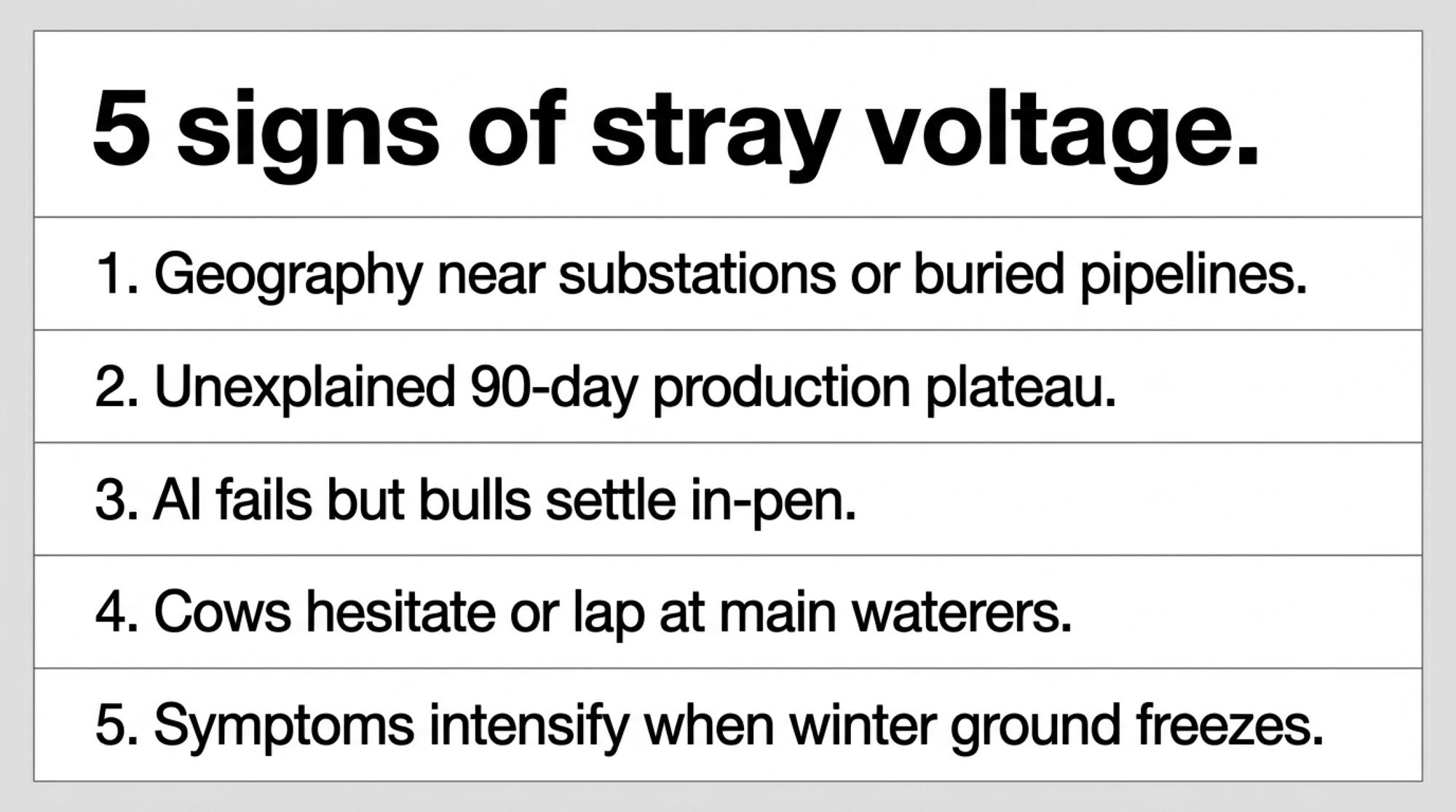
The symptom pattern, consistent across UW Extension stray voltage resources and the Vagts, Norman, Halderson, and Olmar case records, is specific enough to use as a screening tool. Production plateau despite optimized nutrition. Cows hesitating or lapping at waterers rather than drinking deep, or avoiding one wet metal spot. Breeding failure at normal investment levels — a bull works in the pen but AI doesn’t hold. Calf mortality that won’t map to a consistent pathogen. Elevated culls without a clean reason.
And critically: symptoms that get worse in winter, when frozen ground intensifies current conduction, and ease in summer. If three or more of those fit your last two years, the cheapest test you haven’t run is a 72-hour continuous voltage recording at the main waterer. Not a utility spot-check. A continuous log. Done before the next consultant retainer gets cut.
Options and trade-offs
Do this within 30 days — install a continuous monitor. A 72-hour continuous voltage recorder at the main waterer, logged against daily milk weights for the same window, typically runs a few hundred dollars in rental from UW Extension or a stray voltage consultant. A fraction of a single reproductive workup on a mid-size herd. Matched against DHIA records from the same dates, it either exonerates the electrical system or gives you the first piece of hard evidence you’ve ever had. The limit: you still need a qualified specialist to interpret anomalies and rule a DC ground-current source in or out. But you’re no longer testing blind.
Commission an independent electrical audit (90-day path). A stray voltage specialist running AC and DC capable millisecond-resolution equipment typically charges in the low four figures for a full protocol — cheaper than one round of reproductive workups on a mid-size herd, and roughly a week of the milk an affected herd is already losing on a 5-lb-per-cow drag. Ask the consultant directly for a current quote and scope. Trade-off: results that contradict a utility’s testing trigger a regulatory process you’ll need to be ready to run. Don’t commission this test unless you’re prepared for what you might find — and you’ve read the Producer Warning above.
File a PSC complaint with your documentation package already built (365-day path). Wisconsin’s DATCP Rural Electric Power Services program and the PSC’s three-phase investigation process give producers a real lever. The Den Hoeds describe a multi-year process through those channels. Trade-off: the 10-day termination precedent in their account isn’t something a prudent operator can ignore. Secure an alternative processor in your hauling radius before filing anything.
Remediate after diagnosis — isolated transformer or bonding fix. The Olmar Farms remediation ran about 0,000 and paid back inside a few months on production recovery, per Bovine Veterinarian. The specific cost and structure of the Den Hoed remediation are not public. Trade-off: remediation without litigation is faster but forfeits recovery of years of losses. Remediation with litigation recovers losses but runs two to five years in parallel. With three affirmed Upper Midwest verdicts totaling more than million across 2014–2024, early documentation materially changes what a producer can recover.
Key takeaways
- If your herd has run more than 90 days below DHIA-projected baseline with no confirmed diagnosis, and your ration, genetics, and health metrics are normal — budget for an independent electrical audit before the next consultant engagement.
- If your farm sits between two substations, built a new freestall in the last decade, or is within a mile of recent substation or pipeline construction — install the continuous monitor as baseline documentation, regardless of current symptoms.
- Pull every utility test report you’ve ever received. Matched against DHIA production records from the same dates, those documents are the strongest evidence any future case will have.
- If your utility’s standard test doesn’t include DC capability, outdoor ground contact points, and a minimum 48-hour continuous recording window — you don’t have a stray voltage test result. You have a partial snapshot.
- Before filing any regulatory complaint — secure an alternative processor inside your hauling radius and review your milk marketing agreement’s termination-notice clause.
- If symptoms intensify November through March and ease in summer — document the seasonal pattern before August. Spot-checks run in summer will miss a textbook signature.
The four-test question. When was the last time an unexplained production gap on your farm was evaluated against the right standard, with the right equipment, at the right contact points, for the right duration? If you can’t answer yes to all four, the next conversation with your nutritionist probably isn’t going to close it.
According to the August 2025 Dairy Star feature, the Den Hoeds are running at 80 pounds per cow today. Five pounds below their pre-crisis baseline of 85. The 24/7 voltage meter is still on the wall. “What damage has been done to the DNA that they’ll pass on to future generations?” Jayce asked. “Will it ever truly go away?”
Nobody has answered that question for the Den Hoeds yet. The full barn-math model — cost-per-cwt impact by herd size, the replacement-heifer capital drain, and the lender-covenant thresholds that move an operation from restructure to exit — is coming in next week’s Bullvine Weekly. If your production plateau has been unexplained for more than a year, that’s the piece to read before the next vet visit.
📋 Am I at risk? A 5-point screening checklist (screenshot this)
| Risk Signal | Why It Points to Stray Voltage | Severity Weight | Score |
| Grid geography — between two substations or within 1 mile of recent substation/pipeline build | Source of every named verdict (Halderson, Vagts, Norman); ground current travels miles between substations | High | 1 pt |
| Unexplained production plateau — ≥5 lb/cow below DHIA projection for 90+ days, normal ration & genetics | Sub-clinical current depresses milk letdown; nutrition/genetics workups will not close the gap | High | 1 pt |
| Calf and repro signature — calf mortality with no consistent pathogen; AI fails where bull settles | Stray current disrupts implantation and immune development; bull-vs-AI gap is a textbook tell | Medium | 1 pt |
| Waterer behavior — cows hesitate, lap, or avoid one wet metal spot rather than drinking deep | Cows feel current at the wet metal contact point before any meter does | Medium | 1 pt |
| Seasonal pattern — symptoms intensify Nov–Mar, ease by midsummer | Frozen ground intensifies conduction; spot-checks run in summer will miss the signature | High (diagnostic) | 1 pt |
| Total Score | 30-Day Move | 90-Day Move |
| 0–2 | Document baselines; pull every utility test report you’ve received and match to DHIA records | Re-screen quarterly |
| 3 | 72-hr continuous voltage log at main waterer before next consultant retainer clears | Engage independent specialist if anomalies appear |
| 4–5 | 72-hr log + commission AC/DC-capable independent audit | Read Producer Warning; secure alternate processor BEFORE filing PSC complaint |
Symptom set drawn from UW Extension stray voltage resources and the Vagts, Norman, Halderson, and Olmar Farms case records.
Score one point for each statement that applies to your operation over the last 24 months.
- Grid geography. Your farm sits between two substations, or within one mile of recent substation, transmission, or buried pipeline construction.
- Unexplained production plateau. Your herd has held 5 or more pounds per cow per day below DHIA-projected baseline for 90+ days despite normal ration, genetics, and health metrics.
- Calf and repro signatures. Calf mortality that won’t map to a consistent pathogen, or AI conception that won’t hold on cows a bull will settle in-pen.
- Waterer behavior. Cows hesitating, lapping, or avoiding one wet metal spot rather than drinking deep at the main waterer.
- Seasonal pattern. Symptoms intensify November through March when the ground freezes, and ease measurably by midsummer.
3 or more: budget a 72-hour continuous voltage log at the main waterer before your next consultant retainer clears. 4 or more: commission an independent AC/DC audit, and read the Producer Warning above before you file anything.
Complete references and supporting documentation are available upon request by contacting the editorial team at editor@thebullvine.com.
Learn More
- Is Stray Voltage Stealing 20 Pounds Per Cow from Your Dairy? — Exposes the diagnostic gap between the 500-ohm utility standard and real-world cow resistance. Reveals how identifying hidden electrical leaks can deliver a 20-pound daily production bump and achieve capital payback inside six months.
- $18.95 Milk, $19.14 Costs: The $287,500 Equity Decision Facing Mid‑Size Wisconsin Dairies — Dismantles the “get big or get out” myth using actual Wisconsin dairy burn rates. Arms you with the math to calculate your own equity runway and decide between a strategic exit or a specialty pivot.
- The Economic Reality of Pellet-Free Robotic Milking. A Retrofit Barn Could Lose $71K Trying. — Breaks down the hidden $71,000 first-year drag facing barn retrofits that ditch pellets too soon. Reveals why structural selection gates, not just expensive feed bribes, determine whether your robotic transition actually boosts your bottom line.
The Sunday Read Dairy Professionals Don’t Skip.

Every week, thousands of producers, breeders, and industry insiders open Bullvine Weekly for genetics insights, market shifts, and profit strategies they won’t find anywhere else. One email. Five minutes. Smarter decisions all week.