





Archive for dairy farm insurance

Fenwick Got the Cows Back. The $519,000 Insurance Gap Is Still There.

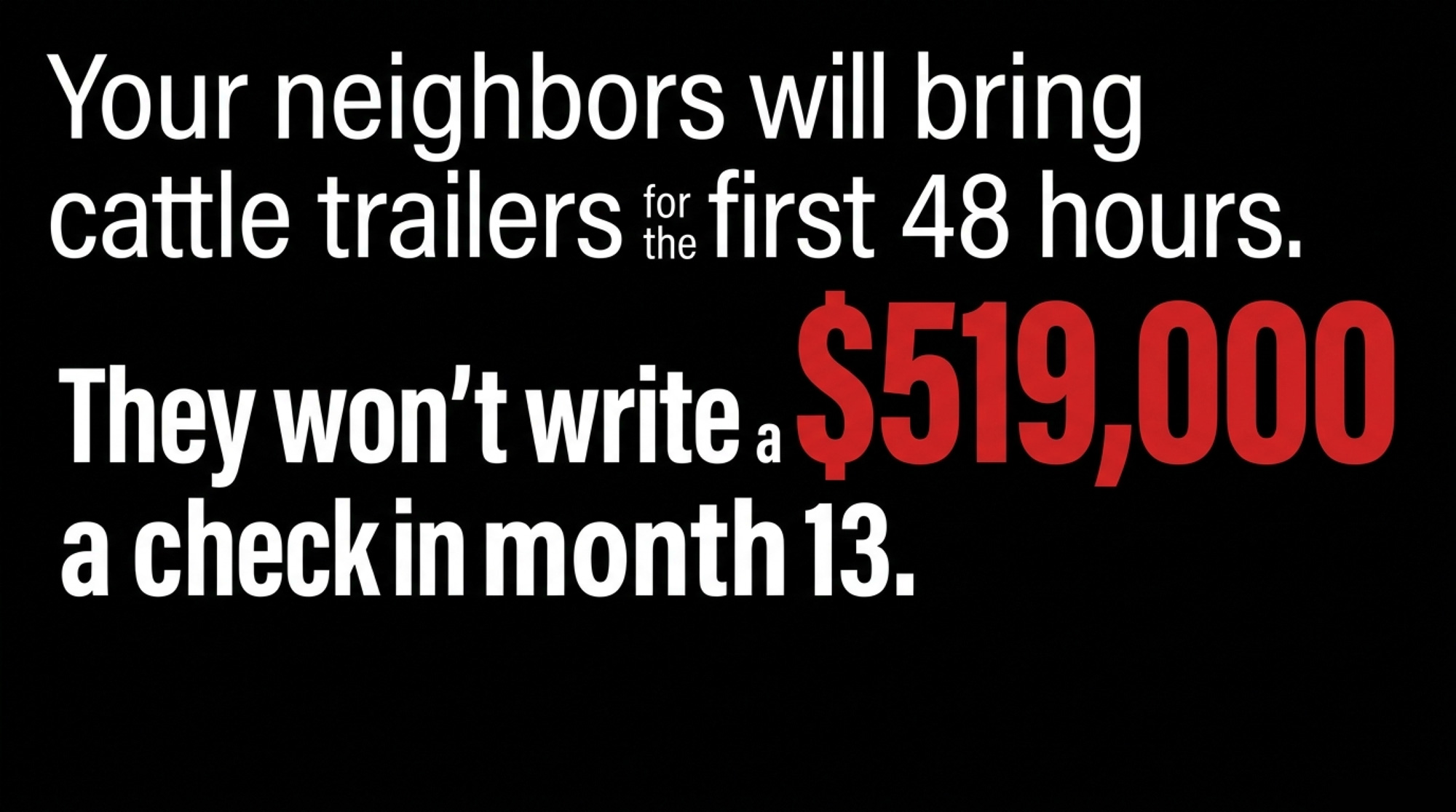
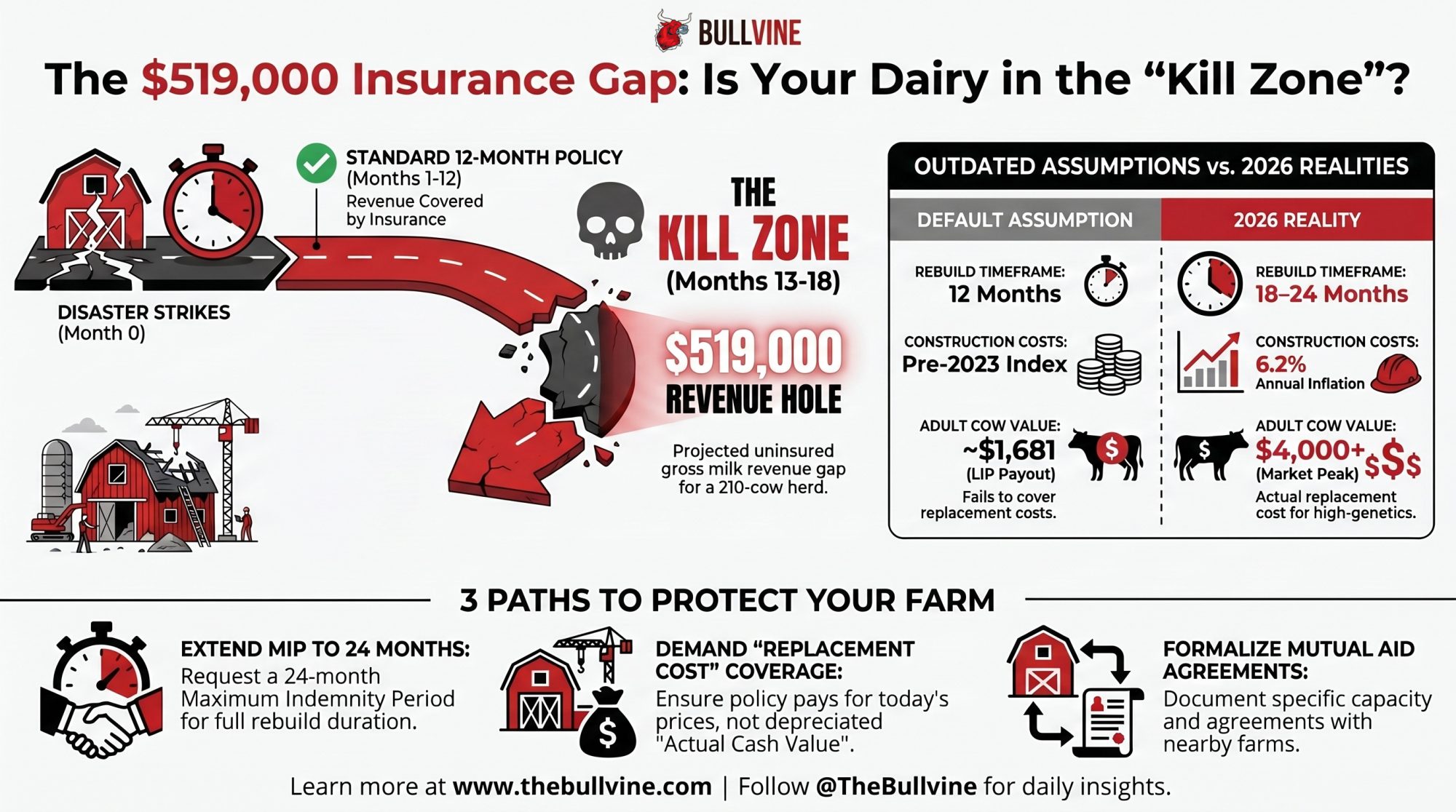
Your neighbors will bring casseroles and cattle trailers for the first 48 hours. They won’t write a $519,000 check in month 13. Only a correctly written policy does – and most mid-size dairies don’t carry one.

Executive Summary: An EF-1 tornado leveled Hull’s Dairy in Fenwick, Michigan at 10:58 PM on April 14, scattering 210 cows across Montcalm County — and exposing a six-figure coverage hole sitting in most mid-size dairy policies. Default farm policies run 12-month business interruption periods, but industry ag claims guidance — including from Sedgwick — puts complex dairy rebuilds at 18–24 months, leaving roughly $519,000 in uninsured gross milk revenue on a 210-cow herd at March 2026’s $16.16/cwt Class III. Construction costs make it worse: BLS PPI put 2025 materials inflation at 6.2%, and Lactanet’s 2023 survey pegs insulated dairy barns at $18,160 per head all-in, $7,100 per cow in equipment alone. Your LIP payment isn’t a recovery mechanism either — $1,681.88 per adult cow pays about 42 cents on the dollar against a $4,000+ springer, and as little as 12 cents on a VG-88 with real genetic merit. Blanket livestock coverage doesn’t distinguish a +2800 GTPI two-year-old from a GP-83 off a truck. The community brought cattle trailers for the Hulls within hours; they won’t cover month 13 of a rebuild. The 30-day move: call your agent, confirm Replacement Cost (not ACV) coverage, and price a 24-month MIP before renewal.
dairy farm insurance

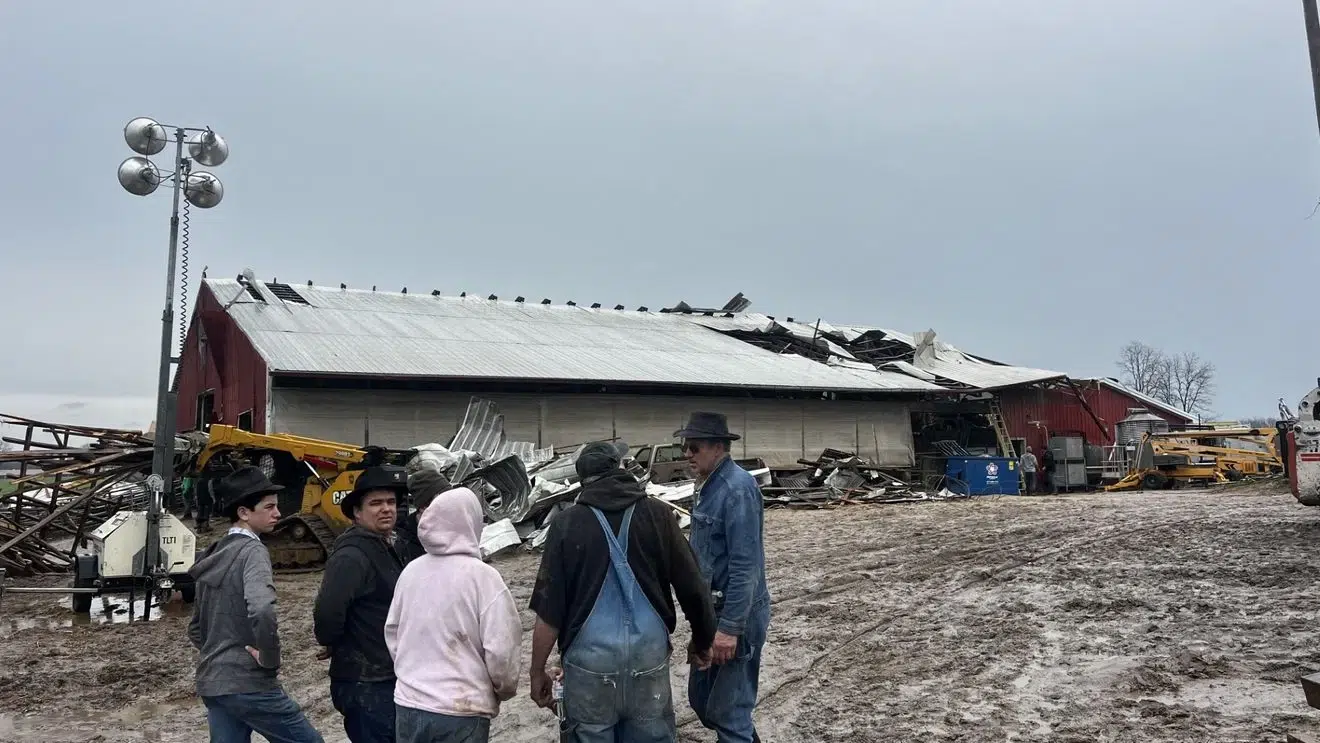
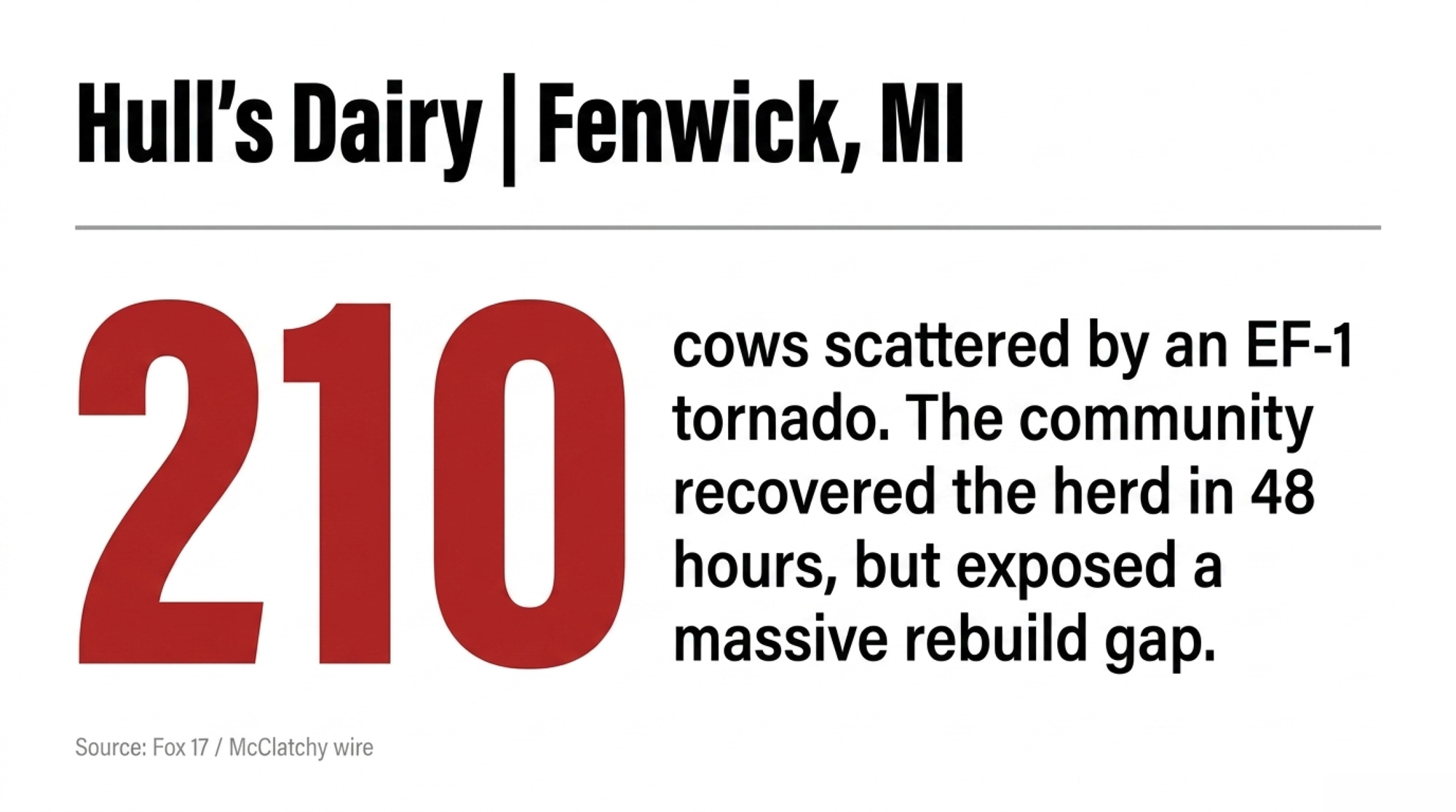
Janet Hull was in her basement at 10:58 PM on April 14, 2026, when the EF-1 hit her family’s farm in Fenwick, Michigan. She told Fox 17 it sounded like a train coming through the barns above her. By morning, the freestall that housed 80 of her cows was gone, two head were confirmed dead, and more than 200 animals were scattered across miles of dark Montcalm County countryside.

The community response was the kind dairy country still does better than anywhere else. Noah Heckman pulled in at sunrise with a cattle trailer, per Fox 17. Stephanie Schafer of Jem-Lot Dairy — a Michigan Farm Bureau District 5 director — drove her own truck over, per McClatchy wire reporting. Lane Grieser with Farm Bureau was on the phone. By Wednesday night, nearly the entire 210-cow herd had been recovered and relocated to a neighbor farm in North Ionia.

Every local outlet ran that story. None of them ran the math.
Here’s what they missed — and it’s not about Hull’s specific policy, which isn’t public. It’s about the default farm insurance structure a typical 200-cow family dairy carries. That structure likely sits on roughly $519,000 in uninsured gross revenue exposure between what a 12-month business interruption policy pays and what a complex rebuild costs when it runs to the midpoint of an 18–24 month range. No claim here about the Hulls’ individual coverage. This is about what the default structure does to a farm at that scale — and where the real risk hides in most dairy farm tornado damage recovery scenarios.

What’s Changed — and Why Your Policy Hasn’t Kept Up

Three things have shifted in the last few years that quietly made most farm insurance policies inadequate. Most producers didn’t notice. Carriers don’t send a letter when the math stops working.
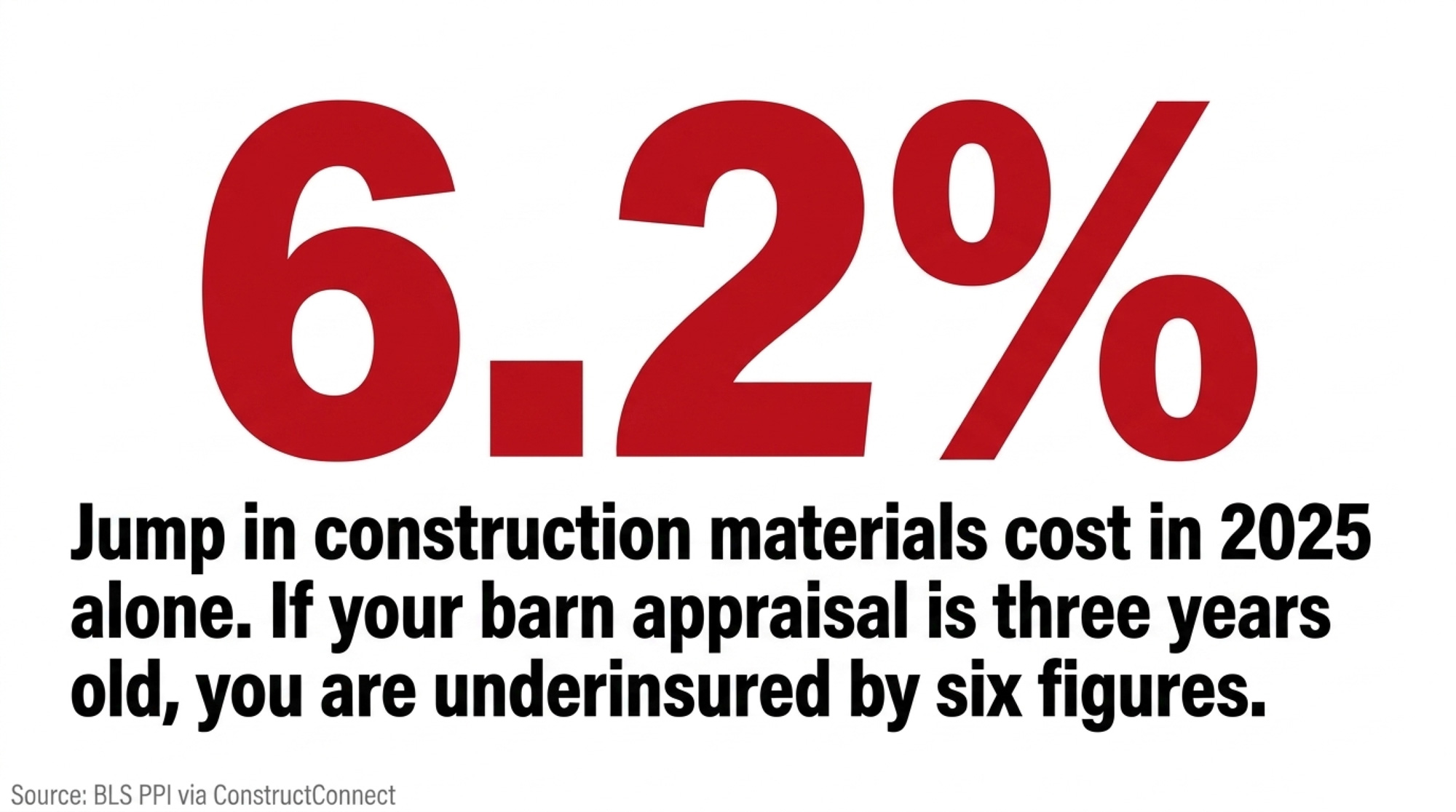
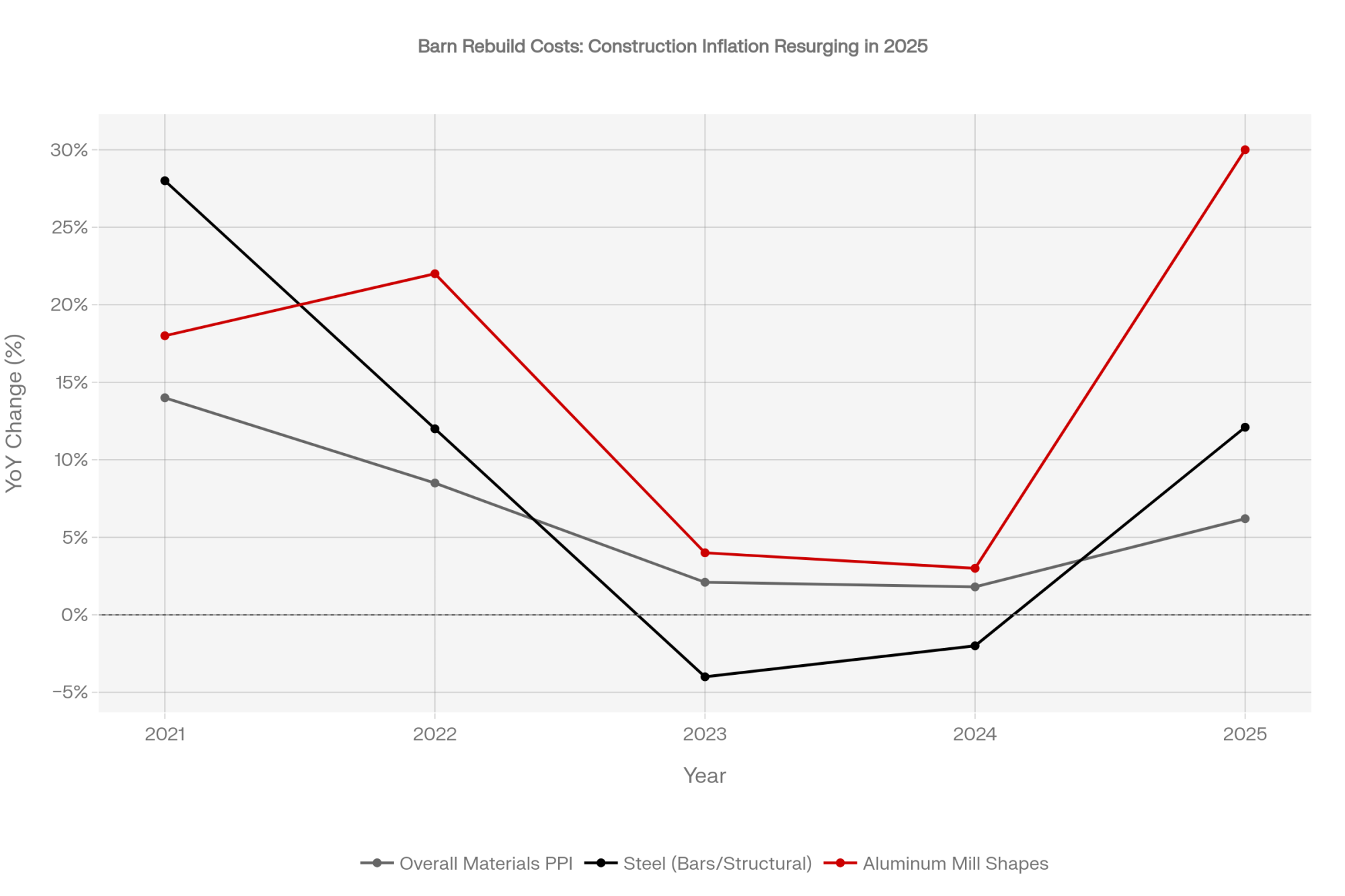
Construction costs are the first. Construction material prices rose 6.2% across 2025 — the largest single-year increase since the post-Covid spike in 2021 — according to Bureau of Labor Statistics Producer Price Index data reported by ConstructConnect. Steel bars, plates, and structural shapes climbed 12.1%. Aluminum mill shapes jumped more than 30% on tariff pressure. The Dairy Challenge 2022 benchmark pegged a basic freestall at roughly $3,500–$7,000 per milking stall depending on parlor and equipment build-out. Lactanet’s 2023 survey of 29 insulated dairy barns in Quebec put median costs at $101 per square foot total, $60.10 per square foot building only, $18,160 per head all-in, and $7,100 per cow in equipment alone. Layer the 2025 materials escalation onto that 2022–2023 baseline and rebuild numbers are running well above what most policies were priced to cover.
The replacement heifer market is the second. CoBank’s Knowledge Exchange reported in August 2025 that U.S. dairy heifer inventories have already hit a 20-year low and will shrink by an estimated 800,000 head over the next two years before any rebound in 2027. CoBank’s Corey Geiger flagged that heifer prices had already reached record highs and “could climb well above $3,000 per head.” Trade-media reporting through spring 2025 puts peak-market Holstein springer prices at $4,000–$4,200. If you have to replace cows fast after a disaster, “average” isn’t the number you pay. The market is. And the market is expensive.

The third shift is the quiet one. Farm policies don’t automatically update to either of those realities. Per-building replacement values are set at underwriting and only move when you proactively ask for a reappraisal. Some policies carry inflation-guard or auto-adjust endorsements, but most standard farm packages don’t include them by default — which is why the audit call matters. Maximum indemnity periods on business interruption coverage default to 12 months, a number calibrated back when a standard dairy rebuild fit inside that window. The gap shows up when the adjuster does.

How This Plays Out on Real Farms

Run the numbers on a 210-cow herd. A well-managed Holstein herd producing at 85 lbs/day puts roughly 17,850 pounds of milk in the tank daily — a pace above USDA NASS’s national average of about 65 lbs/cow/day across all breeds, which is why we’re calling it well-managed, not average. At USDA AMS’s March 2026 Class III price of $16.16/cwt, that’s $2,885 in daily gross milk revenue. Weekly, call it $20,200. Monthly, about $86,500. April 2026 Class III futures were trading around $16.84 as of mid-April; the USDA final print follows at month-end.
Now layer in the disruption math. Standard farm BI kicks in after a 48–72 hour waiting period and runs for a 12-month maximum indemnity period on most policies. In Sedgwick’s February 2024 publication “Maximum Indemnity Period: Is 12 months long enough?”, the firm’s major loss specialists make the case explicitly: policyholders “should work on the assumption of a total loss” and factor in a full recovery period, because rebuilding the physical asset is only phase one — winning back revenue or customers is phase two, and the phases compound. Farmers Weekly’s Business Clinic makes the dairy-specific version of the same point bluntly: “For larger, more complex dairy units 24 months may be needed to rebuild and re-establish a herd.” Those extensions have to be proactively bought. Unless you raise it, many policies renew at the default 12-month MIP out of habit.

What Your Policy Probably Says vs. What the Rebuild Actually Costs

Coverage elementDefault policy assumption2026 realityGap
Freestall replacement (80-stall unit)Indexed to pre-2023 build figuresPer Lactanet 2023: median $18,160/head all-in on insulated barns; equipment alone at $7,100/cowScales with cumulative 2023–2026 escalation
Construction input escalationLocked at last appraisal6.2% materials increase in 2025 alone per BLS PPITens of thousands to six figures depending on appraisal age
Business interruption period12 months MIP18–24 months per Sedgwick and Farmers Weekly guidance for complex dairies6–12 months uncovered
Livestock indemnity per adult cow$1,681.88 via USDA FSA LIP (2025 schedule)$3,000+ per head per CoBank; $4,000–$4,200 peak spring 2025~$1,300–$2,500+ per head
Gross milk revenue at risk, months 13–18Not covered~$519,000 on a 210-cow herd~$519,000 ← The Kill Zone

If a rebuild runs past the 12-month mark, the missing months 13 through 18 represent roughly $519,000 in uninsured gross milk revenue on a herd this size. One caveat worth naming up front: BI policies typically pay gross revenue minus saved expenses, so the actual out-of-pocket shortfall moves with feed, labor, and repair savings during the disruption. The $519,000 is the top-line revenue hole, not the net gap. Even so, the net still lands in six figures on a herd this size. Call it the kill zone: the window where no program, no neighbor, and no GoFundMe covers the difference. Only a correctly written policy does.

And this math scales. A 500-cow operation running the same 85 lbs/day at $16.16/cwt is putting about $206,000 in monthly gross revenue through the parlor — double the exposure per month the default MIP leaves uncovered. Scale doesn’t protect you here. It widens the gap.

What LIP Doesn’t Cover: The Genetic Premium Your Policy Ignores

Now the second gap — and this one hits Bullvine readers harder than most. The USDA Livestock Indemnity Program pays $1,681.88 per adult dairy cow lost to a qualifying disaster under the 2025 rate schedule. The 2026 table hadn’t been released as of publication; historically, LIP rates update mid-year based on prior-year fair market values.

That $1,681.88 is calculated on an industry-average market value for a generic adult dairy cow. It doesn’t distinguish between a GP-83 first-calver you bought off a truck and a VG-88 two-year-old carrying a +2800 GTPI that you’ve spent three generations building toward. If you lose that animal in a tornado, LIP pays $1,681.88. Period. The pedigree, the classification score, the genomic premium, the flush potential — none of it exists in the indemnity formula.
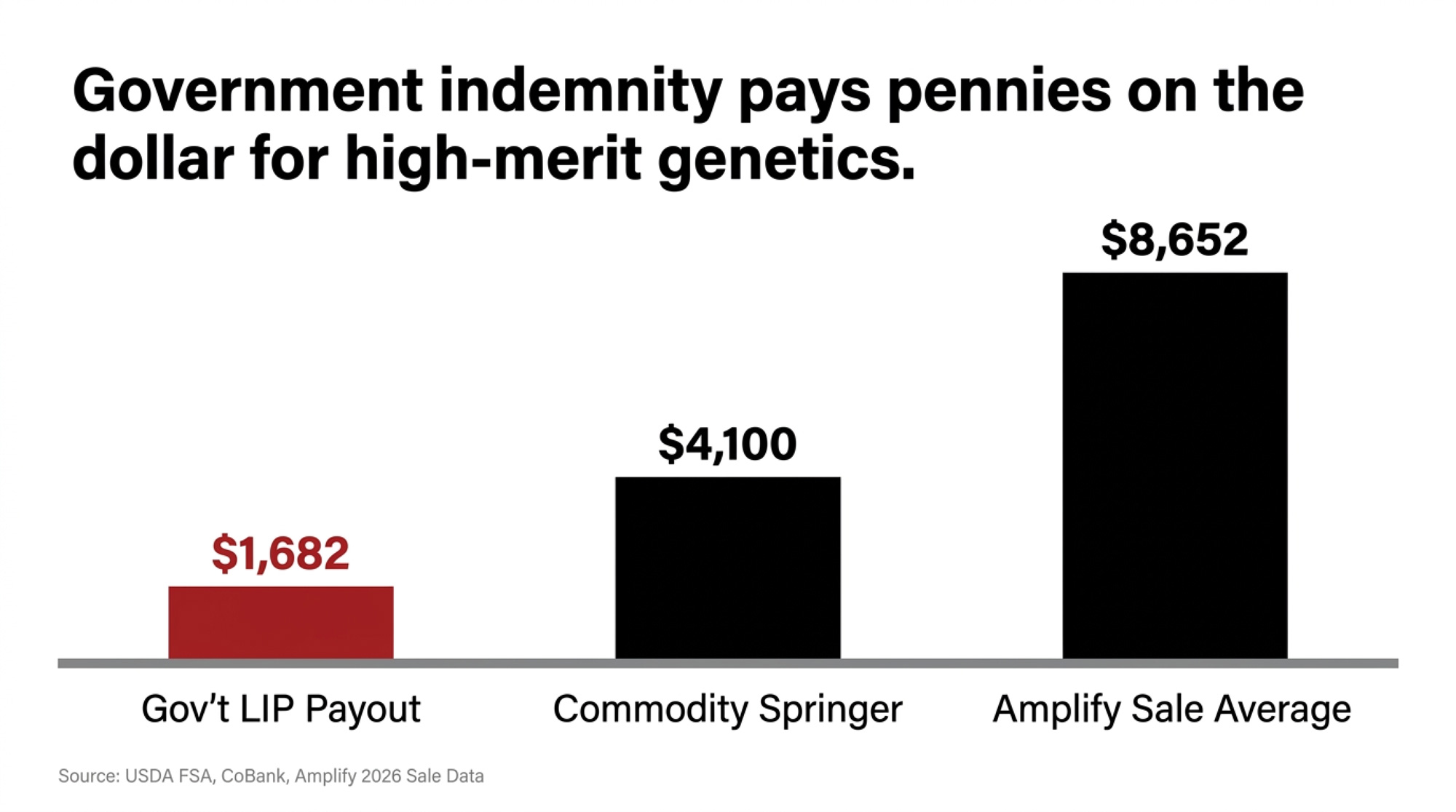
Market replacement springers are running $4,000–$4,200 for average genetics at peak, per spring 2025 trade-media reporting. But if you’re rebuilding a herd with above-average genetic merit, the replacement cost per head isn’t $4,000. For genomic-tested, classified cows — the kind many Bullvine readers are building — market replacement routinely runs two to four times the commodity springer price, and for the top end of the market, much higher. The Amplify 2026 sale averaged $8,652 across 124 lots — roughly double commodity springer pricing. Move up one tier and the 2024 World Classic Holstein Sale at World Dairy Expo averaged $30,245 across 55 lots, with a $205,000 IVF session topping the board. Best of Triple-T & Friends in May 2025 hit $78,500 on Ms Milksource Sunday-ET, an All-American class winner Tattoo daughter. That makes LIP not a recovery mechanism but roughly 42 cents on the dollar at commodity replacement, and materially less — potentially 12–21 cents on the dollar — for a genetically invested herd. For every cow lost and replaced, the farm eats the rest.

Standard farm insurance livestock coverage doesn’t typically distinguish by genetic merit either — not unless you’ve specifically scheduled individual high-value animals, which most 200-cow operations haven’t done. If you’ve never asked your agent whether your livestock coverage is blanket or scheduled, and whether it pays market value or a flat sublimit, this is the week to find out.

The Mechanics Behind the Outcomes

It’s not random. It’s how the system was built.

Farm insurance is priced against historical average losses. Reinsurance models, per-building sublimits, and MIP caps were calibrated against a decade of claims data from an era when construction costs were flatter and ag contractors more available. Those assumptions haven’t updated at the pace the underlying economics have. The policy you signed three years ago is protecting a farm that no longer exists at those numbers.

Federal disaster programs, meanwhile, run in isolation. LIP, FSA Emergency Loans, SBA EIDL, and crop insurance — four different agencies, four different timelines, four different sets of eligibility rules, and no coordinated intake. USDA’s One Farmer, One File initiative launched at 2026 Commodity Classic is working to streamline digital services across FSA, NRCS, and RMA, but completion is targeted for 2028. A producer in active recovery today still has to navigate all four programs independently while managing a displaced herd, a construction project, and a cash-flow hole. The system rewards sophistication at exactly the moment operators have the least capacity for it.
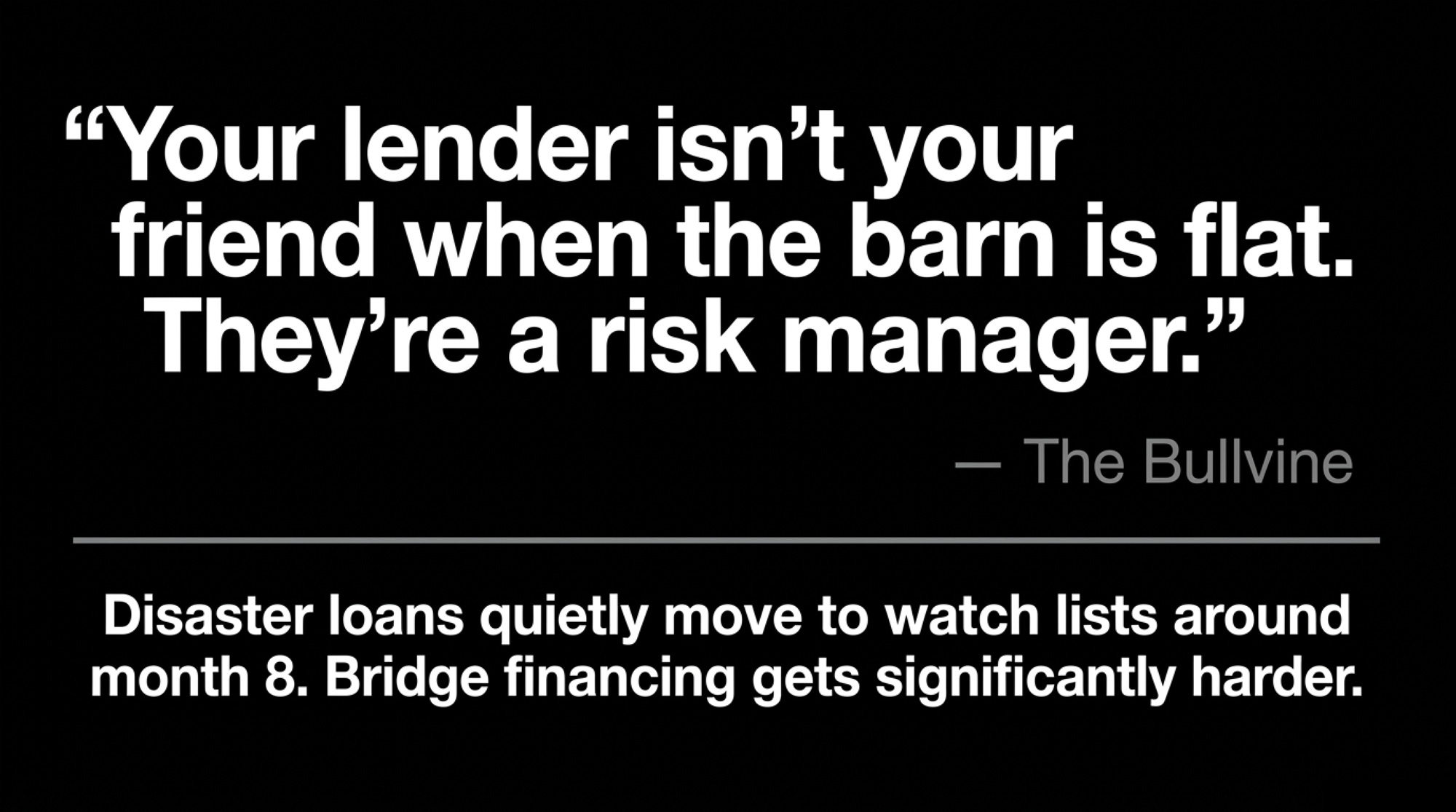
And there’s a piece nobody talks about at the Farm Bureau meeting: your lender isn’t your friend when the barn is flat. They’re a risk manager. Ag lenders use internal risk classification systems, and a disaster-recovery loan can quietly move to a watch list or “Special Assets” classification. Disclosure timing varies by lender. Borrowers who ask directly typically get straightforward answers. Borrowers who don’t ask often don’t find out until their loan terms change underneath them — interest rate, reporting requirements, and collateral scrutiny can all shift once the file moves to a different desk. The bridge-financing conversation that could’ve happened easily in month 2 gets noticeably harder in month 10.

None of this is rocket science. It’s just the work nobody does until the wind hits.

How Much Does the 20-Minute Phone Call Actually Save?

Depends where your current coverage sits relative to your real exposure. But the order of magnitude is consistent across most mid-size dairies that haven’t reviewed their policies in three or more years.

On the structure side, a construction cost gap against a $300,000 barn scales directly with the cumulative escalation since your last appraisal — likely in the tens of thousands on a barn that size, potentially six figures if the appraisal is five-plus years old. BLS PPI put 2025 materials inflation at 6.2%. On the MIP side, stretching from 12 to 24 months on a 210-cow operation protects roughly the same six-figure range as the $519,000 gap walked through earlier — the back half of a slow rebuild where the default policy has already tapped out. Combined, the phone call plus a modest premium adjustment closes a six-figure exposure currently sitting on your balance sheet as unacknowledged risk. That’s a better ROI than most decisions you’ll make this quarter.

Is Your Mutual-Aid Network Real, or Is It a Hope?

Every producer in tornado country has a mental list of neighbors they’d call. Fewer have actually confirmed those neighbors have the capacity, the facility space, and the willingness to absorb 50–100 head on 12 hours’ notice. Fewer still have had the conversation explicitly enough that the neighbor knows to pick up the phone at 11 PM on a Tuesday.

Per public reporting, the Hulls had Noah Heckman, Stephanie Schafer, Lane Grieser, and a neighbor in North Ionia who could house the entire 210-cow herd. Real network. It showed up. For most producers, the answer to “who boards my herd for 6 months if the barn’s gone tomorrow” is a name, not an agreement. Those aren’t the same thing. Write down the agreement. Exchange numbers. Document the capacity. After the siren, you can’t build the relationship fast enough.

Element“I Have a Name”A Real Agreement
Contact confirmed?Maybe — you assume they’d answerCell number in your phone, verified in last 6 months
Capacity confirmed?Assumed based on farm sizeExplicit: “I can take 50 head in the freestall for up to 90 days”
Timing confirmed?“They’d come if I called”Explicitly agreed: picks up at 11 PM on a Tuesday
Herd biosecurity discussed?❌ Never✅ Health status, vaccination protocols exchanged
Feed/labor cost arrangement?Assumed informalWritten: cost-sharing or reciprocal commitment documented
Lender/insurance notified?❌ Unknown✅ Listed as contingency in your insurance file
Michigan AgMediation contact?❌ Unknown📞 800-616-7863 on file

Options and Trade-Offs for Farmers

Four practical paths for producers who want to close these gaps before they turn into active problems.

Path 1 — The 20-minute coverage audit (do this within 30 days). Call your ag insurance agent this week and ask three specific questions: (1) What is the replacement cost per building on my policy, and when was it last updated? (2) What is my maximum indemnity period for business interruption? (3) What does a livestock loss claim actually pay on cows that are unrecovered versus confirmed dead?

Pro Tip: Ask your agent one more question: “If I have a total loss today, do I have a Replacement Cost or Actual Cash Value policy?” If they say ACV, start shopping. An ACV policy insures depreciated value — the farm as it existed in 2018, not the farm you’d have to rebuild in 2026. That single distinction can be the difference between a six-figure gap and a manageable rebuild. Replacement Cost coverage pays what it actually costs to rebuild at today’s prices. ACV pays what your barn was worth minus years of wear. You don’t want to find out which one you have after the adjuster shows up.

Path 2 — Request a replacement cost appraisal. If your last appraisal is more than three years old, construction escalation has likely opened a meaningful gap between insured value and rebuild cost. BLS PPI data — via ConstructConnect — puts 2025 construction materials inflation at 6.2%, the fastest single-year rise since 2021, with specific items like steel and aluminum running well higher. Makes sense for any farm with meaningful capital infrastructure. Requires a formal appraisal request and possibly a premium adjustment. The limit: ask for the quote before committing. Premium increases may be modest or meaningful depending on how much coverage you actually need to expand.

Path 3 — Extend your MIP to 24 months. Sedgwick’s major loss team and Farmers Weekly’s Business Clinic both make the case that 18–24 months is the realistic indemnity window for complex dairy rebuilds. Makes sense for any farm with specialized ventilation, robotic or parallel milking systems, or multi-structure exposure. Requires a proactive ask at renewal. The premium increase is usually modest. The coverage difference can run into six figures.

Path 4 — Document your mutual-aid network in writing. Identify two neighbor farms willing to take 50–100 head on 12 hours’ notice. Get their cell numbers in your phone. Exchange basic herd inventories so confirmations move fast. Makes sense for every farm in tornado, flood, or fire country. Requires a real conversation, not an assumption. The limit: goodwill and capacity aren’t the same thing — confirm both. Michigan producers can also loop in the state’s Agricultural Mediation Program (800-616-7863) for any disaster-related lender or neighbor-aid dispute that can’t be resolved at the kitchen table.
Key Takeaways

  • If your policy’s per-building replacement value hasn’t been updated in three years, assume a meaningful construction gap and request a reappraisal this month. BLS PPI alone put 2025 materials inflation at 6.2%.
  • If your business interruption MIP is still 12 months, get a quote on 24. Sedgwick and Farmers Weekly both point to 18–24 months as the realistic rebuild window for complex dairies.
  • If you don’t know whether you carry Replacement Cost or Actual Cash Value coverage, find out before your next renewal. ACV protects a depreciated barn, not the one you’d have to build.
  • If your livestock coverage is blanket rather than scheduled, high-value genetics typically aren’t protected — a VG-88 cow and a GP-83 cow often pay out the same under standard farm policies. Confirm with your agent before assuming your genetic investment is covered.
  • If you don’t know that LIP pays $1,681.88 per adult dairy cow, you can’t model the out-of-pocket gap against CoBank’s $3,000+ heifer forecast — let alone replacement for an Amplify 2026-tier lineup averaging $8,652 or a World Classic-tier lineup averaging $30,245.
  • If your mutual-aid network is a list of names rather than a set of confirmed agreements, treat it as a hope, not a plan.
  • If you haven’t asked your commercial lender how your loan classification changes in a disaster-recovery scenario, you’re flying blind on a conversation that happens quietly around month 8.
  • If you can’t name an operator in your region who has completed a full post-disaster dairy rebuild, find one through Farm Bureau or your co-op before you need them. Their pattern recognition is worth more than any program brochure.

The community that showed up for Janet Hull on April 15 was extraordinary. But here’s the part nobody says out loud: your neighbors will bring casseroles and cattle trailers for the first 48 hours. They aren’t writing a $519,000 check in month 13. Only you — and a correctly written policy — can do that. Find out your number before your neighbor finds out theirs.

Next week in Bullvine Weekly: the full replacement cost audit framework by herd size and structure type — the exact questions to bring to your agent, the documents to request, and the thresholds that tell you whether your policy is keeping pace with 2026 construction costs. That’s where the real numbers live.

Sourcing note: This article is based on public reporting from Fox 17, WKAR, WWMT, and the McClatchy wire (Kansas City Star). Class III price per USDA AMS Announcement of Class and Component Prices (March 2026). LIP rate per USDA FSA 2025 Livestock Indemnity Program fact sheet. Construction cost data per Bureau of Labor Statistics Producer Price Index (2025) as reported by ConstructConnect (February 2026). Dairy barn construction cost benchmarks per Lactanet 2023 survey of 29 insulated Quebec dairy barns and Dairy Challenge 2022 building cost estimates. Heifer market data per CoBank Knowledge Exchange, “Dairy Heifer Inventories to Shrink Further Before Rebounding in 2027” (August 27, 2025). Business interruption guidance per Sedgwick, “Maximum Indemnity Period: Is 12 months long enough?” (February 11, 2024) and Farmers Weekly Business Clinic (March 28, 2022). Sale averages per Amplify 2026 (February 27, 2026), 2024 World Classic Holstein Sale at World Dairy Expo, and The Best of Triple-T & Friends 2025. Milk production context per USDA NASS. The Bullvine has not spoken directly with the Hull family. If Janet, Bryan, Ryan, or Drew would like to share their perspective for follow-up coverage — or request a correction on anything in this piece — we welcome the conversation.

Learn More

The Sunday Read Dairy Professionals Don’t Skip.
Every week, thousands of producers, breeders, and industry insiders open Bullvine Weekly for genetics insights, market shifts, and profit strategies they won’t find anywhere else. One email. Five minutes. Smarter decisions all week.
NewsSubscribe
First
Last
Consent

Vagts, Normans, Haldersons: $18 Million in Stray Voltage Verdicts. And a $3,000 Test No One Told Them Existed.

Three dairy families fought utilities for decades over unexplained herd losses. The testing blind spot and insurance trap they exposed threatens every operation milking on concrete.

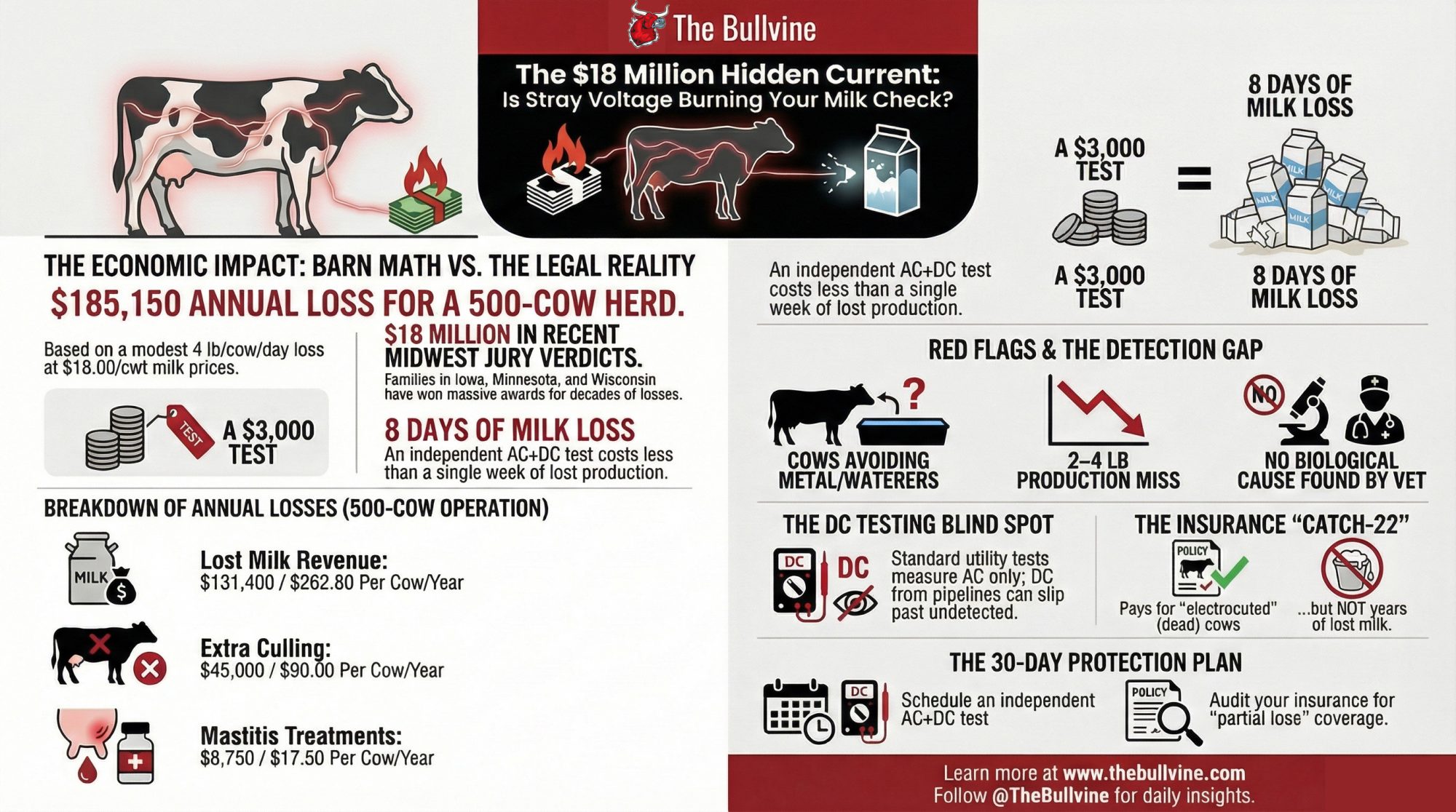
Executive Summary: Three Upper Midwest dairies have already won more than $18 million in stray‑voltage verdicts, and the barn‑math says a hidden 4 lb/cow/day loss on a 500‑cow herd can quietly burn about $185,000/year off your milk check. The article walks through what happened to the Vagts (Iowa), Normans (Minnesota), and Haldersons (Wisconsin) when DC current from utility and pipeline systems ran through concrete barns while standard AC‑only tests kept saying “you’re fine.” It shows how insurance language like “death by electrocution” and “necessary suspension of operations” often pays for dead cows and wiring, but not years of lost milk if you keep milking through the problem. You’ll see exactly when to suspect voltage — cows avoiding one wet metal spot, 2–4 lb/cow/day unexplained loss, and no clear biological cause — and why a low‑thousands‑of‑dollars AC+DC test is basically eight days’ worth of the milk you’re probably already losing. There’s a clear 30‑day plan: schedule an independent DC‑capable test if you see those red flags, email your agent a 4–7 lb/cow/day scenario and ask what actually pays, and start logging production, behavior, and utility work like a future plaintiff. If you’re milking a few hundred cows or more on concrete, especially on older rural lines, this is the kind of “invisible loss” story you read once and then immediately go check your own numbers.

dairy stray voltage

Editor’s note: These cases are centered in the Upper Midwest United States, but the technical blind spots in stray‑voltage testing and the “Catch‑22” in farm insurance language are risks any modern dairy on concrete can face, regardless of region.

Lawrence Neubauer walked onto the Vagts dairy near West Union, Iowa, in September 2020 and quickly found DC stray voltage at cow‑contact points. He spent three more days documenting it. By then, Mark, Joan, and Andrew Vagts had already burned through about seven years of vet calls, nutrition consults, and equipment checks trying to explain why cows that looked “fine” on paper were sick, nervous, and underperforming.

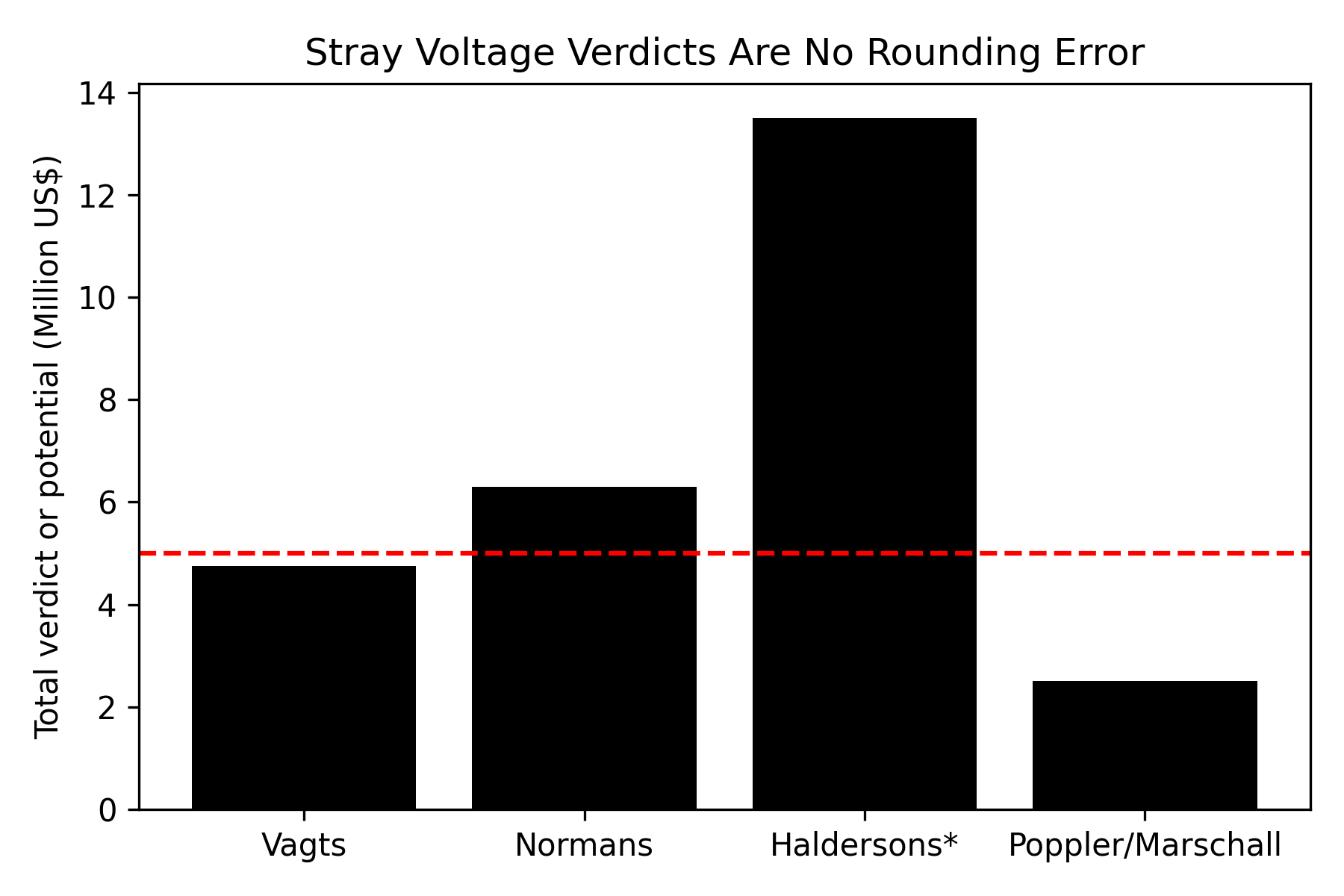
Their troubles started after 2013, when a nearby Northern Natural Gas pipeline’s cathodic protection system began leaking current into their ground. A Fayette County jury later awarded the Vagts $4.75 million — $3 million in economic damages, $1.25 million for personal inconvenience and distress, and $500,000 for loss of use and enjoyment of their property. The Iowa Supreme Court upheld every dollar on June 21, 2024.

That’s one family. Across Iowa, Minnesota, and Wisconsin, stray‑voltage verdicts now total well over $18 million, even if you use conservative numbers. The real total is closer to $20–30 million once you add interest, fees, and multiple trials. Farm legal expert Roger McEowen, a professor at Washburn University School of Law whose March 2026 analysis was published through Kansas State’s AgManager, put it bluntly: if this happened on your farm tomorrow, your insurance probably wouldn’t cover the part that hurts the most.

What’s Changing — and Why These Verdicts Matter Now

Stray voltage used to be a weird problem from the 1980s that only showed up in old extension bulletins. Four recent cases have turned it into a very current, very expensive risk.

In Minnesota, Randy and Peggy Norman ran a dairy near Pine River and did a lot of things right. Minnesota Lawyer reports that in 1994, they were 27 percent above the state average in milk production, and by 2012, they were 20 percent below. Over those years, their cows’ health would wax and wane without a good diagnosis that would fix the issue, their attorney Jeremy Stevens told the paper. “The cow would be culled or die.” After repeated accusations that they were mismanaging the herd, the Normans’ lender issued an ultimatum in 2012: sell the cows and quit milking. They did.

A Cass County jury trial in October 2014 produced the largest stray‑voltage jury award in Minnesota history: $4,861,478 in economic loss and $1.5 million in nuisance damages. With interest and fees, the total climbed to roughly $6.3 million. The Minnesota Court of Appeals affirmed it, and trial‑law publications later highlighted the case as a landmark.

Near Galesville, Wisconsin, Paul and Lyn Halderson operate a nearly 1,000‑cow dairy. Their lawsuit alleged that Northern States Power (an Xcel Energy subsidiary) had found “excessive voltage” in one of their barns starting in 1996 and never told them. Over the next 15 years, the Haldersons watched cows struggle with health and production while enduring accusations that they were substandard farmers. In 2011, they hired their own consultant, who traced the high electricity levels to the utility’s distribution system. Court records show the family claimed $5.8 million in lost profits between 2004 and 2011. A Trempealeau County jury found Xcel’s conduct “willful, wanton or reckless” and awarded just under $4.5 million — an amount that, under Wisconsin statute, can be tripled to $13.5 million when a utility violates certain safety laws. Appeals and post‑trial motions will determine the final number.

In Wright County, Minnesota, a jury initially awarded Harlan and Jennifer Poppler and Roy Marschall more than $750,000 in a stray‑voltage case against Wright‑Hennepin Cooperative Electric Association. After the Minnesota Court of Appeals ordered a new trial on damages, a second Wright County jury in 2015 returned a verdict of nearly $2.5 million. Minnesota’s appellate courts later upheld that award.

Taken together, these cases show a pattern where farm families spent years battling unexplained herd problems and litigating with utilities before juries and judges ultimately ruled in their favor. The cases didn’t just move money; they pulled back the curtain on how testing protocols, infrastructure, and insurance language actually behave when current starts leaking through concrete.

And in every single case, the big money didn’t come from insurance.

How This Actually Shows Up in Your Barn

The Vagts didn’t sit on their hands. They did what you’d probably do.

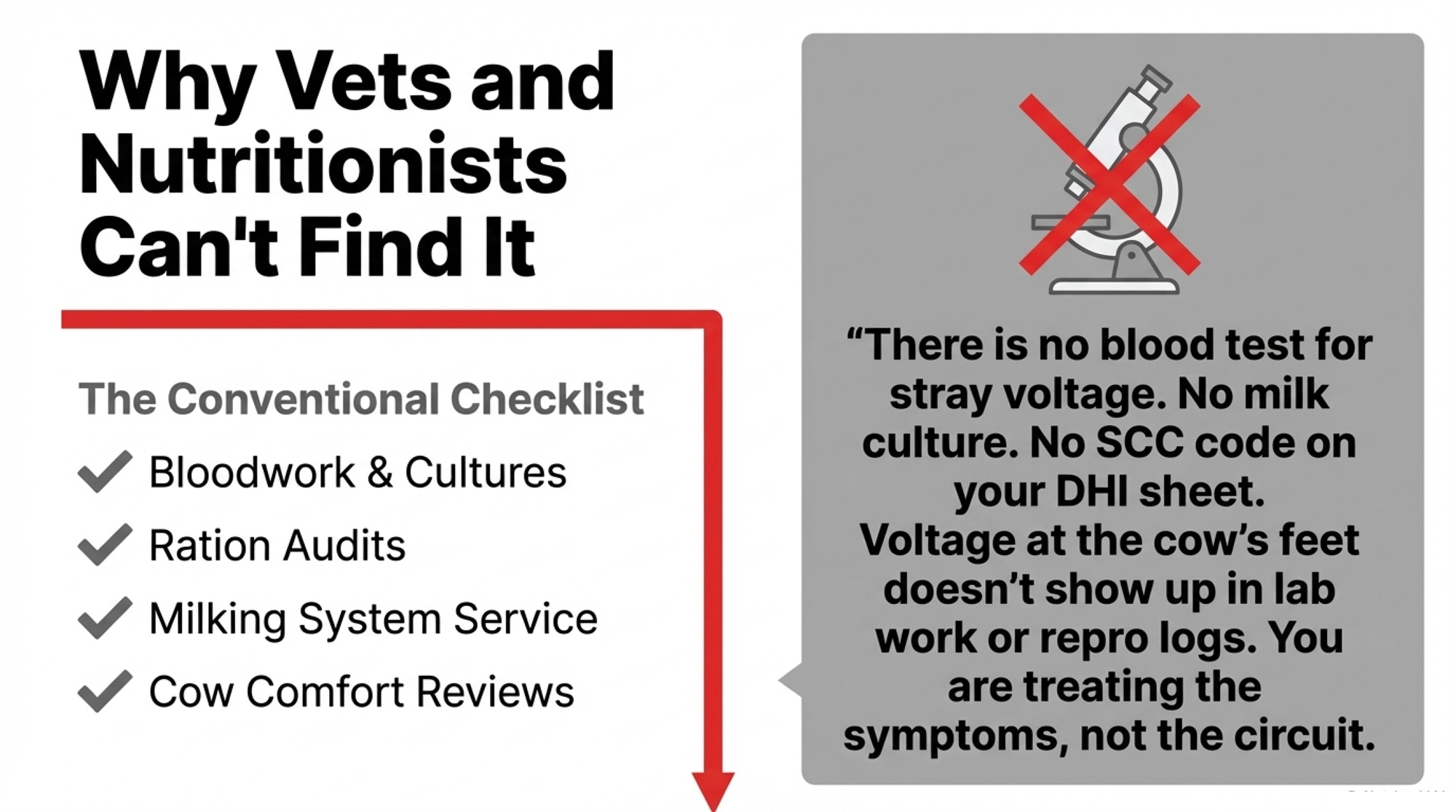
They called the vet. They adjusted rations with their nutritionist. They had the milking system serviced. They checked ventilation, bedding, and cow flow. For years, every professional who walked through that barn worked through the same checklist you and your advisors would use: bloodwork, cultures, necropsies, ration audits, cow comfort reviews. Nobody found a single “smoking gun.”

Here’s the hard truth buried in Wisconsin’s own stray‑voltage program documents: ” Stray voltage “is an electrical issue and can only be identified through standardized electrical testing protocols. There’s no blood test for it. No milk culture. No special SCC code on your DHI sheet.

Your vet can see the effects — chronic mastitis, odd behavior, production that doesn’t match the ration — but her toolkit is built to rule out disease, metabolic issues, and management mistakes. Voltage at the cow’s feet doesn’t show up in her lab work. It’s not in your nutritionist’s software. It’s not in your repro logs.

So how much did all that troubleshooting cost the Vagts before Neubauer showed up with the right meter?

You don’t have a published survey that nails down that figure. But on a 400–500 cow herd chasing an unresolved “mystery problem,” it doesn’t take long for extra vet calls, nutrition visits, milking‑equipment service, and outside consultants to add up to a noticeable line item. Over several years, that easily climbs into the five‑figure range — money that, in hindsight, would have covered a comprehensive independent electrical test many times over.

Then layer on what the Vagts eventually proved in court: about $3 million in lost production.

The Three Blind Spots That Let Stray Voltage Hide

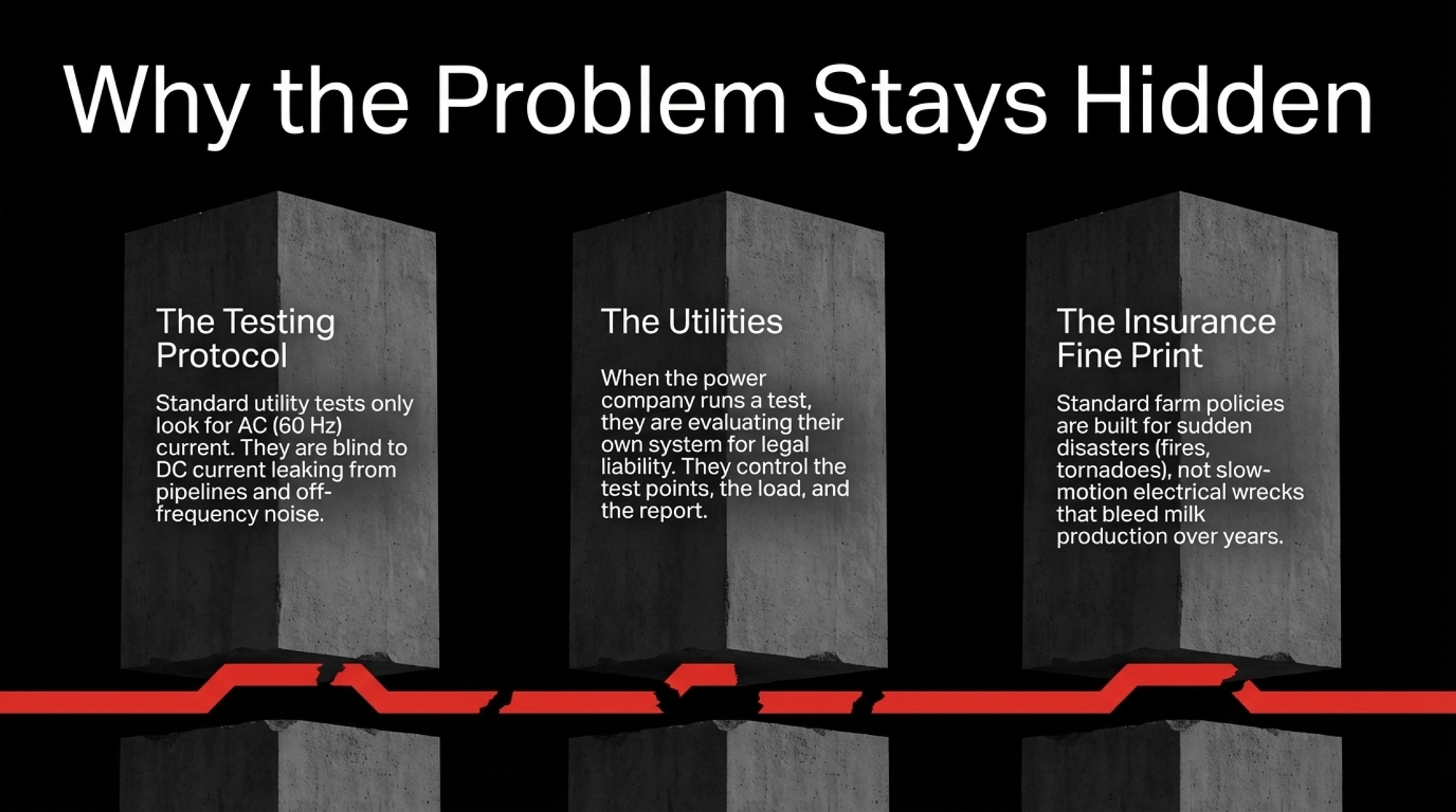
Stray voltage becomes expensive because three systems you rely on — testing, utilities, and insurance — are built with blind spots.

Blind Spot 1: The Testing Protocol

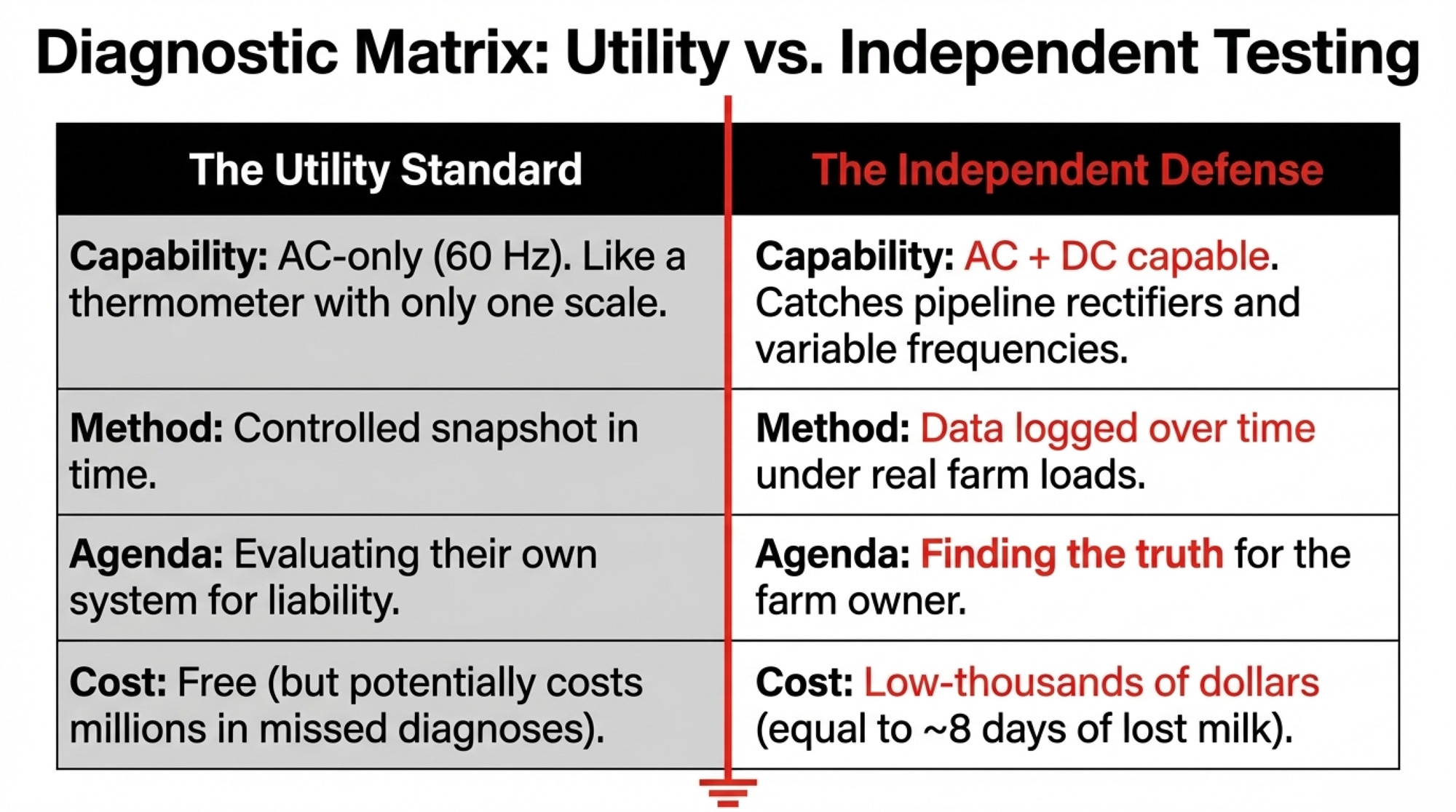
Wisconsin’s PSC Phase II protocol — the standard many utilities use and point to — explicitly measures only AC, 60 Hz, RMS, steady‑state animal‑contact voltages at cow contact points. That’s the right test if your problem is classic 60‑cycle current leaking off the utility neutral. It’s almost useless if the source is DC stray voltage from a pipeline rectifier, like on the Vagts farm, or if the current rides in on frequencies outside the 60 Hz band.

When utilities test under that protocol, they’re essentially using a thermometer that only reads one scale. If the problem is DC, the meter can sit close to zero, even while cows are still getting enough current through their legs to change behavior and milk.

Pro tip: A standard utility stray‑voltage test is tuned for AC at 60 Hz. If your problem is DC from something like a pipeline cathodic protection system, that DC current can slip right past that setup — which is exactly what happened before Neubauer showed up with a DC‑capable meter on the Vagts farm.

Blind Spot 2: Who Runs the Test

When your power company tests your farm, they’re evaluating their own system for potential legal exposure. They pick the test points, the timing, and the load conditions. They write the report. In states like Wisconsin, they follow PSC rules that set thresholds and protocols, which is better than nothing. But it’s still the entity whose system is being evaluated.

The Halderson case shows how that can go wrong. According to court documents and farm‑media coverage, Northern States Power measured excessive voltage in one of the Halderson barns starting in 1996 and recorded it internally. The Haldersons say nobody told them. They kept milking. They spent years battling health problems and production shortfalls. It wasn’t until 2011 — fifteen years later — that they paid for their own independent testing and finally had numbers they could use in court.

Blind Spot 3: The Insurance Fine Print

Standard farm packages were built for sudden events: fires, storms, and building collapses. Stray voltage is a slow‑motion wreck that doesn’t fit neatly into that box. The Mengel Dairy Farms case is the clearest lesson here.

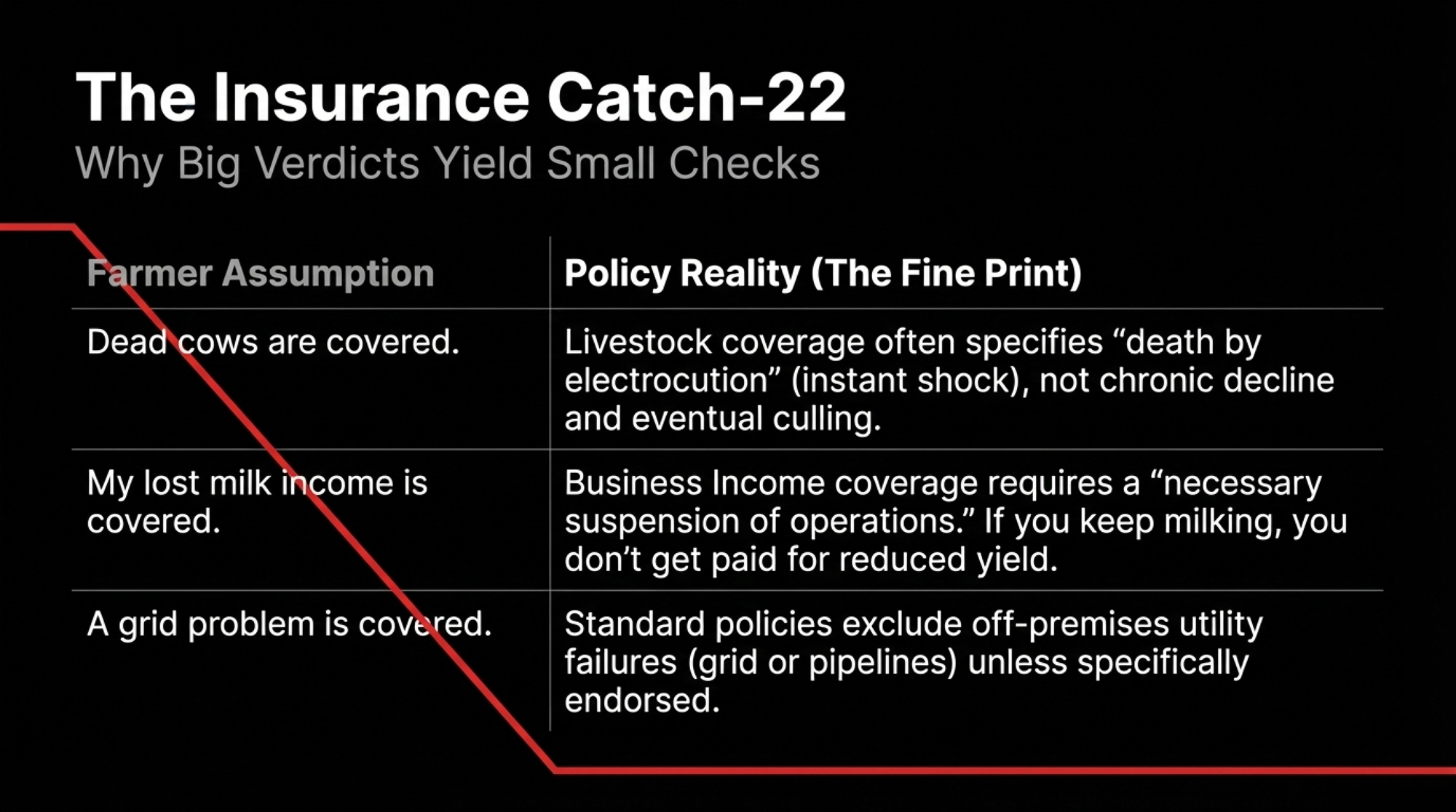
Hastings Mutual insured Mengel, and its own investigation confirmed stray voltage as a cause of damage. The company paid for dead cows and electrical work. Then it denied coverage for years of reduced milk production, arguing two key policy clauses never kicked in:

  • Livestock coverage: “death of livestock by electrocution.”
  • Business income coverage: loss of income due to the necessary suspension of your operations caused by a covered cause of loss

Mengel cut back cow numbers but kept milking. The cows didn’t die instantly from a visible shock. That, Hastings said, meant no business‑income coverage. A federal district court agreed, and the Sixth Circuit Court of Appeals affirmed in July 2021. As McEowen put it in his March 2026 article, it’s “a Catch‑22 for many farmers: if you keep working to save your business, you may disqualify yourself from insurance payouts for lost income.”

What Does Undetected Stray Voltage Actually Cost Per Cow Per Year?

Let’s do the barn math in plain numbers you can plug into your own herd.

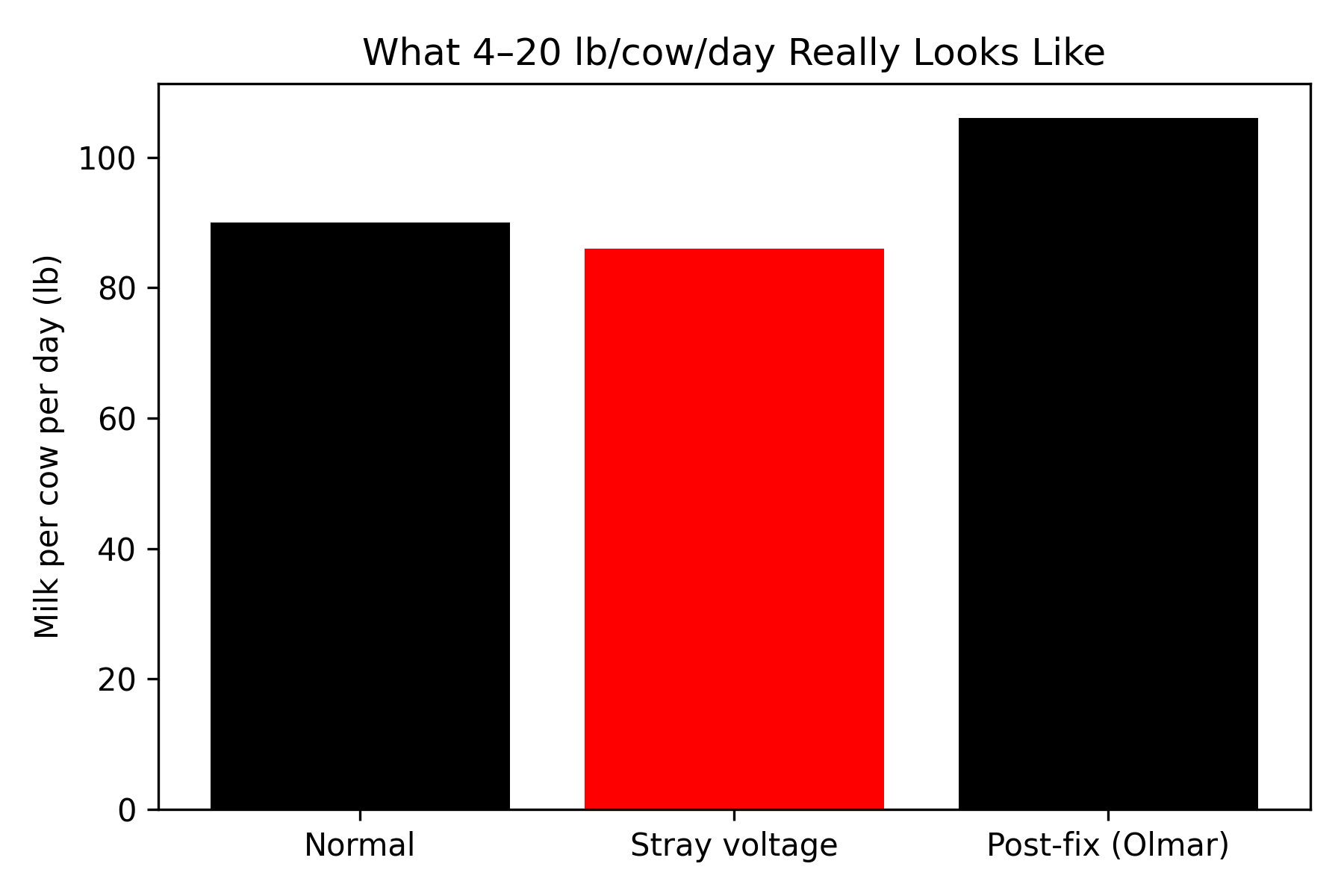
Take a 500‑cow operation. Suppose stray voltage quietly knocks 4 lb/cow/day off production — conservative compared to what families like the Vagts and Haldersons documented in court, and close to but below the nearly 20 lb/cow/dayproduction gain Jill Nelson at Olmar Farms in Sleepy Eye, Minnesota, saw after installing an isolated transformer and investing almost $100,000 to separate her farm from utility infrastructure.

Use a mid‑range milk price of $18.00/cwt — you can swap in your own number.

Barn Math at a Glance (500 cows)

Impact CategoryEstimated Loss (Per 500 Cows)Per Cow/Year
Milk revenue (4 lb loss @ $18/cwt)$131,400$262.80
Extra culling (5 more culls per 100 cows)$45,000$90.00
Mastitis treatment (1 extra case per 10 cows)$8,750$17.50
TOTAL ANNUAL LOSS$185,150$370.30

How it pencils out:

  • Daily lost milk: 500 cows × 4 lb = 2,000 lb = 20 cwt
  • Daily lost revenue: 20 cwt × $18.00 = $360
  • Annual: $360 × 365 = $131,400
  • Extra culls: 25 cows × $1,800 = $45,000
  • Extra mastitis: 50 cases × $175 = $8,750

Rounded, that’s about $370 per cow per year on a 500‑cow herd.

And that’s using a modest 4 lb/cow/day loss. Nelson’s experience — nearly 20 lb/cow/day more milk after an isolated transformer and major electrical upgrade — shows how quickly these numbers get ugly when you’re on the wrong side of the current for years.

A comprehensive independent electrical assessment that measures both AC and DC at cow‑contact points often lands in the low‑thousands of dollars for a mid‑size dairy — for many 400–700 cow herds, that means writing a check in the low‑thousands range once you factor in travel and time on farm. At $360/day in milk‑only losses, a $3,000 test is equal to about eight days of the production loss it’s designed to catch. Even if your numbers are half that, the math doesn’t take long to pencil out.

Does Your Farm Insurance Actually Cover Stray Voltage Damage?

Short version: your farm policy likely covers a sliver of the damage — dead cows and maybe some electrical repairs — but not years of lost milk.

McEowen’s stray‑voltage insurance piece walks through the Mengel case in detail. The key lessons match what shows up over and over in real farm policies and public farm‑insurance endorsements:

  • Electrocution means “instant death,” not chronic decline.
    The livestock section in many policies uses language like “death of livestock by electrocution.” In Mengel, the court interpreted “electrocution” broadly enough to cover cows that didn’t die instantly — good news for direct animal‑loss claims. But that clause only applied to dead animals, not reduced milk flow.
  • Business income often requires “necessary suspension of operations.”
    The business‑income section typically says something like “we will pay for the actual loss of business income you sustain due to the necessary suspension of your operations caused by a covered cause of loss.” Mengel reduced cow numbers but kept milking. Because the farm didn’t fully shut down, the court held that the business‑income coverage never kicked in. Hastings Mutual didn’t have to pay for the years of reduced production.
  • Off‑premises utility language can leave a gap.
    Many standard farm policies include wording that limits coverage for problems with utility service before power reaches your meter. If the source of your stray voltage is a grid problem or a pipeline cathodic protection system, that language may mean your insurer has no obligation to cover the loss under the current wording.

That’s why you see big verdicts but small insurance checks. The utilities and pipeline companies are paying because juries found them liable. The insurers, in cases like Mengel, have covered direct physical losses, while courts have held that policy wording doesn’t extend to long‑term production loss.

How Do You Close That Gap Before a Problem Hits?

You’re not going to find a clean “Stray Voltage Rider” in your agent’s menu. But you can use the tools that do exist to close most of the hole.

Ask for business‑income coverage that doesn’t require a full shutdown.
Sit down with your agent and walk through this specific scenario: “If stray voltage or another electrical issue reduces our production by 4–7 lb/cow/day for three years while we keep milking, what does this policy actually pay?” Ask about:

  • A farm business‑income or “loss of farm income” endorsement that covers partial production loss, not just total shutdown.
  • Whether “necessary suspension” can include a partial interruption or whether you truly have to stop milking to trigger coverage.

Don’t accept a hand‑wave answer. Ask them to put their explanation in an email.

Add utility service interruption coverage that reaches past your meter.
Standard property coverage often excludes damage caused by off‑premises utility failures. You want:

  • A utility service interruption endorsement that covers losses if a problem on the grid or pipeline causes damage at your farm.
  • Wording that explicitly includes overhead lines, distribution equipment, and, where possible, third‑party systems like pipelines if they’re feeding current into your ground.

On many mid‑size Upper Midwest dairies carrying full farm property, liability, auto, and umbrella, total annual premiums often end up in a five‑figure range. Endorsements like business‑income and utility‑service interruption usually add only a small percentage on top of that, not a second premium. In real terms, you’re talking about something in the ballpark of one smaller load of milk a year to close a six‑figure coverage gap.

And again, get it in writing. A clean email that says “here’s exactly how your policy would respond if stray voltage quietly took 4 lb/cow/day off your production for three years” is gold if you ever have to argue with a claims adjuster.

When Is It Time to Pay for a Stray Voltage Test?

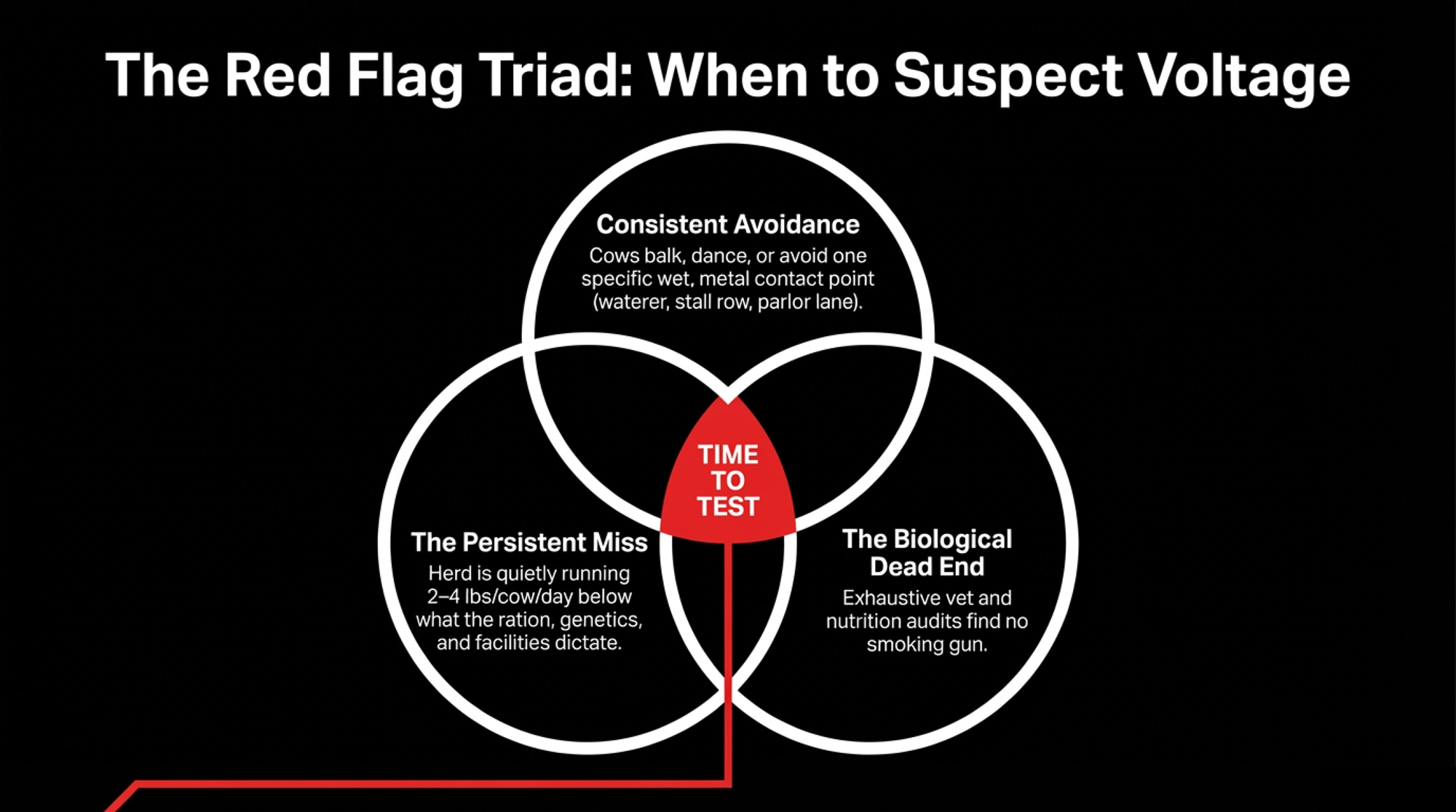
You don’t wait until your vet says, “I have no more ideas,” and your milk check has been light for three years. You pick up the phone when three things show up together.

  • Cows consistently avoid one specific wet, metal contact point.
    They balk, dance, or drink less at one waterer, stall row, or parlor lane — but use others without hesitation. Shadows, footing, and boss cows can cause some avoidance. But when it’s pinned to one specific piece of wet metal over time, you should get suspicious.
  • You’ve got a subtle but persistent production miss.
    One group or the whole herd is running 2–4 lb/cow/day under what your ration, genetics, and facilities should deliver, and minor tweaks never quite close the gap. You’ve got a sense your numbers “should be better than this,” even if you can’t prove it on paper.
  • Your vet and nutritionist can’t find a clear biological or management cause.
    You’ve worked through the checklist — fresh cow protocols, mastitis patterns, rumen health, feed quality, ventilation, milking routine — and you keep hearing some version of: “Honestly, this herd should be milking better than this. I don’t see a smoking gun.”
SignalTypical dairy explanationStray‑voltage interpretation
Cow behaviorAvoiding one trough is “cow politics”High‑risk: one wet metal point consistently avoided
Production numbers2–4 lb/cow/day miss blamed on geneticsHigh‑risk: ration and housing say you should be higher
Vet & nutrition work“Nothing obvious, herd should milk better”High‑risk: biology ruled out, electrical not tested yet
Recommended actionTweak feed or stall setup againHigh‑risk: book independent AC+DC test within 30 days

When those three line up, that’s your signal. You treat a low‑thousands‑of‑dollars independent AC+DC electrical assessment as cheap insurance, not a luxury.

What the “Cow Model” Actually Means

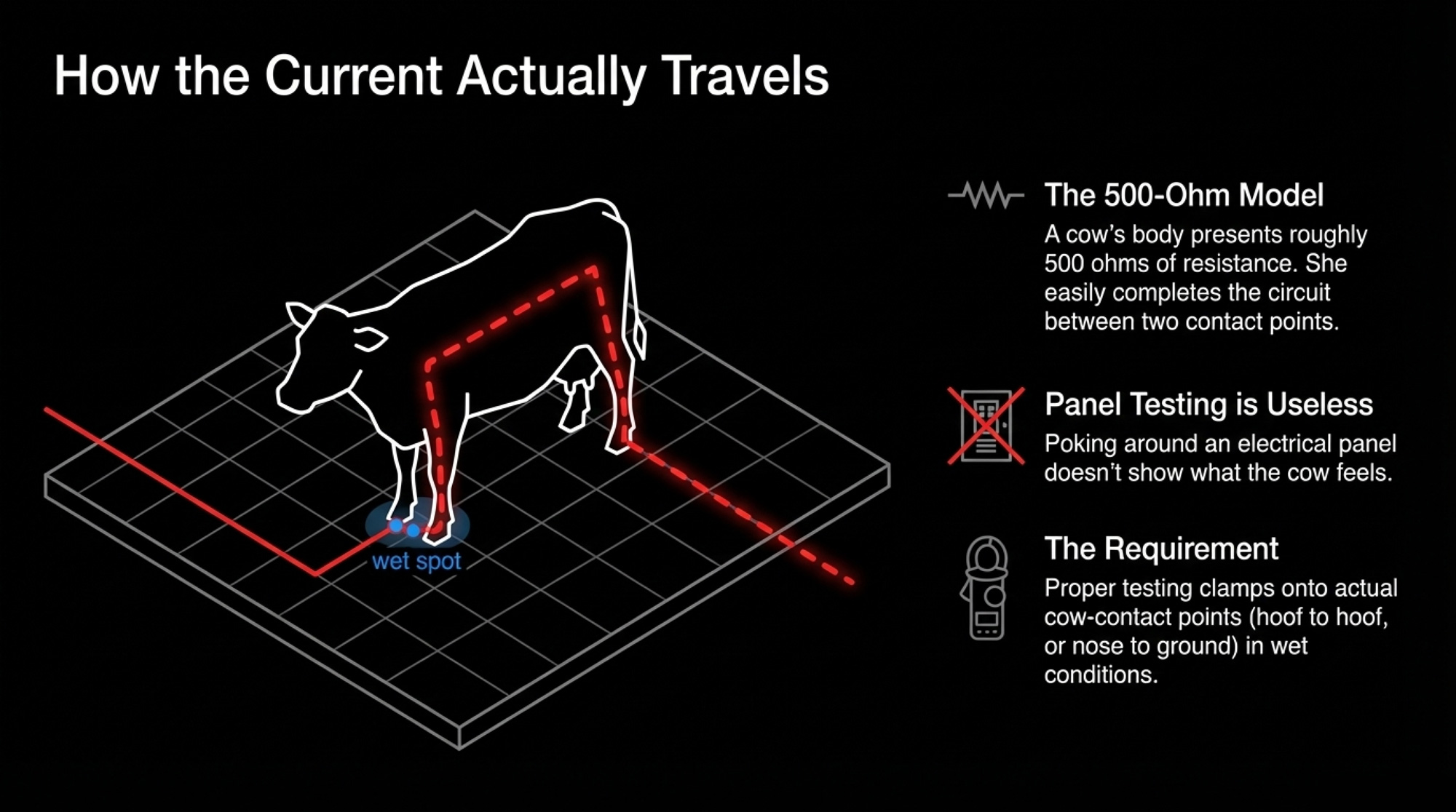
When consultants or PSC documents talk about a “500‑ohm cow model,” they’re just describing how easily a cow completes a circuit through her body — from a front foot in one wet spot to a back foot or nose touching another. The meter stands in for the cow, using about 500 ohms of resistance (roughly what a cow’s body presents), and measures how much voltage really exists from hoof to hoof or nose to ground. That’s why proper testing clamps onto actual cow‑contact points in wet conditions instead of just poking around in the panel.

And you start with someone who doesn’t have skin in the utility game. In Wisconsin, you can absolutely call your power provider and request a PSC‑compliant test, and you should. But remember: their protocol measures only AC, 60 Hz, RMS, steady‑state voltage. If your problem is DC from a pipeline or mixed‑frequency noise from aging infrastructure, that test literally can’t see it.

An independent dairy‑focused electrical consultant will:

  • Measure both AC and DC at cow‑contact points with a realistic “cow model” (usually around 500 ohms).
  • Log data over time, not just take snapshots.
  • Look at your farm wiring and the grid as a system, not in isolation.
  • Put findings in a written report of your own.

A simple, quick screen you can do yourself today: set a basic digital multimeter to low‑range AC volts, and check between the water in a suspect trough and a good ground reference. If you consistently see a few tenths of a volt or more — especially if it jumps when motors kick on — you’ve got enough reason to book a proper test. It’s not definitive, but it’s a useful filter between “cow politics” and “electrical problem.”

Why Do These Cases Keep Coming From Wisconsin, Minnesota, and Iowa?

It’s not that stray voltage only happens in the Upper Midwest. It’s that the conditions for big, provable cases cluster there. And those conditions are showing up in more regions every year.

First, the grid. Some Minnesota farm and energy advocates have described parts of the state’s rural electrical infrastructure as “crumbling.” Long rural feeders, multiple splices, and heavy livestock loads on circuits that were never designed for today’s 500–2,000 cow herds push a lot of current through a lot of grounded metal. Add in big barns built with concrete and steel — great for cow comfort, great for stray‑voltage pathways — and you’ve got more opportunities for dangerous “cow contact voltage” per mile of line than in smaller, pasture‑heavy regions.

Second, Wisconsin’s stray‑voltage program changed the game. Since the late 1980s, the PSC and DATCP have run a structured program with:

  • Standardized Phase I and Phase II testing protocols.
  • A defined “level of concern” threshold at about 2 milliamps (roughly 1 volt at a 500‑ohm cow model) at cow contact.
  • A hard rule that utilities must keep their own contribution under 1 milliamp.

That framework created a paper trail. When a utility knows it measured above those thresholds and didn’t fix it, a jury has something concrete to latch onto. That’s exactly what happened with NSP and the Haldersons.

Third, once a few big verdicts land, the flywheel spins. Law firms and consultants build expertise. Producers talk. Neighbors recognize similar patterns of herd problems when they hear the story. The infrastructure for proving stray‑voltage cases — technical, legal, and cultural — exists in Wisconsin, Minnesota, and Iowa in a way it doesn’t yet in many other dairy regions.

That doesn’t mean other states are safe. It likely means they have under‑measured, under‑documented problems, which is exactly why this kind of piece belongs in your reading stack even if you live a thousand miles from the Upper Midwest.

Options and Trade-Offs for Farmers

You’ve got a few realistic paths here. None involves crossing your fingers and hoping.

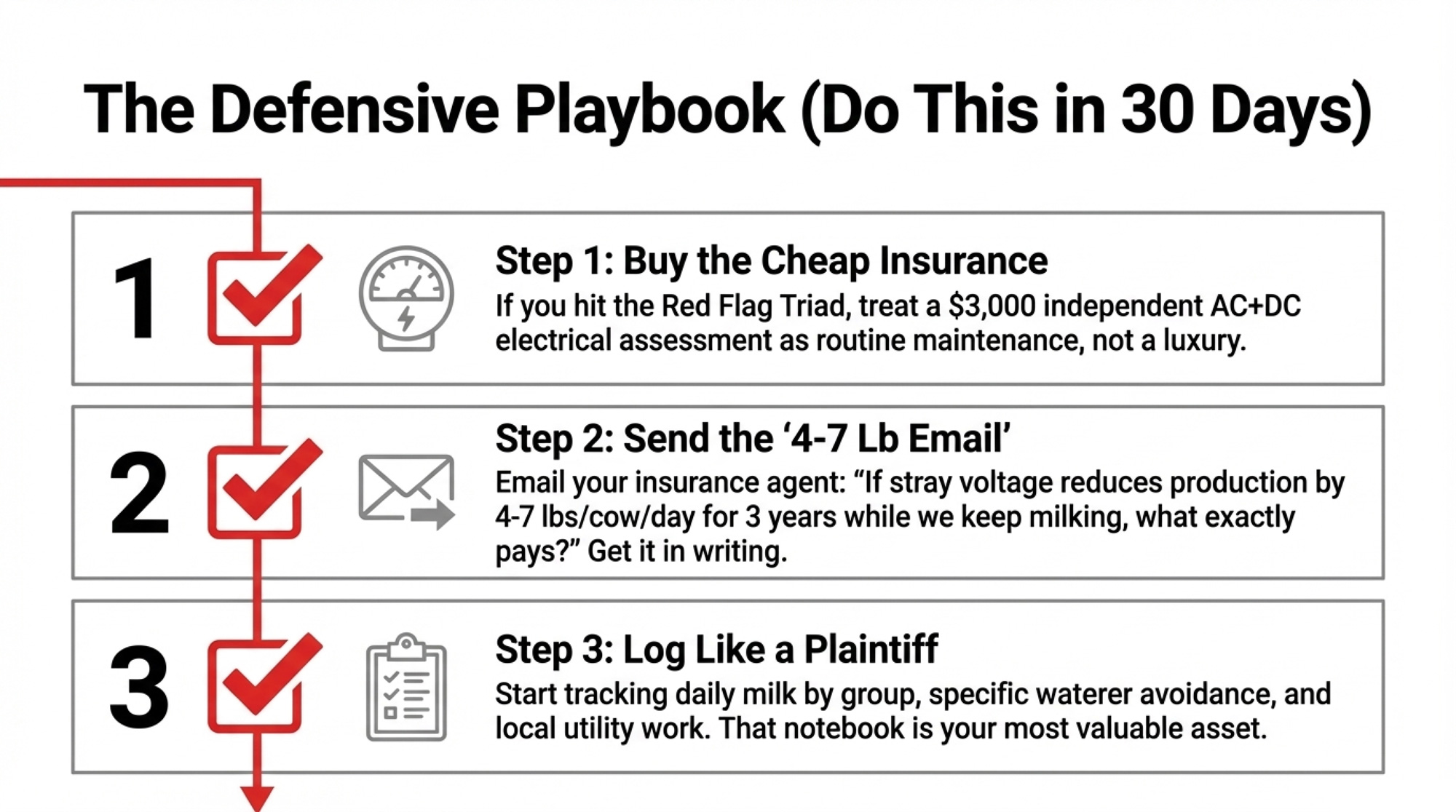
Path 1: Treat a comprehensive electrical test as routine maintenance (30‑day action).
In the next month, schedule a full AC+DC stray‑voltage assessment if:

  • Your cows avoid specific wet metal areas,
  • Your herd is quietly a few pounds under where it should be, and
  • Your advisors can’t find a good reason.

Think of it like a major parlor service or a feed audit. On a 500‑cow Upper Midwest dairy, a low‑thousands‑of‑dollars test is a line item. The risk of not knowing — $185,150 per year in quiet damage, plus the legal mess if you end up in a dispute — is not.

Path 2: Audit your insurance with stray voltage in mind.
Within the next 30 days, pull your farm policy and send your agent a simple email:

“If stray voltage or another electrical issue reduces our production by 4–7 lb/cow/day for three years while we keep milking, what parts of this policy actually pay, and what doesn’t?”

Ask them to walk through:

  • The definition of “electrocution” in livestock coverage.
  • Whether business‑income coverage requires “necessary suspension of operations.”
  • Whether off‑premises utility issues (grid or pipeline) are excluded.
  • Whether you can add business‑income and utility‑service endorsements that respond to partial production loss.

Get the answers in writing. Then decide whether that small percentage bump in premium is worth closing a six‑figure coverage gap.

Path 3: Start documenting like a future plaintiff, even if you never plan to be one.
If you’re not ready to spend on a test or endorsements this month, at least start a simple log:

  • Daily or weekly milk by group.
  • SCC trends.
  • Culling reasons and dates.
  • Behavior notes at waterers, stalls, and parlor lanes.
  • Dates and descriptions of any electrical, utility, or pipeline work near your farm.

If you ever do end up in a fight — with a utility or an insurer — that notebook will be the single most important asset you own that isn’t a cow.

Path 4: Use your utility’s free test — but don’t stop there.
If you’re in Wisconsin, you can and should request a PSC‑standard stray‑voltage investigation. It’s a no‑cost way to establish a baseline. Just understand what it can’t see: DC, non‑60 Hz problems, and anything outside the narrow test setup. Treat it as a starting point, not a verdict.

Key Takeaways

  • If your herd is consistently 2–4 lb/cow/day below where your ration, genetics, and facilities say it should be — and your vet and nutritionist can’t find a clear biological cause — you should treat a low‑thousands‑of‑dollars electrical test as a reasonable next step, not a last resort.
  • If cows are avoiding one specific wet metal area (a waterer, stall row, or parlor lane) and not others, and minor changes don’t fix it, that’s your cue to suspect voltage before you accept “cow behavior” as the explanation.
  • If your business‑income coverage requires “necessary suspension of operations,” assume it won’t pay for years of reduced milk unless you literally shut down — and talk to your agent about endorsements that cover partial production loss.
  • If your policy limits coverage for utility problems before power reaches your meter, assume damage caused by the grid or a pipeline could fall in that gap until an agent puts in writing that it’s covered.
  • If you’re milking 400–1,000 cows on concrete on older rural lines in the Upper Midwest, your risk profile looks uncomfortably close to the Vagts, Normans, Haldersons, and Popplers — and a low‑thousands‑of‑dollars test is about eight days’ worth of the loss it’s designed to catch.

The Normans spent more than twenty years fighting unexplained herd problems before a jury finally vindicated them. The Vagts dug through seven years of vet bills and underperformance before someone ran the right test. The Haldersons milked through at least fifteen years of documented voltage problems while their utility sat on a 1996 measurement that never made it back to the barn.

Cases like these are why families who’ve been through similar battles often say they wish they’d pushed for answers sooner.

Your vet can’t see voltage on a lab report. Your nutritionist can’t taste it in a TMR. Your utility will generally follow the testing protocol it has in place, which focuses on a narrow slice of possible electrical problems. And your insurer — if the Mengel case is any indication — can pay for dead cows and wiring fixes while denying years of reduced‑production claims because the policy language never contemplated a slow, stray‑voltage wreck.

So the real question isn’t whether stray voltage could be happening somewhere in your county. It’s whether you’re willing to spend one bad week’s worth of milk money this year to find out if it’s happening on your concrete.

We’re building a full insurance audit checklist, a 5‑question script you can use with your agent, and an independent testing directory for Upper Midwest dairies — with copy‑and‑paste email templates — in an upcoming Bullvine Weekly. That’s where we’ll get into the deeper contract language and dollar‑by‑dollar model that didn’t fit here.

If you had to pick one to do this month — schedule a DC‑capable stray‑voltage test or send that 4–7 lb/cow/day email to your agent — which one would you actually do first?

Complete references and supporting documentation are available upon request by contacting the editorial team at editor@thebullvine.com.

Learn More

The Sunday Read Dairy Professionals Don’t Skip.

Every week, thousands of producers, breeders, and industry insiders open Bullvine Weekly for genetics insights, market shifts, and profit strategies they won’t find anywhere else. One email. Five minutes. Smarter decisions all week.
NewsSubscribe
First
Last
Consent

Florida’s Raw Milk Wake-Up Call: What Dairy Producers Need to Know

Seven kids hospitalized from raw milk—while your insurance premiums could spike 40% if this hits your region.

EXECUTIVE SUMMARY: Listen up, because this Florida mess affects every one of us. Raw milk isn’t just a niche problem—it’s reshaping how insurers look at ALL dairy operations, and it’s hitting closer to home than you think. We’re talking 21 people sick, seven in the hospital, and insurance companies pulling back coverage faster than a fresh cow kicks. The ripple effect? Even conventional producers are seeing policy changes and tighter inspections. Here’s what’s wild—Danish research shows pathogen issues can cost you €11,000 per affected herd annually, not counting the reputation damage. With feed costs already crushing margins in 2025, you can’t afford to ignore food safety protocols anymore. The smart money is on bulletproof HACCP plans and rock-solid documentation. Trust me on this one—get ahead of it now, because the regulatory hammer is coming down hard.

KEY TAKEAWAYS:

  • Save your insurance rates: Review your HACCP documentation TODAY—operations with solid safety records are avoiding the 25-40% premium increases hitting sloppy farms post-outbreak
  • Protect your buyer relationships: Proactively share your safety certifications and testing results with buyers—processors are dropping suppliers without warning when trust erodes
  • Turn compliance into profit: Farms with documented microbial testing protocols are landing premium contracts while others scramble—regulatory pressure creates opportunities for the prepared
  • Bulletproof your reputation: With foodborne illness scares cutting category sales 8-12%, your safety story becomes your biggest competitive advantage in 2025’s tight markets
dairy food safety, farm risk management, dairy farm insurance, HACCP plan, milk quality assurance

The thing about food safety in 2025? It’s anything but static. Currently, Florida’s raw milk outbreak is sparking serious concerns across dairy farms, from the Gulf Coast to Central Florida. Twenty-one people have become ill, seven of whom ended up in the hospital—including some children—and all cases are linked to a farm in Northeast/Central Florida, although the Department of Health is keeping the name confidential while investigations continue, according to the Florida Department of Health. This is a reminder that consumer trust and the sustainability of your dairy business can be fragile.

Here’s the thing, though—the political winds could shift the landscape in ways none of us fully control. Leaders with alternative views on health policies, like Robert F. Kennedy Jr., may influence how regulations evolve if they rise to key positions. It’s worth keeping tabs on how these conversations unfold.

What’s Happening on the Ground

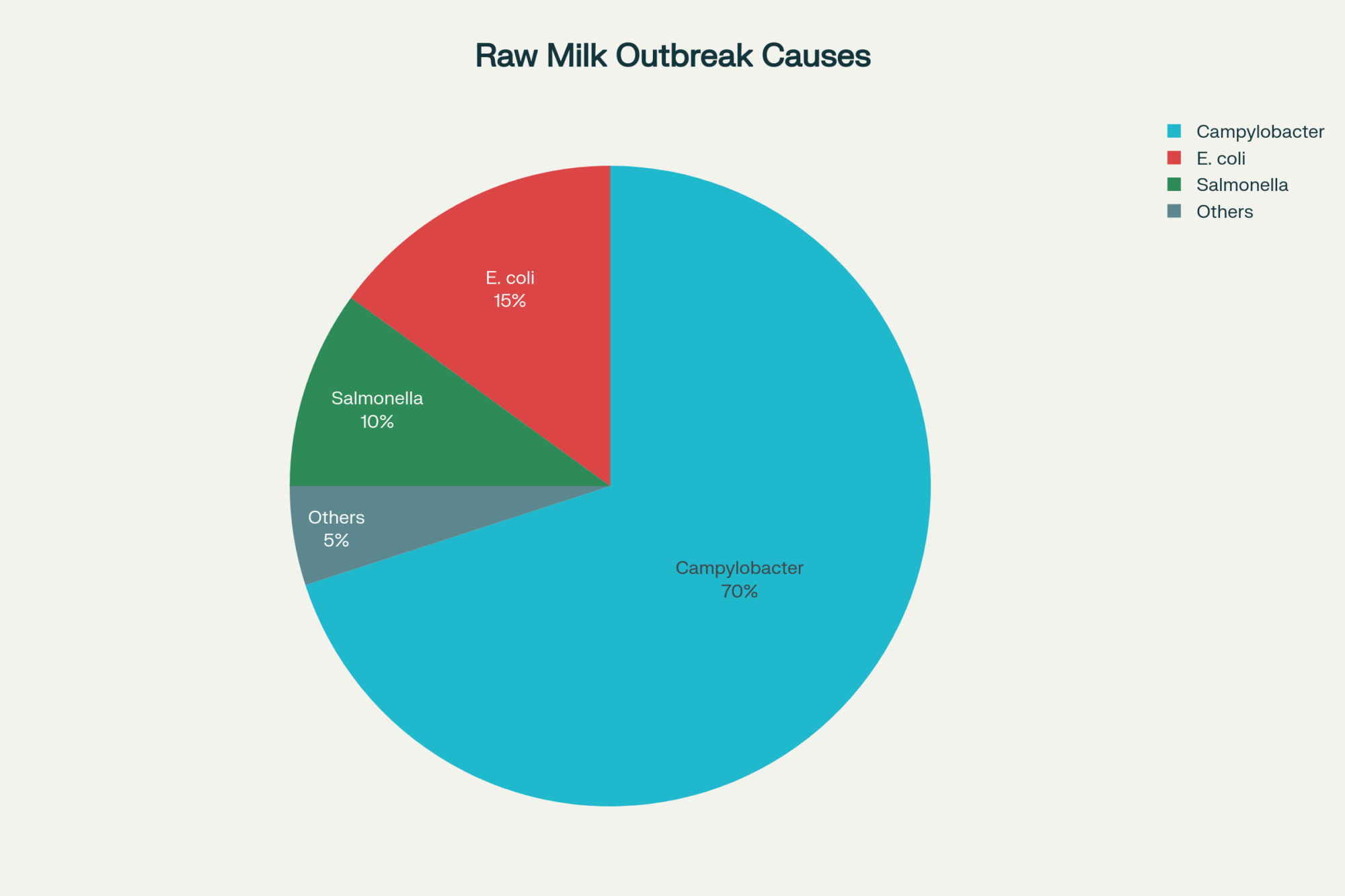
Florida’s health authorities pinpointed a serious breakdown in sanitation protocols at the farm linked to the outbreak, according to an official bulletin. The presence of Campylobacter and shiga toxin-producing E. coli here is not something you take lightly; it’s a loud wake-up call for dairy managers everywhere—from warm winter pastures in Okeechobee to the busy dairy hubs of Dade City. We’re talking not just about sloppy procedures, but about fundamental failures in managing food safety risks.

While state law forbids the sale of raw milk to humans, sales marked for pets keep a shadow market thriving; university extension estimates put its worth at several million dollars annually, according to the University of Florida Extension. And here’s a pattern producers are noticing: following outbreaks, insurers tend to pull back, making coverage for raw milk operations scarcer and more expensive.

How This Ripples Through Your Dairy

Food safety isn’t someone else’s problem—one high SCC tank can ruin an entire load, and in today’s connected world, outbreaks can shake consumer confidence region-wide. Remember the romaine lettuce E. coli crisis from 2018? Processors took a $55 million hit, retailers another $14 million, according to California Agriculture. It’s a lesson on how trust lost at any point can spread and squeeze the entire supply chain.

And it’s not just reputation. Danish researchers tracked how Salmonella infections take a toll: farms with high infection levels face over €11,000 in extra costs annually—veterinary treatments, lost milk premiums—and even low-level infection doesn’t come cheap, costing over €6,700. That’s money out of your pocket before you even think about a recall or inspection.

Getting Control Right

The CDC flags illnesses linked to raw milk as roughly eight times more frequent than those linked to pasteurized milk, according to CDC data. Big commercial processors don’t rely on luck—they layer controls, including environmental testing and supplier checks. Raw milk farms that try to compete without these controls put themselves at a significant disadvantage.

Cornell University’s food science experts remind us that pathogen control demands near-perfect hygiene and monitoring, according to Cornell University’s Food Science. No slack, no shortcuts. And that pasteurization? It’s not red tape; it’s your best bet against disaster.

Suppose you’re hearing about the supposed nutritional benefits of raw milk. In that case, the American Academy of Pediatrics has been very clear: the risks outweigh any unproven gains, especially for children and pregnant women, according to an AAP statement.

The Regulatory Crosscurrents

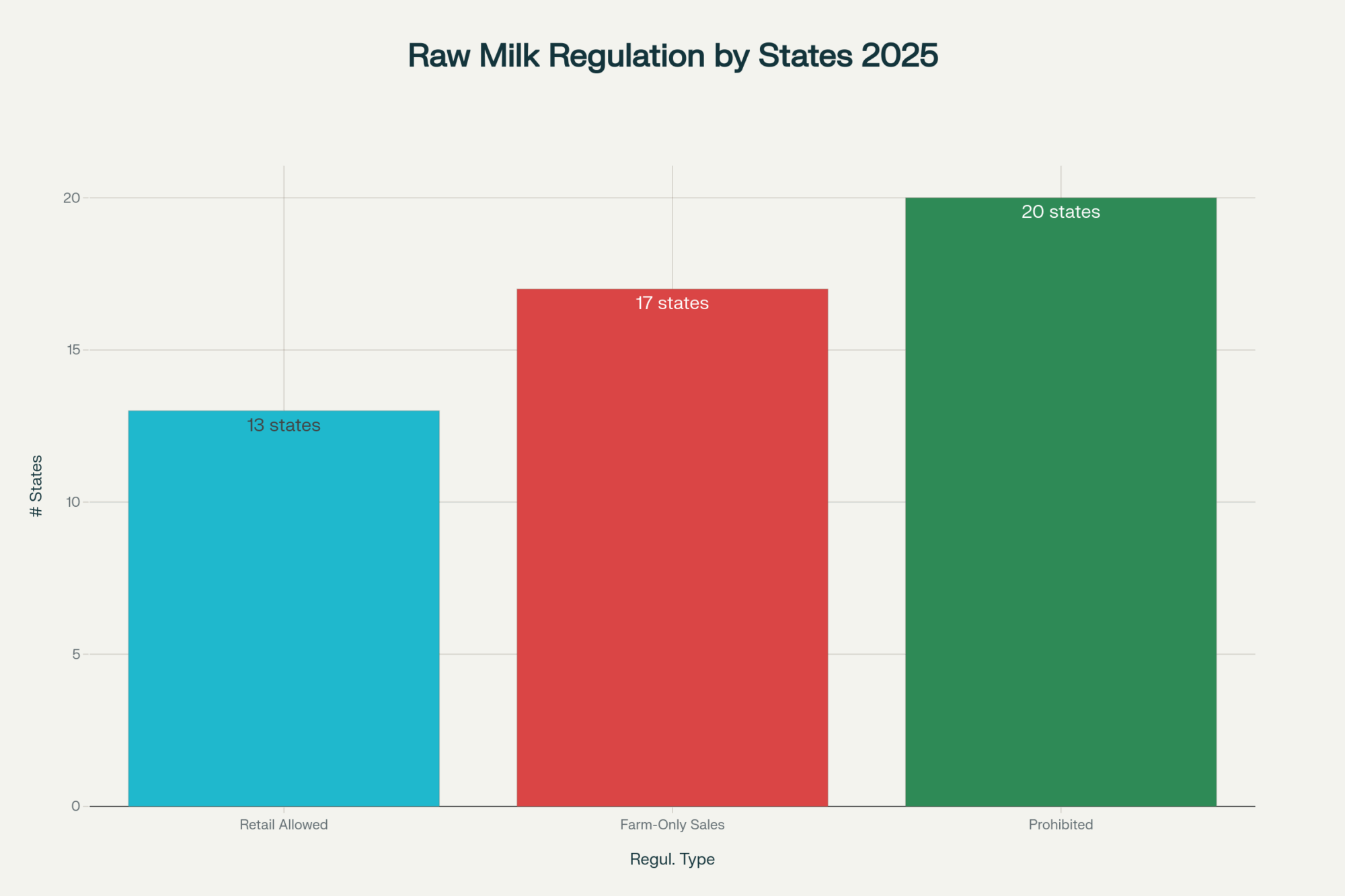
Right now, 13 states legally allow retail sales of raw milk; 17 limit sales to farm-only; and the rest ban human sales altogether, according to National Raw Milk Laws. Interstate shipment is federally banned. People like Robert F. Kennedy Jr.—who are publicly skeptical of mainstream health policy—may influence future regulation, but these shifts remain to be seen.

Organic Pastures Dairy remains a heavyweight player among raw milk producers, yet national dairy groups warn that loosening these regulations risks confusing consumers and exacerbating health risks.

What Should Producers Be Doing?

More FDA inspections are expected following the outbreak, covering both raw milk and pasteurized supply chains. Operations with disciplined HACCP and microbial testing protocols are better positioned to weather the storm.

Insurance markets also split: raw milk operations face rising premiums or no coverage; conventional producers maintain relatively stable insurance profiles.

If you haven’t yet, now’s the time to review your HACCP plan, tighten microbial testing routines, and ramp up communication with your buyers—make it clear you’re serious about safety.

What Do Consumers Think?

Recent surveys indicate that approximately three-quarters of consumers prioritize safety and consistent quality over the processing methods used. Foodborne illness scares can result in an 8-12% decline in sales, affecting producers of all sizes.

The Bottom Line

Raw milk sales won’t disappear anytime soon, but every producer in this arena must navigate regulatory pressure, financial risk, and reputational challenges. Investing in tight safety controls and thorough documentation isn’t optional.

Pasteurization remains a strong shield for the dairy industry. It’s a story you need to keep telling, because trust is everything.

This Florida outbreak underscores a fundamental truth: food safety is not optional—it’s the very backbone of any successful dairy operation. Failure here threatens not just sales, but the enduring trust that keeps the industry thriving.

Complete references and supporting documentation are available upon request by contacting the editorial team at editor@thebullvine.com.

Learn More:

  • Sanitation: The Key to Mastitis Prevention – This tactical guide provides practical strategies for improving parlor and herd hygiene. It’s essential for lowering your SCC, preventing costly infections, and strengthening the foundational food safety protocols that protect your entire operation from risk.
  • Dairy Farmers Must Realize They Are No Longer Selling A Product, But Rather A Story – Moving beyond farm-gate operations, this article details the strategic importance of branding. It reveals methods for building a powerful farm story that fosters consumer trust and insulates your brand from the market fallout of industry-wide safety scares.
  • Precision Dairy Farming: The Future is NOW! – Explore the innovative technologies shaping modern dairy management. This piece demonstrates how to leverage automated monitoring and data analytics to enhance herd health, streamline documentation, and build a resilient, future-proof, and highly defensible operation.

The Sunday Read Dairy Professionals Don’t Skip.

Every week, thousands of producers, breeders, and industry insiders open Bullvine Weekly for genetics insights, market shifts, and profit strategies they won’t find anywhere else. One email. Five minutes. Smarter decisions all week.
NewsSubscribe
First
Last
Consent
Send this to a friend