





Wisconsin’s Bureau of Correctional Enterprises has been training dairy workers since 2017. Internal program data reports roughly three times the retention of the industry’s standard hiring channel — and as of May 2026, no U.S. state dairy association has publicly announced a pipeline to use it.
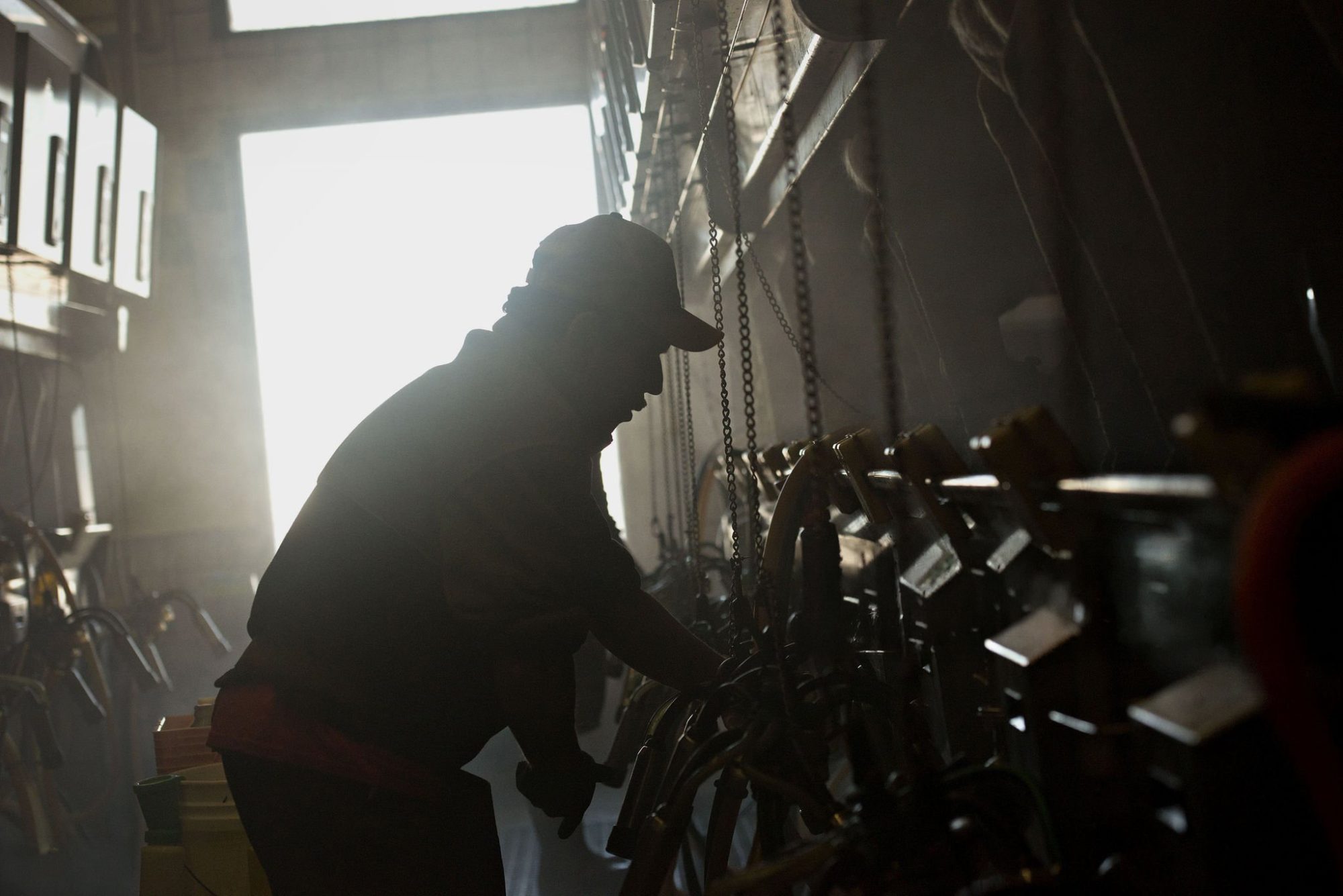
Tyson Gilbert cleared his first six months full-time on a Gippsland, Victoria dairy this spring after leaving Fulham Correctional Centre’s Nalu program. He hasn’t been interviewed by The Bullvine; this account draws on Dairy News Australia’s April 2026 reporting. Per that reporting, Gilbert described dairying as giving him structure, purpose and a trade, and said he hopes others follow the same path.
The bridge between his prison yard and his parlour was built by Victoria’s Demo Dairy Foundation, working alongside Gippsland operators who decided their labour problem wasn’t going to solve itself. The North American version of that bridge already exists inside Wisconsin’s Department of Corrections. As of May 2026, a review of publicly available materials from NMPF, Dairy Management Inc., Dairy Business Association, and a cross-section of state dairy organizations surfaced no announced equivalent pipeline.
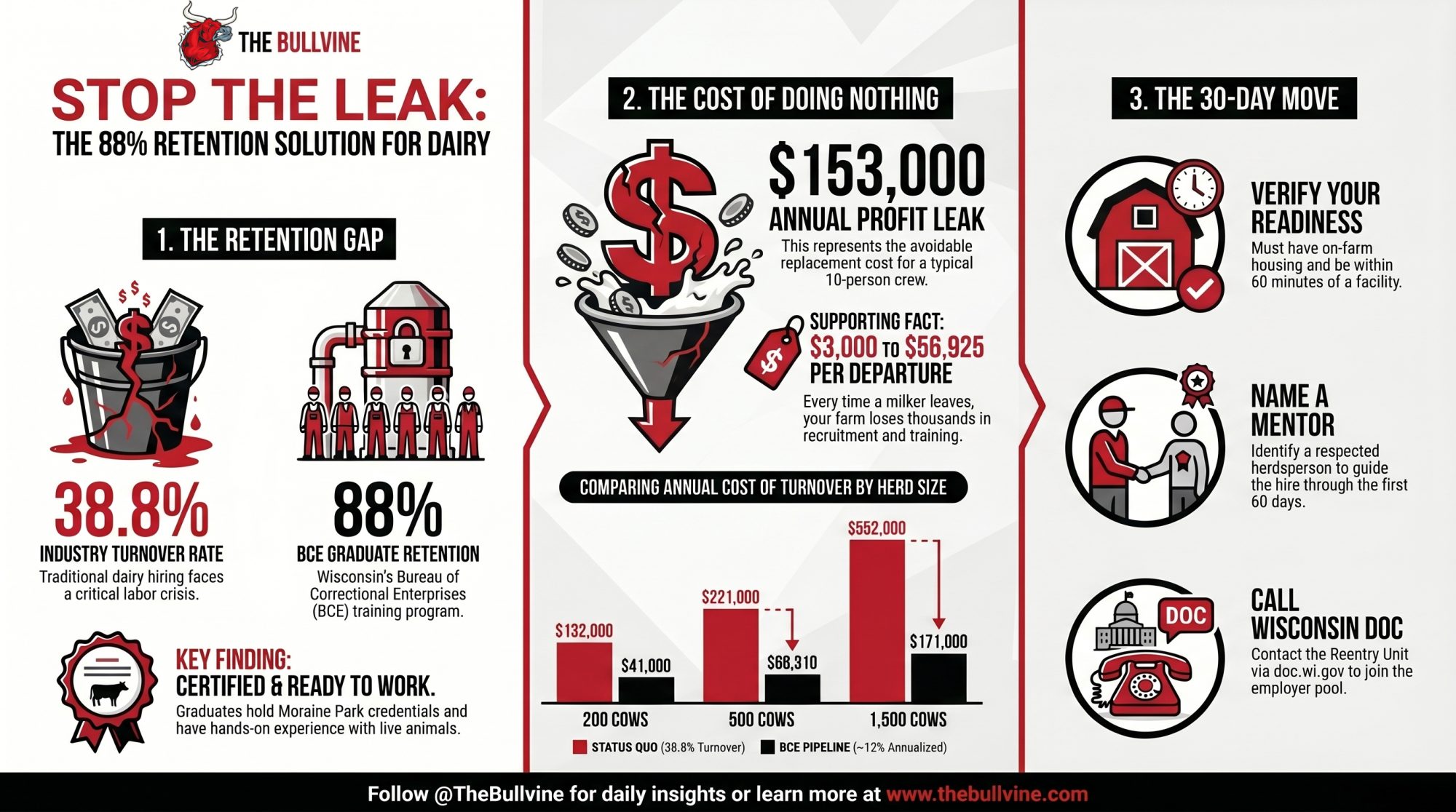
The short version: Wisconsin’s Bureau of Correctional Enterprises reports 88% three-year retention on dairy graduates, against a U.S. industry turnover rate of 38.8% from the FARM Program’s Texas A&M analysis of 600-plus dairies. On a 500-cow crew, that’s about $153,000 a year in avoidable replacement cost. Graduates release monthly from four Wisconsin facilities with a Moraine Park credential in hand. Australia’s already plugged the same model in through Gippsland. As of May 2026, no U.S. state dairy association has publicly announced a comparable pipeline. The 30-day move: if you’re within 60 minutes of a Wisconsin minimum-security facility, have on-farm housing, and can name the herdsperson who’ll mentor the hire through the first 60 days, call Wisconsin DOC Communications this week.
What’s Actually Changing in Dairy Labor — and Why
Fulham’s Nalu program trains selected inmates for Dairy Australia–accredited certificates inside the facility. Live calves get trucked in. By the time a graduate walks out the gate, they know what a parlour smells like at 4 AM.
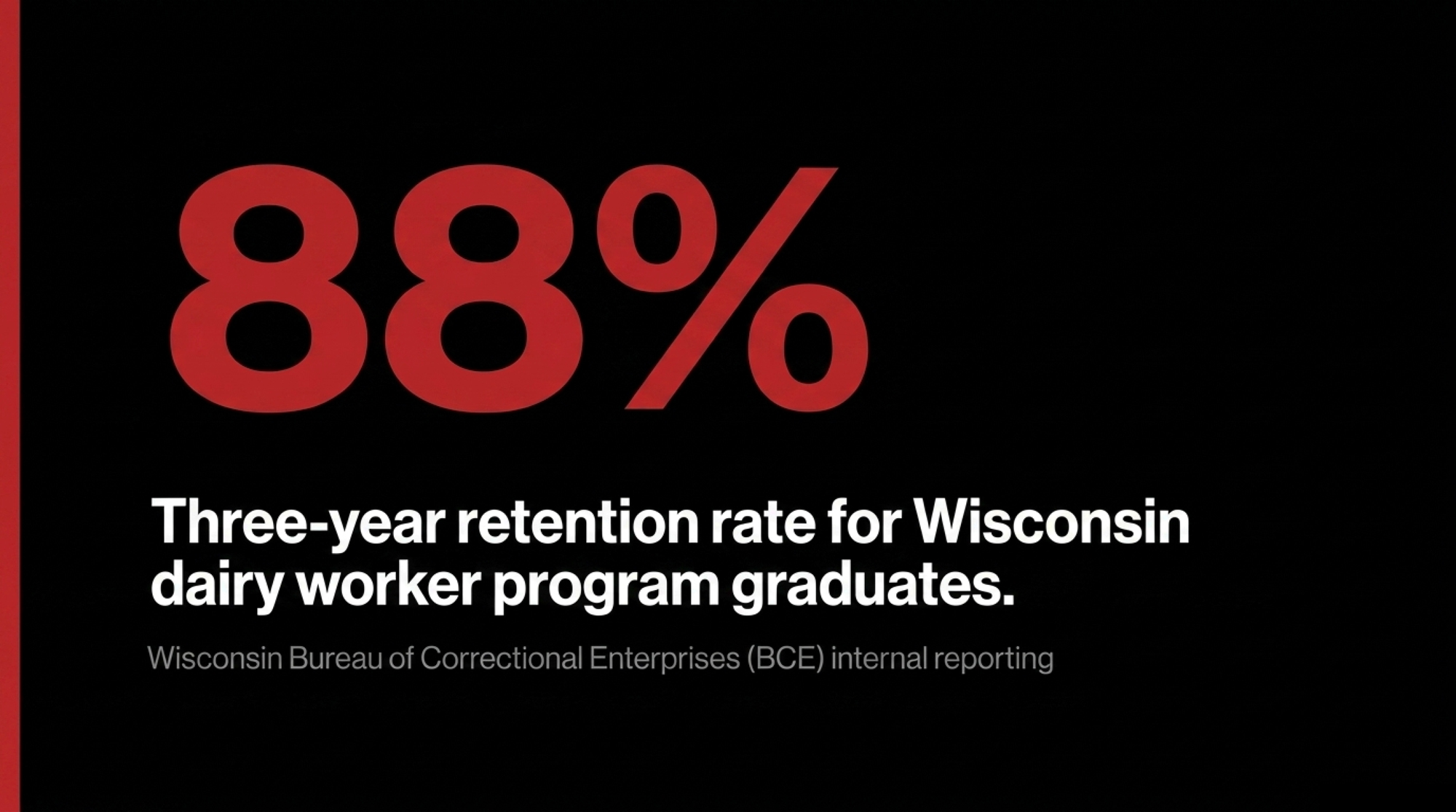
Wisconsin’s been running the equivalent since 2017. The Bureau of Correctional Enterprises (BCE), in partnership with Moraine Park Technical College, offers a Dairy Worker Training Certificate at the Waupun, Fox Lake, Oregon, and Green Bay correctional facilities. WUWM confirmed the program was active and expanding as of September 2022, and internal BCE reporting — as cited in Wisconsin corrections publications — places three-year post-release employment near 88% and non-recidivism near 75%. That’s roughly 15 percentage points better than the state’s general prison population on recidivism.
Now compare that against the 38.8% annual turnover rate for U.S. dairy labour — from the National Dairy FARM Program’s nationwide workforce survey, analyzed by Texas A&M across more than 600 U.S. dairies. Your crew walks out the door at a rate nearly three times higher than BCE graduates leave their first dairy job. The program’s there. Graduates are releasing every month. The credential’s accredited. What’s missing is the coordination layer Gippsland’s operators and Demo Dairy Foundation built together.
How This Plays Out on Real Farms
Here’s what the retention gap looks like with a payroll attached to it.
Run the numbers by herd size and the gap stops being abstract. Replacement-cost estimates vary by source: National Dairy FARM Program materials and Dairy Herd Management put entry-level parlour turnover at $3,000 to $25,000 per departure. Apply the standard 1.5× annual-salary-plus-recruitment HR framework to a typical $35,000–$40,000 parlour wage base and the figure pushes toward $55,000–$60,000 for a fully burdened departure.
The table below models the upper-bound figure ($56,925) against a 38.8% industry turnover rate versus BCE-equivalent retention — annualized at roughly 12% from the reported 88% three-year figure.
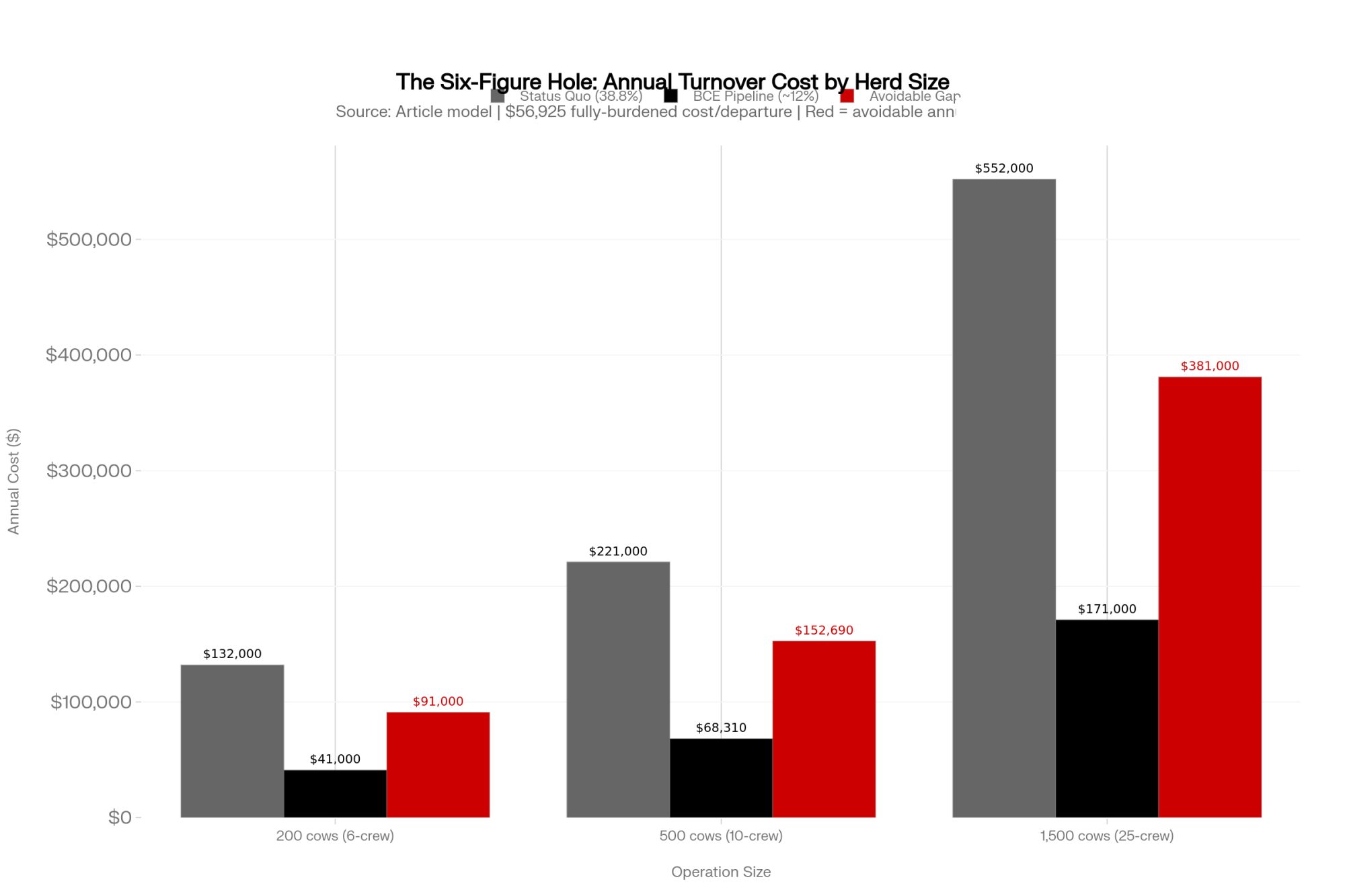
| Herd Size | Crew | Status Quo: 38.8% Turnover | BCE Pipeline: ~12% Annualized | Annual Gap Per Farm |
| 200 cows | 6 | $132,000 | $41,000 | ~$91,000 |
| 500 cows | 10 | $221,000 | $68,310 | ~$153,000 |
| 1,500 cows | 25 | $552,000 | $171,000 | ~$381,000 |
Table uses the upper-bound fully-burdened figure from the 1.5× HR framework. Substitute $3,000–$25,000 per departure from the FARM Program range and the gap narrows proportionally — the Quick Math below gives the conservative version. Annualized BCE retention is derived from the reported 88% three-year figure; year-over-year variance unknown.
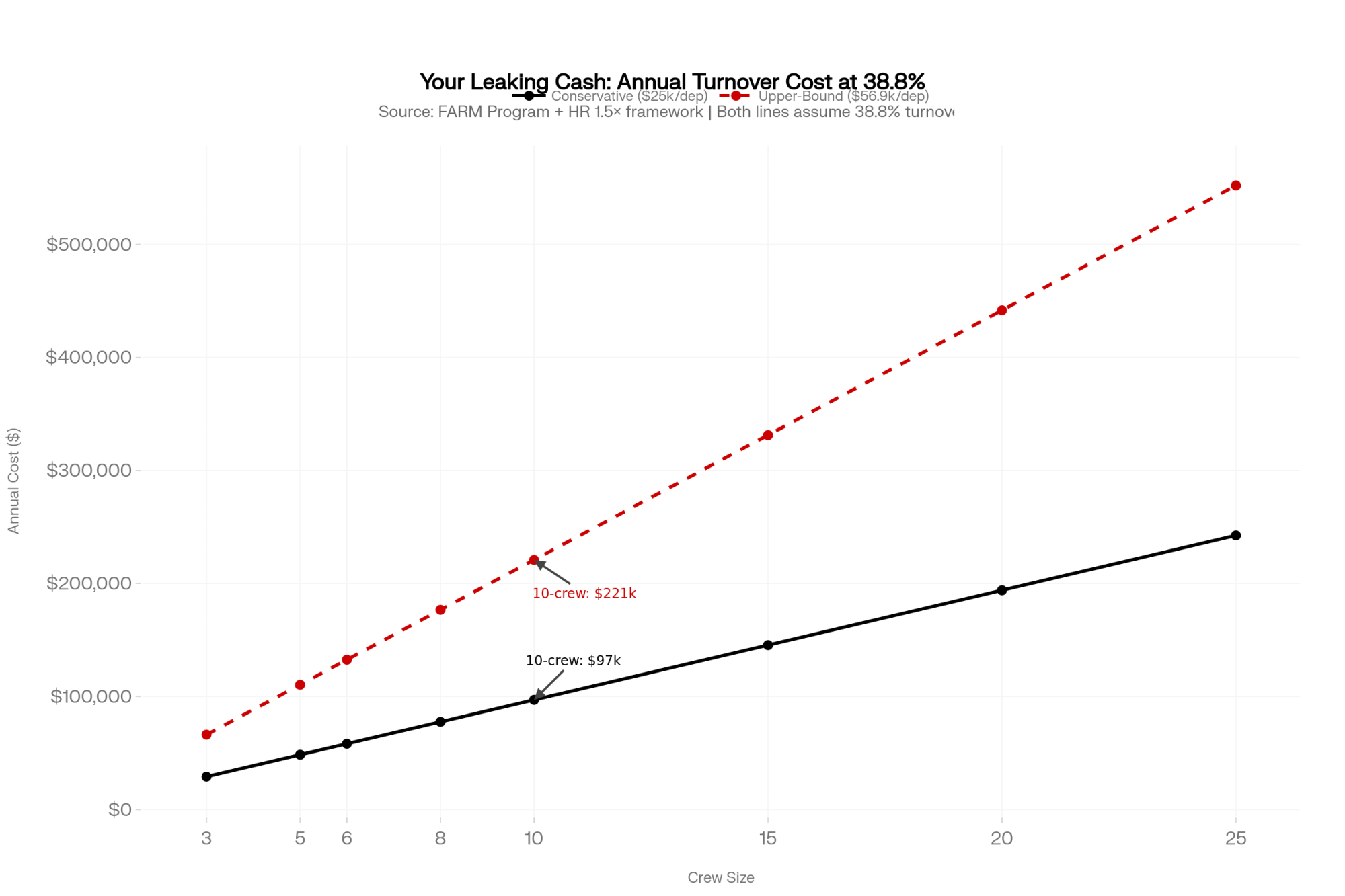
Quick math for your dairy: (Crew Size) × (Your Current Turnover %) × $25,000 conservative loss per hire = your annual leaking cash. On a 10-person crew at 38.8% turnover, that’s ~$97,000 a year even at the conservative end.
The federal Work Opportunity Tax Credit offered up to $2,400 per qualified ex-felon hire — roughly $4,800 in annual offset on two placements — under the authorization that expired December 31, 2025. Extension legislation has moved through congressional discussion in 2026; confirm current authorization status with your tax preparer before factoring the credit into hiring math. Even stripped of the credit, two full-time workers recovered every year on a single farm is the exposure that moves the annual-meeting conversation.
What We Couldn’t Confirm Before Print
Three items remain open as of publication: BCE’s 2026 operating status (last public confirmation September 2022), the current WOTC authorization status, and the employer-facing direct line for Wisconsin DOC’s Reentry Unit — which operators can request through Wisconsin DOC Communications at doc.wi.gov. Reader-facing transparency is part of why this article runs now rather than waiting. The retention gap doesn’t pause for verification cycles. Updated detail will appear in the Bullvine Weekly as confirmations close.
The Mechanics Behind the Numbers
Your default hiring channels weren’t built for retention. They were built for availability.
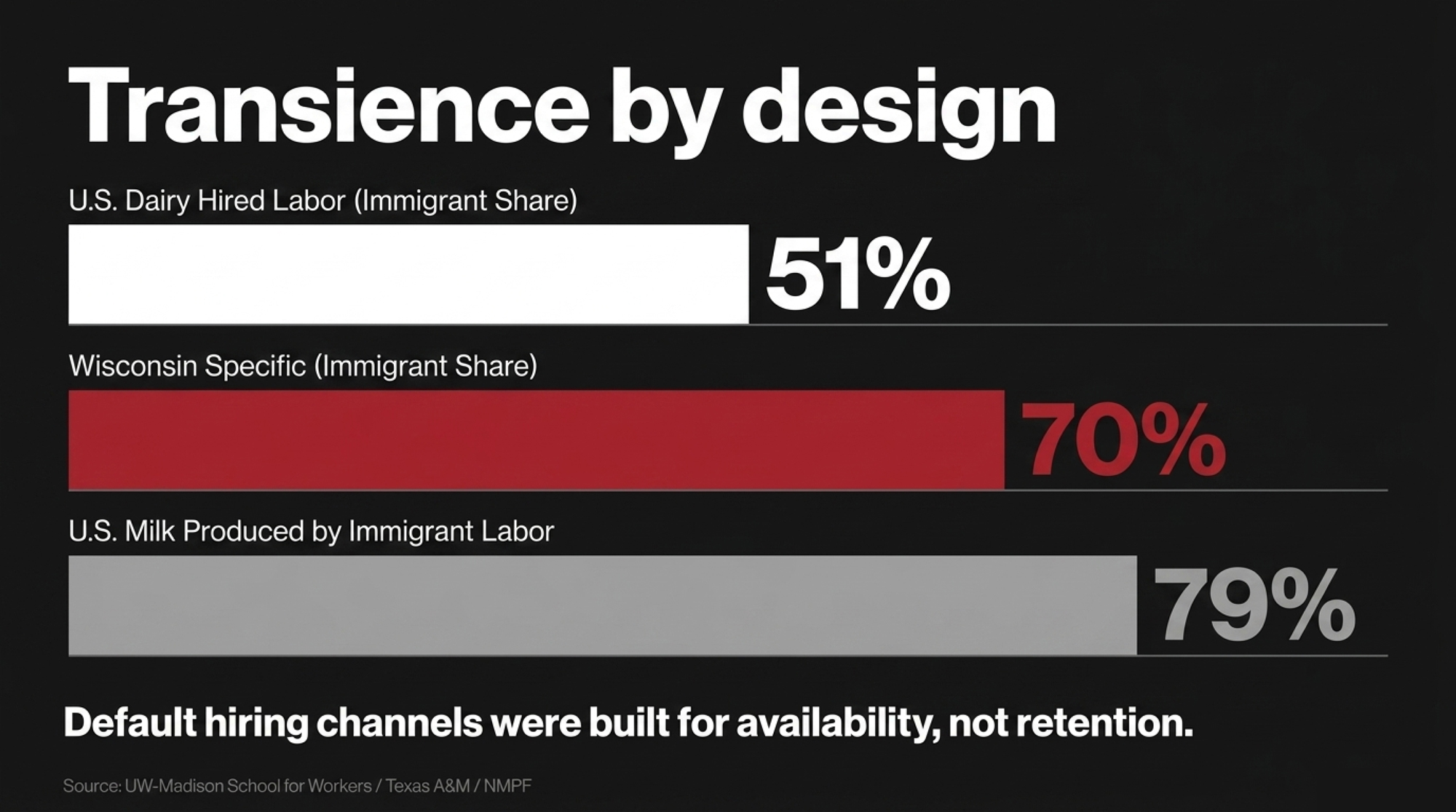
Estimates of immigrant dairy labour vary by scope. Texas A&M and the National Milk Producers Federation place the share around 51% of U.S. hired dairy labour. A 2023 UW-Madison School for Workers survey pegs the Wisconsin-specific figure at 70%, with more than 10,000 undocumented workers carrying the state’s dairy workload. Farms relying on immigrant workforces produce roughly 79% of U.S. milk either way.
That workforce is structurally transient by legal design. H-2A rules restrict dairy to seasonal work under a year, which pushes most year-round positions onto workers whose immigration status creates a permanent incentive to leave or hide. The June 2025 federal immigration enforcement action at Outlook Dairy in New Mexico, as reported by Cowsmo and covered previously by The Bullvine, reduced the farm’s workforce from 55 to 20 in a single morning. Recovery options under current H-2A rules are limited.
BCE graduates change that equation. Domestic residents with verified work history. Pre-screened at no cost — corrections staff and Moraine Park coordinators have already watched them handle live animals. They arrive with the credential in hand.
State dairy associations operate on member mandate, and publicly visible member priorities in 2026 centre on H-2A reform and federal immigration policy. Reentry pipelines require a different organizing constituency. The handshake that makes Fulham work isn’t the prison. It’s the industry body on the other end of the call.
BCE has the graduates, the dairy experience, and the Moraine Park credential. Based on publicly available program materials as of May 2026, the employer-facing process is self-initiated: operators contact BCE to request candidates, rather than the program matching candidates to operations proactively. No dedicated outbound coordinator matching graduates to specific dairies. Just a phone waiting to ring.
| Dimension | Standard Hiring Channel | BCE / Corrections Pipeline | Edge Goes To |
|---|---|---|---|
| 3-Year Retention Rate | ~61% (inverse of 38.8% annual turnover) | 88% | BCE |
| Pre-Screened Skills | Resume only; unverified | Moraine Park Dairy Worker Certificate; live animal handling confirmed | BCE |
| Recruitment Cost | $3,000–$56,925 per departure (FARM Program range) | $0 pre-screening by corrections staff + Moraine Park coordinators | BCE |
| Legal Work Authorization | Variable; structural transience risk under H-2A | Domestic residents; verified work history | BCE |
| Immigration Enforcement Risk | High (WI: ~70% immigrant workforce; 10,000+ undocumented) | None | BCE |
| Release Cadence | Applicant-driven, unpredictable | Monthly from 4 WI facilities | BCE |
| Coordination Support | None (standard job posting) | Self-service match; no outbound coordinator | Tie (both limited) |
| WOTC Tax Credit (if active) | Not applicable | Up to $2,400/hire for qualified ex-felon; ~$4,800/2 placements | BCE |
| Non-Recidivism Rate | N/A | ~75% (15 pts above WI general prison population) | BCE |
How Much Does Waiting 30 Days Actually Cost You?
Run your own version using the Quick Math formula. Your gap lands somewhere in the $3,000–$56,925 per-departure span, depending on how you count the indirect losses. A 200-cow operation at $25,000 per departure and 38.8% turnover is sitting on roughly $58,000 a year in avoidable replacement cost. A 500-cow at the same conservative per-departure figure is closer to $97,000.
The 30-day action is short. If your operation has on-farm housing available, sits within 60 minutes of a Wisconsin minimum-security facility, and you can name the specific herdsperson who’d mentor a new hire, request placement in the BCE employer pool through Wisconsin DOC Communications this week. Operators can reach Wisconsin DOC through the department’s public-information channel at doc.wi.gov and ask to be routed to the Reentry Unit and BCE Transition Program. Making the call doesn’t obligate you to hire anyone. It puts your operation in the pool Gippsland farms have already been drawing from.
Is Your State Dairy Association Actually Doing Anything About This?
Fair question for the next board meeting. NMPF’s publicly visible 2025–2026 labour advocacy, per the federation’s published dairy-policy agenda and its testimony before the House Agriculture Committee during the 2025 farm-bill debate, centres on year-round H-2A eligibility and legal status protections for the existing immigrant workforce. That’s a distinct policy problem from building a new domestic hiring channel. Dairy Management Inc., operating under the federal dairy checkoff’s demand-promotion mandate, does not publicly report farm-level labour-supply coordination as part of its current work.
The Fulham/Gippsland model works because a regional industry body — Demo Dairy Foundation alongside local Gippsland operators — owns the coordination work. It takes the reputational risk. The public record to date shows no U.S. equivalent announced.
If you’re watching for who moves first, the New York dairy workforce focus group that convened in August 2025 — announced by WWNY in Watertown, tied into Cornell’s Dairy Specialist Apprenticeship expansion — is the most structurally Gippsland-equivalent body on the continent. New York’s ban-the-box hiring law reduces the political exposure a Wisconsin association would face championing the same program. Wisconsin’s infrastructure is stronger. But the Wisconsin politics right now are harder.
Governor Evers signed Wisconsin Act 240 in April 2026, addressing workforce authorization for DACA recipients and credentialed immigrant labour. The first Watertown board meeting on a corrections-to-dairy pipeline may happen before the first Madison one does.
Why the Mentor Is the Whole Ballgame
Path 1 lives or dies on one question: who on your crew will sit with this person through the first 60 days?
Reentry after a multi-year sentence isn’t just a housing and transportation problem. Graduates come out with parole appointments, court-ordered check-ins, sometimes continuing substance recovery, and the cognitive whiplash of making a dozen small decisions a day after years of having none to make. The first time a BCE graduate has to troubleshoot a pulsator at 5 AM with no supervisor in the barn, what they need isn’t another manual. It’s a phone number they can call without feeling like they’re failing.
That’s why the Gippsland model works and why a self-service BCE match tends to fail without preparation. Demo Dairy Foundation’s coordinators run 30/60/90-day check-ins. They handle the awkward first conversations between a graduate and a crew that didn’t ask for this hire. The early friction that would otherwise end the placement in week three gets absorbed by someone whose job it is to absorb it.
On a Wisconsin farm making this hire without Gippsland-style coordination, that work falls on one person. Not the owner. A specific herdsperson — someone who already mentors new hires, who runs the parlour rotation, and who the rest of the crew respects. If you can’t name that person before you call DOC, the placement will fail regardless of the candidate’s quality. That’s the single biggest predictor of whether the 88% retention number shows up on your farm or only on someone else’s data sheet.
Options and Trade-Offs for Farmers
| Path | Action | Best Fit | Timeline | Annual Cost if You Wait | Key Risk |
|---|---|---|---|---|---|
| 1 — Direct BCE Contact | Contact Wisconsin DOC Reentry Unit via doc.wi.gov | Within 60 min of WI min-security facility; on-farm housing available; mentor named | 30 days | $97k–$221k+ (10-crew) | No coordinator — you carry the relationship work |
| 2 — County Reentry Coalition | Contact regional Workforce Development Board before DOC | 200–500 cow ops in WDA 10 or Pathways Home 2 western counties | 60–90 days | $58k–$132k (6-crew at $25k conservative) | Coverage gap — outside designated counties, no post-release support |
| 3 — Association Pressure | Send 88%-vs-38.8% math to state dairy association as financial exposure brief | Operations with state-level influence; not positioned to hire directly | 1–3 years | Slowest path; depends on board mandate shift | |
| 4 — Status Quo | Continue existing recruitment; wait for federal immigration reform | N/A | Indefinite | $97k–$552k/yr depending on scale | Full exposure; no hedge against enforcement actions |
Your next 90 days have four paths through this. They aren’t mutually exclusive.
Path 1 — Direct BCE employer contact (the 30-day move). If you’re within 60 minutes of a Wisconsin minimum-security facility and you have on-farm housing available, contact Wisconsin DOC’s Reentry Unit through doc.wi.gov and request pre-screened candidates with Dairy Worker Training Certificate credentials releasing to your county. When it works: open position, willing mentor named, housing ready inside 30 days. Risks: the program runs as a self-service match. You’re carrying the relationship work Gippsland coordinators handle in Australia. Without a named mentor, placements fail in the first 60 days regardless of candidate quality — see the section above.
Path 2 — County reentry coalition partnership. Wisconsin Pathways Home 4X, administered by the Workforce Development Board of South Central Wisconsin with U.S. Department of Labor funding, serves Columbia, Dane, Dodge, Jefferson, Marquette, and Sauk counties. Eligibility runs 20–270 days pre-release. A separate western footprint — Pathways Home 2 through the West Central Wisconsin Workforce Development Board — covers Barron, Chippewa, Clark, Dunn, Eau Claire, Pepin, Pierce, Polk, and St. Croix counties. When it works: 200–500 cow operations with one or two open positions and no dedicated HR function. Risks: milk outside those counties and you’re on your own for post-release support infrastructure.
Path 3 — Association pressure campaign. Send your state dairy association the 88%-versus-38.8% retention math. Not a program request. A financial exposure briefing. Works if you’re not positioned to hire directly but your operation has state-level influence and wants systemic movement. It’s the slowest of the four paths by years.
Path 4 — Status quo. Continue with existing recruitment channels and wait for federal immigration reform. The cost? The six-figure turnover gap, every year, until Washington moves. Cross-reference Bullvine’s earlier coverage of the Wisconsin operation that cut turnover below 1% — the kitchen-table math on that farm is the counterpoint to Path 4.
Key Takeaways
Decision thresholds, not a summary.
- If your annual turnover is above 30% and your crew is 10 or more, run the per-departure formula against your last 36 months of turnover data. Your gap lands somewhere between $30,000 and $150,000-plus depending on which figure reflects your fully loaded cost.
- If your operation sits within 60 minutes of a Wisconsin minimum-security facility AND you have on-farm housing available within 30 days AND you can name the mentor on your current crew, make the Wisconsin DOC call this week.
- If your annual turnover cost is under $50,000 or your crew is under six, defer this model. The coordination investment doesn’t pay back at that scale.
- If you’re in WDA 10 (Columbia, Dane, Dodge, Jefferson, Marquette, Sauk) or the Pathways Home 2 western counties, call your regional Workforce Development Board before you call DOC. Shared support infrastructure separates a 90-day failure from a three-year retention.
- If your parlour starts at 4 AM, confirm any candidate’s parole reporting schedule before you make the offer. Normal question. Parole officers expect it.
- If your first open position is parlour milker or calf care, a BCE graduate arrives with verified skills. Equipment management or independent judgment from week one? Wrong starting position.
- If your state dairy association has never seen the 88%-versus-38.8% retention math, sending them that single data point is the highest-leverage move you can make this month.
Editorial View — The Question Worth Sitting With
The following reflects The Bullvine’s editorial view, not neutral reporting.
The public record to date shows no U.S. state dairy association has announced an evaluation of a BCE-style pipeline. That may change. The retention math lives in association members’ own FARM Program data, the Wisconsin infrastructure is documented, and the graduates are releasing every month. Boards that examine the exposure and choose against a pipeline for regulatory, liability, or political reasons will have a defensible position. Boards that don’t examine it will have a harder one.
Run Your Numbers
Snap Check — Plug your crew size, turnover rate, and wage base into Snap Check to put a real dollar figure on what your current hiring channel is costing you. It turns the 38.8% versus 88% retention gap into a number you can carry into your next board meeting or lender call.
Complete references and supporting documentation are available upon request by contacting the editorial team at editor@thebullvine.com.
Learn More
- 38.8% Turnover Is Bleeding Dairies Dry. These Dairy Neighbours Turned Kitchen Tables into Labor Plans. — Calculating the hidden $25,000 per-departure penalty exposes exactly where your parlor leaks money. You receive the exact recruitment and lost-production formulas needed to stop the bleed before finalizing another hire.
- 79% of U.S. Milk Runs on Immigrant Labor. If Yours Vanishes, You Have 72 Hours. — Guard your milking schedule against sudden immigration enforcement actions. Breaking down the brutal math of H-2A delays, this analysis delivers a mandatory 72-hour contingency playbook to protect your herd when half your crew disappears.
- Robotic Milking Pays 13% More – After 7 Years of Red Ink — Behind the promise of automated parlors lies a brutal cash-flow reality. You will see how true $1.50/cwt labor savings stack up against doubling maintenance costs, proving why survival requires a verified seven-year financial runway.
The Sunday Read Dairy Professionals Don’t Skip.

Every week, thousands of producers, breeders, and industry insiders open Bullvine Weekly for genetics insights, market shifts, and profit strategies they won’t find anywhere else. One email. Five minutes. Smarter decisions all week.