








A tie-stall pipeline just hit 978 HPI. The gap between Canada’s median and elite 2025 herds isn’t robots—it’s closed gates, 21-month AFCs, and culling cows costing you $640 in lost milk.
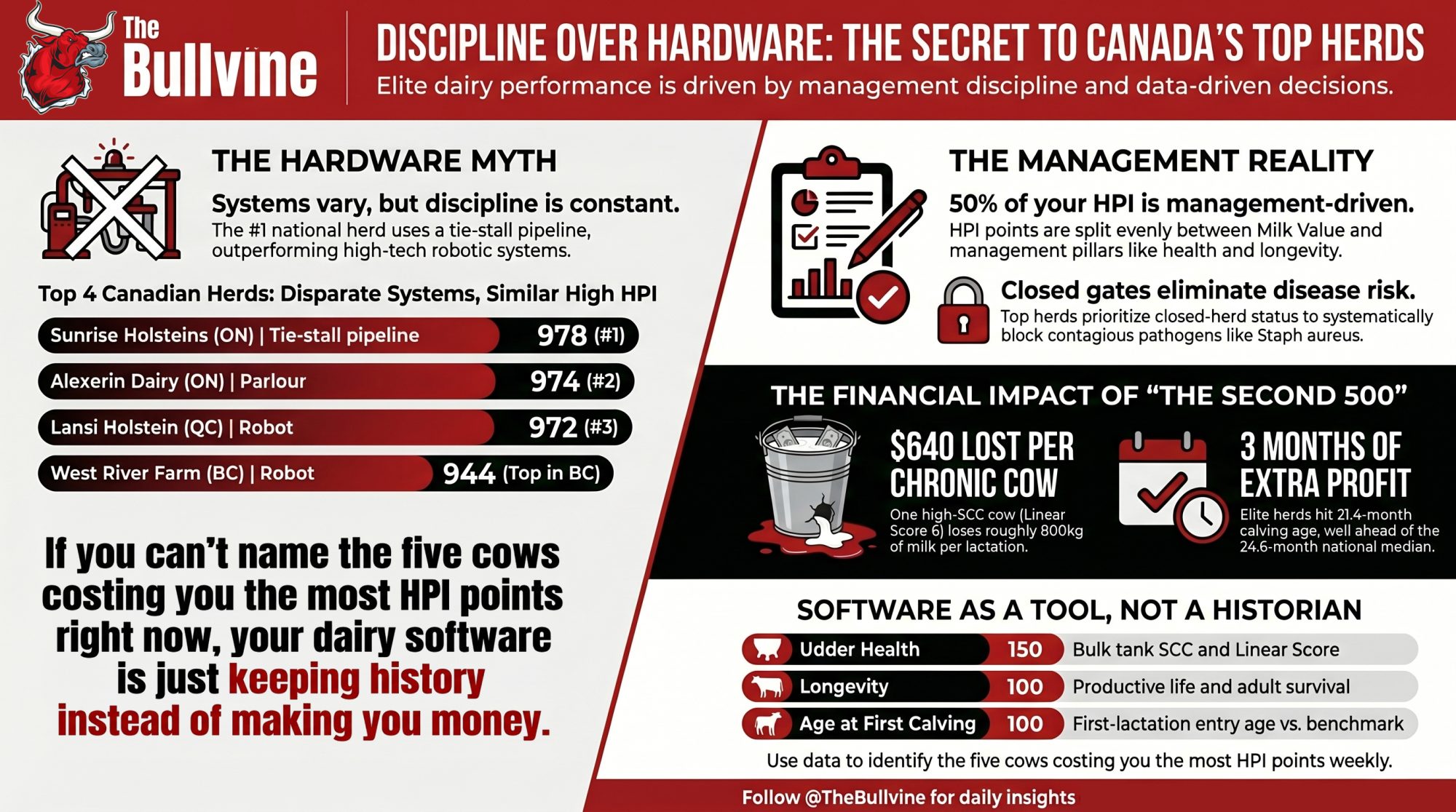
Executive Summary: A tie-stall pipeline barn just beat every robot in Canada to take the #1 spot on Lactanet’s 2025 Best Managed list with a 978 HPI. Sunrise Holsteins and the rest of the top four prove elite performance isn’t bought with new equipment—it’s built on the second 500 points of the index. They share a strict closed-herd discipline that systematically eliminates the chronic, high-SCC cows draining roughly $640 in milk revenue per lactation. With the recent CDC price hike and April’s Western Milk Pool component shift, herds relying on sheer volume are about to feel the squeeze. Meanwhile, top operations are pulling years of profit forward by hitting a 21.4-month age at first calving, three full months ahead of the national median. If you can’t immediately name the five cows costing you the most HPI points, your dairy software is just keeping history instead of making you money.
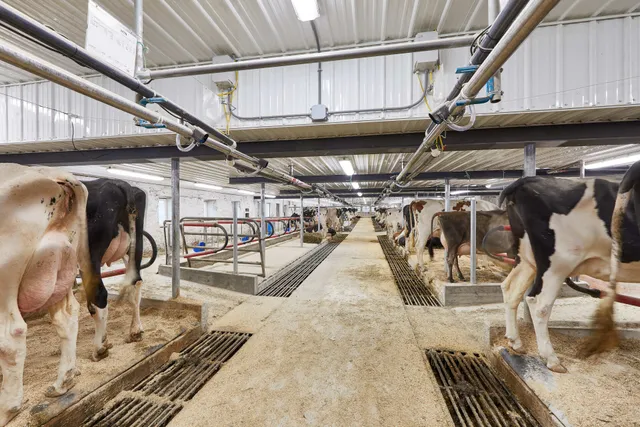
A tie‑stall barn in Clarence Creek, Ontario just beat every robot herd in Canada. No automation. No free stall. No classifier on the property in years. Edgar Kaelin’s Sunrise Holsteins posted a 2025 Herd Performance Index of 978 — the highest score in the country, top of the 50 farms named to Lactanet’s 2025 Best Managed list — milking on a pipeline behind cows tied in stalls.
“I feel kind of like I went to the Olympics as a spectator and came home with a gold medal,” Kaelin told Farmtario on March 17, 2026. The line reads like modesty. A 978 HPI says it’s accurate self‑assessment.
That ranking should bother anybody selling you the idea that elite production requires expensive infrastructure. The 2025 Best Managed list keeps proving the gap between placing and disappearing isn’t equipment. It’s the second 500 points of the HPI — and the daily discipline that puts them on the board.
Canada’s Top 4 in 2025: Three Provinces, Three Systems, One Pattern
| Farm | Location | System | HPI | Notable Stat |
| Sunrise Holsteins | Clarence Creek, ON | Tie‑stall pipeline | 978 | #1 nationally; top tie‑stall |
| Alexerin Dairy | Manotick, ON | Parlour | 974 | #1 parlour in Canada; top‑25 five years running |
| Lansi Holstein | Saint‑Albert, QC | Robot | 972 | #1 robot in Canada; #1 in QC |
| West River Farm | Rosedale, BC | Robot | 944 | #1 in BC; #2 robot in Canada |
Sunrise and West River both operate closed herds with udder health as the central management priority, per Farmtario‘s March 17, 2026 coverage. Alexerin Dairy is CQM‑certified and runs structured biosecurity protocols, per The Bullvine’s earlier breeder profile of the operation. Different barns, different milking systems. Same discipline.
What’s Changing and Why
Lactanet’s HPI runs to 1,000 points across six indicators, split evenly between Milk Value and the management pillars that decide who places.
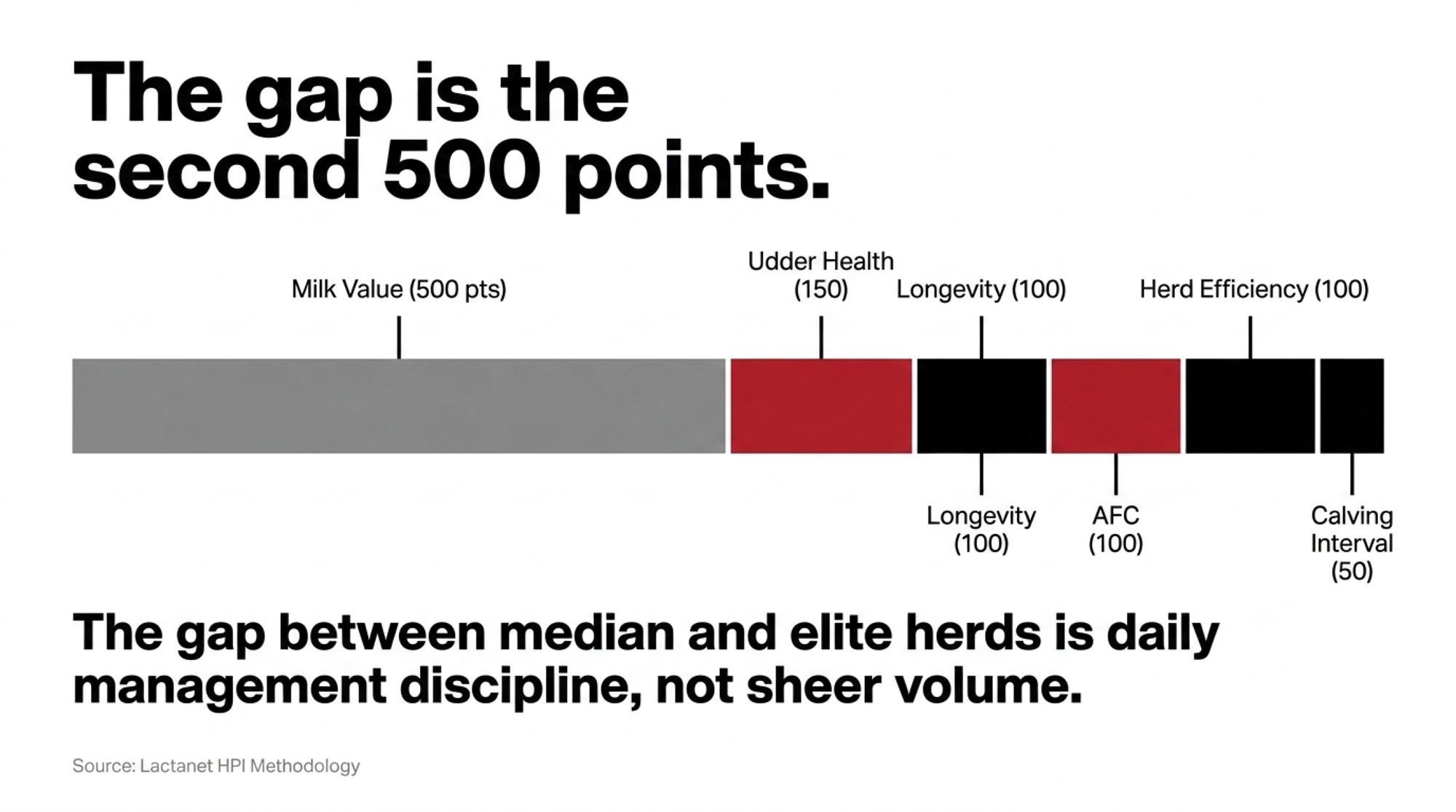
| Indicator | Points | What it captures |
| Milk Value | 500 | Production × component value vs. herdmates |
| Udder Health | 150 | Bulk tank SCC + cow‑level Linear Score |
| Longevity | 100 | Productive life and adult survival |
| Age at First Calving | 100 | First‑lactation entry age vs. benchmark |
| Herd Efficiency | 100 | Days dry, days in milk, herd turnover balance |
| Calving Interval | 50 | Days between successive calvings |
Top‑1% Canadian herds carry HPI scores in the 920–978 band, per Lactanet’s 2025 Top 1% release. The gap from there down to the median isn’t a robot. It isn’t a sire stack. It’s daily management discipline applied for years.
How Lactanet’s Herd Performance Index actually scores your herd.
What’s shifting now is the cost of not operating in that band. The Canadian Dairy Commission’s October 30, 2025 announcement put a 2.33% farmgate milk price increase into effect on February 1, 2026, while the P5 board moved to a new component structure on January 1, 2026 — putting $3/kg more on Tier 2 protein and pulling 18¢/kg off Tier 1 protein, with the sweet spot at an SNF:butterfat ratio of 2.2 (Dairy Farmers of Ontario). And on April 1, 2026, the Western Milk Pool moved from an 85/10/5 butterfat/protein/other‑solids ratio to 70/25/5. Herds built on tight sub‑indicator discipline absorb a payment‑structure change like this. Herds running on volume alone don’t.
| Payment Component | Before | After (2026) | Shift | Who Wins |
|---|---|---|---|---|
| Western Milk Pool | ||||
| Butterfat allocation | 85% | 70% | 🔴 −15% | Component-managed herds |
| Protein allocation | 10% | 25% | 🔴 +15% | Herds optimizing protein yield |
| Other solids | 5% | 5% | No change | — |
| P5 Protein Tiers | ||||
| Tier 1 protein | Baseline | −$0.18/kg | 🔴 Down | Volume herds lose margin |
| Tier 2 protein | Baseline | +$3.00/kg | 🔴 Up | High-component herds gain |
| SNF:BF target ratio | Unspecified | 2.2 | New target | Precision feeding pays |
| CDC Farmgate | Pre-Feb 2026 | +2.33% | Up | All herds (offsets costs only) |
Why Your New Robot Won’t Fix Poor Discipline
Kaelin told Farmtario what sets Sunrise apart is a focus on udder health and a closed‑herd status that’s blocked the arrival of damaging infections. The Sunrise team doesn’t feed in the middle of the day or middle of the night. Cows are up while people are in the barn, lying down when they’re not. “It works with a tie‑stall,” Kaelin said.
About 40 minutes south, Ron, Judy, Todd and Erin Nixon’s Alexerin Dairy outside Manotick took the top parlour spot in Canada for 2025 with an HPI of 974 — second nationally overall, and ranked in Lactanet’s top 25 for five years running. “We’re really proud of our team — including Ron, Judy, Todd and Erin Nixon as well as four non‑family employees — for maintaining consistency to achieve reproductive success, maintain good production, and we’ve made good progress on improving our udder health this year,” Todd Nixon said in a video Lactanet released alongside the 2025 announcement. The Nixons run DairyComp for everyday management, with their vet and nutritionist working off the same data set.
West River Farm in Rosedale, B.C., placed #13 nationally, top in BC, and second among Canada’s robot herds with an HPI of 944. Sarah Sache, who manages the business at West River, told Farmtario the family has always managed for efficiency — historically feed efficiency and butterfat per cow, but increasingly protein production as the consumer marketplace evolves. “And profitability has always been a key metric for us,” she said. Lansi Holstein, owned by Nicolas and Frédéric Landry in Saint‑Albert, Quebec, took #1 robot in Canada and #1 overall in Quebec at 972.
The Barn Math on a Single Chronic Cow
A chronic high‑SCC cow in second lactation or older loses roughly 200 kg of milk per lactation for every Linear Score unit above 2 — that’s the conversion published in Lactanet’s Udder Health methodology. A cow sitting at LS 6 against a healthy LS 2 herdmate is short roughly 800 kg of milk over a 305‑day lactation. At an average Canadian quota blend price near $0.80/kg following the CDC’s February 1, 2026 farmgate adjustment, that works out to roughly $640 short on milk revenue alone — before you count premium‑program ineligibility, vet costs, or discarded milk days.
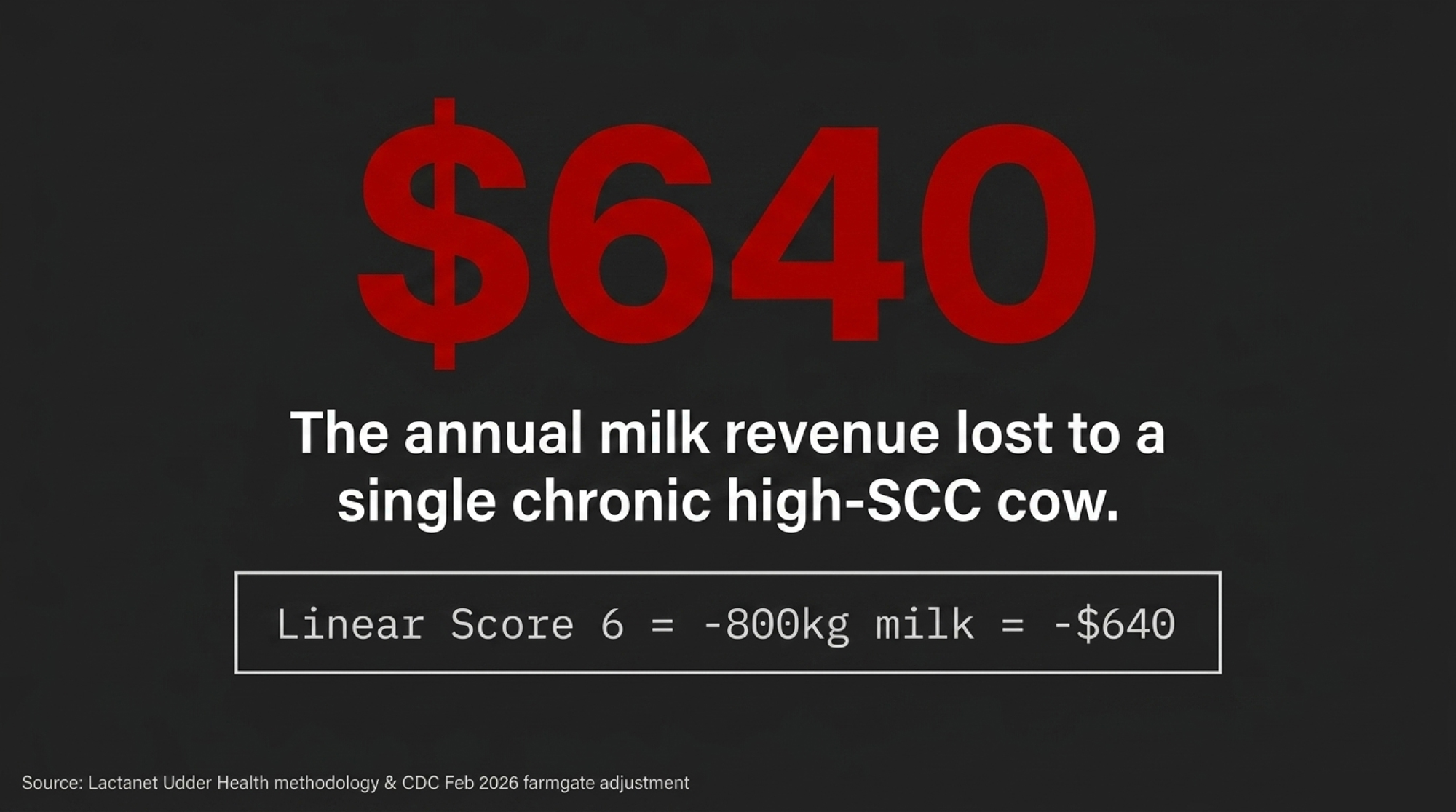
The Bottom Line: One LS 6 cow isn’t just a high‑SCC risk. She’s a $640 annual hole in your pocket before you even touch a vet bill. On a barn carrying 20 of those cows, the math compounds quickly.
The 200,000‑Cell Threshold Isn’t About Quality. It’s About Capacity.
Lactanet flags any cow above 200,000 cells/mL as a problem cow on its SCC reports — a threshold that captures roughly 85% of mastitis cases, clinical and subclinical. What that 200,000 line really marks is the point where the udder stops being a milk factory and starts being an immune battleground. Somatic cells are white blood cells. Once they crowd the alveoli, secretory tissue gets damaged or replaced with scar tissue, and production capacity drops — not just for that lactation, but across her productive life.
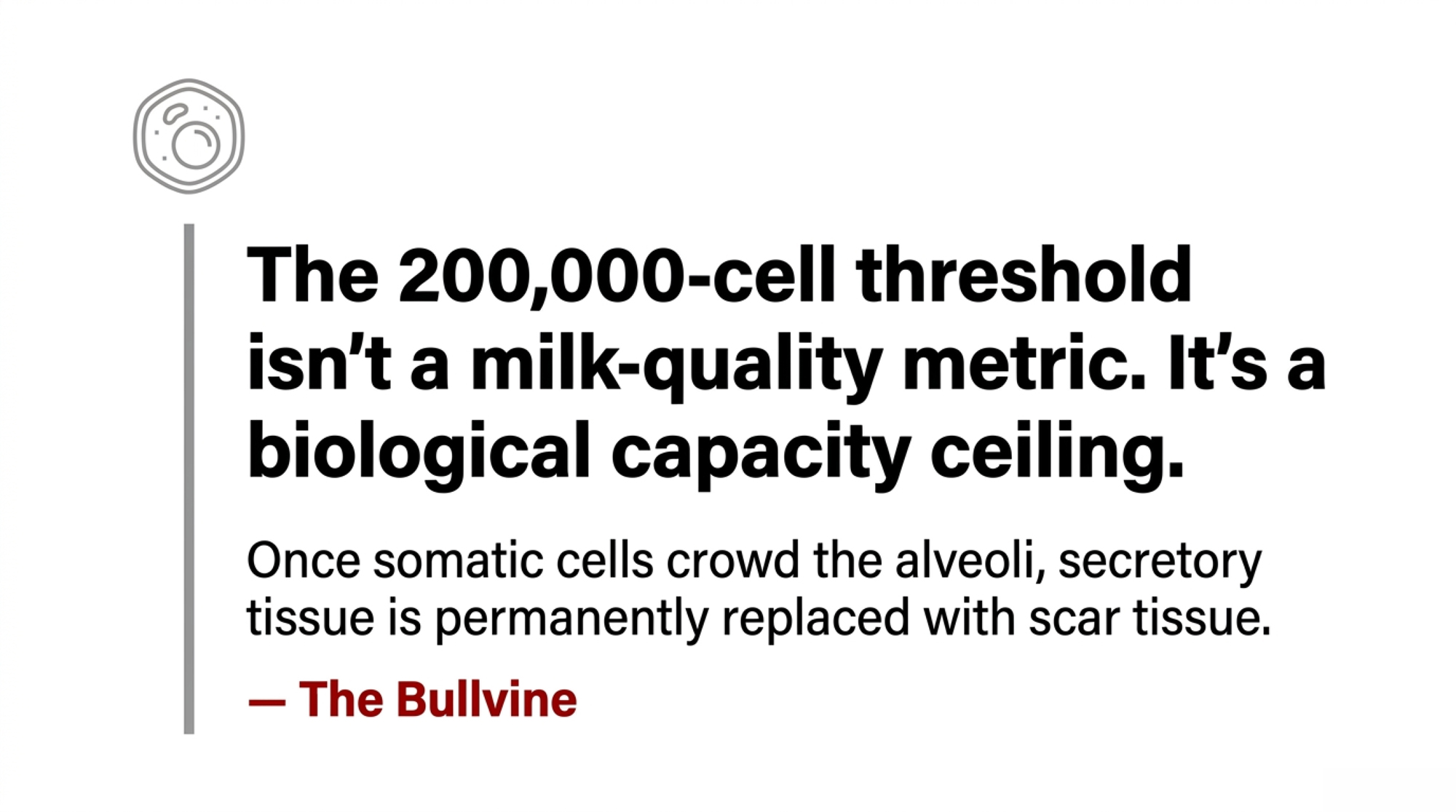
That’s why top‑1% herds don’t think of SCC as a milk‑quality metric. They think of it as a biological capacity ceilingthey refuse to let any cow stay above for long.
› Go deeper: The hidden $1,400/cow cost killing dairy profits.
How Much Does Keeping One Chronic Cow Actually Cost You?
Pick one cow currently flagged on your Lactanet SCC report — anything above 200,000 cells/mL across her last three tests. Compare her last 305‑day production to a healthy herdmate of the same lactation number. Use Linear Score to make the math clean: every LS unit above 2, in second lactation or older, is roughly 200 kg of lost milk per lactation. Multiply by your component‑adjusted milk price.
Then ask whether your bulk tank would clear a premium‑quality threshold (typically <150,000 cells/mL across Canadian provincial structures) if she and a handful of her chronic peers left this month. The dollar value of that single threshold cross varies by board and shipper, but it’s almost always real money.
The Bottom Line: The hard part isn’t running the math. It’s being willing to look at it.
The Mechanics Behind the Outcomes
The reason most herds keep that cow is straightforward. She’s still milking. Replacement heifers in Quebec averaged $4,859 per head for conventional herds in Lactanet’s most recent rearing‑cost analysis, with a range from roughly $3,500 to over $7,000 depending on housing and feeding. Culling feels like loss.
The mechanics of the second 500 HPI points work like a system of compounding gears.
- Udder Health drops, and Milk Value drops with it — high SCC suppresses production at the same time it costs you premiums. Double penalty.
- Calving Interval stretches, and Herd Efficiency cracks because more dry and empty cows clog the system. Each extra day open costs an average of 2.40 kg of milk and 0.112 kg of fat per cow, per the foundational Journal of Dairy Science work on production losses from days open.
- Age at First Calving drifts past 24 months when pre‑weaning growth is underpowered, calf disease sets heifers back, and breeding gets pushed. CDCB respiratory‑disease work shows a single recorded respiratory event in a heifer costs 121 kg of first‑lactation milk on its own.
Of the six HPI indicators, Udder Health typically moves first. Most herds see SCC shift inside one or two test cycles when they cull or treat aggressively. Calving Interval and Age at First Calving take a year or more to register on the report.
› Go deeper: The $2,678 lifetime profit gap between top and bottom quartile classified cows.
Your Shopping Habit Is Why Your SCC Is High
The closed‑herd pattern at Sunrise and West River isn’t a coincidence. Staphylococcus aureus — the contagious mastitis pathogen most responsible for chronic SCC elevation — spreads cow‑to‑cow at milking and incubates subclinically in purchased animals that test fine on arrival. Bringing in live animals brings in their bacteria. Closing the gate doesn’t.
A closed herd doesn’t manage introduction risk. It eliminates it. Genetics still flow in — semen and embryos cross the gate. The disease pipeline is what’s being closed. Dairy Farmers of Canada’s proAction biosecurity guide makes the same recommendation in plainer language: limit purchase frequency, limit number of sources, and maintain a closed herd to the extent practicably possible.
Reality Check: You can’t buy your way into the top 1% of Best Managed herds. But you can absolutely buy your way out of it by bringing in one Staph aureus carrier.
Is Your Heifer Program Building a 23‑Month Calving Window or a 26‑Month One?
Average herds answer “what age do you breed at?” Top herds answer “what weight at 12 months are you tracking against?” Those aren’t the same question. Wardway Farms — featured in Lactanet’s published AFC case work — averages 21.4 months at first calving by breeding heifers on weight, not on the calendar.
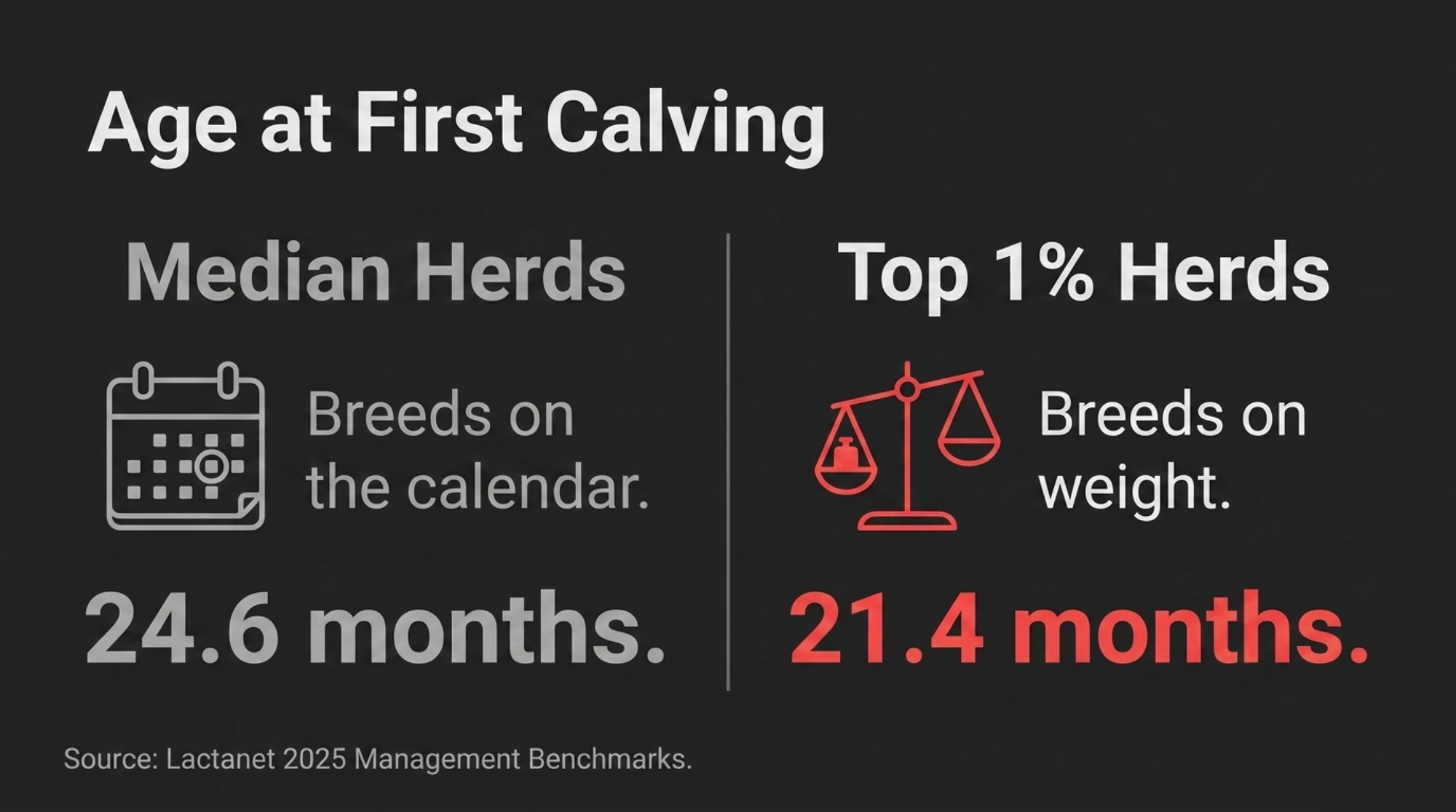
A 24‑month AFC isn’t “good enough.” Lactanet’s 2025 Management Benchmarks put Canada’s national median at 24.6 months, with the 90th‑percentile band at 23.1 months or below. Wardway’s 21.4 months sits more than three months below the national median — and every one of those months is direct lifetime profit. Calving at 21–22 instead of 24–25 means an extra lactation across her productive life on the same depreciation schedule, fewer non‑producing days on feed, and a higher share of her HPI Age at First Calving 100 points captured. The gap is almost entirely about pre‑weaning nutrition, calf disease management, and whether breeding happens on weight or on the calendar.
Options and Trade‑Offs for Farmers
Most middle‑of‑the‑pack herds don’t need to copy a tie‑stall pipeline operation to move. They need to pick the levers that respond fastest and start.
| Action Path | HPI Points at Stake | Time to Visible Move | Dollar Anchor | Hard Trade-Off |
|---|---|---|---|---|
| 🔴 Cull chronic SCC cows | 150 (Udder Health) | 1–2 test cycles | 🔴 $640/cow/lactation | Cull cost hits before premium recovery |
| Tighten repro protocol | 50 direct + drags on Efficiency & Milk Value | 6–9 months | 2.40 kg milk/day open | Compliance slips under harvest pressure |
| Rebuild heifer pipeline | 100 (AFC) + Longevity | 18–24 months | $4,859 avg rearing cost (QC) | Payback delayed but compounding |
| Close the herd gate | Protects Udder Health 150 | Immediate risk reduction | 1 Staph aureus intro = 5–15 cows × $640 | 🔴 9.99% inbreeding floor to beat |
Path 1 — Attack SCC and chronic cows in the next 30 days. Pull your Lactanet SCC Herd Summary this week. Flag every cow above 200,000 cells/mL across her last three tests, and check her Linear Score and lactation $ loss on the second page of the report. Assign each one a treatment plan, segregation order, early dry‑off, or cull date. Top herds make this list weekly, not annually. The cull cost lands before the premium gain — but the reclaim arrives within one or two test cycles, and the 150‑point HPI Udder Health component typically moves faster than any other lever on the report. Forward signal: with the April 1, 2026 WMP component shift rewarding tighter SNF management, the bulk‑tank SCC reclaim and the protein‑side payment improvement land in the same quarter.
Path 2 — Tighten repro discipline this breeding season. Define your voluntary waiting period in writing. Run a structured first‑service program (Double‑Ovsynch or G6G). Preg‑check at 32 days post‑AI, not 60. Each day open trimmed off your herd average is worth 2.40 kg of milk per cow per day across the rest of that lactation, per Journal of Dairy Science‘s days‑open work. The risk: protocol compliance under harvest pressure is exactly when discipline tends to slip. Forward signal: Calving Interval is only worth 50 of the 1,000 HPI points, but it’s the lever that drags Herd Efficiency and Milk Value with it when it moves.
Path 3 — Rebuild the heifer pipeline now for 2027 AFC. Colostrum within 1–2 hours, 2+ L, Brix‑tested. Aim to double birthweight by weaning. Track growth against mature‑cow targets, not the calendar. Wardway’s 21.4‑month average sits more than three months below the national median — and the gap is calf nutrition and disease management, not calendar discipline. Payback lands two years out. Every month you delay starting is a month added to your AFC drift.
› Go deeper: Why raising your heifers just became profitable again.
Path 4 — Decide whether closing your herd is feasible. It’s binary. You either bring in zero outside live animals or you don’t get the biosecurity benefit. For operations not selling embryos or buying expansion cows, the 2026 economics tilt sharply toward closing. The trade‑off: slower genetic correction (closed herds depend on genomic semen rotation rather than purchased proven cows), and inbreeding management becomes a deliberate task. Lactanet’s August 2025 inbreeding update pegged Canadian Holstein heifers born in 2024 at 9.99% average inbreeding — a full point above 2014. Close the gate, and that’s the number you have to actively beat in your own mating reports.
Key Takeaways
- If your bulk tank SCC sits above 150,000, pull your Lactanet udder health report this week and identify the 5–15 cows pulling the average up. Build a treatment, segregation, or cull date for each.
- If your calving interval is above 400 days, audit your VWP and first‑service program with your vet inside the next 30 days. This single lever moves HPI faster than any other.
- If you can’t pull a problem‑cow list in under five minutes — chronic SCC, repeat breeders, longest open — your herd software is a record‑keeper, not a management tool.
- If you’re considering closing your herd, cost out one disease introduction event against your current purchase frequency before deciding.
- If your AFC is above 24.6 months, the bottleneck is your heifer program, not your breeding calendar. Start with colostrum protocol and pre‑weaning ADG tracking.
- If your expected mating inbreeding is running above 9.99%, your sire stack needs two or three outcross or lower‑inbreeding bulls before the next breeding cycle, per Lactanet’s August 2025 benchmark.
- If you’re at the 50th percentile across multiple components, attack udder health and calving interval first. Milk Value and Longevity follow as side effects, not the other way around.

Sunrise. Alexerin. West River. Lansi. Four operations, four provinces, almost nothing else in common — except the discipline. Different barns, different milking systems, different cow families. What they share isn’t equipment. It’s the willingness to look at their own data and act on what it says, even when the action is unpopular or expensive in the short term.
So here’s the question worth sitting with this week. When you look at your last 12 months of test data, can you name the five cows costing you the most HPI points right now? And if you can’t, what would change if you could?
The full barn‑math on each HPI component — the SCC math, the calving‑interval economics, the heifer‑program rebuild — gets the calculator treatment in our companion piece The Math Behind Canada’s Best Managed Dairy Herds. That’s where the numbers live.
Operating details for the herds named here are drawn from Lactanet’s 2025 Best Managed announcement (March 9, 2026) and Top 1% release, the Lactanet 2025 Best Managed announcement video, the Ontario West Progress Report (April 22, 2026), and Farmtario’s March 17, 2026 coverage of the rankings. Component price detail draws from the Canadian Dairy Commission’s October 30, 2025 farmgate price announcement, and Farmtario’s February 10, 2026 coverage. None of the operators were interviewed directly for this piece.
Run Your Numbers
Component Value Tracker — Use the Component Value Tracker to translate today’s shifting milk pricing into herd-level component dollars. See what one-tenth of a point of fat or protein is actually worth in your milk check before you change your ration or sire stack.
Learn More
- Why 150 Well-Managed Cows Beat 500 Poorly-Run Ones — Capture the $100,000 management differenceby driving operating costs below $18/cwt and optimizing SCC premiums. Focusing on these efficiency metrics allows 150-cow dairies to out-earn struggling 500-cow giants through superior component production and labor optimization.
- Lactanet Unveils Canada’s Best Managed Herds for 2024 — Adopt the 984 HPI playbook used by Canada’s 2024 leaders to slash replacement costs by C$580 per cow. Benchmarking data reveals how genomic testing and longevity analytics create a high-margin “survival toolkit” for elite Canadian operations.
- The Profit Index Paradox: Choosing Dollars Over Rankings — Master the genetic profit gap by choosing sire teams based on Net Merit and Pro$ instead of vanity rankings. High-LPI bulls often hide a 31st percentile fertility trap that arms you with expensive breeding delays rather than real-world margin.
 The Sunday Read Dairy Professionals Don’t Skip.
 The Sunday Read Dairy Professionals Don’t Skip.
Every week, thousands of producers, breeders, and industry insiders open Bullvine Weekly for genetics insights, market shifts, and profit strategies they won’t find anywhere else. One email. Five minutes. Smarter decisions all week.




