


One I-9 audit took Drumgoon Dairy from 50-plus workers to 16. Washington just opened H-2A to dairy—but it caps at 350 days, and milking never stops. Where’s your breakeven on day four?
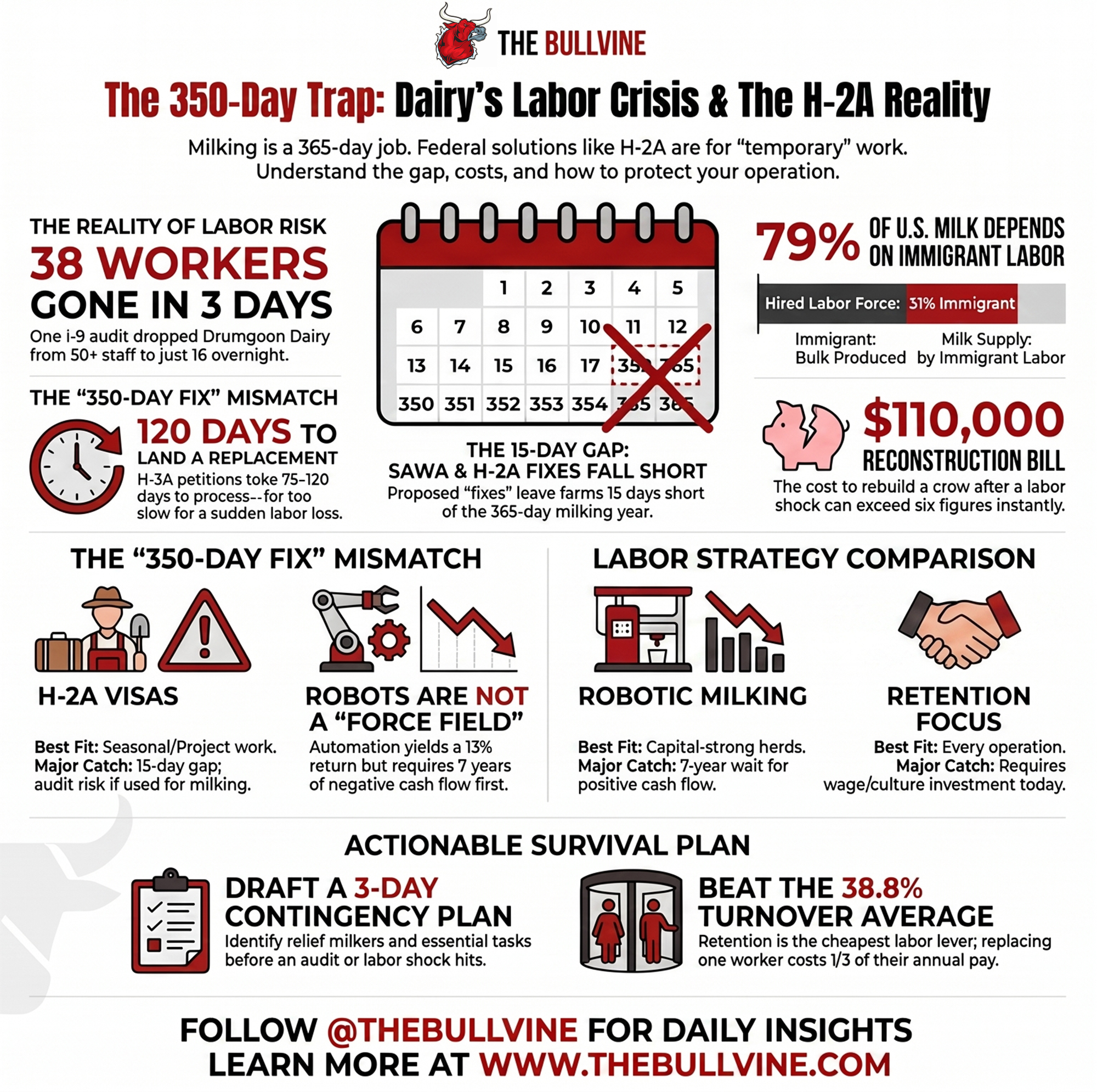
Executive Summary: One I-9 paperwork audit dropped South Dakota’s Drumgoon Dairy from 50-plus workers to 16 in a matter of days — 38 people gone, and a $110,000 bill to rebuild the crew. Washington’s answer landed June 17, 2026: USDA, DOL, and DHS jointly opened H-2A to dairy, and the SAWA bill would redefine “temporary” as a 350-day contract. But milking is a 365-day job with no off-season, so you’re 15 days short of the work by design, and H-2A still takes 75 to 120 days to land a replacement. This hits the operations that produce roughly 79% of U.S. milk on immigrant labor — mostly mid-size and smaller herds without the balance sheet to automate out of it. Run the barn math before Congress does: at the FARM Program’s 38.8% turnover average, a 20-person crew loses about eight people a year, which is why retention — not a temporary visa — is the cheapest labor lever you can pull this month. Robots aren’t the escape hatch either; USDA’s ERR-356 pegs the net-return gain at about 13%, but Larry Tranel’s models show roughly seven years of negative cash flow first, and Drumgoon’s 20 robots didn’t keep it whole. The real question isn’t whether H-2A helps at the edges — it’s how many days your parlor runs if you lose a third of your crew next Thursday.
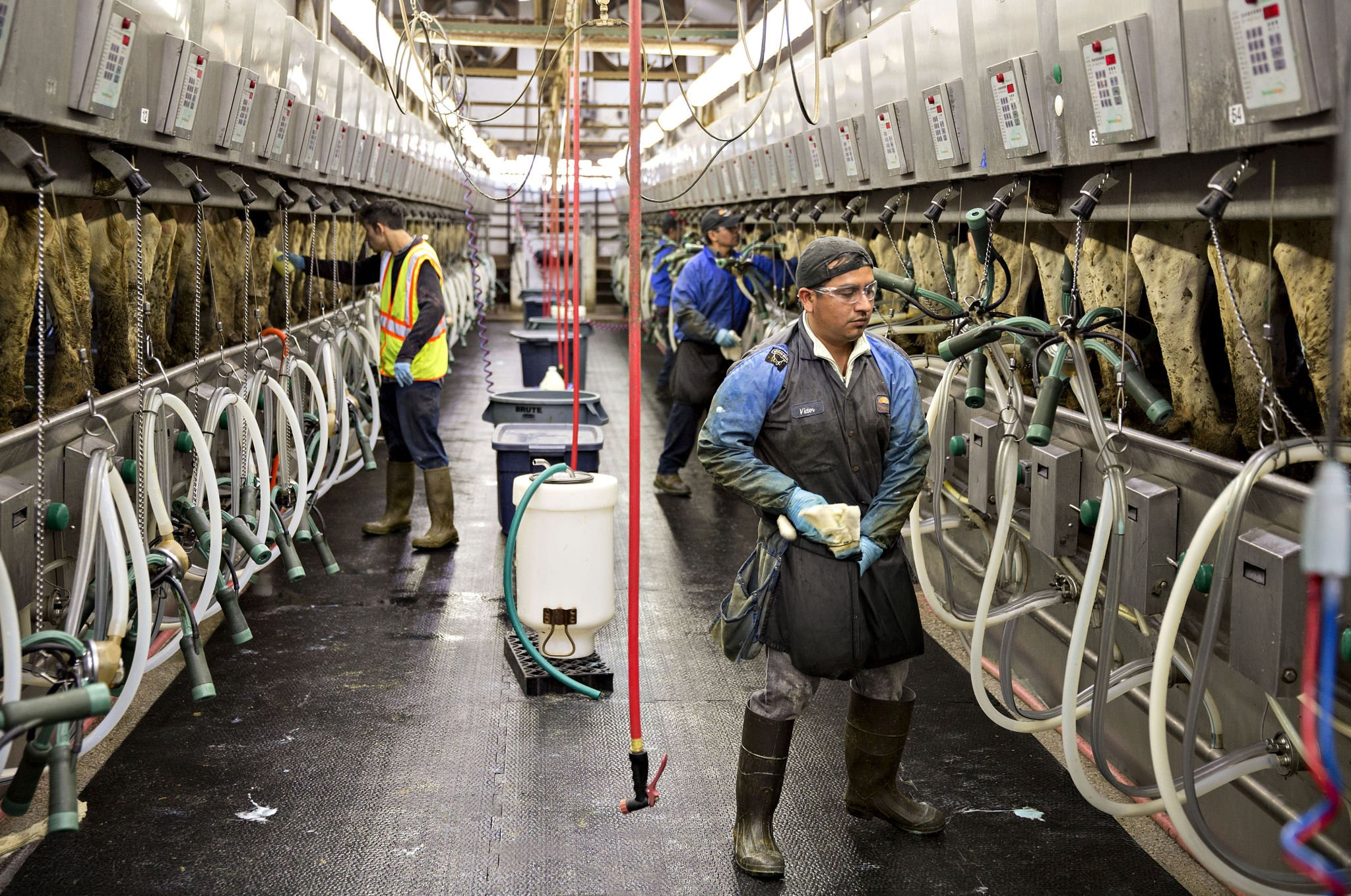
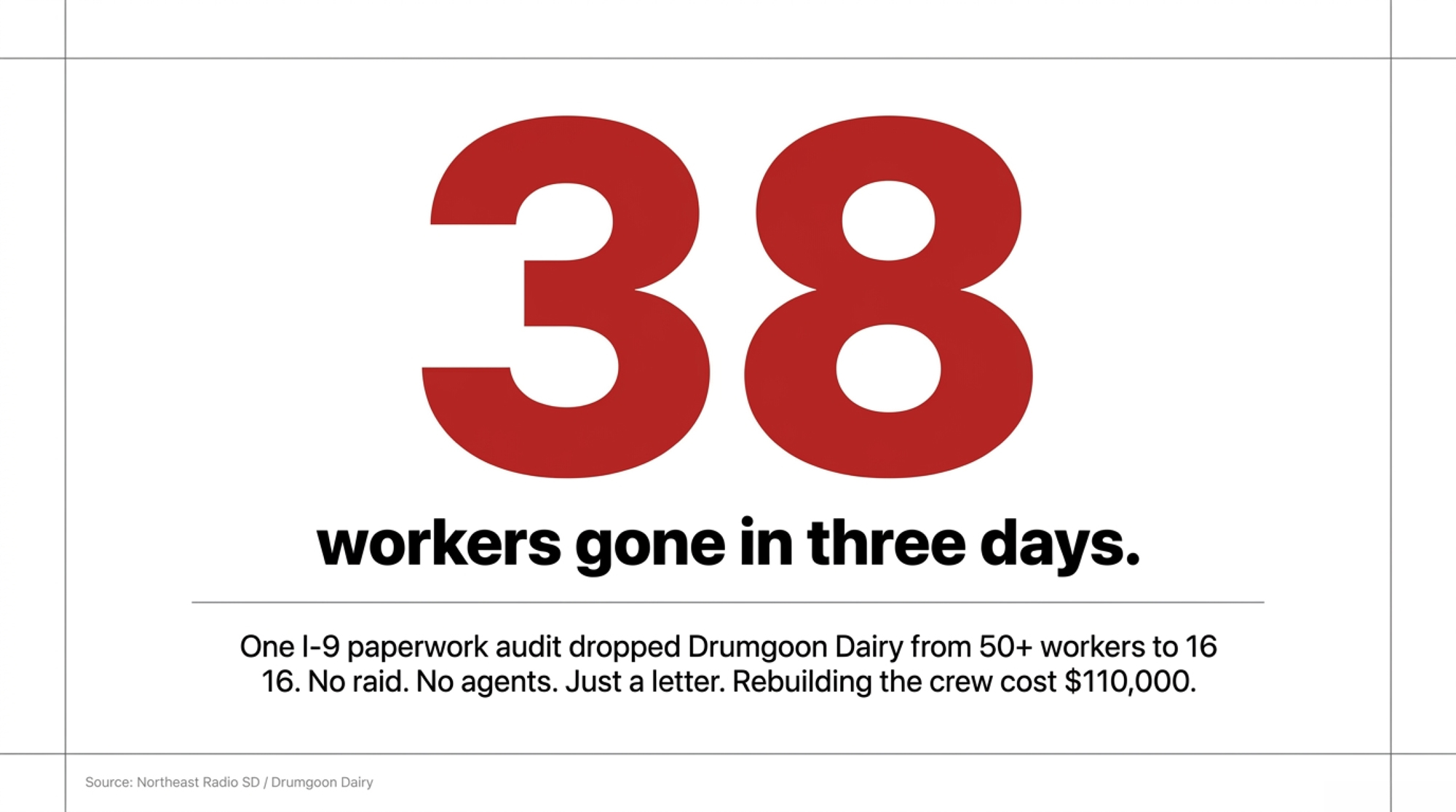
Rodney and Dorothy Elliott left a 140-cow farm in Northern Ireland nearly 20 years ago to build something bigger near Lake Norden, South Dakota. By 2026, Drumgoon Dairy was milking 6,500 cows with 20 robots and a crew of more than 50. Then a federal Homeland Security I-9 audit hit in late May 2025, and co-owner Dorothy Elliott told Northeast Radio SD that the farm let 38 employees go after the audit flagged their documents as “inaccurate, outdated, or incomplete proof of U.S. citizenship or permission to work.” Total staff fell from over 50 to just 16. No agents at the gate — just an envelope, a Notice of Inspection, and three business days to produce papers that didn’t hold up.
Worth being precise about what that was, because the next farm’s story in this piece is different. An I-9 audit isn’t an immigration raid — it’s a paperwork inspection, and the employer, not the workers, is the legal target. If you milk cows for a living, that scenario still sits in the back of your head every time another immigration headline scrolls past. And here’s why it matters this week: on June 17, 2026, USDA, the Department of Labor, and DHS jointly clarified that dairy farms can finally tap the H-2A guest worker program. Sounds like the cavalry showing up. But the fix is built on a contradiction nobody’s actually solved — H-2A is a temporary or seasonal program, and milking is the most year-round work there is.
The short version: this helps at the edges. The longer version is worth your time.
What’s Changing and Why
For decades, dairy was effectively locked out of H-2A. By statute, the program is for work “of a seasonal or temporary nature,” and that language was written with crops in mind. A crew shows up for harvest, the harvest ends, the crew goes home. Dairy doesn’t work that way. Cows get milked Christmas morning the same as any Tuesday in April.
The June 2026 guidance changed the interpretation, not the law. Dairy farms can now petition for H-2A workers if they can show a qualifying temporary or seasonal need, assessed on a case-by-case basis. The bigger swing is in Congress. The Securing Agriculture’s Workforce Act (SAWA), introduced by House Agriculture Committee Chairman Glenn “GT” Thompson, would drop the “seasonal” requirement outright and redefine “temporary” as a contract of 350 days or less. To be fair to its backers, the bill also caps how much wage rates can swing year to year and builds an online application portal — real administrative wins over today’s clunky system. What it won’t do is offer anyone a path to citizenship.
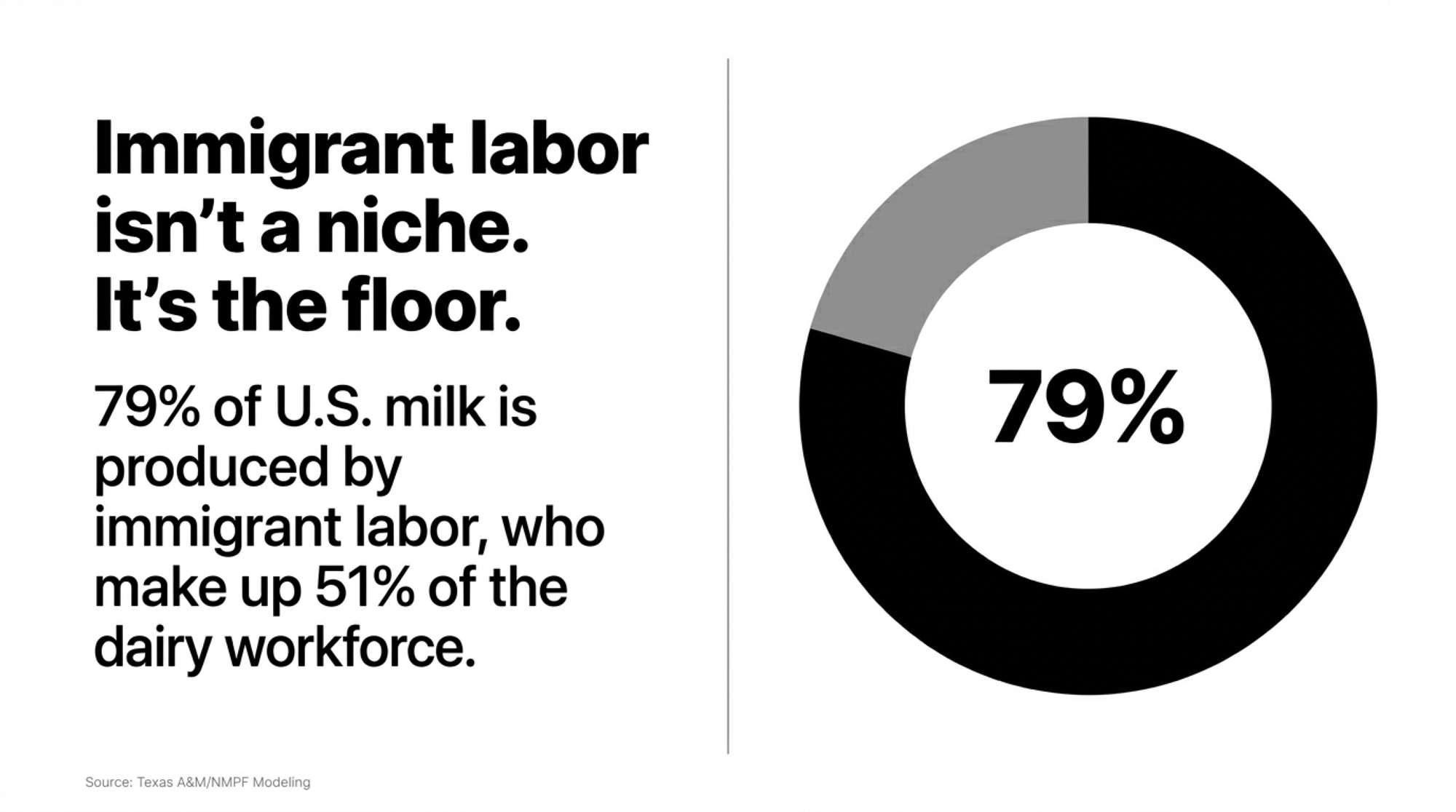
So who’s most exposed here? Mid-size and smaller herds that lean on a handful of skilled, long-tenured people and don’t have the balance sheet to automate their way out. Immigrant workers make up about 51% of all hired dairy labor, and farms that employ them produce roughly 79% of U.S. milk. That’s not a niche corner of the industry. That’s the floor the whole thing stands on.
| Metric | Figure | Why it matters |
| Immigrant share of hired dairy labor | 51% | Half the workforce sits under this policy question |
| U.S. milk from farms using immigrant labor | 79% | Not a niche—the industry’s floor |
| Est. milk production drop if that labor vanished | ~25% | Worst-case bookend, not a forecast |
| Est. retail milk price rise in that scenario | ~90% | Consumer-facing shock built on a labor gap |
| H-2A time to land a replacement worker | 75–120 days | No futures contract hedges that hole |
How This Plays Out on Real Farms
On the ground, “demonstrating temporary need” means slicing a year-round operation into pieces that look seasonal on paper. Attorneys are advising dairies to file H-2A petitions for fieldwork crews, silage harvest, manure hauling, surges in heifer raising, or to cover a worker out on extended leave. Cornell Agricultural Workforce Development put it plainly: dairy can participate “for temporary or seasonal jobs,” but “permanent or lengthy and consecutive jobs are not eligible.”
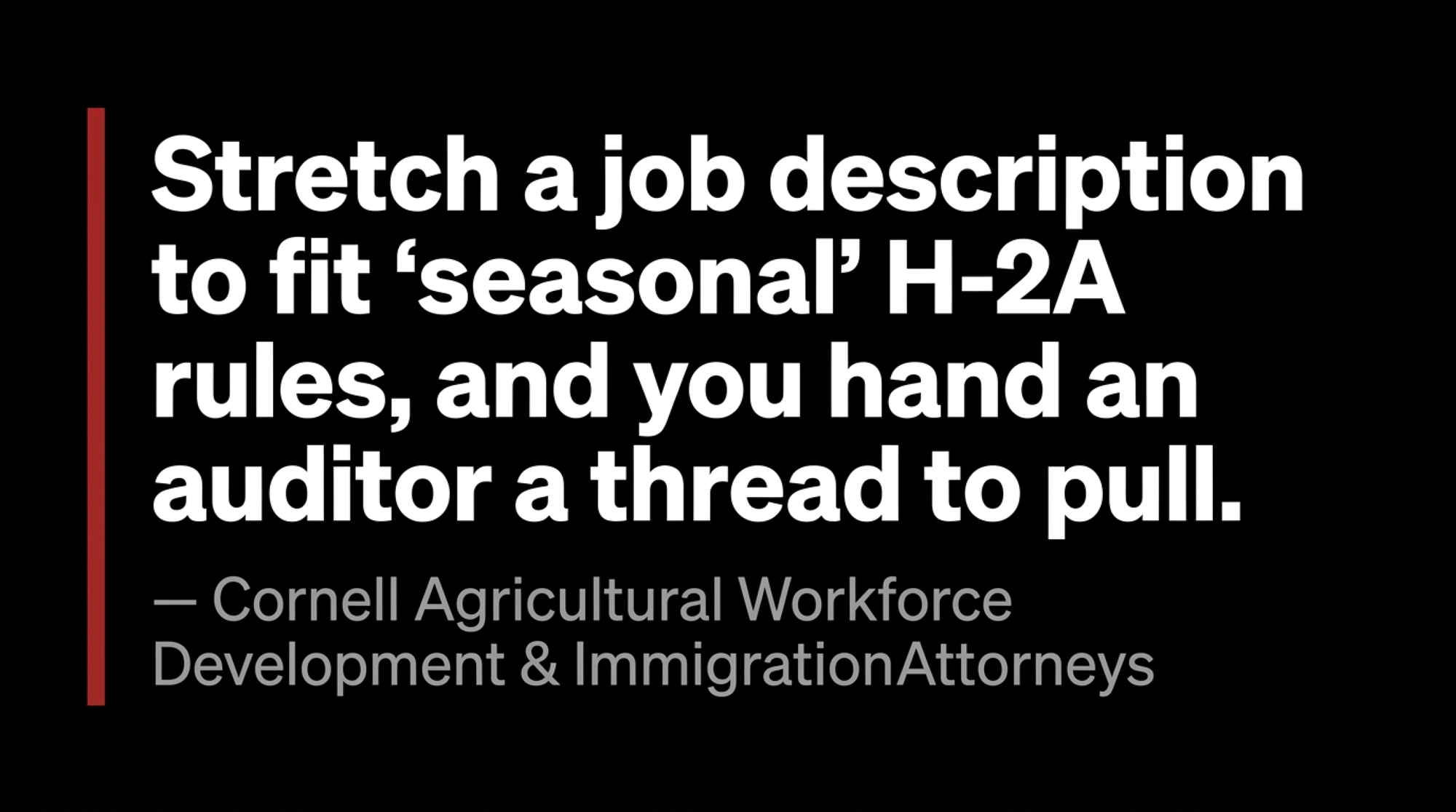
You see the problem. A farm writes up a job description that says “forage crew” for someone who’s been in the parlor since February. The cows don’t read the petition, and neither does a DOL auditor. Stretch the description to fit the program, and you’ve handed an auditor a thread to pull — immigration attorneys warn that petitions which don’t match the actual work invite denial and added scrutiny. Honest operators get squeezed from both sides. Describe the job accurately, and you don’t qualify. Bend it toward “seasonal,” and you’ve taken on compliance risk you didn’t have before — which is exactly why so many operators are wrestling with the workers dairy can’t legally hire but can’t survive without.
Now run the barn math on the staffing risk itself. The Texas A&M/NMPF modeling estimates that if the entire immigrant dairy workforce disappeared, U.S. milk production would drop about a quarter and retail milk prices could climb roughly 90% — a deliberate worst-case bookend, not a forecast. Bring that down to one farm. Drumgoon lost 38 of its 50-plus workers overnight, even with 20 robots already running — because robots don’t feed calves or catch a fresh cow. Rebuilding cost the Elliotts more than $110,000, and even then, H-2A takes 75 to 120 days to land replacement labor. No futures contract hedges a hole like that.
The Mechanics Behind the Outcomes
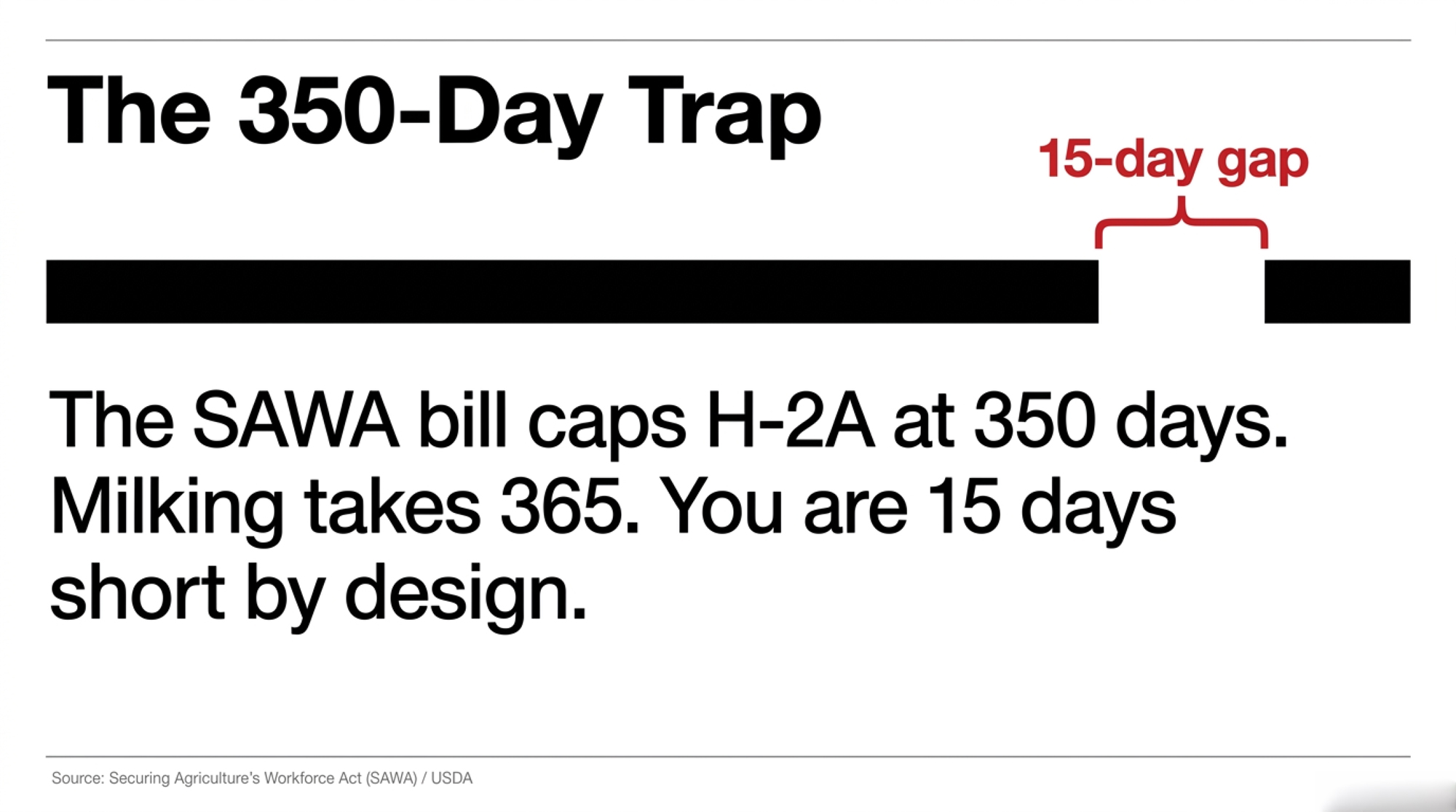
The whole mess comes down to one definitional mismatch. H-2A defines “temporary” need as lasting no longer than a year except in extraordinary cases, and “seasonal” need as tied to an event that “requires labor levels far above those necessary for ongoing operations”. A 365-day milking job has no off-season and no spike. It’s just steady, every single day. SAWA’s 350-day contract gets closer to reality, but “closer to year-round” still isn’t year-round — you’re 15 days short of the actual job.
Then there’s the math from the worker’s side, which is the part the policy debate keeps skipping. SAWA would allow some unauthorized workers to apply for H-2A status, but it’s temporary, tied to one employer, and leaves no path to staying. Picture someone who’s milked on your farm for a decade without papers. Stepping into this program means entering your name and address into federal systems in exchange for an expiring permission. And the track record isn’t reassuring — the Economic Policy Institute’s survey of H-2A workers found violations were near-universal in its sample, with every worker reporting at least one serious worker-protection violation and 94% reporting three or more.
So put yourself in their boots. You’ve built a life, your kids are in the local school, and the offer on the table is “register now, get time-limited status, then leave when it ends.” For a lot of long-tenured workers — given a permit that expires and that violation record — the rational move is often to stay invisible. That’s not stubbornness. That’s just the math from where they’re standing, and it’s exactly why a “temporary” fix doesn’t reach the people actually holding your parlor together.
How Much Does “Demonstrating Temporary Need” Actually Cost You?
More than the filing fee, and that’s before you’ve hired anyone. H-2A carries real compliance weight: twice-monthly earnings statements, housing standards, precise hour records, and exposure to Wage and Hour Division audits that can result in fines or being barred from the program entirely. American Farm Bureau notes that the paperwork has become so complex that more farms are handing it off to farm labor contractors to keep up.
That’s time and focus pulled straight off your herd. And the mental load of defending a “forage crew” job description for a year-round milker is its own quiet tax — one that lands hardest on the operators trying hardest to do it by the book. Before you file, price out the legal and administrative overhead against what you’d actually gain in labor. On a smaller dairy, that ratio may simply not pencil.
Is Your Operation One Audit Away From the Drumgoon Scenario?
Ask it straight. If a meaningful share of your crew has uncertain status — and across U.S. agriculture, FWD.us estimates roughly half of farmworkers are undocumented — then your single biggest operational risk isn’t the milk price, the feed market, or the weather. It’s an envelope from the federal government. And it doesn’t even take an audit to gut you: according to Bullvine’s earlier reporting, one Idaho dairy lost about a third of its crew over three weeks with no raid, no warrant, and no agents on the property — workers simply stopped showing up after enforcement hit a farm 50 miles away.
So build the contingency plan before you need it. After Drumgoon’s audit, neighboring farms sent workers over in shifts to keep the place moving — but that kind of help only exists if you’ve built the relationships first. Know which neighbors or relief milkers you could call at 5 a.m., which tasks you could pause for a week, and how many days you could run short-handed before production falls off a cliff. The farms that ride out a labor shock are the ones that gamed it out in advance. Not the ones reading the audit notice cold, with no plan and no one to call.
Options and Trade-Offs for Farmers
There’s no clean fix here. There are paths, and each one costs you something different. Here’s the at-a-glance before you read the detail:
| Strategic Path | Best Operational Fit | The Major Catch / Risk |
| H-2A for Seasonal Slices | Real fieldwork, forage harvest, or project spikes. | Won’t touch year-round milking; mismatched or “stretched” petitions invite heavy audit denial. |
| Retention Focus | Every operation, starting immediately. | Doesn’t fix underlying legal status issues; requires intentional wage and cultural investments. |
| Robotic Milking | Capital-strong herds (typically 200–350 cows). | Expect roughly 7 years of negative cash flow first; robots do not feed calves or catch fresh cows. |
| Revenue Diversification | Herds looking for an immediate volatility buffer. | Adds zero hands to the parlor; cushions income but does not solve the physical labor deficit. |
Start with H-2A only where the need is genuinely seasonal — fieldwork, forage, a project spike, covering extended leave. It takes documentation and probably legal counsel, and the job descriptions have to match what people actually do. Chain petitions for the same year-round role and you’re inviting denial and an audit, so this won’t plug your core milking gap.
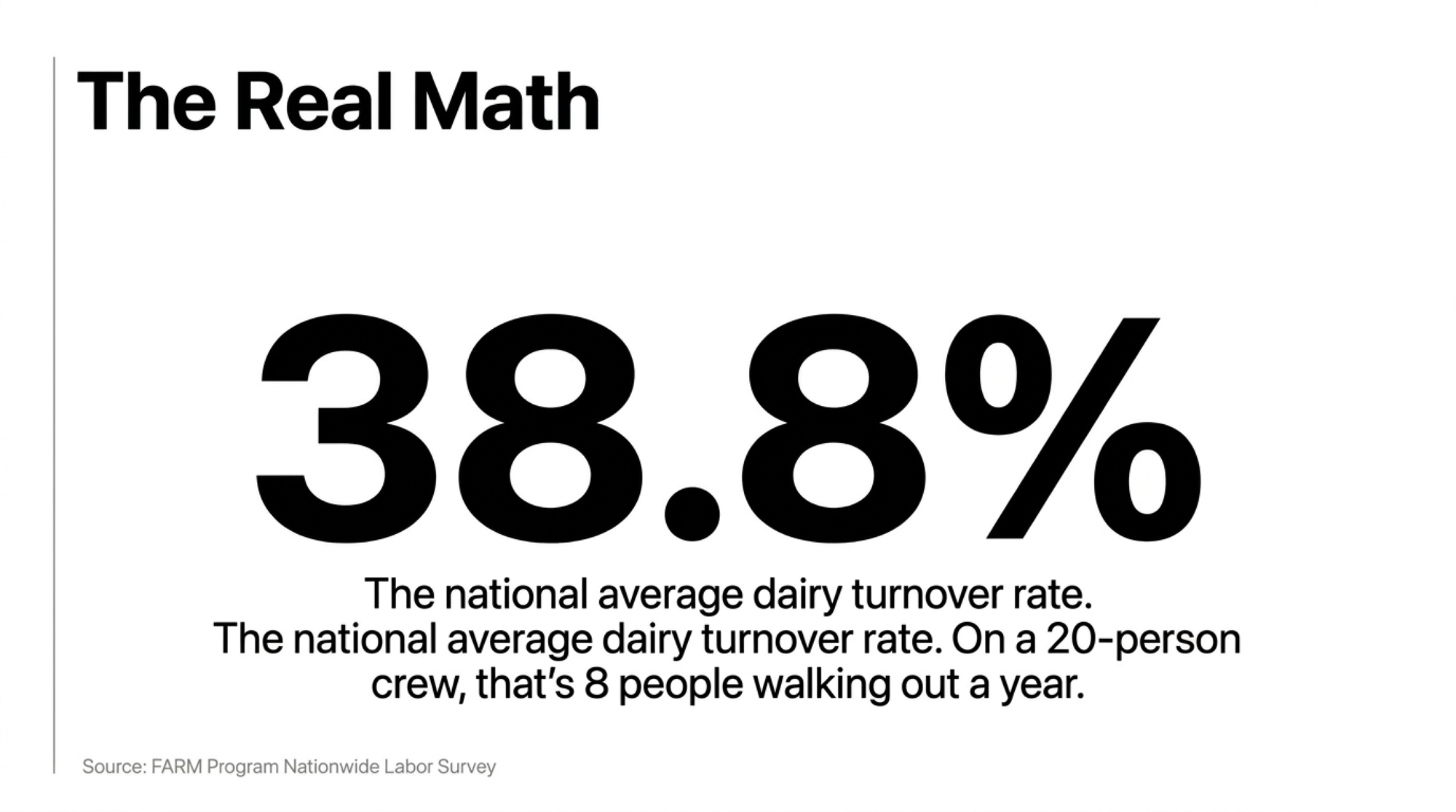
Let’s look more closely at that retention line, because it’s the one number in this piece most worth comparing against your own operation. The FARM Program’s Nationwide Labor Survey on Workforce Development puts the average annual dairy turnover rate at 38.8%. Replacing a worker typically costs about a third of that worker’s annual pay, once you factor in lost productivity, recruiting, and training. On a crew of 20, that 38.8% is roughly eight people walking out the door in a year. Picture rehiring and retraining eight positions annually — that’s a cost that never shows up as a tidy line item but bleeds out all the same. A worker who stays is one you’re not scrambling to replace mid-audit. It’s the cheapest labor strategy on the board, the only one that doesn’t wait on Congress, and the cost gap behind it is largely what’s driving the loss of 15,000 farms, since smaller herds can’t carry it.
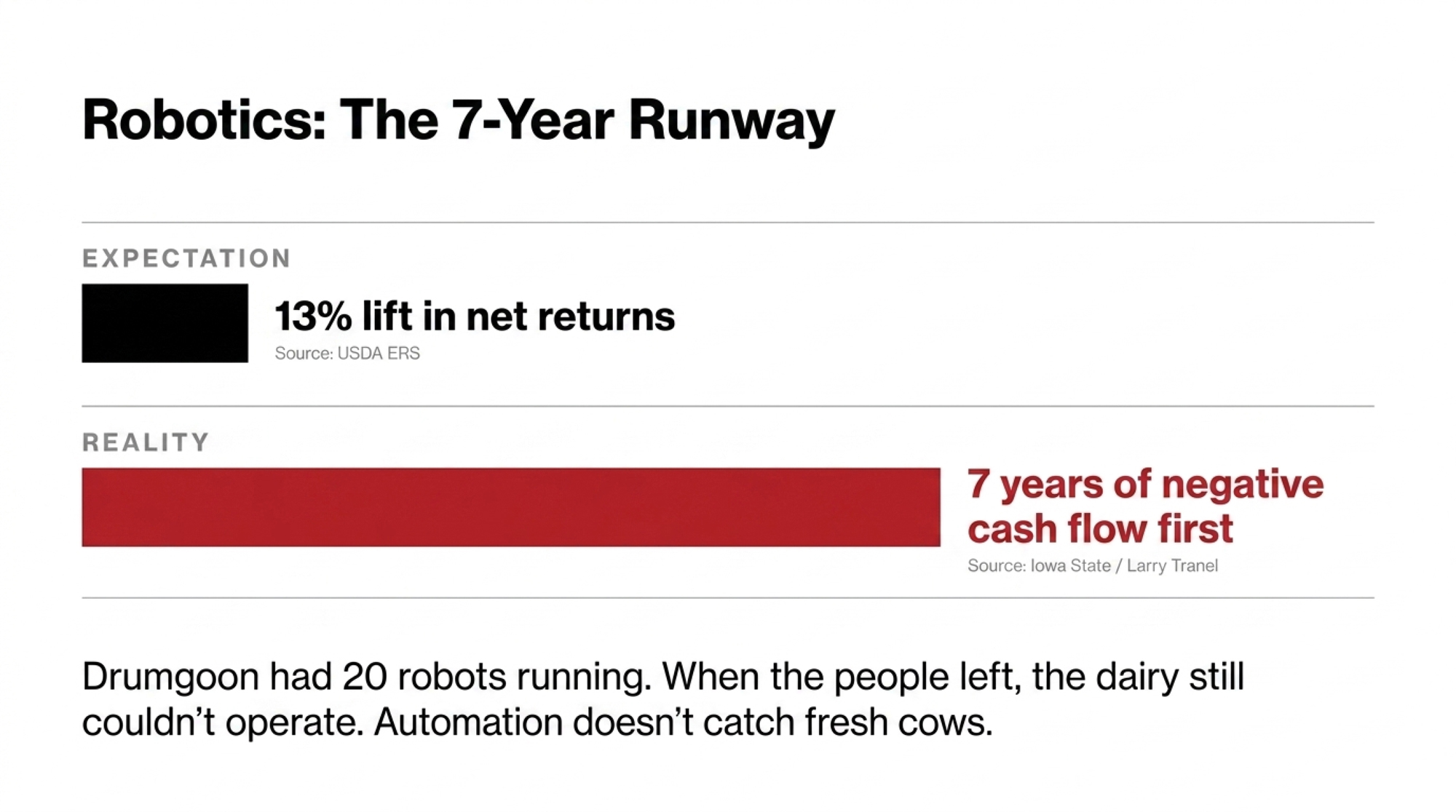
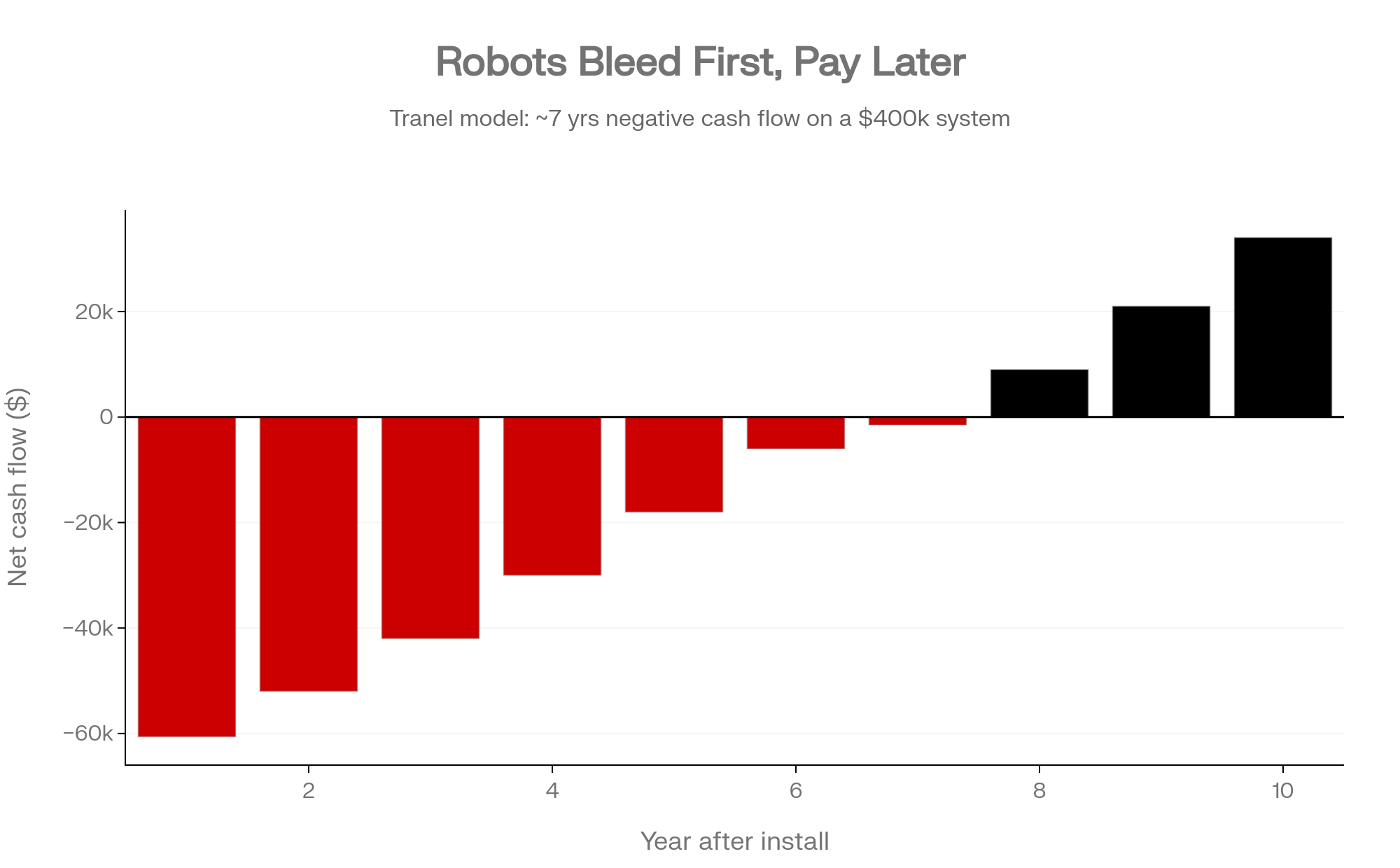
What about robots? Only if you can carry the runway. USDA ERS (ERR-356, January 2026) found that robotic milking lifts net returns by about 13% on average, with the biggest gains occurring in herds of roughly 200 to 350 cows. But Iowa State economist Larry Tranel’s models show roughly seven years of negative cash flow before that upside shows up — a $400,000 system carrying about $62,000 in annual ownership costs against only around $1,400 in net financial benefit in the early years. And Drumgoon proves automation isn’t a force field — 20 robots couldn’t keep the operation whole when the people disappeared. If your debt-service coverage can’t absorb seven lean years, the 13% is a number on a slide, not a lifeline. It pays to ask the hard questions that separate $50K wins from $200K mistakes before signing a capital lease.
Diversifying revenue won’t put a hand in the parlor, but it buffers the shock. Beef-on-dairy calves, for instance, sell into the fed-cattle market instead of the milk market, so that income keeps flowing when milk doesn’t. It takes breeding and marketing changes — and it’s a cushion, not a cure.
The forward signal worth weighing across all four is that the Farm Workforce Modernization Act cleared the House twice and died in the Senate both times. Don’t build your five-year plan on the assumption that SAWA breaks that pattern. Plan for the labor base you can actually control today. And remember, automation isn’t a clean exit from the labor question either — Bullvine’s own reporting lays out 5 hard truths about labor and the ROI of robotic milking for a dairy that’s short-handed and alone.
Key Takeaways
- If a large share of your crew has uncertain legal status, treat a labor shock — not milk price — as your top operational risk this quarter, and write a three-business-day staffing-loss plan before month’s end.
- Build your neighbor network now, while things are calm. Drumgoon got relief milkers in shifts because the relationships already existed — that help doesn’t materialize after the audit lands.
- Before filing for H-2A, confirm you have a genuinely seasonal or project-based need. If the role is year-round milking, the program likely won’t fit, and a petition that doesn’t match the work invites denial.
- Price the full H-2A overhead — legal, housing, records, audit exposure — against the labor you’d actually gain. On a smaller herd, that math may not work.
- If robots are on your whiteboard, stress-test cash flow across a seven-year negative window, not just the 13% long-run return. And don’t assume automation insulates you from a labor shock — Drumgoon’s 20 robots didn’t.
- Run your real turnover number against the 38.8% average. If you’re at or above it, the retention math may beat the H-2A math — and it’s the one lever you can pull this month without waiting on Congress.

So here’s the question to carry back to the kitchen table: if you lost 38 of your 50-plus workers next Thursday, how many days could you keep the parlor running — and what exactly happens on day four? Drumgoon spent more than $110,000 rebuilding its workforce, relied on neighboring farms for relief help, and still faced a months-long H-2A timeline for replacements, according to its owners and DairyHerd’s reporting. The June guidance opened a door. It didn’t change the fact that dairy is a 365-day business being handed a 350-day solution.
If you want the numbers that fit your barn, that’s where we’re headed next. We’re breaking down the full labor-risk math — herd-size-by-herd-size contingency planning and the real cost per cwt of each staffing path — in next week’s Bullvine Weekly. That’s where the figures live, not the headlines.
Run Your Numbers
Robot ROI Reality Check — Before you treat automation as your labor exit, run the Robot ROI Reality Check with your own labor cost, milk price, financing, and installed cost. It stress-tests whether robots actually pencil against that seven-year cash-flow window — not the dealer’s payback slide.
Complete references and supporting documentation are available upon request by contacting the editorial team at editor@thebullvine.com.
Learn More
- The Myth of ‘Cheap’ Labor: H‑2A, Robots, and the Hard Math Dairies Need to Survive the Next 10 Years — Breaks down the true financial exposure of a six-month H-2A contract, exposing $29,500 in per-worker structural costs once mandatory housing, transit, and compliance overhead are tallied.
- The Hidden Costs of Turnover: Why Your Dairy’s Biggest Crisis Isn’t What You Think — Delivers a practical framework to calculate workforce churn, revealing how a 39% average turnover rate bleeds up to $25,000 per departed milker through lost productivity, heifer mortality, and tank quality penalties.
- Robotic Milking Pays 13% More – After 7 Years of Red Ink — Arms you with unvarnished data to stress-test box automation, mapping out the $8,776 annual cash-flow deficit that catches retrofits by surprise before long-term efficiencies finally materialize.
 The Sunday Read Dairy Professionals Don’t Skip.
 The Sunday Read Dairy Professionals Don’t Skip.
Every week, thousands of producers, breeders, and industry insiders open Bullvine Weekly for genetics insights, market shifts, and profit strategies they won’t find anywhere else. One email. Five minutes. Smarter decisions all week.