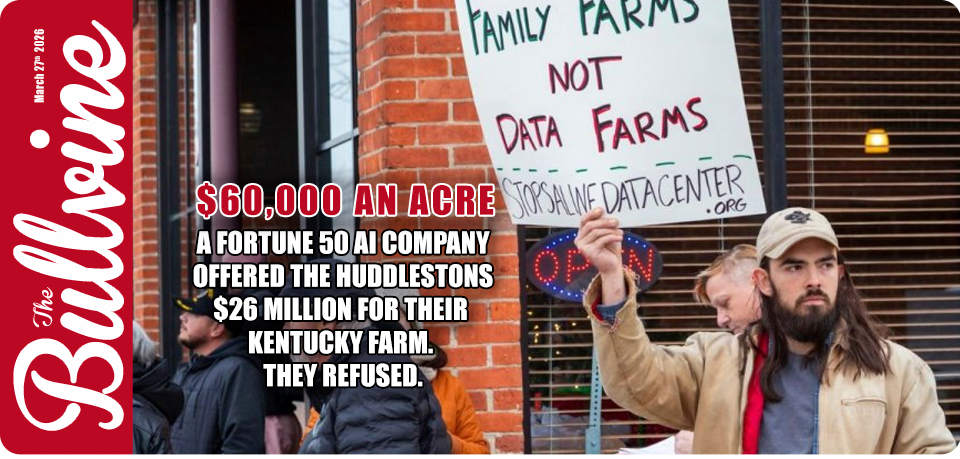






In Mason County, up to $60,000 an acre was on the table for working farmland — and at least four families still walked away, forcing every serious producer in a growth corridor to ask what their own ground is really worth.
Ida Huddleston is 82 and owns 71 acres of farmland outside Maysville, Kentucky. Her daughter, Delsia Bare, holds another 463 acres nearby. Together, according to local coverage, the family operates roughly 1,200 acres of ground that has supported them since the 1860s— through wheat in the Depression and working farmland still today.
Last year, a group representing an unnamed Fortune 100 company — described as Fortune 50 in more recent reporting — came looking to buy a big piece of that ridge for an AI data center. WLEX reporting cited by People magazine says the group offered Huddleston $60,000 per acre for her 71 acres and Bare $48,000 per acre for her 463 acres — more than $26 million combined for 534 acres.
“My grandfather and great-grandfather and a whole bunch of family have all lived here for years, paid taxes on it, fed a nation off of it,” Bare told CBS affiliate WKRC. “Even raised wheat through the Depression and kept bread lines up in the United States of America when people didn’t have anything else.”
They said no.
The offers that came with a five-day clock
The Huddleston family’s story hit regional news in mid-March 2026 and went national within days. But the land chase started much earlier — and their neighbors felt the same pressure.
Down the road, cattleman Dr. Timothy Grosser and his son Andy raise cattle on their place along KY 3056. In March 2025, a group representing the same data-center development offered them $35,000 per acre, according to LEX18 — nearly $8 million for their farm.
“They stressed that time was of the essence and they wanted responses really fast, like within the next five days,” Andy told LEX18. Despite the money and the rush, he was blunt: “We do not want to sell. The farm is my dad’s, and it means everything to him.”
Local 12’s segment on the Grossers emphasized the same theme: that kind of money “can buy a lot,” one line went, but Dr. Grosser made it clear it couldn’t buy what the place means to him.
Local 12 also reported in late March 2026 that the company’s representatives now have contracts “ready to go” on 28 properties as part of the proposed data-center complex. The company itself hasn’t been publicly identified “because of nondisclosure agreements,” the station said.
So you’ve got a Fortune 50–caliber tech client that no one is allowed to name yet, dozens of farms under contract, and a handful of families — like the Huddlestons and the Grossers — who’ve decided they won’t cash out, even at numbers that would make most advisors choke on their coffee.
“It’s not a business deal, it’s mind harassment.”
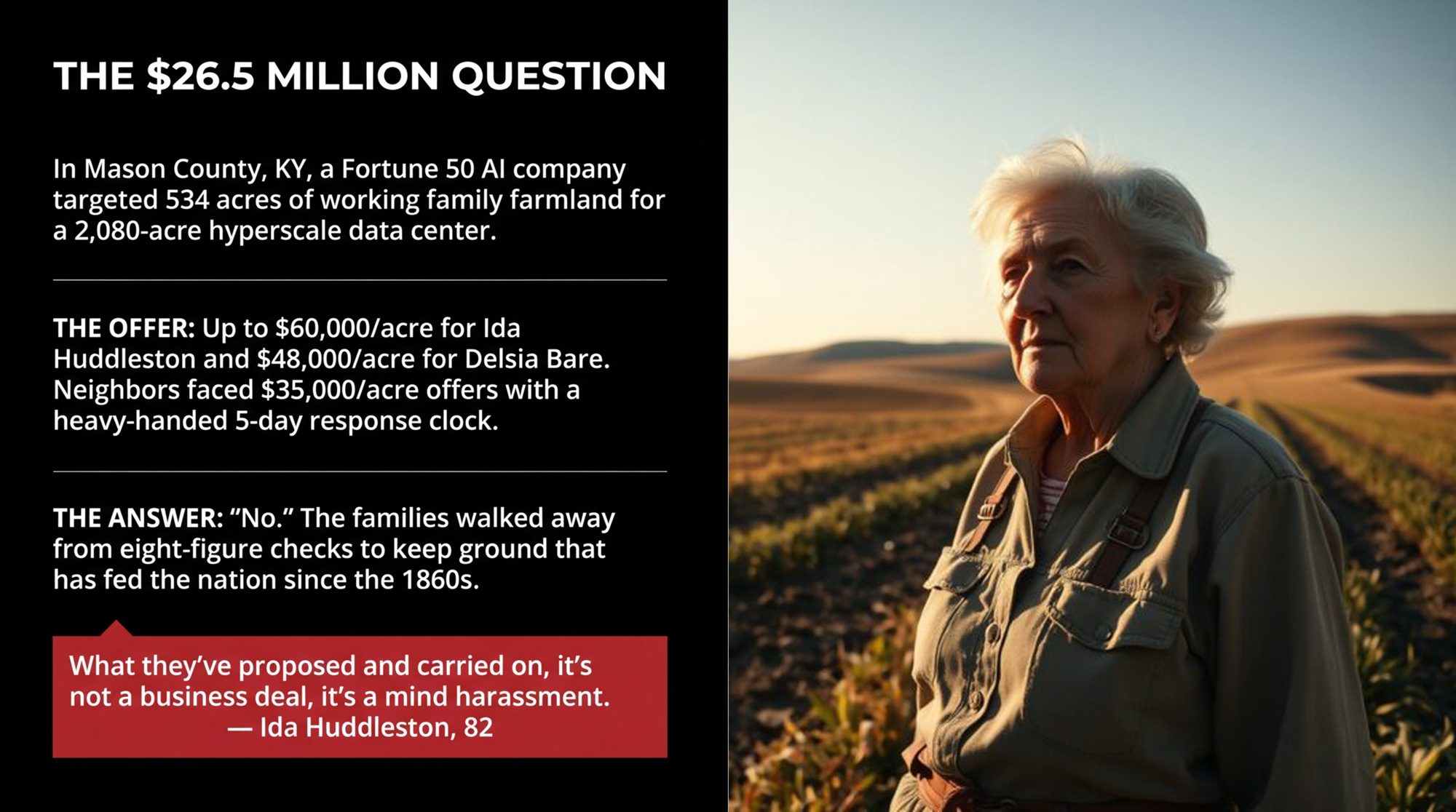
Huddleston didn’t sugarcoat how the process felt. In an interview with NBC affiliate WLEX, she described months of pressure in plain language: “What they’ve proposed and carried on, it’s not a business deal, it’s a mind harassment.”
She also told WKRC she doubted the data center would deliver the kind of jobs and growth its boosters promised. “It’s a scam,” she said in that interview, according to TechCrunch and WKRC’s original report. These are Huddleston’s characterizations of the proposals she received, reflecting her experience as a landowner who’s been repeatedly approached. The Bullvine hasn’t independently investigated the company’s economic claims, and the company itself hasn’t been publicly identified.
Bare talked less about the meetings and more about what the land means. “There’s nothing that can destroy me if I’ve got this land,” she told WKRC.
Huddleston has been just as blunt about how she thinks farmers are being treated in the process. “They call us old stupid farmers, you know, but we’re not,” she told WKRC in a separate segment. “We know whenever our food is disappearing, our lands are disappearing, and we don’t have any water — and that poison. Well, we know we’ve had it.”
Whatever you make of their language, there’s no question they’re speaking from long experience, not from a tweet. When a family that fed people through the Depression and kept bread on other tables says the money doesn’t move them, that hits differently than a talking point in a planning meeting.
The 2,080-acre plan: what’s actually coming to Mason County?
On the power side, the outlines are more concrete than the company name. East Kentucky Power Cooperative owns the Spurlock Station power plant in Mason County, a four-unit coal facility capable of generating about 1,608 megawatts— a little over 40 percent of EKPC’s total capacity. Planning documents from regional grid operator PJM show EKPC studying new transmission and substation options near Maysville, including a new Mason County substation tied into a 345-kV line to serve a potential large industrial load.
In a March 19, 2026 opinion piece in Kentucky Living and Building Kentucky, EKPC president and CEO Don Mosierwrote that the co-op has been in talks “for more than a year” with a Fortune 100 company evaluating a data-center site near Maysville and Spurlock Station. Mosier said any such customer would be responsible for paying the costs of required transmission upgrades under EKPC’s tariff.
At a special meeting at Maysville Community and Technical College, attorney Tanner Nichols of FBT Gibbons outlined a plan for a six-building “hyperscale” data-center complex on more than 2,080 acres, with about 2,000 construction jobs and 400 permanent positions, at a cost of more than 5 million — costs he told the commission the company would cover 100 percent. Coverage from WEKU described the company as a “Fortune 50 tech firm,” while WCPO summarized it as “Fortune 500” in a separate report from the same hearing. For consistency, this article follows WEKU’s “Fortune 50” phrasing and flags the discrepancy for readers.
Opponents, including We Are Mason County treasurer Janet Garrison, argue the permanent job number could be far lower. “We are not anti–data center or anti–progress at all,” she told Realtor.com. “But we want this thing to go in an industrial park. They want farmland, and that’s just not a very efficient use of 2,000 acres when they might only hire 50 people.”
Attorney Hank Graddy, representing residents, pressed Nichols on why the public had to address questions to an attorney for the industrial development authority and not directly to the company itself. A grassroots citizens’ group called We Are Mason County filed suit on March 27 against the Mason County Fiscal Court and Planning Commission, arguing the rezoning that enables the data center violates the county’s comprehensive plan and that “zoning without planning is illegal.”
For any dairy or mixed-livestock producer, this isn’t just a tech story in Kentucky. It’s about whether land that grows your forages — or your neighbor’s corn silage and hay — ends up under barns and pivots, or server halls and parking lots. When 534 acres of mostly working ground disappear into an industrial site, you’re not just losing asset value. You’re punching a hole in the local forage base that might be impossible to patch later.
What Does $26 Million Buy That 534 Acres of Kentucky Farmland Can’t?
Here’s where the barn-math gets real, and it starts with the fact that the offers were not one flat number.
Based on WLEX reporting cited by People magazine:
- Huddleston’s 71 acres at $60,000/acre ≈ , $4,260,000.
- Bare’s 463 acres at $48,000/acre ≈ , $22,224,000.
Together, those two offers total roughly $26.5 million for 534 acres.
Now, stack that against what farmland is usually worth. USDA’s 2024 Land Values Summary puts average U.S. farm real estate at $4,170 per acre, with cropland at about $5,570 and pasture at $1,830. Kentucky-specific data puts average farm real estate around $5,300/acre and cropland near $6,220/acre. Bare herself told WKRC that land in Mason County is valued at “about $6,000 an acre,” and that the offer she received was roughly ten times that amount.
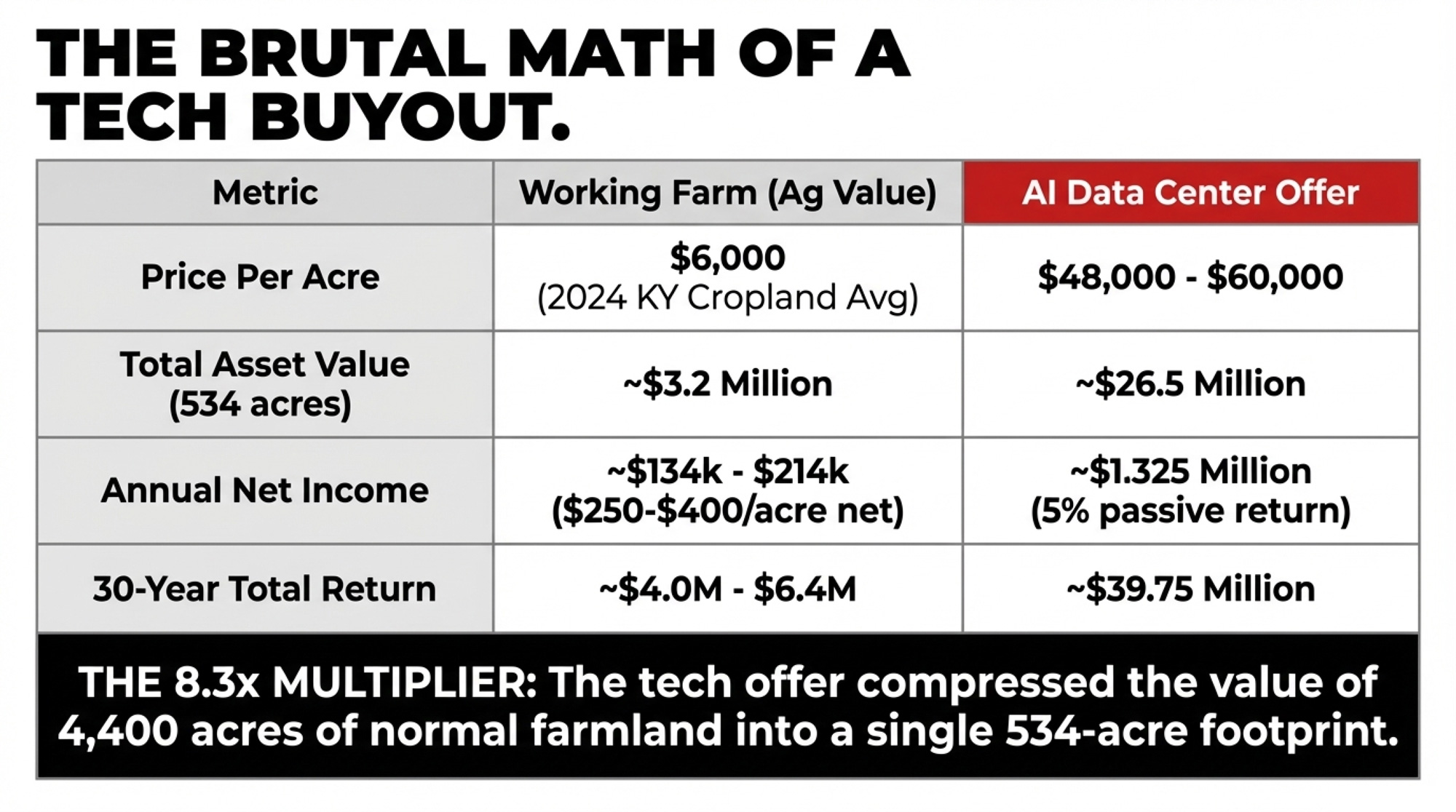
If you use a ballpark $6,000 per acre as a benchmark for good Kentucky cropland — consistent with both USDA data and Bare’s own description of local values — the math looks like this:
- At that ag value, 534 acres ≈ $3.2 million.
- The AI offer of ≈ $26.5 million is roughly 8.3× that number.
Or, said differently: the company compressed the land value of more than 4,400 acres of average U.S. farmland into one family’s 534-acre footprint.
Now switch from asset values to income, because that’s the part you live on.
If the family took the .5M and invested it at a conservative 5% annual return, that portfolio could throw off about .325 million a year before tax. No drought risk. No $4 diesel. No 4 a.m. milking unless somebody wants to get up anyway.
There’s no single “standard” net-income-per-acre figure for Kentucky, but extension budgets and Census-level data suggest a lot of mixed grain/forage acres end up in the low hundreds after expenses in an average year. To keep this useful, not hypothetical, treat $150–$400 per acre as a rough net range you can swap your own numbers into.
- At $250 net/acre, 534 acres × $250 = $133,500/year net farm income.
- At $400 net/acre, 534 acres × $400 = $213,600/year.
Compare that to the $1.325M passive return. You’re talking about turning down something like six to ten times your likely annual net, every single year, for as long as you’d hold the investments.
Over 30 years, without even compounding that 5%, the simple math is:
- Passive: $1.325M × 30 = $39.75M.
- Farm net: $133,500–$213,600 × 30 = $4.0–$6.4M.
Here it is side-by-side:
Ag Value vs. AI Tech Offer (Huddleston–Bare, 534 Acres)
| Metric | Working Farm (Ag Value) | AI Data Center Offer |
| Price Per Acre | $6,000 (ballpark benchmark, in 2024 KY cropland range) | $48,000–$60,000 (Bare at $48k, Huddleston at $60k) |
| Total Asset Value (534 acres) | ~$3.2 million | ~$26.5 million |
| Annual Income | ~$134k–$214k (net farm income at $250–$400/acre, illustrative) | ~$1.325 million (5% return on $26.5M) |
| 30-Year Total (no compounding) | ~$4.0–$6.4 million | ~$39.75 million |
| The Multiplier | 1× | ~8.3× (offer vs. farm-use value) |
On a yellow pad, that looks like a once-in-a-lifetime chance to cash out, erase debt, fund retirement, and maybe even restart somewhere cheaper if you wanted to. For a lot of operations, it would be.
But you’d also be permanently trading control over this dirt — this ridge, these fence lines, that water — for a brokerage balance somewhere else.
If you’ve just poured serious money into new barns, parlors, robots, or a creamery, that math gets even more brutal. High per-acre offers can blow up the amortization schedule you built for that infrastructure. Suddenly, you’re wondering whether to walk away from a system that hasn’t had time to earn its keep, just because the ground underneath it is now worth more to servers than to cows.
From what Bare and Huddleston have told reporters, keeping their family’s ground in production still matters more to them than what any spreadsheet says those acres could generate in passive income. You don’t have to land on the same answer. But you do need to know what your own numbers say before a truck pulls into your lane.
Is Your Estate Plan Ready for a $60,000-Per-Acre Offer You Didn’t Ask For?
Most farm estate plans quietly assume your land will be valued somewhere near its agricultural use value. They weren’t built for a world where one project takes land from $6,000/acre to $48,000–$60,000/acre a couple of miles away.
Kentucky has an agricultural use-value system for property tax, where cropland assessments are based on capitalized rental income and typically work out to a few hundred dollars per acre, not full market value. That helps keep annual tax bills in line with what the ground earns. It doesn’t stop eye-popping industrial sales from influencing how your lender, your non-farming heirs, or a future buyer thinks about what the place is “worth.”
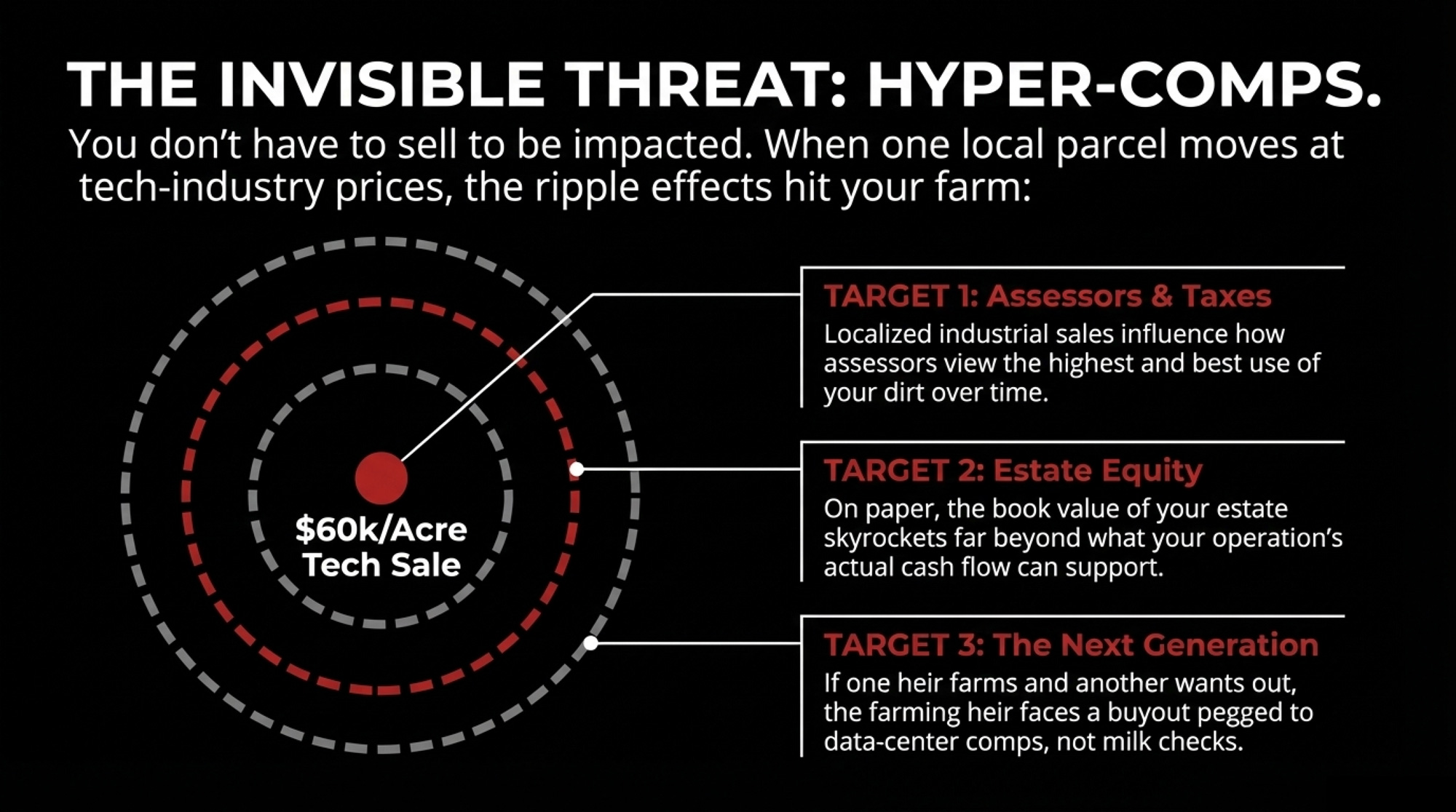
When one or two parcels in a township move at those levels, the ripple effects get ugly:
- Even with use-value on the tax rolls, assessors and boards still see those comps, and over time that can change how they think about “updating” values.
- On paper, the book value of your estate can jump far beyond what your operation’s cash flow supports.
- If only one heir wants to farm and the others want a buyout, that farming heir could be staring at buyout numbers pegged to data-center comps, even though the ground still only earns like farmland.
When families like the Huddlestons and the Grossers refuse these offers, the ripple goes beyond their own payouts — it also shapes whether their kids or grandkids inherit land that’s still valued as farmland, or land priced at data-center comps that could force a sale on someone else’s terms.
The result, whether they’d frame it this way or not, is that they’re preserving a future where farming stays on the table for the next generation — even though it means walking away from a number that would solve a lot of short-term problems.
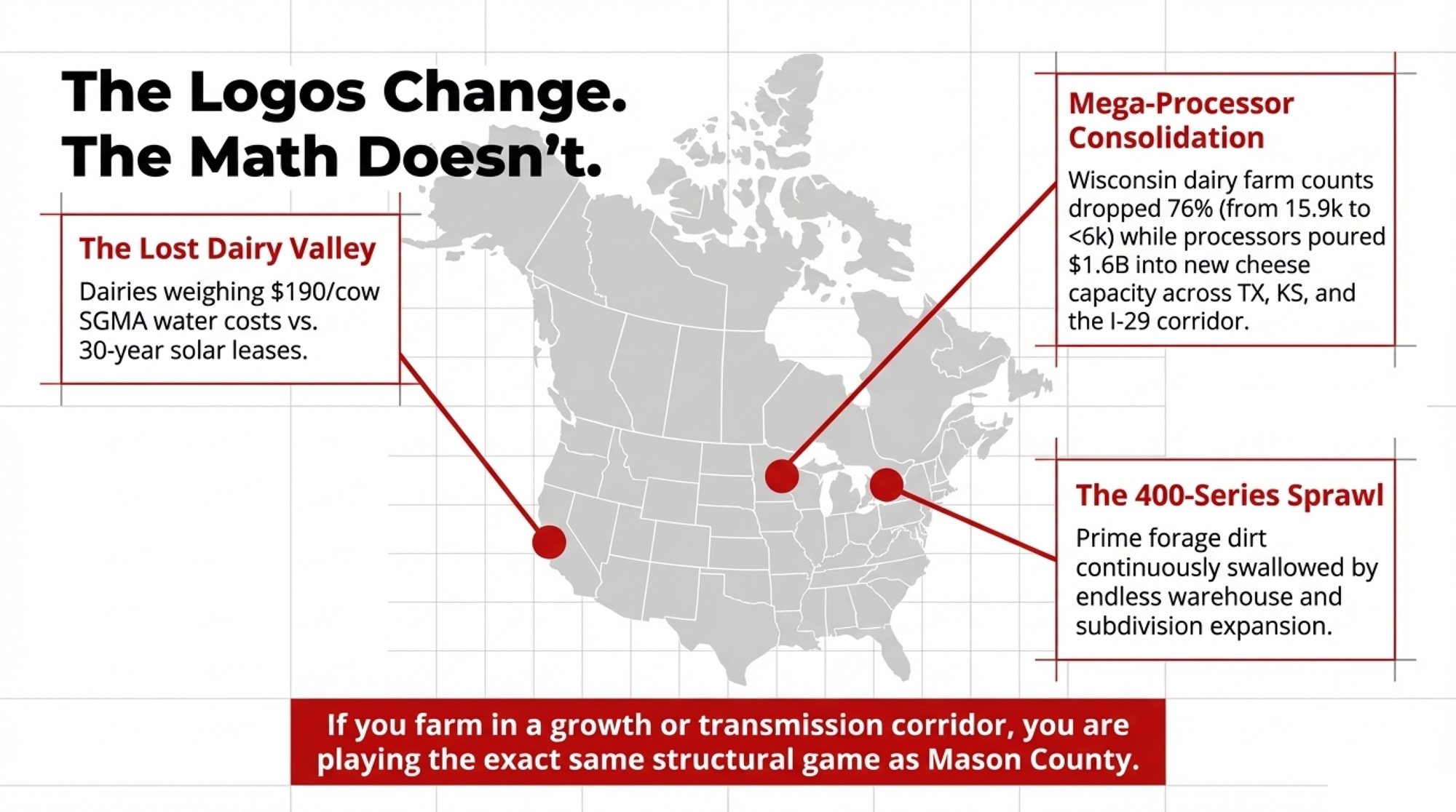
If you’ve got land in any kind of growth or transmission corridor — the I‑29 and I‑35 corridors, California’s Tulare and Kings counties, the Snake River plain, the I‑5/99 belt, or the outer rings of major Canadian cities — you’re in the same structural game. The names and logos change. The math doesn’t.
In California, dairies in what some now call the “Lost Dairy Valley” have already had to weigh roughly 0‑per‑cowSGMA water costs against 30‑year solar leases — and some concluded the land was worth more as someone else’s energy platform than as their own forage base.
In Wisconsin and the Upper Midwest, processors like Hilmar, Leprino, and Valley Queen have committed about $1.6 billion in new cheese capacity across Texas, Kansas, and the I‑29 corridor since 2020, according to prior Bullvine analysis and company announcements. Over the same stretch, Wisconsin’s dairy farm count fell from more than 15,900operations to fewer than 6,000, a drop of roughly 76% driven by consolidation, labor, and processing pull.
If you’re milking in the northern edge of the GTA — places like Vaughan, Caledon, or Bradford — you’ve watched good dirt along the 400‑series corridors disappear under warehouses and subdivisions. You don’t need an AI logo to know how fast the math can flip under your boots.
The Kentucky story adds AI data centers to that list. The real question isn’t “Would I sell?” It’s “Have we done enough math and paperwork that, if an offer comes, our answer doesn’t blow up the family?”
What Does $26 Million Really Change for Your Operation?
Here’s the economic question farmers are quietly asking as they follow this story: if a number that big lands on your table, what does it actually change?
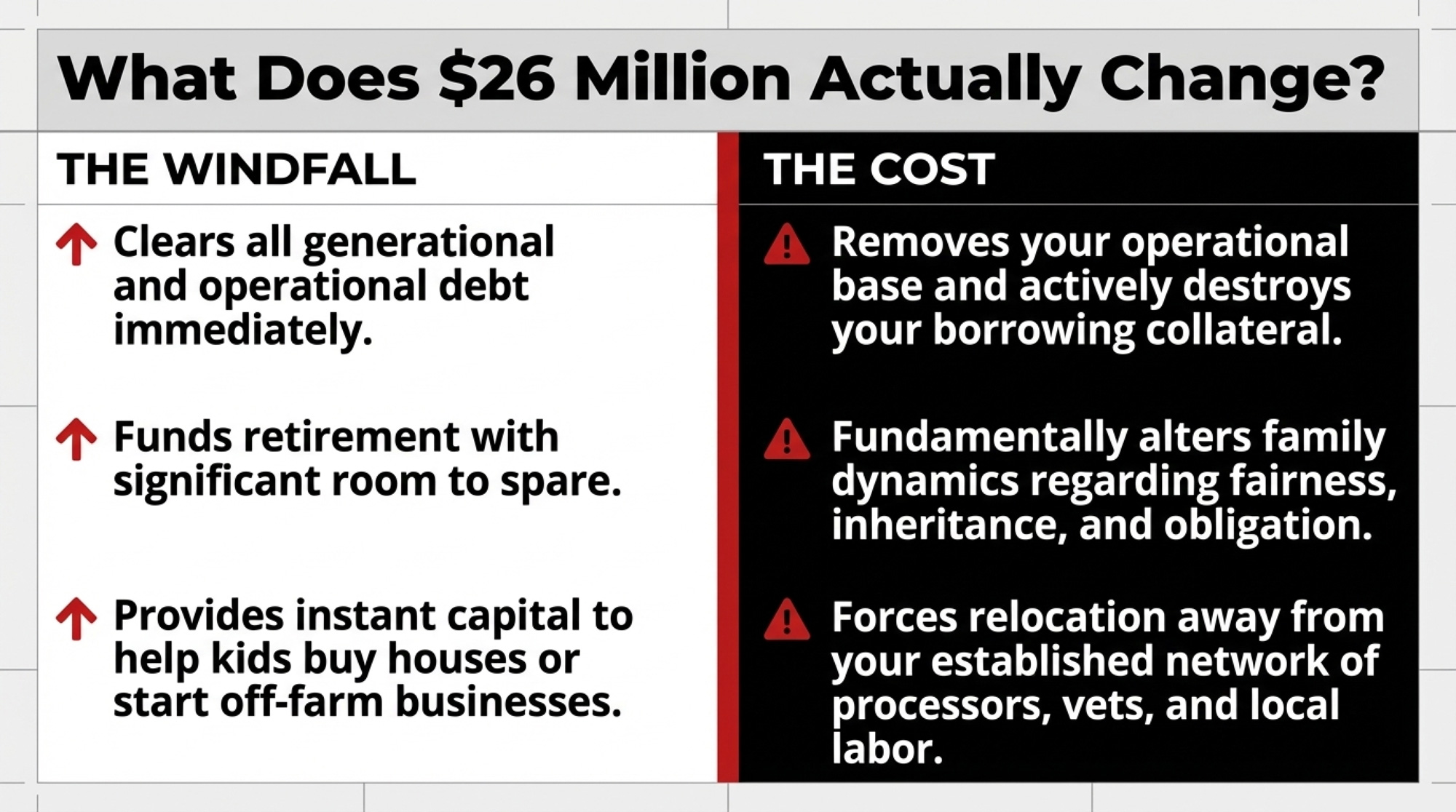
At one level, it’s obvious. A check in the eight figures:
- Clears debt.
- Funds retirement with room to spare.
- Lets you help kids buy houses, go to school, or start their own businesses.
But it also:
- Removes your operating base and, in many cases, your collateral.
- Changes how your family thinks about fairness, inheritance, and obligation.
- Might take you away from a region where your network, processors, and help are.
That’s why the barn-math in the last section matters. If your place looks anything like the Huddleston/Bare situation, an AI-style offer doesn’t just tilt the scales. It flips them.
The harder part is deciding whether you want to live in the world on the other side of that decision — and whether your current estate plan gives the next generation any chance to answer that question on their own terms.
What Are Your Real Options If a Developer Shows Up?
You don’t get to pick whether a data center, warehouse, or solar farm wants your neighborhood. You do get to decide how prepared you are when their rep calls. Practically, you’ve got three real paths.
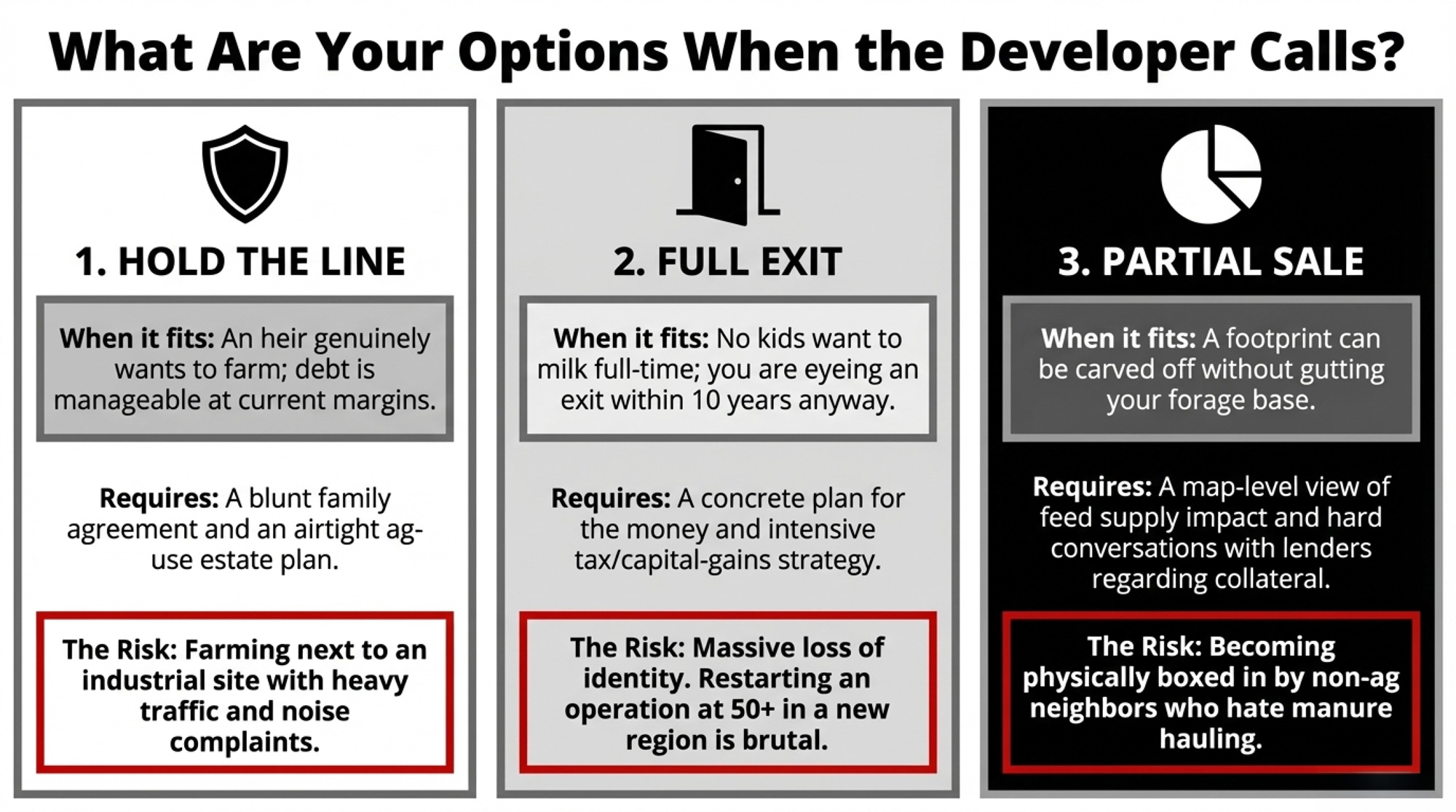
| Decision Path | Best Fit For | Key Requirement | Financial Signal | Biggest Risk |
|---|---|---|---|---|
| Hold — Keep Producing | At least one heir wants to farm; manageable debt load | Written family agreement + updated estate plan using ag-use valuation | Farm net: ~4k–4k/yr on 534 ac | Creeping tax pressure as industrial comps arrive nearby |
| Full Exit — Cash Out | No farming heirs; already near a planned exit window | Concrete reinvestment plan + tax/legal advice before signing | Passive: ~.325M/yr at 5% on .5M | Loss of operating identity; starting over in a new region at 50+ |
| Partial Sale / Conversion | Carve-off possible without gutting forage base or core facilities | Map-level analysis of feed, manure, expansion impact + lender review | Hybrid: debt cleared + partial passive income stream | Boxed in between non-ag neighbours; manure/silage haul complaints |
| Do Nothing / Ignore | — | — | — | Hands all decisions to someone else, usually on a bad day |
1. Hold the line and keep producing
When it makes sense:
- At least one heir genuinely wants to farm.
- Your debt is manageable at current margins.
- No per‑acre number anyone can write feels worth trading away the place.
What it requires:
- A blunt family meeting where everyone agrees that below a certain number, you’re staying, and understands what that means for future buyouts, lifestyle, and retirement timing.
- An estate plan that uses current‑use or ag‑use valuation tools where they exist and doesn’t leave heirs scrambling if nearby land sells high.
Risks and limits:
- Property taxes and political pressure can still creep up as industrial projects arrive in the county.
- You may end up farming next to an industrial site with heavier traffic and neighbors who don’t share farm‑country expectations about noise, manure, or late‑night lights.
2. Take a full exit and restart on your own terms
When it makes sense:
- None of your kids or key family members want to milk or farm full‑time.
- Your own numbers already have you eyeing an exit in the next decade.
- The offer clearly exceeds what you’d reasonably earn from operating another 20–30 years on the same acres.
What it requires:
- A concrete plan for where the money goes — debt settlement, retirement, a smaller place, off‑farm business, investments — not just “we’ll figure it out.”
- Tax and legal advice before signing; long‑held land comes with capital‑gains and estate questions you don’t want to discover after closing.
Risks and limits:
- Once you sell, you’re not a producer anymore. For people who built their identity around the farm, that’s a bigger shock than any interest‑rate change.
- Moving to cheaper land in a new region means new markets, weather, rules, and community. Starting over at 50+ isn’t simple.
3. Partial sale or conversion — keep farming on fewer acres
When it makes sense:
- The proposed site can be carved off one side without gutting your forage base or your core facilities.
- The proceeds can fund debt retirement, facility modernization, or the purchase of replacement ground that has better cash flows.
What it requires:
- A map‑level view of how losing those acres affects feed supply, manure management, and any long‑term expansion you were planning.
- Hard conversations with your lender about how they view a farm that’s now part dirt, part liquid assets, and what that does to covenants and collateral.
Risks and limits:
- You could end up boxed in between non‑ag neighbors and an industrial load, where hauling manure or silage turns into complaint calls to the county.
- Replacement land that’s further out adds trucking time, fuel, and weather risk into a system that might already be running tight.
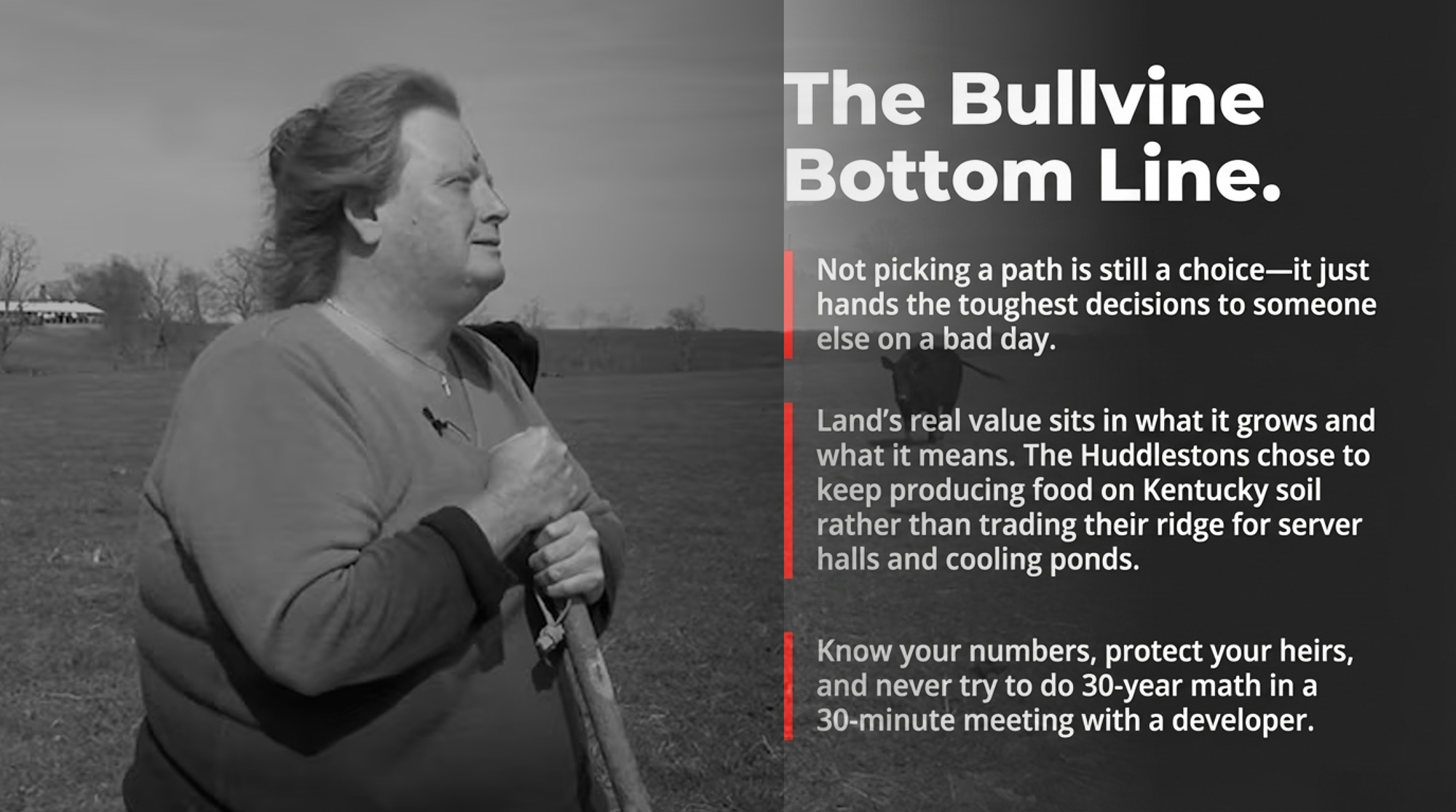
Not picking a path — not looking at fair‑market and ag‑use values, not updating your estate plan, not talking to your heirs — is still a choice. It just hands the toughest decisions to somebody else, usually on a bad day.
As you watch your own area, pay attention to forward‑looking signals:
- New transmission lines or substation plans are hitting county maps.
- Utility filings talking about a “large industrial load” or “data center.”
- Land signs on neighboring farms with unfamiliar LLC names instead of local families or operations.
Each one is someone else already doing the math on your neighborhood.
Options and Trade-Offs for Farmers
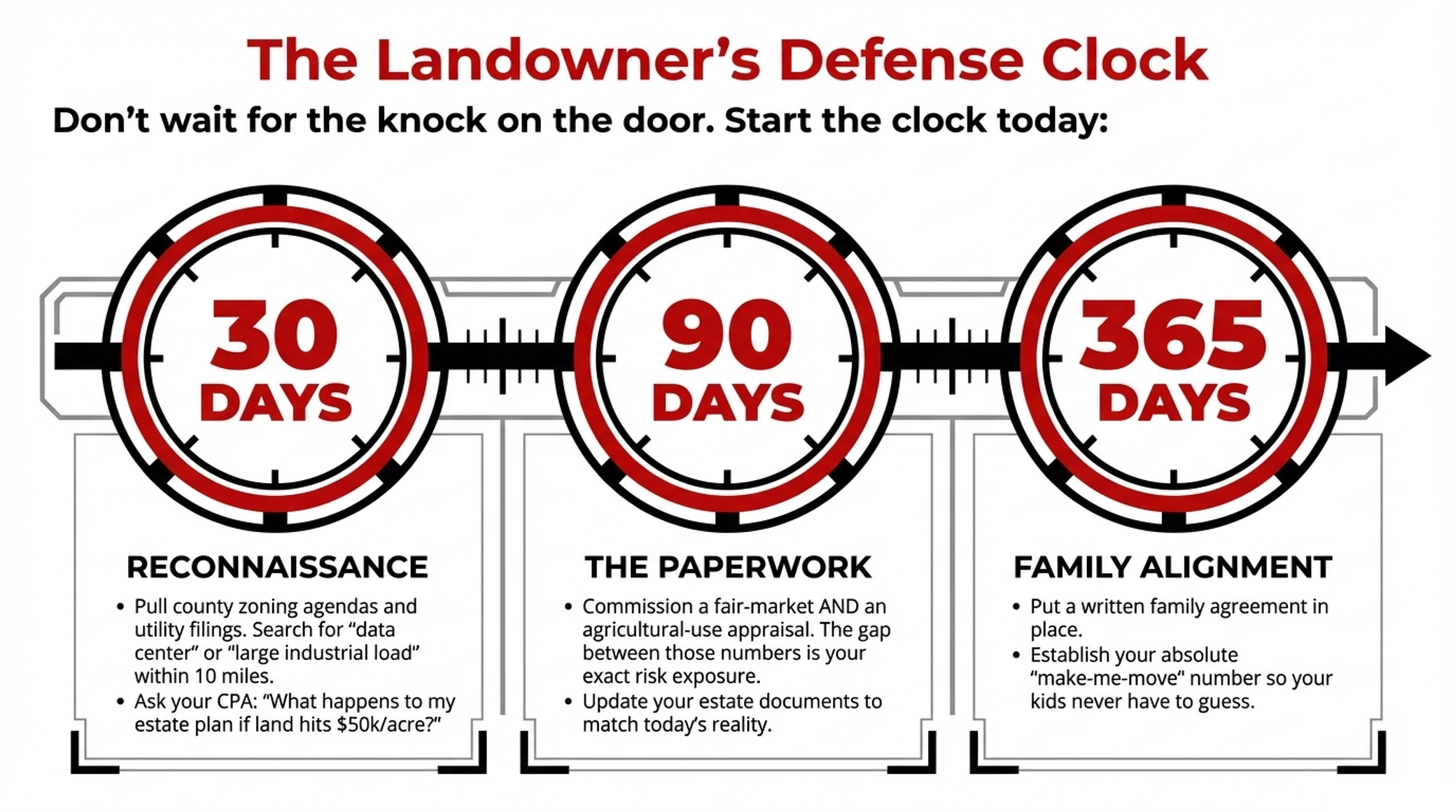
Do this within 30 days.
- Pull your county’s planning and zoning agendas, plus your power co‑op or utility filings. Search specifically for “data center,” “technology park,” or “solar” within about 10 miles of your home.
- Call your accountant or estate attorney and ask one simple question: “If land around me sold for $50,000 an acre next year, what would that do to my taxes and my estate plan?”
Within 90 days
- Get both a fair‑market appraisal and an agricultural‑use appraisal on your ground. The gap between those two numbers is the same pressure the Huddlestons and the Grossers are staring at — and you need that gap on paper.
- Sit down with your advisor and update your estate documents so they match today’s land reality, not the values you were carrying 15 years ago.
Within 365 days
- If you’re in any growth or transmission corridor, put a written family agreement in place about if, when, and at what per‑acre number you’d even consider a non‑ag sale. It doesn’t lock anyone in. It just keeps your kids from having their first real conversation about it at the lawyer’s office.
Key Takeaways
- If any serious offer on your land comes in at several times recent farm‑land sales in your county, treat it as a strategic decision that affects your heirs — not a side conversation — and run the barn‑math both ways before you say a word.
- If you’ve got more than one heir and only one wants to farm, assume high‑value industrial comps will make future buyouts far more expensive, and bake that into your estate plan now with written agreements — not just good intentions.
- If you decide you’ll “never sell,” back that conviction with paperwork: a current appraisal, a use‑value tax strategy where available, and an updated will or trust so your kids aren’t trying to manage big‑number assessments on a farm‑income business model.
- If you’re already seeing power‑line upgrades, rezoning, or new tech projects within 10 miles, treat that as your 30‑day clock to check local filings, talk to your advisor, and start a family conversation — before someone else writes a number on your kitchen table for you.
The Bottom Line
Based on what Bare and Huddleston have told reporters, their answer, for now, is simple: land’s real value sits in what it grows and what it means, not just what someone’s willing to pay to pave it. They’ve chosen to keep producing food on Kentucky soil instead of trading their ridge for eight‑figure passive income backed by server halls and cooling ponds.
You don’t have to make the same call. But you should know your own numbers well enough that if a Fortune 50 company offered you eight times your current land value tomorrow, you wouldn’t be trying to do 30‑year math in a 30‑minute meeting. If you want the deeper economics — the full SGMA water‑vs‑solar math in California or the structural Dairy Curve that’s shrinking U.S. operations toward 10,000 by 2035 — dive into our Tier 2 and Tier 3 follow‑ups and make sure you’re getting the Bullvine Weekly so those playbooks land in your inbox, not just your feed.
Then ask one more question at your own kitchen table: what’s the real “make‑me‑move” number for your home farm — and have you actually told your heirs, or are you leaving them to guess when the offer shows up?
Complete references and supporting documentation are available upon request by contacting the editorial team at editor@thebullvine.com.
Learn More
- Only 12% of Dairy Farms Reach Generation Three – A 2025 Court Ruling Exposes Why Succession Fails and How to Fix It – Arms you with a bank-vetted framework to transform handshakes into enforceable contracts. Exposes how recent court rulings strip sweat equity from heirs, delivering the exact triage plan required to protect your land from unplanned liquidation.
- The Bullvine Dairy Curve: 15,000 U.S. Farms by 2035 and Under 10,000 by 2050 – Who’s Still Milking? – Capture the foresight needed to survive the structural shift toward a 15,000-herd limit. This analysis maps the “Dairy Curve” timeline, helping you choose between scaling, specializing, or executing a strategic exit while equity is strong.
- When Land Is Worth More Than Milk in California’s Lost Dairy Valley – Navigate land-value wake-up calls with a kitchen-table framework used by families who watched 17,000 acres vanish into logistics. This case study delivers the courage to protect your legacy, whether in the barn or elsewhere.
 The Sunday Read Dairy Professionals Don’t Skip.
 The Sunday Read Dairy Professionals Don’t Skip.
Every week, thousands of producers, breeders, and industry insiders open Bullvine Weekly for genetics insights, market shifts, and profit strategies they won’t find anywhere else. One email. Five minutes. Smarter decisions all week.