Archive for genomic selection

Genosource Moti Cracks +420 NVI: Inside the December 2025 Dutch Sire Shakeup

+420 NVI. A longevity score of +1,295. Altazazzle bloodlines dominating proven sires. The Dutch December 2025 rankings just raised the bar—here’s who’s setting it.

Executive Summary: The +400 NVI barrier hasn’t just been broken; it’s been shattered. Genosource Moti leads the charge at +420 NVI—a benchmark that redefines what’s achievable through genomic selection. Joining him in the top 10 are stablemates Mystro (posting the evaluation’s highest INET at +799) and Benson, whose +1,295 longevity score stands alone in this release. Among proven sires, Badger Ssi Ahead Jaffa tops the list at +358 NVI, while Altazazzle sons claim four of the top 10 spots—a concentration that underscores both the line’s commercial dominance and the breed’s narrowing genetic base. What sets this evaluation apart is balance: elite NVI bulls are simultaneously delivering on longevity, udder health, and fertility, breaking the historic trade-off between production and functionality. The Genosource and Delta programs command the genomic tier; Altazazzle defines the proven ranks. For breeders, this release offers exceptional genetic tools—with the caveat that pedigree concentration at the top makes diversity management more critical than ever.

Dutch sire rankings 2025

There’s something particularly exciting about cracking open a new proof run. The December 2025 Dutch genetic evaluation landed with some eye-catching numbers—and a few surprises worth talking through. For breeders working with Dutch and Flemish genetics, this release offers a snapshot of where the breed is heading, and honestly, the trajectory is impressive.

The NVI (Nederlands-Vlaamse Index) continues to do what it was designed to do: identify bulls capable of producing daughters that are profitable, durable, and trouble-free. It’s a total merit index that balances production with the functional traits that actually keep cows in the herd—things like udder health, fertility, and feet and legs. What I’ve noticed over the past several proof runs is how the top end of these rankings keeps climbing. We’re seeing NVI values now that would have been almost unthinkable five years ago.

Let’s dig into what this release is showing us.

The Genomic Leaders: A New Benchmark

The genomic sire rankings this round are nothing short of remarkable. We’ve crossed a threshold here that deserves attention.

Genosource Moti sits atop the list at +420 NVI—a number that genuinely made me do a double-take when I first saw it. This Matcrest Arc son out of a Stgen Cowen Tho dam combines serious production punch (+2,025 kg Milk, +130 kg Fat, +68 kg Protein) with functional longevity (+872 days). His INET of +682 signals that daughters should convert feed to profit at an elite level. At 66% reliability, he’s still a genomic prospect, but the genetic package is hard to ignore.

What’s interesting about the top of this list is the diversity of pathways to elite NVI. Halifax Delta Dawn (+414 NVI), a Hammerhead son, takes a slightly different route—he posts the highest INET among the top five genomics at +737, driven by exceptional component transmission (+138 kg Fat, +75 kg Protein). His +2,220 kg Milk puts him among the highest-volume transmitters in the evaluation.

Rise Up Real (+410 NVI) caught my attention for a different reason entirely. This Real Syn son stands out as a longevity specialist, posting +1,019 days—the highest among the top five genomic bulls. For herds where keeping cows productive across multiple lactations is a priority, that’s a significant number. His +2,422 kg Milk shows you don’t have to sacrifice production to get durability.

Top 10 Genomic Sires by NVI — December 2025 (Black & White)

RankSire NameSireMGSNVIINETMilkFatProteinLongevity
1Genosource MotiMatcrest ArcStgen Cowen Tho+420+682+2,025+130+68+872
2Halifax Delta DawnHammerheadFugleman+414+737+2,220+138+75+847
3Rise Up RealReal SynFreewood P+410+541+2,422+83+68+1,019
4Delta MillerAltamullerDolmen+407+692+2,092+119+78+1,032
5Delta Time Jump PUniverse P RfSunrise+397+570+1,985+84+74+928
6Delta Standout RFStatement RfAppetizer Rf+394+603+2,062+82+83+685
7Bento BenchBenchGigaliner+392+595+2,091+101+68+1,032
8Fis Fly PKings-Ransom S+391+643+2,096+101+79+881
9Genosource MystroMatcrest ArcHannity+386+799+2,234+146+84+665
10Genosource BensonRadicalHannity+386+656+2,064+124+66+1,295

Source: CRV Nederland, December 2025 Genetic Evaluation (Zwartbont/Black & White Holstein). Genomic sires listed at 66–75% reliability. Production values in kg.

What the Pedigrees Are Telling Us

If you scan down that top-10 list, a few patterns jump out. The Genosource program has clearly hit its stride—three bulls in the top ten (Moti, Mystro, and Benson), all built on either Matcrest Arc or Radical foundations. That’s not an accident. These pedigrees have been stacked for production efficiency, and it’s showing up in the rankings.

The Delta breeding program from CRV is equally impressive, placing Miller, Time Jump, and Standout in the upper tier. What I find notable here is the consistency—these aren’t one-hit wonders but rather the product of a coherent breeding philosophy emphasizing balanced improvement.

The Real Syn sire line deserves special mention. He appears as the sire of Rise Up Real (#3), and his influence extends throughout the evaluation. This line seems to offer a particular combination of high milk volume with above-average longevity—a balance that’s historically been tricky to achieve.

Now, here’s where I’d offer a word of caution. The genetic engine is running hot, but it’s running narrow. When you see this much concentration of specific bloodlines at the top of the rankings, it’s worth thinking carefully about genetic diversity in your own herd. These sires offer tremendous genetic potential, but smart breeders need to use these tools strategically—or risk painting themselves into a pedigree corner. Monitor inbreeding levels and maintain enough diversity to keep your herd genetically resilient for the long haul.

The Proven Sires: Where Reliability Meets Results

Genomic sires represent what’s possible. Daughter-proven bulls show us what’s been delivered. For breeders who prioritize predictability—and there are good reasons to do so—the proven sire rankings provide a different kind of value.

Badger Ssi Ahead Jaffa leads the proven list at +358 NVI. This Ahead son from an A-S-Cannon Frzz dam has built his proof on genuine daughter performance, and the numbers are compelling. His +629 INET paired with +846 days longevity demonstrates that elite profitability doesn’t have to come at the expense of durability. The component transmission is solid (+102 kg Fat, +75 kg Protein), and his daughters are showing up well for udder health (107) and frame (106).

What farmers are finding with bulls like this is consistency. When you use a proven sire with high reliability, you know what you’re getting. There’s real value in that predictability, especially for operations where managing variance matters.

Peak Altazemini (+321 NVI) represents the continued strength of the Altazazzle bloodline. This Peak Genetics bull combines +592 INET with solid component transmission (+104 kg Fat, +65 kg Protein). His daughters are proving up well for both production and type.

Kax Gladius Gazebo (+320 NVI) takes a different approach—he’s the volume specialist in this group. At +2,745 kg Milk, he posts the highest production of any proven sire in the top ranks. For herds in fluid milk markets or operations pushing for maximum throughput, that kind of volume transmission is attractive. His Superhero maternal grandsire contributes proven durability genetics.

Top 10 Daughter-Proven Sires by NVI — December 2025 (Black & White)

RankSire NameSireMGSNVIINETMilkFatProteinLongevityRel.
1Badger Ssi Ahead JaffaAheadA-S-Cannon Frzz+358+629+1,276+102+75+84675%*
2Peak AltazeminiAltazazzleAltalawson+321+592+1,341+104+65+56683%
3Kax Gladius GazeboGazeboSuperhero+320+663+2,745+92+90+50690%
4All Nure WendatEinsteinPadawan+313+531+1,976+68+76+63786%
5Peak Breaking NewsAltazazzleAltalawson+309+309+712+50+37+1,00579%
6Sunrise Superfly RioSuperflyRio+304+631+3,277+100+77+78381%
7Peak Altazingler EtAltazazzleAltarobert+303+295+857+51+33+1,01888%
8Delta ReloaderFinderG-Force+296+237+1,347+39+28+70195%
9Genosource CaptainCharlFarnear Tango S+289+645+1,970+116+69+45789%
10Peak Fugleman MWAltazazzlePositive+287+598+933+106+65+52986%

*Source: CRV Nederland, December 2025 Genetic Evaluation (Zwartbont/Black & White Holstein). Production values in kg. Genomically enhanced proof with limited daughter data reported.

The Altazazzle Story

Looking at the proven sire rankings, the story isn’t just about who is number one—it’s about who owns the board. Altazazzle bloodlines claim four of the top ten spots (Peak Altazemini, Peak Breaking News, Peak Altazingler, and Peak Fugleman). That isn’t just influence; it’s a takeover.

The market has spoken: this line delivers the “invisible cow” commercial dairies crave—moderate, functional, and invisible until you look at the milk check. Altazazzle daughters aren’t extreme in any one direction, but they’re consistently profitable. They show up, milk, breed back, and don’t create problems. In commercial operations where trouble-free cows drive the bottom line, that consistency has real value.

The Finder bloodline also continues to show well through Delta Reloader (#8), who posts +701 days longevity backed by 95% reliability. That’s a substantial proof—the kind of daughter base that gives you real confidence in the numbers.

A Note on the Red & White Rankings

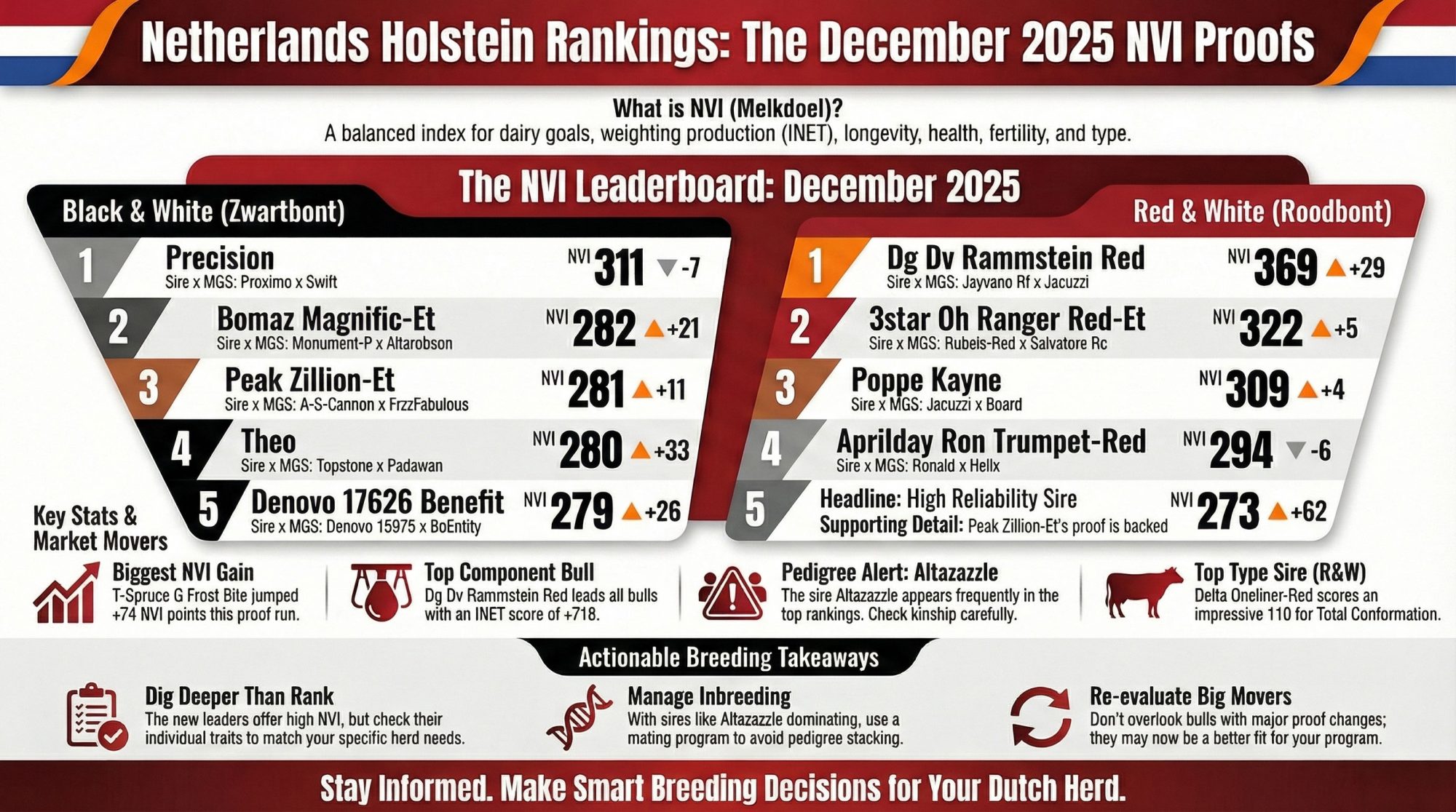
This article focuses on the Black & White (Zwartbont) evaluation, but it’s worth noting that the Red & White rankings delivered their own headline: Delta Richman PP-Red leads the R&W genomic sires at +414 NVI—a remarkable figure that would have topped the B&W list just a few proof runs ago. We’ll cover the R&W evaluation in detail separately, but breeders working with red genetics should take note: the color line is producing elite genetics of its own.

Trait Leaders: Bulls for Specific Breeding Goals

Sometimes the best bull for your herd isn’t the one at the top of the overall ranking. It’s the one that fixes your specific problem or pushes your herd in a particular direction. Here’s where looking beyond NVI becomes valuable.

For Maximum Component Value

If butterfat and protein payments drive your milk check—and they do for most producers these days—these bulls deserve attention:

  • Genosource Mystro (Matcrest Arc): INET +799, +146 kg Fat, +84 kg Protein
  • Halifax Delta Dawn (Hammerhead): INET +737, +138 kg Fat, +75 kg Protein
  • Delta Miller (Altamuller): INET +692, +119 kg Fat, +78 kg Protein

Mystro, in particular, posts the highest INET in the entire genomic evaluation. For herds focused on maximizing revenue per hundredweight in component-driven markets, he’s worth serious consideration.

For Herd Life and Trouble-Free Cows

Some operations prioritize keeping cows in the herd. Replacement costs, the learning curve for first-lactation animals, the value of mature cows hitting their production stride—there are solid economic arguments for breeding bulls that transmit longevity. These genomic sires excel in that department:

  • Genosource Benson (Radical): Longevity +1,295 days, Udder Health 100, Fertility 100
  • Delta Miller (Altamuller): Longevity +1,032 days, Udder Health 106, Fertility 105
  • Rise Up Real (Real Syn): Longevity +1,019 days, Udder Health 105, Fertility 104

Benson’s +1,295 longevity figure stands out—it’s the highest among any bull in the top genomic ranks. His daughters should be the kind that stick around, lactation after lactation.

For Functional Conformation

In modern free-stall facilities, cows need to move well and have udders that hold up to the demands of robotic or parlor milking. Functional type isn’t about winning shows—it’s about keeping cows productive and comfortable. Among the proven sires:

  • Peak Altazingler Et (Altazazzle): Udder 100, Feet & Legs 91, Frame 108
  • Peak Breaking News (Altazazzle): Udder 106, Feet & Legs 91, Frame 108
  • Delta Reloader (Finder): Udder 103, Feet & Legs 103, Frame 110

Delta Reloader’s combination of strong udders and excellent feet and legs makes him particularly valuable for herds where cow mobility and udder durability are concerns.

Putting It Together: What This Means for Your Breeding Program

The December 2025 Dutch evaluation confirms several trends that have been building over recent proof runs. The genetic level at the top continues to climb—NVI values above +400 are now a reality in the genomic ranks. The balance between production and functionality seems to be improving, with several bulls combining high INET with strong longevity figures.

Here’s how I’d think about using this information:

Consider a tiered approach. Use high-NVI genomic sires like Genosource Moti or Halifax Delta Dawn on a portion of your herd—perhaps your best cows or heifers—to capture the latest genetic progress. At the same time, lean on high-reliability proven sires like Badger Ssi Ahead Jaffa for core breeding decisions where predictability matters most. This balances potential against certainty.

Use trait leaders for corrective mating. That’s what they’re there for. If you’ve got a family with udder depth concerns, reach for a bull like Delta Reloader. If fertility has been an issue, look at bulls with strong VRU scores. The overall NVI matters, but the breakdowns of individual traits matter too.

Watch your pedigree concentrations. I mentioned this earlier, but it bears repeating. With Altazazzle so heavily represented in the proven ranks and Matcrest Arc/Radical dominant in the genomics, it would be easy to stack these bloodlines inadvertently. Monitor your inbreeding levels and maintain enough diversity to keep your herd genetically resilient.

Think about your market. A high-volume bull like Kax Gladius Gazebo (+2,745 kg Milk) makes sense in certain situations—fluid milk contracts, high-throughput operations, markets where volume still drives revenue. But if you’re selling milk on components, the math might favor a bull like Genosource Mystro with his exceptional fat and protein transmission.

The Bottom Line

The Dutch genetic evaluation continues to produce bulls capable of meaningful genetic progress. What strikes me about this December 2025 release is the overall quality at the top—whether you’re looking at genomic prospects or proven sires, multiple options combine elite production potential with the functional traits that keep daughters profitable over time.

The work happening in Dutch and Flemish breeding programs is clearly paying dividends. For breeders worldwide who access these genetics, the opportunity exists to tap into some of the best Holstein genetics available.

As always, the key is matching the right genetics to your specific operation, your market, and your goals. These rankings are a tool—a useful one—but the real work happens when you apply them thoughtfully to your own breeding decisions.

KEY TAKEAWAYS

  • Genomic selection crosses +420 NVI: Genosource Moti’s December 2025 ranking isn’t incremental—it marks a new threshold in genetic potential that will reshape sire selection benchmarks globally
  • Proven genetics deliver when predictability matters: Badger Ssi Ahead Jaffa leads at +358 NVI, combining +629 INET with +846 longevity at high reliability; for core breeding decisions, daughter-proven sires remain indispensable
  • Altazazzle commands the proven ranks: Four sons in the top 10 proven sires—this bloodline continues to define what commercial profitability looks like in today’s markets
  • The production-longevity trade-off is breaking down: Genosource Benson pairs +1,295 longevity with +656 INET; elite genetics now deliver cows that stay in the herd AND fill the tank
  • Diversity management becomes a competitive advantage: With Genosource, Delta, and Altazazzle dominating both genomic and proven tiers, herds that strategically maintain pedigree breadth position themselves for long-term resilience

Top Lists:

Data throughout this article sourced from CRV Nederland, December 2025 Genetic Evaluation (Perspublicatie stierindexen Zwartbont). All NVI values, production figures, and functional trait scores reflect official December 2025 proof data for Black & White (Zwartbont) Holsteins. Reliability percentages reflect CRV’s published figures for each sire. For complete R&W rankings and additional detail, consult the full CRV evaluation reports.

Note for digital publication: Tables optimized for desktop viewing. Mobile readers may need to scroll horizontally for complete data.

Join the Revolution!

Join over 30,000 successful dairy professionals who rely on Bullvine Weekly for their competitive edge. Delivered directly to your inbox each week, our exclusive industry insights help you make smarter decisions while saving precious hours every week. Never miss critical updates on milk production trends, breakthrough technologies, and profit-boosting strategies that top producers are already implementing. Subscribe now to transform your dairy operation’s efficiency and profitability—your future success is just one click away.
NewsSubscribe
First
Last
Consent

The $700 Truth: Your Best Milkers Are Your Worst Investment (And 3,000 Dairies Just Proved It)

Just found out our 90-lb cow loses $3/day while our 85-lb cow makes $10/day. The difference? 6kg of feed. This changes everything

Executive Summary: What if your highest-producing cows are actually costing you money? Feed efficiency technology deployed across 3,000 dairy farms proves it’s not just possible—it’s common. The numbers are stark: cows producing identical 100-pound milk yields show daily profit swings from -$7 to +$10, based solely on whether they consume 17kg or 23kg of feed. Ryzebol Dairy transformed this insight into action, breeding inefficient cows for beef ($700 premiums) while focusing genetics on the efficient third that actually drives profit. At $75-150K investment returning $470/cow annually, payback takes just 3-5 years. The industry is splitting fast between operations still chasing volume, and those chasing profit—and the profit-chasers are pulling away.

For nearly a century, dairy farming has operated on a simple equation: more milk per cow equals more profit.

But what farmers are discovering through new feed efficiency technology is turning that fundamental assumption on its head. The highest-producing cows in many herds are actually the least profitable—a revelation that’s prompting forward-thinking operations to reimagine their breeding, feeding, and culling strategies completely.

I recently had a fascinating conversation with Clare Alderink, general manager of Ryzebol Dairy’s 3,000-cow operation in Bailey, Michigan. When his farm implemented Afimilk’s feed efficiency estimation system, the data revealed something that challenged everything he thought he knew about his herd.

“There’s no way the service knew these cows were from the same farm, yet all those cows found themselves on the top of the list as the most feed efficient.”

All of his most feed-efficient animals traced back to one group of purchased Holsteins—cows that weren’t his top milk producers but were generating the highest profit per dollar of feed consumed.

The Hidden Economics That Traditional Metrics Miss

You know, what’s really striking when you dig into the economics is just how much variation exists between seemingly similar operations.

The folks at Vita Plus Corporation ran an analysis in 2024 examining 20 Midwestern herds—all shipping roughly 100 pounds of energy-corrected milk per cow daily. What they found should make every dairy farmer pause.

Income over feed cost ranged from less than $7 to greater than $10 per head per day.

Think about that $3.50 daily difference for a moment. On a 1,000-cow operation, we’re talking about over $1.2 million in margin opportunity annually. Money that’s essentially invisible if you’re only tracking milk production.

QUICK TAKE: THE EFFICIENCY GAP

Cow GroupDry Matter Intake (kg/day)Difference (kg/day)Cost Savings per Cow (lactation period)
Efficient17.306$700
Inefficient23.306$0

What’s interesting here is that we’re finally understanding the mechanism behind this variation through individual cow measurement. A study published in Frontiers in Genetics in 2024 evaluated genomic markers for residual feed intake in 2,538 US Holstein cows.

The differences they found between efficient and inefficient animals were eye-opening:

  • First-lactation cows? The most efficient animals consumed 17.30 kg of dry matter daily, while the least efficient needed 23.30 kg
  • Second-lactation cows showed an even wider gap, with efficient cows eating 20.40 kg versus 27.50 kg for inefficient animals

Now, here’s where it gets interesting for those of us looking at feed bills.

According to University of Wisconsin Extension data, feed costs in the Upper Midwest are averaging around $381 per ton of dry matter. That 6 kg daily difference? It represents roughly $700 per cow per lactation in feed cost variation between animals producing identical milk volumes.

Shane St. Cyr from Adirondack Farms in New York put it perfectly:

“You have the income half of the equation on most dairies. But without that expense equation, you’re really kind of flying blind.”

The Strategic Breeding Revolution: Beef-on-Dairy Meets Feed Efficiency

Perhaps the most dramatic shift I’m seeing—and I’ve been watching this space closely—is how farms are completely rethinking their breeding strategies once they have feed efficiency data in hand.

Instead of the old approach (trying to create replacement heifers from every cow that’ll stand still long enough to breed), operations are now using what’s essentially a three-tier system:

TOP 20-30% (HIGH EFFICIENCY):

  • Bred with sexed dairy semen
  • Create the next generation
  • Keep these genetics forever

MIDDLE 40-50%:

  • Conventional dairy semen
  • Backup replacement strategy
  • Flexible based on herd needs

BOTTOM 20-30% (LOW EFFICIENCY):

  • Bred exclusively with beef semen
  • Generate $350-700 premiums per calf
  • Transform losses into profit centers

The beef-on-dairy market has absolutely exploded in ways that, honestly, nobody saw coming five years ago.

Purina Animal Nutrition surveyed 500 dairy producers in 2024 and found that 80% are now receiving premiums for beef-on-dairy calves. Some crosses are fetching over $1,000 in tight cattle markets, particularly in Texas and the Central Plains.

Think about this for a minute:

  • Purebred dairy bull calf: $50-150 (if you’re lucky)
  • Many producers: Actually paying disposal costs
  • Same cow bred to beef: $500-850 per calf

The math here isn’t subtle, folks.

For Ryzebol Dairy, this strategic allocation based on feed efficiency data has completely transformed how they view their inefficient cows.

“I want that efficient cow to stay in my herd a long, long time,” Alderink explained. “Whereas the other inefficient cows I would want to use to make a beef calf because she’s a lower-value cow.”

What University Research Missed: The Power of Individual Variation

Here’s something that really drives home why on-farm measurement matters more than controlled research trials. Ryzebol’s experience with high oleic soybeans illustrates this perfectly.

The university studies—Penn State ran a trial with 48 Holstein cows in 2024, and Michigan State published similar work—showed that high-oleic soybeans improved energy-corrected milk and components. The improvements were significant, particularly for butterfat. Solid research. Peer-reviewed. Convincing stuff.

So Ryzebol implemented them herd-wide and saw improvements.

But then Alderink did something the research couldn’t do. He used individual cow feed efficiency data to dig deeper.

“Increasing the average doesn’t always tell the whole story. It may have made our best cows really efficient and done little for the low cows.”

What he discovered should make every nutritionist rethink how we apply research findings:

TOP 30% OF COWS:

  • Excellent milk and component response
  • Strong returns on premium ingredient cost
  • Worth every penny

MIDDLE 40%:

  • Marginal improvement
  • Barely justified the extra cost
  • Questionable economics

BOTTOM 30%:

  • Little to no benefit
  • Essentially throwing money away
  • Better off with standard ration

This insight—that research-validated improvements don’t apply equally to all animals—represents a fundamental shift in how we can optimize nutrition economics.

The Technology Landscape: Understanding What’s Real vs. What’s Promised

Let’s talk about what this technology actually does, because there’s plenty of confusion out there.

Afimilk’s feed efficiency service represents a breakthrough in estimating individual cow feed efficiency through collar sensor data. The system tracks eating time and rumination patterns, then combines this with milk production information to generate efficiency values for each animal.

You’re entering weekly dry matter intake data from your feeding software to calibrate the estimates. According to validation studies at UW-Madison, the correlation between the algorithm’s estimates and actual measured intake has proven strong enough for commercial application.

THE NUMBERS THAT MATTER:

InvestmentAnnual servicePayback periodROIBeef premiumFeed savings
$75,000-$150,000 (500 cows)$10,000-$25,0003-5 years$470/cow/year$350-700/calf$700/cow/lactation

Early adopters are reporting that the technology can deliver $470 per cow in annual profitability gains through better breeding and culling decisions.

On a 1,000-cow operation? That’s nearly half a million dollars in annual value.

Though I should note—and this is important—that’s assuming farms actually act on the data.

The Adoption Reality: Barriers Beyond Technology

Despite these clear economic benefits, several factors are creating real headwinds for adoption.

CAPITAL CONSTRAINTS We’re talking $75,000-$150,000 for basic sensor systems on 500 cows. Field data from early adopters suggests payback periods of 3-5 years. But that upfront investment? It’s tough when milk prices are volatile.

SYSTEM INTEGRATION Feed efficiency estimation needs to pull data from multiple sources:

  • Milk meters
  • Cow ID systems
  • Feeding software
  • Health records

According to Progressive Dairy’s 2024 tech adoption survey, approximately 70% of North American dairies have older equipment or mixed vendors. Additional integration costs that nobody mentions in the sales pitch.

PSYCHOLOGICAL RESISTANCE Here’s the barrier nobody wants to talk about. Kent Weisenberger from Vita Plus put it bluntly in a recent podcast:

“The technology works fine. Whether farmers will cull their favorite high-producing cow because she’s inefficient? That’s the real question.”

It’s worth noting that feed efficiency estimation isn’t a silver bullet for every situation. Grazing-based operations or farms with highly variable feed quality from homegrown forages might find the economics less compelling.

Environmental Benefits: The Profit-Sustainability Alignment

What I find particularly interesting about feed efficiency selection is how environmental benefits just naturally emerge from economic optimization.

You’re not trying to save the planet—you’re trying to make money—but the planet benefits anyway.

Research from Wageningen University in 2024 found that methane production varies by approximately 25% within herds due to genetic factors. The correlation between feed efficiency and methane reduction is strongly positive.

Since April 2023, Canada has been implementing national genetic evaluations for methane emissions through Lactanet. They’re projecting 20-30% reductions in breeding alone by 2050.

The Council on Dairy Cattle Breeding calculates that genomic selection for feed efficiency has already delivered $70 per cow per year in additional value—before accounting for any environmental benefits or carbon credits.

The key point? You don’t need expensive additives. Simply breeding from more efficient animals reduces methane automatically at zero additional cost.

Looking Ahead: The Industry Transformation

Here’s where things get really interesting for the bigger picture.

If enough operations start breeding away from high-volume, low-efficiency genetics, it fundamentally challenges what the breeding industry has been selling for decades.

VikingGenetics launched their Feed Efficiency 3.0 program earlier this year, explicitly prioritizing efficiency over raw production. Meanwhile, established players like Semex and Alta have scrambled to launch “sustainable genetics” programs.

The uncomfortable truth? While high producers generally dilute maintenance costs effectively (gross feed efficiency), metabolic efficiency—measured as Residual Feed Intake—is a distinct genetic trait. You can have a high producer that’s metabolically inefficient, or a moderate producer that’s exceptionally efficient at the cellular level.

For 40 years, the breeding industry chose production over efficiency. With feed accounting for 50-75% of operating costs, according to USDA data, the math increasingly favors a more nuanced approach.

THE BULLVINE BOTTOM LINE: Your Monday Morning Action List

IMMEDIATE ACTIONS (THIS WEEK):
□ Calculate your current income over feed cost variance between top and bottom cows
□ Call your nutritionist—ask if they’ll support data-driven feeding changes
□ Visit a farm already using the technology (find one in your area)

EVALUATION PHASE (NEXT 30 DAYS):
□ Get quotes from 3 vendors for feed efficiency estimation systems
□ Run your herd’s numbers: What’s your potential at $470/cow/year?
□ Talk to your banker about financing options (3-5 year payback)

DECISION CHECKPOINT:
□ Can you afford to wait while neighbors gain $700/cow/lactation advantage?
□ Will you act on uncomfortable data about favorite cows?
□ Are you ready to challenge 40 years of production-first thinking?

The technology exists. The economics are proven. The only question: Will you act before your neighbors do?

As Alderink reflects: “I think we are just scratching the surface on all this, but it is taking us down a path where we can really start to look at these things because we have something to measure it.”

That ability to see which cows convert feed efficiently—versus which simply produce milk—represents the difference between optimizing for volume and optimizing for profit.

In today’s margin environment, that distinction increasingly determines which operations thrive and which struggle to survive.

Your move.

Key Takeaways:

  • The $700 Discovery: Efficient cows (17kg DMI) and inefficient cows (23kg DMI) produce identical milk but differ by $700/lactation in profit—measure to know which you have
  • Transform Your Breeding: Feed data creates three profit tiers → Top 30% get premium genetics | Bottom 30% produce beef calves ($350-700 each) | Middle 40% flex by needs
  • Precision Feeding Pays: Individual response data shows premium feed additives only benefit ~30% of cows—saving $200+/cow by removing non-responders from expensive rations
  • Competitive Clock Ticking: 3,000 early adopters gaining $470/cow annually are building herds 10-15% more efficient by 2030—each month you wait widens the gap

Complete references and supporting documentation are available upon request by contacting the editorial team at editor@thebullvine.com.

Learn More:

Join the Revolution!

Join over 30,000 successful dairy professionals who rely on Bullvine Weekly for their competitive edge. Delivered directly to your inbox each week, our exclusive industry insights help you make smarter decisions while saving precious hours every week. Never miss critical updates on milk production trends, breakthrough technologies, and profit-boosting strategies that top producers are already implementing. Subscribe now to transform your dairy operation’s efficiency and profitability—your future success is just one click away.
NewsSubscribe
First
Last
Consent

This Was Never About the Cattle: What the TD 4-H Classic Really Teaches at 5:47 AM

Half these farms won’t exist in 20 years. But watch these kids at 5:47 AM—they’re not learning to show cows. They’re learning to lead an industry.

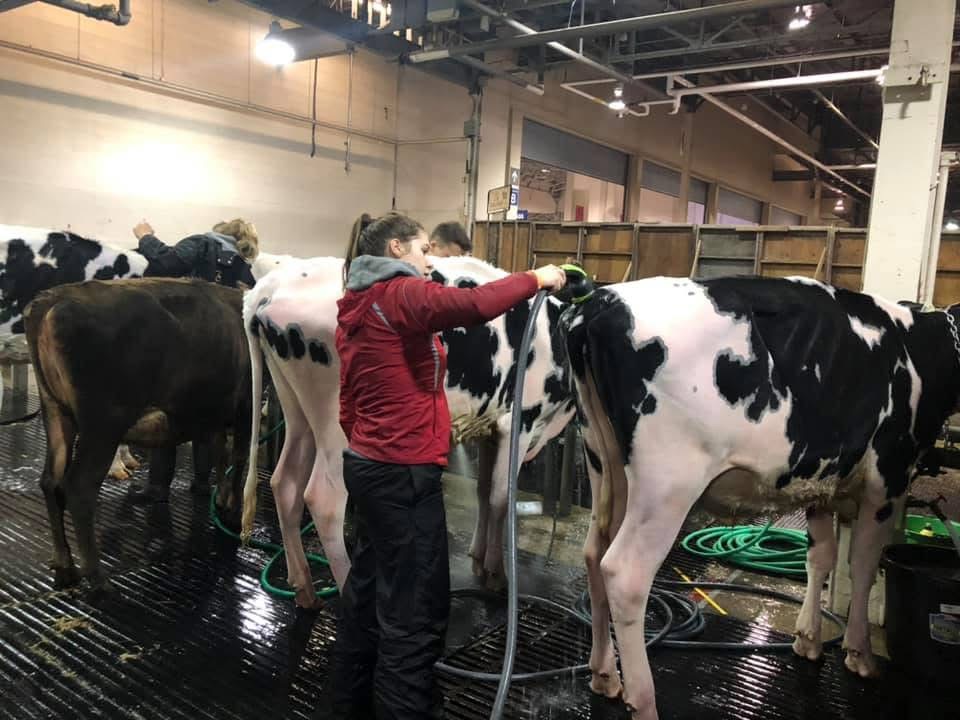
You see kids washing cattle. I see Canada’s next dairy CEOs learning their most valuable skill: helping competitors when nobody’s keeping score. That teenager in the red jacket? They don’t know it yet, but in 15 years they’ll build a genetics company with someone washing calves three stalls over. The rival they’re about to help with a stuck zipper? Future business partner.

I’ll never forget standing in that wash rack before dawn, exhausted and covered in soap, when the truth finally hit me: This was never about the cattle.

It was about who we become when nobody’s watching.

I was fourteen, third year competing at what was then called the Scotiabank Hays Classic. I’d just placed third in Intermediate Showmanship—respectable, not remarkable. But what moved me most wasn’t the ribbon. It was what happened in those quiet hours before the crowds arrived, before the judges appeared, before anything counted.

Younger members from another county team started seeking me out during those early-morning wash sessions. Not because anyone told them to. But because in those cold morning wash racks, we all learned the same truth: You survive this together, or you don’t survive it at all.

“Can you help me?” they’d ask. “How do you stay calm when everything goes wrong?”

That’s when the weight of it landed—the kind of responsibility that changes you. I wasn’t just competing anymore. I was becoming someone others looked to when the pressure got real.

Our Wentworth County team, celebrating our Premier Hays Classic win, was in my second year competing at what was then called the Scotiabank Hays Classic. The pride in this moment went beyond the ribbons; it was about the teamwork and leadership that earned us that “Building Youth Leadership” banner.

The Winter Everything Almost Fell Apart

The courage it took to walk away from security still catches my breath when I think about it.

By my late twenties, I had everything society says matters. Six-figure consulting salary. Professional prestige. A clear path forward. Three generations of our family had built a Master Breeder operation in southern Ontario. Dad spent nearly three decades revolutionizing Holstein Canada’s genetic evaluation system. His philosophy wasn’t just words on his office wall: “Lead, follow, or get out of the way.”

But there I was. Following. Following someone else’s dream while mine withered.

My wife’s faith saved me. When I told her I couldn’t do it anymore—couldn’t keep trading my soul for a paycheck—she didn’t panic about the money we’d lose. She believed we’d figure it out together.

So I came home and started building from nothing. A marketing agency from our kitchen table. Within five years, we’d grown to serve four Fortune 500 companies. But even that success felt hollow. The pull back to dairy—to the industry that raised me—was too strong to ignore.

Why David Beats Goliath in Canadian Dairy

Here’s what shouldn’t make sense but does.

Canada has roughly 9,000 dairy farms, according to Agriculture Canada’s latest count. The United States? Over 30,000. We have 1.4 million dairy cattle. They have 9.4 million.

By every logical measure, we should be irrelevant. A footnote in global dairy genetics.

Instead—and this still amazes me—Canada exports between $155 and $178 million in dairy genetics annually. Our Holstein genetics consistently rank in the top three globally. We achieve the world’s best carbon efficiency at 48% below global averages.

How does a country a fraction of the size punch so far above its weight?

Look at who’s leading Canadian dairy. The vast majority came through 4-H programs like the Classic. That’s not a coincidence. That’s what happens when you systematically build leaders from age twelve up.

Curtis McNeil proved it. Won the Classic Grand Championship in 2005, the same week he captured Holstein Canada’s President’s Cup—first person ever to claim both. Today, he’s earned three Master Breeder shields, serves on Semex Alliance’s executive board. When he returned to judge the 2024 Classic showmanship, watching 300 teenagers compete, he called it “the best showmanship class I have ever seen in my life.”

Tyler Canning, 2022 Grand Champion. Nadia Uhr, 2024 Champion, after five years of competing. The pattern repeats across hundreds of Classic alumni now leading every major dairy organization in Canada.

My brother, Paul, then CEO of URUS, judging the TD Canadian 4-H Dairy Classic. Here, he’s congratulating Peter Leach from Kawartha Lakes, the Grand Champion Showman. Seeing Paul, a Classic alumnus, return to judge and recognize the next generation of leaders vividly illustrates how this network comes full circle and continues to shape the industry’s future. 

The Conversation That Keeps Me Awake

But here’s the hard truth these kids deserve to hear, even though it hurts to say it.

Based on current consolidation trends, industry analysts project that approximately half the dairy farms operating today won’t exist when these teenagers are thirty-five. Not because farmers failed. Because the economics became impossible for mid-size operations.

In the United States, mega-dairies with 2,500+ cows now produce 46% of milk while representing just 3% of operations. Technology isn’t optional anymore—robotic milking, AI monitoring, and precision agriculture demand millions in investment that most farms simply can’t afford.

The world these kids are entering is exponentially harder than what I faced.

So what do I tell those 300 teenagers preparing for the 2025 Classic, knowing what’s ahead?

Don’t be afraid to change the world. Use what you’re learning here to take on the world. And remember—the bend in the road is not the end of the road unless you fail to make the turn.

Some will leave dairy. That’s not giving up—it’s using the judgment skills we learned right here. Sometimes the bravest decision is recognizing when to pivot toward where your skills create more impact.

What Really Happens at 5:47 AM

Standing at the Royal Winter Fair last November, watching the 41st annual TD Canadian 4-H Dairy Classic, I saw myself in every teenager preparing their calf in those pre-dawn hours.

The wash racks at dawn tell the real story. Three hundred teenagers from counties across Canada, all preparing for classes that start in two hours. Premier County championships hang on every point. The competition is fierce.

But watch what actually happens: Competitors from rival counties stop their own preparations to help someone who is struggling. They share equipment without being asked. They teach techniques to direct competitors. They offer encouragement when frustration peaks.

Nobody mandates this. No rules require it.

This is simply who we are. Who we’ve always been.

Those people beside you at 5:47 AM become your professional network for the next forty years. When you need someone who understands the weight of impossible decisions, when you need truth without judgment, you call someone you showed against decades ago. That trust—you can’t manufacture it in boardrooms or build it through LinkedIn. It’s forged when you’re all exhausted, scared, and determined not to let each other fail.

Why I Had to Build The Bullvine

The moment that changed everything came when I was thirty-five. February 2012. Two weeks from initial idea to launching The Bullvine’s first article.

For that entire first year, I did not seek advertisers. Complete editorial freedom mattered more than financial security. People thought I’d lost my mind. Looking back, maybe I had.

But every skill I needed to make it work came from those years competing at the Classic. Making split-second decisions when your calf won’t cooperate and five hundred people are watching. Getting up the next morning after not doing as well as you had hoped. Walking back into that ring knowing you might fail again.

That’s the real training. Not for showing cattle—for life.

Today, The Bullvine reaches over 400,000 monthly readers. It’s become dairy’s most essential, most provocative platform. But what matters more is what it represents: proof that skills learned at fifteen in a show ring can build something at thirty-five that changes an entire industry’s conversation.

The Network That Will Save Everything

What happens at the Classic doesn’t stay at the Classic. It builds the collaborative tissue that makes Canadian dairy globally competitive despite our size.

When Canadian dairy organizations pioneered genomic selection—doubling genetic progress rates—it succeeded because people who’d competed as teenagers trusted each other as adults. Research institutions, AI organizations, breed associations, and progressive breeders are all collaborating across traditional boundaries.

That web of trust, built at 5:47 AM in wash racks over shared exhaustion and determination, drives Canada’s outsized global impact. You can trace nearly every major innovation in Canadian dairy back to relationships formed in 4-H.

What These Kids Really Need to Know

Parents watching their children compete face an impossible question: How do you prepare kids for an industry that might not exist when they’re ready to take over?

Here’s what my journey taught me: You’re not preparing them for dairy farming. You’re preparing them to navigate complexity and uncertainty with grace. Whether they lead dairy operations, genetics companies, technology startups, or ventures we can’t yet imagine—they’re learning to drive change rather than be consumed by it.

For ten years competing, I thought I was learning to show cattle.

I was actually learning to make impossible decisions with incomplete information. To find hope when logic says quit. To lift others when you’re barely standing yourself. To persist when persistence seems pointless.

These aren’t cattle skills. They’re survival skills. The same ones that let you leave a secure job with young kids depending on you. Launch a media platform that everyone says will fail. Tell uncomfortable truths that an industry needs to hear. And somehow find a way to make it all work.

My parents always said 4-H was our stepping stone for learning. From projects that taught responsibility to giving reasons that built confidence and public speaking skills, 4-H became the cornerstone of everything that came after.

The Real Legacy Forged at 5:47 AM

Standing at the Royal last November, I saw myself in every teenager preparing their calf in those pre-dawn hours.

5:47 AM. Three hundred teenagers from across Canada. Premier County championships hang on every point. The competition is fierce.

But watch what actually happens.

I saw a young woman from western Ontario helping a first-timer from the Maritimes who couldn’t get all the soap out of her calf. I saw a senior competitor from Ontario lend clipping equipment to someone from Alberta whose clippers failed.

Nobody mandates this. No rules require it. No one is keeping score.

This is simply who we are.

Those people beside you at 5:47 AM become your professional network for the next forty years. When you need someone who understands the weight of impossible decisions, you call someone you showed against decades ago. That trust—you can’t manufacture it in boardrooms. It’s forged when you’re all exhausted, scared, and determined not to let each other fail.

Three hundred teenagers. One cold November morning. The future of an industry that statistics say shouldn’t survive.

But we will. We always have. Not through miracles or magical market corrections.

Through each other.

That’s the harvest that matters most—not in the field or barn, but in the people we become together.

The road will bend. It always does. But if you use what you learn here—really use it—you’ll make the turn. Trust me on this. I’ve made that turn several times now, and each time I’ve drawn on skills learned standing exactly where these kids stand today.

In a world that often forgets, this is what we’re really teaching in those wash racks at dawn: How to be the person someone else needs when everything feels impossible.

The cattle were always just the excuse to bring us together.

The humans we become in those moments before dawn—that’s the real legacy.

KEY TAKEAWAYS 

  • Your competition at 5:47 AM becomes your career safety net at 35: The teenager you help in the wash rack today calls you with the opportunity that saves your farm in 2040
  • Canada’s secret weapon costs nothing: We export $178M in genetics with 1/3 the farms because rivals helping rivals at dawn creates trust that boardrooms can’t buy
  • The skills that matter aren’t about cattle: Walking into the ring after public failure, making decisions while 500 watch, lifting others when you’re drowning—that’s the real curriculum
  • “The bend in the road is not the end”: When half of dairy farms vanish, Classic alumni thrive because at 14 they learned the difference between quitting and pivoting
  • The cattle were always just the excuse: Building humans who understand collective success beats individual achievement—that’s why 4-H kids run Canadian dairy

Join the Revolution!

Join over 30,000 successful dairy professionals who rely on Bullvine Weekly for their competitive edge. Delivered directly to your inbox each week, our exclusive industry insights help you make smarter decisions while saving precious hours every week. Never miss critical updates on milk production trends, breakthrough technologies, and profit-boosting strategies that top producers are already implementing. Subscribe now to transform your dairy operation’s efficiency and profitability—your future success is just one click away.

NewsSubscribe
First
Last
Consent

One Farmer’s ‘No’ Built a Dynasty: How Plushanski Chief Faith’s Genetics Add $1,500 to Your Bottom Line

1973: Charlie refuses to sell Faith. 2025: Her genetics add $1,500/cow. Between those years? A breeding revolution nobody saw coming.

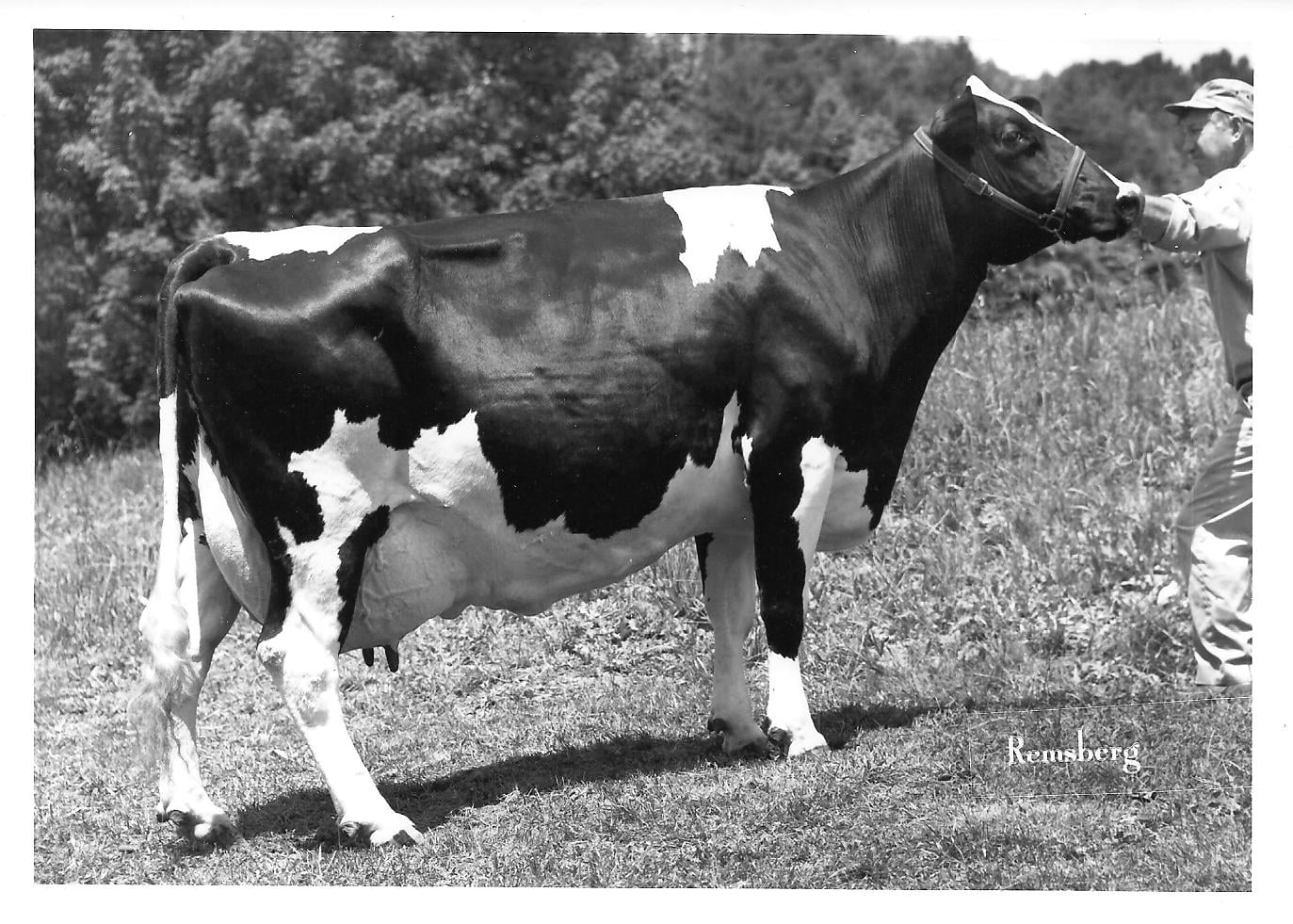
Plushanski Chief Faith, the cow whose genetics would add $1,500 per cow to your bottom line. This is the remarkable Holstein Charlie Plushanski refused to sell in 1973, setting in motion a breeding revolution that continues to save farms today. Just look at that presence—the deep body, the wide front end, and that incredible udder that defied the odds of her Chief lineage

I’ll never forget when I first heard this story—about a decision that seemed impossible at the time, yet somehow created $1,500 worth of hope for every cow in your barn today.

The moment that changed everything came on an ordinary morning in 1973. I can still picture it, the way it’s been told to me by those who remember—Charlie Plushanski standing in his Kutztown, Pennsylvania barn, watching the morning light catch the dust motes as his five-year-old Holstein, Faith, shifted her weight in the stall.

What happened next still gives me chills…

Charlie Backus had driven up from Maryland that morning with an offer that would’ve saved most farmers from their worst fears. We’re talking about enough money to buy a decent farm in Berks County—the kind of offer that makes your hands shake when you hear it. And Charlie Plushanski? He’d survived World War II as a Marine, built his farm from nothing with his boxing earnings, and knew what it meant to struggle. Family stories say he’d even sparred with champions during the war, though like many stories from that generation, the details have softened with time.

Standing there in that barn doorway, Backus was pressing hard. “Charlie, you need to let her go,” he said, watching Plushanski Chief Faith—that remarkable cow who seemed to know her own worth.

Earlier that same day—and this is what moves me most about this story—Pete Heffering had made the same journey from Ontario, trying to buy this same cow for his Hanover Hill program. Two of the biggest names in Holstein breeding, both turned away by a farmer who saw something nobody else could see.

The Pedigree That Changed Everything

For those who love breeding history, let me paint the complete picture of what made Faith so special:

Plushanski Chief Faith EX-94 4E GMD (EX-MS 96)

  • Born: November 1968
  • Sire: Pawnee Farm Arlinda Chief
  • Dam: Ady Whirlhill Frona VG-86 (Whirlhill Kingpin daughter)
  • Lifetime Production: 242,863 lbs milk, 11,353 lbs fat

What set Faith apart wasn’t just her individual achievement—it was how she transmitted. In an era before genomics, before EPDs, before any of the tools we rely on today, Faith proved that some cows simply have “it”—that indefinable ability to pass on greatness generation after generation.

The Courage It Took to Say No

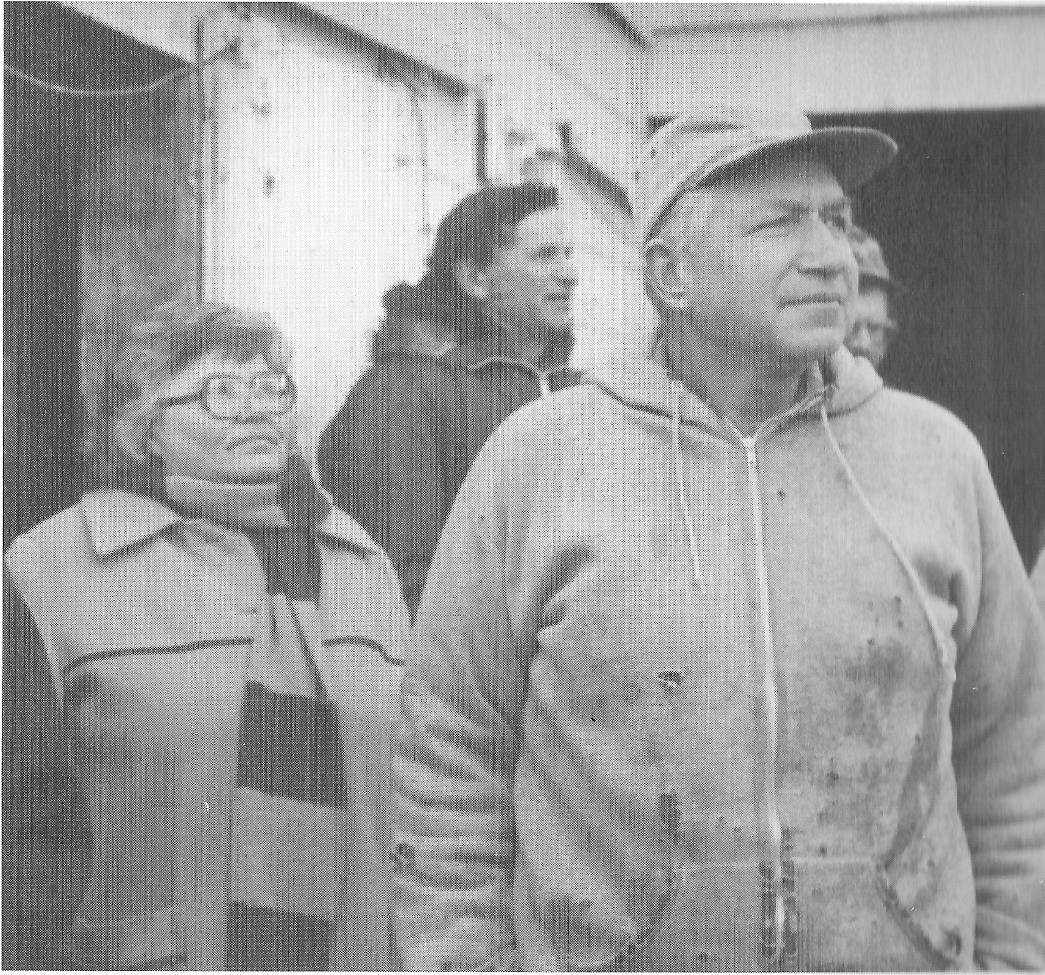
Mr. and Mrs. Charles Plushanski, the visionaries behind the Faith dynasty. Their partnership and shared conviction were the foundation of the courageous decision to keep Faith when the industry came calling. This photo captures the quiet strength of the couple who chose long-term legacy over a short-term sale, proving that the greatest breeding decisions are often family decisions.

What moved me most was understanding what Charlie was really facing that day. This wasn’t just about money. This was about believing in something when everyone thought you were crazy.

The breeding community of the early 1970s was divided. You were either breeding for Chief’s incredible production or Elevation’s balanced type and longevity. But here was Charlie, who had already taken the risk of combining Chief with Kingpin genetics—a corrective mating that most breeders wouldn’t have attempted.

Charlie looked at Faith and somehow knew—in that deep, gut-level way that real farmers understand—that she carried something special in her genetics. Something that couldn’t be bought or sold. Something that would outlive them all.

“It’s not about the money,” Charlie said, according to the stories that have been passed down through breeding records and family memories. And against all odds, he was right.

That Gold Medal Dam designation Faith would earn? In the 1970s, before genomics and computers, a GMD represented the pinnacle of breeding achievement—a cow whose offspring consistently exceeded expectations across multiple herds and breeding programs. It meant you had a cow that was one in ten thousand.

The Winter That Nearly Broke Everything

Here’s where the story gets even more remarkable for those who understand breeding history. In the fall of 1965, in one of those Pennsylvania winters when everything seemed impossible, Charlie’s brother Henry called about some yearling heifers down in Perry County. A dozen Whirlhill Kingpin daughters that most breeders wouldn’t touch because of their udder problems.

Charlie bought them all. Including one special heifer—Ady Whirlhill Frona.

Nobody could have prepared him for what came next. When it came time to breed Frona, Charlie made a choice that seemed almost reckless. He bred her to Pawnee Farm Arlinda Chief—a bull whose genetics would eventually influence almost 14% of all Holstein DNA today, according to UC Davis research. But Chief came with risks. His genetics carried a lethal mutation that would cause heartbreak across the industry—over half a million lost calves worldwide. (Read more: The $4,300 Gamble That Reshaped Global Dairy Industry: The Pawnee Farm Arlinda Chief Story and Bell’s Paradox: The Worst Best Bull in Holstein History)

Charlie didn’t know about the mutation then. He just knew that sometimes, to create something extraordinary, you have to risk everything.

The Four Daughters Who Carried the Dream Forward

But then something remarkable happened that even Charlie couldn’t have imagined. Faith didn’t just excel herself—she passed on her gifts through four extraordinary daughters that would reshape breeding programs worldwide:

Plushanski Valiant Fran EX-90 35* achieved something almost unheard of in the pre-embryo transfer era. The “star” designation meant her offspring significantly exceeded the breed average. Seven went on to score Excellent. Twenty-five scored Very Good. Her 365-day record of 36,920 pounds of milk proved you could have both beauty and production. Through Fran came the show line that would eventually produce Quality BC Frantisco—Grand Champion at the Royal Winter Fair in 2004 and 2005.

Quality B C Frantisco-ET EX-96-3E 18*, a daughter Plushanski Valiant Fran-ET. Frantisco’s multiple championships at the Royal Winter Fair and her recognition as International Cow of the Year highlight the continued influence of Faith’s bloodlines, even in subsequent generations.

Plushanski Job Fancy VG-88 GMD DOM became the commercial production matriarch. The DOM (Dam of Merit) designation meant she had sons entering AI service. Through her daughter, Plushanski Neil Flute VG-87, and granddaughter Plushanski Mark Fife VG-87, this branch would spread across the globe, with bulls like To-Mar D-Fortune carrying these genetics into thousands of herds.

Plushanski Neil Flute (VG-87), the crucial link in the global dynasty. As the daughter of brood cow matriarch Job Fancy and the dam of the influential Mark Fife, Flute embodied the exceptional udder quality and commercial durability that this branch became famous for. It was through powerful transmitters like her that Faith’s genetics quietly infiltrated thousands of herds, building the foundation for the longevity advantage we see today.

Plushanski Dawn Fayne and Plushanski Star Faith rounded out this remarkable quartet, each contributing their own unique genetic gifts to the breed.

What pedigree enthusiasts will appreciate is that each daughter seemed to capture a different aspect of Faith’s genetic package—Fran got the show-ring presence, Fancy got the commercial reliability, Flute got the udder quality, and Fife got the longevity. It’s as if Faith parceled out her gifts, ensuring her influence would touch every aspect of Holstein breeding.

Contemporary Competition and Context

To understand the magnitude of Charlie’s decision, you need to know what else was happening in Holstein breeding in 1973. This was the era of legendary cow families like:

  • The Romandale Reflection Marquis family
  • The Hanoverhill lines that Pete Heffering was building
  • The emerging Elevation daughters that were revolutionizing the type

Yet Faith would outlast and out-influence many of these contemporary families. While other great cows of the era produced individual champions, Faith created entire dynasties that adapted to different breeding goals worldwide.

The Global Explosion Nobody Saw Coming

What’s fascinating for breeding historians is how Faith’s genetics adapted to completely different breeding goals around the world:

The European Production Revolution

The modern embodiment of Faith’s commercial power: De Biesheuvel Javina 50 VG-87. She is the archetype of the Javina family, the European branch of the Faith dynasty that descended through Plushanski Job Fancy. While the Frantisco line chased show-ring glory, Dutch breeders selected this line with a relentless focus on what pays the bills: production, health, and efficiency. Today, her descendants like Willem’s Hoeve 3STAR Javina 2762 dominate European genomic indexes (gNVI and gRZG), producing the next generation of elite bulls for AI studs. This is the harvest of Charlie Plushanski’s vision, proving that Faith’s genetics could be adapted to create a profitable, index-topping powerhouse for the most demanding commercial systems in the world.

The Dutch breeders working with the Javina family (Faith’s European descendants through Job Fancy) focused intensively on commercial traits. De Biesheuvel Delta Javina and her daughters consistently top the Dutch NVI rankings. These aren’t just good cows—they’re the kind that define breeding programs for decades. When families consistently produce #1 NVI sons and daughters generation after generation, you’re witnessing genetic consistency that modern genomics still struggles to predict.

Canada’s Show Ring Dynasty

The show-ring culmination of the Faith dynasty: Quality B C Frantisco-ET EX-96-3E 18* A direct descendant of Faith through her daughter Plushanski Valiant Fran, Frantisco was the masterpiece developed by Paul Ekstein at Quality Holsteins. She dominated the Canadian show circuit, capturing Grand Champion honors at the Royal Winter Fair twice (2004 & 2005) and earning the title of 5-time All-Canadian. Her reign was so complete that one of the great “what ifs” in modern show history is how she would have fared against American champions at World Dairy Expo, a showdown prevented by BSE travel restrictions. Frantisco stands as the ultimate proof of the versatility of Faith’s genetics—creating a world-class show champion more than 30 years after her famous ancestor was born.

In Canada, Paul Ekstein’s work with the Frantisco line through Valiant Fran created a show dynasty. Quality BC Frantisco’s achievements—Grand Champion at the Royal Winter Fair in 2004 and 2005, five-time All-Canadian, International Cow of the Year 2005—prove that Faith genetics could compete at the highest levels decades after her death.

Australia’s Modern Application

Ray Kitchen at Carenda Holsteins demonstrates how Faith genetics remain relevant in 2025. Their Carenda Pemberton, with 606 daughters from 79 herds, shows how these genetics adapt to modern selection tools while maintaining their core strengths.

Why This Matters for Today’s Breeders

I recently talked with a producer in Wisconsin who discovered Faith genetics in his herd almost by accident while researching pedigrees. His Faith-line cows? They’re averaging 3.8 lactations compared to the industry’s 2.8. That extra lactation—worth an estimated $1,200 to $1,500 per cow in today’s market—is the difference between profitability and struggle.

With the nearly 800,000-heifer shortage CoBank reports, quality genetics have never been more valuable. When you see names like Big Gospell, Apina Fortune, or To-Mar D-Fortune in a pedigree, you’re looking at Faith’s legacy, refined through decades of selection.

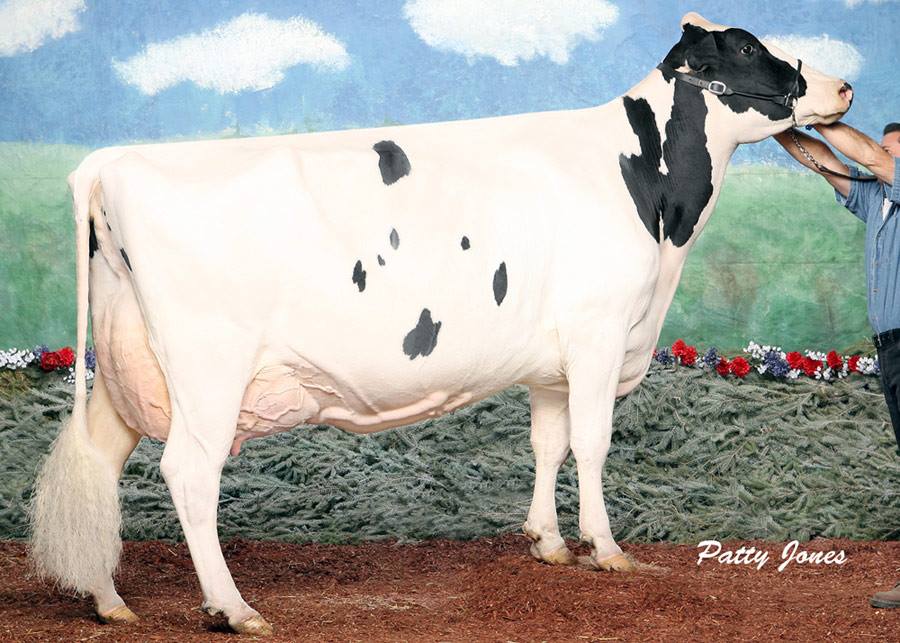
The modern face of the Faith legacy: Big Delta Anecy 1, dam of the influential AI sire Big Gospell. A direct descendant of Faith through the commercially-focused Javina family, Anecy is the proof in the pudding. She showcases the deep-ribbed, high-capacity frame and exceptional udder quality that the Faith line has transmitted for over 50 years. When you see bulls like Gospell in a catalog, you’re not just buying modern genomics; you’re investing in decades of proven, real-world durability that started with one farmer’s courageous ‘no’ back in 1973.

What Charlie Knew in His Heart

Standing there in my own barn sometimes, I think about Charlie Plushanski in that moment in 1973. The breeding community was watching. The pressure was immense. The money would have solved immediate problems.

Instead, he made the harder choice. The one that required patience, vision, and something more—faith in genetics that would prove their worth across decades and continents.

Charlie passed away in 1991, but his son Cary kept the dream alive at the Kutztown farm until his own passing just this September. Three generations of a family who understood that sometimes the best breeding decisions aren’t about today’s milk check or tomorrow’s bills. Sometimes they’re about creating genetic legacies that outlast us all.

The Echo That Still Saves Farms

Every time a Faith descendant helps a farm survive another year, navigate another crisis, or build another generation’s future, the echo of Charlie’s “no” from 1973 quietly puts hope back in someone’s barn.

For pedigree enthusiasts, Faith represents something profound—proof that individual breeding decisions can reshape an entire breed. For historians, she’s a reminder that the greatest genetic influences often come from unexpected places. For today’s breeders, she offers both practical genetics and philosophical guidance.

When you’re planning your breeding for next year, when you’re looking at those catalogs and wondering which direction to go, remember Charlie Plushanski. Remember that sometimes the hardest choice—the one that seems impossible at the time—is the one that creates miracles down the road.

That $1,500 per cow advantage from longevity? That’s not just a number. That’s the difference between surviving and thriving, between keeping the farm and losing it, between passing something on to the next generation and watching it slip away.

And somewhere, in barns across the world, Faith’s descendants are still quietly making that difference. Still carrying forward the gift of one farmer’s impossible choice.

It might as well be in your barn, creating your own harvest of hope.

Key Takeaways:

  • The Bottom Line: Faith genetics add 1+ lactation (3.8 vs 2.8 average), worth $1,200-$1,500 per cow in today’s market
  • Find Them Today: Search your pedigrees for “Javina” (commercial power), “Frantisco” (show quality), or Faith’s four daughters’ names
  • Why Now: In an 800,000-heifer shortage, cows that last five lactations instead of 3 are pure profit
  • The Lesson: Sometimes saying “no” to quick money creates generational wealth—Charlie proved it in 1973

Executive Summary:

 In 1973, Charlie Plushanski turned down enough money to buy a farm—refusing to sell a cow that would reshape dairy genetics forever. Plushanski Chief Faith (EX-94 4E GMD) didn’t just produce 242,863 pounds of milk; she founded dynasties through four daughters whose genetics now run through millions of cows worldwide. Today, Faith bloodlines deliver the industry’s most overlooked advantage: an extra lactation worth $1,200-$1,500 per cow, achieved through 3.8 lactations versus the 2.8 average. With an 800,000-heifer shortage threatening dairy’s future, these 50-year-old genetics offer what no genomic gamble can: proven longevity across every climate, every system, every market condition. The supreme irony? While the industry obsesses over the latest genomic rankings, Charlie’s half-century-old decision is quietly adding $1,500 to bottom lines worldwide. His refusal reminds us that true genetic wealth isn’t built in a sales ring—it’s built by saying “no” to quick money and “yes” to generational vision.

This narrative draws from breeding records, Holstein Association documentation, and the enduring impact of these genetics on farms worldwide. Some conversations and personal details have been reconstructed to honor the significance of these breeding decisions and the families who made them. The author extends deep gratitude to all who preserve these important agricultural stories.

Learn More:

Join the Revolution!

Join over 30,000 successful dairy professionals who rely on Bullvine Weekly for their competitive edge. Delivered directly to your inbox each week, our exclusive industry insights help you make smarter decisions while saving precious hours every week. Never miss critical updates on milk production trends, breakthrough technologies, and profit-boosting strategies that top producers are already implementing. Subscribe now to transform your dairy operation’s efficiency and profitability—your future success is just one click away.

NewsSubscribe
First
Last
Consent

42% Heritability: The Milking Speed Breakthrough That Fixes Your Labor Problem

What farmers are discovering: selecting for speed actually reduces labor costs $10-16K annually

EXECUTIVE SUMMARY: What farmers are discovering about CDCB’s new Milking Speed evaluation is reshaping our understanding of genetic selection and parlor efficiency. With 42% heritability—compared to just 7% for daughter pregnancy rate—MSPD offers predictable genetic progress for a trait that impacts operations twice daily, 365 days a year. Holstein bulls currently range from 6.2 to 8.1 pounds per minute in the August 2025 evaluations, meaning the spread between your fastest and slowest genetics could be costing you an hour or more of labor daily. Research from the University of Minnesota confirms that strategic selection within the 7.0-8.0 lbs/min range balances efficiency gains with udder health, while extension specialists from Wisconsin to California emphasize the importance of adjusting parlor settings as genetics improve. Looking ahead, operations implementing MSPD selection can now expect gradual but meaningful improvements. Many producers report saving 10-15 minutes per milking by year three, with full benefits emerging around year seven as herd genetics turn over. The collaborative learning happening as producers share experiences with this trait represents exactly how our industry gets stronger together. For operations facing persistent labor challenges or inconsistent milking times, MSPD warrants serious consideration as part of a comprehensive breeding strategy.

 Milking speed genetics

Every morning at 4:30, the same scene plays out in parlors from California to Vermont. Some cows are finished, waiting to exit, while others seem to take forever. We’ve all managed to work around this variation for years, adjusting our routines, tweaking our grouping strategies, and making it work. But what if genetics could actually address this issue?

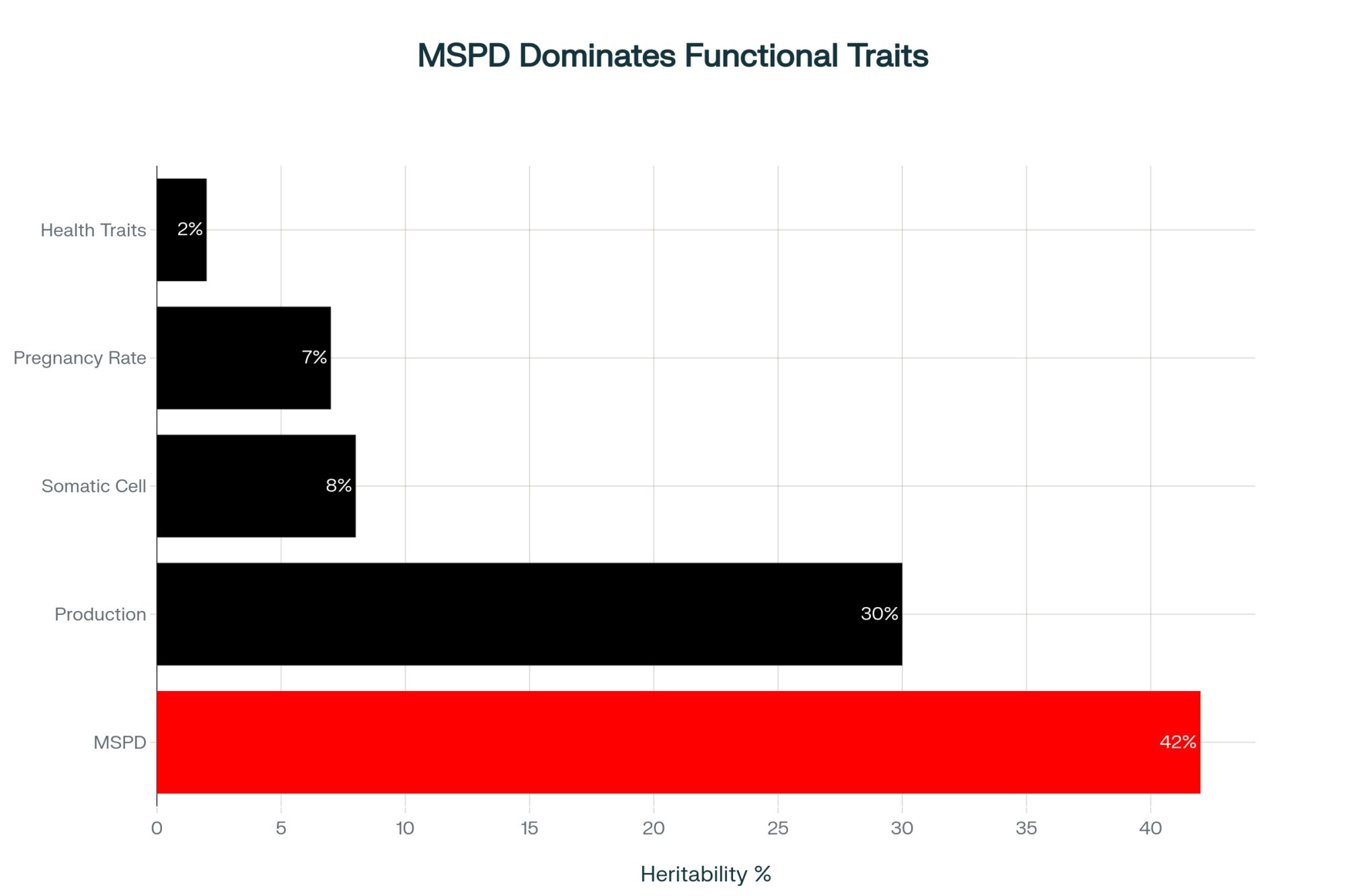
CDCB rolled out their Milking Speed evaluation—MSPD—this past August, and the numbers are stopping producers in their tracks. According to their published data, we’re looking at 42% heritability. Now, if you’re anything like the producers I’ve been talking with from the Midwest to the Southeast, that number probably makes you pause. Daughter pregnancy rate, which we’ve been selecting for intensely? That’s around 7% according to CDCB’s genetic parameters. Most health traits we worry about sit between 1% and 3%. This ranks among the CDCB’s highest-heritability functional traits.

The genetic game-changer hiding in plain sight – MSPD’s 42% heritability means real, measurable progress in your lifetime, not your grandkids.

It’s worth noting that MSPD is a flow rate measurement, expressed as pounds of milk per minute, not a total milking time. This standardizes the measure across lactation stages and systems, making it universally applicable whether you’re milking fresh heifers or fourth-lactation cows.

What farmers are finding is that this might be one of those genetic tools that actually delivers on its promise. That’s a level of genetic progress we just haven’t seen before for traits that hit your bottom line every single day.

The Science Is More Straightforward Than You’d Think

CDCB built this evaluation using sensor data from commercial dairies, measuring the pounds of milk per minute as it flows through the system across 31 states. No subjective scoring where one classifier sees a seven and another sees an 8. Just straight data from actual milking sessions.

The physiology behind milking speed has been documented in dairy science literature for decades. Research published in the Journal of Dairy Science suggests that it primarily depends on both anatomy and neural response. You’ve got your physical components—teat canal diameter, sphincter muscle tone—but there’s also how efficiently a cow responds to oxytocin and her overall letdown reflex. Some cows milk fast because they have excellent milk ejection. That’s what we want. Others? They’re fast because of looser teat anatomy, which can open the door to mastitis problems down the road.

Looking at CDCB’s correlations, there’s a 0.43 genetic correlation between milking speed and somatic cell score. Initially concerning, right? However, the data actually reveal that correlation mainly occurs when speed originates from compromised teat anatomy rather than good physiology. When you’re selecting bulls in what CDCB identifies as the practical range—around 7.5 to 8.0 pounds per minute—you’re generally getting efficiency through better milk letdown, not shortcuts that’ll haunt you later.

Kristen Gaddis, who leads the genetic evaluation team at CDCB, explained at their August public meeting that this 42% heritability makes MSPD one of their most heritable published traits. The reliability is already strong, even with a relatively new dataset. When you see heritability this high on a trait that impacts throughput every single day, it really does change the conversation about what’s possible through genetic selection.

What This Looks Like in Real Parlors

Holstein bulls in the current CDCB evaluations range from about 6.2 to 8.1 pounds per minute. That’s roughly a 30% spread. I’d bet money most operations have similar variation in their herds right now—you probably know exactly which cows I’m talking about.

Think about your morning milking. In a typical double-12 herringbone, when everything’s clicking, you’re moving cows through efficiently. But when those slower genetics hold up an entire side? Your actual throughput drops, workers become frustrated, and what should be a 2.5-hour milking stretches to 3 hours or more.

The economics vary depending on where you’re located, obviously. Labor costs differ significantly from region to region—what a California producer faces compared to someone in Georgia or South Dakota can be night and day. But across the board—from Florida to Idaho—many operations are finding that greater consistency reduces those end-of-shift pressure points. Workers know roughly when they’ll finish. That predictability… in today’s labor market, where finding anyone willing to work is challenging, matters as much as the raw time savings.

Quick Reference: MSPD Selection by System Type

Parlor TypeTarget MSPD Range (lbs/min)Key PriorityCritical ThresholdEfficiency Gain Potential
Herringbone/Parallel7.0-8.0Uniformity over speedAvoid bulls <6.815-20%
Rotary7.0-7.8Consistent platform speedMinimize 2nd rotations10-15%
Robotic Systems7.2-7.8Speed + teat placementBalance with udder conf.8-12%

Herringbone and Parallel Parlors

Target Range: 7.0-8.0 lbs/min
Priority: Uniformity over maximum speed
Key Point: Bulls below 6.8 create bottlenecks that kill efficiency
Based on the University of Wisconsin Milking Center recommendations and field experience

Rotary Parlors

Target Range: 7.0-7.8 lbs/min
Priority: Consistent platform speed, minimize second rotations
Key Point: Group first-lactation heifers separately when possible
Michigan State Extension dairy team guidelines

Robotic Systems

Target Range: 7.2-7.8 lbs/min
Priority: Individual performance plus udder conformation
Key Point: Robots need both speed and good teat placement
Penn State Extension robotic milking resources

Building Your Selection Strategy Today

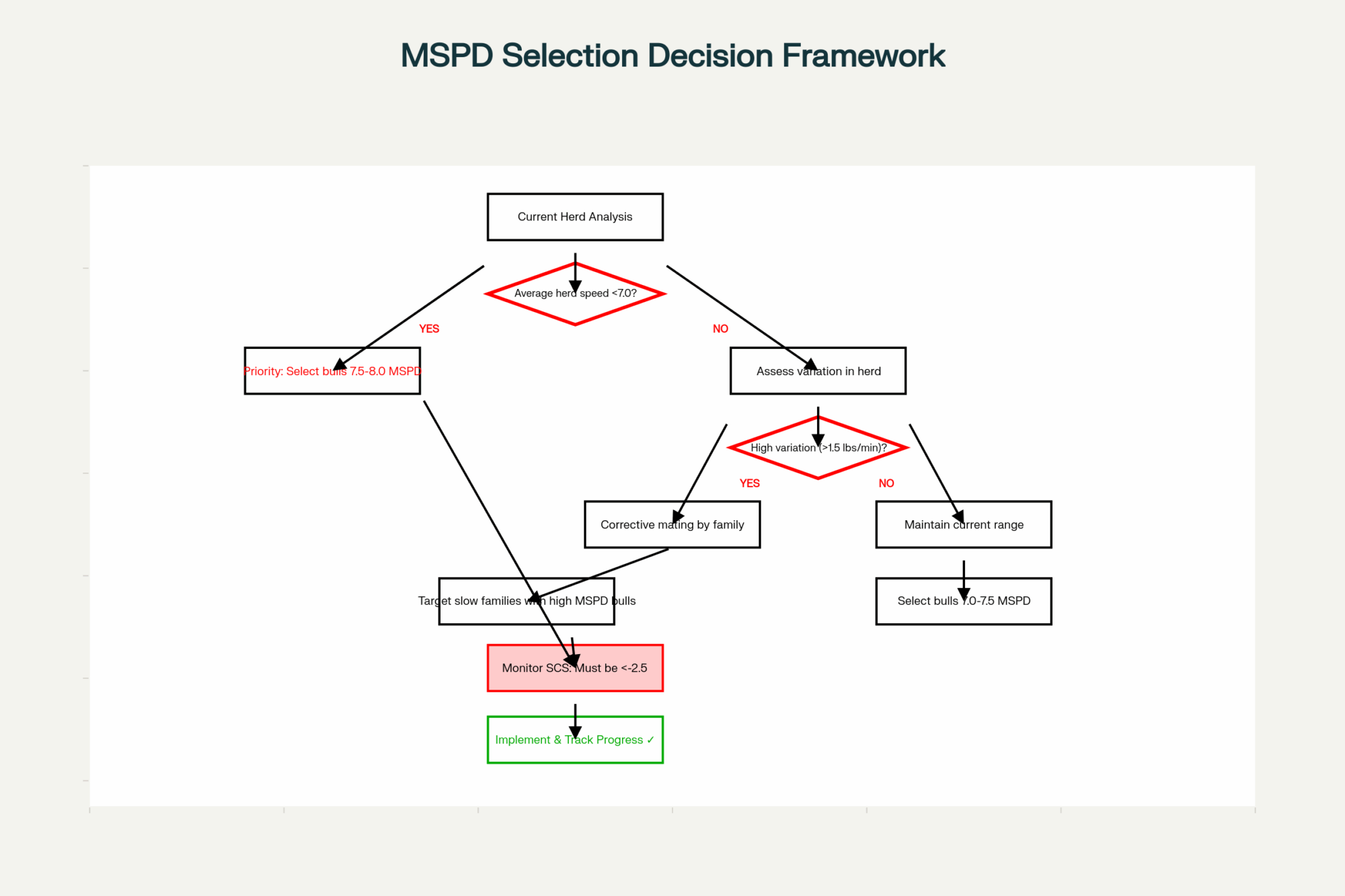
From analysis paralysis to action – Your personalized MSPD roadmap based on current herd genetics and variation

Since MSPD isn’t integrated into Net Merit yet—CDCB’s still working through the index weighting debates—producers are developing their own approaches. Here’s what’s working based on early adopters and extension recommendations from Cornell to UC Davis:

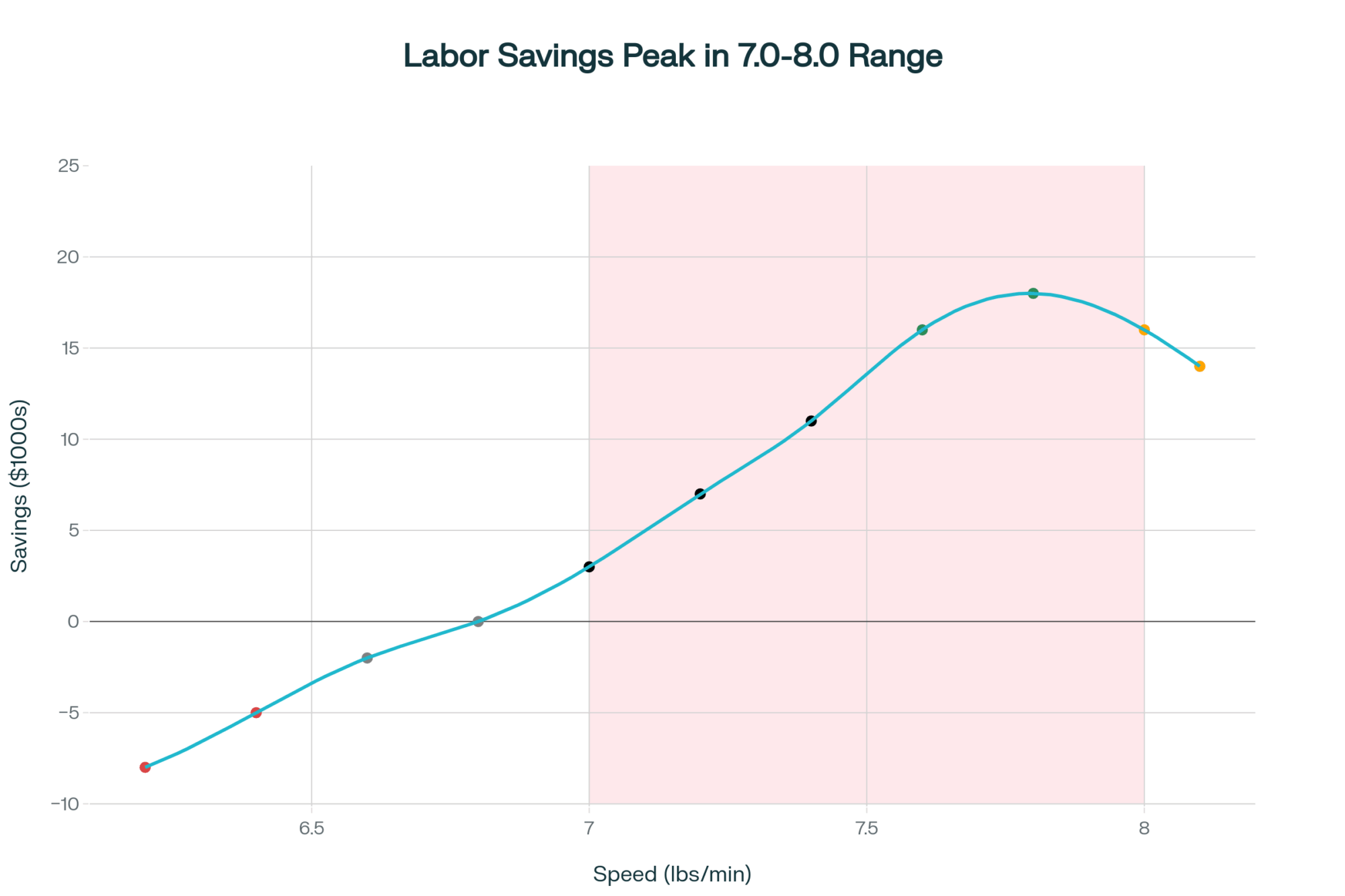
Start with your current selection criteria. Then layer in MSPD targeting, aiming for bulls in that 7.0 to 8.0 pounds per minute range based on CDCB’s guidance. If you’re pushing toward the higher end—say 7.6 or above—make sure those bulls have strong SCS values, like -2.5 or better. University of Minnesota’s dairy genetics team emphasizes this as important protection against potential udder health issues down the road.

Corrective mating within families is showing real promise. Long-term research led by Bradley Heins and colleagues at the University of Minnesota, published in the Journal of Dairy Science in 2023, demonstrates that this approach is particularly effective. Got cow families that consistently produce those 8-minute milkers? Target them with higher MSPD bulls. With 42% heritability, this trait actually responds to selection pressure—genetic theory says it should, and early results seem to confirm it.

The Seven-Year Reality (And Why It’s Worth It)

Patience pays – While neighbors chase quick fixes, smart producers are building unstoppable genetic momentum that compounds every generation
YearHerd % with MSPD GeneticsTime Savings per DayAnnual Labor Savings (500 cows)Worker Impact
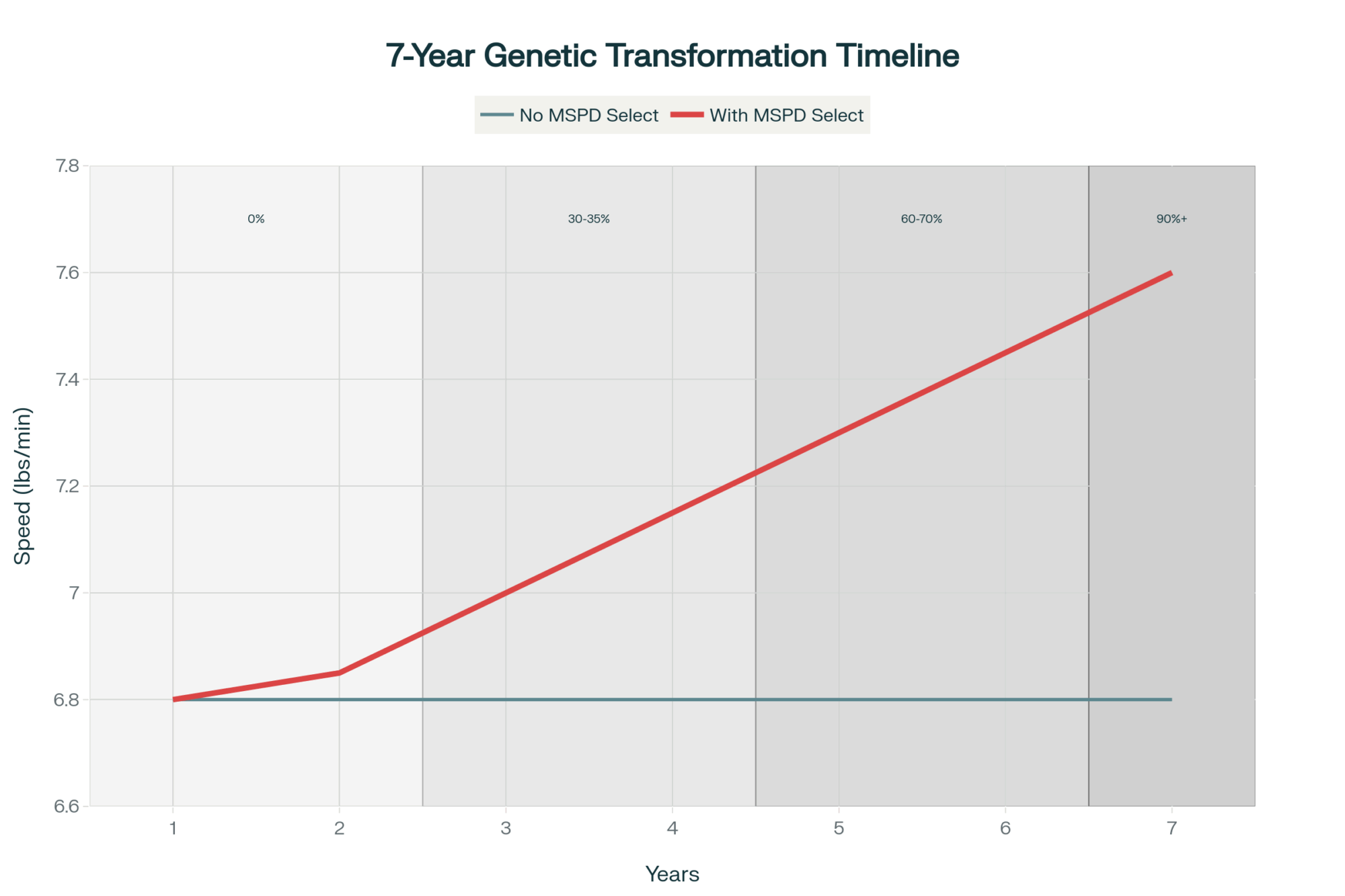
Years 1-20%0 minutes$0Planning phase
Years 3-430-35%10-15 minutes$2,000-3,000First improvements noticed
Years 5-660-70%30-45 minutes$8,000-12,000Predictable shift times
Year 7+90%+60+ minutes$15,000-20,000Full transformation achieved

Let’s be honest about the timeline here. Genetic improvement doesn’t happen overnight, and anyone who tells you different is selling something.

Years one and two, you’re making different breeding decisions but milking the same cows. Minimal visible change. This tests your patience.

In years three and four, your first MSPD daughters arrive. With typical U.S. replacement rates around 30-35% annually, according to the USDA’s National Agricultural Statistics Service, about a third of your herd carries improved genetics. Many operations notice some improvement—maybe saving 10-15 minutes per milking. Not revolutionary yet, but you’re starting to see it.

Years five and six bring the real changes. Most of your herd now carries selected genetics. Those problem cows become exceptions rather than the rule. This is when producers often report actually seeing the payoff they’ve been waiting for.

By year seven and beyond, with most of your herd carrying these genetics, parlor performance becomes remarkably more uniform. And here’s the beautiful part—improvement continues compounding. Each generation gets bred to progressively better MSPD bulls.

A Practical Economic Example

The $18,000 sweet spot – Push past 8.0 lbs/min and watch health costs eat your labor savings.

Let’s run through some basic math for a 500-cow operation (and remember, your results will vary—talk to your consultants and run your own numbers):

Current Situation:

  • 3 milkings daily × 3 hours each = 9 hours parlor time
  • 2 workers × local wage rate × 9 hours = your daily labor cost
  • Annual parlor labor: varies significantly by region

With MSPD Selection (Year 5+):

  • Even modest improvements in turn time—saving just an hour per day—can multiply into several thousand dollars in savings each year
  • The real value depends entirely on your local labor costs and schedules
  • Plus: Better worker retention, less overtime, potential to add cows without extending shifts

Operations with larger spreads in current genetics or higher labor costs naturally have a greater impact. And we’re not even counting the value of predictable shifts on worker satisfaction—something that’s hard to put a dollar figure on but matters enormously.

Critical Management Adjustments

Several things can make or break your MSPD implementation:

Parlor Settings Matter: As detailed in the University of Wisconsin Extension’s milking management guides, many operations find that as their fastest-milking cows become the genetic norm, periodic review of parlor vacuum and pulsation settings helps optimize udder health. You might need to reduce the vacuum as cow milking speed increases modestly—consult your local extension for detailed guidance specific to your setup.

Meter Calibration Is Essential: If it’s been more than two years since calibration (and for many of us, it’s been longer), you can’t accurately track progress. Penn State Extension’s dairy team consistently stresses this—you need accurate data to verify genetic improvement.

The Transition Gets Messy: As new genetics mix with old during years 3-4, variation might temporarily increase. Smart managers group MSPD-selected animals together initially, maintaining more consistent parlor sides until a critical mass is reached.

What About Jerseys and Brown Swiss?

CDCB indicates that breed-specific evaluations are forthcoming, likely within the next 12 months. But producers aren’t waiting.

Long-term research from Bradley Heins and his team at the University of Minnesota, published in the Journal of Dairy Science in 2023, shows Jersey-Holstein crosses often demonstrate favorable milking characteristics while maintaining component advantages. These crossbreeding strategies can capture efficiency benefits now.

Brown Swiss producers are leveraging existing, subjectively scored evaluations while planning for the transition. And operations with sensor-equipped parlors—regardless of breed—should start collecting baseline data now. When official evaluations launch, you’ll be ahead of the curve.

The Bigger Industry Picture

Labor challenges aren’t going away. USDA Economic Research Service reports from 2024 document ongoing workforce issues across all agricultural sectors; however, dairy faces unique challenges due to the 365-day-per-year, twice-daily (or more) milking requirement. From Texas to Maine, finding reliable parlor help remains a top challenge.

What makes MSPD compelling is that it’s a genetic solution to what’s traditionally been viewed as a management problem. Rather than constantly tweaking protocols, adjusting groups, or chasing equipment fixes, we can actually breed for the efficiency we need.

International markets are watching too. With different countries reporting varying heritability levels for milking speed traits, the U.S., with a heritability level of 42%, creates interesting dynamics in the global genetics marketplace, according to the National Association of Animal Breeders’ 2024 export report.

Making Your Decision

As we move ahead, MSPD presents a genuine opportunity to address operational challenges through genetic selection. Will it transform your operation overnight? No. Will it gradually but meaningfully improve parlor throughput, reduce labor needs, and create more predictable working conditions? The early evidence from operations across the country suggests yes.

Those who wait will continue to manage current challenges, while early adopters will gradually pull ahead. It’s not dramatic—it’s incremental. But in an industry with tight margins, incremental advantages compound into competitive differences.

The collaborative learning happening right now is exciting to watch. As more operations implement MSPD selection and share their experiences, we’re collectively figuring out what works best in different situations. Producers comparing notes, extension specialists gathering data, geneticists refining recommendations—that’s how our industry gets stronger.

The trait is real, the heritability is remarkable, and it’s available now. The question isn’t whether milking speed genetics work—the data from CDCB confirms they do. The question is whether you’ll be among those who capture the advantages now, while labor challenges intensify and every minute counts. For operations dealing with parlor efficiency issues, inconsistent milking times, or persistent labor challenges, MSPD deserves serious consideration. Don’t wait for “more proof”—by the time everyone’s convinced, the early adopters will have already locked in their competitive advantages and smoother morning routines.

KEY TAKEAWAYS

  • Select bulls between 7.0-8.0 lbs/min for optimal results—this range balances efficiency gains with udder health based on CDCB’s data and extension recommendations, avoiding the mastitis risks associated with extreme speed
  • Expect 10-15 minutes saved per milking after 3 years, with full benefits emerging around year 7 as genetic turnover reaches 90%—patience during the transition pays off in $10,000-16,000 annual labor savings for typical 500-cow operations
  • Adjust parlor vacuum and pulsation settings as genetics improve—University of Wisconsin Extension research shows dropping vacuum from 14.5 to 13.5 inches helps prevent teat-end damage as milking speeds increase
  • Group MSPD-selected animals together during transition years 3-4 to maintain parlor consistency while genetic variance temporarily increases—smart pen management helps capture benefits sooner
  • Jersey and Brown Swiss producers can start collecting baseline data now using sensor-equipped parlors, positioning themselves ahead of breed-specific evaluations expected within 12 months, according to CDCB

Complete references and supporting documentation are available upon request by contacting the editorial team at editor@thebullvine.com.

Learn More:

Join the Revolution!

Join over 30,000 successful dairy professionals who rely on Bullvine Weekly for their competitive edge. Delivered directly to your inbox each week, our exclusive industry insights help you make smarter decisions while saving precious hours every week. Never miss critical updates on milk production trends, breakthrough technologies, and profit-boosting strategies that top producers are already implementing. Subscribe now to transform your dairy operation’s efficiency and profitability—your future success is just one click away.

NewsSubscribe
First
Last
Consent

The Component Revolution Nobody Saw Coming: Why Your 4.5% Butterfat Test Just Became Your Biggest Liability

Your 4.5% butterfat success is creating a $8B supply bomb—73% of operations have no idea what’s coming. Here’s your survival playbook.

EXECUTIVE SUMMARY

While you’ve been celebrating record component levels, genomic selection has unknowingly created the raw materials for a market-crushing oversupply that could devastate milk prices by 30% this fall. The numbers don’t lie: butterfat production is exploding at 5.3% while milk volume grows just 0.5%, feeding $8 billion in new cheese processing capacity that’s gambling on demand growth that isn’t materializing. Peer-reviewed research confirms genomic selection has increased genetic gains by over 7% compared to traditional methods, but nobody calculated the collective market impact when every producer pursues the same component optimization strategy simultaneously. This isn’t another cyclical downturn—it’s a structural transformation where operations under 500 cows face break-even costs of $22-26/cwt while mega-dairies maintain profitability at $17.50/cwt. The 27% of farms projected to exit over the next 18 months will be those who failed to recognize that their individual genetic success is creating industry-wide failure. Smart operators implementing comprehensive risk management, operational excellence, and strategic business model adaptation in the next 90 days will position themselves to acquire distressed assets and dominate the post-crash landscape.

KEY TAKEAWAYS

  • Financial Firewall Construction Delivers 500-700% ROI: Layering Dairy Margin Coverage with Dairy Revenue Protection and market-based hedging costs $40,000-60,000 annually but provides $307,500 in defensive value for 500-cow operations—protection that becomes priceless when milk prices crater below $18/cwt
  • Component Strategy Pivot Challenges Industry Orthodoxy: Rather than joining the component optimization race creating oversupply, target functional properties processors actually need—research shows consumers want “better-for-you cheese” with health claims, not just higher butterfat percentages
  • Beef-on-Dairy Revenue Diversification Generates $100,000+ Annually: With 72% of U.S. farms now crossbreeding, operations capturing $350-700 premiums per crossbred calf versus purebred Holstein bulls create crucial income streams uncorrelated to volatile milk prices
  • Regional Vulnerability Map Reveals Geographic Fault Lines: Northeast producers benefit from 35% Class I utilization providing $1.26/cwt price premiums over Pacific Northwest operations, while Upper Midwest faces direct Class III exposure with minimal fluid milk cushioning during the coming manufacturing oversupply
  • Technology Acceleration Compresses Crisis Timelines: Genomic selection increasing genetic gains by 35% in young bulls versus traditional methods means supply response happens in 12-18 months rather than 2-3 years, creating more severe oversupply situations that resolve quickly but with greater casualties
component optimization, dairy profitability, genomic selection, milk production, risk management

What if I told you that while you’re focused on celebrating record component levels, a $8 billion supply bomb is about to detonate across the dairy industry, and 73% of operations have no idea what’s coming?

Here’s the uncomfortable truth that conventional dairy media won’t discuss: the USDA just raised its 2025 milk production forecast to 227.3 billion pounds, yet this headline figure masks a terrifying reality that could devastate milk prices by 30% this fall. While you’ve been celebrating genomic gains that pushed U.S. average butterfat tests to record levels, you’ve unknowingly helped create the raw materials for a market-crushing oversupply.

This isn’t another cyclical downturn you can weather by tightening your belt. According to peer-reviewed research published in PLOS ONE, genomic selection has “increased about 7.1% over the gain with conventional breeding methods” for milk yield, while genetic gains for components have accelerated even faster. Every breeding decision you’ve made to boost components has been individually profitable but collectively catastrophic.

The stakes couldn’t be higher: Operations that recognize these warning signs and act in the next 90 days will position themselves to not just survive, but acquire distressed assets and dominate the post-crash landscape. Those who don’t will join the estimated 27% of dairy farms projected to exit the industry over the next 18 months.

The Hidden Tsunami: When Genomic Success Becomes Market Catastrophe

Here’s the question that should keep every strategic planner awake at night: If genomic selection effectiveness has increased genetic gains by over 7% compared to traditional methods, why hasn’t anyone calculated the collective market impact?

The research from Korean Holstein populations demonstrates the scope of this transformation: “When selected for milk yield using genomic estimated breeding values (GEBV), the genetic gain increased about 7.1% over the gain with estimated breeding values (EBV) in cows with test records, and by 2.9% in bulls with progeny records”. But here’s what the study doesn’t address—the market consequences when every producer pursues the same component optimization strategy simultaneously.

According to comprehensive dairy market analysis, U.S. milk production in 2025 is projected to reach 227.3 billion pounds, up 0.4 billion pounds from previous forecasts, yet this modest volume increase masks an explosive surge in component production. While total milk volume grows at 0.5%, butterfat production is exploding by 5.3%—creating what economists call a “tragedy of the commons” scenario.

The Genetic Acceleration Factor Nobody’s Discussing

Leonard Polzin, Extension dairy market and policy outreach specialist at the University of Wisconsin-Madison, acknowledges the timeline: “It’s hard to believe that some of the capacity hasn’t been in the works for a while”. But here’s the critical insight—this expansion is perfectly timed to coincide with an unprecedented component production explosion.

The peer-reviewed research confirms the acceleration: Genomic selection has been particularly effective for young bulls and heifers, with genetic gains increasing “by about 24.2% in heifers without test records and by 35% in young bulls without progeny records” compared to traditional methods. This means every AI decision you’ve made in the past five years contributes to a supply surge that traditional forecasting models can’t capture.

The $8 Billion Processing Gamble: When Capacity Meets Reality

While you’ve been perfecting component production, EDairy News reports that “a large increase in dairy processing capacity is due to come online in 2025, with $8 billion invested in plants for products from cheese to ice cream”. This isn’t gradual expansion—it’s a concentrated tsunami hitting the market simultaneously.

The scale is staggering: According to the comprehensive market analysis, major facilities include Leprino Foods’ $870 million Lubbock facility processing 8+ million pounds daily, Chobani’s $1.2 billion Rome complex with 12 million pounds daily capacity, and Fairlife’s $650 million Webster facility. Combined, these represent an 8% increase in U.S. cheese production capacity hitting the market in just 24 months.

The Processing Capacity Paradox

Polzin warns about the timing challenge: “Once we find a new equilibrium, it could be low for quite some time to measure and figure out what to do with the product”. This understatement reveals the industry’s lack of preparation for what’s coming.

Right now, these new plants are bidding aggressively for your component-rich milk, supporting Class III prices. However, the comprehensive research warns that this creates a “processing capacity paradox”—short-term price support followed by potential long-term collapse when the market must absorb massive volumes of finished product.

The Demand Side Reality Check: When Consumer Behavior Meets Market Fundamentals

Export Engine Under Unprecedented Pressure

The International Dairy Foods Association (IDFA) reports that U.S. dairy exports reached $8.2 billion in 2024, marking the “second-highest level ever”. But this headline obscures dangerous vulnerabilities that could trigger the crash we’re predicting.

Critical dependency: “Mexico and Canada—U.S. dairy’s top two global trading partners representing more than 40% of U.S. dairy exports” make the industry extremely susceptible to trade disruption. Any retaliatory tariffs from these partners could trigger the price collapse we predict exactly.

Warning signs are already visible: “U.S. dairy exports to China declined in 2024, marking the lowest year since 2020”. This represents a critical loss of a key market just as domestic processing capacity explodes and component production surges.

The Federal Policy Earthquake

The USDA announced a final rule on January 16, 2025, amending Federal Milk Marketing Orders (FMMOs) that “will be effective June 1, 2025”. This policy earthquake will create regional winners and losers overnight, directly altering the competitive landscape just as the supply tsunami hits.

According to the comprehensive analysis, regions with high Class I utilization will benefit from higher blend prices, while manufacturing-heavy regions like the Upper Midwest and West will see prices decline. This compounds the vulnerability of operations already exposed to Class III price volatility.

The Vulnerability Map: Who Survives vs. Who Fails

The Economics of Scale Reality

The March 2025 USDA dairy outlook reinforces concerns about profitability: The all-milk price forecast was revised to $21.60 per cwt for 2025, while 2026 projections dropped to $21.15 per cwt, “reflecting anticipated price softening for major dairy commodities”.

Break-even analysis shows the brutal mathematics:

  • Under 100 cows: $27.00-$33.00/cwt break-even
  • 100-499 cows: $22.00-$26.00/cwt break-even
  • 500-999 cows: $20.00-$23.00/cwt break-even
  • 1,000-1,999 cows: $18.50-$21.50/cwt break-even
  • 2,000+ cows: $17.50-$20.50/cwt break-even

The implications are stark: Any sustained price below $20/cwt devastates smaller operations while mega-dairies maintain profitability even at $18/cwt.

Regional Fault Lines

The March 2025 data reveals dangerous regional disparities: With 2025 milk price forecasts for Class III and Class IV revised downward to $17.95 and $18.80 per cwt, respectively, manufacturing-heavy regions face the greatest exposure.

Most At-Risk Operations:

  • Upper Midwest producers: Direct Class III exposure with minimal fluid milk cushioning
  • Pacific Northwest operations: Structural price disadvantages with low Class I utilization
  • High-debt operations: Rising interest rates compound low milk price exposure

Your Crash-Proof Defense Strategy: Beyond Conventional Thinking

Phase 1: Financial Firewall Construction (Next 30 Days)

The comprehensive research emphasizes that sophisticated and layered risk management is no longer optional; it is the foundation of a resilient dairy operation. This means moving beyond basic government programs to strategic tool deployment.

Strategic Implementation:

  • Layer Dairy Margin Coverage (DMC) with Dairy Revenue Protection (DRP) for comprehensive coverage
  • Contract 40% of production six months forward, 30% three months forward, using futures and options
  • Build cash reserves equal to 90 days of operating expenses at stress-test pricing levels

Phase 2: Operational Excellence War (Next 60 Days)

Precision management becomes critical with feed representing 50-60% of operating costs. Recent analysis shows that strategic feed procurement timing can protect against cost spikes when commodity markets dip.

Critical Actions:

  • Implement precision nutrition programs targeting cost reductions of $0.75-$1.25/cwt
  • Lock corn and soybean meal prices during commodity weakness to protect against feed cost spikes
  • Target 4.0%+ butterfat and 3.2%+ protein to align with processing plant needs for component-rich milk

Phase 3: Strategic Business Model Adaptation (Next 90 Days)

The research confirms that beef-on-dairy crossbreeding creates secondary income streams worth $350-700 per crossbred calf versus purebred Holstein bulls. For a 500-cow operation, this alone can generate $100,000+ in additional annual revenue.

Strategic Positioning Options:

  • Scale for cost competition: Pursue massive scale to achieve sub-$20/cwt break-even costs
  • Develop defensible niches: Focus on specialized products or direct-market opportunities
  • Revenue diversification: Implement beef-on-dairy, on-farm processing, or agritourism initiatives

The Technology Acceleration Factor

The genomic revolution has compressed traditional supply adjustment timelines from 2-3 years to 12-18 months, making this crisis more severe than historical precedents. Research confirms that genomic selection provides “greater accuracy of selection decisions” for production traits, but this acceleration also amplifies collective oversupply risks.

Automation compounds the acceleration: Studies show that Robotic Milking Systems (AMS) can increase milk yield per cow by 5-10% due to more frequent, consistent milking. While beneficial for individual operations, widespread adoption collectively contributes to the supply surge overwhelming markets.

The Bottom Line: Survival Requires Strategic Contrarianism

Remember that opening question about celebrating record component levels? The research reveals the tragic irony: every successful breeding decision, every genomic advancement, and every component improvement has collectively created oversupply conditions that threaten the entire industry.

Three critical takeaways backed by verified research:

  1. Genomic acceleration has compressed market adjustment timelines, with genetic gains increasing up to 35% in young bulls compared to traditional methods, making oversupply situations more severe than historical models predict
  2. Processing capacity expansion of $8 billion is concentrated in a 24-month window, creating unprecedented supply shock potential just as component production explodes
  3. Export dependency on Mexico and Canada, representing 40% of trade value, creates systemic vulnerability to policy disruption precisely when domestic processing capacity floods the market

Your immediate action steps based on verified research:

  • Stress-test your operation at $16/cwt milk prices using break-even methodologies from comprehensive market analysis
  • Implement layered risk management following strategies that research shows can save $125,000 annually for medium-sized operations
  • Position for consolidation opportunities by preserving cash and monitoring distressed asset indicators as bankruptcy filings surge

The window for preparation is closing fast. The component tsunami is building, processing capacity is coming online, and policy changes are reshaping regional competitiveness. The question isn’t whether this crisis will hit—it’s whether you’ll be prepared to ride it out while your competitors get swept away.

Complete references and supporting documentation are available upon request by contacting the editorial team at editor@thebullvine.com.

Learn More:

Join the Revolution!

Join over 30,000 successful dairy professionals who rely on Bullvine Weekly for their competitive edge. Delivered directly to your inbox each week, our exclusive industry insights help you make smarter decisions while saving precious hours every week. Never miss critical updates on milk production trends, breakthrough technologies, and profit-boosting strategies that top producers are already implementing. Subscribe now to transform your dairy operation’s efficiency and profitability—your future success is just one click away.
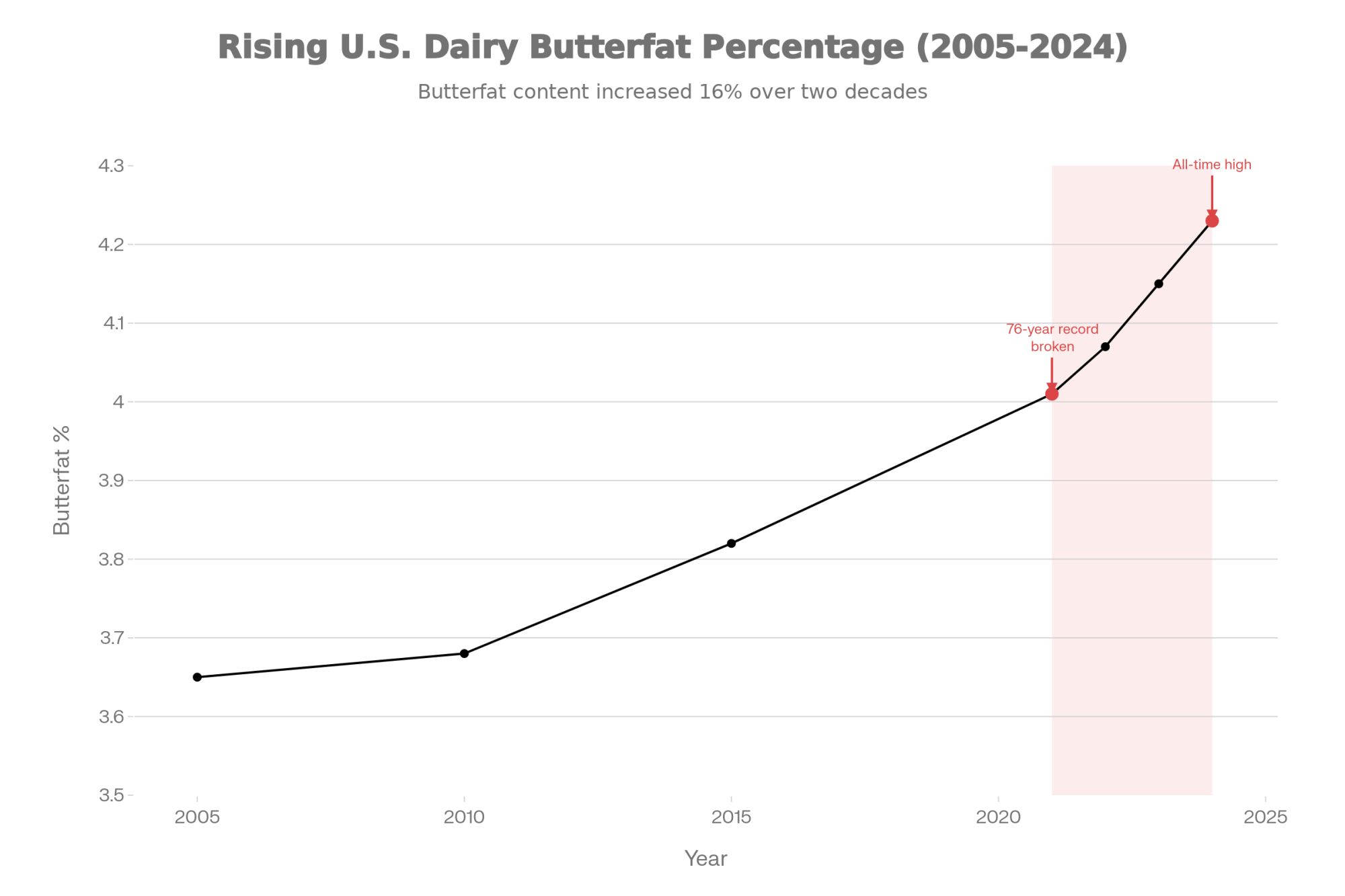
NewsSubscribe
First
Last
Consent

Beat the Heat: How Elite Dairies Are Weaponizing Genetics and Smart Tech to Turn Summer into Profit

Stop believing the 80°F heat stress myth. New research proves 68°F THI destroys milk yield while elite dairies profit from thermal genetics.

Heat stress isn’t just stealing your milk check – it’s sabotaging your genetics for generations while your competitors master the integration of heat-tolerant genomics, precision cooling, and smart monitoring to protect $700 per cow annually. With University of Illinois research documenting $245 million in industry losses and climate projections showing 100-300 annual heat stress days by 2050, the operations that crack the heat stress code will dominate markets while others watch profits evaporate. The difference? A systematic approach combining SLICK gene selection, precision THI monitoring, and facility integration that delivers compound returns protecting both immediate cash flow and generational genetic potential.

Summer heat hits dairy operations like a poorly timed breeding decision – the damage compounds for years after you think the problem’s over. While you’re debating whether 75°F “feels hot,” your highest-producing genetics are already gasping like fresh heifers in their first lactation.

Here’s a question that should shake you out of your comfort zone: What if your grandfather’s heat management wisdom is actually bankrupting your operation one summer day at a time?

A groundbreaking University of Illinois study analyzing over 56 million production records from 18,000 dairy farms revealed heat stress led to a cumulative loss of approximately 1.4 billion pounds of milk over five years, costing the industry a staggering $245 million in revenue (Extreme heat impacts dairy production, small farms most vulnerable). But here’s what should really keep you awake at night – that heat-stressed dry cow panting under inadequate cooling isn’t just costing this lactation. She’s programming her daughter’s genetic potential backward by decades.

Why Your Industry Leaders Have Been Lying About Heat Thresholds

The Industry’s 80°F Heat Stress Myth vs Scientific Reality
Threshold TypeTHI ValueTemperature at 50 RHImpact Level
Traditional Industry Claim8084Mild concern
High-Producing Holstein Reality6868Production decline begins
Research Consensus7275Heat stress confirmed
Emergency Level8489Emergency

Here’s the industry’s most expensive deception: waiting until 80°F to worry about heat stress. Modern-day breeds of dairy cattle are the result of intensive genetic selection aimed primarily at increasing milk productivity, but this increased productivity is genetically linked to physiological traits such as greater metabolic rates and increased feed intake, both of which augment endogenous heat generation, making high-productivity breeds particularly susceptible to heat stress (Global projections of heat stress at high temporal resolution).

The brutal truth that breeding companies don’t want to discuss: While they’ve marketed genetic progress in milk production, they’ve simultaneously created thermal disasters waiting to happen. Every additional pound of milk production generates increased metabolic heat, yet no major breeding company has prominently featured heat tolerance in their marketing materials until recently.

Why This Matters for Your Operation: Your best genetics – the ones with superior genomic estimated breeding values for production traits – suffer thermal stress at just 68°F Temperature Humidity Index while you’re still comfortable in short sleeves. Heat stress causes behavioral changes, including increased water intake and reduced dry matter intake, along with physiological responses, including electrolyte imbalances, acid-base disruptions, respiratory alkalosis with metabolic acidosis, and disturbances in sodium homeostasis (Heat Stress in Dairy Cows: Impacts, Identification, and Mitigation).

Consider this economic reality: A 500-cow operation experiencing just 30 days of inadequate heat management at 70°F THI could lose 150,000 pounds of milk annually. At current pricing, that’s $31,650 in lost revenue – enough to fund significant cooling infrastructure improvements that most operations refuse to make.

How the Genetics Industry Created This Thermal Crisis

Here’s the uncomfortable truth your AI technician won’t tell you: The same genetic selection that created your high-producing herd also engineered thermal vulnerability into every animal. For small farms, taking a 1.6% hit is equivalent to operating unpaid for nearly six days yearly solely because their cows are overheating (Small Dairy Farms Suffer more from Heat Stress), while large operations with sophisticated cooling systems maintain more stable production levels.

However, the most progressive operations have discovered something revolutionary: genomic selection for heat tolerance reduces thermal stress and improves overall animal efficiency. Research published in Nature demonstrates that dairy cattle predicted by genomic breeding values to be heat tolerant have less decline in milk production and reduced increases in core body temperature during simulated heat wave events compared to cows predicted to be heat susceptible (Genomic Selection Improves Heat Tolerance in Dairy Cattle).

Cooling System Return on Investment Comparison
Genetic TypeRumen Temperature Reduction CelsiusMilk Production Advantage PercentReproductive PerformanceHeat Tolerance RatingEconomic Benefit Per Cow
SLICK Gene Carriers0.7515Superior9700
Non-SLICK Controls00Standard50

The SLICK gene represents the most dramatic single-gene solution discovered so far. LIC New Zealand research found that cows carrying the SLICK gene had lower rumen temperatures (0.5-1.0°C) compared to their non-SLICK counterparts when the Temperature Humidity Index exceeded 73 (SLICK – developing heat tolerant dairy animals). After 9 years of breeding, LIC now has SLICK sires with breeding worth approaching that of the best dairy sires in the New Zealand industry, with only 1/32nd average content of Senepol genes (SLICK – developing heat tolerant dairy animals).

Are you breeding for production at the expense of thermal resilience? This question challenges every genetic selection decision you’ve made while your breeding company representatives focus solely on milk, fat, and protein numbers.

Validated genetic markers beyond SLICK include SNPs in the TLR4, GRM8, and SMAD3 genes, which are proven predictors of both milk production and thermotolerance in heat-stressed Holstein cows (Genetic Markers Associated with Milk Production and Thermotolerance). Heat-stressed Holstein cows with favorable markers were able to reduce rectal temperature and respiratory rate, which allowed them to maintain adequate milk production levels (Genetic Markers Associated with Milk Production and Thermotolerance).

What Your Cooling Strategy Consultant Isn’t Telling You

Here’s the uncomfortable truth about your current cooling strategy: You’re probably spending more on genetic testing with less ROI than you’d get from proper cooling infrastructure. Most operations are still managing heat stress like it’s 1995, relying on basic fans and hoping for mild summers.

The economic reality is brutal but clear: While breeding companies charge thousands for genomic testing that may or may not improve production, comprehensive cooling infrastructure delivers measurable returns through avoided production, reproductive, and health losses. Yet most operations resist investing in proven cooling technologies while eagerly purchasing genetic products with uncertain outcomes.

Cooling SystemPayback Period YearsBenefit Cost RatioInvestment Per CowAnnual Return Per Cow
Dry Cow Cooling (existing barn)0.273.15150556
Dry Cow Cooling (new barn)5.681.452000352
Tunnel Ventilation3.21.75332175
Basic Fan Systems2.11.25100125
Precision Soaking1.82200222

Precision cooling isn’t about more fans but strategic placement and timing. Advanced soaking systems can reduce water usage by 50-70% compared to traditional setups while providing more effective cooling through precision cycling – short, effective soaking periods (30-45 seconds) followed by longer fan-only drying periods (4-5 minutes) (Heat Stress 2.0: Why Your Current Cooling Strategy Is Costing You Big Money).

Why This Matters for Your Operation: Every degree above 68°F THI costs you money through reduced milk production, compromised reproduction, and increased health problems. Yet most operations wait for visible panting before implementing cooling measures – by then, significant economic damage has already occurred.

Can Technology Predict What Your Eyes Can’t See?

What if you could detect heat stress 24 hours before your cows show any visible symptoms? Recent advances in sensor technologies and wireless transmission enable body surface temperature and respiration rate measurement through wearable devices, providing real-time monitoring for heat strain-related data (Recent Advances on Early Detection of Heat Strain in Dairy Cows).

Current research in New Zealand uses on-farm technology, including sensory data collected from collars and rumen boluses, to understand individual cow heat stress responses, identifying indicators such as respiration rate, eating and drinking patterns, activity levels, rumination, and rumen temperature (Heat Stress and Technology).

Visual indicators of heat stress in dairy cows, including increased respiratory rates, restless behavior, and oral symptoms like open-mouth breathing and drooling

Body surface temperature and respiration rate are concluded to be the best early indicators of heat strain due to their high feasibility of measurement and sensitivity to heat stress (Recent Advances on Early Detection of Heat Strain in Dairy Cows). Combined with the internet of things technologies, comprehensive strategies based on both animal- and environment-based indicators are expected to increase the precision of early detection (Recent Advances on Early Detection of Heat Strain in Dairy Cows).

But here’s what technology vendors won’t tell you: The existing thresholds should be used carefully considering differences in experimental conditions and animal information, with further studies required to evaluate and customize thresholds based on different influencing factors (Recent Advances on Early Detection of Heat Strain in Dairy Cows).

Why Small Farms Are Systematically Being Eliminated

Time PeriodHeat Stress Days Per YearMilk Loss Increase PercentSmall Farm VulnerabilityEconomic Impact Billions
2020s Current450High1.2
2030s Projection6515Very High1.8
2040s Projection8525Critical2.4
2050s Projection12030Severe3.1

Here’s the uncomfortable truth the industry won’t discuss: Heat stress is systematically eliminating small family farms while corporate operations invest millions in climate-controlled facilities. University of Illinois research found that while average milk yield losses due to heat stress amount to about 1% annually, smaller farms see nearly twice this loss (Small Dairy Farms Suffer more from Heat Stress).

“To some extent, it’s only 1.6%. But if you’re really making every dollar from your paycheck count because you’re living in a time with high costs, then 1.6% of your paycheck being gone in a given year is meaningful,” explains study co-author Marin Skidmore (Small Dairy Farms Suffer more from Heat Stress).

Are we creating a system where only corporate dairies can afford to stay cool? This question should challenge every policy maker and industry leader who claims to support family farming while promoting genetic selection strategies that increase thermal vulnerability.

The economic barriers are real: Having access to enough capital to make really big investments is difficult, and grants or loans to help small farms adopt management technologies could be one avenue to help small farms cope with heat stress and keep them competitive (Small Dairy Farms Suffer more from Heat Stress).

The consolidation pressure created by heat stress management costs is fundamentally reshaping American dairy farming. While large operations can justify $75,000+ investments in precision cooling, small farms need cost-effective solutions that don’t require corporate-level capital – yet the industry provides few viable options.

Tunnel ventilation system featuring a row of large fans installed on the side of a dairy barn to combat heat stress 

The Real Cost of Genetic Sabotage in Your Maternity Pen

Here’s the genetic sabotage happening in your maternity pen right now: Heat-stressed dry cows program their daughters for lifetime underperformance through epigenetic mechanisms that affect mammary development, immune function, and metabolic efficiency.

The mathematical brutality is staggering: Research documents that heat-stressed daughters produce significantly less milk throughout their productive lives. An 8-pound daily reduction across a 305-day lactation equals 2,440 pounds of lost milk per daughter. At current pricing, that’s $515 in lost revenue per lactation – before considering reproductive impacts, longevity effects, and component losses.

Heat stress can lead to reduced mammary growth during the dry period, with increased prolactin concentration causing decreased expression of prolactin receptor genes in the mammary gland, liver, and lymphocytes, resulting in impaired lactogenesis and reduced milk production in subsequent lactations (Heat Stress in Dairy Cows: Impacts, Identification, and Mitigation).

Every pregnant cow panting under inadequate cooling isn’t just costing this lactation – she’s programming her daughter’s genetic potential backward by decades. Yet most operations focus on immediate cooling comfort rather than protecting long-term genetic investments.

The Bottom Line: Your Competitive Future Depends on Decisions You Make Today

Heat stress management has evolved from seasonal comfort measures into sophisticated systems determining competitive survival. With global projections showing increasing heat stress frequency and intensity, thermal resilience separates industry leaders from casualties. The study projects that the frequency of extreme heat days will increase, potentially raising milk yield losses by about 30% within the next 25 years (Small Dairy Farms Suffer more from Heat Stress).

Your action plan starts now:

  1. Challenge your genetic selection strategy – demand heat tolerance data from your breeding company and prioritize SLICK gene carriers alongside production traits
  2. Calculate your thermal losses honestly – quantify production drops, reproductive impacts, and component losses during heat events using verified THI data
  3. Invest in precision cooling with proven ROI – move beyond basic fans to systems delivering measurable returns through strategic placement and timing
  4. Implement early warning monitoring – detect thermal stress 24 hours before visible symptoms devastate performance and genetic potential
  5. Protect genetic investments systematically – ensure comprehensive dry cow cooling to prevent generational performance sabotage

Here’s the critical question every dairy manager must answer: Are you building thermal resilience into your operation’s DNA, or are you gambling your genetic future on increasingly unreliable weather patterns while your breeding company profits from thermal vulnerability?

The choice is stark: invest in comprehensive thermal management now or watch genetic potential and profit margins evaporate with every heat wave. The most successful operations have already been decided. They’re building herds that thrive when others merely survive, creating generational competitive advantages that compound with every breeding decision.

Climate change isn’t slowing down. With modern genetics suffering thermal stress at 68°F THI and projections showing dramatic increases in extreme heat events, thermal resilience is no longer optional – it’s survival. The technology exists. The genetics are available. The research is conclusive. The only question is whether you’ll implement comprehensive heat management before your competition does or whether you’ll be another casualty of an industry that is bred for production while ignoring the thermal consequences.

In five years, the operations that master thermal resilience today will set milk prices while others struggle to survive another summer. The genetic sabotage happening in your maternity pen right now will determine whether your operation thrives or merely survives the climate challenges ahead.

KEY TAKEAWAYS

  • Genetic Selection Revolution: SLICK gene carriers maintain 0.5-1.0°C lower rumen temperatures when THI exceeds 73, while genomic selection for heat tolerance improves feed efficiency (+0.45 correlation) and fertility (+0.25 correlation) alongside thermal resilience
  • Economic Survival Strategy: Comprehensive cooling infrastructure delivers 5.67-year payback with 1.45 benefit-cost ratio, while tunnel ventilation justifies $332 per cow space investment through measurable milk loss prevention compared to basic fan systems
  • Technology-Driven Early Detection: Advanced sensor systems detect heat stress 24 hours before visible symptoms through body surface temperature and respiration monitoring, preventing production losses before they devastate milk checks and genetic potential
  • Generational Genetic Protection: Heat-stressed dry cows program daughters for lifetime underperformance (8-10 pounds daily reduction), costing $515 per lactation in lost revenue while compromising genetic investments made through genomic testing and superior sire selection
  • Industry Consolidation Reality: Small farms face systematic elimination as heat stress costs require corporate-level capital investments, creating urgent need for cost-effective thermal management solutions that protect family farming operations from climate-driven consolidation pressure

EXECUTIVE SUMMARY

Your breeding company has been selling you genetic disasters disguised as production improvements, creating cattle that suffer thermal stress at just 68°F while marketing 80°F comfort zones. University of Illinois research analyzing 56 million production records revealed $245 million in industry losses, with small farms losing 1.6% of annual yield – equivalent to working unpaid for six days yearly because their cows can’t handle heat. Elite operations are weaponizing SLICK gene carriers and heat tolerance genomic breeding values to maintain production while competitors watch profits evaporate with every heat wave. LIC New Zealand proves you don’t sacrifice production for thermal resilience, developing SLICK sires with breeding worth approaching top industry performers using only 1/32nd Senepol genetics. With climate projections showing 100-300 annual heat stress days by 2050, thermal resilience separates tomorrow’s market leaders from casualties. Stop gambling your genetic future on increasingly unreliable weather patterns and start building herds that thrive when others merely survive.

Learn More:

Join the Revolution!

Join over 30,000 successful dairy professionals who rely on Bullvine Weekly for their competitive edge. Delivered directly to your inbox each week, our exclusive industry insights help you make smarter decisions while saving precious hours every week. Never miss critical updates on milk production trends, breakthrough technologies, and profit-boosting strategies that top producers are already implementing. Subscribe now to transform your dairy operation’s efficiency and profitability—your future success is just one click away.

NewsSubscribe
First
Last
Consent

AI for AI: Why Your Breeding Program Might Be Stuck in the Dark Ages

AI isn’t just tech jargon—it’s revolutionizing dairy breeding. Farms ignoring it risk falling behind as competitors harness genetic precision and profit.

AI dairy breeding, genomic selection, dairy herd management, precision breeding, dairy farm technology

Artificial intelligence isn’t just transforming tech industries—it’s revolutionizing dairy breeding by delivering unprecedented precision in genetic selection, reproductive management, and health monitoring. Yet most farms continue using outdated breeding approaches based more on tradition than data. The uncomfortable truth? If you’re not leveraging AI in your breeding program today, you’re almost certainly leaving money on the table while your more progressive neighbors race ahead.

The acronym “A.I.” has long been familiar to dairy farmers worldwide—standing for artificial insemination, a cornerstone technology that transformed breeding programs decades ago. But today, there’s a new “AI” making waves across dairy farms—artificial intelligence—and its impact promises to be even more revolutionary than its namesake.

I recently witnessed this revolution firsthand while sitting at a farm management meeting. The dairy was progressive and forward-thinking, bringing together experts from various fields. After discussing issues tied to health, fertility, and milk production—looking at all potential causes and solutions—they began considering what set them apart from other dairies in the area.

The conclusion hit like a heavy blow: their genetics were poor. Despite all their effort, precision, and good planning, they would still achieve poorer outcomes than their neighbors simply because their genetics were weaker on average.

This reality check highlights why using the best tools available for your breeding program is critical. As someone once told me, “Always fight fairly, but don’t accept fair fights. Make sure you have an edge to win.” If your genetics aren’t strong, you’re starting with a disadvantage that’s hard to overcome.

Let’s be brutally honest: most dairy farmers still make breeding decisions like a decade ago, while the industry’s innovators have moved light-years ahead with AI-powered approaches.

Finding Hidden Inbreeding with Precision That Counts

Inbreeding is the silent productivity killer lurking in many herds, influencing everything from fertility to disease resistance. And it’s not always obvious—even with careful pedigree analysis, subtle genetic relationships can slip through undetected.

This is where AI’s pattern recognition capabilities shine. By analyzing complete genomic data, AI can identify obvious and hidden genetic similarities between animals, uncovering inbreeding risks that traditional methods miss entirely.

The stakes couldn’t be higher. Holstein cows already have extremely limited genetic diversity—equivalent to having just 100-150 animals in the entire breed’s gene pool. Recent research from industry analyses published in The Bullvine reveals a troubling trend: genomic inbreeding (FROH) in elite Holstein bulls skyrocketed from approximately 5.7% in 2010 to 15.2% in 2020, while the number of active AI sires plummeted by 61%—from 2,734 to just 1,079—creating what experts call a “dangerous genetic bottleneck” that threatens the long-term viability of the breed.

The economic impact? According to studies published in peer-reviewed journals such as the Journal of Dairy Science, each 1% increase in inbreeding has been associated with decreases in lifetime milk production by 177-400 pounds and a reduction in Net Merit by $23-$25. A cow with 15% genomic inbreeding compared to one at 5% could translate to a lifetime profit loss of $1,035-$1,890.

Why traditional inbreeding detection falls short

Traditional pedigree-based inbreeding calculations (FPED) have significant limitations. They rely on the completeness and accuracy of pedigree information and can’t capture the actual extent of homozygosity resulting from distant common ancestors or Mendelian sampling.

AI-powered genomic tools provide a more precise measure through what geneticists call “Runs of Homozygosity” (ROH)—contiguous segments of homozygous genotypes in an individual’s DNA. The cumulative length of these segments gives a direct and accurate measure of an animal’s true inbreeding level (FROH).

Have you looked beyond your pedigree-based inbreeding calculations lately? The genetic time bomb ticking in your herd might not show up until it explodes into fertility problems and production losses.

While natural or artificial selection may eventually purge harmful recessive mutations from a population over time, recent inbreeding is especially damaging because newer harmful mutations haven’t had sufficient time to be eliminated. Researchers from the Netherlands demonstrated in their study of Dutch Holstein-Friesian cattle that recent inbreeding is considerably more harmful than ancient inbreeding. AI helps track recent genetic relationships and spot inbreeding risks early, reducing the chance of problems like lower health, fertility, and productivity.

By removing the guesswork, AI offers farmers actionable insights that allow them to act quickly, maintaining essential genetic diversity while still making rapid genetic progress.

Predicting Genetic Outcomes: The Crystal Ball of Breeding

Imagine identifying which bulls will sire the next generation of productive, healthy cows, taking your farm’s specific environment into account. This isn’t science fiction—it’s what AI-powered genomic prediction is already delivering.

Let’s confront an uncomfortable truth: your “expert eye” for selecting animals isn’t nearly as good as you think it is. Dairy farmers are no strangers to making breeding decisions based on a blend of experience, intuition, and instinct. Many breeding companies already use genetic data to predict breeding outcomes. But AI takes this to an entirely new level by integrating genetic information and epigenetics, gene expression, and environmental factors—all while continuously refining its predictions through machine learning.

The proof is in the numbers. The annual genetic gain for Net Merit ($NM) in U.S. Holstein bulls surged from an average of just $13.50 per year during the traditional progeny testing era (2000-2004) to a remarkable $83.33 per year in the genomic era (2010-2022), as documented by research from the USDA Agricultural Research Service. That’s a six-fold increase in the rate of genetic improvement.

Charlie Will from Select Sires shared a compelling study in which he ranked bulls solely on genomic results and then tracked their actual daughter performance. The findings were remarkable—bulls predicted to be in the lowest quartile of their class never finished in the top quartile and vice versa. This predictive power translates directly into more efficient breeding decisions.

When was the last time you truly evaluated your breeding program’s rate of genetic gain? Are you sure you’re keeping pace with industry leaders, or are you falling further behind each year while telling yourself that your tried-and-true methods are good enough?

Fueled by genomics and biological data, AI can analyze complex patterns that would take years for humans to decipher. By integrating data from genomics, epigenetics, and gene expression, AI can predict traits like milk yield, udder health, and even temperament with unprecedented precision.

Optimizing Breeding Decisions: The Ultimate Strategy

If we can predict genetic outcomes accurately, why not optimize our choices between conventional, sexed, and beef semen? This is where AI shines by helping you develop a comprehensive breeding strategy tailored to your herd goals.

One of the economic risks of using beef-on-dairy is the potential reduction in heifer inventory, which can leave your dairy without adequate replacements for future milk production. AI can mitigate this risk by forecasting the genetic potential of your current replacement animals, ensuring a steady supply of genetically superior animals.

By optimizing breeding decisions, AI helps balance the need for beef calves—often used to capture premium markets—while maintaining a strong inventory of replacement heifers to keep your dairy operation sustainable.

Genetic Merit LevelBest Semen ChoiceExpected Outcome
Top 25%Sexed DairyMaximize genetic progress with high-quality replacement heifers
Middle 50%ConventionalBalance between replacements and operating cost
Bottom 25%BeefPremium crossbred calves with higher market value

A case study in accelerated genetic gain

Consider this compelling example from New Zealand: By combining genomic selection with strategic use of sex-selected semen on the top 50% of heifers (ranked by Breeding Worth), a dairy operation achieved in just three years what would have traditionally taken approximately eight years of genetic progress.

The predicted genetic gain increased from 184 to 384 BPI points, translating to an estimated financial benefit of NZD 72.96 per animal per year. Multiply that across an entire herd, and you’re looking at a substantial return on investment.

Are you still applying the same semen strategy to your entire herd? If so, you’re almost certainly wasting money on sexed semen for poor-genetic-merit animals while missing opportunities to maximize the value of your best genetics.

Uncovering Hidden Problems in Your Breeding Program

Sometimes, despite our best efforts, something’s off in the breeding program. Cows might not be getting pregnant as efficiently, or perhaps milk production or components are holding you back. It’s hard to pinpoint the issue without a deep dive into the data. This is where AI becomes a game changer.

AI can analyze thousands of variables—from cow health data to environmental factors to industry comparisons—and highlight patterns or anomalies that point to underlying issues. Maybe it’s a problem with heat detection or a genetic bottleneck you didn’t know existed.

Unlike human analysis, which can be subjective and limited by the number of factors we can mentally juggle, AI excels at finding needles in haystacks of data. It can detect subtle relationships between variables that might otherwise go unnoticed.

The industry’s secret is that most farms operate with significant inefficiencies they don’t even know exist. The days of relying solely on hunches are behind us—AI helps solve the puzzles we can’t see, helping you take corrective action before small issues snowball into bigger challenges.

Determining Voluntary Waiting Period with Data, Not Guesswork

One of the most challenging decisions in breeding is determining the right voluntary waiting period (VWP) for each cow in your herd and the optimal age at which to breed heifers.

If the period is too short, you might negatively affect the cow’s productivity in subsequent lactations and lose valuable milk. You lose valuable production time in the next lactation if it’s too long. This delicate balance has traditionally been managed with blanket herd policies that fail to account for individual animal variations.

Why are we still applying the same voluntary waiting period to every cow in the herd when we know each animal responds differently based on their genetic makeup, health history, and production level?

Think about it: you’ve got Cow A, a high-producing, second-lactation Holstein, cycling back strong at 30 DIM, practically begging to be bred. Next to her is Cow B, a first-calver still fighting her way out of negative energy balance at 50 DIM. Does a blanket 60-day VWP make a lick of sense for both? AI doesn’t just suggest “no”; it screams it, and the missed milk cheques or added days open are the proof.

Research from groups like Lactanet indicates extending the VWP can improve first-service conception rates, particularly in first-lactation animals. However, it may also delay the overall time of pregnancy for some cows. AI systems now help determine the optimal VWP based on each cow’s unique health, recovery, and performance data. By analyzing individual cow data in real-time—including genetic potential, health history, current body condition score, and recent production patterns—AI helps eliminate guesswork and enables well-informed, data-backed decisions that can be fine-tuned for each animal.

The real breakthrough comes from AI’s ability to dynamically assess which animals would benefit most from different reproductive approaches. For instance, cows exhibiting strong, early estrous activity during the VWP and having good health status might be eligible for insemination sooner. In contrast, cows that have experienced health issues or are in poor body condition might benefit from an extended VWP.

Comparing Actual Outcomes with Genomic Predictions

Most farmers use some form of genetic data to guide decisions aimed at optimizing future performance. But how often do we truly know if the predictions hold true in the real world?

What if AI could consider your specific environmental situation? For instance, a cow that might thrive under heat stress might not perform well in a cold-weather climate. By comparing actual farm outcomes with predictions made using parentage or genomic data, AI can help you assess the true outcomes of your breeding decisions.

How do your actual milk yield, fertility rates, and cow longevity compared to the predicted values derived from genomics? AI will help you refine these decisions over time, tailoring them specifically to your farm, your management style, and your environmental conditions.

Your farm isn’t a textbook operation, so why are you still using textbook solutions? This creates a powerful feedback loop that allows you to continuously improve your breeding strategy, ensuring you’re making the most accurate and efficient decisions possible.

Early Warning Systems: Detecting Disease and Distress Before Clinical Signs

Beyond breeding decisions, AI is revolutionizing how we monitor animal health and welfare. AI algorithms continuously analyze diverse data streams collected from various sensors (monitoring parameters like activity levels, body temperature, rumination patterns, and feeding behavior) to recognize when an animal deviates from its normal patterns.

The results are impressive: research published in Dairy Global demonstrates that machine learning models have achieved the ability to predict mastitis cases with accuracies as high as 72%. In comparison, deep learning network models have shown an average accuracy of 96.1% in mastitis detection. The Lactanet milk quality monitoring system, which incorporates AI, reportedly led to a 25% reduction in mastitis incidence through early detection and targeted interventions.

Similarly, AI systems have proven effective in identifying cows at high risk of metabolic disorders. At the same time, computer vision techniques can detect illness based on subtle changes in facial expressions or features that human observers might miss.

This capability for early detection allows for prompt, often less invasive interventions that can significantly reduce the severity and duration of illnesses, minimize associated production losses, lower treatment costs, and enhance animal welfare by alleviating suffering more rapidly.

We’re still diagnosing disease through visual observation when technology can detect health issues days before we see the first clinical sign. How many cases of mastitis or ketosis could you prevent if you knew they were coming 48-72 hours in advance?

From Monitoring to Personalized Care

The rich, multi-modal data collected and analyzed by AI systems paves the way for truly personalized animal management. By combining an animal’s genetic predispositions, health history, real-time physiological data, behavioral patterns, and environmental conditions, AI can help construct comprehensive, individualized health risk profiles and management plans for each animal in the herd.

This capability allows for the development of tailored veterinary care plans where preventative measures, diagnostic approaches, and treatment protocols are customized to each animal’s specific needs, risks, and predicted responses rather than applying a generalized, herd-level strategy.

The ability to provide this level of individualized care at scale—something previously impossible without AI—creates tremendous value for breeding programs. Animals that receive personalized care can express their genetic potential better, providing more accurate phenotypic data for subsequent genetic evaluations and breeding decisions.

Looking to the Future: Advanced Phenotyping and Novel Trait Selection

AI is pushing the boundaries of what’s possible in phenotyping—the measurement of physical and behavioral traits—allowing breeders to select for characteristics that were previously difficult or impossible to measure effectively.

Computer vision systems employing 2D and 3D cameras, thermal imaging, and various sensors collect detailed data that AI algorithms then process to extract meaningful phenotypic information.

These systems enable automated, non-invasive, and high-throughput assessment of complex traits like feed efficiency, methane emissions, heat tolerance, and behavioral characteristics. For example, machine learning models have demonstrated high accuracy (R²>0.9) in predicting body mass and condition score from morphological measurements obtained via imaging.

The ability to measure and select for previously intractable complex traits fundamentally expands the range of characteristics available for genetic improvement. By moving beyond traditional production traits to include welfare indicators, environmental impact factors, and resilience measures, AI is helping dairy breeding programs address the multifaceted demands of future farming systems.

What This Means for Your Operation

ROI Potential: Inbreeding Management

For a 100-cow herd with average genomic inbreeding of 10%, implementing AI-driven mating strategies to reduce inbreeding by just 3% could deliver:

  • Increased milk production: +681 pounds per cow per lactation
  • Improved fertility: -2.7 days open per cow
  • Financial impact: +$23,000-$25,000 herd-wide annually

This conservative estimate doesn’t include additional benefits from improved health, reduced calf mortality, and enhanced longevity.

Practical Steps: Implementing AI in Your Breeding Program

Despite its tremendous potential, the widespread adoption of AI in dairy breeding faces significant challenges that must be addressed. Here are practical steps you can take to begin implementing AI technologies in your operation:

  1. Start with data integration: The first step is to ensure your various data sources—milk recording, health records, reproductive data, genetic information—are accessible in formats that can be integrated and analyzed.
  2. Partner with progressive genetic providers: Work with breeding companies that are actively incorporating AI into their genetic evaluation systems and can provide farm-specific recommendations.
  3. Invest in sensor technologies: Consider implementing automated activity monitoring systems, rumination sensors, or other technologies that provide continuous data streams that AI can analyze.
  4. Begin with focused applications: Rather than trying to implement all aspects of AI at once, start with a specific challenge area, such as improving reproductive efficiency or reducing mastitis incidence.
  5. Build internal capacity: Invest in training for yourself and your staff to better understand and utilize the insights generated by AI systems.
  6. Collaborate with other producers: Form or join discussion groups with other progressive farmers who are implementing similar technologies to share experiences and lessons learned.

The Bottom Line: Are You Leading or Following?

The dairy industry is rapidly dividing into two groups: those who embrace AI technologies and those who will eventually be forced to catch up or be left behind. Our mission must be to transform AI from a mere buzzword into a powerful tool—a “cheat code” that helps dairy farmers achieve their visions for their herds.

AI allows farmers to make smarter, data-driven choices that improve herd health, boost productivity, and enhance profitability. With AI’s ability to analyze vast amounts of data, we’re not just working harder—we’re working smarter to unlock the full potential of dairy farming.

The potential of AI in breeding programs is immense. It’s a game changer for dairy farmers and will only improve. Beyond breeding, AI has the potential to revolutionize other areas of dairy farm management. For example, automation of classification for type traits traditionally done by technicians could be standardized through AI and camera systems, eliminating technician bias and variations in data collection.

Where will your farm be in five years? Leading the pack with cutting-edge AI technologies or scrambling to implement what your competitors have already mastered?

As we look to the future, the question isn’t whether AI will play a role in dairy farming but how quickly we can harness its power to transform the industry. By embracing AI today, we can unlock a brighter tomorrow for dairy farmers, where data-driven decisions drive success and innovation meets tradition to create a more sustainable, productive, and profitable future.

Take action now: Identify one aspect of your breeding program that could benefit from AI enhancement and take the first step this week. Whether it’s exploring genomic testing for your herd, implementing an activity monitoring system, or connecting with a progressive genetics provider, the time to start is today. The farms that embrace AI technologies now will likely be the industry leaders of tomorrow, enjoying competitive advantages in productivity, sustainability, and profitability that traditional approaches simply can’t match. Don’t get left behind in this breeding revolution—the future of dairy is intelligent, and that future is already here.

Key Takeaways:

  • AI detects genomic inbreeding risks traditional methods miss, preventing $1,890+/cow lifetime losses
  • Accelerates genetic gain 6x through precise genomic predictions (Net Merit $83 vs $13/year pre-AI)
  • Customizes reproductive strategies using real-time data – optimizes VWP, semen choices, and $72/head/year returns
  • Identifies subclinical health issues 48hrs before visible symptoms through sensor pattern analysis
  • Transition from “gut-feel” breeding to AI-powered decisions is now critical for herd competitiveness

Executive Summary:

Artificial intelligence is transforming dairy breeding through six game-changing applications: detecting hidden inbreeding with genomic precision, predicting genetic outcomes like milk yield and fertility, optimizing semen strategies, uncovering herd management blind spots, personalizing voluntary waiting periods, and validating genomic predictions against real-world performance. By analyzing vast datasets from sensors, genomics, and farm records, AI enables data-driven decisions that accelerate genetic progress by 6x compared to traditional methods while preventing costly inbreeding pitfalls. Early adopters gain significant competitive advantages in productivity and profitability, while lagging farms face mounting genetic bottlenecks and missed revenue opportunities. The article urges producers to implement AI tools now to future-proof their operations.

Learn more:

Join the Revolution!

Join over 30,000 successful dairy professionals who rely on Bullvine Weekly for their competitive edge. Delivered directly to your inbox each week, our exclusive industry insights help you make smarter decisions while saving precious hours every week. Never miss critical updates on milk production trends, breakthrough technologies, and profit-boosting strategies that top producers are already implementing. Subscribe now to transform your dairy operation’s efficiency and profitability—your future success is just one click away.
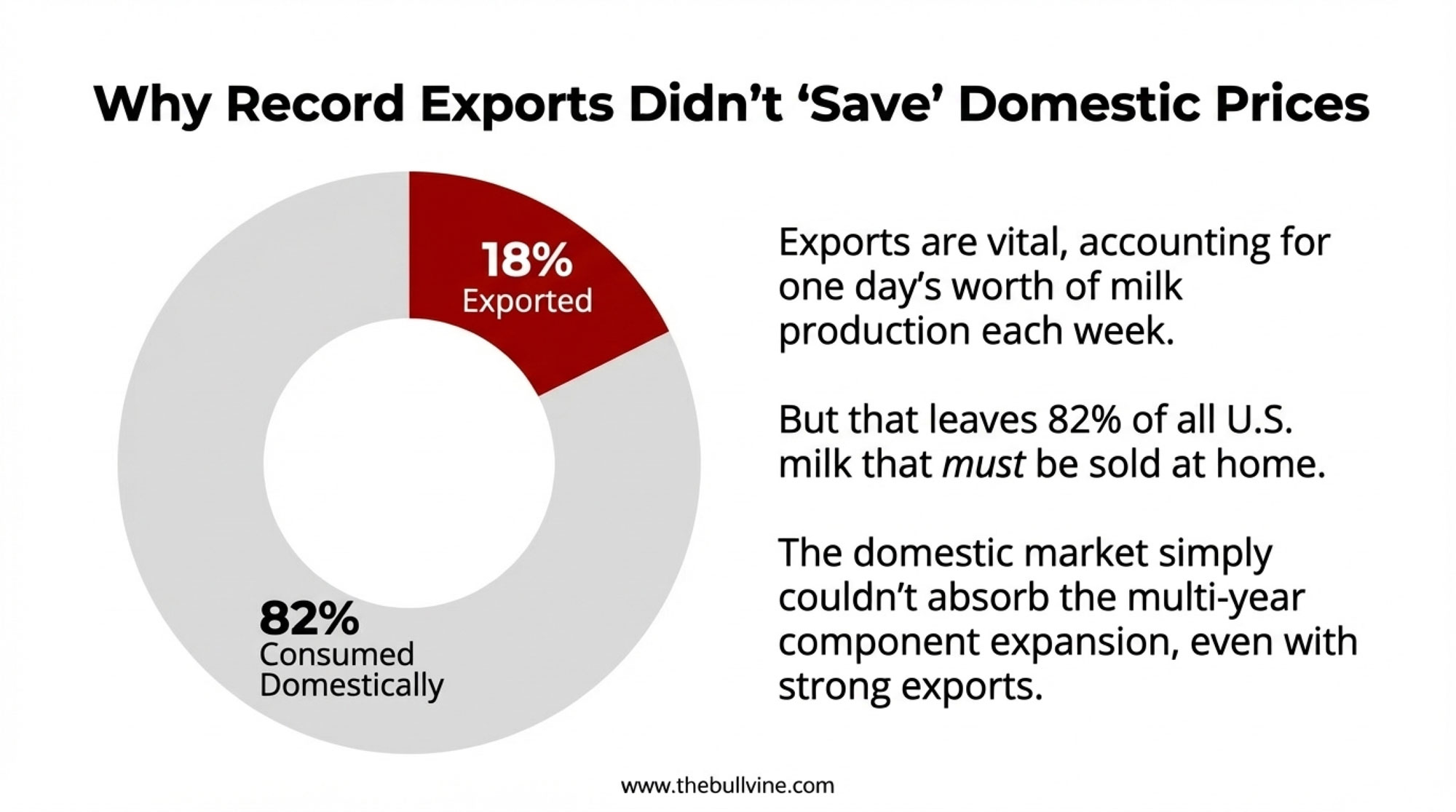
NewsSubscribe
First
Last
Consent

Breeding for the Win: From Kentucky Derby Champions to World Dairy Expo Grand Champions

Kentucky Derby champs hold genetic secrets for breeding World Dairy Expo royalty. Outpace competitors with track-tested breeding strategies.

The pursuit of championship excellence isn’t limited to one species. The genetic principles that create Kentucky Derby winners hold powerful lessons for dairy breeders aiming to produce the next World Dairy Expo Grand Champion. Those who master these cross-species strategies will be milking champions while the competition struggles with mediocrity. It’s the difference between filling your barn with cows that command attention or settling for a herd that barely pays the bills.

Secretariat, the legendary 1973 Triple Crown winner, represents the pinnacle of Thoroughbred genetic selection. His record-setting performances at the Kentucky Derby, Preakness, and Belmont Stakes demonstrate how elite <a href='https://www.thebullvine.com/mating-recomendations/16-sires-dairy-breeder-accelerate-genetic-gain-herd/' data-lazy-src=

Breeding Champions: A Tale of Two Species

Let’s be honest – what dairy breeder hasn’t dreamed of leading the Supreme Champion across the colored shavings at the World Dairy Expo? That moment when Judge Brian Carscadden or Pat Conroy raises their hand in your direction represents the pinnacle of breeding achievement, just as the Kentucky Derby winner’s circle does for Thoroughbred breeders. While these animals couldn’t appear more different, the genetic principles behind creating champions share striking similarities.

Pursuing genetic excellence in both arenas represent mankind’s highest achievement in selective breeding. It’s about identifying, selecting, and combining elite genetics with precision and purpose. But here’s the wake-up call: Thoroughbred breeders have been refining their craft since the 1700s and some of their strategies could revolutionize your dairy breeding program faster than a fresh heifer lets down her milk.

What’s fascinating is how these seemingly different worlds – dirt tracks and box stalls – follow parallel paths in the quest for genetic superiority. By examining what makes Kentucky Derby winners and applying these insights to dairy cattle, you gain a competitive advantage that most breeders overlook, like having access to sexed semen when everyone else is still using conventional.

Brookview Tony Charity-widely hailed as the greatest show cow of all time-claims the Supreme Champion title at World Dairy Expo, setting a standard for genetic excellence and show ring dominance that breeders still chase today.

From Foundation Sires to Genomic Revolutions

Thoroughbreds and dairy cattle traced their excellence to foundational breeding decisions centuries ago. The Thoroughbred originated from three foundation stallions that forever transformed horse racing – the Byerley Turk, Darley Arabian, and Godolphin Arabian. These three sires established the genetic building blocks for all modern Thoroughbreds, with approximately 95% of today’s racehorses tracing back to the Darley Arabian through the male line.

Similarly, the dairy industry evolved from famous herds like Round Oak Rag Apple Elevation’s breeding program or the famed Hanover Hill prefix. The progression moved from visual selection to the data-driven breeding programs we know today – from eyeballing udders on the Guernsey farm road to studying genomic predictions on your smartphone during morning milking.

The real game-changer for both industries? Genomics.

Since sequencing the horse genome around 2006, Thoroughbred breeders have transitioned from traditional pedigree methods to more targeted approaches using genetic markers. The dairy industry, however, has embraced genomic technology with unprecedented enthusiasm and coordination, becoming to genetics what the rotary parlor was to milk efficiency.

Why This Matters for Your Operation: Implemented in 2009, genomic selection has revolutionized dairy breeding by doubling genetic gain. “From 2005 to 2010, the average gain in Net Merit $ was $40.33 per year. That annual gain doubled to $79.20 per year from 2016 to 2020 as the benefits of genomic selection were realized.” This doubling represents one of the most significant advancements in agricultural breeding history – and yet many breeders still haven’t fully leveraged its potential, like having a TMR mixer but still throwing silage over the fence.

Citation storms home to win the 1948 Kentucky Derby by a commanding margin-an iconic moment in racing history and a testament to the power of elite genetics.

Elite Sires: The Game-Changers

Certain standout sires have transformed their respective breeds in both industries through exceptional genetic contributions. These genetic titans don’t just produce champions – they establish dynasties that dominate for generations, like the difference between a farm with a consistent 30,000-pound herd average and one struggling to break 20,000.

Thoroughbred racing has Tapit, a true genetic powerhouse. “Tapit broke the single-season progeny earnings record for a North American sire in three consecutive years (2014-2016).” As a “great patriarch,” Tapit has sired over 100 graded stakes and 32 Grade I winners, with progeny earnings exceeding $210 million.

In the dairy world, elite bulls like Farnear Delta-Lambda represent similar genetic goldmines for breeders seeking show ring dominance. As the Premier Sire of the International Holstein Show at the 2024 World Dairy Expo, Farnear Delta-Lambda has established himself as the go-to bull for producing champions on the colored shavings – the bovine equivalent of striking oil on your back forty. His daughters dominated the competition, leading to this prestigious title recognizing the bull whose progeny performed most successfully in the show ring.

But here’s the inconvenient truth: too many dairy breeders chase the hottest new genomic young sire without understanding how to build a genetic program with staying power. It’s like buying fancy sexed semen for your heifers but neglecting your transition cow program. The Thoroughbred industry teaches us that creating a genetic dynasty requires strategic thinking beyond single-generation success.

"🌟 Throwback to Legendary Genetics 🌟 Meet Wind Drift Countess Nora – the blueprint for modern dairy greatness. As the first-ever World Dairy Expo Supreme Champion (1970 and 1972), this icon proved elite genetics + flawless type = immortality on the colored shavings. One of only 37 cows to ever claim Expo’s highest honor, Nora’s legacy lives on in every heifer’s DNA test today. 🔥 Who’s your all-time Supreme Champion? Drop her name below ⬇️ for a chance to win our 50th-anniversary prize pack <a href='https://www.thebullvine.com/a-i-industry/celebrating-50-years-of-semex-a-symbol-of-genetic-progress-and-technological-innovation/' data-lazy-src=

The Speed Gene: What We Can Learn from Single-Gene Discoveries

While dairy breeders focus on complex indices balancing dozens of traits, Thoroughbred breeders received a genetic gift in 2010 that transformed their industry: the discovery of the “Speed Gene.”

Research led by Dr. Emmeline Hill identified a specific genetic variation near the MSTN (Myostatin) gene that strongly predicts a Thoroughbred’s optimal racing distance. This single-nucleotide polymorphism results in three possible genotypes, each with distinct performance profiles:

  • C: C Genotype: Horses develop muscle mass earlier and excel at shorter, faster races (sprints)
  • C: T Genotype: The most versatile type, performing well across a range of distances
  • T: T Genotype: These horses possess greater stamina and are best suited for longer races

This breakthrough was immediately commercialized as the “Equinome Speed Gene Test,” allowing breeders to decide precisely which horses to breed and how to train them.

Why This Matters for Your Herd: While many genes influence most dairy traits, the Speed Gene example reminds us to stay alert for major genetic discoveries that could transform breeding decisions. Think of it like the A2A2 beta-casein gene – a single genetic trait that suddenly created premium milk markets and breeding strategies virtually overnight. Similar markers for crucial dairy traits like metritis resistance or feed efficiency may be identified as genomic research continues. The breeders who quickly adopt these tools will gain substantial advantages in the market, just like early adopters of robotic milking systems or activity monitors for heat detection.

Seattle Slew thunders down the homestretch at Churchill Downs in the 1977 Kentucky Derby, the start of his historic Triple Crown campaign. As one of racing's most influential genetic powerhouses, Seattle Slew exemplifies the "foundation sire" concept discussed in the article - his bloodlines continue to influence champion Thoroughbreds nearly five decades later, similar to how elite dairy bulls can transform entire breeding programs for generations. Photo courtesy of the Kentucky Derby.
Seattle Slew thunders down the homestretch at Churchill Downs in the 1977 Kentucky Derby, the start of his historic Triple Crown campaign. As one of racing’s most influential genetic powerhouses, Seattle Slew exemplifies the “foundation sire” concept discussed in the article – his bloodlines continue to influence champion Thoroughbreds nearly five decades later, similar to how elite dairy bulls can transform entire breeding programs for generations. Photo courtesy of the Kentucky Derby.

Market-Driven Breeding Strategies: Know What Wins

Successful breeders in both industries recognize the importance of aligning breeding goals with market demands. For Thoroughbred breeders, this means understanding what characteristics buyers value.

“To profit in this industry, you need a clear strategy aligned with what buyers want. If you want to create foals that command high prices at auctions, you’ve got to think like a buyer and build a plan around that.” This market awareness extends to studying recent auction results, tracking bloodline preferences, and identifying emerging trends.

In the dairy show ring, similar market awareness is critical. Breeding for World Dairy Expo success requires understanding what judges reward and what traits create a lasting impression. The ideal champion combines structure, style, and the capacity for high production – the kind of balanced cow that looks as good on the colored shavings as she does on her DHIA records.

Here’s where many dairy breeders go wrong: they focus exclusively on either production metrics or show ring appeal without understanding how to balance both. It’s like having stellar component percentages or trouble-free calvings when you should be demanding both. The most successful breeders develop strategies aligned with specific market goals – commanding premium prices for show-quality genetics or maximizing lifetime production and component values in a commercial setting where PPDs (Predicted Producer Differentials) and component premiums drive your milk check.

Championship Genetics in Action: Erbacres Snapple Shakira-ET receives her second Supreme Champion banner at World Dairy Expo. This exceptional Holstein demonstrates the perfect fusion of elite breeding and meticulous preparation that creates a multi-year champion. Like the Kentucky Derby winners described in our article, Shakira represents generations of strategic genetic decisions culminating in show ring dominance on the colored shavings.

Genomics: Speed of Progress vs. Balanced Improvement

One significant difference between the two industries is their approach to generation intervals – the average age of parents when their offspring are born. Genomic selection has dramatically shortened generation intervals in dairy cattle breeding.

Research shows that generation intervals reduced significantly between 2009 and 2016, allowing for much faster genetic progress as elite animals are identified earlier and used for breeding at younger ages. This principle applies equally to both industries, though the dairy sector has leveraged it more aggressively through reproductive technologies like artificial insemination, embryo transfer, and in vitro fertilization.

Every dairy breeder should ask: Are you effectively utilizing these tools to accelerate genetic gain in your herd, or are you falling behind competitors who understand this fundamental principle? It’s like watching your neighbors install precision ag technology while you’re still using dead reckoning to apply fertilizer. The genetic gap widens every breeding season – measured in TPI, NM$, or LPI points directly affecting your bottom line.

Affirmed with jockey Steve Cauthen after winning the 1978 Kentucky Derby, the first leg of his legendary Triple Crown victory. Like elite dairy champions, Affirmed exemplified exceptional genetic merit combined with proper development and handling. His bloodlines through his sire Exclusive Native continue to influence Thoroughbred breeding, demonstrating how champion genetics create lasting dynasties - a principle equally valuable in dairy cattle breeding programs.
Affirmed with jockey Steve Cauthen after winning the 1978 Kentucky Derby, the first leg of his legendary Triple Crown victory. Like elite dairy champions, Affirmed exemplified exceptional genetic merit combined with proper development and handling. His bloodlines through his sire Exclusive Native continue to influence Thoroughbred breeding, demonstrating how champion genetics create lasting dynasties – a principle equally valuable in dairy cattle breeding programs.

The Strategic Mating Advantage

Creating champions in either arena requires more than selecting elite genetics- it demands strategic mating decisions that complement strengths and address weaknesses. Successful Thoroughbred breeding involves matching stallions and mares with complementary characteristics.

“Choose stallions based on pedigree compatibility, not marketing or stud fees,” advises one bloodstock expert. This philosophy emphasizes analyzing how specific crosses might combine strengths and offset weaknesses rather than simply pursuing the most fashionable or expensive sires.

In dairy breeding, a similar approach applies. When aiming for World Dairy Expo success, breeders must evaluate their females honestly and select bulls that complement their strengths while correcting weaknesses. This might mean using a bull strong in mammary traits on cows with average udders or selecting for improved feet and legs when that’s a family weakness.

Why This Matters for Your Breeding Program: Many dairy breeders make the critical mistake of using the highest-ranked bull on all their cows, regardless of individual strengths and weaknesses. It’s like treating all your mastitis cases with the same antibiotic without culturing first. Inspired by Thoroughbred approaches, strategic mate selection involves analyzing how specific crosses might combine strengths and offset weaknesses. This method produces animals with the optimal traits needed for show ring success and profitable production.

For example, if your Goldwyn daughters have tremendous mammary systems but tend to lack power and substance through their front ends, mating them to bulls like Impression or Jabir that add strength and chest width could produce much more balanced offspring than simply using the current #1 TPI bull. This thoughtful approach beats random mating like protein premiums beat fluid milk markets.

RF Goldwyn Hailey showcased on the iconic colored shavings at World Dairy Expo. This legendary Holstein exemplifies the 'dairy Ferrari' described in our article - combining breathtaking type with production power. Like a Kentucky Derby champion, she represents generations of strategic breeding decisions, demonstrating how exceptional conformation and balanced genetic selection create show ring royalty. When judges assess structure, style, and dairy strength, this is what championship excellence looks like."
RF Goldwyn Hailey showcased on the iconic colored shavings at World Dairy Expo. Like a Kentucky Derby champion, she represents generations of strategic breeding decisions, demonstrating how exceptional conformation and balanced genetic selection create show ring royalty. When judges assess structure, style, and dairy strength, this is what championship excellence looks like.

Beyond Genetics: Preparing Champions for the Spotlight

Even with perfect genetics, neither a Kentucky Derby winner nor a World Dairy Expo champion is created by DNA alone. Creating a champion extends beyond genetic selection to include proper development and management.

In Thoroughbreds, this encompasses specialized nutrition, meticulously planned exercise regimens, and handling that builds confidence and athletic ability. Similarly, World Dairy Expo champions require extraordinary preparation beyond their genetic potential.

The development of young animals, proper nutrition during growth stages, expert fitting, and professional presentation all contribute to championship success. This means paying as much attention to your dry cow TMR formulation as you do to your lactating ration. It means perfecting heifer-raising programs that develop frames without overconditioning. For show animals, it means mastering the art of hair training, udder edema management, feed program timing, and professional clipping and fitting that makes good cows look great.

One veteran dairy breeder noted, “Even with elite genetics, there’s no substitute for hard work, keen cow sense, and a passion for perfection.” The best-bred animal in the world won’t reach its potential without proper development – just like the best robotic milking system won’t perform without appropriate maintenance and management.

American Pharoah surges ahead to victory in the 2015 Kentucky Derby-showcasing the elite genetics, athleticism, and preparation that ended a 37-year Triple Crown drought and set a new standard for breeding champions.

Balancing Show Ring Excellence with Functional Performance

While a Kentucky Derby winner needs one perfect two-minute performance, the World Dairy Expo champion represents years of productive life in the milking string. This fundamental difference highlights the importance of balancing extreme type with functional traits in dairy breeding.

The most successful dairy breeders recognize that true champions must possess exceptional conformation and the genetic foundation for production, health, and longevity. The ideal World Dairy Expo champion combines structure, style, and the capacity for high production – a cow that not only pins the blue ribbon but also fills the bulk tank.

Here’s a provocative question: Has pursuing extreme dairy character and show ring style gone too far in some breeding programs? When cows are so sharp, they look like they’ve been on a starvation diet, so something’s wrong with our selection criteria. The Thoroughbred industry’s relentless focus on performance rather than appearance offers a valuable lesson in breeding for function first. After all, a Ferrari might look impressive in the driveway, but a well-built pickup truck gets the farm work done every day.

Cutting Edge T Delilah, 2018 World Dairy Expo Supreme Champion, represents the pinnacle of strategic genetic selection. Like Kentucky Derby winners, World Dairy Expo champions embody generations of careful breeding decisions, combining elite bloodlines with balanced traits for both show ring appeal and functional performance. This moment on the colored shavings-draped in the prestigious Supreme Champion blanket-symbolizes what dairy breeders strive for: genetic excellence expressed in its most magnificent form.

Traditional Selection vs. Genomic Revolution: A Comparison

AspectTraditional Breeding ApproachGenomic-Enhanced Approach
Age at SelectionBulls: 5+ years (after progeny testing)
Cows: Multiple lactations
Bulls: Birth
Cows: Birth
Selection AccuracyBased on performance data and pedigreeDNA analysis plus all available data
Generation Interval5-7 years2-3 years
Rate of Genetic GainApproximately 40/year (NM$)Approximately 80/year NM$)
Inbreeding ManagementPedigree-basedMore precise DNA-based
Trait SelectionLimited to easily measured traitsExpanded to include health, feed efficiency
Mystik Dan (rail) surges to a dramatic nose victory over Sierra Leone (outside) and Forever Young (middle) in the 150th Kentucky Derby’s unforgettable photo finish.

Lessons from Both Worlds: What We Can Apply Now

Let’s distill the key strategies from Thoroughbred breeding that can transform your dairy breeding program:

  1. Data-Driven Decisions: Like the Thoroughbred’s unwavering focus on race results, base your breeding decisions on comprehensive data rather than trends or marketing hype. A pretty picture in a sire catalog is worth less than solid proofs across multiple traits.
  2. Strategic Mate Selection: Don’t just use high-ranking sires – select bulls that specifically complement each cow’s strengths and weaknesses. Mating a cow with excellent production but poor feet and legs to a bull that excels in mobility makes more sense than using the same “corrective” bull across your entire herd.
  3. Elite Genetic Lines: Identify and intensify the influence of exceptional genetic lines, like how Tapit established a dynasty in Thoroughbred racing. When you find a cow family that consistently produces trouble-free, high-producing animals, double down on those genetics like you’d double down on your most profitable crop rotation.
  4. Market Awareness: Align your breeding goals with specific market demands, whether show ring success, component production, or feed efficiency. If your milk processor pays substantial premiums for butterfat, your breeding program should reflect that economic reality – just as you’d adjust your cropping program based on commodity prices.
  5. Generation Interval: Leverage genomics and reproductive technologies to accelerate genetic progress through shorter generation intervals. Using sexed semen on genomically tested heifers lets you turn generations faster than waiting to breed older cows – like harvesting a fast-growing crop three times versus a single cutting of a slower variety.
  6. Balance Function and Form: Remember that even the most beautiful cow needs to be productive and healthy – performance must accompany appearance. The cow that wins Grand Champion at your county fair should be able to walk back to the barn, eat aggressively, and milk with the best of them, not just stand pretty for the camera.
  7. Development Focus: Invest in your animals’ proper development and presentation, recognizing that genetic potential must be nurtured appropriately. The best genomic predictions won’t help if your calves face respiratory challenges from poor ventilation or your heifers are overweight at breeding – just as the best corn hybrid won’t perform in poorly drained soil.
Old Mill E Snickerdoodle stands proudly on the iconic blue shavings after being crowned Grand Champion at World Dairy Expo. This elite Holstein represents the pinnacle of strategic genetic selection and meticulous preparation discussed in our article – a living testament to what happens when breeders apply championship principles across generations. Note the perfect balance of dairy strength and style that judges reward, embodying the ideal combination of show ring excellence and functional performance that distinguishes true champions.
Old Mill E Snickerdoodle stands proudly on the iconic blue shavings after being crowned Grand Champion at World Dairy Expo. This elite Brown Swiss cow represents the pinnacle of strategic genetic selection and meticulous preparation discussed in our article – a living testament to what happens when breeders apply championship principles across generations.

What World Dairy Expo Can Learn from the Kentucky Derby’s Mainstream Magic

Let’s face the uncomfortable truth – the Kentucky Derby captures America’s imagination while the World Dairy Expo barely registers outside our industry bubble. Churchill Downs draws nearly 400,000 spectators annually (SIX Super Bowls’ worth of fans) and 16.7 million TV viewers who couldn’t tell you the difference between a yearling and a gelding. Meanwhile, the Expo remains our industry’s best-kept secret despite showcasing the world’s most elite dairy genetics. The difference? The Derby isn’t just marketing horses – they’re selling an experience that “transcends demographics” with equal appeal to bourbon-sipping traditionalists and TikTok influencers like Alix Earle.

World Dairy Expo openly admits they actively avoid marketing to the general consumer market – this event is all about dairy farming. There are many lessons we could learn from the Kentucky Derby. While Churchill Downs creates “cultural moments” with celebrity announcers like Simone Biles, non-alcoholic “Pony” mocktails for Gen Z, and fashion that dominates social media, we’re debating whether to let high schoolers take free pencils from our trade show booths.

World Dairy Expo has everything needed to captivate mainstream audiences. The colored shavings, legendary champions, multi-million-dollar cattle, cutting-edge genetics, and generational family stories are marketing gold – if we’d stop hiding them behind industry jargon and closed doors. One industry observer noted, “I’ve never seen such a sense of community as when I walked through the barns… It’s something you want to bottle up.” That’s the point – we must stop hoarding these experiences and start bottling them for larger consumption. Kentucky Derby organizers understand that “turning on the TV to see your favorite celebrity” drives curiosity about attending the event. If we want dairy farming to remain economically and culturally relevant, it’s time to steal their playbook before our industry becomes as obsolete as yesterday’s classification score.

Justify powers through the mud to victory at the 2018 Kentucky Derby, showcasing the elite genetics that made him the 13th Triple Crown winner in history. Like World Dairy Expo champions, his superior physical attributes and genetic excellence demonstrate how selective breeding creates exceptional athletes across species.

The Bottom Line

Whether at Churchill Downs or the World Dairy Expo, pursuing championship excellence relies on similar genetic principles applied in different contexts. By understanding how Thoroughbred breeders have created Kentucky Derby champions, dairy producers can refine their breeding programs for show ring success and profitability.

The genomic revolution has given dairy breeders unprecedented tools for genetic advancement – tools many in the Thoroughbred industry would envy. The question isn’t whether these technologies work; it’s whether you’re maximizing their potential in your breeding program. Are you still using conventional semen when your competitors are employing strategic combinations of genomic testing, sexed semen, and targeted embryo transfer?

For dairy breeders dreaming of leading the Grand Champion on the colored shavings at the World Dairy Expo, the lessons from Kentucky Derby breeding success provide a valuable roadmap. That championship dream can become a reality by leveraging genomic technologies, focusing on market-relevant traits, utilizing elite bloodlines, and implementing complementary mating strategies.

The path to breeding excellence may differ in detail between horses and cows, but the fundamental genetic principles that create champions remain remarkably consistent across species. With the right genetics, unwavering dedication, and a little show ring magic, that dream of standing in the spotlight on the colored shavings isn’t just possible – it’s practically inevitable.

Are you ready to rethink your breeding strategy and apply these cross-species lessons to create your next champion? The colored shavings await, and so does the profitable future of your dairy operation.

The Crowning Moment: Judge Pat Conroy signals his championship selection of Oakfield Solom Footloose at World Dairy Expo. Like Kentucky Derby champions, elite dairy winners combine perfect genetics with meticulous preparation - the difference is these bovine athletes must perform not just for two minutes but for years in the milking parlor. Footloose exemplifies the balanced breeding approach discussed in the article, where show ring excellence meets functional performance.
The Crowning Moment: Judge Pierre Boulet signals his championship selection of Oakfield Solom Footloose at World Dairy Expo. Like Kentucky Derby champions, elite dairy winners combine perfect genetics with meticulous preparation – the difference is these bovine athletes must perform not just for two minutes but for years in the milking parlor.

Key Takeaways

  • Genomic selection has doubled dairy genetic gains by slashing generation intervals
  • Adopt Thoroughbred-style strategic mate selection – pair cows’ weaknesses with bulls’ strengths, not just top indexes
  • Market-awareness matters: Breed show cows that milk like Ferraris but work like pickup trucks
  • 70% of genetic potential is wasted without proper heifer development and show prep rigor
  • Kentucky Derby’s mainstream appeal tactics could revolutionize how Expo markets elite genetics to consumers

Executive Summary

This provocative analysis reveals how dairy breeders can harness Thoroughbred racing’s elite genetics playbook to dominate the show ring and bulk tank. By decoding genomic selection breakthroughs, strategic mating tactics from Triple Crown bloodlines, and market-driven breeding philosophies, producers can accelerate genetic gains while balancing show-stopping type with commercial viability. The article challenges conventional dairy breeding wisdom through cross-species insights, demonstrating how genomic tools have doubled genetic progress rates and why preparation matters as much as pedigree. For breeders eyeing colored shavings glory, these track-proven strategies offer a blueprint for creating the next generation of balanced, profitable champions.

Learn more:

Join the Revolution!

Join over 30,000 successful dairy professionals who rely on Bullvine Weekly for their competitive edge. Delivered directly to your inbox each week, our exclusive industry insights help you make smarter decisions while saving precious hours every week. Never miss critical updates on milk production trends, breakthrough technologies, and profit-boosting strategies that top producers are already implementing. Subscribe now to transform your dairy operation’s efficiency and profitability—your future success is just one click away.

NewsSubscribe
First
Last
Consent

The $1,200 Heifer Paradox: Why Your Healthiest Cows May Produce Your Worst Replacements

Healthy cows ≠ are the best replacements. Discover the $1,200 paradox reshaping heifer selection with heat-stressed dams and genomic breakthroughs.

EXECUTIVE SUMMARY: Record prices for dairy-beef calves demand more brilliant replacement heifer strategies. New research reveals daughters of first-lactation cows and heat-stressed dams outperform traditional picks, challenging conventional culling wisdom. With genomic tools and updated genetic evaluations, producers must balance beef-on-dairy profits against long-term herd potential. Key factors like maternal age, dry-period cooling, and breed-specific responses now dictate ROI, as heat stress costs U.S. dairies $245M annually. This analysis provides actionable tools—including an ROI calculator and audit checklist—to optimize replacement programs amid 2025’s genetic base changes.

KEY TAKEAWAYS:

  • Health Paradox: Offspring from dams with pregnancy health challenges show 10% greater disease resilience than those from “healthy” cows
  • Multi-Gen Impact: Heat-stressed dry cows reduce milk yield by 5 lbs/day across three generations of offspring
  • ROI Shift: First-lactation dam focus + genomic testing can cut replacement costs by $1.87/cwt
  • 2025 Essentials: New CDCB genetic weights demand updated selection criteria to avoid $147K losses in 500-cow herds
  • Action Now: Implement the 5-minute audit checklist to align with heat stress maps and beef-on-dairy market shifts

The current dairy landscape presents producers with both challenges and opportunities regarding replacement heifer decisions. With record prices for dairy-beef crossbred calves and rising costs for quality replacements, today’s dairy farmers need to be more strategic than ever about which heifers they develop and which they market. The following analysis examines the latest research and expert recommendations for making critical investment decisions that directly impact herd genetics, production efficiency, and your bottom line.

The Economics of Replacement Decisions

The dairy industry is experiencing a notable shift in heifer management strategies, primarily driven by economic forces. Record prices for dairy-beef crossbred calves have made using beef genetics on lower-ranking dairy females increasingly attractive, creating a valuable cash flow opportunity. This trend has gained significant momentum across the country.

This market reality requires producers to think more carefully about which females will become the mothers of the next generation of replacement heifers. The decision is no longer just about producing enough replacements but ensuring they are genetically superior and worth the investment to raise them to first lactation.

The Financial Stakes

The financial aspects of replacement decisions extend beyond simply meeting inventory needs. With the exceptional market value of steers and heifers in the current climate, dairy producers must carefully evaluate the economic impact of their replacement strategies. Each heifer retained for breeding represents the direct costs of raising her to production age and the opportunity cost of not selling her into a favorable market.

According to a 2024 study by CanFax, the cost of raising replacement heifers varies significantly across farms. Low-cost producers spend an average of $866 per heifer, while high-cost producers invest up to $1,028. This difference in development costs can lead to dramatically different payback periods. Low-cost producers may see their investment recovered in as little as 5 years, while high-cost producers might struggle to recoup their investment within the heifer’s productive lifespan.

Any delay past 24 months in age at first calving will add an additional $2.50 or more per day to the cost of raising replacements and require more heifers to meet the herd’s replacement needs. This economic reality has pushed producers to become more disciplined in their selection process, focusing on identifying and developing only those heifers that truly represent genetic advancement for their herds.

The Science-Based Selection Process

Creating an effective replacement strategy begins with a systematic evaluation of potential dams and the resulting heifer calves. This multifaceted approach combines genetic assessment with critical health and developmental factors.

Genetic Ranking as the Foundation

The cornerstone of any successful replacement program is a comprehensive genetic ranking of the herd. This crucial step identifies which cows should become the mothers of future replacements. Modern dairy producers have access to sophisticated genomic tools that can predict with increasing accuracy which females will contribute the most valuable genetic traits to the next generation.

A 2025 study in New Zealand demonstrated the power of genomic selection (GS) in identifying superior cows. Implementing GS and using sex-selected semen on top-ranked cows led to significant genetic gains. The Balanced Performance Index (BPI) of heifers increased from 136 to 184 between 2021 and 2023, corresponding to a financial gain of NZD 17.53 per animal per year. The study projects that in 2026, the BPI could reach 384, resulting in a potential economic gain of NZD 72.96 per animal.

The benefits of genomic selection for replacement heifers are substantial, especially when more heifers are available than needed. Research shows that genomic selection is beneficial in most scenarios for current genotyping prices, provided at least two more heifers are available than needed.

Critical Health Factors Beyond Genetics

While genetics provides the foundation, health factors significantly impact a heifer’s development and future productivity. Even heifers with excellent genetic potential will be limited if they don’t receive adequate and timely colostrum. This first nutritional milestone establishes immune function that will influence health throughout the animal’s life.

Respiratory health is another critical factor in selection decisions. Heifers with recurring respiratory problems typically show compromised performance throughout their lives, making them prime candidates for strategic marketing rather than retention as replacements.

Research-Backed Selection Insights

Recent research studies provide valuable guidance for making more informed replacement decisions. These findings offer evidence-based criteria that go beyond traditional selection approaches.

Dam Age and Lactation Status Effects

A 2021 New Zealand study revealed that daughters of older dams (at least 9 years old) produced less milk than those from younger cows. This finding aligns with the understanding that genetic progress continues generation by generation, making younger animals genetically superior to older ones in most herds.

Perhaps more surprisingly, a 2020 University of Florida study found significant advantages for daughters of first-lactation (primiparous) cows. These advantages included lower death loss rates during the heifer rearing period, earlier pregnancy, reduced pregnancy loss (about 5% less), earlier calving, and lower incidence of clinical diseases during first lactation.

Maternal Health Effects on Offspring Resilience

The same University of Florida study produced a counterintuitive finding regarding maternal health during pregnancy. Daughters of cows that experienced clinical diseases during pregnancy showed greater resilience to health challenges as heifers and first-lactation cows. These offspring experienced a lower incidence of clinical disease than daughters of healthy cows, with researchers theorizing that altered uterine conditions during pregnancy may have enhanced these animals’ ability to withstand health challenges later in life.

This research suggests that replacements from first-lactation cows and from older cows that experienced health challenges during pregnancy may be preferable to those from healthy, older cows.

Heat Stress Implications Across Generations

Heat stress during the dry period has significant and lasting consequences across generations. Research from the University of Florida revealed that daughters of heat-stressed dry cows produced approximately 5 pounds less milk per day, on average, during their first three lactations compared to heifers from properly cooled dams. Even more remarkably, this production deficit extended to granddaughters of heat-stressed cows.

This trans-generational effect suggests that heifers born to cows that experienced significant heat stress during their dry periods should be considered candidates for culling when inventory adjustments are needed. The long-term production impact makes these animals less valuable as replacements despite what might otherwise be favorable genetics.

A 2025 study from the University of Illinois Urbana-Champaign confirms that heat stress leads to a 1% annual decline in milk yield across U.S. dairy farms. This translates to approximately 1.4 billion pounds of milk lost over five years, amounting to roughly $245 million in revenue losses. Smaller farms with fewer than 100 cows experience the most significant impact, losing an average of 1.6% of their annual milk yield.

Modern Approaches to Heifer Development

Beyond selection criteria, how heifers are developed significantly impacts their future productivity and the return on investment they provide.

Targeted Growth and Body Condition Management

Research on heifer development emphasizes targeting optimal growth rates. Studies have demonstrated that increasing nutrient intake in pre-weaned calves increases lactation milk yield. Calves fed for more significant pre-weaned average daily gain (ADG) were twice as likely to have greater milk yield in the first lactation. For every one pound of pre-weaning ADG, the first lactation cow milk yield increased by 1,550 pounds.

First, lactation cows who weighed 94% of the herd’s mature body weight at 30 days in milk (DIM) produced 11 to 12 pounds more milk per cow per day than lighter first lactation cows weighing 75% of the herd’s mature body weight. This is particularly significant considering that first-lactation cows account for 38-40% of the milking herd, and many cows complete three or fewer lactations.

Age Considerations in Breeding Decisions

Age remains a significant factor in breeding success. Older heifers typically reach puberty earlier, increasing their likelihood of experiencing multiple estrus cycles before the breeding season begins. These additional cycles improve first-service conception rates and lifetime productivity.

Numerous studies recommend the optimal age at first calving (AFC) is 22-25 months. When sorting through replacement candidates, age should be considered alongside genetic merit and health history as part of a comprehensive evaluation.

Strategic Implementation for Today’s Dairy Operations

Implementing these research findings requires a systematic approach tailored to individual farm goals and market conditions.

Setting Clear Herd Replacement Targets

The foundation of effective replacement management is establishing clear targets for the number of new animals needed to maintain an ideal herd inventory. This calculation must account for voluntary and involuntary culling rates while considering genetic advancement goals. With these targets in mind, producers can more strategically allocate beef and dairy genetics across the herd.

Balancing Beef-on-Dairy Opportunities

The beef-on-dairy trend continues to gain momentum, with producers becoming increasingly sophisticated in their approach. This thoughtfulness includes selecting beef sires based on specific market demands and regional expectations.

The financial benefits of beef-on-dairy breeding have been significant, with producers generally satisfied with the premiums received for crossbred calves. However, there’s growing recognition that maintaining these premiums requires attention to beef industry expectations regarding carcass quality and consistency.

Aligning with 2025 Genetic Evaluation Changes

The April 2025 genetic base change will significantly impact producers’ evaluation of potential replacements. According to the Council on Dairy Cattle Breeding (CDCB), the Holstein base will roll back 51 pounds for butterfat and 36 pounds for protein. This represents a dramatic acceleration compared to earlier periods—in 2015, the Holstein base rolled back just 17 pounds for butterfat and 12 pounds for protein.

These changes reflect current market conditions and production economics. Producers who maintain rigid selection thresholds without adapting to these changes risk significant economic losses—potentially up to $147,000 over five years for a 500-cow herd. Additionally, excessive inbreeding due to narrow selection criteria costs approximately $23 per cow yearly for each 1% increase in relatedness.

Breed-Specific Considerations

Research from the University of Wisconsin demonstrates that Holstein and Jersey breeds respond differently to maternal factors. While heat stress reduces milk production in both breeds, Jerseys show approximately 15% less production loss than Holsteins under similar conditions. However, Jersey offspring from first-lactation dams show a more pronounced advantage (7% higher lifetime production) than Holstein counterparts (4% advantage).

A 2024 study comparing Holstein and Jersey breeds found that Jersey cows produced milk with significantly higher fat content (23.85% higher), protein content (26.03% higher), and casein content (26.32% higher) compared to Holstein cows. However, Holstein cows produced a higher volume of milk, with an average daily production of 34.52 kg compared to 24.78 kilograms of Jersey cows.

Real-World Success: Willow Creek Dairy

Wisconsin’s Willow Creek Dairy implemented these research-based selection strategies in 2021, reducing its replacement inventory by 22% while maintaining production levels. Owner Mark Jensen reports: “By focusing on daughters from first-lactation cows and implementing aggressive heat abatement for our dry cows, we’ve seen a $1.87 per hundredweight improvement in our production costs. The genomic testing investment pays for itself many times over.”

Challenging Convention: The Health Paradox

While conventional wisdom suggests that healthy dams produce the best replacements, recent research challenges this assumption. Dr. Sarah Thompson, a leading dairy geneticist, argues, “Our studies show that offspring from cows that experienced health challenges during pregnancy often display enhanced resilience to various stressors throughout their lives. This ‘health paradox’ forces us to reconsider traditional culling criteria.”

However, a prominent veterinarian, Dr. John Anderson, cautions, “While the data on offspring resilience is intriguing, we must balance this against the dam’s immediate welfare and production concerns. Healthy cows remain crucial for overall herd performance and longevity.”

The Bottom Line

The economics of replacement heifer investment have never been more complex or consequential for dairy operations. Today’s market realities—including record prices for replacements and dairy-beef crossbreds—demand a more strategic and data-driven approach to heifer selection and development.

While genetic ranking remains the foundation of replacement decisions, research increasingly demonstrates the importance of factors beyond genetics. Maternal age, lactation number, health during pregnancy, and environmental conditions like heat stress significantly impact a heifer’s future productivity and value as a replacement.

For dairy producers navigating these decisions, the goal should be to create a balanced strategy that maintains genetic progress while capitalizing on alternative market opportunities. By implementing the selection criteria and management practices outlined in this analysis, producers can ensure they’re investing in replacement heifers that genuinely represent value for their operations, both genetically and economically.

Why This Matters For Your Operation

With first-lactation cows representing nearly 40% of your milking herd and many animals completing three or fewer lactations, the quality of your replacement program directly impacts half your herd’s productive life. The decisions you make today about which heifers to develop will shape your operation’s genetic progress, production efficiency, and profitability for years to come.

As we approach the 2025 genetic base change, now is the time to audit your replacement selection criteria and adapt your strategies to align with changing economic realities and genetic evaluations. The most successful operations will be those that balance genetic advancement with market opportunities, using evidence-based selection criteria to identify valuable replacements while capitalizing on strong markets for animals that don’t meet increasingly stringent selection standards.

5-Minute Replacement Program Audit Checklist

To help you quickly assess and improve your current replacement program, use this 5-minute audit checklist:

  1. Genetic Evaluation:
    □ Are you using genomic testing to identify top genetic merit heifers?
    □ Have you updated your selection criteria to align with the 2025 genetic base changes?
  2. Health and Development:
    □ Do you have protocols to ensure adequate colostrum intake for all calves?
    □ Are you tracking and addressing recurring respiratory issues in your heifers?
  3. Growth Targets:
    □ Are your heifers reaching 94% of mature body weight by 30 days in milk?
    □ Is your average age at first calving between 22-25 months?
  4. Heat Stress Mitigation:
    □ Do you have effective cooling systems in place for dry cows?
    □ Are you considering the heat stress history of dams when selecting replacements?
  5. Economic Analysis:
     □ Have you calculated your actual cost of raising replacements recently?
    □ Are you regularly evaluating the opportunity cost of retaining vs. selling heifers?

By regularly reviewing and updating your replacement program using this checklist, you can ensure that your strategy remains aligned with the dairy industry’s latest research and economic realities.


Download “The Ultimate Dairy Breeders Guide to Beef on Dairy Integration” Now!

Are you eager to discover the benefits of integrating beef genetics into your dairy herd? “The Ultimate Dairy Breeders Guide to Beef on Dairy Integration” is your key to enhancing productivity and profitability.  This guide is explicitly designed for progressive dairy breeders, from choosing the best beef breeds for dairy integration to advanced genetic selection tips. Get practical management practices to elevate your breeding program.  Understand the use of proven beef sires, from selection to offspring performance. Gain actionable insights through expert advice and real-world case studies. Learn about marketing, financial planning, and market assessment to maximize profitability.  Dive into the world of beef-on-dairy integration. Leverage the latest genetic tools and technologies to enhance your livestock quality. By the end of this guide, you’ll make informed decisions, boost farm efficiency, and effectively diversify your business.  Embark on this journey with us and unlock the full potential of your dairy herd with beef-on-dairy integration. Get Started!

Read more:

Join the Revolution!

Join over 30,000 successful dairy professionals who rely on Bullvine Daily for their competitive edge. Delivered directly to your inbox each week, our exclusive industry insights help you make smarter decisions while saving precious hours every week. Never miss critical updates on milk production trends, breakthrough technologies, and profit-boosting strategies that top producers are already implementing. Subscribe now to transform your dairy operation’s efficiency and profitability—your future success is just one click away.
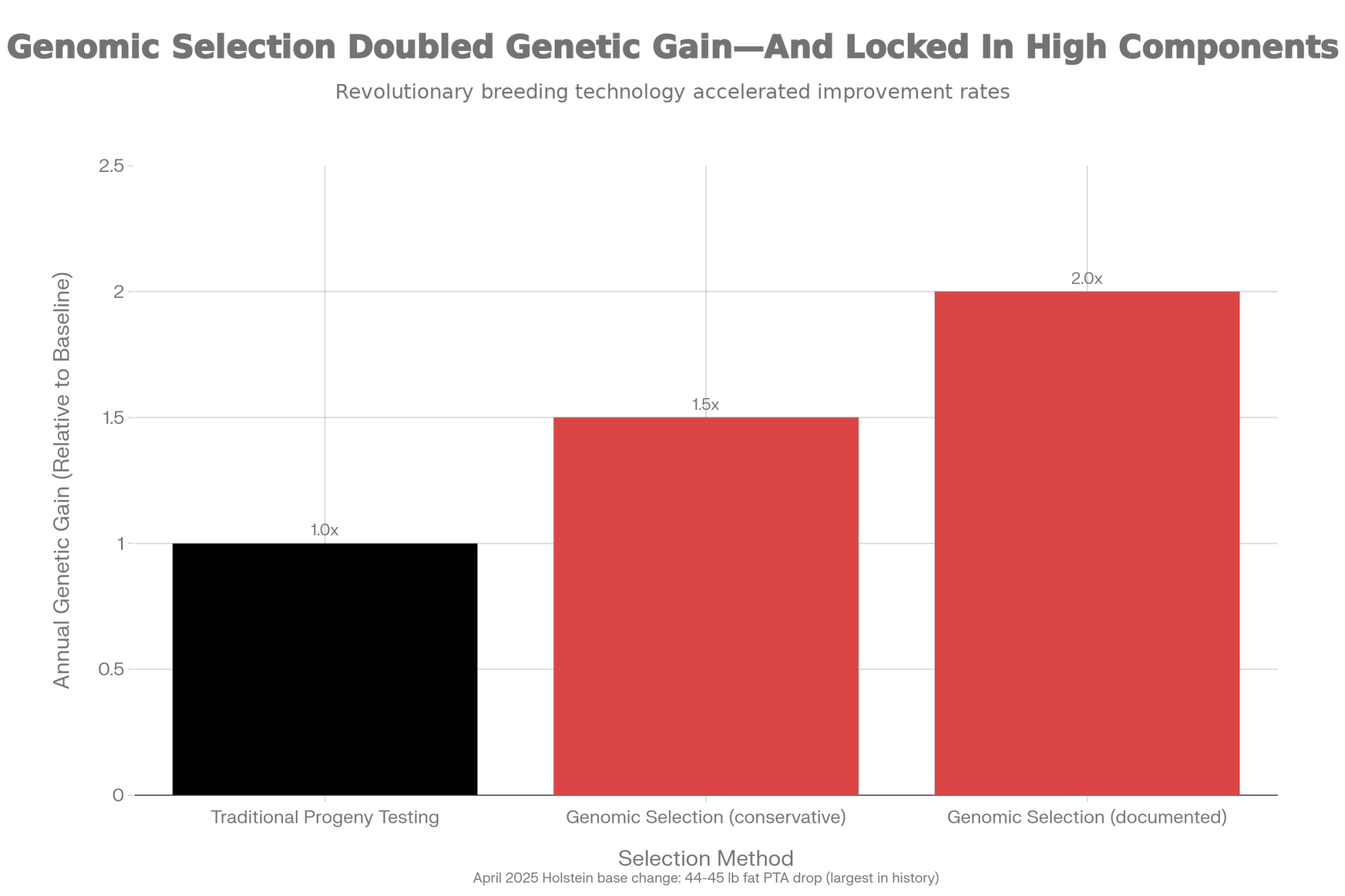
NewsSubscribe
First
Last
Consent

Lucky or Calculated? The Surprising Truth About Genomics and Luck in Dairy Breeding

Can genomics eliminate luck in dairy breeding? Discover how chance shaped Holstein’s history and why unpredictability still impacts your herd today.

I’ve always been fascinated by that eternal question in dairy breeding: can science and technology eliminate the role of luck? With April 2025’s genetic evaluation updates just around the corner, it feels like the perfect time to dig into whether our fancy genomic tools have truly kicked chance to the curb—or if they’ve just given us better ways to dance with it. After talking with industry experts and diving into the research, I’ve discovered something surprising: some of Holstein’s most influential bloodlines emerged from happy accidents that no amount of genomic testing could have predicted.

The Genomics Revolution vs. Lady Luck

Let’s be honest—whenever we talk about breeding success these days, we can’t help but focus on genomic selection, advanced mating programs, and all those impressive reproductive technologies. I mean, how couldn’t we? These tools have transformed our industry.

The April 2025 genetic evaluation updates are coming fast, with revised lifetime merit indices that shift to the 2020 genetic base. Have you been keeping up with the Council on Dairy Cattle Breeding announcements? They’re projecting some major PTA decreases: -750 pounds of milk, -45 pounds of fat, and -30 pounds of protein for Holsteins.

Don’t panic! As Chuck Sattler from Select Sires explained recently, “The 2025 base change is bigger than previous adjustments, but this is good news! It means that our cows are improving faster than ever.”

But here’s what keeps me up at night: Have we eliminated Lady Luck from the breeding equation? Or have we just given her a shiny new genomic lab coat?

The 75% Solution: What Genomics Can (and Can’t) Tell Us

I was digging through some research recently and found something fascinating from the National Center for Biotechnology Information. Our most advanced genomic prediction tools show only about 75% reliability for production traits. That means a quarter of what makes a cow productive remains outside our ability to predict!

This 75% reliability has been consistent for years. A 2011 Journal of Dairy Science study noted that this level is “adequate for marketing semen of 2-yr-old bulls,” but it’s far from perfect. The primary benefit? A shortened generation interval that increases the rate of genetic improvement.

Think about that 25% gap next time you’re making breeding decisions. It’s not just a tiny margin of error—it’s a significant space where luck, chance, and unexplained genetic interactions still reign supreme.

Lucky Breaks That Shaped Holstein History

You know what’s crazy? Looking back through Holstein’s history, some of the breed’s most influential genetic lines happened because of tiny accidents, missed connections, or just plain dumb luck. I’ve collected four of my favorite examples in this table:

Lucky Break EventWhat Actually HappenedWhat Could Have HappenedResulting Influential Sire/DamLong-term Impact
Missing TelephoneSpring Brook Bess Burke sold to George MillerWould have been purchased by LashbrookLed to Osborndale Ivanhoe, Elevation, Starbuck, AerostarShaped modern Holstein genetics
Injured LegMontvic Chieftain injured, Pathfinder offered insteadWhitney would have taken ChieftainRound Oak Rag Apple ElevationFoundation of influential bloodlines
Change of ClothesVisitors saw Temple Farm May while Dunton changedMight never have noticed the cowA.B.C. Reflection SovereignOne of the breed’s most respected sires
Wrong SemenInseminator arrived without Pabst Walker semenTiny Supreme DeKol would have been bred differentlyAlmerson Sovereign SupremeHighly respected Canadian bull line

No Phone, No Starbuck? The Wild Story of the Missing Call

I can’t get over this first story—it blows my mind whenever I think about it. In the early 1900s, A.J. Lashbrook and his brother sold some inherited shares for $250 (not exactly chump change) to invest in Holstein cattle.

Their father spotted three gorgeous heifer calves at Spring Brook Farm, priced at $75 each. I mean, imagine that kind of deal today!

But get this—they didn’t have a telephone to confirm the purchase! So Dad had to return the next day, only to find that the calves had already been sold to George Miller. It turns out that Schilling, the Spring Brook Farm manager, had mentioned the calves to a local feed mill owner, who told Miller. Talk about bad timing!

One of those calves? Spring Brook Bess Burke. Miller raised them, bred them to Sir Johanna Canary DeKol, and sold them to F.C. Schroeder of Moorhead, Minnesota.

“Years later, Mr. Schroeder visited our herd and, when I took him back to the depot, remarked that Spring Brook Bess Burke 2nd was born in a box car just as the train passed the depot after leaving the stockyards,” said Lashbrook.

She eventually found her way to E.C. Schroeder in Minnesota, where she and her daughter made incredible production records when bred to Sir Pietertje Ormsby Mercedes.

Lashbrook later reflected (and I love this quote): “As I look back now, it was indeed fortunate that we did not have a telephone and that those calves never came to our farm. We were only small breeders and… probably never would have developed those cows.”

Here’s the kicker—without that missing telephone, there would have been no Osborndale Ivanhoe, no Elevation, no Starbuck, and no Aerostar. Can you imagine modern Holstein genetics without those bulls? I sure can’t!

The Data Behind Modern Breeding: What Science Tells Us

While historical anecdotes are fascinating, let’s look at what the research says about genomic selection today. A 2020 study published by the National Center for Biotechnology Information found something that really caught my attention: inbreeding can significantly impact how well genomics works as a prediction tool.

The study examined high-producing primiparous dairy cows and found that individuals with an Inbreeding Index between ≥2.5 and ≤5.0 showed a two-fold increase in negative correlations between genomic predictions and actual performance. This affected critical traits, including Milk Production at 305 days, Protein Production, Fertility Index, and Daughter Pregnancy Rate.

What does this mean for your breeding program? Even with perfect genomic tools, factors like inbreeding can throw a massive wrench into the works. Your carefully selected mating might produce unexpected positive or negative results based on genetic interactions our current models can’t predict.

The Luckiest Injured Leg in Holstein History

I love this next story. F.C. Whitney had purchased Montvic Chieftain from T.B. Macaulay. But Chieftain slipped and injured his leg while loading the bull onto the truck. Bummer, right?

Macaulay called Whitney and told him they could have Montvic Pathfinder for the same price!

Now, Pathfinder wasn’t winning any beauty contests. Whitney’s description of him as “as homely a brute as a man ever saw” makes me laugh every time. But his pedigree? Absolutely stellar, with multiple All-American winners. As the text says, “Montvic Pathfinder, some claimed, possessed the best pedigree ever written,” including “four All-American wins to his credit, including aged cow in 1935 and 1936.”

Whitney decided to take a chance on the ugly duckling. At his farm in New York, Pathfinder sired Montvic Pathfinder Prizetaker, proven in the herd of Eugene and Clarence Harvey, Cincinnatus, N.Y. In making his switch from Jerseys to Holsteins, Charles Hope, Round Oak Farm, Purcellville, Va., over four years, purchased 17 Prizetaker daughters from the Harveys, as well as several Montvic Chieftain 6th calves and bought Montvic Pathfinder Prizetaker, himself. He used a son of his, Round Oak Montvic PF General, who sired Round Oak Millie Elizabeth, Elevation’s third dam.

So, luck again. Had Chieftain not banged up his leg, Pathfinder wouldn’t have gone to the United States, and there would have been no Round Oak Rag Apple Elevation.

The Preferential Treatment Problem

The latest research has revealed something that fascinates me: genomic predictions can be significantly biased by the preferential treatment of elite cows. A 2018 study published in the Journal of Dairy Science simulated what happens when elite bull dams receive special treatment.

The researchers found that it could significantly skew genomic predictions when just 5-20% of elite bull dams received preferential treatment (introducing an upward bias in their performance data). This is especially true for traits with low heritability, where the accuracy of genomic predictions is already challenging.

This research explains why sometimes the offspring of “sure thing” matings don’t perform as expected. The genomic values looked great on paper but may have been inflated by the special treatment of the cow families in the reference population. It’s another way chance enters our breeding programs—through human bias and the limitations of our measurement systems.

When Your AI Guy Says “Sorry, I’m Out”

How many times has this happened to you? You call your AI technician with the perfect mating all planned out, and they hit you with: “Sorry, I’m out of that bull’s semen today.”

One of those cows was Tiny Supreme DeKol! Aylmer Petherick had chosen Pabst Walker for Tiny’s next mating, but the inseminator, on the day he came to breed her, wasn’t carrying his semen. “What else have you got?” Aylmer asked. He settled on Hainescrest Sovereign Tycoon.

Almerson Sovereign Supreme, the result of the mating, was eventually classified as Excellent and received a Class Extra rating en route to becoming one of the most respected bulls in Canadian history. It was highly regarded by leading cattlemen of the day, including Pete Heffering and Dave Houck. What a great example of turning what is available into something great!

Who knows? Your backup choice today might create tomorrow’s game-changing bloodline. All those genomic tools might guide your primary selections, but chance still decides whether those straws are in your AI tank when needed.

The 25-35% Gap That Keeps Me Up at Night

Here’s what fascinates me about genomic selection: for all its revolutionary power, it still can’t predict everything. Not even close.

According to research published in the Journal of Dairy Science, current reliability percentages for genomically tested young animals typically hover between 65% and 75% for production traits and even lower for health and fertility traits.

That means that 25-35% of a cow’s genetic potential remains unpredictable through our current genomic models. That’s a huge gap!

Four main factors create this uncertainty:

  1. Gene interactions: Genomic models struggle to capture how genes influence each other. The same marker might perform differently depending on the overall genetic background.
  2. Environmental influences: How genes express themselves varies wildly in different environments. I’ve seen genetically identical cows perform completely differently on neighboring farms.
  3. Genetic recombination: Even with identical parents, each calf gets a unique genetic package. It’s like shuffling a deck of cards—you never deal the same hand twice.
  4. New mutations: Sometimes genetic changes appear absent in either parent, creating traits nobody predicted.

ROI on Genomic Testing: The Numbers Don’t Lie

Let’s talk dollars and cents for a minute. Despite the limitations, genomic testing has demonstrated impressive financial returns. Recent industry analyses suggest that genomic testing of heifers delivers approximately $75-$200 in additional lifetime profit per animal tested, primarily through improved selection decisions and optimized heifer inventory management.

The financial return varies based on several factors:

  • Current replacement costs in your area
  • Your herd’s genetic level relative to the breed
  • How aggressively do you cull based on genomic results
  • Whether you use sexed or beef semen strategically

Even with these impressive returns, the unpredictable 25-30% of genetic potential means some animals will significantly underperform or overperform their genomic predictions. This variability creates risk and opportunity—sometimes, your lowest-ranked genomic heifer produces your best cow. Ask any experienced breeder, and they’ll have at least one story like this!

The Change of Clothes That Changed Everything

This next story makes me smile every time. “Luck played a part, too, in the A.B.C. Reflection Sovereign story.” History might have taken a different course if he had waited for them on his front porch. Doug Dunton walked up from the stable in his barn clothes when they arrived. That September 1942, Jack Fraser, Elgin Armstrong, and Cliff Chant, his herdsman, had stopped at Dunton’s to scout up some cows for Armstrong’s A.B.C. Farm.”

“Wait a minute while I change my clothes,” said Dunton as he approached the house. His visitors sauntered down to the barn. As they walked, they passed a big, white Lonelm Texal Alcartra daughter named Temple Farm May, getting ready to calve. Before the day was out, Armstrong bought the cow for $400.00. Dunton agreed to keep her until she freshened. She was bred to Inka Supreme Reflection, and the calf was A.B.C. Inka May.

What a find! A.B.C. Inka May did everything right. She was a ferocious producer with an Honour List record of 24,141 lbs. milk, 4.67%, and 1,128 lbs. fat in 1947, the same year she was an All-Canadian four-year-old. But her supreme achievement was as dam of A.B.C. Reflection Sovereign (EX-Extra), who many claim was the best bull the breed has produced.

So yeah! Luck also influenced this bull’s genetics. Who knows what would have happened if Dunton had not changed then?

Hidden Gems Hiding in Plain Sight?

This makes me wonder—what excellent cows are we walking past daily, fixated on our genomic printouts?

With the April 2025 evaluation changes, we’re facing a significant recalibration of genetic values. According to the latest announcements I’ve seen, the Net Merit $ (NM$) index is getting a serious makeover: increased emphasis on butterfat (+13% weighting), greater focus on feed efficiency (41% higher combined impact), and doubled weighting for cow livability.

This reranking creates an opportunity to spot “hidden gems” that our current systems might be undervaluing. Are you only chasing the highest numbers, or are you developing that breeder’s eye to recognize special animals others might miss—just like Armstrong spotted value in Temple Farm May?

The best breeders I know combine data with that indefinable “cow sense” that no genomic test can replace.

Navigating the Balance: Genomics vs. Serendipity

Here’s how I think about the interplay between precision and chance in different aspects of breeding:

Aspect of BreedingHow Genomics Influences ItRole of Chance Still Present
Selection DecisionsIdentifies animals with superior genetic potential earlier and more accuratelyWhich animals you choose to test and develop still involves human judgment
Mating ChoicesPredicts outcomes of specific matings with greater precisionAvailability of preferred sires, conception success, and embryo viability remain variable
Trait PredictionsProvides reliable estimates for well-studied traits with high heritabilityNovel traits, gene interactions, and environmental influences remain less predictable
Health OutcomesIdentifies genetic predispositions to certain diseasesMany health events remain unpredictable despite genomic information
FertilityHelps select for improved reproductive traitsIndividual conception events remain highly variable
LongevityPredicts genetic components of productive lifeMany factors affecting actual lifespan remain outside genomic prediction
Elite Animal IdentificationAccelerates discovery of superior geneticsThe specific combinations that create truly exceptional animals still involve elements of chance

Gearing Up for April 2025: What You Need to Know

The latest genomic technology has improved prediction accuracy. I’ve been reading about these new machine-learning algorithms that better account for gene interactions and environmental factors. According to recent research in the Journal of Dairy Science, these models have boosted reliability percentages by about 5-7% for most traits.

That’s progress! But even with these improvements, we’re still looking at about 20-30% of genetic potential remaining unpredictable. And that unpredictable zone? That’s where luck—both good and bad—continues to play its role.

The April 2025 genetic evaluation updates will incorporate these improved models but won’t eliminate chance. According to The Bullvine’s recent report (which I highly recommend reading), we’ll need to recalibrate our sire selection thresholds—what used to be a +2000 NM$ will become approximately +1300 NM$. It’s going to take some mental adjustment for all of us.

4 Ways to Balance Science with Serendipity

As we get closer to the April 2025 genetic evaluations update, here are four strategies I’m recommending to my friends in the industry:

  1. Get familiar with the changes: Take time to understand the revised lifetime merit indices and that base change shift to cows born in 2020. Chuck Sattler from Select Sires advises: “The adjustments coming in April will mean you will likely need to recalibrate the selection levels used for A.I. sires and which cows are bred to beef or sexed semen.”
  2. Don’t put all your eggs in one genomic basket. The industry focuses on an increasingly narrow range of elite genetics. Consider incorporating some differently-bred Holstein cattle that offer unique genetic contributions. Genetic diversity provides more opportunities for unexpected combinations that sometimes create magic.
  3. Build in flexibility: What’s your Plan B when your first-choice matings aren’t possible? Those backup plans sometimes produce better results than the original! Avoid getting trapped in the mindset that there’s only one “right” mating for each animal.
  4. Trust your eyes, not just the numbers. While genomic testing provides incredibly valuable data, don’t lose that breeder’s instinct. The best operations I visited combined quantitative assessment with qualitative judgment—they used printouts and indefinable “cow sense.”

The Bottom Line

As we approach these April 2025 genetic evaluation updates, I keep returning to this fundamental truth: breeding success has always emerged from a blend of scientific precision and happy accidents.

Genomic selection gives us unprecedented insight into genetic potential. Still, the stories of Holstein’s most influential animals remind us that some of our greatest breeding successes came from unexpected turns of fate.

So, does genomic selection take the luck out of dairy breeding? Not a chance. Genomics has given us better tools to capitalize on luck when it strikes. The technology helps us identify promising animals earlier and more accurately. Still, it doesn’t eliminate the fundamental randomness involved in genetic recombination, gene expression, and the countless small decisions that shape breeding outcomes.

The lesson? Use every scientific tool, but keep your eyes open for those unexpected opportunities that genomics can’t predict. Use genomic testing to identify high-potential animals, study the upcoming changes to evaluation indices, and align your breeding program with your farm’s economic goals.

But never forget that sometimes, the most valuable genetic combination might emerge when your inseminator runs out of your first-choice semen, when visitors happen to notice a special cow while you’re changing clothes, or when a replacement bull offered due to an injury turns out to be a breed-defining sire.

Holstein history shows us that luck creates opportunities—but only those with the knowledge and vision to recognize potential can transform those opportunities into lasting genetic contributions. As you prepare for the changes in April 2025, keep one eye on the data and the other open to the possibilities that might lead to your herd’s next great success story.

Key Takeaways

  • Luck shapes breeding success: Historical examples like Spring Brook Bess Burke and Montvic Pathfinder show how chance created legendary Holstein sires.
  • Genomics isn’t perfect: Current tools offer up to 75% reliability for production traits, leaving room for unpredictability in genetic outcomes.
  • Prepare for April 2025 updates: Recalibrate sire selection thresholds as Net Merit $ indices shift focus toward butterfat, feed efficiency, and cow livability.
  • Flexibility matters: Backup mating plans and a keen breeder’s eye can uncover hidden gems that genomic data might overlook.
  • Balance science with serendipity: Use genomic tools strategically while staying open to unexpected opportunities that could transform your herd.

Executive Summary

Dairy breeding has come a long way with genomic selection, but luck remains an undeniable factor in shaping success. This article explores pivotal moments in Holstein history, like Spring Brook Bess Burke’s missed purchase, Montvic Pathfinder’s unexpected rise, and Temple Farm May’s discovery, to show how chance created breed-defining sires. Even today, genomic tools offer impressive reliability (up to 75%), yet factors like genetic recombination and environmental influences leave a 25-35% prediction gap. As the April 2025 genetic evaluation updates approach, breeders must balance precision with flexibility to capitalize on unexpected opportunities. From backup mating plans to spotting hidden gems, this article offers actionable strategies to navigate the intersection of science and serendipity in dairy breeding.

Learn more

Join the Revolution!

Join over 30,000 successful dairy professionals who rely on Bullvine Daily for their competitive edge. Delivered directly to your inbox each week, our exclusive industry insights help you make smarter decisions while saving precious hours every week. Never miss critical updates on milk production trends, breakthrough technologies, and profit-boosting strategies that top producers are already implementing. Subscribe now to transform your dairy operation’s efficiency and profitability—your future success is just one click away.
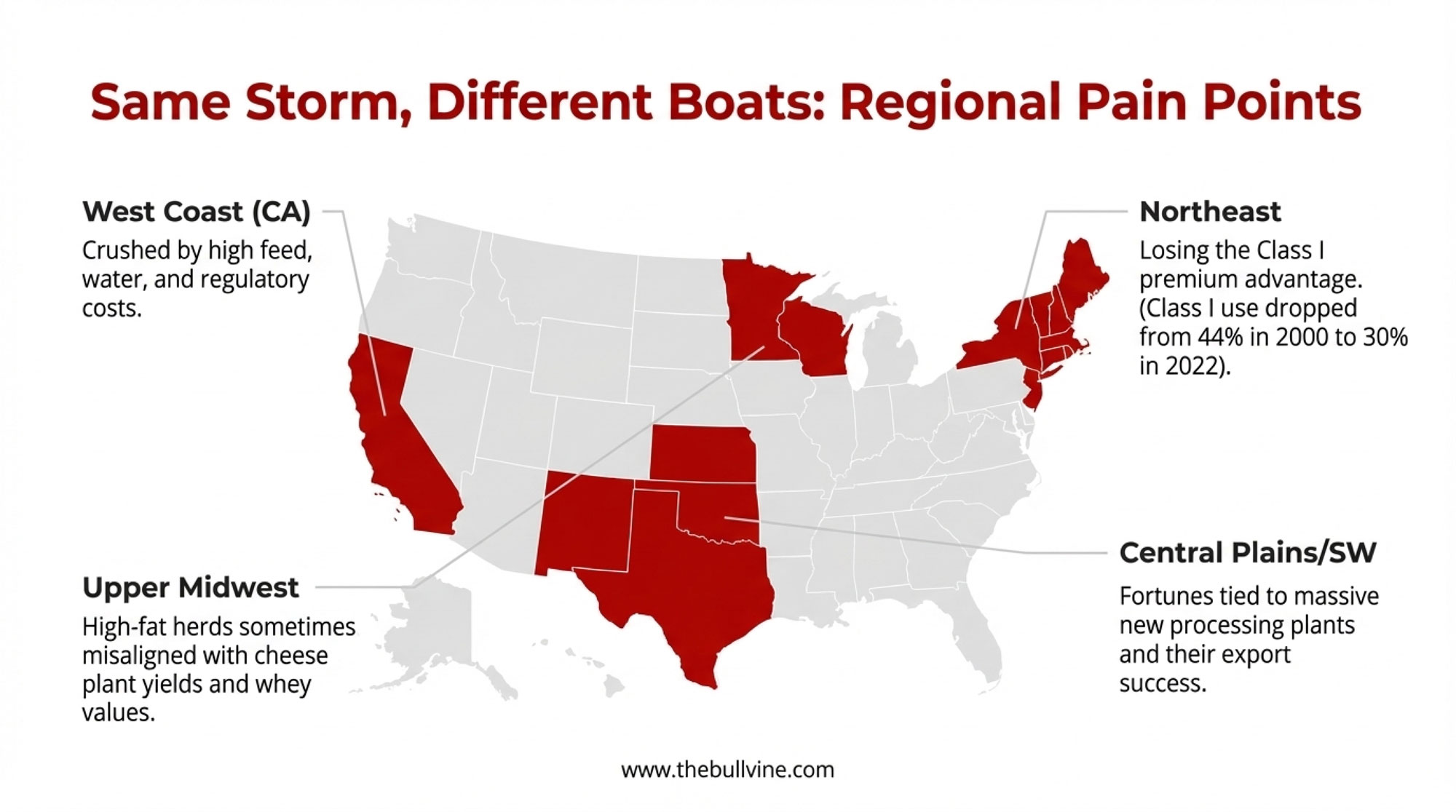
NewsSubscribe
First
Last
Consent

Who Really Invented Artificial Insemination?

Unveil the intriguing journey of artificial insemination. Who led the way in revolutionizing dairy farming? Discover the breakthroughs and advancements here.

Summary:

Artificial insemination isn’t just a scientific breakthrough; it’s a story that weaves through centuries of human curiosity, innovation, and determination. From the earliest anecdotal tales of Arabian tribes to researchers like Leeuwenhoek and Ivanow, A.I. reflects the quest to understand genetics. This rich history transcends borders, seeing key developments in countries like Russia, Japan, and the United States, each shaping today’s dairy industry. Pioneering efforts, lessons from nature, and relentless research have turned A.I. into an indispensable tool for modern dairy farming. It challenges us to think about A.I.’s future in agriculture. From historical observations and global innovations to modern implications, AI has enhanced genetic advancements and dairy production. AI has been vital to dairy farming, improving milk production through selective breeding traced back to ancient stories and early scientific achievements by Spallanzani, Heape, and Ivanow. Contributions from Japan, Denmark, and Italy in the 1930s further refined this technology.

Key Takeaways:

  • Artificial insemination (AI) in animals represents a significant human innovation inspired by natural processes observed in insects.
  • The foundational work of figures like Leeuwenhoek, Spallanzani, and Ivanow spearheaded the understanding and application of AI despite its gradual progression over the centuries.
  • Global efforts in Russia, Japan, Denmark, and Italy played pivotal roles in advancing AI technology and influencing its spread and effectiveness.
  • The development of semen storage methods, including yolk-based extenders and antibiotics, enabled A.I. to become a commercially viable option globally.
  • Technological advancements, such as cryopreservation and improved semen packaging, significantly enhanced the logistics and storage of genetic material, paving the way for contemporary practices.
  • A.I. democratized access to superior genetic traits in livestock, particularly dairy cows, transforming industry standards and capabilities in genetic selection.
  • Evaluation methods for sperm quality evolved, focusing on motility, morphology, and volume, crucial for ensuring the successful dissemination of desirable traits.
  • Sustainable practices in A.I. continue to evolve, balancing genetic advancements with environmental considerations in dairy farming.
artificial insemination, dairy farming, genetic selection, semen freezing, livestock quality, selective breeding, genomic selection, environmental sustainability, milk production, reproductive science

Imagine the transformative power of a technology that has been quietly revolutionizing dairy farming for years. Artificial insemination (AI) is not just a scientific concept but a game-changer in the industry. It empowers you to select the best genes for your herd, leading to superior milk production and healthier calves. This isn’t a distant dream; it’s a reality shaping the present of dairy farming. AI is not just a tool; it’s a beacon of hope for the future of dairy farming

From ancient breeders’ tales to the cutting-edge methods we employ today, AI has always been about pushing boundaries. It has fundamentally transformed the dairy industry, enhancing productivity and revolutionizing farming practices. The history of AI is not just a collection of old stories and experiments but a testament to human ingenuity and the relentless pursuit of progress that has shaped the dairy industry we know today.
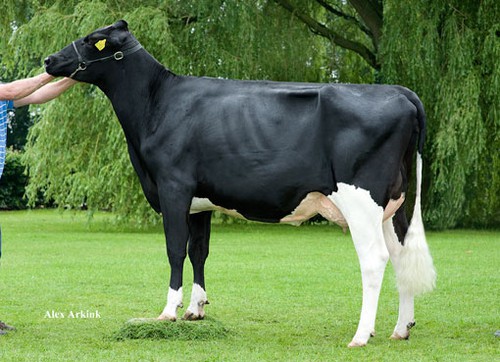
The Natural Pioneers of Artificial Insemination: Lessons from the Hive

In nature, artificial insemination (AI) isn’t just a human invention; it’s a fundamental aspect of life, particularly in insects like bees. Bees employ AI when they gather nectar and pollinate plants. Their movement of pollen from one flower to another facilitates plant reproduction on a large scale, sustaining many plants and ecosystems. This seemingly simple process is similar to how humans use AI to breed animals. 

How bees work with flowers reminds us of how we can learn from nature. While bees mix plant genetics naturally, humans use AI in farming to improve crops and animals. For dairy farmers, watching nature has helped us develop better breeding programs. Now, we can choose the best traits in livestock, which has dramatically improved farming today.
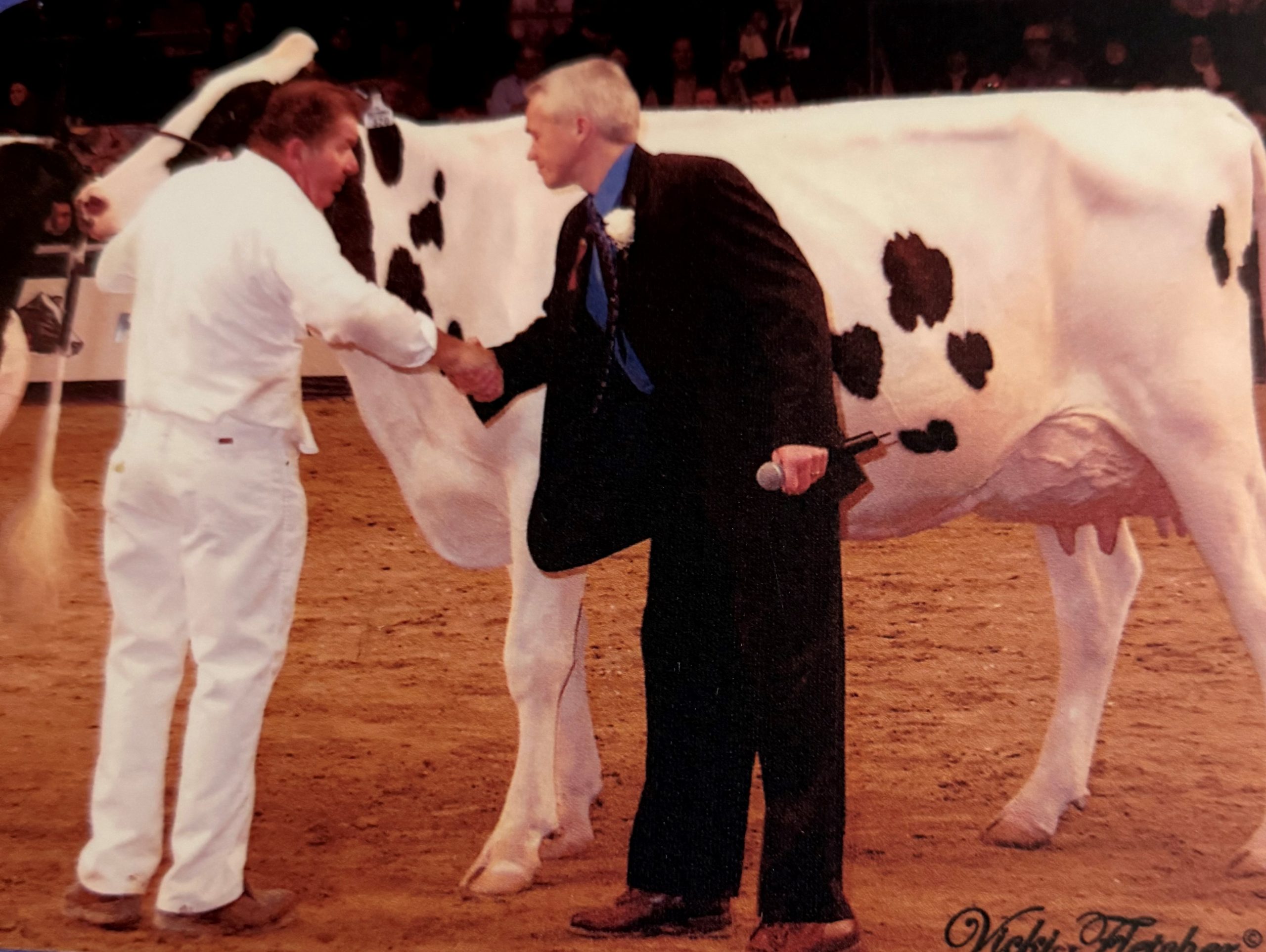
From Tribal Legends to Scientific Breakthroughs: The Evolution of Artificial Insemination 

Diving into ancient stories, we find fascinating tales of early attempts at artificial insemination hidden in the stories of tribal rivalry. One repeated story tells of Arab horse breeders who would sneak into enemy camps—not to steal horses—but to gather the sperm of champion stallions. They used this sperm to inseminate their mares, hoping to breed strong winners from afar. While these stories might seem more like legends than facts, they show an early idea of selective breeding, a practice that would become scientific much later. 
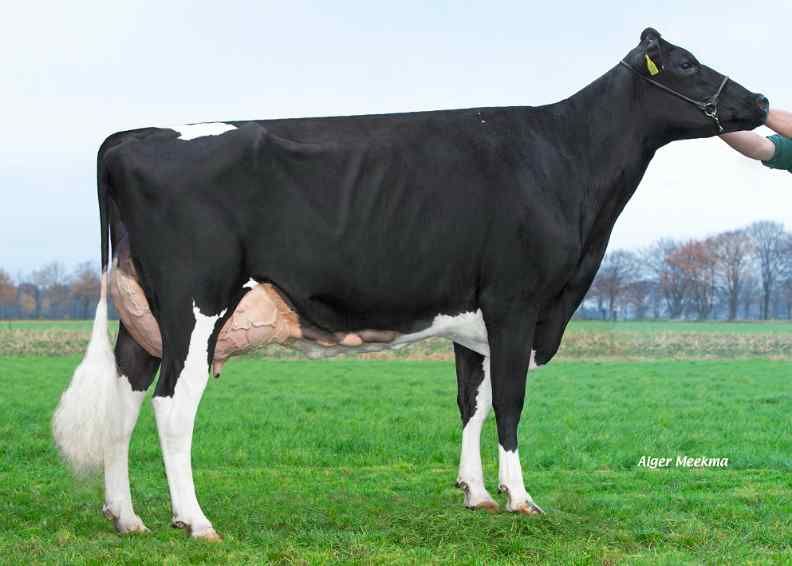
The transition of artificial insemination from myth to science marks a significant milestone in its history. This shift was not immediate but a result of years of study and discovery. By the 17th century, scientists like Leeuwenhoek began delving into the microscopic world, observing tiny ‘animalcules’ or sperm. These discoveries formed the basis for the scientific pursuit of AI, replacing myths with empirical research. This thirst for knowledge led to a scientific understanding of reproduction, paving the way for the methods used in the 19th and 20th centuries. As dreams turned into experiments, new pioneers emerged, ready to turn stories into reality. The rigorous research supplanted the mythical beginnings of AI, eager to harness this power to enhance agriculture.

Through the Lens of a Draper: The Unseen Genesis of Artificial Insemination 

The journey into the artificial insemination of animals started not in scientific labs but with a curious Dutch cloth maker named Antonie van Leeuwenhoek. He was famous for making lenses that let scientists see tiny organisms for the first time. His discovery of “animalcules,” now known as sperm, was a huge step in understanding reproduction. Leeuwenhoek’s fantastic skill in making microscopes gave scientists the tools to explore life’s tiny details. This critical shift prepared the way for artificial insemination (AI) in animals. 

Lazzaro Spallanzani, an Italian priest turned scientist, wasn’t satisfied with watching life’s building blocks; he wanted to work with them. In 1784, he successfully artificially inseminated a dog, putting theory into practice. His big experiment showed that sperm could be preserved and used later to inseminate a female dog. This was the first time anyone showed that humans could help sperm and eggs meet without natural mating. 

As the timeline moves forward, so does our understanding. Walter Heape, a reproductive scientist from Britain, was a key figure in connecting early efforts with modern science. He did more than just experiments. He studied how animals breed in different seasons and how this relates to fertility. His work helped us understand how an animal’s environment affects its reproduction ability. This was not just academic knowledge; it helped shape modern reproductive management and AI methods. 

The work of these early scientists forms a key trio that guided people through the challenges of understanding reproduction. Leeuwenhoek’s microscope gave the world a way to see reproduction at the cellular level. Spallanzani’s daring experiments showed that it could be applied in real life. Heape’s biological studies ensured that AI became a proven scientific method. The work of these pioneers has been vital in transforming AI from a scientific curiosity to a widely used tool in systematic breeding today.

Russia’s Revolutionary Compiler of Genetic Codes: Ivanow’s AI Transformation 

In the late 1800s and early 1900s, Russia witnessed a significant transformation in animal breeding thanks to the innovative ideas of Ivanow. His contributions to artificial insemination (AI) were far-reaching, as he developed new animal breeding methods that propelled Russia to the forefront of AI advancements

Ivanow invented semen extenders, which were essential for keeping sperm healthy on long trips. These extenders helped spread good genes over large areas, improving breeding programs and livestock quality. 

Seeing the need for skilled workers, Ivanow started training programs. He taught technicians how to select the best stallions, ensuring that breeding animals were more substantial and improved. This allowed good traits to spread quickly. 

Ivanow’s ideas reached beyond Russia. They inspired research worldwide and encouraged scientists like Japan’s Dr. Ishikawa to start similar projects. His work ignited interest and helped spread new reproductive biology technologies worldwide. 

Ivanow’s legacy includes not only his technical skills but also his long-term impact on global agriculture. By improving semen preservation and training, he laid a solid foundation for artificial intelligence, which led to significant genetic improvements in animal reproduction and greatly influenced this science field for years.

The Era of Global Diffusion and Innovation: Japan, Denmark, and Italy Transform AI.

After the Russian breakthroughs in artificial insemination (AI), the world experienced new ideas and techniques. Japan, Denmark, and Italy made significant contributions. This period was about sharing knowledge and technology, which led to developments that forever changed the dairy industry. 

Ivanow’s work inspired Dr. Ishikawa in Japan, where they began an AI program with horses in 1912. When he returned, he expanded AI to cattle, sheep, goats, swine, and poultry. Although language barriers kept this knowledge within Japan for a while, translations by Niwa and Nishikawa later opened these breakthroughs to the rest of the world. 

Denmark was an early leader in dairy farming. Eduard Sorensen and Gylling-Holm from the Royal Veterinary College started the first cooperative dairy AI group 1936. Their efforts showed that AI worked slightly better, with a 59% success rate in cows, than natural breeding. This success helped spread AI to the United States and other Western countries. 

In Denmark, the rectovaginal fixation technique was a significant innovation. It allowed accurate placement of semen deep in the cervix or uterus, making sperm usage more efficient. Danish innovation also led to the creation of semen straws. Originally made from oat straws, these were updated to cellophane straws after a clever idea from a birthday party observation. Cassou later commercialized them, influencing AI worldwide. 

In Italy, progress in AI was driven by Amantea and Bonadonna. They developed an artificial vagina for dogs and promoted research across different species. These efforts resulted in international cooperation, highlighted by the first International Congress on AI and Animal Reproduction in Milan in 1948. This event unified scientific goals and established AI essential for agricultural and veterinary advancement. 

The combination of ideas from various countries and old and new methods paved the way for today’s AI practices. Each nation contributed unique ideas and technologies, setting a course for improved efficiency and genetics in dairy farming.

America’s AI Revolution: A Decade of Innovation and Industry Transformation

The 1940s in America were crucial for artificial insemination (AI). AI wasn’t just about using new technology; it was about transforming the dairy industry and setting new standards for breeding worldwide. Farmers who were used to traditional methods suddenly found themselves in a new world where science played a significant role in farming. 

This change started with AI cooperatives, which were like a movement led by people who saw the potential of AI to transform dairy farming. 1938, the first AI cooperative began in New Jersey, inspired by Denmark’s success. Soon after, another cooperative started in New York, paving the way for a network that spread nationwide. 

These cooperatives were more than just organizations; they were partnerships between farmers and researchers. They allowed farmers to work directly with experts like Cornell University to boost productivity. This teamwork involved large-scale testing of insemination techniques, focusing on choosing the correct sires and refining semen handling to increase fertility. 

Such efforts led to significant improvements in evaluating semen quality. They standardized the assessment of sperm health and movement, which was crucial for ensuring that AI worked effectively in the market. 

The cooperative model was also great for spreading access to top genetics. Farmers of all financial backgrounds could use the best breeding animals. This approach quickly improved the quality of milk production across many herds, showing AI’s power to level the agricultural playing field. 

So, the 1940s were more than just a time of change; they showed how science and teamwork could update old farming methods into modern successes. AI in America became a symbol of progress in farming and demonstrated the impact of innovative partnerships in transforming an entire industry.

The Magnifying Glass: Evaluating the Silent Architects of Genetic Progress

Checking semen quality is essential for artificial insemination, especially in the dairy industry. To understand semen quality, you must see how many sperm move correctly. This needs precise tools, like a good microscope, to look closely. The main things checked are sperm movement, concentration, and volume, all crucial for successful insemination. 

Frozen semen complicates things. It’s essential to check how well sperm survive after being thawed. During semen checking, measuring the ejaculate volume and sperm concentration is key. Accuracy is crucial. Initially, people used graduated containers, but now, weight is often used for more detailed results. 

Moving forward, the invention of semen extenders marked tremendous progress in AI technology. At first, the challenge was keeping semen good long enough for shipping and use in different places. This led to yolk-phosphate extenders, and Salisbury and others improved them with sodium citrate to keep the egg yolk stable. These improvements kept semen valid for up to three days at 5°C, making it useful worldwide in cattle breeding. 

Later, adding glycerol for freezing changed AI a lot, making long-term semen storage possible. As specific bull semen became more in demand, finding ways to make each ejaculate go further was essential. Lowering the sperm needed per insemination to 4 million per dose changed things significantly. Moving from calling it “dilution” to “extension” better described the process, showing it improved rather than lessened semen’s value. 

These developments, especially using egg yolk-based extenders, significantly increased the practicality and efficiency of AI, setting new industry standards. The many doses each bull could provide, together with better sperm survival over distances and time, led to a new era of genetic improvement in dairy cattle. This wasn’t just a technical success but key for advancing breeding programs and boosting dairy production efficiency.

From Frosty Beginnings: Cryopreservation’s Cold War on Dairy Genetics

The discovery of semen freezing is a big deal for the dairy industry. It changed breeding methods and helped improve cattle genetics like never before. Scientists found a way to freeze chicken sperm using glycerol, a protective chemical, and soon used the same technique for bull sperm. This shielded the sperm during freezing. 

This new method allowed sperm to be stored for a long time at -196°C, as frozen sperm stays stable. It also allowed breeders to send cattle genetics over long distances and organize breeding programs using the best bull genes without worrying about the sperm’s shelf life

But getting here wasn’t easy. Frozen sperm was first stored in glass tubes that often broke. Innovators like Cassou made stronger and easier-to-use plastic straws instead. They also created a unique tool for using these straws in breeding, making it practical for farmers. 

Another big step was switching from solid carbon dioxide to liquid nitrogen. This kept the temperature low enough to keep sperm healthy for a long time. At first, liquid nitrogen tanks needed constant refills, which was a hassle. Thanks to investments from people like J. Rockefeller Prentice, companies improved these tanks, making them more efficient. 

Cryopreservation, or freezing sperm, has dramatically changed the dairy industry. Large farms can now plan and improve their herds’ genetics to increase productivity and profits. This process starts with the precise art and science of storing and managing sperm.

Genetic Alchemy: How AI Empowered Dairy Farmers to Rewrite the Blueprint of Milk Production

The shift brought by artificial insemination (AI) changed how dairy farmers pick the best bulls, making it possible for all farmers to obtain top-quality genetics. Before AI, only the wealthy could afford the best bulls. With AI, everyone could access these, leveling the playing field. 

As AI grew, scientists developed better ways to choose bulls based on their genetic potential. Genomic selection became vital, using DNA markers to predict a young bull’s value before it had offspring, which sped up breeding and genetic improvements. 

Progeny testing was once the best way to judge bulls, assessing them based on their daughters’ performance. But this was slow. As AI progressed, new methods gave more precise tests for a bull’s worth in areas beyond milk production, like fertility and health. This helped farmers better select traits to boost herd productivity and resilience. 

In short, AI improved dairy genetics, giving farmers control over their herds’ future and setting the stage for today’s advanced dairy farming, which is based on high-producing cattle.

Navigating the AI Odyssey: Balancing Genetics, Sustainability, and Technology in Modern Dairy Farming 

As we look forward to new technology in the dairy industry, artificial insemination (AI) remains a crucial tool. It helps farmers improve the genetic quality of their herds and increase productivity. However, the journey is not complete. Today’s AI landscape is complex and brings new challenges that we must address creatively. 

Combining AI with genetics has recently opened up tremendous possibilities in selective breeding. This combination allows farmers to choose traits like disease resistance and milk production accurately. But there are challenges. Relying on the same top genetic lines worldwide could lead to less genetic diversity, making herds vulnerable to new issues. 

Environmental sustainability is also essential in modern dairy farming. As consumers want more eco-friendly farming, AI must help sustainable agriculture grow. AI can decrease the environmental impact by improving how animals convert feed and reducing methane emissions from milk production. However, achieving these goals requires research, policy support, and investment in farmer education. 

Automation and digital tools could significantly improve AI in dairy farming. Precision farming, using sensors and data, can improve timing and efficiency in insemination. AI programs could provide real-time insights into cow health to reduce mistakes and improve breeding. However, challenges exist, like high costs, the need for technical skills, and concerns about data privacy. 

Ultimately, the future of AI in dairy farming is full of opportunities and responsibilities. As we move forward, it’s crucial to balance technology with preserving genetic diversity and to stay committed to sustainability and ethical practicesDairy industry leaders have the power to create a future where innovation aligns with environmental health and productivity thrives. 

The Bottom Line

The journey from old myths to modern farming shows our endless curiosity and drive to improve. From watching nature to inventing new science, this history highlights our effort to understand and control life. The development of artificial insemination (AI) has changed farming, especially in improving genetics and crops. 

But as we move forward, we must ask: How far can we go—or should we go—with these technologies? While they bring bigger crops and more money, we must consider what’s right and good for the planet. Can we handle controlling life better than understanding its effects? For today’s dairy farmers and farming experts, this isn’t just about getting the most milk and efficiency. It’s also a conversation about old ways, science, and ensuring we have food for the future.

Learn more:

Join the Revolution!

Bullvine Daily is your essential e-zine for staying ahead in the dairy industry. With over 30,000 subscribers, we bring you the week’s top news, helping you manage tasks efficiently. Stay informed about milk production, tech adoption, and more, so you can concentrate on your dairy operations. 

NewsSubscribe
First
Last
Consent

The Crucial Role of Health Traits in Dairy Cattle Breeding

Learn how focusing on health traits in dairy cattle breeding can elevate your dairy production. Ready to improve herd health and optimize your farm’s potential?

Summary: Dairy cattle breeding is a multifaceted endeavor where health traits play a crucial role in ensuring the long-term viability and productivity of herds. Understanding the significance of these traits—which encompass factors such as mastitis resistance, fertility, and hoof health—enables farmers to make informed decisions that optimize animal welfare and economic returns. By integrating genetic selection and advanced breeding strategies, dairy farmers can enhance not only the health and longevity of their cattle but also operational profitability. Prioritizing health traits in breeding programs ensures herd productivity and well-being, with genetic selection methods offering significant economic benefits.

  • Health traits are essential for the sustainability and productivity of dairy herds.
  • Key health traits include mastitis resistance, fertility, and hoof health.
  • Informed breeding decisions can enhance animal welfare and economic performance.
  • Integrating genetic selection and advanced breeding strategies improves health and profitability.
  • Prioritizing health traits in breeding programs boosts herd productivity and well-being.
  • Genetic selection methods offer notable economic advantages for dairy farming operations.
health features, dairy cow breeding, disease resistance, somatic cell count, fertility, ease of calving, dairy farmers, welfare, commercial sustainability, profitability, mastitis prevention, herd health, production rates, financial stability, metabolic health, successful breeding operations, physiological processes, longevity, general health, adaptation, productivity, well-being, genetic problems, Estimated Breeding Values, genomic selection, economic benefits, farmers

Technology advances and forward-thinking breeding practices have traditionally driven the dairy industry’s progress. Yet, in our unwavering pursuit of better genetics and maximum yields, have we potentially jeopardized the health and well-being of our dairy herds? As industry stewards, we must approach this critical issue with uncompromising vigilance. This essay discusses health features in dairy cow breeding and encourages dairy producers to reconsider their objectives and approaches. From disease resistance and lifespan to fertility and ease of calving, we’ll examine how these characteristics affect your dairy’s production, ethical criteria, and economic sustainability. Before digging further, one must ask: what are health qualities, and why are they important? How should these features be included in a contemporary, ethical dairy breeding framework? Your choices and actions may significantly impact the health and welfare of your dairy herds. Please reflect on your activities and envisage a new future for dairy farming, one in which health qualities are central to your operations, promising significant economic gains that can enhance your business’s profitability.

Understanding Health Traits in Dairy Cattle:

Understanding health features in dairy cattle necessitates thoroughly examining the many variables that impact bovine health and well-being. These health features include a variety of criteria, including disease resistance, which refers to cattle’s capacity to fight or recover from infections without requiring significant medical intervention. A high level of disease resistance can significantly reduce the occurrence of common illnesses like mastitis, thereby improving the overall health and productivity of your dairy herd. The somatic cell count (SCC) is vital since it indicates milk quality and udder health. Elevated SCC levels typically indicate the presence of mastitis, a common illness in dairy cows. This impacts the cows’ health and the quality of their milk. Reducing SCC is critical for enhancing both milk quality and animal health.

More than 60% of dairy producers now consider health features in their breeding selections. This is a substantial change in the business, suggesting a growing appreciation for the relevance of health attributes in dairy cow breeding. The incidence of mastitis, or the frequency of mastitis infections, is another important health factor. Mastitis prevention is critical for herd health, maximizing production rates, and ensuring financial stability.

Metabolic health and fertility are both critical components in successful breeding operations. Metabolic health maintains the balance of physiological processes, while fertility directly influences reproductive success, herd sustainability, and farm scalability. Longevity, representing dairy cattle’s lifetime and productive period, assesses general health, disease resistance, and adaptation. Cattle that are resistant to mastitis or lameness tend to live longer. Dairy farmers who properly grasp these health qualities are better able to combine high milk outputs with functional traits associated with adaptability, welfare, and resilience—a need in today’s developing dairy sector.

Understanding Health Traits for Herd Management:

Exploring this critical subject, the link between health features and herd management becomes apparent. As a dairy farmer, it’s your responsibility to prioritize health as the first goal. The welfare of your cows is not just an ethical issue but also a foundation for your farm’s commercial sustainability and profitability. By understanding and managing health traits effectively, you can be proactive in ensuring the productivity and well-being of your herd.

Furthermore, breeding for health features considerably improves the herd’s resilience. Approximately 50% of dairy cow problems are genetic. Robust cows have increased tolerance to the infections that plague agricultural areas, reducing the frequency and severity of debilitating ailments. This immediately boosts the dairy farm’s profits. Failing to include health features in breeding techniques risks the agricultural enterprise’s economic survival.

Prioritizing health features improves cattle well-being while increasing farm output and profitability. However, it is crucial to understand that the procedure may include inevitable trade-offs or problems. Should dairy farming experts prioritize health features in their breeding programs? Such a focus improves our cattle, enhances our companies, and boosts the sector.

Economic Impact of Health Traits:

Consider the severe financial consequences when dairy cattle’s health features are impaired. Specific health abnormalities cause significant economic disruptions on dairy farms, primarily by influencing key factors, including milk outputs, culling rates, treatment costs, and overall reproductive efficiency. Can you understand the depth of such economic upheaval? Genetic selection for health qualities may save veterinarian expenditures up to 30%. Let us examine this subject more attentively. Consider a dairy farm where existing health concerns cause a decrease in milk yield. As a result, these health issues need expensive treatments, which raise veterinarian costs—a tremendously unfavorable and onerous condition for any dairy farm. Wouldn’t you agree?

Secondary economic consequences include decreased reproductive efficiency, which slows herd growth rates and, eventually, limits milk production capacity. These circumstances burden the farm’s financial resources, significantly reducing profitability. Improving health features may boost milk supply by 10- 25%. But what if we reversed this situation? What if we made purposeful steps to improve the health features of dairy cattle? Isn’t this an issue worth considering? Improved health features might significantly reduce veterinarian expenditures, easing economic stresses. However, realizing that this may need some upfront expenses or fees is crucial.

Preventing diseases would minimize milk production losses, opening the door to enhanced economic success. Cows with more significant health features generate higher-quality milk containing up to 15% more protein. Furthermore, breakthroughs in health features may extend cows’ productive lifespans. This eliminates the need for early culling and increases herd profitability over time. Spending time, effort, and money on enhancing health features may provide significant economic advantages to dairy farms. It is critical to examine the long-term benefits of these investments.

Genetic Selection for Health Traits:

In the fast-changing dairy business, the introduction of genetic selection methods, notably Estimated Breeding Values (EBVs) and genomic selection, represents a significant opportunity for farmers. These techniques allow you to select and propagate cattle with better genetic qualities, particularly health aspects. This not only improves breeding operations but also promises significant economic benefits, giving you a reason to be optimistic and motivated about the future of your farm.

EBVs decode cattle genetic potential, revealing animals’ hidden skills regarding their offspring’s health and production. This essential information enables farmers to make educated decisions, improving the overall health of individual cattle and herds. The advent of genomic selection ushers in a new age of breeding technology, diving deeply into the inner elements of an animal’s genetic architecture. Genomic prediction allows for the exact discovery and use of critical DNA variations that anticipate an animal’s phenotype with unprecedented precision and dependability, considerably beyond the capabilities of older approaches.

The combined use of these genetic selection approaches has transformed breeding programs worldwide, pushing the search for improved health qualities in dairy cows. Identifying genetic markers connected to improved health features and smoothly incorporating them into breeding goals, which was previously a substantial problem, has become an opportunity for further improvement. This thorough attention to health features improves animal well-being and increases their resistance to disease risks.

Selection Indexes in Breeding Programs

Beyond single feature selection, the complex domain of selection indexes offers a balanced improvement of genetic value. Preventable illnesses account for around 40% of dairy cow mortality, underscoring the need for such comprehensive measures. Selection indices promote overall genetic development by assessing each trait’s unique quality against its economic value and potential genetic benefits. This technique goes beyond isolated changes, generating cumulative improvement across productivity and health qualities while ensuring that each trait’s costs and benefits are matched.

Globally, breeding initiatives are changing toward pioneering features like disease resistance, animal welfare, longevity, and even methane emission reductions. This more extensive approach predicts a future in which animal agriculture progresses from just economic to sustainable and ethical, with a strong emphasis on health features. The financial calculation is carefully addressed to ensure that the costs and benefits of each attribute are balanced.

Europe, a pioneer in this field, is pushing the boundaries of genetic selection for these cutting-edge features, even while worldwide acceptance remains restricted. This poses an important question: will we use the chance to improve the performance of breeding programs by using more extensive and innovative selection indexes?

Heritability of Health Traits

Understanding the heritability of health characteristics is critical in dairy cow breeding. Heritability estimations reveal the fraction of genetic variation that contributes to the observed differences in these qualities among individuals. According to research, heritability estimates for handling temperament features in dairy cattle are relatively high, indicating the importance of genetic variables. As a result, these qualities play an important role in complete multi-trait selection programs, with the potential to improve cattle temperament during handling and milking.

The heritability estimates for maternal and temperament qualities range from low to moderate, indicating a good opportunity for genetic improvement via selective breeding. Modern breeding programs have focused on the genetic examination of health features, using contemporary approaches like likelihood and Bayesian analysis to estimate exact heritability. These are essential for maximizing herd health and production.

While genetics are essential, environmental and managerial variables must also be addressed. Even if a cow is genetically inclined to excellent features, adequate management may prevent it from failing. As a result, the integration of gene selection and best practices in livestock management is critical. How can industry experts use cattle’s genetic potential to increase dairy output and improve animal welfare? As we better understand the complex interaction between genetics and the environment, the answer to this question will define the dairy industry’s future.

Balancing Health Traits with Productivity Traits:

Dairy producers have a recurring issue in balancing the economic imperatives of high milk output and the overall health of their cows. Can these seemingly opposing goals be reconciled to provide mutual benefits? The unambiguous answer is yes. One must examine the complex interaction between dairy cattle’s health and productive attributes to understand this. Undoubtedly, increasing milk output is critical to profitability in dairy farming. However, focusing just on production qualities may mistakenly neglect cow health and well-being, jeopardizing sustainability and herd productivity.

Addressing this complicated dilemma requires consciously incorporating health features into breeding choices. Dairy producers may adopt a more holistic method for choosing ideal genetic combinations by equally weighing health robustness and production qualities. Emphasizing traits such as adaptation, welfare, and resilience broadens breed selection criteria, fostering a more balanced and resilient herd. Optimizing animal health cultivates a sustainable future in which high productivity is achieved without sacrificing essential health traits.

For dairy producers who want to develop a sustainable and profitable enterprise, combining health qualities and production must go beyond lip service and become the cornerstone of successful farming. This breeding method represents a deep awareness of the interrelationship of health and profitability, anticipating a farming future that preserves the integrity of health features while maintaining high production in dairy cattle.

Considerations for Breeding Programs:

Adding health features into breeding plans requires a cautious and methodical approach in dairy cow breeding. These factors must be founded on the dairy producer’s individual management goals, environmental circumstances, and market needs. Isn’t developing a tailored and context-specific approach for managing breeding programs necessary?

Furthermore, advances in genetic evaluations are changing our approach to health features in cow breeding since these programs emphasize genetic assessments for health characteristics. Interesting. Isn’t it true that, although some breeding programs have made significant strides in integrating these qualities into their goals, the path to complete improvement is still ongoing? Genetic improvement techniques strive to maximize selection contributions while minimizing inbreeding. Balancing genetic advantages with the negative repercussions of inbreeding is not something to take lightly. Conscientious dairy producers use mitigation strategies, such as mating software and extension professional advice, to conserve genetic variety while assuring continual genetic progress. Aren’t these tactics essential for preserving genetic diversity while making steady evolutionary progress?

Establishing more complex and productive breeding programs relies on a pragmatic approach to animal breeding that prioritizes animal welfare. The redefining of selection indices and breeding objectives is becoming more critical, requiring incorporating qualities associated with animal welfare, health, resilience, longevity, and environmental sustainability. Thus, it is evident that dairies’ long-term viability depends on breeding goals that improve animal health and welfare, productive efficiency, environmental impact, food quality, and safety, all while attempting to limit the loss of genetic variety.

Collaboration with Breeding Experts and Genetic Suppliers:

Strong partnerships with breeding specialists, genetic suppliers, and veterinarians unlock a wealth of in-depth expertise, giving dairy producers tremendous benefits. These stakeholders provide access to critical genetic data, fundamental breeding values, and cutting-edge genomic techniques for health trait selection. However, it is vital to question whether we are leveraging this enormous pool of experience.

Collaboration with industry experts undoubtedly leads to a more specialized and successful breeding plan that addresses your herd’s health and production requirements. Nonetheless, the interaction between farmers and consultants goes beyond selecting the best breeding stock and treating illnesses. A dynamic and ongoing discussion with these specialists may aid in the early detection of possible problems, breed-specific features, and preventive health concerns. Consider inbreeding, for example. Are we completely aware of the hazards connected with it, as well as the various mitigation strategies? Have we optimized the use of mating software systems, using the expertise of extension professionals to guide these efforts?

Recent advances in genetic testing have created tremendous potential for selective breeding to treat congenital impairments and illnesses. Here, too, close contact with industry specialists is essential. But how often do we push ourselves to keep up with these advancements and actively incorporate them into our breeding programs? Is the secret to a healthier and more productive herd within our grasp, requiring only our aggressive pursuit of these opportunities?

The Bottom Line

The relevance of health qualities is prominent in the great mosaic of dairy cow breeding. This initiative reflects an ongoing journey of exploration, understanding, and application. Our joint responsibility is to use the knowledge gained from previous experiences, moving us toward a future that offers more profitability and higher ethical standards for all stakeholders.

Learn more: 

Genomics Meets Artificial Intelligence: Transforming Dairy Cattle Breeding Strategies

Explore the transformative power of AI, robotics, and genomics in dairy cattle breeding. How can these innovative technologies and scientific breakthroughs redefine breeding strategies for the future?

Imagine a world where dairy cattle breeding is no longer an art form but a reliable science. Genomics has revolutionized dairy farming, allowing farmers to make informed decisions by identifying desirable traits at a genetic level. However, the complexities of large datasets often hinder the full potential of these insights.  Enter Artificial Intelligence (AI), a transformative technology set to redefine dairy cattle breeding. By integrating AI with genomics, farmers can optimize breeding strategies to enhance productivity and ensure cattle health and well-being. This data-driven approach replaces intuition with precision and predictive analytics. 

The fusion of AI and genomics unlocks the unseen genetic potential of herds, driving efficiency like never before. In this evolving landscape, machine learning, deep learning, robotics, and fuzzy logic become essential tools, revolutionizing genetic strategies in dairy farming. Dairy farmers who adopt these technologies can achieve greater production efficiency and breed healthier, more resilient cattle suited to changing environmental conditions.

The Genomic Revolution in Dairy Cattle Breeding 

Genomics has revolutionized dairy cattle breeding by making the process more efficient and predictable. Breeders can accurately identify and select desirable traits such as increased milk production and better disease resistance through genomic selection. 

By analyzing genomes, researchers pinpoint genetic markers linked to desired traits, enabling early predictions of an animal’s potential. For instance, markers for higher milk yields help breeders choose cattle likely to produce more milk, while markers for disease resistance lead to healthier livestock, reducing veterinary costs

This genomic revolution surpasses traditional methods that rely on observable traits and pedigrees. Leveraging vast genetic data, breeders directly link genotype to phenotype, enhancing breeding precision and accelerating genetic progress by reducing generation intervals. 

The implementation of genomic selection has significantly increased the rate of genetic gain in dairy cattle. Traits such as milk production, fertility, and health have seen doubled or even tripled annual genetic gains, attributable to identifying superior animals at a younger age. 

Genomic selection also enhances the accuracy of breeding values. By integrating genomic information, breeders make more precise predictions of genetic merit, leading to reliable selection decisions and quicker dissemination of desirable traits. 

Economically, increased genetic gain translates to improved productivity, better animal health, and higher profitability for dairy farmers. Enhanced genetic potential contributes to efficient milk production, reduced veterinary costs, and sustainability. 

However, challenges persist, such as limited genomic datasets and initial costs for genomic technologies, which can be prohibitive for smaller operations. Continuous data collection and analysis improvements are essential to overcome these limitations, fostering a more sustainable and productive dairy industry.

Harnessing AI: A New Horizon for Dairy Farming 

Artificial intelligence (AI) simulates human intelligence in machines, enabling them to recognize patterns, make decisions, and predict outcomes. AI includes multiple subfields, such as machine learning, deep learning, and natural language processing, each driving the progress of intelligent systems. 

AI significantly benefits dairy farmers by enhancing productivity, efficiency, and animal welfare. Farmers gain deeper insights into their herds, optimize breeding programs, and improve overall farm management through AI. This technology quickly processes enormous data sets, manually delivering actionable, unachievable insights. 

A key AI advantage in dairy farming is its ability to predict and monitor cattle health. Machine learning algorithms process data from sensors and wearables to detect early signs of illness or stress, allowing timely intervention to prevent disease outbreaks. This proactive approach improves animal welfare, reduces veterinary costs, and boosts milk production. 

AI also streamlines farm operations by automating routine tasks. AI-driven robotics handle milking, feeding, and cleaning, cutting labor costs and freeing farmers for strategic activities. These systems operate with high precision and consistency, ensuring optimal milking and feeding times, increasing milk production, and enhancing animal health. 

AI is transformative for dairy farming, offering benefits like improved herd management, enhanced breeding programs, and automation of labor-intensive tasks. This technological advancement boosts productivity, profitability, and sustainability while promoting animal welfare in the dairy industry.

AI-Powered Genetic Evaluations: The Future of Dairy Cattle Breeding 

Artificial Intelligence (AI) is poised to transform dairy cattle genetic evaluations. It leverages machine learning to analyze extensive datasets that include genetic information, phenotypic traits, and environmental variables. These advanced models reveal intricate patterns within the data, resulting in significantly more accurate predictions of genetic merit and breeding values, refining selection decisions and strategies. 

Deep learning, a specialized branch of machine learning, substantially enhances genetic evaluations. With algorithms like neural networks, deep learning processes enormous volumes of data and detects nuanced, non-linear relationships that traditional methods frequently miss. These sophisticated models incorporate various data types, including genomic sequences, to accurately forecast traits such as milk yield, disease resistance, and fertility. 

Furthermore, AI fosters the integration of genomic data into breeding programs. AI identifies genes and genetic markers associated with desirable traits by concurrently analyzing genomic and phenotypic data. This genomic selection accelerates genetic progress by enabling earlier selection of animals, thus reducing the generation interval. 

AI systems are robust and adaptive, continuously learning from new data to ensure that genetic evaluations remain precise over time. This continuous learning capacity contributes to sustainable and efficient breeding programs. Incorporating environmental and management factors through AI further refines the accuracy of genetic evaluations. By considering aspects such as diet, housing, and health management, AI effectively isolates the genetic components of traits, leading to more precise breeding value estimates. 

Fuzzy logic, another facet of AI, addresses the inherent uncertainty and variability in genetic evaluations. It models complex biological processes to make informed decisions based on incomplete information. This is crucial in dairy cattle breeding, where multiple genetic and environmental interactions influence trait expression. 

AI-driven evaluations also enable the development of customized breeding strategies tailored to specific herd goals and conditions. By analyzing herds’ genetic and phenotypic profiles, AI recommends optimal breeding plans that consider factors such as inbreeding, genetic diversity, and economic returns

In conclusion, the application of AI in genetic evaluations is set to revolutionize dairy cattle breeding strategies. By harnessing machine learning, deep learning, and fuzzy logic, breeders can achieve more accurate, efficient, and sustainable genetic improvements, enhancing the productivity and health of dairy cattle.

AI-Driven Dairy Cattle Type Classification: The Confluence of Machine Learning, Robotics, and Fuzzy Logic

Implementing artificial intelligence (AI) in dairy cattle classification aims to revolutionize the industry by deploying machine learning algorithms to decipher vast datasets. AI can identify intricate patterns that differentiate types with remarkable precision by training models on both visual inputs and physical attributes of cattle. 

Regarding deep learning, Convolutional Neural Networks (CNNs) represent a pinnacle of technological advancement in this domain. These networks detect and analyze visual features in cattle images, such as body conformation and udder development, thereby enabling precise classification based on these characteristics. 

Integrating diverse data sources, including genomic information and milk yield records, further enriches the AI’s classification capabilities. By combining phenotypic and genotypic data, AI offers a holistic view of genetic potential and health, paving the way for well-informed breeding decisions. 

Robotic technology can significantly enhance the accuracy and efficiency of cattle classification processes. Automated systems equipped with cameras and sensors gather real-time data, enabling AI models to perform immediate classifications, thereby minimizing reliance on manual inspections and reducing human error. 

Fuzzy logic adds another layer of sophistication by managing the inherent uncertainties within biological data. This technology allows AI to make more nuanced decisions by catering to natural animal trait variations, resulting in more flexible and accurate classifications. 

The confluence of AI, deep learning, robotics, and fuzzy logic in dairy cattle classification heralds a new era of precision, efficiency, and data-driven breeding strategies. This synergistic approach not only boosts productivity but also enhances the sustainability of dairy farming.

Augmenting Genetic Advancement through Robotics: Automating Precision and Elevating Genomic Accuracy 

Robotics is pivotal in genetic advancement, automating and optimizing phenotypic data collection. High-precision robots can monitor and record real-time health and productivity metrics like milk yield and behavior. This is crucial for accurate genomic predictions and training AI models to identify desirable traits. 

When combined with AI, robotics can enhance the speed and accuracy of genetic selection. AI algorithms analyze data collected by robots, identifying patterns and correlations often missed by humans. This enables a more precise selection of breeding pairs and accelerates the development of superior dairy cattle. 

Robotics ensures consistent and reliable data collection, which is vital for genomic studies. While human error can skew results, robots perform repetitive tasks with high precision, ensuring data accuracy and consistency. 

Incorporating robotics improves animal welfare, a critical factor in genetic advancement. Robots more accurately monitor cattle health, allowing early detection of issues and ensuring only healthy animals are selected for breeding, thereby enhancing overall genetic quality. 

The integration of robotics with genomics and AI supports precision farming techniques. Robots with advanced sensors gather detailed environmental and physiological data, enabling more effective breeding strategies and ensuring genetic advancements are viable in real-world conditions. 

Robotics also streamlines genetic testing and manipulation. Automated systems handle DNA tasks with incredible speed and accuracy, reducing time and cost and making advanced genomic techniques feasible on a larger scale. 

Using robotics, AI, and genomics fosters sustainable dairy farming. Optimized breeding strategies produce cattle that are efficient in feed conversion and milk production, reducing the environmental footprint and aligning with global sustainability efforts.

The Horizon for Dairy Cattle Breeding Gleams with Promise 

The horizon for dairy cattle breeding gleams with promise, as integrating advanced technologies like machine learning and robotics offers unmatched opportunities for genetic enhancement. AI-powered genetic evaluations predict a future where precision breeding programs focus on efficiency, disease resistance, animal welfare, and adaptability. This melding of tech and biology marks a new era where each cow’s genetic potential is mapped and harnessed for optimized output and sustainability. 

However, this path isn’t without challenges. Ethical issues, especially concerning genetic manipulation and animal welfare, demand robust frameworks for responsible implementation. The vast data from advanced breeding programs pose privacy risks, necessitating stringent cybersecurity measures and regulations. 

Additionally, the complexity of modern breeding technology highlights the need for farmer education and training. Farmers must navigate a landscape filled with new terms and machinery. Structured educational and hands-on training programs are crucial to bridge this knowledge gap and ensure all stakeholders benefit from these innovations. 

While AI, genomics, and robotics promise to transform dairy cattle breeding, their proper potential hinges on conscientious implementation. Addressing ethical concerns, safeguarding data, and equipping farmers with the right skills will drive a productive, moral, and resilient dairy industry forward.

The Bottom Line

The emergence of machine learning, deep learning, robotics, and fuzzy logic, coupled with the groundbreaking advancements in genomics, promises to reshape dairy cattle breeding strategies fundamentally. Throughout this article, we have examined how the integration of cutting-edge technologies, such as AI-powered genetic evaluations and robotics, is heralding a new era in dairy farming. We’ve discussed how AI significantly enhances genetic predictions, delivering unprecedented precision and efficiency. Furthermore, the synergy of robotics and precision farming facilitates the automation of pivotal breeding tasks, thereby improving the accuracy of genomic evaluations. Synthesizing this information, it becomes evident that the fusion of AI and genomics represents a revolutionary shift in dairy cattle breeding. These advancements elevate our capabilities, from boosting genetic quality to optimizing animal welfare and farm productivity. Looking ahead, the potential of these innovations is vast, foreshadowing a future where dairy farming is more efficient, sustainable, and responsive to cattle’s genetic and health requisites. The convergence of artificial intelligence with genomic science is not just the future of dairy breeding—it is a transformative stride towards a more sophisticated, responsible, and prosperous dairy industry.

Key Takeaways:

  • Artificial Intelligence and genomics are transforming dairy cattle breeding strategies, ushering in a new era of precision and efficiency.
  • Machine learning and deep learning algorithms enhance the accuracy of genetic evaluations, empowering farmers to make data-driven decisions.
  • Integration of robotics in dairy farming automates complex tasks, thereby increasing productivity and improving the well-being of the cattle.
  • Fuzzy logic systems contribute to better decision-making processes by handling uncertainties and providing adaptable solutions in variable conditions.
  • The intersection of AI, robotics, and genomic research promises to elevate genetic gains and bolster the sustainability of dairy farming.
  • Continuous innovation and refinement in technology and breeding programs are crucial for adapting to industry changes and maintaining competitive advantage.
  • A comprehensive understanding of consumer perceptions and effective communication strategies is vital for the successful implementation of advanced technologies in dairy systems.
  • Investing in precision livestock farming (PLF) systems necessitates thorough consideration of the types of technologies, data management methods, and AI-driven data interpretation mechanisms.
  • The rapid growth of genomic evaluation programs, as evidenced by advancements in the United States, highlights the potential for global improvements in dairy cattle breeding.

Summary:

Dairy cattle breeding has evolved significantly with genomics, enabling farmers to make informed decisions by identifying desirable traits at a genetic level. However, the complexities of large datasets often hinder the full potential of these insights. Artificial Intelligence (AI) is set to redefine dairy cattle breeding by integrating AI with genomics, allowing farmers to optimize breeding strategies to enhance productivity and ensure cattle health and well-being. This data-driven approach replaces intuition with precision and predictive analytics. Machine learning, deep learning, robotics, and fuzzy logic are essential tools in this evolving landscape, revolutionizing genetic strategies in dairy farming. Genetic revolution surpasses traditional methods by enabling accurate identification and selection of desirable traits, such as increased milk production and better disease resistance. However, challenges persist, such as limited genomic datasets and initial costs for genomic technologies. Continuous data collection and analysis improvements are essential for a more sustainable and productive dairy industry.

Learn More:

Send this to a friend