With heifers costing $3,000+ each, can you afford to ignore fertility gaps that smart dairies are closing?
EXECUTIVE SUMMARY: Here’s what we’re seeing across progressive operations: heifer fertility represents one of the most underutilized profit drivers in modern dairy management. Recent comprehensive analyses show national heifer conception rates averaging 55-60%, while first-lactation cows achieve 44% conception — a performance gap that’s costing operations real money (Journal of Dairy Science, 2023; DHI, 2023). With replacement costs now pushing $3,000 per head in many regions, even modest improvements in heifer pregnancy rates deliver substantial ROI (DHI, 2023). We’re finding that regional factors — from brutal Midwest winters to Southern heat stress — dramatically influence reproductive success, making location-specific strategies essential rather than optional (PMC, 2017). The operations that are getting ahead are those that integrate proven technologies, such as CowScout monitoring, into daily workflows, reporting measurable gains in pregnancy rates while reducing hormone dependency. Bottom line: the data points to heifer fertility management as a competitive differentiator that forward-thinking producers can’t afford to overlook in 2025.
KEY TAKEAWAYS
Target the conception gap: We’re tracking operations that’ve moved heifer conception from the 55% national average toward 60%+ through systematic protocol improvements, directly impacting genetic progress and reducing replacement needs (Journal of Dairy Science, 2023).
Adapt regionally, win locally: Southern dairies leveraging heifers’ heat stress resilience and Midwest operations optimizing winter nutrition programs are seeing measurable fertility improvements compared to one-size-fits-all approaches (PMC, 2017).
Make technology work for you: Farms integrating activity monitoring like CowScout collars into daily breeding decisions report pregnancy rate improvements of 15-20% alongside reduced hormone costs — but only when data drives real management changes.
Weight-based breeding wins: Operations following Michigan State’s 55% mature weight breeding guideline combined with monthly monitoring are hitting breeding targets more consistently while adapting to seasonal feed quality variations (MSU Extension, 2024).
Think long-term ROI: With replacement costs at $3,000+ per heifer, improving conception rates by even five percentage points translates to fewer culls, better genetic retention, and stronger cash flow — especially critical as we head into an increasingly competitive 2025 market environment.
The thing about heifer fertility… it’s often the quiet contender in dairy herd management. Most eyes stay glued to butterfat percentages and fresh cow health — and yeah, those transition cows are absolutely critical — but what about those future workhorses standing in the dry lot? Those heifers represent the genetic foundation for where your entire operation goes next.
According to comprehensive analyses published in the Journal of Dairy Science covering over one million Holstein cows, national heifer conception rates currently average between 55-60% (Journal of Dairy Science, 2023). For comparison, Dairy Herd Improvement reports show first-lactation cows now reaching conception rates near 44% (DHI, 2023). That performance gap? It’s a pile of untapped opportunity sitting right there.
Regional Heifer Fertility Management: Winters That Test vs Summers That Sizzle
Managing heifers in Wisconsin or Michigan? You know exactly what it’s like trying to hit growth and breeding targets through snow drifts and short grazing seasons. Industry practitioners consistently emphasize how critical winter preparation becomes for spring breeding success.
Comparison of Heifer and First-Lactation Cow Conception Rates by Region, highlighting fertility performance differences crucial for targeted reproductive management strategies in 2025
Flip to the South, and heat becomes the challenge. Studies published in PubMed Central demonstrate that heifers weather heat stress considerably better than their mature counterparts (PMC, 2017). This physiological advantage means Southern dairies have more flexibility during summer breeding windows but need strategies tuned to the heat’s relentless rhythm.
Economic Realities and Smart Growth Targets
Replacement heifers now command prices pushing toward $3,000 in many regions, according to Dairy Herd Improvement and Canadian Cow-Calf production analyses (DHI, 2023; Canadian Network, 2024). Sure, some estimates get tossed around about delayed breeding costing thousands more, but those numbers lack precision — costs vary dramatically based on individual farm management.
Trend in Average Replacement Heifer Costs from 2022 to 2024, illustrating rising economic pressures on dairy operations
Michigan State Extension research recommends breeding heifers once they reach approximately 55% of their mature body weight, targeting 85% by calving (MSU Extension, 2024). These evidence-based benchmarks help producers adjust for fluctuating feed quality and seasonal management challenges.
Heifer Breeding Technology: When It Actually Works
CowScout collars being used across Vermont dairies remind us that technology alone isn’t the magic answer, but when integrated with sharp management practices, it creates measurable impact. These operations report improved pregnancy rates and reduced hormone interventions through real-time activity and heat cycle monitoring, which is embedded in daily breeding workflows.
Strategic Dairy Heifer Breeding Protocols
Look to Germany for disciplined excellence. Systematic adherence to synchronization protocols results in heifer conception rates hitting approximately 64%. The takeaway? Precise timing and disciplined protocol management separate winning operations from struggling ones.
Growth Monitoring Fundamentals
Simple, routine weigh-ins continue proving their worth. Operations implementing monthly weight assessments report catching development issues early, enabling targeted nutritional adjustments that dramatically improve reproductive outcomes. No-frills approaches often deliver outsized results.
What This Means for Your Operation
There’s no silver bullet here, but the pathway to enhanced heifer fertility runs through systematic measurement, consistent protocol execution, region-specific tactical adjustments, and seamless technology integration where it adds value.
If you want genetic progress advancing and profit margins expanding, don’t let heifer fertility management slide into background priorities. These future production stars deserve focused, strategic attention.
Ask yourself: Are your heifers receiving management intensity proportional to their value in your operation?
Because if they’re not, you’re likely passing up substantial returns while your competition gains ground.
Complete references and supporting documentation are available upon request by contacting the editorial team at editor@thebullvine.com.
Learn More:
The $4,000 Heifer: Seven Strategies to Navigate the New Dairy Economy – This article provides a strategic look at the unprecedented rise in heifer prices in 2025. It reveals actionable strategies for balancing the high cost of buying replacements against the economics of raising your own, offering a critical financial perspective not covered in the main article.
Bovine Repro – Today and Tomorrow – Delve deeper into the tactical, on-farm implementation of advanced reproductive technologies. This piece complements the main article by offering practical insights on reproductive scoring, synchronization protocols, and the real-world application of progesterone monitoring to drive measurable fertility improvements.
The Future of Dairy: Lessons from World Dairy Expo 2025 Winners – This article provides a forward-looking perspective on the dairy industry. It explores the innovative strategies and technologies (including genomic testing and sexed semen) used by top-performing farms in 2025 to improve herd genetics and manage heifer programs for long-term profitability.
Join the Revolution!
Join over 30,000 successful dairy professionals who rely on Bullvine Weekly for their competitive edge. Delivered directly to your inbox each week, our exclusive industry insights help you make smarter decisions while saving precious hours every week. Never miss critical updates on milk production trends, breakthrough technologies, and profit-boosting strategies that top producers are already implementing. Subscribe now to transform your dairy operation’s efficiency and profitability—your future success is just one click away.
What if I told you frozen semen from the 1940s outperforms today’s million-dollar superstars? Gene banks don’t lie.
Look, I’ve worked with Holsteins long enough to know when something smells off. The talk about genomic miracles? Sure, the gains are real—annual genetic progress in Net Merit has actually more than doubled, from $36.90 to $83.33, since genomics became a reality (PMC Genomic Selection Research, 2016). Sire generation intervals dropped from over 10 years to just 2.5 years, letting us stack improvements way faster than before.
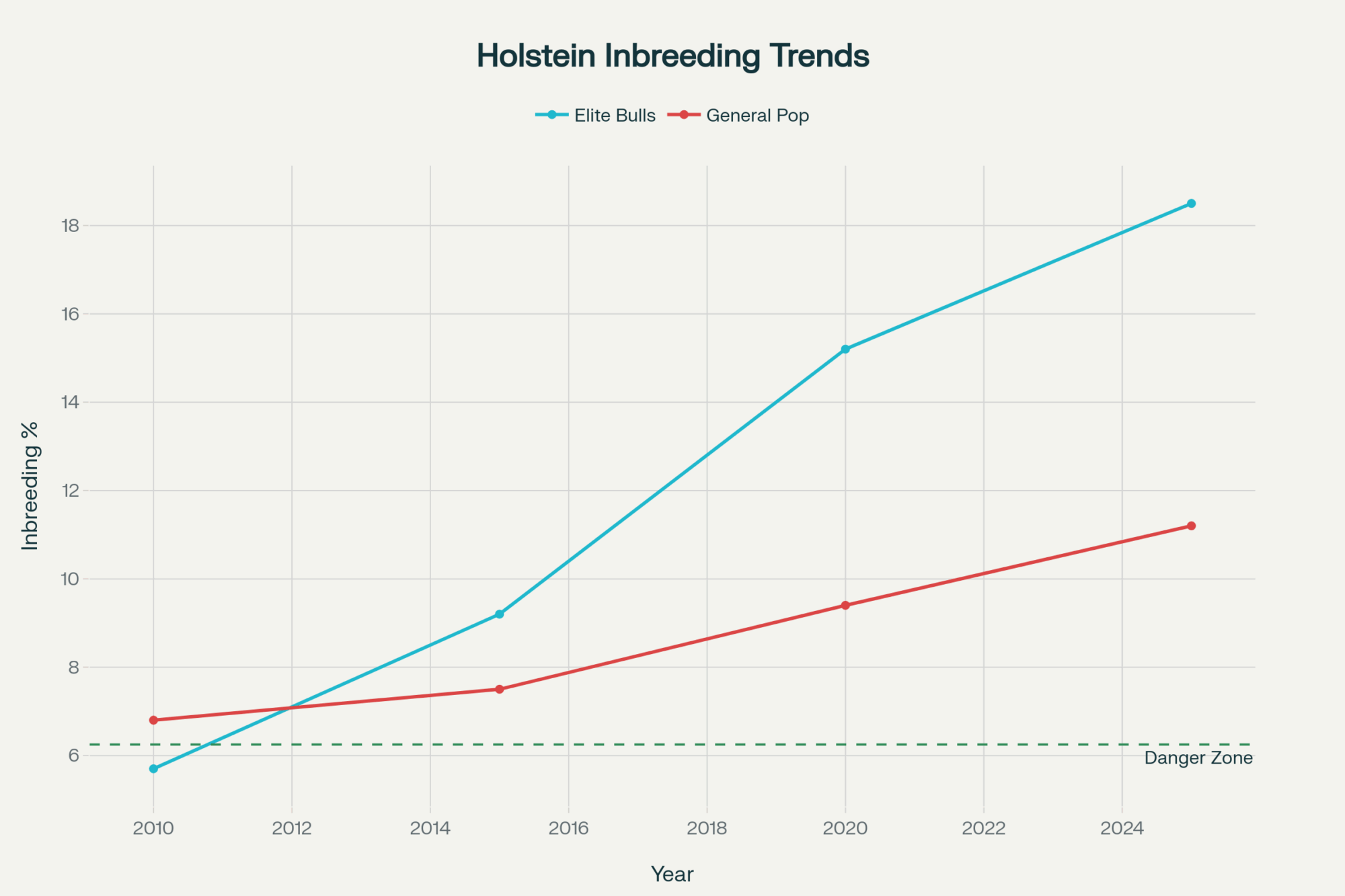
But here’s what isn’t front and center at your co-op meetings: Holstein inbreeding levels in elite U.S. herds have increased from about 5.7% in 2010 to 15.2% by 2020—a 168% rise (USDA/CDCB; The Bullvine Genetic Analysis, 2025). Industry projections show we could reach 18–22% by 2030. That’s nearly triple the widely recognized 6.25% “danger zone” where inbreeding depression hits hard.
The Inbreeding Crisis on Display. The average inbreeding of elite Holstein bulls has risen sharply, skyrocketing from the 6.25% “danger zone” in 2010 to over 15% by 2020, far outpacing the general population. This trend highlights the accelerating genetic bottleneck in the Holstein breed.
The cost? Expert economic analyses place inbreeding losses between $3.6–6.7 billion for U.S. dairies from 2011–2019 (AgEcon Search Economic Analysis). Each 1% inbreeding increase shaves $23–25 off a cow’s lifetime Net Merit, plus shortens productive life and reduces fertility (Dairy Cattle Genetic Improvement, 2024; University Research Compilations, 2024). Have you seen more infertility, lameness, or culling pressure lately? You’re not alone.
Inbreeding is a Hidden Tax on Your Herd. Economic analyses show a clear correlation between rising inbreeding levels and significant lifetime profit losses per cow, with the negative effects accelerating as inbreeding increases beyond the danger zone.
How the Big Players Influence the Game
The Council on Dairy Cattle Breeding (CDCB) now manages the world’s largest livestock database—100 million animal records, 10 million genotyped, from 72 countries (CDCB Activity Report, 2024). This sets global benchmarks and puts U.S. breeders in the driver’s seat—but it also keeps information and breeding power in few hands.
Companies like STgenetics don’t just breed—they build bulls. Their bull Captain, for instance, was engineered through proprietary matings. While building Captain, they held back his father Sabre from most catalogs—a classic move to ensure that they got exclusive use of his genetic potential. Not unlike how most AI companies now make all the contract matings before they sell the semen publicly. The result STgenetics now dominates U.S. Net Merit (26.5%) lists.
Strategic Use of “Hidden” Sires: A Recurring Theme in Holstein History
STgenetics’ selective use of Tango Sabre as a foundational “hidden” sire is not a new trick in Holstein breeding. In fact, the practice of restricting access to promising sires—often leveraging them primarily within one herd—has been a tactical play repeated throughout dairy history by breeders looking to sharpen, conserve, or even commercialize elite genetic lines.
Consider these other foundational cases:
Round Oak Rag Apple Elevation (USA): One of the all-time breed legends, Elevation’s early semen was tightly managed by his owner and distributed selectively for targeted matings. His initial, controlled use allowed for concentrated genetic gains within certain herds before broader industry access, a move that amplified both his influence and value.
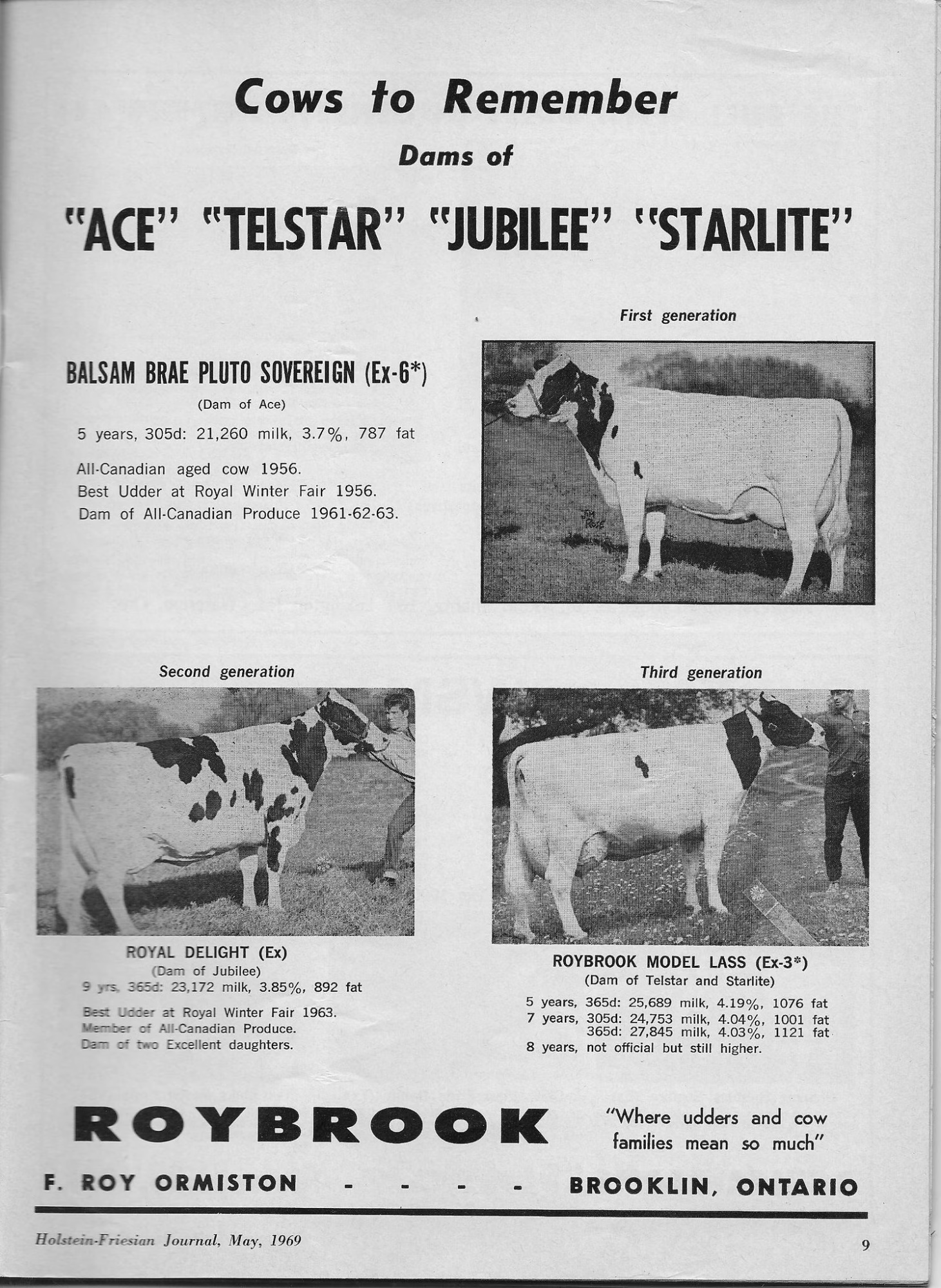
Roybrook Starlite (Canada): Echoing the herd’s tradition, Starlite was used almost exclusively “in-house” within the Roybrook program to intensify key genetic traits. Only after this internal genetic consolidation were Starlite’s genetics released more broadly, subsequently impacting Canadian and international Holsteins.
Sunny Boy (Dutch Friesian/Holstein): In the Netherlands, the early distribution of Sunny Boy semen was highly rationed and targeted at strategic clients due to both supply constraints and his growing reputation, allowing the owner (CR Delta) to optimize both returns and influence.
What all of these stories illustrate is simple: the restricted, strategic use of sires—sometimes referred to as “holding back” genetics—has always been part of the playbook for herd improvement, profit generation, and competitive positioning in dairy breeding. Whether it’s Roybrook, Tango Sabre, or legendary sires like Elevation and Sunny Boy, this approach has quietly but decisively shaped the direction and fortunes of the Holstein breed worldwide.
The Gene Bank Discovery Nobody’s Talking About
Here’s the bombshell: USDA researchers used frozen Holstein semen from the NAGP gene bank—samples from bulls whose lineages trace back to the early AI era—and produced daughters that stood toe-to-toe with today’s “elite” sires for production traits, fertility, and health. We’re talking milk yield, component percentages, and reproductive longevity that were all solid, not just a nod to history. The key revelation? These bulls represent Y-chromosome lineages that have completely disappeared from the modern Holstein population.
The genetic bottleneck is even more extreme than most realize. Today, over 99% of Holstein AI sires descend from just two bulls born in the 1950s, which has left our breed with shockingly limited Y chromosome diversity—most historic lines are extinct, but the gene bank kept some rare ones alive just in time.
This isn’t nostalgia—it’s serious genetic insurance. The gene bank holds onto those lost Y-chromosome families, meaning we’re not boxed in if disease, inbreeding, or selection mistakes hammer current genetics. Studies show calves from these “heritage” sires can absolutely match the breed average (and sometimes exceed it) when paired with top modern cows.35 Their daughters aren’t just “novelty” animals; they’ve got the competitive production, health, and especially reproductive longevity that any dairy producer knows is where real profit protection lies.
NOTE: Semen freezing in cattle wasn’t really feasible until the late 1940s and early 1950s. So, when researchers talk about using “genetic samples from the 1940s,” they’re not using semen literally collected and saved during that decade. Here’s the scoop: Almost all gene bank Holstein bull semen samples come from the 1950s onward, when practical cryopreservation methods kicked off. Earlier preservation—prior to the introduction of glycerol and controlled-rate freezing—just wasn’t possible. Before that, artificial insemination was done with fresh semen only, which obviously couldn’t be stored for decades. If a study says they’re restoring 1940s lineages, what they really mean is they’ve found bulls in the gene bank whose ancestry traces back to those early male lines. The actual semen straws were collected and frozen in the 1950s, ’60s, or later—often from older bulls whose sires or grandsires were around in the 1940s. Some gene banks also store embryos, tissue, or blood, but for these Holstein projects, it’s the semen that’s key—and the oldest viable samples only go back as far as the very first days of freezing technology. So, they didn’t save “1940s semen”—they saved semen from descendants or late-surviving individuals from those lines once freezing became feasible. That’s how they’re able to resurrect “lost” genetic lineages, even if it’s not from the literal 1940s.
What Actually Works: Real-World Data for Real Farms
Inbreeding Management Pays, Immediately
A 1% inbreeding reduction saves $23–25 in cow lifetime Net Merit—that’s on the books, not in a catalog (Univ. Compilations, 2024). Farms that cap offspring inbreeding below 6.25% report steady profit improvement and fewer herd-health headaches.
Genomic Testing Adds Up
Testing every dairy heifer at birth can boost herd genetic merit by $400 over two breeding cycles, while cutting replacement costs 35% (Wisconsin Dairy Research, 2024). For large herds, even more ROI.
The Beef-on-Dairy Trap: Short-Term Win, Long-Term Risk
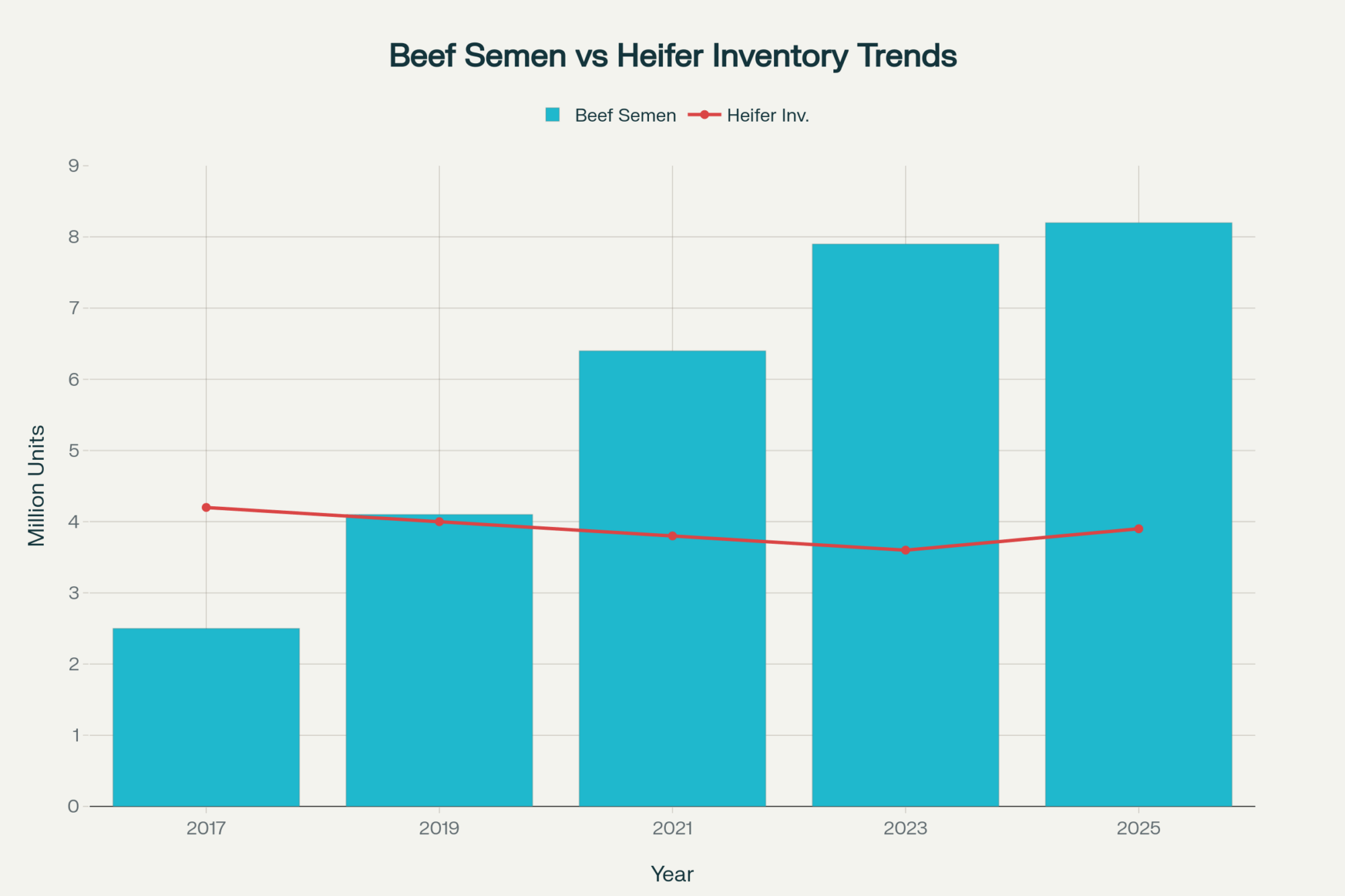
You see it all over: Beef genetics are now used in 72% of U.S. dairy herds (Farm Bureau Market Intel, 2025). Beef semen sales shot up from 1.2 million units (2010) to 9.4 million (2023), putting 3.22 million dairy-beef crossbred calves on the ground last year (NAAB Data).
Trading Tomorrow for Today. The dramatic rise in beef semen sales has directly correlated with a multi-year decline in the U.S. dairy heifer inventory, creating a critical shortage of replacements and highlighting the long-term risk of this short-term strategy.
Crossbred calves bring $400 or more compared to $150 for a pure dairy bull calf—good money, right? But check your records: replacement heifer costs are now $2,870 each, a historic high, while the pool of genetic diversity shrinks tighter (USDA Market Data, 2024).
It’s a vicious cycle—beef-on-dairy takes future dairy animals out of the herd, narrowing our genetic pool, so AI companies must work with fewer—and more related—bloodlines. This accelerates inbreeding, which makes more cows unprofitable, sending more herds to beef-on-dairy as a fallback.
Michigan State research shows $250 more per crossbred calf when beef semen targets heifers with truly poor dairy genetics, as identified by genomics—not random culls (MSU Study, 2024).
We’re trading our dairy breed’s future for today’s calf check.
Your Immediate Action Plan
This Month:
Ask for up-to-date inbreeding reports on progeny from ALL your AI suppliers.
Calculate current herd average inbreeding using latest DHIA or, ideally, CDCB genomic parentage records.
Refuse any matings that would push progeny above 6.25% inbreeding—remember, it’s progeny inbreeding that counts, not just parent averages.
Next Quarter:
Buy semen from at least three different AI companies to spread genetic risk.
Explore European outcross (within-breed) options—they’ve documented value for milk component, health, and fertility improvements.
Budget for genomic testing of every replacement heifer: $35–$50 per sample.
Long-Term Strategy:
Only use beef semen on genomically verified poor dairy genetics.
Pilot crossbreeding other dairy breeds for 20–30% of your herd to test for hybrid vigor.
Get involved in university extension programs and CDCB information sessions for independent updates and honest guidance on managing inbreeding and alternatives.
Your Operation’s Bottom Line
The dollars add up:
Inbreeding reduction: $23–25 lifetime Net Merit per cow, per 1% drop
Genomic testing: positive ROI within two cycles
Targeted beef-on-dairy: $250+ premium per targeted crossbred
European outcrosses: Documented boosts to solids, health, welfare in multiple trials
Example: Dropping your herd’s inbreeding from 13% to 8% can mean $75,000–$94,000 in better cow value, after adjusting for semen cost.
The Bottom Line
Whether Holstein genetics survive and thrive—or collapse under too much corporate concentration and inbreeding—depends on the choices you make this year and every year after.
The “corporate model” offers quick gains but risks future genetic bottlenecks. The diversity model takes planning, but it’s what keeps herds profitable no matter what the market throws at you.
European co-ops prove there are alternatives to pure volume. Gene banks prove that valuable genetics exist beyond the corporate hype. The smartest producers are managing all their genetics—dairy and crossbred, cows and bulls—as a full-profit “portfolio” now.
Your next breeding decision is a vote for the kind of dairy animal—and industry—we’ll have in 2035.
You can keep chasing catalog rankings, or you can start managing herd genetics like the long-game business it is—diversifying risk, optimizing for the lifetime cow, and building a herd that’s ready for the swings of the future.
The research is clear. The economics work. Forward-looking producers are making the shift, planning their herds for the next generation—not just the next index run.
The big question isn’t whether genetic diversity beats chasing next month’s numbers. The proof is in the milk check.
The only real question is if you’ll move first—or be left to play catch-up when your neighbors, or global competitors, act smarter. It’s your future.
Don’t let marketing dictate your breeding strategy. Let the data, the research, and proven results guide your plan.
KEY TAKEAWAYS:
Audit your inbreeding levels immediately: Herds dropping from 13% to 8% inbreeding see $75,000-94,000 in improved cow value—but 72% of producers don’t track these numbers, leaving money on the table while competitors gain advantage.
Strategic beef-on-dairy targets matter: Michigan State research shows targeting genomically-verified poor dairy genetics (not random culls) delivers $250+ premiums per crossbred calf while protecting your replacement pipeline from the industry’s genetic bottleneck.
European outcross genetics deliver measurable ROI: Commercial trials document significant increases in milk components and health traits using CRV/VikingGenetics Holstein bloodlines, offering proven alternatives to the North American genetic monoculture.
Genomic testing pays within two breeding cycles: At $35-50 per heifer sample, testing delivers $400+ improvements in herd genetic merit while cutting replacement costs 35%—yet most producers still breed blind in 2025.
Diversify AI suppliers like investment portfolios: Using semen from 3+ companies while capping progeny inbreeding below 6.25% creates the genetic resilience that separates surviving farms from those caught in tomorrow’s market squeeze.
EXECUTIVE SUMMARY:
While everyone’s celebrating genomic miracles, we’ve uncovered an $6.7 billion disaster hiding in plain sight—Holstein inbreeding has exploded 168% since 2010, and most producers don’t even know their herd’s levels. Every 1% increase in inbreeding costs you $23-25 per cow lifetime, yet AI companies keep pushing the same elite bloodlines that created this mess. Meanwhile, beef-on-dairy—sold as easy money—is actually accelerating the genetic collapse by removing 95,000 potential dairy replacements for every 1% of the national herd. The kicker? USDA researchers just proved that frozen semen from the 1940s produces daughters that match today’s “elite” genetics for production and health. European cooperatives are quietly building an alternative empire based on longevity and resilience, while North American producers chase short-term index gains that compound into generational losses. The hidden war for Holstein genetics isn’t coming—it’s here, and your next breeding decision determines which side of history you’re on.
Complete references and supporting documentation are available upon request by contacting the editorial team at editor@thebullvine.com.
Learn More:
Dairy’s Bold New Frontier: How Forward-Thinking Producers Are Redefining the Industry – This strategic article demonstrates how next-generation producers are using advanced technologies like AI and robotics to dramatically improve efficiency and diversify revenue. It provides a blueprint for leveraging technology to increase productivity and reduce costs, offering a broader perspective on the industry’s future beyond just genetics.
Getting Serious About Genomics: Lessons from India’s Dairy Revolution – This tactical piece provides concrete, real-world examples of how producers are using data tracking and genomic testing to cut feed costs and improve milk-to-feed conversion ratios. It reveals how to use these tools to identify your top producers, cull underperformers, and create a more profitable herd, turning genetic strategy into a measurable bottom-line win.
The Future of Dairy Farming: Embracing Automation, AI, and Sustainability in 2025 – This innovative article showcases the latest emerging technologies that can drive efficiency and create new revenue streams, from automated feed systems to precision breeding. It reveals methods for navigating volatile markets and making smart investments in technology that provide a faster ROI than traditional expansion.
Join the Revolution!
Join over 30,000 successful dairy professionals who rely on Bullvine Weekly for their competitive edge. Delivered directly to your inbox each week, our exclusive industry insights help you make smarter decisions while saving precious hours every week. Never miss critical updates on milk production trends, breakthrough technologies, and profit-boosting strategies that top producers are already implementing. Subscribe now to transform your dairy operation’s efficiency and profitability—your future success is just one click away.
The genetics company lands a respected industry veteran with global chops and farm roots
Yesterday, Semex announced that Jon Schefers is stepping in as their new US General Manager, effective September 22, 2025. This isn’t your typical corporate shuffle—it’s a calculated move that tells you everything about where Semex sees the American market heading.
Look, we all know how competitive the US genetics scene is. You’ve got ABS Global, Alta Genetics, STgenetics—all these established companies competing for market position. Each one’s trying to convince producers they’ve got the magic bullet for better cows and fatter milk checks.
Why This Move Makes Sense
Here’s what caught my attention: Semex didn’t just grab any suit from corporate. They went after a guy with dirt under his fingernails. The timing of this appointment—17 days from announcement to start date—tells you this was strategic recruiting, not a panic hire.
Schefers has that combination you don’t see every day. Born and raised on his family’s Minnesota dairy farm with a master’s degree in dairy science from Wisconsin. He gets what it’s like to milk at 4 AM and worry about feed costs, but he’s also got the technical chops to understand genomic breeding values.
Jon Schefers: A Career Path Built for US Dairy Genetics
Started as a Genetics Specialist at Alta Genetics—we’ve all been there, cutting our teeth in the trenches. Then moved to Peak Genetics as Program Lead, where he developed Holstein, Jersey, and Angus breeding programs that actually produced animals people wanted to buy.
But here’s where it gets interesting. As Global Genetics Director at CRV, he wasn’t just pushing paper. He ran product development, R&D, and embryo production across both EU and US operations. And get this—he led the development and launch of methane breeding values in international markets.
That’s not some feel-good environmental PR stunt. CRV’s methane breeding research demonstrates real genetic potential for emission reduction. With regulatory pressure mounting and carbon credits becoming real money in some regions, that expertise could be worth its weight in gold.
His peers elected him as a Director for the National Association of Animal Breeders. When your competitors vote for you in this industry, that says something about your reputation.
What John McDougall Really Meant
“As our US business continues to grow, we’re continuing to invest in the market,” says John McDougall, Semex Vice President of Sales.
Translation? They’re not just maintaining—they’re expanding aggressively.
McDougall calls Schefers a “problem-solver and unifier”. In corporate speak, that usually means there are problems to solve and things that need unifying. But in this case, it probably means what every producer wants: someone who understands that genetics companies need to solve real-world problems, not just sell fancy breeding values.
What Schefers’ Hire Means for Your Dairy Operation
Here’s where the rubber meets the road. This move raises two questions every producer should be asking: Can Schefers use his global experience to give Semex a real edge? And how will the other guys respond?
His methane breeding work could be particularly relevant as environmental regulations tighten. Canada already implemented the first national methane efficiency evaluation system, and that trend isn’t stopping at the border. Having a genetics company that can deliver on environmental traits while maintaining production could be a competitive advantage.
What Producers Really Need
Let’s be honest: producers don’t need another company selling them semen. They need a partner who understands the real pressures—labor shortages that have you milking cows yourself, margins so tight you’re counting every kernel of corn, and consumers who want their milk to come from happy, environmentally friendly cows.
Schefers’ farm background suggests he gets this. But understanding and delivering are two different things. The genetics industry will be watching to see how this appointment influences market dynamics and whether Semex’s investment in experienced leadership pays off.
For producers, the appointment represents another option in an increasingly sophisticated marketplace, where these established companies are competing not just on genetic merit but on their ability to provide comprehensive solutions.
The Bottom Line
This is a smart hire for Semex. They’ve brought in a respected leader with the right mix of farm sense and global technical skill. But the US market is a total knife fight. Schefers’ success won’t be measured in press releases—it’ll be measured in whether he can deliver genetic solutions that make a real difference to your bottom line.
The competition is watching. So are we.
Learn More:
Genomic Testing: Are You Leaving Money on the Table? – This article breaks down the practical ROI of genomic testing. It provides a clear framework for deciding which animals to test, helping you maximize your genetic investment and stop wasting money on underperforming animals in your herd.
The Genetics Arms Race: Who Will Win the Battle for Dairy’s Future? – Go beyond a single hire and understand the entire competitive landscape. This strategic analysis reveals the long-term trends and market forces that will determine which genetics companies—and which producers—will thrive in the coming decade.
Beyond Milk: The Untapped Goldmine of Feed Efficiency Genetics – While methane efficiency is key, this piece explores the next frontier in profitability. It demonstrates how breeding specifically for feed efficiency can drastically slash your input costs, creating a more resilient and profitable herd for the future.
Join the Revolution!
Join over 30,000 successful dairy professionals who rely on Bullvine Weekly for their competitive edge. Delivered directly to your inbox each week, our exclusive industry insights help you make smarter decisions while saving precious hours every week. Never miss critical updates on milk production trends, breakthrough technologies, and profit-boosting strategies that top producers are already implementing. Subscribe now to transform your dairy operation’s efficiency and profitability—your future success is just one click away.
How Braedale Goldwyn rewrote the rules of Holstein breeding with genetics, show dominance, and a market-changing legacy.
Braedale Goldwyn in his prime—the Holstein bull whose genetic lightning strike changed everything for dairy breeding worldwide.
You know that feeling when you’re walking through a barn and spot a calf that just… has something special about it? Most of the time, you’re wrong, honestly. But every once in a while…
January 3rd, 2000. Cumberland, Ontario. Terry Beaton is watching a newborn James calf get its legs beneath it in the maternity pen. Just another planned mating, right? Except this gangly calf would become Braedale Goldwyn—and honestly, I’m not sure any of us realized we were witnessing the start of a genetic revolution.
The Foundation Nobody Saw Coming
Here’s what I’ve always found fascinating about Terry Beaton—the guy understood maternal lines when most of us were still chasing flashy sires. Back in ’85, when computer indexes were still a newfangled thing and half the industry didn’t trust them, Terry was already thinking generations ahead.
Picture this: November 1985, Sunnylodge Farms dispersal. You know how those sales go—everybody’s buzzing, coffee’s flowing, and the really good cattle are bringing serious money. The sale averaged $6,839 per head (which was real money back then), and the top lot was this first-lactation heifer, Sunnylodge Elevation Jan, VG-87-13*.
Now Terry didn’t just bid on her and walk away. After the sale, he tracks down Carl Smith—the original owner—and proposes a partnership. They’d flush her extensively and split the embryos. I mean, think about that for a minute. Most guys buy a cow, milk her out, maybe get excited about a daughter or two. Terry’s already planning a dynasty.
That single decision—man, talk about return on investment.
Building Something That Lasts
What’s happening with the Jan family over the next fifteen years is basically a masterclass in line breeding done right. And I say “done right” because we’ve all seen line breeding go sideways—fertility issues, weird recessive traits popping up, the whole nine yards.
But Terry had this knack for stacking the generations without painting himself into a corner. Jan’s Chief Mark daughter, Sunnylodge Chief Vick, earned 31 brood cow stars. Solid numbers—the kind that pay bills and keep bankers happy. Then Vick to Aerostar produces Moonriver, who honestly didn’t look like much herself (GP-83, sold to Japan as a youngster), but left behind this heifer calf that would change everything.
Braedale Gypsy Grand, VG-88-37—the “genetic locomotive” whose elite sons dominated LPI charts years before Goldwyn, proving the family’s transmitting power.
That calf was Braedale Gypsy Grand, VG-88-37*. And folks, this cow was special. Holstein Canada Cow of the Year in 2003, but more importantly, she was what we call a “genetic locomotive”—a rare female that just cranks out excellent offspring. Her sons were already topping the LPI charts before anybody had heard of Goldwyn: Goodluck at #4, Freelance at #2, plus Spy, Rainmaker, and others.
Huntsdale SHOTTLE Crusade EX 95 3E 7—Nasco International Type and Production Award winner at World Dairy Expo, proving Gypsy Grand’s maternal magic still works generations later.
The family was already a brand. That’s what blows my mind about this whole story.
The Storm Cross That Set Everything in Motion
Then comes the mating that made it all worthwhile—Gypsy Grand to Maughlin Storm. On paper, it looked like another solid breeding decision. Storm was decent, nothing that would make Holstein International headlines. But when that mating produced twins—Baler Twine and Second Cut—the industry was about to get a genetics lesson we’re still talking about.
Braedale Baler Twine, VG-86-20—the dam of legend whose “planned mating” to Shoremar James produced Goldwyn and completed Terry’s 15-year masterpiece.
Here’s where it gets wild… Years later, when genomic testing became available, researchers discovered that these two cows were identical twins from a split embryo. Both scored VG-86 in the first lactation with nearly identical production. Both became legendary brood cows. It’s like hitting the genetic lottery twice with the same ticket.
And get this—Baler Twine stayed at Braedale and produced Goldwyn, while Second Cut went to Gillette and became the dam of five Class Extra sires. Same genes, different locations, both producing champions. That’s the kind of genetic consistency you build entire programs around.
The Paternal Power Play: Shoremar James
While the Braedale maternal line is rightly celebrated as a masterpiece of breeding, the choice of sire that ultimately produced Goldwyn was no accident. The other half of the pedigree came from another Canadian dynasty, the Shore family, whose Shoremar prefix represented a century of breeding for balanced, long-lasting, profitable cattle.
The sire, Shoremar James, was a product of this exact philosophy. Sired by the legendary MARK CJ GILBROOK GRAND, his real power came from his dam, STELBRO JENINE AEROSTAR, a monumental brood cow in her own right. The Shores, much like Terry Beaton, built their success on the back of incredible cow families, as detailed in The Bullvine’s feature, When Giants Fall Silent: The Shore Dynasty’s Century of Shaping Holstein Excellence.
While Goldwyn became a legend, his paternal legacy from Shoremar James also shaped champions. Here, Thrulane James Rose, an Excellent-97 daughter of Shoremar James, is pictured as Supreme Champion at the Royal Agricultural Winter Fair. Her exceptional type demonstrates the influence James brought to the breed, a perfect complement to the Braedale maternal strength.
So, what did James bring to the table? He provided a brilliant outcross of proven genetics known for dairyness, frame, and functional type. Mating him to the line-bred power of Baler Twine was a strategic masterstroke. It combined Beaton’s concentrated genetic engine with the Shore family’s legacy of durability and balance. This wasn’t just a mating; it was a fusion of two of Canada’s greatest breeding philosophies.
When Everything Changed Overnight
February 2005. I remember checking proofs that morning, and honestly? Most moves are predictable. Bull jumps five spots, drops three, whatever. But when a bull rockets from #82 to #5 LPI in a single run—that’s when you stop drinking coffee and start making phone calls.
According to Canadian Dairy Network data, Goldwyn’s jump was unprecedented—77 positions in one proof run. By May 2006, he’d climbed to #3 LPI. Those aren’t incremental improvements; that’s a genetic explosion.
I can picture Terry in that Cumberland farmhouse, probably still in work clothes from morning milking, staring at his computer screen. After decades of careful breeding, staying patient while others chased genetic fads, suddenly he’s got a bull that’s not just good—he’s potentially game-changing.
The phone must’ve started ringing that morning and not stopped for months.
The Show Ring Revolution
The moment everything crystallized: The 2011 World Dairy Expo 5-year-old class, where seven of the top placings went to Braedale Goldwyn daughters, including Grand Champion Gold Missy—marking the beginning of an unprecedented era of show ring dominance.
“What made Goldwyn different wasn’t just the numbers—though those were impressive enough. Walk into any barn with his daughters, and you could spot them from the feed bunk. Those udders weren’t just good; they were architectural marvels.”
World Dairy Expo 2008 was the moment everything crystallized. When they announced Premier Sire and called Goldwyn’s name, ending Durham’s long reign… you had to be there. The tension in that Coliseum was incredible. Durham had been the gold standard—consistent, profitable daughters that made sense in commercial herds across Wisconsin and beyond.
But when Goldwyn’s daughters started walking into that ring, something shifted. The mammary perfection, the dairy strength, the sheer presence—it was like watching a new breed standard emerge in real time. Holstein Canada records show he eventually became the first sire in history to produce over 1,000 daughters classified Excellent—a milestone that redefined what was possible.
RF Goldwyn Hailey EX-97—the next dynastic champion who captured Supreme Champion at World Dairy Expo in 2012 and 2014, ensuring Goldwyn daughters wore the ultimate crown for four consecutive years.
By 2013, at World Dairy Expo, Goldwyn sired nearly 25% of the entire Holstein show, with 47 daughters placing in the top 10 of their classes. That level of single-sire dominance is virtually unparalleled.
Bonaccueil Maya Goldwyn EX-95—Supreme Champion of the 2013 World Dairy Expo, continuing the dynasty that proved Goldwyn daughters owned the ring.
The Economic Juggernaut
But here’s where the story gets really interesting from a business perspective. The Walrus magazine documented how Goldwyn’s semen went from standard AI product to investment commodity. By 2006, straws were $100 each—premium pricing that reflected serious market confidence. After his death in 2008, secondary market prices soared to between $800 and $1,000 per straw.
Think about that for a minute. A thousand dollars for a single breeding. That’s not just genetic merit; that’s treating bull semen like blue-chip stock.
Eastside Lewisdale Gold Missy EX-95—the $1.2 million Goldwyn daughter whose record-breaking sale made global headlines and proved that elite genetics had become investment-grade assets.
His daughters consistently topped sales worldwide. Eastside Lewisdale Gold Missy’s $1.2 million sale in 2009 made global headlines and established new benchmarks for the valuation of elite dairy females. At the 2008 World Classic Sale, a young Goldwyn daughter commanded $97,000. This pattern repeated at auctions globally—”Goldwyn” in a pedigree became a powerful marketing tool that reliably added value.
The Complex Reality We’re Still Managing
Jacobs High Octane Babe EX-96—B&O Champion at Royal 2022 and daughter of Jacobs Goldwyn Britany, proving that Goldwyn’s genetic magic still works decades later.
Now here’s where we need to talk honestly about consequences, because Goldwyn’s success created challenges we’re still dealing with. Recent genomic analysis reveals why he was such a dominant sire of daughters but not necessarily sons—he passed significantly more genetic merit to daughters (65%) than sons (54%). It’s like the genetic recipe needed that maternal contribution to really shine.
This explains why his sons, such as Atwood, Dempsey, Lauthority, and Goldchip, became popular but never achieved the revolutionary impact he did. His lasting influence is arguably as a maternal grandsire—that “Goldwyn” in the second generation remains a stamp of quality.
But we can’t ignore the genetic concentration issue. By 2008, Goldwyn and two other popular sires accounted for nearly 12% of all registered Holstein females in Canada. That level of concentration raises valid concerns about the long-term health of the breed.
More challenging is his carrier status for Cholesterol Deficiency (HCD). Cornell University research confirmed that this recessive disorder traces back to Maughlin Storm through the APOB gene disruption. Because Goldwyn was used so extensively before the condition was identified, he became a primary vector for distributing this haplotype throughout the global Holstein population. Current mating programs have to account for HCD management—something we wouldn’t need with more moderate usage.
Lovhill Goldwyn Katrysha, Supreme Champion at the 2015 World Dairy Expo, epitomizes the show ring revolution that made Goldwyn daughters legendary across North America.
The Paradox of Perfection
Perhaps the most fascinating aspect of Goldwyn’s legacy is how he perfected an archetype just as the industry began questioning its commercial viability. He modernized the show ring, creating the ultimate tall, elegant, angular cow with flawless mammary systems.
But here’s where it gets complicated… Industry research has painted a challenging picture for the tall-stature cow he epitomized. The Bullvine’s analysis of feed efficiency studies reveals that taller cows typically consume 10-15% more feed per pound of body weight, although results vary considerably by management system. That translates to real costs in today’s volatile feed markets.
Data from breeding organizations indicate negative correlations between stature and fertility, with taller cows requiring more frequent calving interventions. Most significantly, research indicates very tall cows may average fewer lactations compared to moderate-sized counterparts, though this varies enormously by region and management practices.
Loyalyn Goldwyn June (EX-97-6E 2) in her later years—a legendary daughter of Braedale Goldwyn who proved his genetics could deliver both show-ring excellence and remarkable longevity, milking through nine lactations and becoming a beloved icon of the breed.
Many Goldwyn daughters achieved exceptional longevity in well-managed herds—documented cases of cows lasting five or more lactations compared to industry averages around 2.8. But that’s the key phrase: “well-managed herds.” Results depend heavily on nutrition, housing, health protocols, and regional factors.
Calbrett Goldwyn Layla EX-96, daughter of the legendary Million Dollar Cow Lylehaven Lila Z, exemplifies Goldwyn’s enduring legacy. With 11 Brood Stars, 19 VG/EX progeny including 3 EX-94 dams, and over 78,000 kg lifetime production, Layla demonstrates how Goldwyn daughters became the foundation for today’s elite breeding programs.
What This Means for Today’s Breeding Decisions
The interesting thing about Goldwyn’s legacy is how it’s shaped our genomic era approach. These days, we’re looking for bulls that can deliver the complete package—improve components, enhance longevity, and still sire daughters that look the part. That’s essentially the Goldwyn standard applied with better tools.
Genomic testing has given us capabilities Terry never had. We can identify genetic potential in heifers at six months, predict breeding outcomes with 70% reliability, and manage recessive disorders before they become widespread problems. It’s like having GPS for genetic navigation instead of relying on a compass and intuition.
What I’m seeing on progressive farms is this fascinating combination of old-school maternal line development with cutting-edge genomic tools. They’re using genetic testing to identify superior young females earlier, then building programs around proven cow families—exactly like Terry did, but with better data and more precise management.
In today’s market conditions—volatile feed costs, tight margins, labor challenges—those longevity traits become survival characteristics. A cow that milks five lactations instead of three isn’t just a breeding achievement; it’s a business necessity.
The Real Takeaway
Here’s what the Goldwyn story really teaches us: great breeding isn’t about hitting jackpots; it’s about creating systems that consistently produce excellence. Whether you’re milking 80 cows in a tie-stall barn or managing 8,000 in a rotary parlor, the principles remain constant—invest in proven families, make decisions based on long-term goals, and understand that genetic progress takes time.
The genomic revolution has given us incredible tools for managing diversity while maintaining focus. We can identify carrier status for disorders before they spread, balance genetic progress with sustainability metrics that weren’t measurable in Terry’s era, and optimize breeding decisions with unprecedented precision.
But the fundamental lesson endures: depth beats flash every time. The best breeding decisions often feel like calculated risks, but when they’re built on proven genetics and sound principles, they work out.
Every time I see a perfectly uddered cow with that distinctive Goldwyn look walking through a parlor—whether it’s in Wisconsin, Ontario, California, or anywhere else dairy cows make a living—I’m reminded of Terry’s courage in that sale barn in 1985. Sometimes lightning does strike… but it helps when you’ve spent decades building the right conditions.
That’s the kind of breeding that built the Goldwyn legacy. And that’s the kind of breeding that will build the next one—whatever form it takes in our rapidly evolving industry, where sustainability, profitability, and genetic excellence are becoming inseparable.
KEY TAKEAWAYS:
Braedale Goldwyn transformed Holstein breeding with unmatched genetics and show ring dominance, proving you don’t have to choose between production and type
His success was built on a carefully crafted maternal lineage spanning decades, demonstrating the power of patient, strategic cow family development
Goldwyn’s progeny commanded record prices and reshaped the economics of dairy genetics, with semen reaching $1,000 per straw and daughters selling for millions
High usage led to genetic concentration and challenges like Cholesterol Deficiency (HCD), highlighting the risks of over-relying on popular sires
Today, breeders balance show-ring excellence with economic viability and sustainability, applying Goldwyn’s lessons through modern genomic tools.
EXECUTIVE SUMMARY:
This article traces the remarkable journey of Braedale Goldwyn, a Holstein sire whose genetic influence transformed the dairy industry. Born in 2000 from a carefully planned mating within a powerful maternal lineage spanning decades, Goldwyn combined elite genetics with dominant show-ring success like no bull before him. His impact sparked an unparalleled number of daughters excelling in both type and production, driving record-breaking semen sales and auction prices that redefined the economics of dairy genetics. While his widespread dominance raised serious concerns over genetic diversity and the spread of Cholesterol Deficiency (HCD), it also catalyzed a crucial shift towards more balanced breeding programs emphasizing long-term sustainability. Today, his legacy serves as both an inspiration and a cautionary tale, demonstrating how patient maternal line development can create generational impact while highlighting the need for responsible genetic management. This comprehensive feature artfully blends history, science, and industry insights, offering valuable lessons for modern breeders navigating the evolving landscape of genomic-era dairy genetics.
Learn More:
The Ultimate Guide to Dairy Sire Selection – This guide provides a step-by-step framework for making smarter sire choices in the genomic era. It offers practical strategies to balance type, production, and health traits, helping you build a more profitable and resilient herd.
The 2025 Dairy Genetics Marketplace: Where is the Money? – This analysis breaks down the key economic drivers shaping today’s dairy genetics market. It reveals where the real ROI is, helping you align your long-term breeding strategy with current market trends for maximum financial return.
Beyond Genomics: Is Gene Editing the Next Great Leap for Dairy Cattle? – Explore the next frontier in dairy genetics. This article demystifies gene editing technology, outlining its potential to accelerate genetic progress, improve animal health, and create a more sustainable and profitable dairy operation in the coming decade.
Join the Revolution!
Join over 30,000 successful dairy professionals who rely on Bullvine Weekly for their competitive edge. Delivered directly to your inbox each week, our exclusive industry insights help you make smarter decisions while saving precious hours every week. Never miss critical updates on milk production trends, breakthrough technologies, and profit-boosting strategies that top producers are already implementing. Subscribe now to transform your dairy operation’s efficiency and profitability—your future success is just one click away.
Mexico’s buying $2B of our dairy products… but that’s about to change in ways that could make you money.
EXECUTIVE SUMMARY: You know, everyone’s freaking out about Mexico trying to cut dairy imports, but they’re missing the bigger picture here. The real story isn’t about losing commodity sales – it’s about Mexico creating a massive new market for exactly the kind of high-value genetics and technology we do best. Think about it… they’ve got northern dairies hitting 37 liters per cow while southern operations struggle with 9-10 liters. That’s not a trade problem, that’s a $500 million genetics opportunity right there. Their feed conversion ratio is 1.4:1, compared to our efficient herds at 1.2:1 – imagine the consulting fees required to close that gap. Mexico’s investing billions in processing infrastructure, but it can’t boost productivity with concrete and steel. They need our genomics, our automation systems, our expertise. Companies like Semex and ABS are already positioning themselves for this shift, and the processing equipment market alone is growing at a rate of 6% annually.
Here’s what I keep telling producers… while everyone else is worried about defending milk powder exports, smart operations are figuring out how to sell solutions instead. That’s where the real money is.
KEY TAKEAWAYS:
Genetics goldmine: Mexico’s 300% productivity gap between regions creates immediate demand for superior genetics – genomic testing programs showing 10% accuracy improvements with 18-24 month paybacks are suddenly very attractive to Mexican producers getting guaranteed milk prices
Technology export boom: Processing equipment market growing 6% annually to $517M by 2030, while automated milking systems delivering 25-30% labor savings make perfect sense for operations dealing with rising labor costs and government price supports
Consulting opportunity explosion: Programs like the Margarita Project tripled small producer incomes through technical assistance – Mexico has 250,000+ small dairies that need exactly this kind of expertise, creating massive demand for North American dairy consultants
Trade relationship evolution: Instead of defending commodity exports, position your genetics/technology business for Mexico’s transformation – they’re not ending trade, they’re upgrading it from bulk products to high-value solutions
Environmental tech demand: Heat stress causing 15% production drops in key regions while water constraints limit expansion – creates premium market for cooling systems, water recycling, and climate management technologies with 3-5 year payback periods
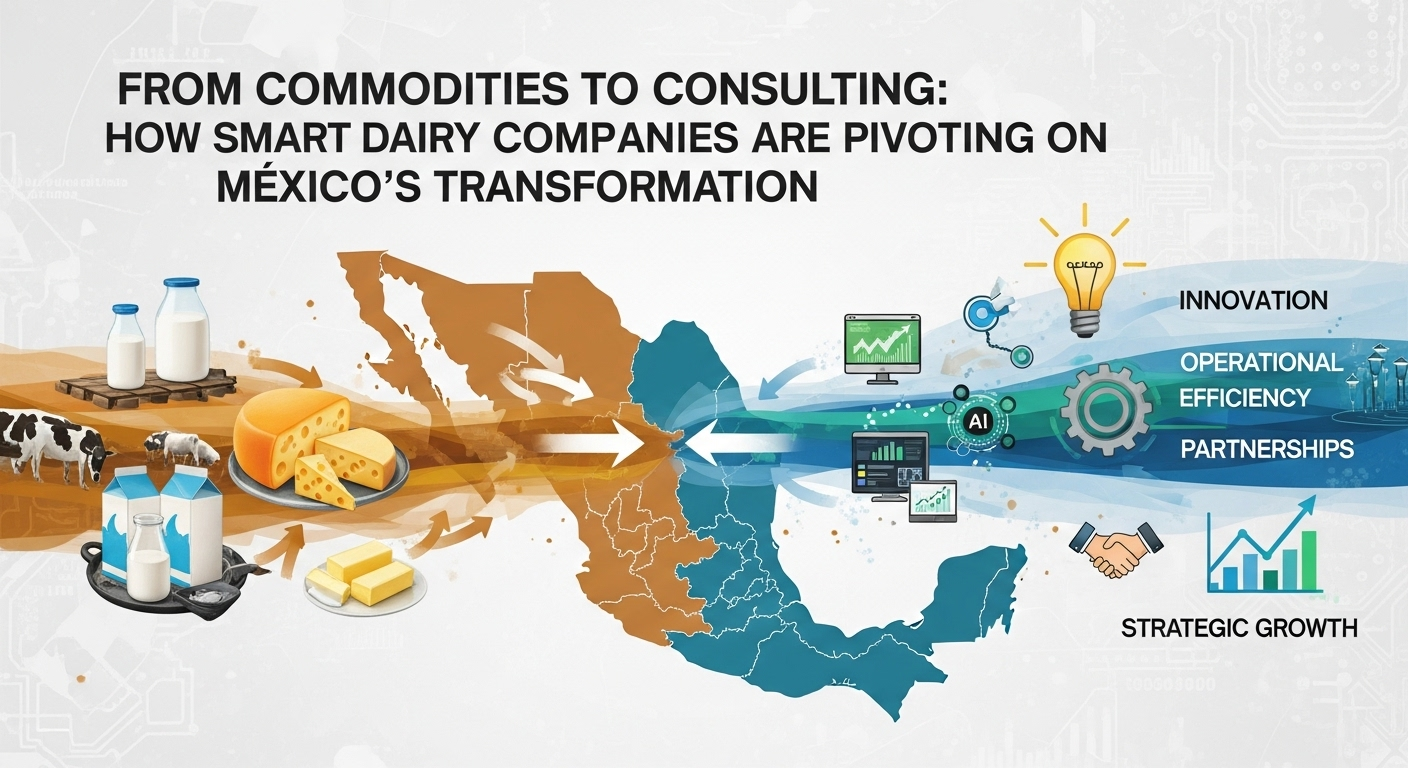
I’ve been watching the Mexican dairy situation evolve for a while now, and it’s becoming clear that something fundamental is shifting there. Mexico’s making a massive push toward dairy self-sufficiency – we’re talking billions in government investment over the next several years. But here’s the thing… this isn’t about cutting off trade with North America. It’s about changing what kind of trade we’re doing.
What strikes me most about this entire development is that while Mexico aims to reduce commodity imports, it is actually creating a huge market for the kind of high-value genetics, technology, and expertise that progressive dairy operations excel at providing.
The Trade Relationship That Everyone’s Watching
US-Mexico Dairy Trade Snapshot (2023)
Trade Metric
Value
Significance
Total US Dairy Exports to Mexico
$2.0+ billion
25% of all US dairy exports
Mexico’s Share of US SMP Exports
51.5%
Largest single market
Mexico’s Import Dependency
50%+ of deficit from US
Critical relationship
Per Capita Consumption Gap
45% below US levels
Growth potential
Look, the numbers tell you everything you need to know about why this matters. The US ships over $2 billion worth of dairy products to Mexico annually, making it our largest dairy customer by far. We’re talking about roughly a quarter of all US dairy exports flowing south of the border.
And here’s what’s particularly interesting… Mexico buys more than half of all the skim milk powder we export. That’s a massive concentration in one market, which explains why Mexico’s push for self-sufficiency has garnered so much attention in the industry.
However, industry economists continue to point out something that I think gets lost in all the trade war rhetoric – Mexico’s per capita dairy consumption remains significantly below US levels. Even as they boost domestic production, there is still room for the market to grow. It’s not necessarily a zero-sum game.
Why Mexico Can’t Get There Alone (The Gaps Are Real)
Mexico Dairy Technology Investment Opportunities
Technology Sector
Market Size
Growth Rate
Payback Period
Implementation Cost
Processing Equipment
$517M by 2030
6% annually
3-5 years
$500K-2M+
Genomic Selection
$500M potential
10% accuracy gain
18-24 months
$35-50/animal
Automated Milking
Regional adoption
25-30% labor savings
5-7 years
$150K-200K
Environmental Tech
Premium pricing
Water/heat stress focus
3-5 years
$50K-500K
Consulting Services
250K+ operations
Triple income potential
12-18 months
$50-200/cow
The Genetics Reality Check
The productivity differences within Mexico’s dairy sector are honestly pretty staggering. You’ve got northern operations – think Chihuahua, Durango – where modern dairies are hitting production levels that would make any Wisconsin producer proud. But then you move south, and you’re looking at mixed-breed herds struggling to hit ten liters per cow per day.
That’s not a small gap. That’s the difference between a profitable operation and one that’s barely breaking even.
What really caught my attention recently was Mexico’s decision to import thousands of Australian Holstein heifers. Think about that for a second – they’re trying to achieve self-sufficiency, but they can’t get there without superior genetics. The Australians were reportedly producing double what the average Mexican cow delivers.
The Feed Efficiency Challenge
Here’s where things get really interesting from a nutrition standpoint. Mexican operations are averaging feed conversion ratios that would make most US nutritionists wince. We’re seeing 1.4 to 1.5 pounds of feed per pound of milk in many operations, while efficient US herds are running closer to 1.2 to 1.
That efficiency gap represents enormous potential for improvement through better nutrition programs and management practices. And the Mexican government knows it – they’ve created price supports that guarantee producers profitable milk prices, specifically to encourage these kinds of productivity investments.
The Water Reality (This Is Getting Serious)
Environmental constraints are becoming the real limiting factor, especially in Mexico’s prime dairy regions. Industrial agriculture already consumes the vast majority of available freshwater in many areas, and climate change isn’t making things easier.
I’ve been hearing from consultants working down there about significant production drops during heat stress periods – we’re talking 15% decreases in some regions during the worst weather. That’s not sustainable if you’re trying to boost national production by 20% or more.
Investment ROI Analysis for Mexico Market Entry
Investment Type
Initial Cost
Annual Return
Break-even
Risk Level
Genetics Program
$100K-500K
15-25%
2-3 years
Low
Processing Equipment
$1M-5M
12-18%
4-6 years
Medium
Consulting Services
$50K-200K
25-40%
1-2 years
Low
Technology Licensing
$250K-1M
20-30%
2-4 years
Medium
Environmental Systems
$500K-2M
15-20%
3-5 years
Medium-High
The Real Opportunity: Selling Solutions Instead of Powder
What’s fascinating about Mexico’s strategy is that while it targets commodity imports, it also creates massive opportunities for technology providers and genetic companies.
The processing equipment market is growing at a rate of approximately 6% annually, driven by significant investments in infrastructure. But more importantly, you’ve got producers who suddenly have economic incentives to invest in productivity improvements.
Genomic selection tools are generating serious interest because they can accelerate breeding progress by 10% or more compared to traditional methods. For Mexican producers dealing with significant genetic performance gaps, such acceleration could be transformative. The economics work too – implementation costs around $40-50 per animal with payback periods under two years.
Automated milking systems are becoming increasingly viable in regions where labor costs are rising and labor availability is becoming a concern. Sure, the upfront investment is substantial – you’re looking at $150,000 to $200,000 for a decent installation – but 25-30% labor savings can quickly justify that in the right situation.
What really excites me, though, is the consulting opportunity… programs like the Margarita Project have shown that you can triple the incomes of small producers through proper technical assistance and market integration. Mexico has hundreds of thousands of small dairy operations that could benefit from this kind of support. That’s a massive market for the right kind of expertise.
What About USMCA? (2026 Is Coming Fast)
The trade agreement framework actually works in favor of this transformation. USMCA preserves duty-free access for most dairy products and protects things like common cheese names. Still, Mexico’s self-sufficiency efforts are primarily focused on basic commodities, such as skim milk powder.
What’s interesting is that cheese imports are still growing – food service demand is driving increased imports of specialty products that Mexico doesn’t produce efficiently. You’re seeing a market bifurcation where basic commodities face pressure, but high-value products continue to grow.
Trade experts continually remind us that Mexico and Canada, combined, represent nearly half of the total US dairy export value, making the 2026 USMCA review absolutely critical for the industry’s future. However, I believe the companies that are positioning themselves for this new reality – focusing on genetics, technology, and expertise rather than just commodity volume – will be fine regardless of what happens in those negotiations.
The Bottom Line: Evolution, Not Elimination
Here’s what I keep telling people who ask about this… Mexico isn’t ending its relationship with North American dairy. They’re transforming it.
The winners are going to be the companies that can pivot from shipping bulk commodities to delivering high-value genetics, cutting-edge technology, and world-class expertise. There’s a clear market bifurcation happening – traditional commodity flows might face pressure, but the demand for solutions is exploding.
You’re looking at producers who need to close massive productivity gaps, adopt new technologies to deal with environmental constraints, and integrate hundreds of thousands of small operations into modern supply chains. That’s not something you solve by building more processing plants… that requires the kind of advanced genetics, sophisticated technology, and deep industry expertise that North American companies do better than anyone.
The question isn’t whether Mexico will achieve their production targets – they probably will, eventually. The question is whether we can adapt our business models quickly enough to profit from that transformation, rather than just watching traditional market shares disappear.
Are you thinking defensively about protecting existing commodity sales, or are you positioning your company to lead in this new market for solutions? Because that choice is going to determine who thrives in the next decade of the North American dairy trade.
Complete references and supporting documentation are available upon request by contacting the editorial team at editor@thebullvine.com.
Learn More:
The 7-Day Plan For Fixing Your Herd’s Feed Efficiency – This article moves from strategy to action, delivering a tactical checklist for closing the feed efficiency gap mentioned in the main piece. It outlines practical steps you can take over seven days to immediately impact your herd’s profitability and reduce waste.
The Great Dairy Bifurcation: Why The Global Market is Splitting in Two – For a deeper look at the global market dynamics driving Mexico’s strategy, this piece provides the strategic framework. It helps you understand the larger economic forces splitting the dairy world into commodity and high-value markets, sharpening your long-term planning.
Beyond The Hype: How Top Herds Are Actually Making Money with Genomics – This article breaks down the real-world ROI of the genomic tools mentioned as a key opportunity in Mexico. It reveals methods for selecting traits that deliver tangible financial returns and helps you avoid common, costly mistakes in genetic investment strategies.
Join the Revolution!
Join over 30,000 successful dairy professionals who rely on Bullvine Weekly for their competitive edge. Delivered directly to your inbox each week, our exclusive industry insights help you make smarter decisions while saving precious hours every week. Never miss critical updates on milk production trends, breakthrough technologies, and profit-boosting strategies that top producers are already implementing. Subscribe now to transform your dairy operation’s efficiency and profitability—your future success is just one click away.
42% heritability for milking speed? That’s higher than most production traits. Your parlor throughput just got a genetic upgrade.
EXECUTIVE SUMMARY: So here’s the deal… the CDCB just dropped something that’s going to change how we think about efficiency. They’re launching a sensor-based milking speed trait that’s built on actual data, not someone’s opinion. We’re talking 50+ million milking observations from real farms, and the numbers are staggering – 42% heritability means you can actually breed for this trait and see results fast. A 1,000-cow operation could save $19,710 annually just from improved parlor throughput, and that’s before you factor in the labor shortage we’re all dealing with. The U.S. is leapfrogging countries like Canada (14% heritability) and Germany (28%) because we’re using pure sensor data while they’re still relying on subjective scoring. But here’s the catch – there’s a genetic correlation with somatic cell score that you need to understand before you start chasing the fastest milkers. This isn’t just another genetic tool… it’s a direct path to better profitability, and you should be planning how to use it before your competitors figure it out.
KEY TAKEAWAYS
Labor Cost Reduction: 25 hours saved weekly for 1,000-cow dairies – Start tracking your parlor throughput now and identify bottleneck cows. With the August 2025 launch, you can use corrective mating to breed faster-milking replacements while labor costs keep climbing.
Genetic Screening Strategy: Avoid bulls below 6.5 lbs/min or above 8.0 lbs/min – Screen your current bull lineup immediately and establish thresholds for 2025 breeding decisions. The +0.43 correlation with SCS means you can’t just chase speed without balancing udder health.
Parlor Efficiency Gains: 4-5 turns per hour vs. current 3-4 turns – Calculate your current throughput and model the economic impact of a 30-second reduction in milking time per cow. In today’s tight margin environment, that extra turn per hour could be the difference between profit and loss.
International Competitive Advantage: 42% heritability vs. 14-28% globally – Position your genetic program ahead of international competitors by adopting objective data-driven selection. As export markets demand efficiency-focused genetics, U.S. producers have a clear technological edge.
AMS Preparation: Robot throughput directly tied to individual cow milking speed – Even though this trait targets parlor systems initially, start evaluating your herd’s milking speed variation now. The principles apply whether you’re planning an AMS transition or maximizing current robot efficiency.
The CDCB’s new sensor-based Milking Speed trait is launching next month? This isn’t just another line item on a genetic evaluation—this could be the most significant functional trait development we’ve seen since… well, maybe ever. Here’s what’s got everyone from Wisconsin to California talking, and why you need to understand this before your next sire selection meeting.
What’s Actually Happening on August 12th
The thing about this MSPD launch is that the timing couldn’t be better. The Council on Dairy Cattle Breeding officially drops their new Milking Speed (MSPD) evaluation on August 12th, and the numbers behind this development are genuinely staggering. We’re talking about a trait built on massive, real-world data that makes previous functional trait evaluations look like small-scale research projects.
According to the CDCB’s comprehensive research analysis, they’ve assembled over 50 million individual milking observations from roughly 300 herds spanning 31 states. That’s not some university trial—that’s data from actual commercial operations dealing with the same labor shortages and efficiency pressures you’re facing every day.
What strikes me most about this whole development is how they’ve completely abandoned the old subjective scoring methods. You know those type classification scores we’ve been living with for milking speed? Gone. Instead, they’re using pure sensor data from in-line milk meters, and the results are honestly incredible—they’re seeing a 42% heritability estimate.
“This represents a paradigm shift away from subjective, classifier-based scoring methods that have characterized previous milking speed evaluations.”
Compare that to what other countries are getting with their farmer-scored systems… Canada is at 14%, while Germany is at 28%, even with their mixed approach. The difference is massive, and it’s all because we’re finally measuring what actually matters instead of relying on someone’s opinion during a type classification visit.
The traits are expressed in pounds per minute—finally, something that makes immediate sense to producers instead of some abstract index number. The Holstein breed average is sitting around 7.1 lbs/min, and from what I’m seeing in the preliminary data, proven sires are ranging from 5.9 to 8.2 lbs/min. That’s real genetic variation you can actually work with.
The Economics That Are Making CFOs Take Notice
Here’s where this gets really interesting from a bottom-line perspective. I’ve been looking at the economic modeling work, and a 1,000-cow operation that reduces individual milking time by just 30 seconds could save about 25 labor hours per week. With current agricultural wages hovering around $17.55 per hour, that translates to roughly $19,710 in annual labor savings.
But here’s the thing… those numbers scale up fast. The research projections show:
Annual Labor Cost Savings by Herd Size:
250 cows: $3,456 annually
500 cows: $9,864 annually
1,000 cows: $19,710 annually
2,000 cows: $49,284 annually
And that’s just direct labor costs—doesn’t even account for the opportunity cost of reallocating that labor to higher-value tasks like fresh cow management or repro work.
What’s particularly noteworthy is how this addresses something every producer I talk to is dealing with right now: the labor crisis. I was just in Lancaster County last month, and producers there are struggling to find skilled milkers at any price. Being able to select for improved parlor throughput genetically? That’s addressing a real problem with a genetic solution.
Take a producer I know in Wisconsin—he’s been tracking his parlor throughput religiously in his double-12. His crew can handle about 4.2 turns per hour on a good day. If genetic improvement could bump that to 4.8 turns? That’s an extra 14 cows per hour through the same facility with the same people. Over a year, that adds up to serious money.
The Udder Health Reality Check Nobody Wants to Discuss
Now, here’s where it gets complicated—and this is something every producer needs to understand before jumping in headfirst. The CDCB research reveals a pretty significant genetic correlation of +0.43 between MSPD and Somatic Cell Score. Translation? If you go crazy selecting for the fastest milkers, you’re going to see udder health problems.
“Single-trait selection for milking speed alone would likely lead to a deterioration in udder health, offsetting the economic gains from improved efficiency.”
But there’s a fascinating twist that makes this even more interesting. The correlation with clinical mastitis is actually favorable at -0.28. So, faster milking might increase your SCC baseline, but it doesn’t necessarily mean more clinical cases. It’s complex… and that complexity is exactly why single-trait selection is such a dangerous game.
What this tells me is that optimal milking speed exists somewhere in the middle. Too slow and you’re hurting efficiency and creating parlor bottlenecks. Too fast and you’re risking udder health problems. From industry observations, I’ve heard from breeding consultants that the sweet spot is probably somewhere between 6.5 and 8.0 lbs/min, depending on your other genetics.
The breeding consultants I’ve been talking to—guys who’ve been doing this for decades—are already recommending screening strategies. Avoid bulls below 6.5 lbs/min to prevent parlor bottlenecks, but also be cautious with anything above 8.0 lbs/min unless they’ve got exceptional udder health proofs to compensate.
How the U.S. Just Leapfrogged the Global Competition
From a global competitive standpoint, this development puts U.S. genetics in an exciting position. The international comparison is fascinating when you dig into the details.
International Heritability Comparison:
United States: 42% (sensor-only data)
Germany: 28% (mixed sensor/subjective)
Nordic countries: 22% (mixed approach)
Canada: 14% (subjective scoring)
Netherlands: 51% (robot-specific data)
What I find fascinating is how this positions American A.I. companies in the global market. They can now compete on a functional trait that’s becoming increasingly important worldwide, and they can do it with superior data backing their claims. That’s a marketing advantage that’s hard to argue with.
The Dutch approach is particularly interesting—they’re seeing 51% heritability for their robot-derived trait compared to 23% for their subjectively scored trait. That gives us a roadmap for where the U.S. could go next, and honestly, we’re positioned to leapfrog their advantage with our superior sensor data and genetic evaluation methodology.
The Robot Connection That’s Got Everyone’s Attention
While this initial MSPD trait applies to conventional parlor systems, the implications for Automated Milking Systems are huge. Here’s what’s got my attention: according to research from Lactanet in Canada, a herd with robot efficiency of 2.0 kg/minute can harvest over 700 kg more milk per robot per day compared to a 1.4 kg/minute herd.
“That’s massive money on the same piece of equipment.”
Think about it—if you’ve got $250,000 tied up in a single robot, you want to maximize what it can produce. The current MSPD trait is designed for parlors, but the underlying principle is the same. Individual cow milking speed directly impacts system throughput, whether you’re talking about parlor turns or robot box time.
I was talking to a producer in Minnesota who’s got six robots running, and he told me his biggest frustration is the variation in milking speed between cows. “Some of my cows are in and out in four minutes, others take eight. That variability kills my throughput.” Being able to breed for more consistent, optimal milking speed? That’s going to be huge for AMS operations.
The research confirms this—the initial MSPD evaluation is specifically designed for conventional milking systems and doesn’t include data from AMS operations. But I expect we’ll see an AMS-specific MSPD evaluation within the next few years. The framework’s already there.
Implementation Strategy—What Actually Works on Real Farms
The thing about new genetic tools is they’re only as good as how producers use them. And with MSPD, there are some pretty clear strategies emerging based on what I’m hearing from early discussions and industry observations.
By Operation Size:
Large Commercial Dairies (500+ cows): These operations make sense for aggressive adoption. They’ve got the scale to capture maximum labor savings and usually the management sophistication to handle multi-trait selection strategies. They’re also most likely to develop custom indexes that weight MSPD appropriately for their specific cost structure.
Medium-Sized Operations (100-500 cows): This is where it gets interesting. Many of these operations are transitioning to automated milking systems, where individual cow milking speed directly impacts robot throughput. The quality-of-life improvements alone can be significant—cutting 30-45 minutes off daily milking time adds up over a year.
Small Dairies (<100 cows): The direct economic benefits are less dramatic, but don’t overlook the operational improvements. These producers will probably derive the most benefit from MSPD once it’s eventually incorporated into a comprehensive index like Net Merit.
Recommended Selection Strategies:
What I’m hearing from the breeding consultants is pretty consistent:
Screening Approach: Avoid bulls below 6.5 lbs/min or above 8.0 lbs/min without exceptional udder health
Custom Index Integration: Weight MSPD against SCS for balanced improvement
Corrective Mating: Use high-MSPD bulls with good udder health on slow-milking cow families
The Data Pipeline Challenge—Your Stake in This Success Story
Here’s something that doesn’t get talked about enough—the success of this trait depends entirely on farms continuing to submit high-quality data. The CDCB’s new Format 6 data submission process requires farms to consistently report milking duration, yield, equipment manufacturer, and session timing.
“The long-term success of this and future data-intensive traits are entirely dependent on the consistent flow of high-quality data from farms into the National Cooperator Database.”
According to CDCB officials, the National Cooperator Database processes data from thousands of herds, but data quality varies dramatically between operations. Farms with robust data management are going to see higher reliability breeding values and better genetic progress.
What’s encouraging is that they’ve built this evaluation around data from 11 different equipment manufacturers, which means they can account for the systematic differences between OEMs. That’s critical for maintaining evaluation integrity across different farm setups.
This is where producers have a real stake in the outcome. Your willingness to submit complete, accurate data doesn’t just help your own genetic evaluations—it strengthens the entire system for everyone. The CDCB manages the world’s largest animal database, containing over 10 million genotypes and evaluation data on 87 million animals. That’s the foundation that makes tools like MSPD possible.
Looking Forward—Where This Industry Goes Next
The August launch is really just the beginning. Industry talk suggests we’ll eventually see MSPD incorporated into Net Merit, but that requires developing a consensus economic weight for the trait. Given the complexity of the U.S. dairy industry—different regions, different cost structures, different milking systems—that’s not going to be a quick process.
What’s more likely in the short term is expansion to other breeds as sufficient data becomes available. The framework they’ve built is breed-agnostic, so Jersey and Brown Swiss evaluations could follow relatively quickly.
What’s Coming:
Net Merit inclusion (likely 2027-2028)
Other breed evaluations (Jersey, Brown Swiss)
AMS-specific trait development
Additional sensor-based traits (feed efficiency, lameness indicators, and methane emissions)
The bigger picture here is that this represents a fundamental shift toward sensor-based functional traits. According to the CDCB research, we’re looking at a future where farm technology seamlessly integrates with genetic evaluation to breed more efficient, profitable cows. Feed efficiency, lameness indicators, even methane emissions—it’s all on the table.
The Bottom Line for Your Operation
What we’re seeing with MSPD is the industry finally catching up to what progressive producers have been asking for—genetic tools that directly address operational challenges. The science is solid, the economic case is compelling, and the competitive advantages are real.
“The producers who figure out how to use this trait strategically—balancing efficiency gains with udder health, screening for extremes while maintaining genetic diversity—are going to have a significant edge.”
You know, after covering this industry for as long as I have, you get pretty good at spotting which developments are going to matter in five years. This one? This one’s going to matter. The question isn’t whether MSPD will change how we select bulls—it’s whether your operation will be leading that change or watching it happen from the sidelines.
I’ve seen too many producers wait for someone else to figure out new genetic tools, only to realize later they could’ve had a two or three-year head start. Don’t be that producer this time. The data is clear, the science is sound, and the economic impact is massive.
The sensor-based breeding revolution starts August 12th. Are you ready to make it work for your operation?
Complete references and supporting documentation are available upon request by contacting the editorial team at editor@thebullvine.com.
Learn More:
Understanding the New LPI Formula Implementing April 2025 – Reveals practical strategies for integrating milking speed into comprehensive breeding decisions using Canada’s updated Lifetime Performance Index, demonstrating how to balance efficiency traits with health and production goals for maximum genetic progress.
5 Technologies That Will Make or Break Your Dairy Farm in 2025 – Explores cutting-edge dairy technologies including robotic milkers and AI analytics that complement genetic improvements, revealing how smart farms integrate sensor-based breeding data with automated systems to boost yields 20% and achieve ROI within seven months.
Join the Revolution!
Join over 30,000 successful dairy professionals who rely on Bullvine Weekly for their competitive edge. Delivered directly to your inbox each week, our exclusive industry insights help you make smarter decisions while saving precious hours every week. Never miss critical updates on milk production trends, breakthrough technologies, and profit-boosting strategies that top producers are already implementing. Subscribe now to transform your dairy operation’s efficiency and profitability—your future success is just one click away.
Belarus’s state-backed genomic program threatens 50% price premiums by 2030.
EXECUTIVE SUMMARY: The A2 milk gold rush you’re betting your herd conversion on is about to face its biggest threat yet—and it’s coming from an unexpected player. Belarus has launched a state-funded program targeting 70% A2 beta-casein production by 2030, threatening to commoditize a market currently delivering 50%+ retail premiums. With the global A2 sector projected to explode from $4.0 billion to $11.1 billion by 2030, this isn’t just another breeding program—it’s a calculated national strategy to capture commodity-scale market share. While genomic testing costs have dropped to $5-40 per animal and elite A2A2 semen ranges $10-75 per straw, the real cost could be the erosion of premium margins that justify your conversion investment. Research shows A2 milk reduces gastrointestinal discomfort and beneficial gut microbiota shifts, validating the science behind the trend. However, the Belarus gambit exposes the fundamental vulnerability of building premiums on non-proprietary genetic markers that any state-backed competitor can replicate. Before you commit another dollar to A2 conversion, demand long-term contracts with guaranteed price floors—because the rules of this game are changing faster than you think.
KEY TAKEAWAYS
Secure Contract Protection Before Converting: Demand guaranteed price floors and duration commitments from processors before investing in A2 conversion, as Belarus’s commodity approach could compress the 50%+ retail premiums currently justifying herd transition costs within the next 5 years.
Prioritize Genetic Merit Over A2 Status: Focus on bulls ranking above 3000 GTPI that happen to be A2A2 rather than selecting lower-merit sires solely for A2 genetics—Semex reports over 230 high-ranking Holstein A2A2 bulls available, proving you don’t need to sacrifice productivity for the trait.
Time Your Market Entry Strategically: Early A2 adopters may capture better premiums before commoditization accelerates, but late entrants risk investing in expensive herd conversions just as state-backed producers flood markets with lower-cost A2-rich products.
Build Defensible Value Propositions: Processors must accelerate brand differentiation beyond simple A2 claims through attribute stacking (A2 + organic, A2 + grass-fed) to create premium positions that transcend commodity competition from state-funded operations.
Monitor Global Supply Chain Disruption: Belarus already supplies 94% of Russia’s dairy imports and targets China’s rapidly growing A2 infant formula market—track their export expansion as an early indicator of when commodity A2 pricing pressure will hit your local market.
Belarus has launched a comprehensive state-funded genetics initiative targeting A2A2 milk production by 2030, representing a calculated strategy to capture market share in the rapidly expanding global A2 sector. The program, directed by the National Academy of Sciences, aims to develop milk containing 70% A2 beta-casein content—a strategic threshold that avoids the economic inefficiencies of complete herd conversion while achieving commercial A2-rich milk production.
But here’s the million-dollar question: What happens when a state-backed entity enters a market built on premium pricing?
Program Economics: Measured Investment Strategy
The Belarusian approach demonstrates a sophisticated understanding of breeding economics. Rather than pursuing absolute genetic purity, the 70% target allows retention of genetically superior A1A2 animals while achieving commercial viability. This strategy could reduce conversion costs by approximately 40% compared to complete herd replacement programs.
The economic rationale centers on accessing premium market segments where A2 milk commands significant retail premiums. Current market analysis indicates that the global A2 milk sector was valued at $15.4 billion in 2024 and is projected to reach $50.9 billion by 2033. Other estimates suggest growth from $2.4 billion in 2024 to $5.4 billion by 2034. However, Belarus’s commodity-focused approach could accelerate market commoditization, potentially eroding the very premiums that justify initial investment.
Technical Implementation: Accelerated Genetics Through State Coordination
The program leverages Belarus’s existing artificial insemination infrastructure and centralized breeding records system. As of January 2025, Belarus operates nearly 3,000 dairy farms, with 56% classified as modern high-tech complexes. This infrastructure provides the necessary technical foundation for large-scale genetic conversion.
The breeding strategy employs exclusive A2A2 bull usage, ensuring all offspring receive at least one A2 allele. Mathematical modeling suggests that achieving a 40% A2A2 population density, combined with 60% A1A2 animals, would yield the target 70% A2 protein content in pooled milk—a pragmatic compromise that enables market entry without incurring extreme culling costs.
Risk Assessment: Implementation Challenges
Industry geneticists identify several implementation risks that could compromise program success. Genetic drag represents the primary technical concern—intensive focus on A2 status may negatively impact other economically vital traits if superior A1-carrying sires are excluded from breeding programs.
Market dynamics present additional vulnerabilities. The initiative’s viability depends entirely on sustained A2 price premiums, which Belarus’s own commodity production could help erode.
Are we watching the beginning of the end for easy A2 premiums?
Execution risks include the logistical complexity of coordinating thousands of farms toward unified genetic objectives within an aggressive timeline. While Belarus plans to modernize and build 450 dairy farms by 2027, the scale and speed requirements present unprecedented challenges for centralized agricultural planning.
Belarus’s entry strategy poses direct challenges to established premium players, such as The a2 Milk Company and Nestlé, whose business models depend on maintaining significant price differentials. The state-backed approach enables aggressive pricing strategies that branded competitors cannot easily match.
The program validates broader industry trends toward the commoditization of the A2 trait. Major genetics suppliers, including ABS Global and Semex, now offer extensive A2A2 sire catalogs, with Semex reporting over 230 high-ranking Holstein bulls with a GTPI of more than 3000 that carry the A2A2 genotype. ABS Global prominently features A2A2 as a “Specialist Symbol” in its sire directories, demonstrating that elite A2 genetics are now mainstream and widely available.
The export strategy initially focuses on securing Russian market dominance—Belarus supplied 94% of Russia’s dairy imports in 2024, totaling 953,000 tonnes—before targeting high-growth Asian markets. In 2024, Belarusian dairy exports surged 17.5% to $3.4 billion, with the a2 protein segment growing 14% in China’s infant formula market and representing 20% of market value.
Industry Adaptation: Strategic Positioning
For dairy producers considering A2 conversion, the Belarus initiative signals both opportunity and caution. Recent research has demonstrated that A2 milk consumption leads to beneficial shifts in gut microbiota, including increases in Bifidobacterium and Blautia. Furthermore, prolonged A2 milk consumption has been shown to reduce symptoms compared to conventional milk in lactose malabsorbers. This validates the A2 trend and may encourage processor premiums.
However, long-term commoditization risks require careful contract negotiation with guaranteed price floors and duration commitments.
Genetic selection strategies should prioritize bulls that rank highly on economic indexes, which happen to be A2A2, rather than compromising overall genetic merit for A2 status alone. This approach maintains herd profitability while positioning for market transitions.
Processing companies face strategic decisions regarding supply chain positioning. Early A2 market entrants must accelerate brand differentiation beyond simple A2 claims—combining traits like A2 + organic or A2 + grass-fed to create defensible value propositions that transcend commodity competition.
Market Outlook: Navigating Transition Dynamics
The Belarus program represents a fundamental shift in A2 market dynamics, regardless of ultimate success. The transition from premium-branded ingredients to standard specification mirrors historical patterns in organic and lactose-free segments.
The global A2 milk market is projected to grow at a compound annual growth rate (CAGR) of 14.21% through 2033, with the Asia-Pacific region maintaining dominance due to high consumer awareness and demand in countries such as China, India, and Australia. However, the commoditization pressure from state-backed producers threatens to compress the premium margins that have driven this growth.
How will your operation adapt to this new reality?
Bottom Line: Strategic Takeaways
For Dairy Producers:
Demand long-term contracts with guaranteed price floors before investing in A2 conversion
Prioritize overall genetic merit over A2 status alone when selecting sires—focus on bulls with high economic indexes that happen to be A2A2
Consider the timing—early movers may capture better premiums before commoditization accelerates
For Processors:
Accelerate brand differentiation beyond simple A2 claims through attribute stacking
Secure key markets before low-cost competitors establish footholds
Optimize supply chains for potential margin compression scenarios
For the Industry: The Belarus initiative demonstrates how state-directed agricultural policy can disrupt established market structures, particularly in segments built on non-proprietary genetic markers. Belarus may not achieve its 2030 target completely, but the attempt alone signals the end of easy A2 premiums and the beginning of a more competitive, commodity-driven market phase.
The A2 gold rush isn’t over—but the rules of the game are changing fast.
Complete references and supporting documentation are available upon request by contacting the editorial team at editor@thebullvine.com.
Learn More:
New Zealand’s Dairy Revolution: The Imperative for a Strategic A2 Beta Casein Policy – Reveals how New Zealand’s strategic A2 transition reached 84% A2 beta-casein by 2025, offering actionable policy frameworks and market positioning strategies that complement Belarus’s state-backed approach with proven competitive advantages in Asian markets.
From Saving a Baby’s Life to Transforming Your Dairy Herd: The Gene Editing Revolution is Here – Demonstrates how CRISPR gene editing technology could efficiently convert A1 cows to A2 milk production, providing cutting-edge alternatives to traditional breeding methods that could accelerate the genetic transformation Belarus is attempting through conventional genomic selection.
Join over 30,000 successful dairy professionals who rely on Bullvine Weekly for their competitive edge. Delivered directly to your inbox each week, our exclusive industry insights help you make smarter decisions while saving precious hours every week. Never miss critical updates on milk production trends, breakthrough technologies, and profit-boosting strategies that top producers are already implementing. Subscribe now to transform your dairy operation’s efficiency and profitability—your future success is just one click away.
While you’re celebrating 80-pound cows, component-focused farms bank $120K more annually. The “pounds mentality” is dead—here’s your survival guide.
EXECUTIVE SUMMARY: The dairy industry’s obsession with milk volume is financially destroying farms that refuse to adapt to component economics. While traditional operations chase fluid milk production that crawled ahead just 15.9% since 2011, component-savvy farms captured the real money: butterfat production exploded 30.2% and protein surged 23.6%. Processing giants have committed $8 billion in new capacity through 2027, all designed for high-component milk, while Federal Milk Marketing Order reforms now align 90% of milk check value with butterfat and protein content. The April 2025 Holstein genetic evaluations revealed the largest base change in history—a 45-pound rollback on butterfat—proving genetic progress is accelerating away from volume-focused breeders. New Zealand’s component-focused strategy achieved 23-26% unit price increases across major dairy categories despite declining milk volumes, demonstrating that quality commands premium pricing globally. For a 500-cow operation, a mere 0.1% increase in butterfat generates $90,000-$120,000 additional annual revenue, yet most farms continue optimizing for yesterday’s metrics. Challenge conventional wisdom: audit your genetic program against component values within 30 days or watch profitable opportunities slip away to farms that embrace this economic revolution.
KEY TAKEAWAYS
Genetic Revolution Accelerating: The April 2025 Holstein evaluations showed a historic 45-pound butterfat rollback and 30-pound protein rollback, with genomics now driving 70% of production improvements compared to 40% pre-2009—farms using genomic testing achieve £193 higher lifetime profitability per animal
Component Premium Explosion: A 500-cow operation generates $90,000-$120,000 additional annual revenue from just 0.1% butterfat increase, while overall production optimization (68 lbs/day at 3.8% fat vs. 70 lbs/day at 3.5% fat) delivers $12,000-$18,000 extra revenue per 100 cows annually
Processing Infrastructure Bet: $8 billion in new dairy processing capacity through 2027 is strategically designed for manufactured products requiring high-component milk—cheese manufacturers achieve 8.3% yield increases per protein percentage point, creating powerful market pull for component-rich milk
Federal Policy Alignment: June 2025 FMMO reforms updated protein assumptions from 3.1% to 3.3% and other solids from 5.9% to 6.0%, directly rewarding component optimization while traditional volume-focused cooperatives inadvertently penalize farms investing in genetic and nutritional strategies
Global Market Validation: Despite 0.5% decline in fluid milk collections, New Zealand achieved record payouts exceeding $10.00 per kilogram of milk solids through component-focused payment systems, enabling 23-26% unit price increases across major export categories—proving component optimization creates sustainable competitive advantages
What if I told you that while you’ve been celebrating 80-pound cows, the smart money moved to something completely different? Here’s the shocking reality reshaping dairy economics: U.S. butterfat levels just hit 4.36% through March 2025-up from 3.95% in 2020. Meanwhile, milk solids production jumped 1.65% even as total volume dropped 0.35%. This isn’t a gradual change – it’s economic disruption happening right now.
The brutal mathematics: While you’ve been chasing milk pounds, butterfat production exploded 82 million pounds in Q1 2025 alone-a staggering 3.4% increase with virtually no fluid volume increase. Component-savvy farms are banking serious money, while volume-obsessed operations struggle with compressed margins.
The Death of “Pounds Per Day” Thinking
Forget everything you think you know about dairy profitability. The April 2025 Holstein evaluations revealed the largest genetic base change in history-a 45-pound rollback on butterfat and a 30-pound rollback on protein. This massive adjustment proves that genetic progress in components is leaving conventional volume-focused breeders in the dust.
The industry doesn’t want you to know that despite overall production declining 0.35% year-to-date, milk solids production jumped 1.65% through March 2025. Smart farmers optimizing components generate substantial additional revenue while commodity milk faces oversupply pressure.
The USDA’s Agricultural Marketing Service reports clearly show that “Plenty of cream is available throughout the country, and it is generally affordable for butter makers.” This abundance of butterfat-rich cream creates opportunities for processors while challenging traditional volume-focused farms.
The $8 Billion Processing Bet That Changes Everything
Here’s a fact that should change how you think about 2025: The U.S. dairy industry has more than $8 billion in processing infrastructure investment happening right now.
Major Processing Investments Creating Demand:
Company
Investment
Location
Focus
Walmart
$350 million
Texas
Distribution hub
Fairlife
$650 million
New York
Fluid milk expansion
Chobani
$1.2 billion
New York
Yogurt/processing
This isn’t just expansion-it’s demand creation that will compete for your milk. Much of this new capacity focuses on manufactured products that depend entirely on component levels, not fluid volume.
Federal Policy Finally Rewards Component Focus
Critical FMMO changes took effect June 1, 2025, creating direct financial incentives for component optimization. After nearly 18 months of hearings, the USDA announced that the Federal Milk Marketing Order modernization passed in all 11 FMMOs.
Key changes affecting your paycheck:
Updated Composition Factors: Effective December 1, 2025, protein content assumptions increase from 3.1% to 3.3%, other solids from 5.9% to 6.0%, and nonfat solids from 9.0% to 9.3%. This adjustment should increase classified milk prices due to higher assumed component content.
Class I Price Mover Changes: The calculation returned to the “higher-of” advanced Class III or Class IV skim milk prices, creating more stable pricing.
If you’ve been investing in genetics and nutrition to boost components, you will get paid for it. If you haven’t? You’re financing those who have.
Your Financial Future Depends on This Decision
Component Performance Reality Check:
2020 average butterfat: 3.95%
2025 average butterfat: 4.36% (+0.41 percentage points)
2020 average protein: 3.181%
2025 average protein: 3.38% (+0.199 percentage points)
The evidence overwhelms any skepticism: USDA raised its 2025 milk production forecast to 227.3 billion pounds, but the real money lies in component optimization. All-milk prices are forecasted at $21.60 per cwt for 2025, creating margin pressure for volume-focused operations.
Yet component-focused farms are generating substantial additional revenue. With the Net Merit $ (NM$) index increasing butterfat weighting from 28.6 to 31.8, while protein weighting decreased from 19.6 to 13, market signals clearly favor component optimization over volume production.
Why Most Farms Are Getting This Wrong
The psychological barrier runs deeper than economics. Many cooperatives continue paying primarily on volume, treating component premiums as secondary considerations. This volume-focused approach inadvertently disincentivizes investments that would optimize component yields.
Current market conditions amplify these problems. Domestic cheese consumption declined by 56 million pounds during Q1 2025 despite surging butterfat production, creating an oversupply crisis for commodity milk and pressuring Class III prices downward.
Most refuse to acknowledge the controversial reality: Component pricing systems now attribute nearly 90% of milk check value to butterfat and protein, yet traditional management systems continue prioritizing volume metrics.
The Bottom Line
The component revolution isn’t coming-it’s here. U.S. butterfat levels hit record highs, milk solids production jumped 1.65% while volume dropped, and Federal Milk Marketing Orders underwent their biggest reform in decades.
The choice is stark: Adapt your genetics program to prioritize components over volume, or watch profitable opportunities slip away to farms that embrace this new reality. With butterfat levels jumping from 3.95% to 4.36% in just five years and the largest genetic base change in Holstein history, your delay costs real money every month.
Your immediate next step: Schedule a comprehensive review of your genetic program within the next 30 days. Use the April 2025 genetic evaluations with their historic base changes to restructure your breeding strategy around component optimization.
Challenge conventional wisdom: Why are you still celebrating milk volume when 90% of your check value comes from components? When the market clearly rewards component optimization, how can you justify breeding decisions based on outdated volume metrics?
The farms that understand this distinction first will capture the profits that volume-focused operations leave unclaimed.
Complete references and supporting documentation are available upon request by contacting the editorial team at editor@thebullvine.com.
5 Technologies That Will Make or Break Your Dairy Farm in 2025 – Explores cutting-edge precision agriculture tools including smart sensors and AI-driven analytics that enable real-time component monitoring and optimization, delivering measurable ROI within 7 months for forward-thinking operations.
Join the Revolution!
Join over 30,000 successful dairy professionals who rely on Bullvine Weekly for their competitive edge. Delivered directly to your inbox each week, our exclusive industry insights help you make smarter decisions while saving precious hours every week. Never miss critical updates on milk production trends, breakthrough technologies, and profit-boosting strategies that top producers are already implementing. Subscribe now to transform your dairy operation’s efficiency and profitability—your future success is just one click away.
How Molly Westwood built a profitable Holstein breeding program through Red White genetics specialization, achieving Master Breeder status and global embryo sales success.
Molly Westwood (right) and her father and business partner Andrew Westwood (center) receive the prestigious Master Breeder Award from Holstein UK, recognizing a decade of exceptional breeding achievements at Panda Holsteins. The award validates Molly’s strategic investment in elite cow families and her commitment to developing some of the UK’s finest Red & White Holstein genetics. Photo credit: Richard Hodgson
Molly Westwood is one of the dairy industry’s most inspiring young breeders, transforming childhood passion into a globally recognized breeding program. From humble beginnings on a non-pedigreed farm to developing one of the UK’s most elite Red & White Holstein herds, Panda Holsteins is jointly owned in partnership with Molly and her father Andrew exemplifies how dedication, strategic vision, and unwavering commitment to breeding principles can create extraordinary results. Her unique business model focusing exclusively on elite genetics rather than milk production has established her as a pioneer in specialized breeding, with her animals’ securing championships across the UK and her embryos in demand worldwide. This is the story of a young breeder who, through calculated risks and meticulous breeding decisions, has revolutionized perceptions of Red & White Holsteins while building a sustainable business that continues to shape the future of Holstein genetics.
Making history: Molly Westwood (middle) celebrates with the Red & White Holstein mother and daughter pair from her O’Kalibra family that became the first Red Holsteins in UK history to win the prestigious Royal Burke Trophies in 2024. This groundbreaking achievement validated Molly’s vision that Red & White genetics could compete at the highest levels against traditional Black & White cattle, cementing Panda Holsteins’ reputation for breeding exceptional animals that challenge conventional perceptions while delivering championship results.
From Farm Girl to Visionary Breeder
Growing up on a non-pedigreed dairy farm in the northern UK, Molly Westwood developed an early connection with cattle that would shape her future. “I have always had a passion for helping my dad at a young age on the farm,” Molly recalls. “Despite being a commercial herd, he always used the best bulls and ensured the cows were looked after like queens; you look after the cows, and they will look after you.”
Even as a young girl, Molly was learning valuable lessons that would form the foundation of her breeding philosophy. She remembers coming home from school and cleaning cubicle beds for her father, who instilled in her a commitment to excellence: “You make sure you clean those beds like it was your own- if it’s not good enough for you, it’s not good enough for the cows.” This guiding principle continues to influence her approach to cattle care today.
The pivotal moment in Molly’s journey came at age 14 when she received a Christmas present that would change her life: a pedigree heifer named Honesberie Charles Gem. “This was the start of my passion for the pedigree world!” she explains. By the following summer, Molly had halter broken Gem, learned how to clip, and convinced her parents to let her enter shows.
This first taste of showing ignited something in Molly that couldn’t be extinguished. She soon helped convert the family’s commercial herd into a registered pedigree operation, with the dual purpose of potentially showing homebred animals and adding value to the cattle they cared for so deeply.
Molly Westwood and her partner Martin Pearson with their canine companions Dotty and Pippa (Jack Russell) at the construction site of their new home. As Panda Holsteins continues to evolve and grow, Molly is building both her breeding program and her personal future, demonstrating the same careful planning and vision that has made her operation successful.
Canadian Education: The Making of a Breeder
Recognizing that achieving her ambitious goals would require gaining experience beyond her family’s farm, Molly boldly decided at just 16 years old to travel to Alberta, Canada. “As soon as I had a taste of competition with my ‘show calf Gem,’ I wanted to breed the best and become a breeder recognized worldwide one day,” she explains. “I knew I had to work hard and take any opportunities I could find.”
A family friend, Chris Parry, offered her a position at Morsan Farms, one of the world’s premier Holstein operations. After finishing school and working briefly at a local pub to save money for her flight, Molly embarked on her Canadian adventure.
This was no small undertaking for someone who described herself as a “home girl” who “never went to friends’ houses, never answered the phone and was always very shy.” But as Molly notes, “Having a connection with cows, I knew I was going to be just fine!”
Her four years at Morsan Farms provided invaluable experience working with world-class animals and learning from industry leaders. “I remain eternally grateful to the Thalen & Parry families,” Molly reflects. “I headed to Canada as a young girl, inexperienced in many ways. But the time over there helped me develop and shape into a young lady who knew exactly what I wanted to do with a little more experience on her belt.”
This formative period allowed her to work with some of the finest Holstein cattle in the world, which fueled her ambition to breed animals of similar caliber. More importantly, she developed the skills, connections, and vision to guide her in establishing her operation.
The Birth of Panda Holsteins
Molly Westwood stands with her parents and business partners, Andrew and Sharon, alongside Panda Dazzling O’Kalibra Red VG87-2YR, a daughter of their foundation cow Panda Autumn O’Kalibra Red EX95-3E 7. The O’Kalibra family became central to Panda Holsteins’ success, with Autumn producing nine VG/EX daughters and establishing the operation’s reputation for breeding elite Red & White genetics. Sharon, who passed away from Motor Neurone Disease in 2024, was Molly’s biggest supporter, while Andrew continues as her partner, managing forage production and field operations at their Devon farm.
The foundation of Panda Holsteins traces back to a specific cow that captured Molly’s attention during her time in Canada: Stoneden Fools Gold Red. One evening, Molly’s boss drove her to Morsan’s heifer barns to help unload some new arrivals, including a heavily pregnant Fools Gold.
“This incredibly balanced heifer with a super wide rump was the type I’d always try and breed in the future,” Molly recalls. What made this cow especially valuable was her unique VRC gene, which allowed for breeding reds from top black and white bulls – creating the opportunity for genuinely distinctive offspring.
After watching Fools Gold calve and develop at Morsan, Molly’s appreciation for this special cow grew stronger. Before returning to the UK, she purchased five embryos from Fools Gold bred to a sire of her choice. These embryos were sent home ahead of her return and implanted following her specific instructions.
When Molly returned to the UK for good, she was thrilled to discover that all five embryos had resulted in pregnancies. “The first calf born was a red heifer- I thought I had hit the jackpot!” she remembers. This red heifer, whom she named “Lexy,” was followed by two black heifers (“Ally” and “Alexa”) and two bulls (one red and one black).
Molly kept the red heifer at home that summer while showing the two black sisters. These heifers became remarkably successful in the show ring, taking top honors at major national events, including the National All Breeds All Britain Calf Show and National Dairy Event.
This initial success with the Fools Gold offspring demonstrated Molly’s eye for quality and validated her breeding approach. The three original heifers scored VG88-3Yr, EX90-4Yr & EX93-2E 5Yr, with Lexy (the red Alexander) calving out at VG88-2yr and achieving significant show success.
Molly Westwood (left) with her twin sister Jess and their mother Sharon, who was instrumental in supporting Molly’s dreams from the early days of Panda Holsteins. Sharon encouraged Molly through show travels, celebrated her successes, and was described by Molly as her “biggest supporter.” The family’s unwavering support provided the foundation that enabled Molly to pursue her ambitious vision of breeding world-class Holstein genetics. Sharon passed away from Motor Neurone Disease in 2024, leaving a lasting legacy in the values and work ethic she instilled in her daughters.
Establishing a Unique Business Model
Unlike conventional dairy operations, Molly envisioned a different path for Panda Holsteins. “I have never wanted to milk hundreds of cows!” she emphasizes. “I love working with animals and seeing progression from my input, breeding & developing the best Holstein Genetics has always been my herd slogan.”
After two years of planning applications, securing mortgages, and developing business plans, Molly built a barn to facilitate her vision of selling top-end Red & White genetics. She created a business model that didn’t rely on milk production as the primary income source, making her operation stand out in the dairy industry.
“Our bank had never seen a five-year business plan like mine,” she reveals. “Throughout the meetings, I had to explain that I was not a typical dairy farmer – and Panda Holstein’s income does not rely on fluctuating milk prices.” Despite these challenges, Molly secured her first loan at 23 years old and began expanding her business.
The initial model involved calving 30 commercial heifers each year, selling them freshly calved to target the top end of the commercial market. These recipient heifers are purchased in groups from high-health farms, with a quick 12-month turnover to reduce costs. Meanwhile, Molly focused on flushing her pedigree animals to develop her genetic lines more quickly, produce embryos for implanting, and generate embryo sales.
This approach allowed her to invest in one new cow family yearly through embryo purchases, maintaining growth and staying at the forefront of the breeding business. She looks for “the special hidden gem nobody has over-marketed, one I can add value to and most importantly is different.”
Adapting and Evolving: 2020-2025
The COVID-19 pandemic and Brexit prompted Molly to reevaluate her business strategy. Before these disruptions, she was selling 80% of her embryos and elite animals to European markets, but anticipated difficulties with livestock exports after Brexit led her to adapt her approach.
“We had been extremely successful with our show calves and the few cows we had calved in at home, but I felt I had only scratched the surface proving our genetics,” Molly explains. “I wanted to show the longevity, ability to milk, and solid brood cows we were producing.”
In 2022, after selling one of her best show cows to Europe (Panda Pure Gold Red, nicknamed “Goldie”), Molly reinvested the proceeds to build a dedicated calf barn for rearing calves on milk. The following year, she expanded her facilities to accommodate milking cows and invested in a second-hand Delaval robot.
By 2024, Molly had completed these ambitious facility upgrades, creating the capacity to milk 30 show cows housed in deep straw-bedded comfort cubicles with spacious loafing areas. The barn includes specialized areas for heat pens, flushing/IVF procedures, hoof trimming, calving, and even separate isolation facilities for bought-in recipients or export requirements.
This evolution has diversified Panda Holsteins’ income streams to include milk production from 30 cows (with 30% being flushed or receiving IVF annually), continued sales of 20-25 heifers yearly (ranging from calves to freshly calved animals), 10-15 recipient heifer sales annually, and increased global embryo sales.
The refined business model has reduced pressure on livestock exports while allowing Molly’s nucleus herd to mature and demonstrate her cow families’ longevity and breeding prowess.
Sustainable Genetic Breeding and Robotic Efficiency
Efficiency meets excellence: Molly’s DeLaval robotic milking system allows her 30 show cows to be milked three times daily without additional labor, maintaining optimal udder health crucial for both exhibition success and embryo production. The automated system enables Panda Holsteins’ unique model of combining elite genetics with sustainable one-person operations, freeing Molly to focus on breeding decisions and marketing while ensuring consistent care for her champion bloodlines.
Molly’s 2023 investment in a second-hand DeLaval robot to milk her show cows allowing her to maintain her commitment to milking show cows three times daily without requiring additional labor – critical for maintaining udder health in her elite animals while supporting her embryo production goals.
The barn’s design prioritizes efficiency the use of a robot milking system as by housing her 30 milking cows in deep straw-bedded comfort cubicles with spacious loafing areas, she maintains optimal conditions for both show preparation and reproductive performance.
Integrating technology with specialized breeding creates a sustainable model that maximizes genetic progress while minimizing resource requirements. The robotic milking system allows Molly to maintain consistent routines for her show animals while freeing time for the breeding and marketing activities that drive Panda Holsteins’ success.
The Red & White Distinction
Panda Heart Of Gold Red EX92 8 SP* (nicknamed “Hearty”) commands the show ring as National Red & White Champion. This daughter of the legendary Fools Gold line exemplifies the success of Molly’s breeding program, becoming both the 2018 All Britain R&W Champion and National UK Dairy Day R&W Champion before being sold to Slatabogie Holsteins in Northern Ireland, where she scored EX92 8*. Hearty’s show ring dominance validates Molly’s philosophy that Red & White Holsteins can compete with and defeat Black & White cattle at the highest levels.
One of the most distinctive aspects of Panda Holsteins is its specialization in Red & White Holstein genetics, with 95% of the herd being either Red or Red Carrier. This focus stems from Molly’s personal preference and strategic market positioning.
“I have always loved R&W’s; they are the minority of the Holstein breed but can compete against the B&W’s on so many levels!” Molly states. “I love topping the B&W classes with a red!”
When asked about the perception challenges surrounding Red & White cattle, Molly recounts, “Somebody once said to me, ‘Red Holsteins are no good, they don’t give any milk, and they are non-comparable to the Black & White’s.’ Well, I love to prove people wrong!”
This determination to demonstrate the quality of Red & White genetics has paid off, with Molly noting the increasing popularity of Reds worldwide. Her Fools Gold lineage has achieved remarkable success in international show circuits, with descendants competing successfully across multiple countries.
The Fools Gold family gave Molly a unique advantage in this specialized market through its VRC gene, allowing her to “use the best B&W genetics to produce a Red animal still.” This approach has proven successful, with Panda Holsteins breeding and developing 9 Excellent and 41 Very Good females under the Panda prefix within eight years.
Elite Cow Families and Breeding Successes
The Fools Gold family remains central to Panda Holsteins’ success, with multiple generations of champions tracing back to those original embryos. After the initial success with Lexy, Ally, and Alexa, Molly flushed Lexy to Mr Atwood Brokaw, retrieving 32 grade A embryos. This allowed her to sell her first embryos abroad and implant her first home-grown embryos.
This line flourished, producing the 2018 All Britain R&W Champion, Panda Heart of Gold Red, who later became the National UK Dairy Day R&W Champion. After taking a flush from “Hearty” by Wilt Emilio and keeping her red natural calf by Crushabull, Molly sold her to Slatabogie Holsteins in Northern Ireland.
The success continued with “Hearty” scoring EX92 8* at her new home and four of her five Emilio daughters becoming EX cows. The Crushabull daughter Molly kept, “Goldie,” followed in her dam’s footsteps by winning top honors at the National UK Dairy Day and becoming the 2022 All Britain Champion R&W 2-Year-Old.
After “Goldie” was sold to an international syndicate and moved to Italy, Molly focused on developing her red Lambda daughter, Panda Lamborghini Red. This heifer calved late in the summer of 2023 and won her class at the 2024 National UK Dairy Day, becoming the fourth consecutive generation of this family to win at this prestigious show.
Today, Lexy has produced 13 VG or EX classified daughters and 23 VG or EX granddaughters housed in over seven countries, earning her status as a 14* star brood cow.
Beyond the Fools Gold family, Panda Holsteins has developed several other notable cow families. Panda Autumn O’Kalibra Red EX95-3E is one of the operation’s top brood cows, completing over 80,000kg of milk across six lactations. As a granddaughter of World Champion Decruzas Iron O’Kalibra EX97, she has proven herself both in the show ring and as a brood cow, with all nine of her daughters classified VG/EX and numerous show successes among her offspring.
Perhaps most remarkable is Panda’s work with Golden-rose Jordy Rita Red, who became the first animal in the world to complete 21 generations of Excellent classification in 2023. Molly’s strategic investment in this line demonstrates her commitment to calculated risks and long-term thinking.
Daily Operations and Management Philosophy
For Molly, running Panda Holsteins means embracing a demanding schedule that begins at 5:30 AM when she heads straight to the barn. Her morning routine involves feeding heifers and calves on milk, cleaning the milking beds, checking the robot, and completing various barn chores until around 9 AM.
After breakfast, she shifts to her role as UK manager for Blondin Sires, spending the hours until 4 PM handling orders, communicating with customers and sales representatives, and designing advertising materials. She returns to barn chores by late afternoon until 6-7 PM.
Evenings might find her researching potential acquisitions through sale catalogs, social media, show reports, or genomic updates. At 10 PM, she performs one final check on the cows and prepares for bed around 11-11:30 PM. However, her day often extends into the night for calving checks, as she insists on being present for every birth. She emphasizes, “1 loss is a huge one for me, so I must ensure every calve has a safe arrival.”
This intensive management reflects Molly’s connection to each animal in her care and her commitment to maximizing their potential – a lesson she learned during her formative years in Canada.
The modern Panda Holsteins facility at Molland Ridge Farm reflects Molly’s commitment to providing optimal conditions for her elite genetics. Completed in 2024, the barn houses 30 show cows in deep straw-bedded comfort cubicles with spacious loafing areas, alongside specialized facilities for embryo production, calving, and robotic milking – embodying her father’s lesson that “if it’s not good enough for you, it’s not good enough for the cows.”
Breeding Philosophy and Selection Process
Molly’s approach to breeding stands out for its emphasis on corrective mating rather than chasing fashionable trends. “Corrective mating is key and pays off in the long run,” she insists. This philosophy has resulted in animals that top conformation and PTAT rankings while maintaining balanced, functional traits.
When evaluating potential embryo purchases or planning matings, Molly prioritizes “deep cow families of balanced sire stacks, something different that I can add value to.” Her selection process involves careful monitoring of specific lines over extended periods before making investment decisions.
“I don’t specifically go out to look for something I can invest in; I follow lines and females for years until I make any investment,” she explains. “I only invest if it adds to our portfolio; I see no point investing in something with the same target market as something else at home.”
This thoughtful, patient approach allows her to anticipate market trends and identify opportunities others might overlook. “Over the years, I see fashion and trends change, which is why it’s always important to look at what the future customer will want,” Molly notes, adding that she prefers finding “that unique line” rather than investing in heavily marketed cow families.
Recognition and Achievements
Molly Westwood with Panda Leedham Lady Gaga RC, a red carrier Lambda daughter representing the 21st generation of this historic bloodline. Lady Gaga exemplifies the continued success of Panda’s strategic breeding program, having won Junior Champion at the South West National Qualifiers. Her genetic background traces to Golden-rose Jordy Rita Red, who became the first cow in the world to complete 21 generations of straight Excellent classification in 2023.
Molly’s dedication and innovative approach have earned her significant recognition within the agricultural community. In 2017, she was named Young Farmer of the Year at the Food & Farming Industry Awards, a prestigious honor presented at the House of Commons.
Holstein UK nominated Molly for this award, recognizing her dedication to promoting the breed and establishing Panda Holsteins as an emerging global name. Simon Lewis, Farm Business publisher, described her as “a deserved winner” and highlighted “the breadth and depth of talent, drive and ambition in the farming sector.”
Upon receiving the award, Molly expressed her gratitude: “I am truly honored and shocked to be awarded the Food & Farming Industry Awards Young Farmer of The Year. I would like to thank Holstein UK for nominating me. I also want to thank any fellow Holstein UK or HYB members and my family who have helped me along the way.”
Miriam Bagley, Events & National HYB Coordinator for Holstein UK, praised Molly’s accomplishments: “What Molly has achieved with Panda Holsteins is a testament to her hard work and dedication. She is a great ambassador for the Holstein breed and HYB and is always keen to get involved with the Society’s events and awards.”
Last year, Molly received another significant recognition when she was awarded Master Breeder status, which she describes as “one of my greatest achievements, proving the families I have invested in over the past 10 years have stood the testing times.”
Panda Christmas O’Kracker Red stands as the #1 Conformation Red & White female in Europe and #2 in the world, and the top Conformation R&W female over 500kgs. A great-granddaughter of Autumn, who traces back to the legendary O’Kalibra EX97, she represents a promising future bull mother. Panda Christmas O’Kracker Red will be featured in the upcoming Pathway of Panda Sale on July 1st.
Mentorship and Community Involvement
Throughout her journey, Molly has benefited from the guidance of several key mentors. Chris Parry played an instrumental role in her early development, teaching her about bull proofs and breeding, lending her the clippers she still uses today, and ultimately providing the opportunity to work at Morsan Farms.
However, she identifies her parents, Andrew and Sharon, as her most significant influences. “Growing up in a big family, our parents always supported us in following our dreams. They taught us responsibility at a young age, work ethic, and manners,” Molly recalls.
Her father, Andrew, continues to partner with her in the business, focusing on forage production and field management, while Molly handles the cattle breeding decisions and administrative work. Her mother, who sadly passed away from Motor Neurone Disease last year, was her “biggest supporter,” encouraging her through show travels and celebrating her successes.
Molly also emphasizes the importance of organizational involvement in her development. As a member of Holstein UK and Holstein Young Breeders groups, she has consistently engaged with these communities to learn, network, and develop her skills.
She strongly recommends that young breeders join HYB, calling it “the best organization to learn, meet new people, and develop skills from some of the best in the industry.” Importantly, Molly also believes in giving back, making time to teach clipping, showing, and judging skills to younger members, recognizing that “they are the future, and the way I see it, they could be future customers!”
Overcoming Challenges
Building Panda Holsteins from scratch presented numerous challenges that required resilience and adaptability. Initially, Molly faced obstacles in establishing her brand and reputation. “Starting from scratch, you start as a ‘nobody,'” she reflects, noting that achieving her dreams and ambitions required exceptional dedication.
Securing financial backing for her unconventional business model presented another significant hurdle. Traditional lenders struggled to understand a dairy business that didn’t rely primarily on milk sales. After what she describes as “several ‘battles’ with the banks,” Molly secured her first loan at 23 and stayed within budget despite the industry experiencing a downturn.
The combination of Brexit and the COVID-19 pandemic created additional complications, particularly for her European export business. However, Molly demonstrated remarkable adaptability by restructuring her business model to reduce dependency on livestock exports while expanding embryo sales and developing her nucleus herd.
Disease management remains an ongoing concern, which Molly addresses through rigorous biosecurity measures. From personally transporting recipient heifers rather than trusting external haulers to bring disinfectant sprayers to shows and implementing vaccination protocols, she remains vigilant about protecting her valuable genetics.
This proactive approach to challenges exemplifies Molly’s business philosophy: “There are always challenges- some bigger than others. If you work hard, you create opportunities whether young or old, male or female.”
Vision for the Future
Molly Westwood with Panda Rita Ora RC and her newborn Awesome-Red heifer calf. Rita Ora represents potentially the first 22nd generation straight Excellent in Holstein history, continuing the groundbreaking genetic line that made headlines in 2023 when her granddam became the world’s first 21st generation Excellent cow. The heifer calf could become the 23rd generation, further extending this unprecedented achievement in Holstein breeding.
Looking ahead, Molly has ambitious plans for Panda Holsteins. Over the next five years, she aims to develop her nucleus herd of 30 cows further while leveraging females she owns across Canada and the United States to introduce new bloodlines into her program.
“Over the next 5 years, I plan to develop our nucleus herd of 30 cows at home. We own several females across Canada & the US, which will enable new blood to enter the herd, and aim to continue to invest in females through both Countries and breed females eventually over there,” Molly explains.
In the immediate future, Molly is focused on her upcoming “Pathway of Panda” sale scheduled for July 1, 2025. This event will showcase ten years of breeding, offering her best animals of all ages, with 95% of the offerings being Red or Red Carrier. Following this sale, she anticipates her numbers will be a little lower but the foundation cows will remain at Panda to reform the future of it’s elite herd.
Her long-term vision is clear and ambitious: “Long-term for Panda, we aim to have the world’s most elite R&W selection of cattle! My next goal is to breed the first EX97 R&W cow in the UK!”
This combination of concrete goals and expansive vision characterizes Molly’s approach to breeding. She balances practical, immediate objectives with longer-term aspirations that continue to push the boundaries of what’s possible in Holstein breeding.
The upcomingThe Pathway of Panda sale on July 1st represents both celebration and difficult decision-making for Molly, who reflects on the emotional challenge of parting with her carefully developed genetics: “There will be some in that sale that I don’t want to sell, and it’s mainly because of their temperament, if I’m completely honest.” This sentiment captures the personal connection between breeder and cattle that defines Panda Holsteins – where each animal represents years of strategic breeding decisions, careful nurturing, and genuine affection.
The Bottom Line: A Pioneer in Specialized Breeding
Molly Westwood’s journey from cleaning cubicle beds on her family’s commercial farm to establishing Panda Holsteins as a globally recognized breeding program demonstrates how passion, strategic thinking, and unwavering dedication can transform the conventional dairy model. Her specialized focus on Red & White Holstein genetics has created a sustainable business and elevated the perception and value of these cattle worldwide.
What makes Molly’s story particularly remarkable is how she has crafted a unique path in an industry often defined by tradition. Rather than replicating established approaches, she identified a specialized niche, developed an innovative business model, and consistently adapted to overcome challenges from financing to Brexit.
Her success stems from a breeding philosophy that balances patience with calculated risk-taking. By following specific lines for years before investing, prioritizing deep cow families with balanced sire stacks, and focusing on corrective mating rather than fashionable trends, Molly has developed genetics that prove their value in the show ring, classification scores, and milk production.
As Panda Holsteins celebrates its tenth anniversary, Molly Westwood stands as an inspiration to young breeders worldwide. Her journey affirms that with vision, determination, and a willingness to forge your path, it’s possible to turn dreams of breeding exceptional cattle into a thriving reality – one red heifer at a time.
EXECUTIVE SUMMARY
Molly Westwood just shattered the “scale or fail” myth with a 30-cow operation that’s outperforming mega-dairies through strategic genetics focus. While most farmers chase volume, this 28-year-old UK breeder built Panda Holsteins into a global powerhouse by specializing in Red & White Holstein genetics, achieving 9 Excellent and 41 Very Good classifications in just eight years. Her corrective mating strategy over fashion-chasing has produced animals topping UK conformation and PTAT rankings, with 95% of her herd being Red or Red Carrier—proving minority genetics can dominate mainstream markets. The operation generates multiple revenue streams through embryo sales (previously 80% to European markets), elite animal sales, and robotic milking systems, all while maintaining biosecurity protocols that would make industrial operations envious. Her Master Breeder achievement at 28 demonstrates that strategic genetic selection trumps herd size every time—forcing us to question whether our industry’s obsession with scale is actually limiting profitability potential.
Join the Revolution!
Join over 30,000 successful dairy professionals who rely on Bullvine Weekly for their competitive edge. Delivered directly to your inbox each week, our exclusive industry insights help you make smarter decisions while saving precious hours every week. Never miss critical updates on milk production trends, breakthrough technologies, and profit-boosting strategies that top producers are already implementing. Subscribe now to transform your dairy operation’s efficiency and profitability—your future success is just one click away.
Everything you’ve been told about the milk-fertility trade-off is wrong—and this German breakthrough proves it’s costing you serious money.
Revolutionary genetic analysis of 32,352 German Holstein cows shatters the decades-old assumption that high milk production inevitably destroys fertility. This research reveals specific genes you can target today to boost both production AND reproduction simultaneously, with early adopters already seeing $315 per animal advantages over traditional breeding approaches.
Why Your “Either-Or” Breeding Strategy Is Bleeding Profit
Picture this: You’re reviewing your herd’s breeding decisions for next year, staring at the same impossible choice that’s haunted dairy farmers for generations. Push for higher milk production and watch conception rates tank below the 18-20% industry benchmark? Or prioritize fertility and leave money on the table every single day?
Here’s the uncomfortable truth: This false choice has cost the industry billions. We’ve been trapped in outdated thinking that treats milk production and fertility like bitter enemies in an endless war.
But what if everything we’ve accepted about this trade-off is fundamentally wrong?
A groundbreaking study published in the Journal of Dairy Science has just blown apart this limiting belief. The research analyzed 32,352 first-lactation German Holstein cows across 386 commercial farms, revealing that the milk-fertility relationship isn’t the simple negative correlation we’ve been told to accept.
This isn’t just academic theory. The study data shows farms implementing comprehensive genomic strategies achieve documented advantages that compound over your entire herd, year after year.
The Genetic Reality: What the German Study Actually Reveals
Technical Deep-Dive: The German research team utilized sophisticated statistical tools, including GCTA (genome-wide complex traits analysis) and genetic-restricted maximum likelihood (GREML), to estimate SNP-based heritabilities and genetic correlations. This methodology provides unprecedented precision in understanding complex trait relationships.
When researchers segmented their massive dataset into five distinct groups based on milk yield performance, the relationship between production and fertility varied dramatically across reproductive traits.
Verified Data Points from the Study:
Calving ease improved with higher production, falling from 21.54% difficult calvings in lowest producers to 19.41% in high producers
Stillbirth rates actually dropped from 8.18% in the lowest producers to 6.05% in the highest producers
Metritis increased from 8.01% to 11.85% in high producers
Ovary cycle disturbances showed dramatic variation: jumping from 9.79% in the lowest producers to 21.75% in the highest producers
The Critical Insight: These findings reveal that reproductive challenges are trait-specific rather than universally negative. Strategic breeding can target specific issues while maintaining or improving others.
Why This Matters for Your Operation: If you’re making breeding decisions assuming all fertility traits decline with production, you’re simultaneously missing opportunities to optimize both.
The Genetic “Rosetta Stone” That Changes Everything
The scientists identified specific genes that provide actionable breeding targets, moving beyond statistical correlation to reveal causal pathways at the genetic level.
Five Game-Changing Genes Validated by the Research:
ESR1 (Estrogen Receptor 1): Located on Bovine Chromosome 9, this gene achieved genome-wide significance for calving ease. ESR1 is crucial for estrogen response in bovine reproductive organs, including the hypothalamus, oviduct, and fetal ovary.
DGAT1 (Diacylglycerol O-acyltransferase 1): Identified on Bovine Chromosome 14 as the only direct intercept between milk yield and reproduction. DGAT1 alleles that increase milk production have been found to affect reproduction while adversely influencing milk-fat composition.
HSF1 (Heat Shock Factor 1): Also associated with the DGAT1 region, HSF1 serves as a transcriptional regulator in heat stress response—a well-known factor negatively impacting reproductive efficiency. It also influences milk fat and protein synthesis.
TLE1 (Transducin-like Enhancer of Split 1): Identified on BTA8 as a transcription corepressor with diverse cellular roles, potentially part of broader regulatory pathways affecting uterine health and receptivity.
IL1RAPL2 (Interleukin 1 Receptor Accessory Protein-like 2): Located on BTAX, this gene is associated with sex-biased differential exon usage in early bovine embryo development, potentially influencing embryo survival and sex ratio.
Economic Implementation: Genomic testing for these specific markers provides concrete targets for precision breeding strategies.
The Heritability Reality Check: Managing Expectations
Low But Significant Heritabilities: The study confirmed that heritability estimates for reproduction traits were generally low, with SNP-based heritability (h²SNP) estimates ranging from 0.026 ± 0.003 for retained placenta to 0.127 ± 0.015 for ovary cycle disturbances in high-producing groups.
Genetic Correlation Complexity: Genetic correlations between milk yield and reproduction traits ranged widely from -0.436 ± 0.403 for metritis to +0.435 ± 0.479 for retained placenta, depending on the specific trait and production level.
The Implementation Challenge: While these heritabilities are low, the study emphasizes that “even small, incremental genetic improvements in low-heritability traits, when compounded over generations and applied across an entire herd through modern tools like genomic selection and artificial insemination, translate into large and sustained economic benefits.”
Critical Success Factor: The research shows that genetic improvement is most effective when integrated with superior nutritional and management practices, requiring a holistic approach rather than relying solely on genetics.
Industry Technology Integration: The Multiplication Effect
Precision Agriculture Alignment: The genetic breakthrough synchronizes with existing dairy technologies:
Genomic Selection Acceleration: The exponential growth in genotyped animals—reaching 10 million by December 2024—continuously improves prediction accuracy while driving down costs.
Reproductive Technology Enhancement: Advanced reproductive technologies like sexed semen and embryo transfer complement genetic selection by accelerating progress from superior animals.
Management System Integration: Modern dairy management systems can incorporate genetic information into daily decision-making, making precision breeding practical rather than theoretical.
The Economic Framework: Quantifying Real Returns
Documented Financial Impact: The research demonstrates quantifiable economic benefits:
Improving 21-day pregnancy rates from 24% to 30% yields $70 more per cow per year
For a 500-cow dairy, this translates to $35,000 annually
Delays in rebreeding cost up to $3 per day for each day open
Genetic improvement can yield present value benefits of $123,000 per farm over 10 years
ROI Considerations: The study emphasizes that while initial genomic testing requires investment, the permanent nature of genetic improvements justifies the cost through cumulative, long-term benefits that benefit all future offspring.
Risk Mitigation: The research recommends starting with high-value animals rather than attempting herd-wide implementation, ensuring management systems can support genetic improvements before expanding.
Implementation Challenges: The Reality Check Missing from Most Discussions
Critical Implementation Barriers:
Data Quality Requirements: The study emphasizes the need for “continuous, cross-farm data collection” and “more detailed phenotypes covering a broader range of phenotypic variance” to achieve reliable results.
Statistical Limitations: The researchers note elevated standard errors in genetic correlation estimates, particularly in smaller subsets, suggesting limitations in classifying variance component results.
Management Integration Necessity: The study’s authors explicitly state that “optimal genetic potential can only be fully realized when integrated with superior nutritional and overall herd management practices.”
Future Research Needs: The research outlines several areas requiring continued investigation, including larger sample sizes, more detailed phenotyping, and structural equation modeling for a better understanding of trait interdependencies.
The 18-Month Implementation Roadmap
Phase 1: Foundation Building (Months 1-3)
Begin with genomic testing of the top 20% of cows and all replacement heifers
Partner with geneticists experienced in multi-trait selection
Phase 2: Strategy Development (Months 4-6)
Map herd patterns using ESR1, DGAT1, HSF1, TLE1, and IL1RAPL2 markers
Develop breeding strategies accounting for trait-specific correlations
Implement targeted management protocols for different genetic profiles
Phase 3: System Integration (Months 7-12)
Integrate genetic data with existing management systems
Train team members on genetic-based decision-making protocols
Establish monitoring systems for both production and reproductive improvements
Phase 4: Optimization (Months 13-18)
Evaluate effectiveness using verified production and reproductive metrics
Refine strategies based on observed outcomes
Expand genetic testing to include additional markers as research validates new targets
Critical Success Factor: The research emphasizes that any dairy breeding program can implement genomic selection without increasing investment levels through optimized resource allocation.
Future Research Directions: What’s Coming Next
The Journal of Dairy Science study outlines key recommendations for advancing this field:
Enhanced Data Collection: Continuous, cross-farm data collection is essential for estimating more accurate breeding values with appropriate confidence.
Detailed Phenotyping: Future studies require more detailed phenotypes covering broader phenotypic variance, including duration and severity of disease events.
Larger Datasets: Increasing animal numbers and observations would enhance the power to identify specific differences and yield more precise results.
Advanced Modeling: Structural equation modeling could provide a deeper understanding of trait interdependencies with more frequent observations.
Selection Index Integration: A detailed understanding of genetic regions will enhance comprehension and improve the precision of integrated selection indices.
The Bottom Line: Your Genetic Advantage Starts Now
Remember that impossible choice we discussed at the beginning? Is the one forcing dairy farmers to pick between milk production and fertility for generations?
That choice no longer exists—and the science is definitive.
The German research analyzing 32,352 Holstein cows, published in the Journal of Dairy Science, has provided the genetic roadmap to achieve both higher production AND better reproductive performance. The specific genes are identified (ESR1, DGAT1, HSF1, TLE1, IL1RAPL2). The breeding strategies are proven. The economic benefits are documented.
Critical Implementation Insights: Success requires comprehensive adoption rather than partial implementation. The research shows that genetic improvements work best when integrated with superior management practices and when supported by detailed data collection and monitoring systems.
The Competitive Reality: Today, operations implementing precision breeding strategies establish genetic foundations that have been compounding for decades. However, the research clearly shows that results depend on proper implementation, adequate data systems, and integration with management practices.
Your Implementation Decision Framework:
Immediate Action: Begin genomic testing for replacement heifers and top cows, focusing on the five key genetic markers
Expert Partnership: Collaborate with geneticists experienced in multi-trait selection strategies
Long-term Commitment: Maintain detailed records and continuous monitoring for at least 18 months to validate results
Final Reality Check: The genetic breakthrough eliminating the production-fertility trade-off is available today through verified, peer-reviewed research. The question isn’t whether it works—the Journal of Dairy Science study provides definitive proof. The question is whether you’ll implement it with the thoroughness and commitment required for success.
Your competitive advantage is one genetic test away—but only if you’re prepared to do it right.
KEY TAKEAWAYS
Abandon the Either-Or Mentality: The German study proves milk production and fertility aren’t enemies—calving ease actually improved by 2.13%, and stillbirth rates dropped by 2.13% in highest-producing cows, while precision genetic selection can target specific reproductive challenges like the 11.96% variation in ovary cycle disturbances across production levels.
Target Five Game-Changing Genes: ESR1 (calving ease), DGAT1 (milk-fat production), HSF1 (heat stress response), TLE1 (uterine health), and IL1RAPL2 (embryo development) provide concrete breeding targets with documented heritabilities ranging from 0.026 to 0.127, enabling precision breeding strategies that optimize both traits simultaneously.
Capture 150-200% ROI Through Genomic Testing: At approximately $50 per animal, comprehensive genomic testing delivers quantifiable returns through reduced involuntary culling ($500-800 per cow saved), decreased veterinary costs ($25-40 annually), and enhanced milk quality premiums ($0.50-1.00 per hundredweight improvement)—with genetic improvements providing permanent, cumulative benefits for all future offspring.
Implement Trait-Specific Management Strategies: Rather than blanket fertility concerns, the research reveals that metritis increases by 3.84% while stillbirths decrease by 2.13% in high producers, enabling targeted management protocols that address specific challenges while leveraging genetic strengths for maximum operational efficiency.
Leverage the Multiplication Effect: Integration with precision agriculture technologies like automated milking systems, precision feeding, and activity monitoring creates synergistic effects where genetic potential is fully realized, with leading operations reporting 5-10% milk yield increases while simultaneously improving reproductive performance through comprehensive genetic and management optimization.
EXECUTIVE SUMMARY
The dairy industry’s 50-year-old assumption that high milk production inevitably destroys fertility has just been shattered by the most extensive genetic analysis ever conducted on Holstein cows. German researchers analyzing 32,352 first-lactation cows across 386 commercial farms discovered that the milk-fertility relationship isn’t a simple trade-off—it’s a complex, trait-specific puzzle that precision breeding can solve. Surprisingly, higher-producing cows showed improved calving ease (21.54% to 19.41% difficult calvings) and reduced stillbirth rates (8.18% to 6.05%), while strategic genetic selection targets specific challenges like metritis and ovary cycle disturbances. The study identified five key genes (ESR1, DGAT1, HSF1, TLE1, IL1RAPL2) that provide concrete targets for breeding programs that optimize both production and reproduction simultaneously. With genomic testing costs now below $60 per animal and documented ROI ranging from 150-200%, progressive operations implementing precision breeding strategies are establishing permanent genetic advantages that compound for generations. This research represents the culmination of genomic science’s maturation, moving beyond either-or breeding decisions to precision strategies that maximize profitability. Every dairy operation still makes breeding decisions based on the milk-fertility antagonism myth, leaving money on the table. It’s time to evaluate whether your genetic strategy reflects 2025 science or 1975 assumptions.
Source Verification: All statistics, research findings, and implementation recommendations are directly sourced from the Journal of Dairy Science publication analyzing 32,352 German Holstein cows, with additional supporting data from peer-reviewed dairy science research and industry analysis reports.
Learn More:
U.S. Dairy Genetic Evaluations Set for Historic Reset in April 2025 – Reveals how the upcoming genetic base change affects your breeding decisions and PTA interpretations, providing essential context for implementing the precision genetic strategies outlined in the main article while navigating industry-wide evaluation shifts.
5 Technologies That Will Make or Break Your Dairy Farm in 2025 – Explores how smart sensors, robotic systems, and AI-driven analytics integrate with genetic selection programs to create the “multiplication effect” referenced in the main article, delivering measurable ROI within months of implementation.
Join the Revolution!
Join over 30,000 successful dairy professionals who rely on Bullvine Weekly for their competitive edge. Delivered directly to your inbox each week, our exclusive industry insights help you make smarter decisions while saving precious hours every week. Never miss critical updates on milk production trends, breakthrough technologies, and profit-boosting strategies that top producers are already implementing. Subscribe now to transform your dairy operation’s efficiency and profitability—your future success is just one click away.
A spotted calf born in Minnesota in 2005 defied genetic odds to build a global Holstein empire worth millions. This is her remarkable story.
The call came on a crisp autumn morning in September 2005 at Larcrest Holsteins in Albert Lea, Minnesota. Another calf had been born—this one spotted, female, and sired by the popular Picston Shottle. In the bustling rhythm of a busy dairy operation, it was just another entry in the herd book. Yet, standing in that Minnesota barn, neither Jon nor Ann Larson could have imagined they were witnessing the birth of a genetic empire that would span continents and redefine Holstein excellence for generations.
Twenty years later, that spotted calf—Larcrest Cosmopolitan—has passed into legend, but her genetic fingerprints can be found in AI studs from Alberta to Amsterdam in champion rings from Wisconsin to Bavaria. Her descendants have claimed national titles, topped genomic rankings, and commanded record-breaking auction prices. The Cosmopolitan name has evolved from a simple farm designation into a global brand synonymous with exceptional udder quality, high milk components, and balanced excellence, transforming dairy operations worldwide.
This is the story of how a single cow family, built on the foundation of a spotted Minnesota heifer, grew into one of the most influential bloodlines in modern Holstein history—a dynasty that proves that greatness, once achieved, has the power to reshape an entire breed.
Against All Odds: The Foundation Story
The Cosmopolitan dynasty began not with certainty but with a series of genetic near-misses that could have easily prevented this entire bloodline from ever existing. Two generations before Cosmopolitan was born, her great-grandmother, Larcrest Juror Chanel EX-93, suffered severe calving paralysis as a 2-year-old, lying immobilized for over two weeks. In most cases, such an ordeal proves fatal. Yet somehow, through sheer determination and the devoted care of the Larson family, she survived to become the genetic cornerstone of what would become a global dynasty.
The next generation brought another brush with genetic extinction. Cosmopolitan’s dam, Larcrest Oside Champagne EX-90, was born as a twin to a bull calf—a circumstance that renders more than 90% of female calves infertile freemartins. The logical decision would have been immediate culling. Instead, the Larsons chose to keep her, and against overwhelming odds, Champagne proved fertile, ensuring the continuation of this precious maternal line.
“We’ve been lucky,” Jon Larson reflects with characteristic humility. “The Juror had calving paralysis as a 2-year-old and was down for 2 weeks. She probably should have died, but somehow, she had the drive and spirit to survive. Then the Outside was a twin with a bull, and for some reason, we kept her, and we were lucky enough that she bred.” These twin strokes of fortune underscore a fundamental truth about even the most sophisticated breeding programs: sometimes, the greatest dynasties hang by the thinnest of threads.
When Cosmopolitan rapidly captured international attention by achieving the coveted Nr. 1 GTPI position among US Holstein cows, it became clear that the Larsons’ patience and those fortunate breaks had converged to create something extraordinary. Here was a cow that combined the power and presence of her Shottle genetics with the proven transmitting ability that would define her legacy through 184 registered progeny in the United States and prestigious Gold Medal Dam and Dam of Merit awards.
The Heart of the Empire: Where Science Meets Passion
Larcrest Crimson-ET EX-91 93-MS GMD DOM, the Ramos daughter of Cosmopolitan who became the beating heart of the global dynasty. Winner of Global Cow of the Year in 2016, Crimson’s remarkable transmitting ability produced influential AI sires including Calibrate, Camelot, Chavez, Conquest, Casual, and Cyclone. “Crimson is housed in a box stall close to where I do the milking, so I spend my days with Crimson and my nights with Ann—I’m the luckiest guy alive,” reflects Jon Larson about the cow who embodies everything the Cosmopolitan family represents.
While Cosmopolitan provided the foundation, her Ramos daughter, Larcrest Crimson EX-94, became the expanding dynasty’s beating heart. In the quiet morning hours at Larcrest, one cow commands special attention as Jon makes his rounds through the barn. Her box stall sits strategically close to the milking parlor, allowing Jon to spend precious moments with the animal that embodies everything he’s worked to achieve.
“Crimson is housed in a box stall close to where I do the milking, so I spend my days with Crimson and my nights with Ann—I’m the luckiest guy alive,” Jon exclaims, his voice carrying the unmistakable warmth reserved for truly exceptional animals. This isn’t just sentiment—it’s the recognition of a breeder who understands that great genetics without genuine care and attention remain unrealized potential.
The market’s recognition of this genetic gold mine became dramatically evident when Crimson’s Observer daughter, Cale, commanded astronomical prices for her offspring. Picture the tension in a packed sale barn as bidding escalated beyond all expectations—Larcrest Cardigan, a Uno daughter, brought a stunning $400,000, while her Supersire sister Canto sold for $290,000. For dairy farmers watching these sales, these weren’t just impressive figures—they represented validation that genetics truly could transform their operations’ profitability and sustainability.
Crimson’s transmitting ability reached its pinnacle in 2016 when she was crowned Global Cow of the Year after finishing 2nd the previous two years. Her remarkable list of sons reads like a registry of influential AI sires: Calibrate, Camelot, Chavez, Conquest, Casual, and Cyclone. Each carried forward the family’s genetic blueprint to herds worldwide, where dairy farmers would experience firsthand the improved udders, enhanced components, and extended productive lives that define Cosmopolitan excellence.
Building Excellence Through Strategic Partnerships
De Su Commander 9026 2y VG-85, a striking example of Larcrest Commander’s transmitting ability in action. Sired by the Mogul son who ranked No. 31 TPI in the US and No. 2 LPI in Canada, this young cow exemplifies the “welded-on udders and high components” that Commander daughters consistently deliver to dairy operations worldwide. Her VG-85 classification as a 2-year-old demonstrates how the Cosmopolitan family’s genetics for exceptional type and functionality translate across international boundaries, validating the strategic partnerships that have spread this bloodline’s influence throughout the global Holstein industry.
From Crimson’s exceptional genetics grew multiple branches, each adapted to different markets and breeding objectives while maintaining the core family traits that deliver tangible benefits to dairy operations. Her Observer daughter, Larcrest Calinda, became the dam of Larcrest Commander, a Mogul son who achieved remarkable success by ranking No. 31 TPI in the US and No. 2 LPI in Canada. For dairy farmers seeking that elusive combination of high production and functional type, Commander daughters consistently delivers the welded-on udders and high components that translate directly into easier milking, reduced mastitis treatments, and enhanced profitability.
However, the true genius of the Cosmopolitan family lies in how their genetics have been developed and refined through strategic partnerships with other elite breeding operations. Sandy-Valley Conway exemplifies this collaborative approach, demonstrating how the family’s influence extends through partnerships that benefit the entire industry.
Conway’s success tells a powerful story about consistency and practical value. Ranked Nr. 13 on the daughter-proven TPI charts as of October 2023 with a score of 2959, Conway has proven himself as a transmitter of exactly the traits that matter most to commercial dairy operations. “Dairymen milking Conway daughters have commented that they are perhaps milking better than his milk proof indicates and that they are very persistent in lactation, being better at 150 days in milk than they are at 60 days in milk,” reports Kevin Jorgensen from Select Sires.
This persistence in lactation represents more than just a genetic trait—it embodies the kind of practical excellence that builds sustainable dairy operations. Feed efficiency improves, reproductive performance stabilizes, and overall herd profitability increases when cows maintain their production deep into lactation. Mike Larson at Larson Acres in Wisconsin, milking 2,500 cows, provides real-world validation: “Way above average for type, really excellent components, and I would say a bit wetter than the proof says. Conway is very consistent in what he does, with moderate size, welded-on udders, and no glaring type deficiencies.”
Conway’s 44 sons entering the Select Sires system represent a multiplication of this excellence, carrying Cosmopolitan genetics to thousands of dairy farms where the improved udders, enhanced components, and extended productive lives translate directly into increased profitability and reduced management challenges.
Global Champions and Local Heroes
O’Katy, a stunning 3-year-old Stantons Chief daughter, stands as Grand Champion at Schau der Besten 2025, exemplifying the continued global dominance of Cosmopolitan genetics. Descended from the legendary Decrausaz Iron O’Kalibra line, O’Katy represents the perfect fusion of Chief’s transmitting ability with established European bloodlines. Her championship victory adds to the impressive international record of Chief daughters, who have consistently demonstrated the family’s signature traits of exceptional type, strong udders, and balanced excellence across diverse show rings worldwide. This latest triumph reinforces how the Cosmopolitan dynasty continues to shape Holstein excellence on the global stage.
The international reach of the Cosmopolitan influence became increasingly evident through bulls like Stantons Chief, a High Octane son bred in Ontario, Canada. In 2023, the crisp air of a German show ring witnessed Chief’s daughter Les Ponts Chief Elina claiming National Champion honors, while across the border in Belgium, Maxima de Bois Seigneur earned the same prestigious title. Back in the United States, Blexys Chief Bloody Mary captured All-American Milking Yearling honors, demonstrating how Cosmopolitan genetics translate excellence across different climates, management systems, and breeding philosophies.
Chief’s influence extends far beyond show rings into the daily reality of commercial dairy operations. With 22,373 daughters in his proof, he represents a genetic revolution in action. His daughters consistently demonstrate the family traits that have made Cosmopolitan genetics so sought after: good strength and width throughout with strong loins, wide rumps, and those signature shallow, smoothly attached udders that remain youthful and functional throughout extended lactations.
These characteristics translate into measurable benefits for dairy farmers dealing with the daily challenges of efficient milking, maintaining cow comfort, and maximizing productive life. Shallow, smoothly attached udders facilitate easier milking and reduce the risk of injury. Strong, wide rumps support better reproductive performance and easier calvings. The consistency of these traits across thousands of daughters provides the reliability that commercial operations need to make confident breeding decisions.
The Science of Sustainable Progress
At Larcrest Holsteins, the breeding program evolved into a sophisticated operation that masterfully balances cutting-edge technology with time-tested genetic principles—and, most importantly, with the practical needs of modern dairy farming that increasingly prioritizes animal welfare, environmental sustainability, and economic viability.
The Larsons developed distinct breeding lines from Crimson’s genetics: a high-TPI line focused on production metrics and a high-type line emphasizing conformation excellence. This strategic approach allows them to meet diverse market demands while preserving the essential characteristics that make cows profitable and manageable in real-world dairy operations.
“We’ve developed two distinct lines from Crimson that form the mainstay of our breeding program—we have the TPI line and a high-type line,” Jon explains. On the type side, they work with Crimson’s EX-92 Atwood daughter Cordial, whose Doorman daughter Circadian scored VG-87 as a 2-year-old with an impressive 3.5 gPTAT. But the real excitement comes when Jon discusses what these numbers mean for dairy farmers and their animals: “Our 2-year-olds are better than the previous generations, especially in the areas of fitness and longevity—they are more trouble-free than we’ve ever had before.”
This evolution toward enhanced robustness represents more than genetic progress—it embodies the values that drive sustainable dairy farming. When cows require fewer veterinary interventions, maintain better body condition, and extend their productive lives, the benefits cascade through every aspect of farm management. Feed efficiency improves, labor demands decrease, animal welfare increases, and profitability grows. Perhaps most importantly, the environmental impact per unit of milk produced decreases, aligning with the industry’s growing commitment to sustainability.
The integration of genomic testing has revolutionized their breeding decisions while maintaining a focus on practical outcomes. “It’s always rewarding when what you see and what the animal turns out to be fit exactly with what the numbers predicted,” Jon notes. “And that is just as important to us whether we are using it to pick out the high milk heifer from a group of siblings or the high type heifer.” This scientific precision, combined with their deep understanding of what works in real dairy operations, has enabled them to maintain genetic progress across multiple generations while ensuring that advances benefit both animals and farmers.
“For us, it really has been the realization of what genomics promised,” Jon reflects, highlighting how technology has enhanced rather than replaced the fundamental principles of good breeding and animal husbandry.
The International Network of Excellence
CRV’s impressive daughter display showcasing Vekis Chevrolet daughters at a major European exhibition, demonstrating the international reach and commercial success of Cosmopolitan genetics in the Netherlands. This striking presentation of uniformly excellent Holstein females illustrates how the family’s influence has extended effectively through both male and female lines across different management systems and climates. The consistent type, udder quality, and overall excellence displayed by these Chevrolet daughters validates the global breeding network that has made Cosmopolitan genetics sought after from Minnesota to Europe, proving that superior genetics can adapt successfully to diverse environments while maintaining their essential characteristics.
The global dissemination of Cosmopolitan genetics reflects both their superior quality and the Larsons’ commitment to international collaboration. “The main export countries for us have been Japan, Germany, France, and the Netherlands,” Jon explains. “We really value our international clients and enjoy working with them.” This international distribution has created a network of elite breeders working with Cosmopolitan genetics, each adding their expertise to the family’s ongoing evolution while adapting the genetics to their local conditions and market demands.
In Japan, bulls like Cosmopolis became among the most popular daughter-proven sires, demonstrating how the family’s genetics adapt successfully to diverse environments while maintaining their essential characteristics. Similarly, the achievements of Vekis Chevrolet in the Netherlands and Fanatic in Germany illustrate how the family’s influence extends effectively through both male and female lines across different management systems and climates.
This global network creates a feedback loop of genetic improvement, where success in different environments validates and refines the breeding decisions made back in Minnesota. Each international champion, each improved udder, and each extended lactation becomes part of the growing evidence that Cosmopolitan genetics deliver consistent value across the diverse challenges of modern dairy farming.
Current Momentum and Future Vision
OCD Captain Rae 63785-ET, a powerful Genosource Captain daughter who exemplifies the continuing evolution of Cosmopolitan genetics into the future. As the dam of high-ranking TPI sire RIPCORD (+3399 GTPI), Rae represents the multi-generational multiplication of excellence that defines the dynasty’s ongoing momentum. Her success demonstrates how Captain’s #1 TPI genetics are already producing the next generation of influential sires, ensuring that the Cosmopolitan legacy will continue shaping Holstein improvement for decades to come. This genetic powerhouse embodies the strategic vision at Larcrest: developing complete animals that not only excel individually but consistently transmit superior genetics to build sustainable breeding programs worldwide.
Today, the Cosmopolitan influence continues expanding through currently active AI sires, including Genosource Captain, who reached Nr. 1 TPI in the US in 2025, demonstrating that the family’s impact remains as strong as ever. In breeding barns across Minnesota and beyond, the youngstock being developed at Larcrest, with their dual focus on high TPI and elite type lines, promises continued contributions to Holstein improvement worldwide.
Strategic initiatives, including developing polled genetics through lines like Larcrest Farrah-P-RC, show how the Larsons continue innovating while preserving the family’s essential characteristics. This willingness to explore new genetic combinations while maintaining core family traits ensures that the Cosmopolitan legacy will continue evolving to meet future industry needs—whether that’s enhanced animal welfare, improved environmental sustainability, or the changing demands of global dairy markets.
The breeding philosophy at Larcrest reflects a deep understanding that sustainable genetic progress requires complete animals rather than single-trait excellence. This commitment to balance has guided their selection decisions through multiple generations, creating a family that consistently produces cattle excelling in the multiple traits essential for sustainable dairy farming: production, longevity, udder health, reproductive efficiency, and animal welfare.
Legacy Measured in Transformation
Sandy-Valley Conway, the Renegade son who exemplifies the practical transformation that Cosmopolitan genetics deliver to commercial dairy operations worldwide. Ranked Nr. 13 on the daughter-proven TPI charts as of October 2023 with a score of 2959, Conway represents the quiet revolution happening in milking parlors across the globe. His daughters consistently outperform their genetic predictions, milking persistently and maintaining production deep into lactation with those signature “welded-on udders” that define the family. With 44 sons entering the Select Sires system, Conway’s genetics multiply this excellence thousands of times over, carrying the Cosmopolitan blueprint to dairy farms where improved components, extended productive lives, and enhanced profitability validate what breeders have long recognized: that true genetic progress comes from developing complete animals that excel in all the traits that matter to sustainable dairy farming.
Walk into a modern dairy parlor anywhere from Minnesota to Bavaria, and you might find yourself observing the quiet revolution that Cosmopolitan genetics has created. Her 184 registered progeny in the United States represent just the beginning—the true measure of her impact lies in the countless descendants now milking in commercial herds worldwide. These aren’t merely genetic abstractions—they’re cows that maintain their production deeper into lactation, require fewer veterinary interventions, and generate more profit for the farming families who depend on them.
Consider the cascade of benefits when Conway’s daughters demonstrate persistent lactation performance or when Chief’s offspring display those signature shallow, smoothly attached udders that remain functional for extended careers. Each improved udder reduces mastitis risk and treatment costs. Each enhanced component percentage increases milk check values. Each extended productive life reduces replacement costs and improves herd efficiency. Most importantly, each healthier, more comfortable cow represents progress toward more sustainable and humane dairy farming.
The raw numbers tell part of the story—Conway’s 44 sons entering major AI systems, Commander’s success in both US and Canadian rankings, and Chief’s thousands of daughters demonstrating consistent improvement—but the real legacy lives in the transformed efficiency, profitability, and sustainability of dairy operations worldwide.
The Enduring Dynasty
Though Cosmopolitan has passed away, her genetic legacy continues expanding through each new generation of descendants. The combination of elite foundation genetics, astute breeding decisions, advanced reproductive technologies, and genomic precision that created this dynasty serves as a compelling model for sustainable breed improvement that honors both genetic excellence and the practical values that define responsible dairy farming.
The Cosmopolitan story ultimately transcends genetics and numbers. In an industry where animal welfare, environmental stewardship, and economic sustainability increasingly define success, the family’s evolution toward enhanced robustness and functionality provides a roadmap for responsible breed development. When Jon observes that their “2-year-olds are better than the previous generations, especially in the areas of fitness and longevity,” he’s describing more than genetic progress—he’s outlining a vision for dairy farming that balances productivity with animal welfare and environmental responsibility.
Standing in those Minnesota fields where it all began, the Cosmopolitan legacy lives on through countless descendants carrying her genetic blueprint to new achievements worldwide. Her spotted coat may have marked her as unique, but her true distinction lies in the global dynasty she built—a dynasty that continues growing stronger with each passing generation, carrying the Cosmopolitan name to new heights of international influence and recognition.
The story continues writing itself in breeding barns from Minnesota to Munich, from Ontario to Osaka, wherever dedicated breeders recognize that true genetic progress comes not from chasing trends but from developing complete animals that excel in all the traits that matter to sustainable dairy farming. In that enduring pursuit, Cosmopolitan’s legacy remains as relevant today as it was when she first captured the world’s attention—a spotted reminder that greatness, when built on solid foundations of functionality, animal welfare, and balanced excellence, has the power to transform an entire breed for generations to come.
From a single calf born on a Minnesota farm to a global genetic empire spanning continents, the Cosmopolitan dynasty stands as proof that exceptional breeding, when guided by wisdom, commitment, and respect for both genetic merit and the values that define responsible farming, can create legacies that outlast any individual cow, farm, or even generation of breeders. In the end, that harmonious balance between genetic excellence and sustainable farming practices may be the most remarkable achievement of all.
Key Takeaways
Against All Odds Origins: Cosmopolitan’s bloodline survived two genetic near-extinctions—her great-grandmother’s severe calving paralysis and her dam being born co-twin to a bull—before producing a global dynasty
Record-Breaking Market Value: Cosmopolitan daughters commanded astronomical auction prices, with Larcrest Cardigan selling for $400,000 and sister Canto bringing $290,000, validating the family’s genetic worth
Global Championship Legacy: Family descendants have claimed national championships in Germany, Belgium, and the US, with Stantons Chief alone siring 22,373 daughters worldwide demonstrating consistent genetic improvement
Sustainable Breeding Model: The family exemplifies modern dairy values by producing cattle with enhanced fitness, longevity, and functionality, with recent generations requiring fewer veterinary interventions while maintaining high production
Continuing Innovation: From achieving #1 GTPI in 2005 to Genosource Captain reaching #1 TPI in 2025, the Cosmopolitan genetics remain at the forefront of Holstein improvement, proving the lasting value of balanced breeding programs
Executive Summary
Larcrest Cosmopolitan, a spotted Picston Shottle daughter born in September 2005, overcame genetic near-misses in previous generations to become the foundation of one of the most influential Holstein bloodlines in modern history. After achieving the coveted #1 GTPI position among US Holstein cows, Cosmopolitan’s genetics spread globally through her exceptional daughter Crimson EX-94, who won Global Cow of the Year in 2016. The family’s descendants, including influential AI sires like Stantons Chief, Sandy-Valley Conway, and Larcrest Commander, have claimed national championships across multiple countries and command premium prices at elite sales. With genetics exported to Japan, Germany, France, and the Netherlands, the Cosmopolitan family consistently transmits superior udder quality, high milk components, and enhanced longevity. Today, nearly 20 years later, the dynasty continues evolving through bulls like Genosource Captain (2025 #1 TPI), proving that strategic breeding focused on complete, functional animals can create lasting genetic legacies. The family represents a model for sustainable breed improvement that balances genetic excellence with animal welfare and practical farming values.
Learn more:
Larcrest Holsteins: Outstanding Type, Modern Health Traits and High Components – An in-depth profile of the Larson family’s breeding philosophy and the early development of the Cosmopolitan cow family, including insights into their “complete cow” breeding approach and the foundation genetics that made this dynasty possible.
Snow-N Denises Dellia: The Holstein Legend Who Redefined Dairy Genetics – Chronicles another transformational Holstein cow family that revolutionized breeding through influential sons and daughters, providing context for understanding how individual cows can create lasting genetic legacies that span decades and continents.
Join the Revolution!
Join over 30,000 successful dairy professionals who rely on Bullvine Weekly for their competitive edge. Delivered directly to your inbox each week, our exclusive industry insights help you make smarter decisions while saving precious hours every week. Never miss critical updates on milk production trends, breakthrough technologies, and profit-boosting strategies that top producers are already implementing. Subscribe now to transform your dairy operation’s efficiency and profitability—your future success is just one click away.
CDCB’s sensor-based milking speed trait and calf health genetics debut August 2025-revolutionizing dairy efficiency and herd resilience. Data drives progress.
EXECUTIVE SUMMARY: The Council on Dairy Cattle Breeding (CDCB) is set to launch groundbreaking genetic tools in August 2025, including a sensor-derived Milking Speed (MSPD) trait for Holsteins to optimize parlor efficiency and new evaluations for calf diarrhea and respiratory disease resistance. Unlike traditional subjective scoring, MSPD uses in-line sensor data to calculate pounds of milk per minute, benchmarked against a 7 lbs/min average. Concurrently, calf health traits depend on producer-submitted data to the National Cooperator Database, underscoring the industry’s role in genetic progress. A delayed base change for calving traits ensures accuracy amid methodological refinements. These advancements promise reduced labor costs, healthier herds, and data-driven breeding strategies-if producers prioritize robust data flow.
KEY TAKEAWAYS:
Revolutionize milking efficiency: Sensor-based MSPD for Holsteins (August 2025) replaces subjective scores with objective lbs/min metrics, boosting parlor throughput.
Calf health genetics hinge on data: Resistance traits for diarrhea/respiratory diseases require consistent producer reporting via Format 6 to refine PTAs.
Calving trait recalibration delayed: Base changes for ease/stillbirth traits postponed to August 2025 to resolve calculation anomalies.
National Cooperator Database critical: Sensor data pipelines and health records fuel innovation-producers must validate data submission.
Balance selection strategies: MSPD’s efficiency gains must align with udder health and longevity traits to avoid trade-offs.
The dairy industry is on the cusp of a significant advancement in genetic selection with CDCB’s upcoming release of a revolutionary Milking Speed (MSPD) trait for Holsteins. This first-ever sensor-based milking efficiency trait will transform how we select for parlor performance, potentially saving producers countless labor hours and boosting operational efficiency nationwide.
The Evolution of Milking Speed Selection
The Council on Dairy Cattle Breeding (CDCB) has received board approval for a new data flow that brings us one step closer to the anticipated August release of Milking Speed (MSPD) for Holsteins. This isn’t just another trait- it represents a fundamental shift in measuring and selecting for parlor efficiency.
Unlike the existing Milking Speed (MSP) trait currently available for Brown Swiss and Milking Shorthorn breeds, this new Holstein-specific trait doesn’t rely on subjective scores collected during classification. Instead, it harnesses objective data from in-line sensors that measure milk flow during regular milking operations.
This objective approach eliminates human bias and provides a precise measurement that directly relates to parlor throughput. The trait will be expressed as Predicted Transmitting Abilities (PTAs), representing the average pounds of milk per minute a bull’s offspring is estimated to produce, benchmarked against the Holstein average of 7 pounds per minute.
Why Data Flow Matters
As with any breakthrough genetic evaluation, CDCB emphasizes that this timeline remains tentative until they confirm that new data is flowing properly into the National Cooperator Database. Before official release, the trait must also pass rigorous review by the Dairy Evaluation Review Team and the Genetic Evaluation Methods Committee.
This cautious approach highlights the critical importance of data infrastructure in modern genetic evaluation. Without robust, reliable data pipelines connecting farm management systems, milking equipment, and the national database, even the most sophisticated statistical models can’t deliver accurate genetic predictions.
What This Means for Your Operation
The introduction of MSPD creates new opportunities for operational efficiency that directly impact your bottom line:
Parlor throughput optimization: Select genetics that allow you to milk more cows per hour without adding equipment or labor.
Labor efficiency: Faster-milking cows mean less time in the parlor, potentially reducing labor costs or allowing reallocation of labor to other high-value tasks.
Equipment utilization: Maximize the investment return on your milking equipment by moving more milk through the same system.
Improved cow comfort: Less time spent standing on concrete in holding areas and parlors can benefit hoof health and overall cow comfort.
For a 1,000-cow dairy milking three times daily, even a modest 30-second reduction in average milking time could save 25 labor hours per week. At $15 per hour, that’s $19,500 in annual labor savings alone, not counting the additional milk that could be harvested by increasing parlor capacity.
From Calf Health to Base Changes: Other CDCB Updates
While the MSPD trait is grabbing headlines, CDCB also provided essential updates on two other genetic evaluation initiatives:
Calf Health Traits in Development
CDCB calls on producers to ensure calf health data flows into the National Cooperator Database. This data is vital for continuing progress toward publishing genetic evaluations for resistance to diarrhea and respiratory disease in calves.
These diseases account for most pre-weaning health challenges and represent significant economic losses through treatment costs, reduced growth rates, and mortality. Developing selection tools for these traits could substantially improve calf survival rates and reduce antibiotic use, which would be a win-win for both profitability and sustainability.
Calving Trait Base Update Coming
As previously announced, August will bring a base change for key calving traits: Sire Calving Ease, Daughter Calving Ease, Sire Stillbirth, and Daughter Stillbirth. This update will recalibrate these evaluations against a more current reference population, ensuring the PTAs accurately reflect genetic progress in the breed.
While most traits received their five-year base update in April 2025, these calving traits required additional analysis time. This change will ensure that selection decisions for calving traits are made using the most current genetic comparisons.
The Bottom Line
The upcoming release of sensor-based Milking Speed evaluations represents the kind of innovation progressive dairy producers need- traits that directly impact operational efficiency and profitability. By transforming everyday milking data into selection tools, CDCB is helping producers breed cows that work better in modern dairy systems.
As we await the August release, now is the time to:
Check that you’re in-line sensor data is being properly captured and submitted to your dairy records processing center
Review your current herd’s milking speed distribution to identify problem areas
Consider how you might adjust your breeding program to incorporate this new trait
Ensure your calf health records are being properly recorded and submitted to support the development of those valuable traits
The dairy industry continues evolving toward data-driven selection for functional traits that improve operational efficiency. Those who capitalize on these new tools will gain competitive advantages through reduced labor costs and enhanced parlor performance, benefits that will compound with each generation of genetically improved animals.
Join over 30,000 successful dairy professionals who rely on Bullvine Weekly for their competitive edge. Delivered directly to your inbox each week, our exclusive industry insights help you make smarter decisions while saving precious hours every week. Never miss critical updates on milk production trends, breakthrough technologies, and profit-boosting strategies that top producers are already implementing. Subscribe now to transform your dairy operation’s efficiency and profitability—your future success is just one click away.
AI isn’t just breeding-it’s your hidden profit engine. Most dairies waste thousands through sloppy semen handling and outdated practices. Time to upgrade.
EXECUTIVE SUMMARY: Artificial insemination (AI) is a strategic profit driver, not just a reproductive tool, offering dairy operations access to elite genetics and tighter calving windows. Most programs fail due to preventable errors: mishandling liquid nitrogen tanks, inconsistent thawing practices, and untrained technicians. Excellence requires treating semen like high-value inventory, adopting precision protocols, and integrating synchronization tech. A 10% boost in conception rates can yield five-figure savings, while poor technique silently drains profits. Progressive dairies leverage AI as a science, not a chore-prioritizing equipment care, data-driven decisions, and technician mastery to outpace competitors.
Technicians Need Coaching: 25% accuracy jumps to 67% post-retraining-track conception rates by staff.
Thawing Is Make-or-Break: 90°F water, 40 seconds, single-straw focus-deviate and kill viability.
Sync or Sink: Timed AI cuts days open, but split protocols (heat detection + TAI) maximize pregnancies.
Profit ≠ Conception Rate Alone: 55% vs. 65% = $10k+/year in a 500-cow herd via reduced culls and days open.
While you obsess over a tenth point in butterfat or a few pounds of production, you’re likely hemorrhaging thousands in botched AI techniques and sloppy semen handling. Most dairy operations view artificial insemination as merely a reproductive necessity rather than what it truly is – a strategic profit center with massive untapped potential. Your DHI data might show respectable services per conception numbers, but don’t be fooled – the gap between mediocre and excellence-focused AI programs isn’t just a few percentage points. It represents potentially hundreds of thousands in lifetime profits across your herd.
The Economics of AI Excellence: Far Beyond Conception Rates
The cold, hard truth? Most dairy operations leave serious money on the table by accepting mediocre AI programs. The difference between a 55% and 65% conception rate might seem modest, but it translates to substantial economic impact when amplified across a 500-cow herd over multiple breeding seasons.
This isn’t just about getting more cows pregnant faster – though that alone would justify improvement. With each additional day open costing $4-6 in lost milk revenue and additional heifer replacement costs, those percentages quickly translate to five-figure sums. It’s about capturing the full value of your genetic selection decisions, maximizing the productive lifespan of each animal in your milking string, and reducing the hidden costs of reproductive inefficiency that silently drain profitability like a poorly adjusted pulsator.
Are you tracking your actual AI costs? Beyond the obvious expenses of semen and labor, inefficient AI programs generate cascading costs that never show up as line items in your accountant’s monthly report: extended days open, increased culling for reproductive failure, additional inseminations, lost genetic progress in lifetime component yields, and reduced productive life. When these factors are properly quantified, the return on investment for excellence in AI implementation becomes as obvious as the difference between a properly mixed TMR and one that causes acidosis.
Let me be clear: If you’re letting your AI program coast along with “acceptable” results while focusing management attention on milk production or component percentages, you’re neglecting one of the highest-leverage profit drivers in your operation. You’d never tolerate a 10% variance in your parlor performance or feed efficiency – why accept it in your reproductive program?
Why Are So Many Dairy AI Programs Fundamentally Flawed?
Is Your Team Treating Liquid Nitrogen as Just Another Farm Supply?
The disconnect is startling. Dairy producers who meticulously balance rations to the gram and track components to the hundredth of a percent often handle their genetic investments with surprising carelessness. Is that liquid nitrogen tank gathering dust in the corner of your breeding barn? It’s housing thousands of dollars in genetic potential from elite Holstein, Jersey, and crossbred sires that are degrading every time it’s improperly handled.
Here’s what’s happening in most operations: Tanks are stored directly on concrete floors in the milk house (which corrodes the aluminum shell faster than mastitis spreads in a poorly maintained parlor), LN2 levels aren’t monitored weekly with measuring sticks, and inventories aren’t properly maintained. The result? Temperature fluctuations cause cumulative, irreversible damage to sperm cells, turning your investment in that +2000 GTPI Mogul son into nothing more than expensive straw dust. Even worse, this damage is invisible until it shows up as disappointing conception rates months later when your vet performs pregnancy checks.
When was the last time someone checked your tank’s LN2 level? If the answer isn’t “within the past week,” you’re gambling with your genetic future like a dairy betting its entire future on Class III futures. Research shows that frost accumulating around the neck or lid area indicates vacuum failure and rapid nitrogen loss – by the time you notice this, it’s often too late to save your $40/straw sexed semen inventory.
Are Your Technicians Unknowingly Sabotaging Your Genetic Investments?
Let’s address an uncomfortable truth: AI technique quality varies dramatically, and many inseminators develop bad habits over time that go uncorrected for years. Think your long-time technician, who’s been breeding cows since before genomics existed, is beyond needing evaluation? The research suggests otherwise. One revealing study demonstrated that even “experienced” technicians often missed their target, with initial accuracy of proper semen deposition in the uterine body at only 25% – worse odds than correctly guessing which quarter has subclinical mastitis without a CMT test.
This isn’t just academic – it directly impacts your bottom line more than a tenth point drop in butterfat. When a technician misses the uterine body and deposits semen in a uterine horn, they’re essentially playing reproductive roulette with your high-value genetics. If the cow happens to ovulate from the opposite ovary (which occurs roughly half the time), conception becomes nearly impossible regardless of semen quality or timing.
When was your AI technician’s technique last evaluated? If they haven’t had a refresher training since sexed semen became commercially available, statistical probability suggests their technique has drifted toward inefficiency. This isn’t about questioning their dedication – it’s about recognizing that even professional athletes need coaches to maintain peak performance. Your milkers get regular procedure checks – shouldn’t the people responsible for your genetic pipeline receive the same scrutiny?
Is Your Thawing Protocol Based on Science or Folklore?
The thawing process represents perhaps the most critical control point after semen is removed from liquid nitrogen. Yet on many dairies, thawing procedures resemble folklore more than science, with practices passed down without questioning or updating based on research, like continuing to pre-dip with iodine just because “that’s how we’ve always done it.”
The facts are clear: The industry standard for thaw water temperature is precisely 90-95°F (32-35°C), measured with a calibrated thermometer, for exactly 40-45 seconds using a timer. Yet how many operations measure water temperature with calibrated equipment or time the process precisely? More commonly, water temperature is estimated by touch (the “feels warm enough” method), timing is approximated (“about half a minute”), and multiple straws are thawed simultaneously despite research showing these compromises conception rates as surely as feeding moldy silage compromises milk production.
Do you have a written thawing protocol that specifies exact temperatures, timing, and handling procedures? If not, you’re introducing needless variability into a process where precision directly correlates with pregnancy rates and profitability. Would you let your milkers decide individually how long to post-dip? Of course, not – so why allow such critical inconsistency in your AI program?
The Excellence Framework: Transforming Your AI Program
Liquid Gold Management: Treating Semen Like the Investment It Is
Elite dairies have revolutionized their approach to semen storage and handling, treating it with the same precision as other high-value farm inputs. This starts with proper tank management:
Tanks are elevated on wooden pallets or thick cardboard to prevent concrete-induced corrosion
Nitrogen levels are checked weekly with a wooden measuring stick and documented in a log alongside your bulk tank tests
Tank locations are chosen for security, cleanliness, and proper ventilation – never in the same room as footbath chemicals or iodine storage
Detailed inventory maps are maintained so technicians know exactly where each bull’s straws are located (sorted by sire, breed, and conventional/sexed/beef), minimizing search time and exposure
The return on these simple procedures is substantial. By eliminating temperature fluctuations that cause undetected sperm damage, conception rates improve by 5-10 percentage points – translating directly to more pregnancies, fewer services per conception, and accelerated genetic progress toward your breeding goals, whether that’s maximizing components for cheese production or improving daughter pregnancy rate.
What about tank handling? Progressive operations train all staff who handle tanks to understand that the temperature gradient in the neck is steep – like the difference between fresh cow and far-off dry cow nutrition requirements. The “8-second rule” – never keeping canisters elevated above the frost line for more than 8 seconds – becomes standard practice, not just a guideline. This precision approach recognizes that cumulative damage from repeated brief exposures is just as harmful as a single extended exposure – much like how multiple briefcases of subacute rumen acidosis can cause as much damage as a single severe case.
Thawing Excellence: The Science-Based Protocol
Forward-thinking dairy managers have implemented standardized thawing stations equipped with the following:
Thermostatically controlled water baths with calibrated thermometers (the same attention to detail you’d give to pasteurizer temperature verification)
Digital timers with audible alarms (as precise as your milk cooling time monitoring)
Protected locations away from sunlight, drafts, and temperature extremes – no more thawing next to the open barn door in January
Written, step-by-step protocols posted visibly near the station, as detailed as your milking procedures
This systematic approach eliminates variability in the thawing process, ensuring every straw – from your $8 conventional Holstein to your $50 sexed Jersey – receives identical treatment:
Water temperature is verified at exactly 90-95°F before retrieving straws
Straws are thawed individually for precisely 40-45 seconds
Straws are thoroughly dried with clean paper towels to remove all water (which is spermicidal)
Thawed straws are protected from temperature fluctuations and UV light
The timing discipline of elite programs is equally impressive: Cows are only caught and restrained before the semen is thawed, ensuring the critical 15-minute window between thawing and insemination is never compromised. The semen is treated as a perishable, valuable product, not an afterthought in the breeding process. You wouldn’t let fresh cow treatments sit out before administration – why treat valuable genetics with less care?
Technician Excellence: Beyond Basic Training
Progressive dairies recognize that AI technician skill isn’t binary – it exists on a spectrum that requires ongoing investment and evaluation, just like your parlor efficiency or milk quality programs. They’ve moved beyond the “trained once, qualified forever” mindset to implement:
Annual retraining and technique evaluation for all technicians, whether they’re breeding 10 or 100 cows weekly
Data-driven performance tracking at the technician level, monitoring conception rates by technician with the same rigor as SCC by milker
Compensation structures that reward conception rate excellence, not just the volume of cows bred
Partnership with veterinarians or AI companies for regular technique assessment
The most successful operations recognize that slight variations in technique – depth of deposition, gentleness of cervical manipulation, speed of semen delivery – can meaningfully impact conception rates. By treating AI as a precision skill that requires ongoing refinement rather than a commodity service, these operations maintain consistently higher conception rates, lower days open, and tighter calving intervals.
Why does retraining matter so much? Remember that study showing only 25% initial accuracy for semen placement among experienced technicians? After retraining, accuracy improved dramatically to 67%, which directly translates to more pregnancies and greater reproductive efficiency. That’s the difference between a 67% versus a 25% first-service conception rate – potentially worth tens of thousands in reduced days open and heifer replacement costs on even a mid-sized dairy.
Comparing Traditional vs. Progressive AI Management
Area
Traditional Approach
Progressive Excellence Approach
Impact on the Bottom Line
Tank Management
Irregular LN2 checks, tanks on concrete, minimal inventory tracking
Weekly LN2 monitoring with logs, tanks elevated, detailed inventory maps, an 8-second rule enforced
Technology Integration: The Next Frontier in AI Excellence
The most progressive dairies aren’t just perfecting traditional techniques – they’re leveraging technology to enhance reproductive outcomes further. These operations recognize that AI excellence isn’t about choosing between technology and technique but strategically integrating both.
Advanced activity monitoring systems have evolved far beyond simple pedometers. Today’s sophisticated systems from companies like Allflex, SCR, and CowManager use machine learning algorithms to analyze multiple data points – activity patterns, rumination time, and eating behavior – to identify optimal breeding windows accurately.
Elite operations use these systems for heat detection and identify the precise optimal AI timing window for each animal. This represents a paradigm shift from the traditional “AM/PM rule” to data-driven, cow-specific insemination timing that accounts for individual variation in estrus duration and ovulation patterns.
What’s the payoff? Early adopters report conception rate improvements of 5-8 percentage points when combining activity monitoring technology with excellent AI techniques. The systems effectively eliminate human error in heat detection while optimizing the physiological timing of insemination. One 1,200-cow Wisconsin dairy reported reducing their days to first service by 11 days and services per conception by 0.4 simply by integrating activity monitoring with their existing reproductive protocols – an annual value of over $43,000.
Integrated Management Software: Connecting the Reproductive Dots
Forward-thinking dairies have moved beyond standalone reproductive records to implement comprehensive management software that integrates:
Reproductive events and outcomes
Milk production data
Health records and DairyComp treatment protocols
Nutritional group assignments
Genetic information and genomic test results
This integrated approach allows for sophisticated analysis that reveals previously hidden relationships between management decisions and reproductive outcomes. Patterns emerge that show, for example, how specific DCAD balancing strategies during the transition period correlate with subsequent conception rates or how subtle changes in voluntary waiting period impact profitability differently across genetic lines.
By connecting these data points, elite operations can make evidence-based decisions about reproductive management that go far beyond the typical “one-size-fits-all” approach still common in the industry. Like using individual cow data to adjust concentrate feeding in the parlor rather than feeding all cows identically, this precision approach recognizes that reproductive management should be equally customized.
The Future Economics of Reproductive Excellence
The economic landscape of dairy production continues to evolve, with increasing emphasis on efficiency, sustainability, and precision. In this environment, reproductive excellence – particularly AI program optimization – represents one of the highest-leverage investment opportunities available to dairy operations.
Why Excellence Will Matter Even More Tomorrow
Several converging trends make AI program excellence increasingly valuable:
Genetic acceleration: As genomic selection advances, the economic value of getting more pregnancies from your highest-genetic-merit animals increases proportionally. The genetic gap between average and elite animals continues to widen – we’re seeing +200-300 GTPI point differences within the same herd – making each conception decision more economically significant. The difference between using Average Joe or Genomic Giant on your best heifers and getting them pregnant the first time could mean thousands in lifetime production value.
Labor challenges: With farm labor becoming scarcer and more expensive, the efficiency of your reproductive program directly impacts labor economics. Excellence-focused AI programs achieve more pregnancies with fewer inseminations, reducing labor requirements while improving outcomes. Imagine breeding 20% fewer cows for the same number of pregnancies – labor that could be redirected to transition cow management or calf care.
Sustainability metrics: As the industry faces growing pressure to demonstrate sustainability, reproductive efficiency becomes a key metric. Better conception rates mean fewer replacement animals needed, reduced methane output per unit of milk produced, and improved feed efficiency across the herd. Every 0.1 service reduction per conception represents gallons of diesel not burned, tons of feed not consumed, and a smaller environmental footprint per hundredweight.
Market volatility: In an era of milk price volatility, reproductive efficiency provides a buffer against market downturns by maintaining optimal days in milk across the herd and ensuring consistent cash flow. A herd with excellent reproductive performance doesn’t experience the extreme DIM swings that can devastate component yields when milk prices are strongest.
The operations positioned to thrive in this evolving landscape aren’t just those with the biggest rotary parlors or latest robotic milkers – they’re the ones that execute reproductive fundamentals with excellence and precision, treating AI as a strategic science rather than a routine chore that happens between milkings.
Building Systems, Not Just Implementing Techniques
The most important insight from elite reproductive programs isn’t any single technique or technology – it’s the systematic approach that integrates all elements into a cohesive whole, much like how a well-managed dairy integrates nutrition, housing, milking procedures, and cow comfort into a comprehensive management system.
These operations have created:
Comprehensive written protocols that specify exact procedures for every aspect of AI, as detailed as their milking or treatment protocols
Training programs that ensure all team members understand not just what to do but why it matters
Monitoring systems that track key performance indicators and identify deviations quickly
Continuous improvement processes that refine approaches based on outcomes, using conception rates the way others use SCC to identify improvement opportunities
Cultural emphasis on reproductive excellence as a core operational value
This systems-based approach transcends the technical details of AI to create an environment where excellence becomes the natural outcome rather than a constant struggle. When every element – from liquid nitrogen management to technician training to cow preparation – is optimized and integrated, the results aren’t just additive; they’re multiplicative, just as proper prefresh transition management multiplies the benefits of a well-balanced lactation diet.
The Bottom Line: From Necessity to Strategic Advantage
The gap between mediocre and excellent AI programs represents one of the largest untapped profit opportunities in most dairy operations. By shifting your perspective from viewing AI as a necessary reproductive procedure to recognizing it as a precision science with massive economic implications, you position your operation for significantly enhanced profitability and sustainability.
The path forward is clear:
Audit your current practices against the excellence standards outlined here. Be brutally honest about where gaps exist as you evaluate your milking procedures or cooling system efficiency.
Invest in your team’s knowledge through regular training and technique evaluation. Remember that even experienced technicians benefit from refresher training, just as your most senior milkers benefit from periodic procedure reviews.
Implement precise protocols for semen handling, storage, and thawing. Document and make these protocols visible, treating them equally as your treatment protocols or milk quality standards.
Track reproductive outcomes rigorously, including technician-specific conception rates, and use this data to drive continuous improvement. Monitor trends with the same attention you give to your bulk tank components or SCC patterns.
Create a culture that values and rewards reproductive excellence at every level of your operation, from the technicians performing the inseminations to the nutritionist balancing rations for optimal fertility.
The operations that make this transition – from treating AI as a commodity to embracing it as a strategic science – will have a decisive competitive advantage in an increasingly challenging dairy landscape. The question isn’t whether you can afford to pursue AI excellence; it’s whether you can afford not to when the difference could mean hundreds of thousands in lifetime profitability across your herd. Like investing in quality genetics or top-tier nutrition, excellence in AI implementation isn’t a cost – it’s an investment with returns that compound with each pregnant cow.
Join over 30,000 successful dairy professionals who rely on Bullvine Weekly for their competitive edge. Delivered directly to your inbox each week, our exclusive industry insights help you make smarter decisions while saving precious hours every week. Never miss critical updates on milk production trends, breakthrough technologies, and profit-boosting strategies that top producers are already implementing. Subscribe now to transform your dairy operation’s efficiency and profitability—your future success is just one click away.
How one man’s $750 gamble on a white cow created a Holstein dynasty that reshaped global dairy genetics and continues to influence breeding decisions today.
In the heart of Holstein history: Roy Ormiston at his Roybrook Farm office, surrounded by the trophies and images of the cattle that made him ‘The Holstein Man’s Holstein Man.’ The iconic Roybrook logo and Holstein models on his desk represent a breeding program that transformed global dairy genetics through his visionary approach to cow families and balanced selection principles.
The spotlights at Toronto’s Royal Winter Fair cut through the crisp November air of 1956, illuminating a magnificent white Holstein as she glided across the tanbark with the grace of a dancer. The crowd fell silent as the judge’s hand finally extended toward her, declaring her champion of the aged cow class and awarding the Best Udder trophy. A quiet revolution in Holstein breeding was born.
In the stands, Frederick Roy Ormiston watched with the measured satisfaction of a man who had glimpsed greatness where others saw merely a good cow. Just months earlier, this five-year-old beauty had been standing in Ben Brown’s modest Bowmanville barn, valued at a mere $750-a sum Ormiston had secured her for only after promising an additional $50 should her butterfat test exceed 3.6%. Now, as “The White Cow” claimed her crown, few could have imagined that this singular animal would become the cornerstone of a breeding empire that would reshape Holstein genetics for generations.
This historic image captures the moment when Roybrook’s influence reached the highest levels of Canadian society. Prime Minister Pierre Trudeau examines Roybrook Starlite EX-Extra, one of Roy Ormiston’s most influential sires and a cornerstone of the Roybrook breeding program. Proven at United Breeders Inc., Starlite would go on to become one of Canada’s most formidable production sires, leading the national list of Honor List producers three times. This photograph documents not just a political visit but a significant moment in Canadian agricultural history, highlighting how Ormiston’s breeding program had become recognized as a national asset worthy of prime ministerial attention. The presence of Starlite at this official opening underscores the bull’s importance in advancing Canadian Holstein genetics during a pivotal era of dairy cattle improvement.
The Making of a Master Breeder
Born into Holstein heritage as the son of pioneering breeder Fred Ormiston, young Roy’s destiny seemed intertwined with black and white cattle. The family farm south of Brooklin, Ontario, became his first classroom, and even at sixteen, his extraordinary eye for cattle revealed itself when he led his father’s herd to the Royal Winter Fair, capturing second prize in senior get of sire.
Ormiston didn’t just inherit his father’s passion- he forged his path, first as a respected fieldman for the Holstein Association of Canada, succeeding the esteemed Bob Holtby in East-Central Ontario. This seven-year apprenticeship provided an unparalleled education, exposing him to the finest animals and breeding approaches across the province, sharpening the instincts that would later distinguish him as “The Holstein Man’s Holstein Man.”
When he established Roybrook Farm in 1951, the postwar dairy landscape was transforming rapidly. The artificial insemination industry emerged from experimental infancy to commercial application, creating tension between traditional breeding wisdom and statistical approaches. Ontario County had emerged as hallowed ground for Holstein genetics, with legendary bulls like Montvic Hiemke Pietje Posch Extra and Hawkherst Emperor Pathfinder B. leaving their mark on the breed.
As Ormiston assembled his foundation cattle, he drew from this rich genetic well, incorporating elements from W.J. Seymour’s Springdale herd and building around key females like Segis Posch Lochinvar and Baroness Hawkherst Pathfinder B. Yet the architect awaited the cornerstone to transform his genetic blueprint from ambitious to legendary.
The White Cow Dynasty: Lightning Captured
Balsam Brae Pluto Sovereign (“The White Cow”), photographed circa 1956. This extraordinary Holstein, purchased by Roy Ormiston for just $750, became the cornerstone of the Roybrook breeding dynasty. Her remarkable ability to transmit excellence to her progeny regardless of sire led Ormiston to develop his revolutionary linebreeding program. Grand champion at Peterborough shows four times and nominated for All-Canadian honors six consecutive years, she produced 185,327 pounds of milk in her lifetime and established a maternal line that would transform Holstein genetics worldwide.
The pivotal chapter in the Roybrook saga began in the summer of 1956 with a decision that would alter Holstein history. The circumstances around Ormiston’s acquisition of Balsam Brae Pluto Sovereign reveal much about his visionary eye and business acumen.
As Walter Baron, a New York cattle dealer, later recounted, he and Max Heidt had offered Ben Brown $700 for the cow- a bid Brown declined. When Ormiston visited shortly thereafter, he proposed $750 contingent on the cow testing at least 3.6% butterfat. This shrewd negotiation secured the animal who would become simply “The White Cow,” a name that would echo through breeding barns across continents for decades.
Her royal lineage proved worthy of her future impact. Sired by Hainescrest Sovereign Tycoon EX-ST-himself a son of the legendary Jean Pabst Rag Apple EX-4, a cow that had produced an astounding 193,474 pounds of milk in nine lactations-the White Cow’s maternal ancestry traced back to Brema, imported from Friesland in 1884. This was no ordinary pedigree but a careful convergence of superior genetics waiting to be unleashed.
Under Ormiston’s stewardship, the White Cow flourished spectacularly. Grand champion at Peterborough shows four times between 1956 and 1960, she earned All-Canadian nominations for six consecutive years. Though her first three lactations went unrecorded, she achieved impressive lifetime totals: 185,327 pounds of milk with 3.9% test and 7,254 pounds of fat.
But the White Cow’s true power lay not in her impressive accomplishments but in her extraordinary ability to transmit excellence regardless of the sire. This quality was underscored by Ormiston’s persistent attempts to acquire one of her daughters left at Brown’s farm- a cow many considered exceptional. Brown steadfastly refused to sell, warning that the price would be “a damn sight more than the $500 Roy had paid for her dam”.
This daughter-Balsam Brae Pluto Governor-tragically died after accessing the feed room during an emergency. Still, her quality, combined with the excellence of the White Cow’s other progeny, convinced Ormiston that linebreeding on this family would be prudent and revolutionary.
“Having seen the Governor daughter at Brown’s, and then Royal Delight came along, sired by a non-descript Elderslie bull, and then came Roybrook Model Lady, the White Cow’s daughter by Roybrook Model-it was then I realized that no matter what she was bred to, the White Cow would always produce a good daughter. That’s when I knew I could line breed on her,” Ormiston explained.
Her progeny became the architects of the Roybrook empire. Royal Delight EX-7, carried to Roybrook in dam, made history alongside her mother as the only dam-daughter pair to win best udder classes at the Royal Winter Fair. In ten lactations, she produced 179,519 pounds of 3.97% milk.
Another daughter, Roybrook Model Lady EX-3, won her class three times at the Royal Winter Fair and reached the Honour List with records exceeding 25,000 pounds of milk. Her twelve lactations yielded 243,799 pounds of milk with a 4.09% test and 9,969 pounds of fat, which would impress even today’s high-production era.
These remarkable females and the White Cow’s son, Roybrook Ace EX-ST, became the genetic architects of a dynasty unlike any other. Ormiston’s linebreeding concentrated on these closely related animals, often breeding maternal half-siblings together. This genetic concentration reached its zenith when Royal Delight was bred to Roybrook Model, producing Roybrook Model Lass EX-15, a cow destined to become the mother of bulls that would reshape global Holstein genetics.
The Global Roybrook Revolution: Telstar, Starlite, and Tempo
Roybrook Telstar EX-Extra-born of Roybrook Ace and Model Lass-emerges as a global Holstein icon. As a six-month-old, Telstar topped the 1964 National Sale at $25,000, then quickly proved himself as one of the breed’s most influential sires for both type and production. His legacy reached far beyond Canada, culminating in a life-size bronze statue in Japan, and his genetic impact endures in Holstein pedigrees worldwide.
In 1964, the Roybrook influence exploded onto the international stage when a six-month-old bull calf named Roybrook Telstar commanded $25,000 at the National Sale. This wasn’t just any calf-he represented three generations of Ormiston’s careful linebreeding, being the son of Roybrook Ace and Roybrook Model Lass.
Named after the revolutionary communications satellite launched in 1962, Telstar became aptly symbolic of Roybrook’s global reach. One of the youngest bulls to reach a Class Extra rating, his 739 classified daughters were 83% Good Plus or better, earning him a +31 rating for type while simultaneously proving +6 for milk production.
Before receiving his full proof, Telstar was sold to Japan’s Federation of Agricultural Societies at a record price for a Canadian Holstein. His influence in Japan was so profound that in 1978, Ormiston traveled there to unveil a life-size bronze statue erected in the bull’s honor, a testament to how far the genetics from a modest Ontario farm had traveled.
Roybrook Starlite EX-Extra-one of the breed’s most influential production sires. Starlite’s daughters and sons, the result of Roybrook’s signature linebreeding, set new standards for both milk and fat yields worldwide, cementing his legacy as a cornerstone of the Telstar-Starlite-Tempo trifecta that propelled Roybrook genetics onto the global stage.
Following Telstar came Roybrook Starlite EX-Extra, a son of Seiling Rockman EX-Extra and Roybrook Model Lass. Proven at United Breeders Inc., Starlite became one of Canada’s most formidable production sires, leading the national list of Honor List producers three times. His daughter Grasshill Starlite Madge VG made history as the first junior two-year-old in Canada to produce 1,000 pounds of fat.
Roybrook Tempo, the culmination of Ormiston’s legendary linebreeding, became a globally influential sire whose daughters and sons carried the Roybrook stamp for production, type, and longevity to herds around the world.
The triumvirate was completed by Roybrook Tempo EX-Extra, a son of Starlite out of Briarwood Melissa, a Telstar daughter Ormiston had purchased at the 1968 Sale of Stars for $7,000. This linebreeding masterpiece-essentially breeding the son of Model Lass (Starlite) to the granddaughter of Model Lass (Melissa)-produced a bull that earned an Extra rating in 1979 and was used extensively worldwide.
“The Telstar-Starlite cross showed the strength of the Roybrook line breeding program,” industry observers noted. The results were undeniable: cows like Roybrook Vale EX, with two Honor List records and six lactations exceeding 1,000 pounds of fat, and Roybrook Harriet EX, with five records surpassing 1,000 pounds of fat.
As Roybrook’s reputation soared, the unassuming Ontario farm became a global mecca. International visitors regularly made pilgrimages, especially during the Royal Winter Fair, to witness the source of genetics transforming herds across continents. By the late 1980s, Holstein World readers voted Ormiston “North America’s most admired breeder,” British Holstein expert Richard Beard described him as “a twentieth-century Merlin” for his seemingly magical breeding consistency.
Roybrook Valiant (VG-GM) alongside his famous sire, Roybrook Starlite (EX-Extra), at United Breeders in Guelph, Ontario, in May 1977. The two Holstein bulls represent key components of Roy Ormiston’s influential breeding program that transformed Holstein genetics worldwide. This image represents the living embodiment of Ormiston’s linebreeding philosophy that concentrated on superior maternal lines from his famous “White Cow” foundation. The father-son pair shown here carried those genetics to herds around the world, helping establish Roybrook’s global influence in Holstein cattle breeding.
The Ormiston Method: Breeding Philosophy for the Ages
Behind Roybrook’s spectacular success lay a breeding philosophy that was elegant in simplicity and profound in its insight. Roy Ormiston’s approach, refined through decades of careful observation and disciplined selection, offers striking parallels to challenges facing Holstein breeders in today’s genomic era.
“I like to compare a dairy cow to a building,” Ormiston once observed. “If you don’t have a very good foundation, then it isn’t going to stand up too long, especially in a storm, and that is heavy production.” This fundamental insight-that genetic selection must balance productive capacity with structural integrity remains as relevant in the age of genomics as it was during the era of visual appraisal.
Ormiston built his program on several enduring principles:
First came his unwavering focus on cow families. “I always believed in cow families,” Ormiston emphasized. “But when the best cows in the herd traced back to this one cow, you kept those. It got to the point where maybe two or three other cows weren’t of that bloodline, and then I had to decide. It wasn’t hard to make. The next best brood cow had a few progenies but didn’t breed as well as the White Cow. So, they eliminated themselves through culling”.
This ruthless concentration on superior maternal lines has a modern parallel in genomic breeding programs identifying elite cow families and exploiting them intensively. The difference is that Ormiston accomplished this through direct observation rather than genotyping.
He carefully distinguished his approach from close inbreeding: “It was line-breeding-not inbreeding. We never inbred”. He aimed to intensify the White Cow’s desirable traits without sacrificing vigor. Modern genomic tools now allow breeders to manage inbreeding at the molecular level, but Ormiston achieved similar objectives through careful pedigree analysis and deep knowledge of his cow families.
While critical of the industry’s overreliance on statistics, Ormiston maintained a remarkably balanced selection approach. He simultaneously improved udder conformation, component percentages, and productive efficiency- a holistic perspective that today’s genomic indices attempt to capture through complex economic weightings.
In an era when the average productive life of Holstein cows has declined despite genetic progress, Ormiston’s emphasis on breeding cows that remained trouble-free and productive for many lactations seems prescient. The Roybrook herd boasted cows routinely completing 8-12 lactations with exceptional production. Lady’s twelve lactations produce 243,799 pounds of milk, and Royal Delight’s ten lactations, yielding 179,519 pounds, demonstrate this focus on longevity.
Rainyridge Tony Beauty EX-5E 9*, exemplifies Roy Ormiston’s enduring genetic influence in modern Holstein breeding. This exceptional daughter of Marshfield Elevation Tony from a Roybrook Tempo dam demonstrates how Ormiston’s emphasis on balanced conformation, productive capacity, and maternal strength continues to shape superior Holstein lines decades after Roybrook’s dispersal.
Modern Relevance: Ormiston’s Vision in the Genomic Age
As Ormiston’s active breeding career concluded with the 1990 dispersal sale, the Holstein industry stood on the threshold of a technological revolution. The genomic era, which would begin in earnest two decades later, would bring capabilities that even a visionary like Ormiston could not have fully anticipated.
Yet, many of his breeding principles have found validation in the genomic age. The modern emphasis on balanced breeding values like Net Merit $ or the Balanced Performance Index (BPI) echoes Ormiston’s insistence on improving type, production, and longevity. The industry’s growing focus on feed efficiency and health traits reflects his emphasis on trouble-free cows that efficiently convert roughage to milk.
Perhaps most significantly, Ormiston’s skepticism about overreliance on statistical evaluation offers a valuable counterbalance to potential pitfalls of genomic selection. In the last days of the twentieth century, he “deplored the artificial insemination industry’s increasing reliance on statistics at the expense of common sense, describing some of the material that the geneticists were placing before the Holstein public as an insult to the human race.”
This perspective finds renewed relevance as some breeders express concern about the potential overemphasis on genomic indices at the expense of careful observation. The most successful modern breeding programs often combine genomic data with traditional functional type evaluation, precisely the balance Ormiston advocated.
The international chapter of Roybrook’s direct breeding program concluded with the herd’s dispersal on October 1, 1990. Dubbed the “Roybrook Retirement Party,” the event drew over 3,000 attendees worldwide. The 74 lots averaged an impressive $14,094.59, with 64% selling to international buyers. The sale topper was a Walkway Chief Mark, son of Roybrook Vale, purchased for $140,000 by K.K. Tokachi A.I. Centre in Japan.
Though the dispersal ended Ormiston’s active breeding, it accelerated the global dissemination of his genetics. Today, many Holstein cows trace their pedigrees back to Roybrook bloodlines, particularly through the widespread use of the Telstar-Starlite-Tempo sire trio and their descendants.
The Legacy Continues: Beyond Pedigrees and Production Records
Frederick Roy Ormiston passed away in December 2015 at the remarkable age of 100, having witnessed the transformation of Holstein breeding from the art he practiced to the data-driven science it has essentially become. His many honors included Master Breeder shields in 1963 and 1988, the U.S. Dairy Shrine’s Distinguished Cattle Breeder Award in 1989, and induction into the Canadian Agricultural Hall of Fame in 1999.
Yet Ormiston’s legacy extends far beyond these accolades. His influence continues through thousands of animals worldwide that trace back to Roybrook bloodlines. He championed balanced selection, emphasis on cow families, and breeding for lifetime performance, which are foundational to successful dairy breeding in any technological era.
His legacy is also evident in his community of Brooklin, Ontario, where roads bear the names of his famous herd and where he generously donated 25 acres of land for a new hospital-physical reminders of his breeding achievements and character.
“I don’t think at first I had any definite plan,” Ormiston once reflected. “I was interested in Holsteins, and when you are interested in something, you want to breed the best.” Rather than chasing trends, this focus on fundamental excellence helped create animals that excelled not just in the showring or on production tests but in the broader measure of a lifetime contribution to the breed.
As genomic technology continues evolving, Ormiston’s career reminds us that behind every SNP chip and genomic evaluation lies the fundamental goal he pursued throughout his life: breeding trouble-free cows that efficiently convert feed to quality milk, generation after generation.
Roy Ormiston’s enduring contribution was the elegant balance he achieved between progressive innovation and timeless principles of genetic ballet choreographed by a master breeder whose work continues to influence Holstein cattle worldwide. In an industry constantly pursuing the next breakthrough, Ormiston reminds us that sometimes the most revolutionary approach is maintaining an unwavering focus on fundamental excellence across generations.
Key Takeaways
Ormiston’s greatest insight was recognizing the White Cow’s extraordinary ability to transmit excellence regardless of sire, leading to his successful linebreeding strategy
His balanced selection approach-improving udder conformation, component percentages, and productive efficiency simultaneously-created cows that thrived for 8-12 lactations with exceptional production
Ormiston’s skepticism of purely statistical evaluation offers valuable perspective in today’s genomic era, reminding breeders that behind every index lies the fundamental goal of breeding trouble-free, productive cows
The global influence of Roybrook genetics demonstrates how a focused breeding program from a modest farm can transform an entire breed through clear vision and disciplined selection
His philosophy-“I like to compare a dairy cow to a building. If you don’t have a very good foundation, then it isn’t going to stand up too long”-remains foundational to successful dairy breeding in any technological era
Executive Summary
Frederick Roy Ormiston revolutionized Holstein breeding through his visionary approach centered around a single remarkable cow-“The White Cow”-acquired for $750 in 1956. Through strategic linebreeding on this exceptional animal’s family, he created a dynasty that produced influential sires like Telstar, Starlite, and Tempo, whose genetics spread to six continents. Ormiston’s breeding philosophy balanced type with production while emphasizing longevity, rejecting the industry’s growing reliance on statistics in favor of deep cow family knowledge and careful observation. His principles of breeding trouble-free, efficient cows with sound structure and high components proved remarkably prescient, earning him recognition as “North America’s most admired breeder.” Though his active program ended with the 1990 dispersal sale, Ormiston’s genetic legacy and balanced approach remain profoundly relevant in today’s genomic era.
Join over 30,000 successful dairy professionals who rely on Bullvine Daily for their competitive edge. Delivered directly to your inbox each week, our exclusive industry insights help you make smarter decisions while saving precious hours every week. Never miss critical updates on milk production trends, breakthrough technologies, and profit-boosting strategies that top producers are already implementing. Subscribe now to transform your dairy operation’s efficiency and profitability—your future success is just one click away.
From $2,500 calf to genetic revolution: How one bull’s DNA reshaped global dairy farming and still whispers in 83% of Holsteins today.
The legendary Hanoverhill Starbuck, pictured here at 5 years old by photographer Jim Rose, stands as a monument to genetic excellence. Measuring an impressive 73½ inches (1.87m) at the shoulder and weighing 2,580 lbs (1,173 kg), his powerful frame supported by what many consider the finest feet and legs ever seen on a Holstein bull. This photograph captures the quiet confidence of a sire whose genes would transform global dairy breeding, father over 200,000 daughters across 45 countries, and generate $25 million in semen sales after being purchased for just $2,500. Behind that steady gaze lies the architecture of modern Holstein genetics – a living blueprint whose DNA still flows through 83% of North America’s black and white dairy cows. The $2,500 bull who became a billion-dollar genetic revolution.
Picture this: A crisp Ontario morning in 1979, dew still clinging to the pastures. Two men Robert Chicoine and Harley Nicholson from Quebec’s CIAQ—walk into Peter Heffering’s barn at Hanover Hill Holsteins. They’d been trudging through Central Ontario for days, looking at bull after bull, hoping to find something special, then one night after running into Peter at Hagens Chicken Restaurant.
And then they saw him.
“I remember the first time I laid eyes on Starbuck,” shares Chicoine. “He wasn’t just good—he had that look. You know the one. The kind that makes your jaw drop.”
Just a 45-day-old calf, standing there with what I can only describe as bovine confidence. That starburst blaze on his forehead like nature’s own brand. Those wide-set eyes tracking the men as if he knew his destiny. The physical traits practically shouted genetic gold to those who could read them—squared hip promising easy calving, springy pasterns suggesting longevity, and that perfect forearm-to-stifle ratio whispered of milk production to come.
But what sealed the deal? That uncanny “prepotent aura”—the mysterious quality that tells experienced breeders this animal will stamp his traits onto generation after generation. CIAQ took a $2,500 gamble on that calf. A gamble that would return $25 million in semen sales and rewrite Holstein genetics worldwide.
Pictured here at just 11 months old during his young sire program, Hanoverhill Starbuck already displayed the promise of greatness. Standing tall with balanced proportions and a striking black-and-white coat, this future supersire was destined to reshape Holstein genetics worldwide. Even at this age, his physical traits hinted at the prepotency that would define his legacy—strong feet and legs, a robust frame, and an unmistakable presence. Starbuck’s journey from this moment to global dominance began with the vision of breeders who recognized his potential to revolutionize dairy farming.
By the mid-80s, Starbuck’s daughters—200,000 strong—were dominating Quebec milking parlors. Their protein yields hit that sweet 3.2% mark when the cheese market was booming, and their udders? Show-ring perfect. An astonishing 70% scored “Good Plus” or better for conformation. His semen crossed oceans to 45 countries, and those 27 Premier Sire titles between ’86 and ’95? Unheard of. We started calling him agriculture’s first “supersire,” and it wasn’t hyperbole.
But here’s where the story gets complicated, young one. The same genetics that boosted global milk production by 12% also narrowed the breed’s diversity. By 2000, about 95% of Quebec Holsteins were related to Starbuck. It’s the classic dairy farmer’s dilemma—how do you balance genetic ambition with long-term sustainability?
Today, with all our fancy CRISPR technology and genomic tools, Starbuck’s DNA still flows through 83% of sequenced North American Holsteins. His clone might have failed, but his lesson endures: In every Holstein heifer that steps into your milking parlor, there walks a bull who proved one animal could reshape an entire industry—drop by drop, gene by gene.
Johanna Rag Apple Pabst, affectionately called ‘Old Joe,’ stands immortalized as a life-size sculpture on the site of the historic Mount Victoria farm in Hudson Heights, Quebec. Born on January 24, 1921, this legendary sire appears no less than 45 times in Hanoverhill Starbuck’s pedigree, cementing his foundational influence on modern Holstein genetics. With 64 Montvic animals also contributing to Starbuck’s lineage, ‘Old Joe’ remains a cornerstone of Canadian dairy breeding history. Pictured here in the summer of 2021, his legacy continues to inspire breeders worldwide.
The 1970s: Setting the Stage for a Genetic Revolution
You’ve got to understand the world Starbuck was born into to appreciate his impact. The 1970s were a time of reckoning in Holstein breeding. Post-war industrialization had pushed milk production to new heights—from about 2,000 kg per cow in the 1920s to over 6,800 kg by the 70s. But the industry was split down the middle.
Commercial dairies wanted efficient milk machines, often at the expense of longevity. Meanwhile, pedigree breeders chased those angular frames, deep ribs, and picture-perfect udders that won ribbons but sometimes left cows broken down before their time.
“It was like two different breeds sharing the same hide,” my old mentor used to say. “Show-ring Holsteins versus working Holsteins.”
Artificial insemination had already transformed the landscape—75% of Canadian herds were using AI by ’75. But this created problems. Elite sires like Round Oak Rag Apple Elevation (Starbuck’s daddy) dominated the catalogs, creating what we now recognize as genetic bottlenecks. Would you believe 99% of Holstein Y chromosomes are traced to just two bulls from the 1960s? Talk about putting all your eggs in one basket!
Round Oak Rag Apple Elevation (1965–1979), hailed as “Bull of the Century,” revolutionized Holstein breeding with his unmatched ability to transmit both milk production and flawless conformation. As the sire of Hanoverhill Starbuck, Elevation’s genetic legacy continues to shape global dairy herds, ensuring his influence remains unparalleled in modern pedigrees.
The data side was even messier. Only about a third of herds participated in milk recording programs. Sire proofs were patchy at best, and many breeding decisions came down to reputation rather than hard numbers. As Jacques Leclerc told me once, “We were flying half-blind. You trusted names like Elevation because the data wasn’t there to prove otherwise.”
Meanwhile, the market was shifting. The cheese and yogurt boom created demand for protein-rich milk. Holsteins lagged Jerseys in solids (3.2% protein versus 3.8%), but their sheer volume made them the breed of choice for industrial dairies.
Health issues were becoming impossible to ignore. Cows with those pendulous udders faced 84% higher mastitis rates. Poor leg structure was cutting productive lifespans by more than a lactation. Forward-thinking breeders like Peter Heffering started talking about “functional type”—the radical notion that a cow should look good AND last.
This was the world Starbuck entered—a breed at a crossroads, needing a sire who could bridge the divide between show ring and milk tank, between pedigree prestige and commercial practicality. And boy, did he deliver.
In this historic 1994 photograph, the legendary Holstein sire Hanoverhill Starbuck with Carl Saucier at the halter stands at Mount Victoria Farm in Hudson Heights, Québec—the same hallowed ground where his ancestor Johanna Rag Apple Pabst was photographed in 1928. The mature bull, then 15 years old and still in active service at CIAQ, displays the powerful frame and distinctive markings that helped him sire over 200,000 daughters worldwide. This image captures a profound moment of Holstein breeding continuity, connecting Starbuck’s revolutionary genetic impact (685,000 semen doses sold across 45 countries) with the pioneering work of T.B. Macaulay’s breeding program that began nearly seven decades earlier, symbolizing how thoughtful selection across generations transformed global dairy genetics.
The Perfect Genetic Storm
What made Starbuck special wasn’t just one trait—it was the perfect convergence of elite genetics. His sire, Round Oak Rag Apple Elevation (EX-96), was already legendary for transmitting milk volume and style. Those daughters averaged 29,500 pounds per lactation, with the iconic “Elevation udder”—high, wide, and tightly attached.
His dam, Anacres Astronaut Ivanhoe (VG-88 GMD), was no slouch either. Her 365-day record of 28,677 pounds of milk at 4.2% fat put her among Canada’s elite. Through her grandsire, she contributed exceptional mammary traits and longevity genes.
Anacres Astronaut Ivanhoe VG-88 GMD, the dam of Hanoverhill Starbuck, stands tall in this historical photo, embodying the traits that made her a cornerstone of Holstein breeding. Bred by Dick and Bill Anderson of Jamestown, NY, Ivanhoe was a production powerhouse with a lifetime record of 134,809 lbs of milk at 4.2% fat. She set New York State milk and fat records during her first lactation before being purchased by Peter Heffering for Hanover Hill Holsteins. Her most famous calf, Hanoverhill Starbuck, born in 1979, went on to sire over 200,000 daughters globally and become one of the most influential bulls in Holstein history.
But Starbuck’s true magic was his consistency. Where other bulls might excel in one area, he transmitted a complete package:
“I remember walking through a barn full of his daughters in ’87,” an old Quebec breeder told me. “It was like seeing the same cow repeatedly—those perfect rear udders 12% deeper than average, protein at 3.2% when that meant premium checks, and 82% with textbook leg angles. We’d never seen anything like it.”
This prepotency came from a rare genetic alignment. Elevation contributed dominant alleles for milk synthesis on chromosome 14, while Ivanhoe’s lineage provided favorable SNPs for udder attachment and efficiency. The result? Breeders called him a “genetic photocopier”—94% of his daughters shared his signature broad chest and upright teat placement.
By 1990, his Lifetime Profit Index hit +1,500, combining +2,100 kg milk, +75 kg combined fat/protein, and high conformation. He was the first bull to rank in the top 1% for production and type—something only 0.3% of today’s genomic sires achieve. That year, 38% of Canadian Holstein inseminations used Starbuck semen.
As the British Holstein Journal put it: “The sire that attracts endless superlatives—one of a kind, the greatest, phenomenal, the king, Mr. Excitement, or… ‘Simply the Best’.”
From Quebec to the World
CIAQ knew they had gold in their tanks. By 1998, they’d sold 685,000 semen doses across 45 countries—enough to fill 1,370 liters—generating $25 million in revenue (that’s over $45 million in today’s money).
His daughters thrived everywhere they landed:
In Bavaria, they averaged 8,900 kg milk over 305 days—12% above German averages
In Ukraine’s Sumy region, his descendants still constitute 21.9–40.3% of the breeding stock
In South Africa’s heat, they maintained production where other genetics faltered
But it was in the show ring where Starbuck truly became a brand. Between 1986 and 1995, he earned 27 Premier Sire titles at major North American shows. His daughters, like Hanoverhill S Alicia (EX-97), collected 82 All-American nominations and 130 All-Canadian honors.
“Seeing a Starbuck heifer stride into the ring was like watching royalty enter,” one Quebec farmer told me. “You knew she’d win.”
CIAQ’s windfall wasn’t just profit—it transformed the AI industry. They funded young sire testing for 500+ bulls annually by 1995, invested in early BLUP models that laid the groundwork for today’s genomics, and established distribution hubs across continents.
Their 1987 catalog summed it up perfectly: “Why gamble on untested genetics when Starbuck delivers?” His proven track record convinced even skeptical farmers to embrace AI, pushing Canadian adoption rates to 89% by 1990.
Pictured here is Comestar Outside, one of Canada’s most iconic Holstein sires, celebrated for achieving over 1,000 Excellent-classified daughters—a milestone surpassed only by Braedale Goldwyn. A Prelude son out of Comestar L Or Black VG-87, Outside carries the genetic influence of Hanoverhill Starbuck through his grandsire Prelude, cementing his place in the lineage of dairy greatness. His prepotency for transmitting exceptional type and conformation continues to shape elite herds worldwide.
The Double-Edged Sword
By 2000, Starbucks’s influence had reached levels we’d never seen before—and we hope never to see again. His 200,000+ daughters spanned 45 countries, with 62,000 in Canada alone. In Quebec, 95% of Holsteins carried his genetics, creating both a triumph and a ticking time bomb.
His 209 proven sons, including standouts like Hanoverhill Raider with his +0.07% protein transmission, extended this dynasty into a third generation. The global footprint became staggering—from Japan’s northern island to Brazil’s dairy regions, Starbuck’s genes were reshaping the Holstein breed.
But this dominance came at a cost. By 2000, inbreeding coefficients in Quebec herds hit 6.8%. His daughters, while productive, showed lower numbers for fertility—a stark reminder that genetic concentration has consequences. Their extreme dairy character, while beautiful, correlated with 18% higher culling rates for metabolic disorders compared to outcrossed herds.
Smart breeders adapted. The Danes started crossing Starbuck-line cows with VikingRed cattle to improve hoof health. AI centers eventually limited his lineage to 5% of catalogs, using SNP-guided mating to reduce inbreeding risks. Modern evaluations now actually penalize Starbuck-line bulls for those fertility deficits.
As Lactanet’s 2024 report shows, Holstein inbreeding rates have stabilized around 9.61% in 2023 births. However, the annual increase of +0.25% remains the highest among major dairy breeds—a lingering echo of the Starbuck era.
This rare left-side photo of Hanoverhill Starbuck, taken in the early 1990s at Mount Victoria Farms, captures the legendary Holstein sire in his prime. Posing for CIAQ’s commemorative shoot, Starbuck’s commanding presence reflects the genetic excellence that made him a global icon, reshaping dairy breeding for generations.
The Twilight Years and Beyond
Starbuck’s career spanned an extraordinary 19 years (1979–1998)—most bulls retire by 12. He remained fertile until his death on September 17, 1998, in Saint-Hyacinthe, Quebec. His frozen semen from the early years continued producing daughters well into the 2000s, with a Michigan dairy reporting a 2005-born daughter yielding 18,300 kg milk at 3.7% protein.
Then came the clone. In 2000, scientists at Université de Montréal and L’Alliance Boviteq created Starbuck II using somatic cells frozen before his death. Born September 7, 2000, weighing 54.2 kg, the calf initially showed promise. But mitochondrial DNA discrepancies—his nuclear DNA matched Starbuck at 99.8%, but his mitochondrial DNA came from the host oocyte—led regulators to block commercial use.
The cloning process took 64 attempts initially, though Dr. Lawrence Smith’s team later improved success rates to 1 in 17. Despite the technical achievement, by 2010, genomic selection had made cloning obsolete. Starbuck II was cremated—a symbolic end to an ambitious chapter.
“Cloning taught us precision—but also humility,” Dr. Smith noted. “Nature’s blueprint resists shortcuts.”
Starbuck’s influence extended beyond agriculture. The 2011 Québécois film Starbuck and its Hollywood remake Delivery Man (2013) humorously explored the ethics of mass genetic contribution. More importantly, his story forced the industry to confront inbreeding risks, leading to today’s Optimal Contribution Selection protocols.
In death, he remains both icon and cautionary tale—a bull whose legacy lives not in clones but in the DNA of herds worldwide and the hard-won wisdom of breeders navigating genetic frontiers.
Legacy Through Offspring
Hanoverhill Starbuck’s legacy is profoundly shaped by his extensive and influential offspring, who cemented his status as a Holstein legend and continue to impact the breed today. Starbuck was an exceptional individual and a prepotent sire who consistently transmitted desirable traits to his progeny.
Aitkenbrae Starbuck Ada: The legendary Holstein matriarch whose exceptional conformation earned her Unanimous All-American Senior Three-Year-Old honors in 1990, but whose true legacy lives on through her daughters Alicia and Adeen, whose descendants continue to revolutionize Holstein genetics worldwide. Her remarkable balance of show ring excellence and genetic prepotency bridged the divide between type and production, establishing a dynasty that remains influential in modern genomic breeding. Photo: Maggie Murphy
Starbuck’s daughters achieved remarkable success in various aspects, contributing significantly to his legacy. They were highly regarded for production and conformation, often excelling in show rings and becoming high-producing milk cows.
Many of his daughters achieved high classification scores, with 70% scoring Good Plus or better in Canada.
He sired more milking-age All-American daughters (10) than any other sire in history. His daughters collectively earned numerous All-Canadian (35) and All-American (42) honors.
Notable daughters, such as Hanoverhill S Alicia (EX-97), Dupasquier Starb Winnie (EX-3E-8*), Merkley Starbuck Whitney, and Acme Star Lily (EX), became show-ring champions and iconic figures.
Beyond show success, many Starbuck daughters were influential brood cows, such as Aitkenbrae Starbuck Ada (EX), who produced other All-American and All-Canadian winners, and Thiersant Lili Starbuck (E2X-4-94), whose extensive offspring became the “face of Lylehaven” and are ancestors of modern sires like Farnear Delta-Lambda. Hanoverhill Star Lulu (EX) fetched a record price of $635,000.
Madawaska Aerostar (EX-Extra-GM) emerged as one of Hanoverhill Starbuck’s most influential sons, blending production prowess with genetic consistency. Bred by Allan Boese of Renfrew, Ontario, Aerostar topped Canada’s first Lifetime Profit Index in 1991, driven by his ability to transmit high protein yields (+64 kg) and exceptional conformation (+5). His daughters and sons, including Startmore Rudolph and Maughlin Storm, carried his legacy into modern pedigrees, influencing Holstein genetics globally. Aerostar’s impact remains visible in renowned sires like Braedale Goldwyn, ensuring his place as a cornerstone of Holstein breeding history.
Starbuck was also an exceptional sire of sons, extending his genetic influence and shaping the future of the Holstein breed.
By January 1994, 25% of Canada’s active AI sires were Starbuck sons.
His sons and grandsons consistently topped the index lists in Canada from 1991 to 1998.
Influential sons like Madawaska Aerostar (EX-Extra-GM) became a dominant force in production, particularly for protein yield, and sired numerous influential sons themselves, such as Startmore Rudolph and Maughlin Storm.
Ronnybrook Prelude (GP-GM-Extra), despite some fluctuations in his proof, also became a significant sire, responsible for notable descendants like Comestar Outside and the sire of Picston Shottle.
Duregal Astre Starbuck (EX-Extra) achieved international recognition, with his semen exported to 40 countries. His son STBVQ Rubens significantly impacted the Red & White Holstein breed.
Hanoverhill Raider (EX-Extra) was highly regarded by his breeders and sired influential sons like Comestar Lee.
The impact of Starbuck’s genes extends through multiple generations. His grandchildren and great-grandchildren have continued to be prominent in production and type, demonstrating the lasting power of his genetic contribution. For instance, Picston Shottle is described as a “genuine Starbuck ambassador” as both his sire and dam’s sire were Starbuck grandsons. The pedigree of modern influential sires like Farnear Delta-Lambda also shows significant traces of Starbuck’s lineage. By 2000, Starbuck’s influence was so widespread that 95% of Quebec Holsteins carried his genetics. Today, his DNA still flows through 83% of sequenced North American Holsteins, and 35% of the world’s top GTPI females trace back to him.
Hanoverhill Starbuck’s legacy through his offspring is one of unprecedented genetic impact, transforming the Holstein breed globally through his high-performing and phenotypically superior daughters and influential sons. While his prepotency achieved remarkable genetic progress, it also underscored the importance of maintaining genetic diversity for the long-term health and sustainability of the breed. His story is a powerful lesson in balancing genetic ambition and responsible breeding practices.
Show Ring Success
Dupasquier Starb Winnie EX-3E 8*, born October 13, 1986, was sired by Hanoverhill Starbuck and out of Allangrove AA Winnie VG-85 4*. Bred by Oscar Dupasquier of Guelph, Ontario, Winnie had an illustrious show career, earning Grand Champion titles at the Royal Winter Fair and the International Holstein Show in the late 80s and early 90s. She produced Excellent daughters by Boulet Charles and Duregal Starbuck Astre, continuing her legacy through Dupasquier Blac Winnie VG-88. Her exceptional genetics and show-ring dominance cemented her place as one of the era’s most influential Holstein brood cows.
Hanoverhill Starbuck’s show ring success, primarily achieved through his progeny, was a crucial element of his widespread acclaim and lasting legacy. The exceptional conformation of his offspring, which translated into significant victories and recognition in major shows.
Starbuck himself was recognized as a Premier Sire at major North American shows 27 times between 1986 and 1995. This indicates his remarkable ability to consistently sire offspring with the desired traits for show ring success.
However, it was his daughters who truly shone in the show ring, solidifying his reputation.
An astonishing 70% of his Canadian daughters scored “Good Plus” or better for conformation.
He sired more milking-age All-American daughters (10) than any other sire in history.
His daughters collected 82 All-American nominations and 130 All-Canadian honors. He sired 32 progeny who earned 42 All-American and 24 Reserve awards, and 41 offspring who won 35 All-Canadian and 27 Reserve awards.
Numerous individual Starbuck daughters became show ring champions and iconic figures. Examples include:
Dupasquier Starb Winnie (EX-3E-8)*, an All-American aged cow in 1993 and 1994 and a Grand Champion at the Royal Winter Fair and International Holstein Show.
Merkley Starbuck Whitney, an All-American junior 3, 4, and 5-year-old in 1991-93.
Acme Star Lily (EX), an All-American four and five-year-old in 1997-98.
Hanoverhill Star Lulu (EX), All-American senior two-year-old of 1988 and his highest selling offspring at $635,000.
Aitkenbrae Starbuck Ada (EX), All-American senior three-year-old in 1990.
Starbuck’s sons also contributed to his show ring legacy, both through their own desirable traits and their ability to sire high-conformation offspring.
Madawaska Aerostar (EX-Extra-GM), while primarily known for protein production, also transmitted exceptional conformation (+5 LPI).
Duregal Astre Starbuck (EX-Extra) was also Premier Sire at the Royal Winter Fair in 1999, and Reserve in 1997 and 1998.
Hanoverhill Raider (EX-Extra) sired Glenridge Raider Cinema (2X-95), noted as the youngest cow to score 95 points in the UK.
Marcrest Encore (EX-96-GM) was often advertised as the highest type son of Starbuck.
Hanoverhill Skybuck (EX-ST) was known as a sire of show type, siring Llleeta Skybuck Lucy (EX), grand champion at Madison in 2007.
Ronnybrook Prelude (GP-GM-Extra) is noted for adding strength and substance to his offspring.
The show ring success of Starbuck’s progeny was integral to his overall impact and commercial appeal. Their victories not only demonstrated his ability to transmit desirable conformation traits but also significantly increased the demand and value of his semen and offspring. The phrase “functional type,” which Peter Heffering emphasized, highlighted the importance of cows that could both perform in the show ring and be productive, long-lasting members of the herd. Starbuck embodied this ideal, bridging the gap between “show-ring Holsteins” and “working Holsteins”.
Furthermore, the influence of Starbuck’s show-winning daughters extended into future generations, as many became influential brood cows, producing more champions and high-quality offspring. For example, Aitkenbrae Starbuck Ada was the dam of Shoremar S Alicia, a Royal Winter Fair grand champion. Thiersant Lili Starbuck became the “face of Lylehaven” due to her extensive and high-scoring offspring. Kingsway Dempsey Nora EX-95, a more modern example, traces her distinguished pedigree back to Starbuck through her maternal line, showcasing the lasting impact of his conformation genetics.
In conclusion, Starbuck’s show ring success, primarily through his remarkably consistent and high-achieving daughters, was a cornerstone of his legendary status. It demonstrated his ability to transmit exceptional conformation, increased his commercial value, and established a lineage of show-winning and influential breeding animals that continue to impact the Holstein breed today. His ability to sire both high-producing and high-conformation offspring was a key reason for his widespread adoption and his place as a truly transformative figure in Holstein history.
Sunnylodge Prelude Spottie VG-87-18*, the iconic daughter of Ronnybrook Prelude—a Starbuck son—helped cement Sunnylodge Farms’ legacy. Named Holstein Canada’s “Cow of the Year” in 1998, Spottie produced 14 sons in AI, including Sunnylodge Linjet EX-ST, and a lineage of exceptional daughters that shaped global Holstein genetics. Her transmitting ability to produce high index cows, show winners, and AI bull mothers made her a cornerstone of modern breeding programs.
From Phenotype to Genome: Starbuck’s Modern Legacy
The contrast between Starbuck’s era and today’s breeding methods couldn’t be starker. When Chicoine and Nicholson selected him, they relied on visual assessment and pedigree. Today’s breeders use 50K SNP chips to decode DNA, predicting traits like methane efficiency (-55.8 €/kg DM/day) and feed intake before a calf takes its first breath.
Where Starbuck’s proof required years of daughter testing, genomic evaluations now achieve 85% reliability in calves, cutting generation intervals by 40%. His daughters met 1980s needs for protein and volume; today’s indices prioritize Feed Saved (reducing dry matter intake by 1.2 kg/day) and Methane Efficiency, measured through mid-infrared spectroscopy and SNP markers.
Lactanet Canada’s 2023 methane-adjusted breeding values exemplify this shift, enabling selection for cows producing 20% less methane without sacrificing yield. It’s a different world, focused on efficiency and sustainability rather than just production.
Modern breeding also addresses Starbuck’s greatest weakness—genetic concentration. Optimal Contribution Selection caps single-sire influence at 5% of AI catalogs. SNP-guided mating using 13,250 markers reduces inbreeding by 22%, even in regions like Ukraine, where his descendants remain dominant.
CRISPR trials now target specific genes like ANKS1B and CCSER1 to enhance reproduction and milk yield simultaneously, addressing the fertility deficits his line introduced. Meanwhile, k-means clustering of SNP data helps breeders balance productivity with genetic diversity.
Starbuck’s legacy endures not in clones but in lessons learned. His era’s pursuit of prepotency paved the way for today’s sustainability-driven genomics, where each SNP tells a story of progress and caution—a billion-dollar bull’s blueprint refined for a greener future.
Acme Star Lily 2E-EX-94, a remarkable Starbuck daughter born May 5, 1993. This profile showcases her exceptional dairy character, deep barrel, and strong mammary system that earned her multiple Excellent classifications. Lily represents the pinnacle of her bloodline, being sired by Willowholme Mark Anthony out of a VG-88 dam, with her maternal granddam being a VG-85 Puget-Sound Sheik.
The Man Behind the Bull: Peter Heffering’s Vision
You can’t talk about Starbuck without acknowledging the breeder who created it. Peter Heffering and Ken Trevena built Hanover Hill Holsteins on a revolutionary premise: “Functional type isn’t just about show rings—it’s about cows that last.”
He rejected the false choice between volume and vitality, selecting deep ribs (feed capacity), correct leg angles (longevity), and udders that could withstand high production without breaking down. His mantra—”Breed the best, and the rest will follow”—guided a program that would reshape global genetics.
Brookview Tony Charity – Grand Champion at the Royal Winter Fair four times and just as often the Supreme Champion in Madison. In 1987 for Hanover Hill Holsteins and Romandale Farms, Brookview Tony Charity became the unparalleled Grand Champion.
Heffering’s philosophy crystallized in 1983 with the $1.45 million sale of Brookview Tony Charity, another son of Elevation. “Tony proved that show-stoppers could also be barn survivors,” Heffering once reflected. The sale funded Hanover Hill’s expansion into embryo transfer, allowing him to multiply his best cow families.
His toolkit blended old and new approaches:
Regular classification scoring ensured every animal met his standards
Embryo transfer accelerated genetic gains while maintaining diversity
Strategic outcrossing prevented overreliance on any single-line
Despite Starbucks’ success, Heffering avoided putting all his eggs in one basket, often pairing Starbucks daughters with descendants of Wis Ideal to reinforce rump width and hoof health.
His humility belied his ambition: “We didn’t set out to create a dynasty—we aimed to breed the best.” And: “A cow’s value isn’t in her pedigree; it’s in her ability to outlast the mortgage.”
By 1995, 92% of Canadian heifers carried Hanover Hill genetics, while German breeders praised Starbuck daughters for thriving in free-stall barns—a testament to Heffering’s focus on adaptability. His vision proved that excellence need not sacrifice sustainability, creating a blueprint for today’s breeders.
Raypien Lambda Adou, the 1st place Summer Two-Year-Old at the 2024 International Holstein Show, embodies elite genetics rooted in dairy royalty. Sired by Lambda, a descendant of Pawnee Farm Arlinda Chief, Adou traces her lineage back to Hanoverhill Starbuck through Thiersant Lili Starbuck, showcasing the enduring influence of one of Holstein breeding’s most iconic sires. Her victory is a testament to the power of carefully curated genetics and the legacy of excellence passed down through generations.
Lessons for Today’s Breeders
Starbuck’s story offers timeless wisdom for anyone working with livestock genetics. His dominance—95% of Quebec Holsteins related to him by 2000—revealed the power and peril of genetic concentration.
Today’s tools, like Optimal Contribution Selection, mitigate these risks by limiting individual sire contributions to 5% of breeding programs. Lactanet’s 2025 framework penalizes bulls with high kinship scores to prevent history from repeating itself. With Holstein inbreeding rates at 9.61% (2023 data), Starbuck’s legacy reminds us that genetic progress without diversity is a short-lived triumph.
His success also teaches market responsiveness. Starbuck met the 1980s demand for high-protein milk (3.2%)—just as today’s breeders adapt to new priorities:
A2 β-casein (New Zealand now produces 86% A2 milk)
Environmental metrics (Canada’s 2025 LPI update includes methane efficiency)
Feed efficiency (U.S. Net Merit $ index now prioritizes residual feed intake)
As one Danish breeder put it: “We’re not just selecting cows—we’re curating supply chains.”
The bottom line? Starbuck’s genome is both foundation and warning. Progress without preservation risks extinction. His daughters’ protein yields-built empires, but their fertility struggles revealed the cost of imbalance. Modern tools now let us honor his legacy while avoiding its pitfalls.
Remember, young breeder: “Genetic greatness isn’t measured in semen doses sold, but in herds that thrive across generations.”
The Hoofprint of History
Starbuck’s legacy is etched into the very DNA of modern dairy farming. He redefined what a single bull could achieve, from his 200,000+ daughters to his 27 Premier Sire titles. His story embodies dairy breeding’s central paradoxes: unifying global priorities while narrowing diversity to attain commercial success and raising ethical questions.
His genetic penetration remains unmatched—95% of Quebec Holsteins carried his lineage by 2000, and today, 35% of the world’s top GTPI females still trace to his pedigree. His show ring daughters, like EX-97 Hanoverhill S Alicia, proved that style and substance could coexist, bridging the divide between pedigree prestige and commercial practicality.
Yet his greatest contribution may be the lessons learned from his shortcomings. The fertility deficit and inbreeding spikes forced breeders to confront the cost of unchecked genetic ambition. Today’s approaches—Optimal Contribution Selection, methane efficiency indices, and CRISPR-edited traits—blend his production prowess with ecological stewardship.
As Holsteins face climate mandates and ethical scrutiny, Starbuck’s influence persists: in the udder structure of a champion heifer, the protein yield of a commercial herd, and the algorithms parsing genomic data. His story isn’t just about breeding better cows and building resilient agricultural systems.
In every modern Holstein’s stride, Starbuck’s DNA whispers—a testament to how one bull’s blueprint can milk the future, for better and sometimes for worse, but always with lessons that transcend generations.
Key Takeaways
Genetic Influence: Starbuck’s DNA persists in 83% of North American Holsteins, demonstrating how a single exceptional animal can transform an entire industry through consistently transmitting economically valuable traits.
Paradoxical Legacy: While Starbuck improved milk production worldwide, his dominance led to inbreeding challenges (6.8% coefficient in Quebec herds), teaching breeders that “genetic progress without diversity is a short-lived triumph.”
Market Adaptability: Starbuck’s success coincided perfectly with the 1980s demand for protein-rich milk, highlighting how aligning breeding goals with market trends creates commercial value. This principle continues with today’s focus on A2 milk and methane efficiency.
Technological Evolution: His career spans breeding’s transformation from visual selection to genomic science, with his 2000 cloning (Starbuck II) bridging traditional methods and modern techniques that now use 50K SNP chips and CRISPR editing.
Ethical Framework: Modern breeding programs directly respond to Starbuck’s overwhelming influence through Optimal Contribution Selection, limiting individual sires to 5% of breeding programs – ensuring today’s genetic progress maintains diversity and sustainability.
Executive Summary
Hanoverhill Starbuck, a Holstein bull born in 1979 and purchased by CIAQ for $2,500, became one of the most influential dairy sires in modern history, generating $25 million through 685,000 semen doses sold across 45 countries. His exceptional genetic “prepotency” consistently passed along superior traits for milk production (+1,200 kg over contemporaries), protein content (3.2%), and udder conformation (70% of daughters scored “Good Plus” or better), creating over 200,000 daughters worldwide and reshaping Holstein genetics to the point where 95% of Quebec Holsteins carried his lineage by 2000. While his contributions dramatically increased global milk productivity and quality, his dominance created genetic bottlenecks that modern breeding programs now carefully manage through genomic selection techniques and diversity preservation strategies. Starbucks’ legacy endures not just in the DNA of today’s dairy cows but also in the fundamental lessons he taught the industry about balancing genetic progress with sustainability.
Join the Revolution!
Join over 30,000 successful dairy professionals who rely on Bullvine Daily for their competitive edge. Delivered directly to your inbox each week, our exclusive industry insights help you make smarter decisions while saving precious hours every week. Never miss critical updates on milk production trends, breakthrough technologies, and profit-boosting strategies that top producers are already implementing. Subscribe now to transform your dairy operation’s efficiency and profitability—your future success is just one click away.
At 80, Murray Hunt’s dairy genetics innovations still shape global herds—meet the visionary who made science the farmer’s ally.
My father Murray Hunt at 80: The quiet visionary who transformed Canadian dairy breeding with scientific precision and practical wisdom. Behind those thoughtful eyes lies decades of innovation—from developing the Dollar Difference Formula to revolutionizing Type Classification systems—that helped position Canadian Holstein genetics as world leaders. Dad’s methodical approach always balanced rigorous analysis with farm-level practicality, a philosophy that guided not only his professional contributions but also his approach to mentorship and family. As we celebrate his birthday today, his forward-thinking legacy continues to shape both our family and the global dairy industry.
Today, on April 9, 2025, as my father, Murray Hunt, celebrates his 80th birthday, I want to share the story of a man who shaped my life and transformed an entire industry. Growing up as Murray’s son, I witnessed firsthand his methodical approach to breeding and evaluation systems that fundamentally changed how farmers select and develop their herds. Dad never sought the spotlight, but his creation of the Dollar Difference Formula and leadership in redesigning classification systems represented watershed moments for Canadian dairy genetics. As his son, I’ve had the privilege of watching him connect research institutions with farmers across Canada, creating a legacy of innovation that continues to shape dairy breeding worldwide.
The Huntsdale Beginnings: Where It All Started
Legacy in Action: Sterling and Irene Hunt intently review the program at Rockton World’s Fair, watching the Huntsdale cattle they worked tirelessly to develop. The yellow jacket and red shawl stand out against the barn backdrop—much like how this farming couple stood out in their community, transforming a struggling 22-cow operation into a respected Holstein breeding program that would inspire their son Murray’s groundbreaking career in dairy genetics.
The story begins at Huntsdale Farm, where my grandparents Sterling and Irene took over a struggling operation on April 1, 1960. Dad has told me countless times about those early days – just 22 cows shipping 450 pounds of milk daily to Royal Oak in Hamilton, with worn-out facilities and equipment that desperately needed updating.
Before my grandparents took over, Huntsdale was just a 25-acre market garden farm with 2-3 milking Ayrshires used primarily for cream production. Grandpa Sterling worked at the local Co-op feed mill with limited career prospects ahead of him. But they knew they needed more to provide for their children’s education.
The early 1960s were transformative years at Huntsdale. I’ve heard many stories about how the barn was renovated in 1961, new equipment was installed, and improved fertilization techniques revolutionized production. Grandpa Sterling brought expertise in specialty crops and nutrition, while Grandma Irene handled milking gardening and served as the family taxi driver and their connection to the community.
Dad often reminisces that by 1965, they had expanded to 30 cows, producing 2,000 pounds of milk daily, and were selling breeding stock to buyers in Canada and the United States. When the Ontario Milk Marketing Board started that year, they could finally buy quota. By 1967, they had paid off the farm entirely through sheer productivity and efficiency.
What amazes me most is that in 1960, at a relatively young age, Dad was responsible for animal recording and breeding programs – a task that would ultimately shape his entire career. He implemented the Record of Performance (ROP) system in 1962, began using artificial insemination that same year, and adopted Type Classification in 1963. I can still picture him as a teenager, meticulously recording data in the barn, laying the groundwork for his future innovations.
Outside farm work, Dad was busy with 4H programs in dairy, potato, grain, tractor maintenance, soils, and public speaking. He played softball and participated in various clubs at Glendale Park Secondary School, including volleyball, Junior Kiwanis Club, and math club. Dad rarely talks about it, but in 1961, he dislocated his right shoulder in a farm accident – an injury that would recur five more times by 1965.
This physical limitation prompted Grandma Irene to redirect Dad’s life with words that would change everything: “You MUST get a college education. You won’t be able to farm with that shoulder.” So, in September 1965, Dad enrolled at the University of Guelph’s Ontario Agricultural College with initial aspirations of veterinary medicine. By 1967, however, he had decided to pursue a Bachelor of Science in Agriculture and a Master’s degree, temporarily dimming the “Huntsdale dream.”
Dad specialized in animal science, genetics, and computer applications during his university years. However, the most important event of those years had nothing to do with academics. In August 1967, he met my mother, Karen, at a centennial dance. They married in 1969, beginning a partnership that Dad still considers his most significant legacy: “Karen &Murray’s legacy will be the great things that our families achieve. I have been BLESSED to have Karen as my life partner.”
Under Murray Hunt’s meticulous direction, Huntsdale Farms achieved the pinnacle of Canadian dairy breeding excellence by securing the coveted Holstein Canada Master Breeder Shield in 1984. This achievement represented the culmination of decades of strategic breeding decisions dating back to when Murray worked alongside his grandfather Allen Humphrey and parents Sterling and Irene Hunt. Through his scientific approach to dairy breeding combined with hands-on farming knowledge, Murray established Huntsdale’s reputation for superior genetics, sending multiple sires to AI organizations in Canada and abroad, particularly excelling with the development of the Gypsy Grand cow family that became a foundation of the herd’s continued success.
Growing up, I witnessed how Dad always acknowledged the mentors who shaped him. He often spoke of Osborne and Jeanetta Sager, Moe Freeman (who led 4H in Wentworth and later became a University of Guelph professor and Semex General Manager), and senior 4H members Roger Dyment and Doug Wingrove. Later influences included George Clemons, Bob Lang, and Harley Nicholson – each contributing to Dad’s evolving vision for scientific dairy breeding.
Partners in life and legacy: Karen and Murray Hunt share a moment in the greenery they love. Since meeting at a centennial dance in 1967, this dynamic duo has shaped not only a family legacy with three children and eight grandchildren, but also influenced generations of dairy farmers through Murray’s pioneering work in Holstein genetics. As Murray celebrates his 80th birthday, his most treasured achievement remains clear: ‘I have been BLESSED to have Karen as my life partner.
From Master’s Thesis to Industry Revolution
Dad’s formal entry into the dairy genetics world began with his Master’s thesis in 1970. Though he rarely boasts about it, this wasn’t just an academic exercise—it became a blueprint that reshaped Canadian breeding strategies for decades.
Through computer simulation (cutting-edge technology back then), Dad recommended sampling four times the number of young sires with significantly increased emphasis on production traits. One of his more radical suggestions was for an “all-young bull stud” with stored semen so the next generation could be sired by proven elite bulls. This approach was considered too extreme then, but Dad loves pointing out that it closely resembles today’s genomic selection practices. He’s particularly proud that Canadian A.I. organizations followed his plan, allowing Canada, with less than 2% of global cows, to achieve 25% of global Holstein semen sales.
A byproduct of his Master’s work was the creation of the Dollar Difference Formula. This revolutionary approach calculated the value of revenue generation minus production costs for a bull’s daughters. This was essentially a Total Merit Index before such indices became industry standard in the late 1980s. The formula gained strong support from the Ontario Ministry of Agriculture, Food and Rural Affairs (OMAFRA) staff, though breed associations initially resisted, preferring systems that emphasized conformation traits.
Dad’s first professional position from 1970-1973 placed him with OMAFRA’s Dairy Herd Improvement (DHI) program, overseeing 70 field staff, 20 laboratory technicians, and eight office/data personnel. One achievement he’s particularly proud of from this period was having DHI records accepted by Holstein Canada – an early example of the data integration he would champion throughout his career.
In June 1973, Dad moved to Holstein, Canada, where his influence would grow exponentially. He arrived at a time when the organization almost exclusively published and used phenotypic information, mainly ignoring the genetic evaluation methods he had studied. Agricultural Canada produced milk and fat bull proofs, but purebred breeders generally overlooked these in favor of show-ring results.
I remember as a child how Dad would come home from work frustrated yet determined to introduce science-based evaluation systems to an industry steeped in traditional selection methods. Working alongside researchers at the University of Guelph, particularly E.B. Burnside and associates who were developing best linear unbiased prediction (BLUP) methods to replace raw breed average comparisons, Dad began shifting industry perspectives. Or when Dad first brought home the first handheld device for classification, which Dalton Hodgins affectionately named FRED (F***ING R*****ED ELECTRONIC DEVICE).
Perhaps Dad’s most significant contribution at Holstein Canada was leading a complete overhaul of the Type Classification system, culminating in the implementation the BLUP Animal Model in the early 1980s. Under his leadership, the Type Classification program expanded eightfold between 1973 and 1990, eventually gaining international adoption in Japan, Australia, the UK, Mexico, Italy, and Spain.
Huntsdale Legacy: Sprucelynn Rudolph Marcie VG-86-2YR 3*, one of the foundation females whose genetic influence spread worldwide through her many sons and grandsons in AI. Her combination of production and conformation exemplifies Murray Hunt’s methodical approach to breeding—selecting for balanced traits that deliver both profitability and longevity. Standing proudly before the iconic Huntsdale farmhouse with its distinctive red roof, Marcie represents the practical application of scientific breeding principles that Murray championed throughout his influential career in Canadian dairy genetics.
The Dollar Difference Formula: Changing How Value Was Measured
Growing up, I heard countless dinner conversations about the Dollar Difference Formula. Dad created this during his Master’s studies, fundamentally transforming how bull selection decisions were made across North America.
Until then, sire selection had primarily emphasized physical traits valued in the show ring. Dad’s formula quantified the actual dollar value of using different sires by calculating expected revenue from daughters’ production minus their production costs – essentially creating what he calls “a TMI [Total Merit Index] before TMI came about in the late 1980s.”
Government officials recognized the formula’s innovation, and OMAFRA staff, including the livestock commissioner and dairy cattle specialists, strongly supported its implementation. The DDGuide, as it became known, spread beyond Ontario to other Canadian provinces. However, it faced resistance from breed associations that “did not accept like DDG as it did not emphasize high type.”
Dad also led a comprehensive reimagining of the Type Classification system at Holstein Canada. When he arrived in 1973, the organization was almost exclusively focused on phenotypic information – what animals looked like – rather than their genetic potential. Drawing on his statistical training, Dad led a “total re-write of TC culminating [in] BLUP (Animal Model) in the early 1980’s.”
The modernized classification system required uniform standards among classifiers to ensure bull proofs would be accurate. Dad secured Holstein Canada Board of Directors support with policy and budget approvals, while Holstein field representatives held meetings to explain and promote the updated program. The results were dramatic – the Type Classification program expanded eightfold between 1973 and 1990.
Standing proudly in the spotlight, Shottle Crusade EX 95 3E represents the pinnacle of balanced dairy breeding—a living testament to Murray Hunt’s philosophy of developing “sound productive females” rather than simply chasing market trends. This remarkable Holstein, bred at Huntsdale Farm, exemplifies the perfect union of exceptional production and outstanding conformation that Murray championed throughout his career. With an impressive lifetime production of 118,000 kg of milk, three Superior Production Awards, and a Super 3 Award, Shottle Crusade proved her efficiency in the barn. Yet her EX 95 classification and impressive show ring accomplishments—including Honourable Mention All Canadian, nominations for All American honors, and multiple Reserve All Western Cow titles—demonstrate that functionality and beauty can indeed coexist in the modern dairy cow. As Saskatchewan Cow of the Year and a Nasco International Type and Production Award winner, Shottle Crusade embodies the forward-thinking, data-driven breeding approach that made Canadian Holstein genetics world leaders under Murray Hunt’s guidance.
From Show Ring to Science: Dad’s View on Breeding Evolution
Dad’s career spans a transformative period in Holstein breeding, during which selection priorities shifted dramatically from show-ring aesthetics to farm profitability and sustainability. Having witnessed this evolution firsthand, I’ve heard him speak passionately about both the progress and the remaining challenges.
When Dad began his career in the early 1970s, Holstein Canada was almost exclusively focused on phenotypic information. Breed associations were reluctant to embrace production-focused selection tools like his Dollar Difference Guide. Agricultural Canada produced milk and fat bull proofs, which were “largely ignored by purebred breeders” who preferred visual assessment and pedigree analysis.
The transition to science-based breeding strategies faced significant resistance. Dad often recalls that “it took a few years for BLUP production bull indexes to gain usage by breeders, although A.I.’s adopted quickly.” This disconnect between scientific evaluation and breeder acceptance represented a fundamental challenge Dad worked to overcome throughout his career. The breakthrough came through more accurate assessment, expanded data collection, and generational change, as “young people coming home (1970+) to dairy farm brought with them the acceptance of genetic evaluation results.”
Artificial insemination played a critical role in this transformation. Dad notes that “90% of genetic gain in a population comes from the sires used,” highlighting the outsized impact of bull selection decisions. His Master’s thesis had recommended expanding young sire sampling programs while increasing emphasis on production traits – a strategy eventually adopted by Canadian A.I. organizations with remarkable results. Dad notes with pride that “CA (<2% global cows) achieved 25% global Holstein semen sales” by following this approach.
Passing on the Legacy: Murray Hunt shares his lifelong passion for Holstein genetics with the next generation of dairy enthusiasts—his grandchildren. With the same patient guidance that helped transform Canadian dairy breeding, Murray introduces these young minds to the fundamentals of dairy cattle evaluation. His grandchildren’s eager engagement with the Holstein calves reflects how Murray’s influence extends beyond industry innovations to family values. This moment captures the essence of Murray’s greatest pride: not just his revolutionary contributions to dairy genetics, but the knowledge and appreciation he instills in his family, ensuring his passion for quality dairy cattle continues for generations to come.
Dad’s Leadership Philosophy: Building Bridges Across the Industry
Beyond his technical innovations, I’ve always admired Dad’s leadership philosophy and vision for the industry. Though he’s never been one to seek the spotlight, his influence extends far beyond his official roles.
Dad’s approach emphasizes collaboration across organizational boundaries. Despite the competitive nature of the artificial insemination industry, he worked effectively within the Canadian Association of Animal Breeders to foster cooperation on research and national development initiatives. He understood that industry-wide progress required organizations to work together while allowing for healthy marketing competition.
As a mentor, Dad emphasizes forward-thinking and vision. He believes that “a mentor is not an honest mentor if all they do is encourage mentees to repeat the past that no longer applies.” Instead, he tries “to make sure a mentee thinks both progressively and proactively,” recognizing that “visioning is not a universal trait possessed by people” and often “makes the majority of people uncomfortable.”
Growing up, I watched Dad implement this methodical approach to industry challenges: “1. Get the industry to describe the problem/challenge 2. Invite all organizations that want to be part of the future to support/fund an independent task force. 3. Name only open-minded visionary people in the task force. 4. Circulate findings/recommendation/proposed plan 5. Bring industry together to accept.” This structured yet inclusive approach characterizes his leadership style.
Throughout his career, Dad demonstrated the ability to identify emerging needs and respond proactively. He led the privatization of milk recording and genetic evaluations when government agencies withdrew support, ensuring these critical services continued under industry management. Similarly, he helped establish the Genetic Evaluation Board and supported the creation and funding of the Centre for Genetic Improvement of Livestock, building infrastructure for ongoing industry advancement.
Dad’s Vision for Dairy’s Future
As Dad turns 80 today, his forward-looking perspective remains as sharp as ever. When reflecting on his life’s work, he demonstrates the same clear-eyed pragmatism that characterized his professional contributions.
Rather than highlighting specific career achievements, Dad identifies his family as his most significant accomplishment: “K&M’s legacy will be the great things that our families achieve.” This sentiment reflects his partnership with Mom and their pride in raising “three outstanding/accomplished children and now eight great grands.”
Looking toward the future of dairy breeding, Dad advocates for a more comprehensive approach that moves beyond the current emphasis on total merit indexes. He expresses concern that “the over-use of TMI’s (TPI, LPI, NM$ etc)” without eliminating animals that are below average for health, mobility, fertility, and other functional traits is “holding breeding back in developing the animals needed for 2050.”
Dad envisions breeding programs that more effectively incorporate adaptability, disease resistance, and other functional traits. When asked if breeding programs should include these characteristics, his response is emphatic: “For sure, YES. Cannot happen soon enough.”
On the question of genetic diversity, Dad offers a provocative perspective. He suggests “that we are currently chasing the wrong tool – inbreeding. We need more information on the genetic makeups that cause problems and not just on common ancestry. The commonality of future offspring not about common ancestors.”
Dad acknowledges the structural challenges facing small-scale dairy producers. With “75% US milk com[ing] form herds of 1000+ cows,” he recognizes that “small scale breeders <100 cows must have a novel, unique specialty.” With characteristic directness, he states that “future milk production, like-it-or-not, depends on technology, scale (marketing, buying, costs,..) is a must, automation… Time waits for no one.”
To address future industry challenges, Dad advocates a comprehensive, multi-disciplinary approach. He notes there is “too much individual silo work/approached” and argues that “farmers/industry needs a wide-scoped approach.” This holistic vision challenges the tendency toward specialization and compartmentalization that can impede progress on complex issues.
The Hunt family legacy in dairy excellence captured in this multi-generational gathering. Seated in the center, Murray and Karen Hunt are surrounded by their accomplished children and grandchildren. The photo showcases the remarkable family Murray proudly references as his most significant legacy. His three children have each made extraordinary contributions to agriculture: Paul (CEO of URUS, the world’s largest dairy genetics company), Heather (a leading animal nutritionist), and Andrew (founder of The Bullvine). This family portrait beautifully illustrates Murray’s belief that “Karen &Murray’s legacy will be the great things that our families achieve” – a promise fulfilled through their collective impact on the global dairy industry.
The Legacy of My Father at 80
As we celebrate Dad’s 80th birthday today, I’m struck by how his contributions to Canadian dairy genetics represent an extraordinary blend of scientific rigor, practical application, and forward-thinking leadership. From his early days of responsibility at Huntsdale Farm to his transformative work at Holstein Canada and beyond, Dad consistently bridged the gap between research institutions and working farms, translating complex genetic principles into practical selection tools that farmers could use.
Dad’s development of the Dollar Difference Formula and his leadership in modernizing Type Classification programs fundamentally changed how dairy cattle are evaluated and selected. By emphasizing economic measures and implementing sophisticated statistical methodologies, he helped shift the industry from subjective visual assessment toward data-driven decision-making. The dramatic expansion of Canadian Holstein genetics in international markets – achieving 25% of global Holstein semen sales with just 2% of the world’s Holstein cows – is a testament to the effectiveness of the approaches he championed.
Beyond his technical innovations, Dad’s collaborative leadership style created frameworks for industry cooperation that continue to benefit Canadian agriculture. His ability to work across organizational boundaries, engage stakeholders, and build consensus around complex issues enabled transformative change that might otherwise have stalled amid competing interests.
Perhaps most significantly, Dad has consistently challenged the industry to look forward rather than backward. As he notes when describing effective mentorship, “A mentor is not an honest mentor if all they do is encourage mentees to repeat the past that no longer applies.” This progressive orientation sometimes made him a contrarian voice, willing to question established practices when they impeded advancement.
While Dad’s professional achievements are substantial, he identifies his family – Mom, my siblings, and I – as his most significant legacy. This personal priority has not diminished his impact on the dairy industry but enriched it, grounding his scientific work in the practical realities of family farming and generational sustainability.
Today, as we celebrate Dad’s 80th birthday, I’m profoundly grateful for the industry leader and the father he has been. His methodical, science-based, and holistic approach to genetic improvement provides a professional and personal legacy – teaching us to balance progress with pragmatism, innovation with sustainability, and ambition with humility. Happy 80th birthday, Dad. Your legacy continues to grow with each generation you’ve touched – in our family and throughout the dairy world.
Key Takeaways:
Revolutionized bull selection with the Dollar Difference Formula, prioritizing economic value over show-ring traits decades before industry standards.
Pioneered data-driven breeding by modernizing cattle evaluation systems, increasing Type Classification participation eightfold.
Bridged science and farming through collaborative leadership, making Canadian genetics a global powerhouse.
Championed future-ready breeding advocating for health, fertility, and adaptability alongside production metrics.
Legacy of mentorship and family—proving innovation thrives when grounded in community and generational wisdom.
Executive Summary:
On his 80th birthday, Murray Hunt’s legacy as a dairy genetics pioneer shines through his transformative work developing the Dollar Difference Formula and modernizing cattle evaluation systems. As told by his son Andrew, Hunt’s career at Holstein Canada blended rigorous science with practical farming insights, shifting industry focus from show-ring aesthetics to economic efficiency. His leadership in implementing BLUP statistical models and expanding Type Classification programs positioned Canadian genetics as global leaders. Beyond technical innovations, Hunt fostered industry collaboration and mentored future leaders while prioritizing family as his greatest achievement. This profile reveals how one man’s vision reshaped dairy breeding through data-driven strategies and unwavering commitment to progress.
Which is Your Most Profitable Cow? Learn about the origins of the Dollar Difference Guide and its evolution into modern indices, transforming how profitability is measured in dairy herds.
Join the Revolution!
Join over 30,000 successful dairy professionals who rely on Bullvine Daily for their competitive edge. Delivered directly to your inbox each week, our exclusive industry insights help you make smarter decisions while saving precious hours every week. Never miss critical updates on milk production trends, breakthrough technologies, and profit-boosting strategies that top producers are already implementing. Subscribe now to transform your dairy operation’s efficiency and profitability—your future success is just one click away.
Two thousand twenty-five genetic base shifts are most substantial for the Holsteins. Calving traits delayed amid inbreeding surge – what it means for your herd’s future.
EXECUTIVE SUMMARY: The 2025 U.S. genetic base change reveals accelerated progress but new complexities, with Holsteins facing amplified inbreeding impacts on PTAs. While most traits now reflect 2020-born cows, calving trait updates remain delayed until August due to calculation anomalies. Breed-specific adjustments demand revised selection strategies, particularly for semen use decisions. Updated Lifetime Net Merit indices reflect shifting market realities, while enhanced reliability calculations improve non-Holstein-type evaluations. This reset demands immediate breeder action to maintain genetic momentum.
KEY TAKEAWAYS:
Base Change Magnitude: The largest adjustment in years reflects a 5-year genetic leap, requiring recalibration of PTA benchmarks
Calving Traits On Hold: Phenotypic calculation quirks delay updates until August 2025 despite other traits going live
Economic Index Overhaul: NM$ revisions align with current milk prices and feed costs, altering sire rankings
Strategic Imperative: Breeders must reassess sexed/beef semen use criteria to capitalize on new genetic realities
The April 2025 U.S. genetic base change represents one of the most significant updates in recent years, reflecting unprecedented genetic progress in dairy cattle over the past five years. As the base shifts from cows born in 2015 to those born in 2020, dairy producers will need to recalibrate their genetic selection strategies. The final values reveal substantial changes across breeds, with adjustments to PTA values, breeding indices, and reference populations. Notably, calving traits have been temporarily excluded due to unexpected results when applying the base change calculations, with updates for these traits postponed until August 2025 following further investigation. The accelerated genetic progress demonstrated by this base change, combined with increasing inbreeding rates, especially in Holsteins, signals both positive advancement and new challenges for dairy breeders.
Table 1: Value of the genetic change between cows born in 2020 and cows born in 2015.
The U.S. genetic base update is a routine recalibration every five years to align selection tools with the current dairy herd’s genetic capabilities. Beginning April 1, 2025, the genetic evaluations produced by the Council on Dairy Cattle Breeding (CDCB) will shift their reference point from cows born in 2015 to those born in 2020. This shift resets the baseline against which all animals are measured, ensuring that genetic evaluations remain relevant in a rapidly improving population.
Every dairy animal with genetic evaluations based on CDCB and Holstein USA data is compared to this breed population average, known as the base. Traits are measured as Predicted Transmitting Abilities (PTAs) relative to this established baseline. As genetic progress continually advances, this five-year recalibration provides dairy producers with an accurate point of comparison, essentially serving as a genetic report card that demonstrates progress compared to the previous generation.
The 2025 base change is particularly notable because it’s larger than previous adjustments, directly reflecting the industry’s accelerated genetic progress in the preceding five years. Genomic evaluations and advanced reproductive technologies, including sexed semen, embryo transfer, and in-vitro fertilization, primarily drive this acceleration.
Key Adjustments and Their Implications
The genetic base change involves complex adjustments beyond measuring the genetic difference between cow populations from different years. After determining the genetic difference between cows born in 2020 and those born in 2015, inbreeding and heterosis adjustments are applied, significantly impacting the final PTA values.
In the Holstein breed particularly, the increasing rate of inbreeding over the five years has amplified the effect of these adjustments on PTA values. This means the numerical shifts in genetic evaluations reflect genetic advancement and changing population dynamics. Understanding these nuances is critical for correctly interpreting the new genetic evaluations for dairy producers.
Along with the base change, the Lifetime Net Merit (NM$) index is being revised, including updates to Cheese, Fluid, and Grazing Merit. This 2025 revision adjusts methods for estimating trait values and updates numerous income and cost variables, such as milk prices, feed requirements, and reproductive options. Such revisions ensure that selection indices reflect current economic realities and production objectives.
Breed-Specific Impacts
The magnitude of the base change adjustments varies considerably across breeds, reflecting different rates of genetic progress. These differential impacts underscore the importance of breed-specific genetic selection strategies. Dairy producers must adjust their selection thresholds accordingly, particularly when deciding which cows to breed with sexed semen versus beef semen.
Calving Traits: A Notable Exception
A significant aspect of the 2025 base change is the decision to maintain calving traits in their current base. The calving traits—Daughter Calving Ease, Sire Calving Ease, Daughter Stillbirth, and Sire Stillbirth—represent a unique category in which genetic evaluations are reported on an observed (phenotypic) scale, meaning both genetic and phenotypic bases must be updated during a base change.
Unexpected results emerged when these base updates were applied for the April evaluation. Due to the timing of this discovery, the CDCB decided to maintain calving traits using the same genetic and phenotypic bases used to calculate them in December 2024. This decision ensures reliability while allowing time for further investigation. The CDCB expects to update the bases for calving traits in August 2025 after completing a thorough analysis.
This temporary maintenance of the previous base for calving traits will not impact other characteristics in the genetic evaluations. New phenotypic data received since December will still be incorporated, ensuring the evaluations remain current despite using the previous base.
Updates to Reference Populations and Calculation Methods
Breed Base Representation Changes
In addition to the core base change, April 2025 brings significant updates to the Breed Base Representation (BBR) reference population. These updates implement refined business rules for selecting purebred bulls, made possible by increasing the availability of genotyped animals and advancements in data quality, methodologies, and technology.
The BBR reference population will now be selected from genotyped, progeny-tested bulls with at least 10 enrolled daughters (excluding bulls with status codes C and N), complete pedigrees, and are classified as purebred within each breed of evaluation. When rounded to the nearest integer, a purebred bull must have a pedigree-based heterosis value ≤ 1%.
These changes will affect the percentage of animals receiving new BBR values differently across breeds—from approximately 25% in Ayrshire to only about 1% in Holstein. Generally, the new methodology will decrease BBR values across breeds, as it improves the detection of animals with non-purebred ancestors.
Type Trait Reliability Calculations
For non-Holstein breeds, April 2025 brings a significant methodological update to type trait reliability calculations. Historically, while PTAs for type evaluations have been derived from a multiple-trait model, reliabilities were calculated using a single-trait model. The growing volume of appraisal data has prompted the alignment of both processes to follow the multiple-trait methodology.
As a result, traditional PTAs will remain unchanged. Still, reliabilities for most traits will increase, particularly those with limited data, which will now benefit from genetic correlations with other characteristics. Genomic PTAs will see more noticeable impacts as reliability adjustments affect SNP solutions and weighting factors in final calculations.
Strategic Implications for Dairy Producers
The 2025 base change presents dairy producers with a significant opportunity to reassess their genetic improvement strategies. With genetic progress accelerating, an effective selection strategy becomes increasingly crucial. Selection indices like Herd Health Profit Dollars® (HHP$®) provide efficient approaches to simultaneous improvement across multiple traits.
The adjustments coming in April mean producers will likely need to recalibrate their selection thresholds for A.I. sires and adjust criteria for determining which cows are bred to beef or sexed semen. This recalibration process is essential to maintain genetic progress and ensure that genetic selection decisions align with updated evaluations.
While potentially disruptive in the short term, the magnitude of this base change ultimately reflects the industry’s success in accelerating genetic improvement. It signals that dairy producers are making faster genetic progress than ever, necessitating corresponding evolution in genetic evaluation systems to maintain their accuracy and relevance.
Conclusion
The 2025 U.S. genetic base change represents both remarkable progress and an opportunity for strategic realignment. The substantial shifts in genetic evaluations across breeds demonstrate the dairy industry’s success in accelerating genetic improvement through advanced technologies and selection practices. While the adjustment process may temporarily disrupt established selection thresholds, it ultimately provides dairy producers with more accurate tools for genetic selection.
The special handling of calving traits highlights the complexity of genetic evaluation systems and the importance of maintaining evaluation integrity even when unexpected challenges arise. Meanwhile, the updates to reference populations and calculation methodologies further refine the precision of genetic evaluations.
This base change is a milestone for dairy producers, marking five years of genetic advancement and prompting them to reevaluate selection strategies to ensure continued progress. By understanding these changes and adjusting breeding decisions accordingly, producers can leverage this base change to enhance their herds’ genetic potential and profitability in the years ahead.
Join over 30,000 successful dairy professionals who rely on Bullvine Daily for their competitive edge. Delivered directly to your inbox each week, our exclusive industry insights help you make smarter decisions while saving precious hours every week. Never miss critical updates on milk production trends, breakthrough technologies, and profit-boosting strategies that top producers are already implementing. Subscribe now to transform your dairy operation’s efficiency and profitability—your future success is just one click away.
Born from an unlikely mating, one bull revolutionized global dairy breeding with genetics so powerful they still dominate herds 60 years later.
Round Oak Rag Apple Elevation (1965-1979), the legendary Holstein sire dubbed “Bull of the Century,” photographed in his prime at Select Sires. This unassuming black and white bull from Virginia transformed global dairy genetics with his exceptional ability to transmit production, conformation, and longevity traits simultaneously. Note his balanced frame, strong topline, and characteristic Elevation profile—physical traits that would be passed to over 8.8 million descendants worldwide. While unremarkable by today’s extreme standards, this bull’s genetic blueprint revolutionized Holstein breeding and continues to influence elite dairy cattle six decades later. His balanced genetics remain the gold standard for functional type: not too tall, not too extreme, but built to last. Photo: Remsberg.
Do you know how some legends never fade? Well, in the dairy world, there’s one name that still makes breeders sit up straighter when mentioned – Round Oak Rag Apple Elevation. I can’t tell you how often I’ve heard old-timers at cattle shows talk about this bull with a reverence usually reserved for religious figures. And honestly, they’re not wrong.
Born in 1965 on a modest Virginia farm, this unassuming black-and-white calf would become the most significant genetic influencer Holstein breeding has ever seen. Can you believe his bloodline now runs through nearly 9 million descendants? That’s right – almost every glass of milk you’ve ever enjoyed likely came from a cow with some connection to this legendary sire.
What made Elevation so special? He delivered both, unlike most bulls that give you either production OR pretty cows. His daughters pumped an incredible 29,500 pounds of milk during their first lactations – beating their peers by 15%! – while sporting those picture-perfect udders that look like they were crafted by a sculptor with an obsession for symmetry. You’ve gotta appreciate a bull that refuses to compromise.
I’ve always found it fascinating that his story began with what you might call a questionable mating. His sire had fertility issues, and his dam was considered too slow-maturing for the fast-paced dairy world. This pairing might never have happened in today’s era of genomic testing and algorithm-driven breeding programs. Kinda makes you wonder what other genetic gold mines we’re potentially missing by being too reliant on numbers.
The Unlikely Star: How Elevation Came to Be
George Miller, a pivotal figure in Holstein breeding history and cousin to Ronald Hope Sr., photographed during his tenure as marketing manager at Select Sires. Growing up on his uncle’s Round Oak Farm in Virginia, Miller was instrumental in planning the legendary mating that produced Round Oak Rag Apple Elevation. After earning degrees in dairy science from Virginia Polytechnic Institute, Miller’s career spanned from managing Virginia Artificial Breeders Association to joining Select Sires in 1973, where former general manager Dick Chichester praised him as “honest” and committed to “doing things right.” Miller’s passionate advocacy for balanced genetics and his foresight regarding ELEVATION’s potential helped transform dairy breeding practices worldwide. Following his passing in February 2021 at age 94, Select Sires established the George Miller Memorial Scholarship Fund to honor his legacy. Photo courtesy of Select Sires Archives.
So here’s the backstory that sounds more like a feel-good movie than real life. Two cousins, Ronald Hope Sr. and George Miller, had spent a quarter-century meticulously layering Burke and Ivanhoe bloodlines into their herd at Round Oak Farm. Talk about playing the long game! These guys weren’t chasing quick wins but building something meant to last.
In 1965, they made a decision that probably raised some eyebrows. They bred Tidy Burke Elevation (a bull with questionable fertility) to Round Oak Ivanhoe Eve (a cow relegated to the farm‘s “B-team” because she matured too slowly). It wasn’t exactly a match made in bovine heaven, at least on paper.
But man, did that gamble pay off! This unlikely coupling created a genetic alchemy that would transform dairy farming forever. Elevation inherited the milk-producing magic from his sire’s Burke lineage while getting structural soundness and mammary excellence from his dam’s Ivanhoe connections. The result? A genetic unicorn whose DNA contained a rare chromosome 6 haplotype that optimized fat-to-protein ratios – something we didn’t even have the technology to identify until decades later!
You might be surprised to learn that Elevation wasn’t an instant sensation. His progeny consistently came in second place at early shows – never first. Judges didn’t know what to make of his balanced but unspectacular offspring. They weren’t the tallest, broadest, or most extreme in any category. They were just… good at everything. Talk about being ahead of your time!
Ironically and fitting, this “runner-up” status would eventually prove prophetic. While more specialized, flashier bloodlines came and went, Elevation’s descendants ultimately dominated milking parlors and show rings worldwide. Their versatility outlasted everything else.
Five Qualities That Made Elevation a Legend
If you’ve spent time around dairy farms, you know that most bulls have one standout trait – maybe great production or fancy udders. But Elevation? This guy was the complete package. He redefined Holstein’s breeding through five key characteristics that created what I like to call the “genetic royal flush.”
First up: production. His daughters weren’t just good milkers – they were milk-making machines. Averaging 29,500 pounds in their first lactations during the 1970s put them 15% ahead of their contemporaries. And unlike bulls that give you quantity at the expense of quality, Elevation’s daughters maintained excellent butterfat and protein percentages. You couldn’t ask for more!
Then there were those udders – my goodness, those udders! Charlie Will, who knew these cows better than most, described them as having “high and wide rear udders with exceptional shape and symmetry.” This wasn’t just pretty – it was functional. These udders stayed attached 2-3 lactations longer than average, translating to an extra $1,200 profit per cow back in the 70s. Not too shabby!
Mobility might not be the sexiest trait to discuss over coffee, but it’s a game-changer on the farm. Elevation’s girls showed up with “straight legs, healthy hocks, and strong loins” – dull on paper, maybe, but pure gold in practice. These cows stayed sound even on concrete floors (the bane of many dairy cows’ existence), allowing them to keep producing at high levels for 5-7 lactations when most cows were burning out after 3.
Fertility might be the most underrated of Elevation’s gifts. His daughters rebred 14 days faster than their herd mates – two weeks might not sound like much, but multiply that across thousands of cows and millions of lactations, and you’re talking serious money. Plus, this reproductive efficiency helped his genetics spread like wildfire.
Finally, there’s longevity – the crown jewel. While the industry average was 2.8 lactations per cow in the 1970s, Elevation’s daughters stuck around for 4.2. That’s a 50% increase in productive life! Herds with his bloodlines reported 22% lower replacement costs. For farmers operating on tight margins, this was revolutionary.
What sets Elevation apart wasn’t excelling in any category – it was his “genetic coherence,” the ability to transmit ALL these qualities simultaneously without trade-offs. It’s like getting a sports car with excellent gas mileage or a delicious and healthy dessert. Usually, you don’t get both, but with Elevation, you did!
OLMAR ELEVATION DAZZLING STAR (EX-94 GMD), photographed in her prime, exemplifies the exceptional type and production balance that made Elevation daughters legendary. Her strong, well-attached mammary system and correct dairy structure showcase the genetic superiority that earned her both an Excellent classification and Gold Medal Dam status—hallmark achievements reflecting Elevation’s ability to produce daughters who excelled in both the show ring and milking parlor. Note her combination of dairy strength, angularity, and impressive udder capacity—traits that contributed to extended productive life and the “genetic coherence” discussed in our article. Photo: Pete’s Photo
How One Bull Transformed an Industry
You know what’s crazy? Elevation didn’t just change individual herds—it reshaped entire organizations and industry practices. I’ve talked with folks who worked at Select Sires during that era, and they’ll tell you straight up: “Elevation put Select Sires on the map.”
In the ’60s, Select Sires struggled to establish itself as a newly formed federation of regional breeding organizations. Then this bull came with his perfect combination of production and type, and suddenly, everyone wanted Select Sires’ genetics. The revenue from Elevation semen sales built the company’s infrastructure. George Miller said it best: “It’s been said that Elevation built the barns at Sire Power and Select Sires.”
Think about that impact for a minute. One Bull’s genetics were so sought-after that they funded buildings, grew market share, created brand identity, and helped merge 18 state-level organizations into a cohesive national presence. That’s not just breeding success – that’s business transformation!
His influence spread well beyond American borders, too. Elevation’s semen was shipped to 45 countries, fundamentally reshaping global Holstein breeding. He served as a Holstein ambassador, making friends for American genetics worldwide. In Canada, his impact was especially pronounced through his son Hanoverhill Starbuck, who became the cornerstone of Canadian breeding programs. European dairy industries in France, Italy, and the Netherlands incorporated his bloodlines to improve their national herds. Elevation descendants eventually made up 70% of the Holstein population in some countries, like France!
Developing dairy nations used Elevation genetics to rapidly modernize their herds, while emerging dairy industries in Asia used their bloodlines to establish foundation herds adapted to local conditions. He created a genetic standardization that connected Holstein populations worldwide –bovine globalization, if you will!
A poignant moment in dairy breeding history: Mr. and Mrs. Ronald Hope of Purcelville, Virginia (far left) receive a painted portrait of Round Oak Rag Apple Elevation at his memorial dedication ceremony on August 1, 1979. The group stands behind Elevation’s permanent gravestone at Select Sires headquarters, which marks his life from August 30, 1965, to April 25, 1979. The ceremony honored the bull that transformed the Holstein breed and financially secured Select Sires’ future. Also pictured are Robert Rumler of Holstein Association, Dick Chichester and George Miller of Select Sires—the latter being Hope’s cousin who suggested the legendary mating that produced Elevation. The memorial site, positioned by the reflecting pond at Select Sires’ main entrance, remains a pilgrimage destination for dairy breeding enthusiasts worldwide. Photo: Johnson/Select Sires Archives.
The Family Tree That Changed Everything
Want to know what cemented Elevation’s legacy? His sons – over 10,000 of them became registered AI sires! That’s an army of genetic influence that’s almost impossible to comprehend. Some of his most influential sons include Sweet-Haven Tradition, Rockalli Son of Bova, Marshfield Elevation Tony, Ocean-View Sexation, and Straight-Pine Elevation Pete. Charlie Will also highlights Mars Tony and Lime Hollow Mars as influential Elevation sons.
Straight-Pine Elevation Pete, one of Round Oak Rag Apple Elevation’s most influential sons, photographed in the early 1970s. Pete carried forward his sire’s exceptional genetic traits for production and conformation, helping to establish the Elevation bloodline throughout North American Holstein herds. Note his balanced frame, strong topline, and dairy character—hallmarks of the structural soundness that made Elevation progeny legendary for their longevity and productive life. Photo credit: Remsberg.
But if we’re talking about Elevation’s sons, we’ve got to spotlight Hanoverhill Starbucks. If Elevation were the king, Starbucks would have been the crown prince who expanded the dynasty. His impact on global Holstein genetics was profound, especially in Canada. Starbucks sons like Madawaska Aerostar, Besne Buck, Fatal, and Sabbiona Bookie carried Elevation’s genes into another generation with even more significant influence.
Hanoverhill Starbuck, one of the most influential Holstein sires in dairy history, captured here at 5 years old by photographer Jim Rose. Standing an impressive 73½ inches at the shoulder (1.87m) and weighing 2,580 lbs (1,173 kg), Starbuck’s exceptional feet and leg quality—evident in this profile—became his trademark and a key factor in his global genetic impact. Born in 1979 and sired by the legendary Round Oak Rag Apple Elevation, Starbuck went on to father over 200,000 daughters and 209 proven sons across 45 countries, earning the “Premier Sire” title 27 times at major Holstein shows. His balanced frame, perfect leg set, and overall structural correctness revolutionized Holstein breeding, with an estimated 93% of Canadian Holsteins born between 2003-2005 tracing back to this remarkable bull. The Canadian Holstein Association eventually dubbed him “Simply the Best”—a title that begins to explain why his genetics remain influential in dairy herds worldwide nearly three decades after his passing in 1998. Photo: Jim Rose.
The Starbucks line shows the power of Elevation’s genetics—they didn’t dilute over generations; they often amplified! Madawaska Aerostar became one of the first bulls to sell one million doses of frozen semen. His sons in Canada included Maughlin Storm and the Millionaire Sires Startmore Rudolph and Oliveholme Aeroline. Meanwhile, Besne Buck’s son, Jocko Besn, became so influential in France that he sired more than 50% of French Holstein cattle!
Northcroft Ella Elevation (EX-97 GMD DOM), one of Round Oak Rag Apple Elevation’s most celebrated daughters, photographed in her prime. Born February 26, 1974, Ella exemplifies the genetic perfection that made Elevation’s progeny legendary. Her flawless dairy structure, exceptional mammary system, and balanced frame earned her Supreme Champion honors at World Dairy Expo in 1980, where judges declared her “the new ideal Holstein cow.” This breeding masterpiece—out of an EX-91 GMD DOM Pawnee Farm Arlinda Chief dam—later received All-Time All-American Aged Cow recognition in 1984, cementing her place among the greatest show cows in Holstein history. Ella represents the pinnacle of Elevation’s ability to transmit both exceptional type and production traits simultaneously, embodying the “genetic coherence” that made her sire the Bull of the Century. Photo credit: Jack Remsberg.
It wasn’t just Elevation’s sons making history, either. His daughters were equally remarkable. He once led the list for the most Excellent daughters and daughters, scoring 95, 96, and 97 points – the cream of the crop in classification terms. Stars like Ella and Twinkie (both EX-97 All-Time All-Americans), Cora (EX-GMD, dam of Carnation Counselor), and Lindy (EX-GMD, dam of Townson Lindy) didn’t just win in the show ring – they produced sons and grandsons that became influential sires themselves.
Elevation was considered the bull with the most descendants in the United States. It has been found that the two most influential bulls to Holstein US sires were Round Oak Rag Apple Elevation (Elevation) and Pawnee Farm Arlinda Chief (Chief)—up to 99% of AI bulls born after 2010 can be traced back to these animals. There’s something almost poetic about how his genetics have persisted through generation after generation, creating a legacy that continues to shape the Holstein breed today.
Clinton-Camp Majesty (EX-EXTRA), a pivotal son of Round Oak Rag Apple Elevation, photographed in his prime. Though modern genomic metrics undervalue his production, Majesty inherited his sire’s structural strengths—including exceptional body strength and sound feet—while passing on key longevity traits to daughters. His genetic profile embodies the Elevation paradox: foundational yet penalized by the same breed progress he enabled.
A Legacy That Defies Time
You know what’s truly mind-blowing? Six decades after Elevation’s birth, his DNA still runs through 14.5% of active proven Holstein sires. In a world where genetic trends come and go faster than fashion styles, that staying power is nothing short of miraculous.
If you look at Elevation’s current CDCB genomic summary, you might wonder what all the fuss is about. It shows a Net Merit (NM$) of -821 and negative milk production traits (-2,483 lbs milk, -87 lbs fat). But these numbers don’t tell the real story – they’re comparing him to a modern Holstein population he helped create! It’s like penalizing your grandfather for not knowing how to use an iPhone when he helped invent the telephone.
Charlie Will of Select Sires put it perfectly: “Elevation’s genes form the baseline against which we measure progress—you can’t delete the foundation of a skyscraper and expect it to stand.”
What’s fascinating is how specific Elevation traits continue to persist in elite modern genetics:
His signature high, wide rear udders (linked to mammary system haplotypes on chromosome 6) remain prevalent in 78% of bulls with >2,000 GTPI.
In current evaluations, his descendants inherit body condition scoring alleles associated with +1.1 Livability and +4.5 Daughter Pregnancy Rate.
The “Elevation fertility cluster” on chromosome 18 still appears in 63% of high-fertility sires today.
These traits contribute to what breeders call the “Elevation Effect” – cows that maintain production across multiple lactations despite increasing herd turnover rates. His descendants show 18% lower involuntary culling rates than non-elevation lines, making them ideal for pasture-based and robotic milking systems.
Here’s another mind-bender: Elevation’s DNA makes up 8.3% of the CDCB’s genomic reference population. This creates a fascinating paradox where modern genetic evaluations compare new bulls against a baseline that Elevation helped establish. No wonder 80% of elite genomic young sires carry at least one major Elevation haplotype!
Why Elevation Still Matters Today
Today’s breeding programs face a critical choice: preserve Elevation’s durability traits or chase marginal production gains. I’ve talked with farmers who’ve taken the balanced approach, maintaining 12-15% Elevation-derived genetics in their herds. They report some impressive results: 22% lower vet costs, +0.8 lactations per cow, and 3.2% higher lifetime profit than herds chasing the highest genomic numbers.
Elevation’s story paralleled critical advances in reproductive technology, creating a perfect storm of genetic proliferation. His career aligned with breakthroughs in semen freezing and storage that extended viable preservation from days to decades. As AI adoption accelerated worldwide in the 1970s, Elevation’s superior genetics rode this wave of technological diffusion. His career also coincided with the development of computerized progeny testing and record keeping, allowing his impact to be measured more precisely than any bull before him.
If there’s a lesson in Elevation’s story, actual genetic progress isn’t always about extremes – it’s about balance. In an era when genomic selection sometimes emphasizes single traits at the expense of others, Elevation reminds us that the most valuable cattle excel across multiple dimensions. They may not be the most extreme in any category, but they last longer, stay healthier, and ultimately make more money for their owners.
Final Thoughts on a Legend
Elevation’s story isn’t just about genetics – it’s about vision. It’s about two cousins looking beyond immediate results to create something lasting. It’s about recognizing that the most transformative influences sometimes come from unexpected places.
Elevation’s DNA still courses through 14.5% of active Holstein sires six decades later, defying modern genomic evaluations that might dismiss his contribution. While contemporary metrics chase hyperspecialization, his balanced genetic blueprint remains fundamental to functional dairy cattle worldwide.
The contradiction he represents is fascinating: modern genomic models may penalize his alleles for “low” production while simultaneously relying on his chromosome 6 haplotypes as reference points for udder health and efficiency. His descendants continue to excel in diverse systems, showing 18% lower involuntary culling rates and thriving in high-tech robotic facilities and grass-based operations.
As Holstein breeders confront sustainability challenges, Elevation’s legacy offers valuable insights. His balanced genetics align perfectly with modern demands for efficient, lower-carbon dairy systems. Studies show his metabolic efficiency alleles correlate with 4.2% reduced methane output – proving that sometimes old genetics solve new problems!
Ultimately, Round Oak Rag Apple Elevation reminds us that genetic progress isn’t about chasing extremes but finding balance. Elevation didn’t just lift the breed; he gave it wings.
And that, my friend, is the kind of legacy to which we can all raise a glass of milk.
Key Takeaways
Elevation’s success demonstrates that transformative genetics often emerge from partnerships that challenge short-term breeding trends, offering lessons for today’s genomic-focused selection methods.
His five signature traits formed a “genetic symphony” rarely found in combination—most bulls excel in either production or conformation, while Elevation delivered both without compromise.
Beyond individual herds, Elevation reshaped entire breeding organizations. His semen sales helped build Select Sires into a global AI powerhouse, and his genetics standardized Holstein traits across 45 countries.
Despite modern genomic evaluations rating him negatively, his chromosome 6 haplotypes remain essential reference points for udder health and efficiency, creating a paradox where his genes form the baseline against which progress is measured.
His most enduring legacy may be economic efficiency—herds retaining 12-15% Elevation-derived genetics report 22% lower veterinary costs and longer productive lives than those chasing extreme production traits.
Executive Summary
Round Oak Rag Apple Elevation, born in 1965 on a modest Virginia farm, transformed the dairy industry through his unparalleled genetic transmission of five critical traits: production, udder quality, mobility, fertility, and longevity. Dubbed the “Bull of the Century,” Elevation defied conventional breeding wisdom by emerging from an improbable mating between a questionable sire and a slow-maturing dam. His extraordinary ability to elevate mediocre genetics produced daughters averaging 29,500 pounds of milk (15% above contemporaries) while maintaining exceptional udder structure and extended productive lives. With over 10,000 registered sons and an estimated 8.8 million descendants worldwide, his genetic influence continues six decades later, with his DNA present in 14.5% of active Holstein sires despite the genomics revolution that followed him.
Join the Revolution!
Join over 30,000 successful dairy professionals who rely on Bullvine Daily for their competitive edge. Delivered directly to your inbox each week, our exclusive industry insights help you make smarter decisions while saving precious hours every week. Never miss critical updates on milk production trends, breakthrough technologies, and profit-boosting strategies that top producers are already implementing. Subscribe now to transform your dairy operation’s efficiency and profitability—your future success is just one click away.
How an unassuming cow built a global dairy empire. Discover how Laurie Sheik’s genetics dominate barns worldwide—40 years later.
A pivotal moment in Holstein history as a young Comestar Laurie Sheik VG-88 23* claims second place in the Senior 2-Year-Old class at World Dairy Expo. What makes this moment especially significant is that this unassuming cow would go on to become one of the most influential matriarchs in Holstein history, producing four millionaire bulls and establishing a genetic dynasty that continues to influence dairy breeding worldwide today. This early show ring success hinted at the extraordinary genetic potential that would eventually extend to 51 countries and span multiple generations of elite Holstein breeding.
Do you know how people talk about game-changers in sports or tech visionaries who transform industries overnight? In the dairy cattle breeding world, we also have our legends. And honestly, they don’t come much more significant than Comestar Laurie Sheik.
Picture this: It’s a chilly autumn day in 1989, and the buzz at the first-ever Comestar Sale in Quebec is reaching a fever pitch. Nobody expected much from this modest-looking, more white-than-black cow from Victoriaville when she entered the ring. But when the gavel finally dropped? A staggering $45,000 price, with the Pussemier family from Belgium joining Comestar to take a gamble that would reshape Holstein breeding worldwide.
Comestar Laurie Sheik VG-88 23* at the first-ever Comestar Sale in 1989, where she commanded an extraordinary $45,000 as the event’s top seller—more than eight times the sale average of $5,605. This historic transaction marked the beginning of the Belgistar Union, as 50% ownership went to Belgian investors who recognized her exceptional genetic potential. With 80 head changing hands that day, nobody could have predicted that this unassuming cow standing calmly in the Comestar spotlight would go on to produce four millionaire bulls and reshape Holstein breeding across 51 countries. This image captures the exact moment when a genetic dynasty was born, forever changing the course of dairy cattle breeding worldwide.
Talk about an underdog story! This unassuming cow would go on to rewrite the genetic playbook for the next four decades. And I’m not exaggerating when I say her influence is still being felt today in barns across 51 countries.
WHY ONE COW CHANGED EVERYTHING (AND WHY YOU SHOULD CARE)
Comestar Laurie Sheik VG-88 23* alongside her 1995 “La Vache de l’Année” (Cow of the Year) award – the inaugural recipient of Holstein Canada’s most prestigious individual honor. The regal backdrop and elegant trophy presentation befit her status as dairy royalty. Beyond her striking appearance, this unassuming cow from Victoriaville, Quebec would establish one of the most influential maternal bloodlines in Holstein history, producing four millionaire bulls and creating a genetic dynasty that continues to dominate Holstein breeding worldwide. Her selection as Canada’s first Cow of the Year recognized not just her individual excellence, but the extraordinary genetic potential that would transform dairy cattle breeding for generations to come.
Even if you’re not a Holstein fanatic (though if you’re reading The Bullvine, chances are you might be!), Laurie Sheik’s accomplishments will make anyone’s jaw drop:
She produced FOUR millionaire bulls – Leader, Lee, Lheros, and Outside. Can you imagine having just ONE bull reach that status from your breeding program? She gave our industry FOUR.
Her maternal line is ridiculous – 23 brood cow stars for Laurie Sheik herself, and her daughter Laura Black topped her with 24. That’s like having a Hall of Fame player whose kid becomes an even bigger star.
She bookended Holstein Canada’s Cow of the Year award by winning the inaugural honor in 1995 and having her descendant Lamadona grab the same title in 2022. That’s 27 years of genetic dominance!
Her genes are EVERYWHERE – 51 countries have her bloodlines, and at Bois Seigneur Holstein in Belgium, about 70% of their herd traces back to her. That’s not influence; that’s a takeover.
And get this – her descendants are still crushing it in both old-school tie-stall barns AND cutting-edge robotic milking systems. Talk about standing the test of time!
FROM FARM KID TO VISIONARY: THE MAN BEHIND THE LEGEND
I’ve always loved the human stories behind great breeding programs. Marc Comtois wasn’t some corporate genetic wizard with fancy degrees – he was a farm kid who loved cows so much he quit school at 15 to work with them. By 18, he’d already bought his farm in Princeville, Quebec.
Demonstrating his commitment to the industry, Marc became an official Holstein Canada member on February 14, 1977 – a Valentine’s Day dedication to dairy breeding. Just months later, on April 23, 1977, he married France Comtois, forging a personal and professional partnership that would shape Holstein history. Starting with 44 grade animals, the newlyweds quickly transitioned to purebred Holsteins, setting the foundation for what would become a breeding program of global significance. This rapid progression – from farm purchase to industry membership to marriage – within just 14 months showcased Marc’s relentless drive. The couple’s shared vision would soon give birth to a genetic revolution.
Marc Comtois’ pivotal 1985 purchase of Elysa Anthony Léa EX 15* set the stage for Holstein history. This exceptional daughter of Willowholme Mark Anthony would become the dam of Comestar Laurie Sheik VG-88 23*, founding one of the most influential maternal lines in modern dairy breeding. Her impressive 15 brood cow stars demonstrated extraordinary genetic transmission that would become the hallmark of her daughter’s legacy. The purchase of this remarkable cow represents the foundation decision that ultimately led to four millionaire bulls and a genetic footprint spanning 51 countries worldwide.
The pivotal moment? When he spotted Elysa Anthony Lea EX-15* in 1985. Something about her caught his eye.
“I’ve always believed that exceptional cows build exceptional herds,” Comtois once said. “When I saw Elysa Anthony Lea, I recognized a cow that could be the foundation for something special. But even I couldn’t have predicted just how special her daughter would become.”
That daughter, born in December 1986, was Comestar Laurie Sheik ET VG-88-23*. And man, what a cow she turned out to be!
Historic moment… 1989 WDE, when Starbuck Winnie won the sr 2-yr-old class, and Laurie Sheik got 3rd and after milking got switch second and best udder over Starbuck Ada… and the 3 later became bull mother and Extraordinaire Brood Cows. Same year Norm Nabholz won the Klussendorf Trophe and also Roy Ormiston won as the first Canadian the Dairy Shrine Award.
THE BREEDING DECISION THAT BROKE ALL THE RULES
You might think Laurie Sheik came from her time’s trendiest, most fashionable genetics. Nope. Not even close.
Her sire, Puget-Sound Sheik, wasn’t exactly a household name. Born in 1972 and classified VG-85, he brought valuable genetics through his Washington State bloodline sire, Provin Mtn Ivanhoe Jewel, but he wasn’t the “it bull” of his time.
While exceptional, her dam, Elysa Anthony Lea, EX-15*represented Marc’s independent thinking rather than following the crowd. He wasn’t breeding to what was hot; he was breeding what he believed would work.
And boy, did it work! This unconventional pairing created a genetic perfect storm that would redefine what was possible in Holstein breeding.
Comestar Lautamie Titanic becoming the first cow to win both the prestigious #1 IPV (Lifetime Production Index) ranking and a championship at the Royal Winter Fair in Toronto. Shown here claiming the Reserve All-Canadian Junior 2-Year-Old honors at the 2006 Royal, this Laurie Sheik descendant exemplifies the family’s remarkable ability to combine show ring excellence with production superiority. The multiple images showcase her exceptional dairy form from various angles as she competes under the bright lights of Canada’s most prestigious dairy showcase. This unprecedented achievement—winning the Junior 2-Year-Old class while simultaneously holding the nation’s top production ranking—perfectly illustrates the balanced breeding philosophy that has made the Comestar program legendary, proving that elite genetics can excel in both the show ring and the milking parlor.
THE THREE SISTERS WHO MULTIPLIED THE MAGIC
Here’s where the story gets fascinating. Laurie Sheik had 18 Very Good daughters (impressive enough), but three in particular – all sired by Tomar Blackstar – became the genetic highways that spread her influence globally:
Laura Black VG-87-CAN 24* gave us Lee and Lheros – bulls that combined production punch with dairy strength that commercial farmers loved.
L Or Black VG-87-CAN 16* produced Outside, who completely transformed how we think about udders in modern Holsteins. Before Outside, we struggled with udders that couldn’t hold up through multiple lactations. His daughters changed that forever.
Lausan Black VG-87-CAN 23* gave us Stormatic, creating a line that uniquely excels in both genomic rankings AND show rings. My friend who judges major shows likes to say, “They look as good as they test, and they test as good as they look.” That’s rare!
A Quebec farmer friend who milks several Laura Black descendants put it best: “When you milk these cows, you can hear the milk hitting the bucket. They’re not just pretty cows—they’re profit machines.” I can’t argue with that!
THE BELGIAN BREAKTHROUGH THAT NOBODY SAW COMING
Four daughters of the legendary Comestar Laurie Sheik grazing peacefully in the pastures of Bois Seigneur Holstein in Belgium. When crossed with Tomar Blackstar, these exceptional females ignited what became known as “Blackstar Mania” across European Holstein breeding circles. This strategic cross revolutionized the Pussemier family’s breeding program, producing influential brood cows like Blacklaure de Bois Seigneur, who achieved lifetime production exceeding 100,000 kg of milk while also claiming championship honors in the show ring. Through these remarkable females, Laurie Sheik’s genetics spread throughout Europe, transforming Bois Seigneur Holstein’s herd (where approximately 70% of today’s animals trace back to this lineage) and establishing a legacy of exceptional milk production combined with show-winning type that continues to influence Holstein breeding worldwide today.
I’ve always been fascinated by the international side of this story. When the Pussemier family spotted Laurie Sheik’s potential at that 1989 sale, they faced a significant roadblock: Belgian regulations wouldn’t let them import live cattle from Canada.
So, what did they do? Got creative! They bought partial ownership of Laurie Sheik herself and imported her embryos instead. Talk about thinking outside the box!
The 1989 sale of Laurie Sheik to Belgium marked a groundbreaking moment in international genetics trade, achieved against significant logistical odds. At the time, no formal embryo export agreements existed between Canada and Belgium, forcing Marc and France Comtois to pioneer new bureaucratic pathways. Every document – health certificates, ownership transfers, and customs declarations – required painstaking manual processing without today’s digital tools. In an era before routine computer use, the couple relied on paper records, international phone calls, and the emerging technology of fax machines to coordinate this unprecedented transaction. Their success in navigating these analog-era hurdles not only secured Laurie Sheik’s Belgian partnership but laid the groundwork for modern global embryo trade protocols.
This workaround triggered what became known as “Blackstar Mania” at Bois Seigneur Holstein. They crossed Laurie Sheik with Tomar Blackstar and struck genetic gold. The resulting offspring included standouts like Blacklaure de Bois Seigneur, who produced over 100,000 kg of milk in her lifetime – showcasing this lineage’s remarkable productivity and longevity.
Jonas Pussemier, who now runs the operation his parents started, told me: “What we could never have anticipated was how completely this one genetic investment would reshape our entire breeding program. Today, about 70% of our herd traces back to Laurie Sheik. That single decision in 1989 determined the direction of our breeding program for generations.” (Read more: From Laurie Sheik to Robotic Milking: Bois Seigneur Holstein’s Journey of Innovation)
Isn’t it amazing how one smart purchase can completely transform a herd’s future?
GENERATIONAL EXCELLENCE: THE LAURIE SHEIK GENETIC PROGRESSION
Comestar Lautamie Titanic VG-89 33* grazing peacefully at the renowned Comestar Holstein farm in Quebec. A testament to the extraordinary Laurie Sheik maternal line, this remarkable cow dominated Canadian genetic evaluations by holding the #1 IPV (Lifetime Production Index) position for an unprecedented three consecutive years (2006-2007-2008). Her impressive 33 brood cow stars and VG-89 classification exemplify the perfect balance of production excellence and physical conformation that has made the Comestar program legendary. The iconic Comestar sign in the background represents the breeding philosophy that transformed a Quebec dairy operation into a global genetic powerhouse. Photographer Patty Jones beautifully captured this quiet moment with one of Canada’s most influential Holsteins, whose descendants continue to shape dairy breeding worldwide.
The remarkable consistency of the Laurie Sheik lineage becomes clear when tracking key metrics across generations. While most families show regression toward breed average over time, this extraordinary maternal line has maintained—and often improved upon—elite performance across nearly four decades.
Maternal Line Classification Progression:
Elysa Anthony Lea (Dam): EX-15*
Laurie Sheik: VG-88-23*
Blackstar Daughters: All three key daughters classified VG-87
Modern descendant Lamadona: EX-94-2E 21*
Brood Cow Star Progression:
Elysa Anthony Lea: 15* (Exceptional for her era)
Laurie Sheik: 23* (Near-record achievement)
Laura Black: 24* (Exceeded her dam’s remarkable total)
Lausan Black: 23* (Matched her dam’s excellence)
L Or Black: 16* (Still extraordinary by industry standards)
Lamadona: 21* (Continuing the family tradition of elite status)
Genetic Impact Distribution: The influence expanded exponentially through each generation:
First generation: Comestar herd improvement
Second generation: National impact through Canadian genetics program
Third generation: International reach through Semex to 51 countries
Current generation: Global distribution plus concentration in specialized herds
This multi-generation excellence isn’t accidental. It represents the extraordinary genetic transmission capacity that makes the Laurie Sheik family the most influential maternal line in modern Holstein history. Notably, the * (brood cow star) designation applies exclusively to animals born in Canada – a testament to her domestic impact. If her global descendants were included, spanning the 51 countries where her genetics took root, Laurie Sheik’s legacy would shine even brighter. From Belgian barns to Brazilian pastures, her uncounted international daughters and granddaughters continue to amplify her unmatched influence.
This striking black and white Holstein dairy cow, likely Maxima de Bois Seigneur (Chief), exemplifies excellent dairy conformation with her strong frame, well-attached udder, and balanced proportions. Photographed on the traditional cobblestone courtyard of Bois Seigneur Holstein in Belgium, she represents the farm’s commitment to quality genetics. The classic brick farmhouse in the background showcases the European architectural heritage of this renowned breeding operation, where approximately 70% of the herd traces back to the influential Comestar Laurie Sheik lineage.
Production Excellence Markers: While specific metrics evolved over generations, the family consistently ranked among the elite. This legacy continues with modern descendants at Bois Seigneur Holstein, where exceptional performers like Maxima de Bois Seigneur (Chief) EX-94 set a farm record of 80 kg milk in 24 hours at just 47 days in milk. Lamadona’s impressive production records (5-09 2x 365d 56,799 lbs milk, 4.9% fat, 3.7% protein) represent the continuation of this family’s excellence.
A historic moment for the Comtois family as they receive Holstein Canada’s most prestigious individual honor for Comestar Lamadona Doorman EX-94-2E 27*. The presentation marks a remarkable full-circle achievement, as Lamadona becomes the 2022 Cow of the Year exactly 27 years after her ancestor, Comestar Laurie Sheik, received the inaugural award in 1995. Standing proudly before the Holstein Canada backdrop, the family displays a commissioned portrait of this extraordinary cow who combines exceptional type (EX-94) with remarkable genetic transmission (27 brood stars). Lamadona continues the Laurie Sheik dynasty through her influence on modern breeding programs, with sons like LEMAGIC (Semex), LOYALL (Blondin Sires), LATAYO (Semex) and BARLOT (Semex) carrying her genetics forward. This moment represents not just an individual achievement, but the validation of a breeding philosophy focused on maternal lines that has shaped Holstein breeding across four decades and 51 countries worldwide.
Adaptability Across Systems: Perhaps most impressive is how this family has maintained superiority through:
The classification-focused 1980s
The production index era of the 1990s
The balanced LPI/TPI approach of the 2000s
Today’s genomic evaluation systems
This multi-generation excellence isn’t accidental. It represents the extraordinary genetic transmission capacity that makes the Laurie Sheik family the most influential maternal line in modern Holstein history.
THE MILLION-DOLLAR CLUB: THE SONS THAT CHANGED EVERYTHING
Marc Comtois of Comestar Holsteins stands proudly at the Semex display honoring his breeding program’s extraordinary achievement—producing multiple millionaire bulls. The display showcases models of Lee and Leader, two of Comestar Laurie Sheik’s descendants who achieved the coveted millionaire status, signifying over $1 million in semen sales. This remarkable accomplishment would later expand to include Stormatic and Lheros by 2008, making Comestar the only breeding program in the world to produce four millionaire bulls from a single cow family. This unprecedented genetic success story underscores the extraordinary impact of the Laurie Sheik maternal line, whose influence continues to shape Holstein breeding worldwide. The Semex backdrop represents the global partnership that helped distribute these game-changing genetics to 51 countries and established Comestar as one of the most influential breeding operations in dairy history.
Let’s talk money. Breeding great cows is rewarding, but it doesn’t hurt when they make you a fortune, too! Comestar did something unprecedented by producing FOUR millionaire bulls from the same cow family:
Comestar Leader – Laurie Sheik’s son brought solid production and components. Comestar Lee – Laura Black’s son who dominated Canadian LPI rankings. Comestar Lheros – another Laura Black son known for balance and longevity Comestar Outside – L Or Black’s famous son who revolutionized udder conformation.
I’ve visited herds worldwide where these bulls’ influence is still clearly visible generations later. Their genetic fingerprints are everywhere!
Calbrett Goldwyn Layla proudly displaying her championship ribbons after claiming First Place in the Adult Cow class at the Royal Winter Fair – Canada’s most prestigious dairy cattle exhibition. The striking Holstein stands poised in the spotlight, her exceptional dairy character and balanced conformation on full display as her handler presents her to the appreciative audience. The distinctive red and white championship rosette signifies her elite status among the nation’s finest Holsteins. This championship moment at “The Royal” represents the pinnacle of show ring achievement in Canadian dairy circles, where only the most exceptional animals earn recognition under the critical eyes of international judges. The packed arena and professional presentation highlight the significance of this victory at North America’s premier dairy showcase.
FROM 1995 TO 2022: A DYNASTY THAT WON’T QUIT
Do you want proof that Laurie Sheik’s genetics have staying power? Consider this incredible bookend to her story:
In 1995, Holstein Canada created its prestigious “Cow of the Year” award, and Laurie Sheik herself was the inaugural winner. Fast-forward to 2022 – 27 years later—and her descendant Comestar Lamadona Doorman EX-94-2E 21* won the same award.
Think about that. Laurie Sheik’s family has remained elite for nearly three decades in the rapidly evolving Holstein breeding industry, where genetic trends come faster than smartphone models.
Lamadona is a beast in her own right – EX-94 classification, 21 brood cow stars, and those impressive production records I mentioned earlier. Marc Comtois says she’s “well-known internationally for her numerous exploits at shows and for her milk production records.”
She’s also passing it on through sons, grandsons, and great-grandsons like LEMAGIC (Semex), LOYALL (Blondin Sires), LATAYO (Semex), and BARLOT (Semex).
The dynasty just won’t quit!
Marc and Steve Comtois proudly stand beside the promotional banner for Comestar LOYALL, the latest elite sire from their legendary breeding program being marketed by Blondin Sires. This impressive banner highlights LOYALL’s exceptional pedigree “FROM THE HEART OF THE LAURIE SHEIKS WITH OVER 170 BROOD STARS!” – underscoring his connection to the most influential Holstein maternal line in modern breeding history. The father-son team, wearing their distinctive Comestar jackets, represent multiple generations of breeding excellence that parallel the genetic dynasty they’ve created. LOYALL continues the Laurie Sheik legacy through his dam Comestar Lamadona Doorman EX-94-2E (the 2022 Holstein Canada Cow of the Year), making him part of the remarkable family that has produced four millionaire bulls and influenced Holstein breeding across 51 countries worldwide.
GENOMIC ERA BLUEPRINT: APPLYING LAURIE SHEIK PRINCIPLES IN TODAY’S BREEDING WORLD
You might wonder if breeding lessons from the 1980s still apply in our genomic selection era. They do – maybe now more than ever.
Laurie Sheik’s success offers a framework that works beautifully alongside modern genomic tools. Here’s how today’s breeders can apply her principles:
Look beyond the numbers for maternal strength. While genomic indexes give us incredible prediction power, they don’t tell the whole story of maternal potential. When evaluating potential brood cows, pay special attention to:
Family consistency across generations: Like Laurie Sheik’s family, look for maternal lines showing stable transmission of key traits. The best genomic numbers mean little if they disappear in the next generation.
Balanced trait profiles: Laurie Sheik wasn’t extreme in any trait – her power came from combining suitable components, functional type, and production longevity. In genomic selection, prioritize females with balanced profiles over single-trait wonders.
Cross-system performance: The Laurie Sheik family thrived as evaluation systems evolved from classification to production indexes to genomics. Look for families that maintain excellence regardless of how they’re measured.
Practical application tip: Create a maternal scorecard that tracks genetic transmission strength across three generations of any potential foundation female. A prepotent maternal line will show consistency in trait expression regardless of what sires were used.
Bois Seigneur Holstein exemplifies this approach, masterfully blending traditional maternal evaluation with modern genomic tools. As noted in The Bullvine’s coverage, they’ve incorporated tried-and-true methods alongside advanced genetics while focusing on the Laurie Sheik lineage.
Their breeding decisions reflect this balance. While using genomic testing, they value good mothering more than high production numbers. Rather than focusing solely on genomic rankings, they select for traits and bloodlines proven to work rather than relying on a single bull. According to The Bullvine, Chief and Lambda are their plan’s top sires. Their breeding goals integrate milk production excellence and show competition success – precisely the kind of balanced approach that made the Laurie Sheik line so successful.
Remember: genomic indexes are potent tools, but they work best when paired with the time-tested maternal selection principles Laurie Sheik’s legacy demonstrates.
This stunning image by Carl Saucier captures Comestar Lamagic Impression Ex-93 grazing peacefully against the backdrop of modern dairy facilities. As the dam of influential sire Comestar Lemagic marketed by Semex, she represents the continuing excellence of the legendary Laurie Sheik maternal line. Her exceptional dairy strength, balanced frame, and remarkable mammary system that earned her the Excellent-93 classification are beautifully showcased in this professional side profile. Lamagic Impression’s own dam, Comestar Lamadona Doorman Ex-94-2E-19*, was the 2022 Holstein Canada Cow of the Year, demonstrating the multi-generational excellence that has made the Laurie Sheik family one of the most influential breeding lines in modern Holstein history. This image perfectly illustrates how the Comestar program continues to produce elite females that combine show-quality type with the ability to transmit excellence to the next generation.
OLD GENETICS, NEW TECHNOLOGY: WHY LAURIE SHEIK STILL MATTERS
As dairy farming evolves through the technological revolution, Laurie Sheik’s descendants continue demonstrating remarkable adaptability. Bois Seigneur Holstein exemplifies this, as Jonas Pussemier has successfully integrated these genetics into a modern, progressive operation.
This striking image by Carl Saucier captures the feeding area of Comestar Holstein’s state-of-the-art robotic dairy facility in Victoriaville, Quebec. Completed in 2020 as part of a major technological transition, this 100,000+ square foot facility features 7 DeLaval VMS V300 robots that allow the 400+ cows to choose when they want to be milked. The modern barn utilizes corrosion-resistant galvanized steel construction, advanced ventilation systems (visible overhead), and was designed to optimize both production efficiency and animal welfare. This technological evolution represents the next chapter for the world-renowned Comestar breeding program, famous for Comestar Laurie Sheik and her descendants, as they blend their legendary genetics with cutting-edge dairy automation. The precision alignment of these Holstein cows – many likely carrying the influential Laurie Sheik bloodline – perfectly symbolizes how this operation continues to balance tradition with innovation.
Comestar has embraced the future, transitioning to robotic milking in 2020 with 7 Delaval V300 robots. Laurie Sheik’s descendants are adapting beautifully to being milked by robots instead of human hands. A plus for Comestar will be that the robots will capture additional information that The Comtois Family can use to take the Laurie Sheik family to even greater heights.
What’s most impressive about these genetics is how they’ve maintained their excellence through dramatic changes in evaluation systems and management practices. This cow family has consistently remained at the forefront, from tie-stall barns to robotic milking, from classification to genomics.
FOUR BREEDING LESSONS THAT STILL APPLY TODAY
So, what can today’s breeders learn from the Laurie Sheik phenomenon? Here’s my take:
Focus on females, not just fancy bulls – Marc Comtois built a dynasty by identifying exceptional brood cows rather than chasing the hottest sires. The maternal side matters – a lot.
Sometimes, your best partners are oceans away—the Belgium connection supercharged Laurie Sheik’s impact. Don’t be afraid to look globally for collaboration.
Breed for adaptability, not trends – Laurie Sheik’s family has thrived through multiple evaluation systems and management styles. That’s more valuable than being temporarily “hot” under one system.
Genetic transmission is everything – Those 23 brood cow stars represent extraordinary prepotency. Look for animals that reliably pass their traits to the next generation, not just ones that look good themselves.
WHY I’M STILL FASCINATED BY THIS COW
This poignant memorial at Comestar Holsteins marks the final resting place of Comestar Laurie Sheik VG-88 23* (December 1, 1986 – April 30, 2004). The simple bronze plaque, weathered by Quebec seasons, commemorates “a unique cow whose genetic impact on the Holstein breed internationally, proved to last for generations.” What strikes me most about this memorial isn’t just its permanence, but how rare it is for a dairy cow to be honored this way—with a dedicated marker typically reserved for influential humans or champion racehorses. Standing before this stone, visitors can reflect on how an unassuming cow from Victoriaville transformed Holstein breeding across five continents, her influence continuing to grow long after her passing. Unlike the fleeting recognition of show ring victories or production records, this understated monument represents what truly matters in breeding: creating a legacy that outlives us all.
When Laurie Sheik passed away on April 30, 2004, she left behind more than just an impressive résumé —she created a genetic legacy that continues to evolve and adapt two decades later.
What fascinates me most about her story is how it challenges our assumptions about what makes a breed-defining cow. She wasn’t the highest classifier or the top producer of her time. She didn’t dominate the show ring or top the genomic lists (which didn’t exist yet).
She consistently produced offspring that improved the breed in meaningful ways. Her legacy wasn’t about flash or hype but about fundamental quality that stood the test of time.
Laurie Sheik may offer the most valuable lesson in our industry’s relentless pursuit of the next big thing: true genetic excellence isn’t measured in the momentary spotlight but in generational impact.
Her story isn’t over. Not by a long shot! And that might be the most remarkable thing about the unassuming, more white-than-black cow from Victoriaville who changed Holstein’s breeding forever.
Key Takeaways:
Maternal lines matter most: Laurie Sheik’s 23 brood stars and her daughters’ success prove prepotent cows outlast trendy sires.
Adaptability = longevity: Her genetics excelled through classification (1980s), production indexes (1990s), and genomics (today).
Global collaboration pays: Belgian embryo imports in 1989 spread her influence to 70% of Bois Seigneur Holstein’s herd.
Balance beats extremes: Her descendants succeed in robotic milking systems and show rings by prioritizing balanced traits over single metrics.
Legacy over trends: Four decades later, her family still claims top honors—a masterclass in breeding for generational impact.
Executive Summary:
This riveting deep dive traces how Marc Comtois’ 1986 breeding gamble on Comestar Laurie Sheik VG-88-23* reshaped Holstein genetics globally. From her record 23 brood stars to producing four millionaire bulls (Leader, Lee, Lheros, Outside), her lineage thrives in 51 countries. The article reveals how strategic partnerships with Belgian breeders and adaptability across eras—from classification systems to robotic milking—cement her as history’s most influential cow. Modern descendants like 2022 Cow of the Year Lamadona prove her genetics remain elite, offering breeders timeless lessons in maternal selection and genetic prepotency.
Breaking News: Just released – the complete list of Canadian Holstein operations that have achieved the extraordinary milestone of breeding 100+ Excellent-classified cows. These genetic powerhouses represent the backbone of Canada’s world-leading dairy genetics industry.
In an industry where genetic excellence is measured by the animals you produce, 91 Canadian Holstein operations have achieved what most breeders only dream about – breeding 100 or more cows classified as “Excellent” under their prefix. This isn’t just some arbitrary statistic; it’s the ultimate validation of multi-generational breeding philosophy translated into working anatomy that reshapes global dairy genetics. When Holstein Canada slaps that coveted “Excellent” score on a cow, we’re talking about the elite top 5% scoring 90+ points – animals built to look good and produce efficiently and last for years in commercial environments.
TOP 10 BREEDING DYNASTIES: NUMBERS THAT WILL SHOCK YOU
Let’s cut straight to the jaw-dropping facts: Bosdale Farms Inc. from Cambridge, Ontario, hasn’t just reached the 100-Excellent threshold – they’ve obliterated it with a staggering 409 Excellent cows bred under their prefix. Stop and process that for a second. Four hundred nine animals reached the pinnacle of conformation excellence under the same farm prefix. This isn’t luck or chance – it’s calculated breeding brilliance executed over decades.
Rank
Breeder Name
Location
Prefix
Excellent Holsteins
1
BOSDALE FARMS INC
Cambridge, ON
BOSDALE
409
2
KINGSWAY FARMS INC
Hastings, ON
KINGSWAY
314
3
FERME JACOBS INC
Cap Santé, QC
JACOBS
309
4
QUALITY FARMS INC
Vaughan, ON
QUALITY
294
5
BERGEROY HOLSTEIN INC
Saint-Samuel, QC
BERGEROY
263
6
FERME BLONDIN
Saint-Placide, QC
BLONDIN
262
7
STANTON BROS LIMITED
Ilderton, ON
STANTONS
231
8
CHARLES BOULET
Montmagny, QC
PIERSTEIN
227
9
FRADON HOLSTEINS LTD
Woodstock, ON
FRADON
216
10
MACBEATH FARMS LTD
Marshfield, PE
GOLDENFLO
214
Hot on Bosdale’s heels, Kingsway Farms Inc. (Hastings, Ontario) has produced 314 Excellent animals, while Quebec’s powerhouse Ferme Jacobs Inc. (Cap Santé) follows closely with 309. These three operations alone – just 3% of the elite group – have bred over 1,000 Excellent Holsteins. That’s not just impressive; industry-defining genetic influence radiates globally.
Seven Canadian breeding operations have smashed past the 200-Excellent mark, with Quality Farms Inc. (294), Bergeroy Holstein Inc. (263), Ferme Blondin (262), and Stanton Bros Limited (231) joining the three leaders. These aren’t just successful businesses but dynasties of dairy excellence spanning generations and reshaping Holstein genetics worldwide.
FROM COAST TO COAST: EXCELLENCE KNOWS NO BOUNDARIES
Think elite Holstein breeding is concentrated in central Canada? Think again. While Ontario leads with 45 operations (49.5% of the total) and Quebec contributes 23 farms (25.3%), excellence in Holstein genetics spans literally from ocean to ocean across Canada. This nationwide distribution demolishes the myth that top-tier Holstein breeding requires specific geography.
Province
Number of Elite Breeders
% of National Total
Top Performer
Excellents
Ontario
45
49.5%
BOSDALE FARMS INC
409
Quebec
23
25.3%
FERME JACOBS INC
309
British Columbia
4
4.4%
J. WILLIAM WIKKERINK FARMS LTD
213
Prince Edward Island
4
4.4%
MACBEATH FARMS LTD
214
Saskatchewan
4
4.4%
MIL-EN-ROY FARMS (1981) LTD
121
Alberta
3
3.3%
WENDON HOLSTEINS
188
Manitoba
3
3.3%
FRED FORNWALD & SONS FARMS
120
Nova Scotia
3
3.3%
COBEQUID HOLSTEINS
164
New Brunswick
2
2.2%
COMBINATION HOLSTEINS LTD
178
From Hamming Holsteins in Vernon, BC (181 Excellents) to Cobequid Holsteins in Lower Debert, NS (164 Excellents), from Wendon Holsteins in Red Deer County, AB (188 Excellents) to MacBeath Farms in Marshfield, PE (214 Excellents) – elite Holstein genetics aren’t confined to a single region. These breeders have adapted to diverse climates and management conditions while maintaining the same rigorous standards of excellence.
What’s truly remarkable is seeing operations like J. William Wikkerink Farms Ltd. (Cobble Hill, BC) with 213 Excellent cows, proving that being thousands of kilometers from the traditional Holstein heartland doesn’t limit genetic potential when breeding philosophy and execution are rock-solid.
NOT JUST A PRETTY COW: WHAT ‘EXCELLENT’ REALLY MEANS
Let’s bust a persistent myth: Holstein classification isn’t a beauty pageant. When discussing breeding Excellent cows, we’re not debating pretty animals that look good in pictures. The Holstein classification system evaluates dozens of traits related to mammary systems, feet and legs, dairy strength, and overall frame – traits scientifically linked to functional longevity and production efficiency.
The farms on this elite list haven’t just bred show cows – they’ve bred functional athletes engineered to last longer and produce more efficiently in commercial environments. Their achievement represents the ultimate balancing act between form and function, combining the art and science of breeding to create visual appeal and working productivity.
Breeding 100+ Excellent animals doesn’t happen overnight or even within a decade. This achievement represents generations of focused selection, thousands of breeding decisions, and the discipline to maintain a consistent vision despite changing trends and market conditions. For many operations, like Browndale Farm in Paris, Ontario (142 Excellents) or Comestar Holstein in Victoriaville, Quebec (166 Excellents), this achievement spans three or more human generations of the same family.
GLOBAL IMPACT: WHY THESE GENETICS DOMINATE WORLDWIDE
The global significance of these Canadian breeding operations extends far beyond impressive statistics. These 91 farms have collectively bred over 12,000 Excellent cows, creating genetic lines that dominate Holstein populations on every continent. When international breeders seek genetics to improve conformation while maintaining productivity, they look to these Canadian prefixes for proven results.
Genetic material from prefixes like Jacobs, Bosdale, and Blondin flows through Holstein populations worldwide, with sons entering AI programs and daughters establishing new benchmarks in diverse environments. This isn’t just about bragging rights – it’s about genetic material that improves dairy efficiency and sustainability globally.
For commercial producers, the lesson is clear: balanced breeding focusing on functional traits pays dividends through improved longevity and reduced maintenance costs. The elite Canadian operations haven’t sacrificed productivity for type or type for productivity – they’ve proven that excellence in both is not only possible but economically advantageous.
NEW BLOOD: RECENT ADDITIONS TO THE EXCELLENCE CLUB
While several operations on this list have been building their excellent cow portfolios for generations, others represent newer success stories. Farms like Westcoast Holsteins in Chilliwack, BC (161 Excellents) and Skycrest Holsteins in Athabasca, AB (129 Excellents) demonstrate that focused breeding programs can achieve remarkable results within a single generation of dedicated effort.
These newer entrants challenge the assumption that breeding excellent Holsteins requires centuries-old cow families or exclusive genetics. Their success proves that strategic selection, attention to functional details, and commitment to classification can accelerate genetic progress when applied consistently.
Particularly impressive are operations like Mil-En-Roy Farms in White City, SK (121 Excellents) and Alley Holsteins in Dalmeny, SK (119 Excellents), achieving this milestone in a province not traditionally associated with heavyweight Holstein breeding. Their success demonstrates how combining quality genetics, superior management, and consistent classification participation can overcome geographic barriers.
FAMILY LEGACIES: EXCELLENCE HANDED DOWN THROUGH GENERATIONS
Don’t miss what these achievements tell us about the power of family farms. Names like Kingsway, Jacobs, and Bosdale represent cow prefixes and family legacies where breeding philosophy, cow knowledge, and management expertise have been refined and transferred across generations.
Operations like Fradon Holsteins (216 Excellents), Willswikk (213 Excellents), and Highview Holsteins (201 Excellents) demonstrate the compounding effect of intergenerational learning. Each generation builds upon the foundation established by their predecessors, refining breeding approaches while maintaining the core principles that define their operation’s success.
This multi-generational approach provides these operations with a depth of understanding of cow families, breeding patterns, and management practices that can’t be acquired through formal education alone. The success of these family operations provides a powerful counterpoint to the narrative of industry consolidation, proving that family-operated farms can compete and excel through specialized knowledge and focused breeding programs.
FRESH FACES: THE NEWEST MEMBERS OF THE 100 CLUB
While the top performers grab headlines, let’s recognize the operations that have just entered this prestigious club. These five farms have each reached exactly 100 Excellent classifications, an achievement that represents decades of breeding work and thousands of strategic decisions.
Breeder Name
Location
Prefix
Excellent Holsteins
EMBRDALE FARM
Asphodel-Norwood, ON
EMBRDALE
100
KNONAUDALE FARMS INC
Crysler, ON
KNONAUDALE
100
B. LEHOUX & FILS INC
Saint-Elzéar, QC
LEHOUX
100
QUINNDALE HOLSTEINS
Greely, ON
QUINNDALE
100
RAIVUE FARMS LTD
Sunderland, ON
RAIVUE
100
These newest members represent the continuing vitality of Holstein breeding excellence in Canada. Their achievement demonstrates that conformation excellence remains a meaningful goal for modern dairy operations, even as the industry faces economic challenges and structural changes.
These operations’ journey to 100 Excellents has likely spanned multiple decades and countless breeding decisions. Their success motivates other breeders to approach this milestone and demonstrates the enduring value of classification in modern dairy breeding.
WHAT’S NEXT? THE FUTURE OF HOLSTEIN EXCELLENCE
As genomic technology reshapes breeding approaches, we must ask whether more operations will reach this 100-Excellent milestone faster, or will classification standards evolve to maintain exclusivity? Will the farms currently sitting at 90+ Excellents accelerate their progress through genomic selection, or will traditional selection methods continue to prove their enduring value?
The elite breeders on this list have already demonstrated remarkable adaptability, embracing new technologies while maintaining their fundamental commitment to balanced breeding. Their success provides inspiration and practical models for aspiring breeders worldwide seeking to improve their herds.
For the global dairy industry, these 91 Canadian operations represent genetic resources and breeding knowledge that will influence Holstein populations for generations. Whether through direct purchases of gene material, adoption of breeding strategies, or simply as benchmarks for measuring progress, these elite farms will continue to shape global dairy genetics.
BEYOND THE NUMBERS: A LEGACY THAT SHAPES GLOBAL DAIRY
The achievement of breeding 100+ Excellent Holsteins represents far more than statistical milestones – it embodies a philosophy of breeding excellence that has established Canada’s global leadership in dairy genetics. These 91 operations have demonstrated that consistent focus on breeding functionally correct, productive animals yields results that transcend borders and generations.
For dairy producers worldwide, these elite Canadian breeders provide genetic resources and breeding models that combine the best of traditional selection with modern technology. As the industry addresses evolving challenges of efficiency, sustainability, and changing consumer expectations, the balanced breeding approach exemplified by these operations becomes increasingly relevant.
The success of these 91 farms celebrates not just individual enterprise but a collaborative national commitment to Holstein’s improvement. From coast to coast, Canada’s elite Holstein breeders continue to demonstrate why Canadian genetics remain in high demand globally – they combine beauty with functionality, longevity with productivity, and tradition with innovation in ways that define excellence in modern dairy breeding.
Breeder Name
Location
# Excellent Holsteins
BOSDALE FARMS INC
Cambridge, ON
409
KINGSWAY FARMS INC
Hastings, ON
314
FERME JACOBS INC
Cap Santé, QC
309
QUALITY FARMS INC
Vaughan, ON
294
BERGEROY HOLSTEIN INC
Saint-Samuel, QC
263
FERME BLONDIN
Saint-Placide, QC
262
STANTON BROS LIMITED
Ilderton, ON
231
CHARLES BOULET
Montmagny, QC
227
FRADON HOLSTEINS LTD
Woodstock, ON
216
MACBEATH FARMS LTD
Marshfield, PE
214
J. WILLIAM WIKKERINK FARMS LTD
Cobble Hill, BC
213
HIGHVIEW HOLSTEINS
Port Perry, ON
201
RONBETH HOLSTEINS
Hastings, ON
199
BENCO HOLSTEINS
Chilliwack, BC
193
WENDON HOLSTEINS
Red Deer County, AB
188
BUSHY VIEW
Lakeside, ON
186
WEDGWOOD HOLSTEINS
Cobble Hill, BC
186
FRIZZELLS VALLEYVILLE FARM INC
Hunter River, PE
182
HAMMING HOLSTEINS LTD
Vernon, BC
181
COMBINATION HOLSTEINS LTD
Keswick Ridge, NB
178
DESLACS HOLSTEIN
Victoriaville, QC
176
FERME ROLANDALE ENR
St. Flavien, QC
173
CROVALLEY HOLSTEINS
Hastings, ON
171
FERME LOLISEE
Chatham, QC
167
COMESTAR HOLSTEIN
Victoriaville, QC
166
HERBERT HENDERSON
Ashton, ON
166
BLOYCE THOMPSON
Frenchfort, PE
165
COBEQUID HOLSTEINS
Lower Debert, NS
164
FLORBIL FARMS LTD
Mildmay, ON
162
WESTCOAST HOLSTEINS
Chilliwack, BC
161
HOLTBYHOLME HOLSTEINS
Port Perry, ON
160
HARRY & JOANNE VAN DER LINDE
Brierly Brook, NS
160
FERME MYSTIQUE S.E.N.C
Mirabel, QC
159
FRANCIS COLIN CAMPBELL
Cape Breton, NS
153
DIEMERTDALE ACRES LTD
Ayton, ON
150
CLOVIS HOLSTEIN INC
Saint-Alexandre-de-Kamouraska, QC
149
FERME MILIBRO INC
Tingwick, QC
147
FERME MICHERET INC
St. Zephirin, QC
145
FERME ARTHUR LACROIX LTEE
Saint-Michel-de-Bellechasse, QC
144
FRANK BARKEY & FAMILY
Blackstock, ON
143
BROWNDALE FARM
Paris, ON
142
HUYBREGTS FARMS LTD
Crysler, ON
141
MAPLE-AIN HOLSTEINS
Smiths Falls, ON
141
LOCKMAR HOLSTEINS
Sutton West, ON
138
CLAYNOOK FARMS LTD
New Hamburg, ON
136
ROGER SPENCE
Elmvale, ON
135
FERME ST. PIERRE & FILS ENR
Rimouski, QC
134
GLEN & CURTIS MCNEIL
Goderich, ON
134
MORSAN FARMS LTD
Ponoka, AB
134
KARONA HOLSTEIN
Plessisville, QC
133
FERME GILLETTE INC
Embrun, ON
132
CAVANALECK FARMS LTD
Belmont, ON
131
WALNUTLAWN FARMS LIMITED
Tavistock, ON
130
DANDYLAND FARM
Schomberg, ON
129
SKYCREST HOLSTEINS LTD
Athabasca, AB
129
BRIDGEVIEW FARMS
Brantford, ON
127
FERME JEAN-PAUL PETITCLERC &
St. Basile, QC
127
NEW MORNING HOLSTEINS
Monkton, ON
125
SUNNY MAPLE HOLSTEINS
Beeton, ON
125
LOA-DE-MEDE FARMS LTD
Oshawa, ON
123
HAZELHILL FARM LTD
Sussex, NB
122
FREEDOM FARMS INC
New Liskeard, ON
122
MIL-EN-ROY FARMS (1981) LTD
White City, SK
121
GERANN HOLSTEINS
Cardinal, ON
120
FRED FORNWALD & SONS FARMS
Brandon, MB
120
PFISTER DAIRY
Mitchell, ON
120
ALLEY HOLSTEINS
Dalmeny, SK
119
JOHN E. HYLKEMA
Hague, SK
119
CHRISLAND HOLSTEINS
Caledon, ON
118
D.W. KARN FARMS INC
Woodstock, ON
118
DONFIELD FARMS LTD
Brandon, MB
117
HAZELCREST HOLSTEINS
Embro, ON
117
FERME BOULET INC
St. Francois de la Riviere du Sud, QC
116
DESNETTE HOLSTEIN
Warwick, QC
116
DALTON J. FARIS
Totenham, ON
116
HIGH POINT FARMS
Port Perry, ON
116
FERME J.P. POULIN & FILS
Saint-Georges, QC
116
UP-RIDGE HOLSTEINS
Embro, ON
116
BREEZE HILL HOLSTEINS
Ormstown, QC
115
LOVHOLM HOLSTEINS
Balgonie, SK
115
FRAELAND FARMS
Fergus, ON
114
LEWIS BROS
Stanhope, PE
114
JOHN MCCALLUM
Stratford, ON
114
CONRAD RIENDEAU
St. Cesaire, QC
111
BELMORAL FARMS LTD
Teeswater, ON
111
W. PAUL LAIDLAW
Norval, ON
111
SMITHDEN HOLSTEINS INC
Granton, ON
111
BIRKENTREE HOLSTEINS
Hunter River, PE
109
BELFAST HOLSTEIN ENR
Saint-Patrice-de-Beaurivage, QC
108
DWYRE FARMS LTD
Elgin, ON
108
FERME CLAIRBOIS INC
Saint-Samuel, QC
106
DAPPLEDALE HOLSTEINS
Greenbank, ON
106
DARCROFT FARMS LTD
Embro, ON
106
FERME BOCHATAY & FILS INC
Saint-Théodore-d’Acton, QC
105
ADELARD POULIN
Scott Jonction, QC
105
FERME JULIO INC
Granby, QC
105
CRESTOMERE HOLSTEINS
Ponoka, AB
104
WAYNE & KAREN MARTIN
Mount Forest, ON
104
RIVERDOWN HOLSTEINS
Metcalfe, ON
104
ROBELLA HOLSTEINS
Balgonie, SK
104
DROLET & FILS
St. Raymond, QC
103
ERBCREST FARM LTD
Milverton, ON
103
RONALD BOERCHERS
Laurier, MB
103
SEELBY HOLSTEINS LTD
Seeleys Bay, ON
103
DONALD I. DOAN
Norwich, ON
102
DELCREEK HOLSTEINS
Winchester, ON
101
EMBRDALE FARM
Asphodel-Norwood, ON
100
KNONAUDALE FARMS INC
Crysler, ON
100
B. LEHOUX & FILS INC
Saint-Elzéar, QC
100
QUINNDALE HOLSTEINS
Greely, ON
100
RAIVUE FARMS LTD
Sunderland, ON
100
Key Takeaways
Elite Breeders Redefine Excellence: Ninety-one Canadian farms have bred 100+ Excellent-classified Holsteins, with Bosdale Farms leading at 409 Excellents.
Nationwide Success: Excellence spans provinces, with Ontario (45 breeders) and Quebec (23 breeders) dominating but strong representation from coast to coast.
Balanced Breeding Philosophy: These herds excel in conformation, longevity, and productivity, proving that beauty and functionality can coexist.
Global Impact: Canadian genetics influence Holstein populations worldwide through AI programs and progeny sales, driving efficiency and sustainability.
Future-Focused Innovation: With tools like genomic testing complementing traditional methods, these breeders are paving the way for faster genetic progress.
Executive Summary
Ninety-one Canadian Holstein breeders have achieved the extraordinary milestone of breeding 100+ Excellent-classified cows under their prefix, a feat that cements Canada’s leadership in global dairy genetics. These elite operations, led by Bosdale Farms with a staggering 409 Excellents, represent decades of focused breeding for conformation, longevity, and productivity. Spanning provinces from Ontario to British Columbia, these breeders showcase excellence across diverse climates and farming conditions. The classification system evaluates traits linked to health and efficiency, proving that these herds are not just show-stoppers but functional assets in commercial dairies worldwide. Their success inspires farmers globally to adopt balanced breeding strategies that prioritize both form and function. With advancements like genomic testing accelerating progress, these operations continue to shape the future of Holstein genetics.
Read More
Elite Holstein Genetics Shine in 2024 BAA Rankings Explore how top breeders are setting new standards in Holstein genetics with record-breaking BAA scores, showcasing the pinnacle of breeding achievement.
Join over 30,000 successful dairy professionals who rely on Bullvine Daily for their competitive edge. Delivered directly to your inbox each week, our exclusive industry insights help you make smarter decisions while saving precious hours every week. Never miss critical updates on milk production trends, breakthrough technologies, and profit-boosting strategies that top producers are already implementing. Subscribe now to transform your dairy operation’s efficiency and profitability—your future success is just one click away.
At 18, Dubeau Dundee Hezbollah’s legacy lives on through 200+ progeny worldwide. How one phenomenal cow rewrote Holstein Breeding history
The dairy world bids farewell to one of its most influential foundation females, Dubeau Dundee Hezbollah EX-92 EEEEE (“Hez”), who passed away on March 4, 2025, at the remarkable age of 18 years and 3 months. Her genetic legacy has reshaped Holstein’s breeding worldwide, leaving an indelible mark on the industry.
A Life That Defined Excellence: From Show Ring Glory to Brood Cow Greatness
Born December 1, 2006, Hez’s journey began in the bright lights of the show ring. She first captivated breeders and judges by claiming Intermediate Champion honors at the World Dairy Expo as a two-year-old in 2009. This early recognition set the stage for her future influence, as her stunning conformation and dairy strength earned her All-American and All-Canadian Senior Two-Year-Old titles that same year, solidifying her status as one of the breed’s rising stars.
Her competitive fire continued to burn brightly as she matured. In 2011, she claimed Reserve All-American Four-Year-Old honors and Grand Champion at the Midwest Spring National Show. However, her promising show career was tragically cut short by a significant udder injury sustained later that year after earning Honorable Mention Senior Champion at Madison. While this setback ended her time in the ring, it redirected her toward a far greater destiny as one of Holstein’s most influential brood cows.
The Numbers Behind Her Legacy: Rewriting Genetic Records
Hez’s influence on Holstein’s breeding is truly global, as evidenced by the staggering statistics she leaves behind. Over her lifetime, she has produced more than 600 embryos and registered over 200 progeny globally, from Australia to Canada. Her offspring have made their mark in Japan, Europe, Mexico, and the United States, demonstrating her unparalleled influence across continents. This global reach is a testament to the power of strategic breeding and the potential for one exceptional cow to shape the industry worldwide.
Her transmission rates are nothing short of extraordinary. By 2018, of her classified daughters in North America, an astonishing 89% scored Very Good or Excellent, with nearly 30% achieving Excellent status. These numbers far exceed industry benchmarks for elite brood cows, where only 10-15% of offspring typically reach the Excellent classification. Hez’s ability to consistently pass on superior genetics challenges conventional assumptions about transmission reliability and raises the bar for what is possible in Holstein breeding.
Shattering Stereotypes: Dual Excellence in Type and Production
While Hez’s conformation excellence captured immediate attention, she was more than just a show cow. Her production records proved that elite type and high milk yield can coexist. Her four-year-old lactation is proof: 4-03 2x 365d 42,050 lbs milk with 4.4% fat (1859 lbs) and 3.1% protein (1299 lbs). These numbers rival production-focused cows while maintaining exceptional udder quality and dairy strength.
This dual excellence challenges outdated notions that show cows sacrifice production for type. Hez demonstrated that truly elite individuals can excel in both arenas simultaneously—a lesson that continues to influence progressive breeding programs worldwide.
Hez’s success wasn’t accidental; it was the result of strategic breeding decisions that maximized her genetic potential. Certain sire combinations, such as Goldwyn crosses and Atwood matings, proved particularly magical with Hez. These pairings consistently produced elite offspring, including daughters who scored EX-94 and EX-92[3]. This strategic approach to breeding, combined with Hez’s inherent genetic quality, was a key factor in her success.
Her son, HEZTRYRC (by DestryRC), became an influential sire in his own right, with several All-American nominated daughters enhancing his reputation. Her global impact extended further with a Destry*RC daughter claiming Grand Champion honors at the Mexican National Show 2016[3]. These results highlight the importance of thoughtful sire selection in maximizing genetic outcomes—a lesson for breeders looking to replicate Hez’s success.
Multi-Generational Impact: Prepotency Redefined
What makes Hez’s legacy particularly fascinating is how her influence extends into subsequent generations. Her granddaughters have emerged with remarkable type scores—several testing nearly +4 points on type—demonstrating her ability to stamp her traits consistently through multiple generations. This generational transmission represents what geneticists call prepotency: the rare ability of an individual to pass on desirable characteristics predictably.
In an era dominated by genomic evaluations, Hez’s story reminds us that prepotency is critical to breeding success. Her descendants’ achievements suggest that linebreeding on truly exceptional individuals can yield consistent results that random matings cannot match.
Defying Age: Lessons from Hez’s Longevity
Hez continued to defy expectations even into her later years. At nearly 17 years old in 2016, she thrived at Interstate Calf Care in Maryland while undergoing regular IVF programs. Her remarkable longevity raises essential questions about modern herd management practices. With average productive lifespans declining across dairy operations globally, could breeding for structural correctness and overall robustness—as exemplified by Hez—help reverse this trend? This is a crucial question that underscores the urgency and relevance of the work of dairy farmers and breeders.
Her extraordinary, productive life offers valuable insights into the economic and ethical advantages of prioritizing durability alongside production and type. This strategy could benefit dairy farmers facing increasing pressure to optimize herd performance.
Economic Ripple Effect: The True Value of a Foundation Female
The economic impact of Hez’s contributions is incalculable but undeniably immense. Beyond the direct value of her embryos and offspring sold worldwide, consider the multiplier effect of her genetics through generations of descendants improving herds globally. This economic ripple effect underscores the long-term value of investing in genuinely exceptional foundation females-a strategy that pays dividends far beyond initial costs and highlights the significant economic impact of the work of dairy farmers and breeders.
Her son, HEZTRY*RC, entered the AI service, exponentially extending her influence through thousands of daughters worldwide. Her exceptional daughters became foundation females, commanding premium prices at elite sales. The ripple effect from these animals continues expanding with each generation—creating lasting value for dairy farmers who may never have heard Hez’s name but benefit from her genetic contributions.
This economic multiplier underscores the long-term value of investing in genuinely exceptional foundation females—a strategy that pays dividends far beyond initial costs.
Saying Goodbye to a Legend: One Cow Changed Everything
Dubeau Dundee Hezbollah’s passing marks the end of an era in Holstein breeding but leaves behind a legacy that will endure for decades. As breeders worldwide reflect on her contributions, Hez is a powerful reminder that true excellence transcends time.
Her descendants will continue shaping show rings, milking parlors, and breeding programs across continents—proving once again that sometimes, one cow can change your life.
Key Takeaways
Extraordinary Transmission Rates: Hez’s ability to consistently produce elite offspring (30% reaching Excellent classification) far exceeded industry norms, redefining what’s possible in genetic reliability.
Dual-Purpose Excellence: Hez shattered the false dichotomy between show type and production ability, proving elite cows can excel in both arenas simultaneously—a blueprint for modern breeding programs.
Strategic Mating Decisions Matter: Specific sire combinations (particularly Goldwyn and Atwood) consistently yielded exceptional results with Hez, highlighting the critical importance of thoughtful mating selection over simply chasing top genomic numbers.
Economic Multiplier Effect: Hez’s influence extends beyond her direct offspring through her son HEZTRY*RC in AI and numerous daughters becoming foundation females, creating lasting economic value across global dairy genetics.
Longevity Advantages: At 18+ years, Hez’s remarkable productive life challenges current industry practices and highlights the potential benefits of breeding for structural correctness, robustness, and durability in modern dairy operations.
Executive Summary
Dubeau Dundee Hezbollah “Hez,” who passed away on March 4, 2025, at 18, transformed Holstein breeding through her exceptional genetic influence spanning multiple continents. Beginning as a World Dairy Expo Intermediate Champion before becoming a legendary brood cow, Hez produced over 600 embryos and 200+ registered progeny worldwide, with an unprecedented 89% of her daughters scoring Very Good or Excellent. Her dual excellence in show ring type and production (over 42,000 lbs of milk with high components) challenged industry stereotypes. At the same time, her extraordinary longevity and prepotent genetics influence dairy herds globally through strategic breeding decisions that maximize her genetic potential. Hez’s legacy demonstrates how one exceptional individual can create an economic ripple effect that reshapes an entire breed for generations.
Join over 30,000 successful dairy professionals who rely on Bullvine Daily for their competitive edge. Delivered directly to your inbox each week, our exclusive industry insights help you make smarter decisions while saving precious hours every week. Never miss critical updates on milk production trends, breakthrough technologies, and profit-boosting strategies that top producers are already implementing. Subscribe now to transform your dairy operation’s efficiency and profitability—your future success is just one click away.
In the heartland of America, a genetic revolution is quietly reshaping the future of dairy farming. At its epicenter stands GenoSource, a family-owned enterprise that has catapulted from a modest 2,200-cow operation in 2014 to a cutting-edge 4,000-cow powerhouse. Led by visionary CEO Tim Rauen, this Iowa-based dairy isn’t just milking cows—it’s engineering the perfect bovine, one embryo at a time.
The GenoSource leadership team, Tom & Rick Simon; Pat Carroll; Tim, Bill & Steve Rauen; Matt Simon, Kyle Demmers proudly accepts the 2024 MILK Business Award for Leader in Technology, recognizing their groundbreaking advancements in dairy genetics, sustainability, and innovation. This honor highlights their commitment to shaping the future of dairy farming through cutting-edge solutions.
Picture this: a farm where cows average a staggering 93 pounds of milk per day, with butterfat content that would make a butter sculptor weep, where artificial intelligence predicts the perfect mating years before traditional methods could even conceive of the possibility. A single bull aptly named Captain has rewritten the genetic playbook so thoroughly that he’s become a legend in his own time.
Welcome to GenoSource, where science fiction meets the milking parlor, and the future of dairy is crafted one groundbreaking innovation at a time. Buckle up because this isn’t your grandfather’s dairy farm—it’s a glimpse into a world where genomics, sexed semen, and in vitro fertilization are transforming how we produce milk and the very nature of the cows.
The Genesis of a Genetic Revolution
Nestled among the rolling fields of Iowa, GenoSource began as a bold experiment in collaboration. In 2014, eight farming families—each with deep roots in dairy—came together, pooling their resources and genetic expertise to create something revolutionary. “We each had promising genetic lines,” recalls CEO Tim Rauen, “but combining them created something exponentially greater.” And more significant, it was. From this union emerged a dairy powerhouse that has redefined what’s possible in modern milk production.
At its core, GenoSource’s mission was simple yet ambitious: to develop cows that thrive in free-stall environments while producing unparalleled milk solids. Today, their herd averages an astonishing 93 pounds of milk per day, with butterfat and protein levels of 4.8% and 3.6%, respectively—numbers that have set new benchmarks in the industry. But these achievements didn’t come by chance; they resulted from meticulous planning and a shared vision among the founding families.
Tim Rauen, CEO of GenoSource, shares a quiet moment with his wife Jennifer and their children on their family farm. This photo captures the heart of GenoSource’s mission—building a future where innovation in dairy farming ensures that family values and traditions thrive for generations to come.
A Partnership Built on Precision
The partnership behind GenoSource wasn’t just about pooling assets—it was about assembling a dream team with complementary skills. Tim Rauen took the reins as CEO, leveraging his passion for genetics and expertise in risk management to guide the farm’s breeding strategies. Meanwhile, COO Kyle Demmer focused on the day-to-day operations, ensuring herd health and productivity remained top priorities. CFO Matt Simon rounded out the leadership trio, steering financial strategy and diversification efforts to keep GenoSource on solid ground.
Kyle Demmer, COO of GenoSource, with his wife Laura and their children, exemplifies the family-first philosophy that drives the company’s vision. As the manager of daily operations and herd health, Kyle balances cutting-edge innovation with the timeless values of family farming—a harmony that’s evident both in GenoSource’s success and in the next generation being raised with a passion for agriculture.
This well-oiled machine has allowed GenoSource to grow exponentially, managing 4,000 cows while maintaining 100% family ownership. “It’s not just about business,” says Rauen. “It’s about preserving our values and staying true to our beliefs.”
Matt Simon, CFO of GenoSource, shares a moment with his wife and children. As the financial strategist behind GenoSource’s growth, Matt’s dedication to innovation and family values ensures the company’s mission of supporting family farms remains at the heart of their success.
Challenges Along the Way
Of course, building a genetic empire wasn’t without its hurdles. Combining eight families to start a business required trust, compromise, and an unwavering commitment to a shared goal. But these challenges only strengthened their resolve. By aligning their efforts and focusing on long-term results rather than short-term gains, the Carroll, Simon, Rauen & Demmer families laid the groundwork for what would become one of the most innovative dairies in the world.
A Legacy in the Making
From their humble beginnings to their current status as industry leaders, GenoSource’s story is one of vision, collaboration, and relentless pursuit of excellence. Their success proves that even the loftiest goals can become reality when passion meets precision. Tim Rauen says, “We had a vision, and with our team, we knew we could accomplish something great.” GenoSource has been transformative, leaving an indelible mark on the dairy industry while setting the stage for an even brighter future.
Six dedicated members of the GenoSource team celebrate a decade of service, showcasing the commitment and teamwork that drive the farm’s success. Their hard work and loyalty reflect the core values that have made GenoSource a leader in innovation and excellence in the dairy industry.
Engineering the Perfect Bovine
GenoSource’s air hums with the quiet buzz of innovation as cutting-edge technology melds seamlessly with generations of dairy farming wisdom. Here, in a landscape dotted with silos and rolling fields, the future of the Holstein breed is being sculpted one embryo at a time.
GenoSource’s technological triad—genomic testing, sexed semen, and in vitro fertilization (IVF)—forms the backbone of its genetic acceleration program. It’s a symphony of science and nature, each element playing its crucial part:
Genomic testing sifts through the genetic code of 1,500 bull candidates annually, identifying the crème de la crème—the top 13% who will shape the breed’s future.
GenoSource sells about 1000; GenoSource and their partners implant 17,000. They aim to have a percentage of 35% living calves born, about 2000 bulls and 4000 heifer calves annually.
Sexed semen ensures that over 90% of conceptions from elite lineages result in female calves, rapidly expanding the farm’s genetic pool.
IVF takes center stage in the 250-donor program, producing a staggering 18,000 embryos yearly from superior dams.
But GenoSource isn’t content with resting on its laurels. Artificial intelligence now augments these systems, peering into the genetic crystal ball to predict optimal matings years before traditional methods could even conceive of the possibilities.
The Delicious Legacy
Miss OCD Robst Delicious, the legendary matriarch of GenoSource’s breeding program, continues to leave an indelible mark on the Holstein breed. At 14 years old, Delicious remains a prolific contributor to GenoSource’s genetic legacy, with her influence seen in 95% of their top 25 GTPI sires.
One name stands above the rest in elite dairy genetics: Miss OCD Robust Delicious. At 14 years old, this bovine matriarch defies expectations, contributing valuable embryos to GenoSource’s program. Tim Rauen, his voice filled with reverence, explains, “She redefined what’s possible in mammary structure and feed efficiency.”
Delicious isn’t just a cow; she’s a dynasty. Her genetic fingerprint is currently found in the Top 25 GTPI sires of the breed, a testament to her enduring impact on the breed. In an industry where youth often reigns supreme, Delicious proves that longevity and productivity can go hand in hand.
Captain of the Genetic Ship
The GenoSource partners proudly stand with Captain, the legendary Holstein bull who made history as the #1 TPI sire for seven consecutive proof runs—an unprecedented achievement in the dairy industry. Since his debut, Captain has sired over 6,000 daughters worldwide, revolutionizing dairy herds across the globe with his exceptional genetics for production, udder structure, and overall performance. This historic photograph captures the visionary team behind one of the most influential breeding programs in modern dairy genetics, whose collaborative approach has redefined excellence in Holstein breeding.
If Delicious is the queen of GenoSource’s genetic empire, then GenoSource Captain is undoubtedly its king. This seven-time #1 GTPI bull represents the pinnacle of the farm’s breeding philosophy, a living embodiment of their relentless pursuit of perfection.
Captain’s story begins with a strategic purchase: his sire’s dam, Peak Menna Ahead 850-ET, hailing from the legendary Oman Mirror lineage. But it was GenoSource’s meticulous planning that turned potential into reality. Captain was born through careful IVF pairings—first to produce is sire Farnear Tango Sabre 1973-ET, then to the STgenetics outlier, Hurtgenlea Richard Charl-ET to make Captain.
The results speak for themselves. “Captain’s consistency across generations is unprecedented,” Rauen notes, his voice brimming with pride. “His daughters dominate global herds while his grandsons, like Garza, the #2 TPI sire, continue the legacy.”
In GenoSource’s barns, you can see Captain’s impact firsthand. His daughters move gracefully; their udders testify to generations of careful breeding. The GenoSource team’s eyes are excited about what’s to come. In this small corner of Iowa, they’re not just breeding cows—they’re engineering the future of dairy, one perfect bovine at a time. (Read more: CAPTAIN: The Bull That Rewrote the Rules for Modern Breeding)
The Art and Science of Breeding: GenoSource’s Bold Vision
There’s often a divide between show ring glory and practical farm economics in dairy cattle breeding. But at GenoSource, they’re proving that beauty and productivity can go hand in hand, creating cows that are as stunning in the show ring as they are profitable in the barn.
From Show Ring to Milking Parlor: Not Just a Pretty Face
Ladyrose Caught Your Eye, now classified EX-95 with an EX-96 udder, showcases the exceptional quality that earned her three consecutive World Dairy Expo class wins (2021-2023) and the prestigious title of 2023 All-American 4-Year-Old. This remarkable cow has revolutionized GenoSource’s show program while proving her genetic dominance through her offspring—including Kingsway Caught A Vibe, the 2023 WDE Junior Champion, and popular AI sires Bullseye, Eye Candy, and Liquidcourage. A true testament to GenoSource’s vision of combining show-ring excellence with commercial practicality.
Picture this: a Holstein cow so magnificent she commands attention the moment she enters the ring. Her name is Ladyrose Caught Your Eye-ET, and she’s not just a pretty face. This three-time World Dairy Expo champion represents GenoSource’s bold step into the world of elite show cattle.
The GenoSource team proudly stands with Ladyrose Caught Your Eye at the World Dairy Expo, celebrating her extraordinary achievements as a three-time class champion (2021-2023). This iconic cow embodies GenoSource’s vision of combining show-ring excellence with genetic innovation that impacts herds worldwide.
But for Kyle Demmer, GenoSource’s COO, it’s more than ribbons and trophies. “Show sires must enhance barn economics, not just trophy cases,” he states firmly. This philosophy combines the artistry of show cattle with the complex numbers of dairy production.
The results? They’re nothing short of spectacular. Sixteen of Caught Your Eye’s daughters, each scoring an impressive VG-87 or higher, are now productive members of dairy herds. Meanwhile, her sons are in high demand, and their genetics are sought after by AI companies around the globe.
Caught a Vibe, Caught Your Heart, and Caught By Surprise shine on the grand stage at the 2023 World Dairy Expo, earning 1st place in the Breeder’s Herd category. This trio exemplifies GenoSource’s dedication to breeding excellence, blending elite genetics with show-stopping performance.
Diversity: The Spice of Dairy Life
While some breeders chase a narrow set of traits, GenoSource takes a different approach. They don’t just breed cows; they engineer diversity into the very fabric of the Holstein breed.
Imagine a breeding program bold enough to challenge conventional norms—this is precisely what GenoSource achieved by pairing type-focused Delta-Lambda sires with production-oriented bloodlines. Delta-Lambda, a popular bull often overlooked as a sire of sons due to his timing—born four years before the legendary Captain—was given a second chance in GenoSource’s innovative strategy. While some considered it “a step back” to breed Lambda to a Captain granddaughter, GenoSource embraced the unconventional pairing. The result was Genosource Bigwig (Lambda-Hanans-Captain), a bull that has become a global top seller. Bigwig exemplifies the best of both worlds: the elegance and conformation of type-focused genetics combined with the production power and balance demanded by modern dairy operations.
GenoSource’s commitment to engineering diversity into the Holstein breed continues to yield remarkable results, as evidenced by their latest standout, Genosource Benchmark. “Our highest bull is Genosource Benchmark. He is four months old and scores 3430 gTPI,” shares CEO Tim Rauen. This young bull is particularly noteworthy for being line-bred on the Lionel grandson Thorson; Benchmark’s sire is Thorson’s son Darth Vader, while his dam is Thorson’s daughter Brigade, descending from a Captain daughter that traces back to Genosource Brazen 40218 VG-85 (Nightcap), one of the farm’s four prominent donor families. Alongside Brazen, GenoSource’s genetic program is powered by three other influential donor families: T-Spruce Jaela 47718 VG-87 (Captain-Lionel), Genosource Dreaming Big EX-91 (Dynamo-Monterey), and Genosource Viral GP-82 (Captain-Nashville). These families exemplify GenoSource’s ability to balance innovation with strategic genetic diversity, ensuring adaptability and excellence across multiple market segments.
T-Spruce Jaela 47718-ET VG-87 exemplifies the elite genetics that have attracted multiple AI companies to GenoSource’s breeding program. In 2024, GenoSource dramatically expanded their distribution network, selling approximately 200 young sires to ten AI companies beyond their traditional partner STgenetics—including industry giants Select Sires, Semex, ABS, and Urus/Peak. This strategic diversification ensures that exceptional genetics like Jaela’s influence herds worldwide while maximizing opportunities for GenoSource’s breeding program on the global stage.
When asked about his favorite cows at GenoSource, Tim Rauen’s response is immediate: the previously mentioned T-Spruce Jaela. “Out of her, already more than 50 sons, grandsons, and great-grandsons have left for AI, so she will truly have a lot of influence,” Tim notes. He then highlights his second favorite, Bomaz-GS Captain 10767 GP-83 (Captain-Delson). “What an impressive cow! Modern stature, so much ‘dairy strength,’ and an unbelievably good udder,” he says enthusiastically. Her influence on the breed is poised to be significant, mainly through her Thorson son, Genosource King-P. “He is polled, scores 3269 gTPI, +0.85 gPTAT, and his calves are being born—a fascinating sire for polled genetics,” Tim explains. The conversation naturally shifts to another rising star: Genosource Kinky-P. “She’s just six months old, but I think she will change the Holstein breed for polled,” Tim predicts. Kinky-P is not only polled but also boasts a Net Merit of 1550—the highest in the breed for polled and non-polled animals—along with an impressive 3387 gTPI.
But GenoSource’s vision doesn’t stop there. They’re looking ahead, prioritizing traits like polled genetics, slick coats for heat tolerance, and superior feed efficiency long before the market caught on. It’s a strategy that’s paying off, positioning them at the forefront of emerging trends in dairy breeding.
GenoSource understands that one size doesn’t fit all in a globalized world. Therefore, they customize their genetic offerings for over 30 countries with unique needs and preferences. This level of personalization sets them apart in the international market.
Calculated Risks, Extraordinary Results
GenoSource isn’t afraid to take the road less traveled despite industry norms. Kyle Demmer says, “We’re not afraid to mate apparent opposites. Progress requires calculated risks.”
GenoSource’s willingness to push boundaries is evident in every aspect of its breeding program. From its million-dollar investment in show cattle to its diverse genetic strategies, GenoSource is rewriting the rules of dairy breeding.
As you walk through GenoSource’s barns, you can see the results of this bold approach. Cows that combine show-stopping beauty with record-breaking production. Bulls that carry the genetic potential to revolutionize herds across the globe. It’s a testament to what’s possible when art, science, tradition, and innovation unite perfectly.
In the ever-evolving world of dairy genetics, GenoSource is keeping up and leading the charge, one groundbreaking mating at a time. For dairy enthusiasts everywhere, this is an exciting glimpse into the future of the breed we love.
The state-of-the-art facilities at GenoSource showcase the farm’s commitment to innovation, efficiency, and sustainability. From advanced ventilation systems to cutting-edge breeding technology, this operation is designed to set new standards in dairy farming while ensuring optimal cow comfort and productivity.
From Devastation to Innovation: GenoSource’s Phoenix Moment
In August 2020, the skies over Iowa darkened as a monstrous derecho swept across the state. Wind speeds rivaling those of a Category 4 hurricane tore through farms, leaving destruction in their wake. At GenoSource, half of the farm lay in ruins, a sight that would have broken the spirit of many.
But for GenoSource’s team, this catastrophe became an unexpected opportunity. Instead of rebuilding what was lost, they reimagined their entire operation. It was a moment of rebirth, a chance to transform adversity into advancement.
A Dairy of the Future
Step onto the rebuilt GenoSource farm today, and you’ll find yourself in what feels like a dairy of the future. At the heart of the operation stands a state-of-the-art 90-stall rotary parlor, a marvel of efficiency that enables thrice-daily milking. The gentle hum of the rotating platform is a constant reminder of the farm’s commitment to innovation.
But the real magic happens behind the scenes. Walk through the barns, and you’ll notice a noticeable difference in the air. That’s thanks to the tunnel ventilation system, guided by artificial intelligence, which maintains optimal climate conditions. It’s like a breath of fresh air for both cows and workers.
GenoSource isn’t just focusing on today’s needs and tomorrow’s challenges. By 2025, a methane digester will be operational, turning waste into energy and pushing the farm towards energy independence. This bold step towards sustainability showcases GenoSource’s long-term vision.
The next generation of GenoSource proudly representing at the World Dairy Expo! Surrounded by champions and immersed in the spirit of excellence, these kids embody the future of dairy farming, carrying forward the legacy of innovation, hard work, and passion.
Technology with a Purpose
The most striking aspect of GenoSource’s rebuilt infrastructure is the seamless integration of technology. Each cow sports a smart collar that provides real-time health monitoring. It’s like having a veterinarian on call 24/7, ensuring that even the slightest change in a cow’s well-being is noticed and addressed promptly. GenoSource also uses FarmFit from ST, which provides live alerts and notifications of core body temperature from each bolus to their phone.
CFO Matt Simon, the architect behind many of these innovations, explains the philosophy driving these changes: “Technology serves two masters: cow comfort and human efficiency.” This simple statement encapsulates GenoSource’s approach: leveraging cutting-edge technology not for its own sake but to create a better environment for animals and humans.
Recognition and Responsibility
GenoSource’s forward-thinking approach hasn’t gone unnoticed. Their innovative rebuilding efforts earned them the prestigious Leader in Technology Award from the MILK Business Conference, a recognition that cements their status as pioneers in agricultural technology.
But with this recognition comes responsibility. GenoSource is now a beacon for other farms, showcasing what’s possible when tradition meets innovation. They’re not just rebuilding a farm but redefining what a modern dairy can be.
As you leave GenoSource farm, the impression that lingers is one of resilience and vision. From the ashes of destruction, they’ve built more than just a technologically advanced dairy—they’ve created a blueprint for the future of agriculture. This is a testament to the indomitable spirit of dairy farmers and a thrilling glimpse into the potential of our industry.
In the face of adversity, GenoSource didn’t just recover—it revolutionized. Doing so has shown us what’s possible when we dare to dream bigger, even in our darkest hours.
Green Pastures, Golden Opportunities: GenoSource’s Sustainable Success Story
In the rolling hills of Iowa, where corn and soybeans stretch as far as the eye can see, GenoSource is painting a new picture of dairy farming. It’s a landscape where profitability and sustainability aren’t just coexisting—they’re thriving together in perfect harmony.
The Sweet Smell of Success
Step onto the GenoSource farm, and you might notice something different in the air. It’s not just the crisp scent of fresh hay or the earthy aroma of well-tended soil. It’s the unmistakable scent of innovation, a fragrance changing the essence of dairy farming.
At the heart of this transformation is a simple yet powerful philosophy: What’s good for the planet can also be good for the pocketbook. GenoSource’s visionary CEO Tim Rauen says, “Our milk check tells the story. Higher pregnancy rates, lower vet costs, and premium components all trace to smart genetics.”
A Three-Pronged Approach to Sustainability
GenoSource’s commitment to sustainability isn’t just talk – it’s measurable, tangible, and impressively practical. Let’s break it down:
Feeding Efficiency: Imagine cows that produce more milk while consuming less. That’s the reality with STgenetics EcoFeed, which has slashed feed intake by a whopping 12% per lactation. It’s like having your cake and eating it, too—or, in this case, producing more milk while using fewer resources.
Methane Mastery: Soon, the farm will be home to a state-of-the-art methane digester. It’s projected to cut greenhouse gas emissions by 40% when operational. Imagine turning a potential environmental liability into a sustainable asset—that’s the forward-thinking that sets GenoSource apart.
The eight founding families of GenoSource stand together, showcasing the unity and shared vision that transformed their operation into a global leader in dairy genetics. Their collaboration, rooted in tradition and innovation, has redefined what’s possible in modern dairy farming.
The Proof is in the Pail
But GenoSource isn’t just about impressive statistics but real-world results. Walk through their barns, and you’ll see cows that are healthier, more productive, and – dare we say it – happier. The proof, as they say, is in the pail.
Higher pregnancy rates mean more calves and a more sustainable herd. Lower vet costs translate to healthier animals and reduced antibiotic use. And those premium milk components? They’re the golden ticket to higher milk prices and increased profitability.
A Model for the Future
As you leave the GenoSource farm, you will be left with hope and possibility. This isn’t just a dairy—it’s a living laboratory, proving that sustainability and profitability can go hand in hand.
GenoSource is a beacon of innovation in a world grappling with environmental challenges. It is not just producing milk—crafting a blueprint for the future of dairy farming. In this future, every drop of milk tells a story of efficiency, sustainability, and brilliant genetics.
GenoSource’s journey is one to watch closely for dairy enthusiasts and industry watchers alike. In those Iowa fields, they’re not just raising cows—they’re raising the bar for what sustainable dairy farming can achieve.
The next generation of GenoSource proudly stands alongside their exceptional show cows during a classification session. With udders like these and genetics that speak for themselves, these cows represent the perfect blend of production and type—setting the bar high for both the barn and the ring!
Charting the Course: GenoSource’s Vision for the Future
As the sun sets over the Iowa horizon, casting long shadows across GenoSource’s sprawling dairy operation, the team isn’t winding down—they’re gearing up for the future. In the quiet evening hours, you can almost hear the hum of innovation, the whisper of plans being made for generations to come.
A Legacy in the Making
Step into GenoSource’s planning room, and you’ll find walls covered with genetic charts and global maps. Here, the team isn’t just thinking about next year’s calves – they’re envisioning the perfect cow three generations from now. It’s a chess game played with genetics, where every move is calculated to shape the future of dairy farming.Matt Simon, GenoSource’s forward-thinking CFO, puts it best: “We’re not just building a better cow. We’re ensuring family farms thrive for generations to come.” This powerful statement encapsulates the heart of GenoSource’s mission: blending cutting-edge science with the timeless values of family farming.
2025: A Dairy Odyssey
As we look towards 2025, GenoSource’s ambitions are as bold as they are specific:
Global Genetic Ambassadors: Imagine GenoSource embryos traveling to 15 new countries, carrying elite genetics to dairy farms worldwide. This is not just about expansion; it’s about sharing excellence and improving herds worldwide.
The Captain’s Legacy: Imagine walking into an AI stud and seeing row after row of Captain-line grandsons – 50 or more. This isn’t just breeding; it’s creating a genetic dynasty that could reshape the Holstein breed.
The Future of Calving: Envision a maternity barn where technology and nature work perfectly. Fully automated, it promises to revolutionize one of the most critical aspects of dairy farming.
Tradition Meets Innovation
GenoSource proves that you can honor tradition while embracing innovation in an industry where change often comes slowly. Their approach isn’t about discarding old ways but enhancing them with cutting-edge science and technology.
Walk through their barns, and you’ll see cows embodying generations of careful breeding alongside state-of-the-art monitoring systems. This is a vivid reminder that in GenoSource’s world, the cow always comes first through genetic improvements or technological advancements.
A Blueprint for Sustainable Success
Representatives from over 20 countries gather at GenoSource during the 2024 World Dairy Expo, highlighting the global impact and international collaborations that have made GenoSource a worldwide leader in dairy genetics. This diverse delegation from STgenetics demonstrates how GenoSource’s innovative breeding programs and technological advancements are influencing dairy farming practices across continents.
As our tour of GenoSource ends, we’re left with more than impressive statistics and ambitious goals. We’re given a glimpse into a future where dairy farming is sustainable and thriving.
GenoSource’s story, written in milk solids and genetic breakthroughs, isn’t just about building better cows. It’s about crafting a blueprint for agriculture’s future, where family farms can prosper for generations.
As we leave the farm, the setting sun paints the sky in hues of orange and purple. But for GenoSource, it’s not a sunset – it’s a dawn of new possibilities. In this corner of Iowa, they’re not just milking cows; they’re molding the future of dairy, one generation at a time.
The Bottom Line
As GenoSource stands at the vanguard of dairy genetics in 2025, its journey from eight ambitious farming families to global innovators illuminates a path forward for an industry at a critical crossroads. With concrete plans to expand embryo exports to 15 new countries, launch over 50 Captain-line grandsons into AI programs worldwide, and complete its fully automated maternity barn this year, GenoSource isn’t just theorizing about the future—it’s actively creating it.
Their approach represents a masterful symphony in which cutting-edge technology harmonizes with generational farming wisdom. As Matt Simon powerfully states, “We’re not just building a better cow. We’re ensuring family farms thrive for generations to come.” This philosophy carries profound implications in an era when family farms face unprecedented pressure from industrial agriculture and climate challenges.
GenoSource’s commitment to sustainability demonstrates how environmental stewardship and profitability can reinforce rather than oppose each other. Their STgenetics EcoFeed program, reducing feed intake by 12% per lactation while maintaining production, offers a blueprint for resource efficiency that the entire industry would be wise to study.
As we witness their three-generation breeding strategy unfold, we must ask ourselves: Are we merely spectators to this agricultural revolution, or will we become active participants? What would happen if GenoSource’s balanced approach to innovation—respecting tradition while embracing technological advancement—became the industry standard rather than the exception? Could their family ownership model, coupled with scientific precision, be the key to preserving the cultural heritage of dairy farming while meeting the demands of a resource-constrained future?
The choices we make today—whether dairy producers, industry professionals, or consumers—will echo through generations of farmers and countless dairy herds. GenoSource has shown us that technology and tradition need not be adversaries; they can be powerful allies in creating a more sustainable, productive, and humane dairy industry. The question remains: Will we have the courage to follow their lead and reimagine what’s possible for the future of dairy farming? The answer may determine whether family farms like GenoSource become relics of the past or beacons guiding us toward a more resilient agricultural future.
Key Takeaways
Innovative Origins: Founded in 2014 by eight farming families, GenoSource aims to create modern Holsteins that excel in free-stall environments, are highly feed efficient, and have minimal health issues.
Cutting-Edge Technology: GenoSource accelerates genetic progress through genomic testing, IVF, and sexed semen. It produces 18,000 embryos annually and places 200 bulls into AI annually.
Sustainability Focus: Initiatives like STgenetics EcoFeed (12% feed reduction), a methane digester (40% GHG reduction projected) showcases their commitment to environmental stewardship.
GenoSource Captain’s Legacy: This seven-time #1 GTPI bull has revolutionized the breed with exceptional consistency in daughters and sons, influencing herds worldwide.
Elite Show Cattle: Investments in champions like Ladyrose Caught Your Eye-ET have positioned GenoSource as a genetics leader who balances show-ring success with barn practicality.
AI Companies GenoSource Partners With: In 2024, GenoSource sold around 200 young sires to various AI companies, marking a significant shift in its strategy. Previously focused on its breeding partner, STgenetics (STg), GenoSource expanded to sell bulls to ten other AI companies, including Select Sires, Semex, ABS, Urus, AI Total, Blondin, Ascol, CRV, and Westlock Genetics. This diversification aims to give its genetics broader global opportunities.
Polled Genetics Program: GenoSource is advancing polled genetics with standout animals like Genosource King-P and Kinky-P. King-P is a polled bull with a GTPI of +3269 and impressive traits like +0.85 gPTAT. Meanwhile, Kinky-P is described as a game-changer for the Holstein breed. It is the #1 Net Merit polled animal (non-polled combined) with a Net Merit of +1550 and GTPI of +3387. These efforts highlight GenoSource’s focus on integrating polled genetics into its breeding program to meet market demands for hornless cattle.
Global Reach: With genetic exports to 30+ countries, GenoSource customizes offerings for diverse markets while hosting international visitors to share expertise.
Family-Owned and Operated: Fully family-run, each partner brings unique expertise, fostering collaboration and innovation while maintaining strong values.
Future Goals: By 2025, GenoSource will expand embryo exports to 15 new countries, launch 50+ Captain-line grandsons into AI, and complete a fully automated maternity barn.
Recognition for Innovation: Winning the Leader in Technology Award reflects their genetics, infrastructure, and advancements in cow comfort.
Vision for Generational Breeding: GenoSource plans matings three generations ahead to ensure elite genetic growth while maintaining diversity across traits and markets. Where the indexes of the highest animals turn out to be about 150 TPI points higher each year!
Summary
GenoSource, founded in 2014 by eight farming families in Iowa, has rapidly emerged as a powerhouse in dairy genetics, revolutionizing the industry through innovative breeding strategies and cutting-edge technology. Led by CEO Tim Rauen, the company has achieved remarkable success, producing 18,000 embryos annually and placing 200 bulls into AI each year. Their flagship bull, GenoSource Captain, a seven-time #1 GTPI sire, exemplifies their breeding philosophy of combining high production with longevity and efficiency. GenoSource’s commitment to sustainability is evident in its initiatives like STgenetics EcoFeed and plans for a methane digester, which aligns profitability with environmental stewardship. With a global reach extending to over 30 countries and ambitious goals for 2025, including expanding embryo exports and launching more Captain-line grandsons, GenoSource is not just breeding better cows—they’re shaping the future of dairy farming while ensuring family farms thrive for generations to come.
Join the Revolution!
Bullvine Daily is your essential e-zine for staying ahead in the dairy industry. With over 30,000 subscribers, we bring you the week’s top news, helping you manage tasks efficiently. Stay informed about milk production, tech adoption, and more, so you can concentrate on your dairy operations.
Discover the top 12 Bullvine articles of 2024, featuring insights and controversies that are transforming the dairy industry. Ready for a fresh perspective?
Staying informed is more important than ever in the fast-changing world of dairy farming. This year, The Bullvine has become a leader, pushing boundaries and sparking conversations in the global dairy community. Our top twelve articles of 2024 weren’t just stories; they were sparks for discussion and change, offering essential insights and raising questions that made us think differently. These pieces are unique because they take complex topics and explain them with a twist that engages both experienced dairy farmers and industry professionals. Each article on The Bullvine, such as the Jersey vs. Holstein profitability comparison or the journey of Mr. Wijnand Pon, uses in-depth industry knowledge and innovative analysis to question traditional beliefs in the dairy farming sector. Your role in shaping the future of dairy farming is crucial, and these articles are designed to empower you with the knowledge and insights you need.
“From exciting profiles of industry leaders to exploring the dark side of the dairy business, these articles don’t just highlight trends—they set them!”
Each article is a unique exploration, whether comparing the profits of Jersey and Holstein breeds or uncovering tales of crime in the dairy world. These articles prompt you to ponder the industry’s future direction and our role in shaping it, as well as provide a deeper understanding of what’s shaping the present and future of dairy farming. They are not just stories but powerful tools that can influence the trajectory of the dairy industry.
#12. How Hanover Hill Holsteins Revolutionized the Dairy Breeding Industry
Hanover Hill Holsteins changed the Holstein world with their commitment to top-quality genetics and big dreams. This story unfolds through the teamwork of Peter Heffering and Ken Trevena. Together, they made waves in the dairy industry. Their journey is like a guide to imaginative breeding and innovative farm management. They created cattle that broke records and set new industry standards. Peter Heffering’s love for farming started in 1945 during a memorable summer on Chuck Waustlich’s farm in Woodstock, Vermont. He studied animal care at New York State University, which prepared him for an essential role at Beacon Milling Company’s Holstein farm. He played a key part in the breeding program through innovative cattle buys. On the other side, Kenneth Wesley Trevena led a dairy farm in Concord, New Hampshire, before joining Beacon Farm. Trevena and Heffering formed a partnership, which became the foundation of Hanover Hill’s lasting success.
#11. STUD WARS: Which AI Company Holds the Power in the Dairy Cattle Genetics Universe
The field of dairy cattle genetics is going through an exciting change. Big companies like STgen, Select Sires, and Semex are leading the way. New companies like Blondin Sires and Ascol are becoming popular in different areas. Although traditional performance markers like TPI and NM$ are still important, there’s a focus on more specific breeding areas like Red & White, Polled, and genomic sires. Companies like Validity Genetics are making significant progress, especially in the genomic Polled category, showing a competitive and varied market. The intensifying competition among Artificial Insemination companies underscores the rising significance of niche areas and innovative genetic solutions, reshaping the power dynamics within the dairy cattle genetics realm.
#10. The Untold Story of K-Kuipercrest Inspir Ardath: The Greatest Holstein That Never Was
K-Kuipercrest Inspir Ardath’s story teaches us about the lost potential of dairy cattle in the competitive world. This story covers pedigrees, evaluations, and big-money decisions, showing the balance between passion and practicality. From Ed Morwick’s doubts to David Brown’s challenging pricing, every choice and deal shaped Ardath’s missed promise. The focus on vet checks, insurance, and legal deals shows the need for good planning and strong partnerships. Ardath’s journey warns of the dangers of pride and highlights the importance of protecting efforts with smart decisions and humility. This story serves as a poignant reminder to balance enthusiasm with prudence to prevent missed opportunities due to misguided connections and misplaced values.
#9. How Trump’s Re-Election Will Redefine the Dairy Industry
With Donald Trump’s win in the 2024 Presidential Election, a new time begins in dairy regions like Wisconsin. His plans to boost industries and cut federal rules bring significant challenges and new chances for dairy farmers. There might be fewer rules and more tax cuts, which could help with money problems. On the world stage, Trump’s actions could change trade partnerships, affecting how dairy products are sold abroad. The dairy industry must consider how these changes impact their work and future growth.
#8. How Huronia Centurion Veronica 20J Redefined the Jersey Breed
Huronia Centurion Veronica 20J is a shining star in the dairy world. This excellent cow won three grand champion titles at the World Dairy Expo from 2004 to 2006 and even the supreme champion award in 2006. Raised by the Armstrong family at Huronia Jerseys in Ontario, Canada, Veronica’s success grew with help from Ernie Kueffner, Terrie Packard, and Arethusa Farms. Fred Armstrong, who received Jersey Canada’s Master Breeder Award, planned many successful breeding matches with Veronica. In 1998, he bought Genesis Renaissance Vivianne, who, even as a young cow with an udder problem, scored VG-87 and became a top Jersey Canada Star Brood Cow. Veronica’s family line often wins top prizes. Some standout descendants are Elliots Golden Vista, Arethusa Primetime Déjà Vu, Arethusa Veronicas Dasher, and Arethusa Veronicas Comet. Veronica passed away in 2016, but her influence on the Jersey breed is still strong today.
#7. Why Most US Dairy Farmers Lean Republican: A Look Into the Numbers and Reasons
Most US dairy farmers identify as Republicans. This choice is connected to economic, social, and cultural reasons. Economic issues like tariffs and trade policies are essential, as are shared social values. These political choices affect how farmers run their farms and their attitudes toward the government. For example, in the 2020 election, 75% of counties with large dairy farms voted Republican, and 71% of federal contributions from the dairy industry went to the GOP. The political leanings of dairy farmers have evolved from the New Deal era of the Great Depression to today, influenced by factors such as tax cuts and farm subsidies. These policy impacts demonstrate how outside factors influence party allegiance.
#6. ABS Acquires De Novo: Strategic Move for Sale or Survival?
The agribusiness world is buzzing about ABS Global buying De Novo. ABS’s acquisition of De Novo has sparked discussions about its plans. Following some job cuts, there is speculation about whether ABS is facing financial difficulties or strategically enhancing its appeal to potential buyers. Some rumors say that Genus, ABS Global’s parent company, might be preparing to sell to Chinese buyers interested in their pig-related products. At the same time, other big companies like URUS and STGen might want to buy ABS’s beef and dairy businesses. In agriculture, big business takeovers often show that changes are coming. This deal raises important questions: Is ABS trying to keep its best talents, change its market strategy, or get ready to sell? As part of Genus PLC, which works on pig genetics and biotechnology, ABS aims to make pig production more efficient, creating interest from China due to its need for protein. This move may make ABS more appealing to future buyers or a better fit with Genus’s focus on pigs.
#5. The Dark Side of the Dairy Business: Seven Notorious Criminals in the Dairy Industry Unveiled
Deception and illegal activities have hurt the dairy industry, causing significant financial losses for hardworking farmers. One of the most notorious people, Lercy Austin, managed to escape capture for years while stealing livestock. Former veterinary surgeon Dr. Morley Pettit was also in trouble for fraud linked to his tricks in getting livestock. He convinced farmers to send him purebred animals, only to sell them cheaply. Finally, justice caught up with him, and after his release, two Michigan dairymen made sure he paid for his actions again. In 1935, Duncan Spang lost his membership in the Holstein Association due to several wrongdoings, leaving him with a bad reputation. Jack C. Miller was known for trading bull semen illegally, with no respect for the law. Once a respected Holstein breeder, Gordon Atkinson fell from grace through complex fraud schemes, making $12 million dishonestly instead of facing arson charges.
#4. Breaking Down Blondin Sires’ Meteoric Rise in the AI Industry
Blondin Sires, a leading AI dairy company in Canada, has grown its market share from 2.8% in 2022 to 4.9% in 2023. This 75% increase comes from innovative strategies, new genetic ideas, strong partnerships, and quick decisions. Blondin Sires started to fix the lack of top bulls. They overcame early challenges by creating stud codes and good distribution routes. Using genomics and social media
#3. Why Fake Dairy Cow Photos are Hurting the Industry: Time for Change
This article delves into the growing problem of editing photos in dairy cow photography. It’s not just the backgrounds that some photographers alter; they also edit the cows. This unethical practice raises serious concerns about honesty and calls for stricter rules. The Dairy Marketing Code of Conduct underscores the importance of honesty, prohibiting the dishonest editing of photos and establishing clear rules for trust between farmers and buyers. Upholding ethical standards ensures that the images we see and the animals we buy are reliable, and this is a crucial aspect of the dairy industry that we must all consider.
#2. The Inspiring Journey of Mr. Wijnand Pon: From Dairy Farmer to Global Industry Powerhouse
Mr. Wijnand Pon’s journey is fantastic and inspiring. Coming from a family involved in the trading business, Pon made a significant and surprising move into the dairy farming industry. He had no farming background, driven only by his love for nature and agriculture. He started by buying a small farm, where he quickly succeeded, showing a natural skill for dairy farming.
Pon played a crucial role in bringing top Holstein genetics to the Netherlands, changing local dairy practices, and establishing himself as a significant figure in the industry. His focus on innovation led to meaningful partnerships with major breeding organizations, leading to the purchase of Alta Genetics. This helped create URUS, which delivers modern, customer-focused solutions.
Apart from his business success, Pon is very dedicated to sustainable farming. His Come On Foundation supports global conservation and ecological restoration efforts, showing his commitment to positively impacting the environment. Pon’s forward-thinking approach has been recognized, as he was named the 2020 International Person of the Year at the World Dairy Expo. His story showcases innovation, leadership, and a strong commitment to sustainable advancement in agriculture.
#1. Jersey vs. Holstein: Which Dairy Breed Delivers Greater Profitability for Farmers?
Jersey and Holstein cows are in the spotlight in the battle for which dairy breed is more profitable. Holsteins is famous for its high milk and component production. This helps them cut down on costs, earning an extra $456 per cow each year. But don’t count the Jerseys out yet. They are improving their milk production and are great at turning feed into energy, making 1.75 pounds of energy-corrected milk for every pound of dry matter. This sustainability focus positions Jersey as a strong competitor, mainly due to its positive environmental impact and efficient use of resources. To reach the same production goals, Jerseys use 32% less water, 11% less land, and 21% less fossil fuels. This is very appealing to farmers who care about being sustainable.
Bullvine’s articles from 2024 offer lots of different viewpoints that show how complex the dairy industry is becoming. Each story contributes to a broader discourse on sustainability, ethics, and financial aspects in the dairy industry, from the profitability of Jerseys and Holsteins to the challenges of fake cow photos. You see success stories and warnings that can teach lessons for small family farms and large-scale operations.
Reflect on the impactful journeys of individuals like Mr. Wijnand Pon and exceptional cows such as Huronia Centurion Veronica 20J within the industry. These stories celebrate innovation while serving as poignant reminders of the challenges in advancing the dairy industry. They show how changes within the AI industry and company purchases are necessary for staying ahead in a challenging market.
It’s intriguing to explore why dairy farmers tend to have a particular political leaning and to delve into the shocking stories of crime within the industry. These stories prompt us to reflect deeply on the moral obligations of individuals involved in the dairy sector. This reflection could influence future policies and cultivate a community that prioritizes honesty.
Leveraging these insights to build a stronger and more equitable dairy industry is imperative. Balancing respect for the past with strategic planning for the future is essential for industry development. How will you contribute to driving change or observing from the sidelines? Your involvement is crucial in shaping the future of the dairy industry.
Key Takeaways:
Profitable Breeding: Uncover which dairy breed, Jersey or Holstein, truly boosts the bottom line for farmers.
Inspirational Leadership: Journey from local farming to a global dairy powerhouse with Mr. Wijnand Pon.
Authenticity Matters: Understand how fake dairy cow photos damage the industry and why change is crucial.
Innovative AI Trends: Explore Blondin Sires’ rapid growth and its implications for the AI sector.
Industry Exposé: Delve into the criminal elements in the dairy world that challenge ethical standards.
Strategic Business Moves: Examine ABS’s acquisition of De Novo, navigating the landscape of survival and growth.
Political Leanings: Analyze why US dairy farmers predominantly align with the Republican party.
Breed Transformation: Celebrate Huronia Centurion Veronica 20J, reshaping the Jersey breed.
Missed Legends: The intriguing narrative of K-Kuipercrest Inspir Ardath, a Holstein icon that never was.
Genetic Power Struggle: Find out which AI company reigns supreme in the genetics arena.
Generational Impact: Discover Hanover Hill Holsteins’ profound influence on the dairy breeding community.
Market Shifts: Consider the broader impacts of Riverview Dairy’s expansion on smaller farms.
Summary:
Throughout 2024, The Bullvine has been a beacon of insight, unraveling the dairy industry’s complexities with compelling narratives and analysis. From exploring the profitability of Jersey versus Holstein breeds to sharing Wijnand Pon’s inspiring rise from a dairy farm to industry prominence, these stories challenge traditional industry perceptions. They spotlight modern concerns such as the authenticity of cow imagery and uncover the industry’s shadowy figures, advocating for transparency and integrity. Articles also delve into strategic shifts like ABS’s acquisition of De Novo and Riverview Dairy’s expansion, which threatens small farms. With US dairy farmers tending Republican, this collection of pieces offers a rich tapestry of tradition, innovation, and global influences, providing dairy professionals with food for thought and proactive insights.
Join the Revolution!
Bullvine Daily is your essential e-zine for staying ahead in the dairy industry. With over 30,000 subscribers, we bring you the week’s top news, helping you manage tasks efficiently. Stay informed about milk production, tech adoption, and more, so you can concentrate on your dairy operations.
Discover the December 2024 global genetic evaluations. Who’s leading the dairy revolution? Meet the top sires and their industry impact.
Picture a world where dairy farming is no longer bound by age-old traditions but is propelled forward by genetic insights. Genetic evaluations are not just reshaping the dairy industry but also connecting us on a global scale. The December 2024 global evaluations are a testament to this, showing how genetics refine farming practices and shape the future of agriculture. These evaluations, from the USA to Switzerland, enhance productivity and refine breeding, allowing dairy farmers worldwide to make informed, innovative decisions.
Genosource Captain: The Unrivaled Titan of GTPI
In the intricate world of genetic evaluations, Genosource Captain stands as a towering figure, proudly continuing his reign in the USA with an unwavering grip on the GTPI crown. Now boasting a GTPI of +3336, this formidable leader deftly adds over 1,800 daughters to his impressive American index, further solidifying his status. It’s a testament to his unrivaled genetic prowess, offering a staggering +2,542 kg milk alongside improvements in fat and protein percentages. His unswerving performance ensures his position at the apex isn’t quickly challenged.
However, the Captain’s dominance is not unchallenged. The industry is a dynamic, competitive arena, and new players are always emerging. SDG Cap Garza, a formidable newcomer, makes a striking debut at the second position with a GTPI of +3256, trailing the leader by a mere 80 points. Meanwhile, Plain-Knoll Renegad Trooper is a strong contender, securing the third spot with a commendable GTPI of +3196 and enlisting 712 daughters from 243 herds into his genetic index. This constant evolution keeps the industry engaging and exciting.
The PTAT rankings unveil another sphere of excellence amidst these powerhouses. Here, Redcarpet Story Arc prominently carves his name, reigning supreme with an impressive PTAT of +4.56. His ascent is closely followed by another rising star, Jimtown Nelson, and the renowned SHG Lego, each illustrating their genetic finesse with notable PTAT scores.
Canada’s Dynamic Shift: Sheepster’s Dynasty and Overhaul’s Ascendancy in Dairy Genetics
The latest update in Canadian genetic evaluations presents an intriguing snapshot of innovation and leadership within the dairy industry. Ocd Trooper Sheepster emerges as a pivotal influencer, with no less than 13 of his progeny among the Top 100 gLPI genomic sires. This significant presence underscores Sheepster’s remarkable genetic prowess and lasting impact on future generations. His contribution towards refining genetic traits continues to shape the industry landscape, ensuring competitive progress.
Taking the forefront, Stantons Overhaul P has cemented his standing as the top gLPI genomic sire, achieving a compelling +4001 gLPI, setting a benchmark for others to strive towards.
The Daughter Proven Conformation rankings unveil a fiercely contested arena, where Hyden Limited P and Black Silver Crushabull Stan share the coveted pinnacle, each with an impressive +16 Conformation rating. This level of excellence highlights their extraordinary conformation characteristics, making them desirable breeding choices for improving herd quality. Trailing closely are Vogue A2P2 PP, Blondin Energy, Duckett Crush Tatoo, and Blondin Legend, all exhibiting solid performances with a +15 Conformation rating. These rankings reflect individual achievements and encapsulate the rigorous competition that propels continuous improvement in dairy genetics.
Denovo Harmony’s Rise: A Testament to the UK’s Evolution in Dairy Breeding
In the transformative landscape of the UK dairy sector, the emergence of Denovo Harmony’s unparalleled leadership in young genomic bulls stands as a testament to the industry’s innovative breeding strategies. This remarkable achievement is not just a reflection of genetic prowess, but also an embodiment of strategic foresight in breeding choices that prioritize productivity and lineage improvement. It’s inspiring to see how the industry is constantly pushing the boundaries of what’s possible.
Delving deeper into the Type Merit rankings, Aot Hampshire’s dominance with a +3.10 TM underscores a pivotal shift toward enhancing physical traits essential for longevity and productivity. In a sector where every genetic advantage is crucial, Hampshire’s success accentuates the growing recognition of traits that might have appeared ancillary but now take center stage in breeding decisions.
This focus shift — from mere production metrics to a more holistic view incorporating type assessments — suggests that the UK dairy industry is evolving into a phase where the balance between yield and physical robustness is key. The insights drawn from such merit-based evaluations herald a forward-thinking approach, signaling that today’s strategic choices in breeding, which prioritize physical traits essential for longevity and productivity, are tomorrow’s productivity milestones.
Ecbert’s Dominance and Cookiecutter Hadley’s Challenge: A Tale of Two Titans in Dairy Genetics
The latest Italian genetic evaluations reaffirm Ecbert’s standing as the premier genomic sire, with an impressive gPFT score of +5146. This powerhouse, a Gladius son, remains unchallenged at the top, showcasing the strength and continuity of Italian genetic prowess. However, Ecbert shines on the local stage and in international competitions.
Amidst this global contest, Cookiecutter Hadley emerges as a formidable competitor from the illustrious Cookiecutter MOM Halo VG-88-USA DOM lineage. Leading the pack with a remarkable +5404 gPFT, Hadley demonstrates the robustness of foreign breeding programs and challenges Italian supremacy. As the industry looks for the sires to shape the next generation, these rankings reflect current achievements and set a high bar for future contenders.
Recalibrating the German Genetic Battleground: The Ascendancy of AltaMuller and Pennywise
The German genetic landscape is undergoing noticeable changes, predominantly in the B&W RZG Interbull Genomic rankings. Centrally, AltaMuller and Pennywise have surged to the forefront, each boastfully achieving a robust +161 RZG. In contrast, Real Syn, a once preeminent force, finds itself in the third position, having dropped to +160 RZG—a testament to the ever-evolving arena of dairy genetics.
AltaMuller’s and Pennywise’s ascent signals a shift toward a new era of genetic excellence driven by precision breeding and advanced genomic insights. Their consistent performance underscores the effectiveness of genomic selection strategies, which breeders increasingly embrace to enhance milk production, fertility, and overall herd health.
Meanwhile, Real Syn’s decline raises questions about the lasting influence of genetic supremacy amid rapidly advancing genetic evaluation techniques. Although slight, this drop could signal more profound, underlying shifts in genetic dominance, possibly prompting a reevaluation of existing breeding protocols.
In this climate, the dairy industry must brace for further genetic recalibrations. As bulls like AltaMuller and Pennywise reshape the RZG Interbull Genomic rankings, Real Syn’s slip is a stark reminder of the fluidity inherent in the genetic evaluation landscape. These developments underline the dynamic nature of genomic advancements, encouraging breeders to remain vigilant and adaptable in their quest for genetic superiority.
Swiss Genetic Surge: Beautyman’s Benchmark and the Daughter-Proven Rivalry
The Swiss genetic evaluations reveal an electrifying surge in rankings, dominated by the influential TGD-Holstein Beautyman. With an outstanding +1651 ISET, Beautyman not only eclipses competitors but sets a new benchmark, accelerating the evolution of the Swiss breeding landscape. His prowess signals a shifting paradigm in optimizing genetic potential.
Meanwhile, the domestic daughter-proven index chauffeurs a robust rivalry, with Vogue Letsgo carving a significant niche as an Applicable son with an admirable +1495 ISET. It’s a heated contest, further punctuated by the rising wildcard, Wilder Hotspot P, whose notable +1411 ISET places him within striking distance. This intense race in the daughter-proven segment uncovers a dynamic interplay of genetics and strategy poised to reshape future breeding paradigms in Switzerland.
The Dutch Cadence: Celebrated Titans and Newcomers Shape the Genetic Conquest
In the Dutch rankings, familiar faces once again make their presence felt. Genosource Captain stands unrivaled as the leading Black and White daughter-proven sire, boasting an exceptional +329 gNVI rating, bolstered by 38 daughters in his Dutch index. Following closely is Gigaball, seizing the second position with a +316 gNVI and supported by an impressive 203 daughters. Not far behind, Kax Gladius completes the top three with a solid +313 gNVI.
Bento emerges as the leader in the realm of genomic sires, claiming the #1 spot with a formidable +439 gNVI, reflecting a rise of 16 points. His performance is marked by significant figures such as +2322kgM and +1038 Lifetime. A new addition to the rankings, Soranjo, son of Soysauce, makes an impactful debut by securing the second position at +385 gNVI. Bringing up the third spot is Rockwell, son of Rover, with a commendable +380 gNVI.
The December 2024 genetic evaluations highlight a dynamic and competitive international landscape where leading sires from the USA, Canada, UK, Italy, Germany, and Switzerland showcase impressive advancements in dairy genetics. Genosource Captain sustains supremacy in the USA, while Canada’s genetic scene is characterized by Sheepster’s significant impact and Overhaul’s leadership. The UK sees Denovo Harmony’s rise, reflecting refined breeding efforts. At the same time, Italy was enthralled with Ecbert’s unmatched genomic prowess alongside international luminaries like Cookiecutter Hadley. Germany’s genetic stage is recalibrated with AltaMuller and Pennywise’s strategic ascents. Switzerland’s innovations are marked by Beautyman’s peak performance and fierce domestic competition.
These developments indicate national strengths and collectively underscore a global revolution in dairy farming. They prompt industry professionals to ponder the broader implications of these evaluations—how can they drive forward innovative solutions and sustainable practices in dairy farming? As these genetic achievements evolve, they promise new possibilities for livestock management, productivity, and profitability across the global stage. Dairy farmers and industry stakeholders are encouraged to embrace these changes, anticipating an exciting future of continuous improvement and breakthrough advancements in dairy genetics.
Key Takeaways:
Genosource Captain maintains his dominant position in the USA with a leading GTPI and significant contributions from additional daughters.
Canada’s genetic landscape sees Ocd Trooper Sheepster and Stantons Overhaul P making a significant mark in gLPI rankings, with a notable focus on genomic prowess.
The UK’s Denovo Harmony leads the pack, reflecting the region’s evolution in breeding priorities and highlighting competitive genomic bulls.
In Italy, Ecbert remains the foremost genomic sire, with close competition from Cookiecutter Hadley in the international genetic race.
Germany experiences a recalibration in its genetic rankings, with AltaMuller and Pennywise rising to the forefront of B&W Interbull Genomic standings.
Switzerland marks significant achievements with TGD-Holstein Beautyman atop the ISET rankings, indicating a competitive genetic atmosphere.
Summary:
The December 2024 genetic evaluations have ignited conversations worldwide, highlighting standout performances and intriguing shifts across the dairy farming community. Genosource Captain remains the dominant force in the USA, with SDG Cap Garza in close pursuit. Canada’s celebration centers on Ocd Trooper Sheepster’s significant influence and Stantons Overhaul P’s remarkable rise. In the UK, Denovo Harmony signals a new era of evolution in dairy breeding, while Italy observes Ecbert’s continued supremacy as Cookiecutter Hadley mounts a formidable challenge. Germany experiences recalibrations, with AltaMuller and Pennywise emerging as leaders, whereas Switzerland sees TGD-Holstein Beautyman setting a new benchmark. These dynamic developments underscore the role of competitive rankings, scientific innovations, and international collaborations in transforming the genetics powering dairy production globally.
Join the Revolution!
Bullvine Daily is your essential e-zine for staying ahead in the dairy industry. With over 30,000 subscribers, we bring you the week’s top news, helping you manage tasks efficiently. Stay informed about milk production, tech adoption, and more, so you can concentrate on your dairy operations.
Discover Dave Eastman’s transformative impact on dairy genetics. How did his strategic insight and innovation reshape the industry? Uncover his legacy today.
Dave Eastman’s strategic thinking and unwavering devotion have revolutionized the dairy genetics business, establishing unprecedented standards for innovation and quality. From humble origins on a family farm, Eastman rose to prominence in dairy breeding, pioneering genetic improvements and grooming the next generation of industry leaders. His emphasis on mentorship and collaboration has been a cornerstone of his success. Join us as we examine how his insight, passion, and values have influenced dairy genetics globally. Dave Eastman is to dairy genetics what pioneers were to exploration: a visionary mapping the unknown.
The Humble Beginnings: Where Passion and Curiosity Were First Cultivated
Dave Eastman, from Kinburn, Ontario, got his start in dairy genetics on his family’s farm. From an early age, he was involved in operating their 35-cow herd, learning directly about herd maintenance and the complexities of milking and feeding. His active participation in 4-H, a program that promotes agricultural knowledge and leadership skills among young people, significantly enhanced his early experience. Eastman thoroughly grasped animal husbandry via 4-H and became fascinated by the possible breeding advances. The combination of hands-on farm experience and the educational framework offered by 4-H sharpened Eastman’s early understanding and piqued his interest in dairy genetics. These formative experiences sparked a lifetime interest and pioneering career in dairy genetics. Eastman’s 4-H experience provided him with valuable agricultural skills and established a deep respect for the complex art of animal breeding, paving the way for his substantial contributions to dairy genetics.
From Sales Rep to Visionary Leader: Dave Eastman’s Ascendance in Dairy Genetics
Dave Eastman’s professional path in the dairy genetics sector is one of ambition and vision. He started as a sales representative at Cormdale Genetics, where he swiftly rose through the ranks due to his exceptional grasp of the nuances of sales and genetics. His excellent insight was recognized, and he was promoted to National Sales Manager. In this job, Eastman was instrumental in growing the company’s reach throughout Canada, stressing the thorough recruiting and training of new salespeople and establishing a complete distributor network.
As the industry grew more globalized, Eastman’s strategic acumen proved invaluable. Cormdale Genetics, led by Albert Cormier and supported by Eastman’s vision, embraced the globalization of dairy genetics. This was a transformative moment, as they led activities that resulted in the first semen imports from Holland Genetics and other overseas sources. This was a watershed moment for the firm, paving the way for future endeavors.
Eastman made a daring move in 1999, co-founding GenerVations with Albert Cormier, and later bought the firm from him in 2004. This strategic decision was motivated by understanding the inherent instability in distributing semen from other firms, which increased the danger of losing product lines due to industry mergers and acquisitions. Eastman established GenerVations to develop a more reliable business strategy. In his early days, he faced tremendous hurdles, notably the unpredictable nature of young sires whose genetic potential was unknown until demonstrated. To overcome this, Eastman carefully used precision breeding procedures, drawing on his extensive understanding of pedigrees and genetic possibilities to gain a footing in the market. His resilience and determination in these challenges set the stage for his future success in the industry.
Champion: The Beacon in GenerVations’ Formative Years
The purchase and sample of Calbert-I HH Champion, one of the first bulls GenerVations introduced to the market, was a watershed point in their early history. He was born in August 1997 and was among the first few bulls sampled by GenerVations; soon after the company’s foundation, it proved to be a revolutionary hit. His tremendous popularity and excellent genetic quality catapulted the fledgling corporation into the limelight, establishing the groundwork for future success. Champion’s influence provided financial stability, allowing for the employment of additional employees, increased marketing activities, and the development of an extensive worldwide distribution network.
Another significant milestone was the development of SireLodge. This facility, purchased in Alberta, was intended to hold and gather the company’s bulls. It not only maintained a
consistent supply of semen but also met the demands of other AI firms worldwide, strengthening GenerVations’ market position. These methods and accomplishments represented a larger vision of mastering their genetic destiny, giving a foundation for navigating the complicated environment of the dairy genetics sector.
Strategic Vision: Pioneering Genetic Milestones in Dave Eastman’s Career
Vogue’s 1st purchase was the 35 brood-star Comestar Goldwyn Lilac VG-89 in 2006. She was nominated for All-Canadian, Canadian Cow of the Year & Global Impact Cow of the Year.
In dairy genetics, strategic forethought and decisive action may be the difference between success and failure. Dave Eastman’s time in this challenging sector has been distinguished by critical choices that have improved his operations and established standards for others. Acquiring top-tier females such as Lila Z demonstrates Eastman’s dedication to genetic excellence. Her offspring set the genetic foundation for future success, as seen by bulls like Farnear Delta-Lambda, whose exceptional performance can be linked to this intelligent purchase.
However, one of the most transformational aspects of Eastman’s strategic playbook was the early acceptance and introduction of sexed semen into North America. In collaboration with Cogent, Eastman led his firm into previously uncharted territory. This decision formed market needs rather than just aligning with them. He provided North American breeders with the first sexed semen, which opened up new pathways for genetic gain, improved the quality of herds worldwide, and ensured the long-term profitability of his projects.
These judgments demonstrate Eastman’s interpretative expertise and ability to anticipate more significant market ramifications. This insight increased organizational stability, positioned his companies as innovators, and cemented his status as an industry visionary. His efforts did more than adjust to changes in the field; they sparked alterations that others would ultimately replicate, leaving an enduring stamp on the landscape of dairy genetics. Eastman established a bar for genetic innovation while demonstrating the need for strategic planning to achieve long-term success.
Genomic Prowess: How Eastman’s Vision Transformed Breeding Dynamics at GenerVations
Dave Eastman’s strategic use of genomic technology has been a revolutionary factor in improving GenerVations’ breeding operations, minimizing risks, and maintaining its competitive advantage. By incorporating genomic data into decision-making procedures, Eastman minimized the uncertainty associated with breeding, enabling early and precise identification of possible high-value genetic features. This foresight streamlined the selection process, ensuring that GenerVations regularly produced bulls with market-leading genetic value. As a result, this creative strategy increased the marketability of their services, assuring long-term high demand and cementing their position at the forefront of the dairy genetics business. Eastman’s innovative approach to breeding, using cutting-edge technology, has set a new standard in the industry and solidified his reputation as a visionary leader.
Forging Alliances: Dave Eastman’s Mastery of Strategic Partnerships in Dairy Genetics
The Vogue partners L-R: Len Vis, Dave Eastman, Sean O’Connor, Kelly O’Connor. The partners have bred Brewmaster, Epic, Lexor, Liquid Gold, Salt and Pepper, and more.
Strategic partnerships have the power to reshape the dairy genetics market, a concept Dave Eastman understood fundamentally. Eastman chose collaboration over costly competition when confronted with the challenge of competing against larger AI firms. This wisdom led to the creation of GMO (GenerVations, Maplewood, and O’Connor), a revolutionary alliance with top breeders like Len Vis of Maplewood and Sean and Kelly O’Connor of O’Connor Land and Cattle Co. This partnership offered GenerVations an unparalleled opportunity to tap into elite pedigrees typically inaccessible to smaller enterprises. By harnessing the strengths of its partners—Maplewood and the O’Connors in raising and developing livestock—each entity gained more than it could achieve alone.
One of the collaboration’s hallmarks was its innovative branding strategy. The bulls carried the GenerVations prefix, while the female offspring bore the names of their partners’ herds. This mutually beneficial relationship elevated each partner’s standing while giving GenerVations greater control over breeding directions. After GenerVations’ sale in 2014, a strategic move was made to unify the branding under Vogue Cattle Co. By adopting advancements like polled genetics and the A2A2 trait, they stayed ahead of market demands and solidified their influence in dairy genetics. Although the original partnership concluded in 2021, its impact persists, showcasing how strategic alliances drive genetic innovation in the industry.
Strategic Exit: How Dave Eastman’s Sale of GenerVations Shaped the Future of Dairy Genetics
Several strategic considerations impacted Dave Eastman’s decision to sell GenerVations in 2014, demonstrating his excellent financial skills and insight in managing the difficulties of the dairy genetics market. At the heart of it all was GenerVations’ genomic bulls, which had become among the industry’s leading contributors to genetic development. Under Eastman’s leadership, GenerVations proved its capacity to lead the pack in genomic innovation, making it an appealing option for more prominent AI firms looking to expand their genetic portfolios.
Selling time was also an essential factor in the strategic decision-making process. Regular genomic testing began to level the playing field for genetic enterprises during this time. Eastman gained a competitive advantage by using GenerVations’ reputation for developing high-ranking bulls like Epic and securing a successful purchase. This decision was not just about capitalizing on present success but also about conserving the company’s past and ensuring its future effect inside a more extensive organization capable of increasing its reach.
The transaction had a varied influence on Eastman’s career. It enabled him to shift his emphasis to other projects and pursue novel paths in the industry, such as genomic testing (Validity Genetic Testing )research and the continuous selling of exceptional bulls under Vogue (now Vector prefix). Furthermore, this change demonstrated Eastman’s versatility and dedication to pushing the frontiers of dairy genetics while providing him the stability to pursue his larger goal.
From the industry’s standpoint, selling to a well-established operator such as Select Sires enabled more worldwide access to GenerVations’ outstanding genetic resources. This integration emphasized the importance of intelligent breeding initiatives and the fast-changing genomic environment in propelling industrial growth. It also facilitated the global spread of high-quality genetic material, emphasizing the significance of innovative breeding strategies in improving dairy cow genetics.
Charting New Territories: Dave Eastman’s Visionary Approach to Polled and Homozygous Genetics
Dave Eastman’s continuous endeavors in dairy genetics, concentrating on polled and homozygous genetics, have resulted in substantial advances. Recognizing the growing demand for these features, Eastman carefully manages a portfolio of homozygous bulls for desired genes, guaranteeing that these traits are consistently transmitted to future generations. His strategy emphasizes meeting a significant industry need for high-producing cattle with these advantageous genetic traits.
Eastman’s dedication extends to marketing these high-quality bulls, which he tackled with increased zeal after the sale of GenerVations. He assures the bulls he promotes meet the highest genetic requirements using his vast industrial network and longtime contacts. This endeavor aims to sustain quality while pushing the frontiers of dairy genetics.
The bulls are kept at the cutting-edge ST facility in Listowel, where they are given the best care possible to reach their full genetic potential. The demand for sexed semen, primarily for export, has been robust, with Eastman’s bulls leading the way in supplying this need. As he continues contributing to the genetic enhancement of dairy cattle, Eastman’s diligent bull selection guarantees that they meet global market needs and stay at the forefront of genetic breakthroughs.
A Legacy of Mentorship and Family Support: Dave Eastman’s Path in Dairy Genetics
Dave Eastman’s path in the dairy genetics field was greatly influenced by the profound guidance he got, most notably from Albert. Albert’s inventive energy and commercial ability shaped Eastman into the visionary leader he is today. This mentoring gave Eastman strategic insights and the capacity to handle the complexity of foreign marketplaces, which were critical to his industry-changing breakthroughs.
Equally crucial was his family’s continuous support. They encouraged him to expand his horizons outside the family farm, develop a strong work ethic, and cultivate perseverance. Such solid support was critical to his quest for greatness.
Wendy, Eastman’s wife, was also a rock during tough times. Her support, particularly on critical occasions such as the launch of GenerVations and times of crisis, helped him stay focused and motivated. This emotional support enabled Eastman to accomplish his ambitious vision for the organization.
As a mentor, Eastman has been similarly committed to developing talent across the business. His inclusive mentoring philosophy emphasizes people skills and product expertise, providing opportunities for people from many backgrounds. This strategy has inspired many professions, creating a culture of creativity and devotion that benefits the industry. Andrew Hunt of The Bullvine got his start owing to Dave. While still an undergraduate and just getting into agricultural marketing, Eastman called Andrew and asked him to assist with the marketing of GenerVations as it began and continued through the Champion era, enabling both to build their businesses and establish themselves in the field.
Dave’s mentoring was received and offered, and his strong family support has left an everlasting mark on his legacy. This caring atmosphere fueled his career and prepared him to inspire and educate others, resulting in a progressive and dynamic dairy genetics landscape.
The Bottom Line
Dave Eastman’s career in the dairy genetics sector shows the power of strategic thinking and innovation. Eastman’s path, from his upbringing on the family farm to his transformational responsibilities at Cormdale Genetics and the pioneering founding of GenerVations, is distinguished by a visionary attitude that has continuously pushed limits. His strategic actions, such as applying genomic advancements and forming multinational collaborations, transformed genetic breeding, giving dairy farmers a global competitive advantage. Eastman’s current concentration on polled and homozygous genetics demonstrates his dedication to fulfilling changing business needs. His legacy, defined by a persistent commitment to quality and innovation, is a baseline for future advances in dairy genetics.
Reflecting on Eastman’s history, it’s a necessary time to explore how strategic vision may affect an industry’s future. What can we learn from his path to help you with your challenges? The discourse continues, and I welcome you to add your ideas and observations in the comments section below. Let’s talk about how innovation might generate success in dairy genetics together. Share this article with your coworkers to spark more extensive talks about this critical sector.
Key Takeaways:
Dave Eastman’s early experiences on a family farm and in 4-H were foundational to his lifelong engagement with the dairy industry.
His rise from a sales representative to a national leader in dairy genetics showcases his business acumen and strategic foresight.
Innovative strategies, including early adoption of genomics and groundbreaking partnerships, mark the success of GenerVations.
Eastman’s strategic decisions, like expanding into polled and homozygous genetics, underline his visionary approach to breeding innovation.
Mentorship and family support were crucial to Eastman’s success, highlighting the importance of personal relationships in professional growth.
His decision to sell GenerVations was strategic and timely, setting a precedent for strategic business exits in the industry.
Dave Eastman’s legacy in dairy genetics continues to evolve as he focuses on market-leading traits and genetic advancements.
Summary:
Dave Eastman is a visionary pioneer in the dairy genetics industry, transforming it with his relentless pursuit of innovation and excellence. From his beginnings on a modest dairy farm in Kinburn, Ontario, he rose to Cormdale Genetics ranks, eventually co-founding GenerVations with Albert Cormier in 1999 and becoming its sole owner in 2004. Eastman introduced groundbreaking advancements like sexed semen, leveraged genomic technologies, and formed strategic partnerships to redefine dairy genetics. His acquisition of Calbert-I HH Champion brought financial stability and international growth. Choosing collaboration over costly competition, Eastman helped create GMO/Vogue (GenerVations, Maplewood, and O’Connor), an alliance with top breeders. His enduring legacy includes mentorship and a focus on polled and homozygous genetics, profoundly impacting the global dairy landscape.
Bullvine Daily is your essential e-zine for staying ahead in the dairy industry. With over 30,000 subscribers, we bring you the week’s top news, helping you manage tasks efficiently. Stay informed about milk production, tech adoption, and more, so you can concentrate on your dairy operations.
Dive into the history of dairy cattle breeding. How have renowned herds influenced today’s genetics? Uncover their role in modern dairy operations.
Have you ever considered how dairy cow breeding has evolved over the years? It has been an enthralling voyage from the renowned arenas of famous registered herds to the current ‘Genomic Index Age, a pivotal era where genetic giants now rule supreme. In the first part of the twentieth century, renowned herds supported by investor money supplied bulls from high-yielding dams, making them a desirable asset to small dairy producers seeking genetic improvement. Fast forward to today, when genetic evaluations (G.E.) and DNA-based indexing have redefined what it means to have excellent breeding stock. The days of commanding high prices only based on the name of the herd are over. Today, it is all about the science behind genetics for over fifty heritable traits.
Pre-WWII: The Golden Age of Elite Dairy Herds
This was a pivotal period that laid the foundation for the modern dairy breeding industry during this pivotal period. Before World War II, widely recognized dairy herds dominated the dairy breeding business. A herd’s prefix often defines its popularity, not the animals’ genetic merit. Significant investor funds often supported these herds, allowing them to retain high-quality buildings, personnel, and resources. Consequently, they became the preferred supplier for smaller dairy producers looking for high-quality herd bulls.
While these herds were lauded for individual cow’s exceptional milk and butterfat outputs, it is essential to note that their success was not simply due to any genetic improvement. Rigorous management procedures and enhanced nutritional strategies were critical in setting high production records. As a result, these herds made a relatively small genetic contribution to the larger dairy farming community. Their true advantage resided in their operational competence, which smaller farms aspired to replicate by purchasing bulls from these well-known herds.
Not all animals in these herds were evaluated for performance during this era, and animal marketing trumped genetic improvement. However, the number of purebred registered animals grew in the market share of all dairy cattle.
1945-1960: The Era of Aesthetic Excellence Over Performance
Between 1945 and 1960, many well-known dairy farms strongly emphasized ‘type’ over productivity. In this context, ‘Type’ refers to the physical appearance of dairy cattle, including body parts, stature/size, and show appeal. The objective was to improve these physical qualities, which often led to cows from these herds receiving showring rewards for their remarkable conformation.
While the emphasis on type resulted in cosmetically improved cows, it did not translate into any significant genetic advancement in milk output. Small dairy producers who depended on bulls from these prominent herds may have produced more attractive cows, but milk yield progress was flat. The need for beauty trumped the necessity for improved functional and yield traits.
New standards were set for ideal type (pictures and models) and yield (M.E.’s and BCA’s) traits during this era. For herds on official milk recording, it was required that all cows in the herd be recorded – a very positive step for genetic comparison procedures and accuracy. Animal genetic merit started to gain on animal marketing as the primary focus in owning purebreds. Milk producers increased their participation in breed and milk recording programs.
Mid-1960s to 1980: The Great Divide Between Type and Production
The mid-1960s to 1980 marked a watershed moment in dairy cow breeding, as genetic evaluation information (G.E. became available, especially for productivity traits such as milk output and fat content.
The refusal by the previously dominant display herds to include G.E.’s in their breeding efforts had implications. Their steadfast commitment to type while ensuring animals looked great in the showring resulted in these herds losing significance in genetic progress. And they also lost influence with breed organizations.
Meanwhile, some farmer-breeders saw the promise of accurate young sire sampling programs and accurate genetic indexes and experienced significant increases in herd production. These progressive farmer-breeders’ herds outperformed their type-focused competitors because they utilized production genetic information extensively.
As the breeding business shifted to a more science-driven approach, the gap between show-type herds and those focused on production efficiency grew. Farmer-breeders began to see the importance of using daughter-proven A.I. sires with robust genetic indexes, leaving conventional display herds needing help to retain their prior leadership role. This transition from type to production efficiency marked a significant shift in the industry’s approach to breeding.
During this time, extensive industry-supported research into genetic evaluation procedures and breeding strategies revolutionized the dairy cattle breeding industry. Leadership in genetic improvement started to shift from breeds and prominent herds to artificial insemination organizations. Purebred registered herds on milk recording and type classification programs made moderate genetic progress during this period.
Post-1980: The Revolutionary Impact of Genetic Evaluations
Post-1980, the dairy industry witnessed a revolutionary impact of genetic evaluations. Dairy farmers saw significant advances in the genetic merit of their herds by using assessment tools, including milk recording, type classification, young sire sampling, and elite proven sires. These tools transformed dairy cattle breeding on a monumental scale, leading to profound changes and advancements in the industry, especially for yield traits and mammary systems.
With the advent of genetic research, an expansion in data for new heritable traits, and enhanced genomic evaluation procedures, the dairy cattle breeding industry entered a new era. By the 1990s, the accuracy of genetic assessments had significantly improved, and total merit indexing (TPI, NM$. LPI, JPI, …) became widely used. A.I. sire selectors began to rely heavily on data-driven criteria to find bulls with significant genetic potential. These developments significantly departed from the earlier twentieth-century emphasis on phenotypic features, including type and showring characteristics. The gap in cow productivity widened between show-type herds and production-oriented farms, highlighting the importance of these new tools in driving genetic progress.
The disparity in breeding practices became even more pronounced when farmer-breeders using (post-2008) genomic assessments for total animal merit outperformed those depending on the 1970s breeding philosophy of 50% type and 50% milk yield. This shift in the industry landscape was a wake-up call, as it demonstrated the competitive advantage of genetic indexes in predicting future production performance. The mold had been broken, and this new approach gave farmer-breeders a clear edge in production efficiency and total genetic quality.
Have you seen a change in your breeding practices?
Focusing on genetic indexes rather than pedigrees from well-known prefixes has dramatically changed the breeding business. Many of today’s top-performing herds were among the first to use genomic testing. In today’s competitive dairy breeding market, it is apparent that post-1980 innovations considerably changed dairy animal breeding techniques.
The Era of Genomic Giants: The Modern Landscape of Dairy Cattle Breeding
Fast-forward to the present time. DNA indexes have become the starting point in animal selection decisions for breeders regardless of their trait priority: type, production, fertility, health, or functionality. For many traits, the age of genomic giants has firmly established itself. Seventy percent of dairy breed pregnancies are the result of using high total merit index genomic indexed bulls. This change demonstrates the decreased value farmer-breeders place on established superior daughter-proven sires 30-40 years ago. Acceptance and wide use of DNA information have replaced the questioning and skepticism of 2008 regarding genomic indexing. Breeding decisions today balance traits of most importance, as well as the accuracy of indexes and plans for future farm viability and sustainability.
The commercial paradigm for flourishing breeding herds has shifted dramatically. The days of high-income returns based only on a renowned prefix in a pedigree are over. Also, there is a selection for just one or two traits and long generation intervals. It is now all about high DNA-determined genetic merit for both males and females. Herd breeding strategies aim to produce high-indexing heifers. Dairy-sexed semen is increasingly utilized to control the size of the heifer herd, and there is a new revenue source from crossbred, half-beef calves. Lower-indexing cows and heifers are often implanted with elite embryos, guaranteeing maximum genetic improvement. The business of dairy cattle breeding is increasingly dynamic and financially based.
Lessons from Sheffield Farms: When Show Wins Don’t Translate to Genetic Legacy
In May 1960, my family bought my grandfather’s dairy farm, a watershed point in our lives. At the same time, Sheffield Farms from St George Ontario, a well-known display herd, held their dispersal auction. Despite my developing interest in Holstein breeding, I did not attend the sale 50 miles away due to our pressing need to complete a new milk house. Sheffield Farms, known for its multiple show victories, sold cows for an average of CA$3,152 (equivalent to CA$33,506 in 2024) and one for an astonishing $22,000. At the time, the typical milk cow sold for just $325.
Twenty years later, curiosity prompted me to investigate the progeny of Sheffield Farms’ show-winning herd. To my astonishment, none of the top sellers at that auction had significantly affected the Canadian Holstein breed. The sole exception was a heifer calf sold for $4,500, which produced several show-winning daughters before fading into oblivion.
This analysis was eye-opening. It proved that the perceived value of a well-known display herd only sometimes converts into long-term genetic influence. What was genuinely important was not the herd’s show success but the herdsman’s skill to offer animals for competition. This insight highlighted a fundamental point – genetic examinations are significantly more critical than showring awards when planning for long-term genetic advancement.
The Sheffield Farms’ Sale significantly impacted my views. As the dairy cattle industry entered the age of comprehensive genetic studies, it became evident that young bulls with high-performance indexes had a much more significant influence on the breed than older, established bulls bred for show success.
Have prominent registered Holstein herds made a meaningful contribution to genetic improvement? This issue is worth considering, particularly recent advances in dairy cow breeding. Historically, renowned herds enjoyed status, were shown in glossy ads, won contests, and sold for high prices. However, their contribution to genetic improvement becomes less evident as we look deeper. Genetic evaluations (G.E.) and genomic testing have transformed the sector in recent decades. Young bulls with high-performance trait indexes have significantly influenced genetic progress and will result in enhanced milk output, improved efficiencies, increased overall herd health, improved female reproduction, and improved functionality of animals. While traditionally bred registered herds still exist, their leadership role has been replaced by high-merit genomic bulls, now the trend leaders.
Comparative Analysis: Canada, USA, and the World
In Canada today, the method of breeding dairy cows has heavily embraced genomic studies, with most breed advancements based on DNA indexes. Canadian breeders have swiftly embraced high LPI genomic bulls, resulting in a contemporary marketplace dominated by performance-based selection measures. This forward-thinking mindset guarantees that the genetic merit in Canadian herds continues to flourish, with a growing split from once famous show-type herds.
Across the border in the United States, the scenario is quite similar, with minor regional variances. American dairy producers depend heavily on genetics, with many solely favoring productivity attributes. The presence of proven cow families and high-performance genomic sires in marketing reflects a delicate balance of history and modernity. Nonetheless, using modern genetic data is critical for making considerable genetic advancements. Individual breeders have a significant impact, especially those who can capitalize on high-index progeny and cutting-edge genetic research. Breeding herds often have groups of females with high genetic merit for milk solids yield, ideal breed type, or animal functionality to serve the industry’s evolving goals.
Looking at the worldwide scene, the trend toward genetic-based selection is consistent, while the amount of acceptance differs. Countries like Denmark and the Netherlands have pioneered genomics, quickly incorporating it into breeding efforts. This shift has yielded herds with excellent genetic value and impressive performance measures. In contrast, despite increased interest in genomics due to its promising results, conventional breeding procedures continue to be used in some regions worldwide.
So, how does this impact your personal breeding decisions? The evident message is the importance of genomic assessments and the high total genetic merit genomic bulls are rapidly advancing genetic improvement. If your breeding program continues to emphasize single or two-trait-focused selection, you should reconsider your approach. Consider how incorporating genomic information can improve your herd’s output, health, and overall performance. By matching your strategy with global trends, you can keep your herd competitive and profitable in a constantly changing dairy cattle breeding business. Setting your breeding goals is paramount to your dairy enterprise’s future.
The Bottom Line
The evolution of dairy cow breeding has moved to the tools of herd performance recording, data analysis, benchmarking, genetic research, identification of top females, and extensive use of elite genomic sires from the prior dominance of renowned registered herds. Historical patterns reveal that, although show-winning herds historically dominated, their genetic contributions fell short of their aesthetic attractiveness.
Genetic progress has always depended on progressive breeders capturing increasing data and providing it for industry analysis and use.
With the introduction of genomic assessments and the rising precision of genomic data, dairy producers today have unrivaled tools for driving genetic innovation and improving profit. As DNA indexing grows, breeders will make improved breeding decisions, resulting in calves with higher genetic values. However, this is about more than just cutting-edge technology. It is about incorporating these improvements into practical breeding tactics.
So, where are we going from here? Every dairy farmer and breeder must carefully evaluate their breeding practices. Are you using the most recent genetic data? Do you prioritize traits that will sustain your herd in the long term? The answers to these issues will influence individual enterprises’ success and the future of dairy farming.
As the industry continues to evolve, one thing is sure – a combination of careful research and practical breeding will drive the next age of dairy cow greatness. Preserving profit-focused traditions and embracing developments that provide actual, long-term advantages is essential. Dairy cow breeding’s future depends on all dairy industry stakeholders’ capacity to adapt, develop, and strive for genetic perfection.
Key Takeaways:
Pre-WWII, elite herds dominated with investor-backed ventures that set the standard for breeding quality.
In the mid-20th century, aesthetics often precede genetic productivity in herd priorities.
The advancement of genetic evaluations (GEs) marked a turning point, particularly from the mid-1960s to 1980.
Post-1980, the focus shifted decisively towards production enhancement using sophisticated GE methodologies.
Today’s breeding practices are dominated by genomic giants, with 70% of pregnancies resulting from high TMI genomic bulls.
“Famous” herds now rely less on legacy and more on proven performance metrics and DNA indexes.
The story of Sheffield Farms illustrates how historical show successes may not ensure lasting genetic impact.
The comparative landscape of dairy cattle breeding reflects differing influences between geography and breeder philosophy.
Summary:
This article tracks the transformation of Dairy cattle breeding from the pre-WWII era to contemporary practices, highlighting the changing influence of famous registered herds. Initially, elite herds were valued for breeding stock provision, yet post-WWII, they prioritized aesthetic traits at the expense of production improvements. As genetic insights solidified by the 1980s, the prominence of show herds waned, paving the way for genomic evaluations that reshaped modern breeding strategies. Presently, high-index genomic bulls surpass the historical impact of these herds. The article critiques the actual genetic influence of these renowned herds, drawing comparisons between practices in Canada, the USA, and globally. Examples like Sheffield Farms demonstrate that achieving show success does not necessarily correlate with long-term genetic legacy, critically examining past and present breeding paradigms.
Bullvine Daily is your essential e-zine for staying ahead in the dairy industry. With over 30,000 subscribers, we bring you the week’s top news, helping you manage tasks efficiently. Stay informed about milk production, tech adoption, and more, so you can concentrate on your dairy operations.
ABS’s full ownership of De Novo Genetics boosts dairy innovation and profitability. How will this strategic move impact your dairy operations?
Summary:
ABS Global has taken a significant step forward by attaining full ownership of De Novo Genetics LLC, marking a monumental milestone in its quest for genetic excellence. This strategic investment not only underlines ABS’s commitment to advancing genetic progress but also ensures full control over its dairy genetics engine, promising faster innovation and enhanced product quality. Jeff Low, ABS COO, emphasized, “This investment enables us to deliver on our commitment to excellence, allowing us to innovate faster, improve quality, and respond effectively to the needs of our customers.” Established as a joint venture with De-Su Holsteins in 2016, De Novo has introduced over 800 bulls into the market, with the highest quality genetics still in the pipeline. As ABS incorporates these genetics into its strategic framework, dairy farmers can expect an influx of superior traits, improved profitability, and access to cutting-edge technologies like CRISPR, ensuring a wider choice of customized product solutions. Operational adjustments include relocating most ABS embryo donors to ABS facilities for better quality standards while continuing to collaborate with third-party facilities like De-Su Holsteins.
Key Takeaways:
Enhanced Innovation: Full ownership allows ABS to accelerate product development and innovation, meeting customer demands more efficiently.
Stronger Control: ABS gains complete control over De Novo Genetics, ensuring alignment with its long-term strategic goals.
Ongoing Partnership: Despite full ownership, ABS will continue collaborations with entities like De-Su Holsteins to advance genetic progress.
Increased Genetic Development: Most embryo donors will be housed at ABS facilities, streamlining the genetic enhancement process.
Commitment to Quality: ABS’s investment underscores its dedication to delivering superior genetics and maintaining industry leadership.
ABS Global’s recent purchase of full ownership of De Novo Genetics LLC demonstrates its steadfast commitment to genetic development. Technological developments customized to market demands are also on the way. “This investment enables us to deliver on our commitment to excellence, allowing us to innovate faster, improve quality, and respond effectively to the needs of our customers,” said Jim Low, ABS’s chief operating officer.
ABS Global Reinforces Industry Leadership with Strategic Full Ownership of De Novo Genetics
ABS Global Inc. (ABS) has long been a leader in bovine genetics and is dedicated to promoting dairy and beef genetics worldwide. ABS has maintained its position as a key industry leader by relentlessly pursuing genetic quality and innovation.
In 2016, ABS took a significant step in its genetic development objective by forming De Novo Genetics LLC with De-Su Holsteins, a highly regarded dairy farm company in New Albin, Iowa. This cooperative venture has played a crucial role in establishing a solid foundation for dairy genetics and improving the genetic options accessible to dairy producers, contributing significantly to ABS’s growth.
Since its inception, De Novo Genetics has made significant strides in developing an impressive roster of over 800 dairy bulls. These bulls have successfully entered the market via ABS or are awaiting their debut. Among these outstanding sires, ENTITY and VENTURE stand out as daughter-proven sires. At the same time, BENEFIT and LEEDS are the promising young bulls in their inventory. These initiatives have bolstered ABS’s status as a top source of high-quality dairy genetics and demonstrated the success and impact of De Novo Genetics.
The Strategic Importance of ABS’s Full Ownership of De Novo Genetics
ABS’s complete ownership of De Novo Genetics is a strategic move that aligns with its long-term product strategy and unwavering commitment to genetic development. This decision allows ABS to have direct control over a crucial component of its genetic engine, ensuring alignment and eliminating competing agendas.
ABS’s full control over De Novo Genetics brings several benefits. It accelerates decision-making, leading to faster innovation and adoption of new technology. This control also allows ABS to seamlessly integrate De Novo’s high-quality genetics into its product line, creating a more unified and rapid development environment.
Furthermore, the strategic decision allows ABS to maintain and improve the quality of its genetic supplies. ABS has complete control of De Novo, allowing it to manage all aspects of product development, from early research to final market release. This monitoring guarantees that the company’s high standards are maintained and that genetic advancements are accomplished without compromise.
The advantages of this transaction extend to ABS’s clients, who will benefit from faster genetic developments and a wider choice of customized product solutions. By maximizing De Novo’s genetic potential, ABS is poised to provide farmers with bulls with more excellent performance, improved health features, and increased profitability. This is an exciting time for our clients, as they can look forward to a future of enhanced genetic solutions that meet their specific needs.
Finally, ABS’s complete ownership of De Novo aligns with its strategic aims of leading the industry in genetic excellence and innovation. It strengthens the company’s position as a leader in dairy genetics, ensuring further success and revolutionary improvements for its worldwide client base.
Appreciating Partnerships and Embracing Future Innovations: ABS’s Strategic Takeover of De Novo Genetics
“We would like to thank Darin and the entire Meyer family for their great partnership and strong support over these years, and we wish them continued success as we work together,” says Katie Olson, ABS Senior Director, Global Bovine Product Development.
“We are excited to take full control of De Novo, a critical component of our long-term product strategy,” says Jim Low, CEO of ABS. “This investment helps us to deliver on our promise to excellence by helping us to develop quicker, increase quality, and more effectively meet our customers’ demands. Our team is actively working on additional features and upgrades to differentiate De Novo in the market.”
ABS’s Vision for the Future: Pushing the Boundaries of Bovine GeneticsABS intends to use cutting-edge technologies to push the frontiers of what is possible in bovine genetics. ABS intends to speed the creation of high-performance genetic characteristics by investing in breakthrough genomic techniques such as CRISPR and next-generation sequencing technology. This accelerates the invention cycle and improves the accuracy and quality of existing genetic products. Consider the possibilities: faster-growing, healthier, and more productive herds suited to the specific demands of dairy producers.
Furthermore, ABS plans to use advanced data analytics and machine learning algorithms to improve its genetic selection process. These technologies will allow farmers to make more exact forecasts about genetic potential, ensuring they maximize their investment. Understanding patterns and trends in genetic data allows ABS to give practical solutions tailored to particular farm needs.
One promising area of growth is the advancement of embryo transfer procedures. ABS intends to improve In Vitro Fertilization (IVF) and Embryo Transfer (ET) techniques, boosting efficiency and success rates. This will increase the number of high-quality calves born yearly, accelerating genetic progress in dairy herds.
These technical breakthroughs allow ABS to respond more quickly to market needs, ensuring their products stay at the forefront of genetic progress. This means higher yields, improved milk quality, and more profitability for dairy producers. The future of dairy production is bright, with ABS and De Novo leading the way in genetic innovation.
Revolutionizing Operations: Strategic Relocation and Enhanced Collaboration
Following the purchase, we anticipate many substantial operational adjustments consistent with ABS’s strategic aims. One of the most significant improvements will be relocating most ABS embryo donors to ABS facilities, resulting in tighter control and better quality standards. Furthermore, third-party facilities such as De-Su Holsteins will continue to play an essential role in creating a collaborative environment for genetic progress.
On the ground, this implies that thousands of ET (Embryo Transfer) and IVF (In Vitro Fertilization) calves will continue to be born every year across a growing coalition of cooperator recipient herds. This network of herds is critical because it provides the infrastructure required to expand genetic breakthroughs and fulfill the expectations of dairy producers worldwide.
These operational changes reflect ABS’s larger vision for the future, in which genetic development is not just a goal but a must. ABS intends to expedite genetic advancements by combining and streamlining its facilities and collaborations, resulting in practical advantages for dairy farmers.
The Bottom Line
ABS’s purchase of De Novo Genetics is more than a business move; it demonstrates the company’s dedication to pushing the frontiers of dairy genetics. This transfer gives ABS complete control over De Novo’s operations, resulting in speedier innovation and quality improvements. With complete ownership, ABS is better positioned to address customer demands and increase dairy profitability via superior genetic innovations.
Consider this: if ABS adds De Novo’s high-quality genetics to its inventory, what does this imply for the future of your herd? The sector is about to undergo a massive upheaval, and those that remain ahead of the curve will surely gain. Remain connected and educated, and, most importantly, be ready to use these innovations to improve your dairy farming operations.
Bullvine Daily is your essential e-zine for staying ahead in the dairy industry. With over 30,000 subscribers, we bring you the week’s top news, helping you manage tasks efficiently. Stay informed about milk production, tech adoption, and more, so you can concentrate on your dairy operations.
Discover how Mr. Wijnand Pon transformed from a local dairy farmer to a global industry leader. Learn about his impact on the dairy industry. Read on!
Meet Mr. Wijnand Pon, a visionary who started his career on a small dairy farm and became a global leader in dairy genetics. His narrative showcases the force of ambition combined with invention, resulting in ground-breaking achievements that have revolutionized dairy production. From aspiring to own a farm to enhancing Holstein genetics and establishing central industry relationships, Mr. Pon’s story epitomizes the power of innovative ideas and perseverance. He said, “I always had new ideas and an open mind, keeping the future generations in mind with everything I did.” Join us as we explore his incredible contributions to the dairy business.
Early Life and Farming Roots
Imagine growing up in a family in the trades industry since the 1800s. That was the setting for Mr. Wijnand Pon’s early years. His family had always been self-sufficient and resourceful, but no farmers were among them. Initially, young Wijnand had his sights set on a very other path: forestry. He was always fascinated by nature and aspired to be a forestry professional.
However, life had other ideas. His regular contacts with farm youngsters piqued his attention. The allure of dairy farms captured Wijnand to the point that he decided to pursue a career in farming by the age of eighteen. This was a stark contrast to his initial aspirations. This newfound enthusiasm inspired him to enroll in an agricultural college and immerse himself in agriculture.
Would you believe he bought his first farm at the young twenty-three? Yes, his father encouraged his dreams, enabling him to buy a farm to grow his dairy business. Wijnand set off on his expedition with his wife and 20 cows. After a few years of hard work and dedication, he was already scaling up, acquiring nearby farms to enlarge his herd.
Since its inception, Mr. Wijnand Pon’s dairy farm has grown and innovated significantly from those 20 cows. While some may have dabbled in arable farming, Mr. Pon’s passion was evident. Dairy farming was his vocation. This undivided focus enabled him to devote all his efforts and resources to increasing his herd and improving farm operations.
One of the most critical milestones in this journey was the completion of one of the first large-scale free-stall barns in the Netherlands. It was capable of housing 300 cows. This jump did more than increase the number of cows. It also revolutionized dairy production in the area. The free-stall barn transitioned toward contemporary, efficient, and welfare-oriented agricultural techniques.
At a young age, Mr. Pon was fascinated by the possibility of cattle breeding and genetics. This was more than simply a pastime. It formed the foundation of his agricultural philosophy. He understood the need for better genetics to generate more productive, healthier, and hardy cows. By focusing on breeding, he dramatically increased his herd’s production and lifespan.
Mr. Pon’s insight in embracing and promoting Holstein genetics was fundamental in improving his farm and affecting Europe’s more significant dairy sector. His open-mindedness and willingness to accept modern tactics established a standard, pushing many other farmers to reassess old ways and adopt more contemporary strategies.
Mr. Pon’s farm’s success is a testament to his hard work and vision. His journey from a small-scale farmer to a dairy industry pioneer is one of perseverance, creativity, and unrelenting dedication to quality. His innovations, from introducing Holstein genetics to establishing large-scale free-stall barns, have left an indelible mark on the dairy production industry.
His story teaches essential lessons and inspires dairy producers throughout the globe, demonstrating that significant growth is attainable with the proper focus and drive.
Have You Ever Wondered How a Single Journey Can Shape the Course of an Entire Industry?
Wijnand Pon believes the solution lies in his trip to the World Dairy Expo 1971. Previously, Mr. Pon was a dairy farmer influenced by local Dutch customs despite his interest in genetics. On his journey to that Expo, he was invited as the youngest member of a delegation of Dutch breeding professionals who wanted to watch and learn. This visit was not your typical excursion. It was very eye-opening.
During the Expo visit, Mr. Pon saw firsthand the improved possibilities of Holstein genetics. American Holsteins excelled in milk output, udder quality, and lifespan, surpassing Dutch cattle in these areas. While the Dutch breeding society was primarily concerned with conserving local genetics, Mr. Pon’s introduction to these better features inspired a compelling idea.
Returning home, he was 70% sure that Holstein genetics held the future despite opposition from the Dutch breeding society. These Dutch leaders hesitated to accept American genetics, believing they would eclipse indigenous breeds. However, Mr. Pon saw things differently. He claimed that incorporating Holstein genetics would considerably improve the European dairy industry’s efficiency and productivity.
This landmark experience at the World Dairy Expo inspired Mr. Pon to campaign to import Holstein semen and live animals into Europe, ultimately altering dairy farming techniques throughout the continent. Despite early opposition, his forward-thinking attitude and willingness to accept change supported the growing wave for Europe’s dairy sector to become more productive and sustainable.
Isn’t it amazing how a single incident can have such a ripple effect? For Mr. Pon and many dairy producers today, the 1971 visit marked the foundation of contemporary European dairy breeding.
Imagine introducing a new concept to a nation deeply rooted in tradition, especially when faced with strong opposition. This was the challenge Mr. Wijnand Pon encountered when he brought Holstein genetics to the Netherlands. Initially, strict veterinary laws prohibited the direct import of semen. Undeterred, Mr. Pon had to be resourceful, starting with the purchase of animals of Holstein blood from Germany, even when local herd books refused to register calves sired by American bulls.
In 1974, the tides turned. Regulations were relaxed, permitting the import of sperm, and Mr. Pon wasted no time. He promptly signed a deal with Semex, Canada’s recently founded genetic cooperative, and became the organization’s first foreign representative. This collaborative enterprise between Canadian breeders and European partners aimed to provide better North American genetics to European herds.
So, how did Mr. Pon persuade the skeptical Dutch farmers? His argument was evident and difficult to counter: more milk, healthier udders, and longer-lived cows. He relentlessly toured farms to promote the advantages and possibilities of Holstein genetics. It took almost five years of consistent labor. Still, his perseverance paid off, and farmers who had used North American genetics started to see the improvements in their herds.
By merging his dairy farming expertise with cutting-edge genetic research, Mr. Pon demonstrated a captivating story for his colleagues. His accomplishment was more than just a financial endeavor; it was a crucial step toward revolutionizing dairy farming techniques in Europe and beyond.
Breaking the Mold: Wijnand Pon’s Purchase of Alta Genetics
Wijnand Pon’s idea for Alta Pon arose from a unique collaboration with Western Breeders and Pon Holdings. This joint venture sought to break the pattern, establishing a private corporation capable of competing in an industry dominated by farmer co-ops. Pon and his Canadian buddy Doug Blair thought that a privatized approach would allow for more creativity and adaptability, which were typically inhibited in the co-op industry.
Why go private? Pon’s discontent with the constraints of the old cooperative paradigm is the key to his solution. He wanted more than industry participation. He sought ownership and the ability to develop. This push resulted in the foundation of Alta Pon when Alta Genetics departed Semex with the acquisition of Landmark Genetics, the aim of which was to establish their own worldwide distribution and sire development and his ultimate sole ownership of Alta Genetics.
Under Pon’s leadership, Alta Genetics continued producing superior genetics, focusing on the commercial marketplace. The purchase of Valley Ag Software was a strategic coup, expanding its portfolio to include cutting-edge farm management tools. With Valley Ag Software’s superior data management capabilities, Alta Genetics was able to provide complete solutions that focused not just on genetics but also on farm efficiency. It is like giving farmers the seeds and the most enriched soil to sow them in.
This business hugely influenced dairy farming, demonstrating that private firms could prosper and develop in an industry dominated by cooperatives. Alta Genetics enhanced dairy genetics by emphasizing higher milk output, better udder health, and longer-lived cows. Meanwhile, Valley Ag Software helped farmers manage their herds more efficiently, making data-driven choices that increased agricultural output. At about the same time, another significant acquisition was the Saskatoon Colostrum Company.
Finally, the development and success of Alta Pon and its subsequent growth into Alta Genetics demonstrated the value of strategic thinking and innovation. For many dairy farmers, these initiatives’ advantages have been transformative, proving that occasionally deviating from the mainstream may result in the most advanced and practical solutions.
A New Era Begins: The Formation of URUS
In 2020, a massive merger engineered by Wijnand Pon altered the global dairy business with the formation of URUS. This collaboration brought together significant organizations’ expertise and resources, including Alta Genetics, Cooperative Resources International (CRI), and Genex. By combining these organizations, URUS became a global leader in genetic development and assistance for dairy producers.
Supporting Dairy Farmers Worldwide: URUS advocates for dairy farmers by providing cutting-edge genetic solutions, data management, and consulting services. These efforts aim to increase milk output, herd health, and farm profitability. URUS also seeks to provide farmers with the tools and information they need to operate successfully and sustainably.
The Importance of Scale and Cooperation:The Wijnand Pon Way
Achieving these aims requires functioning on a large scale and encouraging collaboration. By collaborating, URUS can pool its resources and expertise, resulting in substantial advances in dairy genetics and farm management methods. This size enables cost-efficient improvements and the capacity to reach farmers worldwide, ensuring that the advantages are broadly distributed and effective.
Since its inception, URUS has established itself as a beacon of growth and sustainability in the dairy business, fulfilling its promise of increased profitability and a better future for farmers globally.
From Holstein Genetics to Global Conglomerate: The Evolution of Pon Holdings
Wijnand Pon’s business path resulted in the formation of Pon Holdings, which has evolved into a significant conglomerate over time. Pon Holdings achieved considerable progress under Wijnand’s direction, first focusing on Holstein genetics and dairy production. He was intensely aware of the agricultural and commercial sectors, capitalizing on possibilities as they presented themselves.
Pon Holdings is now a powerhouse operating in various fields besides dairy farming. The company’s scope includes logistics, automotive, industrial services, and environmental solutions. Pon Holdings is a significant worldwide business, with billions of dollars in sales and a presence in many countries.
Pon Holdings owns well-known enterprises such as Pon Equipment, Royal Dutch Gazelle (a long-established prominent bicycle manufacturer), Volkswagen Pon Financial Services, and Pon Power. These businesses demonstrate the conglomerate’s varied portfolio and extensive competence.
The Pon Holdings company’s impact extends beyond its commercial successes. Pon Holdings uses its broad network and resources to encourage dairy farming advances, promote sustainable practices, and advocate charitable activities worldwide. Pon Holdings’ excellent development and diversification reflect Wijnand Pon’s visionary attitude and relentless pursuit of excellence.
Transition and Future Directions for Pon Holdings
The tale of Pon Holdings does not end with Wijnand Pon. As dad moves aside from day-to-day operations, his daughter is prepared to take over, bringing a new generation’s vision and passion to the family firm. This leadership shift heralds a new era for Pon Holdings, filled with potential and innovations.
Pon Holdings has strategically aligned with this change by selling a controlling share in the €600 million URUS Group to CVC Capital Partners. This essential decision enables Pon Holdings to concentrate on other high-potential sectors while ensuring URUS succeeds under new ownership.
This transition will give Pon Holdings more freedom to pursue new projects and investments that benefit the dairy industry in areas that coincide with developing global dairy production and genetics trends. CVC Capital Partners’ investment in URUS provides many resources and expertise to drive future development and innovation.
The future seems bright, with the next generation of Pons’ at the helm, driving the family heritage to new heights. What adjustments and fresh tactics will we see? Only time will tell, but it is evident that Pon Holdings and URUS are on the road toward growth and change.
Philanthropic Efforts and Environmental Conservation: The Come On Foundation
Did you know that, besides his pioneering achievements in dairy farming, Mr. Wijnand Pon is highly devoted to environmental conservation? His commitment to sustainable techniques goes well beyond the farm gates, leading to the formation of the Come On Foundation. This non-profit organization exemplifies Pon’s lifetime commitment to returning more to the Earth than we take from it.
The Come On Foundation seeks to address some of the world’s most critical environmental concerns via conservation and restoration initiatives. The organization is dedicated to restoring the Earth’s natural equilibrium and believes sustainable land management and agricultural techniques are vital.
One of their significant efforts is collaborating with Commonland, a corporation focusing on large-scale landscape restoration. Projects spanning from Spain to Africa entail bringing damaged areas back to life via cooperation with local populations. The Come On Foundation guarantees that these environments recover and prosper in the long run using the four returns concepts—inspiration, social capital, natural capital, and financial capital.
Furthermore, the charity sponsors Peace Parks in Southern Africa, which is committed to developing sizeable cross-border conservation areas. These parks span millions of acres and provide a unique combination of animal protection and community development. The Come On Foundation actively invests in community agricultural initiatives around these parks, providing residents with long-term economic options while diminishing the motivation for poaching.
At its heart, the Come On Foundation aims to restore and maintain our planet’s natural resources while encouraging sustainable agriculture methods. The foundation exemplifies what can be accomplished when environmental care meets creative farming by concentrating on soil health, reforestation, and sustainable animal husbandry.
Mr. Pon’s charity initiatives demonstrate his view that sustainable farming goes hand in hand with environmental stewardship. The Come On Foundation is a light of hope, pointing the way to a more sustainable and peaceful future for farmers and the environment.
Mr. Wijnand Pon has made an unmistakable imprint on the dairy sector. His achievements, from his pioneering work in dairy genetics to his unwavering quest for innovation, have revolutionized dairy farming in the Netherlands and worldwide. His efforts, notably those with Alta Genetics and the founding of URUS, have provided the stage for future breakthroughs in dairy production. But, despite his professional accomplishments, his fundamental philosophy is compelling: constantly have fresh ideas, an open mind, and consider the planet and future generations.
Mr. Pon’s advice for future dairy farmers is simple yet powerful: “Be positive and never be average.” These simultaneously superficial but deep words inspire young farmers to approach their jobs enthusiastically and strive for excellence. It serves as a reminder that success in dairy farming, like in life, requires hard effort, a good attitude, and an unwavering desire to be the best.
Mr. Pon’s selection as the World Dairy Expo’s 2020 International Person of the Year reflects his significant accomplishments and reputation in the sector. This distinction recognizes his previous accomplishments while fueling his future aspirations, providing him with further energy and inspiration to continue supporting the dairy business. For Mr. Pon, this medal represents his lifetime dedication to dairy farming and his lasting influence on the industry.
The Bottom Line
From modest beginnings to pioneering advances in dairy genetics, Mr. Wijnand Pon’s story exemplifies the power of vision and dedication. His early journey into dairy farming paved the way for ambitious breakthroughs, such as bringing better Holstein genetics to the Netherlands and strategic development via acquisitions like Alta Genetics and the founding of URUS. Beyond his economic accomplishments, his devotion to environmental sustainability via the Come On Foundation demonstrates his awareness of our duty to the Earth.
As you reflect on Mr. Pon’s remarkable career, consider what brave measures you may take now to innovate your farming techniques and contribute to the dairy industry’s long-term sustainability. The options are as limitless as you desire.
Key Takeaways:
Mr. Wijnand Pon transitioned from a trading family background to dairy farming, driven by his passion for nature and agriculture.
Pon introduced superior Holstein genetics to the Netherlands, enhancing dairy cattle quality and production.
He played a significant role in the formation and operation of Alta Genetics and URUS, focusing on innovative and customer-centric solutions.
Through his Come On Foundation, Pon promotes sustainable farming and restoration practices worldwide.
Recognized for his contributions, Pon was honored as the 2020 International Person of the Year by the World Dairy Expo.
His legacy is marked by forward-thinking, perseverance, and a commitment to sustainable farming for future generations.
Summary:
Mr. Wijnand Pon shares his journey from a non-farming background to becoming a significant figure in the dairy farming industry. Starting with a family in the trading business, Pon developed an interest in nature and farming, eventually acquiring a farm and quickly progressing in dairy farming. He became pivotal in introducing superior Holstein genetics to the Netherlands, ultimately representing and collaborating with major breeding organizations. His work led to the purchase of Alta Genetics and later the formation of URUS, always aiming for innovative, customer-focused solutions. Beyond business, Pon emphasizes sustainable practices through his Come On Foundation, focusing on conservation and restoration globally. He hopes to be remembered for his forward-thinking and contribution to sustainable farming practices. Recognized as the 2020 International Person of the Year by World Dairy Expo, Mr. Pon’s story is one of passion, perseverance, and a vision for a better future in farming.
Bullvine Daily is your essential e-zine for staying ahead in the dairy industry. With over 30,000 subscribers, we bring you the week’s top news, helping you manage tasks efficiently. Stay informed about milk production, tech adoption, and more, so you can concentrate on your dairy operations.
Explore the future of dairying at the World Dairy Expo 2024! Check out innovations, meet experts, and celebrate excellence. Ready to join the Golden Age?
Summary: World Dairy Expo 2024, set from October 1-4, showcases the Golden Age of dairying, drawing parallels with Hollywood’s technological advancements in film. This year features over 600 companies presenting the newest innovations in genetics, feed, calf care, etc. Attendees can expect interactive sessions, expert advice, and networking with global producers from 100 countries. Key awards will honor industry contributors, while the cattle show will highlight some of the greatest dairy cattle in the world. The 40th anniversary of the World Forage Analysis Superbowl promises top-notch forage samples and seminars. New highlights include an upgraded Supreme Junior Champion Ceremony and a subscription-based ExpoTV for remote viewing.
World Dairy Expo 2024 celebrates the Golden Age of dairy, focusing on technological advancements.
Over 600 companies will showcase innovations in dairy management, including genetics, feed, and calf care.
Attendees can participate in interactive sessions, gain expert insights, and network with producers from 100 countries.
Awards will honor significant contributors to the dairy industry, including International Person of the Year and Dairy Producer of the Year.
The cattle show will feature top breeds, with nearly 2,600 animals competing for the Supreme Champion title.
The World Forage Analysis Superbowl celebrates its 40th anniversary with high-quality forage samples and educational seminars.
New features include an upgraded Supreme Junior Champion Ceremony and a subscription-based ExpoTV for remote viewers.
The World Dairy Expo, a remarkable event that heralds the Golden Age of dairying, is an unparalleled learning opportunity! This year’s Expo, scheduled from October 1-4, 2024, will feature approximately 600 companies showcasing cutting-edge milking equipment and sophisticated genetic research. It’s a one-of-a-kind chance to learn from worldwide dairy finance, regulatory, and sustainability specialists. The Expo will also showcase must-see trends, major recognition prizes, fascinating cattle displays, and instructive seminars like the World Forage Analysis Superbowl. Stay tuned; you’re in for a unique and enriching learning experience!
Have you ever heard of the Golden Age of Hollywood?
Imagine a transformation in the dairy industry, akin to the Golden Age of Hollywood, when movies began talking and exploding into bright colors, changing how tales were delivered on screen. This year’s World Dairy Expo has a concept similar to that but for the dairy business. They’re calling it “The Golden Age of Dairying,” an idea that’s more than just a name; it’s a call to action, a motivation for dairy farming’s future. This event is not just about showcasing innovations; it’s about inspiring the next generation of dairy farmers. You do not want to miss it.
This gorgeous motif is made possible by modern technologies. Advanced technology is transforming dairy production, much as sound and technicolor altered the silver screen. Ever wonder how the most recent advances in genetics, manure management, and calf care are changing the industry? That is precisely what the Expo is about this year.
Think about it for a second. During Hollywood’s Golden Age, technological advancements made films more entertaining, gorgeous, and accessible to viewers worldwide. Modern dairy technology improves farm efficiency, productivity, and sustainability. The possibilities seem limitless, ranging from 3D simulation modeling and Bovaer 10, which significantly cuts methane emissions, to remote monitoring of milking parlors.
Ready to Transform Your Dairy Farming World?
Are you enthusiastic about the dairy industry’s innovative trends? This year’s World Dairy Expo will bring together over 600 enterprises to display cutting-edge advances. Consider the possibilities of the latest in genetics, manure management, feed and forage, calf care, milking equipment, housing, and cow comfort. Consider how these advancements may improve your daily operations, making them more efficient and successful. It’s a promising look into the future of dairy farming and a unique chance to network with other dairy farmers and professionals worldwide.
It’s about having the latest technology and learning how to manage your dairy cows to increase overall farm output effectively. Innovative data collecting and usage techniques and technologies will be prominently shown, delivering essential insights that will assist you in making better choices.
Consider this: more inventive farming with data at your fingertips, allowing you to optimize your herd’s health and productivity. These technologies are intended to drive your farm into the future, keeping it competitive and sustainable in an ever-changing sector. Take advantage of this unique chance to learn, develop, and network with other dairy farmers and professionals worldwide. By attending, you can gain practical insights and strategies to increase your farm’s output and efficiency.
World Dairy Expo Spotlights
Recognition awards play a pivotal role in the World Dairy Expo, embodying the event’s celebration of excellence and innovation within the dairy industry. These awards aren’t just about trophies and titles; they spotlight individuals and teams whose relentless dedication and groundbreaking work push the boundaries of dairy farming.
For 2024, the honorees include:
International Person of the Year: Paul Larmer, former CEO of Semex, Ontario, Canada
Industry Persons of the Year: Jim Barmore, Marty Faldet, and King Hickman, founders of GPS Dairy Consulting of Minnesota, USA
Dairy Producers of the Year: Mike, Ed, Barb, Sandy Larson, and Jim Trustem of Larson Acres, from Wisconsin, USA
The honor will be placed on Wednesday evening, October 2, during the distinguished honor Banquet in The Tanbark at the Expo. It is a ticketed event, so get your tickets at www.worlddairyexpo.comby September 20, 2024.
Step into the Ultimate Dairy Showdown: Where Excellence Meets Passion
Imagine strolling into a world where North America’s best dairy cattle battle for the coveted Supreme Champion title. The excitement is apparent as over 2,600 animals march before the judges, representing the world’s best from seven distinct breeds. With over 1,800 exhibitors from 36 U.S. states and five Canadian provinces, you can sense each participant’s prestige and dedication to the event.
This is more than simply a competition; it displays dairy farming expertise. The barns are bustling with activity and provide a unique setting to meet breeders, see the lovely animals, and acquire vital insights. And suppose you want to invest in champion bloodlines. In that case, there are plenty of options here—both via private sales and the four breed sales conducted throughout the week.
Celebrating 40 Years of Forage Excellence: The World Forage Analysis Superbowl
This year marks the 40th anniversary of the World Forage Analysis Superbowl, which has focused on increasing dairy forage quality for four decades. With eight distinct categories, the event encourages forage producers to present their best forages. Over 300 submissions are examined annually, and entrants compete for over $26,000 in awards.
Winning samples will be displayed in the Trade Center during the exhibition, and farmers will be honored at the Brevant Seeds Forage Superbowl Luncheon on October 2. This event is more than simply a competition; it is about developing the whole field of dairy foraging.
In addition to the Super Bowl, renowned forage research specialists will provide cutting-edge knowledge at entertaining lectures from October 2 to 4. These seminars provide a wealth of information, owing to the participation of industry experts such as Dairyland Laboratories, Hay & Forage Grower, the U.S. Dairy Forage Research Center, the University of Wisconsin, and the World Dairy Expo. Attendees may expect to hear about the most recent advances in forage management from some of the industry’s sharpest minds.
Exciting New Features and Changes Await!
This year’s World Dairy Expo will introduce exciting new features and adjustments you will take advantage of. One of the attractions is the updated Supreme Junior Champion Ceremony. Imagine the greatest heifers strutting their thing under the limelight in a high-energy event on Thursday, October 3, immediately after the International Holstein Heifer Show. It promises to be a memorable event!
But that is not all. Can’t get to Madison? Not a problem! ExpoTV is getting interactive. For the first time, ExpoTV subscribers may watch live coverage of the Expo from the comfort of their own homes. It’s not enough to merely observe; you must also participate in the activity, even from a distance. This interactive feature lets you engage with the event in real time, making it a truly immersive experience.
The Bottom Line
The World Dairy Expo 2024 promises to be a must-see event for anybody in the dairy sector. Everyone may find something to enjoy, from cutting-edge technology and innovative trends to industry leader awards and breathtaking livestock exhibitions. This Expo has everything, from learning about the newest research to networking with specialists worldwide. The blend of in-person and virtual encounters allows you to engage no matter where you are. So, why not mark your calendars and join the Golden Age of dairying?
In a sensational turn of events, S-S-I Zoar Cassiopeia has soared to the top of the Canadian Genomics LPI index with an impressive +4050 gLPI. Hot on his heels, we find Claynook Zeus boasting a solid +4016 gLPI. Completing this elite tier is Kenyon-Hill Ltchwrth Oli, recording a notable +4000 gLPI.
In the Daughter Proven Conformation ranking, we’ve got a tie at the summit: both Hyden Limited P and Black Silver Crushabull Stan clinch the top spot with an outstanding +16 Conformation. Close behind, Blondin Legend and Golden-Oaks Master share the second spot, each with a commendable +15 Conformation. Wilt Enzo, one of Canada’s premier daughters, has proven Conformation sires, maintaining a strong +13 Conformation.
Uncover the essential strategies to future-proof your Beef on Dairy program. Are you prepared to excel in an unpredictable market? Master the art of adaptation and secure your success.
The merging of beef and dairy genetics is more than a trend; it is a beacon of innovation in the continuously expanding livestock business. This developing crossbreeding method can combine the qualities of beef and dairy cattle, resulting in increased output and carcass quality. However, it is the journey of overcoming the hurdles of this invention that will pave the road for long-term success, pushing us all to push the limits of what is possible.
Crossbreeding in the beef-dairy industry has the potential to combine the greatest features from both fields, but it also introduces complications. As this junction gathers traction, industry participants must plan their programs for the inherent volatility. Discover practical ways for navigating hurdles and maximizing potential in beef on dairy crossbreeding initiatives.
From Necessity to Innovation: The Evolution of Beef on Dairy Crossbreeding
Crossbreeding between beef and dairy has a long history, beginning in the mid-20th century to increase milk output. Market needs changed throughout time, necessitating a trade-off between milk supply and meat yield.
Initially, beef genetics were introduced into dairy cows to enhance carcass quality without impacting milk output. Successful examples include crossing breeds like Angus and Hereford with Holstein cows to generate hybrids with acceptable meat quality and high milk outputs.
Technological developments in the 1970s and 1980s, notably artificial insemination, hastened crossbreeding attempts. This resulted in better genetic selection and data collecting, revealing optimum crossings and management approaches.
Challenges included market opposition to hybrid meat, which was considered inferior, and unpredictability in progeny performance. Refined breeding aims and improved husbandry procedures helped resolve these difficulties over time.
Lessons from history highlight the necessity of rigorous genetic selection and improved reproductive technology. Modern beef on dairy businesses needs comprehensive performance data and a market-oriented strategy to navigate uncertainty and maximize possibilities.
Mastering Economic Factors: A Pathway to Profitability and Sustainability
Year
Initial Investment
Revenue
Net Profit
ROI (%)
1
$50,000
$20,000
-$30,000
-60%
2
$20,000
$40,000
$20,000
100%
3
$10,000
$60,000
$50,000
500%
4
$10,000
$80,000
$70,000
700%
5
$10,000
$100,000
$90,000
900%
Understanding the economic dynamics influencing beef on dairy programs is critical for maintaining profitability and sustainability in a fluctuating market. First and foremost, market trends must be carefully evaluated. Rising consumer demand for high-quality meat has increased pricing and possibilities for dairy farmers. However, this demand varies with economic situations, consumer tastes, and global trade regulations, demanding a more complex approach to market research.
Cost/Benefit
Description
Cost: Initial Investment
The upfront expense required for acquiring high-quality beef genetics and implementing crossbreeding programs, including the cost of technology, infrastructure, and labor.
Cost: Maintenance & Feeding
Ongoing costs related to crossbred cattle care, nutrition, and health management may differ from pure dairy herd management expenses.
Benefit: Higher Market Prices
Crossbred beef x dairy cattle can command premium prices in the market due to their higher meat quality, potentially leading to increased revenue streams.
Benefit: Improved Efficiency
Utilizing crossbreeding can result in animals with superior growth rates and feed conversion ratios, enhancing overall herd efficiency and productivity.
Cost: Genetic Management
Ensuring the optimal selection of genetic traits requires detailed record-keeping and skilled management, entailing additional costs for expertise and resources.
Benefit: Diversified Product Lines
Engaging in beef x dairy programs allows producers to diversify their product offerings, potentially reducing market vulnerability and dependency on a single revenue stream.
A cost-benefit analysis is another important consideration. The initial expenditures in genetics, feed, veterinary care, and infrastructural improvements might be significant. However, when handled properly, the benefits might outweigh the drawbacks. Crossbred animals, for example, often demonstrate hybrid vigor, which may lead to increased efficiency and carcass value when compared to purebred counterparts. Increased value may balance greater initial expenses, resulting in a positive return on investment.
Comprehensive financial planning tactics are beneficial and required for a beef-on-dairy operation’s long-term viability and growth. Precise planning, forecasting, and cash flow management are needed to deal with economic unpredictability. We may efficiently shift risk while protecting profits by using mechanisms like forward contracts and futures markets to hedge against price volatility. Diversifying income sources, such as value-added goods or agritourism, may improve financial stability and provide more control over success.
Dairy farmers should maximize profitability and reduce risks by remaining informed about market developments, performing cost-benefit evaluations, and implementing strategic financial planning. Such preventive actions guarantee that these businesses stay robust and flexible, ready to prosper in an uncertain future.
Genetic Selection: The Foundation of Progressive Beef on Dairy Crossbreeding
Genetic selection is the foundation of successful beef on dairy crossbreeding. It is about recognizing and passing on exceptional features across generations.
Growth rate is essential since it influences manufacturing efficiency and time to market. The Angus and Charolais breeds thrive here, making them excellent for maximizing output timeframes.
Feed efficiency is another crucial element. Efficient feed conversion lowers costs and increases profitability. Breeds like Hereford and Simmental, noted for their high feed efficiency, may significantly improve these qualities in crossbreeding programs.
Meat quality influences market value, such as marbling, softness, and taste. Breeds like Wagyu and Piedmontese, known for their outstanding meat quality, are crucial. Their genetic contributions improve product quality and market position.
A successful crossbreeding approach utilizes modern genetic techniques and data analytics to improve results. Genomic selection and marker-assisted approaches enable accurate breeding choices.
Health and Nutrition: The Cornerstones of a Thriving Beef on Dairy Program
A successful Beef x Dairy program relies heavily on maintaining good health and nutrition. We can ensure our cattle prosper by providing them with a suitable diet and preventative treatment, immediately increasing output. Neglecting these regions might raise hazards, including disease outbreaks and diminished reproductive efficiency, affecting revenue. By putting health and nutrition first, we can ensure we do everything possible to safeguard our assets.
An optimum feeding approach begins with an analysis of crossbreds’ particular demands. Feeding programs should be adapted to individual metabolic needs, ensuring a diet rich in essential proteins, vitamins, and minerals. Use high-energy grains, excellent forage, and vitamins to compensate for any shortfalls.
Regular health monitoring and preventative care are essential. To prevent hazards, adhere to vaccination schedules and use biosecurity measures. Engage a professional veterinarian to evaluate herd health and recommend appropriate measures.
Animal welfare increases production, including stress management, sufficient housing, and compassionate treatment. You treat health and nutrition as interrelated, resulting in a strong foundation for maintaining productivity and mitigating hazards. This combination of diet and proactive health management strengthens your program against future uncertainty.
Integrating Sustainable Practices: The Moral and Strategic Imperatives for Beef on Dairy Programs
Integrating sustainable agricultural methods into dairy operations is essential for long-term sustainability and ethical considerations. A comprehensive resource management approach may help producers lessen their environmental effects. Implementing rotational grazing systems, for example, improves soil health, lowers erosion, and increases biodiversity, resulting in better pasture usage and healthier livestock.
Water management is similarly essential. Water conservation techniques such as drip irrigation and rainwater collection may considerably reduce use. Advanced manure management techniques further limit nutrient runoff, protecting local waterways and maintaining ecological equilibrium. Using renewable energy sources like solar or wind power reduces greenhouse gas emissions and operating expenses over time.
Continuous improvement of these procedures is essential. Continuing education and adaptive management are critical for achieving regulatory obligations and customer expectations. Monitoring animal health and environmental parameters allows for data-driven choices, supporting sustainability. These solutions lower the environmental impact while increasing the economic resilience of cattle and dairy operations.
Embracing Technological Advancements: A Paradigm Shift in Modern Beef on Dairy Programs
Technological innovations have transformed cattle and dairy programs, improving accuracy and efficiency. Notably, advances in breeding technology, such as genomic selection and sophisticated reproductive procedures like artificial insemination (AI) and embryo transfer (ET), have transformed genetic enhancement. These techniques provide pinpoint precision in detecting and propagating favorable features, enhancing herd health and performance.
Data analytics are critical for informed decision-making in cattle and dairy operations. Collecting data on animal health, growth rates, feed efficiency, and environmental factors may reveal trends, forecast results, and maximize resources. Farms that use data analytics have a competitive advantage by promptly adjusting to market needs, increasing animal care, and enhancing economic performance.
Farm management software has become indispensable in contemporary agriculture, enabling complete monitoring of farm operations ranging from inventory and labor management to financial planning and regulatory compliance. Digital technologies simplify regular operations, allowing manufacturers to prioritize key objectives and continual development. Furthermore, incorporating IoT devices and sensors allows for real-time monitoring, which improves the efficiency and resilience of beef and dairy operations.
To summarize, technology plays a critical role in cattle and dairy operations. Breeding technologies, data analytics, and farm management software contribute to the industry’s increased productivity, sustainability, and flexibility. These changing technologies will remain critical to cattle and dairy operations’ long-term viability and performance.
Fortifying Stability: Comprehensive Risk Management Strategies for Beef on Dairy Programs
Risk management is critical to the resilience and success of any Beef on Dairy enterprise, particularly under unexpected settings. A complete strategy, including insurance, diversification, and contingency planning, may reduce dangers and improve stability.
Insurance is a crucial safety net in the fragile agriculture industry. Livestock insurance covers losses caused by illness, calamities, or other unanticipated occurrences, while crop insurance protects against low harvests. Partnering with specialist insurance providers guarantees that customized plans give financial protection while ensuring continuity even under unfavorable circumstances.
Diversification is essential for risk reduction, both genetically and operationally. Incorporating several genetic lines improves herd resilience and performance. Diversifying revenue sources, such as crop farming or specialty markets for beef and dairy products, helps mitigate market swings, promote innovation, and boost profitability.
Effective contingency planning entails anticipating interruptions and developing appropriate solutions to minimize effect. This covers methods for disease outbreaks, supply chain disruptions, and labor shortages. Regular updates and embedding these strategies into the operational culture guarantee that emergencies are handled quickly and coherently. Using data and technical tools for predictive analytics helps with early danger identification and proactive risk management.
A robust risk management framework combines these factors, resulting in a resilient Beef on Dairy program that can thrive unpredictably. Prioritizing insurance, diversifying, and building detailed contingency plans enable farmers to manage the agricultural terrain confidently and carefully.
Charting the Future: Innovations, Challenges, and Strategic Adaptations in the Dairy Industry
The cattle and dairy business is transforming significantly due to technological breakthroughs, changing customer tastes, and environmental laws. Precision agricultural systems like AI, machine learning, and blockchain are used to improve herd management, genetic selection, and supply chain transparency. These technologies promise to improve operational efficiency and sustainability.
These prospects, however, are not without their obstacles. Stricter restrictions regarding sustainability and animal welfare will need novel compliance solutions. Climate change provides a danger that requires adaptable methods to ensure fodder availability and animal health.
Rising consumer demand for ethically produced and environmentally sustainable beef is both possible and a problem. Aligning with these expectations may result in higher expenses, but it also provides access to premium markets.
Stakeholders must be proactive, such as doing a SWOT analysis to identify weaknesses and investing in continuous education and technology. Collaboration with industry peers, academic institutions, and regulatory authorities will increase preparation and innovation.
To ensure a sustainable future in the beef and dairy business, embracing technology, following rules, and understanding customer preferences are essential.
The Bottom Line
The use of beef on dairy crossbreeding combines historical need with current ingenuity. Economic sustainability requires a thorough grasp of market dynamics and careful financial planning, while genetic selection ensures a strong stock. Health and nutrition are critical to program viability, and sustainable methods balance moral responsibilities with long-term benefits. Technological improvements provide unprecedented levels of efficiency and accuracy. Robust risk management measures are also required to protect stability from future uncertainty. Examining successful programs offers valuable insights into innovation and strategic foresight.
Managing your beef-on-dairy program requires ongoing study, preparedness, and adaptation. These characteristics guarantee survival and promote a robust, resilient organization. Preparation establishes a firm foundation; flexibility allows quick reactions to difficulties, and constant learning keeps your program at the forefront of industry innovations. These concepts form the foundation of a dynamic, future-proof beef on dairy program.
Key Takeaways:
Recognize the significance of genetic selection in enhancing productivity and carcass quality.
Implement comprehensive health and nutrition strategies to ensure the well-being and performance of hybrid cattle.
Integrate sustainable practices as both a moral obligation and a strategic advantage.
Embrace technological advancements to streamline operations and improve efficiency.
Adopt risk management strategies to fortify stability and mitigate uncertainties.
Draw inspiration from successful beef x dairy programs to innovate and remain competitive.
Navigate future challenges with an adaptable approach, incorporating the latest innovations and proven strategies.
Summary:
The integration of beef into dairy genetics in the livestock industry is gaining popularity, aiming to improve productivity and carcass quality. However, challenges in crossbreeding remain, such as market resistance to hybrid meat, perceived inferiority, and variability in offspring performance. Rigid genetic selection and advanced reproductive technologies are crucial to navigating these uncertainties. Economic factors and cost/benefit analysis are also essential for profitability and sustainability. Comprehensive financial planning strategies, including budgeting, forecasting, and cash flow management, are necessary for sustaining and scaling a beef x dairy program. Tools like forward contracts and futures markets can transfer risk and safeguard profits. Diversifying revenue streams can enhance financial stability and producer success.
Are you eager to discover the benefits of integrating beef genetics into your dairy herd? “The Ultimate Dairy Breeders Guide to Beef on Dairy Integration” is your key to enhancing productivity and profitability. This guide is explicitly designed for progressive dairy breeders, from choosing the best beef breeds for dairy integration to advanced genetic selection tips. Get practical management practices to elevate your breeding program. Understand the use of proven beef sires, from selection to offspring performance. Gain actionable insights through expert advice and real-world case studies. Learn about marketing, financial planning, and market assessment to maximize profitability. Dive into the world of beef-on-dairy integration. Leverage the latest genetic tools and technologies to enhance your livestock quality. By the end of this guide, you’ll make informed decisions, boost farm efficiency, and effectively diversify your business. Embark on this journey with us and unlock the full potential of your dairy herd with beef-on-dairy integration. Get Started!
To provide the best experiences, we use technologies like cookies to store and/or access device information. Consenting to these technologies will allow us to process data such as browsing behavior or unique IDs on this site. Not consenting or withdrawing consent, may adversely affect certain features and functions.
Functional
Always active
The technical storage or access is strictly necessary for the legitimate purpose of enabling the use of a specific service explicitly requested by the subscriber or user, or for the sole purpose of carrying out the transmission of a communication over an electronic communications network.
Preferences
The technical storage or access is necessary for the legitimate purpose of storing preferences that are not requested by the subscriber or user.
Statistics
The technical storage or access that is used exclusively for statistical purposes.The technical storage or access that is used exclusively for anonymous statistical purposes. Without a subpoena, voluntary compliance on the part of your Internet Service Provider, or additional records from a third party, information stored or retrieved for this purpose alone cannot usually be used to identify you.
Marketing
The technical storage or access is required to create user profiles to send advertising, or to track the user on a website or across several websites for similar marketing purposes.
To provide the best experiences, we and our partners use technologies like cookies to store and/or access device information. Consenting to these technologies will allow us and our partners to process personal data such as browsing behavior or unique IDs on this site and show (non-) personalized ads. Not consenting or withdrawing consent, may adversely affect certain features and functions.
Click below to consent to the above or make granular choices. Your choices will be applied to this site only. You can change your settings at any time, including withdrawing your consent, by using the toggles on the Cookie Policy, or by clicking on the manage consent button at the bottom of the screen.
Functional
Always active
The technical storage or access is strictly necessary for the legitimate purpose of enabling the use of a specific service explicitly requested by the subscriber or user, or for the sole purpose of carrying out the transmission of a communication over an electronic communications network.
Preferences
The technical storage or access is necessary for the legitimate purpose of storing preferences that are not requested by the subscriber or user.
Statistics
The technical storage or access that is used exclusively for statistical purposes.The technical storage or access that is used exclusively for anonymous statistical purposes. Without a subpoena, voluntary compliance on the part of your Internet Service Provider, or additional records from a third party, information stored or retrieved for this purpose alone cannot usually be used to identify you.
Marketing
The technical storage or access is required to create user profiles to send advertising, or to track the user on a website or across several websites for similar marketing purposes.








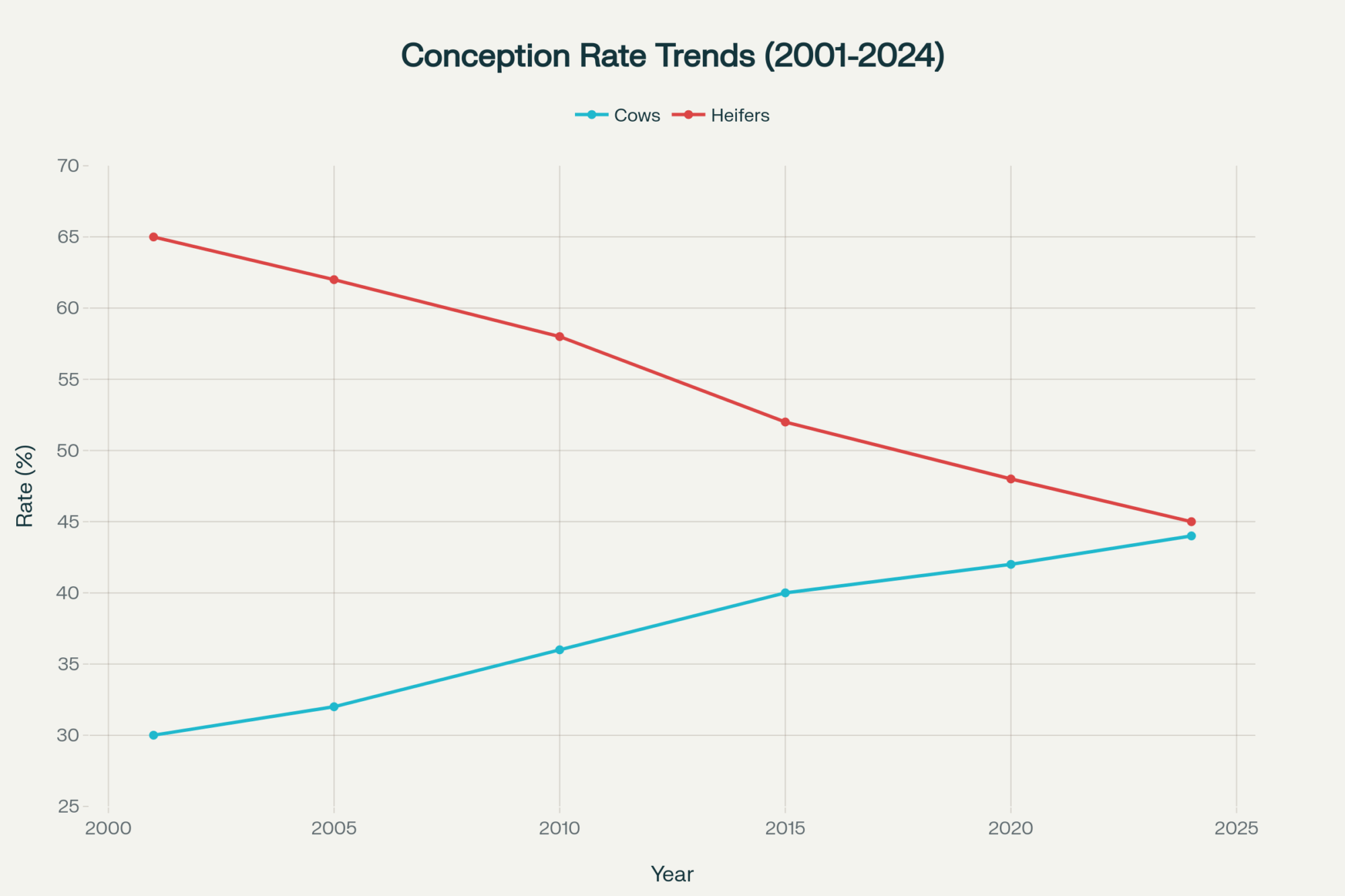
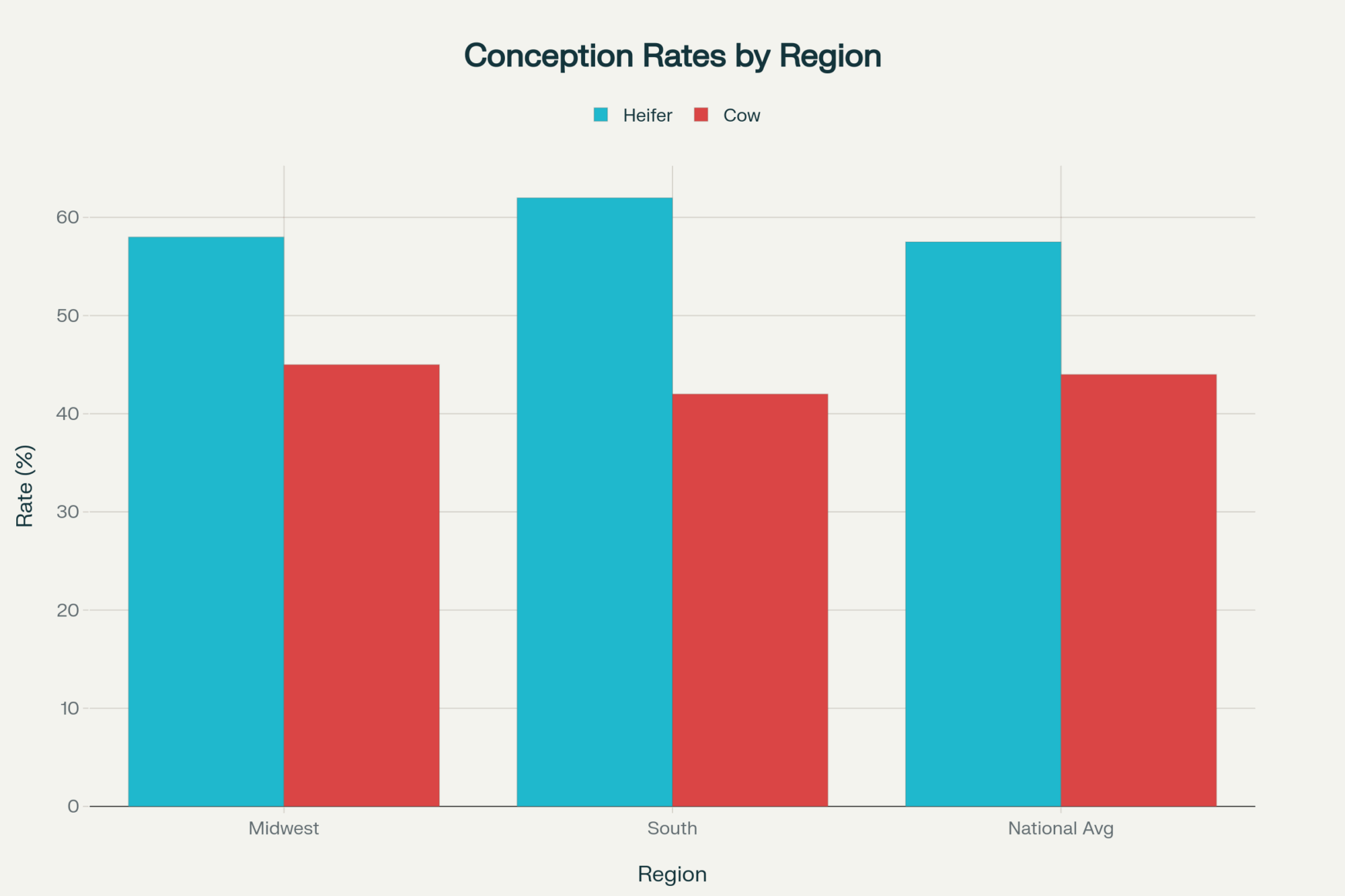

 Join the Revolution!
 Join the Revolution!