
Archive for URUS

URUS, ABS, Select Sires Lead The Bullvine’s 2026 Global Cattle Genetics Top 10

URUS leads our editorial ranking of global cattle-genetics influence, with ABS ahead of Select Sires and STgenetics above Semex. Here’s why—and what the order means for your next semen purchase.

The companies supplying your semen influence which bulls get developed, which traits receive investment and which reproductive technologies reach your farm. Their global influence matters—but it does not tell you which supplier deserves your next order.

Ranking cattle genetics companies by sales sounds simple. It isn’t. URUS publishes a figure of more than 31.5 million semen straws sold worldwide (URUS). NDDB Dairy Services publishes 47.32 million frozen doses, including 14 million buffalo doses (NDDB Dairy Services). Neither figure carries an explicit reporting period. Which organization sells more cattle semen? Those numbers cannot tell us.

SYNETICS adds another complication: its published figures span cattle and goat genetics, though we could not verify a current exact dose count. These figures describe substantial businesses, but they cannot support a comparable annual cattle semen sales ranking.

So we ranked on international commercial influence, using four criteria and giving the most weight to cross-border reach:

  • Cross-border reach: international market access and the geographic spread of commercial operations.
  • Commercial operations and scale: production, distribution, reproductive services, and herd-information systems supporting breeding decisions.
  • Breeding programs: populations, breeds, and selection work.
  • Reproductive technology: semen processing and preservation, sexing, IVF, and embryo services, including provision to other organizations.

We assess cattle-related operations. Activities in other species provide company context but don’t count toward the ranking. Distribution partnerships count as activity for both partners; they don’t merge companies. This is our editorial judgment about overall cattle-industry influence under the stated criteria, rather than a verified ranking by sales volume.
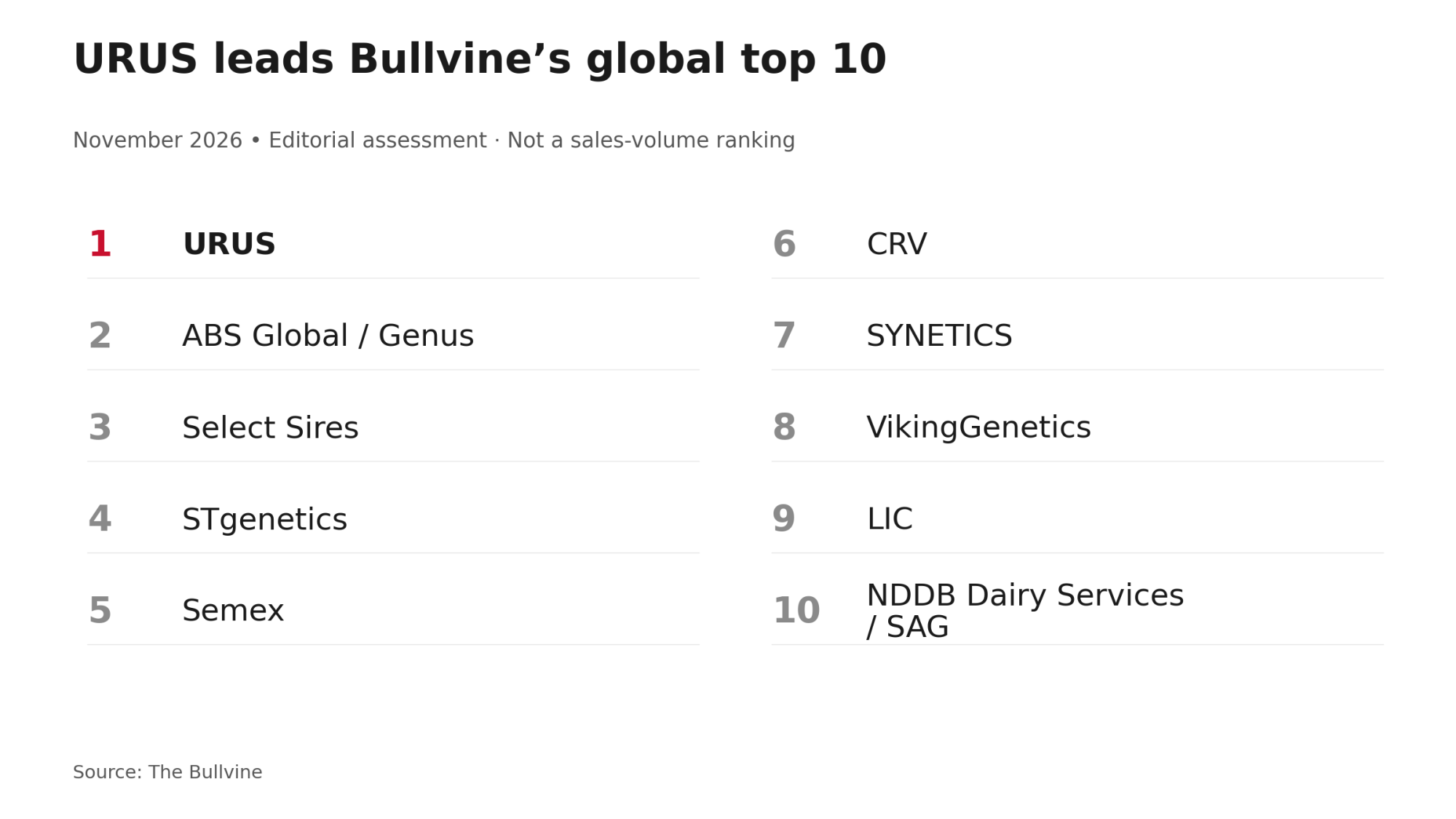
Bullvine ranks URUS first, ABS second and Select Sires third in its 2026 global cattle-genetics top ten.
RankOrganizationMain reason for its position in this editorial ranking
1URUSCombines international genetics distribution, reproductive services, and herd-information businesses.
2ABS Global / GenusCombines international commercial operations with IntelliGen technology supplied beyond its own breeding programs.
3Select SiresCombines breeding programs, global distribution, and cooperative on-farm reproductive services.
4STgeneticsMarkets genetics and supplies sex-sorting technology within other organizations’ breeding programs.
5SemexCombines international distribution, Boviteq IVF licensing, selection tools, and distribution of partner genetics.
6CRVCombines multiple breeding programs with production operations across several regions.
7SYNETICSCombines broad cattle-breed coverage with extensive international distribution.
8VikingGeneticsExports Nordic health-focused breeding objectives through international subsidiaries.
9LICCombines pasture-based breeding, herd-information services, and international distribution.
10NDDB Dairy Services / SAGEarns its place through national breeding infrastructure and indigenous cattle-breed coverage, rather than cross-border reach.

The Bullvine’s editorial ranking of cattle-industry influence—not a verified ranking by annual semen sales, and not a supplier recommendation for every herd.

1. URUS

URUS reports wholesale supply in more than 80 countries (URUS). Its named businesses cover distinct functions. Alta Genetics and GENEX market genetics. Trans Ova provides IVF, embryo transfer, and embryo products. VAS runs DairyComp herd software, which it says producers in 52 countries use. URUS also reports more than nine million cows under data management across 5,000-plus herds, with retail sales in 14 countries.

We put URUS first for the combination of its international genetics distribution, reproductive services, and herd-information businesses. That breadth makes it our strongest overall choice under the four criteria.
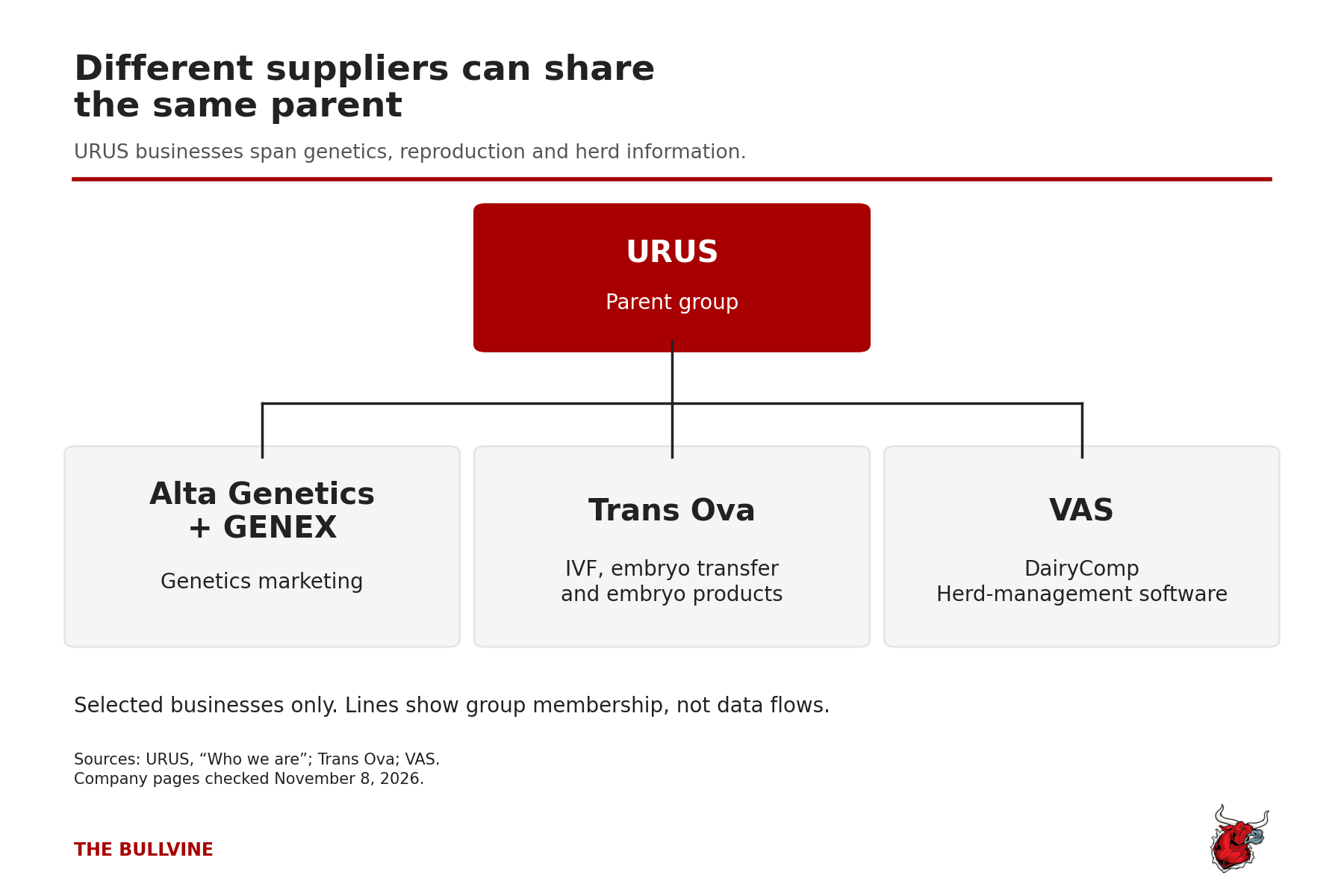
URUS connects Alta Genetics and GENEX, Trans Ova, and VAS across genetics, reproduction and herd software.

The practical point for buyers is ownership. Two catalogs on your kitchen table can belong to the same group. Different bulls and different reps don’t necessarily mean different owners competing for your business.

2. ABS Global / Genus

ABS reports marketing in more than 70 countries, serving more than 40,000 customers, and operating bull studs across Europe, North America, Latin America, and India. Its case for second place also rests on technology used outside its own breeding programs. Genus has documented an IntelliGen “technology transfer and license agreement” enabling Geno to produce sexed Norwegian Red genetics.
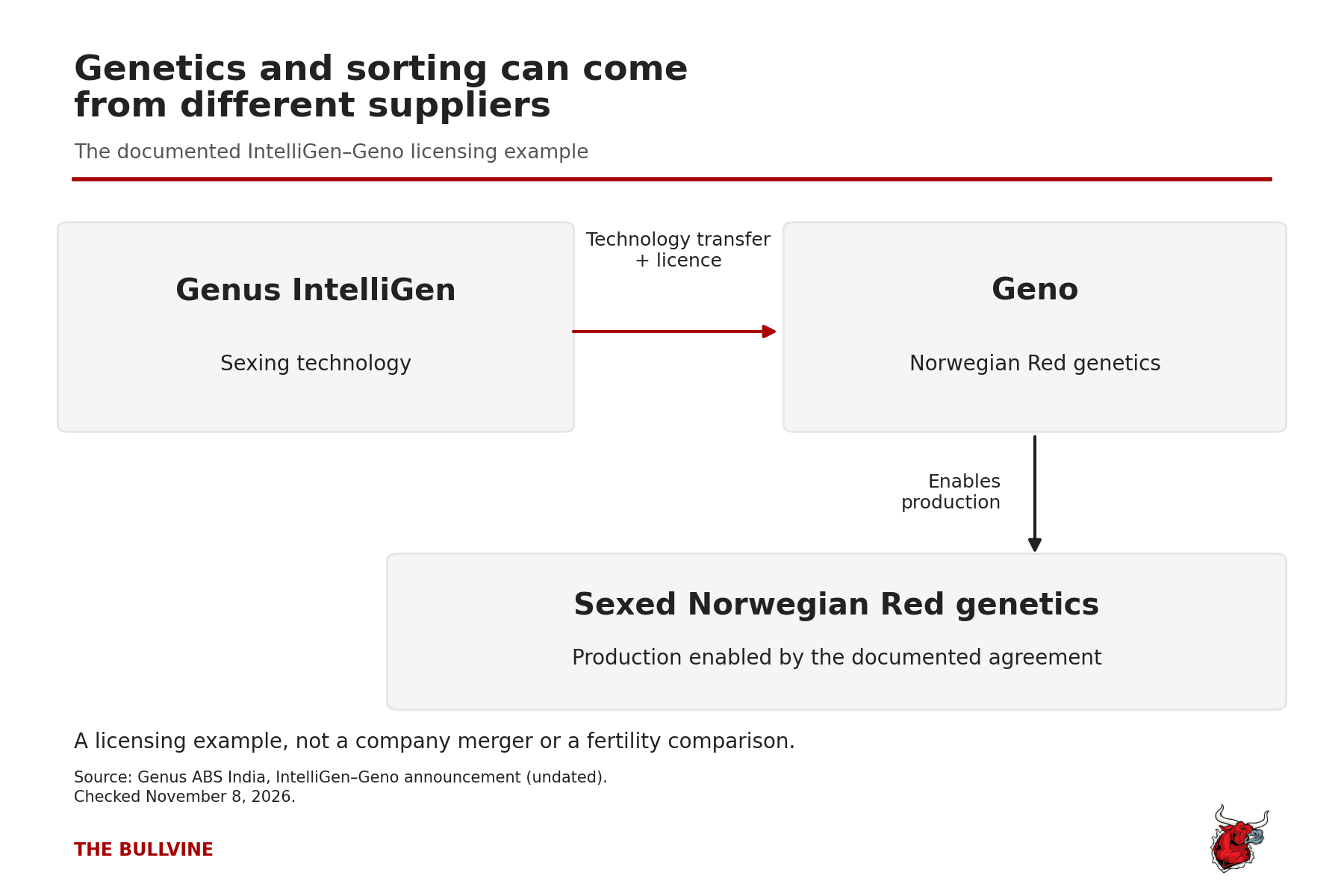
Genus IntelliGen licenses sexing technology to Geno for production of sexed Norwegian Red genetics.

For producers, the distinction is practical: the company supplying the genetics and the company providing the sorting technology may be different.

3. Select Sires

Select Sires’ farmer-owned cooperatives combine genetics distribution with on-farm reproductive services. Select Reproductive Solutions provides consulting, herd-data analysis, and support for implementing reproductive programs. Select Sires’ subsidiary World Wide Sires describes a network of subsidiaries and distributors in more than 90 countries. That figure covers WWS’s network, not the parent group’s total footprint.

That combination of breeding programs, global distribution, and organized local service earns third place. On an individual dairy, the quality of the local team can matter more than any global ranking.

ABS vs. Select Sires: We give ABS’s combination of international operations and IntelliGen the edge over Select Sires’ distribution and cooperative service network. That’s an editorial judgment, not a finding about dose volumes. A ranking that put more emphasis on farmer-facing service could reverse those positions.

4. STgenetics

In a January 8, 2025, release, STgenetics said it ran 56 owned and licensed sorting labs in 20 countries. Its Indian subsidiary says it has provided sorting services in India since 2018, with labs run alongside BAIF and several state livestock organizations.

Fourth place rests on that dual role. STgenetics markets its own genetics and supplies sorting inside other organizations’ breeding programs. A count of export doses would miss that kind of influence.

5. Semex

Semex is owned by WestGen, EastGen, and CIAQ. Its company history describes representation in 80 countries through 110 distributorships, Boviteq IVF licensees in the UK, France, Switzerland, and Italy, and selection tools including Immunity+, Elevate, and methane efficiency ratings.

Its network also carries partner genetics. Swissgenetics says (September 30, 2025) it has distributed around half of all its semen doses through Semex since 2004.

Before buying into any specialty selection tool, ask what’s measured and how the evaluation was validated.

STgenetics vs. Semex: We place STgenetics ahead for supplying sorting technology inside other organizations’ programs. Semex’s case rests on IVF licensing and a distribution network that also carries partner genetics. Giving greater weight to embryo services strengthens the case for placing Semex above STgenetics. STgenetics’ cited lab count dates from January 2025; it should not be read as a verified November 2026 total.

6. CRV

CRV says it supplies genetics to more than 60 countries through offices and distributors. It describes production sites in the Netherlands, New Zealand, Brazil, Germany, and the Czech Republic where semen and embryos are produced. It’s owned by 23,000 farmers in the Netherlands and Flanders, and runs 12 breeding programs focused on health and efficiency.

CRV belongs on the list for breeding across multiple programs, with production operations in New Zealand and Brazil as well as Europe. For buyers, the useful question is where the semen or embryos in your order were produced, and on which of CRV’s 12 programs the bull was selected.

7. SYNETICS

EuroGenomics describes SYNETICS as a French-German cooperative of 35,000 farmers, distributing in 81 countries across 20 cattle breeds. Its dairy programs include Holstein, Red Holstein, Normande, and Fleckvieh, alongside beef breeds.

Its inclusion rests on breed breadth combined with wide distribution. A ranking built on North American Holstein visibility would understate it. If Normande, Fleckvieh, or beef breeds fit your farm’s objective, its breed range warrants examination.

CRV vs. SYNETICS: We give CRV the edge for its documented production presence across several regions. SYNETICS’ breed breadth and international distribution provide a strong counterargument. Our assessment gives greater importance to operating production facilities in multiple regions than to the number of markets served.

8. VikingGenetics

VikingGenetics reports farmer ownership across Denmark, Sweden, and Finland, plus subsidiaries in Australia, the UK, Germany, and the U.S. Its breeding approach draws on Nordic health and performance recording across VikingHolstein, VikingRed, and VikingJersey.

Eighth place rests on exporting health-focused Nordic breeding objectives through owned subsidiaries on three continents. If health traits and longevity drive your sire selection, that’s the program to examine.

9. LIC

LIC describes itself as a New Zealand farmer-owned cooperative. It says it exports more than 1 million frozen straws to over 20 countries, dispatches more than 4 million fresh straws domestically in spring, analyzes 11 million milk samples a year from 8,100 herds, and has subsidiaries in the UK, Ireland, and Australia.

LIC says three out of four New Zealand dairy cows are sired by an LIC bull. Its Sire Proving Scheme covers Holstein Friesian, Jersey, and KiwiCross bulls, selected using ancestry records, DNA testing, and daughter proving.

Influence across the industry and fit for your farm are separate rankings. For a seasonal grazing herd, LIC could top the shortlist.

VikingGenetics vs. LIC: We narrowly favor VikingGenetics for the international influence of its Nordic health-focused breeding programs. LIC’s combination of breeding, herd information, and international distribution makes this a close decision. Its pasture-based proving system is central to its identity, and it also markets a High Input Indexinternationally. Our ordering reflects the weight we give Nordic health breeding; an assessment emphasizing herd-information services could favor LIC.

10. NDDB Dairy Services / SAG

NDDB Dairy Services is a wholly owned subsidiary of India’s National Dairy Development Board. It runs the SAG semen station network and reports 9.1 million doses from 17 indigenous cattle breeds, alongside buffalo work we treat as context. NDDB Dairy Services also supports the upgrading of Central Cattle Breeding Farms and implements projects using sex-sorted semen and IVF embryos under India’s Rashtriya Gokul Mission.

We place NDDB tenth for its national role in supplying indigenous cattle genetics. This is the position where we give breeding-population coverage more weight than cross-border reach. Gènes Diffusion’s international cattle business, breeding programs, and reproductive services make it the strongest alternative.

Why Gènes Diffusion narrowly missed

Gènes Diffusion was a serious alternative for the final place. Its 2026 annual report (published June 18, 2026) describes several cattle businesses:

  • Bovine export sales across Europe, the Americas, Asia, and Africa
  • A SAFE BEEF beef-on-dairy program
  • About 2,000 embryo collections a year
  • A genotyping lab

The report gives 2.4 million bovine doses for the group without saying whether those were sold, produced, or distributed. Its counts of subsidiaries and international distributors cover the whole multispecies group.

Readers who give international distribution greater weight than domestic breeding infrastructure have a strong case for reversing this decision.

Other candidates we reviewed
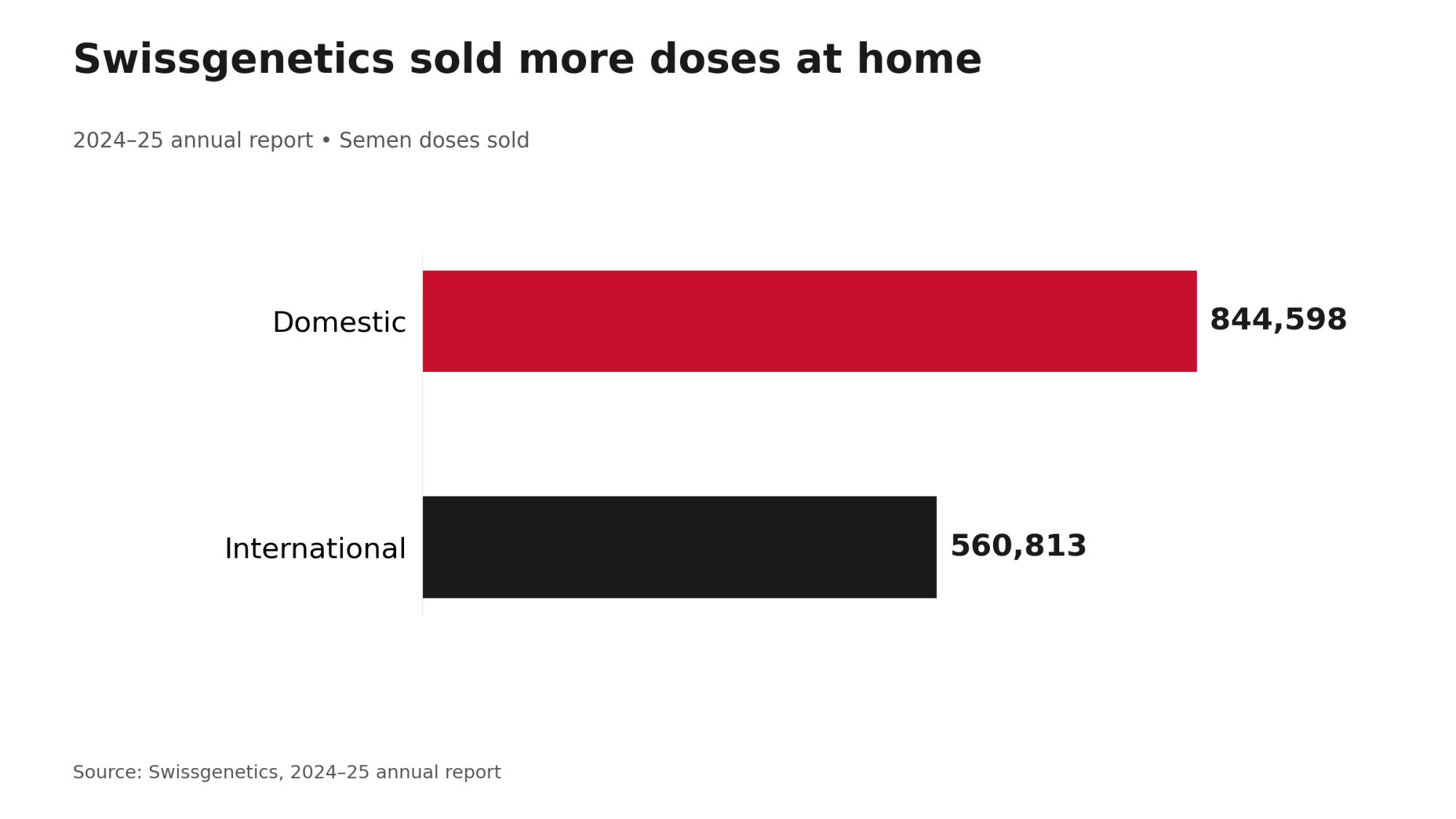
Swissgenetics sold 844,598 doses domestically and 560,813 internationally in its 2024–25 annual report.
  • Swissgenetics. Its 2024–25 annual report lists 560,813 doses sold internationally, 844,598 sold domestically, 1,823,615 produced, and 2,696 embryos produced. It runs Brown Swiss, Holstein/Red Holstein, Simmental, Swiss Fleckvieh, and Original Braunvieh programs, with a longstanding international distribution partnership with Semex. We placed LIC and NDDB ahead. LIC combines its breeding program with national-scale herd information and owned international subsidiaries. NDDB supplies indigenous cattle genetics across a national network.
  • Geno. Geno reports 406,848 doses sold in Norway in 2025 and international sales growth. It runs its own sex-sorting operation and licenses IntelliGen. Geno’s SpermVital business gives it a substantial reproductive-technology argument in this comparison. We gave LIC the place for combining national-scale breeding with herd-information services.
  • BAIF. BAIF is a substantial Indian alternative with a large field insemination program. Its published activity measures differ from NDDB’s in scope and reporting period, so they don’t establish a comparable cattle-sales ranking.

These were the alternatives we identified, not a census of every breeding organization.

Why we didn’t rank by volume

OrganizationPublished figureCattle boundary and period
URUS31.5M+ semen straws sold worldwideNo species split or reporting period stated
NDDB Dairy Services / SAG47.32M frozen dosesNDS separately reports about 50 million doses produced and distributed annually. That measure still does not establish cattle-only sales comparable with URUS’s published figure.
SYNETICS7.5M units soldSpans cattle and goat genetics; no period

A defensible volume ranking would need a common reporting period, cattle-only counts, consistent company boundaries, and clear treatment of third-party sorting and transfers within groups. Our review did not establish a comparable dataset covering all ten companies.

Four questions before your next semen order
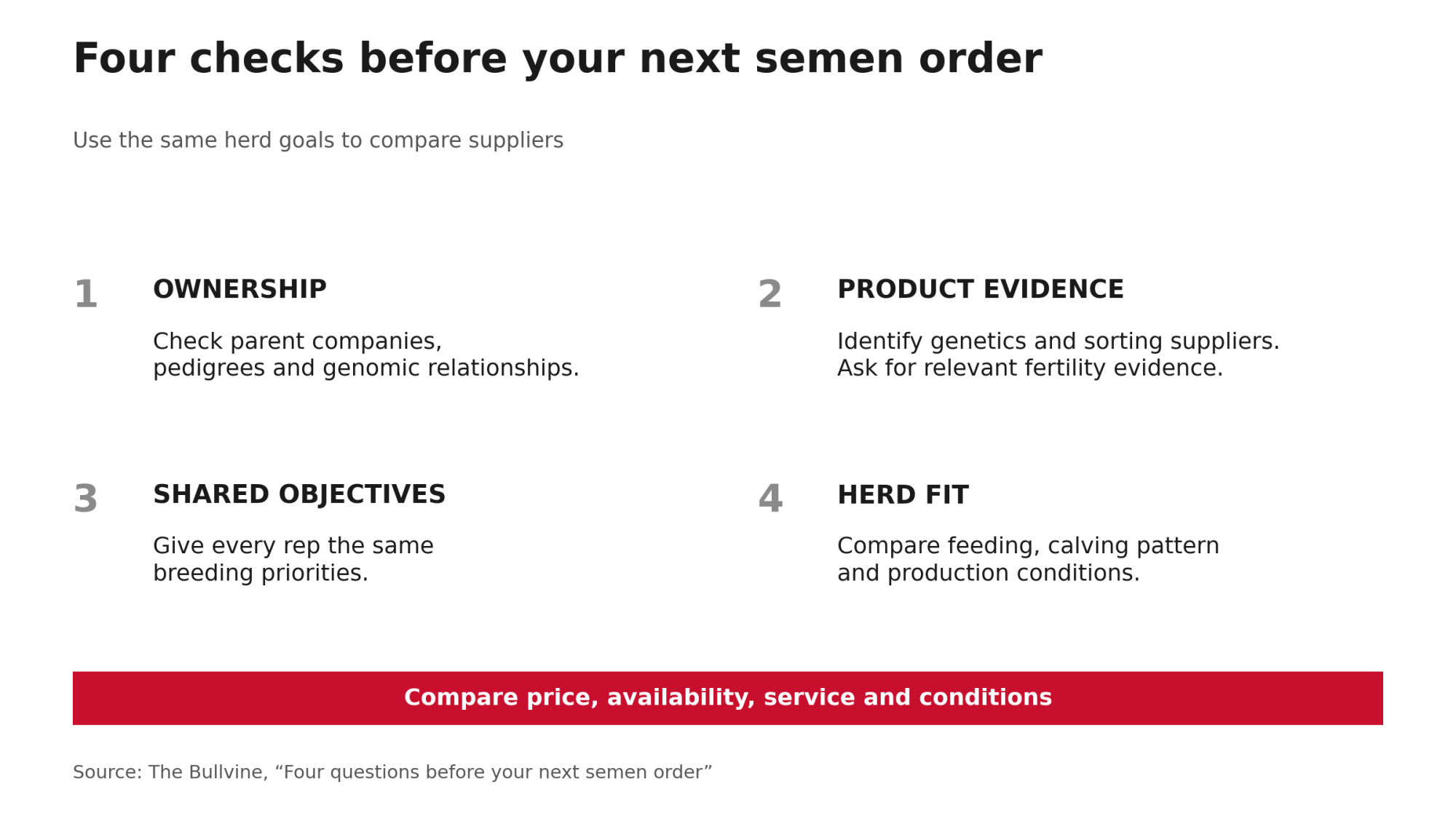
Four supplier checks: ownership, product evidence, shared breeding objectives and fit with the herd’s production system.
Question to askWhat to record or requestDistinction to keep clear
Which of my suppliers share a parent company?Record the brand, parent company, and local supplier; check pedigrees and genomic relationships too.Different brands may share an owner. Different owners do not guarantee unrelated genetics.
Who supplies the genetics, who provides the sorting, and what evidence supports the finished product?Request fertility evidence relevant to the semen product, animal group, and breeding protocol you intend to use.The genetics supplier and sorting-technology provider may be different organizations.
Will every rep work from the same objective?Give every rep identical priorities for components, fertility, longevity, size, and calving; ask each to explain the trade-offs.Compare proposed sire teams against the same priorities—not different sales pitches.
Was this sire evaluated in a system like mine?Compare the evaluation population’s feeding, calving pattern, and production conditions with your own; ask the supplier to explain the differences.Global influence and suitability for your herd are separate judgments.
  1. Which of my suppliers share a parent company? Record the brand, the parent, and the local supplier, then check pedigrees and genomic relationships too. Different owners don’t guarantee unrelated genetics.
  2. Who supplies the genetics, who provides the sorting, and what evidence supports the finished product?Ask for fertility evidence relevant to the semen product, animal group, and breeding protocol you intend to use.
  3. Will every rep work from the same objective? Give each one identical priorities for components, fertility, longevity, size, and calving, and have them explain the trade-offs.
  4. Was this sire evaluated in a system like mine? Compare the evaluation population’s feeding, calving pattern, and production conditions with your own, and ask the supplier to explain the differences.

Compare availability, delivered price, service commitments, and program conditions alongside the proposed sire team. URUS leads our list. The company that should earn your biggest order is the one that best meets your herd’s goals, supported by your records.

For more, see our A.I. Industry coverage and our April 2026 proof results breakdown.

Ownership note: Select Sires and STgenetics

  • August 2023, proposal. Select Sires Inc. and Inguran LLC (dba STgen) announced a letter of intent to combine production and R&D, subject to a definitive agreement and regulatory approvals.
  • April 2026, reporting. Bloomberg reported (April 21, 2026) that the deal was “later abandoned when faced with a potential antitrust lawsuit,” and that Select’s July 2025 annual report showed it “again looking to link up with Inguran.” Beef Magazine reported (April 24, 2026) that enforcers were “mulling over a rechallenge.”

Sources reviewed November 8, 2026. Company pages without a publication date are linked as current at review.

Who would you move up, and what evidence earns it that spot?

Learn More

The Sunday Read Dairy Professionals Don’t Skip.

Every week, thousands of producers, breeders, and industry insiders open Bullvine Weekly for genetics insights, market shifts, and profit strategies they won’t find anywhere else. One email. Five minutes. Smarter decisions all week.
NewsSubscribe
First
Last
Consent

The Inspiring Journey of Mr. Wijnand Pon: From Dairy Farmer to Global Industry Powerhouse

Discover how Mr. Wijnand Pon transformed from a local dairy farmer to a global industry leader. Learn about his impact on the dairy industry. Read on!

Meet Mr. Wijnand Pon, a visionary who started his career on a small dairy farm and became a global leader in dairy genetics. His narrative showcases the force of ambition combined with invention, resulting in ground-breaking achievements that have revolutionized dairy production. From aspiring to own a farm to enhancing Holstein genetics and establishing central industry relationships, Mr. Pon’s story epitomizes the power of innovative ideas and perseverance. He said, “I always had new ideas and an open mind, keeping the future generations in mind with everything I did.” Join us as we explore his incredible contributions to the dairy business.

Early Life and Farming Roots 

Imagine growing up in a family in the trades industry since the 1800s. That was the setting for Mr. Wijnand Pon’s early years. His family had always been self-sufficient and resourceful, but no farmers were among them. Initially, young Wijnand had his sights set on a very other path: forestry. He was always fascinated by nature and aspired to be a forestry professional.

However, life had other ideas. His regular contacts with farm youngsters piqued his attention. The allure of dairy farms captured Wijnand to the point that he decided to pursue a career in farming by the age of eighteen. This was a stark contrast to his initial aspirations. This newfound enthusiasm inspired him to enroll in an agricultural college and immerse himself in agriculture.

Would you believe he bought his first farm at the young twenty-three? Yes, his father encouraged his dreams, enabling him to buy a farm to grow his dairy business. Wijnand set off on his expedition with his wife and 20 cows. After a few years of hard work and dedication, he was already scaling up, acquiring nearby farms to enlarge his herd.

Expansion and Innovation in Dairy Farming

Since its inception, Mr. Wijnand Pon’s dairy farm has grown and innovated significantly from those 20 cows. While some may have dabbled in arable farming, Mr. Pon’s passion was evident. Dairy farming was his vocation. This undivided focus enabled him to devote all his efforts and resources to increasing his herd and improving farm operations.

One of the most critical milestones in this journey was the completion of one of the first large-scale free-stall barns in the Netherlands. It was capable of housing 300 cows. This jump did more than increase the number of cows. It also revolutionized dairy production in the area. The free-stall barn transitioned toward contemporary, efficient, and welfare-oriented agricultural techniques.

At a young age, Mr. Pon was fascinated by the possibility of cattle breeding and genetics. This was more than simply a pastime. It formed the foundation of his agricultural philosophy. He understood the need for better genetics to generate more productive, healthier, and hardy cows. By focusing on breeding, he dramatically increased his herd’s production and lifespan.

Mr. Pon’s insight in embracing and promoting Holstein genetics was fundamental in improving his farm and affecting Europe’s more significant dairy sector. His open-mindedness and willingness to accept modern tactics established a standard, pushing many other farmers to reassess old ways and adopt more contemporary strategies.

Mr. Pon’s farm’s success is a testament to his hard work and vision. His journey from a small-scale farmer to a dairy industry pioneer is one of perseverance, creativity, and unrelenting dedication to quality. His innovations, from introducing Holstein genetics to establishing large-scale free-stall barns, have left an indelible mark on the dairy production industry.

His story teaches essential lessons and inspires dairy producers throughout the globe, demonstrating that significant growth is attainable with the proper focus and drive.

Have You Ever Wondered How a Single Journey Can Shape the Course of an Entire Industry? 

Wijnand Pon believes the solution lies in his trip to the World Dairy Expo 1971. Previously, Mr. Pon was a dairy farmer influenced by local Dutch customs despite his interest in genetics. On his journey to that Expo, he was invited as the youngest member of a delegation of Dutch breeding professionals who wanted to watch and learn. This visit was not your typical excursion. It was very eye-opening.

 During the Expo visit, Mr. Pon saw firsthand the improved possibilities of Holstein genetics. American Holsteins excelled in milk output, udder quality, and lifespan, surpassing Dutch cattle in these areas. While the Dutch breeding society was primarily concerned with conserving local genetics, Mr. Pon’s introduction to these better features inspired a compelling idea.

Returning home, he was 70% sure that Holstein genetics held the future despite opposition from the Dutch breeding society. These Dutch leaders hesitated to accept American genetics, believing they would eclipse indigenous breeds. However, Mr. Pon saw things differently. He claimed that incorporating Holstein genetics would considerably improve the European dairy industry’s efficiency and productivity.

This landmark experience at the World Dairy Expo inspired Mr. Pon to campaign to import Holstein semen and live animals into Europe, ultimately altering dairy farming techniques throughout the continent. Despite early opposition, his forward-thinking attitude and willingness to accept change supported the growing wave for Europe’s dairy sector to become more productive and sustainable.

Isn’t it amazing how a single incident can have such a ripple effect? For Mr. Pon and many dairy producers today, the 1971 visit marked the foundation of contemporary European dairy breeding.

Revolutionizing Dutch Dairy: Wijnand Pon’s Bold Genetic Gamble

Imagine introducing a new concept to a nation deeply rooted in tradition, especially when faced with strong opposition. This was the challenge Mr. Wijnand Pon encountered when he brought Holstein genetics to the Netherlands. Initially, strict veterinary laws prohibited the direct import of semen. Undeterred, Mr. Pon had to be resourceful, starting with the purchase of animals of Holstein blood from Germany, even when local herd books refused to register calves sired by American bulls.

In 1974, the tides turned. Regulations were relaxed, permitting the import of sperm, and Mr. Pon wasted no time. He promptly signed a deal with Semex, Canada’s recently founded genetic cooperative, and became the organization’s first foreign representative. This collaborative enterprise between Canadian breeders and European partners aimed to provide better North American genetics to European herds.

So, how did Mr. Pon persuade the skeptical Dutch farmers? His argument was evident and difficult to counter: more milk, healthier udders, and longer-lived cows. He relentlessly toured farms to promote the advantages and possibilities of Holstein genetics. It took almost five years of consistent labor. Still, his perseverance paid off, and farmers who had used North American genetics started to see the improvements in their herds.

By merging his dairy farming expertise with cutting-edge genetic research, Mr. Pon demonstrated a captivating story for his colleagues. His accomplishment was more than just a financial endeavor; it was a crucial step toward revolutionizing dairy farming techniques in Europe and beyond.

Breaking the Mold: Wijnand Pon’s Purchase of Alta Genetics

Wijnand Pon’s idea for Alta Pon arose from a unique collaboration with Western Breeders and Pon Holdings. This joint venture sought to break the pattern, establishing a private corporation capable of competing in an industry dominated by farmer co-ops. Pon and his Canadian buddy Doug Blair thought that a privatized approach would allow for more creativity and adaptability, which were typically inhibited in the co-op industry.

Why go private? Pon’s discontent with the constraints of the old cooperative paradigm is the key to his solution. He wanted more than industry participation. He sought ownership and the ability to develop. This push resulted in the foundation of Alta Pon when Alta Genetics departed Semex with the acquisition of Landmark Genetics, the aim of which was to establish their own worldwide distribution and sire development and his ultimate sole ownership of Alta Genetics.

Under Pon’s leadership, Alta Genetics continued producing superior genetics, focusing on the commercial marketplace. The purchase of Valley Ag Software was a strategic coup, expanding its portfolio to include cutting-edge farm management tools. With Valley Ag Software’s superior data management capabilities, Alta Genetics was able to provide complete solutions that focused not just on genetics but also on farm efficiency. It is like giving farmers the seeds and the most enriched soil to sow them in.

This business hugely influenced dairy farming, demonstrating that private firms could prosper and develop in an industry dominated by cooperatives. Alta Genetics enhanced dairy genetics by emphasizing higher milk output, better udder health, and longer-lived cows. Meanwhile, Valley Ag Software helped farmers manage their herds more efficiently, making data-driven choices that increased agricultural output. At about the same time, another significant acquisition was the Saskatoon Colostrum Company.

Finally, the development and success of Alta Pon and its subsequent growth into Alta Genetics demonstrated the value of strategic thinking and innovation. For many dairy farmers, these initiatives’ advantages have been transformative, proving that occasionally deviating from the mainstream may result in the most advanced and practical solutions.

A New Era Begins: The Formation of URUS

In 2020, a massive merger engineered by Wijnand Pon altered the global dairy business with the formation of URUS. This collaboration brought together significant organizations’ expertise and resources, including Alta Genetics, Cooperative Resources International (CRI), and Genex. By combining these organizations, URUS became a global leader in genetic development and assistance for dairy producers.

Supporting Dairy Farmers Worldwide: URUS advocates for dairy farmers by providing cutting-edge genetic solutions, data management, and consulting services. These efforts aim to increase milk output, herd health, and farm profitability. URUS also seeks to provide farmers with the tools and information they need to operate successfully and sustainably.

The Importance of Scale and Cooperation: The Wijnand Pon Way

Achieving these aims requires functioning on a large scale and encouraging collaboration. By collaborating, URUS can pool its resources and expertise, resulting in substantial advances in dairy genetics and farm management methods. This size enables cost-efficient improvements and the capacity to reach farmers worldwide, ensuring that the advantages are broadly distributed and effective.

Since its inception, URUS has established itself as a beacon of growth and sustainability in the dairy business, fulfilling its promise of increased profitability and a better future for farmers globally.

From Holstein Genetics to Global Conglomerate: The Evolution of Pon Holdings

Wijnand Pon’s business path resulted in the formation of Pon Holdings, which has evolved into a significant conglomerate over time. Pon Holdings achieved considerable progress under Wijnand’s direction, first focusing on Holstein genetics and dairy production. He was intensely aware of the agricultural and commercial sectors, capitalizing on possibilities as they presented themselves.

Pon Holdings is now a powerhouse operating in various fields besides dairy farming. The company’s scope includes logistics, automotive, industrial services, and environmental solutions. Pon Holdings is a significant worldwide business, with billions of dollars in sales and a presence in many countries.

Pon Holdings owns well-known enterprises such as Pon Equipment, Royal Dutch Gazelle (a long-established prominent bicycle manufacturer), Volkswagen Pon Financial Services, and Pon Power. These businesses demonstrate the conglomerate’s varied portfolio and extensive competence.

The Pon Holdings company’s impact extends beyond its commercial successes. Pon Holdings uses its broad network and resources to encourage dairy farming advances, promote sustainable practices, and advocate charitable activities worldwide. Pon Holdings’ excellent development and diversification reflect Wijnand Pon’s visionary attitude and relentless pursuit of excellence.

Transition and Future Directions for Pon Holdings 

The tale of Pon Holdings does not end with Wijnand Pon. As dad moves aside from day-to-day operations, his daughter is prepared to take over, bringing a new generation’s vision and passion to the family firm. This leadership shift heralds a new era for Pon Holdings, filled with potential and innovations.

Pon Holdings has strategically aligned with this change by selling a controlling share in the €600 million URUS Group to CVC Capital Partners. This essential decision enables Pon Holdings to concentrate on other high-potential sectors while ensuring URUS succeeds under new ownership.

This transition will give Pon Holdings more freedom to pursue new projects and investments that benefit the dairy industry in areas that coincide with developing global dairy production and genetics trends. CVC Capital Partners’ investment in URUS provides many resources and expertise to drive future development and innovation.

The future seems bright, with the next generation of Pons’ at the helm, driving the family heritage to new heights. What adjustments and fresh tactics will we see? Only time will tell, but it is evident that Pon Holdings and URUS are on the road toward growth and change.

Philanthropic Efforts and Environmental Conservation: The Come On Foundation 

Did you know that, besides his pioneering achievements in dairy farming, Mr. Wijnand Pon is highly devoted to environmental conservation? His commitment to sustainable techniques goes well beyond the farm gates, leading to the formation of the Come On Foundation. This non-profit organization exemplifies Pon’s lifetime commitment to returning more to the Earth than we take from it.

The Come On Foundation seeks to address some of the world’s most critical environmental concerns via conservation and restoration initiatives. The organization is dedicated to restoring the Earth’s natural equilibrium and believes sustainable land management and agricultural techniques are vital.

One of their significant efforts is collaborating with Commonland, a corporation focusing on large-scale landscape restoration. Projects spanning from Spain to Africa entail bringing damaged areas back to life via cooperation with local populations. The Come On Foundation guarantees that these environments recover and prosper in the long run using the four returns concepts—inspiration, social capital, natural capital, and financial capital.

Furthermore, the charity sponsors Peace Parks in Southern Africa, which is committed to developing sizeable cross-border conservation areas. These parks span millions of acres and provide a unique combination of animal protection and community development. The Come On Foundation actively invests in community agricultural initiatives around these parks, providing residents with long-term economic options while diminishing the motivation for poaching.

At its heart, the Come On Foundation aims to restore and maintain our planet’s natural resources while encouraging sustainable agriculture methods. The foundation exemplifies what can be accomplished when environmental care meets creative farming by concentrating on soil health, reforestation, and sustainable animal husbandry. 

Mr. Pon’s charity initiatives demonstrate his view that sustainable farming goes hand in hand with environmental stewardship. The Come On Foundation is a light of hope, pointing the way to a more sustainable and peaceful future for farmers and the environment.

Legacy and Advice for Future Generations

Mr. Wijnand Pon has made an unmistakable imprint on the dairy sector. His achievements, from his pioneering work in dairy genetics to his unwavering quest for innovation, have revolutionized dairy farming in the Netherlands and worldwide. His efforts, notably those with Alta Genetics and the founding of URUS, have provided the stage for future breakthroughs in dairy production. But, despite his professional accomplishments, his fundamental philosophy is compelling: constantly have fresh ideas, an open mind, and consider the planet and future generations.

Mr. Pon’s advice for future dairy farmers is simple yet powerful: “Be positive and never be average.” These simultaneously superficial but deep words inspire young farmers to approach their jobs enthusiastically and strive for excellence. It serves as a reminder that success in dairy farming, like in life, requires hard effort, a good attitude, and an unwavering desire to be the best.

Mr. Pon’s selection as the World Dairy Expo’s 2020 International Person of the Year reflects his significant accomplishments and reputation in the sector. This distinction recognizes his previous accomplishments while fueling his future aspirations, providing him with further energy and inspiration to continue supporting the dairy business. For Mr. Pon, this medal represents his lifetime dedication to dairy farming and his lasting influence on the industry.

The Bottom Line

From modest beginnings to pioneering advances in dairy genetics, Mr. Wijnand Pon’s story exemplifies the power of vision and dedication. His early journey into dairy farming paved the way for ambitious breakthroughs, such as bringing better Holstein genetics to the Netherlands and strategic development via acquisitions like Alta Genetics and the founding of URUS. Beyond his economic accomplishments, his devotion to environmental sustainability via the Come On Foundation demonstrates his awareness of our duty to the Earth.

As you reflect on Mr. Pon’s remarkable career, consider what brave measures you may take now to innovate your farming techniques and contribute to the dairy industry’s long-term sustainability. The options are as limitless as you desire.

Key Takeaways:

  • Mr. Wijnand Pon transitioned from a trading family background to dairy farming, driven by his passion for nature and agriculture.
  • Pon introduced superior Holstein genetics to the Netherlands, enhancing dairy cattle quality and production.
  • He played a significant role in the formation and operation of Alta Genetics and URUS, focusing on innovative and customer-centric solutions.
  • Through his Come On Foundation, Pon promotes sustainable farming and restoration practices worldwide.
  • Recognized for his contributions, Pon was honored as the 2020 International Person of the Year by the World Dairy Expo.
  • His legacy is marked by forward-thinking, perseverance, and a commitment to sustainable farming for future generations.

Summary:

Mr. Wijnand Pon shares his journey from a non-farming background to becoming a significant figure in the dairy farming industry. Starting with a family in the trading business, Pon developed an interest in nature and farming, eventually acquiring a farm and quickly progressing in dairy farming. He became pivotal in introducing superior Holstein genetics to the Netherlands, ultimately representing and collaborating with major breeding organizations. His work led to the purchase of Alta Genetics and later the formation of URUS, always aiming for innovative, customer-focused solutions. Beyond business, Pon emphasizes sustainable practices through his Come On Foundation, focusing on conservation and restoration globally. He hopes to be remembered for his forward-thinking and contribution to sustainable farming practices. Recognized as the 2020 International Person of the Year by World Dairy Expo, Mr. Pon’s story is one of passion, perseverance, and a vision for a better future in farming.

Learn more:

Join the Revolution!

Bullvine Daily is your essential e-zine for staying ahead in the dairy industry. With over 30,000 subscribers, we bring you the week’s top news, helping you manage tasks efficiently. Stay informed about milk production, tech adoption, and more, so you can concentrate on your dairy operations. 

NewsSubscribe
First
Last
Consent
Send this to a friend