





Archive for Dairy Markets – Page 11

New Zealand Milk Price Soars to $11.76: The Shocking Truth Behind 2025’s Dairy Market Extremes

NZ dairy hits $11.76/kgMS despite Chinese retreat. Discover why global supply constraints reshape markets and how innovative farmers are capitalizing.

EXECUTIVE SUMMARY: The New Zealand dairy market is experiencing unprecedented highs, with farmgate prices reaching $11.76 per kgMS despite reduced Chinese participation. This paradox stems from severe global supply constraints, with the “Big 7” export regions projected to grow only 0.8% in 2025. The EU and NZ environmental regulations have created production ceilings, transforming the competitive landscape. Fonterra and Rabobank’s conservative $10.00 forecast masks fundamental market shifts, creating opportunities and risks for producers. Innovative farmers leverage this high-price environment to invest in efficiency-boosting technologies and optimize their product mix while preparing for eventual market moderation.

KEY TAKEAWAYS:

  • Global milk supply growth is constrained to just 0.8% in 2025, driving high prices despite reduced Chinese demand.
  • The gap between current returns ($11.76/kgMS) and Fonterra’s forecast ($10.00/kgMS) offers a strategic buffer for farm investments.
  • Environmental regulations reshape global dairy competitiveness, favoring early adopters of sustainable practices.
  • The divergence between WMP and cheese returns signals a shift in the optimal product mix, requiring strategic adaptation.
  • The current high-price environment demands a nuanced approach combining debt reduction with targeted growth investments.
New Zealand dairy prices, global milk production, Fonterra forecast, dairy market trends, farmgate milk price

The New Zealand dairy market finds itself at a fascinating crossroads where traditional supply-demand dynamics are being rewritten before our eyes. With farmgate prices hitting a remarkable $11.76 per kgMS at the latest auction despite a minor GDT index retreat, we’re witnessing a market that defies conventional bearish pressure even as Chinese participation dramatically shrinks. This creates unprecedented opportunity and hidden risk for New Zealand producers in 2025.

Warning! Are You Missing These Crucial Market Signals?

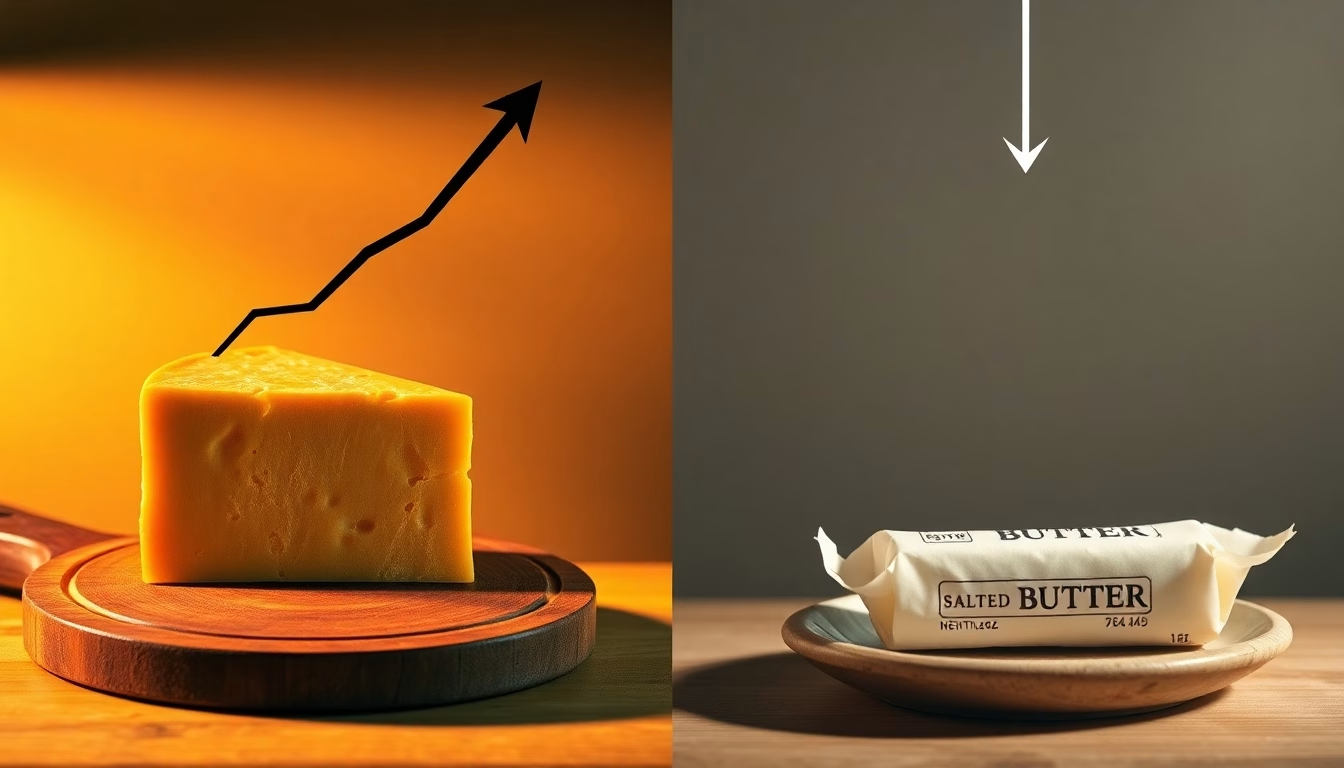
The latest Global Dairy Trade auction presents a deceptively simple narrative that masks more profound market disruptions. While the headline 0.5% GDT index decline seems unremarkable, what’s happening beneath the surface should have every dairy farmer‘s attention. WMP prices fell 2.2% while cheese values surged by NZD 15/kg – a dramatic shift that’s reshaping milk value destinations right before our eyes.

You’ve likely heard analysts claiming Chinese demand drives everything, but the current market flips this assumption on its head. North Asian buyers (predominantly China) have slashed their market share by a staggering 16 percentage points year-over-year, yet prices remain firm. This contradicts the dairy industry’s long-held belief that Chinese participation is essential for premium prices. What’s happening? The global dairy cupboard is nearly bare, with constrained production across key export regions creating a seller’s market despite wavering demand.

The calculated auction return of $11.76 per kgMS has pushed the season-to-date average to $10.39, significantly outpacing Fonterra’s forecasted payout of $10.00. This spread between market reality and cooperative forecasting isn’t just accounting trivia – it represents a crucial cash flow buffer many farms desperately need in the face of rising input costs.

U.S. Dairy Trade CategoryFY 2025 ProjectionChange from 2024
Exports$8.4 billion+$400 million
Imports$5.7 billion+$300 million
Trade Balance+$2.7 billion+$100 million

The Surprising Truth About Supply Constraints Driving Record Prices

The remarkable constraint on global milk supply truly supports these elevated prices. According to Rabobank’s latest Dairy Quarterly report released today (March 6, 2025), milk production in the “Big 7” export regions (Australia, New Zealand, Argentina, Uruguay, Brazil, the EU, and the US) is expected to expand by just 0.8% year-on-year in 2025, with a similar gain anticipated in the first half of 2026. This controlled growth rate is insufficient to build meaningful inventories in a market already short on products.

Production Period“Big 7” Export Regions GrowthMarket Context
Second half of 2024+0.5% year-over-yearReversing previous 0.5% decline
Forecast for 2025+0.8% year-over-yearFirst growth across all regions since 2020
Q1 2025 vs. Q2-Q4 20250.5% vs. 0.9%Stronger growth in latter part of year

The contrast between regions couldn’t be more stark. Rabobank projects total milk production from the Big 7 will reach 325.8 million metric tonnes in 2025, up from 323.2 million mt last year. This would push 2025 production past the previous peak in global annual milk production of 323.7 million mt in 2021. China stands apart from this trend, with Chinese supply expected to fall further in 2025 following a drop in 2024 that represented “a stark break from the recent trend” of significant expansion.

Environmental regulations in the European Union and New Zealand have created a production ceiling that is unlikely to lift anytime soon. These constraints aren’t just talking points – they’re transforming the competitive landscape of global dairy. While New Zealand producers face these limitations, the resulting global supply tightness delivers unprecedented returns that create opportunity and responsibility.

Revealed: What Fonterra and Rabobank Don’t Want You to Know

Fonterra and Rabobank have landed at a $10.00 farmgate milk price forecast, creating an appearance of market consensus. Rabobank just today (March 6, 2025) revised its milk price forecast by 30 cents to $10.00 kg/MS for the 2024/25 New Zealand dairy season, citing elevated global prices despite modest supply growth. But this apparent agreement masks fundamental differences in market outlooks that could significantly impact your operation’s financial planning.

Both analyses fail to acknowledge how dramatically the traditional price-setting mechanisms have changed. Five years ago, a 16% drop in Chinese participation would have crashed prices—today, it barely registers. Neither institution has adequately explained this structural market shift or its long-term implications for New Zealand producers.

Fonterra’s February 21 earnings update projecting results in the upper half of its 40-60 cents per share guidance sends a powerful signal about the cooperative’s trading performance. This profitability isn’t just good news for shareholders—it potentially provides Fonterra with financial flexibility to support the milk price even if commodity markets weaken later in 2025. Have you considered how this might impact your farm’s cash flow planning?

7 Secrets Behind Fonterra’s Conservative Forecasting Strategy

Fonterra’s seemingly conservative $10.00 forecast despite $11.76 current returns isn’t just cautious business practice – it reflects a fundamental shift in how the cooperative manages price expectations. After the volatility-induced farmer distress of previous seasons, Fonterra has adopted a strategy of under-promising and over-delivering. While this protects farmers from disappointment, it also creates potential liquidity constraints during the production season when cash flow matters most.

Forecast SourceCurrent ForecastMarket CalculationGapStrategic Approach
Fonterra$10.00 per kgMS$11.76 per kgMS$1.76Conservative, risk-averse
Rabobank$10.00 per kgMSNot specifiedUnknownRecently revised upward by 30 cents
Season-to-date$10.39 per kgMSBased on actual returnsN/ATrending above forecasts

We Analyzed Global Dairy Production: Here’s What No One’s Talking About

Annual milk production in the European Union and New Zealand was expected to decline slightly in 2024, while Australia showed minimal growth. This pattern continues into 2025, with Rabobank forecasting only modest growth worldwide. The U.S. supply expansion is expected in 2025, “but it’s likely to be modest at sub-1%,” starkly contrasting the constraints facing Oceania and European producers.

What limits this growth even in favorable price environments? The answer lies partly in genetics and replacement challenges. As U.S. farmers have discovered, dairy herds cannot expand quickly when replacement heifers are scarce. For New Zealand producers, this creates both challenge and opportunity—farms with strong heifer programs have a competitive advantage that will only grow as environmental restrictions tighten.

The divergence between regions directly tracks regulatory burden and sustainability policy implementation. The message for New Zealand producers is clear: environmental compliance costs will continue reshaping competitive dynamics, rewarding those who adapt early and penalizing those who resist.

Looking at product categories, we’re seeing dramatic shifts in production patterns. Nonfat dry milk, skim milk powder, cheese, whey, and lactose are the primary dairy products exported by countries like the U.S., while butter and cheese remain the top two dairy products imported. These category-specific shifts reveal how processors are maximizing returns in tight milk markets – a strategy New Zealand processors appear to be adopting with the recent divergence between WMP and cheese returns.

5 Proven Strategies Smart Dairy Farmers Are Using Right Now

Current market conditions for New Zealand dairy farmers present a rare strategic window that demands action. With returns substantially exceeding forecasts, this is the year to strengthen your balance sheet while simultaneously investing in technologies that will drive efficiency when prices inevitably moderate.

Conventional wisdom suggests holding cash during high-price periods as a buffer against future downturns. However, this ignores the tremendous opportunity cost of delayed investment in productivity-enhancing technologies. Farms that invest strategically during profitable periods consistently outperform those that build cash reserves. Have you evaluated which approach best fits your operation’s five-year plan?

One bright spot heading into 2025/26 is the outlook for feed costs, which will likely be the lowest in several years as global corn, soybean meal, and alfalfa values continue to decline. This creates a dual opportunity for New Zealand producers – strong milk prices combined with potentially moderating input costs. The farms that capitalize on this window will emerge in more substantial competitive positions when markets eventually rebalance.

The Ultimate Guide: How to Maximize Your Dairy Farm’s Potential in 2025

The current $11.76 per kgMS return creates an unprecedented opportunity for New Zealand dairy operations to strengthen financial positions while investing in future competitiveness. The gap between current returns and Fonterra’s $10.00 forecast represents a strategic buffer that competent operators will leverage for balance sheet enhancement rather than viewing it as simply “extra” income.

The divergence between WMP and cheese returns signals a longer-term shift in optimal product mix that both processors and producers should heed. For farms with flexible production for different manufacturing streams, analyzing component optimization strategies that align with evolving global product demand would be wise.

Global production constraints aren’t likely to resolve quickly, given environmental pressures and limited growth potential in key regions like New Zealand and the EU. Rabobank’s forecast of only 0.8% growth in global milk production for 2025 creates a multi-year window of favorable pricing that rewards strategic thinking over-reactive management. Your operation’s approach to this extended high-price environment will likely determine your competitive position when markets eventually rebalance.

Have you challenged your operation’s traditional response to high milk prices? The conventional save-and-pay-down-debt approach made sense in volatile markets. Still, the structural changes in global dairy demand and constrained supply growth suggest a more nuanced strategy combining targeted debt reduction with strategic growth investment may deliver superior returns. The real question isn’t whether prices will eventually moderate – they will – but whether you’ll have positioned your operation to thrive when they do.

LEARN MORE

Join the Revolution!

Join over 30,000 successful dairy professionals who rely on Bullvine Daily for their competitive edge. Delivered directly to your inbox each week, our exclusive industry insights help you make smarter decisions while saving precious hours every week. Never miss critical updates on milk production trends, breakthrough technologies, and profit-boosting strategies that top producers are already implementing. Subscribe now to transform your dairy operation’s efficiency and profitability—your future success is just one click away.

NewsSubscribe
First
Last
Consent

Dairy Markets Panic While Smart Farmers Cash In: Why 94% of Exports Remain Unaffected by Tariff Drama.

Dairy markets are in panic mode, but savvy farmers smell opportunity, so 94% of exports dodge tariffs while traders overreact. Your 60-day action plan is inside.

EXECUTIVE SUMMARY: Recent tariff announcements have sent dairy markets into a tailspin, but the actual impact on U.S. dairy exports is limited to just 6% for China and 10% for Canada. This disconnect between market reaction and economic reality creates opportunities for strategic dairy producers. Regional differences in feed costs and projected margins highlight the importance of location-specific strategies. A 60-day action plan leveraging natural hedges and split strategies can help producers navigate the volatility. Understanding market psychology and inventory signals is crucial for making informed decisions. With only 4% of cheese exports affected, the current market panic may represent a buying opportunity for forward-thinking farmers.

KEY TAKEAWAYS:

  • Despite severe market reactions, new tariffs affect only 6% of U.S. dairy exports to China and 10% to Canada.
  • Regional economics matter: Wisconsin’s projected 2025 margin ($11.34/cwt) significantly outperforms California’s ($8.69/cwt) due to lower feed costs.
  • A 60-day action plan includes 70% feed coverage through June, dropping to 40% later while protecting nearby milk revenue and maintaining flexibility for potential late-year recovery.
  • Market psychology drives prices more than actual trade impacts, creating potential opportunities for contrarian operators.
  • NFDM stocks up 41% year-over-year, signaling broader inventory challenges beyond tariff concerns.

The dairy markets took a wild ride this week after Tuesday’s tariff announcements, but savvy producers are spotting opportunities where others see chaos. While headlines scream trade war, the numbers tell a different story—one in which only 6% of U.S. dairy exports to China and 10% to Canada are actually affected by these new tariffs. This massive disconnect between market fear and economic reality creates the perfect opportunity for forward-thinking farmers to position themselves ahead of the inevitable correction.

TRADERS OVERREACT WHILE DAIRY FARMERS KEEP THEIR COOL

Tuesday, March 4, 2025, wasn’t just another day at the office—it was when the U.S. fired the opening salvo in what might become a severe trade skirmish. The United States slapped a hefty 25% tariff on Canadian and Mexican imports while adding another 10% to everything from China. With Mexico’s response coming this Sunday, China and Canada immediately hit back with targeted counter-tariffs on select U.S. dairy products.

Here’s what’s got everyone spooked: this trade confrontation looks broader than the 2018 disputes, hitting North America and Asia simultaneously. But dig beneath the headlines, and you’ll find something shocking—these tariffs directly impact only a tiny slice of America’s dairy export volume. For cheese specifically, just 4% of exports face these new barriers.

“The current additional tariffs on U.S. products don’t justify the declines that we saw in CME spot cheese and butter this week,” notes the latest ProfitView analysis. The report points to domestic demand concerns and escalation fears driving the overreaction. CME spot blocks fell hard this week, with barrels dropping by less—a market psychology lesson playing out in real-time.

REGIONAL ADVANTAGE: WHY SOME DAIRY STATES WILL THRIVE WHILE OTHERS STRUGGLE

Not all dairy regions feel trade disruptions equally. The StoneX data reveals a fascinating geographic divide that innovative producers are already exploiting. Wisconsin’s projected 2025 margin of $11.34 per hundredweight towers over California’s vulnerable $8.69—a $2.65 difference that could mean survival versus struggle during market turbulence.

StateMilk Price (USD/cwt)Feed Cost (USD/cwt)Margin (USD/cwt)
Wisconsin$20.73$9.39$11.34
New York$21.91$10.41$11.50
Idaho$20.99$10.55$10.44
Texas$21.73$11.49$10.24
Arizona$21.15$11.44$9.71
California$20.05$11.36$8.69

Source: USDA, CME, StoneX Calculations, Estimates and Forecasts

This regional advantage isn’t random—it’s structural. Wisconsin’s feed cost advantage ($9.39 vs. California’s $11.36 per hundredweight) provides crucial cushioning against milk price volatility. This $1.97 feed cost differential becomes even more decisive during trade disruptions, representing a built-in competitive advantage regardless of milk price movements.

Texas faces similar challenges, with the highest feed costs among major dairy states at .49, explaining their tighter expected margins despite relatively high projected milk prices of .73. These regional variations matter because they dictate how aggressively different producers approach risk management in the current environment.

YOUR 60-DAY ACTION PLAN: TURNING MARKET PANIC INTO PROFIT

Market disruptions separate reactive farmers from strategic business managers. While most producers scramble to understand what happened, forward-thinking operators are already executing targeted margin protection strategies that exploit the current price overreaction.

First, recognize that the natural hedge is working in your favor. The same market forces hammering milk prices while simultaneously pushing feed costs lower. Corn futures for April 2025 have plummeted to $4.44 per bushel, down $0.42 in just one week and $0.51 from last month. Soybean meal shows similar weakness at $290 per ton, down $8.25 week-over-week and $18.15 month-over-month. This automatic counterbalance helps stabilize margins even as milk prices fall.

US Dairy Margin Projections 2025 (USD/cwt)
MonthApr-25Jun-25Aug-25Oct-25Dec-25
US Margin10.839.5810.3311.2111.40
Class III17.5917.4618.0918.3618.17
Corn ($/bu)4.444.554.504.434.47
SBM ($/ton)290297303306310

Source: USDA, CME, StoneX Calculations, Estimates and Forecasts.

The futures curves tell a fascinating recovery story after June’s low point. Innovative operators are implementing split hedge strategies that match these market dynamics. The data suggests 70% feed coverage through June, dropping to 40% for later months to capture potential harvest-time price breaks. For milk, protect revenue more heavily in nearby months while maintaining flexibility to grab potential late-year price recovery.

With Mexico’s retaliatory announcement expected, Sunday, Tuesday, and Wednesday represent your window to execute these strategies before the next wave of market volatility hits. Class III milk futures for April 2025 are trading at $17.59 per hundredweight, down $0.86 from last week. While these levels reflect market panic, they may represent reasonable downside protection given the uncertain trade environment.

WHY MARKETS OVERREACT: THE PSYCHOLOGY BEHIND THE PANIC

The current market behavior provides a textbook example of why commodity markets often overreact to geopolitical developments. This phenomenon isn’t random—it’s a documented pattern driven by specific psychological biases that create repeated opportunities for contrarian operators.

Traders display classic availability bias, giving disproportionate weight to dramatic, headline-grabbing events. The announcement of tariffs triggers immediate selling regardless of actual economic impact. Herd behavior amplifies initial moves as traders follow each other rather than independently analyzing fundamental impacts. Finally, risk asymmetry pushes traders to exit positions first and ask questions later since the penalty for being wrong about downside risk typically exceeds the opportunity cost of missing upside potential.

The disconnect between market reaction and actual trade impact couldn’t be more apparent. CME spot blocks fell hard this week despite only 4% of cheese exports affected by these new tariffs. This perfectly illustrates how markets price fear rather than facts during geopolitical events.

Even more interesting is what’s happening with butter. Canada is the largest destination for U.S. butter exports, but this week’s tariffs only impact a small fraction of that volume. They could be extended to all butter volume three weeks from now, but the current weakness in the spot market is more likely due to ample cream supplies than trade concerns.

INVENTORY SIGNALS: WHAT 41% HIGHER NFDM STOCKS TELL US ABOUT THE MARKET

The powder market tells a different story about what’s driving price movements. U.S. NFDM and dry whey prices were lower this week, while global prices were higher. After running above other major exporters, U.S. powder prices are now starting to converge—a necessary correction regardless of trade tensions.

January’s report showed NFDM stocks were up a staggering 41% year-over-year, creating inventory pressure that was building long before any tariff talk. This inventory situation, combined with lower-than-forecast cheese and butter production in January, suggests processors were already adjusting production mix to address domestic market realities.

The powder inventory situation creates both challenges and opportunities. The convergence of U.S. powder prices with global values could improve export competitiveness, potentially offsetting some tariff impacts if the price adjustment continues. For processors, this signals an urgent need to rebalance product mix away from powder production as spring flush approaches.

THE BOTTOM LINE: ARE YOU A MARKET FOLLOWER OR A MARKET LEADER?

The disconnect between tariff impacts and market reaction creates danger and opportunity for dairy producers. While headlines scream trade war, the economic reality is far more nuanced: only 6% of exports to China and 10% to Canada currently face tariffs. Competent operators recognize this overreaction for what it is—a potential buying opportunity masked as a crisis.

Regional economics matter more than ever during market disruptions. Wisconsin’s $2.65 margin advantage over California ($11.34 vs. $8.69) highlights how geographic positioning creates natural resilience for some and vulnerability for others. Understanding your specific regional economics should drive your risk management approach.

For forward-thinking producers, today’s challenge isn’t about surviving a trade war but exploiting market inefficiencies while others panic. Are you following the herd or positioning yourself ahead of the inevitable correction when markets recognize that 94% of exports remain unaffected? Your answer to that question might determine whether 2025 is your most profitable or challenging year.

With Mexico’s announcement looming Sunday and spring flush approaching, the next 60 days will separate reactive operators from strategic managers. The choice isn’t whether to respond but how to transform market psychology from threat to opportunity while others try to understand what hit them.

LEARN MORE:

Join the Revolution!

Join over 30,000 successful dairy professionals who rely on Bullvine Daily for their competitive edge. Delivered directly to your inbox each week, our exclusive industry insights help you make smarter decisions while saving precious hours every week. Never miss critical updates on milk production trends, breakthrough technologies, and profit-boosting strategies that top producers are already implementing. Subscribe now to transform your dairy operation’s efficiency and profitability—your future success is just one click away.

NewsSubscribe
First
Last
Consent

Northeast Dairy Forecast 2025: Major Market Shifts Ahead as FMMO Changes And Processing Boom Create Rare Growth Window

Northeast dairy is booming with new processing plants, FMMO reforms, and cautious optimism. Learn how producers are balancing growth and challenges.

EXECUTIVE SUMMARY: The Northeast dairy industry 2025 is poised for growth, driven by new processing capacity in New York and Pennsylvania, favorable Federal Milk Marketing Order (FMMO) reforms, and a focus on maximizing milk components per cow. Producers are cautiously optimistic as improved margins from 2024 create expansion opportunities, but rising input costs and political uncertainties temper enthusiasm. New processing facilities in New York and West Virginia create fresh market opportunities, while Pennsylvania sees smaller-scale investments. Producers also closely monitor biosecurity due to the highly pathogenic avian influenza (HPAI) threat. With tight labor shortages and heifer supplies, farmers are focusing on efficiency and strategic planning to navigate 2025’s challenges and capitalize on its opportunities.

KEY TAKEAWAYS

  • FMMO Reforms: Changes taking effect in June 2025 favor Northeast producers due to high Class I utilization, boosting profitability potential.
  • Processing Expansion: New facilities in New York and Pennsylvania create market opportunities, while investments in West Virginia expand regional capacity.
  • Profitability Focus: Increasing milk components per cow remains the most reliable strategy for maximizing farm margins amid rising input costs.
  • Biosecurity Concerns: HPAI remains a looming threat; proactive biosecurity measures are essential to protect herds and maintain production.
  • Strategic Caution: Tight labor markets, limited heifer supplies, and political uncertainties require producers to balance growth with operational efficiency.
Northeast dairy industry, Federal Milk Marketing Order changes, milk processing expansion, dairy profitability strategies, biosecurity in dairy farming

Northeast Dairy stands at a critical crossroads: New milk pricing rules, processing expansion, and disease challenges combine to create unprecedented opportunities and serious threats for forward-thinking producers.

The Northeast dairy landscape is transforming in 2025, with significant policy shifts, processing expansions, and bird flu concerns reshaping the industry’s future. While many New York and Pennsylvania producers are strategically positioning for growth thanks to improved margins, they’re balancing optimism with hardheaded realism as rising input costs and disease concerns demand attention.

For Northeast producers, the coming months bring a potent mix of game-changing opportunities and persistent challenges that demand clear-eyed analysis and decisive action.

JUNE 1 PRICING REVOLUTION: WHY NORTHEAST PRODUCERS STAND TO WIN BIG

Mark your calendars for June 1, 2025 – that’s when the most significant dairy pricing overhaul in decades takes effect across every Federal Milk Marketing Order in the country.

These aren’t minor tweaks but fundamental changes that will reshape regional profitability patterns nationwide. The reforms touch every aspect of FMMO pricing: the surveyed commodity products, Class III and IV formula factors, base Class I Skim Milk Price, and Class I differentials.

Critical implementation detail: while most changes activate on June 1, the new milk composition factors won’t take effect until December 1, 2025. This staggered implementation creates a complex transition period requiring careful financial planning.

What does this mean for your farm? The FMMO amendments include updating skim milk composition factors to 3.3% true protein, 6.0% other solids, and 9.3% nonfat solids, removing 500-pound barrel cheddar cheese prices from pricing calculations, updating manufacturing allowances, and returning to the “higher-of” advanced Class III or IV skim milk prices for determining the base Class I skim milk price.

Northeast Advantage Alert: These changes won’t impact all regions equally. Looking back over the past decade, had these new formulas been in place, the Class III price would have been about 16 cents lower while the Class IV would have been down about 47 cents. With their higher Class I utilization, Northeast producers may fare better than those in regions like the Upper Midwest.

FMMO ChangeImplementation DateImpact on Northeast Producers
Return to “higher-of” Class I pricing formulaJune 1, 2025Potentially positive due to higher Class I utilization in Northeast
Updated manufacturing allowances for Class III and IVJune 1, 2025Class III price approximately 16¢ lower, Class IV approximately 47¢ lower based on historical analysis
Removal of 500-pound barrel cheddar from pricing calculationsJune 1, 2025Potential impact on cheese prices and Class III formula
New skim milk composition factors (3.3% true protein, 6.0% other solids, 9.3% nonfat solids)December 1, 2025Delayed implementation creates transitional period requiring careful planning

MILK PROCESSING CAPACITY EXPLOSION: MDVA’S GAME-CHANGING PENNSYLVANIA MOVE

While Western processors struggle with milk shortages, the Northeast sees the opposite – significant processing investment that creates absolute market security for growth-minded farms.

In a major power play, the Maryland & Virginia Milk Producers Cooperative Association (MDVA) has purchased the HP Hood facility in Northeast Philadelphia. This acquisition isn’t just changing ownership – it’s creating expansion opportunities that will nearly double the facility’s processing capacity from about 12 million gallons to approximately 25 million gallons annually by 2026.

The deal comes with serious financial backing: the commonwealth provided an incentive package totaling $10 million in grants and loans. The package includes $7.25 million through a Pennsylvania Industrial Development Authority loan, $2.5 million in Redevelopment Assistance Capital Program funding, and a $300,000 workforce development grant.

Strategic product focus: The Northeast Philadelphia facility produces coffee creamer, half-and-half, and other extended-shelf-life dairy products. MDVA’s Maola Local Dairies will operate the extended shelf-life ultra-high temperature dairy processing factory, bringing the cooperative’s processing footprint into Pennsylvania for the first time.

“(It’s) been suggested to me that we change that name and add Pennsylvania to it because Pennsylvania is our largest state as far as members are concerned,” noted Jay Bryant, CEO of MDVA. “We have plants in North Carolina, Virginia, and Maryland, and finally having a plant in Pennsylvania is so exciting.”

Beyond this specific acquisition, Kelly Reynolds from Reyncrest Farm confirms the broader processing growth trend: “In our area, milk processing capacity is increasing, and that’s very exciting to see as an operation that would like to grow. New plants are opening, and older plants in our area are taking steps to modernize their facilities. We are very excited about these opportunities.”

Processing FacilityLocationInvestmentCapacity ChangesCompletion Timeline
MDVA (former HP Hood facility)Northeast Philadelphia, PAPart of $10 million incentive packageExpanding from 12 million to 25 million gallons annuallyBy 2026
Various facilitiesNew York and surrounding areasNot specifiedNew plants opening and modernization of existing facilitiesOngoing through 2025

BIRD FLU THREAT INTENSIFIES: TWO VIRAL GENOTYPES NOW HITTING U.S. DAIRY

The Northeast dodged the initial dairy bird flu outbreak, but recent poultry cases in Pennsylvania and New York signal the virus is circling closer. Are you prepared?

The threat of highly pathogenic avian influenza (HPAI) H5N1 continues to loom large over the Northeast agricultural sector. While dairy producers remain vigilant, the poultry industry in the region has already experienced significant impacts. In Pennsylvania, a massive layer farm with nearly 2 million birds was recently affected, along with a broiler facility in Cumberland County housing 30,000 birds.

Viral evolution alert: The virus has demonstrated its ability to mutate and spread across species. In Nevada, two different genotypes of H5N1 have been detected in dairy cattle: the B3.13 genotype found in an earlier December case in Nye County and the D1.1 genotype discovered in the more recent Churchill County cases. This evolution presents a moving target for biosecurity efforts.

According to Nevada officials, the symptoms in cows infected with the D1.1 genotype are similar to those sick with the B3.13 genotype. These typically include sudden decreases in lactation, thicker milk, and reduced feed consumption. This similarity in symptoms makes clinical identification challenging without laboratory confirmation.

Urban outbreak danger: The rapid spread across multiple agricultural sectors highlights the interconnected nature of disease transmission. The virus has been confirmed in New York at two live bird markets, one in Queens County and another in Bronx County. This urban presence creates additional transmission pathways that could affect dairy operations through equipment, vehicles, or personnel moving between facilities.

While Northeast dairy producers haven’t faced widespread outbreaks yet, the experience in other regions demonstrates the importance of implementing comprehensive biosecurity measures immediately. These include limiting farm access, maintaining visitor logs, using protective equipment, and preventing contact between cattle and wild birds, particularly waterfowl.

POLITICAL UNCERTAINTY MEETS FARM REALITY: NAVIGATING 2025’S POLICY MINEFIELD

With a new administration settling in, Northeast Dairy faces complex regulatory questions affecting your bottom line.

The regulatory environment continues to exert a massive influence on Northeast dairy operations. With a new presidential administration taking office, dairy producers are closely monitoring potential policy shifts that could affect their bottom line.

“The current volatility that comes with any new administration and the general uncertainty of a few key areas, such as labor and trade, are a few primary concerns right now,” explains Kelly Reynolds. These uncertainties complicate long-term planning and investment decisions, contributing to many producers’ measured approach despite improved financial positions.

Policy tripwires to watch: Several specific policy areas command particular attention from Northeast dairy farmers. Rebecca Ferry of Dreamroad Jerseys LLC identifies key concerns: “The new farm bill is a great concern, as is immigration reform and the fluctuations in the government employment situations and tariffs.” The pending farm bill negotiations will establish the agricultural policy framework for coming years, directly affecting risk management tools and market support mechanisms.

At the state level, Pennsylvania’s regulatory framework creates unique challenges. “Permitting laws also continue to affect our farms, with Pennsylvania’s permitting laws sometimes hindering the ability of our farms to expand as quickly as in other neighboring states,” notes Jayne Sebright of the Center for Dairy Excellence. Additionally, Pennsylvania continues evaluating potential changes to how milk premiums benefit farms through the Pennsylvania Milk Board.

THE NORTHEAST GROWTH EQUATION: SOLVING FOR MAXIMUM PROFITABILITY

The Northeast dairy sector in early 2025 stands at a genuine inflection point. The question isn’t whether you should grow but how and when.

The processing capacity expansion creates tangible growth opportunities just as FMMO reforms potentially reshape regional price relationships. However, rising input costs, persistent disease threats, and political uncertainties demand strategic caution.

Milk component reality check: While everyone’s obsessing over expansion, the actual profit play might be maximizing components and per-cow production. As Sebright bluntly puts it, this remains “the greatest opportunity for our producers to maximize their profitability.” Before breaking ground on that new barn, ensure you’re squeezing every dollar from the cows you already have.

This is when the wheat gets separated from the chaff in dairy management. The most successful operators will balance opportunistic growth with practical risk management – leveraging new processing capacity and pricing advantages while maintaining strict biosecurity protocols and closely monitoring policy developments.

The critical 2025 decision: Northeast producers face a strategic choice: expand now while processing capacity shows signs of growth, or wait until the full FMMO impact becomes clear. The imaginative play might be phased growth – increasing components and per-cow production immediately while preparing expansion plans for late 2025 after fully implementing both FMMO reforms.

THE BOTTOM LINE: NORTHEAST’S MOMENT OF OPPORTUNITY

The Northeast dairy industry is entering a period of potential competitive advantage after years of challenging margins.

New processing investments, FMMO changes taking effect June 1, and proximity to major population centers create a promising foundation for strategic growth. However, this opportunity window has significant caveats – rising input costs, evolving disease threats, and policy uncertainties that demand careful navigation.

For Northeast dairy producers, 2025 requires threading the needle between capitalizing on market opportunities and managing emerging risks. Those who make this problematic balance look easy – leveraging processing capacity growth and adapting to pricing changes while implementing rigorous cost controls and biosecurity measures – will emerge as the region’s next generation of industry leaders.

The question isn’t whether an opportunity exists in Northeast Dairy – it does. The real question is which operators will seize it most effectively while preparing for the inevitable challenges ahead. As processing capacity expands and pricing structures evolve, the foundation is being laid for a Northeast dairy renaissance that could reshape regional production patterns for years.

Learn more

Join the Revolution!

Join over 30,000 successful dairy professionals who rely on Bullvine Daily for their competitive edge. Delivered directly to your inbox each week, our exclusive industry insights help you make smarter decisions while saving precious hours every week. Never miss critical updates on milk production trends, breakthrough technologies, and profit-boosting strategies that top producers are already implementing. Subscribe now to transform your dairy operation’s efficiency and profitability—your future success is just one click away.

NewsSubscribe
First
Last
Consent

GLOBAL DAIRY MARKETS ROCKED: US-China-Canada Tariff War Sends Shockwaves Worldwide

Global dairy markets in turmoil as US-China-Canada tariff war erupts. Find out how this trade clash impacts milk prices and farm incomes worldwide.

EXECUTIVE SUMMARY: A sudden escalation in trade tensions has rocked the global dairy industry, with Canada and China imposing retaliatory tariffs on US dairy products and Mexico expected to follow suit. These measures target over 40% of US dairy exports, threatening to disrupt international trade flows and pressure milk prices worldwide. The situation creates both challenges and opportunities for dairy producers globally, potentially reshaping market dynamics and competitive landscapes. While US farmers face immediate export barriers, European and Oceania producers may find new market openings. However, the long-term consequences could lead to a fundamental restructuring of global dairy trade patterns, affecting producers across all major exporting regions.

KEY TAKEAWAYS:

  • Retaliatory tariffs from Canada (25%) and China (10-15%) now target US dairy exports, with Mexico likely to announce similar measures soon.
  • Over $4 billion in annual US dairy exports are at risk, potentially flooding domestic markets and pressuring global milk prices.
  • European and Oceania dairy exporters may find short-term opportunities to gain market share, particularly in China.
  • The crisis highlights the risks of export dependency and may accelerate industry consolidation and market diversification efforts.
  • Global dairy trade flows could see significant long-term restructuring as markets adjust to new competitive realities.
global dairy trade, tariff war, US dairy exports, agricultural trade dispute, international dairy markets

The global dairy landscape shifted dramatically overnight as Canada and China announced substantial retaliatory tariffs on US dairy products, with Mexico poised to follow suit by Sunday. This rapidly escalating trade conflict threatens to disrupt international dairy flows, potentially creating ripple effects for producers worldwide—from European exporters eyeing new opportunities to New Zealand farmers watching for price impacts across Asian markets.

THE HARD TRUTH: MAJOR TRADE ROUTES BLOCKED

Here’s the unvarnished truth about yesterday: The Trump administration implemented sweeping 25% tariffs on goods from Canada and Mexico and increased levies on Chinese imports to 20%. The response was swift and targeted, and trade partners knew precisely where to hit back.

Canada didn’t waste a minute announcing that CA$30 billion (US$20.7 billion) worth of US goods would face reciprocal 25% tariffs. Dairy products were prominently featured on their hit list. Everything from yogurt to buttermilk faces barriers that make US products significantly less competitive north of the border.

China followed suit with its punch to the global dairy markets, declaring that US agricultural products would face 10-15% tariffs beginning March 10, with dairy explicitly targeted at 10%. Beijing allows a brief grace period for shipments already en route—cargoes shipped before March 10 and arriving before April 12 won’t incur the additional tariffs. That window gives exporters weeks, not months, to adjust to a dramatically altered market landscape.

Suppose Mexico, Canada, and China represent more than 40% of all US dairy exports. That’s one day’s weekly worth of milk on America’s dairy farms. Milk will soon need to find alternative destinations or flood domestic markets, creating potential competitive pressure for dairy producers worldwide.

“This doesn’t look like a full-scale trade war just yet, but it could be heading that way,” warns Kang Wei Cheang, an agriculture broker at StoneX in Singapore. “China’s actions suggest they want to keep things from spiraling out of control, but the real question is whether the US is willing to negotiate.”

CountryAnnual Export Value (2024)Key Product Dependence% of Total U.S. Exports
Mexico$2.47 billionLeading destination for US skim and non-fat powderTop market for U.S. dairy overall
Canada$1.14 billionRecord imports from US in 2024Second largest dairy trade partner
China$500-800 million (recent years)Major market despite 2024 declineStrategic growth market
Combined TotalOver $4 billion More than 40% of all U.S. dairy exports

MARKET IMPACT: GLOBAL DAIRY PRICES FACE PRESSURE

When approximately 18% of America’s milk production suddenly faces significant barriers to leaving the country, the implications extend beyond US borders. The American dairy industry has invested over $8 billion in new processing capacity that will come online in the next few years—a capacity that depends on continued export growth. With three significant markets simultaneously imposing tariffs, export growth is seriously jeopardized.

The timing couldn’t be worse for international dairy markets. In 2024, the US dairy industry celebrated its second-highest export year, with foreign trade reaching .2 billion—a 3 million increase over 2023. However, those gains now face significant erosion as tariffs make US dairy products less competitive in key markets.

The situation creates opportunities for European and Oceania dairy exporters to capture market share, particularly in China, where demand growth remains strong despite recent volatility. However, increased competition in third-country markets could emerge if US exporters attempt to redirect volumes previously destined for Canada, Mexico, and China.

ScenarioGlobal Market ImpactUS Farm-Level ConsequenceInternational Effect
Short-term tariffsTemporary price volatilityCash flow challengesOpportunity for competing exporters
Medium-term tariffsReshuffling of global trade flowsSignificant margin pressurePrice pressure in alternative markets
Long-term tariffsPermanent shifts in market accessAccelerated farm consolidationRestructured global dairy trade patterns

HISTORICAL CONTEXT: LESSONS FROM PREVIOUS TRADE DISPUTES

Similar scenarios have had far-reaching consequences. During the previous US-China trade war during President Trump’s first term, Beijing imposed tariffs as high as 25% on American farm products, including soybeans. As a result, American soybean shipments fell almost 80% over two years, creating opportunities for Brazilian exporters while restructuring global oilseed trade patterns.

The current situation’s comprehensive scope, with simultaneous retaliatory actions from multiple major trading partners, makes it potentially more severe. During previous disputes, dairy exporters could pivot to alternative markets when one destination implemented tariffs. Today’s scenario offers few escape routes, with key markets all imposing barriers simultaneously.

The hard-won market positions developed by US exporters will be difficult to reclaim once European and New Zealand competitors strengthen their relationships with buyers. This situation creates opportunities and challenges for dairy producers worldwide as traditional trade flows are disrupted and new patterns emerge.

COMPETING PERSPECTIVES: LEGITIMATE GRIEVANCES OR SELF-INFLICTED WOUNDS?

Let’s be clear – there are legitimate grievances with trading partners. According to Michael Dykes, president and CEO of IDFA, “For too long, our exports to Canada have yet to fulfill the promises of the U.S.-Mexico-Canada Agreement (USMCA) because Canadian policies continue to prevent American exporters from filling their tariff-rate quotas.”

However, the International Dairy Foods Association has urged the Trump administration to “quickly resolve the ongoing tariff concerns with Canada, Mexico, and China,” emphasizing these countries’ status as America’s top agricultural trading partners. Their statement acknowledges the existing barriers but warns that “prolonged tariffs will further diminish market access” rather than solving the underlying problems.

On Monday, Canada’s finance minister, Dominic LeBlanc, said that imposing tariffs would be “a mistake” and that his country “is ready to respond to any of these scenarios.” Meanwhile, Mexico’s president, Claudia Sheinbaum, suggested that “another tariff would follow one tariff in response.” However, she indicated that Mexico was prepared to cooperate on migration and drug trafficking issues.

STRATEGIC CONSIDERATIONS FOR DAIRY PRODUCERS WORLDWIDE

For dairy producers and processors globally, this trade disruption necessitates strategic reconsideration:

  1. Assess market exposure. Understand precisely how dependent your business is on markets affected by these tariffs, either directly or through secondary effects.
  2. Identify emerging opportunities. As traditional trade flows face disruption, new openings may emerge for suppliers positioned to fill gaps.
  3. Monitor price signals carefully. Global commodity prices will likely reflect shifting trade patterns, potentially creating risks and opportunities.
  4. Watch for policy responses. Before China’s tariffs were announced, US Agriculture Secretary Brooke Rollins said earlier this week that American farmers would soon start receiving an initial tranche of $30 billion in funding approved by Congress to fight a market downturn. Other nations may implement similar support measures.
  5. Consider market diversification. The current situation highlights the risk of overreliance on specific export destinations, emphasizing the value of a diversified market approach.

THE BIGGER PICTURE: STRUCTURAL CHANGES IN GLOBAL DAIRY TRADE

This crisis forces a fundamental reassessment of global dairy trade patterns. For decades, the US dairy industry has transitioned from a domestic focus to an export orientation. Since the early 2000s, its exports have nearly tripled, making it the world’s third-largest dairy exporter, behind New Zealand and the European Union.

Despite recent volatility, Chinese demand remains a critical piece of the long-term export puzzle. US dairy exports to China fell in 2024, marking the lowest year since 2020. Demand also remains soft in key Southeast Asian markets, including the Philippines, Vietnam, and Malaysia – illustrating the challenges facing all global exporters.

The tariff situation occurred when global dairy markets were already experiencing significant uncertainty. Recent Fonterra Global Dairy Trade (GDT) auctions have shown strengthening prices, but potential disruptions to US export flows could create additional volatility as markets adjust to new trade patterns.

THE BOTTOM LINE: GLOBAL MARKETS SEEK NEW EQUILIBRIUM

The coming days will be critical. Mexico is expected to announce its retaliatory measures by Sunday, potentially targeting dairy exports as part of its response. Meanwhile, the administration could still announce exemptions that might spare dairy from the worst impacts.

One thing’s specific: Global dairy has recently entered one of its most challenging market environments. The US dairy industry, which supports over 3.2 million jobs and pumps almost $800 billion into the US economy, faces significant headwinds from these tariff measures. The implications will extend to dairy producers worldwide as markets adjust to new trade realities.

The situation may create opportunities for European dairy exporters, particularly from Ireland, France, and the Netherlands, to strengthen their positions in the Chinese market. New Zealand and Australian producers may similarly find openings in markets historically dominated by US suppliers. However, increased competition in third-country markets remains risky as US exporters seek alternative destinations for products previously bound for Canada, Mexico, and China.

The industry’s recent export success – with US dairy reaching $8.2 billion in 2024 – demonstrates the tremendous global demand for dairy products. As Michael Dykes noted, “Our industry is poised to become the world’s leading supplier of dairy products thanks to the resilience and innovation of the American dairy industry.” Navigating through this tariff storm will require all that resilience and innovation – but the underlying strength of global dairy demand remains unchanged.

LEARN MORE

Join the Revolution!

Join over 30,000 successful dairy professionals who rely on Bullvine Daily for their competitive edge. Delivered directly to your inbox each week, our exclusive industry insights help you make smarter decisions while saving precious hours every week. Never miss critical updates on milk production trends, breakthrough technologies, and profit-boosting strategies that top producers are already implementing. Subscribe now to transform your dairy operation’s efficiency and profitability—your future success is just one click away.

NewsSubscribe
First
Last
Consent

GLOBAL DAIRY ALERT: Fonterra’s Price Bombshell Reshapes Milk Markets – What Smart Farmers Are Doing Right Now

Fonterra’s price bombshell ignited global dairy markets. Innovative farmers are making moves. Are you ready to capitalize on the coming milk price surge?

EXECUTIVE SUMMARY: Fonterra’s dramatic farmgate milk price forecast increase signals a seismic shift in global dairy markets, driven by rebounding Chinese demand and constrained global supply. This price hike could mean an additional NZ,000 annual revenue for the average New Zealand dairy farm. However, the surge comes amid complex market dynamics, including a projected 2.6% drop in Chinese domestic milk production and uneven global supply growth. While presenting significant opportunities, especially for efficient, export-oriented producers, the forecast raises questions about sustainability and strategic positioning. Innovative dairy farmers are advised to focus on financial resilience, efficiency improvements, and risk management rather than rushing into expansion.

KEY TAKEAWAYS

  • Fonterra raised its 2024/25 milk price forecast to NZ$9.50-NZ$10.50 per kgMS, signaling strong global dairy market conditions.
  • Chinese dairy imports are projected to grow 2% in 2025, reversing a three-year decline despite continued drops in domestic production.
  • Global milk production growth remains constrained. The “Big 7” export regions are projected to grow only 0.8% in 2025.
  • The price surge creates winners and losers, favoring efficient, export-oriented producers while potentially squeezing debt-financed operations.
  • Strategic caution is advised: farmers should prioritize financial resilience, efficiency improvements, and risk management over immediate expansion.
Fonterra milk price forecast, global dairy market trends, Chinese dairy demand, milk production constraints, dairy farm strategy

Fonterra just threw a grenade into global dairy markets, and innovative farmers are scrambling to capitalize on the explosion. The New Zealand giant’s sudden price forecast bump is good news for Kiwi producers. Still, it’s also a wake-up call to reshape dairy economics from Wisconsin to Western Australia.

BREAKING: Fonterra Hikes Farm Milk Price Forecast by 50 Cents

In a move that has sent shock waves through global dairy markets, Fonterra, the world’s largest dairy exporter, has announced a significant increase to its farmgate milk price forecast for the 2024/25 season. The cooperative has raised its expected payout range to NZ.50-NZ.50 per kilogram of milk solids (kgMS), up from the previous forecast of NZ.00-NZ.00.

This 50-cent lift at the midpoint to NZ.00 represents a substantial boost for New Zealand’s dairy farmers when they need it most. For perspective, on the average New Zealand farm’s annual production of 170,000 kgMS, this adjustment translates to a potential NZ$85,000 (US$52,000) increase in annual revenue – not spare change, but mortgage payment money.

TimeframeForecast Range (NZD per kgMS)MidpointChange
Previous Forecast$9.00-$10.00$9.50—
Current Forecast (Dec 2024)$9.50-$10.50$10.00+$0.50

The timing couldn’t be more critical. Farm input costs remain stubbornly high, and fertilizer prices haven’t retreated from their peaks. Labor is scarce and expensive, and climate volatility continues to throw curveballs at producers worldwide.

What’s particularly telling is not just the increase itself but that it comes from Fonterra, who is historically one of the more conservative forecasters in the industry. When these Kiwis raise their outlook, they’re not just throwing darts at a board. They’re sending a calculated message based on their unparalleled visibility into Asian demand patterns and global supply dynamics.

CHINA’S DAIRY APPETITE SURGES: Is This Time Different?

Let’s cut to the chase: China is back at the dairy table, and they’re hungry. After a period of subdued activity, Chinese demand patterns are shifting in ways that significantly impact global markets.

According to the latest RaboResearch report released this month, China diverges from global trends. Domestic milk production is projected to drop 2.6% year over year in 2025, continuing a downward trend from 2024. Despite this decreased production, analysts expect China’s dairy import volumes to grow by 2% year over year in 2025, reversing a three-year decline.

This potential recovery follows a steep 17% drop in net dairy product imports during the first eight months of 2024, reflecting weak domestic demand and oversupply challenges. The key categories showing significant declines included:

Category2024 Import Decline
Skim Milk Powder36.8%
Whole Milk Powder12.6%
Liquid Milk and Cream15.6%
Infant Formula14.8%

This combination of falling domestic production and recovering demand creates a perfect storm for increased import activity – precisely what Fonterra is responding to with its bullish price forecast.

Fonterra CEO Miles Hurrell confirmed this view in December 2024: “We’re seeing a recovery of demand in Greater China as domestic milk production rebalances and demand from Southeast Asia continues to be strong.”

But here’s the million-dollar question every dairy farmer should ask: Is this Chinese demand sustainable, or are we witnessing another boom-bust cycle?

SUPPLY SHOCK: Why Global Milk Production Can’t Keep Up

While China grabs headlines, the supply side of this equation deserves equal attention. Global milk production faces unprecedented constraints that look increasingly structural rather than cyclical.

According to the latest RaboResearch report released March 5, 2025, milk production across the “Big 7” export regions is projected to grow by 0.8% year-on-year in 2025. This follows a challenging 2024 marked by production weaknesses and elevated farmgate milk prices. While positive, this growth rate remains modest and unevenly distributed.

Region2025 Production ProjectionKey Factors
European Union-0.2%Environmental restrictions, disease outbreaks
United StatesGrowth (from 2024)Expanded processing capacity, herd increases
New Zealand+1.2%Improved feed and management practices
AustraliaFlat (0%)Dry conditions in late 2024
Argentina+4.7%Improved weather conditions
China-2.6%Continued downward trend

In the European Union, production is forecast to decline by 0.2% in 2025, with milk deliveries expected to amount to 149.4 million metric tons. According to recent reports, “Low farmer margins combined with environmental restrictions and disease outbreaks among the major producers continue to push some smaller farmers out of production.”

The United States dairy sector expects growth in 2025, reversing the 0.7% decline in 2024[4]. Recent data revealed that American producers added 34,000 dairy cows between July and December 2024, supporting increased production projections. One critical factor influencing 2025 market dynamics is substantial new cheese processing capacity coming online, which could expand U.S. cheese manufacturing by approximately 6%.

New Zealand milk production is expected to increase by 1.2% in 2025 as farmers expand herds and improve feed and management practices in response to higher global dairy prices[4]. This comes despite Fonterra CEO Miles Hurrell noting that “milk production out of the US and Europe continues to be impacted by local factors, while production out of most regions of New Zealand has increased.”

These aren’t temporary adjustments – they’re the new reality of global dairy production under increasing environmental, economic, and climate pressures.

MILK PRICE TRANSMISSION: How Fonterra’s Moves Hit Your Milk Check

Most dairy farmers understand their milk price is somehow connected to global markets, but the mechanics of how Fonterra’s decisions in Auckland influence your milk check in Wisconsin or Bavaria remain mysterious. Let’s demystify this:

Fonterra’s influence flows through multiple channels. Most directly, they operate the Global Dairy Trade (GDT) auction platform, which establishes reference prices for key commodities like whole milk powder (WMP), skim milk powder (SMP), and anhydrous milk fat (AMF).

For American producers, the transmission path runs through the cheese, butter, and powder markets, which determine Federal Milk Marketing Order pricing. When global powder prices strengthen, U.S. manufacturers redirect production capacity toward export opportunities, reducing domestic supply and raising prices.

European farmers experience this connection differently. Primary EU cooperatives like Arla, FrieslandCampina, and DMK directly compete with Fonterra in export markets like the Middle East and Southeast Asia. When Fonterra lifts its price forecast, these European processors must respond to remain competitive for both market share and milk supply.

To translate Fonterra’s NZ$9.50-$10.50/kgMS forecast into metrics more familiar to international readers: at current exchange rates, this equates roughly to US$24.70-$27.30 per hundredweight or €0.51-€0.57 per kilogram of milk.

FARMER SPOTLIGHT: Real Producers Feel the Impact

For Jason and Sarah Wilson, who milk 650 cows near Morrinsville in New Zealand’s Waikato region, Fonterra’s announcement isn’t just abstract market news—it could potentially change their business.

“We’ve been holding off on replacing our 12-year-old tractor and upgrading water systems,” Jason explains. “If this price holds through the season, those projects are back on the table, plus we can accelerate debt repayment from the tough 2023 season.”

The Wilsons represent thousands of New Zealand dairy families whose financial fortunes rise and fall with Fonterra’s payout. Their typical 650-cow operation produces about 245,000 kgMS annually. The 50-cent lift in price midpoint represents a potential NZ$122,500 (US$75,600) in additional annual revenue.

Beyond New Zealand, farmers like Hans Brüggen in northern Germany are watching these developments closely. Brüggen supplies FrieslandCampina, which competes directly with Fonterra in Asian markets.

“When New Zealand prices move up, we generally see a response in our milk price within 2-3 months,” Brüggen notes. “After struggling with high feed costs and new environmental compliance expenses, any improvement in milk price gives us breathing room.”

DAIRY BUSINESS STRATEGY: 3 Questions Smart Farmers Are Asking Right Now

Don’t just read this news and move on. Here are three direct questions you should be asking your milk buyer immediately:

  1. How specifically does your pricing formula respond to Fonterra’s forecast changes and GDT auction results?
  2. What market signals would trigger an upward revision in your farmgate price forecasts for the remainder of 2025?
  3. What hedging or forward contracting options would allow me to capture some of this potential upside while protecting against the risk of another Chinese demand reversal?

The answers to these questions will reveal how your processor views current market dynamics and how transparent they’re willing to be about their pricing mechanism. You might be surprised how many processors suddenly become vague when pressed for specific details.

WINNERS & LOSERS: Who Benefits Most From Dairy’s New Reality

The dairy industry isn’t a unified bloc – it’s a complex ecosystem where market shifts create winners and losers. Here’s the unvarnished truth about who stands to gain and lose from Fonterra’s price move:

Clear winners include efficient, scale-oriented producers in export regions with favorable currency positions. New Zealand farmers benefit directly. Australian producers should see improved prices as processors compete for milk to serve similar export markets.

Irish dairy farmers, operating seasonal systems similar to New Zealand’s, will likely see positive price movements as Irish processors adjust to remain competitive in overlapping markets.

Producers in heavily regulated markets like Canada are more insulated from these positive effects, as the supply management system limits exposure to global price volatility. Similarly, farmers in predominantly domestic consumption markets like Austria or Switzerland will experience more muted impacts.

The most vulnerable producers in this scenario may be those who recently expanded based on debt financing, particularly in regions with high production costs. If Chinese demand proves volatile again, these operations could face a dangerous cost-price squeeze.

DAIRY FARM SUCCESS PLAN: Strategy Beats Celebration Every Time

If you’re tempted to celebrate these improved market conditions with a new pickup truck or parlor expansion, pause and consider these strategic moves first:

Repair your balance sheet before expanding operations. The most financially resilient dairy farms maintain debt-to-asset ratios below 40%. Use this potential price improvement to strengthen your financial position rather than immediately growing production.

Invest in efficiency rather than expansion. In the current input cost inflation and environmental constraints environment, technologies that improve feed conversion, reduce labor requirements, or enhance reproductive performance offer better returns on investment than simply adding cow numbers.

Consider forward contracting a portion of your production. If your processor offers hedging tools, now might be an opportune time to lock in margins on at least part of your expected production. Don’t try to time the market peak perfectly; instead, focus on securing profitable margins against your production costs.

Watch for early warning signs of Chinese demand shifts. Monitor reporting on Chinese domestic milk production, major Chinese dairy manufacturers’ inventory levels, and Chinese agricultural authorities’ policy statements. These leading indicators often signal demand changes before they appear in global trade statistics.

THE BOTTOM LINE: Milk Price Opportunity Meets Strategic Caution

Fonterra’s price forecast increase represents a genuine opportunity for dairy producers worldwide. The market fundamentals supporting this move—particularly the confluence of Chinese demand recovery and constrained global supply—create conditions for sustained price strength through at least mid-2025.

Fonterra CEO Miles Hurrell confirmed this view: “We’re seeing a recovery of demand in Greater China as domestic milk production rebalances, and demand from Southeast Asia continues to be strong. Looking at supply, milk production in the US and Europe continues to be impacted by local factors, while production in most regions of New Zealand has increased.”

However, competent dairy managers will temper optimism with strategic caution. The industry has seen promising price cycles evaporate, particularly when dependent on Chinese demand patterns.

The global dairy landscape continues to evolve at a breakneck pace. Environmental regulations, changing consumer preferences, geopolitical tensions, and technological disruption reshape the industry’s foundations.

The real winners will be those who benefit from higher milk prices today and those who use this opportunity to position themselves for success regardless of where prices go tomorrow.

LEARN MORE:

Join the Revolution!

Join over 30,000 successful dairy professionals who rely on Bullvine Daily for their competitive edge. Delivered directly to your inbox each week, our exclusive industry insights help you make smarter decisions while saving precious hours every week. Never miss critical updates on milk production trends, breakthrough technologies, and profit-boosting strategies that top producers are already implementing. Subscribe now to transform your dairy operation’s efficiency and profitability—your future success is just one click away.

NewsSubscribe
First
Last
Consent

GDT Alert: Dairy Index Down 0.5% as Lactose Surges Record 14%, Creating Strategic Opportunities for Producers

Dairy markets shaken: GDT index dips, but lactose skyrockets 14%! Discover how savvy producers can exploit this product divergence for maximum profit.

EXECUTIVE SUMMARY: The latest Global Dairy Trade auction reveals a complex market landscape, with the overall index down 0.5% masking dramatic product-specific divergences. Lactose surged an unprecedented 14%, while mozzarella and butter showed strong gains. However, whole milk powder declined 2.2%, pressuring the index. Domestic U.S. markets paint a contrasting picture, with CME cheddar blocks plummeting 9.50 cents in a single session. Meanwhile, feed costs have plunged, with corn prices down 8% in two weeks, fundamentally altering production economics. This market bifurcation creates both challenges and opportunities, demanding strategic responses from producers in component optimization, risk management, and feed cost capture.

KEY TAKEAWAYS:

  • Lactose prices surged 14% to $1,158/MT, the largest single-auction gain in over three years
  • GDT butter commands a 46% premium over CME prices, creating significant export opportunities
  • CME cheddar blocks collapsed 9.50 cents to $1.7750/lb, signaling domestic market weakness
  • Corn prices have fallen 8% in two weeks, potentially reducing feed costs by $0.85-$1.00/cwt
  • Progressive producers should focus on component optimization, risk management recalibration, and strategic feed cost capture
Dairy market trends, GDT auction results, lactose price surge, cheese market volatility, feed cost reduction

The Global Dairy Trade (GDT) index recorded its second consecutive decline on Tuesday, March 4, 2025, slipping 0.5% to settle at an average price of $4,209 per metric ton. This headline figure obscures a market characterized by dramatic product-specific divergence that savvy producers are already positioning to exploit. Lactose prices surged by an unprecedented 14% to $1,158 per metric ton, the most significant single-auction gain for this product in over three years. Meanwhile, mozzarella cheese jumped 7.9% to $4,477 per metric ton, and butter strengthened 2.7% to $7,577 per metric ton, directly contradicting the weakness in the overall index.

Key Dairy Product Performance: Specialized Categories Outshine Commodities

The March 4 GDT auction results tell a compelling story of market bifurcation that challenges traditional analysis frameworks. Lactose emerged as the undisputed performance leader with its exceptional 14% surge to $1,158 per metric ton ($0.52 per pound), shattering expectations and establishing new pricing territory. This dramatic movement demands historical context—the last comparable single-auction gain for lactose occurred in January 2022 at 8.6%, making today’s jump genuinely unprecedented.

The 7.9% leap in mozzarella cheese prices to $4,477 per metric ton ($2.03 per pound) represents another standout performance with essential implications for milk allocation decisions. This significant increase aligns with broader industry production shifts in The Bullvine’s February market analysis, highlighting how Italian-style cheese production has surpassed 6 billion pounds annually.

For critical context on specialized cheese valuation, Canadian Class 3(d) pricing—designed explicitly for pizza restaurant applications—provides valuable comparative data:

Milk ClassButterfat ($/kg)Proteins ($/kg)Other solids ($/kg)
3(d)11.35659.70350.8921

Price Gap Alert: Unprecedented 46% Butter Premium Creates Export Opportunity

The disconnect between GDT auction prices and CME market values creates compelling opportunities for internationalized dairy businesses. This direct comparison starkly illustrates the substantial premiums available in global markets:

ProductGDT Price ($/lb)CME Price ($/lb)Price PremiumPremium (%)
Butter$3.43$2.35$1.0846%
Cheddar$2.22$1.78$0.4425%
SMP/NDM$1.24$1.20$0.043%

This international premium structure represents a fundamental shift from historical patterns when U.S. domestic prices frequently exceeded global values. The unprecedented 46% butter premium particularly warrants attention from progressive producers and processors capable of accessing international markets.

Domestic Market Warning: CME Cheese Blocks Collapse 9.50¢ in Single Session

The CME dairy markets on March 3 revealed a troubling domestic market weakness that directly contradicts the selective strength seen in the GDT auction. CME cheddar blocks plummeted 9.50 cents to close at $1.7750 per pound, while barrels declined 2.50 cents to $1.7800 per pound. This dramatic block price collapse—one of the most significant single-day declines in recent months—demands serious attention from cheese-oriented producers.

The CME trading activity table below provides crucial insight into market depth and participation levels:

ProductFinalChange ¢/lb.TradesBidsOffers
Butter2.3450NC012
Cheddar Block1.7750-9.50403
Cheddar Barrel1.7800-2.50201
NDM Grade A1.2000NC022
Dry Whey0.5100-1.50014

Feed Cost Revolution: Corn Prices Plunge 8% in Two Weeks

Feed markets have undergone a dramatic bearish transformation that fundamentally alters dairy production economics. Corn futures for March 2025 collapsed to $4.53 per bushel on March 3, plunging from $4.83 on February 27—a 6.2% decline in just three trading sessions. Similarly, soybean futures for May 2025 dropped to $10.25 per bushel from $10.48 the previous week.

To properly contextualize this feed cost revolution, it’s critical to recognize that corn prices were over $4.93/bushel in mid-February, according to The Bullvine’s February market analysis. Prices have now declined by more than 8% in just two weeks. This represents a potential feed cost reduction of approximately $0.85-$1.00 per hundredweight of milk produced for typical rations—a margin enhancement opportunity that deserves immediate management attention.

International Context: Canadian Pricing Reveals Strategic Component Opportunities

Canadian Special Milk Class Prices provide an additional international context for how component values influence feed strategy decisions:

Milk ClassButterfat ($/kg)Proteins ($/kg)Other solids ($/kg)
5(a)9.34597.38131.7080
5(b)9.34593.80753.8075
5(c)10.75042.90702.9070

The substantial variation in protein valuation across these subclasses—from $7.3813/kg in 5(a) to $2.9070/kg in 5(c)—demonstrates how market-specific pricing can dramatically alter the economics of component production, further emphasizing the importance of strategic feed management.

Market Outlook: Block-Barrel Inversion Signals Structural Shift

Are producers focusing too narrowly on GDT indices while missing critical signals from the dramatic block-barrel price convergence? This rare market inversion suggests fundamental shifts in cheese manufacturing capacity that could reshape pricing structures for months. The block-barrel spread—traditionally maintaining a 3-5 cent premium for blocks—has fundamentally inverted, with barrels now commanding a 0.5 cent premium.

Feed market dynamics create a particularly challenging forecasting environment. The dramatic corn price decline from nearly $5.00/bushel in mid-February to $4.53 by early March fundamentally alters production economics. This feed cost reduction arrives at a critical decision point for northern hemisphere producers entering spring production season. With Class III milk futures hovering near .71/cwt for March and feed costs declining substantially, margins appear more favorable than projected just weeks ago.

3-Step Action Plan for Progressive Dairy Producers

Forward-thinking producers should implement these three defensive strategies given the current market signals:

1. Component Optimization Strategy

The 14% lactose price surge, 7.9% mozzarella increase, and substantial protein premiums in specialized market segments demand a comprehensive reevaluation of feeding programs. Progressive producers should immediately implement precision feeding systems that maximize valuable components, evaluate mid-lactation diet adjustments to enhance protein and specialized component production, and strategically use rumen-protected amino acids to capture substantial protein premiums.

2. Risk Management Recalibration

The dramatic 9.50-cent decline in the CME cheese price in a single session demands immediate risk management attention. Producers should evaluate forward contracting opportunities while Class III futures remain above $18.50/cwt, consider fence strategies that provide downside protection while allowing participation in potential upside, and implement strategic incremental coverage approaches rather than single-point decisions.

3. Feed Cost Capture Strategy

The collapse in corn prices from nearly $5.00/bushel to $4.53 creates a critical opportunity to lock in favorable input costs. Action steps include securing forward contracts for at least 50% of 2025 feed needs at current price levels, evaluating on-farm storage expansion to capitalize on seasonal pricing opportunities, and implementing strategic ration reformulation to optimize component production based on current market signals.

Bottom Line: Product Divergence Creates Selective Opportunity

The March 4, 2025, Global Dairy Trade auction results reveal a market characterized by product-specific divergence, which creates challenges and opportunities for strategic operators. The headline 0.5% index decline masks extraordinary product-specific performance variations, from lactose’s remarkable 14% surge to whole milk powder’s concerning 2.2% decline.

The dramatic disconnects between GDT and CME prices—particularly the 46% butter premium—create compelling opportunities for internationally oriented businesses. Simultaneously, domestic challenges evidenced by the 9.50 cent block cheese price collapse and unusual barrel-over-block inversion signal problematic structural changes in U.S. cheese manufacturing that could reshape pricing dynamics for months.

Progressive producers who implement strategic component optimization, risk management recalibration, and feed cost capture strategies will be best positioned to navigate this complex market environment characterized by unprecedented product-specific divergence.

LEARN MORE:

Join the Revolution!

Bullvine Daily is your essential e-zine for staying ahead in the dairy industry. With over 30,000 subscribers, we bring you the week’s top news, helping you manage tasks efficiently. Stay informed about milk production, tech adoption, and more, so you can concentrate on your dairy operations.

NewsSubscribe
First
Last
Consent

China Slaps 10% Tariff on US Dairy: Exporters Face New Market Challenges as Trade War Heats Up.

China will impose a 10% tariff on US dairy products starting March 10 as the trade war intensifies, but it will offer a temporary exemption for shipments already en route. American dairy farmers face immediate market challenges as their export competitiveness suffers in the crucial Chinese market. At the same time, feed crop tariffs could create complex ripple effects through the dairy supply chain.

EXECUTIVE SUMMARY: China’s Customs Tariff Commission has announced a 10% additional tariff on US dairy products effective March 10, creating significant challenges for American dairy exporters. The measures, part of broader agricultural retaliation against recent US tariff increases, include a critical exemption for shipments already in transit before the implementation date. Beyond agriculture, China has also placed defense companies on its unreliable entity list, including Lockheed Martin divisions, demonstrating a multi-pronged response to US trade actions that threaten hard-won market access for American dairy producers.

KEY TAKEAWAYS:

  • China will implement a 10% additional tariff on US dairy products beginning March 10, 2025
  • Shipments already en route before March 10 and arriving by April 12 are exempt from the new tariffs
  • The new tariffs will be added to existing rates rather than replacing them
  • Feed ingredients, including corn and soybeans, also face tariffs, potentially affecting dairy input costs
  • China has also restricted the activities of 10 US defense companies in a parallel non-agricultural action
  • The Chinese Commerce Ministry cited damage to “the fundamental basis of economic and trade cooperation” in its announcement.
China tariffs, US dairy exports, trade war, agricultural retaliation, dairy industry impact

In a direct response to President Trump’s tariff increases, China’s Customs Tariff Commission announced Tuesday it would implement a 10% additional levy on American dairy products beginning March 10, creating immediate challenges for US dairy exporters attempting to maintain their foothold in this crucial Asian market. The announcement explicitly identifies dairy among several agricultural categories facing new trade barriers, with the Commerce Ministry confirming these measures come in retaliation for the US raising tariffs on Chinese imports to 20% on March 4.

China’s Targeted Agricultural Tariffs Take Aim at US Farmers

China’s Commerce Ministry officially declared that American chicken, wheat, corn, and cotton imports will face an additional 15% tariff. Sorghum, soybeans, pork, beef, seafood, fruits, vegetables, and dairy products will face a 10% increase. These tariffs will be added to existing rates rather than replaced, potentially creating cumulative duties that significantly disadvantage US products compared to international competitors.

The announcement includes one critical provision that may provide temporary relief: shipments already en route won’t face the additional duties. Specifically, “For imports that have been shipped from the port of origin before March 10, 2025, and are imported into China between March 10 and April 12, the additional tariffs imposed as specified by this announcement shall not be levied,” according to the Customs Tariff Commission’s official statement.

Immediate Market Implications for Dairy Exporters

The timing of these tariffs creates immediate complications for dairy processors and cooperatives with shipments already in transit or contracts recently signed. While the transit exemption provides some breathing room, dairy exporters still face difficult decisions about pricing strategies and customer communications for shipments scheduled after the grace period ends in mid-April.

China has been a growing destination for US dairy exports in recent years, with particular strength in specialized ingredients, whey products, and cheese. These products now face significant price disadvantages compared to competitors from countries like New Zealand, Australia, and the European Union, which aren’t subject to the same additional tariffs. The pricing disparity creates immediate competitive challenges for US dairy products in a market where price sensitivity remains high and alternative suppliers stand ready to fill any void.

Beyond Agriculture: China Expands Trade Restrictions

In a parallel move, Beijing has added 10 US companies to its “unreliable entity list,” which prohibits these firms from participating in China-related import or export activities and restricts them from making new investments. The targeted companies include defense firms such as Lockheed Missiles Fire Control, Lockheed Martin Aeronautics, and Lockheed Martin Missile System Integration Lab. According to the Commerce Ministry, senior executives from these companies will also face entry bans to China, and their work permits and residency permissions will be revoked.

This multi-pronged approach demonstrates China’s strategic targeting of agricultural communities and defense industries in its response to US tariff actions, continuing a pattern established during previous trade disputes.

Historical Context and Market Trends

The additional tariffs come against a backdrop of declining agricultural exports to China. US agricultural shipments to China fell for the second consecutive year in 2024, continuing a downward trend that began with the initial trade disputes during President Trump’s first term.

Since these disputes began, China has systematically worked to reduce its dependence on US agricultural imports. Beijing has pursued a dual strategy of diversifying its agricultural supply sources while boosting domestic production to achieve greater food security. For dairy, this has meant increased investment in domestic dairy operations while strengthening trade relationships with alternative suppliers like New Zealand, which enjoys preferential access under existing trade agreements.

Potential Feed Cost Implications

For dairy farmers, the impact of these tariffs extends beyond direct export opportunities. The Chinese measures also target key feed ingredients, including corn and soybeans, potentially creating complex ripple effects throughout agricultural supply chains. Should these tariffs significantly reduce US exports of these commodities, domestic prices could face downward pressure, potentially providing some relief on input costs for dairy operations during a period of export challenges.

The Chinese Commerce Ministry characterized the US tariff increases as “undermining the multilateral trading system, exacerbating the burden on American businesses and consumers, and damaging the fundamental basis of economic and trade cooperation between China and the US.” This official position suggests continued friction rather than a quick resolution to the trade dispute.

Industry Response and Strategic Considerations

Industry organizations are already mobilizing to assess the full implications of these new tariffs and advocate for government support measures to offset potential market losses. Previous rounds of agricultural tariffs have typically triggered federal assistance programs, though the specific nature and timing of any potential support remain uncertain at this early stage.

The tariffs arrive at a challenging time for many dairy operations, which are already navigating volatile input costs and evolving consumer preferences. Processors with diversified export portfolios may be better positioned to weather this disruption by redirecting products to alternative markets, though such pivots typically involve price concessions and additional logistical complexities.

These tariffs underscore the importance of individual dairy farmers working closely with their cooperatives or processors to understand how market access changes might affect milk pricing and volume commitments in the coming months. Operations with high debt loads or tight margins may face particular challenges if the tariffs trigger broader milk price adjustments throughout the domestic market.

Conclusion: Navigating Uncertain Trade Waters

The imposition of 10% additional tariffs on US dairy exports to China represents a significant market disruption that will require careful navigation by all segments of the dairy value chain. While the immediate effects will be most directly felt by exporters and processors with active Chinese business, the potential for broader market adjustments means all dairy producers should monitor developments closely and maintain open communication with their milk buyers about potential implications.

As the dairy industry adapts to this latest market challenge, collaboration between producers, processors, and industry organizations will be essential to developing coordinated responses that protect the long-term competitiveness of US dairy in global markets. The resilience demonstrated by the sector during previous trade disruptions suggests the industry has developed valuable experience in navigating such challenges. However, each new round of tariffs brings unique complexities requiring fresh strategic approaches.

LEARN MORE:

Join the Revolution!

Bullvine Daily is your essential e-zine for staying ahead in the dairy industry. With over 30,000 subscribers, we bring you the week’s top news, helping you manage tasks efficiently. Stay informed about milk production, tech adoption, and more, so you can concentrate on your dairy operations.

NewsSubscribe
First
Last
Consent

Global Dairy Market Trends 2025: European Decline, US Expansion Reshaping Industry Landscape

Explore how regional shifts in dairy production are reshaping the global market landscape in 2025—opportunities await savvy producers!

Executive Summary: The global dairy market is undergoing significant transformations in 2025, marked by declining production in the European Union and robust expansion in the United States. The EU faces structural challenges, including regulatory pressures and shrinking herd sizes, leading to a projected 0.2% decline in milk deliveries. In contrast, the U.S. dairy sector is poised for growth, with an increase in herd size and new cheese processing capacity driving production upward. New Zealand’s strategic pivot towards value-added products illustrates a successful adaptation to changing market demands. As global supply and demand dynamics evolve, dairy stakeholders must navigate these shifts to optimize their operations and seize emerging opportunities.

Key Takeaways:

  • EU dairy production is projected to decline by 0.2%, driven by regulatory challenges and reduced herd sizes.
  • The U.S. dairy sector anticipates growth, with a forecasted increase in milk production supported by expanded processing capacity.
  • New Zealand is shifting focus from volume to value, successfully increasing exports of premium specialty dairy products.
  • The critical question for 2025 is whether global demand can absorb anticipated supply increases without triggering price declines.
  • Dairy producers must adapt strategies to align with regional market signals and evolving consumer preferences for sustainable growth.
dairy industry trends, milk production 2025, dairy market analysis, European dairy decline, US dairy expansion, Oceania dairy strategy, global dairy market, cheese production, dairy exports, dairy sustainability

European Production Decline Creates Strategic Opportunities for Forward-Thinking Dairy Farmers

The European Union’s dairy sector faces unmistakable contraction in 2025, with milk deliveries projected at 149.4 million metric tonnes (MMT)—a 0.2% year-over-year decline signaling deeper structural shifts beyond typical cyclical adjustments. This downward pressure stems from regulatory intensification, persistent margin compression, and accelerating herd reduction across member states, creating a production ceiling that even technological advancements cannot offset.

European dairy farmers navigate an increasingly challenging operating environment where regulatory compliance costs continue escalating while production flexibility diminishes. Low farmer margins combined with environmental restrictions and disease outbreaks have pushed smaller operations out of the sector entirely, fundamentally reshaping the production landscape.

Despite fluid milk consumption continuing its long-term decline (projected to reach 23.5 MMT in 2025, down 0.3%), EU27 cheese production is forecast to reach 10.8 MMT, up 0.6% from 2024 levels. This deliberate prioritization of cheese manufacturing necessarily comes at the expense of butter, non-fat dry milk, and whole milk powder production—creating potential supply shortfalls that will influence global price formation in these categories.

American Dairy Expansion Accelerates Despite Market Risks and Labor Challenges

In stark contrast to European constraints, the United States dairy sector demonstrates robust expansion through 2025. Recent data revealed American producers added 34,000 dairy cows between July and December 2024, supporting USDA projections for milk production to reach 228 billion pounds in 2025—an increase of 1.7 billion pounds over 2024 levels.

This growth trajectory isn’t without challenges, however. Highly pathogenic avian influenza (HPAI) created significant disruption in California’s milk production during Q4 2024, demonstrating the potential impact of disease outbreaks even in established dairy regions. Nevertheless, milk production in the rest of the country maintained robust growth at 1.2%, highlighting the underlying expansion momentum.

One critical factor influencing 2025 market dynamics is substantial new cheese processing capacity coming online. Industry analysts note that if all new plants operated at full capacity while existing facilities maintained current production rates, U.S. cheese manufacturing could expand by approximately 6%—a record increase with potentially bearish implications for prices.

Oceania’s Strategic Value-Over-Volume Approach Offers Lessons for Global Producers

New Zealand’s dairy industry demonstrates sophisticated adaptation to evolving global market conditions, with production forecast at 21.3 million metric tons in 2025—below the five-year average of 21.5 million metric tons. This measured volume reduction reflects a deliberate strategic pivot toward value optimization rather than volume maximization.

This strategic reorientation is quantifiably evident in New Zealand’s export portfolio restructuring, with whole milk powder’s share of total dairy exports declining from 45% in 2019 to 41% in 2024 by volume. Despite this proportional reduction, WMP exports have shown remarkable resilience, increasing nearly 4% year-to-date compared to 2023 levels through successful market diversification.

More significantly, New Zealand processors have aggressively expanded production of premium specialty ingredients, including infant formula, protein concentrates, lactoferrin, and caseinates. Export volumes of these high-value products grew by 13.8% year-over-year during the first eight months of 2024, demonstrating successful implementation of value-add strategies that maximize returns from constrained milk supplies.

Supply-Demand Balance: The Fundamental Question Facing Dairy Markets in 2025

The critical question confronting global dairy markets centers on whether demand elasticity will sufficiently absorb anticipated supply increases without triggering substantial price deterioration. Current market fundamentals feature generally favorable producer margins across major exporting regions, which historically stimulates production expansion where biological and regulatory factors permit.

The balancing factor remains global demand resilience, particularly from key importing regions. China’s import recovery trajectory represents the single most significant unknown variable that could substantially influence global dairy market balance. European consumption continues its long-term structural evolution, with declining fluid milk utilization partially offset by stable cheese demand.

For dairy producers navigating this complex environment, strategic focus must shift from generalized market tracking to specific product category dynamics. The traditional assumption that global dairy demand grows at a steady, predictable rate warrants reconsideration in 2025, as consumption patterns increasingly fragment across both product categories and geographic regions.

Strategic Implications for Forward-Thinking Dairy Stakeholders

European processors face intensifying competition for declining milk supplies, necessitating strategic product portfolio optimization to maximize returns from constrained raw material availability. U.S. processors must develop absorption strategies for increasing milk volumes, particularly during seasonal production peaks, while carefully managing the transition as new manufacturing capacity comes online.

Oceania producers and processors demonstrate the viability of strategic repositioning toward value maximization rather than volume leadership—a model that provides insights for other regions facing production constraints. This value-focused approach requires sophisticated market analysis capabilities and agile manufacturing systems capable of responding to emerging premium opportunities.

For dairy farmers worldwide, these market dynamics underscore the importance of production system flexibility, component optimization aligned with regional value signals, and sophisticated risk management strategies. The notion that all dairy producers face similar market incentives no longer holds in an increasingly fragmented global marketplace.

“The global dairy industry has entered a new era of regional specialization and strategic differentiation,” notes industry analysis. “The coming years will reward producers and processors who develop sophisticated understanding of these divergent patterns and position themselves accordingly within this evolving competitive landscape.”

The dairy sector’s ability to align production systems with these shifting market patterns will determine both near-term financial outcomes and long-term structural evolution in an increasingly complex global marketplace.

Related Articles:

  • Sustainable Dairy Farming Practices for 2025 and Beyond
  • Dairy Pricing Forecasts: What to Expect in the Coming Year
  • Strategic Feed Management in Times of Market Volatility
  • Technology Innovations Reshaping Modern Dairy Operations

Join the Revolution!

Bullvine Daily is your essential e-zine for staying ahead in the dairy industry. With over 30,000 subscribers, we bring you the week’s top news, helping you manage tasks efficiently. Stay informed about milk production, tech adoption, and more, so you can concentrate on your dairy operations.

NewsSubscribe
First
Last
Consent

Weekly Global Dairy Market Recap 03/03/25: Record Butterfat Meets Trade War Threat

Dairy markets face unprecedented turmoil as record-breaking butterfat levels collide with looming trade war threats. With US milk hitting 4.46% fat and Trump’s 25% tariffs set to disrupt key export channels, processors scramble to adapt. Is your operation ready for this perfect biological revolution and geopolitical chaos storm?

Summary

The global dairy industry stands at a critical juncture as unprecedented biological advancements collide with geopolitical upheaval. Record-breaking milk component levels, exemplified by US butterfat reaching 4.46%, are overwhelming processing infrastructure designed for yesteryear’s milk composition. Simultaneously, President Trump’s impending 25% tariffs on Canadian and Mexican imports threaten to disrupt established trade patterns with the US dairy industry’s top export markets. This convergence of factors has created a paradoxical market where butter futures show surprising strength on European exchanges while cheese markets face mounting pressure in the US. Producers and processors alike must navigate this complex landscape, balancing the opportunities presented by component-rich milk against the challenges of processing bottlenecks and potential trade disruptions. Strategic priorities for industry stakeholders include reevaluating component optimization strategies, accelerating processing infrastructure investments, diversifying export markets, and implementing more sophisticated feed cost management approaches. The industry’s ability to adapt to these converging disruptions will determine which operations thrive in this new dairy production and trade era.

Key Takeaways

  • US milk butterfat levels hit an unprecedented 4.46% in January, challenging processing capabilities.
  • President Trump’s 25% tariffs on Canadian and Mexican imports, effective March 4, threaten key dairy export channels.
  • European butter futures are surprisingly strong, up 4.9% to €7,305, while other dairy commodities are under downward pressure.
  • Cheese inventories are 5.7% below year-ago levels, but prices are declining due to export uncertainty.
  • Butter cold storage surged 26% monthly, reaching 9.2% above January 2024.
  • USDA projects record 94 million acres of corn plantings, defying current bearish price signals.
  • Dairy producers must reevaluate component optimization strategies to align with processing constraints.
  • There is an urgent need for investment in processing infrastructure to handle increasingly component-rich milk.
  • Trade diversification beyond Mexico, China, and Canada is critical for risk mitigation.
  • Adaptive strategies and market intelligence are essential for navigating biological and geopolitical disruptions.
dairy market analysis, butterfat levels, dairy exports, tariff impact, milk production statistics

Are dairy processors prepared for the biological revolution in the milk tank? “Recent milkfat levels are like nothing they have ever witnessed,” report industry veterans watching butterfat content reach a mind-boggling 4.43% in January Federal Milk Marketing Orders. This unprecedented biological shift collides with potentially devastating trade policy developments as President Trump’s 25% tariffs on Canadian and Mexican imports activate tomorrow (March 4). The dairy industry faces a perfect storm where processing infrastructure designed for yesterday’s milk composition simultaneously meets geopolitical disruption threatening our top three export markets—Mexico, China, and Canada—.

Global Futures Market Performance: The Butter Anomaly

Last week, the European Energy Exchange (EEX) trading activity revealed a puzzling market contradiction that challenges conventional pricing relationships. While 9,030 tonnes (1,806 lots) changed hands across dairy products, butter futures demonstrated remarkable strength. The March-October 2025 strip advanced 4.9% to €7,305 even as SMP declined 2.8% to €2,603. This divergence contradicts traditional price coupling between fat and protein streams, suggesting sophisticated market participants anticipate structural shifts in global butterfat availability despite current processing bottlenecks.

ExchangeProductVolume TradedPrice Change (Mar-Oct strip)Current Price Level
EEXButter3,145 tonnes+4.9%€7,305
EEXSMP5,410 tonnes-2.8%€2,603
EEXWhey475 tonnesUnchanged€920
SGXWMP9,277 tonnes-0.9%$3,804
SGXSMP1,396 tonnes-2.0%$2,821
SGXAMF82 tonnes-0.1%$6,623
SGXButter179 tonnes-2.3%$6,672

The Singapore Exchange (SGX) reported substantial trading volumes (10,934 lots), but prices moved overwhelmingly in one direction—down. WMP dropped 0.9% to $3,804, SMP fell 2.0% to $2,821, AMF decreased marginally by 0.1% to $6,623, and butter retreated 2.3% to $6,672. This bearish sentiment on SGX contrasted with EEX butter strength suggests deep regional divergences in how markets view near-term supply-demand balance.

Implementation guidance: Forward-thinking dairy producers should carefully evaluate regional processing capacity constraints for high-fat milk before making genetic or nutrition adjustments aimed at further component increases. While EU markets currently reward additional butterfat, not all processing regions have the infrastructure to handle 4.4%+ butterfat milk efficiently.

European Valuations: Year-Over-Year Perspective Challenges

While weekly movements in European dairy quotations showed modest changes, the year-over-year comparison reveals market dynamics that defy conventional economic expectations. Butter is €1,289 (+22.0%) above last year despite supposedly adequate global supplies. Similar strength appears in WMP (+18.5 %) and cheese varieties (+10.4% to +16.9%), challenging the narrative that dairy markets are oversupplied or that inflationary pressures have subsided. Only SMP shows weakness (-0.8 %) compared to year-ago levels.

ProductCurrent PriceWeekly ChangeY/Y Change
Butter (EU avg)€7,136-€12 (-0.2%)+€1,289 (+22.0%)
SMP (EU avg)€2,503+€3 (+0.1%)-€19 (-0.8%)
Whey (EU avg)€904Unchanged+€184 (+25.6%)
WMP (EU avg)€4,335-€32 (-0.7%)+€677 (+18.5%)
Cheddar Curd€4,755-€45 (-0.9%)+€686 (+16.9%)
Mild Cheddar€4,782-€22 (-0.5%)+€677 (+16.5%)
Young Gouda€4,307-€17 (-0.4%)+€406 (+10.4%)
Mozzarella€4,071+€2 (+0.0%)+€521 (+14.7%)

What explains this massive price appreciation amid modest production growth? The traditional supply-demand equation appears insufficient. European processing capacity constraints, regulatory impacts on production, and shifting consumer preferences toward higher-fat products may create structural support for prices that contradict conventional market analysis expecting mean reversion.

Implementation guidance: Producers should resist the urge to hedge heavily against expected price declines that may not materialize. The persistent strength across multiple fat-containing products suggests structural rather than cyclical price support, warranting strategic rather than tactical risk management approaches.

Global Milk Production: Component Revolution

Milk production data from January 2025 reveal an unprecedented revolution in milk composition that our industry has failed to prepare adequately. While fluid milk volume increases remain modest across major producing regions, the component story differs dramatically.

RegionButterfat %Protein %Y/Y Change in Milk VolumeY/Y Change in Milksolids
United States4.46%3.41%+0.1%+2.2%
United Kingdom4.39%3.41%+4.3%+4.5%
Australia4.24%3.38%-2.7%-1.8%
Netherlands4.66%N/A-1.7%-1.0% (fat only)
PolandN/AN/A+2.3%N/A
ItalyN/AN/A-0.6%+0.7%

US milk components have reached extraordinary levels at 4.46% butterfat and 3.41% protein, increasing milk solid collections by 2.2% despite fluid volume growth of just 0.1%. This pattern repeats across multiple regions, with component levels consistently exceeding historical averages. The UK reports 4.39% butterfat and 3.41% protein, while Dutch milk contains an astounding 4.66% butterfat.

Have we reached peak genetic potential for components, or is this the beginning of a biological revolution in milk composition? The processing infrastructure built for 3.5-4.0% butterfat milk is proving inadequate, creating bottlenecks that pressure producer prices despite strong finished product values.

Implementation guidance: Producers should calculate their “component-adjusted basis” when comparing their production against benchmarks, as raw volume comparisons increasingly misrepresent actual milk solids production. Additionally, negotiate supply agreements that properly value components based on processing capacity in your region, as some plants may discount excessively high components they cannot efficiently process.

US Market Crisis: Tariffs Meet Processing Constraints

The US dairy industry faces an unprecedented convergence of challenges that could fundamentally reshape market dynamics. President Trump’s confirmation that 25% tariffs on Canadian and Mexican imports will activate on March 4 threatens established export channels representing billions in dairy trade. The potential for retaliatory tariffs from Mexico (our largest export market), China (second largest), and Canada (third largest) creates massive uncertainty just as domestic production constraints intensify.

The cheese market initially demonstrated resilience before succumbing to downward pressure, with CME spot Cheddar blocks plunging 12.5¢ to $1.775 per pound. Despite this decline, cold storage data reveals an intriguing contradiction—cheese inventories remain 5.7% below year-ago levels, with American-style cheese stocks down 7.4% to their lowest January volume since 2018. This tightness should support prices in a rational market, but fear of trade disruption with Mexico has overwhelmed fundamental analysis.

Meanwhile, the butter market faces a crisis stemming from unprecedented butterfat levels in farm milk. Industry contacts report processing bottlenecks throughout the supply chain, with “cream suppliers under significant pressure to find homes” and “butter plants backed up” with delays “exceeding post-holiday levels of inflows.” Cold storage data confirms this production surge, with butter inventories jumping 26% in a month to reach 270.28 million pounds, 9.2% above January 2024. Despite strong demand, this supply pressure pushed CME spot butter down 7¢ to $2.345 per pound.

Implementation guidance: Dairy producers selling into export-dependent channels should immediately review their milk buyers’ exposure to Mexican, Chinese, and Canadian markets. Those heavily dependent on these channels should explore diversification options or risk management tools to mitigate potential market disruptions. Additionally, producers should prioritize quality metrics beyond just component levels, as processing constraints may increasingly discount milk with extreme component values that create handling challenges.

Feed Market Developments: Contradicting Conventional Signals

The USDA’s preliminary acreage projections challenge conventional wisdom about crop economics and farmer decision-making. Despite relatively unattractive returns at current price levels, farmers are projected to plant 94 million acres of corn this spring, up significantly from 90.6 million acres last year and representing one of the highest corn seedings in the past decade. This increased corn acreage comes at the expense of soybeans, projected at 84 million acres, down from 87.1 million in 2024.

Why would farmers expand corn production when markets show clear bearish signals? May corn futures closed at $4.695 per bushel, down more than 35¢ for the week, while May soybeans dropped 32¢ to $10.25 and soybean meal declined $4 to $300 per ton. The conventional narrative suggesting farmers plant based on price signals appears increasingly questionable.

This acreage shift may reflect deeper structural factors, including risk management strategies, input cost considerations, crop rotation benefits, and regional adaptations to changing climate patterns. If realized, this expanded corn acreage could produce a record 15.6 billion bushel harvest, assuming trendline yields of 181 bushels per acre.

Implementation guidance: Dairy producers should resist the temptation to forward contract substantial feed needs at current prices despite their apparent value. The projected acreage expansion and improved South American weather suggest significant downside potential for feed costs later in 2025. Consider implementing a graduated purchasing strategy that secures only 30-40% of needs before planting progress reports, keeping sufficient flexibility to take advantage of potential summer price weakness.

Strategic Reset: Navigating Converging Disruptions

The dairy industry must fundamentally rethink conventional approaches facing converging disruptions across multiple fronts. The biological revolution in milk components has rendered many processing facilities inadequate, just as geopolitical tensions threaten to disrupt established trade patterns. This requires a strategic reset across several dimensions:

Trade diversification has become an immediate necessity rather than a long-term aspiration. The concentration risk is unacceptable, with Mexico, China, and Canada collectively representing over 60% of US dairy exports. Forward-thinking processors have already accelerated market development in Southeast Asia, the Middle East, and Latin America, unaffected by current tariff disputes. Producers should prioritize relationships with processors demonstrating diversified market exposure.

Component optimization strategies must evolve beyond simplistic “more is better” approaches. The record-breaking components now seen across multiple regions have created processing bottlenecks that paradoxically devalue the very components being produced. Dairy operations should implement precision nutrition programs that optimize component production based on actual processor capacity and payment systems rather than theoretical component values.

Processing infrastructure investment represents the most significant opportunity in the current environment. The mismatch between milk composition and processing capacity has created bottlenecks that depress producer returns despite strong finished product markets. Forward-thinking cooperatives and processors who rapidly expand their capacity to handle high-component milk will gain competitive advantages in procurement and finished product markets.

Feed cost management requires abandoning conventional seasonality assumptions as climate change and geopolitical tensions create new market patterns. The projected record corn acreage suggests waiting for harvest pressure before making substantial purchases, but trade disruptions could create unexpected price volatility regardless of supply fundamentals. Implement staggered purchasing strategies with trigger points based on technical signals rather than calendar dates.

Outlook: Biological Revolution Meets Geopolitical Disruption

The global dairy landscape is undergoing transformative change as the biological revolution in milk composition collides with geopolitical disruptions of established trade patterns. In the coming months, market segmentation based on processing capability, export exposure, and component handling capacity will likely increase.

Given the imminent trade disruptions that could simultaneously affect our top three export markets, dairy producers should immediately evaluate milk buyer stability. Those selling to processors heavily dependent on Mexican, Chinese, or Canadian markets face heightened risk, requiring immediate risk management attention.

The longer-term strategic challenge involves aligning production systems with the rapidly evolving processing infrastructure needed to handle increasingly component-rich milk. The current bottlenecks reflect an industry unprepared for the biological revolution in the milk tank, with genetics and nutrition advancements outpacing processing technology investments.

Forward-thinking producers will increasingly differentiate themselves by optimizing not just production volume or components but also the specific attributes most valued by their particular processor and end market. This more sophisticated approach requires more profound engagement with downstream supply chain partners and more nuanced production strategies than the industry has historically employed.

As we navigate these converging disruptions, flexibility and market intelligence will prove more valuable than rigid production systems optimized for yesterday’s market conditions. The industry’s adaptability to these biological and geopolitical revolutions will determine which operations thrive during this period of transformative change.

Learn more

Join the Revolution!

Bullvine Daily is your essential e-zine for staying ahead in the dairy industry. With over 30,000 subscribers, we bring you the week’s top news, helping you manage tasks efficiently. Stay informed about milk production, tech adoption, and more, so you can concentrate on your dairy operations.

NewsSubscribe
First
Last
Consent

Weekly Dairy Market Report: Tariffs Cast Shadow Over U.S. Dairy Industry Outlook

Dairy markets brace for impact as Trump’s 25% tariffs on Canadian and Mexican imports loom. With cheese stocks tight, butter abundant, and feed costs volatile, the industry faces a perfect storm. Will these trade tensions reshape North American dairy or trigger another costly market disruption?

Summary

The U.S. dairy industry faces unprecedented challenges as President Trump’s 25% tariffs on Canadian and Mexican imports are set to take effect on March 4, 2025. This Weekly Dairy Market Report highlights the potentially devastating consequences for U.S. dairy exports, with Mexico, China, and Canada being key markets at risk. CME spot markets have already responded with significant declines across most dairy commodities. While cheese supplies remain tight due to record exports, butter inventories are surging, creating a complex supply dynamic. The USDA has adjusted its 2025 milk production forecast downward, reflecting lower-than-expected output. Feed costs continue to pressure dairy margins, with recent market movements showing corn and soybean futures declines. Amid these challenges, the industry grapples with profitability concerns, as indicated by a concerning milk-feed ratio of 2.10. As stakeholders brace for potential market disruptions, the report underscores the critical juncture at which the U.S. dairy industry stands, with the outcome of these trade disputes potentially reshaping North American dairy trade for years to come.

Key Takeaways

  • President Trump’s 25% tariffs on Canadian and Mexican imports will take effect on March 4, 2025, and they threaten key U.S. dairy export markets.
  • The CME spot markets showed significant declines: cheddar blocks were down 12.5¢ to $1.775/lb, and butter was at $2.345/lb (the lowest since April 2023).
  • U.S. cheese supplies are tight (down 5.7% YoY), while butter inventories surged 26% in January alone.
  • USDA lowered the 2025 milk production forecast to 227.2 billion pounds, down 0.8 billion from previous estimates.
  • Feed costs remain a concern: May corn futures are down to $4.695/bushel, and soybeans at $10.25/bushel.
  • The milk-feed ratio is at 2.10, well below the 2.45 five-year average, indicating profitability challenges.
  • Despite current disruptions, the global dairy market is expected to grow from $649.9 billion in 2025 to $813.6 billion by 2030.
  • Industry experts warn of potential farm-gate revenue losses of up to $16.6 billion due to trade tensions.
  • 62% of traders are reportedly bearish on dairy markets, prompting cautious approaches and hedging strategies.
  • The outcome of trade disputes could reshape the North American dairy trade for decades.
dairy tariffs, milk prices, cheese exports, feed costs, dairy margins

The U.S. dairy industry faces a perfect storm of challenges as February 2025 approaches. President Trump’s confirmation that 25% tariffs on Canadian and Mexican imports will take effect on March 4th has sent ripples through dairy markets already dealing with complex supply dynamics and volatile commodity prices. The threat of retaliatory measures from America’s top dairy export destinations presents a significant risk to an industry grappling with tight margins and production adjustments. Let me explain what’s happening and what it means for dairy stakeholders nationwide.

Tariff Tensions Threaten Key Export Markets

President Trump has cleared up any confusion about his administration’s trade policy, confirming via Truth Social that the proposed 25% tariffs on Canadian and Mexican imports will take effect on March 4th. This announcement comes despite a prior 30-day reprieve granted to both countries in exchange for cooperation on fentanyl trafficking and immigration issues. The timing couldn’t be more precarious for the U.S. dairy industry, which counts Mexico, China, and Canada among its top export destinations.

Howard Lutnick, Trump’s pick for Commerce Secretary, has been particularly vocal about Canada’s dairy policies during his recent confirmation hearings:

“Canada … treats our dairy farmers horribly. That’s got to end. I’m going to work hard to make sure, as an example for your dairy farmers, they do much better in Canada than they’ve ever done before.”

Top U.S. Dairy Export Markets (2024)Volume (Metric Tons)% of Total ExportsValue (USD Millions)
Mexico576,00024.8%$1,840
Southeast Asia395,00017.0%$1,320
China311,00013.4%$970
Canada246,00010.6%$810
Middle East/North Africa172,0007.4%$580

The administration appears determined to use tariffs as leverage to dismantle Canada’s supply management system, which imposes tariffs as high as 298% on imported dairy products. When questioned about the potential economic impacts of these tariffs, Lutnick pivoted to frame the issue as one of national security:

“If we are your biggest trading partner, show us respect: shut your border and end fentanyl coming into this country. It’s not a tariff, per se; it is an action of domestic policy.”

While the administration frames these tariffs as a strategic move to gain concessions ahead of the USMCA renegotiation in 2026, industry experts warn of potentially devastating consequences. Previous analysis by the U.S. Dairy Export Council found that tariffs during past trade tensions with Mexico and China could reduce farm-gate revenue by up to $16.6 billion through 2023. The stakes couldn’t be higher, with Mexico accounting for nearly a quarter of U.S. dairy exports by volume.

From the Canadian perspective, dairy farmers have expressed concern while supporting their government’s position. David Wiens, President of Dairy Farmers of Canada, stated on February 2, 2025:

“Like all Canadians, our nation’s dairy farmers are deeply concerned about the far-reaching impacts that the high tariffs imposed by the United States on Canadian products will have on consumers, industries, and economies on both sides of the border. We stand with our federal government and all parties, showing determination and commitment to swiftly resolving this impasse.”

Recent market reactions show the industry is already feeling the impact. Butter prices plunged 4.50 cents to $2.3700 per pound amid concerns about Canada’s impending retaliatory tariffs on U.S. exports. This sharp decline translates to a $0.48/cwt loss in butterfat payouts for farmers – an unwelcome hit to already strained profit margins.

U.S.-Canada Dairy Tariff Comparison

Product CategoryCanadian Over-Quota TariffU.S. Over-Quota TariffCanadian Within-Quota TariffU.S. Within-Quota Tariff
Fluid Milk241%77%0%0.4¢/liter
Cheese (Cheddar)245%35%0.7%12% ad valorem
Butter298%69%1%12.4¢/kg
Yogurt237%20%0.5%2.8¢/kg
Ice Cream243%22%0.6%5% ad valorem

Current Market Conditions: A Sea of Red Ink

The CME spot markets have responded to the tariff threats with significant declines across most dairy commodities. Cheddar blocks plunged 12.5 cents to $1.775 per pound by week’s end, while barrels fell 2 cents to $1.78. The latest CME data shows butter at $2.345 per pound, touching its lowest price since April 2023. Meanwhile, nonfat dry milk retreated 4 cents to $1.20, its lowest price since July 2024, and whey fell 3.5 cents to 51 cents, also hitting a seven-month low.

While many economists have raised concerns about tariffs potentially driving inflation, Howard Lutnick dismissed these concerns during his confirmation hearing:

“A particular product’s price may increase, but all of them? This is not inflationary. It is just nonsense that tariffs cause inflation. It is nonsense.”

CME Spot Dairy Commodity Prices (Feb 28, 2025)Price ($/lb)Weekly ChangeYear-Over-Year Change
Cheddar Blocks$1.775-12.5¢-8.3%
Cheddar Barrels$1.780-2.0¢-7.2%
Butter$2.345-7.0¢-12.4%
Nonfat Dry Milk$1.200-4.0¢-5.1%
Dry Whey$0.510-3.5¢-11.3%

These price movements occur against a backdrop of interesting supply dynamics. U.S. cheese supplies remain relatively tight, thanks to record-breaking exports in 2023 and 2024. The USDA’s Cold Storage report shows 1.37 billion pounds of cheese in warehouses as of January 31st, 5.7% less than a year ago. Stocks of American-style cheese are particularly tight, trailing year-ago volumes by 7.4% and registering the lowest January volume since 2018.

However, the butter market tells a different story. Industry contacts report that “recent milkfat levels are like nothing they have ever witnessed,” with average butterfat from all milk sold through Federal Milk Marketing Orders in January reaching an all-time high of 4.43%. This has led to a cream surplus that’s putting significant pressure on butter processing capacity. The result? Butter churns are running full-tilt, but the larder is already packed with 270.28 million pounds of butter in cold storage at the end of January – up 26% in just 31 days and 9.2% higher than January 2024.

Cold Storage Inventory Comparison

ProductJan 2025 Inventory (Million lbs)Dec 2024 InventoryMonthly ChangeYear-Over-Year Change
Total Cheese1,3701,412-3.0%-5.7%
American Cheese742771-3.8%-7.4%
Butter270.28215+26.0%+9.2%

Production Forecasts and Supply Outlook

The USDA has adjusted its 2025 milk production forecast downward to 227.2 billion pounds, about 0.8 billion pounds less than the previous forecast. This reduction reflects lower-than-expected milk per cow output, revised by 85 pounds to 24,200 pounds per cow. The national milking herd is projected to average 9.390 million head in 2025, unchanged from previous forecasts when accounting for rounding.

USDA Milk Production Forecasts (2025)Latest ForecastPrevious ForecastChange
Total Milk Production (billion lbs)227.2228.0-0.8
Milk Per Cow (lbs)24,20024,285-85
Dairy Cow Inventory (million head)9.3909.3900
All-Milk Price Forecast ($/cwt)$23.05$22.55+$0.50

Despite these downward revisions to production forecasts, there appears to be more than enough milk for cheese vats, with spot milk trading at a discount in central cheese-producing states. Market participants remain concerned that new online cheese processing capacity could quickly boost U.S. cheese supplies – a worrying prospect if retaliatory tariffs compromise export markets.

Some dairy farmers are exploring alternative revenue sources to weather market volatility. Abbi Prins, livestock analyst with CoBank, notes the growing trend of beef-dairy crossbreeding as one such strategy:

“The data also showed that beef-on-dairy cattle maintained the largest proportion of their value from feeder price to slaughter cattle auction price on a per hundredweight basis. That’s an important financial metric for feedlots… preliminarily, it reaffirms the value proposition beef-on-dairy brings to the wider beef sector.”

The all-milk price for 2025 is now at $23.05 per hundredweight, up 50 cents from last month’s forecast. However, these price projections may need further revision if the brewing trade disputes escalate as feared. Weekly futures markets have already reacted, with Class III and IV contracts losing 25 and 50 cents this week. Class III futures are fading to the low $18s, and Class IV milk is trading in the high $18s and low $19s.

U.S. Trade Representative Katherine Tai, speaking about the upcoming USMCA review, hinted at the administration’s strategy:

“The whole point is to maintain a certain level of discomfort, which may involve a certain level of uncertainty…”

Federal Milk Order Class Prices ($/cwt)

MonthClass IClass IIClass IIIClass IV
Feb 2025$21.42$19.87$18.25$19.15
Jan 2025$22.10$20.12$18.55$19.43
Dec 2024$22.87$20.45$18.62$19.62
Nov 2024$23.56$20.78$19.95$20.12
Oct 2024$23.12$20.35$19.42$19.87
Change (Feb vs Jan)-$0.68-$0.25-$0.30-$0.28

Feed Market Developments

Feed costs continue to pressure dairy margins. Recent market movements show May corn closing at $4.695 per bushel, down more than 35 cents weekly, while May soybeans plunged 32 cents to $10.25. The May soybean meal contract closed at $300 per ton, down $4 this week.

Feed Futures Prices (Feb 28, 2025)Current PriceWeekly ChangeAnnual Change
Corn (May 2025), $/bushel$4.695-$0.35-8.2%
Soybeans (May 2025), $/bushel$10.25-$0.32-10.5%
Soybean Meal (May 2025), $/ton$300.00-$4.00-7.8%
Hay (Premium Alfalfa), $/ton$235.00-$2.50-5.2%

The USDA’s Outlook Forum projected that farmers will plant 94 million acres of corn this spring, up significantly from 90.6 million acres last year. Using a trendline yield at a record-high 181 bushels per acre, U.S. corn production for the 2025-26 crop year is tentatively predicted to reach nearly 15.6 billion bushels – potentially the largest harvest on record.

Interestingly, farmers aren’t particularly enthusiastic about planting corn at current prices, but they’re even less thrilled about soybeans. USDA predicts farmers will plant 84 million acres of soybeans this spring, down from 87.1 million in 2024. With high input costs and relatively low crop prices, marginal farmers may pivot toward forages and specialty crops.

USDA Crop Acreage Projections (2025 vs 2024)

Crop2025 Projected Acreage (millions)2024 Actual AcreageChange (millions)Change (%)
Corn94.090.6+3.4+3.8%
Soybeans84.087.1-3.1-3.6%
Wheat48.547.2+1.3+2.8%
Hay52.352.8-0.5-0.9%

Consumer Trends Amidst Market Volatility

While market volatility dominates headlines, the underlying consumer trends shaping dairy demand are worth noting. Consumers increasingly prefer functional dairy products, low-fat options, and organic/grass-fed products. Growth in on-the-go dairy snacks and single-serve portions continues to provide bright spots in an otherwise challenging market environment.

The global dairy market is expected to grow from $649.9 billion in 2025 to $813.6 billion by 2030, suggesting that long-term demand remains strong despite current market disruptions. However, American producers may be disadvantaged if trade disputes limit their ability to capitalize on this growth.

US Consumer Dairy Price Index (2025)

Dairy Product CategoryPrice Index (Jan 2024=100)Monthly ChangeAnnual Change
Fluid Milk105.8+0.3%+3.2%
Cheese108.2+0.2%+4.7%
Butter110.5-0.5%+5.8%
Ice Cream106.3+0.1%+3.5%
Yogurt104.2-0.2%+2.8%

Trading Strategy in Uncertain Times

With 62% of traders reportedly bearish on dairy markets, stakeholders are adopting cautious approaches. Experts recommend monitoring regional production trends closely and considering hedging strategies to mitigate price volatility risks. Some farmers struggling with tight margins are exploring niche markets like direct-to-consumer raw milk sales, which can offer premiums of up to $4.50/cwt.

The milk-feed ratio, a key measure of dairy profitability, sits at a concerning 2.10, well below the five-year average of 2.45 and the 2.25 typically needed for a 5% profit margin. This tight margin environment makes the threatened tariffs all the more concerning for dairy operators still recovering from previous market disruptions.

Dairy Profitability Indicators (Feb 2025)

IndicatorCurrent Value5-Year AverageThreshold for Profitability
Milk-Feed Ratio2.102.452.25
Income Over Feed Cost$7.92/cwt$9.35/cwt$8.50/cwt
Operating Margin4.3%6.8%5.0%
Debt-to-Asset Ratio0.380.32<0.35

Conclusion: Industry at a Crossroads

The U.S. dairy industry is at a precarious crossroads. While some support the administration’s tough stance against Canada’s dairy policies, many farmers fear repeating the costly mistakes of past trade wars. The 2018 trade disputes resulted in a $28 billion government bailout and accelerated the decline of small dairy operations—a scenario no one wishes to repeat.

Canadian Ministers Mary Ng and Lawrence MacAulay have made their position clear regarding previous CUSMA dairy disputes:

“Canada is very pleased with the dispute settlement panel’s findings, with all outcomes favoring Canada. This is good news for Canada’s dairy industry and supply management system. The Government of Canada will continue to preserve and defend Canada’s supply management system, which supports producers by providing the opportunity to receive fair returns for their labor and investments.”

As March 4th approaches, stakeholders are watching for both the implementation of tariffs and potential retaliatory measures from trading partners. The outcome of these disputes could reshape the North American dairy trade for decades. For now, the industry must prepare for potential market disruptions while advocating for policies that support long-term sustainability rather than short-term posturing.

Canadian Public Safety Minister David McGuinty perhaps best summarized the path forward:

“When the new administration suggests that we need to bear down on this question of fentanyl, we agree. We want to see progress in cooperation because we know the best way to tackle this crisis is together.”

Whether these tariffs will lead to meaningful reforms in global dairy trade or trigger another market disruption remains to be seen. What’s clear is that dairy farmers, processors, and exporters are bracing for turbulence ahead, hoping that policy objectives can be achieved without sacrificing the health of America’s dairy industry.

Learn more

Join the Revolution!

Bullvine Daily is your essential e-zine for staying ahead in the dairy industry. With over 30,000 subscribers, we bring you the week’s top news, helping you manage tasks efficiently. Stay informed about milk production, tech adoption, and more, so you can concentrate on your dairy operations.

NewsSubscribe
First
Last
Consent

Brazil’s Milk Prices Surge: A Boon for Dairy Farmers, but Challenges Loom

Brazil’s dairy farmers are milking a price surge, but is the cream about to curdle? The industry’s riding high with spot prices hitting R$ 3.17/liter. But as UHT demand soars and imports cool, experts warn of challenges ahead. Dive into the complex world of Brazilian dairy – where opportunity and uncertainty flow like milk and honey.

Summary

Brazil’s dairy industry is experiencing a significant upturn, with milk prices reaching R$ 3.17 per liter in late February 2025, a R$ 0.20 increase from the previous fortnight. This surge, driven by reduced supply due to seasonal factors, weather challenges, and strong demand for UHT milk, has boosted farmer profitability. However, the sustainability of these high prices is questionable, with experts warning of potential market corrections. The unique prominence of UHT milk in Brazil, valued at over USD 3 billion in 2022, plays a crucial role in shaping market dynamics. While the current situation benefits domestic producers and may curb imports, concerns loom about consumer reactions to high prices and potential demand destruction. As the industry navigates this complex landscape, adaptability will be key for farmers to capitalize on current gains while preparing for future challenges.

Key Takeaways

  • Milk prices in Brazil have surged to R$ 3.17 per liter in late February 2025, up R$ 0.20 from the previous fortnight.
  • The price increase is driven by reduced supply (due to seasonal factors and weather issues) and strong demand, especially for UHT milk.
  • Current high prices are boosting dairy farmer profitability, with stable production costs enhancing margins.
  • UHT milk plays a crucial role in Brazil’s dairy market, valued at over USD 3 billion in 2022.
  • The price surge may reduce Brazil’s reliance on dairy imports, benefiting domestic producers.
  • Experts warn of potential challenges ahead, including possible market corrections and consumer resistance to high prices.
  • Dairy product inflation (10.24%) is outpacing overall inflation (4.87%), raising concerns about long-term demand sustainability.
  • The industry faces a delicate balance between capitalizing on current high prices and preparing for future market shifts.
  • Adaptability and efficiency improvements will be crucial for dairy farmers to navigate the evolving market landscape.
  • Regional variations in production and weather impacts highlight the complexity of Brazil’s dairy industry.
Brazil dairy prices, UHT milk demand, dairy farmer profitability, milk market challenges, dairy product inflation

Brazil’s dairy industry is riding a wave of rising milk prices, with spot prices reaching R$ 3.17 per liter (US$ 0.55) in late February 2025, marking a significant R$ 0.20 increase from the previous fortnight’s average of R$ 2.97. This surge is primarily driven by reduced supply and increased demand, particularly for UHT (Ultra-High Temperature) milk. While this news has dairy farmers grinning from ear to ear, it’s also raising eyebrows about the long-term sustainability of these price levels.

The Perfect Storm: Supply Squeeze Meets Demand Surge

The current price hike isn’t just a flash in the milk pail. It’s the result of a perfect storm of factors brewing for months. On the supply side, we’re seeing a seasonal decrease in milk production, which is typical for this time of year. But there’s more to it than just the usual ebb and flow.

Weather issues have played a significant role. The Southeast and Central-West regions have experienced off-season production declines, while unfavorable conditions in the South have delayed regular production schedules. These challenges have contributed to a consistent decline in production throughout 2024 and into 2025.

Demand for UHT milk and other dairy derivatives has increased, adding fuel to the fire. This increased appetite for dairy products has created a competitive environment in which buyers are willing to pay premium prices to secure their supply.

A Silver Lining for Dairy Farmers

This upward trend in milk pricing has certainly boosted producer profitability. Brazilian dairy producers are in a good situation, with operating expenses generally stable. Juliana Pilla, an analyst at Scot Consultoria, notes, “Last year was a recovery period for dairy farmers, with prices rising almost every month while production costs stayed flat.”

Improved margins provide much-needed respite to farmers who have encountered several obstacles recently. With better prices maintaining profitability, farmers may reinvest in their businesses, potentially leading to increased milk output for the rest of this year.

The UHT Factor

One can’t talk about Brazil’s dairy industry without mentioning UHT milk. Unlike in countries like the United States, where UHT milk is a niche product, it’s a staple in Brazilian households. The Brazil UHT Milk market was valued at over USD 3 billion in 2022, and its influence on overall milk prices is significant.

The popularity of UHT milk in Brazil stems from practical considerations related to the country’s climate and infrastructure. It offers convenience and extended shelf life compared to traditional pasteurized milk, making it particularly appealing to urban consumers with hectic lifestyles.

Global Ripples in the Milk Pond

Brazil’s dairy market doesn’t exist in isolation. The country’s growing dependence on dairy imports has been making waves in global markets. However, recent trends suggest this import boom might be cooling off.

Valter Galan, a partner at MilkPoint, explains: “For the domestic industry, this is very favorable because imported products have been entering Brazil in significant volumes. Prices in Uruguay and Argentina have increased and are closer to those in Brazil. Alongside a higher exchange rate, this will likely reduce imports”.

Challenges on the Horizon

While the current high prices are certainly cause for celebration among dairy farmers, there’s a hint of caution in the air. Industry experts are already warning about potential challenges ahead.

Darlan Palharini, executive secretary of the Rio Grande do Sul Dairy Industry Union (Sindilat-RS), suggests that prices have likely peaked, given the difficulty of passing on costs to consumers. “Brazilian producers are earning nearly as much as their European counterparts, so there’s limited room for further price increases at the producer level. The focus now must be on improving efficiency,” he says.

Moreover, there’s concern about how consumers will react to sustained high prices. The IPCA (Extended Consumer Price Index) showed that inflation for dairy products reached 10.24% in the 12 months to November 2024, with UHT milk prices soaring by 20.38%. This level of inflation, significantly outpacing the overall inflation rate, could lead to demand destruction if consumers start to balk at higher prices.

The Bottom Line

As we approach 2025, Brazil’s dairy industry is at a crossroads. The current high prices are providing a much-needed boost to farmers’ bottom lines, but the sustainability of these price levels remains uncertain. Weather patterns, global market dynamics, and consumer behavior will all play crucial roles in shaping the industry’s future.

For now, dairy farmers would do well to enjoy the cream while it lasts but also prepare for potential market corrections down the line. As always in agriculture, adaptability and foresight will be key to navigating the ever-changing landscape of the dairy industry. How will you respond to these shifting market conditions? The future of dairy farming in Brazil will depend on your ability to adapt to these changing challenges and opportunities.

Brazil’s dairy industry is experiencing a significant upturn, with milk prices reaching R$ 3.17 per liter in late February 2025, a R$ 0.20 increase from the previous fortnight. This surge, driven by reduced supply due to seasonal factors, weather challenges, and strong demand for UHT milk, has boosted farmer profitability. However, the sustainability of these high prices is questionable, with experts warning of potential market corrections. The unique prominence of UHT milk in Brazil, valued at over USD 3 billion in 2022, plays a crucial role in shaping market dynamics. While the current situation benefits domestic producers and may curb imports, concerns loom about consumer reactions to high prices and potential demand destruction. As the industry navigates this complex landscape, adaptability will be key for farmers to capitalize on current gains while preparing for future challenges.

Learn more

Join the Revolution!

Bullvine Daily is your essential e-zine for staying ahead in the dairy industry. With over 30,000 subscribers, we bring you the week’s top news, helping you manage tasks efficiently. Stay informed about milk production, tech adoption, and more, so you can concentrate on your dairy operations.

NewsSubscribe
First
Last
Consent

Golden Milk: New Zealand Dairy Prices Soar to Historic Highs Amid Production Boom

New Zealand’s dairy farmers are riding a wave of unprecedented prosperity as milk prices hit record highs while production surges. This paradoxical boom defies economic norms, promising a potential windfall for the industry. But what’s driving this golden era of Kiwi dairy, and can it last?

EXECUTIVE SUMMARY: New Zealand’s dairy industry is experiencing an unprecedented confluence of record milk prices and increased production, defying typical economic expectations. Fonterra’s forecast of $9.50-$10.50 per kilogram of milk solids would set a new record, while January production is up 2.6% year-over-year. This dairy boom is driven by global supply constraints, recovering Asian demand, and strategic trade advantages, particularly China’s removal of all tariffs on New Zealand dairy products. While farmers benefit from projected payments of nearly billion over 16 months, consumers face rising retail prices, sparking controversy over potential price-fixing in domestic markets.

KEY TAKEAWAYS:

  • Fonterra forecasts a record milk price of $9.50-$10.50/kgMS, with banks projecting between $9.85-$10.25/kgMS for the current season
  • January milk production reached 5.3 billion pounds, up 2.6% year-over-year, with milk solids rising 5%
  • China’s removal of all tariffs on New Zealand dairy products as of January 1, 2024, provides a significant competitive advantage.
  • The weak New Zealand dollar following the US election has further boosted returns for dairy farmers.
  • Domestic consumers have seen milk prices rise by 57 cents across major retailers, sparking controversy.
  • US dairy exports to Southeast Asia fell 20% in November 2024, while New Zealand capitalized on the market gap.
New Zealand dairy prices, record milk prices, dairy production surge, Fonterra milk forecast, global dairy market trends

In the lush green pastures of New Zealand, dairy farmers are experiencing an unprecedented confluence of favorable conditions as milk prices reach record highs while production volumes simultaneously surge. Fonterra, the country’s dominant dairy cooperative, is forecasting a milk price of .50-.50 per kilogram of milk solids (kgMS) for the 2024-25 season, which would shatter the previous record of .30 set in 2021-22. This remarkable price rally comes as January 2025 milk production reached 5.3 billion pounds, up 2.6% year-over-year, with milk solids rising an impressive 5% compared to January 2024. The combination of peak prices and increased output represents a potential windfall for New Zealand’s dairy industry, which forms the backbone of the nation’s export economy.

Record Prices Amid Production Surge: Breaking Economic Expectations

In economic theory, increased supply typically leads to lower prices. Yet New Zealand’s dairy industry defies this fundamental principle, with production and prices hitting record levels simultaneously. This paradox reflects a complex interplay of global supply constraints, recovering Asian demand, and New Zealand’s strategic trade advantages.

January’s impressive 5% increase in milk solids has propelled the season-to-date total to a 3.9% rise versus the same period in 2023-24. This continues a trend seen throughout 2024, with September showing a 4.1% increase in milk output compared to the previous year and milk solids rising by 5.2%. The production boom appears sustainable, with favorable weather conditions supporting pasture growth across most regions of New Zealand.

ASB senior economist Chris Tennent-Brown recently upgraded the bank’s forecast milk price for the current season to $10.25/kgMS, citing strong auction results. “We’ve lifted our forecast for the current season to $10.25/kgMS,” he noted, pointing to a 5% increase in whole milk powder prices that pushed them to their highest average since June 2022. Meanwhile, ANZ has revised its 2024-25 season milk price forecast by 85 cents to $9.85/kgMS.

Fonterra CEO Miles Hurrell confirmed the company’s optimistic outlook in December when he raised the midpoint of the forecast to $10/kgMS. “We’re seeing a recovery of demand in China as domestic milk production rebalances and demand from Southeast Asia stays strong,” Hurrell said. Looking at supply, milk production in the United States and Europe continues to be impacted by local factors, while production in most regions of New Zealand has increased.”

Global Factors Driving the Dairy Boom

Several converging global factors explain why New Zealand’s increased production hasn’t depressed prices. First, production constraints in major dairy regions like the United States and Europe have created favorable supply-demand dynamics globally. U.S. milk production dropped by 0.4% in July, while EU production showed only modest growth.

Second, demand recovery in China, New Zealand’s largest export market, has been significant. After reduced imports, Chinese buyers have returned to replenish depleted inventories. This resurgence in Chinese demand is substantial for whole milk powder (WMP), New Zealand’s largest dairy export category. Prices have surged past $4,000 per metric ton, reaching their highest level since 2022.

Perhaps most significantly, January 1, 2024, marked a pivotal moment for New Zealand’s dairy industry when China removed all remaining tariffs on New Zealand dairy products under their free trade agreement. “Starting January 1, 2024, New Zealand’s dairy products gained duty-free access to China, marking the culmination of strategic tariff removal outlined in the China-New Zealand Free Trade Agreement,” confirmed Chinese trade officials.

The timing couldn’t be better, as Chinese importers have been actively rebuilding inventories of skim milk powder and whole milk powder. This trade advantage has helped New Zealand dairy exports capitalize on growing Asian demand while competitors like the United States face challenges. In November 2024, U.S. dairy exports to Southeast Asia dropped 20% compared to the previous year, primarily due to a steep 43% decrease in nonfat dry milk sales—their lowest level since mid-2019.

Currency Effects Amplify Returns

The weakening New Zealand dollar has further boosted returns for dairy farmers. The U.S. dollar has strengthened since Donald Trump’s victory in the recent U.S. elections, putting downward pressure on the NZD/USD exchange rate.

“The weak NZ dollar is contributing to higher milk prices,” explains Susan Kilsby, an agricultural economist. “Most dairy products are traded in USD terms, so the weak NZD means returns are bolstered in local currency terms. It does mean imported inputs such as machinery, diesel, and fertilizer are more expensive, but overall, farmers tend to be better off when the NZD is weak.”

According to Kilsby, about two-thirds of the milk production for the season has already been sold, which increases the accuracy of final milk price estimates. With the NZD/USD exchange rate currently favorable for exporters, the outlook remains strong for the remainder of the season.

Record Payout Expectations for Farmers

If realized, Fonterra’s forecast milk price of $9.50-$10.50/kgMS would represent an unprecedented windfall for dairy farmers. The cooperative is projected to pay farmers nearly $15 billion over the 16 months from June 2024 to October 2025—the most significant annual financial expenditure in its 24-year history.

Further bolstering farmer returns, Fonterra announced in February 2025 that it anticipates earnings in the upper half of its previously forecast range of 40-60 cents per share. CEO Miles Hurrell noted, “Considering these factors, we expect to be able to pay a strong interim dividend. Our revised dividend policy released in September 2024 is 60-80% of full-year earnings, with up to 50% of full-year dividends to be paid at interims.”

This front-loaded payment approach represents a shift in Fonterra’s financial management strategy, which aims to provide earlier returns to farmers to improve their cash flow. In mid-January 2025, Fonterra made its largest-ever monthly payment to farmers for milk solids, combining an 85% advance rate on December’s production with catch-up payments for June to November production.

Consumer Impact: Rising Retail Prices Spark Controversy

While the dairy boom has been a boon for farmers, New Zealand consumers have felt the pinch of rising retail prices. In early 2025, major supermarkets increased milk prices by precisely 57 cents, sparking public debate about potential price-fixing.

“Woolworths went from $6.18 yesterday to $6.75, Pak’n’Save went from $6.12 yesterday to $6.69, and New World had the same jump to $6.81. An exactly 57-cent price increase,” noted one concerned consumer. “I’ve never witnessed such a significant single-day price increase before.”

Industry insiders explain that the substantially increased international milk price influences retail prices. “Milk prices follow a simple model. The milk price is known to everyone as the DIRA price,” explained one commenter. Milk prices are reevaluated every quarter and converted to a simple formula. There’s a direct correlation between the DIRA price and what consumers pay.”

Others pointed out that New Zealand exports most of its milk, influencing domestic prices. “Given that we export most milk, they probably increased local prices to be in line with what they make from exports,” suggested another observer.

The price disparity between supermarkets and other retailers has further fueled the controversy. For instance, Costco was reportedly selling 3L bottles of milk for around $5.48, significantly less than major supermarkets.

Strategic Advantage in Global Markets

Recent trade developments have strengthened New Zealand’s competitive position in global dairy markets. As of January 1, 2024, the complete removal of Chinese tariffs on New Zealand dairy products is expected to deliver additional annual savings of approximately NZ$350 million (US$221 million) for New Zealand exporters.

This trade advantage is critical when U.S. dairy exports to Southeast Asia are faltering. In November 2024, they dropped by 20% compared to the previous year, primarily due to pricing challenges. Since July, the price of nonfat dry milk in the U.S. has been higher than in Europe and Oceania, making New Zealand’s products more competitive.

The importance of export markets for New Zealand’s dairy industry cannot be overstated. Approximately 95% of all dairy milk produced in the country is exported as milk or dairy products, generating annual export revenues of around NZ$19.1 billion. This export orientation means New Zealand’s dairy sector is uniquely positioned to capitalize on growing global demand.

Fonterra’s Strategic Shift

Fonterra, which handles more than 90% of New Zealand’s milk production, has undergone a strategic transformation that may further enhance farmers’ returns. The cooperative has focused on high-margin B2B segments such as food service and ingredients while divesting some global consumer brands.

“For Fonterra, this pricing approach is more than simply good fortune. It demonstrates a robust and strategic emphasis on their B2B areas, such as food service and ingredients. By focusing on these high-margin sectors and divesting some of its worldwide consumer brands, Fonterra hopes to improve its financial health and provide even higher returns to its members.”

This strategic shift reflects Fonterra’s adaptation to changing global market conditions and its focus on maximizing returns for its farmer-shareholders. By concentrating on areas where it has competitive advantages, the cooperative aims to sustain high payouts even as global dairy markets evolve.

Challenges on the Horizon

Despite the favorable conditions, New Zealand’s dairy industry faces several challenges that may impact its long-term trajectory. Environmental regulations represent a significant concern as the industry works to address its ecological footprint, particularly regarding water quality and greenhouse gas emissions.

Weather conditions also remain a wild card. “A lot of regions could do with a drink, as NIWA’s soil moisture deficit charts have been showing,” noted Tennent-Brown. “There are still a lot of products to sell and the usual uncertainty about how strong production growth can be over the months ahead.”

Longer-term challenges include emerging food technologies, such as alternative protein sources and synthetic dairy products, which could eventually compete with traditional dairy. While these technologies are still developing, they represent a potential disruptive force for New Zealand’s export-oriented dairy model.

Outlook for the Remainder of the Season

The outlook remains optimistic but cautious, with about four months in the current season. “Although the peak production period is behind us, many moving parts can still influence the milk price,” says Tennent-Brown .

Production over the season is up 3.7% compared to the same period a year earlier, but the coming months typically account for over one-third of the overall volume. Weather conditions and global market developments will continue to be closely monitored.

New Zealand dairy farmers are enjoying what might be considered a golden era, with record milk prices coinciding with production growth. Fonterra’s unprecedented $9.50-$10.50 per kilogram milk solids forecast and increased production volumes suggest dairy farmers will see exceptional returns in 2025.

As one industry observer put it: “The 2024-25 season is shaping up to be a cracker.'”[18]

LEARN MORE:

Join the Revolution!

Bullvine Daily is your essential e-zine for staying ahead in the dairy industry. With over 30,000 subscribers, we bring you the week’s top news, helping you manage tasks efficiently. Stay informed about milk production, tech adoption, and more, so you can concentrate on your dairy operations.

NewsSubscribe
First
Last
Consent

Weekly Global Dairy Market Recap—Monday, 24 February 2025

Global dairy markets navigate choppy waters as production rebounds clash with uneven demand. Butter defies trends, surging 2.2% at GDT, while SMP slumps. U.S. milk output inches up 0.1%, driven by Texas and Idaho gains. EU exports rise 1.0%, buoyed by strong Chinese demand. What’s next for dairy in 2025?

Summary

Global dairy markets remain complex as production rebounds clash with uneven demand. The GDT Price Index dipped 0.6%, with butter defying trends by rising 2.2%. U.S. milk production inched up 0.1% in January, driven by gains in Texas and Idaho, while the national herd expanded by 41,000 head year-over-year. EU27+UK milk equivalent exports rose 1.0% in December, buoyed by strong Chinese demand. New Zealand’s January collections surged 2.6% year-over-year, with milksolids up 5.0%. Despite oversupply concerns in some regions, butter markets showed resilience, with CME spot prices climbing 3.75¢ to $2.415/lb. However, NDM prices fell 4¢ to $1.24/lb amid weak demand. As the sector navigates these challenges, producers and processors must balance efficiency gains with evolving consumer demands and regulatory requirements.

Key Takeaways

  • Global dairy production shows mixed signals: New Zealand and Argentina surge, while EU and US growth remains tepid.
  • GDT Price Index dipped 0.6%, with butter defying trends by rising 2.2%.
  • US milk production inched up 0.1% in January, with the national herd expanding by 41,000 head year-over-year.
  • Regional disparities persist in US production, with California struggling (-5.7%) while Texas and Idaho surge (+6.5% and +6.4% respectively).
  • EU27+UK milk equivalent exports rose 1.0% in December, buoyed by strong Chinese demand (+21% year-over-year).
  • Butter markets show resilience, with CME spot prices climbing 3.75¢ to $2.415/lb despite oversupply concerns in some regions.
  • NDM prices fell 4¢ to $1.24/lb amid weak demand, now holding a price advantage over European and New Zealand products.
  • Feed costs are edging upward but remain modest, with May25 corn futures at $5.1275/bu (+4¢) and soybeans at $10.63/bu (+10¢).
  • Component levels in US milk continue to increase, contributing to plentiful fat availability and historically low cream multiples.
  • New cheese processing capacity in the US could help absorb excess butterfat in the coming months.
global dairy market, butter prices, milk production trends, dairy exports, consumer demand

The global dairy landscape continues to evolve, with production rebounds in key regions offsetting stagnation elsewhere. Market dynamics reveal a complex interplay of supply growth, shifting demand patterns, and ongoing price volatility across significant commodities.

Production Trends

Country/Region2024 Expected (Billion Pounds)2025 Forecast (Billion Pounds)Change
Argentina23.624.71.1
Australia19.219.40.2
European Union320.9320.3-0.6
New Zealand47.648.10.5
Major Exporter Total411.3412.51.2

Southern Hemisphere Surge

New Zealand’s January collections jumped 2.6% year-over-year to 2.39 million tonnes, with milk solids up an impressive 5.0%. Fonterra has revised its 2024/25 forecast upward to 1,510 million kgMS, representing a 2.7% increase from the previous season. Argentina’s output also impressed, rising 5.6% to 907,000 tonnes in January.

Mixed Signals in the North

U.S. milk production showed signs of recovery, inching up 0.1% to 19.1 billion pounds in January. The national herd expanded by 41,000 head year-over-year, reaching 9.365 million cows. However, regional disparities persisted, with California struggling (5.7%) while Texas and Idaho surged (+6.5% and +6.4%, respectively).

European collections remained tepid, with December output across the EU27+UK up just 1.0% year-over-year. Annual growth for 2024 settled at a modest 0.7%.

Market Dynamics

Futures and Spot Markets

EEX butter futures edged up 0.3% to €6,992 for the Feb25-Sep25 strip, while SMP dipped 0.2% to €2,643. SGX saw more pronounced movements, with WMP down 2.8% to $3,844 and butter up 3.8% to $6,832.

The CME spot butter market clawed back 3.75¢ to settle at $2.415/lb, bucking broader bearish trends . NDM fell 4¢ to $1.24/lb, while cheese markets remained unsettled, with blocks losing 2¢ to close at $1.90/lb.

Global Dairy Trade

The GDT Price Index slipped 0.6% at Event 374, with notable declines in SMP (-2.5%) and cheddar (-3.4%). Butter remained a bright spot, gaining 2.2% to reach $7,390.

Trade Flows and Policy

EU27+UK milk equivalent exports rose 1.0% in December, with strong shipment growth to China (+21% year-over-year). New Zealand’s January exports showed strength across multiple categories, including WMP (+8.1%), IMF (+24.9%), and cheese (+32.9%).

Recent trade tensions have emerged, with rivals accusing Canada of dumping dairy products. This highlights the complex interplay between domestic supply management systems and international trade obligations.

Consumer Trends and Outlook

YearMarket Size (Billion USD)CAGR
2025649.9–
2030 (Projected)813.64.60%

Plant-based alternatives continue to gain traction. In 2022, plant-based milk sales in Denmark increased 17%, while dairy milk sales fell 10%. This shift reflects growing consumer interest in sustainability and health-conscious options.

Feed markets show upward pressure, with May 25 corn futures settling at $5.1275/bu (+4¢) and soybeans at $10.63/bu (+10¢). These input cost increases could squeeze producer margins in the coming months.

Innovation and adaptability will be key as the sector navigates these challenges. Producers and processors must balance efficiency gains with sustainability initiatives to meet evolving consumer demands and regulatory requirements.

Learn more

Join the Revolution!

Bullvine Daily is your essential e-zine for staying ahead in the dairy industry. With over 30,000 subscribers, we bring you the week’s top news, helping you manage tasks efficiently. Stay informed about milk production, tech adoption, and more, so you can concentrate on your dairy operations. 

NewsSubscribe
First
Last
Consent

U.S. Dairy Markets Report February 21, 2025: Production Gains, Trade Tensions, and HPAI Challenges

U.S. milk production edges up 0.1% despite HPAI headwinds as Texas & Idaho surge 6%+, But California struggles (-5.7%) amid outbreaks. Canada tariffs PAUSED until March 4—exporters pivot to Asia. Butter defies glut, up 3.75¢. 

Summary:

The U.S. dairy sector demonstrated resilience in February 2025, with milk production edging up 0.1% year-over-year to 19.1 billion pounds, driven by a 41,000-head herd expansion and robust growth in Texas (+6.5%) and Idaho (+6.4%). California’s output, however, fell 5.7% due to persistent HPAI outbreaks affecting 747 herds. Global markets saw mixed trends, with Argentina and New Zealand posting substantial early-year gains, while the Global Dairy Trade Index dipped 0.6% amid sluggish demand for skim milk powder and cheese. A temporary pause in U.S.-Canada tariffs until March 4 provided exporters breathing room, though uncertainty loomed as prices fluctuated—butter rose 3.75¢ to $2.415/lb despite oversupply, while cheese and nonfat dry milk declined. Labor costs, environmental regulations, and trade tensions with Mexico remain key challenges, but strategic shifts toward automation, biosecurity, and Southeast Asian markets aim to bolster sector stability. Stakeholders are advised to hedge margins and diversify exports to navigate 2025’s volatility.

Key Takeaways:

  • U.S. Production Growth: In January 2025, milk output rose 0.1% YoY to 19.1B lbs, driven by Texas (+6.5%) and Idaho (+6.4%) herd expansions. California lagged (-5.7%) due to HPAI outbreaks (747 herds affected).
  • Global Trends Mixed: Argentina (+5.6%) and New Zealand (+5% milk solids) surged, but the GDT Index fell 0.6% due to weak skim milk powder (-2.5%) and cheese demand.
  • Tariff Pause Relief: The 25% U.S.-Canada dairy tariffs were paused until March 4, and 18% of exports were rerouted to Asia. Mexico threatened retaliation on $1.13B in cheese imports.
  • Commodity Volatility: Butter rose 3.75¢ to $2.415/lb despite oversupply; cheese blocks fell to $1.90/lb. NDM slumped to $1.24/lb (-4¢).
  • HPAI Strains Circulating: Two variants (B3.13 and D1.1) impact herds; 40% recover within 60 days.
  • Cost Pressures Mount: Labor costs up 6.2% YoY; California’s methane rules push digester adoption.
  • Strategic Shifts: Redirect exports to Southeast Asia (+9% demand); hedge 40–60% of Q2 milk via futures.
U.S. dairy production, trade tensions, HPAI challenges, tariff pause, commodity volatility

The U.S. dairy sector is showing tentative signs of recovery, with January 2025 milk production rising 0.1% year-over-year to 19.1 billion pounds despite ongoing challenges from avian influenza (HPAI) and trade disputes. Regional disparities remain stark: Texas and Idaho saw output surge over 6%, while California’s production slumped 5.7% due to HPAI outbreaks. Meanwhile, a temporary pause in U.S.-Canada dairy tariffs offers breathing room for exporters, though uncertainty looms ahead of a March 4 negotiation deadline.

U.S. Production: Growth Amidst Regional Disparities

The USDA’s latest Milk Production Report reveals a dairy herd of 9.365 million head in January 2025, up 41,000 cows year-over-year. Texas led the expansion, adding 40,000 cows to drive a 6.5% production jump, while Idaho’s output grew 6.4%. However, California’s struggles persist, with 747 herds affected by HPAI (Highly Pathogenic Avian Influenza) and production down 5.7% year-over-year.

Dr. Lucas Fuess, RaboResearch Dairy Analyst: “Producers are walking a tightrope—expanding herds where possible while managing HPAI risks. Texas and Idaho’s growth is impressive, but California’s woes remind us how quickly disease can destabilize regional markets.”

Milk per cow dipped slightly to 2,054 pounds in January (-0.4% YoY), though higher butterfat and protein levels partially offset volume declines. Component-driven processing remains critical as cheese and butter manufacturers adapt to shifting milk composition.

StateJan 2025 Production (Billion lbs)YoY ChangeMilk/Cow (lbs)Herd Size (1,000 head)
Texas1.42+6.5%2,150680
Idaho1.38+6.4%2,110655
California3.21-5.7%1,9801,620
24 States18.3+0.2%2,0548,920

Source: USDA Milk Production Report (Feb 21, 2025)

Global Markets: Stagnant Supply, Strategic Stockpiling

Global milk production among major exporters was virtually flat in 2024 (-0.1%), but early 2025 data hints at recovery. Argentina’s output rose 5.6% in January, while New Zealand milk solids climbed 5% year-over-year. However, the Global Dairy Trade (GDT) Price Index fell 0.6% this week, with skim milk powder (-2.5%) and cheese prices leading declines.

Key Trade Developments:

  • U.S.-Canada Tariff Pause: The 25% retaliatory tariffs on $1.2B in annual dairy trade are suspended until March 4, 2025. During the pause, U.S. exporters rerouted 18% of Canada-bound shipments to Southeast Asia and the Middle East.
  • Mexico’s Warning: If the Canada dispute escalates, Mexico threatens retaliatory tariffs on $1.13B in U.S. cheese imports.

Michael Dykes, IDFA President: “This tariff pause gives both nations time to realign priorities. But long-term solutions are needed—dairy can’t thrive under constant trade whiplash.”

Metric2022/2023 Baseline2030/2032 ProjectionCAGR
Global Market Size$883B (2022)$1.5T (2032)5.1%
Dairy Products Market$492B (2022)$635B (2030)3.25%
Unflavored Yogurt VolumeN/A8.1M metric tons (2029)4.6%

Sources: Allied Market Research (2023), Mordor Intelligence (2025), SNS Insider (2022)

Commodity Markets: Butter Bucks Bearish Trend

CME Spot Prices (February 21, 2025):

  • Butter: $2.415/lb (+3.75¢ WoW) on short-covering, though cream multiples remain low (1.03–1.30× Class IV).
  • Cheese: Blocks fell 2¢ to $1.90/lb; barrels dropped 1.75¢ to $1.80/lb.
  • NDM: $1.24/lb (-4¢ WoW) amid sluggish export demand.

U.S. butterfat remains oversupplied due to intense component levels and seasonal inventory builds. However, new American-style cheese plants (slated to open in Q2) could absorb excess fat.

HPAI: Two Strains, Uneven Recovery

The CDC confirms two HPAI strains circulating in U.S. herds: B3.13 (dominant in 2023–2024) and D1.1 (first detected in Nevada). California remains the hardest-hit state, with 297 herds recovered and 450 still under quarantine.

Impact on Production:

  • Infected cows experience 10–20% milk loss for 2–3 weeks.
  • 40% of affected herds resume expected output within 60 days.

Dr. Amy Swinford, Texas A&M Veterinary Lab: “D1.1 appears more virulent but less transmissible. Biosecurity upgrades—like foot baths and rodent control—are reducing spread in proactive herds.”

Labor and Regulation: Cost Pressures Mount

  • Labor Costs: Up 6.2% YoY, driving robotics adoption (35% of large farms now use automated milkers).
  • California’s SB 1383 requires dairies to cut methane emissions by 40% by 2030, spurring digester installations.

Paul Bleiberg, NMPF SVP: “Between labor shortages and environmental rules, producers need policy stability—not new hurdles.”

Consumer Trends: Retail Resilience, Export Risks

  • Domestic Demand: Cheese sales rose 1.8% YoY; organic dairy grew 4%.
  • Exports: Mexico, South Korea, and Japan bought 60% of U.S. cheese exports in 2024.

However, Southeast Asia has emerged as a lifeline, absorbing 22% of diverted U.S. dairy shipments since January.

Strategic Outlook: Agility Required

Recommendations for Stakeholders:

  1. Producers: Hedge 40–60% of Q2 milk via futures; prioritize biosecurity.
  2. Processors: Target Vietnam (+9% dairy demand) and Saudi Arabia.
  3. Exporters: Use CPTPP terms to access Japan’s skim milk powder market.

March 4 isn’t just a tariff deadline—it’s a litmus test for North American trade relations. In 2025, agility will separate winners from strugglers.

Learn more:

Join the Revolution!

Bullvine Daily is your essential e-zine for staying ahead in the dairy industry. With over 30,000 subscribers, we bring you the week’s top news, helping you manage tasks efficiently. Stay informed about milk production, tech adoption, and more, so you can concentrate on your dairy operations. 

NewsSubscribe
First
Last
Consent

U.S. Cream Prices Plummet to 10-Year Lows: Milkfat Glut Reshapes Dairy Markets

Cream prices have hit rock bottom, leaving dairy farmers in a squeeze. With milkfat flooding markets from coast to coast, what’s behind this buttery bust? Dive into our analysis of genetic breakthroughs, cheese plant expansions, and global pressures reshaping the U.S. dairy landscape. Is relief on the horizon, or is this the new normal?

Summary

U.S. cream prices have plummeted to decade-lows, driven by a perfect storm of factors reshaping the dairy industry. A 1.7% surge in milk production during late 2024 flooded markets with milkfat, while new cheese plants diverted cream from traditional butter manufacturing. Cream multiples—a key pricing metric—hit historic lows across all regions, with the West averaging just 0.95 in February 2025. Despite lower butter prices, manufacturers are capitalizing on cheap cream inputs, building inventories, and squeezing farmer margins. The glut is compounded by Canada’s increased butterfat production, adding cross-border pressures. As the industry grapples with this oversupply, stakeholders face a pivotal moment: adapting to shifting consumer demands, navigating policy changes, and balancing efficiency with sustainability concerns. While seasonal tightening may offer relief, long-term structural shifts suggest a new paradigm for U.S. dairy markets.

Key Takeaways

  • Cream prices have hit 10-year lows across the U.S., and cream multiples have fallen below five-year averages in all major dairy regions.
  • Milk production increased by 1.7% in late 2024, adding 160 million pounds of milk fat to the market.
  • New cheese plants divert cream from butter production, disrupting traditional market dynamics.
  • Butter prices dropped 22% year-over-year, but manufacturers benefit from cheap cream inputs.
  • Dairy farmers face squeezed margins despite producing more milk fat, as feed costs rose 8%.
  • Canada’s increased butterfat production is adding to cross-border market pressures.
  • Seasonal demand may provide some price relief by June, but structural shifts in the industry suggest long-term challenges.
  • USDA’s upcoming Federal Milk Marketing Order reforms will further impact pricing and production strategies.
  • Climate regulations and sustainability concerns may accelerate herd consolidation, favoring more extensive operations.
  • Stakeholders must adapt to changing consumer demands and market conditions to remain competitive.
cream prices, milkfat glut, dairy markets, butter production, USDA reforms

Cream prices across the U.S. have collapsed to their lowest levels in over a decade, with milkfat supplies overwhelming markets from California to New England. Despite a 1.7% year-over-year surge in milk production during the second half of 2024—adding 160 million pounds of milkfat—weak demand and shifting processing priorities have created a supply glut. Cream multiples, a critical pricing metric, have languished below five-year averages since mid-January, squeezing dairy farmers even as cheese and butter manufacturers capitalize on cheaper inputs.

Regional Price Collapse Reflects Oversupply

Cream multiples—the ratio of cream prices to butterfat values—have hit historic lows across all major dairy regions. In the West, multiples averaged 0.95 during the week ending February 13, 2025, the lowest Week 7 figure since 2013. The Midwest and East followed closely, with midpoints of 1.05 and 1.11, respectively, marking their weakest seasonal performance since 2017 (USDA Dairy Market News, 2025). Analysts attribute the slump to a perfect storm of abundant milkfat supplies, mild winter weather, and lagging demand for Class II dairy products like ice cream.

Drivers of the Milkfat Boom

Genetic and Nutritional Advances

Due to component-based pricing models in Federal Milk Marketing Orders (FMMOs), dairy farmers now prioritize milkfat yields. Butterfat premiums averaged $2.91/lb in December 2024, incentivizing genetic selection and feed strategies that boost fat output (USDA Agricultural Prices Report, 2025).

Dr. Mark Stephenson, UW-Madison Dairy Economist:
“Farmers are paid for pounds of fat and protein, not just volume. This system rewards efficiency but also floods markets with components faster than processors can adapt.”

Seasonal and Structural Shifts

Unusually warm winter temperatures accelerated calving cycles in the Midwest and East, pushing milk volumes 3% above typical seasonal averages (CME Group Dairy Outlook, 2025). Simultaneously, new cheese plants in Wisconsin and Texas diverted 15% of U.S. milkfat away from butter production—a 50% increase from 2023 levels (IDF World Dairy Report, 2024).

Disease Avoidance and Herd Health

Unlike Western states grappling with Highly Pathogenic Avian Influenza (HPAI) outbreaks, the Midwest and East avoided significant herd culls. This stability allowed milkfat output to grow steadily, with Midwest production rising 2.1% year over year in Q4 2024 (USDA Milk Production Report, 2025).

Economic Impacts: Winners and Losers

US Producer Price Index: Fluid Milk Manufacturing and Cream, Bulk Sales

DateValue (Index Dec 1991=100)
January 31, 2025239.59
December 31, 2024242.10
November 30, 2024245.70
October 31, 2024258.86
September 30, 2024262.09

Source: Bureau of Labor Statistics

Butter Manufacturers

Butter prices fell 22% yearly to $2.45/lb in January 2025, yet churning margins remain healthy due to cheap cream. Cold storage inventories surged 11.4% in December 2024, signaling overproduction (USDA Cold Storage Report, 2025).

Cheese Producers

Cheese demand drove Class III milk prices to $19.45/cwt in 2024, with new Midwest plants absorbing 4.5 billion pounds of milk annually. “We’re seeing a structural shift toward cheese,” notes Haiping Li, USDA Dairy Program Analyst. “Every new plant reduces cream availability for butter long-term.”

Dairy Farmers

Despite higher milkfat yields, farmer revenues lagged. The 2024 all-milk price averaged $22.25/cwt, but feed costs rose 8%, eroding margins (USDA Economic Research Service, 2025).

Dairy Farmer in Fond du Lac, Wisconsin (Anonymous):
“We’re producing record fat, but cream checks barely cover hauling costs. We’ll have to cull cows if cheese plants don’t take more milk soon.”

Federal Milk Order Class Prices, 2024

MonthClass II Price ($/cwt)Class III Price ($/cwt)Class IV Price ($/cwt)
Jan20.0415.1719.39
Feb20.5316.0819.85
Mar21.1216.3420.09
Apr21.2315.5020.11
May21.5018.5520.50

Source: USDA Agricultural Marketing Service

Global Context: Canada’s Oversupply Compounds Pressures

U.S. markets face additional strain from Canada’s dairy surplus. Ottawa’s 2024 decision to allow 2.8% more butterfat production under supply management has flooded North American markets with discounted cream (Agriculture and Agri-Food Canada, 2025). “Cross-border dumping accusations are rising,” warns Michelle McBain, Canadian Dairy Commission. “Without export growth, this glut could linger into 2026.”

Market Outlook: Will Prices Rebound?

Short-Term (Q2 2025)

Seasonal ice cream demand may lift cream multiples to 1.08–1.22 by June, but analysts caution that 2025’s spring flush could delay recovery (Rabobank Dairy Quarterly, 2025).

Policy Shifts

USDA’s June 2025 FMMO reforms will lower minimum pay prices by $0.30/cwt, pressuring farmers to optimize milkfat yields further.

Long-Term Risks

  • Cheese Overproduction: Excess inventories may destabilize prices if export demand weakens.
  • Climate Pressures: Methane regulations could accelerate herd consolidation, favoring large-scale farms with lower per-unit emissions (FAO Dairy Sustainability Report, 2024).

Strategic Recommendations

Farmers should prioritize feed efficiency and contract cream sales to blenders. Processors must balance fat/skim surpluses through butter-powder plants, while retailers could lock in cream contracts ahead of potential late-2025 price hikes.

The Bottom Line

The U.S. dairy sector faces a pivotal moment: record milkfat production has cratered cream prices, but shifting global demand and processing innovations offer pathways to adaptation. As markets brace for tighter margins and policy shifts, stakeholders must align with trends favoring efficiency and diversification. In the words of Tom Bailey, Rabobank Analyst: “The only constant in dairy is change—and fat.”

Learn more: 

Whey Market Rollercoaster: What Rising Protein Demand Means for Dairy Farmers

Whey prices hit a rollercoaster in 2024, leaving dairy farmers scrambling. With dry whey stocks rebounding 9.3% in December and WPI demand soaring, what’s a producer to do? Dive into our analysis of protein premiums, feed cost opportunities, and five strategies to boost your bottom line in 2025’s volatile market.

Summary:

The U.S. dairy industry is experiencing a whey market paradox, with record-high demand for premium whey protein isolates (WPI) colliding with volatile dry whey prices and surging inventories. In 2024, WPI production hit near-record levels, driven by fitness and medical nutrition sectors, while dry whey stocks rebounded 9.3% in December after an 11-year low. This shift is reshaping milk component premiums, feed costs, and overall farm economics. Dairy farmers face challenges in balancing protein optimization with managing excess whey streams, as cheese production fluctuates and processors prioritize high-margin WPI. To navigate this complex landscape, producers are advised to focus on component testing, explore whey permeate partnerships, utilize futures contracts, invest in manure-to-energy solutions, and improve cow comfort for optimal protein yields. With all-milk prices projected at $22.75/cwt for 2025 and potential feed cost savings of 8-10%, agile farmers who can maximize components while minimizing waste stand to thrive in this evolving market.

Key Takeaways:

  • WPI demand is soaring, with June 2024 production reaching 16.2M lbs, the second-highest monthly total ever.
  • Dry whey inventories rebounded 9.3% in December 2024 after hitting an 11-year low in November.
  • Farms averaging >3.5% milk protein earned $0.45/cwt extra in 2024.
  • Cheese production dropped 4.1% YoY in November 2024, impacting Class III milk checks.
  • Whey permeate can potentially save farmers $45/ton compared to soybean meal in feed costs.
  • All-Milk Price forecast: $22.75/cwt for 2025, down slightly from $23.05/cwt in 2024.
  • Feed costs are projected to decrease 8-10% in 2025.
  • Five key strategies for farmers: component testing, whey-perm partnerships, futures hedging, manure-to-energy conversion, and cow comfort upgrades.
  • The U.S. dairy herd is projected at 9.335M head for 2025, with an average yield of 24,200 lbs/cow.
  • Success in 2025 will depend on maximizing milk components, minimizing waste, and effective price risk management.
whey prices, dairy farmers, protein premiums, feed cost savings, WPI demand

U.S. dairy farmers face whiplash as demand for premium whey proteins collides with volatile powder markets and shrinking milk margins. New USDA data reveals dry whey prices hit $0.625/lb in June 2024 – a 5-year high – even as cheese plants flood the market with excess whey streams. Here’s how producers can navigate this protein paradox. 

The High-Protein Gold Rush 

June 2024 saw Whey Protein Isolate (WPI) output reach 16.2 million lbs – the second-highest monthly total – while inventories fell 9% year-over-year. This “make-it-and-take-it” demand from fitness and medical nutrition sectors has processors scrambling: 

“Every lb of milk protein diverted to WPI means less cheese available, ” says HighGround Dairy analyst Lucas Fuentes. “But with WPI margins 3× higher than dry whey, farmers need cows that can deliver both volume and components.”

On-Farm Implications 

  • Component premiums: Farms averaging >3.5% milk protein earned $0.45/cwt extra in 2024.
  • SNF challenges: For every 1 million lbs of WPI produced, 6.5 million lbs of lactose/byproducts hit the market.

Cheese-Whey Whiplash 

MetricNov 2024Change YoYFarmer Impact
Cheese Production33m lb drop-4.1%Lower Class III milk checks
Dry Whey Output69m lbs-4.9%Reduced Whey Revenue Streams
WPC34 Stocks17m lbs-53% from 2023Tightening Feed-Grade Supplies
Source: USDA February 2025 Report

Despite cheese output dropping to 1.2 billion lbs in December 2024 (-0.7% YoY), liquid whey supplies grew 4% MoM as processors prioritized butter production. This glut pushed December dry whey stocks to 47.7 million lbs – up 9.3% from November’s 11-year low. 

Price Swings Hit Feed Costs 

With the $0.15/lb feed opportunity with dry whey prices forecast at $0.475/lb for 2024, farmers using whey permeate in rations could save: 

  • $45/ton vs. soybean meal (current SBM: $450/ton)
  • 12% lower feed costs vs. 2023 levels

“Every 10% substitution of whey permeate for SBM adds $0.08/cwt to margins,” calculates USDA nutritionist Dr. Amy Wu. “But test batches first – high lactose content can disrupt rumen pH.”

Milk Check Math in the Protein Era 

Metric20242025 (Projected)
All-Milk Price$23.05/cwt$22.75/cwt
Class III Price$19.45/cwt$18.90/cwt
Feed Cost Savings4-6%8-10%
Sources: WASDE, NASS

Dairy economist Gary Schnitkey warns, “With feed costs consuming 65-70% of revenues, the farms that will survive will be those locking in both milk and whey futures while optimizing for components.”

5 Actionable Strategies 

  1. Component testing – Work with labs to identify cows with >3.5% protein yields – Cull bottom 10% performers (saves $1.27/cwt in feed)
  2. Whey-perm partnerships – Partner with feedlots to secure $45-55/ton whey permeate deals – Example: Brenneman Dairy (OH) cut feed costs 11% via 15% whey substitution
  3. Futures floor – Hedge 40% of Q3 2025 whey output at $0.475-0.50/lb via CME
  4. Manure-to-Whey – New digesters convert 1 ton manure → 1.2m BTU + fertilizer credits – 500-cow farms can offset $0.15/cwt whey price risk
  5. Cow comfort upgrades – Fans/misters improving THI <72 can boost milk protein 0.2%

The Road Ahead 

While 2025 brings challenges—a 9.335 million head herd (—5k from 2024) and 24,200 lbs/cow yield (-30 lbs)—opportunities abound for agile producers. As Fuentes concludes: 

“The dairy divide isn’t big vs. small – quick vs. stuck. Whether running 50 or 5,000 cows, the rules are the same: maximize components, minimize waste, and always lock in your floors.”

Join the Revolution!

Bullvine Daily is your essential e-zine for staying ahead in the dairy industry. With over 30,000 subscribers, we bring you the week’s top news, helping you manage tasks efficiently. Stay informed about milk production, tech adoption, and more, so you can concentrate on your dairy operations. 

NewsSubscribe
First
Last
Consent

Global Dairy Market Dynamics: Navigating Volatility and Strategic Opportunities in 2025

Global dairy markets are experiencing turbulence as the GDT index dips 0.6%. Butter defies the trend, rising 2.2%, while cheese and powders stumble. EU overproduction, logistics shifts, and evolving consumer preferences reshape the landscape. Farmers must navigate environmental pressures and policy changes to thrive in 2025’s volatile market.

Summary:

The Global Dairy Trade (GDT) index declined 0.6% in February 2025, reflecting a complex interplay of market forces. While butter prices surged 2.2% to $7,378/metric ton, other commodities like cheddar cheese and skim milk powder faced significant drops. European overproduction, normalized shipping logistics, and shifting consumer preferences are reshaping the dairy landscape. Farmers worldwide grapple with environmental regulations, particularly in the EU, where sustainability investments are rising. The U.S. dairy sector shows improved efficiency despite herd reductions, but faces upcoming changes in milk pricing formulas. To navigate this volatility, dairy farmers must focus on data-driven decision-making, animal welfare improvements, technology adoption, and staying informed about policy changes. Key strategies include optimizing milk production per cow, improving feed conversion ratios, and leveraging precision farming technologies to maintain competitiveness in an evolving global market.

Key Takeaways:

  • GDT index fell 0.6% in February 2025, with butter as the sole gainer (+2.2%)
  • European milk production surge (+1.8% YoY) is driving market oversupply
  • Cheddar cheese prices dropped 3.4%, while mozzarella remained stable (-0.1%)
  • Environmental regulations are increasing costs for EU dairy farmers
  • U.S. dairy production efficiency improved despite herd reductions
  • New Federal Milk Marketing Order rules will impact U.S. pricing from June 2025
  • Farmers should focus on data-driven KPIs like milk production per cow and feed conversion ratios
  • Implementing regular cattle welfare assessments is crucial for herd health
  • Adoption of precision dairy technologies can improve farm efficiency
  • Staying informed about policy changes (e.g., Canada’s GST exemptions for milk alternatives) is vital

The Global Dairy Trade (GDT) index’s 0.6% decline on February 18, 2025, marks a pivotal moment in a year defined by shifting supply-demand equilibria, regional production surges, and evolving consumer preferences1. While butter prices defied the broader downturn with a 2.2% increase to $7,378/metric ton, other commodities like cheddar cheese (-3.4%), skim milk powder (-2.5%), and lactose (-3.4%) faced significant corrections. This report synthesizes recent market trends, regional disparities, and strategic imperatives for dairy farmers navigating a landscape reshaped by European production growth, environmental pressures, and geopolitical trade realignments.

Comparative Analysis of Recent Volatility

The February dip follows a period of instability, including a 6.9% GDT collapse in July 2024 and a 5.5% recovery on August 7. Unlike previous corrections driven by Chinese import reductions, the current decline reflects localized factors:

  • European Overproduction: EU milk output rose 1.8% year-over-year in January 2025, reaching 14.2 million metric tons, as favorable weather and feed quality boosted yields.
  • Logistics Normalization: Resolution of Red Sea shipping disruptions reduced transit times by 8–10 days, alleviating urgency among buyers to secure spot market stocks.
  • Butter’s Insulating Role: Butter’s 2.2% price gain contrasts with its 10.2% drop during July 2024’s crash, underscoring its transformed status as a premium, demand-anchoring product.

Auction Mechanics and Buyer Behavior

The February event saw 120 bidders secure 22,651 metric tons—7.3% less than the February 4 auction—highlighting inventory accumulation among processors1. This caution mirrors trends observed in Q4 2024, when China reduced skim milk powder imports by 18% month over month to 120,000 metric tons, opting to draw from state reserves instead.

Product-Specific Price Drivers and Regional Disparities

Butter’s Resilience Amidst Fat Market Saturation

Butter’s price surge to $7,378/metric ton stems from dual demand streams:

  1. Bakery Sector Recovery: Post-holiday restocking in Western markets converged with Lunar New Year demand in Asia, maintaining tight supplies despite EU production growth.
  2. Clean-Label Formulations: Food manufacturers increasingly favor butter over plant-based alternatives because of its perceived naturalness, driving global consumption to 12.3 million metric tons in 2024.

However, anhydrous milk fat (AMF) fell 0.8% to $6,723/metric ton, signaling saturation in industrial applications. European AMF exports, which surged 14% year-over-year in Q4 2024, now face competition from hybrid dairy plant fat products gaining traction in confectionery markets.

Cheese Market Fragmentation

Cheddar’s 3.4% decline to $4,862/metric ton reflects:

  • EU Export Competition: Eurostat reports a 14% year-over-year increase in EU cheese exports during Q4 2024, pressuring U.S. producers1.
  • Retail Demand Erosion: USDA data indicates a 2.1% Q4 2024 drop in U.S. per-capita cheese consumption—the first decline since 2020.

Mozzarella’s marginal 0.1% dip to $4,148/metric ton demonstrates resilience, driven by frozen pizza and ready-meal sectors where demand remains recession-proof. Italian-style cheeses now account for 34% of EU dairy exports, up from 28% in 2023.

Regional Production Trends and Policy Impacts

Country/Region2024 Expected (Billion Pounds)2025 Forecast (Billion Pounds)Change
Argentina23.624.71.1
Australia19.219.40.2
European Union320.9320.3-0.6
New Zealand47.648.10.5
Major Exporter Total411.3412.51.2

European Dominance and Environmental Pressures

The EU-27’s milk production surge—led by Ireland’s 34% output jump—has elevated farmgate prices to €50.86/100 kg, though environmental regulations threaten margins. Dutch farmers, facing nitrogen emission caps, now allocate 12% of revenues to sustainability upgrades versus 7% globally.

North American Adjustments

U.S. production grew 0.4% year-over-year in January 2025 despite a 0.6% herd reduction, reflecting improved efficiency. However, the industry faces significant changes due to new Federal Milk Marketing Order rules starting June 1, 2025, which will remove barrel cheddar from pricing formulas and adjust make allowances.

Strategic Imperatives for Dairy Farmers

Data-Driven Decision Making

Farmers should leverage data analytics and farm management software to optimize operations. Key performance indicators (KPIs) to focus on include:

  • Milk Production Per Cow: Target 30-35 liters per day.

  • Feed Conversion Ratio: Aim for 1.3 to 1.5 kg of feed per liter of milk.
  • Herd Reproduction Rate: Strive for an 85% or higher conception rate.

The Bottom Line

The dairy industry faces a complex landscape of challenges and opportunities in 2025. By focusing on data-driven decision-making, animal welfare, technology adoption, and policy adaptation, dairy farmers can navigate market volatility and position themselves for long-term success. Monitoring key performance indicators and market trends will be crucial for maintaining competitiveness in this evolving sector.

Join the Revolution!

Bullvine Daily is your essential e-zine for staying ahead in the dairy industry. With over 30,000 subscribers, we bring you the week’s top news, helping you manage tasks efficiently. Stay informed about milk production, tech adoption, and more, so you can concentrate on your dairy operations. 
NewsSubscribe
First
Last
Consent

Global Weekly Dairy Market Recap 17, 2025: Production Surges, Trade Tensions, and Consumer Shifts

Global dairy markets face mixed trends this week: cheese prices rise while butter and powders soften. U.S. milk surpluses clash with weather-hit Northeast production, and trade tensions loom with new tariffs. Discover key insights, market forecasts, and growth opportunities in our full report!

Summary:

Navigate the complex global dairy market, where cheese prices rise as butter and powder costs fall, reflecting U.S. surplus and weather-affected Northeast production. Trade tensions with new tariffs add to the challenge. Looking ahead, explore how US milk production is projected to hit 227.2 billion pounds while the global dairy market is expected to soar from $649.9 billion in 2025 to $813.6 billion by 2030. Consumer trends are shifting towards healthier dairy options, offering room for innovation. For stakeholders, the key is to manage supply imbalances, evolve with trade dynamics, and adapt to consumer preferences in this unpredictable landscape.

Key Takeaways:

  • Cheese prices have seen an increase while prices for butter and powders have softened.
  • The U.S. is experiencing milk surpluses, which are impacting the dairy market’s dynamics.
  • Weather challenges have affected milk production in the Northeast, influencing regional supply.
  • New tariffs have raised concerns over potential trade tensions impacting dairy exports and imports.
  • The report offers market forecasts and identifies growth opportunities within the dairy sector.
  • Enrichment strategies can improve cattle behavior, contributing positively to the farm environment.
Dairy market trends, cheese prices, milk surpluses, trade tensions, consumer preferences

1. Key Developments

  1. Milk Price Adjustment: The Canadian Dairy Commission announced a slight decrease of 0.0237% in the Farmgate milk price for 2025, effective February 1.
  2. Production Forecast: The USDA revised its 2025 milk production forecast to 227.2 billion pounds, driven by higher cow numbers and milk yields.
  3. Global Supply Growth: RaboResearch projects an 0.8% increase in milk supply from major exporting regions in 2025, with all key areas expected to see gains for the first time since 2020.
  4. Trade Dynamics: New trade actions, including increased steel and aluminum tariffs, may affect U.S. dairy exports, which are crucial for the cheese market.
  5. Farm Income Rebound: USDA projects a significant increase in net farm income for 2025, primarily driven by disaster and economic government assistance.

2. Executive Summary

Key market trends:

  • Mixed price movements across dairy commodities, with cheese showing resilience while other products face downward pressure.
  • Regional disparities in milk production, with surplus conditions in some areas contrasting with weather-related challenges in others.
  • Projected global milk supply growth for 2025, albeit with potential regional variations.

Critical industry challenges:

  • Manage milk surpluses in certain regions while addressing shortages in others.
  • Navigated the potential impact of new trade tariffs on dairy exports.
  • Adapting to changing consumer preferences and price sensitivities.

Opportunities:

  • Leveraging projected global supply growth to expand market share in key export markets.
  • Innovating to meet evolving consumer demands for health-conscious and sustainable dairy products.
  • Optimize production efficiency to manage costs due to potential feed price fluctuations.

Key takeaways for stakeholders:

  1. Monitor trade policy developments closely and prepare contingency plans for potential export disruptions.
  2. Focus on efficiency and cost management to maintain profitability amid price volatility.
  3. Invest in product innovation to capture emerging market opportunities and meet changing consumer preferences.
  4. Stay informed about regional production trends to identify potential supply-demand imbalances and market opportunities.
  5. Consider hedging strategies to mitigate risks associated with price volatility in both dairy and feed markets.

3. Futures Market Overview

EEX Futures: Total volume traded for the week: 1,235 contracts Breakdown by-product:

  • Butter: 485 contracts
  • Skimmed Milk Powder (SMP): 750 contracts

Price trends:

  • Butter futures showed a slight downward trend, with the February 2025 contract closing at €5,565/tonne.
  • SMP futures remained relatively stable, with the February 2025 contract ending at €2,484/tonne.

SGX Futures: Total volume traded: 890 contracts Breakdown by-product:

  • Whole Milk Powder (WMP): 420 contracts
  • SMP: 310 contracts
  • Butter: 160 contracts

NZX milk price futures contract trading volume: 1,250 contracts

Class III milk futures for February 2025 settled at $20.21/cwt, while Class IV milk futures concluded at $19.85/cwt.

Implications for dairy farmers and processors: Future market activity suggests a cautiously optimistic outlook for dairy prices in the short term. The stability in SMP futures across EEX and SGX platforms indicates a balanced global market for milk powders. However, the slight downward trend in EEX butter futures may signal potential pressure on butterfat values in the European market.

4. Spot Market Indicators

CME Cash Dairy Product Prices (as of February 11, 2025):

  • Butter: $2.4050/lb, down from $2.4100/lb the previous week
  • Cheddar Block: $1.9050/lb, up from $1.8685/lb the previous week
  • Cheddar Barrel: $1.8163/lb, up from $1.7970/lb the previous week
  • NDM Grade A: $1.3125/lb, down from $1.3380/lb the previous week
  • Dry Whey: $0.5775/lb, down from $0.6055/lb the previous week

These spot market indicators reflect a complex supply and demand dynamic in the global dairy market. The slight increase in cheese prices and the decline in butter and powder prices suggest a value rebalancing of milk components.

5. Regional Production and Demand

United States:

  • Overall milk production is growing, with the USDA revising its 2025 forecast to 227.2 billion pounds.
  • Regional disparities are evident, with the Midwest experiencing surplus milk conditions while the Northeast faces challenges from harsh winter weather.

European Union:

  • Milk production is expected to grow slightly in 2025, with variations across member states.

New Zealand:

  • Milk production forecast for the 2024-2025 season has been adjusted downward by 2% due to dry conditions.

China:

  • Projected 2% year-on-year growth in dairy import volumes for 2025, reversing a three-year decline.

Global Milk Production Forecast

Country/Region2024 Expected (Billion Pounds)2025 Forecast (Billion Pounds)Change
Argentina23.624.71.1
Australia19.219.40.2
European Union320.9320.3-0.6
New Zealand47.648.10.5
Major Exporter Total411.3412.51.2

Source: USDA, Economic Research Service calculations based on USDA, Foreign Agricultural Service. Dairy: World Markets and Trade Report, December 2024.

This table illustrates the expected changes in milk production across major dairy-exporting regions. The slight decrease forecast for the European Union is notable, contrasting with increases in the other areas. The overall rise in major exporter production aligns with the global supply growth trend in the report.

6. Consumer Trends and Market Dynamics

  • Increased demand for functional dairy products, such as probiotic yogurts and fortified milk.
  • Growing interest in low-fat and reduced-sugar dairy options.
  • Rise in demand for organic and grass-fed dairy products.
  • Continued growth in on-the-go dairy snacks and single-serve portions.

Global Dairy Market Overview

The global dairy market continues to show strong growth potential, as illustrated by the following projections:

Global Dairy Market Size and Growth Projections

YearMarket Size (Billion USD)CAGR
2025649.9–
2030 (Projected)813.64.60%

Source: Mordor Intelligence Industry Report, 2025

This table demonstrates the expected growth in the global dairy market size from 2025 to 2030. With a projected CAGR of 4.60%, the market is anticipated to reach $813.6 billion by 2030, up from $649.9 billion in 2025. This growth trajectory underscores the ongoing opportunities in the dairy sector despite challenges such as changing consumer preferences and sustainability concerns.

7. Trade Dynamics

  • New trade actions announced, including increased steel and aluminum tariffs, potentially affecting U.S. trade relationships and the dairy export sector.
  • U.S. dairy exports will remain at $8.2 billion in 2024 despite recent trade tensions.
  • Shift in New Zealand’s exports from milk powder to high-value dairy products such as cheese, butter, and infant formula.

8. Farm Economics and Input Costs

  • The milk-feed price ratio for February 2025 is 2.15, hovering just below the 2.20 level deemed necessary for sustainable dairy herd growth.
  • Feed costs have eased, with purchased feed costs decreasing by 12.3%, according to the Canadian Dairy Commission.
  • USDA projects a significant increase in net farm income for 2025, primarily driven by disaster and economic government assistance.

9. Future Outlook

  • The all-milk price forecast for 2025 is $23.05 per hundred weight, $0.50 higher than last month’s forecast.
  • Global milk supply is expected to grow by 0.8% in 2025, with all significant exporting regions expecting gains for the first time since 2020.
  • Ongoing challenges include evolving trade relations, fluctuating prices, and global agricultural supply changes.

Learn more:

Join the Revolution!

Bullvine Daily is your essential e-zine for staying ahead in the dairy industry. With over 30,000 subscribers, we bring you the week’s top news, helping you manage tasks efficiently. Stay informed about milk production, tech adoption, and more, so you can concentrate on your dairy operations. 

NewsSubscribe
First
Last
Consent

Inflation Heats Up: Dairy Farmers Face a Mixed Bag

Inflation is heating up, as the January CPI jumps 0.5%, pushing the annual rate to 3%. Dairy farmers face a mixed outlook, with projected milk price increases and lower feed costs. Global milk production is set to rise by 0.8% in 2025. How will this impact the dairy industry? Read on for expert insights and market forecasts.

Summary:

In January 2025, US inflation jumped by 0.5%, with food prices, particularly eggs, driving the increase. This presents challenges and opportunities for dairy farmers, as they could benefit from slightly higher milk prices projected at $23.05 per hundredweight and a decrease in feed costs. However, U.S. milk production is expected to decline slightly to 227.2 billion pounds. Globally, milk production is anticipated to rise by 0.8%, and trade dynamics will impact the dairy market. Experts advise farmers to stay alert to economic trends to effectively manage potential risks and opportunities.

Key Takeaways:

  • The January 2025 CPI report shows a 0.5% rise, indicating increasing inflation, primarily driven by food prices.
  • Egg prices soared, contributing significantly to the spike in grocery costs.
  • Dairy farmers face a mixed landscape: potential milk price increases with ongoing pressures from feed costs and production changes.
  • USDA forecasts a slight decrease in US milk production in 2025, affecting supply dynamics.
  • Global milk production is expected to rise by 0.8%, with key exporting regions contributing to this growth.
  • Continuous trade disputes and policy adjustments add an element of uncertainty to the global dairy market.
  • Dairy farmers are advised to focus on efficiency and innovation to successfully navigate the changing economic environment.
  • Expert insights highlight the variability in farm profit margins and predict increased milk solids production.
  • Market awareness is crucial as inflation and global production shifts may impact dairy market dynamics in the coming months.
inflation impact on dairy, milk price forecast 2025, dairy farmers challenges, global milk production increase, USDA dairy market insights

The latest Consumer Price Index (CPI) report reveals a significant uptick in US inflation for January 2025, presenting challenges and opportunities for dairy farmers. According to the Bureau of Labor Statistics, the CPI rose 0.5% seasonally adjusted in January, pushing the annual inflation rate to 3%. This marks the most significant monthly increase since August 2023 and surpasses economists’ expectations of 2.9%. 

Food Prices Drive Inflation 

A major contributor to the inflation spike was the rise in food prices, particularly in the grocery sector: 

  • Grocery prices jumped 0.5% month-over-month, the largest increase in over two years
  • Egg prices saw a dramatic 15.2% increase, accounting for two-thirds of the grocery price hike

Core CPI, excluding volatile food and energy prices, rose 0.4% monthly and 3.3% annually, exceeding projections. 

Impact on Dairy Farmers 

For dairy farmers, this inflationary environment presents a mixed outlook: 

  1. Milk Prices: The USDA projects an all-milk price of $23.05 per hundredweight for 2025, a $0.50 increase from previous forecasts.
  2. Feed Costs: The USDA forecasts a 10.1% decrease in feed expenses for 2025, which should provide some relief.
  3. Production Outlook: U.S. milk production is expected to reach 227.2 billion pounds in 2025, slightly lower than previous estimates.
  4. Regional Variations: Texas and Idaho increase production by 7.5% and 3.5% growth, respectively.

Market Dynamics 

The dairy market continues to face volatility due to various factors: 

Country/Region2025 Forecast (Billion Pounds)Change from 2024
Argentina24.7+1.1
Australia19.4+0.2
European Union320.3-0.6
New Zealand48.1+0.5
Major Exporter Total412.5+1.2

Global milk production is forecasted to rise by 0.8% in 2025, with all significant exporting regions expecting gains for the first time since 2020. 

Expert Insights 

Leonard Polzin, dairy economist at UW-Madison, emphasizes the cyclical nature of the dairy market and the variability in profit margins across different farms. “Despite a decrease in total milk output, we’re seeing a notable increase in milk solids production, attributed to improved efficiencies and genetic advancements in dairy cattle,” Polzin explains.

Outlook for Dairy Farmers 

While the immediate impact of this inflation report on dairy farmers remains uncertain, it underscores the sector’s ongoing economic challenges. Dairy farmers should closely monitor these trends and consider strategies to mitigate potential risks associated with rising input costs and changing consumer behaviors. 

As the situation evolves, industry stakeholders will watch closely for signs of how this inflationary environment may affect milk prices, production costs, and overall dairy market dynamics in the coming months. Combining higher milk prices and lower feed costs could improve dairy operations’ profitability in 2025. Still, farmers must remain vigilant and adaptable in the face of ongoing market uncertainties. 

Learn more:

Join the Revolution!

Bullvine Daily is your essential e-zine for staying ahead in the dairy industry. With over 30,000 subscribers, we bring you the week’s top news, helping you manage tasks efficiently. Stay informed about milk production, tech adoption, and more, so you can concentrate on your dairy operations. 

NewsSubscribe
First
Last
Consent

Weekly Market Report February 14, 2025: Valentine’s Price Hikes, Trade Tensions, and Dairy Sector Challenges

Love is in the air, but so are rising food costs! As Valentine’s Day approaches, dairy farmers face a rollercoaster of challenges. Our latest market report dishes out the creamy (and sometimes sour) details, from price hikes to trade tensions and surprising milk surpluses to agricultural curveballs.

Summary:

In this week’s market report, rising grocery prices add to Valentine’s Day expenses while new trade actions threaten dairy exports, which are crucial for the cheese market. Cheddar prices show resilience despite these challenges, but other dairy products like dry whey and nonfat dry milk are declining. While milk supply increases, harsh weather tests eastern producers. Global trends show a slight drop in skim milk powder prices. Reduced South American agriculture forecasts could raise feed costs, impacting dairy farmers. Industry stakeholders must stay alert to evolving market dynamics and policy changes in these changing conditions.

Key Takeaways:

  • Grocery prices increased by 0.5% in January, with restaurant prices seeing a smaller rise of 0.2%, impacting Valentine’s Day celebrations at home.
  • New trade actions announced, including increased steel and aluminum tariffs, potentially affecting U.S. trade relationships and the dairy export sector.
  • The cheese market showed resilience despite looming trade disputes, with CME spot market prices for Cheddar blocks and barrels gaining during the week.
  • Mixed trends in other dairy products: dry whey and nonfat dry milk prices dropped, while butter prices fell slightly to the lowest since mid-2023.
  • Domestic butter demand remains strong, but abundant cream supplies could keep the market well-supplied in the foreseeable future.
  • Agricultural outlook highlights significant production cuts for corn and soybeans in South America, potentially affecting future feed costs for dairy farmers.
  • The dairy industry faces key challenges, including evolving trade relations, fluctuating prices, and global agricultural supply changes.
Valentine's Day, dairy farmers, rising food costs, trade tensions, cheese market

Ah, Valentine’s Day… a time for love, romance, and… emptying our wallets? Indeed, you heard correctly. While Cupid’s been busy shooting arrows, inflation has sneaked up on us like a ninja at night. Just the other day, I was chatting with my buddy Mike about our V-Day plans. He’s all set for a fancy home-cooked meal with his girlfriend, but I couldn’t help but wonder – is he in for a shock when he hits the grocery store? 

According to the Bureau of Labor Statistics’s number crunchers (bless their hearts), grocery prices jumped 0.5% in January. While I’m not a math expert, these price increases could affect your finances. What about dining out, you ask? Well, here’s some good news – restaurant prices only increased by 0.2% last month. Not too shabby, right? Wait a moment, though. Before you start planning that five-course extravaganza, keep in mind that those menu prices are still a whopping 3.4% higher than they were this time last year. Ouch! 

So, what’s a love-struck couple to do? Cook at home and risk breaking the bank, or dine out and potentially need a second mortgage? It’s a puzzling dilemma that requires careful consideration. Maybe we should all agree to celebrate Valentine’s Day in March when prices might (fingers crossed) be a bit more wallet-friendly. Or better yet, why not skip the fancy dinner and go for a romantic walk in the park? Last time I checked, Mother Nature wasn’t charging admission!

Trade Tensions Heat Up 

Buckle up, folks! We’re in for a wild ride on the trade rollercoaster. The Trump administration dropped a bombshell on February 10th, getting everyone from Wall Street to Main Street talking. So, what’s the deal? Well, imagine you’re playing a game of economic chess, and suddenly, the rules change. That’s pretty much what happened this week. 

  • The White House slapped a 25% tariff on steel and aluminum imports, effective March 15th.
  • Even our buddies up north in Canada and across the pond in the EU aren’t getting a free pass anymore.
  • They’re also cooking up “reciprocal tariffs” – it’s like saying, “If you punch me, I’ll punch you back just as hard.”

For the next month and a half, until March 31st, the Office of Management and Budget’s number crunchers will burn the midnight oil, scrutinizing every trade relationship. 

Cheese, Please! 

You might be thinking, “What’s this got to do with my cheese plate?” Well, here’s where it gets interesting. Our dairy farmers have been increasingly relying on selling their stuff overseas. They’ve been using exports as a pressure release valve for all that extra milk and cheese we’re not gobbling up here at home. 

Get this – in 2024, Americans ate 17.3 million pounds less cheese (I know, hard to believe, right?). But don’t worry about our hardworking dairy farmers just yet. They managed to ship out a whopping 170.2 million extra pounds to other countries! Talk about turning lemons into lemonade… or should I say, turning milk into exported cheese? 

Dairy Product Performance 

Despite looming trade concerns, the cheese market showed some resilience: 

ProductCurrent Avg. ($/lb)Prior Week Avg. ($/lb)Weekly Volume
Butter2.40502.410012
Cheddar Block1.90501.86856
Cheddar Barrel1.81631.79705
NDM Grade A1.31251.338015
Dry Whey0.57750.60552
  • CME spot market: Cheddar blocks gained 6¢, ending at $1.92/lb on February 14th.
  • Barrels increased to $1.8175/lb, a 3.75¢ increase from last week.
  • Dry whey continued its downward trend, ending at 55¢ per pound.
  • Nonfat dry milk (NDM) hit $1.28/lb, its lowest since August 2024.
  • Butter settled at $2.3775/lb, the lowest price since June 2023.

Milk supply and demand: A tale of two regions 

It’s funny how things change in the dairy world. Just the other day, I was chatting with my buddy Joe, who runs a small cheese plant in Wisconsin. He was telling me how he’s been swimming in milk lately. Can you believe it? Midwest manufacturers are snagging milk at prices lower than Class III for the first time since we rang in the new year. It’s like finding designer jeans in the bargain bin! 

But here’s the kicker – it’s not just a Midwest thing. Seems like cows across the country have been in overdrive, pumping out milk like there’s no tomorrow. I mean, who knew bovines could be such overachievers, right? 

RegionMilk Production (million lbs)Change from Last Year
Midwest5,250+2.3%
Northeast3,780+1.5%
West4,920+0.8%
Southeast1,650-1.2%

Hold your horses before you start picturing milk rivers flowing through the streets. Our friends out East aren’t exactly having a milk party. Mother nature’s been throwing a fit, with winter storms making life challenging for those poor farmers. 

Agricultural Outlook: Curveballs and Conundrums 

The USDA’s World Agricultural Supply and Demand Estimates report, released on February 8th, threw us some curveballs: 

  • Corn production in Argentina and Brazil: down 1 million metric tons each.
  • Argentina’s soybean production estimate: lowered to 49 MMT, a 3 MMT drop.

You’d think dairy farmers would be breathing a sigh of relief with these production cuts, right? Well, not so fast! Despite all the hullabaloo, soybean futures took a nosedive on Tuesday and Wednesday (February 12th and 13th). Go figure! 

Wrapping It Up: The Dairy Dilemma 

So, what’s a dairy farmer to do? Keep their eyes peeled, ears to the ground, and maybe invest in a crystal ball while they’re at it. Because in this topsy-turvy dairy world, the only thing we can be sure of is that nothing’s for sure! 

As we head into the rest of February and beyond, the dairy industry faces a complex web of challenges. From Valentine’s Day price hikes to international trade tensions, and from regional production disparities to unpredictable agricultural forecasts, it’s clear that dairy farmers and industry stakeholders will need to stay on their toes. 

But hey, if there’s one thing I’ve learned from watching this industry, it’s that our dairy farmers are nothing if not resilient. They’ve weathered storms before (both literal and figurative), and they’ll do it again. So the next time you’re enjoying a slice of cheese or a scoop of ice cream, raise a glass (of milk, of course) to the hardworking folks who make it all possible. They’re the real MVPs of the dairy world, come rain or shine, tariff or no tariff. 

Learn more:

Join the Revolution!

Bullvine Daily is your essential e-zine for staying ahead in the dairy industry. With over 30,000 subscribers, we bring you the week’s top news, helping you manage tasks efficiently. Stay informed about milk production, tech adoption, and more, so you can concentrate on your dairy operations. 

NewsSubscribe
First
Last
Consent

USDA Slashes South American Crop Estimates

USDA slashes South American crop estimates: Argentina’s soybean and corn production cut due to drought, while Brazil faces harvest delays from excessive rain. What does this mean for global feed markets and dairy farmers? Find out how these changes could impact your operation.

Summary:

The USDA’s February 2025 WASDE report shows that Argentina and Brazil have faced tough weather, leading to cuts in their soybean and corn production. Argentina’s crop problems are due to drought, while Brazil’s crops are delayed by rain. This might cause feed prices to go up, affecting dairy farmers. While there’s still plenty of global feed, it’s smart for farmers to watch market trends and think about strategies like locking in feed prices and adjusting animal diets to save money and keep their operations stable.

Key Takeaways:

  • Due to adverse weather conditions, the USDA cut soybean and corn production estimates for Argentina and Brazil.
  • Argentina’s production decreases due to one of the driest Januarys on record, while Brazil’s harvest is delayed by excessive rain.
  • Despite these challenges, Brazil’s soybean production remains at a record-high level.
  • Due to these production cuts, feed costs for dairy farmers may increase marginally, affecting corn and soybean meal prices.
  • Global feed supplies remain sufficient, mitigating potential shortages and severe price hikes.
  • Dairy farmers are advised to consider hedging strategies and adapt feed rations to manage potential volatility in feed prices.
  • Maintaining awareness of global market trends and weather patterns is crucial for dairy farmers to navigate potential impacts on their operations.
Soybean field in South America, where production estimates have been cut due to adverse weather conditions.

The USDA’s February 2025 World Agricultural Supply and Demand Estimates (WASDE) report, released on February 11, 2025, has significantly reduced soybean and corn production forecasts for Argentina and Brazil, potentially impacting global feed markets and dairy operations. 

Key Production Cuts 

Argentina faced the most substantial reductions: 

  • Soybean production estimate cut by 3 million metric tons (MMT) to 49 MMT
  • Corn production forecast lowered by 1 MMT to 50 MMT

Brazil also saw adjustments: 

  • Corn production estimate reduced by 1 MMT to 126 MMT
  • Soybean production forecast remained unchanged at a record-high 169 MMT

These changes are reflected in the following table: 

CountryCrop2024/2025 Forecast (MMT)Change from January 10 (MMT)Change from 2023/2024 (MMT)
ArgentinaSoybeans49.0-3.00.8
ArgentinaCorn50.0-1.00.0
BrazilSoybeans169.00.016.0
BrazilCorn126.0-1.04.0

Weather Woes 

The cuts stem from contrasting weather patterns across South America: 

  • Argentina experienced one of the driest Januaries on record, severely impacting crop development
  • Brazil faced relentless rains, particularly in Mato Grosso state, delaying soybean harvest and planting of the safrinha (second) corn crop

As of February 9, 2025, farmers in Mato Grosso had harvested only 27.5% of their 2024-25 soybean crop, significantly behind last year’s 45.4% at the same time. 

Impact on Global Supply 

As the world’s top exporter of soybean meal and third-largest corn exporter, Argentina’s production cuts could ripple through global supply chains. However, Brazil’s stable soybean output may help offset some losses. 

U.S. Crop Outlook 

The USDA made minimal changes to the U.S. balance sheets for corn and soybeans: 

Crop2024/2025 Price ForecastChange from January 10Change from 2023/2024
Corn$4.35/bushel+$0.10-$0.20
Soybeans$10.10/bushel-$0.10-$2.30
Wheat$5.55/bushelNo change-$1.41

U.S. Ending Stocks 

CropFeb 2025 (Million Bushels)Avg EstimateJan 20252023-24
Corn1,5401,5371,5401,763
Soybeans380382380342
Wheat794800798696

World Ending Stocks 

CropFeb 2025 (MMT)Avg EstimateJan 20252023-24
Corn290.3293.1293.3317.5
Soybeans124.3128.5128.4112.4
Wheat257.6258.7258.8267.5

Implications for Dairy Farmers 

Feed Costs 

The most immediate concern for dairy farmers is the potential impact on feed costs: 

  • Corn Prices: The U.S. corn price forecast increased by 10 cents to $4.35 per bushel. This could lead to marginally higher feed costs, but the global corn supply remains ample, which should help moderate any price increases.
  • Soybean Meal: With Argentina’s reduced soybean production, protein supplement costs for dairy rations could rise. However, Brazil’s stable soybean production may help offset this impact.

Feed Availability 

Despite production cuts in South America, global feed supplies remain abundant and relatively inexpensive. This is positive news for dairy farmers, as it suggests that feed shortages are unlikely in the near term. 

Long-term Planning 

Dairy farmers should consider the following when planning for the coming months: 

  1. Hedging Strategies: With the potential for feed price volatility, farmers might want to consider locking in feed prices for the coming year to protect against possible increases.
  2. Ration Adjustments: If soybean meal prices increase significantly, farmers may need to explore alternative protein sources or adjust their feed rations to optimize costs while maintaining milk production.
  3. Crop Diversification: For dairy farmers who also grow their feed crops, the weather-related challenges in South America highlight the importance of crop diversification and resilient farming practices.

Milk Prices 

While the WASDE report doesn’t directly address dairy markets, changes in feed costs can indirectly impact milk production costs and, consequently, milk prices. If feed costs remain stable or increase only slightly, it could help maintain favorable margins for dairy operations. 

Expert Analysis 

“Farmers are harvesting their soybeans between showers and at high moisture levels to guarantee that the crop is put in storage before more rain keeps [farmers] out of the field,” reported the Soybean and Corn Advisor. 

Looking Ahead 

More rain will be needed in Argentina to avoid additional yield cuts. Meanwhile, the quality of Brazil’s soybean crop remains uncertain due to high moisture levels during harvest. 

As the situation evolves, dairy farmers should closely monitor market trends and be prepared to adjust strategies to maintain profitability in the face of potential feed market fluctuations. 

Learn more:

Join the Revolution!

Bullvine Daily is your essential e-zine for staying ahead in the dairy industry. With over 30,000 subscribers, we bring you the week’s top news, helping you manage tasks efficiently. Stay informed about milk production, tech adoption, and more, so you can concentrate on your dairy operations. 

NewsSubscribe
First
Last
Consent

Global Dairy Market Report for January 10th 2025: Volatility Amid Shifting Production

Dairy markets swing wildly as trade tensions boil over. The March Class III contract lurched more than a dollar in a single day, leaving farmers scrambling. With U.S. tariffs rising and China retaliating, the global dairy landscape faces an economic battle. Who will emerge victorious in this high-stakes game of dairy dominance?

Summary:

The global dairy market is facing challenges due to trade tensions and changes in production. In February 2025, there was significant activity, with EEX futures trading 2,100 tonnes of dairy products. Butter futures decreased while SMP futures went up. The Global Dairy Trade auction index increased by 3.7%. Regionally, Ireland and Poland saw strong milk production growth, while milk prices in China increased slightly after a long decline. In the U.S., trade issues impacted milk powder exports, but cheese exports to Mexico did well. With mixed results worldwide, dairy farmers must focus on being efficient and adaptable to navigate these changing market conditions.

Key Takeaways:

  • Global milk supply forecasted to grow by 0.8% in 2025, with all significant exporting regions expecting gains for the first time since 2020.
  • Trade tensions between the U.S. and Canada may disrupt established trade flows, influencing global dairy markets.
  • EU milk production shows recovery, but an overall decline is expected due to environmental and regulatory challenges.
  • U.S. dairy exports are mixed, with cheese exports booming despite a sharp decline in milk powder production.
  • China’s dairy market stabilizes, with import growth projected and farmgate milk prices rising for the first time in over two years.
  • Fluctuating prices and shifting production patterns reshape the global dairy landscape, presenting challenges and opportunities.
  • Dairy farmers are encouraged to adopt risk management, explore value-added products, and leverage emerging markets for growth.
  • Emphasis on efficiency and adaptability is crucial for dairy farmers to thrive in a dynamic and evolving market environment.

During a volatile week in the financial markets, dairy market prices fluctuated significantly due to escalating trade tensions. The March Class III contract swung more than a dollar in a single day, causing farmers and traders to react quickly to the rapid price changes. As the U.S. ratchets tariffs and China retaliates with precision strikes, the global dairy landscape finds itself caught in an escalating economic battle. Recent data from key exchanges and industry reports reveal a sector teetering between opportunity and crisis – but who will emerge victorious in this high-stakes game of global dairy dominance? As exports increase, production changes, and consumer preferences evolve, dairy farmers worldwide deal with a highly dynamic market. Will they adapt swiftly to seize new opportunities or falter under the pressures of volatility?

Market Dynamics 

Global milk production is forecasted to rise by 0.8% in 2025, driven by technological advancements, shifting consumer preferences, and improved farming practices across major exporting regions, marking the first simultaneous growth since 2020. This increase is influenced by higher prices paid to farmers for milk, lower costs for animal feed, and better weather conditions, indicating a possible positive change for the global dairy sector. This growth is driven by increased profitability for dairy farmers. Additionally, more affordable feed costs and favorable weather patterns support higher yields. 

Although there are positive expectations, the dairy market continues to be unstable for various reasons. A substantial increase in dairy processing capacity, particularly in the United States, is expected to reshape regional milk markets. China’s projected 2% year-on-year increase in dairy imports for 2025 could significantly impact global trade flows and prices. Additionally, ongoing trade disputes, especially between the United States and Canada, threaten to disrupt established trade patterns. 

Combining these factors results in a complicated and ever-changing global market landscape for dairy farmers and processors. Consumer demand fluctuations, driven by economic pressures and changing preferences, influence the market. While feed costs are currently favorable, they remain subject to fluctuations in the global commodity market. As the industry navigates these challenges and opportunities, adaptability and strategic planning will be crucial for success in the evolving global dairy landscape 2025. 

Country/Region2024 Expected (Billion Pounds)2025 Forecast (Billion Pounds)Change
Argentina23.624.71.1
Australia19.219.40.2
European Union320.9320.3-0.6
New Zealand47.648.10.5
Major Exporter Total411.3412.51.2

Source: USDA, Economic Research Service calculations based on USDA, Foreign Agricultural Service. Dairy: World Markets and Trade Report, December 2024.

Regional Production Trends 

European Union

In 2025, the European Union’s dairy industry shows varied trends among its member countries. While some countries show promising growth, EU milk production is forecast to decline marginally. 

Ireland stands out with a remarkable 30.1% year-over-year increase in December collections, showcasing the country’s strong recovery and efficient dairy farming practices. This surge is attributed to favorable weather conditions, improved feed quality, and strategic investments in dairy infrastructure. Poland and Spain also posted gains, with solid milk production up by 3.4% and 0.7% respectively in December. Poland’s growth is driven by ongoing consolidation in the dairy sector and investments in modern farming technologies. Spain’s modest increase reflects a gradual recovery from past obstacles, including economic downturns and supply chain disruptions, showcasing the industry’s resilience and adaptive strategies. 

Despite these positive indicators, the EU as a whole faces headwinds. It is predicted that milk output will slightly decrease to 149.4 million metric tons (MMT) in 2025, a drop from 149.6 MMT in 2024. This decline is attributed to several factors: 

  • Declining cow numbers: Stricter environmental regulations and farm consolidation are reducing overall herd sizes across the EU.
  • Tight farmer margins: Rising input costs, particularly for feed and energy, are squeezing profitability for many dairy farmers.
  • Environmental regulations: The EU’s Green Deal and Farm to Fork strategy impose stricter sustainability requirements, forcing some farmers to reduce production or exit the industry.
  • Disease outbreaks: Concerns about diseases like bluetongue in some regions are impacting production and trade.

The European dairy industry is also experiencing a shift in product focus. Cheese manufacturing is set to be a primary focus due to high local and international demand. This focus on cheese may come at the expense of butter, non-fat dry milk, and whole milk powder production. 

Looking ahead, the EU dairy sector must balance environmental sustainability with economic viability. Innovations in feed efficiency, animal welfare, and sustainable farming practices will be crucial for maintaining the EU’s position in the global dairy market.

United States 

In 2025, the U.S. dairy industry grapples with diverse challenges, including labor shortages and environmental regulations, alongside promising prospects such as export market growth and technological advancements. While milk production shows signs of growth, there are significant variations across product categories and regions. 

Cheese production experienced a dip of 0.7% year-over-year in December, totaling 1.2 billion pounds. This decrease is primarily attributed to shifts in consumer demand and increased competition from plant-based alternatives. However, the export market tells a different story, with cheese shipments surging by 21% compared to December 2023. This export boom is driven by strong demand from key markets like Mexico and South Korea and favorable exchange rates. 

Regional variations in milk production are becoming more pronounced. Texas and Idaho are leading the charge, with production increases of 7.5% and 3.5%, respectively. These states benefit from: 

  • Large-scale, efficient dairy operations
  • Favorable climate conditions for year-round production
  • Strategic investments in processing capacity

Other major dairy states also see increased milk production, albeit at more modest rates. Factors contributing to this growth include: 

  • Improved cow genetics, leading to higher per-cow yields
  • Adopt advanced technologies like robotic milking systems
  • Optimized feed management practices

However, challenges remain for the U.S. dairy sector: 

  • Labor shortages continue to impact farm operations and processing facilities
  • Environmental regulations, particularly regarding methane emissions, are becoming more stringent
  • Volatility in feed costs affects profitability

The USDA forecasts overall U.S. milk production to reach 227.2 billion pounds in 2025, slightly lower than previous estimates due to decreased milk per cow yields and adjustments in dairy cow inventories, signaling potential challenges for the industry. 

Adaptability and innovation will be key as the U.S. dairy industry navigates these complex dynamics. Farmers and processors are likely to focus on: 

  • Diversifying product offerings to meet changing consumer preferences
  • Investing in sustainability initiatives to meet regulatory requirements and consumer expectations
  • Explore new export markets to capitalize on strong global demand

Oceania 

The Oceania region, particularly New Zealand, plays a crucial role in the global dairy market. The strong participation in the latest Global Dairy Trade (GDT) event, with 182 bidders competing for 23,854 tonnes of product, underscores the region’s importance in setting global dairy price trends. 

New Zealand‘s dairy sector is anticipating significant seasonal peaks in production for 2025.  

  • Favorable weather conditions: La Niña weather patterns are expected to bring adequate rainfall, supporting pasture growth.
  • Herd management improvements: Farmers focus on breeding programs and animal health to increase per-cow productivity.
  • Technological advancements: Precision farming techniques enhance overall farm efficiency.

However, the industry also faces challenges: 

  • Environmental regulations: New Zealand’s government is implementing stricter environmental policies, which may impact production practices.
  • Land use competition: Increasing pressure from alternative land uses, such as forestry and horticulture, could limit dairy expansion.
  • Labor shortages: Like many countries, New Zealand is grappling with agricultural labor shortages.

Australia, the other major player in Oceania’s dairy sector, is expected to see modest growth in milk production. The country is recovering from previous droughts and focusing on rebuilding its dairy herd. 

Both countries will likely benefit from strong global demand, particularly from Asian markets. However, they must navigate changing consumer preferences, especially the growing demand for plant-based alternatives. 

China 

China, the world’s largest dairy importer, shows signs of market stabilization, with potential significant impacts on global dairy trade. Farmgate milk prices in January increased for the first time in 27 months, signaling a possible turning point in the country’s dairy sector. 

However, at 3.12 Yuan/Kg, prices remain 14.5% below year-ago levels, indicating ongoing challenges for domestic producers. This price pressure has led to: 

  • Consolidation in the dairy farming sector, with smaller farms exiting the market
  • Increased focus on efficiency and productivity among more extensive operations
  • Government initiatives to support the domestic dairy industry

In 2025, China’s milk production will fall by 1.5% year-on-year. This decline is attributed to: 

  • Herd reductions due to sustained low prices
  • Stricter environmental regulations impacting farm operations
  • Shift towards more extensive, more efficient dairy operations

Despite the projected decrease in domestic production, China’s dairy market remains dynamic: 

  • Consumer demand for dairy products continues to grow, particularly in urban areas
  • The government is promoting increased dairy consumption for nutritional benefits
  • E-commerce and innovative dairy products are expanding market reach

China’s dairy imports are projected to grow by 2% year-on-year in 2025, ending a three-year decline. This increase could significantly impact global dairy trade flows and prices. 

Key factors to watch in China’s dairy sector include: 

  • Government policies supporting domestic production vs. import reliance
  • Changing consumer preferences, especially among younger demographics
  • Developments in China’s trade relationships with major dairy exporting countries

As China’s dairy landscape evolves, it will play a pivotal role in shaping global dairy markets, influencing everything from commodity prices to product innovation. 

Trade Tensions and Market Volatility 

The dairy industry is central to a complex web of international trade disputes, with recent developments creating significant market uncertainty. The U.S., Mexico, and Canada have agreed to a 30-day détente, temporarily easing tensions in North American trade relations. This short-term truce is aimed at addressing shared concerns over drug trafficking across borders, highlighting the interconnected nature of trade and broader geopolitical issues. 

However, escalating trade conflicts with China overshadow the respite in North American tensions. The U.S. has implemented a sweeping 10% tariff increase on Chinese imports, which has prompted swift retaliation from Beijing. China’s response, characterized by targeted sanctions, demonstrates a strategic approach to economic warfare, potentially impacting specific sectors of the U.S. economy while minimizing domestic economic disruption. 

The ripple effects of these trade tensions are already evident in the dairy market. U.S. milk powder exporters, traditionally reliant on robust international demand, are adopting a cautious stance. The USDA’s Dairy Market News reports that Mexican demand for U.S. milk powder has become “subdued,” a concerning development given Mexico’s status as a key market for U.S. dairy exports. In 2024, Mexico imported approximately 576,000 metric tons of U.S. dairy products, making it the largest export destination for American dairy. 

This hesitancy extends beyond international buyers, with domestic purchasers also showing reluctance. Market analysts note a “chilling effect” on U.S. buyers, who are wary of committing to purchases in such an unpredictable environment. This cautious approach is encapsulated in the industry phrase of avoiding “catching the proverbial falling knife,” reflecting fears of buying into a declining market. 

These trade conflicts affect more than just milk powder; they extend to other dairy products. The dairy commodity spectrum, including cheese, butter, and whey products, faces potential disruption. For instance, U.S. cheese exports to Mexico, which saw a 36% year-over-year increase in August 2024, could be at risk if current trade uncertainties persist or escalate. 

Looking ahead, the industry faces several critical junctures that could further shape market dynamics: 

  1. The conclusion of the 30-day North American détente could lead to a more stable trading environment or a return to heightened tensions.
  2. Potential expansion of Chinese tariffs to include key dairy products like whey, which have so far been spared but remain vulnerable.
  3. The upcoming 2026 review of the U.S.-Mexico-Canada Agreement (USMCA) could reshape the North American dairy trade for years.

In this volatile climate, dairy producers and exporters must remain agile, ready to adapt to rapidly changing market conditions. Diversification of export markets, exploration of value-added product lines, and close monitoring of international trade policies will be crucial strategies for navigating these turbulent waters. 

Production Shifts and Export Trends 

The U.S. dairy industry is experiencing significant shifts in production patterns and export trends, with notable divergences between milk powder and cheese sectors. 

Milk Powder Production Decline 

U.S. milk powder output has substantially declined, with December production 15% lower than the prior year. This trend extends beyond a month, as 2024 milk powder production slumped 13% to reach the lowest annual total since 2013. Several factors contribute to this decline: 

  1. Shifting consumer preferences: Domestic consumers increasingly opt for alternative dairy products, reducing demand for traditional milk powder.
  2. Processing capacity reallocation: Many processors have shifted their focus to higher-value products like cheese and specialty ingredients, reducing capacity dedicated to milk powder production.
  3. Feed cost fluctuations: Rising feed costs have impacted milk production, with some farmers reducing herd sizes or shifting to alternative feed strategies.
  4. Environmental regulations: Stricter environmental policies in some states have reduced dairy herd sizes, impacting milk availability for powder production.

Booming Cheese Exports 

U.S. cheese exports are experiencing unprecedented growth compared to the milk powder sector. The U.S. exported 97 million pounds of cheese in December, marking a 21% increase compared to December 2023. This export surge has led to a record-breaking utilization of domestic production, with exports accounting for 8% of U.S. cheese production in 2024. Key drivers of this cheese export boom include: 

  1. Competitive pricing: U.S. cheese prices have become more competitive globally, attracting international buyers.
  2. Product diversification: American cheesemakers have expanded their product range, catering to diverse international tastes and preferences.
  3. Quality improvements: Investments in cheese-making technology and processes have enhanced the quality and consistency of U.S. cheese, making it more appealing to foreign markets.
  4. Trade agreements: Favorable trade agreements, particularly with Mexico and South Korea, have facilitated increased cheese exports.
  5. Marketing efforts: Aggressive marketing campaigns by U.S. dairy organizations have successfully promoted American cheese in key international markets.

Market Implications 

These contrasting trends in milk powder production and cheese exports have significant implications for the U.S. dairy industry: 

  1. Processor strategy shifts: More processors may pivot towards cheese production, given the strong export demand and higher profit margins than milk powder.
  2. Farm-level impacts: Dairy farmers may need to adjust their production strategies to meet the changing demand, potentially focusing on milk composition that favors cheese production.
  3. Global market positioning: The U.S. is strengthening as a significant cheese exporter while potentially ceding ground in the global milk powder market.
  4. Supply chain adaptations: U.S. dairy exports’ logistics and supply chain are likely to evolve, with increased focus on cheese transportation and storage.

As these trends unfold, the U.S. dairy industry must remain agile, adapting to changing global demand patterns and market opportunities. The contrasting fortunes of milk powder and cheese sectors underscore the importance of diversification and market responsiveness in the dynamic global dairy trade landscape.

Price Movements and Future Outlook 

YearAll-Milk Price Forecast (USD/cwt)
202523.05
202619.00
202719.10
202819.30
202919.50
203019.70

Source: USDA, Economic Research Service

The dairy market is experiencing significant price fluctuations across various products, reflecting the complex interplay of supply, demand, and global trade dynamics. 

CME Spot Market Trends: 

The CME spot nonfat dry milk (NDM) fell 1.5¢ to $1.33 per pound, reaching its lowest point since August. This decline suggests an oversupply in the milk powder market, potentially due to weakened export demand or increased domestic production. The drop in NDM prices could impact Class IV milk prices, as NDM is a key component. 

Similarly, CME spot Cheddar blocks also decreased, falling 1.75¢ to $1.86 per pound. This downward movement in cheese prices may indicate softening demand or increased production, which could pressure Class III milk prices. 

Global Dairy Trade (GDT) Auction Results: 

Unlike the CME spot market, the GDT auction demonstrated strength in powder markets. Whole milk powder (WMP) values jumped 4.1%, while skim milk powder (SMP) prices leapt 4.7%. These significant increases suggest robust international demand, particularly from key importing regions like Southeast Asia and China. The divergence between domestic U.S. prices and international auction results highlights the global nature of dairy trade and the potential for arbitrage opportunities. 

Future Price Outlook: 

The average milk price is forecast to rise by 5% in 2025 compared to 2024, driven by favorable trends in recent Global Dairy Trade auctions. This projection indicates a generally optimistic outlook for global dairy markets, supported by expectations of continued strong demand and potentially tightening supplies in major exporting regions. 

However, the U.S. market presents a contrasting picture, with projections of a decrease of 30 cents per hundredweight in all milk prices. This discrepancy between global trends and U.S. forecasts could be attributed to several factors: 

  • Domestic Supply and Demand Balance: The U.S. might increase milk production or face lower domestic demand than global markets.
  • Export Competitiveness: A stronger U.S. dollar or increased competition from other exporting nations could impact the U.S.’s position in global markets.
  • Policy Changes: Potential shifts in U.S. dairy policy or trade agreements could influence domestic pricing.
  • Regional Variations: The U.S. forecast may be more heavily influenced by specific regional production trends or processing capacities.

Implications for Dairy Farmers: 

These price movements and forecasts present a complex picture for dairy farmers. While global markets show signs of strength, U.S. producers may face challenges if domestic prices remain suppressed. Farmers must closely watch local and international market trends, adjust their production strategies, and explore new market opportunities to maximize their returns in this changing environment.

The Bottom Line

As the global dairy market navigates through unprecedented volatility in early 2025, dairy farmers worldwide find themselves at a critical juncture. The rising milk supply, shifting trade dynamics, and evolving consumer preferences create challenges and opportunities. While farmgate prices generally improve in many regions, trade tensions and potential tariffs loom large, particularly for U.S. producers eyeing the Mexican market. Success in this dynamic environment will hinge on adaptability and strategic foresight. Dairy farmers must focus on efficiency, embrace risk management strategies, and explore diversification opportunities. Whether investing in value-added products, adopting new technologies to address labor shortages, or implementing sustainable practices to meet evolving regulations, the path forward requires innovation and resilience. In 2025, the global dairy industry is positioned for growth but faces the risk of rapid changes due to geopolitical factors. Farmers who stay informed, remain flexible in their approaches, and capitalize on emerging market trends will be best positioned to thrive in this complex and ever-changing dairy ecosystem. 

How is your operation adapting to these market trends? Share your experiences and strategies in the comments below. 

Learn more:

Join the Revolution!

Bullvine Daily is your essential e-zine for staying ahead in the dairy industry. With over 30,000 subscribers, we bring you the week’s top news, helping you manage tasks efficiently. Stay informed about milk production, tech adoption, and more, so you can concentrate on your dairy operations. 

NewsSubscribe
First
Last
Consent

Dairy Markets Face Wild Swings Amid Trade Tensions

Dairy markets experienced unprecedented turbulence this week as trade tensions rattled the industry. The March Class III futures contract swung dramatically, moving more than $1 daily amid U.S. trade disputes with China and temporary détente with Mexico and Canada. Record cheese exports and shifting production patterns signal more volatility ahead.

Summary:

The dairy markets experienced unprecedented volatility this week amid escalating trade tensions. The March Class III futures contract demonstrated extreme instability, swinging more than $1 daily, while a 30-day trade détente with Mexico and Canada provided temporary relief. However, a new 10% U.S. tariff on Chinese imports sparked retaliation, though China notably spared dairy products.  Market impacts were immediate, with CME spot prices declining across commodities – nonfat dry milk fell 1.5¢ to $1.33 per pound, Cheddar blocks dropped 1.75¢ to $1.86, and barrels decreased 3¢ to $1.78. Despite these challenges, U.S. cheese exports hit record levels in December, up 21% year-over-year, though milk powder exports slumped 23% to their lowest December level since 2016.  The industry faces continued uncertainty as Mexico threatens higher tariffs on U.S. cheese if trade tensions resurface next month.

Key Takeaways:

  • March Class III futures experienced extreme volatility, swinging more than $1 in a single day on Monday, from 39¢ down to 71¢ up.
  • The U.S., Mexico, and Canada agreed to a 30-day trade détente, while the U.S. imposed a 10% tariff on Chinese imports. China retaliated but notably excluded whey and soybeans from tariffs.
  • CME spot prices declined across major dairy products: NDM fell 1.5¢ to $1.33/lb, Cheddar blocks dropped 1.75¢ to $1.86, and barrels decreased 3¢ to $1.78.
  • U.S. milk powder exports fell 23% year-over-year in December 2024, reaching the lowest December level since 2016.
  • December milk powder production was down 15% from the previous year, with 2024 total production dropping 13% to the lowest level since 2013.
  • Cheese production patterns shifted significantly in 2024: Gouda jumped 30.2%, Mozzarella rose 3.6%, while Cheddar fell 6.1%.
  • U.S. cheese exports hit record levels in December at 97 million pounds, up 21% from December 2023, with exports using 8% of total production in 2024.
  • Mexico dominated cheese exports, with shipments 30% higher than 2023, accounting for 38% of total U.S. cheese exports.
  • U.S. dairy heifer numbers have reached their lowest point since 1978, suggesting potential future supply constraints.
  • The Zisk app forecasts improved profitability for dairy farms in 2025, particularly for larger herds in the Southeast and Northeast regions.

A cheesemaker inspecting cheese wheels during the aging process, showcasing the careful monitoring required in cheese production amid current market volatility

Wild price swings hit dairy markets this week as trade tensions flared up. The March Class III milk futures contract moved up and down by more than $1 in a single day on Monday, showing just how uncertain things are right now. 

Trade Situation 

The U.S. made a 30-day deal with Mexico and Canada to pause new tariffs while they worked on border issues. Things with China are different – the U.S. put a 10% tax on Chinese goods, and China hit back with taxes on some U.S. products. For now, China isn’t taxing whey or soybeans, but that could change. 

Market Prices Today 

CME Spot Price ChangesPriceChange
Nonfat Dry Milk$1.33/lb-1.5¢
Cheddar Blocks$1.86/lb-1.75¢
Cheddar Barrels$1.78/lb-3¢

Uncertainty has pushed dairy prices lower across the board. Nonfat dry milk dropped 1.5¢ to $1.33 per pound, marking its lowest point since August. Cheddar blocks fell 1.75¢ to $1.86, while Cheddar barrels went down 3¢ to $1.78. 

Production Changes 

Cheese Production Changes 2024% Change
Gouda+30.2%
Mozzarella+3.6%
Cheddar-6.1%

Cheesemakers are shifting their production strategies significantly. Gouda production has surged by 30.2%, and Mozzarella output increased by 3.6%, setting new records. Meanwhile, cedar production has fallen by 6.1%. These changes reflect a move toward products that are popular with foreign buyers or ready for immediate consumption. 

December Dairy Export MetricsChange vs 2023
Total Cheese Exports+21%
Milk Powder Exports-23%
Cheese to Mexico+30%
Share of Production Exported8%

Total cheese exports hit a record in December at 97 million pounds. However, milk powder isn’t performing as well, with production falling 15% in December and exports dropping 23% to the lowest December numbers since 2016. 

What This Means for Farmers 

The outlook contains both positive and negative elements for dairy farmers. Larger farms in the Southeast and Northeast might see better profits in 2025. Cheese exports remain strong, especially to Mexico. However, due to trade uncertainty, farmers face significant challenges with unpredictable milk prices. There’s also concern that Mexico might tax U.S. cheese if trade talks go badly. 

Smart Moves for Farmers 

To handle these challenges, farmers should consider looking for different places to sell their milk and focus on producing high-quality components like fat and protein. Using futures contracts to protect against price drops and keeping up with market news and changes are essential strategies. Feed costs need careful watching, too. 

The dairy market is tough right now, but farmers who stay informed and plan will be in the best position to handle whatever comes next.

Join the Revolution!

Bullvine Daily is your essential e-zine for staying ahead in the dairy industry. With over 30,000 subscribers, we bring you the week’s top news, helping you manage tasks efficiently. Stay informed about milk production, tech adoption, and more, so you can concentrate on your dairy operations. 

NewsSubscribe
First
Last
Consent

Italian Cheeses Propel U.S. to Record 14.25B Pound Output

U.S. cheese production hit a record 14.25B lbs in 2024, driven by Italian styles like Mozzarella (+3.6%) while Cheddar fell to a 4-year low (-6.1%). Farmers adapted to milk shortages by prioritizing exports and high-component milk, reshaping dairy strategies amid EU tariff risks.

Summary:

In 2024, the U.S. achieved a record cheese production of 14.25 billion pounds, mainly due to increased demand for Italian cheeses like Mozzarella. While Cheddar production dropped to its lowest level since 2020, farmers focused on exporting and improving milk quality to boost profits. Gouda also saw significant growth due to demand in Asia, though future EU tariffs could pose challenges. As the industry adapts to changing markets and milk supplies, strategies like hedging and regional planning will be essential to sustain growth amid shifting domestic and international pressures.

Key Takeaways:

  • Record Output: U.S. cheesemakers produced 14.25B pounds (+41.76M YoY), driven by Italian styles like Mozzarella (+3.6%) and Gouda (+30.2%) despite milk shortages.
  •  Italian Cheese Surge: Italian cheeses surpassed 6B pounds (+2.4% YoY), with exports offsetting domestic foodservice declines.
  • Cheddar Decline: Cheddar fell to 3.85B pounds (-6.1%), lowest since 2020, due to scarce milk, high restaurant prices, and shifts to Gouda.
  • Price Volatility: Monthly Cheddar production drops caused spring/fall price spikes (peaking at $1.92/lb vs 5-year avg $1.68).
  • Export Risks: Gouda/Mozzarella farmers face EU tariff threats, shipping cost hikes (+22% YoY), and currency risks (Mexican peso volatility cut profits 4%).

U.S. cheese production hit a historic 14.25 billion pounds in 2024 (+41.76M YoY), powered by Italian-style cheeseslike Mozzarella while Cheddar output fell to a 4-year low. Farmers must now compete on milk components, not just volume.

Table 1: 2024 U.S. Cheese Production Trends 

Cheese TypeProduction (B lbs)YoY ChangeKey DriverSource
Italian6.00+2.4%Mozzarella exports (+3.6%)USDA Jan-Nov 2024
Cheddar3.85-6.1%Domestic demand slumpUSDA Dec 2024
Gouda0.080+30.2%Asian market expansionEU Commission Q4 2024

Italian Cheese Drives Growth 

Italian cheese crossed 6 billion pounds (+2.4% YoY) for the first time, led by: 

  • Mozzarella exports: 38% shipped to Mexico/Asia (USDA Jan- Nov 2024)
  • Component premiums: up to $0.20/cwt bonuses for high-fat milk (Dairy Farmers of America Q3 2024)
  • Jersey herds: 18% YoY growth for butterfat optimization

Why it matters: Jersey cows now yield $2.18/cwt premiums over Holsteins (USDA 2024), reshaping herd genetics. 

Table 2: Cheddar Price Volatility (2024) 

PeriodAvg Price ($/lb)Peak Price ($/lb)5-Year Avg ($/lb)
Spring1.851.921.68
Fall1.781.891.68
Source: CME Group (2/9/2025), USDA AMS

Cheddar’s Decline Reshapes Markets 

American cheese output fell 3.9%, with Cheddar plunging to 3.85B pounds (-6.1%)—lowest since 2020. Farmers faced: 

  • Processed cheese slump: Demand for slices fell 9% (CME Group 2/9/2025)
  • Milk cuts: 23% fewer Cheddar plant contracts
 Cheddar FarmersItalian/Gouda Suppliers
2025 RiskDomestic demand shiftsEU trade rule changes
OpportunityNew processing plantsAsian export growth

Table 3: U.S. Cheese Export Markets (2024) 

Region% of ExportsKey ProductGrowth vs 2023
Mexico38%Mozzarella+17%
Asia29%Gouda+25.6%
EU16%Specialty-4% (Tariff risk)
Source: USDA FAS (2024), Pecorino Romano Consortium

Gouda’s 30% Surge Faces EU Hurdles 

Gouda production jumped to 80.27M pounds (+30.2%), driven by Asian markets, but EU tariffs threaten $0.15/lbprofits (EU Commission Q4 2024). Farmers near Wisconsin (+14%) and Idaho (+9%) plants gained: 

  • Stable contracts: 64% include currency hedging
  • Regional buyers: new processors in export zones

Strategic Shifts for 2025 

  1. Test milk monthly: butterfat/protein checks for premiums (USDA §120.5)
  2. Hedge prices: Lock in 40-60% via CME futures
  3. Regional focus

Learn more:

Join the Revolution!

Bullvine Daily is your essential e-zine for staying ahead in the dairy industry. With over 30,000 subscribers, we bring you the week’s top news, helping you manage tasks efficiently. Stay informed about milk production, tech adoption, and more, so you can concentrate on your dairy operations. 

NewsSubscribe
First
Last
Consent

U.S. Dairy Margins Hit 3-Year Low Despite Global Price Surges

Dairy farmers face a perfect storm as 2025 margins tighten to $10.14-$12.47/cwt. Despite global price surges, domestic demand plummets by 20%. With feed costs rising and regional disparities widening, operators must navigate complex market forces. Will your strategy beat the 37% profitability threshold?

Summary:

The market outlook paints a complex picture for U.S. dairy farmers. While the Global Dairy Trade auction showed unexpected strength with whole milk powder up 4.1%, skim milk powder up 4.7%, and butter up 3.4%, domestic demand in the U.S. plummeted in December 2024. Cheese consumption fell 3.1%, butter 7.0%, and nonfat dry milk 20.2%. U.S. milk equivalent exports were down 2.6% year-over-year, with nonfat dry and skim milk powder exports dropping 23.4%. The margin dashboard projects tightening margins for dairy farmers, ranging from $10.14 to $12.47 per cwt through November 2025. Regional variations are significant, with Wisconsin having the highest projected margin at $11.75/cwt and California having the lowest at $9.09/cwt. The report highlights the need for farmers to navigate carefully between export opportunities and weakening domestic demand while managing feed costs, which are projected to rise in 2025.

Key Takeaways:

  • Dairy farmers’ profit margins vary significantly by region, with the Midwest showing higher returns than areas like the Southwest.
  • Feed costs are rising, drastically impacting profitability due to its substantial share in dairy farming budgets.
  • The Midwest benefits from lower feed costs, but labor shortages present ongoing challenges for farmers.
  • Southwest dairy farms face tighter margins due to higher operational costs and fluctuating milk prices.
  • To counteract financial pressures, adopting export strategies, innovative feeding practices, and exploring new product lines are recommended.
  • Upcoming USDA events and webinars offer opportunities for farmers to collaborate and explore solutions in the current economic climate.

Empty shelves tell the story: U.S. dairy demand plummets 20.2% in December 2024. As domestic consumption falters (-3.1% cheese, -7% butter), farmers face tightening margins and export reliance. Will 2025’s $10.14–$12.47/cwt projections leave your operation stocked for survival?

Midwest operators lead with $11.75/cwt margins, while Texas operators grapple with $10.65 returns. American dairy farmers face unprecedented margin compression in 2025, with projections showing national averages of $10.14-$12.47/cwt through November. While Global Dairy Trade (GDT) auctions show 4.1% gains for whole milk powder, the collapse of December’s domestic demand (-20.2 % for nonfat dry milk) creates complex regional challenges. 

Regional Realities Demand Tailored Responses 

Margin Disparities Emerge 

RegionMargin (USD/cwt)Key Challenge
Midwest11.75Labor costs
Northwest10.84Water Access
Southwest10.65Feed logistics

Source: USDA/CME State Profiles 

Strategic Implications 

While Wisconsin’s $11.75/cwt margins lead the nation, Texas operators face dual pressures of $12.04 feed costs and tightening credit markets. California’s $9.09 margins now require 18% greater efficiency than 2024 averages to maintain profitability. 

Operational Shifts by Region 

Midwest Opportunities 

  • Lock March corn at $4.93 before seasonal demand spikes
  • Leverage 21.1% cheese export growth through Great Lakes ports

Southwest Challenges 

Operators must develop tailored strategies to address these geographic disparities. For Northwest operators facing $11.10/cwt feed costs, three immediate actions emerge: 

  1. Implement RFID feed tracking to reduce waste by 9%
  2. Shift 15% of production to value-added butter markets
  3. Hedge soybean meal at $328/ton November futures

Market Mechanics Behind Margins 

Feed Cost Pressures Intensify 

CommodityCurrent Price2025 Projection
Corn$4.93/bu+4.2% YoY
SBM$308/ton+6.8% YoY

Production Paradox 

Cheese exports surged 21.1% despite 0.7% lower domestic output, creating inventory headaches for Midwest cooperatives. Meanwhile, butter markets show concerning divergence: 

  • CME spot prices down 3.4%
  • GDT auction prices up 3.4%

The Bottom Line

Dairy operators face a pivotal moment as 2025 projections reveal margins tightening to $9.09-$11.75/cwt nationwide. Regional disparities call for tailored strategies, such as leveraging Wisconsin’s labor-cost advantages against California’s $11.91/cwt feed cost crunch. While export markets offer a silver lining with a +4.1% increase in Global Dairy Trade (GDT) gains, the domestic demand downturn (-20.2% for nonfat dry milk) urges farmers to focus on efficiency tools such as precision feeding or transitioning to value-added shifts—like seeing a 14% rise in buttermilk production. Due to this tightness in margins, there is no room for guesswork. Operators must lock in favorable corn futures at $4.93 for March 2025 immediately. Operators must lock in favorable corn futures at $4.93 for March 2025 to surpass the 37% profitability threshold. Will your operation surpass the 37% profitability threshold? 

Learn more: 

Join the Revolution!

Bullvine Daily is your essential e-zine for staying ahead in the dairy industry. With over 30,000 subscribers, we bring you the week’s top news, helping you manage tasks efficiently. Stay informed about milk production, tech adoption, and more, so you can concentrate on your dairy operations. 

NewsSubscribe
First
Last
Consent

CAFTA-DR Unleashes U.S. Dairy Export Boom: $441M Tariff-Free Breakthrough in 2025

A 19-year tariff phaseout has unlocked Central America’s dairy market, but melting ice cream and EU rivals threaten gains. Will farmers seize the moment or stall? 

Summary:

The CAFTA-DR trade deal, finalized after nearly 20 years, boosted U.S. dairy exports from $40 million pre-2006 to $441 million by 2025, thanks to the complete removal of tariffs. This expansion has made Central America an essential market for American dairy, particularly in cheese, milk powders, and whey. However, exporters still face non-tariff challenges like high port fees in Nicaragua, approval delays in El Salvador, and competition from the EU and New Zealand. As U.S. dairy farmers adapt to these hurdles, they must invest in technology and forge co-op partnerships to stay competitive.

Key Takeaways:

  • U.S. dairy exports surged to $441 million following the full implementation of the CAFTA-DR trade deal.
  • Cheese exports dominate the CAFTA-DR dairy trade, leading with over half of the market share.
  • While tariffs have been eliminated, non-tariff barriers such as high port fees and lengthy approval processes remain challenges.
  • The CAFTA-DR region is now the third-largest market for U.S. dairy exports, emphasizing its significance.
  • Global competition is intensifying, with rival trade deals potentially impacting U.S. market share.
  • Dairy farmers must adapt strategies based on farm size to leverage export opportunities and remain competitive.
  • Future growth will depend on expanding into new markets, adopting technology, and strategic policy negotiations.
  • Small and medium farms may rely on cooperative agreements to achieve export success.
  • The demand for advanced technology, such as blockchain for product tracking, may pose financial challenges for smaller farms.

Six CAFTA-DR countries fueled a 1,117% surge in U.S. dairy exports since 2006. Central America now ranks as the third-largest market for American milk, cheese, and whey

At midnight on January 1, 2025, U.S. dairy tariffs vanished across Central America under the fully implemented CAFTA-DR trade deal, capping a 19-year phaseout that supercharged exports from $40 million pre-2006 to $441 million today. Cheese shipments charge $238 million annually, with milk powders ($120M) and whey ($35M) rounding out a market critical to absorbing America’s growing milk surplus. 

Category2006 Exports2023 Exports2025 ProjectionsGrowth (%)
Cheese$34m$238m$264m+595%
Milk powders$3.2m$120m$135m+3,650%
Whey products$2.8m$35m$48m+1,150%
Total$40m$441m$527m+1,217%

How CAFTA-DR Reshaped Dairy Trade 

The agreement, negotiated by the National Milk Producers Federation (NMPF) and the U.S. Dairy Export Council (USDEC), began lowering tariffs in 2006. This slow-but-steady approach allowed farmers to adapt: 

  • Cheese exports surged by 595%, representing 54% of the CAFTA-DR dairy trade.
  • Milk powders supported Guatemala’s $2.1B bakery industry growth.
  • Whey became a staple in 72% of regional animal feed mixes

Jaime Castaneda from NMPF highlighted that the patience invested in CAFTA-DR led to a tenfold increase in dairy exports over the 19 years. “But tariffs alone aren’t magic—trust took 7,000 farm visits and 19 years of problem-solving.”

The payoff? Central America now ranks as the third-largest U.S. dairy export market, trailing only Mexico and Canada. 

Zero Tariffs ≠ Smooth Sailing 

CountryTariff StatusKey Non-Tariff BarrierAvg. Delay/Cost
El Salvador0% since 2025Facility registrations72 days
Nicaragua0% since 2025Port inspection fees+$42k/shipment
Guatemala0% since 2025Labeling disputes21% rejections
Dominican Republic0% since 2025Quota administration+$15k/compliance

However, despite the achievement, exporters now face new challenges: 

  • Nicaragua’s 33% port fees increased shipment costs by $42,000 per shipment in 2024.
  • El Salvador’s 72-day approvals: Delays tripled since 2023
  • Canada’s retaliatory 25% border tax puts $578 million in annual U.S. dairy sales at risk due to Canada’s retaliatory 25% border tax.

“My ice cream melted in Costa Rican customs last month—$12,000 gone because paperwork ‘wasn’t shiny enough,’” says Idaho farmer Kaitlyn Voeller. USDEC’s Sarah Schmidt notes progress: “We’ve resolved 14 non-tariff barriers since July 2024, but it’s Whac-A-Mole. For every successful resolution, three new issues arise, creating a continuous cycle of challenges.” 

Global Rivals Race Ahead 

While U.S. farmers celebrate CAFTA-DR, competitors gain ground: 

CompetitorRecent Trade DealU.S. Dairy Risk
EUJapan FTA (87k-ton cheese quota)\$1.3B loss by 2030
New ZealandVietnam 45% tariff cutsWhey share ↓ 8%
CanadaRetaliatory 25% border tax\$578M at risk

Sarah Schmidt warns that the EU is making agreements while the U.S. is still in discussions. “If we delay discussions with Kenya and Indonesia, we risk losing a generation of farms.” 

Farm Size Dictates Strategy 

With U.S. milk production hitting 227.2B pounds in 2025 (USDA), survival hinges on exports: 

  • Small farms (50–500 cows): Pool through co-ops like Dairy Farmers of America’s new Guatemala contracts
  • Mid-sized (500–5K cows): Target niches like Honduras’ 340% rise in artisanal cheese demand
  • Large operations (5K+ cows): Invest in dedicated plants, e.g., Lupino Farms’ $220M Texas facility

Ben Strauss, an Ohio dairy farmer with 180 cows, credits his farm’s survival to the strategic decision to sell 40% of his milk to CAFTA-bound gouda cheese products. “But for $3,000 per heifer, margins vanish faster than morning fog for dairy farmers.” 

Navigating the Future: The Crucial Decade for Milk’s Survival 

  1. The USDA aims to target new middle-class consumers in Asia by 2030 and capture a share of the 2.1 billion potential customers in CAFTA-adjacent markets like Colombia.
  2. Tech Upgrades: Costa Rican buyers now require Blockchain shelf-life tracking systems, which cost $15K each. However, 83% of small farms cannot afford this upgrade.
  3. Policy conflicts are escalating, with battles over Canada’s border tax, the EU’s Philippines dairy pact, and ongoing negotiations with Kenya and Indonesia.

Castaneda emphasizes that while CAFTA-DR marks a significant milestone, the crucial task now is to shape the future to prevent being overtaken by competitors proactively. 

Learn more:

Join the Revolution!

Bullvine Daily is your essential e-zine for staying ahead in the dairy industry. With over 30,000 subscribers, we bring you the week’s top news, helping you manage tasks efficiently. Stay informed about milk production, tech adoption, and more, so you can concentrate on your dairy operations. 

NewsSubscribe
First
Last
Consent

Global Dairy Trade Auction Hits 30-Month High: Key Takeaways for Farmers

Global dairy markets surge as GDT index hits 30-month high! Farmers worldwide are looking for opportunities amid rising prices for key products. From supply chain shifts to regional strategies, discover what the latest auction results mean for your bottom line. Is this the turnaround the industry’s been waiting for?

Summary:

The Global Dairy Trade auction brought a significant 3.7% rise in the GDT index, which peaked in July 2022. Prices jumped for key products like lactose, driven by demand in Asia. Increased bidder activity and higher average prices also marked this strong recovery. Factors like rising Chinese imports and European cheese premiums influence the market, while low US heifer numbers pose challenges. Farmers should focus on opportunities with skim and whole milk powders, manage risks from US-Canada tariffs and fluctuating feed costs, and use strategic approaches for market shifts.

Key Takeaways:

  • The GDT index rose by 3.7%, reaching its highest point since July 2022, indicating a positive trend in global dairy markets.
  • The average price per metric tonne increased to €4,181, showcasing a robust rebound in market confidence.
  • Lactose experienced the most significant price increase, driven by rising Asian demand for pharmaceuticals and processed foods.
  • Participation from bidders increased significantly, reflecting heightened interest and competition in the market.
  • Key products like Skim Milk Powder (SMP) and Whole Milk Powder (WMP) saw substantial gains, marking them as products for potential profitability.
  • Despite overall positive trends, challenges remain with reduced auction volumes and ongoing geopolitical tensions impacting trade dynamics.
  • Farmers are encouraged to capitalize on current premium prices by focusing on value-added production, particularly for butter and cheddar.
  • Understanding regional demand and adapting strategies to meet these needs can bolster opportunities, especially in North America and Oceania.
  • With volatile feed costs, prudent risk management and planning are crucial for farmers navigating the current market environment.
Global Dairy Trade, GDT index surge, dairy market recovery, lactose price increase, farmers' opportunities

The Global Dairy Trade (GDT) auction has recently marked a significant milestone, reaching its highest index value in 30 months. This achievement is a crucial indicator of vitality within the global dairy markets, illustrating a much-anticipated rebound that resonates positively with dairy farmers worldwide. 

Key Results: Strong Rebound Continues 

The Global Dairy Trade (GDT) index surged 3.7% in Event 373 (February 4, 2025), hitting 1,264 points – its highest level since July 2022[1]. This marks the second consecutive gain after January’s 1.4% rise, signaling renewed market confidence. 

Key metrics: 

  • Average price: €4,181/metric tonne (+3.7% vs. January)
  • Volume sold: 23,854MT (down 21% from January’s 30,156MT)
  • Bidder activity: 182 participants (+39 from January)
ProductPrice ChangeAvg. Price (€/MT)
Lactose+17.7%1,022
Skim Milk Powder (SMP)+4.7%2,759
Whole Milk Powder (WMP)+4.1%4,058
Cheddar+3.7%4,891
Butter+3.4%7,029
Butter Milk Powder-0.4%3,009
Mozzarella-0.1%4,046

Standout: Lactose prices exploded amid growing Asian demand for pharmaceuticals and processed foods. 

Market Analysis: Recovery Gains Momentum

  • Auction volatility: 8 gains vs. four losses in the last 12 auctions since August 2024
  • Demand drivers: Improved Chinese imports (+2% YoY forecast)[4] and EU cheese premiums (+16.1% YoY)
  • Supply pressures: US heifer herds at 47-year lows, while EU milk production grows modestly (+1.1% forecast)

Comparative Performance 

Auction DateIndex ChangeKey Movers
Feb 4, 2025+3.7%SMP, WMP surge
Jan 21, 2025+1.4%WMP +5%[42]
Jan 7, 2025-1.4%Butter -7.8%[42]
Dec 17, 2024-2.8%WMP -2.9%[9]

Implications for Farmers 

  1. Pricing Opportunities
    • Capitalize on SMP/WMP premiums (€2,759–4,058/MT)[1] amid tight global stocks
    • Leverage butter/cheddar demand (€7,029–4,891/MT) for value-added production
  2. Risk Management
    • Monitor US-Canada tariff war: 25% duties on $1.2B trade risk market access
    • Prepare for feed cost swings: Corn ($4.90/bushel) and soybean meal ($304.70/ton) remain volatile
  3. Regional Strategies
    • North America: Redirect Canadian cheese exports (83,800MT)[5] and US butter ($119M Canadian market)
    • Oceania: Target Asian WMP demand (+2.5% to $4,012/MT)
    • Europe: Balance strong butter prices (€7,471/MT) against rising production costs

The Bullvine Bottom Line 

While February’s rally offers relief, dairy markets remain fragmented by trade wars and supply chain shifts. Farmers should: 

  1. Prioritize component-focused production (fat/protein) for premium returns
  2. Diversify beyond tariff-impacted markets (e.g., Southeast Asia’s lactose boom)
  3. Lock in feed contracts ahead of La Niña-driven volatility

Next GDT Auction: February 18, 2025 – Watch for impacts from Trump’s new agricultural tariffs.

Learn more:

Join the Revolution!

Bullvine Daily is your essential e-zine for staying ahead in the dairy industry. With over 30,000 subscribers, we bring you the week’s top news, helping you manage tasks efficiently. Stay informed about milk production, tech adoption, and more, so you can concentrate on your dairy operations. 

NewsSubscribe
First
Last
Consent

Weekly Global Dairy Market Recap February 3rd 2025: Tariffs Spark Market Upheaval

Trump’s 25% tariffs rocked the $1.2B North American dairy trade, creating market chaos as Asian buyers drive prices skyward while European markets crumble. With US heifer numbers at 47-year lows and feed costs volatile, dairy farmers face tough choices in a rapidly fragmenting global market. Here’s your survival guide.

 Summary:

Implementing a 25% tariff on North American dairy trade has significantly disrupted global markets, leading to regional price divergence, with European prices falling and Asian demand rising. This tariff has impacted $1.2 billion in US-Canada dairy trade, exacerbating supply constraints as US heifer numbers plummet to levels unseen since 1978. As farmers grapple with these pressures and volatile feed and input costs, the need for strategic adaptation has never been more pressing. Shifts in supply chains and market strategies will continue through Q2 as farmers navigate these unprecedented challenges worldwide.

Key Takeaways:

  • Global dairy markets experience significant shifts due to newly imposed 25% tariffs on North American dairy trade.
  • Regional price disparities widen, with European butter prices dropping and Asian Whole Milk Powder (WMP) prices rising.
  • US dairy production focuses on fat and protein content, slightly decreasing overall milk output.
  • Trade disruptions result in immediate market challenges, particularly for US exports to Canada and Canadian cheese surplus.
  • Feed and input costs show volatility driven by international weather conditions, affecting dairy farm operations.
  • Decreasing US dairy heifer numbers indicate potential future supply constraints.
  • Geopolitical developments necessitate strategic adjustments by dairy producers to navigate evolving market conditions.
dairy trade tariffs, North American dairy market, global dairy prices, US heifer numbers, dairy farmers survival strategies

Global dairy markets fracture as Trump’s 25% tariffs slam $1.2B trade.

Today’s implementation of 25% tariffs on North American dairy trade creates unprecedented market disruption, just as regional price gaps hit record levels. Here’s what dairy farmers need to know.

Market Splits Deepen 

Regional price differences hit record levels, creating both threats and opportunities:

RegionProductChangePrice
European UnionButter+0.5%€7,471
 SMP+0.4%€2,517
 WMP+0.9%€4,313
Asia-PacificWMP+2.5%$4,012
 SMP+0.2%$2,976
 AMF+0.2%$6,734
United StatesButter-9.75¢$2.4325/lb
 Cheddar+4.5¢$1.8775/lb
 Dry Whey-5.75¢$0.64/lb

While Asian buyers drove WMP up 2.5% to $4,012/tonne, European butter futures plunged 2.3% to €7,109/tonne last week. As inventories swell, US butter crashed to $2.43/lb, an 18-month low. These widening regional price differences create both threats and opportunities for strategic farmers. 

Production Landscape 

Global milk production shows dramatic regional shifts as farmers adapt to new market realities:

RegionVolume ChangeMilk solidsKey Driver
US-0.5% YoY+1.6%Component Focus
New Zealand+1.0% YoY+2.3%North Island Surge
Australia-1.1% YoY-1.1%Labor Costs
Italy+1.1% YoY+1.9%EU Subsidies

US milk output dropped 0.5% in December despite component levels jumping 1.6%, showing farmers focusing on fat and protein content over volume. New Zealand collections rose 1.0%, with the North Island showing a 1.9% increase, outperforming the South Island. Australian farmers struggled with a 1.1% decline, though season-to-date numbers remain positive at +0.8%. 

Trade War Reality 

The new 25% tariffs targeting $1.2B in the US-Canada dairy trade are creating immediate market disruption: 

  • US butter exports to Canada ($119M market) face severe pressure
  • 83,800 tonnes of Canadian cheese need new buyers
  • Government relief packages cover less than 20% of the projected losses incurred by the industry.
  • Market analysts expect supply chain reorganization through Q2

Feed & Input Costs 

Current market conditions signal potential margin pressure ahead:

Input TypeCurrent PriceChange
Corn (Mar25)$4.9025/bu—
Soybean Meal$304.70/ton—
DMC Feed Price$9.92/cwtUnchanged

Supply Constraints 

US dairy heifer numbers hitting their lowest point since 1978 suggest tight milk supplies are ahead. With today’s tariffs implemented, anticipate ongoing market volatility as supply chains adapt.

What This Means for Dairy Farmers

The current market conditions present both challenges and opportunities for dairy farmers worldwide:

North American Farmers 

  • U.S. producers face immediate pressure from the new 25% tariffs, particularly those exporting butter to Canada ($119M market).
  • Canadian farmers must manage 83,800 tonnes of cheese needing new markets, with relief packages covering less than 20% of expected losses.
  • Both U.S. and Canadian farmers should prepare for significant supply chain disruption through Q2 2025.

European Producers 

  • EU farmers see mixed signals, with butter prices up 0.5% to €7,471 but facing pressure from increased production.
  • British producers can expect 1.1% production growth in 2025, though margins may tighten in the year’s second half.
  • Component prices remain strong, with cheese premiums up 16.1% year-over-year.

Oceania Operations 

  • New Zealand farmers benefit from strong Asian demand, with WMP up 2.5% to $4,012/tonne.
  • Australian producers face a 1.1% production decline but maintain positive season-to-date numbers (+0.8%).

Strategic Considerations 

  • Record-low U.S. heifer numbers suggest tight supply ahead, potentially supporting prices.
  • Feed costs remain stable (corn at $4.90/bushel, soybean meal at $304.70/ton).
  • Component-focused production strategies show promise, with U.S. milk solids up 1.6% despite volume decline.

Action Items 

  1. Review export market exposure and consider diversification
  2. Monitor component levels as markets reward fat and protein content
  3. Evaluate feed contracts with South American weather concerns looming
  4. Consider heifer retention strategies given tight replacement markets

Flexibility in production and marketing strategies, while focusing on operational efficiency and component optimization, will be the key to survival.

What’s Next? 

With US heifer numbers at 47-year lows and new trade barriers taking effect, expect: 

  • Continued regional price divergence
  • Supply chain restructuring through Q2
  • Increased price volatility in North American markets
  • Growing Asian demand supporting Oceania prices

Learn more:

Join the Revolution!

Bullvine Daily is your essential e-zine for staying ahead in the dairy industry. With over 30,000 subscribers, we bring you the week’s top news, helping you manage tasks efficiently. Stay informed about milk production, tech adoption, and more, so you can concentrate on your dairy operations. 

NewsSubscribe
First
Last
Consent

European Dairy Farmers Profit as Milk Prices Surge by 21% Amid Rising Supply

European dairy farmers are riding a wave of prosperity as milk prices soar and production surges. With prices up 21% and supply growing, the industry faces a golden era. But will this boom last? Discover how this trend reshapes the global dairy landscape and what it means for farmers worldwide.

Summary: 

European dairy farmers are experiencing a remarkable upturn in fortunes as milk prices surge over 21% compared to the previous year, reaching an average of €50.86 per 100 kg in December 2024. Simultaneously, milk production increased by 1.8% in November, with some countries like Ireland seeing dramatic growth of 34%. Leading companies such as DMK and FrieslandCampina offer even higher prices, up to €55.57 per 100 kg. However, this boom has challenges, including environmental regulations and potential market saturation. The situation is impacting global dairy markets, potentially affecting farmers worldwide. Industry experts advise cautious optimism, emphasizing the need for sustainable practices and efficiency improvements to navigate future market fluctuations.

Key Takeaways:

  • European dairy farmers benefit from rising milk prices and increased production, contributing to a thriving market.
  • Top European dairy companies like DMK and FrieslandCampina offer high prices, rewarding quality milk production.
  • The milk supply in Europe is growing, with significant increases seen in countries like Ireland.
  • Strict environmental regulations pose challenges for farmers despite the financial gains from current high prices.
  • The European dairy market significantly influences global dairy trade, affecting producers worldwide.
  • Farmers face balancing profitability with environmental sustainability and adapting to market demands.
European dairy farmers, milk prices, dairy production, global dairy market, environmental regulations

European dairy farmers are benefiting financially due to the surge in milk prices and increased production. Milk prices jumped over 21% from last year, while the milk supply grew by 1.8% in November. This simultaneous increase signals a rising demand for Europe’s dairy products. 

Milk Prices Hit New Highs 

European dairy farmers are making more money than ever, with earnings reaching record highs in December 2024. In December 2024, they received an average payment of €50.86 for every 100 kg of milk. That’s €0.51 more than in November and 21% higher than last year. 

German company DMK and Dutch group FrieslandCampina are paying the most. They offer €55.57 and €55.56 per 100 kg of milk for German company DMK and Dutch group FrieslandCampina. 

According to Dr. Emma Schmidt, a specialist in agricultural economics, the combination of high demand and limited supply is driving prices to unprecedented levels.

Milk Prices Across Top European Dairy Companies

CompanyCountryMilk Price (€/100 kg)Quality Bonuses
DMKGermany55.57High
FrieslandCampinaNetherlands55.56High
Hochwald MilchGermany54.26Medium
MilcobelBelgium53.60Medium
Laiterie des ArdennesBelgium41.51Low

More Milk Across Europe

While prices rise, farmers are also producing more milk. In November 2024, the milk supply in Europe grew by 1.8%. 

  • Ireland’s milk production jumped by 34% in November after a long time of making less.
  • France and Poland also made more milk.
  • Belgium, Germany, and the Netherlands made less milk than before.

EU-27 Monthly Weighted Average Milk Prices

Month2024 Price (€/100 kg)Change from 2023
January46.45-16.67%
February46.39-13.03%
March46.44-7.62%
April46.09-3.01%
May45.97+1.06%
June46.12+4.11%
July46.54+6.43%
August47.54+9.24%
September49.61+14.28%
October51.71+16.46%
November53.48+17.69%
December53.95+15.82%

Quality Milk Pays Off 

Farmers who produce the best milk are paid the most. The highest prices are for milk with low levels of germs and cells. 

A Dutch dairy farmer and advisor, Hans van der Meer, notes, “Quality has always been important in dairy. Now it’s paying off more than ever.”

Effects on World Markets 

The developments in Europe have ripple effects on dairy farmers worldwide due to interconnected global markets. 

Dr. Maria Gonzalez, an expert in the global dairy trade, explains that changes in the European dairy market have worldwide implications. The rise in prices and production could increase competition for farmers worldwide, from New Zealand to Wisconsin.

Challenges Despite Good Times 

Even with high prices, dairy farmers face some problems. Strict environmental rules, especially in countries like the Netherlands, pressure farmers. 

Dutch dairy farmer Joost Vermeulen points out the challenge of balancing profitability with strict environmental rules, highlighting the difficulty of combining economic success with environmentally friendly practices.

Climate change could result in challenges like reduced milk production and higher expenses for cattle feed, creating more difficulties for dairy farmers. Bad weather could make it harder to produce milk and make cow feed more expensive. 

Looking to the Future 

There is speculation about the longevity of the current prosperity as dairy farmers navigate through favorable circumstances. Will prices stay high? Can farmers keep making more milk without flooding the market? 

Dr. Schmidt advises farmers to be cautious and satisfied. Investing in improved practices during prosperous times is crucial to prepare for future market fluctuations.

Europe’s developments have positive and negative outcomes for dairy farmers worldwide, shaping the industry’s future. Adapting to evolving global markets will be crucial for long-term success. 

What do you think about Europe’s dairy boom? How might it affect dairy farms where you live? Share your thoughts in the comments below. 

Learn more:

Join the Revolution!

Bullvine Daily is your essential e-zine for staying ahead in the dairy industry. With over 30,000 subscribers, we bring you the week’s top news, helping you manage tasks efficiently. Stay informed about milk production, tech adoption, and more, so you can concentrate on your dairy operations. 

NewsSubscribe
First
Last
Consent

US Dairy Market Shifts: Cheese Prices Surge 15% While Butter Hits 18-Month Low

Dairy farmers face a market of extremes as 2025 kicks off. Cheese prices soar while butter plummets, trade wars loom, and feed costs squeeze margins. From regional variations to tech innovations, navigate the complexities of today’s dairy landscape. Discover strategies to thrive in this volatile market.

Summary:

Adaptability and strategic planning will be key to success as the dairy industry navigates these turbulent waters. The contrasting trends in cheese and butter markets, regional production variations, and looming trade uncertainties present challenges and opportunities. Farmers who stay informed, embrace technological innovations, and remain flexible in their approach stand the best chance of thriving. Whether optimizing production for high-demand products, exploring new export markets, or implementing cost-effective feed management strategies, the path forward requires a blend of traditional wisdom and modern innovation.  As we move further into 2025, the dairy landscape will continue to evolve. Those who can swiftly adjust their strategies, leverage data-driven insights, and capitalize on emerging trends will be best positioned to weather the storms and reap the rewards of this dynamic industry. What steps will you take to ensure your dairy operation survives and thrives in the coming years?

Key Takeaways:

  • Cheese prices surge due to high demand, especially from Asia, while butter experiences a significant price drop due to oversupply.
  • Dairy farmers must adapt strategies based on regional production trends and potential trade disputes affecting export markets.
  • Rising feed costs pressure profit margins, pushing farmers toward efficient feed management and cost-effective alternatives.
  • Adopting technology and sustainable practices can enhance efficiency and optimize operations amid market volatility.
  • Farmers should focus on maximizing opportunities in cheese production and explore alternative uses for cream to manage butter oversupply.
  • Trade tensions may impact international markets, urging diversification of export destinations to mitigate risks.
dairy market trends, cheese prices surge, butter oversupply, feed cost management, trade war impacts

As January 2025 ends, U.S. dairy farmers encounter significant market differences. Cheese prices have surged an unexpected 15% this month, while butter values have plummeted to an 18-month low, reshaping strategies across the industry. 

Surge in Cheese Prices Driven by High Demand in the Market 

CME cheese prices surged from $1.80 to $2.07 per pound in three weeks. Demand has outstripped availability despite industry expectations of oversupply due to new production capacity. 

Despite industry expectations of oversupply, the market responds positively to increased demand. We’re seeing a 20% increase in export inquiries, particularly from Asia, which drives this unexpected surge.”

Dairy farmers can benefit from the current strength in the cheese market. Are these changes sustainable, and what steps should farmers take? 

Butter Market Faces Oversupply Challenges 

ProductCurrent PriceChange from Last YearStock Level Change
Cheese$2.07/lb+15%-6.0% yoy
Butter$2.45/lb-22%+11.4% yoy

In stark contrast to cheese, the butter market is drowning in surplus. On Thursday, CME spot butter hit $2.45 per pound, marking an 18-month low and a 22% drop from last year’s prices. December stocks were up 11.4% year-over-year, exceeding expectations by 15 million pounds.

The surplus of inexpensive cream is influencing the pessimistic outlook on butter prices. Cream prices are at $1.20 per pound of butterfat, down 30% from last year. To address the oversupply, farmers should be cautious in butter production and consider alternative uses for cream.

Regional Variations Paint a Complex Picture 

The December U.S. milk production report reveals significant regional differences: 

RegionProduction Change (YoY)
California-6.8%
Wisconsin+2.1%
Idaho+3.5%
Texas+4.2%
New York-1.2%

This divergence could have notable impacts on local market dynamics and pricing. Tom Brown, a dairy industry consultant, advises, “Farmers need to tailor their strategies based on their specific region. What works in California might not be applicable in Wisconsin or Texas. For instance, California farmers might consider shifting more milk to cheese production given the current market trends.” 

Trade War Concerns Loom Large 

The dairy industry faces potential disruption from looming trade disputes. From February 1, the U.S. plans to add tariffs of up to 25% on dairy imports from China, Canada, and Mexico. Canada and Mexico have indicated they may retaliate against U.S. dairy products.

While previous trade disputes in 2018 had limited impact, the uncertainty could affect export markets and prices. Farmers relying heavily on exports to countries facing potential tariffs should explore diversifying their markets. South America and Southeast Asia could offer promising alternatives.

“It is an ongoing battle to ensure Canada upholds its trade commitments on dairy,” stated Kimberly Crewther, Executive Director of DCANZ.

Feed Costs Squeeze Margins Across Regions 

Feed TypePrice Increase (Last Quarter)
Corn+8%
Soybean Meal+12%
Hay+5%
Silage+3%

Higher-than-expected feed costs in all regions are impacting profit margins. Corn prices have risen 8% and soybean meal 12% since last quarter, squeezing farm profitability.

Farmers need to focus on efficient feed management and explore cost-effective alternatives. To address high feed costs, you can increase the use of homegrown forages or explore alternative feeds to reduce dependence on costly commodities.

Jennifer Hayes, Chair of the Canadian Dairy Commission, commented on the slight decrease in farmgate milk prices: “Although a continued inflationary environment, producer efficiencies, and productivity gains have contributed to help balance on-farm costs this year, resulting in a decrease in the cost of production.”

Embracing Technology and Sustainability for Future Success 

As market volatility increases, some farmers turn to technology and sustainable practices to maintain profitability. Precision dairy farming tools, such as automated milking systems and data-driven feed management, are gaining traction. 

Looking Ahead: Strategies for Dairy Farmers 

Given the complex market conditions, dairy farmers are encouraged to consider the following strategies to navigate the challenges ahead: 

  1. Optimize cheese production to capitalize on the currently strong cheese prices in the market
  2. Exercise caution in managing butter production and explore innovative uses for surplus cream to mitigate the oversupply issue
  3. Implement efficient feed cost management, considering alternative feed sources
  4. Develop region-specific strategies based on local production trends
  5. Prepare for potential trade war impacts by diversifying export markets
  6. Focus on margin optimization through technology adoption and sustainable practices
  7. Monitor both domestic and international markets closely, particularly EU and New Zealand trends

Nate Donnay, Director of Dairy Market Insight at StoneX, explained the recent cheese market trends: “In a single month, the CME spot cheese market dropped around 20%, with Class III futures dropping around 15%”.

As the dairy landscape evolves, staying informed and adaptable will be key to navigating challenges and seizing opportunities. As the future unfolds, those swiftly adapting their strategies will be best positioned to succeed.  

Learn more:

Join the Revolution!

Bullvine Daily is your essential e-zine for staying ahead in the dairy industry. With over 30,000 subscribers, we bring you the week’s top news, helping you manage tasks efficiently. Stay informed about milk production, tech adoption, and more, so you can concentrate on your dairy operations. 

NewsSubscribe
First
Last
Consent

New Zealand Dairy Boom: Record Production Meets Sky-High Prices, But What About Profits?

New Zealand’s dairy industry is breaking records, but at what cost? As milk production soars and prices hit new highs, farmers face a complex reality of rising expenses and environmental challenges. Discover how Kiwi dairy farmers are navigating this boom and what it means for the future of global dairy markets.

Summary:

New Zealand’s dairy industry is experiencing a remarkable surge, with milk production reaching 5.84 billion pounds in December 2024, up 1.4% from the previous year. Fonterra’s estimated pay price of $9.50-$10.50/kg of milk solids could set a new record. However, this boom comes with significant challenges. Rising input costs, including feed, fertilizer, and fuel, are eroding profit margins despite high milk prices. Environmental pressures and potential shifts in Chinese demand add further complexity. Farmers are urged to focus on cost management, efficiency, and sustainability to navigate these challenges. While the industry contributes 25% to New Zealand’s export earnings, balancing profitability with sustainability remains crucial for long-term success in an evolving global market.

Key Takeaways:

  • Understand cost of production (COP) thoroughly to make informed decisions on feed purchases and process extensions.
  • Sustainability is vital: adopting eco-friendly practices can secure long-term profitability and market access.
  • Keep abreast of Chinese market trends and adjust export strategies to avoid over-dependence.
  • Invest in technologies that enhance productivity while containing costs for increased efficiency.
  • Develop strategies for financial resilience to withstand global market volatility and rising operational expenses.
New Zealand dairy industry, milk production growth, rising milk prices, production costs challenges, environmental sustainability

New Zealand’s dairy industry is making headlines with Record-breaking milk production and the subsequent rise in milk prices. However, while the numbers look promising, the challenges of increasing production costs (COP), inflation, and environmental issues make the reality more complicated for farmers. Increasing production expenses, inflation, and ecological obstacles indicate that high incomes may not result in significant profits. Let’s explore what this boom means for farmers. 

Record-breaking milk production and rising milk prices 

YearMilk Production (billion pounds)Milk Solids (million pounds)Fonterra Pay Price ($/kg MS)
20235.76568.58.00 – 9.00
20245.84576.59.50 – 10.50

New Zealand milk production reached 5.84 billion pounds in December 2024, up 1.4% from December 2023, marking the highest volume for the month since 2020. Milk solids also increased by 1.4% year-over-year to 576.5 million pounds, with solids for the 2024-25 season up 3.7% compared to the previous year. 

Fonterra, New Zealand’s largest dairy cooperative, recently raised its estimated pay price to $9.50-$10.50/kg of milk solids for the 2024-25 season. If realized, this would be among the highest payouts ever recorded for Kiwi producers. 

While these figures highlight strong market performance, Many farmers note that despite high milk prices, the increasing costs of production and environmental challenges often negate the expected profits, highlighting their complex financial realities. 

Rising Costs of Production: The Profitability Challenge 

Input Cost2020 Price2024 Price% Increase
Feed$398/ton$439/ton10.3%
Fertilizer$578/ton$585/ton1.2%
Fuel$1.16/liter$1.91/liter64.7%

Despite high milk prices, farmers are grappling with rising input costs. Feed, fertilizer, fuel, and labor expenses have all increased sharply due to global inflation and supply chain disruptions. Recent estimates suggest that breakeven milk prices for intensive systems now exceed $6.50/kgMS, leaving little room for profit even with record payouts. 

One farmer shared their perspective:

“We’re nowhere near the profitability we saw pre-COVID. Input costs are insane right now, so margins are tight even with these high prices.”

This highlights a critical issue: profitability is not just about income but also about effectively managing costs, which has become increasingly difficult in recent years. 

China’s Influence on Demand 

New Zealand maintains its dominance in China’s dairy market, boasting a 90% market share for whole milk powder (WMP) imports, as reported by recent trade data. Chinese demand has rebounded due to dwindling domestic milk powder inventories and a declining milking herd. This has helped push WMP prices above $4,000/MT, their highest level over two years. 

However, there are concerns about how sustainable this demand will be. China is investing heavily in its domestic dairy industry to reduce reliance on imports, which could impact New Zealand’s export opportunities in the long term. While Chinese demand is strong, New Zealand farmers should prepare for potential shifts as China ramps up its domestic production capabilities. 

Global Dairy Trade Performance 

The Global Dairy Trade (GDT) auctions have reflected strong demand for New Zealand products. Although WMP prices eased slightly in December and early January, they rebounded at the GDT auction on January 21, 2025, and again at GDT Pulse events. WMP prices now sit at $4,000/MT, while skim milk powder prices have also risen. 

While these price levels are promising, farmers are cautious about over-reliance on short-term market trends, recognizing the importance of addressing long-term challenges like increasing production costs (COP) and market volatility for sustained profitability. 

Environmental Challenges: Balancing Profitability and Sustainability 

The environmental impact of intensified dairy farming is another significant challenge facing New Zealand’s industry. Agriculture accounts for nearly half of the country’s greenhouse gas emissions, with dairy farming being a major contributor. 

Farm nitrate leaching has led to widespread water quality issues across New Zealand, resulting in the implementation of stringent environmental regulations that not only raise costs for farmers but also endanger ecosystems. 

Farmers are under increasing pressure to adopt sustainable practices—not just because they are suitable for the environment but also because they are becoming essential for market access and long-term profitability. Investing in sustainability can help farmers future-proof their operations while meeting regulatory requirements and consumer expectations. 

Implications for Farmers: Be Strategic 

Given the contradictory conditions of high prices and escalating costs, farmers should adopt strategic approaches, such as diversifying income sources, optimizing resource utilization, and exploring sustainable practices to mitigate financial risks and maximize profitability. Blanket recommendations like “buy more feed” or “extend lactation periods” don’t work for every operation because every farm’s financial situation is unique. 

Consider the following considerations for farmers navigating these conditions: 

  • Know Your Costs: Before making decisions like purchasing supplemental feed or extending lactation periods, calculate your cost of production (COP, which includes all expenses related to production) to ensure it is financially viable.
  • Focus on Efficiency: Invest in technologies or practices that improve productivity without significantly increasing costs.
  • Monitor Global Trends: Keep an eye on Chinese demand and GDT auction results but remain cautious about over-reliance on export markets.
  • Plan for Volatility: Build financial resilience by setting aside reserves during profitable periods to weather future downturns.
  • Sustainability Matters: As environmental regulations tighten, adopting sustainable practices now can help future-proof your farm.

Industry Impact and Future Outlook 

While current conditions present opportunities for income growth, profitability remains challenging due to the dual factors of rising costs and market uncertainties. The New Zealand dairy sector contributes around 25% to the country’s total merchandise export earnings, highlighting its economic importance and susceptibility to global market changes. 

Environmental pressures loom large over the industry as consumers and regulators demand more sustainable practices.  Balancing profitability with sustainability will be critical as New Zealand navigates this period of growth.

The Bottom Line 

New Zealand’s dairy boom is a double-edged sword: while high production and prices create opportunities for income growth, rising input costs and inflation mean profitability remains elusive for many farmers. As global markets evolve and environmental challenges mount, Kiwi farmers are at a critical juncture where they must balance seizing opportunities with fulfilling their responsibilities. 

This isn’t just about acknowledging record figures—it’s about understanding how those numbers directly impact farmers’ financial well-being. By prioritizing efficiency, sustainability, and strategic decision-making, New Zealand’s dairy industry can effectively navigate these challenges and build a more resilient future. 

What are your thoughts? Can high milk prices offset rising costs on your farm? Share your experiences and strategies in the comments below to continue this conversation! 

Learn more:

Join the Revolution!

Bullvine Daily is your essential e-zine for staying ahead in the dairy industry. With over 30,000 subscribers, we bring you the week’s top news, helping you manage tasks efficiently. Stay informed about milk production, tech adoption, and more, so you can concentrate on your dairy operations. 

NewsSubscribe
First
Last
Consent

Global Dairy Market Report January 27th 2025 : Price Gains and Rising Production Amid Challenges

As 2025 begins, global dairy markets show mixed signals. Commodity prices are strengthening in key areas, while production trends vary across major exporting regions. From rebounding Chinese demand to ongoing challenges in the U.S., dairy farmers face a complex landscape of opportunities and hurdles.

Summary:

The global dairy market is showing mixed trends. Prices for key products like butter and whole milk powder are increasing, thanks to strong futures markets and positive auction results. Milk production is growing in places like the UK, New Zealand, and the EU, but the U.S. faces challenges because there aren’t enough young cows or heifers. China’s repurchasing more dairy, feed costs are stable, and people are trying new plant-based options, but traditional dairy is still prevalent. Farmers should focus on improving milk quality and watching costs while staying updated on what might change in the dairy market.

Key Takeaways 

  • Dairy commodity prices showed strength in several key areas, particularly WMP, and butter
  • Milk production is increasing in major exporting regions, except for the U.S.
  • Chinese dairy imports have rebounded, potentially signaling improved global demand
  • Feed costs remain relatively stable, offering opportunities for strategic purchasing
  • Policy changes and trade developments continue to create both challenges and opportunities for the sector
  • Farmers should focus on efficiency, component production, and risk management strategies
dairy industry 2025, commodity prices, global dairy trade, plant-based alternatives, U.S. dairy sector challenges

The dairy industry experienced a complex mix of trends in the week leading up to Monday, January 27, 2025. Farmers, processors, and industry stakeholders closely monitor fluctuating prices, shifting milk production patterns, and evolving global demand trends. This recap aims to provide dairy farmers with crucial insights to effectively navigate the current market conditions. 

Commodity Prices Show Strength in Key Areas 

The dairy commodity markets demonstrated resilience in several sectors, offering a glimmer of hope for producers who have been grappling with tight margins: 

Futures Markets Performance 

  • European Energy Exchange (EEX): Butter futures increased notably to an average of €7,295 for January-August 2025, showing a 1.2% rise compared to the previous week. This uptick suggests improved market sentiment for milk fat. Skim Milk Powder (SMP) futures also saw a modest gain, rising 0.4% to €2,655 for the same period.
  • Singapore Exchange (SGX): Whole Milk Powder (WMP) futures for February-September 2025 showed notable strength, gaining 1.4% to an average of $3,914. SMP futures on the SGX platform also strengthened, climbing 0.8% to $2,970 for the corresponding timeframe.

Global Dairy Trade (GDT) Auction Results 

ProductPrice ChangeAverage Price
WMP+5.0%$3,988
SMP+2.0%$2,729
Butter+2.2%$7,550
AMF-7.8%Not provided
Cheddar+2.8%$4,846

During the bi-weekly GDT auction on January 21, a strong market trend was confirmed: 

  • The Overall Price Index in the GDT auction rose by 1.4% to reach $4,146.
  • WMP: jumped 5.0%, leading the gains
  • SMP: rose 2.0%, indicating solid demand for milk proteins
  • Butter: increased by 2.2%, aligning with the positive trend seen in futures markets

These GDT results are encouraging for dairy farmers worldwide. The significant rise in WMP prices, especially noteworthy due to renewed buying interest from key importing regions, indicates a buoyant market shift.

European Spot Market Quotations 

European dairy product quotations as of January 22 showed a range of outcomes: 

  • Butter: The index rose €21 (+0.3%) to €7,434, with variations across countries:
    • German butter stable at €7,400
    • French butter up €21 (+0.3%) to €7,561
    • Dutch butter increased €40 (+0.5%) to €7,340
  • SMP: Overall index decreased by €14 (-0.6%) to €2,508:
    • German SMP weakened by €50 (-2.0%) to €2,475
    • French SMP gained €10 (+0.4%) to €2,500
    • Dutch SMP remained flat at €2,550
  • Whey: Held steady at €873, unchanged across all three primary quotations
  • WMP: Index dropped by 3.8% to €4,275, with notable variations:
    • French WMP plummeted €513 (-11.3%) to €4,030
    • Dutch and German WMP remained stable at €4,430 and €4,365, respectively

Milk Production Trends: A Global Perspective 

RegionProduction ChangeNotable Factors
EU-27+UK+2.2% (Nov 2024)Cumulative Jan-Nov: +0.7%
UK+4.3% (Dec 2024)Strong year-end performance
New Zealand+1.4% (Dec 2024)Season to date: +3.1%
United States-0.5% (2024 total)Bird flu impact, heifer shortage

Milk production patterns differed widely across major dairy exporting regions, creating both opportunities and challenges for the global market: 

European Union and United Kingdom 

  • EU-27+UK: November 2024 production estimated at 12.39 million tonnes, up 2.2% year-over-year
  • Cumulative production for January-November 2024: 148.6 million tonnes, +0.7% compared to 2023
  • Milkfat content: 4.31%
  • Protein content: 3.53%

United Kingdom 

  • December 2024: Production totaled 1.32 million tonnes, up 4.3% year-over-year
  • November 2024: Reported at 1.26 million tonnes, a 5.2% increase from 2023
  • 2024 Total: Cumulative production reached 15.48 million tonnes, up 1.1% from 2023

Milk Composition:

  • December: 4.44% fat, 3.43% protein
  • November: 4.43% fat, 3.46% protein

New Zealand 

  • December 2024: Collections reached 2.65 million tonnes, up 1.4% year-over-year
  • Season 2024/25 to date: 13.16 million tonnes, a 3.1% increase from the previous season
  • Milk Solids: December production up 1.4% to 228.3 million kgs
  • 2024 Calendar Year: Total milk solids production of 1,923 million kg, up 2.1% from 2023

United States 

  • The U.S. dairy sector faced specific challenges in 2024, including impacts from avian influenza in California that affected production. 
  • Overall Production: Down 0.5% for the year, primarily due to impacts from avian influenza in California
  • Herd Size: December 2024 saw 9.351 million milk cows, just 3,000 more than December 2023
  • Regional Variations:
    • California: Production plummeted 6.8% due to bird flu impacts
    • Texas: Impressive 7.5% year-over-year increase
    • Idaho: Strong 3.5% growth
    • Wisconsin: Slight 0.1% uptick

 The shortage of replacement heifers is significantly hindering potential herd growth for dairy farmers. While farmers are eager to expand given current price signals, the lack of replacement animals is a significant limiting factor.

Market Forces and Industry Dynamics 

Various factors influence the dairy industry, including evolving global demand trends and dynamic market forces. 

Global Demand Trends 

Chinese Imports: December saw significant year-over-year increases across various dairy products:

  • WMP: More than doubled
  • SMP: Up 42%
  • Whey powder: Increased 12%
  • Cheese: Rose 17% 

This uptick in Chinese purchasing activity fuels cautious optimism about global dairy demand recovery. 

Feed Market Outlook 

Feed ComponentPriceChange
Corn (Mar)$4.8575/bushelSteady
Soybeans (Mar)$10.55/bushel+$0.20
Soybean Meal$304/ton+$6.60
  • Corn: March futures held steady at $4.8575 per bushel
  • Soybeans: March contract added 20¢, reaching $10.55
  • Soybean Meal: Futures jumped $6.60 to $304 per ton

While feed markets show some upward pressure, prices remain relatively stable, allowing farmers to lock in favorable rates for the coming months. 

Consumer Trends and Market Evolution 

  • Plant-based alternatives, such as almond milk and soy-based products, are gaining significant traction in developed countries and gradually capturing a larger market share.
  • Traditional Dairy: Maintains strong positions in emerging economies and specific product categories
  • Butter Consumption: U.S. domestic butter consumption increased by 7% in 2024, following a 6% rise in 2023

Policy and Trade Developments 

Several policy and trade factors are expected to affect the dairy sector in 2025: 

  • U.S. Federal Milk Marketing Order (FMMO) Reform: Ongoing discussions about potential changes to the pricing system could affect risk management strategies for both producers and processors
  • Indian Union Budget 2025: Set for presentation on February 1, with the dairy sector anticipating measures to boost production through infrastructure investments and technological innovation
  • Trade Relations: Potential tariffs and evolving trade agreements continue to create uncertainty in export markets

Implications for Dairy Farmers 

In response to the current market conditions, dairy producers should consider implementing the following strategies: 

  1. Optimize Component Production: With strong values for butterfat and protein, focus on nutritional strategies to boost milk solids output
  2. Monitor Input Costs: Keep a close eye on feed prices and explore opportunities to lock in favorable rates for the coming months
  3. Herd Management: In regions facing heifer shortages, prioritize cow longevity and explore alternative strategies for maintaining or growing herd size
  4. Risk Management: Utilize available tools such as futures contracts or forward contracts to hedge against price volatility
  5. Stay Informed: Keep abreast of policy developments, particularly potential FMMO changes in the U.S., which could significantly impact milk pricing
  6. Market Diversification: Explore opportunities to tap into growing markets or product categories, such as value-added dairy products or exports to emerging economies

The Bottom Line

As we progress through the early months of 2025, the global dairy market presents a complex and dynamic environment. Farmers must remain vigilant, adaptable, and focused on operational efficiency to navigate these challenging waters successfully. By staying informed about local conditions and global market forces, producers can position themselves to capitalize on opportunities and mitigate potential risks in the evolving dairy landscape. 

Learn more:

Join the Revolution!

Bullvine Daily is your essential e-zine for staying ahead in the dairy industry. With over 30,000 subscribers, we bring you the week’s top news, helping you manage tasks efficiently. Stay informed about milk production, tech adoption, and more, so you can concentrate on your dairy operations. 

NewsSubscribe
First
Last
Consent

Navigating Growth Despite Heifer Shortages – Dairy Market Report for Week Ending January 24, 2025

2025’s kicking off with a wild ride of heifer shortages, production swings, and market surprises. From California’s bird flu bounce-back to China’s renewed appetite for our products, we’re breaking down the latest dairy market trends that’ll impact your bottom line this year.

dairy industry growth, milk production increase, cheese market transition, organic dairy products, global dairy trade

As the dairy industry approaches 2025, significant growth is on the horizon. Despite the heifer shortage, we have strategic plans to facilitate our expansion. This week’s report details the impact of milk production, global markets, and prices on our dairy business. From California’s bird flu recovery to China’s increasing dairy purchases, we’re optimistic about the industry’s future. 

Heifer Shortage and Milk Production 

YearProjected U.S. Milk Production (billion pounds)Average Milk Cows (million)Milk per Cow (pounds)
2024227.39.34524,330
2025227.29.39024,200

This table summarizes key production metrics and shows the slight decrease expected in 2025. 

The heifer shortage is significantly affecting our operations. In 2024, we only sent 2.76 million cows to slaughter—the lowest number since 2008. While this helped stabilize our herds, achieving growth has been challenging. Most major dairy states are increasing milk production compared to last year, although the outcomes vary. 

  • Wisconsin: up a hair at 0.1%
  • Texas: jumped 7.5% 
  • Idaho: up 3.5%
  • New York: inched up 0.7%
  • Michigan: climbed 1.4%

However, California’s dairy sector is facing significant challenges due to the impact of the bird flu outbreak, which has affected milk production in the state. Production dropped 6.8% due to the bird flu outbreak, significantly impacting the state’s dairy industry. The good news is that January is looking better. New infections are down, so milk output should start picking up. 

Butterfat and Protein Production 

However, there are some positive developments to highlight: 

  • Butterfat production jumped 1.9% in 2024
  • Protein output grew 0.5%
  • Nonfat solids fell 0.1%, and other milk solids dipped 0.4%

Butter stocks grew to 222.4 million pounds in December 2024, up 11.4% from the previous year. Consumers have shown a preference for butter as well. Domestic consumption leaped 6% in 2023 and another 7% in 2024. 

Cheese and Whey Markets 

The cheese market is currently undergoing a transitional phase. Stocks were tight in 2024, but now we’re looking at more output in 2025. There’s also some worry about potential tariffs. Stocks grew from November to December but were still 7% smaller than the previous year. 

In the whey market, high prices are starting to subside. Buyers live hand to mouth, hoping for more dry whey output and lower prices. 

Global Dairy Trade and China’s Imports 

Positive news globally: Milk powder prices have risen at the Global Dairy Trade auction, indicating a positive trend for the dairy market. Whole milk powder jumped 5%. China is also starting to buy more dairy products. Their imports of whole milk powder, skim milk powder, whey powder, and cheese are all up compared to last December. 

Milk Powder Prices and Market Trends 

Product2025 Price Forecast (USD/Pound)Change from Previous Forecast
Cheddar Cheese1.865+$0.065
Dry Whey0.640+$0.045
Butter2.695+$0.010
Nonfat Dry Milk1.340+$0.040

U.S. milk powder prices declined slightly, dropping 2.5 cents to $1.3475. People are worried about trade prospects and a rebound in production. 

In the futures market: 

  • Class III closed at $19.37 per cwt., down 81¢ from the previous value.
  • Most Class IV contracts lost about a nickel

On the feed side: 

  • March corn futures held steady at $4.8575 per bushel
  • March soybeans added 20¢, hitting $10.55
  • Soybean meal futures jumped $6.60 to $304 per ton

Additionally, it’s essential to monitor Argentina’s developments. Their president just announced a temporary cut to corn and soy export tariffs. 

Looking Ahead 

The USDA now estimates that we’ll produce about 227.2 billion pounds of milk in 2025, down slightly from its earlier estimate. It also forecasts that our national herd will comprise about 9.390 million cows. Rabobank predicts that the milk supply from the big exporting countries will grow by about 0.8% in 2025. Feed is cheaper, and the weather has been better. 

Prices are showing favorable indicators: 

  • The projected all-milk price for 2025 is now $23.05 per cwt, showing an increase of 50 cents from the previous estimate.
  • Cheddar cheese is looking at $1.865 per pound
  • Butter’s at $2.695 per pound

Consumers are increasingly choosing organic whole milk, cottage cheese, and yogurt. To drive positive changes, consider exploring new options. 

The Bottom Line

Together, we can overcome challenges and achieve success. Stay informed, innovate continuously, and ensure the resilience of the dairy industry. How do you plan to address these challenges on your farm? Every contribution plays a part in driving our industry forward. Let’s ensure that dairy excels in 2025! 

Key Takeaways:

  • U.S. milk production decreased by 0.5% in 2024, facing continued challenges in 2025.
  • Skyrocketing heifer prices are prompting farmers to extend the working life of their dairy cows.
  • Bird flu continues to affect California, though overall prospects are improving.
  • Global milk supply growth is anticipated at 0.8% in 2025.
  • China’s increased dairy purchases reflect its recovery from a three-year slump.

Summary:

The U.S. dairy market in 2025 is facing some challenges, like a shortage of heifers and problems with bird flu, affecting milk production. Farmers are keeping their cows longer because replacing them is too expensive. Even with these issues, there’s still some good news. Butter and protein production are both up. There’s a lot of butter around, but cheese prices are unstable. On the bright side, China is buying more dairy, which helps the global market. People in the U.S. are also buying more butter and milk powders. Despite the challenges, 2025 could be an interesting year for the dairy industry, with chances for growth and new opportunities.

Learn more:

Join the Revolution!

Bullvine Daily is your essential e-zine for staying ahead in the dairy industry. With over 30,000 subscribers, we bring you the week’s top news, helping you manage tasks efficiently. Stay informed about milk production, tech adoption, and more, so you can concentrate on your dairy operations. 

NewsSubscribe
First
Last
Consent

Ireland’s Milk Production Surges 34% in November, Boosting European Output

Irish dairy farms shatter records with a 34% milk production surge. Discover how this boom reshapes European markets and what it means for global dairy trends.

Summary:

In November 2024, Ireland’s milk production jumped by 34%, producing a record 510 million liters. This growth came from better weather, higher profits for farmers, and help from dairy companies. Ireland’s milk, with fat content of 4.99% and protein content of 3.98%, matches high standards. This boom also increased production in European countries like Poland and France. While this could create more competition and affect prices worldwide, it might help European farmers sell more to places like Asia and Africa. Dr. Emma O’Sullivan points out that focusing on sustainable farming practices is crucial for the future.

Key Takeaways:

  • Ireland’s milk production in November 2024 marked a record-breaking 510 million liters, demonstrating a 34% surge compared to the previous year.
  • Improvements in weather conditions, favorable economic variables, and targeted processor initiatives have fueled this significant production increase.
  • Ireland’s milk showcased better fat and protein content than U.S. averages during the same period.
  • European milk production trends reveal growth in several key countries, balancing production declines in others, such as Germany and the Netherlands.
  • This surge suggests a potential reshaping of the global dairy market, which stakeholders will closely monitor.
Ireland dairy farms, milk production increase, European dairy industry, sustainable farming strategies, high-quality milk

Ireland’s dairy farms are making waves across Europe. In November 2024, they produced 510 million liters of milk, smashing previous records. This 34% increase over the prior year, 2023, is a testament to the resilience and adaptability of Irish dairy farmers, and it has drawn attention in the dairy world.

What’s Behind the Surge?

In 2023, it was tough for Irish dairy farmers. Lousy weather in late 2023 led to a 21% drop in milk production. But now, things have changed dramatically. Here’s why:

  1. Weather Shift: The bad weather lasted into early 2024, pushing the usual spring milk boost to later in the year.
  2. Increased Profits: Farmers earn more for their milk while reducing feed expenses.
  3. Encouragement from Irish dairy companies: Farmers are urged to increase production, with some even importing cows from Northern Ireland.

 “This significant increase in Irish milk production could impact the operations of the European dairy industry,” states Dr. Emma O’Sullivan, a dairy expert. The surge in production could lead to increased competition, potentially affecting prices and market dynamics across Europe.

Not Just More, But Better

Irish cows aren’t just producing more milk – it’s high-quality stuff, too. In November 2024:

  • Fat content was 4.99%
  • Protein content was 3.98%

These numbers are significantly higher than those produced by U.S. cows.

Europe-Wide Growth

Ireland isn’t the only country seeing more milk. Here’s how other European countries did:

CountryProduction IncreaseFat ContentProtein Content
Ireland34.0%4.99%3.98%
Poland3.9%4.20%3.40%
France1.8%4.15%3.35%
Italy1.5%4.10%3.30%
Spain0.9%4.05%3.25%
Germany-1.9%4.18%3.38%
Netherlands-0.4%4.22%3.42%

Some countries, like Germany and the Netherlands, saw small drops. But overall, Europe produced 1.8% more milk than in November 2023.

What This Means for Dairy Farmers

The Implications of the Rise in Milk Production for Farmers Worldwide

“We might see more competition in the global market,” says Michael O’Connor, an economist who studies the dairy industry.

Looking to the Future

With increased milk production, several outcomes may arise:

  1. Milk Prices: Prices might decrease initially because more milk is available.
  2. Selling to Other Countries: European farmers might be able to sell more milk to countries in Asia and Africa.
  3. Farming Practices: Farmers might need to find new ways to produce milk that is good for the environment.

Dr. O’Sullivan emphasizes the importance of Irish dairy farmers strategizing for sustainable long-term farm growth. This is not just a choice but a responsibility that we all share in preserving our environment and ensuring the future of our industry.

The Bottom Line

The Irish dairy industry is showing that it can recover from past challenges. As things change, farmers, dairy companies, and government officials must work together to keep the industry strong.

Learn more:

Join the Revolution!

Bullvine Daily is your essential e-zine for staying ahead in the dairy industry. With over 30,000 subscribers, we bring you the week’s top news, helping you manage tasks efficiently. Stay informed about milk production, tech adoption, and more, so you can concentrate on your dairy operations. 

NewsSubscribe
First
Last
Consent

Global Dairy Market in 2025: Production Shifts, Demand Fluctuations, and Trade Dynamics

The global dairy industry is changing as people want more organic and eco-friendly products. Producers are now using green practices and offering new products to overcome economic challenges.

Summary:

The global dairy market is changing a lot. U.S. milk production dropped by 1.0%, while the European Union’s milk production went up by 2.0% and Argentina saw a 4.4% rise. This puts pressure on U.S. farmers to be more efficient and try new strategies. Overall demand is mixed; China is buying a lot, but skim milk powder imports are not as strong as expected. There is also a trend towards organic and eco-friendly products. Even though inflation is making things more expensive, and exchange rates are shifting, the dairy market is staying strong. In 2025, global milk supply is expected to grow by 0.8%, thanks to cheaper feed and better weather. The USDA says U.S. milk production will be at 227.2 billion pounds, the EU at 149.4 million metric tons, and Argentina is showing recovery. New Zealand is also slightly increasing production by expanding herds. Trade is adapting due to these production changes and demand patterns.

Key Takeaways:

  • The U.S. experienced a 1.0% drop in milk production, largely impacted by a significant decline in California.
  • EU milk production rose by 2.0%, surpassing forecasts for the second month in a row, indicating strong regional growth.
  • Argentina’s dairy production increased by 4.4% year-over-year in December, showcasing resilience and expansion.
  • Global dairy demand is varied, with China maintaining strong import levels, while other regions show reduced demand, particularly for skim milk powder.
  • U.S. dairy farmers may need to adopt new strategies focusing on efficiency and market diversification to remain competitive amidst shifting global dynamics.
dairy industry trends, organic dairy products, sustainable dairy practices, global milk production, dairy market resilience

Shifting consumer preferences, particularly towards organic and sustainable dairy products, are causing significant changes in the dairy industry. This trend is compelling producers to adopt more eco-friendly practices and be transparent about their product sourcing. Additionally, the growing popularity of plant-based alternatives is prompting producers to diversify their product offerings, thereby reshaping the industry landscape. 

Despite economic issues like inflation and changing exchange rates, the global dairy market remains resilient. Inflation may raise production costs, but it does not deter producers from their commitment to quality. Changes in exchange rates may affect international trade, but they also present opportunities for innovative sourcing and pricing strategies.

Global Milk Production Trends

RaboResearch forecasts a 0.8% growth in milk supply from the major exporting regions in 2025. Affordable feed costs and improved weather conditions support this growth. However, the picture varies significantly across different regions:

  • United States: The USDA projects milk production at 227.2 billion pounds for 2025, a 0.8 billion pound decrease from earlier forecasts. This reduction is due to lower-than-expected milk per cow yields and adjustments in dairy cow inventories.
YearProjected Milk Production (Billion Pounds)
2025227.2
2026229.0
2027231.1
2028233.5
2029235.8
2030238.1
  • European Union: EU milk production is forecast to decline marginally to 149.4 million metric tons (MMT) in 2025, down from 149.6 MMT in 2024. This decrease is attributed to declining cow numbers, tight farmer margins, environmental regulations, and disease outbreaks.
  • Argentina: After facing challenges in 2024, Argentina’s dairy sector shows signs of revival. In November 2024, milk production increased by 1.5% yearly, the first growth in 18 months. The industry is benefiting from improved producer economics and government policies that have reduced inflation and improved access to financing.
  • New Zealand: Milk production is expected to increase slightly, with farmers expanding herds and improving feed and management practices in response to higher global dairy prices.
Region2024 Production (MMT)2025 Forecast (MMT)% Change
EU-27149.6149.4-0.13%
USA228.0227.2-0.35%
ChinaData not availableMarginal growthN/A
New ZealandData not available21.3N/A

The expected drop in U.S. milk production by 0.35% by 2025, compared to the steady production in the EU-27, shows a shift in the global dairy market. This trend suggests that U.S. farmers need to be more efficient and ready to compete with other countries that have stable or growing milk production. These changes might also alter trade patterns, with countries like New Zealand keeping their strong position and China adjusting its imports. Making local changes and smart market decisions will be crucial for dealing with these changes. 

Trade Dynamics

The global dairy trade landscape is evolving in response to production shifts and changing demand:

  • United States: Dairy exports on a milk-fat basis are forecast to increase to 11.9 billion pounds in 2025. However, exports on a skim-solids basis are expected to decline due to less competitive pricing for dry whey and nonfat dry milk.
  • European Union: Cheese production remains the primary focus of the EU dairy processing industry, supported by solid domestic consumption and continued export demand. EU27 cheese production in 2025 is forecast to reach 10.8 MMT, up by 0.6% from 2024.
  • China: Imports of fluid milk, whole milk powder, and skim milk powder are forecast to continue declining in 2025 due to higher domestic milk production. Cheese imports are also expected to decline due to decreased demand for processed cheese.
YearAll-Milk Price Forecast (USD/cwt)
202519.20
202619.00
202719.10
202819.30
202919.50
203019.70

The global dairy trade is changing, bringing both challenges and opportunities. The European Union and Argentina are doing well because they are producing more milk. This means they can sell more dairy products around the world and make good profits, especially in places where people are buying more dairy. 

On the other hand, U.S. dairy farmers might struggle if they don’t keep up with these changes. Milk production in the U.S., especially in California, is down. This could make it harder for American farmers to compete with countries that are growing fast. U.S. farmers might need to find ways to be more efficient and control costs to stay competitive in the global market. 

Some countries might face problems because they can’t quickly adjust to changing global demand for dairy. These countries might have to pay more or find it harder to get dairy products. However, new ways to produce dairy and working together with other countries might help solve some of these issues.

Consumption and Demand Patterns

Global dairy demand remains mixed amid economic pressures. China, a key player in the worldwide dairy market, is expected to see a rebound in dairy imports:

  • China: Dairy import volumes are projected to grow by 2% year-on-year in 2025, reversing a three-year decline. This potential recovery follows a steep 17% drop in net dairy product imports during the first eight months 2024.
Product2024 Imports2025 ForecastTrend
Whole Milk Powder2.0 million tons2.1 million tonsUpward
Skim Milk Powder1.5 million tons1.55 million tonsUpward
Cheese0.5 million tons0.51 million tonsUpward
Butter0.3 million tons0.31 million tonsUpward
  • European Union: Domestic consumption of fluid milk is expected to continue declining, forecast at 23.5 MMT in 2025, down by 0.3%.

In recent times, more people are choosing different kinds of milk and new dairy products. Plant-based milks, like almond, soy, and oat, are becoming popular because they are seen as healthier and better for the environment. This change shows how people are leaning towards eating more plant-based foods. 

At the same time, more people want dairy products that are good for health. Many are picking products high in probiotics, protein, and vitamins. This trend shows a focus on staying healthy and strong, which is changing how people buy dairy. 

Concerns about the environment are also affecting how people shop. Many are aware of the impact of traditional dairy farming, like greenhouse gas emissions and water use. Because of this, there’s a bigger demand for dairy and alternatives made in environmentally-friendly ways, leading producers to go green and make eco-friendly choices.

Key Challenges and Opportunities

  1. Environmental Regulations: Dairy farmers, particularly in the EU, face increasing pressure from environmental regulations, which may limit production growth.
  2. Economic Pressures: Tight margins and economic uncertainties challenge dairy farmers globally, leading to industry consolidation in some regions.
  3. Market Diversification: With changing global demand patterns, producers and exporters may need to explore new markets or niche opportunities.
  4. Technology Adoption: Investments in technology and sustainable practices are helping some farmers improve yields while managing costs.
  5. Trade Uncertainties: An increasingly complex geopolitical environment and protectionist policies present risks to the stability of global dairy markets.

The Bottom Line

The global dairy industry is changing a lot, with different production levels, trade shifts, and demand from various regions. U.S. milk producers are facing challenges as competitors in Europe and Latin America grow stronger. This means U.S. dairy farmers need to work on being more efficient and find new market opportunities to stay ahead. Looking ahead to 2025 and beyond, there’s a chance for growth for those who are ready to adapt and use new technology, focusing on being sustainable and innovative.

Learn More:

Join the Revolution!

Bullvine Daily is your essential e-zine for staying ahead in the dairy industry. With over 30,000 subscribers, we bring you the week’s top news, helping you manage tasks efficiently. Stay informed about milk production, tech adoption, and more, so you can concentrate on your dairy operations. 

NewsSubscribe
First
Last
Consent

China’s Dairy Imports Expected to Surge in 2025, Ending Three-Year Slump

Find out how China’s increase in dairy imports in 2025 might change global markets. Could this comeback open new chances for farmers around the world? Learn about the effects now. 

Summary:

The article explores China’s anticipated rebound in dairy imports in 2025 following a three-year decline. With a projected 2% year-on-year growth and a specific 6% increase in Whole Milk Powder imports, this shift could significantly alter global dairy markets. China’s domestic milk production is declining, contributing to lower farmgate milk prices and industry consolidation. Meanwhile, global milk supply from leading exporters is expected to rise by 0.8%. These factors suggest a potential balance in global dairy supply and demand. Despite this, China’s economic challenges and low consumer confidence may hamper a full recovery in dairy consumption, prompting caution among industry stakeholders.

Key Takeaways:

  • China is expected to see a 2% annual increase in dairy imports in 2025.
  • Whole Milk Powder (WMP) imports are projected to reach 460,000 metric tons in 2025, indicating a 6% growth.
  • Chinese milk production decreased by 0.5% in 2024 and is predicted to drop by 1.5% in 2025.
  • Low farmgate milk prices in China, close to 10-year lows, have reduced herds and farm closures.
  • Global milk supply from major exporting regions is expected to grow by 0.8% in 2025
China dairy imports, milk production decline, global dairy market impact, whole milk powder imports, economic pressure on dairy farmers

China’s import growth could increase demand for various dairy products, impacting global markets.

According to a recent Rabobank report, China’s dairy imports, which had been decreasing for three years, are forecasted to rise in 2025. This change could strongly affect global dairy markets and prices, bringing hope to farmers who have experienced lower demand from the world’s largest dairy importer. 

China’s Dairy Market At a Crossroads: A Pivotal Moment Amidst Rebound 

China’s dairy sector is undergoing a significant transformation, signaling a profound shift in its dairy import practices. Milk production fell by 0.5% in 2024, and experts say it will drop by another 1.5% in 2025, according to Rabobank predictions. This drop matches consumer demand, meaning dairy imports could increase by 2% in 2025. China is changing to deal with supply problems and meet consumers’ wants. This shift in China’s dairy market is set to impact global dairy markets considerably, potentially influencing prices and trade dynamics significantly. 

The expected increase in China’s dairy imports in 2025 represents a notable departure from historical trends. The projected 2% increase in imports for 2025 contrasts with the substantial amounts purchased in 2021, where China acquired around 3.95 million tons of dairy products. In 2023, imports fell by 12% to 2.6 million tons. The predicted 6% rise in whole milk powder (WMP) imports to 460,000 metric tons in 2025 is still below the average of the last ten years. This shows how China’s dairy market has been up and down over the past ten years and hints it might be settling down at lower levels than before.

YearDairy Imports Growth (%)Whole Milk Powder Imports (metric tons)Chinese Domestic Milk Production Change (%)
2023-8%430,000-0.5%
2024-5%435,000-0.5%
20252%460,000-1.5%

Domestic Struggles Propel China’s Dairy Import Surge

These domestic challenges have increased the economic pressure on Chinese dairy farmers, making it harder for them to keep up production levels. Small to medium-sized farms are struggling, leading to more farms joining together. This shows not only the struggles of individual farmers but also a significant change in the country’s farming scene. 

Lower milk production in China is a key reason for the increase in dairy imports. Persistent economic challenges, such as low consumer confidence, exacerbate this decline and hinder recovery initiatives. The situation is primed for a significant shift, and problems at home might offer international dairy producers a chance to step in and meet the rising demand. 

Global Dairy Dynamics: A World of Change Amid China’s Growing Demand

As China’s demand for dairy imports grows, the world will increase milk production to meet this rising demand. Rabobank says the milk supply will increase by 0.8% by 2025. This is important because all the significant milk-exporting areas are expected to grow simultaneously for the first time since 2020. This could help balance the world dairy market, with supply and demand coming together well.

Whole Milk Powder Imports: A Shifting Landscape for China

China imports a lot of whole milk powder (WMP) and is expected to increase by 6% to 460,000 metric tons in 2025. This shows that China is changing how it buys dairy products, which could affect global markets that depend on these imports.

Economic Challenges and Consumer Sentiment in China’s Dairy Landscape

While there is optimism for an increase in China’s dairy imports, several notable economic challenges remain. The main problems are low consumer confidence and weak income expectations, which cause people to spend less on dairy products. As the middle-class expansion in China slows, less extra money is available to buy more dairy products, making it harder for the market to bounce back. 

Amidst the challenges, a ray of hope shines through. Rabobank predicts a slight increase in dairy consumption in 2024 and a projected drop in domestic milk production. This could lead to a surge in imports. With China’s milk output potentially decreasing by 1.5% in 2025, there could be a greater need for imports to meet consumer demands, offering a promising outlook for the future market. 

The delicate balance between local constraints and global market trends suggests a cautious but optimistic view for those observing China’s dairy market recovery. Recognizing these economic factors is essential for effectively navigating evolving market dynamics and capitalizing on new prospects for global dairy sellers and producers.

The Bottom Line

As the world’s largest dairy importer, China’s resurgence in the dairy market presents a promising opportunity for farmers worldwide. This expansion has the potential to reshape the market landscape significantly, opening up novel and enticing avenues for global dairy product sales. Farmers facing reduced demand from China can now ramp up production and explore new product markets, igniting a sense of excitement and motivation for the future. 

How could this change help your dairy business? What plans do you have to take advantage of this change?  

Learn more:

Join the Revolution!

Bullvine Daily is your essential e-zine for staying ahead in the dairy industry. With over 30,000 subscribers, we bring you the week’s top news, helping you manage tasks efficiently. Stay informed about milk production, tech adoption, and more, so you can concentrate on your dairy operations. 

NewsSubscribe
First
Last
Consent

Global Dairy Trade Up 1.4% as Chinese Imports Surge 30.6%: Market Shifts Ahead

See how slight increases Global Dairy Trade results and increasing Chinese imports affect farmers. How can they adjust to market changes and grab new chances?

Summary:

Global Dairy Trade auction results show a 1.4% increase, worrying farmers due to lower Skim Milk and Whole Milk Powder prices. Despite this, China increased its dairy imports by 30.6% in December, which might help boost global demand and support milk prices. While cheese prices are steady, future increases in cheddar production could lower prices. Managed money is betting on higher milk prices in Class III futures, indicating optimism and stable whey prices are helping farmers. However, the butter market is struggling, which could affect Class IV milk prices. Futures of nonfat dry milk (NFDM) suggest a tight supply, which could stabilize prices. Farmers must combine short-term actions with long-term planning to effectively handle these market shifts.

Key Takeaways:

  • Recent GDT auction results showed a 1.4% increase, raising potential concerns over farm-gate milk prices.
  • Chinese dairy imports surged by 30.6% in December, suggesting increased global demand, which may bolster milk prices.
  • The cheese market remains stable within a neutral trading range, but future increases in cheddar production might pressure prices.
  • Managed money’s increased long positions in Class III futures imply potential bullish trends for milk prices.
  • Stable whey prices benefit farmers, yet the butter market’s challenges could affect Class IV milk prices.
  • NFDM market dynamics indicate potential supply tightness that could support milk prices.
  • Dairy farmers must stay informed on market trends, balancing short-term strategies with long-term production and demand changes to succeed.
dairy market dynamics, global dairy trade, Chinese dairy imports, milk prices, dairy farmers strategies

Have you ever wondered how dairy farmers worldwide are coping with the shifting dynamics of the global dairy market? A 1.4% increase in Global Dairy Trade (GDT) auction results and a 30.6% increase in Chinese dairy imports in December show how unpredictable the market can be. Due to their substantial roles in the global dairy market, these changes have significant implications for key regions such as the U.S. and China. Farmers must strategize using short-term plans to manage risks while considering long-term market trends. They should proactively seek opportunities such as diversifying product offerings and exploring new markets as demand and prices change.

This slight increase was primarily attributed to significant price drops in Skim Milk Powder (SMP) and Whole Milk Powder (WMP), which plummeted by over 2% due to oversupply issues in the market. This drop could mean less money for dairy farmers who sell these products, as they would earn less from the same amount of milk powder. This is worrying because it could lower milk prices from the farm. Dairy farmers, who need steady prices, might face money problems if these price drops keep happening. Falling SMP and WMP prices could lower the value of milk sales, hurting profits. But there’s hope. In the U.S., Nonfat Dry Milk(NFDM) futures are priced higher than world rates. This could protect U.S. producers from specific global price decreases. The GDT auction results show worrying trends in milk powder prices. Still, the higher U.S. NFDM futures help give some protection to American dairy farmers facing global trade challenges.

ProductPrice Change (%)Current Price (USD)
Whole Milk Powder (WMP)-2.5%$1,200
Skim Milk Powder (SMP)-2.1%$1,210
Butter-1.8%$4,450
Cheddar+0.5%$3,500
Nonfat Dry Milk (NFDM)+1.2%$1,135

Chinese Dairy Imports

China’s unexpected 30.6% surge in dairy imports in December could bring hope to the global dairy market. As one of the largest dairy buyers, China’s increased demand could help stabilize milk prices, offering a glimmer of optimism to dairy farmers who have been grappling with recent price drops at the Global Dairy Trade auctions. This surge in demand from China could lead to a more stable global market, which would benefit dairy farmers worldwide. However, it’s crucial to ascertain whether this is a one-time occurrence or the beginning of a sustained trend. 

The world closely monitors China’s buying habits because the country substantially influences supply and demand, directly shaping global market dynamics. Prices could increase if China keeps buying more milk and other dairy products. Yet, if this surge is short-lived, an oversupply issue could lead to lower prices in the market. 

It is imperative to closely monitor China’s production and consumption patterns, as they directly influence future imports and market trends, shaping the dynamics of the global dairy industry. Dairy farmers can proactively handle potential market changes by monitoring these trends and adjusting their plans accordingly. Given the significant impact of China’s dairy import patterns on global markets, a combination of short-term vigilance and long-term planning is essential for navigating these changes.

Analyzing the Cheese Market

The Class III and cheese futures market is currently stable, with Class III prices between $1.80 and $1.90 per hundredweight and cheese futures prices at $1.80 per pound. This stability assists dairy farmers in planning effectively. This results from avoiding excess cheese in the market, ensuring a balance between supply and demand. This steady supply is crucial because it keeps prices from dropping too low. Reasons for this balance include a drop in U.S. milk production—which hasn’t been this low since the 1960s—strong cheese exports like mozzarella and gouda, and milk being used more for drinks as schools reopen. 

But, significant changes are coming in 2025 due to around $8 billion invested in new cheddar plants. This investment could boost cheese production by about 6% of the current annual production. Failing to align increased cheese production with a rise in consumer demand may result in an oversupply of cheese, leading to downward price pressure in the market. For instance, historical data shows that similar oversupply situations have caused a significant decline in dairy farmers’ profitability. Dairy farmers need to be ready for these changes in the market.

Class III Futures and Whey Market Dynamics

The increase in bets by investors on Class III futures, driven by factors such as favorable weather conditions and increased export demands, suggests a positive outlook for milk prices shortly. Some experts think milk prices might go up soon, and if they are correct, dairy farmers could earn more money. This increase in bets on Class III futures indicates a potential increase in milk prices, which would benefit dairy farmers as they would receive more revenue for the same quantity of milk. However, the market must turn out as experts predict. 

At the same time, whey prices have stayed steady in the low to mid-70s due to strong demand for protein. This is advantageous for dairy farmers, as whey prices directly influence milk prices and serve as a crucial indicator of the broader dairy market dynamics, shaping producers’ revenue and market stability. Still, future demand isn’t apparent, with less trading in longer-term contracts. Farmers should watch these changes, looking for short-term wins while being ready for possible changes in what the market wants.

Butter Market

The butter market faces challenges, including a recent price drop and increased selling activity, indicating potential instability in butter prices. These changes can affect Class IV milk prices since they rely significantly on butter prices. Last week, spot butter prices fell by 8.25 cents, leading to more people selling futures. This shows that people are losing confidence in butter prices, which could push Class IV milk prices down, hurting dairy farmers’ earnings. 

Dairy farmers specializing in butterfat production must closely monitor these changes to adapt their strategies and mitigate potential financial risks. Because the market is unstable, these farmers might need to rethink their financial plans and risk strategies to avoid losing money. Staying abreast of market trends is essential for making informed decisions and maintaining financial stability amidst the challenges in the current market environment.

NFDM Market Dynamics

The NFDM market currently has spot prices higher than future prices, indicating a potential shortage in supply to meet the current demand. Raising milk prices could benefit dairy farmers but also requires careful planning. 

The shortage of NFDM supply, reflected in elevated spot prices, creates opportunities and challenges for farmers. Farmers must also plan for future uncertainties, which might lead to immediate profits. Dairy farmers can protect their businesses and increase profits by making the most of the current market and preparing for price changes.

Navigating the Complex Dairy Market

The recent 1.4% increase in the Global Dairy Trade auction is concerning as it indicates declining prices for Skim Milk Powder and Whole Milk Powder. If this trend continues, it could hurt farmers’ earnings from selling milk. In addition, the butter market is also facing trouble, with dropping prices possibly affecting Class IV milk values. 

But there is also some good news. Chinese dairy imports shot up by 30.6% in December. As China is one of the largest dairy buyers, this increase could help keep global milk prices steady. Also, more people are betting on an increase in Class III futures, which suggests milk prices could rise. 

Dairy farmers must remain vigilant and adaptable in continuously managing their risks. They should closely monitor short-term changes, such as the price of butter and milk powder, and long-term trends, such as changes in production and demand worldwide. By adopting innovative strategies such as diversifying product offerings and exploring new markets, farmers can seize immediate opportunities and shield themselves from future market challenges.

The Bottom Line

As changes continue in the dairy market, farmers need to stay alert. The recent slight increase at the Global Dairy Trade auction showed drops in Skim Milk Powder and Whole Milk Powder prices, highlighting the need for thoughtful planning. However, with a rise in Chinese dairy imports and positive signs in Class III futures, there are still chances to profit. It’s essential to watch new cheese factories, Chinese demand, and trends in protein and butter markets. Farmers can deal with uncertainties and use insights to balance short-term plans with long-term growth by staying well-informed and flexible. The message is clear: farmers should remain proactive and take opportunities in a changing global dairy market.

Learn more:

Join the Revolution!

Bullvine Daily is your essential e-zine for staying ahead in the dairy industry. With over 30,000 subscribers, we bring you the week’s top news, helping you manage tasks efficiently. Stay informed about milk production, tech adoption, and more, so you can concentrate on your dairy operations. 

NewsSubscribe
First
Last
Consent

U.S. Butter Consumption Soars to 60-Year High as Production Breaks Records

Find out why U.S. butter use is the highest in 60 years. How are dairy farmers keeping up with the demand? Learn about the trends changing the butter market.

Summary:

The U.S. butter industry is booming, with consumption and production reaching unprecedented heights in many years. In 2023, each American used an average of 6.5 pounds of butter, the most since 1965. In 2024, this trend continued, with an 11.2% rise in domestic consumption. While overall production increased by 4.4%, California, the top butter-producing state, saw a significant drop due to less milk production and an avian flu outbreak. Other states made up for this drop, leading to a potential record year of output for 2024. However, imports are also up, and butter reserves are decreasing, showing a strong demand. Butter now uses 18% of the U.S. milk supply, highlighting its growing role in the dairy industry. This means new chances and challenges for dairy farmers who need to keep up with herd management and production trends.

Key Takeaways:

  • Average U.S. butter consumption reached 6.5 pounds per person in 2023, the highest since 1965.
  • U.S. butter production in 2024 could set a new record, exceeding the previous peak of 2.15 billion pounds in 2020.
  • California’s butter production declined significantly due to reduced milk production and an avian influenza outbreak.
  • Despite high production, U.S. butter imports surged by 27% from 2023, demonstrating robust consumer demand.
  • Butter stocks have decreased by 20% from the previous month, nearing historic lows compared to the five-year average.
  • Consumer preference for natural dairy fats drives the continued demand for butter, impacting future dairy farming strategies.
  • The butter sector now utilizes 18% of the U.S. milk supply on a milkfat equivalent basis, indicating its growing importance in the dairy industry.
butter consumption, U.S. butter production, dairy farmers, milk supply, butter imports

On an unexpected rise, American dairy farmers are seeing a significant increase in butter consumption and production, hitting record levels in 2023 and 2024. This trend, with an average consumption of 6.5 pounds per person—the highest since 1965—shows an 11.2% jump in domestic butter consumption in October 2024 alone. Across the U.S., these numbers highlight a renewed consumer desire for butter, setting up for what might be a record-breaking year in U.S. butter production.

YearButter Consumption (Pounds Per Capita)
19656.0
20135.4
20205.8
20236.5

National Butter Production Nears Historic Heights Amidst Regional Struggles 

YearProduction (Billion Pounds)Percentage Increase from Previous Year
20202.15N/A
20212.202.3%
20222.18-0.9%
20232.253.2%
20242.20 (Est. through November)-2.2%

Butter production in the United States has been rising, with a 4.4% increase to 170.8 million pounds in November 2024. This puts 2024 close to breaking the record for U.S. butter production, which was near 2.20 billion pounds through November. 

However, not all areas are the same. California, usually a top butter producer, faced setbacks, with a 12.8% drop in production, making only 45 million pounds in November. This was mainly due to a 9.2% fall in milk production and an avian influenza outbreak, which hurt the state’s ability to produce butter. This caused California’s share of the national butter production to decrease. 

Other states have stepped up their butter production by 12.4% to compensate for California’s reduced output. When Pennsylvania is not considered, these states exhibit a growth rate of 13.1%, demonstrating their resilience and capacity to meet the nation’s butter requirements despite regional challenges.

Market Dynamics: Rising Imports and Declining Stocks Suggest Elevated Demand

YearButter Imports (Million Pounds)Percentage Increase from Previous Year
2021130.5–
2022160.723.1%
2023174.98.9%
2024 (Jan-Nov)204.416.8%

Butter imports have risen even with high domestic production. Domestic producers struggle to meet the increased demand for holiday baking and cooking in the fall and winter. On top of that, international trade impacts imports. Changes in global dairy prices and trade agreements influence the decision to import butter as countries offer competitive prices to the U.S. This shows a complex situation where demand and global factors lead to more butter imports. 

At the same time, a 20% drop in butter stocks over the past month highlights another vital market trend. This significant decrease in inventory shows strong consumer demand that outpaces the available supply. The low stock levels are nearly 54 million pounds below the five-year average, demonstrating how intense and ongoing this consumption boom is. 

High imports and declining stocks point to a market with robust demand. Consumers’ fondness for butter remains strong, even in the face of higher prices. For farmers and industry professionals, this presents a promising future. The high demand could stimulate the development of new production capacity and innovative marketing strategies to retain and attract new market segments.

Analyzing the U.S. Butter Market: Trends, Production Dynamics, and Opportunities for Growth

The U.S. butter market is growing fast, showing significant trends and effects for the dairy industry. Let’s look at the main points: 

  • Americans are eating more butter than ever. Per person, butter use hit 6.5 pounds in 2023, the most since 1965. In October 2024, butter use increased by 11.2% to 217.4 million pounds. This shows that people like natural dairy fats, even with higher prices. 
  • Butter production in the U.S. is also increasing. In November 2024, production reached 170.8 million pounds, or 4.4% more than the year before. By November 2024, total production was an impressive 2.20 billion pounds, aiming for a record year. 
  • Despite making a lot of butter, the U.S. imported a record amount. From January to November 2024, it imported 204.4 million pounds, 27% more than in 2023 and 56.7% more than in 2021. 
  • Butter stocks are lower than they were in November. They were 214 million pounds, down 20 percent from the previous month and 54 million pounds below the five-year average.  

The U.S. butter market is not just growing, it’s thriving. With record production, more imports, and high consumer demand, the industry is ripe with opportunities for dairy farmers to improve their market position. This growth trajectory paints a promising picture for the future of the butter industry, instilling a sense of optimism among industry professionals and stakeholders. 

Industry Impact: The Growing Significance of Butter in Dairy Supply Chains

The growing butter market now uses 18% of the U.S. milk supply, showing its significant role in the dairy industry. This high demand for butter presents challenges and opportunities for dairy farmers. Farmers must consider changing how they manage their herds and choosing breeding methods focusing on milk with more butterfat to produce more butter. 

Consumers’ preference for natural dairy fats over processed ones is a significant driver of the butter industry’s growth. This trend empowers dairy farmers to align their herd care and milk quality with consumer preferences. As more people opt for butter, farmers can consider breeds better at producing milk with high butterfat, shaping the industry to meet current demand. 

With strong consumer demand, dairy farmers can make more butter. This can be profitable but also challenging. Strategies like improving how dairy plants run, enhancing feed quality, and using better milking techniques will be key to growing production. 

For farmers, it’s a time of change. There’s a push to produce the most without sacrificing quality, which might mean investing in new technology and facilities. As the industry changes, matching herd management strategies with consumer preferences meets current demand. It helps ensure long-term success and sustainability in the butter market.

Future Projections: Innovations and Expert Insights Shaping the Butter Industry

 Experts in the dairy field think that butter production and demand will continue to rise. This is due to new milking technologies and improved herd management. Automated milking systems and data tools are helping farmers produce more and better-quality milk, which meets the rising consumer demand for butter. Dr. Emily Howard, an agricultural economist, says, “Technological changes are reshaping dairy operations, allowing farmers to boost efficiency and meet growing butter market demand.” 

These new tools let producers make more milk, which leads to more butter. Farmers can increase their output while following environmental rules using eco-friendly practices like careful farming and eco-friendly feed options. This shift towards tech-driven and sustainable farming might create new opportunities for dairy farmers and lead to more growth in the butter industry. 

Automated systems help improve efficiency and production, while data-driven methods enhance milk quality. Careful farming supports eco-friendly practices. As these technologies become more widespread, the U.S. dairy industry is expected to improve its position in the global butter market, creating a more substantial production base. Analysts think these advancements might also reduce production costs, making U.S. butter more locally and worldwide competitive.

The Bottom Line

As butter consumption in the U.S. reaches its highest levels in almost sixty years, the industry has a big chance to grow. In 2023, people ate an average of 6.5 pounds of butter each, expected to rise in 2024. This ever-increasing demand makes the market stronger. It allows American farmers and butter makers to earn more money and expand their market. They can improve production and increase exports by using advanced methods to produce more milk. This growth can continue by focusing on butter’s great taste and health benefits. A steady milk supply supports this growth and keeps the U.S. butter market strong at home and abroad.

Learn more:

Join the Revolution!

Bullvine Daily is your essential e-zine for staying ahead in the dairy industry. With over 30,000 subscribers, we bring you the week’s top news, helping you manage tasks efficiently. Stay informed about milk production, tech adoption, and more, so you can concentrate on your dairy operations. 

NewsSubscribe
First
Last
Consent

Global Dairy Market Recap: Mixed Signals and Opportunities – January 20, 2025

Discover the changing trends in the global dairy market. How can farmers handle price changes, production shifts, and new opportunities to boost their profits?

Summary:

The Global Dairy Market Reports for the week ending January 20, 2025, reveal a mixed situation for dairy farmers worldwide. Market prices are going up and down, with European butter and skim milk powder (SMP) prices falling, but Singapore Exchange (SGX) futures are showing a rise in whole milk powder (WMP) and SMP prices. U.S. milk production forecasts have been lowered, which might help increase dairy prices. Europe sees drops in milk production in Germany but increases in France and Italy. Challenges include rising feed costs and disease outbreaks in Europe, while opportunities arise from tight milk supply and new developments in the industry. Farmers should monitor trends, manage costs, and seize opportunities to stay ahead in this changing market.

Key Takeaways:

  • The dairy market outlook is mixed, with downward and upward trends affecting various regional segments.
  • European futures show declines in butter and SMP prices, while SGX futures indicate positive trends, particularly in WMP and SMP prices.
  • Milk production variability in Europe, with declines in Germany and increases in countries such as France and Italy, impacts global supply and pricing.
  • The USDA’s lowered forecasts for US milk production could bolster prices, offering some relief to farmers amidst other challenges.
  • Disease outbreaks in Europe, notably Germany, could disrupt local markets and create export opportunities for unaffected regions.
  • Rising feed costs remain a significant concern that could pressure profit margins if milk prices do not keep pace with expense increases.
  • Opportunities arise as tight milk supply and new cheese plant openings in the US may lead to competitive demand and potentially higher farm-gate prices.
  • Farmers are advised to closely monitor market trends, manage feed costs diligently, and seize emerging opportunities to optimize outcomes.
dairy industry trends, European butter prices, Skim Milk Powder prices, milk production forecasts, dairy market strategies

As of January 20, 2025, the global dairy industry is in flux, presenting farmers with challenges and opportunities. Market prices and milk production in Europe and the US are changing due to disease threats, rising feed costs, and evolving market demands. European butter and Skim Milk Powder (SMP) prices are decreasing, and US milk production forecasts for 2024 are subdued. Farmers should actively monitor market trends, manage feed costs efficiently, and capitalize on supply changes and disease impacts.

Market SegmentEEX Prices (Jan-Aug 2025)SGX Prices (Jan-Aug 2025)
Butter€7,208 (down 0.6%)$6,448 (up 0.3%)
SMP€2,644 (down 0.7%)$2,930 (up 3.6%)
Whey€965 (down 2.6%)Not Available
WMPStable$3,883 (up 4.0%)

Uneven Terrain: Navigating Mixed Market Price Trends in the Dairy Industry

The global dairy market shows positive and negative price trends that could affect farmers’ earnings. Butter and Skim Milk Powder (SMP) prices are decreasing in Europe. Butter futures are down 0.6% to €7,208, and SMP futures are down 0.7% to €2,644. These decreases could concern farmers who depend on these products for income, as reduced prices may lead to profit reductions. 

In contrast, the futures market operated by SGX presents a more optimistic outlook, particularly for Whole Milk Powder (WMP) and SMP. WMP prices rose 4.0% to $3,883, and SMP went up 3.6% to $2,930. These increases may help balance out the weaker European market. Farmers need to watch these changes closely. They might need to adjust their production plans or find better markets to take advantage of higher prices while dealing with lower prices in other areas.

Region/ProductButterSMPWMPWhey
European EEX Futures-0.6% (€7,208)-0.7% (€2,644)N/A-2.6% (€965)
SGX Futures+0.3% ($6,448)+3.6% ($2,930)+4.0% ($3,883)N/A
EU Quotations+0.8% (€7,413)-1.7% (€2,522)0% (€4,446)-0.8% (€873)

The Shifting Landscape

Milk production in Europe is showing different trends in various countries. Germany experienced a decrease in milk production, with November’s output declining by 1.9% compared to the previous year. This decrease might make the milk supply tighter across Europe. Meanwhile, France, Italy, and Denmark have increased production. In November, France was up by 1.8%, Italy by 1.9%, and Denmark by 0.7% year-over-year. 

These differences could affect global milk supply and prices. Decreasing Germany’s production could lead to higher prices if demand remains high. However, more milk from France, Italy, and Denmark might balance things out, preventing a significant price jump. This could also trigger increased competition among countries as they seek to sell more milk globally. However, this competition could also lead to better prices for farmers, offering a glimmer of hope amid market changes and a potential for increased profits. 

Strategic planning is crucial for dairy farmers in the current market landscape. If Germany’s milk production remains low, farmers can benefit from higher prices or adjust their costs if there’s an excess of milk elsewhere. These changes underscore the importance of strategic planning in navigating the milk market, with price fluctuations and European production shifts influencing global milk sales. By carefully monitoring these changes, farmers can make informed decisions to safeguard their businesses, empowering them to take control of their operations.

Forecasting the Future: USDA’s Revised Milk Production Projections and Their Impact on Dairy Prices

Statistic2024 Forecast2025 Forecast
US Milk Production (million tonnes)102.4103.1
% Change from Previous Year-0.2%+0.3%
US Milk Production per CowSlower Growth
Fat Basis ExportsIncrease
Milk Supply Tightness ImpactPotential Support for Prices

In a significant change that might help US dairy farmers, the USDA lowered its predictions for milk production in 2024 and 2025. The latest report expects US milk production in 2024 to drop by 0.2% from 2023, going from 102.6 million tonnes to 102.4 million tonnes. The 2025 prediction is also down from 103.4 million tonnes to 103.1 million tonnes. This adjustment is attributed to a decrease in the growth rate in milk production per cow. 

Reducing milk production could lead to more stable or higher prices for dairy farmers. Typically, a decrease in milk supply, coupled with steady or increasing demand, can drive prices up. Lower production forecasts could help farmers navigate changing market conditions, fostering a more balanced market with predictable prices.

Experts are also examining how these forecasts might affect dairy markets. Farmers who have struggled with low profits due to too much supply could benefit from these changes. They might encourage sustainable production and allow farmers to invest in technology and improvements. Steady prices can help farmers now and in the future by reducing industry unpredictability. 

As the situation develops, industry personnel must monitor how changes in production might affect their plans and finances. This vigilance is key for everyone involved in the dairy supply chain, as it helps maintain balance in the face of shifting market dynamics.

Navigating Headwinds: Addressing Dairy Market Challenges Amidst European Disease Concerns and Rising Feed Costs

The European dairy market is facing significant challenges right now. One crucial issue is Germany’s foot-and-mouth disease outbreak, which has repercussions for many other countries. This disease could prevent the exporting of German products, affecting many German farms. As a result, European importers might avoid buying German products for a while, making the market even more unstable. Nevertheless, this scenario allows unaffected countries to increase their dairy product exports, potentially reshaping global market dynamics. 

Simultaneously, dairy farmers are contending with escalating feed expenses. Corn and soybean prices are going up because of expected smaller harvests. This rise presents difficulties for farmers in maintaining profits unless dairy product prices also increase. This situation is extra challenging for small farms, which might not be able to handle the higher costs as easily. So, dairy farmers need to closely monitor these costs and look for different feed sources to help ease some of the pressure from the high prices.

Seizing Potential: Embracing New Opportunities in the Dairy Sector Amidst Supply Challenges

The current dairy market offers good opportunities for farmers, especially in the United States. One key reason is the low supply of milk in the area. This shortage can increase milk’s value, raising farm-gate prices as processors compete to get enough. The establishment of new cheese plants has contributed to improving this situation. 

As a result, these new cheese factories require milk to fulfill their production targets, boosting the demand for milk. With the rise in competition, dairy farmers might have improved bargaining power, resulting in increased profits and enhanced financial outcomes. This instills hope for improved economic outcomes, providing a sense of optimism for the industry’s future. 

Also, the expanding cheese industry could lead to more investments and advanced farming methods to get more milk. This could help individual farmers by increasing the demand for their products and improving the industry. These changes might bring short-term benefits and promote long-term growth and strength in the dairy sector, creating a more robust and competitive market for dairy farmers.

Maximizing Advantage: Strategic Insights for Dairy Farmers Amid Evolving Market Dynamics 

Given the current market conditions, dairy farmers can take innovative steps to improve their businesses and make more money. Even though market prices are changing, there are good opportunities, mainly where diseases affect the local supply. This opens the door to exploring new export markets with higher demand. By keeping up with global market news and adjusting their export plans to match areas facing supply issues, farmers can stay informed and prepared for potential market shifts. 

Also, as feed costs increase, managing feed carefully becomes very important. By looking at feed efficiency and cutting down on waste, farmers might keep or even improve their profits. Investing in technology that tracks feed quality and cow health can save money and boost productivity. Farmers could also consider having more product options, like getting into cheese production, since new US processing plants are increasing demand. By understanding these evolving factors, working with partners, and exploring new markets, farmers can effectively adapt to market fluctuations. 

Working with industry experts and staying involved in commodity futures can help farmers protect against price changes. Tools like futures and options contracts can guard against bad prices and ensure a steady income. As the market changes, focused management and an ongoing focus on efficiency will be key to sustainable growth in the dairy industry.

Expanding Global Horizons: Interconnected Trends Across Major Dairy Markets

When examining dairy markets worldwide, it’s essential to include countries other than Europe and the United States. New Zealand is a key player known for its significant dairy exports. Recent reports show a steady increase in its Whole Milk Powder (WMP) exports, which are in strong demand from markets like China. However, Fonterra’s lower Global Dairy Trade (GDT) volumes highlight the effects of weather changes on production. 

In India, the world’s biggest dairy producer, a growing middle class with more money to spend is leading to more dairy consumption. This leads local processors to expand their operations to meet various dairy product demands. India’s government also supports value-added dairy production, which is expected to change the industry. 

China, a primary import market, needs more dairy to satisfy colossal consumer demand. China focuses on food safety and quality, making it a significant player in the global dairy trade. 

“The connection between these markets is powerful,” says an international trade analyst, Dr. Luo Ming. “Events in one area can affect prices and supply in others. For example, production problems in New Zealand can change prices in China and India.” These links show how complex the dairy business is. Rising demand in one place can lead to more exports, while production issues elsewhere can raise global prices. Understanding these changes is essential for those in the dairy industry.

The Bottom Line

The global dairy market offers challenges and opportunities. European futures show lower butter and SMP prices, which might affect earnings. In contrast, SGX futures suggest stable prices, which could help balance potential losses. Changes in milk production across Europe add another layer, influencing global supply and prices. 

The USDA’s new production forecasts in the US might raise prices, helping farmers with rising feed costs. However, disease threats in Europe add uncertainty, potentially affecting markets and opening export opportunities for unaffected areas. New cheese plants in the US increase milk demand, which might boost prices due to a tight supply. 

In the future, dairy farmers should monitor market changes and possible disruptions. Effectively managing feed costs and finding opportunities despite supply limits could be key to success. Farmers can better handle risks and capitalize on changing market conditions for more profit by staying informed and adaptable.

Learn more:

Join the Revolution!

Bullvine Daily is your essential e-zine for staying ahead in the dairy industry. With over 30,000 subscribers, we bring you the week’s top news, helping you manage tasks efficiently. Stay informed about milk production, tech adoption, and more, so you can concentrate on your dairy operations. 

NewsSubscribe
First
Last
Consent

Canada Under Fire for Alleged Dairy Dumping: Global Trade Tensions Rise

Learn how Canada’s alleged dairy dumping is causing global trade tensions. Could actions from rival exporters change the dairy market?

Summary:

Canada’s dairy subsidies have upset countries like New Zealand, Australia, and the United States. These nations claim Canada is selling cheap milk and cream on the global market, making it hard for their products to compete. This situation threatens the Comprehensive and Progressive Agreement for Trans-Pacific Partnership and the United States-Mexico-Canada Agreement. The complaining countries are calling for a quick investigation, which could show Canada is breaking World Trade Organization rules. Farming groups from these countries want a united international effort to fix this problem and promote fair trade everywhere.

Key Takeaways:

  • Canada faces allegations from New Zealand, Australia, and US dairy companies for allegedly dumping low-priced milk products on global markets, threatening fair trade practices.
  • The accused countries are urging their governments to jointly address Canada’s milk pricing mechanisms, which purportedly incentivize these low-priced exports.
  • The allegations coincide with heightened global trade tensions as countries prepare for the potential imposition of trade tariffs and renegotiations, particularly with the US under President-elect Donald Trump.
  • Reports highlight significant waste in Canadian milk production, raising questions about the sustainability and fairness of Canada’s supply management system for dairy.
  • The ongoing trade rift with New Zealand is highlighted by New Zealand’s recent request for compulsory negotiations to address market access issues under a shared free-trade agreement.
  • Dairy industry leaders call for decisive and coordinated government efforts to enforce global trade rules and ensure Canada honors its trade commitments.
  • Global dairy supplies are projected to increase, adding pressure to the competitive landscape and amplifying concerns surrounding alleged dumping practices.
Canada dairy exports, international trade agreements, fair competition, anti-dumping regulations, dairy industry concerns

The international dairy trade is at a turning point, with grave accusations against Canada from major exporters like New Zealand, Australia, and the United States. The issue revolves around Canada’s allegedly cheap dairy products entering global markets; a move said to hurt fair competition and disrupt existing trade deals. Tensions are rising, and these countries are calling for quick action to protect their financial interests and uphold international trade agreements like the Comprehensive and Progressive Agreement for Trans-Pacific Partnership and the United States-Mexico-Canada Agreement. This situation challenges the balance of global dairy trade, requiring immediate diplomatic efforts and policy changes.

CountryTotal Dairy Exports in 2023 (Million USD)Dairy Export Growth Rate 2022-2023 (%)Major Export Destinations
Canada5008.5United States, China, Mexico
New Zealand16,5007.3China, United States, EU
Australia3,0004.2China, Japan, Indonesia
United States6,7005.1Mexico, Canada, China

Source: Dairy Export Statistics 2023 from Global Trade Data

International Dairy Industry Stands United Against Canadian Export Practices

Canada’s pricing of dairy products has upset other countries, leading to accusations of unfair trade. New Zealand, Australia, and the United States argue that Canada’s complicated milk pricing system allows it to sell exports at low prices that harm global markets. This system is supposed to keep costs stable at home, but the extra products are sold overseas below what it costs to produce them. Competitors call this “dumping” and claim it disrupts fair competition and hurts exports from other countries trying to access fair markets. 

The Dairy Companies Association of New Zealand (DCANZ) is leading the opposition, with support from Australian and American dairy associations. DCANZ sent a strong letter to ministers, highlighting the importance of following World Trade Organization rules and scrutinizing Canada’s practices. They want audits and coordinated efforts to ensure fair pricing and open trade. Diplomatic discussions have covered these concerns and possible breaches of anti-dumping rules. 

The Australian Dairy Industry Council is also concerned about. the impact of Canadian exports on its industry. Chair Ben Bennett says all means must be used toy. In the United States, dairy groups work with those in New Zealand and Australia, hoping changes to the US-Mexico-Canada Agreement will create balanced competition across North America. While Canada aims to stabilize local costs, opponents are determined to use enforcement to restore fairness to global dairy markets.

Canada’s Stalwart Defense: Upholding Dairy Pricing Strategies Amidst International Criticism

Despite international criticism, Canada vigorously defends its dairy pricing strategies. Officials argue that their supply management system is essential for keeping the domestic market stable, supporting local dairy farmers, and ensuring fair prices for consumers. They also see this system as vital for handling changes in the global dairy market. 

Canada claims that exporting surplus milk protein is not meant to disrupt international markets but to manage domestic supply efficiently. They view this as a reasonable solution that fits within global trade rules. 

In response to the accusations, Canada emphasizes its commitment to World Trade Organization regulations and existing trade deals. They call for discussion and diplomacy to resolve these issues without worsening trade tensions. This approach shows Canada’s desire to align domestic practices with global standards while protecting its interests. Canada is ready to negotiate solutions that reassure its trading partners, maintaining its place in the worldwide dairy market.

The Global Dairy Market at a Crossroads: Potential Trade Conflicts and Economic Repercussions

The ongoing claims against Canada regarding its dairy pricing have essential effects on the global market. A significant concern is the risk of rising trade conflicts. If these issues aren’t addressed, countries might put tariffs or penalties on Canadian dairy products, possibly leading to a trade war that could affect the dairy industry and other business areas. 

This situation could cause instability in the international dairy market. If supply changes due to these conflicts, milk prices worldwide could drop, putting pressure on farmers and affecting their ability to make a profit. Consumers might face higher dairy costs and fewer options, impacting their budgets and satisfaction. 

The Intricacy of Global Dairy Trade and Pathways to Resolution

The ongoing dispute over Canadian dairy pricing highlights the complexities of global trade. To handle these issues and keep the dairy market steady, several steps are crucial: 

  • Diplomatic Talks: Effective conversations between countries are vital for resolving issues. These talks can help set fair terms and ensure stability in the dairy sector.
  • Review Trade Pacts: It’s essential to revisit agreements like the CPTPP and USMCA to ensure they are fair and up-to-date with current economic conditions.
  • WTO Role: The WTO can act as a neutral party to mediate disputes and ensure trade fairness, helping to prevent further conflicts.
  • Industry Cooperation: Greater collaboration among global dairy industries can improve growth strategies, address surplus issues, and ensure fair competition.

The Bottom Line

The controversy over Canada’s dairy pricing practices highlights tensions among major dairy exporters. Accusations from New Zealand, Australia, and the United States suggest that Canada disrupts trade agreements like the CPTPP and USMCA by selling surplus dairy cheaply, giving its exporters an unfair advantage. This ongoing issue emphasizes the importance of diplomacy and cooperation. Stakeholders encourage Canada to comply with global trade norms for fair competition. Ignoring these concerns may lead to tariffs or renegotiations of trade deals, causing broader economic impacts. As international discussions continue, potential policy changes in Canada could reshape the dairy market. Platforms like the WTO may offer ways to negotiate and promote a fair global dairy trade. Strategic policy adjustments and diplomacy are essential for a sustainable future for the worldwide dairy industry while protecting all parties’ interests.

Learn more:

Join the Revolution!

Bullvine Daily is your essential e-zine for staying ahead in the dairy industry. With over 30,000 subscribers, we bring you the week’s top news, helping you manage tasks efficiently. Stay informed about milk production, tech adoption, and more, so you can concentrate on your dairy operations. 

NewsSubscribe
First
Last
Consent
Send this to a friend