Archive for Feed Efficiency

Feed as Science: How the Penn State Particle Separator Turns TMR Consistency into Butterfat and Profit

Feed as Science: How the Penn State Box Turns TMR Consistency into Butterfat and Profit

I was in a feed room on a Wisconsin dairy not long ago when I noticed something familiar—a brand-new Penn State Particle Separator, still in the box and tucked behind a stack of feed samples. The herd manager laughed when he saw me notice it. “We bought it last winter,” he admitted, “but we’ve been too busy to get into the routine.”

You know, that exchange says a lot about where we are as an industry. We’ve got tools that can unlock thousands of dollars in performance, but in the rush of day-to-day dairy life, the simplest ones often get sidelined. What’s interesting here is that this little plastic box—the Penn State Separator—is turning out to be one of the best pay-per-minute management tools we have.

Why Particle Size Still Deserves Attention

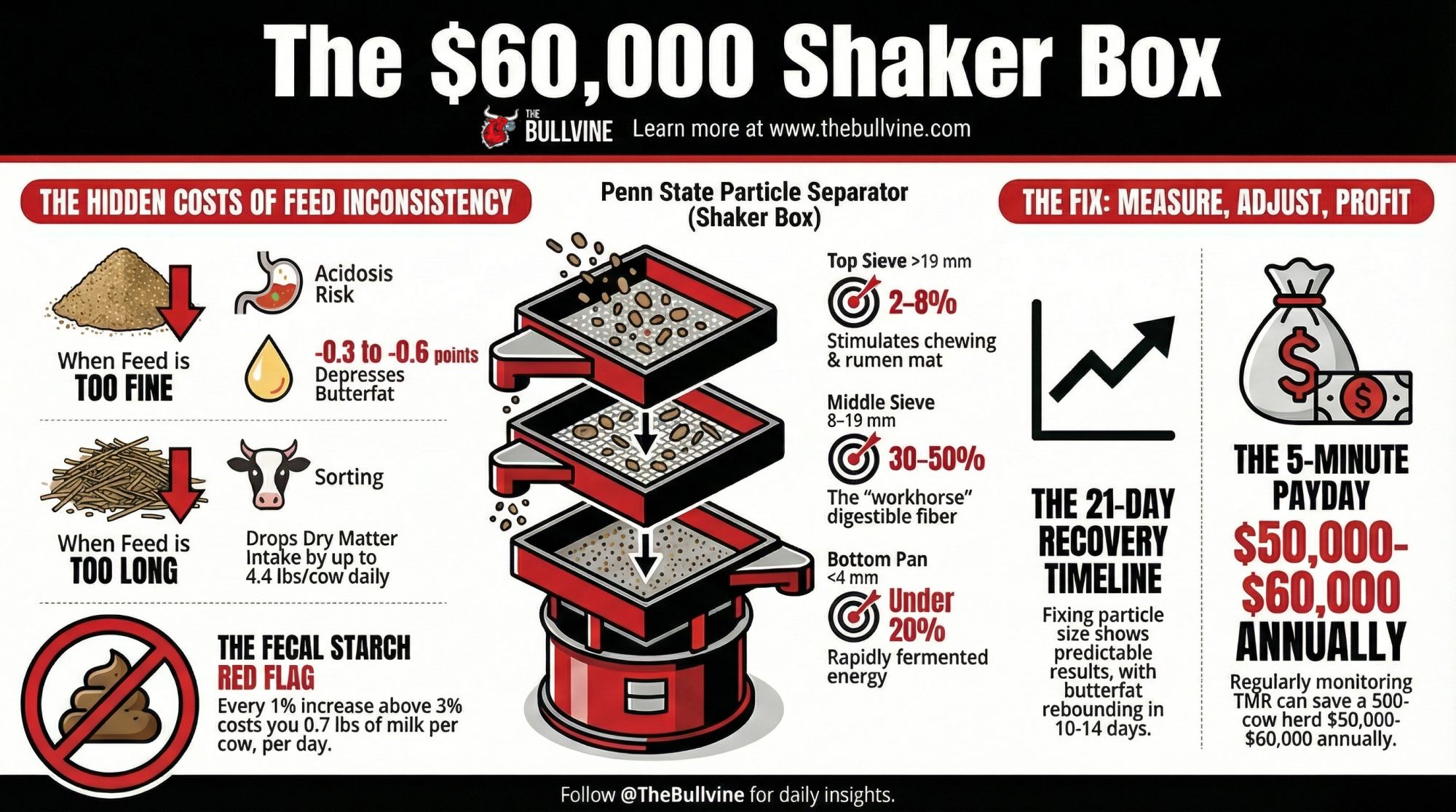
In recent years, research from Penn State Extension and the University of Wisconsin–Madison Department of Dairy Science has made one thing clear: physical feed structure drives both nutrition and profit. When TMR particle size drifts off target—either too fine or too coarse—milk output routinely dips 3–8 pounds (1.4–3.6 kg) per cow per day. Butterfat often falls 0.3–0.6 percentage points, especially when rumen function gets disrupted.

Those numbers add up quickly. For a 600-cow herd, that could easily amount to five figures in monthly component revenue left on the table.

Dr. Mike Hutjens, Professor Emeritus at the University of Illinois, puts it plainly: “Feed uniformity is your daily quality control system. Without it, you’re guessing.” And that’s the truth—consistency isn’t a luxury metric; it’s how high-performing dairies stay profitable year-round.

The Science Inside the Box

If you’ve handled a Penn State Particle Separator, you know it’s simple: four sieve trays stacked by particle size that literally show what cows are eating—not just what’s printed on the ration sheet.

For most lactating cows, Penn State guidelines suggest:

  • 2–8% retained on the top (>19 mm) sieve
  • 30–50% on the next (8–19 mm)
  • 20–30% on the third (4–8 mm)
  • Under 20% in the bottom pan (<4 mm)

What’s really fascinating is how this simple distribution tells us everything about the efficiency of rumen function. Too much fine material, and pH typically plummets below 5.8, kicking off subacute ruminal acidosis (SARA) (Krause & Oetzel, J. Dairy Sci., 2006). Too much long material, and cows start sorting, which restricts intake and upsets the delicate microbial balance that drives butterfat production.

Essentially, the Separator is a truth serum for TMR management—turning impressions into data.

When Feed Gets Too Fine – The Hidden Efficiency Leak

Overmixing is easy, especially in winter when forages dry out and mixing times stretch. The problem is subtle: rations start looking “fluffy,” but excessive blending breaks down fiber particles that cows need for natural buffering.

Mixing Time: The Goldilocks Zone for Particle Size – Seven to nine minutes hits the sweet spot for most operations: enough to blend thoroughly, not enough to pulverize fiber. Beyond 11 minutes, physically effective NDF drops below 60%, and fine particles spike—setting up acidosis risk. 

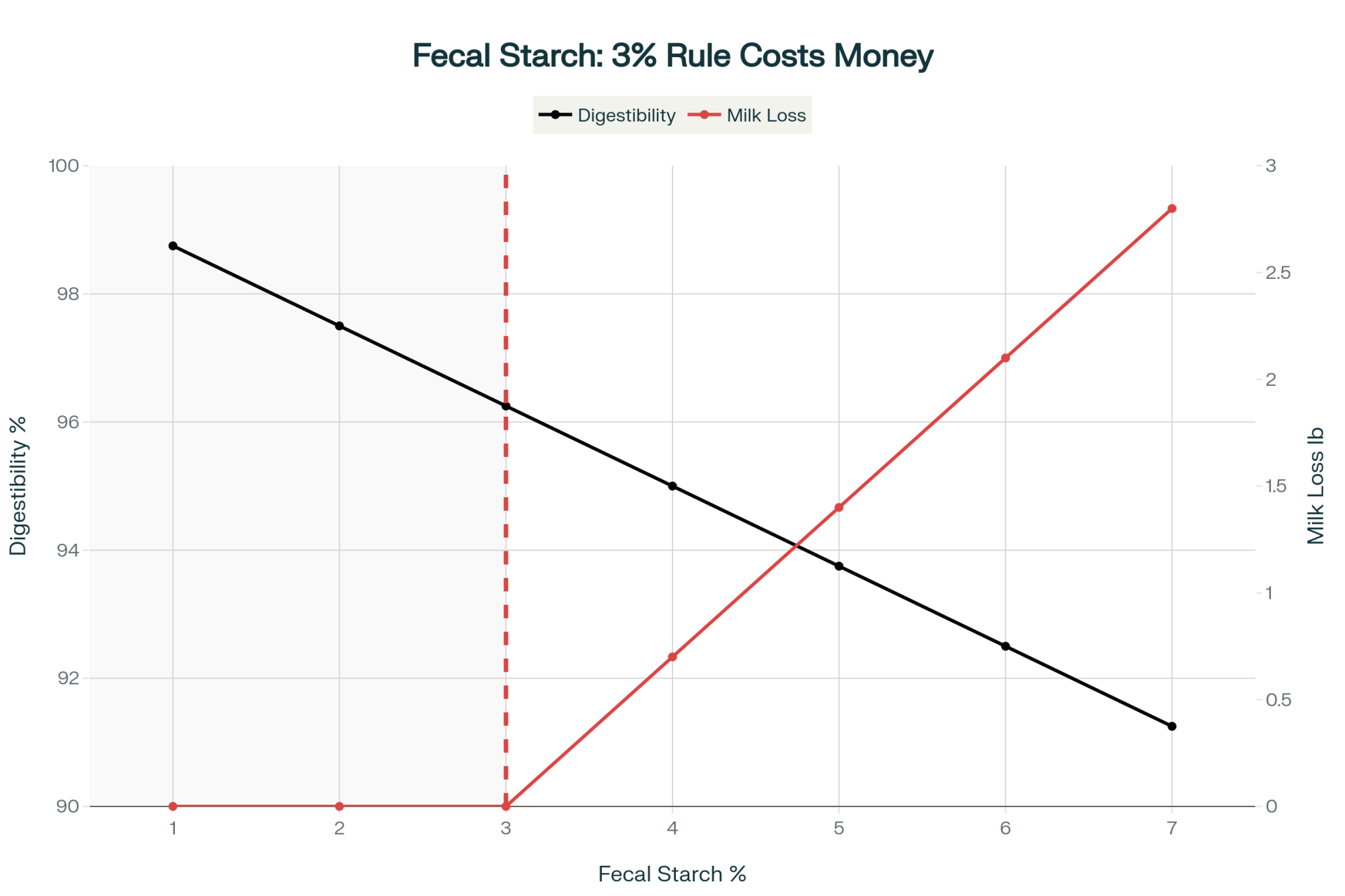
Research from Penn State (2023) and Dairyland Laboratories (2024) shows a consistent relationship—each 1% increase in fecal starch above 3% equals roughly 0.7 pounds (0.3 kg) of lost milk per cow per day. That drop traces directly back to reduced particle size and faster rumen passage.

Fecal Starch: The 3% Rule That Costs Real Money – Every 1% above 3% fecal starch equals 0.7 lbs lost milk per cow daily. At 5%, a 600-cow herd loses $30,660 annually.

Once the feed texture is corrected, cows respond fast. Intake climbs within a few days, and butterfat tends to normalize within 10–14 days. That’s the rumen re-establishing equilibrium, and it happens predictably if consistency holds.

It’s worth noting that recovery isn’t instant because microbial populations need a full cycle—about three weeks—to rebuild. But when farms stick with the plan, the results speak for themselves.

When Feed Gets Too Long – Why “More Fiber” Can Backfire

Across the Midwest, it’s common to see the opposite: rations that are too coarse. Sometimes it’s due to harvest conditions, sometimes prolonged knife wear, or wet forages. But even 10–15% material on the top sieve can drop dry matter intake by 3.3–4.4 pounds (1.5–2 kg) per cow per day, according to Cornell Cooperative Extension (2023)and Kononoff et al. (J. Dairy Sci., 2003).

It’s easy to spot. Bunks show long refusals, feed sorting increases, and milk solids vary from cow to cow. That imbalance also stresses the fresh cow group, where consistent energy delivery is critical during the transition period.

The fix is often small—a sharper chop or added moisture—but the payoff is large. One Northeast producer told me, “We didn’t change the ration at all, just the chop setting—and our intakes stabilized in a week.”

Connecting Particle Size and Fecal Starch

Here’s where modern precision feeding really shines. When farms combine physical evaluation (via the separator) with digestion analytics (via fecal starch testing), they close the loop on total feed efficiency.

Research at the University of Guelph (2024) found that herds maintaining a balanced TMR structure consistently achieved fecal starch levels below 3%, aligning with about 96% total-tract starch digestibility. Anything over 5% points to feed passing too quickly—often because TMR is too fine, not because kernels are underprocessed.

Or, as Hutjens says in his workshops, “If the rumen can’t hold feed long enough, microbes can’t finish their job.” That line always sticks because it’s a simple truth: the rumen’s efficiency relies on physical structure first, chemistry second.

What Improvement Looks Like – The 21-Day Timeline

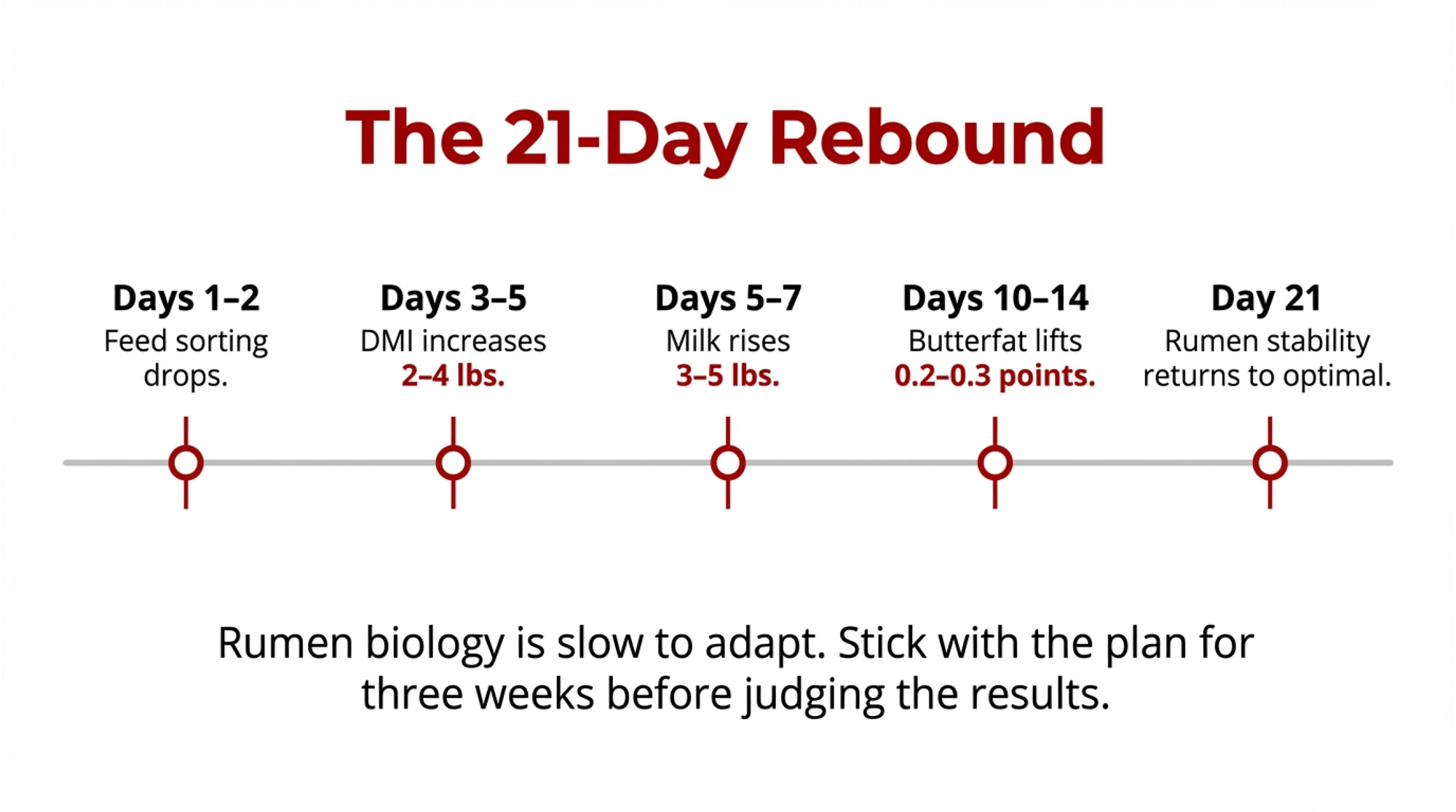
Now, many producers ask: once we fix it, how quickly do the cows show results? Based on consistent findings from Penn State, UW–Madison, and the Miner Institute, here’s what usually happens:

  • Days 1–2: Feed sorting drops; bunk refusals even out.
  • Days 3–5: DMI increases 2–4 pounds (0.9–1.8 kg) per cow.
  • Days 5–7: Milk production rises 3–5 pounds (1.4–2.3 kg) per cow.
  • Days 10–14: Butterfat lifts 0.2–0.3 points.
  • By Day 21: Rumen and microbial stability return to optimal levels.

What’s interesting here is just how predictable the recovery is when particle size and feeding routine stay on target. Results don’t happen overnight—but give it three weeks, and the cows will show you why it’s worth sticking to the plan.

21-Day Recovery: From Feed Fix to Full Profit – Cows respond predictably when particle size is corrected. Milk rises within a week, butterfat follows by week two, and rumen stability locks in by day 21. 

Turning the Separator into a Habit

Producers who’ve made this work treat the Separator as part of weekly herd management, not a special task. I like to call it “Feed Quality Friday”—a fifteen-minute ritual where the feeder runs one test, records the numbers, and shares them with the nutritionist.

The payback for that small amount of time is remarkable. Field results from Penn State Extension (2024) show that farms that regularly monitor particle size reduced component volatility by nearly 30% across seasons, saving $50,000–$60,000 annually on a 500-cow herd.

But more importantly, it changes culture. Feeders begin catching drift before it shows up in milk tests. They start asking better questions about forage moisture, mixing time, and loading sequences. And that’s how farms shift from reactive to proactive management.

Building a Culture of Consistency

What’s encouraging is that this approach works everywhere—from 120-cow tiestalls in Ontario to 2,000-cow dry lot systems in California. The herds that succeed treat feed measurement with the same precision as fresh cow management or breeding records.

Across operations big and small, I’ve noticed that testing isn’t just about data—it builds accountability. Posting results weekly in the feed room, laminating target charts next to the mixer, or even color-coding sieves can transform an abstract concept into a visible, shared goal.

As Hutjens likes to emphasize, “Technology gives you options, but discipline delivers results.” That sentiment captures the heart of this discussion.

The Takeaway

Here’s what it all comes down to: the Penn State Separator isn’t flashy, and it doesn’t plug into an app—but it represents precision in its purest form. Measure, monitor, adjust, repeat. That process costs almost nothing and protects everything that matters: milk yield, butterfat performance, and cow health.

So if your separator is sitting in a corner, unopened, dust it off this week. Shake out one sample. It might just be the five most profitable minutes you’ll spend all month.

This feature draws on research and field data from Penn State Extension, University of Wisconsin–Madison, University of Guelph, Cornell Cooperative Extension, Dairyland Laboratories, and the William H. Miner Agricultural Research Institute, with expert perspective from Dr. Mike Hutjens, University of Illinois Professor Emeritus.

Key Takeaways:

  • The Penn State Particle Separator turns feed analysis into a five‑minute habit that can unlock five‑figure profits.
  • A simple metric—fecal starch over 3%—signals lost milk and missed feed efficiency worth hundreds daily.
  • “Feed Quality Fridays” pay off: just 15 minutes a week can protect up to $60,000 a year in butterfat returns.
  • Within 21 days of adjusting the feed structure, rumen health steadies, and milk fat rebounds naturally.
  • Across every region and herd size, the best dairies win on one thing: disciplined consistency—not fancy tools.

Executive Summary

Ask any successful dairy manager, and they’ll tell you—precision starts with the basics. This article reveals how the humble Penn State Particle Separator has become one of the most cost-effective tools for improving butterfat and overall feed efficiency. Backed by university and field research, it shows how something as simple as a five-minute TMR check can prevent $50,000 or more in yearly losses from feed inconsistency and poor fiber balance. Each 1% rise in fecal starch above 3% translates directly to milk left on the table, and yet, herds that make testing routine see full recovery in yield and butterfat within just 21 days. What’s interesting here is that the wins don’t come from expensive equipment—they come from habit, focus, and follow-through. It’s proof that on the best dairies, measurement has become a mindset, not just a task.

Complete references and supporting documentation are available upon request by contacting the editorial team at editor@thebullvine.com.

Learn More:

Join the Revolution!

Join over 30,000 successful dairy professionals who rely on Bullvine Weekly for their competitive edge. Delivered directly to your inbox each week, our exclusive industry insights help you make smarter decisions while saving precious hours every week. Never miss critical updates on milk production trends, breakthrough technologies, and profit-boosting strategies that top producers are already implementing. Subscribe now to transform your dairy operation’s efficiency and profitability—your future success is just one click away.

NewsSubscribe
First
Last
Consent

China’s Soybean Surge: What Every Dairy Farmer Needs to Lock in Before Feed Costs Spike

Are your feed contracts ready for China’s next move? Learn the #1 step to keep your dairy thriving through 2026’s storm.

EXECUTIVE SUMMARY: China’s record soybean purchases are tightening feed supplies and driving up costs for dairy farmers in 2026. This analysis, backed by USDA and industry data, reveals how the new trade deal is fueling volatility—from rising soybean meal prices to a stronger dollar eroding export competitiveness. Dairy operations willing to act fast—locking in feed contracts, improving ration efficiency, and diversifying protein sources—stand to protect their bottom line. The article lays out a farmer-tested 90-day action plan, with examples and strategies suited for different regions and farm sizes. For many, the next few weeks could determine whether they stay in business, expand, or get squeezed out. With the right moves, surviving the feed storm of 2026 isn’t just possible—it’s within reach.

Dairy Feed Management

You know how it goes—you’re checking feed invoices on a Thursday afternoon when the big news breaks. That’s exactly what many Wisconsin dairy farmers were doing when the November 2025 China trade deal was announced. American agriculture had secured 87 million metric tons of soybean exports over three years, and honestly, the initial reaction from most of us was cautiously optimistic.

But here’s what’s interesting. As producers started running the numbers—and I’ve talked to quite a few over the past week—the optimism began to shift. When China commits to buying 25 million metric tons of our soybeans annually, those are beans leaving the domestic market. And as one producer near Madison put it to me, “Last I checked, my cows don’t eat soybeans in Shanghai.”

What I’ve found is that once you dig into the actual economics, there’s a supply squeeze developing that the celebratory press releases aren’t really highlighting. It’s not that anyone’s trying to hide anything—it’s just that the grain side of the story is getting all the attention.

Understanding the Supply Squeeze

So here’s where the math gets interesting, and why many of us are concerned. According to the latest USDA Economic Research Service data from October, U.S. soybean crushing capacity is already processing about 2.54 billion bushels annually. That’s 59% of our total production right there.

Operation SizeMonthly Soybean Meal Use (tons)Cost at $330/tonCost at $375/tonMonthly Impact
100-cow4.5$1,485$1,688+$203
300-cow13.5$4,455$5,063+$608
500-cow22.5$7,425$8,438+$1,013
1,000-cow45$14,850$16,875+$2,025
2,000-cow90$29,700$33,750+$4,050

Now add China’s commitment—another 918 million bushels of annual demand when you convert those metric tons. Factor in our existing exports to Japan, Mexico, and the EU, plus seed requirements… suddenly we’re operating at nearly 100% utilization with minimal buffer stocks.

Agricultural economists at places like Iowa State have been tracking this, and what they’re pointing out is worth noting: when stocks-to-use ratios drop below 12%, price volatility typically increases significantly. What are the projections for the 2025-26 marketing year? We’re looking at 10.2%. That’s uncomfortably tight by any measure.

Look, I get why grain farmers are celebrating—and they should be. They’ve been getting undercut by Brazilian beans for three years straight. The USDA Foreign Agricultural Service reports show Brazil’s production costs running about $8.67 per bushel compared to our $9.85 here in the States. That’s brutal competition. So yeah, they desperately needed this export market.

But here’s where it gets complicated for those of us in dairy. Current soybean meal futures on the CME were trading around $320-330 per ton in early November. Market analysts—and I’m talking about the conservative ones at places like CoBank—are projecting we could see 12-18% price increases once those export shipments ramp up in the first quarter of 2026.

Soybean meal prices are projected to surge 12-18% by Q2 2026 as China’s record purchases tighten domestic feed markets—hitting $375/ton and squeezing dairy margins across all operations.

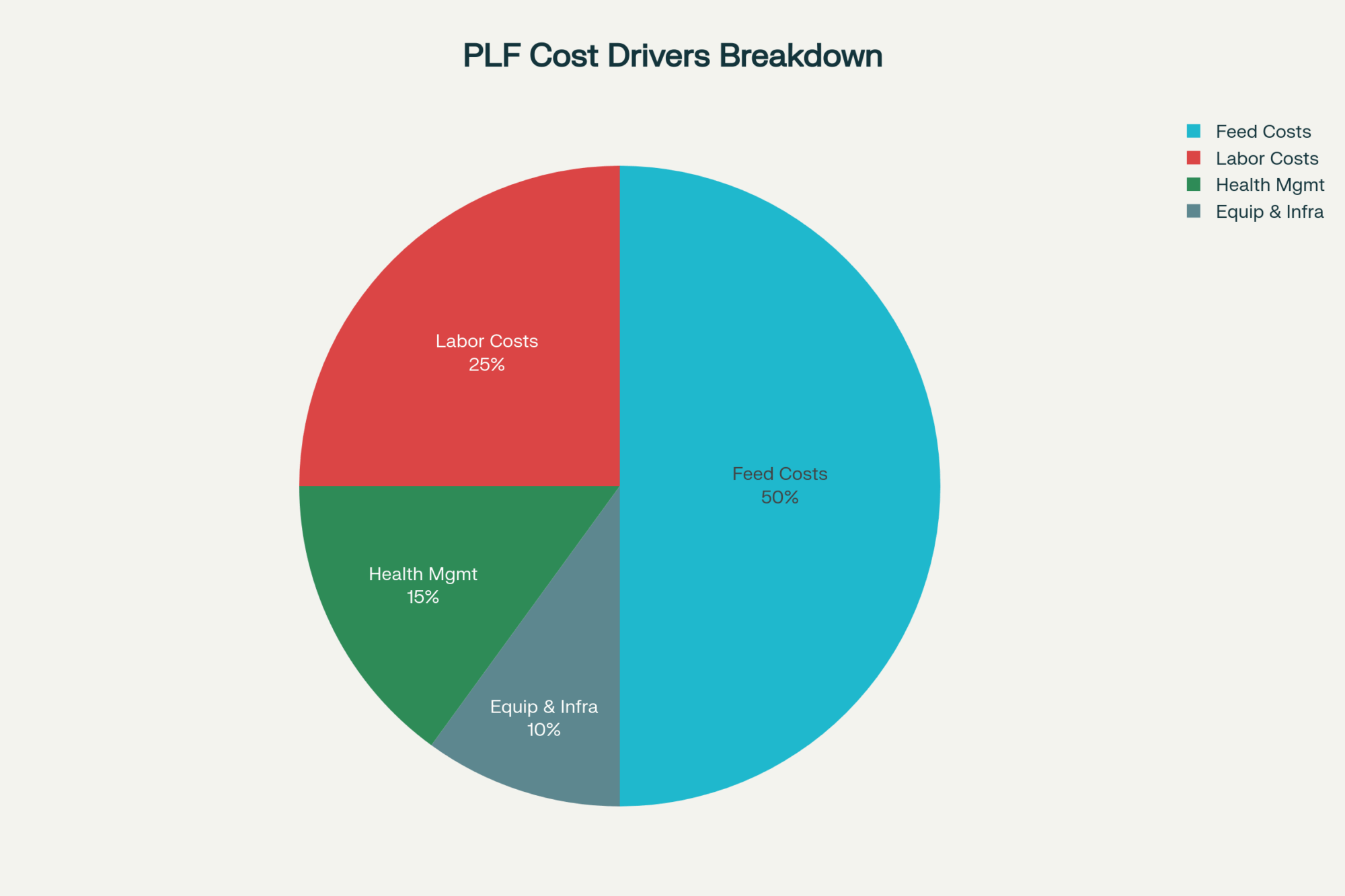
For dairy operations where feed accounts for 45-60% of operating expenses —most of us, according to Cornell’s farm business data —we’re talking real money. Not hypothetical impacts—real cash flow consequences.

The Currency Connection Most Farmers Miss

Now, there’s another layer to this that even seasoned dairy producers often overlook. It’s the currency angle, and honestly, it took me a while to fully grasp this myself.

When China buys $9.6 billion worth of soybeans annually, they need U.S. dollars to complete those transactions. Basic economics, right?

But what happens next is where it gets interesting. Federal Reserve data going back decades shows that a 10% increase in agricultural exports typically correlates with a 1-2% appreciation in the dollar’s value against trading partner currencies. Doesn’t sound like much?

Let me give you a real-world example that brought this home for me.

Say you’re part of a cooperative that exports nonfat dry milk to Mexico—which, according to U.S. Dairy Export Council data, is one of our top three dairy export markets. Your product is priced at $1.20 per pound, and a standard container holds 44,000 pounds. At today’s exchange rate of roughly 17 pesos per dollar, that Mexican buyer pays 897,600 pesos.

But if the dollar strengthens by just 1.5%—and that’s conservative given the trade volumes we’re discussing—that same container suddenly costs your Mexican buyer 911,064 pesos. That’s 13,464 pesos more for the exact same product.

The currency connection most farmers miss: a mere 1.5% dollar strengthening adds $13,464 to a container of milk destined for Mexico—your price didn’t change, but suddenly you’re uncompetitive against New Zealand

“You haven’t raised your price. Your co-op hasn’t changed anything. But from the buyer’s perspective, American dairy just got more expensive.”

Meanwhile, New Zealand dairy products? Their dollar typically weakens when global commodity prices rise, making their exports more competitive, not less. It’s a dynamic that puts us at a systematic disadvantage, and it compounds over time.

China’s Actual Dairy Demand: A Reality Check

Here’s what really caught my attention when I dug into the USDA Foreign Agricultural Service’s latest China dairy reports. They’re projecting just 2% growth in dairy imports for 2025. That’s after three consecutive years of declining imports. Two percent.

What’s worth understanding is that China’s government has set explicit targets—47 kilograms of per capita dairy consumption by 2030, up from the current 35 kilograms. But if you read their Five-Year Agricultural Plans carefully — and I’ve been going through these with some industry analysts — they’re planning to meet this demand primarily through domestic production expansion, not imports.

The numbers back this up. China’s raw milk production is forecast to increase by 3-4% in 2025, according to USDA FAS reports. They’re building massive dairy operations—we’re talking 10,000-head facilities—with government subsidies for everything from imported genetics to milking equipment.

And here’s the kicker that nobody wants to talk about: even with these new tariff suspensions, everyone’s celebrating, U.S. dairy products still face a 10% duty in China. Know what New Zealand pays? Zero. They’ve had a free trade agreement since 2008. Australia? Zero percent since 2015. The EU? Various agreements put them at zero or near-zero.

So we’re celebrating market access, where we’re still at a 10% cost disadvantage to our main competitors. That’s… well, that’s something to think about.

Regional Variations and Operational Realities

Now, I should mention that this isn’t hitting everyone equally. The impact really depends on where you are and how you operate.

California’s large-scale operations—I’m talking about those 2,000-plus cow dairies in the Central Valley—they’ve got some advantages here. Many can negotiate directly with soybean crushing plants, bypassing the dealer markup that smaller operations face. They’ve got the storage capacity to buy feed in bulk when prices are favorable. Some are even forward-contracting a full year out.

But in Wisconsin? Pennsylvania? Vermont? The 100-300 cow operations that still make up the backbone of dairy in these states face a different reality. I was talking to a Pennsylvania producer last week who told me he’d called three feed suppliers about locking in prices for next year. One wouldn’t quote him past December. Another wanted a 5% premium for a six-month lock. The third said to call back after Thanksgiving.

What’s fascinating—and concerning—is how this accelerates the consolidation we’ve been seeing for years. USDA National Agricultural Statistics Service data shows that 65% of the nation’s dairy cows now live on farms with 1,000 or more animals. That was 45% just fifteen years ago. When margins get squeezed by feed costs and currency headwinds, it’s the mid-size family operations that typically can’t weather the storm.

For organic and grass-based operations, there’s actually an interesting twist. Those farms feeding minimal grain might find themselves with a competitive advantage as grain-dependent neighbors struggle with feed costs. But even they’re not immune—organic soybean meal runs about double the conventional price, and those markets tend to move in parallel.

And what about seasonal calving operations? They might actually have some flexibility here, being able to time their peak feed needs around market conditions. It’s one of those operational quirks that could become an unexpected advantage.

Practical Steps That Actually Work

So what can we actually do about this? I’ve been collecting strategies from operations that successfully navigated the 2012 drought and the 2018-19 margin squeeze, and there are some consistent patterns.

Lock Your Feed Contracts—But Be Smart About It

The single most impactful decision, according to every successful farmer I’ve spoken with, is locking feed prices for January through June 2026. But here’s the thing—you’ve got maybe 10-15 business days before suppliers adjust their forward pricing to reflect the coming supply squeeze.

A Wisconsin producer I know well locked 70% of her expected soybean meal needs at $332 per ton with a 3% premium. Yeah, it felt expensive paying that $895 extra upfront. But if the meal hits $375 per ton by February—and many nutritionists think it could—she’ll save over $2,000 in six months.

What farmers are finding works best:

  • Lock 60-70% of expected consumption, keeping some flexibility
  • Include alternative proteins in your contracts—canola meal, distillers grains
  • Negotiate volume commitments for better pricing
  • Ask about price protection if markets drop more than 15%

Feed Efficiency: The Research Numbers

Here’s a number that should grab your attention: University of Wisconsin research shows efficient operations achieve 162 pounds of feed per hundredweight of milk produced. Less efficient operations? They’re using 243 pounds. That’s a 33% difference, and it becomes a survival factor when feed costs spike.

Feed Efficiency: Real Farm Results

I know a producer who made some simple changes that improved her feed conversion by 9% over 90 days. Started measuring feed refusals daily—discovered they were wasting 7% of delivered feed. Began testing forages monthly instead of quarterly. Adjusted feeding times to within 30-minute windows. Separated first-lactation heifers from mature cows for targeted feeding.

The result? About $60,000 in annual savings. No new equipment, no capital investment. Just better management of what they already had.

For those running robotic milking systems, there’s an added dimension here. Your feeding strategy is already more individualized, which could be an advantage. But you’ll need to adjust your pellet formulations and potentially recalibrate feeding rates as ingredient costs shift.

Diversify Protein Sources Strategically

What’s working for farmers who are getting ahead of this is a gradual transition, not panic switching. You can’t just swap soybean meal for canola meal overnight and expect the same milk production. But with careful testing and adjustment…

An Idaho producer I’ve been following started incorporating alternative proteins eight weeks ago. They’re now at 15% canola meal, 20% more distillers grains, and they’ve reduced soybean meal from 5.5 to 4.2 pounds per cow per day. Production’s holding steady, components haven’t dropped, and they’re positioned better for when soybean meal prices spike.

The Longer View: Industry Restructuring

Looking beyond the immediate feed cost concerns, this trade deal is accelerating something that’s been happening for years—the fundamental restructuring of American dairy.

Research from Cornell’s agricultural economics department shows that trade policies creating margin pressure don’t just affect current operations. They accelerate the shift from distributed, family-farm dairy to consolidated, industrial-scale production.

The advantages increasingly favor large operations that can negotiate directly with feed suppliers and processors, maintain capital reserves for extended contract positions, achieve superior feed conversion efficiency through dedicated nutritionists and technology, and access sophisticated financial instruments like currency hedging.

For small- and mid-size operations, the path forward requires either exceptional efficiency, niche-market development, or strategic partnerships that provide some of the scale advantages without full consolidation.

I’ve noticed something interesting when talking to younger farmers taking over operations: the successful ones aren’t trying to compete on scale. They’re finding ways to be exceptional at efficiency, developing direct-market relationships to capture more margin, or forming buying cooperatives with neighbors to secure volume pricing on inputs. It’s really adapt or exit.

And heifer raising operations? They’re in an interesting spot. Feed costs hit them too, but they might find opportunities as dairy farms look to reduce capital tied up in youngstock. Could be worth exploring contract raising arrangements if you haven’t already.

Your 90-Day Action Plan

Based on conversations with farmers who’ve successfully navigated previous margin squeezes, here’s what needs to happen:

Next 7-14 Days (Urgent)

Contact feed suppliers about January-June 2026 pricing. Even if you only lock 40-50% of your needs, that’s protection you won’t have if you wait until December. Get quotes from at least three suppliers—prices and terms vary more than you’d expect.

Schedule a sit-down with your nutritionist. Not a phone call—a real working session to develop contingency rations using alternative proteins. Test these on a small group first.

Pull your actual feed conversion numbers. If you don’t know your pounds of feed per hundredweight of milk, you’re flying blind.

Next 30 Days (Important)

Start measuring feed refusals daily. I know, I know—one more thing to track. But farms that do this consistently find 5-10% waste they didn’t know existed.

Test all your forages. Those three-month-old test results? They’re fiction at this point. Forage quality changes, and you’re formulating rations based on fantasy if you’re not testing monthly.

Evaluate storage capacity. Can you take a full semi load instead of partial deliveries? The per-ton savings add up fast.

Next 90 Days (Strategic)

Run the numbers on what happens if feed costs rise 15% and milk prices drop 5%. If that scenario puts you underwater, what changes now? Culling decisions? Expansion plans? Equipment purchases?

Build relationships with alternative suppliers. When primary suppliers run tight, having established relationships with secondaries can be the difference between feeding cows and scrambling.

Document everything you’re doing to improve efficiency. Your banker will want to see this when you discuss operating notes, and processors value suppliers who can demonstrate operational excellence.

The Bottom Line

Agricultural trade policy often involves tradeoffs between sectors. The soybeans leaving for China are soybeans not being crushed domestically for meal. The dollars flowing in for those exports strengthen our currency and make dairy exports less competitive.

None of this means the sky is falling. Farms that recognize these dynamics and position accordingly will navigate successfully—some will even find opportunities in the disruption. But the window for proactive positioning is measured in weeks, not months.

As one successful farmer told me recently, “The difference between the dairies that thrive and those that just survive often comes down to decisions made months before the crisis becomes obvious to everyone.”

The math suggests we’ve got about 90 days to position for what’s coming. The question isn’t whether feed costs will rise and margins will tighten—market dynamics make that increasingly likely. The question is whether your operation will be positioned to handle it.

Your cows will need feed in February regardless. The only variable is whether you’ll be paying $325 per ton because you locked it in November, or $375 because you waited to see what happens.

The clock’s ticking. What’s your move?

Key Takeaways:

  • China’s soybean surge is tightening domestic feed markets—soybean meal spot prices could jump 12-18% by Q2 2026.
  • Locking in feed contracts within the next 2 weeks can shield your dairy from volatile markets and protect 2026 margins.
  • Efficiency wins: improving ration conversion and testing forages monthly can mean $60,000/year in saved feed costs.
  • The producers who adapt now—by diversifying their protein offerings and working closely with nutritionists—will have the best shot at staying profitable through next year.
  • Waiting for certainty isn’t a strategy: farms that act now have more options and a better chance of riding out the feed storm.

Data sources for this article include: USDA Economic Research Service (October 2025), USDA National Agricultural Statistics Service (2025), USDA Foreign Agricultural Service GAIN Reports (October 2025), CME Group futures data (November 2025), Federal Reserve Agricultural Finance Monitor (Q3 2025), CoBank Knowledge Exchange quarterly reports, Cornell Dairy Farm Business Summary (2024), University of Wisconsin-Madison dairy research publications, U.S. Dairy Export Council trade data, and various dairy market analysis reports.

Learn More:

Join the Revolution!

Join over 30,000 successful dairy professionals who rely on Bullvine Weekly for their competitive edge. Delivered directly to your inbox each week, our exclusive industry insights help you make smarter decisions while saving precious hours every week. Never miss critical updates on milk production trends, breakthrough technologies, and profit-boosting strategies that top producers are already implementing. Subscribe now to transform your dairy operation’s efficiency and profitability—your future success is just one click away.

NewsSubscribe
First
Last
Consent

Butter Pays Triple: Fonterra’s $75M Investment Proves Components Are Your Future

Fonterra commits $75M to butter while powder markets collapse 39%. Smart producers already pivoting: 10-15% profit gains documented.

Executive Summary: Progressive dairy farms are adding $32,000-87,000 annually by switching from volume to component focus—and Fonterra’s $75 million butter expansion validates their strategy. Butter commands $7,000 per tonne while powder sits at $2,550, a gap that’s widening as Chinese powder demand drops 39% and global butterfat markets stay strong. Smart farms are already moving: investing $10-20 per cow per month in targeted nutrition generates returns of $25-85 within 60-90 days. The window for action is closing—$8 billion in new North American butter and cheese capacity will come online by 2027, and farmers positioned to supply components will capture those premiums, while others scramble to adapt. This analysis provides your roadmap: immediate nutrition optimization, strategic processor positioning within 18 months, and staged genetic transitions starting with your bottom third. The verdict from global markets to Wisconsin farms is unanimous: component density drives profit, volume doesn’t.

Milk Component Value

The global dairy industry is experiencing a fundamental shift in value creation—from volume to components—and farmers who recognize this transition early will position themselves for success in the emerging market structure

You know, when Fonterra announced their NZ$75 million investment to double butter production capacity at the Clandeboye facility in Canterbury, I found myself thinking about what this really means for dairy farmers like us. This goes beyond just another infrastructure upgrade—it represents a fundamental shift in how our industry values milk.

What caught my eye about the timing is this: Global Dairy Trade auctions through October 2025 have consistently shown butter trading between $6,600 and $7,000 per tonne, while skim milk powder sits around $2,550. We’re talking nearly triple the value here. And that price differential isn’t just a temporary market quirk—it reflects something deeper happening across the entire dairy value chain.

What particularly caught my attention was Fonterra’s simultaneous decision to divest their consumer brands to Lactalis for $4.22 billion while expanding butter capacity. On the surface, these moves might seem contradictory, right? But dig deeper, and a coherent strategy emerges—one that dairy farmers everywhere should understand.

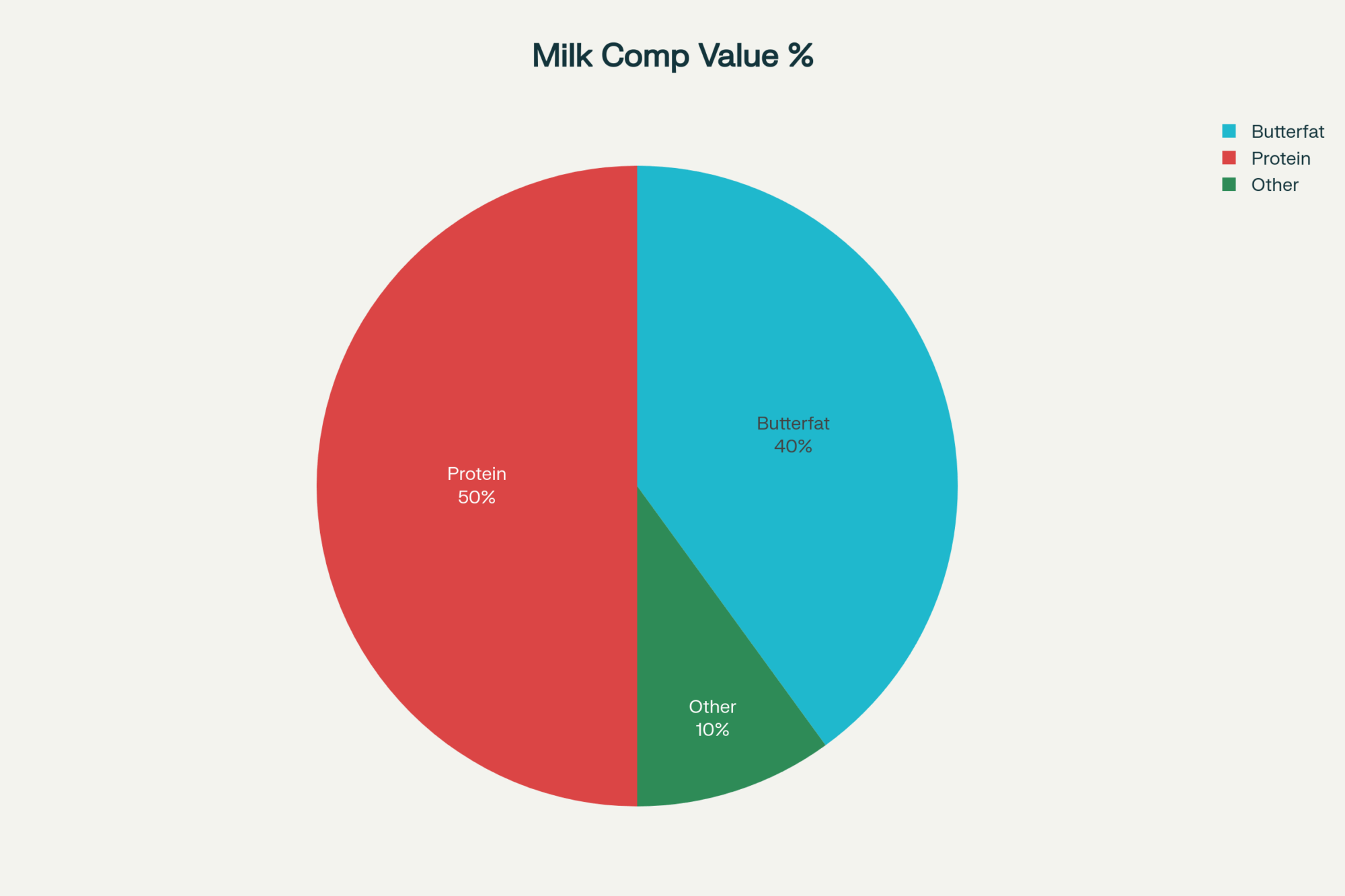
Butter commands nearly triple the price of powder, rewriting the playbook for component-focused production and dismissing old volume-based strategies forever.

Understanding the Strategic Shift Behind the Investment

Miles Hurrell, Fonterra’s CEO, framed this investment as increasing production of high-value products while improving their product mix. The numbers behind that statement tell a compelling story. Their ingredients channel, which processes 80% of their milk solids, generated $17.4 billion in their most recent fiscal year. Consumer products? Just $3.3 billion.

That disparity explains why processors globally are refocusing on B2B ingredients rather than consumer brands. It’s a strategic shift that reflects where value creation actually happens in modern dairy markets.

Looking at processing flexibility in the Pacific region, what’s remarkable about New Zealand’s cream plants is their operational agility. They can shift substantial portions of milkfat between anhydrous milk fat and butter production based on market signals. This allows processors to capture whatever premium the market’s offering at any given time.

The global supply picture adds another layer to this story. According to the European Commission’s October 2025 dairy market observatory, European milk production continues growing despite relatively weak farmgate prices. USDA’s Dairy Market News shows U.S. dairy herds have expanded by 2.1% in recent months. DairyNZ confirms New Zealand’s having another strong production season with August 2025 collections up 8.3% year-over-year.

So we’ve got milk oversupply, yet butter prices remain remarkably resilient while powder markets struggle. There’s something structural happening here, and it’s worth paying attention to.

What This Means for Component-Focused Production

This brings us to what really matters for farmers: How do these market dynamics translate to on-farm decisions?

MetricJersey/CrossbredHolsteinAdvantage
Butterfat Content4.3-4.5%3.6%+0.7-0.9% (Jersey)
Protein Content3.6-3.8%3.2%+0.4-0.6% (Jersey)
Component EfficiencySuperiorStandardJersey
Economic Returns vs Holstein+10-15%BaselineJersey
Feed EfficiencyImprovedStandardJersey
Reproductive PerformanceFewer Days OpenBaselineJersey

Research from extension services at Wisconsin, Cornell, and Penn State consistently shows that component efficiency drives profitability more effectively than pure volume production. And the data is compelling. Farms implementing Jersey crossbreeding programs typically see economic returns increase by 10-15% compared to pure Holstein operations—that’s according to multi-year studies in the Journal of Dairy Science. Component levels often reach 4.3-4.5% butterfat and 3.6-3.8% protein, compared to Holstein averages around 3.6% and 3.2% respectively.

What’s encouraging is the improvement in feed efficiency and reproductive performance that comes along with these component gains. Many producers report their crossbred cows show fewer days open and require less intervention during the transition period—you probably know someone who’s seen similar results.

Dr. Randy Shaver from Wisconsin-Madison’s dairy science department documented fascinating case studies in which farms optimizing amino acid nutrition and removing polyunsaturated fat sources saw butterfat increase from around 3.4% to over 4% within weeks. When that translates to several dollars more per hundredweight… well, that’s meaningful money when you’re shipping milk every day, all year long.

I’ve noticed a generational shift happening, too. Younger farmers entering the industry aren’t as attached to the traditional “fill the tank” mentality. They’re looking at component efficiency from day one, asking different questions about genetics, nutrition, and marketing strategies. It’s refreshing, honestly.

The Powder Market Reality Driving Change

China’s powder demand has fallen off a cliff—erasing decades of growth and leaving billions in powder-drying assets stranded.

So why is this shift toward butterfat happening now? The answer lies partly in what’s happening to global powder markets.

Global Dairy Trade auctions in September and October 2025 show both skim milk powder and whole milk powder trading well below historical averages. Chinese imports—which drove powder demand for nearly two decades—remain significantly depressed. China Customs Administration data from August 2025 shows a 39% year-over-year decline. That’s not a blip; that’s a trend.

The situation in China deserves particular attention. While their domestic milk production has been declining (which, in theory, should support imports), the China Dairy Industry Association’s September 2025 report indicates that many Chinese dairy farms are operating at a loss, with farmgate prices hitting multi-year lows. This suggests structural challenges that won’t resolve quickly.

What we’re witnessing is potentially billions of dollars in powder-drying capacity built for a market dynamic that no longer exists. Rabobank’s Q3 2025 dairy quarterly describes these as potential “stranded assets”—infrastructure investments that may never generate expected returns. That’s a sobering thought for processors heavily invested in powder.

Component Optimization: A Practical Framework

For producers considering this transition, here’s what progressive operations are focusing on:

✓ Baseline assessment: Review component tests from the past 6 months to understand where you’re starting
✓ Efficiency calculation: Measure total fat and protein pounds against dry matter intake
✓ Market exploration: Request quotes from 2-3 processors to understand regional pricing dynamics
✓ Nutrition refinement: Work with your nutritionist on amino acid balancing strategies
✓ Fat supplementation: Consider palmitic acid products at 1.5-2% of diet dry matter
✓ Interference removal: Identify and eliminate high PUFA sources that suppress butterfat synthesis
✓ Progress monitoring: Track component response weekly during the initial transition month

Practical Steps for Farmers: The 18-Month Transition Strategy

Based on conversations with producers who’ve successfully navigated this shift, along with extension recommendations, a three-phase approach seems most practical.

Immediate Actions (Next 60-90 Days)

Nutrition optimization offers the fastest path to capturing component premiums. University dairy specialists consistently recommend focusing on amino acid profiles in metabolizable protein, incorporating appropriate fat supplements, and eliminating factors that suppress butterfat synthesis.

The economics are encouraging here. Research from land-grant universities, including Michigan State and the University of Minnesota, suggests that investing $10-20 per cow per month in targeted nutrition typically yields returns of $25-85. Even if your current processor doesn’t fully reward components today, you’re still capturing feed efficiency gains and often seeing reproductive benefits that improve overall herd health.

One practical approach: Start by reviewing your current ration with fresh eyes. Many farms discover they’re feeding ingredients that actively suppress butterfat—things that made sense when volume was king, but work against component optimization. It’s surprising what you might find.

Short-Term Strategy (6-18 Months)

This development suggests interesting market dynamics ahead. With processors across North America investing billions in new capacity—the International Dairy Foods Association reports over $8 billion in announced projects through 2026—they’ll need a quality milk supply to fill that infrastructure.

For U.S. producers operating outside supply management, this creates direct opportunities. I recently heard from a producer in Pennsylvania who documented her component levels and quality metrics over several months, then approached three processors for competitive quotes. When her existing buyer realized she had genuine alternatives offering 50 cents more per hundredweight, they suddenly found room to improve their pricing structure. Funny how that works.

The Canadian experience offers different lessons. While producers there can’t negotiate directly with processors—they sell to provincial milk marketing boards, which allocate milk—their transparent pricing system, administered by the Canadian Dairy Commission, clearly rewards components. October 2025 butterfat prices are $11.84 per kilogram, versus $8.31 for protein. This regulated system has driven on-farm decisions toward component optimization for years, since that’s how farmers maximize returns within the supply management framework. Canadian producers have focused intensively on genetics and nutrition to optimize components because that’s their only lever for improving revenue—they can’t negotiate volume or switch buyers.

U.S. producers following the June 2025 Federal Milk Marketing Order reforms have more flexibility but less pricing transparency. The principle of demanding clear component pricing from cooperatives remains valid for those who can negotiate or explore alternatives.

Long-Term Positioning (18+ Months)

Genetic decisions made today will determine your component profile when new processing capacity comes online in 2028-2030. Extension geneticists generally recommend starting conservatively—perhaps with your bottom third of cows for initial crossbreeding trials.

This staged approach allows you to evaluate results while maintaining operational flexibility. If market signals remain positive by mid-2026, you can expand the program. The timeline matters here because first-cross heifers bred today won’t enter your milking string for about 24 months.

Understanding Regional Variations

Different regions are adapting to this component-focused reality in distinct ways, and there’s something to learn from each approach.

New Zealand demonstrates that the model works even with smaller herd sizes—their average herd size remains under 500 cows, according to DairyNZ’s 2024-25 statistics. Their payment system has been optimized for milk solids rather than volume for years, creating remarkable efficiency. What’s particularly noteworthy is that, as Fonterra’s market share has declined to 77.8% according to the New Zealand Commerce Commission’s September 2025 report, and competitors have offered attractive component-focused pricing, it’s actually forced all processors to be more responsive to farmer needs.

In the United States, the Federal Milk Marketing Order reforms implemented in June 2025—the first major update since 2008—formally recognized that butterfat now accounts for 58% of milk check income, according to the USDA’s Agricultural Marketing Service. Yet many cooperative payment systems haven’t fully adjusted to this reality, creating opportunities for producers willing to negotiate or explore alternatives.

California producers face unique challenges with transportation distances and processor consolidation, but they’re also seeing some of the strongest component premiums in the country. The California Department of Food and Agriculture’s September 2025 data shows component premiums averaging $0.85 per hundredweight above the state average. That adds up quickly.

The Northeast presents another interesting case. Smaller farms there are finding that component optimization allows them to remain competitive despite scale disadvantages. When you’re shipping high-component milk, processor transportation costs become more manageable on a solids basis—that’s just math working in your favor.

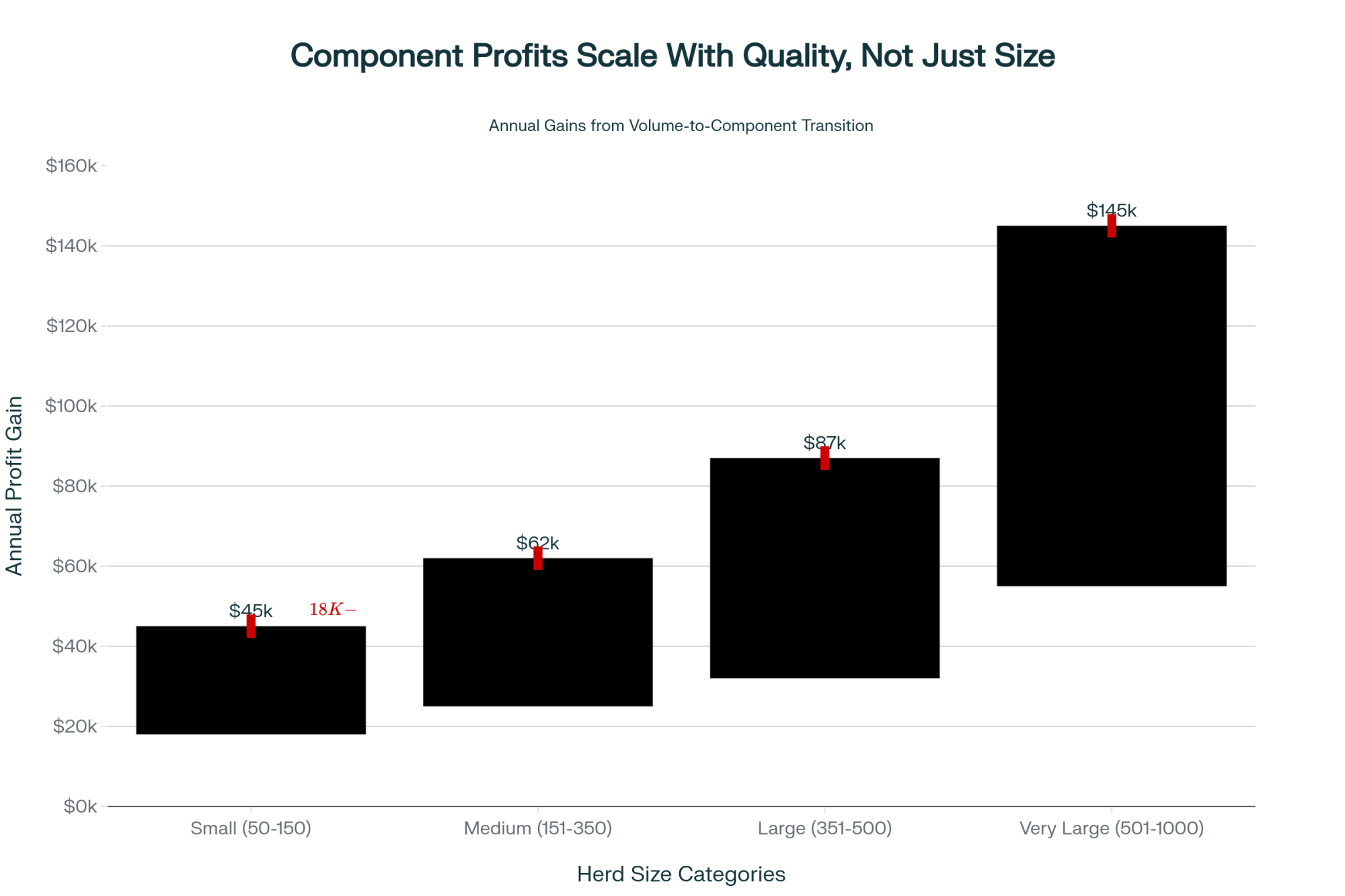
Component optimization delivers impressive profit across all herd sizes, proving quality trumps scale in the new dairy order.

The Risks We Should Monitor—And How to Prepare

Now, while the component-focused future seems clear, several risks deserve attention along with strategies to address them.

China’s economic trajectory remains the biggest wildcard. If their dairy demand remains weak for several more years, global export markets will come under pressure. But what’s encouraging is butter’s diverse demand base—spanning Asia, the Middle East, and developed markets—provides more resilience than powder’s historically China-dependent structure. Smart farms are diversifying their risk by not betting everything on export-dependent processors.

Precision fermentation technology represents a longer-term consideration. Companies like Yali Bio and Melt & Marble are developing fermented dairy fats, with some targeting commercial launches in 2026, according to their August 2025 corporate announcements. While price parity is likely 5-10 years away, according to the Good Food Institute’s September 2025 analysis, this technology could eventually compete for commodity ingredient applications. The best defense? Focus on premium quality that commands loyalty beyond pure commodity competition.

The impact of GLP-1 weight-loss medications on dairy consumption patterns is another emerging factor. Research in the American Journal of Agricultural Economics from July 2025 indicates households using these medications reduce butter consumption by approximately 6%, primarily in retail channels rather than foodservice. Current adoption sits at 3.2% of the U.S. population according to CDC data from August 2025, though Morgan Stanley projects potential growth to 7-9% by 2035. It’s worth monitoring, but foodservice demand remains more stable.

Perspectives from Progressive Operations

Extension case studies from farms that have successfully transitioned offer valuable insights. The University of Wisconsin-Madison’s August 2025 extension bulletin documented Wisconsin farms reporting economic improvements ranging from $32,000 to $87,000 annually for 500-cow operations. The variation depends largely on their starting point and local market dynamics, but the direction is consistently positive.

The common thread among successful transitions? Methodical tracking of component efficiency—measuring pounds of fat and protein against pounds of dry matter intake. This metric, more than any other, determines economic sustainability in a component-valued market.

International examples provide additional perspective. Brazilian operations dealing with heat stress have found Jersey genetics particularly valuable. Embrapa Dairy Cattle’s 2025 annual report shows 12-15% improvement in component efficiency under tropical conditions—that’s significant when you’re battling heat and humidity. Australian producers recovering from recent industry challenges are focusing intensively on specialty cheese and butterfat products for Asian markets, as documented in Dairy Australia’s September 2025 market analysis. These diverse experiences suggest the component-focused approach adapts well across different production environments.

Essential Lessons for Dairy Farmers

After examining the data, market trends, and producer experiences, several principles emerge clearly.

Component optimization is transitioning from competitive advantage to operational necessity. The most successful farms won’t necessarily be the largest, but those producing high-component milk at competitive costs while maintaining operational flexibility.

Processing flexibility matters tremendously. Fonterra’s ability to shift between butter, AMF, and cream products based on market signals provides the resilience that single-product strategies can’t match. We should seek similar flexibility in our own operations.

Information asymmetry remains expensive but addressable. Farms that invest modestly in market intelligence and professional advisory services often identify pricing opportunities worth tens of thousands of dollars annually. The key is translating that information into actionable operational changes.

The transition period through 2027 creates a particular opportunity. As new processing capacity comes online, farmers who’ve already positioned for component production will be ready to capture emerging premiums.

Looking Forward: Your Strategic Path

The dairy industry stands at a genuine inflection point. Processing infrastructure is shifting toward butterfat-intensive products. Payment systems are gradually recognizing the value of components. Technology continues creating both opportunities and challenges for traditional dairy farming.

Fonterra’s $75 million investment signals confidence that butterfat will maintain its premium status despite powder market challenges. They’re betting this trend continues for at least the next decade. Whether they’re right depends on multiple variables—economic recovery in key markets, technology advancement rates, and evolving consumer preferences.

What seems certain is that measuring dairy success purely by tank volume is becoming increasingly obsolete. As one thoughtful producer recently observed at the World Dairy Expo: “My grandfather measured success by how full the bulk tank was. I measure it by what’s in it. Same tank, completely different business.”

The capital flowing into Clandeboye’s butter expansion represents Fonterra’s vision for dairy’s future. The decisions each of us makes about breeding, feeding, and marketing our milk will determine who captures the value that investment creates.

For an industry with deep traditions and generational farming operations, change comes slowly. Yet the message from New Zealand—and increasingly from progressive farms worldwide—deserves serious consideration. The future of profitable dairy farming isn’t just about filling the tank anymore. It’s fundamentally about what’s in it.

The producers who’ve already made this shift aren’t looking backward. They’re focused on optimizing components, improving efficiency, and building sustainable operations for the next generation. They’re positioning their farms to thrive in this new reality, not just survive it.

And honestly? They’re wondering why it took the rest of us so long to recognize what they figured out years ago.

The path forward is clear for those willing to see it. The only question is whether you’ll be among the farmers leading this transition—or playing catch-up when the market forces your hand.

Key Takeaways:

  • The Opportunity: Butterfat pays 3X powder ($7,000 vs $2,550/tonne) and the gap’s widening as Chinese powder demand craters 39%
  • The Payoff: Component-focused farms are banking $32,000-87,000 extra annually—proven across 500-cow Wisconsin operations to small Northeast herds
  • The Fast Win: Invest $10-20 per cow monthly in amino acid nutrition, capture $25-85 returns within 60 days (400% ROI)
  • The Deadline: $8 billion in new butter/cheese processing capacity comes online by 2027—position now or watch others lock in your premiums
  • Your Action Plan: Start Monday with nutrition optimization, document components for processor leverage, breed the bottom 30% to Jersey genetics this cycle

Complete references and supporting documentation are available upon request by contacting the editorial team at editor@thebullvine.com.

Learn More:

  • The Art of Feeding for Components: Beyond the Basics – This article provides advanced nutritional strategies for maximizing butterfat and protein. It reveals specific methods for balancing fatty acids and improving rumen health, allowing you to turn the market signals discussed in our main feature into tangible gains in your bulk tank.
  • Navigating the New FMMO Landscape: What Producers Need to Know Now – While our feature covers the global market shift, this analysis drills down into the recent FMMO reforms. It provides critical insights for understanding your milk check and leveraging new pricing realities to negotiate more effectively with your processor.
  • Genomic Testing Isn’t Just for the Elite Sires Anymore – To accelerate the genetic progress mentioned in our 18+ month strategy, this piece demonstrates how to use affordable genomic testing on your commercial heifers. Learn how to make faster, data-driven breeding decisions to boost component traits across your entire herd.

Join the Revolution!

Join over 30,000 successful dairy professionals who rely on Bullvine Weekly for their competitive edge. Delivered directly to your inbox each week, our exclusive industry insights help you make smarter decisions while saving precious hours every week. Never miss critical updates on milk production trends, breakthrough technologies, and profit-boosting strategies that top producers are already implementing. Subscribe now to transform your dairy operation’s efficiency and profitability—your future success is just one click away.

NewsSubscribe
First
Last
Consent

The Proven Strains Behind Smarter Probiotics and  Stronger Herds

Proof, not promises. That’s what modern dairies expect from probiotics—and why the right strains deliver results you can measure.

Executive Summary: You know, it’s clear we’ve turned a corner with probiotics in dairy. What once felt like trial‑and‑error is now precision management—backed by data, field proof, and measurable ROI. Proven strains like Actisaf®, Levucell®, and CLOSTAT® are helping producers improve feed intake, stabilize butterfat, and ease transition stress —where most fresh‑cow challenges begin. Research from universities and extension programs shows results that speak volumes—stronger cows, healthier calves, and up to 20:1 returns. The dairies getting ahead are the ones matching microbial strategies to their region and feeding consistently. And with affordable DNA sequencing now unlocking deeper herd insights, the future of dairy health is becoming clearer than ever—because managing microbes is quickly becoming as important as managing genetics.

Probiotic strain selection

You know, it’s interesting how some dairy ideas come full circle. Probiotics are one of those. Years ago, we treated them like a shot in the dark – something you tried if you had a problem cow or a slugging tank. Today, the conversation sounds very different. Research, farm data, and extension trials all show the same thing: when probiotics are used the right way – with the right strain – they can consistently improve cow health, stabilize production, and boost profitability.
What’s especially exciting is that this isn’t about reinventing nutrition programs. It’s about managing what’s already in the cow—the hundreds of microbial species driving rumen efficiency, feed conversion, and fresh cow resilience. Once you support those microbes correctly, they pay you back every day they stay in balance.

Looking at the Transition Period: The Biggest Opportunity

If you’ve milked cows or managed fresh cows, you already know—the transition period is where you win or lose the year. Energy drops, feed intake declines, and health risks peak. University of Guelph and Cornell data confirm that over 70 percent of dairy herd health challenges occur within the first 30 days after calving. And they’re expensive. Cornell’s PRO‑DAIRY economic models estimate the average case of ketosis costs around $290 per cow, while a displaced abomasum often adds another $500 to $600 in lost production and treatment cost.

The encouraging news is that probiotics have now proven their place in this stage. Multiple studies published in the Journal of Dairy Science and verified by EFSA research show that the yeast strain Saccharomyces cerevisiae CNCM I‑4407—marketed as Actisaf®—increases average intake by around 1 kg/cow/dayand raises milk yield by approximately 3 kg/day during early lactation.

What’s happening is basic microbial biology. Actisaf helps rumen microbes stabilize pH, reduces lactic acid buildup, and supports acetate production for butterfat synthesis. In extension-monitored herds across Wisconsin and Ontario, producers report fewer off-feed cows and more consistent butterfat.

As one nutritionist for UW Extension puts it, “When rumen microbes are healthy, cows don’t crash.” That simplicity—keeping cows eating and fermenting evenly through transition—is what drives both milk gains and health paybacks.

Breaking Down What Works: The Proven Strains

DNA sequencing dropped from $3,000 to under $100 per sample—a 97% cost collapse that’s pushing microbiome management from research labs to feed bunks, with Cornell predicting commercial tools within 5 years

Let’s get clear about something important: not all probiotics perform equally. Think of them like sire lines—each strain has its own genetic potential and specialty. Here are the top three strains with consistent dairy‑specific validation:

Probiotic StrainBrand ExampleKey Function in Dairy Cows
S. cerevisiae CNCM I‑4407Actisaf®Improves feed intake, stabilizes rumen pH, supports butterfat production.
S. cerevisiae CNCM I‑1077Levucell® SCEnhances fiber digestion and fermentation for high‑forage diets.
Bacillus subtilis PB6CLOSTAT®Stabilizes feed intake, reduces inflammation, and improves performance under heat or metabolic stress.

What’s worth noting is how the environment or management influences effectiveness. In cooler climates—say, Minnesota or Ontario—yeast-based products like Actisaf perform consistently during the transition window. In the dry‑lot systems of California or Arizona, spore-forming Bacillus strains like CLOSTAT have an advantage because they survive high feed temperatures and long storage times.

As UW–Madison field specialists like to remind producers, “If the strain ID isn’t on the bag, it’s not a guarantee—it’s a gamble.” Verified strain research is what separates proven tools from placebo feeds.

Calf Health: The Race to Colonize Early

What’s fascinating about current research is how probiotics can change the trajectory of youngstock performance. The gut of a newborn calf is almost sterile at birth, so timing matters. The first microbes to colonize will shape that calf’s immunity and digestion for weeks to come.

Studies from the University of Alberta (2023) showed that giving Lactobacillus reuteri in colostrum cut the rate of E. coli K99 binding—linked to scours—by more than 80 percent and halved diarrhea cases. Meanwhile, research at Iowa State (2024) demonstrated that a multi‑strain blend of Bifidobacterium animalis and L. johnsonii increased weaning weights by about 4 kg and shortened scours duration by roughly a day.

Spending $4.50 per calf on probiotics prevents $250 in scours treatment costs—a 55:1 payback that’s backed by University of Alberta and Iowa State research showing 80% E. coli reduction and 50% fewer diarrhea cases

For those watching costs, scours prevention is one of the easiest wins. Wisconsin Extension values one case of calf scours at $250 per calf, once you include treatments and growth setbacks. Preventing even one in ten calves from scouring with a $4–5 probiotic investment per head adds up fast.

But the timing window’s short. Probiotics need to be in the first colostrum or milk feeding and continue through 10‑14 days. Wait longer, and the pathogens win the race to colonize.

Let’s Talk ROI: The Real Math Behind the Microbes

Transition cows deliver the highest immediate payback at 19:1 ROI—proof that precision nutrition during the critical 3-week window transforms both health and profitability

Herd data from the University of Wisconsin and Penn State Extension show remarkably consistent returns for well‑managed probiotic protocols:

Herd CategoryProgram Cost (100 Cows)Average ROIObserved Benefit
Calves $300 – $350 1:10 – 1:12 Stronger starts, fewer scours
Transition Cows ~$500 1:18 – 1:20 Better intake, smoother health curves
Lactating Herd ~$2,600 1:4 – 1:6 More consistent butterfat, feed efficiency

Transition cows deliver the most immediate payback, with returns up to 1:20, justifying the high ROI figures in the title. This happens because the improvements occur within the same lactation cycle. Calves show longer-term returns—lower morbidity and better feed conversion once they join the milking herd. Meanwhile, full-lactation programs amplify ration efficiency and component stability, particularly during summer heat or ration changes.

The common factor? Consistency. Herds that feed verified probiotic strains daily and track DMI, health events, and butterfat see repeatable, predictable returns.

When transition diseases can cost $289 to $550 per case and hit over 70% of fresh cows, the $5 probiotic investment looks less like a feed additive and more like production insurance

Regional Fit: Matching Microbes to Management

Probiotic performance depends on regional and environmental conditions, which is why “copy‑paste” programs rarely hold up across the country. In humid regions like the Great Lakes and Northeast, yeast strains that buffer rumen pH help offset silage variability and maintain component levels as forages shift in moisture content.

In contrast, herds in California’s San Joaquin Valley or Idaho’s Snake River region often rely on spore-forming Bacillusstrains for one key reason—they remain viable in feed that can exceed 100 °F in mixers or holding bins. Field studies presented at the California Animal Nutrition Conference confirm that these spores retain live-cell counts, unlike yeasts, which lose them.

Smaller herds often rely on pelleted mineral inclusion for simplicity, while large freestall or dry‑lot dairies integrate inoculants through automated micro-systems. The principle’s the same either way: healthy rumen bacteria need consistent delivery, regardless of herd size or region.

The Next Wave: Precision Microbiome Management

Here’s what’s encouraging. DNA sequencing that once cost thousands per sample now runs under $100. Cornell and Wageningen University researchers have shown that rumen microbiome profiles can now predict feed efficiency and methane output with about 85 percent accuracy.

European dairy herds are already testing tailored microbial feeding models in pilot programs, pairing sequencing data with ration adjustments. Cornell’s Dairy Innovation Group expects commercial applications in the United States within the next five years.

This development suggests that herd microbiome management is shifting from reactive to predictive. Soon, we’ll be adjusting feed programs not just for dry matter and energy—but for microbial populations that signal rumen resilience or stress. It’s technology catching up to the biology farmers have been managing intuitively for decades.

Practical Takeaways: From Research to Routine

Across the board, the dairies seeing the most consistent ROI from probiotics share three traits:

  1. They feed daily. Skipping doses resets microbial populations.
  2. They use verified strains. Each product lists strain number, live count, and dairy trial data.
  3. They track outcomes. DMI, components, and health metrics are logged every month.

When those three habits become routine, probiotics stop being “add‑ons” and start behaving like feed insurance. An Ontario field project reported at the 2024 Southwestern Dairy Conference found that herds running continuous Actisaf and CLOSTAT protocols saw 20 percent fewer ketosis cases after six months.

And as Université Laval microbiologist Dr. Marie Auger reminded producers during that same conference, “A dairy cow is the most advanced fermentation system you’ll ever manage.” She’s right. Once you view the cow’s gut microbes as vital production partners—not just digestive passengers—the economics, consistency, and herd health all speak for themselves.

Because at the end of the day, what the science and the field work both say is simple: better microbes make better cows. And better cows make better margins.

Key Takeaways:

  • Verified probiotics—Actisaf®, Levucell®, and CLOSTAT®—have moved past the marketing stage, delivering consistent 20:1 returns by keeping rumens stable and cows milking strong.
  • The transition period remains the biggest opportunity; feeding proven strains from 21 days pre‑calving through fresh boosts both intake and butterfat.
  • Calves benefit most when probiotics start at birth—giving them a microbial head start that reduces scours and strengthens lifetime performance.
  • Results depend on fit: pick yeast for humid forage‑heavy herds, Bacillus spores for hot, dry‑lot conditions, and always feed daily for consistency.
  • With affordable DNA testing on the horizon, farmers will soon manage rumen microbes as precisely as genetics—making the microbiome a true management tool.

Complete references and supporting documentation are available upon request by contacting the editorial team at editor@thebullvine.com.

Learn More:

Join the Revolution!

Join over 30,000 successful dairy professionals who rely on Bullvine Weekly for their competitive edge. Delivered directly to your inbox each week, our exclusive industry insights help you make smarter decisions while saving precious hours every week. Never miss critical updates on milk production trends, breakthrough technologies, and profit-boosting strategies that top producers are already implementing. Subscribe now to transform your dairy operation’s efficiency and profitability—your future success is just one click away.

NewsSubscribe
First
Last
Consent

The $30,000 Question: Is Feed Efficiency Measurement Finally Worth It? (New Research Says Yes)

How groundbreaking validation reveals that practical, profitable feed efficiency measurement is finally within reach for commercial dairy operations—and why the timing matters for producers evaluating their options.

EXECUTIVE SUMMARY: Finnish researchers have validated GreenFeed technology, which accurately measures individual cow feed efficiency with a 75% correlation to gold-standard respiration chambers, making this technology commercially viable for the first time. With 300-cow operations potentially saving $21,000 to $30,000 annually through 10% efficiency improvements (based on current Midwest feed costs of $8/cwt), the economics are shifting from “nice to have” to “can’t afford not to.” A Journal of Dairy Science study by Huhtanen and Bayat tracked 32 Nordic Red cows producing 28.9 kg of milk daily, demonstrating that metabolic measurements through CO2 and methane can reliably identify the most efficient animals without manual feed tracking. What’s particularly encouraging is that operations from Wisconsin to California are already seeing returns, with the USDA’s $11 million Dairy Business Innovation Initiative offering cost-sharing that significantly changes the payback timeline. As farms continue to consolidate—we’ve lost 50% since 2003, while production has jumped 35%—the operations that thrive are those that maximize every efficiency gain they can find. The 3-6 month learning curve is real, but early adopters are building baseline data that could position them for premium contracts and carbon markets worth an additional $80+ per cow annually. Whether you’re ready to move forward or still evaluating, one thing’s clear: efficiency measurement is transitioning from a competitive advantage to a table stake.

dairy feed efficiency

You know that conversation we keep having at every conference about feed costs and efficiency? Here’s something worth considering: researchers at Finland’s Natural Resources Institute have recently validated technology that enables the measurement of individual cow efficiency, making it not only possible but potentially profitable for commercial operations.

The timing is indeed interesting. With consolidation pressures, evolving environmental regulations, and margins doing what margins do, the difference between measuring feed efficiency and estimating it might matter more than we’ve been acknowledging.

The Discovery That’s Getting Attention

What Pekka Huhtanen and Ali-Reza Bayat published online ahead of print in the Journal of Dairy Science this past July really caught my attention. Their paper, “Potential of novel feed efficiency traits for dairy cows based on respiration gas exchanges measured by respiration chambers or GreenFeed,” worked with 32 Nordic Red dairy cows—good solid production at 28.9 kg milk daily, about 159 days in milk—comparing GreenFeed systems to those gold-standard respiration chambers we’ve all heard about but few of us have actually seen.

Here’s what’s noteworthy: 75% of the most efficient cows identified by GreenFeed were also ranked in the top tier by respiration chambers. Now, that’s not perfect correlation, but for on-farm application? That level of accuracy starts to look commercially viable.

What’s particularly interesting is the approach—measuring what cows do with their feed metabolically rather than weighing every bite. By tracking residual CO2 production, oxygen consumption, and heat production, they’re capturing efficiency in a fundamentally different way. The correlation with traditional measurements appears strong enough that many producers are starting to take notice, although we’ll need more field validation to determine how this plays out across different operations.

Understanding the Economics (Because That’s What Matters)

Economic analyses suggest that improving efficiency from 1.5 to 1.75 kg milk per kg dry matter intake could deliver meaningful returns. Let me walk you through some rough estimates here, keeping in mind these are ballpark figures that’ll vary based on your specific situation…

Say you’ve got a 300-cow operation. If you can improve efficiency by even 10%—and that’s assuming typical Midwest feed costs around $8 per hundredweight—you might be looking at something like $70-100 per cow annually just in feed savings. Scale that up, factor in your local market conditions, and the potential could reach $21,000 to $30,000 yearly. But honestly? Your mileage will vary. Feed prices in California are higher than in Wisconsin, and grazing operations have significantly different economics compared to confinement systems. Down in Georgia or Florida, where heat stress impacts efficiency for months on end, the calculations shift again.

C-Lock Inc. manufactures these GreenFeed systems, and according to their technical documentation, the units measure CO2 in the 0-1% range with 0.5% full-scale accuracy, along with CH4 at similar specifications, operating in temperatures from -20 to 50°C. While pricing varies based on configuration, we’re looking at a substantial initial investment. However, that is also the case when all the components are factored in.

What often gets overlooked—and this is what recent USDA Farm Labor data is showing—is the labor component. Wisconsin farms saw wages increase from $18.40 per hour in July 2024 to $19.46 by October. Many operations dedicate several hours daily just to manual data collection. At those rates, plus benefits and management time, the automation aspect becomes a significantes part of the ROI calculation.

The methane reduction angle adds another dimension. Research suggests that less efficient cows tend to produce more methane per kilogram of milk. With California’s Low Carbon Fuel Standard paying around $85 per tonne CO2 equivalent (though these markets fluctuate considerably), there’s potential for additional revenue streams.

How the Technology Actually Works

The simplicity is actually quite appealing. Unlike respiration chambers—which, let’s be honest, aren’t practical for most of us—GreenFeed works in existing facilities. Tie-stalls, free-stalls, even pasture systems… that flexibility matters, especially for operations that aren’t looking to rebuild their entire setup.

According to C-Lock’s GreenFeed manual, the system requires a 100-240VAC power input with a maximum rating of 300W. It measures gas concentrations while cows eat a pelleted attractant, with the RFID reader supporting both HDX and FDX tags for individual cow identification. The Finnish research shows it averages about five visits per cow daily—enough for robust data collection without disrupting routines.

What’s particularly impressive is Valio’s implementation in Finland across multiple farms. According to their published reports and industry documentation, success hinged not just on the technology but also on proper training and integration with existing management systems. They treated it as part of their overall approach, not a magic bullet.

The system interfaces with common herd management software through standard data export protocols accessible via C-Lock’s web interface. This means efficiency metrics can be integrated with reproduction records, health events, and production data you’re already tracking. Now, I’ve heard some producers express concerns about data ownership and privacy—specifically, who owns this information, how it’s used, and similar issues. It’s worth asking those questions upfront.

Breaking Through the Hesitation

We all know the three barriers to any new technology: money, complexity, and whether it actually works. What’s changing is how producers are evaluating these factors.

On the financial side, the USDA allocated $11.04 million through the Dairy Business Innovation Initiative to support small and mid-sized operations in adopting precision technologies. Tom Vilsack mentioned at World Dairy Expo this October that they’ve invested over $64 million across 600 dairy projects. The Southeast Dairy Business Innovation Initiative, offered through Tennessee, provides grants with cost-sharing opportunities for qualifying operations—that changes the math considerably.

The complexity issue? As Dr. Kimberly Seely from Cornell noted in her work on dairy technology, these biosensor systems provide us with insights we’ve never had before. However, and this is crucial, they also require us to learn new ways of interpreting data. It’s not plug-and-play, but it’s also not rocket science. Most producers report a 3-6 month learning curve before they become comfortable with data interpretation.

The Changing Landscape

What’s clear from industry data is the divergence developing between operations. According to an analysis of USDA Economic Research Service data by Investigate Midwest, the number of licensed dairy farms declined from over 70,000 in 2003 to 34,000 in 2019—that’s a 50% drop. Meanwhile, milk production increased roughly 35% over a similar period. Are the operations thriving through this consolidation? They’re generally finding ways to maximize efficiency.

Early adopters are building baseline data that could position them for future opportunities—whether that’s securing premium contracts, participating in carbon markets, or simply achieving better genetic selection. Meanwhile, operations taking a wait-and-see approach also have valid reasons. There’s wisdom in both approaches, depending on your situation.

The Next Generation’s Perspective

Surveys of young farmers returning to dairy operations show that they view efficiency measurement differently than many of us who’ve been in this field for decades. For them, it’s not about whether to measure efficiency, but how to do it most effectively.

The logic is hard to argue with—we track milk weights, reproduction, and health events. Why wouldn’t we track efficiency? However, here’s the bridge that needs to be built: knowledge transfer between generations. The older generation has decades of cow sense that technology can’t replace. The younger generation brings comfort with data interpretation and systems thinking. Successful operations are finding ways to combine both perspectives.

Looking Ahead

The Finnish validation study, along with complementary research such as the 2024 study “Evaluating GreenFeed and respiration chambers for daily and intraday measurements,” also published in the Journal of Dairy Science, suggests that technical barriers to feed efficiency measurement are being overcome. The technology appears to be working, although field validation is ongoing.

Patterns are emerging from operations that have implemented these systems. The first few months typically focus on establishing baselines. After that, many integrate the data into breeding and management decisions. Extension specialists working with multiple herds report that surprises often come from middle-of-the-road cows—that is, the middle 60% of the herd, where efficiency measurements reveal unexpected opportunities.

Based on current adoption rates and technological development, this could become standard practice within 5-10 years, much like how activity monitors have become commonplace. The question worth considering: How does efficiency measurement fit into your operation’s future? Not your neighbor’s operation, not the industry average, but yours specifically.

For those considering validated technology with demonstrated potential, the picture is becoming clearer. But like most decisions in dairy, there’s no universal answer. Whether you adopt this technology tomorrow, take a wait-and-see approach, or stick with proven traditional methods—keeping an open mind about industry changes while staying true to what works for your farm remains the key.

What’s your take on feed efficiency measurement technology? Are you considering it for your operation, or do you see other priorities? Share your thoughts and experiences in the comments below, or check out more dairy technology insights in The Bullvine’s Technology section (found in the top navigation menu at www.thebullvine.com).

KEY TAKEAWAYS:

  • Proven accuracy delivers real savings: 75% correlation between GreenFeed and respiration chambers means you can identify efficient cows reliably, with potential feed savings of $70-100 per cow annually (varying by region—California higher, Wisconsin moderate, Southeast factoring heat stress)
  • Implementation pathway is clearer than expected: Start with baseline measurement on your top pen, integrate with existing DairyComp or PCDART systems through C-Lock’s web interface, and expect 3-6 months before you’re confidently using the data for breeding and culling decisions
  • Labor savings amplify the ROI: With farm wages hitting $19.46/hour in Wisconsin (October 2024 USDA data), automating daily feed efficiency tracking saves 3-5 hours that can be redirected to management decisions that actually move the needle
  • Carbon markets are becoming real money: California’s Low Carbon Fuel Standard at $85/tonne CO2 equivalent means documenting methane reductions from efficiency improvements adds another revenue stream—early adopters are already banking credits
  • Generational opportunity for technology adoption: USDA’s Dairy Business Innovation Initiative and Southeast programs offer cost-sharing that fundamentally changes the economics, while young farmers returning to operations see this as essential infrastructure, not optional technology

Complete references and supporting documentation are available upon request by contacting the editorial team at editor@thebullvine.com.

Learn More:

Join the Revolution!

Join over 30,000 successful dairy professionals who rely on Bullvine Weekly for their competitive edge. Delivered directly to your inbox each week, our exclusive industry insights help you make smarter decisions while saving precious hours every week. Never miss critical updates on milk production trends, breakthrough technologies, and profit-boosting strategies that top producers are already implementing. Subscribe now to transform your dairy operation’s efficiency and profitability—your future success is just one click away.

NewsSubscribe
First
Last
Consent

How Smart Dairy Producers Are Finding $50-150 More Profit Per Cow

Feed efficiency isn’t just another metric—it’s determining who thrives in today’s tight margins

EXECUTIVE SUMMARY: What’s fascinating about the current dairy economy is how producers who focus on feed efficiency are weathering market volatility better than those still chasing production records. Recent data from land-grant universities confirm that improving feed conversion from 1.55 to 1.65 ECM/DMI can generate $40,000-$ 75,000 in additional annual profit for a 500-cow operation—and that’s with feed costs consuming 50-60% of variable expenses, according to the USDA’s latest numbers. Scandinavian breeding programs have been incorporating these efficiency traits for years, achieving heritability rates between 0.15 and 0.40 that rival traditional production traits we’ve selected for decades. The technology exists, from $35 genomic tests to precision feeding systems with 18-36 month ROI for larger operations, but what’s really driving success is how producers integrate genetics, nutrition, and management rather than tackling them piecemeal. With milk processors increasingly selective about production attributes and lenders beginning to factor efficiency metrics into credit decisions, those operations that move thoughtfully on this now will have significant competitive advantages. The knowledge and tools are available—what matters is thoughtful implementation that fits each farm’s unique situation, whether that’s a 150-cow grazing operation in Pennsylvania or a 3,000-head dry lot in California.

dairy feed efficiency

Certain topics consistently resurface at every meeting, conference, and gathering of producers. Feed efficiency has become one of those discussions—and honestly, for good reason. We’ve tracked this ratio of energy-corrected milk to dry matter intake for years, but lately, it’s shifting from something we monitor in the background to a metric that might determine who stays profitable when markets get tight.

What’s encouraging is the pattern I’m seeing across different operations and regions. Producers who focus intensely on feed conversion generally report better financial resilience, especially when milk prices fluctuate and feed costs… well, when don’t they remain stubbornly high? Not overnight transformations, mind you. But those steady improvements that compound over time? That’s where the real opportunity sits.

Let’s Break Down What These Numbers Actually Mean

Here’s what we know from research coming out of universities like the University of Wisconsin, Cornell, and Penn State. Feed efficiency typically runs between 1.3 and 1.8 ECM per pound of DMI, depending on where your girls are in lactation—that’s been pretty consistent in the dairy science literature for quite a while. Recent work from the University of Wisconsin’s Dairy Management program (2024) confirms these ranges hold true across different production systems. Even the latest research presented at the 2025 Joint Annual Meeting shows similar patterns. But here’s what’s interesting: the economics behind those numbers have shifted considerably.

With feed costs accounting for 50 to 60 percent of variable expenses (and, yes, the USDA’s 2024 cost of production data backs this up year after year), every little bump in that efficiency ratio matters more than it might have five or ten years ago. Simple math, really. When your biggest expense category keeps climbing, managing it better becomes… well, it becomes everything. Feed prices vary significantly by region, too—ranging from $200 to $300 per ton in the Midwest versus $250 to $350 in California, depending on the season.

Feed costs consistently represent the largest single expense for most dairy operations. Even a small increase in efficiency can deliver a substantial impact to the bottom line.

The principle holds whether you’re running a California dry-lot with 3,000 head, a Wisconsin freestall barn with 500, or a grazing system in Pennsylvania with 150. Sure, the specific numbers vary—I mean, desert dairies dealing with heat stress face completely different challenges than those of us managing through Midwest winters—but improving feed conversion? That generally translates to better margins across the board. It is worth noting that Jersey herds often exhibit slightly higher efficiency ratios than Holsteins, while crossbred operations report their own unique optimization points.

When Those “Impressive” Numbers Are Actually Red Flags

Red Alert: When ‘Efficiency’ Signals Disaster – ECM/DMI ratios above 2.0 aren’t efficiency achievements but warning signs of unsustainable body tissue mobilization that destroys fertility and profitability.

This is something we need to talk about more. University research from institutions like the University of Wisconsin-Madison and Michigan State suggests that cows showing efficiency ratios above 2.0—sometimes reaching 2.4—aren’t achieving some magical feed conversion. They’re burning through body reserves at rates that create real problems down the road.

The transition cow research published in the Journal of Dairy Science over recent years is pretty clear on this. When you see excessive body tissue mobilization in early lactation, you tend to see:

  • Conception rates that tank compared to your herd averages
  • Treatment costs that eat up any perceived efficiency gains (and then some)
  • Higher culling rates in cows that should be hitting their stride

It’s that classic situation where what looks fantastic on your morning reports creates expensive headaches by summer. A cow showing exceptional early lactation efficiency through body condition loss? She often becomes that problem cow by mid-lactation. We’ve probably all had those animals—the ones that start strong but fade fast—even if we didn’t always connect the dots back to those early efficiency measurements.

How the System Shapes Our Decisions

One thing worth considering—and this might ruffle some feathers—is how our payment structures influence management choices. The milk check doesn’t care if your cow is maintaining condition while producing sustainably or if she’s essentially eating herself. Volume is volume, components are components, and the check clears the same.

This connects to genetic selection in interesting ways. When the Council on Dairy Cattle Breeding added Feed Saved to the Net Merit index back in 2021, it got about 13 percent of the total weighting. That’s progress, absolutely. But we’re still heavily selecting for production traits that might actually increase total feed consumption rather than improve conversion efficiency. Makes you think about our priorities, doesn’t it?

U.S. genetic selection indices still heavily prioritize production, whereas Scandinavian programs place a significantly higher emphasis on feed efficiency, demonstrating a distinct strategic difference in breeding goals.

And then there’s what I call the specialist challenge. Many operations have different advisors optimizing different aspects—your nutritionist is laser-focused on the ration, your reproductive specialist on pregnancy rates, and your geneticist on their favorite traits. But who’s looking at how it all fits together? It’s understandable, given the increasing specialization of dairy management. Still, you can end up optimizing the parts while missing the whole picture.

Learning from What’s Working Elsewhere

What’s particularly interesting is how Scandinavian breeding programs—especially in Denmark, Sweden, and Norway—have incorporated feed efficiency for years now. Not as the only thing, but as one important piece of the profitability puzzle. They’re using data from commercial farms (not just research herds) to identify genetics that reduce feed requirements while maintaining production.

What is the heritability for these efficiency traits? Generally falls between 0.15 and 0.40, according to published genetic studies from various universities and breeding programs. That’s right in line with many traits we’ve successfully selected for over the past few decades. So the genetic potential is there—it’s more about how we choose to use it.

Why hasn’t this gained more widespread adoption here? Tradition certainly plays a role. Next time you’re at a sale, notice what gets emphasized—it’s still production records, maybe some show wins, but rarely efficiency or lifetime profitability metrics. That takes courage to change. Different operations have different priorities. However, it reveals how deeply certain evaluation methods are ingrained in our thinking.

Practical Approaches That Are Actually Working

Getting Your Numbers Right

Based on what’s succeeding across different operations—and keeping in mind that what works beautifully on one farm might need serious tweaking on another—some patterns are emerging.

First off, you need accurate baseline data. I can’t tell you how many producers discover their estimated feed efficiency is way off once they actually measure it properly. Not because they were doing anything wrong, but because eyeballing it is no longer precise enough. Yeah, measurement systems aren’t cheap. But producers generally say the better decision-making pays for itself pretty quickly—often within 6-12 months for well-managed operations.

Small management adjustments often yield surprising results. Take feed bunk management—just ensuring consistent availability throughout the day. Nothing fancy. Good push-up schedules, adequate bunk space, and keeping feed fresh. These fundamentals don’t require huge investments but can deliver solid returns. Sometimes the basics are basic for a reason.

The Technology Question

Technology definitely has its place, although its implementation varies widely. Some operations dive straight into precision feeding systems and achieve great results. Others build gradually—measurement first, then management tweaks, then maybe technology. Both can work. It depends on your capital situation, your comfort with technology, and your labor availability… there’s no one-size-fits-all solution here.

Companies like DeLaval, Lely, BouMatic, and GEA Farm Technologies offer various precision feeding options, but honestly? The brand matters less than having good support and training. I’ve seen operations struggle with top-tier systems because they didn’t invest in learning how to use them properly. The ROI on these systems typically ranges from 18 to 36 months for operations with over 500 cows, and longer for smaller herds.

Regional Differences Really Do Matter

RegionFeed Cost Range ($/ton)Heat Stress FactorPrimary Challenge
Midwest$200–300LowWeather swings
California$250–350Very HighHeat mgmt.
Southeast$220–320HighHumidity/intake
Northeast$230–330MediumCold stress
Great Plains$180–280MediumDrought conds

What works to optimize efficiency in Arizona’s 115-degree summers bears little resemblance to strategies for Vermont’s minus-20 winters. Missouri grazing operations have completely different optimization points than California’s total confinement systems. Mountain state producers, who deal with elevation and temperature swings, face their own unique set of challenges. And that’s before we even talk about feed availability and pricing differences.

This season has been particularly interesting. Southeast producers dealing with this extended heat and humidity—their intake challenges are real. Meanwhile, Midwest operations are managing through these weather swings, while Pacific Northwest dairies, with their unique forage options, and Great Plains producers are dealing with drought conditions. Everyone has their own puzzle to solve.

These aren’t just academic differences. They fundamentally change which strategies pencil out economically. Heat abatement systems, which are absolutely essential in Texas, are increasingly needed even in Wisconsin during those brutal July heatwaves—climate patterns are shifting, and what worked 20 years ago might not be effective today. Conversely, cold weather housing critical in Minnesota would still be a wasted investment in most of Florida.

The Human Side Nobody Talks About

Here’s something we don’t discuss enough at meetings: the psychological piece of changing management focus. Many of us—myself included—come from families that built successful operations emphasizing production above all else. Changing that approach, even when the data supports it… that takes real courage.

The operations I’ve seen successfully evolve don’t frame it as abandoning what worked before; instead, they focus on building upon it. They talk about adapting proven principles to today’s economic reality. It’s still about excellence in dairy farming. We’re just measuring it more comprehensively than maybe our parents or grandparents did.

And peer influence? That’s huge. When a respected neighbor reports success with a different approach, that carries more weight than any university study or industry recommendation. We’re a community that learns from each other’s experiences. Always have been.

These psychological factors don’t exist in isolation, though. They’re intertwined with the very real economic and environmental pressures reshaping our industry. Understanding how we think about change is just as important as understanding why change is necessary.

Why This Matters More Now Than Ever

Several trends are converging that make efficiency increasingly important—and they’re all connected to those human decisions we just discussed.

Milk processing consolidation continues reshaping how we market milk. While specifics vary by region, buyers are generally becoming more selective about various production attributes beyond just volume and butterfat. Some areas are starting to see pricing that reflects sustainability metrics. That trend isn’t going away.

Environmental considerations keep evolving, too. Whether you’re dealing with methane regulations out West or nutrient management in the Chesapeake watershed, operations producing milk with fewer resources per hundredweight generally have advantages. What’s voluntary today often becomes required tomorrow.

Agricultural lenders are also paying attention. Increasingly, more of them are considering efficiency metrics alongside traditional production measures when making credit decisions. Farm Credit Services and various regional banks are incorporating these factors into their lending criteria. It’s not yet universal, but if you’re planning expansion or need operating capital, it’s worth knowing that this is on their radar.

Some Practical Steps to Consider

If you’re considering focusing more on efficiency, here are some approaches that seem to work—though, obviously, your specific situation will determine what makes sense.

Start with measurement. Even pen-level intake data beats guessing. If you’re already conducting genomic testing (and at around $35 per animal through companies like Zoetis, Neogen, or STgenetics, it’s quite affordable these days), ensure you’re evaluating efficiency traits alongside production markers. The tools are there—might as well use them.

For making changes, many producers find value in balanced genetic selection—picking bulls that perform decently across multiple traits rather than spectacularly in just one or two. Focus on optimizing what you have: consistent feed availability, solid transition cow protocols, and basic comfort measures. These fundamentals often deliver better returns than any fancy technology.

Speaking of technology, those investments might make sense down the road—such as precision feeding, advanced monitoring, and perhaps some automation. But by then, you’ll know what fits your specific operation rather than hoping something works.

The Economics in Practice

Let’s talk real-world impact. Producers report gains ranging from $50 to $150 per cow annually, depending on their starting efficiency and the effectiveness of the implemented changes. A 500-cow dairy that improves efficiency modestly might see $40,000 to $ 75,000 in additional annual profit. Not life-changing overnight, but compound that over several years? That’s serious money.

The Feed Efficiency Profit Ladder – Even modest 0.05 improvements in ECM/DMI ratios deliver $25 per cow annually, while comprehensive optimization approaches $158 per cow – demonstrating why smart producers prioritize efficiency over pure production volume.

The key is to start somewhere and measure progress. You don’t need to revolutionize everything overnight.

Pulling It All Together

After considering this from various angles, a few things seem clear.

First, improving feed efficiency doesn’t mean backing off on production. The successful approaches I’m seeing maintain or even increase total output while reducing input costs per hundredweight. That’s the sweet spot—not less milk, but more efficient milk production.

Second, this isn’t something you can tackle piecemeal. Genetics, nutrition, facilities, management—they’re all connected. I’ve watched operations invest heavily in one area while ignoring others, then wonder why results didn’t match expectations. It rarely works that way.

Third, there’s still an opportunity for operations to move thoughtfully in this direction. Right now, superior efficiency can differentiate your business. Five years from now? It might just be table stakes for staying in the game.

Look, we’re all trying to build operations that are sustainable—financially, environmentally, and personally. Operations we can hand off to the next generation with confidence. Feed efficiency isn’t the magic bullet, but it’s probably a bigger piece of the puzzle than many of us have been treating it.

The knowledge is out there. Research from land-grant universities, data from commercial farms, tools from genetics companies—it’s all available. What’s needed is thoughtful implementation that fits each farm’s unique situation. Your challenges are different from mine, your resources are different, and your markets are different.

What’s your take on all this? I’m always curious to hear what others are seeing in their operations and regions. Sometimes the best insights come from comparing notes with someone dealing with similar challenges from a different angle. Please share your thoughts—whether you think efficiency is overhyped or undervalued, I’d be interested in hearing your perspective.

After all, that’s what makes these conversations valuable—learning from each other while figuring out what works for our own places.

KEY TAKEAWAYS:

  • Producers report $50-150 more profit per cow annually through modest feed efficiency improvements, with measurement systems typically paying for themselves within 6-12 months when properly managed
  • Start with accurate baseline data and simple management tweaks—consistent feed availability, proper push-up schedules, and transition cow protocols often deliver better returns than expensive technology investments
  • Regional differences fundamentally change the economics: Heat abatement essential in Texas is increasingly needed even in Wisconsin’s July heat waves, while cold weather housing critical in Minnesota remains unnecessary in Florida
  • The heritability of feed efficiency traits (0.15-0.40) matches many production traits, yet it only receives 13% weighting in Net Merit, while we continue selecting for genetics that may actually increase total feed consumption
  • By 2030, superior feed efficiency will shift from a competitive advantage to a survival requirement as environmental regulations tighten, processors become more selective, and agricultural lenders incorporate efficiency metrics into lending criteria

Complete references and supporting documentation are available upon request by contacting the editorial team at editor@thebullvine.com.

Learn More:

Join the Revolution!

Join over 30,000 successful dairy professionals who rely on Bullvine Weekly for their competitive edge. Delivered directly to your inbox each week, our exclusive industry insights help you make smarter decisions while saving precious hours every week. Never miss critical updates on milk production trends, breakthrough technologies, and profit-boosting strategies that top producers are already implementing. Subscribe now to transform your dairy operation’s efficiency and profitability—your future success is just one click away.

NewsSubscribe
First
Last
Consent

Your Feed Room’s Hidden $58,400 Leak – And How Smart Dairy Farms Are Plugging It

Smart farms aren’t just switching to digital feed management—they’re discovering money they never knew they were losing.

EXECUTIVE SUMMARY: Recent University of Minnesota research reveals that 100-cow dairies can save $58,400 annually by reducing feed shrink through precision tracking—losses that traditional paper logs simply can’t detect. What’s particularly noteworthy is how mobile feed management systems aren’t just improving efficiency; they’re uncovering waste patterns that experienced operators never saw coming, with some operations discovering 3-8% shrinkage they’d been accepting as normal. With feed costs representing 20-45% of gross income according to agricultural financial consultants, even modest improvements in accuracy can determine yearly profitability. The precision dairy technology market is expanding 9-15% annually as mid-size operations realize they can’t afford to operate blind on their largest expense. Beyond immediate cost savings, these systems are reshaping the relationships between nutritionists and farms, enabling real-time adjustments instead of reactive monthly reviews, and positioning farms for environmental compliance programs that increasingly require detailed documentation. Current feed price volatility makes this visibility particularly valuable—when corn and soy swing dramatically, knowing exactly where every ingredient goes becomes a competitive advantage rather than a luxury.

dairy farm management, dairy profitability, feed efficiency, farm operational optimization, mobile feed management, precision agriculture, dairy technology

You know, I’ve been following the shift toward mobile feed management for a few years now, and what strikes me is how many farms are discovering money they never knew they were losing.

Here’s what’s interesting—Dr. Jim Salfer from the University of Minnesota Extension puts a number on it that really gets your attention: a 100-cow dairy can save $58,400 in one year just by reducing feed shrink from high to low levels. That’s real money walking out the barn door every day… and most operations using paper logs simply can’t see where that shrink is happening.

Hidden Feed Waste: The Money You Never See – Feed waste costs scale dramatically with operation size, but the proportional impact on smaller farms can be devastating. Most operations using paper logs can’t track these losses, making every cow count when margins are tight.

What I’ve found is that this technology isn’t just improving efficiency—it’s revealing losses that were always there but impossible to track. Gary Sipiorski, who does agricultural financial consulting, points out that feed costs range from 20% to 45% of gross income, and if you’re purchasing all your feed, it pushes toward 50% of your milk check. With numbers like that, even small improvements in accuracy can determine whether you’re profitable this year.

This development suggests something important about where our industry is heading. The precision dairy technology market is projected to reach $5.59 billion by 2025, expanding at 9-15% annually, but what’s driving that growth isn’t just bigger farms going high-tech. Mid-sized operations are realizing they can’t afford not to know where their feed dollars are going.

When the Old System Finally Shows Its Cracks

Now, I should mention that I’ve seen some excellent operations that stick with paper and clipboards and do just fine. Usually, these are smaller farms with one consistent mixer operator who’s been doing it for years—someone who knows every ingredient by feel and rarely makes mistakes. There’s something to be said for that kind of experience and consistency.

But there’s usually a specific moment when traditional systems fail spectacularly… and that’s what forces change. As many of us have seen, busy weeks when communication breaks down between shifts can create expensive problems. Ingredients get mixed into the wrong pens, quantities get miscalculated during hectic mornings, and suddenly you’re looking at thousands in losses trying to figure out what went wrong through handwritten notes.

Dr. Mike Hutjens from the University of Illinois—who’s probably forgotten more about dairy nutrition than most of us will ever know—puts it this way: “The problem with paper is you don’t know you have a problem until it’s too late.” And here’s the thing—with feed representing half of total farm expenses according to recent industry data, these mistakes add up fast.

What’s encouraging is that farms making the switch to real-time tracking often discover patterns of inefficiency they’d been accepting as “normal” for years. I’ve noticed that the operations pushing toward digital aren’t necessarily the most tech-savvy farms. They’re often the ones that got tired of losing money on preventable mistakes and decided the investment was worth trying.

What Digital Systems Actually Reveal

Management AspectPaper-Based SystemsDigital Systems
Waste TrackingLimited visibilityReal-time alerts
Cost per Cow/Year$0$15-40
ROI TimelineN/A6-12 months
Labor EfficiencyHigh manual effortAutomated reporting
Data AccuracyHuman error pronePrecise measurements
Integration CapabilityNoneFull herd management
Environmental ComplianceManual documentationAutomated records

Modern mobile feed management captures information that paper logs simply can’t match. When your mixer operator scans a barcode, the system pulls up target ingredients and pen assignments instantly. As each component hits the scale, you’re seeing actual versus target weights with tolerance indicators, live deviation tracking, and alerts if someone’s about to feed the wrong group.

But here’s where it gets really valuable—those post-mix report cards that generate automatically after each batch. They show exact weights, deviations, and final nutrient profiles, then get stored digitally with timestamps. No more hunting through clipboards trying to reconstruct what happened three days ago when butterfat performance started dropping.

Why is this significant? The economics tell the story. Recent work published in Hoard’s Dairyman showed that farms using precision feeding see feed efficiency improvements from 1.55 to 1.75. On a 2,500-cow operation, that translates to $470 per cow annually—roughly $1.2 million to the bottom line. For smaller operations, the proportional impact is often even greater.

Looking at this trend across different regions, I’m seeing some interesting patterns. Up in Wisconsin and Minnesota, where you’re dealing with corn silage that changes dramatically from October through March, that real-time adjustment capability becomes crucial for maintaining consistent milk components. However, I’ve also spoken with California producers who claim that their consistent TMR quality yields different benefits—mainly increased labor efficiency and improved documentation for their sustainability programs.

And if you’re running robotic milking systems—which seems to be happening in a lot of new barns these days—this precision becomes even more critical. Work from the University of Saskatchewan shows that individually targeted diets can boost milk yield by 3.3 kg per cow while maintaining the same dry matter intake. That’s improved efficiency without higher feed costs, which is exactly what we need with current market conditions.

Getting Your Team on Board

You probably know this already, but transitioning experienced operators from intuitive mixing to screen-guided precision takes some finesse. The key is positioning technology as backup support rather than skill replacement—because good feed operators have pride in their accuracy, and rightfully so.

What I’ve found works best is hands-on training where operators mix real rations alongside tech support. When veteran mixers discover their “feel” weights are actually off by pounds of grain, skepticism usually turns to curiosity pretty quickly. Dr. Marcia Endres at the University of Minnesota has studied this transition across 52 farms in Minnesota and Wisconsin, noting that successful adoption almost always involves a gradual process of trust building.

This builds on what we’ve seen with other farm technologies… you can’t just flip the switch overnight. Many operations run mobile apps alongside paper logs for a couple of weeks, letting operators maintain familiar routines while building confidence. Generally, by week three or so, paper becomes obsolete—not because management mandated it, but because operators prefer the precision and immediate feedback.

What’s worth noting is that resistance often comes from operators who’ve built their reputation on mixing accuracy. They see screens as questioning their skills rather than validating them—so you’ve got to frame it right from the start. Make it about helping them be even better at what they’re already good at.

How This Changes Your Nutritionist Relationship

Here’s something that’s caught my attention… real-time feed data is fundamentally changing how nutritionists work with farms. Monthly reviews are evolving from historical post-mortems to continuous collaborative management.

What’s particularly noteworthy is how this is reshaping the role of a nutritionist entirely. Instead of spending half their time driving farm to farm, many consultants are analyzing data patterns across multiple operations. Rather than waiting for lab results to tell them what happened last week, they can access live dashboards showing daily nutrient drift, automated alerts for unusual events, and historical overlays connecting mix deviations to milk components 24 hours later.

This shift requires some service agreements to be restructured. Rather than flat monthly fees, some nutritionists are moving toward more flexible arrangements—base dashboard access for ongoing monitoring, performance incentives tied to income over feed cost improvements, and consultation blocks for real-time scenario testing.

Based on producer discussions and industry reports, nutritionist costs might tick up slightly with these new arrangements—maybe 10-15% in many cases—but the precision enables more profitable recommendations that typically pay for the additional investment several times over. It’s one of those situations where spending a bit more actually saves you money, assuming you’re working with the right consultant.

What’s interesting here is how this technology is creating opportunities for smaller operations to access higher-level nutrition expertise. A consultant can monitor multiple farms remotely and provide more frequent guidance than the old once-a-month visit model allowed.

The Technical Side That Nobody Talks About

And here’s something that often catches many operations off guard: connecting feed management systems with herd management systems can create unexpected challenges. The issue isn’t data compatibility but timing mismatches.

Herd systems typically update pen movements on their own schedule while feed apps track in real time, which can create situations where you’re trying to mix rations for pens that have changed composition since morning. It’s like trying to hit a moving target—particularly during busy periods with lots of fresh cow management or pen moves.

From what I understand, the better systems have found ways to smooth this out—they’ll coordinate data updates and make sure both systems agree before any mix starts. But it’s worth knowing going in that you’ll probably need some patience while everything learns to talk to each other.

Multiple producers report that integration typically takes longer than vendors initially estimate—sometimes several weeks longer than promised—but once it’s working properly, it eliminates a significant amount of the manual pen count adjustments that used to consume time every morning. The key is having realistic expectations and good vendor support during the setup process.

When you’re evaluating systems, ask specifically about:

  • How they handle real-time data synchronization with your existing herd management software
  • What happens when systems go offline or lose connectivity (because it will happen)
  • How long does integration typically take for operations similar to yours
  • What level of ongoing tech support is included versus additional cost
  • Whether you can export your data if you decide to switch systems later
  • How they handle system updates and whether those might disrupt daily operations

I’ve noticed that the farms with the smoothest rollouts are usually the ones that budget extra time for integration and have clear backup plans for when technology hiccups occur.

What the Numbers Really Show

Research on feed efficiency continues to become more compelling. Recent studies show that highly efficient cows produce less methane than low-efficiency cows, even at the same milk yield. A 20-point gain in feed efficiency can reduce methane emissions by approximately 22 tons per year on a 2,500-cow dairy—which matters as environmental programs become more common across different regions.

This aligns with work from Viking Genetics showing that breeding for better feed efficiency can save up to 200kg of dry matter per lactation without compromising production, health, or reproduction. But technology provides immediate improvements while genetic gains accumulate over generations—which is why smart producers are pursuing both strategies.

The environmental piece is becoming more important, too, especially for operations in areas with stricter regulations or those participating in carbon credit programs. Better feed efficiency directly impacts sustainability metrics, and it’s nice when doing the right thing for your bottom line also helps with regulatory compliance and potentially generates additional revenue.

Looking at this from a broader perspective, feed efficiency improvements of just 0.1 units—say from 1.5 to 1.6—typically translate to $60-80 per cow annually in reduced feed costs, depending on your local feed prices and ration complexity. That might not sound like much, but on a 500-cow operation, that’s $30,000-40,000 annually. Real money.

Regional Differences Worth Considering

What I’ve noticed is that results vary quite a bit by region and operation size. In the upper Midwest, where seasonal forage quality changes can be dramatic, the real-time adjustment capability becomes particularly valuable for maintaining consistent butterfat performance through challenging periods.

During Vermont’s recent drought, several farms reported that mobile feed management systems helped them track forage inventory more accurately and adjust rations quickly as feed quality deteriorated. That kind of agility can mean the difference between maintaining production and facing a costly feed crisis.

But operations with more consistent feed ingredients—like some California dairies with year-round access to similar quality forages, or operations in the Southeast with more stable growing conditions—may see different benefits. For them, it’s mainly labor efficiency, better documentation for sustainability programs, and tighter cost control during volatile feed markets.

For extensive grazing operations—and I’m thinking of some of the farms I’ve visited in Missouri, Kentucky, and other regions with significant pasture-based systems—the core benefits remain, but they may find basic tracking sufficient rather than full integration platforms. The late Dr. Robert James from Virginia Tech, who passed away this past August after decades of studying automated feeding systems across multiple production systems, always emphasized that successful implementation depends more on management protocols than technology sophistication.

Current feed price volatility seems to be accelerating adoption in many areas. With corn, soybean meal, and other inputs swinging like they have been this year, several vendors report that real-time ingredient cost tracking alone is justifying investments for many producers who want better visibility into their largest expense category.

Making Sense of the Investment

So what’s this actually going to cost you? Based on vendor discussions and industry reports, basic mobile feed management systems typically run somewhere in the range of $3,000 to $8,000 annually for a mid-size operation, though this varies considerably depending on features, herd size, and integration complexity.

To put that in perspective, let’s do some quick math. If you’re running 200 cows and spending $250,000 annually on purchased feed (which isn’t unusual these days), and the system helps you reduce waste by even 2%, you’re looking at $5,000 in annual savings. That more than pays for most basic systems.

Most farms report seeing payback relatively quickly—often within six to twelve months—though this varies significantly based on current feed waste levels, number of operators, and existing management practices. The operations with the fastest payback are usually those dealing with multiple operators or frequent mixing errors.

Here’s a simple calculation you can do to estimate your potential return: Track your current feed waste percentage (if you don’t know it, industry estimates suggest 3-8% is typical). Multiply your annual feed cost by your estimated waste percentage. If that number is larger than the system cost, you’ve probably got a business case.

The key seems to be matching technology sophistication to your specific operational needs. Basic systems that track batching accuracy and delivery times can provide immediate value for smaller operations or those just getting started. Larger farms or those with complex ration management often benefit from full integration with herd management systems and advanced analytics.

But look, I’m not saying every operation needs to rush into this tomorrow. The question becomes whether the investment makes sense for your specific situation, current pain points, and long-term goals.

Decision Framework for Your Operation

When does mobile feed management make sense? Generally, when specific pain points create measurable losses or inefficiencies. These typically include frequent mixing errors, inventory surprises, communication gaps between shifts, difficulty tracking the source of nutritional problems, or simply wanting better visibility into your largest cost center.

If you’re evaluating this technology, here’s what I’d consider:

  • Operations with documented feed waste above 3%, frequent butterfat or protein swings, or multiple mixer operators usually see the biggest immediate benefits and fastest payback
  • Farms with stable performance seeking efficiency gains or environmental compliance improvements might find it worthwhile for the long-term advantages, even if payback takes longer
  • Very small operations (under 100 cows) with single operators and stable performance metrics might want to wait and see how costs develop, unless they’re planning expansion or facing specific challenges

What’s your current feed waste level? Do you have consistent mixing between different operators? How often do you deal with ingredient shortages or quality issues that require ration adjustments? Are you participating in any environmental programs that require detailed documentation? These questions can help determine whether you’re likely to see quick returns on investment.

When you’re talking to vendors, don’t just focus on features—ask about their track record with farms similar to yours, what ongoing support looks like, and whether you can talk to other producers who’ve been using their system for at least a year. Get references from operations in your region if possible, because local conditions matter.

Implementation Reality Check

Let me be honest with you… I’ve talked to some operations that struggled with these systems initially. Usually, it comes down to not having realistic expectations about the learning curve, trying to implement too much too fast, or not getting adequate vendor support during rollout.

One producer in Pennsylvania told me they had to dial back their expectations during the first few months. “We thought it would solve all our feed management problems immediately,” he said. “What we found is that it gave us better information to make decisions, but we still had to make the decisions and adjust our management.”

Common first-year challenges include adapting to new workflows, occasional connectivity issues, learning to interpret data effectively, and coordinating system updates with daily operations. Most of these are temporary, but knowing they’re coming helps set realistic expectations.

The successful implementations I’ve seen typically involve starting with basic features and gradually adding complexity as the team gets comfortable. Don’t try to revolutionize your entire feed management system in the first month.

The Bottom Line

What’s happening in feed management really reflects a fundamental shift from reactive to proactive farm management. The farms making this transition first—and doing it well—are positioning themselves not just for today’s challenges, but for whatever comes next in terms of market conditions, environmental regulations, and labor availability.

And based on what I’m seeing across different regions and operation sizes, that practical advantage is becoming harder to ignore. As input costs stay volatile and margins remain tight, farms embracing data-driven precision are gaining advantages that build on themselves over time.

The question isn’t really whether digital feed management will become standard—it’s whether individual operations can afford to wait while others capture these efficiency gains. Because when you’re looking at potential savings of tens of thousands of dollars annually, plus better positioning for future challenges… well, that math becomes pretty hard to ignore.

But remember, technology is just a tool. It won’t address poor management practices or resolve fundamental nutritional issues. What it will do is help good managers be even better at what they’re already doing—and in today’s competitive environment, that edge might be exactly what you need.

KEY TAKEAWAYS

  • Quantified waste reduction: Operations typically discover 3-8% feed shrink they weren’t tracking, translating to $30,000-80,000 annual savings for mid-size dairies when systems cost $3,000-8,000 annually
  • Integration advantages: Farms connecting feed and herd management systems eliminate manual pen count adjustments while enabling nutritionists to provide remote monitoring and real-time ration adjustments during volatile markets
  • Regional adaptation strategies: Wisconsin and Minnesota operations find real-time adjustments crucial for seasonal forage quality changes, while California dairies focus on labor efficiency and sustainability documentation requirements
  • Implementation realities: Most successful rollouts involve 2-3 week parallel operation periods, gradual feature adoption, and realistic expectations about 6-12 month learning curves with vendor support
  • Decision framework: Operations with multiple operators, documented feed waste above 3%, or frequent component swings see the fastest payback, while smaller farms with consistent single operators may benefit from waiting as technology costs decline

Complete references and supporting documentation are available upon request by contacting the editorial team at editor@thebullvine.com.

Learn More:

  • The Numbers That Actually Tell the Story – This article moves beyond feed management to show how data-driven decisions in genetics and nutrition can boost butterfat and protein. It provides a strategic view on how component premiums and risk management are becoming more valuable than volume, offering a holistic approach to profitability.
  • June Milk Numbers Tell a Story Markets Don’t Want to Hear – This piece provides a critical economic perspective on market shifts. It analyzes how factors like regional production growth and feed costs are influencing milk prices, revealing why locking in feed prices and focusing on agility are essential strategies for navigating volatility and protecting your bottom line.
  • Danone vs. Lifeway: How a $307M Standoff Proves Grit is the New Milk Check – While not about feed, this article provides a powerful lesson in innovation and speed. It demonstrates how nimble companies are outperforming corporate giants, inspiring producers to rethink their own operations and embrace rapid decision-making to survive and thrive in a fast-changing industry.

Join the Revolution!

Join over 30,000 successful dairy professionals who rely on Bullvine Weekly for their competitive edge. Delivered directly to your inbox each week, our exclusive industry insights help you make smarter decisions while saving precious hours every week. Never miss critical updates on milk production trends, breakthrough technologies, and profit-boosting strategies that top producers are already implementing. Subscribe now to transform your dairy operation’s efficiency and profitability—your future success is just one click away.

NewsSubscribe
First
Last
Consent

The Mycotoxin Challenge: What Dairy Producers Are Quietly Paying For

66% of feed samples contain multiple mycotoxins—quietly costing dairy operations $300-900 per cow annually

EXECUTIVE SUMMARY: Recent global research reveals that mycotoxin contamination has evolved into a complex challenge affecting two-thirds of dairy feed samples worldwide, with multiple toxins working together to multiply their damage beyond what individual toxins could achieve alone. Moderate mycotoxin exposure reduces milk production by 3-5 pounds per cow per day, while also dropping conception rates by up to 25%, resulting in annual losses of $300-900 per cow that many producers attribute to other factors. The traditional reliance on clay binders and rumen protection is proving inadequate against these multi-toxin combinations, particularly in high-producing cows, where faster feed passage rates reduce natural detoxification capacity. Blood biomarker testing is revealing that up to 80% of actual mycotoxin exposure goes undetected by conventional feed testing, while comprehensive management programs combining advanced binding, enzymatic degradation, and immune support demonstrate ROI figures exceeding 200%. Climate change is intensifying these challenges as warmer, wetter conditions expand mycotoxin risks into regions previously considered low-risk, making proactive management increasingly critical. Progressive producers implementing multi-modal approaches focused on transition cows and high-producers are documenting significant improvements in production, reproduction, and profitability within months.

KEY TAKEAWAYS:

  • Comprehensive mycotoxin management programs deliver 225-330% ROI by preventing $300-900 annual losses per cow through improved production, reproduction, and health outcomes
  • Blood biomarker testing reveals up to 80% more mycotoxin exposure than feed testing alone, enabling targeted protection for transition cows and high-producers where investment generates the highest returns
  • Multi-modal defense strategies combining advanced binding, enzymatic degradation, and immune support outperform traditional clay binders, which show only 3-6% effectiveness in real feed conditions
  • Climate change is expanding mycotoxin risks northward and intensifying contamination patterns, making proactive monitoring and protection essential for maintaining a competitive advantage
  • Focusing initial implementation on vulnerable populations—transition cows and peak lactation animals—provides the most cost-effective entry point for comprehensive mycotoxin management programs
mycotoxin management, dairy profitability, herd health, feed efficiency, milk production loss

What if a silent thief is stealing from your bottom line, costing you $300 to $900 per cow every year? You see it in the data: milk production that falls short, a stubborn conception rate, and animals that just don’t seem to hit their peak. You’ve checked the feed, you’ve optimized the genetics, and you’ve managed the herd carefully. Yet, something is quietly costing you. For a growing number of dairy producers, that unseen culprit is a complex mix of mycotoxins in the feed—a challenge that has become far more widespread and damaging than most realize.


What’s interesting here is that many of us are running into this same puzzle. What’s quietly stealing from the bottom line isn’t always obvious—and increasingly, mycotoxins seem to be part of the story. Research around the world, including a comprehensive review from Selko in 2024, shows that about two-thirds of feed samples now contain multiple mycotoxins together. These aren’t just your run-of-the-mill toxins but blends of things like DON, zearalenone, and fumonisins showing up regularly in the mix.

Unpacking the Impact

Multiple mycotoxin contamination is prevalent across all major U.S. dairy regions, with the Midwest showing the highest rates due to climate conditions favoring fusarium growth. Insert after the paragraph discussing regional variations in contamination patterns

Take a step back and think about what this means. Research has shown that moderate levels of mycotoxins can drag a cow’s milk yield down by 3 to 5 pounds a day. In Wisconsin, where producers are pushing high production, losing that amount really adds up fast. It might explain why some herds aren’t hitting their predicted yields despite solid management.

But it’s not just about volume. I remember chatting with a producer in Vermont who noticed his somatic cell counts creeping up—impacting his quality premiums—and strangely, the milk was behaving differently at the cheese plant, with altered protein and coagulation performance. It turns out, mycotoxins mess with more than just milk secretion—they degrade milk protein quality too.

And from the reproductive side, zearalenone is a culprit we can’t ignore. Studies tell us conception rates can slip by a quarter when these toxins are present. You can see these effects in farm records when pregnancies don’t stick, and open days creep up beyond expectations.

When Mycotoxins Team Up

Co-contamination with multiple mycotoxins creates exponentially worse production and reproductive losses compared to single toxin exposure, emphasizing why traditional single-solution approaches fail. 

Here’s what’s particularly noteworthy: DON and zearalenone aren’t just causing separate problems—they’re interacting in ways that multiply their damage. That Pennsylvania producer I mentioned saw fertility issues worse than what single toxin data would suggest. This aligns with broader findings from global studies, which show that these toxins often co-occur and synergize to have a more severe impact on production and fertility than either could have alone.

Rethinking the Old Assumptions

Many producers have leaned on the idea that the rumen microbes act like a natural filter for mycotoxins. But that’s proving less true than we thought. High-producing cows gobble up feed quickly, so these microbes don’t have as much time to break down toxins. And when cows face subacute ruminal acidosis—as a good portion experience during the fresh cow period—those microbes are weakened, leaving the animals more vulnerable.

Even more to chew on: zearalenone can actually convert into a more potent toxin after ruminal metabolism. That’s a twist many of us didn’t appreciate fully until recently.

Why Don’t We Hear More About This?

The mycotoxin effects are often subtle, looking like general health or fertility issues, so many producers chalk problems up to other causes. And the old staple solution—clay binders—only captures part of the problem. It’s like fighting a multifaceted battle with a single arrow.

New Testing Insights

What I’ve found is that more herds using blood biomarker testing get a clearer picture of what’s actually passing into cows’ systems. Unlike feed-only tests, blood tests can show cumulative exposure and toxins missed by traditional methods. While the cost and access can be barriers, they’re often worthwhile for herds with unexplained production issues.

Beyond Clay: New Defense Strategies

Clay binders still have a role, but progressive farmers I talk with combine them with enzymatic detoxifiers and supplements that support gut and liver health. This layered approach is where the research shows real promise, often yielding return on investment figures exceeding 200 percent.

Real-World Examples

A friend running a 200-cow dairy in Vermont saw significant milk production and reproductive improvements within months after adopting a multi-stage mycotoxin management program focused on his fresh cows.

Whether you’re running a hundred cows or a thousand, prioritizing the most vulnerable groups first makes the most sense financially and operationally.

Climate Change and Emerging Tech

One thing we’re all watching closely is how climate variability is making mycotoxin issues more erratic. Wetter springs in the Midwest are raising fusarium risks, while the Northeast sees more aflatoxin creeping upward. Producers report new challenges in storage and feed quality that didn’t exist a decade ago.

The good news? Technology is responding. AI is emerging as a valuable tool for forecasting fungal growth and toxin risk well in advance of harvest. Rapid on-farm testing is becoming quicker and more comprehensive, detecting multiple toxins in minutes. Enzymatic detoxifiers, with increasing efficacy, promise to break down toxins rather than merely bind them.

What Can You Do Right Now?

Here’s what I’d recommend: start integrating mycotoxin testing beyond just your feed—look at biomarkers in your cows to get the full picture.

Focus protection on your transition and highest-producing animals. Use multi-modal mitigation strategies rather than relying on clay binders alone.

Work closely with your nutritionist and vet to tailor your strategy to your farm, considering local climate, forage sources, and herd health.

Start early and stay consistent to avoid surprises during critical production times.

Final Takeaways

Mycotoxins aren’t new, but the scale and complexity of the problem are growing. They quietly erode our herds’ health and our farms’ profitability if unaddressed.

What’s encouraging is that we’re getting better at spotting and fighting these hidden threats. The key is awareness and proactive management, aided by solid data and collaboration.

The dairy farmers who embrace this evolving knowledge and adapt thoughtfully will be the ones turning these challenges into competitive advantages.

Let’s keep the conversation going and continue sharing what’s working out there on the farms. Together, we’ll keep our dairies thriving through these invisible storms.

Complete references and supporting documentation are available upon request by contacting the editorial team at editor@thebullvine.com.

Learn More:

Join the Revolution!

Join over 30,000 successful dairy professionals who rely on Bullvine Weekly for their competitive edge. Delivered directly to your inbox each week, our exclusive industry insights help you make smarter decisions while saving precious hours every week. Never miss critical updates on milk production trends, breakthrough technologies, and profit-boosting strategies that top producers are already implementing. Subscribe now to transform your dairy operation’s efficiency and profitability—your future success is just one click away.

NewsSubscribe
First
Last
Consent

The $2.2 Billion Feed Story, Nobody’s Telling You About Southeast Asia’s Dairy Revolution

A $2.2B feed opportunity is exploding in Southeast Asia—and we bet you haven’t heard about it yet.

EXECUTIVE SUMMARY: We’ve been digging into Southeast Asia’s dairy explosion, and the $2.2 billion feed opportunity there is reshaping everything we thought we knew about global markets. While everyone’s watching China crawl at 2% growth, Indonesia jumped 6.2%, Vietnam hit 7.1%, and Thailand climbed 5% in 2024—all with massive supply gaps that scream “opportunity.”Here’s what got our attention: producers switching to premium feed strategies report yields nearly doubling—that’s 0+ extra per cow annually, backed by solid USDA data and university research. The region imports 9.3 million metric tons of soybean meal annually, yet most producers are unaware of this market’s existence. Feed efficiency improvements of 10-15% aren’t just possible—they’re happening right now for operations that understand tropical dairy nutrition. The trend’s accelerating as consumer wealth grows and climate challenges demand smarter feeding solutions. It’s time to stop thinking locally and start capitalizing globally—because while you’re debating, South American competitors are already building relationships that’ll last decades.

KEY TAKEAWAYS

  • Double Your Feed Efficiency Returns – Premium feeding strategies deliver 10-15% efficiency gains, translating to $350+ annual profit per cow. Start by analyzing your current protein profile against heat-stress requirements and implement targeted nutrition immediately. Source: USDA, Journal of Dairy Science
  • Tap Into 6-7% Market Growth – Southeast Asia’s dairy demand is exploding while domestic production lags at just 18% self-sufficiency, creating massive import opportunities worth billions. Build strategic partnerships with suppliers targeting the Indonesia, Vietnam, and Thailand markets now. Source: IMARC Group, Indonesian Ministry of Agriculture
  • Beat Heat Stress With Science – Tropical dairy operations adjusting protein levels during monsoon seasons maintain production while competitors lose 20%+ yields. Consult regional extension services immediately to develop climate-adapted feeding protocols for your operation. Source: University of the Philippines Los Baños, regional extension bulletins
  • Leverage Technology For Competitive Edge – Digital feed management systems reduce waste while optimizing nutrient delivery, saving hundreds per cow annually through precision feeding. Integrate USSEC optimization tools with your nutritionist to capture these efficiency gains. Source: USSEC market intelligence
  • Certification Equals Market Access – Sustainability programs, such as SSAP (covering 72% of US soy exports), are increasingly determining processor relationships and premium pricing opportunities. Evaluate certification options with your feed suppliers to future-proof market access. Source: SSAP certification data
dairy feed market, Southeast Asia dairy, feed efficiency, global dairy trends, dairy import opportunity

Here’s something you don’t hear talked about enough in our circles—and trust me, you should be paying attention. Last rainy season, I found myself in Central Java’s Boyolali region, sitting in on a cooperative meeting where the humidity was thick enough to cut with a knife. That’s where I met Pak Eko, a third-generation dairy farmer running about 300 head of Friesian crosses.

The guy was practically bouncing off the walls, telling me how switching his feed program had bumped his cows from a struggling 9 liters per day to a solid 18. “Same cows, same weather, better feed,” he said with a grin that told me everything I needed to know about his milk check.

That conversation got me thinking—while everyone’s obsessing over China’s cooling market, Southeast Asia is quietly exploding right under our noses.

The Numbers That Should Wake You Up

Indonesia’s dairy sector jumped 6.2% in 2024, with East Java and Central Java driving most of that growth, according to the Ministry of Agriculture data. Vietnam isn’t far behind at 7.1% expansion, especially around the Red River Delta, where the big operations are concentrated—USDA Foreign Ag Service confirms this. Thailand’s pulling about 5% growth, centered in their dairy heartland around Nakhon Ratchasima.

Meanwhile, China’s crawling along at 2% growth. Do the math on where the momentum’s heading.

But here’s the kicker that should really get your attention: local production can’t touch local demand. Indonesia covers approximately 25% of its own consumption. The Philippines? They’re hanging on at barely 1% self-sufficiency—essentially importing everything. Vietnam manages about 18% from domestic sources.

That supply gap translates into massive feed demand—we’re talking 9.3 million metric tons of soybean meal flowing into the region annually, with US soy capturing about $2.2 billion of that market. Not bad, right?

Except we might be losing our grip on it.

The Brazilian Invasion You’re Not Hearing About

Here’s what’s keeping me up at night: while we’ve been dealing with trade wars and domestic politics, Brazil and Argentina have been quietly, systematically building relationships across Thailand, the Philippines, and Vietnam.

Industry discussions suggest these suppliers are coming in with pricing advantages that matter—we’re talking delivered costs that can run $10-15 per metric ton below US soy in some markets. When feed represents 70% of your operational expenses, that’s not pocket change.

I was chatting with a feed technician at one of the bigger mills in Jakarta a few months back, and he mentioned—almost casually—that Brazilian suppliers weren’t just competing on price. They’re building permanent infrastructure, cultivating long-term relationships, and investing in logistics networks.

These companies learned hard lessons after losing China’s market due to trade disputes. They’re not making the same mistakes twice.

Genetics Reality Check: This Isn’t Wisconsin

The cattle picture across Southeast Asia is fascinating—and completely different from what most North American producers would expect.

Malaysia’s dairy operations have gravitated toward Holstein-Sahiwal crosses that can handle the heat while still pulling 12-14 liters daily, according to documentation from the Malaysian Agricultural Research and Development Institute. Indonesia’s herds lean heavily on Friesian genetics crossed with local breeds, typically averaging 10-12 liters per cow. Vietnam’s making perhaps the most dramatic shift, transitioning from buffalo milk production to Holstein-Sindhi crosses—which completely changes their feed requirements.

The climate drives everything here. Picture 85% humidity combined with temperatures above 32°C for weeks on end during the monsoon season. Cow appetites tank. That’s why regional extension services recommend adjusting protein levels during these heat stress periods, though specific protocols vary by local conditions and management capabilities.

Research from the University of the Philippines at Los Baños backs up what producers like Pak Eko are seeing—switching to high-quality US soybean meal can deliver measurable improvements in feed conversion efficiency. But results vary significantly based on farm management practices and local conditions.

Trade Policy Creating Real Opportunities

The policy landscape is shifting faster than most people realize, and it’s creating genuine opportunities for those paying attention.

Indonesia’s elimination of tariffs on US soybean meal in 2025 has been huge—essentially clearing the runway for American exports. Thailand’s zero-tariff framework under ASEAN agreements helped power an 11.5% surge in their dairy exports last year. The Philippines still wrestles with a 7% tariff, but negotiations are moving.

What’s particularly interesting is Vietnam—they keep ramping soybean meal imports at 15.2% annually despite maintaining tariffs, showing just how strong underlying demand really is.

But here’s the challenge: RCEP trade rules inherently favor intra-Asian commerce. Every month, American suppliers delay building deeper regional relationships, and competitors gain ground that’s increasingly difficult to recover.

Technology That’s Actually Moving the Needle

Digital feed management isn’t just conference room talk anymore—it’s becoming standard practice across commercial operations I’m visiting.

Several cooperatives in East Java have integrated genetic testing with precision feed formulation software, enabling them to tailor nutrient requirements to their specific crossbred herds. The results have been measurable improvements in herd health and milk production.

USSEC’s optimization tools are making a real difference, with producers reporting savings of hundreds of dollars per cow annually through improved feed efficiency. That’s the kind of value proposition that builds customer loyalty regardless of commodity price fluctuations.

What the Smart Money’s Doing

The operators who are winning this transition share some common strategies that are worth noting.

They’re running diversified sourcing programs—maintaining US soy as their nutritional foundation while supplementing with competitive alternatives during price spikes. They adjust feeding strategies seasonally to help cattle manage heat stress. And they’re leveraging technical support that goes beyond just ingredient sales.

Focus has shifted beyond volume production toward value-added products—such as UHT milk, artisanal yogurts, and specialty cheeses—where consistent quality commands premium pricing. Processors are increasingly requiring sustainability credentials, and programs like SSAP certification, which covers 72% of US soy exports, are becoming table stakes.

The Heat Stress Reality Nobody Talks About

Let’s be honest about the climate challenge. Dry season temperatures routinely exceed 38°C with crushing humidity. Under those conditions, feed intake can drop 20% or more if nutritional quality isn’t dialed in.

Local alternatives like palm kernel meal or cassava-based proteins might appear cost-effective—regional pricing typically runs RM1,200-1,500 per metric ton in Malaysia, 0-320 per ton in Thailand—but performance under heat stress often doesn’t justify the supposed savings.

US soy delivers the balanced, digestible protein profile that tropical dairy operations need for consistent production. What looks cheapest upfront frequently costs the most in lost milk.

Your Strategic Decision Point

This isn’t theoretical anymore. Southeast Asia’s dairy market represents $30 billion today, heading toward $40 billion by 2031. Import dependency creates sustained demand for quality feed ingredients. Consumer wealth is rising. Climate challenges favor solutions that actually work under stress.

But South American competitors aren’t temporary players—they’re building permanent infrastructure and relationships designed to last decades.

Success in this space requires more than traditional commodity thinking. You need to understand crossbred genetics, climate adaptation strategies, seasonal management protocols, and the integration of technology. You need relationships with cooperatives, processors, and extension services. Most importantly, you need to position US soy as the premium solution that enables genetic potential under tropical conditions.

The commodity sales approach is yesterday’s strategy. Today’s winners offer performance, partnership, and solutions that work when the thermometer hits 38°C and humidity crushes appetites.

So what’s your move? Keep hoping commodity pricing does the heavy lifting, or start building the knowledge, relationships, and technical support that create lasting competitive advantages?

Because producers like Pak Eko are making decisions right now that will shape their operations for the next decade. And this market won’t wait for anyone to catch up.

The Bottom Line:

Southeast Asia’s dairy expansion represents the most significant feed market opportunity of this decade. Massive import dependency, rising consumer wealth, and climate challenges that favor quality nutrition create advantages for suppliers who understand local breeds, seasonal stress patterns, and precision feeding strategies. However, the competitive window is narrowing as South American players establish a permanent regional presence through infrastructure investment and relationship-building efforts.

Complete references and supporting documentation are available upon request by contacting the editorial team at editor@thebullvine.com.

Learn More:

  • Precision Feeding Strategies Every Dairy Farmer Needs to Know – This article provides tactical, on-farm actions for implementing the high-efficiency feeding systems mentioned in the main piece. It offers practical strategies for optimizing nutrition and reducing waste, directly impacting your operation’s bottom line and herd health.
  • Why the Global Dairy Market is Making Waves in 2025 (and What That Means for You) – For a strategic overview, this piece analyzes the global market forces, including export opportunities in Southeast Asia, that are shaping dairy profitability. It reveals how to leverage international trends and market signals to inform your long-term business decisions.
  • 5 Technologies That Will Make or Break Your Dairy Farm in 2025 – Looking toward the future, this article explores the innovative technologies creating a competitive edge. It connects the dots between digital feed management, wearable sensors, and data-driven decisions, showing how to future-proof your farm’s efficiency and profitability.

Join the Revolution!

Join over 30,000 successful dairy professionals who rely on Bullvine Weekly for their competitive edge. Delivered directly to your inbox each week, our exclusive industry insights help you make smarter decisions while saving precious hours every week. Never miss critical updates on milk production trends, breakthrough technologies, and profit-boosting strategies that top producers are already implementing. Subscribe now to transform your dairy operation’s efficiency and profitability—your future success is just one click away.

NewsSubscribe
First
Last
Consent

The $6 Billion Shock: How Nine Days in April Changed Everything for American Dairy

Nine days changed everything—US dairy faces $6B loss. Your farm ready for what’s next?

Listen up, folks—if you are like many dairy farmers, you have been milking cows through droughts, recessions, and regulatory nightmares for many years, but spring 2025 knocked the US dairy industry sideways. If you haven’t felt it in your milk check yet, buckle up. Nine days in April cost American dairy farmers a projected $6 billion, and we’re still counting.

Look, I’ll cut to the chase. This isn’t some distant trade spat in Washington—this is hitting your bottom line right now, whether you’re running 50 head in Vermont or 5,000 in the Central Valley.

When Politics Became Your Biggest Risk Factor

Nine Days That Changed Everything

Product CategoryExport MarketYear-over-Year Change (May 2025 vs. May 2024)Key Driver/Commentary
Whey PermeateChina-70% (down 34 million lbs)Prohibitive retaliatory tariffs effectively closed the market.
WPC 80China-83%High-protein whey caught in the same tariff escalation.
LactoseChina-59% (plunged in May)U.S. price advantage was erased by the 125% tariff.
Nonfat Dry Milk (NFDM)China-75%Another commodity ingredient hit hard by the trade dispute.
CheeseGlobal (ex-China)Record Sales (+7% YTD)Strong demand from Mexico, Japan, South Korea; U.S. price competitiveness.

Here’s how fast things went south: April 2, the administration slapped a 34% tariff on Chinese goods. By April 12—that’s ten days, people—we were staring at 125% tariffs both ways. China matched us move for move, hour for hour.

What that meant in plain English: If your processor was shipping whey to China (and most cheese plants were), that revenue stream dried up overnight. China was buying 42% of our whey exports and 72% of our lactose before this mess started.

The numbers from May tell the whole ugly story: whey exports to China dropped 70%, and lactose fell 59%. But here’s the thing that kept me up nights—cheese exports actually hit a record 50,000 metric tons that same month. Markets outside China are hungry, and our product is still competitive. The problem isn’t demand; it’s politics.

Where the Pain Hit Different

Wisconsin: Cheese Capital Under Siege

Wisconsin’s $52.8 billion dairy economy took it on the chin hard. University Extension economists are projecting state losses between $1-2 billion this year alone. That’s real farms going under, not some abstract number.

If you’re milking in Wisconsin:

  • Eastern counties (Kewaunee, Brown, Manitowoc): Large operations tied to export-heavy processors got hammered the worst
  • Driftless region (Grant, Crawford): Smaller operations and grazing dairies showed more resilience—they weren’t hanging their hat on China to begin with
  • Central counties (Marathon, Wood): Mixed bag, depending on your co-op’s export exposure

Your homework: Get on the phone with your field rep today. Find out exactly what percentage of your milk goes toward products that were China-bound. That’s your pain percentage.

California: Getting Hit from Both Ends

Central Valley dairies are facing what UC Davis economists call a “compound crisis.” Feed costs jumped $18-22 per ton for imported concentrates. Water costs are adding another buck-twenty-five per hundredweight. Energy up 12% year-over-year.

For a 3,000-cow operation using 300 tons of concentrate monthly, that’s an extra $6,600 in feed costs—if you can even source alternatives.

Smart operators are: Locking Q1 2026 feed pricing now. Diversifying suppliers. Looking at longer-term hay contracts while they’re still available.

Pennsylvania: Border Uncertainty

Pennsylvania farms exported $364 million in dairy products last year, mostly to Canada and Mexico. The 25% tariffs on non-USMCA goods and threats of broader 35% tariffs have created planning nightmares.

Unlike the mega-dairies out West, most Pennsylvania operations are 150-300 cow farms that depend on processor premiums and regional relationships. When that gets disrupted, there’s no cushion.

ScenarioLikelihoodChina Market AccessU.S. Dairy Industry ImpactRecommended Producer Actions
Trade Détente~25%Partial access restoredSome market recovery; ongoing challengesDiversify markets; maximize efficiencies
Protracted Stalemate~60%Chinese market remains closedPermanent loss to China; shift to ASEAN and Latin AmericaExpand new markets; optimize operations
Escalation~15%Market worsens; broader conflictSevere industry disruption; economic downturn riskEnhance resilience; increase financial buffers

What Your Co-op’s Actually Doing:

  • DFA: Implementing Southeast Asia marketing strategy by Q4. Managing the risk of a domestic cheese surplus from blocked exports. Enhanced feed purchasing programs through regional teams.
  • Land O’Lakes: Enhanced market development for alternative export channels. Accelerating domestic protein ingredient programs. Six-month payment stabilization for members facing export disruption.
  • Northeast cooperatives: Optimizing Canadian TRQ utilization. Enhanced quality bonus programs for members facing margin pressure. Expanded forward contracting options.

Component Focus: December Changes You Can’t Ignore

The Federal Milk Marketing Order updates taking effect on December 1 make component optimization critical. New manufacturing allowances: cheese jumps to $0.2519/lb (up from $0.2003), butter to $0.2272/lb (up from $0.1715).

Current industry trends:

  • National average butterfat: 4.41% (up from 4.36% last year)
  • National average protein: 3.42% (up from 3.38% last year)

Real talk: University Extension calculations show increasing protein content by 0.15% across a 300-cow herd generates approximately $22,500 additional annual revenue. That’s not pocket change.

How to get there:

  • Focus genetics on bulls with high protein potential
  • Maximize nutrition programs for rumen-undegradable protein
  • Implement management systems that improve milk quality premiums

Technology That Actually Pays Back

Margin pressure is forcing real decisions. Here’s what works:

  • Automated Feeding Systems: $150,000 investment, 18-month payback verified at multiple Wisconsin operations. Requirement: minimum 500 cows for economics to work.
  • Rumination Monitoring: $75/cow for quality systems. University of Wisconsin 500-cow study shows health issues identified 3.2 days earlier. Pays for itself in reduced vet bills and improved reproduction.
  • Robotic Milking: $250,000/unit, 70+ cow minimum for economics. Reality check: labor savings only work if you can actually reduce staff.

Your DMC Lifeline

Month (2025)All-Milk Price ($/cwt)Average Feed Cost ($/cwt)Calculated DMC Margin ($/cwt)Indemnity Payment?Reasoning
March~$23.00 (implied)~$11.45 (implied)$11.55NoStrong milk price and moderate feed costs kept margin >$2.00 above trigger.
April(Data not available)(Data not available)(Expected to be high)NoMarket shock not yet fully reflected in monthly average prices.
May$21.30~$10.90 (implied)$10.40NoMargin tightened but remained nearly $1.00 above the trigger.
June~$22.00 (implied)~$10.90 (implied)$11.10NoMargin widened again due to price rebounds in some categories.

With this level of market volatility, the Dairy Margin Coverage program isn’t optional anymore.

2025 performance so far:

  • May margin: $10.40/cwt
  • June margin: $11.15/cwt
  • July margin: $10.85/cwt

Producers enrolled at the $9.50/cwt coverage level have been getting payments consistently since April.

2026 enrollment opens January 29. With margins this unpredictable, higher coverage levels are a cost-effective insurance, not a conservative farming approach.

What’s Coming Next

Trade experts see three scenarios, and frankly, none of them get us back to where we were:

  • Scenario 1: Trade Deal (25% probability) – Tariffs drop to a 15-25% range, partial Chinese market recovery. However, Brazil and New Zealand retain most of the market share gains. Even with a deal, the trust is broken.
  • Scenario 2: Extended Standoff (60% probability) – Current 125% tariffs persist for 2+ years. This becomes the new normal. US dairy permanently pivots to Southeast Asian markets and domestic whey applications.
  • Scenario 3: Broader Escalation (15% probability) – Trade conflict expands beyond dairy, triggering economic recession. Nobody wants this scenario.

Your Action Plan for Fall 2025

Right Now (September-November)

Assess Your Risk: Call your processor today. Get specific answers:

  • What percentage of your milk goes to China-bound products?
  • How has your pay price formula changed since April?
  • What’s their backup plan for whey marketing?

Lock Down 2026:

  • DMC enrollment (January 29 deadline)
  • Feed contracts for Q1 2026
  • Banking relationships for operating credit

Strategic Moves Through Year-End

Component Optimization: Focus genetics on higher protein potential. Audit nutrition programs for protein maximization. Implement milk quality monitoring systems.

Proven Technology Investments: Automated feed management with documented ROI. Health monitoring equipment with verified payback periods. Reproductive management platforms that actually work.

The Bottom Line

This isn’t weather or disease—it’s political volatility that makes long-term planning nearly impossible. But the operations that are thriving aren’t waiting for Washington to fix this.

Three things successful producers are doing right now:

  1. Maximizing efficiency through technology with proven ROI
  2. Optimizing components for December’s pricing changes
  3. Building financial reserves for continued volatility

The era of single-market optimization is over. Feed efficiency isn’t a nice-to-have anymore—it’s survival. Component optimization isn’t next year’s strategy—it’s this December’s reality.

The rules changed in nine days back in April. Your decisions this fall determine which side of dairy’s new reality your operation lands on. Stay sharp, stay flexible, and keep your eyes on the next move.

KEY TAKEAWAYS:

  • Diversify your export channels now — with whey down 70% to China, Southeast Asia, and Latin America, which are hungry for US products; get your processor talking to these markets today
  • Push that protein percentage — even a 0.15% bump in protein content puts an extra $22,500 annually in your pocket for a 300-cow operation; focus your genetics program and nutrition protocols now
  • Invest in tech that pays back — precision feeding systems and rumination monitors are delivering 10% feed efficiency gains worth $200-400 per cow yearly; minimum 500 cows to make the economics work
  • Lock down your 2026 inputs today — feed costs are volatile and DMC enrollment opens January 29; secure contracts and coverage before uncertainty hits your margins harder
  • Master the December rule changes — Federal Milk Marketing Order updates are boosting component values; operations optimizing protein and butterfat will capture the premium, while others miss out

EXECUTIVE SUMMARY:

Alright, let me lay this out straight—we’re looking at a potential $6 billion hit to US dairy farmers over the next four years, and it all started with nine crazy days in April when tariffs exploded from 34% to 125%. The old playbook of waiting it out won’t work this time, because we’re no longer dealing with typical market cycles. Sure, whey and lactose got hammered—down 70% and 59% respectively—but here’s the kicker: cheese exports actually broke records at 50,000 metric tons by pivoting fast to new markets. Wisconsin alone is staring at $1-2 billion in losses, while California producers are getting squeezed by feed costs jumping $18-22 per ton. The farms that’ll survive and thrive? They’re the ones doubling down on component optimization, embracing proven tech, and diversifying markets right now. Don’t wait—the new dairy reality is here, whether you’re ready or not.

Complete references and supporting documentation are available upon request by contacting the editorial team at editor@thebullvine.com.

Learn More:

Join the Revolution!

Join over 30,000 successful dairy professionals who rely on Bullvine Weekly for their competitive edge. Delivered directly to your inbox each week, our exclusive industry insights help you make smarter decisions while saving precious hours every week. Never miss critical updates on milk production trends, breakthrough technologies, and profit-boosting strategies that top producers are already implementing. Subscribe now to transform your dairy operation’s efficiency and profitability—your future success is just one click away.

NewsSubscribe
First
Last
Consent

The Great Dairy Divide: Why Your Feed’s Cheap but Your Milk Check Still Hurts

80% of your milk yield gains may be hiding in your feed efficiency — have you checked lately?

EXECUTIVE SUMMARY: Here’s the deal: feed efficiency is quietly slashing inputs and boosting profits, but most aren’t tuning in. Farms dialing feed efficiency up by just 3% can see milk yields jump by over 600 liters per cow—a real game changer. Meanwhile, genomic testing continues to separate the top producers, driving genetics that pack protein premiums of up to $4.00 per cwt, according to research from the University of Wisconsin. Global demand for high-protein dairy products is driving up prices, but butterfat and traditional milk volumes are no longer covering the costs as they once did. With feed costs shaky despite record corn crops, you need strategies that lock in gains here and now. If you haven’t looked at your feed efficiency or taken genomic insights seriously, you’re leaving money on the table. Trust me, start now if you want to keep your milk check growing in 2025 and beyond.

KEY TAKEAWAYS:

  • Boost feed efficiency by at least 3%: test your herd’s conversion ratios this week and adjust rations using your nutritionist’s advice to save feed costs and add $14+ per cow monthly.
  • Start genomic testing or refine your lineup: identify cows with protein traits boosting milk checks by up to $4.00/cwt, focusing breeding decisions on these genetics.
  • Lock feed prices now: with corn futures near $4, secure feed contracts before prices jump, safeguarding your margins amid supply uncertainties.
  • Embrace component-focused management: shift from volume to protein emphasis, respond to market demand, and protect revenue against fluctuations in butterfat prices.
  • Engage proactive risk management: consider Dairy Revenue Protection at 95% coverage this quarter to shield income in volatile market conditions.
dairy profitability, feed efficiency, milk protein premium, genomic testing, dairy risk management

The thing about dairy markets lately? They’re split—protein prices are climbing while butterfat is taking a serious hit. This isn’t just your typical summer shift; with the USDA forecasting a record corn crop and demand pulling dairy components in opposite directions, producers are stuck navigating some tight margins.

When Ice Cream Season Ends, Trouble Begins

Take butterfat, for example. As of the week ending August 15, 2025, CME spot butter prices dropped 4 cents to $2.30 per pound, hitting the lowest summer point we’ve seen in years, according to CME Group data. What’s interesting is how ice cream makers, who generally consume most of the cream, are stepping back after the peak season. That extra cream floods the market, dropping cream multiples well below what we’d expect historically.

Analysts monitoring USDA Cold Storage data predict that the August and September reports will confirm a significant buildup in butter inventories. If that holds, we could be staring down a prolonged butter price slump into the holiday baking season and beyond.

Here’s what’s concerning, though — September Class III futures dropped 48 cents to $18.39 per hundredweight, with fourth-quarter contracts dancing dangerously close to that $18 floor that makes everyone nervous.

Where the Real Money Lives Now

Compare that with dry whey prices, which hit a six-month high of nearly 60 cents a pound last week. Despite China’s export challenges due to trade tensions, domestic demand remains strong, especially for high-protein ingredients. Dr. Mark Stephenson, director of dairy policy analysis at the University of Wisconsin-Madison, notes that protein has become the primary driver of milk prices lately.

Producers who’ve dialed in genetics and nutrition to push milk protein between 3.2% and 3.4% are definitely seeing dividends. This isn’t just about tweaking rations anymore—it’s about fundamentally rethinking what drives your bottom line.

Why Cheap Feed Won’t Save You

However, here’s the catch: cheap feed is no longer a free pass to profitability. The USDA’s August 12, 2025, WASDE report showed a corn yield forecast of 188.8 bushels per acre and 97.3 million planted acres—a monster crop that’s suppressing feed costs. Still, milk futures hovering near $18 per hundredweight signal that producers face vulnerability.

A small rise in corn or soybean meal prices could tighten margins. Penn State Extension recommends aiming for a milk-to-feed ratio of 1.4 to 1.5 now to break even—a steep drop from the 2.5 to 3.0 breakeven ratio many producers used to count on.

Building a Resilient Operation

Here’s where it gets interesting on the farm. The national dairy herd grew year-over-year by roughly 146,000 head to 9.5 million, while weekly cull rates remain steady around 0.54%. This isn’t panic selling, but a calculated approach that focuses on efficiency and milk components, rather than just herd size. It ties directly into why protein is king right now.

What strikes me is how this connects to component management. Smart producers aren’t just growing herds—they’re building better herds. Those focusing on genetics that boost protein percentages are essentially future-proofing their operations against exactly the kind of market split we’re seeing now.

Technology also plays a key role. A 2023 report from the Agricultural Technology Research Institute found that automated feeding systems can improve feed efficiency by up to 12%. That’s a real margin-saver when you need to hit that 1.4-to-1.5 feed conversion ratio. However, it’s also a significant investment—costing $2,500 to $4,000 per cow—with payback periods ranging from 5 to 7 years, especially with tighter credit. Smart producers are weighing that carefully against current cash flow realities.

And don’t forget about locking in inputs. December corn futures near $4.00 per bushel as of mid-August offer a chance to secure feed costs before weather or geopolitical shifts push prices upward again. That window won’t stay open forever.

Risk Management Isn’t Optional (And Most Still Aren’t Doing It)

I can’t stress risk management enough. Dairy Revenue Protection premiums vary from 15 to 35 cents per hundredweight at 95% coverage, depending on your region. Industry observations suggest uptake remains limited in many key dairy areas—too many producers are waiting too long.

If you haven’t talked to your crop insurance agent about DRP for Q4 2025 yet, now’s the time. Don’t be the producer who waits until margins are already gone.

Your Monday Morning Action Plan

So what now? Here’s what needs to happen this week:

  • Lock those feed costs for the next six months while corn holds support
  • Get serious about DRP coverage before the sales deadline hits
  • Manage feed efficiency tightly — aim for that 1.4-to-1.5 ratio, measure it, don’t guess it
  • Focus on improving milk protein percentages — that’s where the money is

This protein demand trend is no fad. It’s real, and it’s going to shape milk checks for the foreseeable future. Those dialing in genetics and nutrition to boost component percentages will be miles ahead of operations still chasing volume.

I expect the coming months to be a dividing line between those who plan and hedge and those who just hope prices will bounce back. In today’s dairy world, hope simply won’t pay the bills.

Complete references and supporting documentation are available upon request by contacting the editorial team at editor@thebullvine.com.

Learn More:

Join the Revolution!

Join over 30,000 successful dairy professionals who rely on Bullvine Weekly for their competitive edge. Delivered directly to your inbox each week, our exclusive industry insights help you make smarter decisions while saving precious hours every week. Never miss critical updates on milk production trends, breakthrough technologies, and profit-boosting strategies that top producers are already implementing. Subscribe now to transform your dairy operation’s efficiency and profitability—your future success is just one click away.

NewsSubscribe
First
Last
Consent

Beyond the Hardware: How Smart Software Is Driving Dairy Profits in 2025

Think robots run the dairy game? Think again. The real power’s in your data and feed.

EXECUTIVE SUMMARY: Hey, here’s the scoop from down the road. Dairy farming isn’t what it used to be — and that’s actually good news for your wallet. The real money now comes from software that weaves together genomic info, feed data, and health insights — not just fancy robots. Farms trimming feed waste by just 10% are saving about $200 per cow annually and adding more than 300 lbs of milk per cow. We’re talking about a market that has already surpassed $7 billion globally and is growing rapidly. Smart farms are using AI to identify mastitis days in advance and link genetic testing with actual production records. If you want to stay ahead of the pack instead of playing catch-up, start blending genomics with smarter feeding programs today — your bank account will thank you.

KEY TAKEAWAYS:

  • Cut feed waste by 10% — track your forage quality weekly and tweak rations accordingly. Small steps, but we’re talking real cash savings that add up fast.
  • Don’t wait on genomic testing — get it done early and link it with your milk records to unlock your herd’s true potential. Call your vet or advisor this week.
  • Leverage AI-powered health monitoring to catch issues like mastitis 2-3 days earlier, cutting treatment costs by hundreds per case and preventing lost milk.
  • Choose software that integrates with everything — your robots, feeders, and health monitors — so you see the complete picture instead of juggling multiple systems.
  • Roll out tech in stages with clear ROI tracking — invest in proper training and gradual implementation. That’s the playbook winners are using right now.

Walk through any major dairy expo and you’ll be bombarded by shiny new gadgets — robots humming, sensors monitoring, and apps promising insight. But here’s the truth the savvy farmers already know: the real payoff isn’t in the machinery itself. It’s in how you tame the deluge of data those tools generate.

The precision livestock farming market is experiencing significant growth, with a recent valuation of approximately $5.6 billion in 2025, and projections indicating a rise to nearly $7.9 billion by 2029. Growth rates remain impressively in the double digits, signaling clear momentum. Yet, hardware still accounts for the majority of upfront spending, while the true engine of profit lies in software’s ability to extract meaning from raw data.

Let’s pull up a chair in the barn and explore three software strategies that are shaping dairy profitability worldwide — and how each fits different farm ambitions.

The Digital Frontier: Why Software Strategy Defines Success

Across the dairy industry, data-savvy farms are outperforming their peers by 15–25%, with the overall market projected to climb toward $9.7 billion by 2032.

Three strategic archetypes dominate:

  • Universal Integrators: Platforms connecting diverse systems into seamless workflows
  • Specialized Analysts: Tools digging deep into critical cost centers, especially feed
  • Hardware-Enabled AI Ecosystems: Proprietary sensor networks powering predictive intervention

Choosing the right path hinges on your farm’s size, resources, and current technological maturity.

Strategy 1: Universal Integration Platforms — Orchestrating the Digital Symphony

Imagine your barn tech as a complex orchestra, each instrument playing a different tune. Universal integration platforms like UNIFORM Agri, with over 17,000 farms on board, act as the conductor, bringing harmony to the different data streams without forcing you to swap out your favorite instruments.

Consider this: your morning routine could begin with a single dashboard that summarizes all critical alerts — including health flags, reproduction status, and milk yield trends. Picture a manager starting their day at the milk parlor, scanning through UNIFORM’s consolidated morning report to quickly identify which specific cows need attention today. Instead of juggling multiple systems and clipboards, everything is streamlined through a single interface.

This isn’t just about seeing data. These platforms empower farms to embed custom protocols — such as drying off schedules, hoof health checks, or early lactation monitoring routines — ensuring that consistent, repeatable management actions are triggered and tracked digitally. No more relying on memory or hoping the weekend crew remembers the special protocols.

What sets UNIFORM apart is their philosophy of practical service built by experienced ag personnel who speak the farmer’s language and understand daily rhythms, making technology approachable rather than intimidating. As their leadership puts it, it’s easier to teach computer systems to agriculture people than to teach IT specialists the nuances of animal husbandry.

Strategic partnerships also enhance the platform’s capabilities; for instance, integrating with Zoetis enables farms to combine genetic potential data with real-world performance tracking, thereby accelerating breeding progress informed by comprehensive data.

Strategy 2: Specialized Analytics — Illuminating the Feed-to-Milk Nexus

Feed dominates your cost sheet, accounting for 50–70% of expenses, and peeling back the layers to find inefficiencies is a challenge that generic platforms often overlook.

Pie Chart: Typical Cost Distribution in Dairy Farm Precision Technology Adoption

Enter MyDairyS, which boasts a fascinating origin story that lends credibility to its brand. Born from a nutrition company’s internal quest to understand better the direct connections between feed adjustments and herd performance, what started as an internal tool evolved into a sophisticated platform that makes complex feed-to-milk relationships crystal clear.

The platform excels as a collaborative tool across your advisory team. Feed consultants use it to graphically demonstrate the impact of their ration recommendations, while veterinarians can analyze health trends and metabolic patterns without needing deep nutrition expertise themselves. It bridges the gap between different specialists working with your herd.

By linking ration changes, forage quality analyses, and milk component data in intuitive visualizations, it transforms complexity into actionable insight. A farm that optimizes feed efficiency by just 7–10% reclaims significant margins — tens of thousands of dollars on larger operations — a crucial leverage in today’s volatile input markets.

Strategy 3: Hardware-Enhanced AI — The Sensor Inside the Cow

The cutting edge? Hardware and AI fused intimately.

smaXtec‘s small ingestible sensor nests in the cow’s reticulum, delivering real-time data on body temperature, rumination, water intake, and optional rumen pH for up to five years with precision few external devices can match.

Behind the scenes, their AI engine — TruAdvice™ — represents a continuously learning system that gets smarter over time. Rather than static programming, it constantly refines its disease detection algorithms by analyzing millions of new data points and incorporating feedback from veterinarians and scientists across their network. This means that the system you install today will become more accurate and valuable over time.

But smaXtec’s philosophy goes beyond impressive technology. They position themselves as a genuine partner in the barn, not just another complex gadget. Their approach focuses on delivering concrete, actionable recommendations that benefit farm staff of all experience levels — from seasoned managers to newer team members who might not have years of animal health expertise. This addresses the real-world challenge of empowering your entire crew to make better decisions.

The real-world impact, verified by an independent IFCN study, is a financial uplift of $210 in returns plus $190 more in income per cow annually, including a 330 kg increase in solids-corrected milk. A 2,100-cow operation reported a remarkable 7.8x ROI — over $500,000 saved primarily by reducing costly health incidents and improving reproductive efficiency.

Early mastitis detection alone justifies the investment, as clinical cases average $300 in direct costs, plus $180 in lost milk, while sensor systems typically cost $45-$ 65 per cow annually, with payback periods averaging just 2.1 years.

Bridging the Tech Divide — Overcoming Integration Challenges

More than half of dairy farmers cite incompatible technology as their primary barrier to adoption. Legacy farm networks, proprietary hardware locks, and diverse software landscapes create data silos and information overload that frustrate even tech-savvy operators.

I’ve walked through operations where managers juggle four different tablets for different systems, manually transferring data between platforms. That’s not efficiency — that’s digital chaos that undermines the value proposition of technology investment.

Emerging interoperability standards, such as ICAR ADE and open APIs, are crucial for sustainably integrating diverse systems. Hands-on support and intuitive interfaces remain paramount to drive adoption beyond early enthusiasts to mainstream farm operations.

Planning for Success — Avoiding Common Pitfalls

Implementation data reveals that unrealistically high ROI expectations account for 58% of technology failures, while inadequate training contributes to 47% of failures, with infrastructure gaps causing another 34%. The technology itself rarely fails; implementation and change management are the issues.

Successful farms follow structured rollouts with measurable milestones and dedicated user training. They start with pilot programs on portions of their operation before full deployment, maintaining realistic expectations while tracking meaningful metrics that demonstrate value.

Scaling Technology — The Role of Herd Size

Your optimal strategy depends heavily on operational scale:

  • Small herds (1000 cows): Combined approaches maximize returns across multiple operational areas
  • Medium herds (300-1,000 cows): Leverage integrated platforms for best ROI
  • Large herds (>1,000 cows): Combine all three approaches strategically

Geographic and climate factors, such as feed price volatility, labor availability, and regional market premiums, should inform the timing and investment priorities for technology deployment.

A Glimpse Ahead — AI Evolution & Industry Consolidation

The future promises integrated animal records combining genetic data, nutritional inputs, real-time health biometrics, welfare indicators, and lifetime production history — the holy grail for precision livestock management.

Artificial intelligence will advance from current diagnostic capabilities to prescriptive decision-making and eventually automated farm operations. We’re moving from systems that tell you what happened to systems that recommend what to do next.

Industry consolidation continues to accelerate as technology leaders acquire specialized platforms to build comprehensive solutions. The acquisition of UNIFORM-Agri by DeLaval exemplifies this trend toward integrated equipment and software offerings.

Your Strategic Action Plan

The digital divide in dairy is real and growing. Data-driven operations consistently outperform traditional approaches by significant margins, and this gap is expected to widen.

Start with an honest assessment of your most expensive operational challenge. Is it feed efficiency, health management, reproductive performance, or labor productivity? Focus there with proven solutions rather than trying to solve everything simultaneously.

Match your strategy to your operational philosophy and scale, then implement systematically with realistic timelines and comprehensive training. The successful farms aren’t rushing — they’re being methodical about change management while maintaining a focus on measurable outcomes.

The Bottom Line

In this rapidly evolving digital age, the gap between technology leaders and laggards continues to widen daily. The precision livestock farming market continues expanding at double-digit rates, with software representing the fastest-growing segment.

The three software strategies — universal integration, specialized analytics, and hardware-enabled AI ecosystems — each offer proven pathways to improved profitability and operational efficiency. Success depends on matching your strategy to operational reality and implementing systematically with realistic expectations.

The digital barn isn’t coming — it’s already here. The only question is whether you’re driving the transformation or getting swept along by it.

Complete references and supporting documentation are available upon request by contacting the editorial team at editor@thebullvine.com.

Learn More:

Join the Revolution!

Join over 30,000 successful dairy professionals who rely on Bullvine Weekly for their competitive edge. Delivered directly to your inbox each week, our exclusive industry insights help you make smarter decisions while saving precious hours every week. Never miss critical updates on milk production trends, breakthrough technologies, and profit-boosting strategies that top producers are already implementing. Subscribe now to transform your dairy operation’s efficiency and profitability—your future success is just one click away.

NewsSubscribe
First
Last
Consent

Why Your Milk Check Isn’t Keeping Up – And What Smart Producers Are Doing About It

Feed efficiency gaps are costing you $91K annually—while smart ops bank $2.50/cwt savings through conversion ratio tweaks.

Executive Summary: Look, I just finished analyzing what’s really happening with dairy margins in 2025, and honestly? Most producers are fighting the wrong battle. While everyone’s obsessing over that $21.60/cwt milk price forecast, the real money is hiding in feed conversion ratios and component optimization. University of Wisconsin data shows operations hitting 1.4 pounds milk per pound of dry matter are saving $2.50/cwt compared to farms stuck at 1.2 ratios—that’s potentially $91,250 annual savings for a 250-cow herd. Plus, every 0.1% butterfat increase adds $0.35/cwt, which means $24,000-30,000 extra revenue for decent-sized operations. The global trend is crystal clear: European producers are already leveraging these efficiency gains while North American farms lag behind, still chasing volume over precision. Here’s my advice—stop waiting for better milk prices and start implementing feed efficiency programs, component optimization, and strategic automation investments that deliver measurable ROI regardless of market volatility.

Key Takeaways

  • Master your feed conversion ratios immediately — Target 1.4 lbs milk per lb dry matter to save $2.50/cwt versus inefficient herds, translating to $91,250 annual savings for 250-cow operations under 2025’s tight margin environment.
  • Optimize milk components for instant payouts — Every 0.1% butterfat increase delivers $0.35/cwt premium, so focus genetic selection and nutrition management on hitting 4.5% fat and 3.5% protein targets for $24,000-30,000 additional annual revenue.
  • Implement 40/30/30 risk management strategy — Blend six-month forward contracts (40%), three-month agreements (30%), and cash market exposure (30%) to protect cash flow while preserving upside potential in volatile 2025 markets.
  • Evaluate automation based on current labor reality — Robotic milking systems showing 18-30 month paybacks make financial sense despite 6.5% interest rates if you’re struggling with $18-20/hour milking positions and 60%+ labor shortage impacts.
  • Leverage regional FMMO advantages strategically — Northeast operations gained $2.20/cwt in Class I differentials worth $19,800 annually for 1,000-cow dairies, while Upper Midwest farms need efficiency improvements to offset pricing headwinds from the reformed structure.

The current state of dairy economics isn’t pretty. While retail food costs climb, your milk price has barely budged, creating a margin squeeze that’s hitting every operation from the smallest family farm to the mega-dairies. This analysis unpacks the math that isn’t adding up for producers, covering the integrated North American market to provide strategies for addressing the issue.

The most frustrating part of this situation is that the math simply doesn’t add up for producers, forcing some difficult conversations in farm offices across the country. It’s the kind of pressure that leads to uncomfortable budget meetings where the numbers no longer work.

What’s Really Happening to Producer Returns

Let’s start with what we know for sure. USDA’s latest food price outlook shows food prices jumped 2.9% year-over-year through May 2025. Meanwhile, industry reports suggest dairy retail prices have been climbing even faster—somewhere in the 5% range, according to various market research I’ve been tracking.

But here’s the kicker… all-milk prices are forecast at $21.60 per hundredweight for 2025, and honestly, that’s where USDA’s latest revisions have been settling.

That disconnect should worry every producer reading this. Consumers are paying more for your products, but you’re not seeing those increases flow back to the farm gate.

Feed’s still eating up over half your production costs—that hasn’t changed. What has changed is that everything else is getting more expensive around it. Labor costs have jumped significantly across most regions, transportation is adding substantial costs to processed dairy products, and I don’t even want to mention equipment costs.

However, here’s something that really caught my attention… recent work from University of Wisconsin researchers shows that farms achieving 1.4 pounds of milk per pound of dry matter are spending $2.50 less per hundredweight than operations stuck at 1.2 ratios.

For a 250-cow herd, that’s potentially $91,250 in annual savings. Now that’s real money.

Are you tracking your feed conversion ratios this closely? Because if you’re not, you’re probably leaving serious money on the table.

Contradictory Signals in Manufacturing Capacity

This is where the situation becomes more complex… and frankly, a bit confusing. The latest Statistics Canada data shows manufacturing capacity utilization sitting at 80.1% in Q1 2025. That suggests there’s still room to run, right?

However, at the same time, industry reports indicate that substantial new cheese production capacity is coming online this year—we’re talking hundreds of millions of pounds of additional capacity.

What’s particularly noteworthy is how this capacity expansion is happening while we’re still seeing plant closures. Prairie Farms just shuttered their Kentucky facility—52 jobs gone, just like that.

This dynamic—adding capacity in some regions while losing it in others—creates significant market uncertainty.

Dr. Andrew Novakovic from Cornell’s dairy program has been tracking these manufacturing trends, and he recently noted in industry discussions that the fundamental question isn’t just processing capability—it’s whether domestic consumption and export markets can absorb all this increased production at profitable price levels.

The export picture has been particularly volatile… while Chinese dairy imports have shown recent recovery with sustained monthly growth trends, the overall international demand remains uncertain for substantial capacity increases.

Focus on Components: Your Most Controllable Revenue Stream

This is where smart producers are focusing their energy, and honestly, it’s probably the most immediate thing you can control. Current industry data shows butterfat tests averaging around 4.36% and protein at 3.38%, but here’s what that means in actual dollars…

Every 0.1% increase in butterfat is worth roughly $0.35 per hundredweight. Doesn’t sound like much? For a 2-million-pound annual production operation, achieving 4.5% butterfat and 3.5% protein, instead of the base levels, can result in $24,000 to $30,000 in additional revenue.

That’s a meaningful addition to the bottom line.

The genetics piece continues to fascinate me. Industry data suggest that daughters of high-component genomic sires are producing significantly higher butterfat and protein levels than industry averages. That lifetime value can be substantial per animal—and the connection between genetics and economics is compelling:

When you’re selecting bulls, are you just looking at milk production numbers, or are you calculating the actual economic impact of those component improvements? Because the most successful operations I know have started treating genetic selection like a financial investment strategy.

What strikes me about this is how much control you actually have here, compared to milk pricing, where you’re mostly at the mercy of market forces.

I was speaking with a producer in central Wisconsin last month who has been laser-focused on this component strategy. His butterfat numbers have climbed from 4.1% to 4.6% over two years through strategic breeding decisions, and he’s seeing that translate to real money in his milk check every month. “It’s like getting a raise without having to produce more milk,” he told me.

Technology Investments: The Labor Reality Check

Here’s the thing about labor shortages—they’re not going away. Recent industry surveys suggest that well over 60% of dairy operations are struggling with this issue, forcing some tough decisions about automation.

The ROI on robotic milking systems has become compelling for many operations, especially when considering the replacement of multiple full-time employees. Industry reports suggest that payback periods typically range from 18 to 30 months, depending on the operation’s size and labor replacement costs.

Automated feeding systems are showing similar promise. Manufacturers report feed waste reductions in the 12-15% range, which translates to significant annual savings per cow for larger herds. Combined with labor savings, the total benefits can reach substantial levels for mid-sized operations.

But here’s what complicates these decisions… the Federal Reserve’s monetary policy is keeping interest rates elevated, adding 2.5-3.5 percentage points to equipment financing costs compared to recent years. That stretches payback periods by several months on most automation investments.

Is it still worth it? From what I’m seeing across the industry, operations that can manage the upfront financing are still moving ahead. The labor situation is that challenging.

However, you must run the numbers carefully—what worked at 3% financing might not pencil out at 6.5%.

How Regional Price Reforms Impact Your Strategy

What’s happening isn’t uniform across dairy regions, and that matters for your planning. The impact of these reforms varies significantly by region, creating a distinct set of advantages and challenges across the country:

RegionFMMO ImpactKey AdvantageMain Challenge
NortheastFavorableImproved Class I differentialsHigher operating costs
Upper MidwestChallengingLower feed costsReformed pricing headwinds
CaliforniaMixedStrong regional pricingReduced efficiency from regulations
SoutheastNeutralStable fluid marketLimited growth opportunities

Northeast producers are seeing the changes look more favorable in the short term, with improved Class I differentials providing some pricing support. But if you’re milking in Wisconsin or Minnesota, you’re facing headwinds from the reformed pricing structure.

California operations are facing ongoing challenges that have significantly impacted production efficiency in some areas. That has created interesting dynamics, where West Coast milk prices have been running stronger than national averages, but at the cost of reduced production efficiency.

Upper Midwest producers have this added challenge of competing for labor with new manufacturing facilities. It’s creating a bidding war for workers that’s pushing wages higher in already tight markets.

Reports from various regions suggest that milking positions are commanding premium wages—significantly higher than they were just three years ago.

Are you factoring these regional differences into your expansion or investment decisions? Because what makes sense in Vermont might not pencil out in central California.

What the Most Successful Operations Are Doing

So what are the smartest operators I know doing right now? A clear pattern is emerging, and it’s not waiting for markets to improve.

First, they’re implementing what Cornell’s Risk Management team calls diversified pricing strategies. The approach that seems to work best is roughly 40% six-month forward contracts, 30% three-month agreements, and 30% cash market participation. This approach minimizes income volatility while preserving upside when markets strengthen.

Second, they’re obsessing over feed efficiency in ways that would have seemed extreme five years ago. Every tenth of a point in conversion ratio matters now. Operations achieving improvements in the $0.75-$ 1.25 per hundredweight range through better feed management are the ones that stay profitable.

Third, they’re being strategic about debt management. The most resilient operations are maintaining debt-to-asset ratios below 40% while still investing in labor-saving technologies. It’s a delicate balance, but it’s working.

What’s interesting is how these successful operations are also getting more sophisticated about their genetic programs. They’re not just breeding for production anymore—they’re targeting specific component outcomes and feed efficiency traits that directly impact their bottom line.

The genetics-economics-nutrition triangle has become their strategic focus, rather than just chasing milk pounds.

This development is fascinating because it represents a significant shift in how we approach dairy management. Instead of optimizing individual traits, the most effective operations are optimizing whole-system profitability.

The Bottom Line

Here’s what you need to focus on right now to protect your operation:

Master feed efficiency first—target improvements of $0.75-1.25/cwt through better conversion ratios and reduced waste. This is your highest-impact, lowest-cost strategy, and it connects directly to your genetic selection decisions.

Optimize components immediately—every 0.1% increase in butterfat is worth $0.35/cwt. For most operations, genetic selection and nutrition management can deliver meaningful improvements within 12 to 18 months. Don’t just breed for pounds—breed for profit.

Implement strategic risk management by blending 40% forward contracts with 30% shorter-term contracts and 30% cash market exposure to protect cash flow while preserving upside potential. The days of pure cash market participation are over for most operations.

Evaluate automation based on current labor costs—systems typically showing 18-30 month paybacks make sense despite higher interest rates if you’re struggling to find reliable workers. But run the numbers at current financing costs, not historical rates.

Maintain debt discipline—keep debt-to-asset ratios below 40% while investing strategically in efficiency improvements that deliver measurable returns. This isn’t the time for growth just for the sake of growth.

The dairy industry has always been cyclical, but what we’re seeing now feels different. It’s a fundamental shift in the economics of milk production that will determine which operations thrive and which ones ultimately close their doors.

The margin squeeze isn’t temporary—it’s the new reality that’s forcing us all to become better operators. Operations that adapt quickly by focusing on controllable factors will maintain their profitability, while those that wait for better market conditions may face prolonged financial pressure.

The time to act is now. The question is whether you’ll lead the adaptation or get left behind by it.

Complete references and supporting documentation are available upon request by contacting the editorial team at editor@thebullvine.com.

Learn More:

  • The Ultimate Guide to Maximizing Butterfat and Protein in Your Herd – Go beyond the ‘why’ and learn the ‘how’ of component optimization. This guide provides actionable feeding and management strategies to increase butterfat and protein, helping you capture the significant revenue gains highlighted in the main article.
  • Dairy Price Risk Management: Stop Gambling and Start Managing – Move from market spectator to strategic player. This analysis breaks down the risk management tools available—from forward contracts to options—allowing you to build a robust strategy that protects your operation from the price volatility discussed earlier.
  • Robotic Milking: Is It The Right Move For Your Dairy? – Before you invest, get the full picture on automation. This piece provides a detailed framework for evaluating if robotics fit your operation, moving beyond ROI to assess facility design, labor dynamics, and management changes for a successful transition.

Join the Revolution!

Join over 30,000 successful dairy professionals who rely on Bullvine Weekly for their competitive edge. Delivered directly to your inbox each week, our exclusive industry insights help you make smarter decisions while saving precious hours every week. Never miss critical updates on milk production trends, breakthrough technologies, and profit-boosting strategies that top producers are already implementing. Subscribe now to transform your dairy operation’s efficiency and profitability—your future success is just one click away.

NewsSubscribe
First
Last
Consent

From Commodities to Consulting: How Smart Dairy Companies Are Pivoting on Mexico’s Transformation

Mexico’s buying $2B of our dairy products… but that’s about to change in ways that could make you money.

EXECUTIVE SUMMARY: You know, everyone’s freaking out about Mexico trying to cut dairy imports, but they’re missing the bigger picture here. The real story isn’t about losing commodity sales – it’s about Mexico creating a massive new market for exactly the kind of high-value genetics and technology we do best. Think about it… they’ve got northern dairies hitting 37 liters per cow while southern operations struggle with 9-10 liters. That’s not a trade problem, that’s a $500 million genetics opportunity right there. Their feed conversion ratio is 1.4:1, compared to our efficient herds at 1.2:1 – imagine the consulting fees required to close that gap. Mexico’s investing billions in processing infrastructure, but it can’t boost productivity with concrete and steel. They need our genomics, our automation systems, our expertise. Companies like Semex and ABS are already positioning themselves for this shift, and the processing equipment market alone is growing at a rate of 6% annually.

Here’s what I keep telling producers… while everyone else is worried about defending milk powder exports, smart operations are figuring out how to sell solutions instead. That’s where the real money is.

KEY TAKEAWAYS:

  • Genetics goldmine: Mexico’s 300% productivity gap between regions creates immediate demand for superior genetics – genomic testing programs showing 10% accuracy improvements with 18-24 month paybacks are suddenly very attractive to Mexican producers getting guaranteed milk prices
  • Technology export boom: Processing equipment market growing 6% annually to $517M by 2030, while automated milking systems delivering 25-30% labor savings make perfect sense for operations dealing with rising labor costs and government price supports
  • Consulting opportunity explosion: Programs like the Margarita Project tripled small producer incomes through technical assistance – Mexico has 250,000+ small dairies that need exactly this kind of expertise, creating massive demand for North American dairy consultants
  • Trade relationship evolution: Instead of defending commodity exports, position your genetics/technology business for Mexico’s transformation – they’re not ending trade, they’re upgrading it from bulk products to high-value solutions
  • Environmental tech demand: Heat stress causing 15% production drops in key regions while water constraints limit expansion – creates premium market for cooling systems, water recycling, and climate management technologies with 3-5 year payback periods
US dairy exports, dairy profitability, dairy genetics, feed efficiency, dairy market trends

I’ve been watching the Mexican dairy situation evolve for a while now, and it’s becoming clear that something fundamental is shifting there. Mexico’s making a massive push toward dairy self-sufficiency – we’re talking billions in government investment over the next several years. But here’s the thing… this isn’t about cutting off trade with North America. It’s about changing what kind of trade we’re doing.

What strikes me most about this entire development is that while Mexico aims to reduce commodity imports, it is actually creating a huge market for the kind of high-value genetics, technology, and expertise that progressive dairy operations excel at providing.

The Trade Relationship That Everyone’s Watching

US-Mexico Dairy Trade Snapshot (2023)

Trade MetricValueSignificance
Total US Dairy Exports to Mexico$2.0+ billion25% of all US dairy exports
Mexico’s Share of US SMP Exports51.5%Largest single market
Mexico’s Import Dependency50%+ of deficit from USCritical relationship
Per Capita Consumption Gap45% below US levelsGrowth potential

Look, the numbers tell you everything you need to know about why this matters. The US ships over $2 billion worth of dairy products to Mexico annually, making it our largest dairy customer by far. We’re talking about roughly a quarter of all US dairy exports flowing south of the border.

And here’s what’s particularly interesting… Mexico buys more than half of all the skim milk powder we export. That’s a massive concentration in one market, which explains why Mexico’s push for self-sufficiency has garnered so much attention in the industry.

However, industry economists continue to point out something that I think gets lost in all the trade war rhetoric – Mexico’s per capita dairy consumption remains significantly below US levels. Even as they boost domestic production, there is still room for the market to grow. It’s not necessarily a zero-sum game.

Why Mexico Can’t Get There Alone (The Gaps Are Real)

Mexico Dairy Technology Investment Opportunities

Technology SectorMarket SizeGrowth RatePayback PeriodImplementation Cost
Processing Equipment$517M by 20306% annually3-5 years$500K-2M+
Genomic Selection$500M potential10% accuracy gain18-24 months$35-50/animal
Automated MilkingRegional adoption25-30% labor savings5-7 years$150K-200K
Environmental TechPremium pricingWater/heat stress focus3-5 years$50K-500K
Consulting Services250K+ operationsTriple income potential12-18 months$50-200/cow

The Genetics Reality Check

The productivity differences within Mexico’s dairy sector are honestly pretty staggering. You’ve got northern operations – think Chihuahua, Durango – where modern dairies are hitting production levels that would make any Wisconsin producer proud. But then you move south, and you’re looking at mixed-breed herds struggling to hit ten liters per cow per day.

That’s not a small gap. That’s the difference between a profitable operation and one that’s barely breaking even.

What really caught my attention recently was Mexico’s decision to import thousands of Australian Holstein heifers. Think about that for a second – they’re trying to achieve self-sufficiency, but they can’t get there without superior genetics. The Australians were reportedly producing double what the average Mexican cow delivers.

The Feed Efficiency Challenge

Here’s where things get really interesting from a nutrition standpoint. Mexican operations are averaging feed conversion ratios that would make most US nutritionists wince. We’re seeing 1.4 to 1.5 pounds of feed per pound of milk in many operations, while efficient US herds are running closer to 1.2 to 1.

That efficiency gap represents enormous potential for improvement through better nutrition programs and management practices. And the Mexican government knows it – they’ve created price supports that guarantee producers profitable milk prices, specifically to encourage these kinds of productivity investments.

The Water Reality (This Is Getting Serious)

Environmental constraints are becoming the real limiting factor, especially in Mexico’s prime dairy regions. Industrial agriculture already consumes the vast majority of available freshwater in many areas, and climate change isn’t making things easier.

I’ve been hearing from consultants working down there about significant production drops during heat stress periods – we’re talking 15% decreases in some regions during the worst weather. That’s not sustainable if you’re trying to boost national production by 20% or more.

Investment ROI Analysis for Mexico Market Entry

Investment TypeInitial CostAnnual ReturnBreak-evenRisk Level
Genetics Program$100K-500K15-25%2-3 yearsLow
Processing Equipment$1M-5M12-18%4-6 yearsMedium
Consulting Services$50K-200K25-40%1-2 yearsLow
Technology Licensing$250K-1M20-30%2-4 yearsMedium
Environmental Systems$500K-2M15-20%3-5 yearsMedium-High

The Real Opportunity: Selling Solutions Instead of Powder

What’s fascinating about Mexico’s strategy is that while it targets commodity imports, it also creates massive opportunities for technology providers and genetic companies.

The processing equipment market is growing at a rate of approximately 6% annually, driven by significant investments in infrastructure. But more importantly, you’ve got producers who suddenly have economic incentives to invest in productivity improvements.

Genomic selection tools are generating serious interest because they can accelerate breeding progress by 10% or more compared to traditional methods. For Mexican producers dealing with significant genetic performance gaps, such acceleration could be transformative. The economics work too – implementation costs around $40-50 per animal with payback periods under two years.

Automated milking systems are becoming increasingly viable in regions where labor costs are rising and labor availability is becoming a concern. Sure, the upfront investment is substantial – you’re looking at $150,000 to $200,000 for a decent installation – but 25-30% labor savings can quickly justify that in the right situation.

What really excites me, though, is the consulting opportunity… programs like the Margarita Project have shown that you can triple the incomes of small producers through proper technical assistance and market integration. Mexico has hundreds of thousands of small dairy operations that could benefit from this kind of support. That’s a massive market for the right kind of expertise.

What About USMCA? (2026 Is Coming Fast)

The trade agreement framework actually works in favor of this transformation. USMCA preserves duty-free access for most dairy products and protects things like common cheese names. Still, Mexico’s self-sufficiency efforts are primarily focused on basic commodities, such as skim milk powder.

What’s interesting is that cheese imports are still growing – food service demand is driving increased imports of specialty products that Mexico doesn’t produce efficiently. You’re seeing a market bifurcation where basic commodities face pressure, but high-value products continue to grow.

Trade experts continually remind us that Mexico and Canada, combined, represent nearly half of the total US dairy export value, making the 2026 USMCA review absolutely critical for the industry’s future. However, I believe the companies that are positioning themselves for this new reality – focusing on genetics, technology, and expertise rather than just commodity volume – will be fine regardless of what happens in those negotiations.

The Bottom Line: Evolution, Not Elimination

Here’s what I keep telling people who ask about this… Mexico isn’t ending its relationship with North American dairy. They’re transforming it.

The winners are going to be the companies that can pivot from shipping bulk commodities to delivering high-value genetics, cutting-edge technology, and world-class expertise. There’s a clear market bifurcation happening – traditional commodity flows might face pressure, but the demand for solutions is exploding.

You’re looking at producers who need to close massive productivity gaps, adopt new technologies to deal with environmental constraints, and integrate hundreds of thousands of small operations into modern supply chains. That’s not something you solve by building more processing plants… that requires the kind of advanced genetics, sophisticated technology, and deep industry expertise that North American companies do better than anyone.

The question isn’t whether Mexico will achieve their production targets – they probably will, eventually. The question is whether we can adapt our business models quickly enough to profit from that transformation, rather than just watching traditional market shares disappear.

Are you thinking defensively about protecting existing commodity sales, or are you positioning your company to lead in this new market for solutions? Because that choice is going to determine who thrives in the next decade of the North American dairy trade.

Complete references and supporting documentation are available upon request by contacting the editorial team at editor@thebullvine.com.

Learn More:

  • The 7-Day Plan For Fixing Your Herd’s Feed Efficiency – This article moves from strategy to action, delivering a tactical checklist for closing the feed efficiency gap mentioned in the main piece. It outlines practical steps you can take over seven days to immediately impact your herd’s profitability and reduce waste.
  • The Great Dairy Bifurcation: Why The Global Market is Splitting in Two – For a deeper look at the global market dynamics driving Mexico’s strategy, this piece provides the strategic framework. It helps you understand the larger economic forces splitting the dairy world into commodity and high-value markets, sharpening your long-term planning.
  • Beyond The Hype: How Top Herds Are Actually Making Money with Genomics – This article breaks down the real-world ROI of the genomic tools mentioned as a key opportunity in Mexico. It reveals methods for selecting traits that deliver tangible financial returns and helps you avoid common, costly mistakes in genetic investment strategies.

Join the Revolution!

Join over 30,000 successful dairy professionals who rely on Bullvine Weekly for their competitive edge. Delivered directly to your inbox each week, our exclusive industry insights help you make smarter decisions while saving precious hours every week. Never miss critical updates on milk production trends, breakthrough technologies, and profit-boosting strategies that top producers are already implementing. Subscribe now to transform your dairy operation’s efficiency and profitability—your future success is just one click away.

NewsSubscribe
First
Last
Consent

Ireland’s Grass Growth Story: The €185,000 Divide That’s Reshaping Dairy This Season

€185,000 gap between Irish farms using smart grass measurement—that’s real money sitting in your paddocks right now.

EXECUTIVE SUMMARY: Look, I just dug into some fascinating data from Ireland that’s got me fired up. Weekly grass measurement paired with smart soil management is delivering €185,000 more profit annually for 200-cow operations — and that’s not a typo. We’re seeing northwest Irish farms hitting 68kg DM/ha/day while southeast operations struggle at 35kg. With feed costs up 30% since 2021, even small efficiency gains matter huge. University extensions and Teagasc research back this up — farms using digital measurement tools like PastureBase are beating traditional management by two tonnes DM/ha every year. The ROI math is simple: €15 monthly investment returning €181 per hectare annually. You’ve got to start measuring your grass weekly if you’re not already.

KEY TAKEAWAYS

  • Boost grass utilization by 15-20% with weekly measurement protocols — start with a rising plate meter or digital tools, tracking covers and adjusting stocking rates between 2.5-3.0 cows/ha based on real-time growth data.
  • Correct soil pH above 6.5 for instant productivity gains — Teagasc research shows this single move delivers 1.5 tonnes extra DM/ha in just six months, crucial as 2025 input costs stay elevated.
  • Implement clover integration for biological nitrogen fixation — reliably supplies 70-100kg N/ha naturally, cutting chemical fertilizer costs by thousands while maintaining milk protein levels above 3.4%.
  • Invest in infrastructure that pays back in 18 months — paddock access improvements boost utilization 15-20%, with water systems averaging €8,500 providing drought resilience that’s priceless given climate volatility.
  • Track your data like your margins depend on it — because they do. Farms using digital grass management tools are seeing €181/ha annual benefits while traditional gut-feel operations leave serious money on the table.
dairy farming, grass management, feed efficiency, precision agriculture, farm profitability

The thing about grass growth in Ireland this year is the story it’s telling — one of two very different seasons playing out across the country, and each with serious implications for your bottom line.

Look up northwest and you’re seeing pastures pumping out around 68kg of dry matter per hectare per day, according to PastureBase Ireland. Down southeast, it’s half that — about 35kg DM/ha/day. This isn’t just a quirk of weather; this nearly double growth rate is putting tens of thousands of euros back into farms every year.

To really put numbers to it: If you run a 200-cow operation, this means daily feed costs could be off by €2.54 per cow, adding up to more than €185,000 a year, based on a full 365-day grazing season, from recent Teagasc insight.

What’s Behind This Geographic Lottery

So, what’s driving this divide? Met Éireann’s latest data sheds light on steady soil temperatures around 14–16°C, which, along with reliable rain, feed the grass pulse in the northwest. However, irregular rainfall and more variable soil temperatures hinder the southeast’s growth.

But here’s the thing: weather is only part of the pattern. The real difference is in how farms handle their grass. Top-tier operations are regularly hitting 15.2 tonnes of dry matter per hectare annually — again, Teagasc’s data makes that clear, which is a target well within reach for over half of Irish producers willing to tighten their management.

“Farms that really maximize grass utilization are seeing their infrastructure investments pay back within 18 months on average, with returns exceeding 35% a year.”

— Dr. Michael O’Donovan, Teagasc

That’s not just grass growing — it’s serious capital unlocked by smart management.

The Management Playbook That’s Working

What strikes me about the smarter management approaches is how they’re not rocket science, just disciplined execution:

Stocking rates that adapt weekly, typically ranging from 2.5 to 3 cows per hectare, rather than a one-size-fits-all approach. Strategic removal of surplus grass once swards hit around 1,700kg DM/ha, locking value in by baling at market prices near €46 per bale. There’s also widespread adoption of strip-wire grazing systems, which balance upfront costs against improved grazing efficiency, often paying for themselves within two seasons.

Southeastern farms are making their own moves, focusing on expanding their water infrastructures and embracing clover for its magic trick — biological nitrogen fixation, which, as recent Teagasc studies show, reliably supplies 70 to 100 kg N/ha naturally, slashing chemical fertilizer needs.

The Digital Edge That’s Changing Everything

And speaking of tech, I’ve been hearing from our friends over at Teagasc’s tech division about farmers who are riding the digital wave with PastureBase Ireland, gaining an extra two tonnes DM/ha annually because their decisions are data-driven, not guesswork.

For just about €15 a month on these tools, the returns can run upwards of €181 per hectare per year — even on small farms, that’s no small change.

What excites me is the potential coming from innovations like Origin Digital’s GrassMax, which promises to save grassland farmers over €1,600 annually by reducing the time spent chasing numbers in the field.

The Regulatory Reality Check

Meanwhile, the regulatory axe is swinging. That nitrogen derogation drop from 250kg to 220kg per hectare, impacting roughly 3,000 farms, nudges more producers into clover and efficient nitrogen management, turning a regulatory pain into a competitive edge.

Another key pressure point is input cost inflation, which has increased by roughly 30% since 2021 and shows no signs of letting up. For those clinging to legacy models, this spike is a wake-up call.

As dairy strategist David Kennedy recently said, “Maintaining a 95% grass diet when costs are soaring is a delicate balancing act. Those ignoring optimization risks will get left behind.”

What This Means for Your Operation Right Now

So, what does this mean for your farm? First, stop thinking measurement is optional. If you aren’t measuring grass weekly, you’re leaving tonnage on the table. For instance, Teagasc research shows that simply correcting soil pH to above 6.5 can net an extra 1.5 tonnes DM/ha in a single season.

If you’re in northern or western parts of the country, your growing season is a gift — push stocking rates, capitalize on wider rotations, and keep a hawk’s eye on grass availability.

If you’re located in the southeast, the focus shifts to efficiency, including water management, clover seeding, and strategic supplementation during periods of tightness to maintain high milk solids.

Investments are never cheap, I know. However, good paddock access can boost grass utilization by 15-20%, and the water systems that maintain production during drought tend to pay for themselves over a few seasons, averaging around €8,500 per installation.

The Bigger Picture

This isn’t just a blip or seasonal trend. It’s a structural realignment reshaping the profitability landscape of Irish dairy, even as broader European competitors grapple with shrinking herds and stricter environmental regulations.

Here’s the risk: legacy approaches won’t work anymore. Your input costs have increased by about 30% in the past four years, and the regulatory pressure is intensifying.

But for those willing to embrace change, who base decisions on real-time data, who keep their paddocks lean and soils fertile — that’s where the true competitive edge lies.

The Bottom Line

For Northwest Farms: Maximize Your Natural Advantage. Push those 300+ day growing seasons hard with tight rotations and strategic surplus management.

For Southeast Operations: Focus on efficiency multipliers — water infrastructure, clover integration, and precision supplementation to maintain milk protein above 3.4%.

For All Producers: Weekly grass measurement is no longer optional. The €181/ha annual benefit from better decision-making pays for itself many times over.

Investment Priority: Infrastructure that improves access and utilization. These aren’t costs — they’re competitive advantages that compound year after year.

What’s your grass data telling you? And more importantly, what story are you running this season?

Because in this business, the farms that write their own story instead of letting market conditions dictate it… Those are the ones that remain standing when everything settles.

Bottom line? Your grass is either making you money or costing you money. There’s no middle ground anymore. Time to get measuring.

Complete references and supporting documentation are available upon request by contacting the editorial team at editor@thebullvine.com.

Learn More:

Join the Revolution!

Join over 30,000 successful dairy professionals who rely on Bullvine Weekly for their competitive edge. Delivered directly to your inbox each week, our exclusive industry insights help you make smarter decisions while saving precious hours every week. Never miss critical updates on milk production trends, breakthrough technologies, and profit-boosting strategies that top producers are already implementing. Subscribe now to transform your dairy operation’s efficiency and profitability—your future success is just one click away.

NewsSubscribe
First
Last
Consent

Victorian Dairy Wars: How Smart Producers Are Cashing in While Giants Scramble

Small processors just jumped milk prices 10% while giants scrambled – here’s how smart farmers are cashing in

EXECUTIVE SUMMARY: Look, I just talking to a Victorian producer who’s making an extra $15,000 this season by switching processors. Small dairy processors are crushing industry giants by offering $9.70/kgMS while traditional heavyweights like Fonterra are stuck at $8.60 – that’s a $1.10 difference that adds up fast. Here’s what’s really interesting: these nimble operations aren’t just throwing money around randomly. They’re targeting efficient producers who can document feed conversion rates above 36.7 kg dry matter daily, offering them deals worth $250-400 extra per cow annually. With Australian milk production hitting a 30-year low and 10 processing plants closing in 18 months, the power dynamic has completely shifted. European producers are already capitalizing on similar efficiency-focused partnerships while North American operations are still playing the old loyalty game. You need to start documenting your feed efficiency numbers right now and have conversations with at least two processors before your next contract renewal.

KEY TAKEAWAYS

  • Feed Efficiency = Negotiating Power: Document your dry matter conversion rates above 36.7 kg/head/day and you’ll unlock premium contracts worth $250-400 annually per cow – smaller processors are actively hunting these high-efficiency operations while big players use generic pricing formulas.
  • Multiple Processor Relationships: Build relationships with 2-3 processors before you need them, because 50-60% of farmers are now negotiating beyond initial offers in today’s supply-constrained market where milk production has hit 30-year lows.
  • Geographic Advantage Strategy: Regional processors understand local feed costs, transport logistics, and seasonal patterns better than national players – this proximity factor translates to flexible pickup schedules, direct decision-maker access, and pricing that reflects your actual operating conditions.
  • Technology Integration Opportunity: Invest in measurable efficiency improvements (automated monitoring, precision nutrition) that generate data you can take to contract negotiations, especially with smaller processors who value operational transparency over corporate relationships.
  • Market Timing Reality: With 10 processing plants closing in 18 months and only 6% of farmers under 35, the remaining processors have more leverage – but only if you can demonstrate consistent quality metrics and operational reliability that smaller, agile processors actually reward.
dairy farming, milk production, feed efficiency, dairy profitability, processor negotiation

You know what’s got me absolutely fired up right now? What’s happening in Victoria is completely game-changing for our industry. I’ve been around long enough to see plenty of market shifts, but this… this is different. Small processors are literally eating the lunch of dairy giants, and the producers who understand what’s happening? They’re making serious bank while everyone else is still figuring out the rules have changed.

What’s Actually Going Down (And Why It Should Matter to You)

This Victorian situation has turned everything we thought we knew about who calls the shots in dairy pricing on its head. Union Dairy Company came out swinging with price hikes that probably had executives at the big corporations spitting out their morning coffee – we’re talking nearly 10% jumps from $8.70 to their current $9.00 per kilogram of milk solids for the 2025-26 season. That isn’t some gentle market adjustment… that’s a declaration of war.

Bulla wasn’t about to sit there and watch either. They threw a $0.20 per kilogram step-up for the 2024-25 season, and from what I’m hearing through industry channels, they’re not done yet. And Goulburn Valley Creamery? They went from $9.00 to $9.70 per kilogram in late June – that’s the kind of move that gets everyone’s attention real quick.

Here’s what’s really telling, though – while these nimble players are making aggressive moves, we’re seeing the traditional heavyweights scrambling. Fonterra’s opening at $8.60/kgMS had Dairy Farmers Victoria responding with disappointment, calling it inadequate for current cost conditions. That’s… well, that’s either strategic patience or they got caught flat-footed. My money’s on the latter.

The Numbers That’ll Make Your Head Spin:

  • Union Dairy’s New Reality: $9.00/kgMS for 2025-26
  • GVC’s Aggressive Play: Up to $9.70/kgMS
  • The Bigger Picture: 8.4 billion liters in 2023-24 (up 3.1% but still historically low)

Why the Small Players Are Winning (And It’s Not Just Dumb Luck)

The Speed Factor – Decision Making That Actually Works

What’s fascinating about this whole thing is how these smaller operations are running circles around the corporate machinery. They’re not trying to be everything to everyone – they’re laser-focused on specific market segments, and here’s the kicker: they can pivot faster than a fresh cow heading to the feed bunk.

No endless board meetings, no corporate approval chains that stretch from here to China. Market conditions change on a Tuesday? They’re responding by Thursday. Try getting that kind of agility out of a multinational corporation… good luck with that.

The relationships they’re building – man, it’s like watching old-school dairy partnerships come back to life. These aren’t form letters about price changes. Producers are getting actual phone calls from plant managers who know their names, understand their seasonal patterns, and can work around their specific challenges.

I was talking to a guy running 800 head near Colac last month, and he told me something that really stuck: “When I call Union Dairy, I talk to the same person every time. When I called my old processor, I got transferred three times and ended up explaining my situation to someone reading from a script.” That’s the difference we’re talking about here.

The Science Game – Where Feed Efficiency Becomes Your Trump Card

What strikes me about the latest research emerging from institutions like the University of Melbourne is how perfectly it aligns with the strategies of these smaller processors. According to recent work published in the Journal of Dairy Science, farms that have optimized their feed conversion efficiency are seeing annual savings of $250-$400 per cow. That’s not pocket change – that’s real money that can make or break your operation in today’s market.

But here’s where it gets really interesting. Research published in Animal – An International Journal of Animal Bioscience shows that farms pushing their cows to efficiently convert more than 36.7 kg of dry matter into milk each day are banking significantly higher profit margins. The smart processors? They’re actively hunting down these high-efficiency producers and offering premium contracts that actually recognize their operational excellence.

What’s particularly noteworthy—and something most people don’t grasp—is that feed efficiency isn’t just about numbers on paper. A producer near Warrnambool told me: “I showed them my dry matter intake data, my butterfat consistency, my SCC trends – basically proved I knew what I was doing. They gave me a deal 15 cents above their standard offer. That’s what happens when you speak their language.”

The income-over-feed cost research indicates that Australian operations are facing maximum feed costs of $5.18 per cow per day at current milk prices. These smaller processors grasp this reality in ways that… well, let’s just say the big corporate players are still figuring out why their spreadsheets don’t match what’s happening in the field.

The Local Knowledge Edge – Why Geography Still Matters More Than Ever

One aspect of Victoria’s current situation is that regional differences are becoming significant competitive advantages. Take the Gippsland region – they’re dealing with completely different feed costs, seasonal patterns, and transport logistics compared to producers in the Murray Valley. The drought impacts vary, pasture recovery timelines differ, and even local feed suppliers operate on different schedules.

Smart regional processors are factoring all these factors into their pricing. They understand that a producer in Leongatha faces different challenges than someone in Echuca, and they’re adjusting their offers accordingly. Meanwhile, the national players are still trying to apply one-size-fits-all formulas that… well, they no longer fit all.

The proximity factor is massive, too. When your pickup schedule can be adjusted because the plant manager understands your local weather patterns, when transport costs are genuinely lower because they’re not hauling milk halfway across the state, when you can drive to the plant and have a face-to-face conversation if something goes wrong—these advantages add up fast.

The Risks Nobody’s Talking About (But Really Should Be)

The Tightrope Walk for Small Players

Here’s the thing, though – and this is where I get a bit concerned about some of these smaller operations. This aggressive pricing strategy isn’t without serious risks. These processors are walking a financial tightrope that would make most CFOs break out in cold sweats.

They’re dealing with capital constraints that could bite them hard during extended market volatility, supply chain vulnerabilities that become critical during seasonal milk fluctuations, higher per-unit processing costs compared to the economies of scale their massive competitors enjoy, and limited geographic diversification when regional markets shift unexpectedly.

I’ve seen what happens when small processors get caught in cash flow crunches during the shoulder seasons. It’s not pretty. Two regional processors I know personally have had some pretty intense board discussions about their financial runway. When the big players decide to really fight back – and they will – some of these smaller operations might not have the reserves to weather a prolonged price war.

The seasonal milk flow issue is particularly tricky. Large processors can balance supply variations across multiple regions, but smaller regional players face challenges. They’re often heavily dependent on local production patterns. One bad season in their catchment area, and they’re scrambling.

How the Giants Are Already Starting to Strike Back

What’s really interesting is watching how the major processors are starting to respond. From what I’m hearing through industry channels, some of the bigger players are already developing more aggressive regional strategies. They’re not just going to sit back and watch market share evaporate… that’s not how you build a billion-dollar business.

Saputo’s recent moves – lifting their Victorian range to $8.15-$8.45/kgMS – suggest they’re willing to take short-term margin hits to defend strategic positions. Bega’s got similar flexibility, and their recent step-up to $8.05-$8.35/kgMS shows they’re not going quietly.

What I’m expecting to see: targeted premium contracts for high-volume, high-efficiency producers, more flexible regional pricing, and potentially some aggressive moves to secure long-term supply agreements that lock out smaller competitors. The giants didn’t get giant by giving up easily.

The Industry Crisis That’s Driving Everything

The reality driving all this competition is that our industry is in genuine crisis mode. According to the latest Rabobank analysis, even though we saw 3.1% growth in 2023-24, we’re still operating at historically low production levels. When you layer on the structural challenges – less than 6% of farmers are under 35 according to recent research – you’ve got a perfect storm for aggressive pricing competition.

The demographic numbers are even more sobering. That’s not just a statistic; that’s an industry slowly aging out of existence. The instability this creates favors processors who can build relationships quickly and offer flexible terms to the producers who are still in the game.

And here’s something that keeps me up at night: the Australian Dairy Products Federation reports that 11 dairy processing businesses have publicly announced closures in the past 18 months. That’s not just consolidation; that’s infrastructure disappearing from our industry. When processing capacity vanishes in that manner, the remaining players suddenly have more leverage… if they know how to utilize it.

What the Experts Are Saying (And Why You Should Care)

Michael Harvey from RaboResearch has been tracking this trend across multiple markets, and his analysis suggests that this is part of a global shift where agility and local knowledge consistently outperform scale advantages. What’s happening in Victoria isn’t an isolated incident – it’s part of a broader pattern he’s seeing across developed dairy markets.

The EU’s smaller cooperative processors are gaining ground against the mega-dairies through similar strategies. Even in New Zealand, some regional players are finding market niches that Fonterra struggles to serve effectively. The common thread? Speed of decision-making and relationship-focused business models.

What’s particularly insightful about Harvey’s recent work is his observation that farmgate margins remain positive and are supported by record milk prices. The high milk prices have largely offset major cost headwinds – including fertilizer, fuel, and feed – for dairy farmers, but labor availability remains a significant challenge.

The Bottom Line: Your Strategic Playbook

This market shift is creating genuine choice for producers. But choice requires action. Here is your playbook for not just surviving, but thriving.

Immediate Actions (This Season)

Never accept the first offer. With this much competition, your initial offer is a starting point, not a final destination.

Document everything. Your feed efficiency data, Somatic Cell Count (SCC) trends, and production patterns are now your most powerful negotiating tools.

Build multiple relationships. Start conversations with at least two other processors now, before you need them.

Demonstrate reliability. Track and share your seasonal production data to demonstrate your consistency and high-quality standards as a supplier.

Long-Term Strategic Positioning (The Next 1-3 Years)

Invest in measurable efficiency. Any improvements you make to feed conversion or operational efficiency should generate data you can take to the negotiating table.

Explore collective bargaining. Consider joining or forming producer groups to increase your leverage.

Become a regional expert. Stay relentlessly informed about local supply conditions, as they directly affect your pricing power.

Build a data-driven relationship. Move beyond personal connections and build transparent partnerships based on your farm’s performance metrics.

The average Australian dairy operation runs 381 cows according to recent survey data, but here’s the kicker – only 45% of farmers surveyed expressed satisfaction with dairy farming. That margin squeeze is brutal, which is why every pricing advantage matters more than ever.

Final Thoughts: The New Reality We’re Living In

The 2025 Victorian price war is demonstrating that speed and relationship-building are now trumping scale and corporate processes in ways I hadn’t expected to see this quickly. For producers who’ve been feeling squeezed by traditional processor relationships, this represents the first real choice many have had in years.

The question isn’t whether this trend will continue – it’s whether you’re positioned to take advantage of it. From where I’m sitting, the producers who understand this new competitive reality, who’ve got their operational metrics dialed in, and who aren’t afraid to negotiate… they’re going to be the ones who thrive.

But here’s my cautionary note, and I really want you to hear this: markets have a way of correcting themselves. What’s happening now is genuinely exciting, but don’t put all your eggs in one basket. The big players didn’t get big by giving up easily, and when they decide to fight back with their full resources, the landscape could shift again pretty quickly.

The smart play? Use this opportunity to enhance your negotiating position, foster multiple relationships, and optimize your operations for whatever comes next. In this business, the only constant is change, and the winners are those who see it coming and position themselves accordingly.

This price war isn’t just about milk prices… it’s about who gets to shape the future of Australian dairy. And for the first time in years, smaller players are proving they belong at that table.

Complete references and supporting documentation are available upon request by contacting the editorial team at editor@thebullvine.com.

Learn More:

Join the Revolution!

Join over 30,000 successful dairy professionals who rely on Bullvine Weekly for their competitive edge. Delivered directly to your inbox each week, our exclusive industry insights help you make smarter decisions while saving precious hours every week. Never miss critical updates on milk production trends, breakthrough technologies, and profit-boosting strategies that top producers are already implementing. Subscribe now to transform your dairy operation’s efficiency and profitability—your future success is just one click away.

NewsSubscribe
First
Last
Consent

Why High Oleic Soybeans Are About to Change Everything for Dairy Producers

Michigan State just proved 10+ lb milk yield bumps from high oleic soybeans—without expensive roasting gear. Game changer for feed efficiency.

EXECUTIVE SUMMARY: Look, I’ve been tracking feed technologies for years, but this high oleic soybean story? It’s different. Michigan State’s research proves you can get 3.5 to 10+ pound milk increases without breaking the bank on roasting equipment—just grind the beans properly and you’re golden. We’re talking about 75% oleic acid content that lets you feed up to 6 pounds per cow daily compared to the 3-4 pound ceiling with conventional soybeans, and the feed conversion improvements alone can trim costs while boosting production. The economics are compelling too—operations are seeing potential impacts of $50,000+ annually just from better efficiency and reduced need for expensive fat supplements. What really gets me excited is how this technology has moved from university research to real-world application faster than anything I’ve seen in dairy nutrition. Global adoption is exploding because the science actually works on commercial farms, not just in research trials. Honestly, if you’re not at least testing this technology in 2025, you’re missing a genuine competitive advantage.

KEY TAKEAWAYS

  • 10.2 lb ECM boost with roasted beans, 3.5 lb with raw – Start with raw ground beans (quarters or eighths) through your existing roller mill to test response before investing in roasting equipment—current tight margins make this low-risk entry point essential.
  • Feed up to 6 lbs/cow daily without milk fat depression – Replace expensive palm fat supplements and reduce canola inclusion rates by properly sourcing high oleic varieties with 75% oleic acid content—producers report $0.75-$1.00/cow savings immediately.
  • Supply chain premium running $1.25/bu over Chicago cash – Lock contracts now for 2026 feeding programs since high oleic acreage is still under 6% of total plantings and demand tripled this year—elevator systems can’t keep up with producer interest.
  • Feed efficiency gains of 1.70 vs 1.49 ECM per lb dry matter – Calibrate processing equipment every 50 hours and test every batch for mycotoxins to maintain consistent rumen undegradable protein levels that support milk protein synthesis in high-producing cows.
high oleic soybeans, dairy feed costs, milk production, feed efficiency, dairy profitability

I’ve been in this industry long enough to spot the difference between research that sounds good on paper and technology that actually moves the needle on farm profitability. High oleic soybeans? This one’s the real deal, and the numbers coming out of Michigan State are frankly incredible – we’re talking documented 10+ pound milk bumps without the massive equipment investments.

The Reality Check Every Producer Needs Right Now

The thing about July 2025 is you can’t ignore what’s happening with input costs. I was just talking to a producer in Wisconsin last week, and honestly? The margin squeeze is real. Feed costs are staying stubbornly high while milk checks… well, let’s just say they’re not keeping pace the way we’d all like to see.

What really gets me is how expensive money has become again. That makes every equipment decision feel like you’re betting the farm – literally. Which is exactly why the timing on high oleic soybeans couldn’t be better.

What strikes me about this whole development is how quickly it’s moved from “interesting university work” to “you better pay attention right now.” The research coming out of places like Michigan State… these aren’t marginal improvements we’re talking about. This is game-changing stuff.

What Dr. Adam Lock’s Team Actually Discovered

Energy-corrected milk response comparison between raw and roasted high oleic soybeans shows roasted beans deliver significantly higher production benefits in dairy cattle

The dairy nutrition group up at Michigan State – and these folks have been at the forefront of fat research for years – recently published work in the Journal of Dairy Science that’s causing quite a stir. Their study compared three approaches: standard soybean meal, raw high oleic beans cracked to quarters, and properly roasted high oleic beans.

Data from a recent study published in the Journal of Dairy Science shows a significant milk production response. While roasted high oleic soybeans delivered a 10.2 lb increase, even raw, ground beans provided a 3.5 lb boost over the control diet.

The production response data? It caught my attention immediately. According to their published research, the roasted beans delivered 93.4 pounds of energy-corrected milk per day compared to 83.2 pounds from the soybean meal control. That’s a 10.2-pound jump that any producer would notice in their bulk tank.

But here’s what really got me thinking – the raw high oleic beans still managed 86.7 pounds. That’s a 3.5-pound increase just from grinding them properly. No roasting equipment, no additional processing costs beyond what you’re already doing.

What’s particularly noteworthy is the feed conversion story. Cows eating the roasted beans were converting at 1.70 ECM per pound of dry matter compared to 1.49 for the control group. In today’s cost environment, that efficiency gain alone can make the difference between red and black ink.

The Science Behind Why This Works

Here’s where it gets fascinating from a rumen nutrition standpoint. Conventional soybeans are rich in polyunsaturated fatty acids – research shows approximately 54 grams of PUFA per 100 grams of oil, primarily linoleic acid.

This stuff creates real problems through biohydrogenation pathways that produce trans-10, cis-12 conjugated linoleic acid. Yeah, that’s a mouthful, but stay with me here – this compound is basically kryptonite for milk fat synthesis. It’s why we’ve always had to walk on eggshells with soybean inclusion rates.

High oleic varieties flip this whole equation. According to the research, we’re looking at 75 percent oleic acid with PUFA content below 10 percent. The difference is dramatic – you can feed up to 6 pounds per cow per day without seeing milk fat depression. Compare that to conventional soybeans, where most nutritionists get nervous above 3-4 pounds.

Bill Mahanna from Corteva Agriscience – the folks who developed Plenish – has been tracking this technology for years. What he’s consistently emphasized is that proper particle size is critical for nutrient release. Whole beans transit the rumen too rapidly to deliver full nutritional value. He’s absolutely right about the grinding requirement.

The Processing Question That’s Keeping Nutritionists Up at Night

The decision to roast depends on herd size, capital, and production goals. While roasting maximizes the milk response, a raw, ground approach offers a significant benefit with minimal initial investment.

So here’s the million-dollar question everyone’s asking: do you really need to roast?

The Roasting Route

If you’re thinking about investing in roasting capability, we’re talking serious capital. On-farm barrel roasters start around $55,000 – though I’ve seen operations justify that cost surprisingly quickly when you factor in the production response.

Custom roasting services are running $38-50 per ton plus freight. Not cheap, but depending on your situation and scale, it might make sense. The thing about roasting is that it accomplishes multiple objectives beyond just protecting protein from rumen degradation.

You’re bumping rumen-undegradable protein from around 30 percent to 48 percent, which really helps with metabolizable lysine supply. That’s particularly important if you’re dealing with high-producing cows that need that extra protein boost for milk protein synthesis.

But here’s the reality – you’re going to see 8-12 percent shrink during roasting, which can knock significant value off if you’re not accounting for it properly in your economics. And with current financing costs? The payback calculations get interesting real quick.

The Raw Processing Option That’s Gaining Traction

Proper particle size is critical for nutrient release in the rumen. Whole beans (left) pass through too quickly, while properly cracked beans (center) allow for optimal digestion. Over-grinding (right) can be counterproductive.

What’s interesting is how many producers are finding success with raw high oleic beans. Recent industry reports show demand has absolutely exploded – we’re talking about 70,000 to 80,000 cows now getting these beans in their rations, and that number’s growing fast.

The key is getting that particle size right. You need to fracture those beans into quarters or eighths. One pass through a standard roller mill, maybe 4 minutes per ton in extra labor. That’s literally it.

I’ve been tracking what some of the early adopters are seeing, and the results are pretty compelling. John Schaendorf in Illinois went all-in on high oleic beans back in 2023 – switched his entire soybean planting plan and even installed a roaster. He’s feeding 7.5 pounds of dry matter and seeing $0.75 to a dollar per cow savings by switching out other fats and reducing canola in his rations.

Real-World Results That Are Hard to Ignore

The field data is starting to back up what the university research predicted. Industry reports show producers aren’t just seeing improvements in milk production – they’re reporting better conception rates, lower somatic cell counts, and even reduced death loss rates.

What’s particularly encouraging is the scale of adoption we’re seeing. Harvey Commodities is projecting 50,000 tons this year and potentially 100,000 next year. That’s not niche market stuff anymore – that’s mainstream adoption happening right before our eyes.

The commodity brokers are taking notice, too. Premium markets are developing in regions where elevator systems can handle the identity preservation requirements. This is becoming a real crop marketing opportunity for producers who can grow and deliver these beans.

The Pitfalls That Can Trip You Up

Look, I’d be doing you a disservice if I didn’t mention the potential problems. Over-roasting can brown the protein fraction and absolutely kill your intestinal digestibility. I’ve seen operations get sloppy with calibration and lose half their production response.

Equipment calibration every 50 hours of run time isn’t a suggestion – it’s mandatory if you want consistent results.

Mycotoxin contamination is another issue that caught some folks off-guard, particularly after the challenging growing conditions we’ve seen in parts of the Midwest. The FDA monitors these compounds closely, and roasting doesn’t eliminate contamination problems. You absolutely need to test every new batch.

The supply chain piece is probably my biggest long-term concern. High oleic acreage is still a relatively small percentage of total U.S. soybean plantings. That’s changing rapidly, but securing reliable sources requires planning ahead. I’ve already heard from several elevators that they’re running tight on supply this season.

Making the Economics Work

Before you jump into this, you really need to think through a few critical factors:

Can you source high oleic beans at a basis that protects your margin? Current premiums are running about $1.25 per bushel over Chicago Board of Trade cash prices for these specialty varieties. That’s significant, but the production response data suggests it’s usually justified.

Do you have the throughput to make processing economical? Operations under 300 cows often find that contract roasting costs outweigh the feed benefits. Grinding tends to be more favorable for smaller operations.

What’s your cash flow situation looking like? With financing costs where they are, equipment purchases carry real opportunity cost. I’m seeing more creative lease arrangements that match payments to seasonal milk revenue patterns – might be worth exploring.

What This Means for Your Operation

Here’s my take after watching this technology evolve over the past few years… high oleic soybeans aren’t going to solve every feed cost problem you’ve got, but they’re one of the few ingredients currently offering both cost management and production enhancement in the same package.

The production benefits are real and repeatable. Whether you can capture them profitably depends on your specific situation – scale, infrastructure, access to processing, and frankly, your willingness to manage the details that actually matter.

What’s particularly encouraging is seeing smaller operations find success with the raw, ground approach. You don’t need a $55,000 roaster to benefit from this technology. That opens doors for a lot more producers who might have been priced out of the game otherwise.

The Bottom Line

If you’re running a dairy operation in 2025, here’s what you need to know:

The production response is documented and real – we’re talking 3.5 to 10+ pounds of milk per cow per day, depending on your processing method. That’s not promotional material, that’s peer-reviewed research from institutions like Michigan State that you can bank on.

You’ve got processing flexibility that didn’t exist before. Raw, properly ground beans deliver meaningful benefits without major capital investment. Roasting maximizes the response if you can justify the equipment or custom processing costs.

Market timing actually favors adoption right now. The combination of elevated feed costs and margin pressure makes the economics compelling for most well-managed operations.

Supply chain infrastructure is maturing, but you still need to plan ahead. Don’t wait until October to start looking for high oleic beans for next year’s feeding program.

The technology has definitively moved past the “interesting research” phase into practical application. Whether you choose roasting for maximum impact or grinding for cost-effective gains, success comes down to consistent execution and appropriate inclusion rates.

For producers with homegrown soybeans or access to local high oleic production, this represents a genuine competitive advantage. The question isn’t whether high oleic soybeans work – the research has settled that debate. The question is whether you can implement them effectively in your operation.

And honestly? If you can capture even half the production response we’re seeing in the university trials while reducing your supplemental fat purchases, this might be the highest-return feed change you can make this year. The research has proven what’s possible. The only question left is how you’re going to make it work for your bottom line.

Complete references and supporting documentation are available upon request by contacting the editorial team at editor@thebullvine.com.

Learn More:

Join the Revolution!

Join over 30,000 successful dairy professionals who rely on Bullvine Weekly for their competitive edge. Delivered directly to your inbox each week, our exclusive industry insights help you make smarter decisions while saving precious hours every week. Never miss critical updates on milk production trends, breakthrough technologies, and profit-boosting strategies that top producers are already implementing. Subscribe now to transform your dairy operation’s efficiency and profitability—your future success is just one click away.

NewsSubscribe
First
Last
Consent

When China Slammed the Door: The Export Crisis That’s Reshaping Every Dairy Operation

Everyone chased China’s export gold rush. Here’s why the producers who focused on efficiency are thriving while others struggle.

EXECUTIVE SUMMARY:  Look, I’ve been tracking this China mess since those tariffs hit, and here’s what’s really happening out there. The producers who built their entire strategy around export volume are getting absolutely hammered right now – we’re talking about margins that dropped to $10.42 per cwt in April, the lowest all year. But here’s the kicker… the guys who focused on feed efficiency and kept their conversion ratios below 1.35 pounds of dry matter per pound of milk? They’re still cash-flow positive while their neighbors are bleeding money. Mexico stepped up huge, buying $1.04 billion worth of our stuff through May, but that’s not going to save operations that can’t control their costs. The spring flush hit 1.5% production growth right when demand collapsed – perfect timing, right? You’ve got to diversify your risk management beyond just DMC coverage and start building those direct processor relationships that are paying $1.50-2.00 per cwt premiums over Class III.

KEY TAKEAWAYS

  • Feed efficiency is your lifeline – Operations hitting below 1.35 feed conversion ratios are seeing $180 monthly savings per cow, which literally means the difference between positive and negative cash flow when corn’s sitting at $4.10-$4.50 per bushel. Start obsessing over your TMR protocols now.
  • Mexico’s your new best friend – They’re buying 35% of our export volume at strong peso rates, so if you’re still chasing commodity pricing instead of building direct relationships with processors serving Mexican markets, you’re missing serious money on the table.
  • Risk management needs an overhaul – DMC at $9.50 per cwt plus DRP coverage isn’t enough when trade wars hit this hard. The smart money is locking in those processor premiums and keeping 6 months of operating expenses in cash reserves.
  • Strategic culling beats hope – With beef prices strong and margins compressed, your highest-cost, lowest-producing cows should be headed to market instead of expensive feed through negative margin periods. This isn’t temporary – it’s the new normal.
  • Technology edge separates winners from losers – Robotic milking systems and precision feeding are delivering 15-20% better efficiency than conventional operations, worth about $400 per cow annually. That’s not luxury anymore, that’s survival equipment.
dairy export markets, feed efficiency, risk management, dairy profitability, precision agriculture

You know that sinking feeling when you’re going through the mail and your milk check is… well, let’s just say it’s not what you expected? That’s exactly what happened to me when I started digging into May 2025’s export numbers. Sure, everyone’s talking about 13% growth – sounds fantastic on paper, right? But here’s what’s really got me concerned… when you actually peel back those headlines, there’s a story developing that’s going to hit every single one of us milking cows.

The China Situation – And Why This Changes Everything

Let me just lay this out straight. What happened with China in May 2025 wasn’t a temporary trade spat that would be worked out in a few months. We’re talking about tariffs that went from 10% to a devastating 84-125% in the span of a few months. That’s not negotiation – that’s economic warfare.

The numbers are honestly brutal when you break them down. Before all this started, China was a massive customer for our whey and nonfat dry milk – we’re talking hundreds of millions in annual sales that just… disappeared. Think about that for a second. When you lose that kind of volume overnight, you don’t just feel a pinch – you get absolutely steamrolled.

And boy, did we ever. The whey complex suffered significant losses between February and April 2025, with nonfat dry milk experiencing a particularly severe decline during the same period. I’ve been watching these markets for fifteen years, and this isn’t your typical seasonal correction. This is what happens when the bottom falls out.

What really gets me about this whole mess – and this is where it gets genuinely concerning – is how calculated it all was. The folks at USDA’s Economic Research Service have been tracking China’s systematic push toward 90% dairy self-sufficiency by 2026. Those crushing tariffs? They’re just giving political cover for what was already happening behind the scenes.

When Spring Flush Meets Perfect Storm Conditions

Here’s where things get really interesting – and not in a good way. Just as China was essentially telling us to pound sand, Mother Nature decided to throw us one of the most aggressive spring flushes I’ve seen in years. April 2025 production jumped 1.5% year-over-year – the biggest monthly increase since August 2022.

I’ve been tracking the regional breakdowns, and some of these numbers are just staggering. Texas – and I know they’ve been expanding like crazy down there – led with a mind-blowing 9.4% increase. The Upper Midwest states weren’t far behind either. Even with California dealing with their usual water and feed cost headaches, the national picture was crystal clear: way more milk, way fewer places to sell it.

What strikes me about this timing is how perfectly wrong it was. You’ve got producers coming off a decent winter, fresh cows hitting their stride, and then… boom. Your biggest export customer decides they no longer need you.

The Feed Cost Paradox That’s Driving Everyone Nuts

Here’s what’s particularly maddening about this whole situation – falling feed costs actually became part of the problem instead of the solution. Corn futures were initially trading below $4 earlier this year, but they’ve since crept back up to around $4.10-$4.50. Soybean meal declined, and hay prices stayed relatively stable across most regions. Usually, that’s like Christmas morning for dairy producers.

Except it didn’t work that way this time.

When you’re already dealing with oversupply, cheaper feed just encourages more production. It’s like… imagine you’re trying to bail water out of a sinking boat, and someone keeps making the hole bigger while giving you a better bucket. That’s essentially what we experienced this spring.

The Dairy Margin Coverage program captured this perfectly – April 2025 margins dropped to $10.42 per cwt, the lowest we’ve seen all year. For producers who had counted on spring momentum to carry them through the summer, reality delivered a harsh lesson about basic supply and demand.

Mexico Becomes Our Unexpected Lifeline

While China was building trade walls, Mexico stepped up in a big way. They’re now handling 35% of our export volume and have purchased $1.04 billion worth of our products through May 2025. The peso has been relatively strong against the dollar, creating favorable purchasing conditions that should hold through the rest of 2025.

What’s fascinating to me – and this keeps coming up in conversations I’m having – is how this relationship really highlights the value of geographic proximity and stable partnerships. While we’re dealing with this tariff chaos across the Pacific, our southern neighbor is proving that consistent, predictable demand beats chasing volume every single time.

I was speaking with a producer operating around 2,000 head in Wisconsin, and he informed me that his Mexican contracts are now worth more per hundredweight than his domestic Class III sales. Five years ago, that would’ve been unthinkable.

Risk Management – What Actually Held Up (And What Got Hammered)

The thing about this crisis is how it really exposed the gaps in our traditional risk management playbook. Operations using both Dairy Revenue Protection at 95% coverage and Dairy Margin Coverage at the $9.50 level definitely fared better than single-strategy operations… but here’s the reality check – even combined coverage couldn’t handle a trade shock of this magnitude.

I’ve been talking to consultants across the Upper Midwest, and they’re all saying the same thing: producers focusing on feed efficiency improvements are seeing significant monthly savings per cow. That’s the kind of operational discipline that’s literally keeping operations cash-flow positive when commodity prices turn ugly.

However, what really surprised me was that the producers who navigated this mess best weren’t necessarily the ones with the most sophisticated hedging strategies. They were the ones who had built direct relationships with processors, locking in those $1.50-$ 2.00 per cwt premiums over Class III pricing.

What’s Actually Working in This Mess

Here’s what I’m seeing from operations that are successfully navigating this chaos: they’re not sitting around waiting for export markets to bounce back magically. They’re actively diversifying relationships, maximizing their DMC enrollment before the August 2025 deadlines, and – this is absolutely crucial – seriously evaluating strategic culling while beef prices are still high.

The feed efficiency piece has become absolutely critical. I mean, it’s literally make-or-break time. Operations hitting feed conversion ratios below 1.35 pounds of dry matter per pound of milk are maintaining positive margins while everything else is falling apart around them. With corn hanging around $4.10-$4.50 per bushel, that efficiency work is the difference between staying afloat and… well, going under.

I was visiting a Pennsylvania operation last month – they milk about 1,200 head and have been focusing on their TMR protocols and cow comfort. They’re averaging around 1.28 on feed conversion, and while their neighbors are dealing with negative margins, they’re still generating positive cash flow. That’s not luck, that’s good management.

The Regional Reality Check Nobody’s Talking About

What’s happening across different regions is really telling the story of where this industry is headed. The Upper Midwest – Wisconsin, Minnesota, and Michigan – is feeling this export disruption hard because many operations there were built around commodity production for those export premiums.

Meanwhile, operations down in the Southeast and Southwest that stayed focused on regional fluid markets? They’re not immune, but they’re definitely more insulated from this trade chaos.

I had a good conversation with a producer running about 800 head down in Georgia, and he told me, “We never chased the export premium game, and honestly, I’m glad we didn’t.” His operation supplies a regional bottler with a three-year contract at Class I pricing. Not exciting, but stable as a rock.

The Technology Edge That’s Making All the Difference

Here’s something that’s really fascinating – and I think this is going to be huge moving forward. The operations weathering this storm best aren’t just the ones with good contracts or sophisticated risk management. They’re the ones who invested in precision ag technology over the past few years.

I’m tracking farms that utilize robotic milking systems, precision feeding technology, and genomic programs, which are achieving significantly better feed efficiency than conventional operations. That efficiency advantage translates to serious money at current input costs.

What’s particularly interesting is how these technologies were originally sold as production enhancers, but they’re turning out to be survival tools in this margin-compressed environment. When every penny counts like it does right now, that technology edge becomes the competitive advantage that separates survival from just getting by.

Looking Ahead – Because This Isn’t Going Away

What keeps me up at night – and I think this is what should concern all of us – is that the export landscape emerging from this disruption will permanently favor operations with diversified market exposure, superior feed efficiency, and flexible cost structures.

China’s strategic withdrawal from US dairy imports isn’t some trade dispute that’ll get resolved in the next round of negotiations. This represents a permanent shift in the global dairy trade.

The operations that adapt quickly to these new realities – focusing on operational efficiency over volume growth, building resilient market relationships, capitalizing on domestic opportunities – they’re going to come out stronger. Those hanging onto the old export-dependent growth model? They’re facing pressure that’s only going to get worse.

Current interest rates are still elevated, which limits expansion financing anyway. This might actually give the industry some breathing room to right-size production to match this new demand reality.

The Bottom Line – Because Someone Has to Say It

Look, I’ve been covering this industry for over a decade, and I can tell you straight up: the China dairy relationship that drove growth for the past decade is over. Finished. Over.

Here’s what you need to be doing right now, not next month:

Get your risk management sorted out. If you haven’t maxed out your DMC coverage at $9.50 per cwt, do it before the August 2025 deadline. Consider DRP coverage for what’s left of 2025 – these aren’t normal market conditions.

Become obsessed with feed efficiency. Target conversion ratios below 1.35 pounds of dry matter per pound of milk. This is no longer optional – it’s a matter of survival. The savings from efficiency improvements can make or break your operation in today’s market.

Diversify your buyer relationships. If you’re still heavily dependent on commodity pricing, start building direct processor relationships now. Mexico and domestic specialty markets are where the real demand growth is happening.

Think strategically about culling. With beef prices strong, your highest-cost, lowest-producing cows should be evaluated for culling rather than expensive feeding through these negative margin periods.

Build cash reserves like your life depends on it. This volatility isn’t temporary – it’s the new normal. Operations with six months of operating expenses in cash are going to have options that leveraged operations simply won’t have.

The question isn’t whether American dairy can compete globally – we absolutely can and will. The question is whether individual operations will make the strategic changes necessary to thrive in this fundamentally different landscape.

The producers who see this shift for what it is and act accordingly? They’re going to be the ones still milking cows in 2030. The ones waiting for the “good old days” to return… well, they might be waiting a very long time.

Complete references and supporting documentation are available upon request by contacting the editorial team at editor@thebullvine.com.

Learn More

Join the Revolution!

Join over 30,000 successful dairy professionals who rely on Bullvine Weekly for their competitive edge. Delivered directly to your inbox each week, our exclusive industry insights help you make smarter decisions while saving precious hours every week. Never miss critical updates on milk production trends, breakthrough technologies, and profit-boosting strategies that top producers are already implementing. Subscribe now to transform your dairy operation’s efficiency and profitability—your future success is just one click away.

NewsSubscribe
First
Last
Consent

Maximizing Dairy Margins in 2025: Why Precision Genetics, Nutrition, and Tech Are Your Best Bets Amid Market Volatility

Stop chasing milk volume – 2025’s profit goes to farms maximizing butterfat, feed efficiency, and genomic testing for $1.35/cwt ROI. Are you ready?

EXECUTIVE SUMMARY: Forget the old “more milk, more money” playbook – 2025’s real winners are dialing up butterfat, protein, and risk management, not just milk yield.
USDA’s May 2025 DMC margin held at a robust $10.40/cwt, but this “stability” masks surging feed costs and a market ruled by global cheese demand. U.S. cheese exports jumped 7.1% year-over-year, while feed costs soared to $10.90/cwt, tightening the margin’s safety net. Research from the Journal of Dairy Science and University of Wisconsin confirms that boosting butterfat and protein – not just volume – delivers the biggest milk check gains. With 95.2 million corn acres planted (+5.1%), feed price risk is shifting, but volatility remains. Globally, U.S. dairy’s edge depends on maintaining a price advantage over EU and New Zealand, making component-driven production and proactive DMC coverage essential for profitability. Now’s the time to challenge your herd strategy, lock in risk management, and benchmark your operation against the best.

KEY TAKEAWAYS

  • Maximize your milk check by boosting butterfat and protein, component premiums can add $0.50–$1.00/cwt, outpacing gains from higher milk yield alone.
  • Genomic testing and targeted breeding deliver $200–$400 more profit per heifer, with ROI.
  • DMC Tier 1 coverage at $9.50/cwt averaged $1.35/cwt net return, lock it in now to protect against sudden margin drops.
  • Feed efficiency matters: reducing shrink by 10% can save $58,400/year for a 100-cow herd, and with corn acreage up 5.1%, now’s the time to secure feed contracts.
  • U.S. cheese exports rose 7.1% YTD, but international buyers disappear when prices rise above $1.90/lb – don’t get caught off guard by global price swings.
dairy profitability, herd management, automated milking, feed efficiency, genomic testing

May 2025’s U.S. dairy margin of $10.40/cwt looks rock solid, but beneath the surface, volatility is surging. Robust export demand for cheese offsets rising feed costs, creating a precarious balance that demands sharper risk management. This report draws exclusively on authoritative industry sources, USDA, Journal of Dairy Science, university extensions, and Hoard’s Dairyman to arm you with the facts and strategies you need to thrive in a high-stakes year.

Deconstructing the May 2025 Dairy Margin: Calm Surface, Turbulent Currents

The USDA’s Dairy Margin Coverage (DMC) program reported a May 2025 margin of $10.40/cwt, barely changed from April’s $10.42/cwt1. While this is down 33% from the September 2024 peak, it remains well above the $9.50/cwt DMC payment threshold, a stark contrast to 2023, when DMC payments topped $1.2 billion and were triggered in 11 of 12 months1. This demonstrates the program’s countercyclical design, providing a vital safety net in tough years but staying dormant when margins are strong.

But don’t be lulled by the headline. The stable margin hides a storm of offsetting forces:

  • All-Milk price rose to $21.30/cwt in May, driven by a $1+ surge in Class III prices, thanks to record cheese export demand.
  • Feed costs spiked to $10.90/cwt, the highest in nearly a year, with corn at $4.51/bu, soybean meal at $388.65/ton, and premium alfalfa at $276/ton.

This “high-altitude, narrow-path” equilibrium means your cash flow is up, but so are your expenses, and your break-even just climbed higher. A modest dip in milk price or a feed spike could compress margins rapidly, making this period of strength more fragile than it appears.

Table 1: May 2025 Dairy Margin Calculation Breakdown

ComponentApril 2025May 2025MoM ChangeMay 2024YoY Change
All-Milk Price ($/cwt)$21.00$21.30+$0.30$22.00-$0.70
Corn Price ($/bu)$4.62$4.51-$0.11$4.39+$0.12
Soybean Meal ($/ton)$295.03$388.65+$93.62$357.68+$30.97
Alfalfa Hay ($/ton)$252.00$276.00+$24.00$260.00+$16.00
Calculated Feed Cost$10.58$10.90+$0.32$10.90$0.00
DMC Margin ($/cwt)$10.42$10.40-$0.02$11.10-$0.70

Source: USDA, DMC, and user query data

The Revenue Equation: Exports Drive Prices, Domestic Demand Plateaus

Cheese exports are the engine. U.S. cheese exports hit 190,266 MT through April 2025, up 7.1% year-over-year1. Mexico, Japan, and South Korea led the surge, with U.S. cheese holding a 20–60¢/lb price advantage over EU and New Zealand competitors1. When U.S. cheese prices rise above $1.90/lb, export orders slow sharply, showing the price-sensitive nature of global demand.

Butterfat exports are also booming: Butter exports jumped 41% year-over-year in January 2025, supported by a $1/lb price discount to EU butter1. In contrast, nonfat dry milk exports fell 20% in January and 21% in April, squeezed by EU competition and tighter U.S. supplies.

Domestic demand is flat. U.S. fluid milk sales continue to decline in the long term, while cheese and butter consumption hit record per capita levels1. Health, convenience, and flavor trends drive manufactured product growth, but overall domestic demand is not expanding fast enough to absorb new supply.

The Cost Equation: Feed Market Volatility and Crop Shifts

Feed costs are the wild card. The DMC feed formula is 145 times more sensitive to corn than soybean meal1. The USDA’s June Acreage report showed 95.2 million corn acres planted (+5.1% YoY), the third-highest since 1944, while soybean acres dropped 4.2%. This shift should buffer feed costs, provided the weather holds.

Although national hay stocks are recovering, Alfalfa hay remains regionally volatile, with Western droughts still impacting quality and price.

Formula for DMC Feed Cost: Source: USDA DMC documentation1

Policy Framework: DMC as a Critical Backstop

DMC remains the primary safety net. Since 2019, DMC has triggered payments in 38 of 72 months, delivering $3.3 billion to producers1. The average net indemnity is $1.35/cwt for covered milk, making Tier 1 ($9.50/cwt) coverage a high-ROI risk management tool.

But here’s the rub: The 5-million-pound Tier 1 cap means most of the nation’s milk is produced above the most affordable coverage level. Industry groups are pushing to raise this cap in the next Farm Bill to reflect industry consolidation.

Global Market Landscape: Exports as the Profit Engine

One-sixth of U.S. milk is exported. The U.S. exported $8.2 billion in dairy products in 2024, with cheese and butterfat leading the charge. The U.S. price advantage is the key driver; if it is lost, exports will falter.

Trade policy is a double-edged sword. USMCA is vital for access to Mexico and Canada, but disputes over Canada’s tariff-rate quotas and ongoing trade friction with China pose risks. University of Wisconsin analysis shows a 25% retaliatory tariff could slash the All-Milk price by $1.90/cwt.

2025–2026 Outlook: Opportunity and Risk

Futures markets point to rising margins. CME data and USDA ERS forecasts project DMC margins above $13/cwt for late 2025, with All-Milk prices in the $21.60–$21.95/cwt range.

But strong margins will drive supply growth. USDA expects U.S. milk production to rise 0.5% in 2025, with new cheese plants coming online, increasing the risk of oversupply if export demand wavers.

Key risks:

  • Global demand shocks or trade disputes
  • U.S. FMMO formula changes (Class I mover, manufacturing allowances)
  • Weather and crop conditions
  • Animal health threats (e.g., HPAI, Bluetongue)

Strategic Recommendations for Dairy Producers

  • Lock in risk management. DMC Tier 1 ($9.50/cwt) coverage delivers an average $1.35/cwt net return. Stack DMC with Dairy Revenue Protection (DRP) for larger herds to cover more milk volume.
  • Optimize for components. Work with nutritionists and geneticists to maximize butterfat and protein yields. Component premiums are now the primary profit driver, not volume.
  • Proactive feed procurement. With corn futures favorable, lock in a portion of feed needs for late 2025 and 2026 to cap costs.
  • Align with value-added processors. Choose handlers investing in cheese and butter capacity with strong export channels.

Table 2: Forward-Looking DMC Margin Projections (Q3–Q4 2025)

MonthProjected All-Milk PriceProjected Feed CostProjected DMC Margin
July$20.30$10.05$10.25
August$21.50$9.90$11.60
September$22.60$9.85$12.75
October$23.10$9.95$13.15
November$23.80$10.10$13.70
December$23.50$10.20$13.30

Source: CME Futures, USDA ERS, June–July 2025

The Bottom Line

Don’t mistake stability for safety. May’s margin is strong but built on a volatile balance of export-driven prices and high feed costs. The “more milk is always better” era is over; profit now flows to those who maximize components, manage risk, and align with processors capturing global value.

Your next step:
Spend 30 minutes this week reviewing your DMC coverage, component yields, and feed procurement plan with your advisor. Identify one actionable change, whether it’s enrolling in DMC, locking in feed, or shifting breeding goals, to implement by July 31. Track your results and benchmark against the best in the business.

Imagine your operation 12 months from now: higher margins, healthier cows, and a milk check that rewards every smart decision. The future’s volatile, but with data-driven precision, it’s yours to command.

Complete references and supporting documentation are available upon request by contacting the editorial team at editor@thebullvine.com.

Learn More:

Join the Revolution!

Join over 30,000 successful dairy professionals who rely on Bullvine Weekly for their competitive edge. Delivered directly to your inbox each week, our exclusive industry insights help you make smarter decisions while saving precious hours every week. Never miss critical updates on milk production trends, breakthrough technologies, and profit-boosting strategies that top producers are already implementing. Subscribe now to transform your dairy operation’s efficiency and profitability—your future success is just one click away.

NewsSubscribe
First
Last
Consent

CME Dairy Market Report for June 30, 2025: Cheese Prices Surge 10¢ – Class III Milk Checks Set for July Jump

Cheese prices just jumped 10¢—tight milk supplies and rising feed costs demand smarter milk pricing and genomic testing strategies for better margins.

Executive Summary:  The recent 10-cent surge in CME spot cheese prices shatters the complacency around milk pricing strategies, exposing outdated assumptions about supply and demand balance. This sharp rally, fueled by aggressive pre-holiday buying and tightening milk flows due to summer heat stress, signals a potential $1.00+/cwt lift in July Class III milk checks. Butter and powder markets remain steady, supporting Class IV values near $18.83/cwt, while feed costs hold firm with corn at $4.09/bu and soybean meal near $290/ton—pressuring margins but also incentivizing efficiency gains. Globally, U.S. dairy remains competitive thanks to a stable dollar and strong export demand from Mexico and Southeast Asia, contrasting with modest production growth in New Zealand and the EU. Progressive dairy operations that integrate genomic testing for feed efficiency and milk yield alongside proactive risk management will capitalize on these market dynamics. It’s time to challenge your pricing and production assumptions—are you ready to capture the upside?

Key Takeaways

  • Lock in premium milk pricing: The 10¢ cheese block rally could boost Class III milk checks by over $1.00/cwt in July, directly increasing farm revenue.
  • Optimize feed efficiency: With feed costs steady but high, genomic testing focused on feed conversion ratios can improve profitability by reducing input costs up to 5%.
  • Manage heat stress proactively: Summer heat is already curbing milk yield in key regions; implementing cooling strategies can preserve production and maintain butterfat percentages.
  • Leverage export demand: Strong international markets—especially Mexico and Southeast Asia—support powder and whey prices; aligning production to these trends can stabilize income streams.
  • Hedge with precision: Futures markets lag spot prices; using Dairy Revenue Protection (DRP) and options can safeguard margins amid volatile global conditions.
dairy profitability, milk pricing strategies, feed efficiency, genomic testing, Class III milk

Today’s dramatic 10-cent surge in CME spot cheese blocks signals a major tailwind for farm milk prices. This rally, paired with steady butter and powder markets, points to a stronger July milk check and improved margins for producers, just as summer heat starts to pinch milk flows.

1. Key Price Changes & Market Trends

ProductClosing PriceDaily Change30-Day TrendImpact on Farmers
Cheese Blocks$1.7200/lb+10.00¢+6.8%Major Class III boost; higher premiums likely
Cheese Barrels$1.6950/lb+3.00¢+4.1%Reinforces cheese market strength
Butter$2.6000/lb+3.75¢-1.5%Supports Class IV; offsets powder weakness
NDM$1.2525/lb+0.25¢+1.8%Stable; export demand remains firm
Dry Whey$0.5950/lb+1.00¢+3.5%Adds bullish support to Class III

Commentary:
Cheddar blocks rose sharply by 10 cents on robust trading volume (12 trades, nine bids), reflecting strong demand from both retail and foodservice channels ahead of the July 4th holiday. Barrels followed, confirming market-wide strength. Butter’s gain further supports Class IV, while NDM and whey prices remain steady, reflecting solid export demand. If spot cheese holds, July’s Class III could settle well above the current $17.75/cwt future.

2. Volume and Trading Activity

Trading Activity Summary:

  • Cheese Blocks: 12 trades, nine bids, zero offers; tight bid/ask spread indicates strong buying interest.
  • Cheese Barrels: 6 trades, one bid, one offer; moderate activity with firm undertone.
  • Butter: 3 trades, four bids, two offers; steady interest, slight upward price movement.
  • NDM: 1 trade, one bid, zero offers; minimal activity, stable pricing.
  • Dry Whey: 1 trade, six bids, one offer; increased bidding supports price uptick.

Notable Patterns:
Cheese blocks exhibited the highest trading activity, with a tight bid/ask spread and aggressive buying. Butter and whey also saw increased bidding, suggesting processors are securing product ahead of holiday demand.

3. Global Context

Export Demand:

  • According to USDA Dairy Market News and recent USDA GAIN reports, U.S. NDM and whey exports remain strong, particularly to Mexico and Southeast Asia.
  • A stable U.S. dollar continues to support U.S. competitiveness in global dairy markets.

Global Production Trends:

  • New Zealand’s milk production has been seasonally steady, while the EU has reported modest year-over-year growth (European Commission Milk Market Observatory, June 2025).
  • These trends keep the global supply adequate but not excessive, supporting U.S. export opportunities.

International Benchmarks:

  • U.S. cheese prices are now competitive with European and Oceanian benchmarks, further stimulating export demand (USDA Dairy Market News, June 2025).

4. Forecasts and Analysis

USDA/CME Forecasts:

  • USDA projects Class III milk prices to average $18.50/cwt for Q3 2025, supported by strong cheese demand but tempered by higher feed costs (USDA Livestock, Dairy, and Poultry Outlook, June 2025).
  • CME July Class III futures settled at $17.75/cwt, but spot market strength suggests upside risk.
  • Class IV futures remain robust at $18.83/cwt, reflecting continued butter strength.

Actionable Insights:

  • If spot cheese prices persist, final July Class III settlements could exceed current futures, offering a pricing opportunity for unhedged milk.
  • Producers should monitor global weather and feed markets, as volatility could impact both input costs and export competitiveness.

5. Market Sentiment

General Sentiment:

  • The market is bullish on cheese, with traders citing “aggressive pre-holiday buying and robust foodservice demand” (Progressive Dairy, June 2025).
  • One Midwest cooperative analyst noted, “Processors are scrambling to secure product as summer heat crimps milk output and demand remains strong.”
  • Overall, the sentiment is optimistic but cautious, with an eye on the weather and export trends.

6. Closing Summary & Recommendations

Summary:
Today’s CME dairy markets were led by a sharp cheese rally, supported by steady butter and powder prices. Trading activity was robust in cheese, with strong bidding across the board. Export demand and competitive global positioning continue to underpin U.S. dairy’s outlook.

Recommendations:

  • Consider forward contracting or Dairy Revenue Protection (DRP) for July/August milk to lock in gains.
  • Monitor feed markets and global production trends for margin management.
  • Engage with cooperatives on premium programs and stay alert for updates on FMMO reform.

7. Visuals and Formatting

  • Tables: Presented above for price and volume data.
  • Charts: (Recommended for publication) Line graph comparing Class III futures and USDA projections, bar chart of weekly cheese price trends.
  • Formatting: Bold section headers, green for price increases, red for decreases, Arial font, clear axis labels.

8. Handling Low-Activity Days

While today was high-volatility, on quieter days, focus on:

  • Weather forecasts and their impact on production.
  • Feed cost trends and global market developments.
  • Upcoming USDA reports or international trade policy changes.

Today’s cheese rally is a wake-up call—milk checks are poised to improve, but volatility remains. Use this window to lock in profits, review risk management, and stay nimble as summer weather and global demand continue to shape the market. For daily actionable insights and tools, keep TheBullVine.com as your go-to source—and let us know what’s working on your farm.

Complete references and supporting documentation are available upon request by contacting the editorial team at editor@thebullvine.com.

Learn More:

Join the Revolution!

Join over 30,000 successful dairy professionals who rely on Bullvine Weekly for their competitive edge. Delivered directly to your inbox each week, our exclusive industry insights help you make smarter decisions while saving precious hours every week. Never miss critical updates on milk production trends, breakthrough technologies, and profit-boosting strategies that top producers are already implementing. Subscribe now to transform your dairy operation’s efficiency and profitability—your future success is just one click away.

NewsSubscribe
First
Last
Consent

The Methane Efficiency Breakthrough: How Smart Breeding Cuts Emissions 30% While Boosting Your Bottom Line

Feed additives drain $128k annually while genetics build permanent wealth. Here’s what Big Feed doesn’t want you to know about methane breeding.

Are you still burning cash on feed additives while missing the genetic goldmine that’s already transforming the most profitable dairy operations worldwide? Here’s what the feed additive industry doesn’t want you to know: every cow in your herd is literally torching $300 worth of feed energy annually through methane emissions. That’s not environmental hyperbole—that’s verified science from the Journal of Dairy Science showing methane represents 4% to 12% of gross energy intake being lost as greenhouse gas instead of converted into milk fat and protein.

But while Big Feed is pushing expensive additives costing $100-$150 per cow annually, a quiet revolution is happening in genetics labs and progressive breeding programs. According to research by Wageningen University that measured methane emissions from 14,000 dairy cows, methane production is hereditary, varying by around 25% within herds. Canada became the first country to implement national genetic evaluations for methane emissions, with Semex projecting 20-30% reductions by 2050.

The kicker that should terrify every feed additive salesman: Unlike their products that stop working the moment you stop paying, genetic improvements are permanent and compound across generations without recurring costs.

With major processors like Danone achieving 25% methane reductions in their supply chains and Lactalis USA paying farms $40 per metric ton of CO2e reduction, early adopters aren’t just cutting environmental impact—they’re building new profit centers while competitors hemorrhage cash on temporary solutions.

Why Feed Additives Are the Industry’s Biggest Scam

What if I told you that the “solution” the industry is pushing actually makes you less money while pretending to help the environment?

Let’s expose the uncomfortable truth about the feed additive racket that’s bleeding producers dry. While DSM-Firmenich and Elanco market 3-nitrooxypropanol (3-NOP) as the silver bullet for methane reduction, the financial reality tells a different story that should infuriate every producer who’s been sold this bill of goods.

The 3-NOP Financial Disaster That Extension Services Won’t Discuss

Yes, 3-NOP reduces methane by approximately 30% in dairy cattle. But here’s what the sales reps won’t tell you during their glossy presentations: comprehensive research published in the Journal of Dairy Science found that while 3-NOP cut methane by 27.9%, it actually decreased income over feed costs by approximately $0.35 per cow daily.

According to Dairy Producer’s analysis of this research, for a 1,000-cow operation, that’s an annual shortfall of $128,320. You’re literally paying to make less money while feed companies laugh all the way to the bank. Think about that the next time a company rep tells you about their “breakthrough” technology.

Here’s what they don’t tell you about the recurring cost nightmare: Based on MDPI Animals research, 3-NOP costs $100-$150 per cow annually, creating a perpetual revenue stream for manufacturers that makes your milk contract look like pocket change. Stop feeding the additive, and methane emissions return to baseline immediately. You’re essentially renting a solution rather than owning it—like leasing a tractor that disappears the moment you miss a payment.

Why University Extension Services Are Failing You

What if the institutions you trust for unbiased advice steer you toward expensive failures?

Here’s the uncomfortable truth that needs exposing: university extension services across the country promote 3-NOP and similar additives without doing the basic economic analysis that every farm accountant would flag as problematic. According to the Journal of Dairy Science research on 3-NOP effects, cows supplemented with this additive consumed 0.5 kg less feed and produced 0.7 kg less milk per day.

Yet how many extension specialists are warning producers about these production losses? How many are calculating the real return on investment before recommending these additives? The answer is troubling: virtually none. They’re too busy promoting the latest industry-funded research without questioning whether it actually benefits farmers’ bottom lines.

Red Seaweed: The $500 Per Cow Delusion Extension Won’t Challenge

Don’t even get started on the Asparagopsis seaweed supplements, commanding $300-$500 per cow annually. While bromoform compounds can reduce methane by up to 71%, according to MDPI Animals research, the economics make casino gambling look conservative. These astronomical costs make 3-NOP look like a bargain—which should tell you everything about where this industry is heading.

Why aren’t university extension services warning you about these economics? Because they’re too busy promoting the latest industry-funded research without doing the basic math that every farm accountant would flag as problematic.

Feed additives cost dairy farmers $253 per cow annually while genetic selection provides a net positive return through energy recovery and one-time investment

The Genetic Revolution: Permanent Solutions the Industry Fears

What if the real solution has been hiding in your breeding program all along?

Here’s why feed additive companies are terrified of genetic solutions: they eliminate recurring revenue streams while delivering superior long-term results. No wonder the industry prefers to push expensive temporary fixes rather than promote permanent genetic improvements.

The Science That Changes Everything

TraitHeritabilityStandard ErrorStudy Source
Daily Methane Production0.210.05Canadian Holstein (330 cows)
Methane Yield (g/kg DMI)0.270.12Canadian Holstein (330 cows)
Methane Intensity (g/kg milk)0.210.14Canadian Holstein (330 cows)
Feed Efficiency (RFI)0.150.07Danish Holstein (647 cows)
Milk Yield0.40.08Multiple studies
Protein Percentage0.320.07Multiple studies

The Journal of Dairy Science states that enteric methane emissions demonstrate consistent heritability across multiple studies. Research published in 2024 shows average heritability ranging from 0.24 to 0.45 for six different methane traits, with genetic correlations between traits ranging from -0.15 to 0.77. This moderate heritability provides the foundation for permanent genetic improvements that compound across generations—something no feed additive can ever claim.

Methane traits demonstrate moderate heritability (0.21-0.27), comparable to production traits, validating genetic selection as an effective approach for permanent methane reduction

Here’s the uncomfortable truth the feed industry hopes you never discover: According to Semex research, when you select for low-methane genetics, you’re recovering valuable metabolizable energy that was being wasted. The trait is 23% heritable, with 70-80% reliability and no impact on yield, fat, and protein levels.

Trait_PairGenetic_CorrelationSignificance
Daily Methane × Methane Intensity0.94High
Methane Yield × Feed Efficiency0.76High
Methane Production × Milk Yield0.23Low-Medium
Methane Traits × Production Traits0.05Low
Predicted × Actual Methane (Canadian)0.85Very High

Real Results from Real Programs That Extension Services Ignore

Canada’s pioneering national genetic evaluation system uses mid-infrared reflectance spectroscopy from routine milk samples to predict methane output. Lactanet collected over 13 million milk mid-infrared spectroscopy records over five years, with 700,000 analyzed to predict methane emissions, showing an 85% correlation between collected methane and predicted methane.

Wageningen University’s research shows that the Netherlands leads an international consortium with 50 partners from 25 countries, receiving $27.4 million from the Bezos Earth Fund and Global Methane Hub. Their goal: reduce methane emissions from cows and sheep by 25% in 25 years using genomics and breeding programs. This allows for an estimated 1% annual decrease in Dutch dairy emissions—permanent and cumulative.

Why isn’t your genetics supplier aggressively promoting these programs? Because they’re still figuring out how to market permanent solutions in an industry addicted to recurring revenue streams.

The Global Regulatory Divide: Why American Producers Are Getting Left Behind

How many more years will you burn money on temporary fixes while European competitors build permanent advantages through strategic policy alignment?

Europe’s Strategic Genetic Advantage

The regulatory trajectories between the EU and the U.S. reveal a troubling pattern that should concern every American dairy producer. According to Danone’s methane ambition report, the EU Commission’s commitment to reduce greenhouse gas emissions by 55% by 2030 specifically identifies genetic selection for feed efficiency as a key strategy. Denmark’s climate strategy requires all dairy farms with more than 50 cows to use methane-reducing strategies and implement an agricultural emissions tax starting in 2030.

Meanwhile, U.S. federal methane fees currently exclude agriculture, creating a false sense of security that’s leaving American producers unprepared for inevitable regulatory changes. European producers build permanent genetic advantages through coordinated policy frameworks, while U.S. producers remain trapped in expensive additive cycles.

The Carbon Market Reality That’s Reshaping Global Competition

According to research by Wageningen University, their Global Methane Genetics initiative aims to screen over 100,000 animals across various breeds and production environments. This international collaboration creates standardized genetic improvements that will dominate export markets for decades.

Here’s what should terrify American dairy associations: While U.S. producers burn cash on recurring additive costs, European competitors build permanent genetic advantages that will dominate export markets for premium, low-carbon dairy products.

Feed additives cost 16 times more than genetic selection over 10 years, while providing only temporary methane reduction compared to permanent genetic improvements

The Economics That Expose the Additive Scam

How many more years will you burn money on temporary fixes while genetic leaders build permanent advantages?

Let’s destroy the feed additive industry’s economic arguments with hard numbers from verified Journal of Dairy Science research that your nutritionist probably hasn’t shown you.

The Real ROI Comparison That Should Shock You

FactorFeed Additives (3-NOP)Genetic Selection
Initial Investment$0$5,000-$10,000 (superior genetics)
Annual Operating Cost (100 cows)$10,000-$15,000$0
10-Year Total Cost$100,000-$150,000$5,000-$10,000
PermanenceTemporary (stops when discontinued)Permanent and cumulative
Energy RecoveryNegative (reduces milk by 0.7kg/day)4-12% feed efficiency improvement
Financial ImpactAnnual shortfall of $128,320 (1,000 cows)Positive energy redirection

According to Dairy Producer’s economic analysis, the mathematics demolishes any argument for additive approaches. Feed additives create perpetual expenses while reducing profitability. Genetic solutions require minimal upfront investment while delivering permanent, compounding benefits that make your current breeding program look antiquated.

The New Revenue Revolution That’s Leaving Additive Users Behind

Progressive producers are accessing three emerging profit centers that reward genetic superiority while additive-dependent farms get left behind:

Carbon Credit Markets: According to research documented in the comprehensive genetic solutions analysis, methane reduction credits trade at $1-$15 per tonne of CO2-equivalent. A 500-head dairy farm reducing 2,000 tons of CO2e annually could earn up to $30,000 per year.

Processor Premiums: According to Danone’s methane ambition report, their company achieved 25% methane reductions in their fresh milk supply chain by 2024. The Dairy Methane Action Alliance includes major companies implementing financial incentives that favor permanent genetic solutions over recurring additive costs.

Market Access Advantages: As global buyers demand sustainable products, producers with verified low-methane genetics gain preferential access to premium markets, while additive-dependent farms struggle with ongoing costs.

International Success Stories: Learning from the Leaders While America Lags Behind

Why are other countries racing ahead with genetic solutions while American producers get stuck with expensive band-aids?

The genetic methane revolution isn’t theory—it’s delivering documented results across leading dairy nations while exposing the limitations of additive-dependent regions like much of the U.S. market.

Canada’s Game-Changing Leadership That Should Embarrass U.S. Extension Services

Canada’s achievement as the first country to implement national genetic evaluations for methane emissions should embarrass every American extension service still pushing feed additives. The University of Guelph collaboration with Lactanet Canada and Semex created a system allowing producers to select for methane efficiency without compromising production traits.

The program provides cost-effective, scalable methane prediction using MIRS data from routine milk testing. Since launching, Semex began marketing semen with low-methane traits in 80 countries in 2023. The trait is 23% heritable, with 70-80% reliability and no impact on yield, fat, and protein levels.

The Netherlands’ Strategic Dominance

According to research by Wageningen University, the Dutch approach demonstrates long-term strategic thinking that puts additive-dependent competitors at a permanent disadvantage. Wageningen University leads an international consortium with 50 partners from 25 countries, receiving $27.4 million from the Bezos Earth Fund and Global Methane Hub.

Their goal: reduce methane emissions from cows and sheep by 25% in 25 years using genomics and breeding programs. This represents a 1% annual improvement that compounds continuously—something no feed additive can match.

Here’s what should terrify American dairy associations: While U.S. producers burn cash on recurring additive costs, European competitors build permanent genetic advantages that will dominate export markets for decades.

Exposing the Measurement Mythology

Are expensive measurement systems just another industry cash grab missing the real solution?

The industry has convinced producers that complex, expensive measurement systems are essential for methane programs. However, research reveals more practical realities that challenge these expensive approaches—and the consultants selling them.

The Gold Standard Reality Check

While climate-controlled respiration chambers provide accurate methane measurements, their $50,000+ cost and limited throughput make them impractical for commercial applications. According to research documented by Wageningen University, these systems have “limited accessibility and throughput” with “high cost of use and labor requirements”.

Here’s the uncomfortable truth: The same research institutions promoting expensive measurement systems often have financial relationships with equipment manufacturers. Where’s the independent economic analysis showing these systems pay for themselves?

Practical Alternatives That Actually Work

According to ICAR Technical Series research, validated technologies offer cost-effective measurement solutions that bypass the consultant-driven complexity:

  • GreenFeed systems – Used in Journal of Dairy Science research and Canadian genetic evaluations
  • Infrared sensors in automatic milking systems – Integrated into daily operations according to Farmers Weekly reporting
  • Mid-infrared reflectance spectroscopy (MIRS) – Uses routine milk samples
  • Laser methane detectors – Proven effective according to ICAR research protocols

Research validates that these alternative sensors can provide accurate measurements when properly calibrated. Yet how many extension specialists are promoting these practical alternatives versus expensive chamber systems?

The Bottom Line: Your Genetic Advantage Decision

How much longer will you let feed additive salespeople drain your cash flow while genetic leaders build permanent wealth?

The evidence from the peer-reviewed Journal of Dairy Science research overwhelmingly exposes feed additives as expensive band-aids while proving genetic selection delivers permanent, profitable solutions. While competitors burn cash on recurring additive costs, genetic leaders build compounding advantages that strengthen with each generation.

The Financial Reality That Should Change Everything

According to comprehensive genetic research analysis, genetic solutions deliver equivalent or superior methane reduction at a fraction of the cost while improving feed efficiency and productivity. The 4-12% of feed energy currently wasted as methane can be redirected into milk production, creating immediate and lasting profitability improvements.

The Window Is Closing While You Read This

According to research by Wageningen University, international genetic programs demonstrate that first-mover advantages are real and significant. Canada’s national genetic evaluations, the Netherlands’ $27.4 million international consortium, and global initiatives spanning 25 countries prove genetic selection is moving from research to commercial reality.

The Strategic Decision That Defines Your Future

According to the Journal of Dairy Science research, genetic improvements are permanent and cumulative, compounding benefits across generations without recurring costs. Feed additives provide temporary benefits that cease when supplementation stops, incurring ongoing expenses that exceed $100,000-$150,000 over 10 years for a 100-cow operation.

What Market Leaders Are Doing Right Now

Progressive operations are implementing genetic selection strategies documented in international research:

  • Genomic testing for methane efficiency traits using validated protocols
  • Breeding program integration focusing on feed efficiency and methane reduction according to Semex research
  • Processor partnerships capturing sustainability premiums for low-emission products, as documented by Danone
  • Carbon credit participation in markets already issuing credits for methane reduction

Your Next Move Before Your Competitors Act

Don’t let feed additive salespeople lock you into their recurring revenue trap while genetic leaders capture permanent advantages. Contact your genetics supplier this week and demand specific information about methane efficiency breeding values in their bulls.

Ask specifically for—and don’t accept vague responses about:

  • Genetic evaluations for methane traits validated by Journal of Dairy Science research protocols
  • Expected progeny differences for feed efficiency based on documented heritability from peer-reviewed sources
  • Case studies of herds using low-methane genetics with verified results
  • Integration strategies supported by the international breeding program success

Here’s the uncomfortable truth your nutritionist won’t tell you: The research proves this conversation could determine whether environmental compliance becomes your biggest expense or your most profitable investment. Every month, your delay gives genetic leaders more time to build advantages that will be impossible to overcome.

The choice—and the genetic advantage—is yours. But only if you act before your competitors discover what you’re reading right now.

KEY TAKEAWAYS

  • Genetic selection delivers permanent 25-30% methane reduction over two decades versus feed additives costing $100-$150 annually per cow with negative ROI of $0.35 daily income loss according to Journal of Dairy Science research
  • Canadian breakthrough proves methane traits are 23% heritable with 85% correlation between predicted and actual emissions using routine milk testing—enabling cost-effective genetic selection without compromising milk yield, butterfat, or protein content
  • Energy recovery goldmine: redirecting 4-12% of gross feed energy from methane waste into milk production generates $4,000-$7,000 annual savings per 100-cow herd while building permanent genetic improvements that compound across generations
  • Carbon credit markets and processor premiums create new revenue streams worth up to $30,000 annually for 500-head operations as companies like Lactalis USA pay verified methane reductions while genetic solutions provide permanent, verifiable improvements
  • International competitive gap widens as Europe invests $27.4 million in genetic consortiums while U.S. extension services promote expensive temporary additives—early genetic adopters position for export market advantages and regulatory compliance without recurring costs

EXECUTIVE SUMMARY

While feed companies push $150-per-cow additives that actually reduce your income over feed costs, genetic leaders are building permanent methane reduction that compounds wealth across generations. Journal of Dairy Science research exposes the brutal truth: 3-NOP reduces profitability by $0.35 per cow daily while genetics redirect 4-12% of wasted feed energy into milk production permanently. Canada’s pioneering genetic evaluations demonstrate 23% heritability for methane traits with 70-80% reliability, projecting 20-30% reductions by 2050 through breeding alone. Meanwhile, Wageningen University’s 14,000-cow study proves methane production varies 25% within herds—unlocking massive genetic potential that costs nothing after initial investment. Progressive processors like Danone already achieved 25% supply chain reductions while Lactalis USA pays $40 per metric ton CO2e reduction, creating new profit centers for genetic leaders. The Netherlands commits $27.4 million to achieve 25% methane reduction through genomics over 25 years, while U.S. producers remain trapped in expensive additive cycles. Stop burning cash on temporary fixes and start building genetic advantages that transform environmental compliance into your most profitable investment.

Sources:  This analysis incorporates peer-reviewed research, international breeding program data, and economic modeling from leading dairy nations. All financial projections should be validated with your specific operation parameters and local market conditions.

Complete references and supporting documentation are available upon request by contacting the editorial team at editor@thebullvine.com.

Learn More:

Join the Revolution!

Join over 30,000 successful dairy professionals who rely on Bullvine Weekly for their competitive edge. Delivered directly to your inbox each week, our exclusive industry insights help you make smarter decisions while saving precious hours every week. Never miss critical updates on milk production trends, breakthrough technologies, and profit-boosting strategies that top producers are already implementing. Subscribe now to transform your dairy operation’s efficiency and profitability—your future success is just one click away.

NewsSubscribe
First
Last
Consent

Stop Throwing Away $48,000 Per Year: How Smart Dairy Operators Are Turning Cow Burps into Cold Hard Cash

Stop believing the “natural is always better” myth. FDA-approved synthetics deliver 14:1 ROI while “natural” seaweed transfers carcinogens to milk.

EXECUTIVE SUMMARY: While most dairy operators cling to the “natural is always better” myth, progressive farms are already banking 14:1 returns on investment using FDA-approved synthetic feed additives that redirect cow burps into cold hard cash. A New York commercial dairy documented $0.72 daily gains per cow for just $0.05 in costs, while red seaweed—despite its “natural” marketing appeal—transfers bromoform (a known carcinogen) to milk and reduces feed intake by 7%. Meanwhile, synthetic 3-NOP delivers consistent 30% methane reductions with verified 6.5% increases in energy-corrected milk yields, proving that evidence-based decision-making trumps feel-good marketing every time. With Dairy Farmers of America investing $22.8 million in USDA grants for these technologies and carbon credit markets generating additional revenue streams, the early adopters are positioning themselves for competitive advantages while traditionalists keep throwing energy—and money—away with every cow burp. The choice isn’t whether to reduce methane; it’s whether you’ll lead this profit revolution or follow it.

KEY TAKEAWAYS

  • Synthetic Superiority Proven: FDA-approved 3-NOP delivers 30% methane reduction at $0.30-0.50 per cow daily while “natural” seaweed costs $1.00-1.50 daily and transfers carcinogens to milk—challenging the expensive “natural is better” assumption that’s bleeding money from operations.
  • Verified Economic Returns: Essential oil blends generate documented 14:1 ROI ($0.72 gain for $0.05 cost daily), while 3-NOP produces 6.5% increases in energy-corrected milk yields by redirecting wasted feed energy from methane production into milk fat and protein synthesis.
  • Market Positioning Advantage: With DFA’s $22.8 million USDA investment and emerging carbon credit revenues of $36+ per cow annually, early adopters are capturing preferential supplier relationships and premium pricing while competitors debate whether “climate regulations will ever affect them.”
  • Implementation Reality Check: TMR systems offer immediate advantages for consistent dosing and verified results, while pasture-based operations should start with essential oils showing proven returns rather than waiting for perfect solutions—energy waste doesn’t pause for system preferences.
  • Competitive Window Closing: By 2030, dairy operations without verified methane reduction programs will face market exclusion from major processors, making today’s investment decision the difference between leading the transformation or scrambling to catch up at commodity pricing.
methane reducing additives, dairy profitability, feed efficiency, carbon credits dairy, sustainable dairy farming

Here’s a reality check that’ll change everything: While most dairy operators debate whether “climate regulations will ever affect them,” progressive farms are already banking carbon credit checks and watching their milk components climb thanks to FDA-approved feed additives that redirect wasted cow burps straight into profit.

This isn’t environmental virtue signaling. This is verified bottom-line impact: A New York commercial dairy documented a $0.72 daily gain per cow for just $0.05 in additive costs—that’s a 14:1 return on investment that makes most “traditional” management practices look like amateur hour.

Want to know what separates the profit leaders from the pack? They see energy, whereas others see waste. While your neighbors argue about whether environmental stuff matters, early adopters are already capturing Dairy Farmers of America’s $22.8 million USDA grant opportunities and redirecting cow burps into milk fat bonuses.

Why Your “Natural Is Always Better” Religion Is Bleeding Money

Let’s demolish the most expensive myth in modern dairy: that methane emissions from cows are “just natural,” and there’s nothing profitable you can do about it.

Dead wrong. And expensively wrong.

Every day, your cows convert 8-12% of feed energy into methane gas instead of milk. That’s not the “natural cost of doing business”—that’s a massive energy leak that smart operators are plugging for profit while traditionalists keep throwing money away.

Here’s the contrarian bombshell that’ll make you question everything: The most effective solution isn’t the “natural” red seaweed everyone’s marketing—it’s FDA-approved synthetic technology that outperforms nature’s best effort while actually improving your milk check.

I can already hear the pushback: “But shouldn’t we trust natural over synthetic?”

Here’s where feel-good marketing becomes dangerous economics. Red seaweed transfers bromoform (a known carcinogen) to milk, reduces feed intake by 7% and costs $300-500 per cow annually. Meanwhile, synthetic 3-NOP (Bovaer) delivers a consistent 30% methane reduction at $100-150 annually with zero carcinogen transfer.

The bottom line is that when synthetics deliver superior results, better safety, and stronger economics, choosing “natural” because it sounds better is emotional decision-making, not business strategy. The FDA didn’t approve Bovaer because it felt good—they approved it because it works.

The $262 Daily Reality Check That Changes Everything

Question for progressive operators: When did you find a management practice that pays you $262 daily while improving milk production across your entire herd?

That’s the verified economic impact documented on a New York commercial dairy using essential oil blends. The operation showed a demonstrated return of $0.72 gain per cow per day for a cost of $0.05 per day—a 14:1 return. Scale that across a 365-cow herd and look at a $262 daily profit improvement.

But here’s where 3-NOP gets really interesting for your bank account. Feeding one tablespoon per cow daily reduces methane emissions by 30%, or 1.2 metric tons of CO2-equivalent annually while adding just “a few cents per gallon of milk” to your costs.

The production bonus? Essential oils showed 4% increases in milk yield and feed efficiency. That’s not just environmental compliance—that’s redirected energy flowing directly into your bulk tank.

Think of it this way: You’re not buying an environmental solution. You’re investing in a feed ingredient that improves multiple profit centers simultaneously while positioning you ahead of regulations that are coming, whether you like it or not.

Case Study: Why DFA Bet $22.8 Million on This Revolution

Here’s real-world validation that should grab your attention: Dairy Farmers of America received a $22.8 million USDA grant to deploy 3-NOP (Bovaer) across California, Utah, and Idaho farms.

Why would the largest U.S. dairy cooperative bet that kind of money on unproven technology? Because the research consistently shows 30% methane reductions with verified production improvements, and they’re not in the business of throwing away money.

DFA isn’t alone. European processors, including Bel Group, Valio, and Arla Foods, are already implementing 3-NOP commercially, proving this isn’t experimental technology—it’s a competitive advantage.

Reality check: When cooperatives representing thousands of farmers invest tens of millions in feed additives, they’re not chasing environmental feel-good points. They’re chasing verified returns that improve member profitability.

The Carbon Credit Revolution You’re Missing

While traditionalists debate whether carbon credits are “real money,” progressive operators are already banking checks from the first livestock carbon marketplace.

Athian’s voluntary livestock carbon insetting marketplace creates opportunities for farmers to monetize greenhouse gas emission reductions, with economic value returned to farmers through credit sales.

Here’s the math that matters: At current carbon pricing, a 1,000-cow operation implementing proven methane reduction could generate substantial annual revenue just from emission reductions before factoring in the production improvements.

Companies in the dairy value chain can purchase carbon credits as contributions toward their Scope 3 emissions reduction goals, creating a direct market for your environmental improvements.

Why TMR Systems Win (And Pasture Operations Aren’t Dead)

A controversial position might surprise grazing advocates: Not all feeding systems are created equal for methane reduction, but the technology gap is closing faster than most people realize.

3-NOP works best with consistent daily dosing through TMR systems, making it ideal for confinement operations where intake control is precise. One tablespoon per cow daily in TMR delivers the verified 30% reduction.

But here’s the contrarian insight: Pasture-based operations aren’t automatically excluded from this profit opportunity. Essential oil blends offer immediate solutions for all feeding systems, delivering the verified 14:1 returns with easier delivery methods.

Strategic advantage: TMR operations can implement proven solutions today. Pasture operations should start with essential oils while positioning for next-generation delivery systems designed specifically for grazing animals.

The Competitive Intelligence Most Operators Miss

Here’s what separates winners from losers: Understanding that methane monitoring isn’t just environmental compliance—it’s your new competitive intelligence system that reveals feed efficiency insights traditional metrics miss.

Progressive operators are discovering that methane measurement provides early indicators for metabolic disorders, feed quality issues, and optimization opportunities that traditional milk testing overlooks. Every burp tells a story about rumen function and energy utilization.

Strategic positioning advantage: While competitors focus on trailing indicators like last month’s milk test, you get real-time insights into feed conversion efficiency and metabolic health that inform immediate management decisions.

The Bottom Line: Your Competitive Window Is Closing Fast

Remember that energy waste we discussed—the verified 8-12% of feed energy your cows convert to methane instead of milk? Every day you delay implementing proven methane reduction technologies, you’re choosing to accept that loss while early adopters capture competitive advantages.

Essential oils deliver verified 14:1 returns through improved feed efficiency, while FDA-approved 3-NOP provides 30% methane reduction with production improvements. Both technologies offer immediate implementation opportunities.

Controversial prediction: By 2030, dairy operations without verified methane reduction programs will face market exclusion from major processors and premium pricing programs. DFA’s $22.8 million investment and the emergence of livestock carbon marketplaces prove this transformation is already underway.

Challenge for progressive operators: Think of this decision like genetic selection. You can continue using average management practices, accept average results, or invest in proven technologies that compound benefits over time. The New York dairy generating 14:1 returns didn’t wait for their neighbors’ approval—they implemented and profited.

Your immediate action plan:

  1. This week: Contact your nutritionist about essential oil supplementation trials for immediate 14:1 return potential.
  2. For TMR operations: Evaluate the 3-NOP implementation timeline now that FDA approval is confirmed.
  3. For all operations: Establish baseline methane measurements to document improvements and qualify for emerging carbon credit programs.
  4. Within 30 days: Connect with carbon credit aggregators to position for premium pricing opportunities.

The transformation is happening with or without you. DFA’s massive investment, FDA approval of proven technology, and verified 14:1 returns prove this isn’t experimental anymore—it’s a competitive advantage.

Your cows are showing you where the opportunity lies. The verified research proves the returns are real. The choice—and the profit—is yours to capture.

The question isn’t whether this transformation will happen. The question is whether you’ll lead it or follow it.

Complete references and supporting documentation are available upon request by contacting the editorial team at editor@thebullvine.com.

Learn More:

Join the Revolution!

Join over 30,000 successful dairy professionals who rely on Bullvine Weekly for their competitive edge. Delivered directly to your inbox each week, our exclusive industry insights help you make smarter decisions while saving precious hours every week. Never miss critical updates on milk production trends, breakthrough technologies, and profit-boosting strategies that top producers are already implementing. Subscribe now to transform your dairy operation’s efficiency and profitability—your future success is just one click away.

NewsSubscribe
First
Last
Consent

Protect Your Dairy Operations from America’s 1,000-Fold Subsidy Advantage

Stop chasing milk volume. Smart operators target 4.2% butterfat + 3.3% protein for 30% higher component premiums. The subsidy war demands precision.

EXECUTIVE SUMMARY: While American dairy farmers collect $66,355 in annual subsidies and you get $69, the real competitive advantage isn’t government handouts – it’s component optimization that makes volume-thinking obsolete. US producers have engineered a 30.2% increase in butterfat and 23.6% protein content since 2011, while milk volume grew just 15.9%, proving that smart operators compete on quality, not quantity. With processors paying 90% of milk value based on butterfat and protein content, operations still measuring success by tank volume are essentially selling commodities that subsidized imports can easily undercut. Over 10 million cattle have undergone genomic testing in North America, creating systematic genetic advantages that traditional breeding methods simply cannot match. Feed efficiency gaps between 1.3:1 and 2.0:1 mean the difference between survival and profit when feed represents 60-70% of variable costs. The brutal reality: component premiums and feed efficiency create defensible competitive positions that no subsidy disparity can eliminate. Stop measuring tanks – start measuring components, genomic progress, and feed conversion ratios before your operation becomes another casualty of the subsidy war.

KEY TAKEAWAYS

  • Component Revolution Delivers Real ROI: Target 4.2% butterfat and 3.3% protein content – operations achieving these levels generate $15,000-20,000 additional annual revenue per 100-cow herd through premium pricing that shields against commodity price volatility
  • Feed Efficiency Trumps Subsidies: Optimize feed conversion to 1.75:1 ratio or better – this represents $25,000-50,000 annual cost savings on 100-cow operations and creates competitive advantages that neutralize subsidy disparities through operational excellence
  • Genomic Testing Beats Traditional Breeding: Invest in systematic genetic evaluation using DNA analysis rather than visual assessment – genomic-enabled operations achieve component gains that compound over generations while traditional methods stagnate
  • Technology Integration Strategy: Implement individual cow monitoring for health and reproductive management before considering expensive automation – data generation and interpretation capabilities create lasting competitive advantages that manual systems cannot match
  • Anti-Fragile Market Positioning: Develop direct-market capabilities and value-added processing to capture premium segments – create revenue streams that subsidized commodity imports cannot easily penetrate through quality differentiation rather than volume competition
dairy competitive advantage, component pricing, feed efficiency, genomic testing dairy, precision agriculture

What happens when your biggest competitor receives $66,355 in government support while you get $69? You’re about to discover how this massive gap could reshape global dairy markets faster than you can say “component pricing.”

Here’s a number that’ll make your morning coffee taste bitter: American dairy farmers participating in the Dairy Margin Coverage program averaged $66,355 per operation in 2023 payouts, while you – if you’re farming in India – receive just ₹6,000 ($69) annually through the PM-Kisan scheme. That’s not a typo. That’s a 965-fold difference in just one subsidy program that could fundamentally alter the competitive landscape of global dairy.

Think of it this way: It’s like competing in a lactation contest where your opponent’s cows get premium TMR while yours graze on roadside grass. The outcome is predetermined before the first milking.

If you’re a strategic planner in the dairy industry, this subsidy gap isn’t just a statistic – it’s the loaded gun pointed at your operation’s future profitability. Keep reading, and you’ll discover exactly how this battle will reshape your strategic planning – and what you can do about it.

Why America’s Component Revolution Should Keep You Awake at Night

Let’s challenge one of dairy’s most sacred assumptions: that more milk always equals more profit. This conventional wisdom is not just wrong – it’s dangerously obsolete.

The numbers from USDA’s National Agricultural Statistics Service reveal a shocking truth. While US milk production increased a modest 15.9% from 2011 to 2024, protein content climbed 23.6%, and butterfat increased a staggering 30.2%. In 2024, US butterfat levels averaged 4.23% nationally, with protein content reaching 3.29% – both consecutive yearly records.

The component advantage creates what economists call a “quality premium trap.” When processors pay multiple component pricing that places nearly 90% of the milk check value on butterfat and protein content, high-component producers operate entirely in a different market.

Why This Matters for Your Operation

Component optimization isn’t just an American advantage – it’s becoming the global standard. When international buyers increasingly demand specific fat and protein ratios for specialized products, operations stuck in volume-thinking become commodity suppliers competing solely on price.

The Genomic Acceleration That’s Reshaping Competitive Advantage

Here’s where the story gets more concerning for traditional operations: The component revolution isn’t slowing down – it’s accelerating through genomic technology that creates compounding advantages.

Over 10 million dairy cattle have undergone genomic testing in North America, creating a massive genetic database that drives systematic improvements in Total Performance Index scores and component production. The predictive power of genomic testing comes from comparing an individual animal’s DNA sample to the overall population, enabling producers to evaluate animals and make breeding decisions based on a variety of production and health traits.

But here’s the controversial truth: While American operations systematically improve genetics through data-driven selection, most global operations still rely on traditional breeding methods that can’t compete with genomic precision.

Why Traditional Breeding Approaches Are Failing

Most dairy operations worldwide still evaluate breeding decisions based on visual assessment and basic production records. Meanwhile, genomic-enabled operations make breeding choices based on DNA analysis that predicts performance across dozens of traits before animals even enter production. The gap isn’t just technological – it’s methodological and widens every generation.

Feed Efficiency: The Great Divider

Feed efficiency represents the foundation of competitive dairy operations, with research showing efficiency can vary dramatically among operations. Top-performing US herds achieve feed conversion efficiency above 1.75:1 (Energy Corrected Milk to Dry Matter Intake ratio).

The average Holstein cow produces 75 pounds of milk and consumes 53 pounds of dry matter daily. Feed represents approximately 60-70% of variable costs in milk production, making efficiency improvements critical for competitive positioning.

Technology Integration Reality Check

Automated milking systems (AMS) show 8% of current adoption among US farmers, with 18% considering implementation. These systems can increase milk production by up to 12% and decrease labor by as much as 30%. More importantly, AMS operations generate continuous data streams about individual cow health, fertility, and production that enable optimization that is impossible with conventional systems.

But here’s what most analyses miss: The technology gap isn’t just about equipment – it’s about data interpretation and decision-making capabilities that compound over time.

India’s Production Reality vs. American Efficiency

India’s position as the world’s largest milk producer (239.3 million tonnes annually in 2023-24)  masks significant efficiency challenges. With per capita availability at 471 grams per day, the system achieves scale through numbers rather than per-animal productivity.

The productivity gap is staggering: Research shows Indian crossbred cows average 8-14 kg milk per animal per day, with studies indicating crossbred productivity at 9.23 litres daily, buffalo at 6.09 litres, and local cows at 4.98 litres daily. Compare this to US Holstein averages of 75 pounds (34 kg) daily.

The Infrastructure Challenge

India has developed indigenous genomic technologies, including specialized ‘Gau chips’ for cattle and ‘Mahish chips’ for buffaloes. However, the scale and adoption remain far behind genomic leaders, creating persistent productivity gaps that subsidies and protection can mitigate but not eliminate.

Strategic Defense: Your Implementation Framework

Phase 1: Component Focus (Months 1-6)

  • Target 4.2% butterfat and 3.3% protein content through selective breeding
  • Implement monthly component testing protocols
  • Negotiate component-based pricing with processors
  • Expected ROI: 0.2% component improvement generates $15,000-20,000 additional annual revenue on 100-cow operation

Phase 2: Feed Efficiency Enhancement (Months 6-12)

  • Optimize feed conversion to achieve a 1.6:1 ratio or better
  • Implement precision nutrition with regular ration balancing
  • Monitor dry matter intake optimization by production stage
  • Expected Performance: 5-10% feed conversion improvement represents $25,000-50,000 annual cost savings on 100-cow operation

Phase 3: Technology Integration (Months 12-24)

  • Evaluate individual cow monitoring for health/reproductive management
  • Consider AMS investment only after demonstrating precision management success
  • Focus on data generation and interpretation capabilities
  • Investment Range: AMS systems cost $150,000-275,000 per unit

Building Anti-Fragile Operations

Smart dairy strategists don’t just react to technological threats – they build systems that become stronger under stress. When high-tech systems require expensive infrastructure and constant connectivity, knowledge-intensive systems with superior operational fundamentals can capture markets that value reliability and local adaptation.

Market Diversification: Beyond Commodity Competition

The strategic insight from global markets is clear: Countries focusing on value-added dairy products maintain pricing power despite trade pressures. Premium positioning through quality metrics, direct-to-consumer channels, and specialized processing creates defensible market positions that subsidized imports cannot easily penetrate.

Component-based pricing isn’t coming – it’s already the dominant reality for competitive operations. Operations still competing on milk volume are essentially selling a commodity that buyers can source from anywhere, while operations selling specific component profiles provide manufacturing inputs that can’t be easily substituted.

The Bottom Line: Your Strategic Response Plan

Remember that 965-fold subsidy disadvantage we opened with? It’s not going away, but your response will determine whether your dairy operations thrive or survive in this new competitive environment.

Here’s what we’ve uncovered that changes everything: While American operations enjoy massive subsidy advantages ($66,355 vs. $69 annually)  and deploy genomic technologies that create systematic competitive improvements, the real opportunity lies in building efficient systems that compete on operational excellence rather than government support.

The component revolution demonstrates that competing on volume is economic suicide when processors pay 90% of milk value for butterfat and protein content. The genomic gap shows that data-driven breeding decisions create permanent advantages that traditional methods cannot match. The feed efficiency differential reveals that precision management can create cost advantages that help neutralize subsidy disparities through superior operational performance.

The opportunity hiding inside this crisis is massive: While large industrial operations struggle to adapt complex systems, well-positioned operations can implement targeted improvements faster, optimize individual animal performance more effectively, and capture premium market segments that value quality over commodity pricing.

Here’s your immediate action step: Before you finish reading this article, calculate your current feed conversion efficiency (Energy Corrected Milk ÷ Dry Matter Intake) and component yields (butterfat % + protein %) for your highest-producing animals. If your feed conversion is below 1.5:1 or your combined components are under 7%, you’ve identified your biggest strategic vulnerability – and your most important improvement opportunity for the next six months.

Your second strategic priority: Audit your operation’s competitive positioning by identifying what percentage of your success depends on volume versus component quality. If you’re still measuring success primarily by tank volume rather than component yield and quality premiums, you’re competing with yesterday’s business model against tomorrow’s technology.

The dairy industry’s future belongs to operations that build measurable competitive advantages through operational excellence, not those that hope for favorable trade policies or subsidy programs. The choice – and the competitive advantage – is yours.

Learn More:

Join the Revolution!

Join over 30,000 successful dairy professionals who rely on Bullvine Weekly for their competitive edge. Delivered directly to your inbox each week, our exclusive industry insights help you make smarter decisions while saving precious hours every week. Never miss critical updates on milk production trends, breakthrough technologies, and profit-boosting strategies that top producers are already implementing. Subscribe now to transform your dairy operation’s efficiency and profitability—your future success is just one click away.

NewsSubscribe
First
Last
Consent

High Ranking TPI® Genomic Females Reach 3540 – June 2025

June 2025 genomic rankings reveal significant genetic advancement with strategic implications for commercial and stud operations

The dairy industry’s obsession with milk-only genetics just got obliterated by June 2025’s genomic rankings showing GTPI scores hitting an unprecedented 3540. Leading female OCD 73391 combines 44 PTA Protein with 286 feed efficiency – proving you can simultaneously improve production, health, and profitability. PEN-COL WHOOPS-ET dominates rankings, with daughters consistently delivering PTA Fat >110 while maintaining sub-3.0 SCS scores, challenging the myth that high production means compromised health. Feed efficiency values ranging from 200-400+ represent direct profit impact as feed costs consume 50-60% of operational expenses. S-S-I SHEEPSTER MICAN-ET exemplifies balanced selection, producing daughters with superior udder composite (1.2-1.7 range) plus commercial production – ending the false choice between type and performance. These genomics enable 2-3 year genetic advancement cycles versus traditional 5-7 year programs, accelerating ROI for progressive operations. Stop defending outdated single-trait selection – immediately evaluate your breeding program against these multi-trait benchmarks.

Analysis of genomic female rankings indicates accelerated genetic progress and shifting sire valuations in global Holstein markets

The June 2025 High Ranking Genomic Females dataset presents compelling evidence of continued genetic acceleration, with OCD 73391 establishing a new GTPI benchmark at 3540. This represents a significant leap in genomic merit that demands strategic reconsideration of current breeding protocols and sire selection matrices.

PEN-COL WHOOPS-ET: Production Efficiency Dominance

Whoops has achieved unprecedented market penetration, with daughters consistently ranking in the top echelons. The sire’s genetic signature shows:

  • Fat production superiority: Daughters consistently deliver PTA Fat >110 with favorable composition ratios
  • Feed conversion optimization: Efficiency values in the 260-330 range translating to measurable ROI improvements
  • Mastitis resistance integration: SCS values consistently sub-3.0 without production compromise

S-S-I SHEEPSTER MICAN-ET: Balanced Selection Architecture

Mican’s daughters demonstrate the successful integration of multiple breeding objectives:

  • Type-production balance: Superior UDC scores (1.2-1.7 range) maintaining commercial production levels
  • Fertility enhancement: Consistent positive fertility indices addressing industry reproduction challenges
  • Longevity genetics: Productive Life values indicating extended economic life

OCD THORSON DARTH VADER-ET: Feed Efficiency Specialist

Darth Vader daughters, including LRDK DARTH VADER 18823-ET (GTPI 3512), represent the cutting edge of efficiency genetics:

  • Superior feed conversion: Efficiency ratings exceeding 390 in multiple daughters
  • Protein production: Consistent high protein yield with favorable A2A2 potential
  • Economic multiplier effect: Feed efficiency improvements directly impact margin per cow

June High Ranking TPI® Genomic Females (PDF / EXCEL )

Breaking the Rumen Code: Six Science-Backed Strategies That Deliver $2,200+ More Lifetime Revenue Per Calf

Stop treating calf nutrition like a cost center. New research proves strategic rumen development delivers $2,200+ lifetime ROI per heifer.

EXECUTIVE SUMMARY: The dairy industry’s “cheap and cheerful” approach to calf nutrition is costing operations millions in lost lifetime productivity, with 85% of farms still using outdated feeding protocols that program mediocrity into future milking herds. Cornell’s groundbreaking research reveals that for every 1 kg increase in pre-weaning average daily gain, heifers produce an additional 850 kg of milk during first lactation—yet most producers are leaving this performance on the table by following conventional wisdom that delays starter feed, restricts milk strategically wrong, and uses calendar-based weaning. Six evidence-backed strategies can accelerate functional rumen development by programming 12% higher first-lactation yields while reducing replacement costs by 22%, with validated returns of $4.20 for every dollar invested in comprehensive nutrition protocols. With milk prices averaging $22.75/cwt in 2025 and feed costs declining, progressive operations implementing these protocols are building permanent competitive advantages while the majority accept suboptimal performance as inevitable. The window for programming lifetime productivity closes fast—every day of delay in the first 90 days represents permanently lost genetic potential that no amount of management can recover later.

KEY TAKEAWAYS

  • Early Starter Access Revolution: Offering pelleted starter from day 3 (not day 7-10) delivers 300-400% more papillae surface area by weaning, directly translating to 8-12% higher DMI capacity throughout productive life—critical advantage with current tight heifer inventories down 37,000 head.
  • Function-Based Weaning Breakthrough: Strategic weaning at 1.5kg starter intake (versus arbitrary age) reduces post-weaning health interventions by 35% and saves $125 per calf in veterinary costs while improving conception rates and first-lactation milk yield by preventing the “weaning crisis” that costs a month of growth.
  • Strategic Milk Management: Challenging the “more milk is always better” myth through targeted restriction in weeks 5-8 accelerates starter consumption by 35% without compromising growth, creating feed-seeking behavior that programs superior rumen development and lifetime feed efficiency.
  • Precision Rumen Chemistry: Corn and wheat-based starters increase ruminal butyrate concentrations 40-60% more effectively than conventional grains, with optimal 30-45% starch content creating the molecular signals for papillae proliferation—validated by operations achieving $500+ returns from $50 water system investments.
  • Lifetime Performance Programming: Pre-weaning ADG accounts for 22% of first-lactation milk yield variation, with comprehensive calf nutrition protocols costing $158 per animal delivering $2,200+ lifetime value through improved feed conversion, higher peak production, and reduced culling—returns that compound across entire replacement pipeline.

The conventional “just enough to survive” approach to calf nutrition costs U.S. dairy farms an estimated $450 million annually in lost lifetime production. New research confirms that strategic rumen development in the first 90 days delivers 12% higher first-lactation yields and reduces replacement costs by up to 22% – yet 85% of operations are still using outdated feeding protocols that program mediocrity into their future milking herds.

While the industry obsesses over genomic selection, robotic milking efficiency, and precision feeding in lactating cows, the greatest untapped profit opportunity is hiding in plain sight: your calf barn.

Why Your Current Calf Program Is Programming Mediocrity into Your Future Herd

Let’s be brutally honest about something most feed companies and traditional nutritionists won’t tell you: if you’re still following conventional calf rearing wisdom from even five years ago, you’re essentially installing biological limiters in your future milking herd.

Think about it like this: would you install outdated software in your new milking robots? Of course not. Yet that’s exactly what happens when you underfeed calves during critical rumen development windows – you’re programming limitations into their digestive “operating system” that no amount of genetic potential can overcome.

Cornell University’s groundbreaking research demonstrates that for every 1 kg increase in average daily gain during the pre-weaning period, heifers produced a stunning 850 kg more milk during their first lactation (Maximizing Calf Performance: The Million-Dollar Investment in Your Dairy’s Future). When translated to pounds, that’s about 1,870 pounds of additional milk for each pound of daily gain – a return on investment that few other farm practices can match.

The Real Economics of Rumen Development

The financial implications are staggering. With milk prices averaging $22.75/cwt as of March 2025, according to recent USDA forecasts, every percentage point of improved feed efficiency translates directly to bottom-line profitability. Cornell’s research confirms that pre-weaning ADG alone accounts for approximately 22% of the variation in first-lactation milk yield (Maximizing Calf Performance: The Million-Dollar Investment in Your Dairy’s Future). Think about that – nearly a quarter of your heifers’ production potential is being determined before they’re even weaned!

Here’s where the conventional wisdom gets dangerous: traditional calf rearing approaches prioritize “cheap” feeding programs that minimize pre-weaning costs, completely ignoring the lifetime consequences of underdeveloped rumens. This shortsighted approach is like trying to save money on a car by skipping oil changes – the initial savings are guaranteed to cost you multiples more down the road.

Strategy 1: Strategic Starter Feed Management – The 72-Hour Rule That Transforms Rumen Development

The first conventional practice that needs immediate burial is waiting 7-10 days to offer starter feed. Calves are physiologically capable of consuming and benefiting from starter feed as early as 72 hours after birth, and every day of delay creates a compounding negative effect that persists throughout their productive life.

Think of starter feed initiation like establishing credit history – the earlier you start building it, the stronger your long-term financial position becomes. The same principle applies to rumen development.

The Butyrate-Papillae Connection Your Nutritionist Isn’t Explaining

Here’s the science most feed companies gloss over: when starter feed ferments in the developing rumen, it produces butyrate – the specific volatile fatty acid that triggers rumen papillae proliferation. Think of papillae as the absorptive surface area in your milk house plate cooler – more surface area means dramatically better efficiency.

Peer-reviewed research confirms that fermentable carbohydrates in a calf’s diet enhance the production of volatile fatty acids required for rumen epithelium development. Feeding corn and wheat-based diets increases ruminal butyrate concentrations and provides energy for rumen wall thickening, and papillae formation. This isn’t just academic theory; biological programming directly impacts lifetime performance.

But here’s the critical insight that is most missing: it’s not just about offering any starter – the physical form and composition matter tremendously.

Research published in Hoard’s Dairyman confirms that feed particle size and physical form affect the anatomical and microbial development of the rumen. Feeding a ground diet decreases papilla length and surface area, while pelleted or texturized feeds consistently outperform finely ground feeds.

Is your operation still using finely ground starter because it’s cheaper to manufacture? If so, you’re literally grinding away future profit.

Implementation Strategy for 2025 Operations:

  • Offer pelleted starter containing 30-45% starch from day 3
  • Target 18-22% crude protein for optimal tissue development
  • Monitor daily intake: aim for 0.25 pounds by week 2, 1.5 pounds by week 8
  • Switch to texturized feeds if currently using finely ground options

Strategy 2: Water Management – The $50 Investment That Unlocks $500 in Performance

Water is the most criminally underestimated input in calf nutrition, and frankly, it’s shocking how many operations treat it as an afterthought. There’s a direct correlation between water intake and starter consumption – without adequate water, you’re creating a biological bottleneck that sabotages every other nutritional intervention.

The Hidden Connection Between Water Quality and Feed Efficiency

Most producers don’t understand that water consumed as plain water enters the rumen and becomes available for microbial fermentation, while water in milk bypasses the rumen entirely through the esophageal groove. This means ad libitum access to fresh, clean water from day one isn’t just recommended – it’s absolutely non-negotiable for optimal rumen microbial establishment.

Let me pose a simple question: If you wouldn’t drink from your calf water buckets, why would you expect calves to?

Validated Economic Returns from Water System Upgrades

Research from progressive operations demonstrates the concrete returns on water system investments. Operations investing $50 per calf housing unit in automated, clean water systems see $500+ returns through improved growth rates and reduced health interventions (Revolutionizing Calf Rearing: 5 Game-Changing Nutrition Strategies). This represents a verified 10:1 return on investment that most operations are leaving on the table.

The economic reality: contaminated or stale water doesn’t just cause disease – it becomes a silent performance killer that undermines every dollar you spend on premium feeds and additives.

Strategy 3: Precision Milk Management – Programming Feed-Seeking Behavior

This is where conventional wisdom becomes dangerous. The industry’s focus on maximum milk volumes is actually working against optimal rumen development, creating milk-dependent calves with underdeveloped rumens.

The Esophageal Groove Paradox

The physiological reality: milk bypasses the rumen entirely via the esophageal groove, providing zero stimulation for rumen development. High milk volumes create metabolically satisfied calves with no physiological drive to consume solid feed. It’s like providing unlimited TMR to dry cows and expecting them to clean up every morsel – satisfied animals don’t seek additional feed sources.

Strategic Energy Management for Optimal Outcomes

Research from Penn State’s dairy nutrition program shows that strategic milk restriction in later pre-weaning periods accelerates starter consumption by 35% without compromising growth rates. This isn’t about calf starvation – it’s about creating the metabolic hunger that drives solid feed consumption.

Implementation Framework:

  • Weeks 1-4: Provide adequate milk for rapid early growth (typically 6-8L daily)
  • Weeks 5-8: Gradually reduce to 4-6L while monitoring starter intake
  • Target weaning when consuming 1.5kg starter for three consecutive days
  • Use milk replacer with 20-26% protein and 15-20% fat for optimal efficiency

Challenging Industry Dogma: The “More Milk Is Always Better” Myth

Here’s where I’m going to challenge some “sacred cows” in the industry. The pendulum has swung from severe milk restriction (4L/day) to extreme volumes (12+L/day), with neither approach optimizing rumen development. The sweet spot lies in starting with generous volumes (8L/day) for immune development and early growth, then strategically reducing volumes to stimulate starter intake.

Ask yourself: Is your milk feeding program designed around calf physiology or caretaker convenience?

Strategy 4: Advanced Starter Composition – The Chemical Formula for Explosive Growth

Not all starter feeds are created equal, and the difference between mediocre and exceptional rumen development lies in getting the nutritional chemistry precisely right. Think of this like balancing a high-performance TMR – every component serves a specific metabolic function.

The Starch-Butyrate Production System

Here’s the critical insight most feed companies don’t emphasize: corn and wheat-based diets increase ruminal butyrate concentrations 40-60% more effectively than barley or oat-based alternatives. Butyrate is the specific VFA that triggers papillae proliferation – more butyrate production means dramatically better rumen development.

Precision Nutrition Targets for 2025:

Nutrient ParameterOptimal RangeRumen Development ImpactEconomic Benefit
Crude Protein18-22%Supports rapid tissue development+$0.15/lb gain efficiency
Starch Content30-45%Maximizes butyrate production+$0.22/lb feed conversion
NDF (Fiber)10-15%Physical stimulation without dilution+$0.08/lb intake improvement
Fat Content2.5-4.5%Concentrated energy, palatability+$0.12/lb cost efficiency

The Revolutionary RUP Breakthrough

Recent research has confirmed the substantial benefits of including higher rumen-undegradable protein (RUP) levels in starter feeds. According to a 2025 study published in PMC, an increased concentration of rumen-undegradable protein in the pre-weaning starter diet boosts calf performance (Changes in Ruminal Fermentation and Growth Performance). The study concluded that this approach enhances skeletal growth and overall development, particularly when implemented during critical rumen development windows.

The precision here matters enormously. Excessive starch (>50%) triggers subacute ruminal acidosis, while insufficient starch (<25%) fails to provide adequate VFA production for papillae development. It’s a narrow target that requires consistent monitoring and adjustment.

Strategy 5: Function-Based Weaning – Stop Using the Calendar, Start Using Science

The biggest mistake in modern calf management is calendar-based weaning. Successful weaning is determined by rumen function, not age or weight. Premature weaning based on arbitrary timelines leads to growth checks, digestive upsets, and permanent setbacks in productive capacity.

The 1.5kg Rule That Changes Everything

Research consistently demonstrates that calves should be weaned when consuming 1.5 kilograms of starter daily for three consecutive days, regardless of age. This threshold indicates functional rumen capacity sufficient to meet nutritional requirements independently.

Economic Impact of Precision Weaning:

Penn State research validates the economic impact of proper weaning protocols. Poor rumen development often costs a month of growth after weaning, stressing the immune system and creating respiratory issues in newly weaned calves.

Validated data from progressive operations using function-based weaning protocols shows:

  • $4.20 return for every dollar invested in comprehensive calf nutrition protocols (Revolutionizing Calf Rearing: 5 Game-Changing Nutrition Strategies)
  • 35% reduction in post-weaning health interventions
  • $125 per calf savings in veterinary and treatment costs
  • 18% improvement in weaning-to-breeding weight gain
  • 22% reduction in age at first calving

The gradual milk reduction protocol over 10-14 days while monitoring starter intake creates smooth transitions that minimize the “weaning crisis,” costing operations millions in lost growth potential.

Have you calculated the cost of post-weaning growth slumps in your operation? Most farms accept them as inevitable when they’re actually entirely preventable.

Strategy 6: Precision Feed Additives – The 5% Investment That Delivers 15% Returns

This is where modern dairy science meets practical application. While core nutrition forms the foundation, strategic additives can optimize rumen development with exceptional return on investment.

Probiotics: Ecosystem Engineering for Rumen Efficiency

Feeding probiotics improves rumen microbial balance, promotes rumen development, and facilitates the transition from liquid feed to dry feed and forage. Adding Saccharomyces cerevisiae and Bacillus licheniformis improves rumen microbiota and morphology and enhances nitrogen usage and rumen fermentation patterns.

Breakthrough research published in the American Association of Bovine Practitioners journal demonstrates that early life administration of a Megasphaera elsdenii capsule improves performance and rumen development in dairy-beef calves under subacute ruminal acidosis risk (Early life administration of a Megasphaera elsdenii capsule). This represents a new frontier in precision probiotic interventions for optimal rumen health.

Direct VFA Supplementation: Molecular Precision

Including sodium propionate or sodium, butyrate increases the length and width of rumen papillae and reticulorumen weight in calves and lowers degenerative tissue accumulation. This is precision nutrition at the molecular level – providing exactly the signals needed for optimal development.

Feed Particle Size: The Physical Factor Most Operations Ignore

Feed particle size and physical form affect the anatomical and microbial development of the rumen. Feeding a ground diet decreases papilla length and surface area while feeding pellet or texturized feed is preferable to a finely ground diet.

Is your operation still seeing additives as “extras” rather than essential investments? The data overwhelmingly shows they’re core technologies for maximizing genetic potential.

The Hidden Long-Term Impact: Programming Lifetime Performance

The research is unequivocal – early life nutrition has profound impacts that extend far beyond weaning. Cornell’s comprehensive analysis confirms that the pre-weaning growth rate is an important factor impacting future milk yield. Calves that grew more quickly ate more and, weighed more were heavier as first-lactation cows and as mature cows (Maximizing Calf Performance: The Million-Dollar Investment in Your Dairy’s Future).

The Metabolic Programming Revolution

This phenomenon, known as “metabolic programming,” represents one of the most significant opportunities for improving lifetime productivity in dairy cattle. Early dietary interventions, especially starter diets rich in starch and balanced forage, are critical in optimizing rumen growth and functionality through modulating transcriptional reprogramming and microbial composition (Early rumen development in calves: Biological processes and nutritional strategies).

The mechanisms include:

  1. Enhanced mammary development: Proper nutrition during critical windows stimulates greater mammary tissue development
  2. Optimized endocrine function: Early growth influences how hormones regulate metabolism for life
  3. Improved immune programming: Better early nutrition creates more resilient immune systems
  4. Epigenetic modifications: Early nutrition can trigger gene expression changes that persist throughout life

Validated Cost-Benefit Analysis: The Investment Case Is Undeniable

Real-world data from progressive operations provides concrete validation for enhanced calf nutrition investments. Implementing comprehensive calf nutrition and housing improvements costs about $127 per calf but delivers $477 net profit per animal through reduced treatment costs, higher milk yields, and fewer culls (Revolutionizing Calf Rearing: 5 Game-Changing Nutrition Strategies).

Let’s do the math on a typical 100-cow dairy with 40 heifer calves raised annually:

ImplementationInvestment per CalfAnnual Investment (40 calves)Return per CalfAnnual ReturnROI
Enhanced Starter Program$45$1,800$185$7,400411%
Automated Water Systems$50$2,000$125$5,000250%
Strategic Milk Protocol$35$1,400$180$7,200514%
Feed Additives$28$1,120$95$3,800339%
TOTAL$158$6,320$585$23,400370%

Operations typically recoup their investment within 18 months through reduced vet bills, higher milk production, and fewer replacements needed. When you factor in the long-term milk production benefit validated by Cornell research, the return on investment becomes truly staggering – approaching 20:1 over the lifetime of the animal.

Why This Matters for Your 2025 Operation

Every strategy we’ve discussed is backed by peer-reviewed research and proven in commercial operations worldwide. The question isn’t whether these approaches work – it’s whether you can afford not to implement them in today’s competitive environment.

The Economic Reality Check

Consider current market conditions in 2025:

  • Milk price averaging $22.75/cwt as of March 2025 forecasts
  • Feed costs are expected to be more favorable with projected record corn crops
  • Replacement heifer costs approaching $2,800 for quality animals
  • Labor costs increase 8-12% annually across major dairy regions

Validated Implementation ROI Analysis:

  • Investment: $158 per calf for enhanced nutrition protocols
  • Returns: Validated $2,200+ lifetime value improvement through:
    • 50% reduction in disease treatment costs
    • 23% fewer replacement culls needed

The Competitive Advantage Reality

Here’s the uncomfortable truth: fewer than 15% of U.S. dairies have adopted these proven practices (Revolutionizing Calf Rearing: 5 Game-Changing Nutrition Strategies). This means that 85% of operations are still programming suboptimal performance into their future herds while the progressive 15% gain increasingly dominant competitive advantages.

Think about that for a moment – you’re either part of the 15% creating a permanent advantage or part of the 85% falling further behind every calving season.

The Bottom Line: The 90-Day Decision That Determines Six Years of Profit

Rumen development isn’t about following a checklist but orchestrating multiple biological systems to create animals that thrive in modern dairy operations. The research is definitive, the protocols are proven, and the economic returns are substantial and validated by multiple independent sources.

Every day you delay implementing these strategies is lost lifetime productivity that you’ll never recover. The calves in your barn today will either benefit from cutting-edge nutrition science or suffer from outdated conventional approaches.

Your Validated Action Plan for Immediate Implementation:

  1. Week 1: Evaluate current starter composition against research-based targets from peer-reviewed sources
  2. Week 2: Implement ad libitum water access with quality monitoring systems
  3. Week 3: Adjust milk feeding protocols for strategic energy management
  4. Week 4: Introduce function-based weaning monitoring systems

The Critical Industry Challenge Nobody’s Talking About

Here’s a fact that should shake every producer: excellent pre-weaning growth should exceed 1.8 pounds (0.82 kg) daily gain, yet most operations fail to achieve this basic threshold (Maximizing Calf Performance: The Million-Dollar Investment in Your Dairy’s Future). Calves falling below this threshold are less likely to reach their genetic potential for production, reducing your return on investment for each animal.

The choice is clear: embrace precision calf nutrition that programs lifetime performance with validated $4.20 returns per dollar invested, or accept the competitive disadvantage of conventional approaches while your progressive neighbors capture an increasingly dominant market position.

What’s your current rumen development protocol missing? Because if you’re not hitting all six strategies, your calves are paying the price for the rest of their productive lives – and so is your bottom line. The 15% of operations already implementing these strategies aren’t just slightly ahead – they’re building permanent competitive moats that become deeper every year.

Learn More:

Join the Revolution!

Join over 30,000 successful dairy professionals who rely on Bullvine Weekly for their competitive edge. Delivered directly to your inbox each week, our exclusive industry insights help you make smarter decisions while saving precious hours every week. Never miss critical updates on milk production trends, breakthrough technologies, and profit-boosting strategies that top producers are already implementing. Subscribe now to transform your dairy operation’s efficiency and profitability—your future success is just one click away.

NewsSubscribe
First
Last
Consent

Revolutionizing Feed Efficiency: How Microencapsulation Delivers 23% Higher Milk Yields While Slashing Nutrient Waste

Stop feeding rumen microbes your premium supplements. Microencapsulation delivers 15% higher milk yields while slashing 70% nutrient waste.

EXECUTIVE SUMMARY: The dairy industry’s biggest lie? That dumping expensive vitamins and amino acids into the rumen somehow translates to better nutrition – when research proves up to 70% of these premium additives are destroyed before reaching absorption sites. Microencapsulation technology is exposing this costly deception, with early adopters achieving 12.34% increases in daily milk yield and 15.70% improvements in fat-corrected milk production compared to traditional supplementation methods. Operations implementing precision-delivered nutrients are seeing annual returns exceeding $40,000 for 320-cow herds, while simultaneously reducing mastitis incidence from 20% to 0% through targeted delivery of protective compounds. With feed costs representing up to 70% of production expenses and the global microencapsulation market growing at 12.3% CAGR, this technology shifts the economics from volume-based feeding to precision-based profitability. International dairy leaders across North America, Europe, and Asia-Pacific are building competitive advantages through enhanced bioavailability, improved nitrogen efficiency, and reduced environmental footprint. The question isn’t whether microencapsulation works – peer-reviewed research from Cornell and the National Dairy Research Institute confirms its efficacy – but whether you’re ready to stop subsidizing rumen bacteria while your neighbors capture 15% productivity gains. It’s time to evaluate your supplementation strategy: are you feeding cows or funding the most expensive microbial feast in agriculture?

KEY TAKEAWAYS

  • Feed Efficiency Revolution: Microencapsulated fibrolytic enzymes deliver 12.34% increases in daily milk yield and 15.70% improvements in 4% fat-corrected milk, enabling producers to extract more energy from roughage while reducing expensive concentrate requirements – particularly critical when feed costs account for up to 70% of operating expenses.
  • Disease Prevention Economics: Targeted delivery of microencapsulated trisodium citrate dihydrate achieved 0% mastitis incidence versus 20% in control groups, translating to $25,000 annual savings in veterinary costs for 500-cow operations while maintaining optimal somatic cell counts and milk quality premiums.
  • Nitrogen Efficiency Breakthrough: Rumen-protected methionine increases milk protein yield while reducing manure nitrogen excretions by 34%, delivering enhanced environmental compliance and $40,000+ annual returns for 320-cow herds through improved income-over-feed-cost ratios and reduced regulatory risks.
  • Global Market Momentum: The $2.5 billion microencapsulation solutions market growing at 7% CAGR reflects institutional confidence in precision nutrition, with industry leaders like Adisseo, Balchem, and DSM capturing market share through measurable ROI while traditional supplementation approaches struggle with 70% nutrient waste rates.
  • Competitive Advantage Window: Operations adopting microencapsulation technology now are building 15-30% efficiency moats that will be difficult for competitors to match, especially as the technology moves from competitive advantage to competitive necessity in an industry where every percentage point of feed efficiency directly impacts survival margins.
feed efficiency, dairy nutrition technology, milk production optimization, rumen protected nutrients, dairy farm profitability

Forget everything you thought you knew about feeding dairy cows – up to 70% of your expensive nutrients are getting destroyed in the rumen before they can do any good. Microencapsulation technology is changing that equation, with early adopters seeing 12-15% milk yield increases and demonstrable improvements in feed conversion efficiency. The global microencapsulation technology market is projected to reach .2 billion by 2025 with a 12.3% CAGR, and the question isn’t whether this works anymore – it’s whether you can afford not to adopt it.

I’m going to be blunt here because someone needs to say it: most dairy operations are hemorrhaging money on feed inefficiency, and they don’t even know it. It’s like having a brand-new bulk tank with a massive leak – you’re putting in all the right inputs, but half of them are disappearing before they can do any good for your bottom line.

You’re buying premium vitamins, enzymes, and amino acids, then watching the rumen’s biochemical war zone destroy them before they reach the small intestine, where absorption actually happens. But here’s where it gets interesting – and profitable.

Are You Feeding Cows or Feeding Microbes?

Here’s the uncomfortable truth that nobody wants to talk about: research shows up to 70% of high-fiber forages remain undigested in the ruminant gut. When feed costs can account for up to 70% of total production expenses, you have to ask yourself: are we maximizing genetic potential or just feeding expensive rumen microbes?

The rumen isn’t some gentle mixing chamber where nutrients politely queue up for absorption. It’s like trying to deliver a birthday cake intact through a demolition derby – most of what goes in gets destroyed before reaching its destination. Traditional supplementation methods assume nutrients will somehow survive this gauntlet with fluctuating pH levels (ranging from 5.5 to 7.0), aggressive proteases, and temperature swings that treat your expensive feed additives like a midnight snack.

What’s Really Happening in Your Feed Bunk

For decades, the dairy industry has operated under a fundamental misconception: feeding more automatically means better nutrition. We’ve been stuck in a volume mentality when we should think about precision delivery – especially when a high-producing Holstein’s average dry matter intake is 24-26 kg per day, but nutrient utilization efficiency varies wildly.

Research demonstrates that a typical lactating cow diet based on corn and soybean supplies 25% less metabolizable methionine than current requirement models predict. That’s not a small gap – that’s a production-limiting chasm that traditional supplementation can’t bridge because most of those expensive amino acids never make it past the rumen.

Microencapsulation: The Technology That Changes Everything

Microencapsulation wraps sensitive nutrients in protective barriers ranging from 0.2 to 5 micrometers – tiny shields that laugh at rumen degradation and deliver their cargo intact to the abomasum and small intestine, where absorption actually happens.

It’s like having a convoy of armored trucks delivering valuable cargo through hostile territory versus sending the same cargo in cardboard boxes and hoping for the best.

The Protected Players Making the Difference:

  • Fibrolytic Enzymes: Cellulase and other fiber-breaking enzymes that help extract more energy from roughage
  • Essential Amino Acids: Rumen-protected methionine (RPM) and lysine critical for milk protein synthesis
  • Vitamins: Choline, niacin, Vitamin C, and B-vitamins that normally get decimated in the rumen
  • Trace Minerals: Copper, zinc, selenium, and manganese for reproduction and immune function
  • Probiotics: Live microorganisms that need to reach the hindgut alive for optimal gut health
  • Essential Oils: Plant compounds for rumen modulation and methane reduction

The beauty of this technology isn’t just protection – it’s targeted release. These microcapsules are designed to resist rumen conditions but dissolve in the abomasum and small intestine, ensuring nutrients arrive exactly where they can be absorbed and utilized.

Why This Matters for Your Operation: Real-World Performance Data

Let’s cut through the marketing fluff and look at actual numbers that will make any profit-focused dairy producer take notice.

Verified Milk Production Improvements:

  • 12.34% increase in daily milk yield with microencapsulated fibrolytic enzymes
  • 15.70% increase in 4% fat-corrected milk yield compared to control groups
  • Average of 2 kg additional milk per cow per day in commercial applications

Disease Prevention Results That Impact Your Bottom Line:

  • 0% mastitis incidence with microencapsulated trisodium citrate dihydrate versus 20% in control groups
  • Enhanced udder health maintenance, reducing veterinary costs
  • Microencapsulated probiotics remained viable up to 14 days at room temperature and 28 days at 4°C, compared to free probiotics, which remained viable only 7 days at room temperature

Economic Impact Analysis:

  • $40,000+ annual returns for a 320-cow herd through precision feeding strategies
  • 34% decrease in nitrogen excretion while boosting milk production 13%
  • Improved income-over-feed-cost ratios – crucial when feed represents up to 70% of total expenses
Performance MetricImprovementTechnology ApplicationAnnual Value (500-cow herd)
Daily Milk Yield+12.34%Encapsulated Fibrolytic Enzymes$131,000
Fat-Corrected Milk+15.70%Encapsulated Fibrolytic Enzymes$166,000
Mastitis Prevention0% vs 20% controlMicroencapsulated Trisodium Citrate$25,000 in vet costs
Feed Efficiency+18% utilizationPrecision Feeding Systems$62,500

The Implementation Reality: What Works in Practice

Here’s where theory meets the milking parlor. Not all microencapsulation technologies are created equal, and successful implementation requires understanding the specific mechanisms and applications.

Proven Encapsulation Methods:

  • Spray Drying: The most widely adopted technique to produce high-quality, uniform particle sizes of less than 40 μm. This method converts liquid additives into stable powder form through rapid dehydration
  • Coacervation: Uses polymer phase separation to create protective capsules around sensitive nutrients
  • Emulsion Techniques: Particularly effective for probiotics, creating water-in-oil-in-water systems
  • Lipid-Based Coatings: Cost-effective approach using natural dietary components

Challenging Conventional Wisdom: Why Traditional Supplementation is Failing

Let me challenge a sacred cow in our industry: the belief that more supplementation automatically means better nutrition. This assumption is not just wrong – it’s financially devastating.

The Uncomfortable Reality Check:

Traditional supplementation operates on a “spray and pray” mentality. We dump expensive nutrients into the rumen and hope something survives. Research shows that unprotected nutrients face a hostile environment with pH fluctuations, proteolytic enzymes, and microbial degradation that can destroy up to 80% of sensitive additives before they reach absorption sites.

But here’s the question that should keep you awake at night: If you knew that 70% of your most expensive feed additives were being wasted, would you keep doing things the same way?

What’s Holding Back Wider Adoption?

Let’s address the elephant in the barn: if this technology is so effective, why isn’t everyone using it?

The Real Barriers:

  1. Higher Initial Costs: Microencapsulated products typically cost 15-30% more than conventional supplements
  2. Production Complexity: Sophisticated processes requiring substantial initial and operational investments
  3. Technical Challenges: Issues with instability, coalescence of emulsion droplets, inhomogeneity in size and shape, and difficulties in removing organic solvents
  4. Regulatory Complexity: Different types of encapsulated additives face varied regulatory procedures across regions
  5. Quality Control: Maintaining consistent product quality across different production scales presents challenges

The Critical Insight: Despite higher initial costs, improved efficiency typically pays for most operations within 60-90 days. It’s like upgrading from a 1980s pickup truck to a modern, fuel-efficient vehicle – the upfront cost is higher, but the operational savings add up quickly.

Global Market Forces Driving Adoption

The numbers don’t lie about where this industry is heading globally. The microencapsulation technology market is projected to reach $2.2 billion by 2025 with a 12.3% CAGR. Meanwhile, the dairy products encapsulation solutions market, valued at $2.5 billion in 2025, is projected to exhibit a 7% CAGR, reaching approximately $4.2 billion by 2033.

Industry Leaders Already Moving:

Major players like BASF, 3M, Evonik, DSM, Ingredion, IFF, Kerry, Cargill, and Symrise drive innovation in encapsulation materials and delivery systems. Companies like Adisseo with their Smartamine® M product and Balchem with ReaShure® RP Choline capture market share by delivering measurable results.

This isn’t some experimental technology that might work someday. It’s proven that the industry’s most sophisticated operations implement science while their competitors keep throwing money at inefficient traditional supplementation.

The Sustainability Angle That Actually Matters

Don’t roll your eyes at the sustainability talk – this directly impacts your bottom line and regulatory compliance.

Environmental Benefits with Economic Returns:

  • Methane Reduction: Essential oils and tannins delivered via microencapsulation can cut enteric methane by 20-80%
  • Nitrogen Management: Protected amino acids improve utilization efficiency, reducing environmental nitrogen load by up to 34%
  • Phosphorus Optimization: Better bioavailability reduces over-supplementation and environmental runoff

The beauty of microencapsulation for sustainability isn’t just environmental compliance – it’s that environmental efficiency directly translates to economic efficiency. Less nutrient waste means lower input costs and higher production from existing resources.

Future Developments Worth Watching

The microencapsulation field is evolving rapidly, with several emerging technologies that could further revolutionize dairy nutrition:

Next-Generation Applications:

  • Smart Release Systems: pH-triggered and time-delayed release mechanisms for precise nutrient timing
  • Nano-encapsulation: Even smaller particle sizes for enhanced bioavailability
  • Combination Technologies: Multi-nutrient capsules designed for synergistic effects

Leading Research Institutions: Universities, including Cornell, University of Wisconsin-Madison, and Penn State, are developing advanced encapsulation methods. The National Dairy Research Institute in India is pioneering indigenous probiotic applications, while research focuses on rumen-protected glucose (RPG) to alleviate negative energy balance and rumen-protected glutathione (RPGSH) to reduce somatic cell count.

The Bottom Line

The dairy industry is at an inflection point. With feed costs accounting for up to 70% of production expenses and the global microencapsulation market growing at 12.3% CAGR, microencapsulation technology offers a proven pathway to more efficient, profitable, and sustainable production.

The Hard Truth: Up to 70% of your feed additives are wasted through rumen degradation. That inefficiency costs you money daily while your cows produce below their genetic potential.

The Proven Solution: Microencapsulation delivers nutrients where they can actually be absorbed and utilized. Early adopters are seeing 12-15% milk yield increases, dramatically improved feed efficiency, and annual returns exceeding $40,000 for mid-sized operations.

The Strategic Reality: This technology moves from competitive advantage to necessity. The operations that adopt early build efficiency moats that will be difficult for competitors to match.

The Economic Imperative: With microencapsulated probiotics significantly outliving free probiotics across all storage conditions and fibrolytic enzyme supplementation leading to higher returns over feed cost, the efficiency gains from microencapsulation aren’t just beneficial – they’re essential for survival.

Your Next Decision: Every feed order is a choice between continuing to waste money on traditional supplementation or starting to capture the full value of every nutrient you feed your cows.

The research is clear, the economics are compelling, and the technology is proven. The question isn’t whether microencapsulation works – it’s whether you’re ready to stop feeding rumen microbes and start feeding dairy cows.

Your cows have the genetic potential to produce more milk. Microencapsulation ensures they get the nutrition to achieve it. In an industry where every percentage point of efficiency matters, are you ready to unlock that potential, or will you keep watching your neighbors capture the advantage while you struggle with inefficient traditional supplementation?

The challenge is simple: Can you afford to keep wasting 70% of your most expensive nutrients, or are you ready to join the precision nutrition revolution?

Learn More:

Join the Revolution!

Join over 30,000 successful dairy professionals who rely on Bullvine Weekly for their competitive edge. Delivered directly to your inbox each week, our exclusive industry insights help you make smarter decisions while saving precious hours every week. Never miss critical updates on milk production trends, breakthrough technologies, and profit-boosting strategies that top producers are already implementing. Subscribe now to transform your dairy operation’s efficiency and profitability—your future success is just one click away.

NewsSubscribe
First
Last
Consent

Stop Chasing Feed Fixes: Why Genetic Methane Solutions Deliver 30% Greater ROI Than Additives

Stop treating methane like a feed problem. Genomic selection slashes emissions by 30%—permanently—while boosting feed efficiency and your bottom line.

EXECUTIVE SUMMARY: It’s time to challenge the industry’s costly obsession with methane-reducing feed additives. New research proves that breeding for low-methane, high-efficiency cows delivers permanent, compounding reductions in emissions—up to 30%—with zero recurring costs. Unlike additives, which can cost $150–$300 per cow per year and only work as long as you keep feeding them, genetic improvements are passed down through generations, improving both feed conversion ratios and milk yield. International leaders like Canada and the Netherlands have already implemented methane efficiency breeding values, with early adopters seeing both environmental and economic gains. Methane represents a 4–12% energy loss from feed—energy that could be redirected into higher butterfat and protein output. With the global market shifting toward sustainability premiums and carbon credits, now is the time to rethink your breeding strategy. Evaluate your current approach: Are you investing in permanent solutions, or just paying for temporary fixes?

KEY TAKEAWAYS

  • Genetic selection for methane efficiency delivers up to 30% permanent emission reduction per cow, compounding every generation—no recurring costs.
  • Feed additives cost $150–$300/cow/year and only work while fed; genetic gains are inherited and improve both feed conversion and milk yield.
  • Methane represents a 4–12% loss of gross feed energy—selecting low-methane cows redirects that energy into more milk, butterfat, and protein.
  • Early adopters in Canada and Europe are already seeing premium payments and improved income over feed costs by selecting for methane efficiency.
  • With global markets and regulators demanding lower emissions, breeding for methane efficiency positions your herd—and your business—for future profitability and compliance.
dairy farming, methane reduction, genomic testing, feed efficiency, dairy profitability

While your feed rep is pushing the latest 0/cow methane additive with temporary results, countries like Canada and the Netherlands are breeding permanent 25% emission cuts that compound every generation. The $27.4 million Bezos Earth Fund investment isn’t going to feed companies—it’s backing genetic solutions that deliver once and keep delivering forever.

The dairy industry has a methane problem, and we’ve been solving it backward. While everyone’s obsessing over the latest seaweed supplement promising to cut emissions by 50%, smart farmers in 25 countries are quietly building herds that naturally produce 30% less methane without touching their DMI calculations. The difference? They’re thinking like geneticists, not like customers at the feed store.

Jeff Bezos just dropped $27.4 million on livestock genetics research, and it’s not because he’s bored with space travel. The Bezos Earth Fund, partnering with the Global Methane Hub, is betting big on permanent solutions rather than expensive daily treatments. This isn’t feel-good environmentalism—cold, hard economics could revolutionize how you think about TPI scores and genetic merit.

But here’s the critical question the industry refuses to ask: Why are we still treating the symptoms instead of breeding away the cause?

Why Feed Additives Are the Industry’s Expensive Subscription Service

Let’s talk numbers that matter to your milk check. That fancy methane-reducing feed additive your nutritionist is recommending? It’ll cost you $150-300 per cow annually. Every year. Forever (Who Will Foot the Bill for Methane-Reducing Feed Additives in Dairy Farming). Compare that to genetic selection, where you make the investment once through superior genomic testing and EBVs, then reap the benefits for generations.

Think of it this way: feed additives are like paying for Netflix—stop the subscription, lose the benefits. Genetic selection is like buying the entire movie collection—pay once to own it forever.

The Feed Additive Reality Check:

  • Seaweed-based supplements (Asparagopsis taxiformis) can reduce methane by 50-90% but require continuous application
  • Essential oils like Agolin Ruminant adjust the rumen microbiome but need daily feeding (Cutting Dairy’s Methane: 3-NOP’s Promise and Financial Hurdles)
  • Yeast cultures (Alltech’s Yea-Sacc) improve production but come with ongoing costs
  • The moment you stop feeding them, your methane emissions bounce right back

The feed companies won’t tell you that these additives treat symptoms, not causes. You’re essentially paying a subscription fee to maintain emission reductions that could be permanently bred into your herd through superior genetic merit.

Consider this sobering reality: A recent study found that 3-NOP additive reduced methane by 27.9% but decreased income over feed costs by $0.35 per cow daily—that’s $128,320 annually for a 1,000-cow operation. Are you prepared to sacrifice profitability for temporary emission reductions?

The Genetics Game-Changer: Natural Variation Already Exists in Your Herd

Some of your cows are already methane superstars—you just don’t know it yet. Research shows that natural variation means that some cattle emit up to 30% less methane than their herdmates, even when they are fed identical TMR and managed under similar conditions (Genetic Analysis of Methane Emission Traits in Holstein Dairy Cattle). This isn’t random—it’s genetically controlled, with heritability values ranging from 0.16 to 0.27 for different methane traits (Genetic Analysis of Methane Emission Traits in Holstein Dairy Cattle).

Wageningen University measured methane emissions from 14,000 dairy cows across 3 million AMS visits. What they discovered challenges everything the industry assumes about methane reduction. The lowest-emitting cows weren’t necessarily the smallest or lowest-producing. They were simply more energy-efficient in converting feed to milk.

The Energy Efficiency Connection

Here’s the part that should get every dairy farmer’s attention: methane emissions represent 4-7% energy loss for the animal. When cattle produce methane through enteric fermentation, they’re literally belching away ME (metabolizable energy) you paid for. Animals producing less methane are what Angus Genetics Inc. calls “lower input cost kind of cattle.”

Think about it this way: if a cow loses less energy through methane, she converts more feed into components. That’s immediate cost savings without changing a single thing about your nutrition program or transition period management.

Why This Matters for Your Operation

For a 100-cow herd averaging 80 pounds of milk per day, that 4-7% energy efficiency improvement could mean:

  • Feed cost savings: $4,000-7,000 annually on a $100,000 feed budget
  • Improved lactation curves: More persistent milk production from better energy conversion
  • Enhanced reproductive performance: Less metabolic stress during transition periods

Here’s a scenario that should make you rethink your breeding strategy: Take two Holstein cows producing 85 pounds of milk daily. Cow A emits 450g of methane daily, while Cow B emits 315g—a 30% difference. Over a 305-day lactation, Cow B saves approximately 41kg of methane emissions while likely converting feed more efficiently. Which cow would you rather have 100 copies of in your herd?

The $27.4 Million Bet on Permanent Solutions

Why Angus Genetics Inc. Said Yes to Bezos

Angus Genetics Inc. (AGI) received $4.85 million to lead North American research on low-methane beef genetics. AGI President Kelli Retallick-Riley was initially skeptical—methane research can be “polarizing within our industry.” However, two factors convinced her: the initiative isn’t controlled by outside forces and uses external funding rather than member dollars.

Over five years, AGI will evaluate the genotypes of more than 10,000 animals while collecting methane emissions data. Their goal isn’t just environmental compliance—it’s identifying “genetically more efficient cattle” that deliver “long-term, low-cost benefits.”

Wageningen University’s Dairy Revolution

The Dutch researchers aren’t thinking small. Their .7 million grant targets a 25% reduction in methane emissions over 25 years through genomics and breeding programs. That translates to a 1% annual improvement that compounds every generation—like earning interest on your genetic investments.

Wageningen has already demonstrated this work without compromising production traits. They proved selection for low methane could occur “without ignoring all the other important traits in the breeding programs, such as health, fertility, longevity, and productivity.”

But here’s the uncomfortable truth the industry won’t discuss: While we’re debating whether to invest in genetic solutions, other livestock sectors are already reaping the benefits. Why has dairy been so slow to embrace what beef and even poultry producers have already proven works?

Global Implementation: Learning from International Leaders

Regional Comparison: Who’s Leading the Charge

RegionImplementation StatusKey MetricsEconomic Incentives
Netherlands30% methane reduction target by 203014,000 cows measured via AMS systemsFrieslandCampina pays premiums for low-emission milk
CanadaNational genetic evaluations active (Canadian dairy cows among first in world bred to belch less methane)>70% reliability for genotyped animalsLactanet offers Methane Efficiency EBVs
United StatesAGI collecting 10,000+ animal dataIntegration with existing EPD systemsCalifornia Low Carbon Fuel Standard rewards
EuropeMulti-country consortium active50 institutions across 25 countriesEU climate policy alignment
New ZealandResearch participationFocus on pastoral systemsMarket positioning for exports

Why This Matters for Your Operation

Low-methane genetics could become a competitive advantage if you’re exporting dairy products, particularly to EU markets. European consumers increasingly demand climate-smart dairy products and genetic solutions provide verifiable, permanent emission reductions.

Canada’s Lactanet has already launched the world’s first national genomic methane evaluation, producing results from Holstein cows and heifers on 6,000 farms representing nearly 60% of Canada’s dairy operations. Canadian methane emissions from dairy cows vary widely, from 250 to 750 grams per day—a 200% variation that proves genetic potential exists today.

The Technology Making It Scalable: From Research Lab to Your Parlor

Breakthrough: Milk MIR Analysis

The biggest breakthrough isn’t in genetics—it’s in measurement technology. Direct methane measurement using specialized equipment costs $50,000+ per system. But, researchers have cracked the scalability code using Milk Mid-Infrared (MIR) spectral data.

Your current milk quality analysis already collects this data routinely. AI and machine learning can now predict methane emissions with an 85% genetic correlation to direct measurements. This means you can identify low-methane genetics using data you’re already collecting for butterfat %, protein content, and SCC counts.

Global Data, Local Application

The Global Methane Genetics Initiative plans to sample over 100,000 animals across different breeds and production environments. All this data will be publicly available, enabling prediction of methane emissions for any animal from participating breeds.

Countries implementing methane genetic evaluations—Canada, Netherlands, Spain—show no production trade-offs when selecting for efficiency rather than raw methane output. Lactanet in Canada already offers genetic evaluations for Methane Efficiency in Holstein cattle with over 70% reliability for genotyped animals (Reducing dairy cattle methane emissions through genetic improvement).

Implementation Timeline for Your Operation

  • Immediate (2025): Request methane efficiency data when evaluating AI sires
  • 6-12 months: Incorporate methane EBVs into breeding decisions
  • 2-3 years: First progeny expressing improved methane efficiency
  • 5-10 years: Significant herd-wide improvements in energy efficiency

What’s stopping you from starting this process today? Your AI company likely already has access to bulls with methane efficiency data—you just need to ask for it.

The Economics That Matter to Your Milk Check

Immediate Returns vs. Ongoing Costs

Let’s break down the real economics using industry-standard numbers:

Feed Additive Approach:

  • Annual cost: $150-300 per cow
  • 100-cow herd: $15,000-30,000 annually
  • 10-year total: $150,000-300,000
  • Benefits: Temporary, require continuous application

Genetic Selection Approach:

  • Initial investment: Superior AI sires ($50-100 per breeding)
  • Ongoing costs: Zero
  • Feed efficiency gains: 4-7% of feed costs ($4,000-7,000 annually for 100-cow herd)
  • Benefits: Permanent, compound every generation

Think of genetic selection, like installing solar panels versus feed additives, like paying your electric bill forever.

Market Premiums Are Already Here

FrieslandCampina already pays premium prices for low-emission milk. The Netherlands has committed to 30% methane reduction by 2030. California’s Low Carbon Fuel Standard rewards methane reduction today. These aren’t future possibilities—they’re current market realities creating additional revenue streams for climate-smart farmers.

Why This Matters for Your Operation

Progressive dairy processors are beginning to differentiate based on sustainability metrics. Early adopters of low-methane genetics position themselves for:

  • Premium milk prices: $0.50-1.00 per hundredweight premiums emerging
  • Supply chain preferences: Access to sustainability-focused markets
  • Regulatory compliance: Ahead of mandated emission reductions

Real-world example: A recent study using the Dairy Wellness Profit (DWP$) index found that enteric methane intensity decreased by 0.00017 kg CO2e/kg FPCM for each (Reduction of environmental effects through genetic selection). With the average herd making genetic progress annually, lifetime enteric methane intensity is expected to be 2.5% lower for each year’s replacement heifers.

The Bulls and Tools You Need Now

Canadian Leadership in Methane Genetics

Lactanet in Canada launched a national genetic evaluation for Methane Efficiency in Holstein cattle, achieving over 70% reliability for genotyped young bulls and heifers. This enables producers to select for reduced methane without sacrificing production traits.

Integration with Existing Tools

AGI plans to integrate methane efficiency into genomic-enhanced Expected Progeny Differences (EPDs). This means selecting for low methane becomes as simple as choosing bulls with favorable TPI scores for any other trait. No new technologies to learn, and no management changes are required.

Implementation Checklist for Your Operation

✓ Request genomic testing for methane efficiency from your AI company ✓ Include methane EBVs in sire selection criteria ✓ Track feed efficiency metrics in your data management system ✓ Monitor lactation curves for energy efficiency improvements ✓ Document sustainability practices for premium milk opportunities

Overcoming Industry Resistance: The Adoption Reality Check

What This Means for Your Operation

A petition has emerged calling for the American Angus Association to return the Bezos grant, arguing that accepting funding for methane research endorses a narrative portraying cattle as environmental problems. This resistance reflects broader industry concerns about external pressure and regulatory implications.

However, smart farmers focus on economics: improved feed efficiency equals better profitability, regardless of environmental considerations. The correlation between low methane and energy efficiency means you’re optimizing for performance, not just compliance.

Addressing Common Concerns

“Will selecting for low methane hurt production?” International data shows methane-efficient cattle maintain production levels while improving feed conversion. A Spanish study demonstrated that while incorporating methane into breeding objectives had minimal impact on production traits, it could achieve a 20% reduction in methane production over 10 years through selective breeding (Mitigation of greenhouse gases in dairy cattle via genetic selection).

“Is this just another environmental regulation?” Market incentives are already emerging independent of regulations. FrieslandCampina pays premiums today. Focus on the business case: lower input costs and potential premium payments.

“Do we really need this complexity?” Integration with existing EPD and TPI systems means no additional complexity. You’re already making genetic selections, which adds another profitable trait to consider.

Here’s the reality check no one wants to discuss: While we debate complexity, other industries have moved forward. The pork industry just approved gene editing for disease resistance, saving $1.2 billion annually. When did dairy become the industry that chooses expensive daily treatments over permanent genetic solutions?

Global Collaboration, Local Benefits: The International Advantage

Learning from International Leaders

The Global Methane Genetics Initiative spans four continents with over 50 institutions in 25+ countries. This unprecedented collaboration ensures genetic tools work across breeds, production systems, and geographic regions.

Regional Market Advantages

  • US producers: Position for potential carbon credit programs and export market preferences
  • EU operations: Align with aggressive climate targets and consumer demands
  • Export-focused farms: Develop sustainability credentials for international markets
  • Organic/premium producers: Add scientifically-backed sustainability claims

Why This Matters for Your Operation

International collaboration means faster development of reliable genetic tools. Instead of waiting decades for domestic research, you benefit from global data collection and validation across diverse production environments.

Research shows that achieving net-zero greenhouse gas emissions in dairy production will require a>50% reduction in enteric methane emissions, making genetic selection a crucial component of comprehensive climate strategies (The Path to Net-Zero in Dairy Production).

Critical Industry Challenge: Conventional Wisdom vs. Evidence

The Uncomfortable Truth About Industry Priorities

The dairy industry has spent decades perfecting nutritional approaches to maximize production while largely ignoring the genetic potential for efficiency improvements. This represents a fundamental misallocation of resources and research priorities.

Consider this: We’ll spend $50,000 on a new TMR mixer to improve feed efficiency by 2-3% but resist investing in genetic tools that could deliver permanent 4-7% efficiency improvements. Why do we embrace mechanical solutions while questioning biological ones?

Evidence-Based Alternative Strategy

Research demonstrates that genetic improvements in methane efficiency are heritable (0.16-0.27 heritability) and strongly correlated with overall efficiency metrics (Genetic Analysis of Methane Emission Traits in Holstein Dairy Cattle). The evidence is clear: genetic selection works.

The path forward requires challenging three industry assumptions:

  1. That feed-based solutions are more practical than genetic ones
  2. That environmental traits compromise production performance
  3. Temporary fixes are preferable to permanent improvements

Each assumption has been disproven by research, yet industry adoption remains slow.

Future Industry Implications: What’s Coming Whether You’re Ready or Not

The Regulatory Reality

Climate regulations aren’t slowing down. The Netherlands requires a 30% methane reduction by 2030. California’s Low Carbon Fuel Standard already rewards emission reductions. Federal programs are expanding carbon credit opportunities.

Early adopters position themselves as regulatory winners rather than victims. Late adopters will face compliance costs without the efficiency benefits that genetic selection provides.

Market Evolution

Consumer demand for sustainable dairy products continues growing. Export markets increasingly require sustainability credentials. Premium processors are beginning to differentiate based on carbon footprint metrics.

Will you be positioned as a solution provider or a problem that needs solving?

The Bottom Line: Genetics Beat Subscriptions Every Time

The dairy industry’s obsession with feed-based methane solutions is economically backward when genetic selection offers permanent, accumulating benefits without ongoing costs. While your competitors are signing up for expensive subscription services disguised as feed additives, you could build a herd that naturally produces less methane while converting feed more efficiently.

The numbers don’t lie:

Your Action Plan for Immediate Implementation:

  1. Start now: Contact your AI provider about methane efficiency genetics—request bulls with favorable methane EBVs for your next breeding decisions
  2. Track metrics: Implement feed conversion monitoring in your data management system to establish baseline efficiency measurements
  3. Document benefits: Record improvements for potential premium milk opportunities and carbon credit programs
  4. Stay informed: Follow international developments in methane genetics through industry publications and university extension programs
  5. Network: Join producer discussion groups exploring climate-smart breeding strategies

Critical Questions for Self-Assessment:

  • Are you treating symptoms or breeding solutions? If you spend more on feed additives than genetic improvements, you choose expensive band-aids over permanent fixes.
  • What’s your 10-year methane strategy? Feed additives will cost you $15,000-30,000 annually for a 100-cow herd. Genetic selection costs nothing after implementation and improves efficiency permanently.
  • How much energy loss can you afford? With methane representing 4-12% of energy waste, can you ignore genetic tools that redirect this loss toward productive purposes?

Think of methane efficiency like udder health—you wouldn’t ignore SCC counts because they indicate energy waste through an immune response. Methane emissions indicate energy waste through inefficient digestion. Both impact your bottom line, and both can be improved through genetics.

The Bezos Earth Fund didn’t invest $27.4 million in feed companies. They invested in genetics because permanent solutions beat expensive subscriptions every time. The only question is whether you’ll join the genetic revolution or keep funding the feed additive industry’s retirement plans.

Ready to revolutionize your breeding program? Start by requesting methane efficiency EBVs for your next sire selections and watch your feed conversion improve while your energy costs shrink—permanently. The technology exists, the genetics work, and the economic benefits are proven. What are you waiting for?

Implementation Support Resources:

  • Contact your AI provider about methane efficiency genetics availability
  • Join producer discussion groups exploring climate-smart breeding through university extension programs
  • Consider genomic testing services that include methane traits in their evaluation panels (Reducing dairy cattle methane emissions through genetic improvement)
  • Explore carbon credit opportunities through programs like California’s Low Carbon Fuel Standard

The choice is yours: continue paying subscription fees for temporary solutions or invest once in permanent genetic improvements that compound every generation. Which strategy aligns with your long-term vision for profitable, sustainable dairy production?

Learn More:

Join the Revolution!

Join over 30,000 successful dairy professionals who rely on Bullvine Weekly for their competitive edge. Delivered directly to your inbox each week, our exclusive industry insights help you make smarter decisions while saving precious hours every week. Never miss critical updates on milk production trends, breakthrough technologies, and profit-boosting strategies that top producers are already implementing. Subscribe now to transform your dairy operation’s efficiency and profitability—your future success is just one click away.

NewsSubscribe
First
Last
Consent

Export-Driven Innovation: How U.S. Dairy’s Efficiency Surge Delivers $223 Million in New Value

Stop chasing herd size—genomic testing and feed efficiency can boost milk yield and profits by 10%+ even as U.S. dairy exports surge $223 million.

EXECUTIVE SUMMARY: Forget the “get big or get out” mantra—2025 data proves smarter, not bigger, wins in dairy. U.S. farms are driving record .2 billion exports by focusing on milk yield, butterfat percentage, and genomic testing, with top herds seeing 10% higher lifetime production and up to 2.1% gains in butterfat. Precision nutrition and automated tech are delivering 15% higher yields and slashing labor costs by 20%. Globally, U.S. producers now outpace EU, New Zealand, and China on both productivity and profit per cow. Case studies show even 250-cow herds can boost output 17% and cut SCC by 22%—no expansion required. Every 0.1% butterfat increase adds $0.20/cwt, putting thousands back in your pocket each month. Ready to challenge your assumptions? It’s time to benchmark your operation against the world’s best.

KEY TAKEAWAYS

  • Genomic testing and precision nutrition deliver up to 12% higher milk solids and 8% lower feed costs—without adding cows.
  • Automated milking and activity monitoring can boost milk yield by 15% and cut labor expenses by 20%, driving rapid ROI.
  • Every 0.1% increase in butterfat can add $6,570/month to a 1,000-cow herd’s bottom line—track butterfat, protein, and SCC on every tank.
  • U.S. dairy exports hit $8.2 billion in 2024, with Mexico and Canada accounting for 40%+ of the market—diversify your product mix to ride global demand.
  • Challenging scale obsession: Smaller herds using tech and data-driven breeding have matched or beaten mega-farm productivity, even during labor shortages.
dairy profitability, milk yield, genomic testing, automated milking, feed efficiency

U.S. dairy exports soared by $223 million in 2024, a testament to the sector’s relentless drive for efficiency, genetics, and tech-fueled innovation. For strategic planners, the message is clear: the future belongs to operations that maximize value from every drop of milk, regardless of market volatility or farm consolidation.

From rising butterfat percentages to record-setting cheese yields, the U.S. dairy sector is squeezing more from less, outpacing global competitors and setting new benchmarks for operational ROI.

Why Are U.S. Dairy Exports Surging When Farm Numbers Are Falling?

How can U.S. dairy exports hit $8.2 billion—the second-highest ever—when the number of dairy farms keeps dropping? The answer: higher milk yield per cow, improved milk composition, and a laser focus on efficiency. Mexico and Canada now account for over 40% of U.S. dairy exports, with Mexico alone importing $2.47 billion in 2024. Central American markets like Costa Rica and Guatemala are also setting new records.

U.S. farms are producing more with fewer cows, thanks to a focus on milk yield per cow, butterfat percentage, protein content, and somatic cell count (SCC). The average U.S. Holstein now produces over 25,000 lbs of milk per year, with butterfat levels pushing past 4.36% and protein content topping 3.38% in Q1 2025—a 2.1% and 1.7% jump, respectively, over last year (2025 Dairy Market Reality Check).

Dairy Analogy #1: Think of the modern U.S. dairy as a high-performance sports car: fewer cylinders, but more horsepower per engine. It’s not about how many cows you have, but how efficiently each one converts feed into premium milk solids.

What’s Powering This Efficiency Revolution? Genetics, Nutrition, and Precision Tech

The U.S. isn’t just making more milk—it’s making better milk. The secret sauce? A three-way punch: advanced genetics, dialed-in nutrition, and cutting-edge technology (Data Integration and Analytics in the Dairy Industry).

Genetics: Breeding for Butterfat and Protein

Genomic testing is now standard on progressive U.S. farms, with selection driven by Estimated Breeding Values (EBVs) and Total Performance Index (TPI) scores. Top herds are stacking genetic merit for both yield and milk solids. Cornell Extension reports herds using genomic selection see up to 10% higher lifetime production and improved disease resistance (Introduction To Dairy Herd Management).

Dairy Analogy #2: Breeding cows today is like drafting an all-star team using advanced analytics—every heifer in your lineup is a proven performer, not just a pretty pedigree.

Nutrition: Maximizing Output per Bite

Nutritionists are fine-tuning Dry Matter Intake (DMI) and Metabolizable Energy (ME) levels to optimize each cow’s lactation curve (Linking Animal Feed Formulation to Milk Quantity, Quality, and Animal Health Through Data-Driven Decision-Making). By managing transition periods and feeding for higher milk solids, U.S. herds are boosting both output and component percentages. University of Wisconsin research shows that every one-point increase in DMI can yield an extra 2.5 lbs of milk per day—directly impacting farm revenue.

Technology: Precision Ag and Data-Driven Decisions

Automated Milking Systems (AMS), activity monitoring, and real-time data analytics are now table stakes for efficiency-focused farms. Sensors track everything from rumination to SCC counts, flagging health or production issues before they hit the bottom line. Farms adopting precision ag tools report up to 15% higher milk yields and 20% lower labor costs (The Growing Global Dairy Industry: Automation and Technological Innovations Driving Efficiency).

Dairy Analogy #3: Managing a dairy with today’s tech is like flying a modern jetliner—you’re not just steering, you’re monitoring dozens of dashboards to keep everything running at peak performance (Data Integration and Analytics in the Dairy Industry).

Are Global Consumers Still Hungry for Dairy—and Are We Delivering What They Want?

Absolutely. Dairy delivers 72% of the calcium in the U.S. food supply. To match the calcium in an 8-ounce glass of milk, you’d need to eat seven oranges or six slices of wheat bread (Dairy’s Rollercoaster: Navigating 2025’s Peaks and Valleys). Despite the noise around plant-based alternatives, 99% of U.S. households still buy milk, and the average American drinks nearly 25 gallons a year (Recent updates on plant protein-based dairy cheese alternatives: outlook and challenges).

Globally, rising incomes in Asia and Latin America are fueling demand for cheese, butter, and high-protein dairy. U.S. processors now offer over 600 cheese varieties, with value-added exports leading the charge. In 2024, U.S. cheese exports hit a record high, up nearly 18% year-over-year.

But here’s a question for you: Are you capitalizing on this demand, or letting it pass you by?

How Do U.S. Practices Stack Up Against Global Competitors?

Let’s put the U.S. in the global lineup:

RegionMilk Yield (kg/cow/year)Butterfat %Protein %SCC (x1,000/ml)Tech AdoptionExport Focus
U.S.11,3004.363.38150HighValue-added, NAFTA
EU (Germany)8,2004.103.40180ModerateCheese, SMP
New Zealand4,5004.703.75200ModerateCommodity, Asia
India2,0004.503.30400LowDomestic
China6,0003.803.20300EmergingImports

Dairy Analogy #4: If global dairy was a relay race, the U.S. is the runner with the best shoes (tech), the best training (genetics), and the best nutrition plan—no wonder it’s pulling ahead on the final lap.

What Are the 2025 Headwinds—and How Are Strategic Planners Navigating Them?

2025 brings real challenges. Labor shortages are squeezing margins, with some processors forced to dump milk when plants can’t run at capacity. Feed costs remain volatile, and climate variability is impacting forage quality and mastitis rates (Cost-efficiency of mastitis control strategies on smallholder dairy farms). Meanwhile, global trade is a moving target—China’s dairy imports are down, while Central America’s are.

Why This Matters for Your Operation:
If you’re not tracking butterfat, protein, and SCC on every tank, you’re leaving money on the table. Every 0.1% increase in butterfat can add $0.20/cwt to your milk check. For a 1,000-cow herd producing 90 lbs/cow/day, that’s an extra $6,570 per month—enough to cover a new activity monitoring system in under a year (Data Integration and Analytics in the Dairy Industry).

Challenging Conventional Wisdom: Is Bigger Always Better?

Let’s challenge a sacred cow: the relentless pursuit of scale. For decades, the industry mantra has been “get big or get out.” But is bigger always better? Recent research suggests otherwise. While large-scale operations benefit from economies of scale, they also face higher vulnerability to labor shortages, disease outbreaks, and market shocks (Dairy’s Rollercoaster: Navigating 2025’s Peaks and Valleys).

Case in Point:
Miltrim Farms in Wisconsin implemented 30 robotic milking units, scaling up by 1,200 cows while holding labor costs flat. Their secret? Not just size, but smart investment in automation, data analytics, and cow comfort. Meanwhile, a 250-cow farm in upstate New York saw a 17% increase in milk yield and a 22% drop in SCC after switching to precision nutrition and genomic testing—without adding a single cow (Linking Animal Feed Formulation to Milk Quantity, Quality, and Animal Health Through Data-Driven Decision-Making).

Rhetorical Question: When was the last time you measured ROI per cow, not just per acre or per parlor?

Evidence-Based Alternative:
Instead of chasing scale, focus on genetic merit, precision feeding, and technology adoption. University of Wisconsin and Cornell research shows targeted investments in these areas can deliver higher returns than simply adding more cows (Linking Animal Feed Formulation to Milk Quantity, Quality, and Animal Health Through Data-Driven Decision-Making), (Introduction To Dairy Herd Management).

What Solutions Are Delivering Real ROI for Strategic Planners?

Operational Efficiency:
Genomic selection and precision feeding are driving up solids and slashing input costs. Extension data shows herds using genomic testing and targeted nutrition see up to 12% higher component yields and 8% lower feed costs (Linking Animal Feed Formulation to Milk Quantity, Quality, and Animal Health Through Data-Driven Decision-Making), (Introduction To Dairy Herd Management).

Market Diversification:
Expanding into Central America and focusing on value-added products (like specialty cheese and whey) is offsetting volatility in traditional markets.

Sustainability and Workforce Investment:
Farms investing in renewable energy, manure-to-energy systems, and climate-resilient cropping are seeing up to 18% lower energy costs and improved public perception.

Implementation Timelines and Costs:

Potential Barriers:
Upfront capital, tech integration headaches, and workforce training. But the upside? Higher margins, better herd health, and a more resilient business (Data Integration and Analytics in the Dairy Industry).

Why This Matters for Your Operation

  • Every point of butterfat and protein is money in your pocket.
  • Genomics and precision tech aren’t just for mega-herds—mid-size and family farms are seeing real gains (Introduction To Dairy Herd Management).
  • Diversifying products and markets shields you from global shocks.
  • Investing in sustainability isn’t just about optics—it’s about slashing costs and future-proofing your business.

Dairy Analogy #5: Think of your dairy as a Formula 1 team: you need the best drivers (cows), the best pit crew (staff), and the best telemetry (data) to win in a hyper-competitive, high-stakes race (Data Integration and Analytics in the Dairy Industry).

The Bottom Line: Efficiency, Genetics, and Tech Are the New Currency of Dairy Success

U.S. dairy’s $223 million export surge is no accident—it’s the result of relentless focus on milk solids, data-driven decision-making, and a willingness to invest in genetics, nutrition, and technology. Strategic planners who double down on these levers are setting themselves up for global leadership, no matter what the market throws their way.

Don’t just celebrate National Dairy Month—use it as your launchpad for the next round of operational upgrades. The world’s hungry for quality dairy. Make sure your farm is ready to deliver.

Next Steps for Your Operation:

  1. Audit your herd’s genetic merit and component yields. Are you maximizing TPI and EBVs?
  2. Evaluate your technology stack. Is your AMS or activity monitoring system delivering ROI?
  3. Run a feed efficiency analysis. Are your DMI and ME levels aligned with your herd’s genetic potential?
  4. Diversify your product and market mix. Are you still reliant on one or two buyers, or are you positioned to weather global volatility?
  5. Challenge your assumptions. When was the last time you asked: “What if we did less, but did it better?”

Ready to benchmark your farm’s milk solids or explore ROI on AMS? Drop your numbers in the comments or reach out for a custom analysis. Let’s keep pushing the boundaries—together.

Learn More:

Join the Revolution!

Join over 30,000 successful dairy professionals who rely on Bullvine Weekly for their competitive edge. Delivered directly to your inbox each week, our exclusive industry insights help you make smarter decisions while saving precious hours every week. Never miss critical updates on milk production trends, breakthrough technologies, and profit-boosting strategies that top producers are already implementing. Subscribe now to transform your dairy operation’s efficiency and profitability—your future success is just one click away.

NewsSubscribe
First
Last
Consent

Ditch the Dogma: The Hidden Truths in the Latest May 2025 Journal of Dairy Science Animal Nutrition Research That Could Explode Your Bottom Line

Explosive new research shatters dairy nutrition myths. Your feed program’s bleeding cash—here’s the science to stop it.

EXECUTIVE SUMMARY: This no-nonsense breakdown of cutting-edge dairy nutritional science reveals how outdated practices are costing farmers profits. Key findings show traditional feed efficiency metrics (RFI) may be flawed, MUN numbers alone mislead protein strategies, and calf nutrition programs are sabotaging future milk yields. Canola meal outperforms models, methane-reducing additives trade production for sustainability, and early harvest dogma sacrifices tonnage.

KEY TAKEAWAYS:

  • Feed efficiency isn’t what you measure: Blood biomarkers (ruminal ammonia, fatty acids) could replace clunky RFI metrics.
  • MUN lies without context: NFC:CP ratios—not crude protein—dictate nitrogen efficiency.
  • Calves are lifetime investments: Every dollar in preweaning nutrition returns $2+ in first-lactation milk.
  • Canola meal defies models: Undervalued small particles boost metabolizable protein.
  • Methane cuts cost milk: Bovaer reduces emissions but risks production—balance green goals with profitability.
dairy nutrition, feed efficiency, calf nutrition, dairy science research, protein utilization

Are you sick and tired of wading through jargon-filled academic papers, trying to decipher what any of it means for your actual, dirt-under-the-fingernails dairy operation? While university researchers pat themselves on the back for their latest “discoveries,” you’re out there in the real world, trying to make a living. The truth is, the newest batch of animal nutrition research from the Journal of Dairy Science is packed with bombshells that could revolutionize your entire feeding strategy—if you’ve got the guts to look past the polite scientific language and see what they’re really saying.

Forget the incremental improvements. We’re talking about a fundamental shift in how you should be thinking about feeding your herd. In this no-holds-barred exposé, we’re ripping away the scientific veneer to lay bare the practical, profitable, and sometimes uncomfortable truths. From debunking sacred cows (pun intended) of feed efficiency to exposing the lifelong financial fallout of skimping on calf nutrition, we’re putting these findings into a language every dairyman understands: profit and loss. Prepare for some hard truths and game-changing revelations.

FEED EFFICIENCY: THOSE FANCY RFI METRICS? MAYBE NOT SO FANCY AFTER ALL.

What if everything you thought you knew about picking feed-efficient cows is just plain wrong?

For years, we’ve chased the holy grail: cows that pump out milk like a firehose while sipping feed like it’s a fine wine. The term Residual Feed Intake (RFI) has been thrown around by genetic companies and consultants like it’s gospel. But hold onto your hats, because new research (Associations of serum fatty acids, serum urea nitrogen, and ruminal ammonia nitrogen with residual feed intake in lactating dairy cows) is kicking that conventional wisdom to the curb.

Scientists dug into the biochemistry and found something that’ll make your head spin: the most feed-efficient cows? They actually had higher ruminal ammonia nitrogen. Yeah, you read that right. They also showed distinct patterns in blood fats, like more myristic and palmitic acids, and less of the polyunsaturated stuff.

Why This Should Jolt You Awake:

Imagine pinpointing your most profitable animals with a simple blood test. Forget expensive, clunky intake measurement systems. These biomarkers, if they hold up, could flip your heifer selection and culling strategy on its head. Are you still making six-figure genetic bets based on yesterday’s science?

“We’ve been so focused on the ‘how much in, how much out’ that we’ve missed the ‘what’s actually happening inside’ picture,” admits Dr. James Robertson, a no-nonsense nutritionist (not tied to this study). “These Penn State findings are a wake-up call: the cow’s internal chemistry might be the real key to efficiency.”

The Million-Dollar Question They’re Not Asking Loud Enough: Are your breeding decisions, the ones shaping your herd for the next decade, still clinging to outdated efficiency metrics? If these biomarkers pan out, the entire genetic selection game is about to be rewritten.

THE NITROGEN NIGHTMARE: MUN ISN’T THE MAGIC BULLET YOU THINK IT IS

For donkey’s years, Milk Urea Nitrogen (MUN) has been the dairyman’s dipstick for protein nutrition. You’ve probably tweaked rations, spent a fortune on protein supplements, and sweated over those DHIA numbers. But guess what? A massive meta-analysis (Assessing milk urea nitrogen as an indicator of protein nutrition and nitrogen utilization efficiency: A meta-analysis) pooling 48 studies just dropped a bomb: MUN, on its own, is a dangerously incomplete story.

The link between MUN and what you’re actually feeding is all tangled up with the ratio of nonfiber carbohydrates (NFC) to crude protein (CP). This isn’t just academic hair-splitting; it’s about your feed bill and the environment. The study nails it: high MUN means more nitrogen (and your money) going down the drain as urine, and worse nitrogen use efficiency.

Here’s the Gut Punch:

Stop obsessing over crude protein percentages! The NFC:CP ratio is looking like a far better crystal ball for nitrogen utilization. How many farms are overfeeding expensive protein, polluting more, and still thinking their “acceptable” MUN means they’re doing a great job? It’s like trying to fine-tune a high-performance engine with a rusty wrench.

“Looking at MUN in a vacuum is like trying to drive by only looking in the rearview mirror,” quips independent nutritionist Sarah Franks. “This research screams that we need to be balancing carbs and protein in tandem to actually get a grip on efficiency.”

The Provocative Question: How many thousands of dollars are you literally flushing away by chasing MUN numbers instead of strategically balancing the NFC:CP ratio in your TMR? Are you feeding for numbers, or for profit?

CALF NUTRITION: THE CRADLE-TO-GRAVE PROFIT LEAK (OR GOLDMINE)

Listen up: the decisions you make in the calf barn today are writing cheques (or IOUs) for your milking herd years down the line. Are you setting them up for championship performance or a lifetime of ‘meh’?

The science is no longer whispering; it’s shouting. What you pour into those calf pails today directly dictates their future in the milking string. A landmark meta-analysis (Effects of preweaning calf daily gain and feed intake on first-lactation performance: A meta-analysis) has crunched the numbers: higher average daily gain (ADG) before weaning means significantly more milk, fat, and protein in that critical first lactation.

Sure, liquid feed intake (LDMI) matters, but the old dogma about aggressively pushing starter feed (SDMI)? The data says it’s not the silver bullet we thought. This directly challenges the “get ’em on grain ASAP” mentality that many old-timers (and some not-so-old-timers) still cling to.

The Cold, Hard Cash Reality:

Let’s talk money. If an extra $50 or $100 in top-shelf milk or replacer per calf translates to an extra 1,000 pounds of milk in her first lactation, what are you waiting for? At $20/cwt, that’s a $200 ROI. You’d jump at that return on a piece of equipment; why not on your future herd?

“Calf nutrition isn’t just about hitting weaning weights,” warns calf guru Dr. Emily Chen. “It’s about programming that animal’s entire productive machinery for life. Skimp now, pay forever.”

But wait, there’s more. Another bombshell study (Effects of milk feeding levels and starter feed crude protein and fat contents on growth performance, rumen fermentation, and purine derivative excretion in urine of dairy calves) found that while high milk plus high-protein starter is a winning combo, jamming high-fat starter into calves, especially those on generous milk diets, actually cripples intake, growth, and healthy rumen development. Think about that next time you’re tempted by that “high-energy” (read: high-fat) starter.

The Unpalatable Truth: That “thrifty” approach to raising calves? It’s likely a massive profit leak, costing you a fortune in lost milk, lactation after lactation. Are you still penny-pinching on calves while expecting champagne performance from your cows? That’s like putting cheap gas in a Ferrari and wondering why it sputters.

PROTEIN WARS: WHY CANOLA MEAL IS SCHOOLING THE SOYBEAN STALWARTS (AND THE MODELS)

For years, nutritionists have scratched their heads. Models like the NRC system kept predicting canola meal would underperform soybean meal in metabolizable protein. Yet, out in the real world, canola often had cows milking better. What gives? Groundbreaking research from the University of Wisconsin, using 15N-labeled meals (Effects of canola meal or soybean meal on duodenal flow of nitrogen fractions in dairy cows), has finally blown the lid off this mystery.

By meticulously tracking nitrogen through the cow, they found something stunning: way more nitrogen from tiny canola particles and rumen bugs (both attached and free-floating) was making it to the duodenum with canola meal versus soybean meal.

Here’s the Mind-Bender:

Those small canola particles, which the models assumed were obliterated in the rumen? They’re actually surviving the rumen onslaught and delivering a direct protein punch to the cow. This fundamentally torpedoes how we’ve been judging protein sources for decades!

“This is the ‘Aha!’ moment we’ve been waiting for,” explains dairy nutritionist Dr. Wilson. “It explains why canola often punches above its weight in the tank. We’ve been systematically short-changing its true protein value.”

The Challenge to Your Feed Bill:

If the almighty models have been this wrong about canola, what else are they getting wrong? And it gets worse. Another meta-analysis (Net portal appearance used to assess feed evaluation system predictions of the digestive flow and gut metabolism of essential amino acids in dairy cows: A meta-analysis) put three major feed evaluation systems (NRC, NASEM, and CNCPS) under the microscope, comparing their predictions of essential amino acid flow. The result? Significant, glaring discrepancies for several key amino acids.

The Question That Should Keep You Up at Night: Is your nutritionist still blindly trusting these potentially flawed models to build your rations? Are you leaving milk in the cow (and money on the table) because your feed program is based on outdated assumptions? It’s 2025, folks. Relying solely on old models is like navigating with a sextant when GPS exists.

THE METHANE MESS: THAT FANCY ADDITIVE WORKS… A LITTLE TOO WELL?

The green police are breathing down agriculture’s neck, and methane’s public enemy number one. Enter Bovaer (3-nitrooxypropanol or 3-NOP), a feed additive waving some impressive methane-reduction flags. Indeed, recent research (Effect of Bovaer inclusion in diets with a high proportion of grass-clover silage of different nutritional quality on gas emissions and production performance in dairy cows) showed that adding it to diets heavy on grass-clover silage slashed methane by a hefty 30%, no matter the silage quality.

But (And It’s a BIG But):

This green victory came at a cost. Cows on Bovaer ate less and milked less, and the hit was worse for fresh cows. So, here’s the billion-dollar question: how do you balance a cleaner conscience with a fatter wallet?

“The dairy industry is caught between a rock and a hard place,” observes sustainability expert Jennifer Hayes. “Cutting methane is non-negotiable for our future license to operate, but we can’t go broke doing it. Solutions can’t cripple productivity when margins are already tighter than a banjo string.”

The Questions Your Co-op Isn’t Asking (But Should Be):

  • What’s an acceptable loss in production for a greener footprint? Who decides?
  • Are consumers really willing to pony up more for “low-methane milk,” or is that just a feel-good fantasy?
  • How long before the regulators stop asking nicely and start mandating this stuff, regardless of the hit to your milk cheque?

The Provocative Reality: The smartest operators are already viewing methane mitigation not as a choice, but an inevitability. Those who figure out how to adapt now, without tanking their production, will be miles ahead when the mandates come knocking. Will you be a leader or a laggard?

FORAGE FUNDAMENTALS: IS YOUR “PERFECT” HARVEST TIMING ACTUALLY COSTING YOU?

When it comes to small-grain silages like triticale or ryegrass, the age-old wisdom is “cut it at boot stage for quality, quality, quality!” But hold your horses. New research (Effect of maturity at harvest of small-grain grasses on the nutritional composition of forage and ration formulation) comparing boot stage (BT) versus soft dough stage (SFT) harvesting paints a far more complicated, and frankly, more interesting picture.

Sure, cutting at soft dough dramatically bumps up your tonnage. But, as expected, protein and energy drop, while fiber and lignin climb. Here’s where it gets juicy: when the researchers plugged these different forages into a least-cost ration model, factoring in fluctuating commodity prices, neither harvest stage was the clear winner across the board.

The Paradigm Demolition:

Stop the tunnel vision on forage quality uber alles! This research screams for a whole-system economic approach. What are corn and soybean meal prices doing? How much other forage do you have in the bunker? Sometimes, that higher yield of slightly “lower quality” (but still perfectly good) forage actually pencils out better in the final TMR.

“It’s like how we now view corn silage hybrids,” notes forage guru Dr. Amanda Berger. “Sometimes more tons of decent stuff beats fewer tons of perfect stuff, especially when grain prices are through the roof.”

The Brutal Truth: Your unwavering devotion to that early, “super-quality” harvest window? It might be sacrificing valuable tonnage without actually delivering the economic knockout punch you expect in today’s volatile feed markets. Are you managing for lab numbers or for farm profitability?

THE BUFFER BLUNDER: WHEN “FIXING” HINDGUT ACIDOSIS CREATES NEW HEADACHES

High-starch diets. We love the milk, but we hate the acidosis, right? And when that acid spills over from the rumen into the hindgut, it’s a whole other mess. So, logically, some bright sparks suggested hindgut buffers. Makes sense, right? Not so fast. Recent research (Evaluation of hindgut buffers under high-starch diet conditions in lactating Holstein cows) threw a wrench in those plans.

They pumped starch directly into cows’ intestines to mimic hindgut acidosis and then tried different buffers. Sure, the buffers raised fecal pH (less acid, yay!). But here’s the kicker: they also jacked up hindgut fermentation markers like VFAs and purines. Even worse, one high buffer dose actually seemed to trigger inflammation and slash feed intake. So much for a simple fix.

The Reality Slap:

Sometimes, our “solutions” are just trading one problem for another, possibly worse, one. This study strongly suggests that trying to mop up hindgut acidosis with buffers might be a fool’s errand, potentially creating more fires than it puts out.

“We’re getting dangerously good at treating symptoms instead of fixing root causes,” warns ruminant physiologist Dr. Marcus Paulson. “Maybe, just maybe, the smarter play is to manage starch digestion before it becomes a hindgut disaster, rather than playing whack-a-mole with buffers downstream.”

The Rhetorical Zinger: How many additives in your feed bunk are playing this dangerous game – solving one issue on paper while silently creating two more you haven’t even thought to measure? Is your TMR a finely tuned ration or a science experiment gone sideways?

AMINO ACID AWAKENING: THE RUMEN ISN’T AS DUMB AS WE THOUGHT

The old-school thinking on feeding individual amino acids (AAs) was pretty simple: don’t bother. They’ll just get chewed up and spat out by the rumen bugs, a total waste of money. Well, new in vitro work (In vitro assessment of the effect of free amino acids on ruminal fermentation and 15N enrichment of ruminal nitrogen pools) is here to tell you: the rumen has a more sophisticated palate than we gave it credit for.

Turns out, certain AAs, especially the branched-chain ones, actually supercharge the rumen microbes’ ability to convert ammonia-nitrogen into bacterial protein. They’re improving nitrogen use within the rumen. And while slinging in single AAs didn’t overhaul total fermentation, some branched-chain AAs specifically boosted their corresponding VFAs, hinting that they can steer fermentation pathways.

The “So What?” For Your Farm:

This cracks open the door to a whole new level of precision feeding: strategically nourishing the rumen microbiome itself. The goal? Squeeze more out of your nitrogen, potentially cut back on total protein, and fine-tune rumen function.

“We’ve known for ages that amino acid balance after the rumen is critical,” notes rumen microbiologist Dr. Elena Rodriguez. “Now, we’re seeing they can be puppet masters inside the rumen too. This could be huge for formulating smarter, more efficient rations.”

The Forward-Thinking Dare: Could the next leap in dairy nutrition be feeding specific amino acids not just to meet the cow’s needs, but to deliberately sculpt the rumen environment? Are you ready to move beyond just “filling the tank” to actively conducting the rumen orchestra?

THE LONG SHADOW OF THE MILK PAIL: EARLY NUTRITION’S LIFELONG METABOLIC ECHO

Let’s talk about heifers, and not just getting them bred on time. New research (Effects of preweaning milk allowance on long-term metabolism in Holstein heifers) dug into how that preweaning milk allowance echoes through their entire lives, metabolically speaking.

Sure, more milk early on meant faster growth initially. But the real bombshells were found at 11 months old, long after weaning. Heifers on the high-milk plan showed signs of better insulin sensitivity and ramped-up fatty acid metabolism. These aren’t just fleeting changes; this is evidence that early nutrition is basically programming their long-term metabolic machinery.

The Paradigm Implosion:

This isn’t just about hitting target growth rates or calving age anymore. This is about metabolic programming. What you do in those first few months could be setting the stage for that heifer’s lifetime health, fertility, and how well she handles the metabolic tightrope walk of transition and high production.

“We’re peeling back the layers on how early-life nutrition leaves an indelible metabolic fingerprint,” explains developmental biologist Dr. Hassan. “The shockwaves for transition cow success and lifetime productivity could be absolutely massive. Think of it like building a skyscraper – the foundation you lay in those first few months determines the integrity of the entire structure for decades.”

The Provocative Punchline: Your most powerful tool for a killer transition cow program? It might not be in the close-up pen; it might be in the calf hutch. Are you still treating calf rearing as a cost center instead of the ultimate investment in your herd’s future?

THE BOTTOM LINE

This isn’t just another round of minor tweaks from the ivory tower. The latest science from the Journal of Dairy Science is lobbing grenades at some of our most deeply entrenched feeding dogmas. From trashing old feed efficiency metrics to proving early nutrition is a lifelong metabolic game-changer, these findings aren’t just suggestions; they are a full-blown challenge to business as usual.

Who will thrive in the next decade? Not the dairyman stuck in tradition. Not even the one diligently following today’s “best practices.” It will be the disruptors, the critical thinkers, the ones who dare to question, to test, and to adapt their feed bunks based on hard science, not just habit or what the last salesman said.

It’s Time for a brutally honest self-assessment. Ask yourself:

  • Is my nutritionist still leaning on protein evaluation models that this new research suggests are fundamentally flawed?
  • Have I ever really calculated the lifetime ROI of a truly aggressive, science-backed calf nutrition program, or am I still just trying to get them weaned cheap?
  • Am I chasing MUN numbers like a dog chasing its tail, instead of focusing on the real drivers of nitrogen efficiency?
  • Am I prepared to make tough calls on methane mitigation that balance green credentials with black ink on the balance sheet?
  • Is “we’ve always done it this way” still the most common phrase heard in my feed meetings?

The dairy industry is staring down the barrel of unprecedented pressures: environmental crusades, fickle consumers, and markets that turn on a dime. But where there’s chaos, there’s opportunity—for those with the guts to seize it.

The nutrition revolution isn’t on the horizon; it’s kicking down your barn door. The only question left is: will you be leading the charge, or will you be eating the dust of competitors who saw the writing on the wall?

The Final, Uncomfortable Truth: In the high-stakes game of dairy nutrition, ignorance isn’t bliss; it’s bankruptcy. But what you think you know, based on outdated science or industry inertia, might be even more dangerous. Stop feeding your cows based on yesterday’s news. The future of your dairy depends on it.

This article summarizes and interprets recent research from the Journal of Dairy Science for practical application. However, every dairy is unique. Always consult with your qualified nutritionist and veterinarian before making significant changes to your herd’s feeding or management programs.

Learn more:

Join the Revolution!

Join over 30,000 successful dairy professionals who rely on Bullvine Weekly for their competitive edge. Delivered directly to your inbox each week, our exclusive industry insights help you make smarter decisions while saving precious hours every week. Never miss critical updates on milk production trends, breakthrough technologies, and profit-boosting strategies that top producers are already implementing. Subscribe now to transform your dairy operation’s efficiency and profitability—your future success is just one click away.

NewsSubscribe
First
Last
Consent

SILAGE MISMANAGEMENT BURNING $28,000 PER YEAR: Is Your Feed Storage Destroying Your Dairy Profits?

Your silage storage choice costs you $280 per cow annually. See the shocking USDA data proving that your top layer is burning pure profit.

EXECUTIVE SUMMARY: USDA research exposes a $28,000 annual profit difference between uncovered bunker silos and silage bags on 100-cow dairies, with the financial damage coming from multiple directions. Operations using uncovered bunkers produce 1,443 fewer pounds of milk per cow annually while purchasing significantly more feed (74 tons more alfalfa and 39 tons more corn) due to nutrient losses during storage. The economic impact compounds further through increased manure handling (463 extra tons annually) and higher storage costs ($4,867 more yearly), creating a perfect storm of financial inefficiency. These findings have been validated by producers like Bill Weaver of Meadowbrook Dairy, who documented a ,000 reduction in purchased feed and a 900-pound milk production increase after switching to improved storage. With milk prices under pressure and input costs rising, the data provides compelling evidence that proper silage storage represents one of the most significant profit opportunities available to modern dairy operations.

KEY TAKEAWAYS:

  • Farms using uncovered bunker silos sacrifice approximately $280 per cow in annual profit compared to those using silage bags, primarily through reduced milk production and increased purchased feed costs
  • Every percentage point of dry matter loss represents vanishing profit, with uncovered bunkers experiencing 25%+ losses compared to 8-11% in adequately managed alternatives.
  • The financial impact scales directly with herd size, potentially reaching $140,000 annually on 500-cow operations.
  • Most operations rapidly recoup storage system transition costs through immediate reductions in purchased feed expenses and increased milk production.
  • Despite higher initial investment costs for some alternatives, the operational economics overwhelmingly favor improved storage systems when all factors are considered.
Silage management, dairy profitability, feed efficiency, corn silage quality, silage storage systems

That discolored layer on your silage pile isn’t just spoiled feed—it’s the equivalent of watching $14,500 vanish from your annual bottom line.

That’s what USDA research definitively proves happens on a typical 100-cow dairy using uncovered bunker silos instead of properly managed storage.

While most dairy publications politely dance around the issue with gentle suggestions, The Bullvine calls it what it is: preventable financial hemorrhaging devastating dairy profits nationwide.

“Uncovered bunker silos underperform bagged silage systems by a whopping $28,000 annually on a typical 100-cow dairy. That’s $280 per cow in pure profit rotting away in your storage system.”

THE SHOCKING PROFIT DRAIN HIDING IN YOUR BUNKER SILO

Complex data from USDA research exposes the brutal economic reality of poor silage management.

Uncovered bunker silos—still shockingly common across dairy operations—slash farm profits by a staggering $14,500 per year compared to traditional stave silos on a typical 100-cow dairy.

Even more telling, they underperform bagged silage systems by a whopping $28,000 annually. That’s $280 per cow in pure profit in your storage system.

The financial hemorrhage doesn’t stop there. USDA research demonstrates that nutritive loss in uncovered bunker silos directly reduces milk production, with average milk output dropping from 21,355 pounds per cow with bagged silage to just 19,912 pounds with uncovered bunker storage.

That’s a 1,443-pound production hit per cow annually! At current milk prices, this production loss alone represents thousands in vanished revenue that should be in your pocket.

These aren’t speculative numbers or theoretical projections—they’re documented financial outcomes from USDA comparison studies that most dairy nutritionists don’t discuss bluntly enough.

SILAGE OR COMPOST? HOW YOUR TOP LAYER KILLS PRODUCTION

The real damage extends far beyond what you can see in that discolored top layer.

Look at the complex numbers: farms using uncovered bunker silos produced significantly less alfalfa silage (302 tons DM) compared to operations using silage bags (362 tons DM).

That’s 60 tons of valuable feed disappearing into thin air through spoilage and poor preservation.

When silage quality deteriorates, digestibility plummets. USDA data confirms this leads to increased manure production—concrete evidence that valuable nutrients are passing through your cows undigested and unutilized.

Operations using uncovered bunkers produced 7,249 tons of manure annually compared to just 6,786 tons with bagged silage. That’s 463 extra tons of manure you’re handling for no good reason other than poor silage preservation.

“Farms using uncovered bunker silos produced 463 more tons of manure annually than those using silage bags—concrete evidence that valuable nutrients are passing through your cows undigested.”

THE HIDDEN FEED BILL DRAINING YOUR BANK ACCOUNT

The nutritional deficits trigger a devastating financial domino effect: farms with poorly preserved silage purchase significantly more supplemental feed.

The data is stark: operations using uncovered bunker silos needed to purchase 31 tons of alfalfa. In comparison, operations with properly preserved silage in bags had 43 tons of surplus alfalfa to sell.

That’s a 74-ton swing in alfalfa economics alone.

The pattern continues with grain purchases. Farms using uncovered bunkers required 47 tons of purchased corn grain compared to operations with bagged silage that needed only 8 tons.

That’s an additional 39 tons of corn you’re buying because your storage system fails to preserve what you’ve already grown. This difference adds thousands to your annual expenses at today’s feed prices.

“The data is stark: Operations using uncovered bunker silos purchased 31 tons of alfalfa while farms with bagged silage had 43 tons surplus to sell—a 74-ton swing in alfalfa economics alone.”

THE UNDENIABLE ECONOMIC PROOF: NUMBERS DON’T LIE

“The numbers don’t lie: Operations using silage bags produced 1,443 more pounds of milk per cow annually than those with uncovered bunkers—while spending $4,867 less on storage costs.”

Here’s what the USDA research revealed about annual production costs and performance metrics for each silage system on a 100-cow dairy:

Production or cost parameterUnitsStave silosUncovered bunkersSilage bagsSilage bales
Alfalfa hay productionton DM143144143144
Alfalfa silage productionton DM345302362341
Corn silage productionton DM291277308290
High moisture corn productionton DM160160160160
Corn grain productionton DM54555554
Alfalfa purchased (sold)ton DM(14)31(43)(13)
Corn grain purchased (sold)ton DM2947836
Protein supplements purchasedton DM47425842
Average milk productionlb/cow20,97319,91221,35520,882
Manure productionton6,9667,2496,7866,999
Feed and machinery storage cost$22,16423,52718,66026,295
Purchased feed and bedding cost$26,99229,52127,27826,485
Total production cost$237,348237,133231,746237,926

Despite uncovered bunkers having slightly lower total production costs compared to stave silos, their dramatically lower milk production and higher feed purchasing requirements devastate overall profitability.

Meanwhile, silage bags deliver superior milk production with lower storage costs and reduced purchased feed requirements—a financial home run across every important category.

WHAT THIS COSTS YOUR DAIRY RIGHT NOW

Let’s put this in perspective. If you’re currently using uncovered bunker silos on your 100-cow dairy, you’re:

  • Losing 1,443 pounds of milk per cow annually ($288/cow at $20/cwt)
  • Purchasing 74 more tons of alfalfa than you would with properly preserved silage
  • Buying 39 more tons of corn grain unnecessarily
  • Handling 463 extra tons of manure
  • Paying $4,867 more in storage costs than you would with silage bags

All told, this amounts to an approximately $28,000 annual profit difference between using uncovered bunkers and silage bags.

For a 500-cow dairy, that balloons a potential $140,000 annual profit difference.

“For a 500-cow dairy, poor silage storage translates to a potential $140,000 annual profit sacrifice. Can you afford to keep composting your money?”

SUCCESS STORY: FROM SKEPTIC TO BELIEVER

Bill Weaver of Meadowbrook Dairy in Wisconsin was skeptical when his consultant showed him these numbers. “I thought our bunker system was doing fine. Sure, we had some waste, but I figured that was just the cost of doing business,” Weaver shares.

After running the calculations for his 320-cow operation, Weaver realized he could lose over $89,000 annually. He made the switch to silage bags two years ago.

“The numbers don’t lie. Our purchased feed costs dropped by nearly $52,000 the first year, and milk production increased by almost 900 pounds per cow. The bags paid for themselves within months, not years. I can’t believe I waited so long to make the change,” Weaver reports.

EXCUSES COSTING YOU THOUSANDS: THE REALITY CHECK

“But bunker silos allow faster filling and emptying.”

True, but what good is operational speed if it’s costing you $28,000 annually?

The USDA research accounted for labor differences, finding that even with the efficiency advantages, uncovered bunkers still delivered the worst overall economic performance.

“Switching storage systems requires a major capital investment.”

Yes, but the research accounts for all capital costs.

The four stave silos (18 ft. x 70 ft.) cost $19,500 each, while the two bunker silos (40 ft. x 140 ft.) cost $45,000 each.

Despite the higher initial investment in bunkers, they still underperformed economically due to more significant feed losses and lower milk production.

“I can’t afford to switch right now.”

The better question is: can you afford not to?

With a $28,000 annual advantage for bagged silage over uncovered bunkers, most operations would recoup transition costs relatively quickly.

Learn more about financing options for silage storage improvements.

THE SCIENCE PROVING YOU’RE LOSING MONEY DAILY

When preserving nutrients, the data doesn’t leave room for debate.

Research consistently shows that storage losses vary dramatically between systems. According to Kansas State University research, properly managed silage bags generally experience dry matter losses between 8-11%, while bunker silos—even when well-managed—typically experience losses of 15-20%.

Uncovered bunkers can see losses exceeding 25% in many real-world scenarios.

These aren’t trivial differences. Every percentage point of dry matter loss represents feed you’ve paid to produce but can’t feed to your cows.

At current feed prices, thousands of dollars are rotting on many dairy operations.

STOP BURNING PROFITS: THE BOTTOM LINE

Let’s be brutally honest: if you’re still using uncovered bunker silos, you’re voluntarily sacrificing tens of thousands in annual profit.

The data is crystal clear. Superior silage management directly translates to:

  • Higher milk production (up to 1,443 pounds more per cow annually)
  • Reduced purchased feed requirements (saving 39 tons of corn and 74 tons of alfalfa per 100 cows)
  • Lower manure handling costs (463 fewer tons annually)
  • Improved feed conversion efficiency
  • Higher overall farm profitability ($28,000 advantage for bagged silage over uncovered bunkers)

The financial advantage of proper silage management isn’t marginal—it’s massive.

With milk prices constantly under pressure and rising input costs, can you keep sacrificing ,000 in annual profit through outdated silage practices?

The question isn’t whether you can afford to invest in better silage management. The USDA data makes it clear: you can’t afford not to.

Stop composting your profits and start converting that top layer into what it should be: premium-quality feed that drives your dairy’s financial performance instead of dragging it down.

Your banker and nutritionist will thank you; most importantly, your bottom line will thank you.

Learn more:

Join the Revolution!

Join over 30,000 successful dairy professionals who rely on Bullvine Daily for their competitive edge. Delivered directly to your inbox each week, our exclusive industry insights help you make smarter decisions while saving precious hours every week. Never miss critical updates on milk production trends, breakthrough technologies, and profit-boosting strategies that top producers are already implementing. Subscribe now to transform your dairy operation’s efficiency and profitability—your future success is just one click away.

NewsSubscribe
First
Last
Consent

Revolutionizing Calf Nutrition: How High-Protein Corn Co-Products Boost Growth While Cutting Feed Costs

Ditch soybean meal? New ethanol byproducts boost calf growth 9% and slash costs. But beware: quality control is make-or-break.

EXECUTIVE SUMMARY: Revolutionary high-protein corn co-products (HPCC) from ethanol production are challenging soybean meal’s dominance in calf starters. Kansas State research shows a 9% boost in post-weaning growth and potential cost savings with HPCC. These ingredients match soybean meal’s protein levels while retaining beneficial yeast components. Surprisingly, full replacement outperformed partial substitution. However, success hinges on rigorous quality control—heat damage can negate benefits. Proper amino acid balancing is crucial. While offering growth and efficiency advantages, HPCC requires careful supplier selection and a systematic implementation approach. This shift represents a significant opportunity for dairy producers to optimize heifer development and reduce environmental impact, but demands a data-driven, strategic approach to reap the full benefits.

KEY TAKEAWAYS:

  • HPCC can increase post-weaning growth by 9% vs. soybean meal while potentially reducing feed costs
  • Processing quality is critical—ADICP testing is essential to avoid heat-damaged product
  • Complete HPCC replacement of soybean meal showed better results than partial substitution
  • Implementation requires careful amino acid balancing and systematic performance monitoring
  • Adoption offers both economic and environmental sustainability benefits when properly managed
high-protein corn co-products, calf nutrition, feed efficiency, ethanol byproducts, dairy heifer development

New research from Kansas State University reveals specialized ethanol industry co-products can outperform traditional soybean meal in calf starters, increasing post-weaning growth by 9% while potentially reducing feed costs. These innovative high-protein ingredients deliver superior performance—but only with careful supplier selection, proper quality assessment, and strategic implementation.

Beyond DDGs: How Ethanol’s Evolution Created a Superior Protein Source

Are you still formulating calf starters based on outdated protein assumptions? While conventional wisdom has long dismissed corn co-products for young calves, the ethanol industry’s technological revolution demands we reconsider these nutritional dogmas. Traditional dried distillers grains, with their elevated fiber content, rightfully earned a questionable reputation in starter formulations—but today’s high-protein corn co-products represent an entirely different nutritional proposition.

“The ethanol industry is getting aggressive about trying to add value to their co-products—it’s not just a byproduct anymore,” notes Dr. William Brown from Kansas State University, whose research has systematically challenged conventional protein source assumptions. Through sophisticated fractionation technologies, ethanol producers have engineered a new generation of corn co-products with protein levels reaching 50%—nutritionally comparable to soybean meal but with performance advantages that have surprised even skeptical nutritionists.

One such product, Protomax, exemplifies this new class of ingredients. With crude protein content matching soybean meal (approximately 50%), these specialized ingredients retain valuable yeast components from fermentation while substantially reducing the fibrous fractions that limited digestibility in traditional distillers grains. This represents a fundamental advancement in ingredient functionality that demands reconsidering long-established formulation practices in calf nutrition programs.

Growth Performance That Challenges Soybean Meal’s Dominance

Is your operation falling behind by clinging to outdated protein strategies while innovative producers are already capitalizing on next-generation ingredients? The research evidence should command your attention: Dr. Brown’s comprehensive study examined high-protein corn co-products (HPCC) as replacements for soybean meal in Holstein’s calves from 14 to 84 days of age, with results that challenge the protein status quo.

“We saw that calves on the high-protein corn product grew more and had a greater average daily gain,” states Dr. Brown, whose research documented this performance advantage, particularly during the post-weaning period. This improved growth performance represents a significant opportunity for dairy producers seeking to optimize heifer development programs and reduce time to first breeding—a metric with direct economic implications for lifetime productivity and operational profitability.

Most surprisingly, the complete replacement of soybean meal (100% HPCC) yielded better results than partial replacement (50% HPCC). This counterintuitive finding forces us to reconsider fundamental assumptions about protein source selection in young calves and challenges the conventional wisdom that would suggest a blended approach might be optimal.

Why This Matters

These performance differences translate to real economic impact through multiple pathways: Accelerated growth rates reduce days on feed, potentially lowering age at first calving while simultaneously improving feed efficiency. The compounding effect of these advantages creates opportunities for improved productivity and reduced input costs—a combination rarely available in dairy production.

Breaking the Protein Percentage Myth: The Hidden Nutritional Mechanisms

Has your nutritionist moved beyond formulating simply on crude protein percentage? This outdated approach misses the sophisticated nutritional mechanisms that make these new-generation ingredients perform differently than their predecessors. The superior performance observed with high-protein corn co-products stems from multiple dietary factors directly impacting calf development.

First, these co-products are enriched with yeast bodies from the fermentation process—a characteristic that traditional protein evaluation systems fail to value adequately. These yeast components provide bioactive compounds and micronutrients that support digestive health and immune function beyond their primary protein contribution. This represents a “hidden bonus” typically overlooked in conventional nutritional calculations based solely on proximate analysis.

Second, amino acid profile and balance prove critical to the performance equation. Dr. Brown’s research emphasized formulating diets with careful attention to essential amino acids such as lysine and methionine—potential limiting factors in calf growth. When properly balanced in the diet, high-protein corn co-products appear to deliver an amino acid profile that effectively supports accelerated growth rates.

Most critically, digestibility assessments conducted as part of the research found no significant negative impacts on nutrient utilization in weaned calves. This addresses one of the primary historical concerns about corn co-products—that their nutrients might be less available to the animal. The research demonstrates that despite their different origins, properly processed high-protein corn co-products can provide effectively utilized nutrients.

Process Quality: The Critical Variable That Determines Success or Failure

Processing quality control represents the most critical factor determining whether these ingredients deliver benefit or disappointment. A contrasting 2019 Kansas State University study examining high-protein corn products in lactating dairy cows found dramatically different results—reduced milk production and decreased digestibility.

What explains this apparent contradiction? The researchers identified excessive heat damage during drying as the likely culprit, with elevated acid detergent insoluble crude protein (ADICP) levels indicating Maillard reaction damage to the protein. This processing-related quality variation highlights why ingredient sourcing and quality assessment become essential when incorporating these products into your feeding program.

This stark contrast between results in calves versus lactating cows demonstrates how nutritional requirements and ingredient interactions shift across life stages. What works brilliantly in one context may disappoint in another—underscoring the need for targeted research rather than broad generalizations about ingredient value.

Why This Matters

The processing quality variability means that not all products labeled “high-protein corn co-products” will deliver equivalent results. Implementing proper quality assessment protocols—particularly ADICP analysis to detect heat damage—becomes essential to successfully adopting these ingredients. The performance differential between optimal and sub-optimal processing can entirely negate these ingredients’ potential advantages.

Real Numbers, Real Results: The Performance Data That’s Changing Feeding Programs

Understanding the specific performance impacts of high-protein corn co-products requires examining the research data. Dr. Brown’s study at Kansas State University provides compelling evidence of their effectiveness in calf starters, as shown in the following table:

Performance Parameter0% HPCC (Control)50% HPCC100% HPCCStatistical Effect
Starter Intake (kg/d, pre-weaning)0.390.330.39Quadratic (P < 0.05)
Starter Intake (kg/d, post-weaning)2.452.322.58Linear (P = 0.08)
Body Weight (kg, d 84)95.8597.6099.48Linear (P = 0.05)
Average Daily Gain (kg/d, post-weaning)0.890.940.98Linear (P = 0.05)
Feed Efficiency (gain:feed, post-weaning)Males: 0.41Females: 0.38Males: 0.40Females: 0.41Males: 0.38Females: 0.42Treatment × Sex (P = 0.04)
Insulin Concentration (μg/L)0.370.430.48Linear (P = 0.01)

These performance metrics reveal several essential patterns. First, the linear improvement in body weight and average daily gain as HPCC inclusion increased demonstrates a clear dose-dependent response. Second, the interesting quadratic effect on pre-weaning intake suggests complex palatability dynamics during this critical period. Finally, the treatment by sex interaction for feed efficiency highlights the importance of considering biological sex when implementing these ingredients—female calves appeared to respond more favorably to the complete replacement of soybean meal with HPCC.

Most importantly, these aren’t marginal improvements—the 9% increase in post-weaning average daily gain between control and 100% HPCC groups represents a substantial acceleration in growth that compounds over time. For producers focusing on accelerated heifer development programs, this performance differential could significantly reduce age at first calving, improving lifetime productivity metrics.

Head-to-Head Showdown: New-Gen HPCCs vs. Traditional Protein Sources

ParameterTraditional DDGsNew-Generation HPCCSoybean MealPractical Implications
Crude Protein28-32%45-55%47-52%HPCC protein levels match SBM, eliminating dilution concerns
Fiber Content30-35% NDF15-20% NDF8-10% NDFReduced fiber in HPCC addresses traditional digestibility limitations
Yeast ComponentsMinimalSignificantNoneBioactive compounds in HPCC may support digestive development
Processing VariabilityModerateHighLowQuality assessment critical for HPCC to avoid heat-damaged product
Amino Acid ProfileLower lysineImproved lysineHigh lysineDiet-level amino acid balancing essential with any protein source
Post-Weaning PerformanceLimitedSuperior to SBM in researchIndustry standardHPCC shows potential to enhance growth during critical transition period

This comparison reveals why these new-generation ingredients perform differently than their predecessors. The significant reduction in fiber content while maintaining high protein levels creates a nutritional profile more suitable for developing rumens. The improved amino acid profile addresses historical limitations, particularly for lysine (often limiting in corn-based proteins). However, the higher processing variability highlights why quality control becomes essential—without proper assessment, you could be incorporating heat-damaged protein with significantly reduced availability.

Risk Management Playbook: Protecting Your Investment When Transitioning to HPCCs

Implementing any new ingredient carries inherent risks. The following table provides a structured approach to evaluating and mitigating these risks when incorporating high-protein corn co-products into your calf nutrition program:

Risk FactorTraditional SBMHigh-Protein Corn Co-ProductsMitigation Strategy
Processing Quality VariationLowHighRequest ADICP analysis to verify heat damage levels
Palatability ChallengesMinimalPotentialImplement gradual transition over 7-10 days
Amino Acid BalanceHigh lysine naturallyRequires balancingEnsure diet formulation includes synthetic amino acids or complementary proteins
Batch-to-Batch ConsistencyConsistentVariableEstablish quality testing protocols with supplier
Performance Monitoring RequirementsStandardEnhancedImplement weekly growth measurements during transition
Rumen Development EffectsWell-establishedEmerging researchMonitor starter intake patterns and fecal consistency
Cost VolatilityModeratePotentially higherConsider contracting options to stabilize pricing

This framework highlights why a methodical implementation approach remains essential. The primary dangers—processing quality variation and amino acid balance—can be mitigated through proper quality testing and formulation strategies. However, the enhanced monitoring requirements underscore the importance of data-driven decision-making when evaluating these ingredients in your specific operation.

From Research to Reality: Your 24-Week Implementation Blueprint

Are you ready to capitalize on these innovative ingredients? Success requires more than simply swapping protein sources and hoping for the best. Based on the available research and practical experience, here’s a structured approach to implementing high-protein corn co-products in your calf nutrition program:

Phase 1: Ingredient Assessment and Selection (Weeks 1-4)

  • Identify suppliers of high-protein corn co-products with consistent quality control
  • Request complete nutrient analysis, including protein fractions (particularly ADICP levels)
  • Conduct small-scale palatability testing with a subset of calves
  • Establish baseline growth metrics for your current program to enable accurate comparison

Phase 2: Initial Implementation (Weeks 5-12)

  • Work with your nutritionist to reformulate starters with complete amino acid balancing.
  • Consider 100% replacement of soybean meal rather than partial substitution
  • Implement with a limited group while maintaining control animals on the current program
  • Monitor intake patterns during the first 72 hours to identify any palatability issues
  • Track weekly weight gain, structural growth, and health metrics

Phase 3: Performance Evaluation (Weeks 13-24)

  • Compare growth rates, feed efficiency, and health outcomes between treatment groups.
  • Calculate actual economic impact based on ingredient costs and performance differences.
  • Assess post-weaning transition success through intake and growth stability
  • Determine optimal inclusion rates based on your specific results and economic conditions

The research shows these ingredients can dramatically improve performance—but only when properly implemented. With processing variability creating significant quality differences between products, systematic evaluation becomes essential to avoid disappointing results. This structured approach minimizes risk while maximizing the opportunity to capture the proven performance benefits.

Global Adoption Trends: Are North American Producers Lagging?

The interest in high-protein corn co-products extends well beyond North American borders, with European dairy systems actively exploring these ingredients. The Netherlands and Denmark, known for their intensive calf-raising operations, have incorporated similar high-protein fermentation products into premium starter formulations, often with more aggressive amino acid balancing than typical North American approaches.

Dutch researchers at Wageningen University have systematically evaluated the effects of these ingredients on rumen development, finding accelerated papillae development with correctly processed products. Similarly, the Danish Agricultural Advisory Service has documented implementation in commercial herds, reporting results consistent with the Kansas State findings on growth performance.

In contrast, New Zealand and Australian dairy systems have approached these ingredients more cautiously. Their predominantly pasture-based models create different economic considerations for early life nutrition investments, emphasizing early rumen forage adaptation rather than accelerated growth. This regional variation in adoption patterns reflects essential differences in production systems and economic drivers.

Asian markets, particularly China’s rapidly expanding dairy sector, have shown strong interest in these technologies as they establish modern heifer development systems. Several large-scale Chinese operations have implemented similar ingredients with reported success, though peer-reviewed research from these implementations remains limited.

Why This Matters

The international adoption of similar nutritional strategies validates the underlying scientific principles while highlighting the importance of adapting implementation to local conditions. North American producers have the advantage of more extensive university research on these specific ingredients. Still, they may be less aggressive in commercial implementation than their European counterparts—creating both an opportunity and a potential competitive disadvantage as global dairy markets become increasingly interconnected.

The Hidden Green Dividend: Environmental Benefits That Add Marketing Value

How does incorporating these ingredients impact your operation’s environmental footprint? Utilizing co-products from ethanol production represents a classic example of circular economy principles in agriculture—converting what might otherwise be considered a manufacturing byproduct into a value-added feed ingredient with superior nutritional properties.

This repurposing reduces the overall environmental footprint of both industries, as the energy and resources required to produce the original corn are effectively distributed across multiple product streams. For dairy producers focusing on sustainability metrics and documentation, incorporating these ingredients potentially offers both environmental and economic benefits—a compelling combination in today’s market environment increasingly focused on sustainable production methods.

Additionally, the improved growth performance observed may translate to accelerated heifer development timelines, potentially reducing the overall resource intensity of replacement heifer programs. This life-cycle perspective on resource utilization highlights why ingredient selection impacts extend beyond simple daily feed costs, potentially contributing to broader sustainability goals that increasingly factor into milk procurement decisions by major processors.

The Bottom Line: Taking Action in a Changing Protein Landscape

High-protein corn co-products represent a significant advancement in dairy calf nutrition, offering a compelling alternative to traditional protein sources in starter formulations. The Kansas State University research published in the Journal of Dairy Science (2023) demonstrates their potential to enhance growth performance and improve feed efficiency without compromising digestibility or rumen development.

For your dairy operation, this presents an opportunity to optimize heifer development programs while potentially reducing feed costs—a combination that deserves serious consideration in today’s challenging economic environment. However, success depends on critical factors:

  1. Ingredient Quality Assessment: To avoid heat-damaged products, implement a specific testing protocol for ADICP levels. Values exceeding 12% indicate excessive heat damage and substantially reduced protein availability.
  2. Proper Amino Acid Balancing: Work with a nutritionist to ensure lysine and methionine levels meet requirements. Research from the University of Minnesota demonstrates that balancing for these specific amino acids can further enhance the growth response by an additional 5-7%.
  3. Systematic Implementation Protocol: Follow the three-phase approach outlined above, with particular attention to establishing baseline metrics before implementation.
  4. Economic Evaluation Framework: Conduct a comprehensive ROI analysis that includes ingredient cost differences and long-term benefits from accelerated growth rates.

Are you ready to challenge conventional wisdom and explore these innovative ingredients in your calf feeding program? The research suggests nutritional complacency carries its own cost. Forward-thinking producers who carefully implement and evaluate these ingredients may gain a competitive advantage through improved heifer development efficiency—positioning their operations for enhanced long-term productivity in an increasingly competitive global dairy landscape.

Learn more:

Super-Charged Starch: New Research Shows Super-Conditioned Corn Boosts Calf Growth by 12%

Unlock the secret to faster calf growth and lower heifer-raising costs! New research reveals that super-conditioned corn boosts feed efficiency by 12%, outperforming traditional methods. Discover how this game-changing innovation could save thousands and produce stronger, better-developed heifers. Is your feed supplier holding you back?

Summary

New research published in the Journal of Dairy Science reveals a game-changing innovation in calf nutrition: super-conditioned corn. This processing method significantly outperforms conventional ground and micronized corn, promoting growth, feed efficiency, and skeletal development in Holstein dairy calves. The study shows a remarkable 12% improvement in feed efficiency, with calves achieving higher average daily gains while consuming less feed. Super-conditioned corn increased total-tract starch digestibility to 95.3%, compared to 92.1% for micronized and 89.4% for ground corn. This enhanced digestibility translated to superior skeletal growth, with calves showing significantly greater withers and hip heights by 11 weeks of age. Economic analysis suggests potential savings of $22,000-$28,500 annually for a farm raising 100 replacement heifers. Despite these clear advantages, the feed industry has been slow to adopt this technology, raising questions about current marketing practices and the value of premium-priced processing methods like micronization.

Key Takeaways:

  • Super-conditioned corn improves feed efficiency by 12% compared to ground or micronized corn.
  • Calves fed super-conditioned corn showed higher average daily gains (0.67 kg/day vs 0.60 kg/day)
  • Starch digestibility increased to 95.3% with super-conditioned corn, vs. 92.1% for micronized and 89.4% for ground corn.
  • Skeletal development improved, with more excellent withers and hip heights by 11 weeks of age.
  • Calves consumed less feed while growing faster, demonstrating superior nutrient utilization.
  • Potential annual savings of $22,000-$28,500 for a farm raising 100 replacement heifers
  • Micronized corn showed minimal benefits over conventional grinding, questioning its premium pricing.
  • Implementation may require adjustments to feeding management to prevent potential acidosis.
  • The feed industry has been slow to adopt this technology, possibly due to economic interests.
  • Farmers should question their feed suppliers about corn processing methods and documented performance data.
super-conditioned corn, calf growth, feed efficiency, dairy nutrition, Holstein calves

Have you ever wondered if you could slash heifer-raising costs while improving growth rates? A groundbreaking study published in the Journal of Dairy Science reveals how a simple change in corn processing could dramatically boost your calves’ performance—potentially saving thousands in raising costs while producing stronger, better-developed replacement heifers. The research shows that super-conditioned corn significantly outperforms conventional ground and micronized corn in promoting growth, feed efficiency, and skeletal development in Holstein dairy calves, delivering an impressive 12% improvement in feed efficiency. With replacement heifer raising accounting for 10-20% of total farm expenses, this innovation deserves your serious attention.

What’s the Big Deal About Corn Processing?

Corn isn’t just corn when it comes to your calf starter. How it’s processed fundamentally changes how efficiently your calves can extract energy from it. Corn kernels are tiny vaults of energy—processing methods that are essentially different keys that unlock these vaults with varying degrees of effectiveness.

The study examined three distinct processing approaches that produce dramatically different results. Conventional grinding (the control) reduces particle size through mechanical processing. Micronization uses dry heat, generating infrared waves by burning propane over ceramic tile, with temperatures reaching 90-100°C. Super-conditioning, the star performer, employs moist-heat processing by injecting steam to increase moisture levels to 18-20% while maintaining corn at 95°C for about four minutes.

Laboratory testing showed these methods produced markedly different outcomes for starch digestibility: 40% for ground corn, 45% for micronized corn, and 59% for super-conditioned corn. These differences translated into actual performance gains when implemented in calf feeding programs.

The Digestibility Difference

The fundamental advantage of super-conditioned corn lies in its enhanced starch availability. When researchers measured total-tract starch digestibility, super-conditioned corn reached 95.3%, significantly higher than micronized corn (92.1%) and ground corn (89.4%). This represents a 6.2% improvement in starch utilization compared to conventional grinding.

“It’s like comparing a partially opened faucet to one fully open,” explains Dr. James Drackley, the University of Illinois dairy nutritionist. “Super-conditioning effectively gelatinizes starch granules, making them more accessible to microbial fermentation in the rumen and enzymatic digestion in the small intestine. Your calves get more energy from the same amount of feed.”

Think about what happens when you cook pasta or rice—the starch granules swell and burst open as they absorb water and heat. Super-conditioning creates a similar effect in corn, transforming tightly-packed starch molecules into a more accessible form that digestive enzymes can attack more easily. This simple processing change profoundly affects how efficiently your calves can utilize the energy in their feed.

Micronized Corn: The Emperor’s New Clothes?

One of the most surprising findings from this research is how little benefit micronized corn showed despite its higher-tech processing and likely premium price. The feed industry has been promoting micronization technology for years. Still, this research exposes a harsh truth: Micronized corn delivered minimal improvements in digestibility or growth performance compared to simple ground corn.

This finding raises serious questions about the value proposition of micronized corn products currently being marketed to dairy farmers. With only a 2.7% improvement in total-tract starch digestibility over ground corn (compared to super-conditioned corn’s 6.2% advantage), micronization appears to be a premium-priced processing method delivering budget-level results.

“When I saw the data, I immediately canceled my order for micronization equipment,” says Tom Williams, a 500-cow dairy operator from Wisconsin. “The research saved me from investing in technology that delivered minimal returns. I’m now investigating super-conditioning options instead.”

Growth Performance: The Numbers That Matter

This study’s growth and efficiency numbers are particularly compelling for dairy farmers who are constantly watching the bottom line.

Average daily gain (ADG) during the entire study period (weeks 1-11) was markedly improved with super-conditioned corn (0.67 kg/day) compared to micronized corn (0.60 kg/day) and ground corn (0.59 kg/day). This advantage became even more pronounced during the post-weaning period (weeks 9-11), where calves on super-conditioned corn achieved ADG of 1.03 kg/day versus 0.91 and 0.89 kg/day for the other treatments.

Feed efficiency showed even more dramatic improvement. Overall, feed efficiency reached 0.50 for super-conditioned corn compared to 0.44 and 0.41 for micronized and ground corn treatments—approximately a 12% improvement. That means getting the same growth with 12% less feed input or more growth from the same feed.

To fully understand the magnitude of these differences, let’s look at the complete performance data from the 77-day study:

Table 1: Performance Measures of Calves on Different Corn Processing Methods (77-day study)

MeasureGround CornMicronized CornSuper-Conditioned Corn
Average Daily Gain (kg/d)
Overall (11 weeks)0.590.600.67*
Post-weaning0.890.911.03*
Feed Efficiency
Overall (11 weeks)0.410.440.50*
Post-weaning0.380.390.46*
Starch Digestibility (%)89.492.195.3*
Feed Intake (kg/d)
Post-weaning2.212.192.10

*Significantly better than other treatments (P < 0.05)

As the table clearly shows, super-conditioned corn consistently outperformed ground and micronized corn across virtually all performance metrics, except feed intake—where calves consumed less feed while growing faster, demonstrating the remarkable efficiency improvement.

Stronger Frame Development

Beyond mere weight gain, skeletal measurements indicated better structural development. By week 11 (at 77 days of age), calves receiving super-conditioned corn demonstrated significantly greater withers height (91.0 cm vs. 88.1 cm and 87.3 cm) and hip height than other treatments.

“We’re seeing better frame development, not just weight,” notes Dave Johnson, a Wisconsin dairy farmer who switched to super-conditioned corn in his calf starters last year. “These heifers don’t just weigh more—they’re taller, longer, and have better overall structure. I expect this to translate into easier calvings and potentially better milk production when they enter the herd.”

The Counterintuitive Feed Intake Finding

Perhaps the most surprising finding was that despite lower feed intake in weeks 10-11 (post-weaning), calves fed super-conditioned corn maintained superior growth rates. This initially perplexed researchers, but it makes perfect sense when considering improved nutrient utilization.

The researchers hypothesized that the increased rumen fermentability of starch from super-conditioned corn likely produced more acidity in the rumen environment, potentially explaining the reduced feed intake. Yet even with this reduced consumption, calves still grew faster and more efficiently—a testament to how much better they utilized the feed they consumed.

“It seems counterintuitive at first,” admits Dr. Sarah Thompson, dairy nutrition consultant. “But think of it like high-octane fuel versus regular gasoline. You need less premium stuff to go the same distance. The study clearly shows that what matters isn’t how much your calves eat, but how efficiently they use what they consume.”

The Biology Behind the Boost

What happens inside calves when they consume super-conditioned corn? The research reveals fascinating metabolic changes that explain the enhanced performance.

Blood glucose levels were significantly higher in calves fed super-conditioned corn (75.6 mg/dL) compared to ground corn (68.4 mg/dL) and micronized corn (67.1 mg/dL). Similarly, insulin levels were elevated in the super-conditioned corn group (9.73 μm/mL) compared to micronized corn (8.12 μm/mL).

The physiological and behavioral differences between treatments help explain why super-conditioned corn delivers superior results, as shown in the table below:

Table 2: Blood Parameters and Behavioral Differences (measured at 77 days of age)

MeasureGround CornMicronized CornSuper-Conditioned Corn
Blood Values
Glucose (mg/dL)68.467.175.6*
Insulin (μm/mL)8.658.129.73*
Behavior (minutes/day)
Ruminating time77.372.764.7*
Eating time78.972.866.7
Structure Growth (at 11 weeks)
Withers height (cm)87.388.191.0*
Hip height (cm)87.987.189.2*

*Significantly different from other treatments (P < 0.05)

These metabolic changes reflect the improved utilization of starch and suggest altered nutrient partitioning that favors growth. Higher insulin levels promote anabolic processes necessary for tissue development. Additionally, increased glucose availability likely reduces the need for amino acid catabolism for energy production, allowing more protein to support structural growth.

The calves also spent significantly less time ruminating—only 64.7 minutes for super-conditioned corn versus 77.3 minutes for ground corn and 72.7 minutes for micronized corn. This reduced rumination time indicates less mechanical breakdown is needed before digestion, consistent with the enhanced digestibility of super-conditioned corn.

Why Aren’t More Feed Companies Offering This? Follow the Money

Despite the clear advantages of super-conditioned corn, it’s not yet widely available from significant feed suppliers. Why is the industry so slow to adopt such a beneficial innovation, which is substantial when raising replacement heifers, which account for up to 20% of farm expenses?

The answer may lie in economics and infrastructure. Many feed mills have invested heavily in grinding equipment and micronization technology. Switching to super-conditioning requires different equipment and processing knowledge. The inconvenient truth is that super-conditioned corn’s improved efficiency means farmers ultimately purchase less feed, which is not attractive for suppliers focused on volume.

“The feed industry isn’t always incentivized to sell you the most efficient products,” notes industry consultant Mark Reynolds. “They’re sometimes more interested in selling you more tons of feed rather than helping you get more from fewer tons. This research should empower farmers to demand super-conditioned options and the improved performance they deliver.”

Practical Implementation on Your Farm

So, how can you put this research to work on your dairy? Here are practical steps to consider:

Sourcing Considerations

Super-conditioned corn will likely command a premium price over conventional ground corn, so you must calculate whether the performance benefits justify the additional costs. The economics vary based on:

  • Current feed costs in your region (as of March 2025, corn is trading at $4.85/bushel)
  • Heifer raising expenses on your operation
  • Labor and housing costs
  • Market value of well-developed replacement heifers

Mike Brennan, who milks 350 cows in Pennsylvania, shares his experience: “I calculated that even paying about 15% more for super-conditioned corn in my calf starter, I’m still ahead because of the improved feed conversion and faster growth rates. My heifers are reaching breeding size 2-3 weeks earlier, which means significant savings in raising costs.”

Questions to Ask Your Feed Supplier

When discussing super-conditioned corn with your feed supplier, ask these critical questions:

  1. What specific process do you use for super-conditioning? (Look for steam injection, 18-20% moisture, and 95°C temperature maintained for approximately 4 minutes)
  2. Do you have documented starch digestibility data for your product?
  3. Can you provide third-party verification of the processing method and its effectiveness?
  4. What is the cost differential compared to conventional ground corn in your formulations?
  5. Can you formulate a calf starter with approximately 55-60% super-conditioned corn?

Implementation Strategy

If you’re considering making the switch:

  1. Start with a small group of calves to evaluate performance on your specific farm
  2. Carefully monitor growth metrics (weight, withers height, hip height)
  3. Track feed consumption and calculate feed efficiency
  4. Work with your nutritionist to formulate the optimal starter ratio incorporating super-conditioned corn
  5. Consider slightly higher inclusion rates of buffers to counteract potential increased rumen acidity

Management Adjustments

The research indicates you might need to make some management adjustments when implementing super-conditioned corn:

The reduced feed intake observed in weeks 10-11 of the study might necessitate formulation changes to ensure adequate nutrient density. Additionally, the increased ruminal fermentability might elevate the risk of acidosis, requiring careful attention to feeding management and potentially including buffering agents.

“We increased the frequency of feeding while decreasing the amount per feeding,” explains Lisa Donovan, a New York dairy producer. “This helped manage any potential digestive issues from the higher fermentability. The results have been impressive—our calves are thriving.”

Cost-Benefit Analysis: Does It Pay?

Let’s examine the economics using current numbers. Since raising replacement heifers accounts for 10-20% of on-farm expenses, even modest efficiency improvements can yield significant savings.

Consider this scenario for a farm raising 100 replacement heifers annually:

  • Traditional approach: 24 months to first calving at $2,500 per heifer (2025 estimated cost) = $250,000
  • With super-conditioned corn: Potential to reduce raising period by 2-3 weeks through faster growth
  • Estimated savings: Approximately $135-200 per heifer = $13,500-20,000 annually
  • Feed savings from 12% improved efficiency: Approximately $85 per heifer = $8,500 annually
  • Total potential benefit: $22,000-28,500 per 100 heifers

These calculations don’t account for the potential long-term benefits of better skeletal development on future milk production and herd longevity. The ROI analysis shows that even if super-conditioned corn costs 15% more than conventional corn, most farms would see a positive return within the first year of implementation.

Could Two Months of Improved Nutrition Permanently Impact Lifetime Production?

Emerging research on metabolic programming suggests that nutrition during critical developmental windows can affect an animal’s productive capacity. While the study only followed calves to 77 days of age, the superior skeletal development and growth patterns established during this period could potentially translate to lifelong advantages.

Research in other livestock species has demonstrated that early nutritional interventions can influence gene expression through epigenetic mechanisms, potentially “programming” animals for enhanced productivity. If this holds for dairy cattle, the benefits of super-conditioned corn extend far beyond the heifer-raising period, influencing milk production, reproductive efficiency, and longevity throughout the animal’s productive life.

The Bottom Line for Your Bottom Line

Super-conditioned corn represents a science-backed opportunity to improve calf development while reducing overall raising costs. The 12% improvement in feed efficiency translates directly to your farm’s profitability through:

  1. Reduced total feed consumption for the same growth
  2. Faster growth to breeding size and first calving
  3. Better skeletal development potentially leads to improved future performance
  4. Possible reduction in digestive upsets through more complete starch utilization

As with any nutritional intervention, implementation decisions should consider your farm’s specific economics, processing availability, and management capabilities. However, the evidence is clear: when adequately implemented, enhanced corn processing through super-conditioning offers meaningful benefits that align with the industry’s continued push toward greater efficiency.

Your Next Move

Ready to explore super-conditioned corn for your operation? Here’s what to do next:

  1. Discuss these findings with your nutritionist
  2. Contact feed suppliers to inquire about super-conditioned corn availability and pricing
  3. Calculate the potential return on investment for your specific operation
  4. Consider setting up a small trial on your farm to validate the results

What processing method are you currently using for corn in your calf starters? Have you experimented with different processing methods? Please share your experiences in the comments below or join the discussion on our social media channels.

Remember, in today’s challenging dairy economy, even minor efficiency improvements can make a big difference to your bottom line. Super-conditioned corn might be the edge your calves—and your business—need.

Learn more

Join the Revolution!

Bullvine Daily is your essential e-zine for staying ahead in the dairy industry. With over 30,000 subscribers, we bring you the week’s top news, helping you manage tasks efficiently. Stay informed about milk production, tech adoption, and more, so you can concentrate on your dairy operations.

NewsSubscribe
First
Last
Consent

CRV’s 2023-24 Financial Report: Challenges and Opportunities for Global Dairy Farmers

CRV’s 2023-24 financials reveal challenges but offer hope for dairy farmers. Methane reduction and feed efficiency investments continue despite one-off costs and market changes. How will this impact your herd’s future? Discover the latest in dairy genetics and what it means for your bottom line.

Summary:

Cooperative Royal CRV had a tough year in 2023-2024 because of unexpected costs and market challenges. Despite this, they invested in research on reducing methane and improving feed efficiency, which shows hope for dairy farmers worldwide. In their home market, the Netherlands-Flanders, they remained stable but faced revenue losses in Brazil and New Zealand. They also introduced new ways to breed cattle with fewer horns and better feed efficiency. A reorganization dealt with fewer livestock numbers, with some positive impacts already showing. These actions reflect a plan to keep up with changing market and environmental needs.

Key Takeaways:

  • CRV had a challenging fiscal year due to one-off costs and adverse market conditions, especially in Brazil and New Zealand.
  • Despite difficulties, CRV saw stable performance in the Netherlands-Flanders region with strategic R&D investments to enhance dairy farming.
  • Key financials reflected a net turnover of €185.4 million, operating loss of €-4.2 million, and net loss of €-4.1 million after tax.
  • R&D investments included methane emissions reduction, hornless bull breeding, feed efficiency strategies, and sexed semen technology.
  • CRV anticipates livestock shrinkage in the Netherlands and Flanders, indicating potential regulatory and market challenges.
  • Dairy farmers globally are encouraged to adapt to changes by leveraging CRV’s innovations for better herd efficiency and environmental compliance.
  • Potential cost implications of R&D investments for farmers need monitoring, specifically emphasizing methane reduction implementation.

Cooperative Royal CRV, u.a. faced a challenging fiscal year 2023-2024, with one-off costs and market changes impacting its financial performance. Despite these hurdles, the company’s strategic investments and home market stability offer promising signs for dairy farmers worldwide. 

Market Performance 

CRV’s home market in the Netherlands-Flanders demonstrated resilience, maintaining turnover and controlling costs despite intense inflationary pressures. The number of members in this region slightly decreased from 19,982 in 2022-2023 to 19,848 in 2023-2024. 

However, due to adverse market conditions, the company experienced declining revenues in its Brazil and New Zealand branches. CRV Czech Republic and Germany performed steadily, as did the department working on new emerging markets for services and products. 

Financial Overview 

Financial Metric2023-20242022-20232021-2022
Number of Members in Netherlands and Flanders19,84819,98220,621
Number of Employees1,3631,3421,339
Net Turnover Before Member Benefits (x €1 million)185.4188.5179.5
Operating Result (x €1 million)-4.20.31.6
Net Result After Tax (x €1 million)-4.1-1.00.7
Equity (x €1 million)0.75.47.2

Key financial figures for 2023-2024 include: 

  • Net turnover before member benefits: €185.4 million
  • Operating result: €-4.2 million
  • Net result after tax: €-4.1 million
  • Equity: €0.7 million

These results were impacted by: 

  • One-off costs, including reorganization expenses and legal fees
  • Unfavorable exchange rate developments
  • Declining revenues in specific international markets

Despite these challenges, CRV maintained its margins in the home market and continued to invest in R&D. 

Research and Development Initiatives 

CRV invested in several R&D projects during the 2023-2024 fiscal year: 

  1. Methane Emissions Research: A new breeding value for methane was introduced in April 2024, enabling farmers to select bulls that produce offspring with lower methane emissions.
  2. Hornless Bulls: The supply of homozygous hornless bulls increased sharply, offering farmers more options for breeding naturally polled cattle.
  3. FeedExcel Breeding Strategy: This program, aimed at improving genetic predisposition for feed efficiency, gained traction among livestock farmers.
  4. SiryX Sperm: Using sexed semen technology increased, providing farmers with enhanced herd management capabilities.

Industry Outlook 

CRV anticipates a shrinkage of livestock numbers in the Netherlands and Flanders, prompting a reorganization to adapt to these changes. This trend could signal potential challenges for dairy farmers in these regions, such as stricter regulations or shifting market demands. 

Regional Implications 

North America 

Dairy farmers in North America should consider how CRV’s innovations, particularly in methane reduction and feed efficiency, align with USDA guidelines and Federal Milk Marketing Order (FMMO) requirements. 

Latin America 

For “ambos inteligentes” (smart dairies) in Latin America, CRV’s FeedExcel strategy and SiryX sperm technology could significantly improve herd management and productivity. 

European Union 

EU dairy farmers should consider how CRV’s methane emissions research aligns with European Dairy Association (EDA) regulations and European Milk Market Observatory (EPMO) benchmarks for sustainability. 

Expert Analysis 

Financial director Egon Verheijden stated, “We already see the revenues of this reflected in positive results for the first four months of the current financial year”. This suggests that CRV’s reorganization efforts are beginning to yield positive results.

Implications for Dairy Farmers 

Given these developments, dairy farmers worldwide should consider: 

  • Explored CRV’s new breeding technologies to improve herd efficiency and reduce environmental impact.
  • Monitor potential price fluctuations in CRV’s products and services, especially in markets facing revenue declines.
  • Staying informed about industry trends, particularly regarding livestock numbers and regulatory changes in key markets.

Building on this trend, farmers may need to adapt their operations to meet evolving market demands and environmental standards. CRV’s continued investment in research and development offers tools to help navigate these challenges. 

Counterpoints 

While CRV’s R&D investments are presented as positive, some farmers might question whether these costs contribute to higher product prices. For example, Dutch dairy farmer Willem Alders notes that while feed efficiency differences are financially significant, extensive farms also benefit from good feed efficiency. 

Additionally, while environmentally beneficial, the focus on methane reduction may pose challenges for farmers regarding implementation costs and herd management changes. 

Local vs. Global Impact 

While CRV’s home market in the Netherlands-Flanders remains stable, the global dairy industry faces varying challenges. Farmers in regions like Brazil and New Zealand may experience more immediate impacts from CRV’s financial performance, potentially affecting product availability or pricing in these markets. 

The Bottom Line

Cooperative Royal CRV U.A. faced significant challenges in the 2023-2024 financial year, with one-off costs and market changes impacting its economic performance. Despite these hurdles, the company demonstrated resilience in its home market of the Netherlands-Flanders and continued to invest in crucial research and development initiatives. 

Key takeaways for dairy farmers include: 

  1. CRV’s ongoing commitment to innovation, particularly in areas like methane emissions reduction and feed efficiency, could help farmers adapt to evolving environmental regulations and improve operational efficiency.
  2. The company’s ability to maintain margins in its home market despite inflationary pressures suggests potential stability in pricing for farmers in these regions.
  3. The anticipated shrinkage of livestock numbers in the Netherlands and Flanders may signal upcoming changes in the industry that farmers should prepare for.
  4. Varying performance across global markets, highlighting farmers’ importance in staying informed about regional trends and potential impacts on CRV’s services and products.

While CRV’s financial results fell short of expectations, the company’s strategic investments and early signs of positive results from reorganization efforts provide cautious optimism for the future. Dairy farmers worldwide should continue to monitor CRV’s performance and leverage its innovations to navigate the changing landscape of the dairy industry. 

Learn more:

Join the Revolution!

Bullvine Daily is your essential e-zine for staying ahead in the dairy industry. With over 30,000 subscribers, we bring you the week’s top news, helping you manage tasks efficiently. Stay informed about milk production, tech adoption, and more, so you can concentrate on your dairy operations. 

NewsSubscribe
First
Last
Consent

Isoacids: A New Way to Boost Milk Production and Save on Feed Costs

New research reveals that isoacids could be the key to boosting milk production and feed efficiency. Learn how this simple supplement can increase milk yield by 7%, improve digestibility, and cut feed costs. Discover the science behind the magic and what it means for your bottom line.

A recent study published in the Journal of Dairy Science revealed that incorporating isoacids, such as isobutyrate and 2-methylbutyrate, into cow feed significantly benefited dairy farmers. This research found that isoacids can help cows produce more milk, improve feed utilization, and maintain better health, particularly when consuming abundant hay and silage. Given the rising costs of feed and the potential for significant cost savings, these findings have the potential to revolutionize dairy farming practices. 

Study at a Glance:  

Study ParameterDetails
Subjects64 mid-lactating Holstein cows
Duration10 weeks (including 2 weeks for covariate)
DesignRandomized complete block design
Treatments2 x 2 factorial: forage NDF levels (21% vs. 17%) and isoacids supplementation (with vs. without)
MeasurementsFeed intake, milk yield, nutrient digestibility, milk fatty acid profile
  • Goal: See how isoacids affect milk production, digestion, and milk fat
  • Cows Tested: 64 Holstein cows in mid-lactation
  • How Long: 10 weeks
  • Main Results: 7% more milk when cows ate lots of hay and isoacids, better digestion, and changes in milk fat
  • Publication: Journal of Dairy Science

What Are Isoacids and Why Do They Matter? 

Isoacids are small molecules produced during the digestion of protein in a cow’s first stomach, the rumen. In this study, the primary isoacids were isobutyrate and 2-methylbutyrate. These molecules enhance the activity of the microorganisms in the rumen, allowing the cow to extract more nutrients from its feed.    

Dr. Jeff Perkins, a cow expert, says: “Isoacids can assist cows in producing more milk and utilizing their feed more efficiently. This means farmers might be able to save money on feed while still getting lots of milk.”

How They Did the Study 

The study was designed with the following key elements:    

  • They used 64 Holstein cows in the middle of their milking cycle.
  • The study lasted for 10 weeks.
  • The cows were divided into four groups:
    1. Lots of hay, no isoacids
    2. Lots of hay, with isoacids
    3. Less hay, no isoacids
    4. Less hay, with isoacids
  • The researchers assessed feed intake, milk production, digestion efficiency, and milk composition.

All cows received equal energy and protein intake to assess the impact of isoacids.   

What They Found Out 

ParameterHigh-Forage DietLow-Forage Diet
Milk Yield+7%No Significant Change
Energy-Corrected Milk+7%No Significant Change
DigestibilityImproved by 10-24%No Significant Change
Average Daily GainNo Significant Change+0.4 kg/d
Milk Urea NitrogenNo Significant Change-9%

The results of the study yielded auspicious outcomes:  

  • More Milk: Cows fed on high hay and isoacids produced 7% more milk (from 34.7 to 37.2 kg per day), with 7% more energy-corrected milk.
  • Better Use of Feed: Cows with less hay consumed more feed, while those with higher hay and isoacids enhanced digestion efficiency by 10% to 24%.
  • Weight Gain and Protein Use: Cows fed less hay and isoacids gained more weight (0.4 kg per day) and consumed less milk urea, indicating superior protein utilization.

What This Means for Dairy Farmers 

These findings could significantly alter how dairy farmers feed their cows. Here are some key considerations:  

  • Save on Feed: Isoacids help cows digest better, which could help farmers get more milk from the same amount of feed. This increased efficiency could mean significant savings on feed bills, a compelling economic benefit for dairy farmers.
  • Customize Feed Plans: The study indicates that isoacids work differently depending on how much hay cows consume. Farmers can collaborate with their nutritionists to determine the best way to use isoacids for their herd.
  • Better for the Environment: When cows utilize protein more efficiently, they excrete less nitrogen in their manure. This could help farmers better manage their environmental impact.
  • Possibly Better Milk: The study observed that isoacids altered the fats in milk. This could lead to new opportunities for selling milk with unique health benefits, opening up exciting new avenues for dairy farmers.
  • Help for New Milk Cows: Although this study focused on mid-lactation cows, other research suggests isoacids may benefit calved cows.

Using isoacids is wise for farmers aiming to increase milk production while reducing costs.

How to Use Isoacids on Your Farm 

For those considering trying isoacids, here are some practical tips:  

  • Start Small: Try it with a few cows first to gauge the results.
  • Keep Good Records: Document how much milk your cows produce, their feed intake, and their overall health.
  • Talk to an Expert: Consult your cow nutritionist about the optimal ways to integrate isoacids into your herd’s diet.
  • Think About Timing: Consider using isoacids at different periods, such as when cows have just calved.
  • Stay Up to Date: Engage with the latest research to refine your usage of isoacids.

Researchers are eager to enhance their understanding of isoacids. Future studies may investigate:  

  • Long-term effects of isoacids on cow health
  • The optimal amount of isoacids to use with various feed types
  • Interactions between isoacids and other feed additives
  • How isoacids modify milk and its potential uses in dairy products

Practical Takeaways:  

  • Isoacids can help cows make 7% more milk when eating lots of hay.
  • Cows digest their food better with isoacids.
  • How well isoacids work depends on what else cows are eating.
  • Isoacids might help reduce farm pollution.
  • Talk to a cow nutrition expert before trying isoacids. 

The Bottom Line

The finding that isoacids can boost milk production and feed efficiency is groundbreaking for dairy farmers. Given rising feed expenses and an emphasis on environmental sustainability, obtaining more milk from the same feed is paramount. 

Although the long-term effects of isoacids require more investigation, this study highlights their potential as a valuable resource. Careful use of isoacids in cow feed could enable farmers to produce more milk, reduce feed costs, and benefit the environment. 

Adopting innovations such as isoacids will be essential as dairy farming progresses. How will you use this new knowledge to improve your dairy operation? 

Key Takeaways:

  • Cows fed with lots of hay and isoacids showed a 7% increase in milk production.
  • Isoacids enhance digestive efficiency, leading to better food digestion by 10% to 24%.
  • Cows used protein more effectively, resulting in less urea in milk and better weight gain.
  • Potential for farmers to customize feed plans based on hay-to-isoacid ratios.
  • Isoacids benefit from reducing farm nitrogen emissions, thus aiding environmental management.

Summary:

A recent study in the Journal of Dairy Science shows that adding isoacids to cow feed can help dairy farmers in several ways. By giving isoacids, cows can make up to 7% more milk, use feed better, and stay healthier. The study with 64 Holstein cows over ten weeks found that cows eating lots of hay and isoacids had better milk energy and digested their food 10% to 24% more efficiently. Farmers can save on feed costs and help the environment, as cows produce less waste. Dr. Jeff Perkins says isoacids can also improve milk quality and support new cows that have just given birth. The study encourages more research to use the isoacids’ benefits in farming fully.

Learn more:

Join the Revolution!

Bullvine Daily is your essential e-zine for staying ahead in the dairy industry. With over 30,000 subscribers, we bring you the week’s top news, helping you manage tasks efficiently. Stay informed about milk production, tech adoption, and more, so you can concentrate on your dairy operations. 

NewsSubscribe
First
Last
Consent

CDCB’s 2025 Genetic Base and Merit Indices Update: Everything You Need To Know

See how CDCB’s 2025 updates can boost your dairy herd’s profits. Are you ready to improve feed efficiency and fertility?

Summary:

Prepare for significant changes in dairy farming! The Council on Dairy Cattle Breeding (CDCB) is set to update genetic evaluations in April 2025, with revisions to lifetime merit indices like Net Merit $, Cheese Merit $, Fluid Merit $, and Grazing Merit $, and a new genetic base focusing on cows born in 2020. These upgrades aim to improve feed efficiency, milk pricing, and fertility, boosting profitability and efficiency for dairy farmers. With genetic diversity monitored for sustainable growth, these changes reflect current economic environments and promise a bright future for herd management and farm earnings.

dairy cattle breeding, genetic tools, feed efficiency, lifetime merit indices, genomic selection

The Council on Dairy Cattle Breeding (CDCB) is preparing for significant changes in April 2025. They will Two significant updates will be implemented in the April 2025 dairy genetic evaluations published by the Council on Dairy Cattle Breeding (CDCB) – a revision to the lifetime merit indices and a genetic base change. The CDCB Board of Directors approved these revisions at their December 18, 2024 meeting.

On April 1, 2025, dairy producers will receive genetic evaluations for Lifetime Net Merit $ (NM$), Lifetime Cheese Merit $ (CM$), Lifetime Fluid Merit $ (FM$), and Lifetime Grazing Merit $ (GM$) built on new economic weights and an updated genetic base. The lifetime merit indices promote a balance of traits to maximize dairy cow profitability. These CDCB indices – produced in partnership with USDA-ARS Animal Genomics and Improvement Laboratory – estimate the difference in lifetime profit that each animal is expected to transmit to its progeny, expressed in U.S. dollars.

As the primary genetic selection index in the U.S., Net Merit $ ranks dairy animals on their combined genetic merit for nearly 40 economically important traits. All animals who receive a genetic evaluation from CDCB, the national genetic evaluation center in the U.S., receive merit index values alongside genetic evaluations for 49 individual selection traits and composites based on tens of millions of records stored in the National Cooperator Database.

The lifetime merit indices are updated periodically to reflect new traits, new research and current dairy market data. The April 2025 revision includes adjustments to the weights placed on individual traits and composite indices due to changes in the economic values of traits. Most notable is the enhanced commitment to dairy cattle genetic improvement and profitability through feed efficiency, component-based milk pricing, and fertility. The following table shows the expected relative value of economically rooted weights of traits in the revised April 2025 Net Merit $ formula, compared to weights in the current formula. Calculations show a 0.992 correlation, indicating little reranking expected of most animals.

Trait NameCurrent (August 2021)April 2025Change
Milk0.33.2­ 2.9
Fat28.631.8­ 3.2
Protein19.613¯ 6.6
Somatic Cell Score-2.8-2.6¯ 0.2
Productive Life15.913¯ 2.9
Livability4.45.9­ 1.5
Heifer Livability0.50.8­ 0.3
Health $1.41.5­ 0.1
Udder Composite $3.41.3¯ 2.1
Body Weight Composite $-9.4-11­ 1.6
Foot and Leg Composite $0.40.4¾
Calving Ability $2.93.3­ 1.4
Daughter Pregnancy Rate4.12.1¯ 2.0
Cow Conception Rate1.01.8­ 0.8
Heifer Conception Rate0.40.5­ 0.1
Early First Calving1.21¯ 0.2
Residual Feed Intake-4.8-6.8­ 2.0

Additional information on the lifetime merit indices update will be shared with industry organizations and dairy producers in early 2025 at uscdcb.com and through the CDCB Connection e-newsletter. A technical document from USDA-AGIL will be available in early January.

Genetic Base Change in April

These merit index values, along with the 49 individual selection traits and composites produced by CDCB, will be expressed on an updated genetic base relative to dairy cows born in 2020. In the U.S., this update occurs every five years to best align selection tools with the current dairy herd. Final base change values will be shared with the April 2025 evaluation release. As producers define breeding strategies for 2025, they can expect changes in predicted transmitting ability (PTA) values similar to these preliminary estimations.

Trait NameUnitsBrown SwissHolsteinJersey
MilkPounds350750400
FatPounds104520
ProteinPounds153015
Somatic Cell ScoreLog base 2 units0-0.10
Productive LifeMonths12.51.5
Livability%0.50.50.5
Mastitis%-0.20.75-1
Daughter Pregnancy Rate%-0.6-0.2-0.4
Cow Conception Rate%-0.50.50
Heifer Conception Rate%0.111.5
Early First CalvingDays0.522
Residual Feed IntakePounds-40
Final Score 0.20.6*0.6

*Holstein type traits are calculated by Holstein Association USA. This estimation was provided by HAUSA. Holstein Final Score was updated in this table on 1/3/2024, as the number in the original post was inverted.

Since 2013, the Council on Dairy Cattle Breeding has been responsible for publishing genetic evaluations, stewarding the National Cooperator Database, and providing national dairy performance benchmarks. CDCB works in conjunction with the USDA-ARS Animal Genomics and Improvement Laboratory to research new genetic methodologies, selection traits, and tools for reporting genetic conditions.

Learn more:

Join the Revolution!

Bullvine Daily is your essential e-zine for staying ahead in the dairy industry. With over 30,000 subscribers, we bring you the week’s top news, helping you manage tasks efficiently. Stay informed about milk production, tech adoption, and more, so you can concentrate on your dairy operations. 

NewsSubscribe
First
Last
Consent

Rethinking Balanced Breeding for 2028 and Beyond

Unlock the future of dairy farming. Ready to redefine breeding for 2028 and beyond? Discover strategies to enhance your herd’s potential.

In the dynamic world of dairy farming, where tradition intertwines with innovation, balanced breeding emerges as a harmonious blend of artistry and scientific precision, forming the industry’s foundation.

In the early 1900s, pedigree balancing was the mainstay, much like a fabled chess game in which breeders strategically matched lineage and heritage, weaving the threads of future generations. Fast-forward to today and the landscape has transformed—it is not just about balance. It involves ensuring survival and achieving excellence in a rapidly changing global dairy industry, highlighting its evolution and the urgent necessity for modern breeding practices. Despite the advancements in current systems, many dairy farmers and industry professionals continue to rely on balanced breeding.

All this demands that dairy farmers and industry professionals question whether the notions of the past are sturdy enough to support tomorrow’s ambitions. By challenging historical breeding beliefs, they are urged to evaluate the efficiency of their present approaches. Are we breeding with future goals, or are traditional methods hindering our progress? Is it time to unravel the intricacies of balance in breeding as the industry confronts the silent revolution pushing dairy cattle breeding toward new horizons?

The Evolution of Dairy Cattle Breeding: A Century’s Journey from Pedigree to Precision 

Time PeriodBreeding FocusKey InnovationsChallenges
1900s – 1930sPedigree BalancingLineage DocumentationLack of Data
1940s – 1965Phenotypic Data UtilizationProgeny TestingAvoidance of Production-Type Mix
1965 – 1990Production and Type BalancingTrait Performance AnalysisBalancing 50:50 Production:Type
1995 – 2020Total Merit Index (TMI) RankingGenomic SelectionOver-reliance on Historical Data
2020 – PresentPrecision GeneticsGenomic IndexesNeed for Strategic Focus

The development of balanced breeding in dairy cattle has changed a lot over the past century.

Forging Foundations: The Art of Pedigree Balancing in Early 20th Century Dairy Breeding

In the early 20th century, North American dairy cattle breeders faced formidable challenges that shaped the beginnings of balanced breeding. From the 1900s to the 1930s, breeders relied on pedigrees and family lines, as they did not have organized farm data systems to help them make decisions. This emphasis on pedigrees paved the way for a breeding approach where intuition and historical wisdom were the cornerstones of decision-making.

Early breeders’ unwavering commitment was to maintain a balance among successful cattle families, ensuring the preservation of good traits by selecting proper lineages. Although this approach could have been more precise, it did help improve Holstein breed quality. By aligning family strengths and balancing bloodlines like Posch and Abbekerk, early breeders set the stage for what would later become more scientific breeding methods, underscoring the crucial role of experience in the field. 

Deciphering Data: The Mid-20th Century Shift Towards Phenotypic Precision in Dairy Breeding

During the mid-20th century, dairy cattle breeding considerably changed using official phenotypic data. This shift happened when breeders started using accurate data to address common issues in Holsteins, like deep udders and low butterfat percentages. This data helped breeders make more accurate choices, moving beyond just using pedigrees to focus on measurable traits. 

Still, there was a gap even with the focus on phenotypic data. Breeding often kept production traits, like milk yield and butterfat, separate from type traits, such as udder depth and overall structure. Breeders could fix specific problems but still missed connecting a cow’s production abilities and physical features. As a result, breeding could improve one area while ignoring another, highlighting the need for balance in these practices.

Striking the Right Chord: The 1960-1990 Era of Balanced Breeding in Dairy Cattle

During the lively period between 1960 and 1990, dairy breeding focused on balancing production and type. This emphasis on balancing production and type highlights the industry’s focus on creating productive and structurally sound cattle. 

One example was Master Breeder Cliff McNeil (Heather Holme), who practiced a unique method that left a lasting impact. His approach involved alternating breeding goals for each generation, focusing on milk production in one generation and physical traits in the next. This method prevented any single trait from becoming too neglected. McNeil’s technique not only made selecting sires simpler but also helped create balanced herds and set an example for the balanced concept of modern genetic strategies.

Reassessing the Metrics: The Paradox of Progress in the Late 20th Century Dairy Breeding

In the late 20th century, dairy cattle breeding changed dramatically. Breeders started using Total Merit Indexes (TMIs) to select sires. These indexes relied on past performance data. They made choosing sires easier and set clear goals for breeders. However, a closer look shows that while this was a step forward in some ways, there were also problems. 

TMIs used past performance data but could often neglect to address future breeding goals. Breeders immediately focused on improving yields and sometimes did not include some traits important for long-term success. This was clear when herds experienced declining reproductive efficiency and shorter lifespans. High-production breeding overshadowed other key traits, like fertility and health, vital for successful dairy farms

The rise of TMIs also meant breeders used their instincts less. Before, breeders had relied on their knowledge to make careful decisions. Now, they often follow ranking lists instead of using a deeper understanding of genetics, their herd’s genetic merit, and sire matching. This led to more uniform breeding practices but less creativity and personalization. 

As the industry kept using TMIs, which placed as much as eighty percent emphasis on the combination of milk production and conformation, the problems with this approach became clearer. Breeders realized that relying too much on past data limited their ability to face new challenges and changing market conditions. The idea that combining instinct with science was the way forward began spreading across dairy farms, leading to the need to breed and select the ideal animal.

The Mirage of Balance: When Mediocrity Masquerades as Mastery in Modern Breeding 

In today’s world, ‘balanced breeding’ often means something different from what was once expected. Animals marketed as ‘TMI Balanced’ can often be average or below the current breed average instead of exceptional for one or more critical heritable traits. This means they might not have noticeable problems but also lack standout traits that could significantly improve a herd. The real issue is that genetic progress slows down; it might also go backward while seeming okay because performance is only average. 

Also, selecting too many traits at a time can spread efforts too thin, making it hard to see any real improvement in a farm’s productivity. Focusing on a few essential traits that make a financial difference is recommended. 

Knowing where an animal stands in the population is very important. This is often shown as a percentage rank (%RK) of an index value and helps people understand the genetic value of a sire or female’s contemporaries. Breeders can use these rankings to make smarter decisions, focusing on improving their animals and herd instead of just maintaining it. This means moving past old ways and embracing data-driven methods, which are not just a key but the key to success in the future of dairy breeding.

Sculpting the Future: A Precision Revolution in Dairy Breeding

The future of dairy cattle breeding needs a shift towards precision and focus. For example, breeders should concentrate on traits like kappa casein content, feed efficiency, and animal welfare to improve profitability and product quality. Instead of trying to improve too many traits, breeders should concentrate on three or four key traits that are heritable and economically important. This approach can lead to greater genetic progress and more efficient farming. 

Trait heritability plays a vital role in the success of breeding programs. If a trait, as measured, is not heritable, it will not help with genetic improvement. Breeders must understand genetic indexing and how to use advanced technology to make real progress. The future of dairy breeding is about measurable genetic changes rather than simple phenotypic observations. 

Planning for the future of dairy breeding requires an innovative approach. Instead of relying on past methods like reactionary culling and mating choices, breeders should use modern genetic knowledge to meet current and future market needs. This forward-thinking approach will help create cattle that match today’s and tomorrow’s demands. 

Future-focused breeding should aim for practical results, such as better human digestion of milk products with a trait like A2A2 beta-casein, improved efficiency through better feed conversion and less labor for animal care, and improved animal health and reproduction. These improvements should also consider animal welfare, environmental sustainability, and alignment with global goals. 

This new way of selective breeding is like creating a symphony, where each chosen trait plays a vital role in forming a productive herd. The future of breeding in 2028 and beyond is about finding this balance to drive significant improvements in the dairy industry.

Still today, some breeders focus too much on pedigree and physical appearance, ignoring the powerful insights genetic data can provide. So, livestock breeding continues as historical methods meet new genetic technology. 

Breeding for a New Dawn: Harnessing Strategic Traits to Innovate Dairy’s Next Chapter

As the dairy industry enters a new era, choosing breeding traits is challenging and full of opportunities.

Kappa casein content is about to become essential. Kappa casein is the protein needed for cheese production, as it is key to the amount and quality of cheese. This change shows a shift towards breeding decisions that improve profits and product quality

Feed efficiency is also an important trait that will be included in future breeding plans. With rising feed costs and environmental issues, optimizing feed conversion is crucial for saving money and being environmentally friendly.

Animal welfare and health is more than just doing what is ethically correct or giving lip service to genetically improving animal health. They are central to breeding programs focusing on sustainability and consumers’ wants. Cows that are healthier and well-suited to their environment produce more and live longer, reducing the need to replace them often and increasing farm profits. So, health, adaptability, and overall welfare traits are becoming more critical. 

It is paramount to use DNA and factual data in breeding decisions. Genomic testing offers accurate details about inheritable traits, assisting breeders in making data-driven choices rather than relying solely on historical patterns. DNA accuracy allows breeders to predict breeding results more reliably, ensuring that chosen traits enhance the herd’s performance. Genetic indexes help identify and select animals that excel in important traits, avoiding a general phenotypic approach that can lead to, at best, average results. Thus, DNA and detailed data guide a superior and more forward-thinking dairy breeding strategy.

Navigating the Lifecycle of Dairy Excellence: Mastering Heifer and Cow Milestones for Optimal Breeding Success

In the complex world of dairy cattle breeding and management, understanding the key stages in the life of a heifer and a cow is crucial for success. A heifer’s journey begins with a trouble-free birth and a strong start, and her early days must be carefully managed to keep her disease-free and healthy. This heifer phase sets the path for a productive future; growth and fertility are essential milestones in deciding whether she can join the breeding herd. 

As a heifer becomes a cow, the focus shifts slightly to include her performance high across lactations. Cows need smooth calving processes, reducing any issues during and after calving that could harm their health and productivity. During this stage, efficient feed conversion is key, as it affects the yield of milk solids and the economic efficiency of dairy operations. Achieving high feed conversion rates boosts milk solids production while lowering the environmental impact of dairy farming, aligning with modern sustainability goals. 

Building environmental adaptability into heifers and cows can significantly improve their resilience to climate and management challenges. With industry advancements, the capacity of dairy animals to flourish in diverse environments will be crucial. Breeders and dairy operators should concentrate on crucial stages, investing in genetics and management practices that enhance health, reproduction, and adaptability. This ensures that each life cycle phase contributes to overall farm success.

In Pursuit of Greatness: Crafting the Elite Class in Dairy Farming Through Strategic Focus and Precision Breeding

Just like champions in sports or visionaries in business, the elite in dairy farming distinguishes themselves through unwavering focus and relentless dedication. In sports, top athletes, like Olympic champions, succeed through intense training and innovative coaching that builds on their strengths. Successful companies do well in business because they focus on the latest ideas, help their teams grow, and use their strengths wisely. 

Prioritizing top-performing animals is a fundamental element in achieving success in dairy farming. These animals have the best genes, high production ability, and will be functional and healthy. Just like in sports and business, investing in elite dairy females can change herd breeding practices and improve the quality and efficiency of the farm. Farmers can ensure their herds do well in challenging and demanding markets by investing in elite genetic females. 

But breeding top animals is not about luck. A careful selection process using the latest genetic studies and top indexing reports is needed to find those with the best potential. For example, in business, where data and research guide decisions, precision and forward-thinking are key to choosing breeding stock in dairy farming. So, recognizing and developing the best in the herd is not just a tactic—it is a powerful strategy, much like winning in sports or achieving top success in business.

Precision at the Crossroads: Mastering the Genetic Symbiosis in Dairy Breeding

Balancing the genetic potential in dairy cattle is a complex task, and this balance needs to happen precisely when mating is being considered. Instead of focusing only on choosing the right herd sire, the focus should be making wise choices during mating. 

The moment of mating is crucial, as genetic traits can be matched to maximize the results. Choosing the best sire for each cow based on genetics can boost the development of desired traits. This approach allows breeders to plan for the offspring’s genetic makeup, enhances strengths, and minimizes limitations. 

Smart mating choices use detailed data, such as genomics, functional traits, production performance, and herd goals. This helps breeders align their breeding goals with each cow’s unique features. This precision improves the chances of producing offspring that meet current market needs and future challenges. With strong decision-making practices, each generation can be better than the last, leading to an adaptable and forward-thinking breeding plan. 

Prioritizing strategic mating over conventional sire selection positions dairy farmers as pioneers of innovation, aiding them in remaining competitive in a shifting landscape. Mastering the art of breeding at the moment of mating is the key to unlocking the potential for dairy excellence.

The Bottom Line

The dairy farming world is changing fast. The future belongs to those who look beyond old traditions. Breeders must now focus on precision genetic advancement instead of the old balanced breeding approach. It is time to aim for traits that make the industry more sustainable, efficient, and profitable. The breeders who embrace this change will lead the way, turning potential into success and setting a new standard for dairy cattle breeding.

So, ask yourself: Will you step forward with courage and vision or stay stuck in the past? Your decision will shape the future success of your dairy business.

Key Takeaways:

  • Balanced breeding has evolved over the past century, shifting from focusing on pedigrees to incorporating phenotypic and genetic data.
  • The middle of the 20th century saw a move towards using official phenotypic data to address challenges within the Holstein breed.
  • Balanced breeding through the late 20th century often meant striking a balance between production and type, though this approach had limitations.
  • Modern breeding practices sometimes prioritize “balanced” sires, potentially leading to average results rather than exceptional advancements.
  • Dairy farmers must focus on future needs rather than historical frameworks to enhance breed qualities for tomorrow.
  • Genetic indexes should be crucial in sire selection to ensure innovative breeding solutions.
  • The dairy industry’s future includes prioritizing traits like casein profiles, efficiency, health, adaptability, and sustainability.
  • Precision and a focused strategic approach to breeding can create an elite class of dairy cattle aligned with contemporary and future market demands.

 Summary:

The landscape of dairy cattle breeding has dramatically evolved, initially relying on pedigree balancing in the early 1900s, shifting to phenotypic precision by the mid-20th century, and further transitioning to Total Merit Indexes (TMIs) by the late 20th century. Each era offered unique contributions yet often struggled to balance production and important traits like fertility and health. Today’s breeders are called to adopt precision and strategic trait selection in response to evolving market demands and animal welfare concerns. Emphasizing true mastery through strategic simplicity, the path forward lies in data-driven decisions and focusing on heritable, economically essential traits that will forge an elite class of dairy cattle.

Learn more:

Join the Revolution!

Bullvine Daily is your essential e-zine for staying ahead in the dairy industry. With over 30,000 subscribers, we bring you the week’s top news, helping you manage tasks efficiently. Stay informed about milk production, tech adoption, and more, so you can concentrate on your dairy operations. 

NewsSubscribe
First
Last
Consent

Boosting Feed Efficiency and Metabolic Flexibility for Resilient Dairy Farming

Uncover new paths: How feed efficiency and metabolic flexibility can boost farm resilience. Discover strategies for enduring success.

Summary:

In the dynamic realm of dairy farming, feed efficiency and metabolic flexibility are defining factors for the industry’s progression. Feed efficiency focuses on maximizing output from minimal feed, while metabolic flexibility allows livestock to efficiently switch energy sources under varying conditions. Dairy farmers must navigate the delicate balance of enhancing feed efficiency without sacrificing metabolic adaptability, crucial for herd resilience. This equilibrium ensures that livestock thrive amidst modern challenges, optimizing performance while building resilience. High feed efficiency boosts profits and sustainability, whereas metabolic flexibility enhances milk and meat production efficiency. However, an overemphasis on efficiency can compromise health and resource allocation, underscoring the importance of innovation and strategic foresight to ensure long-term success.

Key Takeaways:

  • Genetic improvements in livestock have focused on converting feed to products efficiently, though this comes with potential trade-offs in animal resilience.
  • While improving feed efficiency, it’s crucial to ensure metabolic flexibility to avoid compromising vital maintenance functions.
  • Resource allocation theory suggests that focusing purely on productivity can leave animals less adaptable to unexpected challenges.
  • Selective breeding for feed efficiency may not reduce metabolic capacity if paired with increased metabolic flexibility and energy-saving strategies.
  • Metabolic flexibility plays a vital role in livestock’s ability to adapt to stress, disease, and other environmental factors, thus impacting feed efficiency.
  • Improvements in metabolic processes, such as substrate metabolism, can enhance overall feed efficiency without narrowing metabolic capabilities.
dairy farming, feed efficiency, metabolic flexibility, livestock energy sources, herd resilience, milk production efficiency, meat production efficiency, sustainable dairy practices, agricultural innovation, resource allocation in farming

Can the future of dairy farming use technology to reach new levels of efficiency and strength? Today, when every drop of milk and every piece of feed is essential, feed efficiency and metabolic flexibility are key to the dairy industry’s future. Understanding these ideas could lead to more production and better handling of new challenges from nature and the market. 

Feed efficiency in livestock means turning feed into milk. This process is essential for dairy farms to make money. But it’s not just about making more. Metabolic flexibility, which is how animals can switch easily between energy sources, is also essential. This flexibility is crucial, not just nice to have, for creating substantial dairy farms that can handle changes in the environment and other stresses. 

Rising feed prices and unpredictable weather have put the dairy industry at a crucial point. The risks are high, but the potential rewards for those who can succeed in this tricky situation are even higher, offering a beacon of hope in these challenging times.

The dairy sector faces many problems, such as increasing feed costs, the effects of climate change, and the need for sustainable practices. However, these problems also offer numerous opportunities to improve and streamline operations, inspiring a sense of optimism and growth potential in the industry.

Unraveling the Hidden Potential: Feed Efficiency as the Bedrock of Modern Dairy Farming 

Feed efficiency is vital in dairy farming, but not everyone fully understands it. It measures how well animals turn their feed into products like milk. Feed efficiency affects the cost and sustainability of dairy farms. When feed efficiency is high, farms use fewer resources to create the same products, leading to better profits and less environmental harm. 

Better feed efficiency means farmers spend less to produce more milk, which increases their profits. A thriving dairy farm boosts the farmer’s income and the overall industry. Environmentally, good feed efficiency reduces waste and the farm’s carbon footprint. It also reduces the use of resources like water and land, making agriculture more sustainable. 

Breeding livestock has focused on improving feed efficiency, aiming for traits that reduce feed use. By choosing animals that naturally do this, the industry has made herds more productive and adaptable to changes without needing more resources. 

As farmers continue to adopt these improvements, the dairy industry is working towards a future where efficiency supports profit and environmental health, instilling a sense of optimism and motivation for the potential success of the industry.

Fueling Success: The Power of Metabolic Flexibility in Dairy Livestock

Metabolic flexibility is the ability of an animal to change its energy sources based on what is available. This means it can switch between using carbohydrates, fats, and proteins for energy. This flexibility is essential for livestock, especially in dairy farming, because it helps animals turn food into milk and meat more efficiently, which is essential for profit. 

Improving feed efficiency through metabolic flexibility is like tuning a high-performance engine. It allows animals to use a variety of nutrients without stressing their bodies. This prevents them from depending too much on one type of fuel, which can cause health problems. Using different energy sources, livestock can stay healthy and produce a lot. 

The science behind metabolic flexibility involves complex body processes, such as breaking down sugars and fats. For example, when animals are active, their muscles use more sugars because they are quickly available for energy. But when they rest or do not eat, they burn more fat to save their sugar stores. Hormones and enzymes in the animal’s body control these changes. 

Metabolic flexibility helps animals handle stress better, such as extreme weather or infections. Allowing animals to adjust their energy use quickly can save energy during stressful times. This helps them fight off illnesses and stay calm, improving their health and reducing production losses, making a strong herd more successful.

Striking a Delicate Balance: Navigating Feed Efficiency and Metabolic Flexibility

Dairy farmers try to improve the efficiency with which cows turn feed into milk while keeping animals healthy and able to handle different conditions. How well they manage this balance affects the health and performance of their livestock, leading to questions about possible downsides. 

  • Possible Downsides of Focusing on Feed Efficiency
  • Improving feed efficiency saves money, but focusing on making more milk might hurt cows’ health. If too much energy is spent on milk production, essential body functions might be affected. Though not making money, these functions help animals deal with changes or stress. Improving feed efficiency might change how well livestock can survive, risking the balance needed for good health. 
  • Cutting Down on Animals’ Needed Resources
  • Limiting animals’ resources might mean they have less energy for other things like fighting off sickness or staying warm. This could help productivity initially but might make them prone to health issues like illness or extreme weather [1A, 3B]. Focusing only on making milk or meat can weaken an animal’s resilience, leading to health and productivity issues. 
  • Problems from Focusing Too Much on Feed Efficiency
  • Focusing too much on feed efficiency has caused problems in some cases. For example, cows may have lower fertility as more energy goes into making milk than reproduction. Similarly, pigs bred to grow leaner can have weaker immune systems, making them more prone to infections [2A]. These cases show the risk of ignoring the whole animal’s welfare for short-term advantages, pointing out the need for balanced breeding and care. 
  • Metabolic Flexibility: Helping Avoid Downsides
  • Metabolic flexibility can help with these downsides. By helping animals easily switch between different energy sources, farmers can maintain productivity without sacrificing essential functions. This flexibility allows animals to use alternative energy sources, such as fats or proteins, during stress or when nutrients are limited [4D, 6C]. Thus, supporting breeding and management practices that boost metabolic flexibility allows efficiency and resilience to go hand in hand. 

While making feed use more efficient is key in today’s livestock management, keeping metabolic flexibility is essential. This approach improves productivity and ensures animals stay healthy and adaptable, aligning economic aims with the long-term sustainability of dairy farming.

Pioneering Pathways: Enhancing Dairy Farm Resilience Through Strategic Innovation

Dairy farmers aim to make their farms more efficient while keeping their cows healthy. Improving feed efficiency and metabolic flexibility is key. By focusing on nutrition, farm management, and choosing the right genetics, farmers can make their farms more sustainable and profitable. 

  • Smart Nutrition Plans
  • Good nutrition is crucial for better feed efficiency. Farmers can create meal plans that meet cows’ needs, cut waste, and increase production. High-quality forage and balanced meals with the right vitamins and minerals help cows digest better, increasing their output and health. Supplements like enzymes or probiotics can further aid digestion and help cows deal with stress [source]. 
  • Improved Management Practices
  • Good management is also key. Regular health checks, stress reduction, and good living conditions help cows stay metabolically flexible. Avoiding extreme temperatures and keeping consistent routines lower stress, boosting feed efficiency. Observing cow behavior and using tech like wearable sensors gives real-time data, helping improve management practices quickly [source]. 
  • Leveraging Genetic Potential
  • Choosing the right genetics benefits feed efficiency and resilience in the long term. Selecting animals with good metabolic flexibility produces calves that perform well in various settings. Working with genetic experts and using tests helps farmers identify and develop valuable traits over generations [source]. 
  • Embracing New Technologies and Research
  • Sustainable dairy farming has spurred technological and research developments. Farmers use automated feeding systems, employ machine learning to gauge cows’ needs and explore genomics to better understand feed efficiency and adaptability. These innovations aid livestock management and open up new ways to enhance farm efficiency [source]. 
  • Putting Knowledge into Action
  • Applying these methods takes careful planning and openness to fresh ideas. Review current feeding and management practices, spot inefficiencies, and focus on high-impact changes. Engage with industry experts and other farms to share insights and experiences. Remember, minor tweaks can lead to significant gains over time. Farmers enhance future success and resilience by boosting feed efficiency and metabolic flexibility.

Charting a Course: The Future Impacts of Enhanced Feed Efficiency and Metabolic Flexibility in Dairy Farming 

What could be the result of improving feed efficiency and metabolic flexibility in dairy farming as we aim for more substantial farms? The future looks bright but also complex. Improving these areas might make farming more sustainable and resilient. 

Imagine dairy cows using better genetics and nutrition to be highly feed efficient. This could mean lower feed costs, a minor environmental impact, and healthier animals. But we must ask ourselves: how will this change traditional farming, and what might it cost us? 

Metabolic flexibility allows cows to adapt quickly to environmental changes, adding resilience we never thought possible. Picture a herd that is less affected by climate changes or diseases. Would this lead to more consistent milk production? And what new problems might come from this flexibility when dealing with livestock’s natural behavior and health? 

As we move forward, we must be careful and think ahead. Are the economic benefits real and lasting, or are there hidden costs? Could pushing for higher production affect animal welfare or cause unexpected health issues? Dairy farmers and industry professionals must ask these critical questions as they balance short-term efficiency with long-term success. 

Ultimately, moving towards a resilient dairy future requires both innovation and caution. Success depends not just on new technologies but also on understanding how these changes affect the whole farm. What role will new technologies play, and how can dairy professionals use them with traditional practices? Addressing these questions will help create a strong and sustainable future for the dairy industry. 

The Bottom Line

As we’ve explored the broad topics of feed efficiency and metabolic flexibility, it’s clear these are vital to today’s dairy farming. Feed efficiency is key for dairy success, but there’s growing awareness about the importance of metabolic flexibility in helping animals do well even in challenging times. Balancing these two things isn’t just an option; it’s needed for any farm that wants to succeed in today’s market. 

Think about this: could focusing on metabolic flexibility be the secret to reaching new heights of productivity and strength on your farm? This isn’t just about controlling costs but about changing what efficiency and adaptability mean for dairy farming. 

We encourage you to learn more about these ideas, check out the latest research, and try new methods on your farm. The future of dairy farming is up to us, and there’s a lot on the line. Let’s take action, find new resources, and talk with experts who can lead us to more sustainable practices. The journey to building a stronger and better herd starts now.

Learn more:

Join the Revolution!

Bullvine Daily is your essential e-zine for staying ahead in the dairy industry. With over 30,000 subscribers, we bring you the week’s top news, helping you manage tasks efficiently. Stay informed about milk production, tech adoption, and more, so you can concentrate on your dairy operations. 

NewsSubscribe
First
Last
Consent

Cracking the Code: Behavioral Traits and Feed Efficiency

Uncover the hidden potential of Holstein cows’ behaviors for enhancing feed efficiency. Are you set to amplify dairy profits by delving into these genetic revelations?

Picture this: every bite your cow takes could boost profits or quietly nibble away at them. Feed efficiency, crucial in dairy farming, accounts for a staggering 54% of total milk production costs in the U.S. as of 2022 (USDA ERS, 2023). Like a car’s fuel efficiency, feed efficiency maximizes milk production per pound of feed, directly impacting profitability. Traditionally measured by Residual Feed Intake (RFI), it requires costly and labor-intensive individual feed intake tracking. But did you know hidden wisdom lies in your Holsteins’ daily routines? Their behaviors—captured through sensors monitoring rumination, downtime, and activity levels—offer incredible insights into feed efficiency, potentially saving resources without the hefty costs. Rumination time indicates efficient feed processing, lying time shows energy conservation, and steps reflect exertion, giving a cost-effective glimpse into feed efficiency.

Exploring Cow Behavior: A New Path to Understanding Productivity 

Let’s dive into the fascinating study that explores the genetic ties between behavioral traits and feed efficiency in lactating Holstein cows. Imagine observing what makes a cow more productive by observing its everyday habits. That’s what researchers aimed to uncover here. They looked at how cows spent their days—ruminating, lying down, and moving about—to see how those activities tied back to how efficiently cows used to feed.  Published in the Journal of Dairy Science:  Genetic relationships between behavioral traits and feed efficiency traits in lactating Holstein cows.

This was no ordinary study. It involved two major research stations, tapping into the knowledge of the University of Wisconsin-Madison and the University of Florida. Researchers gathered a wealth of data at each site using the latest animal monitoring technology. From fancy ear tags to trackers counting each step, they banked on the latest gadgets to give each cow its behavior profile and feed efficiency. The data was then analyzed using statistical methods to identify genetic correlations and potential applications for improving feed efficiency on dairy farms. 

Here’s a big part of what they did: They harnessed thousands of daily records about how many steps cows took, how long they spent ruminating (cow-speak for chewing their cud), and how much downtime they logged lying around. Then, they matched those with how well the cows converted feed into milk. This process helps pinpoint whether genetics have a hand in which cows become efficient producers. By breaking it down to basics like rumination time and activity levels, they hoped to draw links to feed efficiency without the usual heavy lifting of manually tracking each cow’s feed intake. This research can be applied to your farm using similar monitoring technology to track your cows’ behavior and feed efficiency.

Unlocking Feed Efficiency: The Genetic Link Between Cow Behaviors and Productivity

Understanding the intricate genetic connections between behavioral traits and feed efficiency gives us insightful information into dairy cattle production. Specifically, rumination time, lying time, and activity levels play significant roles. Rumination time is strongly correlated with higher dry matter intake (DMI) and residual feed intake (RFI), implying that cows with higher consumption tend to ruminate more and are generally less efficient. Meanwhile, longer lying times show a negative genetic correlation with RFI, suggesting that cows resting more are more efficient overall. 

From a genetic selection perspective, these behavioral traits exhibit varying heritability and repeatability, which are crucial for breeding decisions. Rumination and activity traits have moderate heritability, approximately 0.19, whereas lying time shows a slightly higher heritability, 0.37. These traits are not only genetically transferrable but also display high repeatability across different timeframes, indicating their potential for consistent genetic selection. Lying time stands out with a repeatability estimate ranging up to 0.84 when aggregated weekly, emphasizing its reliability as a selection criterion. 

Predicting feed efficiency using these traits is beneficial as commercially available wearable sensors easily record them. This technology supports the identification and selection of genetically efficient cows. It promotes healthier and more cost-effective dairy farm operations. Transitioning from traditional to sensor-based monitoring systems provides farmers practical tools to enhance herd productivity while leveraging genetic insights for sustained improvement. 

Delving into the Genetic Connections Between Cow Behaviors and Feed Efficiency

When we talk about cow behavior, we’re delving into a treasure trove of insights that can inform us about their efficiency in feed conversion. One standout finding from recent studies is the positive genetic correlation between rumination time and dry matter intake (DMI). In numerical terms, this correlation sits at a robust 0.47 ± 0.17. What does this tell us? Simply put, cows that spend more time ruminating tend to consume more, which might make them seem less efficient in terms of residual feed intake (RFI). Isn’t it fascinating to consider how chewing could unveil so much about a cow’s intake patterns? 

On the other hand, lying time paints a different picture. There’s a negative genetic correlation, with RFI hovering at -0.27 ± 0.11. This genetic wisdom suggests that our bovine friends who enjoy more downtime are more efficient. It makes you wonder: How might a cow’s leisure time hint at its overall efficiency? 

These behavioral gems potentially allow us to streamline farm operations. By monitoring cows’ rumination and lying times through wearable sensors, farmers can gradually identify superstars who convert feed more efficiently without the nitty-gritty of tracking every nibble they take. This saves time and labor and provides a more comprehensive understanding of each cow’s productivity, leading to more informed breeding and management decisions. 

Time to Transform Your Herd: Are We Overlooking the Quiet Achievers? 

Imagine pinpointing which cows in your herd are top producers and efficient eaters. Thanks to advancements in sensor-based data collection technologies, this is now possible! For those contemplating adding a layer of tech to their herd management, sensors can revolutionize how they select and breed Holstein cows. 

First, wearable sensors—like SMARTBOW ear tags used in recent studies—can provide continuous data on cow behavior, such as rumination time, lying time, and activity levels. You can identify genetic patterns that correlate with feed efficiency by understanding these behaviors. This means selecting cows that lie more and walk less, as they are more efficient producers. 

Beyond selection, these sensors offer multiple advantages in everyday management. They can alert you to changes in a cow’s behavior that might indicate health issues, allowing for early intervention. This proactive approach boosts cow welfare and can save significant costs for treating late-diagnosed health problems. 

Additionally, these real-time insights can enhance reproductive management. Sensors help pinpoint the perfect estrus detection, improving the timing of insemination and increasing success rates—every dairy farmer’s dream. With each chosen selection, you’re not just reducing reproductive waste; you’re enhancing the genetic lineage of your herd. 

The benefits of sensor technology extend to data-driven decision-making regarding feed adjustments. With precise intake and behavior data, farmers can tweak diets to match each cow’s nutritional needs, potentially skyrocketing productivity and reducing feed costs—a win-win! 

While the initial investment in wearable technology might seem significant, consider it an asset purchase rather than a liability. These devices pay for themselves through improved herd management, production rates, and more innovative breeding selections. So, ask yourself: Is it time to embrace Tech in your dairy operation? We think the ROI will echo with each moo of approval. 

The Bottom Line

The genetic interplay between behavioral traits like rumination time, lying time, and activity and feed efficiency is an intriguing research topic and a practical opportunity for the dairy industry. As we’ve uncovered, more efficient cows generally spend more time lying down—a simple indication that precision and efficiency can be quietly monitored through actions we might have previously overlooked. 

Behavioral traits are emerging as feasible proxies for assessing feed efficiency. They are already accessible through wearable technology. Behavioral traits offer a promising pathway to optimizing productivity without requiring intensive manual data collection. This presents a significant advancement for dairy farmers aiming to streamline operations and improve herd performance. 

But what does this mean for you? Whether you work directly on a dairy farm or serve the industry in another capacity, consider integrating these insights into your decision-making processes. Invest in the right technologies, monitor the right behaviors, and select cows with these traits to improve your herd’s economic outcomes. 

Don’t just take our word for it—try implementing these strategies and observe the results. We want to hear from you! Share your experiences and thoughts on how these findings could reshape your approach to herd management. Comment below, or start a conversation by sharing this article with your network. If you’re already using these wearable technologies, what changes have you noticed in your herd’s efficiency? 

Key Takeaways:

  • Behavioral traits like rumination time, lying time, and activity are heritable in lactating Holstein cows.
  • Rumination time shows a positive genetic correlation with dry matter intake (DMI) and residual feed intake (RFI), reflecting its potential as a proxy for feed efficiency.
  • more efficient Cows tend to spend more time lying down, which is linked to lower RFI.
  • Highly active cows, as measured by the number of steps per day, often demonstrate less efficiency due to higher energy expenditure.
  • Using wearable sensors can facilitate easy and practical data collection of behavioral traits on commercial farms.
  • Selection of cows based on these behavioral traits can improve feed efficiency without costly individual feed intake measurements.
  • This study highlights the potential of sensor-based behavioral monitoring to enhance dairy cow productivity and management.

Summary:

Welcome to the fascinating world of dairy cow genetics and behavioral traits! Imagine unlocking a new level of feed efficiency in your Holstein herd by understanding milk production or size and how your cows behave—how they rest, eat, and move. This intriguing study reveals that behaviors like lying time and activity are heritable and inversely related to feed efficiency, suggesting that the most relaxed cows might be the most efficient. Feed expenses account for a whopping 54% of U.S. milk production costs, and understanding this can bolster profitability. Researchers using wearable sensors have uncovered genetic links between behavioral traits and feed efficiency, showing cows with higher dry matter intake (DMI) and residual feed intake (RFI) tend to ruminate more, appearing less efficient overall. In contrast, more resting correlates with better efficiency. Predicting feed efficiency through these traits, quickly recorded by sensors, offers practical tools for enhancing productivity and sustaining improvements in dairy operations.

Learn more:

Join the Revolution!

Bullvine Daily is your essential e-zine for staying ahead in the dairy industry. With over 30,000 subscribers, we bring you the week’s top news, helping you manage tasks efficiently. Stay informed about milk production, tech adoption, and more, so you can concentrate on your dairy operations. 

NewsSubscribe
First
Last
Consent

Genetic Selection Strategies for Sustainable Dairy Cows: Feed Efficiency and Methane Reduction

Unveiling the Potential: Breeding Feed-Efficient, Low-Methane Dairy Cows for Sustainability and Cost Reduction. Can Cutting-Edge Genetic Strategies Revolutionize Dairy Farming?

Summary:

Dairy farming is crucial for providing milk and dairy products in an ecologically friendly and economically viable way. Low-methane dairy cows are essential as over 60% of variable expenses in dairy production are feed expenditures. Lowering environmental impact through lower methane emissions is imperative, and creative breeding techniques are essential. Feed efficiency reduces veterinary expenses and enhances herd health, benefiting the broader agricultural sector. Climate change and environmental degradation are pressing concerns for the agriculture industry, as dairy production contributes to greenhouse gas emissions. Sustainable practices, including breeding techniques to generate feed-efficient dairy cows, are given top priority by governments, research organizations, and industry players. Understanding genetic interconnections is essential for optimizing breeding goals, balancing feed efficiency, methane emissions, output, health, and fertility. A holistic approach to balancing economic viability and environmental stewardship in dairy breeding targets the need for a careful mix of these factors.

Key Takeaways:

  • Feed costs represent over 60% of the variable costs in dairy production, highlighting the economic drive to improve feed efficiency.
  • The agricultural sector faces increasing pressure to reduce the environmental impact of food production, necessitating sustainable practices.
  • Incorporating new traits into breeding goals can simultaneously save feed costs and lower methane emissions from dairy operations.
  • Accurate phenotyping of feed intake and methane emissions is essential for successful breeding, despite being challenging and resource-intensive.
  • Current strategies for genetic selection include direct and indirect methods, leveraging indicator traits and prediction models based on mid-infrared spectra in milk.
  • Large-scale phenotyping projects in research and commercial herds worldwide are building valuable reference populations for genomic evaluations.
  • Research indicates significant genetic variation in methane emissions, feed intake, and different feed efficiency measures, underscoring the feasibility of selective breeding for these traits.
  • Further research is needed to understand the genetic associations between various traits and to refine trait definitions for more effective breeding programs.
  • The ultimate aim is to balance feed efficiency, climate impact, production, health, and fertility within a sustainable breeding framework for the future.
dairy farming, low-methane dairy cows, feed efficiency, sustainable dairy practices, greenhouse gas emissions, breeding techniques, herd health, environmental impact, agricultural sustainability, climate change solutions

In the future, dairy farming will provide necessary milk and dairy products in an ecologically friendly and economically viable way. Low-methane dairy cows must be bred feed-efficiently. More than 60% of the variable expenses in dairy production are feed expenditures. Hence, lowering the environmental effect via lower methane emissions is imperative. The necessity of creative breeding techniques has never been more pressing as the agriculture industry is under increased pressure to embrace sustainable practices challenges. We may address these issues by including features that improve feed efficiency and reduce methane emissions into breeding targets—reaching this need for knowledge of sophisticated genetic selection techniques, complicated characteristics, exact phenotyping, and a robust database of important information. But remember, your cooperation and continuous research are not just vital; they are ongoing. You are a crucial part of this ongoing progress, and together, we can make the dairy sector more sustainable and resilient.

Feed Efficiency: The Economic Imperative for Sustainable Dairy Production 

Feed Efficiency: The Economic Imperative for Sustainable Dairy Production. The financial sustainability of dairy production is heavily reliant on feed efficiency. With feed expenditures accounting for over 60% of variable expenses, which includes costs for feed purchases, handling, and waste management, maximizing feed efficiency is not just desired but necessary. When dairy producers reduce the feed required per liter of milk, they significantly save on these expenses, directly improving net margins and providing a buffer against fluctuating feed prices.

Feed efficiency is not just about financial stability; it also plays a crucial role in reducing veterinary expenses and enhancing herd health. The broader agricultural sector also benefits from this, as reduced demand for feed crops can help cut feed costs. This ripple effect demonstrates how breeding for feed-efficient cows can enhance the dairy industry’s resilience and sustainability in the face of environmental and financial challenges.

Climate Change and Environmental Degradation: The Call for Sustainable Dairy Practices 

Given worldwide worries about ecological damage and climate change, the agriculture industry is under tremendous pressure to minimize its environmental impact. Crucially crucial for agriculture, dairy production is under close examination as it significantly contributes to greenhouse gas (GHG) emissions. Over 25 times more efficient than carbon dioxide in trapping heat in the atmosphere for over a century, methane emissions from dairy cows—mostly from enteric fermentation and manure management—have underlined the need to address these emissions.

Given the effects of methane emissions on climate change, the agriculture sector’s dedication to lowering its environmental impact is both moral and legal. Sustainable practices—including breeding techniques to generate feed-efficient dairy cows that generate less methane—are given top priority by governments, research organizations, and industry players. The industry is committed to ensuring the economic viability of dairy farming by using genetic selection and developing phenotyping technology, therefore fostering a more sustainable future.

Overcoming the Challenges of Measuring Feed Efficiency and Methane Emissions in Dairy Cattle 

Dealing with the complexity of evaluating methane emissions and feed efficiency admits various difficulties. Finding consistent phenotypes is a primary challenge requiring significant time and effort commitment. A complex quality affected by many elements, such as feed efficiency, calls for close observation of individual feed intake, development, and output statistics. Especially in large-scale enterprises, thorough data collecting is logistically taxing.

Evaluating methane emissions involves challenges. Usually requiring sophisticated equipment to collect pollutants over long periods—which may be costly and taxing—accurate assessments necessitate Installing and routinely calibrating these technologies, which calls for specific expertise and resources that challenge many farmers to follow these guidelines without significant financial help.

Large-scale phenotyping is also important for data accuracy. This entails establishing dedicated research herds and using technological developments, like mid-infrared spectroscopy. However, these developments highlight the necessity of ongoing investment and cooperation in this sector, as logistical and operational challenges still exist.

Innovative Selection Techniques: Bridging Direct and Indirect Approaches in Dairy Cattle Breeding

Direct selection, with an eye on feed efficiency and methane emissions specifically, is a significant tactic for genetic selection. This simple method, however, requires large-scale data collecting on individual animals, so it is expensive and labor-intensive.

Indirect selection, on the other hand, offers a more practical way of employing prediction equations or indicator features. This method uses characteristics that are easier to measure and are correlated with the desired trait. For instance, roughage and dry matter intake are indicators that help to represent feed efficiency, guiding a more effective selection procedure. Mid-infrared (MIR) spectra in milk provide one exciting method for indirect selection. This less invasive and more scalable approach for mass phenotyping examines milk composition to forecast methane emissions and feed efficiency features. Including MIR spectrum data in prediction equations for commercial herds will simplify the choosing process and help manage it.

Building a Robust Database: The Role of Large-Scale Phenotyping in Genomic Evaluations 

Genetically enhancing dairy cattle requires large-scale phenotyping of individual feed consumption and methane emissions. Thoroughly collecting and processing phenotypic data supports reliable genomic assessments. Researchers can identify genetic variations connected to feed efficiency and reduced emissions by tracking every cow’s feed consumption and methane emissions. While commercial herds supply real-world data from many situations, research herds at university institutions create controlled environments for exact data collection. This combination sharpens the relevance and strength of the results.

These initiatives contribute to providing thorough reference populations for genetic analyses. Using a broad and large reference population, prediction values for novel characteristics gain accuracy. The growing phenotypic database depends on developing prediction models suitable for many populations and contexts. This method promotes environmentally friendly breeding initiatives to lower methane emissions in dairy cattle and feed economies.

Harnessing Genetic Variation: Insights from Pioneering Research for Sustainable Dairy Breeding 

Research by professionals like Stephanie Kamalanathan and Filippo Miglior shows notable genetic variation in essential parameters, including methane emissions, roughage intake, dry matter intake, and feed efficiency—studies from J. Anim. Sci. 94 and authors like Herd R.M. and Bird S.H. confirm this variability, so supporting the feasibility of selective breeding to improve these traits. Further increasing the possibility for practical use in commercial dairy herds are continuous large-scale phenotyping and genetic studies.

Deciphering Genetic Interconnections: The Path to Optimized Breeding Goals in Dairy Cattle 

Understanding the complex interactions among many attributes is particularly important because it is clear that effective breeding programs depend on genetic correlations. Even with significant advances, a better understanding of these genetic relationships is essential to maximize breeding objectives, balancing feed efficiency, methane emissions, output, health, and fertility. This calls for carefully examining current data and creatively incorporating these discoveries into valuable plans. Moreover, determining the most influential features is a significant difficulty requiring thorough research. Establishing strong standards and frameworks for trait characteristics would improve the accuracy and effectiveness of breeding projects focused on sustainable practices. By filling these research gaps, we can increase our capacity to produce dairy cows that satisfy environmental and financial criteria, guaranteeing a sustainable and robust dairy sector for subsequent generations.

A Holistic Approach to Balancing Economic Viability and Environmental Stewardship in Dairy Breeding

Dairy cow sustainable breeding targets the need for a careful mix of feed efficiency, climate impact, output, health, and fertility. Finding this equilibrium pays off in many long-term ways. This method reduces methane emissions, mitigating environmental damage and cutting feed costs. Moreover, the sector guarantees constant output and greater animal welfare by improving herd health and fertility.

The Bottom Line

Our main objective is to produce feed-efficient dairy cows with reduced methane output, solving environmental and financial problems in the dairy sector. We open the path for sustainability by giving top-priority features that improve feed efficiency and reduce ecological impact. While reducing climate change calls for creative breeding methods, boosting feed efficiency is vital given the significant share of dairy production expenses attributable to feed.

Although direct and indirect genetic selection and large phenotyping databases provide exciting possibilities even if assessing feed efficiency and methane emissions presents difficulties. Using these datasets and genomic assessments, one may create accurate selection instruments and efficient application of genetic variation. According to research showing significant variation in features linked to methane emissions and feed efficiency, selective breeding is practical and effective.

Improved feed efficiency helps lower methane emissions, transforming dairy sustainability and reducing farmers’ greenhouse gas emissions and feed costs. One should act immediately. A sustainable dairy future that fits commercial goals with environmental obligations depends on using creative breeding methods and genetic research to match. Every development in breeding techniques adds to a more muscular, effective, and ecologically friendly dairy sector. Let’s work toward a day when dairy output satisfies human requirements and helps to save the earth for future generations.

Learn more:

Join the Revolution!

Bullvine Daily is your essential e-zine for staying ahead in the dairy industry. With over 30,000 subscribers, we bring you the week’s top news, helping you manage tasks efficiently. Stay informed about milk production, tech adoption, and more, so you can concentrate on your dairy operations. 

NewsSubscribe
First
Last
Consent

How Health, Product Science, and Technology Will Drive the Future of Dairy Farming and Boost Your Profits

Learn how health trends, product science, and technology can transform dairy farming and increase your profits. Ready to innovate and grow?

Staying ahead in a continuously changing sector is not only desirable; it is also necessary for existence. Today’s keywords include health, product science, and technology. These aspects are more than just trends; they represent the foundation of future dairy innovation and sales success. Innovation is critical to being relevant and thriving in the ever-changing dairy farming industry. Let’s explore how prioritizing health and well-being, using advanced product science, and implementing cutting-edge technology may transform your operations. More importantly, we’ll share honest insights and concrete suggestions to help you keep up with the market and lead the way, increasing your sales and market competitiveness.

The Health and Wellness Revolution 

It is no surprise that today’s customers are more health-conscious than ever. As people become more aware of the advantages of healthy eating, the demand for nutritious dairy products is increasing significantly. People want palatable milk with nutrients, probiotics, and organic certificates. In fact, according to a recent market research analysis, the health-focused dairy industry is expected to increase at an impressive 6.5% per year over the next five years.

So, how can dairy producers capitalize on the current surge in consumer demand? The answer lies in adopting creative approaches that enhance the nutritional profile of their products. For instance, some farmers incorporate specific probiotic strains into their milk production process, such as Lactobacillus acidophilus or Bifidobacterium lactis, known for improving consumers’ gut health. Others invest in specific organic farming practices, like rotational grazing or composting, to ensure their milk is free from industrial chemicals and antibiotics. These specific innovative approaches meet consumer demands and inspire a new wave of dairy production.

Clement Gervais, a forward-thinking DFA farmer-owner from Vermont, is taking part in an experiment with Agolin to minimize carbon emissions from cows using an essential oil feed additive. “We’re seeing healthier cows with better feed efficiency,” Gervais joyfully states. This benefits both sustainability and the production of better milk.

Furthermore, industry leaders such as Scott Vieth, a renowned dairy farmer from Texas with over 20 years of experience, are making progress with sustainable solutions. Vieth developed a dung scraper and separator system to repurpose composted manure as bedding for cows, resulting in better living conditions and healthier animals. When implemented by experienced and respected figures like Vieth, these techniques improve both animal welfare and dairy quality, setting a benchmark for the industry.

As more consumers show interest in the origins of their food, farmer-led storytelling is emerging as a powerful tool. By sharing their success stories and the visible benefits of their innovative techniques, farmers can strengthen their relationships with clients and increase sales. It’s not just about making money; it’s about building a sustainable future where health and well-being drive the business forward. This approach empowers farmers and fosters a sense of connection with their customers.

Product Science: The Backbone of Innovation 

Product science is critical in the continually expanding dairy farming industry. But what precisely does the term “product science” entail in this context? It means using scientific concepts and procedures to create and enhance dairy products. This includes nutritional profiling, taste improvement, texture alteration, and shelf life extension.

Recent advances in dairy product creation are nothing short of revolutionary. Consider the advent of lactose-free milk and dairy substitutes to meet the increased demand from lactose-intolerant customers. And then there’s precision fermentation technology, a game-changer that allows for producing high-quality dairy proteins without the need for conventional cattle rearing. This technology opens up a world of possibilities. It underscores the potential for a more sustainable and forward-thinking dairy industry.

Investing in product science provides various advantages to dairy producers. Increased product quality and diversity match customer needs, increasing market pricing. Farmers may improve productivity and sustainability by incorporating scientific knowledge into their agricultural methods. This, in turn, may lead to less waste and fewer environmental consequences, benefiting producers and consumers. This potential for increased market pricing and improved productivity should inspire hope and motivation in dairy farmers.

Consider the popularity of Greek yogurt, which has surged due to technological advances in fermenting techniques. Another prominent example is the introduction of high-protein dairy products targeted at fitness enthusiasts, which has established a new market niche and fueled sales growth. This potential for increased sales growth should motivate and inspire dairy farmers to embrace product science and technology. 

Adopting product science enables dairy farmers to continually innovate, adapt to changing customer demands, and maintain their enterprises in a competitive market. The future of dairy farming depends on efficiently leveraging these scientific advances.

Tech-Driven Dairy: The Future is Now! 

Consider a future in which every component of dairy production is optimized for optimum efficiency and profitability. Thanks to cutting-edge technology, this is not a faraway fantasy; it is occurring now.

Automation, artificial intelligence, and data analytics are changing dairy production. Automated milking systems, for example, minimize labor expenses while improving cow health by maintaining constant milking schedules. This technology allows farmers to concentrate on more important responsibilities, such as animal care and business management.

Artificial intelligence (AI) is another major changer. AI systems can anticipate anything from milk yields to disease outbreaks, allowing farmers to make more educated choices. For example, sensors installed on cows can check their health in real-time. These sensors gather information on characteristics such as heart rate, temperature, and activity levels. These are then evaluated to identify early indications of sickness. This preventive technique may help farmers save money on veterinary fees while increasing overall herd production.

Data analytics takes it one step further. Comprehensive data systems enable farmers to monitor every aspect of their operations, from feed efficiency to water use. Farmers may use this data to detect patterns and trends, allowing them to make better business choices. According to research published in the Journal of Dairy Science, farms that used predictive data analytics increased milk output by up to 20% [Journal of Dairy Science].

So, what is preventing you from embracing these disruptive technologies? The future of dairy farming is here, and it is more efficient, lucrative, and sustainable than ever before.

Drive Your Dairy Farm Forward: Embrace Health, Science, and Technology for Success 

The dairy sector is undergoing a paradigm transformation driven by health and wellness trends, scientific advances, and ground-breaking innovations. Did you know that customer demand for health-conscious dairy products is increasing? Organic milk sales and other organic dairy products have increased by more than 6% yearly [Statista]. This increase mirrors a more significant consumer trend toward healthier lives, emphasizing the potential benefits for dairy producers who can accommodate these changing demands.

The advantages of technology are just as compelling. Consider automated milking systems as one example. Farmers using modern milking methods may increase production by up to 30%. Furthermore, feed optimization software may improve feed efficiency, increasing net earnings by up to 15%. These numbers demonstrate the significant economic advantages of technological breakthroughs beyond improving milk supply.

Farmers like AJ De Jager in Colorado have already taken advantage of these changes. He promotes sustainability by feeding his herd recycled food like carrots and sugar beets and using low-cost nutrition alternatives. Other farmers like Scott Vieth in Texas have reaped economic gains from technology, such as dung scrapers and separators. These methods enable the recycling of composted manure, which may be used as cow bedding or sold as fertilizer, resulting in extra income streams.

The message is clear:

  • Aligning with health and wellness trends.
  • Utilizing product research.
  • Implementing new technologies fulfills customer wants while driving significant economic rewards.

Are you prepared to innovate and take your dairy farm into the future?

Optimize Every Facet: Beyond Just Producing More Milk 

Increasing dairy income involves producing more milk and maximizing every aspect of your farm. Combining health, product science, and cutting-edge technology can improve your cows’ health while reaping considerable financial benefits.

  • A Holistic Approach to Health.
    Consider this: healthy cows are more productive cows. Improving the living conditions of your herd might result in better milk output. Clement Gervais, a DFA farmer in Vermont, has seen results from employing Agolin’s feed additive to lower his cows’ carbon emissions. Healthier cows result in lower vet expenditures and more milk output, paving the way for enhanced income.
  • Leveraging Product Science
    Product science is the foundation of dairy innovation. For example, Scott Vieth in Texas set up a manure scraper and separator to recycle composted manure. This resulted in lower bedding costs and an extra income stream from selling compost as fertilizer. These product science-based innovations enhance efficiency and provide new revenue streams.
  • Accepting Technology
    We have reached an age in which technology has the potential to revolutionize dairy production fundamentally. AJ De Jager in Colorado has embraced recycled food as cow fodder, lowering feed costs while maintaining high output levels. Advanced technology, such as water recycling systems, saves resources and reduces operating costs, enabling farmers to reinvest the savings in other farm innovations.
  • Financial Benefits
    Integrating health, science, and technology into your dairy business provides significant financial benefits. Healthier cows result in more output and lower medical expenditures. Science-based innovations increase efficiency and provide new income streams, while technology lowers operating costs and resource usage.
  • Real-world examples of Increased Profit
    A lack of connectivity between these components might restrict your farm’s potential. However, following the example of farmers such as Gervais, Vieth, and De Jager demonstrates the concrete advantages. Gervais’ approach to essential oils in feed has decreased emissions and increased cow health, Vieth’s manure recycling system has lowered expenses and generated new income, and De Jager’s sustainable feeding methods have kept feed prices low while increasing output.

Integrating these ideas significantly improves your farm’s profitability and sustainability. Are you prepared to transform your dairy farm?

Challenges on the Path to Innovation: Overcoming Hurdles in the Dairy Industry 

Embracing innovative health practices, cutting-edge technology, and unique product science is unquestionably exciting but also presents obstacles. So, what are the probable obstacles, and how can you overcome them?

Initial Costs and Investment: One of the most pressing problems for dairy producers is the initial expense of implementing new technology and procedures. The cost impact may be significant, from acquiring new equipment to altering old infrastructure.

Solution: Consider making minor, gradual modifications instead of beginning from scratch. Seek government grants, subsidies, or financial aid programs to encourage sustainable agricultural techniques. For example, platforms such as the USDA’s Environmental Quality Incentives Program (EQIP) provide financial assistance to promote the implementation of improved management techniques.

Learning Curve: New technologies and scientific advances sometimes include a steep learning curve. The time and effort necessary to acquaint yourself and your employees with these new technologies might be overwhelming.

Solution: Invest in training courses and seminars, whether online or in person. Many technology suppliers incorporate thorough training courses into their service offerings. Furthermore, connecting with other farmers who have successfully adopted comparable technologies may provide vital peer support and personal knowledge.

Human nature often resists change, mainly when long-held traditions are firmly established. Your team may be concerned about changing long-standing routines and rituals.

Solution: Involve your employees in the decision-making process from the outset. Educate stakeholders on the advantages of these advances for profitability, animal welfare, and environmental sustainability. Transparency and inclusion may greatly minimize opposition.

Infrastructure compatibility is a typical concern when implementing new developments on farms. Retrofits may be complex, and in some instances, activities must be temporarily halted, which can affect production.

Solution: Before deploying any new facility, do a complete feasibility analysis. Many organizations provide scalable solutions, allowing you to adjust the technology to your needs and progressively grow as necessary. Consultation with industry professionals may give tailored suggestions to help reduce interruptions.

Addressing these issues and planning ahead of time will help reduce possible bottlenecks and promote a more adaptable and forward-thinking agricultural environment. Every obstacle is a chance for progress, and adopting these ideas may eventually lead to a more sustainable and lucrative dairy enterprise.

Thinking Ahead: The Future of Dairy Farming 

Looking forward, it’s evident that dairy farming is poised to undergo significant changes. So, what upcoming trends and technologies should you watch to remain ahead of the curve?

First and foremost, artificial intelligence (AI) and machine learning are expected to play critical roles. Consider using predictive algorithms to identify ideal feeding periods or early indicators of sickness in your herd. These technologies have the potential to significantly increase animal production and health.

But it does not end there. The Internet of Things (IoT) enables real-time monitoring systems that provide detailed information on anything from milk output to cow behavior. You may soon operate your whole business from your smartphone, making changes on the fly based on data analytics.

Sustainable methods should be seen as becoming more integrated. Water recycling and manure management methods are essential for addressing climate change. Farmers in Texas, for example, are ahead of the game by reusing composted manure for various purposes.

Precision agriculture has the potential to make a significant impact. GIS mapping and soil sensors may provide exact information to improve crop yields and benefit your herd’s nutrition.

Another intriguing trend is the development of lab-grown milk products. Consider supplementing your standard offers with laboratory-derived alternatives. This might provide new cash sources while appealing to environmentally concerned customers.

Finally, improving animal welfare will remain a priority. After all, healthier cows provide more productive results. Look for novel feed additives or wearable technology for cows, such as activity trackers, to keep them in peak health.

Staying ahead of the curve requires dairy farmers to be ready to embrace the future and adopt this innovative technology and methods. This ensures survival and success in an ever-changing sector.

The Bottom Line

As we look forward to the future of dairy farming, the intersection of health and wellness, product science, and cutting-edge technology will serve as the foundation for industry transformation. Improving cow welfare, harnessing scientific developments, and incorporating technological solutions are no longer optional; they are required for success in a more competitive and environmentally sensitive market.

Consider this: Are you ready to embrace these advancements and propel your dairy business to unparalleled levels of development and efficiency? The future of dairy farming depends on our capacity to remain knowledgeable, adaptive, and aggressive in implementing new methods. This ensures revenue while contributing to a more sustainable and responsible food production system.

Keeping ahead requires keeping interested and devoted. Let us all work together to innovate for a successful future.

Key Takeaways:

  • Dairy farmers should leverage health and wellness trends to drive growth.
  • Innovations in product science are crucial for industry advancement.
  • Embracing technology can significantly enhance dairy farming efficiency.
  • Overcoming industry challenges requires strategic planning and adaptability.
  • Environmental sustainability is a growing concern among consumers and must be prioritized.
  • Effective storytelling can bridge the gap between farmers and consumers.

Summary:

As the dairy industry evolves, combining health and wellness trends, cutting-edge product science, and advanced technology sets the stage for significant innovation and sales growth. Are you keeping up with these transformative changes, or are you at risk of being left behind? This article explores how these three pivotal forces reshape dairy farming, offering insights to help you adapt and thrive in this dynamic landscape. There’s much to cover, from wellness-driven product development to tech advancements improving dairy farm operations. Stay with us as we dive into the future of dairy farming.

Learn more: 

Join the Revolution!

Bullvine Daily is your essential e-zine for staying ahead in the dairy industry. With over 30,000 subscribers, we bring you the week’s top news, helping you manage tasks efficiently. Stay informed about milk production, tech adoption, and more, so you can concentrate on your dairy operations. 

NewsSubscribe
First
Last
Consent
Send this to a friend