The USMCA review hits July 1. Two dairy farmers — one in Idaho, one in Québec — are watching the same deadline with completely different balance sheets at stake. Here’s the barn math for both sides of the border.
The U.S. dairy industry told the Senate this week that Canada is blocking roughly $200 million per year in dairy market access it promised under the USMCA — called CUSMA in Canada. Spread that number across American production, and the farm-level impact lands around five cents per hundredweight. Before Congress approved this deal, the U.S. International Trade Commission projected it would boost dairy exports to Canada by 43.8% — about $227 million once fully implemented (USITC Publication 4889, April 2019). Both countries are spending enormous political capital on a fight where the per-farm stakes are far smaller than either side’s press releases suggest.
On February 12, Ted Vander Schaaf delivered that case to the Senate Finance Committee. Vander Schaaf milks approximately 1,250 Holsteins near Kuna, Idaho, on 1,400 acres of forage, is a third-generation member-owner of the Northwest Dairy Association (the co-op behind Darigold), and board member of the Idaho Dairymen’s Association. “Market access that exists only on paper does not support farm families, pay employees, or justify new investment,” he told the Committee. And then the line that landed: “A firm base depends on Canada upholding their end of the bargain”.
About 1,500 kilometres northeast, Daniel Gobeil runs Ferme du Fjord in La Baie, Québec — deep in Saguenay-Lac-Saint-Jean — with about 125 lactating cows across more than 1,000 acres of barley, oats, and soybeans (DFC). Gobeil is Vice-President of Dairy Farmers of Canada and President of Les Producteurs de lait du Québec. When Vander Schaaf told the Senate that Canada isn’t upholding its end of the bargain, the implications land directly on operations like his.”
What’s Actually on the Table This July
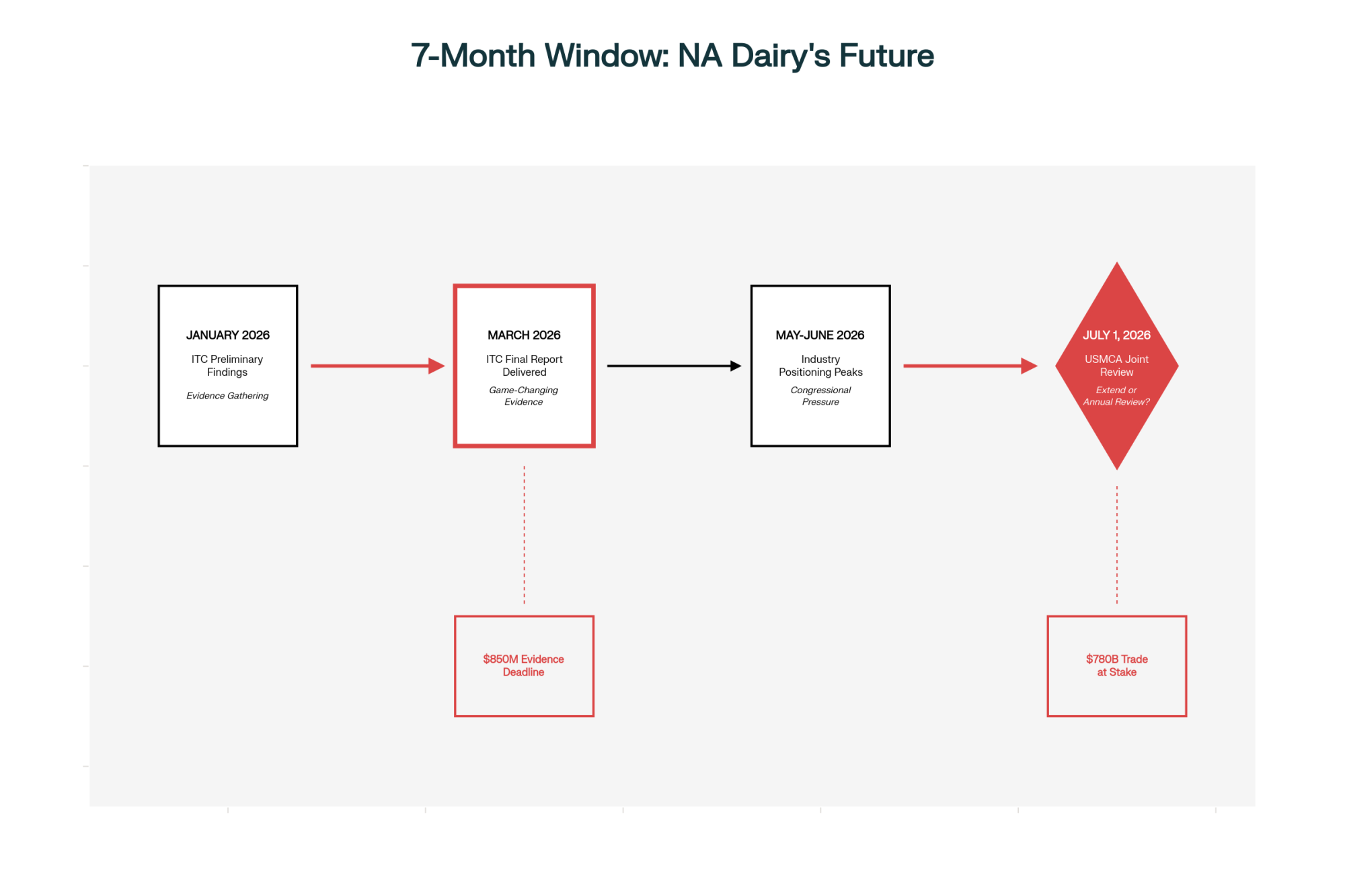
The USMCA hits its first mandatory joint review by July 1, 2026, as required by Article 34.7. All three countries decide: extend the agreement for 16 years (to 2042), continue with annual reviews until the 2036 expiration, or walk away. U.S. Trade Representative Jamieson Greer left no ambiguity in December 2025: “Could it be exited? Yes, it could be exited. Could it be revised? Yes. Could it be renegotiated? Yes. That is the purpose of that clause, and all of those things are on the table”.
Dairy is the loudest file in the room—and the most organized. On February 4, NMPF and USDEC co-launched the Agricultural Coalition for USMCA, an industry-wide push to strengthen and renew the agreement. When the deal was signed, it opened about 3.6% of Canada’s dairy market as tariff-rate quota access — roughly US$200 million per year across 14 product categories. But those quotas aren’t filling. The overall average fill rate was just 42% in 2022/23, with 9 of 14 TRQs below half the negotiated value. More current data tells a split story:
Product
Fill Rate
Period
Cheese (all types)
83%
2024 calendar year
Butter & cream powder
81%
2023/24 dairy year
Industrial cheese
59%
2024
Milk powders
57%
2024
Fluid milk
34%
Cumulative
Skim milk powder
7%
Cumulative
Note: Globe & Mail figures reflect CUSMA-specific TRQs. USDA FAS data may include quotas across all trade agreements (WTO, CETA, CPTPP), which explains the variance in cheese fill rates between sources. Both are accurate within their reported scope.
Cheese and butter fill reasonably well. It’s the fluid milk and powder categories dragging the average, and those are the categories where the allocation system faces the strongest U.S. criticism. Canada argues some TRQs go unfilled because American exporters haven’t generated sufficient demand — a demand problem, not an allocation barrier. The U.S. counters that the allocation system suppresses demand by restricting who can import. A Texas Tech University causal impact study found the actual USMCA boost came in at 34% ($519 million cumulatively) — real growth, but below the USITC’s 43.8% projection, partly because “Canada’s allocation of these quotas mostly favors its own processors over U.S. exporters”.
By our math, $200 million in annual TRQ access times the 42% fill rate — roughly $116 million per year in negotiated access goes unused. That’s a lot of money from the lobby’s podium. It’s a different number from the barn.
Metric
Lobby Number
Barn Number
Total annual unused TRQ access
$200M (promised) / $116M (unused at 42% fill)
—
Spread across 227B lbs U.S. production
—
$0.05/cwt
Impact on 150-cow farm (36,000 cwt/yr)
—
$1,800/year
Impact on 500-cow farm (120,000 cwt/yr)
—
$6,000/year
Impact if export lift adds $0.10–0.15/cwt
“Game-changer” (NMPF)
$3,600–$5,400/year (150-cow)
Average U.S. dairy cost of production
—
$19–23/cwt (USDA)
February 2026 all-milk forecast
—
$18.95/cwt (WASDE)
Who’s Pushing — and Who’s Pushing Back
The U.S. says Canada designed its allocation system to block imports by reserving 80–85% of many TRQs for domestic processors who had little incentive to use them. A USMCA dispute panel ruled in the U.S.’s favour in January 2022 and ordered changes. Canada rewrote the rules. A second panel, reporting on November 24, 2023, found, by a two-to-one decision, that Canada’s revised system didn’t technically breach USMCA. The dissenting panelist argued Canada’s narrow eligibility rules “significantly limit a large number of other Canadian importers who would be eager to bring U.S. dairy products to Canada”.
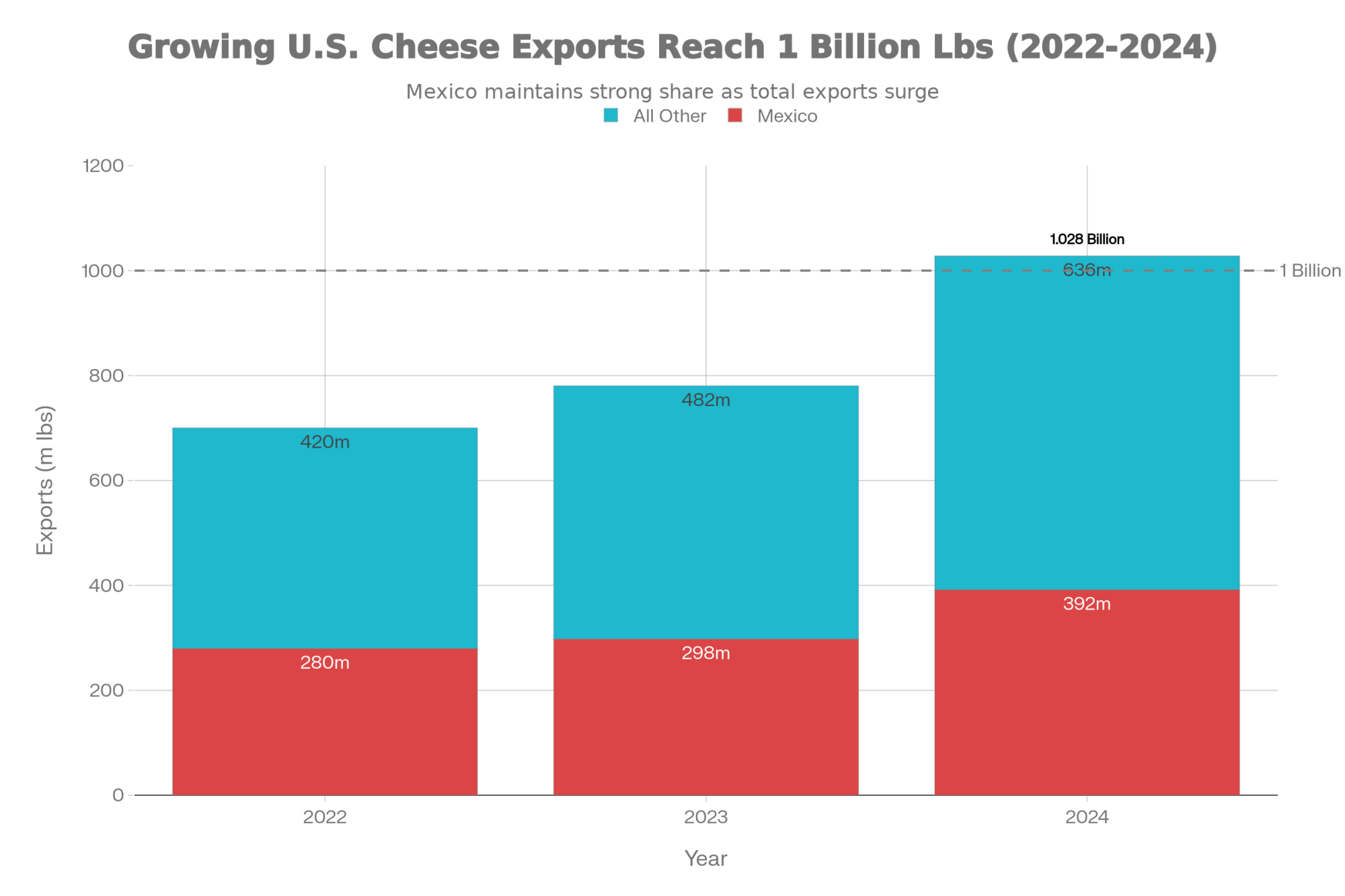
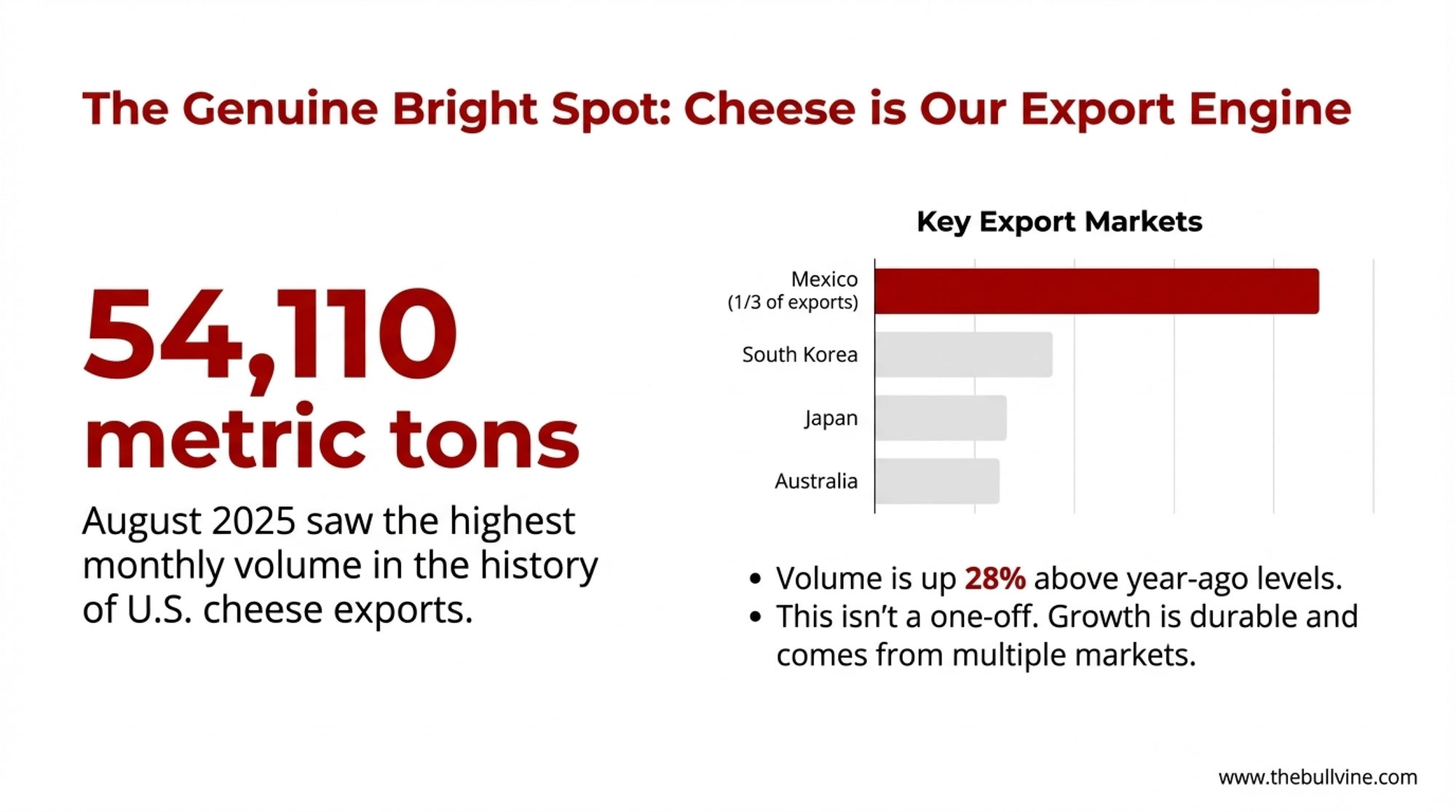
On December 2, 2025, 74 bipartisan House members from dairy states, including New York, Washington, Wisconsin, and California, wrote to Greer urging him to use the 2026 review for enforcement. “NMPF and USDEC — led by President and CEO Gregg Doud, the former Chief Agricultural Negotiator at USTR — have described Canada’s TRQ policies as ‘manipulative’ and accused Ottawa of ‘circumvention’ of USMCA’s dairy export disciplines.” Vander Schaaf told senators the U.S. exported approximately $9 billion in dairy products in 2025, including a record 559,000 metric tons of cheese through November. The trajectory is up. The frustration is that Canada isn’t absorbing its share.
On the Canadian side, Prime Minister Mark Carney responded directly in December 2025. Supply management is “not on the table,” — and he answered the English-language question in French. That’s a message aimed squarely at Québec.
DFC President David Wiens — who milks about 240 cows with his brother Charles near Grunthal, Manitoba — told MPs the combined impact of CUSMA, CETA, and CPTPP means roughly 18% of Canada’s domestic dairy demand is now met by imports. When CUSMA was signed, DFC projected that cumulative concessions would displace one in five Canadian dairy products — amounting to $1.3 billion in annual farm-gate losses once fully phased in. Both sides believe they’re defending survival — $1.14 billion in U.S. dairy exports to Canada in 2024, a record, and part of a $3.6 billion flow to Mexico and Canada that accounts for 44 percent of total U.S. dairy export value. On the other side: CA$4.8 billion in federal compensation flowing to supply-managed sectors.
Why the Same Commodity Pays Two Different Mortgages
The single biggest difference between Vander Schaaf’s milk check and Gobeil’s: how the price gets set.
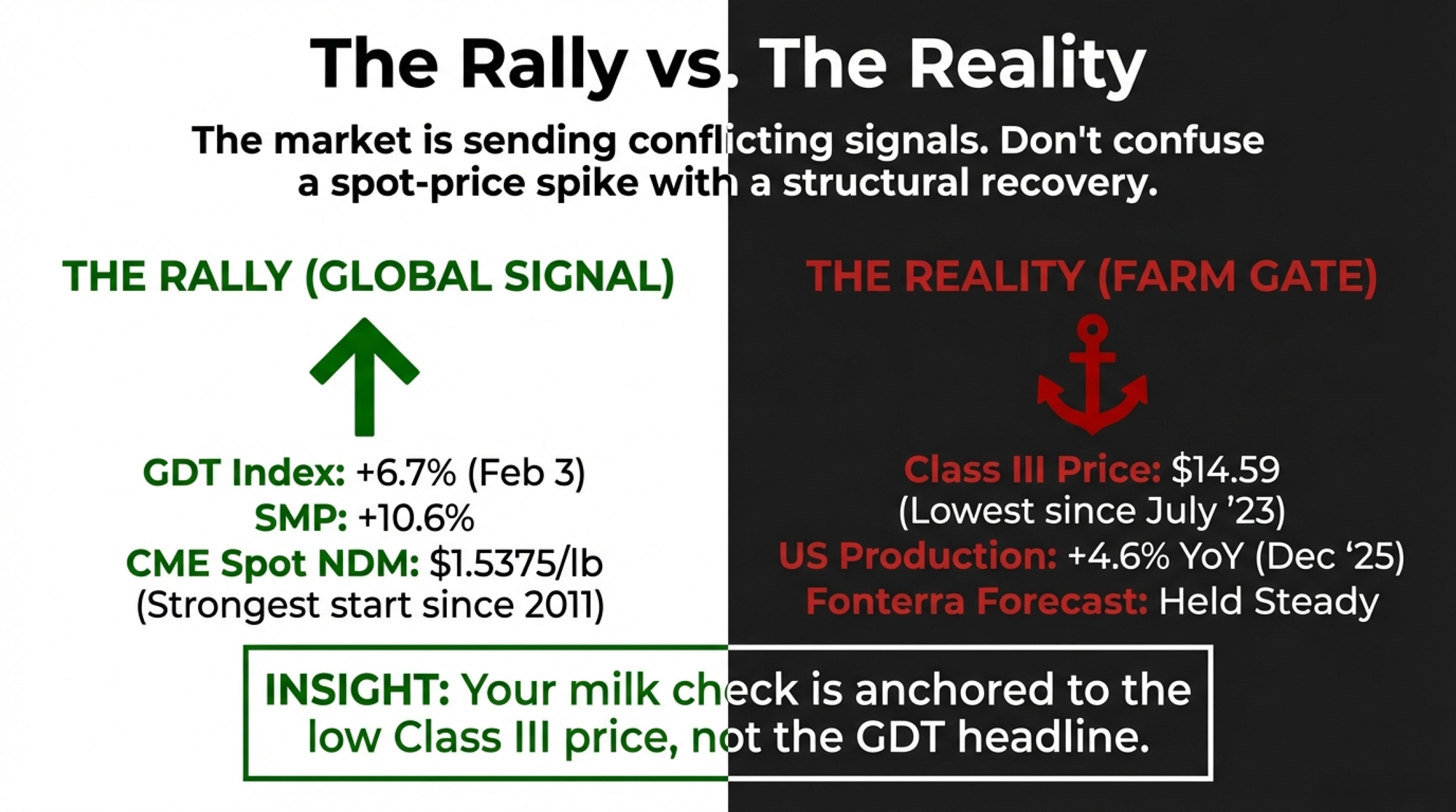
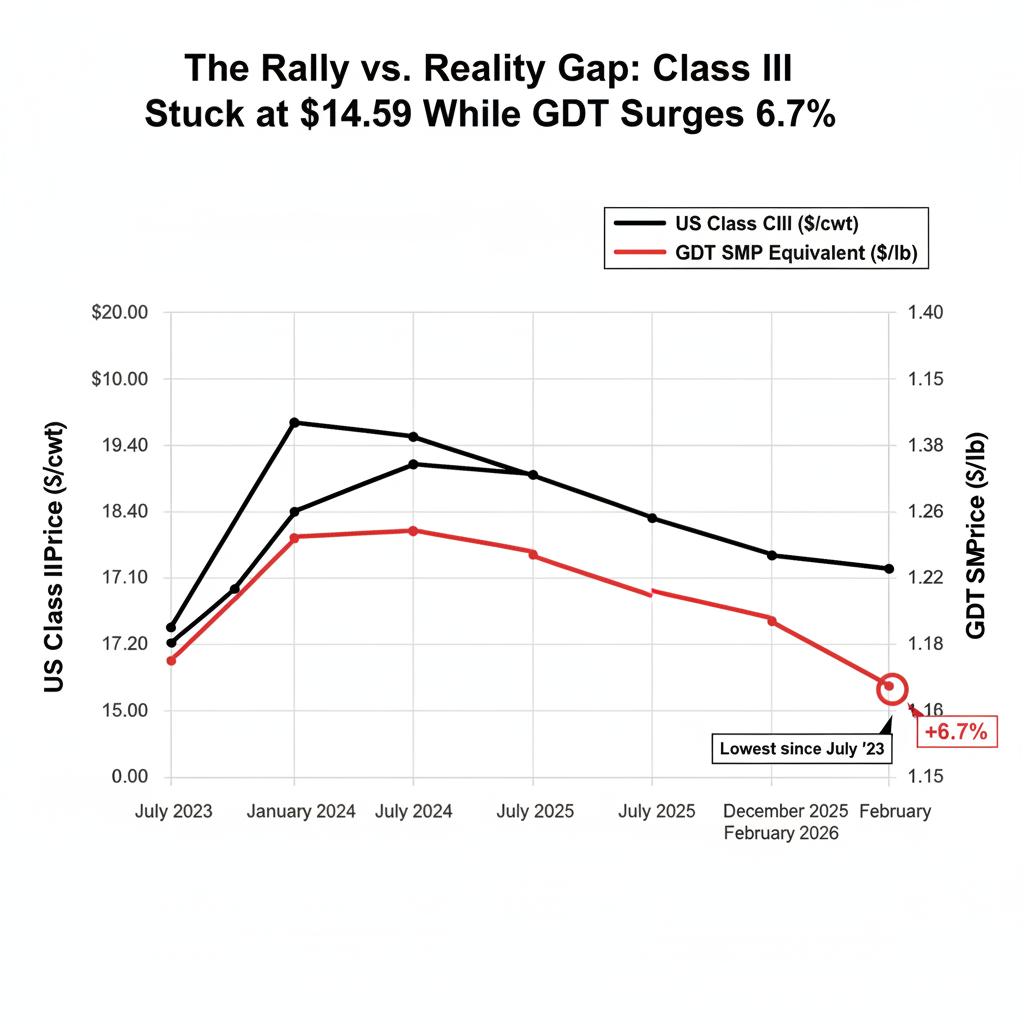
In the U.S., the base price flows from Class III/IV futures and commodity markets. USDA’s February 2026 WASDE projects the all-milk annual average at US$18.95/cwt — but January’s Class III came in at just $14.59/cwt. The back half of the year has to do heavy lifting to hit that average. The safety net is Dairy Margin Coverage: insurance, not a guaranteed price. Over the last five years, U.S. all-milk prices swung from roughly $16.20 in 2020 to $27.10 in 2022 — an $11/cwt range.
Year
U.S. All-Milk Price (US$/cwt)
Canadian Equivalent (US$/cwt)
2020
$16.20
$28.00
2021
$18.10
$28.50
2022
$27.10
$30.00
2023
$20.60
$29.20
2024
$22.40
$29.60
2025
$21.50 (est.)
$29.40
2026
$18.95 (forecast)
$30.10 (forecast w/ 2.3% increase)
In Québec, the Canadian Dairy Commission surveys actual production costs each year and adjusts the farmgate price to cover them. The formula: 50% of the change in the indexed cost of production, 50% of the change in the consumer price index. That produced the 2.3255% farmgate increase effective February 1, 2026 — tied to input costs and inflation, not commodity markets in Chicago. Canadian farmgate prices move in a narrow band, roughly US$28–30/cwt equivalent at the 2025 average exchange rate, against that $11 U.S. swing.
But that stability comes stapled to a different kind of risk. In the P5 provinces — Ontario, Québec, New Brunswick, Nova Scotia, and PEI — quota trades at a cap of CA$24,000 per kilogram of butterfat per day. A cow producing 1.2–1.3 kg BF/day means a per-cow quota value around CA$28,800–$31,200. In western Canada, it’s higher — Alberta’s quota traded at CA$56,495/kg BF/day in January 2025, and Manitoba’s at CA$44,000. On Gobeil’s 125-cow Québec farm, that’s roughly CA$3.6–3.9 million in quota value — an asset that exists only as long as Ottawa keeps defending it.
One system charges you in income volatility. The other charges you in political risk locked inside your balance sheet.
What Does the USMCA Review Mean for a 150-Cow Wisconsin Dairy?
Here’s where the barn math gets humbling. Spread across 227 billion pounds of annual U.S. production, the raw math on $116 million in unused TRQ access works out to about $0.05/cwt nationally. Five cents.
Take a 150-cow Wisconsin dairy producing 24,000 lbs per cow. That’s 36,000 cwt per year. At $0.05/cwt, full TRQ enforcement is worth roughly $1,800 annually. Scale to a 500-cow operation producing 120,000 cwt, and it’s $6,000 — still not survival money.
But trade access lifts demand signals across the domestic market. Cornell dairy economist Charles Nicholson, working with Wisconsin’s Mark Stephenson, estimated that each additional 1% of U.S. dairy components exported lifts the all-milk price by about $0.12/cwt (95% CI: half a cent to $0.24/cwt). Their own conclusion: “it would be appropriate to be cautious in estimating the magnitude of price impacts from US dairy exports.” As exports grow, supply grows roughly in step.
Herd Size
Annual Production (cwt)
Direct TRQ Impact ($0.05/cwt)
Optimistic Export Lift ($0.10–0.15/cwt)
Total Potential Gain
Cost of Production ($/cwt)
2026 Forecast ($/cwt)
Margin Gap
150 cows
36,000 cwt
$1,800/yr
$3,600–$5,400/yr
$5,400–$7,200/yr
$19–23
$18.95
−$0.05 to −$4.05
500 cows
120,000 cwt
$6,000/yr
$12,000–$18,000/yr
$18,000–$24,000/yr
$19–21 (scale advantage)
$18.95
−$0.05 to −$2.05
1,250 cows(Vander Schaaf)
150,000 cwt
$7,500/yr
$15,000–$22,500/yr
$22,500–$30,000/yr
~$19 (scale advantage)
$18.95
−$0.05
Apply that framework. Filling the remaining $116 million wouldn’t move the export needle by a full percentage point. Even at the generous end of Nicholson’s range, you’re looking at $0.10–$0.15/cwt in total price lift. On 36,000 cwt, that’s $3,600 to $5,400 per year for our 150-cow Wisconsin dairy.
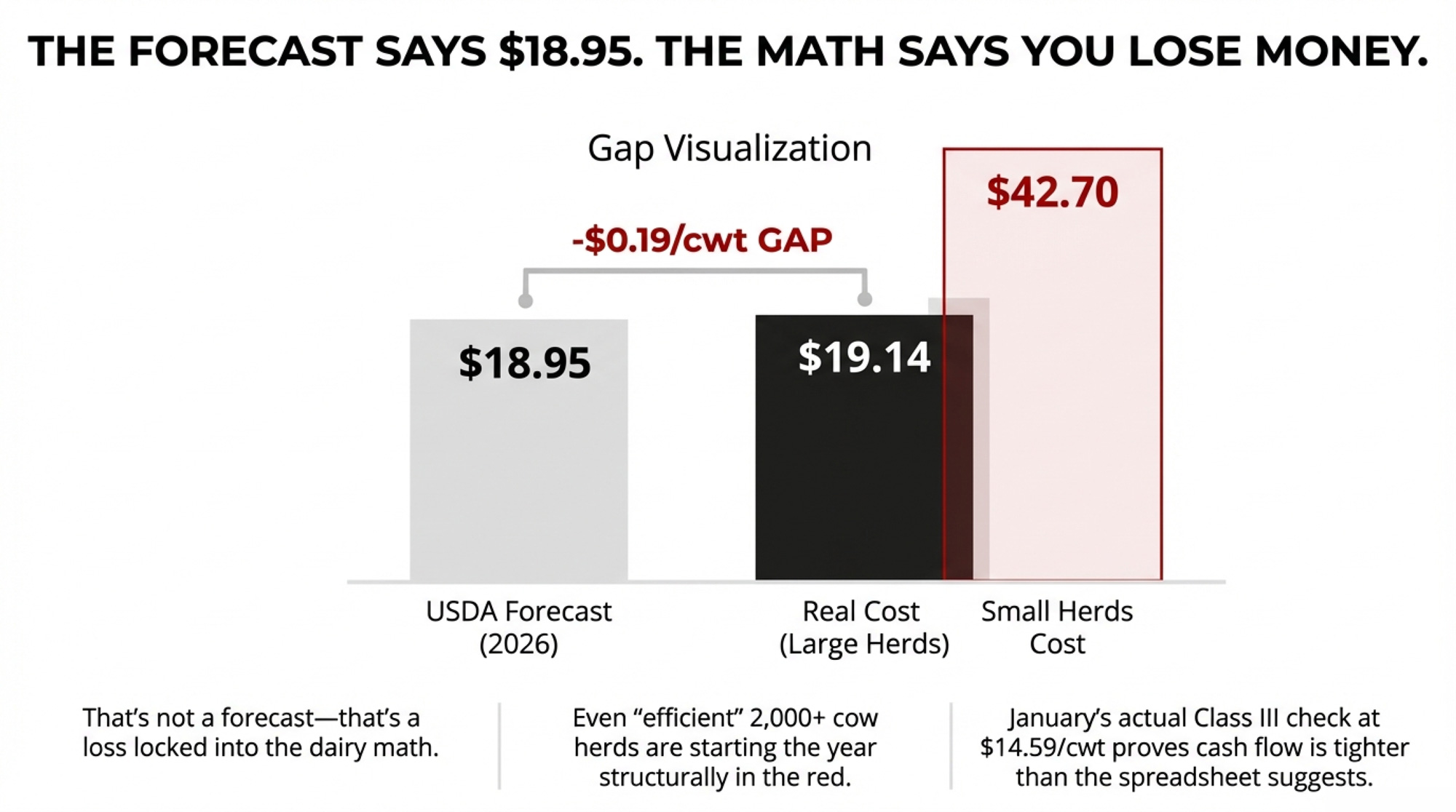
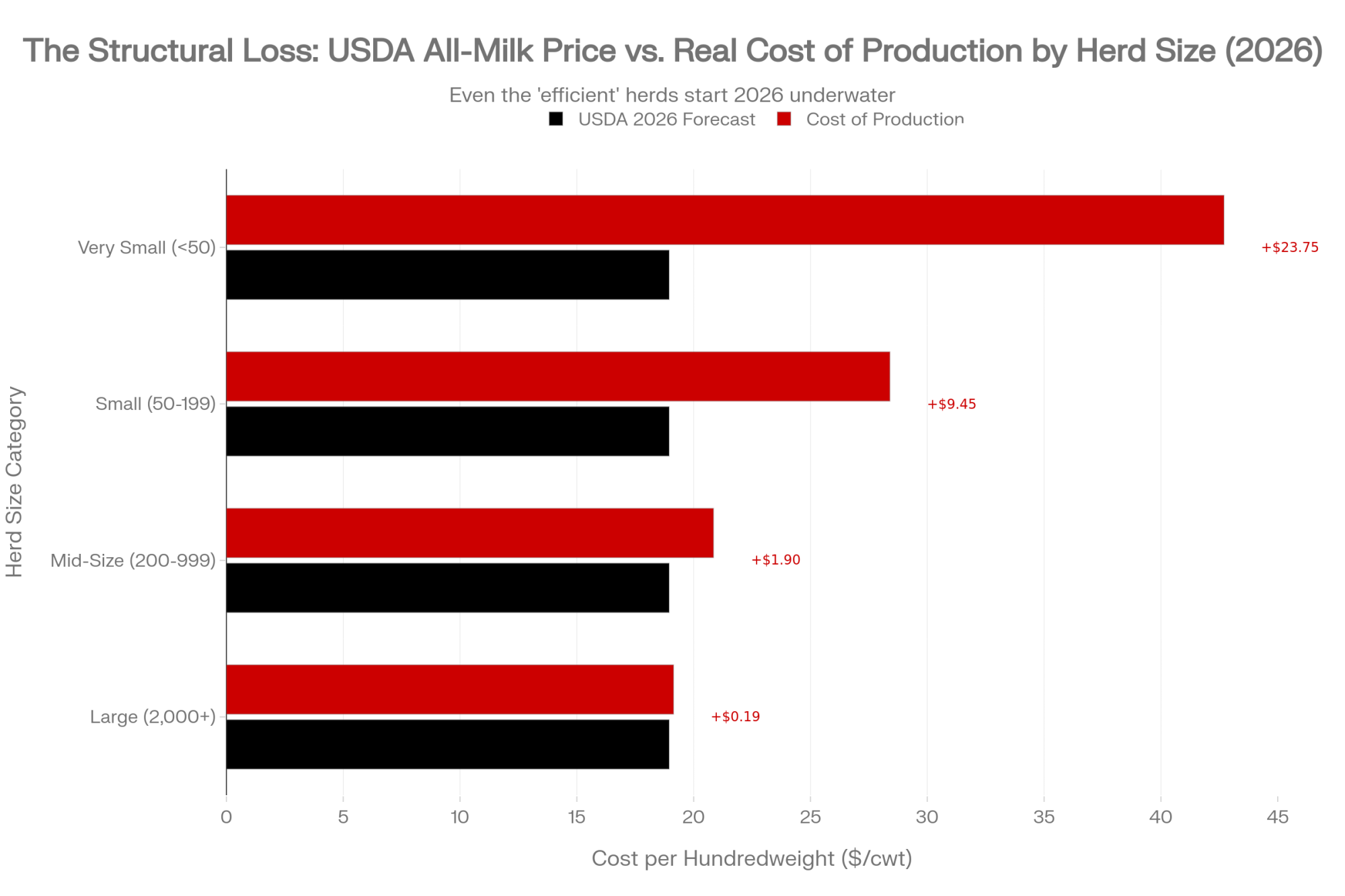
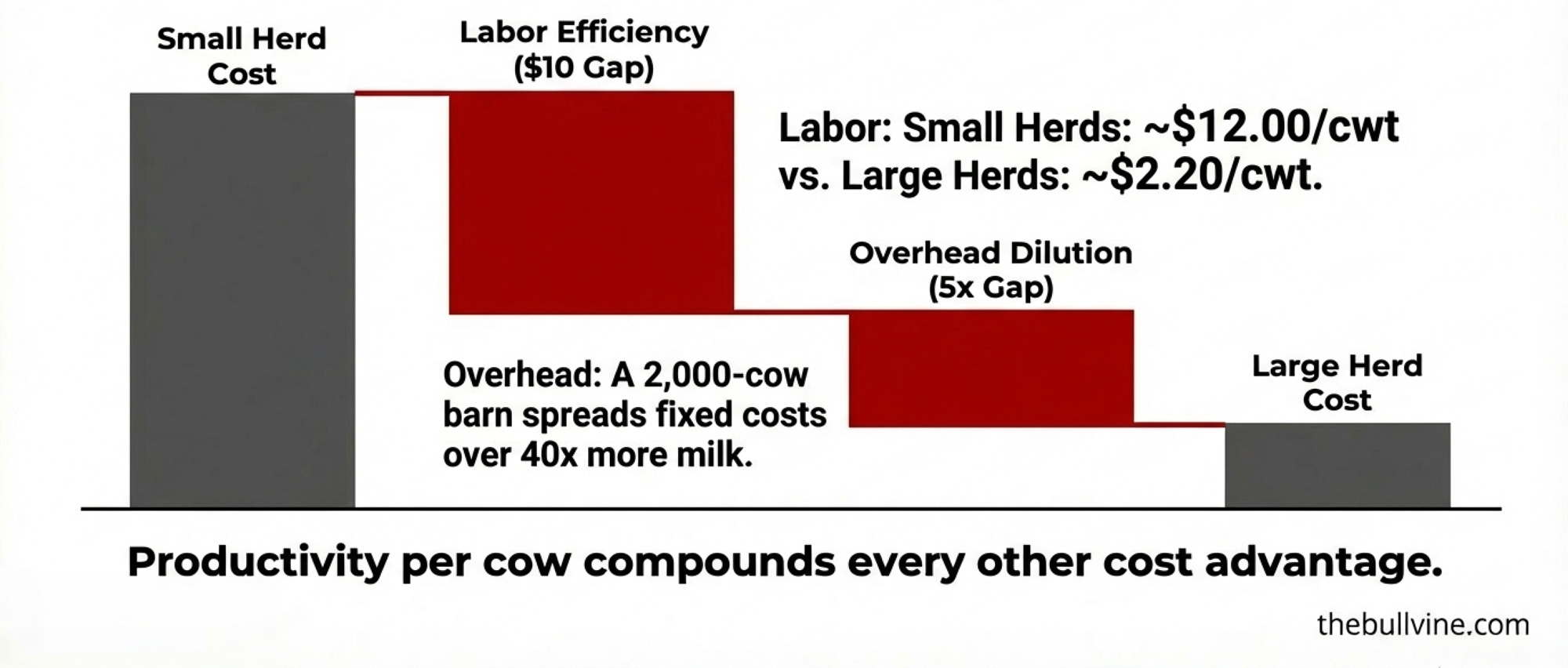
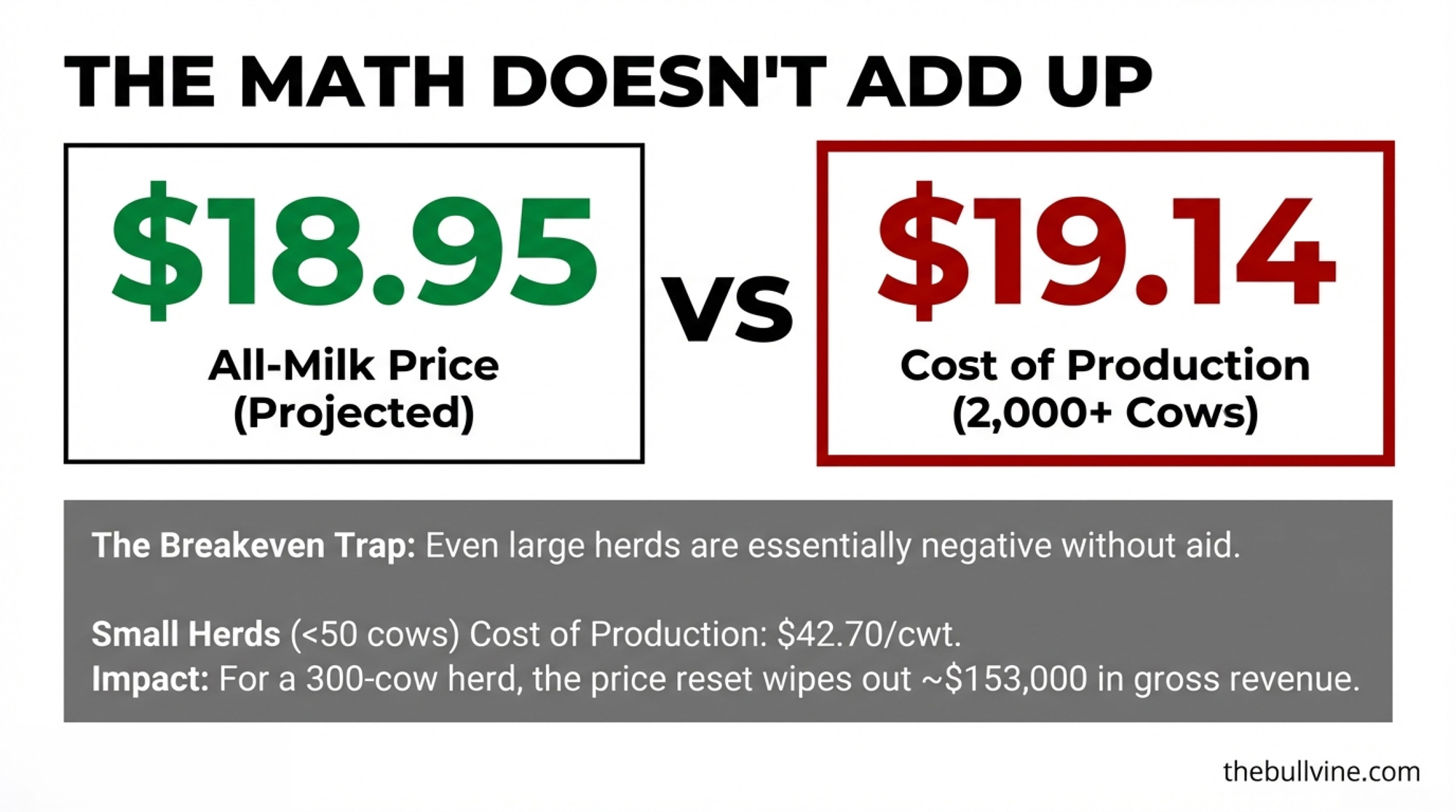
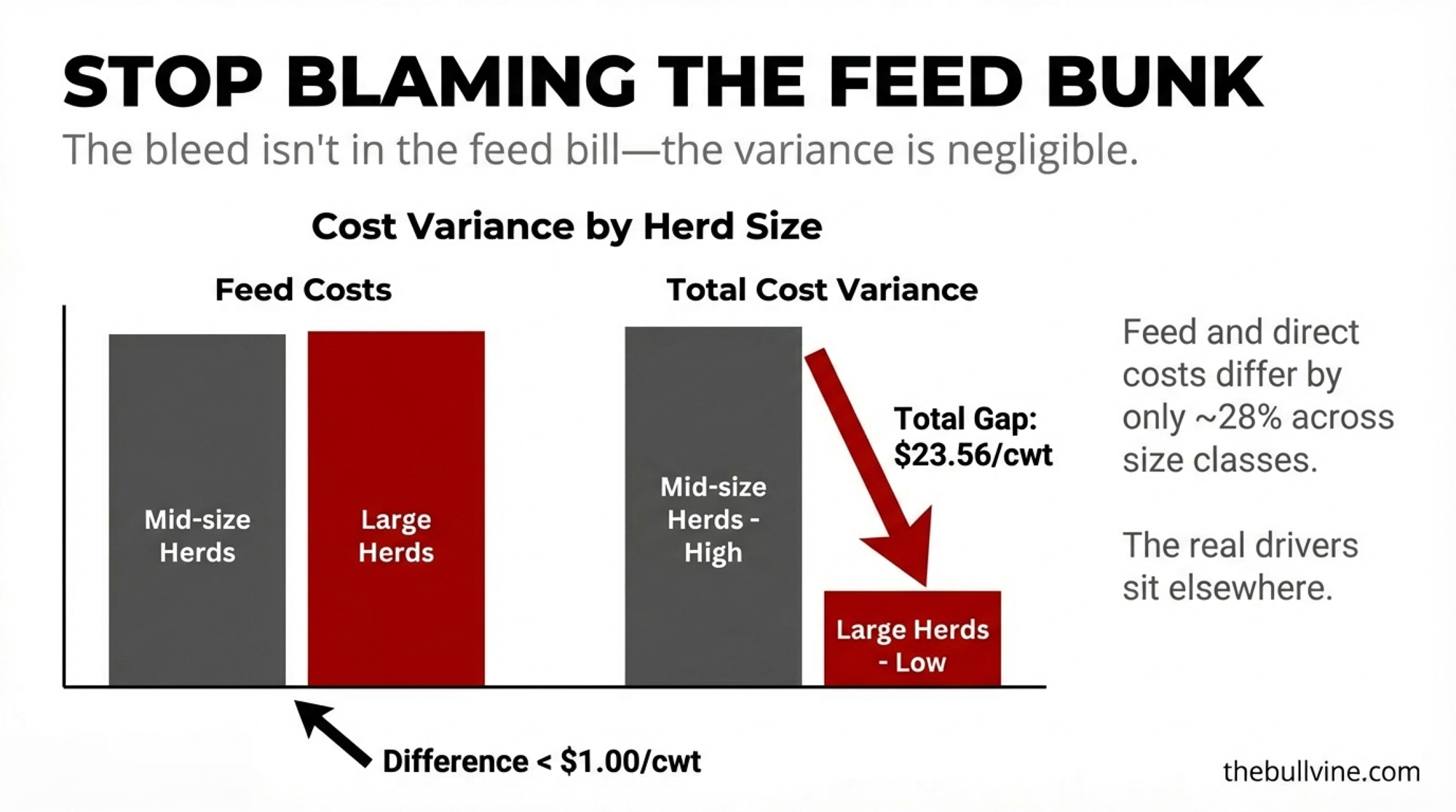
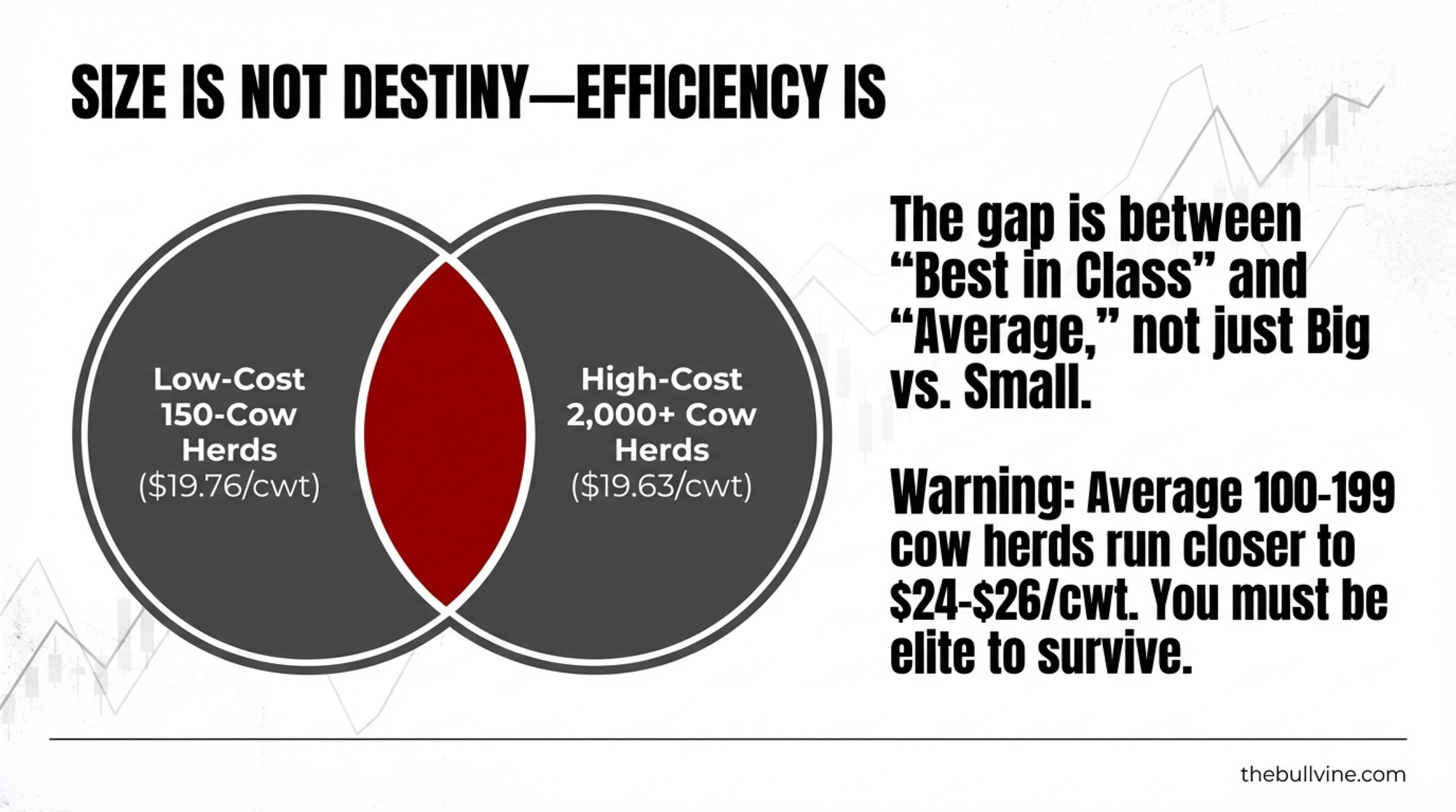
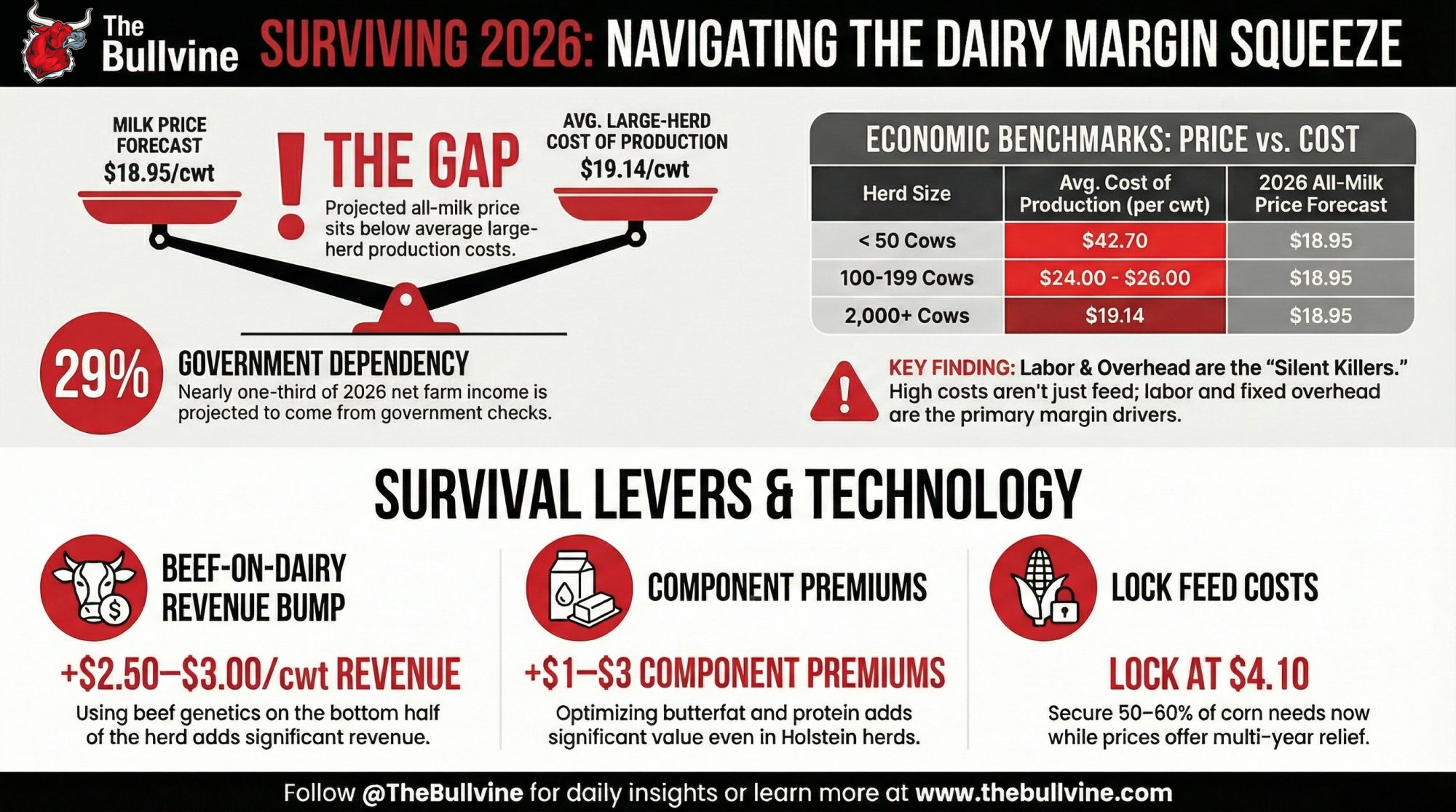
Set that against cost reality. USDA ERS data (2021 ARMS survey, published July 2024) shows farms with 2,000+ cows averaging $19.14/cwt in full economic cost, while herds under 50 cows hit $42.70/cwt. Analysts pegged mid-size net cost of production at $22.64/cwt. A 150-cow operation in that $19–23/cwt range — receiving a forecast of $18.95 — is treading water or running red before trade even enters the picture. An extra $1,800 to $5,400 helps. It won’t flip a negative-margin farm into a positive one.
What a Nickel Means for a 125-Cow Québec Quota Farm
Now flip the border. If those TRQs fill completely, cheese is already at 81–83%, so the real incremental pressure comes from powder and fluid categories. On 125 cows producing roughly 27,500 cwt per year, a nickel-per-hundredweight hit works out to about $1,375 annually. Ottawa cushions that — CA$1.2 billion over six years through the Dairy Direct Payment Program alone for CUSMA. Minister Bibeau confirmed in November 2022 that the combined package across three trade deals reaches CA$4.8 billion.
But every round of “access goes up, Ottawa writes a bigger cheque” adds weight to a political question. That CA$4.8 billion comes from general federal revenue — Canadian taxpayers. FCC’s 2026 dairy outlook advises producers to “continue focusing on what they can control on the farm” until the details of the CUSMA review are known. Sensible. It’s also what you say when you don’t know how the politics will break.
The bigger exposure isn’t the milk cheque. It’s the balance sheet. A 20% decline in quota value on Gobeil’s 125-cow operation at the P5 cap means roughly CA$720,000–$780,000 in equity gone. If you’re running 500+ cows in Alberta at CA$56,495/kg BF/day, your exposure is roughly double the P5 math. Your stress test looks different.
Are These Farmers Actually on Opposite Sides?
The easy version — American dairy vs. Canadian dairy, free market vs. supply management — misses what’s happening to both of them.
Vander Schaaf’s 1,250-cow Idaho operation and Gobeil’s 125-cow Québec farm are both getting squeezed by the same forces — processors, retailers, global commodity traders — and dealing with it through completely different systems. The American system absorbs that pressure through farmer income. The Canadian system absorbs it through government spending and quota valuation. Neither pushes the pressure back up the chain to the players who actually control pricing power.
If both sides “win” their version of the 2026 review — full TRQ enforcement for the U.S., intact supply management plus compensation for Canada — it doesn’t fix either farmer’s structural problem. It determines who bleeds a little slower.
The Border Math, Side by Side
Metric
150-Cow Wisconsin Dairy
125-Cow Québec Dairy
Price mechanism
Class III/IV futures + commodity markets
CDC formula (50% COP + 50% CPI)
Farmgate price (5-year range)
~US$16.20–$27.10/cwt (2020–2022)
~US$28–30/cwt equivalent
2026 price signal
$18.95/cwt forecast (WASDE Feb 2026)
2.3255% increase eff. Feb 1, 2026
Annual production
~36,000 cwt
~27,500 cwt
USMCA impact (full TRQ enforcement)
+$1,800–$5,400/yr
−$1,375/yr (before compensation)
5-year price volatility
~$11/cwt swing
~$2–4/cwt swing
Safety net
DMC + crop insurance
Supply management + CA$4.8B federal compensation
Balance-sheet risk
Land + cows + equipment
Land + cows + equipment + ~CA$3.6–3.9M quota
The math doesn’t pick a winner. It shows two different bills for the same thing: stability.
What You Can Do Before July
If you’re milking in the U.S.:
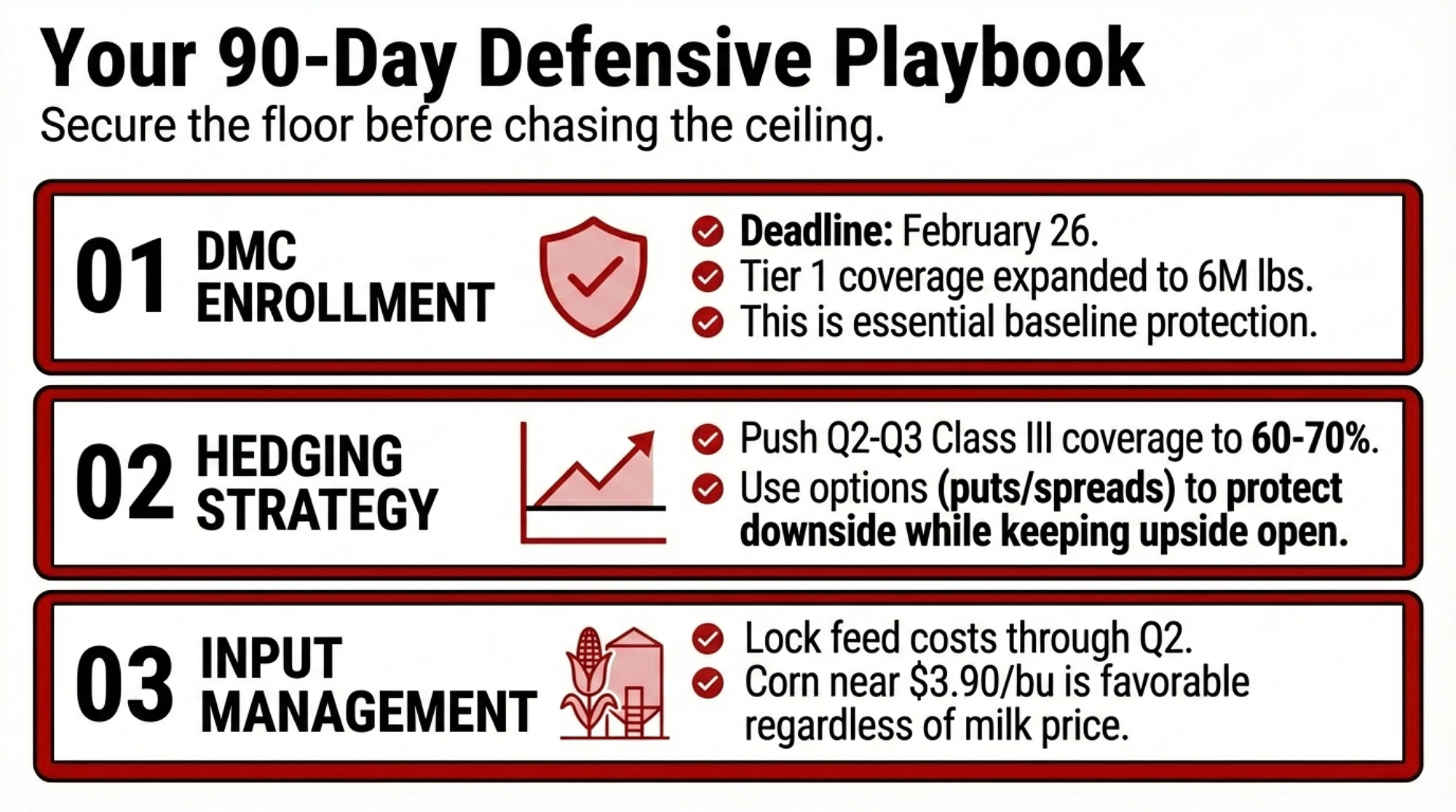
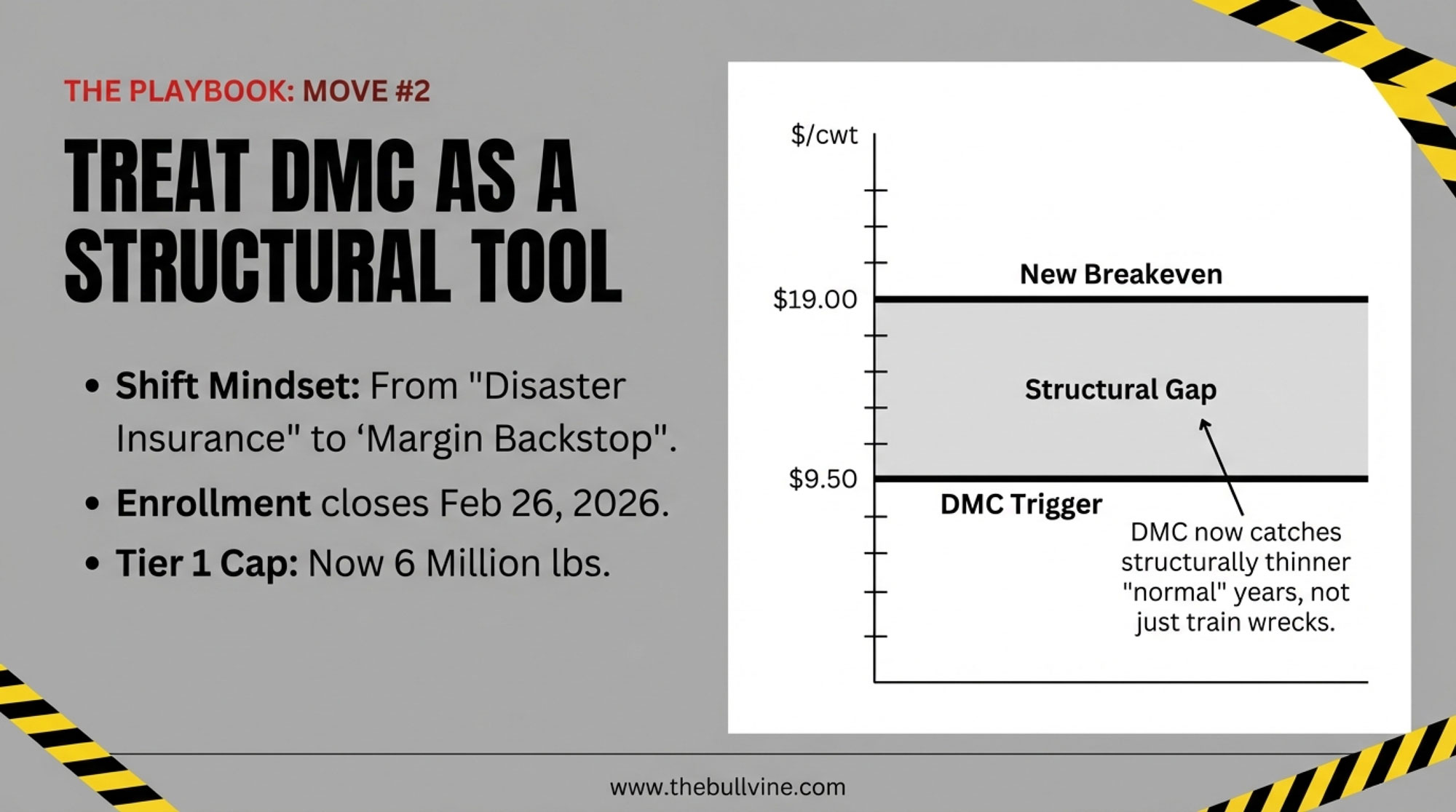
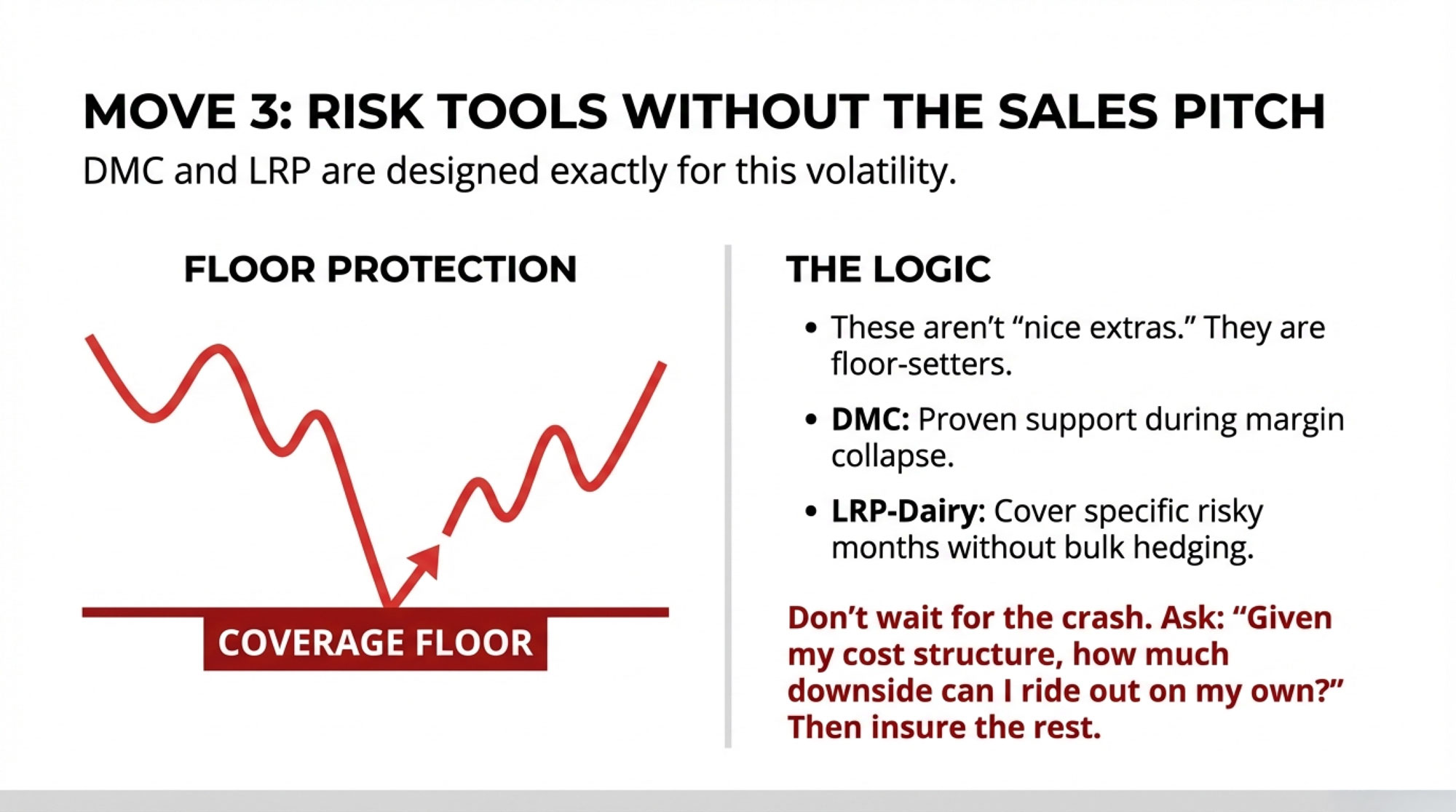
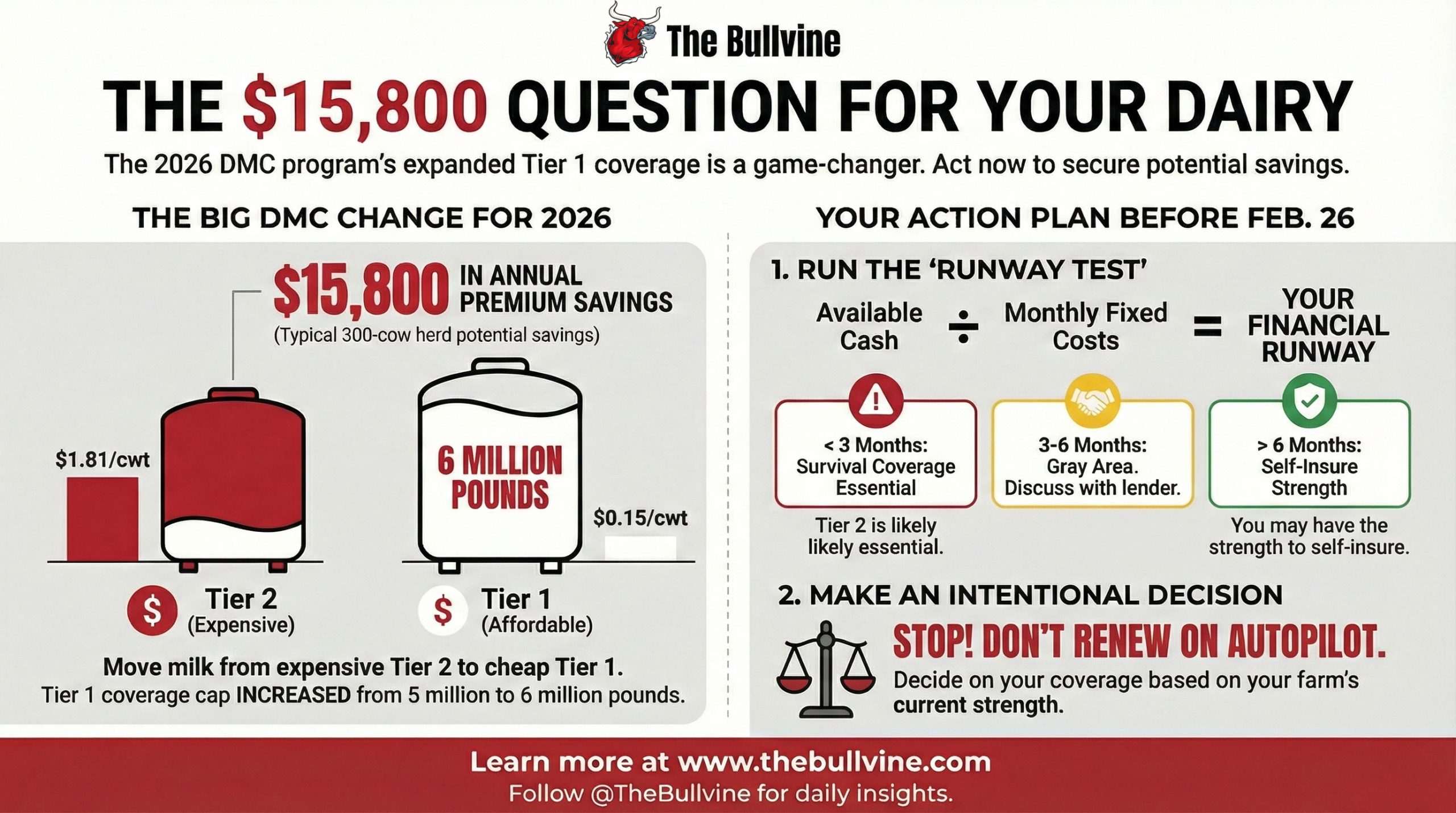
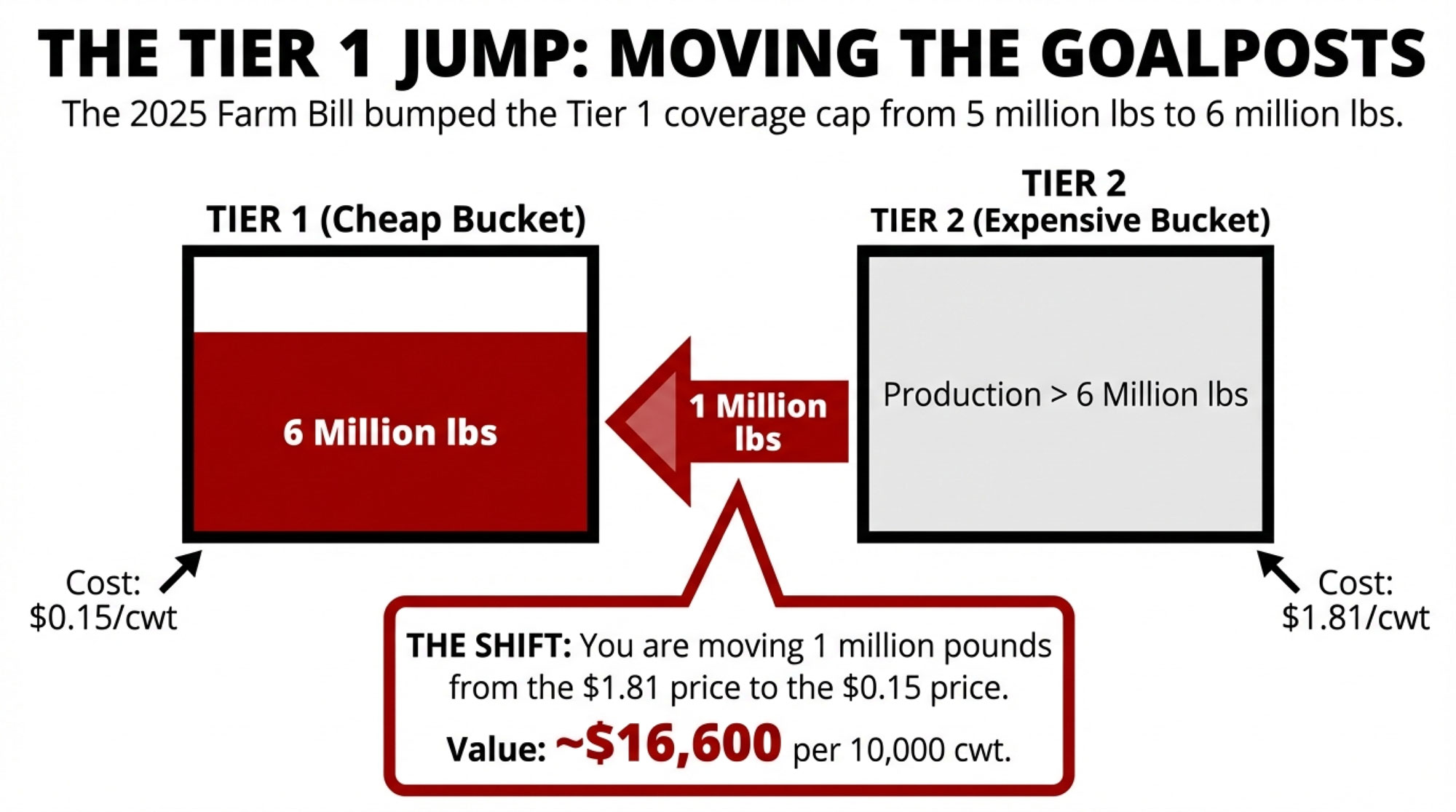
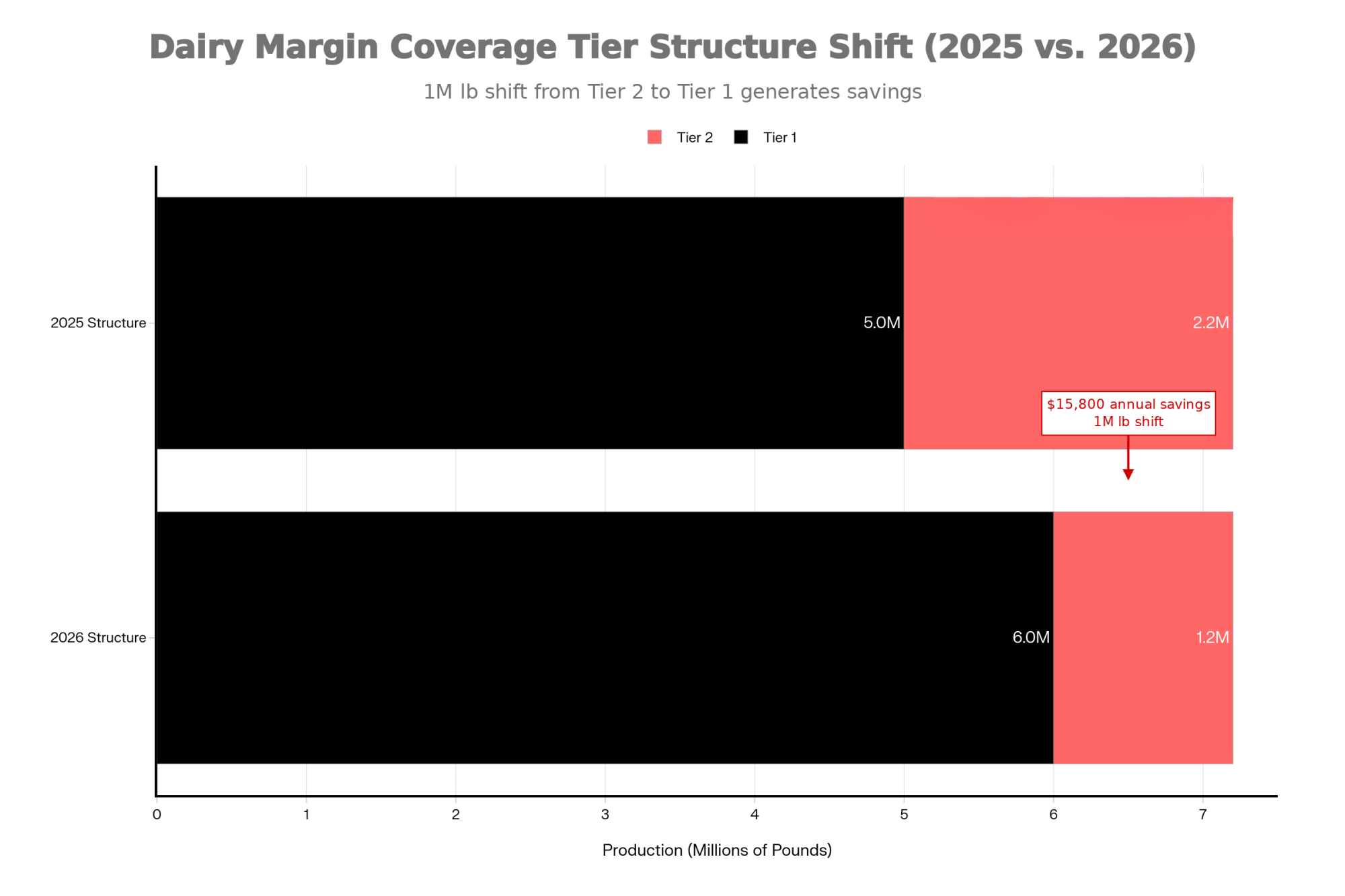
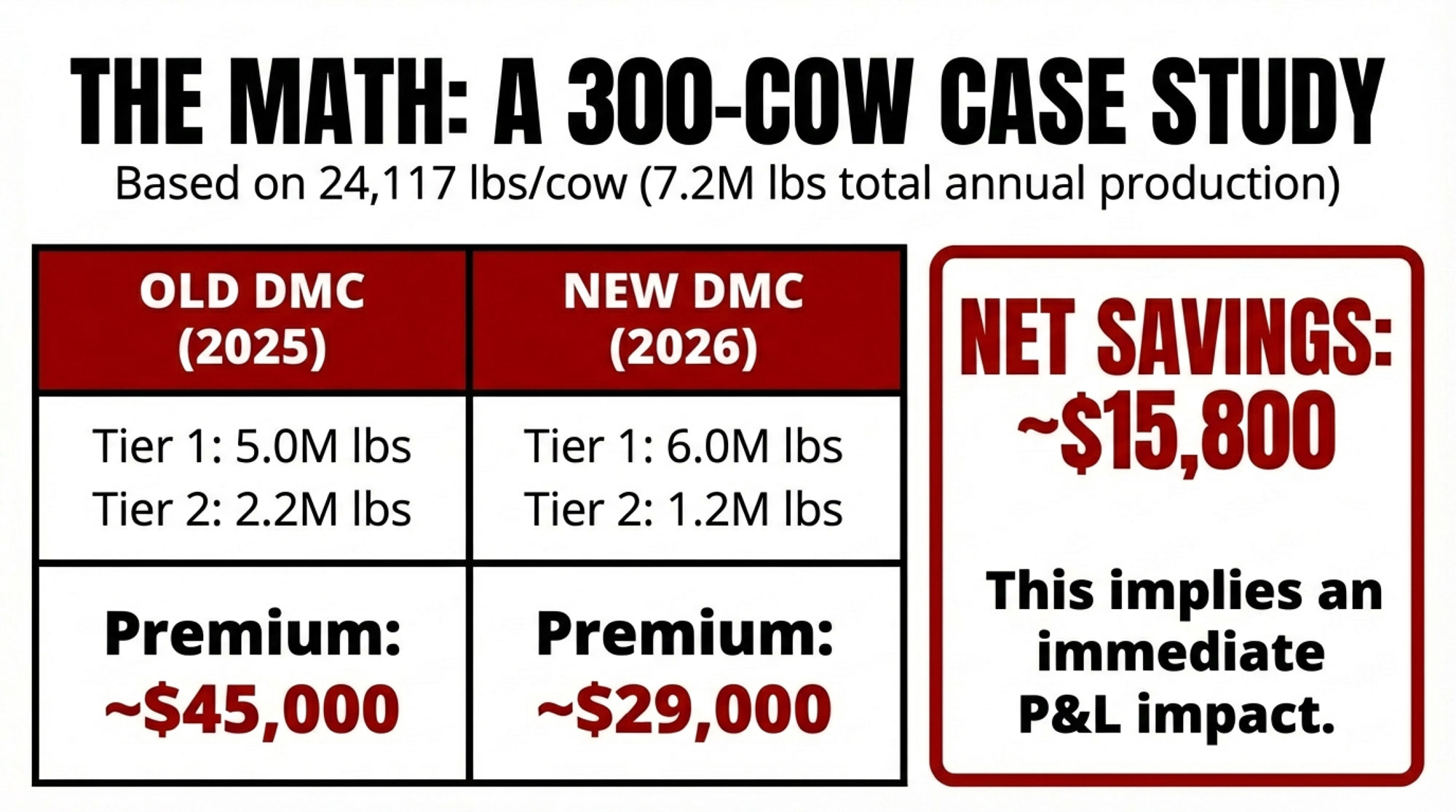
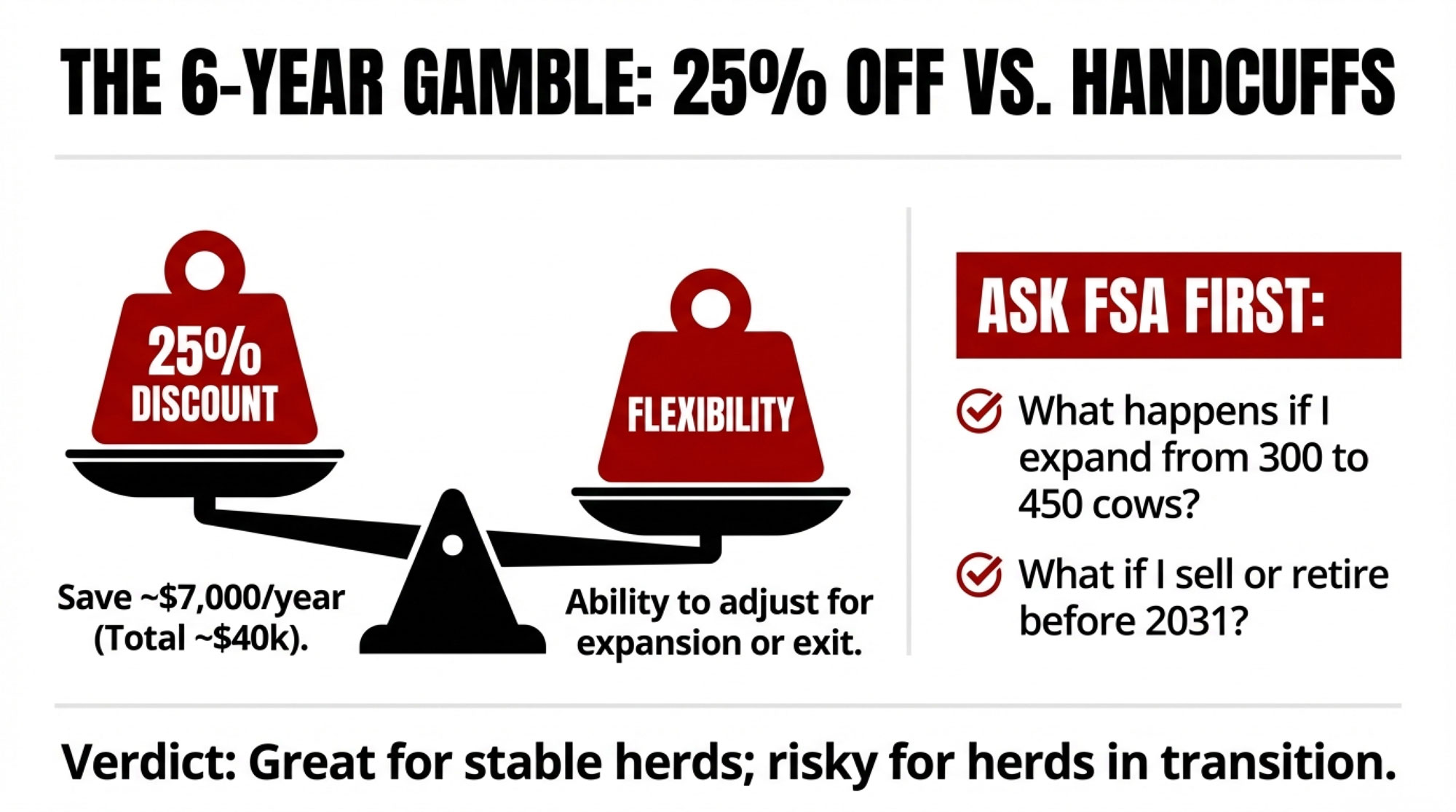
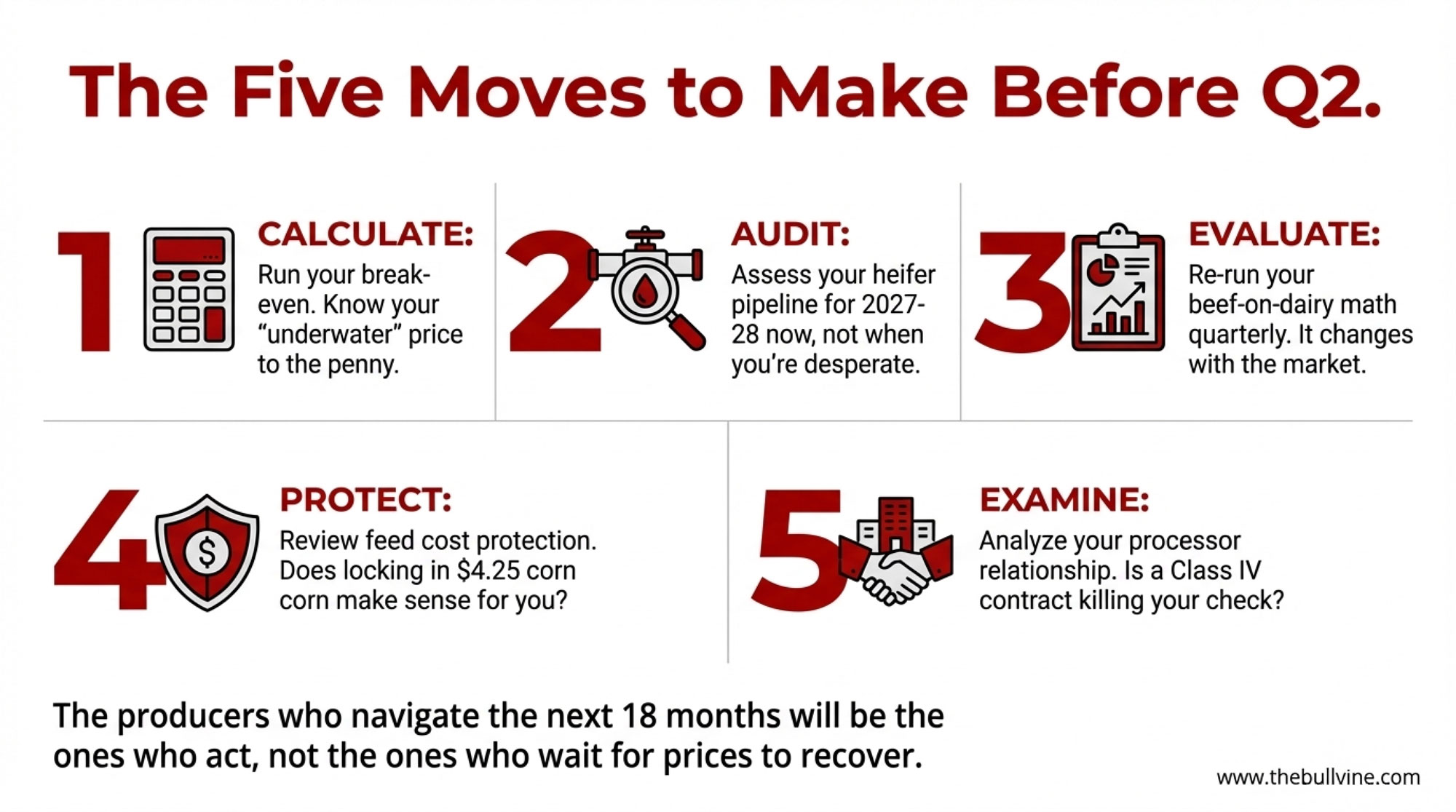
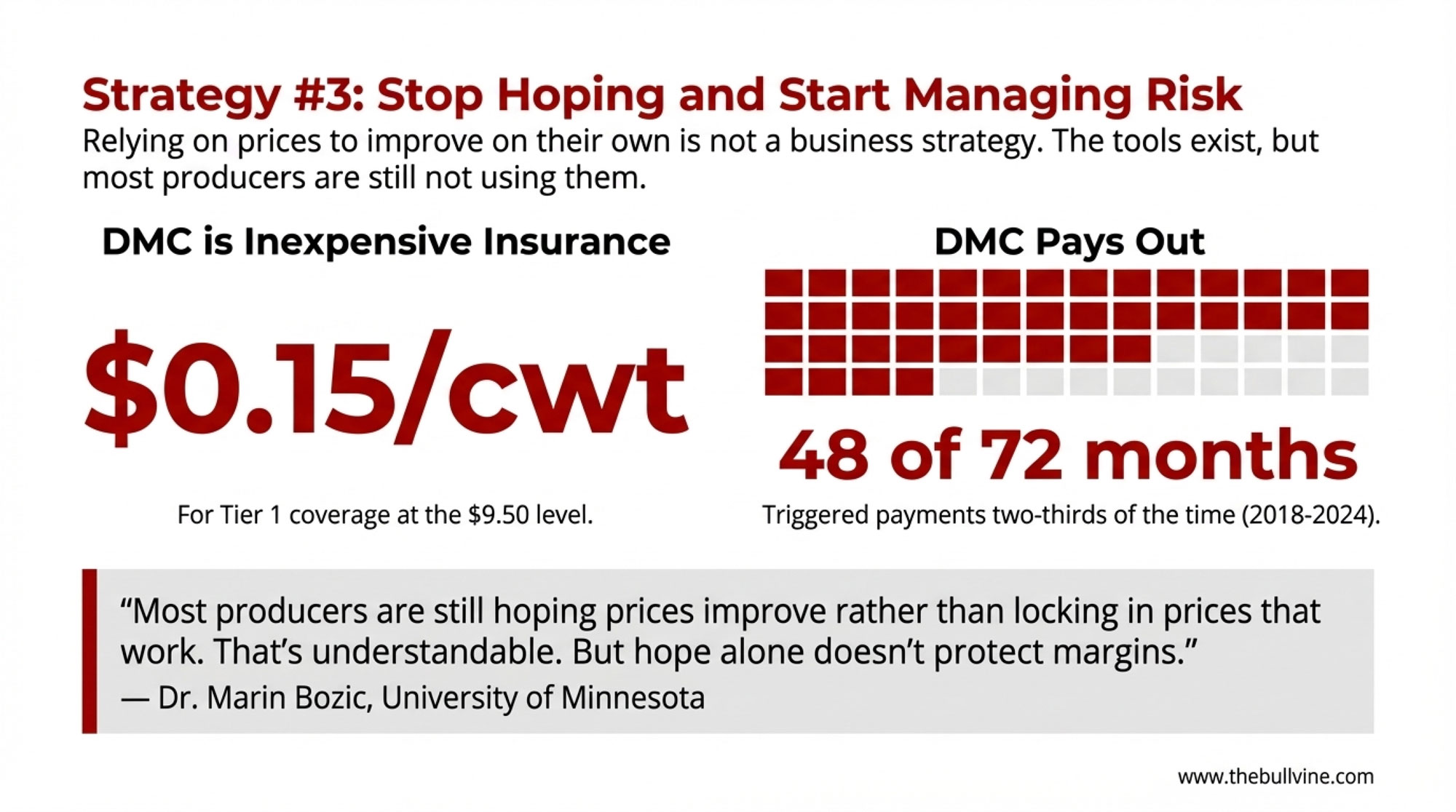
Enroll in DMC before February 28. Tier 1 coverage expanded from 5 million to 6 million pounds under the One Big Beautiful Bill Act (signed July 4, 2025). At $9.50 coverage, you’re paying $0.15/cwt in premium. Lock in for six years (2026–2031) at a 25% premium discount — but that means you can’t adjust if your herd grows or margins recover. If you’re above 6 million lbs (roughly 275+ cows at the national average production), Tier 1 covers only a fraction. Talk to your risk management advisor about Dairy Revenue Protection or Livestock Gross Margin for the rest.
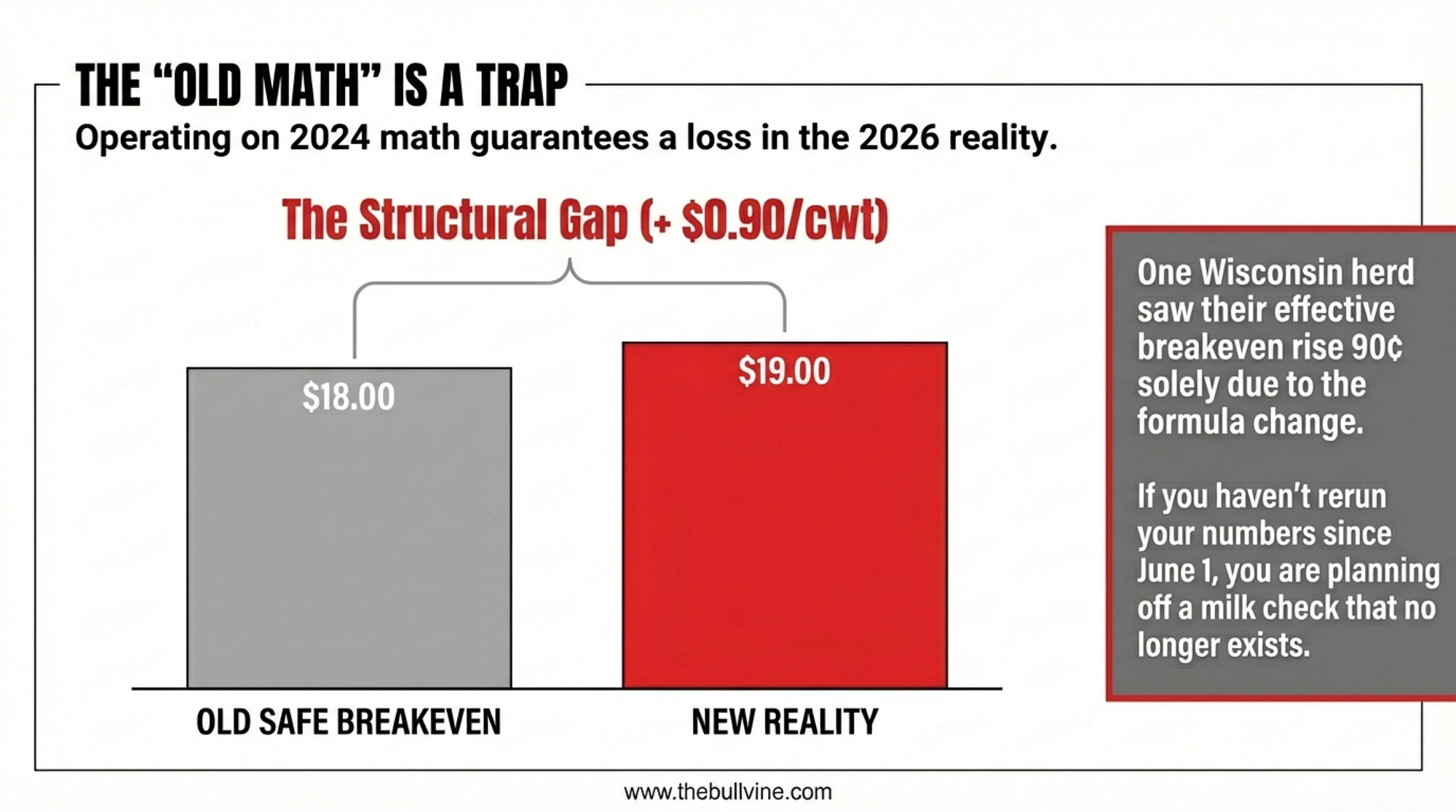
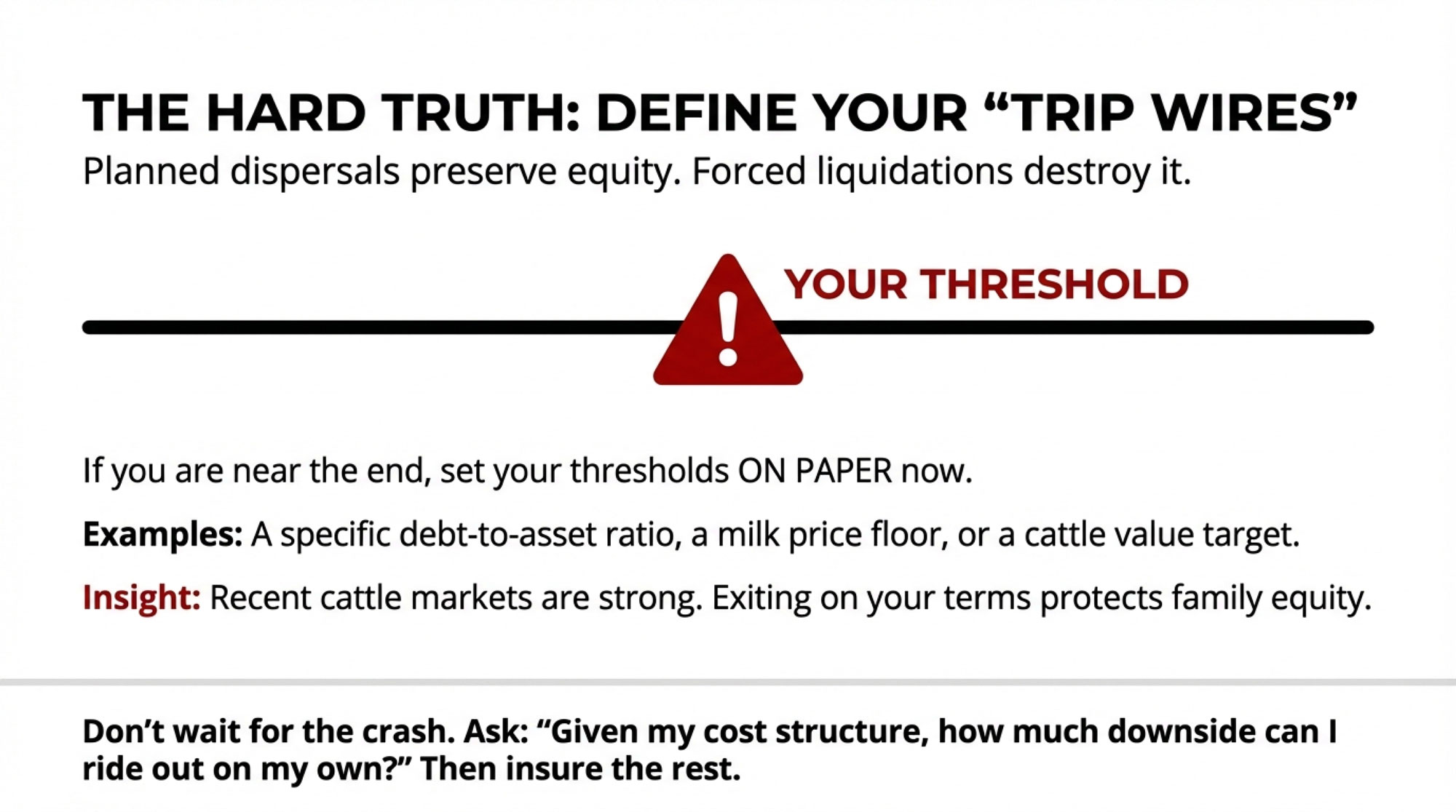
By spring: Run a survival scenario at US$17–18/cwt with your lender. If your breakeven sits above $18, work the restructuring math before margins compress — not after.
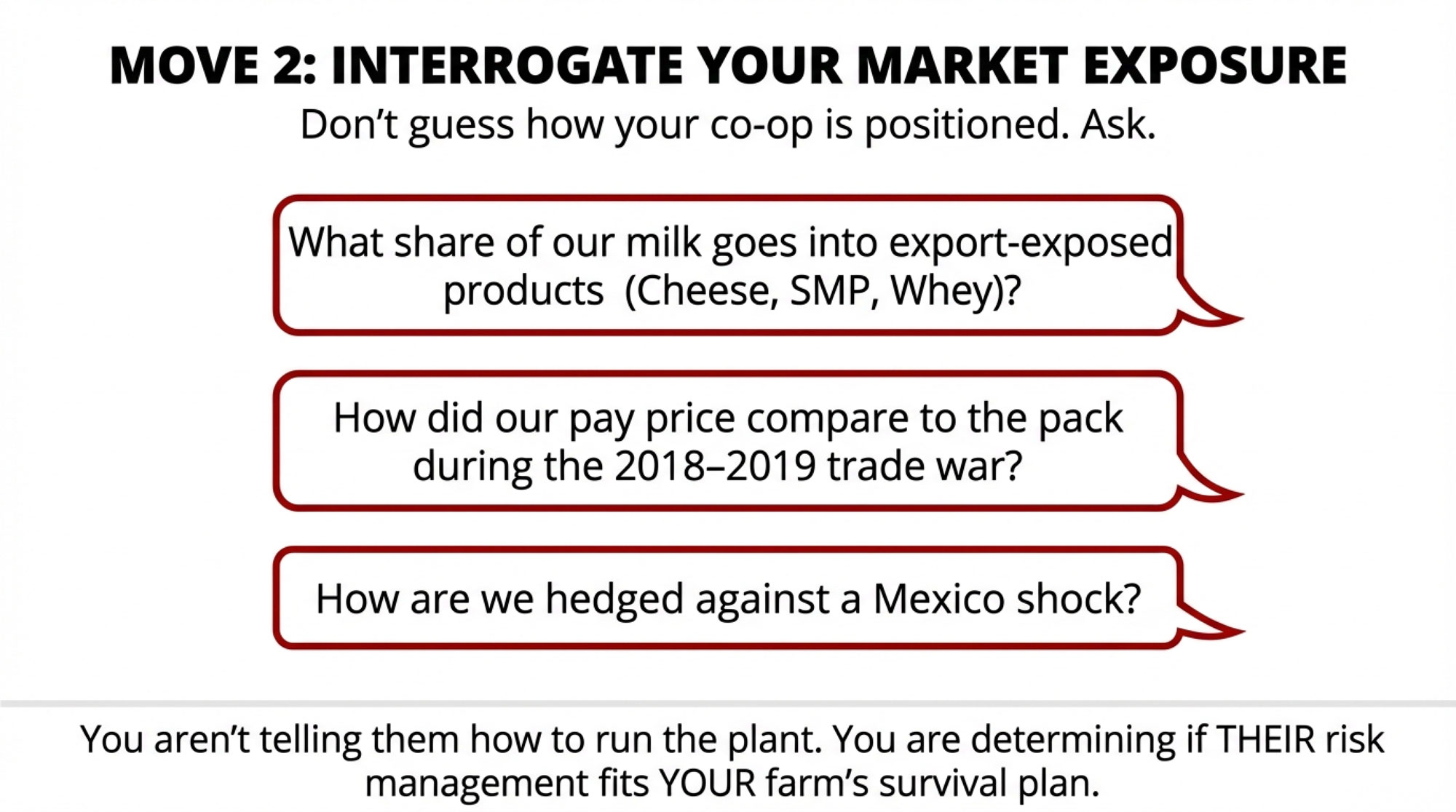
Before July: Ask your co-op: “What percentage of our milk ends up in Canada or Mexico, and what’s our contingency if USMCA stalls?” Mexico and Canada purchased $3.6 billion in U.S. dairy products in 2024, accounting for 44 percent of total U.S. dairy exports.
If you’re milking in Canada:
Pull your own cost-of-production numbers and compare them against the CDC’s national average. If you’re not participating in COP surveys, you’re relying on your neighbours’ data while your livelihood depends on the results.
Watch the protein shift. FCC’s 2026 dairy outlook flags that both P5 and WMP are restructuring producer pay to incentivize more protein and less butterfat. If your herd tests 4.5% BF and 3.4% protein, you’re roughly neutral. Push butterfat higher without matching protein, and your gross revenue could drop by 1.2% under the new WMP structure. Factor that into breeding and ration planning alongside trade uncertainty.
By spring, model a 20% decline in the quota value with your lender. Not because that’s likely — but because you should know the answer before you need it. If you’re carrying debt against quota collateral, ask what their haircut assumptions are. FCC’s 2026 dairy outlook is worth reading alongside your balance sheet.
Before July: Watch two signals. First, CDC pricing bulletins — are they still citing cost of production and CPI as drivers, or are words like “affordability” or “competitiveness” creeping in? That language shift is your early-warning system. Second, provincial quota exchange reports. In January 2025, Ontario moved 405.98 kg BF/day at the CA$24,000 cap. Firm volume at the cap means the market believes the system holds. Watch for softening.
Both sides: Don’t let the trade conversation be somebody else’s problem. Your milk check is already a trade document.
Key Takeaways:
The USMCA dairy fight is huge in headlines ($200M–$1.14B), but the farm‑level effect is small: roughly 5¢/cwt or $1,800–$5,400/year for a 150‑cow U.S. herd.
Canadian supply management trades income stability for political and balance‑sheet risk: US$28–30/cwtstability on the milk cheque, but CA$3.6–3.9M in quota equity exposed to Ottawa’s trade decisions.
Full TRQ enforcement and a “win” for U.S. dairy won’t rescue a negative‑margin farm; survival still comes down to cost control, risk management (DMC/DRP/LGM), and co‑op strategy.
For Canadian producers, the real USMCA/CUSMA risk isn’t this year’s milk price; it’s possible quota repricing, so you need to stress‑test a 20% equity hit with your lender.
If you don’t know your co‑op’s export exposure, your breakeven, or your quota‑value stress line, you’re flying blind into the 2026 review — your milk cheque is already a trade document.
The Bottom Line
Vander Schaaf delivered his testimony and returned to his Idaho operation. Gobeil, 1,500 kilometres north, leads the organization representing every Québec dairy farmer who’ll feel whatever the July review decides. Both face the same July deadline. Both will judge the outcome by the deposit on their next milk cheque. The question for you isn’t which system is better — it’s whether you know your own numbers well enough to plan around whatever comes out of that review.
When the USMCA review panel reports this summer, we’ll re-run the barn math for both sides of the border in our Border Math series. What does your co-op’s export breakdown look like? What’s your breakeven?
Complete references and supporting documentation are available upon request by contacting the editorial team at editor@thebullvine.com.
Join over 30,000 successful dairy professionals who rely on Bullvine Weekly for their competitive edge. Delivered directly to your inbox each week, our exclusive industry insights help you make smarter decisions while saving precious hours every week. Never miss critical updates on milk production trends, breakthrough technologies, and profit-boosting strategies that top producers are already implementing. Subscribe now to transform your dairy operation’s efficiency and profitability—your future success is just one click away.
NMPF asked USDA for exactly $148 million in dairy purchases last November. On February 19, USDA delivered — to the dollar. That’s not luck. That’s the advocacy pipeline working. Who benefits?
Executive Summary: USDA has approved $263 million in Section 32 food purchases, including $148 million for dairy — the exact figure NMPF asked for last November and the largest dairy round since the COVID programs. That money goes to processors for butter, cheese, and milk, not directly to farms, so any benefit shows up only if it lifts CME prices enough to move FMMO component values on your milk check. Butter is the main story: $75 million at current prices pulls roughly 40 million pounds — about 20% of a typical month of U.S. butter output — out of the commercial market, and CME butter already jumped $0.165/lb during the announcement week. The $32.5 million cheddar buy, by comparison, removes only about 1.7% of a month’s cheese production, so it’s unlikely to change protein checks on its own materially. For high‑butterfat herds, a sustained $0.10/lb increase in butterfat value can add more than $1,500/month per 200 cows, but only if the rally holds and your co‑op’s component premiums pass that value through. The article breaks down that barn math, compares this purchase to earlier Section 32 and COVID‑era interventions, and provides a 30/90/365‑day playbook so you can track CME butter, scrutinize your component statement, and adjust your risk‑management strategy in response to this one‑time demand boost.
$148 million. That’s the dairy industry’s share of USDA’s $263 million Section 32 purchase announced on February 19, 2026 — and it’s the exact figure the National Milk Producers Federation requested in a letter to USDA last November. Not one dollar more. Not one dollar less.
Every ag newswire ran the number. Secretary Brooke Rollins called it “delivering wholesome, real food to Americans while injecting critical dollars into local economies”. NMPF President and CEO Gregg Doud said the purchases “will provide important relief to producers who will benefit from the additional demand”. The International Dairy Foods Association applauded. Headlines everywhere.
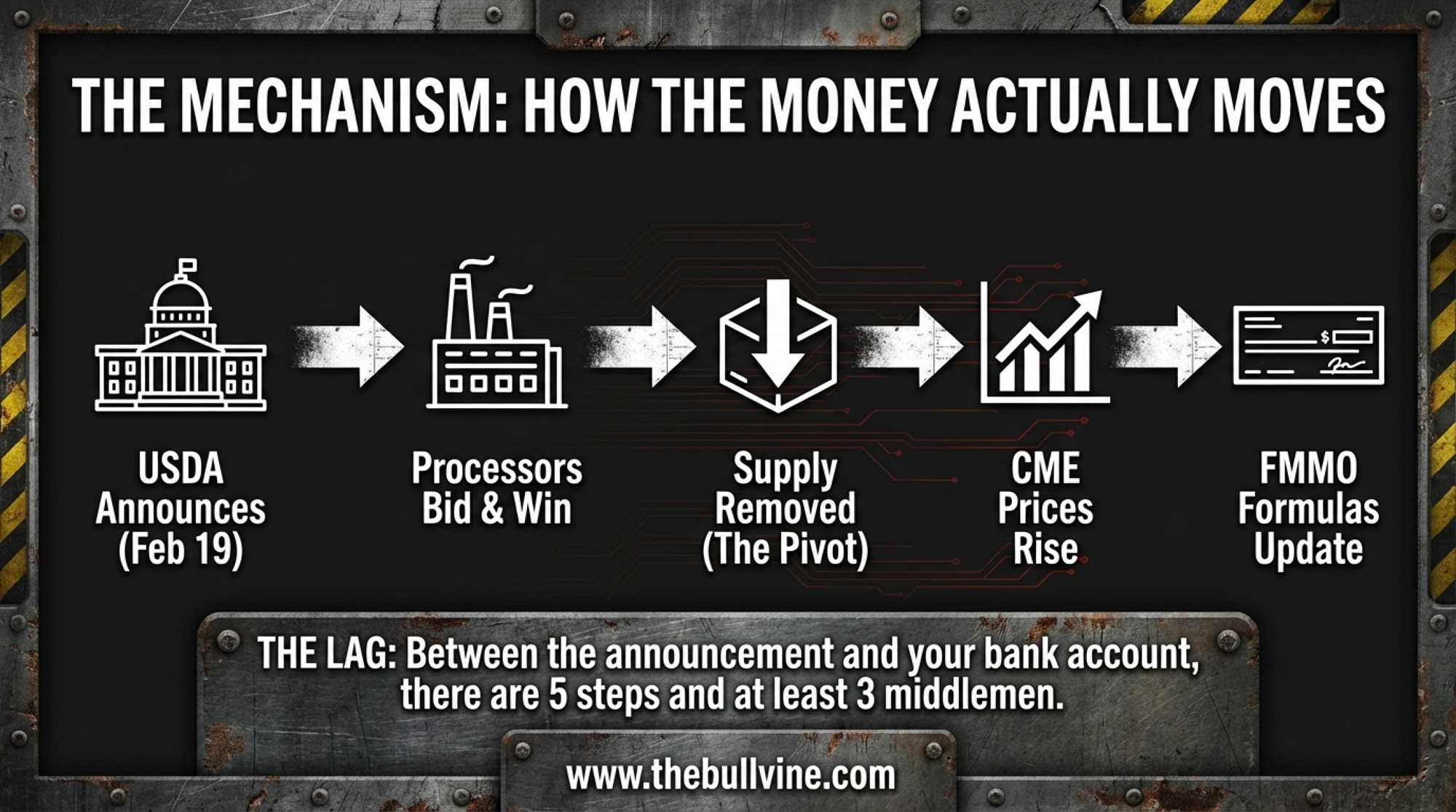
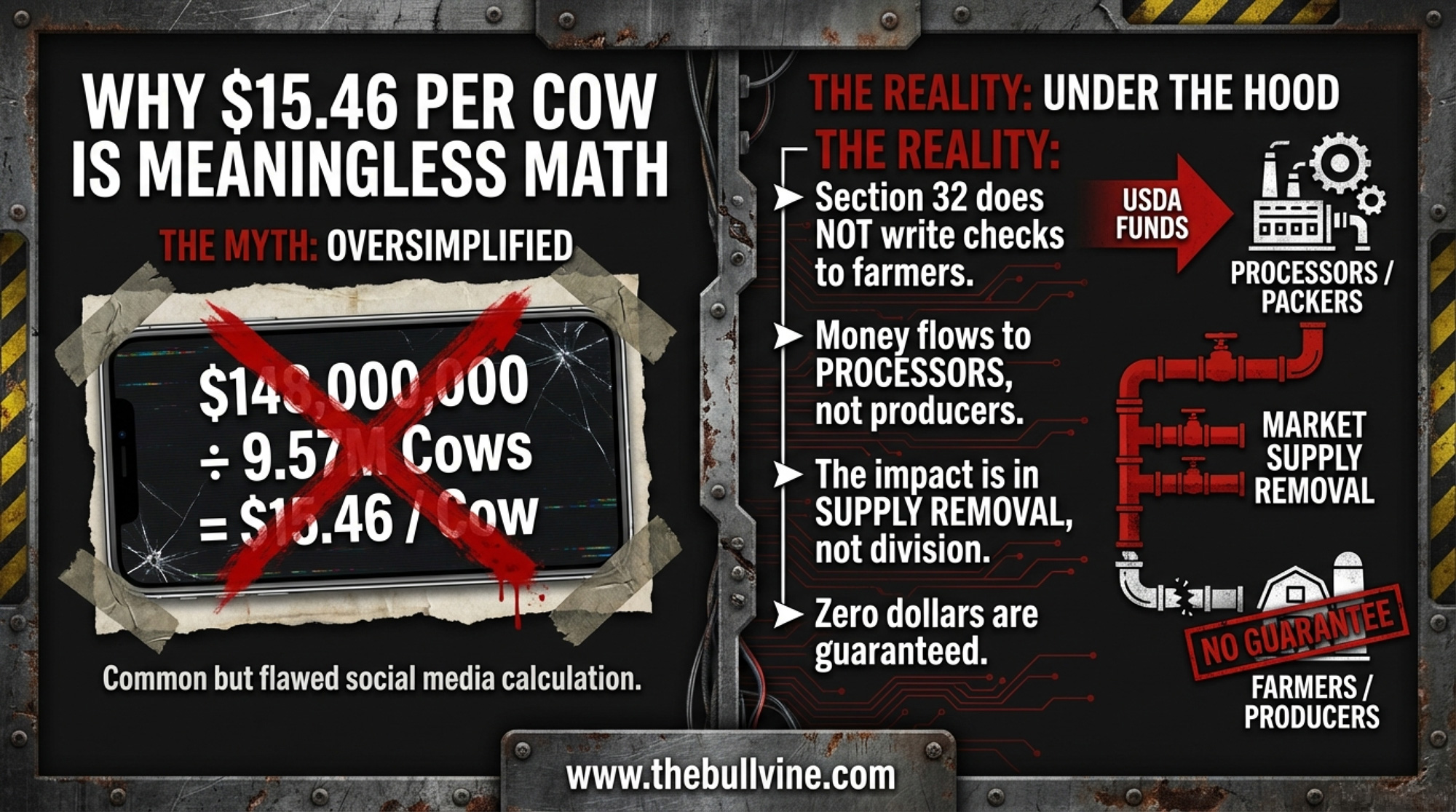
But here’s what nobody’s explaining: Section 32 doesn’t write checks to dairy farmers. It buys finished products from processors. Between that $148 million announcement and your milk check, there are five steps, at least three middlemen, and zero guaranteed dollars. Let’s walk through what this purchase actually buys, who actually gets paid, and what it could — could — mean for the price of your milk.
What USDA Is Actually Buying
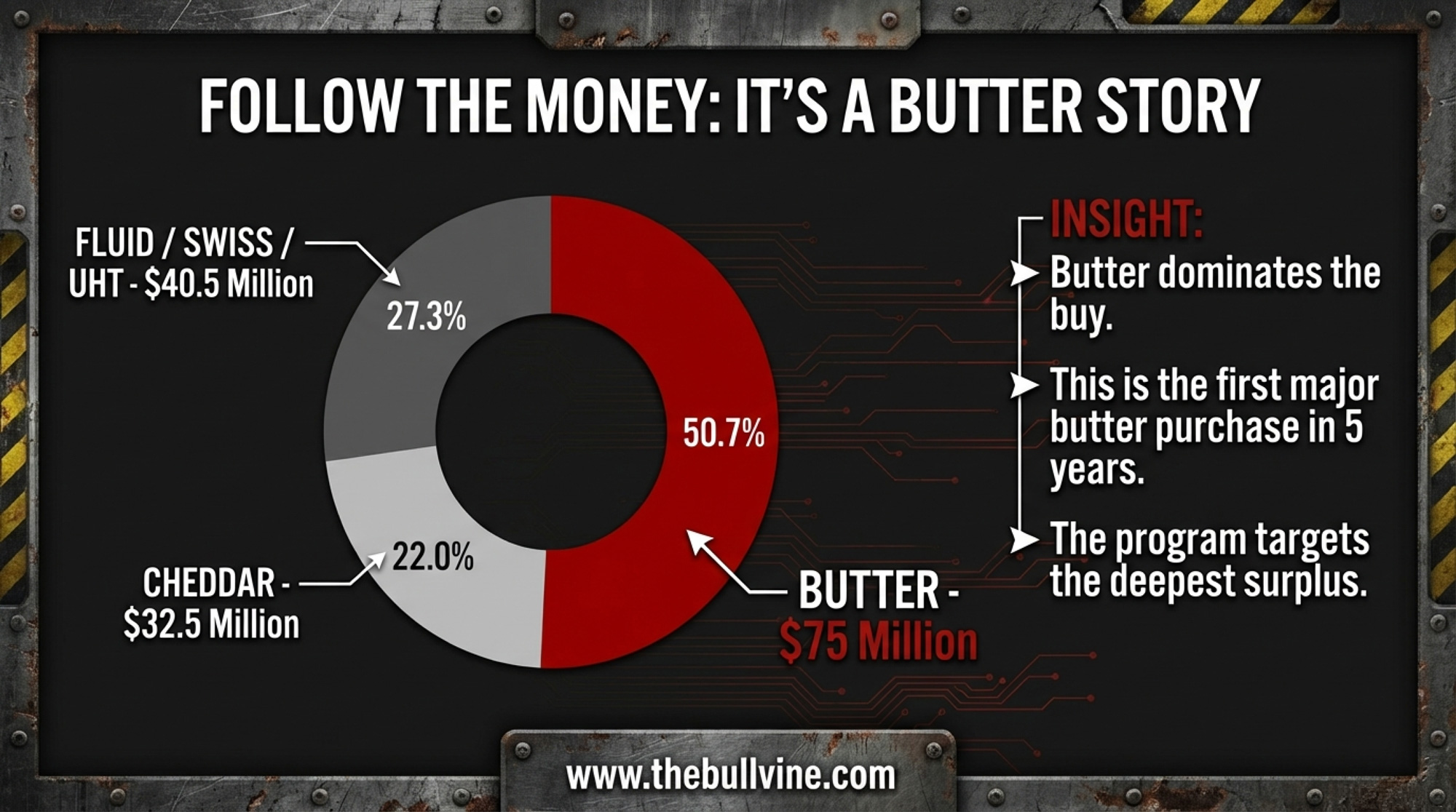
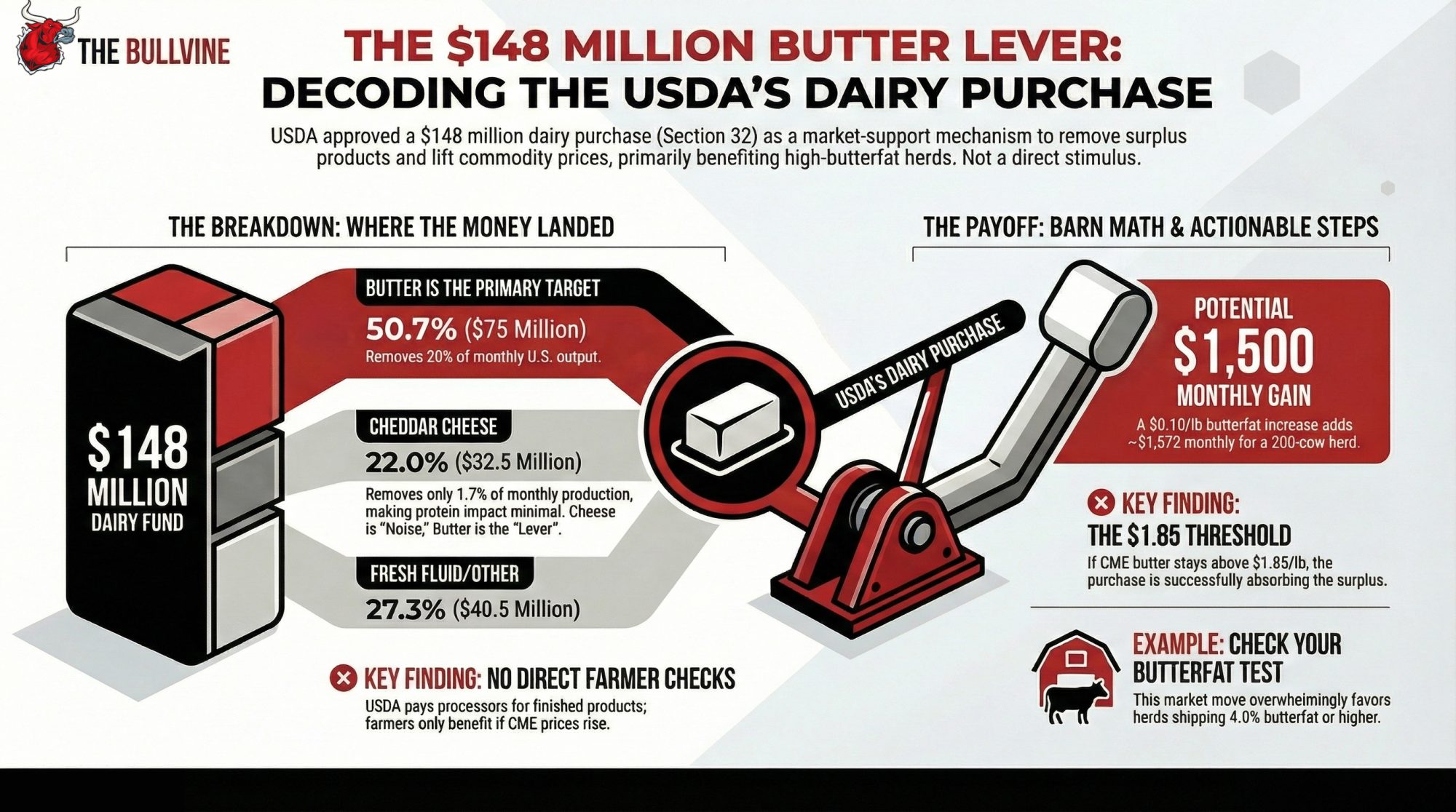
The $148 million breaks down into five commodity categories, and the allocation tells you exactly where USDA sees the deepest surplus problem:
Butter: $75 million (50.7% of dairy total)
Cheddar cheese: $32.5 million (22.0%)
Fresh fluid milk: $20.5 million (13.9%)
Swiss cheese: $10 million (6.8%)
UHT (shelf-stable) milk: $10 million (6.8%)
Butter dominates. That’s not random — it’s where the price crash has been worst. NMPF specifically noted that these are “the first major butter purchases in five years.” The remaining $115 million in the broader announcement covers non-dairy commodities: dried beans ($25 million), split peas ($24 million), fresh pears ($15 million), walnuts ($15 million), lentils ($14 million), chickpeas ($12 million), and pecans ($10 million).
Dairy got the single largest allocation of any category. That matters.
How $148 Million Became the Number
This wasn’t a surprise. NMPF sent USDA a letter last November requesting exactly $148 million in dairy purchases. What followed, in NMPF’s own words, were “extensive conversations and further official communication with USDA”. When the announcement dropped on February 19, it matched the request to the dollar.
Gregg Doud — NMPF’s president and CEO since September 2023, a former Chief Agricultural Negotiator under President Trump’s first term, and a Kansas farm kid who still runs cattle — framed it as demand support: “Dairy farmers have shared in the struggles faced throughout the agricultural economy.”
That’s the advocacy pipeline working. NMPF identified the surplus problem, built the case with USDA, and delivered a specific ask. Whether you’re an NMPF member co-op shipper or not, this is what organized lobbying looks like when it produces results. The question is whether those results reach your bulk tank.
If you ship to an NMPF member co‑op, this is your dues at work; if you don’t, you’re still riding the same CME prices, just without the direct contract upside.
What Is a Section 32 Purchase and How Does It Work?
Section 32 of the Agricultural Adjustment Act of 1935 authorizes the USDA to buy surplus U.S.-produced agricultural products for two purposes: stabilize farm markets and supply food to federal nutrition assistance programs.
Here’s the mechanism, step by step:
USDA’s Agricultural Marketing Service issues Purchase Program Announcements.
Approved vendors — processors, not farmers — submit bids.
USDA awards contracts to winning bidders.
Processors deliver products to food banks and nutrition programs.
The purchased volume exits the commercial market, reducing available supply.
That fifth step is where farm‑level impact starts, in theory. Removing surplus from the market tightens supply, which supports commodity prices on the CME, which flows through FMMO formulas into component pricing, which eventually — weeks to months later — appears on your milk check.
Five steps. None of them is “USDA writes a check to a dairy farmer.” This is a market-support mechanism, not a direct payment. That distinction matters.
The Per-Cow Reality Check: Why $15.46 Is a Meaningless Number
You’ll see this math on social media: $148 million ÷ 9.57 million U.S. dairy cows = $15.46 per cow. Sounds underwhelming, right?
It’s also completely irrelevant. Section 32 doesn’t distribute money per cow. It removes the product from the market. The $15.46 figure tells you nothing about the actual price-support effect, which depends on how much volume gets pulled, from which markets, at what prices, and how CME traders respond.
The per-cow math is a useful headline killer, though. And that’s the point: $148 million sounds massive until you spread it across the national herd. The real impact isn’t in the division. It’s in the market math.
Butter vs. Cheese: One Big Lever, One Tiny One
This is where the numbers get interesting. The $75 million butter purchase is the headline within the headline. Here’s why.
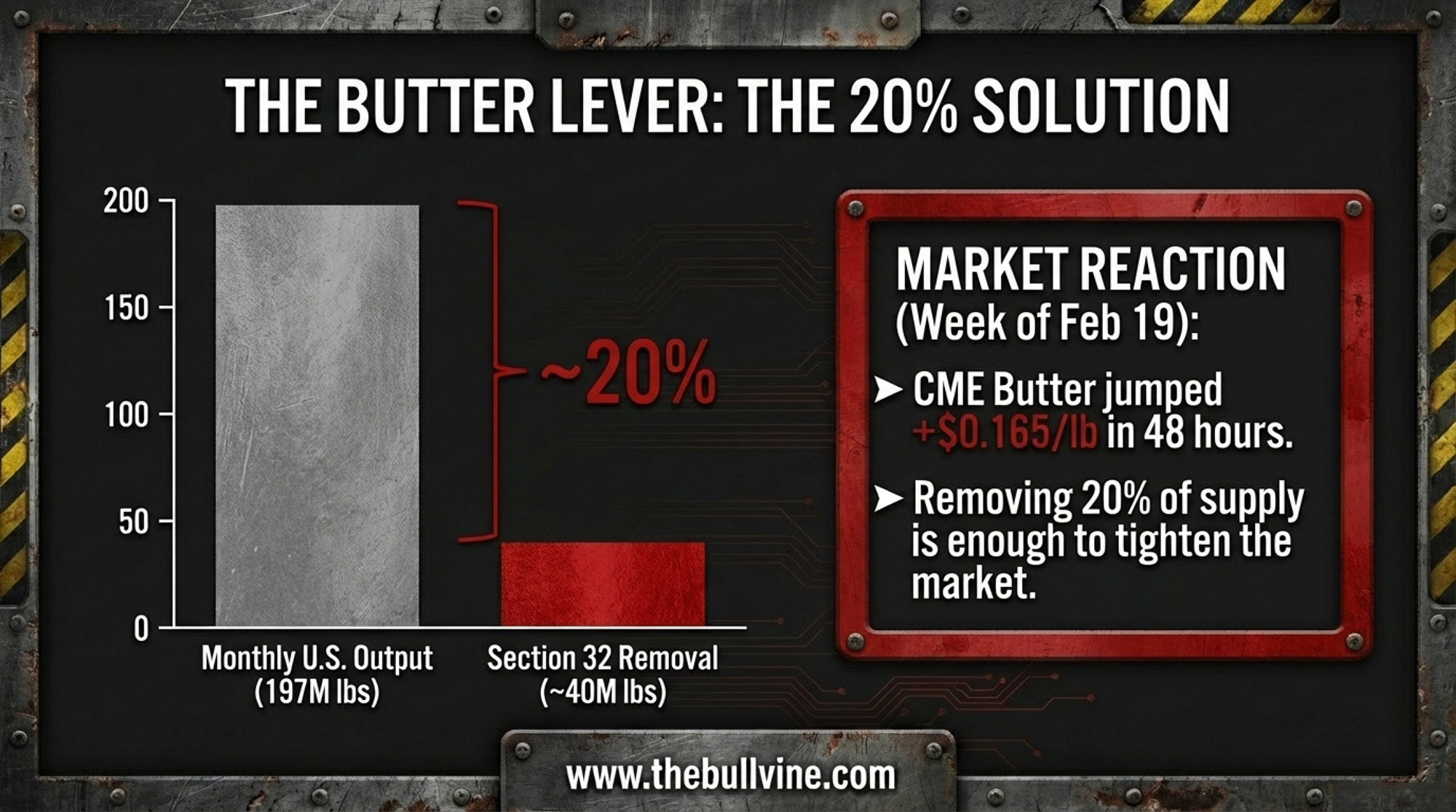
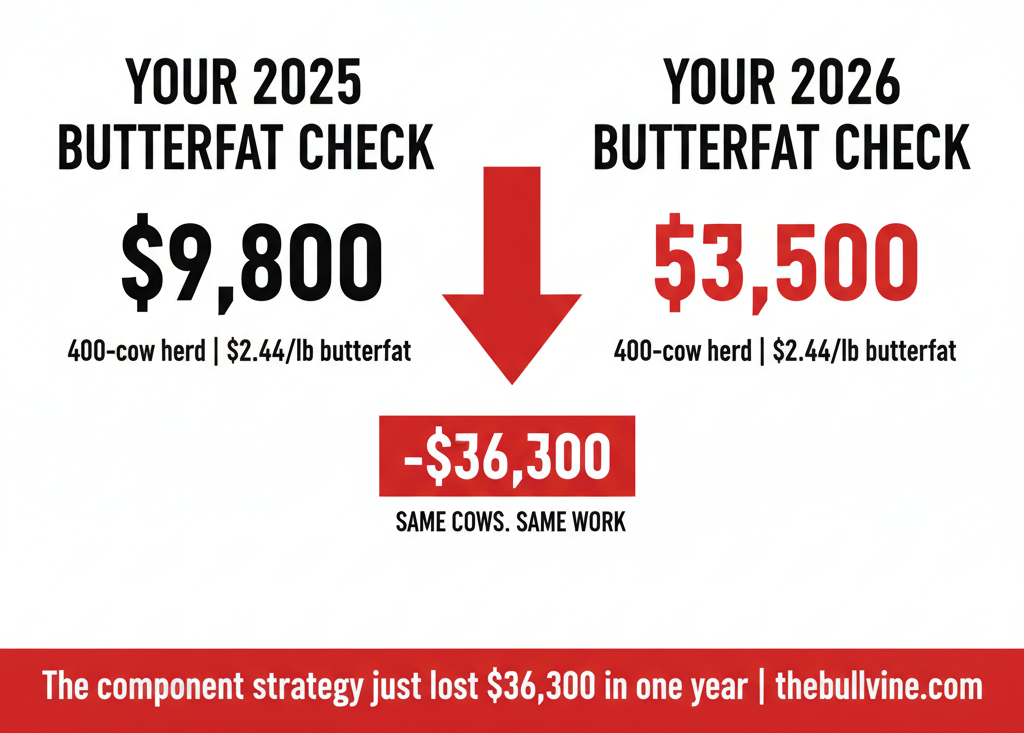
Butter math: At CME cash butter prices of $1.8700/lb on Friday, February 20, 2026, $75 million buys roughly 40 million pounds of butter. December 2025 U.S. butter production was 204 million pounds, according to USDA NASS’s Dairy Products report released on February 5, 2026. Full-year 2025 butter output hit 2.36 billion pounds — an average of about 197 million pounds per month. That $75 million purchase removes roughly 20% of one month’s productionfrom the commercial market.
Metric
Butter
Cheddar Cheese
Purchase Amount
$75 million
$32.5 million
Pounds Purchased
~40 million lbs
~21.7 million lbs
Typical Monthly Production
~197 million lbs
~1.28 billion lbs
% of Monthly Output Removed
20.3%
1.7%
Likely CME Price Impact
$0.10–0.15/lb
$0.01–0.02/lb
Twenty percent is significant. It’s not catastrophic-surplus territory, but it’s enough to tighten the market meaningfully — especially with butter already climbing. CME cash butter opened the announcement week at $1.7050 on Tuesday and closed Friday at $1.8700, a $0.165/lb gain in four trading sessions. That’s not all Section 32 — other factors are in play — but the timing is hard to ignore.
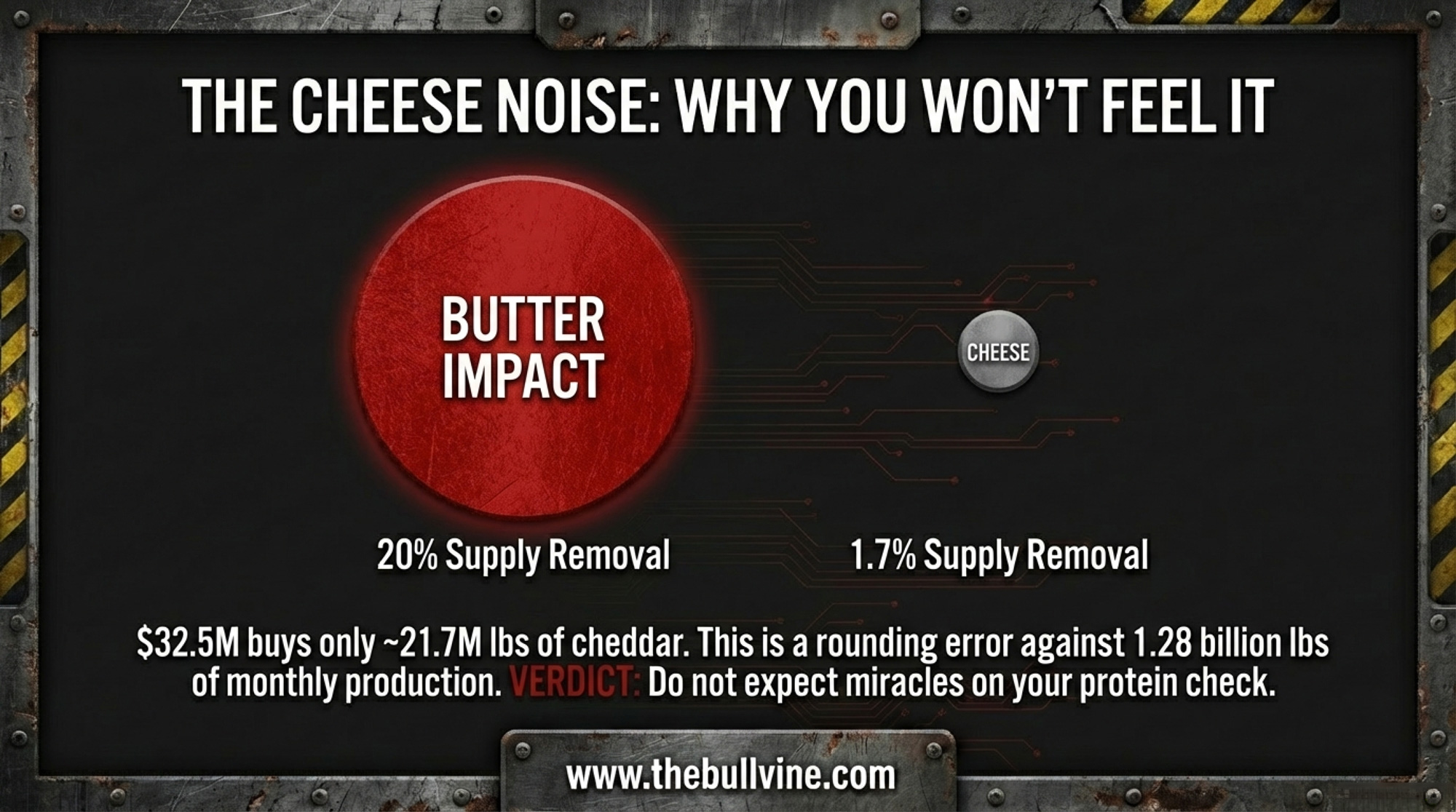
Cheese math: The $32.5 million cheddar purchase at roughly $1.50/lb buys about 21.7 million pounds. December 2025 total cheese production was 1.28 billion pounds. That’s barely 1.7% of one month’s output. Meaningful for cheddar specifically, but a rounding error for the broader cheese market.
The takeaway: If you’re a high-butterfat herd, this purchase tilts in your favor. If your income depends more on protein and cheese prices, the direct effect is minimal. Butter is the big lever here. Cheese is noise.
How Much Will This Actually Affect Milk Prices?
Now for the barn math that connects the announcement to your component statement.
Start with butter. If the Section 32 purchase contributes even $0.10/lb to sustained butter price support — and the $0.165/lb rally this week suggests that’s conservative — here’s what it means at the farm level:
The Class IV butterfat price is derived directly from CME butter. A $0.10/lb butter increase translates to roughly $0.10/lb on your butterfat component price. For a 200-cow herd shipping 23,000 lbs/cow/year at 4.1% butterfat:
Monthly milk shipped: ~383,333 lbs
Monthly butterfat lbs: ~15,717 lbs
Value of $0.10/lb BF increase: ~$1,572/month, or $18,860 annualized
For a 400-cow herd at the same test? Double it: roughly $3,144/month.
That’s real money — if the butter rally holds and if your co-op’s component premiums reflect it. Two big ifs.
Now cheese. A $32.5 million purchase removing 1.7% of monthly production might support block prices by $0.01–0.02/lb at best. On your protein check, that’s almost invisible.
Bottom line: This purchase is a butterfat story. Your Class IV components — butterfat specifically — are where the action is. If your herd tests 3.6% fat, the impact is noticeably smaller than at 4.2%. Run it with your own numbers.
Why Now — and How Does This Compare?
Butter prices crashed from roughly $2.50/lb in mid-2025 to around $1.50/lb by January 2026 — a 40% decline in six months. CME cheese blocks were sitting at $1.45/lb before the announcement week. Global milk production — what analysts have called the “wall of milk” — has been pressuring commodity prices across the board.
NMPF called this the first major butter purchase in five years. That’s significant context. For comparison:
2020 COVID-era: USDA purchased roughly $1.33 billion in dairy products across multiple programs, including about $100 million/month in Section 32 alone. That removed an estimated 238 million pounds of cheese and 64 million pounds of butter over the year.
2020 Section 32 specifically: A $120 million cheese-and-butter purchase removed about 23 million pounds of cheese and 3.6 million pounds of butter per month.
January 2026: USDA bought $80 million in specialty crops under Section 32 — no dairy in that round.
At $148 million, this is the largest single-round Section 32 dairy purchase outside of COVID emergency spending. It’s substantial. It’s also one-time, not recurring. The 2020 program ran for months. This is a single injection.
The Market Already Moved
Here’s what happened on the CME the week of the announcement:
Commodity
Tue 2/17
Wed 2/18
Thu 2/19 (Announcement)
Fri 2/20
Weekly Change
Butter ($/lb)
$1.7050
$1.7050
$1.7800
$1.8700
+$0.1650
Blocks ($/lb)
$1.4500
$1.5000
$1.5100
$1.4975
+$0.0475
Barrels ($/lb)
$1.4500
$1.4700
$1.4700
$1.4900
+$0.0400
NFDM ($/lb)
$1.5900
$1.5975
$1.6225
$1.6850
+$0.0950
Butter jumped $0.075/lb on announcement day alone and added another $0.09 on Friday. That’s a two-day move of $0.165/lb — the kind of swing that moves component checks. Blocks and barrels gained modestly. NFDM surged nearly a dime on the week.
The market is pricing in the volume removal. Whether it holds through March and April — when the actual Purchase Program Announcements are issued, and contracts are awarded — is the open question.
What $148 Million in Section 32 Purchases Means for Your Component Check
Check your butterfat test. This purchase overwhelmingly favors high-BF herds. At 4.0%+ test, the butter rally has meaningful upside for your Class IV components. At 3.5%, the effect is roughly half as large.
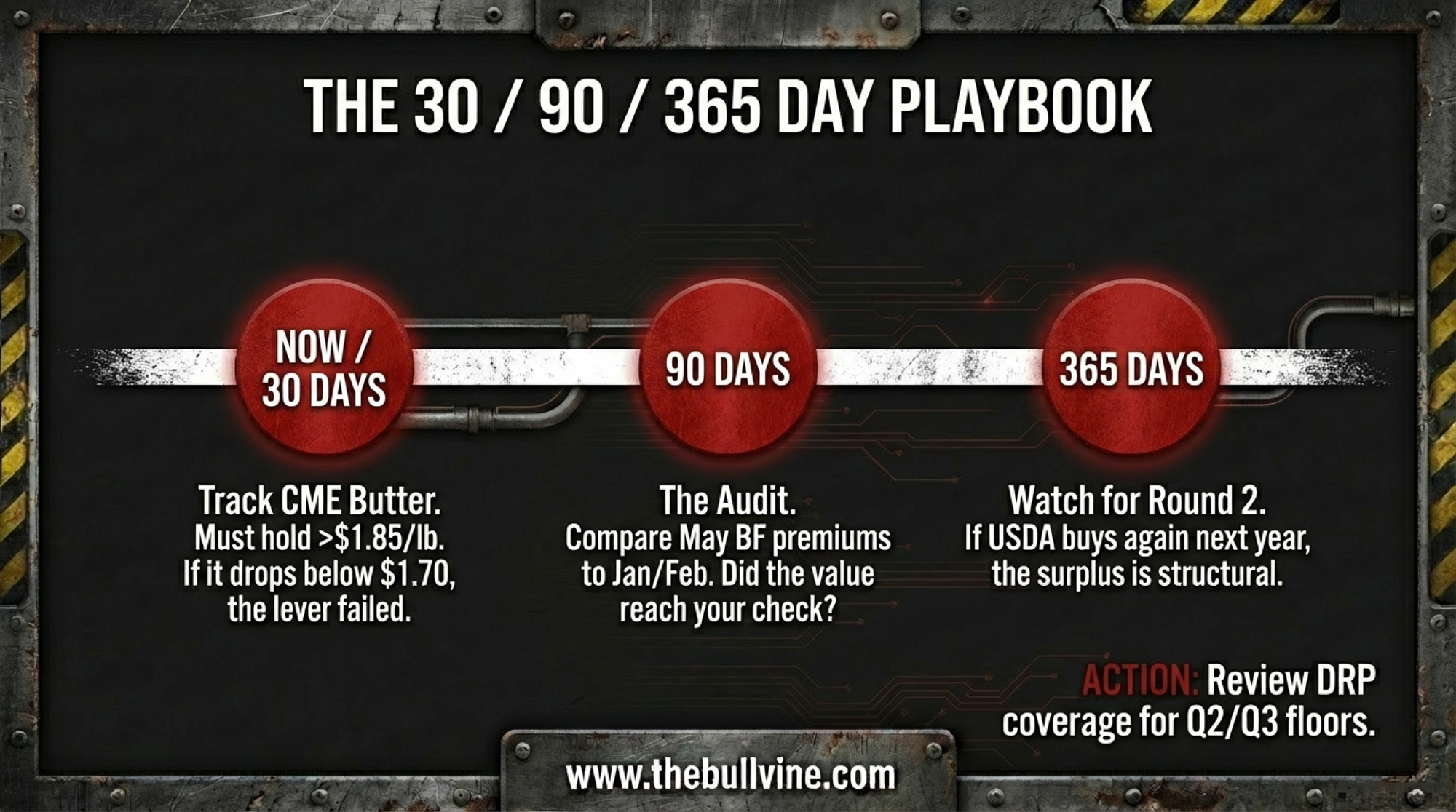
Watch CME butter through March. If butter sustains above $1.85/lb through mid-March, the Section 32 volume removal is working as intended. If it fades back below $1.70, the purchase wasn’t enough to absorb the surplus.
Don’t expect cheese miracles. The $32.5 million cheddar purchase is too small relative to monthly production (1.28 billion pounds in December alone ) to meaningfully move block or barrel prices. Your protein check won’t feel this.
Know the timeline. USDA hasn’t issued the Purchase Program Announcements yet. Approved vendors still need to bid. Contracts need awarding. Product needs to ship. The actual volume won’t leave the commercial market for weeks, possibly months.
Ask your co-op. Does your cooperative supply USDA commodity programs? If so, this purchase directly increases demand for your co-op’s output. If not, you’re relying entirely on the indirect price-support effect.
Review your risk coverage. DRP (Dairy Revenue Protection) is available for purchase on any business day when prices are published on RMA’s website — there’s no fixed quarterly enrollment window. If butter holds its rally, Class IV DRP coverage premiums will rise as expected revenue increases. Locking in current premium levels sooner rather than later may make sense for Q2 and Q3 2026 quarters. Separately, DMC enrollment for 2026 closed February 26 — if you missed it, DRP is your remaining federal safety-net option.
Your 30/90/365-Day Playbook
Timeline
What to Track
Key Threshold
Action If Threshold Met/Missed
This Week
USDA AMS Purchase Program Announcement
Announcement posted
Read for delivery windows, product specs, quantity breakdowns
30 Days
CME butter & cheese block prices
Butter holds above $1.85/lb
Price support working; below = surplus bigger than $75M can fix
90 Days
Your co-op component statement (April/May)
BF premium reflects butter rally
If butter held but BF premium flat = question for co-op field rep
365 Days
Total 2026 Section 32 dairy purchases vs. 2024/2025
Second round announced
Signals structural surplus, not seasonal—NMPF pipeline now recurring
This week: Read the USDA AMS Purchase Program Announcement when it posts. It will specify exact product forms, quantities, and delivery windows. That’s when you’ll know whether this is a 60-day buy or a 6-month program.
30 days: Track CME butter and cheese block prices. The $1.85/lb butter threshold is your marker. Above it, the purchase is supporting prices. Below it, the surplus is bigger than $75 million can fix.
90 days: Pull your co-op component statement for April or May. Compare your butterfat premium to January and February. If butter held above $1.85 through March and your BF premium didn’t move, that’s a question for your co-op field rep.
365 days: Compare the total 2026 Section 32 dairy purchases to 2025 and 2024. If USDA comes back for a second round, it signals the surplus problem is structural, not seasonal — and that NMPF’s advocacy pipeline is becoming a recurring feature of dairy price support.
Key Takeaways
USDA’s $148 million dairy allocation under Section 32 is exactly what NMPF asked for last November and marks the largest non‑COVID dairy purchase in five years.
None of that money arrives as a farm check — it pays processors, and the only way you see it is if it pushes CME prices high enough to lift FMMO component values on your milk check.
Butter is where it bites: $75 million pulls roughly 40 million pounds — about 20% of a typical month of U.S. butter output —, and CME butter already moved $0.165/lb higher during the announcement week.
The cheddar piece is small by comparison: $32.5 million removes only about 1.7% of a month’s cheese production, so don’t expect a big protein or Class III bump from this round alone.
If your herd ships 4%‑plus butterfat, a sustained $0.10/lb increase in butterfat value can add more than $1,500/month per 200 cows, which makes watching butter hold above roughly $1.85/lb and checking how your co‑op adjusts component premiums a key decision point.
The Bottom Line
$148 million isn’t a rescue. It’s a market lever—and specifically, a butter lever. NMPF asked for it, USDA delivered it, and the CME responded with a $0.165/lb butter rally in 48 hours. Whether that holds depends on what happens when the actual contracts hit and the product starts moving.
Pull your last component statement. Find the butterfat line. Now add $0.10/lb and multiply by your monthly butterfat pounds. That’s the upside scenario from this purchase — not $148 million divided by your herd size, but butter price × your components × time.
Complete references and supporting documentation are available upon request by contacting the editorial team at editor@thebullvine.com.
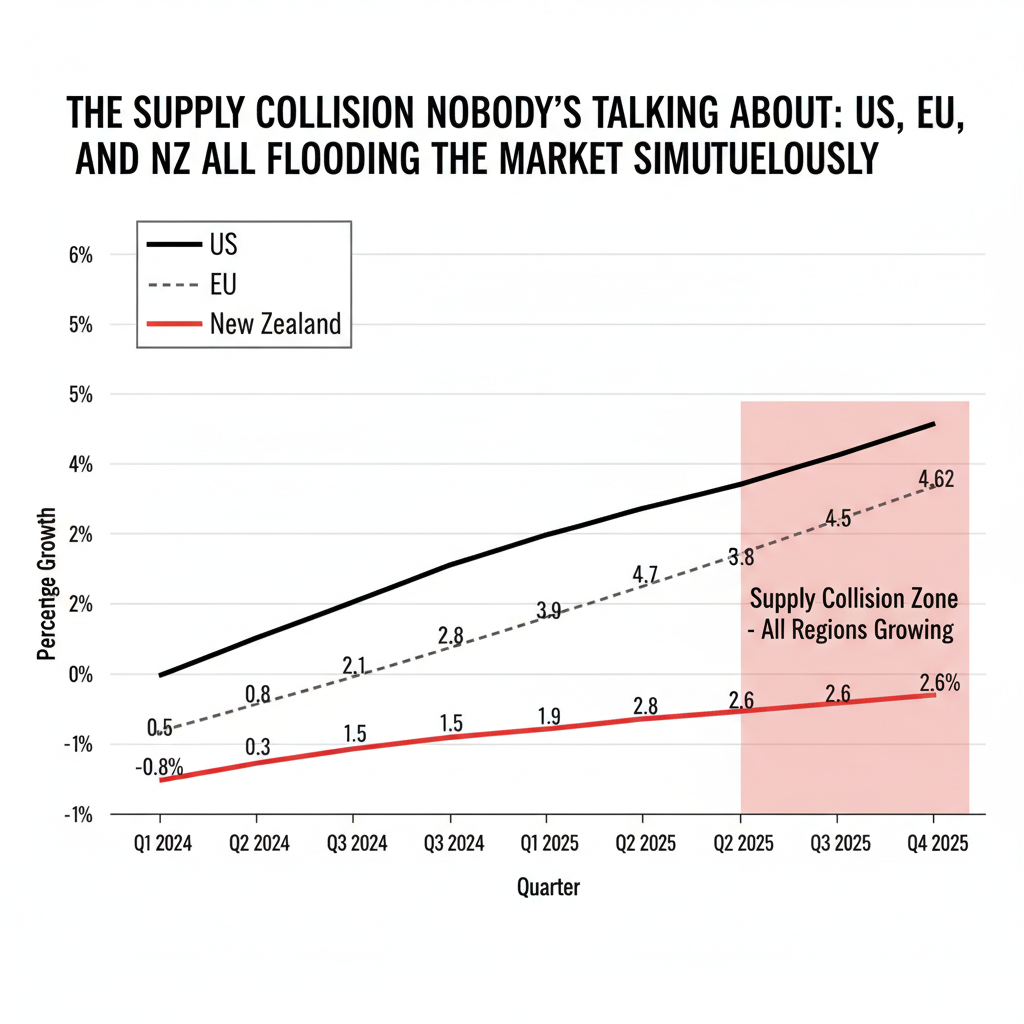
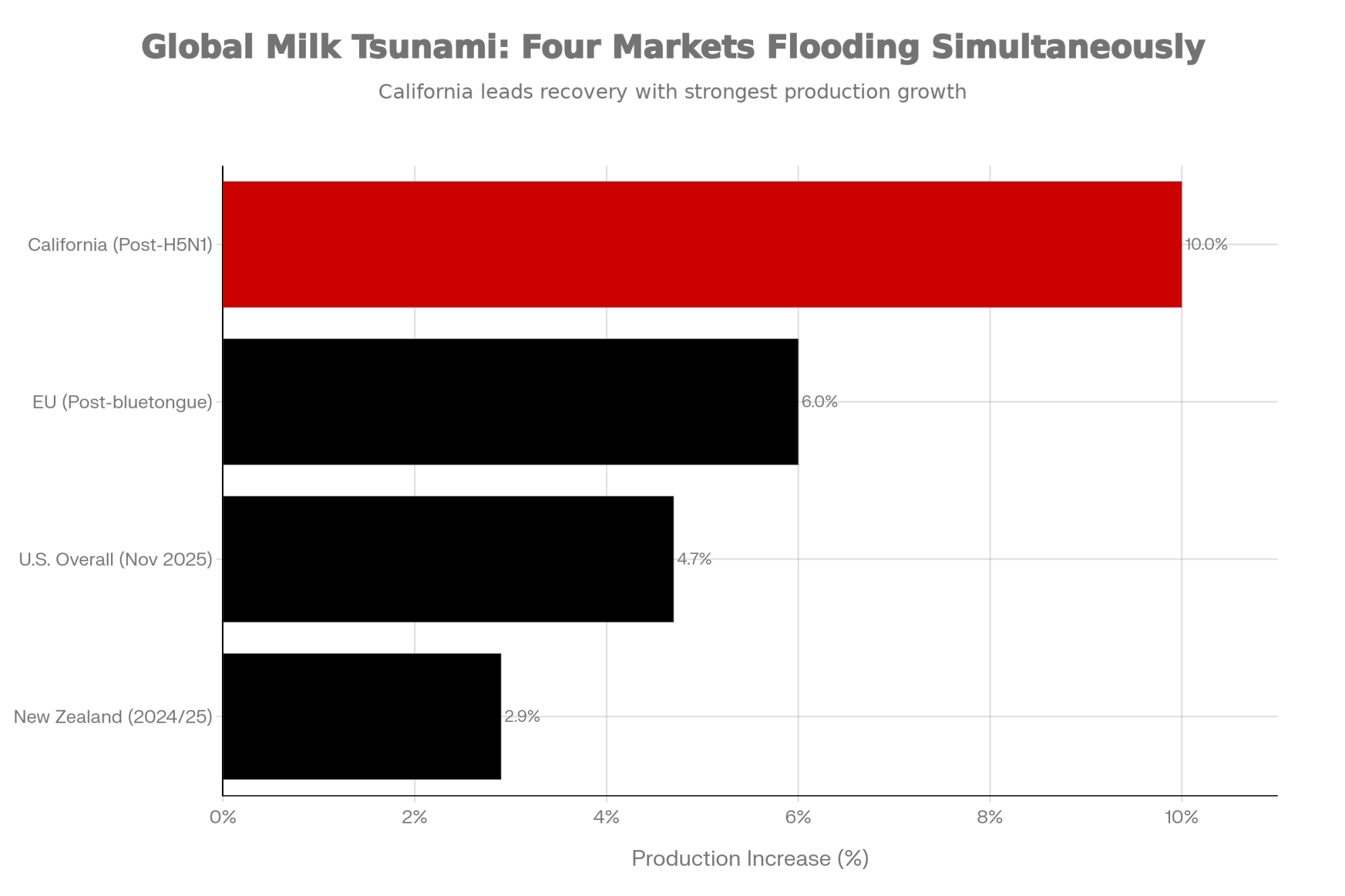
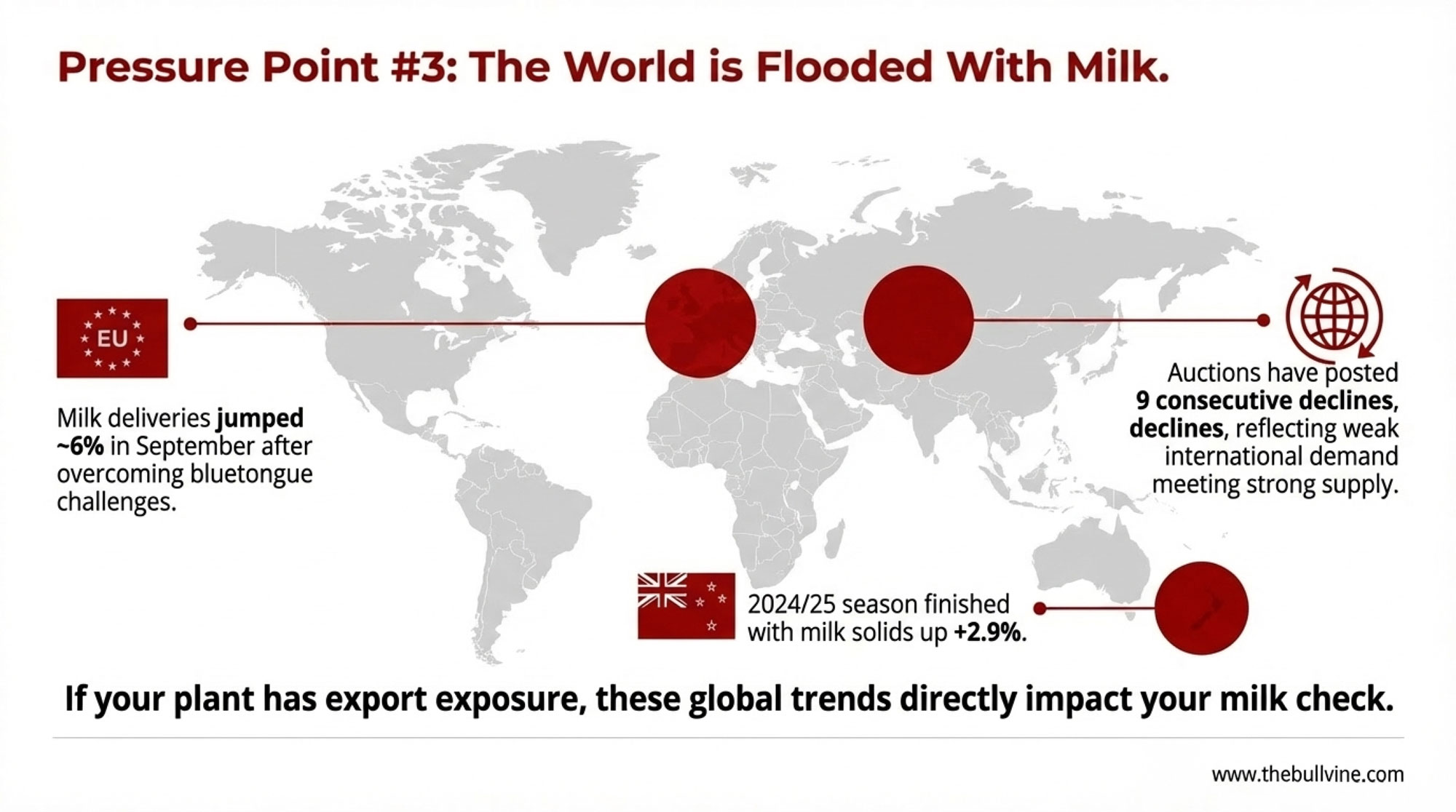
The Wall of Milk: Making Sense of 2025’s Global Dairy Crunch – Reveals the structural supply collision between the U.S., EU, and New Zealand that is currently capping your upside. This strategic analysis exposes the “biological trap” of beef-on-dairy and helps you position your operation for the next three years.
Genetic Revolution: How Record-Breaking Milk Components Are Reshaping Dairy’s Future – Delivers a deep dive into the genomic surge that “pre-loaded” the national herd for record butterfat. It identifies the emerging genetic traits—from feed efficiency to methane indexes—that will determine which dairies remain competitive through the 2030s.
Join the Revolution!
Join over 30,000 successful dairy professionals who rely on Bullvine Weekly for their competitive edge. Delivered directly to your inbox each week, our exclusive industry insights help you make smarter decisions while saving precious hours every week. Never miss critical updates on milk production trends, breakthrough technologies, and profit-boosting strategies that top producers are already implementing. Subscribe now to transform your dairy operation’s efficiency and profitability—your future success is just one click away.
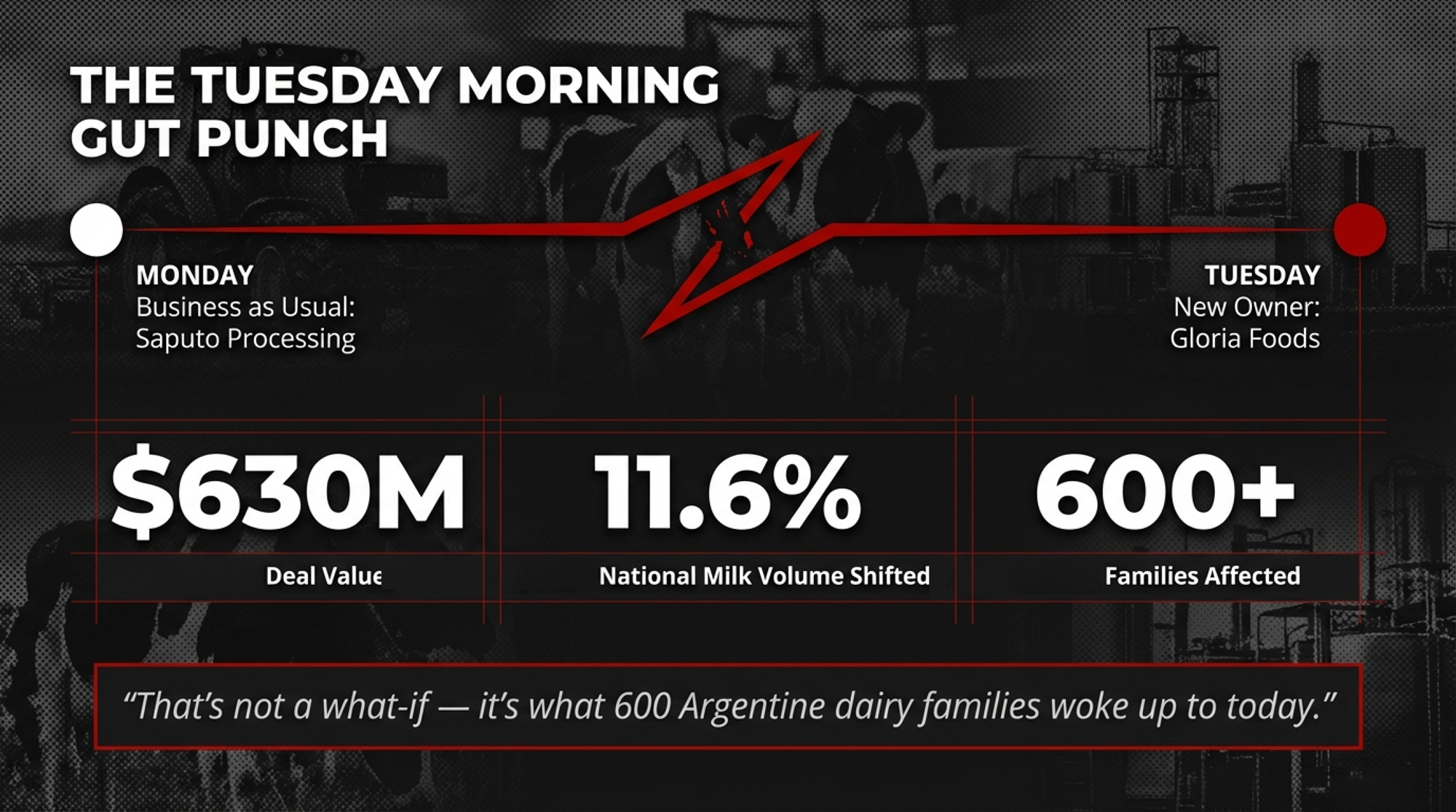
Your milk goes to one processor. Overnight, they sell 80% to a stranger. That’s not a what‑if — it’s what 600 Argentine dairy families woke up to today.
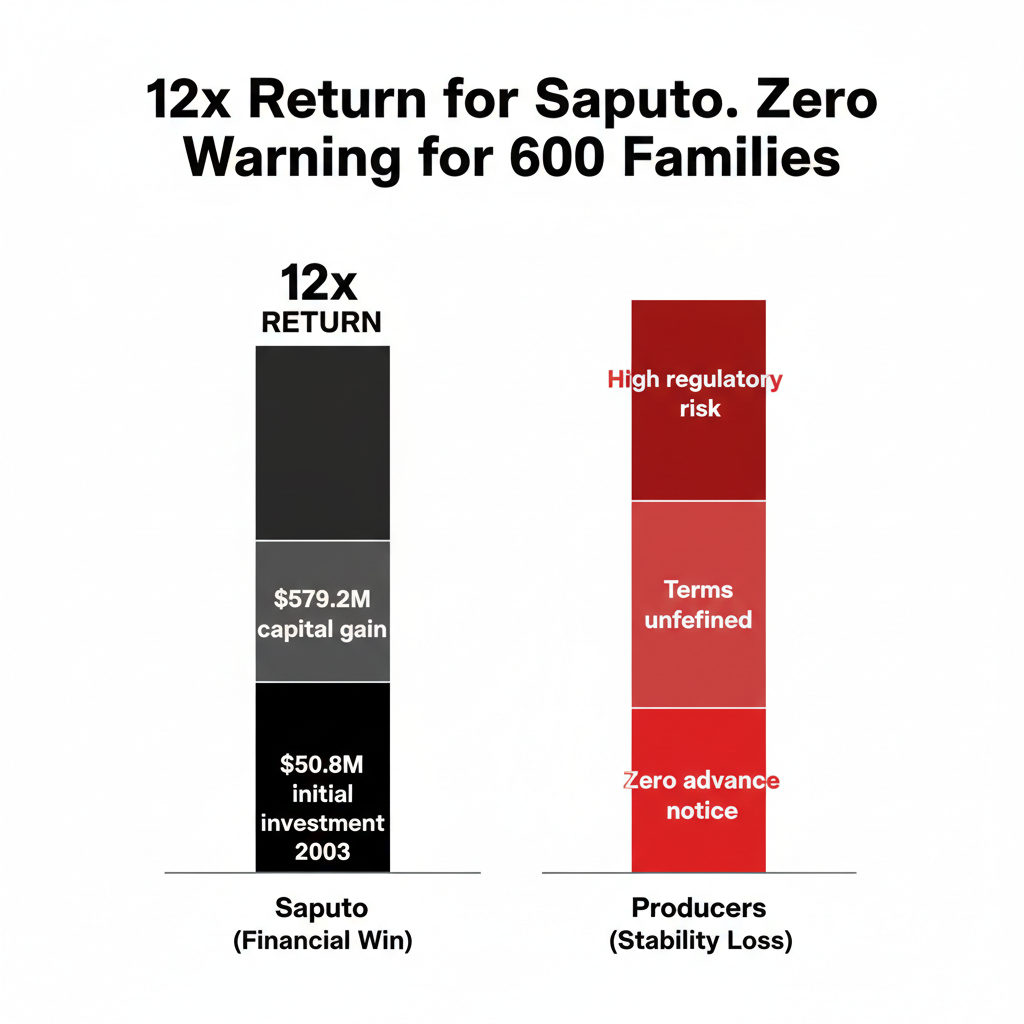
Executive Summary: Saputo is selling 80% of its Argentine dairy division to Peru’s Gloria Foods in a deal that values the business at C$855 million (about US$630 million), while keeping a 20% stake. Overnight, control of Argentina’s largest milk processor — 11.6% of the nation’s industrial milk and collections from more than 600 farms — shifts to a buyer that’s been sued for abusing its power with producers in Chile, fined in Colombia for adding whey to “whole” milk, and accused of monopolistic practices in Peru. Farmers shipping to Saputo’s Rafaela and Tío Pujio plants learned about the deal from a press release instead of a phone call, and they still don’t know if Gloria will keep their contracts, prices, and pickup schedules intact. They’re dealing with that gut punch in a sector where SanCor has just entered creditor protection and co‑ops’ share of Argentina’s milk has collapsed from roughly 34% to about 3%, leaving most producers tied closely to a single processor. Add in Gloria’s aggressive acquisition run and rising debt‑service costs at its Peruvian holding company, and you have a new owner that’s highly motivated to manage margins hard once the ink dries. This article walks you through what’s happening to those 600 Argentine dairy families — and gives you a concrete playbook to check whether your own processor contract would protect you if the company you ship to sold tomorrow without warning.
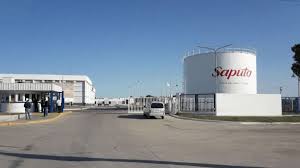
Saputo Inc. announced today that it’s selling 80% of its Argentine dairy division to Gloria Foods — the dairy arm of Peru’s Grupo Gloria — for an enterprise value of C$855 million. That works out to roughly US$630 million, including assumed debt, though Peruvian business media report the equity purchase price closer to US$500 million. Saputo expects net proceeds after tax of approximately C$543 million (US$400 million). The company keeps a 20% minority stake. The deal covers two processing plants, the La Paulina, Ricrem, and Molfino brands, and a milk collection network serving more than 600 dairy farms across Santa Fe and Córdoba provinces, according to Argentine agricultural media, including LA17 and Bichos de Campo.
This is what dairy processor consolidation risk looks like in practice. Those 600 families weren’t part of the conversation — and the company taking over has a record across Latin America that every producer, Argentine or not, ought to understand before this deal closes around mid-2026.
If you read nothing else this month, pair this with our recent piece on the four questions every dairy producer should ask about processor dependency. What’s happening in Argentina right now is a textbook case of what that audit is designed to prevent.
How Saputo Built Argentina’s Top Dairy Operation — Then Walked Away
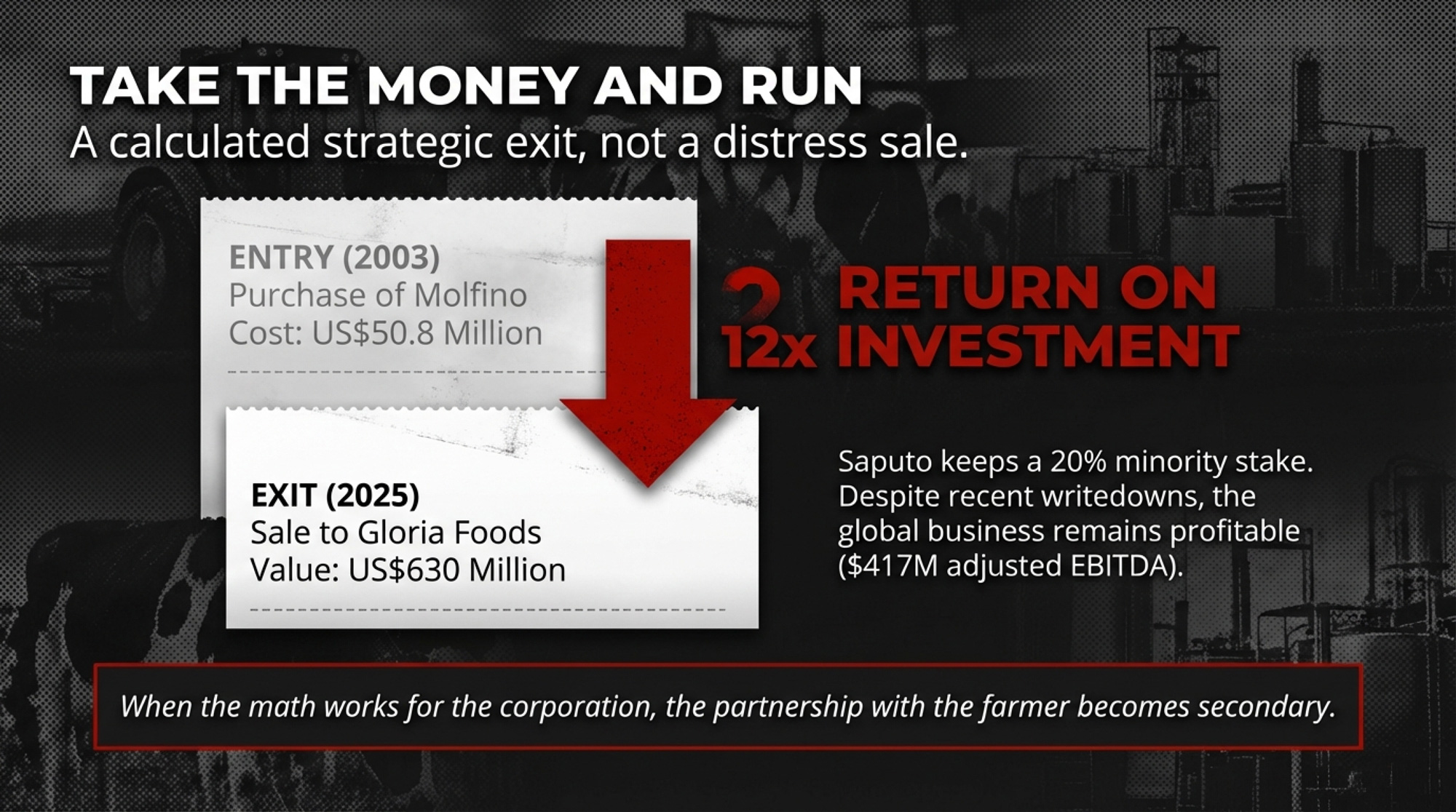
Saputo entered Argentina in November 2003 by acquiring Molfino Hermanos S.A. from Molinos Río de la Plata for US$50.8 million. At the time, Molfino was the country’s third-largest processor — two plants, roughly 850 employees, about US$90 million in annual revenue. Over 23 years, Saputo turned that into the country’s number-one operation.
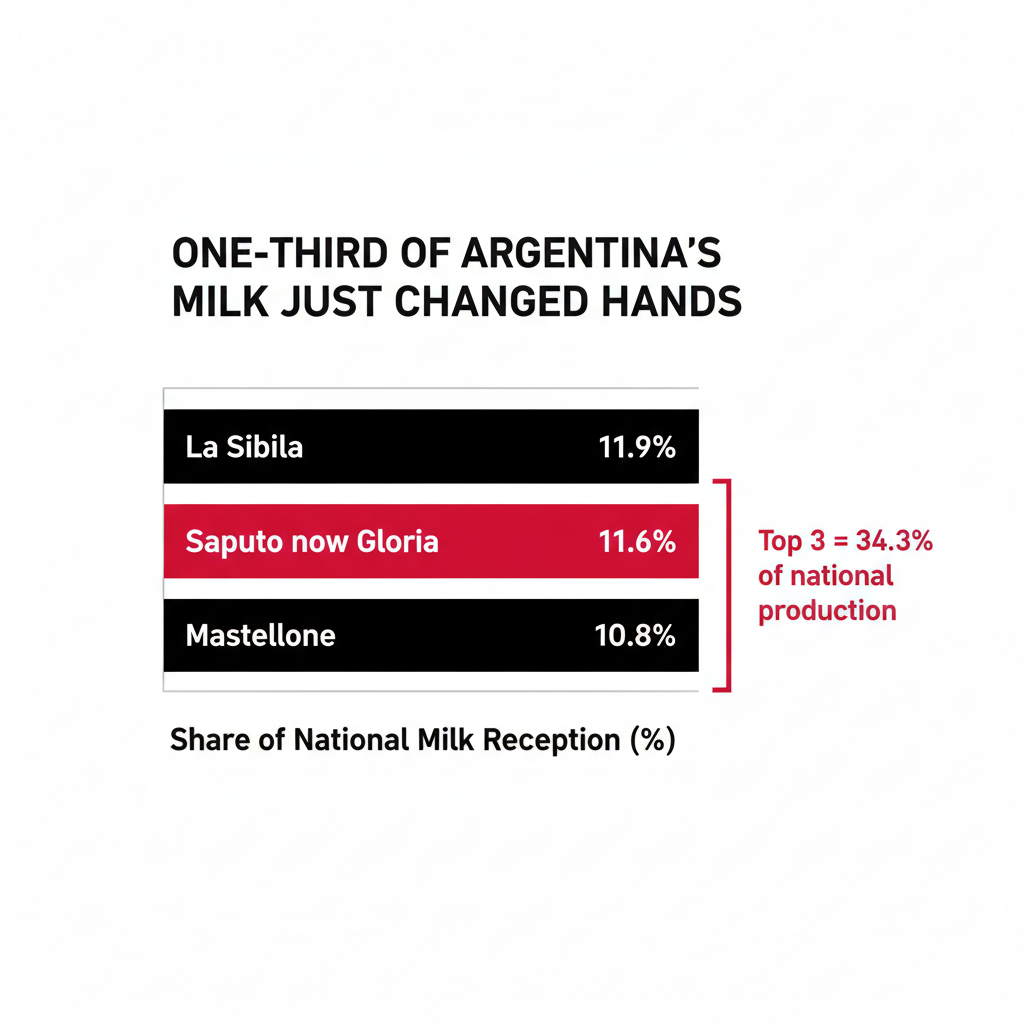
The OCLA 2023/24 industry ranking — based on reported and estimated daily milk reception by industrial processors, published annually — had Saputo processing an average of 3,650,288 liters per day, or 12.5% of national industrial milk volume. By the most recent OCLA 2024/25 ranking (published July 2025), that figure had dropped to 3.53 million liters daily, or 11.6% of the national total. Still number one, ahead of Mastellone (La Serenísima) at 3.15 million liters and 10.8%, but the decline hints at the pressures behind Saputo’s decision to sell. In the last four quarters, the Argentine operation generated approximately C$1.2 billion in revenue — about 7% of Saputo’s consolidated total.
When SanCor — once Argentina’s cooperative giant — entered a deep financial crisis beginning in 2017 (as SanCor put it in its February 2025 court filing), Saputo moved quickly. The company absorbed the freed-up milk supply and routinely offered prices better than competitors’. Producers followed the money. You would have too.
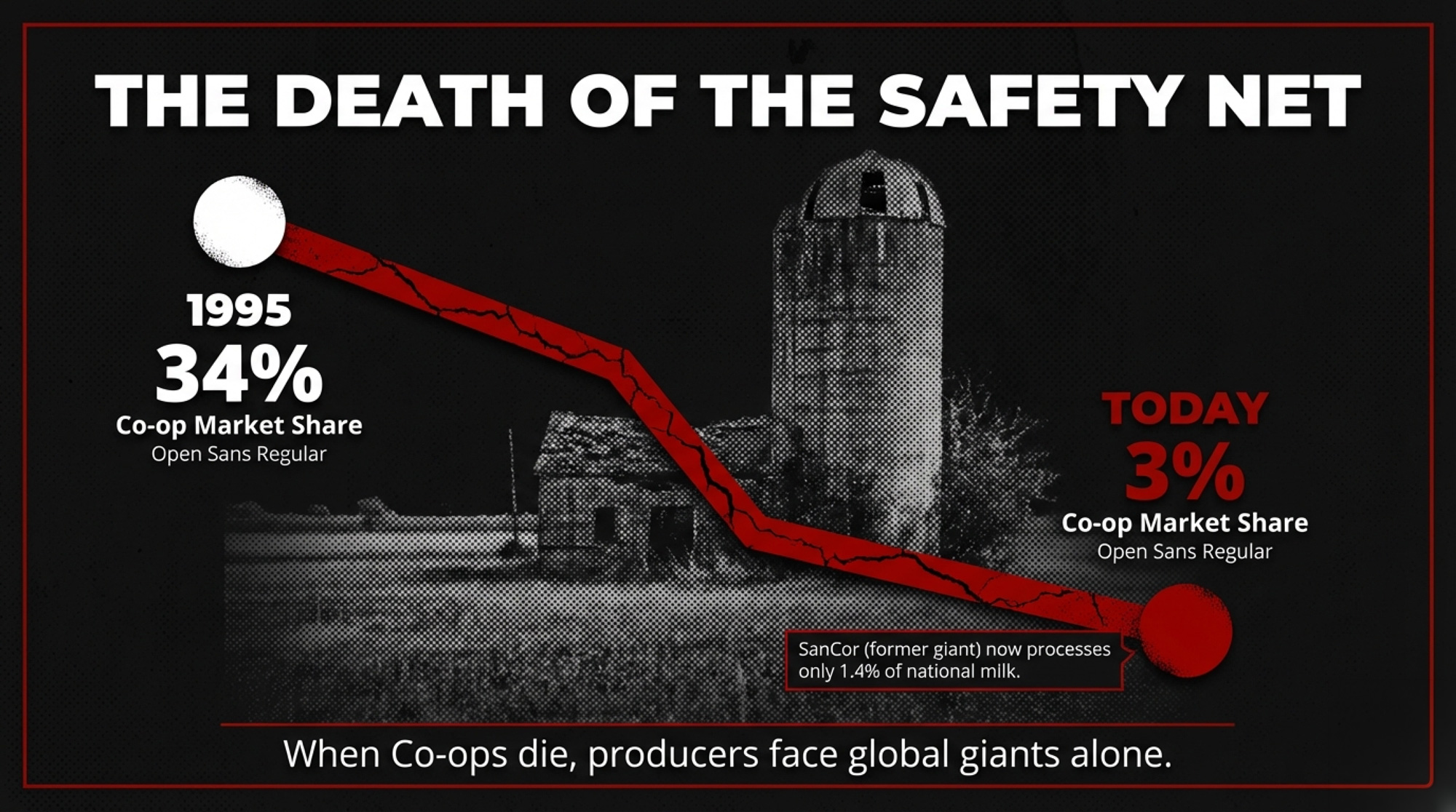
And then SanCor’s story got worse. On February 2, 2025 — just ten days before today’s Gloria announcement — SanCor formally filed for concurso preventivo de acreedores (creditor protection proceedings) at the Commercial Court in Rafaela, Santa Fe, carrying approximately US$400 million in debt. SanCor now processes just 409,163 liters daily, barely 1.4% of national production, down from its peak of 1.2 million. The region’s dairy infrastructure isn’t just shifting; it’s transforming. It’s being completely restructured.
Saputo’s dominance also created structural dependency. The practical effect was that Saputo’s price signals shaped the broader regional market — when the biggest buyer in the milkshed moved, everyone else followed. That arrangement works fine. Right up until the company at the center decides to leave.
CEO Carl Colizza’s press release language was corporate but clear: “This divestiture enhances our financial flexibility and supports targeted reinvestment in platforms that offer the highest growth opportunities.” Translation: take a roughly 12-fold return on a 23-year investment (US$630M enterprise value on a US$50.8M entry) and redeploy capital somewhere with fewer currency crises.
600 Families, No Advance Notice
Here’s what we know about how this landed on the ground. As of publication — hours after the announcement — there’s been no reported communication from Gloria Foods to Argentine producers. No new contract terms. No timeline for meetings. No word on whether existing payment schedules, quality premiums, or pickup logistics will change. Infocampo described the news as a “sacudón” — a jolt — to the Argentine dairy chain.
Several cooperatives sit squarely in Saputo’s milkshed. Cooperativa Tambera Central Unida in San Guillermo, Santa Fe — managed by Javier Clemente — delivers milk to five processing companies, including Saputo. Clemente has spoken publicly about producer autonomy in the region: “The one who decides where their production goes is the member, because the milk belongs to whoever produces it.” He made those remarks before the Gloria deal was announced. His cooperative is now directly affected, and whether that principle holds when a Peruvian conglomerate replaces a Canadian one is the question nobody can answer yet.
Cooperativa Agrícola Santa Rosa, also near San Guillermo and managed by Martín Guruceaga, works with approximately 60 farms across a 40-kilometer radius. Guruceaga has described the area simply as “una zona tambera” — a dairy zone where the community and the industry are one and the same. UNCOGA, a federation of nine cooperatives spanning central-west Santa Fe and central-east Córdoba, operates across the heart of Saputo’s collection territory.
These cooperatives are the closest thing to a collective voice that affected producers have. But the cooperative system itself has been hollowed out. Cooperative share of Argentine milk reception dropped from 34% in 1995 to roughly 3%today, according to the OCLA 2024/25 industry ranking. That means most of those 600-plus farms negotiate individually with their processor. When that processor changes without warning, individual leverage is essentially zero.
“The dairy sector and the country will only grow when the producer grows, because the producer is the one who carries the activity in their blood.” — Daniel Oggero, APLA executive committee, El Litoral, July 2015
Oggero made that statement during a blockade of Saputo’s Rafaela plant by western Santa Fe dairy farmers protesting milk price cuts. Those words land differently today, when the producer’s voice in the transaction was exactly zero.
Why Saputo Sold — And What Gloria’s Track Record Shows
Understanding both sides of this deal matters if you’re trying to figure out what comes next.
Why Saputo left: This isn’t a distressed sale. Through FY26, Saputo’s efficiency program has been delivering: Q1 operating cash flow hit C$317 million (up 66% year-over-year), adjusted EBITDA reached C$417 million (up 12.7%), and the company has been buying back shares aggressively. Saputo reported net losses of C$250 million through the nine months ended December 2024, driven largely by writedowns and hyperinflation accounting adjustments tied to Argentina — but the underlying business is profitable and improving. Saputo chose to leave. That tells you how the company views Argentine risk-reward going forward.
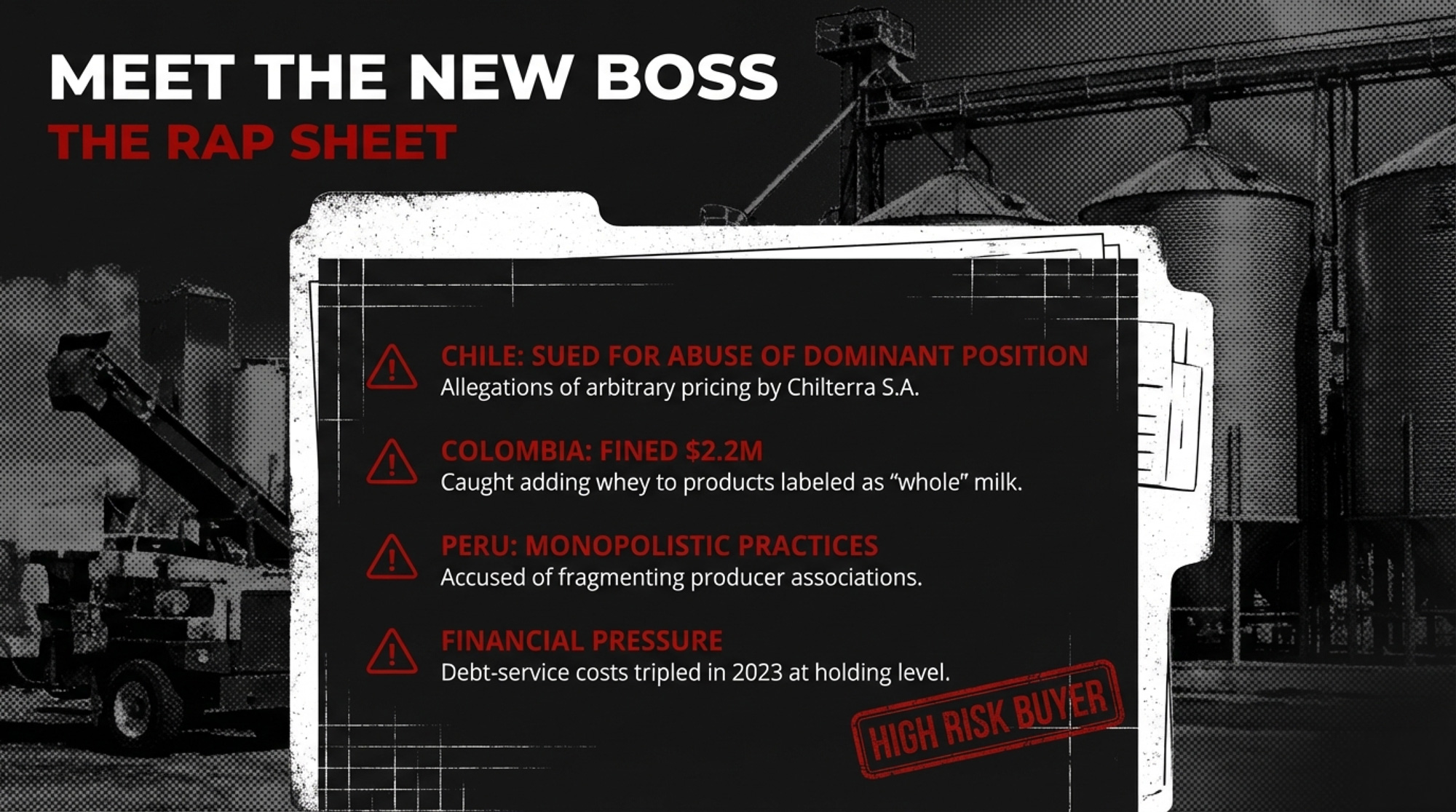
Who Gloria is: Gloria Foods is the dairy platform of Grupo Gloria, a Peruvian conglomerate with more than 7,000 employees across Peru, Chile, Bolivia, Argentina, Colombia, and Ecuador. President Claudio Rodriguez called the Saputo acquisition “a milestone within the strategy of sustained growth in Latin America.” The expansion has been rapid: Soprole in Chile from Fonterra for approximately US$644 million (completed April 2023), Ecuajugos from Nestlé in Ecuador (2024), and now Saputo Argentina.
But that growth has come with a trail of regulatory actions and producer-relations disputes. Not one-offs. A pattern across multiple countries.
In Peru, former AGALEP (national dairy farmers’ association) president Javier Valera publicly described Gloria’s market behavior as monopolistic. His successor, Nivia Vargas, accused the company of offering infrastructure only to larger-volume farms — deliberately fragmenting producer associations and undermining collective bargaining. Gloria has also fought a Peruvian government decree requiring evaporated milk be made from fresh milk. AGALEP leadership says that regulation underpins demand from an estimated 450,000 Peruvian dairy farmers.
In Chile, Gloria’s subsidiary Prolesur faces a lawsuit admitted by the national competition tribunal (TDLC) on January 30, 2025. Plaintiff Chilterra S.A. alleged abuse of dominant position, specifically that Prolesur imposed “unjustified prices through arbitrary and unverifiable criteria”—a system plaintiff Ricardo Ríos described as designed to create total producer dependence.
In Colombia, the Superintendencia de Industria y Comercio fined Gloria, along with Lactalis, Hacienda San Mateo, and Sabanalac in February 2025 for adding whey protein (lactosuero) to products labeled as whole pasteurized milk. The basis: INVIMA laboratory studies from 2019–2020 detected elevated caseinomacropeptide levels — a marker indicating whey protein had been added to a product labeled as pure milk. Gloria’s penalty was US$2.2 million. The company has appealed.
Country
Action / Dispute
Year
Status / Penalty
Peru
Former AGALEP president accused Gloria of monopolistic behavior; producers claim infrastructure access limited to large farms, fragmenting associations
Ongoing
No formal penalty; producer relations remain strained
Chile
Prolesur (Gloria subsidiary) sued for abuse of dominant position—”unjustified prices through arbitrary criteria” designed to create producer dependence
2025
Lawsuit admitted by TDLC competition tribunal Jan 2025; pending resolution
Colombia
Fined for adding whey protein to “whole” milk; INVIMA labs detected elevated caseinomacropeptide (adulteration marker)
2025
US$2.2 million fine; Gloria appealed
Puerto Rico
Exited market entirely after regulatory challenges made operations “unworkable”
2025–26
Complete market withdrawal
Gloria reports investing approximately S/718 million — roughly US$190 million (S/ refers to Peruvian soles) — between 2012 and 2023 in a farmer development program. That figure comes from Gloria itself and hasn’t been independently audited, but the investment claim is on the record. In Puerto Rico, the company exited the market entirely in 2025–2026 after what it described as regulatory challenges that made operations unworkable.
Does any of this predict what happens in Argentina? Not necessarily. Different market, different regulations, different competitive dynamics. But the holding-level financial picture adds context. Holding Alimentario del Perú reported net losses of S/124.9 million (roughly US$33 million) in 2023 and S/62.2 million (~US$16 million) through nine months of 2024, according to Peruvian securities filings. Financial expenses surged from S/123.7 million in 2022 to S/399.5 million in 2023. A company whose debt-service costs tripled in one year is under pressure, even if the core dairy business is profitable.
Nobody’s saying assume the worst. But you’d be wise to ask very specific questions before closing day.
What This Means for Your Operation
This section is about dairy processor risk — and it applies whether you’re milking cows in Córdoba or Ontario or Wisconsin.
Contract Protection
What It Does
Argentine Status
Your Action This Week
Ownership-change clause
Requires new buyer to honor existing contract terms or provides renegotiation window
Missing for most producers
Pull your supply agreement; search for “assignment,” “change of control,” or “transfer” clauses
Minimum notice period
Guarantees 30–90 days’ written notice before contract termination or major changes
Missing for most producers
Check termination section; if absent, negotiate 60-day minimum before any ownership transfer
Unknown—producers waiting for Gloria communication
Verify whether your agreement specifies payment continuity; if not, add it
Secondary buyer relationship
Diversifies risk by routing 10–30% of production to alternative processor
Not common in concentrated markets
Identify regional cheese makers or co-ops; formalize even small-volume backup contract
Collective bargaining vehicle
Cooperative or producer association negotiates on behalf of group
Exists (UNCOGA, cooperatives) but weakened by 3% co-op market share
Join or re-engage with local co-op; coordinate questions for new buyer through group
Regulatory review trigger
Large acquisitions require competition-authority approval, sometimes with producer-protection conditions
Pending—Argentine CNDC reviewing deal
Monitor CNDC decision; if conditions imposed, ensure enforcement mechanisms exist
If you’re in Saputo’s Argentine collection zone: Your contract is the document that matters now. Does it include an ownership-change clause? A minimum notice period? A payment guarantee? If yes, those terms should carry over. If not — or if you don’t have a written agreement at all — you’re negotiating from scratch with a company you’ve never dealt with. Contact your cooperative this week. The latest SIGLEA data (December 2025) shows Argentine farm-gate milk prices averaging AR$476.60 per liter — up only about 8% year-over-year in nominal terms, while costs have continued to rise, putting margins under pressure. Any disruption in payment terms during a processor transition hits harder when margins are already thin.
If you’re a North American Saputo supplier: This looks like an emerging-market exit, not a signal about Saputo’s core North American business. The company is investing in U.S. capacity and showing improving domestic margins. Your situation is structurally different. But the underlying lesson is universal — if your supply agreement doesn’t survive a processor sale, you’re carrying the same risk these Argentine families just discovered. You just haven’t been tested yet.
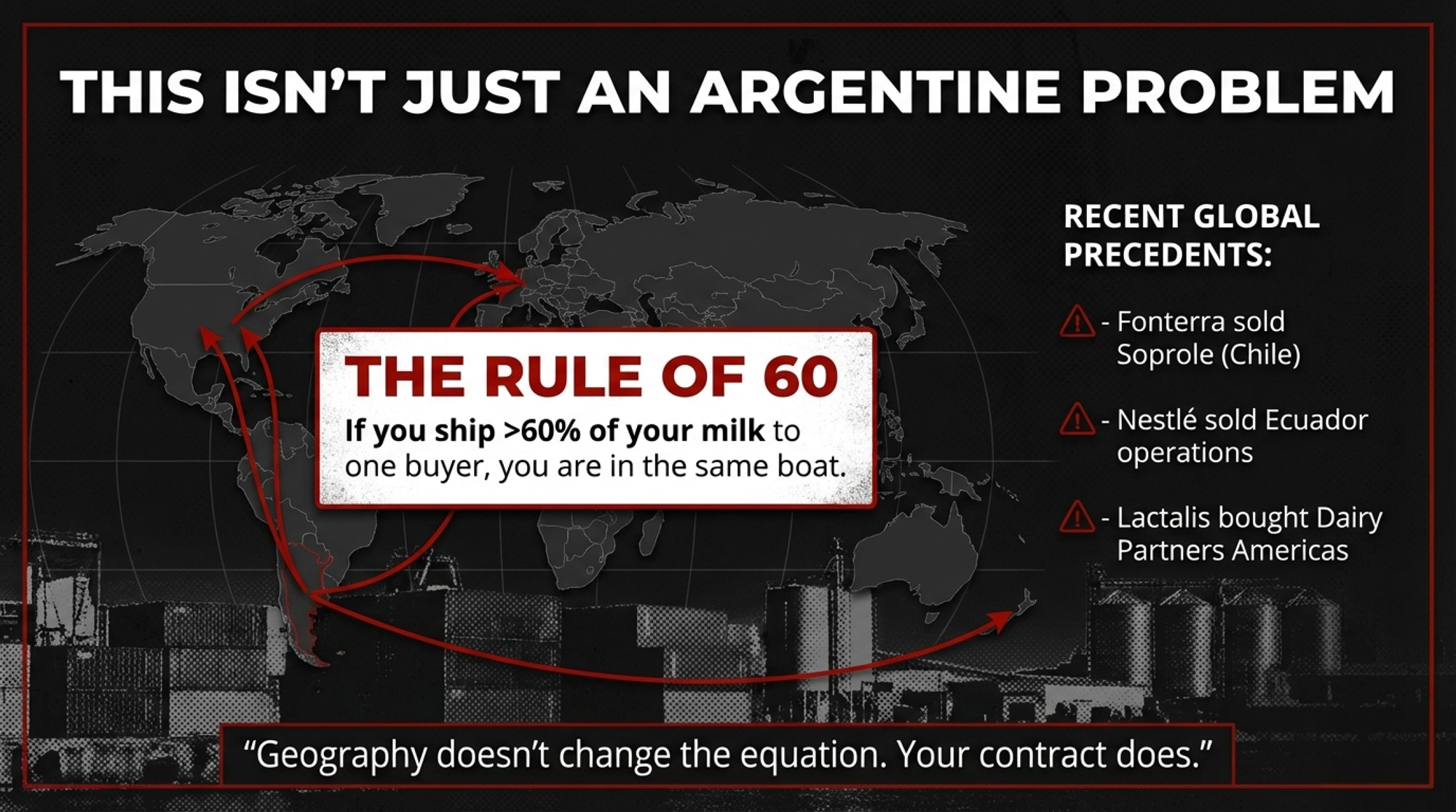
If you sell to any dominant processor, anywhere: Here’s the math that matters. If one company handles more than 60% of your milk and your agreement has no ownership-change clause, you’re structurally identical to those 600 Argentine families. Geography doesn’t change that equation. What changes it is your contract.
The trend behind this deal — processor consolidation reshaping producer relationships globally — isn’t slowing down. In the past three years, Fonterra sold Soprole to Gloria, Nestlé sold Ecuador operations to Gloria, Savencia acquired Williner in Argentina, and Lactalis bought Dairy Partners Americas. Every transaction meant producers discovering, after the fact, that their buyer had changed.
Four Moves Before Closing Day
1. Pull your supply agreement and read it this week. Look for three things: the termination notice period, the ownership-change transfer provision, and the payment guarantee. If any are missing, that’s your negotiating priority before the new owner takes over. Not after.
2. Engage through your cooperative — and accept the trade-off. UNCOGA, Productores Unidos de Rafaela, and the San Guillermo cooperatives are the existing vehicles for collective action. A unified set of questions to Gloria about contracts, payment terms, and collection schedules carries more weight than 600 separate phone calls. Yes, coordinated engagement could be perceived as adversarial before the relationship starts. Move forward anyway. Silence is worse than friction.
3. Explore a second buyer relationship. Around Córdoba and Santa Fe, small and medium cheese makers (PyMEs queseras) have historically offered competitive raw-milk prices. Diversifying even a portion of production reduces concentration risk. The trade-off is real: approaching alternative buyers pre-closing could signal distrust to Gloria, and logistics with smaller processors are more complex. But having options is always the right strategy. And here’s your trigger — if Gloria hasn’t communicated directly with producers within 60 days of closing, that’s your signal to formalize a secondary buyer relationship. Not explore one. Formalize it.
4. Watch Gloria’s first 90 days after closing. Do they communicate directly with producers? Honor existing terms? Provide timeline certainty? Those are positive signals. Prolonged silence — producers still waiting for a phone call weeks after operational control transfers — tells a different story. What Gloria actually does will matter more than anything in a press release.
Three Signals Between Now and Mid-2026
Argentine regulatory review. This deal requires approval from Argentine authorities. At 11.6% of the national industrial milk volume, the competition authority (CNDC) could attach conditions. Any requirements imposed on Gloria regarding producer terms or pricing would be of enormous importance.
Gloria’s outreach to producers. The single most revealing signal. The company knows 600-plus families are waiting. Whether Gloria reaches out proactively or waits for producers to come to them will tell you which version of Gloria is showing up in Argentina.
Payment performance. SIGLEA reported Argentine farm-gate milk prices at AR$476.60 per liter in December 2025 — up only about 8% year-over-year in nominal terms, while production costs have continued climbing, according to OCLA. Gloria’s ability and willingness to maintain competitive pricing after closing will be the metric that matters most to every producer in the collection zone. Everything else is words on paper.
The broader context here — what processor consolidation means for producer survival — was one of the defining themes of 2025 dairy coverage.
Your Processor Risk Checklist
Audit your contract this week. No ownership-change clause, no defined termination notice, no payment guarantee means you’re carrying processor risk whether you’re in Córdoba or Ontario, or Wisconsin.
Know your single-buyer number. Over 60% of your milk to one processor without contractual protections? You’re in the same structural position as those Argentine families. The difference is timing — you can fix it before the press release drops.
Research your processor’s parent company. Financial pressure at the holding level — like debt-service costs tripling in a year — eventually filters down to producer terms. This applies to your processor too.
Don’t wait for the phone call. If you’re in Saputo’s Argentine collection zone: contact UNCOGA, your regional cooperative, or APLA (headquartered in Suardi, Santa Fe) this week. Ask collectively about contract continuity, payment schedules, and collection logistics. A coordinated ask is harder to ignore.
For North American Saputo suppliers wondering if you’re next: The evidence points to an emerging-market exit driven by Argentine macro conditions, not a systemic pullback. Saputo’s domestic numbers are moving in the right direction. But read your contract. Know what survives a sale.
If you know Argentine producers, share this. If you’ve toured dairy operations in Santa Fe or met producers from the Rafaela corridor at genetics events, connect them with this information. The more that circulates, the better everyone’s decisions get.
The Bottom Line
Guruceaga calls his part of Santa Fe “una zona tambera.” A dairy zone. It sounds simple until you sit with what it means: the cows and the community are the same thing. When the processor changes, the community changes with it.
The hardest part of what happened today isn’t the deal. It’s the sequence. A press release in Montreal. A wire story picked up in Lima. A notification on a phone in a milking parlor somewhere between Rafaela and Tío Pujio. And then the question that 600-plus families are asking right now — the same question every producer who depends on a single buyer should be asking before their turn comes:
Does my contract survive this?
If you don’t know the answer, you already know what to do this week.
Key Takeaways
Saputo is selling 80% of its Argentine dairy division to Gloria Foods for a C$855 million (≈US$630 million) enterprise value, keeping a 20% minority stake.
That puts Argentina’s largest processor — 11.6% of industrial milk and collections from 600‑plus farms — in the hands of a buyer that’s been sued for abuse of dominance in Chile, fined in Colombia over adulterated “whole” milk, and accused of monopolistic behavior in Peru.
Farmers supplying Saputo’s Rafaela and Tío Pujio plants learned of the sale from the media, not from their processor, and, as of today, have no firm answer on whether Gloria will honor their current contracts, prices, or pickup schedules.
With SanCor in creditor protection and co‑ops’ share of Argentina’s milk shrinking from roughly 34% to about 3%, most producers are now highly dependent on a single buyer when decisions like this drop.
If more than 60% of your milk goes to one processor and your contract is silent on ownership changes, you’re carrying the same processor‑risk those 600 Argentine families just discovered — and you should be auditing that agreement this week, before your own “press‑release moment” arrives.
Complete references and supporting documentation are available upon request by contacting the editorial team at editor@thebullvine.com.
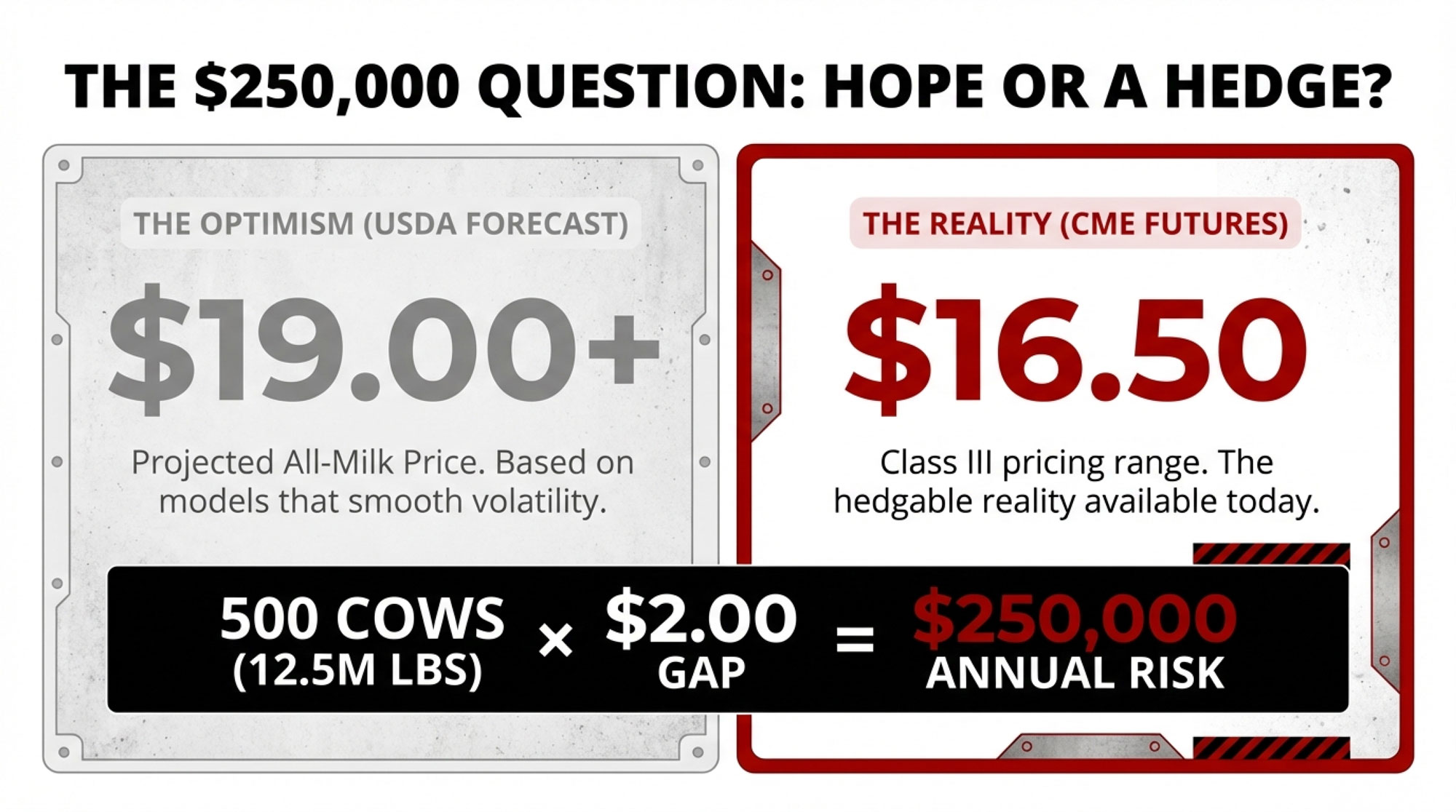
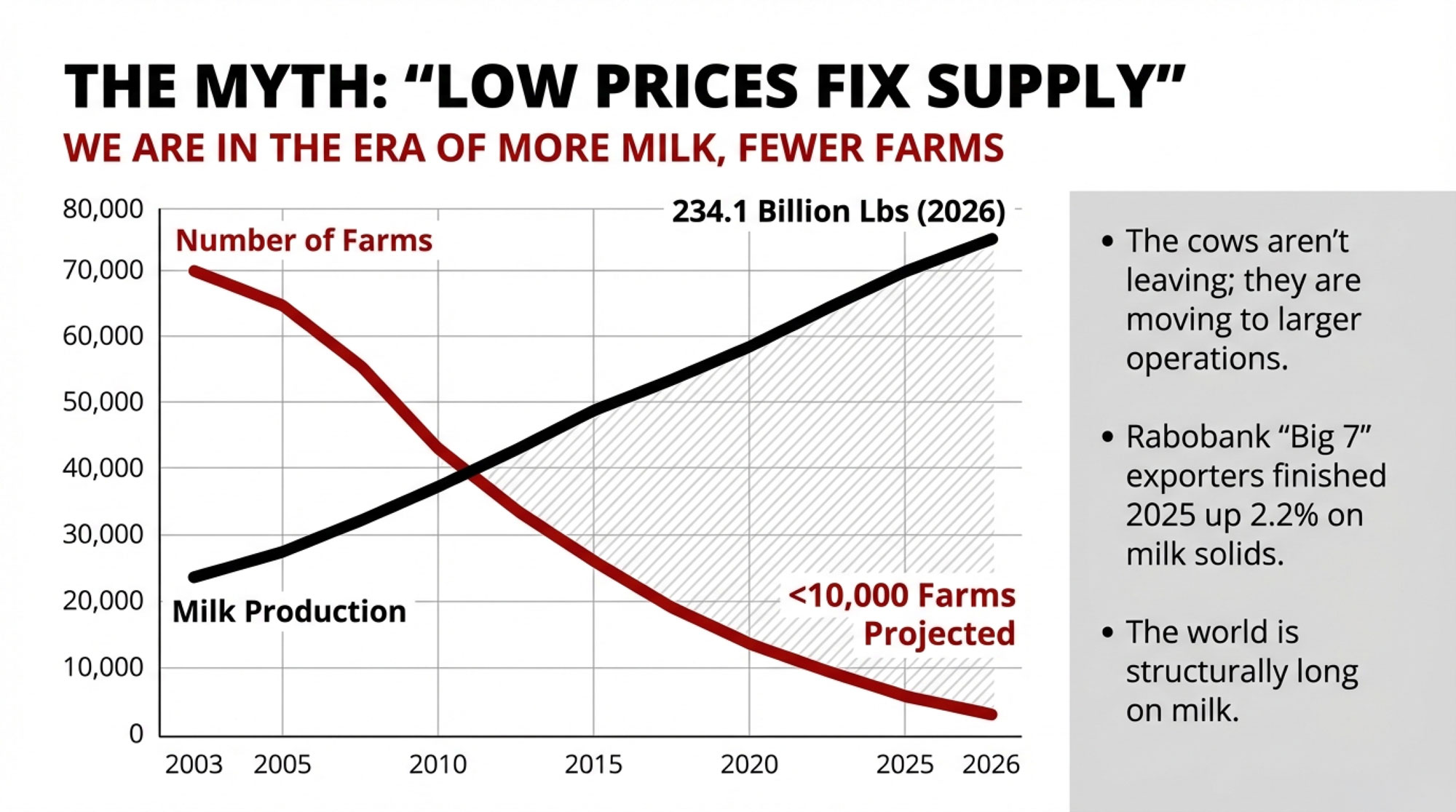
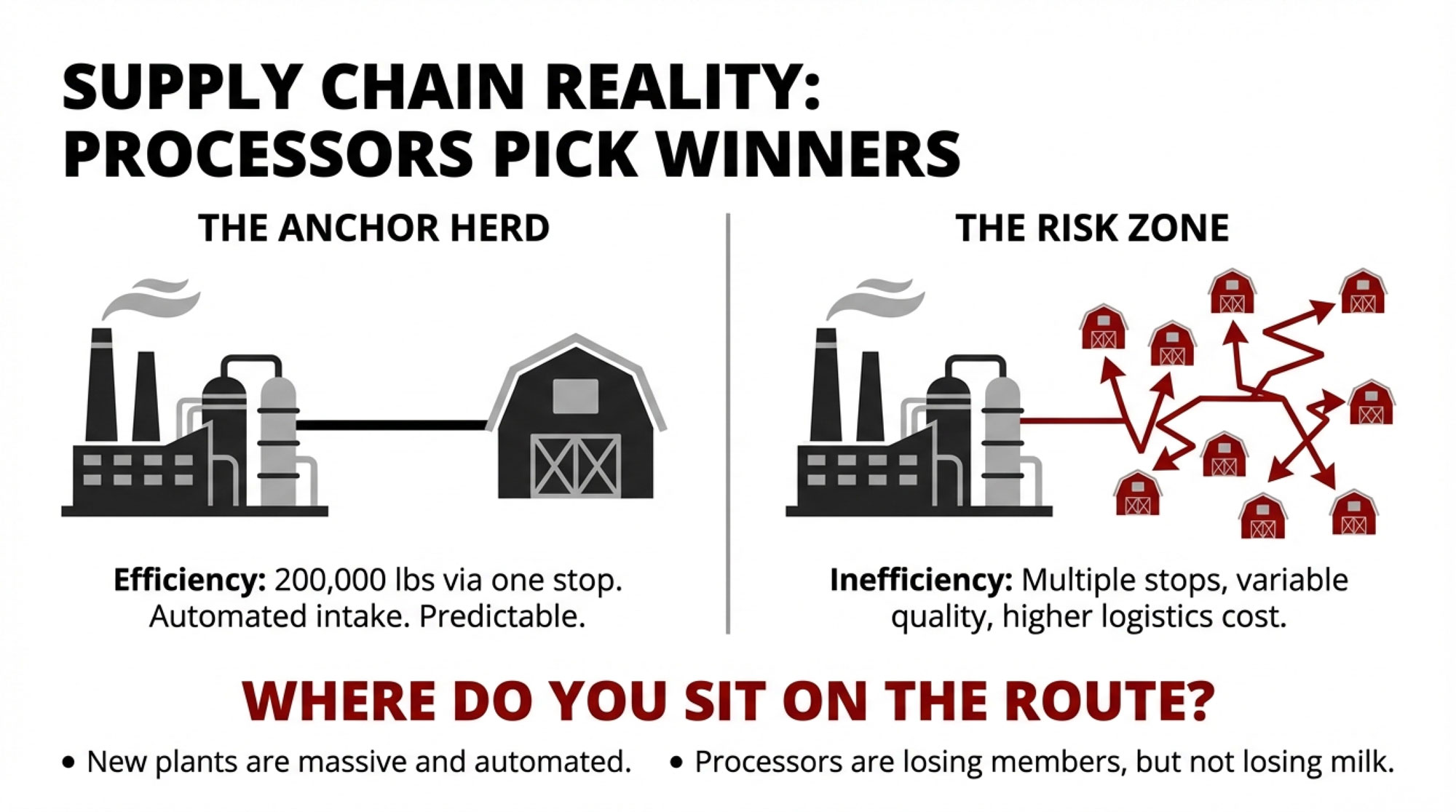
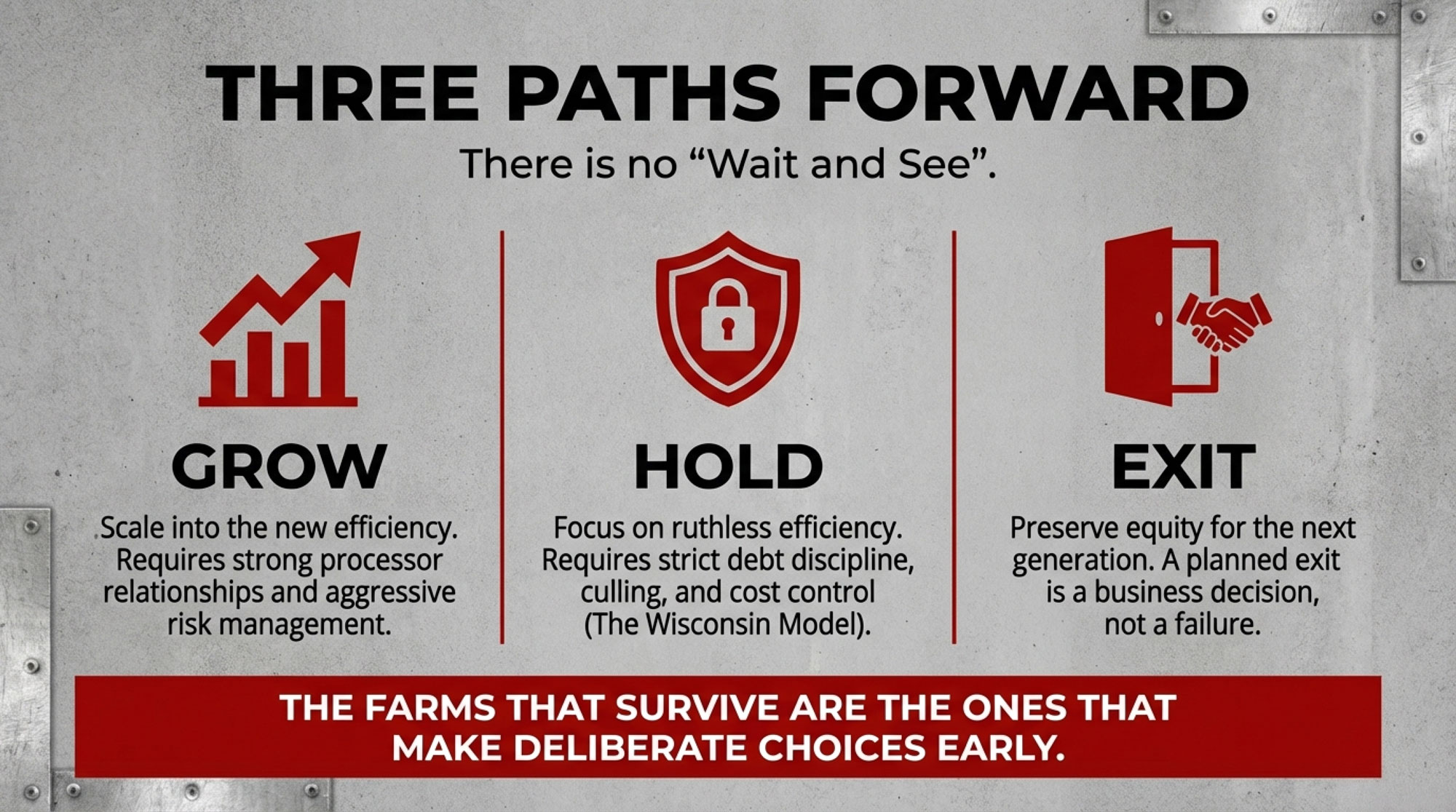
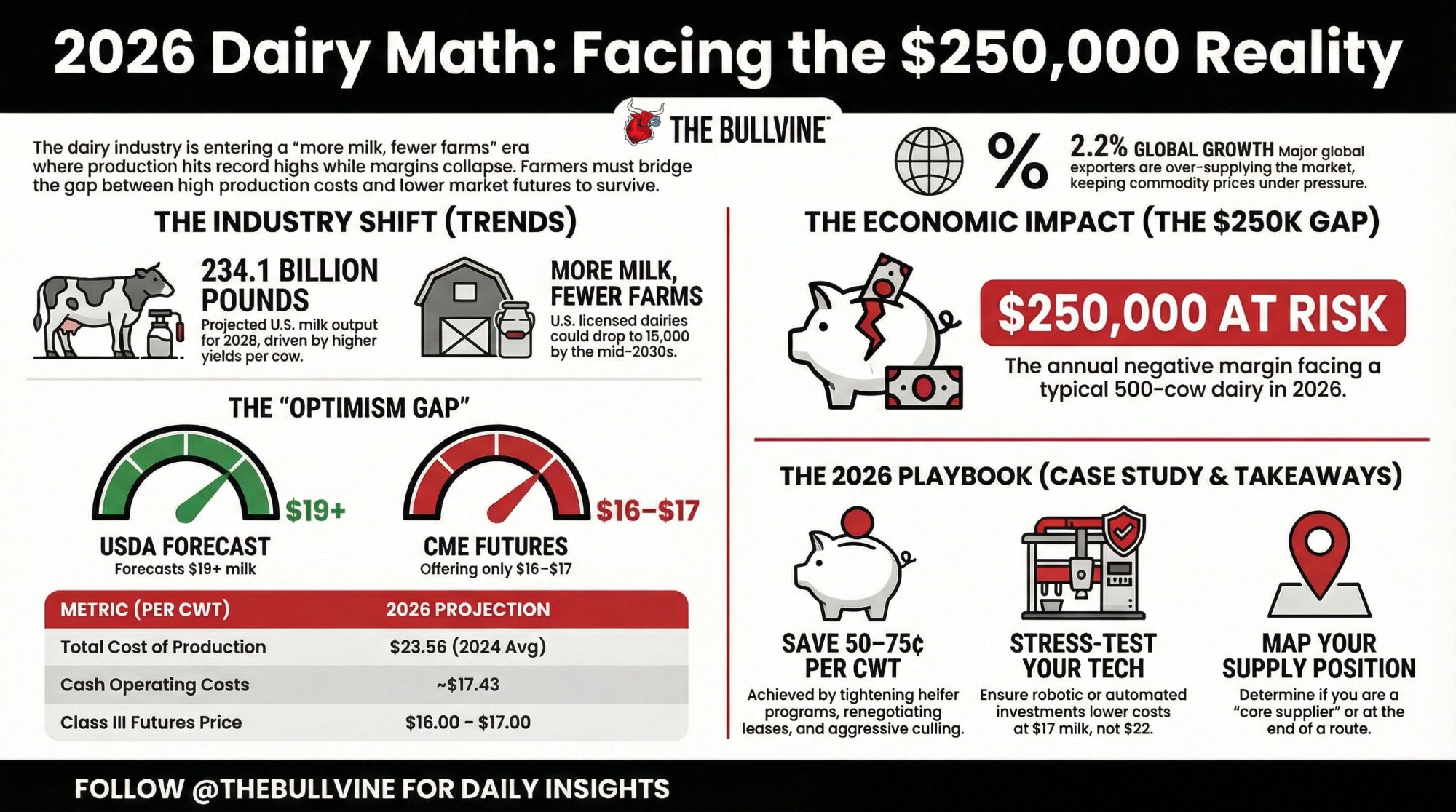
More Milk, Fewer Farms, $250K at Risk: The 2026 Numbers Every Dairy Needs to Run – Exposes the $250,000 annual margin gap facing mid-sized dairies and reveals how to position your operation for 2026’s “more milk, fewer farms” reality. This strategic analysis identifies the specific leverage points needed to survive increasing processor consolidation.
Join over 30,000 successful dairy professionals who rely on Bullvine Weekly for their competitive edge. Delivered directly to your inbox each week, our exclusive industry insights help you make smarter decisions while saving precious hours every week. Never miss critical updates on milk production trends, breakthrough technologies, and profit-boosting strategies that top producers are already implementing. Subscribe now to transform your dairy operation’s efficiency and profitability—your future success is just one click away.
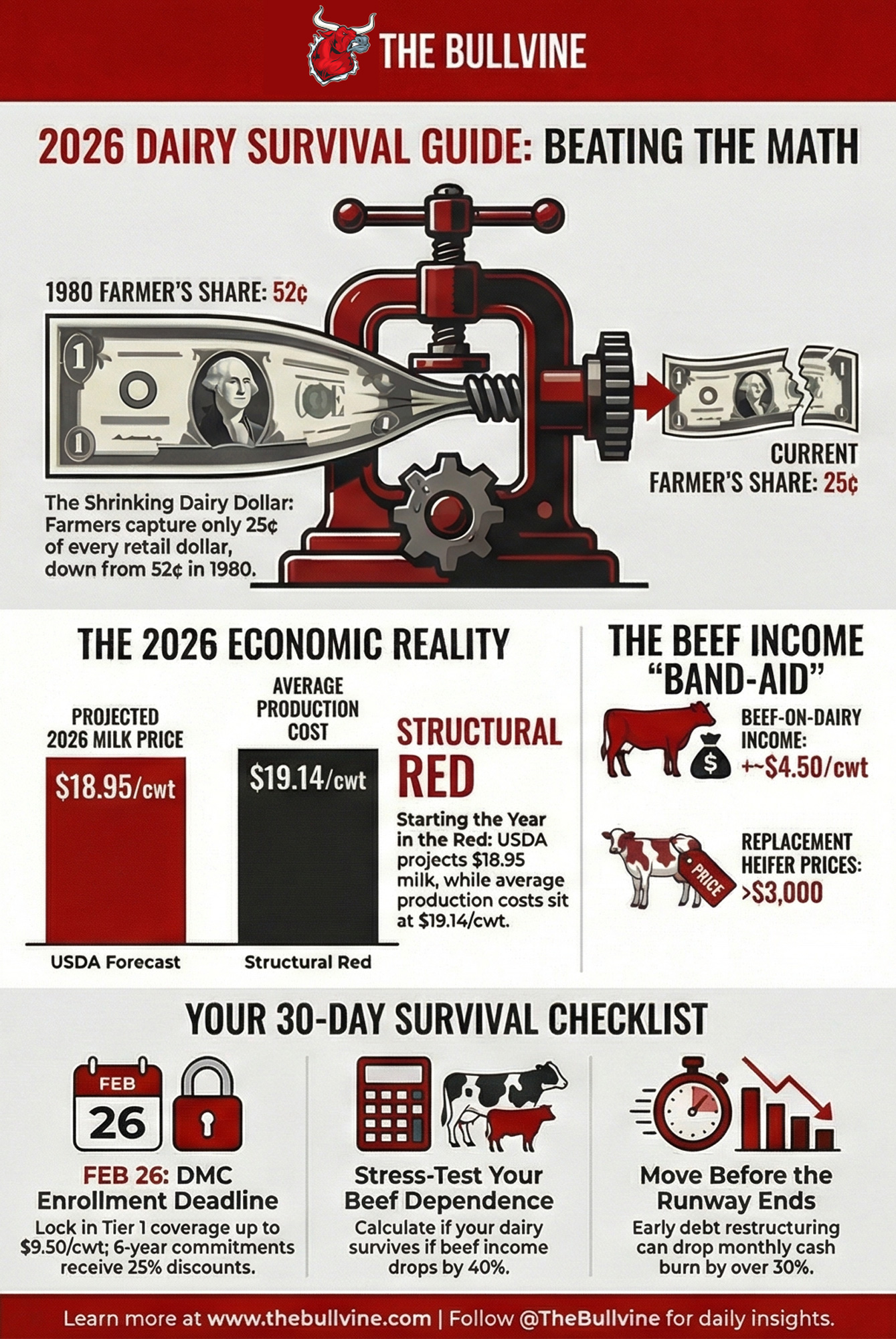
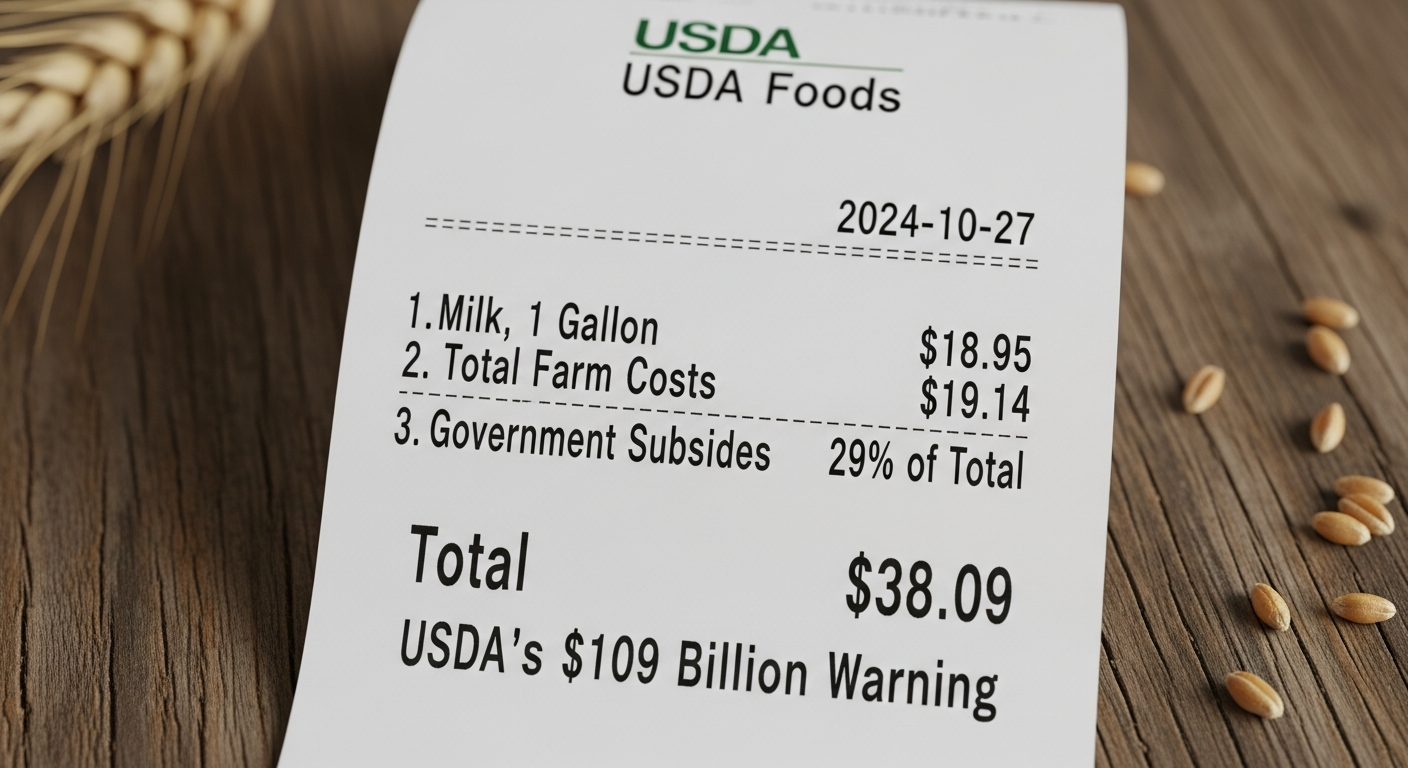
USDA says 2026 milk is $18.95. ERS says your costs are $19.14. That’s not a forecast — that’s a loss locked into the dairy math.
Executive Summary: USDA’s February WASDE now projects $18.95/cwt all‑milk for 2026, but ERS cost‑of‑production numbers still put average 2,000‑plus cow herds at $19.14/cwt and the smallest herds near $42.70/cwt, so a lot of dairies are starting the year structurally in the red. January’s actual Class III check at $14.59/cwt explains why your cash flow feels even tighter than the forecast suggests. At retail, a gallon of whole milk still sits around $4.05, with farmers getting only 25¢ of the dairy dollar and an opaque $2.40–$2.80 slice going to processing and retail that the Gillibrand‑Collins Fair Milk Pricing for Farmers Act tries to drag into the light. For many herds, beef‑on‑dairy calf and cull checks worth about $4.50/cwt are what plug the hole, even as they drain the replacement pipeline and push heifer prices over $3,000/head. The article uses a 550‑cow Wisconsin dairy to show how an honest cost‑of‑production run, fast culling decisions, and debt restructuring turned an 11‑week runway into something survivable. Then it hands you a four‑lane playbook — tighten components, lock in DMC/DRP, get in front of your lender, or consider exiting while asset values hold — with clear thresholds and stress‑tests so you can see, in dollars, which path actually fits your operation.
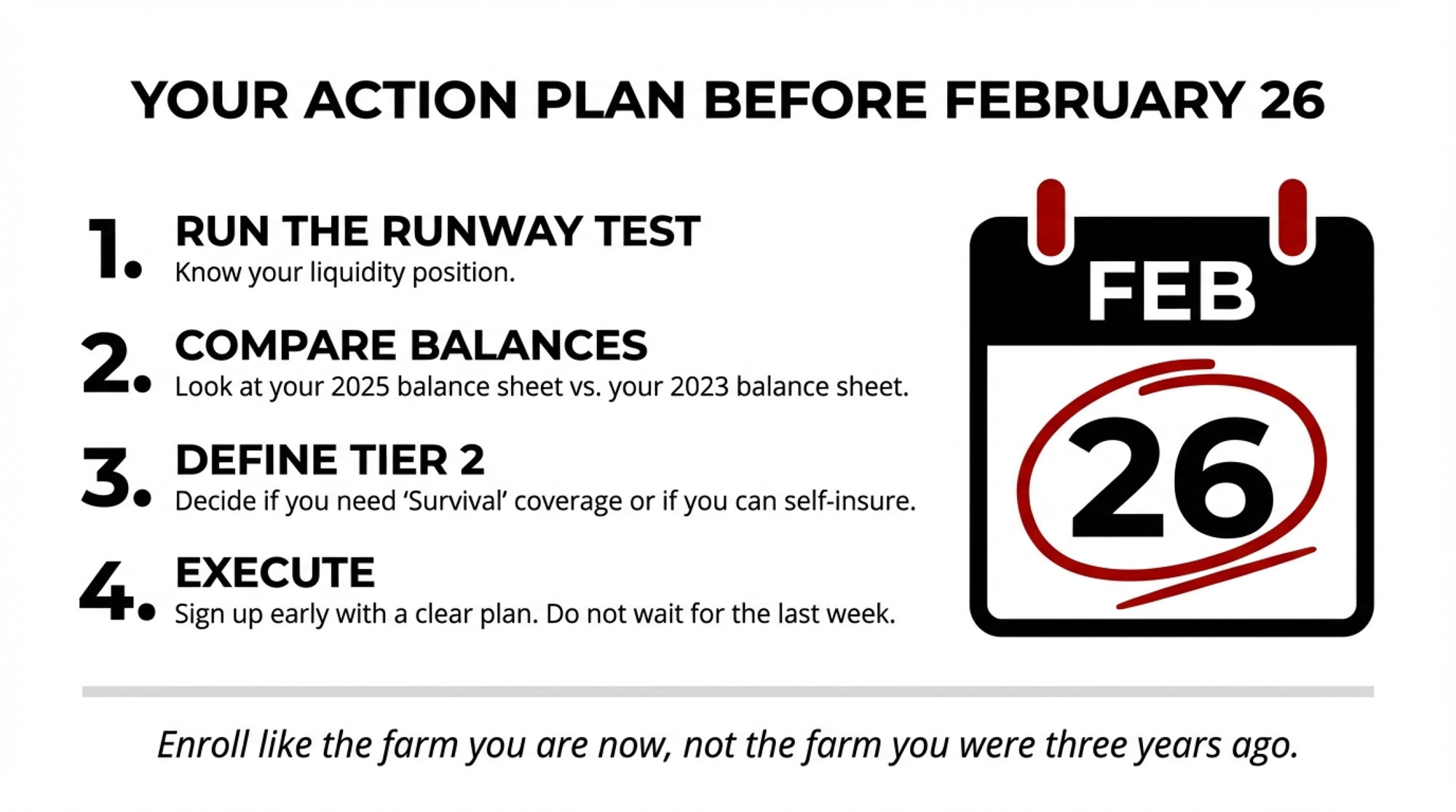
⚠️ DMC ENROLLMENT CLOSES FEBRUARY 26 — 15 DAYS FROM TODAY Tier 1 coverage is now available up to 6 million pounds at $9.50/cwt. A six‑year commitment (2026–2031) under the One Big Beautiful Bill Act (OBBBA) cuts your premiums by 25%. That cap covers roughly a 270‑cow herd at 22,000 lbs/cow. If you’re eligible and not enrolled yet, you’re on the clock. Source: USDA Farm Service Agency, Secretary Rollins’ Jan. 12 announcement, farms.com, and Penn State/Extension enrollment summaries.
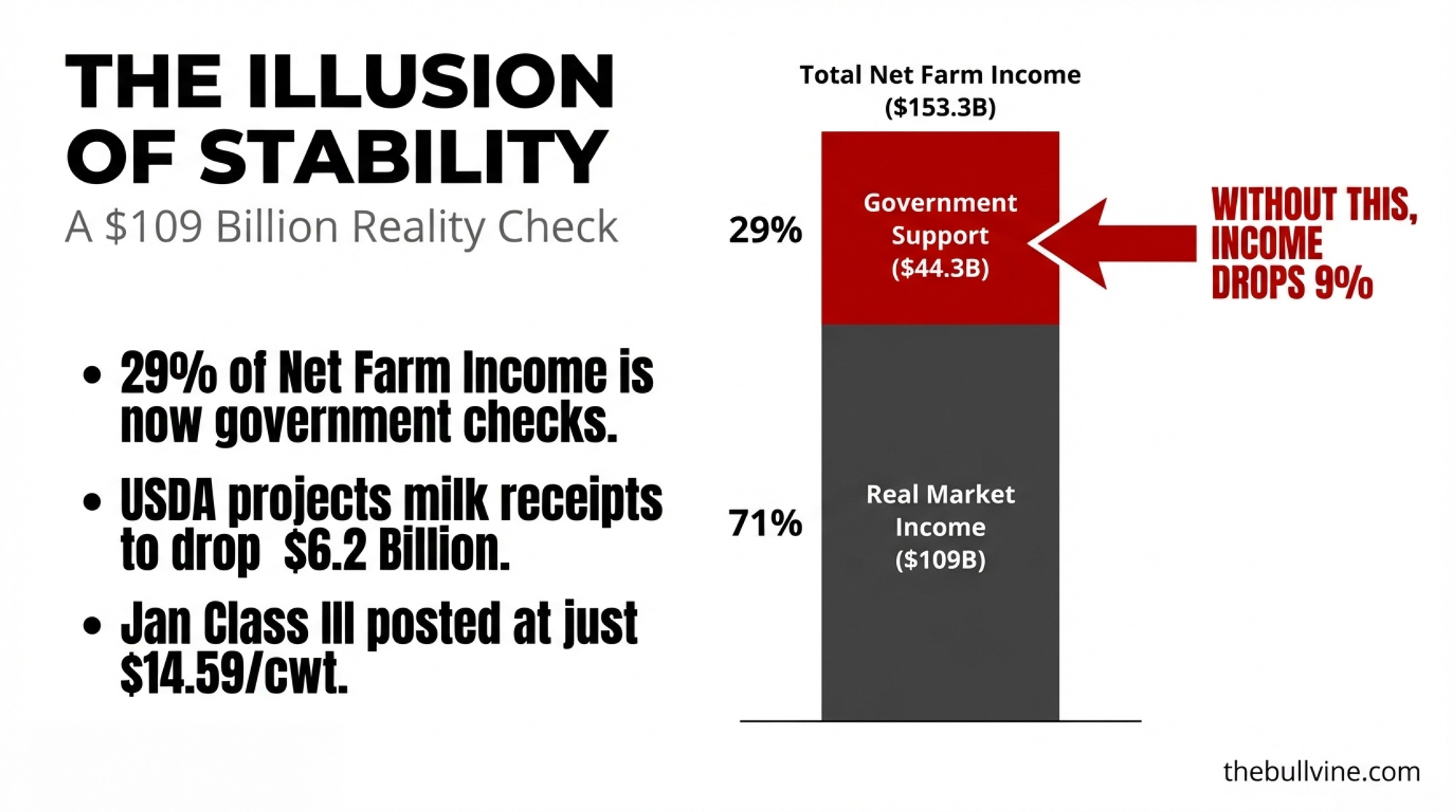
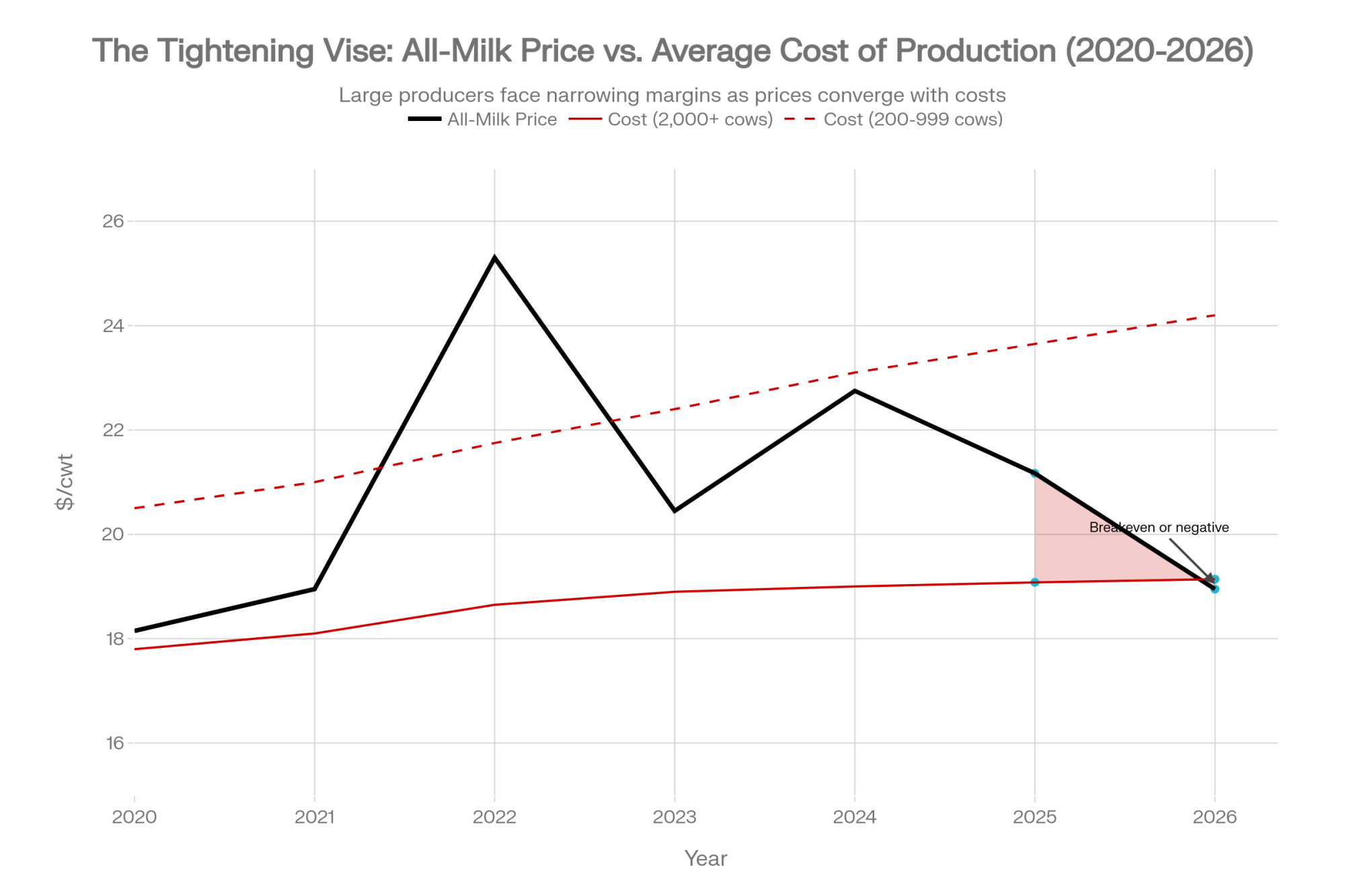
USDA’s February 10 WASDE briefing shows the 2026 all‑milk price at $18.95/cwt, down $2.22/cwt from the revised 2025 average of $21.17/cwt. That’s roughly $153,000 in lost gross milk revenue for a 300‑cow herd shipping 69,000 cwt a year. The same USDA‑ERS data behind that WASDE also say this: on a full‑cost basis, even the biggest, “efficient” herds average 19¢/cwt above the new all‑milk price, while sub‑50‑cow herds sit more than $23/cwt higher than that $18.95.
The $4.05 Gallon and the Broken Price Signal
Here’s the number that should make you stop and stare for a second.
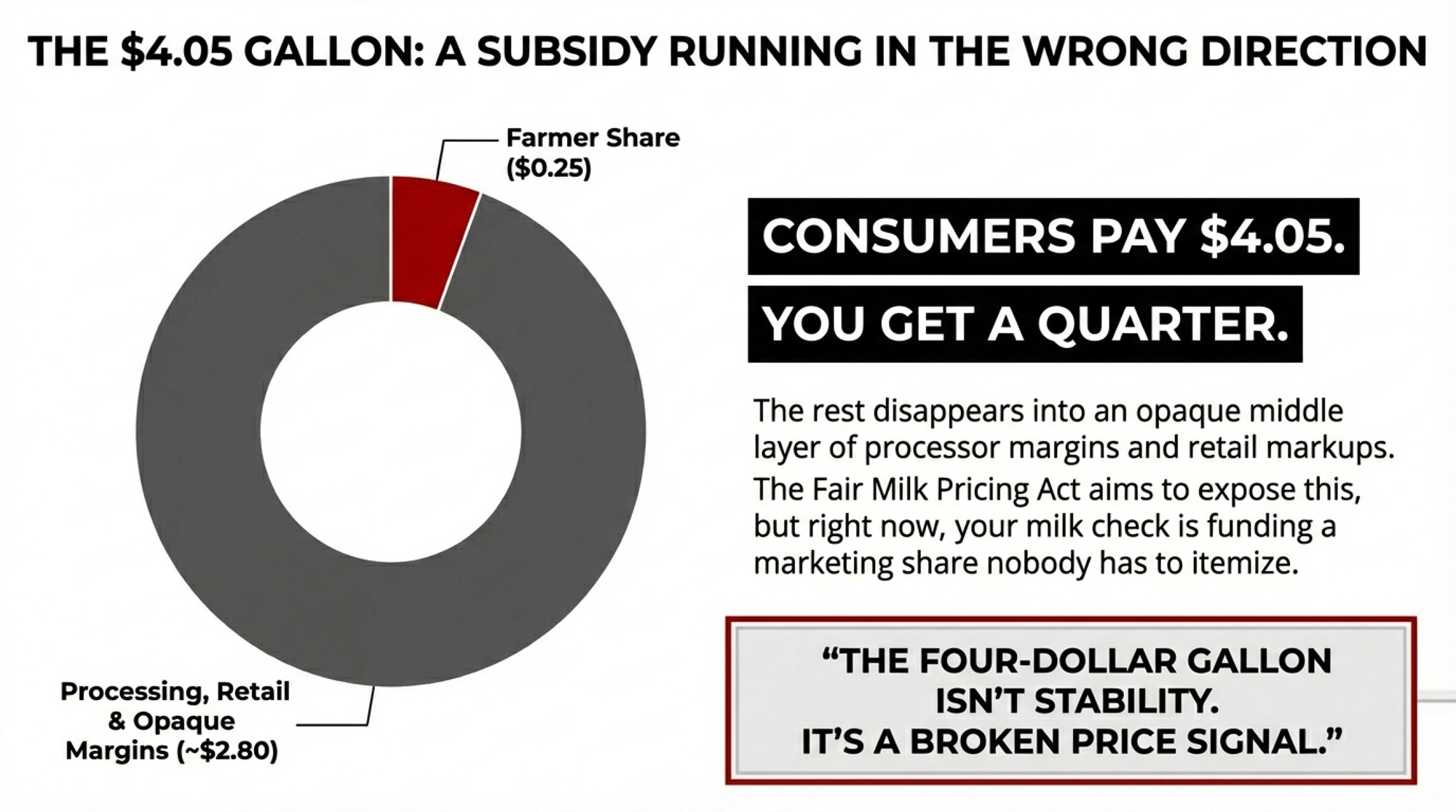
The national average price of a gallon of whole milk in December 2025 was $4.05, essentially unchanged from four years earlier. Over that same period, food‑at‑home prices climbed about 23%, according to BLS CPI data. Eggs jumped. Beef jumped. Milk stayed pinned. Consumers got a better deal on your product than on almost anything else in the grocery store.
USDA’s Economic Research Service tracks how that retail dollar gets split. In 2024, dairy farmers captured 25¢ of every retail dairy dollar, up a bit from 23¢ in 2023 but down from 28¢ in 2022. Back in 1980, the farm share sat near 52¢; by 1999, it was around 32¢. For fluid milk specifically, ERS pegs the 2024 farm share at 49%. With the 2026 all‑milk forecast now at $18.95, that share is drifting toward the low 40s.
Here’s how your slice of that $4.05 gallon changes at three price points:
Your share of the $4.05 gallon (fluid milk)
Price Scenario
Farm Value per Gallon
Your Share
Goes to Processing & Retail
2025 all-milk avg ($21.17/cwt)
$1.82
44.9%
$2.23
2026 all-milk forecast ($18.95/cwt)
$1.63
40.2%
$2.42
Jan 2026 Class III actual ($14.59/cwt)*
$1.25
31.0%
$2.80
*Class III is always lower than the all‑milk blend, which includes Class I & II. January’s all‑milk will be higher than $14.59, but the direction is the same. Farm values converted at 1 gallon ≈ 8.6 lbs; all‑milk and Class III from USDA WASDE/AMS, retail from BLS.
That bottom row is the punch in the gut. At January’s actual Class III, $2.80 of every $4.05 gallon goes to processing and retail. And here’s the part that should bother you: ERS only tells you the farm share versus “marketing share” — it doesn’t break that $2.80 into processor margins, retail markups, transportation, or packaging. It’s one big opaque slice.
2025 will be remembered as a year of “margin capture through arbitrage in the middle of the supply chain. Dairy markets worked—just not for dairy farmers. Senators Kirsten Gillibrand (D‑NY) and Susan Collins (R‑ME) responded by introducing the Fair Milk Pricing for Farmers Act (S.581) in February 2025, which would require audited dairy processor cost surveys every two years under the Agricultural Marketing Act of 1946. Until something like that passes, your milk check is funding a mid‑chain marketing share nobody has to itemize.
That’s not a neutral market adjustment. It’s a price discovery system that keeps the shelf price stable, preserves every margin between your bulk tank and the dairy case, and hands the entire “flex” to your end of the deal. The four‑dollar gallon isn’t stability. It’s a subsidy running in the wrong direction.
The 234.5‑Billion‑Pound Elephant in the Room
So if the money’s not showing up in your milk check, where is all this milk coming from?
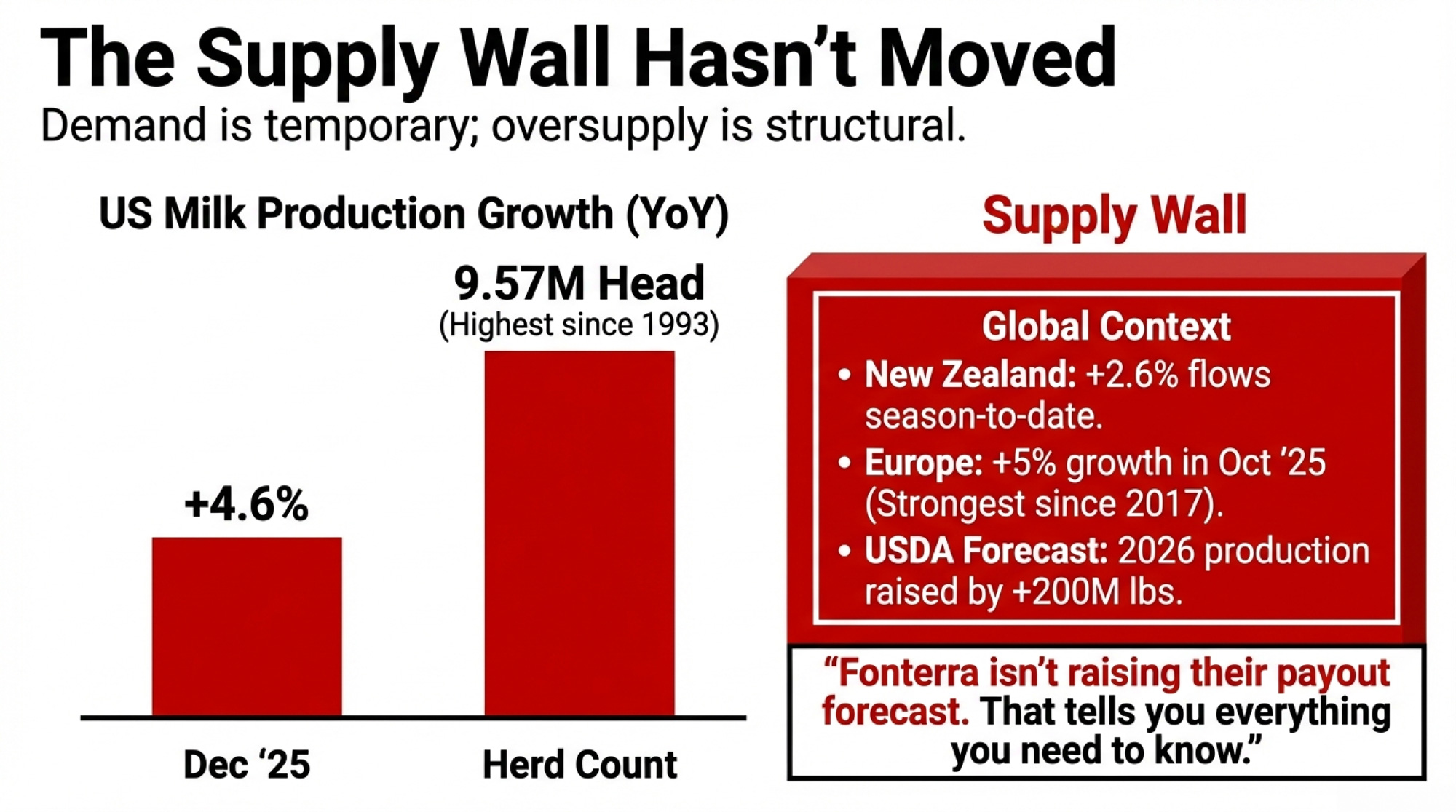
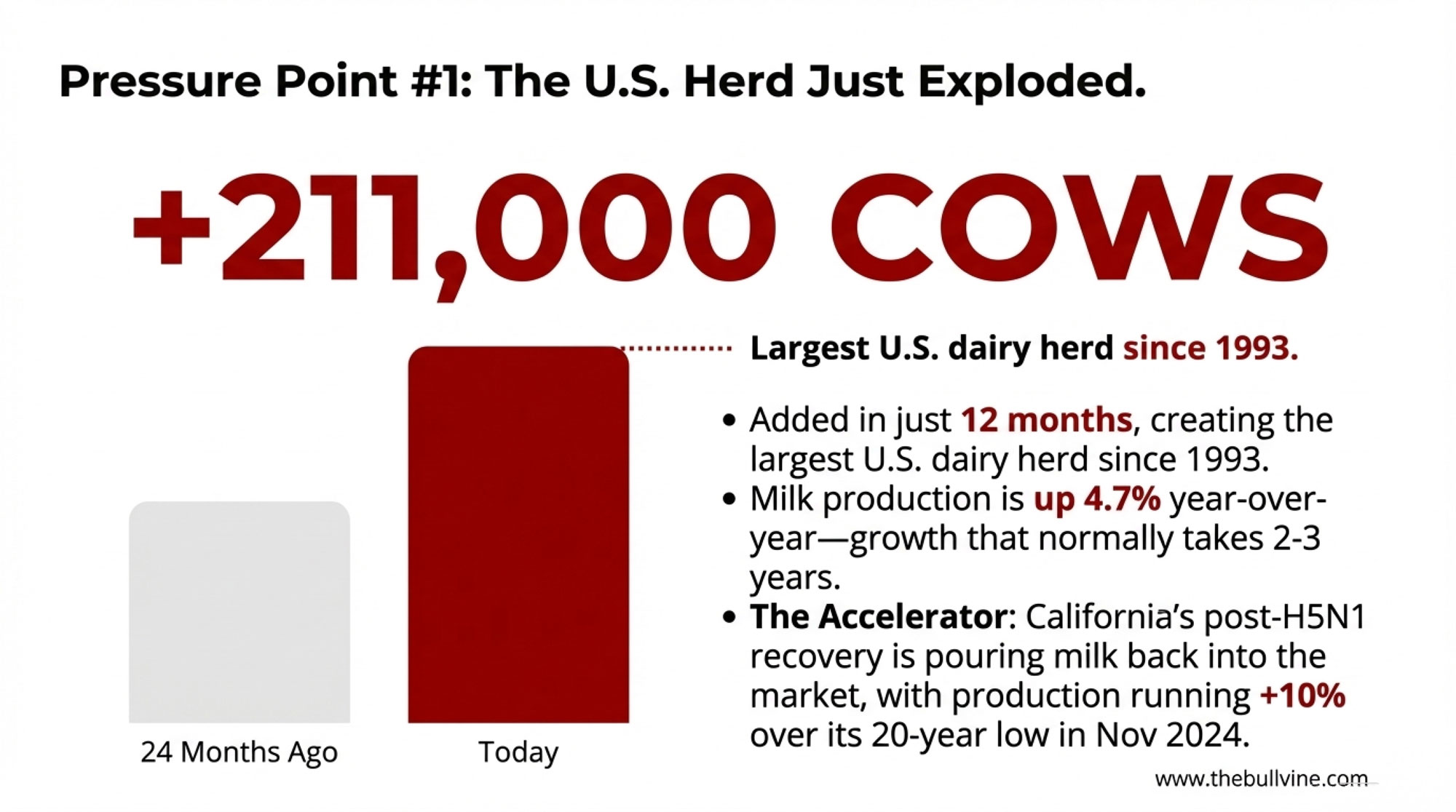
USDA’s January Livestock, Dairy, and Poultry Outlook had 2026 milk output at 234.3 billion pounds on 9.555 million head, averaging 24,520 lbs/cow. The February WASDE nudged that up to 234.5 billion pounds, citing a slightly larger herd and continued productivity gains. November 2025 production was already running 4.5% above the prior year, with 211,000 more cows on feed and per‑cow output up 2.1%.
On the consumer side, that $4.05 national average hides a range from roughly $3.50/gallon in parts of the Midwest to more than $4.80 in some Northeast urban markets. The 2022 annual average peaked closer to $4.20 after mid‑year spikes above $4.30, then slid back and basically flat‑lined. And as we outlined in “USDA Says $18, Futures Say $16: The $150K Gap That’s Rewriting 2026 Dairy Budgets,” spot and futures markets have consistently priced a weaker Class III than USDA’s annual averages suggest.
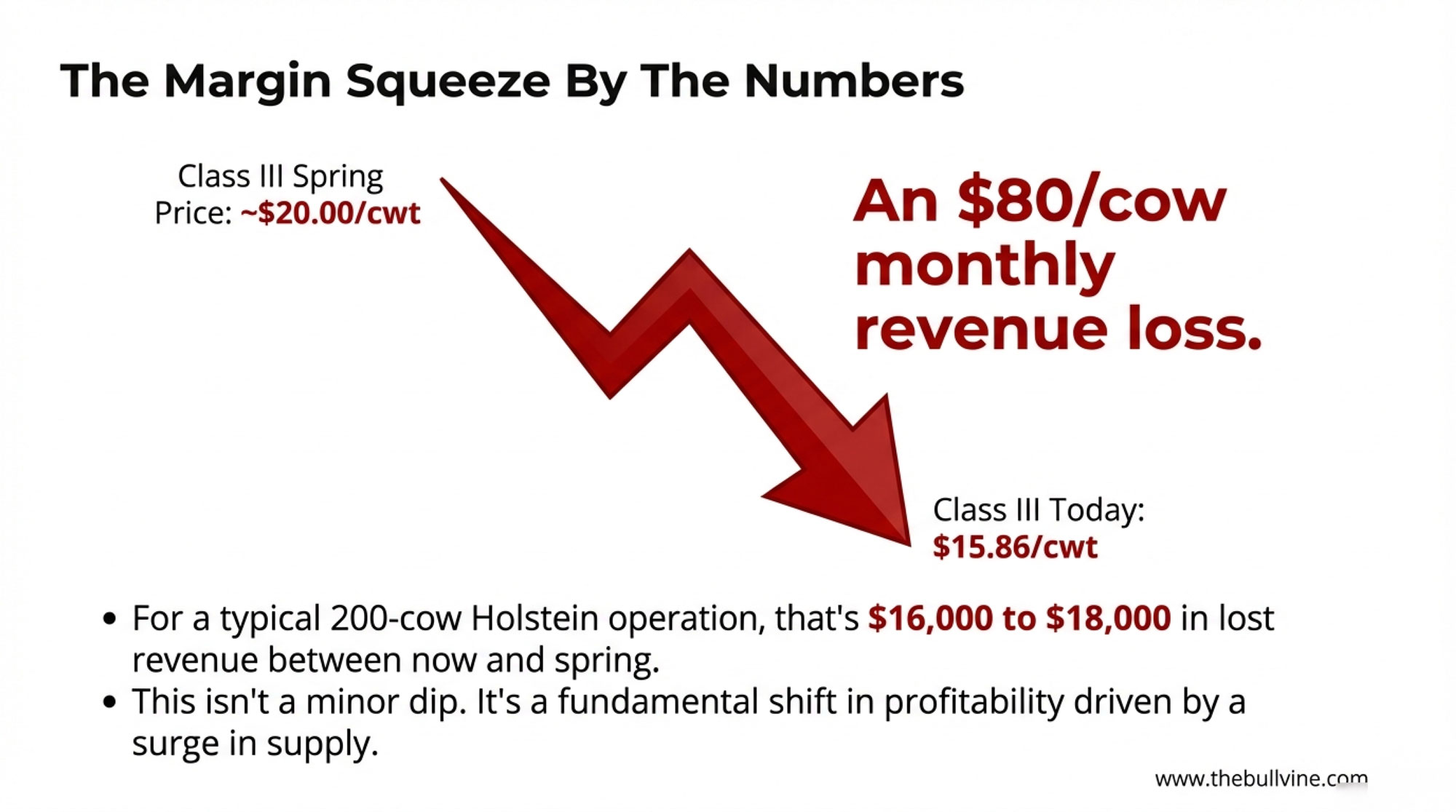
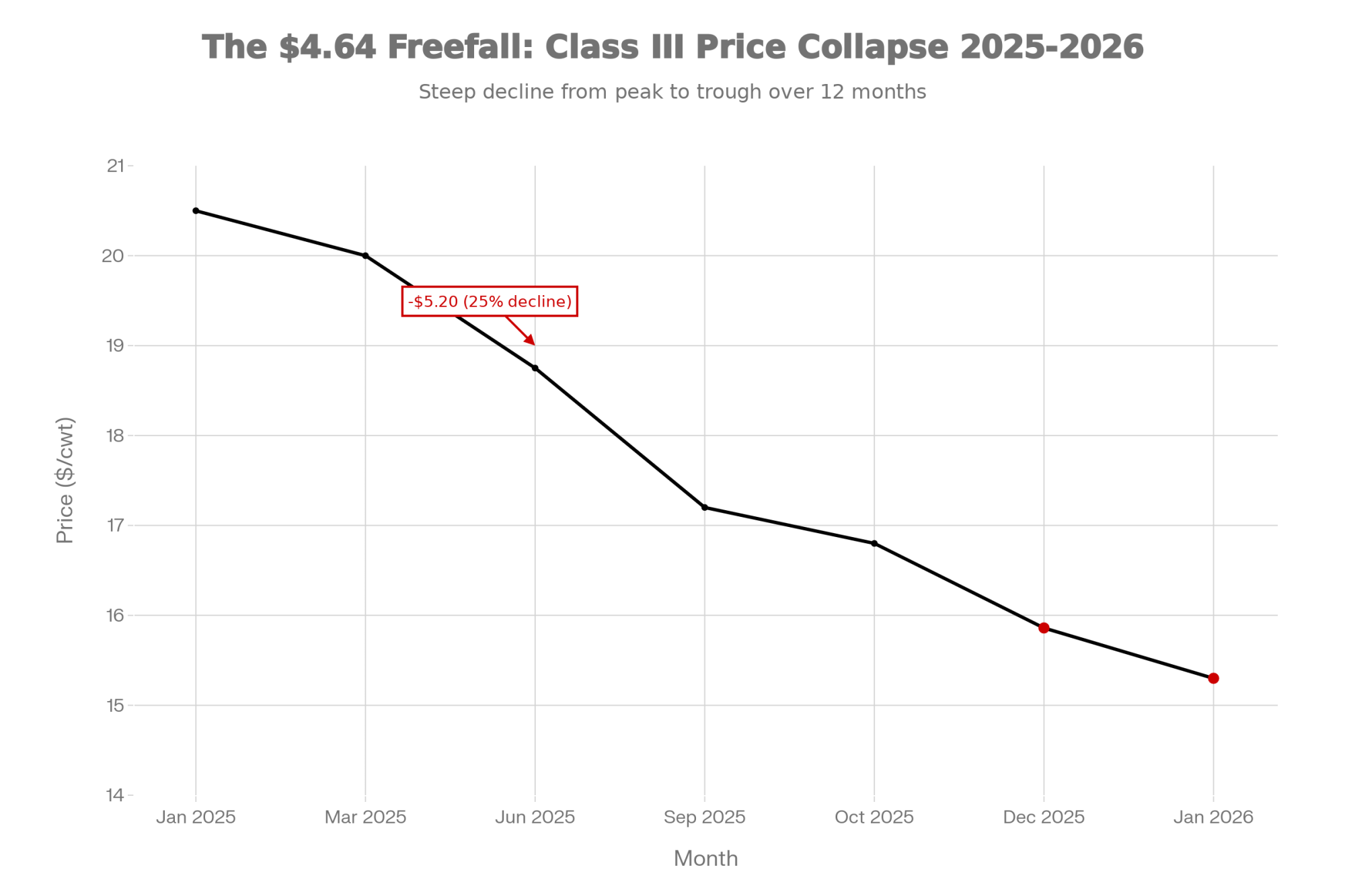
The February WASDE bumped all‑milk to $18.95 and Class III to $16.65/cwt, up 30¢ from January’s $16.35 forecast. But January’s actual Class III was still $14.59, and December’s was $15.86. That means the back half of 2026 has to do a lot of heavy lifting to deliver the annual average USDA now has in its spreadsheet.
How This Lands on a Real Operation
Let’s bring this down to barn level.
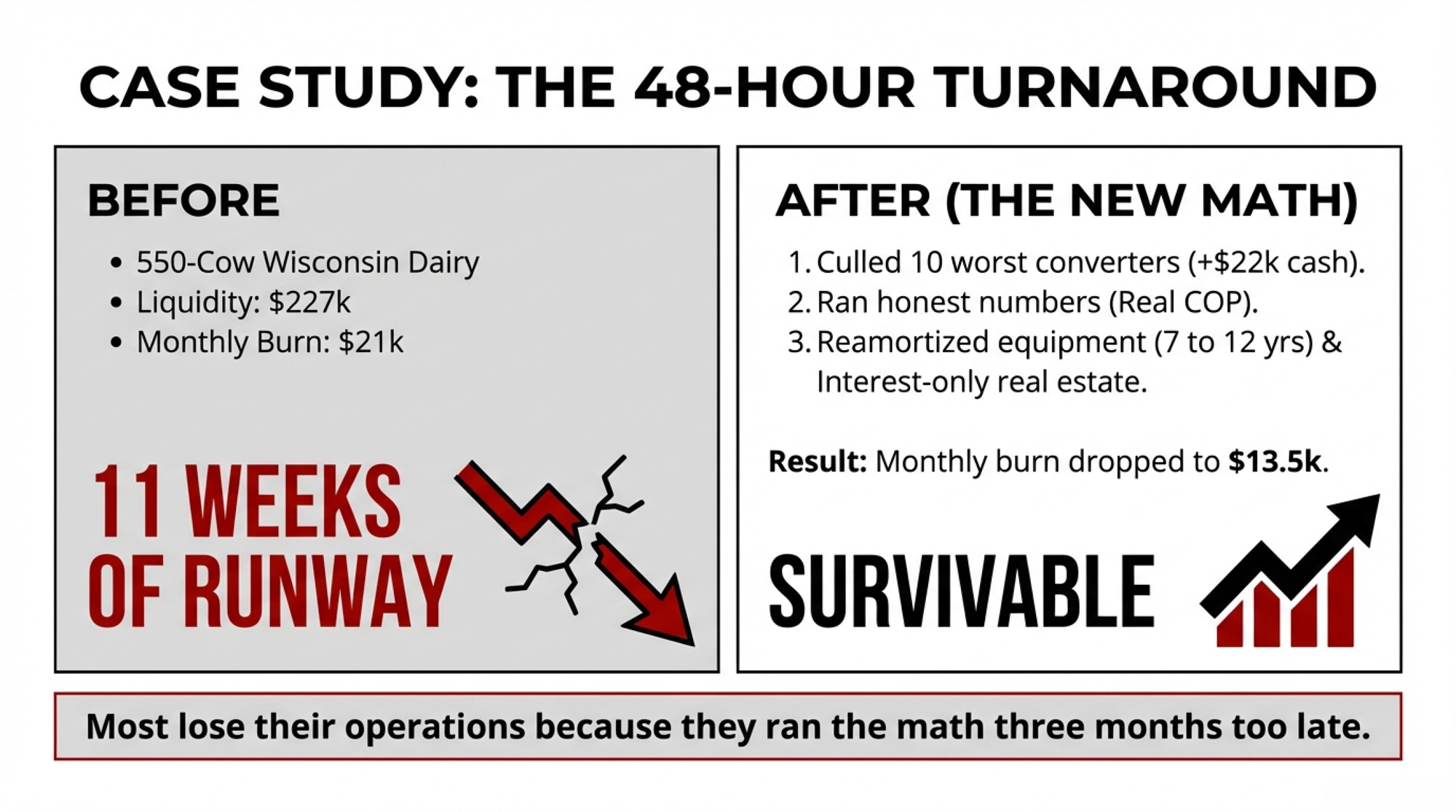
A 550‑cow Wisconsin dairy recently sat down with a farm financial counselor through an Extension‑affiliated program and pulled a full cost‑of‑production analysis. The producer thought his all‑in cost was about $17.25/cwt. When the spreadsheet included market‑rate family labor, real depreciation, current interest on all repriced debt, and health insurance, the true number came back at $18.75/cwt — right in line with UW Extension’s $18–$19/cwt benchmarks for mid‑size herds in the region. That $1.50 gap represented roughly $200,000 in annual losses he hadn’t really accounted for.
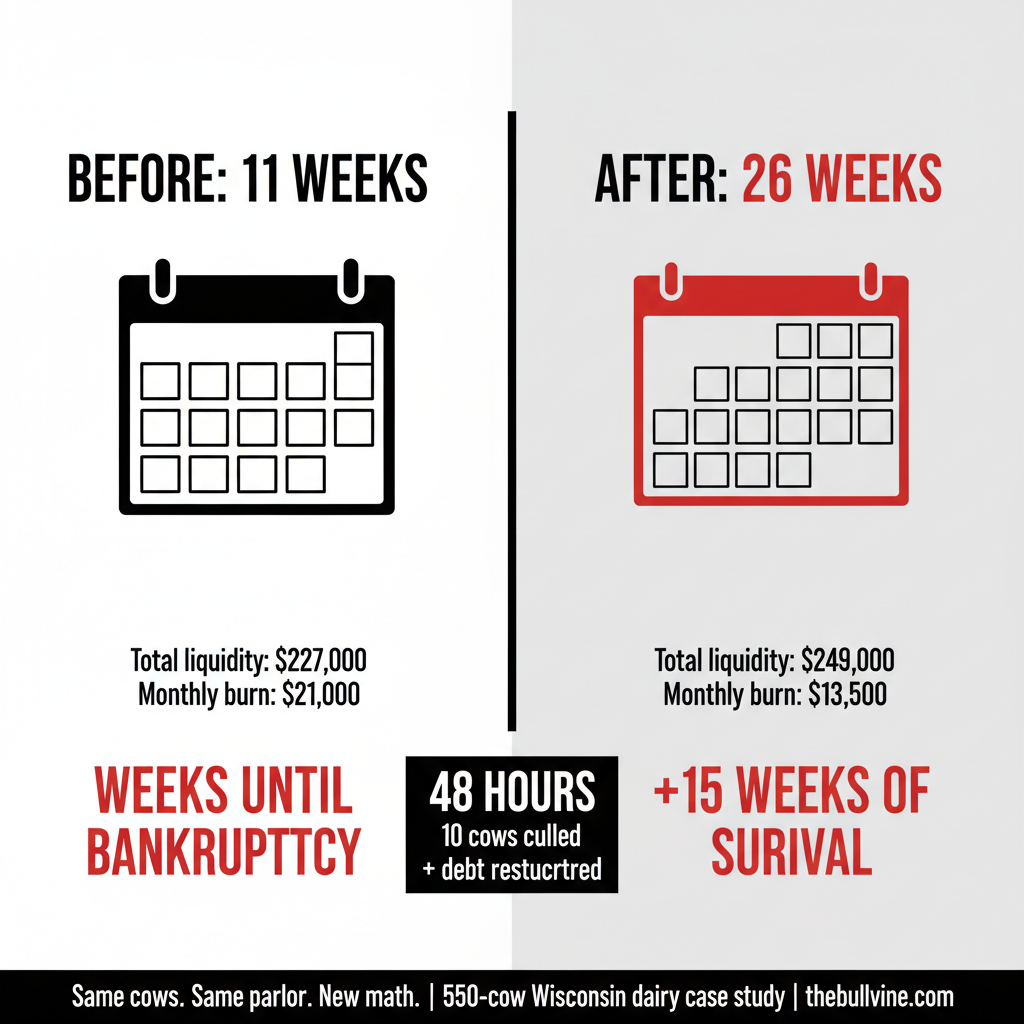
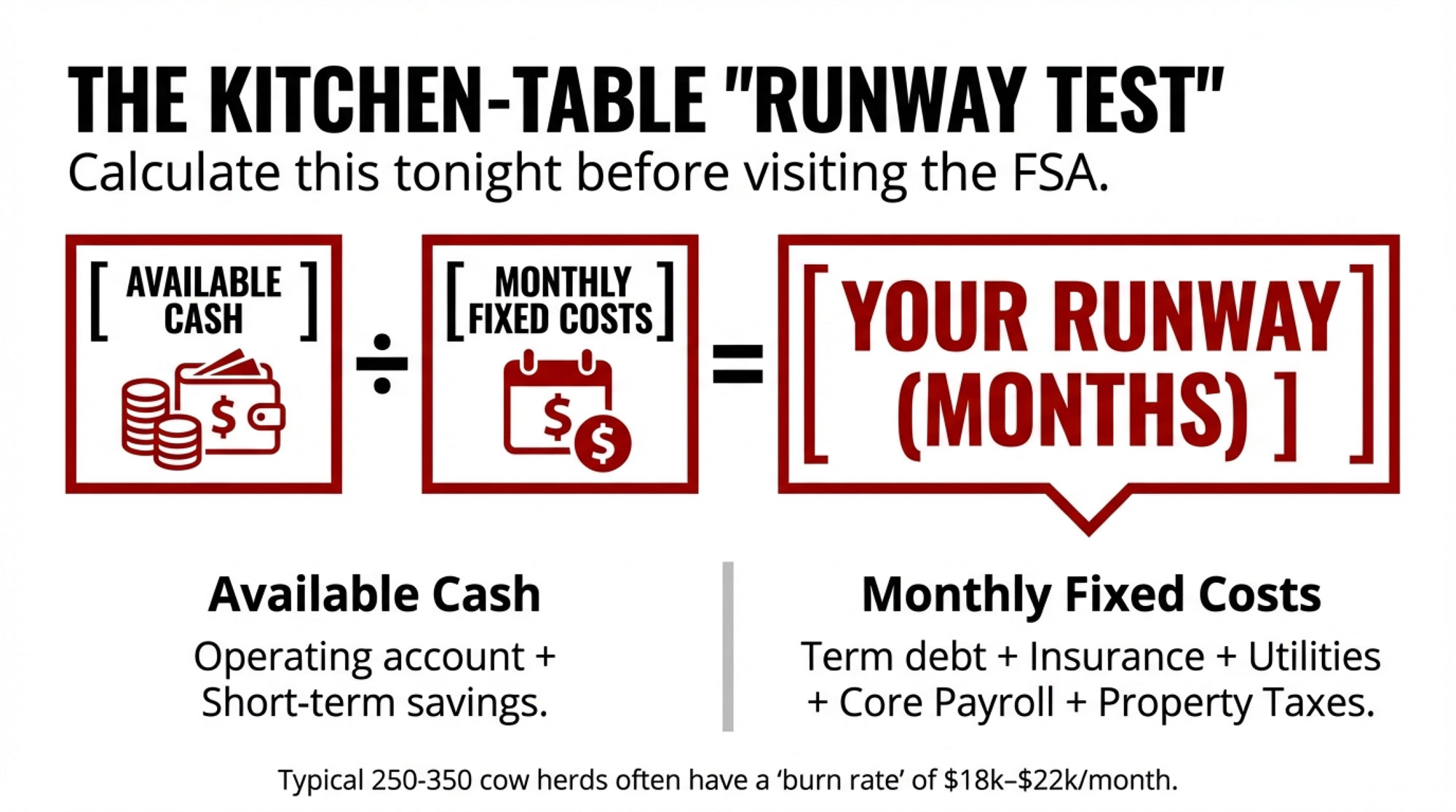
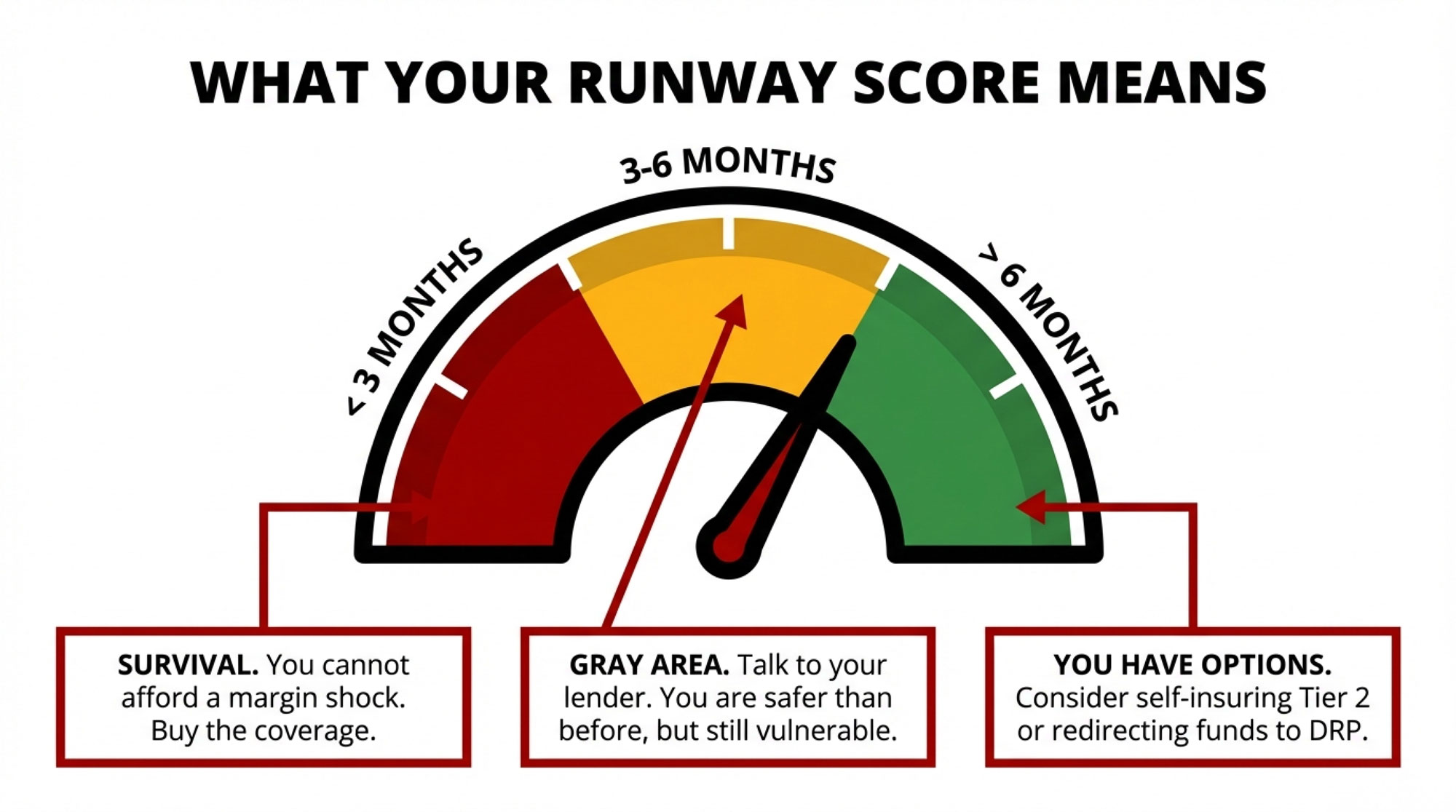
The cash‑flow picture was worse. Total liquidity: $227,000. Monthly burn at current prices: about $21,000. That’s eleven weeks of runway, not the five or six months he’d been carrying in his head.
Here’s what changed everything. Within 48 hours, he:
Culled his 10 worst feed‑to‑milk converters, bringing in roughly $22,000 in cash and cutting daily feed cost by about $85.
Walked into his lender’s office with a 12‑month projection at $18/cwt and a real cost‑of‑production sheet.
Negotiated reamortization on equipment debt (from seven years to twelve) and four months of interest‑only on real estate.
The lender said yes. Monthly burn dropped from $21,000 to roughly $13,500. Same cows. Same parlour. New math.
That 48‑hour response is the difference between survival and bankruptcy in this kind of year. Not new genetics. Not a magic ration. Not a unicorn contract. Just running the real numbers, believing what they tell you, and moving beforethe runway disappears.
Most producers who lose their operations in a down cycle don’t lose them because the math was impossible. They lose them because they ran the math three months too late. The difference between “tight but okay” and “weeks from the wall” is often just one honest accounting exercise.
The Beef Check Holding It All Together
On a growing number of dairies, the milk margin alone isn’t keeping the lights on. Beef is.
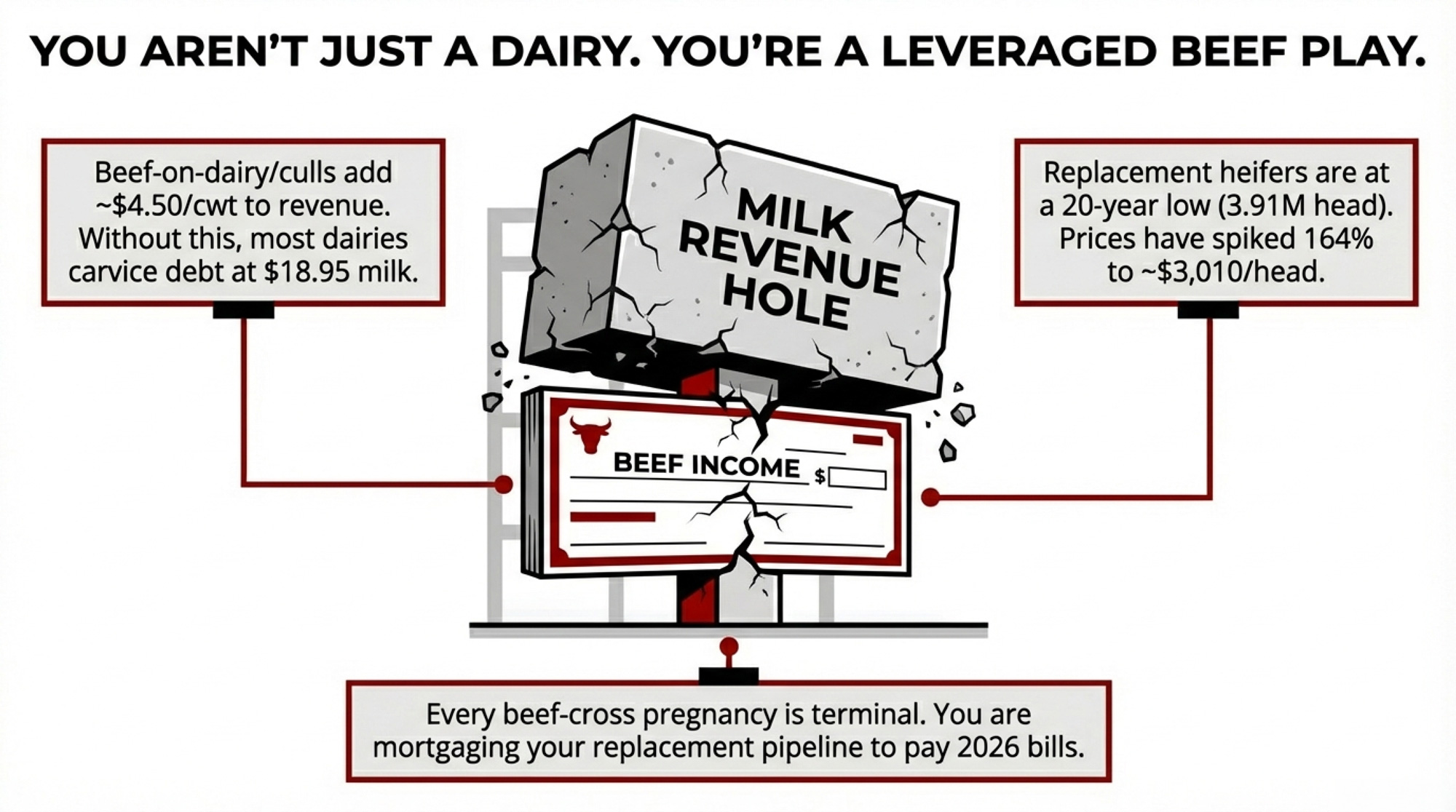
High Ground Dairy’s October 2025 analysis — based on a representative 1,000‑cow model — estimates beef‑related income north of $4.50/cwt of milk shipped, with seven of the next twelve months projected above $5.00/cwt. Those forward numbers are modeled, not guaranteed, but they reflect what you’ve seen in your own calf checks and cull slips.
On that 300‑cow herd shipping 69,000 cwt, $4.50/cwt in beef income adds up to about $310,000 a year — coming from the cattle market, not the milk market. Strip it out and ask honestly whether your milk margin alone services your current debt with all‑milk at $18.95 and Class III at $16.65.
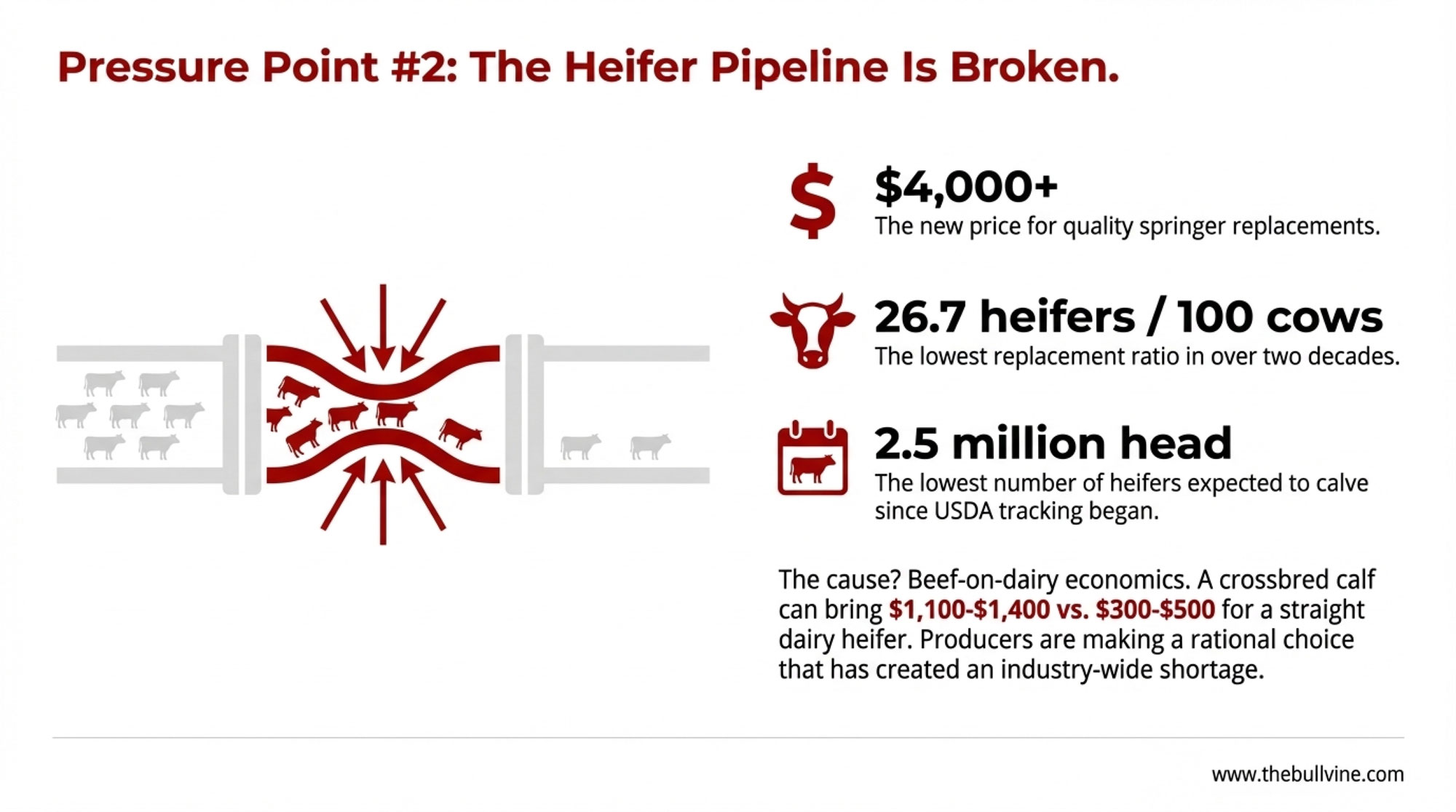
That beef check didn’t come free. CoBank’s August 2025 Knowledge Exchange report, authored by Corey Geiger and drawing on NAAB data, notes that beef semen sales into dairy nearly tripled from 2.5 million units in 2017 to 7.9 million in 2024. Conventional dairy semen sales fell hard over the same period.
Every beef‑cross pregnancy is terminal. No heifer behind it.
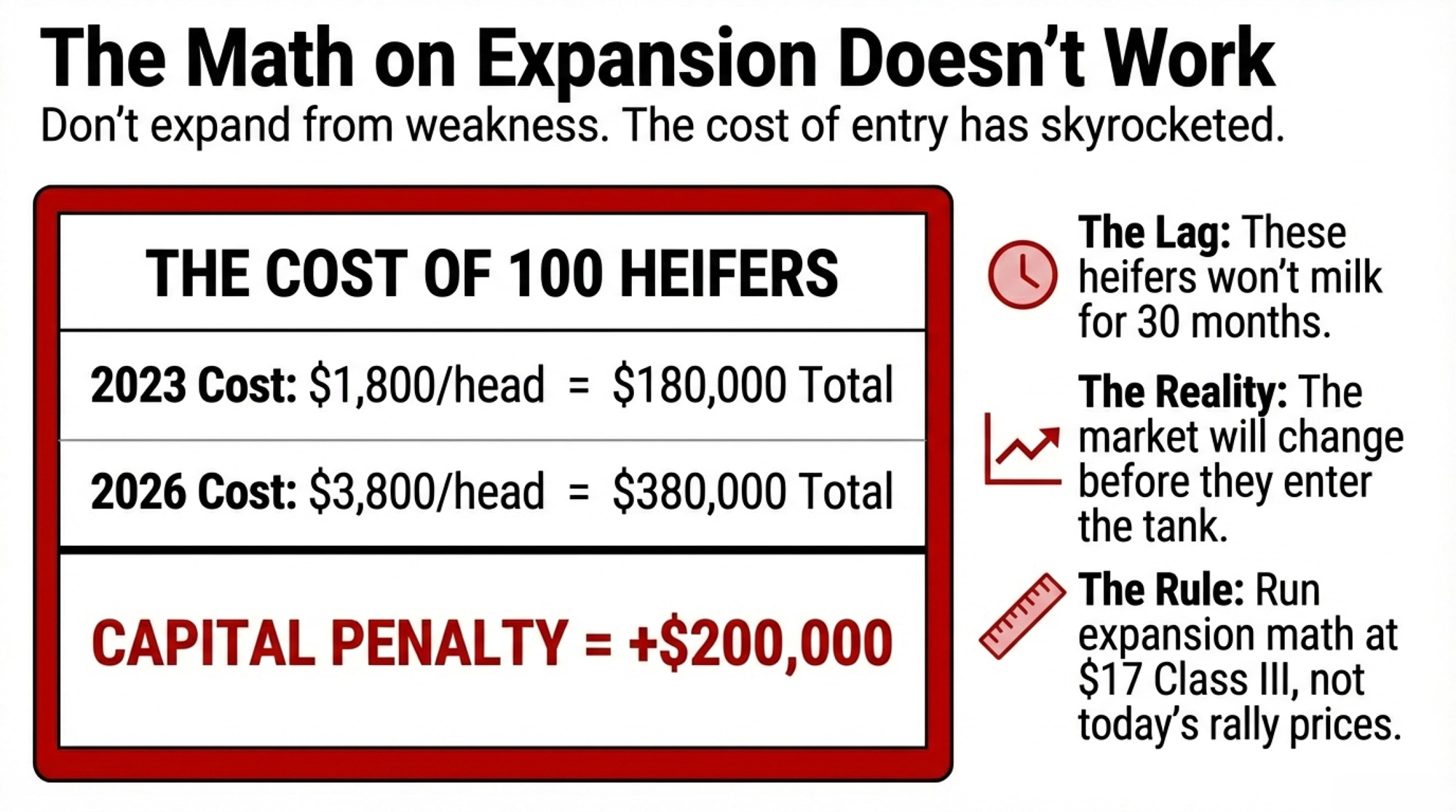
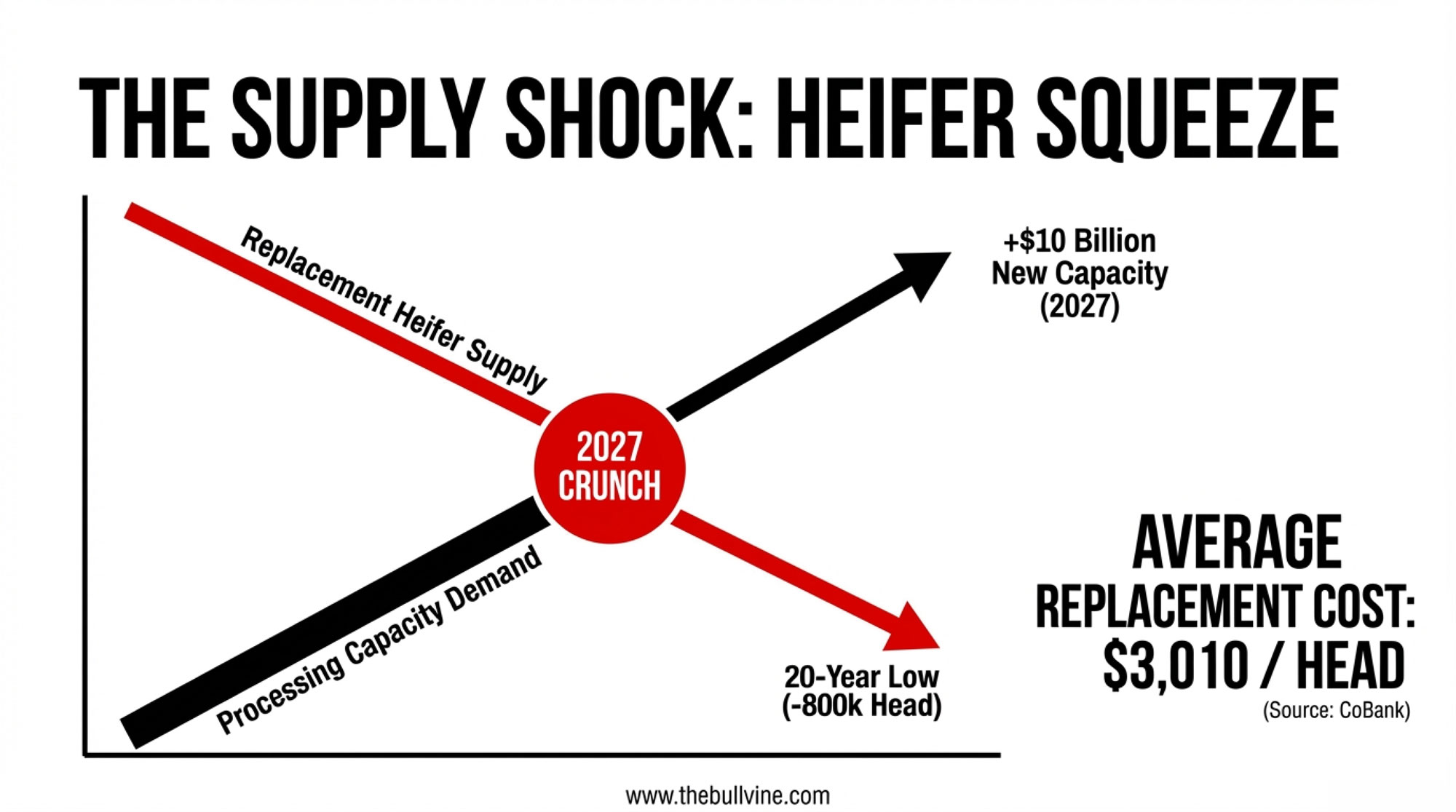
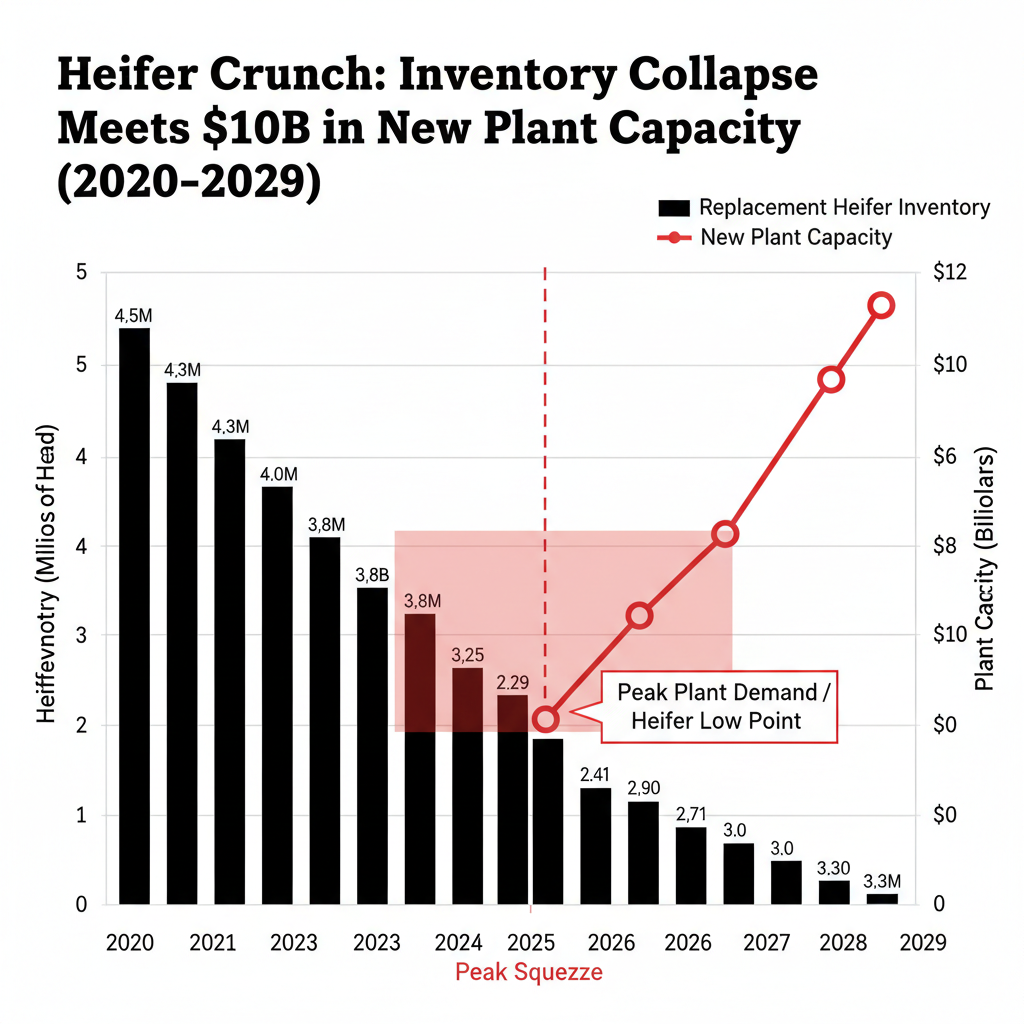
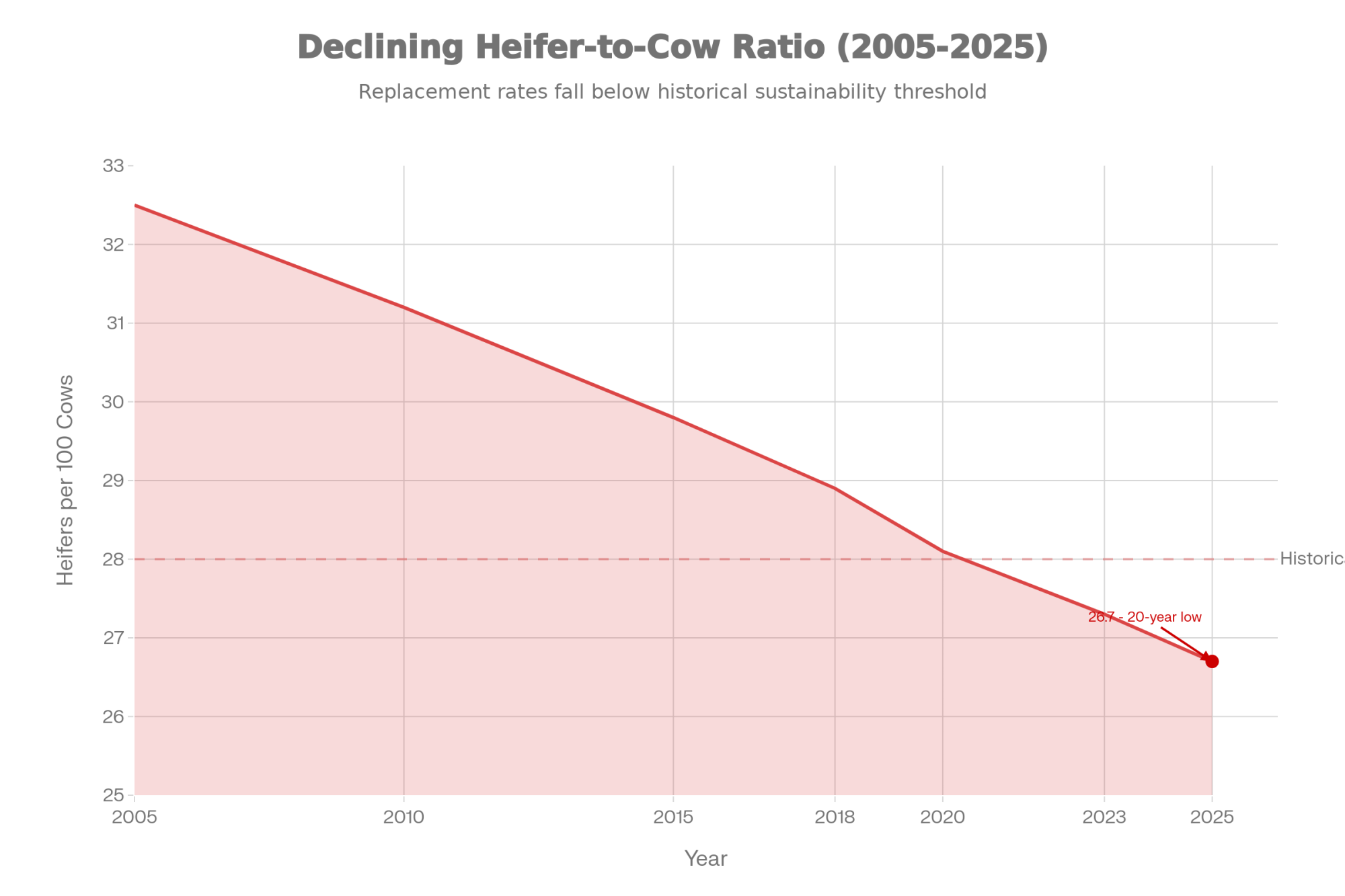
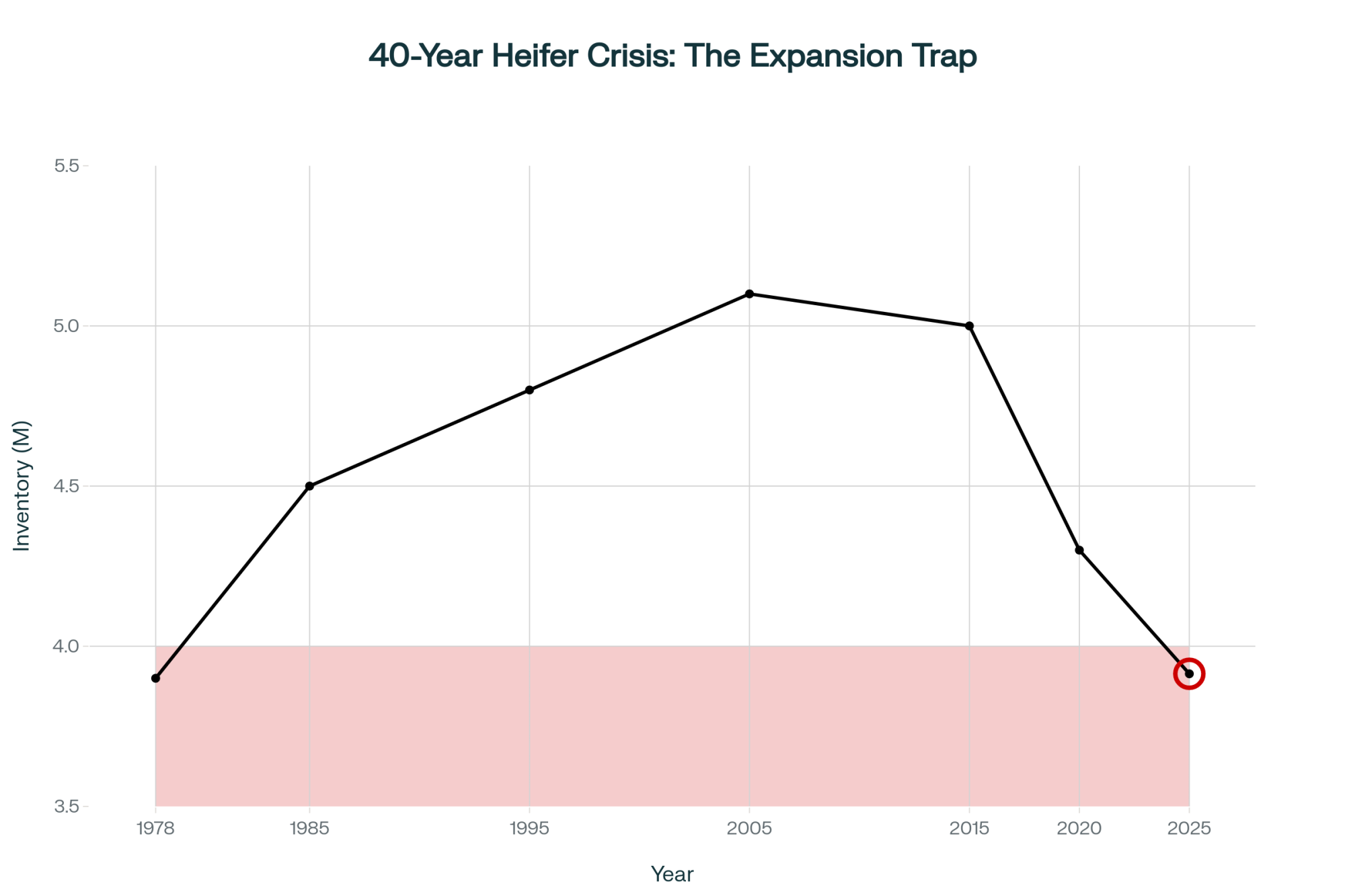
USDA’s January 2025 Cattle report shows dairy replacement heifers at a 20‑year low of 3.91 million head, down 18% from 2018. Geiger’s analysis highlights how that shortage shows up in prices: average dairy heifer values of $3,010/head in July 2025, up 164% from $1,140 in April 2019, with top sales in California and Minnesota clearing above $4,000/head. CoBank projects the heifer inventory will shrink by another 800,000 head over the next two years before stabilizing.
So yes, the beef check is saving a lot of balance sheets in 2026. It’s also mortgaging your replacement pipeline for the next three to four years.
When Beef Softens—Stress‑Testing the Safety Net
Cattle markets move in cycles. CattleFax’s outlook at CattleCon 2026 in Nashville earlier this month put the average 2026 fed steer price at $224/cwt, roughly steady with 2025, and cull cows around $155/cwt. COO Mike Murphy called current levels “near cyclical highs” and described a slow, measured expansion phase, as high input costs and producer demographics cap herd rebuilding.
That suggests beef could stay supportive through 2026. But that’s not an excuse to skip the stress test.
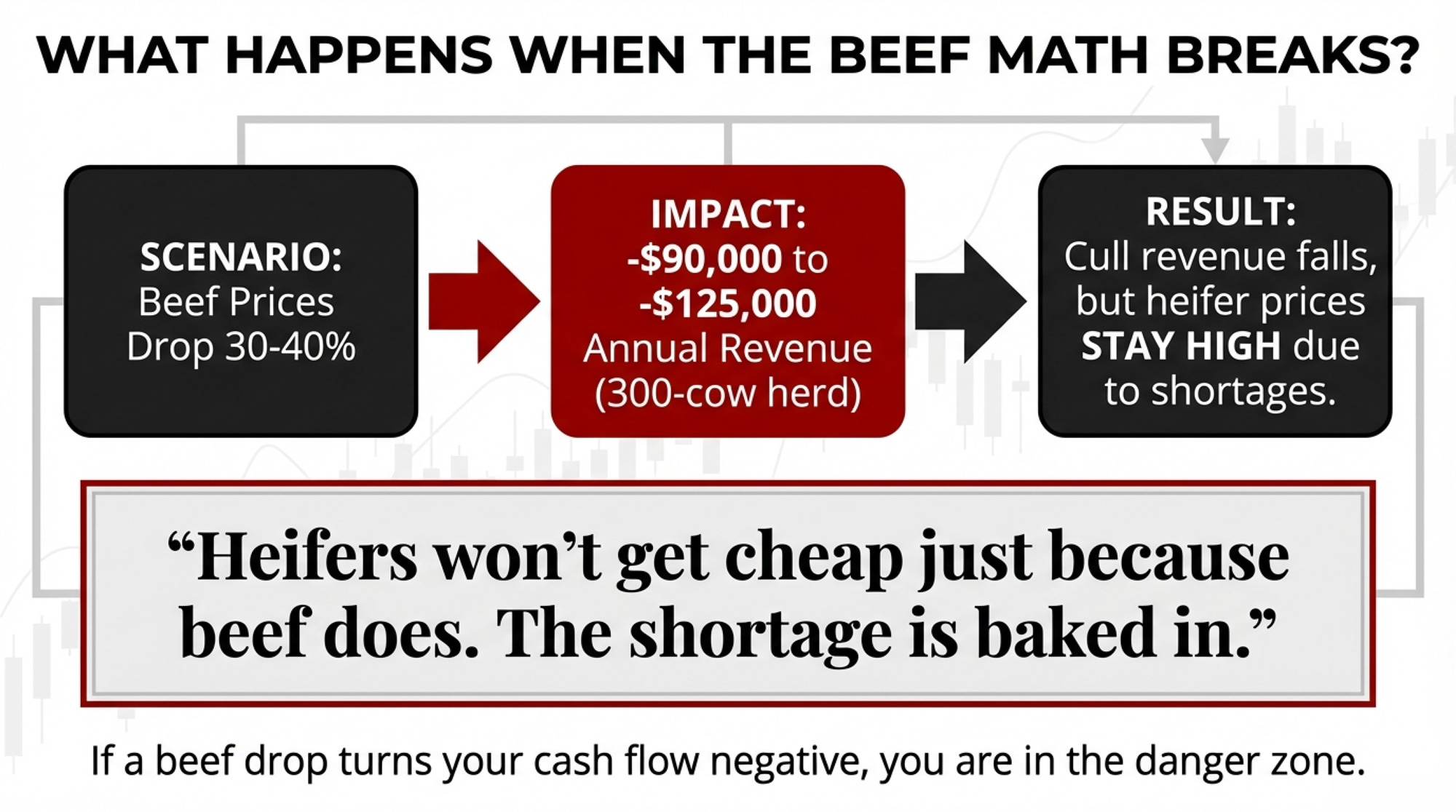
A 30–40% drop in beef prices — well within range for a down cycle — would shave roughly $90,000–$125,000 off that $310,000 in annual beef revenue on a 300‑cow herd. You’d feel it on both sides: beef‑on‑dairy calf checks shrink, and cull revenue falls, while replacement heifers remain tight and expensive. Heifers won’t suddenly get cheap just because beef does; the structural shortage is baked in.
CoBank’s August 2025 work also points out that dairy producers have effectively “hoarded” about 611,600 cows from slaughter since Labor Day 2023, compared to the trend. If beef softens enough that everyone starts shipping at once, those cows hit the rail together — and the cull market falls harder. That’s how a softening beef market can turn from a warning sign into a full‑on margin squeeze.
The Canada Contrast
North of the border, the Canadian Dairy Commission boosted the farm‑gate milk price 2.3255% effective February 1, 2026. The CDC’s formula is straightforward: half the change in indexed cost of production (up 2.7%) plus half the change in CPI (up 1.9%).
Two pieces of that matter if you’re milking cows in the U.S.:
When beef revenue is strong, it flows into Canada’s COP index as an offset, dampening their milk price increases. When beef weakens, the formula moves in the other direction. The system self‑corrects.
The CDC cost formula includes feed, labor, and energy. DMC only looks at feed. Every non‑feed cost that’s blown out since 2022 — labor, interest, insurance, repairs — is invisible in your U.S. safety net.
Of course, Canada’s stability comes at a high price. Ontario quota traded above $24,000 per kilogram of butterfat per day in 2025. That locks out new entrants and caps growth. But if the question is whether you can make a five‑year investment decision without guessing where Class III will land next January, the Canadian model offers something the U.S. structure doesn’t: a rulebook.
Four Paths—and What Each One Costs
Strategy
Upfront Cost / Action
Monthly Cash Impact
Long-Term Trade-off
Best Fit If…
Component Optimization
Ration/genetics adjustment
+$0.58/cwt (down from +$0.98 in 2025)
Feed cost now, fat revenue later—only if BF price recovers
Your plant pays component premiums & you can wait for BF rebound
DMC/DRP Enrollment (by Feb 26)
Premium ~$1,500–$3,000/yr for $9.50 Tier 1 (25% discount if 6-yr commit)
+$0.30–$0.60/cwt margin support (feed only)
Doesn’t cover labor, debt, energy squeeze
You’re ≤270 cows, feed is your main cost pressure, & you’re not enrolled
Lender Restructuring
Time + full COP analysis
−$2,390/mo (example: $500k note, 7→12 yr)
+$115,600 extra interest over loan life
Cash flow is tight (<6 mo runway) but operation is viable at $18–$19 milk
Strategic Exit
Appraisal, auction, legal fees
Lump-sum: cull/heifer/land at current highs
You’re out of dairy
3-yr projection at $18.95 milk leaves you with less equity than exiting now
1. Component Optimization
Breeding and feeding for butterfat has been the go‑to growth lane. But the payoff depends entirely on when you’re selling that fat.
Butterfat premium: same herd, two prices (400‑cow herd, 23,000 lbs/cow, 3.8% → 4.2% BF = 36,800 extra lbs fat/year)
If you’re still budgeting on 2025 butterfat prices, you’re overstating your 2026 margin by about $0.40/cwt before you even start the mixer. If your plant pays on straight hundredweight with no component bonus, the math is even uglier—you’re carrying the extra feed cost without seeing the fat check.
Trade‑off: Components still matter, but the days of butterfat bailing out every hole in the budget are on pause until that $/lb recovers.
2. Risk Management Enrollment—Before February 26
This one’s on a hard deadline.
The One Big Beautiful Bill Act (OBBBA) reinstated the Dairy Margin Coverage program for 2026–2031 and expanded Tier 1 coverage to 6 million pounds of production history at up to $9.50/cwt margin coverage. Producers who lock in all six years get a 25% premium discount, according to the University of Minnesota Extension’s January 27 enrollment guide. Production history is based on your highest marketings from 2021, 2022, or 2023.
Six million pounds covers roughly a 270‑cow herd at 22,000 lbs/cow. Everything above that needs to be managed with DRP, futures, or options. LRP can backstop your calf and cull revenue.
Trade‑off: DMC only sees feed costs. If your margin squeeze is coming from debt service, labor, or energy, DMC checks help the feed side, but don’t fix the whole picture. Minnesota producers should also look hard at the state’s DAIRI program, which ties about $3 million in state funds to DMC participation.
3. Lender Engagement—Early, With Real Numbers
The Wisconsin producer’s experience is the template.
Showing up with a full cost‑of‑production sheet, a 12‑month cash flow at $18–$19 milk, and a specific restructuring ask is a completely different conversation than showing up after you’ve bounced a check.
Reamortization math: $500,000 note at 7.5%
Metric
7-Year Term
12-Year Term
Difference
Monthly payment
$7,670
$5,280
−$2,390/mo (−31%)
Annual debt service
$92,040
$63,360
−$28,680/yr
Total interest paid
$144,200
$259,800
+$115,600
You buy yourself $2,390/month of breathing room. It costs you about $115,600 in extra interest over the life of the loan. That’s the price of survival time. It might be the smartest money you ever “spend” — or a trap that keeps you grinding at breakeven for another decade.
4. Strategic Exit While Asset Values Hold
Cull cows are still historically strong. Heifers are historically tight. Land values in a lot of dairy regions are still holding.
That convergence won’t last forever. A controlled dispersal while beef and heifer markets stay firm may protect more family equity than grinding through three more years of thin or negative margins.
Trade‑off: Put hard numbers on “stay” vs. “go.” If a realistic three‑year plan at $18.95 all‑milk and $16.65 Class III leaves you with less net worth than exiting this year at today’s cull, heifer, and land prices, you’re not just hanging on — you’re burning equity.
What This Means for Your Operation
Pull your full economic cost of production this month. Include market‑rate family labor, depreciation, interest at current rates, and insurance. If you’re a mid‑size Upper Midwest herd and your real COP is above $19/cwt, the new $18.95 all‑milk forecast still leaves you below water on a full‑cost basis, even before you stress‑test beef.
Re‑run your 2026 plan at $18.95 all‑milk and $16.65 Class III. Use the February WASDE numbers, not January’s $18.25. Then layer in what you’ve actually been paid so far — January’s $14.59 Class III and your local basis. If your DSCR drops below 1.0 in that scenario, the lender conversation needs to happen in the next 30 days, not after planting.
Enroll in DMC before February 26 if you’re eligible. At $9.50/cwt, Tier 1 on 6 million pounds with a 25% premium discount is cheap margin insurance for the feed side of your budget. DMC won’t solve your whole problem, but it’s a mistake to leave it on the table if you qualify.
Stress‑test your dependence on the beef check. Take your last 12 months of calf and cull revenue per cwt. Knock it down 40%. If your operation swings from positive to negative cash flow on that single change, you’re not just a dairy — you’re a leveraged beef play.
Reprice your component strategy at January 2026 values. Don’t carry 2025’s $2.44/lb into a world where butterfat is paying $1.45/lb. If your component‑chasing feed cost doesn’t pencil at $0.58/cwt extra revenue, adjust the ration or the breeding plan.
Count your runway honestly. Total cash + undrawn operating line, divided by true monthly burn rate, gives you months of runway. Under six months means it’s time to call the lender, the nutritionist, and your Extension economist. Under three months means you’re in triage.
Key Takeaways
USDA’s February WASDE raised the 2026 all‑milk forecast to $18.95/cwt, but ERS puts average 2,000‑plus cow herds at $19.14/cwt and the smallest herds near $42.70/cwt. That means even the “efficient” size class is essentially breakeven on a full‑cost basis. 1
January’s actual Class III at $14.59/cwt and December’s $15.86 are still well below the new annual averages. If your budgets quietly assume the back half of 2026 will bail out the first half, you’re betting against recent history.
Dairy farmers’ share of the retail dairy dollar slipped from 28¢ in 2022 to 25¢ in 2024, while the average gallon price stayed near $4.05. Consumers didn’t feel the pain; the middle of the chain kept its cut; your share shrank.
The beef check is doing more work than most producers are comfortable admitting. High Ground Dairy’s model shows $4.50+/cwt in beef income, and CoBank’s data tell you that money came from a replacement pipeline that’s now 800,000 heifers short and 164% more expensive.
The decisions you make in the next 30 days — DMC enrollment, lender conversations, cull strategy, and whether to chase components at 2026 prices — matter more than whether USDA’s March WASDE adds or subtracts another 25¢. You don’t control the forecast. You do control how quickly you move when the math changes.
The Bottom Line
Where does your real breakeven sit against $18.95 all‑milk and $16.65 Class III, and how many months of runway do you have if beef softens and Class III spends more time in the mid‑fourteens than USDA’s spreadsheet suggests? That’s the comparison worth making before you load tomorrow morning’s first unit.
If you or someone you know in agriculture is experiencing stress or crisis, confidential support is available 24/7: the Suicide and Crisis Lifeline (call or text 988); the Farm Aid Hotline (1‑800‑FARM‑AID); or the AgriStress Helpline, Canada (1‑866‑267‑6255).
Complete references and supporting documentation are available upon request by contacting the editorial team at editor@thebullvine.com.
Learn More
The 90-Day Reckoning: What Your Milk Check Is Really Saying About 2026 – Stop guessing your liquidity and master the “burn rate” calculation that separates survival from insolvency. This breakdown arms you with a 90-day tactical roadmap to overhaul cash flow before interest rates and low Class III prices exhaust your credit.
Dairy’s Bold New Frontier: How Forward-Thinking Producers Are Redefining the Industry – Weaponize the 15-20% productivity gains found in “connected barns” where AI and robotics finally break the labor squeeze. This guide reveals how forward-thinking producers are using technology to thrive in a high-cost environment that punishes traditional management habits.
Join the Revolution!
Join over 30,000 successful dairy professionals who rely on Bullvine Weekly for their competitive edge. Delivered directly to your inbox each week, our exclusive industry insights help you make smarter decisions while saving precious hours every week. Never miss critical updates on milk production trends, breakthrough technologies, and profit-boosting strategies that top producers are already implementing. Subscribe now to transform your dairy operation’s efficiency and profitability—your future success is just one click away.
$18.95 milk, $19.14 costs, 29% of income from government checks. If any one of those moves against you, what happens to your dairy?
Executive Summary: USDA’s February outlook has 29% of U.S. net farm income coming from government checks in 2026, with $44.3 billion in payments propping up a farm economy that would otherwise drop to about $109 billion in net income. At the same time, the February WASDE raised the 2026 all‑milk price to $18.95/cwt, while USDA‑ERS cost‑of‑production data put average 2,000‑plus cow herds at $19.14/cwt and the smallest herds near $42.70/cwt. For a 300‑cow, 23,000‑lb herd, that price reset from $21.17 to $18.95 still means roughly $153,000 less gross milk revenue before you even count feed, labor, and debt. This article walks the math by herd size, then lays out four real levers you can pull — beef‑on‑dairy, component premiums, feed cost protection, and risk‑management tools like DMC — with the upsides and trade‑offs spelled out in plain language. It uses real operations and named analysts to show how those choices are playing out on the ground, from McCarty Family Farms’ genomic beef‑on‑dairy strategy to DFA’s $2.50–$3.00/cwt revenue bump and Ever.Ag’s “street fight” warning. It finishes with concrete thresholds and questions for sub‑200, 200–999, and 1,000‑plus cow herds so you can see whether you’re running a market‑based margin, a subsidy‑dependent margin, or whether it’s time to use today’s strong cattle markets to exit on your own terms.
Twenty-nine cents of every dollar of U.S. net farm income now comes from government payments. For dairy, those numbers hit even harder. USDA’s February 4 forecast projects $44.3 billion in direct payments for 2026 — up 45% from roughly $30.5 billion in 2025, according to USDA-ERS data analyzed by the American Farm Bureau Federation. Strip those payments out, and net farm income drops to approximately $109 billion, representing a roughly 9% real decline from 2025’s non-government income, per Econbrowser’s analysis.
The headline — $158.5 billion in net cash farm income — looks stable. Almost comfortable. But USDA forecasts dairy milk receipts dropping $6.2 billion (12.8%) this year. And while today’s February WASDE raised the 2026 all-milk price to $18.95/cwt — up 70 cents from January’s projection — January’s actual Class III still posted at just $14.59/cwt. The forecast improved. The checks haven’t caught up yet.
The $25 Billion Revision Nobody Expected
Start with what happened to 2025. USDA cut last year’s net farm income estimate by $25 billion, from $179.8 billion projected in September, down to $154.6 billion. Production expenses got revised up to $473.1 billion. Government payments came in about $10 billion below earlier projections, at $30.5 billion versus a September estimate near $40.5 billion.
AFBF’s Danny Munch, co-author of the Farm Bureau’s Market Intel analysis, called this “a generational downturn rather than a temporary slowdown.” Total farm debt is projected at $624.7 billion for 2026, up $30.8 billion (5.2%), with the debt-to-asset ratio climbing from 13.49% to 13.75%.
Where are those aid dollars going? Purdue University’s Ag Economy Barometer found that a majority of farmers report using government payments primarily to pay down existing debt — not to reinvest.
Dairy’s Revenue Problem — Even After Today’s WASDE Bump
Today’s February WASDE brought some relief. USDA raised all 2026 dairy product price forecasts — cheese up 2 cents to $1.6050/lb, butter up 7 cents to $1.68/lb, NDM up 11 cents to $1.3150/lb, and whey up 2 cents to $0.69/lb. The result:
All-milk price: Raised to $18.95/cwt for 2026, up 70 cents from January’s $18.25 projection. That’s still down $2.22/cwt from the revised 2025 average of $21.17. Better than last month. Still a significant revenue hit.
Class III: Raised to $16.65/cwt, up 30 cents from $16.35. Class IV got the bigger bump — up $1.25 to $15.70/cwt — largely on stronger NDM and butter price assumptions. But January’s actual Class III of $14.59 and December’s $15.86 are both well below the new annual average, meaning the back half of 2026 needs to do a lot of heavy lifting for your budgets.
Milk production: Raised to 234.5 billion pounds, up 200 million from January’s estimate. The national herd was up 202,000 head year over year in Q4 2025, with December production running 4.6% above the prior year. RFD-TV noted output “driven by the largest milk cow herd in decades and higher per-cow productivity.”
DMC margins: January’s Dairy Margin Coverage margin is projected at $7.57/cwt — a full $1.93 below the $9.50 trigger. That’s the first meaningful DMC payout since December 2025 and signals the kind of margin compression producers should plan for, not just hope for.
Month
All-Milk Price ($/cwt)
Feed Cost ($/cwt)
Actual Margin ($/cwt)
DMC Payout at $9.50 Coverage
Dec 2025
$14.59
$6.02
$8.57
$0.93
Jan 2026
$14.35
$6.78
$7.57
$1.93
Feb 2026 (proj)
$15.10
$6.85
$8.25
$1.25
Mar 2026 (proj)
$15.80
$6.90
$8.90
$0.60
Apr 2026 (proj)
$16.20
$7.00
$9.20
$0.30
May 2026 (proj)
$17.00
$7.15
$9.85
$0.00
Jun 2026 (proj)
$17.50
$7.20
$10.30
$0.00
Munch told Brownfield Ag News the receipts decline “would put dairy down about 35% over five years.” CoBank’s Corey Geiger noted butterfat production was running 5–6% above year-ago levels heading into 2026, volume even strong demand can’t easily absorb. The February WASDE’s butter price raise to $1.68/lb signals USDA sees some floor forming, but that’s still well below 2024 peaks.
Mark Stephenson at UW-Madison put it plainly in an April 2025 Bullvine interview: “Operations with weaker financial positions or higher production costs could face heightened pressure, potentially leading to further consolidation within the sector.”
The $23.56 Cost-of-Production Gap — And Why Feed Isn’t the Problem
USDA’s Economic Research Service published updated cost-of-production estimates by herd size in August 2024, based on the 2021 ARMS dairy survey. The spread: $42.70/cwt for herds under 50 cows. $19.14/cwt for operations with 2,000 or more. A $23.56 gap. And at $18.95 all-milk, even the lowest-cost tier is essentially breakeven on a full economic basis.
The instinct is to blame the feed. But feed costs account for a surprisingly small share—roughly $3/cwt or less. USDA’s own report to Congress showed feed differing by less than $1/cwt between mid-size and the largest herds. Agri-benchmark’s international analysis (using 2016 ARMS data, directionally consistent with the 2021 update) confirmed the pattern: feed and other direct costs differ by only about 28% across size classes. The real drivers sit elsewhere.
Cost Category
<50 cows
50-99 cows
100-199 cows
200-999 cows
2,000+ cows
Labor
$12.00
$8.50
$5.20
$3.10
$2.20
Feed
$3.50
$3.40
$3.20
$3.00
$2.90
Overhead
$15.20
$10.80
$7.60
$4.50
$3.10
Other Direct
$5.00
$4.30
$3.80
$3.20
$2.80
Opportunity Cost (Land, Capital)
$7.00
$5.50
$4.20
$3.10
$2.44
TOTAL ($/cwt)
$42.70
$32.50
$24.00
$16.90
$19.14
Labor eats the biggest piece. Small herds carry roughly $12/cwt in labor costs — mostly imputed value of unpaid family hours. Large operations run about $2.20/cwt. Nearly $10 of the gap is from one line item. And larger farms generally pay higher cash wages. NASS Farm Labor data shows livestock worker wages rising roughly 7% per year in both 2021 and 2022, reaching $16.52/hr by October 2022. The cost advantage comes from output per labor dollar—not lower pay.
Overhead is the silent killer. Barns, parlors, mixers, insurance — a 50-cow dairy needs roughly the same equipment categories as a 2,000-cow operation. But the big barn spreads those fixed costs across 40 times as much milk. Agri-benchmark found that overhead costs decrease approximately fivefold from the smallest to the largest herds.
Productivity per cow compounds everything. A 2,000-cow herd pushing 24,000–25,000 lbs/cow generates 30–40% more milk per stall, per parlor turn, per dollar of overhead than a 50-cow herd at 15,000–16,000 lbs. That compounds every other cost advantage.
These are national averages. Regional differences matter for a lot of herds: Western large-herd operations in Idaho, the Texas panhandle, or California’s Central Valley face different overhead structures — water, environmental compliance, land prices — than Upper Midwest grazing operations in Wisconsin or proximity-to-market herds in the Northeast. Top-quartile producers within each size class typically run $3–$5/cwt below these averages, per the ARMS data.
The Finding That Cuts Both Ways
Here’s where the data gets genuinely interesting. Hoard’s Dairyman’s analysis of the 2021 ARMS data (Table 9) found that low-cost producers in the 100–199 cow range operate at $19.76/cwt. High-cost producers in the 2,000-plus range run $19.63/cwt. Essentially identical.
The best-managed 150-cow dairy can match the average cost structure of a 2,000-cow operation. So the question isn’t whether you’re big enough. It’s whether you’re sharp enough.
Ask a Wisconsin 150-cow operator who benchmarks through Farm Business Management whether size is destiny, and you’ll get a different answer than the national averages suggest. But flip it around: the average 100–199 cow herd runs closer to $24–$26/cwt. Even with today’s bump to $18.95 milk, the distance between “best in class” and “average” in that cohort is the difference between a thin margin and a steady cash drain. Bradley Zwilling at the University of Illinois Farm Business Farm Management Association confirmed this in January 2026: Illinois operations can “squeak out a profit margin” on a cash basis, he told Brownfield Ag News, but “from an economics standpoint, we’ve got lots of negative numbers.”
For many operations, that gap — between cash-basis survival and full economic viability — is a significant part of the 29% government payment dependency measured at the national level.
How One Kansas Operation Reads the Numbers
When Ken McCarty looked at the cost-of-production math, the direction was clear long before the latest USDA revision. McCarty Family Farms, a roughly 20,000-cow operation in Colby, Kansas, has genomically tested more than 75,000 females since 2018. Their rule is simple: the top half by genomic index gets dairy semen; the bottom half gets beef — no exceptions.
That discipline matters when you see the $2.50–$3.00/cwt in added non-milk revenue that DFA’s chief milk marketing officer Corey Gillins says beef-on-dairy is generating across about 70% of their membership. McCarty markets beef-cross calves as day-olds — eliminating the feed and labor burden rather than retaining ownership. According to Laurence Williams, Purina’s dairy-beef cross development lead, day-old beef-on-dairy calves now average roughly $1,400 per head, up from about $650 three years ago — and Hoard’s Dairyman confirmed in March 2025 that dairy-beef calf prices “continued to skyrocket, reaching historical highs” nationally.
“The value of genomic testing has evolved over time,” McCarty has said — a characteristically understated way of describing a system that generates real revenue from what used to be a bottom-of-the-barrel calf. Farm Journal named McCarty Family Farms the 2025 Leader in Technology for exactly this kind of integration.
Four Margin Levers — And What Each One Costs You
Beef-on-dairy. The McCarty model works, but it demands investment: genomic tests run about $40–$50 per calfthrough providers like Zoetis or Neogen for medium-density panels, per The Bullvine’s November 2025 analysis. Lower-density tests start as low as $15–$38, but commercial dairies optimizing beef-on-dairy splits typically need the fuller panels. The trade-off: overcommit to beef sires and you risk a replacement shortage — with dairy replacement heifers at $3,010 per head nationally as of July 2025 per USDA, that’s an expensive gamble. Wrong sire selection on calving ease creates problems that erase the revenue gain entirely.
Component premiums. Gillins notes rising component values are adding $1–$3/cwt to milk checks, even in Holstein herds. Today’s WASDE bump in cheese (+2¢/lb), butter (+7¢/lb), and NDM (+11¢/lb) supports that thesis short-term. The trade-off: component improvement requires consistent nutrition programs and genetic changes that take 2–3 lactations to express. Medium-term play, not a quick fix.
Feed cost protection. Corn at $4.10/bushel (USDA’s January WASDE season-average farm price) remains genuine multi-year relief — and today’s February WASDE raised corn exports to a record 3.3 billion bushels without materially moving price forecasts. Locking 50–60% of Q2–Q3 needs now protects against upside risk. The trade-off: if grain falls further, you forgo additional savings. But at current levels, the floor matters more than the ceiling for cash flow.
Risk management enrollment. DMC enrollment for 2026 is open. With January’s margin projected at $7.57/cwt — $1.93 below the $9.50 trigger — the program is already paying. The February WASDE price bump may narrow DMC payouts in later months, but margins remain tight enough to justify coverage. The trade-off: premium costs are real, and DRP basis risk varies by plant and FMMO class.
The Consolidation Math Keeps Running
The 2022 Census of Agriculture recorded roughly 24,000 dairy operations — down 39% from 2017. DFA projects just 5,100 member farms by 2030. Cows from exiting operations are absorbed by expanding members in growth regions — Idaho, southwest Kansas, Michigan, and, increasingly, southern Georgia and northern Florida.
Ever.Ag Insights president Phil Plourd doesn’t sugarcoat what’s ahead. “It is a street fight, in terms of figuring out ways to stay relevant, to get more productive, to stay ahead of the curve, to manage risk better.” And the beef market adds a wild card: “Will high beef prices make producers stay — keep the quasi cow-calf thing going — or will they make them go, use high cattle prices to pave the exit ramp? There’s no way to know for sure.”
Hanging over everything: baseline projections from FAPRI at the University of Missouri show total government payments potentially falling from about $53 billion in FY25 to $32 billion by FY27 as temporary programs expire. FAPRI director Pat Westhoff confirmed in the institute’s April 2025 baseline that the longer-term outlook “shows a return to a downward trajectory in 2026,” and Terrain’s John Newton separately told Brownfield in May 2025 that 2025 incomes are “being propped up by over $30 billion dollars in government subsidies and disaster relief” with “no relief packages factored in the 2026 projections.”
CBO’s own February 2026 farm programs baseline shows dramatically higher near-term spending on crop programs — underscoring the cliff that forms when ad hoc payments expire. A $21 billion drop.
Signals to Watch This Quarter
February WASDE follow-through — USDA raised all 2026 dairy prices today, with all-milk up 70 cents to $18.95. But January’s actual Class III of $14.59 and December’s $15.86 are both well below even the old annual forecast. The question for your budgets: can the second half of 2026 actually deliver the recovery USDA’s annual average implies?
Spring Class III/IV divergence — Class IV got the biggest WASDE bump (+$1.25 to $15.70), while Class III moved only 30 cents to $16.65. Watch whether that spread continues widening, because it shifts risk for operations on Class III-heavy pay plans.
NASS March Milk Production report — will confirm whether herd expansion is accelerating past 202,000 head or plateauing. USDA raised 2026 production to 234.5 billion pounds today. RFD-TV notes that higher slaughter rates suggest some adjustment has begun, but beef-on-dairy revenues are softening the immediate exit signal.
DFA and regional co-op component premium announcements — any reductions signal processors repricing the butterfat surplus Geiger flagged.
What This Means for Your Operation
If you run fewer than 200 cows: Your most important number right now is full economic cost of production — including family labor, depreciation, and return on capital. Compare it to the USDA-ERS benchmarks from the 2021 ARMS. If you’re above $25/cwt, the gap to $18.95 milk is still over $6/cwt — roughly $140/cow annually on a 20,000-lb herd. Today’s WASDE bump helps at the margins, but it doesn’t close that gap. The Hoard’s data shows the best operators in your size class run below $20—where does yours sit? And if your dairy is part of a diversified operation, the COP threshold shifts — but the question of whether the dairy enterprise stands on its own economics still matters for long-term capital allocation.
If you run 200–999 cows: A 300-cow herd averaging 23,000 lbs/cow produces roughly 69,000 cwt annually. The updated all-milk price decline from $21.17 to $18.95 — a $2.22/cwt drop — means approximately $153,000 in gross lost milk revenue versus 2025. Component premiums and marketed volume adjustments may reduce the net hit to $100,000–$130,000 for many operations, but the math is still unforgiving. Beef-on-dairy, component optimization, and feed cost protection are your most accessible near-term levers. Run the numbers before spring breeding decisions lock in.
If you run 1,000-plus cows: Your cost structure likely generates some market-based margin at $18.95 milk — the 2,000+ average of $19.14 is now just 19 cents above the all-milk price. Razor-thin. Stress-test against $16.65 Class III— where the February WASDE now projects the 2026 average — and check your debt service coverage ratio at that level. If DSCR is thinning toward 1.25 or below, talk to your lender now, not after a bad quarter forces the conversation.
Key Takeaways
Pull your full economic cost of production this month. Compare honestly to the $18.95 milk, the new February WASDE all-milk figure. That single comparison tells you whether your operation generates market-based margin or subsidy-dependent margin.
Calculate your government payment share of the 2025 net income. If it’s approaching 25–30%, model what your books look like if payments fall by a third, which FAPRI baseline projections and CBO’s February 2026 farm programs baseline both suggest could happen as ad-hoc programs expire.
Evaluate beef-on-dairy economics. At $2.50–$3.00/cwt added revenue across DFA’s membership, the entry cost ($40–$50/head genomic testing through Zoetis or Neogen, plus sexed semen) has a short payback — but only if you have the heifer pipeline to support it. With replacements at $3,010/head nationally as of July 2025, every breeding decision carries more weight than it used to.
Lock feed costs while corn sits near $4.10. It won’t close a revenue gap alone, but it protects cash flow against the one input you can actually control right now.
If your margin is structurally negative even at $18.95 milk and with feed relief, model exit timing now. Replacement heifers hit $3,010/head nationally in July 2025, up from $2,660 in January 2025 and $1,720 in April 2023, per USDA data. Strong cull cow prices mean a planned dispersal captures far more value than a forced one later. The risk: if you sell alongside a wave of other exits, buyer fatigue compresses values before you close. Planning beats reacting.
Track USDA’s quarterly replacement heifer prices. If the national average drops back below $2,500, it’s a signal the exit window may be narrowing faster than it looks on paper.
Asset/Income Source
Planned Exit (2026)
Forced Exit (2027-28 Scenario)
Value Difference
Replacement Heifer Price
$3,010/head
$2,200/head
-$810/head
Cull Cow Price
$140/cwt (1,300 lb)
$95/cwt (1,300 lb)
-$585/head
Dairy Equipment (% of replacement)
75-85%
45-60%
-25-30%
Herd Sale (300 cows)
~$903,000 (replacements)
~$660,000 (replacements)
-$243,000
Cull Value (80 culls/yr)
~$145,600
~$98,800
-$46,800
Land (if owned, $/acre premium)
Strong farmland demand
Softening as exits increase
-10-15%
The Bottom Line
The 29% is a national average. Your number is the one that matters. Today’s WASDE brought the all-milk forecast up 70 cents — welcome news, but not a rescue. And if you haven’t compared your full economic COP to your neighbor’s in the last twelve months, spring 2026 — with DMC paying, feed at multi-year lows, and breeding decisions ahead — is the time to do it honestly.
Complete references and supporting documentation are available upon request by contacting the editorial team at editor@thebullvine.com.
Learn More
Beyond the Milk Check: How Dairy Operations Are Building $300,000 in New Revenue Today – Stop the bleeding and start building a $300,000 revenue buffer. This operational breakdown delivers the exact tactics—from feed shrink management to strategic beef breeding—needed to stabilize your cash flow before market volatility erases your 2026 margins.
Beef-on-Dairy’s $3,000 Trap: 800,000 Missing Heifers and Who Pays the Bill – Expose the hidden risks in the industry’s biggest shift. This deep dive reveals the 800,000-heifer shortage that’s redefining replacement economics, arming you with the data to navigate $3,000 price tags and out-maneuver competitors in a tightening market.
Join the Revolution!
Join over 30,000 successful dairy professionals who rely on Bullvine Weekly for their competitive edge. Delivered directly to your inbox each week, our exclusive industry insights help you make smarter decisions while saving precious hours every week. Never miss critical updates on milk production trends, breakthrough technologies, and profit-boosting strategies that top producers are already implementing. Subscribe now to transform your dairy operation’s efficiency and profitability—your future success is just one click away.
If more than half your milk goes to one plant and you don’t have a 72-hour Plan B, this story is about you.
Executive Summary: An Argentine processor, Lácteos Verónica, collapsed in 2025–26, leaving about 150 dairy families with roughly $60 million in unpaid milk and 3,843 bounced checks, while one small tambo that switched buyers early limited its losses. That story, paired with Dean Foods’ 2018 contract terminations, shows how even strong herds get wrecked when most of their milk goes to a single buyer, and the money stops. The article backs this up with current data on Argentina’s consolidation, rising U.S. Chapter 12 filings, roughly 1,420 U.S. dairy farms lost in 2024, and Wisconsin’s drop to about 5,100 herds, arguing that processor risk—not imports—is the real fault line under 2024–2026 margins. For your farm, it boils processor risk into a four-question audit: how concentrated your milk check is, how many days of true cash runway you have, whether you’d act on early warning signs, and who can take your milk within 72 hours if your current buyer fails. It offers practical markers—like targeting 90 days of operating reserves and keeping any one buyer below 50% of your volume, where the market allows—while being honest that some regions have only one realistic plant. The piece finishes by tying the math back to legacy, contrasting families who waited for “patience” with those who moved while they still had choices, and leaves you with a simple challenge: if your processor stumbled tomorrow, would you be Sedrán—or her neighbors?
In April 2025, an Argentine dairy processor started falling behind on payments to its farmers. By mid-year, the checks weren’t just late—they were bouncing. Within months, Lácteos Verónica owed roughly $60 million to about 150 dairy families across Santa Fe province, according to reports from iProfesional and AgroLatam in January 2026. Whether it’s a dairy processor payment default in South America or a contract termination in the Midwest, the math doesn’t change — if you’re shipping most of your milk to one buyer right now, this is a case study in processor risk that could play out anywhere.
Here’s the question worth sitting with: if your processor stopped paying next month, would you have 90 days of oxygen and a Plan B—or would you be feeding cows for free while waiting on lawyers?
April 2025: When Lácteos Verónica Went Silent
Producer Cecilia Sedrán works 60 hectares and runs a small tambo (dairy farm) near San Genaro, Santa Fe. Her family produces about 1,500 liters of milk a day and had been shipping to Lácteos Verónica since 2011, as she described in interviews with both TN Campo (December 2025) and Bichos de Campo (November 2025). No off-farm income. No government backstop.
“Somos dos familias las que vivimos de esto. Lo que generamos todos los días es lo que reinvertimos. No tenemos otro ingreso.”
(“We’re two families that live off this. What we generate every day is what we reinvest. We have no other income.”) — Cecilia Sedrán to TN Campo, December 2025
In mid-2025, Lácteos Verónica’s checks started bouncing — and didn’t stop. Records from Argentina’s central bank, the BCRA, show exactly 3,843 checks to producers rejected by banks. Trucks still rolled. Milk was still left on the farm. Money didn’t show up.
Sedrán’s family switched processors by July 2025 — months before many of their neighbors acted, according to Bichos de Campo. That move limited their exposure to roughly one month of unpaid milk. Other tambos around San Genaro stayed on the route, hoping things would turn. TN Campo reported in December 2025 that some farms now carry unpaid balances above 100 million pesos — around $100,000 USD at early-2026 parallel-market rates (Argentina maintains official and parallel currency markets; the parallel rate, used here, is the rate most commercial transactions actually reference) — and several have already closed or stand on the brink.
“Lo único que nos dicen es que tengamos paciencia.”
(“The only thing they tell us is to have patience.”) — as reported by TN Campo, December 2025
Dean Foods Did This in 2018 — Without the Bounced Checks
Argentina can feel like a world away from Wisconsin or Pennsylvania. But the underlying risk is the same.
Sedrán’s farm isn’t a hobby. Two families depend on it, as she told TN Campo. When Lácteos Verónica stopped paying, there was no Chapter 12 bankruptcy protection, no Dairy Margin Coverage, no FSA disaster loan to bridge the gap. Just a brutally simple choice: keep feeding cows and hope the processor catches up, or find another buyer before cash and credit run dry.
U.S. producers faced a softer-packaged version of the same thing when Dean Foods — then the largest milk processor in the country — terminated contracts with more than 100 farms across Indiana, Kentucky, Pennsylvania, Ohio, New York, Tennessee, North Carolina, and South Carolina in early 2018. As Jayne Sebright, executive director of Pennsylvania’s Center for Dairy Excellence, told Farm and Dairy at the time, the cancelled suppliers were “excellent family farms” — including “young dairy families that have really invested in their farms.”
They weren’t bad operators. They were good dairies tied to the wrong buyer at the wrong time.
The real difference? U.S. farms at least had a structured legal path and some federal program options. Sedrán’s neighbors had bounced checks and a processor literally telling them to “have patience.”
The Comparison: Why This Matters to You
You might think Argentina’s economy is a special case of chaos. But look at the mechanics of the failure. It’s the same plumbing, just a different leak.
Risk Factor
Argentina — Lácteos Verónica (2025–26)
United States — Dean Foods (2018)
The Warning
3,843 bounced checks (BCRA data)
Sudden contract termination notices
The Fallout
≈$60 million USD in unpaid milk across ~150 tambos; 3 plants paralyzed (Suardi, Lehmann, Totoras); ~700 workers at risk (per AgroLatam, Jan 2026)
100+ farms across 8 states forced to find new buyers within ~90 days; multiple plants closed or sold
The Safety Net
Ineffective — legal processes exist but take years while inflation erodes value; producers are told to “have patience.”
Lácteos Verónica defaulted on payments already owed — milk that had already left the farm. Dean Foods cut ties going forward—devastating, but a different kind of pain. Both left producers scrambling for somewhere to ship milk within days.
The Reality Check: On a 300-cow herd shipping 90 lbs/cow at $18/cwt, a 30-day payment failure is a $145,800 hole in your balance sheet. That isn’t a “bad month” — for many, that’s the end of the road.
Herd Size
Daily Production
Milk Price
Monthly Production Value
30-Day Payment Hole
100 cows
75 lbs/cow
$18.00/cwt
$40,500
$40,500
300 cows
90 lbs/cow
$18.00/cwt
$145,800
$145,800
500 cows
85 lbs/cow
$18.00/cwt
$229,500
$229,500
750 cows
88 lbs/cow
$18.00/cwt
$356,400
$356,400
1,000 cows
90 lbs/cow
$18.00/cwt
$486,000
$486,000
Roberto Perracino, president of Santa Fe’s Meprosafe producer group, told LT9 radio in late December 2025: “El año empezó muy bien, con buenos precios y rentabilidad que permitían pensar en invertir. Pero desde mitad de año todo se desmoronó.” (“The year started very well, with good prices and profitability that allowed you to think about investing. But from mid-year, everything collapsed.”)
He added that while annual inflation ran about 30%, milk prices recovered only 8%, while feed, fuel, and silage costs jumped by 25% to 70%.
You’ve seen that movie. Think 2014 highs sliding into the 2015–16 gut punch, or the optimism of late 2022 crashing into 2023’s margin squeeze. The difference in this Argentine case is the snap: solid margins in Q1, followed by a processor meltdown before year’s end. No slow fade. A cliff.
Argentina’s Processor Crisis Is America’s Preview
Argentina has already sprinted decades down the consolidation road the U.S. is still running on. Perracino himself put it plainly on LT9: the country went from 35,000 tambos in the 1970s to fewer than 9,000 today.
Metric
Argentina
United States
Peak dairy farms
~35,000 tambos (1970s, per Meprosafe/Perracino)
648,000 farms with dairy cows (1970, USDA ERS)
Current farms
9,013 tambos (end of 2025, OCLA/SENASA)
~24,470 dairy operations (2022 Ag Census)
Decline from peak
~74%
~96%
Avg cows/farm (Argentina)
~166 cows in 2025, up from ~162 in 2024
Similar “bigger survivors” pattern
OCLA data show that just 6.3% of Argentine farms now hold 27.6% of the cows and produce more than a third of the country’s milk. When that much volume is concentrated in a handful of big units, one decision in a boardroom reshapes an entire region’s milk market. And the mid-sized family tambos? They’re negotiating from the weak side of the table every single time.
Wisconsin knows the feeling. The state starts 2026 with about 5,100 licensed dairy herds — 5,115 to be exact, according to USDA NASS data based on Wisconsin DATCP’s Dairy Producer License list as of January 1, 2026. That’s down from more than 15,000 in the early 2000s. The Hartwig family is one example among many. When low prices nearly forced them to sell their Wisconsin herd in 2019, a local banker helped them restructure and survive, as the Milwaukee Journal Sentinel reported. Not every family gets that kind of lifeline.
Farm bankruptcy filings have climbed hard across the sector. American Farm Bureau Federation analysis of U.S. district court data shows 216 Chapter 12 farm bankruptcy filings in 2024 — up 55% from 2023. In 2025, that number hit 315, up another 46%. These are all-farm filings, not dairy-specific, but 120 of the 2024 cases were in the 24 major dairy states — and the Midwest dairy belt saw the steepest increases. Meanwhile, USDA data put 2024 dairy farm losses at around 1,420 licensed herds nationally — roughly a 5% drop in a single year.
Same pattern everywhere: mid-sized family dairies getting squeezed between thin farmgate margins and concentrated buyers who have options when you don’t.
Legacy at Risk: When the Tambo Is More Than a Business
Strip this down to dollars, and you miss the deeper loss.
Argentine coverage of the Lácteos Verónica crisis doesn’t just talk about pesos and liters. It talks about legacy. Many Santa Fe tambos have been in the same families since the 1960s and 1970s, often tracing back to Italian and Spanish immigrant settlers. As TN Campo reported in December 2025: “Para muchas familias, el tambo es un legado de generaciones. Hoy, sin ingresos y con deudas en aumento, varios deben abandonar la actividad.” (“For many families, the dairy farm is a generational legacy. Today, without income and with debts mounting, many must abandon the activity.”)
That kind of loss can’t be captured in a spreadsheet. And it plays out the same way in Wisconsin, Pennsylvania, or anywhere else a family’s identity is tied to land and livestock.
This Wasn’t an Import Story
You’ll hear folks pin Argentina’s dairy pain on “cheap imports.” The numbers don’t support that.
Argentina is a net dairy exporter. Argentine Agriculture Ministry data show 2025 dairy export value at $1.69 billion — the strongest performance in 12 years — with roughly 27% of total milk production going to export markets. Imports of milk powder and other dairy products remain small relative to what Argentina ships out.
The damage in this story came from inside the chain:
A major processor overextended and ran out of cash, racking up 3,843 bounced checks and tens of millions in unpaid milk.
Payments to farmers stopped while plants tried to keep running on fumes.
Smaller and mid-sized suppliers with no financial buffer absorbed the losses first.
That’s not a trade-war tale. It’s a processor-risk tale. And it’s worth separating the two, because U.S. dairies sit on the exact same fault line: a small number of large processors, thin margins, and no guarantee the company taking your milk today will still be solvent in three years.
Trade agreements like the EU–Mercosur deal and newer U.S.–Argentina frameworks do change long-term competitive dynamics. But in Sedrán’s case, the crisis didn’t start with someone else’s powder. It started with her own buyer’s balance sheet blowing up.
What This Means for Your Operation
This is where the story stops being about Argentina and becomes a planning session for your own farm. Four questions. Write down your honest answers.
Risk Factor
The Question
High Risk 🚨
Lower Risk ✓
Buyer Concentration
What % of your milk goes to one processor?
> 50% to single buyer
< 50%; multiple outlets
Cash Runway
How many days of operating expenses do you have in reserves?
< 30 days liquid cash
≥ 90 days accessible reserves
Early Warning System
Would you act on warning signs—or wait and hope?
“We’ll give them time”
Written response plan; quarterly processor health check
72-Hour Plan B
Who can take your milk within 3 days if your buyer fails?
No answer / “I’d have to call around”
Written list: alt plants, haulers, pricing
1. How exposed are you to one processor?
Pull your last 90 days of milk checks. If more than 50% of your volume went to a single buyer for that entire stretch, you’re effectively single-sourced.
In some regions, that’s just reality — one major plant within hauling range. But calling it “normal” instead of “high-risk” is exactly how good farms end up in the same spot as Sedrán’s neighbors.
If your number is north of 50%, start thinking about secondary outlets (co-ops, smaller plants, direct-to-consumer channels), contract terms that give you at least some flexibility, and how fast you could actually re-route part of your volume if you needed to. The goal isn’t to blow up a good relationship. It’s to stop pretending concentration doesn’t change the risk math.
2. What’s your cash runway?
Sedrán limited the damage because she had enough cash and credit to stop shipping while she found another buyer. Many of her neighbors didn’t, so they kept feeding cows for free.
Aim for at least 90 days of operating expenses in accessible reserves. On a 500-cow herd, that often means something like $250–$300 per cow in cash or near-cash, depending on your cost structure. Not a magic number — a starting point.
If you’re sitting at 20–30 days right now, don’t beat yourself up. Set a concrete goal to add 5–10 days of cushion each quarter for the next 18–24 months. Slow, boring progress beats “we’re fine” right up until you’re not.
3. Would you see the warning signs — and act?
Sedrán’s neighbors all saw signs: payment dates slipping, checks clearing more slowly, and local media reporting on the company’s financial troubles. Some took action. Others waited, hoping things would turn. You know which group came out ahead.
On your farm, warning signs might include payment schedules being “restructured,” vague responses when you ask about plant capacity, or rumors that your buyer is closing facilities in other states.
Pro-Tip: Watch the “Smoke” If your processor is a private company, ask your lender if they have seen a change in the speed of deposits from that specific entity. Bankers often see the “smoke” (slower clearing times) months before the “fire” (bounced checks).
Once a year, sit down with your lender, accountant, or advisor for a “processor health check.” Pull whatever public data you can — annual reports, credit ratings, news on plant expansions or closures. Ask the blunt question: is this buyer growing, stable, or shrinking? And what would we do if they suddenly “restructured” procurement?
4. What’s your 72-hour Plan B?
If your processor stopped paying tomorrow, who could realistically take your milk in 72 hours? Not six months. Three days.
Write it down: names of alternate plants or co-ops, haulers who could move milk there, rough price expectations in a distressed situation, and how many days you could afford to dump or divert before the bleeding matters.
Put that one-page plan in the same drawer as your emergency vet contacts and power-outage protocol. Make sure at least one other person on the farm knows it exists and where to find it.
Sedrán had enough runway and local options to move quickly. Her neighbors are now pursuing legal claims for their unpaid milk, according to Argentine press reports.
Your Processor Risk Checklist
Print this. Stick it on the office wall. Do the homework before you need to.
[ ] Identify your exposure: Is more than 50% of your milk going to one buyer? Pull 90 days of milk checks and find out.
[ ] Calculate your runway: Do you have 90 days of operating expenses in accessible cash or credit? If not, what’s the gap — and what’s your quarterly plan to close it?
[ ] Monitor the vibe: Are payments slowing down? Is communication getting vague? Schedule an annual “processor health check” with your lender or advisor.
[ ] Draft your 72-hour Plan B: Who gets the milk if the gate stays locked tomorrow? Write down names, haulers, and timelines. One page. Keep it where someone else can find it.
Key Takeaways
Processor failure is not abstract: Lácteos Verónica’s collapse left about 150 Argentine dairy families with roughly $60 million in unpaid milk and 3,843 bounced checks, while one family that switched early limited its loss to about a month.
The same pattern is already on your doorstep, with Dean Foods’ 2018 cuts, rising Chapter 12 filings, roughly 1,420 U.S. dairy farms gone in 2024, and Wisconsin down to about 5,100 herds showing how fast good operations can be stranded when most of their milk goes to one buyer.
For your farm, processor risk boils down to four questions: how concentrated your milk check is, how many days of true cash runway you have, whether you’ll move on warning signs, and who can take your milk within 72 hours if your current buyer stops paying.
The practical targets in this piece are simple but hard to ignore: aim for at least 90 days of operating reserves, keep any single buyer under 50% of your volume where markets allow, and put a written 72‑hour Plan B in the same drawer as your emergency vet numbers.
In the end, the difference between still milking and fighting over unpaid checks wasn’t luck or genetics—it was whether a family treated processor risk as a real threat and acted before hope was their only plan.
The Bottom Line
Cecilia Sedrán didn’t wait to find out how that bet would play out. She moved while she still had choices.
Do you?
Complete references and supporting documentation are available upon request by contacting the editorial team at editor@thebullvine.com.
Learn More
The Triple Cushion Trap: Why 2025’s Strong Margins Won’t Save You in 2026 – Gain an immediate survival checklist for the 2026 transition. This piece delivers a hard-hitting audit of contract terms and labor efficiency, arming you with specific management shifts needed to bridge the margin gap before financial cushions deflate.
The 18-Month Window: Why Your Lender Knows Your Dairy’s in Trouble Before You Do – Reveal the invisible timeline lenders use to grade your operation’s viability. This insight exposes how proactive planning preserves 40% more equity than waiting for a crisis, delivering the strategic advantage of choosing your own exit terms.
Four Farms Exit Daily: The $100K Decision Reshaping Dairy Survival – Arm yourself with unconventional revenue plays like beef-on-dairy and genomic precision that shift annual math by six figures. It breaks down why management effort alone can’t fix structural losses, delivering the innovation roadmap required to stay solvent.
Join the Revolution!
Join over 30,000 successful dairy professionals who rely on Bullvine Weekly for their competitive edge. Delivered directly to your inbox each week, our exclusive industry insights help you make smarter decisions while saving precious hours every week. Never miss critical updates on milk production trends, breakthrough technologies, and profit-boosting strategies that top producers are already implementing. Subscribe now to transform your dairy operation’s efficiency and profitability—your future success is just one click away.
17 days to the DMC deadline. Class IV is $1.50/cwt above Class III. If your DRP is weighted heavily on III, you’re insuring a check that doesn’t exist.
Executive Summary: NDM hit $1.64/lb on Friday — its best week since 2007 — putting milk powder 16.75¢ above Cheddar blocks. That’s not a blip. U.S. dryers produced just 2.143 billion pounds of NDM/SMP in 2025, the weakest since 2013, while the industry poured $11 billion into cheese plants that need more milk but don’t make powder. GDT confirmed the global story on February 3: the index surged 6.7%, SMP jumped 10.6%, and all seven product categories gained. The Class III/IV spread now sits at roughly $1.50/cwt—and every month you don’t restructure your DRP or optimize components, you’re subsidizing that spread from your own check. DMC enrollment closes February 26. Below: 4 moves before the deadline, the three structural constraints keeping powder tight, and the single production number that tells you whether this rally is real.
Nonfat dry milk surged 18¢ in a single week to settle at $1.64/lb on Friday, February 6 — the highest CME spot price since August 2022 and the strongest weekly gain since May 2007. That puts milk powder a full 16.75¢ above Cheddar blocks and within pennies of butter. For the first time in years, the product that the U.S. processing sector largely ignored is outpricing the one the entire industry was built around.
By Friday, MAR26 Class III futures were trading above $17/cwt through year-end, while Class IV — emboldened by surging NDM — was in the high $18s/cwt. DMC enrollment closes February 26. Just 17 days from today. Spring flush is six to eight weeks out.
Kevin Krentz, president of the Wisconsin Farm Bureau and a roughly 600-cow operator near Berlin, WI, knows what pool disadvantage feels like. He testified at the USDA Federal Milk Marketing Order hearing on August 31, 2023, that negative PPDs reached $9/cwt, costing his operation nearly $200,000 during the PPD crisis. The current Class III/IV spread is opening a similar gap — and the decisions you make about DRP coverage, component targets, and handler alignment right now determine which side of it you land on.
GDT Surges 6.7%: Powder and Mozzarella Lead a Clean Sweep
The Global Dairy Trade auction (TE397) on February 3 delivered a 6.7% jump in the price index — the third consecutive gain — with the average winning price firming to $3,830/MT across 24,034 tonnes sold and 175 bidders participating. SMP leapt 10.6% to $2,874/MT, and mozzarella matched it at +10.6% to $3,694/MT. Those two categories matter most for U.S. powder and cheese pricing.
Butter surged 8.8% to $5,773/MT, with Solarec’s Belgian C2 butter hitting $4,950 — up 9.6% from two weeks ago. AMF gained 5.0% to $6,524, WMP rose 5.3% to $3,614, cheddar added 3.8% to $4,772, and lactose ticked up 1.5% to $1,410. Trade commentary attributed part of the rally to Chinese restocking ahead of the Lunar New Year and seasonal MENA demand ahead of Ramadan, though GDT doesn’t disclose buyer-country data.
Phil Plourd, president of Ever.Ag Insights, framed the broader landscape bluntly in a report on industry consolidation trends: “It is a street fight, in terms of figuring out ways to stay relevant, to get more productive, to stay ahead of the curve, to manage risk better, because it’s never been an easy business. It’s not going to be an easy business anytime soon”.
EEX and SGX Confirm the Bid: 16,631 Tonnes Traded
The rally wasn’t just a GDT event. On EEX, 5,365 tonnes (1,073 lots) traded last week, with butter futures firming 10.7% on the Feb26–Sep26 strip to an average of €4,730 and SMP jumping 9.4% to €2,605. Only whey pulled back — down 1.8% to €1,019.
SGX told the same story: 11,266 lots traded, with WMP up 8.6% to $3,791 and SMP up 11.0% to $3,298 on their Jan26–Aug26 curves. AMF settled at $6,281 (+6.3%) and butter at $5,664 (+7.3%). The NZX milk price futures contract moved 1,763 lots — 10,578,000 kgMS — suggesting New Zealand producers are actively pricing forward at these levels. Powders led the rally on both exchanges. That confirms the GDT signal isn’t isolated.
European Market Snapshot: Powder Rallies, Butter, and Cheese Correct
European spot and futures markets pulled in opposite directions last week — and that divergence is the story worth watching.
Product
Current Index
Weekly Chg
Y/Y Chg
Butter
€3,933
−0.9%
−46.6%
SMP
€2,247
+4.4%
−10.6%
Whey
€999
Flat
+12.5%
WMP
€3,065
−0.3%
−30.0%
Cheddar Curd
€3,222
−1.4%
−33.1%
Mild Cheddar
€3,248
−0.1%
−31.9%
Young Gouda
€3,059
+1.1%
−29.0%
Mozzarella
€3,098
+2.6%
−24.0%
EU Weekly Quotation, 4 February 2026. Country splits tell the story: German butter unchanged at €4,050; Dutch butter +€50 to €3,950; French butter −€160 to €3,800. SMP: German +€90 to €2,250; French +€70 to €2,200; Dutch +€120 to €2,290.
That 46.6% year-over-year drop in EU butter tells you how inflated 2025 prices were — not how weak 2026 prices are. SMP moving in the opposite direction, with all three country quotations gaining, mirrors the global powder bid.
Every cheese index sits 24% to 33% below year-ago levels. That’s a massive compression European processors are still absorbing — and it’s keeping EU cheese competitively priced on global markets.
Global Supply: Butter Growing, Powder Capacity Isn’t
European and Irish butter supplies are expanding. Powder capacity outside the U.S. isn’t growing fast enough to fill the gap that GDT just priced in.
Ireland’s provisional December collections came in at 267kt, down 3.0% y/y — the second consecutive monthly contraction. But full-year 2025 totalled 9.10 million tonnes, up 5.0% y/y, with milksolids up 5.5% on stronger fat (4.93%) and protein (3.85%). Irish butter production for 2025 hit 286kt, up 7.1%.
Spain posted a decent December at 624kt (+1.8% y/y), but the full-year picture is flat — down 0.2%. UK butter production jumped 6.6% in December to 15.4kt, and total cheese production rose 3.4% to 42.4kt. Full-year butter hit 199kt (+2.1%), and cheese reached 513kt (+2.9%).
China’s farmgate price edged to 3.04 Yuan/kg in late January — up just 0.2% month-over-month and still 2.8% below last year. The Ministry noted that collections growth was driven by per-cow productivity, not herd expansion, with less productive cows culled. With Lunar New Year stocking mostly behind us, the question now is whether post-holiday Chinese buying holds — or if TE397 was the peak.
$11 Billion Went to Cheese. Now, Powder Is Short.
Powder got scarce because the industry was built for cheese, not because the world suddenly needed more milk powder.
U.S. dairy processors have committed more than $11 billion in new and expanded capacity across more than 50 projects in 19 states between 2025 and early 2028 — overwhelmingly targeting cheese and whey protein, not drying, according to data released by the International Dairy Foods Association on October 2, 2025. UW Extension dairy economist Leonard Polzin described “more than eight billion dollars’ worth of stainless steel” being invested in new and expanded dairy processing in January 2025 — before several major announcements pushed the total higher. CoBank analyst Corey Geiger flagged the tension directly: those plants will need more milk and “many more dairy heifer calves in future years to bring the national herd back to historic levels.”
Ken Heiman knows the margins from the inside. The certified Master Cheesemaker runs Nasonville Dairy in Marshfield, WI, processing up to 1.8 million pounds of milk per day. He’s blunt about the economics: cheese alone just about breaks even — it’s the whey protein stream that makes the operation work. “We ought to be thanking people who are buying whey protein at Aldi’s,” Heiman told the New York Times on July 16, 2025. “It definitely enhances the bottom line”. That math explains why plants keep expanding cheese capacity even when cheese margins are thin. The whey subsidizes the vat.
Meanwhile, USDA’s Dairy Products report (February 5, 2026) confirmed that combined U.S. NDM and SMP output in December totalled just 170.3 million pounds — down 6.2% year-over-year. Full-year 2025 powder production: 2.143 billion pounds. The weakest annual total since 2013.
U.S. Cheese Hits 1.28B Pounds in December — But Butter’s the Tighter Market
December cheese production hit 1.279 billion pounds, up 6.7% y/y, with Cheddar surging 9% and Italian varieties climbing 7.4%. Mozzarella grew 5.9%, even as foodservice channels continue pulling back. Hoard’s Dairyman reported in March 2025 that “food service has seen the biggest pullback in cheese demand” and that the pullback “shows little sign of any significant rebound”. Domino’s confirmed the trend firsthand, reporting a 0.5% decline in U.S. same-store sales in Q1 2025.
Butter production expanded a more modest 2% to 203.8 million pounds. But the spot market doesn’t feel oversupplied — CME butter jumped 13¢ last week to $1.71/lb, including a 10.25¢ leap on Thursday alone, with dozens of unfilled bids remaining at Friday’s close. USDA’s Agricultural Prices report pinned the national average fat test at 4.51% in December, up 0.05 percentage points y/y. More fat entering the system, and buyers still can’t get enough.
Cheddar blocks rose 11¢ to $1.4725/lb on 51 loads — competitively priced for global buyers. Dry whey was the lone loser, dipping 2¢ to 73¢/lb. But the whey complex is structurally shifting: December whey protein isolate production surged 11.7% to 20.6 million pounds, and WPC (50–89.9% protein) rose 9%, while lower-protein WPC (25–49.9%) fell 12.8%. Ask Ken Heiman — plants keep making cheese because the whey stream pays the bills.
Three Constraints Stacking: Heifers, Dryers, and Feed
The powder squeeze has staying power because three structural constraints are converging—and none resolves quickly.
Heifers. USDA’s January 2025 estimate pegged dairy replacement heifers (500 lbs+) at 3.914 million head — the lowest since 1978. CoBank’s Abbi Prins projected the shortfall won’t begin recovering until 2027 at the earliest. With beef-on-dairy breeding running at elevated levels, the pipeline keeps shrinking even as processors need more cows.
Dryers. The $11 billion investment wave went to cheese and whey protein, not powder. No major drying plant expansions have been announced. If Q1 2026 NDM/SMP production stays below 180 million pounds monthly despite record milk supply, drying capacity isn’t just tight — it’s structurally insufficient.
Feed. MAR26 soybean meal settled at $303.60/ton on Thursday, with further gains on Friday. MAR26 corn hit $4.35/bu before giving back ground. On February 4, Trump stated that China was considering purchasing 20 million metric tons of U.S. soybeans this season, following what he called “very positive” talks with President Xi. On February 8, USDA confirmed an additional 264,000 MT of China soybean sale. This follows China’s completion in January of its initial 12 million MT commitment from the October 2025 Trump-Xi agreement, as confirmed by Treasury Secretary Scott Bessent at Davos. That buying pressure boosted soybean and soybean meal values heading into the week. Higher feed costs don’t make DMC optional. They make it essential.
4 Moves Before February 26
1. Restructure your DRP to match actual pool exposure. If your co-op runs 60% cheese and 40% butter/powder, but your DRP is weighted 80% Class III, you’re insuring a milk check that doesn’t exist. High-component herds generally benefit from the Component Pricing option; average-component herds from Class Pricing with accurate III/IV weighting. Get a current quote — premiums fluctuate with volatility.
Your Pool Mix
Your DRP Weighting
Class III/IV Spread
Monthly Exposure (500 cows)
Risk Level
60% Cheese / 40% Powder
80% Class III / 20% Class IV
$1.50/cwt
-$10,000 to -$15,000
HIGH
60% Cheese / 40% Powder
60% Class III / 40% Class IV
$1.50/cwt
-$3,000 to -$5,000
MODERATE
40% Cheese / 60% Powder
60% Class III / 40% IV
$1.50/cwt
+$4,000 to +$6,000
LOW
70% Cheese / 30% Powder
70% Class III / 30% Class IV
$1.50/cwt
-$5,000 to -$8,000
MODERATE-HIGH
2. Stack DMC before the deadline. Tier 1 now covers up to 6 million pounds — up from 5 million — giving medium-sized operations an extra million pounds of protection. You must establish a new production history based on your highest marketings from 2021, 2022, or 2023. The six-year lock-in (2026–2031) saves 25% on premiums but surrenders annual flexibility. Run the math both ways.
3. Audit your milk check. AFBF economist Danny Munch, speaking at ADC’s Dairy Hot Topics session during World Dairy Expo on October 2, 2025, urged producers to share milk check stubs with ADC, their state Farm Bureau, or their market administrator. He flagged instances — particularly in Wisconsin — where independent handlers weren’t meeting existing disclosure requirements.
Foremost Farms patrons already know the pain: the cooperative announced a $0.90/cwt market adjustment deduction from member payments, citing “a significant difference between Class III milk costs and the revenue generated from cheese and whey product sales”. The FMMO pricing formula changes implemented on June 1 resulted in decreases “up to $0.90 per cwt” for producers in the Upper Midwest, Central, and Mideast FMMOs. Look for months where your PPD went sharply negative while Class IV traded at a premium. Cost: one uncomfortable phone call. Potential payback: significant.
4. Run your component economics. As of January 2026, FMMO component prices ($1.4595/lb butterfat, $2.1768/lb protein): every tenth of a percent in butterfat translates to roughly $0.15–$0.35/cwt in additional revenue. A herd testing 4.3% fat and 3.3% protein versus one at 3.8% and 3.0% holds a cumulative advantage of roughly $1.00–$1.50/cwt. On 1,000 cows averaging 75 lbs/day, even the low end is approximately $22,000/month. Protected fat supplements typically run $0.30–$0.55/cow/day — University of Illinois dairy nutritionist Mike Hutjens has pegged rumen-protected choline alone at roughly 30¢/cow/day, with calcium salt fat supplements adding cost above that depending on inclusion rate. Genetic gains through sire selection take 6–24 months to hit the tank. Ask your nutritionist for the breakeven component test at current premiums.
Herd Profile
Butterfat %
Protein %
Premium Value ($/cwt)
Monthly Revenue (1000 cows, 75 lb/day)
Annual Advantage
High-Component Herd
4.3%
3.3%
+$1.25
+$28,125
+$337,500
Average Herd
3.8%
3.0%
Baseline
Baseline
Baseline
Gap
+0.5%
+0.3%
$1.00-$1.50
$22,500-$33,750
$270,000-$405,000
What to Watch at TE398 on February 17
The next GDT auction will be the first real test of whether TE397’s 6.7% surge was panic buying or a structural repricing. Rabobank’s Q4 update (“Global Dairy Supply Surpasses Demand,” published January 7, 2026, via AHDB) estimated Big-7 milk production finished 2025 up 2.2% y/y, with 2026 growth moderating to 0.6%. If SMP holds above $2,800/MT at TE398, the floor is real. If it retreats below $2,600, the rally may have been seasonal restocking ahead of Ramadan and Lunar New Year.
On the domestic side, the March USDA Dairy Products report — covering January production — is the single most important data point. If NDM/SMP output stays below 180 million pounds, drying capacity is confirmed insufficient. Above 195 million, the system may be self-correcting.
What This Means for Your Operation
If you ship to a cheese-heavy co-op like Foremost Farms and your DRP is weighted more than 60% Class III, you’re likely insuring the wrong revenue stream. Pull your current DRP parameters this week and request a requote before the February 17 GDT gives the market its next signal.
If you’re considering forward contracting at current NDM-driven Class IV levels, talk to your risk management advisor now. DRP covers revenue; DMC covers margin. Neither locks in today’s spot price, but structuring both before February 26 gives you the cheapest available hedge against the spread narrowing or feed costs widening.
If you’re in the Southwest — near Hilmar’s Dodge City plant or Leprino’s Lubbock facility — your handler’s plant mix may already capture more Class IV value. DFA is even seeing milk production growth in areas like southern Georgia and northern Florida. Know where your milk goes before you assume the spread hits you the same way it hits a Wisconsin cheese-pool shipper.
If your herd averages below 4.0% butterfat and 3.1% protein, you’re leaving an estimated $1.00+/cwt on the table relative to component-optimized herds in the same pool. That’s roughly $22,000/month on 1,000 cows at the low end.
If your PPD went negative in any month since October 2025, ask your co-op directly whether Class IV milk was depooled. Danny Munch at AFBF has flagged handlers not following existing disclosure rules.
Counter-signal: If Q1 NDM/SMP production rebounds above 195 million pounds monthly, the scarcity thesis weakens, and the Class III/IV spread narrows. The March Dairy Products report is the first real test.
Key Takeaways
The Gap: NDM at $1.64 sits 16.75¢ above Cheddar and within pennies of butter. For cheese-pool herds, that translates to a Class III/IV spread costing real money every month — The Bullvine’s October 2025 paired-herd analysis pegged it at $10,000–$15,000/month on 500 cows.
Why It Lasts: 2025 powder output fell to 2.143 billion pounds — weakest since 2013 — while $11 billion in new capacity went to cheese and whey. Heifer replacements are at a generational low of 3.914 million head, constraining even the milk supply.
Your Biggest Lever: Components plus DRP alignment. Moving from average to high components is worth $1.00–$1.50/cwt, but only if your DRP weighting and handler actually capture that value. Fix both before February 26.
The Cost of Waiting: Rolling into spring with a cheese-heavy pool, a Class III-heavy DRP, and average components is a bet that the Class IV premium disappears before your cash does.
The Bottom Line
The February 26 DMC deadline isn’t the end of the conversation — it’s the last clean entry point before spring flush reprices everything. Where does your breakeven sit if Class III stays in the low $17s through summer?
To enroll in the 2026 DMC, contact your local USDA Farm Service Agency office or visit farmers.gov/service-center-locator. The deadline is February 26, 2026.
Complete references and supporting documentation are available upon request by contacting the editorial team at editor@thebullvine.com.
Learn More
$3,010 Per Heifer. 800,000 Short. Your Beef-on-Dairy Bill Is Due. – Gain a survival strategy for the 2026 heifer crisis. This breakdown exposes the “biological trap” of beef-on-dairy breeding and arms you with the specific pregnancy thresholds needed to keep your stalls full without overpaying for replacements.
The $11 Billion Reality Check: Why Dairy Processors Are Banking on Fewer, Bigger Farms – Gain a decisive edge by understanding processor consolidation before your next contract renewal. This analysis exposes why $11 billion in new steel favors mega-dairies and delivers the strategic roadmap needed to secure your place in a shrinking supply chain.
Join over 30,000 successful dairy professionals who rely on Bullvine Weekly for their competitive edge. Delivered directly to your inbox each week, our exclusive industry insights help you make smarter decisions while saving precious hours every week. Never miss critical updates on milk production trends, breakthrough technologies, and profit-boosting strategies that top producers are already implementing. Subscribe now to transform your dairy operation’s efficiency and profitability—your future success is just one click away.
The forward Class IV/III gap is now worth $11,000–$16,000/month on a 500-cow herd — and DMC enrollment closes in 17 days.
Executive Summary: NDM jumped 18¢ in a single week to $1.64/lb — the biggest move since 2007 —, and it dragged the entire global dairy complex with it. The GDT index surged 6.7% with every product higher, EEX butter futures ripped 10.7%, and forward Class IV is now running $1.40+/cwt above Class III through year-end. On a 500-cow herd, that spread alone is worth $11,000–$16,000 a month. EU spot butter tells the flip side: down 46.6% year-over-year, a reminder that last year’s overproduction hasn’t cleared, even as dry whey slipped to become the week’s only loser. The scarcity behind this powder rally isn’t going away — 2025 NDM/SMP output was the weakest since 2013, while $11 billion in new US processing capacity went to cheese, not dryers. DMC enrollment closes February 26, Ever.Ag is projecting payouts above $1/cwt through April, and if you haven’t run the numbers on your Class III/IV exposure this week, you’re already behind.
Nonfat dry milk surged 18¢ in a single week to settle at $1.64/lb on Friday — its highest CME spot price since August 2022 and the strongest weekly dairy market gain since May 2007. By Friday, Class IV futures from March through December 2026 were trading in the high $18s/cwt while Class III sat just above $17/cwt. That’s a spread north of $1.40/cwt, and on a 500-cow herd producing roughly 11,250 cwt/month, it works out to $11,000–$16,000/monthdepending on your component tests and pool structure. NDM is now 16.75¢ above Cheddar blocks — and within pennies of butter.
Herd Size (cows)
Monthly Production (cwt)
At $0.50 Spread
At $1.00 Spread
At $1.40 Spread (Current)
250
5,625
$2,813
$5,625
$7,875
500
11,250
$5,625
$11,250
$15,750
750
16,875
$8,438
$16,875
$23,625
1,000
22,500
$11,250
$22,500
$31,500
USDA’s own weekly NDM report for February 2–6 spells it out: “Tight inventories are the primary factor driving prices higher, as some manufacturers have limited or no spot loads available in the near term.” Katie Burgess, director of risk management at Ever.Ag, put the margin picture in sharper terms — her models show DMC payouts of “more than $1 per hundredweight for January through April, and then some smaller payments for May through July as well.” That was modeled before this week’s powder rally reshaped the Class IV curve.
This Week at a Glance
Market
Key Price
Weekly Move
YoY
US NDM (CME spot, Feb 6)
$1.64/lb
+18¢
—
US Cheddar Blocks (CME spot)
$1.4725/lb
+11¢
—
US Butter (CME spot)
$1.71/lb
+13¢
—
GDT Index (TE397, Feb 3)
+6.7%
—
—
GDT SMP
$2,874/MT
+10.6%
—
EEX Butter (Feb–Sep 26 strip)
€4,730/MT
+10.7%
—
EU Butter Index (spot, Feb 4)
€3,933/MT
-0.9%
-46.6%
EU Whey Index (spot, Feb 4)
€999/MT
Flat
+12.5%
GDT TE397: Every Product Up — Short Squeeze or Real Demand?
The February 3 auction was all green. SMP and Mozzarella led at +10.6% each. Butter jumped 8.8% to $5,773/MT. WMP gained 5.3% to $3,614. Even Cheddar — the laggard — posted 3.8% to $4,772.
Seller
Product
C2 Price
vs Prior GDT
Fonterra
WMP Regular
$3,590
+$205 (+6.1%)
Fonterra
SMP Medium Heat (NZ)
$2,920
+$275 (+10.4%)
Arla
SMP Medium Heat (EU)
$2,800
+12.4%
Solarec
SMP (Belgian)
$2,875
+12.5%
Solarec
Butter
$4,950
+9.6%
CZ App’s February 8 analysis describes the rally as partly a short squeeze — traders who’d sold forward at lower levels were forced to cover as stops triggered. But the demand side has real teeth too. Strong participation from Asia and the Middle East, with pre-Ramadan and pre-Easter purchasing piling on. Algeria’s ONIL tendered for 56,000 tonnes of WMP — more than double expectations — which tightened supply quickly.
The total volume of 24,034 tonnes wasn’t unusually high. This was a demand-driven move on limited supply, amplified by positioning — not processors dumping product. The February 17 GDT will show whether the squeeze has run its course or genuine scarcity is sustaining these levels.
Global Futures: EEX and SGX Both Surge — Whey the Exception
On EEX, 5,365 tonnes (1,073 lots) traded last week. Thursday alone accounted for 1,805 tonnes — the busiest single session.
Exchange
Product
Avg Price
Weekly Move
EEX
Butter (Feb–Sep 26)
€4,730/MT
+10.7%
EEX
SMP (Feb–Sep 26)
€2,605/MT
+9.4%
EEX
Whey (Feb–Sep 26)
€1,019/MT
-1.8%
SGX
WMP (Jan–Aug 26)
$3,791/MT
+8.6%
SGX
SMP (Jan–Aug 26)
$3,298/MT
+11.0%
SGX
AMF (Jan–Aug 26)
$6,281/MT
+6.3%
SGX
Butter (Jan–Aug 26)
$5,664/MT
+7.3%
SGX SMP’s 11.0% weekly gain actually outpaced EEX — this isn’t just a European story. SGX traded 11,266 lots for the week, more than double EEX volume. The NZX milk price futures contract moved 1,763 lots (10,578,000 kgMS).
The outlier? EEX Whey, down 1.8%. Spot demand is migrating toward higher-protein concentrates and isolates, leaving standard whey behind. CZ App’s February 8 report also flagged quality concerns in the infant formula segment as a factor pushing WPC80 and specialty ingredient demand higher, with whey protein prices up more than 25% in both the EU and New Zealand. Same protein-shift story stateside.
EU Spot Prices: The -46.6% YoY Butter Collapse Nobody’s Talking About
The EU weekly quotations from February 4 paint a more complicated picture than the futures. Week-on-week, SMP gained 4.4%, and Mozzarella rose 2.6%. Zoom out year-over-year, and it’s brutal.
Index
€/MT
Weekly
YoY
Butter
€3,933
-0.9%
-46.6%
SMP
€2,247
+4.4%
-10.6%
WMP
€3,065
-0.3%
-30.0%
Whey
€999
Flat
+12.5%
Cheddar Curd
€3,222
-1.4%
-33.1%
Mild Cheddar
€3,248
-0.1%
-31.9%
Young Gouda
€3,059
+1.1%
-29.0%
Mozzarella
€3,098
+2.6%
-24.0%
Butter’s collapse — down €3,433/MT from a year ago — is the legacy of 2025’s European production surge. French butter fell €160 (-4.0%) to €3,800, German held at €4,050, and Dutch rose €50 to €3,950. That’s a €250/MT spreadbetween France and Germany. European butter isn’t one market anymore. It’s three markets wearing one index.
Whey remains the lone EU bright spot year-over-year at +12.5% — same protein-demand shift driving the US whey complex.
US Market: The $1.64 NDM Price and the Math Behind the Class IV/III Gap
NDM rose every trading day from Tuesday through Friday. At $1.64/lb, it’s 16.75¢ above Cheddar blocks and closing in on butter at $1.71. US dryers produced just 2.143 billion pounds of NDM/SMP in 2025 — the weakest annual output since 2013, according to the USDA’s Dairy Products report. Combined December output was 170.3 million pounds, down 6.2% year-over-year.
But positioning is part of this story too. CZ App’s analysis points to a rumored US short squeeze in the SMP/NFDM market, with traders forced to cover forward sales at sharply higher prices. Whether you call it scarcity or a squeeze, the practical effect on your milk check is the same.
Why is powder so scarce when milk is abundant? Because the $11 billion in new processing capacity that IDFA highlighted on October 2, 2025 — 50-plus projects across 19 states — went overwhelmingly toward cheese and protein, not dryers. IDFA CEO Michael Dykes said the investment “reflects the confidence dairy companies have in the future of American agriculture.” The industry bet on cheese. The market is punishing that bet through the Class IV/III spread.
Despite the GDT’s 10.6% SMP surge, the GDT-priced product still holds roughly a 25¢/lb advantage over CME NDM after correcting for protein levels. That’s choking US export competitiveness and keeping domestic availability tight.
Cheese gained 11¢ on 51 loads to $1.4725/lb — cheap enough globally that US shipments keep running at a record pace. USDEC reported that November 2025 was the seventh consecutive month above 50,000 MT, volume up 28% year-over-year. But December output hit 1.279 billion pounds (+6.7% YoY), with Cheddar alone up 9%. Production isn’t slowing down.
Butter rose 13¢ to $1.71/lb, including a 10.25¢ jump on Thursday. Twenty-one loads traded, but dozens of unfilled bids stayed on the board. December production grew a modest 2% YoY to 203.8 million pounds. The average US fat test hit 4.51% in December per USDA’s Agricultural Prices report — up 0.05 percentage points from a year ago.
Dry whey was the lone loser, down 2¢ to 73¢/lb. Whey protein isolate production surged 11.7% YoY to 20.6 million pounds in December, while lower-protein WPC (25–49.9%) fell 12.8%. The market is telling processors where the money is.
Milk futures: Class III from March through year-end above $17/cwt. Class IV, driven by NDM, in the high $18s/cwt. That forward spread — not the announced January prices — is the defining number in US dairy right now.
Global Production: Where the Supply Pressure Lives
Don’t confuse Ireland’s December contraction (-3.0%) with structural decline — full-year 2025 collections hit 9.10 million tonnes, up 5.0%. Irish butter production reached 286kt for the year, up 7.1%, and the UK added 6.6% more butter in December. More product hitting export channels. One more reason the EU butter index keeps falling year-over-year, even as powder attempts to stabilize.
China’s ongoing cull cycle — the Ministry of Agriculture confirmed less productive cows are being destocked, with growth driven by yield per cow — could keep Chinese import demand firm through Q2.
Grains and IOFC: $11/cwt Keeps the Lights On, Nothing More
March 2026 soybean meal settled at $303.20/ton on Thursday; March corn at $4.35/bu before giving back ground Friday. South American weather and Trump administration comments about expanding Chinese soybean purchases drove the rally.
At $17/cwt Class III and current grain prices, income over feed cost sits around $11/cwt — consistent with Cattlytics’ January 29 projection of ~$11.40/cwt for 2026. They described it as “not a year that forgives loose management.” Class IV shippers look better on the forward curves. That spread between the two classes isn’t an abstract futures curve — it’s the difference between treading water and building equity.
What This Means for Your Operation
Before anything else, answer three questions your lender will eventually ask:
What’s your handler’s cheese-to-powder plant split?
What’s your current DRP Class III/IV weighting?
What’s your rolling 12-month butterfat test?
If you can’t answer all three, that’s your first move this week.
Cheese-dominant shippers, check your DRP weighting. The forward Class IV/III spread is real money — potentially off your check. By Friday, Class IV futures were running $1.40+/cwt above Class III from March through December. On a 500-cow herd, that’s $11,000–$16,000/month in potential value difference. Pull your DRP parameters and check whether your III/IV weighting reflects the forward curve, not last year’s relationship.
Below 4.0% butterfat and 3.1% protein? Run your breakeven now. As of January 2026, FMMO component prices ($1.4525/lb butterfat, $2.1768/lb protein): each 0.1% increase in butterfat translates to roughly $0.15–$0.35/cwt. Moving from average to high-component tests is worth $1.00–$1.50/cwt — roughly $22,000–$34,000 per month on 1,000 cows. Ask your nutritionist for the breakeven test level before the spring flush dilutes components.
DMC enrollment closes February 26 — 17 days out. The One Big Beautiful Bill Act reauthorized DMC through 2031 with expanded Tier 1 coverage up to 6 million pounds (up from 5 million). NMPF reported the predicted December 2025 margin at $9.19/cwt — generating a $0.31/cwt payment at $9.50 coverage, the only DMC payout for 2025. But 2026 looks different. Ever.Ag’s Burgess projects payouts exceeding $1/cwt January through April. NMPF’s William Loux confirmed he “would certainly expect to see some DMC payments here through the first quarter and probably through the first half of the year.” At 15¢/cwt for Tier 1 enrollment, Burgess calls DMC “the best risk management coverage you can buy right now.” The six-year lock-in (2026–2031) saves 25% on premiums but sacrifices annual flexibility. Run the math against your feed cost trajectory.
Consider locking 30–40% of forward powder exposure before the February 17 GDT. The Feb26–Sep26 EEX SMP strip at €2,605 and the CME Class IV near $18.50/cwt offer a window. But CZ App flags short-squeeze dynamics in this rally. If the squeeze unwinds, prices give back a chunk fast. If genuine scarcity persists, unhedged operations fall further behind. Neither outcome is wrong — being completely unhedged is.
Canadian producers: your export-class economics just improved. The CDC’s 2.3255% farm-gate price increase took effect on February 1, with carrying charges rising to $0.0254/kg of butter from $0.0137/kg. But your CEM allocation and export-class shipments are priced off these same global benchmarks. This GDT rally directly supports Class 5 (export) pricing. If GDT SMP holds above $2,800 at TE398, P5 pool returns should reflect it in the next provincial board pricing announcement — watch for the butter-to-SMP ratio shift.
Two signals to watch over the next 30 days. (1) If NDM/SMP output stays below 180 million pounds in the USDA’s next Dairy Products report, the scarcity thesis holds. (2) A second consecutive strong GDT auction on February 17 (TE398) confirms this isn’t just short-covering. If prices retreat sharply, the squeeze narrative wins, and you want downside protection in place.
The Bottom Line
The hard choice this week isn’t whether the rally is real — the data says it is, even if short-covering is turbocharging the move. The hard choice is whether you position for it to continue or protect against it reversing. Producers who locked in forward coverage three weeks ago are sitting pretty. The ones who waited are chasing. What does your plan for February 17 look like?
Complete references and supporting documentation are available upon request by contacting the editorial team at editor@thebullvine.com.
The $8 Billion Processing Boom That’s About to Reshape Your Milk Check – Expose the structural shift in U.S. processing capacity and discover why cheese-heavy investments are driving powder scarcity, revealing how to position your operation to thrive as the FMMO landscape evolves over the next five years.
Join over 30,000 successful dairy professionals who rely on Bullvine Weekly for their competitive edge. Delivered directly to your inbox each week, our exclusive industry insights help you make smarter decisions while saving precious hours every week. Never miss critical updates on milk production trends, breakthrough technologies, and profit-boosting strategies that top producers are already implementing. Subscribe now to transform your dairy operation’s efficiency and profitability—your future success is just one click away.
If your spouse runs the books, calves, and fresh cows but isn’t on the papers, divorce or death could cost you a field.
Executive Summary: Many dairy farms in 2024–2026 are asset‑rich but exposed: one spouse holds the land, quota, and loans, while the other runs books, calves, fresh cows, and staff with no legal stake. Under Ontario’s Net Family Property rules and U.S. marital‑property laws, that setup can turn unpaid spousal work into forced land sales or crushing equalization payments when divorce or death hits. Drawing on Canadian consolidation data, global research on women in agriculture, and Root Capital’s finding that women‑led enterprises have a 4.12‑point lower default rate, this piece shows why treating spousal roles as “helping out” is now a business risk, not just a family issue. It walks through three practical tools—spousal partnerships, shared incorporation, and employment agreements—and shows how real farms like West River Farm in B.C., Korn Dairy in Idaho, and the Kaaria family in Kenya have formalized women’s roles while improving resilience. Producers get a clear winter playbook to map who owns what, put a value on invisible work, stress‑test their structure with advisors, and bring the next generation into frank succession talks. The goal isn’t more paperwork; it’s making sure the person who keeps your herd and cash flow on track also shows up on the documents that decide who keeps the farm.
If your spouse is doing the books, calves, fresh cows, and people management but isn’t on the papers, your dairy is one bad life event away from a legal and financial mess. In a high‑asset, high‑rate environment, family farms sitting on millions in land, quota, and steel but short on cash can be pushed into land sales or ugly buy‑outs when divorce or death hits. The fix isn’t magic. It’s structure: partnerships, shares, or wages that match who actually keeps the place running.
The Hard Question Nobody Wants to Ask
If you’re milking cows in 2024–2026, you’re thinking about milk price, feed costs, labour, interest rates, robots, genetics, maybe even beef‑on‑dairy. But here’s the hard truth: a lot of family dairies are running into the riskiest part of your business: who actually owns it on paper when divorce, death, or succession comes up.
On an Ontario dairy not that long ago, a couple split after more than twenty years of milking Holsteins together. His name was on the land, the quota, and the chopper. Hers was on the calf cards, the feed sheets, and the QuickBooks file. Like many Ontario dairies, they had significant value in land, quota, and steel on paper—and a lot less cash in the bank to fund any payout. When the lawyers applied Ontario’s Net Family Property rules—the system that compares how much each spouse’s net worth grew during the marriage and then equalizes the difference—he ended up owing a substantial equalization payment, took on new debt, and sold a field he’d always pictured his kids cropping someday. She left with some money in hand, but no direct ownership stake in the business she’d poured half her life into.
You probably know a version of that story in your own county. When you strip away the legal jargon, three realities keep coming up:
Your dairy probably leans hard on women’s unpaid and often invisible work.
The law doesn’t automatically treat that work as ownership, even if everyone on the yard knows the farm wouldn’t run without it.
When women are formal business partners or co‑leaders, there’s solid evidence that businesses are more stable and handle shocks better.
If cows, cash flow, genetics progress, and succession all depend on those roles, why leave them off the paperwork?
What the Law Actually Sees on Your Farm
Let’s start with the part you hope you’ll never test: what the law actually sees when a marriage ends.
In Ontario, when a legally married couple separates, the Family Law Act doesn’t say “split the farm down the middle.” It uses “equalization of Net Family Property.” Each spouse calculates their net worth on the date of separation, subtracts their net worth on the date of marriage (with special rules for the matrimonial home), and the spouse whose Net Family Property grew more pays the other spouse half the difference. One 2024 family‑law explainer puts it bluntly: it’s not the assets that are shared, it’s the increase in net worth during the marriage.
On many family dairies, that can look like this in practice:
Land, barns, milk quota, and major equipment registered to one spouse, or to a company that the spouse controls.
The other spouse is doing the books, feeding calves, tracking treatments, watching fresh cows, and handling a lot of informal HR.
When the marriage ends, the spouse on title owes an equalization payment. The other spouse doesn’t automatically get co‑ownership of land or quota unless there’s a contract or a successful extra claim like unjust enrichment or constructive trust.
Farm‑law commentators in Ontario say judges often treat the equalization payment as the main way to compensate a disadvantaged spouse and are cautious about adding a constructive trust on top, because it can look like double‑compensation. The constructive trust tool is there, but it’s not guaranteed, and it usually takes a long legal fight to get it.
Counting on a constructive trust to “fix it later” is like counting on a September heat wave to fix a lousy hay crop. It might bail you out once in a while. It’s not a business plan.
In the U.S., the labels change—community property in places like California and Washington, equitable distribution in states like Wisconsin and New York—but the basic frame is similar. Property division depends heavily on whose name is on the title, how state law draws the line between “marital” and “separate” property, and what’s in any pre‑ or post‑nuptial agreements. “She’s always helped me on the farm” doesn’t carry much weight unless there’s paper behind it.
Two extra wrinkles that often get missed:
Common‑law or long‑term unmarried partners can face very different rules than legally married spouses, depending on the province or state. Get local legal advice if your relationship isn’t formally registered.
In some places, the house is treated differently from the rest of the farm, even if it sits right in the middle of your lanes and bunks.
The main pattern is this: if a spouse’s role isn’t formalized before there’s a crisis, the outcome is driven by statutes and judges—not by your idea of what’s fair or by who’s actually kept the wheels turning.
Quick Comparison on Your Phone: Partnership, Shares, or Wage?
Here’s a simple, high‑level comparison you can glance at while the parlour turns or the robot finishes a group. This isn’t legal advice; it’s how these tools usually behave on real farms once the dust settles.
Feature
Spousal Partnership
Incorporation (Shareholder)
Employment Agreement
Setup cost
Generally low to moderate (professional time, legal/accounting fees)
Generally higher (legal setup, possible asset roll‑in, ongoing corporate costs)
Minimal (HR/payroll setup, advisor time)
Legal protection
Shared liability; both partners on the hook
Higher separation between business and personal assets when structured properly
Low (but still needs a clear job description and pay structure)
Best for
Mid‑sized family farms wanting shared decision‑making
Larger or more complex operations with multiple stakeholders or growth plans
Early‑stage operations or herds under ~100 cows are starting to formalize roles
The “right” column for you depends on herd size, debt level, family goals, and how you’re handling genetics, management, and expansion decisions over the next 5–10 years. If you’re under roughly 150–200 cows with a simple ownership picture, a spousal partnership is often the first rung. Once you’re multi‑site or have several stakeholders, incorporation is usually required. That’s a pattern, not a hard rule.
When “Invisible Work” Finally Gets a Price Tag
All of this sounds pretty legal until you sit down at the kitchen table and write out who’s doing what. That’s where it stops being theoretical.
Val Panko, a business advisor with Farm Credit Canada who works with farm families across the Prairies, has been talking a lot about what she calls “invisible work”—jobs on farms, often done by women, that “don’t show up on a T4” but are absolutely critical to the business. In a 2025 Western Producer feature, she notes that this work is usually only properly discussed when families start formal succession planning and an advisor forces everyone to list roles.
According to Panko, the list almost always starts with something like, “Dad milks and makes the decisions.” Then they keep talking, and it turns out Mom is:
Keeping the books, handling payroll, and meeting with the accountant and lender.
Scheduling the vet, logging treatments, and keeping herd‑health records straight.
Running calf and heifer programs—hutches, group pens, or dry lot systems—and tracking growth and disease.
Coordinating relief milkers and seasonal help, including all the messy people issues.
Watching fresh cows through the transition period to make sure protocols like ketone checks actually happen, and early problems get caught.
None of that shows up on a pay stub if she’s not officially paid. But once families start asking “What would it cost to replace this?” and look at what local postings pay for a bookkeeper, calf manager, or office manager, many realize they’ve been leaning on the equivalent of at least one significant part‑time—and often a full‑time—position in unpaid labour. On a 90‑cow Ontario dairy grossing a few hundred thousand dollars a year, that’s a serious chunk of risk in one person who might have no legal stake.
Panko also points out that some families don’t really see it until they start outsourcing pieces of that work—paying a catering company to get hot meals to the field during harvest, for example—because nobody at home has the bandwidth to cook anymore. That’s when the “free” labour suddenly gets a line item.
Putting a precise dollar figure on invisible work is almost impossible because it’s woven into daily life. But the moment you look at realistic replacement costs, its economic weight becomes obvious. That first honest task map almost always reveals that the “non‑owner” spouse is quietly covering the equivalent of multiple paid positions.
This isn’t just a Canadian story. Purdue Extension’s succession‑planning team in Indiana has been working with farm families for well over a decade. In their “Secure Your Future” materials, they stress the importance of clearly defined roles and expectations, because fuzzy responsibilities and unspoken assumptions—often around spousal labour—are a common source of tension in succession talks. The details change from county to county, but the pattern doesn’t.
Everyone on the farm usually knows who’s keeping things together. It just doesn’t always show up in the legal or financial structure—until an advisor drags it into the open, or a divorce lawyer does.
What the Data Says When Women Actually Have a Say
So far, we’ve talked about risk and recognition. The next question is obvious: does formalizing these roles actually move the needle on performance?
When Women Have the Same Tools
There’s a decent stack of agricultural economics research on gender and productivity. Most of it isn’t dairy‑specific, but the patterns are worth paying attention to.
World Bank–linked work and systematic reviews of agricultural value‑chain projects in countries like Ethiopia, Ghana, Malawi, and Uganda show a consistent pattern: when women’s plots yield less than men’s, the gap almost always traces back to different access to land, fertilizer, hired labour, and extension—not to ability. When you control for those differences, most of the yield gap disappears.
A mixed‑methods systematic review on women’s economic empowerment in agriculture, published in the early 2020s, found that when women have equal access to productive resources, they achieve similar yields to men. Several African case studies are summarized in a gender‑focused ag‑finance research report that shows that when women have comparable access to land and inputs, their plots can be as technically efficient as men’s. The point is the same: the gap is usually about access, not ability.
World Bank–supported analysis using the Women’s Empowerment in Agriculture Index (WEAI) in places like Bangladesh has shown that higher empowerment scores—more say over production, income, and time use—are associated with higher farm productivity and better resilience to shocks. What that means for you: when both partners can actually make calls, problems get caught earlier, and responses are faster.
When Women Are in the Finance Seat
On the finance side, Root Capital—a lender working with agricultural businesses in Latin America, Africa, and Indonesia—put some solid numbers to this question. In its 2022 report, “Inclusion Pays: The Returns on Investing in Women in Agriculture,” Root Capital analyzed more than 250 agribusinesses over roughly a decade, comparing those led by women with those led by men.
Ownership Structure
Default Rate
Legal Protection
Asset Risk on Divorce/Death
Formally Documented Women-Led Enterprises
3.88%
Full contractual + marital property rights
Low – shared assets protected
Invisible/Informal Partnership (“Helping Out”)
8.00%
None – no legal standing
Critical – forced land sale likely
Spousal Partnership Agreement (Documented)
4.12%
Moderate – depends on jurisdiction
Moderate – some protection
Shared Incorporation
3.95%
Strong – corporate veil + shareholder rights
Low – business continuity preserved
They found that women‑led enterprises in their portfolio had lower year‑to‑year revenue volatility and lower loan default rates than those not led by women. One detail that jumps off the page: women‑led clients showed an average default rate 4.12 percentage points lower than non‑women‑led clients, and the authors are careful to note that this particular figure is just shy of statistical significance. Even so, the overall pattern is clear: enterprises with more women in leadership and on staff tend to have lower default rates, and lenders may see less risk associated with those enterprises.
This isn’t a magic guarantee for your loan, and it’s not dairy‑specific. But it’s a strong signal that when women are formally part of leadership—not just “helping out”—the financial ride often gets steadier.
Where Barn Decisions Hit Repro, Culling, and Genetics
Now zoom right down into the barn, where the decisions that actually drive repro, culling, and your genetics plan get made.
A 2022 Canadian study in Frontiers in Veterinary Science surveyed dairy producers on disease‑prevention priorities and highlighted lameness, body condition, and stress management as key welfare and performance concerns. A 2024 paper in Frontiers in Animal Science on “positive welfare” reports that more producers are thinking beyond just minimizing negatives like pain and disease and are starting to factor in comfort, natural behaviour, and enrichment into their picture of good welfare.
Those papers line up with what you see in your own repro and cull data:
Cows that calve under‑conditioned—body condition scores down in the low 2s—are much more likely to underperform early in lactation than cows calving around 3.0–3.5. That means more days open, more services per conception, and a higher chance they leave the herd for reproductive failure.
Lame cows are less likely to conceive, take longer to get pregnant, and are more likely to be culled; multiple studies show substantially higher odds of being open at key checkpoints if a cow is lame compared with sound.
On many herds, it’s often the spouse who notices that a fresh cow is hanging back from the bunk, that a dry pen in a dry lot system isn’t bedding as dry as it should be, or that a particular heifer’s gait has changed. When that person not only has the responsibility but the authority to change bedding schedules, push for a ration tweak, or call the hoof trimmer, those early observations turn into better repro, fewer involuntary culls, stronger component and butterfat performance—and, over time, a more durable genetics strategy, because you’re not burning your best heifers on preventable problems.
If they see all that and they’re still legally treated as “helping out” with no ownership or defined role, the farm is effectively free‑riding on one of its most important managers—on both the management and the genetics side.
How Producers Are Actually Putting This on Paper
If we accept two things—that there’s real risk in leaving spousal roles informal and real upside in recognizing them—then the next question is: how do you put this on paper in a way that works on a live dairy?
Looking at what producers are doing from Atlantic Canada to Idaho to California, most lean on some mix of three tools in their family farm legal structure:
Spousal partnerships
Corporations with shared ownership
Employment agreements
You don’t need to use all three. The right mix depends on herd size, how complex your business already is, how you’re investing in genetics and management, and how much compliance you’re prepared to manage.
Spousal Partnership: Simple, But Powerful
A spousal partnership is often the first, easiest step away from “it’s all in one name.”
On paper, that usually means:
A written partnership agreement that spells out ownership percentages, capital contributions, and who’s accountable for which parts of the operation.
An income split between partners that reflects both labour and capital, built with help from a farm‑savvy accountant.
Clear signing authority for each partner, often with dollar thresholds for bigger decisions.
Accountants who focus on dairy farms in Ontario and the Prairies say that moving from a sole proprietorship into a spousal partnership often gives a more honest picture of how the farm actually runs—and can open up some tax planning options—if it’s structured properly. In practice, for small to mid‑sized herds, shifting into a spousal partnership is usually a winter‑project level change: a few meetings, some paperwork, and professional fees that are real but manageable relative to the value tied up in land and quota.
The real hurdle is almost never the dollars. It’s sitting at the kitchen table, saying out loud what everybody already knows, and being willing to sign it.
Incorporation With Both Spouses on the Cap Table
For larger or more complex herds—multi‑site operations in Quebec, 300‑cow robot barns in Ontario, 1,000‑cow parlour herds in the western U.S.—incorporation is often already the norm.
In that world:
The farm runs through a company, and both spouses can own shares. Advisors often create different share classes so you can separate voting control from income rights.
A shareholders’ agreement lays out what happens if someone wants out, dies, becomes disabled, divorces, or retires. It can define valuation formulas and buy‑out terms so you’re not inventing them in a panic.
You use some blend of salaries and dividends to manage tax and build retirement savings, with guidance from a farm‑literate CPA.
Under Canada’s quota system, tax specialists closely monitor how land and quota are transferred into a corporation so families can use rollover provisions and capital gains exemptions where applicable. In the U.S., similar care goes into structuring S‑corps, LLCs, and partnerships with buy‑sell clauses, especially when there are off‑farm heirs or multiple siblings.
There is a trade‑off: incorporation can give you more separation between business and personal assets and more tax and transition tools over the long term, but it adds accounting and legal complexity compared with a simple partnership. This is where you want advice from someone who truly understands both dairy economics and family farm law.
Producers who’ve gone through more involved restructurings will tell you it felt like a winter’s worth of paperwork—but still cheaper and calmer than letting a judge sort out their life’s work.
Employment Agreement: A Practical First Step
Sometimes, especially on herds under 100 cows, the most realistic place to start isn’t ownership at all. It’s a wage.
That might look like:
Writing a job description for what your spouse already does—office manager, calf/youngstock lead, HR/payroll.
Setting a wage based on real local numbers—what job boards and wage surveys show for those roles in your area.
Putting your spouse on payroll so they build CPP/QPP or Social Security contributions and retirement‑savings room.
On some Ontario and Wisconsin farms, the spouse holds both shares and a salaried role—say, as office manager or youngstock manager. That’s often a comfortable middle ground: they’re recognized both as an owner and as someone with a defined, paid job.
There is a cash‑flow trade‑off. Paying a wage increases your short‑term outlay, but it also builds your spouse’s personal financial stability and retirement base. If margins are tight, it may make sense to start with a modest wage and revisit it as herd size, butterfat premiums, or component pricing improve. Think of it like a piece of necessary maintenance: not exciting, but a lot cheaper than the breakdown it’s preventing.
As a rule of thumb, if your spouse is consistently covering the equivalent of half to a full‑time role and your herd is beyond “small hobby” territory—say, 80 cows or more—that’s a good signal to at least explore a formal employment agreement, a partnership, or both with your advisors. It’s not a legal threshold, just a gut check producers and advisors often use.
What Actually Changes When You Formalize Roles?
The question that comes up at almost every kitchen table is, “If we do this—change the structure, add a partnership—what really changes tomorrow?”
From the cows’ point of view, nothing. They still want feed on time, have clean stalls, and calm handling. On the business side, a few important guardrails finally appear.
Banking, Contracts, and Big Decisions
Once your lender, processor, and major suppliers are doing business with a partnership or corporation, the entity—not just one individual—is the client. That makes it easier to spell out who can sign what.
In practice, that often means:
Either spouse can sign cheques up to a set amount; cheques over that amount require both signatures.
New debt or long‑term leases over an agreed threshold require joint sign‑off.
Major moves—buying or selling land, building a new barn, taking on large equipment financing—are defined in your agreement as decisions you make together.
That doesn’t change who orders mineral or who calls the hoof trimmer. But it makes it a lot harder for one person to take on big obligations in secret.
Visibility and Security
Formalizing roles tends to lead to more regular sit‑downs around real numbers. Many advisors push for monthly or quarterly “kitchen table reviews” where both spouses look at:
Milk income and any other revenue.
Feed, vet, labour, and energy costs.
Repairs, fuel, and maintenance.
Debt payments—principal and interest.
Capital plans for the next 6–12 months.
When both names are on the ownership, and both are recognized decision‑makers, it’s natural for both to be in these conversations. Over time, that shared visibility makes it less likely that a bad line of credit, a missed payment, or a looming refinancing blindside anyone.
From a personal security standpoint, the spouse who used to be “just helping” now has documented ownership, a wage, or both. That matters for their retirement, their access to benefit programs, and how the next generation sees their role.
When adult kids see both parents’ names on ownership documents, they naturally include both in conversations about expansion, robots, beef‑on‑dairy, and succession. The paperwork doesn’t create respect, but it helps lock the reality into place.
When You’re Coming to This Late
A lot of you reading this have been married 25 or 30 years and have never had this conversation. You might be thinking, “We’ve made it this far. Is there any point now?”
Earlier is easier. But late is still a lot better than never.
Late‑Stage Adjustments That Still Help
Even if you’ve been farming as a sole proprietor for decades, there’s usually room to improve the picture:
Shift into a formal partnership and bring your spouse in as a partner.
Incorporate and issue shares to both spouses where it makes tax and transition sense.
Put a wage around the work your spouse is already doing.
Advisors can help you:
Put realistic values on land, quota, cattle, and equipment.
Decide how to recognize past “sweat equity” in ownership going forward.
Use tax tools and rollovers to avoid triggering big tax bills when you move assets into a new structure.
Set up a more realistic income split that matches who is actually working in the business.
Farmers who’ve gone through this often describe it as a winter project: a handful of focused meetings, some back‑and‑forth on drafts, and professional fees that hurt a bit but are manageable relative to the value of the place and the stress it takes off the table.
You generally can’t rewrite history—claim wages that were never paid or pretend you’ve always been a partnership on past tax returns. And once divorce is already in play, judges in Ontario or U.S. states will look very closely at last‑minute structural changes, especially if those moves look like an attempt to dodge equalization or marital‑property rules.
When Lawyers Are Driving the Bus
Once a separation or divorce is properly underway, your room to manoeuvre shrinks fast.
In Ontario, judges apply the Family Law Act equalization rules, decide whether an unequal‑division claim has merit, and weigh unjust enrichment and constructive trust arguments based on the evidence. Outcomes at that point depend heavily on documentation and case law. In U.S. states, courts lean on the title, state law definitions of marital property, and any existing agreements.
At that stage, “we always treated it as ours” doesn’t carry nearly as much weight as people assume. We tell ourselves that trust is enough. The law, frankly, doesn’t care about that part. As one Ontario farm‑law specialist told a producer group, courts don’t divide trust; they divide property and documented entitlements.
That’s why some lenders, extension services, and succession programs—including FCC’s transition resources in Canada and Purdue’s workshops in the U.S.—now treat formal structures around spousal roles as part of basic risk management, not just something to think about when a marriage is already in trouble.
Real Farms, Real Women, Real Outcomes
To keep this grounded, it helps to look at how this plays out on actual dairies, not just in spreadsheets and court documents.
Sarah Sache – Fraser Valley, British Columbia
Sarah Sache at West River Farm near Rosedale, B.C. She came into dairy from a business background, took over the farm’s finances—and then took a seat on the BC Dairy board when she noticed no women were at the table. She now sits on the Dairy Farmers of Canada board, shaping quota policy and producer support at the national level.
In the Fraser Valley—one of the highest land‑value dairy regions in North America—Sarah and Gene Sache, along with Gene’s brother Grant, run West River Farm near Rosedale. They milk a few hundred Holsteins and crop a relatively modest acreage in a very quota‑tight part of the valley. BC Dairy and Country Life in BC profiles have highlighted strong herd management, including solid butterfat performance where every kilogram of quota counts.
Sarah came into dairy from a business background and ended up managing the farm’s financial side—bookkeeping, cash flow, lender relationships, and regulatory paperwork. In 2018, she noticed there were no women on the BC Dairy board and decided that it needed to change. She ran, won a seat, later served as vice‑chair of BC Dairy, and now sits on the board of Dairy Farmers of Canada.
She’s talked openly about how intimidating that first board meeting felt—right down to not knowing where to sit—but also about realizing policy needed people who understood both the parlour and the balance sheet. Since she joined, she’s noted that more women have stepped into BC Dairy board and committee roles, broadening who shapes quota policy, promotion, and producer support. On her own farm, her role is formal, visible, and clearly tied to business decisions. That’s not just good optics; it’s good governance.
Kim Korn – Idaho
Kim Korn at Korn Dairy in Terreton, Idaho. She helps run a “small but mighty” herd that wins quality awards, then carries that parlour and fresh‑cow experience into the Dairy West boardroom.
In Idaho, Kim and her husband run a relatively small dairy at Terreton. Their Korn Dairy herd has been recognized as a “small but mighty” operation in regional coverage. Dairy Farmers of America named Korn Dairy its 2019 Mountain Area Member of Distinction, and industry newsletters have highlighted their quality awards and consistent milk performance.
Kim serves as a board member for Dairy West, representing Idaho producers at the regional level. Industry profiles also note that she has taken on leadership roles in national dairy promotion and policy discussions through boards such as the National Dairy Promotion and Research Board and through her involvement with national checkoff organizations.
Profiles credit careful milking routines, parlour sanitation, and strong fresh-cow management as key reasons their somatic cell counts remain low, and their milk quality remains high. Here again, a relatively modest‑sized herd that treats the spouse as a formal manager and leader ends up punching above its weight on quality, reputation, management, and influence.
Martha and Stephen Kaaria – Meru County, Kenya
On Martha and Stephen Kaaria’s farm in Meru County, Kenya, VWB/Canada volunteers Kaitlyn Lawson and Elyse Perrault (left) join Martha, Stephen and gender specialist Patricia Kanyiri (right) after harvesting sweet potatoes—one of the changes that helped boost milk from about 14 litres to 18–25 litres per cow per day when Martha’s role as a full farm decision‑maker was recognized.
In Meru County, Kenya, Martha and Stephen Kaaria started with two cows and modest yields. Volunteers with Veterinarians Without Borders–Canada and their local co‑op, Meru Dairy, offered training on mastitis control, reproduction, nutrition, cow comfort, calf care, and basic farm economics.
Before training, peak production on their farm averaged around 14 litres per cow per day. Roughly six months after they started applying what they’d learned—better milking hygiene, improved ration balancing, more focus on cow comfort and fresh cow management—peak milk per cow jumped into the 18–25 litre range. They also started making maize silage, changed their cropping plans, and bought more land for forage. Those changes improved their food security and allowed them to spend more on their children’s schooling and health.
Crucially, Martha isn’t described as “helping.” VWB–Canada materials present her as a farmer and co‑decision‑maker. Different continent, different scale, same pattern: when women’s roles are central and formal, performance and resilience tend to improve.
Farm
Location
Legal Structure Chosen
Implementation Timeline
Key Outcome
River Ranch Dairy
Idaho, USA
Limited Liability Company (LLC) with equal spousal ownership shares
18 months (legal + financial restructuring)
Credit access improved; both spouses on loan covenants; succession plan pre-filed with county
Kaaria Family
Kenya
Registered family partnership with documented land + income rights for women
Required external mediation (lawyer + accountant for River Ranch; NGO facilitator for Kaaria)
Both families now use formal ownership as competitive advantage in credit markets and succession planning
Dairy Succession Planning: What This Actually Means for Your Operation
How you handle spousal roles over the next decade is going to shape who’s still milking, who owns the assets, and who has a voice in the industry.
Under Canada’s quota system, a large share of your balance sheet is in land and butterfat quotas. From 2014 to 2024, the number of dairy farms declined from 12,007 to 9,256—about a 2.6% average annual drop—while total dairy farm cash receipts rose from roughly $6.1 billion to $8.9 billion. Average farm milk price per hectolitre climbed from about $81.79 to $97.38 over that same period. That’s fewer farms, bigger asset bases, and more milk per farm. [Source: Canadian Dairy Information Centre, 2024.]
Despite the drop in farm numbers, total milk production increased from 78.26 million hectolitres in 2014 to 96.61 million hectolitres in 2024—about a 23% jump. Productivity increased even as farm numbers declined. [CDIC 2024.]
That makes equalization and buy‑outs even more stressful relative to cash flow—especially in high land‑value regions like the Fraser Valley and parts of Quebec, where on‑paper wealth can dwarf available cash or operating credit.
In fluid/component markets like the U.S., you’ve got more price volatility and a different asset mix, but the same basic pinch: a lot of wealth on paper, heavy debt and capital needs, and not a lot of slack if you suddenly have to carve up equity under court timelines.
If more farms treat this as risk management, not “nice‑to‑have”:
Succession runs smoother. When both spouses’ roles and ownership stakes are documented, it’s easier to design transitions that feel fair to farming and non‑farming kids and still keep the operation viable.
Divorce doesn’t automatically equal liquidation. Clear ownership and buy‑sell mechanisms give families more options to keep cows milking during a separation, rather than dumping everything at a bad moment.
Businesses get more resilient. If the patterns in empowerment research and Root Capital’s portfolio show up in dairy—even partly—then more women in formal leadership tend to align with steadier revenues, more cautious borrowing, and better risk planning.
Leadership tables get stronger. When women move from “office help” to recognized co‑managers or partners, they bring real‑world, fresh cow management, labour, finance, genetics, and marketing experience into co‑op and boardrooms that badly need it.
If most farms keep relying on trust and habit:
Succession logjams keep clogging the pipeline. Transition programs and lenders already talk about a “succession challenge” driven by aging operators and limited planning. Leaving spousal roles informal just adds another knot when it’s time to decide who runs and who owns what.
We keep hearing quiet hard stories. Long‑term contributions don’t always translate into proportional claims on farm assets when everything rests on equalization formulas and title. Those stories may not make the local paper, but they’re in every coffee shop.
Consolidation keeps nibbling away at family herds. CDIC data already shows fewer dairy farms and larger average herds, even as production grows. When otherwise viable herds are sold under pressure—divorce, succession fights, estate disputes—the buyers are often expanding neighbours or multi‑site outfits. There’s nothing inherently wrong with scale, but if the trigger is preventable structural risk, that’s a very expensive way to avoid some paperwork.
Here’s a quick “what this means” snapshot by situation:
Under ~100 cows with one spouse doing books + calves + fresh cows: Start by tracking hours and putting a realistic job description and wage on that work. Then talk to your accountant about whether a simple spousal partnership makes sense in your tax context.
100–300 cows, or already incorporated/considering robots or a new parlour: You’re in the zone where share structure, shareholder agreements, and formal spousal roles can make or break a future buy‑out or transition. Make sure both spouses are listed as owners and signatories, not just for chores.
Adult kids in the barn and tension about “who gets what”: Treat formalizing spousal roles and expectations as urgent, not something for “after harvest.” Involve the next generation in understanding who owns what, who does what, and how spouses fit in going forward.
What This Means for Your Operation
Strip away the gender and the law talk, and this comes down to three simple questions for your own yard:
Who actually keeps this place running, day in and day out?
What would it cost to replace them if they walked away tomorrow?
Does your paperwork—and your paycheques—reflect that reality?
If the honest answer to #3 is “not even close,” then you’ve got some work to do.
What You Can Actually Do This Winter: A Practical Playbook
Here’s what you can realistically do in the next 12 months, even with everything else on your plate—fresh cow follow‑up, feed costs, labour headaches.
1. Put Rough Numbers on Invisible Work
Over the next month or two:
Ask your spouse to track the hours they spend on bookkeeping, HR, calves, heifers, and fresh cow checks.
Pull local job postings for farm bookkeepers, office managers, or calf/youngstock managers and note wage ranges.
Multiply those hours by realistic pay rates to get a ballpark replacement‑cost number.
You’re not putting a price on your marriage. You’re giving your business a clearer picture of how much unpaid labour it’s quietly leaning on, so you can judge risk and fairness with open eyes.
2. Map Who Owns What and Who Gets Paid
Gather the basics:
Land titles and mortgage statements.
Quota or pooling documents.
Loan and lease agreements.
Any partnership or corporate records you already have.
Last year’s tax returns.
Then sit down with your accountant or lawyer and ask three blunt questions:
Who legally owns what on this farm right now?
If we had to divide this tomorrow under our province’s or state’s rules, what would that look like on paper?
How is farm income currently split between us on the tax return, and does that reflect reality?
You might not like all the answers. At least you’ll know the starting point.
3. Grill Your Advisors About Structure
Once you know where you stand, take it a step further. Ask:
Given how we actually work, would a spousal partnership, adjusted share structure, or clean employment agreement be the best first move for us?
What are the tax implications—good and bad—of each option for the next 5–10 years?
If one of us died, became disabled, or if we separated, how would this structure actually behave?
For small to mid‑sized dairies, shifting into a partnership or tightening up shares can usually be done in a few focused meetings over a winter, with professional fees in a “painful but manageable” range relative to your asset base. Larger and more complex herds will spend more, but still usually less than the cost—financial and emotional—of a messy breakup or forced sale.
If your advisor brushes off these questions or can’t explain your exposure in plain language, treat that as a red flag. It may be time to get a second opinion from someone who understands the legal structure of a family farm and dairy economics.
4. Bring the Next Generation Into the Picture
If your adult kids or in‑laws are already part of the operation—milking, cropping, managing fresh cows, or running calves:
Sketch a simple diagram of who owns what and who does what today.
Ask them how they see fairness and risk for themselves and their partners.
Consider attending a succession‑planning workshop together. FCC offers transition programming in Canada, and Purdue Extension and others do the same in the U.S., often with content on family and spousal roles.
Younger farmers have seen enough neighbours get burned that they’re often more comfortable with formal agreements—and even with prenups—than their parents. That’s not a lack of trust. It’s respect for what’s at stake.
5. Treat This as Protection, Not Accusation
How you talk about this around the table is as important as what you do on paper. Families that handle it well tend to use language like:
“We insure our barns and parlours. This is how we insure our relationships and our business.”
“We’re just writing down what we’ve really been doing for years.”
“This protects all of us—us, our kids, and the farm.”
If you do nothing else this winter:
Map who owns what and who does what.
Ask your accountant and a farm‑literate lawyer to show you what divorce, death, or disability would look like on paper under your local rules.
Decide together whether you’re okay with that picture—or whether it’s time to change it before the next big life event forces your hand.
For more help, look at Farm Credit Canada’s transition resources, Canadian Bar Association guides on family farm succession, and Purdue Extension’s succession‑planning materials. They’re not a replacement for personalized advice, but they’re a good way to get the conversation started and to know what questions to ask.
Key Takeaways
Trust isn’t a legal structure. Courts don’t divide trust; they divide property and documented entitlements. If your spouse’s role isn’t on paper, the law may treat them like a helper, not a co‑owner.
Invisible work is a real risk. If your spouse walked away tomorrow, you’d probably have to hire at least one person—maybe more—to cover what they do. Start tracking that work and put a realistic value on it.
Formal roles improve resilience. Research from WEAI‑based studies and Root Capital shows that when women have real authority and access to resources, farms and agribusinesses tend to be more stable and less risky.
Structure choices have trade‑offs. Partnerships are simpler but offer fewer tools; corporations add complexity but open up more tax and transition options. The right mix depends on your size, region, genetics strategy, and goals.
You don’t have to fix everything at once. Start with what’s most out of line with reality—usually the spouse doing major management work with no wage or ownership—and build from there.
The Bottom Line
At the end of the day, formalizing women’s roles doesn’t suddenly give anyone new instincts in the barn. The same person will still know which fresh cow is most likely to slip into ketosis, or which heifer is going to stir up every group she’s in.
What it does change is who’s recognized—by the law, by the bank, and by the next generation—as a full partner in those decisions and in the future of the herd. Either you decide how your spouse’s role shows up on paper, or your local statute and a judge will make that call for you when something breaks. One path’s uncomfortable. The other can cost you the farm.
When your kids look back in twenty years, do you want them to say, “That’s when we finally put on paper how Mom kept this place running,” or “That’s when the court told us who really owned the farm”?
Complete references and supporting documentation are available upon request by contacting the editorial team at editor@thebullvine.com.
The Real Reason Dairy Farms Are Disappearing (Hint: It’s Not About Better Farming) – Secure your future by understanding why market leverage and price transparency now dictate survival more than top cow performance. This investigation arms you with the strategic benchmarks required to navigate the industry’s aggressive consolidation curve.
Four Farms Exit Daily: The $100K Decision Reshaping Dairy Survival – Capture over $100,000 in new annual revenue by pivoting your bottom-end genetics toward high-value beef-on-dairy contracts. This analysis breaks down the disruptive math that allows savvy managers to outpace consolidation and secure a permanent competitive advantage.
Join the Revolution!
Join over 30,000 successful dairy professionals who rely on Bullvine Weekly for their competitive edge. Delivered directly to your inbox each week, our exclusive industry insights help you make smarter decisions while saving precious hours every week. Never miss critical updates on milk production trends, breakthrough technologies, and profit-boosting strategies that top producers are already implementing. Subscribe now to transform your dairy operation’s efficiency and profitability—your future success is just one click away.
GDT up 6.7%, Class III stuck at $14.59. Is this rally real—or a head-fake you’ll regret chasing before April?
Executive Summary: The early 2026 GDT rally looks impressive—up 6.7% on February 3 with SMP surging 10.6%—but your milk check is still anchored to $14.59 Class III, the lowest since July 2023. At the same time, US milk production is running about 4.6% above a year ago, and New Zealand and EU collections are also climbing, so the supply wall hasn’t gone away. The buying burst from China, the Middle East, and Algeria is largely seasonal, tied to Ramadan and Easter, which means it can mask the underlying imbalance for a few auctions without actually fixing it. Powders look closest to a genuine reset after dropping to value territory late in 2025, while butterfat’s 8.8% bounce is a small blip against a 35–40% price break and a decade of genetically driven fat growth that’s still flooding the system. In this environment, your safest 90‑day play is to treat the rally as a potential head-fake: secure DMC coverage before the February 26 deadline, push Q2–Q3 Class III hedge coverage toward roughly 60–70% if you’re light, and build working capital toward about $500/cow before committing to major capital projects. Any expansion math should be run at $17 Class III, not today’s bounce, and held until the April 7 and 21 GDT auctions show whether prices can hold once holiday demand fades. Those two April sales, along with US milk growth, CME NDM holding above $1.40, and whether Fonterra nudges its forecast higher, are the signals that’ll tell you if this rally has real legs or was just a very expensive head-fake.
Three consecutive Global Dairy Trade gains to open 2026 have producers asking the same question: Is this the recovery we’ve been waiting for, or a seasonal head-fake that punishes anyone who bets on its continuation?
For operations staring at January milk checks based on $14.59 Class III—the lowest since July 2023—the answer shapes every decision over the next 90 days. The February 3 GDT auction delivered a 6.7% index jump, with skim milk powder surging 10.6% to $1.39/lb on an NDM-equivalent basis. CME spot NDM hit $1.5375/lb the same day, its strongest start since 2011, and up 31% year-to-date.
Here’s the tension: US milk production grew 4.6% year-over-year in December, according to USDA; the dairy herd sits at 9.57 million head (the highest since 1993); and Fonterra held its farmgate forecast at NZ$8.50-$9.50/kgMS despite the rally. The supply side isn’t confirming what demand is signaling.
The Head-Fake Setup: Who’s Buying and Why
The demand shift between December and February was dramatic. Three buyer groups drove the surge:
Middle East: Reportedly doubled GDT participation from approximately 11% to 21%, according to analyst estimates—their highest share in two years—driven by Ramadan preparation beginning late February.
China: Returned as active purchasers after months of cautious observation, accounting for an estimated 44% of volume sold at the January 6 auction based on analyst tracking.
Algeria: The ONIL tender in January moved significant volumes of WMP and SMP, re-establishing global price benchmarks after weeks of volatility.
Katie Burgess of Ever.ag captured the core dynamic: global milk powder prices remain “very highly correlated,” so what happens at GDT in New Zealand directly influences US pricing. That correlation is holding. CME spot NDM now trades at roughly a 10% premium to GDT SMP equivalent, suggesting both domestic and export demand are active simultaneously. USDA’s weekly Dairy Market News confirms “tight spot inventories” and “strong international interest.”
But Fonterra’s decision to hold—not raise—its price forecast tells you what the largest dairy exporter sees in its collection data. New Zealand season-to-date milk flows are running 2.6% above last year, and their full-season forecast was raised to 1,545 million kgMS in November. The supply wall that drove nine consecutive GDT declines through late 2025 hasn’t disappeared. It’s temporarily obscured by compressed seasonal demand.
Why This Head-Fake Looks Different: The Supply Collision
The conventional read on this rally goes something like: “Prices found a floor, buyers returned, the market is rebalancing.”
That assumes supply and demand are moving toward equilibrium. The data says otherwise.
US milk production grew 4.5-4.6% year-over-year in both November and December 2025, per USDA. The January WASDE raised the 2026 production forecast by 200 million pounds to 234.3 billion—up 3.2 billion pounds from 2025. EU milk output posted its strongest growth since 2017 in October 2025, running 5% above year-ago levels according to Eurostat. Rabobank analyst Michael Harvey noted that what made the late-2025 decline unusual wasn’t weak demand—GDT bidder participation stayed above 150—but a “supply collision” where multiple exporting regions flooded the market simultaneously.
What’s happening now isn’t rebalancing. It’s seasonal demand compression meeting a temporary shift in buyer psychology. Purchasers who depleted inventories waiting for the bottom are scrambling to cover positions before Ramadan and Easter. When that seasonal window closes in April, supply fundamentals reassert themselves.
Head-Fake Math: Margins, Heifers, and Timing Traps
The immediate margin picture remains tough despite the GDT rally. USDA’s December 2025 All-Milk Price came in at $19/cwt, down 70¢ from November. January erodes by another $1/cwt-plus because Class III ($14.59) and Class IV ($13.55) prices are the lowest since July 2023 and February 2021, respectively. For operations in the Upper Midwest and similar regions—where many herds break even in the mid-$16/cwt range based on regional benchmarking data—Q1 2026 milk checks are already underwater.
The futures market sees improvement ahead, with Class III contracts trading in the $17-18/cwt range for Q2-Q3 2026 on CME. But here’s where the timing trap for expansion kicks in.
Replacement heifers currently run $3,000-$4,000/head according to USDA livestock data, versus $1,800 in 2023. A 100-heifer expansion now costs $120,000-$220,000 more in heifer costs alone than it would have two years ago—and those heifers won’t hit the milking string for 27-30 months. Market conditions will shift multiple times before the genetics purchased today reach the bulk tank. Producers running that heifer math are finding the rally looks different than it feels.
A December 2025 Bullvine analysis examined the expansion timing gap: operations expanding at 80% barn capacity with intact working capital face dramatically better outcomes than those expanding at 95% capacity with depleted reserves. This rally creates exactly the psychological conditions that lead producers to expand from weakness rather than strength.
Cost Category
2023 Cost (100-Head)
2026 Cost (100-Head)
Cost Increase
Replacement Heifers
$180,000 ($1,800/hd)
$350,000 ($3,500/hd)
+$170,000
Feed Costs (27-mo to freshening)
$81,000 ($810/hd)
$95,000 ($950/hd)
+$14,000
Facility/Equipment Allocation
$125,000
$160,000
+$35,000
Interest Carry (2-yr avg on capex)
$18,000 (5.5% rate)
$28,000 (7.2% rate)
+$10,000
TOTAL EXPANSION COST
$404,000
$633,000
+$229,000 (+57%)
The Butterfat Head-Fake: Why Components Tell a Different Story
Product category behavior reveals which segments are genuinely rebalancing versus catching temporary bids. At the February 3 GDT auction, SMP led at +10.6% while butter rose 8.8% to $5,773/MT. That might look like broad-based strength. Context says otherwise: butter dropped roughly 35-40% from its May 2025 peak to December’s lows on GDT. The 8.8% bounce doesn’t erase that collapse.
The structural problem for butterfat is genetic. US butterfat production grew approximately 30% from 2011 to 2024, outpacing overall milk production growth. Corey Geiger of CoBank put it directly: “This isn’t a demand issue. It’s clearly a ‘We’re supplying way too much.'” Holsteins averaged a 45-lb butterfat rollback in the April 2025 CDCB evaluation—significantly higher than 2020 levels. The cows producing today’s oversupply are already in herds, and some geneticists project genetic selection could push average butterfat content toward 5% within the decade.
SMP tells a different story. Prices genuinely reached value territory at late-2025 lows ($1.18/lb equivalent on GDT), triggering buying that appears more structural than seasonal. Both CME and GDT powder markets are moving in sync, domestic inventories remain tight, and the US has regained export competitiveness after losing Asia market share to New Zealand in 2023-2024.
For hedging decisions, this divergence matters. Butter exposure carries a higher reversal risk post-Easter; powder positions have better structural support—though still vulnerable to the production surge.
Four Paths If This Is a Head-Fake
DMC Enrollment (Deadline: February 26, 2026)
USDA’s Tier 1 coverage was expanded to 6 million pounds for 2026, and analysts expect payments early this year amid current margin compression. The multi-year commitment option (2026-2031) locks in a 25% premium discount per FSA program terms.
Trade-off: You’re paying premiums through 2031 even if margins recover strongly. But current signals don’t support betting on a rapid recovery. Use the University of Tennessee DMC calculator to optimize coverage level for your production history.
Hedging Coverage
Risk management advisors often suggest 60-70% coverage at elevated premium levels for Class III, keeping 25-30% open for potential upside. Options (puts/put spreads) preserve participation if the rally extends, versus futures that lock you out of gains. Lock feed costs through Q2—corn near $3.90/bu on CME represents favorable input pricing regardless of milk price direction.
Trade-off: Over-hedging costs you if this rally proves structural; under-hedging hurts if April auctions give back Q1 gains.
Capital Allocation
Lender reports indicate many producers are prioritizing paying down loans and building working capital over expansion. That’s the right read for this environment. Many advisors suggest targeting working capital at $500-550/cow before committing to expansion. Defer major capital projects until post-April GDT results confirm whether the rally has structural support.
Expansion Timing
Wait for post-holiday GDT auctions (April 7 and April 21) before committing. Test project economics at $17/cwt Class III, not current rally prices. Don’t expand from a position where depleted reserves require the rally to continue.
Four Indicators: Head-Fake or Real Recovery?
Indicator
“Recovery Has Legs”
“Head-Fake Confirmed”
GDT Post-Holiday (Apr 7, 21)
Prices hold within 3% of March highs
Drop 6%+ from March levels
US Milk Production
Growth moderates to <2.5% YoY by the March report
Continues at 4%+ YoY
CME Spot NDM
Holds above $1.40/lb through April
Falls below $1.25/lb
Fonterra Forecast
Raises above NZ$9.50
Holds or cuts below $8.50
The April 7 and April 21 auctions are the critical test per GDT’s published calendar. That’s when Ramadan and Easter demand releases. If prices hold, it’s fundamentals. If they crash, the head-fake is confirmed.
What This Means for Your Operation
Enroll in DMC by February 26. The expanded Tier 1 coverage and current margin compression make this a defensive baseline regardless of rally outlook.
If you’re hedged below 50% for Q2-Q3, the current rally provides an opportunity to add coverage. Target 60-70% total to balance protection with upside participation.
If you’re considering expansion, run your economics at $17/cwt Class III—not current futures—and don’t commit until April GDT results confirm or deny structural support.
The critical threshold: working capital around $500/cow before any major capital deployment. Below this, use the rally to strengthen reserves rather than expand commitments.
If you’ve been assuming the supply surge would self-correct through lower prices driving exits, check whether your region is actually seeing herd contraction. National USDA data shows the opposite.
Red flag: Any expansion plan that requires Class III to stay above $18/cwt carries an elevated risk given the current production trajectory.
Key Takeaways
The rally is real, but likely a seasonal head fake. Three consecutive GDT gains driven by Ramadan/Easter buying and inventory restocking—not structural rebalancing of a 4.6% US production surge.
April auctions are your decision point. The post-holiday GDT events (April 7 and 21) will reveal whether demand can absorb the supply wall. Don’t make irreversible commitments before then.
Butterfat and powder are telling different stories. SMP shows signs of genuine value buying; butter’s 8.8% bounce doesn’t offset a 35-40% collapse driven by structural genetic oversupply.
Use the rally to strengthen the position, not bet on continuation. Build working capital, add hedging coverage, pay down debt. The producers who maintain optionality will outperform those who commit prematurely.
The Bottom Line
The producers who navigate the next 90 days successfully won’t be the ones who correctly called the market’s direction. They’ll be the ones who kept their options open while others locked themselves into bets they couldn’t afford to lose.
Every cycle looks obvious in hindsight. Where does your operation sit on the spectrum between building reserves and betting on continuation?
Complete references and supporting documentation are available upon request by contacting the editorial team at editor@thebullvine.com.
Learn More
Squeezed Out? A 12-Month Decision Guide for 300-1,000 Cow Dairies – Gain a concrete roadmap for navigating high replacement costs and component shifts. This guide breaks down robotic milking ROI and identifies specific management cuts that protect your cash flow when margins tighten.
Join over 30,000 successful dairy professionals who rely on Bullvine Weekly for their competitive edge. Delivered directly to your inbox each week, our exclusive industry insights help you make smarter decisions while saving precious hours every week. Never miss critical updates on milk production trends, breakthrough technologies, and profit-boosting strategies that top producers are already implementing. Subscribe now to transform your dairy operation’s efficiency and profitability—your future success is just one click away.
A 90¢/cwt FMMO cut, $3,010 heifers, and DMC at $9.50. Are your 2026 plans actually built for this math?
Executive Summary: USDA’s June 2025 FMMO changes cut 85–93¢/cwt from class prices and $337 million from producer pool revenues in 90 days, effectively shifting many herds’ breakevens into the $18.75–$19.00/cwt range. For a 300‑cow, 7,500‑lb herd, that’s roughly $19,000–$21,000 gone from annual milk income before feed or futures even enter the conversation. CoBank’s latest work adds another pressure point: replacement heifer inventories at a 20‑year low, projected to shrink by 800,000 head while $10 billion in new processing capacity comes online and average replacements hit about $3,010/head. U.S. cheese and butter exports are booming only because they’re cheap—cheddar 40–60¢/lb under the EU and butter $1.09/lb lower—so that “good news” can flip fast if spreads close. This article lays out four hard‑nosed moves: rebuild your breakeven off 2025 milk checks, use $9.50 Tier 1 DMC as a structural margin tool, close 2027 replacement gaps before pushing more beef semen, and stress‑test your buyer and export exposure before basis and premiums do it for you.
If your milk check feels lighter than your markets suggest, you’re not imagining it. The problem isn’t just price volatility anymore. It’s the formula.
June 2025 didn’t just tweak how milk prices are calculated. It pulled 85–93 cents per hundredweight out of U.S. class prices in the first three months under the new Federal Milk Marketing Order rules, cutting about $337 million from nationwide pool revenues for farms shipping into U.S. FMMOs, according to American Farm Bureau Federation Market Intel’s “Three Months In: Early Impacts of FMMO Amendments” (September 21, 2025). For a 300‑cow herd averaging 7,500 pounds per cow per year—about 22,500 cwt—that single structural shift works out to roughly $19,125–$20,925 less annual revenue.
One 350‑cow Wisconsin herd that sat down with their advisor and two stacks of milk checks—January through May vs. July through December—watched their effective breakeven move from about $17.90 to $18.80/cwt. Same Class III levels on paper. Nearly a dollar less landing in the tank. If you haven’t rerun your own numbers since the June 1 change, you’re planning off a milk check that no longer exists.
What Changed in June 2025 FMMO Pricing
For the first time since 2000, USDA’s Agricultural Marketing Service raised the make allowances used to calculate Class III and IV prices in all 11 U.S. FMMOs. These are the built‑in processing cost deductions that come off wholesale product prices before any value flows back into the pool.
Under USDA’s final decision, effective June 1, 2025, the key make allowances moved from:
Cheese: $0.2003/lb → $0.2519/lb (+5.16¢)
Butter: $0.1715/lb → $0.2272/lb (+5.57¢)
Nonfat dry milk: $0.1678/lb → $0.2393/lb (+7.15¢)
Dry whey: $0.1991/lb → $0.2668/lb (+6.77¢)
Take cheese at $1.60/lb CME blocks as a simple example:
Old formula: $1.60 − $0.2003 = $1.3997 flows into Class III component values.
New formula: $1.60 − $0.2519 = $1.3481 flows in.
Product
Old Make Allowance ($/lb)
New Make Allowance ($/lb)
Increase (¢/lb)
Impact on Class Prices
Cheese
$0.2003
$0.2519
+5.16¢
Class III down ~$0.92/cwt
Butter
$0.1715
$0.2272
+5.57¢
Class IV down ~$0.85/cwt
Nonfat Dry Milk
$0.1678
$0.2393
+7.15¢
Class IV down ~$0.85/cwt
Dry Whey
$0.1991
$0.2668
+6.77¢
Class III down ~$0.92/cwt
Combined Impact
—
—
5–7¢/lb avg
−$0.85–$0.93/cwt
That extra 5.16 cents per pound of cheese never hits the pool. It stays with the plant as cost recovery.
AFBF’s early‑impacts analysis of June–August 2025 found:
Average Class I prices were $0.89/cwt lower.
Class II down $0.85/cwt.
Class III down $0.92/cwt.
Class IV down $0.85/cwt.
That’s roughly a 4–5% drop in class prices driven solely by higher make allowances, pulling about $337 million out of combined pool revenues in just three months. The largest dollar losses occurred in the Upper Midwest ($64M), the Northeast ($62M), and California ($55M), where more milk runs through manufacturing classes.
If your local Class III and IV prices in late 2025 look a lot like early 2025, but your milk check is down close to a dollar per cwt, that’s not bad luck. That’s the formula change doing what it was designed to do.
How the New Formulas Show Up in DMC
Dairy Margin Coverage was built as disaster insurance. You bought it for the years when milk cratered or feed blew up. Higher make allowances are slowly turning it into something else.
AFBF’s math shows the new formulas alone lowered class prices by 85–93¢/cwt in the first three months after June 1. That structural gap sits on top of whatever the market throws at you. fb
USDA FSA’s DMC margin series for 2024 shows several months where the national margin came uncomfortably close to $9.50/cwt, even without a full‑blown crisis. Now imagine one of those months under the new formulas:
All‑Milk price not far below $19/cwt.
Feed cost index near $9.50/cwt.
DMC margin scraping around $9.50/cwt.
If you take that 85–93¢/cwt impact and simply “add it back” to see what things might have looked like under the old make allowances, you’d be looking at a margin over $10/cwt in that same environment—comfortably above the Tier 1 trigger. That’s back‑of‑the‑envelope, not an official USDA series, but it tells you something important:
DMC is now catching structurally thinner “normal” years as well as train‑wreck years.
Katie Burgess, dairy analyst at Ever.Ag, expects real payouts in 2026: “Our model right now is showing payouts of more than $1 per hundredweight for January through April, and then some smaller payments for May through July as well.” William Loux at NMPF “certainly expect[s] to see some DMC payments here through the first quarter and probably through the first half of the year.”
For a lot of Tier 1‑eligible herds, $9.50 coverage is drifting from “catastrophe coverage” toward baseline margin backstop.
Rerunning Your Breakeven with 2025 Milk Checks
If your 2026–2028 plan still assumes $18/cwt is a safe breakeven because that used to work, you’re flying on old instruments.
You don’t need a fancy model to fix that. You need your milk checks and 20 minutes.
Step 1 – Two windows of checks
January–May 2025: pre‑reform.
July–December 2025: fully under the new formulas.
For each window, figure out:
Average net pay price per cwt (after hauling, co‑op fees, assessments).
Average Class III and/or IV values (USDA announced prices).
Step 2 – Compare like for like
Pick months where Class III/IV levels are similar before and after June. Then ask: how much lower is my net pay in the post‑June window?
If your Class III/IV values match but your net is 80–90¢/cwt lower, that’s the policy shift, not just “a bad month,” and lines up with AFBF’s 85–93¢/cwt range.
On herds that have walked through this math with their advisors, the pattern often looks something like this:
A pre‑June “safe” breakeven around $18.00/cwt.
A post‑June reality that needs closer to $18.75–$19.00/cwt to land the same margin once you factor in the structural hit.
For that 300‑cow, 7,500‑lb/cow example:
Annual production: about 22,500 cwt.
Structural shift: $0.85–$0.93/cwt.
Annual revenue loss: $19,125–$20,925.
Herd Size (cows)
Avg Production per Cow (lbs/year)
Total Production (cwt/year)
FMMO Revenue Loss @ $0.85/cwt
FMMO Revenue Loss @ $0.93/cwt
100
7,500
7,500
−$6,375
−$6,975
300
7,500
22,500
−$19,125
−$20,925
500
7,500
37,500
−$31,875
−$34,875
750
7,500
56,250
−$47,813
−$52,313
1,000
7,500
75,000
−$63,750
−$69,750
You don’t have to like that number. You do have to plan off it—on budgets, on debt service, and on any expansion or robot that depends on your next five years of milk checks.
A 20‑Year‑Low Heifer Inventory Colliding with $10B in New Plants
While the FMMO formulas were changing, semen guns were rewriting the supply side.
CoBank’s August 27, 2025, analysis, Dairy heifer inventories to shrink further before rebounding in 2027, puts the U.S. replacement heifer supply at a 20‑year low. They project inventories will shrink by about 800,000 head over the next two years and only start to rebound in 2027 as breeding strategies adjust.
At the same time, CoBank flags a $10 billion wave of new U.S. dairy processing investment, much of it scheduled to be running at full speed by 2027. As CoBank senior dairy economist Corey Geiger puts it: “The short answer is that it will be tight. Those dairy plants will require more annual milk and component production, largely butterfat and protein. And it will take many more dairy heifer calves in future years to bring the national herd back to historic levels.”
Driving the heifer squeeze:
Strong beef prices pulled more beef semen into dairy herds.
Straight dairy heifer calves often didn’t pencil when bred heifers were cheap, and rearing costs were high.
Sexed dairy semen focused replacements on the top genetics but didn’t fully replace the volume lost to beef‑on‑dairy.
That logic made sense when beef‑on‑dairy calves were hot and USDA “Ag Prices” showed average replacement values in the neighborhood of $1,700/head, with many bred heifers trading somewhere in the $1,500–$2,000 range in local markets.
It looks a lot riskier in a world where CoBank shows average replacement prices climbing to about $3,010/head and warns they could go “well above $3,000 per head” in a tight market.
And the biology doesn’t care about your budget:
Breed a heifer in early 2025 → she freshens in 2027.
Those decisions are locked in.
The heifers that will fill the 2027 plant capacity are already on feed, or they were left as beef‑cross calves. You can still fix your 2028 and 2029 pipeline. You can’t go back and create 2027 heifers that were never conceived.
Why U.S. Cheese and Butter Are Moving—and Vulnerable
Exports have been the good‑news line on a lot of market calls. It’s worth looking under the hood. U.S. cheese and butter are moving because they’re cheaper than EU and New Zealand product. Using USDEC and USDA data, they show:
U.S. cheese exports through October 2024 hit about 941 million pounds, and were on pace to surpass the previous annual export record.
Butterfat exports reached 80 million pounds through October, up 18.6% (about 13 million pounds) year‑over‑year.
The price spreads are doing the heavy lifting:
In January and March 2024, U.S. cheddar was roughly 40–50¢/lb cheaper than EU and New Zealand cheese.
By November–December, that spread widened to about 45–60¢/lb.
In early December, EU butter sat around $3.62/lb, while U.S. butter had slipped to about $2.53/lb—a $1.09/lbU.S. price advantage.
That’s great for exports. It’s also fragile.
If U.S. prices rally 15–20% on domestic factors while EU/Oceania values sit still—or if EU/NZ soften while U.S. prices hold—those spreads can shrink fast. As discounts narrow, importers in Mexico, Asia, and the Middle East have less reason to choose U.S. products.
At that point:
Cheese meant for export stays domestic.
American‑type cheese inventories—which Hoard’s noted were already elevated relative to where many traders thought prices should be—could build further.
U.S. prices may have to drop enough to re‑open the export valve.
One simple rule‑of‑thumb some risk‑managers use for export‑exposed herds: when the U.S.–EU cheddar discount shrinks below about 25¢/lb for more than a month, it’s a yellow light to start paying closer attention to what that means for your plant’s export book and your basis.
Month
U.S. Cheddar ($/lb)
EU/NZ Cheddar ($/lb)
U.S. Butter ($/lb)
EU Butter ($/lb)
Jan 2024
$1.55
$2.05
$2.45
$3.50
Mar 2024
$1.58
$2.10
$2.50
$3.55
Jun 2024
$1.62
$2.15
$2.60
$3.65
Sep 2024
$1.70
$2.25
$2.68
$3.70
Nov 2024
$1.75
$2.30
$2.55
$3.60
Dec 2024
$1.78
$2.38
$2.53
$3.62
Feb 2025 (hypothetical tightening)
$1.95
$2.20
$2.85
$3.15
Avg Spread (2024)
—
45–60¢/lb U.S. discount
—
$1.05–$1.15/lb U.S. discount
Export “strength” built on deep price discounts is a useful buffer. It isn’t a guarantee.
Four Concrete Moves in a $0.90/Cwt World
You can’t change Washington’s formulas or CoBank’s heifer math. You can change how your own numbers line up.
1. Reset Breakeven Off Your 2025 Checks
This one applies to every U.S. herd shipping into an FMMO.
Pull your milk checks for January–May 2025 and July–December 2025.
For each period, calculate average net pay per cwt and average Class III/IV prices from the USDA.
Match months where Class III/IV were similar before and after June.
The gap in net pay is your structural hit from the new rules, in the same ballpark as AFBF’s 85–93¢/cwt estimate.
If that math shows your realistic breakeven has climbed $0.75–$1.00/cwt compared with pre‑June, that’s the number you should plug into 2026–2028 cash‑flow plans, debt‑service conversations, and any capital decisions on barns, robots, or land.
2. Treat $9.50 DMC as a Structural Margin Tool
Best fit: herds under the Tier 1 pound cap, especially in cheese‑heavy or basis‑noisy orders.
Tier 1 DMC covers a capped chunk of your production history—and for 2026, that cap jumped from 5 million to 6 million lbs per year under recent farm‑bill changes. At the $9.50/cwt coverage level, Tier 1 premiums run $0.15 per cwt, according to USDA FSA’s current premium schedule. Enrollment for 2026 coverage closes February 26, 2026, and producers who lock in coverage through 2031 receive a 25% premium discount.
If your updated breakeven is $18.75–$19.00/cwt and the margin outlook hangs close to $9.50, then $9.50 Tier 1 isn’t a lottery ticket; it’s a structural margin backstop.
The trade‑off is straightforward: in fat years, premiums feel like a waste; in thin structural years, DMC payments won’t erase the 85–93¢/cwt hit—but they can plug a meaningful slice of the gap.
3. Check Your 2027 Replacement Gap Before More Beef Semen
Best fit: herds where a majority of services are going to beef semen.
Step 1 – Inventory your pipeline: cows in milk by lactation, bred heifers with due dates, open heifers by age class, and heifer calves on the ground.
Step 2 – Run 2027 replacement math: target annual replacements = herd size × target cull rate (many herds land between 30–38%). Estimate how many heifers will freshen in 2027 based on current pregnancies and heifer numbers. Compare projected 2027 fresh heifers to replacement needs.
If your projection is more than roughly 10–15% short, you’ve got a built‑in problem that most lenders and advisers would flag sooner rather than later.
Step 3 – Adjust semen mix, not just cull rate: problem cows and bottom genetics → beef semen; middle group → conventional dairy; top cows and heifers → sexed dairy.
If your records show 60+ percent of services going to beef semen, it may be worth dialing that back to a 30–40% banduntil your 2027 replacement gap closes. You give up some real beef‑cross calf cash now. In return, you reduce the odds of buying replacements “well above $3,000 per head” in a tight market or shrinking faster than you planned because you simply run out of heifers.
4. Stress‑Test Your Plant and Export Exposure
Best fit: herds shipping into export‑oriented cheese and butter plants in the Southwest, Pacific Northwest, Upper Midwest, or similar regions.
Ask yourself three questions:
How much of my milk check depends on my buyer’s export book?
What happens to my basis and premiums if U.S. cheese and butter lose a big part of their discount to the EU and Oceania?
Do I have more than one serious buyer, or am I effectively captive to a single plant?
Practical moves:
Track U.S. vs EU/New Zealand butter and cheddar price spreads monthly using public series from USDEC, USDA, and market summaries.
Use DRP, forward contracts, and basis tools anchored to your updated breakeven, not the old one.
If you have multiple buyers, don’t wait for a crisis—start talking now about 2026–2027 volumes and premiums. When heifers and milk are both tight, plants don’t treat all suppliers the same.
What This Means for Your Operation
You don’t control FMMO formulas, CoBank’s heifer math, or EU butter prices. You do control how honestly your own numbers line up with them.
Rebuild your breakeven using pre‑ and post‑June 2025 checks. If that exercise shows your true breakeven has crept into the $18.75–$19.00/cwt range and you’re still planning off $18.00, that’s a silent risk your lender will spot before you do.
Look at Dairy Margin Coverage as a structural tool, not a Hail Mary. If your costs sit near $19/cwt and the national margin now scrapes $9.50/cwt more often, Tier 1 coverage at $9.50—now up to 6 million lbs with a $0.15/cwt premium in 2026—belongs in the core of your risk toolkit, not the “maybe” pile. Enrollment closes February 26, 2026.
Run a 2027 replacement gap check before another heavy beef‑on‑dairy year. If your math shows a deficit of more than 10–15% on 2027 replacements and you’re running high beef semen percentages, pulling back now may be cheaper than buying very expensive bred heifers or losing scale later in a 20‑year‑low heifer environment.
Watch spreads and plant behavior, not just export headlines. Record exports driven by big discounts can flip fast. Pay more attention to U.S.–EU/NZ spreads and what your plant does with premiums and basis than to national export tonnage alone. hoards
Monitor these signals going forward: U.S.–EU cheddar spreads narrowing below 25¢/lb for more than a month; bred heifer prices pushing past $3,200–$3,500/head in your region; and any DMC margin prints below $9.00/cwt that would trigger larger payouts than current projections.
If you have a strong heifer pipeline and more than one serious buyer, you’re in rare company. That’s a chance to play offense: negotiate better premiums, selectively expand, or lean harder into components while other herds are stuck just hanging on.
Key Takeaways
The 85–93¢/cwt hit from the new FMMO make allowances is structural until policy changes again. It’s built into the formulas and shows up even when CME prices look “normal,” with an estimated $337M pulled from pools in the first three months alone (AFBF, Sept. 2025).
Dairy Margin Coverage is drifting from disaster insurance toward a structural margin backstop. With class prices permanently trimmed and margins regularly near $9.50/cwt, DMC is more likely to trigger in tight but “normal” years, not just in blow‑ups.
Replacement heifers are at a 20‑year low and projected to shrink by another ~800,000 head before rebounding in 2027 (CoBank, Aug. 2025). That makes your replacement strategy and semen mix real risk‑management levers, not just breeding preferences.
U.S. export “strength” in cheese and butter is running on price discounts. Hoard’s and USDEC data show U.S. cheese and butter winning business because they’re 40–60¢/lb and more than $1/lb cheaper, not because demand is bulletproof.
The Bottom Line
The rules changed faster than most budgets, breeding plans, and risk strategies. You can either recalibrate now while you still have choices—or wait until your milk check, your heifer buyer, or your plant forces the decision for you.
Where does your post‑June breakeven actually sit?
Complete references and supporting documentation are available upon request by contacting the editorial team at editor@thebullvine.com.
Join over 30,000 successful dairy professionals who rely on Bullvine Weekly for their competitive edge. Delivered directly to your inbox each week, our exclusive industry insights help you make smarter decisions while saving precious hours every week. Never miss critical updates on milk production trends, breakthrough technologies, and profit-boosting strategies that top producers are already implementing. Subscribe now to transform your dairy operation’s efficiency and profitability—your future success is just one click away.
51 sick babies and 55 organic farms show how one powder plant can flip your dairy’s risk, premiums, and lender conversations overnight.
Executive Summary: The ByHeart infant botulism outbreak—51 hospitalized babies in 19 states tied to powdered formula—has turned one organic whole milk powder chain into a live stress test for dairy contracts and supply‑chain risk. At the center are 55 organic farms shipping to Organic West, DFA’s Fallon, Nevada plant drying that milk into organic whole milk powder, and ByHeart’s premium “clean label” formula that used the powder before FDA testing found botulinum toxin in both sealed cans and the ingredient. With the investigation still open and the FDA already tightening oversight of the infant formula sector following earlier recalls and shortages, any producer whose milk ends up in infant formula or other products now has to assume more scrutiny, not less. The article walks through the outbreak timeline and the science of spores that can survive standard milk processing, then translates that into four practical ripple effects on the farm: tougher quality expectations, tighter traceability, more complex recall and indemnity risk, and sharper scrutiny of organic and “clean label” claims. It closes with a clear playbook for progressive dairies—measure how much of your milk flows into powder and infant channels, pull three to five years of quality and audit records into one place, reread contracts with recall liability in mind, sit down with your insurer about contamination and business‑interruption coverage, and decide how much exposure to infant markets fits your long‑term margin and survival strategy.
Fifty‑one hospitalized babies tied to an infant formula outbreak have just changed how every one of us should think about milk heading into a powder plant. In late 2025, FDA and CDC investigators connected this infant botulism cluster—51 infants in 19 states, all hospitalized, with no deaths reported as of mid‑December—to ByHeart’s powdered infant formula. Regulators then traced the problem back to an organic whole milk powder ingredient used in that formula, which is where dairy producers like us suddenly get pulled into the story.
This isn’t some theoretical scenario. It’s a real supply chain made up of 55 organic farms, an ingredient plant in Nevada, and a premium “clean label” formula brand that, on paper, looked like one of the safest systems out there.
How a “Clean” Infant Formula Ended Up at the Center of an Outbreak
Let’s start with what’s on solid ground. By mid‑December 2025, federal and pediatric sources reported 51 suspected or confirmed infant botulism cases across 19 states, all involving babies who’d consumed ByHeart Whole Nutrition infant formula. Every one of those infants was hospitalized, but no deaths had been reported at that point.
ByHeart isn’t a bargain‑bin product. It’s a U.S. infant nutrition company that came to market with a lot of fanfare: “from scratch” formulation, organic grass‑fed whole milk, no corn syrup, no maltodextrin, no soy or palm oil. Clean Label Project awarded ByHeart its Purity Award and later its “First 1,000 Day Promise” certification for testing against hundreds of contaminants. That’s the kind of branding you and I see and think, “Okay, they’re serious about safety.”
On the ingredient side, you’ve got Organic West Milk Inc. Co‑owner Bill Van Ryn has said his company collects milk from 55 certified organic dairies, mainly in California, and that this milk is processed into organic whole milk powder. That powder, in turn, is produced at Dairy Farmers of America’s ingredient plant in Fallon, Nevada. When the plant was built, local reporting pegged it at roughly a 70‑million‑dollar project, designed to handle around 2 million pounds of milk a day and produce in the neighborhood of 250,000 pounds of powder and other dried ingredients daily.
Van Ryn has also been clear on two key points. First, Organic West hasn’t supplied organic whole milk powder to any infant formula manufacturer other than ByHeart. Second, after FDA testing found Clostridium botulinum in a sample of their powder, they paused sales of powder for products used in infant and children’s foods while the investigation runs its course.
At the same time, FDA testing found the same type of botulinum toxin in sealed cans of ByHeart formula and in infants’ stool samples. So regulators know the spores are somewhere in that system. As of late January 2026, though, they haven’t pinned down exactly where the contamination entered—on farm, in the powder plant, at the blending step, or somewhere further downstream.
It’s worth noting that the CDC and FDA don’t call something an outbreak lightly. Infant botulism is rare, and having this many cases associated with a commercial formula is extremely unusual. Guidance from CDC and the American Academy of Pediatrics has long noted that spores are widespread in soil and dust and that infants under one year are more vulnerable because their gut and microbiome aren’t fully mature. The basic message is simple: spores and infant foods don’t mix.
The Timeline: August to December, 51 Infants in 19 States
The way this rolled out will feel familiar if you’ve watched other food safety issues, just with higher stakes.
In August 2025, California’s Infant Botulism Treatment and Prevention Program started seeing more Type A infant botulism cases than usual. The common thread they noticed was the consumption of ByHeart powdered formula. That triggered further investigation.
By early November, CDC and FDA had identified 13 infants in 10 states who’d been hospitalized with suspected or confirmed infant botulism and had received BabyBIG antitoxin. All of those babies had a history of consuming ByHeart formula. As more cases came in, FDA’s public updates ticked up to 39 cases by early December—spread across 18 states, with ages ranging from just a few weeks to about 8 or 9 months, and illness onset between early August and late November.
By December 17, 2025, the American Academy of Pediatrics’ Red Book online summary had the number at 51 infants in 19 states, all with suspected or confirmed infant botulism and all linked to ByHeart formula exposure. Through all of that, the headline stayed the same: hospitalized, no deaths.
So when the FDA released an update on January 22, 2026, saying they had identified organic whole milk powder as the ingredient associated with the outbreak—and that testing had found botulinum toxin in that powder—that’s when the dairy side of the supply chain landed squarely in the frame. For the 55 farms shipping through Organic West, and for anyone with milk flowing into infant formula powder plants, this stopped being “someone else’s problem.”
What the Science Says About Spores, Heat, and Why This Matters to Dairies
You probably know the basics, but it helps to pull it together.
With infant botulism, babies aren’t usually ingesting pre‑formed toxin. Instead, they ingest spores, which then germinate and produce toxin in the gut. Older children and adults can often ingest spores without symptoms because their gut environment is more mature and resistant to colonization.
The problem for us on the milk side is that Clostridium botulinum spores are built to survive. Scientific work and public‑health guidance agree: spores are highly heat‑resistant. Standard milk pasteurization and typical spray‑drying conditions do not reliably destroy them. It takes more severe treatments—like those used for shelf‑stable canned foods—to inactivate spores consistently, and that’s not how we process fluid milk or most powders.
Pathogen or Spore
Standard Milk Pasteurization (161°F, 15 sec)
Spray-Drying (160–200°F typical)
What It Actually Takes to Kill
Present in ByHeart Outbreak?
Salmonella
✓ Killed
✓ Killed
161°F+ for 15 sec
No—destroyed by pasteurization
Listeria
✓ Killed
✓ Killed
161°F+ for 15 sec
No—destroyed by pasteurization
Cronobacter
✓ Killed
✓ Killed
161°F+ for 15 sec
No—destroyed by pasteurization
E. coli O157:H7
✓ Killed
✓ Killed
155°F+ for 15 sec
No—destroyed by pasteurization
Clostridium botulinum SPORES
✗ SURVIVES
✗ SURVIVES
250°F+ for 3+ min (pressure canning)
YES—found in powder & sealed cans
Bacillus cereus spores
✗ Survives
✗ Survives
250°F+ for extended time
Not reported
Historically, most infant botulism cases have been linked to environmental exposure and honey, not commercial formula. So the track record for the formula has been quite good. But when you look at the FDA’s published focus on powdered formula safety, it has leaned heavily on organisms such as Cronobacter and Salmonella. This outbreak is a hard reminder that spores are a different challenge. They don’t behave like standard bacteria, and they can ride along in dust, soil, and dried residues in ways that are easy to underestimate.
For farms shipping to ingredient plants serving infant markets, that matters. It’s not just about plate counts, fresh cow management, and keeping butterfat levels where they need to be. It’s also about whether your milk and your plant’s environment are being managed with spore risk in mind, even if the odds of a problem are low.
Mapping the Chain: From Organic Herds to Fallon
Let’s walk through the supply chain as credible reporting has laid it out.
On the farm end, 55 certified organic dairies ship to Organic West. Many of these are in California’s main organic regions, with at least some milk coming in from outside the state, such as Oregon. These are full‑time commercial herds, not hobby operations. They’ve gone through organic certification, pasture requirements, and the paperwork that comes with chasing organic premiums rather than just taking a basic blend price.
Organic West then moves that milk into DFA’s Fallon ingredient plant in Nevada. That facility was promoted as a major anchor for regional dairy when it was built. Contemporary coverage described roughly $70 million in capital investment, the capacity to handle about 2 million pounds of milk per day, and finished output of about a quarter‑million pounds of powder and other dried ingredients per day. Economic development folks projected that the area herd would need to grow significantly to feed the plant, and that the regional dairy sector could see a sizable boost as the plant ramped up.
From Fallon, the organic whole milk powder goes out as an ingredient. In ByHeart’s case, they use that powder at blending and packaging facilities in multiple states to make finished infant formula. That formula is then sold nationwide. That’s how a problem at the ingredient level can end up with 51 sick babies across 19 states: one product, one brand, lots of distribution.
Supply-Chain Stage
Entity
Volume/Scale
Contamination Entry Risk
Who Controls Quality Here?
Your Farm’s Visibility
1. Farm
55 certified organic dairies (CA, OR)
Unknown total volume
Soil, dust, feed, environment
Individual farm protocols
HIGH
2. Collection
Organic West Milk Inc. (Bill Van Ryn)
Pooled multi-farm milk
Tanker hygiene, cross-contamination
Hauler + farm coordination
MEDIUM
3. Processing
DFA Fallon, NV ingredient plant
~2M lbs milk/day → ~250K lbs powder/day
Plant environment, dryer surfaces, packaging
DFA plant SOPs + FDA oversight
LOW
4. Ingredient Supply
Organic West powder to ByHeart
Unknown tonnage to infant formula only
Warehouse storage, handling, moisture
Ingredient supplier + buyer specs
VERY LOW
5. Formula Blending
ByHeart facilities (multiple states)
National distribution scale
Blending equipment, other ingredients
ByHeart manufacturing SOPs
NONE
6. Retail/Consumer
Nationwide (19 states affected)
51 hospitalized infants (Dec 2025)
Post-production handling (rare for spores)
Retailers + consumer storage
NONE
FDA’s public position is careful but clear. They’ve reported that organic whole milk powder used in ByHeart formula tested positive for botulinum toxin, and that they believe the ingredient supplier is likely where contamination entered the chain. At the same time, they’ve emphasized that the investigation is ongoing and that they’re still working to determine exactly where and how spores got into the system. So while Organic West and DFA Fallon are under extra scrutiny, regulators have not issued a final ruling on the specific contamination issue.
From Van Ryn’s vantage point—and many of us can relate—he’s stressing that a positive test in a powder sample doesn’t automatically prove that the milk leaving his farm or any of the 55 farms was the original source. Somewhere between the cow, the tanker, the dryer, the warehouse, and the formula blender, spores found a way in. The job now is to figure out where.
What This Means If Your Milk Goes Into Powder or Infant Products
If you’re one of those 55 farms, or your milk runs into a similar system somewhere else, there’s a tough reality: from a buyer’s or regulator’s vantage point, they see the pool, the plant, and the product more than your individual track record.
Those farms are still milking. Their organic milk can be redirected into other organic products, such as fluids, cheese, yogurt, and various powders. But that infant formula outlet, which probably helped justify the cost and effort of organic certification and all the detail that goes into feed, dry cow, and transition management in organic herds, is effectively shut off for now. That’s real opportunity cost, even without putting a dollar value on it.
Many Midwest producers will recognize the feeling from other situations: you can be doing a great job on your own place—sound fresh cow programs, strong transition period performance, consistent components—and still get caught up in problems that start at a plant or in another part of the chain. In Wisconsin, for instance, herds shipping to specialty plants have had to live with added oversight because of issues at the plant, even when their own farm tests were clean.
Here, the worry for those 55 families isn’t just this month’s test results. It’s the next lender meeting, the next renewal conversation, the next buyer negotiation. Will lenders and buyers still view them as low‑risk suppliers a year or two from now? Or will there always be a quiet mental note attached: “This milk shipped into the ByHeart chain during the botulism investigation”?
The other piece is premiums. Organic whole milk powder used in infant and specialty ingredient markets generally trades above conventional nonfat dry milk and standard whole milk powder. You don’t need a specific spread to know that losing or clouding that outlet tightens margins. USDA price data and market commentary have consistently shown that organic powders command higher prices than their conventional counterparts; that’s part of why farms put up with the extra requirements.
For some of these families, the question isn’t just about this year’s milk check. It’s whether the farm they hoped to pass on will still be welcome in the highest‑value markets ten years from now.
Four Ripple Effects for Anyone Shipping Into Powder or Infant Ingredients
What many of us have seen, watching how the FDA handles food incidents, is that a case like this sends ripples through the entire sector. For anyone whose milk ends up as powder or an ingredient in infant products, four of those ripples matter a lot.
1. Quality Programs Will Tighten
If your milk, or your co‑op’s milk, finds its way into powder that feeds infant or pediatric products, expect more questions. Processors are likely to push harder on:
How suppliers are approved.
What documentation is on file.
Whether there’s any on‑farm testing or extra audits tied to high‑risk outlets.
It’s not about assuming farms are doing something wrong. It’s about buyers understanding that the FDA now has fresh evidence of spores in an ingredient used in a sensitive product, and that everyone in that chain will be scrutinized more carefully next time. They’ll want more than “we meet requirements” when it comes to plant hygiene, environmental monitoring, and escalation when something looks off.
2. Traceability Has to Be Airtight
The work the FDA and CDC have done on this outbreak shows they can trace from hospital beds back to brands, lots, ingredients, and facilities. If your paper trail—hauler tickets, plant receipts, lab results—is scattered across different desks and systems, you’re behind where buyers and regulators are going.
Traceability is the supply‑chain version of watching fresh cows closely in the transition period. When something goes wrong, you need to be able to quickly and clearly see where your milk went and what its quality profile looked like over time. That’s what gives you a fighting chance to show your farm has been doing its part.
3. Contracts and Insurance Will Turn Into Homework
Premium markets bring premium liability. In 2023, the FDA sent warning letters to several infant formula manufacturers, including ByHeart, over Cronobacter control and plant sanitation. Those letters came months after inspections and findings, and during that time, plants and suppliers alike were operating under a cloud.
If your milk is tied into infant or high‑risk ingredient markets, it’s worth pulling your contracts and policies out of the drawer and asking a few blunt questions:
If there’s a recall, who pays for product destruction and logistics when the dust settles?
If a buyer has to pause purchases while they deal with regulators, what happens to your milk check during that time?
Can your co‑op or processor pass legal costs or settlements down to member farms if a case gets ugly?
If your exposure to these markets is modest and your contracts spell out recall and indemnity in a way you can live with, you may decide the trade‑off is acceptable. If a big share of your milk is in these channels and the contract language is vague or one‑sided, that’s a signal to either push for clearer terms or re‑think how much exposure you’re willing to carry.
4. “Organic” and “Clean Label” Will Draw More Scrutiny
One of the ironies here is that this outbreak happened in a brand sold as cleaner and more thoroughly screened than the competition. That doesn’t mean organic or “clean label” is unsafe. But it does mean organic dairies and ingredient plants will feel more scrutiny.
Consumers often treat organic labels as a shortcut for “safer” or “more natural.” When something like this hits the news, retailers, regulators, and parents start asking tougher questions about what’s behind the label:
How is the supply chain actually controlled?
What’s different about how these plants manage environmental and spore risk?
Producers in those markets will feel that in the form of more documentation requests, tighter specifications, and, sometimes, more probing conversations with auditors and buyers.
How Long Does This Hang Over a Supply Chain?
Recent infant formula incidents tell us these investigations don’t wrap up in days. They run for weeks or months, from the first cluster of cases through inspections, product sampling, environmental testing, and finally public warning letters or closing summaries.
Here, we’re talking about:
51 infants.
19 states.
One branded formula manufacturer, an ingredient plant, and a multi‑farm organic pool.
FDA has said it’s still working to determine whether there’s a common source of contamination and exactly where it sits in the chain. Meanwhile, ByHeart has recalled all its powdered infant formula and told parents not to use it. For everyone connected to that chain, that means living with regulators’ attention until they decide the story is closed.
For the 55 farms shipping to Organic West, that “limbo” looks like talking with lenders, accountants, and family members about what happens if that premium infant formula outlet doesn’t come back soon—or comes back with new requirements and tighter testing. In Midwest and Northeast operations, many folks know that feeling from times when a cheese plant or processor has had a major issue, and everyone in the patron pool has had to live with new testing regimes and contract changes.
All of this unfolds while feed bills, staff wages, and loan payments keep rolling in, right on schedule.
So What Do You Actually Do on Your Farm?
You can’t control the FDA. You can’t control exactly how a plant handles its environmental monitoring. But you can decide how much exposure to these markets you want in your business model, and how prepared you’ll be if your name ever shows up in an investigator’s notes.
Here’s a practical way to think about it.
LOW Exposure (<10% volume to powder/infant)
HIGH Exposure (>30% volume to powder/infant)
STRONG Documentation (3–5+ years records)
QUADRANT 1: Low Risk, Well-Positioned- Limited downside in recall- Can prove cleanliness to lenders- Premium markets optional- Action: Monitor & maintain
QUADRANT 2: High Exposure, Defensible- Significant premium upside- Can defend farm if investigated- Still vulnerable to plant failures- Action: Review recall liability, add interruption coverage
WEAK Documentation (<3 years records)
QUADRANT 3: Low Risk, Under-Prepared- Minimal immediate threat- Can’t prove history if asked- Lender confidence at risk- Action: Build documentation file NOW
QUADRANT 4: HIGH RISK, FLYING BLIND- Major premium exposure + weak defense- Can’t prove cleanliness in investigation- Lender nightmare if recall hits- Action: URGENT—exit infant markets OR fix docs/contracts
1. Map Your Exposure
Sit down and answer three simple questions:
Does any of my milk go into powder?
Does any of that powder end up in infant or pediatric products?
Roughly what share of my total volume is tied up in those higher‑risk outlets?
If only a small share of your milk flows into these channels and you’re comfortable with your buyer’s programs, you may decide your main job is to keep doing the basics well—milk quality, herd health, clean transition management—and to stay tuned to how your buyer responds to this case.
If a big chunk of your milk—say, a quarter or more—is tied into powder or infant ingredients, it’s reasonable to treat that as a high‑exposure segment of your business. That doesn’t mean you should walk away from it. But it does mean you should spend some time understanding the contracts, insurance, and documentation requirements for that segment.
2. Build a Documentation File You Can Put on the Banker’s Desk
On many farms, lab reports and records are scattered. Some with the vet, some in the co‑op’s system, some on paper in the office. If you’re in sensitive markets, it’s worth pulling that into one place.
A practical target is to be able to show three to five years of:
Milk quality records (SCC, PI counts, standard screens your buyer runs).
Any relevant environmental or product test results your processor shares.
Audit reports if you’re organic or in other quality programs.
Many buyers and insurers are already thinking in multi‑year horizons when they assess risk. If you’re above roughly 30% exposure to powder or infant ingredients and can’t pull together at least three solid years of documentation, it’s a sign you’re in a high‑risk corner of the grid from a paperwork standpoint, even if your day‑to‑day practices are excellent.
3. Read the Contracts You Signed
It’s not fun work, but it’s cheaper to read contracts with a cup of coffee than with a lawyer on the phone.
Look specifically for:
Indemnity and recall language—who pays for what.
Suspension clauses—what happens to your milk if purchases are paused.
Cost‑sharing for legal defense, settlements, or extra testing.
If you find terms that would be devastating for your farm in a worst‑case scenario, that doesn’t necessarily mean you have to bail on the market. But it does mean you should decide whether to:
Ask for changes or clarifications.
Limit how much of your volume you expose to that channel.
Set aside reserves or add insurance to backstop that risk.
Contract/Insurance Question
✓ Good Answer (Protects Farm)
✗ Dangerous Answer (Exposes Farm)
Where 55 ByHeart Farms Likely Stood
1. Who pays for product destruction in recall?
Processor/co-op covers; farm only liable if proven source
Farm pays pro-rata, regardless of fault
Likely pro-rata = liable even if not at fault
2. What happens to milk check if plant pauses purchases?
This is the fine print your lender and insurer will want to understand if something goes sideways.
4. Talk With Your Insurer Like a Risk Partner
Make sure your agent understands:
That some of your milk may be going into powder and possibly infant products.
What coverage do you have for product recall, contamination, and business interruption tied to food safety issues.
Ask directly: “If my milk ends up being part of an investigation—even if it’s never proven to be the source—how would this policy respond?” Better to have that conversation now than in the middle of a crisis.
5. Decide How Far You Want to Go on Extra Testing
Some farms, especially larger ones with significant exposure to infant ingredient markets, may decide to partner with their buyer on additional testing or environmental monitoring. That can:
Strengthen your position with risk‑sensitive buyers.
Give you more data about what’s happening in your part of the chain.
But it also:
Costs time and lab money.
Can raise tough questions if the results are borderline, even when you’ve done nothing wrong.
There’s no universal right answer. It comes down to your scale, your markets, your tolerance for risk, and your relationship with your processor.
The Trade-Off You Can’t Dodge
For Bill Van Ryn and those 55 organic families, the coming months will determine whether they’re remembered as farms that got swept up in a rare supply‑chain event or as the case everyone points to when they talk about infant formula risk. In the meantime, they’re still doing what all of us do: milking cows, managing fresh cow groups, balancing rations for butterfat and components, and keeping up with bills and certifications.
If your milk runs into similar pipelines, your real decision isn’t whether risk exists. It’s whether you want that risk as part of your business model—and, if you do, how intentional you’re going to be about managing it.
Staying in high‑value powder and infant markets usually means better pricing than a generic blend check, but it also brings more paperwork, more questions, and more eyes on your operation and your buyer’s plant. Stepping away from those markets means giving up some upside but also sleeping a bit easier when you read stories like this.
So if you only have time for a short checklist over coffee, here’s where to start in the next 30 days:
Find out exactly how much of your milk ends up as powder or infant/pediatric products, and through which plants.
Sit down with your processor and insurer to walk through contracts, recall liability, and coverage tied to food safety events.
Pull your lab and audit records into one place, so you’re not scrambling if someone asks for them under pressure.
You don’t need to panic. But you do need to decide how much of this risk you’re willing to own—and then build your playbook around that choice.
At the end of the day, a ‘Clean Label’ doesn’t protect your equity—only a clean contract does. Don’t wait for the FDA to audit your life; audit your own risk before the next tanker pulls into the yard.
Key Takeaways
51 babies, 19 states, one ingredient: FDA found botulinum toxin in ByHeart infant formula and in the organic whole milk powder used to make it—the entire supply chain is now under investigation.
55 organic farms in one pool, all under the same microscope: Milk from certified organic dairies flows through Organic West to DFA’s Fallon, Nevada plant, then into ByHeart’s premium formula. One positive test implicates them all.
Spores survive what kills most pathogens: Clostridium botulinum spores can persist through pasteurization and spray-drying—standard milk quality programs aren’t designed to catch this risk.
Contracts, premiums, and lender confidence are all on the table: Expect tighter traceability, tougher quality audits, more complex recall and indemnity language, and sharper scrutiny of organic and “clean label” claims.
Your 30-day playbook: Map your milk’s path into powder and infant products, consolidate 3–5 years of quality and audit records, review contract recall clauses, and sit down with your insurer about contamination and business-interruption coverage.
Complete references and supporting documentation are available upon request by contacting the editorial team at editor@thebullvine.com.
Learn More
Don’t Get Burned: The Producer’s Guide to Negotiating Watertight Milk Contracts – Exposes the lethal fine print in modern supply agreements and delivers a step-by-step negotiation framework. Use these tactics to shield your equity from lopsided recall liabilities before the next market disruption hits your milk check.
The $50,000 Biofilm Crisis Your ATP Test Will Expose – Reveals how hidden pathogen reservoirs in your equipment bypass standard wash cycles and identifies the advanced monitoring tools that catch them. Mastering this tech prevents catastrophic grade-outs and secures your reputation as a top-tier supplier in high-scrutiny markets.
Join the Revolution!
Join over 30,000 successful dairy professionals who rely on Bullvine Weekly for their competitive edge. Delivered directly to your inbox each week, our exclusive industry insights help you make smarter decisions while saving precious hours every week. Never miss critical updates on milk production trends, breakthrough technologies, and profit-boosting strategies that top producers are already implementing. Subscribe now to transform your dairy operation’s efficiency and profitability—your future success is just one click away.
500-cow dairy. $17 Class III. $250,000 negative margin. That’s 2026 math for farms still budgeting at USDA’s $19 forecast. The gap is real. Is your plan?
Executive Summary: For 2026, the core math is brutal: many 500‑cow dairies face up to a $250,000 annual margin gap between their full cost of production and what 2026 Class III futures will actually pay. USDA projects U.S. milk output climbing to about 231.4 billion pounds in 2025 and 234.1 billion pounds in 2026, even as licensed dairy herds keep dropping, confirming we’re in a “more milk, fewer farms” era, not a supply crunch. Rabobank’s Q4 Big‑7 analysis shows global exporters finished 2025 around 2.2 percent ahead of 2024 on a milk‑solids basis, so the world is long on milk and short on comfortable margins. Using farmdoc’s detailed cost work, the article walks through how full costs in the low‑$20s per hundredweight collide with $16–17 futures and what that means in dollars per farm, not just theory. A 600‑cow Wisconsin case study then illustrates how tightening heifer programs, sharpening culling, and revisiting land and lease costs can pull breakeven closer to realistic price levels. The piece closes with a concrete 2026 playbook—know your true cost, map your position in your processor’s supply network, stress‑test technology and expansion plans, and decide whether to grow, hold, or exit before the market decides for you.
If you sit down with the latest milk report and a cup of coffee, one thing really jumps out: we’re producing more milk than ever, but fewer farms are doing the work. USDA’s latest Livestock, Dairy, and Poultry Outlook puts U.S. milk production at about 231.4 billion pounds in 2025 and roughly 234.1 billion pounds in 2026, driven by higher yields per cow and modest herd growth in key dairy regions like the Upper Midwest, High Plains, and West. It’s worth noting that these gains come on top of already high production, not a rebound from a crash.
What’s interesting is what happens when you overlay that with herd numbers. USDA and its Economic Research Service have shown that licensed U.S. dairy herds fell from just over 70,000 in 2003 to around 34,000 by 2019—a drop of more than 50 percent—while total milk output hit record levels. More recent compilations of USDA data suggest the national dairy herd still averaged about 9.34 million cows in 2024, very close to recent years. So the story isn’t “less milk.” It’s “fewer farms producing more milk.”
What farmers are finding is that 2026 isn’t just another down year in the usual cycle. It’s part of a broader reset in who produces milk, where it gets produced, and what kind of financial structure sits under the barns and dry lot systems that do the work. Let’s walk through that together, the way we’d talk it through at a producer meeting or over coffee at the kitchen table.
Month
USDA Forecast
CME Class III Futures
$ Gap (500-cow herd @ 12.5M lbs/yr)
Jan 2025
$21.50
$17.25
$259,375
Apr 2025
$21.00
$16.75
$265,625
Jul 2025
$20.50
$16.50
$250,000
Oct 2025
$19.75
$16.25
$218,750
Jan 2026
$19.25
$17.00
$140,625
Apr 2026
$19.00
$16.75
$156,250
Jul 2026
$18.75
$16.50
$140,625
Oct 2026
$18.50
$16.25
$140,625
Looking at This Trend: More Milk, Softer Prices, Heavier Surplus
Looking at this trend from altitude, the first thing to square is production versus price.
USDA’s economists, in their December 2025 and January 2026 outlooks, raised milk production forecasts but trimmed price expectations. Their latest numbers put the 2025 U.S. all‑milk price a little above $21 per hundredweight, and the 2026 all‑milk forecast in the high‑$19 range, after cutting it by more than a dollar from earlier in 2025 as production estimates came up. At the same time, CME markets have often priced 2026 Class III futures in the mid‑$16 to low‑$17 range, something that’s been highlighted in market columns and Bullvine analysis as a significant gap between what you can actually hedge and what older headline forecasts implied.
On the global side, Rabobank’s Q4 2025 dairy report—summarized by AHDB—estimated that combined milk production from the “Big 7” exporters (EU, UK, U.S., New Zealand, Australia, Brazil, and Argentina/Uruguay) finished 2025 about 2.2 percent ahead of 2024 on a milk solids basis. Rabobank’s analysts noted that all the major exporters were expected to remain in growth at least through early 2026, and that this strong supply, coupled with fragile demand in some markets, was likely to keep dairy commodity prices under pressure into 2026. Reports following the Global Dairy Trade auctions in late 2025 back this up, showing butter and powder prices struggling to sustain rallies whenever stock levels and new-season milk flow signal ample supply.
So the data suggests we’re not in a world where “there isn’t enough milk.” We’re in a world where there’s plenty of milk, and the question is who is producing it and at what margin.
Structurally, the long‑term pattern hasn’t changed. USDA’s consolidation work and independent reporting show licensed dairy herds cut roughly in half between 2003 and 2019, while national production increased. 2024 statistics, based on USDA numbers, put average cow numbers around 9.34 million head, confirming that cow numbers remain near recent levels while farm numbers keep sliding. The Bullvine’s own projection, simply extending those herd-loss trends forward, estimates the U.S. could be down to about 15,000 licensed dairies by the mid‑2030s and fewer than 10,000 by mid‑century if closure rates don’t slow. That’s our math, not USDA’s, but it aligns closely with the direction of the underlying data.
Year
Licensed Dairies
Total Milk Production (B lbs)
Avg Herd Size (cows)
2003
70,000
170
95
2008
52,000
191
147
2013
41,000
200
183
2019
34,000
215
250
2024
~16,500
231.4
1,400
2026 (proj)
~15,000
234.1
1,560
The Expansion Squeeze: When Yesterday’s Good Plan Meets Today’s Math
Now let’s pull this down from the global and national level to something many of you have lived through: expansions that looked safe at $22–23 milk and 3–4 percent money.
In 2022, the U.S. all‑milk price averaged in the mid‑$25s per hundredweight, setting a new record and surpassing the previous peak from 2014. Butterfat performance was heavily rewarded in many pay programs, and farms with strong components were seeing exceptional checks. Feed costs were high, but by late 2023, USDA and market economists were already projecting some relief in corn and soybean meal prices as supply caught up.
So a lot of 300‑ to 700‑cow herds—especially in regions like Wisconsin, New York, Ontario, and parts of the West—made expansion decisions that looked very reasonable on paper:
Grow from 300 to 500 or 600 cows by adding a new freestall barn or expanding a dry lot system.
Install or update manure storage to match the new scale.
Run the numbers at 25,000–26,000 pounds per cow per year, shipping 12–15 million pounds annually.
In many budgets, operating costs (feed, labor, vet and breeding, fuel, repairs, bedding, utilities) are penciled in at $12–13 per hundredweight, and term debt service at 3–4 percent, adding another $2–3 per hundredweight. At $22–23 milk, the pro formas left room for family living and reinvestment. Extension enterprise budgets from Midwestern and Northeastern universities show similar cost structures for well‑managed freestall herds in that size range.
Then the conditions moved.
USDA’s updated outlooks have since trimmed price expectations. All‑milk is now projected at a bit above $21 for 2025 and high‑$19s for 2026. Futures markets have often only offered $16–17 for Class III futures in 2026. And interest costs—the piece many of us took for granted when rates were near historical lows—have roughly doubled on new and repriced loans. Farm finance reports and Federal Reserve district surveys show a clear shift toward mid‑single- and even high-single-digit rates for operating lines and floating‑rate term loans.
The farmdoc daily “Economic Review of Milk Costs in 2024 and Projections for 2025 and 2026” is helpful here. That work found that:
Average total costs of production in 2024—including feed, non‑feed, and ownership costs—ran about $23.56 per hundredweight, while average milk price received was $21.63, implying negative economic returns.
Cash costs (feed plus non‑feed operating) alone were around $17.43 per hundredweight.
Projections for 2025 and 2026 show lower milk prices and only modest cost relief, suggesting continuing pressure on margins.
So, in many cases, the full cost of production for mid‑size herds (including a realistic family draw and depreciation) lands somewhere in the upper‑teens to low‑20s per hundredweight. If your cost is, say, $18.50 and the futures market is offering $17, you’re looking at a $1.50 gap. On a 500‑cow herd shipping 12.5 million pounds a year (125,000 hundredweight), that’s roughly $187,500 in annual negative margin. At a $2 gap, it’s around $250,000.
What I’ve noticed, visiting farms and looking at DHIA and processor data, is that in many barns, the cows are actually doing well. Butterfat performance is often better than it was a decade ago. Fresh cow management during the transition period has improved, with more consistent protocols and monitoring. Reproductive programs are tighter. The stress is coming from the financial side of the ledger, not a sudden collapse in cow performance.
When a Dairy Quits: Where Cows, Land, and Steel Actually End Up
Used equipment dealers, export channels, neighboring farms
Online auctions (Machinery Values, etc.)
50–75% (depends on age, condition)
We don’t enjoy talking about dispersals, but if we’re honest, they show us where the industry is really going.
On the cow side, the pattern is pretty similar across regions:
Larger neighboring herds—say 1,000–3,000 cows—often line up early to purchase the top end of the herd, either privately or on sale day. They’re after younger cows with strong components and healthy records, they can drop straight into their freestalls or dry lot systems.
Growing areas like South Dakota, Idaho, western Kansas, and parts of Texas have been bringing in cows from other regions to fill new or expanded facilities. USDA‑NASS and trade coverage show double‑digit herd growth in some of these states over the past decade.
Livestock dealers purchase whole herds, sort animals into different quality groups, and send better cows into herds that are still expanding while moving lower‑tier animals into dairy‑beef and cull markets.
Recent data from Wisconsin Extension indicates that total U.S. cow numbers have remained in the 9.3–9.5 million head range, even as herd numbers have continued to fall. That shows what many of us see: the cows are staying in the system, just on fewer farms.
On the land side:
Neighboring dairies and crop farms frequently step in to buy ground for forage, grain, and manure application. This is especially common in the Upper Midwest, Ontario, and parts of the West, where land is still predominantly agricultural.
In areas on the edge of urban growth—think parts of the Northeast, Ontario’s Golden Horseshoe, or near mid‑sized cities in the Midwest—developers sometimes buy former dairy land for residential or commercial use. Once that happens, that acreage is effectively gone from the production base.
Farmland investment funds and family offices have become a notable presence, purchasing land and leasing it back to operators. Rabobank and USDA research on farmland markets have pointed out that institutional investors are attracted to farmland’s inflation‑hedging properties and targeted rental yields in the four to five percent range.
I’ve noticed a fairly consistent pattern in conversations: a family decides to exit, an investor group buys the land, and a larger local dairy leases it. The exiting family converts land equity into cash and steps out of day‑to‑day production; the remaining operator expands access to acres without tying up more capital.
The infrastructure—parlors, barns, lagoons—is often the hardest part to repurpose. Older parlors designed for 150–300 cows don’t always match the layout that a 2,000‑cow freestall or dry lot system wants today. Extension engineers and consultants sometimes point out that the salvage value is mainly in pumps, gates, and some steel, with much of the rest written down. Tractors, TMR mixers, loaders, and manure equipment generally move at a discount, but there’s more of a market for them, and export channels help in some cases.
So, in many cases, cows and land get absorbed into the next phase of the industry. The mid‑size dairy footprint doesn’t always.
What Farmers Are Finding About Processor and Co‑op Strategies
Looking at this trend from the processor side fills in the rest of the picture.
Over the last several years, we’ve seen significant new cheese and whey capacity come online or announced in states like Michigan, Texas, Kansas, Idaho, and South Dakota. Industry outlets and USDA outlooks describe these plants as handling very large daily intakes—often in the millions of pounds—with high levels of automation and the flexibility to switch product mix as markets move. They are typically located in areas with strong concentrations of large herds and room for further growth.
At the same time, smaller or older plants in areas with declining milk supplies or many small suppliers have been targets for rationalization, mergers, or closure. Examples have appeared in parts of the Northeast and Upper Midwest, as well as in the UK and Europe, where processors are consolidating into fewer, larger sites to improve efficiency.
From a cost standpoint, the logic is hard to argue:
Hauling 200,000 pounds a day from a handful of large stops costs less than collecting the same volume from dozens of small herds.
Plants closer to full capacity spread fixed costs over more pounds, improving processing margins.
Regions with larger, more consolidated herds provide a more predictable supply.
USDA structural reports and co‑op communications both reflect the same reality: co‑ops and processors are losing farm suppliers faster than they’re losing milk volume. Many have said some version of “we’re losing members, but we’re not losing milk,” especially in boardroom and annual meeting contexts. The data backs that up.
This development suggests that supply chains are being built around a smaller number of larger anchor herds, with smaller and mid‑size operations fitting in where they align with route plans, quality needs, and regional strategy. It doesn’t mean the end of 60‑ or 200‑cow farms—especially those tied to niche markets or local processing—but it does change the economic current they’re swimming against.
The “Optimism Gap”: USDA Forecasts vs. What You Can Actually Hedge
Now let’s look at something that quietly drives a lot of stress: the difference between official price forecasts and the numbers you can actually put on a hedge or forward contract.
USDA’s all‑milk price projections, as published in WASDE and the Livestock, Dairy, and Poultry Outlook, are built from models that connect anticipated production, stocks, exports, and domestic use. For late 2025 and into 2026, those projections cluster around $ 21+ in 2025 and the high $19s in 2026.
On the other side, the CME Class III futures curve has, for much of late 2025 and early 2026, priced many 2026 contracts in the mid‑$16 to low‑$17 band. Dairy market writers and analysts have noted that this is a substantial and persistent gap, especially as processors remain cautious about forward contracting at higher levels.
Economists at Cornell and Illinois who evaluate USDA forecast performance and farm-level decision tools have emphasized that futures prices tend to adjust more quickly to new information, while institutional forecasts can lag a bit or smooth volatility. In extension meetings, their message to producers has generally been: “Use USDA and co‑op forecasts as scenarios, but build your cash flow around what you can realistically hedge.”
That’s the essence of what The Bullvine highlighted in its own “USDA Says $18, Futures Say $16” analysis—if your plan assumes $19–20 milk but the market will only let you lock in $17, the difference on a 500‑ or 600‑cow herd is often $200,000–$250,000 a year in gross revenue. That can be the difference between staying ahead of your principal and tapping the operating line to get through the year.
So a practical approach for 2026 is to:
Treat the hedgable futures price (plus your realistic basis and component premiums) as your conservative planning number.
Use USDA all‑milk projections as higher‑price scenarios to test what happens if things break your way.
Be honest about whether your current business model only works at the top of the range, or also works at the conservative end.
A 600‑Cow Wisconsin Case: Turning Data into Decisions
To make this less abstract, let’s look at a composite case based on several real herds in central Wisconsin.
This farm:
Milks 600 Holsteins in a freestall setup with a double‑12 parlor.
Averages around 26,000 pounds per cow per year.
Maintains butterfat performance near 4.1 percent and protein about 3.2 percent, with strong emphasis on fresh cow management and the transition period.
Expanded from 400 to 600 cows in 2022, financing a new barn and lagoon at just under 4 percent interest.
In late 2025, their lender suggested a “stress test” for 2026 and 2027, given the revised USDA forecasts and the futures strip. Working with a dairy business specialist from extension, they pulled their last two years of numbers and calculated:
Cash cost per hundredweight (feed, labor—including unpaid family labor at a fair rate—vet and breeding, fuel, repairs, bedding, insurance, interest, property taxes).
Full cost per hundredweight after adding depreciation and a realistic family living draw.
Their full cost landed in the high‑$18s per hundredweight, very close to the range highlighted by the farmdoc 2024 cost study for similar Midwestern herds.
Then they ran three simple price cases:
Forecast case: all‑milk equivalent of about $19.25 per hundredweight.
Market case: Class III‑based price of $17, adjusted for their herd’s typical basis and component premiums.
Stress case: $16 milk for half the year, plus a 10 percent bump in purchased feed costs.
At $19.25, they could service debt, cover family living, and maintain a modest cash buffer. At $17, they were hovering near breakeven—some months slightly positive, some slightly negative—depending on how tight they ran repairs and how well cows performed. At $16 plus higher feed, they would burn through most of their working capital inside about 12–15 months if nothing changed.
Instead of ignoring that, they made several specific adjustments:
Tightened their heifer program by raising fewer replacements and using more beef semen on lower‑tier cows, reducing heifer raising costs while capturing dairy‑beef value on calves.
Renegotiated a high cash‑rent land lease, bringing it closer to local averages and lowering their per‑cwt land cost.
Became more disciplined about culling cows with chronic health issues or consistent component underperformance, even if daily milk looked decent.
Those changes didn’t drop their cost by $3, but they shaved an estimated 50–75 cents per hundredweight. That pulled the $17 scenario from marginal into manageable. Their lender, seeing that they were budgeting off conservative price assumptions and actively adjusting, was more comfortable working with them on amortization and covenant flexibility.
The point isn’t that this particular mix of moves is right for every farm. It’s that using the numbers honestly can shift you from “hoping things turn” to actively managing risk.
Practical Questions for 2026: What to Ask Before You Decide Your Next Move
What farmers are finding is that the most important work in 2026 isn’t guessing the exact milk price—it’s asking the right questions about their own operations. Here are four sets of questions that keep coming up in conversations with producers, lenders, and advisors.
1. What’s our true cost of production—and where’s our red line?
You probably know this already, but in a tighter environment, it’s crucial to get beyond ballpark guesses:
What is our cash cost per hundredweight?
When we add depreciation and a realistic family living draw, what is our full cost per hundredweight?
At what milk price do we cover all that? At what price do we start eroding equity, and how long can we keep doing so before we reach a level we’re not willing to cross?
Tools from land‑grant universities and farm business programs can help you calculate this accurately, drawing on your actual records rather than averages. Knowing that threshold doesn’t solve the problem, but it gives you a clear frame for every other decision.
2. Where do we sit in our regional supply network?
In California, a 1,500‑cow freestall near a major cheese or powder plant is in a very different situation than a 200‑cow tie‑stall in rural Vermont that’s at the end of a route. In eastern South Dakota or western Kansas, where new plants are coming online, and herd numbers have grown quickly, a 700‑cow herd might be seen as a stable core supplier. In other regions with shrinking cow numbers and plant closures, a similar herd might feel much more exposed.
Questions worth asking include:
Are we one of the larger suppliers on our milk route, or one of the smallest?
Has our pickup frequency changed in recent years, and what does that signal about our fit in the logistics plan?
Are processors investing in our area, or consolidating capacity elsewhere and stretching routes to reach us?
Understanding your position doesn’t force you into one path, but it should influence whether your strategic focus is on careful growth, diversification (like on‑farm processing or specialty components), or planning a transition while you still have strong equity.
3. How do we feel about partnerships and outside capital?
In recent years, more dairy families have explored models where they don’t own every acre and every building themselves. That might look like:
Selling some or all land and leasing it back from an investor, freeing up capital while staying in production.
Entering a joint venture with a processor, co‑op, or private investors to build new facilities, with the family managing cows and staff.
Having the next generation step into a management role on a larger, investor‑backed freestall or dry lot operation with opportunities for equity over time.
Rabobank’s farmland and agribusiness work, and USDA financial analyses, note growing interest in these structures, especially in areas where land prices outpace what dairy cash flow alone can support. They are not right for everyone, but for some families, they offer a way to stay in dairy without carrying all the capital risk.
The key is to:
Use advisors who understand both dairy and finance.
Carefully review contracts (with ag‑savvy legal counsel) and model returns under conservative milk prices.
Make sure everyone in the family understands what’s being traded: more external capital and potentially more stability, in exchange for sharing control.
4. Do our “efficiency” investments really reduce cost per cwt at today’s prices?
Robotic milking, automated feeding, in‑line sensors, and cow‑level health and activity monitors are becoming standard in many herds—from Ontario robotic barns to European pasture‑based systems. Research in journals like Frontiers in Veterinary Science and extension trials show that well‑managed robotic milking systems can maintain or improve milk yield, udder health, and cow longevity, and often reduce reliance on parlor labor.
What’s important is not whether the technology can work—it often does—but whether it lowers your cost of production under realistic price and herd-size scenarios.
Before committing to a major system, it’s wise to:
Run a multi‑year partial budget with your lender and advisor, including capital cost, maintenance, software, and realistic labor savings.
Test cost per cwt at $16–17 milk, not just at $20–22.
Ask how the economics change if you end up milking fewer cows than planned or if labor markets ease.
If the numbers still work under those conditions, the investment can be a strategic advantage. If they only work under best‑case assumptions, it may be better to wait.
Strategic Path
Best If…
Capital Required
Risk Level & Key Success Factors
GROW (Expand herd & facilities)
You’re already one of the larger suppliers on your route; processor/co-op signaled support; you have 1,500+ cows in mind; management is scalable
$3–5M for 300-cow addition (barns, parlor, lagoons); assume 4–5% interest
HIGH RISK — Requires lowest cost structure, strong operator-to-cow ratio, processor loyalty; vulnerable to price drops and refinancing pressure if rates stay elevated
HOLD (Stay at current size, tighten costs)
Your herd is 300–600 cows; you’re well-positioned on milk routes; you can cut 50–75¢/cwt via heifer & culling discipline; cash flow is adequate
Minimal capital(operational improvements only); $0–200K for facility upgrades
MODERATE RISK — Requires disciplined management, willingness to make tough culling/staffing decisions; protects equity while riding out cycle
EXIT (Planned dispersal, preserve equity)
Your debt is aging; you have young family members not joining the farm; land value is strong; you want to exit while equity is high
None (in fact, generates cash); selling costs ~5–8% of asset value
LOW CAPITAL RISK, HIGH EMOTIONAL RISK — Requires family alignment, tax planning, and post-farm vision; timing is critical (sooner better before margins compress further)
PIVOT (Niche/value-added, on-farm processing, or partnership model)
You’re in high-population area (Northeast, Ontario) with direct-to-consumer or specialty market access; or seeking joint venture with processor/investor
$500K–$2M (depends on model: direct-sales infrastructure vs. co-packing partnership)
MODERATE-HIGH RISK — Requires new skill sets (marketing, regulatory, finance), smaller volumes compensated by higher margins; longer payback window
The Bottom Line: Choosing Your Path, Not Having It Chosen for You
So where does this leave you in 2026?
The data from USDA, Rabobank, and farm-level cost studies all point in the same direction: there’s plenty of milk in the system, both in the U.S. and globally. Production is expected to grow, even as farm numbers continue to decline. Futures markets are less optimistic about price than some earlier official forecasts, and interest costs remain a real weight on expansion-era debt. That combination creates real pressure, especially for mid‑size family operations that expanded in 2022–2023.
What’s encouraging is that the situation doesn’t dictate a single outcome. Some farms will choose to grow into the new scale with eyes wide open, focusing on cost control, strong relationships with processors, and careful use of risk‑management tools. Others will hold their size and trim costs and wait for clarity. Some will decide that an orderly exit, with strong equity preserved for the next generation—whether in dairy or another sector—is the right move.
What I’ve noticed, looking back over multiple cycles, is that the farms that come through in the best shape aren’t always the largest or the most automated. They’re the ones that:
Know their true cost of production at realistic price levels.
Understand their place in their regional supply chain.
Are honest with themselves and their families about how much risk they’re willing to carry.
And make deliberate choices early, rather than waiting for lenders, processors, or circumstances to make the choice for you.
As you think about the next 12–24 months, the most valuable step might not be a new piece of equipment or another pen of cows. It might be a quiet evening with your numbers, a futures chart, and a notepad—asking, “Where are we at $17 milk? How long can we live there? And what do we want our story to look like five years from now?”
That kind of clarity won’t make 2026 easy. But it can make it yours.
KEY TAKEAWAYS
$250,000 margin gap: USDA forecasts $19+ milk; futures offer $16–17. For a 500-cow dairy, that’s a quarter-million dollars a year on the line.
More milk, fewer farms: U.S. output heads toward 234 billion pounds in 2026. The cows aren’t leaving; the farms are.
Many breakevens are already underwater: Farmdoc’s 2024 analysis shows full costs in the low-$20s/cwt. At $17 Class III, that’s negative margin math.
50–75¢/cwt is within reach: A 600-cow Wisconsin case shows targeted cuts to heifer programs, culling lag, and lease costs can close the gap—no expansion required.
Decide before 2026 decides for you: Know your true cost at $17 milk, map your processor position, and choose your path—grow, hold, or exit—while you still can.
Complete references and supporting documentation are available upon request by contacting the editorial team at editor@thebullvine.com.
Learn More
The Hidden Contract Clause That Could Cost Your Dairy $55,000 in 2026 – Arms you with a 30-day action plan to dodge massive liability shifts in new 2026 milk contracts. Exposes the $55,000 hidden cost of allergen compliance and delivers the negotiation leverage needed to protect your net profit.
211,000 More Dairy Cows. Bleeding Margins. The 2026 Math That Won’t Wait. – Reveals the structural “biological trap” of beef-on-dairy that’s keeping margins low despite collapsing heifer inventories. Breaks down the 2026 reset, allowing you to position your herd’s genetics before the next $11 billion processing wave hits.
Join over 30,000 successful dairy professionals who rely on Bullvine Weekly for their competitive edge. Delivered directly to your inbox each week, our exclusive industry insights help you make smarter decisions while saving precious hours every week. Never miss critical updates on milk production trends, breakthrough technologies, and profit-boosting strategies that top producers are already implementing. Subscribe now to transform your dairy operation’s efficiency and profitability—your future success is just one click away.
Tariffs stripped $2.6B from dairy farms last time. Use the next 60 days—or your milk check will make the decision for you.
Executive Summary: Tariffs stripped an estimated 2.6 billion dollars from U.S. dairy farms during the last China trade war, and today Mexico alone buys about 29 percent of all U.S. dairy exports while relying on the U.S. for more than 80 percent of its imported dairy. Using current data from USDA‑FAS, USDEC and CoBank, the article shows how that dependence on a few big buyers turns Washington’s tariff tools into direct Class III and milk‑check risk for every herd tied to cheese, powder, and whey markets. China’s experience—export value dropping to 377 million dollars and whey shipments collapsing 69 percent after retaliatory tariffs—illustrates how fast demand can vanish and how slowly it comes back once buyers switch to competitors like the EU. Against that backdrop, the piece lays out a plain‑spoken 60‑day decision window: put two price scenarios on paper, meet once with your co‑op and once with your lender, and use USDA/extension guidance to decide how DMC, LRP‑Dairy, and succession timing fit your risk tolerance. Written in a peer‑to‑peer, “over coffee” voice, it gives progressive dairy producers a clear, credible playbook to manage tariff risk before their milk check makes the decisions for them.
You know, if we were sitting down over coffee at World Dairy Expo or at a winter meeting in Ontario, with producers from Wisconsin freestalls, New York tiestalls, and California dry lot systems all at the table, I’d probably start with this: all the talk about presidential “emergency” tariff powers might sound like it belongs in Washington, but the impact doesn’t stay there. It flows through export channels and, sooner than most of us would like, it shows up in the milk check you’re depositing at home.
In early 2025, President Donald Trump signed executive orders imposing 25 percent tariffs on most goods from Mexico and Canada and 10 percent on goods from China, creating fresh uncertainty for U.S. dairy exporters and the farms that ultimately depend on those markets. Cornell University’s Charles Nicholson, Ph.D., an adjunct associate professor in the Charles H. Dyson School of Applied Economics and Management, told the Dyson Agricultural and Food Business Outlook conference that “if you pick a trade fight with our major export destinations… that has some substantive negative implications for dairy farms and processors”. What really made people sit up was his estimate that Chinese retaliatory tariffs alone cost U.S. dairy farms about 2.6 billion dollars in lost revenue from 2019 through 2021.
What’s interesting here is that this isn’t just a policy debate. It’s about timing, concentration risk, and how much room you’ve got to maneuver before that next shock hits your milk price.
Let’s walk through what the data actually shows.
Looking Back: What 2018–2019 Really Taught Us
Looking at this trend, the 2018–2019 tariff period remains the clearest case study we’ve got on how quickly things can change.
On the Mexico side, USDA’s Foreign Agricultural Service published a GAIN report in June 2018 showing that Mexico responded to U.S. steel and aluminum tariffs with retaliatory tariffs on a range of U.S. products, including multiple cheese tariff lines. That report laid out how certain U.S. cheese categories were hit with new tariff rates starting June 5, 2018, and then increased again on July 5, with some lines moving into the 20–25 percent range depending on the specific HS code. That shift happened in a matter of weeks, not years.
On the China side, the U.S. Dairy Export Council tracked the fallout as Beijing rolled out its own retaliatory measures. Cheese Reporter, summarizing USDEC’s January 2020 export review, noted that for the 12 months from December 2018 through November 2019, the value of U.S. dairy exports to China totaled about 377 million dollars—a roughly 47 percent decline from the prior 12‑month period. That’s a big haircut on a single key market.
In an April 2025, after China imposed a 20 percent retaliatory tariff on U.S. dry whey in 2018, U.S. dry whey exports to China dropped 69 percent from their April 2018 peak to their February 2020 low, measured on a 12‑month rolling basis. That’s not just noise; that’s a major demand hole for a key by‑product that helps pay the bills in a lot of cheese and whey plants.
As many of us have seen, once those kinds of volumes start moving, they don’t necessarily come back quickly. And if you wait to react until your milk check clearly reflects the problem, you’ve already given up most of your best options.
Mexico: Our Best Customer… and a Big Point of Exposure
You probably know this already, but the more recent numbers really drive home how central Mexico has become to U.S. dairy.
Citing USDA‑FAS data, it was reported that by September 2024, Mexico’s purchases accounted for 29 percent of all U.S. dairy product exports on a value basis. That same piece noted that the United States supplied Mexico with over 80 percent of its imported dairy products in 2024. So from Mexico’s side, the U.S. is the dominant supplier. From the U.S. side, Mexico accounts for close to a third of dairy export value.
CoBank’s December 2024 report, “Mexico Has Become America’s Most Reliable Customer for U.S. Dairy Exports,” put it into milk terms. Their analysts calculated that Mexico purchases the equivalent of about 4.5 percent of total U.S. milk production through imported dairy products and ingredients. Corey Geiger, CoBank’s lead dairy economist, noted that Mexico runs a dairy product deficit of roughly 25–30 percent each year, and that the U.S. supplies over 80 percent of that shortfall.
USDA‑FAS projections reinforce the idea that this isn’t going away overnight. In its May 2025 “Dairy and Products Semi‑annual – Mexico” report, FAS forecast Mexico’s fluid milk production to increase about 1 percent to 13.9 million metric tons in 2025 and projected similar modest growth in consumption. That same report highlighted that processors are expected to increase milk powder imports as they continue to favor lower‑cost raw materials for manufacturing.
What the data suggests is an asymmetric relationship:
For Mexico, U.S. dairy is the dominant source of imports, but those imports sit on top of a large and growing domestic production base.
For the U.S., Mexico is the single largest export destination—accounting for around 29 percent of total dairy export value and a major share of cheese, powder, and other products.
So when CoBank calls Mexico “America’s most reliable customer” for U.S. dairy exports, they’re leaning on hard numbers. But Nicholson’s warning comes back into focus too: if trade tools get used aggressively and provoke retaliation in a market that important, the downside for U.S. dairy farms and processors is substantial.
Key Numbers Worth Knowing
Looking at the numbers pulled together by USDA‑FAS, USDEC, and CoBank, a few datapoints really frame the risk:
Mexico’s share of U.S. dairy exports: about 29 percent by September 2024, based on USDA‑FAS trade data.
U.S. share of Mexico’s dairy imports: over 80 percent of imported dairy products in 2024, per USDA‑FAS data reported by CoBank.
Share of U.S. milk exported to Mexico: roughly 4.5 percent of U.S. milk production equivalent, according to CoBank’s 2024 analysis.
U.S. dairy export value to China (Dec 2018–Nov 2019): about 377 million dollars, a 47 percent decline from the prior 12‑month period, per USDEC numbers reported by Cheese Reporter.
Dry whey exports to China: a 69 percent drop from the April 2018 peak to the February 2020 low on a 12‑month rolling basis after China imposed a 20 percent retaliatory tariff, as documented by Hoard’s Dairyman.
Estimated U.S. dairy farm revenue loss from China tariffs (2019–2021): about 2.6 billion dollars, according to Nicholson’s analysis cited by Cornell.
Those numbers alone explain why tariff talk matters to your bottom line, even if all your cows are standing in a barn thousands of miles from the border.
China’s Lesson: When Demand Doesn’t Fully Come Back
Now let’s swing back to China, because what happened there is a warning about long‑term demand, not just short‑term pain.
USDEC’s review, as quoted in Cheese Reporter’s 2018–2019 tariff lessons column, showed that by 2017–2018, China had grown into a key destination for U.S. dairy—especially whey and other ingredients. Then the retaliatory tariffs hit. As mentioned earlier, USDEC’s tally showed the value of U.S. dairy exports to China fell to about $ 377 million in the 12 months from December 2018 through November 2019, a 47 percent drop from the previous year.
2025 whey analysis dug deeper into the ingredient side. With a 20 percent retaliatory tariff on U.S. dry whey, exports to China dropped 69 percent from that April 2018 peak to a February 2020 low, using a rolling 12‑month comparison. During that period, it was noted that Chinese buyers shifted toward more EU dry whey, which wasn’t facing the same tariff penalty.
Nicholson and other trade economists have pointed out that once buyers qualify alternative suppliers and re‑tool supply chains, not all of that business returns when tariffs ease or exemptions appear. A two‑ or three‑year disruption can change the growth path of a market for much longer than that.
For U.S. producers, the key lesson is simple: when tariffs push a major buyer to diversify, some of that lost demand can become permanent.
So, Where Does This Leave Your Farm?
So, with all of that in mind, what does this actually mean when you walk back into your parlor or robot room?
First, it means export exposure is real, whether you’ve ever thought of yourself as an “export farm” or not. If your milk goes to a cooperative or processor that makes cheese, nonfat dry milk, whey, or other export‑oriented products, then pieces of your check are indirectly tied to people buying pizza in Mexico City or feed products in Asia. The concentration numbers—Mexico taking 29 percent of U.S. dairy export value and importing the equivalent of 4.5 percent of U.S. milk output—make that pretty clear.
Second, it means that when tariffs and trade headlines start moving from talk to action, you don’t have unlimited time to react. The 2018–2019 episode showed that retaliatory moves can go from announcement to significantly lower export values in less than a year, and in the case of whey, the effect on shipments was both steep and persistent. That’s why thinking in terms of a “window” makes sense—there’s a period where you can still get ahead of it.
Third, it means that planning and conversations matter as much as any single policy announcement. And that part’s under your control.
Questions to Bring to Your Co‑op or Buyer
Looking at this trend, one of the healthiest shifts in the last few years is that more producers are asking pointed, respectful questions about how their milk buyer is positioned.
For co‑op members in the Upper Midwest, for example, where a lot of milk heads into cheese vats, it’s worth asking your board or management:
Roughly what share of our milk is going into export‑oriented products like cheese, skim milk powder, and whey, given the national export patterns CoBank and USDEC have outlined?
During the 2018–2019 tariff period, how did our average pay price compare to other buyers in our federal order—were we generally ahead, behind, or about in the pack?
What kinds of tools does the co‑op use today—hedging, product diversification, long‑term contracts—to buffer members from sudden export demand shocks?
If you’re shipping to a proprietary plant in Idaho or California that sells into both domestic and export markets, the questions are similar. You’re not trying to tell them how to run the business; you’re trying to understand how your farm fits into their risk picture.
Industry groups like the Wisconsin Cheese Makers Association have recently highlighted how trade tensions and export barriers shape decisions at cheese and whey plants, including product mix and market focus. Those kinds of articles make good conversation starters and show that processors are thinking about this, too.
And I’ve noticed that when producers come to meetings with numbers and questions rather than just frustration, the conversation usually improves for everyone.
Sitting Down With Your Lender Before There’s a Fire
What many lenders have said in interviews with dairy media and farm‑management educators is pretty consistent: the best conversations happen before there’s a cash‑flow emergency.
You don’t need perfect forecasts to have a useful meeting. What you do need are a few grounded scenarios you can walk through together:
One based on today’s outlook, using current futures and your local basis.
One that assumes a noticeable softening in prices for six to twelve months—something that would squeeze margins but not necessarily be catastrophic.
You might not know all your ratios off the top of your head, but you can bring a simple printout or spreadsheet with you:
Herd size and average production per cow.
Your recent butterfat performance and component levels.
Rough cost per hundredweight from your last farm financial review.
Current term debt schedule and operating line limits.
Then you can ask very practical questions:
“If prices moved into this softer scenario for half a year, what would you want to see from us to stay comfortable with our operating line?”
“Are there any term loans we could look at restructuring in advance to give us more breathing room on cash flow if things get choppy?”
Farm Credit associations and other ag lenders often publish their own dairy outlooks and risk‑management articles, and university extension programs pick them up and discuss them. Skimming one or two of those ahead of time can help you frame what your lender is already worrying about.
What’s encouraging is that lenders generally don’t expect perfection. They expect awareness and a plan.
Thinking About Risk Tools Without the Sales Pitch
Programs like Dairy Margin Coverage and Livestock Risk Protection are designed for exactly the kind of volatility we’re talking about.
USDA’s Farm Service Agency has documented how DMC payments supported participating farms during the margin collapses of 2020, especially for operations that chose higher coverage levels up to the Tier I cap of 5 million pounds per year at 9.50 dollars per hundredweight. USDA’s Risk Management Agency, in its LRP‑Dairy materials, explains how producers can buy coverage on expected milk prices for specific months, with indemnities paid when actual index values fall below the coverage level, allowing smaller‑volume coverage than traditional futures or options.
The data and case examples shared by land‑grant extension programs—like those from UW–Madison, Penn State, and Ohio State—suggest these tools tend to work best when they’re part of a thought‑out risk plan rather than a last‑minute scramble. Extension economists and dairy business management specialists have walked through examples of aligning DMC coverage with the cost of production and using LRP‑Dairy selectively on a portion of milk to cover the riskiest months.
So instead of treating these programs as “nice extras” or something you only look at when prices are already ugly, it’s worth asking yourself:
“Given my cost structure and butterfat performance, how much downside can I realistically ride out on my own?”
“Beyond that point, what portion of my milk do I want to insure, and with what mix of tools that I actually understand?”
Your local extension educator, FSA staff, and crop insurance agent can help you look at USDA summaries of past payouts and current premium tables so you’re making decisions based on numbers, not anecdotes.
If Exit Is on the Horizon, Timing Still Matters
This is a tough topic, but it’s part of the real conversation on a lot of farms, especially in regions like the Northeast and Upper Midwest, where farm numbers have been under pressure for years.
In some operations—where the next generation is unsure about taking over or where the main operators are dealing with health issues—the question isn’t just “how do we ride out another tough year?” It’s also “if we’re going to be done sometime in the next five to ten years, when and how do we want that to happen?”
Cull cow and bred heifer prices have gone through stronger periods recently, supported in part by tighter beef supplies and the growing use of beef‑on‑dairy genetics, which can improve the value of crossbred calves and cull animals. Farm‑management articles and extension transition resources from universities in Wisconsin, Pennsylvania, and Ontario have noted that planned dispersals in reasonably firm cattle markets often preserve more equity than forced liquidations after prolonged low‑margin periods and mounting debt, based on farm case studies and lender feedback.
The exact dollars will vary herd by herd. But the pattern is consistent enough that it’s worth a kitchen‑table discussion if you’re in that stage:
“If we did decide to exit in the next few years, what conditions—milk price, cattle price, debt level—would make that feel like a planned move rather than a last‑ditch sale?”
“What level of equity do we want to protect for the family, whether that’s land, retirement savings, or off‑farm investments?”
Extension farm‑transition specialists have checklists and meeting templates that can help you structure those conversations and bring everyone into the loop before circumstances force decisions.
It Might Not Be 2018–2019 All Over Again… But It’s Worth Being Ready
It’s worth noting that not every tariff scare becomes a full‑blown crisis.
USDA‑FAS’s 2025 outlook for Mexico shows continued growth in domestic dairy production and ongoing demand for imported powders and cheese, even in the face of broader trade tension. CoBank’s analysis frames Mexico as a structurally reliable customer for U.S. dairy, given its persistent deficit and heavy reliance on the U.S. supply. Trade press coverage has also highlighted that some announced tariff measures end up delayed, modified, or partially offset by exemptions and side deals, which can soften the blow for agriculture.
What’s encouraging is that the U.S. dairy sector has adapted to shocks before. Exporters have shifted product mixes and markets, processors have invested in new capabilities, and producers have improved fresh cow management, feed efficiency, and overall cost control in response to tough years. That doesn’t mean it’s easy; it means it’s possible.
At the same time, the data from the last tariff cycle—and Nicholson’s 2.6‑billion‑dollar loss estimate—are a reminder that when major markets pull back, the financial damage can be both large and long‑lasting. That’s why this isn’t about predicting doom; it’s about deciding how you want to be positioned if the road gets rough.
A Simple 60‑Day Framework You Can Actually Use
Metric
Current Outlook
Softer Scenario (6–12 mo)
Change
Class III Milk Price ($/cwt)
$18.50
$16.00
–$2.50
Butterfat Premium ($/lb)
$2.10
$1.85
–$0.25
Feed Cost per Cow/Day
$9.25
$9.50
+$0.25
Est. Margin per Cow/Day
$3.20
$1.15 ⚠️ RED
–$2.05
So, over the next couple of months, here’s a straightforward way to put all this into practice without turning it into a full‑time project.
Put two price scenarios on paper. Use your own numbers—your butterfat performance, average production per cow, and local basis. Start with something close to today’s outlook based on current futures. Then sketch a second scenario in which prices are meaningfully softer for 6 to 12 months. You don’t need to be perfect; you just need to see roughly where cash flow turns from positive to negative and what that looks like in dollars per month.
Take those scenarios to one meeting with your co‑op or buyer. At a member meeting in Wisconsin, a one‑on‑one with a field rep in New York, or a call with a plant in the West, use the Mexico and China numbers as a backdrop and ask: “If export markets got choppy like they did in 2018–2019, how would that likely show up in our pay price, and what options would you have beyond just dropping the check?” Co-op and processor leaders have been talking publicly about trade risk and export barriers in venues like the Wisconsin Cheese Makers Association and national dairy policy forums—referencing those discussions shows you’re paying attention.
Take the same scenarios to one meeting with your lender. Sit down with your banker or Farm Credit officer and say: “Here’s what our cash flow looks like at these two price levels. If the softer scenario showed up for half a year, what would you want to see from us to stay comfortable? Are there things we could adjust now to give both of us more confidence?” Dairy‑focused lenders interviewed by farm media and extension often point to debt‑service coverage, working capital, and equity as the main gauges they watch. Ask them which ones they’re watching on your operation.
Ask good questions about risk tools. With your extension educator, FSA office, or insurance agent, walk through how DMC and LRP‑Dairy actually performed in 2020 and other recent years for farms your size, using USDA and extension summaries as your guide. You’re not committing on the spot; you’re making sure you understand what they can realistically do for your operation and the costs involved.
If succession or retirement is a live topic, name the “trip wires.” If the family’s talked about being “done at some point,” put rough thresholds on paper—maybe a certain milk price, debt‑to‑asset ratio, or cattle value—and discuss at what point a planned exit might be better than pushing through at any cost. Extension farm‑transition specialists and case studies from Wisconsin, Pennsylvania, and Ontario can give you examples of how other families have navigated those choices.
None of this requires you to guess which tariff will be announced next or how Mexico or China will respond. It just puts you in a better position to decide, rather than react.
Closing Thoughts: Deciding While You Still Have Room
As many of us have learned, nobody—whether it’s USDA, USDEC, your co‑op, or your lender—has quite the same focus on your farm’s future as you do. They all bring tools and information to the table, but they’re looking across hundreds or thousands of farms, not just yours.
What’s encouraging is that you don’t need to control court decisions, trade negotiations, or election outcomes to tilt the odds a bit more in your favor. You can use this “60‑day window” idea as a reminder: there is a period between policy talk and milk‑check pain where you still have room to adjust your plan.
If things stay relatively calm, you’ll have invested some time in understanding your operation better and strengthening relationships with the people who help finance and market your milk. If tariffs and trade disputes start biting into exports again, you’ll be glad you didn’t wait for your milk statement to tell you there was a problem.
Because once the damage is printed on that check, you’re not really deciding anymore. You’re reacting.
Right now, you still have room to decide.
Key Takeaways
$2.6 billion lost: Chinese retaliatory tariffs alone cost U.S. dairy farms an estimated $2.6B in revenue from 2019–2021, per Cornell economist Charles Nicholson.
29% in one market: Mexico buys about 29% of all U.S. dairy exports and relies on the U.S. for over 80% of its imported dairy—one trade dispute could ripple through the entire sector.
Demand doesn’t snap back: After China imposed 20% tariffs on U.S. dry whey, exports dropped 69% and buyers shifted to the EU; much of that volume never fully returned.
You have a 60-day window: From tariff announcement to milk-check impact is roughly 60–90 days—enough time to run price scenarios, schedule one meeting each with your co-op and lender, and review your DMC/LRP position.
Decide now or your check decides later: Farms that act in the window keep their options open; farms that wait until the damage prints are already reacting instead of choosing.
Complete references and supporting documentation are available upon request by contacting the editorial team at editor@thebullvine.com.
Learn More
The Hidden Contract Clause That Could Cost Your Dairy $55,000 in 2026 – Reveals how to navigate 2026’s new allergen liability clauses that threaten 44% of your net profit. It arms you with a 30-day action plan to audit contracts, benchmark costs, and protect your operation’s financial viability.
Join over 30,000 successful dairy professionals who rely on Bullvine Weekly for their competitive edge. Delivered directly to your inbox each week, our exclusive industry insights help you make smarter decisions while saving precious hours every week. Never miss critical updates on milk production trends, breakthrough technologies, and profit-boosting strategies that top producers are already implementing. Subscribe now to transform your dairy operation’s efficiency and profitability—your future success is just one click away.
Cheap feed is a trap. Every cow that should’ve been culled is still milking—and $14 Class III is the price we’re all paying.
EXECUTIVE SUMMARY: Class III is testing $14. EU butter crashed 43% year-over-year. Cheddar blocks hit $1.29—their lowest since May 2020. Welcome to synchronized oversupply: EU-27+UK November milk surged 4.6%, the U.S. dairy herd is near a 30-year high, and cull rates are at historic lows because $4.25 corn makes even marginal cows cash-flow positive. That’s the trap—cheap feed was supposed to ease the pain, but it’s keeping underperforming cows in barns across the industry and delaying the correction prices desperately need. GDT Pulse finally showed signs of life Sunday (WMP +1.0%, SMP +2.1%), but until someone starts culling, $14 milk isn’t going anywhere.
Futures Markets: Still Searching for a Floor
The futures boards told a grim story last week—and frankly, nobody’s quite sure where the bottom is yet.
EEX European Futures moved 4,550 tonnes (910 lots), with Wednesday posting the busiest session at 1,905 tonnes. Butter futures took the worst of it. The Jan26-Aug26 strip dropped 4.5% to average €4,199. SMP held up better, down just 0.2% to €2,200, while whey slipped 0.7% to €1,021.
Over on the SGX Asia-Pacific exchange, volume ran heavier at 15,116 lots—dominated by WMP at 12,287 lots. The Jan26-Aug26 curves tell you pretty much everything about current sentiment:
Product
Average Price
Weekly Change
WMP
$3,359
–1.2%
SMP
$2,703
–0.8%
AMF
$5,821
–1.4%
Butter
$5,278
–0.1%
What’s particularly notable on the CME is how Class III futures tested sub-$14 territory multiple times last week. January through May contracts all notched life-of-contract lows before bouncing slightly Friday. February settled at $15.05—down a dime on the week. Class IV fared worse, with February closing at a brutal $13.86, down a nickel.
For producers who don’t actively trade futures, here’s why those life-of-contract lows matter: they signal that professional traders—people who make a living betting on where milk prices are headed—see no near-term catalyst for recovery. When the market establishes new lows across multiple contract months simultaneously, it’s pricing in an extended period of pain.
What this means for your operation: If you’re not already penciling out cash flow at $15 Class III and $14 Class IV through mid-year, you’re planning with the wrong numbers. DMC payments look increasingly likely for January through at least April, according to analysts at Ever.Ag.
European Quotations: The Butter Collapse Continues
The weekly EU quotations released January 14 painted a picture of a market still trying to find its footing after months of oversupply pressure.
Butter took another beating. The index dropped €171 (–3.9%) to €4,237. French butter got hit hardest—down €513 (–10.6%) to €4,310 in a single week. German and Dutch butter held steadier at €4,300 and €4,100 respectively.
Here’s the number that should grab your attention: EU butter is now down €3,176 (–42.8%) year-over-year. That’s not a correction. That’s a fundamental repricing of European milkfat. I’ve been covering dairy markets for years, and you rarely see a commodity give back nearly half its value in twelve months without some structural shift underneath.
SMP actually showed some strength—climbing €38 (+1.9%) to €2,085. German SMP rose €45 to €2,085, Dutch jumped €100 to €2,100, while French slipped €30 to €2,070. Still, SMP sits 17.3% below year-ago levels, so “strength” is relative here.
Whey eased €5 (–0.5%) to €996, though it’s actually up €123 (+14.1%) year-over-year. That makes whey one of the few genuine bright spots in European dairy commodity markets right now.
Cheese indices were mixed:
Commodity
Current Price
Weekly Δ
Y/Y Δ
Market Status
Strategic Note
EU Butter
€4,237/100kg
–3.9%
🔴 –42.8%
CRISIS
Demand collapse
Class III (CME)
$13.95/cwt
–0.7%
🔴 –32.0%
CRISIS
Life-of-contract lows
Cheddar Block
$1.29/lb
–1.9%
🔴 –27.5%
WEAK
Multi-year lows
SMP (EU)
€2,085/100kg
+1.9%
🟡 –17.3%
WEAK
Algeria returning
WMP (GDT)
$3,359/MT
–1.2%
🟡 –18.5%
WEAK
Pulse bounce +1.0%
Nonfat Dry Milk
$1.255/lb
–0.8%
🟡 –14.2%
STABLE
Mexico demand OK
Whey (CME)
73.5¢/lb
+4.8%
🟢 +14.1%
STRENGTH
Protein demand high
Milk Price (U.S. avg)
$14.05/cwt
–0.7%
🔴 –30.5%
CRISIS
Feed savings insufficient
Corn (March)
$4.25/bu
–4.5%
🟢 –52.0%
STRENGTH
Record crop relief
USDA’s Dairy Market News describes European conditions as “orderly” and “measured”—values are cautiously higher to start the year after what can only be called the bloodbath of Q4 2025.
GDT Pulse: Finally, a Sign of Life
Sunday’s GDT Pulse Auction (PA098) delivered the first meaningful uptick we’ve seen in months (Global Dairy Trade, January 18, 2026).
Fonterra Regular C2 WMP won at $3,395—up $35 (+1.0%) from the last full GDT event and up $240 (+9.0%) from the previous pulse auction. That’s a real move, not just noise.
Fonterra SMP Medium Heat – NZ came in at $2,660, up $55 (+2.1%) from the last GDT and up $165 (+8.4%) from pulse.
Arla SMP Medium Heat – EU hit $2,485, up $95 (+4.0%) from the last GDT.
Total volume was modest at 2,358 tonnes with 54 bidders participating. The question everyone’s asking: genuine trend change, or dead cat bounce?
Tomorrow’s GDT Event TE396 will be the real test. Fonterra’s offered volumes:
Product
Volume (MT)
WMP
15,588
SMP
5,630
Butter
1,920
AMF
2,680
Cheddar
540
Butter and AMF volumes were adjusted for Cream Group Flex at 15% applied to C1 and C2, while total milkfat supplied remains unchanged on the forecast. What I’ll be watching closely is whether the buying interest that showed up Sunday sticks around when larger volumes hit the auction block.
U.S. Spot Markets: Whey Holds While Everything Else Sinks
CME spot trading told a mixed story last week.
Butter bounced off multi-year lows, climbing 5.5¢ to $1.355 per pound. That’s still near the basement, but at least the bleeding stopped for now.
Cheddar blocks kept sinking, down 2.5¢ to $1.29—a level we haven’t seen since May 2020. Twenty loads traded, bringing the YTD total to 63 loads—a record for early January. When you see that kind of spot volume combined with falling prices, people are desperate to move product. That’s not a healthy market dynamic.
Nonfat dry milk slipped a penny to $1.255. Demand from Mexico is improving, and inventories are “tight” according to USDA’s Dairy Market News, but it wasn’t enough to hold the line.
Whey was the standout, rallying 3.5¢ to 73.5¢. Strong demand for whey protein concentrates is driving this—Dairy Market News reports some cheese processors are actually ramping up production “ultimately to produce more whey as prices and demand of whey protein concentrates remain high.”
Let that sink in for a moment: they’re making cheese not because cheese demand is strong, but because they need the whey. That’s a complete inversion of traditional dairy economics, and it tells you something important about where the real demand growth is happening right now.
The Culling Connection: Why Cheap Feed Is Delaying Recovery
Cheap corn isn’t just helping your margins—it’s keeping marginal cows in the herd longer and delaying the supply correction that would help prices recover.
The numbers are stark. Dairy cow culling dropped to historic lows through the first half of 2025, down 7.3% from the same period in 2024 (Southern Ag Today, January 13, 2026). The seven-month total through July was the lowest since 2008 (eDairy News, August 2025). Even as milk prices slid through the fall, weekly dairy cow slaughter through the last four weeks of 2025 was only slightly above year-earlier levels (USDA Livestock, Dairy, and Poultry Outlook, January 2026).
Why aren’t producers culling more aggressively?
Two factors, and they’re both working against a price recovery:
First, cheap feed makes borderline cows profitable enough to keep. When corn was running $6+, and soybean meal was north of $400, that seven-year-old cow giving 60 pounds was bleeding money. At $4.25 corn and $290 meal, she’s suddenly cash-flow positive—barely. So she stays. Multiply that decision across thousands of operations, and you’ve got an oversupply situation that won’t self-correct.
Second, the heifer shortage makes replacement expensive. Beef-on-dairy economics have drained the replacement pipeline. Springer heifer prices are at or near records, and with 800,000+ fewer dairy heifers in the system (Dairy Herd Management, November 2025), producers can’t easily replace culled cows even if they wanted to. Cull rates dropped to 29.6% in 2024—well below the typical 35-37% turnover that supports strategic herd improvement (Dairy Herd Management, August 2025).
The U.S. dairy herd now sits at approximately 9.49 million head—near the highest level since the early 1990s. USDA’s January Livestock, Dairy, and Poultry Outlook revised the annual dairy cow inventory to 9.490 million head and projects the herd will remain large well into 2026.
What’s interesting here is the game theory at play. Every individual producer benefits from keeping their cows in milk when feed is cheap. But collectively, those decisions are extending the timeline for everyone’s price recovery. It’s a classic tragedy of the commons, playing out in real-time across American dairy barns.
The strategic response some progressive operations are taking: Rather than culling primarily based on age or reproductive metrics, they’re calculating income over feed cost (IOFC) for each cow and moving out animals consistently below $1.50 per cow per day (The Bullvine, December 2025). That’s the math-based approach that makes sense when feed is cheap, but margins are thin.
Cow Profile
Prod’n (lbs)
BF/Protein
Daily Revenue
Daily Feed
Daily IOFC
Decision
Cow A: 4yr, 75# prime
75
3.8% / 3.2%
$10.50
$8.20
$2.30
✅ KEEP
Cow B: 6yr, 65# good
65
3.7% / 3.1%
$9.10
$7.80
$1.30
🔶 BORDERLINE
Cow C: 7yr, 55# fading
55
3.6% / 3.0%
$7.70
$7.40
$0.30
🔴 CULL
Cow D: 5yr, 70# solid
70
3.8% / 3.2%
$9.80
$8.00
$1.80
✅ KEEP
Cow E: 8yr, 48# poor
48
3.5% / 2.9%
$6.72
$7.10
–$0.38
🔴 CULL
Cow F: 3yr, 82# premium
82
3.9% / 3.3%
$11.48
$8.40
$3.08
✅ KEEP
Don’t expect a supply-side correction to rescue prices anytime soon. The cows that would have been on trucks six months ago, when feed was expensive, are still in stalls today. That’s good for individual cash flow in the short term, but it’s extending the pain for everyone.
The Production Surge: Why This Is Happening
November milk collections confirm what the futures already priced in—global oversupply is real and accelerating.
European Production Explosion
EU-27+UK pumped out 12.94 million tonnes in November, up 4.6% year-over-year. To put that in perspective, that’s nearly 1.2 billion pounds more milk than November 2024—equivalent to adding all of Michigan’s November production to the global supply, plus change.
Country
Nov 2025 Production (kt)
Y/Y Growth
Key Signal
Germany
2,643
+7.5%
🔴 Highest absolute growth
France
1,954
+5.9%
Steady surge
UK
1,329
+5.6%
Post-Brexit stabilization
Netherlands
1,145
+7.3%
🔴 Second-highest % growth
Poland
1,089
+5.3%
Eastern EU leading
Belgium
375
+10.1%
🔴 Highest % growth—warning sign
Denmark
449
+0.7%
Only modest growth
EU-27+UK TOTAL
12,940
+4.6%
1.2B lbs MORE than Nov 2024
Cumulative EU-27+UK production through November hit 150.75 million tonnes, up 1.9% year-over-year after adjusting for the leap year. Milksolid collections were up 5.2% in November alone, which tells you butterfat and protein content are running strong across European herds.
French milksolids jumped 6.6% in November, with cumulative 2025 collections at 1.63 million tonnes (+1.5% y/y). French butter production hit 28.3kt in November (+0.8% y/y), with YTD production up 5.2% to 337.6kt.
Danish milksolids were up 1.5% in November, with cumulative collections at 431kt (+2.7% y/y).
What I find notable is how broadly based this European production surge is. It’s not just one country driving the numbers—Germany, France, the Netherlands, Poland, and the UK are all posting substantial gains. That kind of synchronized growth is rare, and it explains why European commodity prices have fallen so hard.
U.S. Production Outlook
USDA kept their 2025 forecast unchanged at 115.70 million tonnes in the January WASDE—a 2.4% increase over 2024. But they raised the 2026 forecast, citing “higher production per cow” as the primary driver (USDA WASDE, January 2026). If realized, that’s another 1.3% increase on top of an already elevated base.
Spot milk loads traded as much as $4 under Class III last week (Dairy Market News). When processors are paying that far below class price for spot loads, it tells you they have all the contracted milk they need—and then some.
Where’s the Demand? Following the Money
The good news: low prices are finally attracting buyers. The bad news: it’s not enough yet.
Algeria is back in the market. ONIL, their national dairy purchase program, is bidding for milk powder again. That’s significant—Algeria is historically one of the world’s largest SMP importers, and their return to active purchasing is exactly what you’d expect when global prices fall this far.
Chinese buyers are consistently attending GDT auctions. Chinese SMP inventories dropped to a one-year low in November, so merchants may need to step up purchases even though domestic consumption remains soft. It’s worth noting that Chinese dairy demand has been disappointing for nearly two years now, so I’d want to see sustained buying before getting too optimistic.
EU exports surged 12.3% in November:
Product
Y/Y Change
Key Destinations
SMP
+39.6%
Algeria, Egypt, Saudi Arabia, Morocco
Butter
+14.9%
Most destinations except S. Korea, China
Cheese
+8.9%
Japan, Korea, and China improved
WMP
+33.2%
—
Casein
+66.8%
—
U.S. exports are holding firm. The U.S. is currently the least-expensive global supplier for cheese and butter, shipping enough product abroad to keep inventories in check despite record output (Dairy Market News). For cheese, domestic demand is “solid,” and export demand is “strengthening.” For butter, Dairy Market News reports that “interest from international buyers is keeping domestic bulk butter spot loads tight.”
This is actually one of the more encouraging aspects of the current market. Demand isn’t collapsing—it’s growing. The problem is that production is growing faste than it isr.
Feed Markets: The One Bright Spot
USDA’s January WASDE dropped a bombshell on corn markets (USDA WASDE, January 13, 2026).
Corn yield came in at a record-shattering 186.5 bushels per acre—half a bushel higher than December estimates. Total production hit 17.021 billion bushels, smashing the previous record by 11%.
Ending stocks jumped to 2.227 billion bushels, on par with stockpiles from 2016-2019 when corn averaged roughly $3.50 per bushel. That historical comparison gives you a sense of where corn prices might be headed if demand doesn’t materialize.
March corn dropped 20¢ on the week to settle at $4.25 (CME Group). March soybean meal closed at $290 per ton, down $13.70.
What this means for your operation: Feed costs are genuinely cheap—the lowest since October 2020 on a DMC basis (Ever.Ag). But here’s the math problem that keeps coming up: milk prices are dropping faster than feed costs are falling. A 35-50¢ per cwt feed savings doesn’t offset a $1.80 drop in the all-milk price.
The record corn crop is a real relief for your feed bill. But if you’re counting on cheap feed to save your margins while milk stays at $14-15, rerun those numbers.
Product
Sunday Pulse PA098
Previous GDT
Y/Y (Jan 2025)
TE396 Watch
WMP (C2)
$3,395 (+1.0%)
$3,360
$3,155 (+7.6% y/y)
Needs to hold $3,350+
SMP (MH)
$2,660 (+2.1%)
$2,605
$2,495 (+6.6% y/y)
Needs to hold $2,600+
Butter
$5,395 (est.)
$5,150
$5,820 (–7.3% y/y)
Watch for $5,200 support
Cheddar
$3,270 (est.)
$3,310
$3,760 (–13.0% y/y)
Critical: Hold above $3,200
The Week Ahead: What to Watch
Tuesday, January 20: GDT Event TE396 results. This is the auction that matters. If WMP and SMP can hold or extend Sunday’s gains with larger volumes on offer, we might actually be seeing a floor form. If they give it all back, buckle up for more pain.
The GDT Floor Test — What to Look For on Tuesday, Jan 21
🔴 FLOOR FAILURE SCENARIO: • WMP falls below $3,350 (gives back Sun gain + more) • SMP drops below $2,600 (momentum breaks) • Volume is weak (less than 2,000 MT total) → Result: Expect further selling; $14 milk locks in
🟡 CRITICAL THRESHOLD: If Butter holds $5,200–$5,300 on larger volumes (TE396 has 1,920 MT offered), that signals structural demand at lower price levels—a genuine floor signal.
Key data releases this week:
New Zealand December milk collections — Will signal if Fonterra’s production growth is moderating heading into the back half of their season
U.S. December milk collections — Confirms whether the herd expansion continued through year-end
Chinese December dairy imports — Tests whether inventory drawdowns are translating to actual purchases
The Bullvine Bottom Line
Tomorrow’s GDT auction is the market’s next referendum. If WMP and SMP hold Sunday’s gains, we might have found a floor. If they give it back, prepare for $14 Class III to stick around through spring.
Here’s the uncomfortable reality that this week’s data makes clear: cheap feed is keeping this market oversupplied longer than it otherwise would be. Every producer making the individually rational decision to keep marginal cows in milk is collectively extending everyone’s price recovery timeline. It’s nobody’s fault exactly, but it’s everybody’s problem.
The strategic question for your operation isn’t whether to keep milking—it’s whether you’re keeping the right cows milking. Run those IOFC calculations. That seven-year-old giving 45 pounds might be cash-flow positive at $4.25 corn, but she’s dragging down your herd average and, in a small way, dragging down everyone’s milk price too.
Watch the GDT numbers on Tuesday. And if you haven’t maxed out your DMC coverage at $9.50 for 2026, the enrollment deadline is February 26. Based on where futures are trading, those payments are looking increasingly likely through at least mid-year.
Key Takeaways
Pandemic-level prices are back: Class III testing $14. Cheddar blocks at $1.29. EU butter down 43% y/y. This is what three continents overproducing at once looks like.
Cheap corn is the problem, not the solution: At $4.25/bu, even marginal cows stay cash-flow positive. Every cow that should’ve been culled months ago is still milking—and that’s delaying the correction we all need.
The herd won’t shrink on its own: U.S. dairy cows near a 30-year high. Cull rates are at historic lows. Springer heifers are too expensive to replace aggressively. Until that changes, oversupply persists.
GDT finally has a pulse: WMP +1.0%, SMP +2.1% on Sunday’s Pulse auction. Tomorrow’s TE396 is the real test—if it holds, we might have found a floor.
Your move: Budget $15 Class III through Q2. Max out DMC at $9.50 before the Feb 26 deadline. And calculate IOFC on every cow in your barn—because $4 corn doesn’t make a 45-lb cow worth her stall.
Complete references and supporting documentation are available upon request by contacting the editorial team at editor@thebullvine.com.
Learn More
The $200K Dairy Margin Trap: What Cheap Feed Won’t Tell You About 2026 – Gain immediate margin enhancement by mastering the “math over sentiment” approach. This breakdown reveals how weekly NIR forage analysis and rigid IOFC-based culling thresholds recover hidden losses before cheap feed masks your true operational inefficiency.
USDA Says $18, Futures Say $16: The $150K Gap That’s Rewriting 2026 Dairy Budgets – Avoid a six-figure budgeting disaster by understanding why USDA projections and futures markets are currently $2 apart. This analysis arms you with the “stress-test” methodology required to protect your equity against the volatile price realities of 2026.
211,000 More Dairy Cows. Bleeding Margins. The 2026 Math That Won’t Wait. – Disrupt the cycle of overproduction by exposing how beef-on-dairy premiums have hijacked traditional culling logic. It delivers a new genetic playbook focused on protein-first selection (CM$) to restore your herd’s profitability in a volume-saturated market.
Join the Revolution!
Join over 30,000 successful dairy professionals who rely on Bullvine Weekly for their competitive edge. Delivered directly to your inbox each week, our exclusive industry insights help you make smarter decisions while saving precious hours every week. Never miss critical updates on milk production trends, breakthrough technologies, and profit-boosting strategies that top producers are already implementing. Subscribe now to transform your dairy operation’s efficiency and profitability—your future success is just one click away.
Is a $2 milk misread hiding a $150,000 hole in your 2026 budget? This is why USDA and futures don’t agree.
Executive Summary: USDA’s latest outlook has 2026 all‑milk in the high‑$18s, while Class III futures sit closer to the mid‑$16s—a $2–$3/cwt gap that can wreck a budget if you pick the wrong anchor. For a 300‑cow herd shipping about 75,000 cwt, that difference is a $150,000–$225,000 swing in annual revenue. At the same time, U.S. cheese and butterfat exports are hitting records only because we’re pricing below Europe and New Zealand, so strong export volume doesn’t automatically mean strong farm‑gate prices. Long‑term shifts in butterfat performance, protein levels, and roughly $10 billion in new processing capacity are changing what kind of milk plants want and how they reward components. Layer on 7–8% interest rates and tougher lender stress tests, and 2026 becomes a year where you can’t afford optimistic milk guesses or loose capital math. This feature gives you a five‑step playbook to budget off the right signals, lock in sensible feed margins, demand $17‑milk payback from new projects, tune components to your plant, and use risk tools that actually fit your herd size and region.
There’s a point every winter when you sit down with the books, look at that cash‑flow sheet, and think, “Alright… what does this year really look like?” Heading into 2026, that question carries a little more weight than usual.
What’s interesting here is that, for a 300‑cow herd shipping roughly 7.5 million pounds a year—about 25,000 pounds per cow—that question isn’t theoretical at all. Turn that into hundredweights, and you’re sitting near 75,000 cwt. If one version of your plan leans on a mid‑$16 Class III milk check and another counts on something closer to a high‑$18 all‑milk average, you’re staring at roughly a $150,000 to $225,000 swing in annual revenue just from a $2–$3 per cwt difference in price.
For a family dairy—whether that’s in Grey‑Bruce, the St. Lawrence Valley, or central Wisconsin—that’s the difference between “we can finally fix some stuff” and “we’re just keeping the lights on.” So let’s walk through why the signals are so far apart, and more importantly, how to plan in a way that doesn’t bet the farm on any one forecast.
Looking at This Trend: USDA vs. the Futures Screen
On one side of the ledger, you’ve got USDA’s official outlooks. In the January 2026 World Agricultural Supply and Demand Estimates (WASDE), USDA pegs the 2025 all‑milk price at about $21.15 per cwt and the 2026 all‑milk price closer to $18.25 per cwt, tying that downgrade to softer cheese prices and slightly higher per‑cow production and overall output. Most analysts sum that picture up as higher milk supplies and somewhat softer prices by 2026.
At the same time, USDA’s Livestock, Dairy, and Poultry Outlook projects U.S. milk production around 230.0 billion pounds in 2025 and 231.3 billion pounds in 2026, with modest gains in milk per cow pushing total output higher. That production path is part of why USDA trimmed its Class III and IV expectations later in 2025.
On the other side of your phone, you’ve got what buyers and sellers are actually trading.
Month
USDA All-Milk
Class III Futures
Spread (USDA – Futures)
January
$18.25
$15.85
+$2.40
February
$18.25
$15.92
+$2.33
March
$18.25
$16.10
+$2.15
April
$18.25
$16.25
+$2.00
May
$18.25
$16.15
+$2.10
June
$18.25
$16.00
+$2.25
July
$18.25
$15.95
+$2.30
August
$18.25
$16.05
+$2.20
September
$18.25
$16.20
+$2.05
October
$18.25
$16.30
+$1.95
November
$18.25
$16.15
+$2.10
December
$18.25
$16.05
+$2.20
If you pull up USDA Dairy Market News’ weekly report from early January 2026, you see Class III futures for many 2026 months hovering in the mid‑$16s, with some contracts slipping toward the mid‑$15s and others flirting with the upper‑$16s. In the same report, spot cheddar blocks are described in the low‑$1.30s per pound, a long way from the $2‑plus levels that showed up briefly in 2022.
So you’ve got two honest but different stories:
USDA’s forecast world says: “Given our assumptions, all‑milk should average in the high‑$18 to low‑$20range in 2026.”
The futures world says: “Given what participants are willing to lock in today, Class III looks more like the mid‑$16s, with plenty of caution baked in.”
Once you plug in your local basis and your butterfat performance and protein, that’s where the $2–$3 per cwt planning gap really shows up.
In barn after barn I walk through—from east coast tie‑stalls to Wisconsin freestalls and dry lot systems out west—I’m seeing a quiet but important shift. More conservative farms are starting to let the Class III strip anchor their budgetsand treat USDA’s all‑milk numbers as possible upside, not the default assumption. The bank account, after all, settles off cheques tied to real markets and pooling, not the top end of a forecast chart.
Exports on Fire: The Cheese and Butterfat Paradox
Now let’s slide over to exports, because they’re doing a lot of heavy lifting right now.
The U.S. Dairy Export Council (USDEC) reports that in August 2025, U.S. cheese exports were 28% higher than a year earlier, making it a record August for cheese shipments. Cheddar exports jumped roughly 140% compared to August 2024, helped by new cheese capacity and aggressive pricing. Every major region except Canada bought more U.S. cheese, with South Korea particularly strong.
Butterfat performance in exports has been even more dramatic. USDEC and Brownfield data show that:
Butter exports were up about 190% year‑over‑year in August 2025.
Anhydrous milkfat (AMF) exports climbed roughly 198% over the same period.
Overall butterfat exports nearly tripled, with strong growth across Asia and the Middle East.
Total U.S. dairy export volume in August 2025 was up around 3%, while export value climbed about 17% to roughly $831.5 million.
In that Brownfield piece, William Loux, vice president of global trade analysis at USDEC, said, “We are in for probably almost certainly a record cheese year again here in 2025. We had a record year in 2024, we had a record year in 2022, so basically three out of the last four years we’ve set new records.” Hoard’s Dairyman and USDEC export reviews reinforce that U.S. cheese exports have surpassed 1 billion pounds in multiple recent years, underscoring our role as a long‑term global cheese supplier.
From one angle, that all looks fantastic. The catch is the price tag attached to those wins.
Farm Credit East’s 2025–26 dairy outlook notes that U.S. butter prices have often been discounted compared to EU and New Zealand butter, which draws buyers but keeps domestic butter prices on a shorter leash. CoBank’s dairy export commentary adds that U.S. cheese has likewise tended to trade below comparable EU and Oceania cheeses to capture and hold certain markets.
Corey Geiger, lead dairy economist for CoBank, explained that when European cheddar prices eased toward the equivalent of about $1.50 per pound in 2025, U.S. exporters often needed cheddar closer to $1.30 per pound to stay competitive in some export tenders. It’s not a fixed rule for every sale, but it captures the general spread.
So the export paradox looks like this: U.S. cheese and butterfat are setting volume records and keeping plants busy, but much of that demand is being bought at discount pricing, not at rich premiums. Great for clearing product and avoiding butter or powder mountains. Less great if you’re counting on exports alone to pull Class III into the high teens.
Product
YoY Volume Increase
Price vs. EU Baseline
Price vs. NZ Baseline
Cheese
+28%
87% (€1.30 vs €1.50)
90% (€1.30 vs €1.44)
Butter
+190%
85% ($1.42 vs $1.67)
88% ($1.42 vs $1.61)
AMF
+198%
83% ($1.38 vs $1.66)
86% ($1.38 vs $1.61)
Powder
+12%
91% ($0.88 vs $0.97)
92% ($0.88 vs $0.96)
Butterfat Performance, Protein, and What’s Really Changing in the Tank
Now let’s step out of the export office and back into the milkhouse.
Looking at this trend over time, the component story on U.S. farms has been remarkable. Analysts’ pooled data show that from 2010 to 2024, total U.S. milk production in pounds grew by about 15.9%, while total butterfat pounds climbed by about 30.6%. Average butterfat tests moved from roughly 3.80% into the low‑4% range during that period.
By early 2025, butterfat production was running 3–4% higher year‑over‑year, even though total milk volume was up less than 1%. That’s a huge butterfat performance story.
CoBank’s report “While U.S. Leads Milk Component Growth, Butterfat May Be Growing Too Fast” adds a global lens. It notes that over about a decade, U.S. butterfat levels increased roughly 13%, while comparable gains in the EU and New Zealand were closer to 2–3%. Over the same period, U.S. protein rose from just over 3.1% to about 3.29%, roughly a 6% bump.
The U.S. is growing components faster than many of our global competitors, and those components are increasingly what matter in dairy markets. That’s a genuine advantage for cheese, butter, and protein ingredients.
Here’s where it gets more complicated. CoBank points out that butterfat has led the milk check in eight of the last 10 years, creating what they call a “tremendous butterfat boom.” Genetics, nutrition, and even fresh cow managementhave been tuned to push fat as far as possible because, most years, it paid.
Now, CoBank and others are asking whether we might have overshot in some systems. Their report warns that if butterfat and protein keep growing at current rates, processors will face rising costs to either back extra fat out or add protein to meet cheese and ingredient specs, which “ultimately reduces competitiveness on the export front.” Geiger noted that in some markets “we’ve just got a little bit too much extra supply of butterfat,” which has helped pull butter prices down, even though consumption is still solid.
If you’re still breeding and feeding like butterfat is the only game in town, your plant’s pay grid and the export reality might be telling you a different story.
Our own genetics features and CoBank’s component work both highlight herds that are now selecting more for pounds of fat and protein, total solids, and better protein‑to‑fat ratios, especially where plants pay on cheese yield and casein‑related traits. In those systems, the winning milk isn’t just high‑fat; it’s balanced for yield and specs.
Academic work backs that up. An economic study from Brazil on milk pricing found that under component‑based payment systems, protein often carries greater marginal economic weight than fat because of its role in cheese yield and solids content. A 2024 review in Foods (MDPI) on “Emerging Parameters Justifying a Revised Quality Concept for Cow Milk” argues that modern milk quality needs to account much more for functional properties—especially protein fractions—than in the past.
On the ground, what many herds are finding is that in cheese markets, shifting from something like 4.1% fat and just over 3.0% protein toward a more balanced 3.8–3.9% fat and 3.2%+ protein can produce better checks when plants truly pay on solids and yield. In those systems, you often see meaningful gains in revenue per hundredweight, because protein is better rewarded and excess fat isn’t discounted as heavily.
Getting there usually means:
Working with your nutritionist on amino acid balance, not just crude protein.
Investing in forage quality and consistency, so cows can express both butterfat and protein potential.
Tightening fresh cow management and the transition period, so cows hit high intakes fast without metabolic wrecks.
On the genetics side, more herds are using genomic tools to line up sire selection with processor needs—whether that’s cheese yield, powder specs, or value‑added fluid. In Upper Midwest and Northeast cheese sheds, some producers are building custom indexes that place greater weight on protein pounds and cheese yield traits, rather than on total milk or butterfat percent.
If you’re in a quota system like Canada, the pricing grid and quota rules are a bit different, but the core idea still holds: aligning your component profile—both fat and protein—with what your board and processors value is one of the cleanest ways to grow revenue without adding cows.
Herd Profile
Butterfat %
Protein %
Milk Check $/cwt
Annual Revenue (75,000 cwt)
Competitive Edge
Current: Butterfat-Maximized
4.10%
3.00%
$16.50
$1,237,500
Commodity baseline; excess fat discounted by plants
Next 18 months; gradual shift in offspring profile
Work with processor on pay grid alignment
Co-op/Buyer
Q1 2026
Confirm premiums for balanced profile; lock terms
Global Supply: No Built‑In Shortage Riding to the Rescue
Now let’s zoom out to the world map.
USDA’s 2025–26 Livestock, Dairy, and Poultry Outlook and coverage on The Dairy Site indicate that U.S. milk output is projected at about 230.0 billion pounds for 2025 and 231.3 billion pounds in 2026, up slightly as milk per cow continues to creep higher. That extra milk is part of why the agency trimmed its Class III and IV expectations heading into late 2025.
Global summaries suggest a similar pattern among major exporters:
EU milk production is generally steady to modestly higher, constrained by environmental policies but supported by improved margins in some regions.
New Zealand and Australia have seen output rebound amid better weather and more favorable cost structures.
South America—especially Argentina and Brazil—has pockets of growth tied to currency and feed dynamics.
There are always local headaches, but nothing that looks like a synchronized global production crash. From a price standpoint, that means there isn’t an obvious global shortage brewing to “save” the market for us. Any stronger price story in 2026 is more likely to come from demand growth and product mix than from the world suddenly running short of milk.
Processing Capacity: New Stainless, New Rules of the Game
Looking at this trend on the processing side, it’s clear that a lot of serious money still believes in the long‑term North American dairy story.
CoBank estimates that roughly $10 billion in new or expanded dairy processing capacity is slated to come online through about 2027, with a heavy emphasis on cheese, butter, whey, and other protein ingredients. In a late‑2024 interview, Geiger said more than $8 billion of that investment is expected to be operating by 2026, with over half targeted at cheese and whey.
You can see that on the ground:
In Wisconsin and Minnesota, new and expanded cheddar and mozzarella plants are chasing domestic pizza demand and export markets.
In the Texas Panhandle and High Plains, big complexes built around freestalls and dry lot systems in Texas, Kansas, and eastern New Mexico are designed to run high‑component milk into large cheese and ingredient plants.
In the Northeast, investments like the Fairlife ultra‑filtered milk plant in Webster, New York, and expansions in yogurt and value‑added fluid plants that need consistent, high‑component milk.
In Idaho and California, continued investments in cheese and powder position those states as key suppliers to both domestic and export buyers.
CoBank notes that we don’t yet have enough cows to max out all this new stainless, and that’s intentional—plants are being built for where the industry is going, not where it was five years ago. Their analysis also emphasizes that the next efficiency gains won’t just be about scale, but about getting the protein‑to‑fat ratio right for the products being made.
Locally, that creates split realities:
If you ship into a newer or aggressively expanding plant that pays on components or cheese yield, you may see stronger over‑order premiums, solids incentives, and long‑term supply agreements. Farm Credit East reports that in parts of the Northeast, over‑order premiums of $0.75 to $1.50 per cwt have been common where plants are pulling hard for high‑component milk.
If you ship to a plant with limited capacity growth or a narrower product mix, you may feel more of the overall supply pressure and less of that premium pull.
From a distance, this wave of investment is a huge vote of confidence in the future of North American milk. At the farm gate, it also means that if demand doesn’t keep pace, processors will push utilization and volume, which can lean on commodity prices even while local premiums improve for the “right” kind of milk.
Looking ahead a bit beyond 2026, it’s also worth keeping an eye on FMMO modernization debates and evolving component pay structures, because those policy and pricing shifts will sit atop the same stainless and component dynamics we’re discussing today.
Credit Tightening: Planning in an 8% Money World
Now bring the lender back into the kitchen conversation.
Ag credit reports from the Chicago Federal Reserve show that by late 2023 and into 2024, average farm operating loan rates in that district had climbed to about 8.5% at their peak and then eased slightly to just over 8%, while farm real estate loan rates sat roughly in the mid‑7% range. Purdue ag finance updates and related summaries note that these are the highest farm borrowing costs since the mid‑2000s.
CoBank’s financial statements shows higher provisions for credit losses in 2025 compared to the very low levels of 2021–2022, which is another way of saying lenders are paying much closer attention to risk again. Nobody is slamming the door on dairy, but the days of cheap money and easy approvals are over for now.
On many dairies—from 60‑cow parlors in New England to 2,000‑cow freestalls in Idaho—the lender conversation now revolves around three questions:
What if milk averages mid‑$16s instead of high‑$18s for the next 12–18 months?
Does this capital project still pencil at 7–8% interest and realistic feed and labor costs?
What’s the plan if 2026 turns out “just okay” instead of strong?
For a 300‑cow operation carrying $4–5 million in total debt, moving from roughly 4% to 7–8% interest can add tens of thousands of dollars in interest expense each year, depending on amortization and structure. That’s money that used to be available for principal, repairs, or family living.
I’ve heard more than one banker say their informal stress test now is: “Would you still be comfortable at $16 milk for 18 months?” It’s not a forecast; it’s a guardrail. In a year where USDA and the futures board don’t agree, and exports are strong but price‑sensitive, that kind of discipline matters.
If milk spends half the year at your budget price, do you have anything in place to prevent it from crushing cash flow?
Planning in a $17‑ish World: Five Strategies That Are Working
So with all those moving pieces—USDA vs. futures, record exports at discount prices, big component shifts, new stainless, and 8% money—the practical question is: what do you actually do when you sit down with your 2026 plan?
Here are five strategies that are working on real farms right now.
1. Let the Class III curve anchor your budget
One approach that’s gaining traction is straightforward: build your base budget off the Class III futures strip, and treat USDA’s all‑milk forecast as upside.
If the average of the next 6–12 Class III contracts is sitting in the mid‑$16s, you can:
Use that futures‑based number as your core milk price in the plan, then apply your historical mailbox basis and component performance.
Build a second scenario using something closer to USDA’s high‑$18 to low‑$20 all‑milk range and ask, “If we actually see that, what would we change about capital and risk decisions?”
In a 150‑cow family tie‑stall in Ontario or Vermont, that upside scenario might be where a parlor retrofit or bunk upgrade moves ahead. In a 1,200‑cow freestall in Wisconsin or New York, it might be where the next phase of stall renovation or manure handling upgrades makes sense.
Either way, the survival plan—the one your lender sees first—is built around the futures‑anchored price, not the rosiest forecast on the page.
2. Take advantage of a friendlier feed market—without getting greedy
The good news is that feed isn’t the villain it was a couple of years ago.
Corn has generally traded in the high‑$3 to low‑$4 per bushel range, and soybean meal in the high‑$200s to low‑$300s per ton, a long way from the spikes of 2022. USDA’s Dairy Margin Coverage calculations show that by late 2025, the feed‑cost portion of the DMC margin had improved to its best levels since about 2020 as grain and protein prices eased.
That gives you a window to lock in some feed at workable prices.
A middle‑ground approach many herds are using looks like this:
Lock in 60–75% of core purchased feed—corn, soybean meal, key by‑products—for the next 6–9 months.
Keep 25–40% open to allow for ration tweaks, herd-size adjustments, or price improvements.
Avoid locking 100% for a full year unless your operation is very stable, and you’re comfortable with that risk.
For smaller and mid‑size herds, DMC remains a valuable safety net. USDA and extension analyses show that higher coverage levels on the first 5 million pounds have paid out in multiple low‑margin years since the 2019 redesign. For larger herds, Livestock Gross Margin for Dairy (LGM‑Dairy) offers a subsidized way to insure a futures‑based milk‑over‑feed margin.
Research from universities like Wisconsin and Kansas State shows that herds using a rules‑based margin strategy—consistent use of DMC, LGM‑Dairy, futures, and options around target margins—tend to see less income volatility than herds that act only when markets get scary. You’re not trying to pick the exact bottom; you’re trying to avoid being naked when both milk and feed move against you.
3. Make every capital project pass a $17 milk test
In an 8% money world, every barn, parlor, and piece of iron has to earn its keep.
A simple rule that works well is: if a project can’t pay for itself at about $17 milk and today’s interest rates within 5–7 years, it probably belongs on the “later” list.
Project Type
Capital Cost
Cash Flow @ $16/cwt
Cash Flow @ $18/cwt
Payback @ $17 (yrs)
Recommendation
Parlor upgrade (60 cows/hr to 90)
$280,000
$22,400
$38,500
5.2
PROCEED—labor payoff in peak season; health spillover
New VMS (50-cow system)
$450,000
-$8,200
$12,600
>10
DEFER—milking labor gains don’t offset cost at $16 milk
Freestall renovation + new bedding
$165,000
$18,900
$28,400
4.6
PROCEED—cow comfort drives milk/reproduction ROI
Manure handling (solid separator + storage)
$220,000
$14,200
$22,100
5.8
PROCEED—compliance + nutrient value; essential
New feed mill automation
$95,000
$11,500
$16,800
3.1
PROCEED NOW—fastest payback; ration consistency ROI
Robotic feed pusher (2 units)
$180,000
$3,400
$8,200
8.1
DEFER—marginal labor benefit; wait for $18+ milk
For 100–250‑cow family herds, that tends to move projects that protect daily performance and cow health to the front:
Milking system reliability and throughput
Manure handling that keeps you compliant and efficient
Ventilation, bedding, and stall comfort
Functional fresh cow and transition facilities
“Nice‑to‑have” projects that don’t clearly move milk, health, or labor safety can wait.
For 500–1,500‑cow freestall or dry lot systems, the numbers are bigger, but the logic is the same:
Use mid‑$16–$17 milk in your cash‑flow, not $19 or $20.
Plug in realistic feed, labor, and 7–8% interest from your lender.
Sit with your lender and run a $16 milk stress test for 12–18 months before you sign.
Lenders are more eager to support capital when they see conservative assumptions and honest downside modeling, not just best‑case spreadsheets.
Letting Components – and Fresh Cows – Carry More of the Load
Components are a lever you can pull without adding cows or concrete.
Butterfat pounds have grown about 30.6% since 2010, compared with 15.9% growth in total milk, and that butterfat output was running 3–4% higher year‑over‑year in early 2025 while milk barely budged. We also know from CoBank that butterfat has accounted for most milk checks over the last decade, driving a butterfat boom, and that protein has risen about 6% in the same period.
At the same time, CoBank, Geiger, and academic work on milk quality argue that processors—especially cheese plants—need a more balanced protein‑to‑fat ratio to optimize yields and manage standardization cost. So the farms that do best are often those that produce strong but not extreme butterfat with rising protein, not just the highest fat test in the county.
On the cow side, that typically means:
Investing in fresh cow management and the transition period so cows hit peak intake without a wreck.
Tuning amino acid balance instead of endlessly raising crude protein.
Focusing on forage quality and consistency so you’re not fighting the ration every week.
On the genetics side, CoBank’s report and Bullvine’s own component‑ratio work highlight herds using genomic tools and custom indexes that weight butterfat, protein, total solids, and cheese-yield traits, especially where plants pay on solids and yield.
If you’re under Canadian supply management, the pricing grid and quota rules are a bit different, but the same principle applies: match your component profile to what your board and processors value most.
Using Risk Tools That Fit Your Scale
Month
2023 High
2023 Low
2023 Close
2024 High
2024 Low
2024 Close
2025 YTD High
2025 YTD Low
2025 YTD Close
Jan
$18.20
$16.80
$17.10
$17.50
$15.80
$16.40
$16.80
$15.20
$15.65
Feb
$18.60
$17.20
$17.50
$17.80
$16.10
$16.70
—
—
—
Mar
$18.90
$17.60
$18.20
$18.10
$16.40
$17.10
—
—
—
Most producers don’t want to live on a futures screen, and they don’t need to. But in a year when USDA and the board are a couple of bucks apart, and interest is high, having no risk plan is a risk in itself.
A practical, scale‑friendly approach looks like this:
Once a month, glance at Class III and IV futures and ask whether things are better, worse, or about the same as when you built your plan.
Talk with your co‑op or buyer about forward‑pricing pools or risk programs where they handle the hedging, and you commit a portion of your milk.
If you’re in the 1,000‑cow‑plus range, consider working with a risk adviser who uses rules and target margins, not just hunches.
University extension work on dairy risk management consistently shows that herds using structured, rules‑based programs with DMC, LGM‑Dairy, futures, and options have smoother income over time than herds reacting sporadically when markets look scary.
The key is to pick tools that fit your scale, comfort level, and co‑op structure, not to copy whichever strategy your neighbor talks about the loudest.
Different Farms, Different Realities
As you know, the same Class III price can feel very different two roads over.
For 100–250‑cow family herds in regions like New England, Maine, Wisconsin, New York, and Pennsylvania, the biggest pain points are usually cash flow, debt service, and family labor. Conservative price assumptions, sensible feed coverage, and smart use of DMC (or quota‑aligned tools in Canada) often do more good than chasing every 20‑cent move. On‑farm processing or direct marketing can be powerful for some, but only where there’s real local demand and labor capacity.
For 250–800‑cow operations across the Upper Midwest, Northeast, and parts of the West, working capital, component income, and labor efficiency tend to move the needle fastest. Lenders in these regions often say they’re most comfortable when they see:
Budgets run at $16–$17 milk
At least some margin protection in place
A capital program paced for 7–8% money, not cheap‑money days
For 1,000‑cow‑plus herds—multi‑site freestalls, big dry lot systems in the West and Southwest—processors care a lot about consistency, quality, and risk profile. Multi‑year supply deals, basis arrangements, and structured hedge programs can smooth income if they’re built around realistic margins and checked regularly.
Across all sizes, the farms that tend to come out of tight cycles with options left are usually the ones that:
Know their true cost of production
Are honest with themselves and their lenders about leverage
Make small, early adjustments when margins pinch instead of waiting for a crisis
The Short Version
If we were at a winter meeting in Listowel or Tulare and you slid your coffee across the table and said, “Alright, just give me the quick list,” here’s how I’d boil it down:
Plan off the futures strip, not the prettiest forecast. Use the 6–12‑month Class III average—roughly the mid‑$16s right now—as your base and treat USDA’s higher all‑milk projections as upside, not your starting point.
Lock in some feed while it’s reasonable. With corn and soybean meal back in more manageable ranges and DMC margins much better than in 2022, it makes sense to protect part of your feed so a spike doesn’t wreck your year.
Make capital prove it works at $17 milk and 8% interest. Any barn, parlor, or equipment upgrade that doesn’t pencil at about $17 milk and current rates within 5–7 years needs a tough second look before you sign.
Let components and fresh cow management do more of the lifting. Butterfat performance is strong, and protein’s value is rising in many pay systems. Align your ration, fresh cow management, and genetics with the component blend your plant or board actually pays for.
Have the hard conversations early. Sit down now—with your lender, co‑op, nutritionist, and family—while there’s still time to tweak the plan instead of scrambling later.
The Bottom Line
The encouraging part of all this is that the long‑term demand story for North American dairy remains strong. USDEC numbers and Bullvine coverage show record or near‑record cheese and butterfat exports, and through three quarters of 2025, U.S. butterfat exports were up triple digits in volume, with butter export value surpassing prior full‑year records. CoBank’s $10‑billion stainless estimate—and the plants you can actually drive past—show processors still betting big on future milk.
You don’t have to operate like milk will stay at $16 forever—but you can’t afford to build a 2026 plan that only works at $20, either.
Before March, sit down with: (1) your lender, with a $16–17 milk stress‑tested budget; (2) your nutritionist, with explicit butterfat and protein targets; and (3) your co‑op or buyer, with a specific risk‑tool and contract conversation. If the last couple of decades have taught anything, it’s that the better stretch does come back around. The herds still standing when it does are the ones that took years like 2026 seriously, planned conservatively, and kept just enough powder dry to move when the wind finally shifted in their favor.
Key Takeaways
Mind the $150K gap: USDA forecasts 2026 all‑milk near $18.25/cwt; Class III futures sit in the mid‑$16s. For a 300‑cow herd, budgeting off the wrong number is a $150,000+ mistake.
Record exports, discount prices: U.S. cheese exports jumped 28% and butterfat nearly tripled in August 2025—but we’re winning volume by pricing below the EU and New Zealand, not by earning premiums.
Protein is catching up to fat: Butterfat led the check 8 of 10 years, but cheese plants now want balanced protein‑to‑fat ratios. Herds shifting to 3.8–3.9% fat with 3.2%+ protein are seeing better component checks.
$17 milk is the new capital test: At 7–8% interest and lenders stress‑testing at $16 milk, any project that doesn’t pay back at ~$17 milk within 5–7 years belongs on the “later” list.
Act before March: Budget off futures (not USDA), lock 60–75% of feed for 6–9 months, stress‑test every capital decision, align components with your plant’s pay grid, and put risk tools in place that match your scale.
Complete references and supporting documentation are available upon request by contacting the editorial team at editor@thebullvine.com.
Learn More
The $15,800 DMC Decision Every Dairy Needs to Make Before February 26 – Stop leaving cash on the table. This breakdown reveals the exact math behind the $15,800 DMC advantage and delivers a step-by-step method to protect your 2026 margins before the February 26 enrollment deadline.
Join over 30,000 successful dairy professionals who rely on Bullvine Weekly for their competitive edge. Delivered directly to your inbox each week, our exclusive industry insights help you make smarter decisions while saving precious hours every week. Never miss critical updates on milk production trends, breakthrough technologies, and profit-boosting strategies that top producers are already implementing. Subscribe now to transform your dairy operation’s efficiency and profitability—your future success is just one click away.
DMC averaged $74K per farm in 2023. In 2026, it got $15,800 better for 300-cow herds. Claim it by February 26—or miss it.
Executive Summary: DMC’s Tier 1 cap just jumped from 5 million to 6 million pounds. For a 300-cow dairy, that single change is worth roughly $15,800 in annual premium savings—money most producers will leave on the table because they’ll renew the way they always have. Before the February 26 deadline, you need to answer one question: Is Tier 2 coverage (about $70/cow, or $20,000/year) still survival insurance, or has your balance sheet improved enough since 2023 that it’s become expensive peace of mind? A quick runway test—available cash divided by monthly fixed costs—tells you where you stand. If you’ve rebuilt working capital and your operation is stronger than it was three years ago, your DMC strategy should reflect that. The $15,800 is there. The only question is whether you’ll claim it.
You know how it goes. You swing by the FSA office, renew your Dairy Margin Coverage more or less on autopilot, and get back to what actually matters—watching fresh cow performance, keeping an eye on butterfat levels, and making sure the transition period isn’t causing problems. In most years, that routine hasn’t hurt too badly.
This year’s different, though.
For the 2026 coverage year, FSA has bumped the Tier 1 coverage limit from 5 million pounds up to 6 million pounds. That’s straight from USDA’s official DMC program page, and they announced it at the Farm Bureau convention earlier this month. The expansion came through in the 2025 farm bill—the “One Big Beautiful Bill,” as it’s been called in the trade press—which also extended DMC through 2031.
Here’s what’s interesting about that change. The folks at Adams Brown, who spend their days running dairy financials, put out an article back in November showing what happens when you shift an extra million pounds from Tier 2 into Tier 1. For a lot of 250- to 350-cow herds, we’re talking premium savings solidly in the five-figure range.
So this year, doing “what we’ve always done” really is a decision. Not just a formality.
What Actually Changed in DMC for 2026?
Let me walk through this piece by piece, because the structure matters.
Starting in 2026, that first 6 million pounds of your production history qualifies for Tier 1 coverage. You can pick coverage levels from $4.00 up to $9.50 per hundredweight, in half-dollar increments. And here’s the part that makes Tier 1 so attractive—at the $9.50 level, you’re paying just $0.15 per cwt. That’s from UW-Madison’s DMC policy updates, and the 2026 DMC premium rates haven’t changed on the Tier 1 side from previous years.
Everything above 6 million falls into Tier 2. The coverage there tops out at $8.00 per cwt, and the premium at that level runs about $1.81 per cwt according to the same UW tables.
So any hundredweight you can move from Tier 2 down into Tier 1? You’re trading a $1.81 premium for a $0.15 premium. That’s roughly $1.66 per cwt difference.
Over a million pounds—10,000 cwt—that works out to around $16,600 in potential premium savings. Real money.
One more thing worth noting: FSA is also requiring all operations enrolling for 2026 to establish a new production history using the highest annual production from 2021, 2022, or 2023. That’s on FSA’s program page and confirmed in Adams Brown’s farm bill summary. If your herd has grown since you last updated, this could work in your favor.
Putting This in Cow Terms
It helps to anchor this in actual herds rather than abstract numbers.
The average U.S. milk production in 2023 came in at 24,117 pounds per cow, up about 30 pounds from 2022. Using that benchmark, 300 cows at average production gives you roughly 7.2 million pounds annually. That’s a pretty common profile in freestall operations across the Midwest and Northeast.
Year
Tier 1 (Lbs)
Tier 1 Premium/cwt
Tier 2 (Lbs)
Tier 2 Premium/cwt
2025
5.0M
$0.15
2.2M
$1.81
2026
6.0M
$0.15
1.2M
$1.81
Under the old DMC structure, that 300-cow herd had 5 million pounds in Tier 1 and 2.2 million in Tier 2. Under the 2026 rules, it’s 6 million in Tier 1 and only 1.2 million in Tier 2.
Run those volumes through current FSA premium rates at 95% coverage, and here’s what you get:
The old structure cost that herd roughly $45,000 a year in premiums—about $7,100 for Tier 1, nearly $38,000 for Tier 2. The new structure? Roughly $29,000—around $8,500 for Tier 1, about $20,700 for Tier 2.
Metric
Old DMC (2025)
New DMC (2026)
Tier 1 Cap
5.0 Million Lbs
6.0 Million Lbs
Tier 1 Premium ($9.50)
$0.15 / cwt
$0.15 / cwt
Tier 2 Premium ($8.00)
$1.81 / cwt
$1.81 / cwt
Annual Premium (300 Cows)
~$45,000
~$29,000
Net Savings
–
$15,800
That’s approximately $15,800 in annual premium savings. Just because more milk now qualifies for the cheaper coverage tier.
Adams Brown’s worked examples hit the same ballpark when they model what happens as production shifts from Tier 2 to Tier 1. This isn’t a cosmetic tweak—it genuinely moves the needle.
Herd Size (Cows)
Annual Production (Lbs)
2025 Premiums
2026 Premiums
Savings
200
4.8M
~$32,500
~$20,800
~$11,700
300
7.2M
~$45,000
~$29,000
~$16,000
400
9.6M
~$57,500
~$37,000
~$20,500
500
12.0M
~$70,000
~$45,000
~$25,000
600
14.4M
~$82,500
~$53,000
~$29,500
What 2023 Taught Us About DMC
You probably remember 2023 without needing much prompting. But it’s worth looking at what DMC actually did that year, because it shapes how a lot of us think about coverage now.
UW-Madison’s 2024 program review showed that DMC margins fell below the $9.50 coverage threshold in 11 out of 12 months during 2023. Several months landed in the mid-$4 to low-$5 per cwt range—some of the weakest margins we’d seen since the program started.
Month
All Milk Margin ($/cwt)
Tier 1 Payment @ $9.50 Coverage ($/cwt)
Jan
$4.80
$4.70
Feb
$5.20
$4.30
Mar
$4.50
$5.00
Apr
$5.80
$3.70
May
$6.20
$3.30
Jun
$6.50
$3.00
Jul
$6.10
$3.40
Aug
$5.90
$3.60
Sep
$5.40
$4.10
Oct
$4.70
$4.80
Nov
$4.30
$5.20
Dec
$4.60
$4.90
On the payment side, UW-Madison reported that total indemnity payments for 2023 topped $1.27 billion across about 17,059 enrolled operations. That worked out to an average of roughly $74,453 per farm, with about 74.5% of eligible dairies participating.
For producers at the $9.50 coverage level, monthly payments often exceeded $2 per cwt during the worst stretches. Dairy Herd Management described 2023 as a year when DMC was “in the money” almost continuously for herds with higher Tier 1 coverage.
When USDA first rolled out the DMC decision tool in 2019, it partnered with UW-Madison on its development. At the time, Mark Stephenson—then Director of Dairy Policy Analysis at UW—said DMC “offers very appealing options for all dairy farmers to reduce their net income risk due to volatility in milk or feed prices.”
That sounded promising then. 2023 showed what it looks like in real dollars.
So when producers say they’re not going through another margin crash without full coverage, that’s not paranoia. It’s memory. Those DMC payments kept operating loans current, and feed mills paid on a lot of farms.
What’s easy to miss, though—and this is where the 2026 DMC calculation gets interesting—is that many herds used the stronger margins of late 2023 and 2024 to rebuild. Working capital came back. Debt got paid down. Break-even costs dropped.
The Farm You Were vs. The Farm You Are Now
Here’s what I’ve noticed working through this with producers over the past few months.
Going into 2023, a lot of mid-size herds—the 250- to 350-cow operations—were carrying tight balance sheets. Farm-management reports and lender dashboards commonly showed working cash in the $50,000 to $100,000 range, debt service coverage ratios hovering around 1.1 to 1.25, debt-to-asset ratios in the mid-40% to low-50% band, and break-even milk prices pushing toward $19 or $20 per cwt in higher-cost regions.
University finance specialists had been flagging that profile as vulnerable for a while. Any combination of lower milk prices, poor forage quality, or spiking feed costs could push those farms into serious stress.
Fast forward to now, and the picture often looks different. The herds that stayed in business—especially those that collected DMC payments and caught the firmer milk prices of 2024—often rebuilt working capital into the $200,000 to $300,000 range or higher. Debt service coverage ratios improved into the 1.4 to 1.6 band. Debt-to-asset ratios drifted back toward the high 30s or low 40s. Break-even prices fell into the $17 to $18 range, with better forage and tighter overhead.
When you put the last few years of financials side by side, the “farm we were in 2022” and the “farm we are in 2025” can look quite different—even if your gut still feels like it’s living in 2023.
So, before you check those boxes at FSA, are you setting up DMC for the farm you were, or the farm you are now?
What Job Is Tier 2 Actually Doing?
This is where conversations tend to get interesting.
In my experience, Tier 2 ends up playing one of two roles. It’s either survival coverage or peace-of-mind coverage. Both are legitimate. The key is knowing which job it’s doing for you this year.
Indicator
Tier 2 = Survival Coverage
Tier 2 = Peace-of-Mind Coverage
Working Capital (Days of Expenses)
<60 days
>120 days
Debt Service Coverage Ratio
<1.25
>1.40
Debt-to-Asset Ratio
>50%
<40%
Break-Even Milk Price
>$19/cwt
<$18/cwt
Tier 2 Annual Cost (300-cow herd)
~$20,000–$21,000 (Critical)
~$20,000–$21,000 (Discretionary)
Decision
Must Keep Tier 2
Can Scale Back or Self-Insure
When Tier 2 is survival coverage
Tier 2 belongs in the “must-have” column when a farm is financially fragile. Extension finance programs and lenders typically flag farms with working capital covering less than 60 days of expenses, debt service coverage consistently below 1.25, debt-to-asset ratios above 50%, or break-even milk prices creeping toward $19 or higher.
As many of us have seen in Wisconsin freestalls and Western dry lot systems alike, it doesn’t take much to chew through limited cash when you’re that tight. A weather-damaged corn silage crop. Protein prices jumping. A dip in the milk check. On those farms, Tier 2 payments can literally be the difference between riding out a rough stretch and falling behind on bills you can’t afford to miss.
When Tier 2 becomes peace-of-mind coverage
On stronger farms, Tier 2 plays a different role.
When working capital covers 120 days or more of fixed costs, when debt service coverage holds comfortably above 1.4, when leverage sits under 40%, and when break-even prices have moved down into the $17 to $18 range—a farm can shoulder more of its own margin risk without immediately threatening survival.
In that situation, Tier 2 becomes more about smoothing income and reducing stress than about keeping the doors open. The protection is real, but the farm isn’t dependent on those checks to stay solvent.
What Tier 2 actually costs
Back to our 300-cow example. That extra 1.2 million pounds above the Tier 1 cap falls into Tier 2.
Using FSA’s premium table at $8.00 coverage and 95% coverage percentage, premiums on that Tier 2 slice run about $20,000 to $21,000 per year. Spread across the herd’s total production, you’re looking at roughly 28 to 29 cents per cwt, or about $70 per cow per year.
Some operations look at that $70 and say, “That’s a cheap price for peace of mind.” Others—particularly those with longer runway and stronger cash flow—start asking whether that money might work harder paying down principal, upgrading cow comfort, or buying targeted Dairy Revenue Protection for specific high-risk quarters.
A Kitchen-Table Runway Test
So how do you figure out where you actually stand without building a massive spreadsheet?
A lot of university educators and lenders have gravitated toward a simple runway test. It’s not perfect, but it’s surprisingly useful for getting your bearings.
Step one: Grab your most recent bank statement showing your operating account and any short-term savings. Pull your latest term-debt statement with the monthly principal and interest. Have a recent milk check handy.
Step two: Estimate your monthly fixed “burn.” Start with your total monthly term-debt payments, then add the costs that don’t disappear when margins drop—insurance, utilities, property taxes averaged over the year, core payroll for people you realistically can’t cut. Farm-business programs in Wisconsin, Minnesota, and New York commonly see 250- to 350-cow dairies with monthly burns in the $18,000 to $22,000 range, though it varies by region and setup.
Step three: Divide your available cash by that monthly burn.
That gives you your runway—the number of months you can keep essential bills paid if margins drop and stay ugly.
Extension risk-management materials generally talk about 3 to 6 months of working capital as a minimum target, with more than 6 months representing a strong buffer.
In practice:
Less than 3 months: Tier 2 is probably still survival coverage for your operation.
3 to 6 months: Gray area—time for a careful conversation with your lender.
More than 6 months: There’s room to discuss self-insuring part of that Tier 2 risk.
What’s encouraging is that many Midwest operations running this exercise over the past year have been surprised to find their runway longer than they expected. Not everyone, but enough that it’s changed the tone of the Tier 2 conversation.
Gray area. Stronger than tightest farms, not yet confident.
CONSULT YOUR LENDER — Decision depends on debt structure & farm trajectory
>6 months
Strong. Solid buffer.
YOU HAVE OPTIONS — Can max Tier 1, skip/scale Tier 2, test self-insurance
How Bigger Herds Layer Their Risk Tools
For larger operations—500 cows, 1,000 cows, and up—the DMC discussion usually sits inside a broader risk-management framework.
UW-Madison’s 2025 DMC update explicitly notes that “DMC may be combined with DRP or LGM-Dairy to form a more comprehensive risk management framework.” And that’s exactly what we’re seeing in practice.
The pattern in a lot of Wisconsin freestalls and Western systems looks something like this: Use Tier 1 DMC at $9.50 for the first 5 to 6 million pounds as a base safety net. Add Dairy Revenue Protection on a portion of remaining production to lock in revenue floors for specific quarters, especially when futures markets and local basis look shaky. Use Livestock Gross Margin-Dairy selectively when feed cost risk is particularly high.
Risk Management Agency materials show that DRP adoption has been ramping up among larger herds since its 2018 launch. DMC serves as the first layer; DRP and LGM target more specific risks for volumes above Tier 1.
For bigger operations, Tier 2 is one option among several for covering extra production—and the decision about how much to buy sits alongside questions about DRP quarters and feed hedging.
The Six-Year Lock-In: Discount or Commitment?
Now let’s talk about the multi-year option, because it deserves a careful look.
The discount
Under the 2025 farm bill changes, producers can enroll in DMC for a six-year period—2026 through 2031—and receive a 25% discount on premiums throughout. That’s confirmed on FSA’s official program page and in Adams Brown’s farm-bill breakdown.
For our 300-cow example, where annual premiums under the new structure run about $29,000, a 25% discount brings that down to roughly $22,000 per year. That’s around $7,000 in annual savings, or more than $40,000 across six years.
The commitment
The catch—and it’s worth thinking through—is that multi-year enrollment isn’t designed as a “sign now, adjust freely later” arrangement.
USDA describes it as providing stability for both producers and the program. The detailed rules around mid-stream changes are best confirmed with your local FSA office, but the general idea is clear: you’re trading some future flexibility for a lower bill today.
Questions worth asking before you sign
If you’re considering the multi-year option, here are the conversations to have at FSA:
“If we expect to grow from 300 cows to 450 cows over the next six years, how does our coverage and premium obligation evolve?”
“If we sell, retire, or transfer the operation before 2031, what happens to the remaining years?”
“If our risk tolerance changes and we want to adjust Tier 2 coverage after a couple of years, what are our options?”
For stable herds with clear long-term plans, the multi-year discount can be a very good fit. For farms facing major transitions—expansion, succession, shifts in business model—staying year-to-year and letting coverage evolve with the operation might make more sense.
The main thing is asking these questions before you sign.
Why February 26 Should Be the Finish Line, Not the Starting Gun
According to FSA, the 2026 DMC enrollment deadline is February 26. Enrollment opened January 12.
What I’ve noticed is that the farms getting the most from DMC treat that deadline as the last day to finalize paperwork on a decision they’ve already worked through—not the day they first start asking what changed.
By mid-January, most dairies are already deep into year-end review. You’re looking at your 2025 income statement and balance sheet. You know how forage turned out. You’ve got a feel for where feed and milk markets might be headed. That’s exactly when DMC strategy belongs in the conversation.
FSA staff consistently say the strongest sign-up meetings happen early in the window, when producers arrive with their questions already answered. It’s the last-week crunch—when everyone’s buried and just trying to avoid missing the deadline—that leads to “just do what we did last year” decisions, even when the farm’s financial picture has shifted significantly.
What If You Cut Tier 2 and 2026 Turns Ugly?
This is the question that sits in the back of everyone’s mind. And honestly, it should.
If you look at your 2025 results, decide you’re strong enough to drop or scale back Tier 2, and then 2026 turns into another rough year, will there be mornings when you wish those Tier 2 checks were coming?
Of course. That’s the nature of insurance. Regret always shows up loudest after the fact.
So instead of asking whether you’ll regret it if the worst happens—because that answer is almost always yes—it’s more useful to ask:
Given our current runway, debt service coverage, leverage, and break-even, could we realistically survive another difficult margin year using Tier 1 DMC, our cash reserves, and existing credit without Tier 2?
How much margin risk are we truly comfortable carrying ourselves now, compared to what we could carry going into 2023?
For some farms, after putting the real numbers on the table with their lender, the answer is still: “We’re not quite there yet. Tier 2 is survival coverage for us.”
For others—especially those sitting on more than six months of runway and strong debt service coverage—the answer moves closer to: “We can shoulder more of this ourselves now, and those Tier 2 dollars might work harder somewhere else.”
A test-year approach for stronger herds
What’s emerging in some extension workshops is a “test-year” strategy. It goes like this:
Max out the expanded Tier 1: 6 million pounds at $9.50.
Skip Tier 2 for one coverage year.
Move the money you would have spent on Tier 2 premiums—around $20,000 in the 300-cow example—into a dedicated reserve account earmarked for margin shocks.
If 2026 turns rough, that reserve plus Tier 1 payments gives you a self-funded cushion. If 2026 is decent, you’ve effectively paid that premium to yourself and strengthened your working capital.
It won’t fit everyone, and it absolutely should be run past your lender first. But it shows how stronger balance sheets and a more generous Tier 1 structure are giving some farms more options, not fewer.
Your Action Plan Between Now and February 26
Let me bring this back to the kitchen table.
Tonight or this week:
Run your runway test. Grab your bank and loan statements and figure out how many months of fixed costs your current cash covers.
Pull your key ratios. Look at where your debt service coverage, leverage, and break-even landed for 2025.
Run scenarios with USDA’s DMC Decision Tool. It’s available on FSA’s website and was developed with UW-Madison specifically to help producers compare coverage options using their own production history.
Over the next week or two:
Decide what job Tier 2 is doing. Is it still survival coverage for your operation, or has it shifted into peace-of-mind territory you might resize?
Talk with your lender. Bring your runway number and ratios. Ask whether your current position can support self-insuring some risk.
Ask about multi-year enrollment at FSA. Get clear on what a six-year commitment would mean for your situation.
Before February 26:
Choose your 2026 structure intentionally. Decide your Tier 1 and Tier 2 levels, whether you’re going year-by-year or locking in for six years, and how that fits with any DRP strategy.
Walk into FSA with a plan. Use your appointment to execute a decision you’ve already made, based on good information.
The Bottom Line
DMC remains one of the most cost-effective safety nets under the U.S. milk check. But the opportunity in 2026 isn’t just to get enrolled.
It’s to enroll like the farm you’ve become—not the farm you were before 2023—and to line up your coverage with the cows you’re milking, the numbers on your books, and the level of risk you can genuinely live with now.
The 2026 DMC deadline is February 26. If you don’t run this math before then, the odds are high you’ll either overpay for coverage you don’t need, or underinsure a risk your balance sheet still can’t carry.
Neither is where any of us want to be.
Key Takeaways:
$15,800 is hiding in your 2026 DMC renewal. The Tier 1 cap jumped from 5 million to 6 million pounds—shifting a million pounds from $1.81/cwt premiums down to $0.15 for 300-cow dairies.
Most producers will miss it. They’ll renew on autopilot without realizing the program changed. Don’t be most.
Tier 2 runs $70/cow. Is that survival coverage—or an expensive habit? If your balance sheet is stronger than it was in 2023, the answer has likely changed.
Run the runway test. Cash on hand ÷ monthly fixed costs. Under 3 months = Tier 2 is still essential. Over 6 months = you have real options.
February 26 deadline. The $15,800 is there. Claim it—or leave it on the table.
Complete references and supporting documentation are available upon request by contacting the editorial team at editor@thebullvine.com.
Learn More
April 2025 Dairy Risk Management Calendar – Reveals the precise steps to layer DMC with Dairy-RP and Chicago puts, arming you with a tactical risk calendar that prevents devastating coverage gaps when market floors shift during the high-stakes Q3 and Q4 windows.
The Triple Cushion Trap: Why 2025’s Strong Margins Won’t Save You in 2026 – Exposes the temporary nature of 2025’s profit cushions, delivering a strategic roadmap to rebuild working capital and restructure debt before the broader industry consolidation and margin-compression cycle hits full force in late 2026.
Join over 30,000 successful dairy professionals who rely on Bullvine Weekly for their competitive edge. Delivered directly to your inbox each week, our exclusive industry insights help you make smarter decisions while saving precious hours every week. Never miss critical updates on milk production trends, breakthrough technologies, and profit-boosting strategies that top producers are already implementing. Subscribe now to transform your dairy operation’s efficiency and profitability—your future success is just one click away.
The first 2026 GDT rally is real—but the farms that win from it will be the ones already managing margin, not chasing price.
Executive Summary: Global dairy got a welcome jolt to start 2026 when the first GDT auction pushed the index up 6.3%, led by stronger whole and skim milk powder prices, after a long stretch of weaker events. Behind that headline, the shift is being driven less by a demand boom and more by tighter powder supply: New Zealand offered less product, and US plants have cut powder output by roughly 10% year‑on‑year as milk moves into cheese and high‑protein ingredients instead. At the same time, EU butter prices around €4,400 per tonne, sizeable EU butter stocks, US butter stuck in the mid‑$1.30s, and heavy cheese and whey production all remind us that the world is still working through a “wall of milk,” even if it looks different in Europe, North America, Oceania, and China. Futures markets in Europe and Singapore are quietly confirming this firmer tone, but most official outlooks still point to only modest milk price gains against relatively high input and finance costs. For farmers, this combination means the rally is useful but not a rescue: the biggest wins will come from tightening margin‑management plans, rechecking butterfat versus protein strategy against current pay programs, and using tools like dairy‑beef where local buyers can genuinely support it. In short, this is a moment to use better prices to strengthen your position, not a signal that the hard part of this cycle is behind us.
You know those weeks when the market finally gives you something other than bad news? The first Global Dairy Trade auction of 2026 was one of those weeks. The January 6 event pushed the GDT Index up 6.3 percent, according to official GDT results and confirmed by NZX Dairy Insights. That broke a five-month slide that had been wearing on everyone’s nerves.
GDT Index Snaps Five-Month Slide—But Don’t Mistake a Rally for a Recovery
Before we dig into what’s driving all this, here are the numbers that matter most right now:
GDT Price Index: Up 6.3% at Event 395, the first increase since August 2025
Whole Milk Powder: Up 7.2% to roughly $3,407 per tonne
Skim Milk Powder: Up 5.4% to about $2,564 per tonne
Anhydrous Milkfat: Up 7.4% to around $6,011 per tonne
US Spot NDM: Reached $1.265 per pound for the week ending January 9
EU Butter Reference: Around €4,408 per tonne, down roughly 40% year-on-year
CME Spot Butter: Trading in the mid-$1.30s per pound, near multi-year lows
CME Dry Whey: Slipped into the low-70-cent range per pound
New Zealand and global dairy reports told the same story: less product on offer from Oceania and stronger demand from Asia and the Middle East combined to move the needle. Average winning prices at GDT moved into the mid-$3,500-per-tonne range, which was a welcome change from the drift we’d been seeing.
What’s encouraging is that this is the first time in a while we’ve seen both fat and powder move up together in a meaningful way. It doesn’t mean the year is saved. But it does tell us the market still responds when supply tightens, and buyers step forward.
Powder’s Quiet Turn: Less Balancing, More Bite
Looking at the powder side of this rally, you start to see some interesting structural changes at work. In early January, US spot nonfat dry milk climbed into the mid-$1.20s per pound. The T.C. Jacoby Weekly Market Report, which draws heavily on CME and USDA data, pegged the weekly average at $1.265 per pound for the week ending January 9. That’s a real improvement from where we sat late last year.
At the same time, USDA’s Livestock, Dairy, and Poultry Outlook still points to modest US milk growth for 2026. The October projections have national production rising from around 231 billion pounds in 2025 to 234 billion pounds in 2026, driven by a slightly larger herd averaging just under 9.5 million cows and higher yield per cow. On the surface, you’d expect “more milk” to mean softer powder prices, not firmer.
So what changed? On the production side, you see, we’re simply not making as much powder as we used to. That same Jacoby report highlighted October US nonfat/skim production at just under 150 million pounds, about 10 percent below the same month a year earlier. The analysts described it as one of the lighter October figures they’ve seen in recent years based on USDA’s monthly time series.
Metric
October 2025
October 2024
Change
YoY %
Total US Milk Production
19.25B lbs
18.98B lbs
+270M
+1.4%
Nonfat Dry Milk (NDM) Output
148.5M lbs
165.0M lbs
-16.5M
-10.0%
US Cheese Production
286M lbs
271M lbs
+15M
+5.5%
Whey Protein Streams
42M lbs
38M lbs
+4M
+10.5%
On the ground, plants are using their dryers less as a balancing tool. With all the new cheese vats and high-protein lines that have come online across the Midwest and West over the past few years, extra milk that would have gone to powder a decade ago is now more often going into cheese or specialty proteins. A plant manager in the Central Plains told me recently, “If I can put a load into cheese or a protein stream, I’ll do it before I even think about the dryer.” That attitude is becoming pretty common.
Now put that together with the GDT story. Ahead of the first 2026 auction, New Zealand sellers cut back their offered volumes of whole and skim milk powder compared with earlier events, according to NZX Dairy Insights. Milk collections there aren’t running away, and co-ops are managing volume more tightly. Buyers still came to the table, and between that and tighter US production, the whole powder market suddenly looked a lot less heavy than it did in the fall.
So the data suggests this powder rally isn’t just a random bounce. It’s built on less supply meeting stable-to-better demand. The open question is how long that balance holds.
What The Futures Are Whispering
If you sit down with anyone who lives in the risk-management world, they’ll tell you the futures curves matter. And right now, they’re quietly backing up what we’re seeing in spot markets.
On the European Energy Exchange, skim milk powder futures for the early-to-mid-2026 months moved into the low € 2,200-per-tonne range right after the GDT lift. That’s a few percent higher than where they sat in late December. Whey futures edged higher, too, though not by as much.
Over in Singapore, which has become a key hub for hedging Oceania-linked product, whole milk powder futures for the January–August window climbed into the upper-$3,300s per tonne, with skim in the high-$2,600s to low-$2,700s. Anhydrous milkfat and butter futures there saw even stronger percentage gains after the auction.
Why does any of this matter at the farm level? Because these are the curves your co-op or processor looks at when they’re deciding whether to lock in export deals. On Wisconsin farms that ship into export-focused co-ops, and in California plants that rely heavily on overseas powder sales, marketers are much more willing to write business when EEX and SGX curves are firm and active. Those deals, in turn, show up in premiums, base prices, and risk-sharing programs.
You might never place a futures order yourself, but it’s worth knowing that the people pricing your milk are watching those screens every day.
Butterfat: Valuable In Theory, Awkward In Practice
Now, let’s talk butterfat, because this is where many of us feel a disconnect between the “fat is back” headlines and the actual pay stub.
In Europe, the composite butter price, based on Dutch, German, and French quotations, has been around €4,408 per tonne in early January. That’s a bit better than December, but still about 40 percent below where it was a year ago. Vesper’s late-2025 analysis estimated EU butter surpluses at roughly 93,700 tonnes across the first three quarters of 2025, with production up more than 86,000 tonnes year-on-year. That’s a lot of butter to work through, and Vesper expects prices to slip below €4,000 per tonne in the first quarter of 2026.
Product / Region
Price (Current)
Price (Year Ago)
YoY Change
Status
EU Butter Composite
€4,408/tonne
€7,347/tonne
-€2,939
⚠️ -40.0%
US Spot Butter (CME)
$1.37/lb
$2.15/lb
-$0.78
⚠️ -36.3%
US Class III (Cheese)
~$18.50/cwt
~$17.80/cwt
+$0.70
↑ +3.9%
NYS Protein Milk Price
~$19.25/cwt
~$18.10/cwt
+$1.15
↑ +6.4%
In the US, it’s a different flavour of the same challenge. Spot butter at the Chicago Mercantile Exchange has started 2026 in the mid-$1.30s per pound. Butter at $1.3750 on January 1, and Ever.Ag’s early-January “Margin Matters” commentary described it as testing multi-year lows. USDA data show butter production in late 2025 still running ahead of year-ago levels, even after accounting for strong cream usage elsewhere in the system.
Exports, interestingly, have improved. Late-2025 export summaries from USDA and dairy trade coverage show US butter shipments several times larger than the year before and strong growth in anhydrous milkfat exports as well. International buyers are clearly taking advantage of the discount on US fat relative to European and New Zealand product.
Domestically, the picture is nuanced. Consumers haven’t gone back to low-fat diets. USDA production reports show yogurt and cottage cheese output growing in recent years, while ice cream and sour cream have been flat to slightly down. So people are still comfortable with fat, but they seem to prefer it when it’s paired with protein or cultures.
What does that mean for butterfat levels on your farm? Over the last decade, many herds have pushed fat up through better fresh cow management, strong transition programs, and careful ration work. On Northeast and Upper Midwest farms, it’s not unusual now to see rolling herd averages north of 4.0 percent fat. But with butter this cheap, the extra dollars you spend chasing an extra few points of fat may not pay back like they did when butter was at $2.50 or more.
That doesn’t mean you stop caring about fat. It does mean it’s worth sitting down with your nutritionist and milk statement to see whether your current component strategy still lines up with how your buyer is paying today. On some Ontario and New York farms, for instance, processors are quietly putting more emphasis on protein because of where their products – yogurt, cheese, high-protein drinks – are headed. That shifts the economics.
Cheese And Whey: Strong Demand, Full Vats
Cheese has been the main growth engine for the US dairy industry in recent years, as many of us have seen. USDA’s 2025 production data shows total cheese output running several percentage points ahead of the previous year, with some months close to 6% growth. New plants in places like Michigan, Texas, and Idaho are very visible examples of that expansion.
On the price side, CME block Cheddar has been trading in the low-$1.30s per pound to start 2026, down from the $1.60–$1.80 range that held for much of last spring and summer. During that higher-price period, US cheese exports set record or near-record volumes in several months, especially into Mexico and parts of Asia, according to USDA export statistics.
Metric
Current Status
Year Ago
Change
Implication
US Total Cheese Production
+6.0% YoY
Baseline
Higher volume
Supply exceeds domestic + export growth
US Cheese Exports
Record+ to Mexico & Asia
Year-ago baseline
Record volumes
Demand is real, but can’t absorb all new production
So why are prices back down? It comes back to volume. Even when exports are “record,” they still only take a slice of total output. The rest has to be eaten domestically or stored. When production grows faster than both domestic use and exports, prices simply don’t have much room to move higher.
Whey is part of this story. Protein demand hasn’t gone away. In fact, consumer research and nutrition studies from the last few years show continued growth in demand for high-protein foods and supplements. Dairy proteins remain a central ingredient in many sports and wellness products.
But every pound of cheese brings whey with it. Processors tend to strip out the higher-value fractions – whey protein concentrates, and isolates – and those markets remain fairly tight. The commodity dry whey that’s left, though, has been under pressure. To start 2026, CME dry whey has slipped into the low-70-cent range per pound, lower than it was in early autumn. Industry analyses point to several months where dry whey output has run ahead of the previous year, adding to stocks.
So, as with butterfat, the headline (“protein is hot”) doesn’t always tell you what’s happening at the commodity end. The details of how your milk is used – commodity cheese, specialty cheese, high-value protein ingredients – matter a lot when it comes back to your mailbox.
The Wall Of Milk: It Doesn’t Look The Same Everywhere
Region
Nov Collection (Local Unit)
YoY % Change
YTD Trend
Key Driver
Germany
+5.0%
↑
Slightly behind 2024 YTD
Higher milksolids (4.1% fat, 3.5% protein)
Italy
+3.5%
↑
Positive YTD
Solid seasonal strength
Spain
-2.0%
↓
Positive YTD
Lower volume, but higher solids
Ireland
-2.1%
↓
Strong YTD lead
Spring flush strength carrying year
Australia
-2.2%
↓
Behind 2024 YTD
Beef prices, weather, cow numbers under pressure
New Zealand
~Flat
→
N/A (seasonal producers)
Tight GDT offerings, managed supply
China
+3.2%
↑
Above 2024 (cautious)
Farmgate prices linked to global powder; selective demand
We all hear about the “wall of milk,” but when you look region by region, it doesn’t look uniform at all. Here’s what the latest data show:
Germany: November milk collections came in close to 5 percent higher than a year earlier, with milksolids up even more, thanks to butterfat around 4.1 percent and protein near 3.5 percent. But year-to-date, Germany is still slightly behind 2024 because the early months were weaker.
Italy: November collections were roughly 3.5 percent higher year-on-year, with milksolids up about 4 percent.
Spain: November volumes were down a couple of percent, yet cumulative milk solids ticked higher as fat and protein percentages improved.
Ireland: November milk was down just over 2 percent while still holding a solid lead in year-to-date milk and solids thanks to a strong spring flush.
Australia: November production was around 875,000 tonnes, more than 2 percent lower than a year earlier, and season-to-date volumes are also behind. Dairy Australia and analysts like Bendigo Bank have been open about the drivers: strong beef prices, weather challenges, and structural issues are all making it harder to rebuild cow numbers.
New Zealand: Ahead of the January auction, local analysts talked about lower milk collection forecasts and reduced whole and skim milk powder offerings compared with previous events, per NZX Dairy Insights. When those smaller catalogs arrived at GDT, and buyers still wanted volume, prices responded quickly.
China: Official data put December farmgate milk prices in major producing provinces around 3.03 Yuan per kilogram, slightly higher than in November and a few percent above the year before. Academic studies have shown that Chinese raw milk prices have become more tightly linked to international powder prices as imports have grown. When global powder is weak, Chinese farmers feel it quickly; when international prices firm, Chinese buyers become more active, but step by step.
So the global “wall of milk” is really a patchwork. Some bricks are growing, some are shrinking, some are fairly static.
A Practical Playbook For The Year Ahead
Let’s bring this back to the farm office and the kitchen table. What do we do with all this?
1. Use The Powder And Fat Lift To Recheck Your Risk Plan
With powder and fat both stronger than they were in the fall, this is a reasonable time to revisit your risk-management approach. You don’t need to swing for the fences.
You might:
Talk with your co-op or buyer about locking in a portion of your spring or early-summer milk if Class IV or powder-linked prices offer margins that work for your cost structure.
In the US, review Dairy Revenue Protection and Dairy Margin Coverage again. University of Wisconsin dairy economists have repeatedly noted that these tools can provide a useful safety net when both milk and feed are volatile.
Mark Stephenson, director of dairy policy analysis at the University of Wisconsin, has been emphasizing for years that producers shouldn’t wait for the “perfect” price. “If you can lock in a margin that covers your costs and leaves something reasonable, that’s worth serious consideration,” he’s noted in recent extension presentations. That kind of thinking – focusing on acceptable margins instead of a perfect price – often serves farms better over the whole cycle.
2. Make Sure Components Match Today’s Pay Signals
Over the past decade, a lot of energy has gone into improving butterfat levels through fresh cow management, solid transition programs, and refined rations. Many herds have made impressive gains. But with butter pricing where it is right now, it’s worth asking whether every extra pound of butterfat is paying back the way it did a few years ago.
Take a recent milk cheque and ask yourself:
How is each unit of butterfat valued compared to protein?
Has your processor or co-op changed those relative values in light of current market conditions?
On some Wisconsin and Northeast farms, nutritionists are still prioritizing high-fat content but also placing greater emphasis on protein yield and overall cow health, especially as processors lean into higher-protein products like yogurt, cottage cheese, and protein-enriched milks. The point isn’t to back off on fat, but to ensure your component strategy aligns with today’s economics, not yesterday’s.
3. Lean Into Dairy-Beef Only Where The Market Can Absorb It
Beef-on-dairy has grown very quickly. Farm Bureau Market Intel analyses and USDA data show that many herds are using beef semen strategically on lower-genetic dairy cows. That’s generating a lot more crossbred calves than we had ten years ago.
When everything is lined up – sire choice, health programs, and marketing channels – those calves often bring a clear premium over straight Holstein bull calves. Feedlot operators in the US and Canada have said publicly that well-bred dairy-beef crosses can perform better on growth and carcass traits than traditional Holstein steers. University research from institutions like Penn State and Kansas State supports that.
But not every region is set up the same way. On parts of the Northeast and some more remote Western areas, producers still report challenges finding reliable buyers willing to pay a premium for crosses. So it’s important to match your breeding strategies to your local marketing reality.
Before expanding beef-on-dairy, it’s worth a very practical conversation with your calf buyer or local feedlot:
What specific genetics are they looking for?
What health standards and documentation do they require?
What kind of premium can they realistically sustain over time?
Those answers will tell you whether dairy-beef is a valuable outlet or a potential headache in your area.
4. Think In Margins, Not Just In Class Prices
We all look at the headline Class III and IV prices. They’re a quick barometer. But as recent years have reminded us, margin per hundredweight is what keeps the lights on.
Recent USDA projections suggest that while milk prices may stay under pressure, feed costs are off the extreme highs we saw not long ago. Corn and soybean meal are still volatile, but not at the peaks that squeezed margins so brutally in 2022. That changes the math.
Period
Class III Milk Price ($/cwt)
Corn Price ($/bu)
SBM Price ($/ton)
Estimated Margin ($/cwt)
Q3 2024
$17.50
$3.45
$315
+$2.10
Q4 2024
$17.20
$3.65
$325
+$1.85
Jan 2026 (Est. post-GDT)
$18.25
$3.55
$318
+$2.45
2-Year Historical Average
$18.80
$3.20
$290
+$3.10
Peak (2022)
$23.50
$6.85
$480
-$0.50
This season, it’s useful to:
Update your cost of production with your adviser, including interest, labor, and repairs.
Talk with your lender about how much downside you can realistically handle before major changes would be needed.
Decide ahead of time what actions you’ll take if milk or feed prices cross certain thresholds, rather than waiting until stress is high.
Farms that understand their true margin – not just the milk price – tend to make steadier decisions when things get choppy.
5. Keep An Eye On Global Signals, Without Letting Them Drive Every Move
Global benchmarks like GDT, EU wholesale prices, and futures on EEX and SGX have become regular reference points for processors. That doesn’t mean you need to live in the data, but it does help to have a basic feel for where those numbers are.
A practical approach might be:
Glancing at a simple GDT summary after each event to see if WMP, SMP, butter, and AMF are rising or falling.
Following one or two reliable sources for EU butter and SMP price trends.
Asking your co-op rep once or twice a year how closely your local prices track these global indicators.
That way, when you hear “GDT was up six percent this week,” you already have some sense of what that might mean for export-linked values and, eventually, for your own milk cheque.
The Bottom Line
Stepping back, this early-January rally has given the industry something it’s been lacking: a little bit of positive momentum. Powder and fat have come off their lows. Futures markets in Europe and Asia have acknowledged that shift. And we’ve seen that when supply tightens, and buyers stay active, prices can still move.
At the same time, we’re not out of the woods. Milk production across key exporting regions is still ample. Cheese and whey output remains heavy. Butter stocks in Europe are comfortable. Chinese demand looks better than it did, but it’s still cautious rather than aggressive. And on many farms – from smaller family dairies in the Northeast to large dry lot systems in the Southwest – the milk cheque still feels tight for the amount of capital and effort involved.
While the rest of 2026 is far from written, early indications suggest this may be a year where small, smart moves matter: a slightly better hedge, a ration that protects components without overspending, a breeding plan that matches local markets, a stronger relationship with your buyer. None of these alone will transform a balance sheet, but together they can make a meaningful difference.
What’s particularly noteworthy is that we’re starting this year from a place of pressure, but not panic. The supply side will adjust over time. Some regions will scale back faster than others. As that plays out, the operations that keep a clear eye on margins, stay flexible, and base decisions on solid information will be the ones best positioned to benefit when the market finally swings more decisively back in favour of producers.
And that’s why conversations like this – whether at the kitchen table, in the barn office, or over coffee at a conference – still matter. We’re all trying to read the same signals and make the best decisions we can for our herds, our families, and our businesses in a very interconnected dairy world.
Key Takeaways :
The slide is broken—for now. GDT kicked off 2026 with a 6.3% rally, whole milk powder up 7.2%, skim up 5.4%. First increase in five months.
Supply, not demand, is driving it. US powder output fell ~10% year-over-year in October as milk shifts to cheese and protein streams. New Zealand also trimmed GDT offerings.
Fat markets aren’t following. EU butter stocks near 94,000 tonnes, US butter in the mid-$1.30s—don’t expect butterfat to carry your cheque like it did in 2022.
Futures confirm the turn. EEX and SGX dairy curves have firmed, giving processors more confidence to lock in export deals that eventually flow back to farm prices.
Act now, not later. Use this window to tighten margin plans, recheck your component strategy against current pay signals, and push dairy-beef only where local buyers genuinely support it.
Complete references and supporting documentation are available upon request by contacting the editorial team at editor@thebullvine.com.
Learn More
The Four Numbers Every Dairy Producer Needs to Calculate This Week – Deliver immediate financial clarity with a hard-hitting framework to calculate your true breakeven and liquidity runway. This operational audit arms you with the exact numbers needed to decide between aggressive expansion or a strategic pivot.
Squeezed Out? A 12-Month Decision Guide for 300-1,000 Cow Dairies – Exposes the structural shifts crushing the traditional “middle” of the industry and delivers a strategic roadmap for the next 12 months. Master the heifer inventory crisis and align your herd with the coming protein-heavy pay programs.
Dairy Tech ROI: The Questions That Separate $50K Wins from $200K Mistakes – Reveals the unvarnished math behind automation to stop you from making a $200,000 mistake. This breakdown of “robot sweet spots” and connectivity requirements identifies the high-ROI tools that actually drive efficiency in today’s labor-tight environment.
Join the Revolution!
Join over 30,000 successful dairy professionals who rely on Bullvine Weekly for their competitive edge. Delivered directly to your inbox each week, our exclusive industry insights help you make smarter decisions while saving precious hours every week. Never miss critical updates on milk production trends, breakthrough technologies, and profit-boosting strategies that top producers are already implementing. Subscribe now to transform your dairy operation’s efficiency and profitability—your future success is just one click away.
More cheese, no price crash: did 44 million pounds of U.S. cheese really ‘disappear’ in November—and what does that do to your milk check?
Executive Summary: U.S. cheese production jumped 5.9% to 1.22 billion pounds in November 2025, and milk output rose 4.7%—yet Cold Storage stocks didn’t hit new records, and Class III held firmer than the old “more cheese = lower prices” rule would predict. The reason is structural: roughly 40 to 50 million pounds of cheese flowed through channels that bypass traditional inventory tracking—contract mozzarella for food service, record exports exceeding 1 billion pounds in 2024 (led by Mexico at 38% of volume), and fast-turn value-added products. CME cheddar and Class III now reflect a shrinking share of total U.S. cheese, which means producers relying on those signals alone are flying partially blind. Midwest cheddar-heavy farms still need Cold Storage and CME, but Western and export-linked operations should track USDEC export data and global demand just as closely. The playbook: diversify your indicators, hedge 30–50% of your milk when prices fit your cost structure, ask your buyer how much of their output is cheddar vs. mozzarella vs. exports, and invest in components and transition-cow management—the variables you actually control. The cheese didn’t vanish; the market just evolved faster than many mental models could keep up.
Forty‑four million pounds. That’s not a rounding error; that’s a pretty good sign that the way U.S. dairy moves is changing on us, and you can feel it in your milk check long before you sit down with the latest USDA report.
Looking at the hard numbers first keeps everyone honest. In its Dairy Products report released January 6, 2026, USDA’s National Agricultural Statistics Service says total natural cheese production, excluding cottage cheese, was 1.22 billion pounds in November 2025, 5.9% higher than in November 2024. At the same time, USDA Cold Storage data describe cheese inventories as substantial but still below the “record cheese in cold storage” mark set back in October 2023, when stocks hit about 1.46 billion pounds and made headlines as an all‑time high.
So the data suggests production moved up sharply, but stocks didn’t jump to fresh record levels alongside it. When you put that 5.9% year‑over‑year increase on a 1.22‑billion‑pound base next to “high but not record” storage language, you end up with a rough, implied gap on the order of tens of millions of pounds—somewhere in that 40‑ to 50‑million‑pound neighborhood of cheese that got made in November but didn’t show up as a big extra bulge in the Cold Storage number most of us still watch.
Production climbed 6% year-over-year while Cold Storage stayed below 2023 records—the 40-to-50-million-pound monthly gap is real, and it’s structural
And you know, this isn’t happening in a year when milk is just muddling along. USDA’s Milk Production report released December 22, 2025, puts November output in the 24 major dairy states at 18.1 billion pounds, up 4.7% from November 2024, with total U.S. production at 18.8 billion pounds, up 4.5% on the year. Recent media reports have all noted how quickly both cow numbers and production per cow rose in 2025 compared with 2023–24. On top of that, work on milk composition and efficiency, along with extension discussions from programs like Wisconsin, Cornell, and Penn State, continues to show gradual gains in butterfat performance and protein levels, tied to better fresh-cow management, tighter transition‑period protocols, and greater focus on cow comfort and ration design.
So the milk is there, and the components are there. But the old, simple pattern—more milk, more cheese, more cheese piling up in storage—just doesn’t jump out of the latest reports the way it used to, and that’s where the story really starts to matter for your milk check.
Looking at This Trend Without the Noise
What farmers are finding, when they actually sit down with a coffee and walk through the USDA reports, is that the November numbers make a lot more sense once you separate “how much we made” from “where it went.”
On the production side, the story is pretty straightforward. USDA’s November 2025 Dairy Products summary lays it out plainly: total cheese output (excluding cottage cheese) was 1.22 billion pounds, 5.9% above November 2024 and 3.4% below October 2025. Earlier Dairy Products releases in 2025, and coverage in Brownfield and Cheese Market News describe “more cheese and butter, less whey and powder” and solid year‑over‑year growth across much of the cheese complex, which lines up with what a lot of you have seen in plant‑level reports. Reports has also noted that as butterfat and protein levels in the milk pool have trended higher, more cheese can be produced from every 100 pounds of milk.
On the inventory side, USDA Cold Storage reports and late‑2023 commentary from Brownfield make it clear that October 2023 remains the record high for cheese in storage, at around 1.46 billion pounds. Later updates through 2024 and into 2025 talk about “heavy” or “ample” stocks but don’t flag new records, which fits with what we see in the market: plenty of cheese around, but not a repeat of that 2023 peak.
When you put those two pieces together, the math keeps pointing in the same direction. Production is up sharply. Inventories aren’t pushing into new record territory. The difference—again, roughly that 40‑ to 50‑million‑pound range in a month like November, when you ballpark it—is being absorbed somewhere other than long‑term storage. The real question is where it’s going, and that’s where things start to get interesting.
Channel
Estimated Monthly Volume (Million lbs)
% of Gap
Why It Bypasses Cold Storage
Export Programs
15–20
35–40%
Moves plant → port consolidator → container; not surveyed in NASS commercial stocks
Contract Mozzarella (Food Service)
12–18
25–35%
Tight delivery schedules for pizza chains; lean inventories, frequent shipments
Fast-Turn Value-Added Products
5–8
10–15%
Shredded blends, cheese ingredients, protein-fortified products sold B2B with short lead times
Direct Retail & Private Label
3–5
6–10%
Moves quickly through retailer DCs; minimal time in commercial cold storage
Looking at this trend, what’s interesting is that the cheese telling the story isn’t cheddar; it’s mozzarella.
USDA’s breakdowns for Italian‑type and American‑type cheeses in the Dairy Products reports show multiple recent months when Italian‑type cheese—including mozzarella—grew faster than total cheese, while American‑type cheese, including cheddar, lagged behind or even slipped below year‑ago levels. September 2024 total cheese production was about 1.16 billion pounds, up slightly from 2023, with Italian‑type cheese up 1.5% year‑over‑year at 487 million pounds and American‑type cheese down 3.7% from a year earlier. That same USDA snapshot showed butter production at 159 million pounds, up 11.3% on the year; nonfat dry milk production up 14.3%; and skim milk powder down 21.4%, which suggests plants are actively shifting cream and skim between product streams as markets move.
From a technical angle, researchers at places like the University of Wisconsin’s Center for Dairy Research and other dairy science groups have explained that low‑moisture mozzarella for pizza is designed for fast movement rather than long aging. The functional shelf life and performance window for pizza mozz are shorter than those for many cheddar styles, and large food‑service buyers—national pizza chains, regional restaurant distributors—try to run lean inventories with regular, frequent deliveries rather than big piles of cheese sitting in a freezer somewhere.
Month
Italian-Type Cheese
American-Type Cheese
Sep 2024
+1.5%
-3.7%
Oct 2024
+3.2%
-1.2%
Nov 2024
+2.8%
+0.5%
Sep 2025
+4.1%
+1.0%
Oct 2025
+5.3%
+2.1%
Nov 2025
+6.2%
+3.4%
On the ground, what I’ve noticed—and it lines up with what you hear in risk‑management workshops and plant visits—is that mozzarella lines are often heavily tied to contracts. Plants usually have a pretty tight handle on what their core accounts need week to week and month to month, whether that’s a national chain program, a regional distributor, or a long‑term export deal, and they run those vats accordingly. They’re not churning out mozzarella “on spec” the way some cheddar used to move; they’re filling orders that are already on the books.
Cheddar’s role is shifting at the same time. USDA data shows American‑type cheese growing more slowly than “all cheese” in several months, and in some cases running below year‑earlier levels while Italian‑type keeps climbing. Analysis of cheese markets and export opportunities has also highlighted about $ 4 billion in new cheese plants slated to come online through 2027, with new facilities already taking milk in Kansas and Texas and more expansions underway in the Upper Midwest, along the East Coast, and in the West. Company announcements and industry reporting emphasize mozzarella, Hispanic cheeses, and other value‑added styles as key outputs from many of these investments, often alongside powders and concentrated fat and protein ingredients.
This development suggests a structural disconnect that a lot of you are feeling in your milk checks. The CME spot market and the Class III milk price formula still lean heavily on cheddar blocks and barrels plus dry whey, as research on U.S. dairy futures, price transmission, and market integration has documented. When a growing share of U.S. cheese production is mozzarella and other styles that are locked into contracts or export channels, and a smaller share is “loose” cheddar available to show up in CME trading and Cold Storage, total cheese production and CME‑visible cheddar supply just aren’t tied together like they used to be.
To put some numbers behind that feeling, think about a farm shipping around 80,000 pounds of milk in a month. Each one‑dollar move in Class III is roughly 800 dollars up or down in gross revenue for that month, because 80,000 pounds is 800 hundredweights. On a 500‑cow freestall in the Midwest, that’s a noticeable swing. On a 3,000‑cow dry lot system in the Southwest, you multiply that impact several times over. So the way cheese moves—cheddar versus mozzarella, domestic versus export—flows straight back to your bottom line.
Herd Size / Type
Monthly Milk Volume (lbs)
Impact of $1.00 Class III Move (Monthly)
Impact of $1.50 Range Over 12 Months (Annual)
% of Typical Net Margin
80-cow grazing (Northeast)
80,000
$800
$14,400
~12–15%
500-cow freestall (Midwest)
500,000
$5,000
$90,000
~10–13%
1,200-cow (Western/Midwest)
1,200,000
$12,000
$216,000
~9–12%
3,000-cow dry lot (West)
3,000,000
$30,000
$540,000
~8–11%
And if you zoom out a bit, a $1.50 per hundredweight range over a year on those same 80,000 pounds a month adds up to about $14,400 of gross revenue, swinging one way or the other. That’s real money when you start lining it up against feed bills, interest payments, or the cost of upgrading fresh cow facilities.
Exports: The Other Big Piece of the Puzzle
What farmers are finding, when they look beyond domestic reports, is that exports are quietly soaking up a lot of that “extra” cheese.
Media reports in early 2025 that U.S. cheese exports through November 2024 reached 1.028 billion pounds, the first time they’d crossed the billion‑pound mark. Mexico alone accounted for 392 million pounds of that total, roughly 38% of all U.S. cheese exports, and increased its cheese imports from the U.S. by 32% compared with the same period in 2023. The Bullvine’s own coverage of that milestone drew on USDEC and USDA Foreign Agricultural Service data and noted that South Korea, Japan, Central America, and several Middle Eastern buyers also increased their cheese purchases from the U.S., helping push exports over that threshold.
Year
Mexico
All Other Destinations
Total
2022
280 million lbs
420 million lbs
700 million lbs
2023
298 million lbs
482 million lbs
780 million lbs
2024
392 million lbs
636 million lbs
1,028 million lbs
A 2024 export review in Progressive Dairy and Dairy Processing reported that total U.S. dairy export value reached about 8.2 billion dollars in 2024, with cheese exports totaling roughly 508,808 metric tons—about 1.12 billion pounds—an improvement of around 17% over 2023. That same coverage highlighted Mexico and Canada together taking more than 40% of U.S. dairy export value, with Mexico importing about 2.47 billion dollars’ worth of U.S. dairy products and Canada around 1.14 billion. USDEC’s own summaries reinforce that cheese has become a leading export item by volume and value for the U.S. in recent years, especially into North American and Asian markets.
In plain language, those buyers are acting like a second home market for U.S. cheese. That’s the kind of demand that can absorb a lot of “extra” product before it ever shows up as a big stock build in Cold Storage.
So if you step back from the individual line items, it’s pretty clear where a big chunk of that “missing” 40‑ to 50‑million‑pound gap in a month like November can go. It doesn’t stick around in domestic Cold Storage because much of it simply leaves the country through export channels.
Physically, export cheese tends to follow a different path than domestic retail cheese. It often moves from the plant to a specialized consolidator or a warehouse near a port, then into refrigerated containers bound for overseas destinations, spending relatively little time in the broad commercial cold‑storage facilities that NASS surveys for its stock reports. The same pattern holds for concentrated butterfat products—anhydrous milk fat and high‑fat blends—produced for export or industrial customers, which are usually sold under contract and don’t always show up neatly in the familiar “butter in cold storage” figures.
Fast‑Moving Channels and Value‑Added Products
What’s interesting here is that exports aren’t the only thing changing how cheese and components move. Domestic distribution has been evolving right alongside the global story.
Industry reporting has highlighted the growing share of cheese and dairy ingredients moving through food‑service and business‑to‑business channels, supported by regular, frequent shipments and lean inventory strategies. Major restaurant chains and broadline distributors often prefer multiple smaller deliveries rather than big, infrequent loads, especially when they’re dealing with shredded mozzarella, custom blends, or ingredient cheeses tailored to specific food manufacturers.
At the same time, research reviews and applied nutrition work are documenting steady growth in value‑added fluid and high‑protein dairy products—filtered milks, protein‑fortified beverages, and specialty dairy drinks—that build on higher butterfat and protein levels in the milk supply. Several recent and planned processing projects in states like Kansas and Texas, highlighted by regional agribusiness outlets, are designed to produce both cheese and higher‑value components, capturing more value from butterfat and protein rather than simply pushing volume into commodity powder and bulk butter.
All of this lines up with what many of us have seen on the ground over the last decade: that old “production minus stocks” rule of thumb used to capture a big chunk of what was happening in the market. Today, it describes a smaller slice. The milk still gets turned into product, and the product still gets sold, but more of it is moving through channels—export programs, contract‑driven mozzarella lines, food‑service and ingredient streams, and value‑added beverages—that don’t create large, slow‑moving inventories in the specific warehouses USDA tracks as “cheese in cold storage.”
How This Feels in Different Milksheds
The national data might be the same on paper, but it sure doesn’t feel that way on every farm. Regional context matters a lot, and it’s worth talking about that openly.
In Wisconsin operations and across much of the Upper Midwest, a large share of milk still goes into plants with substantial American‑type cheese capacity, even though many of those plants have added Italian‑type and specialty cheese lines in recent years. Many Midwest producers will tell you they still watch Cold Storage reports and CME cheddar prices almost like a weather forecast, because historically those numbers have been tightly linked to local basis and premiums—a relationship regional market updates and extension economists in that area often highlight. As more capacity in the Midwest shifts toward mozzarella and specialty cheeses, though, that one‑to‑one connection gets noisier. The indicators still matter; they just don’t explain everything the way they used to.
In California and the broader West, a lot of major plants built or expanded over the last decade were designed from day one with exports and value‑added production in mind. These facilities commonly produce mozzarella, Hispanic cheeses, milk powders, and concentrated fat and protein ingredients for both domestic and international customers, a pattern that shows up repeatedly in Western market updates and company announcements. Western producers shipping to those plants are often just as focused on export program health, port congestion, and global demand as they are on Cold Storage or the latest Dairy Products report, because their milk checks are heavily influenced by what’s happening outside U.S. borders.
In the Northeast, quite a few smaller and grazing‑based family farms still ship to fluid bottlers, regional brands, or specialty cheesemakers. Their daily reality revolves around local retail demand, co‑op policies, and regional brand strength, which is a story you see in provincial and state‑level dairy board and market reports. Even so, their blend prices and over‑order premiums still flow out of a federal order system tied back to national Class I, III, and IV values, which respond to the same production, inventory, and export trends we’ve been walking through.
For Canadian readers operating under supply management, it’s worth noting that while quota systems and Canadian Dairy Commission programs do buffer day‑to‑day volatility at the farm gate, the same global trends in cheese exports, product mix, and component emphasis still influence processor investment decisions and trade pressures that show up in national board discussions and long‑term policy debates.
So, as many of us have seen, one size doesn’t fit all. The November numbers are the same across the country—and, in many ways, across the border too—but the way they land in your mailbox depends heavily on who’s buying your milk, what they’re making with it, and how much of their business leans on cheddar, mozzarella, Class III versus Class IV, exports, or value‑added products.
Region / Milkshed
Dominant Cheese Types
Primary Price Signals to Watch
Export Exposure
Hedging Priority
What Keeps You Up at Night
Midwest (WI, MN, IA)
Cheddar, some mozzarella
CME blocks/barrels, Cold Storage, Class III futures
Moderate (15–25% of volume)
CME Class III options, DRP
Cold Storage builds, cheddar oversupply
West (CA, ID, NM, TX)
Mozzarella, Hispanic cheeses, powders
USDEC exports, global powder prices, Class III & IV
High (30–45% of volume)
Class III/IV combo, export contract hedges
Mexico demand swings, port delays, trade disputes
Northeast (PA, NY, VT)
Regional brands, specialty, fluid
Class I differentials, regional blend price, over-order premiums
Low (5–15% of volume)
Basis contracts, limited futures
Fluid demand decline, retail brand strength, local co-op health
What Farmers Are Finding Helps in This Environment
So, sitting here over coffee, the real question is: what do you actually do with all this?
One thing I’ve noticed, and it matches what land‑grant risk‑management programs are teaching, is that relying on a single gauge doesn’t work very well anymore. Watching only cheese production, or only Cold Storage, or only the Class III board is a good way to be surprised. The producers who seem most comfortable navigating this changing landscape tend to watch a mix of signals—USDA Milk Production and Dairy Products reports, Cold Storage updates, USDEC and USDA export statistics, plus the information they get from their buyers and co‑ops.
That’s why much of the extension work focuses on partial hedging strategies rather than “all in” or “all out” approaches. The idea isn’t to guess the exact top or bottom; it’s to lock in a portion of your milk—often something in that 30% to 50% range—for a few months ahead when futures or Dairy Revenue Protection coverage levels line up with your cost structure, and leave the rest open to the market. That way, a nasty price surprise doesn’t hit 100% of your volume, but you’re not completely locked into a price that might look too low if markets rally later. For a 500‑cow herd shipping around 80,000 pounds a month, covering even a third of that volume means several hundred hundredweights are insulated if Class III falls apart for a few weeks, which can be the difference between a bad month and a really rough one.
Of course, none of those tools are free. Hedging carries costs and margin requirements, and stepping up your risk‑management program means investing more time in tracking markets and working with advisors. Improving fresh cow management and the transition period requires investing time, training, and often capital in facilities, rations, or monitoring, as on-farm case studies and extension bulletins regularly point out. But when you line those costs up next to the revenue swings that come with a volatile Class III and the kind of structural shifts we’re seeing in cheese markets, a lot of farms are deciding it’s worth putting at least some of those tools to work.
On top of price tools, butterfat performance and protein yield are still right at the center of most advisory conversations, and for good reason. Research and on‑farm work from programs such as Penn State, Cornell, and Wisconsin consistently show that better transition‑period management, less stress on fresh cows, and careful ration balancing are among the most reliable levers you’ve got for improving components and overall milk value. You can’t control where CME cheddar settles next week. You absolutely can influence how your cows come through calving, what their transition period looks like, and how efficiently they convert feed into fat and protein.
It’s also worth talking directly with your buyer or co‑op. Producers who ask questions such as, “Roughly what share of your cheese output is cheddar versus mozzarella or other styles?” and “How much of your volume is tied to export programs or food‑service contracts?” usually walk away with a much clearer picture of what drives their basis and premiums. You’re not asking them to hand over their business plan; you’re trying to understand whether your milk check is more exposed to CME cheddar swings, changing export demand, or shifts in domestic retail and food‑service patterns.
If you want to get even more practical, here are a few simple starting points producers are using:
If you’re a Midwest farm heavily tied to cheddar: Keep a close eye on CME block and barrel prices, USDA Cold Storage cheese stocks, and Class III futures, and ask your co‑op how much of their output is still commodity cheddar versus mozzarella or specialty styles. That helps you judge how quickly a cheddar price break could hit your basis compared with a neighbor shipping to a plant with a more mixed product portfolio.
If you’re shipping to a Western plant focused on mozzarella and exports: Add USDEC export summaries, global cheese price comparisons, and port or logistics updates to your watch list, and ask how much of your milk ends up in export programs under long‑term contracts. That gives you a better handle on how trade disputes, freight issues, or foreign demand swings might show up in your mailbox, even when domestic stocks look comfortable.
If you’re a smaller Northeast or grazing‑based operation: Track Class I, III, and IV prices plus regional blend prices, and talk with your buyer or co‑op about how their product mix—fluid, regional brands, or specialty cheese—feeds back into your over‑order premiums. That helps you see whether your check is more sensitive to local fluid demand or to the same cheese and export forces driving the national conversation.
For co‑ops and processors, the same November data push in a similar direction. Channel mix is now a strategic decision, not just an operational detail. Knowing how much of your product mix goes into retail grocery, food‑service, industrial ingredients, and export programs helps you decide which data streams you absolutely need on your dashboard—Cold Storage, Dairy Market News, Global Dairy Trade auctions, USDEC export statistics, scanner data for retail cheese and butter, and even global futures where appropriate. It’s why more co‑ops and plants are building simple internal dashboards that put USDA production and inventory reports next to export volumes and global price indices, something extension economists and industry consultants have been encouraging in board‑room and planning sessions.
The Bottom Line
What’s encouraging in all this is that the system isn’t broken; it’s evolving.
We’ve got more milk and more cheese than we did a year ago, according to the USDA’s Milk Production and Dairy Products reports for November 2025. Butterfat performance and protein levels have improved on many farms after years of work on genetics, fresh-cow management, and the transition period, a trend reflected in both research and industry commentary. U.S. cheese exports have pushed past the billion‑pound mark for the first time, with Mexico and a growing list of other countries playing major roles, as documented by USDEC‑linked trade summaries. New plants worth billions of dollars are coming online, many of them designed to make mozzarella and other value‑added cheeses along with powders and concentrated components for both domestic and global markets.
So when someone says, “Forty‑four million pounds of cheese disappeared in November,” you know the cheese didn’t vanish. It moved through channels that our old mental shortcuts don’t always capture very well—contract‑driven mozzarella destined for pizza ovens, record‑level export programs, fast‑turn food‑service and ingredient sales, and value‑added dairy products that don’t pile up in the Cold Storage bins we all grew up watching.
If you keep that bigger picture in mind while you’re checking USDA reports, talking with your buyer, and planning your own risk and herd management, you’ll be in a better spot to decide what to lock in, what to leave open, and where to invest your time and dollars—whether that’s tightening transition‑cow protocols, tweaking rations to support stronger butterfat performance, or asking a few more pointed questions at your next co‑op meeting about where your milk really goes once it leaves the yard.
Key Takeaways:
Production up, stocks flat: November 2025 cheese hit 1.22 billion pounds (+5.9% YoY), yet Cold Storage didn’t set new records—roughly 40-50 million pounds moved through exports, contract mozzarella, and fast-turn channels that bypass traditional tracking.
Exports are a second-home market: U.S. cheese exports topped 1 billion pounds in 2024 for the first time; Mexico took 38% of the volume, absorbing supply before it piles up in storage.
CME cheddar no longer tells the whole story: Class III reflects a shrinking slice of total U.S. cheese—if Cold Storage and block prices are your only signals, you’re flying partially blind.
Regional exposure varies: Midwest cheddar-heavy farms still need CME and Cold Storage; Western and export-linked operations should weight USDEC data and global demand equally.
Control what you can: butterfat performance, transition-cow protocols, partial hedging (30-50%), and knowing where your milk actually goes matter more than guessing where cheddar will settle next week.
Join over 30,000 successful dairy professionals who rely on Bullvine Weekly for their competitive edge. Delivered directly to your inbox each week, our exclusive industry insights help you make smarter decisions while saving precious hours every week. Never miss critical updates on milk production trends, breakthrough technologies, and profit-boosting strategies that top producers are already implementing. Subscribe now to transform your dairy operation’s efficiency and profitability—your future success is just one click away.
You’re bleeding $80/cow every month, and the industry just added 211,000 more cows to make it worse. 5 moves to make before spring.
Executive Summary: Every month you wait, you’re losing $80 per cow. Class III has crashed from $20 to $15.86 since spring—and the industry just added 211,000 cows to make sure it stays there. California’s rapid H5N1 recovery, surging EU production, and strong New Zealand output have created a global oversupply that isn’t easing anytime soon. Need replacements? Quality springers now cost $4,000-plus amid the tightest heifer pipeline in 20 years. Add $4.40 corn to the equation, and margins are getting crushed from every angle. Here’s what’s actually driving the squeeze—and five specific moves to protect your operation before spring.
The U.S. dairy industry just added 211,000 cows in 12 months—the largest herd since 1993, according to USDA NASS—at the exact moment Class III prices dropped from $20 to $15.86 per hundredweight. Meanwhile, anyone trying to expand is staring at $4,000 springers and the tightest heifer supply in two decades. That collision of forces is going to define 2026 economics for operations of every size, whether you’re milking 80 cows in Vermont or 8,000 in the Central Valley.
Let me walk through what the numbers actually show and what the producers who are navigating this successfully are doing differently.
The Production Surge Nobody Can Ignore
USDA NASS confirmed that November 2025 milk production in the 24 major states hit 18.1 billion pounds—a 4.7% jump from the prior year. Nationwide, we’re looking at 18.8 billion pounds, up 4.5% year-over-year. For context, that’s the kind of production growth that typically takes two to three years to accumulate. We got it in twelve months.
And California’s recovery has accelerated the math. After H5N1 hammered the state through late 2024 and into 2025—federal livestock program records indicate roughly 75% of commercial herds experienced infections at some point—production is now running more than 10% above year-ago levels. November 2024 represented a 20-year production low for California. The turnaround has happened faster than most analysts expected, and all that milk is flowing back into national markets.
Class III milk prices have collapsed from $20.50 to $15.30 per hundredweight in just 12 months—a 25% decline that’s costing dairy producers $80-90 per cow monthly across all operation sizes
Here’s what this means for your check: at $15.86 Class III versus $18.50 three months ago, that’s roughly $80-90 per cow per month in lost revenue for a typical Holstein operation. On a 200-cow herd, you’re looking at $16,000-18,000 less coming in between now and spring—assuming prices don’t drop further.
Herd Size
Monthly Loss ($80/cow)
Spring Loss (3 months)
Annual Impact
50 cows
$4,000
$12,000
$48,000
100 cows
$8,000
$24,000
$96,000
200 cows
$16,000
$48,000
$192,000
500 cows
$40,000
$120,000
$480,000
1,000 cows
$80,000
$240,000
$960,000
2,500 cows
$200,000
$600,000
$2,400,000
The Heifer Bottleneck Is Real
This is the constraint that will shape expansion decisions over the next three years, so let’s dig into it.
USDA data shows approximately 26.7 heifers expected to calve per 100 milk cows—the lowest ratio in at least two decades. Total dairy heifers expected to calve in 2025? Just under 2.5 million head, the lowest since USDA began tracking this metric.
The heifer-to-cow ratio has declined to a 20-year low of 26.7 per 100 cows, creating a replacement crisis that explains why quality springers now cost $4,000+ and why expansion-minded producers need to source animals immediately
The economics driving this aren’t mysterious. Ag Proud market reports show beef-cross calves bringing $1,100-1,400 at many auctions, sometimes higher for well-bred Angus or Limousin crosses. Straight dairy heifers? Often $300-500 unless they come from high-genomic programs with strong marketing. When beef-on-dairy creates that much value differential, producers make rational decisions about their breeding programs.
I was talking with a Wisconsin producer last month who’s running about 70% beef semen across his herd. His logic is straightforward: the premium on those crossbred calves more than offsets the cost of purchasing replacements when he needs them. For his operation and cash flow, that math works.
Metric
Beef-Cross Calf
Raise Own Dairy Heifer
Buy Springer
Calf Sale Value
$1,250
$400
N/A
Heifer Raising Cost (to calving)
$0 (sold)
$2,200
$0
Purchase Price (springer)
N/A
N/A
$4,000
Net Economics per Head
+$1,250
-$1,800
-$4,000
Value Differential
Baseline
-$3,050 vs beef
-$5,250 vs beef
A Northeast producer I know takes the opposite approach—she’s kept her replacement program intact because she doesn’t want to be buying springers at $4,000 when she needs them. Her calculation: the heifer she raises for $2,200 all-in is worth $1,800 more than the one she’d have to buy.
Both strategies can pencil out. The question is which matches your operation’s cash flow, facilities, and expansion timeline.
The practical implication: quality springer replacements now command $3,500-4,000 or more in many markets. If you’re planning any expansion over the next 18-24 months, heifer sourcing needs to be part of your planning conversation this month. The animals aren’t available in the numbers we’ve historically seen.
Global Oversupply Compounds the Problem
Four major dairy-producing regions are simultaneously flooding global markets with increased production—California up 10%, EU up 6%, U.S. overall up 4.7%, and New Zealand up 2.9%—creating synchronized oversupply that’s crushing milk prices worldwide
It’s not just U.S. production running hot. The latest AHDB market review shows EU milk deliveries jumped around 6% in September after the bloc worked through its bluetongue challenges. DairyNZ and LIC statistics show that New Zealand’s 2024/25 season finished with total milk solids production up 2.9% to 1.94 billion kilograms.
The Global Dairy Trade auctions have posted nine consecutive declines now, reflecting strong global supply meeting softer demand from key importing regions. If you’re shipping to a plant with export exposure—and that includes many operations in Wisconsin, Idaho, and the Southwest—those GDT results eventually flow back into your mailbox price.
For Canadian producers watching from across the border, the U.S. production surge creates its own dynamics. American oversupply tends to intensify pressure on USMCA access negotiations and affects cross-border pricing signals, even within the quota system.
California’s role amplifies these dynamics domestically. The state produces roughly 18% of U.S. milk, but here’s what really matters for price discovery: California Dairies Inc. alone churns over 480 million pounds of butter annually (about 23% of U.S. production), and the state manufactures the largest share of nonfat dry milk powder in the country. When California production swings, commodity pricing moves for everyone.
The Butter Paradox
Here’s something that looks like good news until you understand what’s actually happening.
USDEC data shows butter exports surged in 2025. January alone was up 41% year-over-year, and through the first nine months, total butterfat exports soared 149%.
Sounds great, right? Here’s the catch: U.S. prices had dropped enough to compete in markets we typically can’t reach. Brownfield Ag News reports CME spot butter trading around $1.375 to $1.40 per pound as we moved into January—a long way from the $3.00-plus prices we saw during the supply squeeze.
We were essentially selling butter globally because domestic prices made us competitive, not because we’d developed new market access. That’s fundamentally different from export growth driven by structural demand improvement. When global prices strengthen, that business disappears.
Cheese Exports: The Genuine Bright Spot
If you’re looking for actual strength in the dairy complex, cheese exports tell a legitimately positive story.
USDEC confirmed that August 2025 reached 54,110 metric tons—the highest monthly volume in the history of U.S. cheese exports. That’s 28% above year-ago levels, and the growth has come from multiple markets rather than depending on any single buyer.
Mexico remains our foundation, accounting for roughly a third of total U.S. cheese exports, according to USDEC trade data. But South Korea, Japan, and Australia all posted strong growth in the first half of 2025. The fundamentals here—growing global demand, improved U.S. product quality, established market relationships—look durable.
One constraint worth watching: USTR data shows USMCA quota utilization is still around 42%, suggesting meaningful upside if Canadian market access improves. That’s a trade policy question beyond any individual producer’s control, but it represents real unrealized potential.
The GLP-1 Demand Question
GLP-1 drugs have some dairy economists predicting significant demand shifts. The actual data tells a more nuanced story, concerning in specific categories but not the catastrophe some suggest.
Kaiser Family Foundation polling indicates about 12% of American adults have used a GLP-1 medication at some point, with roughly 6% currently taking one. That’s real market penetration.
Cornell University and Numerator recently published detailed grocery purchasing data on this population. Households with GLP-1 users reduced cheese purchases by 7.2% and butter by 5.8%. They cut sweet bakery items and cookies by 6-11% across categories.
Here’s how I’d frame this practically: it matters, but it’s not an existential threat—yet. The protein density of dairy actually positions products like Greek yogurt and cottage cheese favorably for consumers who are eating less but prioritizing nutrient-dense foods.
Where I’d watch more carefully is high-fat categories. If GLP-1 adoption reaches the 15-24% levels Morgan Stanley projects for the early 2030s, premium ice cream and butter-heavy applications could face meaningful headwinds. Worth factoring into long-term product mix thinking, but not a reason to panic about 2026.
Current Price Reality
Let’s be direct about where we are.
According to USDA’s official Class and Component Price announcements, December Class III came in at $15.86/cwt—January futures point to the low-to-mid $15 range. That’s the math when production expands as quickly as it has.
The Class III to Class IV spread has been particularly notable. December showed Class III at $15.86 versus Class IV at $13.64—a $2.22 gap favoring cheese markets over butter and powder. If you’re a Class IV shipper, you’ve felt that spread directly in your check. Geography and market assignment matter more than usual right now.
On the feed side, corn has been trading around $4.40 per bushel according to Trading Economics futures data. USDA projects an average farm price around $4.00 for the 2025/26 marketing year, which would provide some relief—but that’s not guaranteed.
What to Do Before Q2
Based on the data and the producer conversations I’ve been having, here are five moves worth considering before spring:
Run your break-even calculation this week. Know exactly what Class III price puts you underwater. If you haven’t updated this math since prices were $20, you’re operating blind. Have contingency triggers ready—what do you cut first at $15? At $14?
Audit your heifer pipeline now. Calculate your replacement availability for the 2027-2028 calving. If you’re below 28 heifers per 100 cows, start sourcing conversations immediately. Set a price ceiling before you need animals urgently—desperation buying at $4,500 in twelve months is a lot more expensive than planned purchasing at $3,800 today.
Evaluate your beef-on-dairy math quarterly. The premium calculation shifts with calf prices and heifer availability. A 70% beef semen strategy that worked at $1,400 crossbred calves might need adjustment if those prices soften. Don’t set-and-forget your breeding program.
Review feed cost protection. With corn at $4.40 and possible relief toward $4.00, evaluate whether forward contracts make sense for Q1-Q2 before spring planting volatility. Locking in $4.25 corn looks smart if prices spike; it looks expensive if they fall to $3.80. Know your risk tolerance.
Examine your processor relationship. If you’re Class IV-dependent and watching checks come in $2.20 below Class III equivalents, it’s worth exploring whether component shipping options or processor alternatives exist in your region. Not every operation has flexibility here, but some do and aren’t using it.
The Bottom Line
The operations that navigate the next 12-18 months successfully won’t be the ones waiting for prices to recover on their own. They’ll be the ones who used this window to lock in replacement animals before the shortage intensifies, controlled feed costs where possible, and knew their break-even to the penny.
Dairy has always been cyclical. Strong production, recovering global supply, and moderating prices—we’ve been through this pattern before. What’s different this time is the heifer constraint underneath it all. The industry can’t simply expand out of tight margins when replacement animals don’t exist.
That constraint will eventually support prices. But “eventually” might be 2027 or 2028. The question is whether your operation’s financial position lets you wait that long—and whether you’re taking the steps now that position you to expand when the cycle turns.
The fundamentals of dairy demand remain constructive. Protein consumption is growing. Convenience continues driving category growth. Despite years of plant-based competition, real dairy holds its market share.
Those realities matter. But so does the math of $15.86 Class III with $4.40 corn and $4,000 springers. The producers who acknowledge both—the long-term demand strength and the short-term margin pressure—are the ones making decisions right now that they won’t regret in 2027.
Key Takeaways
You’re bleeding $80/cow monthly — Class III crashed to $15.86; that’s $16,000 vanishing from a 200-cow herd before spring
211,000 cows added in 12 months — Largest U.S. herd since 1993; prices won’t recover until supply corrects
Springers hit $4,000+ — Tightest heifer pipeline in 20 years; replacement economics have flipped
Global milk keeps flooding in — California +10%, EU +6%, New Zealand +3%; no relief coming in 2026
5 moves to make now — Know your break-even, source heifers before desperation, reassess beef-on-dairy, lock feed, review your processor
Complete references and supporting documentation are available upon request by contacting the editorial team at editor@thebullvine.com.
Learn More
Beef-on-Dairy’s $6,215 Secret: Why 72% of Herds Are Playing It Wrong – Master the precise breeding ratiostop-tier herds use to thrive and secure an immediate cash flow advantage. This breakdown arms you with the math to capture $700 premiums per calf without sacrificing your future replacement pipeline.
The 90-Day Dairy Pivot: Converting Beef Windfalls into Next Year’s Survival – Convert fleeting beef premiums into long-term resilience before the 2026 market shift hits your balance sheet. This analysis delivers the component-focused economic strategy and processor relationship audit required for survival in a $17 milk environment.
Join over 30,000 successful dairy professionals who rely on Bullvine Weekly for their competitive edge. Delivered directly to your inbox each week, our exclusive industry insights help you make smarter decisions while saving precious hours every week. Never miss critical updates on milk production trends, breakthrough technologies, and profit-boosting strategies that top producers are already implementing. Subscribe now to transform your dairy operation’s efficiency and profitability—your future success is just one click away.
Military helicopters dropping vaccines. Farmers in riot gear standoffs with police. A disease that jumped 300 kilometers in weeks despite aggressive containment. France’s lumpy skin disease crisis is writing the playbook for foreign animal disease preparedness in real time—and the rest of us get to learn before it’s our turn.
EXECUTIVE SUMMARY: Six months after France confirmed its first case, lumpy skin disease has exploded to 113 outbreaks and 3,300 cattle culled—with military helicopters deploying vaccines and riot police confronting farmers who’ve blockaded roads rather than surrender herds to mandatory slaughter. This disease has never reached North America, but France’s crisis is exposing failures that matter everywhere: veterinary surge capacity that couldn’t scale, cold chain logistics that collapsed under pressure, and a culling-first policy that shattered the farmer trust essential for disease surveillance. When reporting sick cattle means losing everything, producers stop reporting—and containment becomes impossible. EFSA research shows that vaccination outperforms culling even when vaccines aren’t perfect, yet France chose aggressive depopulation anyway. The economic precedent is sobering: India lost $2.44 billion to endemic LSD in two years; Canada spent 22 years rebuilding export markets after BSE. For North American producers—especially those with genetics programs dependent on trade—the window to establish biosecurity protocols, quarantine procedures, and veterinary relationships is now, while there’s still time to prepare rather than improvise.
You know, there are moments when agricultural policy stops being abstract and becomes deeply, painfully human. December 12, 2025, was one of those moments.
Police in riot gear faced off against hundreds of farmers who had barricaded a small farm in France’s Ariège region with chopped trees, hay bales, and sheer desperation. Tear gas filled the evening air. The standoff wasn’t about wages or trade policy—it was about cattle marked for slaughter in the name of disease control.
What made the scene even more gut-wrenching? The farm belonged to two brothers. One had agreed to the government’s culling order. The other refused. That division within a single family tells you something about the impossible choices this disease is forcing on people across the French countryside.
And for those of us watching from North America, Australia, or anywhere else still free of lumpy skin disease, France’s unfolding crisis offers something genuinely valuable: time to learn before the same pressures arrive at our gates.
QUICK REFERENCE: Know the Threat Landscape
Lumpy Skin Disease
H5N1 (Avian Influenza)
Bluetongue (BTV-3)
Primary Vector
Biting insects (stable flies, midges, mosquitoes)
Direct contact, aerosol, contaminated equipment
Culicoides biting midges
Species Affected
Cattle, buffalo
Dairy cattle, poultry, wild birds
Cattle, sheep, goats, deer
Current Spread
France: 113 outbreaks (Dec 2025)
US: ~1,790 herds/18 states (Dec 2025)
Netherlands, Belgium, France, UK, Germany
Incubation Period
4-14 days (up to 28 days)
2-5 days (in cattle)
5-20 days
Milk Production Impact
Significant (18%+ drop in affected animals)
Severe: ~73% drop at peak; ~2,000 lbs cumulative loss/cow over 60 days
How a Single Case Became 113 Outbreaks in Six Months
Here’s where the timeline gets troubling.
LSD first appeared in Western Europe when Italy confirmed a case in Sardinia on June 21, 2025—the European Commission’s Animal Disease Information System flagged it almost immediately. Six days later, France confirmed its first positive case on a dairy operation near Chambéry in the Alpine department of Savoie, as Dairy Global reported at the time.
French authorities moved fast, I’ll give them that. Vaccination campaigns launched by mid-July. Protection zones extending 50 kilometers went up around affected areas. The response looked impressive on paper:
Over 220,000 cattle vaccinated within two months, according to Reuters
Mandatory movement restrictions across affected regions
Military logistics deployed by December, including transport aircraft and army medical personnel
And yet by mid-December, Reuters was reporting 113 confirmed outbreaks with approximately 3,300 cattle culled. The disease had spread from two eastern departments to span regions across the country—including southwestern areas near the Spanish border, more than 300 kilometers from where it started.
The disease jumped containment lines that should have held. What happened? The answer isn’t any single failure. It’s a cascade of interconnected problems that overwhelmed even a well-resourced system.
CLINICAL SIGNS: What LSD Looks Like in Your Herd
Early Warning Signs (First 1-2 Days):
High fever exceeding 40.5°C (105°F), sometimes reaching 41°C (106°F)
Characteristic Signs (Days 7-14 Post-Infection, can extend to 21 days):
Firm, raised skin nodules 2-5 cm in diameter
Nodules appear on the head, neck, limbs, udder, genitalia, and perineum
Nodules involve skin, subcutaneous tissue, and sometimes underlying muscle
Nasal discharge becomes thicker (mucopurulent)
Excessive salivation
Limb swelling and brisket edema
In Calves:
More severe clinical presentation than adults
Higher mortality risk, especially in calves under 3 months
Generalized weakness and diarrhea
Report any suspected cases immediately to your state/provincial veterinarian
Sources: WOAH, Merck Veterinary Manual, Animal Health Australia
The Infrastructure Gap Nobody Talks About
One of the most important lessons coming out of France—and this applies to all of us—involves the difference between having resources on paper and actually deploying them under pressure.
France has world-class veterinary infrastructure. The ANSES laboratory network ranks among Europe’s best. The animal health surveillance system is sophisticated and well-funded. What France lacked, and what most countries lack, is surge capacity.
Vaccine supply became the first bottleneck. France had to access the European stockpile after the first case appeared rather than drawing on pre-positioned reserves. That created delays—days in some areas, weeks in others.
The veterinary workforce was the second constraint. If you’re already struggling to get your herd vet out for a routine visit, imagine what happens when your whole region needs emergency vaccinations. Dairy Global reported in 2023 that of Germany’s roughly 22,000 practicing veterinarians, only about 3,500 still work with agricultural livestock. France faces similar ratios. When mass vaccination required hundreds of additional personnel, the civilian system simply couldn’t scale.
Cold chain logistics emerged as the third challenge. Distributing temperature-sensitive live attenuated vaccines to remote rural areas proved harder than planned. By December, Reuters confirmed the French government had brought in military transport aircraft specifically because civilian logistics couldn’t keep pace.
What’s interesting here is that none of these constraints were invisible beforehand. Agricultural ministries across Europe have documented veterinary workforce shortages for years. But there’s often a significant gap between recognizing a structural problem and having a solution ready when a crisis hits.
The practical takeaway for those of us elsewhere? Even countries with excellent veterinary services face significant delays when novel diseases appear. Operations with established biosecurity protocols and regular veterinary relationships will respond faster than those depending entirely on government systems.
Unlike many viral diseases, LSD spreads mainly through biting insects that carry virus particles on their mouthparts—not through the air or direct animal contact.
Mosquitoes (Aedes aegypti, Culex species) — Can retain virus 6-10 days
Biting midges (Culicoides species) — Field evidence of involvement
Why This Matters for Biosecurity:
Vector control (fly management, standing water elimination) directly reduces transmission risk
Disease can spread without animal-to-animal contact
Infected insects can travel significant distances, especially with the wind
Peak transmission occurs during warm, wet conditions when vector populations surge
Minor Transmission Routes:
Direct contact with infected animals (considered inefficient)
Contaminated equipment or fomites (limited evidence)
Semen from infected bulls (documented but uncommon)
Sources: WOAH, PMC research (Paslaru et al. 2022), EFSA
What This Means for Your Genetics Program
For operations with significant genetics investments—AI programs, embryo transfer work, show herds, or A2A2 breeding programs—LSD introduces complications that go well beyond direct animal health.
Here’s the reality: The Canadian Food Inspection Agency has confirmed that importation of live cattle or water buffalo from LSD-infected countries is prohibited outright. Semen and embryos collected more than 60 days prior to an outbreak may be eligible, but only following case-by-case evaluation. That’s not “business as usual”—that’s bureaucratic uncertainty at exactly the wrong moment.
The international standards are even more restrictive. WOAH’s Terrestrial Code requires donor animals to have been resident for six months in an LSD-free country or zone before embryo collection can begin. For semen, PCR testing on blood samples is mandatory at commencement, conclusion, and at least every 28 days during collection.
What does this mean practically? If LSD ever reaches North America, operations with high-value genetics face immediate complications: AI studs would need to implement enhanced testing protocols, export markets would close pending disease-free certification, and movement restrictions could strand valuable animals in the wrong locations. Premium genetics programs—particularly those reliant on international trade—face heightened exposure to these disruptions.
Australia’s response to Italy’s outbreak offers a preview. Within days, the Australian Department of Agriculture removed Italy from its LSD-free country list and suspended imports of bovine fluids and tissues, as Dairy Global reported. That’s how fast market access disappears.
What the Balkans Actually Did (It’s Not What You’ve Heard)
French officials have pointed to southeastern Europe’s successful LSD eradication from 2015-2018 as justification for aggressive culling. But looking closer at what Greece, Bulgaria, and Serbia actually did reveals a more nuanced story—and honestly, it’s one that should inform how we think about disease response.
When LSD spread across the Balkans beginning in 2015, affected nations achieved eradication within about three years. That success is often attributed primarily to stamping-out policies. The evidence, though, tells a different story.
Mass vaccination was the primary tool, not culling.
According to the WOAH Regional Representation for Europe, Bulgaria became the first country in the region to achieve 100% cattle vaccination coverage—by July 15, 2016. By 2017-2018, regional vaccination coverage exceeded 70% across all affected countries, with EFSA reporting over 2.5 million animals vaccinated annually to maintain that level of protection.
And here’s the key finding from the European Food Safety Authority’s 2016 analysis: “Vaccination has a greater impact in reducing LSDV spread than any culling policy, even when low vaccination effectiveness is considered.”
That’s significant. The modeling showed vaccination mattered more than culling even when the vaccines didn’t work perfectly. Greece—often cited as the culling success story—actually implemented vaccination as its primary strategy, while selectively using targeted depopulation.
Now, this doesn’t mean France’s current approach is wrong. Every outbreak involves different circumstances, trade considerations, and policy factors that aren’t always visible from the outside. But the Balkan experience does demonstrate that vaccination-centered strategies work against LSD when implemented at scale and sustained over time.
When Farmer Trust Breaks Down, Surveillance Dies
This might be the most important lesson from France, and it doesn’t show up in epidemiological models. It’s about psychology as much as biology.
By December 2025, the relationship between French farmers and authorities had deteriorated badly:
Farmers in southwestern France organized highway blockades with over 60 tractors
Some producers physically prevented vaccination teams from accessing properties
Reports emerged of farmers declining to report suspected cases
By mid-afternoon on December 19, Le Monde reported the Interior Ministry counted 93 protest actions nationwide involving nearly 4,000 people and 900 tractors
The economic pressure driving this isn’t hard to understand. French agricultural unions have documented that many farmers were already facing severe financial strain before LSD appeared. When total herd depopulation becomes the standard response to a positive test, farmers face an impossible choice: report disease and lose everything, or stay silent and hope.
It’s worth recalling what the FAO advised during the Balkan response back in 2017, as quoted by Dairy Global: “Stamping out—the proactive culling of all animals on an infected farm—should be used as a last resort because stamping out can have a drastic impact on farmers’ livelihoods, particularly those of smallholders.”
What makes this dynamic so dangerous for disease control is that effective surveillance depends entirely on voluntary reporting. The moment farmers believe that calling a veterinarian will lead to the loss of their entire operation, the information flow stops. Cases go unreported. Disease spreads invisibly. And containment becomes exponentially harder.
Here’s the trade-off France is learning—painfully: Vaccination protects herds but may delay disease-free certification. Aggressive culling accelerates certification but destroys farmer trust and surveillance cooperation. And the second trade-off may be worse.
The Endemic Scenario: What’s Really at Stake
In France’s substantial dairy sector, an important question is being discussed in industry circles: What happens if eradication fails?
Countries where LSD has become endemic offer sobering guidance.
India’s experience since 2019 illustrates the potential scale. A March 2025 study in Frontiers in Veterinary Science used stochastic modeling to estimate economic losses from LSD at approximately $2.44 billion over 2022-2023, with Rajasthan alone experiencing annual losses of around $314 million.
Thailand’s ongoing management since 2021 shows the persistent costs of endemic disease. Research published in Frontiers in Veterinary Science this past January found per-farm financial impacts ranging from $349 on farms that avoided outbreaks—covering vaccination and prevention costs—to $727 on farms that experienced active infections, including treatment and production losses. And those costs continue indefinitely.
For France specifically, endemic status would likely mean:
Loss of disease-free certification affecting cattle export markets
Restrictions on the genetics trade, including semen and embryo shipments
Ongoing vaccination expenses across the national herd
Competitive disadvantage relative to disease-free neighbors
Now, some argue that endemic management is economically preferable to aggressive eradication—that the costs of culling and farmer resistance outweigh the costs of living with the disease. There’s a case there for countries where LSD is already widespread. But for North American producers? We still have a disease-free status. And when BSE hit Canada in 2003, it took nine years to regain access to beef exports to South Korea and Peru, and a full 22 years before Australia reopened to Canadian beef in July 2025, according to CFIA. That certification represents real value that’s easy to take for granted until it’s gone.
Dairy Cattle Disease 2025: LSD in Context
France’s LSD crisis isn’t occurring in isolation—it’s part of a broader pattern of emerging disease pressures reshaping risk calculations for livestock producers worldwide. Understanding this context helps explain why France’s response capacity was already stretched thin when LSD arrived.
H5N1 in US dairy cattle emerged in March 2024, and by December 2025, CIDRAP reported cases in approximately 1,790 herds across 18 states. What’s striking is the production impact—peer-reviewed research in Frontiers in Veterinary Science found that affected cows experienced approximately a 73% decline in milk production at peak infection, with cumulative losses averaging around 2,000 pounds per cow over 60 days.
Bluetongue BTV-3 re-emerged in the Netherlands in September 2023 and spread to Belgium, France, the UK, and Germany. Infected cattle experience roughly 2 pounds of lost production per cow per day for 9 to 10 weeks.
Epizootic Hemorrhagic Disease affected over 4,500 French farms by summer 2024—creating overlapping response demands before LSD even appeared.
But here’s what makes LSD different: Unlike H5N1 (which poses human health concerns driving rapid government response) or bluetongue (which European producers have managed through multiple outbreaks), LSD is genuinely novel to Western Europe. There’s no institutional memory, no existing vaccination infrastructure, no producer experience recognizing early signs. France is writing the playbook in real time.
Disease
Milk Drop %
Duration
Loss per Cow
Human Risk
Current Spread
Lumpy Skin Disease
18%
Variable
Significant
None
113 farms (FR)
H5N1 Avian Flu
73% ⚠️
60 days
~2,000 lbs ⚠️
Yes
1,790 herds (US)
Bluetongue BTV-3
8-10%
9-10 weeks
~140-200 lbs
None
Multiple EU
What Prepared Producers Are Doing Right Now
Against this backdrop, forward-thinking operations are taking practical steps—not out of panic, but out of recognition that preparation before a crisis beats improvisation during one.
Biosecurity fundamentals that actually matter:
Written quarantine protocols. New animals are isolated for a minimum of 21 days before joining the main herd, with dedicated equipment and documented testing requirements. Having this written and posted matters when you’re making decisions at 3 a.m. during a crisis. You know how it goes—everyone assumes someone else wrote it down.
Controlled access management. Single farm entrance, where feasible; visitor logs; foot baths at barn entries; and defined biosecure zones. A producer in Wisconsin’s dairy corridor mentioned that making biosecurity part of the morning routine—the same crew member checks gates and foot baths before first milking every day—made consistency almost automatic.
Vector control. Given LSD’s insect-borne transmission, fly management is particularly important. Eliminating standing water, maintaining manure management, and using appropriate insecticides during peak vector season all reduce transmission risk.
Established veterinary relationships. Farms with trusted, ongoing relationships with their veterinarians respond more quickly when concerns arise. Your herd vet should know your operation well enough to spot when something seems unusual.
Insurance review. Here’s something worth checking: most standard livestock mortality policies don’t explicitly cover losses from foreign animal diseases like LSD. Specialized policies may include provisions for border closure and disease-related depopulation, but coverage varies significantly. Worth a conversation with your agent before you need to file a claim.
Neighbor communication networks. Informal information sharing between nearby operations often identifies emerging concerns faster than official channels. A quick text from down the road beats a government bulletin by weeks.
Canada’s proximity to the evolving US H5N1 situation makes foreign animal disease preparedness particularly relevant right now. The Canadian Food Inspection Agency offers comprehensive biosecurity planning resources at inspection.canada.ca, including province-specific guidance and self-assessment tools.
One thing worth noting: provincial veterinary contacts and disease reporting protocols differ by region. Ontario requires immediate reporting of serious animal health risks—within 18 hours—through OMAFRA’s Agricultural Information Contact Centre at 1-877-424-1300, while western provinces have different reporting structures and timelines. Having your specific provincial contacts documented before you need them eliminates uncertainty when timing matters.
As of December 2025, CFIA has implemented proactive import measures following Europe’s LSD outbreaks, including restrictions on live cattle, certain dairy products, and germplasm from affected countries. The agency’s stated priority: “Preventing the introduction of LSD into Canada is critical because the disease can spread quickly and significantly impact cattle production and trade.”
What I’ve noticed talking with producers across different provinces: the operations that feel most confident about their preparedness aren’t necessarily the largest or most technologically sophisticated. They’re the ones where someone took time to work through the “what if” scenarios before circumstances made that planning urgent.
The Insight That Ties Everything Together
Looking at France’s crisis—the surveillance challenges, the economic pressure, the farmer frustration, the infrastructure gaps—one pattern emerges that underlies everything else:
The operations that survive aren’t the ones that improvise best. They’re the ones who decided their protocols, triggers, and response plans before the crisis arrived.
France improvised. The government moved from one approach to another as circumstances evolved. Farmers found themselves caught between compliance and survival. Veterinarians ended up in impossible positions. When nobody has pre-committed frameworks, confusion fills the gap. And confusion is lethal to disease control.
The farms that will navigate the next decade successfully won’t necessarily be the most optimized or the most efficient in normal times. They’ll be the ones with biosecurity protocols already documented, veterinary relationships already established, neighbor networks already communicating, and financial reserves already set aside.
That’s not paranoia. That’s pattern recognition from what’s actually happening—right now—in France, Thailand, India, and increasingly across the global dairy sector.
Key Takeaways
On what France teaches:
Surge capacity matters more than baseline infrastructure
Biosecurity protocols are most valuable when they exist before they’re needed
Financial reserves matter enormously in a world of recurring disease pressures
On disease response dynamics:
Vaccination-centered strategies have demonstrated effectiveness against LSD at scale
Farmer trust is essential infrastructure—systems that undermine trust undermine themselves
The gap between “response started” and “disease controlled” can stretch for months
On taking action this week:
Complete a biosecurity assessment using available checklists
Establish written quarantine protocols and post them where they’ll be followed
Decide your operational tripwires while your head is clear
The Bottom Line
France is still fighting. Whether eradication remains achievable or France must adapt to endemic management will become clearer in the coming months.
But for those of us elsewhere, France has already provided the lesson that matters most: the time to prepare is before disease arrives, before trust collapses, before you’re making existential decisions at 3 a.m. with no playbook.
The producers who act on that lesson—who spend a few hours this week on biosecurity, who document their protocols, who build their networks—will be the ones still standing when the next challenge arrives.
And in this era of expanding disease pressures, the next wave is always coming.
For biosecurity planning resources, Canadian producers can access CFIA’s farm assessment tools at inspection.canada.ca. US producers can find guidance through the FARM Program at nationaldairyfarm.com and through state extension services. We’ll continue following France’s LSD situation and its implications for global dairy operations.
The Day LSD Crossed the Channel: Why This Changes Everything for Dairy Producers – Breaks down the 10:1 ROI of proactive vaccination and delivers the strategic leverage needed to outpace outbreaks. Position your operation for the next three years by auditing vector management systems that slash potential six-month recovery timelines.
Genetic Game-Changer: How 115 Genes Could Save Dairy Farmers Millions in TB Losses – Reveals the groundbreaking DNA roadmap for breeding naturally resistant herds. Secure a long-term competitive advantage by implementing precision genomic selection that slashes future testing costs by $120 per heifer and eliminates the need for reactive culling.
Join the Revolution!
Join over 30,000 successful dairy professionals who rely on Bullvine Weekly for their competitive edge. Delivered directly to your inbox each week, our exclusive industry insights help you make smarter decisions while saving precious hours every week. Never miss critical updates on milk production trends, breakthrough technologies, and profit-boosting strategies that top producers are already implementing. Subscribe now to transform your dairy operation’s efficiency and profitability—your future success is just one click away.
You know that moment—scrolling to the bottom of your milk statement, already doing the math in your head? Mike Boesch’s DMC said $12.29. His deposit said $8.
Executive Summary: Dairy producers everywhere are doing the math twice lately—and they’re not wrong. There’s a $4/cwt gap between what DMC margins show on paper and what’s actually hitting farm accounts. The causes stack up fast: make allowance increases that cost farmers $337 million in just three months, regional price spreads running nearly $7/cwt, and component formula changes that blindsided many operations. Milk keeps flowing despite the pressure—expansion debt doesn’t pause for soft markets, and the lowest heifer inventory since 1978 makes strategic culling nearly impossible. With USDA projecting $18.75/cwt All-Milk prices for 2026, margin relief likely won’t arrive until late 2027. The producers gaining ground are focusing on what they can control: component-focused genetics, beef-on-dairy programs built on smart sire selection, and risk management tools that most operations still aren’t using.
You know that feeling when the numbers on paper don’t quite match what’s hitting your bank account? Mike Boesch, who runs a 280-cow operation outside Green Bay, Wisconsin, put it well when we talked last month. He pulled up his December milk statement, scrolled straight to the bottom—like we all do—and there it was. His Dairy Margin Coverage paperwork showed a comfortable $12.29/cwt margin. His actual deposit? After cooperative deductions, component adjustments, and those make allowance changes that kicked in last June, he was looking at something closer to $8/cwt.
“I keep two sets of numbers in my head now. The one the government says I’m making, and the one my checkbook says I’m making. They’re not the same number.” — Mike Boesch, Green Bay, Wisconsin (280 cows)
He’s far from alone in this experience. I’ve been talking with producers from California’s Central Valley to Vermont’s Northeast Kingdom over the past few months, and I keep hearing variations of the same observation. There’s a growing disconnect between what the formulas say margins should be and what’s actually landing in farm accounts. Understanding why that gap exists—and what you can do about it—has become one of the more pressing questions heading into 2026.
The Math That Isn’t Adding Up
Year
Corn ($/bu)
Soymeal ($/ton)
All‑Milk ($/cwt)
2023
6.54
430
22.50
2024
5.10
380
21.80
2025
4.00
300
21.35
Here’s what makes this situation so frustrating for many of us. Feed costs dropped meaningfully through 2025. Corn’s been trading in the low $4s per bushel—USDA’s November World Agricultural Supply and Demand Estimates report projected $4.00 for 2025-26—down considerably from that $6.54 peak we saw in 2023. Soybean meal’s been running in the high $200s to low $300s per ton through fall. For most operations, that translates to real savings on the feed side.
But milk revenue softened faster. USDA National Agricultural Statistics Service data shows September’s All-Milk price came in at $21.35/cwt, with Class III at $18.20. That’s below what many of us were hoping for at this point in the year.
What I’ve found talking to producers and running through numbers with nutritionists and farm business consultants: even with clearly lower feed costs, the decline in milk revenue has offset—and in many cases more than offset—those feed savings. The specifics vary by operation. Your ration, your components, and your cooperative’s pricing structure all matter. But the pattern holds across a lot of different farm types.
Mike’s take stuck with me: “I saved money on feed. But I lost more on milk. The feed savings felt like winning a $20 scratch ticket after your truck got totaled.”
Where Your Money Is Actually Going
So what’s creating that $4/cwt gap between calculated margins and received margins? It comes down to several deductions that the DMC formula doesn’t capture.
The Make Allowance Shift
When the Federal Milk Marketing Order updates took effect on June 1, processors received larger deductions for manufacturing costs. American Farm Bureau Federation economist Danny Munch analyzed the impact, and his findings show the higher make allowances reduced farmer checks by roughly $0.85-0.93/cwt across the four main milk classes.
Key Finding: $337 Million Impact
Farm Bureau’s Market Intel analysis found that farmers saw more than $337 million less in combined pool value during the first three months under the new rules—that’s June through August alone.
Scenario
Pool Value ($ billions)
Without new make allowance
6.00
With new make allowance
5.66
Source: American Farm Bureau Federation, September 2025
I talked with a Midwest cooperative field rep who asked to stay anonymous, given how sensitive pricing discussions can be. His perspective added some nuance worth considering: “Nobody wanted to make allowances to go up. But processing costs genuinely increased—energy, labor, transportation. The alternative was plant closures, and that would have helped nobody. It’s a situation where producers and processors both feel squeezed.”
He raises a fair point. The processing sector faced real cost pressures, and there’s a legitimate argument that updated make allowances were overdue. That said, the timing has been difficult for producers already navigating softer milk prices.
What’s worth understanding here is that the DMC formula uses pre-deduction prices. So your calculated margin looks healthy, while your actual check reflects those higher processor allowances.
Regional Pricing Reality
DMC uses national average milk prices, but anyone who’s compared notes with producers in other states knows the spread can be significant.
The Regional Price Gap: Same Month, Different Reality
Region
Approximate Mailbox Price
Variance
Southeast (Georgia)
~$26.00/cwt
+$4.65
Northeast (Vermont)
~$22.80/cwt
+$1.45
Upper Midwest (Wisconsin)
~$21.50/cwt
+$0.15
Pacific (California)
~$20.40/cwt
-$0.95
Southwest (New Mexico)
~$19.20/cwt
-$2.15
Source: USDA Agricultural Marketing Service Federal Order mailbox prices, Fall 2025
The regional story plays out differently depending on where you’re milking cows. Upper Midwest producers deal with cooperative basis adjustments and seasonal hauling challenges. California’s Central Valley operations face water costs that have fundamentally changed their cost structure—some producers there tell me water now rivals feed as their biggest variable expense. Southwest operations running large dry-lot systems have entirely different economics.
The Component Pricing Shuffle
Here’s one that caught a lot of producers off guard: the June 2025 FMMO changes removed 500-pound barrel cheddar from Class III pricing calculations. Now, only 40-pound block cheddar prices determine protein valuations—the USDA Agricultural Marketing Service confirmed this in their final rule.
Sounds technical, I know. But when barrels were trading higher than blocks—which they were in early summer—that switch affected producer checks. The rationale was to reduce price volatility and better reflect actual cheese market conditions, though the timing meant lower payments for many during that transition period.
Stack all of these together, and you get that $4-5/cwt gap between what DMC says you’re earning and what you’re actually receiving.
The Production Paradox
One thing that keeps coming up in conversations: if margins are this tight, why does milk keep flowing?
USDA NASS data shows national production running 1-4% above year-earlier levels in many recent months. July 2025 came in 3.4% higher than July 2024, totaling 19.6 billion pounds nationally.
At the same time, we’re watching a steady structural decline in dairy farm numbers. USDA has documented this trend for years—thousands of farms exiting nationally over the past decade, with several hundred closing each year just in heavily dairy states like Wisconsin.
Expert Insight: Leonard Polzin, Ph.D. Dairy Economist, University of Wisconsin-Madison Extension
“What we’re seeing is expansion commitments made in 2022-2023 when margins looked completely different. That debt doesn’t care about today’s milk prices. Producers have to keep milking to service those loans.”
There’s also the heifer situation. Replacement heifer inventory has dropped to 3.914 million head—the lowest level since 1978, according to USDA cattle inventory reports and confirmed by Dairy Herd Management coverage. Producers who might otherwise strategically cull their way to a smaller herd can’t easily replace the animals they’d be selling.
And then there’s processing. Since 2023, substantial new cheese processing capacity has come online—much of it financed through long-term USDA Rural Development loans requiring consistent milk intake. Those plants need milk regardless of farmgate prices.
For your operation: the supply response to low prices is likely to be slower than historical patterns suggest. If you’re planning around industry-wide production cuts that are expected to boost prices by late 2026, a longer timeline may be more realistic.
Why the Export Safety Valve Is Stuck
I’ve had producers ask when China might start buying again. Honestly? That valve is essentially closed for the foreseeable future.
Between 2018 and 2023, China added roughly 10-11 million metric tons of domestic milk production—equivalent to around 24-25 billion pounds. Rabobank senior dairy analyst Mary Ledman noted that’s almost like adding another Wisconsin to their domestic supply. The result? Self-sufficiency jumped from about 70% to 85% during this period.
China’s Dairy Transformation: The Numbers
Metric
Before (2018)
After (2023)
Change
Self-sufficiency
~70%
~85%
+15 pts
WMP imports
670,000 MT/yr avg
430,000 MT
-36%
Impact on competitors
—
7% of NZ production was displaced
—
Sources: Rabobank/Brownfield Ag News
This wasn’t market fluctuation—it was deliberate government policy. And they’re not walking it back. In July 2025, China’s Dairy Association announced plans to maintain at least 70% self-sufficiency through 2030.
For U.S. producers, this represents a structural shift. Other markets—Southeast Asia, Mexico, and parts of the Middle East—continue to show growth potential. But that traditional “surplus absorption” mechanism that China provided? It’s significantly smaller than it used to be.
What’s Actually Working: Four Strategies From the Field
Enough about challenges. Let’s talk about what’s actually moving the needle on margins.
Getting Paid for Components
Sarah Kasper runs a 340-cow operation in central Minnesota that she transitioned to component-focused management three years ago. Her approach: genomic testing on every replacement heifer, sire selection emphasizing butterfat and protein over milk volume, and ration adjustments optimizing for component production rather than peak pounds.
“We dropped about 1,200 pounds of production per cow. But our component premiums more than made up for it. We’re getting paid for what processors actually want.” — Sarah Kasper, Central Minnesota (340 cows)
University of Minnesota Extension dairy economic analyses document component premiums ranging from $120 to $ 180 per cow annually for operations achieving above-average butterfat and protein levels. With genomic testing running $30-50 per animal, the return on investment can be meaningful—especially compounded over multiple generations.
What processors increasingly want is component value, not volume. April 2025 USDA data showed cheese production up 0.9% year-over-year while butter production fell 1.8%—processors are routing high-component milk toward their highest-margin products.
The Beef-on-Dairy Opportunity
This strategy has seen remarkable adoption. CattleFax data reported by Hoard’s Dairyman shows there were about 2.6 million beef-on-dairy calves born in 2022, up from just 410,000 in 2018. CattleFax projects that it could grow to 4-5 million head by 2026.
The economics are fairly straightforward. Use sexed dairy semen on your top-performing cows to secure replacements, then breed the remaining 60-70% of your herd to beef genetics. A dairy bull calf might bring $200-400. A well-managed beef cross with the right genetics and colostrum management can fetch $900-1,250 through direct feedlot relationships, according to Iowa State University Extension beef-dairy market reports.
Beef-on-Dairy Economics: Per-Calf Comparison
Scenario
Calf Value
Semen Cost
Net Advantage
Dairy bull calf
$250
$8-15
Baseline
Beef cross (average genetics)
$700
$15-25
+$435
Beef cross (premium genetics + direct marketing)
$1,100
$20-35
+$830
Note: Values vary significantly by region, genetics quality, and buyer relationships Sources: Iowa State Extension; Hoard’s Dairyman market reports
But here’s where genetics selection really matters—and where I see a lot of operations leaving money on the table.
Research published in the Journal of Dairy Science in 2025 found the average incidence of difficult calving in beef-on-dairy crosses runs around 15%. But breed selection makes a significant difference: data from the Journal of Breeding and Genetics shows Angus-sired calves had only 7% calving difficulty compared to 13% for Limousin when looking at male calves.
Beef Sire Selection: The Calving Ease vs. Carcass Quality Tradeoff
Here’s the tension every producer needs to understand: beef sires selected for ease of calving and short gestation are often antagonistically correlated with carcass weight and conformation, according to research in Translational Animal Science.
Priority 1 — Protect the Cow:
Calving Ease Direct (CED): Select from the top 25% of beef sires
Birth Weight EPD: Lower is generally safer for dairy dams
Gestation Length: Angus adds ~1 day vs. Holstein; Limousin adds 5 days; Wagyu adds 8 days
Priority 2 — Optimize Calf Value:
Frame Size: Moderate-framed bulls generally produce more feed-efficient animals
Ribeye Area (REA) EPD: Higher values improve carcass muscling
Marbling EPD: Targets quality grade premiums
Yearling Weight EPD: Predicts growth performance
Sources: Journal of Dairy Science (2025); Penn State Extension; Michigan State Extension; Translational Animal Science
A Hoard’s Dairyman survey found that most dairies currently prioritize conception rate, calving ease, and cost when selecting beef sires—but feedlot and carcass performance traits aren’t priorities for most farms yet. Michigan State Extension notes this is a missed opportunity: selecting for terminal traits that improve growth rate and increase muscling should be a priority.
The bottom line from peer-reviewed research: sire selection for beef-on-dairy should firstly emphasize acceptable fertility and birthweight because of their influence on cow performance at the dairy; secondarily, carcass merit for both muscularity and marbling should receive consideration.
Tom and Linda Verschoor, who run 1,200 cows near Sioux Center, Iowa, started their beef-on-dairy program in 2022 with this balanced approach. “We figured out we only need about 35% of our herd for replacements,” Tom explained.
They report that in 2024, they generated roughly $185,000 more revenue from beef-cross calves than they would have from traditional dairy bull calves. Results will vary depending on genetics quality, calf care, and buyer relationships. But the opportunity is real for operations set up to capture it.
Actually Using the Risk Management Tools
This is where I see one of the biggest gaps between what’s available and what producers actually use.
DMC Tier 1 coverage costs $0.15/cwt, with a $9.50/cwt margin protection on the first 5 million pounds. University of Wisconsin-Extension analysis shows that from 2018-2024, DMC triggered payments in 48 of 72 months—about two-thirds of the time. Average net indemnity ran $1.35/cwt during payment months. It’s essentially catastrophic margin insurance at minimal cost.
Scenario
Covered Milk (million lbs/year)
Net Avg Indemnity ($/cwt in pay months)
Approx. Extra Margin per Year ($)
No DMC enrollment
0
0.00
0
DMC Tier 1 at $9.50 margin
5
1.35
45,000
Beyond DMC, Class III futures and options let you establish price floors. If your break-even is $16/cwt and you can lock $17/cwt through futures, you’ve reduced margin uncertainty—even if it means giving up potential upside.
Expert Insight: Marin Bozic, Ph.D. Dairy Economist, University of Minnesota
Bozic often reminds producers at risk-management meetings that relying on prices to improve on their own simply isn’t really a strategy. Most producers are still hoping prices improve rather than locking in prices that work. That’s understandable. But hope alone doesn’t protect margins.
Finding Premium Channels
The spread between commodity milk and premium markets continues widening:
Organic certified:$33-50/cwt depending on region and buyer (USDA National Organic Dairy Report)
Grass-fed certified:$36-50/cwt with current supply shortages (Northeast Organic Dairy Producers Alliance)
Value-added processing: On-farm yogurt or cheese production can generate meaningful additional margin, though capital requirements are real
I’m hearing from processors that organic supply is currently short in the Northeast and Upper Midwest—there’s genuine demand if you can make the transition work.
USDA NOP certification; organic feed sourcing; no prohibited substances
Strong processor demand in the Northeast, Upper Midwest; fewer options in the Southwest
Grass-fed
12-18 months
Third-party certification (AWA, PCO, or equivalent); pasture infrastructure
Works best with existing grazing infrastructure; limited in western dry lot operations
On-farm processing
12-24 months
State licensing; food safety compliance; marketing/distribution capability
Strong local food demand helps; it requires entrepreneurial capacity beyond milk production
Sources: USDA Agricultural Marketing Service; Northeast Organic Dairy Producers Alliance; Penn State Extension
The transition timeline matters. Organic requires three years of certified organic land management before you can sell organic milk—and you’ll need reliable organic feed sourcing, which can be challenging and expensive depending on your region. Grass-fed certification moves faster but requires pasture infrastructure that not every operation has. On-farm processing offers the highest margin potential but demands skills well beyond dairy farming.
Whether these channels make sense depends on your land base, labor situation, existing infrastructure, and appetite for marketing complexity. They’re not right for every operation, but for those with the right setup, the premium differential is substantial.
What the Analysts Are Actually Saying About 2026
Let me share what the forecasts show, because realistic timeline expectations matter.
Producer conversations often reference recovery by “late 2026.” The analyst forecasts suggest a more gradual path.
2026 Price Outlook: Key Forecasts
Source
2026 All-Milk Forecast
Assessment
USDA December WASDE
$18.75/cwt
Down from $20.40 (Nov)
2025 Actual
$21.35/cwt
Baseline comparison
Rabobank
“Prolonged soft pricing through mid-to-late 2026”
StoneX
Production slowdown not until Q2-Q3 2026
Here’s the key difference: analysts are describing prices “bottoming out” in early to mid-2026. That means the decline stabilizes—not that prices bounce back to 2024 levels. Most forecasts suggest meaningful margin recovery is more likely a late-2027 development.
This isn’t cause for panic. Markets are cyclical, and conditions will eventually improve. But it does suggest planning for an extended timeline.
The Conversation Worth Having
For producers with potential successors, this margin environment brings important conversations into focus. University of Illinois Extension notes that less than one in five farm owners has an estate plan in place. The Canadian Bar Association found 88% of farm families lack written succession plans.
Expert Insight: David Kohl, Ph.D. Professor Emeritus, Virginia Tech
Kohl emphasizes that families starting succession talks early navigate transitions more smoothly than those who wait until circumstances force the conversation.
His framework:
Know your actual numbers — true break-even, debt maturity, realistic equity position
Find out what your kids actually want — not what you assume
Lay out options honestly — status quo, restructuring, strategic exit, or succession
You’re not solving everything in one meeting. You’re getting information on the table.
The Bottom Line
“I’m not pretending the math is good right now. But I’ve stopped waiting for someone else to fix it. We enrolled in DMC at the $9.50 level, we’re breeding 60% of our herd to Angus, and we had that kitchen table conversation with our son over Thanksgiving. First real talk about whether he wants this place.”
He paused. “I’d rather know where we stand than keep guessing. At least now we’re making decisions instead of just hoping.” — Mike Boesch
That’s really the choice in front of all of us right now. The margin environment is challenging—that’s just the reality for the foreseeable future. But producers who understand the dynamics, assess their positions honestly, and implement available strategies aren’t just getting through this period; they’re succeeding. Some are building advantages that will serve them well when conditions improve.
The math is difficult. It’s not impossible. The difference comes down to whether you’re making decisions based on information or just waiting to see what happens.
Key Takeaways
The $4/cwt gap is real—and it’s not your math. Make allowances, regional spreads, and formula changes explain why your milk check doesn’t match your margins.
$337 million left producer pockets in 90 days. June’s make allowance increases pulled that from the pool values before summer ended.
Plan for a long haul. USDA projects $18.75/cwt for 2026—a meaningful margin recovery likely won’t show up until late 2027.
Don’t count on production cuts to save prices. Expansion debt keeps cows milking, and the lowest heifer inventory since 1978 limits strategic culling.
The wins are in the details. Component premiums, smart beef sire selection, and actually enrolling in DMC at $9.50—that’s where producers are finding margin.
Complete references and supporting documentation are available upon request by contacting the editorial team at editor@thebullvine.com.
Learn More:
The Beef-on-Dairy Wake-Up Call: What Some Farms Are Still Missing – Provides a tactical roadmap for using genomic testing to identify high-value beef-cross candidates while avoiding the “purity trap,” helping producers turn a potential liability into a six-figure revenue stream.
Join over 30,000 successful dairy professionals who rely on Bullvine Weekly for their competitive edge. Delivered directly to your inbox each week, our exclusive industry insights help you make smarter decisions while saving precious hours every week. Never miss critical updates on milk production trends, breakthrough technologies, and profit-boosting strategies that top producers are already implementing. Subscribe now to transform your dairy operation’s efficiency and profitability—your future success is just one click away.
Feed dropped 75¢. Milk dropped $2. That’s not savings—that’s a $200K trap.
EXECUTIVE SUMMARY: Everyone’s celebrating cheap corn—but the math tells a different story. USDA projects 2026 milk at $19.25/cwt while feed costs have dropped only modestly, creating net margin compression of $1.25-1.75/cwt—that’s $156,000 to $218,000 in lost cash flow for a 500-cow dairy. New Zealand’s lowest-cost producers see what’s coming: they paid down $1.7 billion in debt this year rather than expand. Top U.S. operators are responding with feed efficiency gains, component optimization, IOFC-based culling, and beef-on-dairy programs that can protect $1.50+ per cow daily. With Chapter 12 bankruptcies up 55% and ag lenders reporting eight straight quarters of declining repayment rates, the window for strategic positioning is narrowing. The question isn’t whether margins compress in 2026—it’s whether you’ll position your operation before they do.
You know that feeling when everything looks fine on paper, but something in your gut says otherwise?
It’s the kind of conversation happening at kitchen tables across dairy country right now. The milk check looks okay—maybe even decent by recent standards. Feed costs have come down. The cows are milking well.
And yet something feels off.
That instinct isn’t wrong.
The FAO has been tracking global food prices for decades, and its November numbers tell an interesting story. The overall Food Price Index has dropped for three consecutive months, and the dairy sub-index has declined for five straight months.
New Zealand just posted a 17.8% production surge in their early season, according to their Dairy Companies Association data. U.S. milk output keeps climbing, too.
What’s worth understanding—and this is something many of us tend to underestimate—is the timeline between when these global signals show up and when they hit our milk checks.
Generally speaking, we’re looking at about six to eight months.
So the softening that started this fall? It’s likely showing up in Q2 and Q3 2026 checks.
Mark Stephenson, who spent years as Director of Dairy Policy Analysis at the University of Wisconsin-Madison before his recent retirement, studied these price transmission patterns extensively throughout his career. His research documented this lag across multiple market cycles.
The movement in international powder and butter prices isn’t really a question of whether it affects domestic markets—it’s more about when and how much.
USDA’s November World Agricultural Supply and Demand Estimates projects the all-milk price at $19.25 per hundredweight for 2026. That’s a meaningful change from the $22-24 range that many operations built their budgets around during stronger periods.
So what are the producers who’ve navigated these cycles before actually doing about it?
The Feed Cost Conversation That’s Missing Something
Walk into any farm supply store or dairy meeting right now, and you’ll hear some version of the same reassurance: “At least feed costs are down.”
And that’s true.
Corn is trading around $4.37 per bushel on the Chicago Board of Trade as of early December. Soybean meal is running around $310-$315 per ton. The DMC feed cost calculation is in a favorable territory compared to recent years—no question about that.
But here’s what that conversation often leaves out.
When milk prices were $22.75, and feed costs were about $11.00 per hundredweight, producers captured roughly $11.75 in income over feed costs.
Run the same math with 2026 projections—$19.25 milk and lower feed costs—and that margin still compresses to around $9.00.
Feed improved by maybe seventy-five cents. Milk dropped by more than two dollars.
The net effect is still a $1.25 to $1.75 per hundredweight margin compression for most operations.
On a 500-cow dairy producing 125,000 hundredweight annually, that’s $156,000 to $218,000 in reduced cash flow. Real money that has to come from somewhere—whether that’s reduced family living, deferred maintenance, or tighter input decisions.
Michael Dykes, who leads the International Dairy Foods Association as their President and CEO, put it well in a recent industry briefing. Lower feed costs are helpful, no question, but they’re best understood as breathing room to make strategic moves—not as a solution to margin pressure.
I recently spoke with an Upper Midwest nutritionist who put it more directly:
“I’ve got producers telling me they’re holding off on decisions because corn is cheap. That’s exactly backwards. Cheap corn is the opportunity to lock in favorable feed contracts and build some cushion—not permission to wait and see what happens.”
The timing matters here.
Producers who lock in Q1 and Q2 2026 feed contracts now, while basis levels remain favorable, capture that advantage regardless of what happens to spot markets later. Those who wait may find the window has closed.
It’s worth running the numbers with your feed supplier at a minimum.
What’s Actually Happening in Export Markets
The China situation deserves more attention than it typically gets in domestic dairy discussions, even for producers who don’t think of themselves as export-dependent.
Why does this matter to all of us? The economics tell the story.
The current reality is pretty stark.
U.S. dairy products face total tariffs of 84 to 125 percent in China following the trade escalation that peaked in April 2025—China’s Ministry of Finance and Reuters covered this extensively at the time.
New Zealand, by contrast, completed their Free Trade Agreement phase-in on January 1, 2024, and now ships dairy to China at zero percent tariff.
The market share shift has been significant.
While exact percentages shift quarter to quarter, the direction is clear: New Zealand has captured the lion’s share of China’s powder imports while U.S. product faces what amounts to a prohibitive tariff wall.
That displaced volume didn’t disappear—it backed up into domestic markets.
Even producers selling exclusively to domestic processors feel this effect, as Mary Ledman at Rabobank has pointed out in her global dairy market analysis. She’s been tracking these patterns as their Global Dairy Strategist for years now.
When export channels close, that milk has to go somewhere. It adds supply pressure that affects everyone, even if indirectly.
The regional effects aren’t uniform, though.
California and Idaho operations—traditionally more export-oriented through Pacific Rim trade—feel this more acutely than Upper Midwest producers whose milk flows primarily into domestic cheese markets.
I spoke with a Wisconsin cheesemaker recently who said his plant’s order book looks fine through mid-2026, but he’s watching West Coast capacity closely because displaced milk eventually tends to find its way east.
What’s particularly noteworthy is how New Zealand producers are responding to their advantageous position.
Despite favorable prices and strong production conditions, Kiwi farmers repaid NZ$1.7 billion in debt in the six months through March 2025 rather than expanding. ANZ Bank and New Zealand’s rural news outlets have been tracking this closely.
When the world’s lowest-cost producers choose balance sheet repair over growth during historically good times… well, it suggests they’re preparing for extended market softness.
That’s a signal worth paying attention to.
Reading the Financial Signals
Several data points help distinguish what’s happening now from typical cyclical patterns.
Chapter 12 farm bankruptcy filings—the specialized bankruptcy provision for family farmers—hit 216 cases in 2024, up 55 percent from the prior year. The American Farm Bureau Federation has been tracking federal court records on this, and the first half of 2025 saw additional filings running well ahead of 2024’s pace.
Context matters here. Bankruptcy filings alone don’t tell the whole story—they can reflect access to legal resources, regional legal practices, and individual circumstances as much as broad economic conditions.
But the trend is notable.
Geographic patterns show particular stress in California, Iowa, Michigan, Kansas, and Wisconsin—a mix of traditional dairy regions and areas affected by specific challenges, such as avian influenza and water constraints.
Debt service coverage ratios tell a related story.
Farm Progress recently reported on data from the Minnesota FINBIN farm financial database showing that the average producer had a concerning coverage ratio of around 85 percent in 2024—meaning operations were generating only 85 cents for every dollar of debt service obligation.
The remaining gap has to come from equity drawdown, off-farm income, or loan restructuring.
What concerns many lenders is the compounding effect.
Interest costs have roughly doubled over the past three years as rates have reset. An operation that was comfortable at 3.5 percent interest faces a completely different equation at 7.5 percent—as many of us have experienced firsthand.
The Federal Reserve Bank of Chicago’s Q3 2025 agricultural credit survey found 38 percent of banks reporting lower repayment rates—the eighth consecutive quarter of deterioration. More than two-thirds of lenders expect farmland values to flatten or decline in 2026.
None of this predicts any individual operation’s future—every farm has its own circumstances, strengths, and challenges.
But it does suggest the industry overall is experiencing stress levels that reward careful financial planning over optimistic assumptions.
The Expansion Paradox
One of the more counterintuitive aspects of current markets—and something I find genuinely interesting to think through—is why production keeps growing despite weakening price signals.
The biological reality is that dairy expansion decisions made two to three years ago are just now showing up in production numbers.
Heifers conceived in early 2023 are entering milking strings in late 2025. Facilities that broke ground during strong margins in 2023 and 2024 are now completing and being populated.
Once those commitments are made—once the cows are bred, raised, and the facilities built—the production is essentially locked in.
Debt service creates similar momentum.
Operations carrying expansion loans need to maintain production to meet their obligations. Reducing herd size often costs more than continuing to milk at marginal profitability, especially when the alternative is triggering loan covenant violations.
Christopher Wolf, the E.V. Baker Professor of Agricultural Economics at Cornell, has written thoughtfully about this dynamic. The economics of stopping are often worse than the economics of continuing.
That’s not irrational behavior—it’s responding logically to the debt structure and fixed-cost reality that exist in most operations.
Processing capacity investment adds another layer.
More than $11 billion in new U.S. dairy processing capacity is under construction or recently completed—IDFA released a detailed report in October covering 50-plus projects across 19 states.
That processing investment creates a regional demand pull that can support local expansion even when broader markets are oversupplied. A producer within hauling distance of a new plant in Dodge City or along the I-29 corridor faces different economics than one in a region without recent processing investment.
I’ve been hearing about this regional divide increasingly this season.
In Texas and New Mexico, where several major cheese and powder facilities have opened or expanded, local producers report being actively recruited with multi-year contracts.
Meanwhile, some Northeast producers describe tighter relationships with their cooperatives—fewer premium opportunities and more pressure on base pricing.
Same industry, very different regional realities.
What Successful Producers Are Doing Differently
Conversations with producers navigating current conditions successfully reveal consistent patterns. These aren’t revolutionary changes requiring massive capital—they’re an intensified focus on fundamentals.
1. Feed Efficiency Optimization
Top-performing herds are achieving feed efficiency ratios of 1.5 to 1.8 pounds of milk per pound of dry matter intake. The industry average sits around 1.4.
The Impact: Each tenth of a point improvement translates to roughly $0.20 to $0.30 per cow/day in margin enhancement.
The Tactic: Weekly NIR analysis on forages (~$15/sample) allows for immediate ration adjustments, rather than guessing between monthly tests.
I recently spoke with a Wisconsin producer who started as a custom heifer raiser before transitioning to his own milking herd. He described implementing weekly NIR testing on every forage load.
“The payback is maybe ten to one in ration accuracy,” he said. “We were basically guessing before.”
Most producers I’ve talked with see measurable results within 45 to 60 days—though individual results vary based on starting point and forage variability.
2. Component Value Capture
Producers focusing on butterfat performance and protein levels report capturing an additional $0.75 to $1.25 per hundredweight compared to volume-focused approaches.
The Tactic: Using rumen-protected choline during transition periods and summer heat stress (~$0.08/cow/day) to prevent butterfat depression.
The genetic piece is a longer-term play—daughters of high-component sires won’t hit the milking string for two-plus years—but the nutritional interventions can show results within a milk test cycle or two.
Worth having a conversation with your nutritionist about current ration fatty acid profiles and where component optimization opportunities might exist for your herd.
3. Strategic Culling Based on IOFC
Rather than culling primarily based on age, reproduction metrics, or production levels, progressive operations calculate income over feed cost for each cow and move out animals that are consistently below $1.50 per cow daily.
The Shift: “A seven-year-old cow giving 60 pounds might look fine on paper,” one herd manager at a 1,200-cow Minnesota dairy told me. “But when you run her actual IOFC with her feed intake and health costs, she’s sometimes underwater. We’re making decisions on math now, not sentiment.”
For operations without individual cow feed intake data (which is most of us), pen-level IOFC calculations still identify which groups are carrying the herd versus dragging it down.
Most herd management software can generate these reports with minimal setup.
4. Beef-on-Dairy Integration
Producers systematically breeding bottom-tier genetics to beef sires report equivalent revenue of $2.50+ per hundredweight from crossbred calf sales.
The Math: A straight Holstein bull calf might bring $150. A beef-cross brings $1,000 or more based on current USDA feeder cattle reports.
The Genetics Play:Use genomic testing or breeding values to identify the bottom 20-30% of your herd’s genetic merit. Breed those animals to proven beef sires with good calving ease scores, and establish buyer relationships before calves hit the ground.
This is where your genomic data becomes a direct revenue driver—not just a breeding tool.
Operations that treat beef-on-dairy as an afterthought leave money on the table compared to those who plan the program strategically.
The Emerging Structure: Two Viable Paths
Looking at where the industry appears headed over the next three to five years, a structural pattern is emerging that’s worth understanding—even if it raises uncomfortable questions.
The data increasingly suggests two economically viable models:
Large-scale efficiency operations—generally 1,500 cows and above—achieving production costs in the $14 to $17 per hundredweight range through scale economics, technology adoption, and processing relationships.
USDA’s Economic Research Service cost-of-production data confirms that this scale advantage has widened over the past decade. Many of these operations use dry-lot systems or hybrid facilities to maximize throughput efficiency.
Premium-differentiated operations—typically 50 to 500 cows—capturing $4 to $8 per hundredweight premiums through organic certification, grass-fed positioning, or direct-to-consumer channels.
These require proximity to metro markets and significant transition investment, but create a margin cushion independent of commodity prices.
Operations in the middle face the most challenging economics under the current market structure.
This isn’t a judgment about the value of family-scale dairy farming or the communities these farms anchor. It’s an observation about where the current market structure creates clearer paths forward.
Regional variation matters significantly.
A 300-cow dairy in Vermont with Boston market access faces different options than a similar-sized operation in central Wisconsin without nearby premium channels.
A Framework for Evaluation
For producers working through these questions—and most of us are—several considerations help clarify the path forward.
For operations considering expansion:
Is there processing capacity within 200-300 miles actively seeking suppliers?
Is replacement heifer availability realistic? National inventory sits at roughly 3.9 million dairy replacement heifers 500 pounds and over—the lowest absolute level since 1978, according to USDA’s January 2025 Cattle report. The heifer-to-cow ratio of 41.9% is the lowest since 1991.
Can production costs realistically reach sub-$17 per hundredweight at expanded scale?
What do debt service requirements look like at current interest rates, not 2021 rates?
For operations considering premium positioning:
Is there a metro market within a reasonable distance with demonstrated premium demand?
What’s the realistic timeline? Organic certification alone typically takes three years under USDA National Organic Program rules.
Does the land base and climate support pasture-based systems?
Is there family interest in direct marketing relationships?
For operations evaluating the current position:
What’s the actual debt service coverage ratio at projected 2026 milk prices?
When do loans mature, and at what interest rate reset?
Has the processor offered multi-year supply contracts?
What’s the true breakeven with full cost accounting—including family labor and reasonable return on equity?
These aren’t comfortable questions.
But they’re better asked now than answered by circumstances later.
The Timing Reality
One thread runs through conversations with producers, lenders, and analysts who’ve navigated previous downturns: timing matters more than most people acknowledge.
Producers who assess their position and make strategic decisions during 2025 and early 2026—while milk prices are still serviceable, while cull cow prices remain historically strong—retain meaningfully more options than those who wait.
December through February: Run your real numbers. Calculate the actual DSCR at $19.25 milk. Have the honest conversation with your lender—most good lenders appreciate proactive communication.
This is also the window for DMC enrollment decisions. If you haven’t reviewed your coverage levels against projected margins, now’s the time. LGM-Dairy is worth a conversation with your insurance agent, too, especially for operations wanting more flexible coverage options.
February through April: Make feed decisions. Lock contracts if the math works. Implement efficiency improvements that deliver results by summer.
Spring 2026: Evaluate first-quarter performance against projections. Adjust culling strategy based on actual margins. Make the bigger strategic calls with real data rather than hope.
The Bottom Line
The dairy industry has navigated challenging transitions before, and it will again.
The producers who came through previous cycles strongest were generally those who saw conditions clearly, made decisions based on their specific circumstances, and acted while they still had choices.
That window is open now.
The question is what each of us does with it.
The Bullvine provides market analysis and industry perspective for dairy producers worldwide. This article reflects conditions and data available as of early December 2025. Individuals should consult their own financial advisors, lenders, and Extension specialists when making significant business decisions. Every farm’s situation is unique, and the right path forward depends on factors only you and your advisors can fully evaluate.
KEY TAKEAWAYS
The Trap: Feed dropped 75¢. Milk dropped $2. That’s not savings—that’s $200K in vanishing cash flow for a 500-cow dairy.
The Global Signal: NZ farmers paid down $1.7 billion in debt instead of expanding. The world’s lowest-cost producers expect extended softness.
The Warning Signs: Chapter 12 bankruptcies up 55%. Ag loan repayments have been declining for 8 quarters straight. Financial stress is accelerating.
What Top Producers Are Doing: Capturing $1.50+/cow/day through feed efficiency, component optimization, IOFC-based culling, and beef-on-dairy integration.
The Window Is Now: Cull values are strong. Milk checks are still serviceable. Lenders are still flexible. Make strategic decisions while you still have options.
Complete references and supporting documentation are available upon request by contacting the editorial team at editor@thebullvine.com.
The $228,000 Exit Strategy Reshaping Dairy – Uncovers the “Section 1232” tax provision behind the recent surge in Chapter 12 filings, explaining how strategic bankruptcy is helping retiring producers preserve equity rather than losing it in traditional sales.
Robot Revolution: Why Smart Dairy Farmers Are Winning – Analyzes the 2025 ROI of automated milking systems beyond simple labor savings, providing a blueprint for the “efficiency-at-scale” model that allows family operations to compete with larger consolidators.
Join the Revolution!
Join over 30,000 successful dairy professionals who rely on Bullvine Weekly for their competitive edge. Delivered directly to your inbox each week, our exclusive industry insights help you make smarter decisions while saving precious hours every week. Never miss critical updates on milk production trends, breakthrough technologies, and profit-boosting strategies that top producers are already implementing. Subscribe now to transform your dairy operation’s efficiency and profitability—your future success is just one click away.
What the End of Government Relief Really Meant—and How Smart Farms Are Turning Uncertainty Into Opportunity
EXECUTIVE SUMMARY: From Shutdown to Showdown: How Dairy’s 2026 Wake-Up Call Is Redefining Survival” details how the end of the government shutdown set the stage for a year of unprecedented challenge—and opportunity—in the dairy sector. Instead of relief marking the finish line, the reopening exposed new processor contract demands, profit headwinds from make allowance adjustments, and a high-stakes shift to protein-centric pricing, all verified through university extension findings and current market data. The article demonstrates how farms that capitalize on narrow timing windows, lean into peer networks, and embrace collaborative learning are gaining margin and flexibility amidst change. Practical checklists, region-specific examples, and expert-backed insights make it useful at the barn and the boardroom table alike. By weaving in both the pressures and pathways open to all sizes of operation, the story embodies The Bullvine’s commitment to presenting real decisions, not just headlines. In the end, it shows that survival—and success—are less about official relief and more about being prepared to adapt, connect, and strategize for what 2026 brings next.
You know, as much as we all soaked in the relief of those USDA payments and the delayed Milk Production reports this past fall, the lesson of the moment is clearer than ever: what matters most heading into 2026 is how quickly and thoughtfully we respond to the challenges—not just what help the government sends. What I’ve noticed—confirmed by producers in Wisconsin, Florida, and even out west—is that “relief” doesn’t make the difference for your bottom line. It’s how you move with the changing facts, the shifting contracts, and the farm realities in front of you.
Pull up a stool. Here’s how that’s actually playing out in barns, co-op meetings, and balance sheets, with credible trail markers for farms of all sizes.
Speed Kills (Complacency): Margins in the Data Gaps
What farmers are finding is that, in this climate, the winners are the ones ready to act. When the USDA’s October Milk Production report was missing for weeks, extension specialists and loan officers across the Midwest were fielding anxious calls. Herds that moved quickly—hedged milk at $17.35/cwt right after the report, or locked in feed at $4.10—wound up with $2,000-$2,500 more on every 500 cows compared to those who waited. CME and Wisconsin extension data both show how waiting for “certainty” can shrink margins before you even see the warning.
It’s not luck. It’s keeping your strategy loose, your phone handy, and your local data bookmarked. Fresh cow management, feed contracts, and market windows—they all demand being both alert and decisive, especially as 2026 approaches.
Make Allowance Leaks: When Efficiency Quietly Costs You
The Allowance Shift: June 2025 Make Allowance Increase Transfers ~$0.50/cwt from Producer Milk Checks to Processor Margins
Let’s lay out the dollars and cents. Thanks to FMMO make allowance changes last summer, about $82 million annually has shifted from producer checks into processor cost recovery, according to the American Farm Bureau and university research. That hits particularly hard for 400-600 cow herds in the Midwest, where $8,000-$15,000 in value quietly vaporized from family budgets in 2025 alone. While vertically integrated co-ops sometimes recoup some through patronage, for most, these quieter cost shifts are exactly what force new choices—do we hold, reinvest, cut inputs, or consider transitioning out?
The lesson? It’s time to double down on IOFC, watch every transition group closely, and look at every feed and labor line as a matter of survival, not just habit.
Premium Contracts: New Growth, New Hurdles
The Processor Divide: Expanded Capacity and Premium Contracts Favor Large Operations—Small Farms Face Component Quality Barriers Worth $4.40/cwt
Let’s get real about processor expansion. Yes, IDFA and DFO confirm $11 billion in new milk-processing capacity, but the “growth” headlines come with some fine print. Today’s direct contracts expect you to consistently deliver volume (often 1,000+ cows), protein over 3.2%, and sub-Grade A somatic cell counts.
Why the clampdown? Processors need stable, high-quality components to secure export and retail channels, invest in automation, and deliver on food safety for globally diverse buyers. UW reports and field officers say this shift is now woven into most new plant supplier specs.
It’s not all doom. Farms who began investing in butterfat genetics, precision feed systems, and herd data management years ago are fielding more calls, not fewer. Those focusing just on short-term barn expansion are finding that you can’t rush a protein curve or a culture of quality management. Extension and Minnesota case studies show that slow, steady moves—targeting milk components and recordkeeping upgrades first—put herds in the fast track for premium deals.
December’s 3.3% Rule: Protein as the Baseline
Speed Kills Complacency: How Quick Response to Market Data Translates to $1,400+ More Per 500 Cows
Here’s what’s interesting: this year’s biggest structural shift might be USDA’s new baseline for protein—up from 3.1% to 3.3% (USDA Final Rule). It’s been a long time coming, and peer-reviewed research had foreshadowed the change for several years. Genetics, feeding, and savvy fresh cow management have all nudged national averages upward. But it’s the local impacts—from blend checks to contract premiums—that hit home.
What does that mean practically? A 0.2% difference in protein, per 100 cows, adds up to $400-800 in annual check value, per the latest Midwest and Ontario extension data. Above 3.3%? You’re in the bonus column. Below? Now’s the time to pull out the ration notes and see where you can tweak, swap, or invest before the next round of pricing hits.
More importantly, more farms are opening up the books—digitizing records, crowdsourcing advice in peer groups, and trading input strategy tips without fear of “giving away secrets.” As more transition into 2026, collaborative learning is proving, in the field and in extension trials, to be a margin driver as real as any piece of steel.
Transition Planning: The Strongest Exit Isn’t Running—It’s Timing
One of the biggest takeaways this year is that transition can be a strength, not a sign of retreat. USDA NASS land reports peg the Midwest ground firmly above $25K/acre; extension planners increasingly help herds time “retirement” or partner transitions before the next storm hits. The real win? Leaving with financial options and the pride of calling the shot on your terms.
Herds still thinking big? UW and DFO studies show that the best results come when expansion is built on several years of component improvement and a fresh-cow strategy—not as a panic reaction to price. Dry lot and fresh group upgrades, pooled input efforts, and peer feedback show up again and again in success stories.
And for those holding steady, including herds in the 200-700 cow bracket, “optimization” is earning a new respect. Peer networks and beef-on-dairy strategies (with calves bringing $400-600, latest UMN data) are now front-line tools, and regular peer benchmarking is ensuring that the smartest changes don’t just sit on paper—they get put into practice.
Are You Fast Enough for 2026?
Pulling together farmer panels and co-op roundtables, it’s clear: being nimble, not just knowledgeable, is the new shield against margin loss. Extension economic analysis calls it “window management”—profits are made in these small, rapid openings, not in broad trends or after-the-fact decision meetings.
Facing Protein Gaps? Your Action Checklist
Bring three years of production and component records to a dairy-literate advisor.
Model the value and cost of boosting protein (and the status quo if you don’t).
Sit down with a local extension or farm business group—where are your best, region-specific levers hiding?
Use your peer network: tested approaches and hard-learned lessons are worth more than a new gadget.
So if there’s one sure thing heading into our “2026 wake-up call,” it’s that resources, relationships, and rapid response matter. Let’s keep those mugs full and the learning real—together, we’ll keep setting the pace for the next curve in dairy.
KEY TAKEAWAYS:
Farms that respond swiftly to new information—securing prices or input deals as data shifts—routinely outperform those waiting for a “clear signal.”
The new normal: Processor contracts and milk pricing now demand higher protein, stricter quality, and more documentation, making management upgrades and peer collaboration must-haves.
Smart transition planning—whether exiting, scaling, or realigning—can be a competitive edge, helping farm families lock in value rather than react to crises.
Operational resilience is increasingly about connecting with peer networks, bulk-buying alliances, and benchmarking tools—not just individual innovation.
For 2026, the most resilient farms will be those that adapt fastest to changing rules, seize learning opportunities, and stay proactive in their markets.
Complete references and supporting documentation are available upon request by contacting the editorial team at editor@thebullvine.com.
Join over 30,000 successful dairy professionals who rely on Bullvine Weekly for their competitive edge. Delivered directly to your inbox each week, our exclusive industry insights help you make smarter decisions while saving precious hours every week. Never miss critical updates on milk production trends, breakthrough technologies, and profit-boosting strategies that top producers are already implementing. Subscribe now to transform your dairy operation’s efficiency and profitability—your future success is just one click away.
Warning: Today’s cheese collapse confirms what smart money already knows – milk’s heading for $16. Action plan inside.
Executive Summary: Today’s 8-cent cheese collapse to $1.5525 sent an unmistakable message: the U.S. dairy industry has entered a margin crisis that smart money says could stretch into 2027. With Europe undercutting our prices by 10 cents, Mexico pulling back orders, and domestic production inexplicably up 4.2%, we’re producing into a black hole. The numbers are sobering – Class III milk heading for $16.50 means your January check drops $3/cwt, translating to $7,500 less monthly revenue for a typical 300-cow operation. At these prices, even well-run dairies lose $1,500 daily. But here’s what 30 years in this industry has taught me: the operations that act decisively in the first 90 days of a crisis are the ones that survive. Those waiting for markets to ‘come back’ typically don’t make it. Your December milk check isn’t just a number anymore—it’s a referendum on whether your operation has what it takes to weather the storm ahead.
Today’s Market Summary Table
Product
Close
Change
Trading Activity
Cheese Blocks
$1.5525/lb
↓ $0.08
4 trades ($1.5775-$1.6275)
Cheese Barrels
$1.6450/lb
↓ $0.03
No trades
Butter
$1.5000/lb
Unchanged
3 trades ($1.49-$1.50)
NDM
$1.1575/lb
↑ $0.0025
No trades
Dry Whey
$0.7500/lb
Unchanged
No trades
You know that sinking feeling when you check the CME report and see red numbers everywhere? That’s exactly what happened today. Block cheese crashed 8 cents to close at $1.5525 per pound—and here’s what’s interesting, it happened on relatively heavy trading with four separate transactions recorded by the Chicago Mercantile Exchange spanning from $1.5775 to $1.6275, according to today’s CME cash market report. Barrels weren’t far behind, falling 3 cents to $1.6450, though notably without any recorded trades.
What I’ve found particularly telling is how butter stayed frozen at $1.50 with three trades in a tight range, while nonfat dry milk barely budged, climbing just a quarter-cent to $1.1575 with zero trading activity. Days like this tell us something important about where we’re headed. And honestly? It’s time we had a serious conversation about what this means for your December milk check.
Reading the Tea Leaves in Today’s Trading Patterns
Here’s something many of us miss when we just glance at the closing prices—the bid-ask spreads are telling a much bigger story. You probably know this already, but when the gap between what buyers are willing to pay and what sellers are asking widens dramatically, it usually means traders can’t agree on where prices should settle.
Today’s cheese block market saw those four trades bouncing between $1.5775 and $1.6275, but—and this is crucial—CME floor sources report that we had only one bid against one offer at the close. That’s not healthy price discovery; that’s a market running on uncertainty. In my experience working with Chicago traders, when you see heavy block volume with falling prices but no barrel activity, it often means processors are dumping inventory before year-end accounting.
The 8-Cent Collapse Captured: From $1.64 trading range into $1.55 settlement across four institutional block trades. This waterfall pattern signals that major traders are repricing dairy fundamentals downward—the classic setup for extended weakness.
The weekly totals back this up dramatically: 14 block trades this week versus zero for barrels, according to CME weekly volume data. You know what really concerns me? The order book shows just one bid each for blocks and barrels, creating virtually no floor under this market. Compare that to butter, where we’re seeing four offers—sellers everywhere, but buyers have vanished. It’s worth noting that this setup typically precedes another leg lower, especially when remaining buyers finally capitulate.
How Global Markets Are Boxing Us In
So here’s where things get complicated—and you’ve probably noticed this in your own export conversations if you’re dealing with cooperatives. European butter futures trading at €5,070 per metric ton on the European Energy Exchange work out to about $2.29 per pound at current exchange rates. That’s now competitive with our prices, and according to USDA Foreign Agricultural Service data, they’re capturing business we desperately need.
What I find particularly troubling is New Zealand’s positioning on the NZX futures exchange. Their whole milk powder at $3,440 per metric ton signals aggressive pricing to capture Asian market share, based on Global Dairy Trade auction results. And with EU skim milk powder at €2,075 per metric ton—that’s about $1.04 per pound—they’re undercutting our NDM by over 10 cents. In many cases, that’s enough to make a U.S. product completely uncompetitive globally.
Now, Mexico has traditionally been our safety net. USDA trade data shows they account for about 25% of U.S. dairy exports. But here’s what’s changed: the peso weakened by 8% against the dollar this quarter, and according to Conasupo (Mexico’s national food agency), domestic production is ramping up. Several processors I’ve talked with in Wisconsin report Mexican buyers are pulling back on November purchases.
Southeast Asia was supposed to pick up that slack, but USDA attaché reports from Vietnam and Indonesia indicate those markets are currently oversupplied with cheaper product from New Zealand and Europe. And the dollar… well, that’s another story entirely. Federal Reserve data shows it’s near 52-week highs, and research from the International Dairy Federation shows that every 1% rise in the dollar index typically drops our dairy exports by 2-3%.
Feed Markets: The Silver Lining Gets Thinner
Here’s one bright spot, though it’s getting dimmer by the day. According to CME futures settlements, December corn closed at $4.3550 per bushel, with March futures at $4.49. That’s manageable. Soybean meal’s recovery to $322 per ton from Monday’s $316.80 keeps feed costs somewhat reasonable, based on CBOT trading data.
But—and this is a big but—the milk-to-feed ratio is deteriorating fast. Cornell’s Dairy Markets and Policy program calculates that at current prices, income over feed costs could drop below $8 per hundredweight by January. University of Wisconsin Extension analysis confirms that for most operations, that’s below breakeven.
The regional differences are striking, too. USDA Agricultural Marketing Service basis reports show Midwest producers near corn country seeing sub-$4 local cash prices. Meanwhile, California Department of Food and Agriculture data indicates that West Coast producers are facing $5-plus delivered corn. For hay, USDA’s Agricultural Prices report puts the national average at $222 per ton, but Western Premium Alfalfa runs $280 and up according to the latest USDA hay market news.
Production Growth: The Numbers We Can’t Ignore
USDA’s National Agricultural Statistics Service finally released that delayed September milk production report on November 10th, and the numbers are… well, they’re sobering. Twenty-four state production hit 18.3 billion pounds, up 4.2% year-over-year. The national herd added 235,000 cows over the past year, while production per cow jumped 30 pounds to 1,999 pounds per month.
What’s really eye-opening is where this growth is concentrated. Kansas leads with 21.1% growth, South Dakota’s up 9.4%—those new processing plants that Dairy Foods magazine has been covering are pulling massive expansion. Looking at efficiency gains, Michigan State University Extension reports their state’s cows are averaging 2,260 pounds per month. That’s 260 pounds above the national average.
The 261-Pound Survival Gap: Michigan’s elite herds average 2,260 lbs/month while national average sits at 1,999. That efficiency gap translates to $15/day cost per marginal cow. When Class III drops to $16.50, every pound counts—operations with production per cow below 1,950 face economic extinction.
The combination of improved genetics—documented in Journal of Dairy Science studies—optimized nutrition protocols from land-grant university research, and modernized facilities, as tracked by Progressive Dairy, has pushed biological limits higher than we thought possible. Here’s the reality check from talking with nutritionists: when your neighbors are achieving these yields, you either match them or risk getting priced out.
Remember all those cheese plants that broke ground in 2023? Kansas Department of Agriculture confirms three major facilities, Texas Department of Agriculture lists two, and South Dakota’s Governor’s Office announced another two. We’ve added 10 billion pounds of annual processing capacity since 2023, according to estimates from the International Dairy Foods Association. These plants have 20-year USDA Rural Development financing that requires running near capacity—this structural oversupply won’t resolve quickly.
The Structural Trap: Four new cheese plants in 2023 plus six more in 2024-2025 added 10 billion pounds of capacity. These debt-financed facilities must operate near 95% utilization to service 20-year USDA Rural Development loans. Current market demand: 46 billion pounds. Result: 5+ billion pounds annual oversupply locked in through 2030. Price recovery impossible without facility closures—and that doesn’t happen voluntarily.
What This Means for Your December Check
Let’s talk straight about where Class III milk is headed. With November futures already at $17.16 on the CME and December futures implying further weakness according to today’s settlements, several dairy economists I respect are projecting $16.50 or lower by January.
December Check Reckoning: A 300-cow operation at $16.50 Class III faces $7,500 monthly revenue loss. That’s $900 daily. January will be worse.
At $16.50 Class III with current feed costs, the University of Minnesota’s dairy profitability calculator shows the average 100-cow dairy loses about $1,500 per day. If we hit spring flush with these prices… well, that’s going to force some tough culling decisions. Today’s spot prices, when run through USDA’s Federal Milk Marketing Order formulas, translate to January milk checks down $2.50 to $3.00 per hundredweight from October.
For a 300-cow dairy shipping 65,000 pounds daily, that’s $7,500 less monthly revenue. Farm Credit Services reports from the Midwest indicate banks are already tightening credit as dairy loan portfolios deteriorate. The Federal Reserve’s October Agricultural Credit Survey shows agricultural loan demand rising while repayment rates fall—if you haven’t locked in operating lines for 2026, today’s price action just made that conversation much harder.
What’s particularly concerning is that our traditional escape route isn’t available. USDA Foreign Agricultural Service data shows China’s imports down 18% year-over-year, Mexico’s pulling back, as I mentioned, and Southeast Asian markets are oversupplied. Without export demand absorbing 15-20% of production—which has been the historical average according to U.S. Dairy Export Council analysis—domestic markets face crushing oversupply through 2026.
Tomorrow Morning’s Practical Action Plan
So what do we do about all this? Here’s my thinking on practical steps based on conversations with risk management specialists and successful producers who’ve weathered previous downturns.
On the hedging front, if we get any bounce above $17.00 for Q1 2026 Class III, I’d seriously consider locking it in. Several commodity brokers I trust are recommending ratio spreads—selling two February $16 puts to buy one February $18 call, which limits your downside while maintaining upside potential. For feed, the consensus among grain merchandisers is to buy March corn under $4.40 and meal under $320 while you can.
Operationally, extension dairy specialists are unanimous: it’s time for aggressive culling. Penn State’s dairy management tools show that every marginal cow below 60 pounds per day is costing you money at these prices. Push breeding decisions to maximize beef-on-dairy premiums while they last—Superior Livestock Auction data shows those crossbred calves bringing $200 to $300 premiums.
Review every feed ingredient for substitution opportunities. University of Wisconsin research demonstrates that optimizing your grain mix can save $5 per ton without sacrificing production—that equals $50,000 annually for a 500-cow dairy. And here’s something many producers hesitate to do but really should: schedule that lender meeting now, before year-end financials force their hand.
Prepare cash flow projections showing survival through $16 milk—Farm Financial Standards Council guidelines suggest they need to see that you’ve faced reality. Several ag finance specialists recommend considering sale-leaseback arrangements on equipment to generate working capital before values drop further.
The 90-Day Reckoning: From November 12 market shock through February 10, every day counts. The red danger zone shows when critical decisions must occur. Operations that delay past December 15 face compromised options by January spring flush. Historical dairy downturns show: decisive action in days 1-90 determines survival probability. The clock started November 12.
The Bottom Line
You know, I’ve been through the 2009 crisis, the 2015-2016 downturn, and 2020’s volatility. What we’re seeing today isn’t just another cycle. Today’s 8-cent cheese collapse, combined with global oversupply data and production growth trends, confirms the U.S. dairy industry faces what could be a two-year margin squeeze.
Looking at the fundamentals—global markets oversupplied according to Rabobank’s latest dairy quarterly, domestic demand softening per USDA disappearance data, and production still growing at 3-4% annually—prices have further to fall before this corrects. The harsh reality, according to agricultural economists at several land-grant universities, is that we could see 5-10% of operations exit by the end of 2026.
Your December milk check has become more than a financial report—it’s a survival test. But here’s what’s encouraging from studying previous downturns: operations that adapt quickly, that make hard decisions now rather than hoping for recovery, those are the ones that emerge stronger. The question facing every producer tonight is simple but profound: will your operation be among the survivors?
What I’ve learned from 30 years of watching these cycles is that the difference between those who make it and those who don’t often comes down to acting decisively in moments like this. Tomorrow morning, when you’re doing chores, think about which camp you want to be in. Then act accordingly.
Key Takeaways
This isn’t a blip—it’s a reckoning: Today’s 8-cent cheese crash to $1.5525 with only one bid standing confirms we’re entering a 2-year margin squeeze. Class III hits $16.50 by January.
The world has turned against U.S. dairy: Europe’s 10 cents cheaper, Mexico’s pulling back, and our 4.2% production growth is flooding a shrinking market. Exports can’t save us this time.
Efficiency gaps will force consolidation: When Michigan averages 2,260 lbs/cow and you’re at 1,900, the math is fatal—every marginal cow costs you $15 daily at these prices.
Your banker already knows: Today’s CME report just flagged every dairy loan in America. Schedule that meeting now with realistic projections, not wishful thinking.
History’s lesson is clear: In 2009 and 2015, farms that acted decisively in the first 90 days survived. Those that waited for “normal” to return didn’t make it. Which will you be?
Learn More:
This Isn’t Your Normal Dairy Downturn – Here’s Your 60-Day Action Plan – This tactical guide provides the immediate 60-day survival plan for the crisis outlined in our report, detailing proven strategies for culling, financial tracking, and component optimization that are working for producers right now.
Join over 30,000 successful dairy professionals who rely on Bullvine Weekly for their competitive edge. Delivered directly to your inbox each week, our exclusive industry insights help you make smarter decisions while saving precious hours every week. Never miss critical updates on milk production trends, breakthrough technologies, and profit-boosting strategies that top producers are already implementing. Subscribe now to transform your dairy operation’s efficiency and profitability—your future success is just one click away.
Canada won the trade panel. The U.S. has the sunset clause. July 2026 decides who blinks first in the $850M dairy standoff.
EXECUTIVE SUMMARY: Wisconsin dairy farmers are asking a simple question: Where’s the Canadian market access USMCA promised five years ago? The U.S. industry says Canada blocked $850 million in opportunities by allocating import quotas to processors who won’t use them, keeping fill rates at just 42%. Canada counters they’re following the rules—winning a November 2023 panel to prove it—and argues American dairy simply isn’t competitive in their market. With 1,420 U.S. farms closing last year while Canadian producers protect quota investments worth $30,000 per cow, both sides face existential stakes. July 2026 changes everything: the USMCA sunset clause means all three countries must actively agree to continue, or $780 billion in annual trade enters dangerous uncertainty. This analysis presents both perspectives fairly and provides specific strategies based on your farm size—because regardless of who “wins,” every North American dairy operation needs to prepare for what comes next.
As we approach the July 2026 USMCA review, the U.S. dairy industry is building their case while Canada defends its position. Here’s what both sides are saying—and why it matters for dairy farmers across North America.
You know what’s interesting? When you talk to Wisconsin producers these days, there’s this deep frustration that just keeps coming up. Five years after the USMCA promised meaningful Canadian market access, they’re still waiting. And it’s not just Wisconsin—this sentiment’s spreading across the entire U.S. dairy belt, setting up what could be quite a showdown come July 2026.
So here’s what’s happening. The International Dairy Foods Association filed this formal complaint in October to the Trade Representative, and when you combine that with five years of trade data from both USDA and Canada’s Global Affairs department… well, the U.S. industry’s making a pretty specific case. They’re talking about roughly $850 million in export opportunities that haven’t materialized, all while 1,420 American dairy operations shut down last year, according to the USDA’s count.
But here’s the thing—and this is important—Canada sees this completely differently. They won that November 2023 dispute panel, and they’re saying they’re following the agreement just fine. Understanding both perspectives has become essential for anyone trying to make sense of what’s coming.
What the U.S. Industry Says Was Promised vs. What They Got
Let me walk you through the American dairy sector’s position. It starts with the International Trade Commission’s 2019 assessment, which projected we’d see about $227 million in additional annual exports under USMCA’s dairy provisions.
The way U.S. producers see it, they were expecting:
Access to 3.6% of Canada’s dairy market through 14 different quota categories
Complete elimination of those Class 6 and 7 pricing schemes within six months
Export caps keeping Canadian skim milk powder and milk protein concentrates at 35,000 metric tons annually
Import quotas going to actual importers, not Canadian processors
Now, according to Canada’s own Global Affairs data and those USMCA panel findings, what actually happened looks quite different.
What were the average quota fill rates from 2022 to 2023? Just 42% across all categories. Nine of those 14 categories never even hit 50% utilization. And that January 2022 USMCA panel—they found that Canada had allocated between 85% and 100% of its quota shares to Canadian processors. American farmers argue these processors have about as much incentive to import competing U.S. products as… well, let’s just say not much.
Here’s what really gets American producers going—this Class 7 pricing business. Sure, Canada technically eliminated it like they promised. But then—and the University of Wisconsin’s dairy economists have documented this—similar pricing dynamics popped up under Class 4a. The U.S. sees that as a way to get around its USMCA commitments.
“You get on a phone conversation with some of these folks that have been farming for five and six generations. How do you say I can’t help you? That becomes very tough.” – Bill Mullins, Mullins Cheese
Quick Reference: Understanding Key Trade Terms
TRQ (Tariff Rate Quota): Think of it as a two-tier system. A certain amount gets in at low or zero tariffs. Above that? You’re looking at 200-315% tariffs for Canadian dairy.
Supply Management: Canada’s comprehensive dairy system since 1972—combines production quotas, price supports, and import controls.
Class Pricing: Canada’s milk classification system that sets different prices based on how the milk’s used—and this is where things get contentious.
Why Canada Defends Supply Management So Fiercely
You know, when you really look at Canada’s dairy system, you start to understand why they’re so protective of it. Agricultural economists at Université Laval have documented how it works through three integrated pieces:
First, there’s production quotas that limit what each farmer can produce. Then you’ve got price supports keeping farmgate values at about 1.5 to 2 times what we see in the U.S. And finally, those import barriers—we’re talking 200% to 315% on anything over quota.
This whole framework’s supporting about 9,000 Canadian dairy operations that generate close to CA$20 billion in annual economic activity, according to Dairy Farmers of Canada’s latest report.
Mark Stephenson over at UW-Madison’s dairy policy program explains it well: “The fundamental incompatibility is that supply management requires import control to function. Asking Canada to provide meaningful market access is essentially asking them to dismantle the system piece by piece. From their perspective, that’s existential.”
And here’s something to consider—Canadian producers have invested around CA$30,000 per cow in quota value according to their provincial milk boards. That’s not just an operating expense. That’s retirement savings, succession planning, and their kids’ inheritance. No wonder they defend it so fiercely.
How American Farmers See the Economic Stakes
For U.S. producers, the Grassland Dairy situation from 2017 is still a really raw issue. It kind of exemplifies their broader concerns about Canadian trade practices.
When Canada introduced that Class 7 pricing targeting ultra-filtered milk, Grassland Dairy had to terminate contracts affecting about a million pounds of daily production across 75 Wisconsin farms. Bill Mullins from Mullins Cheese—he took on eight of those displaced operations even though his plants were already near capacity. His words still resonate.
Here’s what keeps U.S. producers up at night:
Wisconsin Center for Dairy Profitability data shows your average 200-cow operation generates about $87,000 in annual net income. If you lost $56,000 in potential export revenue—that’d be each farm’s theoretical share of that $850 million—you’re looking at a 64% income hit.
Wisconsin dairy operations averaged just $0.87 per hundredweight in net margins during 2023
At those margins, farms facing reduced market access could hit insolvency within 30 months
New York dairy producers have been pretty vocal about their frustration, arguing they’re seeking the market access they were promised, not handouts. One Cayuga County operator mentioned how expansion decisions are basically on hold until there’s clarity about Canadian market availability.
Canada’s Counter-Argument: Why They Say They’re Complying
Now here’s where it gets really interesting—Canada’s perspective on USMCA compliance is fundamentally different from the U.S.’s.
First off, Canada won that November 2023 USMCA dispute panel ruling. The panel found 2-1 that Canada’s revised allocation methods based on market share didn’t violate USMCA provisions. That’s a big deal—it validated Canada’s position that their implementation, while maybe not what the U.S. expected, technically complies with the agreement.
The way Canadian officials see it, several key points counter U.S. arguments:
On those low quota fill rates, they argue this reflects market conditions and U.S. producers’ inability to meet Canadian market requirements, not administrative barriers. They say importers are free to source from the U.S. if the products are competitive.
On processor allocations: Canada maintains that allocating quotas based on historical market activity is legitimate and non-discriminatory. It doesn’t explicitly exclude any type of importer.
On Bill C-202: Rather than overplaying their hand, Canada sees that June 2025 legislation—where 262 of 313 MPs voted to prohibit dairy concessions—as a democratic expression of national consensus. All parties supported it. From their perspective, that’s sovereign policy choice, not a negotiating tactic.
Dairy Farmers of Canada has consistently maintained that supply management represents more than just an economic system—they see it as ensuring food security and stable farm incomes across rural Canada. Pierre Lampron, who served as DFC president through 2024, expressed confidence at their annual meeting that the government understands this broader context.
Timeline: Key Dates Leading to July 2026 Review
January 2026: Monitor for ITC preliminary findings on protein dumping investigation
March 2026: ITC final report delivers—this could be game-changing evidence
May-June 2026: Industry positioning intensifies, Congressional pressure peaks
July 1, 2026: USMCA joint review—decision on extension or annual review mode
Here is the data from the image converted into a table:
Two Countries, Two Systems
Aspect
U.S. System
Canadian System
Farm Closures (2024)
1,420 operations (5% decline)
Stable/protected
Quota Investment per Cow
$0
$30,000
Price Stability
Volatile (market-based)
Guaranteed (1.5-2x U.S. prices)
Market Access Barriers
None domestically
High tariffs (200-315%)
Export Opportunities
Growing but constrained by Canada
Limited by supply management
The Political Leverage Game for 2026
Both sides are positioning themselves for July 2026 with some distinct strategic advantages.
What the U.S. Industry Has Going For It
The timing of the ITC investigation is no accident. The International Trade Commission investigation into Canadian dairy protein dumping delivers findings in March 2026. That’s just four months before the review—giving U.S. negotiators the federal agency documentation they need right when they need it.
The sunset clause creates real pressure. USMCA requires all three countries to actively confirm they want to extend the agreement in July 2026. If they don’t, we’re looking at uncertainty over $780 billion in annual bilateral trade.
Congressional backing matters. Bipartisan pressure from dairy-state legislators provides the U.S. industry with political support to push enforcement demands.
Canada’s Strategic Position
Legal victories count. That November 2023 panel ruling provides Canada with legal cover for its current practices. They can say, “Look, we went through dispute settlement and won.”
Political unity is powerful. Bill C-202’s overwhelming parliamentary support shows that protecting supply management goes beyond party politics in Canada.
The broader relationship provides leverage. Canada can point to integrated North American supply chains—especially in automotive and energy—to resist dairy-specific pressure.
Three Scenarios and What They Mean for Different Farm Sizes
Supply management has survived 30+ years of trade fights. Betting the farm on a breakthrough? That’s a 30% probability play. Smart money plans for the 45% scenario: more paperwork, same barriers, modest improvements at best
Looking at how things are shaping up, here’s what seems most likely and what it means for your operation:
Scenario 1: More Incremental Changes (45% probability, if you ask me)
Canada agrees to better reporting and maybe some monitoring mechanisms, but keeps its fundamental allocation approaches. The U.S. claims progress, Canada keeps supply management intact. Quota fill rates? They probably stay about the same.
What this means by farm size:
Under 100 cows: Focus on local markets and direct sales. Canadian access won’t materialize in meaningful ways for you anyway. Consider value-added products where you control the whole chain.
100-500 cows: Keep flexibility for quick pivots. Maybe maintain current production, but don’t expand based on export hopes. Watch Southeast Asian opportunities instead.
500+ cows: You’ve got scale to weather this, but don’t count on Canadian markets in your five-year plans. Consider leading industry advocacy efforts—you’ve got the most to gain if something breaks loose.
Scenario 2: Real Enforcement Mechanisms (30% probability)
If those ITC findings are compelling and U.S. negotiators credibly threaten not to renew, Canada might accept automatic penalties for under-utilization or mandatory non-processor allocations. That could deliver partial yet meaningful improvements in access.
Preparation steps if this happens:
Get your export documentation systems ready now
Build relationships with potential Canadian buyers
Understand Canadian labeling and standards requirements
Consider partnerships with existing exporters to learn the ropes
Scenario 3: A Standoff (25% probability)
Neither side budges much. The agreement goes into annual review mode, creating ongoing uncertainty but avoiding immediate disruption. Both industries operate under this cloud of potential future changes.
Risk management if we hit a standoff:
Maximum Dairy Margin Coverage enrollment becomes essential
Lock in feed costs wherever possible
Diversify buyer relationships domestically
Don’t make major capital investments based on export assumptions
Who’s Pushing for What: The Players Making Things Happen
Let me tell you about the organizations driving this whole thing, because understanding who’s involved helps make sense of the dynamics.
On the U.S. side, you’ve got some heavy hitters:
The International Dairy Foods Association—they’re the ones who filed that October 2025 complaint. They represent processors, and they’re pushing hard for what they call an end to protectionist measures. They want binding enforcement, and they want it now.
National Milk Producers Federation lobbied hard for that ITC investigation. They’re your farmer cooperatives, and they keep hammering on automatic penalties for non-compliance. They’ve got members losing money, and they’re not shy about saying so.
The U.S. Dairy Export Council is more technical—they document barriers, provide negotiating support, and help with the nuts and bolts. Edge Dairy Farmer Cooperative represents those Midwest producers, and they’re great at putting farm-level impacts front and center.
On Canada’s side, it’s equally organized:
Dairy Farmers of Canada maintains they’re fully complying with USMCA. They’ve got a consistent message: supply management is legitimate policy, and they’re following the rules.
Les Producteurs de lait du Québec—now these folks have serious clout. They represent Quebec’s 4,877 dairy farms, and in Canadian federal elections, Quebec matters. A lot.
Provincial marketing boards coordinate the defense while implementing those quota allocation systems that the U.S. finds so frustrating.
Market Alternatives: What Some Smart Operators Are Doing
While this U.S.-Canada dispute dominates headlines, some American producers are zigging, while others are zagging. Take this example—a California operation recently told me they doubled their Vietnam exports in 18 months. “The middle class there is exploding,” they said. “They want quality dairy, and there’s no quota games to navigate.”
Industry data from USDEC backs this up—U.S. dairy exports to Vietnam and other Southeast Asian countries keep climbing year over year. Vietnam, Thailand, and the Philippines—they’re importing more dairy each year. No supply management system to work around. Just straightforward business based on quality and price.
You know what’s interesting about these markets? They’re growing fast enough that even mid-size operations can find niches. Specialty cheeses, high-quality milk powders, and even fluid milk in some cases. The logistics are getting better every year, too.
Seven months. Four critical milestones. $780 billion in annual trade hanging in the balance. This is how the March 2026 ITC report becomes the leverage point that forces Canada’s hand—or blows up USMCA
The Bottom Line: No Easy Resolution in Sight
That $850 million figure the U.S. dairy industry keeps citing? That’s their calculation of lost opportunities. Canada disputes both the number and the whole premise. Five years of USMCA implementation have revealed fundamental disagreements about what the agreement actually requires and what compliance entails.
Canada’s supply management system has survived more than 30 years of trade negotiations. Honestly? It’ll probably survive this challenge too. The question isn’t whether USMCA will fully open Canadian dairy markets—nobody really expects that. It’s whether the 2026 review might produce some incremental changes that partially address U.S. concerns while keeping Canada’s core system intact.
The way American producers see it, success means binding enforcement mechanisms with automatic penalties. The way Canada sees it, success is maintaining supply management’s essential structure while offering enough procedural adjustments to avoid a broader trade confrontation.
Come July 2026, we’ll see whether these positions can be reconciled—or whether North American dairy trade stays defined by promises unfulfilled and expectations unmet. Either way, it’s going to be interesting to watch. And whatever happens, we’ll all need to adapt our operations accordingly.
One thing’s for sure—whether you’re milking 50 cows or 5,000, whether you’re in Wisconsin or Quebec, this dispute affects the entire North American dairy landscape. Understanding both sides helps us all prepare for whatever comes next.
The Bullvine continues tracking developments from both perspectives as we approach the July 2026 USMCA review. For ongoing analysis, visit www.thebullvine.com.
KEY TAKEAWAYS
Both sides have valid arguments: U.S. proves Canada allocates 85% of quotas to processors who won’t import (42% fill rate); Canada’s November 2023 panel win says that’s technically legal
Real farms, real consequences: 1,420 U.S. operations closed waiting for promised access, while Canadian farmers defend $30,000/cow quota investments—everyone has skin in this game
July 2026 is unprecedented leverage: The sunset clause means all three countries must actively agree, or $780B in trade enters chaos—first time the U.S. can credibly threaten the whole relationship
History suggests incremental change: Supply management survived 30+ years of trade fights; expect minor adjustments, not market revolution
Your operation, your strategy: Under 100 cows = stay local; 100-500 = maintain flexibility; 500+ = lead advocacy while developing Asian markets where actual growth exists
Complete references and supporting documentation are available upon request by contacting the editorial team at editor@thebullvine.com.
Learn More:
Your 2025 Dairy Gameplan: Three Critical Areas Separating Profit from Loss – While the main article covers external market risk, this guide provides internal operational control. It reveals specific tactics for optimizing silage, nutrition, and transition cows to improve your cost of production and financial resilience.
Join over 30,000 successful dairy professionals who rely on Bullvine Weekly for their competitive edge. Delivered directly to your inbox each week, our exclusive industry insights help you make smarter decisions while saving precious hours every week. Never miss critical updates on milk production trends, breakthrough technologies, and profit-boosting strategies that top producers are already implementing. Subscribe now to transform your dairy operation’s efficiency and profitability—your future success is just one click away.
Your dairy loses $13,400/month after a hurricane. Government aid takes 12 months. Do you have 6 months reserves? Because 30 days isn’t enough anymore.
Executive Summary: Four hurricanes in 13 months taught Florida dairy farmers what $500,000 buys: survival. The farms still standing had six months of cash reserves and could afford solar backup, hurricane-proof construction, and layered insurance—everyone else is bleeding $13,400 monthly or already gone. This exposed a brutal truth: mid-size family dairies can’t afford climate resilience but can’t compete without it. They face three stark options: scale up past 1,000 cows, find premium niche markets, or exit while there’s still equity to preserve. The math is unforgiving—strategic exit at month 8 saves families $380,000-$580,000 compared to forced liquidation at month 18. With government aid covering just 22% of losses and mutual aid networks exhausted, Florida’s experience reveals the future of farming: only operations with capital access survive repeated climate disasters.
You know that feeling when you walk through your barn after a storm and everything’s different? Jerry Dakin had that moment last year, standing in his Myakka City dairy farm looking at 250 dead cows scattered across his pastures after Hurricane Ian hit in September 2022. He’d spent decades building Dakin Dairy up to 3,100 head—good genetics, solid facilities, everything running like it should.
Here’s what nobody saw coming, though. Ian was just the start. We had Idalia, then Debby, then Helene, and finally Milton—all hitting through October 2024. Suddenly, resilience wasn’t just something we talked about over coffee at the co-op. It became what decided who’d still be milking come next season.
Four hurricanes. 13 months. $570 million in dairy losses. After Ian devastated the industry in 2022 ($500M), Florida farmers faced three more major storms in rapid succession—Idalia, Debby, Helene, and Milton—with as little as 1 month between impacts. When disasters strike faster than recovery cycles, only farms with deep capital reserves survive.
What’s really interesting—and this caught my attention when the November data came out from USDA—is that the Southeast actually lost fewer dairy herds than anywhere else in the country during all this. We’re talking 100 farms, compared to over 200 in other regions, according to Progressive Dairy. So what made the difference? The strategies that worked tell a story we all need to hear.
“The difference between making a strategic decision at month 8-10 versus being forced out at month 18? We’re talking $380,000 to $580,000 in what the family keeps.”
The math is brutal: Strategic exit at month 8-10 preserves $380k-$580k in family wealth, but waiting until forced liquidation at month 18 leaves farmers with nothing. Government aid arrives at month 12 but only covers 22% of losses—far too little, far too late.
The Real Timeline of Financial Recovery (It’s Not What You Think)
You know how we usually handle disasters? Fix what’s broken, get the power back on, clean up the mess, and move forward. But what I’ve learned talking to farmers who’ve been through this is that the real challenge isn’t the hurricane. It’s what happens to your cash flow over the next 18 months.
Take Philip Watts at Full Circle Dairy near Mayo. Hurricane Helene knocked down three-quarters of their free-stall barn and damaged 12 of their 16 pivots. Bad enough, right? But here’s what really hurt—their production dropped 10-15% and just stayed there for months. The Florida Department of Agriculture documented this in their October assessments. Average dairy was losing $13,400 a month in operational costs while waiting for help that… well, it takes time.
What I’ve found is there’s a pattern here that we need to understand…
The Numbers We Need to Talk About:
So government assistance—and I’m not pointing fingers, just stating facts—covered about 22% of actual losses. Commissioner Simpson announced those block grants in July 2025, totaling $675.9 million. Sounds like a lot until you realize the damage from four hurricanes topped $3 billion.
Meanwhile, working capital’s bleeding out at $13,400 a month for a mid-size operation. That’s based on what United Dairy Farmers of Florida found in a survey of its members early in 2024. Real money, real fast.
And here’s something agricultural economists have figured out—the difference between making a strategic decision at month 8-10 versus being forced out at month 18? We’re talking $380,000 to $580,000 in what the family keeps. That’s college funds, retirement, the next generation’s chance to start over.
Johan Heijkoop put it pretty bluntly after Idalia hit his two Lafayette County farms: “We don’t have a year to get help from this. We need action. We need it immediately.” A month after that storm, he still had eight burn piles going. His cows? Still way off their normal production.
Financial analysis backs this up—operations with minimal reserves face insolvency within 12-18 months after major disasters. The farms with 6-12 months of operating reserves? They made it. Those running on the traditional 30-60-day cushion —we’ve always thought was fine? Different story.
What’s Actually Working Out There (Real Farms, Real Solutions)
Let me share what farmers are actually doing—not what some manual says they should do, but what’s happening on real operations right now.
Getting Off the Grid (At Least Partially)
Here’s something that got everyone talking. Duke Energy’s Lake Placid solar farm took a direct hit from an EF2 tornado during Hurricane Milton. Four days later, it’s back online. Four days! That changed how a lot of us think about solar.
What’s encouraging is that farms are putting together complete systems now. We’re seeing 50-100kW solar arrays handling daytime loads—critical for cooling in Florida’s heat. Battery storage in the 100-200kWh range keeps the parlor running at night, keeps those bulk tanks cold. And yeah, you still need standby generators with at least 2 weeks of fuel. USDA’s hurricane guide got that part right.
Climate resilience costs $500,000 upfront. Solar systems, hurricane-proof barns, layered insurance, 6-month feed reserves—this is the price of survival. Mid-size dairies grossing $900k/year with 6% margins can’t swing it. Only operations over 1,000 cows have the scale to afford what climate change now demands.
The investment? You’re looking at $150,000 to $200,000 for a mid-size place. I know, I know—that’s serious money. But REAP program data shows you’re getting that back in 6-8 years just on electricity savings. And when the next storm knocks the grid out for a week? Priceless.
Building Different (Because We Have To)
The Watts family—they zip-tied 900 fans before Helene hit. That’s dedication. But when they rebuilt that barn, they did it right.
Florida’s 2023 building code—the 8th edition for those keeping track—changed the game. We’re talking 140+ mph wind ratings now. Hurricane clips on every truss. Electrical panels must be at least 3 feet above flood stage. And those pivots? Quick-disconnects that cut removal time from two hours to maybe 20 minutes.
Some of my friends up in Wisconsin think this is overkill. Then again, they’re not dealing with Category 4 storms.
Here’s why dairy farmers are bleeding out: Traditional insurance covers 86% of infrastructure damage but only 10% of lost production over 18 months—the single largest cost at $241k. Government aid? 22% of total losses, arriving 12 months late. Farmers are left holding 78% of disaster costs with no safety net.
Insurance That Actually Works
With Risk Management Agency data showing that 53% of ag damage falls outside traditional coverage, Florida producers got creative. Had to.
Ray Hodge over at United Dairy Farmers walked me through what’s working. You layer it up: Whole Farm Revenue Protection at that new 90% level (used to be 85%). Dairy Margin Coverage at $9.50—it’s triggered payments 57% of the time over the last few years. Hurricane wind index insurance that pays automatically when winds hit certain speeds—no waiting for adjusters. And business interruption coverage for lost income during recovery.
A producer near Okeechobee said it best: “Building $300,000 in diversified revenue protection beats hoping for $25 milk.” Can’t argue with that.
Quick Reference: Insurance Layering Strategy
Base Layer: Whole Farm Revenue Protection (90% coverage)
Catastrophic Coverage: Hurricane Insurance Protection-Wind Index
Income Protection: Business Interruption Insurance
Combined Result: Closes most of the 53% coverage gap
When Everyone Needs Help at the Same Time
You probably heard about Willis Martin bringing 40 Mennonite volunteers down from Pennsylvania to rebuild Jerry Dakin’s barns after Ian. One week, they got it done. Over 100 locals showed up too—clearing debris, helping with vet work, keeping those cows milked. Dakin’s café became the community hub. It was something to see.
But by the time Milton hit—that’s the fourth major storm in thirteen months—everybody was exhausted. You could feel it.
How Things Are Changing:
What I’m seeing now is farms getting formal about what used to be handshake deals. Equipment sharing with actual legal agreements. Labor exchanges spelled out—who helps who, when, for how long. Feed purchasing co-ops with locked-in emergency prices so nobody gets gouged when disaster hits. Even evacuation partnerships with farms in Georgia and Alabama, complete with health papers ready to go.
Sara Weldon’s story from her Clermont farm during Milton really stuck with me. She spent three days prepping—brought the donkeys and goats in the house (yeah, in the house), turned the bigger animals loose in back pastures, and stockpiled everything. All her animals made it. But you could hear it in her voice afterward—the exhaustion from going through this again and again.
Florida Farm Bureau’s February 2025 mental health report hit hard: 67% of farmers reporting depression, 9% having suicidal thoughts. These are the people who make mutual aid work, and they’re running on empty.
The Hard Truth About Scale
So here’s where it gets uncomfortable. All these solutions that work—solar systems, hurricane-proof barns, feed reserves, comprehensive insurance—you’re talking about $500,000 upfront for a mid-size dairy. That’s the reality.
Jerry Dakin with 3,100 cows and $8-10 million in revenue? Plus on-farm processing? He can probably swing it. But that 300-cow family operation grossing $900,000, maybe netting $50,000-$80,000 in a good year? The math doesn’t work, and pretending it does doesn’t help anybody.
The brutal economics of climate change: Mid-size dairies with $900k revenue and 6% margins earn $54k/year—nowhere near the $500k needed for climate resilience. Meanwhile, mega-dairies with 2,500+ cows gross $25M with 15% margins. Consolidation isn’t a trend—it’s climate-driven selection pressure.
Three Ways This Is Playing Out:
Based on what Cornell’s been documenting the last few years, here’s what’s happening:
Getting Bigger (1,000+ cows): When you spread that $500,000 investment over enough production, the per-hundredweight cost becomes manageable. Plus—and we need to be honest here—these are the operations processors want to work with.
Finding Your Niche (<200 cows): Organic’s working for some folks—USDA data confirms those 50-75% premiumsare real. Grass-fed, direct sales, agritourism. But you need the right location. Affluent customers nearby. Rural Okeechobee doesn’t have that market.
Making the Hard Decision: Some are choosing to exit while they still have equity. It’s not giving up—it’s protecting what the family’s built over generations.
What doesn’t work? Trying to stay mid-size without access to capital. We lost 1,420 dairy farms in 2024—about 5% of what’s left. At this rate, projections suggest we’ll be down to 12,000 operations by 2035. That’s a conversation we need to have.
What’s interesting here is how this mirrors what’s happening in Texas coastal dairy regions. After Hurricane Harvey in 2017, they saw similar consolidation patterns—the operations that could afford flood mitigation survived, the rest didn’t. It’s not just a Florida story anymore.
The Part Nobody Talks About
Behind every spreadsheet, a farmer is asking themselves: “If I’m not doing this, who am I?”
Dr. Rebecca Purc-Stephenson, up at the University of Alberta, studies this stuff. She explained it to me once—farming isn’t a job, it’s your whole life. Your identity. Hard to separate who you are from what you do.
For families that have been farming for generations—and that’s most of Florida dairy—it’s even harder. Your grandfather made it through the Depression. Your dad survived the ’80s farm crisis. Now you might be the one who has to walk away because of hurricanes? Even when it’s not your fault, that leaves marks.
One Florida farmer—he asked me not to use his name—described the stages. First, you deny it’s that bad. Then you’re confused when routines disappear. Angry at banks, government, anybody who can’t help fast enough. Guilty about what you should’ve done different. And sometimes, depression that gets dangerous.
“When those cows are gone and everything stops,” he said, “it feels like someone in the family died.” But asking for help? That goes against everything we’ve been taught about being self-reliant. It’s a trap where the folks who need help most are least likely to ask for it.
What the Rest of Us Can Learn
After spending time with these Florida farmers, three big lessons stand out:
First: Financial Resilience Is Everything
Build 6-12 months of operating capital. I know that’s way more than the 30-60 days we’ve always managed on, but it matters. Layer your insurance to close gaps—and actually read those policies. Set up credit lines with disaster triggers before you need them. And decide your exit criteria now, while you’re thinking clearly.
Second: Formalize Your Networks Before Crisis
Get agreements in writing—handshakes don’t hold up under this kind of stress. Fund coordinator positions to prevent volunteers from burning out. Build relationships with farms in different climate zones. And integrate mental health support before people need it—because by then, it’s often too late.
Third: Accept That Some Things Can’t Be Fixed
Sometimes a region’s climate changes beyond what certain types of farming can handle. Better to choose proactively between scaling up, finding a niche, or transitioning than to have the market force it on you. Push for policies that help all farm sizes, not just the biggest. And consider that a managed transition might beat chaotic collapse.
Where We Go from Here
The numbers don’t lie: 16,103 dairy farms vanished between 2017-2024 (a 41% decline) while farms with 1,000+ cows captured an ever-larger share of milk production—now 72% of the U.S. total. Climate disasters are accelerating what economics started. By 2030, projections suggest just 15,000 farms will remain, with mega-dairies controlling 80% of production.
What Florida dairy farmers learned the hard way is that climate patterns are changing faster than we can adapt to them. Four hurricanes in thirteen months isn’t bad luck—NOAA’s 2024 reports make it clear this is the new pattern.
The farms surviving aren’t always the best managed or the ones with the strongest communities—though both matter. More and more, they’re the ones with capital access and enough scale to justify big infrastructure investments. That’s accelerating consolidation, whether we like it or not.
But here’s what gives me hope: Florida farmers have innovated like crazy. Solar systems that keep operations running when the grid fails. Formal mutual aid replacing informal arrangements. Risk management strategies that actually work. These are blueprints other regions can use.
Commissioner Simpson got it right, talking to the Cattlemen’s Association: “Food production is not just an economic issue, it’s a matter of national security.” The question is: will we learn from Florida’s experience, or wait for our own disasters to teach us the same lessons?
What You Can Do Right Now
If you’re farming today: Check your working capital. Less than six months? Building reserves beats any expansion plan. Review every insurance policy for gaps—especially business interruption and parametric products. Get your mutual aid relationships on paper. Define your triggers: What would make you exit? What would force it?
Planning ahead: Figure out if your operation size sets you up for long-term success. Look at cooperative approaches to share infrastructure costs. Build relationships outside your climate zone. And consider revenue beyond just milk—diversification is adaptation, not defeat.
Long-term thinking: Accept that some regions might not support certain farming anymore. Understand that resilience might mean transition, not staying put forever. Know that climate adaptation favors bigger, better-funded operations. Plan for weather volatility as the new normal.
Florida’s dairy farmers deserve more than just credit for resilience. Through incredible hardship, they’ve given the rest of us a real education in what climate adaptation actually costs—in dollars and in human terms.
We can learn from what they’ve been through, or we can learn it the hard way ourselves. Unlike the weather, at least that choice is still ours to make.
Key Takeaways:
Your survival number is 6-12 months reserves, not 30-60 days: Florida farms with deep reserves weathered $13,400 monthly losses for 18 months. Everyone else is gone.
Climate resilience costs $500K (solar, construction, insurance): Operations that can’t afford it have three options—scale up past 1,000 cows, find premium niches under 200 cows, or exit now.
The $380,000 decision window: Exit strategically at month 8-10 and preserve family wealth, or watch it evaporate by month 18 in forced liquidation.
Mutual aid has limits—formalize before you need it: After four hurricanes, volunteer networks are exhausted, and 67% of farmers report depression. Written agreements and funded coordinators beat handshakes.
Florida’s present is agriculture’s future: Every region facing climate intensification will see this same pattern—only capitalized operations survive repeated disasters.
Complete references and supporting documentation are available upon request by contacting the editorial team at editor@thebullvine.com.
Learn More:
Why All Dairy Farmers Need a Risk Management Plan – This article details the crucial first steps for building a comprehensive plan. It provides strategies for identifying financial and operational vulnerabilities before a disaster, complementing the main article’s focus on recovery.
Join over 30,000 successful dairy professionals who rely on Bullvine Weekly for their competitive edge. Delivered directly to your inbox each week, our exclusive industry insights help you make smarter decisions while saving precious hours every week. Never miss critical updates on milk production trends, breakthrough technologies, and profit-boosting strategies that top producers are already implementing. Subscribe now to transform your dairy operation’s efficiency and profitability—your future success is just one click away.
One decision in 2022 split dairy into winners and losers. The 30-month biology clock just rang. Which side are you on?
Executive Summary: The U.S. dairy industry faces a 47-year low in replacement heifers (3.914 million head), with bred springers commanding $4,500—a crisis born from 72% of farms choosing beef-on-dairy breeding to survive 2022-2023’s brutal economics. Biology’s inflexible 30-month timeline means the survival decisions made today are creating today’s shortage, splitting the industry into clear winners and losers. Pennsylvania’s 30,000-heifer advantage translates to $120 million in strategic value, while Kansas farms missing 35,000 head scramble for replacements they can’t afford. By 2030, the industry consolidates from 26,000 to 21,000 operations, with only three paths forward: mega-dairies capturing scale, niche operations commanding premiums, or mid-size farms securing processor relationships. Operations needing over $350,000 for replacements face immediate strategic decisions—breeding choices made today determine 2028 survival.
The dairy industry is facing a structural shift not seen since 1978. The USDA’s January inventory shows we’re down to just 3.914 million replacement heifers—that’s the lowest in 47 years. Quality bred springers are commanding $3,200 to $4,500 at auctions at auctions from Lancaster to Tulare, it’s clear this isn’t your typical market cycle that’ll sort itself out.
Here’s what’s really interesting… this whole situation stems from decisions most of us made during that brutal stretch in 2022-2023, when we were just trying to survive. The National Association of Animal Breeders—that’s NAAB for those keeping track—shows about 72% of dairy farms shifted to beef-on-dairy breeding back then, and honestly, it made perfect sense at the time. But those decisions locked us into a biological timeline—that 30-month cycle from breeding decision to fresh heifer—that no amount of money or technology can speed up. The operations that understood this reality early? They’re positioned to dominate the next decade. Those who focused on quarterly cash flow are… well, they’re having some really tough conversations right now.
Heifer prices have rocketed by 295% since 2019, topping out at $4,500 in 2025—a momentum shift so powerful, it’s redrawing farm budgets and the survival map for U.S. dairies.
How Survival Economics Created Today’s Crisis
Let me take you back to what we were all dealing with in 2022-2023. Wisconsin’s All-Milk price had crashed to $17.40 per hundredweight by July 2023, while corn was hitting $6.50 per bushel and soybean meal was pushing $480-500 per ton on the CME. I mean, those were brutal numbers for anyone trying to keep the doors open.
So beef-on-dairy breeding became this lifeline, right? NAAB’s data shows crossbred calves were bringing $1,000 to $1,200 during that stretch, compared to maybe $300-500 for straight Holstein bulls. Do the math on a thousand-cow operation—that’s easily $100,000 to $140,000 in extra revenue. For many of us, that was literally the difference between staying in business and bankruptcy.
What really tells the story is how fast this shift happened. NAAB’s quarterly reports show beef semen sales to dairy farms jumping from 5 million units in 2020 to 7.9 million units in 2024—that’s a 58% increase. By last year, about 84% of all beef semen sold in America was going to dairy operations, with roughly 72% of farms using it in their programs.
Michigan producers, for example, report spending $2,100 to $2,200 to raise a heifer from birth to fresh, but market values had dropped to around $1,200. So they’re losing a grand on every heifer raised, while beef-cross calves are generating $900 to $1,000 at just 10 days old. What would you have done?
But here’s the thing—and I think we all knew this intellectually but didn’t fully appreciate it at the time—biology doesn’t care about our quarterly financial statements. Those breeding decisions from 2022? They don’t produce replacement heifers until 2025-2026. That 30-month timeline from breeding to fresh heifer… you can’t compress it, no matter how desperate things get.
The dairy supply crisis explained in one frame: a 47-year low in heifer numbers collides with record price inflation—squeezing mid-size farm margins from both sides.
Regional Winners and Those Facing Challenges
What’s fascinating is how differently this is playing out across regions. The strategic decisions folks made between 2019 and 2023 essentially determined who’s thriving now and who’s struggling.
Pennsylvania’s Strategic Windfall
Pennsylvania really caught everyone by surprise, didn’t they? The USDA’s January inventory shows they added 30,000 replacement heifers—that’s a 15% increase—while keeping cow numbers fundamentally flat. At current prices, we’re talking $90 to $120 million in strategic inventory advantage for the state.
I’ve been following what’s happening with custom heifer raisers around Lancaster County. Operations running 300-500 head are seeing some remarkable economics. Penn State Extension’s surveys, led by dairy specialist Rob Goodling, are documenting profits of $550 to $726 per contracted heifer, with spot-market opportunities ranging from $1,076 to $1,276 per head.
One operator told me recently, “I’m getting $2,850 per head delivered on my contracts. Sure, spot market might bring $3,200 to $3,400, but contracts give me certainty.” Then he mentioned—and this really shows how wild demand has gotten—”Texas operations are calling, offering $4,200 per head plus $380 trucking for bred springers I can deliver in March.” Never seen anything like it.
Kansas’s Processing Capacity Dilemma
Now, Kansas… that’s a whole different story. They lost 35,000 dairy replacement heifers, according to USDA reports—the largest single-state decline. And this is happening right when they’re part of that massive $10-11 billion wave of national dairy processing investments. Talk about bad timing.
Betty Berning, senior analyst at Daily Dairy Report, pointed this out back in March, and it really stuck with me. Kansas added just 3,000 cows in 2023, despite all these new cheese plants needing millions of pounds of milk daily. The arithmetic just doesn’t work for filling that new processing capacity.
I’ve been talking with producers running 800-900 cow operations out there, and the math they’re facing is tough. Say you need 280 fresh heifers in 2026 to maintain herd size, but your internal pipeline only produces 150. That means buying 130 head externally at an average of $3,500—we’re talking $455,000 in capital requirements. When you’re already sitting at 43-44% debt-to-equity? Your banker’s going to have concerns, and honestly, they should.
The Upper Midwest’s Balanced Approach
What’s encouraging is seeing what Wisconsin, Minnesota, and South Dakota managed to do. They collectively acquired 20,000 replacement heifers, according to state reports, by maintaining strategic breeding programs even when the economics looked terrible.
Curtis Gerrits, senior dairy lending specialist at Compeer Financial, said something recently that captures it well: processors in their region work with farmers who consistently deliver high-quality milk, and those relationships include about $0.85 per hundredweight in quality premiums for consistent volume and good components. That’s enough to make a real difference.
A few things these states had going for them:
Those processor relationships with meaningful premiums for consistency
Custom heifer-raising infrastructure that survived the downturn
And this matters—lower HPAI exposure compared to what California and Idaho dealt with
It’s worth noting what’s happening globally, too. New Zealand’s production is running about 3% ahead of last season, and Europe’s recovery is underway despite its bluetongue challenges. That means U.S. processors facing domestic supply constraints have import options, which affects everyone’s pricing dynamics. But imports can’t fully replace local supply relationships—especially for specialized dairy farm survival strategies that depend on regional processor partnerships.
Strategic decisions made in 2019-2023 have created stark regional winners and losers: Pennsylvania’s 30,000-heifer surplus translates to $90-120M in market advantage, while Kansas faces a 35,000-heifer deficit that threatens its ability to supply $11 billion in new processing capacity
Where This Industry’s Heading by 2030
Looking at projections from the USDA Economic Research Service and groups like the IFCN Dairy Research Network, we’re likely to see 21,000 to 24,000 total dairy operations by 2030. That’s down from about 26,000 to 27,000 today. But it’s not just simple consolidation—it’s a complete restructuring of how the industry works.
The Large-Scale Reality (3,500- 10,000+ cows)
We’ll probably see about 2,500 to 3,000 of these mega-operations producing 80% of the national milk supply. Wisconsin’s dairy farm business summaries show these folks are achieving production costs around $14.20 to $15.80 per hundredweight through their operational efficiencies. Pretty impressive.
A surprising and significant factor is that many are also generating $800,000 to $1.8 million annually from renewable energy credits. The California Air Resources Board data on this is eye-opening. These operations can afford to pay $4,200 for a replacement heifer because their scale and contracts support it.
The Premium Niche Path (40-150 cows)
I’m seeing maybe 12,000 to 15,000 smaller operations finding real success through differentiated marketing. They’re capturing $35 to $50 per hundredweight through direct sales—compare that to the $21 or so we see in Federal Order commodity markets. That’s a completely different business model.
Vermont’s organic dairy studies show these operations can generate $220,000 to $650,000 in family income with minimal debt. Sure, marketing takes up 25-35% of their time, but if you’re near Burlington or Boston, where consumers value what you’re doing? It works.
The Challenging Middle (200-800 cows)
This is where it gets tough—maybe 6,000 to 9,000 operations producing 8-12% of milk supply. Too big for farmers markets, too small for those mega-dairy efficiencies. The ones making it work either have strong processor relationships with meaningful premiums, specialized markets like A2 or grass-fed, or they’ve diversified into custom heifer raising themselves.
What We Can Learn from Those Who Saw This Coming
I’ve spent a lot of time trying to understand what separated operations that maintained replacement programs through the tough years from those that didn’t. A few patterns keep showing up.
They Thought in Biological Timelines, Not Quarters
Take Kress-Hill Dairy in Wisconsin. Nick Kress and Amanda Knoener kept investing in registered genetics when beef premiums peaked. Holstein Association records show they’ve now got 18 Excellent and 99 Very Good cows. That’s serious genetic value in today’s market.
They Protected Their Pipeline
Rose Gate Dairy up in British Columbia does something interesting—they wait until cows are 40-60 days fresh before making culling decisions. This ensures they don’t short themselves on replacements. While neighbors were chasing every beef premium, they kept asking, “What’s our 2025 pipeline look like?”
They Invested Before the Crisis Hit
The Moes family at MoDak Dairy in South Dakota—130 years of continuous operation, which tells you something—manages all heifers on-site in well-designed facilities. They balance current technology with proven practices rather than jumping on every trend. Smart approach.
They Did the Multi-Lactation Math
Penn State’s data shows home-raised feed costs account for about 42% of total heifer expenses—roughly $893 out of $2,124. Operations with good crop-to-cow ratios who maintained this advantage? They’re consistently among the most profitable farms in their regions.
They Ran Complete Scenarios
There’s research in the Journal of Dairy Science that followed 29 farms for 5 years. Producers making optimal replacement decisions generated about $175 more monthly than those making suboptimal choices. The successful folks all ran scenarios like: “If heifers hit $3,500 and we need 150, can we actually finance $525,000?”
Cost Component
Cost per Heifer
% of Total
Key Notes
Opportunity Cost (calf not sold)
$1,742
60%
Record calf prices inflate this
Labor (23.5/hr)
$261
9%
Avg dairy wage rates
Feed & Nutrition
$174
6%
Lower grain costs 2025
Veterinary & Health
$116
4%
Vaccine price increases
Machinery & Equipment
$174
6%
Depreciation included
Land & Housing
$145
5%
Opportunity cost of land
Other (fuel, utilities, etc)
$292
10%
Building maintenance, etc
TOTAL – Home Raised
$2,904
100%
Adjusted for 10% open rate
Market Purchase Price – 2025
$4,200
—
Peak auction prices
SAVINGS BY RAISING
$1,296
54% cheaper
IF you can manage costs
Why Technology Can’t Fix This Fast Enough
A lot of folks are hoping that sexed semen can solve the replacement shortage. I get it—the technology’s improved tremendously. But when you look at the reality…
University of Florida and Wisconsin research consistently shows conventional semen gets you 58-65% conception rates on heifers. Sexed semen? You’re looking at 45-55%. That changes your cost per pregnancy from about $42 to $90. That’s real money when you’re breeding hundreds of animals.
But here’s the bigger issue with timing. Even if you started today with perfect execution, those pregnancies give you calves in August-September 2026. Those calves won’t freshen until February-March 2029. Operations need replacements in early 2026. Biology has its own schedule, and it doesn’t negotiate.
Plus—and people often forget this—effective sexed semen programs need serious infrastructure. Extension estimates suggest $30,000 to $72,500 for detection systems, training, and facility upgrades. Operations already at 43-44% debt-to-equity? That capital just isn’t available.
Looking ahead, emerging technologies might help—gene-editing approvals could accelerate genetic progress, and automation might reduce labor constraints—but these are 5-10-year developments, not 2-year solutions.
Your Strategic Framework for Current Conditions
So where does this leave us? Here’s what I’ve been telling folks who ask about navigating this situation.
First, Get Real About Your Pipeline
Calculate what you actually need for 2026-2027. Compare what you can raise internally versus what you’ll need to buy. Model it at $3,500-$4,500 per head. If you’re looking to make purchases of more than $350,000—essentially 100+ animals—you need to rethink your breeding strategy immediately.
Second, Understand Your Regional Position
Growth regions like Wisconsin, South Dakota, Michigan, and even parts of Texas? You can position for expansion. Contraction regions—thinking of parts of California, the Southwest, and the Southeast—might benefit from planned consolidation. Transition regions like Kansas and Idaho? You either need rock-solid processor relationships or… well, you need to consider alternatives.
Third, Pick Your Path
Can you reach 3,500+ cows while keeping manageable debt? That’s one path. Are you near a city with direct marketing skills? That’s another. Stuck in the middle at 200-800 cows? You need processor premiums or specialized markets to make it work.
Fourth, Run the Financial Reality Check
Calculate your debt service coverage ratios using current replacement costs. Test scenarios cost between $17 and $21 with milk. If your DSCR drops below 1.25, you need contingency plans now, not next year.
If you’re in that tough spot, remember there’s help available. USDA’s Farm Service Agency has restructuring programs, many Extension offices offer confidential financial counseling, and Farm Credit counselors understand these specific pressures. You don’t have to navigate this alone.
Fifth, Think Biology, Not Just Finance
Every breeding decision today affects 2028-2029 replacement availability. Infrastructure investments typically need 3-5 year paybacks. And processors remember who delivered consistent volume through the tough times.
Quick Reference: Critical Thresholds
Current Replacement Costs (November 2025):
Pennsylvania/Northeast: $3,200-$3,800
Wisconsin/Upper Midwest: $3,000-$3,500
California/West: $3,500-$4,000
Texas (importing): $4,200 plus $380 trucking
The Biological Timeline (It Doesn’t Negotiate):
Breeding to birth: 9 months
Birth to breeding age: 13-15 months
Breeding to fresh: 9 months
Total: 31-33 months if everything goes perfectly
Financial Warning Signs:
Debt-to-equity over 50%? That’s concerning
DSCR below 1.25? Most lenders get nervous
Need over $350,000 for replacements? Time for strategic changes
The Bottom Line as I See It
After watching this unfold and talking with producers across the country, a few things are crystal clear.
These replacement costs—$3,000 to $4,500 per head—aren’t a temporary spike. CoBank’s modeling and what we’re seeing at auctions suggest this is the new baseline through at least 2027. Plan accordingly.
Regional advantages compound fast. Pennsylvania is sitting on 30,000 extra heifers? That’s a real competitive advantage. Kansas is missing 35,000? That’s an existential challenge, even with all that processing investment.
Three models will dominate by 2030: mega-dairies with scale efficiencies, premium niche operations with loyal customers, and mid-size survivors who found their special angle. Everything else faces increasing pressure.
For new folks wanting in? Cornell and Penn State studies show you need a minimum of $2.83 million to $4.875 million for a conventional startup. The next generation enters through inheritance, processor partnerships, or niche markets. Traditional bootstrap dairy farming? That door’s fundamentally closed.
And this is the key difference—biology beats finance every time. Operations that recognized those 30-month timelines positioned themselves well. Those who optimized for quarterly cash? They’re having much harder conversations right now.
What really separates winners from those struggling isn’t access to better information. It’s having better frameworks for using that information. Successful operations asked, “What’s 2027 look like?” while others asked, “How do I maximize this quarter?”
That difference—thinking in biological timelines versus financial quarters—determines who captures supply premiums through 2030 and who’s evaluating exit strategies.
This transformation is permanent. The industry structure emerging from this will define American dairy through 2035. Each of us needs to figure out where we fit in that structure, because the decisions we make today determine what opportunities we have tomorrow.
And remember, this industry has weathered tough cycles before. Those who adapt, who think strategically, who understand both the biological and economic realities—they’ll find their way through. The dairy industry needs milk, processors need suppliers, and consumers still want dairy products. The question isn’t whether there’s a future in dairy—it’s what that future looks like and who’s positioned to capture it.
Key Takeaways:
The $350,000 test: If you need 100+ replacement heifers, you’re facing $350,000-$450,000 in capital needs—breeding strategy must change immediately, or consider consolidation options
30-month reality: Biology doesn’t negotiate—decisions made in 2022 determine 2025-2026 heifer availability, and today’s breeding choices lock in 2028-2029 survival
Regional winners declared: Pennsylvania’s 30,000-heifer surplus commands market premiums while Kansas’s 35,000-heifer deficit threatens processor contracts despite billions in new capacity
Three paths forward: By 2030, only mega-dairies (3,500+ cows with scale), niche operations ($35-50/cwt premiums), or mid-size farms with processor relationships will survive
Think biology, not quarterly profits: Operations that preserved replacement pipelines during 2022’s cash crunch now name their price; those that maximized short-term revenue face existential decisions
Editor’s Note:This analysis examines the dairy replacement heifer crisis as of November 2025, drawing on the latest USDA inventory data, market reports, and industry projections through 2030.
Learn More:
Are You Raising Too Many Heifers? – This practical guide provides a framework for “right-sizing” your replacement program. It offers tactical methods for calculating your true heifer needs to optimize cash flow and avoid future inventory crises.
Beef on Dairy: The Pendulum Has Swung Too Far – This strategic analysis dives deeper into the beef-on-dairy trend that caused the current shortage. It examines the market volatility and long-term economic consequences, reinforcing the main article’s “biology vs. finance” thesis.
Sexed Semen: “Am I Doing This Right?” – While the main article notes technology isn’t a quick fix, this piece explores the correct implementation. It provides innovative strategies for using sexed semen effectively to maximize conception rates and accelerate genetic gain.
Join the Revolution!
Join over 30,000 successful dairy professionals who rely on Bullvine Weekly for their competitive edge. Delivered directly to your inbox each week, our exclusive industry insights help you make smarter decisions while saving precious hours every week. Never miss critical updates on milk production trends, breakthrough technologies, and profit-boosting strategies that top producers are already implementing. Subscribe now to transform your dairy operation’s efficiency and profitability—your future success is just one click away.
What current structural changes mean for dairy operations, plus proven strategies successful producers are using right now
EXECUTIVE SUMMARY: Wisconsin dairyman, 10:30 PM, spreadsheet still open: ‘These numbers can’t be right.’ They were. Five permanent shifts are reshaping dairy: China’s 36% import cut (they’re self-sufficient), $8 billion in plants needing milk regardless of demand, aging populations abandoning fluid milk, currency math you can’t beat, and $4,000 springers versus $2,800 cull cows. But here’s what’s working: organic premiums at $32/cwt, three-family partnerships each clearing $200K+, and component focus adding $820K yearly without expansion. The math is brutal but clear—if you’re within $2/cwt of breakeven, optimize hard. If you’re $3-5 away, something fundamental must change. Beyond $5? Every 60 days of waiting costs you serious equity. This weekend, run your real numbers and make the call.
Here’s something that stopped me cold last week. A Wisconsin dairyman called at 10:30 PM, spreadsheet still open on his computer. “I’ve run these numbers twelve different ways,” he said, managing 450 cows like his family has for generations. “They keep telling me the same thing, and I don’t like what I’m hearing.”
You know what? He’s not alone. I’ve had variations of that conversation with producers from Tulare to Lancaster County these past few weeks. Even down in Georgia and the Carolinas, where heat stress adds another layer of complexity, folks are wrestling with the same fundamental questions.
The latest FAO Dairy Price Index dropped again, for the fourth month straight, down 3.4% in October to 142.2 points. And the Global Dairy Trade auction keeps sliding, too. Six consecutive drops through November 4th. Whole milk powder’s sitting at $3,503 per tonne. Butter’s off 4.3%. Even cheddar dropped 6.6%, which caught a lot of us off guard.
But what’s really got me thinking is how different this feels from 2009, different from 2015. After talking with producers, looking at what’s happening globally, and honestly, lying awake at night thinking about my own operation, I’m convinced we’re seeing something more fundamental than just another price cycle.
China’s Not Coming Back (And We Built Everything Assuming They Would)
China’s self-sufficiency surge eliminated 36% of milk powder imports in just 5 years, wiping out demand that American dairy expansion plans were built around
So let’s have the conversation nobody wants to have. Remember five years ago when every dairy meeting, every expansion plan, every processing investment was built around Chinese import growth? Made sense at the time, right?
Well, here’s where we are now. China’s domestic production increased by 11 million metric tons between 2018 and 2023—that’s according to USDA’s latest Foreign Agricultural Service data. They’re hitting 85% self-sufficiency now. Up from 70% just five years back.
And their whole milk powder imports? Down from averaging 670,000 metric tons during 2018-2022 to about 430,000 tons in 2023. That’s not a blip, folks. That’s a 36% structural change that Rabobank and other analysts are calling permanent.
I’ve been talking with producers who built their entire business models around Chinese demand. One guy told me, “We retooled everything—bred for higher components, invested in new equipment, built our five-year plan around powder exports. Now what?”
What makes it worse—and I don’t think many people are connecting these dots yet—is the demographics. China’s birth rate fell from 12.43 per thousand in 2017 to 6.39 in 2023. That’s their National Bureau of Statistics, not speculation. Fewer babies means less formula. Aging population means less fluid milk, more medical nutrition products. It’s a completely different market.
These New Plants Need Milk, Whether the Market Wants It or Not
With $8-11 billion in new processing capacity carrying $24-30M annual fixed costs per plant, processors will pay premium prices to hit 85-90% utilization rather than explain idle capacity to their boards
Now, let’s talk about something that’s creating real pressure right now. Between 2023 and 2027, our industry’s building $8-11 billion in new processing capacity. I’ve walked through some of these facilities. They’re incredible. Leprino’s billion-dollar cheese plant in East Lubbock. Fairlife’s $650 million facility in Rochester. Great Lakes Cheese is putting over half a billion into Franklinville, New York.
What’s crucial here—and this is what keeps plant managers up at night—is that these facilities need to run at 85-90% capacity just to break even. CoBank’s analysis shows that clearly. Drop below 75%? You’re hemorrhaging money.
Think about it. A $300 million cheese plant carries maybe $25-30 million in annual fixed costs. Debt service, insurance, baseline staffing—those bills come due whether you’re running one shift or three.
What’s interesting here is what plant managers are telling me. When you’ve got $2 million in monthly debt payments, you’ll pay whatever premium it takes to keep milk coming in the door. Running at breakeven beats explaining to your board why the plant’s sitting idle. Kind of puts you between a rock and a hard place, doesn’t it?
So what happens? Plants keep bidding for milk to hit utilization targets. We see those premiums and keep producing. The oversupply continues. Prices stay low longer than anybody expects. It’s a cycle that feeds itself.
The University of Wisconsin’s dairy program has highlighted something crucial—most of this capacity was planned when we were seeing 1-2% annual production growth. Now we’re actually seeing slight declines. Somebody’s going to end up with very expensive, very empty stainless steel.
The Customer Base Is Aging Out (And Nobody Wants to Talk About It)
Youth aged 6-19 who drive bulk dairy consumption are shrinking from 18% to 13% of the population while low-consuming seniors 70+ explode from 6% to 17% by 2050—a customer base transformation few producers have factored into long-term planning
Here’s a demographic reality that caught me completely off guard. Two-thirds of the world’s population now lives in countries where birth rates are below replacement level. UN Population Division data, not opinion.
By 2050, people aged 70 and older will make up 11% of the global population. Today it’s 6%. By 2100? We’re looking at 17%. These aren’t people buying gallons for the kids anymore. They’re buying high-protein shakes, maybe some yogurt, portion-controlled products.
What really drives this home? Cornell’s extension folks have shared data showing that about 25% of all U.S. cheese consumption happens through pizza. Guess who’s eating that pizza? Mostly 6-to-19-year-olds. That age group is shrinking while the over-60 crowd—who eat maybe a slice a month—is exploding.
The analysis suggests the only real growth market for traditional dairy consumption is sub-Saharan Africa. And let’s be honest, that’s not exactly where we’re set up to compete.
What’s interesting is that we’re seeing different dynamics across regions. India’s consumption is still growing, but their production’s growing faster. The EU’s dealing with aging farmers, tighter environmental rules, and the same consolidation pressures we have. Out in the Mountain West, producers tell me water rights are becoming as valuable as the cows themselves. Up in the Pacific Northwest, organic operations are finding their niche markets getting crowded as more producers make the transition. Nobody’s immune to these shifts.
Currency Is Killing Us, And There’s Nothing We Can Do About It
Alright, let’s talk about something we have zero control over but affects everything—currency.
When New Zealand’s dollar weakens by 10%, their milk powder gets 10% cheaper for international buyers overnight. Doesn’t matter if you’re the most efficient producer in Wisconsin or Idaho. You can’t compete with currency math.
Argentina eliminated their dairy export taxes last year. Their peso’s weak. Production jumped 11% in just Q1 2025. Meanwhile, we’re looking at Chinese tariffs of 84% to 125% on various dairy products, plus a strong dollar that makes our stuff expensive before those tariffs even kick in.
The Europeans? Same game, different currency. Plus, they get government support we can only dream about.
I heard someone from the International Dairy Foods Association talking about “market diversification opportunities.” Come on. That’s just fancy talk for “our traditional customers found cheaper suppliers and we’re scrambling.”
The Heifer Shortage That’s Creating a One-Way Door
This situation with replacement heifers—man, this is brutal. We’ve been breeding beef-on-dairy pretty heavy, right? Made sense with those calf prices. But now, the dairy heifer inventory over 500 pounds is at its lowest since the 1970s. USDA says 3.914 million head.
You know what’s happening at auctions across Wisconsin? Recent sales show springers going for $3,000-3,500. Really nice ones are hitting $4,000. Meanwhile, cull cows are bringing $2,800-3,100 because beef prices are still strong.
As one producer put it to me: “I can ship my bottom 20% tomorrow for $2,800 each. But if I want to buy replacements next spring? That’s $3,500 minimum, probably four grand for anything decent. So either I shrink forever or I keep milking marginal cows and hope something changes.”
That’s the trap. Easy to exit—back the trailer up, load them out. But getting back in? Most guys can’t afford it. Used to be you could cull hard, rebuild when prices recovered. Not anymore.
Who’s Actually Making This Work (And how)
Three proven strategies generating $280K to $820K in additional annual income—component optimization, family partnerships, and organic premiums all deliver measurable results without adding a single cow
Despite all this doom and gloom, I’m seeing operations that are absolutely thriving. Their approaches are worth paying attention to.
There’s an organic operation in Lancaster County, Pennsylvania—about 280 cows, family-run. They transitioned five years ago. Yeah, it cost them around $150,000 and three years of lower production during transition. But they’re getting $32.69 per hundredweight through their organic cooperative right now, while their neighbors are looking at $19.50 per hundredweight for conventional.
The owner told me straight up: “We quit trying to compete with New Zealand on price. We’re selling to people who want to know the cows’ names and see our pastures on Instagram. Currency rates don’t matter when you’re selling a story.” The hardest part? Learning to market themselves, not just their milk. They had to become storytellers, photographers, social media managers—skills they never thought they’d need.
Here’s another interesting model. Three farm families in Wisconsin merged their operations a few years back. They were running 350, 400, and 425 cows separately. Combined everything into one 1,175-cow setup with robots. Took about eighteen months of planning, lots of lawyer fees, and some serious family meetings—including one that almost ended the whole thing over whose barn to use as headquarters.
But listen to this—they went from around $17.80 per hundredweight when operating separately to $16.20 when operating together. Each family’s clearing $200,000 to $250,000 now. One of the partners told me, “The Hardest part was giving up being my own boss. But the reality is, I took my first real vacation in fifteen years last month. My partners covered everything.”
What’s also working for some folks is getting laser-focused on components. Jim Ostrom at HighGround Dairy has been working with producers who’ve moved their income-over-feed-cost from $7.50 to $10 per cow per day. Just better rations, tighter fresh-cow management, and pushing butterfat when the premiums are there. That’s $820,000 more per year on 900 cows without adding a single animal.
Down in the Southeast, where summer heat stress can knock 15-20 pounds off daily production, I’m seeing producers invest in cooling systems that pay for themselves through maintained components even when volume drops. One Florida dairyman told me, “I stopped chasing gallons and started chasing butterfat. Changed everything.”
The Risk Management Tools We’re Not Using (But Should Be)
Here’s what drives me crazy. We’ve got better risk management tools than ever, but most of us—myself included—don’t use them properly.
Dairy Margin Coverage at that $9.50 tier? Farms that enrolled got close to $150,000 in payments last year. If you’re under 5 million pounds annually, it’s dirt cheap. But I talk to guys who won’t sign up because “it’s a government program.” Meanwhile, they’re losing two bucks a hundredweight and burning through equity that DMC would’ve protected.
Dairy Revenue Protection paid out over $500 million in 2023. Phil Plourd at Ever.Ag calls it subsidized insurance, and he’s right. You’re protecting your downside while keeping upside potential. But we still think of it as gambling rather than management.
And futures markets—Ohio State’s research shows it takes 6-9 months for margins to recover after a big shock. That means you need to be positioning that far out. Companies like StoneX offer programs tailored for smaller operations, but most of us wait until we’re already underwater before we consider them.
What I’ve noticed talking to bankers lately—they’re actually looking more favorably at operations with risk management in place. As one lender put it, “I’d rather finance someone with DMC and DRP than someone with 200 more cows.” Several banks are even offering slightly better rates to operations that demonstrate comprehensive risk management. Makes sense when you think about it—they’re protecting their loans too.
KEY NUMBERS TO TRACK
Your true break-even cost (including family living)
Debt-to-asset ratio compared to last year
Working capital months at current burn rate
Income-over-feed-cost daily average
Cull cow value vs. replacement cost spread
Decisions You Need to Make in the Next 60 Days
Three distinct pathways based on your true breakeven gap—within $2/cwt means optimize through it, $3-5/cwt demands fundamental transformation, beyond $5/cwt requires hard conversations before equity evaporates in the next 60-90 days
Let’s get practical here. If you’re sitting there wondering what to actually do, here’s what I’m seeing for the next couple of months.
Cull cow prices right now—November 2025—are running $2.00 to $2.24 per pound. Good fleshy cow weighing 1,400 pounds? That’s $2,800 to $3,100. But here’s what’s worth considering. Historical patterns suggest—and this is just based on past cycles—these could drop 15-25% by February if Brazilian beef tariffs change or everybody starts culling at once.
A producer recently ran this math for me. His bottom 40 cows shipped now generate $112,000. Wait until February, if prices drop to $1.70? That’s $95,200. The $16,800 difference might be the difference between making it and not making it.
But you’ve got to know your real breakeven. Not the one you tell the neighbors. The real one. With family living, debt service, and all that maintenance you’ve been putting off.
Three Paths Forward (Based on Where You Really Stand)
After all these conversations, here’s the framework I’m using:
If you’re within $2 of breakeven: You can optimize through this. Cull hard, focus on components, tighten everything up. Markets will give you room eventually.
If you’re $3-5 away from breakeven: Something fundamental has to change. Maybe that’s finding partners, maybe it’s transitioning to a premium market, maybe it’s restructuring debt. But status quo ain’t gonna cut it.
If you’re more than $5 from breakeven: Time for the hard conversation. And I mean really hard. But saving $400,000 in equity beats losing everything in six months.
Where This Is All Heading
Look, I don’t have a crystal ball. But if current consolidation trends continue—and we lost 39% of dairy farms between 2017 and 2022—we could potentially see another significant reduction by 2030.
What’s emerging are three models that seem to work: The 5,000-plus-cow operations that run like factories. The 50-to-300-cow premium operations selling stories and values. And these multi-family partnerships running 800-2,000 cows together.
Is that traditional 300-to-600-cow family dairy competing on commodity milk? That’s getting harder and harder to pencil out. Not because those folks aren’t working hard—they’re working harder than ever. The economics just aren’t there anymore.
Though the reality is, there’s always room for creative thinking. I’ve heard about young producers buying smaller dairies at auction, converting to specialty genetics like A2, and selling everything at a premium to regional processors. They’re not getting rich, but they’re making it work through pure creativity and willingness to adapt.
The Bottom Line
The conversation that matters most is the one you have with yourself and your family about where you really stand. I’ve talked to too many people who waited six months hoping things would improve, only to watch significant equity disappear.
This weekend, run your real numbers. All of them. Family living, debt service, everything. Compare that to realistic milk prices, not wishful thinking.
Then have the conversation those numbers demand. With your spouse, your kids, your banker, potential partners—whoever needs to be part of it. Because the difference between choosing your path and having it chosen for you is usually about 90 days and a whole lot of family wealth.
These structural shifts—China going self-sufficient, too much processing capacity, aging populations, currency games, heifer shortages—they’re not going away. The industry that emerges from this won’t look like the one we grew up in.
But here’s what I know after decades of watching this industry evolve. The operations that’ll thrive in 2030 won’t necessarily be the biggest or have the most capital. They’ll be the ones that saw reality clearly, made hard decisions early, and adapted to what is rather than wishing for what was.
We’re all in this together, navigating waters none of us have seen before. The data’s telling us something important. Question is, are we ready to listen? And more importantly, are we ready to act on what we’re hearing?
Remember, every crisis creates opportunity for those willing to see it and seize it. This one’s no different. The dairy farmers who make it through this will be stronger, smarter, and more resilient than ever.
KEY TAKEAWAYS:
This downturn breaks all the rules: Five permanent forces (China self-sufficient, plants needing milk, customers aging, currency killing us, heifers gone) mean waiting for “normal” is a losing strategy
The $16,800 decision can’t wait: Culling 40 cows today nets $112,000. By February? Maybe $95,200. That difference could determine whether you’re still farming in 2026
Three strategies actually work: Get premium prices like that $32/cwt organic farm, share costs like those Wisconsin partners each banking $200K+, or maximize components for $820K more without adding cows
Your breakeven tells you everything: Less than $2/cwt away? You’ll make it with adjustments. $3-5 gap? Time for radical change. Over $5? Every month you wait costs serious family wealth
The survivors aren’t the biggest—they’re the ones deciding NOW: This weekend, calculate your true all-in costs, pick your path, and act. The difference between choosing and being forced is about 90 days
Complete references and supporting documentation are available upon request by contacting the editorial team at editor@thebullvine.com.
Learn More:
The $38,000 Question: Why Components Beat Volume in Dairy’s New Reality – This tactical guide provides the specific math for component premiums, showing how a 0.1% protein increase can add $38,000. It reveals strategies for optimizing your milk check by focusing on quality and processor choice.
Robotic Milking Revolution: Why Modern Dairy Farms Are Choosing Automation in 2025 – Following the partnership model in the main article, this details the real-world ROI of automation. It demonstrates how producers are cutting labor costs by 40% and increasing production, turning a high-capital investment into a 6-year payback.
Join the Revolution!
Join over 30,000 successful dairy professionals who rely on Bullvine Weekly for their competitive edge. Delivered directly to your inbox each week, our exclusive industry insights help you make smarter decisions while saving precious hours every week. Never miss critical updates on milk production trends, breakthrough technologies, and profit-boosting strategies that top producers are already implementing. Subscribe now to transform your dairy operation’s efficiency and profitability—your future success is just one click away.
6:47 AM: Routine swab positive. Thursday: FDA shuts three lines. Cost: $900K. But this Wisconsin dairy recovered in 90 days. Here’s how.
EXECUTIVE SUMMARY: A routine Tuesday morning swab changed everything for a Wisconsin dairy family—one positive result near (not in) their product triggered FDA intervention, shut three production lines, and cost $900,000 despite 50 years of perfect inspections. They’re not alone: dairy now leads global food recalls with 400 incidents in Q1 2025, each averaging $10 million in direct costs. Here’s the uncomfortable truth: your current monitoring program likely misses 70% of contamination, your ATP testing can’t detect allergen proteins that trigger anaphylaxis, and your paper documentation could turn a routine audit into business extinction. Yet operations that invest $75,000-100,000 annually in comprehensive monitoring are transforming their risk profile in just 90 days—one Idaho dairy’s $42,000 investment yielded $280,000 in new contracts after eliminating all contamination. The fix starts with a two-hour facility walk that typically reveals 30-50 blind spots you’re not testing. In today’s enforcement environment, you’re either systematically finding problems or waiting for regulators to find them for you.
You know that feeling when a routine phone call changes everything? That’s what happened to a Wisconsin processing family at 6:47 on a Tuesday morning. One environmental swab—the kind they’d been taking every week for years—came back positive for Listeria. Not in the product, thankfully. Not even on food contact surfaces. Just one positive from a motor housing on their filling line, maybe eight inches from where the product flowed.
By Thursday afternoon? Well, their whole world had shifted. The FDA audit team is walking the floor. Three production lines shut down. Nearly $900,000 in inventory is sitting in quarantine. And here’s what really gets me—their largest customer, representing 40% of their volume, suspended shipments pending resolution.
The 70% Detection Gap: Why conventional 25-site monitoring programs miss most contamination—and what comprehensive testing reveals about your facility’s blind spots
What’s particularly troubling about this story —and why I’m sharing it with you —is that it wasn’t some corner-cutting operation. These folks passed every annual inspection. Their SQF certification was current. Customer audits? Clean as a whistle. They genuinely believed—as many of us do—that their food safety program was bulletproof.
But what they discovered over the next 90 days… well, it’s reshaping how dairy operations across North America are thinking about the gap between compliance and actual protection. And if you’re sitting there thinking “we’re different,” I get it. That’s exactly what they thought, too.
The Numbers We Need to Talk About
The $254 Million Question: One positive swab cascades into direct recall costs, multiplied indirect expenses, insurance spikes, lost contracts, shareholder panic, and permanent brand erosion—all preventable with proactive monitoring
Let me tell you what’s happening out there right now. The data from FDA’s Q1 2025 recall analysis—Food Safety magazine pulled it all together in May—shows dairy products leading all food categories in recall volume. We’re talking nearly 400 recalls out of 1,363 total food recalls tracked globally. Not meat, folks. Not produce. Dairy.
And the financial side? It’s brutal. The Consumer Brands Association’s research from their 2024 recall impact study puts the average cost of a food recall at $10 million just in direct expenses. That’s before you factor in lost business, damaged reputation, all that.
The Dairy Recall Explosion: From 85 incidents in Q1 2020 to 400 in Q1 2025—a 371% surge making dairy the food industry’s #1 recall category, accounting for 29% of all global food safety failures
But here’s what really keeps me up at night: Remember the 2008 Canadian Listeria outbreak at Maple Leaf Foods? Fifty-seven confirmed cases, 24 people lost their lives, and according to the Public Health Agency of Canada’s economic analysis, the final price tag hit $242 million. For one facility. We’re not talking about quality hiccups anymore—these are business extinction events.
I’ve noticed that there’s this disconnect between what operations think they’re monitoring and where contamination actually lives. It’s like we’ve been looking for our keys under the streetlight because that’s where the light is good, not because that’s where we dropped them.
Three Blind Spots Every Operation Has (Yes, Even Yours)
The Hidden Zone: Zone 2 surfaces—equipment housings, motor casings, frameworks just inches from food contact—harbor 8% contamination rates, yet most programs barely test there
Environmental Monitoring: The 60% You’re Not Testing
So there’s this fascinating research from Dr. Matthew Stasiewicz at the University of Illinois. His team spent 18 months implementing environmental monitoring programs in eight small-to-medium dairy facilities across Illinois and Wisconsin—and published the results in early 2024. I bet you’ve noticed what they found hits home: Listeria species showed up in 13% of environmental samples. Across all facilities.
But here’s the kicker that really made me rethink everything: Pre-operation sampling—after cleaning and sanitation—showed 15% positive rates. Mid-operation? 17%. Virtually identical. The cleaning between shifts wasn’t eliminating the problem; it was just… moving it around.
A PCQI-certified consultant I’ve worked with—she’s been auditing Midwest dairy facilities for two decades—put it this way: “Conventional monitoring programs catch maybe 30-40% of actual contamination. The rest is hiding in places standard HACCP plans never even consider.”
Think about your own facility for a minute. When’s the last time you swabbed:
That floor-wall junction where water always seems to pool during washdown?
Inside those equipment legs that—surprise!—might actually be hollow?
The overhead condensation points that drip onto your Zone 2 surfaces?
Those cable conduits and junction boxes hanging above your production lines?
A 2024 study published in the Journal of Food Protection tracked Listeria in cheese processing facilities for 3 years. Same genetic strain, living in the same drains and floor cracks, for three straight years—despite aggressive cleaning protocols and regular staff training. That should terrify all of us.
Allergen Control: Why ATP Testing Gives You False Confidence
Here’s a story that played out last September. HP Hood had to recall 96-ounce containers of Lactaid milk across 27 states. The issue? Potential almond contamination was discovered during routine maintenance, according to the FDA recall notice. Not during production. Not through finished product testing. During maintenance.
Now, that facility was running cleaning validations between allergen and non-allergen runs. They had ATP testing showing surfaces were “clean.” Everything looked good on paper. But—and this is crucial—ATP testing measures organic residue and microbial load. It doesn’t specifically detect allergen proteins.
Dr. Joseph Baumert, who co-directs the Food Allergy Research and Resource Program at the University of Nebraska-Lincoln, explains it well: “You can have a microbiologically spotless surface, passes ATP with flying colors, and still harbors enough milk protein to trigger anaphylaxis. Milk proteins, especially casein, bind to stainless steel and can persist through standard CIP cycles.”
The UK Food Standards Agency’s 2024 audit data really drives this home—dairy allergen compliance rates were just 51%, compared to 73% for other allergens. The main problem? Improperly cleaned equipment that passed microbial testing but retained allergen proteins.
What’s interesting here is the aerosol issue in powder operations. You’re blending milk powder in one room, thinking your allergen-free products in the next room are protected by a wall. But those particles? They become airborne, travel through doorways, and settle on equipment, packaging, and even workers’ clothing. Your “dairy-free” line isn’t dairy-free anymore.
I visited an operation down in Texas that learned this the hard way. Mid-size facility, producing both regular and plant-based products on separate lines, on different days even. Still had cross-contamination through their shared air-handling system. Cost them $180,000 in recalls and two major contracts. And as robotic milking systems become more common, we’re seeing new environmental monitoring challenges around them too—condensation in different places, changing traffic patterns, and new dead zones that didn’t exist in conventional parlors.
Documentation: The Gap That Turns Routine into Crisis
Now this one… this hits close to home for a lot of us. Back in 2019, British Columbia’s Ministry of Environment audited dairy processors, and what they found was eye-opening: all seven facilities with site-specific permits had compliance violations. Not because of contamination. Not because of poor sanitation. Documentation gaps.
Missing monitoring records. Late annual reports. Required testing that happened but wasn’t documented properly. These aren’t food-safety failures—they’re paperwork problems that turn routine inspections into comprehensive investigations.
A senior insurance underwriter who’s been specializing in food industry coverage for over 15 years with one of the major carriers told me something that stuck: “The difference between operations that survive recalls and those that don’t often comes down to one thing—can you prove you were finding and fixing problems proactively? Because if your documentation shows you avoided comprehensive monitoring not to find contamination, that’s willful blindness in court.”
The Insurance Reality Nobody Wants to Talk About
Let’s be real about insurance coverage for a minute. Your standard Commercial General Liability policy? It explicitly excludes most recall-related costs. Product retrieval, disposal, business interruption, crisis management—none of that’s covered unless you’ve added specific endorsements.
Even with Product Contamination Insurance—and that’s a separate policy, not just an add-on—coverage depends on demonstrating comprehensive preventive controls. Several major carriers are now conducting their own facility risk assessments. If your environmental monitoring program covers 25 sites when industry best practice suggests 80-100, I’ve noticed what happens next: Your premium doubles. Sometimes triples. Or they just decline to renew.
CRC Group published guidance in October specifically for dairy producers, noting that recall events can trigger losses far exceeding policy limits. They’re seeing claims where actual costs hit 3-4 times what operations thought they were covered for.
What Successful Operations Are Actually Doing
Looking at operations that are thriving versus those that are struggling, what’s interesting is that it’s not about size or budget. It’s about mindset.
I know a producer in northern Wisconsin—150 cows, small processing operation, been in the family since 1962. Three years ago, after a near-miss with a Zone 3 positive, they completely overhauled their approach. Went from 22 sampling sites to 87. Found contamination in places they’d never looked—inside hollow table legs, above the homogenizer where condensation collected, in that floor crack under the bulk tank nobody thought about.
The initial findings were rough—23 positives in the first month. But here’s what matters: they documented everything, implemented targeted fixes, and verified effectiveness. By month six? Down to zero positives. Their insurance premium dropped 30%. And they picked up two new contracts from processors looking for reliable suppliers with robust food safety programs.
It works for even smaller setups, too. Take a southern Idaho operation with just 85 cows—they invested $42,000 in comprehensive monitoring, went from 18 sites to 72, and saw an initial spike of 19 positives in the first 60 days. Now? Zero positives for 8 months, insurance down to $12,000 annually from $18,000, and new contracts worth $280,000 a year from 7 processors, including national brands. That kind of ROI shows even modest operations can transform their risk profile.
Compare that to operations still running minimal programs because “we’ve never had a problem.” They’re testing the same 25 sites they’ve tested for a decade. Getting the same negative results. Thinking they’re safe. Meanwhile, research consistently shows 60-70% of contamination lives in places they’re not even looking.
Out west, there’s a 2,500-cow operation in California’s Central Valley that took a different approach. Brought in UC Davis Extension specialists to map their entire facility. Found 112 potential harborage sites. The owner told me, “We’d been so focused on the milking parlor and tank room, we completely missed the processing area risks.”
And I’ve seen similar transformations out east, too. A processor in Vermont—a family operation since the 1970s—discovered contamination in their aging facility’s infrastructure that newer buildings wouldn’t have. Different regions, different challenges, same fundamental issue: we’re not looking everywhere we need to look.
The Math That Matters: Real dairies, real numbers—$42K to $95K investments delivering 3x to 9.5x returns within 90 days through prevented recalls, new contracts, and insurance savings
What You Can Do Starting Tomorrow: The 90-Day Transformation
Here’s what I tell every producer who calls: You don’t need to solve everything at once. You need to start finding out what you don’t know.
Week One: The Reality Walk
Get your whole team together—I mean ownership, operations, QA, maintenance, everyone—and walk your facility during production. Don’t send them a report. Don’t show them those slides. Just walk the floor together.
Everyone brings their phones. Take pictures of every place where water pools, every piece of equipment in a dead zone, and every condensation drip point. Most operations identify 30-50 unsampled locations in a two-hour walk.
A quality manager at a 500-cow operation in upstate New York described their walk to me: “My operations manager saw water pooling at a floor-wall junction we’d never sampled. Maintenance pointed out three hollow equipment legs—we had no idea they were there. When you see 40 potential contamination sites that aren’t in your monitoring program, you can’t unsee it.”
Weeks 2-4: Zone 2 Expansion
Start simple. Add 10-15 sampling sites within 12 inches of your current Zone 1 testing points. These Zone 2 areas—equipment housings, control panels, adjacent floors—that’s where contamination migrates to the product.
Budget impact? Maybe $2,000-3,000 for a month of additional testing. That’s nothing compared to a recall. But it tells you whether contamination is living right next to your food contact surfaces.
A creamery operator in Minnesota started with 12 additional Zone 2 sites. Found positives in four locations the first week—the motor housing on the separator, framework under the filler, two spots on the floor within inches of equipment legs. They’d been testing two feet away and missing all of it.
Months 2-3: Building the System
Once you know where problems hide, you can build systematic solutions. This is when you expand to comprehensive coverage—those 80-100 sites the research suggests. Implement allergen-specific testing if you’re running both allergen and allergen-free products. Transition from paper logs to digital documentation systems.
The cost sounds prohibitive until you do the math. Cloud-based food safety management systems cost $200-500 per month. Expanding to 80 sampling sites could add $30,000-40,000 in annual testing costs. Combined with improvements to allergen validation and documentation, you’re looking at an annual investment of $75,000-100,000.
Compare that to the average recall cost of $10 million. Or the 40% revenue loss when your largest customer suspends shipments. Or the insurance claim denial because you couldn’t demonstrate comprehensive preventive controls.
I’ve watched operations in Oregon, Idaho, and New Mexico make this transformation. Different climates, different challenges—summer condensation in the Pacific Northwest, dust infiltration in the Southwest—but the same systematic approach works.
The Choice Every Operation Faces Right Now
I’ve been around this industry long enough to see patterns. Are the operations thriving today? They made a decision years ago: invest in finding problems before customers or regulators do. They’re not perfect—nobody is. But they’ve built systems that demonstrate continuous improvement.
Are the operations struggling? They optimized for compliance minimization. Did the bare minimum to pass inspections. Assumed their historical track record would continue forever. Now they’re scrambling to implement improvements under external pressure—customer ultimatums, insurance threats, regulatory enforcement.
As we sit here in November 2025, with dairy leading global recall statistics and enforcement intensifying monthly, that assumption has become the costliest bet in our industry.
The Bottom Line
Remember that Wisconsin family I started with? They invested $95,000 over 90 days. Expanded monitoring from 25 to 92 sites. Found contamination they’d never suspected. Fixed it systematically. Documented everything.
Today, 18 months later? They’re running at capacity with a waiting list of customers who value suppliers that take food safety seriously. Insurance costs dropped 25%. That the large customer who suspended shipments? They’re back, with a longer-term contract and 10% volume increase.
Most importantly, they sleep at night knowing a routine swab won’t destroy three generations of hard work.
The gap between passing inspections and being protected isn’t about perfection. It’s about systematically finding and fixing problems before they find you. In today’s dairy industry, with the stakes this high, that’s not just good business—it’s survival.
Making the Numbers Work: A Reality Check
What You Invest
Annual Cost
What It Prevents
Expanded monitoring (80 sites)
$35,000-40,000
Contamination reaching the product
Allergen-specific testing
$15,000-20,000
Undeclared allergen recalls
Digital documentation
$2,400-6,000
Legal/insurance claim denials
Mock audits (quarterly)
$12,000-16,000
Surprise inspection failures
Total Prevention
$75,000-100,000
Potential $10M+ recall
Based on current industry pricing and FDA/Consumer Brands Association 2024-2025 recall cost data
Where to Get Help:
FDA’s got comprehensive environmental monitoring guidance at FDA.gov/food-safety
The Innovation Center for U.S. Dairy has excellent pathogen control resources
Your state’s dairy extension specialists—for example, producers can contact their local university extension office (like UW-Madison Extension) for guidance
The National Milk Producers Federation has member resources that really help
Look, I’ve spent 15 years working with dairy operations across North America on food safety implementation. I’ve seen both sides—the devastating impact of recalls and the transformative power of proactive monitoring programs. The difference between the two? Usually, about 90 days of focused work and the willingness to look where you haven’t been looking.
What’s your next step going to be?
KEY TAKEAWAYS
You’re Testing Wrong: Conventional 25-site programs miss 70% of contamination hiding in hollow equipment legs, floor-wall junctions, and condensation zones—expand to 80-100 sites or stay vulnerable
ATP Testing Won’t Save You: It detects organic residue, not the allergen proteins that trigger recalls—HP Hood’s 27-state recall proved “clean” ATP results mean nothing for allergen control
Small Operations Are Proving the Math: 85-cow Idaho dairy: $42K investment → zero contamination → $280K new contracts. ROI in under 12 months beats hoping you’re not next
Your Monday Morning Assignment: Two-hour facility walk with ops/QA/maintenance teams, photograph every water pooling spot and equipment dead zone—expect to find 30-50 blind spots
The Bottom Line Choice: Invest $75-100K annually in comprehensive monitoring now, or lose $10M+ when one swab destroys three generations of work
Complete references and supporting documentation are available upon request by contacting the editorial team at editor@thebullvine.com.
Learn More:
The Biosecurity Changes That Stuck: What Dairy Producers Say Actually Works (And Pays) – This article provides a tactical, producer-focused guide on the ROI of low-cost biosecurity. It demonstrates how to implement practical prevention protocols for traffic, visitors, and documentation—a perfect “how-to” for the preventative mindset the main article demands.
Discover What Dairy Consumers Really Think: Eye-Opening Insights for the Dairy Farmer – The main article outlines the $10M internal cost of a recall; this piece reveals the external market risk. It details how consumer trust in sustainability and transparency directly impacts sales, reinforcing why a robust safety program is a vital marketing tool.
Key Technologies Revolutionizing the Dairy Farming – The “90-Day Fix” requires better data and documentation. This article shows you the tools—from real-time health sensors to data management systems like DairyComp 305—that enable the comprehensive, automated monitoring needed to close your blind spots for good.
Join the Revolution!
Join over 30,000 successful dairy professionals who rely on Bullvine Weekly for their competitive edge. Delivered directly to your inbox each week, our exclusive industry insights help you make smarter decisions while saving precious hours every week. Never miss critical updates on milk production trends, breakthrough technologies, and profit-boosting strategies that top producers are already implementing. Subscribe now to transform your dairy operation’s efficiency and profitability—your future success is just one click away.
Are your feed contracts ready for China’s next move? Learn the #1 step to keep your dairy thriving through 2026’s storm.
EXECUTIVE SUMMARY: China’s record soybean purchases are tightening feed supplies and driving up costs for dairy farmers in 2026. This analysis, backed by USDA and industry data, reveals how the new trade deal is fueling volatility—from rising soybean meal prices to a stronger dollar eroding export competitiveness. Dairy operations willing to act fast—locking in feed contracts, improving ration efficiency, and diversifying protein sources—stand to protect their bottom line. The article lays out a farmer-tested 90-day action plan, with examples and strategies suited for different regions and farm sizes. For many, the next few weeks could determine whether they stay in business, expand, or get squeezed out. With the right moves, surviving the feed storm of 2026 isn’t just possible—it’s within reach.
You know how it goes—you’re checking feed invoices on a Thursday afternoon when the big news breaks. That’s exactly what many Wisconsin dairy farmers were doing when the November 2025 China trade deal was announced. American agriculture had secured 87 million metric tons of soybean exports over three years, and honestly, the initial reaction from most of us was cautiously optimistic.
But here’s what’s interesting. As producers started running the numbers—and I’ve talked to quite a few over the past week—the optimism began to shift. When China commits to buying 25 million metric tons of our soybeans annually, those are beans leaving the domestic market. And as one producer near Madison put it to me, “Last I checked, my cows don’t eat soybeans in Shanghai.”
What I’ve found is that once you dig into the actual economics, there’s a supply squeeze developing that the celebratory press releases aren’t really highlighting. It’s not that anyone’s trying to hide anything—it’s just that the grain side of the story is getting all the attention.
Understanding the Supply Squeeze
So here’s where the math gets interesting, and why many of us are concerned. According to the latest USDA Economic Research Service data from October, U.S. soybean crushing capacity is already processing about 2.54 billion bushels annually. That’s 59% of our total production right there.
Operation Size
Monthly Soybean Meal Use (tons)
Cost at $330/ton
Cost at $375/ton
Monthly Impact
100-cow
4.5
$1,485
$1,688
+$203
300-cow
13.5
$4,455
$5,063
+$608
500-cow
22.5
$7,425
$8,438
+$1,013
1,000-cow
45
$14,850
$16,875
+$2,025
2,000-cow
90
$29,700
$33,750
+$4,050
Now add China’s commitment—another 918 million bushels of annual demand when you convert those metric tons. Factor in our existing exports to Japan, Mexico, and the EU, plus seed requirements… suddenly we’re operating at nearly 100% utilization with minimal buffer stocks.
Agricultural economists at places like Iowa State have been tracking this, and what they’re pointing out is worth noting: when stocks-to-use ratios drop below 12%, price volatility typically increases significantly. What are the projections for the 2025-26 marketing year? We’re looking at 10.2%. That’s uncomfortably tight by any measure.
Look, I get why grain farmers are celebrating—and they should be. They’ve been getting undercut by Brazilian beans for three years straight. The USDA Foreign Agricultural Service reports show Brazil’s production costs running about $8.67 per bushel compared to our $9.85 here in the States. That’s brutal competition. So yeah, they desperately needed this export market.
But here’s where it gets complicated for those of us in dairy. Current soybean meal futures on the CME were trading around $320-330 per ton in early November. Market analysts—and I’m talking about the conservative ones at places like CoBank—are projecting we could see 12-18% price increases once those export shipments ramp up in the first quarter of 2026.
Soybean meal prices are projected to surge 12-18% by Q2 2026 as China’s record purchases tighten domestic feed markets—hitting $375/ton and squeezing dairy margins across all operations.
For dairy operations where feed accounts for 45-60% of operating expenses —most of us, according to Cornell’s farm business data —we’re talking real money. Not hypothetical impacts—real cash flow consequences.
The Currency Connection Most Farmers Miss
Now, there’s another layer to this that even seasoned dairy producers often overlook. It’s the currency angle, and honestly, it took me a while to fully grasp this myself.
When China buys $9.6 billion worth of soybeans annually, they need U.S. dollars to complete those transactions. Basic economics, right?
But what happens next is where it gets interesting. Federal Reserve data going back decades shows that a 10% increase in agricultural exports typically correlates with a 1-2% appreciation in the dollar’s value against trading partner currencies. Doesn’t sound like much?
Let me give you a real-world example that brought this home for me.
Say you’re part of a cooperative that exports nonfat dry milk to Mexico—which, according to U.S. Dairy Export Council data, is one of our top three dairy export markets. Your product is priced at $1.20 per pound, and a standard container holds 44,000 pounds. At today’s exchange rate of roughly 17 pesos per dollar, that Mexican buyer pays 897,600 pesos.
But if the dollar strengthens by just 1.5%—and that’s conservative given the trade volumes we’re discussing—that same container suddenly costs your Mexican buyer 911,064 pesos. That’s 13,464 pesos more for the exact same product.
The currency connection most farmers miss: a mere 1.5% dollar strengthening adds $13,464 to a container of milk destined for Mexico—your price didn’t change, but suddenly you’re uncompetitive against New Zealand
“You haven’t raised your price. Your co-op hasn’t changed anything. But from the buyer’s perspective, American dairy just got more expensive.”
Meanwhile, New Zealand dairy products? Their dollar typically weakens when global commodity prices rise, making their exports more competitive, not less. It’s a dynamic that puts us at a systematic disadvantage, and it compounds over time.
China’s Actual Dairy Demand: A Reality Check
Here’s what really caught my attention when I dug into the USDA Foreign Agricultural Service’s latest China dairy reports. They’re projecting just 2% growth in dairy imports for 2025. That’s after three consecutive years of declining imports. Two percent.
What’s worth understanding is that China’s government has set explicit targets—47 kilograms of per capita dairy consumption by 2030, up from the current 35 kilograms. But if you read their Five-Year Agricultural Plans carefully — and I’ve been going through these with some industry analysts — they’re planning to meet this demand primarily through domestic production expansion, not imports.
The numbers back this up. China’s raw milk production is forecast to increase by 3-4% in 2025, according to USDA FAS reports. They’re building massive dairy operations—we’re talking 10,000-head facilities—with government subsidies for everything from imported genetics to milking equipment.
And here’s the kicker that nobody wants to talk about: even with these new tariff suspensions, everyone’s celebrating, U.S. dairy products still face a 10% duty in China. Know what New Zealand pays? Zero. They’ve had a free trade agreement since 2008. Australia? Zero percent since 2015. The EU? Various agreements put them at zero or near-zero.
So we’re celebrating market access, where we’re still at a 10% cost disadvantage to our main competitors. That’s… well, that’s something to think about.
Regional Variations and Operational Realities
Now, I should mention that this isn’t hitting everyone equally. The impact really depends on where you are and how you operate.
California’s large-scale operations—I’m talking about those 2,000-plus cow dairies in the Central Valley—they’ve got some advantages here. Many can negotiate directly with soybean crushing plants, bypassing the dealer markup that smaller operations face. They’ve got the storage capacity to buy feed in bulk when prices are favorable. Some are even forward-contracting a full year out.
But in Wisconsin? Pennsylvania? Vermont? The 100-300 cow operations that still make up the backbone of dairy in these states face a different reality. I was talking to a Pennsylvania producer last week who told me he’d called three feed suppliers about locking in prices for next year. One wouldn’t quote him past December. Another wanted a 5% premium for a six-month lock. The third said to call back after Thanksgiving.
What’s fascinating—and concerning—is how this accelerates the consolidation we’ve been seeing for years. USDA National Agricultural Statistics Service data shows that 65% of the nation’s dairy cows now live on farms with 1,000 or more animals. That was 45% just fifteen years ago. When margins get squeezed by feed costs and currency headwinds, it’s the mid-size family operations that typically can’t weather the storm.
For organic and grass-based operations, there’s actually an interesting twist. Those farms feeding minimal grain might find themselves with a competitive advantage as grain-dependent neighbors struggle with feed costs. But even they’re not immune—organic soybean meal runs about double the conventional price, and those markets tend to move in parallel.
And what about seasonal calving operations? They might actually have some flexibility here, being able to time their peak feed needs around market conditions. It’s one of those operational quirks that could become an unexpected advantage.
Practical Steps That Actually Work
So what can we actually do about this? I’ve been collecting strategies from operations that successfully navigated the 2012 drought and the 2018-19 margin squeeze, and there are some consistent patterns.
Lock Your Feed Contracts—But Be Smart About It
The single most impactful decision, according to every successful farmer I’ve spoken with, is locking feed prices for January through June 2026. But here’s the thing—you’ve got maybe 10-15 business days before suppliers adjust their forward pricing to reflect the coming supply squeeze.
A Wisconsin producer I know well locked 70% of her expected soybean meal needs at $332 per ton with a 3% premium. Yeah, it felt expensive paying that $895 extra upfront. But if the meal hits $375 per ton by February—and many nutritionists think it could—she’ll save over $2,000 in six months.
What farmers are finding works best:
Lock 60-70% of expected consumption, keeping some flexibility
Include alternative proteins in your contracts—canola meal, distillers grains
Negotiate volume commitments for better pricing
Ask about price protection if markets drop more than 15%
Feed Efficiency: The Research Numbers
Here’s a number that should grab your attention: University of Wisconsin research shows efficient operations achieve 162 pounds of feed per hundredweight of milk produced. Less efficient operations? They’re using 243 pounds. That’s a 33% difference, and it becomes a survival factor when feed costs spike.
Feed Efficiency: Real Farm Results
I know a producer who made some simple changes that improved her feed conversion by 9% over 90 days. Started measuring feed refusals daily—discovered they were wasting 7% of delivered feed. Began testing forages monthly instead of quarterly. Adjusted feeding times to within 30-minute windows. Separated first-lactation heifers from mature cows for targeted feeding.
The result? About $60,000 in annual savings. No new equipment, no capital investment. Just better management of what they already had.
For those running robotic milking systems, there’s an added dimension here. Your feeding strategy is already more individualized, which could be an advantage. But you’ll need to adjust your pellet formulations and potentially recalibrate feeding rates as ingredient costs shift.
Diversify Protein Sources Strategically
What’s working for farmers who are getting ahead of this is a gradual transition, not panic switching. You can’t just swap soybean meal for canola meal overnight and expect the same milk production. But with careful testing and adjustment…
An Idaho producer I’ve been following started incorporating alternative proteins eight weeks ago. They’re now at 15% canola meal, 20% more distillers grains, and they’ve reduced soybean meal from 5.5 to 4.2 pounds per cow per day. Production’s holding steady, components haven’t dropped, and they’re positioned better for when soybean meal prices spike.
The Longer View: Industry Restructuring
Looking beyond the immediate feed cost concerns, this trade deal is accelerating something that’s been happening for years—the fundamental restructuring of American dairy.
Research from Cornell’s agricultural economics department shows that trade policies creating margin pressure don’t just affect current operations. They accelerate the shift from distributed, family-farm dairy to consolidated, industrial-scale production.
The advantages increasingly favor large operations that can negotiate directly with feed suppliers and processors, maintain capital reserves for extended contract positions, achieve superior feed conversion efficiency through dedicated nutritionists and technology, and access sophisticated financial instruments like currency hedging.
For small- and mid-size operations, the path forward requires either exceptional efficiency, niche-market development, or strategic partnerships that provide some of the scale advantages without full consolidation.
I’ve noticed something interesting when talking to younger farmers taking over operations: the successful ones aren’t trying to compete on scale. They’re finding ways to be exceptional at efficiency, developing direct-market relationships to capture more margin, or forming buying cooperatives with neighbors to secure volume pricing on inputs. It’s really adapt or exit.
And heifer raising operations? They’re in an interesting spot. Feed costs hit them too, but they might find opportunities as dairy farms look to reduce capital tied up in youngstock. Could be worth exploring contract raising arrangements if you haven’t already.
Your 90-Day Action Plan
Based on conversations with farmers who’ve successfully navigated previous margin squeezes, here’s what needs to happen:
Next 7-14 Days (Urgent)
Contact feed suppliers about January-June 2026 pricing. Even if you only lock 40-50% of your needs, that’s protection you won’t have if you wait until December. Get quotes from at least three suppliers—prices and terms vary more than you’d expect.
Schedule a sit-down with your nutritionist. Not a phone call—a real working session to develop contingency rations using alternative proteins. Test these on a small group first.
Pull your actual feed conversion numbers. If you don’t know your pounds of feed per hundredweight of milk, you’re flying blind.
Next 30 Days (Important)
Start measuring feed refusals daily. I know, I know—one more thing to track. But farms that do this consistently find 5-10% waste they didn’t know existed.
Test all your forages. Those three-month-old test results? They’re fiction at this point. Forage quality changes, and you’re formulating rations based on fantasy if you’re not testing monthly.
Evaluate storage capacity. Can you take a full semi load instead of partial deliveries? The per-ton savings add up fast.
Next 90 Days (Strategic)
Run the numbers on what happens if feed costs rise 15% and milk prices drop 5%. If that scenario puts you underwater, what changes now? Culling decisions? Expansion plans? Equipment purchases?
Build relationships with alternative suppliers. When primary suppliers run tight, having established relationships with secondaries can be the difference between feeding cows and scrambling.
Document everything you’re doing to improve efficiency. Your banker will want to see this when you discuss operating notes, and processors value suppliers who can demonstrate operational excellence.
The Bottom Line
Agricultural trade policy often involves tradeoffs between sectors. The soybeans leaving for China are soybeans not being crushed domestically for meal. The dollars flowing in for those exports strengthen our currency and make dairy exports less competitive.
None of this means the sky is falling. Farms that recognize these dynamics and position accordingly will navigate successfully—some will even find opportunities in the disruption. But the window for proactive positioning is measured in weeks, not months.
As one successful farmer told me recently, “The difference between the dairies that thrive and those that just survive often comes down to decisions made months before the crisis becomes obvious to everyone.”
The math suggests we’ve got about 90 days to position for what’s coming. The question isn’t whether feed costs will rise and margins will tighten—market dynamics make that increasingly likely. The question is whether your operation will be positioned to handle it.
Your cows will need feed in February regardless. The only variable is whether you’ll be paying $325 per ton because you locked it in November, or $375 because you waited to see what happens.
The clock’s ticking. What’s your move?
Key Takeaways:
China’s soybean surge is tightening domestic feed markets—soybean meal spot prices could jump 12-18% by Q2 2026.
Locking in feed contracts within the next 2 weeks can shield your dairy from volatile markets and protect 2026 margins.
Efficiency wins: improving ration conversion and testing forages monthly can mean $60,000/year in saved feed costs.
The producers who adapt now—by diversifying their protein offerings and working closely with nutritionists—will have the best shot at staying profitable through next year.
Waiting for certainty isn’t a strategy: farms that act now have more options and a better chance of riding out the feed storm.
Data sources for this article include: USDA Economic Research Service (October 2025), USDA National Agricultural Statistics Service (2025), USDA Foreign Agricultural Service GAIN Reports (October 2025), CME Group futures data (November 2025), Federal Reserve Agricultural Finance Monitor (Q3 2025), CoBank Knowledge Exchange quarterly reports, Cornell Dairy Farm Business Summary (2024), University of Wisconsin-Madison dairy research publications, U.S. Dairy Export Council trade data, and various dairy market analysis reports.
Learn More:
Feed Smart: Cutting Costs Without Compromising Cows in 2025 – Provides the direct, tactical “how-to” for ration adjustments, revealing methods for evaluating alternative proteins and maximizing high-quality forage to defend your margins against the exact price hikes this article predicts.
Join over 30,000 successful dairy professionals who rely on Bullvine Weekly for their competitive edge. Delivered directly to your inbox each week, our exclusive industry insights help you make smarter decisions while saving precious hours every week. Never miss critical updates on milk production trends, breakthrough technologies, and profit-boosting strategies that top producers are already implementing. Subscribe now to transform your dairy operation’s efficiency and profitability—your future success is just one click away.
Milk at $20. Costs at $22. Some dairies are panicking. Others are building $300K in new revenue. The difference? Three moves you can make today.
Executive Summary: The $20 milk check that sustained dairy operations for years now falls $2 short of covering real production costs—and that gap isn’t closing. But while many producers wait for $25 milk that isn’t coming, successful operations are actively building $300,000 in new annual revenue from resources they already have. Beef-cross calves are commanding $1,600 each (up from $400 in 2019), feed shrink costing most farms $60,000 annually can be cut in half with basic management changes, and the Dairy Margin Coverage program is paying 495% returns to those who enroll. The catch? This window closes fast—operations implementing these strategies in Q1 2025 will capture $250,000 more value than those waiting until Q3. Based on verified data from USDA, and progressive dairy consultants, this report provides a proven 90-day roadmap that’s already helping operations transform their financial position. The difference between thriving and merely surviving isn’t about farm size or waiting for markets to improve—it’s about acting on these opportunities now.
You know that feeling when something you’ve counted on for years suddenly isn’t enough? That’s exactly where many of us find ourselves with milk prices right now.
Gary Siporski, the dairy financial consultant from Wisconsin who’s been looking at balance sheets for decades, saw this coming. His data tells quite a story. Back in 2016, his Midwest clients were breaking even around $16.50 per hundredweight. By late 2023? That number had climbed to $20.25. And now—here’s where it gets interesting—operations from California to Vermont are reporting production costs north of $22 when you factor in everything… depreciation, heifer raising, the whole nine yards.
What’s encouraging, though, is that the operations finding their way through this aren’t just sitting around waiting for milk prices in 2025 to bounce back. They’re actively building what amounts to $180,000 to $340,000 in improved financial position through some pretty creative approaches to dairy profitability.
The widening gap between production costs and milk prices reveals why traditional approaches are failing—costs have jumped $5.50 per hundredweight while prices lag behind
Understanding What’s Really Driving Costs
Here’s what the latest University of Illinois Farmdoc Daily and USDA reports are showing us. Feed costs—you know, that 30 to 50 percent chunk of everyone’s budget—have actually come down from those crazy 2022-2023 peaks. Corn’s projected at $4.60 per bushel for 2025, down from $4.80. Soybean meal dropped from $330 to $290 per ton. Alfalfa? Down from $201 to $159.
Sounds like good news, right? Well… hold on a minute.
Everything else keeps climbing. Labor costs are up 3.6 percent for 2025, according to USDA’s agricultural labor report—we’re talking a record $53.5 billion across agriculture. And if you’re in Texas or other areas where the energy sector is hiring? Good luck keeping experienced workers without matching those oil field wages. Producers in these regions report wage competition they never imagined dealing with.
Then there’s interest. After hitting 16-year highs in 2023-2024, according to Federal Reserve data, borrowing costs have fundamentally changed the game. Think about it—if you’re running a 500-cow operation with somewhere between $1.2 and $1.5 million in operating loans (pretty typical these days), that four percentage point jump from 2020 means an extra $48,000 to $60,000 annually just in debt service. That’s nearly fifty cents per hundredweight before you even start milking.
And equipment? The Association of Equipment Manufacturers’ 2024 report shows machinery prices jumped 30 percent in four years. The average new tractor now costs $491,800, up from $363,000 in 2020. Some specialized equipment? We’re talking $1.2 to $1.4 million.
Brad Herkenhoff from Compeer Financial, who works with operations all across Minnesota and Wisconsin, doesn’t mince words: “There won’t be enough to cover depreciation, so capital improvements won’t be made. Bills will stretch beyond 30 days, and every month becomes a financial strain.”
What we’re dealing with is what economists call a “ratchet effect”—costs rise quickly but resist coming down. You can’t undo wage increases once they’re in place. Interest on existing debt? That’s locked in. And you’re still depreciating that nearly half-million-dollar tractor at 2023 prices. This reality is reshaping dairy profitability 2025 in fundamental ways.
The Beef-on-Dairy Window: Real Opportunity or Hype?
Now, let me share something that might be the biggest dairy profitability opportunity I’ve seen in twenty years. And I really mean that.
CattleFax and USDA’s July 2025 cattle inventory reports point to a 3- to 5-year window in which beef-on-dairy returns make extraordinary financial sense. We’re not talking about incremental improvements here—this could be transformative for milk prices in 2025.
Right now, in November 2025, day-old beef-cross calves are bringing $900 to $1,600 at auctions from Pennsylvania to Minnesota. Compare that to the $350 to $400 they brought in 2018-2019, according to USDA’s Agricultural Marketing Service data. That’s a premium that makes you rethink beef-on-dairy returns.
Beef-cross calves now command $1,600—quadruple the 2019 price—turning what was once a disposal problem into a $100,000+ annual revenue stream for mid-size operations
But here’s why this isn’t just a temporary spike. The U.S. cattle inventory is at a 64-year low—we haven’t seen numbers like this since 1951, per USDA’s latest report. Meanwhile, the National Association of Animal Breeders tells us nearly 4 million crossbred calves were born in 2024, and Beef Magazine projects that could hit 6 million within two years.
You might be thinking, “Won’t that flood the market?” Here’s the thing—beef production is actually declining. USDA projects it’ll drop 4 percent in 2025 and another 2 percent in 2026. The beef industry desperately needs these dairy-beef crosses just to maintain supply.
Herkenhoff’s analysis shows producers are seeing a $2.50 to $4 per hundredweight boost from the combination of better cull cow values and beef-cross calf sales. Think about what that means for dairy profitability in 2025. Data shows that, before this beef market rally, milk checks accounted for about 93 percent of total farm income. Now? That’s down to 75 to 80 percent, with cattle sales making up 20 to 25 percent.
The numbers are pretty striking when you dig in. Revenue contribution jumping from $1.12 per hundredweight in 2022 to $2.57 in 2024. That’s a 130 percent increase in two years.
Traditional vs. Diversified: The Numbers Tell the Story
Quick Financial Comparison:
Here’s what we’re seeing:
Traditional Single-Revenue Operation (500 cows):
Milk revenue: 93% of income
Cattle sales: 7% of income
Breakeven: $22-24/cwt
Annual volatility: $150,000-$300,000
Diversified Multi-Revenue Operation (500 cows):
Milk revenue: 75-80% of income
Beef-cross cattle sales: 20-25% of income
Additional streams: 5-10% of income
Breakeven: $18-20/cwt
Annual volatility: $75,000-$150,000
Bottom line difference: About $200,000 in improved annual cash flow with significantly reduced risk exposure.
Diversified operations cut volatility in half while lowering breakeven costs by $2-4 per hundredweight—making 20% from beef-cross cattle creates a financial buffer traditional dairies don’t have
Feed Efficiency: The Money You’re Already Losing
Here’s something that still surprises me after all these years. Producers will negotiate feed contracts for hours, tweak rations endlessly, but meanwhile… many operations are unknowingly losing $50,000 to $180,000 annually through feed shrink and excessive refusals.
Penn State Extension and University of Wisconsin research show that average U.S. dairy silage shrinkage runs 10 to 20 percent. Poorly managed bunkers? Can hit 25 percent. And those feed refusals—should they be 2 to 3 percent, according to Journal of Dairy Science studies? I see operations running 4 to 6 percent all the time.
Real Dollar Impact per 100 Cows:
Silage shrink reduction (15% to 10%): Saves $9,000-$18,000 annually
Refusal reduction (5% to 3%): Recovers $5,000-$10,000 annually
Daily face management: Cuts spoilage by 50%
Oxygen barrier films: Pay for themselves in 6-8 months
Sources: Cornell Cooperative Extension, University of Minnesota dairy extension, Lallemand Animal Nutrition research
The key insight—and nutritionists keep hammering this point—isn’t about cutting feed quality. That’s a disaster. It’s about not throwing away the good feed you already bought.
For a 500-cow operation, even modest management improvements—basic stuff, really—can return $45,000 to $60,000 annually. That’s real money from things you’re already doing, just doing them better. This directly impacts dairy profitability in 2025 outcomes.
Most operations throw away $45,000-$60,000 annually in feed waste—money that’s already been spent on feed you never actually fed. Basic management changes recover this immediately
Government Programs: Setting Aside the Politics
I know, I know. Half of you are already skeptical when I mention government programs. But hear me out—the USDA Farm Service Agency data on Dairy Margin Coverage is pretty compelling for dairy profitability in 2025.
In 2023, producers enrolled at the $9.50 level paid about $1,500 in premiums per million pounds. What’d they get back? According to FSA payment data, $8,926.53 per million pounds. That’s a 495 percent return. On paperwork.
While 25% of producers left money on the table, those who enrolled in DMC at the $9.50 level saw 495% returns—$8,927 back for every $1,500 paid in 2023
DMC by the Numbers:
A 500-cow operation producing 11 million pounds:
Paid: $16,500 in premiums
Received: $98,192 in payments
Net benefit: $81,692
The program distributed over $1.27 billion through October 2023, with the average enrolled operation receiving $74,453. About 17,059 operations participated—that’s 74.5 percent of those eligible. Which means roughly a quarter of producers left that money on the table.
Katie Burgess from Ever.Ag’s risk management team notes that DMC has triggered payments 57% of the time over the past 42 months at the $9.50 level. That’s better than a coin flip, and when it pays, it pays big.
The mistake I see most often? Producers are choosing catastrophic coverage at $4.00 to save on premiums. Sure, it costs less upfront, but you’re leaving massive money on the table. The $9.50 level costs more, but historically returns five to ten times as much during tight margins.
The Human Side: Why Change Is So Hard
You know, research from agricultural psychology studies—the kind published in journals like Applied Farm Management—reveals something we probably all know deep down. Resistance to change isn’t really about the data. It’s about identity.
We don’t just run dairy operations. Being a “dairy producer” is part of who we are. So when someone suggests beef-on-dairy returns or revenue diversification, it can feel like they’re asking us to fundamentally change who we are. That’s not easy.
The generational piece makes it even tougher. Iowa State Extension’s succession planning research shows 83.5 percent of family dairy operations don’t make it to the third generation. First to second generation? Only 30 percent succeed. Second to third? Just 12 percent.
We’ve all seen this—Dad won’t let go because that means confronting his own mortality, and the kids can’t make changes without feeling like they’re disrespecting everything their parents built. Meanwhile, equity slowly bleeds away.
Research from agricultural universities in New Zealand and Europe shows we’re all influenced by what our neighbors do. Nobody wants to be first, but nobody wants to be last either. So everyone waits…
I’ve heard from plenty of producers who understood the financial benefits of beef-on-dairy perfectly well but worried what the coffee shop crowd would think. Were they giving up on “real” dairy farming?
A Practical 90-Day Framework for Dairy Profitability 2025
Alright, let’s get down to brass tacks. Based on what’s working for operations that are successfully navigating this transition, here’s a framework that can improve your financial position in three months:
Month 1: Immediate Actions for Cash Flow
Week 1: Know Your Numbers
First thing—and I mean within 48 hours—calculate your working capital per cow. Current assets minus current liabilities, divided by herd size. Then figure your monthly burn rate from the last 90 days. This tells you exactly how much runway you’ve got.
If you’ve got genomic test results, pull them now. If not, consider ordering tests. Yes, it’s $40 to $50 per head—about $12,000 to $15,000 for 300 head. But you’ll know within 2 to 3 weeks exactly which cows should get beef semen for optimal beef-on-dairy returns.
Order 150 to 200 units of beef semen right away. Angus and Limousin consistently perform well in feedlots. That’s an investment of $2,250 to $5,000. Contact three calf buyers to ensure competitive pricing. Got beef-cross calves ready? Selling them this week could bring $3,600 to $6,400 in immediate cash.
DMC Enrollment: Don’t Wait
Call your FSA office—actually call them, don’t just email. The $9.50 coverage on Tier 1 (first 5 to 6 million pounds) at 95 percent often makes the most sense. Larger operations might consider catastrophic on Tier 2 to manage costs. For a 250-cow operation, you’re looking at about $7,225 in costs, with potential returns of $35,000 to $80,000 in tight-margin years.
Week 2: Strategic Culling Decisions
Review your IOFC reports, SCC data, and Days Open. Identify your bottom 10 to 15 percent—chronic health issues, SCC over 200,000, Days Open beyond 150.
With cull prices averaging $145 per hundredweight according to the USDA, strategically marketing 25 cows averaging 1,400 pounds could generate $50,000 to $62,500. Direct that straight to your operating line.
Month 2: Building Operational Efficiency
Labor Optimization
Progressive Dairy’s benchmarking shows that top operations maintain over 65 cows per full-time worker and produce over 1 million pounds of milk per worker annually. If you’re at 45 cows per worker… well, there’s your opportunity.
Energy Efficiency Quick Wins
Energy typically runs 400 to 1,145 kWh per cow annually. Quick improvements:
LED lighting: 60% electrical reduction
Variable frequency drives: 20-30% fan energy savings
Heat recovery systems: $20-40 per cow annual savings
A 100-cow operation can save $2,000 to $4,000 annually in energy costs alone.
Component Production Focus
Here’s what’s interesting—DHI data shows operations producing over 7 pounds of components per cow daily generate about $3 more per cow at similar costs. That flows straight to the bottom line—potentially $547,500 annually for 500 cows.
Work with your nutritionist on butterfat performance and protein, not just volume. Especially valuable in the Northeast, where component premiums are strong, or the Southwest, where cheese plants pay big butterfat bonuses.
Solar leases: $500-1,500 per acre annually in suitable locations
Carbon credits: $10-30 per cow, emerging market
University extension case studies document operations pulling $300,000 to $400,000 annually from combined energy contracts, beef-cross premiums, and environmental programs.
Risk Management Layers
Layer additional coverage atop DMC:
Dairy Revenue Protection for Tier 2 production
Livestock Gross Margin for Margin Protection
Forward contracting on favorable component premiums
Build that safety net while you can afford it.
90-Day Roadmap Summary Box:
By Day 90, a 500-cow operation typically achieves:
DMC protection: $35,000-$80,000 (potential in tough years)
Total improved position: $220,000-$332,500 within 12 months
Within 90 days, a 500-cow operation can improve its financial position by $220,000-$332,000 without adding debt or expanding—just managing smarter across five key areas
Regional Realities: From the Plains to the Coasts
These strategies play out differently depending on where you farm, and that’s important to understand.
Regional Strategy Highlights:
California: Smaller feed efficiency gains but higher beef-on-dairy returns near feedlots
Wisconsin: Focus on forage quality optimization over shrink reduction
Northeast: Component premiums crucial—can’t match Western volume but butterfat pays
Southeast: Triple cooling costs vs. Wisconsin—every energy efficiency gain magnified
Plains States (Kansas/Nebraska): Uniquely positioned near feedlots AND grain—seeing the strongest beef premiums with lower feed costs
Mountain West: Altitude affects production, but proximity to Western beef markets creates beef-on-dairy opportunities
Timing matters too. Implementing beef-on-dairy in November versus March affects breeding cycles and calf markets. Spring calves bring premiums in some areas, fall calves in others.
But the fundamental principle—diversified revenue beats single-source dependency—that holds everywhere.
What We’re Learning Industry-Wide
University extension services and farm consultants are documenting consistent patterns. Operations implementing beef-on-dairy in early 2024 project $100,000 to $150,000 additional annual revenue from crossbred calves. Those focusing on feed efficiency report recovering $50,000 to $60,000 annually. DMC participants collected $40,000 to $80,000 in 2023, depending on size and coverage.
What’s encouraging is these aren’t just huge, sophisticated operations. They’re regular farms that recognized the shift early and acted. While transitioning from traditional dairy to a diversified operation can feel uncomfortable initially, the financial results tend to validate the decision quickly.
The Bottom Line for Dairy Producers
Accept the New Reality Production costs have shifted from $16.50 per hundredweight in 2016 to over $22 today. This is structural, not temporary. Earlier acceptance means more options for dairy profitability in 2025.
Diversification Is Essential. Successful operations are building $180,000 to $340,000 in improved position through beef-on-dairy ($100,000 to $200,000 annually), feed efficiency ($45,000 to $60,000 annually), and risk management ($35,000 to $80,000 in challenging years).
Time Matters The beef-on-dairy window extends 3 to 5 years based on cattle cycles, but peak premiums are now. DMC has fixed deadlines. Feed savings compound daily. Every month of delay costs money and options. This isn’t about panic—it’s about positioning.
Small Changes, Big Impact. You don’t need revolution. Reducing silage shrink 5 percent and refusals by 2 percent can generate $45,000 to $60,000 annually. These are management tweaks, not overhauls.
Use Your Network. The most resilient operations leverage their networks. Engage lenders proactively. Work with nutritionists. Use FSA resources. Going it alone makes everything harder.
Looking Ahead: Key Indicators to Watch
As we approach 2026, watch these indicators:
USDA’s quarterly cattle inventory reports matter. If beef cow numbers grow faster than Rabobank’s projected 200,000 head annually through 2026, the premium window might compress. But current dynamics suggest that’s unlikely.
Monitor your basis—what plants pay above Class III or IV. Over $5 signals strong demand. Under $2 means tight margins ahead.
The One Big Beautiful Bill Act extended DMC through 2031 and increased Tier 1 coverage to 6 million pounds starting in 2026. Details matter, so stay engaged with your co-op and industry groups.
Watch seasonal patterns. Upper Midwest operations should track winter energy costs. Southwest producers need to monitor the impacts of heat stress on components. These create opportunities for prepared operations.
The Path Forward: Your Decision Point
After looking at all the trends and talking with producers who are making it work, one thing’s clear: The operations thriving in 2028 won’t necessarily be the biggest or most sophisticated. They’ll be the ones that recognized the shift early and acted on the dairy profitability 2025 opportunities.
They understood that building $300,000 in diversified revenue through strategic changes beat waiting for $25 milk prices in 2025. They pushed through the psychological barriers and evolved from traditional dairy farmers to agricultural entrepreneurs who happen to produce milk.
The tools exist. The programs are available. The opportunities—especially beef-on-dairy returns—are real. But here’s the thing—implementing changes in Q1 2025 versus Q3 2025 could mean a $242,500 to $362,500 difference over three years. That’s not marginal. That’s the difference between thriving and surviving.
What it comes down to is this: Operations that accept reality quickly maintain options. Those waiting for more confirmation may find their options have expired when they’re ready to act.
The clock’s ticking. Beef-on-dairy returns, DMC enrollment, feed efficiency—they’re all time-sensitive. The question isn’t whether change is necessary, but whether you’ll drive it or have it forced on you.
What is the difference between those paths? About $300,000 and possibly your operation’s future.
Key Takeaways:
Your Milk Check Will Never Be Enough Again: Production costs hit $22/cwt while prices hover at $20—this isn’t temporary, it’s the new reality requiring immediate action
$300,000 in Hidden Revenue Exists in Your Operation Today: Beef-cross calves bringing $1,600 (vs. $400 in 2019) + recovering $60,000 in feed waste + DMC paying 495% returns = game-changing income
The 90-Day Window That Changes Everything: Operations implementing these strategies Q1 2025 will capture $250,000 more value than those waiting until Q3—procrastination literally costs $20,000/month
You Don’t Need Capital, You Need Courage: No expansion, no debt, no new equipment required—just the willingness to manage differently and diversify beyond the milk check
The Math is Proven, The Choice is Yours: 500-cow operations following this roadmap achieve $220,000-$332,500 improved position in 12 months—the only variable is when you start
Complete references and supporting documentation are available upon request by contacting the editorial team at editor@thebullvine.com.
Learn More:
The $2,500 Question: Are You Raising Too Many Heifers? – This piece reveals the massive hidden costs of surplus heifers, a key drain not detailed in the main article. It provides a strategic framework for using beef-on-dairy to optimize your replacement program and cut costs.
Unlocking Higher Components: 7 Nutrition Tweaks for More Butterfat – Provides the tactical “how-to” for the main article’s component strategy. It details seven specific nutritional adjustments producers can make to immediately boost component pay and improve their margins.
Beyond the BPI: How to Actually Use Genomic Data to Make Money – The main article’s 90-day plan starts with ordering genomic tests. This guide is the crucial next step, demonstrating exactly how to turn that raw data into profit-driven culling and breeding decisions.
Join the Revolution!
Join over 30,000 successful dairy professionals who rely on Bullvine Weekly for their competitive edge. Delivered directly to your inbox each week, our exclusive industry insights help you make smarter decisions while saving precious hours every week. Never miss critical updates on milk production trends, breakthrough technologies, and profit-boosting strategies that top producers are already implementing. Subscribe now to transform your dairy operation’s efficiency and profitability—your future success is just one click away.
Milk at $18. Butter at $1.50. But heifers at $3,200 tell the real story. The recovery’s already starting—if you know where to look.
EXECUTIVE SUMMARY: A Wisconsin dairy producer’s confession reveals the new reality: “I watch New Zealand milk production closer than my own bulk tank.” While traditional metrics show disaster—butter at $1.50, milk under $18, three forward signals are flashing a recovery 3-4 months out. Weekly dairy slaughter remains at historic lows (230k vs. 260k trigger) because $900-$1,600 crossbred calves are keeping farms afloat, breaking the normal correction cycle. Smart operators monitoring Global Dairy Trade auctions and $230/cwt cattle futures have already locked in $4.38 corn, gaining $1.20/cwt margin advantage over those waiting for Class III improvements. With heifer inventories at 40-year lows (3.914 million head), operations that went heavy on beef-on-dairy face a cruel irony: they survived the crash but can’t expand in recovery. The next 18 months won’t reward efficient production—they’ll reward those watching the right signals.
Last week, a Wisconsin producer told me something that stopped me in my tracks: “I’m watching New Zealand milk production closer than my own bulk tank readings.”
That conversation captures perfectly how dairy economics have shifted. And looking at Monday’s CME spot prices—butter hitting $1.50 a pound, lowest we’ve seen since early 2021—alongside December cattle futures losing nearly twenty bucks per hundredweight over the past couple weeks, you can see why traditional metrics aren’t telling the whole story anymore.
Here’s what’s interesting, folks… while everyone’s fixated on Class III and IV prices that essentially report yesterday’s news, there are actually three specific signals providing genuine forward-looking intelligence. I’ve been tracking these with producers across the country for the past year, and what I’ve found is that the patterns could determine which operations thrive during this transition period.
AT A GLANCE: Your Three Critical Market Signals
Three Forward Signals Dashboard provides dairy producers with actionable intelligence 90-120 days before traditional Class III prices signal recovery—those monitoring these indicators have already locked in $4.38 corn and gained $1.20/cwt margins over competitors waiting for conventional signals. This is Andrew’s edge: forward-looking data that beats reactive strategies.
📊 Signal #1: Weekly dairy cow slaughter exceeding prior year by 8-10% for three consecutive weeks 📈 Signal #2: GDT auctions showing 6-8% cumulative gains over four consecutive sales 📉 Signal #3: December cattle futures 30-day moving average crossing above 200-day at $230+/cwt
The Perfect Storm We’re Navigating Together
You’ve probably noticed this already, but what we’re experiencing isn’t your typical dairy cycle. It’s more like… well, imagine several weather systems colliding simultaneously, each amplifying the others in ways most of us haven’t seen before.
The Production Surge
So here’s what the USDA data shows—milk production increased 3.5% through July, and those butterfat tests? Katie Burgess over at Ever.Ag called them “somewhat unbelievable” in her recent market analysis, and honestly, she’s spot on. I’m seeing consistent test results of 4.2% butterfat, even 4.3%, across multiple regions—Wisconsin operations, Pennsylvania farms, and even out in California—when just two years ago, 3.9% was considered excellent.
You know what’s happening here, right? We’re all getting better at managing transition periods, feeding programs are more precise, genetics keep improving… but when everyone’s achieving similar improvements simultaneously, well, the market gets saturated. And that’s exactly what we’re seeing.
Global Supply Pressure
The Global Dairy Trade auction has declined for three straight months now, and that’s coinciding with European production recovering—you can see it in the Commission’s September data—and Fonterra announcing that massive 6.3% surge in September collections. When major exporters increase production simultaneously like this… friends, you know what happens to prices.
Domestic Demand Challenges
Meanwhile, domestic demand faces unprecedented pressure. Those SNAP benefit adjustments affecting 42 million Americans? They’re creating ripple effects throughout the retail sector. Food banks across Iowa are reporting demand increases of ten to twelve times normal—I mean, the Oskaloosa facility went from distributing 300-400 pounds typically to nearly 5,000 pounds in the same timeframe. That’s not sustainable.
A Lancaster County producer managing 750 Holsteins shared an interesting perspective with me recently:
“Component payments help, sure, but when everyone’s achieving similar improvements, the market gets saturated. And those fluid premiums we used to count on? They’re basically evaporating as processors shift toward manufacturing.”
The Broken Feedback Loop
Here’s what really caught me off guard, though—that traditional feedback loop where low prices trigger culling, which reduces supply and brings markets back? It’s broken.
With crossbred calves commanding anywhere from $900 to $1,600 at regional auctions—and I’m seeing this from Pennsylvania clear through to Minnesota based on the USDA-AMS reports—compared to maybe $350-$400 back in 2018-2019, that additional beef revenue is keeping operations afloat despite negative milk margins.
The Beef-on-Dairy Survival Paradox illustrates the cruel irony facing dairy producers: crossbred beef calves now generate 20-25% of farm revenue (at $900-$1,600 each vs. $350-$400 for dairy heifers), which kept operations afloat during low milk prices—but eliminated the heifer inventory needed for expansion when markets recover. Survival strategy becomes growth killer.
Three Dairy Market Signals Worth Your Morning Coffee
📊 SIGNAL #1: Weekly Dairy Cow Slaughter Patterns
When: Every Thursday at 3:00 PM Eastern Where: USDA Livestock Slaughter report at usda.gov Time Required: 5 minutes
What’s fascinating is the consistency here—dairy cow culling has run below prior-year levels for 94 out of 101 weeks through July, according to USDA’s cumulative statistics. Year-to-date culling? It’s the lowest seven-month figure since 2008, and we’ve got a much bigger national herd now.
🎯 THE KEY THRESHOLD: Three consecutive weeks where slaughter exceeds prior-year levels by 8-10% or more
When weekly figures rise from the current 225,000-230,000 head range toward 260,000-270,000 head, that signals crossbred calf values have finally declined below that critical $900-$1,000 level where they no longer offset weak milk margins.
💡 WHY IT MATTERS: A 600-cow operation near Eau Claire started monitoring these signals back in March, locked in feed when they saw the pattern developing, and improved margins by $1.20/cwt compared to neighbors who waited. That’s real money, folks.
📈 SIGNAL #2: Global Dairy Trade Auction Trends
When: Every two weeks, Tuesday evenings, our time Where: globaldairytrade.info (free access) Time Required: 15 minutes
I’ll be honest with you—for years, I ignored these New Zealand-based auctions, thinking they were too far removed from Midwest realities. That was an expensive mistake.
🎯 THE KEY THRESHOLD: Four consecutive auctions showing cumulative gains of 6-8% or higher, with whole milk powder exceeding $3,400/MT
Katie Burgess explains it well: “GDT auction results in New Zealand influence U.S. milk powder pricing dynamics.” And the correlation is remarkably consistent—GDT movements typically show up in CME spot markets within two to four weeks.
💡 INSIDER PERSPECTIVE: A Midwest cooperative CEO recently shared this with me—can’t name the co-op for competitive reasons—but he said: “We’ve integrated GDT trends into our pooling strategies. Sustained upward movement there typically translates to improved export opportunities within 30-45 days.”
📉 SIGNAL #3: Cattle Futures Technical Analysis
When: Daily monitoring Where: Any free futures charting platform Time Required: 5 minutes daily
With the National Association of Animal Breeders data showing 40-45% of dairy pregnancies now utilizing beef sires, and those calves generating 20-25% of total farm revenue, cattle market volatility directly impacts our cash flow.
🎯 THE KEY THRESHOLD: 30-day moving average crossing above 200-day moving average while December futures maintain above $230/cwt
Recent movements illustrate the impact perfectly—when cattle prices dropped in October, crossbred calf values fell by $200-$250 per head. For a 1,500-cow operation with 40% beef breeding, that’s substantial revenue reduction… we’re talking six figures of annual impact.
💡 PRO TIP: If you’re just starting to track these signals, give yourself a full month to establish baseline patterns before making major decisions based on them. As many of us have learned, knee-jerk reactions rarely pay off.
✓ Access USDA slaughter report (3 PM ET) ✓ Calculate 4-week moving average vs. prior year ✓ Note trend acceleration or deceleration
BIWEEKLY GDT DAYS (15 minutes)
✓ Monitor GDT Price Index and whole milk powder ✓ Calculate 3-auction cumulative change ✓ Compare with NZ production reports
MONTHLY DEEP DIVE (worth the hour)
✓ USDA Cold Storage report analysis ✓ Regional milk production review ✓ Update beef-on-dairy calf values ✓ Calculate actual production cost/cwt ✓ Evaluate 2:1 current ratio benchmark
Understanding the Structural Shifts Reshaping Our Industry
The Heifer Shortage: By the Numbers
The 40-Year Heifer Crisis shows U.S. dairy heifer inventory at 3.914 million head—the lowest level since 1978—creating an expansion trap where even when milk prices recover to $22/cwt, operations can’t grow due to $3,200 heifer costs and limited availability. This isn’t a cyclical problem; it’s a structural crisis that will define the industry for years.
You know, CoBank’s August dairy report really opened some eyes—they’re projecting an 800,000 head decline in heifer inventories through 2026. And the January USDA Cattle inventory confirmed we’re at just 3.914 million dairy heifersover 500 pounds. That’s the lowest since 1978, folks.
Current Reality:
$3,200 current bred heifer cost (compared to $1,400 three years ago)
Wisconsin actually added 10,000 head
Kansas dropped 35,000 head
Idaho lost 30,000 head
Texas shed 10,000 head
A Tulare County producer summed it up perfectly when he told me: “The irony is crushing—beef-on-dairy revenue helped us survive the downturn, but now expansion is virtually impossible without heifers.”
SNAP Impact: The Ripple Effect
When those 42 million Americans saw their SNAP benefits cut from $750 to $375 for a family of four… the impact on dairy demand was immediate and, honestly, worse than I expected.
The Numbers:
50% benefit reduction starting November 1st
10-15% reduction in retail dairy orders within the first week
Andrew Novakovic from Cornell’s Dyson School—he’s been studying dairy economics for decades—offers crucial context: “Dairy products often see early reductions when household budgets tighten. Unfortunately, many consumers categorize dairy as discretionary when financial pressures mount.”
Global Dynamics: The New Reality
Twenty years ago, friends, U.S. dairy prices were mostly about what happened between California and Wisconsin. Today? With 16-18% of our production going to export markets, what happens in Wellington, Brussels, and Beijing matters just as much.
Key Production Increases:
Ireland’s up 7.6% year-to-date through May
Poland’s share grew from 1.9% to 3.9% of EU production over five years
New Zealand hit four consecutive monthly records through September
China’s now 85% self-sufficient, up from 70%
Ben Laine over at Rabobank explained it well: “When major exporters increase production simultaneously while China requires fewer imports, prices have to adjust globally. These signals reach U.S. farms within weeks, not months.”
Action Plans by Operation Type
📗 For Growth-Oriented Operations
Genomic Testing ROI:
I’ll admit, spending $45 per calf for genomic testing when milk prices are in the tank seems counterintuitive. But here’s the math that convinced me:
Test 300 heifer calves at $45 each: $13,500
Apply sexed semen to top 120 at $27 extra per breeding: $3,240
University dairy economics programs have validated these projections, and frankly, those numbers work in any market.
Risk Management Stack:
You can’t rely on DMC alone—it hasn’t triggered meaningful payments in over a year according to FSA records. Smart operators are layering:
DMC at $9.50: ~$0.15/cwt for first 5 million pounds
DRP at 75-85%: Premiums run 2-3% of protected value
Forward contracts: 30-40% when you see $19+/cwt
📘 For Transition Candidates
Three Proven Paths:
Collaborative LLC: Three farms near Fond du Lac reduced per-cow investment from $8,000 to $3,200 by sharing infrastructure
Premium Markets: A2 can bring a $4/cwt premium; organic runs $20/cwt over conventional if you can secure a buyer first
Strategic Exit: You preserve 80-85% of equity in a planned transition versus maybe 50% in distressed liquidation
📙 For Next Generation
If you’re under 30 and considering this industry, you need to know it’s fundamentally different from what your parents knew. University programs like Wisconsin’s Center for Dairy Profitability and Cornell’s PRO-DAIRY are developing specific resources for younger producers navigating this new environment. Use them.
Regional Snapshot: Your Competition and Opportunities
Southwest: Water costs are doubling in some areas. One Albuquerque producer told me they’re making daily tradeoffs between feed production and maintaining adequate water for the herd.
Northeast: Those fluid premiums we used to count on? They’ve compressed from $2-3/cwt down to $0.50-1.00 in many months.
Pacific Northwest: Urban pressure near Seattle and Portland—plus down in Salem—has reduced available land by 30% in five years for some operations. A Yakima producer told me they’re now focusing entirely on efficiency rather than expansion.
Upper Midwest: Generally best positioned with those heifer additions and relatively stable production costs. Wisconsin operations, particularly, are seeing benefits from their heifer inventory decisions.
The Path Forward: Your 18-Month Strategy
You know, a Turlock-area veteran told me something last week that really stuck: “We’ve shifted from watching weather and milk prices to monitoring New Zealand production and Argentine beef policy. This isn’t the dairy farming of previous generations, but it’s our evolving reality.”
The coming 18 months will challenge all of us, yet patterns remain identifiable for those watching. Markets will recover—they always do—but the question is whether your operation will be positioned to benefit from that recovery.
Looking at this trend, farmers are finding that appropriate signal monitoring, combined with decisive action, makes the difference. Your operation deserves strategic planning beyond hoping for better prices. And with the right approach, achieving better outcomes remains entirely possible.
Because at the end of the day, friends, as many of us have learned, success in modern dairy isn’t just about producing quality milk anymore. It’s about understanding global dynamics, managing risk intelligently, and making informed decisions based on forward-looking indicators rather than yesterday’s prices.
The tools are there. The signals are clear. What we do with them over the next 18 months will determine who’s still farming when this cycle turns—and it will turn. It always does.
KEY TAKEAWAYS:
Monitor three signals, not milk prices: Weekly slaughter approaching 260k (currently 230k), GDT auctions gaining 6-8% over four sales, and cattle futures holding above $230/cwt predict recovery 3-4 months before Class III moves
The correction isn’t coming—it’s different this time: Crossbred calves at $900-$1,600 create a revenue floor keeping marginal operations alive, breaking the traditional supply response to low milk prices
First movers are winning now: Operations tracking these signals have locked in $4.38/bushel corn and gained $1.20/cwt margins while others wait for “normal” price recovery that follows different rules
The heifer shortage trap: At 3.914 million head (lowest since 1978), expansion is mathematically impossible for most—even when milk hits $22, you can’t grow without $3,200 heifers
Your 18-month edge: Implement Monday morning CME checks, Thursday slaughter monitoring, and biweekly GDT tracking—15 minutes weekly that separates thrivers from survivors
Complete references and supporting documentation are available upon request by contacting the editorial team at editor@thebullvine.com.
Learn More:
Building a Beef-on-Dairy System: Capturing $360,000 in Annual Farm Profit – Reveals how beef-on-dairy breeding jumped from 50K to 3.2M head and demonstrates methods for capturing 6% of total farm income through crossbred calves, directly addressing the $900-$1,600 calf values sustaining operations through negative milk margins.
Trump Promised Cheaper Beef – Here’s Your $160,000 Counter-Move – Provides contrarian strategies for producers considering heifer production when others focus on beef breeding, perfectly aligning with the heifer shortage trap at 3.914 million head and offering a profitable alternative path during market transitions.
Pick Your Lane or Perish: The 18-Month Ultimatum Facing 800-1,500 Cow Dairies – Explores October’s $2.47 Class spread proving mid-size dairies must choose between commodity and premium markets, offering strategic frameworks that complement the three-signal monitoring system for operations navigating the “middle ground is gone” reality.
Join the Revolution!
Join over 30,000 successful dairy professionals who rely on Bullvine Weekly for their competitive edge. Delivered directly to your inbox each week, our exclusive industry insights help you make smarter decisions while saving precious hours every week. Never miss critical updates on milk production trends, breakthrough technologies, and profit-boosting strategies that top producers are already implementing. Subscribe now to transform your dairy operation’s efficiency and profitability—your future success is just one click away.
Beef crosses went from $50 to $1,200 in three years. Smart producers aren’t asking ‘how long will this last?’—they’re asking ‘how do I protect it?’ July’s changes made it possible.
Executive Summary: Beef income exploded from 5% to 25% of dairy revenue in just three years—that’s $650,000+ annually for a typical 500-cow operation—yet most producers are protecting their milk while leaving their beef income completely exposed. History shows cattle markets crash hard every 5-8 years, with potential losses exceeding $200,000 that can force operations to delay expansion or exit entirely. The breakthrough came July 2025 when USDA finally fixed LRP insurance for dairy, valuing beef-cross calves at their real $1,200-1,370 price instead of the insulting $275 coverage that made insurance worthless. After 35-55% government subsidies, comprehensive protection costs just $6,200 annually—about what you spend on two months of mineral supplement. October’s 11.5% price drop in 12 days isn’t normal market movement; it’s volatility returning, and smart producers are locking in protection now while it’s still affordable. Whether you choose insurance, contracts, or another approach, this guide provides the practical roadmap to protect the beef income that’s become essential to your operation’s future.”
If you’ve been to any dairy meetings lately—whether it’s in Wisconsin or Pennsylvania—you know the conversation has shifted. Sure, we’re still talking about milk prices and feed costs, because those never go away. But here’s what’s interesting: everywhere I go, the main topic is beef-on-dairy calves trading at $1,200 a head. And more importantly, everyone’s wondering how long this can last.
What I’ve found is we’re living through one of the most significant transformations in modern dairy. In just three years, beef income has gone from being this minor thing—you know, maybe 5-10% of revenue when we were lucky to get fifty bucks for a Holstein bull calf—to representing 20-25% of total farm income for operations that have really embraced beef-on-dairy breeding. University of Wisconsin Extension has been tracking this, and their analysis aligns with what USDA market reports show.
“We went from dreading bull calves to actually planning our cash flow around them. It’s a complete mental shift.” — Wisconsin dairy producer
Here’s something worth thinking about: A typical 500-cow dairy that’s generating, say, $3 million in milk sales can now add $750,000 or more from beef-on-dairy calves and cull cows. That’s not pocket change—that’s genuine business diversification. Yet many of us are still approaching this revenue stream the way we always have, which might not be enough given these new market dynamics.
What’s encouraging is that, starting July 1, 2025, the USDA restructured its Livestock Risk Protection program to better align with what we actually need. You can find all the details in their Product Management Bulletin PM-25-028 if you want to dig into the specifics. But I’ll be honest—these aren’t simple programs. There’s definitely a learning curve.
The Beef-Cross Revolution: From $50 to $1,200 in Three Years – This isn’t gradual growth, it’s a complete transformation of dairy economics. Andrew says this chart should be on every dairy farm’s office wall as a reminder that diversification isn’t optional anymore
How We Got Here (And Why It Matters)
We’re Back to 1951—And That’s Not Good News for the Long Term – The cattle inventory crisis explains everything: why your calves are suddenly worth $1,200, and why that won’t last forever.
You probably know this already, but the way several trends came together created today’s opportunity. And understanding this helps explain both the upside and the risks.
The cattle inventory situation is pretty remarkable when you look at the numbers. USDA’s January 2024 Cattle Inventory Report shows we’re at 87.2 million total cattle—that’s the lowest since 1951. Can you believe that? The 2023 calf crop was just 33.6 million head, the smallest since 1948. We’re talking about five straight years of herd reduction, driven by drought out west, input costs that made everyone’s eyes water, and interest rates that made it nearly impossible for cow-calf folks to rebuild.
Meanwhile—and this is fascinating—sexed semen technology finally started delivering on its promises. The National Association of Animal Breeders reports that modern sexed semen hits 90-95% accuracy with conception rates that are actually competitive with conventional semen now. By 2024, sexed semen made up 61% of all dairy semen used in U.S. herds. That’s incredible growth from basically nothing a decade ago.
A New Revenue Reality
Where Dairy Income Comes from Now
Milk Sales: 75-80%
Beef-Cross Calves: 15-18%
Cull Cows: 5-7%
This technology shift changed everything. Now we can breed our best 35-40% of cows for replacements and put the rest to beef. As one Wisconsin producer put it to me recently, “We went from dreading bull calves to actually planning our cash flow around them. It’s a complete mental shift.”
And the economics… well, they became impossible to ignore. Holstein bulls that used to bring $50-150 are now competing with beef-on-dairy crosses pulling $1,000-1,450 per head—that’s what Superior Livestock Auction data from Pennsylvania and Wisconsin markets shows. Do the math on a 500-cow operation breeding 65% to beef, and you’re looking at roughly $250,000 in additional calf revenue. That’s like producing an extra million pounds of milk at current Class III prices.
What These New Tools Actually Do for Us
Before July 2025, if you wanted to protect beef income through insurance, you were basically out of luck. The products available were designed for beef feedlots, not dairy farms selling day-old calves and cull cows.
Finally, Real Coverage for Cull Cows
Here’s what still gets me about the old system—dairy cull cows had zero LRP coverage options. None. Think about that… An operation culling 175 cows annually at current values—we’re talking $350,000 or more—had no insurance protection available whatsoever.
“For that typical 175-cow culling program, that’s serious money at risk.”
CME market data and USDA Agricultural Marketing Service reports show cull cow prices can swing wildly—from $165/cwt down to $100/cwt when things get rough. For that typical 175-cow culling program, that’s serious money at risk.
The new “Fed Cattle – Cull Cows” category in the 2026 LRP Insurance Standards Handbook finally addresses this. What I really appreciate is how practical it is—13-week protection periods that match how we actually market cull cows, with pricing based on real cull cow values instead of fed cattle prices that never made sense for us. And with USDA Risk Management Agency subsidies of 35-55%, the actual cost comes down to about $14-21 per head. That’s manageable.
Beef-Cross Calves: Protection That Actually Works
The old “Unborn Calves, Predominantly Dairy” coverage was… well, let’s just say it didn’t work. It valued protection at about 110% of the CME Feeder Cattle Index according to the old actuarial documents. So when your beef-cross calves are selling for $1,000-1,400 but the insurance values them at $275, what’s the point?
The Value Gap: Old vs. New LRP
The $925 Gap That Could’ve Bankrupted You – Old livestock insurance was a joke, covering barely 23% of what your calves were worth.
What Your Calves Are Actually Worth vs. What Insurance Covered
Actual Market Value: $1,000-1,400
Old LRP Coverage: $275
New LRP Coverage: $1,200-1,370
Agricultural economists at Kansas State and other universities have documented this disconnect—we were basically insuring 25-30% of actual value. One economist described it as insuring only your truck’s tires, rather than the whole vehicle. Pretty accurate, if you ask me.
The new “Feeder Cattle – Unborn Calves” category uses dynamic Price Adjustment Factors published monthly by RMA, which actually reflect reality. The latest RMA pricing shows expected values ranging from $1,200 to $1,370 per head, depending on when you’re marketing. You can get coverage for 70-100% of those values, though there’s one catch—calves have to be sold within 14 days of birth. But that’s how most of us market them anyway, so it works.
Regional Differences Matter More Than You’d Think
What’s happening in Texas is quite different from what we’re seeing here in the Upper Midwest or Northeast. Those big Texas operations—you know, the 2,000+ cow places—they shifted to beef-on-dairy really wholly and fast. They had the scale to work directly with feedlots and set up sophisticated breeding programs.
Meanwhile, in Wisconsin and Minnesota, where most of us run 400-800 cows, it’s been more gradual. University Extension folks across the Midwest have noticed that producers here need time to build buyer relationships and understand how our local prices relate to the broader market. We couldn’t just ship direct to feedlots like the big Southwest dairies—we had to build those connections first.
Pennsylvania’s interesting, too. Penn State Extension research shows that their veal markets and proximity to Eastern feedlots yield nice premiums—$931-1,075 per head, compared to $690-945 in Wisconsin. Those regional differences really change the economics of insurance.
What’s interesting here is how Europe and Australia handle this differently. They rely more on cooperative structures and supply management—less individual insurance, more collective bargaining power. There’s something to learn from both approaches, though our system offers more flexibility if you’re willing to navigate the complexity.
Let’s Talk Real Numbers
So what does protection actually cost for a typical 500-cow dairy? Using October 2025 market data:
Your current annual beef income looks like this: Based on Wisconsin auction reports, 249 beef-cross calves at $1,239 each brings in $308,000. Add 175 cull cows at $140/cwt for 1,400-pound cows (that’s USDA-AMS data), and you’re looking at another $343,000. Total beef revenue exceeds $651,000 annually.
But if markets crash like they have before: CattleFax documented the 2015 correction at 31% within 12 months. Apply that today—calves drop to $800 (you lose $109,000) and cull cows fall to $100/cwt (another $98,000 gone). That’s over $207,000 at risk.
Here’s what protection costs after subsidies: Calf coverage at 90% runs about $2,540 annually. Cull cow coverage at 90% is around $3,675. So your total annual premium is $6,215—basically 1% of your beef income protecting against 30-40% potential losses.
Insurance folks who’ve been doing this for years will tell you—and history backs this up—major corrections happen every 5-8 years. When they do, operations with coverage get indemnity checks while their neighbors… well, they’re scrambling. It’s worth noting that crop insurance adoption took decades to reach current levels—we’re seeing similar patterns with livestock protection now.
From 5% to 22.5% in Three Years—This Is Why It’s Called a Revolution – Traditional dairy producers thought of beef income as “beer money.” Today it’s paying for new equipment, covering debt, and funding expansion.
Why Aren’t More Folks Using These Tools?
Despite the math being pretty compelling, adoption’s still low. Research from our land-grant universities points to several reasons, and they’re all legitimate concerns.
The knowledge gap is real. Most of us spent decades learning milk markets—we know Class III like the back of our hand. But cattle pricing, CME futures, basis risk? That’s all new territory. Extension programs are trying to help, but it takes time.
Then there’s what I call the trusted advisor disconnect. Your vet, your nutritionist—research shows these are the people we actually listen to and trust. But they don’t typically know insurance. Meanwhile, many crop insurance agents who handle Dairy Revenue Protection (DRP) aren’t licensed for livestock products. So there’s this gap right when we need guidance most.
And let’s be honest—we’re all stretched thin. When you’re dealing with labor shortages, equipment that needs fixing, keeping milk quality where it needs to be… adding “figure out complex insurance” to the list feels overwhelming. Especially during transition periods when fresh cow management takes all your attention. I’ve noticed that operations with dedicated financial managers adopt these tools faster—but not everyone has that luxury.
Different Approaches Can Work Too
Now, it’s important to acknowledge that insurance isn’t the only way to manage this risk. Some operations have found other approaches that work well for them.
I was talking with an Oregon producer recently who’s got direct contracts with a regional grass-fed program. “They take all our beef crosses at a guaranteed premium over market,” he explained. “For us, that predictability is worth more than insurance. We know what we’re getting, and we don’t worry about whether our local prices match up with CME indices.”
That’s a valid approach. If you’ve got solid contracts, strong financials, or other marketing arrangements that work, LRP might not be essential for you. Look at Canada—their producers rely more on supply management and cooperatives than individual insurance, and they manage okay.
Building Your Protection Strategy
What successful producers have figured out—especially those who made it through 2020’s market chaos—is that protection works best when you layer different tools.
Start with Dairy Margin Coverage (DMC) as your foundation. FSA data shows Tier 1 coverage at $9.50 margin protection costs just $75 annually for the first 5 million pounds. Over the program’s history, it’s paid out an average of $1.17/cwt. You can’t beat that value.
If you’re producing over 5 million pounds, seriously consider Dairy Revenue Protection (DRP) at 95% coverage. Yes, it runs $48,000-80,000 annually for a 500-cow operation, but government subsidies cover 44% of that. It protects both your price and production risks on milk.
Then add the new LRP tools:
Beef-cross calves: Get 90-95% coverage, purchased 13-43 weeks before they’re born
Cull cows: 13-week coverage that matches your culling schedule
Combined cost: roughly $6,000-8,000 annually for solid beef income protection
All told, you’re investing about 3-5% of gross revenue to protect against 30-50% potential losses in a downturn. This development suggests we’re entering a period where comprehensive risk management is becoming standard practice, not optional.
Quick Cost Breakdown by Herd Size
Herd Size
Annual Beef Income*
LRP Premium Cost
What You’re Protecting
200 cows
$260,000
$2,500
$78,000
500 cows
$651,000
$6,200
$195,000
1,000 cows
$1,302,000
$12,400
$390,000
*At current market conditions
Learning from Early Adopters
A Pennsylvania producer who started coverage in August 2025 shared something interesting with me. When October’s volatility hit—USDA reports show prices dropped 11.5% in just 12 days—he had protection at $1,130 per calf.
“My neighbors were calling emergency meetings with their bankers,” he said. “We had coverage. Sure, we didn’t get peak prices, but we weren’t losing money either. The key was starting with some coverage and learning as we went, instead of waiting for perfect timing.”
That pragmatic approach really resonates—get something in place, learn the system, then optimize. Looking at this trend, it’s clear that producers who build risk management expertise now will have significant advantages going forward.
Common Pitfalls to Watch For
Based on what agents and producers who’ve been through this tell me, here are the main things to avoid:
Waiting for the “right time” is the biggest mistake. Markets turn faster than you’d think. Once volatility shows up, premiums often double.
Don’t under-insure just to save on premiums. Saving $2,000 doesn’t help much if you’re still exposed to $100,000 in losses. Remember, these are tax-deductible business expenses—factor that into your calculations.
Read the details carefully. That 14-day marketing window for calves? Miss it, and your coverage doesn’t apply. Keep good records of birthdates and sale dates.
And find an agent who actually knows dairy livestock insurance, not someone who mainly works with beef operations. There’s a difference.
Why Timing Matters So Much
History gives us some important lessons here. CattleFax documented the 2015 crash—fed cattle went from $175/cwt to $120/cwt in less than a year. They called it the fastest decline ever recorded. Then in 2020, when COVID hit, feeder cattle lost $33/cwt in just 13 weeks.
And right now? We’ve already seen beef-on-dairy calf prices drop 11.5% in 12 days this October. That’s not normal market movement—that’s volatility coming back.
Dr. Derrell Peel at Oklahoma State has studied cattle cycles for thirty years. His research consistently shows that if you wait until you “see trouble coming” to buy insurance, it’s already too late—premiums have doubled and coverage floors are below current prices.
What’s Coming Down the Road
Several things suggest this opportunity window might not stay open as long as we’d like.
Beef herd rebuilding is starting. State inventory data shows expansion happening across Montana, the Dakotas, and Texas. As beef cattle supplies get back to normal over the next 3-5 years, our premium prices for dairy-beef crosses will probably come down. These $1,000+ calves might be temporary.
Those generous subsidies aren’t guaranteed forever, either. Congressional Budget Office analysis shows the current 35-55% premium subsidies came from COVID-era funding. With the farm bill already delayed two years and budget pressures building, who knows what future support will look like. Some states are developing their own supplemental programs, but nothing’s certain.
And here’s something interesting: if you follow genetics, the market’s starting to differentiate. ABS Global and Select Sires report that feedlots increasingly want verified genetics with carcass data. Generic crosses might fall back to $600-800 while premium verified genetics hold their value. What farmers are finding is that investing in documented genetics now positions them for when the market gets more selective.
Options for Smaller Operations
Not every 200-cow operation can spend time figuring out complex insurance programs, and that’s perfectly understandable. What’s encouraging is seeing cooperatives step up.
Vermont and Maine producers are working through their co-ops to access group risk management. Agri-Mark’s running a pilot where their risk management team handles LRP enrollment for members, spreading the expertise cost across farms. You lose some individual optimization, but it’s better than no protection at all.
Looking at this trend, smaller operations might actually have an advantage—they can leverage collective expertise without bearing the full burden themselves.
Your Next Steps: A Timeline That Works
If you’re ready to explore this, here’s a practical approach:
First week: Call your current insurance agent plus 2-3 livestock specialists. Ask specifically about dairy LRP experience, especially with the new beef-cross and cull cow options. The RMA Agent Locator helps find qualified folks in your area.
Second week: Pull together your data—breeding records, calving schedules, and when you typically cull. Figure out your actual beef income exposure. Your Extension agent can help—they’ve got spreadsheets ready to go.
Third week: Review proposals and compare options. Here’s something important—talk to your lender about this. Many banks offer better terms or even help with premium financing when you’ve got good risk management in place. As one banker told me, “We’d rather finance insurance premiums than deal with bankruptcies.”
Fourth week: Get initial coverage going for your next calving group and upcoming culls. Set up quarterly check-ins because this isn’t “set and forget”—markets change, your operation evolves, coverage should adapt.
The Bottom Line
This transformation in dairy beef income creates both huge opportunities and real risks that need managing. The USDA’s new LRP tools offer meaningful protection, but only if we understand them and act before volatility makes coverage too expensive.
We’re witnessing a fundamental shift from single-product dairy operations to diversified businesses. Those who recognize this and adapt will be the ones expanding in 2028. Those who don’t… well, they’ll have some tough conversations ahead.
The tools are there. Government subsidies cover 35-55% of premium costs. The math works. But tools only help if you use them.
With beef income at historic highs but already showing volatility, the window for affordable protection is open but narrowing. Every producer I know who’s been through previous crashes says the same thing: “I wish I’d bought insurance when times were good and premiums were cheap.”
That time is right now. Make the calls. Run your numbers. Get protected. Whether you choose insurance, contracts, or another approach, make sure you’ve got a plan that fits your operation.
“Hoping for the best isn’t risk management—it’s gambling with your family’s future.”
For more information on LRP enrollment, contact a licensed livestock insurance agent or visit rma.usda.gov for resources and agent locator tools. Your state Extension service offers educational programs on risk management strategies specifically for dairy operations.
Key Takeaways:
You’re protecting your milk but gambling with your beef—that 25% of revenue ($650K+ annually) needs coverage just as much as your milk income does
July 2025 changed everything: USDA finally valued dairy beef calves at their real $1,200-1,370 price for insurance, not the useless $275 that made coverage pointless
Simple math, huge impact: Invest $6,200 annually (after 35-55% subsidies) to protect $651,000 in beef income—that’s using 1% to protect against 30-40% crashes
The window is closing fast: October’s 11.5% price drop in 12 days proves volatility is returning, and waiting means doubled premiums or no coverage at all
You have options: Whether through insurance, direct contracts, or cooperative programs, successful operations are implementing beef income protection now—our 4-week guide shows you exactly how
Complete references and supporting documentation are available upon request by contacting the editorial team at editor@thebullvine.com.
Learn More:
Maximizing Beef on Dairy Success: Key Strategies for Sire Selection – This article moves beyond risk management to implementation, revealing specific methods for selecting beef sires for dairy cows. It provides a tactical guide for creating the premium, genetically-verified calves that command higher prices and meet specific feedlot demands.
The Unstoppable Rise of Dairy-Beef: How It’s Reshaping the Cattle Industry – Gain a crucial market perspective on the dairy-beef phenomenon. This analysis explores the long-term economic trends and supply chain shifts driving the movement, helping you make strategic decisions that align your operation with the future of the cattle industry.
Join over 30,000 successful dairy professionals who rely on Bullvine Weekly for their competitive edge. Delivered directly to your inbox each week, our exclusive industry insights help you make smarter decisions while saving precious hours every week. Never miss critical updates on milk production trends, breakthrough technologies, and profit-boosting strategies that top producers are already implementing. Subscribe now to transform your dairy operation’s efficiency and profitability—your future success is just one click away.
48% of farms take on debt when processors fail. 11% never recover. The difference? Three months of cash no bank can freeze
EXECUTIVE SUMMARY: Your processor could fail tomorrow—93 French dairy farms just learned this the hard way in October 2025. With 73% of regional dairy processors lost since 2000, today’s consolidated market has transformed processor failure from a minor inconvenience to an existential threat. When it happens, you have exactly 72 hours before bulk tank capacity forces you to dump milk, and nearly half of affected farms will take on debt, while 11% won’t survive at all. Yet farmers who’ve built what we call a “financial firewall”—90 days of accessible reserves (about $280,000 for a 200-cow operation), pre-established processor relationships, and specialized insurance—are actually thriving during these crises, with some negotiating better contracts than before. This comprehensive guide provides your complete risk management playbook: practical strategies to build reserves even on tight margins, early warning signs to watch for, contract clauses that protect you, and the collaborative approaches that multiply individual farmer power. The difference between farms that fail and farms that thrive isn’t luck—it’s preparation.
The recent Chavegrand situation in France offers important lessons about processor risk management. Here’s what progressive dairy operations are learning about financial preparedness in an era of consolidation.
Let me share a scenario that’s becoming more common than any of us would like. You’re running a solid operation—maybe 200 milking cows, your SCC consistently under 200,000, butterfat levels holding steady at 3.8 to 4.0. Everything on your end is working like it should. Then the phone rings with news that changes everything: your processor just suspended milk collection.
This exact situation hit 93 dairy farms in France’s Creuse region this October. Their processor, Chavegrand, shut down operations after a contamination incident that French health authorities connected to consumer illnesses and deaths. What really catches my attention here—based on the regional farm media coverage—is that these weren’t struggling operations. We’re talking about established, multi-generational farms, the kind that follow protocols and maintain quality standards year after year.
“We’re passengers, not drivers. And consolidation has made that ride a lot riskier than it used to be.”
You know, this whole thing really shows us something we’ve all been dealing with. We can control so much—our breeding programs, our feed quality, fresh cow management, all the production variables we’ve mastered over the years. But when it comes to our processor’s business decisions? That’s where we’re passengers, not drivers. And consolidation has made that ride a lot riskier than it used to be.
That Critical First 72 Hours
Here’s what’s interesting about processor failures—and I’ve been talking with extension folks from Wisconsin and Cornell who’ve been documenting this pattern. When your processor stops picking up milk, you’ve basically got 72 hours before you’re facing some really tough decisions. That’s just the reality of bulk tank capacity on most farms.
The first couple of days, you’re usually okay. Your tank’s filling while you’re working the phone, calling every processor within a reasonable distance. But day three? That’s when things get complicated. Feed deliveries keep coming. Your team needs their paychecks. The bank’s expecting that loan payment. Meanwhile, that milk check you were counting on to cover all this… well, it’s not coming.
I’ve been hearing similar stories from farmers who’ve lived through processor transitions. One Vermont producer I talked with had built up about three months of operating reserves—roughly what it would take for a 150-cow herd, maybe $180,000 or so. “Yeah, it wasn’t easy having that cash sitting in savings earning next to nothing,” he told me. “But when our processor went under, I could take my time finding the right deal instead of jumping at whatever was offered.”
His neighbor—a good farmer, who had been at it for years—didn’t have that cushion. Operating paycheck to paycheck, like many of us do, he had to take what he could get. Ended up being about 30 cents less per hundredweight than what the prepared farmer negotiated. Do the math on that over a year’s production… it’s significant money.
Now I know what you’re thinking—where exactly am I supposed to find that kind of cash to park in savings when we’re already watching every penny? Good point. But what I’ve found is that farmers are getting creative about this. Some are running equipment a year or two longer than planned, banking what they would’ve spent on payments. Others—especially in states where it’s allowed—are developing small direct-sales channels. Not to replace bulk sales, but maybe selling 5% of production at premium prices to build reserves faster.
How the Processing Landscape Has Shifted
The Brutal Math of Processor Failure: Only 41% of affected farms survive without new debt. Nearly half take on $60,000-$127,000 in emergency borrowing they’ll spend years repaying. And 11%—one in ten—never recover at all. Your preparation determines which group you’re in
You probably already know this, but it’s worth laying out the numbers. The USDA’s been tracking this, and Rabobank’s latest dairy quarterly from Q3 this year confirms it: we’ve lost somewhere between 65 and 73 percent of our regional processing options since 2000. Where farms used to have 15 or 20 potential buyers within hauling distance, many areas now have three or four real alternatives. And that’s if you’re lucky.
The Consolidation Catastrophe: We’ve lost 73% of regional dairy processors since 2000, turning milk marketing from a competitive marketplace into a take-it-or-leave-it scenario. When Dean Foods collapsed in 2019, affected farmers learned this lesson the hard way—there was nowhere else to go
“Between 36 and 48 percent of affected farms end up taking on new debt just to survive the transition.”
Of course, this varies considerably by region—producers in areas with strong cooperatives or supply management systems face different dynamics than those in purely market-driven regions. Canadian producers under their supply management system, for instance, have guaranteed collection through provincial boards even when individual processors fail. Australian dairy farmers working through their cooperative structures have different risk profiles than independent U.S. producers.
Looking at what’s happening in Europe, organizations like FrieslandCampina and Arla have built systems that give farmers greater protection through cooperative ownership. Not saying that model works everywhere, but it’s interesting to see how different market structures create different risk profiles.
I was talking with a producer from upstate New York recently—she’s running about 400 cows. The way she put it really stuck with me: “When I started, we had choices. Now we work with what’s available.”
This creates what the economists call an unbalanced relationship. We need daily pickup—there’s no flexibility there. But processors? They’re drawing from dozens, sometimes hundreds of farms. If they lose one supplier, it’s manageable. If we lose our processor, that could be the end of the operation.
The data released by USDA’s Economic Research Service in its September 2024 Dairy Outlook, along with what the National Milk Producers Federation has documented in its post-bankruptcy analyses, paint a pretty clear picture. When processors fail, between 36 and 48 percent of affected farms take on new debt just to survive the transition. And about one in ten—sometimes a bit more—doesn’t make it. They exit dairy within 1.5 to 2 years. Those aren’t odds I’d want to face without preparation.
Building Your Financial Safety Net
So what can we actually do about this? After talking with farmers who’ve successfully navigated processor transitions—and some who’ve been through it multiple times—I’m seeing patterns in what works.
Getting Liquid Stays Crucial
The guidance from university extension programs across the Midwest—Wisconsin’s Center for Dairy Profitability, Minnesota’s dairy team, Michigan State’s ag economics folks—is pretty consistent these days: aim for 90 days of accessible operating capital. And when I say accessible, I mean actual money you can get to immediately—not a credit line the bank might freeze when things look uncertain.
Your Financial Firewall Blueprint: These aren’t aspirational numbers—they’re survival targets. A 200-cow operation needs $280,000 in accessible reserves. Sounds impossible? A Pennsylvania farmer built his by running equipment two years longer and banking the saved payments. The Vermont farmer who weathered processor collapse with reserves? He started with just $500/month five years earlier
“Aim for 90 days of accessible operating capital.”
For a typical 200-cow Wisconsin operation with weekly expenses around $22,000, you’re looking at building toward roughly $280,000 eventually. I realize that sounds overwhelming. But here’s the perspective that changed my thinking: when Dean Foods went under back in 2019, the National Milk Producers Federation documented that farms without reserves lost well over $100,000 in just the first 60 days. Suddenly, that opportunity cost of keeping cash in low-yield accounts doesn’t look so bad.
But let me share something encouraging, too. I know of a central Pennsylvania farm—about 180 cows—that started building reserves after watching neighbors struggle during a processor closure. They set aside just $500 a month initially, gradually increasing as they could. When their processor ran into financial trouble, they had enough cushion to negotiate properly. Ended up actually improving their contract terms because they weren’t desperate. The tools and strategies exist—it’s really just a matter of implementing them before we need them.
Building Relationships Before You Need Them
I’ve seen some California producers do something really smart. They maintain what amounts to a market awareness system—basically keeping tabs on every potential buyer in their region. Who’s got capacity, what they typically pay, quality requirements, payment terms, all of it.
One of these farmers told me how this paid off when his processor cut intake by 20% with barely any notice: “While everyone else was making cold calls to strangers, I was calling people who already knew our operation. Made all the difference in the world.”
This works differently depending on where you farm, naturally. If you’re near a state line, definitely look across the border. Sometimes those Pennsylvania plants pay better than New York ones, even after factoring in the extra hauling. In areas with strong co-ops, understanding potential merger scenarios becomes important. And as we head into winter feeding season with tighter margins, having these relationships already established becomes even more critical.
Getting Smarter with Contracts
Look, we all know individual farmers don’t have much negotiating leverage. Let’s be honest about that. But what I’m hearing from agricultural attorneys who work with dairy contracts—and this aligns with what Penn State’s ag law program and Wisconsin’s dairy contract resources have been recommending—is that you can sometimes get protective language added even when you can’t move the price.
Instead of beating your head against the wall for another 20 cents per hundredweight, try pushing for something like: “Producer may seek alternative buyers without penalty if Processor suspends collection exceeding 72 consecutive hours for reasons unrelated to milk quality.”
Most processors don’t really care about adding this kind of language because they figure it’ll never matter. But if things go sideways, that clause could save your operation.
Recognizing the Warning Signs
Looking back at processor failures—and researchers at Michigan State and Cornell have documented quite a few in their recent dairy industry reports—the warning signs were almost always there months in advance.
The Warning Signs Were Always There: Before Dean Foods filed bankruptcy in 2019, affected producers told Wisconsin Public Radio that payments had been “progressively delayed” for months. Before Grassland restructured in 2017, retail contracts were quietly disappearing. The question isn’t whether warning signs exist—it’s whether you’re watching for them
Payment timing is your biggest red flag. When Grassland Dairy restructured its supplier base back in 2017, affected producers told Wisconsin Public Radio that payments had been progressively delayed. First, just a few days, then a week, then requests to “defer” portions.
But there are other indicators too. Management turnover, especially in finance and sales. Lost retail shelf space. New “fees” appearing on milk checks that don’t quite make sense. Unexplained changes to pickup schedules. When you see several of these together, it’s time to dust off those contingency plans.
What’s particularly worth watching is when a processor starts losing major retail contracts or when you hear about consolidation talks. The market’s changing so fast these days that what looks like a stable buyer in January might be in crisis by June.
The Insurance Gap Nobody Talks About
Here’s something that catches a lot of folks off guard: standard farm insurance typically doesn’t cover processor failure or milk buyer bankruptcy. You could have perfect coverage for buildings, equipment, livestock—everything—but if your processor stops picking up milk? That’s usually not covered.
“Farms without reserves lost well over $100,000 in just the first 60 days.”
Specialized coverage is available, though availability varies significantly by state. Business interruption insurance with buyer failure provisions costs about $3,000 to $8,000 annually for mid-sized operations, according to Farm Bureau Financial Services’ current rate guides. Companies like Hartford Steam Boiler, FM Global, and some regional farm mutuals offer these policies, though you’ll find better availability in traditional dairy states like Wisconsin and New York than in newer dairy regions. When you need it, though, it can pay out six figures.
Farm Credit Services has documented several cases in which processors went bankrupt owing farmers $60,000, $70,000, and sometimes more, for multiple weeks of milk. Without accounts receivable insurance, these farmers became unsecured creditors. After legal fees and years of proceedings, they typically recovered less than 20 cents on the dollar. That’s a painful lesson to learn firsthand.
Finding Strength in Numbers
What’s encouraging is seeing producers organize around this challenge. Throughout New England and the Great Lakes states, farmers are forming informal groups to plan for contingencies with processors. Individual farms might ship 15,000 or 20,000 pounds daily—not much leverage there. But get 40 or 50 farms together? Now you’re talking volumes that matter.
These groups also share intelligence. When multiple members spot concerning patterns—such as payment delays, operational changes, or management turnover—everyone can start preparing. It’s the kind of collaboration we need more of.
You know, the Europeans have been doing this for decades through their cooperative structures. The International Dairy Federation’s latest reports show organizations like FrieslandCampina and Arla guarantee milk collection even when individual plants have problems. We’re learning from their model, though our market structure is obviously different.
What You Can Do Starting This Week
If you’re wondering where to begin, here’s what extension specialists from Wisconsin, Cornell, and Penn State are recommending—and it’s pretty practical stuff.
First, figure out your actual daily operating costs. The Farm Financial Standards Council has found that most of us underestimate by 15 to 20 percent, so dig deep. Include everything—feed, labor, utilities, debt service, the whole picture.
Then, honestly assess what cash you could access in 72 hours without selling productive assets. Be realistic here.
Pull out your processor contract. Really read it. What happens if they stop collecting? I’m betting the language heavily favors them.
Over the next month, reach out to other processors in your region. You’re not looking to switch—you’re building relationships, understanding their capacity and needs. Also, review your insurance with specific questions about processor failure coverage and milk buyer bankruptcy protection.
Think about joining or forming a producer group focused on these issues. Set up some system to monitor your processor’s health—payment patterns, industry news, operational changes.
Adapting to Today’s Reality
What those 93 French farms are going through isn’t unique. Industry analysis from Rabobank and the International Dairy Federation shows processor consolidation accelerating everywhere, with the biggest companies now controlling close to 70 percent of global capacity.
I wish I could tell the next generation to just focus on producing quality milk, and everything will work out. Your SCC, butterfat levels, pregnancy rates—all that absolutely still matters. Production excellence remains fundamental.
But in today’s environment, you also need to think about processor stability. Given consolidation trends and the financial pressures in processing that USDA and industry analysts have been documenting, most farms will likely face at least one processor disruption over the next decade. That’s not pessimism—that’s just looking at the patterns.
The good news—and there really is good news here—is that farmers who recognize this shift and prepare accordingly are doing just fine. They’re building reserves, developing relationships, negotiating better contract terms, and securing appropriate insurance. They’re adapting to new market realities, even though nobody sent out a memo saying the rules had changed.
You know, thinking about all this… dairy farming has always involved managing multiple risks. Weather, prices, disease pressure—we’ve dealt with all of it. Processor risk is now part of that mix. It’s not fair that we need to worry about this on top of everything else we manage. But fair doesn’t keep the cows milked or the bills paid.
The operations that’ll thrive over the next decade are those that see this risk clearly and prepare for it. Not because they’re paranoid, but because they’re practical. And if there’s one thing dairy farmers have always been, it’s practical.
We’re all navigating this together, even when it sometimes feels like we’re on our own. Your experiences—both the challenges and the solutions you’ve found—they matter to all of us trying to figure this out.
KEY TAKEAWAYS:
You’re not paranoid, you’re practical: With 73% of processors gone since 2000, building a $280K cash reserve (200-cow farm) isn’t excessive—it’s the difference between negotiating power and desperation
The 72-hour window changes everything: Bulk tanks don’t wait—farmers with processor relationships lined up save $0.30/cwt while others take whatever they can get
Your contract is probably worthless: Add this clause now: “Producer may seek alternative buyers if processor suspends collection 72+ hours” (most processors won’t even notice, but it could save your farm)
Insurance companies don’t want you to know: Standard farm insurance won’t cover processor bankruptcy—but $5K/year in specialized coverage beats losing $127K in 60 days
Form a group or die alone: 40-50 farms together have leverage; individual farms are disposable—the Europeans figured this out decades ago
Complete references and supporting documentation are available upon request by contacting the editorial team at editor@thebullvine.com.
Learn More:
$6 Billion Shock: How Nine Days in April Changed Everything for American Dairy – This tactical playbook reveals how to mitigate $6B trade war risk hitting your milk check, focusing on immediate action steps like locking Q1 feed contracts, maximizing component premiums under new FMMO rules, and optimizing technology ROI.
2800 Dairy Farms Will Close This Year—Here’s the 3-Path Survival Guide for the Rest – Go beyond short-term survival and choose your long-term lane. This article details the 3-Path Survival Guide—Premium, Efficiency, or Strategic Exit—using Rabobank data to help mid-size farms decide which structural model is financially sustainable for them through 2027.
The Future of Dairy: Lessons from World Dairy Expo 2025 Winners – Learn how World Dairy Expo winners are eliminating processor risk entirely. This piece highlights the McCarty Method of vertical integration (on-farm condensing) and strategic genomics, offering scalable lessons in cutting costs, improving employee retention, and building real resilience.
Join the Revolution!
Join over 30,000 successful dairy professionals who rely on Bullvine Weekly for their competitive edge. Delivered directly to your inbox each week, our exclusive industry insights help you make smarter decisions while saving precious hours every week. Never miss critical updates on milk production trends, breakthrough technologies, and profit-boosting strategies that top producers are already implementing. Subscribe now to transform your dairy operation’s efficiency and profitability—your future success is just one click away.
$2.86/cwt Class spread costs average 500-cow dairy $18,000/month—widest gap since 2011
EXECUTIVE SUMMARY: What farmers are discovering about today’s CME dairy markets reflects a fundamental shift that goes well beyond typical price volatility—we’re witnessing the largest Class III-IV spread in over a decade that’s creating clear winners and losers based purely on milk buyer relationships and geography. The $2.86/cwt differential between Class III ($17.01) and Class IV ($14.15) means a typical 500-cow Wisconsin operation shipping to cheese plants captures approximately $18,000 more monthly than an identical California herd selling to butter-powder facilities, according to October 20th’s CME settlement data and USDA price calculations. Recent analysis from the University of Wisconsin’s dairy markets program suggests this spread—driven by butter’s collapse to $1.58/lb while cheese holds at $1.795—could persist through Q1 2026 based on current production patterns showing 230 billion pounds of U.S. milk forecast for 2025. Looking at global dynamics, U.S. butter trades at a remarkable $1.00-plus discount to European prices ($2.63/lb) and nearly $1.50 below New Zealand ($3.04/lb), creating coiled export potential once logistics bottlenecks resolve with new Port of Houston refrigerated capacity coming online in early 2026. Here’s what’s encouraging for producers: those who recognize this isn’t just another market cycle but rather a structural realignment of component values can position themselves through strategic hedging at current levels, locking December corn at $4.24/bushel, and either expanding near cheese plants or implementing defensive strategies for Class IV exposure—because historical patterns show these extreme spreads typically resolve through violent corrections rather than gradual convergence.
You know what’s fascinating about today’s market? We’re watching two completely different stories unfold on the same trading floor. Cheese makers are celebrating a solid 2-cent jump to $1.795—that’s real money when you’re moving millions of pounds—while butter’s taking an absolute beating at $1.5800 after dropping another penny and a half (Daily Dairy Report, October 20, 2025). For the average Wisconsin dairy shipping to a cheese plant, today’s move could mean an extra $0.30 on next month’s milk check. But if you’re in California selling to a butter-powder plant? Well, let’s just say it’s a different conversation entirely.
Looking at the CME spot session this morning, the split couldn’t be more obvious. Here’s what closed and what it actually means for your operation:
Product
Closing Price
Today’s Move
Week Average
Farm Impact
Cheese Blocks
$1.7950/lb
+2.00¢
$1.7255
Adds $0.25-0.30/cwt to Class III milk
Cheese Barrels
$1.7725/lb
+0.25¢
$1.7400
Supportive, though spread widening to 2.25¢
Butter
$1.5800/lb
-1.50¢
$1.6305
Drags Class IV down $0.15-0.20/cwt
NDM Grade A
$1.1100/lb
Unchanged
$1.1195
Neutral—all Class IV pressure on butter
Dry Whey
$0.6650/lb
+1.00¢
$0.6380
Small boost to Class III other solids
What’s really telling here is the trading activity. Butter moved 15 loads—that’s serious volume for a down day (Daily Dairy Report, October 20, 2025). Meanwhile, cheese blocks only traded six loads despite the rally. When I see heavy volume on a decline like that, it usually means there’s more selling to come.
Trading Floor Dynamics: Reading Between the Bids
The order book at close told me everything I needed to know about tomorrow. Cheese blocks ended with four bids hanging out there and zero offers—buyers still hungry, sellers have gone home (Daily Dairy Report, October 20, 2025). That’s typically bullish for the next session.
Butter? Different story entirely. Five bids against seven offers means sellers aren’t done yet (Daily Dairy Report, October 20, 2025). And NDM sitting there with three offers and no bids? That’s weakness hiding behind today’s unchanged close.
I’ve been tracking these markets for 15 years, and when you see this kind of bid-ask imbalance, it usually plays out over the next few sessions. The smart money’s already positioning for it.
The Global Arbitrage Opportunity Nobody’s Talking About
Global Dairy Price Comparison: U.S. vs EU vs NZ (October 2025)
Here’s what should keep every butter maker awake at night: we’re trading at a dollar-plus discount to Europe. Let me put that in perspective—U.S. butter at $1.58 while the EU’s at $2.63 and New Zealand’s over $3.00 per pound (calculated from EEX and NZX futures, October 2025). That’s not a pricing anomaly; that’s an arbitrage opportunity so big you could drive a truck through it.
Now, why aren’t exports exploding? Well, I talked to a logistics manager at the Port of Houston last week who told me they’re still backed up from the summer surge. “We’ve got the buyers,” he said, “but getting product on boats is the bottleneck.” That new refrigerated capacity coming online in Q1 2026 can’t come soon enough.
Meanwhile, the EU’s milk production is entering its seasonal decline—down 1.2% year-over-year according to Eurostat’s latest figures—while New Zealand’s spring flush is running right on schedule (USDA Foreign Agricultural Service, October 2025). The USDA just bumped their U.S. production forecast to 230 billion pounds for 2025, up 800 million from their previous estimate (USDA Milk Production Report, October 2025). More milk, same infrastructure—you do the math.
Feed Economics: The Margin Squeeze Nobody Wants to Discuss
Let’s talk about what’s really happening at the farm level. With December corn at $4.24/bushel and soybean meal at $284.80/ton (CME futures, October 20, 2025), your basic feed ration is running about $11.50/cow/day for a typical Midwest operation. Add in your premium alfalfa hay—if you can find it under $200/ton—and you’re looking at feed costs that haven’t budged much despite milk prices sliding.
The milk-to-feed ratio sits at 1.81 right now. For those keeping score at home, anything under 2.0 means you’re basically trading dollars. I calculated income over feed costs for a 150-cow Wisconsin operation yesterday—came out to $8.50/cwt. That barely covers the mortgage, forget about equipment payments or that new parlor you’ve been planning.
Production Patterns: Why Components Matter More Than Volume
We’re deep into fall production season, and components are climbing like they always do this time of year. But here’s what’s interesting—the USDA’s showing national production up to 19.3 billion pounds for September, with the Midwest actually down 0.8% year-over-year while California jumped 5.2% (USDA Milk Production Report, September 2025).
The Wisconsin guys I talk to are seeing butterfat hit 4.1-4.2%—fantastic for their checks if only butter prices would cooperate. Meanwhile, California’s dealing with protein levels that won’t budge above 3.2% despite all the nutrition consultants’ best efforts.
Market Drivers: The Real Story Behind Today’s Moves
Looking at what’s actually moving these markets, it’s not rocket science. Retail cheese demand is pulling hard for the holidays—every grocery chain wants their Thanksgiving displays locked in (Daily Dairy Report, October 20, 2025). Food service butter demand? Surprisingly weak for October.
“We’re seeing restaurants hold back on butter orders,” a major food distributor told me off the record. “They’re still working through September inventory. Nobody wants to sit on expensive butter going into the slow season.”
Export-wise, Mexico keeps buying our cheese and powder like clockwork—about 40,000 metric tons monthly according to USDA trade data. But the real story is what’s not happening: China. Despite their domestic production dropping 2.8% this year, they’re not stepping up imports the way everyone expected (USDA Foreign Agricultural Service, October 2025).
And those low butter prices? They should be attracting every buyer from Morocco to Malaysia. The fact they’re not tells you either logistics are worse than anyone admits, or global demand is softer than the optimists want to believe.
Forward Curve Analysis: What the Futures Are Telling Us
The October Class III contract at $17.01 versus Class IV at $14.15—that’s a $2.86 spread that’s simply not sustainable (CME futures, October 20, 2025). Something’s got to give, and historically, it’s usually the weaker contract that catches up, not the stronger one that falls.
Looking out to Q1 2026, Class III futures average $16.35 while Class IV sits at $15.80 (CME futures curve, October 20, 2025). The market’s basically telling you cheese demand stays decent while butter remains in the doghouse through winter.
For hedging, those January $16.50 Class III puts trading at 35 cents look like cheap insurance to me. On the Class IV side? If you’re not already protected, you’re playing with fire. The December $15.00 puts at 48 cents aren’t cheap, but neither is bankruptcy.
Regional Focus: Upper Midwest Riding the Cheese Wave
Wisconsin and Minnesota producers are catching the better end of this split market. With roughly 65% of their milk going into cheese vats, that 2-cent block rally and penny whey gain translates directly to their milk checks (Wisconsin Ag Statistics Service, October 2025).
“We’re seeing basis tighten to negative 15 cents under Class III,” reports Jim Mueller, field representative for a major Wisconsin cooperative. “Plants need milk for holiday cheese production. The competition’s keeping premiums decent—for now.”
But it’s not all good news. Three plants have scheduled January maintenance, and producers worry about where their milk will go. “Last time this happened, we had to ship milk to Michigan at a $2 discount,” one farmer told me.
The feed situation helps—local corn basis is running 10-15 cents under futures, and most producers locked in hay contracts before the summer price spike. Still, with all-milk price averaging $19.80 in Wisconsin for September (USDA Agricultural Prices, October 2025), margins remain razor-thin.
Your Action Plan for Tomorrow Morning
Here’s what I’d be doing if I was still running a dairy:
For Class III producers: Watch for December futures to push above $16.75. If they do, consider laying in Q1 2026 hedges. This seasonal strength won’t last past New Year’s.
For Class IV heavy operations: This is crisis mode. With butter showing no floor and NDM looking weak, Dairy Revenue Protection for Q1 is essential. Yes, the premiums hurt, but not as much as $14 milk.
Feed procurement: At $4.24 corn, lock in 60-70% of your winter needs now. My feed broker thinks we could see $4.50 if the South American weather turns ugly. Soybean meal under $285 is buyable.
Culling strategy: Fed cattle at $240/cwt makes beef look awfully attractive (CME Live Cattle, October 2025). That marginal producer in your herd? She’s worth more at the sale barn than in the tank.
The Bigger Picture: Industry Intelligence
A couple developments worth watching:
The Port of Houston’s refrigerated expansion, set to go online Q1 2026, could finally unclog our export pipeline. “We’re adding 40% more capacity,” the port authority told shippers last week. If true, that butter discount to world prices becomes very interesting.
FDA’s publishing new plant-based labeling rules next month. Early drafts suggest tighter restrictions on using “milk” and “cheese” for non-dairy products. Could be worth a few percentage points of fluid demand if it sticks.
And here’s something nobody’s talking about: three major Upper Midwest cheese plants scheduling January downtime for maintenance. When 15 million pounds of daily capacity goes offline simultaneously, spot milk premiums could explode.
Bottom Line: Navigating the October Crossroads
Today’s market action wasn’t noise—it was a declaration of where Q4 is heading. Butter breaking below $1.60 opens the door to test last year’s lows around $1.52. Meanwhile, cheese’s resilience above $1.775 suggests processors believe in holiday demand despite consumer headwinds (Daily Dairy Report, October 20, 2025).
The $2.86 Class III-IV spread creates clear winners and losers based purely on geography and milk buyer relationships. If you’re shipping to cheese in Wisconsin, you’re okay. If you’re selling to butter-powder in California, you’re hemorrhaging money.
What concerns me most? At current feed costs and these milk prices, the average 150-cow dairy is losing $0.50-1.00/cwt by my calculations. That’s not sustainable. Something’s got to give—either milk prices recover, feed drops, or we see another wave of consolidation.
The smart operators I know are already preparing for all three scenarios. They’re not trying to time the bottom or predict the recovery. They’re focused on surviving long enough to see it.
Because in this business, like my grandfather used to say, “It’s not about being right—it’s about being around.”
Stay focused on what you can control. The market will do what it wants regardless.
KEY TAKEAWAYS:
Immediate Financial Impact: Class III producers gain $0.30-0.40/cwt from today’s cheese rally while Class IV operations lose $0.15-0.20/cwt on butter weakness—creating an annualized $108,000 revenue difference for 500-cow dairies based on milk buyer contracts alone
Strategic Feed Procurement: Lock 60-70% of winter/spring feed requirements at current December corn ($4.24/bu) and soybean meal ($284.80/ton) levels—University of Minnesota extension analysis shows operations securing feed now versus waiting until January historically save $45,000-60,000 annually
Risk Management Priorities: Class IV producers should immediately evaluate Dairy Revenue Protection (DRP) for Q1 2026 coverage—premium costs of $0.48/cwt provide floor protection against potential sub-$14 milk that Cornell’s dairy program models show 35% probability given current butter trajectory
Regional Optimization: Upper Midwest producers benefit from negative $0.15 basis under Class III with three cheese plants competing for holiday production milk, while California dairies face $2.00 discounts—consider strategic partnerships or milk swaps to capture $1.00-1.50/cwt regional premiums
Export Arbitrage Timeline: With U.S. butter at unprecedented global discounts, operations with storage capacity should prepare for Q1 2026 export surge when Houston port expansion adds 40% refrigerated capacity—historical patterns suggest 20-30 cent rallies within 60 days of logistics resolution
Complete references and supporting documentation are available upon request by contacting the editorial team at editor@thebullvine.com.
Learn More:
Effective Risk Management Strategies for American Dairy Farmers – This guide moves beyond market commentary to tactical execution, providing a framework for building a resilient operation. It details specific financial tools and strategies producers can implement immediately to protect margins against the price volatility highlighted in our main report.
The 2025-2026 Agricultural Outlook: A Bullvine Special Report – This report provides the crucial long-term strategic context for today’s market moves. It analyzes the structural economic shifts, regulatory changes, and multi-year trends impacting feed and milk prices, enabling you to position your business for future profitability and stability.
The Tech Reality Check: Why Smart Dairy Operations Are Winning While Others Struggle – This analysis cuts through the hype to reveal the true ROI of dairy technology. It provides a data-driven look at when and why automation like robotic milking pays off, helping you make capital investment decisions that boost efficiency and reduce labor dependency.
Join the Revolution!
Join over 30,000 successful dairy professionals who rely on Bullvine Weekly for their competitive edge. Delivered directly to your inbox each week, our exclusive industry insights help you make smarter decisions while saving precious hours every week. Never miss critical updates on milk production trends, breakthrough technologies, and profit-boosting strategies that top producers are already implementing. Subscribe now to transform your dairy operation’s efficiency and profitability—your future success is just one click away.
When your best customer starts making their own milk, it’s time to rethink everything about your business model
EXECUTIVE SUMMARY: What farmers are discovering right now is that October 2025’s cheese price drop to $1.67 isn’t just another market dip—it’s the canary in the coal mine for structural changes reshaping dairy economics. Mexico’s commitment of 83.76 billion pesos toward dairy self-sufficiency through 2030 effectively removes our largest export customer, who bought $2.47 billion worth of U.S. dairy products last year and absorbed over half our nonfat dry milk exports. Meanwhile, the disconnect between DMC’s calculated $11.66/cwt margin and actual farm economics—where labor costs alone have increased by 30% since 2021, while machinery expenses have risen by 32%—reveals a safety net that no longer accurately reflects operational reality. Recent FMMO data shows protein climbing to 3.38% while butterfat hits 4.36%, creating component pricing opportunities for farms that can quickly adjust rations to capture premiums before the December 1st formula changes. With our national herd at 9.52 million head (the highest in 30 years), producing into weakening demand, and processing plants built on export assumptions that won’t materialize, the next 18 months will determine which operations successfully pivot toward margin management over volume growth. The good news? Producers layering risk management tools, optimizing beef-on-dairy programs, and adding $0.50-0.75/cwt are already demonstrating that adaptation—while challenging—remains entirely achievable, targeting protein-to-fat ratios of 0.80+ and beyond.
You know that feeling when you check the CME spot market and something just feels… off? That’s what hit most of us Monday when block cheese broke through $1.70 to trade at $1.67 on October 13, 2025. After tracking these markets for years, I’ve learned that when those established price floors start giving way, there’s usually something bigger happening beneath the surface.
Here’s the Bottom Line this week:
Mexico’s push toward dairy self-sufficiency is reshaping export dynamics
DMC margins no longer reflect true on-farm costs, especially labor and machinery [USDA Farm Labor Survey; U of I]
Component pricing has flipped: protein premiums are now outpacing butterfat [FMMO data]
Mexico’s Strategic Shift: What It Really Means for U.S. Producers
Looking at this trend, Mexico bought $2.47 billion of U.S. dairy in 2024—more than Canada and China combined. They’ve taken over half our nonfat dry milk exports and imported 314 million pounds of cheese through September 2025.
In April, President Sheinbaum announced the “Milk Self-Sufficiency Plan,” committing 83.76 billion pesos (~$4.1 billion USD) through 2030 to boost production to 15 billion liters annually and reach 80% self-sufficiency by 2030. They guarantee producers 11.50 pesos per liter while selling at 7.50 pesos—absorbing that 4-peso difference, roughly $0.22 USD per liter. What farmers are finding is that policy talk is turning into infrastructure: production ran 3.3% ahead of last year through May 2025.
Mexico’s 83.76 billion peso commitment through 2030 isn’t just policy talk—production already runs 3.3% ahead, and your $2.47 billion customer is building capacity to replace U.S. imports within five years
The DMC Disconnect: When the Safety Net Doesn’t Match Reality
I recently had coffee with a 600-cow producer in central Wisconsin who said, “DMC shows an $11.66 margin, but I’m burning through equity just keeping the lights on”. This disconnect deserves a closer look.
The DMC Disconnect reveals a $9.75/cwt gap between calculated margins and on-farm reality—labor and machinery costs that jumped 30%+ since 2021 don’t factor into the safety net formula
The DMC formula originated when feed costs represented half of all expenses. University budget analyses now show feed often runs only 35–45% of costs—not because feed got cheaper, but because labor and machinery soared. USDA’s Farm Labor Survey documents a 30% increase in wages since 2021. A 500-cow operation can spend $300,000–400,000 annually on labor alone—about $1.50–2.00 per cwt that DMC ignores [USDA Farm Labor Survey].
Equipment costs tell a similar story. University of Illinois data shows machinery expenses jumped 32% from 2021 to 2023 and have continued upward through 2025. A 310-HP tractor at $189.20/hour in 2021 now runs $255.80/hour—financing at 7–8% adds another $0.80–1.00 per cwt [U of I].
“The DMC formula often shows acceptable margins while extension economists note significant divergence from on-farm cash flow when non-feed costs rise.” —Dr. Mark Stephenson, Director of Dairy Policy Analysis, UW-Madison, Distinguished Service to Wisconsin Agriculture Award [UW News]
Component Pricing: Why Protein’s Suddenly the Star
Scenario
Protein %
Butterfat %
Protein-to-Fat Ratio
Premium Before Dec 1
Premium After Dec 1
Monthly Gain (500 cows)
Current Average U.S.
3.38
4.36
0.77
Baseline
Baseline
$0
Target Optimized
3.45
4.30
0.80
+$0.25/cwt
+$0.38/cwt
$1,900
Wisconsin Case Study
3.38 (from 3.12)
4.28
0.79
+$0.42/cwt
+$0.58/cwt
$2,900
What’s interesting here is that component pricing has flipped. Butterfat averaged 4.36% through September, up from 3.95% five years ago [FMMO data]. Protein climbed from 3.181% to 3.38% but still lags butterfat gains. Cheesemakers generally target a 0.80 protein-to-fat ratio; U.S. milk sits around 0.77, forcing processors to add nonfat dry milk powder [FMMO data].
The FMMO changes effective December 1—boosting protein factors to 3.3 lbs and other solids to 6.0 lbs per cwt—will amplify premiums for higher-protein milk [USDA AMS]. A Sheboygan herd I spoke with pushed protein from 3.12% to 3.38% in eight weeks through amino acid balancing and bypass protein, adding $0.42 per cwt, roughly $3,200 per month on 450 cows.
Herd Dynamics: When Culling Economics Don’t Make Sense
The August USDA report shows 9.52 million head—the highest in 30 years. Why keep expanding herds when margins are tight? Auction data puts replacement heifers at $3,500–4,000, and CDCB research shows cows average 2.8 lactations before exit. When cows leave before paying back replacements, the usual 35% turnover target collapses [CDCB data].
Despite record $157/cwt cull cow prices in July 2025 [USDA AMS], many producers hold onto older cows because replacing them costs more. Beef-on-dairy adds complexity: cross-bred calves fetch $1,370–1,400 at auction, so breeding for beef income often outweighs dairy replacement logic [Auction reports].
Key Takeaways for Action This Week
Review risk coverage – Enroll DMC at $9.50 coverage ($0.15/cwt for first 5 M lbs) – Layer in Dairy Revenue Protection at 60–70% quarterly coverage
Optimize components – If protein-to-fat <0.77, schedule a nutrition consult – December 1 FMMO changes make ratios more lucrative
Assess finances – Maintain debt service coverage >1.25 – Keep working capital >15% of gross revenue
Consider beef-on-dairy – At $0.50–0.75/cwt extra revenue, review breeding strategy
Lean on the community – Share experiences at coffee shops and meetings
Regional Adaptation: Different Strategies for Different Situations
Region
Current Challenge
Winning Strategy
Premium Opportunity
Risk Level
Timeline
Wisconsin
Mid-size squeeze (500-1,500 cows)
Scale to 2,500+ OR pivot to specialty (300-400)
Specialty: $8-10/cwt
HIGH – Middle vanishing
Decide by Q2 2026
Texas/New Mexico
Scale competition intensifying
Mega-scale expansion (10,000+ cows, +20% growth)
Efficiency: $0.30-0.50/cwt
MEDIUM – Capital intensive
Expand through 2027
Southeast
Fluid premiums fading
Grass-fed organic + agritourism pivot
Organic: $12-15/cwt
MEDIUM – Market transition
Transition 2025-2026
California
Two-tier system emerging
Central Valley scale OR North Coast farmstead cheese
Farmstead: $15-20/cwt
HIGH – Two extremes
Ongoing divergence
Pacific Northwest
Capacity limits + basis discounts
Regional cooperative consolidation
Limited due to isolation
VERY HIGH – Exit risk 2026
Some exits planned 2026
Northeast
High costs vs legacy markets
Local glass-bottle programs + direct sales
Direct sales: $10-12/cwt
MEDIUM – Niche viable
Building programs now
Wisconsin’s mid-size producers face tough choices: scale up to 2,500+ cows for efficiency or shrink to 300–400 and chase specialty markets. That middle ground is disappearing.
Down in Texas and New Mexico, mega-dairies double down on scale. A 10,000-cow manager plans 20% expansion by 2027, betting automation offsets price pressures. “Every penny of efficiency multiplies,” he said.
The Southeast leans on fluid milk premiums, though processors warn they’ll fade. Several Georgia farms are shifting to grass-fed organic, accepting lower volumes for higher margins.
California’s dairy scene splits into two worlds: Central Valley mega-dairies expanding, North Coast farmstead cheesemakers thriving on agritourism and direct sales.
The Pacific Northwest battles capacity limits and isolation. Basis discounts bite, and some producers plan 2026 exits if conditions don’t improve.
The Northeast juggles legacy fluid markets with new ventures like local glass-bottle programs to offset high costs.
Global Competition: Learning from Other Exporters
The EU’s production is essentially flat (+0.15% in 2025), despite a 1% decline in herd size, with raw milk at EUR 53.3/100 kg (28% above the five-year average) [EU Commission]. They’re pivoting to value-added and sustainability premiums.
New Zealand’s Fonterra posted 103% profit growth in Q3 2025 but is divesting consumer brands to focus on B2B ingredients. Their NZ$10.00/kgMS forecast suggests confidence in fundamentals but a shift away from commodity volume.
The U.S. stands out for its $11+ billion capacity build-out on export assumptions now under pressure [IDFA]. Few competitors committed similar investment levels.
Beef-on-dairy: Crossbred calves add $0.50–0.75/cwt; LRP support starts 2026
Looking Ahead: Probable Scenarios Through 2028
The next 18 months separate survivors from exits—Class III tests mid-$14s through 2027 as the herd contracts by 600,000+ head, then stabilizes at $16-17 once supply finally matches reduced export demand
Based on talks with lenders, processors, and economists:
Mid-2026: Zombie phase persists. Credit tightens; bankruptcies climb 55% in some regions [USDA, AFBF, UArk].
Late 2026: More plant closures follow Saputo and Upstate Niagara moves, stranding some producers.
2027: Mexico’s self-sufficiency hits export volumes; global production pressures domestic prices; Class III may test mid-$14.
2028: Herd contracts by several hundred thousand head; Class III stabilizes around $16–17; significant exits reshape the industry.
The Human Element: Supporting Each Other
These challenges take a human toll. Farmer suicide rates run 3.5× higher than the general population, and rural rates climbed 46% between 2000 and 2020 [CDC; NRHA]. These aren’t just numbers—they’re neighbors and friends under immense pressure.
Research from land-grant universities identifies several early warning signs, including routine changes, declining animal care, family health issues, and farmstead neglect. Recognizing these patterns lets communities step in before crises deepen. For those struggling, the National Suicide Prevention Lifeline (988) and National Farmer Crisis Line (1 866 327 6701) offer confidential support from counselors who understand farm life.
The Bottom Line
Even now, opportunities exist. Producers pivoting to specialty markets report net incomes rising despite lower volumes. Beef-on-dairy revenue can offset labor cost hikes. Component optimization often pays for its cost within weeks when executed well.
The next 24–36 months will test us like never before, but this is a structural change, not a cyclical downturn. Government programs can’t restore lost export markets or close idle capacity built for vanished demand. Success will go to those who recognize new fundamentals early and adapt strategically: focus on margins over prices, relationships over volume, and long-term sustainability over endless growth.
Coffee-shop conversations may feel quieter these days, but they matter more than ever. Sharing success stories and stumbling blocks—our collective resilience and adaptability—will guide us through to a sustainable, though different, future.
KEY TAKEAWAYS:
Capture immediate protein premiums worth $0.42/cwt by adjusting rations to hit 0.80-0.85 protein-to-fat ratios before December 1st FMMO changes—Wisconsin herds report $3,200 monthly gains on 450 cows through amino acid balancing and bypass protein strategies
Layer risk protection starting at $0.15/cwt with DMC at $9.50 coverage for your first 5 million pounds, then add Dairy Revenue Protection at 60-70% quarterly coverage to protect margins as Mexico’s production ramps up and displaces exports
Maximize beef-on-dairy revenue, adding $0.50-0.75/cwt to current milk checks—with crossbred calves fetching $1,370-1,400 at auction and Livestock Risk Protection coverage starting in 2026, this strategy offsets rising labor costs that DMC ignores
Monitor three critical financial ratios weekly: debt service coverage above 1.25, working capital exceeding 15% of gross revenue, and variable rate debt below 50% of total borrowing—extension economists identify these as early warning indicators before operational stress becomes a crisis
Choose your strategic path by Q2 2026: Wisconsin’s mid-size operations show the middle ground between 500-1,500 cows is vanishing—either scale toward 2,500+ head for efficiency, pivot to specialty markets (grass-fed, organic, local) capturing $8-10/cwt premiums, or plan an orderly exit while equity remains
Complete references and supporting documentation are available upon request by contacting the editorial team at editor@thebullvine.com.
Learn More:
Unlocking Profitability: The Strategic Power of Beef on Dairy in Today’s Market – This guide provides the tactical blueprint for implementing the beef-on-dairy strategy mentioned in the article. It details genetic selection, calf care protocols, and marketing channels to maximize the revenue stream that adds a critical $0.50-$0.75/cwt to your milk check.
Navigating the Choppy Waters of Dairy Exports: A 2024-2025 Outlook – While the main article focuses on Mexico, this strategic analysis broadens the lens to the entire global market. It reveals where future export opportunities may emerge and how competitive pressures from the EU and New Zealand will impact U.S. producers.
The Data-Driven Dairy: How Precision Technology is Reshaping Herd Management and Profitability – This article explores the innovative technologies that directly combat rising operational costs. It demonstrates how investing in sensors, automation, and data analytics can improve feed efficiency, reproductive performance, and labor productivity, helping you manage margins in a tight economy.
Join the Revolution!
Join over 30,000 successful dairy professionals who rely on Bullvine Weekly for their competitive edge. Delivered directly to your inbox each week, our exclusive industry insights help you make smarter decisions while saving precious hours every week. Never miss critical updates on milk production trends, breakthrough technologies, and profit-boosting strategies that top producers are already implementing. Subscribe now to transform your dairy operation’s efficiency and profitability—your future success is just one click away.
Empty show rings couldn’t kill their dreams. Nov 27-29, Europe’s dairy families finally reunite at Cremona
Preparing for Cremona’s return, I found myself thinking about something Lorenzo Ciserani once said at Sabbiona Holsteins. Not about their remarkable genetics or their 175 EXCELLENT cows. But about persistence.
“We want to breed beautiful cows that are productive and last a long time.”
Such simple words. But imagine holding onto that vision through years when those beautiful cows had nowhere to go. When “productive” was measured only in your own barn. When “lasting a long time” felt less like achievement and more like waiting for something that might never come.
What I witnessed in European dairy families during those interrupted years taught me something profound about human nature. It wasn’t continuous closure that nearly broke them—it was the cruelest pattern of all: hope, then heartbreak, then hope again.
The standard returns. LLINDE ARIEL JORDAN is named Grand Champion at the 2023 Cremona Show. This achievement—won by Spain’s SAT Ceceño—represents the pinnacle of excellence and the international standard every family is fighting to reach again after years of pandemic and disease disruption.
The Pattern That Nearly Broke Everything
First came 2020. Then 2021, 2022. Three years of pandemic isolation where exhibition halls stood empty, young handlers practiced in vacant barns, and genetics developed in solitude. Just when recovery seemed possible in 2023—when families finally started preparing animals with renewed purpose—bluetongue struck in 2024.
England reported 196 cases by this past August. Movement restrictions returned. Borders closed again. The exhibition, meant to mark a triumphant return, became another casualty.
You have to understand what this meant for families like the Beltraminos at Bel Holstein. Mauro still gets emotional talking about their beginning: “Our first heifer impressed everyone back in 1987, and that moment sparked a dream.” That dream carried three brothers through decades, earned them Grand Championships at Cremona in 2004, and victories at Swiss Expo in 2017.
But dreams need stages. And for years, there were none.
The stage they fight to return to. Pierre Boulet shakes hands with the judge Paul Trapp after winning Junior Champion at Cremona in 2023 with BEL BOEING GONDOLA. This moment represents the standard of excellence and the competitive spirit the Beltramino family—and all European breeders—have preserved during the years of interruption.
Reading the Bel Holstein family’s story reveals how they faced COVID-19, then bluetongue; yet, these experiences only strengthened their resolve. Not because they’re extraordinary. Because stopping would have meant surrendering something essential about who they are.
During the worst of it, I heard about breeders practicing their fitting skills on the same animals week after week—Francesco Beltramino and his girlfriend Chiara working in empty barns, maintaining muscle memory for competitions that might never return. One breeder told me they’d named their practice sessions “rehearsals for hope.” Dark humor, maybe. But it kept them going.
The Judge Who Carries the Weight of Understanding
Sometimes the right person appears at exactly the right moment. Nathan Thomas, accepting the invitation to judge Cremona’s 80th edition, feels like one of those times.
Here’s why Nathan matters so deeply for this moment: He doesn’t run some massive operation with unlimited resources. Triple-T Holsteins in Ohio milks about 30 cows. That’s it. Yet from that small herd, working alongside his wife Jenny and their three children, they’ve produced more than 150 All-American and All-Canadian nominations.
Just weeks ago at World Dairy Expo 2025, Nathan managed something extraordinary. Stoney Point Joel Bailey claimed her third consecutive Grand Champion Jersey title. Three years running at the pinnacle of North American showing. She stood Reserve Supreme Champion this year, with Golden-Oaks Temptres-Red-ET taking top honors, but that consistent excellence across multiple years? That’s what dairy farming really demands—not single moments of glory but sustained dedication when glory seems impossible.
The Judge Who Knows Persistence. Nathan Thomas leads the incredible Stoney Point Joel Bailey at World Dairy Expo 2025, where Bailey claimed her third consecutive Grand Champion Jersey title. This sustained dedication is the exact standard of excellence Thomas brings to judging the resilient families competing at Cremona.
When Nathan walks into Cremona’s ring this November, he brings that understanding with him. He knows what it means for a family operation to compete globally. He understands the weight these animals carry—not just genetics, but generations of hope.
What 150 Families Carry to Cremona
The statistics tell one story: More than 800 elite animals from six European nations. Seventy conference sessions. Two hundred commercial exhibitors. The Italian Trade Agency is coordinating delegations from over twenty countries.
But there’s another story those numbers can’t capture.
Think about operations like Sabbiona Holsteins. Twelve generations of homebred excellence. Not twelve years—twelve generations, each one building on what came before. Their current herd of 650 milking cows produces 42 kg per day, with a fat content of 4% and a protein content of 3.55%. They’re pushing forward with robotic milking systems, adapting, evolving.
Twelve generations of visible excellence. Sabbiona Tiky EX-96, the highest-rated Holstein in Italy, on display at Cremona. Tiky’s longevity—now in her 7th lactation—is the living proof of the Ciserani family’s belief in breeding cows that are productive and last a long time, a vision they refused to abandon through years of crisis.
Meanwhile, Bel Holstein chose a different path that’s equally valid. No robots. No automation. Francesco still clips and fits cows with his girlfriend, Chiara, and cousin, Cecilia. His brothers manage their herd—15 EXCELLENT, 59 Very Good—with the same hands-on dedication their father taught them.
Both approaches worked. Both survived. That’s the lesson—there’s no single path through crisis, only the courage to keep walking whatever path you’ve chosen.
The moment that changed everything for me was realizing these families weren’t just maintaining genetics—they were preserving identity. When you’re the third, fourth, or twelfth generation carrying forward a legacy, your animals become more than business assets. They’re living proof that what your grandparents built still matters.
The Youth Who Learned in Silence
Picture this: Young handlers across Europe spending three years learning to show cattle with no shows. Kids like Greta Beltramino at Bel Holstein, practicing their craft in empty rings, posting videos to encourage one another, and honing their skills for competitions that were repeatedly canceled.
The strength I see in this generation fills me with hope. They didn’t just endure the absence—they prepared for the return.
I heard about one group of young handlers in Germany who created a virtual showing league during lockdown, judging each other’s animals via video, maintaining the competitive spirit when actual competition was impossible. Another group in the Netherlands practiced with stuffed animals when movement restrictions prevented them from accessing their cattle. Sounds absurd until you realize they were seventeen years old, refusing to let their dreams die.
These aren’t just future farmers. They’re the generation that learned resilience before they learned what normalcy is. When they enter Cremona’s “Next Generation” competitions this November, they bring a different kind of strength—the kind forged in isolation but somehow never alone.
The future is safe. After years of cancellations, the return to Cremona isn’t just about cattle—it’s about passing the torch. The moment of triumph belongs to the generation that practiced for competitions that might never have happened.
The Morning Everything Changes
Picture November 27, 2025, with me. Dawn breaking over CremonaFiere. After years of stop-start disruption—pandemic, attempted recovery, bluetongue, more restrictions—finally, a normal morning.
The first thing you’ll notice is the sound. After so much silence, the mixture of cattle calling, equipment clanging, and conversations in six languages creates a symphony of survival. Diesel engines are warming up. Gates are swinging open. The particular squeak of well-worn wheelbarrows that haven’t been used for exhibition in too long.
Cattle trucks arriving from six countries without restriction papers, without health certificates beyond the normal, without the constant fear that someone will call saying it’s canceled again. Families seeing friends they last embraced before everything changed. Nathan Thomas is preparing to judge not just cattle, but resilience made visible.
What I find extraordinary is how ordinary it will seem to outsiders. Just another dairy show. Just farmers doing what farmers do. But you and I know better.
What Victory Actually Means Now
Every animal entering that ring has already won. Every family competing has already triumphed simply by still existing, still breeding, and still believing that excellence matters, even when it has no audience.
I keep thinking about what this means for different operations. For Sabbiona, with nearly 500 EXCELLENT cows in their history, competing again proves their philosophy endures. For Bel Holstein, returning to international competition validates that traditional methods remain relevant in an increasingly automated world.
The economic stakes are real—embryo sales and contracts worth tens of thousands, international recognition that opens new markets. But that’s not what November 27-29 is really about.
It’s about Mauro Beltramino seeing his life’s work validated. About young handlers finally experiencing what they’ve only imagined. About Nathan Thomas placing classes that represent not just this moment but all the moments that led here.
Standing there, watching families who refused to quit, even when quitting made sense, you realize you’re witnessing something sacred—the kind of sacred that happens when humans refuse to let circumstances define their limits.
The embrace of survival. After years of canceled shows, blue-tongue restrictions, and maintaining a program purely on belief, this is the moment of validation. It’s not just a win; it’s the profound, emotional relief of a community reuniting and proving that their dedication was worth the fight.
The Truth About Tomorrow
As I write this on October 18, 2025, just weeks before Cremona opens, I’m struck by how this story speaks to everyone facing their own storms. Market volatility. Family succession challenges. Technology changes that threaten traditional methods. Climate pressures that rewrite the rules.
The lesson from Europe’s dairy families is profound yet simple: Keep going. Not because success is guaranteed, but because the act of continuing is success itself.
The barn that saved their dreams wasn’t a building. It was a belief—maintained through pandemic isolation, sustained through bluetongue restrictions, preserved through every logical reason to quit.
The rhythm of European dairy life, broken so many times, will finally resume November 27-29.
Not back to normal—forward to something deeper.
These families now know they can survive anything. That knowledge changes you. Makes you both more grateful and more determined. More aware of fragility but also more certain of strength.
When I think about what awaits at Cremona—Lorenzo Ciserani seeing his family’s twelfth generation of breeding validated, young handlers like Greta Beltramino experiencing the full international exhibition, Nathan Thomas recognizing excellence forged through adversity—these moments remind me why this industry matters beyond economics.
November 27-29, 2025. Cremona, Italy.
Be there if you can. Not for the genetics, though they’ll be magnificent. Not for the business, though opportunities will abound.
Be there to witness what humans can endure, what communities can preserve, and what hope can build when it refuses to die.
Some moments remind us who we are, what we’re capable of, and why we do what we do.
This is one of those moments.
I’m eager to watch it unfold.
Key Takeaways:
Years of heartbreak created unprecedented resilience: Europe’s dairy families kept breeding excellence even when exhibitions seemed impossible
November 27-29 at Cremona isn’t just a show—it’s validation for operations that refused to quit when quitting made sense
Young handlers like Greta Beltramino learned to show cattle in empty barns—now they carry forward traditions they barely experienced
From 30-cow operations to 650-cow dairies, everyone survived differently, but everyone who survived did one thing: kept going
The lesson that changes everything: “The barn doesn’t know there’s no show next week”—maintain excellence because excellence is identity
Executive Summary:
They practiced fitting cattle for shows that never came, maintained excellence when excellence had no audience, and kept breeding for a future they couldn’t see. Europe’s dairy families endured five years of crushing stop-start disruption—pandemic closures from 2020 to 2022, brief hope in 2023, and then the devastating return of bluetongue in 2024. Through it all, operations like Sabbiona Holsteins (650 cows, 12 generations strong) and Bel Holstein (Grand Champions since 1987) refused to surrender their standards. Young handlers like Greta Beltramino learned their craft in isolation, while veterans like her father, Mauro, wondered if they’d ever compete again. Now, as November 27-29 approaches, Cremona’s 80th edition promises something profound: 150 farms from six nations, 800+ elite cattle, and Judge Nathan Thomas (fresh from Bailey’s third World Dairy Expo championship) converging to validate survival itself. When those barn doors open at CremonaFiere, we won’t just witness a livestock exhibition—we’ll see proof that human dedication transcends any crisis. Every animal in that ring represents a family that kept believing when belief seemed foolish, and that’s why this moment matters far beyond dairy.
Learn More:
Sabbiona Holsteins: Where Genetics and Passion Forge Dairy Champions – Explore the deep dive into the Sabbiona family’s 12-generation legacy, revealing how they successfully blend cutting-edge genomic selection and robotic milking with traditional passion to maintain unparalleled consistency and excellence across their 650-cow operation.
From Passion to Prestige: Bel Holstein’s Journey to Becoming a European Dairy Powerhouse – This profile demonstrates the power of hands-on, traditional family management, detailing how the three Beltramino brothers sustained their Grand Championship program through decades of crisis and disruption, validating their belief that elite cattle require intensive personal dedication.
Join the Revolution!
Join over 30,000 successful dairy professionals who rely on Bullvine Weekly for their competitive edge. Delivered directly to your inbox each week, our exclusive industry insights help you make smarter decisions while saving precious hours every week. Never miss critical updates on milk production trends, breakthrough technologies, and profit-boosting strategies that top producers are already implementing. Subscribe now to transform your dairy operation’s efficiency and profitability—your future success is just one click away.
NZ farmers net just $1 on $10 milk—their breakeven hits $9/kg while debt servicing eats 20% of revenue
EXECUTIVE SUMMARY: What farmers are discovering about New Zealand’s celebrated $10/kgMS milk price reveals a sobering reality for global dairy operations—margins have compressed to just $1-1.50 per kilogram despite record headline prices, with DairyNZ’s 2025 economic tracking showing breakeven costs pushing $9/kg for many farms. This margin squeeze reflects three converging pressures: processing capacity constraints forcing 20-30% spot milk discounts in some regions, environmental compliance costs running $50,000-70,000 annually for methane reduction alone on mid-sized operations, and China’s 5% annual domestic production growth fundamentally restructuring global trade flows that New Zealand—and frankly, all of us—built our export strategies around. Recent Reserve Bank data showing billions in debt reduction, despite record prices, suggests that savvy operators recognize this isn’t a boom but a warning. Cornell’s Andrew Novakovic reinforces that operations needing current prices to survive aren’t truly profitable. Here’s what this means for your operation: the same capacity constraints hitting New Zealand are developing in California, Idaho, and Northeast markets, making location relative to processing more valuable than pure production efficiency. The producers who’ll thrive are already running their numbers at 70% of current prices, locking in supply agreements over chasing spot premiums, and using today’s decent margins to strengthen balance sheets rather than expand—because as these global patterns accelerate, it’s not about maximizing today’s opportunity but surviving tomorrow’s reality.
I was having coffee with a dairy farmer from just outside Madison last week, and he brought up something that’s been bothering many of us. “New Zealand’s getting ten bucks per kilogram,” he said, shaking his head. “That’s like four-fifty a pound. What are we doing wrong?”
You know, I get the frustration. Really, I do. Here we are, watching corn creep past four dollars, tweaking rations every week to save a few cents… and then you hear about these record prices on the other side of the world. Kind of makes you wonder if you’re in the wrong place, doesn’t it?
But here’s what’s interesting—and why I think we all need to pay attention to this. I’ve been digging into what’s really happening down there, talking with folks who work with Kiwi farmers, reading through their industry reports. And what I’ve found… well, it’s not the success story it appears to be. More importantly, the challenges they’re facing? We’re starting to see the same patterns developing here.
The Math Nobody Wants to Talk About
Let’s start with that headline number everyone’s throwing around. Ten dollars per kilogram. Sounds amazing, right? But here’s the thing—and this is what DairyNZ has been tracking in its 2025 economic reports—their breakeven costs have just skyrocketed. We’re talking somewhere in the high eighties, maybe even pushing nine dollars per kilogram for many operations.
The $10 Milk Reality: New Zealand farmers’ celebrated $10/kg milk price compresses to just $1.50 after all costs, revealing why record headlines don’t guarantee profitability.
Just think about that for a minute. If you’re getting ten but you need eight-fifty, nine just to break even… that’s what, maybe a dollar margin? Buck-fifty if you’re really efficient? That’s not exactly the windfall it sounds like.
What really caught my attention—and I spent some time reviewing their historical data here—is how different this is from their last real boom, about a decade ago. Back then, farmers were actually clearing better margins on lower headline prices. The entire cost structure has shifted completely.
It reminds me of something. That rough patch we had around 2014. Remember that? Decent milk prices on paper, but between feed costs and everything else, nobody was making money. Same story, different accent.
Labor’s killing them. And I mean really killing them. Finding good help—hell, finding any help—that’s tough everywhere, but they’re really struggling. Then you’ve got debt servicing. Many of these individuals expanded during the last couple of cycles, borrowing heavily when rates were low. Now they’re carrying that debt at higher rates. Sound familiar to anyone?
But the real kicker—and we’re starting to see this creeping in here too—is environmental compliance. Things that weren’t even a line item ten years ago are now consuming significant funds. I was reading through some of their farm publications, and one producer basically said that after all the deductions and real costs, that celebrated ten-dollar milk becomes more like seven-fifty, eight bucks in the pocket. And that’s before the next round of regulations kicks in.
When Your Success Becomes Your Problem
Here’s something that really hits home, especially for those of you in California or the Southwest. Do you know that feeling during the spring flush? When you’re making beautiful milk, components are great, cows are happy… but you’re starting to wonder if the plant can actually take everything you’re producing?
Well, that’s New Zealand right now. Except it’s not just spring flush—it’s becoming a year-round phenomenon.
Fonterra—they handle most of the milk down there, kind of like if Land O’Lakes and DFA had a baby—they’re basically running at capacity during peak season. According to industry insiders, we’re talking about 95% utilization during their spring months, which for them is October through December.
Processing Bottleneck Crisis: New Zealand’s 95% capacity utilization forces brutal 25% spot milk discounts, while Midwest US maintains full prices at just 78% capacity—location and timing now matter more than efficiency.
Now, in theory, that sounds efficient, right? Maximum utilization, minimal waste. But you and I both know what really happens when plants get that full. There’s zero wiggle room. One breakdown, one storm delays transport, whatever—suddenly you’ve got milk with nowhere to go.
If you’ve locked in a good contract and are close to a plant, you’re in a good position. Full price, no worries. But if you’re depending on spot markets? Or worse, if you’re an hour or two from the nearest facility? Man, that gets rough quick. I’m hearing from multiple sources—although I can’t verify it firsthand, enough people are saying it—that some regions are seeing significant discounts on spot milk. Like, painful discounts. Twenty, thirty percent off in some cases.
And here’s the real nightmare scenario: some farmers are being told to find alternative outlets for their milk. Can you imagine? You’ve already fed the cows, done the milking, paid for everything… and then you literally can’t sell the milk. That’s not a business problem anymore—that’s an existential crisis.
The timing makes everything worse. Fonterra continues to announce expansion plans, new facilities, and increased capacity. However, from what I understand, most of this is still at least eighteen months, possibly two years away. Therefore, farmers are left with the current infrastructure while production continues to grow.
A producer from Vermont, whom I met at World Dairy Expo, mentioned that their co-op’s starting to see similar issues during flush. “We’re not there yet,” she said, “but you can feel it coming.” And that’s the thing—these patterns don’t stay regional anymore.
China’s Quiet Revolution That Changes Everything
China’s $40 Billion Dairy Revolution: Domestic production surged 51% while powder imports crashed 41%, fundamentally restructuring global trade flows that built New Zealand’s entire export strategy.
Alright, so this is the part that I think has massive implications for all of us, whether we’re selling milk in Wisconsin or Washington.
The numbers from USDA’s Foreign Agricultural Service paint a pretty stark picture. China’s imports of whole milk powder have dropped significantly over the past few years. We’re talking about a market that used to absorb just massive amounts of product—hundreds of thousands of tons annually. And now? It’s drying up.
What’s happening—and the folks at USDA’s Beijing office have been tracking this closely in their 2025 reports—is that China’s making this huge push for dairy self-sufficiency. And they’re not playing around. They’re building these massive operations, ten thousand cows, fifteen thousand cows. Bringing in genetics from everywhere. Utilizing technology that makes some of our setups appear outdated.
The data suggests that Chinese domestic milk production is growing at a rate of approximately 5% annually. Now that might not sound earth-shattering, but when you’re talking about a market that size… that’s displacing enormous amounts of imports every year.
Think about what this really means. For decades—I mean literally decades—the whole global dairy trade was built on this assumption that Chinese demand would just keep growing forever. New Zealand basically restructured their entire industry around it. We were all banking on it for our export growth. And now that fundamental assumption is just… gone.
This reminds me of something. What happened with whey exports. We used to send the majority of our whey protein to China. Now? That share has dropped significantly because they have built their own processing capacity. The market didn’t temporarily adjust—it fundamentally restructured. And it’s not coming back.
The Environmental Cost Nobody Calculated
Here’s something that’s particularly relevant for those of you dealing with new regulations in California, or if you’re in the Chesapeake watershed, or anywhere environmental standards are being tightened.
Fonterra launched this program where they pay farmers extra for reducing emissions. Sounds great on paper, right? Do the right thing environmentally, and get paid for it. Win-win.
But let me tell you what I’m hearing about the actual costs involved. And keep in mind, every operation’s different, but the numbers are sobering…
Feed additives to reduce methane? For a 400-500 cow herd, you could be looking at fifty, sixty, maybe seventy thousand a year. And that’s just for the additives themselves. Then you’ve got to upgrade your manure handling to meet new nitrogen standards. That’s serious capital we’re talking about—six figures for most operations, easy.
Environmental Compliance: The $765 Per Cow Reality Check – Manure upgrades ($450) and equipment modifications ($200) dominate costs, while carbon credits offer only $150 offset, creating net $615 annual burden.
Then there’s all the monitoring, the paperwork, the verification. Testing, certification, third-party audits. That’s not a one-time expense—it’s forever. Every year. Ongoing costs that just keep piling up.
Best case scenario—and I mean absolute best case—you might see payback in five years. More likely seven. However, that assumes milk prices remain high, the programs don’t change (and when have government programs ever remained the same?), and you actually qualify for the maximum payments. From what I understand, only a small percentage of farms are going to hit those top payment tiers.
A producer I know, who has been following this closely, put it perfectly: “We’re betting tomorrow’s survival on today’s programs.” That’s… man, that’s a hell of a position to be in.
Interesting thing, though—those of you running organic or grass-based systems might actually have an edge here. Your baseline emissions are often already lower, making it more achievable to hit reduction targets. It’s one of those rare times when being smaller or different might actually pay off.
What the Smart Money Is Actually Doing
You know what’s really telling? While everyone’s celebrating these record prices, New Zealand’s Reserve Bank data from 2025 shows their dairy sector has been aggressively paying down debt. We’re talking billions in reductions over the past year.
That’s not what you do when you think the good times will roll forever, you know?
The operations that seem to be positioning best—at least from what I can tell—are doing three things that really stand out:
Getting dead serious about financing. I keep hearing stories about farmers discovering they’re paying way more interest than necessary. Not because they’re bad risks, but simply because they haven’t shopped around in years. We’re talking about differences that add up to serious money—tens of thousands of dollars annually on typical debt loads. With year-end coming up, now’s actually a great time to have these conversations with lenders. Banks are competing for good ag loans right now.
Choosing certainty over maximum price. They’re locking in supply agreements, even if it means taking a slight discount per unit. Because having guaranteed market access at $9 beats the theoretical $10 milk you can’t sell. We learned this lesson the hard way back in 2009, didn’t we?
Simplifying instead of expanding. Some are actually selling equipment and doing sale-leasebacks. Holding off on that new parlor upgrade. Building cash reserves instead of new facilities. It’s conservative, sure. But maybe that’s smart given everything else going on?
And here’s something for our smaller operations—those 100 to 200 cow farms that sometimes feel left behind in these discussions. You might actually have some real advantages here. Lower debt loads, more flexibility, less dependence on maxed-out processing capacity. Sometimes being smaller means being more nimble when things get tight.
Farm Survival Matrix: Small niche operations (7.5 resilience score) outperform large remote farms (3.5 score)—location and market strategy matter more than scale in today’s volatile environment.
What This Actually Means for Your Farm
So what does all this mean for those of us milking cows here in the States? I think the patterns are becoming increasingly clear if we’re willing to look.
The processing capacity seems fine until everyone tries to expand at the same time. We saw hints of this during California’s big growth phase a few years back. The Southwest is now showing similar signs. Idaho’s getting there. Even some Northeast co-ops are feeling the squeeze during the flush—I’m hearing similar stories from Pennsylvania producers and folks in upstate New York. It can happen anywhere.
Export markets we’ve counted on for years? They can shift faster than we think. And not temporarily—permanently. Whether it’s China with powder, Mexico with cheese, whatever the product. These shifts happen, and they’re accelerating.
Environmental costs that seem manageable at seventeen or eighteen dollar per gallon of milk? They become real problems at fourteen. And let’s be honest—we will see fourteen again. We always do, eventually.
Andrew Novakovic over at Cornell’s Dyson School said something in their recent 2025 dairy outlook that really stuck with me. He pointed out that if you need current prices to make your operation work—if you can’t survive at 70% of today’s milk price—then you’re not really profitable. You’re just temporarily lucky.
The 70% Test: Your Reality Check
So where does this leave us? What should we actually be doing with this information?
First thing—and I know this isn’t fun—but run your numbers at much lower milk prices. Nobody wants to think about this when things are decent. However, if your operation falls apart at 70% of current prices, that’s something you need to know now, not when it happens.
Have a real conversation with your milk buyer. Not the field rep who always says everything’s fine—someone who actually knows about capacity planning. Ask directly: If regional production increases by 10% next spring, what happens? Can they handle it? At what price? You might not like the answer, but you need to hear it.
Think carefully about any long-term investments, especially those related to environmental compliance. The experts I trust at Penn State Extension and Wisconsin’s Center for Dairy Profitability are all saying the same thing: three years or less for payback, assuming conservative milk prices. Anything longer, and you’re basically gambling on stability that rarely exists in dairy.
And here’s one that might seem obvious but apparently isn’t: location matters more than ever. Being an hour from the nearest plant just meant higher hauling costs. Now it might mean the difference between having a guaranteed market and scrambling for buyers. That super-efficient thousand-cow operation in the middle of nowhere? It might actually be riskier than a smaller farm adjacent to a cheese plant.
Oh, and please—if you haven’t reviewed your financing recently, do so now. The variation in rates and terms is wider than most people realize. Even a half-point difference compounds into serious money over time. With recent Fed moves and banks competing for good ag loans, you might be surprised at what’s available.
The Real Bottom Line
You know what really gets me about all this? It’s how apparent success can actually mask serious problems. That ten-dollar milk in New Zealand? It’s real. But so are all the things eating away at it—the costs, the constraints, the market shifts.
The farms that are going to thrive—whether they’re in New Zealand, Wisconsin, California, the Northeast, wherever—they’re not necessarily the biggest or the most technologically advanced. They’re the ones who understand the difference between a good price cycle and a sustainable business model. They’re using today’s decent prices to prepare for tomorrow’s challenges, not betting everything on the party continuing.
What’s happening in New Zealand… it’s coming here. Maybe not exactly the same way, but the patterns are unmistakable. Rising costs, capacity constraints, and shifting global demand. These forces aren’t going away.
The producers who see this clearly, who adjust now while they still have flexibility, are the ones I’d bet on. Because if there’s one thing we’ve all learned—usually the hard way—it’s that this industry cycles. Always has, always will.
The question isn’t whether things will change; it’s whether we can adapt to them. They will. The question is whether we’ll be ready when they do. And considering what’s happening in New Zealand, that’s a conversation worth having with your banker, family, and yourself. Sooner rather than later.
Because in the end, it’s not the headline math that matters. It’s the actual dollars-in-your-pocket math. And that’s what counts when the cycle turns.
Which it always does.
KEY TAKEAWAYS
Run the 70% price test immediately: If your operation can’t break even at $11-12/cwt Class III (70% of current prices), you’re operating on borrowed time—Penn State Extension and Wisconsin’s Center for Dairy Profitability recommend restructuring debt and costs now while banks are competing for good ag loans
Processing capacity matters more than efficiency: Farms within 30 miles of guaranteed processing are seeing $0.50-1.00/cwt premiums over efficient operations 60+ miles away—lock in supply agreements even at 5-10% below spot prices because having market access beats theoretical higher prices you can’t capture
Environmental compliance payback can’t exceed 3 years: With feed additives for methane reduction costing $100-150/cow annually and system upgrades running six figures, only investments that pencil out at a conservative $14/cwt milk make sense—organic and grass-based operations may have advantages here with lower baseline emissions
China’s self-sufficiency changes everything: Their 5% annual production growth means 200,000+ tons less powder demand yearly—diversify markets now, as USDA Foreign Agricultural Service data shows this isn’t a temporary adjustment but permanent restructuring like what happened with U.S. whey exports dropping from 54% to 31% of China’s imports
Smart money’s building resilience, not capacity: New Zealand farmers paid down $1.7 billion in debt during record prices—consider sale-leasebacks on equipment, refinancing at today’s competitive rates (even 0.5% saves $15,000 annually on $3M debt), and maintaining 12-18 months operating expenses in cash reserves rather than expanding
Complete references and supporting documentation are available upon request by contacting the editorial team at editor@thebullvine.com.
Join over 30,000 successful dairy professionals who rely on Bullvine Weekly for their competitive edge. Delivered directly to your inbox each week, our exclusive industry insights help you make smarter decisions while saving precious hours every week. Never miss critical updates on milk production trends, breakthrough technologies, and profit-boosting strategies that top producers are already implementing. Subscribe now to transform your dairy operation’s efficiency and profitability—your future success is just one click away.
Europe’s milk moves could flood your mailbox. Is your dairy ready for the next wave?
EXECUTIVE SUMMARY: European milk production swings are making an outsized impact on North American dairy margins this season. As the EU, U.S., and New Zealand jostle for global export leadership, every volume shift and new regulation from Brussels lands directly on U.S. farm income and risk. From compliance costs to feed volatility, today’s market noise looks more like a set of fast-moving waves than the predictable old cycles. That’s why top producers are leaning into real-time break-even tracking, component-driven strategies, and flexible risk coverage. This article gets practical—highlighting lessons from the 2015 quota flood, the importance of managing debt and working capital, and exactly which steps farmers are taking to lock in resilience. If staying afloat—and ahead—in this new dairy world is your goal, the toolbox outlined here belongs in every barn.
You know, sometimes it feels like the global milk market is just one noisy, unpredictable stock tank. I’ve had a dozen conversations this harvest about how a seemingly small regulatory change in Brussels or a surge in Irish production leaves folks scratching their heads when the mailbox check or feed bill shows up in Wisconsin or Idaho. So let’s break down what’s actually factual, what matters for North America right now, and the smart steps farms are taking to stay steady in choppy global waters.
Europe’s Ripple Effect—Bigger Than Ever
Looking at data from the FAO and European Commission this season, Europe’s share of global dairy exports is as high as any region in the world—routinely neck-and-neck with New Zealand and the U.S. USDA FAS trade briefs and figures from the International Dairy Federation confirm that EU policy, volume, and even local weather matter for price benchmarks in every major importing region, from China to Algeria and Saudi Arabia [FAO Dairy Market Review 2024; European Commission Milk Market Observatory 2025; USDA Dairy: World Markets and Trade 2025].
After the big quota-lift in 2015, history proved these ripple effects: Europe’s open floodgates sent milk downstream to world markets, dropping global prices and shrinking margins back home. This dynamic (and similar cycles since) is widely documented by USDA’s Economic Research Service and industry analyses [USDA ERS 2016 Dairy Outlook]. These aren’t hypothetical models—they’re what producers are still living through, every time a big EU volume shift combines with U.S. or Oceania constraints or demand spasms in China.
Market Moves: When Data and Intuition Don’t Always Match
What’s interesting right now, reading updates from USDA Dairy Market News and IDF, is how export punches keep rolling—U.S. butter and nonfat dry milk exports are at multi-year highs as of August and September. Yet the same sources, and public updates from major global processors, flag that key importers (especially in Asia) are warming only slowly after a soft patch. Price is now set at the intersection of commodities, shipping, trade policy (yes, tariffs still sting), and shifts in government intervention or environmental regulation.
And here’s the farmer’s perspective: global milk prices don’t just bounce up and down like a ball. With international markets more closely linked than ever, a wave in Europe or Oceania can hit North American producers’ returns like the surge on a big tidal pond: unpredictable and fast.
Debt, Leverage, and Reluctance to Slow Down
I’ve noticed most extension meetings address debt and capital structure more than ever, thanks to USDA and Farm Credit reporting higher average borrowing in new builds—and Wageningen and Thünen Institutes in Europe showing similar trends in Dutch and German herds [USDA ERS 2025; Wageningen University 2024 Dairy Finance; Thünen Institute German Survey 2024]. The same stubborn reality: high fixed payments don’t let a producer ramp down milk flow very quickly, even if the next three months look ugly on paper. Most of us end up chasing volume, not conservation, because loan payments wait for nobody.
Feed: The Margin Maker (or Breaker)
The data from Penn State, UW-Madison, and Cornell extension budgets for 2024 are crystal clear: feed claims 50–60% of the average conventional herd’s cost structure—a number that climbs higher if you’re buying more feed than you grow [PSU Dairy Budgets 2024; UW Center for Dairy Profitability 2025]. USDA Ag Marketing Service had corn in the low $4s throughout harvest, but soybean meal swings and local hay shortages have kept feed volatility front and center.
What producers increasingly do—across regions and herd sizes—is double down on feed testing, fresh cow management, and ration tweaking. Historical data from the bleakest periods (2014, 2022) show that a tenth of a point of feed efficiency or improvement in butterfat performance can move a break-even from the red to the black. Industry extension sources all show more hands adjusting the TMR mixer and paying closer attention to transition period protocols and dry matter intake trends.
When Regulators Call the Tune
Complying with environmental mandates is no longer just a box for the processor or CAFO paperwork. UC Davis and multiple extension sources consistently estimate new California methane and nutrient regulations cost up to $0.40–0.55/cwt once all’s accounted for [UC Davis Agricultural Economics Policy Update, 2025]. That mirrors regulatory costs now rolling out in European dairies—Denmark, the Netherlands, and Germany are all adding, not subtracting, layers of compliance spending [European Commission Dairy Policy Fact Sheet 2025].
For Northern and Eastern U.S. producers near sensitive watersheds, budgets frequently flag compliance costs of $50–$70 per cow annually just for nutrient handling [Cornell Pro-Dairy Water Quality 2024; Wisconsin DATCP CAFO reports]. It’s a new line item in every cost calculation—something more farms are integrating into regular budget reviews.
Price Spreads, Component Value, and Dairy Resilience
USDA Reporter summaries and CME data from early October confirm that Class III/IV spreads topped $2/cwt—meaning the farm’s product mix, from cheese to butterfat, is increasingly make-or-break for winter cash flow. Extension and IDF bulletins show that maximized component programs (think protein-by-breed planning or butterfat levels targeting cooperative premiums) are paying out ever higher.
The data (and plenty of farmer experience) say it’s wise to keep chasing component optimization with genetic selection, ration shifts, and milk quality focus—not only for incentive programs but also for the buffer against commodity price swings. Farms that get complacent here risk losing the best margin lifelines left in a volatile pricing world.
Farmer Risk Playbooks: Layering and Learning
Here’s a theme that runs through nearly every 2025 extension update and peer group panel: those who spread risk, keep cash reserves, and use partial hedging (from Dairy Margin Coverage to LGM or local processor contracts) are the ones telling positive stories at year’s end. Across the Corn Belt, into the Northeast and West, budgeting tools and farm management software are being used daily to run break-evens, test expansion math, and keep track of every feed load and market move.
Risk Tool
Survival %
Annual Cost
Rating
Dairy Margin Coverage
78%
$100–300
Essential
LGM Insurance
65%
$200–500
Strong
Cash Reserves (90 days)
85%
Opportunity cost
Critical
Feed Hedging
70%
1–3% of feed
Important
Processor Contracts
60%
Price discount
Useful
No Risk Management
35%
$0
Dangerous
Extension groups are now coaching herds to treat working capital as “production insurance” and to see budgeting and risk review as ongoing—not just annual—events. It’s a practice that’s proving the difference between being able to row to safe harbor in a market storm…or simply getting swept along for the ride.
Past Lessons, Forward Momentum
There’s universal agreement—whether it’s coming from a Missouri discussion group or New England’s latest fact sheets: flexibility beats size or even efficiency alone, especially once margins start to tighten. Farms that survived 2014 or the sudden whiplash of 2022 put working capital on par with any weekly milk check and made their lender and nutritionist partners, not just vendors.
What’s particularly heartening is more farms are now proactively putting reserves away in the “good” quarters rather than waiting for the next price crash. That shift, widely endorsed in current university and co-op extension workshops, means more businesses are poised to adapt to whatever moves Europe or world trade throws their way.
Looking at Winter—and the Year Ahead
If you’re looking for actionable steps, this year’s most robust takeaways from across the government, extension, and industry space are these:
Know your cost structure cold and react quickly to any break-even changes.
Prioritize fresh cow and transition period management for best margin protection.
Maximize component herd strategies (and renegotiate for best premiums).
Plan for regulatory compliance costs as a “normal” budget item.
Treat cash reserves and budgeting as production tools, not afterthoughts.
Layer your risk with multiple tools and update your mix every season.
And perhaps the most important advice? Stay curious and connected. Use every extension, processor, and peer resource out there—and keep agile enough to pivot when new global “waves” come across the Atlantic.
In this interconnected dairy world, the best producers aren’t fortune tellers—they’re steady captains, always ready to adjust sail.
Key Takeaways:
European market shifts can hit milk checks fast—stay alert to global supply changes.
Update break-evens often; real-time cost tracking is your strongest defense.
Feed and component management are difference-makers for net margins.
Build regulatory compliance into your core business plan, not just for inspection day.
Use layered risk tools—insurance, contracts, and liquidity—to position your farm for any market weather.
Complete references and supporting documentation are available upon request by contacting the editorial team at editor@thebullvine.com.
Learn More:
Protect Your Dairy Operations from America’s 1,000-Fold Subsidy Advantage – This action-oriented guide details a 3-phase plan for achieving component targets (4.2% fat, 3.3% protein) and optimizing feed conversion above 1.75:1. It provides concrete ROI calculations to show how operational excellence creates a competitive advantage that can neutralize market disadvantages.
Dykman Dairy’s $75 Million Debt Crisis: Mismanagement or Misfortune? – This cautionary case study offers a deep dive into the devastating strategic risks of unchecked leverage and rapid expansion. It provides five vital tips on debt revision, diversification, and strengthening lender relations to help you proactively manage financial flexibility against global market shocks.
The $500000 Precision Dairy Gamble: Why Most Farms Are Being Sold a False Promise – This strategic technology evaluation challenges the high-cost automation pitch, revealing how optimizing fundamental protocols (like transition cow health) offers a better, lower-cost ROI than relying solely on expensive sensors and robotics. Use this to filter smart capital investments.
Join the Revolution!
Join over 30,000 successful dairy professionals who rely on Bullvine Weekly for their competitive edge. Delivered directly to your inbox each week, our exclusive industry insights help you make smarter decisions while saving precious hours every week. Never miss critical updates on milk production trends, breakthrough technologies, and profit-boosting strategies that top producers are already implementing. Subscribe now to transform your dairy operation’s efficiency and profitability—your future success is just one click away.
To provide the best experiences, we use technologies like cookies to store and/or access device information. Consenting to these technologies will allow us to process data such as browsing behavior or unique IDs on this site. Not consenting or withdrawing consent, may adversely affect certain features and functions.
Functional
Always active
The technical storage or access is strictly necessary for the legitimate purpose of enabling the use of a specific service explicitly requested by the subscriber or user, or for the sole purpose of carrying out the transmission of a communication over an electronic communications network.
Preferences
The technical storage or access is necessary for the legitimate purpose of storing preferences that are not requested by the subscriber or user.
Statistics
The technical storage or access that is used exclusively for statistical purposes.The technical storage or access that is used exclusively for anonymous statistical purposes. Without a subpoena, voluntary compliance on the part of your Internet Service Provider, or additional records from a third party, information stored or retrieved for this purpose alone cannot usually be used to identify you.
Marketing
The technical storage or access is required to create user profiles to send advertising, or to track the user on a website or across several websites for similar marketing purposes.
To provide the best experiences, we and our partners use technologies like cookies to store and/or access device information. Consenting to these technologies will allow us and our partners to process personal data such as browsing behavior or unique IDs on this site and show (non-) personalized ads. Not consenting or withdrawing consent, may adversely affect certain features and functions.
Click below to consent to the above or make granular choices. Your choices will be applied to this site only. You can change your settings at any time, including withdrawing your consent, by using the toggles on the Cookie Policy, or by clicking on the manage consent button at the bottom of the screen.
Functional
Always active
The technical storage or access is strictly necessary for the legitimate purpose of enabling the use of a specific service explicitly requested by the subscriber or user, or for the sole purpose of carrying out the transmission of a communication over an electronic communications network.
Preferences
The technical storage or access is necessary for the legitimate purpose of storing preferences that are not requested by the subscriber or user.
Statistics
The technical storage or access that is used exclusively for statistical purposes.The technical storage or access that is used exclusively for anonymous statistical purposes. Without a subpoena, voluntary compliance on the part of your Internet Service Provider, or additional records from a third party, information stored or retrieved for this purpose alone cannot usually be used to identify you.
Marketing
The technical storage or access is required to create user profiles to send advertising, or to track the user on a website or across several websites for similar marketing purposes.









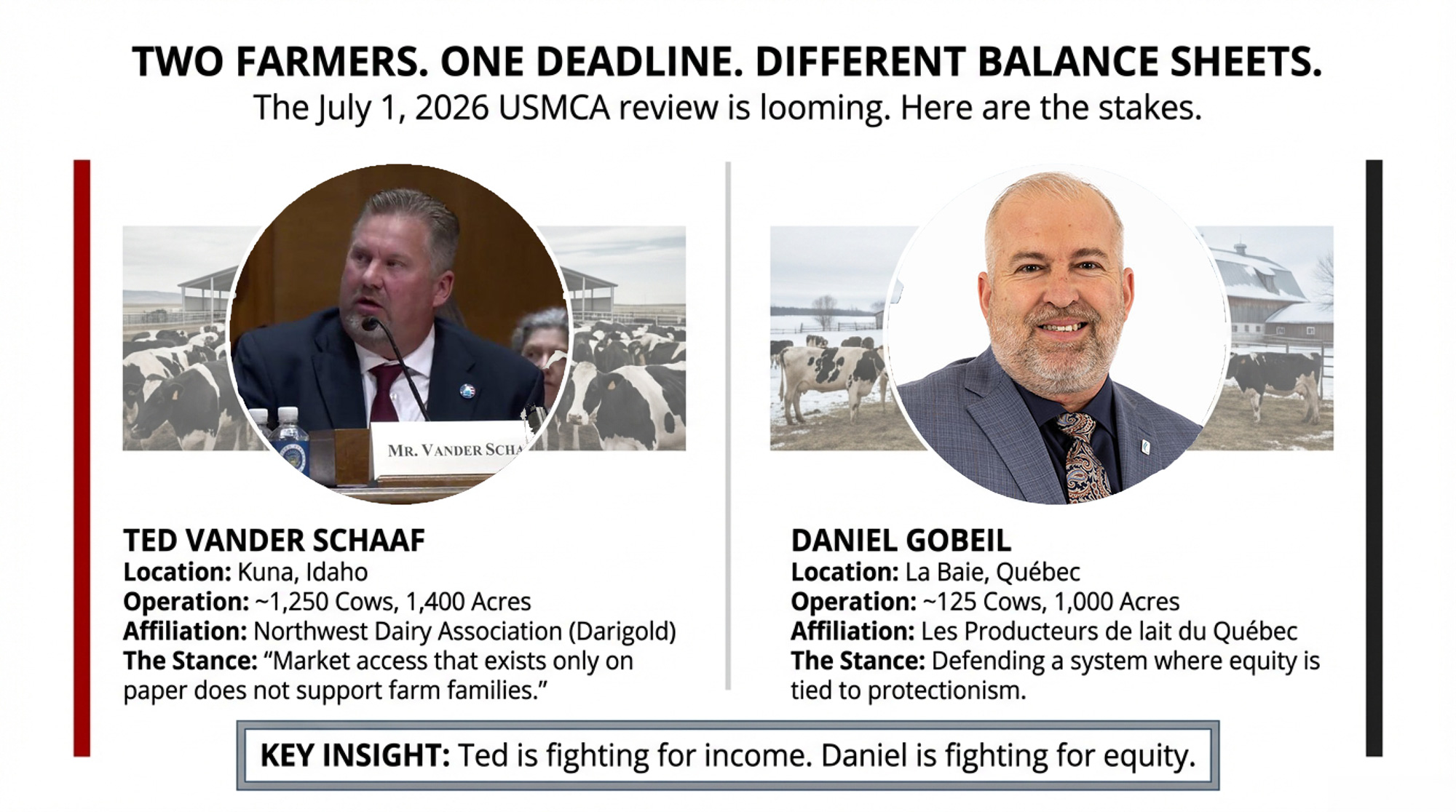
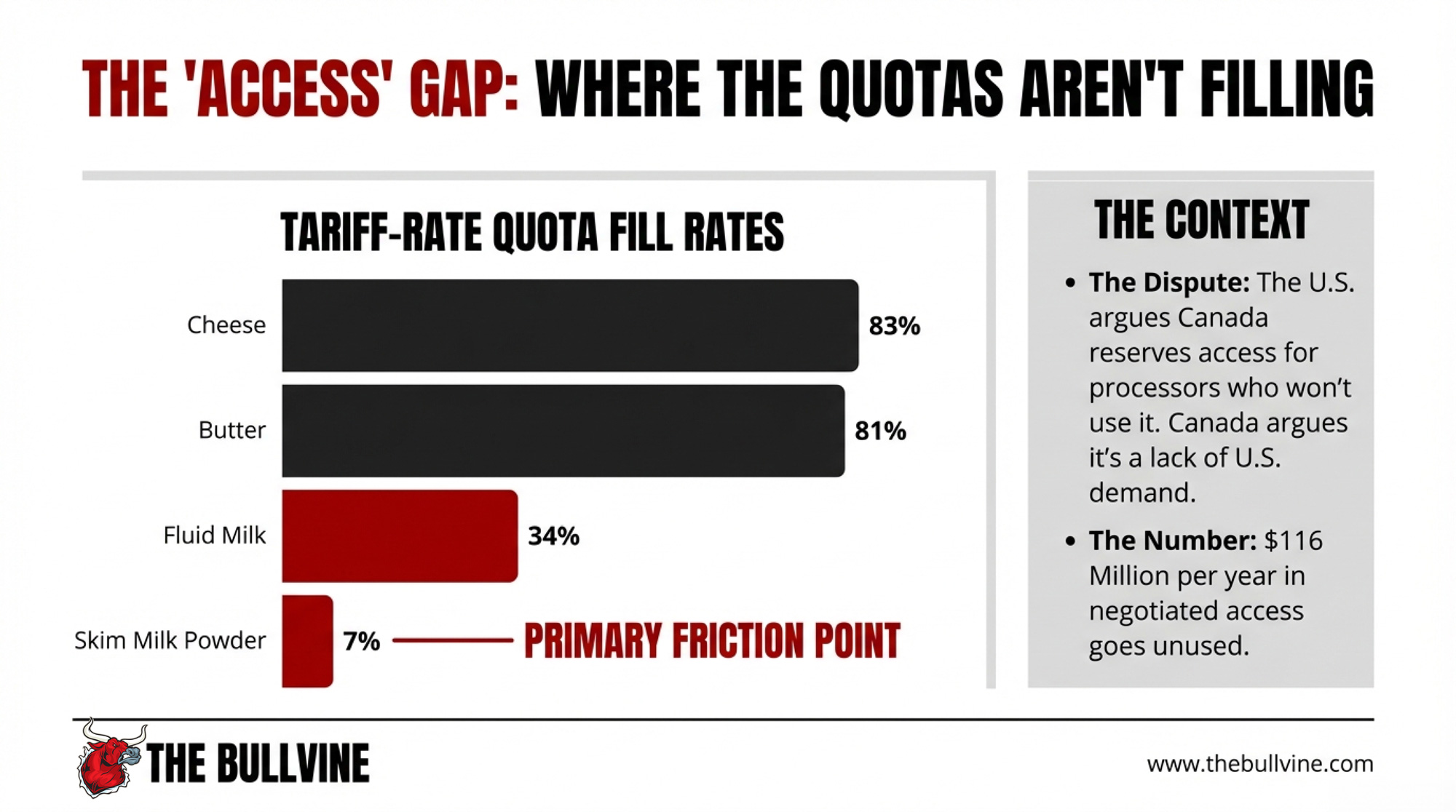
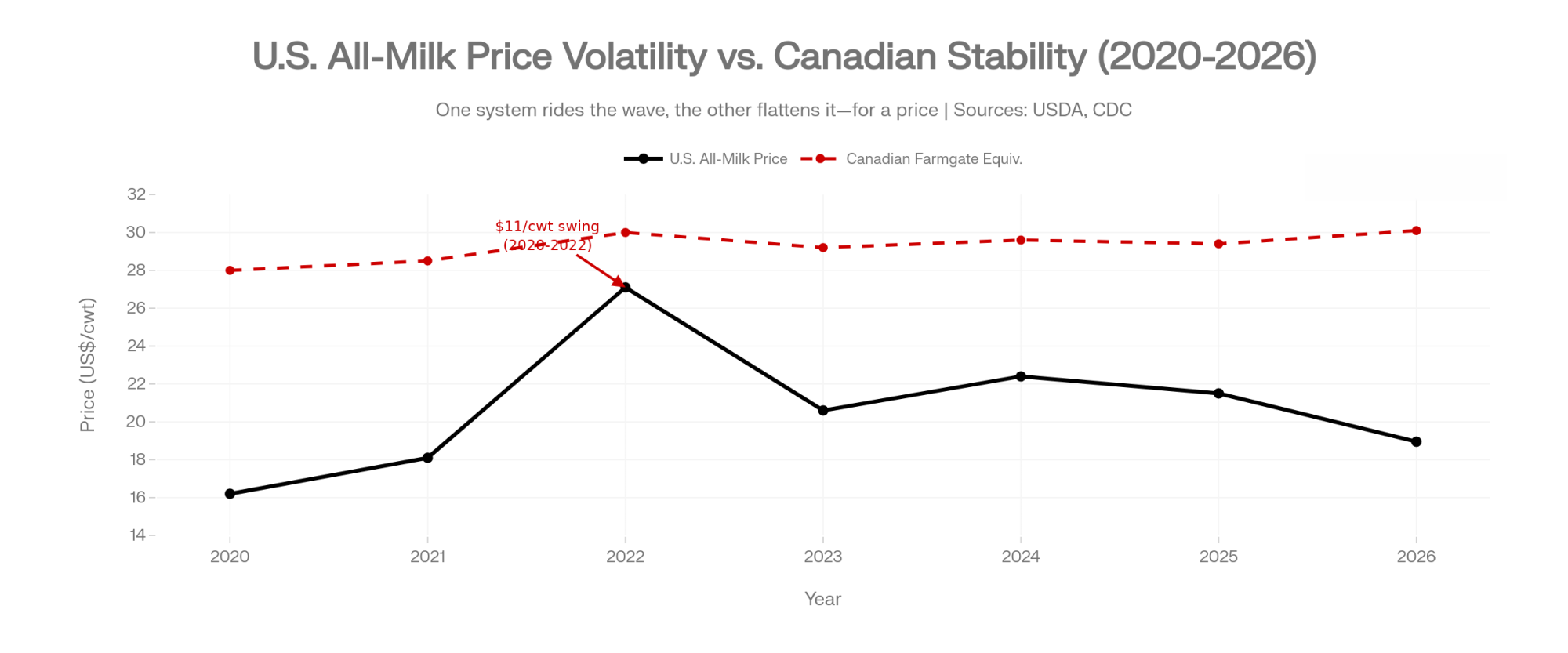
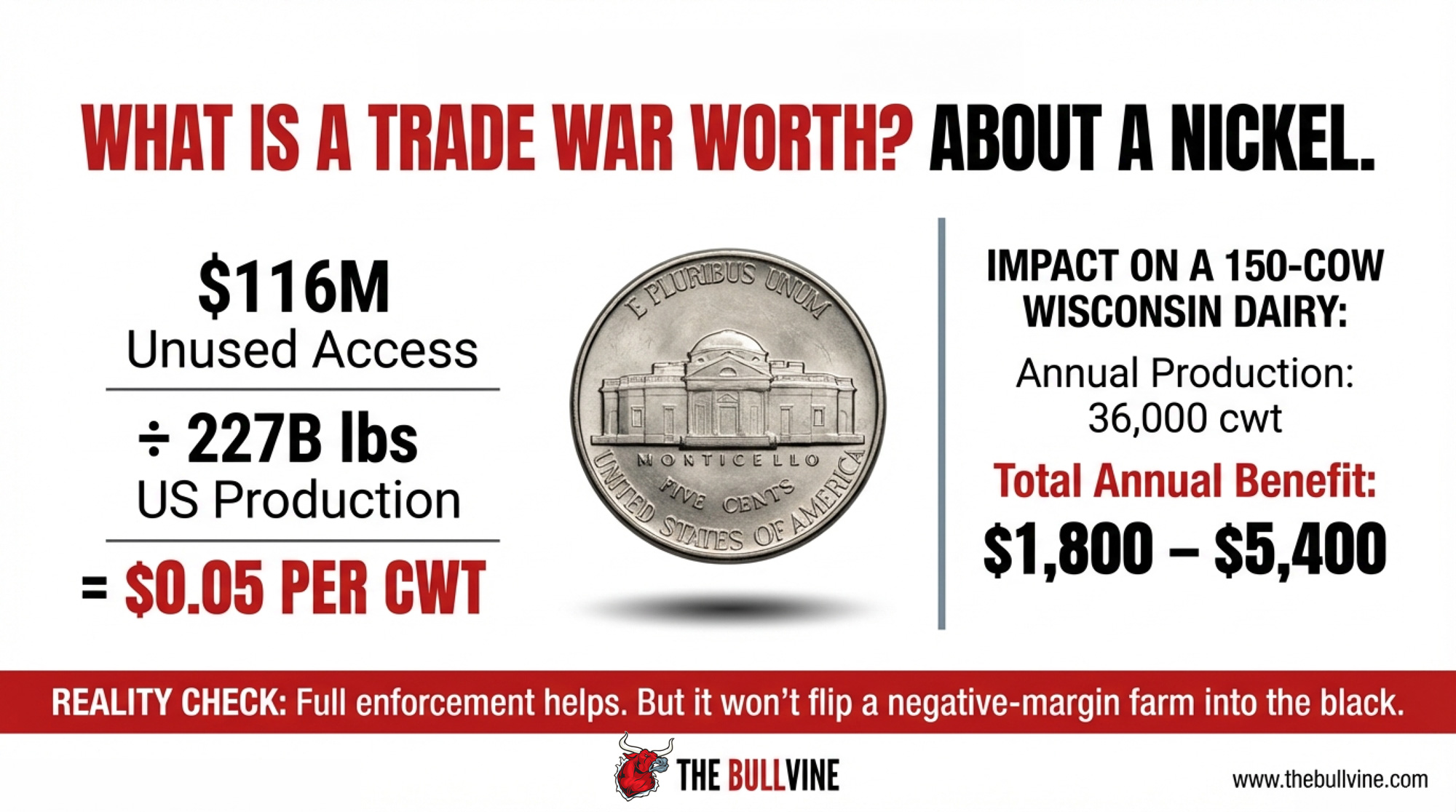
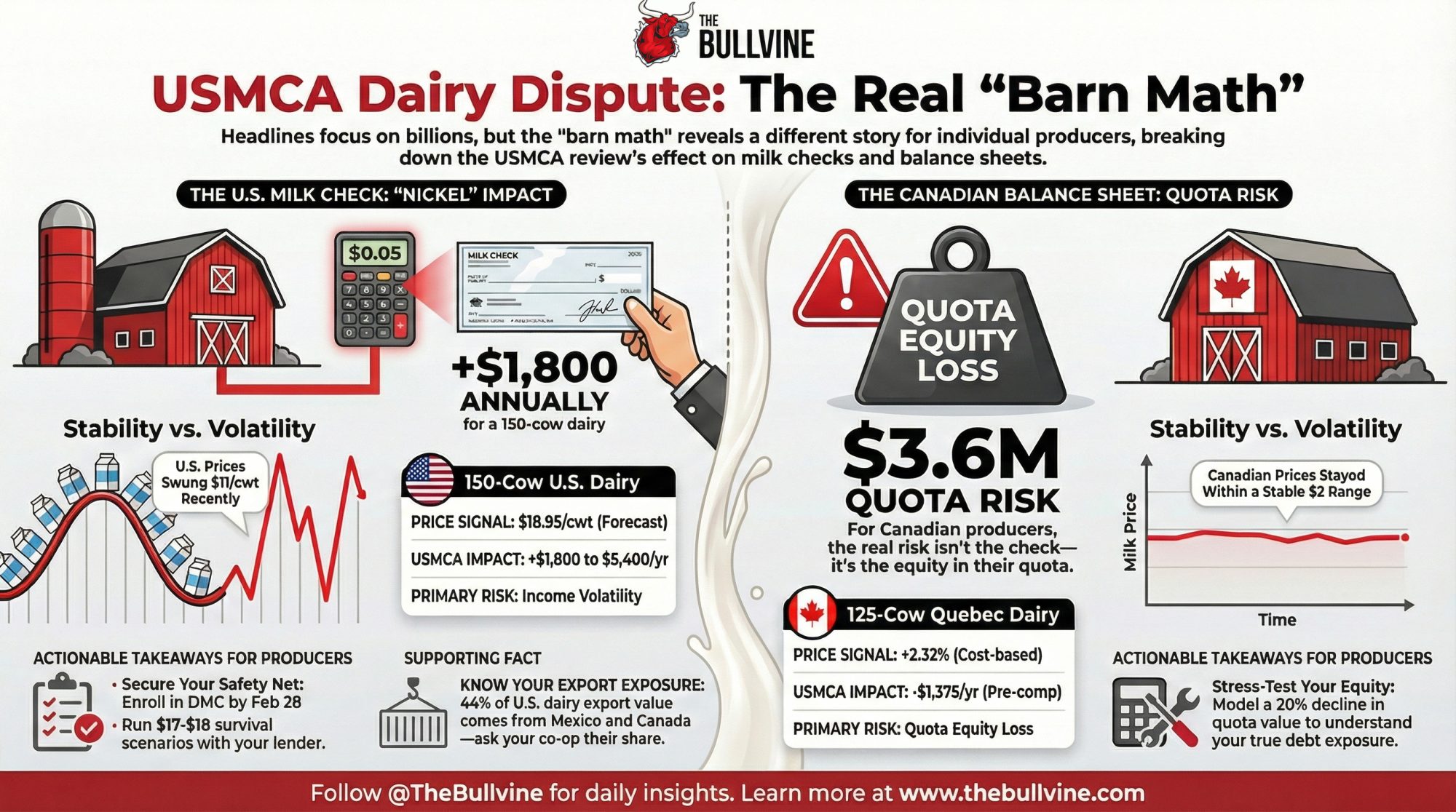
 Join the Revolution!
 Join the Revolution!