





Archive for dairy market access

Ted Vander Schaaf Wants $1.14 Billion in Canadian Access to Actually Work. The Barn Math on Daniel Gobeil’s Québec Farm Says the Fight Is Worth a Nickel.

The USMCA review hits July 1. Two dairy farmers — one in Idaho, one in Québec — are watching the same deadline with completely different balance sheets at stake. Here’s the barn math for both sides of the border.

The U.S. dairy industry told the Senate this week that Canada is blocking roughly $200 million per year in dairy market access it promised under the USMCA — called CUSMA in Canada. Spread that number across American production, and the farm-level impact lands around five cents per hundredweight. Before Congress approved this deal, the U.S. International Trade Commission projected it would boost dairy exports to Canada by 43.8% — about $227 million once fully implemented (USITC Publication 4889, April 2019). Both countries are spending enormous political capital on a fight where the per-farm stakes are far smaller than either side’s press releases suggest.
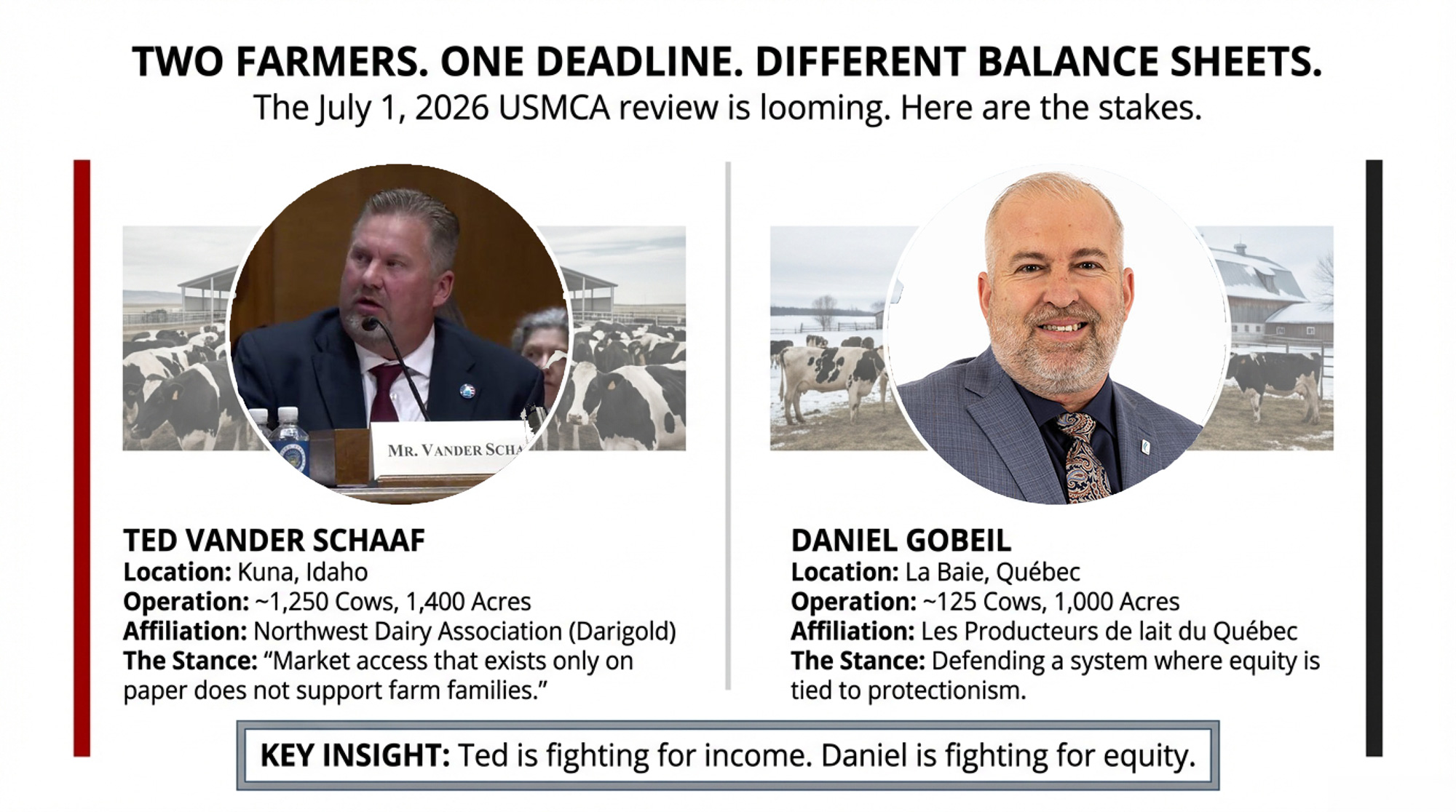
On February 12, Ted Vander Schaaf delivered that case to the Senate Finance Committee. Vander Schaaf milks approximately 1,250 Holsteins near Kuna, Idaho, on 1,400 acres of forage, is a third-generation member-owner of the Northwest Dairy Association (the co-op behind Darigold), and board member of the Idaho Dairymen’s Association. “Market access that exists only on paper does not support farm families, pay employees, or justify new investment,” he told the Committee. And then the line that landed: “A firm base depends on Canada upholding their end of the bargain”.

About 1,500 kilometres northeast, Daniel Gobeil runs Ferme du Fjord in La Baie, Québec — deep in Saguenay-Lac-Saint-Jean — with about 125 lactating cows across more than 1,000 acres of barley, oats, and soybeans (DFC). Gobeil is Vice-President of Dairy Farmers of Canada and President of Les Producteurs de lait du Québec. When Vander Schaaf told the Senate that Canada isn’t upholding its end of the bargain, the implications land directly on operations like his.”
What’s Actually on the Table This July

The USMCA hits its first mandatory joint review by July 1, 2026, as required by Article 34.7. All three countries decide: extend the agreement for 16 years (to 2042), continue with annual reviews until the 2036 expiration, or walk away. U.S. Trade Representative Jamieson Greer left no ambiguity in December 2025: “Could it be exited? Yes, it could be exited. Could it be revised? Yes. Could it be renegotiated? Yes. That is the purpose of that clause, and all of those things are on the table”.

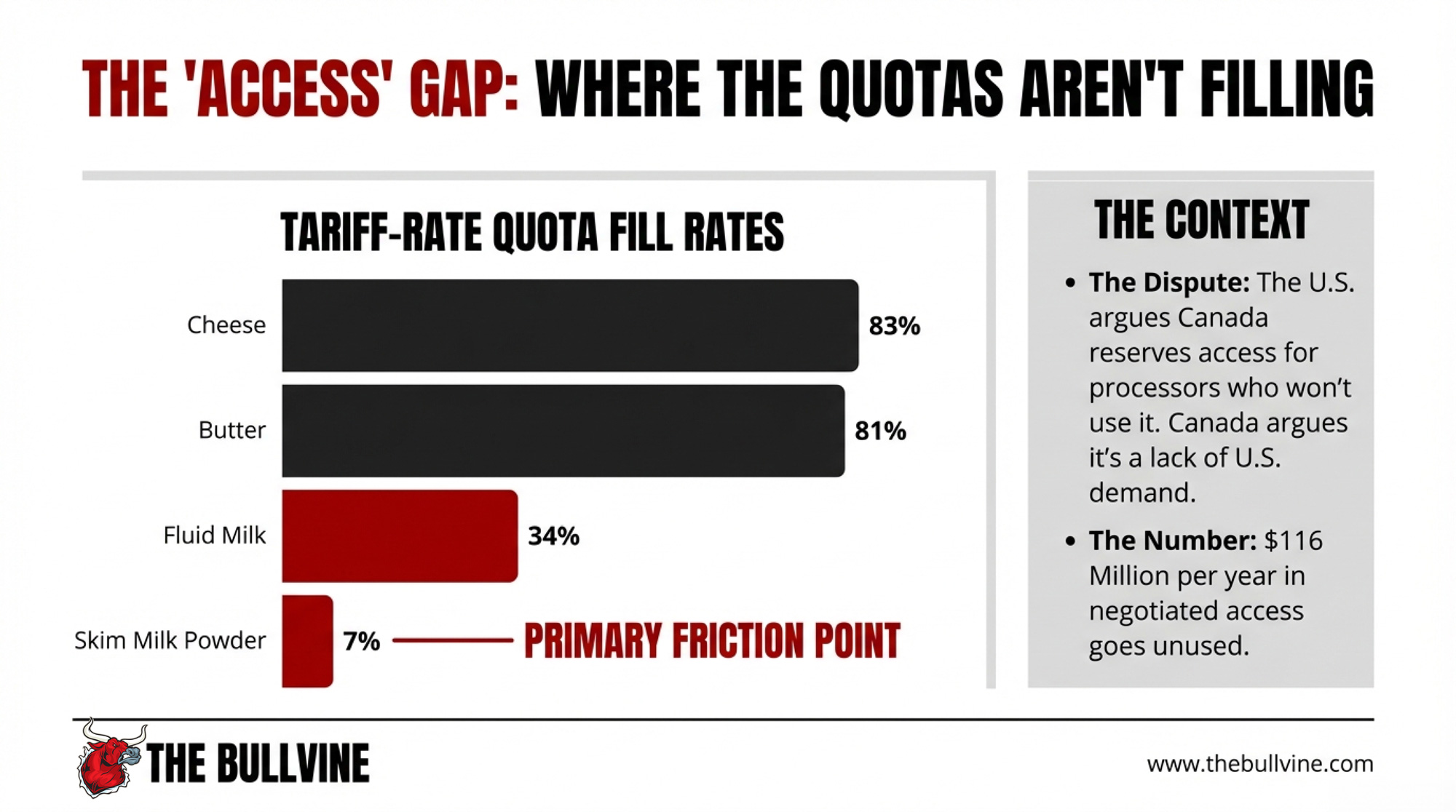
Dairy is the loudest file in the room—and the most organized. On February 4, NMPF and USDEC co-launched the Agricultural Coalition for USMCA, an industry-wide push to strengthen and renew the agreement. When the deal was signed, it opened about 3.6% of Canada’s dairy market as tariff-rate quota access — roughly US$200 million per year across 14 product categories. But those quotas aren’t filling. The overall average fill rate was just 42% in 2022/23, with 9 of 14 TRQs below half the negotiated value. More current data tells a split story:
ProductFill RatePeriod
Cheese (all types)83%2024 calendar year
Butter & cream powder81%2023/24 dairy year
Industrial cheese59%2024
Milk powders57%2024
Fluid milk34%Cumulative
Skim milk powder7%Cumulative

Note: Globe & Mail figures reflect CUSMA-specific TRQs. USDA FAS data may include quotas across all trade agreements (WTO, CETA, CPTPP), which explains the variance in cheese fill rates between sources. Both are accurate within their reported scope.

Cheese and butter fill reasonably well. It’s the fluid milk and powder categories dragging the average, and those are the categories where the allocation system faces the strongest U.S. criticism. Canada argues some TRQs go unfilled because American exporters haven’t generated sufficient demand — a demand problem, not an allocation barrier. The U.S. counters that the allocation system suppresses demand by restricting who can import. A Texas Tech University causal impact study found the actual USMCA boost came in at 34% ($519 million cumulatively) — real growth, but below the USITC’s 43.8% projection, partly because “Canada’s allocation of these quotas mostly favors its own processors over U.S. exporters”.

By our math, 0 million in annual TRQ access times the 42% fill rate — roughly 6 million per year in negotiated access goes unused. That’s a lot of money from the lobby’s podium. It’s a different number from the barn.

MetricLobby NumberBarn Number
Total annual unused TRQ access$200M (promised) / $116M (unused at 42% fill)
Spread across 227B lbs U.S. production$0.05/cwt
Impact on 150-cow farm (36,000 cwt/yr)$1,800/year
Impact on 500-cow farm (120,000 cwt/yr)$6,000/year
Impact if export lift adds $0.10–0.15/cwt“Game-changer” (NMPF)$3,600–$5,400/year (150-cow)
Average U.S. dairy cost of production$19–23/cwt (USDA)
February 2026 all-milk forecast$18.95/cwt (WASDE)

Who’s Pushing — and Who’s Pushing Back

The U.S. says Canada designed its allocation system to block imports by reserving 80–85% of many TRQs for domestic processors who had little incentive to use them. A USMCA dispute panel ruled in the U.S.’s favour in January 2022 and ordered changes. Canada rewrote the rules. A second panel, reporting on November 24, 2023, found, by a two-to-one decision, that Canada’s revised system didn’t technically breach USMCA. The dissenting panelist argued Canada’s narrow eligibility rules “significantly limit a large number of other Canadian importers who would be eager to bring U.S. dairy products to Canada”.

On December 2, 2025, 74 bipartisan House members from dairy states, including New York, Washington, Wisconsin, and California, wrote to Greer urging him to use the 2026 review for enforcement. “NMPF and USDEC — led by President and CEO Gregg Doud, the former Chief Agricultural Negotiator at USTR — have described Canada’s TRQ policies as ‘manipulative’ and accused Ottawa of ‘circumvention’ of USMCA’s dairy export disciplines.” Vander Schaaf told senators the U.S. exported approximately $9 billion in dairy products in 2025, including a record 559,000 metric tons of cheese through November. The trajectory is up. The frustration is that Canada isn’t absorbing its share.

On the Canadian side, Prime Minister Mark Carney responded directly in December 2025. Supply management is “not on the table,” — and he answered the English-language question in French. That’s a message aimed squarely at Québec.

DFC President David Wiens — who milks about 240 cows with his brother Charles near Grunthal, Manitoba — told MPs the combined impact of CUSMA, CETA, and CPTPP means roughly 18% of Canada’s domestic dairy demand is now met by imports. When CUSMA was signed, DFC projected that cumulative concessions would displace one in five Canadian dairy products — amounting to $1.3 billion in annual farm-gate losses once fully phased in. Both sides believe they’re defending survival — $1.14 billion in U.S. dairy exports to Canada in 2024, a record, and part of a $3.6 billion flow to Mexico and Canada that accounts for 44 percent of total U.S. dairy export value. On the other side: CA$4.8 billion in federal compensation flowing to supply-managed sectors.

Why the Same Commodity Pays Two Different Mortgages

The single biggest difference between Vander Schaaf’s milk check and Gobeil’s: how the price gets set.

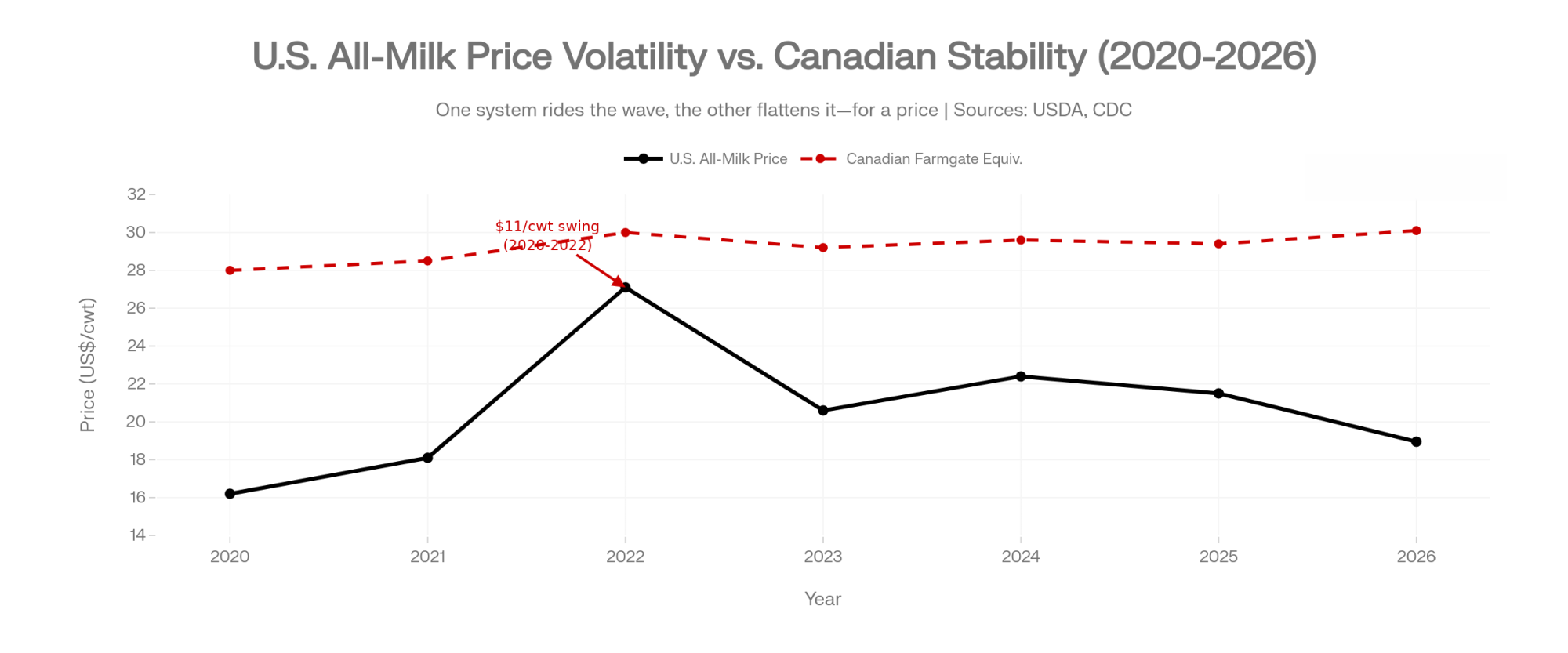
In the U.S., the base price flows from Class III/IV futures and commodity markets. USDA’s February 2026 WASDE projects the all-milk annual average at US$18.95/cwt — but January’s Class III came in at just $14.59/cwt. The back half of the year has to do heavy lifting to hit that average. The safety net is Dairy Margin Coverage: insurance, not a guaranteed price. Over the last five years, U.S. all-milk prices swung from roughly $16.20 in 2020 to $27.10 in 2022 — an $11/cwt range.
YearU.S. All-Milk Price (US$/cwt)Canadian Equivalent (US$/cwt)
2020$16.20$28.00
2021$18.10$28.50
2022$27.10$30.00
2023$20.60$29.20
2024$22.40$29.60
2025$21.50 (est.)$29.40
2026$18.95 (forecast)$30.10 (forecast w/ 2.3% increase)

In Québec, the Canadian Dairy Commission surveys actual production costs each year and adjusts the farmgate price to cover them. The formula: 50% of the change in the indexed cost of production, 50% of the change in the consumer price index. That produced the 2.3255% farmgate increase effective February 1, 2026 — tied to input costs and inflation, not commodity markets in Chicago. Canadian farmgate prices move in a narrow band, roughly US$28–30/cwt equivalent at the 2025 average exchange rate, against that $11 U.S. swing.

But that stability comes stapled to a different kind of risk. In the P5 provinces — Ontario, Québec, New Brunswick, Nova Scotia, and PEI — quota trades at a cap of CA$24,000 per kilogram of butterfat per day. A cow producing 1.2–1.3 kg BF/day means a per-cow quota value around CA$28,800–$31,200. In western Canada, it’s higher — Alberta’s quota traded at CA$56,495/kg BF/day in January 2025, and Manitoba’s at CA$44,000. On Gobeil’s 125-cow Québec farm, that’s roughly CA$3.6–3.9 million in quota value — an asset that exists only as long as Ottawa keeps defending it.

One system charges you in income volatility. The other charges you in political risk locked inside your balance sheet.

What Does the USMCA Review Mean for a 150-Cow Wisconsin Dairy?

Here’s where the barn math gets humbling. Spread across 227 billion pounds of annual U.S. production, the raw math on $116 million in unused TRQ access works out to about $0.05/cwt nationally. Five cents.
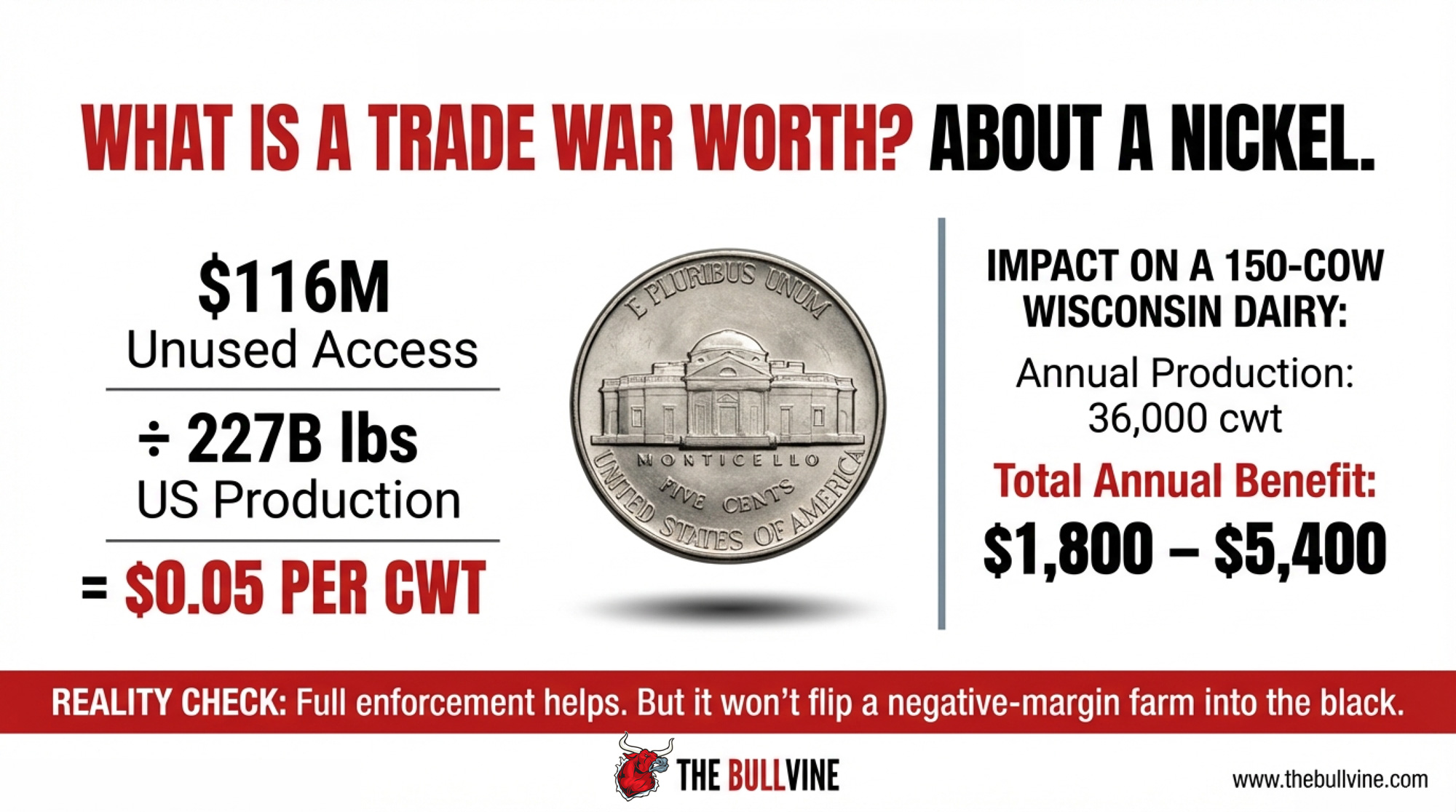
Take a 150-cow Wisconsin dairy producing 24,000 lbs per cow. That’s 36,000 cwt per year. At $0.05/cwt, full TRQ enforcement is worth roughly $1,800 annually. Scale to a 500-cow operation producing 120,000 cwt, and it’s $6,000 — still not survival money.

But trade access lifts demand signals across the domestic market. Cornell dairy economist Charles Nicholson, working with Wisconsin’s Mark Stephenson, estimated that each additional 1% of U.S. dairy components exported lifts the all-milk price by about $0.12/cwt (95% CI: half a cent to $0.24/cwt). Their own conclusion: “it would be appropriate to be cautious in estimating the magnitude of price impacts from US dairy exports.” As exports grow, supply grows roughly in step.

Herd SizeAnnual Production (cwt)Direct TRQ Impact ($0.05/cwt)Optimistic Export Lift ($0.10–0.15/cwt)Total Potential GainCost of Production ($/cwt)2026 Forecast ($/cwt)Margin Gap
150 cows36,000 cwt$1,800/yr$3,600–$5,400/yr$5,400–$7,200/yr$19–23$18.95−$0.05 to −$4.05
500 cows120,000 cwt$6,000/yr$12,000–$18,000/yr$18,000–$24,000/yr$19–21 (scale advantage)$18.95−$0.05 to −$2.05
1,250 cows(Vander Schaaf)150,000 cwt$7,500/yr$15,000–$22,500/yr$22,500–$30,000/yr~$19 (scale advantage)$18.95−$0.05

Apply that framework. Filling the remaining $116 million wouldn’t move the export needle by a full percentage point. Even at the generous end of Nicholson’s range, you’re looking at $0.10–$0.15/cwt in total price lift. On 36,000 cwt, that’s $3,600 to $5,400 per year for our 150-cow Wisconsin dairy.

Set that against cost reality. USDA ERS data (2021 ARMS survey, published July 2024) shows farms with 2,000+ cows averaging $19.14/cwt in full economic cost, while herds under 50 cows hit $42.70/cwt. Analysts pegged mid-size net cost of production at $22.64/cwt. A 150-cow operation in that $19–23/cwt range — receiving a forecast of $18.95 — is treading water or running red before trade even enters the picture. An extra $1,800 to $5,400 helps. It won’t flip a negative-margin farm into a positive one.

What a Nickel Means for a 125-Cow Québec Quota Farm

Now flip the border. If those TRQs fill completely, cheese is already at 81–83%, so the real incremental pressure comes from powder and fluid categories. On 125 cows producing roughly 27,500 cwt per year, a nickel-per-hundredweight hit works out to about $1,375 annually. Ottawa cushions that — CA$1.2 billion over six years through the Dairy Direct Payment Program alone for CUSMA. Minister Bibeau confirmed in November 2022 that the combined package across three trade deals reaches CA$4.8 billion.

But every round of “access goes up, Ottawa writes a bigger cheque” adds weight to a political question. That CA$4.8 billion comes from general federal revenue — Canadian taxpayers. FCC’s 2026 dairy outlook advises producers to “continue focusing on what they can control on the farm” until the details of the CUSMA review are known. Sensible. It’s also what you say when you don’t know how the politics will break.

The bigger exposure isn’t the milk cheque. It’s the balance sheet. A 20% decline in quota value on Gobeil’s 125-cow operation at the P5 cap means roughly CA$720,000–$780,000 in equity gone. If you’re running 500+ cows in Alberta at CA$56,495/kg BF/day, your exposure is roughly double the P5 math. Your stress test looks different.

Are These Farmers Actually on Opposite Sides?

The easy version — American dairy vs. Canadian dairy, free market vs. supply management — misses what’s happening to both of them.

Vander Schaaf’s 1,250-cow Idaho operation and Gobeil’s 125-cow Québec farm are both getting squeezed by the same forces — processors, retailers, global commodity traders — and dealing with it through completely different systems. The American system absorbs that pressure through farmer income. The Canadian system absorbs it through government spending and quota valuation. Neither pushes the pressure back up the chain to the players who actually control pricing power.

If both sides “win” their version of the 2026 review — full TRQ enforcement for the U.S., intact supply management plus compensation for Canada — it doesn’t fix either farmer’s structural problem. It determines who bleeds a little slower.

The Border Math, Side by Side

Metric150-Cow Wisconsin Dairy125-Cow Québec Dairy
Price mechanismClass III/IV futures + commodity marketsCDC formula (50% COP + 50% CPI)
Farmgate price (5-year range)~US$16.20–$27.10/cwt (2020–2022)~US$28–30/cwt equivalent
2026 price signal$18.95/cwt forecast (WASDE Feb 2026)2.3255% increase eff. Feb 1, 2026
Annual production~36,000 cwt~27,500 cwt
USMCA impact (full TRQ enforcement)+$1,800–$5,400/yr−$1,375/yr (before compensation)
5-year price volatility~$11/cwt swing~$2–4/cwt swing
Safety netDMC + crop insuranceSupply management + CA$4.8B federal compensation
Balance-sheet riskLand + cows + equipmentLand + cows + equipment + ~CA$3.6–3.9M quota

The math doesn’t pick a winner. It shows two different bills for the same thing: stability.

What You Can Do Before July

If you’re milking in the U.S.:

  • Enroll in DMC before February 28. Tier 1 coverage expanded from 5 million to 6 million pounds under the One Big Beautiful Bill Act (signed July 4, 2025). At $9.50 coverage, you’re paying $0.15/cwt in premium. Lock in for six years (2026–2031) at a 25% premium discount — but that means you can’t adjust if your herd grows or margins recover. If you’re above 6 million lbs (roughly 275+ cows at the national average production), Tier 1 covers only a fraction. Talk to your risk management advisor about Dairy Revenue Protection or Livestock Gross Margin for the rest.
  • By spring: Run a survival scenario at US$17–18/cwt with your lender. If your breakeven sits above $18, work the restructuring math before margins compress — not after.
  • Before July: Ask your co-op: “What percentage of our milk ends up in Canada or Mexico, and what’s our contingency if USMCA stalls?” Mexico and Canada purchased $3.6 billion in U.S. dairy products in 2024, accounting for 44 percent of total U.S. dairy exports.

If you’re milking in Canada:

  • Pull your own cost-of-production numbers and compare them against the CDC’s national average. If you’re not participating in COP surveys, you’re relying on your neighbours’ data while your livelihood depends on the results.
  • Watch the protein shift. FCC’s 2026 dairy outlook flags that both P5 and WMP are restructuring producer pay to incentivize more protein and less butterfat. If your herd tests 4.5% BF and 3.4% protein, you’re roughly neutral. Push butterfat higher without matching protein, and your gross revenue could drop by 1.2% under the new WMP structure. Factor that into breeding and ration planning alongside trade uncertainty.
  • By spring, model a 20% decline in the quota value with your lender. Not because that’s likely — but because you should know the answer before you need it. If you’re carrying debt against quota collateral, ask what their haircut assumptions are. FCC’s 2026 dairy outlook is worth reading alongside your balance sheet.
  • Before July: Watch two signals. First, CDC pricing bulletins — are they still citing cost of production and CPI as drivers, or are words like “affordability” or “competitiveness” creeping in? That language shift is your early-warning system. Second, provincial quota exchange reports. In January 2025, Ontario moved 405.98 kg BF/day at the CA$24,000 cap. Firm volume at the cap means the market believes the system holds. Watch for softening.

Both sides: Don’t let the trade conversation be somebody else’s problem. Your milk check is already a trade document.
Key Takeaways:

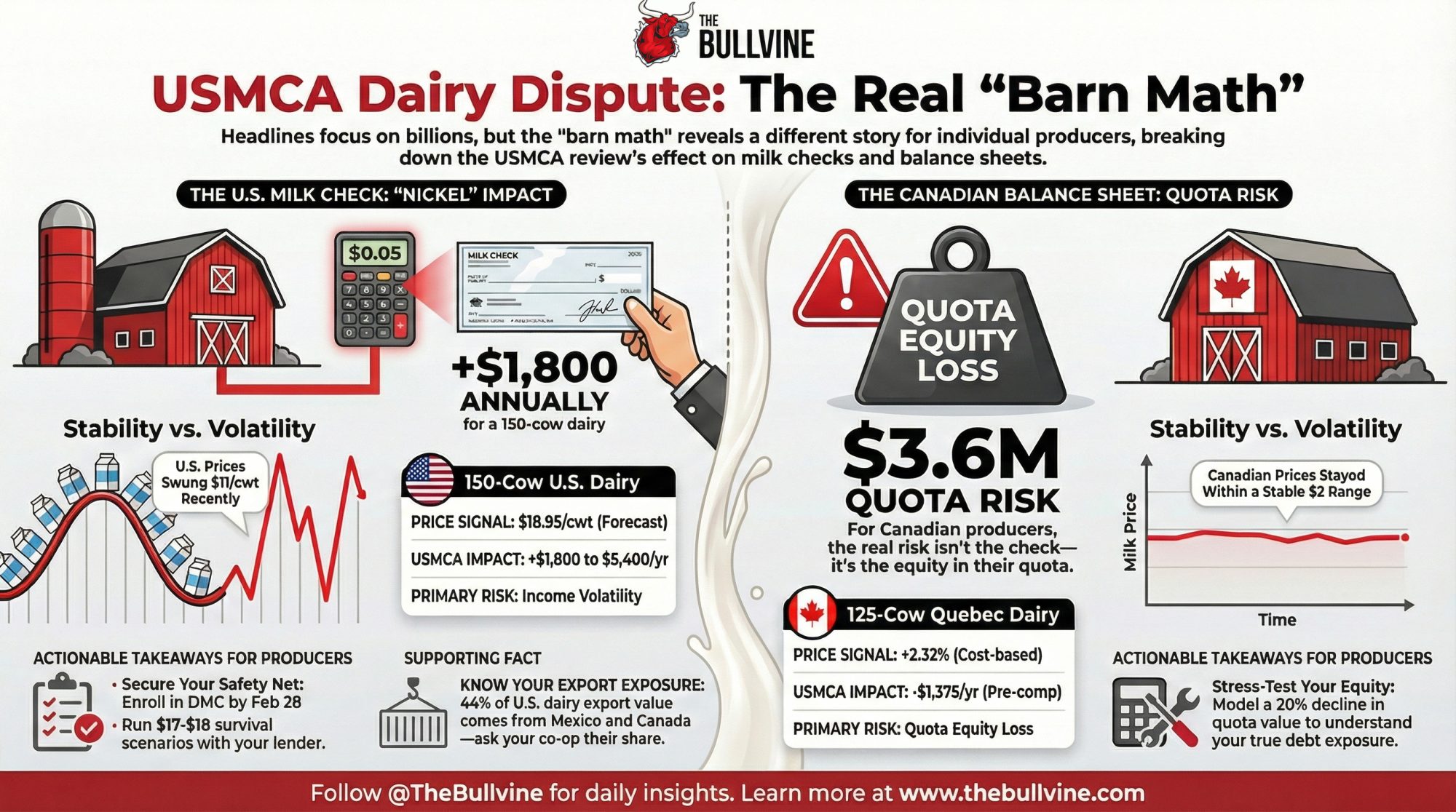
  • The USMCA dairy fight is huge in headlines ($200M–$1.14B), but the farm‑level effect is small: roughly 5¢/cwt or $1,800–$5,400/year for a 150‑cow U.S. herd.
  • Canadian supply management trades income stability for political and balance‑sheet risk: US$28–30/cwtstability on the milk cheque, but CA$3.6–3.9M in quota equity exposed to Ottawa’s trade decisions.
  • Full TRQ enforcement and a “win” for U.S. dairy won’t rescue a negative‑margin farm; survival still comes down to cost control, risk management (DMC/DRP/LGM), and co‑op strategy.
  • For Canadian producers, the real USMCA/CUSMA risk isn’t this year’s milk price; it’s possible quota repricing, so you need to stress‑test a 20% equity hit with your lender.
  • If you don’t know your co‑op’s export exposure, your breakeven, or your quota‑value stress line, you’re flying blind into the 2026 review — your milk cheque is already a trade document.

The Bottom Line

Vander Schaaf delivered his testimony and returned to his Idaho operation. Gobeil, 1,500 kilometres north, leads the organization representing every Québec dairy farmer who’ll feel whatever the July review decides. Both face the same July deadline. Both will judge the outcome by the deposit on their next milk cheque. The question for you isn’t which system is better — it’s whether you know your own numbers well enough to plan around whatever comes out of that review.

When the USMCA review panel reports this summer, we’ll re-run the barn math for both sides of the border in our Border Math series. What does your co-op’s export breakdown look like? What’s your breakeven?

Updated Feb 23, 2026: Headline revised for clarity. Daniel Gobeil was not interviewed for this article. Farm-level analysis is based on publicly available DFC data applied to representative Québec dairy operations.

Updated Feb 23, 2026: Headline revised for clarity. Daniel Gobeil was not interviewed for this article. Farm-level analysis is based on publicly available DFC data applied to representative Québec dairy operations.

Complete references and supporting documentation are available upon request by contacting the editorial team at editor@thebullvine.com.

Learn More

The Sunday Read Dairy Professionals Don’t Skip.

Every week, thousands of producers, breeders, and industry insiders open Bullvine Weekly for genetics insights, market shifts, and profit strategies they won’t find anywhere else. One email. Five minutes. Smarter decisions all week.
NewsSubscribe
First
Last
Consent

The $4.3B Dairy Door: Why This EU-US Deal Changes Everything for American Producers

Ever wonder why European cheese floods our stores but we can’t crack theirs?

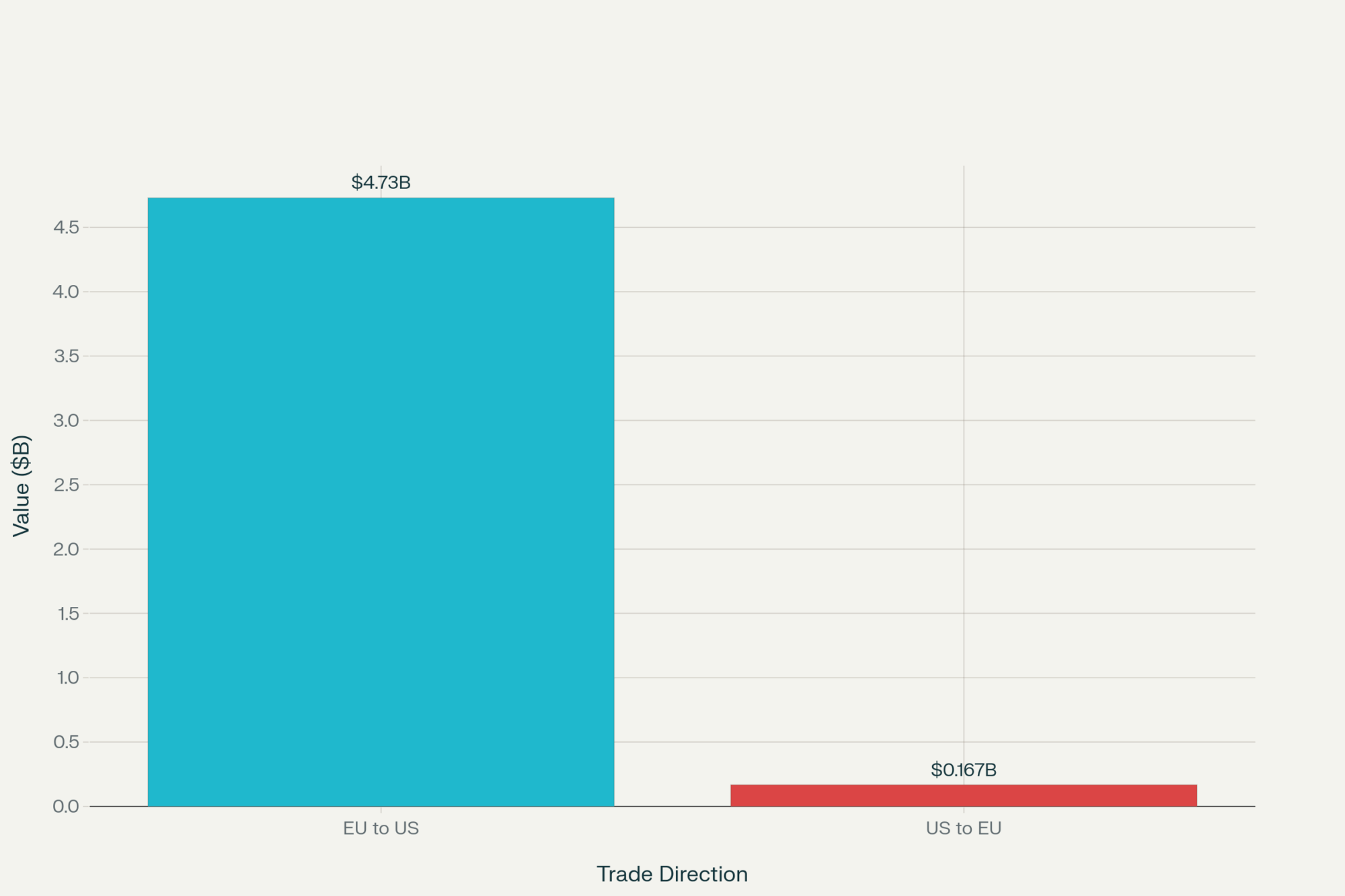
EXECUTIVE SUMMARY: Here’s the deal — the EU-US dairy trade gap is absolutely massive, and it just cracked wide open. European dairy exports to America topped €4.3 billion in 2024, while we barely scraped together $167 million going the other way. That’s a 25-to-1 beating we’ve been taking for years. But this new framework changes everything. We’re getting a 20,000-tonne tariff-free quota — that’s like giving 400 family farms direct access to premium European pricing. Sure, certification’s still gonna cost you anywhere from $650K to $2.5 million depending on your setup, but here’s the kicker… Europe’s Green Deal is jacking up their production costs by 15-20% while our herds keep growing. With Texas and Idaho leading the charge on expansion, this isn’t just about exports anymore — it’s about positioning yourself before everyone else catches on. Don’t sit this one out.

KEY TAKEAWAYS:

  • Get in on that 20,000-tonne quota — equals roughly 400 mid-sized operations’ worth of access. Join or start a certification cooperative to split those million-dollar compliance costs.
  • USDA’s promising 60% faster certification times — call (202) 720-3423 now because even “faster” still means months of prep work ahead of you.
  • Europe’s sustainability mandates are pricing them out — their Green Deal adds 15-20% to production costs, giving you a competitive edge if you stay efficient.
  • The US herd just hit 9.45 million head with 20,000 added this year — growth means opportunity, but also stiffer competition at home.
  • Smart compliance investments pay off double — meet export standards while boosting domestic margins as regulations tighten everywhere.
US dairy exports, EU trade deal, dairy market access, global dairy trade, farm profitability

You know that feeling when you’ve been banging your head against a wall for decades, and suddenly—crack—it gives way? That’s exactly what hit me reading about the August 2025 EU-US Framework Agreement. After watching European cheese and butter flood our supermarkets while American producers got tangled in regulatory nightmares, Brussels finally had to face reality.

Here’s the numbers that forced their hand: European Commission data shows agricultural exports to the US hit €4.3 billion in 2024, with dairy products playing a major role. Meanwhile, US dairy exports to Europe barely scraped $167 million last year, according to USDA figures. That’s a 25-to-1 imbalance that became politically and economically impossible to ignore.

A Trade Gap So Big It Finally Forced Action

Walk through any processing plant from Wisconsin’s 150-cow family operations to California’s 4,000-head mega-dairies, and you’ll hear the same frustration. European products flow freely while our exports crawl through years of certification hell.

But here’s the breakthrough that’s got everyone talking: the framework opens a 20,000-tonne tariff-free quota for US dairy into Europe. Now, before you roll your eyes at what sounds modest, think about this—that’s roughly the combined output of 400 family farms running 500 cows each. Suddenly, we’re not just cracking the door; we’re pushing it wide open.

New Zealand’s been working this playbook for years. Their 15,000-tonne butter quota into Europe acts like a pricing anchor for their entire domestic market. When Kiwi producers can command EU premium prices for even a portion of their production, it lifts profitability across the board. That’s the kind of leverage American dairy hasn’t had in European markets… well, ever.

Industry feedback from recent dairy association meetings reflects deep skepticism: “These European market promises have been floating around forever. I need to see actual trucks rolling through German warehouses without regulatory delays before I change my expansion plans.” That wariness comes from years of watching certification processes drag on for three years or more.

The Real Investment (And It’s Serious Money)

Here’s where rubber meets road. USDA analysts project certification times could drop by up to 60%—which represents massive progress. But the upfront costs? Industry estimates suggest you’re looking at:

  • Small cheese plants (under 50,000 lbs/day): $650,000-$850,000
  • Mid-size operations (50-200,000 lbs/day): $1.2M-$1.8M
  • Large processors (200,000+ lbs/day): $1.8M-$2.5M

Then add ongoing expenses—lab testing, staff training, compliance monitoring—running tens of thousands annually.

One Pennsylvania processor I know described the reality: “We essentially built a whole new operation inside our existing plant just to meet EU standards. Every piece of equipment, every surface had to be recertified. It’s like building a plant within a plant.”

Production Dynamics Flip: EU Shrinks While US Grows

What’s fascinating about this framework’s timing—it hits just as fundamental production dynamics between the US and EU are completely flipping.

In the Netherlands, environmental regulations are leading to a reduction of around 15% in herd sizes. Industry reports from Dutch producers paint a grim picture: “These nitrogen limits keep squeezing us tighter—every new regulation costs money we don’t have.”

Back home, it’s in growth mode. The US dairy herd reached 9.45 million head with approximately 20,000 added year-over-year through May 2025. Texas keeps booming with double-digit production increases, Idaho’s building processing capacity for mega-dairies, and even Wisconsin family farms are exploring cooperative export strategies.

Smaller producers are getting smart about this—forming cooperative export groups to pool resources, share certification costs, and navigate the regulatory maze together. Wisconsin, Pennsylvania, and New York already have groups in development stages.

Europe’s Cost Burden Becomes Our Competitive Edge

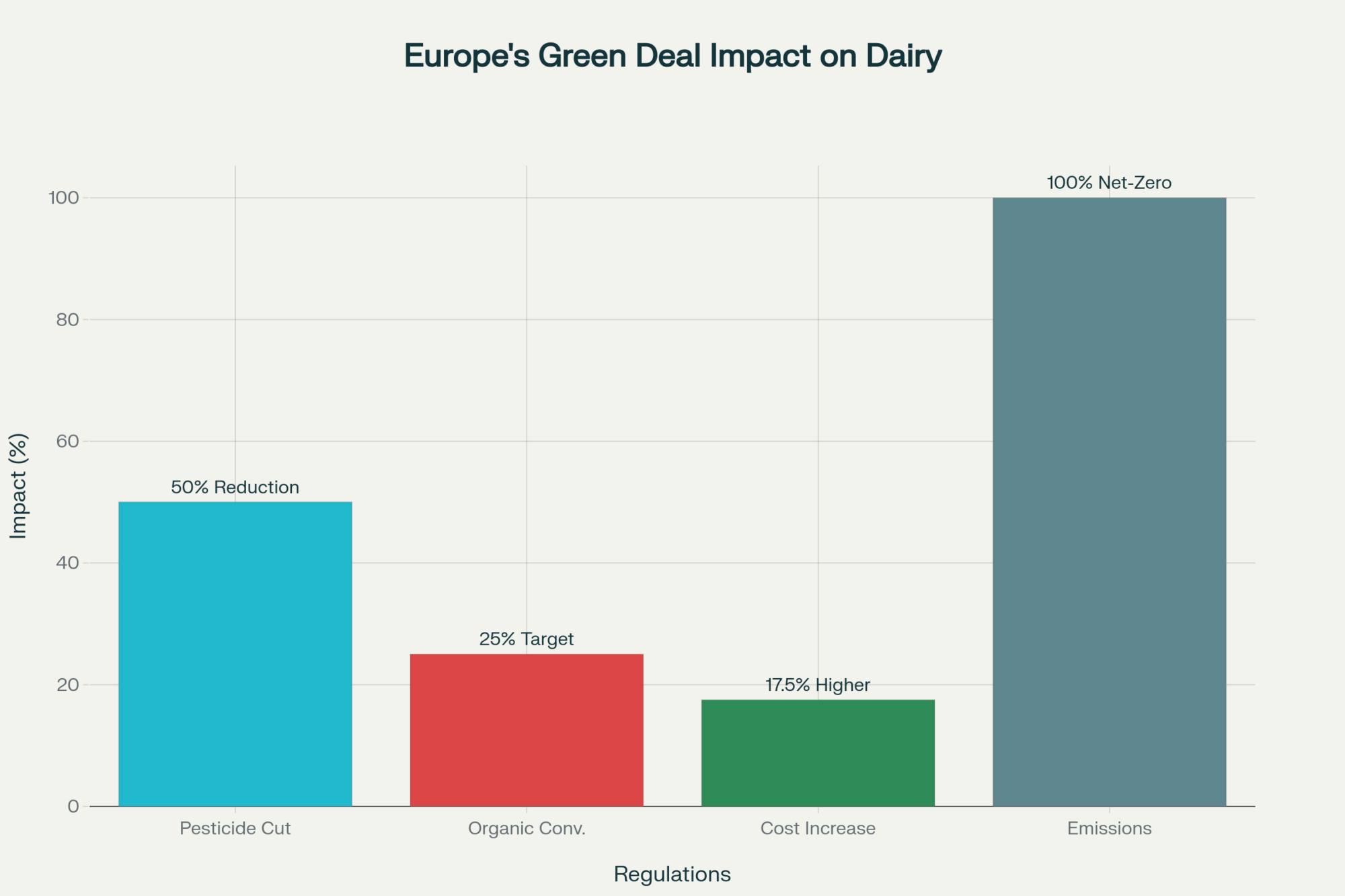
Here’s the underlying story: Europe’s Green Deal mandates are creating permanent cost disadvantages. The requirements—50% pesticide reduction, 25% organic conversion, net-zero emissions by 2050—add an estimated 15-20% to European production costs compared to US operations.

That’s not a temporary market cycle. That’s structural competitive advantage shifting permanently toward American producers just as market access barriers start coming down.

“America’s dairy farmers are done playing second fiddle in Europe’s rigged system,” declared Krysta Harden, USDEC president and CEO. “For too long, the EU has wielded tariffs and red tape as weapons to shut US products out while European exporters enjoyed extensive access to our shelves. That imbalance has saddled us with a staggering $3 billion dairy trade deficit in 2024 alone.”

Your Next Moves (Real Steps, Real Contacts)

If you’re serious about European markets, here’s where to start:

  • Contact USDA Export Assistance at (202) 720-3423 for pre-certification assessment. The process can take months, so early engagement matters.
  • Connect with your state dairy association about cooperative export groups. Multiple states already have formation meetings scheduled.
  • Check out NMPF’s market access resources for industry-specific guidance on EU requirements.
  • Explore Farm Credit export financing for facility investments—they understand dairy operations and have specialized programs.

Not ready for exports? Prepare for increased competition at home. European specialty products will keep flowing in, so focus on efficiency, differentiation, and operational excellence.

The Global Ripple Effect

This bilateral agreement is creating waves throughout global dairy markets. New Zealand’s accelerating US market expansion is aimed at maintaining its competitive positioning. Australia’s preparing similar market access demands for EU negotiations. Canada’s monitoring third-party impacts carefully.

“U.S. farmers win when competition is fair, but there’s nothing fair about Europe’s system,” said Gregg Doud, NMPF president and CEO. “An agreement with the EU has the potential to unlock billions in new opportunities for American dairy.”

Bottom Line: The Industry Just Shifted into High Gear

What strikes me most about this framework is how it proves even Europe’s most entrenched dairy protections eventually crack under sustained economic pressure. That €4.3 billion trade imbalance became politically unsustainable, and Brussels had to respond.

The walls protecting European dairy are cracking. European producers who think regulatory barriers alone will protect their turf are living in the past. American producers who assume this automatically opens up European gold mines without serious investment are dreaming.

The winning strategy? Know exactly where your operation stands competitively. If you’re serious about European markets, start building capabilities now—certification takes years even with streamlined procedures. If you’re focusing domestically, prepare for intensified competition by doubling down on efficiency and quality.

The dairy industry just shifted into high gear. Will you be accelerating with it, or watching from the sidelines?

Essential Contacts:

Ready to stop watching from the sidelines? This door won’t stay cracked forever.

Complete references and supporting documentation are available upon request by contacting the editorial team at editor@thebullvine.com.

Learn More:

The Sunday Read Dairy Professionals Don’t Skip.

Every week, thousands of producers, breeders, and industry insiders open Bullvine Weekly for genetics insights, market shifts, and profit strategies they won’t find anywhere else. One email. Five minutes. Smarter decisions all week.

NewsSubscribe
First
Last
Consent

US-India Dairy Standoff: Why American Producers Face a Brick Wall in The World’s Largest Milk Market

Why US dairy can’t crack India: Sacred cows, 80M farmers & 60% tariffs block trade deals.

US-India dairy trade, India dairy tariffs, sacred cow trade barriers, dairy market access, agricultural trade negotiations

While Washington trade negotiators keep promising the moon, American dairy is getting exactly nowhere in cracking India’s market. And here’s the hard truth – it won’t happen anytime soon, no matter how many diplomatic niceties get exchanged this week in the latest round of talks.

The numbers don’t lie. India produces a staggering 230 million metric tonnes of milk annually – over 21% of global production. India represents the holy grail of untapped potential for US dairy exporters facing markets as saturated as a waterlogged pasture after three days of rain.

But make no mistake – this potential will remain as theoretical as a perfect lactation curve. Why? Because we’re not just up against tariffs. We’re up against an entire cultural, economic, and political system explicitly designed to keep us out.

The Rural Lifeline: More Essential Than Your Backup Generator

Let’s get real about what we’re asking India to do. Their dairy sector isn’t just another agricultural industry – it’s the economic backbone of rural society, contributing a whopping 4-5% to their GDP. That’s as significant as your milk check is to your farm’s bottom line.

While our industry has consolidated into fewer, larger operations, India’s milk comes from roughly 80 million farmers – most with just a few animals each. Imagine if every family in your county had a couple of cows in the backyard – that’s the scale we’re talking about.

Women make up about 70% of India’s dairy workforce. That’s higher than the percentage of heifers in most of our replacement programs! For millions of landless laborers and marginal farmers, dairy provides essential income that pays for education, healthcare, and daily needs.

Are we expecting India to sacrifice the livelihoods of 80 million farmers so that we can sell them some cheese? Would you willingly put your farm at risk for a foreign policy objective?

A Fortress of Protection That Makes Fort Knox Look Like a Petting Zoo

India’s defense of its dairy sector would make our farm lobbyists green with envy. Their average agricultural tariff is approximately 39% – dramatically higher than our 5%. For dairy specifically, applied tariffs range from 30% to 60%.

But tariffs are just the beginning, folks. A web of non-tariff barriers creates even more formidable obstacles. Most significant is India’s requirement that imported dairy products be derived from animals that have “never been fed” materials containing internal organs, blood meal, or tissues from ruminant origins.

This restriction directly conflicts with standard feeding practices in the US dairy industry. It’s like telling us we can’t use silage or TMRs – it goes against everything we know about efficient dairy production.

And here’s what the trade negotiators won’t tell you: this isn’t about science or food safety. It’s about religion and culture. The cow holds sacred status in Hinduism. This isn’t going to change because some Washington bureaucrat thinks it should.

The Narrow Path: Where US Dairy Has Found Limited Success

Despite these barriers, we’ve succeeded in specific niche segments – primarily ingredients rather than consumer products. The United States is India’s second-largest whey protein supplier, commanding a 21% market share, and the third-largest lactose supplier, with a 13% share.

Demand for these specialty ingredients is robust and growing. According to USDA projections, Indian imports of whey protein are forecast to increase by 20% in 2025, with lactose imports expected to rise by 21%.

But let’s not kid ourselves – this isn’t a breakthrough. It’s a concession India makes because they need these specific ingredients. They’re allowing imports of whey and lactose because they address specific industrial needs without directly competing with domestic fluid milk and butter production.

The Hard Truth: Investment, Not Exports, Is the Only Way Forward

Here’s what the US dairy industry needs to hear, even if it’s uncomfortable: we need to stop expecting trade negotiations to open India’s market and start thinking like the Europeans.

While our government pushes for market access through trade negotiations, European dairy companies have pursued a different strategy – establishing a presence in India through acquisitions and joint ventures rather than exports.

France’s Lactalis Group has built a substantial foothold in the Indian market by owning Indian dairy brands such as Tirumala, Anik, and Prabhat. Similarly, the Bel Group has established a joint venture with Britannia Industries to manufacture and sell cheese products within India.

These approaches bypass many trade barriers by producing locally rather than importing. They also align better with India’s economic priorities by creating local manufacturing and potentially supporting domestic milk producers rather than competing with them.

So why aren’t more US dairy companies pursuing this strategy? Are we too stubborn to adapt? Are we too reliant on government trade negotiations to solve our problems? The Europeans eat our lunch while we wait for Washington to deliver a miracle that isn’t coming.

What This Means for Your Operation

Let’s get practical about what this means for your farm:

  1. Export market diversification is crucial. With India effectively closed, US exporters will continue focusing on East Asia, Mexico, and the Middle East. Is your co-op or processor positioned well in these markets?
  2. Value-added is the future. The limited success in exporting whey and lactose to India suggests US producers might further specialize in high-value dairy ingredients for global markets. Are you supporting processors who are investing in these capabilities?
  3. Investment over export. More US dairy companies must follow the European model, pursuing joint ventures or acquisitions in India rather than direct exports. Is your industry organization pushing for this approach?
  4. The domestic focus remains essential. Maintaining strong domestic demand becomes even more critical with global market access challenges. Are you supporting domestic promotion efforts?

The Bottom Line: Time For a Reality Check

For US dairy exporters eyeing India’s massive market, the hard truth is that significant access remains as remote as finding a perfect cow. The path is obstructed by deeply rooted barriers that transcend typical trade policy.

It’s time we stopped letting politicians and trade negotiators sell us false hope about the Indian market. The combination of economic importance, cultural factors, and political realities makes India’s dairy sector exceptionally resistant to foreign competition.

What should we be doing instead?

  1. Focus on markets where we can compete
  2. Invest in product innovation for ingredients that can penetrate restricted markets
  3. Push our major dairy companies to pursue joint ventures and acquisitions in India
  4. Demand that our trade representatives be honest about what’s achievable

The path to India’s dairy market appears to run through partnership rather than pure trade liberalization – at least for the foreseeable future. Are we willing to adapt our approach, or will we keep banging our heads against a wall that isn’t coming down?

The choice is yours. But remember – while we’re waiting for a miracle in India, our global competitors are moving on to more practical strategies. Isn’t it time we did the same?

Key Takeaways

  • Economic fortress: Dairy supports 80M Indian farmers (70% women) and contributes 4-5% to GDP.
  • Tariff wall: 30-60% import duties + flexible WTO-bound rates up to 300% protect domestic markets.
  • Cultural red line: Sacred cow status fuels non-negotiable bans on US feeding practices.
  • Niche exceptions: Whey/lactose imports grow 20% annually but don’t signal broader access.
  • Strategic shift: Europe’s local investment model outperforms US export-focused approaches.

Executive Summary

Despite ongoing trade negotiations, the US dairy industry faces insurmountable barriers to entering India’s protected market. India’s dairy sector forms 4-5% of its GDP and supports 80 million small farmers, making it politically untouchable. The country maintains 30-60% tariffs on dairy imports and culturally rooted non-tariff barriers like bans on cattle feed practices common in US farming. While niche ingredients like whey see limited growth, mainstream products face rejection due to sacred cow protections and domestic self-sufficiency. Experts argue that US firms should follow Europe’s model of local partnerships rather than push for market access through failed trade talks.

Join the Revolution!

Join over 30,000 successful dairy professionals who rely on Bullvine Daily for their competitive edge. Delivered directly to your inbox each week, our exclusive industry insights help you make smarter decisions while saving precious hours every week. Never miss critical updates on milk production trends, breakthrough technologies, and profit-boosting strategies that top producers are already implementing. Subscribe now to transform your dairy operation’s efficiency and profitability—your future success is just one click away.

NewsSubscribe
First
Last
Consent

USMCA Unleashes U.S. Dairy Exports to Canada: Hard Data Reveals Trade Deal Success Amid Tariff Tensions

U.S. dairy exports to Canada explode 34% under USMCA! But with 25% Trump tariffs looming, is this boom about to bust? Billions at stake.

Executive Summary

The USMCA has turbocharged U.S. dairy exports to Canada by a verified 34% since 2020, adding $519 million in sales that wouldn’t have existed otherwise according to groundbreaking Texas Tech University research. Despite this success, American producers are capturing only 42% of their negotiated quota access due to Canada’s sophisticated market protection strategies, including allocation systems that favor processors and prohibitive over-quota tariffs reaching nearly 300%. With Trump’s 25% tariff threat set to take effect April 2, 2025, and the critical USMCA review approaching in 2026, dairy producers face both unprecedented opportunity and mounting uncertainty in this $1.14 billion export market. Smart producers are already positioning themselves for the next phase of this high-stakes trade battle that will determine who captures billions in future dairy sales.

Key Takeaways

  • Hard Numbers: U.S. dairy exports to Canada have nearly doubled since 2015, reaching $1.14 billion in 2024 – but still fall short of the 43.8% growth projected when USMCA was signed
  • Market Protection: Canada maintains punishing over-quota tariffs (241% for milk, 298.5% for butter) while technically complying with USMCA through allocation strategies that limit true market access
  • Dispute Outcomes: The USMCA dispute mechanism delivered a win for U.S. dairy in January 2022 but sided with Canada in November 2023, showing the limitations of trade enforcement tools
  • Tariff Countdown: Trump’s April 2nd tariff deadline creates urgent strategic decisions for producers on both sides of the border, potentially transforming North American dairy trade
  • Action Plan: Forward-thinking producers are already preparing for the 2026 USMCA review by diversifying their export mix between the complementary Canadian and Mexican markets while capitalizing on current quota opportunities
USMCA dairy exports, Canada-US trade dispute, tariff-rate quotas, dairy market access, Trump tariffs

A groundbreaking February 2025 Texas Tech University study has finally quantified what dairy industry insiders have been witnessing on the ground: U.S. dairy exports to Canada have surged by a massive 34% since USMCA implementation – adding a whopping $519 million in cumulative exports that wouldn’t have occurred without the deal. As tariff tensions escalate and the 2026 USMCA review approaches, savvy producers on both sides of the border are racing to adapt to this rapidly evolving market reality that’s permanently reshaping North American dairy trade dynamics.

The Hard Numbers Reveal USMCA’s True Impact

Let’s cut straight to what matters – the cold, hard cash flowing to American dairy producers. The Texas Tech University study employed sophisticated Bayesian statistical modeling to isolate USMCA’s specific impact, establishing with near-absolute certainty (99.97% posterior probability) that the agreement directly caused the export surge. This isn’t correlation – it’s proven causation backed by rigorous economic analysis.

In dollars and cents, U.S. dairy shipments to Canada climbed from $508 million in 2020 to approximately $799 million by 2023, reaching an impressive $1.14 billion in 2024 – nearly doubling over the past decade according to the U.S. Department of Agriculture. The International Dairy Foods Association confirms Canada represents the second-largest market for U.S. dairy exports, having steadily increased from approximately $625.5 million in 2015 to $1.1 billion in 2024.

Here’s the critical insight dairy producers need to understand: these impressive gains still fall significantly short of what should be happening. The original U.S. International Trade Commission projections called for a 43.8% increase in exports, yet we’re hitting only 34%. The reason reveals the high-stakes trade policy chess match playing out between North American agricultural powers.

Canada’s Sophisticated Market Protection Strategy

For decades, Canada’s fortress-like dairy protection system stood virtually impenetrable – even NAFTA couldn’t crack it. USMCA finally blew holes in those walls, but the implementation strategy has minimized disruption to their domestic producers.

A February 2025 Cornell University study published in Food Policy confirms the mechanics: USMCA created tariff-rate quotas (TRQs) for fourteen specific dairy product categories including milk, cream, skim milk powder, butter and cream powder, industrial cheeses, cheeses of all types, milk powders, concentrated milk, yogurt, buttermilk, whey powder, milk constituents, ice cream, and other dairy. These quotas allow specified amounts to enter Canada duty-free or at reduced rates.

What many don’t realize – and what President Trump doesn’t mention in his tariff announcements – is that these steep tariffs only activate after the U.S. has reached its negotiated limit on tariff-free dairy exports to Canada. According to the International Dairy Foods Association, “the U.S. has never gotten close to exceeding our USMCA quotas because Canada has erected various protectionist measures that fly in the face of their trade obligations.”

These punishing over-quota tariffs have remained unchanged throughout both the Trump and Biden administrations. They effectively cap market access to the negotiated quota amounts, preventing ambitious U.S. suppliers from capturing additional market share beyond these thresholds.

The Canadian Perspective: Supply Management Under Pressure

For Canadian dairy farmers the USMCA represents a significant challenge to their traditional supply management system. Under USMCA, Canada agreed to allow U.S. dairy farmers access to about 3.5% of its $17 billion domestic market – a financially significant concession for Canadian producers.

Canada has maintained its dairy supply management system for approximately 70 years, securing high milk prices for its farmers through a combination of production quotas and import restrictions. This system has shown remarkable resilience against trade liberalization pressures, with only modest concessions in recent free trade agreements.

Canadian Trade Minister Mary Ng has strongly contested recent U.S. tariff threats, stating that Trump’s claim of Canada “taking advantage” of the U.S. is “false” and that reciprocal tariffs on dairy are “entirely unwarranted.” For Canadian producers, the gradual opening of their market represents a significant economic challenge that threatens their long-standing price stability.

The Two-Market Strategy Smart Producers Are Implementing

While the Canadian market represents a significant growth opportunity, Mexico remains the cornerstone of U.S. dairy export strategy. According to Cornell University research, a full 43% of U.S. dairy exports by value go to these two North American neighbors, with distinct product preferences in each market.

The USMCA dispute settlement mechanism has proven both effective and limited in addressing compliance issues. A Cornell University study published in February 2025 found that “the USMCA dispute settlement mechanism worked effectively and efficiently to resolve trade disputes.” This was demonstrated by the January 2022 ruling that found Canada had improperly restricted market access for U.S. dairy products, forcing changes to the quota allocation system.

However, a November 2023 panel sided with Canada, ruling that the country’s revised system was compliant with USMCA obligations. This mixed record illustrates the ongoing tension between market access commitments and implementation realities.

Trump’s Tariff Strategy: April 2nd Deadline Looms

The dairy export picture has become even more complex with President Trump’s recent tariff threats. In early March 2025, Trump stated: “Canada has been taking advantage of us for years regarding lumber and dairy products,” directly referencing Canada’s approximately 250% tariff on U.S. dairy exports and threatening to impose equivalent tariffs in response.

Commerce Secretary Howard Lutnick has confirmed that “the president’s measures regarding Canadian dairy would be implemented on April 2,” coinciding with the announcement of reciprocal tariffs globally. This gives producers mere weeks to prepare for a potentially significant market disruption.

The International Dairy Foods Association has responded cautiously to these developments, stating: “U.S. dairy appreciates the Trump Administration’s efforts to hold Canada accountable on these protectionist measures. At the same time, a prolonged tariff war with our top trading partners will continue to create uncertainty and additional costs for American dairy farmers, processors, and our rural communities.”

Wisconsin Senator Tammy Baldwin has been particularly vocal following the November 2023 dispute panel ruling that favored Canada, stating: “Farmers in Wisconsin work diligently every day to deliver top-quality products to market, and they deserve a fair competitive landscape against their international rivals. This ruling contradicts the agreement our nation made with Canada and disadvantages our Wisconsin-made dairy products.”

What Smart Dairy Producers Are Doing Right Now

Forward-thinking producers aren’t waiting for perfect market conditions – they’re positioning themselves now for the 2026 USMCA review that could potentially transform market access rules. According to the National Milk Producers Federation, this upcoming review represents a once-in-six-years opportunity to address implementation issues and potentially secure additional market access.

With exports now accounting for approximately 16% of all U.S. milk production, international market access isn’t optional – it’s fundamental to the industry’s future. Edge Dairy Farmer Cooperative, one of the largest dairy co-ops in the country, has emphasized that “international trade is key to economic growth and stability for our dairy farmers and processors. That’s why additional market access into Canada is an important part of USMCA.”

Bottom Line: Verified Growth with Untapped Potential

The USMCA has definitively boosted U.S. dairy exports to Canada by 34% according to rigorous statistical analysis. Yet this impressive growth falls short of the 43.8% increase initially projected, due primarily to Canada’s implementation approach.

The upcoming months will be critical as tariff tensions play out and the industry positions itself for the 2026 USMCA review. Smart producers are focusing on these verified facts:

  1. U.S. dairy exports to Canada have grown to $1.14 billion in 2024, nearly doubling over the past decade according to U.S. Department of Agriculture data.
  2. Canada’s prohibitive tariffs of 241% for milk, 298.5% for butter, and 245.5% for cheese only apply after quota limits are reached – but according to the International Dairy Foods Association, “the U.S. has never gotten close to exceeding our USMCA quotas because Canada has erected various protectionist measures.”
  3. Cornell University research published in Food Policy confirms that the USMCA dispute settlement mechanism has successfully resolved some trade disputes, but November 2023 rulings show the limitations of this approach.
  4. New tariff measures targeting Canadian dairy are scheduled to take effect on April 2, 2025, potentially disrupting established trade patterns.

Producers who understand these dynamics and position themselves strategically will capture disproportionate market share, while those who wait for perfect clarity risk being left behind. The data makes one thing crystal clear: when market access barriers fall, even partially, U.S. dairy exports grow substantially – creating real opportunities for producers ready to seize them.

Learn more:

Join the Revolution!

Join over 30,000 successful dairy professionals who rely on Bullvine Daily for their competitive edge. Delivered directly to your inbox each week, our exclusive industry insights help you make smarter decisions while saving precious hours every week. Never miss critical updates on milk production trends, breakthrough technologies, and profit-boosting strategies that top producers are already implementing. Subscribe now to transform your dairy operation’s efficiency and profitability—your future success is just one click away.

NewsSubscribe
First
Last
Consent

U.S. Commerce Secretary Nominee Challenges Canadian Dairy Trade

Trump’s Commerce pick aims to shake up the U.S.-Canada dairy trade. Will this increase profits for American farmers or sour relations with our northern neighbors?

Summary:

Howard Lutnick, President Trump’s nominee for Commerce Secretary, has stirred up the dairy industry with his recent comments on U.S.-Canada trade. During a Senate hearing, Lutnick vowed to fight for better access to Canada’s dairy market for American farmers, claiming that Canada has treated U.S. farmers “horribly.” This stance could shake up Canada’s long-standing supply management system and open new opportunities for U.S. dairy exports. Lutnick also argued that tariffs don’t cause inflation, citing low inflation rates in high-tariff countries like China and India.  These statements have sparked debate and concern among dairy farmers on both sides of the border, with potential ripple effects for the global dairy market. As the confirmation process continues, farmers worldwide keep a close eye on developments, recognizing that any shifts in the U.S.-Canada dairy trade could have far-reaching implications for the industry.

Key Takeaways:

  • U.S. Commerce Secretary nominee targets Canada’s dairy market, stirring concerns on both sides of the border.
  • Increased competition could affect the profitability of Canadian dairy farms and significantly smaller operations.
  • The U.S. pushes for broader access, potentially impacting North America’s trade balance and farm economics.
  • Upcoming tariff decisions and trade agreement reviews could reshape dairy market dynamics by 2026.
  • Farmers should monitor policy changes closely to adapt and seize potential new market opportunities.
U.S.-Canada dairy trade, Howard Lutnick, dairy market access, tariffs impact, dairy farmers concerns
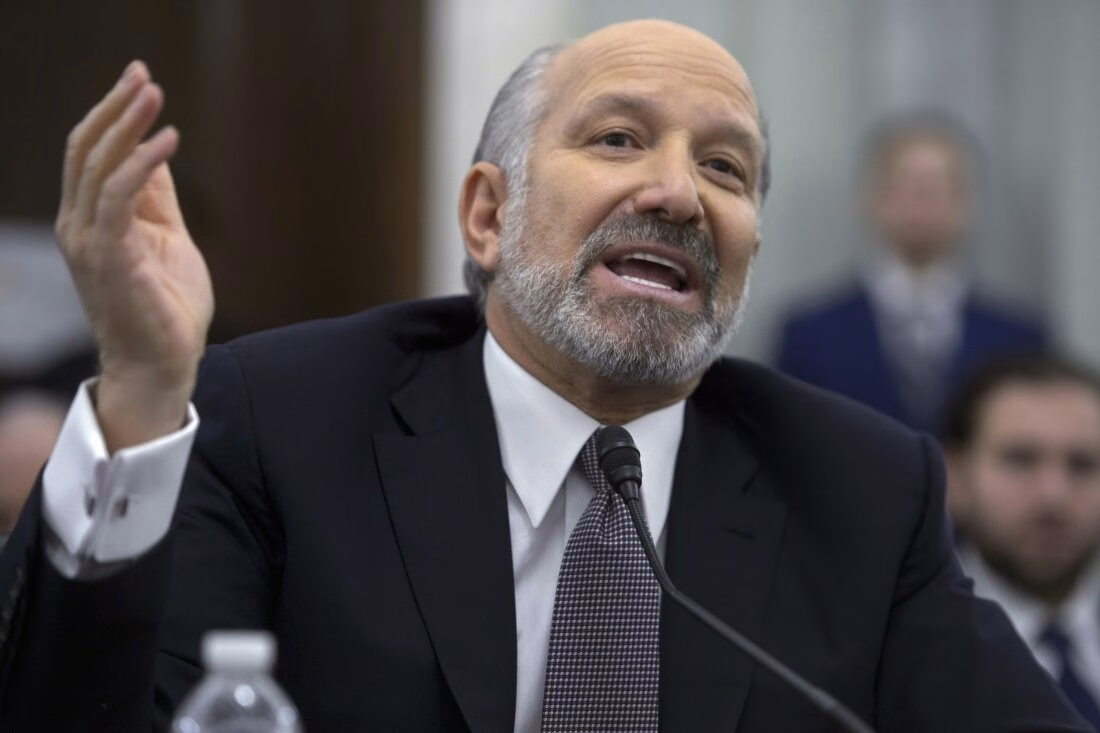
Howard Lutnick, President Donald Trump’s choice to be Secretary of Commerce, appears before the Senate Committee on Commerce, Science, and Transportation Committee for his confirmation hearing, Wednesday, Jan. 29, 2025, on Capitol Hill in Washington. (AP Photo/Rod Lamkey, Jr.)

Howard Lutnick, Trump’s nominee for U.S. Commerce Secretary, is making strong efforts to gain access to Canada’s dairy market. During his Senate hearing, Lutnick directly criticized Canada’s treatment of U.S. dairy farmers as “horrible,” pledging to change it. 

Stirring the Milk Pot 

Lutnick’s tough talk has Canadian dairy farmers on edge, while their American counterparts are cautiously optimistic. “Canada treats our dairy farmers horribly. That’s got to end,” Lutnick told Wisconsin Senator Tammy Baldwin, echoing a long-standing beef with Canada’s supply management system. 

The U.S. has been seeking a larger share of the Canadian dairy market due to trade objectives and economic opportunities. Despite the new CUSMA trade deal, American producers seek increased access to Canadian markets to expand their reach in the dairy industry. 

Tom Vilsack from the U.S. Dairy Export Council emphasized, “We must give our dairy farmers and processors a fair shake to compete up north.”

Crunching the Numbers 

The dairy trade between the U.S. and Canada is significant and impactful. U.S. dairy exports to Canada have shot up 63% in the last decade, hitting $1.09 billion. Last year, Canada shipped about 83,800 tonnes of dairy south, worth CA$293 million. The cheese was the big cheese, bringing in nearly CA$99 million. 

Here’s a breakdown of Canada’s dairy trade with the U.S. in 2023:

Product CategoryExport Value (CAD)Import Value (CAD)
Cheese$98,754,635
Fluid Milk and Cream$128,500,000
Infant Formula$151,300,000
Total Dairy Trade$293,250,317$756,195,961

What It Means for the Barn 

More access to Canada could lead to new international markets and increased profits through higher payments to U.S. dairy farmers. However, Canadian farmers are worried about their bottom line.

  • Small family farms could face pressure from lower-priced imports.
  • Mid-size operations might need to diversify their products and marketing strategies to stay competitive.
  • Big dairy outfits could cash in on exports but face stiffer domestic competition.

Tariff Talk and Price Tags 

Lutnick also backed tariffs, claiming they don’t drive up prices. This raised some eyebrows among the number crunchers. If they don’t tighten their borders, Trump threatens to slap 25% tariffs on Canadian and Mexican goods in February 2025. 

What’s Next in the Milk House 

Keep an eye on these developments: 

  1. Will Lutnick get the nod, and how will that shake up trade talks?
  2. How will Canada react to the pressure on its dairy industry?
  3. The review of the CUSMA dairy rules in 2026 could have a significant impact.

The dairy sectors in the U.S. and Canada are facing tough times. Farmers on both sides of the border must stay vigilant as the trade winds shift. 

If implemented, would these policy changes lead to a significant influx of new U.S. dairy products in Canadian stores? How could Canadian dairy farmers adjust their operations to remain competitive in a potentially more open market? 

Learn more:

Join the Revolution!

Bullvine Daily is your essential e-zine for staying ahead in the dairy industry. With over 30,000 subscribers, we bring you the week’s top news, helping you manage tasks efficiently. Stay informed about milk production, tech adoption, and more, so you can concentrate on your dairy operations. 

NewsSubscribe
First
Last
Consent

How a Trump Presidency Could Transform America’s Dairy Industry: Opportunities and Challenges for 2025 and Beyond

How will Trump’s presidency reshape the US dairy industry? What challenges and opportunities await dairy farmers in 2024 and beyond?

The American dairy industry isn’t just about the milk in our fridge. It’s a key part of the US agricultural economy. This sector supports about three million jobs and adds over $628 billion annually [International Dairy Foods Association]. It faces tough challenges, like changing milk prices, trade barriers, and new consumer trends. As the second Trump administration approaches, many wonder if his policies could boost American dairy. In this article, we’ll look at how potential deregulation, trade deals and tax changes could affect the future of American dairy.

The Crossroads of Opportunity and Challenge 

Despite its challenges, the US dairy industry is a resilient sector at a crossroads with challenges and opportunities. Market volatility, influenced by changing milk prices and unpredictable weather, impacts production. The USDA’s 2024 report notes that ‘average milk prices fell by 3% last quarter, adding financial stress on farms’ [USDA, 2024]. This uncertainty makes stable incomes tough for dairy farmers, but their resilience is a testament to the industry’s strength. 

Consumer tastes are shifting, offering both hurdles and opportunities. Many now lean towards health-conscious, sustainable, and plant-based choices. “Alternative milk products gained 15% in market share this year,” demanding adaptation from traditional dairy farms [Nielsen, 2024]. Going organic and sustainable could offer a competitive edge, aligning with consumer preferences. Moreover, the market for specialty dairy products, like artisanal cheese, is growing, with a projected 12% rise in yearly sales [USDA, 2024]. 

The current state of the US dairy industry is complex. Despite market swings and foreign competition, there’s potential for those ready to innovate and meet consumer needs. The industry’s future depends on its ability to adapt and seize these opportunities.

Trump’s First Term: A Double-Edged Sword for the Dairy Industry

During Trump’s first term, deregulation was a significant focus in agriculture. It aimed to cut costs by removing complex rules, giving farmers more flexibility. However, the dairy industry faced challenging issues like unpredictable prices and market access. 

Trade policies also played a crucial role. The change from NAFTA to USMCA aimed to improve the dairy market by lowering Canada’s tariffs. Although initially seen as a win, many farmers were skeptical about its impact on their profits. The US-China trade conflict also reduced dairy exports to China, adding financial stress. 

To address these problems, the government offered direct payments to farmers impacted by trade wars. This move received mixed responses; it provided immediate help but didn’t fix deeper issues. Dairy industry leaders have called for policies that effectively use deregulation and market access while addressing domestic market saturation and global competition.

Opportunities Amidst Uncertainty: Navigating Policy Shifts in the Dairy Industry

A renewed Trump administration could significantly impact the dairy industry through potential shifts. One possibility is that regulations might be loosened to alleviate bureaucratic pressure on dairy farmers. Trump’s strategy often centers on cutting red tape to foster competitiveness, which could simplify rules for the dairy sector, reduce costs, and increase efficiency. 

Trade policies are crucial to dairy’s profitability. Previous tariffs, like those on Chinese goods, suggest Trump might leverage tariffs in new negotiations. This could reopen trade talks, bringing risks and opportunities for US dairy exporters. Sharp tariffs might push foreign nations to agree to better terms, expanding international market access for American dairy products. 

Subsidies could become a focal point. Trump has historically supported subsidies for key sectors. For dairy farmers, this could mean more excellent stability amid market shifts, with potential funding for price support and technology upgrades to boost productivity and reduce environmental impact. Such measures could enhance the industry’s resilience against economic fluctuations. 

Trump could also renegotiate trade agreements to strengthen the dairy sector. Favoring bilateral deals over multilateral ones, he might secure new agreements that expand US dairy exports. Such deals could unlock new markets and improve American dairy’s global stature. 

A second Trump administration might introduce complex yet promising changes to the dairy industry. While some policies could be contentious, they offer significant growth prospects for those who can adapt to the evolving political climate, instilling optimism in the industry’s future.

Charting the Course: Navigating the 2025 Dairy Landscape with Strategic Foresight

The US dairy industry will be under pressure in 2025 and must adopt flexible strategies. Global competition is intense, with foreign producers offering lower costs and facing fewer regulations. American dairy farmers must innovate and improve efficiency to stay viable. 

Climate change further complicates matters. Unpredictable weather affects feed and milk production, forcing farmers to adjust. The push for sustainability adds another layer of complexity as farmers balance environmental and economic demands. 

The federal milk marketing order (FMMO) system is due for an update. Farmers must work with policymakers to advocate for reforms as market dynamics evolve. Depending on how they are approached, changes to the FMMO can either boost competitiveness or cause friction. 

Policy under the second Trump administration presents both opportunities and challenges. Regulatory compliance requires financial investments and adaptability to meet new standards. 

Consumer preferences are shifting towards plant-based alternatives and transparency. This trend presents both a challenge and an opportunity for the dairy industry, which must address public perceptions and market demands through proactive marketing and product development. 

Labor shortages, worsened by strict immigration policies and rural depopulation, continue to impact dairy farms. These issues highlight the need for resilience and strategic planning as the industry moves through 2025.

Harnessing Innovation: The Catalyst for a Modern Dairy Revolution

New technology is making the dairy industry more modern, efficient, and better for the environment. The Trump administration’s plans could support these changes by promoting advanced technologies. With fewer rules and tax breaks, using tools like automated milking machines, choosing the best genes for cows, and advanced farm systems might become more manageable, improving farms and producing more milk. 

These technologies help farms work better and aim to protect the environment, which is a big goal for the future. Things like precision farming cut down waste and manage resources better, meeting customers’ wants for sustainable dairy products. For instance, one farm in Pennsylvania increased milk output by 30%. It cut labor costs by 20% using robot milking [Source: Agricultural Tech Study 2023]. This shows how new technology can make farms more profitable. 

The government’s help is significant. Funding for research and development could encourage the use of new tech, and teaming up with universities, tech companies, and farmers could lead to significant discoveries. With Trump focusing on dairy technology, there might be a jump in economic growth and market competition. With strong policy support, these innovations could reshape the future of American dairy, leading to a new era of success.

Navigating Trade Tides: Balancing Risks and Rewards in the Dairy Sector 

The global trade landscape presents opportunities and hurdles for the US dairy industry. Leadership is key in uncertain markets. With the possibility of a second Trump administration, dairy farmers are carefully eyeing global expansion. Trump’s America-first policies have global ramifications, affecting US export interactions. Renegotiating trade deals, like transforming NAFTA into the USMCA, could again yield benefits [Trade.gov]. 

But what does this mean for dairy? Could these negotiations boost exports? Experts believe focusing on quality could help US dairy access new markets, though international trade remains volatile. Tariffs as a tool for addressing unfair practices are concerning. Could higher US tariffs trigger retaliation? If so, new tariffs might hurt the US dairy industry’s competitiveness [Cato Institute]. 

Asia, with rising dairy demand, presents an opportunity. Under Trump, progress was made with countries like Japan through the U.S.-Japan Trade Agreement [USTR.gov]. Building on such deals could help expand US dairy globally. However, negotiations must align with American and foreign interests. China, a complex trade partner, must be noticed. Trump’s policies could either ease or complicate this, impacting dairy exports. 

Finding a balance between protectionism and openness is crucial for US dairy to thrive globally in another Trump term. Industry leaders should strive for policies safeguarding domestic interests while unlocking global potential. These high-stakes negotiations will affect the livelihoods of American dairy farmers and the global market.

Sustainability at the Forefront: The Dairy Dilemma Under Trump 2.0

Farmers are worried about making dairies better for the environment. Problems like methane emissions and managing waste and water are significant challenges. What will the second Trump administration do about these issues? 

During Trump’s first term, some environmental rules were relaxed to help businesses. This gave dairy farmers more freedom but also caused concern about the environment. 

The Environmental Protection Agency (EPA) rules about waste and methane emissions might change again. While fewer rules could lower costs and increase profits, being eco-friendly is still essential, as more people want products that are good for the environment. 

The future of dairy farming requires growth while being good for the environment, which means using new ideas and technology. Will Trump’s policies help or fail to meet people’s expectations? This balance is key to dairy success.

Voices from the Field: Navigating the Second Act of Trump’s Influence on Dairy

As the second Trump administration forms, US dairy farmers are voicing their hopes and worries about what lies ahead. Their perspectives highlight the mix of challenges and opportunities that new policies might bring. 

John Miller, a third-generation dairy farmer in Wisconsin, holds cautious optimism. “During Trump’s first term, we benefited from some trade deals, but the instability was stressful. This time, we hope for steadier trade policies,” he emphasized, noting the need for consistency in their livelihood [Dairy Farmers Association, 2023]. 

Ellen White, who runs a mid-sized Pennsylvania farm, expressed concerns over labor policies. “Our industry heavily relies on immigrant workers. Strict immigration policies could hurt us,” she pointed out, stressing a vital issue the dairy sector faces [National Dairy Producers Coalition, 2023]. 

Industry leaders share these mixed feelings. Tom Johnson, head of a major dairy cooperative, sees innovation as key. “Support for new technologies can boost efficiency and sustainability. It’s our chance to lead on a global stage,” he said, identifying a significant growth opportunity [Dairy Innovation Center Report, 2023]. 

However, skepticism remains. Sarah Blake, a California farmer, remains doubtful. “Subsidies and investments are often promised but rarely reach smaller farms. We need policies that help everyone,” she asserted, calling for fair support [Independent Dairy Producers Association, 2023]. 

These views reflect the complex mix of anticipation and worry as dairy farmers prepare for what’s ahead with the second Trump administration. Their insights are essential, guiding policymakers while reminding them of the realities at the grassroots level.

The Bottom Line

The story of America’s dairy industry under Trump’s second term is a tale of opportunities and challenges. Protectionist policies and regulatory changes are creating mixed results for dairy farmers. On one hand, trade shifts and growth fueled by innovation offer hope. On the other, sustainability requirements and market volatility present formidable challenges. How Trump’s policies affect globalization and environmental rules might reshape the industry’s operations. 

Sustainability, often thought to conflict with economic growth, calls for innovative solutions that marry efficiency with environmental care. The real task isn’t just to navigate these changes but to set oneself up for success despite them. So, the big question for every dairy industry player is: How will you help build a strong and prosperous future in this changing world? Think about your role and the legacy you aim to create. By tackling these challenges directly, the industry can secure a future that honors tradition while embracing new ideas.

Key Takeaways:

  • Trump’s policies significantly impact key dairy-producing states, with Wisconsin being a significant focus.
  • The second Trump administration could alter the global competition landscape, affecting tariff implications for the dairy industry.
  • Strategic foresight is crucial for dairy farmers to convert potential challenges into growth opportunities.
  • Policy and agricultural expectations are essential in shaping the dairy industry’s future.
  • Industry insights from experts highlight the importance of proactive measures to handle workforce and export challenges.
  • Sustainability remains a critical yet challenging priority for the industry during the new administration.

Summary:

As the second Trump administration unfolds, the U.S. dairy industry stands at a crucial juncture, poised between opportunity and uncertainty. The sector must strategically navigate potential changes in trade relations, technological advancements, and sustainability demands. The echoes of Trump’s policies will resonate through milk barns, pastures, and global markets. Challenges, such as changing milk prices, trade barriers, and evolving consumer trends, demand attention. While Trump’s first term focused on deregulation, market access issues remain. The industry is urged to leverage loosened regulations and tariffs while addressing domestic saturation and global competition. The renewed administration may bring complex changes, offering growth prospects for adaptable entities. As 2025 approaches, the industry faces pressure from climate change and sustainability demands, necessitating flexible strategies.

Learn more:

Join the Revolution!

Bullvine Daily is your essential e-zine for staying ahead in the dairy industry. With over 30,000 subscribers, we bring you the week’s top news, helping you manage tasks efficiently. Stay informed about milk production, tech adoption, and more, so you can concentrate on your dairy operations. 

NewsSubscribe
First
Last
Consent

Canada and Mexico Brace for USMCA Shakeup: What Dairy Farmers Need to Know Amid U.S. Election Rumblings

Ready for the impact of the U.S. election on the USMCA? Discover the potential changes for Canadian and Mexican dairy farmers.

Summary:

Hold onto your hats, folks! The looming U.S. election could throw a wrench into the current state of the U.S.-Mexico-Canada Agreement (USMCA). Both Kamala Harris and Donald Trump have made it clear—renegotiation is on the table. With North America’s trade landscape in their hands, what changes might be in store for Canada’s and Mexico’s interconnected economies? The stakes are sky-high. Canada, with 80% of its exports heading south, is all-in on maintaining its substantial $900 billion trade relationship. Meanwhile, Mexico has its gaze set on shielding its vital vehicle-manufacturing sector while also aligning with U.S. expectations regarding Chinese imports. The U.S.-Mexico-Canada Agreement is a significant trade deal that has been criticized for its imbalances in economic benefits and labor regulations. Are Canadian and Mexican dairy industries ready to adapt to potential shifts? The debate revolves around dairy market access and tariffs, with two scenarios emerging: reduced tariffs to flood markets with domestic products or tariffs to secure American interests but pose challenges for Mexican businesses relying on U.S. imports. Canada’s economy is at a critical point, while Mexico’s dairy sector faces challenges in balancing U.S. demands and safeguarding its interests.

Key Takeaways:

  • The USMCA renegotiation could reshape the North American dairy market dynamics, affecting supply chains and economic stability in Canada and Mexico.
  • Canada’s essential export relationship with the U.S., particularly in the dairy sector, faces uncertainty, triggering lobbying efforts to safeguard trade agreements.
  • Mexico’s vehicle-manufacturing industry and dairy trade are pivotal points of concern amid U.S. demands regarding Chinese imports.
  • The potential renegotiation reflects broader economic strategies by both Kamala Harris and Donald Trump, impacting industries and bilateral relationships.
  • Stakeholders in the dairy sector should brace for potential shifts in market access and regulatory practices due to changes in digital trade and anticorruption regulations.
  • Regardless of the election outcome, the USMCA’s renegotiation underscores the ongoing evolution of North American economic ties and their global implications.
USMCA trade deal, dairy market access, tariffs impact, Kamala Harris USMCA, Donald Trump renegotiation, Canadian dairy industry, Mexican dairy sector, economic benefits imbalance, trade deal challenges, supply chain adjustments

Have you ever considered how a change in U.S. trade policy might ripple across your dairy farm’s operations? As the U.S. gears up for an election full of contentious debates, the future of the U.S.-Mexico-Canada Agreement (USMCA) hangs in the balance. Kamala Harris and Donald Trump are eyeing renegotiations that could unsettle existing trade relationships. But what does this mean for your dairy business? Let’s find out. 

“Renegotiating USMCA could potentially reshape entire industries, with dairy being one of the most vulnerable.” — Wall Street Journal.

As candidates vocalize their plans, Canada, which exports 80% of its goods to its southern neighbor and Mexico, is on high alert. And with billions of dollars and livelihoods at stake, the tension is palpable. Stay with us as we unpack how these political maneuvers could impact you and your business. 

USMCA: The Dynamic Force Reshaping North American Trade and Its Dairy Implications

The United States-Mexico-Canada Agreement (USMCA) is more than just a trade pact; it’s a dynamic force shaping the economic landscape of North America. Born from renegotiating the North American Free Trade Agreement (NAFTA) in 2020, the USMCA was designed to address modern trade issues and boost economic ties among its member countries. Consider it an overhaul to lay the firmer ground for trade between the U.S., Canada, and Mexico. Critical changes honed in on labor laws, environmental protections, and digital trade, which reflect international commerce’s evolving priorities. 

Discuss why this agreement is crucial for the dairy industry, particularly in Canada and Mexico. Under the USMCA, the Canadian dairy market was partially opened to U.S. imports, permitting American dairy farmers greater access to Canadian consumers. This measure promised a bigger pie for U.S. dairy producers while allowing Canadian consumers the liberty of choice with varied pricing options. Mexico, already a significant importer of U.S. dairy products, managed to secure a stable trade lane, ensuring its milk-derived product supplies remain uninterrupted. 

But here’s where things get sticky. Given the current political climate, The trading ecosystem is again teetering at the edge. With another U.S. presidential election at hand, both Kamala Harris and Donald Trump have expressed intentions to renegotiate this pivotal deal. Their intentions focus on addressing perceived imbalances in economic benefits and labor regulations. What does that mean for dairy farmers? Uncertainty isn’t just a shadow over crops; it’s looming over cross-border agreements. 

As Trump wraps up speeches that rally around “fair deals” and Harris emphasizes labor and environmental reforms, it seems inevitable that the USMCA will face potential upheaval. The question is, are the Canadian and Mexican dairy industries prepared to adjust to new rules of engagement? As the political tides shift, the North American dairy sector eagerly awaits.

USMCA: Shifts on the Horizon for North American Dairy Markets?

The United States-Mexico-Canada Agreement (USMCA) is poised for change as political winds shift in Washington. Kamala Harris and Donald Trump have joined the fray and are targeting this pivotal trade pact. But let’s narrow our focus to the dairy industry: What changes are brewing? 

The brouhaha centers around dairy market access and tariffs. Imagine, momentarily, the impact of amending the USMCA’s dairy clauses. Canada, with its vast dairy farms, and Mexico, which relies heavily on U.S. imports, must brace for turbulence. 

Two scenarios emerge under renegotiation. Either party could push for reduced tariffs to flood markets with domestic products. Visions of overflowing milk quotas or cheese stockpiles might give Canadian farmers pause. How will their business plans adapt? Could increased competition from the U.S. drive innovation or breed resentment? 

Conversely, introducing tariffs may secure American interests but spell trouble for Mexican businesses relying on U.S. imports. Picture production lines halting or, worse, shuttering. What’s the ripple effect on the local economy, and how will farmers navigate these uncertain waters? 

Should Harris take the lead, expect diplomatic nuance, potentially emphasizing sustainability alongside trade. On the other hand, a Trump administration might prioritize aggressive deals that promise quick returns stateside. 

In essence, dairy farmers and related businesses in Canada and Mexico must stay vigilant and prepped for any curveballs this political joust throws their way. Where will your allegiances lie, and how will you respond?

Canada’s Trade Tapestry: Will the USMCA Renegotiation Untangle the Dairy Sector? 

Canada’s economy, a vast and intricate tapestry woven around its trading ties with the U.S., stands at a pivotal moment. Over 80% of Canadian exports wend southward, shaping a critical artery for economic vitality. Therefore, the U.S.-Mexico-Canada Agreement (USMCA) is not merely a deal—it’s a lifeline. But with the calls for renegotiation hanging in the air like a looming storm, Canada has every reason to brace itself. 

Now, let’s talk dairy—the buttery core of Canada’s trade concerns. For Canadian dairy farmers and stakeholders like you, the threat of renegotiation is more than a dot on the distant horizon. It’s the real and present thrum in the agricultural pulse. Under the current USMCA terms, Canada faced the daunting reality of granting U.S. dairy producers greater market access. The fear now? This access might expand further under new talks. Yes, that’s something to chew on. 

Canada needs to take this down. Ottawa has ramped up its lobbying efforts, sending envoys well-versed in trade and economics to Washington, D.C. Their message is clear: Preserve the $900 billion trade relationship. But it’s not just about trade value—it’s about the Canadian dairy sector’s survival and competitiveness on the global stage

Imagine the ripple effect on local dairy farms should renegotiations lead to an avalanche of U.S. dairy products pouring into the Canadian market. Canadian farmers could find themselves grappling with a more saturated market, which could lead to potential shifts in pricing and market stability. For those in the dairy business, this could mean revisiting plans, reassessing market strategies, and, more crucially, re-evaluating how to safeguard their livelihoods. 

So, Canada is watching closely as the winds of political change sweep across North America. The question is: In this game of negotiation chess, will Canada be able to protect its dairy sector’s interests against a potential checkmate?

Mexico’s Crossroad: Dairy Dynamics and the USMCA Renegotiation Challenge

As we zero in on Mexico’s perspective, the stakes are high with the imminent renegotiation of the USMCA. Mexico has always held a strategic position within the North American supply chain, primarily through its robust vehicle-manufacturing industry. But its dairy sector deserves attention, too. Consider how closely these industries are tied to your dairy professional or farmer’s livelihood. 

First, let’s examine the cornerstone—the vehicle-manufacturing industry. This industry isn’t just a pillar; it’s a skyscraper in Mexico’s economic landscape. With numerous manufacturing plants across the country, it’s a heavyweight exporter to the U.S. Changes in trade terms could disrupt supply chains, increase costs, and threaten Mexico’s economic growth. But here’s where things get trickier. Consider U.S. demands on Chinese imports. How does Mexico strike a balance without jeopardizing its economic interests? 

Now, onto the dairy sector. Mexican dairy farmers have steadily expanded their production capabilities and market reach. But look out! Changes to the USMCA could impact how fluid dairy products flow across borders. Mexican dairy farmers might see altered competitive dynamics with potential tariffs or regulatory hurdles. Will they need to adjust pricing or seek alternative markets? It’s a daunting thought, especially for those small-scale farmers who rely on consistent trade conditions. 

Balancing the U.S. demands while safeguarding its interests is a challenge for Mexico. The crux of this renegotiation could push Mexican policymakers to weigh vehicle manufacturing privileges against potential concessions in other sectors, like dairy. What are your thoughts as someone directly or indirectly affected by these economic tremors? Please share your opinion, and let’s get this conversation rolling!

USMCA on the Edge: What Could a Renegotiation Mean for the U.S. Dairy Sector? 

The U.S.-Mexico-Canada Agreement, commonly known as the USMCA, is a linchpin for North American trade—and it might be up for a shakeup. On the American side, the potential renegotiation of this pivotal trade deal is stirring quite the pot. As voters cast their ballots in an election that could redefine Washington’s positions, both Kamala Harris and Donald Trump have their sights set on renegotiation. But what does this mean for the U.S. dairy industry, already facing its challenges? 

First, let’s dive into the heart of the matter. Trade principles in the American playbook have always championed fair and reciprocal trade. However, the execution often varies between administrations. A Trump-led negotiation might emphasize reducing trade deficits, increasing market access for American products, and, let’s not forget, a hard line on Chinese imports, a shared concern for Mexico, too. In contrast, a Harris administration would likely push for policies that balance trade with broader economic and environmental goals. 

For American dairy farmers, these divergent approaches translate to different opportunities and obstacles. A more protectionist stance may shield them from competitive challenges abroad, possibly securing stronger footholds within Canada and Mexico’s lucrative markets. But does erecting barriers align with the core American trade principle of promoting open markets? 

Moreover, dairy farmers must weigh the pros and cons of renegotiation. On one side, they could gain from policies that deliver more consistent access to North America’s vast dairy market. On the other, they may wrestle with restrictions that might emerge from any renegotiated pact. How might these outcomes affect your operations, and are you prepared for the shifts that could be on the horizon? 

The overarching question for American dairy stakeholders remains—do these proposed changes sit well with the free-market ethos that the U.S. has championed for decades? Or do they lean towards a more insular approach that might bite back against agricultural exports down the line?

The Bottom Line

The USMCA stands on the precipice of change, with the American political scene and the economic stances of Canada and Mexico in flux. The renegotiation talks from Harris and Trump are raising eyebrows for good reason. For Canadian and Mexican dairy farmers, there’s more than just milk at stake; their livelihoods, shaped by the web of North American trade, hang in the balance. The uncertainty is palpable. Will their sectors thrive, or are there challenging roads ahead? 

This is the moment to stay vigilant, informed, and prepared. Understanding these shifts can empower you to make strategic decisions for your business. Change breeds opportunity—if you’re ready to seize it. 

We want to hear from you. What do you think about the potential changes to the USMCA? How do you see them affecting your operations? Please share your insights by commenting below, and let’s start the conversation. Your experiences and opinions matter not just to us but also to your fellow industry professionals. 

Learn more:

Join the Revolution!

Bullvine Daily is your essential e-zine for staying ahead in the dairy industry. With over 30,000 subscribers, we bring you the week’s top news, helping you manage tasks efficiently. Stay informed about milk production, tech adoption, and more, so you can concentrate on your dairy operations. 

NewsSubscribe
First
Last
Consent
Send this to a friend