

Archive for milk supply agreements

Darigold’s $4/cwt Deduction. Idaho’s Five-Processor Bidding War. The Map That Shows Which Side You’re On.

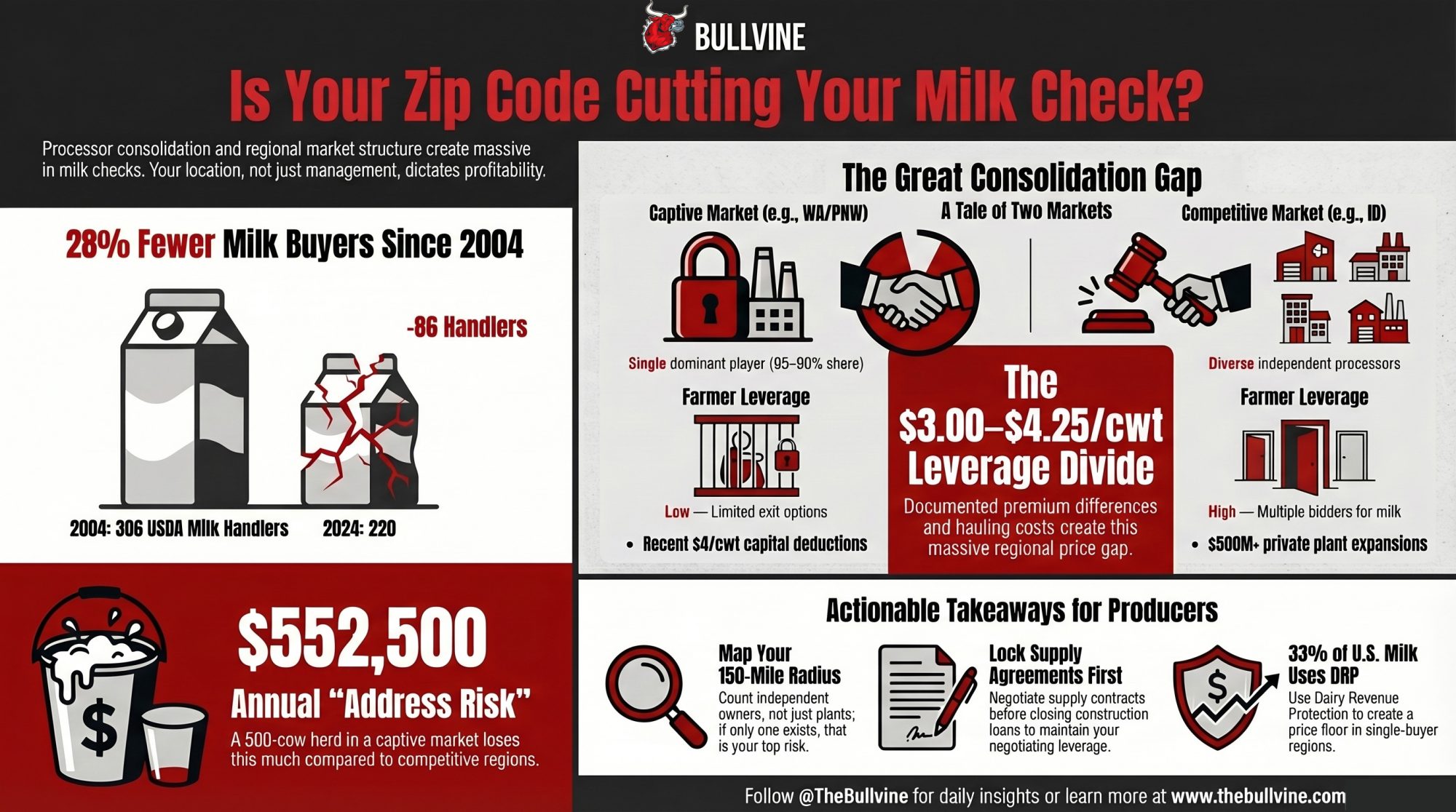
Processor consolidation has cut U.S. milk handlers by 28% in two decades. The gap between competitive and captive markets now runs $3–4/cwt — and your address determines which side of that line you’re milking on.

Krista Stauffer’s family has shipped milk to Darigold for years, building equity in the cooperative, as generations of Pacific Northwest dairy families have. She shared that they now have “quite a bit of equity sitting there” — with a real chance that only her kids ever see it come back. Her situation isn’t a one-off grievance. It’s what happens when processor consolidation narrows your options to one real buyer. And the financial distance between farming where processors compete for your milk and farming where a single handler calls the shots is wider than most people think.

When you stack documented premium differences, structural hauling costs, and the 2025 make-allowance hit together, the gap between the best and worst regions runs roughly $3.00–$4.25/cwt on your milk check. On a 500-cow herd, that’s $390,000–$552,500 a year, driven by your zip code, not your TMR.
From 306 Buyers to 220

Twenty years ago, the USDA counted 306 handlers pooling milk across the federal orders. By 2024, that number had dropped to 220 — a 28% decline (USDA AMS, 2024). Pooled producers fell from 52,853 to 20,168 over the same stretch. Fewer farms are shipping to fewer buyers. That’s the whole structural picture in one sentence.

But it doesn’t look the same everywhere. In Wisconsin’s Upper Midwest order, multiple cooperatives and proprietary processors still overlap routes and counties, so they’re forced to bid for milk. In the Pacific Northwest, Darigold operates 11 production facilities and handles the vast majority of pooled milk in the order — processing up to 8 million pounds per day at its new Pasco plant alone (Northwest Dairy Association annual report; FMMO-124 data). In the Southeast, DFA and its affiliates manage supply for essentially every regulated fluid plant in the Florida order. All three regions are “orderly markets” on paper. On your milk check, they’re completely different worlds.

The $11 Billion Build-Out — and Who It Actually Helps

Processors are in the middle of an $11 billion processing build-out — more than 50 new or expanded plants announced between 2025 and 2028 (Dairy Foods, 2025). Texas, Idaho, New York, and South Dakota are picking up the lion’s share. Pennsylvania, parts of the Northeast, and Washington are losing plants as older facilities shutter or consolidate.

That looks like capital investment on a press release. On the farm, it means some regions are getting more bidders for your milk — and others are getting fewer. The question isn’t whether new capacity is coming. It’s whether any of it lands within your hauling radius.

Same Time Zone, Different Reality: Idaho vs. Washington

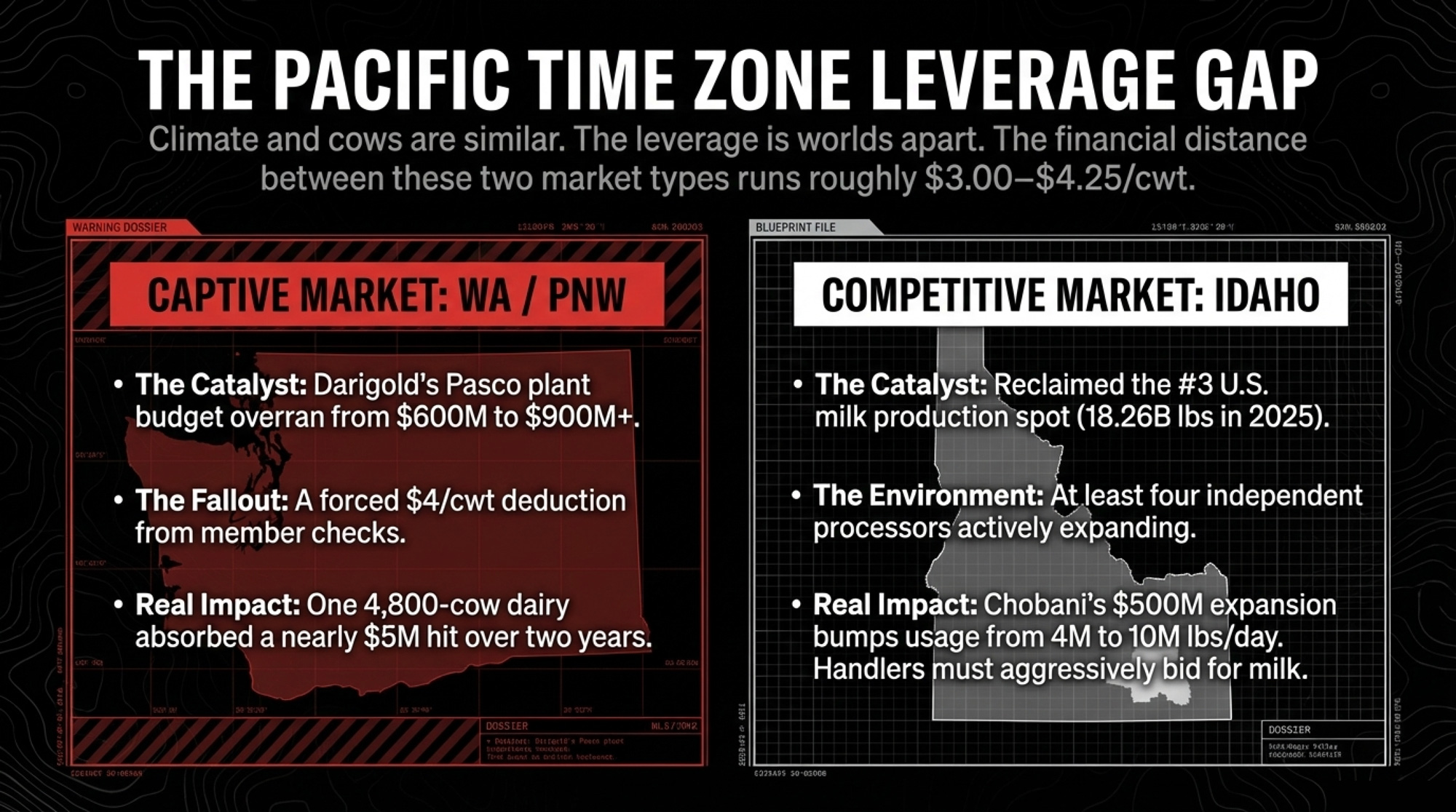
The sharpest contrast in American dairying right now sits inside the Pacific time zone. Same climate band. Very different leverage.

Idaho just reclaimed the No. 3 spot in U.S. milk production. According to USDA data released in February 2026, the state’s roughly 350 dairy operations produced 18.26 billion pounds of milk in 2025 — narrowly edging Texas at 18.21 billion (USDA NASS, Feb. 2026). In the Magic Valley, at least four independent processors are actively adding capacity. Chobani broke ground on a $500 million expansion in Twin Falls — its largest capital investment ever — bumping milk usage from about 4 million pounds per day to over 10 million (Chobani, 2025; Twin Falls Times-News). Idaho Milk Products is building in Jerome. High Desert Milk has invested tens of millions in its own operation. Newer players like Suntado have come online. Every one of those plants needs milk. Everyone competes for it. Idaho Dairymen’s Association CEO Rick Naerebout told Dairy Herd Management: “Idaho dairymen, for the most part, are fairly well situated financially right now.”

Drive west, and the story flips. Darigold’s Pasco, Washington, plant — originally budgeted at around $600 million — exceeded $900 million by the time it opened in June 2025 (Capital Press; Reuters, 2025). The cooperative approved the project back in 2021. CEO Stan Ryan pointed to labor shortages and equipment procurement as the main cost drivers. To cover the gap, the cooperative pulled a $4/cwt deduction from member checks (eDairyNews, May 2025). Yakima County producer Dan DeRuyter, milking about 4,800 cows, told reporters the hit amounted to nearly $5 million taken from his operation over two years. He didn’t sign the construction contract. He didn’t pick the procurement strategy. He had no practical alternative buyer for his milk. He just absorbed the deduction.

That’s the governance structure on paper. Here’s how it played out on the milk check: one buyer, one deduction, limited alternatives.

The Leverage Gap at a Glance

 “Captive” Market (WA / PNW)“Competitive” Market (ID / Magic Valley)
Dominant PlayerDarigold (~85–90% of pooled milk)Diverse: Chobani, Idaho Milk Products, High Desert Milk, Suntado, Glanbia
Farmer LeverageLow — limited exit options, retained equity as anchorHigh — multiple independent bidders for milk
Recent Trend$4/cwt capital deduction from member checks$500M+ in private processor expansions
Risk ProfileHigh “address risk” — geography controls your basisDynamic growth — processors competing for supply
2025 Milk Production~10 billion lbs (NDA members, WA/OR/ID/MT)18.26 billion lbs (Idaho alone, USDA NASS)

Here’s the barn math that connects those two columns. Take a 300-cow herd shipping about 78,000 cwt a year. In a region with multiple handlers fighting for milk — over-order premiums, quality bonuses, and hauling competition all working in your favor — it’s reasonable to see at least 50-100¢/cwt more in total value than the same herd in a single-buyer region. That’s $58,500 a year. Or roughly $195/cow — pushed or pulled entirely by how many processors are in range, not how well you bed stalls.

How Many Buyers Can Actually Bid on Your Milk Right Now?

This is the question that invisibly sets your basis.
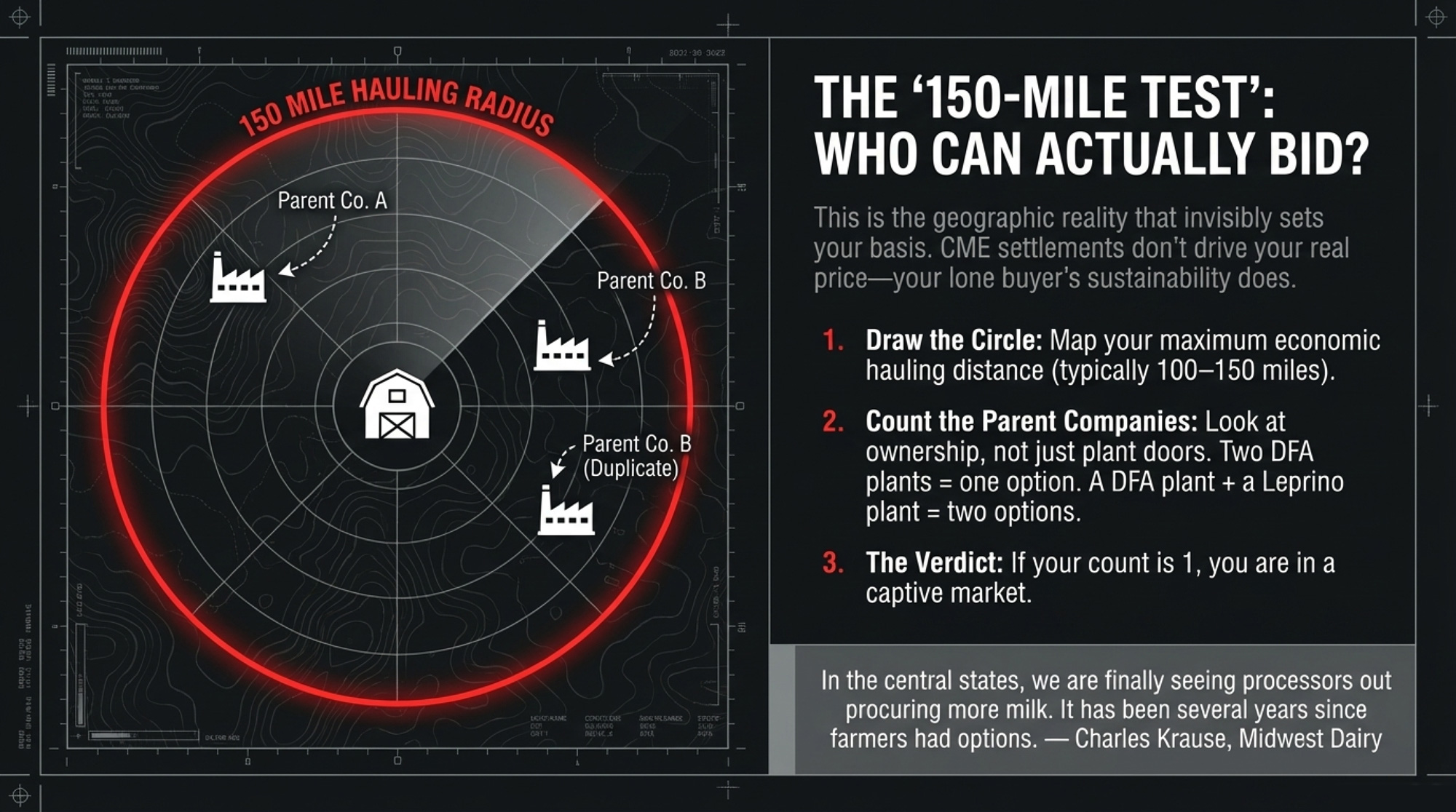
Pull up a map. Draw a circle with your maximum economic hauling distance — for most outfits, that’s 100–150 miles, depending on roads and fuel. Count the plants inside that circle. Then ask the harder follow-up: how many of those plants are controlled by different companies?

Two DFA plants don’t equal two buyers. A DFA plant and a Leprino plant do.

If you count four or more independent buyers, you’re in rare air. Much of Wisconsin, eastern Minnesota, and chunks of Idaho’s Magic Valley still look like this — multiple co-ops, proprietary cheese plants, and specialty processors overlapping territories. Charles Krause, chair of Midwest Dairy’s board and a sixth-generation dairy producer running a 350-cow operation in Buffalo, Minnesota, told Progressive Dairy: “In the central states, we are finally seeing processors out procuring more milk. It has been several years since farmers had options.”

If the count is one, you’re in a captive market. CME settlements or national mailbox averages don’t drive your real price. It’s set by whatever your lone buyer decides is sustainable — for them.

Where Does the Money Go Before It Reaches Your Statement?

Two pieces of plumbing turn consolidation into smaller milk checks. Neither one shows up as a tidy line item.

Make allowances move money upstream before your check is even printed.
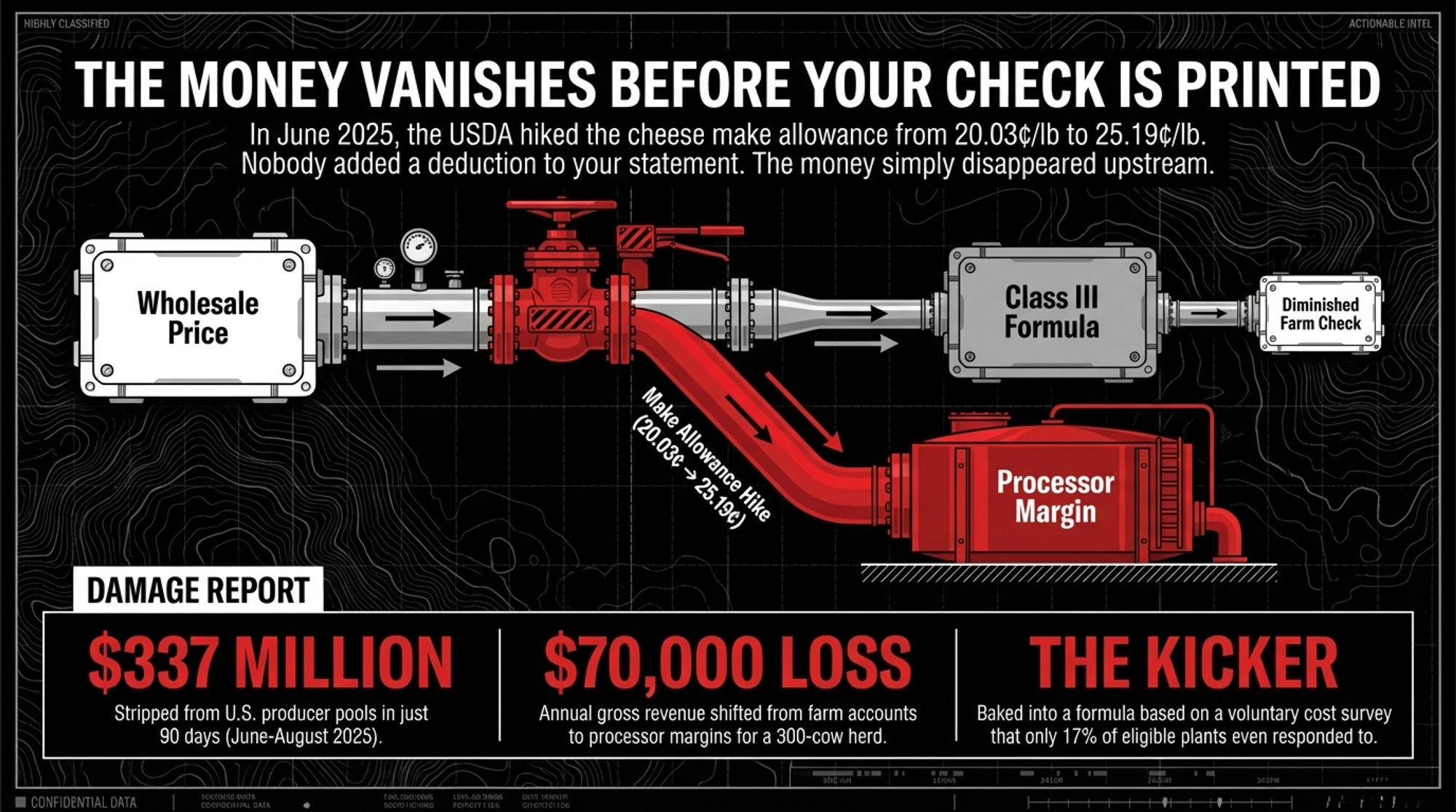
When USDA raised the cheese make allowance to 25.19¢/lb in June 2025 — up from 20.03¢ where it had sat since 2008 — nobody added a “make allowance” deduction to your statement (USDA AMS, Final Decision on FMMO Amendments, 2025). The money vanishes earlier than that. USDA subtracts the allowance from the wholesale commodity price before calculating protein and butterfat values for Class III. The processor keeps the allowance as an operating margin. What’s left becomes your component price.

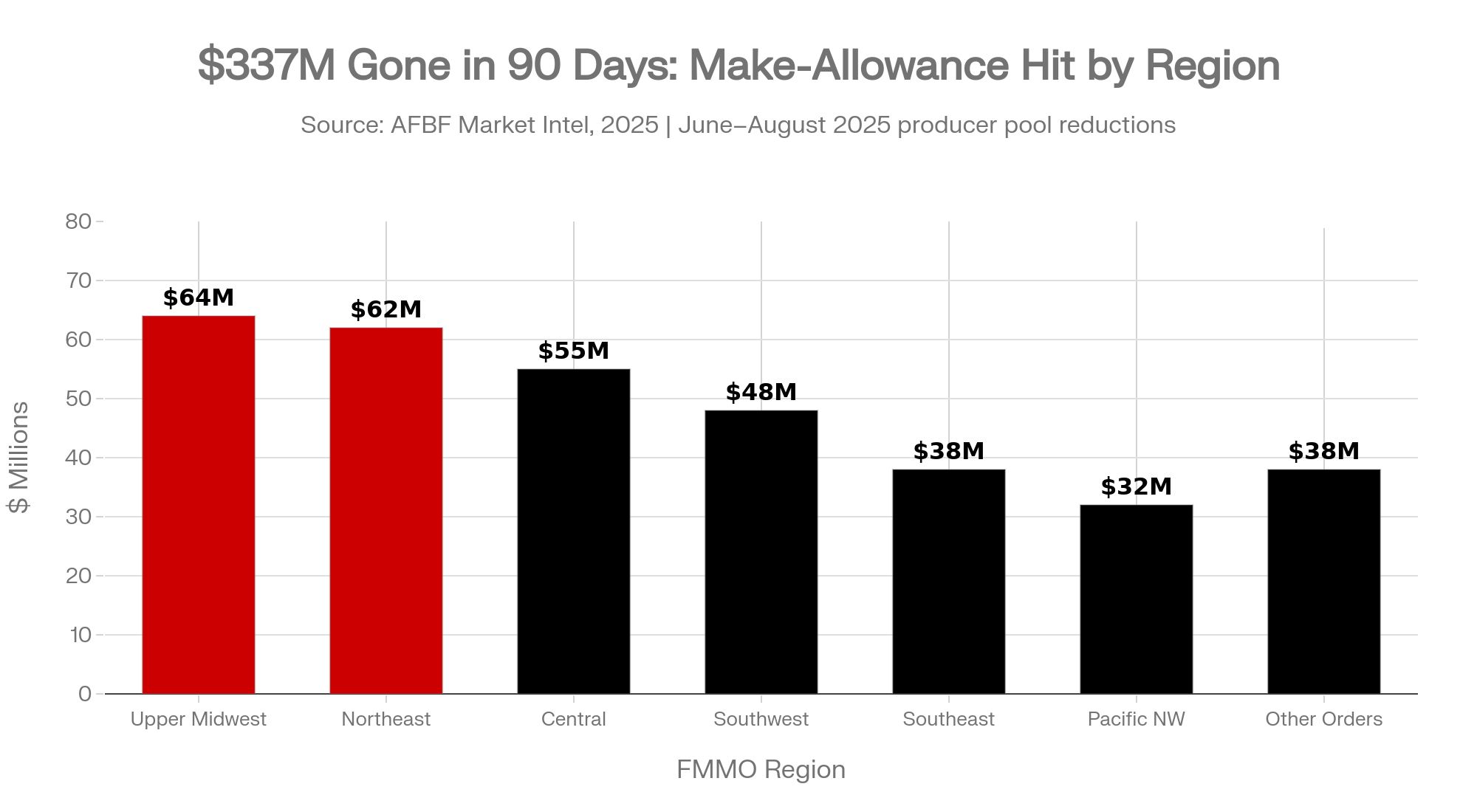
Danny Munch at AFBF did the math. The new make allowances stripped $337 million from producer pools in just 90 days — June through August 2025 (AFBF Market Intel, 2025). That included about $64 million from the Upper Midwest and $62 million from the Northeast. Class price reductions ranged from 85 to 93 cents per hundredweight. Terrain Ag’s analysis was blunt: “Increased make allowances will have the most clear-cut negative effect on component values and milk prices.”
Run that through the barn. A 300-cow herd shipping 78,000 cwt a year sees about $70,000 in annual gross revenue shift from farm accounts to processor margins because of a single rule change. You can’t negotiate it back in a premium. It’s baked into the formula — based on a voluntary cost survey that, according to the hearing record, only about 17% of eligible plants bothered to respond to.

Co-op governance wasn’t built for nine-figure construction risks.

On paper, farmer-directors run cooperatives. Members often report that management holds significantly more information than individual directors — and in a complex construction project, that asymmetry can matter enormously. When Darigold says “farmer-owners approved the Pasco project,” that’s technically true. The board voted in 2021. But members did not vote on which contractors to use, whether the job was fixed-price or cost-plus, or who would absorb cost overruns. Those three decisions are exactly what turned a $600M project into a $900M one — and a $4/cwt deduction.

Co-op law gives you formal authority. Consolidation takes away your exit threat. When retained equity builds up over decades, notice periods stretch out, and there’s no other buyer within economic hauling distance, “you can always leave” becomes an expensive theory. That’s how Krista Stauffer ends up with equity sitting in a co-op she may never meaningfully cash out of.

The transparency metric worth demanding: Before your co-op board approves any capital project over $100 million, it’s worth asking in writing whether the construction contract is fixed-price or cost-plus — and what the member-approved cost cap is. If there’s no cap, your future milk checks are the cap. A simple resolution — “No cost-plus contracts above a set threshold without a member-wide vote on overrun allocation” — would have changed the math for DeRuyter and Stauffer.

And the pattern isn’t limited to the Pacific Northwest. DFA has settled antitrust lawsuits in three separate regions: $50 million in the Northeast, $140 million in the Southeast, and $34.4 million in the Southwest — a combined $186+ million since 2013 (court records; Cheese Reporter, multiple years). Settling litigation is standard practice and doesn’t constitute an admission of wrongdoing — DFA has made that point explicitly in each case, stating it “steadfastly denied liability and mounted a vigorous defense.” But somebody still wrote a check.

Should You Lock Your Supply Agreement Before or After Your Construction Loan?

Before. Always before.

A 300-cow dairy looking at 1,000 cows has something processors need: roughly 18 million pounds of additional annual supply. Right now, that’s the story around places like Leprino’s new Lubbock cheese plant in Texas, Hilmar’s Dodge City facility in Kansas, and Chobani’s Twin Falls expansion — which alone will need an additional 6 million pounds of milk per day once it’s fully running.

But two clocks are running against you.
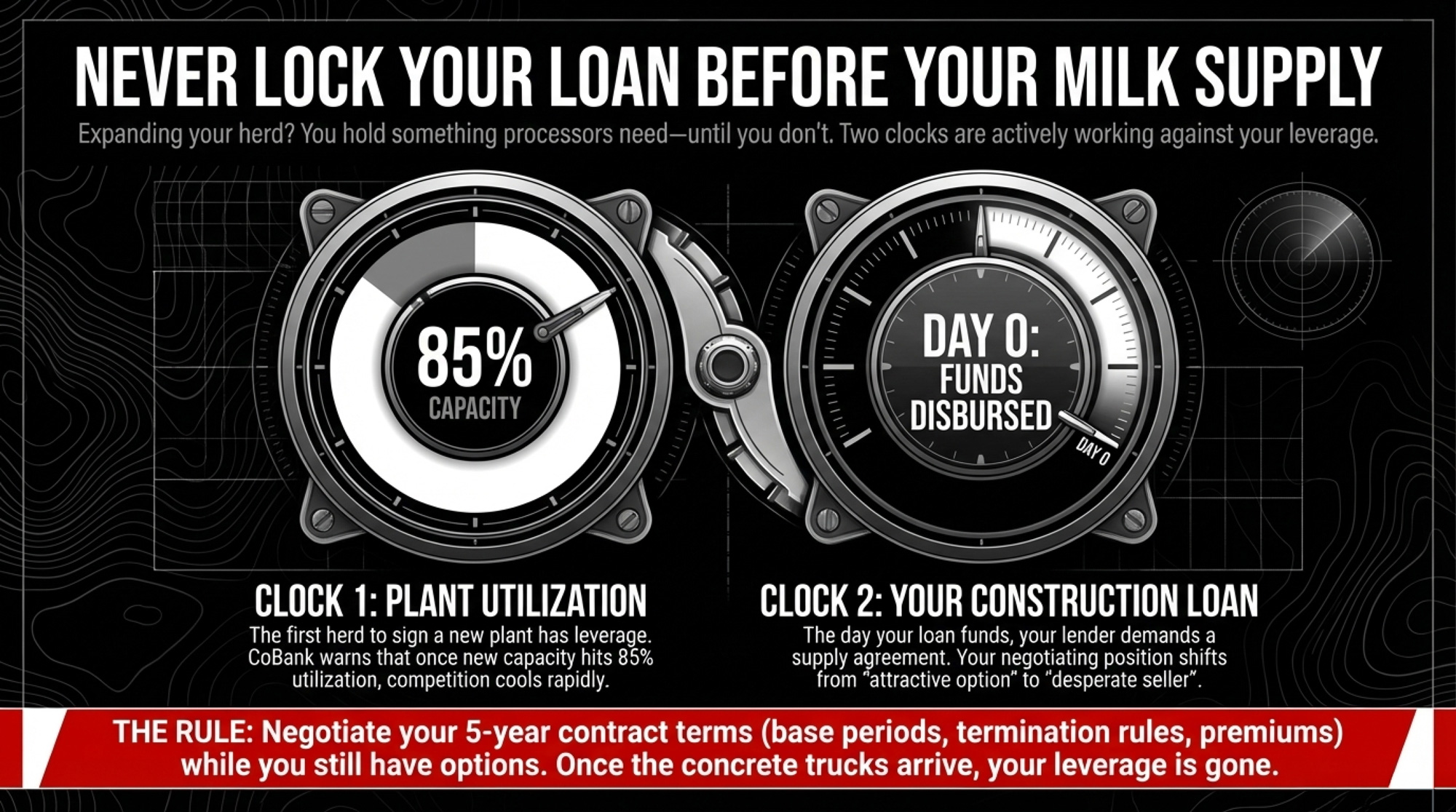
Plant utilization. Once those new plants reach roughly 85% capacity, the tone changes. CoBank has warned that as new cheese capacity in the Southern Plains fills by around 2027, competition for milk will cool and product prices will come under pressure. The first herd to sign has more leverage than the last.

Your loan closing. The day your construction loan funds, your lender expects a signed supply agreement. At that point, your processor knows you must have a buyer. Your negotiating position shifts from “we’re one of several attractive options” to “we can’t close this loan without you.”

The contract you’ll live under for five years — base period, over-base penalties, premiums, termination rules — should be negotiated while both clocks are still in your favor. Not as a rushed afterthought once the concrete trucks have come and gone.

What You Can Actually Do About This

Here’s where the data stops and your decisions start. Not every move fits every operation, but each one has a clear trigger, a trade-off, and a timeline.

Next 30 Days: Map your processor options and take the map to your lender.

Set aside an afternoon. Pull a map and mark every plant within your realistic hauling radius: who owns it, what it makes, whether it’s expanding or shrinking. Count independent buyers, not just plant dots. If it’s one, that’s your biggest business risk — bigger than any single feed line. Lenders are starting to stress-test processor dependency alongside debt coverage, especially after 2025’s make-allowance shock and the Darigold overrun.

Walking into a loan review with a processor map signals that you understand your exposure. Suppose you’ve got two or three real options, which gives you room to negotiate. If you don’t, it justifies tighter risk management and more conservative debt.

The Lender Stress-Test Cheat Sheet

Bring these four questions to your next lender meeting:

  1. “How much of our debt coverage depends on over-order premiums that could vanish if our buyer consolidates or restructures?”
  2. “What is our Plan B if our primary plant issues a 12-month termination notice?”
  3. “Based on the 2025 make-allowance shifts, what is our new break-even cost per hundredweight?”
  4. “If our co-op levies a $2–4/cwt capital assessment — like Darigold did — for how many months can we service debt at that reduced pay price?”

Next 90 Days: If you’re expanding, lock your supply agreement before your construction loan closes.

Your leverage window is the 60–120-day period when new plants are still filling capacity, and you haven’t yet signed the building loan. Use it. Ask for a base period that moves with herd size, a clear over-base penalty cap, a symmetric termination notice, and a quality premium schedule fixed for at least 24–36 months. Farms that treat this like a formality end up signing whatever’s in front of them. Farms that treat it like a one-time leverage point can carve out terms that matter the next time prices roll over.

This Year: In single-buyer regions, treat DRP as a core defense.

If you can’t change your processor, you can still change your exposure. HighGround Dairy’s quarterly analysis shows DRP (Dairy Revenue Protection) covered about 32–33% of the U.S. milk supply in Q3–Q4 2024 (HighGround Dairy, 2024). In a competitive market, DRP is one more tool. In a captive market, it might be the only way to put a price floor under part of your check that doesn’t depend on your buyer’s goodwill. The key is to run DRP against your actual butterfat and protein, not a generic blend. A 20-minute meeting with a good agent can show you what 10–20% of protected revenue looks like compared to rolling the dice entirely on your local basis.

You gain a price floor, but you give up premium dollars and take on basis risk between the futures price and the DRP you cover. In a one-buyer region, that trade-off usually pencils. In a region with three competitive buyers already bidding up your premiums, it’s less clear-cut.

Ongoing: Push components that keep paying even when formulas shift.

Make allowances hit everyone, but high-component herds still come out ahead. Herds consistently above about 4.2% butterfat and 3.3% protein are seeing 50¢–$1.50/cwt in premiums that help offset structural hits they can’t control. That doesn’t fix consolidation. But your breeding and feeding decisions can either leave money on the table or claw some of it back.
Key Takeaways

  • If your processor map shows only one independent buyer within 100–150 miles, treat that as your top business risk. Everything else in your plan should assume that the buyer controls your basis.
  • If new deductions — hauling surcharges, co-op assessments, base-excess penalties — add up to more than $1/cwt compared to your 2023 statements, that’s a structural change, not a bad month. Revisit expansion plans and debt levels accordingly.
  • If you’re expanding and your supply agreement is being negotiated after your construction loan closes, you’ve already given up your best leverage. Flip the order.
  • If you’re in a single-buyer region and not using DRP on at least part of your volume, you’re carrying all the downside your buyer doesn’t want. Run the numbers on one or two coverage levels before your next quarterly enrollment.
  • If your co-op can approve nine-figure plant projects without a member vote on cost-control terms, assume your future milk checks are potential collateral. Ask for fixed-price contract disclosure and a written cost cap before the next build — not after the overrun.
  • If your 3-to-5-year plan only works at $22–23/cwt with healthy premiums, it’s not a plan. Model your numbers at $18–21/cwt with no over-order premiums and see if the pencils still sharpen.

Where does your farm sit on this leverage map — competitive, moderate, or captive? That’s not an abstract policy question. It’s whether your next expansion, your next loan renewal, and your next contract negotiation assume you have options or admit you don’t.

The make-allowance drag, the co-op capital calls, and the processor build-out aren’t going away. The real question is whether your numbers, contracts, and risk tools align with the reality of who can actually bid on your milk. 

Complete references and supporting documentation are available upon request by contacting the editorial team at editor@thebullvine.com.

Learn More

The Sunday Read Dairy Professionals Don’t Skip.

Every week, thousands of producers, breeders, and industry insiders open Bullvine Weekly for genetics insights, market shifts, and profit strategies they won’t find anywhere else. One email. Five minutes. Smarter decisions all week.
NewsSubscribe
First
Last
Consent

600 Argentine Dairy Families, One New Buyer, Zero Warning: Saputo’s $630M Sell‑Off and Your Processor Contract Risk

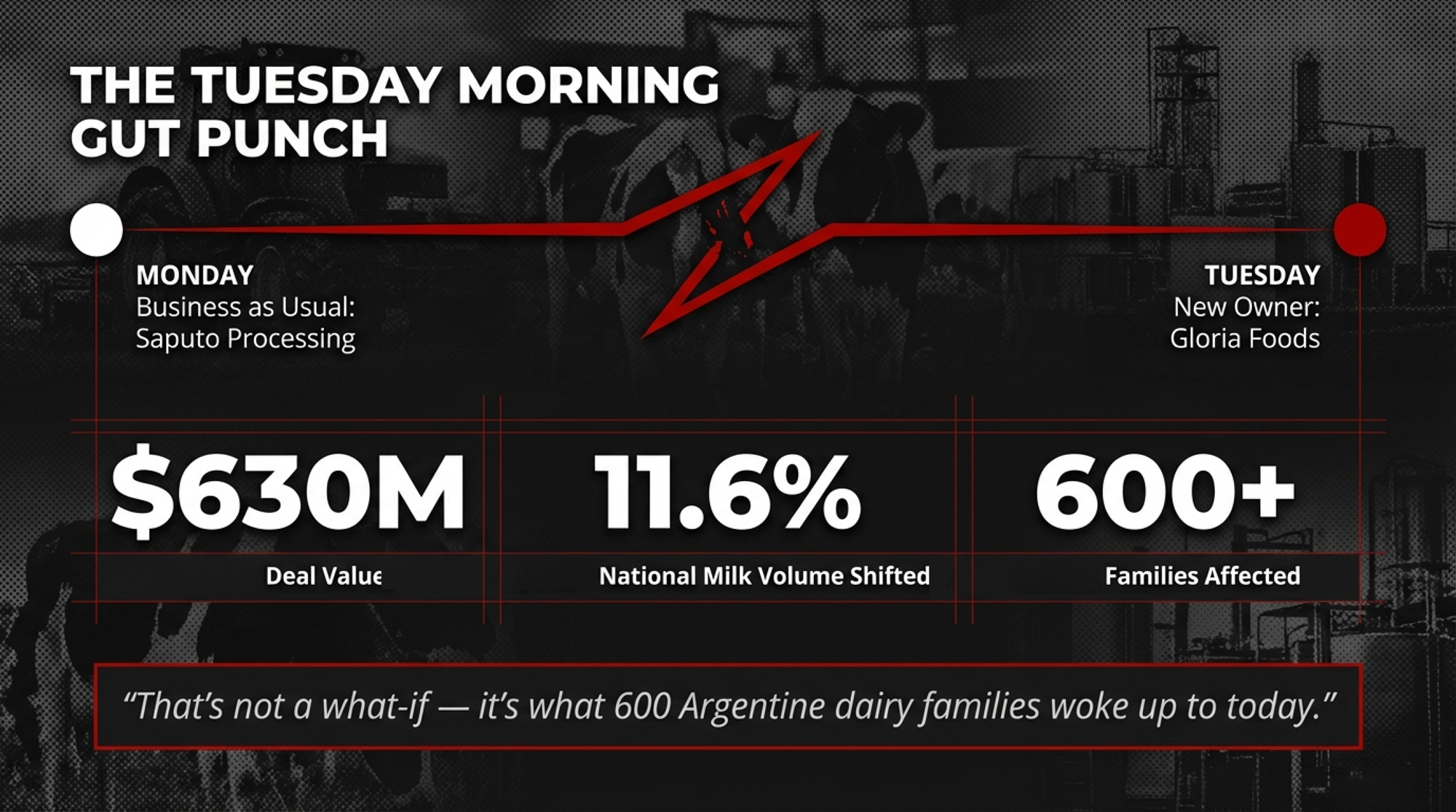
Your milk goes to one processor. Overnight, they sell 80% to a stranger. That’s not a what‑if — it’s what 600 Argentine dairy families woke up to today.

Executive Summary: Saputo is selling 80% of its Argentine dairy division to Peru’s Gloria Foods in a deal that values the business at C$855 million (about US$630 million), while keeping a 20% stake. Overnight, control of Argentina’s largest milk processor — 11.6% of the nation’s industrial milk and collections from more than 600 farms — shifts to a buyer that’s been sued for abusing its power with producers in Chile, fined in Colombia for adding whey to “whole” milk, and accused of monopolistic practices in Peru. Farmers shipping to Saputo’s Rafaela and Tío Pujio plants learned about the deal from a press release instead of a phone call, and they still don’t know if Gloria will keep their contracts, prices, and pickup schedules intact. They’re dealing with that gut punch in a sector where SanCor has just entered creditor protection and co‑ops’ share of Argentina’s milk has collapsed from roughly 34% to about 3%, leaving most producers tied closely to a single processor. Add in Gloria’s aggressive acquisition run and rising debt‑service costs at its Peruvian holding company, and you have a new owner that’s highly motivated to manage margins hard once the ink dries. This article walks you through what’s happening to those 600 Argentine dairy families — and gives you a concrete playbook to check whether your own processor contract would protect you if the company you ship to sold tomorrow without warning.

Saputo Inc. announced today that it’s selling 80% of its Argentine dairy division to Gloria Foods — the dairy arm of Peru’s Grupo Gloria — for an enterprise value of C$855 million. That works out to roughly US$630 million, including assumed debt, though Peruvian business media report the equity purchase price closer to US$500 million. Saputo expects net proceeds after tax of approximately C$543 million (US$400 million). The company keeps a 20% minority stake. The deal covers two processing plants, the La Paulina, Ricrem, and Molfino brands, and a milk collection network serving more than 600 dairy farms across Santa Fe and Córdoba provinces, according to Argentine agricultural media, including LA17 and Bichos de Campo.

This is what dairy processor consolidation risk looks like in practice. Those 600 families weren’t part of the conversation — and the company taking over has a record across Latin America that every producer, Argentine or not, ought to understand before this deal closes around mid-2026.

If you read nothing else this month, pair this with our recent piece on the four questions every dairy producer should ask about processor dependency. What’s happening in Argentina right now is a textbook case of what that audit is designed to prevent.

How Saputo Built Argentina’s Top Dairy Operation — Then Walked Away

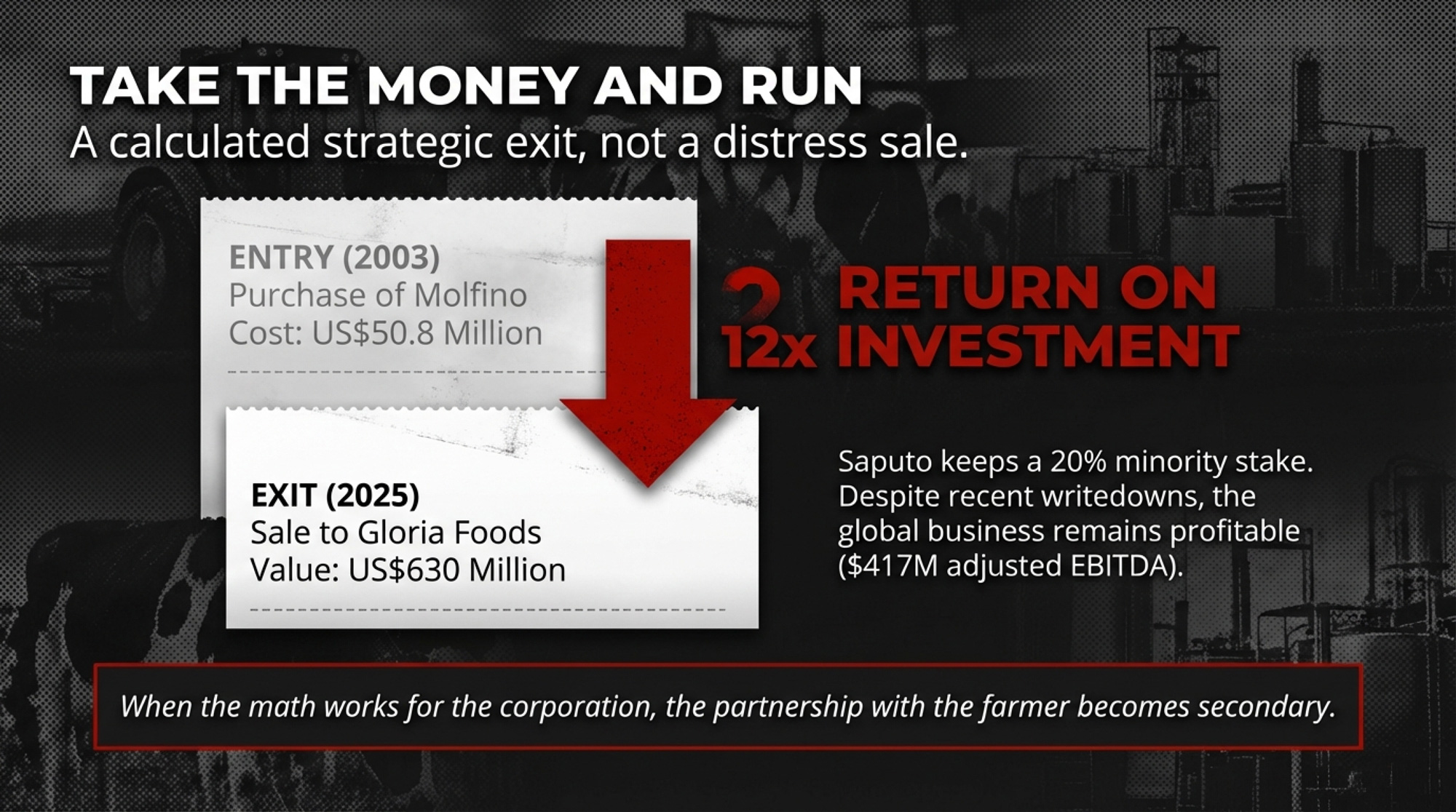
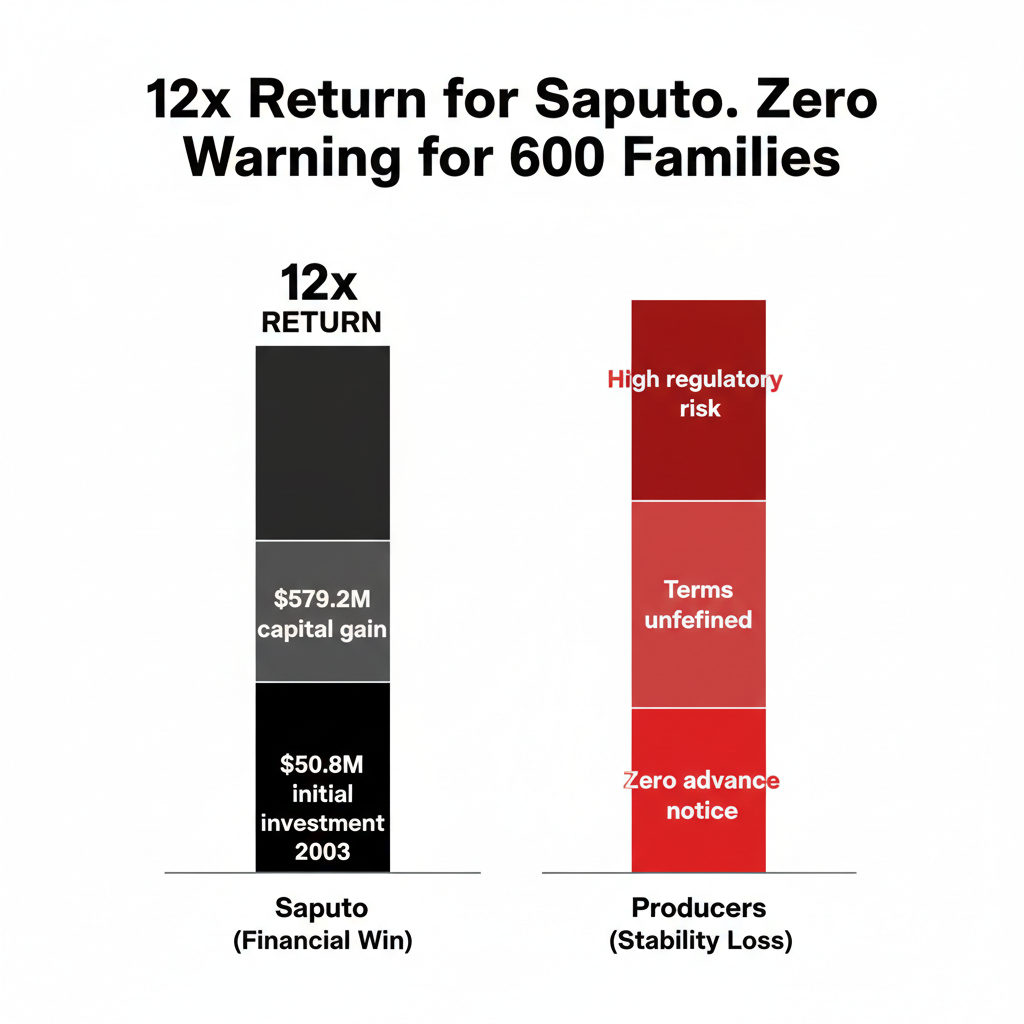
Saputo entered Argentina in November 2003 by acquiring Molfino Hermanos S.A. from Molinos Río de la Plata for US$50.8 million. At the time, Molfino was the country’s third-largest processor — two plants, roughly 850 employees, about US$90 million in annual revenue. Over 23 years, Saputo turned that into the country’s number-one operation.

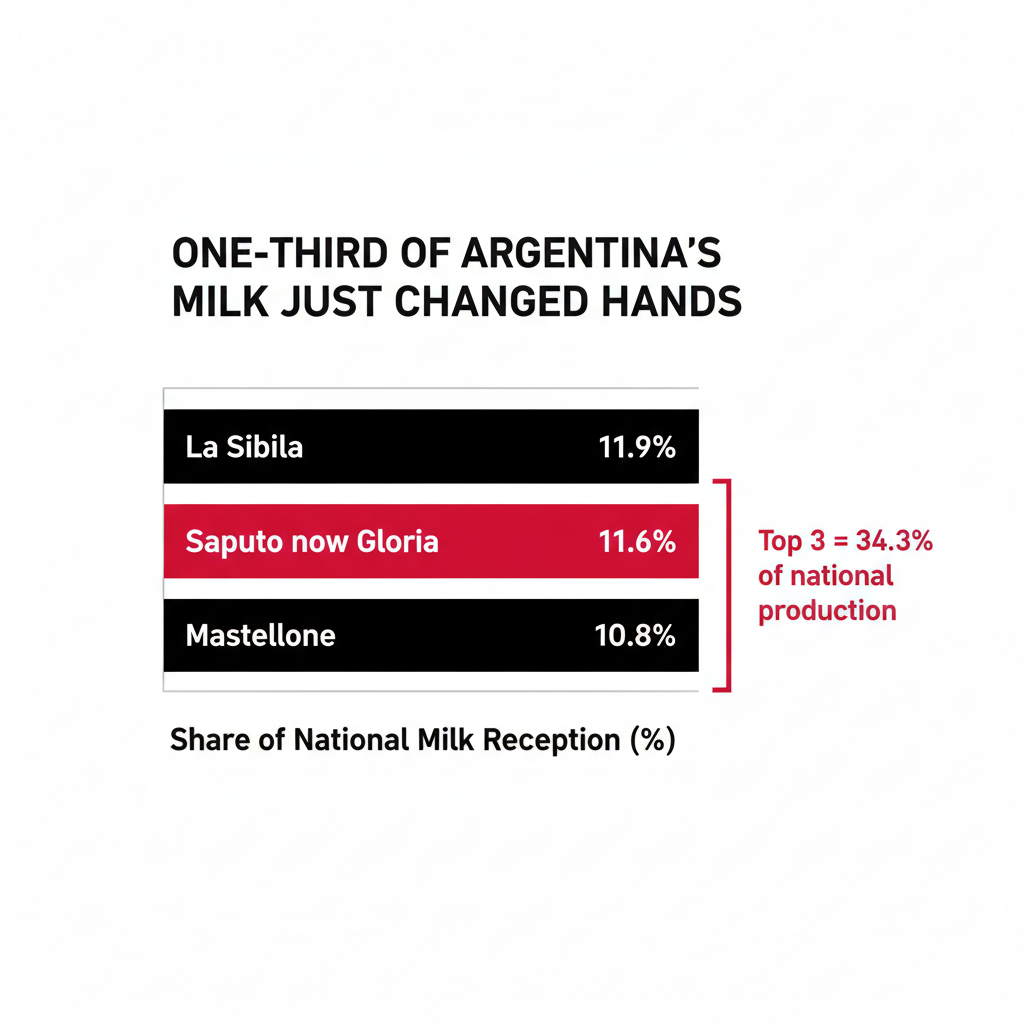
The OCLA 2023/24 industry ranking — based on reported and estimated daily milk reception by industrial processors, published annually — had Saputo processing an average of 3,650,288 liters per day, or 12.5% of national industrial milk volume. By the most recent OCLA 2024/25 ranking (published July 2025), that figure had dropped to 3.53 million liters daily, or 11.6% of the national total. Still number one, ahead of Mastellone (La Serenísima) at 3.15 million liters and 10.8%, but the decline hints at the pressures behind Saputo’s decision to sell. In the last four quarters, the Argentine operation generated approximately C$1.2 billion in revenue — about 7% of Saputo’s consolidated total.

When SanCor — once Argentina’s cooperative giant — entered a deep financial crisis beginning in 2017 (as SanCor put it in its February 2025 court filing), Saputo moved quickly. The company absorbed the freed-up milk supply and routinely offered prices better than competitors’. Producers followed the money. You would have too.

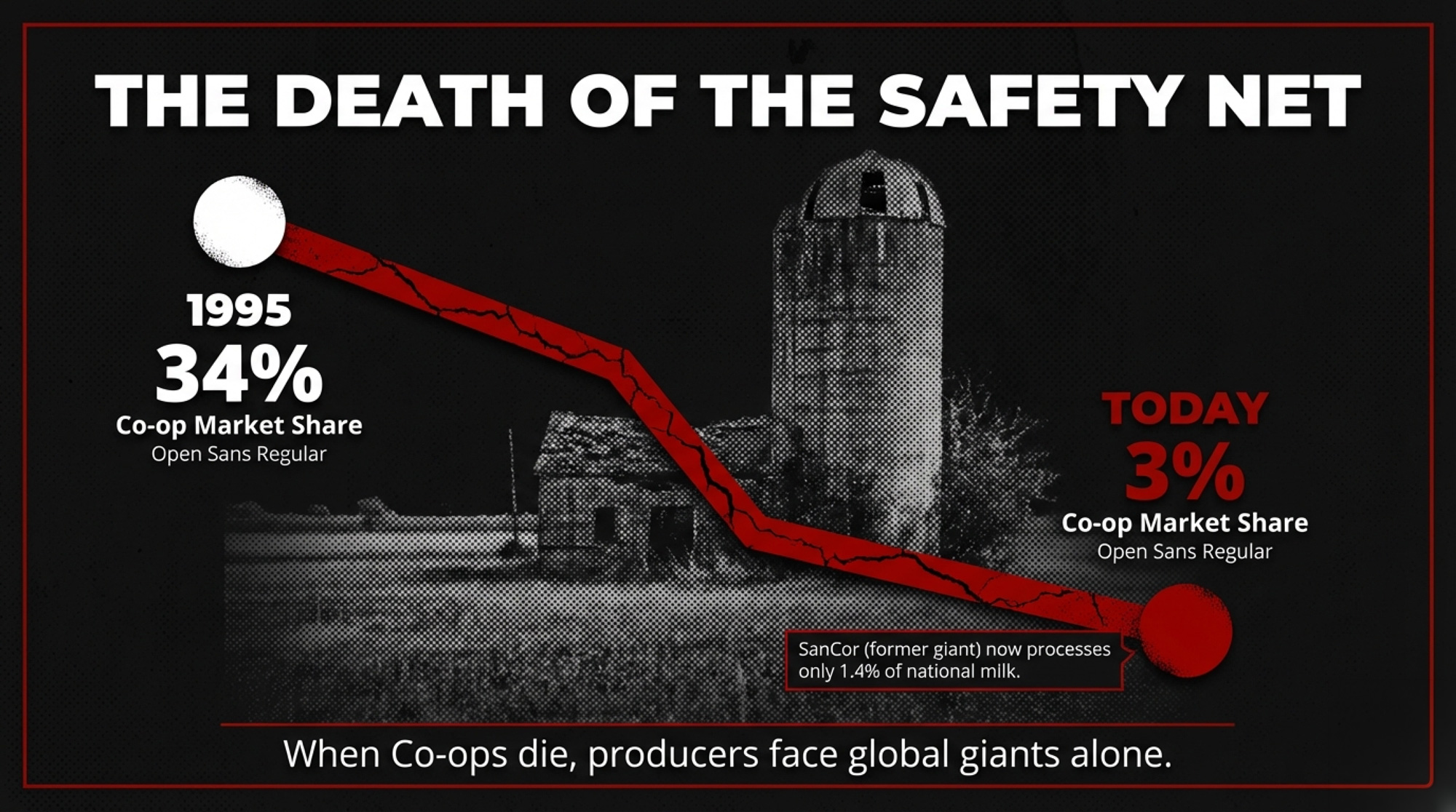
And then SanCor’s story got worse. On February 2, 2025 — just ten days before today’s Gloria announcement — SanCor formally filed for concurso preventivo de acreedores (creditor protection proceedings) at the Commercial Court in Rafaela, Santa Fe, carrying approximately US$400 million in debt. SanCor now processes just 409,163 liters daily, barely 1.4% of national production, down from its peak of 1.2 million. The region’s dairy infrastructure isn’t just shifting; it’s transforming. It’s being completely restructured.

Saputo’s dominance also created structural dependency. The practical effect was that Saputo’s price signals shaped the broader regional market — when the biggest buyer in the milkshed moved, everyone else followed. That arrangement works fine. Right up until the company at the center decides to leave.

CEO Carl Colizza’s press release language was corporate but clear: “This divestiture enhances our financial flexibility and supports targeted reinvestment in platforms that offer the highest growth opportunities.” Translation: take a roughly 12-fold return on a 23-year investment (US$630M enterprise value on a US$50.8M entry) and redeploy capital somewhere with fewer currency crises.

600 Families, No Advance Notice

Here’s what we know about how this landed on the ground. As of publication — hours after the announcement — there’s been no reported communication from Gloria Foods to Argentine producers. No new contract terms. No timeline for meetings. No word on whether existing payment schedules, quality premiums, or pickup logistics will change. Infocampo described the news as a “sacudón” — a jolt — to the Argentine dairy chain.

Several cooperatives sit squarely in Saputo’s milkshed. Cooperativa Tambera Central Unida in San Guillermo, Santa Fe — managed by Javier Clemente — delivers milk to five processing companies, including Saputo. Clemente has spoken publicly about producer autonomy in the region: “The one who decides where their production goes is the member, because the milk belongs to whoever produces it.” He made those remarks before the Gloria deal was announced. His cooperative is now directly affected, and whether that principle holds when a Peruvian conglomerate replaces a Canadian one is the question nobody can answer yet.

Cooperativa Agrícola Santa Rosa, also near San Guillermo and managed by Martín Guruceaga, works with approximately 60 farms across a 40-kilometer radius. Guruceaga has described the area simply as “una zona tambera” — a dairy zone where the community and the industry are one and the same. UNCOGA, a federation of nine cooperatives spanning central-west Santa Fe and central-east Córdoba, operates across the heart of Saputo’s collection territory.

These cooperatives are the closest thing to a collective voice that affected producers have. But the cooperative system itself has been hollowed out. Cooperative share of Argentine milk reception dropped from 34% in 1995 to roughly 3%today, according to the OCLA 2024/25 industry ranking. That means most of those 600-plus farms negotiate individually with their processor. When that processor changes without warning, individual leverage is essentially zero.

“The dairy sector and the country will only grow when the producer grows, because the producer is the one who carries the activity in their blood.” — Daniel Oggero, APLA executive committee, El Litoral, July 2015

Oggero made that statement during a blockade of Saputo’s Rafaela plant by western Santa Fe dairy farmers protesting milk price cuts. Those words land differently today, when the producer’s voice in the transaction was exactly zero.

Why Saputo Sold — And What Gloria’s Track Record Shows

Understanding both sides of this deal matters if you’re trying to figure out what comes next.

Why Saputo left: This isn’t a distressed sale. Through FY26, Saputo’s efficiency program has been delivering: Q1 operating cash flow hit C$317 million (up 66% year-over-year), adjusted EBITDA reached C$417 million (up 12.7%), and the company has been buying back shares aggressively. Saputo reported net losses of C$250 million through the nine months ended December 2024, driven largely by writedowns and hyperinflation accounting adjustments tied to Argentina — but the underlying business is profitable and improving. Saputo chose to leave. That tells you how the company views Argentine risk-reward going forward.

Who Gloria is: Gloria Foods is the dairy platform of Grupo Gloria, a Peruvian conglomerate with more than 7,000 employees across Peru, Chile, Bolivia, Argentina, Colombia, and Ecuador. President Claudio Rodriguez called the Saputo acquisition “a milestone within the strategy of sustained growth in Latin America.” The expansion has been rapid: Soprole in Chile from Fonterra for approximately US$644 million (completed April 2023), Ecuajugos from Nestlé in Ecuador (2024), and now Saputo Argentina.

But that growth has come with a trail of regulatory actions and producer-relations disputes. Not one-offs. A pattern across multiple countries.

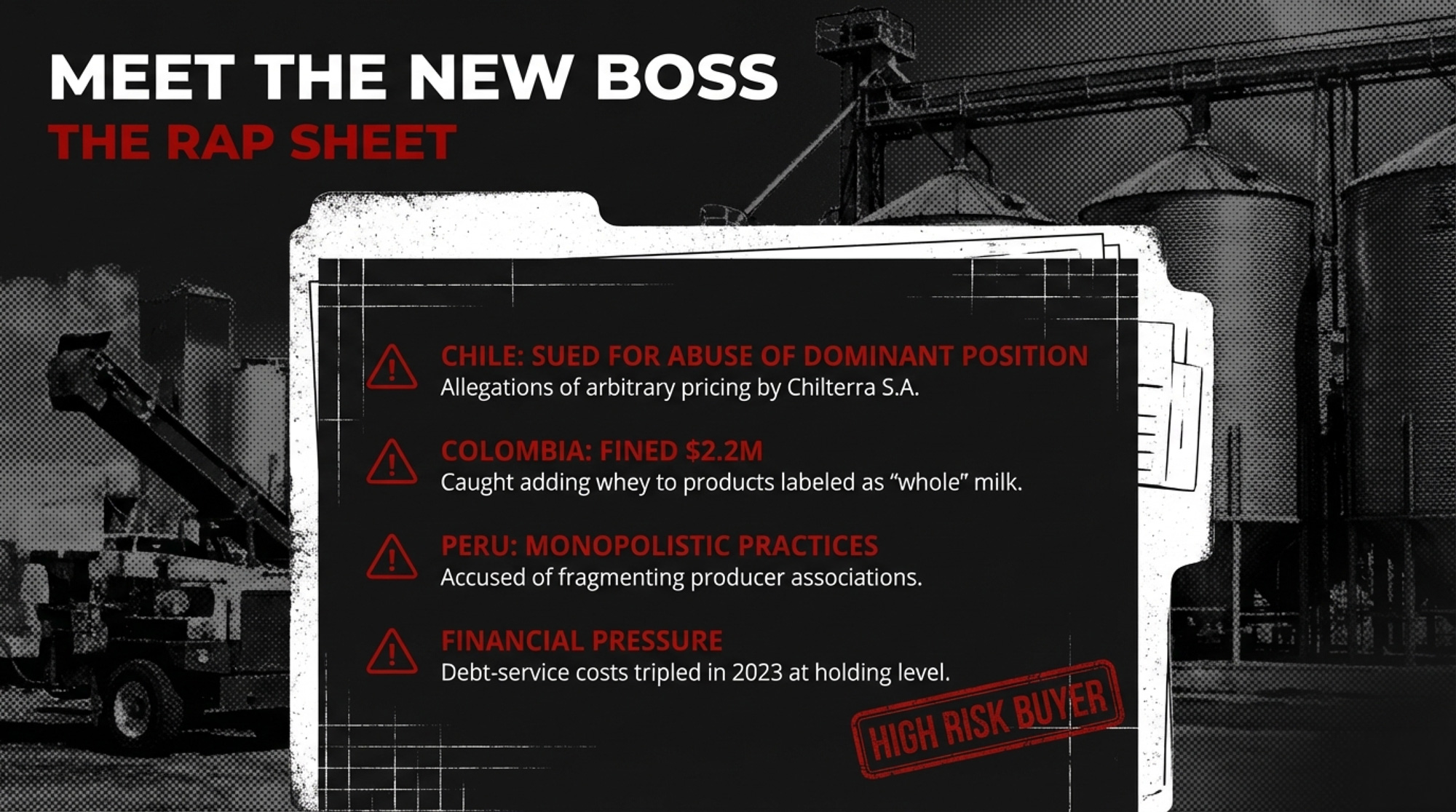
In Peru, former AGALEP (national dairy farmers’ association) president Javier Valera publicly described Gloria’s market behavior as monopolistic. His successor, Nivia Vargas, accused the company of offering infrastructure only to larger-volume farms — deliberately fragmenting producer associations and undermining collective bargaining. Gloria has also fought a Peruvian government decree requiring evaporated milk be made from fresh milk. AGALEP leadership says that regulation underpins demand from an estimated 450,000 Peruvian dairy farmers.

In Chile, Gloria’s subsidiary Prolesur faces a lawsuit admitted by the national competition tribunal (TDLC) on January 30, 2025. Plaintiff Chilterra S.A. alleged abuse of dominant position, specifically that Prolesur imposed “unjustified prices through arbitrary and unverifiable criteria”—a system plaintiff Ricardo Ríos described as designed to create total producer dependence.

In Colombia, the Superintendencia de Industria y Comercio fined Gloria, along with Lactalis, Hacienda San Mateo, and Sabanalac in February 2025 for adding whey protein (lactosuero) to products labeled as whole pasteurized milk. The basis: INVIMA laboratory studies from 2019–2020 detected elevated caseinomacropeptide levels — a marker indicating whey protein had been added to a product labeled as pure milk. Gloria’s penalty was US$2.2 million. The company has appealed.

CountryAction / DisputeYearStatus / Penalty
PeruFormer AGALEP president accused Gloria of monopolistic behavior; producers claim infrastructure access limited to large farms, fragmenting associationsOngoingNo formal penalty; producer relations remain strained
ChileProlesur (Gloria subsidiary) sued for abuse of dominant position—”unjustified prices through arbitrary criteria” designed to create producer dependence2025Lawsuit admitted by TDLC competition tribunal Jan 2025; pending resolution
ColombiaFined for adding whey protein to “whole” milk; INVIMA labs detected elevated caseinomacropeptide (adulteration marker)2025US$2.2 million fine; Gloria appealed
Puerto RicoExited market entirely after regulatory challenges made operations “unworkable”2025–26Complete market withdrawal

Gloria reports investing approximately S/718 million — roughly US$190 million (S/ refers to Peruvian soles) — between 2012 and 2023 in a farmer development program. That figure comes from Gloria itself and hasn’t been independently audited, but the investment claim is on the record. In Puerto Rico, the company exited the market entirely in 2025–2026 after what it described as regulatory challenges that made operations unworkable.

Does any of this predict what happens in Argentina? Not necessarily. Different market, different regulations, different competitive dynamics. But the holding-level financial picture adds context. Holding Alimentario del Perú reported net losses of S/124.9 million (roughly US$33 million) in 2023 and S/62.2 million (~US$16 million) through nine months of 2024, according to Peruvian securities filings. Financial expenses surged from S/123.7 million in 2022 to S/399.5 million in 2023. A company whose debt-service costs tripled in one year is under pressure, even if the core dairy business is profitable.

Nobody’s saying assume the worst. But you’d be wise to ask very specific questions before closing day.

What This Means for Your Operation

This section is about dairy processor risk — and it applies whether you’re milking cows in Córdoba or Ontario or Wisconsin.

Contract ProtectionWhat It DoesArgentine StatusYour Action This Week
Ownership-change clauseRequires new buyer to honor existing contract terms or provides renegotiation windowMissing for most producersPull your supply agreement; search for “assignment,” “change of control,” or “transfer” clauses
Minimum notice periodGuarantees 30–90 days’ written notice before contract termination or major changesMissing for most producersCheck termination section; if absent, negotiate 60-day minimum before any ownership transfer
Payment guaranteeEnsures payment terms (price, schedule, penalties) survive ownership changeUnknown—producers waiting for Gloria communicationVerify whether your agreement specifies payment continuity; if not, add it
Secondary buyer relationshipDiversifies risk by routing 10–30% of production to alternative processorNot common in concentrated marketsIdentify regional cheese makers or co-ops; formalize even small-volume backup contract
Collective bargaining vehicleCooperative or producer association negotiates on behalf of groupExists (UNCOGA, cooperatives) but weakened by 3% co-op market shareJoin or re-engage with local co-op; coordinate questions for new buyer through group
Regulatory review triggerLarge acquisitions require competition-authority approval, sometimes with producer-protection conditionsPending—Argentine CNDC reviewing dealMonitor CNDC decision; if conditions imposed, ensure enforcement mechanisms exist

If you’re in Saputo’s Argentine collection zone: Your contract is the document that matters now. Does it include an ownership-change clause? A minimum notice period? A payment guarantee? If yes, those terms should carry over. If not — or if you don’t have a written agreement at all — you’re negotiating from scratch with a company you’ve never dealt with. Contact your cooperative this week. The latest SIGLEA data (December 2025) shows Argentine farm-gate milk prices averaging AR$476.60 per liter — up only about 8% year-over-year in nominal terms, while costs have continued to rise, putting margins under pressure. Any disruption in payment terms during a processor transition hits harder when margins are already thin.

If you’re a North American Saputo supplier: This looks like an emerging-market exit, not a signal about Saputo’s core North American business. The company is investing in U.S. capacity and showing improving domestic margins. Your situation is structurally different. But the underlying lesson is universal — if your supply agreement doesn’t survive a processor sale, you’re carrying the same risk these Argentine families just discovered. You just haven’t been tested yet.

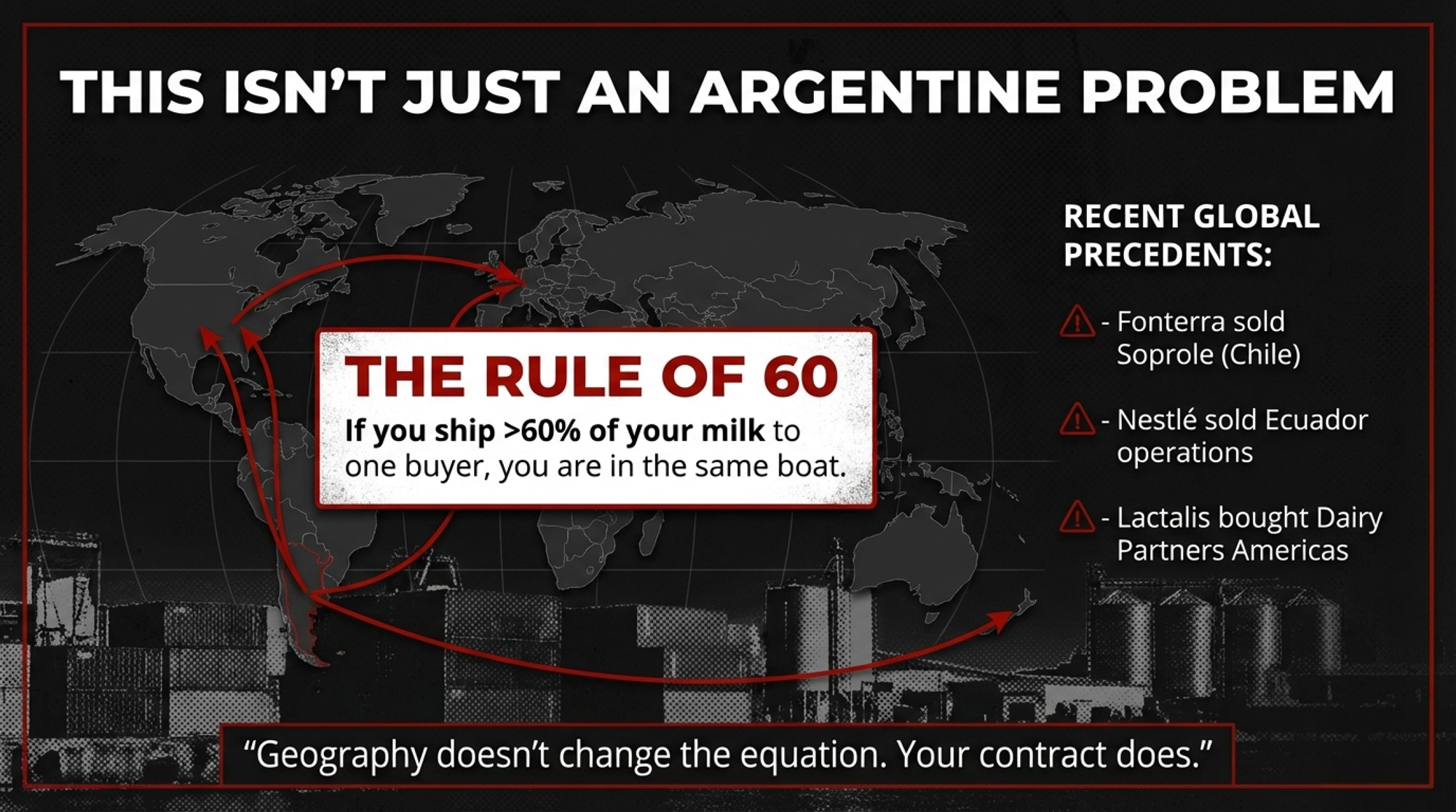
If you sell to any dominant processor, anywhere: Here’s the math that matters. If one company handles more than 60% of your milk and your agreement has no ownership-change clause, you’re structurally identical to those 600 Argentine families. Geography doesn’t change that equation. What changes it is your contract.

The trend behind this deal — processor consolidation reshaping producer relationships globally — isn’t slowing down. In the past three years, Fonterra sold Soprole to Gloria, Nestlé sold Ecuador operations to Gloria, Savencia acquired Williner in Argentina, and Lactalis bought Dairy Partners Americas. Every transaction meant producers discovering, after the fact, that their buyer had changed.

Four Moves Before Closing Day

1. Pull your supply agreement and read it this week. Look for three things: the termination notice period, the ownership-change transfer provision, and the payment guarantee. If any are missing, that’s your negotiating priority before the new owner takes over. Not after.

2. Engage through your cooperative — and accept the trade-off. UNCOGA, Productores Unidos de Rafaela, and the San Guillermo cooperatives are the existing vehicles for collective action. A unified set of questions to Gloria about contracts, payment terms, and collection schedules carries more weight than 600 separate phone calls. Yes, coordinated engagement could be perceived as adversarial before the relationship starts. Move forward anyway. Silence is worse than friction.

3. Explore a second buyer relationship. Around Córdoba and Santa Fe, small and medium cheese makers (PyMEs queseras) have historically offered competitive raw-milk prices. Diversifying even a portion of production reduces concentration risk. The trade-off is real: approaching alternative buyers pre-closing could signal distrust to Gloria, and logistics with smaller processors are more complex. But having options is always the right strategy. And here’s your trigger — if Gloria hasn’t communicated directly with producers within 60 days of closing, that’s your signal to formalize a secondary buyer relationship. Not explore one. Formalize it.

4. Watch Gloria’s first 90 days after closing. Do they communicate directly with producers? Honor existing terms? Provide timeline certainty? Those are positive signals. Prolonged silence — producers still waiting for a phone call weeks after operational control transfers — tells a different story. What Gloria actually does will matter more than anything in a press release.

Three Signals Between Now and Mid-2026

Argentine regulatory review. This deal requires approval from Argentine authorities. At 11.6% of the national industrial milk volume, the competition authority (CNDC) could attach conditions. Any requirements imposed on Gloria regarding producer terms or pricing would be of enormous importance.

Gloria’s outreach to producers. The single most revealing signal. The company knows 600-plus families are waiting. Whether Gloria reaches out proactively or waits for producers to come to them will tell you which version of Gloria is showing up in Argentina.

Payment performance. SIGLEA reported Argentine farm-gate milk prices at AR$476.60 per liter in December 2025 — up only about 8% year-over-year in nominal terms, while production costs have continued climbing, according to OCLA. Gloria’s ability and willingness to maintain competitive pricing after closing will be the metric that matters most to every producer in the collection zone. Everything else is words on paper.

The broader context here — what processor consolidation means for producer survival — was one of the defining themes of 2025 dairy coverage.

Your Processor Risk Checklist

  • Audit your contract this week. No ownership-change clause, no defined termination notice, no payment guarantee means you’re carrying processor risk whether you’re in Córdoba or Ontario, or Wisconsin.
  • Know your single-buyer number. Over 60% of your milk to one processor without contractual protections? You’re in the same structural position as those Argentine families. The difference is timing — you can fix it before the press release drops.
  • Research your processor’s parent company. Financial pressure at the holding level — like debt-service costs tripling in a year — eventually filters down to producer terms. This applies to your processor too.
  • Don’t wait for the phone call. If you’re in Saputo’s Argentine collection zone: contact UNCOGA, your regional cooperative, or APLA (headquartered in Suardi, Santa Fe) this week. Ask collectively about contract continuity, payment schedules, and collection logistics. A coordinated ask is harder to ignore.
  • For North American Saputo suppliers wondering if you’re next: The evidence points to an emerging-market exit driven by Argentine macro conditions, not a systemic pullback. Saputo’s domestic numbers are moving in the right direction. But read your contract. Know what survives a sale.
  • If you know Argentine producers, share this. If you’ve toured dairy operations in Santa Fe or met producers from the Rafaela corridor at genetics events, connect them with this information. The more that circulates, the better everyone’s decisions get.

The Bottom Line

Guruceaga calls his part of Santa Fe “una zona tambera.” A dairy zone. It sounds simple until you sit with what it means: the cows and the community are the same thing. When the processor changes, the community changes with it.

The hardest part of what happened today isn’t the deal. It’s the sequence. A press release in Montreal. A wire story picked up in Lima. A notification on a phone in a milking parlor somewhere between Rafaela and Tío Pujio. And then the question that 600-plus families are asking right now — the same question every producer who depends on a single buyer should be asking before their turn comes:

Does my contract survive this?

If you don’t know the answer, you already know what to do this week.

Key Takeaways

  • Saputo is selling 80% of its Argentine dairy division to Gloria Foods for a C$855 million (≈US$630 million) enterprise value, keeping a 20% minority stake.
  • That puts Argentina’s largest processor — 11.6% of industrial milk and collections from 600‑plus farms — in the hands of a buyer that’s been sued for abuse of dominance in Chile, fined in Colombia over adulterated “whole” milk, and accused of monopolistic behavior in Peru.
  • Farmers supplying Saputo’s Rafaela and Tío Pujio plants learned of the sale from the media, not from their processor, and, as of today, have no firm answer on whether Gloria will honor their current contracts, prices, or pickup schedules.
  • With SanCor in creditor protection and co‑ops’ share of Argentina’s milk shrinking from roughly 34% to about 3%, most producers are now highly dependent on a single buyer when decisions like this drop.
  • If more than 60% of your milk goes to one processor and your contract is silent on ownership changes, you’re carrying the same processor‑risk those 600 Argentine families just discovered — and you should be auditing that agreement this week, before your own “press‑release moment” arrives.

Complete references and supporting documentation are available upon request by contacting the editorial team at editor@thebullvine.com.

Learn More

The Sunday Read Dairy Professionals Don’t Skip.

Every week, thousands of producers, breeders, and industry insiders open Bullvine Weekly for genetics insights, market shifts, and profit strategies they won’t find anywhere else. One email. Five minutes. Smarter decisions all week.
NewsSubscribe
First
Last
Consent

Stagnation in Opening Milk Prices: Challenges and Insights from Australian Dairy Industry

Explore the reasons behind stagnant milk prices for Australian dairy farmers and understand their impact on farm incomes. Are you informed about the challenges and insights currently shaping the dairy industry?

Many Australian dairy producers continue to face financial challenges amidst rising living costs. Despite this, leading processors like Fonterra Australia, Bega Cheese, and Saputo Dairy Australia have maintained their initial milk pricing at about $8 per kilogram of milk solids by July 1. The Australian dairy sector is grappling with the issue of fixed farm gate rates that threaten farmer incomes. The situation is concerning, especially with the Dairy Code of Conduct’s requirements for minimum pricing by July 1 and milk supply agreements by June 1. The Australian Dairy Products Federation emphasizes the sector’s need to reduce costs for sustainability. The surge in imported dairy goods, driven by years of high local milk costs, underscores the crucial role of strategic planning in navigating market dynamics and ensuring the sustainability of local dairy farms. This situation makes farmers make challenging decisions, such as adhering to current supply agreements or exploring more profitable opportunities.

Ensuring Fair Play: The Dairy Code of Conduct

The Dairy Code of Conduct ensures fairness and transparency in the dairy sector, preventing processors from exploiting farmers. It mandates that every milk processor disclose their milk supply agreements by June 1, providing farmers with clear supply terms to guide their decisions. Processors must also set a minimum price by July 1, ensuring a more stable income for farmers and protecting them from price fluctuations. This regulatory framework is a source of reassurance for farmers, as it helps to maintain the viability of their businesses and the sector and shields them from market volatility.

Market Pressures and the Strategic Necessity of Lower Farm Gate Milk Prices

Current market circumstances have forced farm-gate milk prices far lower. The leading cause is an increase in imported dairy products; imports of these goods will rise 17% by 2022–2023, driving hitherto unheard-of consumption of foreign dairy products. This flood has generated fierce rivalry among local producers, calling for price changes to preserve business viability.

It underlines that setting lower farm gate milk pricing is essential for the long-term survival of the Australian Dairy Products Federation. Managed pricing seeks to guarantee profitability and resistance against market changes. Following historically high milk prices calls for a smart strategy to prevent financial hardship on processors and industry instability. Maintaining Australian dairy products’ competitiveness locally and globally depends on open and calculated pricing.

Imported Dairy Products: A Growing Challenge for Local Farmers

The Australian Dairy Products Federation has been vocal about the challenges posed by the increasing import of dairy products on the local market. The import surge has decreased farm gate milk prices, putting significant strain on local producers. With imports projected to rise by 17% in 2022–2023, Federation CEO Janine Waller noted that over 30% of the 344,000 tons of dairy products consumed in Australia are now of foreign origin. This influx of foreign products has intensified competition among local producers, necessitating price adjustments to maintain business viability.

Ms. Waller underlined the Federation’s commitment to ensuring Australian households have domestically produced dairy products priced reasonably. “We want to ensure Aussie families can continue to enjoy affordable, locally made, and branded milk, cheese, yogurt, butter, and ice cream in their homes,” she said. This attitude emphasizes the Federation’s support of keeping local dairy output viable in the face of global market competition.

The Southern Region’s Milk Price: A Strategic Response to Market Dynamics 

As of July 1, the estimated average farm gate milk price in the southern region falls between $7.94 and $8.20/kg MS. This price strikes a strategic balance between market dynamics and local viability. It is up to 14% higher than three years ago despite being lower than the record highs of the last two years. This price point demonstrates the resilience of the dairy sector in the face of market fluctuations. The premium farm gate milk price in Southern Australia, up to 10% higher than the global midpoint price of A$7.43/kg milk solids, is supported by assured minimum pricing and potential reviews. This competitive advantage ensures local stability and underscores Australia’s leadership in the global dairy industry.

This pricing approach helps farmers be stable and emphasizes the need to combine local production incentives with worldwide competitive demands. As world circumstances improve, price changes provide more help and support for the sector’s dedication to farmer sustainability and worldwide competitiveness.

Striking a Balance: Navigating Domestic Needs and Export Ambitions in the Dairy Industry 

With over thirty percent of milk output aimed at international markets, Australia’s dairy processors have always stressed exporting. Since seventy percent of Australian milk is eaten locally, EastAUSmilk president Joe Bradley questions this emphasis. Bradley contends that prioritizing exports might lower farm gate milk prices, hurting local farmers. He underlines how pricing should be much influenced by the home market, where a third of the milk is in milk bottles. The strategic choices of Australia’s dairy processors are greatly influenced by this conflict between export targets and local demands, determining the sector’s course.

Strategic Reassessment: Maximizing Returns in a Competitive Dairy Market

The state of the economy right now lets farmers rethink their plans and optimize profits. Farmers should first carefully go over and weigh contracts from many processors. In a competitive market, shopping for the best terms could result in better conditions. Second, farmers may think about going back over their supply curves. Although changing calving seasons will better match processor price incentives and market demand, a thorough cost-benefit study is essential. One has to assess elements like extra feed, labor expenses, and herd health. Lastly, keeping informed using the milk value portal of the dairy sector offers insightful analysis of historical price data and market trends. This information enables producers to negotiate the challenging dairy market and make wise choices.

Navigating Market Dynamics: Strategic Measures for Dairy Farmers 

Farmers have to take deliberate actions to negotiate these problematic circumstances properly. Profitability may be significantly changed by looking around for better terms. Examine the offers of many CPUs with an eye on minimum price guarantees, incentive systems, and possible price reviews depending on the state of the worldwide market.

Supply curve adjustments may yield success. However, changing calving plans should be carefully examined for expenses and advantages. Feed availability, labor, and animal health should be considered to guarantee reasonable financial and operational effects.

Use tools like the Milk Value Portal of the Dairy Industry to get open access to milk price trends. This instrument provides information on past and present pricing, supporting wise judgments. Dairy producers who remain proactive and knowledgeable will be able to grab new possibilities and effectively negotiate changes in the market.

The Bottom Line

Opening milk prices continue at around $8/kg of milk solids, which presents financial difficulties for farmers even with anticipation for better returns. This year emphasizes the careful equilibrium dairy producers maintain among changing market circumstances and fixed milk prices. While the Dairy Code of Conduct requires minimum price disclosures by July 1, economic considerations have resulted in lower pricing than in the previous season. Leading companies such as Fonterra Australia, Bega Cheese, and Saputo Dairy Australia are negotiating home and foreign market challenges. The main lesson is obvious: farmers must remain strategic and knowledgeable, using all the instruments and market knowledge to maximize their activities. Profitability and resilience depend on flexibility and wise judgment. To guarantee local dairy products stay mainstays in Australian homes, all stakeholders must help the agricultural backbone of our country. Farmers, processors, and industry champions must work together actively to enable the industry to flourish.

Key Takeaways:

  • Fonterra Australia, Bega Cheese, and Saputo Dairy Australia have maintained their opening price of approximately $8/kg of milk solids by July 1.
  • The Australian Dairy Products Federation highlighted that the lower farm gate milk price this year is aimed at preserving the dairy industry’s viability.
  • The Dairy Code of Conduct requires all processors to publish their milk supply agreements by June 1 and set a minimum price by July 1.
  • Except for Norco in northern NSW, major processors have offered lower milk prices compared to last season, impacting farmers’ incomes negatively.
  • A rise in imported dairy products, which surged by 17% during the 2022-2023 period, contributes to nearly 30% of Australia’s dairy consumption.
  • The estimated weighted average farm gate milk price in the southern region ranges between $7.94 to $8.20/kg of milk solids as of July 1.
  • Despite the reduction, current milk prices remain up to 14% higher than three years ago and up to 10% higher than the midpoint price in New Zealand.
  • Farmers are encouraged to utilize the dairy industry’s milk value portal for transparent data on farm gate milk pricing and market trends.
  • Cheese exports from Australia are increasing in both value and tonnages, although skim milk and whole milk powders show a decline compared to last year.
  • On average, about 30% of Australian milk production is allocated to exports, while the majority is sold domestically.
  • Farmers not under contract should compare offers from various processors to secure the best prices for their milk.

Summary:

Australian dairy producers are facing financial challenges due to rising living costs, but leading processors like Fonterra Australia, Bega Cheese, and Saputo Dairy Australia have maintained their initial milk pricing at $8 per kilogram of milk solids by July 1. This situation is concerning as the Dairy Code of Conduct mandates minimum pricing and milk supply agreements by June 1. The increasing import of dairy products on the local market has put significant strain on local producers, with over 30% of the 344,000 tons consumed in Australia now of foreign origin. The Australian Dairy Products Federation emphasizes the need to reduce costs for sustainability and maintain business viability in the face of global market competition. To maximize returns in a competitive dairy market, farmers should carefully weigh contracts from many processors, consider going back over their supply curves, and use tools like the Milk Value Portal of the Dairy Industry to get open access to milk price trends.

Learn more:

Send this to a friend