



Beef crosses went from $50 to $1,200 in three years. Smart producers aren’t asking ‘how long will this last?’—they’re asking ‘how do I protect it?’ July’s changes made it possible.
Executive Summary: Beef income exploded from 5% to 25% of dairy revenue in just three years—that’s $650,000+ annually for a typical 500-cow operation—yet most producers are protecting their milk while leaving their beef income completely exposed. History shows cattle markets crash hard every 5-8 years, with potential losses exceeding $200,000 that can force operations to delay expansion or exit entirely. The breakthrough came July 2025 when USDA finally fixed LRP insurance for dairy, valuing beef-cross calves at their real $1,200-1,370 price instead of the insulting $275 coverage that made insurance worthless. After 35-55% government subsidies, comprehensive protection costs just $6,200 annually—about what you spend on two months of mineral supplement. October’s 11.5% price drop in 12 days isn’t normal market movement; it’s volatility returning, and smart producers are locking in protection now while it’s still affordable. Whether you choose insurance, contracts, or another approach, this guide provides the practical roadmap to protect the beef income that’s become essential to your operation’s future.”

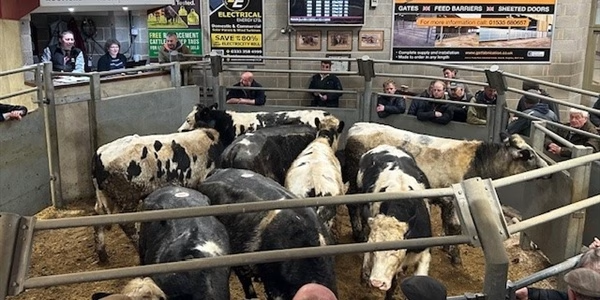
If you’ve been to any dairy meetings lately—whether it’s in Wisconsin or Pennsylvania—you know the conversation has shifted. Sure, we’re still talking about milk prices and feed costs, because those never go away. But here’s what’s interesting: everywhere I go, the main topic is beef-on-dairy calves trading at $1,200 a head. And more importantly, everyone’s wondering how long this can last.
What I’ve found is we’re living through one of the most significant transformations in modern dairy. In just three years, beef income has gone from being this minor thing—you know, maybe 5-10% of revenue when we were lucky to get fifty bucks for a Holstein bull calf—to representing 20-25% of total farm income for operations that have really embraced beef-on-dairy breeding. University of Wisconsin Extension has been tracking this, and their analysis aligns with what USDA market reports show.
“We went from dreading bull calves to actually planning our cash flow around them. It’s a complete mental shift.”
— Wisconsin dairy producer
Here’s something worth thinking about: A typical 500-cow dairy that’s generating, say, $3 million in milk sales can now add $750,000 or more from beef-on-dairy calves and cull cows. That’s not pocket change—that’s genuine business diversification. Yet many of us are still approaching this revenue stream the way we always have, which might not be enough given these new market dynamics.
What’s encouraging is that, starting July 1, 2025, the USDA restructured its Livestock Risk Protection program to better align with what we actually need. You can find all the details in their Product Management Bulletin PM-25-028 if you want to dig into the specifics. But I’ll be honest—these aren’t simple programs. There’s definitely a learning curve.

How We Got Here (And Why It Matters)

You probably know this already, but the way several trends came together created today’s opportunity. And understanding this helps explain both the upside and the risks.
The cattle inventory situation is pretty remarkable when you look at the numbers. USDA’s January 2024 Cattle Inventory Report shows we’re at 87.2 million total cattle—that’s the lowest since 1951. Can you believe that? The 2023 calf crop was just 33.6 million head, the smallest since 1948. We’re talking about five straight years of herd reduction, driven by drought out west, input costs that made everyone’s eyes water, and interest rates that made it nearly impossible for cow-calf folks to rebuild.
Meanwhile—and this is fascinating—sexed semen technology finally started delivering on its promises. The National Association of Animal Breeders reports that modern sexed semen hits 90-95% accuracy with conception rates that are actually competitive with conventional semen now. By 2024, sexed semen made up 61% of all dairy semen used in U.S. herds. That’s incredible growth from basically nothing a decade ago.
A New Revenue Reality
Where Dairy Income Comes from Now
- Milk Sales: 75-80%
- Beef-Cross Calves: 15-18%
- Cull Cows: 5-7%
This technology shift changed everything. Now we can breed our best 35-40% of cows for replacements and put the rest to beef. As one Wisconsin producer put it to me recently, “We went from dreading bull calves to actually planning our cash flow around them. It’s a complete mental shift.”
And the economics… well, they became impossible to ignore. Holstein bulls that used to bring $50-150 are now competing with beef-on-dairy crosses pulling $1,000-1,450 per head—that’s what Superior Livestock Auction data from Pennsylvania and Wisconsin markets shows. Do the math on a 500-cow operation breeding 65% to beef, and you’re looking at roughly $250,000 in additional calf revenue. That’s like producing an extra million pounds of milk at current Class III prices.
What These New Tools Actually Do for Us
Before July 2025, if you wanted to protect beef income through insurance, you were basically out of luck. The products available were designed for beef feedlots, not dairy farms selling day-old calves and cull cows.
Finally, Real Coverage for Cull Cows
Here’s what still gets me about the old system—dairy cull cows had zero LRP coverage options. None. Think about that… An operation culling 175 cows annually at current values—we’re talking $350,000 or more—had no insurance protection available whatsoever.
“For that typical 175-cow culling program, that’s serious money at risk.”
CME market data and USDA Agricultural Marketing Service reports show cull cow prices can swing wildly—from $165/cwt down to $100/cwt when things get rough. For that typical 175-cow culling program, that’s serious money at risk.
The new “Fed Cattle – Cull Cows” category in the 2026 LRP Insurance Standards Handbook finally addresses this. What I really appreciate is how practical it is—13-week protection periods that match how we actually market cull cows, with pricing based on real cull cow values instead of fed cattle prices that never made sense for us. And with USDA Risk Management Agency subsidies of 35-55%, the actual cost comes down to about $14-21 per head. That’s manageable.
Beef-Cross Calves: Protection That Actually Works
The old “Unborn Calves, Predominantly Dairy” coverage was… well, let’s just say it didn’t work. It valued protection at about 110% of the CME Feeder Cattle Index according to the old actuarial documents. So when your beef-cross calves are selling for $1,000-1,400 but the insurance values them at $275, what’s the point?
The Value Gap: Old vs. New LRP

What Your Calves Are Actually Worth vs. What Insurance Covered
- Actual Market Value: $1,000-1,400
- Old LRP Coverage: $275
- New LRP Coverage: $1,200-1,370
Agricultural economists at Kansas State and other universities have documented this disconnect—we were basically insuring 25-30% of actual value. One economist described it as insuring only your truck’s tires, rather than the whole vehicle. Pretty accurate, if you ask me.
The new “Feeder Cattle – Unborn Calves” category uses dynamic Price Adjustment Factors published monthly by RMA, which actually reflect reality. The latest RMA pricing shows expected values ranging from $1,200 to $1,370 per head, depending on when you’re marketing. You can get coverage for 70-100% of those values, though there’s one catch—calves have to be sold within 14 days of birth. But that’s how most of us market them anyway, so it works.
Regional Differences Matter More Than You’d Think
What’s happening in Texas is quite different from what we’re seeing here in the Upper Midwest or Northeast. Those big Texas operations—you know, the 2,000+ cow places—they shifted to beef-on-dairy really wholly and fast. They had the scale to work directly with feedlots and set up sophisticated breeding programs.
Meanwhile, in Wisconsin and Minnesota, where most of us run 400-800 cows, it’s been more gradual. University Extension folks across the Midwest have noticed that producers here need time to build buyer relationships and understand how our local prices relate to the broader market. We couldn’t just ship direct to feedlots like the big Southwest dairies—we had to build those connections first.
Pennsylvania’s interesting, too. Penn State Extension research shows that their veal markets and proximity to Eastern feedlots yield nice premiums—$931-1,075 per head, compared to $690-945 in Wisconsin. Those regional differences really change the economics of insurance.
What’s interesting here is how Europe and Australia handle this differently. They rely more on cooperative structures and supply management—less individual insurance, more collective bargaining power. There’s something to learn from both approaches, though our system offers more flexibility if you’re willing to navigate the complexity.
Let’s Talk Real Numbers
So what does protection actually cost for a typical 500-cow dairy? Using October 2025 market data:
Your current annual beef income looks like this: Based on Wisconsin auction reports, 249 beef-cross calves at $1,239 each brings in $308,000. Add 175 cull cows at $140/cwt for 1,400-pound cows (that’s USDA-AMS data), and you’re looking at another $343,000. Total beef revenue exceeds $651,000 annually.
But if markets crash like they have before: CattleFax documented the 2015 correction at 31% within 12 months. Apply that today—calves drop to $800 (you lose $109,000) and cull cows fall to $100/cwt (another $98,000 gone). That’s over $207,000 at risk.
Here’s what protection costs after subsidies: Calf coverage at 90% runs about $2,540 annually. Cull cow coverage at 90% is around $3,675. So your total annual premium is $6,215—basically 1% of your beef income protecting against 30-40% potential losses.
Insurance folks who’ve been doing this for years will tell you—and history backs this up—major corrections happen every 5-8 years. When they do, operations with coverage get indemnity checks while their neighbors… well, they’re scrambling. It’s worth noting that crop insurance adoption took decades to reach current levels—we’re seeing similar patterns with livestock protection now.

Why Aren’t More Folks Using These Tools?
Despite the math being pretty compelling, adoption’s still low. Research from our land-grant universities points to several reasons, and they’re all legitimate concerns.
The knowledge gap is real. Most of us spent decades learning milk markets—we know Class III like the back of our hand. But cattle pricing, CME futures, basis risk? That’s all new territory. Extension programs are trying to help, but it takes time.
Then there’s what I call the trusted advisor disconnect. Your vet, your nutritionist—research shows these are the people we actually listen to and trust. But they don’t typically know insurance. Meanwhile, many crop insurance agents who handle Dairy Revenue Protection (DRP) aren’t licensed for livestock products. So there’s this gap right when we need guidance most.
And let’s be honest—we’re all stretched thin. When you’re dealing with labor shortages, equipment that needs fixing, keeping milk quality where it needs to be… adding “figure out complex insurance” to the list feels overwhelming. Especially during transition periods when fresh cow management takes all your attention. I’ve noticed that operations with dedicated financial managers adopt these tools faster—but not everyone has that luxury.
Different Approaches Can Work Too
Now, it’s important to acknowledge that insurance isn’t the only way to manage this risk. Some operations have found other approaches that work well for them.
I was talking with an Oregon producer recently who’s got direct contracts with a regional grass-fed program. “They take all our beef crosses at a guaranteed premium over market,” he explained. “For us, that predictability is worth more than insurance. We know what we’re getting, and we don’t worry about whether our local prices match up with CME indices.”
That’s a valid approach. If you’ve got solid contracts, strong financials, or other marketing arrangements that work, LRP might not be essential for you. Look at Canada—their producers rely more on supply management and cooperatives than individual insurance, and they manage okay.
Building Your Protection Strategy
What successful producers have figured out—especially those who made it through 2020’s market chaos—is that protection works best when you layer different tools.
Start with Dairy Margin Coverage (DMC) as your foundation. FSA data shows Tier 1 coverage at $9.50 margin protection costs just $75 annually for the first 5 million pounds. Over the program’s history, it’s paid out an average of $1.17/cwt. You can’t beat that value.
If you’re producing over 5 million pounds, seriously consider Dairy Revenue Protection (DRP) at 95% coverage. Yes, it runs $48,000-80,000 annually for a 500-cow operation, but government subsidies cover 44% of that. It protects both your price and production risks on milk.
Then add the new LRP tools:
- Beef-cross calves: Get 90-95% coverage, purchased 13-43 weeks before they’re born
- Cull cows: 13-week coverage that matches your culling schedule
- Combined cost: roughly $6,000-8,000 annually for solid beef income protection
All told, you’re investing about 3-5% of gross revenue to protect against 30-50% potential losses in a downturn. This development suggests we’re entering a period where comprehensive risk management is becoming standard practice, not optional.
Quick Cost Breakdown by Herd Size
| Herd Size | Annual Beef Income* | LRP Premium Cost | What You’re Protecting |
| 200 cows | $260,000 | $2,500 | $78,000 |
| 500 cows | $651,000 | $6,200 | $195,000 |
| 1,000 cows | $1,302,000 | $12,400 | $390,000 |
| *At current market conditions |
Learning from Early Adopters
A Pennsylvania producer who started coverage in August 2025 shared something interesting with me. When October’s volatility hit—USDA reports show prices dropped 11.5% in just 12 days—he had protection at $1,130 per calf.
“My neighbors were calling emergency meetings with their bankers,” he said. “We had coverage. Sure, we didn’t get peak prices, but we weren’t losing money either. The key was starting with some coverage and learning as we went, instead of waiting for perfect timing.”
That pragmatic approach really resonates—get something in place, learn the system, then optimize. Looking at this trend, it’s clear that producers who build risk management expertise now will have significant advantages going forward.
Common Pitfalls to Watch For
Based on what agents and producers who’ve been through this tell me, here are the main things to avoid:
Waiting for the “right time” is the biggest mistake. Markets turn faster than you’d think. Once volatility shows up, premiums often double.
Don’t under-insure just to save on premiums. Saving $2,000 doesn’t help much if you’re still exposed to $100,000 in losses. Remember, these are tax-deductible business expenses—factor that into your calculations.
Read the details carefully. That 14-day marketing window for calves? Miss it, and your coverage doesn’t apply. Keep good records of birthdates and sale dates.
And find an agent who actually knows dairy livestock insurance, not someone who mainly works with beef operations. There’s a difference.
Why Timing Matters So Much
History gives us some important lessons here. CattleFax documented the 2015 crash—fed cattle went from $175/cwt to $120/cwt in less than a year. They called it the fastest decline ever recorded. Then in 2020, when COVID hit, feeder cattle lost $33/cwt in just 13 weeks.
And right now? We’ve already seen beef-on-dairy calf prices drop 11.5% in 12 days this October. That’s not normal market movement—that’s volatility coming back.
Dr. Derrell Peel at Oklahoma State has studied cattle cycles for thirty years. His research consistently shows that if you wait until you “see trouble coming” to buy insurance, it’s already too late—premiums have doubled and coverage floors are below current prices.
What’s Coming Down the Road
Several things suggest this opportunity window might not stay open as long as we’d like.
Beef herd rebuilding is starting. State inventory data shows expansion happening across Montana, the Dakotas, and Texas. As beef cattle supplies get back to normal over the next 3-5 years, our premium prices for dairy-beef crosses will probably come down. These $1,000+ calves might be temporary.
Those generous subsidies aren’t guaranteed forever, either. Congressional Budget Office analysis shows the current 35-55% premium subsidies came from COVID-era funding. With the farm bill already delayed two years and budget pressures building, who knows what future support will look like. Some states are developing their own supplemental programs, but nothing’s certain.
And here’s something interesting: if you follow genetics, the market’s starting to differentiate. ABS Global and Select Sires report that feedlots increasingly want verified genetics with carcass data. Generic crosses might fall back to $600-800 while premium verified genetics hold their value. What farmers are finding is that investing in documented genetics now positions them for when the market gets more selective.
Options for Smaller Operations
Not every 200-cow operation can spend time figuring out complex insurance programs, and that’s perfectly understandable. What’s encouraging is seeing cooperatives step up.
Vermont and Maine producers are working through their co-ops to access group risk management. Agri-Mark’s running a pilot where their risk management team handles LRP enrollment for members, spreading the expertise cost across farms. You lose some individual optimization, but it’s better than no protection at all.
Looking at this trend, smaller operations might actually have an advantage—they can leverage collective expertise without bearing the full burden themselves.
Your Next Steps: A Timeline That Works
If you’re ready to explore this, here’s a practical approach:
First week: Call your current insurance agent plus 2-3 livestock specialists. Ask specifically about dairy LRP experience, especially with the new beef-cross and cull cow options. The RMA Agent Locator helps find qualified folks in your area.
Second week: Pull together your data—breeding records, calving schedules, and when you typically cull. Figure out your actual beef income exposure. Your Extension agent can help—they’ve got spreadsheets ready to go.
Third week: Review proposals and compare options. Here’s something important—talk to your lender about this. Many banks offer better terms or even help with premium financing when you’ve got good risk management in place. As one banker told me, “We’d rather finance insurance premiums than deal with bankruptcies.”
Fourth week: Get initial coverage going for your next calving group and upcoming culls. Set up quarterly check-ins because this isn’t “set and forget”—markets change, your operation evolves, coverage should adapt.
The Bottom Line
This transformation in dairy beef income creates both huge opportunities and real risks that need managing. The USDA’s new LRP tools offer meaningful protection, but only if we understand them and act before volatility makes coverage too expensive.
We’re witnessing a fundamental shift from single-product dairy operations to diversified businesses. Those who recognize this and adapt will be the ones expanding in 2028. Those who don’t… well, they’ll have some tough conversations ahead.
The tools are there. Government subsidies cover 35-55% of premium costs. The math works. But tools only help if you use them.
With beef income at historic highs but already showing volatility, the window for affordable protection is open but narrowing. Every producer I know who’s been through previous crashes says the same thing: “I wish I’d bought insurance when times were good and premiums were cheap.”
That time is right now. Make the calls. Run your numbers. Get protected. Whether you choose insurance, contracts, or another approach, make sure you’ve got a plan that fits your operation.
“Hoping for the best isn’t risk management—it’s gambling with your family’s future.”
For more information on LRP enrollment, contact a licensed livestock insurance agent or visit rma.usda.gov for resources and agent locator tools. Your state Extension service offers educational programs on risk management strategies specifically for dairy operations.
Key Takeaways:
- You’re protecting your milk but gambling with your beef—that 25% of revenue ($650K+ annually) needs coverage just as much as your milk income does
- July 2025 changed everything: USDA finally valued dairy beef calves at their real $1,200-1,370 price for insurance, not the useless $275 that made coverage pointless
- Simple math, huge impact: Invest $6,200 annually (after 35-55% subsidies) to protect $651,000 in beef income—that’s using 1% to protect against 30-40% crashes
- The window is closing fast: October’s 11.5% price drop in 12 days proves volatility is returning, and waiting means doubled premiums or no coverage at all
- You have options: Whether through insurance, direct contracts, or cooperative programs, successful operations are implementing beef income protection now—our 4-week guide shows you exactly how
Complete references and supporting documentation are available upon request by contacting the editorial team at editor@thebullvine.com.
Learn More:
- Maximizing Beef on Dairy Success: Key Strategies for Sire Selection – This article moves beyond risk management to implementation, revealing specific methods for selecting beef sires for dairy cows. It provides a tactical guide for creating the premium, genetically-verified calves that command higher prices and meet specific feedlot demands.
- The Unstoppable Rise of Dairy-Beef: How It’s Reshaping the Cattle Industry – Gain a crucial market perspective on the dairy-beef phenomenon. This analysis explores the long-term economic trends and supply chain shifts driving the movement, helping you make strategic decisions that align your operation with the future of the cattle industry.
- Beyond Conception Rates: Using Data to Drive Your Dairy’s Reproductive Strategy – This piece explores the technology powering modern breeding programs. It demonstrates how to leverage herd data to optimize reproductive decisions, ensuring your beef-on-dairy strategy is not just protected
The Sunday Read Dairy Professionals Don’t Skip.

Every week, thousands of producers, breeders, and industry insiders open Bullvine Weekly for genetics insights, market shifts, and profit strategies they won’t find anywhere else. One email. Five minutes. Smarter decisions all week.