





Archive for cost control

$13,000 Laser, $665,000 Gap: The Dairy Spending Trap That HPAI Blows Wide Open

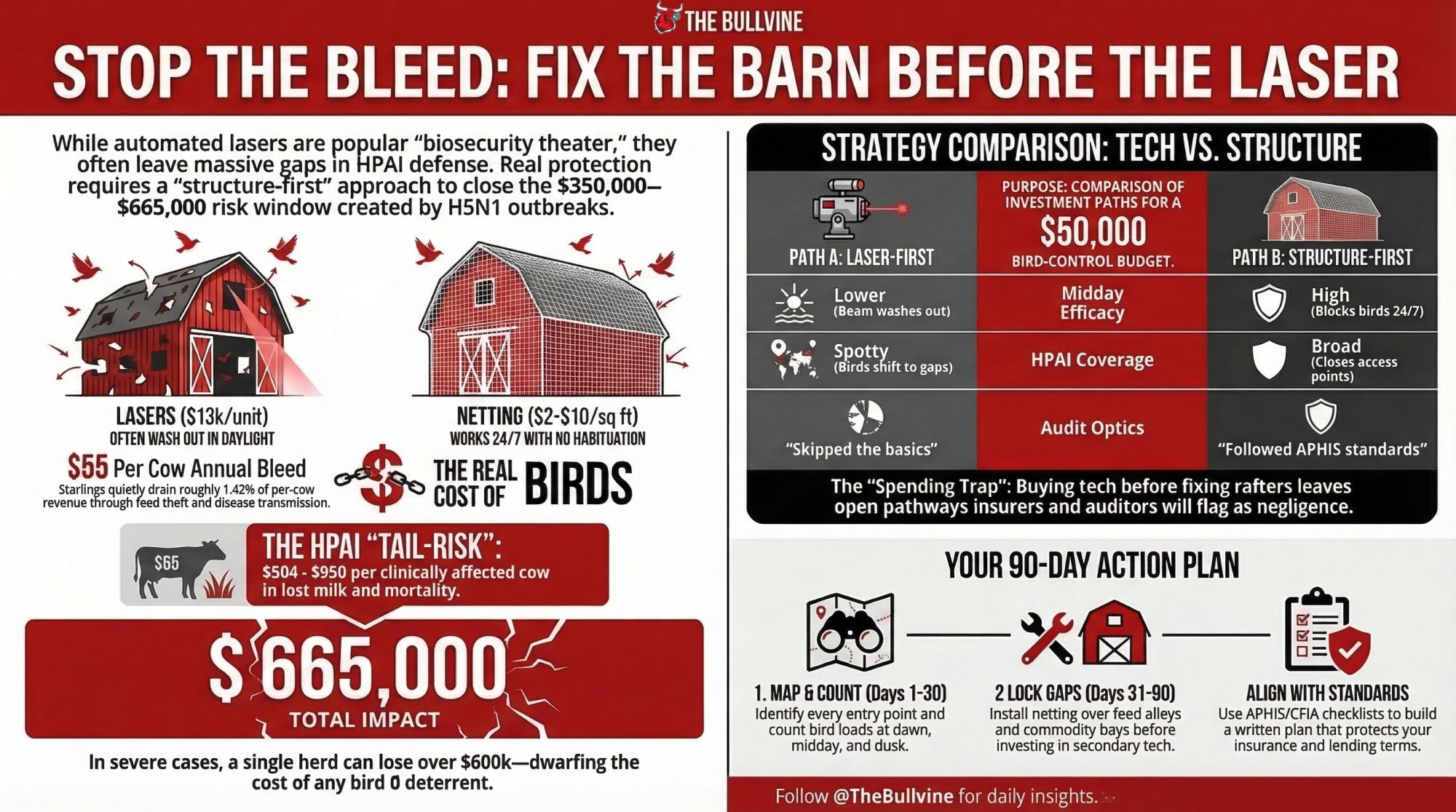
A $13,000 laser vs a $665,000 HPAI hit. If your rafters are still open, that beam is just expensive biosecurity theater.

Executive Summary: HPAI just turned bird control from a frustrating starling problem into a $350,000–$665,000 tail‑risk decision for your herd. On one side, the data says starlings quietly drain about $55/cow/year from feed and health; on the other, recent US H5N1 outbreaks have cost $504–$950 per clinically affected cow, with some herds losing nearly 40% of those cows within two months. Lasers run $12,500–$13,104 per unit and absolutely move birds — but only where the beam hits, and OSU tests show performance drops fast in full daylight and uncovered areas. USDA APHIS and CFIA/ProAction both put netting, curtains, sealed feed, and bunk hygiene ahead of gadgets, which is the opposite of the “laser‑first” sales pitch you’re hearing right now. This feature walks through the barn math on a $50,000 bird‑control budget, showing how a structure‑first plan closes real HPAI pathways while a laser‑first plan mostly shifts birds to the gaps you never fixed. You also get concrete negotiation scripts for processors, insurers, and lenders, plus 30/90/365‑day checks you can run off your own bird counts, feed‑shrink, and herd size. The blunt takeaway: if you buy the $13,000 laser before you buy the netting, you didn’t fix HPAI risk — you just made it more expensive.
HPAI dairy biosecurity

In 2026, a green laser sweeping through your freestall looks like a biosecurity win. It impresses visitors, makes a great social clip, and ticks the ‘technology’ box on someone’s checklist. But if the rafters over your feed alley are still open and your commodity bay isn’t sealed, that same beam could leave a 0,000–5,000 hole in your HPAI defense plan — the range of losses when roughly 700 cows are clinically affected at 4–0 per head.
The technology isn’t the problem. The spending order is.

Bird Control Group’s most-watched dairy video tells part of the story. An anonymous Idaho operation was bleeding an estimated $150,000 to $200,000 per year to starlings — feed eaten and fouled, milk suppressed across the herd. They installed an AVIX Autonomic laser in the stables; the green beam swept once, and thousands of birds exploded from the rafters while the cows barely flicked an ear. It looks like a $200,000 problem fixed in 30 seconds.
That clip is doing a lot of selling right now. As HPAI has turned wild birds from a nuisance into an existential biosecurity risk, more dairies are signing five‑figure laser quotes while leaving barn doors open, commodity bays unsealed, and feed hygiene stuck where it’s always been. The question isn’t whether the laser works. It’s whether following that Idaho playbook actually protects your margin — or makes your biosecurity look good on paper.

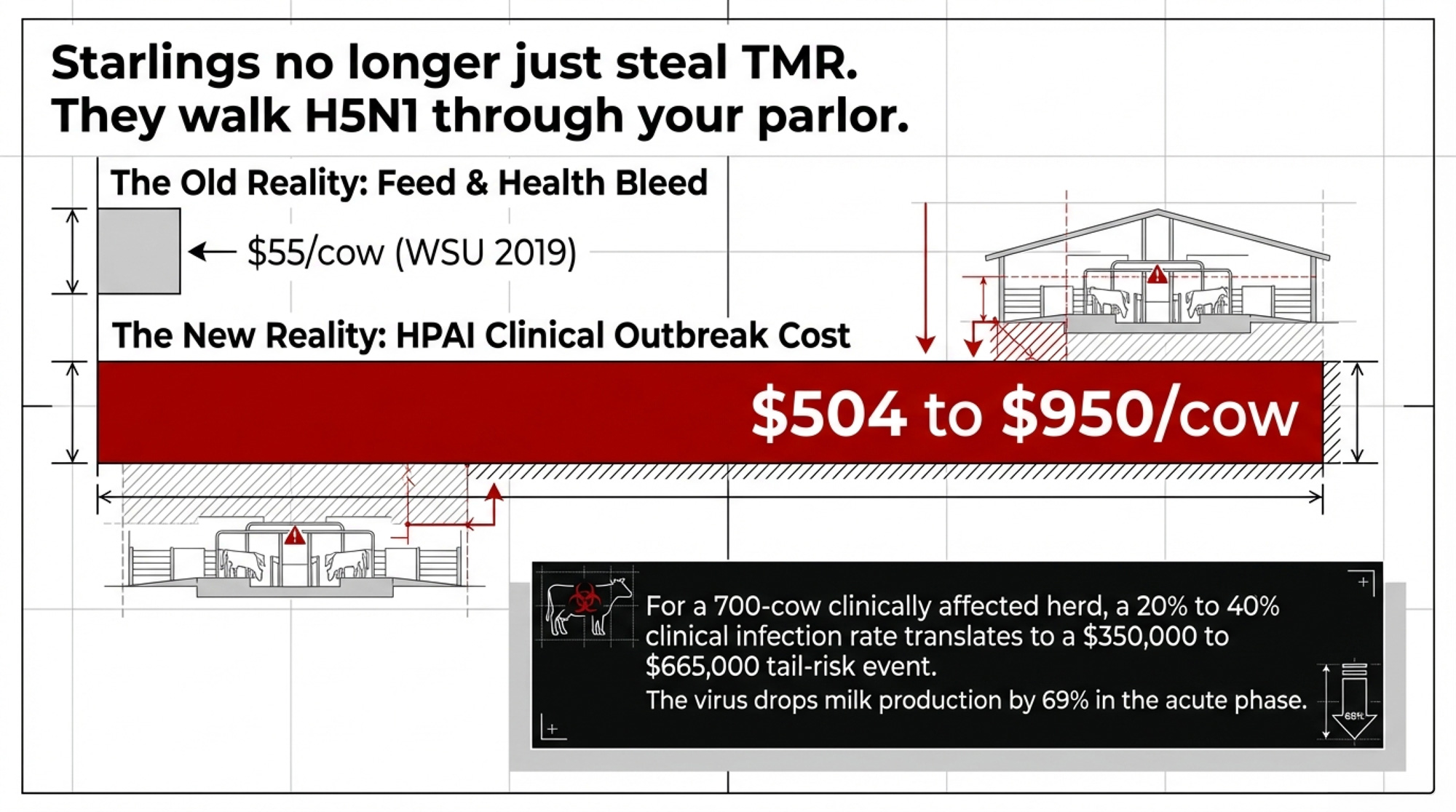
The $55 Per Cow Bleed You Never See on the Milk Check

That Idaho dairy sits at the ugly end of the spectrum. Most herds aren’t losing $200,000 a year to starlings. But the slow bleed is way more common than your milk check shows.

A 2019 Washington State University survey of dairy operators — published in PLOS ONE — put average bird-related losses at about .90 per cow per year, roughly 1.43% of per‑cow revenue, not a worst‑case number. A 3,000‑cow herd is closer to $164,700. It’s not “barn on fire” money on any single day. It’s constant margin erosion that never gets its own line item.

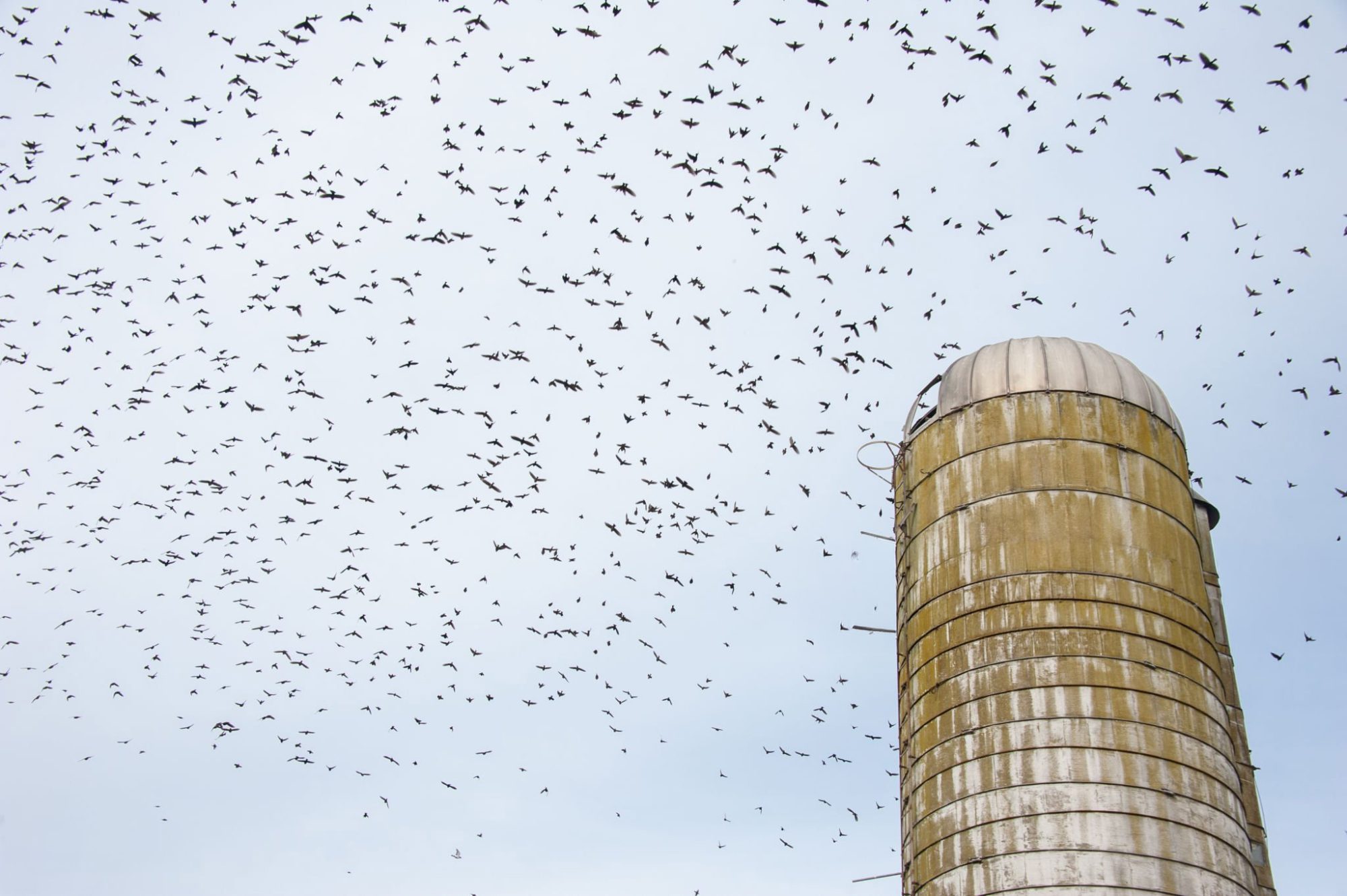
The same survey tied daily bird counts above 10,000 birds to higher self‑reported rates of Johne’s disease and Salmonella on those dairies. The researchers pointed directly to European starlings as vectors that move fecal material and pathogens among feed, water, and cattle. Starlings aren’t just stealing your TMR. They’re walking pathogens from bunks to troughs to parlor approaches — and through every pen in between.

That’s the background bleed. Then HPAI came along and changed the math entirely.

What an HPAI Outbreak Actually Costs a Herd

If lasers were just about feed loss, you could argue about payback and move on. H5N1 in dairy cows is a different conversation.

Armin Elbers and his team at Wageningen University & Research ran one of the strongest independent tests on automated laser bird deterrents. On a Dutch free‑range poultry farm in a high‑risk avian influenza zone, they ran a laser system for 28 days and saw 98.2% overall reduction in wild bird visits — 99.7% for waterfowl and 96.1% for passerines like starlings and sparrows, with no habituation in that window. For a poultry site, that’s a serious result — and a best‑case outcome in a very controlled, non‑dairy context.

But the HPAI math that matters to you lives in the dairy studies that followed.

A 2025 Journal of Dairy Science “growing risk” analysis estimated H5N1 losses at about 4 per clinically affected cow (90% credible interval: 2–7), including milk reduction, replacement, treatment, and reduced feed intake. For a modeled 500‑cow herd with about 32% of cows affected over a 45‑day outbreak, they estimated total losses around $79,145, or about $158 per cow averaged across the entire herd, with 92.3% of losses due to reduced milk yield.

A Nature Communications paper from Cornell’s College of Veterinary Medicine in July 2025 looked at a roughly 3,900‑cow Ohio herd that experienced a real H5N1 outbreak. Their economic model came back much uglier: about $950 per clinically affected cow, and about $737,500 in total outbreak costs for that one herd. On the milk side, clinically affected cows lost a cumulative 901.2 kg over the 60 days post‑diagnosis, compared with a typical loss of up to 18 kg from common bacterial mastitis — roughly 50 times as much.

Cornell’s team documented 777 clinically affected cows in that Ohio herd and found that “almost 40% (298) left the herd in the first two months following the outbreak, either through death or early removal.” CIDRAP’s summary of the same study notes that clinically affected cows dropped from roughly 77 lb/day to about 24 lb/day during the acute phase — a 69% decline — with lower production persisting over the full 60‑day analysis window.

In that Ohio case, about 20% of the herd’s cows were clinically affected. Early reports from Michigan outbreaks suggest cumulative clinical incidence may be higher in some herds, possibly around 30%, but peer‑reviewed data there are still thin, and herd responses vary.

The gap between $504 and $950 per cow is real. It reflects different herds, methods, and severity. But even the low end is devastating. To show what this looks like in real dollars, take a hypothetical 700 clinically affected cows. Using the JDS figure, that’s 700 × $504 = $352,800. Use Cornell’s number, and you’re at 700 × $950 = $665,000.

That range — roughly $350,000 to $665,000 — is what should frame every bird‑control decision you make right now. Not “does the laser work?” but “what happens to my farm when the virus gets through anyway?
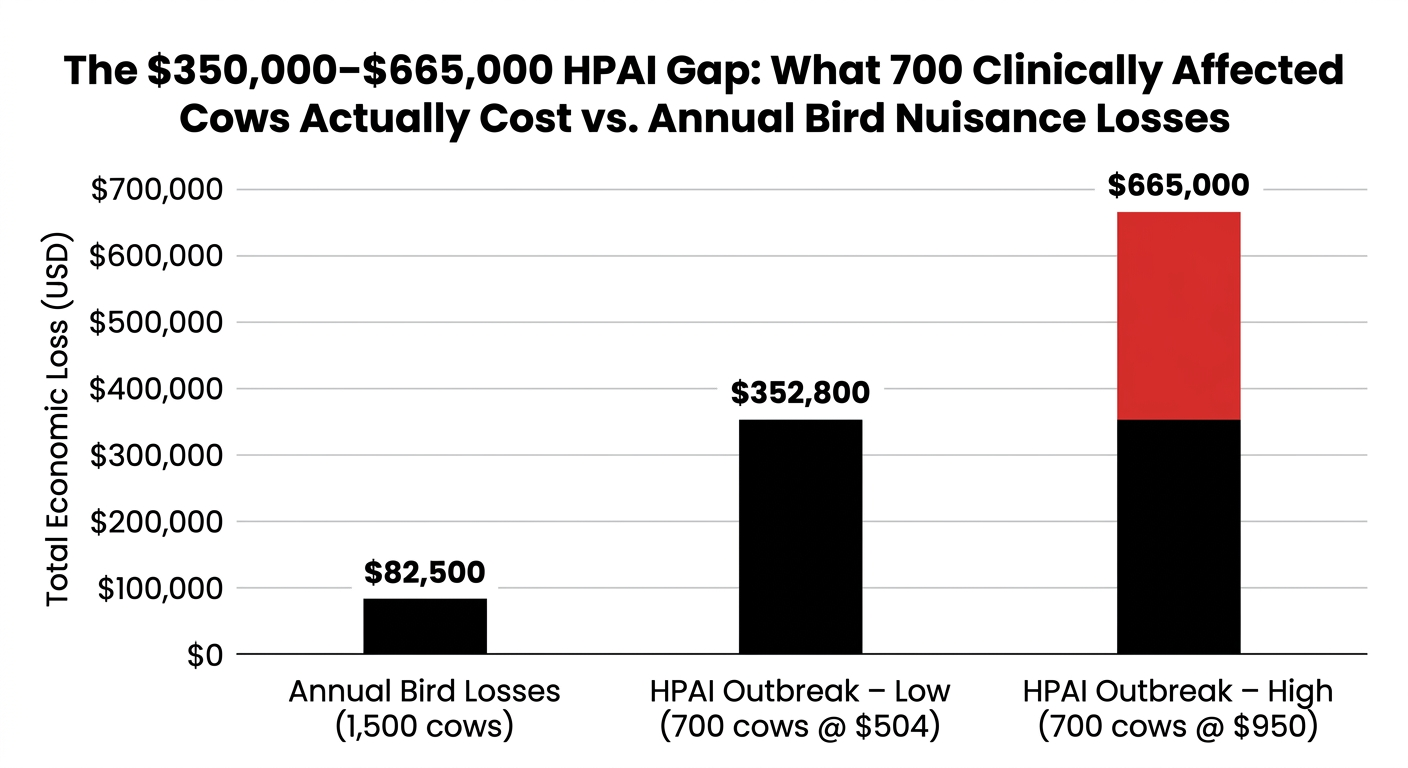
And that $665,000 ceiling? It’s actually a floor. Cornell’s $950 figure explicitly tracks direct losses — milk reduction, mortality, and early culling — over a 67‑day window. It doesn’t count breeding setbacks, lost quality premiums, or the genetic value of high‑genomic animals you’re forced to cull because a quarter dried off. When Cornell’s own researchers flag those exclusions, it’s reasonable to assume the true per‑cow cost in severe cases could approach $1,700 or more in total economic impact, which would push the tail risk on 700 clinically affected cows from $665,000 to well north of $1.2 million.

Who Actually Pays for Dairy HPAI Biosecurity?

A single AVIX Autonomic Mark II unit retails for $12,500-$13,104 from US distributors, based on 2024–2025 listings. Most dairies don’t have just one pressure point. Covering barns, feed alleys, commodity approaches, and lagoon edges usually means two to four units — roughly $25,000 to $52,000 in hardware, plus mounting, installation, wiring, and replacement bulbs over time.

iChase, whose AI‑driven system layers camera detection and automated targeting on top of a green laser, says typical dairy customers see $20,000–$35,000 in annual savings with a 7–12-month payback, based on its 2025 marketing ahead of IPPE 2026. That’s their claim, not a peer‑reviewed result, but it’s part of the sales pitch you’re hearing.

Here’s the part that doesn’t show up in the brochures.

Your processor doesn’t call to say “thanks for the laser.” They call to say they need HPAI test results before Tuesday — and their supplier manual reserves the right to suspend pickup if you don’t meet whatever standard they’ve set this month. Your lender prices disease risk into your interest rate and covenants, but isn’t offering to split the cost of netting or deterrents. Your insurer benefits from lower claim probability but keeps full discretion to deny or trim payouts if “recommended biosecurity measures” weren’t maintained — language APHIS and provincial frameworks keep expanding.
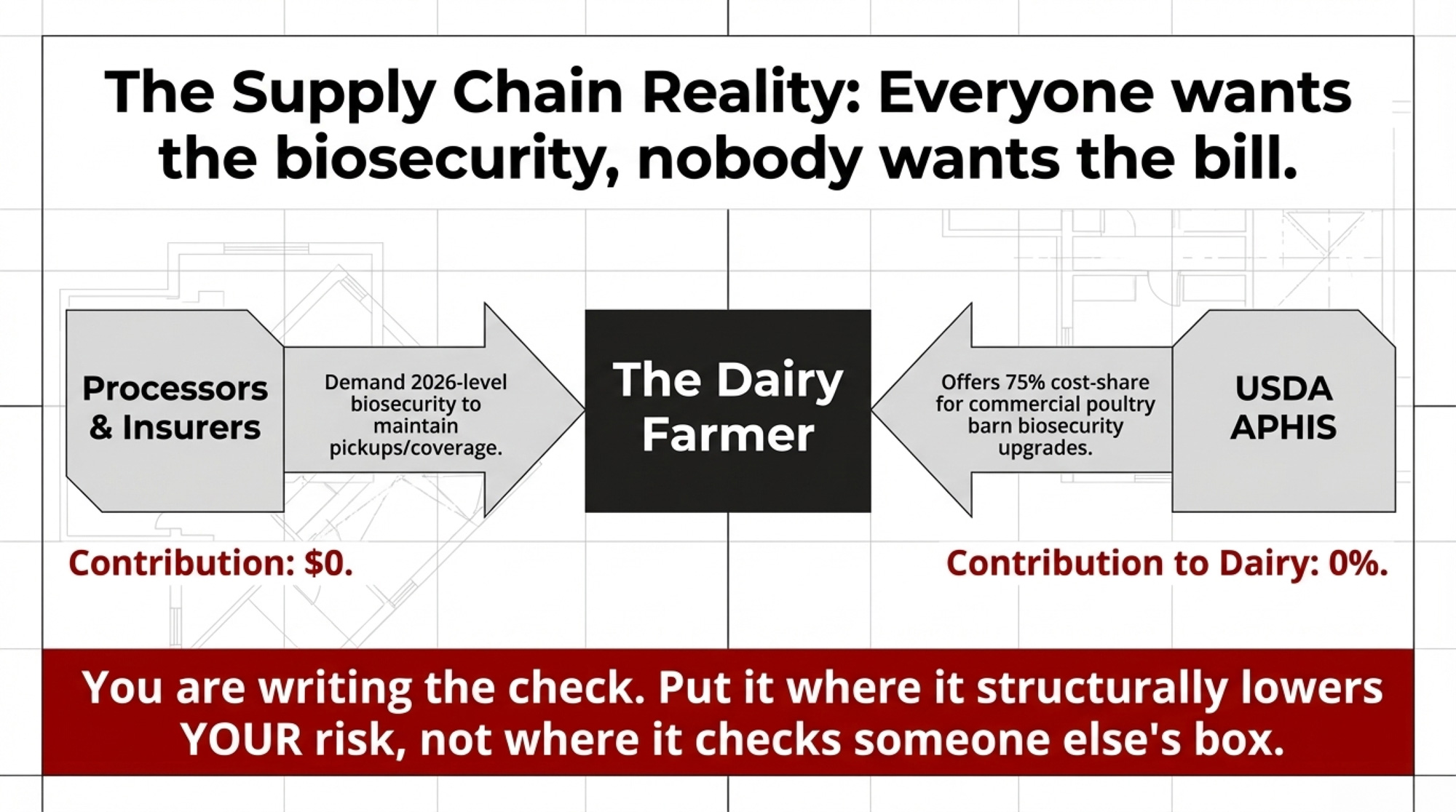
USDA APHIS offers free, voluntary biosecurity assessments for poultry operations and, in its current HPAI programs, will share up to 75% of the costs to fix the highest‑risk biosecurity concerns identified on those farms — including structural improvements. Those cost‑share dollars are aimed squarely at commercial poultry barns, not dairy; APHIS’ own FAQ on the program explicitly says dairies are not included in the 75% cost‑share.

You’re the one writing the check. Everyone else keeps the lever.

The Assumption the Laser Quote Needs You to Skip

Here’s the uncomfortable angle: birds are a structural problem first and a technology problem second. A lot of farms are being nudged to flip that order — often by marketing that starts with tech and works backwards.

Ryan Slaughter, a Research Assistant at Ohio State University South Centers, has tested laser bird deterrents across OSU research centers and commercial vineyards. His team’s summary of why lasers outperform static deterrents is blunt: the constantly moving beam matters. The “randomness of the oscillation means birds are unable to notice a pattern, which otherwise would render it useless.” That’s a real advantage over scarecrows, reflective tape, and noise cannons.

But their work also exposes something vendors tend to gloss over. The system only works where the beam actually hits — and their 2023 update noted that lower‑powered green lasers “may not be visible enough during the daytime,” which leads to uneven results when you need coverage in full sun.

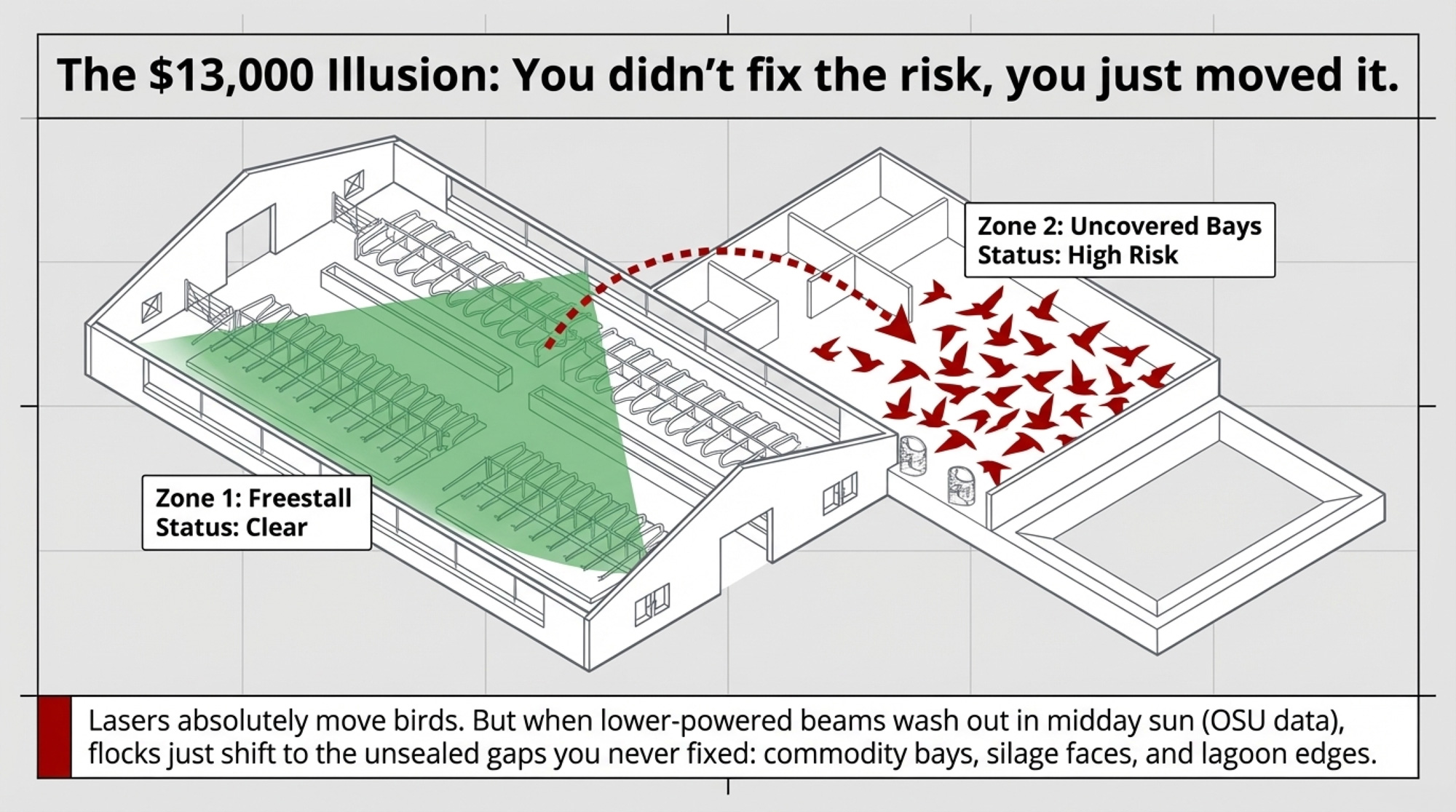
Lasers don’t reach every rafter, every open door, every ledge above a commodity bay where birds roost between feedings. When a flock is spooked out of one illuminated zone, they don’t leave your property. They move to the part of your site where there’s still feed and no laser: commodity bays, silage faces, lagoon edges, and unsealed entries.

Go back to that Idaho dairy. The laser cleared the stables. Great. But those birds still needed somewhere to sit and something to eat. Was the commodity bay screened? Were rafters netted in other barns? Did the farm already have feed hygiene dialed in?

Those details are missing from the video. They’re not missing from your risk.

USDA APHIS dairy H5N1 guidance and CFIA’s National Standard both hammer the same basics: keep wild birds away from feed and water, close structural gaps, and tighten traffic and hygiene — with deterrent tech as a layer on top, not a substitute. Dairy Farmers of Canada built its mandatory proAction biosecurity module on that national standard in 2019. The alignment across both countries is consistent: reduce attractants, block access, then deter what’s left.

Laser marketing often flips that sequence — starting with gadgets and treating structure as an optional add‑on.

Netting, curtains, sealed storage, daily bunk cleanup — that’s the boring stuff everyone tries to skip. It also works at noon in July the same way it does at dusk in January. No habituation. No subscription. No beam path.

What a $50,000 Bird‑Control Budget Can (and Can’t) Do About HPAI

Here’s where the barn math separates the “laser‑first” story from a “structure‑first” strategy.

Start with the baseline feed and health bleed from birds, using the WSU average:

Annual bird‑loss baseline (herd size × $55/cow/year):

  • 500 cows → $27,500/year
  • 1,500 cows → $82,500/year
  • 3,000 cows → $165,000/year

Now overlay the HPAI tail risk, using both the conservative JDS number and the higher Cornell number:

HPAI tail‑risk scenarios (affected cows × per‑cow loss estimate):
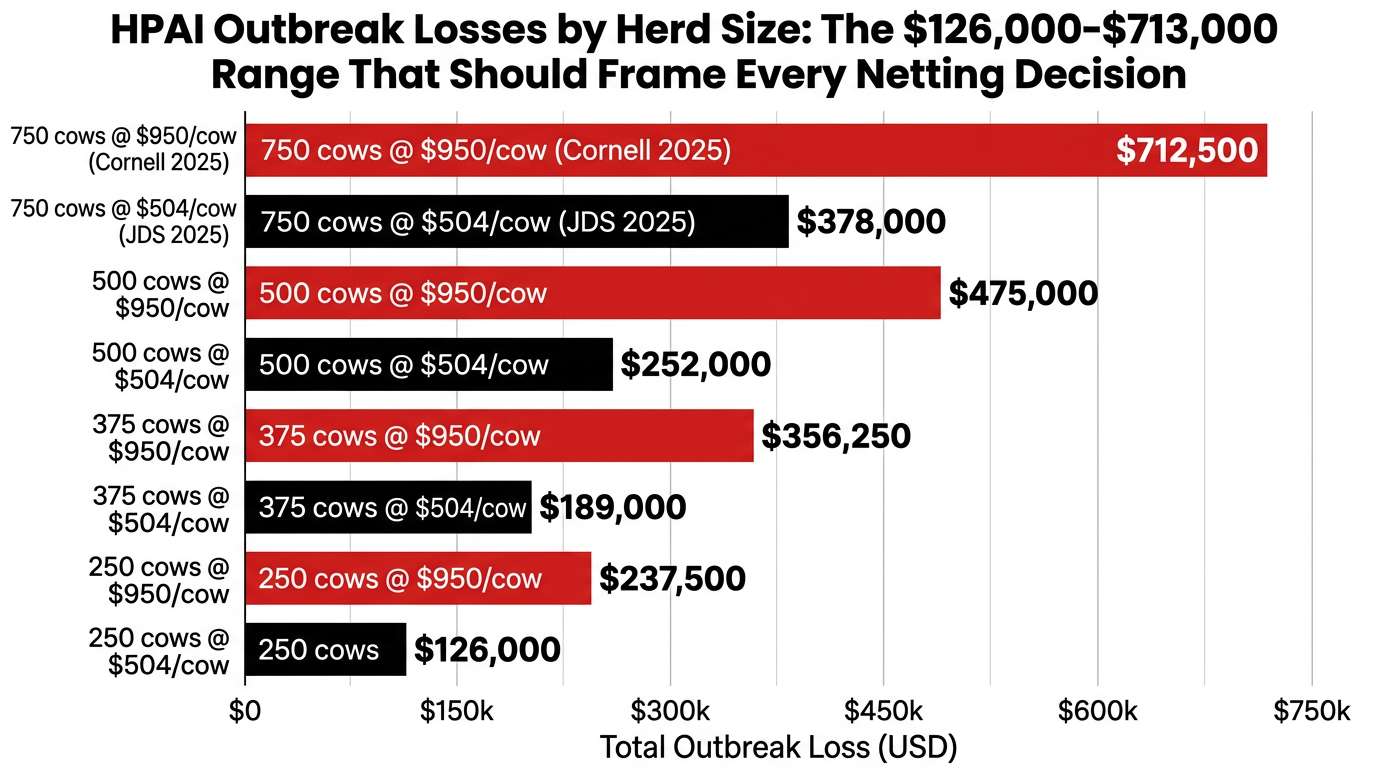
Clinically affected cowsAt $504/cow (JDS 2025)At $950/cow (Cornell 2025)
250$126,000$237,500
500$252,000$475,000
750$378,000$712,500

Even the conservative JDS number is several times larger than your likely bird‑control budget. To make it concrete, say you’re milking 1,500 cows and assume 25% might be clinically affected in a bad outbreak. That’s 375 cows.

  • Low end (JDS): 375 × $504 = $189,000.
  • High end (Cornell): 375 × $950 = $356,250.

That’s one event. One unlucky intersection between your herd and a migratory flock looking for feed or water.

Now put that against two ways to spend $50,000 on birds.

Path A: Laser‑First

  • Hardware: 2–4 AVIX units at $12,500–$13,104 each → $25,000–$52,000 plus install. 
  • Coverage: Strong impact where the beam hits, but green light washes out in bright sun; OSU’s experience with lower‑powered units shows mixed midday results. 
  • Risk: Birds shift to non‑illuminated areas — commodity bays, open entries, lagoon edges — where they can still bring H5N1 in or foul feed.
  • Optics: Visibly “high‑tech.” But open rafters with droppings behind a laser head are hard to explain to an investigator.

Path B: Structure‑First

  • Hardware: Netting, curtains, and sealed storage on the highest‑risk zones — rafters over feed alleys, commodity bay faces, open parlor approaches. Real‑world installed costs typically range from $2 to $10 per square foot,depending on ceiling height and complexity.
    • At that range, $15,000–$35,000 can meaningfully close big gaps in a typical freestall and commodity area.
  • Coverage: Works 24/7 in any weather or light. No habituation. No blind spots where birds can sit directly over feed or cows.
  • Layering: Use the remaining $15,000–$35,000 (if any) on one laser to cover outdoor zones such as lagoons or silage faces, where structure is more challenging. 
  • Optics: When APHIS or CFIA auditors walk in, you can point to standards and say, “We built to your book.” 

Side by side, it looks like this:
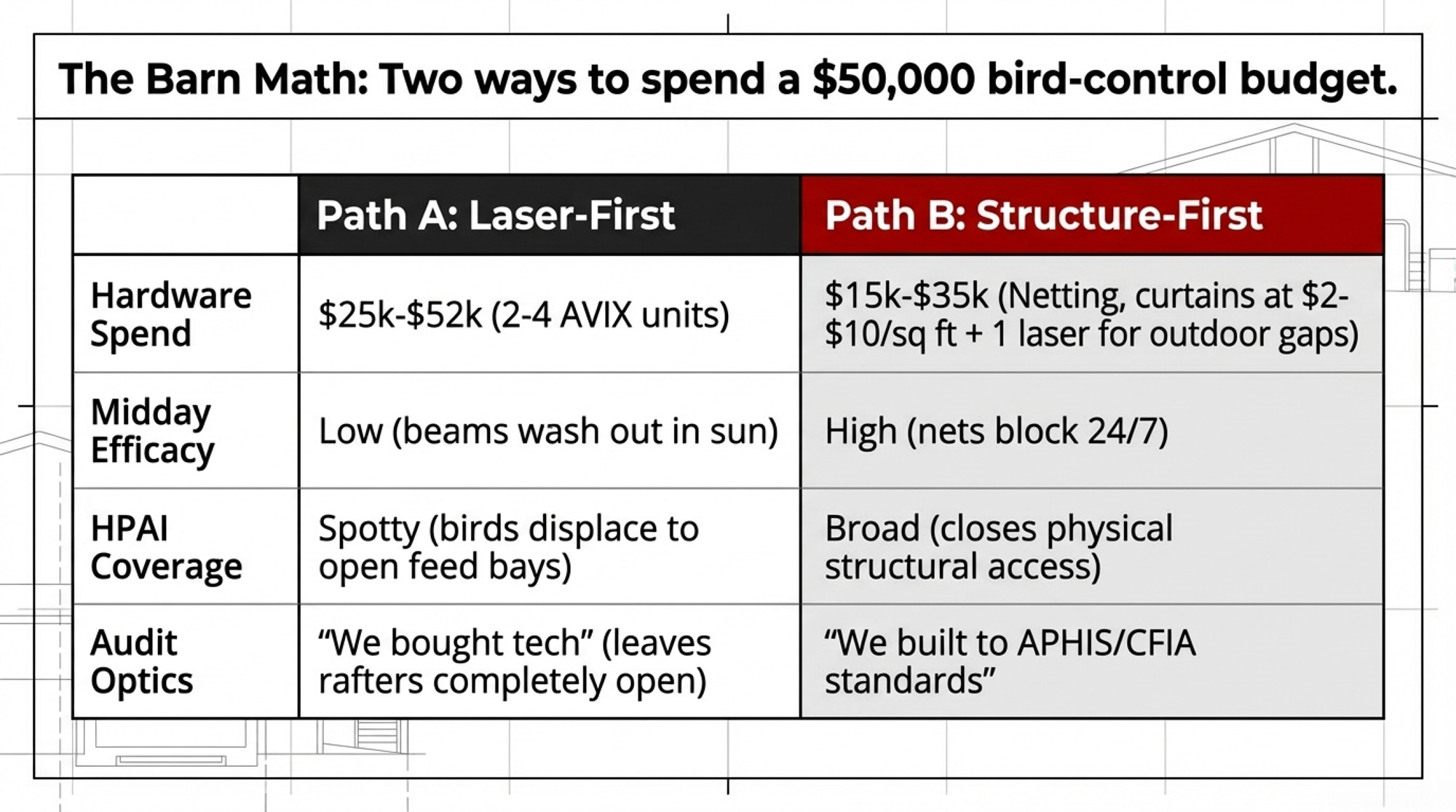
FactorPath A: Laser‑FirstPath B: Structure‑First
Initial hardware spend$25,000–$52,000 (2–4 AVIX units + install)$15,000–$35,000 (netting/curtains/SOPs) plus one laser with remaining budget
Midday efficacyLower — beam less visible in bright sun; birds can still work non‑illuminated feedHigh — netting/curtains block birds 24/7 regardless of light
HPAI risk coverageSpotty — depends on where beam reaches at dawn/duskBroad — closes structural access points across footprint
Bird displacementBirds move to open areas: bays, lagoons, outside feed; feed loss and virus pathways persist thereBirds lose primary roost/feed spots; laser covers remaining outdoor pressure points
Audit / investigation optics“We bought tech” but left rafters/bays open; easy for others to argue basics were skipped“We followed APHIS/CFIA standards” and then added tech; much stronger story if HPAI hits

On this math, structure first comes out ahead on every line that matters — total cost, feed recovery, HPAI exposure, and negotiating position if something goes wrong.
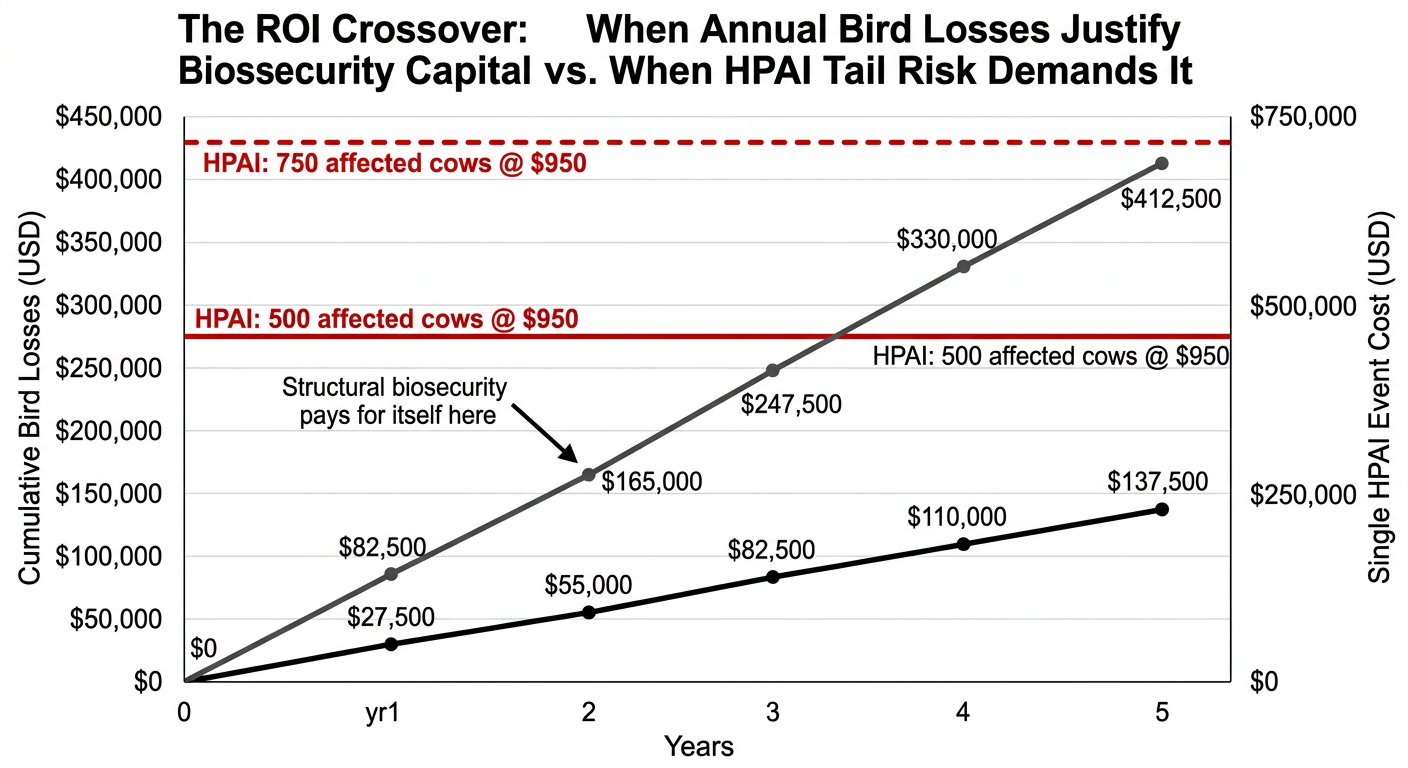
What Happens When HPAI Hits a Laser‑First vs. Structure‑First Farm
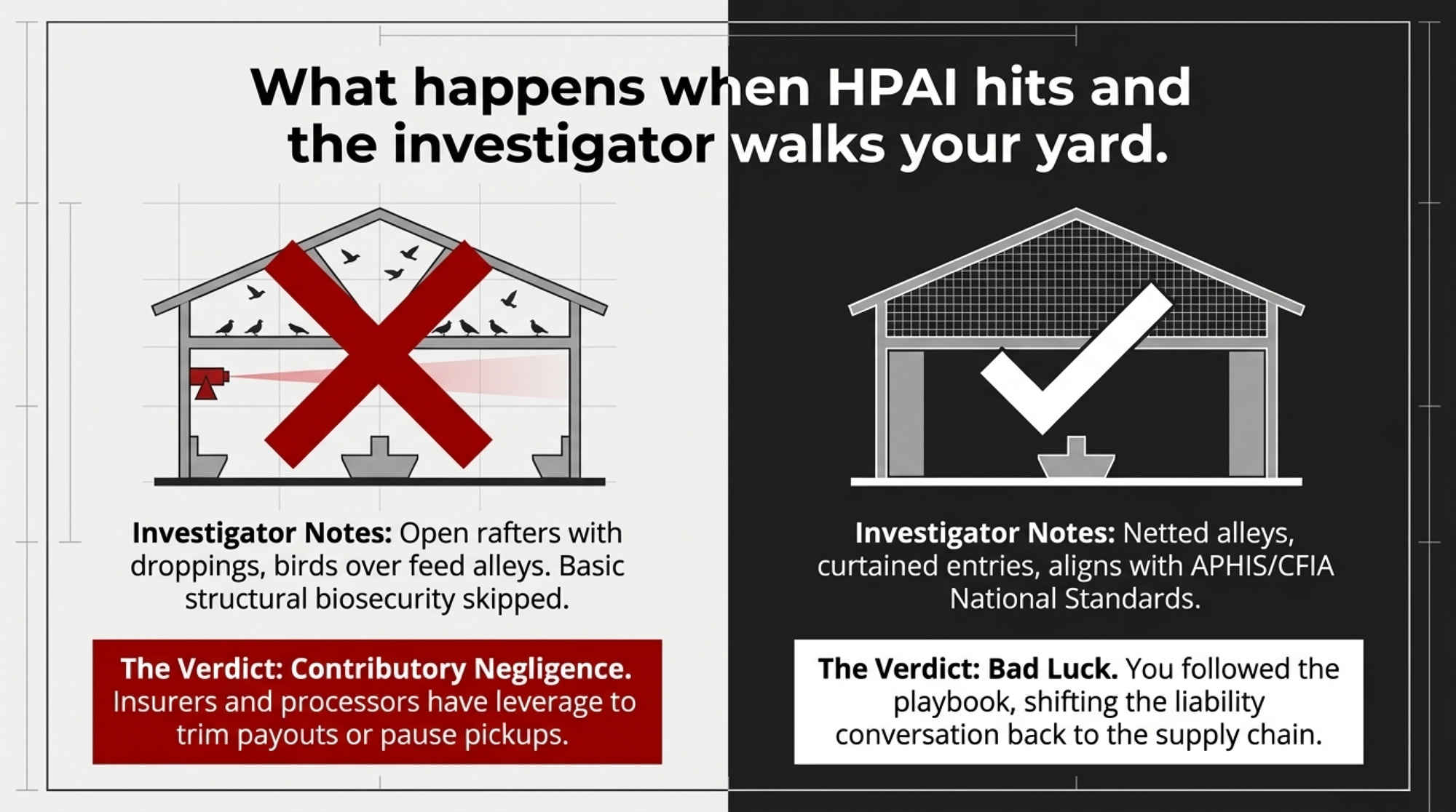
Both farms can still get hit. Wild birds don’t read SOP binders. But what investigators find when they walk your yard determines everything that happens next.

Structure‑first farm. Inspectors see netted rafters, curtained entries, clean bunks, covered ingredient storage, and controlled water sources. It aligns with the wildlife‑exclusion and feed‑hygiene measures emphasized in USDA APHIS dairy H5N1 guidance and the CFIA National Standard. The storyline is, “you were unlucky, despite doing the right things.” That farm can sit across from its processor and insurer and say, “We followed your playbook. If you want more technology layered on top, that’s a shared‑investment conversation.”

Laser‑first farm. Inspectors see open rafters with droppings, birds roosting over feed alleys, exposed commodity faces, and one or two laser heads sweeping obvious paths. The conclusion writes itself: basic structural biosecurity wasn’t prioritized. That perception makes it easier for insurers to argue contributory negligence, for processors to tighten terms or pause pickups, and for lenders to question management judgment.

Same virus. Same type of herd. Similar per‑cow milk losses. The difference is whether your capital choices make HPAI look like bad luck — or like an avoidable management gap.

StakeholderWho Pays for Upgrades?Who Benefits if Risk Drops?What Leverage Do You Have?
Dairy Producer (You)100% of capital cost — netting, curtains, lasers, labor, feed SOPsLower outbreak risk; reduced insurance claims; continued processor contractsDemand cost-sharing — if processor/insurer wants higher biosecurity, show them Path B math and ask how it shows up in premiums/contracts/rates
Processor / Co-op$0 — but reserves right to suspend pickups or tighten terms if HPAI hits your countyUninterrupted supply; avoid PR crisis; lower testing/audit costs; maintain export accessZero contractual obligation — can mandate biosecurity standards without contributing capital
Insurer$0 — premiums price in disease risk, but no cost-share for mitigationLower claim probability; stronger defense against “contributory negligence” arguments if outbreak occursDiscretion to deny claims if “recommended biosecurity measures” (APHIS/CFIA guidance) weren’t followed
Lender / Ag Bank$0 — biosecurity capex may affect your loan covenants and cash-flow projectionsLower default risk; stronger collateral value; easier to defend loan portfolio to regulatorsCan price risk into interest rates without sharing mitigation costs
USDA (Poultry Ops)Poultry gets 75% federal cost-share for structural biosecurity fixes identified in APHIS assessmentsLower national HPAI prevalence; reduced indemnity payouts; trade-partner confidenceDairy excluded from cost-share — APHIS FAQ explicitly says dairy not eligible for 75% program

How to Talk to Your Processor, Insurer, and Lender About Bird Control

When your processor’s field rep or your lender’s ag banker brings up bird control — and more of them are — the conversation usually goes one way: “Have you looked into lasers?” Sometimes that’s honest advice. Often, it’s someone else’s risk department checking a box with your money.

Here’s how you flip that conversation without sounding defensive.
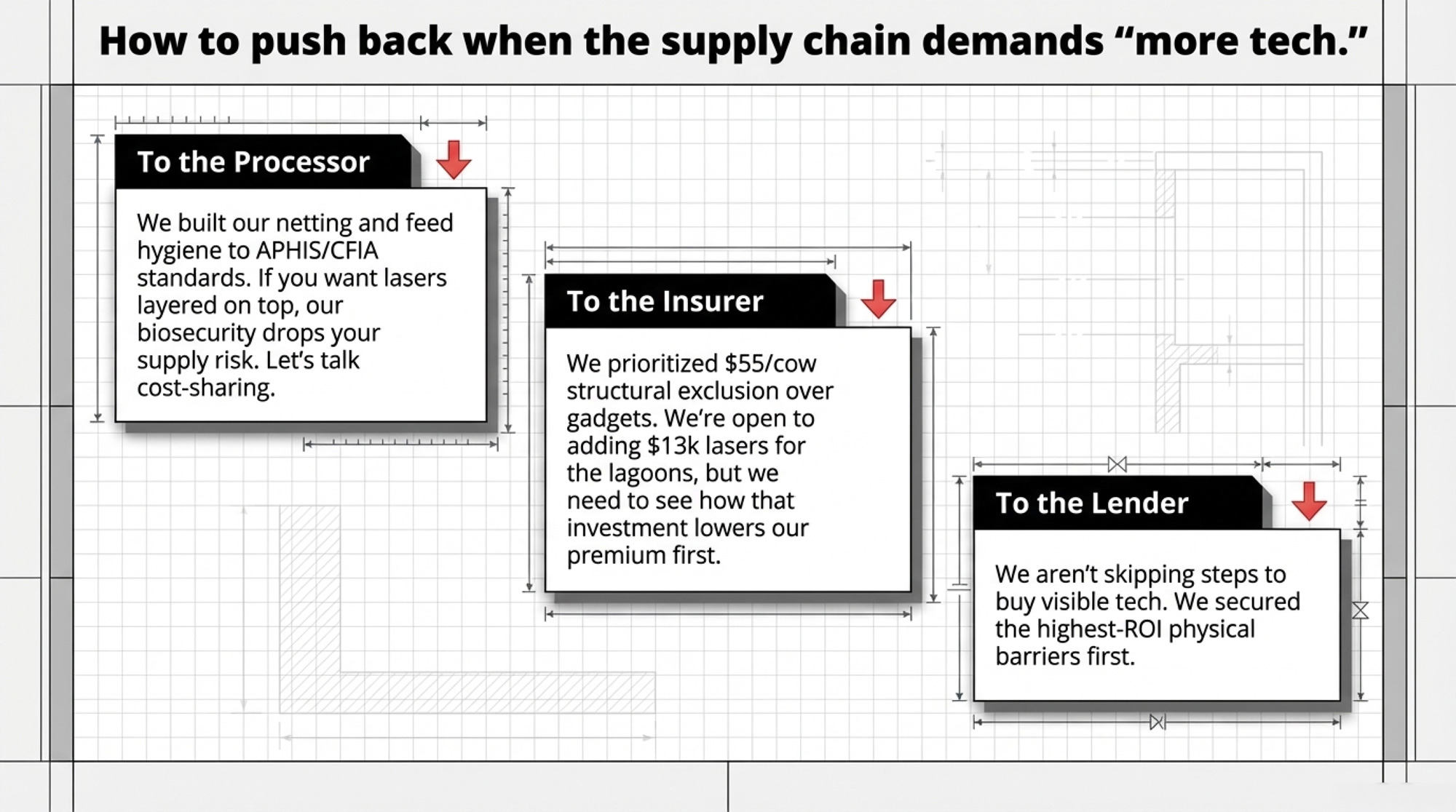
If the processor raises biosecurity expectations:

We’ve invested in structural exclusion and feed hygiene aligned with USDA APHIS dairy H5N1 guidance and the Canadian National Biosecurity Standard: netting over feed alleys, curtained entries, daily bunk cleanup, covered ingredient storage. We’re documenting with photos and bird counts. If you’d like us to add laser technology on top of that, we see that as a shared investment — your supply risk drops when our biosecurity improves, and we think the capital should reflect that.”

If the insurer asks about bird‑control measures:

“We can show you a written biosecurity plan built around structural exclusion — netting, sealed entries, feed hygiene SOPs, and regular bird counts — aligned with the wildlife‑exclusion measures in APHIS dairy H5N1 guidance.” We’re open to adding automated deterrents for outdoor zones, but those units are a $12,500–$13,104 per‑head investment that reduces your claims risk as much as it protects our herd. We want to talk about how that gets shared or shows up in our premium.”

If the lender questions biosecurity capex:

“We started bird‑control spending with the highest‑ROI items — netting and tighter feed management — that directly reduce our $55/cow annual bird‑loss exposure and line up with national standards. Laser units are on the roadmap for outdoor zones once that foundation is in place. We’re not skipping steps to buy the most visible technology first.”

You’re not refusing tech. You’re putting it in the right order and asking others who benefit from lower risk to participate in the cost.

What Dairies Should Do Before Fall Migration
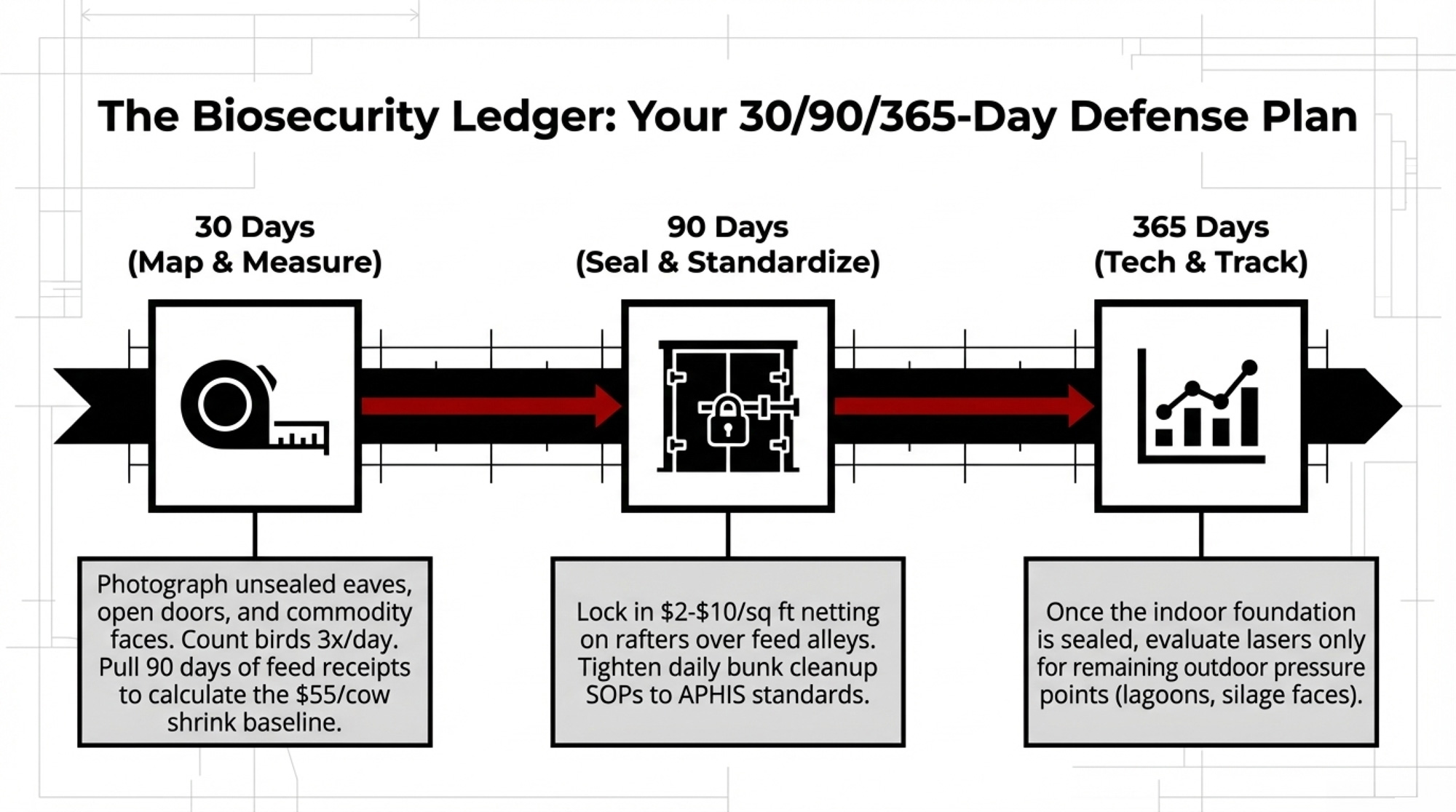
In the next 30 days

  • Map every structural entry point. Walk your barns and bays. Doors that stay open, unsealed eaves, rafter cavities, exposed commodity faces — photograph each one. That’s your real bird‑control problem, not the number on a laser quote.
  • Count your birds three times a day. Dawn, midday, and dusk for five straight days. Note species, rough counts, and exactly where they land and feed. If you can’t describe your worst day in numbers, you don’t have a purchasing decision. You have a guess.
  • Pull 90 days of feed receipts and do the shrink math. Compare delivered vs. what actually went in front of cows. If your gap sits much above 3–5% and you’re watching flocks on the bunk, you’ve just put a dollar tag on your baseline bird cost.

🚩 Red flag: If your processor or lender is pushing you to “do something about birds” and you can’t answer those three questions, that conversation is being driven more by their risk checklists than by your numbers.

In the next 90 days

  • Lock in netting and curtains on the worst zones. Start with rafters over feed alleys, commodity bay faces, and open parlor approaches. Installed bird‑exclusion netting typically runs $2–$10 per square foot, depending on height, structure, and region — use that range to sanity‑check quotes, but prioritize coverage and durability over the very lowest bid. 
  • Tighten feed hygiene SOPs. End‑of‑day bunk cleanup, refusal removal, covered ingredient storage, and a simple photo log of problem spots. APHIS guidance and national standards both highlight this as core, not optional — and this is exactly what insurers and regulators will look at if H5N1 is in your county. 
  • Align your written plan with published standards. Use USDA APHIS dairy H5N1 biosecurity checklists and CFIA’s National Standard (or ProAction in Canada) as your templates. Being able to put those documents on the table and say “we built to this” changes the tone of every tough conversation. 

Opportunity: Once you can show your processor and insurer that you’ve aligned with published dairy biosecurity guidance on structure and management, it’s a lot easier to say, “We’ve done the foundational work. If you want lasers added, let’s talk about cost‑sharing.”

Over the next 12 months

  • Evaluate lasers after you’ve closed the obvious gaps. Once you’ve netted the rafters, sealed entries, and tightened feed hygiene, look at where birds still congregate — lagoons, open lots, silage faces. That’s where an AVIX head or an AI‑aimed system like iChase actually adds incremental coverage instead of replacing common sense. 
  • Benchmark and document your progress. Re‑count birds at 6 and 12 months. Re‑run your shrink. Keep before/after photos. That record becomes your leverage in every future premium discussion, renewal, and claim.

What This Means for Your Operation

  • Don’t start with the gadget. Your first decision isn’t “Which laser?” It’s “Where are birds actually roosting and feeding, and which of those spots can I close with netting, curtains, or steel?”
  • Use $55/cow as your baseline loss check. Multiply your herd size by $55. If the capex you’re considering is bigger than two years of that baseline and you still have open rafters and bays, you’re out over your skis. 
  • Run the HPAI worst‑case using your own herd size. Take a realistic clinically affected‑cow count — 20–30% of your herd, based on the Ohio and early Michigan experience — and multiply by both $504 and $950. If the low end doesn’t get your attention, check your math. 
  • Separate the foundation from the extras. Netting, curtains, sealed feed, and hygiene are the foundations. Lasers are extra coverage. If anyone tries to reverse that, slow the decision down until your structural list is done.
  • If you already bought lasers, backfill the basics. A laser in your yard isn’t wasted. But if you skipped structural work to get it, your next dollar belongs in netting, sealing, and feed hygiene so the virus doesn’t just land where the beam doesn’t reach.
  • In the next 30 days, make one phone call. Ask your processor, insurer, or lender one specific question: “If we invest in structural biosecurity upgrades tied to APHIS/CFIA guidance, how does that show up in our premiums, contracts, or rates?” Their answer tells you how much of this risk they’re willing to share.
Key Takeaways

  • If you’re about to spend $25,000–$52,000 on bird control, the first two‑thirds of that budget should be in nets, curtains, doors, and feed hygiene. Lasers belong on top of that, not instead of it. 
  • HPAI losses modeled between $504 and $950 per clinically affected cow dwarf the annual $55/cow bird‑loss bleed — which is exactly why you need your bird‑control spend anchored in structural biosecurity, not just tech that looks impressive. 
  • Poultry barns can tap 75% federal cost‑share on some biosecurity upgrades; dairy barns cannot. That’s all the signal you need on who the supply chain expects to pay for your risk mitigation. 

The Bottom Line

Your best leverage after an HPAI event is a paper trail showing you followed APHIS/CFIA structural and management guidance — not a single video of a green beam clearing a feed alley.

If processors want to mandate 2026-level biosecurity, they need to stop offering 1990-level contracts. It’s time to move bird control from the ‘producer expense’ column to the ‘supply chain security’ column.

Processors, lenders, and insurers all benefit when your bird load drops and your HPAI risk goes down. But until someone else starts writing a cheque, you need to put every dollar where it actually lowers your tail risk, not just where it checks a box.

The next time you look at a laser quote, the real question isn’t “Can I afford this?” It’s “What am I not fixing if I buy this first?”

Complete references and supporting documentation are available upon request by contacting the editorial team at editor@thebullvine.com.

Methodology Note HPAI loss estimates come from a 2025 Journal of Dairy Science modeling paper on H5N1 in US dairy herds and a 2025 Nature Communications case study of a 3,900-cow Ohio herd, using their reported per-cow and total economic impact ranges. Bird-loss estimates use a 2019 PLOS One survey of Washington State dairy producers on starling damage. Laser performance and pricing references draw on Wageningen UR laser trials in poultry, Ohio State University laser field work and extension summaries, and 2024–2025 AVIX and iChase distributor pricing/marketing materials, which are treated as vendor claims, not independent evidence. USDA APHIS dairy H5N1 guidance, CFIA’s National Standard, and Dairy Farmers of Canada’s proAction biosecurity module provide the structural-biosecurity standards cited here. All per-cow and herd-level math is illustrative and based on the ranges in those sources; your numbers will vary with herd size, management, region, and severity.

Learn More

The Sunday Read Dairy Professionals Don’t Skip.

Every week, thousands of producers, breeders, and industry insiders open Bullvine Weekly for genetics insights, market shifts, and profit strategies they won’t find anywhere else. One email. Five minutes. Smarter decisions all week.

NewsSubscribe
First
Last
Consent

The 12% Power Trap: How a Dairy Electricity Hike Becomes a 9¢/cwt Margin Hit – and the Efficiency Play to Reverse It

On a 750‑cow dairy, a 12% power hike quietly costs 3¢/cwt. One VSD‑level upgrade can swing your margin 9¢/cwt. What’s your electricity cost per cwt?

Executive Summary: Mark’s 750-cow freestall just took a 12% power rate hit. That’s 3¢/cwt gone — $7,650/year. The trap is waiting on efficiency. One VSD vacuum pump upgrade flips his margin by 9¢/cwt (2-6-year payback). Ontario wholesale prices surged 90%+ in 2025. REAP grants are paused. If your DSCRs are near 1.20×, lender talks get harder. This piece runs the barn math and hands you a 30/90/365 playbook to check your own exposure.

Dairy electricity costs

Mark and Lisa are composite illustrations built from published benchmarks and common industry patterns — not specific individuals. All numbers are walked through transparently, so you can plug in your own.

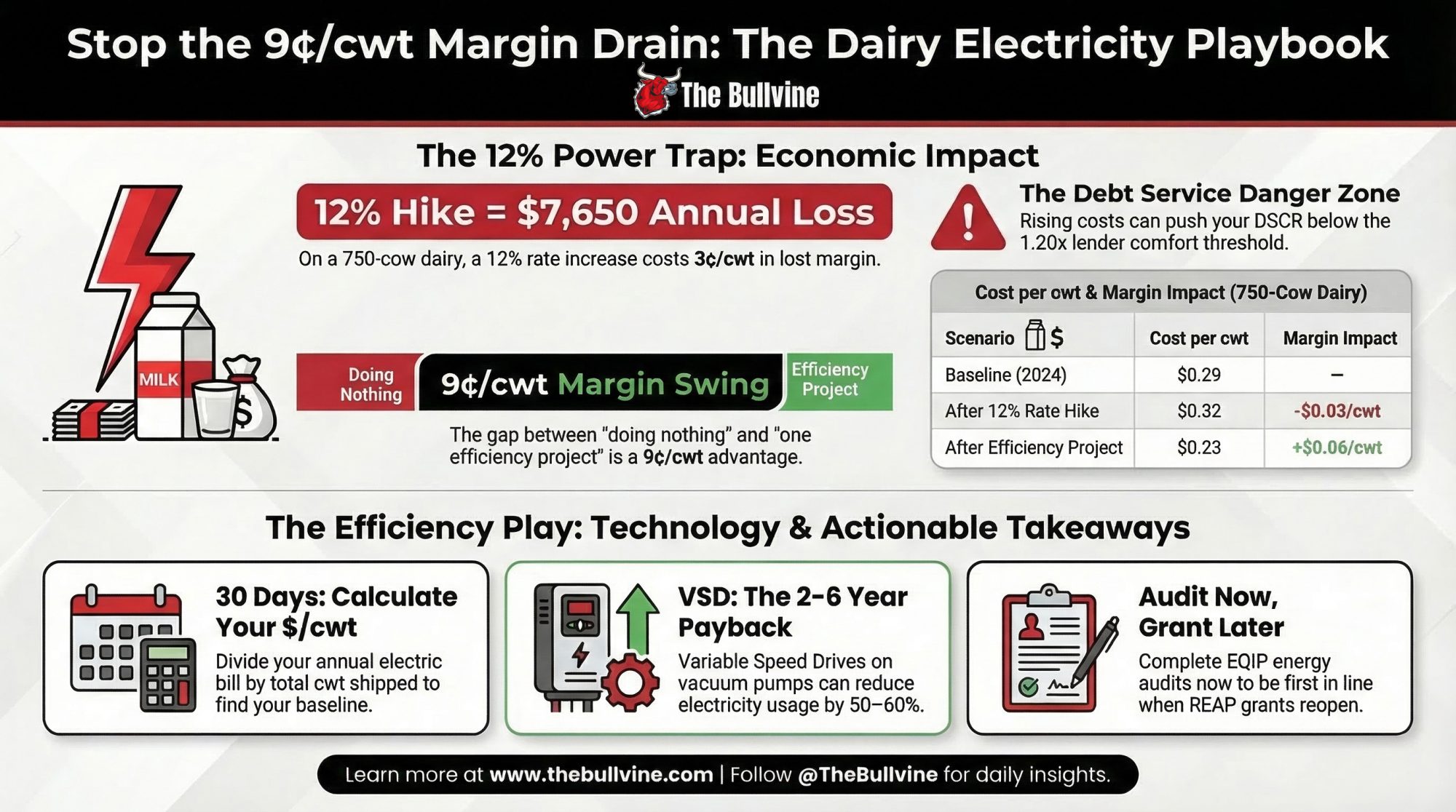
A 12% bump in dairy electricity costs quietly strips about 3¢/cwt — or $7,650 a year on 220,000 cwt — out of a 750-cow dairy’s milk check. That’s not a modeling exercise. It’s what happens when you run the actual kWh through current rates.

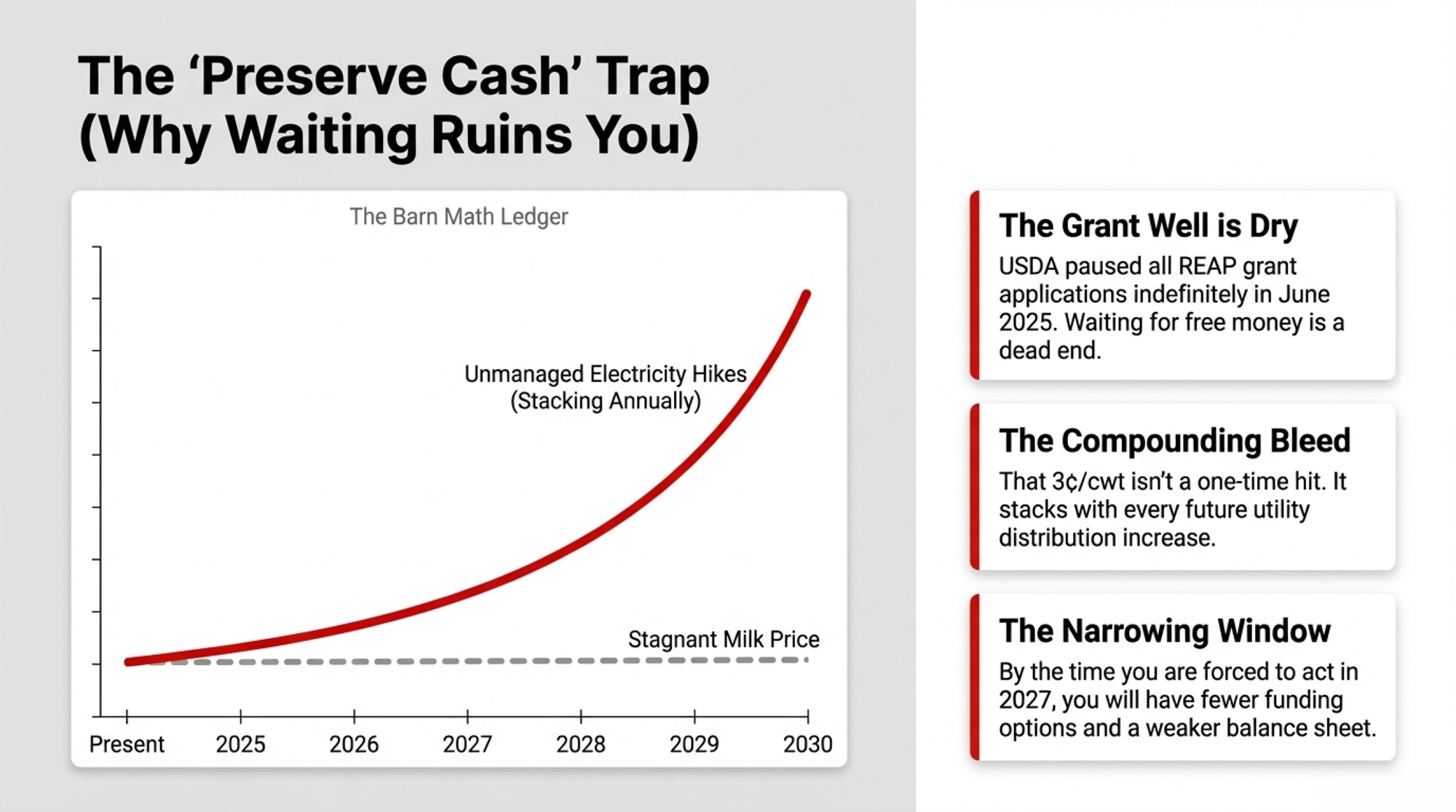
Consider a 750-cow freestall — call him Mark — whose power bill climbed that much in early 2025. The reaction from operations in that position is almost universal: We can’t afford to invest in efficiency right now. We’ve got to preserve cash. On the surface, that feels conservative. Look at the math and the timeline to 2030, and it starts to look more like a trap.

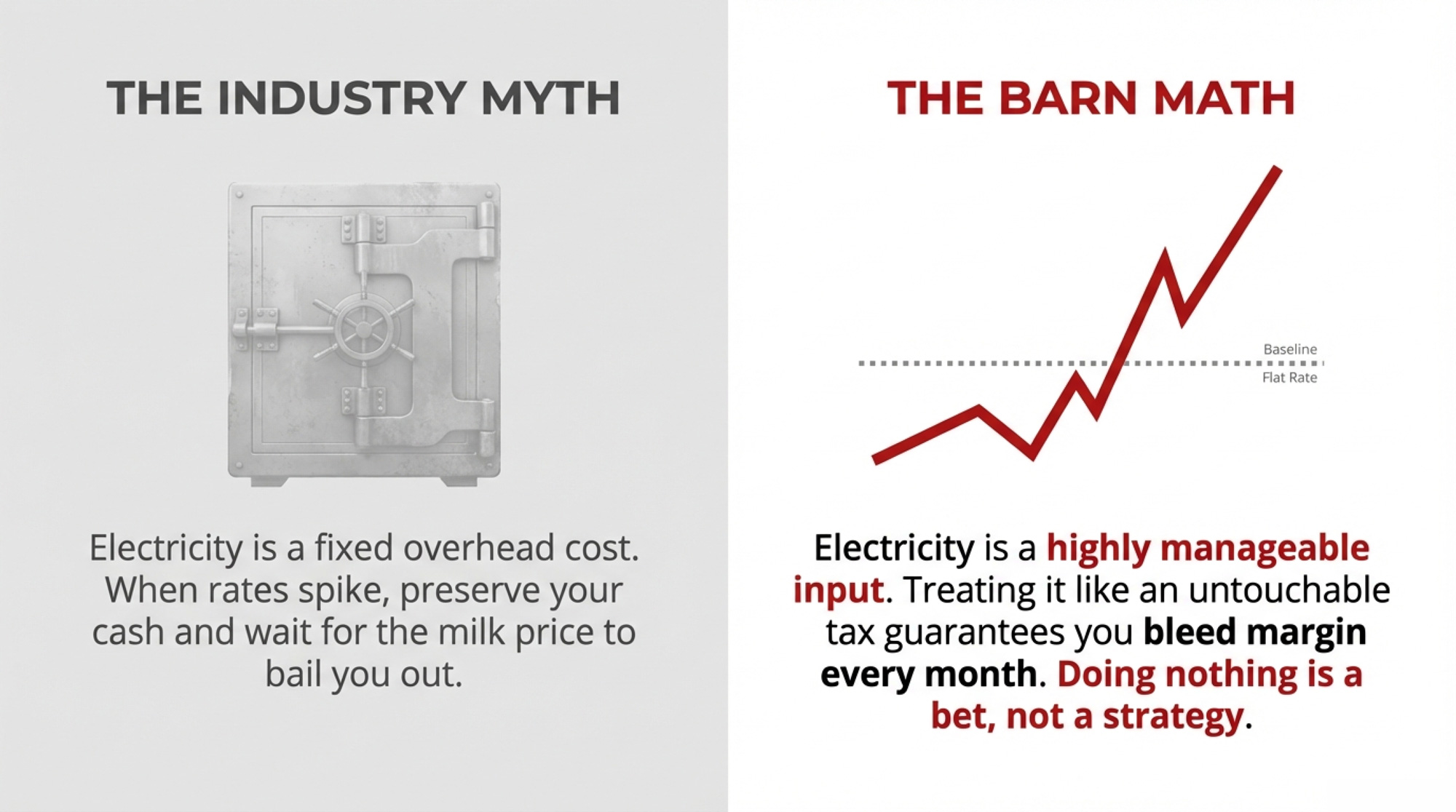
Electricity isn’t the fixed overhead line that most producers treat it as. A significant chunk moves with management decisions, herd size, and equipment choices. You can manage it the same way you manage feed cost. The operations that treat power like untouchable overhead? They’re leaving margin on the table every single month.

The Rate Hike Hitting Herds Like Mark’s

Mark’s scenario is a 750-cow North American freestall. Solid component milk, but a 2024–2025 milk price that’s nothing to brag about. Then the electricity bill jumps around 12% in one renewal cycle. No new barn. No robot install. Just rate changes and fees.

And 12% may be mild. Ontario’s wholesale electricity market price (the IESO’s Hourly Ontario Energy Price) averaged approximately 3.4¢/kWh across 2024, per IESO year-end data. Then wholesale prices surged over 90% in 2025 — the highest annual average since 2005, according to Scott Luft’s January 2026 analysis on Cold Air. Ontario utilities layered distribution rate increases on top — Milton Hydro’s OEB-approved distribution rate increase was 3.70% effective January 1, 2026. Total delivered costs for farm customers are partially offset by the Ontario Electricity Rebate (23.5%as of November 1, 2025, per OEB), so the net bill impact is smaller than the headline wholesale jump — but the direction is unambiguous.

Ontario and US benchmarking have found dairy electricity use in confinement systems ranging from 800–1,400 kWh/cow/year, with freestalls averaging around 837 kWh/cow/year and tiestalls near 1,417 kWh/cow/year (Ontario OMAFRA). A 2022 Progressive Dairy article summarizing USDA REAP and EQIP projects noted that energy-efficiency upgrades on dairies can reduce energy costs by 10 to 35 percent, saving 2¢ to 30¢ per hundredweight in avoided costs.

The unspoken bet behind the preserve cash stance is that milk price will bail you out faster than power costs keep climbing. That’s a bet — not a strategy.

What Does a 12% Rate Hike Actually Cost a 750-Cow Dairy?

You don’t feel percentages. You feel dollars leaving the account.

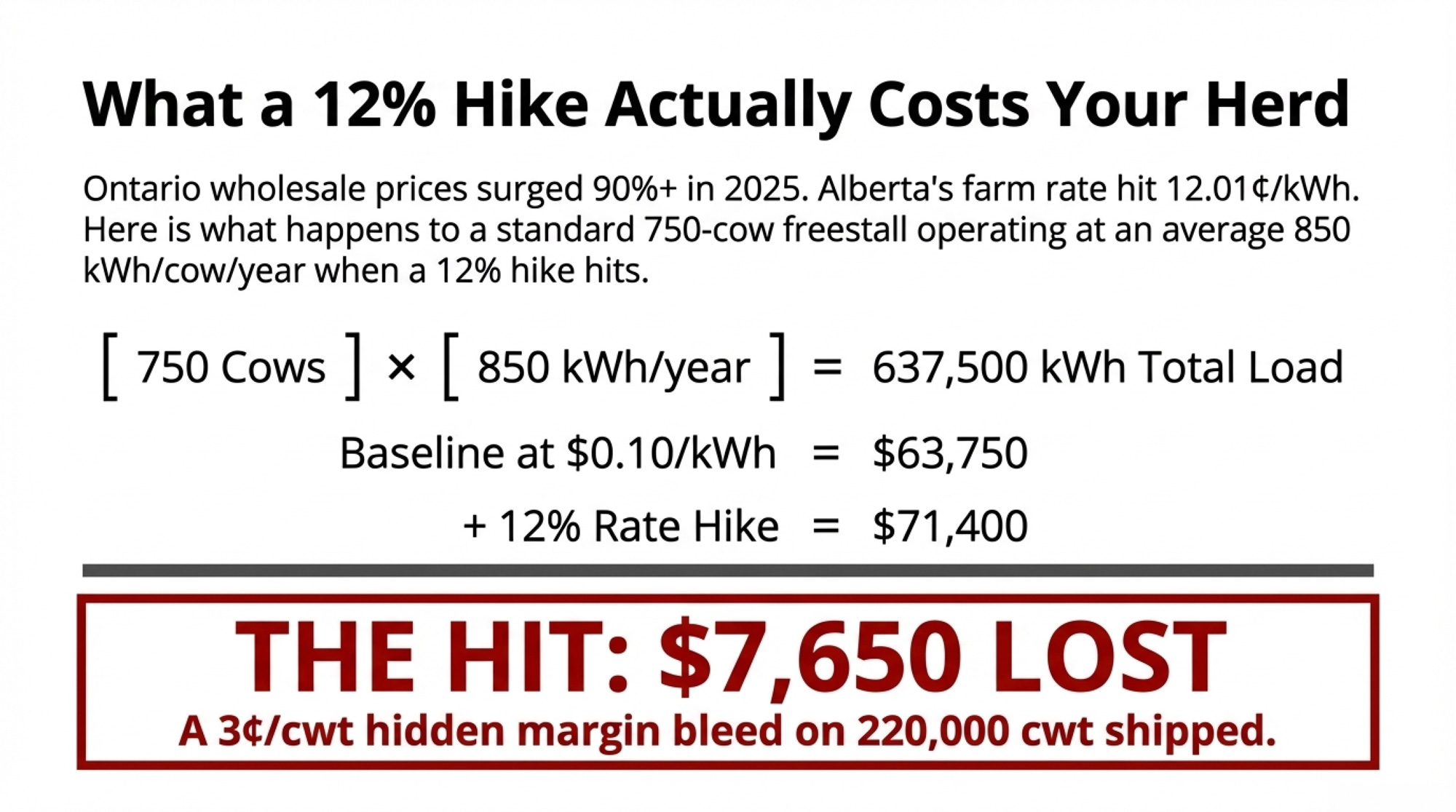
A Minnesota Department of Commerce dairy energy study found that US dairy farms range from 400 to 1,700 kWh per cow annually, with electric utility costs of about $0.035 to $0.045 per cwt in the Midwest. Using freestall averages from Ontario and Midwest data, work with 850 kWh/cow/year for Mark’s 750-cow scenario:

750 cows × 850 kWh/cow/year = 637,500 kWh/year

For the rate assumption, Alberta’s current Rate of Last Resort for farm customers sits at 12.01¢/kWh as of March 2026, per EPCOR’s published schedule. Index (spot) prices ran lower through 2025 — averaging roughly 4–9¢/kWh,depending on the month. To keep the example conservative and broadly applicable, use $0.10/kWh:

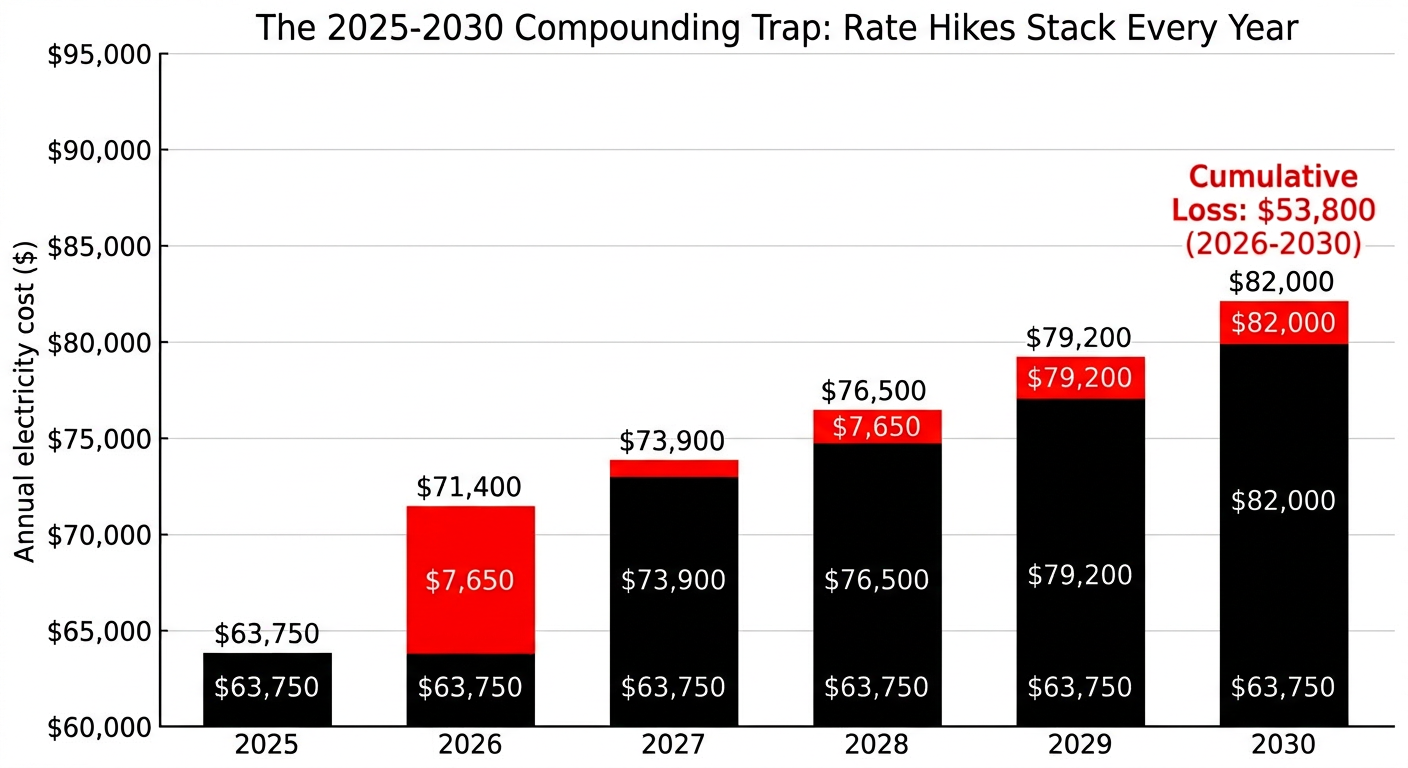
Baseline: 637,500 kWh × $0.10 = $63,750/year
After 12% hike: $63,750 × 1.12 = $71,400/year
Annual hit: $7,650

Assuming the operation ships 220,000 cwt/year:

MetricBaseline (2024)After 12% Hike (Doing Nothing)After Efficiency Project*
Annual Electricity Cost$63,750$71,400$51,000
Cost per cwt ($/cwt)$0.29$0.32$0.23
Margin Impact vs. Baseline−$0.03/cwt+$0.06/cwt

*Assumes 20% efficiency gain at the baseline rate, consistent with the 10–35% savings range documented in USDA-funded projects. Note: the 9¢/cwt swing compares the post-hike do-nothing scenario against the baseline with efficiency gains — it combines the cost of the hike (3¢) with the project’s benefit (6¢).

Plug in your own numbers: if your herd ships [X] cwt per year and your annual electricity bill is [Y], your electricity cost per cwt is simply Y ÷ X. Do that once, then rerun it after the next rate change.

The gap between “doing nothing” and “doing one project” isn’t 3¢ — it’s 9¢/cwt of margin swing. If your herd sits closer to the upper end of the 2.3–4.5 kWh/cwt range documented across five US farms, the impact is worse.

How Fast Does a VSD on Dairy Vacuum Pumps Pay for Itself?

Most producers don’t start with digesters or solar. They start with a variable-speed drive on vacuum pumps — the math is straightforward, and field results are documented. The Minnesota Department of Commerce dairy energy study found VSDs on vacuum pumps presented “the greatest savings potential, especially for farms with long milking hours.”

New York parlor studies report that milk harvesting — vacuum pumps, cooling, and water heating — accounts for roughly 40–45% of electricity use on those dairies. Alberta data estimated about 44% for milking on a typical 100-cow dairy. DairyConservation’s VFD practice sheet confirms a VFD “can typically reduce the electricity usage of the vacuum pump system by 50–60% and generally has a fast payback period even without financial incentives.” Wisconsin Extension reports a broader range of 30–80% savings depending on conditions. The National Dairy FARM Program similarly documents 50–60% reductions in vacuum pump electricity use with 3- to 7-year payback periods.

For Mark’s 750-cow operation, assume vacuum and milk pumps burn about 100,000 kWh/year of that 637,500 kWh total — plausible given milking and cooling combine for nearly half the load:

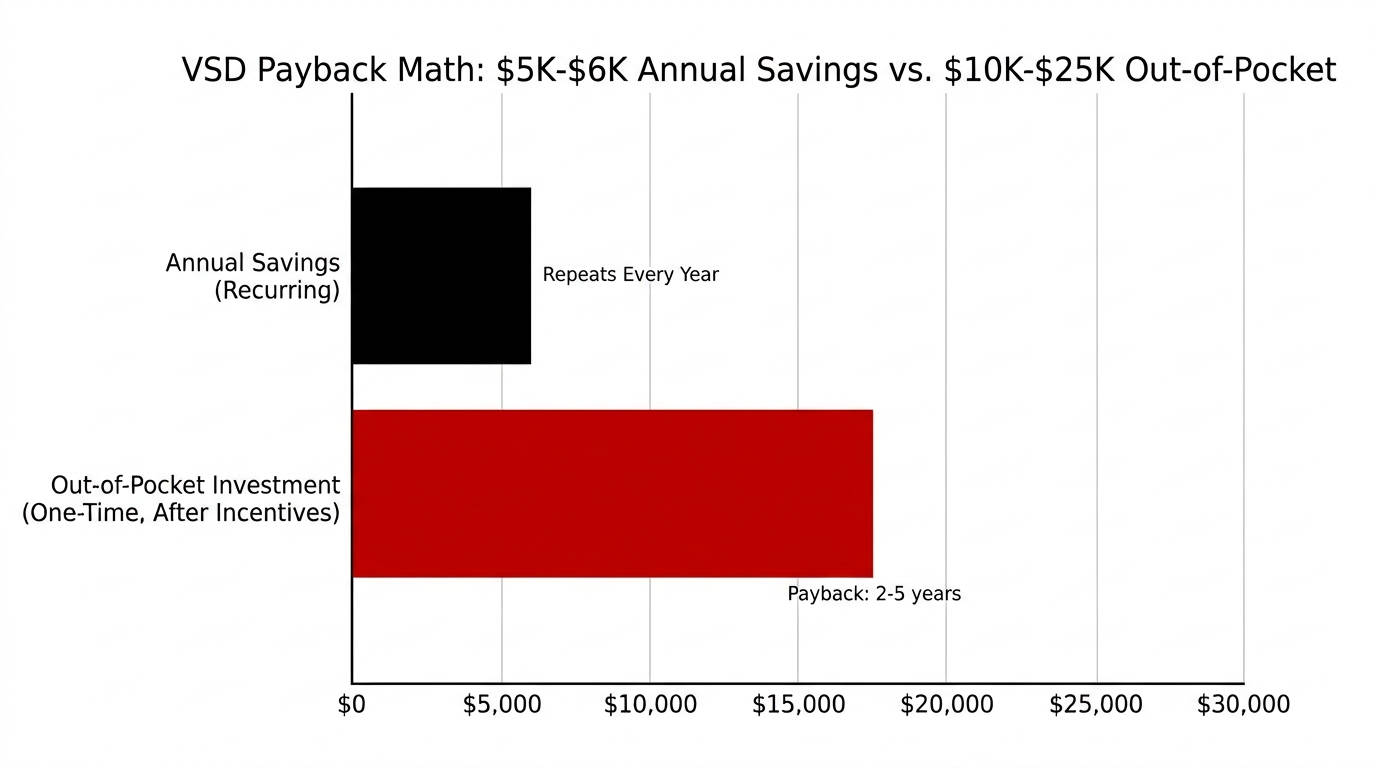
50,000–60,000 kWh saved × $0.10/kWh = $5,000–$6,000/year

You’re likely looking at multiple VSD units across vacuum and milk transfer pumps, potentially new compatible motors, and professional installation. A single 7.5 HP vacuum pump VSD retails around $4,450 from dairy equipment suppliers, and total project costs for multi-pump systems can run $30,000–$50,000 gross before incentives. EQIP typically covers 50 to 75 percent of eligible costs, and several state and provincial incentive programs layer on top — putting realistic out-of-pocket costs in the $10,000–$25,000 range, depending on your program stack:

Payback: $10,000–$25,000 ÷ $5,000–$6,000/year ≈ 2–5 years

That range aligns with Penn State Extension’s assessment: “There is often a 2- to 6-year payback on investments for variable speed drive vacuum pumps, well water pre-cooling of milk, and heat recovery from the refrigeration system,” per Dr. Doug Reinemann’s recommendations published in a Penn State Extension article on parlor retrofits. One caveat: the Minnesota Commerce study found a 6.6-year mean payback specifically for receiver jar milk pump VSDs. Vacuum pump drives pencil faster than milk pump drives, and your mileage depends on milking hours and system configuration.

In Mark’s scenario, that $5,000–$6,000 goes to the utility every year instead. In the Lisa scenario — call her a neighbour running 600-some cows who made a different call — those dollars stay in the operation’s cash flow. The risk of doing the project isn’t zero; equipment can underperform, and one farmer on NewAgTalk reported his VFD controller failed twice at $2,000 per repair. But the risk of doing nothing in a rising-rate world is now visible in the barn math.

Why Your Lender Cares More About This Than You Think

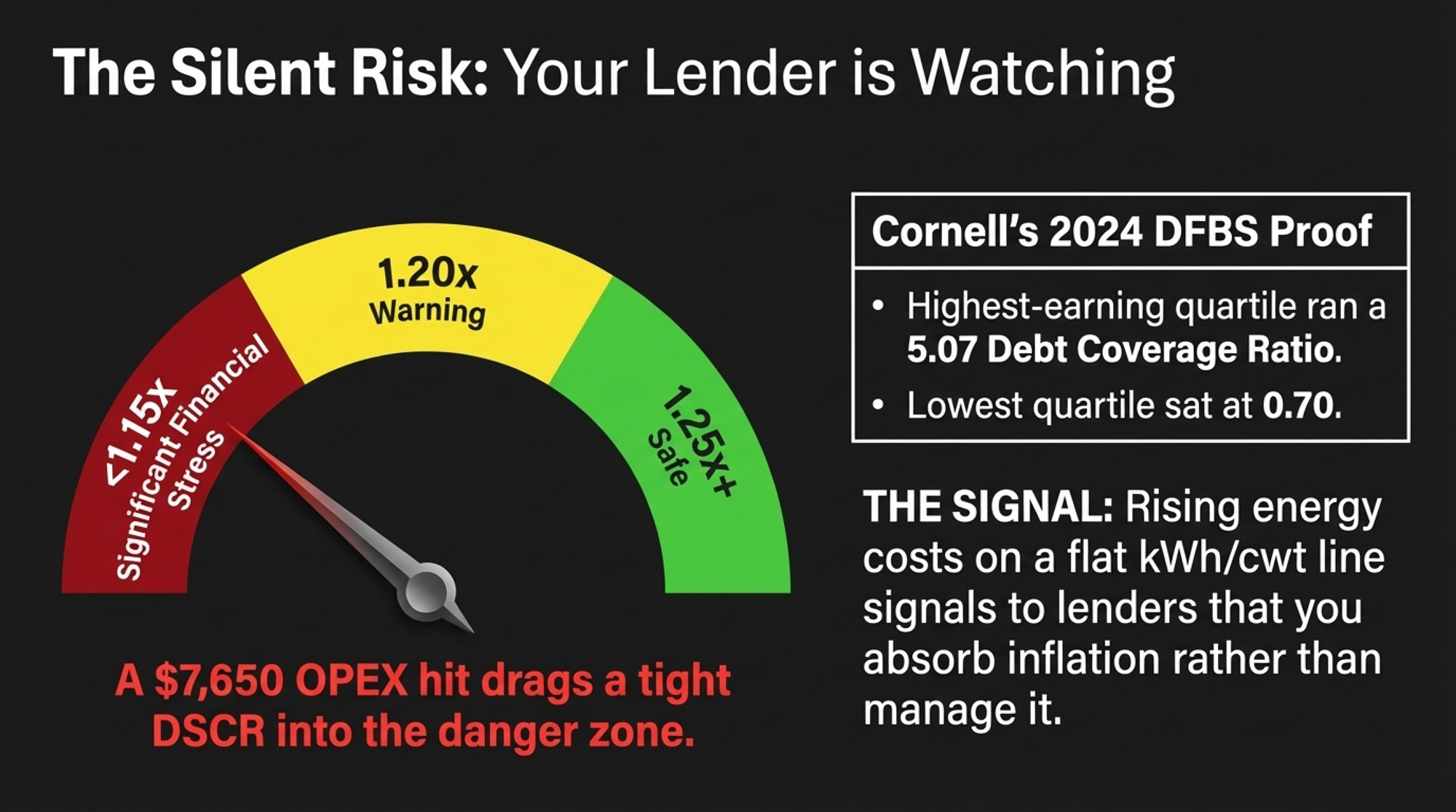
The $7,650/year hit from a rate hike doesn’t just show up on your power bill. It shows up on your lender’s spreadsheet — specifically in your Debt Service Coverage Ratio (DSCR).

Farm Credit Canada defines DSCR as net cash income divided by total annual debt obligations. Many ag lenders look for a DSCR above 1.20–1.25×. Fall below that, and conversations about credit access get harder.

If your DSCR is already sitting near 1.15–1.20× — the zone The Bullvine’s own composite herd analysis of Kansas City Fed data placed at the edge of “significant financial stress” for agricultural producers — a $7,650 swing in annual OPEX can tip a lender conversation from routine to uncomfortable. It’s not just the electricity dollars. It’s the signal. When your lender sees rising energy costs on a flat kWh/cwt line, they see a farm absorbing input inflation with no management response.

When they see a declining kWh/cwt line with audit data and before-and-after numbers? They see the kind of operator they want to keep lending to. That’s the Lisa scenario in a nutshell — same rate hike, different signal to the banker.

ScenarioAssumed DSCR (2025 Baseline)DSCR After Electricity Impact (2026)Lender Risk Tier
Baseline (2025, No Rate Hike)1.251.25Standard
Do Nothing (Post-Hike)1.251.18Elevated Risk
Efficiency Project Executed1.251.32Preferred

Cornell Pro-Dairy’s 2024 Dairy Farm Business Summary (published July 2025, authored by Jason Karszes and Lainey Koval) showed the operating cost gap between New York’s highest- and lowest-earning quartiles widened to more than $6.50/cwt — up from $4.32/cwt in the 2023 DFBS. That’s 129 farms, in the same milk-price environment, separated by efficiency and cost control. RaboResearch’s Lucas Fuess, analyzing 2022 Ag Census data, told Brownfield Ag News that large-herd operators (2,000+ cows) can operate roughly $10/cwt less than 100–199-cow farms. Your lender knows where you sit in those ranges. The question is whether you’re moving in the right direction.

The Real Trap: Why Waiting Until 2027 Makes Everything Worse

Here’s what makes the we’ll deal with it later stance a trap — not just a delay.

The grant money isn’t there right now. USDA paused all REAP grant applications on June 30, 2025, due to an overwhelming backlog of applications. The agency anticipated reopening on October 1, 2025, but as of January 2026, TPI Efficiency confirmed USDA’s REAP page still stated: “The Agency is not accepting REAP grant applications at this time.” REAP remains funded and authorized through at least 2027 via the Farm Bill, with IRA money available for obligation through September 30, 2031 — but the original FY 2026 grant deadlines (September 30, 2025; December 31, 2025; and March 31, 2026) have all passed without reopening. Guaranteed loan applications remain open year-round through local Rural Development offices.

The grant dollars that make fast-payback projects pencil out easiest are in limbo. And USDA has publicly indicated it’s implementing the Secretary’s direction to “disincentivize solar panels on productive farmland” in future application windows, adding further uncertainty to FY 2026 scoring criteria.

Your credit position is eroding. Every year you absorb rising electricity costs without a management response, DSCR drifts lower. By 2027, if milk prices haven’t bailed you out, your lender may not approve the capital for the upgrade you need — precisely because you waited too long to act when conditions were better. Cornell’s 2024 DFBS showed that the lowest-earning quartile of New York farms averaged a debt coverage ratio of just 0.70, while the highest-earning quartile averaged 5.07.

The compounding is relentless. That 3¢/cwt isn’t a one-time hit. It’s $7,650/year, every year, stacking on top of whatever the next rate increase adds. Two more rounds of distribution increases — consistent with Milton Hydro’s 3.70% distribution rate hike for 2026 and Ontario’s wholesale price trajectory — and the electricity line could drift several thousand dollars per year higher without a single new cow or piece of equipment.

In Mark’s scenario, you arrive at 2027, paying whatever the utility charges for the same kWh/cwt as in 2024, with a thinner DSCR and fewer funding options. In the Lisa scenario, you’ve got before-and-after data to show a lender and a kWh/cwt line moving in the right direction.

MetricMark: Do NothingLisa: One VSD Project
Annual Electricity Cost (2026)$71,400$51,000
Cost per cwt (2026)$0.32$0.23
Cumulative 3-Year Loss (2026–2028)−$22,950+$38,400 (savings)
DSCR Trajectory (2026–2027)1.20 → 1.121.20 → 1.35
Lender Conversation (2027)“Concerns about cost control”“Proof of management response”

The Playbook: What to Do in 30, 90, and 365 Days

30 Days: Put Energy on Your Dashboard

No hardware. Just your own bills and milk records. In Mark’s scenario, this step never happens. In Lisa’s, it starts with one ugly spreadsheet.

  • Pull 12 months of electricity bills. Total kWh and total dollars.
  • Pull shipped milk for the same period.
  • Calculate monthly kWh/cwt and $/cwt for electricity.
  • Put those numbers wherever you track feed cost and margin.

Midwest benchmarking suggests $0.035–$0.045/cwt for electricity. If you’re well above that, your exposure is real. Calculate your actual electricity cost per cwt for the last year and write it down. That number is your starting point for every efficiency conversation in the future.

90 Days: Get an Audit Someone Else Helps Pay For

As of early 2026, USDA isn’t accepting REAP grant applications — but guaranteed loan applications remain open year-round, and EQIP energy audits are still available through your local NRCS service center. Most advisors are steering clients to structure projects, so they pencil in loan guarantees alone, treating any future grant awards as upside.

Don’t let the grant pause stop you from getting the audit done now. When applications reopen, farms with completed audits will be first in line. Many state incentive programs operate on their own timelines — Efficiency Vermont offers $1,125 cash back on VFDs for dairy vacuum pumps for herds of 50+ cows, and Wisconsin’s Focus on Energy program provides VFD incentives for dairy farms through participating utilities and equipment dealers.

Projects at the front of the line:

  • Save ≥ 2¢/cwt at current rates
  • Pay back in ≤ 7 years without grant money
  • Target milking, cooling, or ventilation — not nice-to-have gadgets

If your DSCR is already near 1.20× or below, bring your lender into the conversation early. A $5,000–$6,000/year savings improves that ratio over time, but a new payment obligation in year one may tighten it before the savings compound.

365 Days: Execute One Big Win and Prove It Paid

Pick a single project targeting milking, cooling, or ventilation with a post-incentive payback under 7 years. Gather 3–6 months of baseline data before installation. Track the same metrics for 6–12 months after.

Make sure the base-case payback works without the most generous assumptions. Choose projects where savings show up in your own meter data, not just in marketing material. Then take that data back to your lender — before-and-after proof that the investment performed is the strongest possible argument for the next one. That’s exactly how the Lisa scenario becomes a lender conversation her neighbour in the Mark scenario can’t have.

Efficiency QuartilekWh/cow/year (Freestall)$/cwt Benchmark (at $0.10/kWh)Risk Level
Top 25% (Best Efficiency)400–650$0.025–$0.035Low
2nd Quartile650–837$0.035–$0.040Moderate
3rd Quartile837–1,000$0.040–$0.045Elevated
Bottom 25% (High Use)1,000–1,700$0.045–$0.075High Risk

What This Means for Your Operation

  • If your kWh/cwt sits above the 837 kWh/cow/year freestall average from Ontario or the 400–1,700 kWh/cow/year US band, energy is a top-three risk lever heading into 2030.
  • Check your DSCR. If you’re running near 1.20× or below, a $7,650/year swing in electricity OPEX is the kind of line item that shifts a lender conversation. Cornell’s 2024 DFBS showed the lowest-earning quartile averaging a debt coverage ratio of 0.70 versus 5.07 for the top quartile.
  • REAP grants are paused, but loan guarantees remain open, and EQIP energy audits are still available. Structure your project to pencil without grant dollars.
  • Where does your kWh/cwt sit against that $0.035–$0.045/cwt Midwest benchmark — and have you ever shown that number to your lender? 
  • In the next 30 days: pull your last 12 electric bills, divide total dollars by total cwt shipped, and write down your $/cwt for electricity. Until you do, every energy conversation is guesswork.

Key Takeaways

  • If your electricity cost per cwt has climbed and you’re not tracking kWh/cwt, you’re flying blind on one of the few cost lines you can still move before 2030.
  • A 12% hike on a 750-cow dairy quietly shaves roughly 3¢/cwt off margin — but the real gap is the 9¢/cwt swingbetween doing nothing and executing one 20%-efficiency project.
  • The trap isn’t the rate hike itself. It’s that by the time you decide to act, grant money is paused, your DSCR may have drifted below your lender’s comfort zone, and the compounding losses make the upgrade harder to finance — not easier. If your DSCR sits near 1.20× or below, you’re in that zone right now.
  • Any energy project with a post-incentive payback period longer than 7 years belongs at the back of the line — unless it also addresses a non-energy constraint, such as cooling capacity or animal comfort.

The Bottom Line

The dairies that make it to 2030 won’t be the ones with the shiniest solar installs. They’ll be the ones that treated kWh/cwt the same way they treat feed efficiency — a number to chip away at, year after year, while the operations next door were still calling electricity a fixed cost.

Complete references and supporting documentation are available upon request by contacting the editorial team at editor@thebullvine.com.

Learn More

  • The Four Numbers Every Dairy Producer Needs to Calculate This Week – Arms you with a survival-focused framework to stop the “equity bleed.” This diagnostic tool reveals your true breakeven and liquidity runway, transforming reactive worry into a 90-day execution plan for immediate cash-flow stability.
  • The Next 18 Months Will Decide Who’s Still Milking in 2030 – Exposes the structural red lines in debt-to-asset ratios that lenders are watching right now. It delivers a strategic checklist for long-term positioning, helping you navigate global supply shifts before market consolidation forces the choice for you.
  • Unlock Hidden Dairy Profits Through Lifetime Efficiency – Breaks down how selecting for Residual Feed Intake (RFI) can slash feed costs by $251 per cow. It connects genetic advancements to metabolic efficiency, offering a permanent, high-ROI solution to the margin squeeze discussed in this article.

The Sunday Read Dairy Professionals Don’t Skip.

Every week, thousands of producers, breeders, and industry insiders open Bullvine Weekly for genetics insights, market shifts, and profit strategies they won’t find anywhere else. One email. Five minutes. Smarter decisions all week.
NewsSubscribe
First
Last
Consent

Mary Creek’s $1,000 Plywood Calf Hutch Fix – And the Farmer-Made Ingenuity Contest That Put It on the Map

A plywood calf hutch panel, a combo silage bucket, and a kid‑safe bale opener just beat the catalog. Three Farmer‑Made fixes that saved calves, feed, and fingers — and might be hiding in your shop too.

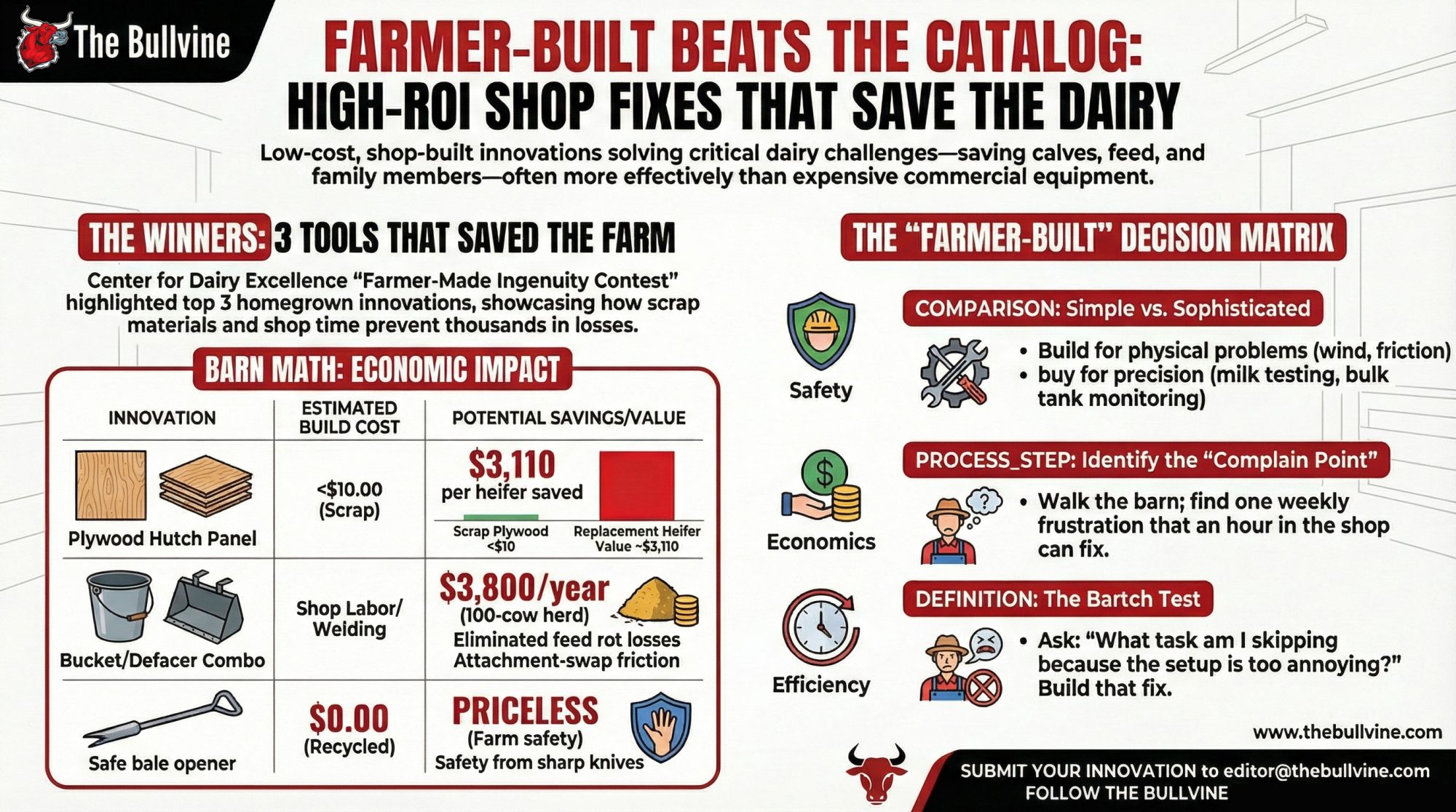
Executive Summary: The Center for Dairy Excellence’s first Farmer-Made Ingenuity Contest showed how far barn-made fixes can go when three dairy families beat the catalog with what was already in their shop. Palmyra Farm’s Mary Creek won $1,000 using a 30×30-inch plywood panel on her calf hutches — a scrap-wood windbreak that can pay for itself thousands of times over if it saves even one replacement heifer now worth about $3,000. In Pennsylvania, Donny Bartch welded his silage defacer onto the bucket so he never has to swap attachments, a simple change that lines up with UW Extension data showing better face management can keep roughly $3,800 of feed a year from rotting on the bunk in a 100‑cow herd. At Love Haven Farm, Susan Spadaro’s homemade bale opener let 4‑H kids cut twine without carrying knives, a small safety upgrade in a sector where at least 33 children are seriously hurt on farms every day. The pattern is clear: when the problem is simple, the risk is low, and the materials are already lying around, building your own solution can save calves, feed, and fingers faster than waiting on a sales rep. If you’re reading this, your 30‑day job is to walk your barn, find one thing you complain about every week, and ask whether an hour in the shop could turn it into your own Farmer‑Built fix.

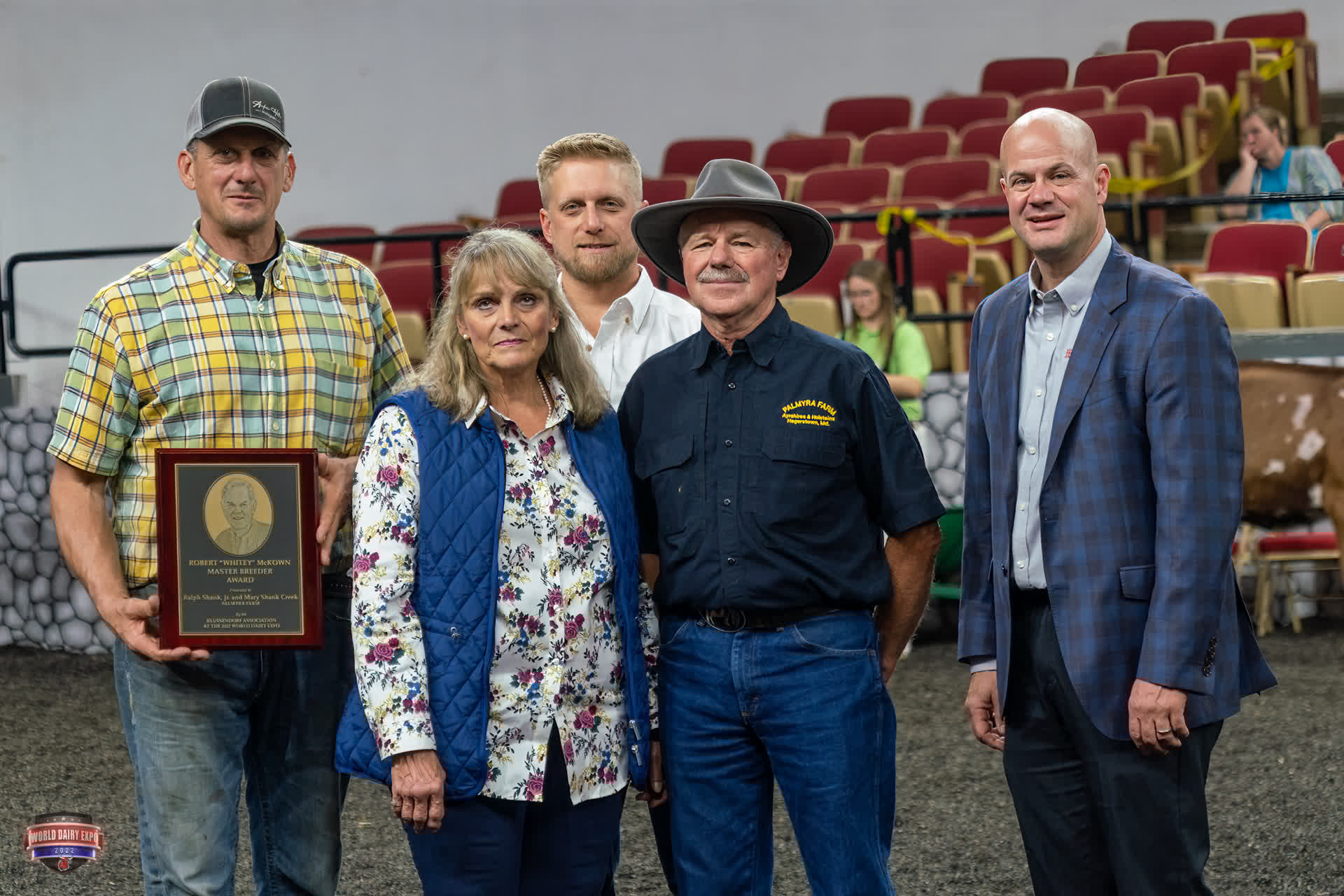
Mary Shank Creek has spent her life building one of the most accomplished Ayrshire breeding programs in the country. Palmyra Farm — the five-generation family operation she runs with her brother Ralph Shank Jr. in Hagerstown, Maryland — has produced over 150 cows with lifetime production exceeding 100,000 pounds of milk, exported embryos to 10 foreign countries, and was the first U.S. operation to utilize embryo transfer in the Ayrshire breed. That work earned them the 2022 Robert “Whitey” McKown Master Breeder Award at World Dairy Expo. Three years earlier, Creek and Shank received the National Dairy Shrine’s Distinguished Dairy Cattle Breeder Award.

So when the Center for Dairy Excellence launched its first-ever Farmer-Made Ingenuity Contest and asked dairy farmers across the mid-Atlantic to submit their best homegrown innovations, you’d expect Creek to show up with something sophisticated.

She submitted a piece of plywood.

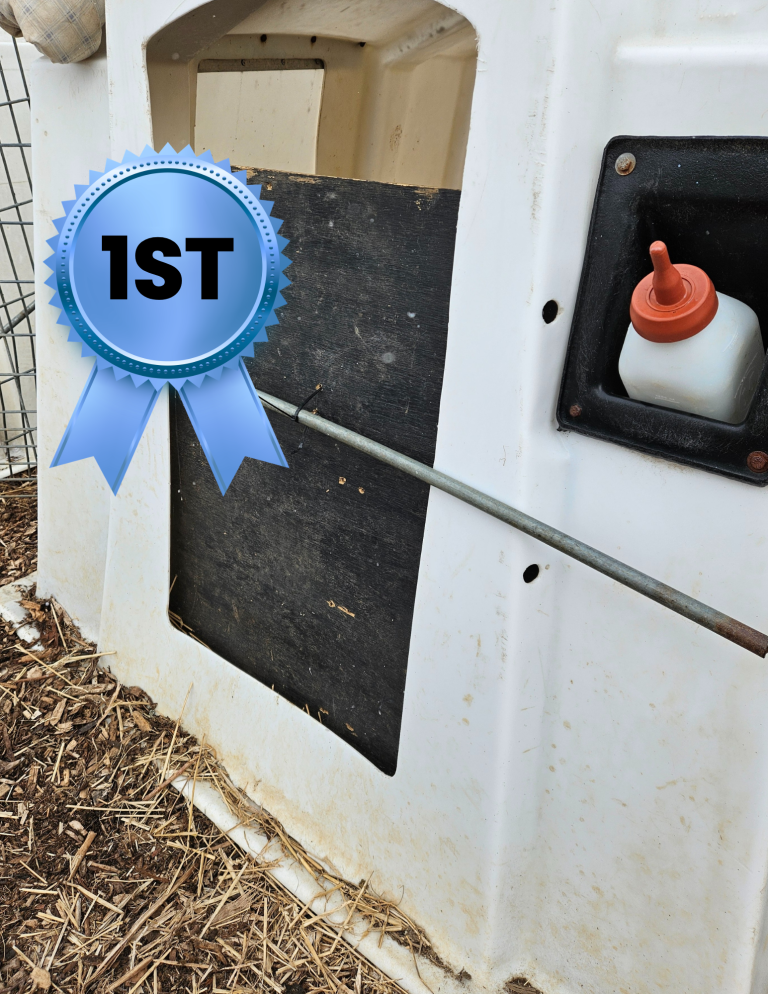
A 30-by-30-inch piece of plywood, rigged as a calf hutch accessory to block wind and hold warmth for newborns during the winter months. That plywood panel — simple, easy to construct, easy to move — won first place and $1,000. It tells you everything about the gap between what the equipment catalog sells and what actually works when a newborn calf needs to survive a winter night.

11 Entries, Five States, More Than 500 Votes

The contest was open to dairy producers and employees in Pennsylvania, Maryland, Delaware, New Jersey, and West Virginia. The Center collected 11 submissions, then opened a digital public vote. More than 500 people weighed in. Winners were spotlighted at the PA Dairy Summit in February.

Three took home cash prizes: $1,000 for first, $500 for second, and $250 for third. But the Center published all 11 innovations in a digital library at centerfordairyexcellence.org/farmer-made-library, making every submission available to any farmer looking for ideas.

“We were so impressed by the ingenuity of our dairy farmers,” said Jayne Sebright, Executive Director of the Center for Dairy Excellence. “We’ve already heard from other producers who are saying, ‘Hey, I could do this on my farm’ when they see some of the ideas. That’s what makes this type of idea-sharing so special. We learn the most from one another.”

The three winners tell very different stories about what farmer innovation looks like — and each one is specific enough to steal.

Creek’s Calf Hutch Fix: When Less Is More

The $1,000 winner: Creek’s plywood panel held in place by two zip ties and a metal hutch pole — sized to block wind while leaving 3–6 inches of ventilation gap on each side. It started with a preemie calf they were afraid they’d lose. (Photo: Center for Dairy Excellence / Farmer-Made Ingenuity Contest)

Creek’s first-place innovation solves one of the most fundamental problems in calf management: keeping newborn calves warm in winter hutches without suffocating them.

“We used a piece of plywood approximately 30 inches by 30 inches,” Creek explained. “We use it to cover the opening in our calf hutches to keep calves warmer until they are ready to face the winter temperatures, but allow reasonable ventilation. The sizing allows air to move through the hutch but reduces the exposure for the first few days of the calf’s life.”

The design is intentionally minimal. Block the wind. Retain body heat during the most vulnerable window. Remove it when temperatures allow. That’s it.

“It keeps them warm early in their lives and promotes healthy growth so they can use more of their ration for growth and less for maintaining body heat,” Creek said. “It is simple, easy to construct, move, and store. It has saved calves.”

THE BUILD SPECS

What Creek described: One piece of plywood, approximately 30×30 inches. Covers the hutch opening to block wind exposure while leaving enough gap around the edges for ventilation. Goes in at night, comes out during the day when temperatures allow. Stays in full-time during the calf’s first few days.

What you need: A single piece of exterior-grade plywood (a quarter-sheet of standard 4×8 will yield two panels). A saw. Five minutes.

Fastening and fit: Creek’s submission describes the panel as covering the hutch opening but doesn’t specify the attachment method—whether it leans, clips, or straps to the frame. If you’re adapting this for your hutches, the principle matters more than the method: size the panel smaller than the opening so air moves around the edges, blocking direct wind on the calf while allowing enough exchange to prevent moisture buildup and respiratory problems. The 30×30-inch dimensions suggest standard poly hutch openings in the 36-to-42-inch range, providing 3–6 inches of ventilation gap per side. Bungee cords work. So does a wire hook, or just leaning the panel against the opening. Try what fits your hutch brand.

That last sentence — “It has saved calves” — matters a lot more when you run the numbers.

The Barn Math on a Piece of Plywood

USDA pegged average dairy replacement heifer prices at $3,010 per head in July 2025 — a 164% jump from $1,140 in April 2019. By October 2025, that number climbed to a record $3,110 per head. Heifer inventory has dropped to a 47-year low, sitting at 3.92 million head — 18% below 2018 levels. Premium heifers at auction have been clearing north of $4,000.

A 30×30-inch piece of plywood costs less than a trip through a drive-through. If Creek’s modification prevents even oneheifer calf death per winter, the return is north of $3,000 on materials you could buy with pocket change. Prevent two, and you’re over $6,000 — from scrap plywood.

Cold stress starts earlier than most people think, too. Calves have a lower critical temperature near 50°F — meaning they’re already burning feed for heat instead of growth when the barn thermometer reads what feels like a mild autumn night. That’s energy diverted from frame, organs, and early mammary development. Creek’s plywood panel addresses exactly that gap: the first few days when a calf is most vulnerable and least able to thermoregulate on its own.

Creek didn’t engineer a heated, insulated, sensor-equipped hutch modification. They cut a piece of plywood. And they did it from a farm that has produced over 150 cows with lifetime production exceeding 100,000 pounds of milk — including five with over 200,000 pounds. Palmyra Farm has the knowledge, the resources, and the breeding expertise to buy anything in the catalog. That tells you something about what experienced producers actually trust.

For a deeper look at how cold stress costs compound before you see them on a vet bill: → Winter Calves, Hidden Losses: Feed, Bedding, and Cold Stress That Can Cost You 1,000 kg of Milk per Lactation

Bartch’s Defacer Combo: Solving a Human Problem, Not an Equipment Problem

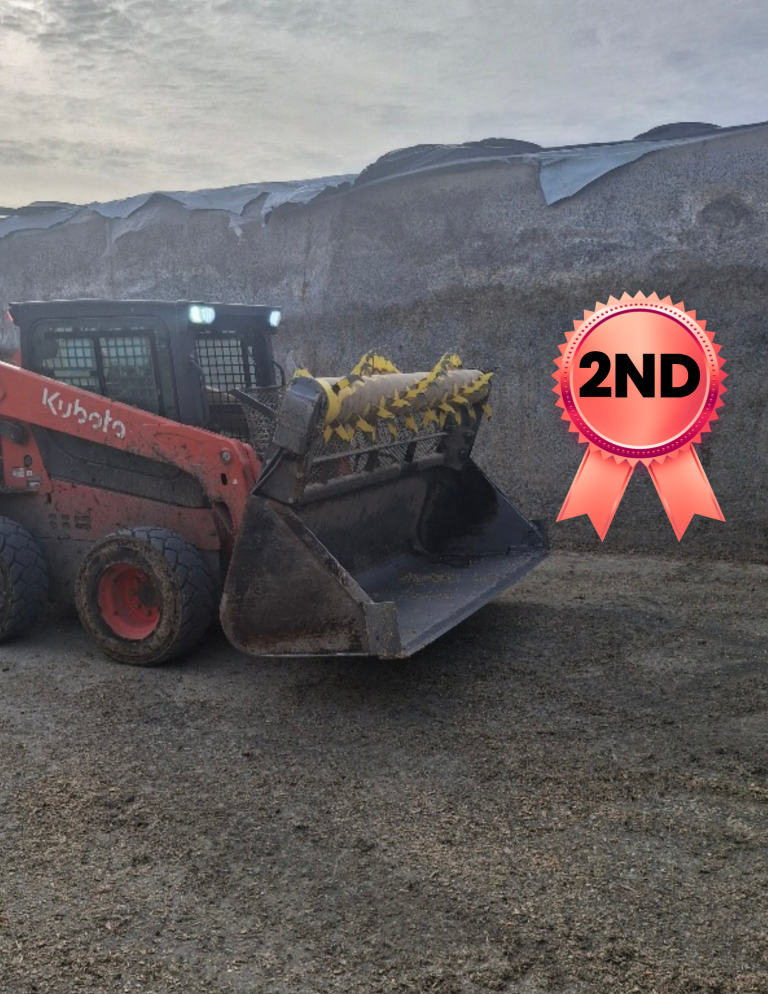
Bartch’s second-place combo at the bunker face: a silage defacer welded on top of a standard bucket, mounted on a Kubota skid steer at Merrimart Farms in Loysville, Pennsylvania. One attachment, no swapping, no excuse to skip defacing — a behavioral fix that UW Extension research suggests could save a 100-cow operation roughly $3,800 a year in feed losses. (Photo: Center for Dairy Excellence / Farmer-Made Ingenuity Contest)

Donny Bartch’s second-place innovation at Merrimart Farms in Loysville, Pennsylvania, is a different kind of fix. Where Creek solved a calf welfare problem, Bartch solved a behavior problem — his own.

“We combined two pieces of equipment into one,” Bartch explained. “We took a silage bucket and mounted a silage defacer on top of it. We wanted to maintain the quality of the silage face with the defacer without having to hook and unhook hydraulic hoses and buckets all the time.”

You know the routine if you feed from a bunker silo. Pull silage out, then deface the exposed surface afterward — scrape it smooth and tight to minimize oxygen penetration, heat buildup, and spoilage. Research from Penn State Cooperative Extension’s Dr. Ken Griswold found that the top third of a bunker silo — where density is lowest and air penetration greatest — loses 11.7% of dry matter, compared to just 5.6% in the lower third. Dr. Brian Holmes at UW Extension recommends silage density above 15 pounds of dry matter per cubic foot to minimize that shrinkage.

But when defacing means unhooking one attachment, hooking up another, and spending extra time in weather you’d rather not be standing in — people skip it. Bartch built the excuse out of the equation.

“No more bucking into face with a bucket for 500 more pounds or having 500 extra pounds lying on the concrete until the next feeding,” Bartch said. “No matter if it’s raining, snowing, or even extremely hot, you can stay in the cab to deface and load all the silage needed.”

He didn’t build a better defacer. He eliminated the reason he wasn’t using the one he had.

The Napkin Math on Skipping the Deface

UW Extension research, reported in Progressive Dairy, put real dollars on silage face management: on a 500-cow dairy feeding 75 lbs of silage per cow per day, reducing dry matter losses by 3–4 percentage points through better face management saved more than 250 tons of silage — over $19,000 per year.

Scale that down. On a 100-cow operation, the proportional math works out to roughly 50 tons and $3,800 per year in feed that’s rotting on your bunk face instead of going through a cow.

Creek’s plywood saves $3,000 in one catastrophic moment — a dead calf. Bartch’s combo saves $3,800 in invisible daily losses you never see on a single bill. Different math, same lesson: the fix that costs almost nothing beats the problem you’ve learned to ignore.

For the full economics of what bunker mismanagement costs across a year: → Is Your Feed Storage Destroying Your Dairy Profits?

Spadaro’s Bale Opener: A Tool That Outlasted the Herd

Spadaro’s third-place bale opener up close: an old haybine section screwed to a wooden handle — two screws, no moving parts. Her dad built the first one so she could open bales at the fair without carrying a knife. Her kids used the same tool through their 4-H careers. The cattle were auctioned in 2023. The tool’s still in the showbox. (Photo: Center for Dairy Excellence / Farmer-Made Ingenuity Contest)

Susan Spadaro’s third-place entry from Love Haven Farm in Scottdale, Pennsylvania, is the quietest of the three winners. It’s also the one that sticks with you.

Love Haven Farm has been in the Miller-Love family since 1902 — five generations in East Huntingdon Township, Westmoreland County, as profiled by TribLive when the family held its dispersal auction in 2023. Susan’s father named it Love Haven after marrying Sharon in 1971. The family raised and showed Brown Swiss and Ayrshire cattle for decades. Susan’s children, Grace and Anthony, carried on the tradition at the All-American Dairy Show.

In 2023, the family auctioned 100 Brown Swiss and 25 Ayrshires. But the tool Susan submitted to the contest is still in use.

“I created a simple bale opener that makes cutting baler twine quick and easy,” Spadaro said. “The tool is made from a small wooden handle with an old haybine section screwed to it. This design allows you to strike the baler twine, and the sharp edge slices it cleanly without needing a knife.”

Simple enough. What makes this one land differently is why she built it.

“It eliminated the need for young kids to carry knives, making the process safer and easier,” she said. “When I was showing cattle, it gave me independence. Later, my children used the same tool throughout their 4-H careers, and it became a go-to item for other kids as well.”

The safety angle is bigger than it might seem at first glance. According to the NCCRAHS 2022 Childhood Agricultural Injuries Fact Sheet — the most recent available — each day, at least 33 children are seriously injured in U.S. agricultural incidents. About every three days, a child dies. Between 2001 and 2015, 48% of all fatal occupational injuries to young workers occurred in agriculture — youth worker fatalities in agriculture exceed all other industries combined. A tool that lets a 10-year-old open bales without carrying a knife around livestock isn’t just a convenience. It’s a safety decision.

And then there’s this, from Spadaro: “It has become more than just a practical fix — it’s a piece of family history that connects generations through hard work, creativity, and tradition.”

A wooden handle. An old haybine section is headed for the scrap pile. The cattle are gone now, auctioned in 2023. But the tool Susan submitted to the contest outlasted the herd — built from scrap, used by her children, and passed to other kids along the way. That’s a farm that’s been in the family since Teddy Roosevelt was president.

If you’ve raised kids on a dairy farm, you know exactly why that resonates. For more on what farm kids learn before they’re old enough to appreciate it: → When 5:30 AM Chores Matter More Than the NHL Draft: The Martin Family’s Extraordinary Lesson in Raising Dairy Kids

When Should You Build Instead of Buy?

The three winning innovations share a trait worth noticing. None required specialized skills or expensive materials. Plywood. A welder and existing equipment. A wooden handle and a discarded haybine section. The shop inventory was the R&D budget.

Creek’s hutch mod works whether you’re running 40 head or 400 — the physics of wind exposure and calf thermoregulation don’t change with herd size. But “farmer-built” isn’t always the right answer. Commercial solutions exist because they solve real problems at scale, consistently, and sometimes with safety or regulatory considerations that a shop project can’t match.

The question isn’t whether homemade is always better. It’s whether the problem you’re solving actually requires a commercial-grade solution — or just a trip to the shop with whatever’s on hand.

How to Decide

If the problem is simple and the materials are already there, build it. Creek’s plywood panel is the poster child. Wind exposure on newborn calves didn’t need electronics, sensors, or precision engineering. It needed to block a hole. Same-day build with scrap lumber. Your 30-day action: walk your barn this Saturday and identify one simple physical problem you’ve been living with instead of fixing. If the materials are already in your shop, block out two hours and build the fix.

Bartch’s innovation targets a different kind of problem — behavioral friction. He didn’t need a better defacer. He needed to stop having a reason to skip the step. Walk through your own feeding routine this week: where are you skipping something because the setup takes too long or requires an extra attachment swap? That friction point is your build project.

Spadaro’s innovation matters for a different reason entirely — safety. A dedicated tool beats a workaround whenever kids or new workers are involved. Her bale opener prevented a knife from falling into the hands of children working around livestock. That math doesn’t need calculating.

Where commercial earns its price: precision, compliance, and data logging, don’t homebrew your milk quality testing or your bulk tank monitoring. The cost of getting those wrong exceeds the cost of buying right. For a sharp look at when commercial equipment earns its price tag — and when it doesn’t: → The Robot Metric Dealers Don’t Emphasize — And Why It Predicts Your Payback

And for a reality check on how the “do-it-yourself” math works in a different context — building your own on-farm creamery versus shipping bulk: → The 143-Hour Week at Clark Farms: The Real Math of On-Farm Creamery ROI and Your Time

Key Takeaways

  • If your calf hutches are open-faced in winter and you’re losing calves to cold stress, Creek’s 30×30-inch plywood panel is a same-day build. With dairy replacement heifers hitting a record $3,110 per head in October 2025, even one calf saved per winter pays for the modification thousands of times over.
  • If you’re feeding from a bunker and your silage face management is inconsistent, audit your routine for the attachment-swap step you keep skipping. UW Extension research found that on a 500-cow dairy, reducing DM losses by 3–4 percentage points through better face management saved over $19,000 per year. On 100 cows, that’s roughly $3,800 in feed rotting rather than being produced.
  • If young workers or family members handle bales with knives around livestock, build a dedicated tool this weekend. Youth ag fatalities exceed all other industries combined. A bale opener made from shop scrap is a safety upgrade you can finish Saturday morning.
  • Before you open the equipment catalog, check your shop. All three winning innovations used materials already on the farm. The Bartch test: ask yourself what you’re skipping because the setup is too annoying. That’s your build project.

The Bottom Line

The Center for Dairy Excellence reopens the Farmer-Made Ingenuity Contest for new submissions in November 2026. Dairy producers and employees in Pennsylvania, Maryland, Delaware, New Jersey, and West Virginia are eligible. Questions? Contact Emily Barge at CDE: ebarge@centerfordairyexcellence.org or 717-346-0849.

Learn More

The Sunday Read Dairy Professionals Don’t Skip.

Every week, thousands of producers, breeders, and industry insiders open Bullvine Weekly for genetics insights, market shifts, and profit strategies they won’t find anywhere else. One email. Five minutes. Smarter decisions all week.
NewsSubscribe
First
Last
Consent

The Myth of ‘Cheap’ Labor: H‑2A, Robots, and the Hard Math Dairies Need to Survive the Next 10 Years

If you’re milking 300–600 cows, the real choice isn’t H‑2A or robots—it’s which math keeps you in business 10 years from now.

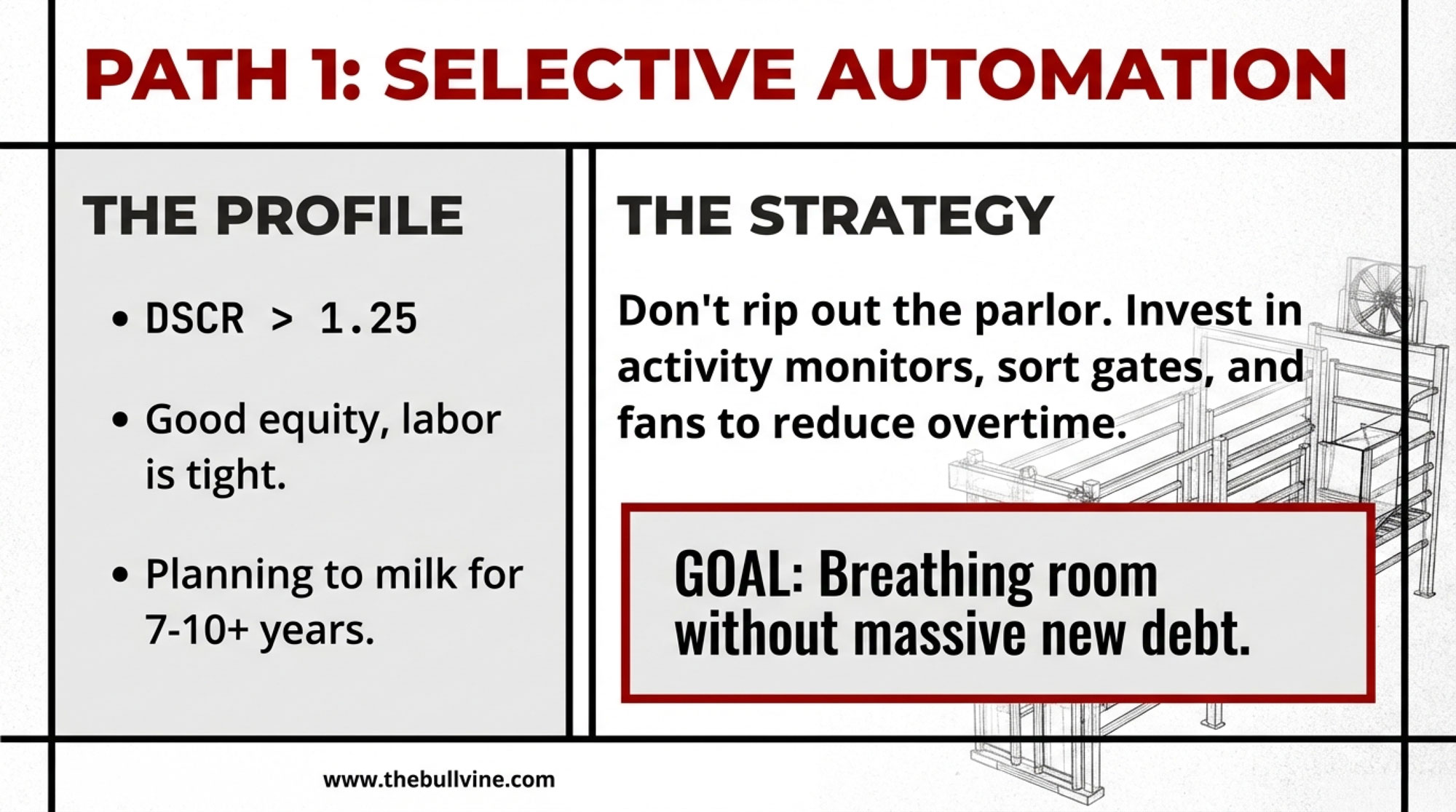
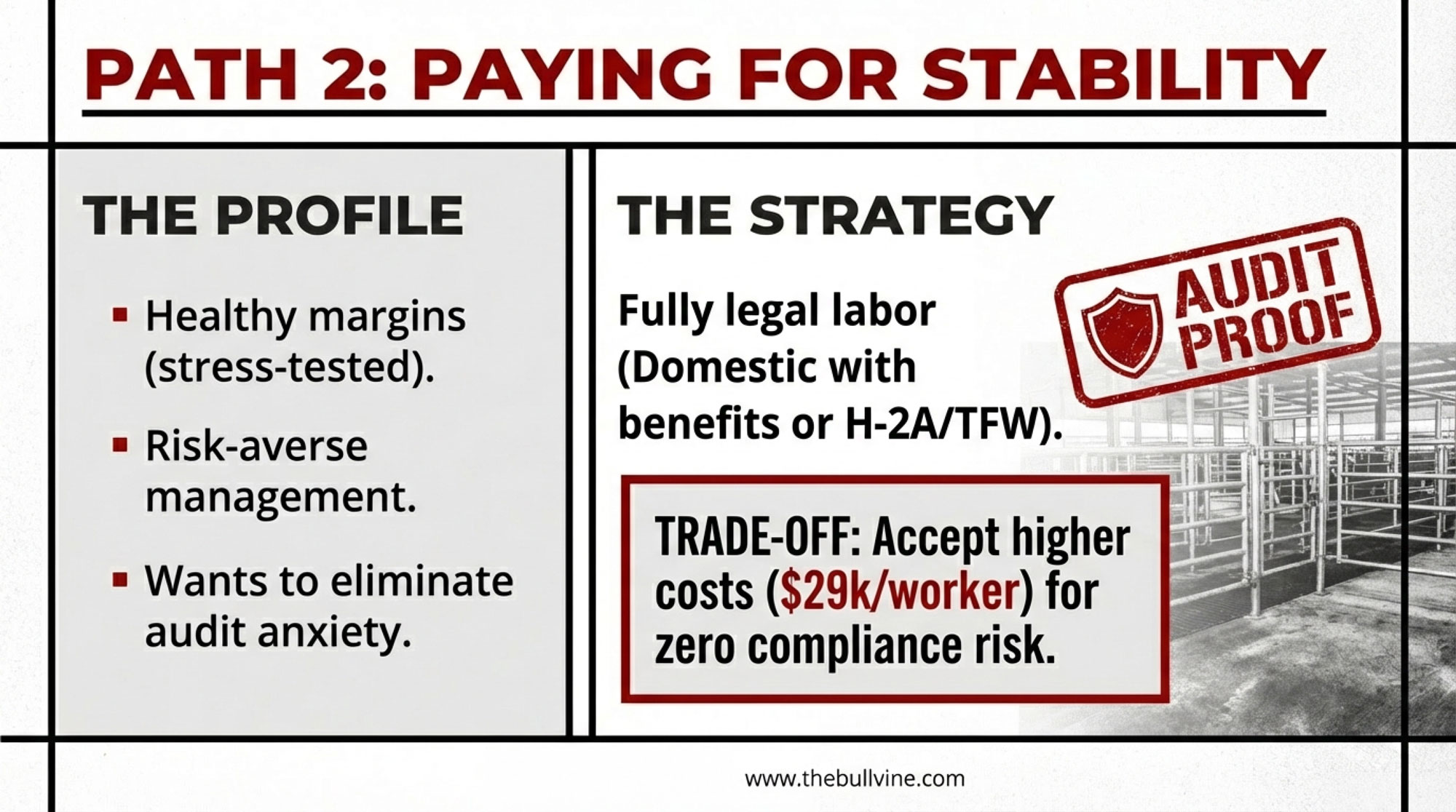
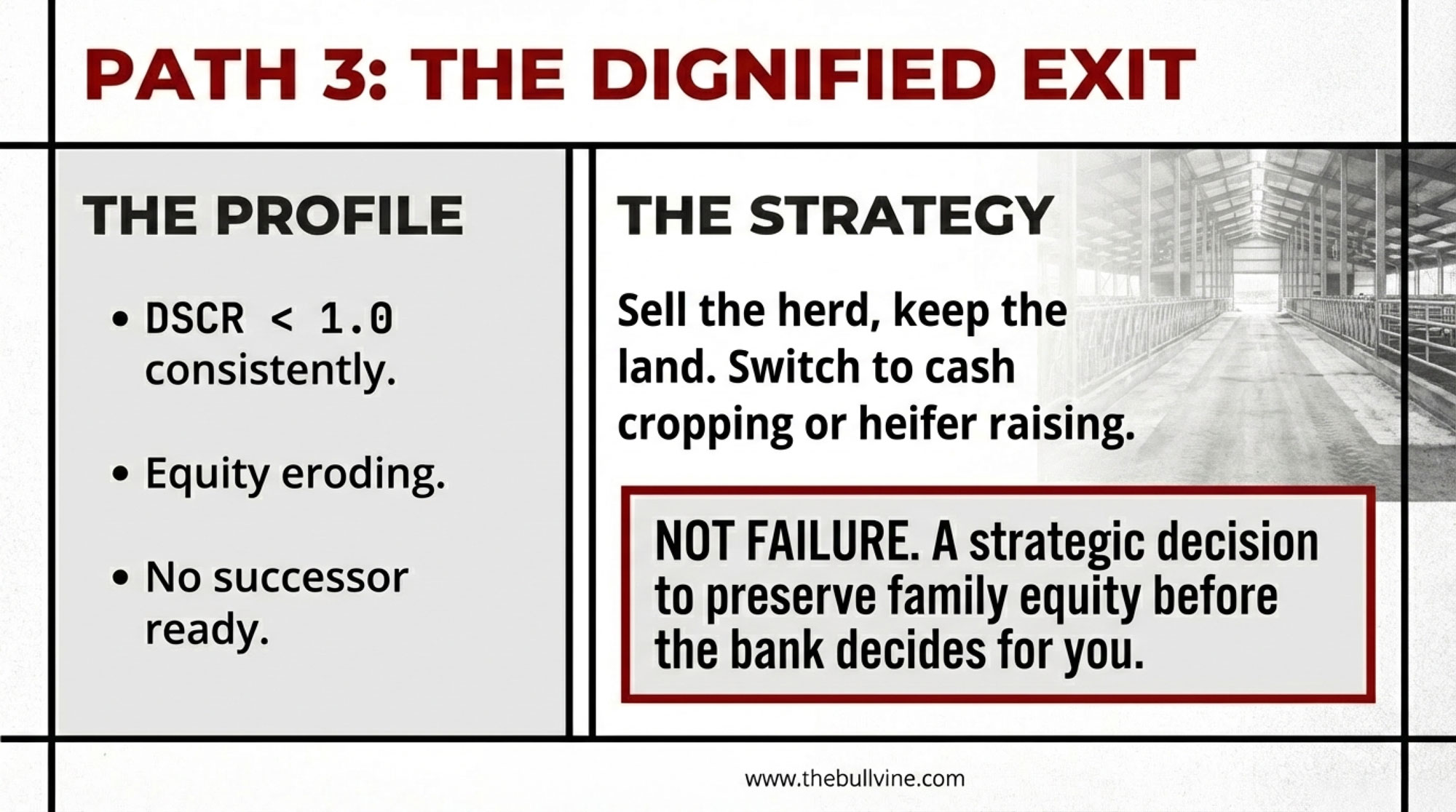
Executive Summary: If you’re running 300–600 cows, the biggest decision in front of you isn’t just H‑2A or robots—it’s what the labor math says about your next ten years. This piece digs into new USDA‑ERS, Rabobank, and university data to show why H‑2A rarely ends up “cheap,” how global cost gaps are shifting the ground under your feet, where robotic milking and targeted automation genuinely save labor, and how compliance risk fits into the picture. Along the way, it looks at real-world systems—from California dry lots to Wisconsin freestalls and Ontario mixed herds—to ground the numbers in the kind of operations you actually recognize. The article then lays out three honest paths for mid-size dairies: selective automation around bottlenecks, fully legal higher‑cost labor in exchange for stability, or a planned transition out of milking while you still control the terms. It finishes with a practical 30‑day checklist—know your true labor cost per cow and your multi‑year DSCR—so you can stop guessing and see which path really fits your farm.

Dairy farm labor costs

If you sit down with a table of dairy folks this winter—whether it’s in Wisconsin, California’s Central Valley, or around eastern Ontario—you’ll hear the same three things come up over coffee: labor, margins, and what the next ten years really look like for that 300‑ to 600‑cow family operation. You know the look on people’s faces when the talk turns to “who’s going to milk these cows in five years?”—it’s the same in a lot of kitchen tables and vet trucks right now. 

What’s interesting here is that two big storylines keep colliding almost immediately. One is the rapid growth of the H‑2A visa program, which economists at USDA’s Economic Research Service and Congressional analysts say has become a central labor pipeline for a big chunk of U.S. agriculture. The other is the steady march of automation—from collars and sort gates to full robotic milking—backed by university and peer‑reviewed research showing real changes in how labor is used on both small and large herds. Put those alongside the structural lift in global production costs that Rabobank’s dairy team has been documenting, and the real question for most dairies becomes, “Given our cost structure, our people, and what we want this farm to look like in ten years, do we lean into selective automation, formalize labor at a higher cost, or plan a controlled transition while we still have options?” 

If you’re in that 300–600 cow bracket, this is the labor math that’s going to have a lot to say about whether you’re still milking in ten years.

How H‑2A got so big, so fast

Looking at this trend from thirty thousand feet, USDA economist Marcelo Castillo and his team did a deep dive on H‑2A for the journal Choices. They found that the U.S. Department of Labor certified employers to fill just under 372,000 seasonal farm jobs with H‑2A workers in fiscal year 2022—more than seven times the number in 2005 and roughly double what it was in 2016. That’s a huge structural shift in less than two decades. 

And it’s not just that the program has grown; it’s who’s using it. Castillo’s work shows that around 12,200 employers were certified in 2022, but the top 5 percent—roughly 620 operations, each approved for 100 or more H‑2A workers—accounted for about two‑thirds of all certified jobs. Farm labor contractors alone supplied a large share of those positions. So, as many of us have seen, H‑2A has turned into a core labor tool for labor‑intensive crops, not a side program used by a handful of farms. 

Dairy, by comparison, has mostly been watching from the sidelines. A big reason is baked into the design. H‑2A was built for “temporary or seasonal” work. Congressional Research Service reports spell that out clearly: by statute, year‑round industries like dairies, greenhouses, and many livestock operations don’t fit neatly into the current rules. Folks at American Farm Bureau Federation have said the same thing in interviews, pointing out that dairy, livestock, and greenhouse employers often can’t legally use H‑2A for the year‑round jobs they need filled. 

Looking at this trend politically, pressure to change it is building. Dairy and meat industry leaders have pushed hard for access to year‑round H‑2A labor, and several recent immigration and farm labor proposals in Congress—including versions of the Farm Workforce Modernization Act and related efforts—have included provisions for limited year‑round H‑2A visas that would explicitly cover dairies and other non‑seasonal operations. Policy coverage into 2025 and early 2026 notes that these proposals would, if enacted, create capped pools of year‑round H‑2A positions and formally recognize dairy’s year‑round labor needs, but as of early 2026, they remain proposals rather than settled law. So the mix of hope and frustration producers feel—“Every politician says they understand dairy’s problem, but we still don’t have a year‑round fix”—is grounded in the current policy reality. 

If you hop north into Ontario, the mechanics are different, but the flavor is similar. Canadian producers rely on the Temporary Foreign Worker Program and the Seasonal Agricultural Worker Program, and federal guidance makes it clear that those programs also come with strict requirements around approved housing, travel arrangements, and documentation. The tool names change across the border; the core challenge doesn’t. You can get legal, reliable labor, but it takes real money and real management. 

H‑2A labor costs: it’s a lot more than an hourly wage

On the surface, H‑2A starts with one number: the Adverse Effect Wage Rate, or AEWR. That’s the minimum hourly wage you’re required to pay H‑2A workers in your state. USDA and CRS explain that AEWR is based on USDA’s Farm Labor Survey and, in many states, has moved into the mid‑ to high‑teens per hour, with some regions above that. American Farm Bureau government affairs staff have pointed out that, nationally, AEWR has jumped by roughly 20 percent over about five years, while revenue for many labor‑intensive crops hasn’t kept pace. 

Cost CategoryAmount (USD)% of Total
AEWR Wages (6 months @ $18.50/hr, ~1,080 hours)$19,98067.7%
Housing (on-farm or rental, utilities, maintenance)$4,20014.2%
Transportation (airfare, ground travel, visa)$3,80012.9%
Recruitment & Admin (legal, HR, processing fees)$1,5205.2%
Total Employer Cost$29,500100%

But what I’ve found is that the hourly wage is only the tip of the iceberg.

Castillo’s ERS analysis emphasizes three big non‑wage buckets that matter just as much as the posted rate. 

  • Housing. Employers have to provide housing that meets specific federal and state standards at no cost to the worker. In practice, that often means building or renovating bunkhouses on‑farm or renting apartments in town, then paying for utilities, maintenance, and inspections. USDA’s own H‑2A assistance initiatives and Farmers.gov resources highlight housing as one of the biggest cost and compliance barriers. 
  • Transportation. H‑2A employers must pay for workers’ travel from their home country to the job site and back, and they’re responsible for daily transportation between housing and the farm. Congressional researchers list transportation costs as a major recurring expense across H‑2A employers. 
  • Recruitment and administration. Someone has to prepare job orders, manage consulate appointments, track wages and hours precisely, and maintain records for potential audits. Many farms either dedicate a staff member or hire an outside consultant or attorney. Employment experts interviewed by Brownfield describe the program as “complex” and “paperwork‑heavy,” which aligns with what many producers have encountered. 

When Castillo’s team put numbers to a “typical” six‑month H‑2A contract, they estimated that wages alone came to about $19,500, and, once you add in minimum housing, transportation, and other non‑wage costs, total employer cost lands at least around $29,500 per worker. So the idea that foreign labor is “cheap” doesn’t hold up very well when you look at that full bill. 

On several Midwestern and Northeastern dairies that have used H‑2A, the pattern is similar. Folks go into it thinking, “We’ll finally get cheap, reliable help,” and walk out saying, “We did get stability and legal peace of mind, but we paid more per worker than we expected once housing, travel, and compliance were counted.” For some operations, that trade—higher cost in exchange for stability—is worth it. For others, it just doesn’t pencil.

Why compliance has become a management job, not just paperwork

Even if you never touch H‑2A paperwork, labor compliance has drifted into the same category as mastitis control and fresh cow management: you can’t afford to ignore it.

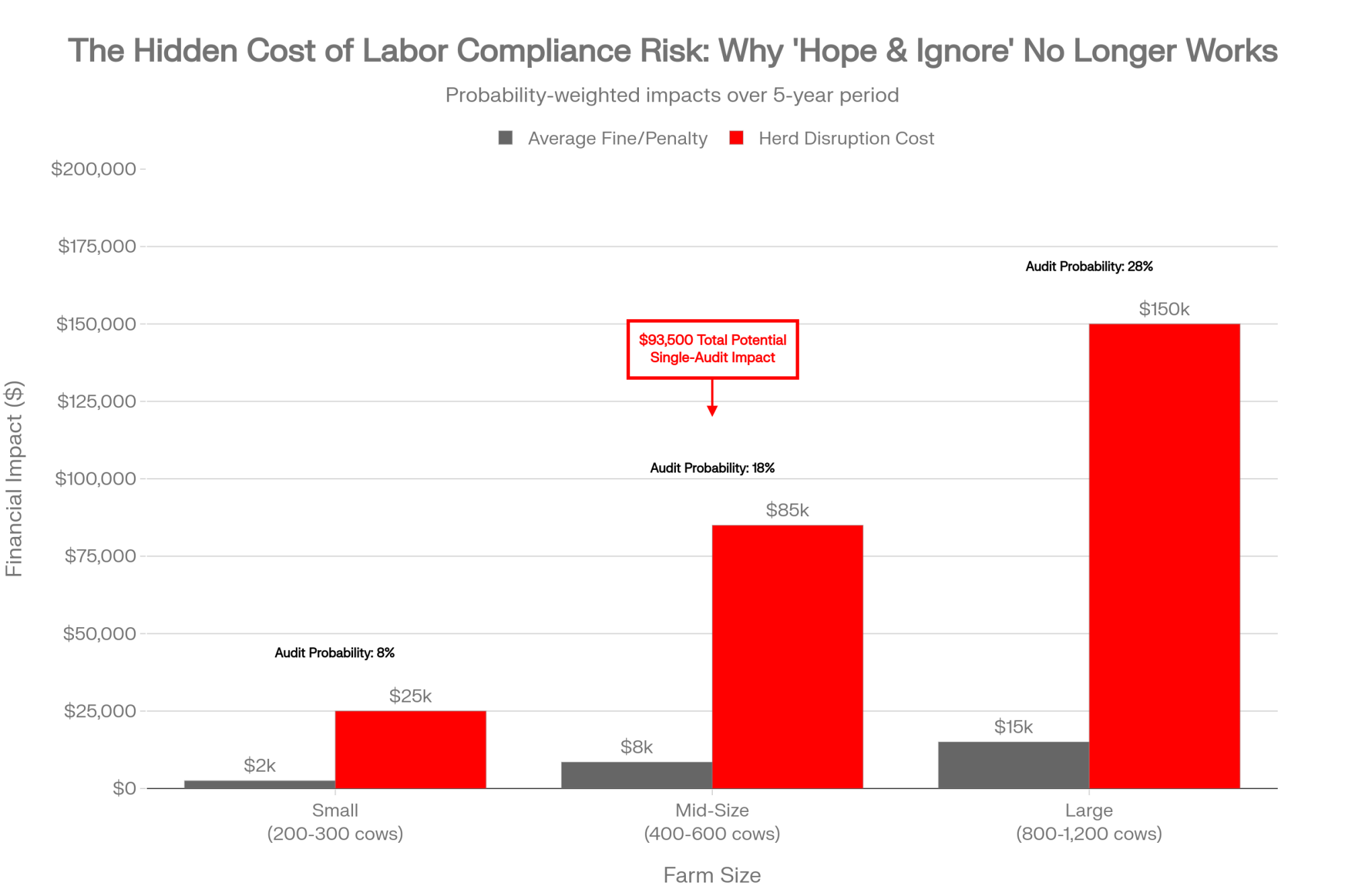
Farm SizeHerd (cows)Full-Time Employees5-Yr Audit ProbabilityAverage Fine if AuditedDisruption Cost (Lost Production)Total Risk Impact
Small200–3003–48%$2,500$25,000$2,700 (probability-weighted)
Mid-Size400–6008–1218%$8,500$85,000$16,900
Large800–1,20015–2028%$15,000$150,000$46,200

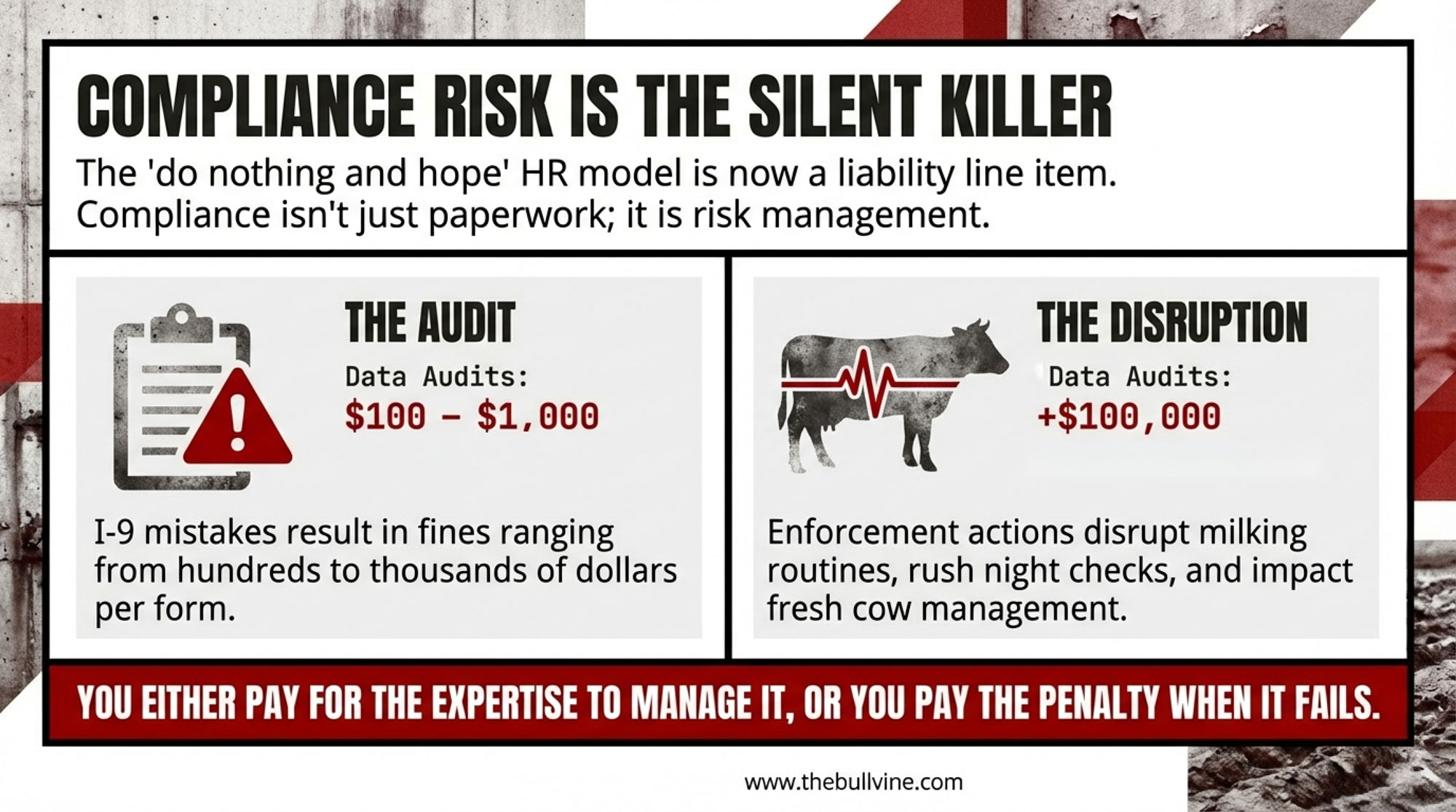
Current federal penalty schedules show that mistakes on I‑9 forms can result in fines ranging from the low hundreds of dollars per form to the low thousands as the share of incorrect forms and prior violations increases. The latest CRS report on H‑2A and farm labor notes that more serious violations—repeat offenses, unsafe housing or transportation, clear wage underpayment—can lead to significantly higher penalties, back‑wage orders, and, for H‑2A users, possible debarment from the program. 

On a dairy, that’s not theoretical. If an audit or enforcement action suddenly disrupts part of your crew, you feel it almost immediately in milking routines, fresh cow checks, and even butterfat performance. Milking shifts run longer, night checks get rushed, and transition cows don’t get quite the eyes they need. And if you, as the owner or manager, are tied up for days gathering records and sitting in meetings, that’s less time walking pens, watching TMR consistency, and working with your people.

So it’s worth noting that more herds and advisors are treating labor compliance as a risk management line item instead of something you hope never lands on your doorstep. That might mean budgeting a modest amount each year for an attorney or HR professional to review I‑9s and wage practices, scheduling internal audits of paperwork, and putting in place at least a basic HR system. Not because anyone enjoys it, but because the “do nothing and hope” model has just gotten too risky. 

The global cost squeeze: why, where, and how you milk matters more

Now, zooming out a bit helps explain why these labor decisions feel so tight right now.

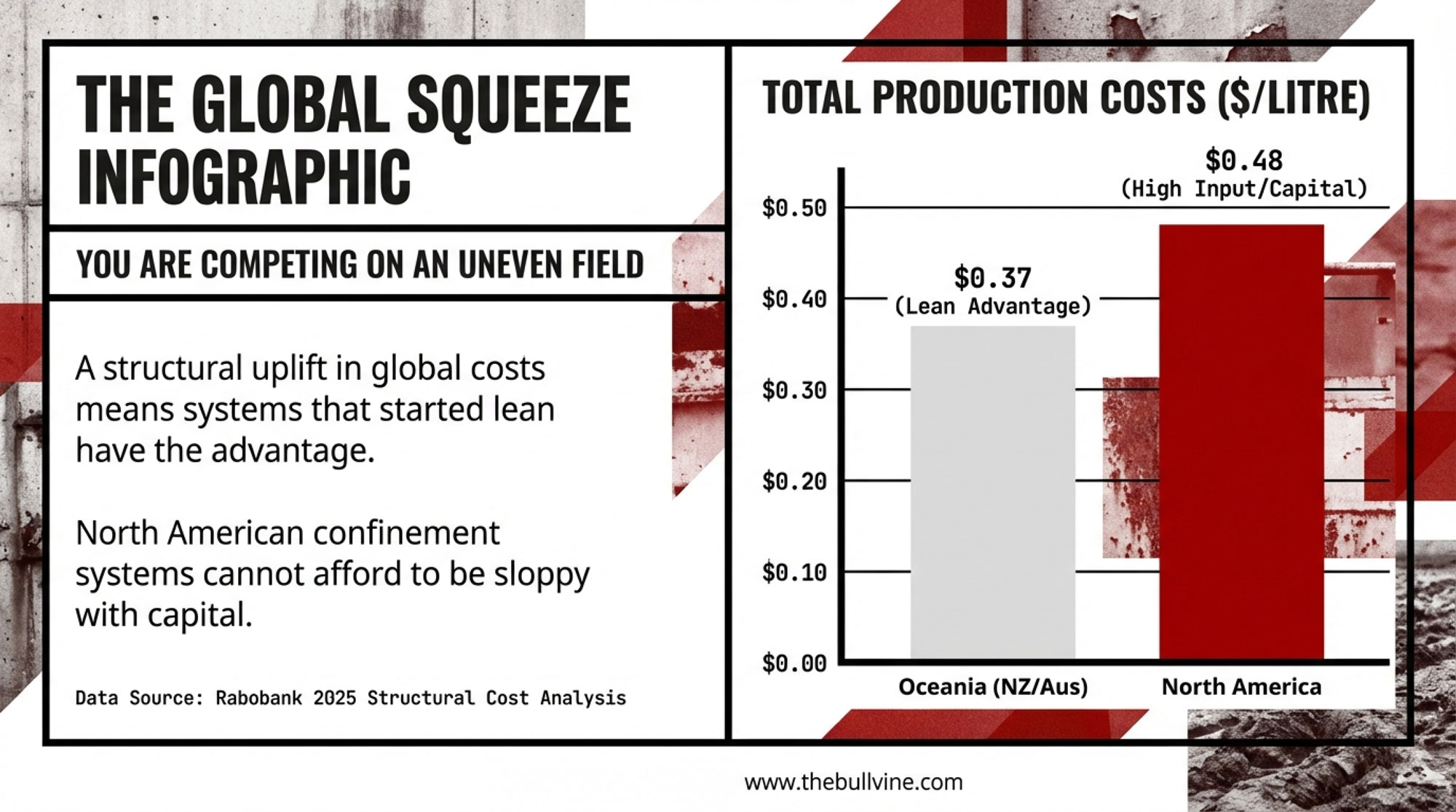
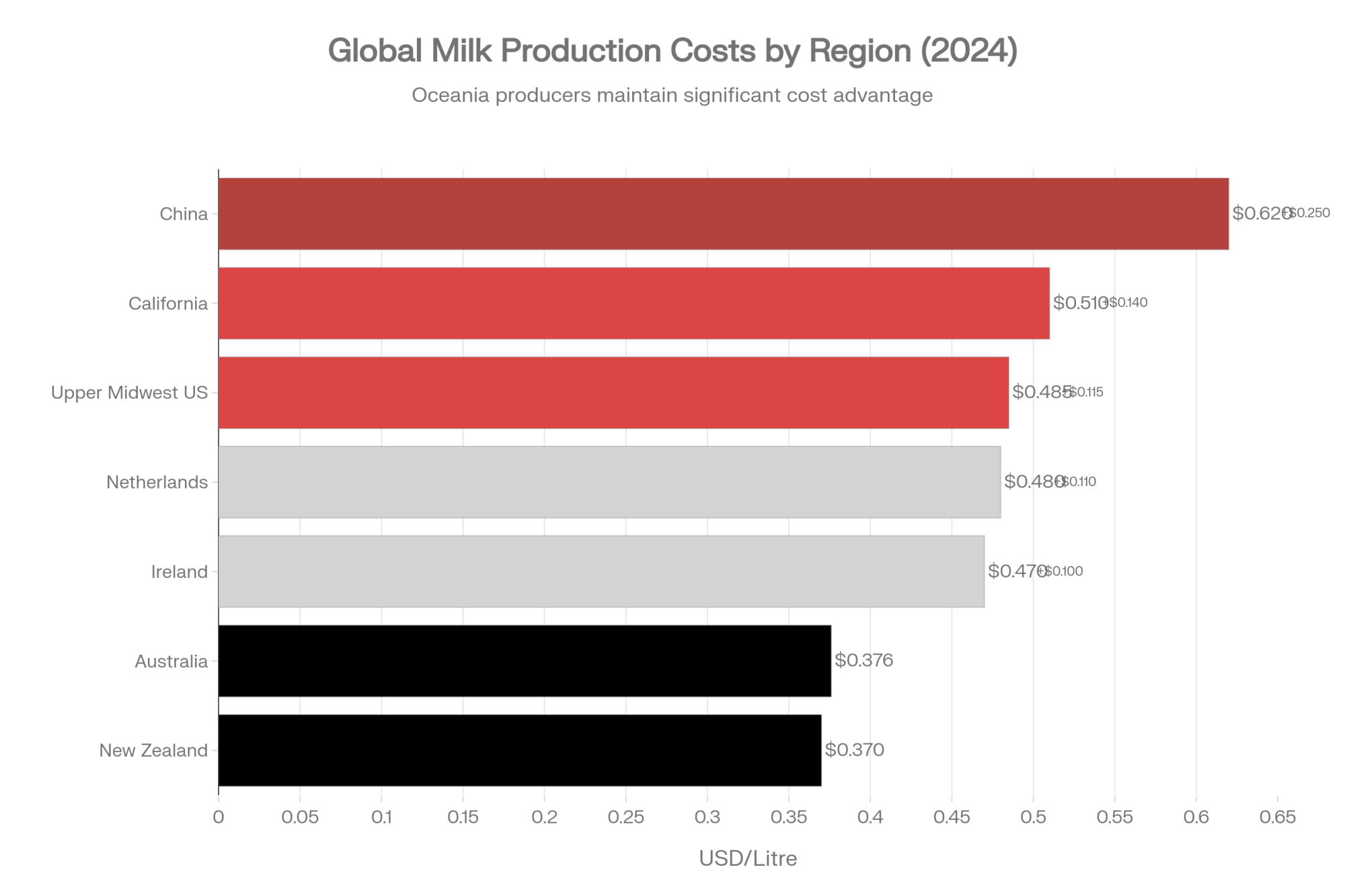
RegionCost/Litre (USD)Cost/cwt (approx.)Gap vs. NZ
New Zealand$0.370$16.95Baseline
Australia$0.376$17.27+$0.006
Ireland$0.470$21.58+$0.100
Netherlands$0.480$22.03+$0.110
Upper Midwest US$0.485$22.27+$0.115
California$0.510$23.41+$0.140
China$0.620$28.47+$0.250

Rabobank’s dairy team has been benchmarking milk production costs across the major exporting regions—New Zealand, Australia, the U.S., the EU, and others. In a 2025 release, they described seeing a “structural uplift” in production costs across eight key exporters over roughly the last five years, with average costs up by low double‑digit percentages since 2019 as feed, fertilizer, and labor all climbed. 

Here’s what’s interesting. Even with those cost increases, New Zealand and Australia still sit near the bottom of the global cost ladder. Rabobank senior dairy analyst Emma Higgins notes that the two Oceania countries have “competed neck and neck” as the lowest‑cost producers, and that New Zealand currently holds about a five‑U.S.‑cents‑per‑litre cost advantage over Australia for 2024. Looking at the last five years, Rabobank estimates average total production costs of roughly US$0.37 per litre for both New Zealand and Australia, compared with around US$0.48 per litre for the other exporting regions. They also point out that exchange rate movements have effectively widened New Zealand’s cost edge by about 8–9 percent compared with 2019. 

A lot of that comes back to system design. New Zealand’s pasture‑based setups, high cows‑per‑worker ratios, and relatively light permanent infrastructure keep capital and operating costs per litre low. Australian systems share some of those traits, though higher labor and input costs have eroded their relative advantage somewhat. 

When you swing back to North America, the picture changes:

  • In California, you’re talking about high‑input freestall and dry lot systems, a heavy reliance on purchased or custom‑grown feed, relatively high wage rates, and a lot of capital tied up in manure handling and environmental compliance, as Western U.S. cost of production and policy reports show. 
  • In the Upper Midwest, many herds benefit from strong homegrown forage and proximity to grain, but long winters mean housing cows, managing manure, and maintaining barns, all of which show up in fixed costs per cow in university cost‑of‑production summaries. 
  • In the Northeast and Ontario, plenty of farms run mixed systems—grazing when the weather allows, then housing herds through the cold months. That brings some pasture advantages, but the reality of winter infrastructure doesn’t go away, as regional and provincial benchmarks make clear. 

So when Rabobank says there’s been a structural cost lift across the world, what the numbers are also saying is this: the systems that started lean have more room to absorb those cost increases. If you’re in a higher‑input, higher‑capital setup in North America, every decision about labor, feed, and investment hits your cost per hundredweight harder, and that matters when you’re competing with milk coming from lower‑cost pasture‑based regions. 

What the numbers really say about robots and labor

Let’s bring robots into this, because that’s where a lot of labor conversations end up.

Herd SizeAnnual Labor Savings ($/year)Payback Period @ 3%Payback Period @ 5%Payback Period @ 7%Payback Period @ 8.5%
250 cows$90,0002.0 yr2.3 yr2.7 yr3.2 yr
350 cows$126,0001.4 yr1.7 yr2.1 yr2.4 yr
400 cows$168,0001.1 yr1.4 yr1.7 yr2.0 yr
500 cows$210,0000.9 yr1.1 yr1.4 yr1.6 yr

The University of Wisconsin conducted a careful analysis of what automatic milking systems actually do to reduce labor on U.S. farms. In a survey of 50 dairies that adopted box‑style AMS, extension economists found that, on average, farms reduced labor time by a little over 0.06 hours per cow per day. When they looked at it per hundredweight, labor time dropped about 0.10 hours per cwt. At an assumed wage of $15 per hour, that worked out to about $1.50 in labor cost savings per hundredweight of milk shipped. 

In percentage terms, the Wisconsin team reported that the time required per cow fell by about 38 percent and the time per hundredweight by about 43 percent after AMS adoption. Some farms saw very little savings—often due to maintenance headaches or management issues—but roughly a quarter of the herds reported much larger reductions, translating to more than $2.40 per hundredweight in labor savings at that same $15 wage. 

Now, put that into a herd size that many of you are in. Say you’re milking 400 cows and averaging 28,000 pounds per cow per year. That’s about 11.2 million pounds of milk annually, or 112,000 hundredweight. Multiply that by $1.50 per cwt in labor savings and you’re looking at roughly $168,000 per year in reduced labor costs, before you account for any changes in milk yield, components, or the extra time someone spends managing the technology. That’s the kind of math that will make anybody stop stirring their coffee and think, “Okay… what would that look like here?” 

Researchers looking at AMS adoption in Norway have heard similar things, even though their systems and labor markets differ from ours. A recent peer‑reviewed paper in the journal Animals found that Norwegian farmers using multi‑box AMS generally perceived substantial reductions in labor needs, earlier detection of sick cows, and better mastitis management, and a meaningful share reported improved milk fat and protein levels after switching. Those are perceptions, not controlled trials, but they align with what many AMS herds in Europe and North America report to extension staff and industry journalists. 

The work changed on those farms. Instead of spending as many hours in the pit, producers and staff spent more time looking at herd management software, following up on activity and rumination alerts, and handling preventive maintenance and troubleshooting. 

“The work changed… Some described the shift as trading barn boots for a laptop—a sentiment echoed across both sides of the Atlantic.” 

Extension folks and consultants here have been making the same point for years: robots don’t remove labor; they change the kind of labor you need. You trade a chunk of routine milking time for tech oversight, data interpretation, and cow‑flow management. That can be a very good trade if you’re struggling to fill repetitive milking positions and you have the management bandwidth—or someone on your team—who enjoys the technical side. 

On the capital side, nobody pretends that AMS is cheap. A single robotic unit capable of handling 60–70 cows can cost between $150,000 and $275,000, depending on the model and support package. University economic tools and field experience often use a working range of about $180,000 to $220,000 per box before barn modifications, and real‑world projects frequently climb higher once you include concrete, cow‑traffic changes, sort gates, power upgrades, and so on. 

At today’s interest rates, that financing cost becomes a big part of the payback equation. That’s why AMS investment tools from universities like Michigan State and Wisconsin encourage farms to plug in multiple milk price and interest rate scenarios, not just a best‑case line. If your DSCR has been under 1.0 for three of the last five years, it’s a fair question to ask: are you really in a position to add another big pile of robot debt? 

The middle ground: automation that isn’t “all or nothing.”

What farmers are finding—especially on mid‑sized herds—is that the most realistic automation story often sits between “old parlor” and “full robots.”

In a lot of Wisconsin and Minnesota freestall herds, the starting point isn’t to rip out the parlor. It’s to add activity and rumination collars, automatic sort gates, and a robotic feed pusher. Collars give better eyes on heat detection and fresh cow behavior. Extension studies and case reports have shown that well‑managed activity systems can significantly improve heat detection rates and reduce days open. Automatic sort gates reduce the time and hassle of chasing cows for herd checks or hoof trimming. Robotic feed pushers keep TMR consistently in front of cows, which helps sustain dry matter intake and butterfat performance—something multiple UW and industry case studies have highlighted. 

Several UW Extension profiles have featured 300‑ to 400‑cow freestall operations that added collars and a feed pusher, then reported cutting overtime hours, reducing emergency night checks, and catching transition‑period problems a day or two earlier than before. One producer summed it up nicely by saying, “It’s not magic, but it bought us some breathing room.” That sentiment comes up a lot when you talk to farms that have taken that incremental approach. 

In California and the Southwest, where dry lot systems and intense summer heat are everyday realities, many dairies first consider automating feed handling and cooling before even considering robots. That can mean upgrading feed delivery controls, installing variable‑speed fans with automated controls, or integrating soaker systems tied to temperature and humidity sensors. Case studies from hot‑climate herds show that better-targeted cooling not only protects milk yield and reproduction during heat stress, but also frees up labor that used to be tied up shuffling cows in and out of shade or manually adjusting valves and timers. 

In Northeast herds that split time between pasture and freestalls, automation often appears around the transition period and during seasonal moves. Activity and rumination monitors help managers see which cows aren’t handling the move from pasture back into the barn, or which fresh cows are slipping early in lactation, so the team can intervene sooner. Extension veterinarians and consulting nutritionists in those regions consistently point to early detection of subclinical problems as one of the biggest wins from these monitoring systems. 

Across all of these examples, university and trade publications report that some farms see a pretty quick payback on targeted tools through reduced overtime, fewer emergency nights, and more consistent routines, while others see more modest gains. The common thread is that none of this technology is plug‑and‑play. It works best when it’s aimed at a clear bottleneck and someone on the farm is responsible for watching the data and adjusting management accordingly. 

Domestic labor: “won’t work” or “can’t afford”?

You probably know this already, but the line “Americans won’t milk cows anymore” shows up in almost every labor conversation. It comes from a real place—some producers have posted milker positions for weeks and never had a local applicant, especially in isolated rural areas.

At the same time, economists and policy analysts looking at farm labor and immigration point out that non‑farm sectors—construction, warehousing, logistics, food processing—have expanded and pulled in a lot of the same working‑age people dairies used to rely on. CRS and other analyses make it clear that this competition from non‑farm employers offering higher pay, more predictable schedules, and jobs closer to town is a major factor behind the surge in H‑2A usage. 

On the farm side, dairy HR specialists at universities like Wisconsin and Michigan State emphasize a couple of practical points. When dairies in more populated areas offer wages that truly compete with local non‑farm employers, provide at least some benefits, and offer more predictable time off, they can and do attract domestic workers into milking, feeding, and calf care roles. These advisors also point out that job design matters. Roles that mix equipment operation, basic maintenance, and parlor work tend to be more attractive than jobs that are “just in the pit” all day. 

The hard reality is that not every dairy can afford to match those wages and conditions at current milk prices with their existing debt load. So the bottleneck often isn’t that nobody wants to milk cows; it’s that the farm can’t afford to pay what the rest of the local economy is offering for similar effort. That’s a tough truth, but it lines up with both the labor market data and the farm financials. 

And that’s where H‑2A comes back into play. The program can give farms access to workers willing to take dairy jobs, but only if the operation can carry the full cost—AEWR wages plus housing, transportation, and compliance expenses. Leaders at AFBF have described H‑2A in interviews as a “mixed bag”: essential for some growers, too expensive for others, and, under current law, an imperfect or inaccessible fit for many year‑round operations like dairies. That mix of outcomes is exactly what producers are staring at when they put their numbers into a spreadsheet and compare H‑2A against domestic labor and against automation. 

The labor problem on a lot of dairies isn’t that nobody will milk cows—it’s that the farm can’t afford to pay what the broader labor market is paying for comparable work.

For a 400‑cow dairy, what are you really choosing between?

So let’s bring this right back to a herd size many Bullvine readers live in: roughly 350 to 500 cows, a mix of family and hired labor, with a freestall or dry lot system and a parlor that might be ten to twenty years into its life.

MetricPath 1: Selective AutomationPath 2: Legal Higher-Cost LaborPath 3: Planned Transition
Capital Required$50K–$150K (collars, sort gates, feed pusher)$0–$25K (HR systems, legal setup)$0–$10K (valuation, transition consulting)
Annual Debt Service$8K–$18K (5-year amortization @ 6%)$0 (operational cost, not debt)$0 (exit phase)
Annual Labor Cost Impact–$80K to –$120K (labor savings)+$30K to +$50K (legal wages/housing vs. baseline)N/A (phasing out)
DSCR Requirement>1.15 (need room for new debt service)>1.0 on average (can absorb higher wages)>0.85 (can sell from position of strength)
3-Year Cash Flow NetPositive if herd productivity holdsNeutral to slightly positive (wages offset labor efficiency)Positive (captures land/facility value, reduces ongoing risk)
Best For…Farms with strong debt coverage & clear bottlenecks; plan to keep milking 7–10+ yearsFarms with decent margins but tired of compliance risk; want stability & peace of mindFarms with weak DSCR, no clear succession, tired after decades of volatility
Key RiskTech adoption failure, maintenance headaches, milk price crash erodes paybackWage pressure continues; if milk price crashes, margin squeeze is acuteMarket timing: land/cow values may soften; need to execute transition professionally

From conversations with producers, lenders, and extension folks—and backed by research and numbers—the choices for a farm like that often fall into three broad paths. 

Path 1: Selective automation around real bottlenecks

This first path fits farms that:

  • Have generally been able to cover debt payments, with at least some cushion
  • Feel the labor pressure—long days, hard‑to‑cover shifts—but aren’t in outright crisis
  • Expect to keep milking for at least the next seven to ten years

The starting point is to put hard numbers on labor and debt. That means figuring out your total labor cost per cow—including family labor, overtime, housing, payroll taxes, and any HR or legal expenses—and then looking at your debt service coverage ratio (DSCR) over three to five years. Many agricultural lenders get nervous about major new capital projects if DSCR hasn’t been consistently above 1.0, and often they’re more comfortable when it’s around 1.25 or higher on average. 

Once you know where you stand financially, you can go hunting for your bottlenecks. Maybe it’s late‑night fresh cow checks. Maybe it’s heat detection and breeding. Maybe it’s feed push‑up and bunk management. Maybe it’s the time you spend chasing cows for herd health or hoof trimming.

Extension advisors in Wisconsin, California, and the Northeast repeat the same advice: match the technology to the specific bottleneck, and your odds of seeing a return go up. So you look at one or two targeted tools—activity monitors, sort gates, a feed pusher, upgraded fans, and soakers—and build budgets with your accountant or consultant. The UW AMS work and other automation studies give you benchmarks for what’s possible, but the key is plugging in your own wage rate, herd size, and management style. 

This path doesn’t require you to bolt robots to the floor tomorrow. It’s about picking off the worst bottlenecks and using focused automation to reduce overtime, improve consistency in fresh cow management and the transition period, and give your team a bit more breathing room without taking on unmanageable debt. 

Path 2: Fully legal labor at a higher cost, in exchange for more stability

The second path is less about squeezing every last dollar of margin and more about lowering risk and sleeping at night. It tends to fit farms that:

  • Have maintained reasonably healthy margins on average, even through some tough price years
  • Don’t really want to add major new capital obligations right now
  • Have at least a rough sense of succession or a timeline for milking

Here, most of the hard work happens on paper. With your lender or a good farm management advisor, you build two parallel labor budgets.

One assumes a fully domestic, documented crew, paid at wages and benefits that genuinely compete with local non‑farm employers, plus housing where appropriate, all payroll taxes, and some allowance for HR and compliance work. The other assumes a blend of domestic and foreign workers—H‑2A in the U.S. or Temporary Foreign Workers in Canada—with realistic costs for housing, transportation, legal fees, and administrative time, in addition to the AEWR or equivalent wage. 

Then you stress‑test both budgets. What happens to DSCR and family living under different milk price and interest rate scenarios? That kind of scenario planning is exactly what many extension farm management programs are teaching right now. If those budgets show that you can afford a fully legal labor structure—domestic, H‑2A, or a mix—and still keep DSCR in acceptable territory across most scenarios, then this path can dramatically reduce your compliance risk and mental load. You’re choosing to pay more for labor in exchange for predictability and legal security. 

If your DSCR falls below 1.0 in most of those scenarios, you’re not buying stability—you’re buying more risk. And if the numbers don’t work in any reasonable scenario, that’s a strong signal that something deeper needs to change in scale, system, or long‑term plans.

Path 3: A planned transition out of milking while you still have choices

The third path is the one nobody loves to talk about, but more families are facing it head‑on. It usually becomes a serious option when:

  • DSCR has been weak for several years, not just during one ugly price cycle
  • Even “good” milk price years haven’t really improved equity or family living
  • There’s no next generation that’s both ready and genuinely eager to shoulder the risk

In that situation, throwing more debt at robots or locking yourself into an expensive labor program may not fix the underlying problem and can make the business more fragile. 

This is where lenders, accountants, and transition advisors often urge families to take a hard look at updated land, cow, and equipment values and explore options before they’re forced into a fire sale. Depending on your region and setup, those options might include selling the herd and leasing your facilities to a neighbor, selling cows and barns but keeping the land for cropping or rental, or stepping away from dairy entirely and shifting into another enterprise. 

In the Northeast, the Upper Midwest, and Ontario, extension case studies include real examples of families who sold their milking herds, kept the land, and moved into custom heifer raising or cash cropping. The common thread in the better outcomes is that they made those decisions before the bank or the barn decided for them. 

Those are never easy conversations. But they can be responsible choices, especially if the numbers and family dynamics are pointing that way.

The Bottom Line

So why does all of this matter when you’re standing in your own yard, looking at your cows and your crew?

Because labor, automation, and long‑term strategy have basically braided themselves together. H‑2A and similar programs have expanded dramatically and can deliver legal, predictable labor, but at a premium once you factor in housing, travel, and compliance. Domestic labor is under pressure from non‑farm jobs that often pay more and offer more predictable lives, and not every dairy can match those offers on today’s milk prices. Automation—whether it’s collars and sort gates or full AMS setups—can change how work gets done and open up new options, but it takes capital and management horsepower in an interest rate environment that’s tighter than it was a few years ago. And global cost shifts have tilted the playing field in favor of leaner, pasture‑based systems, which means higher‑input confinement and dry lot setups have to be that much sharper on costs and execution. 

What’s encouraging is that there isn’t only one “right” answer.

A 450‑cow freestall herd in Wisconsin might look at their numbers and decide the most realistic path is to keep the parlor, add monitoring and a feed pusher, maintain a solid domestic crew, and focus hard on fresh cow management and butterfat performance to squeeze every bit of value out of components. A 1,000‑cow dry lot dairy in California might decide that, despite the cost, H‑2A or other foreign worker programs are essential just to have enough hands on deck, then use targeted automation to make those people as effective as possible in the heat. A 320‑cow family operation in the Northeast or Ontario might look at five years of DSCR and equity trends and conclude that the most responsible decision is to sell the herd while they’re still in control, keep the land, and write the next chapter on their own terms. 

What I’ve found, both in the research and around kitchen tables, is that the herds that come through periods like this in the best shape are the ones that don’t kid themselves. They know their all‑in labor cost per cow, including family labor and housing. They’ve looked at their debt coverage over several years, not just one good or bad season. They have a realistic sense of where their system sits on the cost spectrum compared with other options, both here and overseas. And then they pick a path—selective automation, fully legal higher‑cost labor, or a planned transition—that actually aligns with their numbers and goals. 

If you do nothing else after reading this, here’s one practical step. In the next month, take an hour to pull your last three to five years of financials. Calculate your true labor cost per cow, including family labor. Work with your lender or advisor to figure out your average DSCR over that stretch. That quick snapshot will tell you a lot about whether you’re in a position to buy more labor stability, buy more automation, or buy yourself time to design a dignified exit. 

The worst place to be isn’t on the “wrong” path—it’s drifting with no path at all. These aren’t easy decisions. But they’re exactly the kind of decisions that make the difference between reacting to the next crisis and steering your farm where you actually want it to go—for you, your family, your cows, and whoever might come next. 

StepMetric to CalculateData Source(s)Your Farm’s NumberRed Flag / Decision Rule
Day 1–3Total Annual Labor Cost (All-In)Payroll records (wages, taxes), family draw (owner/spouse labor), housing, transportation, HR/compliance$____ per year (or $____ per cow)>$1,500/cow? Automation or labor program may be necessary. >$1,800/cow? Path 3 (transition) worth exploring.
Day 4–73-Year Average Debt Service Coverage Ratio (DSCR)Last 3 years’ tax returns or P&L, total debt service (principal + interest), net operating incomeDSCR: ____ (target: >1.15)<1.0? Stop new debt; focus on cash flow / Path 2 or 3. 1.0–1.15?Proceed cautiously; Path 1 automation is risky. >1.25? Healthy; Path 1 or 2 feasible.
Day 8–10Current Interest Rate on Farm DebtLoan agreements, bank statements, capital plan notesCurrent rate: ____%; Projected 5-yr avg: ____%>7%? AMS payback stretches to 2+ years; reconsider Path 1 timeline. >8.5%? Automation payback becomes unattractive unless labor savings are exceptional.
Day 11–15Bottleneck Analysis: Where Does Labor Time Get Wasted?Time-motion study, staff interviews, milk parlor observation, feeding/bedding routinesBiggest pain point: _________________ (e.g., late-night fresh cow checks, heat detection, feed push-up)If no clear bottleneck, targeted automation (Path 1) may not pay off. If multiple bottlenecks, prioritize & sequence tools (collars first, then sort gates, then robots).
Day 16–20Succession Plan & TimelineFamily conversation, advisor notes, estate planNext operator identified? ☐ Yes / ☐ No Expected transition year: ____ (or N/A)No next operator + 5–10 years to retirement? Path 3 (planned transition) is likely the right move. Clear next operator + strong DSCR? Path 1 or 2 can position the farm for growth.
Day 21–25Multi-Year DSCR TrendLast 5 years of financials, plot DSCR year by yearDSCR trend: ☐ Improving / ☐ Flat / ☐ DecliningDeclining DSCR + weak bottleneck case = Path 2 or 3 most prudent. Improving DSCR + strong bottleneck case = Path 1 opportunity.
Day 26–30Decision: Which Path Aligns with My Numbers & Goals?Summary of all above metrics + advisor inputPath Chosen:
☐ 1 (Automation) / ☐ 2 (Legal Labor) / ☐ 3 (Transition)
Once decided, build 3–5-year action plan with lender, advisor, or consultant. No path is “wrong”—but drifting is.

Key Takeaways

  • H‑2A isn’t “cheap.” Once you add housing, transportation, and compliance, total cost per worker often hits around $29,500 for a six‑month contract—far above the posted wage.
  • Robots save labor, but demand capital and management. UW research shows AMS can cut labor costs by about $1.50/cwt on average—roughly $168,000/year on a 400‑cow herd—but payback depends heavily on interest rates and your team’s tech skills.
  • Global cost gaps are real. Rabobank data shows New Zealand and Australia produce milk at about US$0.37/litre versus US$0.48/litre for most other exporters—a gap that puts extra pressure on higher‑input North American systems.
  • Compliance risk belongs on your management list. Labor audits and I‑9 mistakes can disrupt crews and hit your P&L hard; treating compliance like herd health is now table stakes.
  • Three paths for mid‑size dairies. Selective automation, fully legal higher‑cost labor, or a planned exit—your multi‑year DSCR and true labor cost per cow will tell you which one your farm can actually afford.

Complete references and supporting documentation are available upon request by contacting the editorial team at editor@thebullvine.com.

Learn More

  • Robotic Milking: 3 Hard Truths Every Owner Must Face – Master the transition to automation without blowing your budget. This analysis reveals the hidden management shifts required to make robots pay off, arming you with a realistic implementation plan that protects your cash flow and sanity.
  • The New Dairy Economy: Strategies for Long-Term Resilience – Position your farm to thrive despite structural cost increases. It exposes the long-term trends shaping the next decade, delivering the strategic framework you need to align your capital investments with the realities of a shifting global milk market.
  • Wearable Tech: How Monitoring Systems Are Changing the Breeding Game – Gain a competitive advantage in reproductive performance by leveraging the latest sensor technology. This piece breaks down how high-tech monitoring delivers superior pregnancy rates and labor savings that traditional heat detection simply can’t match.

The Sunday Read Dairy Professionals Don’t Skip.

Every week, thousands of producers, breeders, and industry insiders open Bullvine Weekly for genetics insights, market shifts, and profit strategies they won’t find anywhere else. One email. Five minutes. Smarter decisions all week.
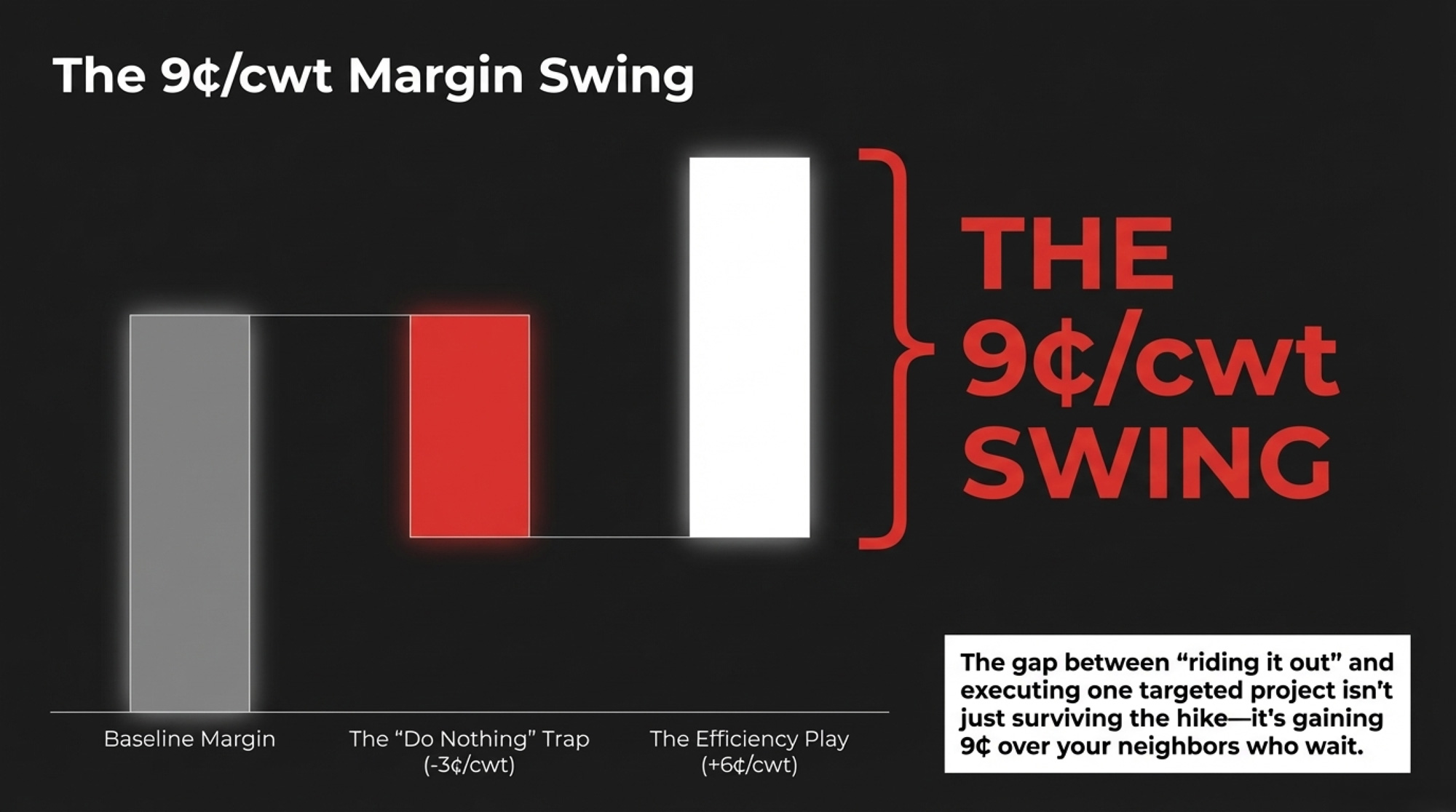
NewsSubscribe
First
Last
Consent

The $15,800 DMC Decision Every Dairy Needs to Make Before February 26

DMC averaged $74K per farm in 2023. In 2026, it got $15,800 better for 300-cow herds. Claim it by February 26—or miss it.

Executive Summary: DMC’s Tier 1 cap just jumped from 5 million to 6 million pounds. For a 300-cow dairy, that single change is worth roughly $15,800 in annual premium savings—money most producers will leave on the table because they’ll renew the way they always have. Before the February 26 deadline, you need to answer one question: Is Tier 2 coverage (about $70/cow, or $20,000/year) still survival insurance, or has your balance sheet improved enough since 2023 that it’s become expensive peace of mind? A quick runway test—available cash divided by monthly fixed costs—tells you where you stand. If you’ve rebuilt working capital and your operation is stronger than it was three years ago, your DMC strategy should reflect that. The $15,800 is there. The only question is whether you’ll claim it.

You know how it goes. You swing by the FSA office, renew your Dairy Margin Coverage more or less on autopilot, and get back to what actually matters—watching fresh cow performance, keeping an eye on butterfat levels, and making sure the transition period isn’t causing problems. In most years, that routine hasn’t hurt too badly.

This year’s different, though.

For the 2026 coverage year, FSA has bumped the Tier 1 coverage limit from 5 million pounds up to 6 million pounds. That’s straight from USDA’s official DMC program page, and they announced it at the Farm Bureau convention earlier this month. The expansion came through in the 2025 farm bill—the “One Big Beautiful Bill,” as it’s been called in the trade press—which also extended DMC through 2031.

Here’s what’s interesting about that change. The folks at Adams Brown, who spend their days running dairy financials, put out an article back in November showing what happens when you shift an extra million pounds from Tier 2 into Tier 1. For a lot of 250- to 350-cow herds, we’re talking premium savings solidly in the five-figure range.

So this year, doing “what we’ve always done” really is a decision. Not just a formality.

What Actually Changed in DMC for 2026?

Let me walk through this piece by piece, because the structure matters.

Starting in 2026, that first 6 million pounds of your production history qualifies for Tier 1 coverage. You can pick coverage levels from $4.00 up to $9.50 per hundredweight, in half-dollar increments. And here’s the part that makes Tier 1 so attractive—at the $9.50 level, you’re paying just $0.15 per cwt. That’s from UW-Madison’s DMC policy updates, and the 2026 DMC premium rates haven’t changed on the Tier 1 side from previous years.

Everything above 6 million falls into Tier 2. The coverage there tops out at $8.00 per cwt, and the premium at that level runs about $1.81 per cwt according to the same UW tables.

So any hundredweight you can move from Tier 2 down into Tier 1? You’re trading a $1.81 premium for a $0.15 premium. That’s roughly $1.66 per cwt difference.

Over a million pounds—10,000 cwt—that works out to around $16,600 in potential premium savings. Real money.

One more thing worth noting: FSA is also requiring all operations enrolling for 2026 to establish a new production history using the highest annual production from 2021, 2022, or 2023. That’s on FSA’s program page and confirmed in Adams Brown’s farm bill summary. If your herd has grown since you last updated, this could work in your favor.

Putting This in Cow Terms

It helps to anchor this in actual herds rather than abstract numbers.

The average U.S. milk production in 2023 came in at 24,117 pounds per cow, up about 30 pounds from 2022. Using that benchmark, 300 cows at average production gives you roughly 7.2 million pounds annually. That’s a pretty common profile in freestall operations across the Midwest and Northeast.

YearTier 1 (Lbs)Tier 1 Premium/cwtTier 2 (Lbs)Tier 2 Premium/cwt
20255.0M$0.152.2M$1.81
20266.0M$0.151.2M$1.81

Under the old DMC structure, that 300-cow herd had 5 million pounds in Tier 1 and 2.2 million in Tier 2. Under the 2026 rules, it’s 6 million in Tier 1 and only 1.2 million in Tier 2.

Run those volumes through current FSA premium rates at 95% coverage, and here’s what you get:

The old structure cost that herd roughly $45,000 a year in premiums—about $7,100 for Tier 1, nearly $38,000 for Tier 2. The new structure? Roughly $29,000—around $8,500 for Tier 1, about $20,700 for Tier 2.

MetricOld DMC (2025)New DMC (2026)
Tier 1 Cap5.0 Million Lbs6.0 Million Lbs
Tier 1 Premium ($9.50)$0.15 / cwt$0.15 / cwt
Tier 2 Premium ($8.00)$1.81 / cwt$1.81 / cwt
Annual Premium (300 Cows)~$45,000~$29,000
Net Savings$15,800

That’s approximately $15,800 in annual premium savings. Just because more milk now qualifies for the cheaper coverage tier.

Adams Brown’s worked examples hit the same ballpark when they model what happens as production shifts from Tier 2 to Tier 1. This isn’t a cosmetic tweak—it genuinely moves the needle.

Herd Size (Cows)Annual Production (Lbs)2025 Premiums2026 PremiumsSavings
2004.8M~$32,500~$20,800~$11,700
3007.2M~$45,000~$29,000~$16,000
4009.6M~$57,500~$37,000~$20,500
50012.0M~$70,000~$45,000~$25,000
60014.4M~$82,500~$53,000~$29,500

What 2023 Taught Us About DMC

You probably remember 2023 without needing much prompting. But it’s worth looking at what DMC actually did that year, because it shapes how a lot of us think about coverage now.

UW-Madison’s 2024 program review showed that DMC margins fell below the $9.50 coverage threshold in 11 out of 12 months during 2023. Several months landed in the mid-$4 to low-$5 per cwt range—some of the weakest margins we’d seen since the program started.

MonthAll Milk Margin ($/cwt)Tier 1 Payment @ $9.50 Coverage ($/cwt)
Jan$4.80$4.70
Feb$5.20$4.30
Mar$4.50$5.00
Apr$5.80$3.70
May$6.20$3.30
Jun$6.50$3.00
Jul$6.10$3.40
Aug$5.90$3.60
Sep$5.40$4.10
Oct$4.70$4.80
Nov$4.30$5.20
Dec$4.60$4.90

On the payment side, UW-Madison reported that total indemnity payments for 2023 topped $1.27 billion across about 17,059 enrolled operations. That worked out to an average of roughly $74,453 per farm, with about 74.5% of eligible dairies participating.

For producers at the $9.50 coverage level, monthly payments often exceeded $2 per cwt during the worst stretches. Dairy Herd Management described 2023 as a year when DMC was “in the money” almost continuously for herds with higher Tier 1 coverage.

When USDA first rolled out the DMC decision tool in 2019, it partnered with UW-Madison on its development. At the time, Mark Stephenson—then Director of Dairy Policy Analysis at UW—said DMC “offers very appealing options for all dairy farmers to reduce their net income risk due to volatility in milk or feed prices.”

That sounded promising then. 2023 showed what it looks like in real dollars.

So when producers say they’re not going through another margin crash without full coverage, that’s not paranoia. It’s memory. Those DMC payments kept operating loans current, and feed mills paid on a lot of farms.

What’s easy to miss, though—and this is where the 2026 DMC calculation gets interesting—is that many herds used the stronger margins of late 2023 and 2024 to rebuild. Working capital came back. Debt got paid down. Break-even costs dropped.

The Farm You Were vs. The Farm You Are Now

Here’s what I’ve noticed working through this with producers over the past few months.

Going into 2023, a lot of mid-size herds—the 250- to 350-cow operations—were carrying tight balance sheets. Farm-management reports and lender dashboards commonly showed working cash in the $50,000 to $100,000 range, debt service coverage ratios hovering around 1.1 to 1.25, debt-to-asset ratios in the mid-40% to low-50% band, and break-even milk prices pushing toward $19 or $20 per cwt in higher-cost regions.

University finance specialists had been flagging that profile as vulnerable for a while. Any combination of lower milk prices, poor forage quality, or spiking feed costs could push those farms into serious stress.

Fast forward to now, and the picture often looks different. The herds that stayed in business—especially those that collected DMC payments and caught the firmer milk prices of 2024—often rebuilt working capital into the $200,000 to $300,000 range or higher. Debt service coverage ratios improved into the 1.4 to 1.6 band. Debt-to-asset ratios drifted back toward the high 30s or low 40s. Break-even prices fell into the $17 to $18 range, with better forage and tighter overhead.

When you put the last few years of financials side by side, the “farm we were in 2022” and the “farm we are in 2025” can look quite different—even if your gut still feels like it’s living in 2023.

So, before you check those boxes at FSA, are you setting up DMC for the farm you were, or the farm you are now?

What Job Is Tier 2 Actually Doing?

This is where conversations tend to get interesting.

In my experience, Tier 2 ends up playing one of two roles. It’s either survival coverage or peace-of-mind coverage. Both are legitimate. The key is knowing which job it’s doing for you this year.

IndicatorTier 2 = Survival CoverageTier 2 = Peace-of-Mind Coverage
Working Capital (Days of Expenses)<60 days>120 days
Debt Service Coverage Ratio<1.25>1.40
Debt-to-Asset Ratio>50%<40%
Break-Even Milk Price>$19/cwt<$18/cwt
Tier 2 Annual Cost (300-cow herd)~$20,000–$21,000 (Critical)~$20,000–$21,000 (Discretionary)
DecisionMust Keep Tier 2Can Scale Back or Self-Insure

When Tier 2 is survival coverage

Tier 2 belongs in the “must-have” column when a farm is financially fragile. Extension finance programs and lenders typically flag farms with working capital covering less than 60 days of expenses, debt service coverage consistently below 1.25, debt-to-asset ratios above 50%, or break-even milk prices creeping toward $19 or higher.

As many of us have seen in Wisconsin freestalls and Western dry lot systems alike, it doesn’t take much to chew through limited cash when you’re that tight. A weather-damaged corn silage crop. Protein prices jumping. A dip in the milk check. On those farms, Tier 2 payments can literally be the difference between riding out a rough stretch and falling behind on bills you can’t afford to miss.

When Tier 2 becomes peace-of-mind coverage

On stronger farms, Tier 2 plays a different role.

When working capital covers 120 days or more of fixed costs, when debt service coverage holds comfortably above 1.4, when leverage sits under 40%, and when break-even prices have moved down into the $17 to $18 range—a farm can shoulder more of its own margin risk without immediately threatening survival.

In that situation, Tier 2 becomes more about smoothing income and reducing stress than about keeping the doors open. The protection is real, but the farm isn’t dependent on those checks to stay solvent.

What Tier 2 actually costs

Back to our 300-cow example. That extra 1.2 million pounds above the Tier 1 cap falls into Tier 2.

Using FSA’s premium table at $8.00 coverage and 95% coverage percentage, premiums on that Tier 2 slice run about $20,000 to $21,000 per year. Spread across the herd’s total production, you’re looking at roughly 28 to 29 cents per cwt, or about $70 per cow per year.

Some operations look at that $70 and say, “That’s a cheap price for peace of mind.” Others—particularly those with longer runway and stronger cash flow—start asking whether that money might work harder paying down principal, upgrading cow comfort, or buying targeted Dairy Revenue Protection for specific high-risk quarters.

A Kitchen-Table Runway Test

So how do you figure out where you actually stand without building a massive spreadsheet?

A lot of university educators and lenders have gravitated toward a simple runway test. It’s not perfect, but it’s surprisingly useful for getting your bearings.

  • Step one: Grab your most recent bank statement showing your operating account and any short-term savings. Pull your latest term-debt statement with the monthly principal and interest. Have a recent milk check handy.
  • Step two: Estimate your monthly fixed “burn.” Start with your total monthly term-debt payments, then add the costs that don’t disappear when margins drop—insurance, utilities, property taxes averaged over the year, core payroll for people you realistically can’t cut. Farm-business programs in Wisconsin, Minnesota, and New York commonly see 250- to 350-cow dairies with monthly burns in the $18,000 to $22,000 range, though it varies by region and setup.
  • Step three: Divide your available cash by that monthly burn.

That gives you your runway—the number of months you can keep essential bills paid if margins drop and stay ugly.

Extension risk-management materials generally talk about 3 to 6 months of working capital as a minimum target, with more than 6 months representing a strong buffer.

In practice:

  • Less than 3 months: Tier 2 is probably still survival coverage for your operation.
  • 3 to 6 months: Gray area—time for a careful conversation with your lender.
  • More than 6 months: There’s room to discuss self-insuring part of that Tier 2 risk.

What’s encouraging is that many Midwest operations running this exercise over the past year have been surprised to find their runway longer than they expected. Not everyone, but enough that it’s changed the tone of the Tier 2 conversation.

Months of RunwayFinancial StatusTier 2 Coverage Decision
<3 monthsTight. Vulnerable to margin shocks.KEEP TIER 2 — Survival coverage; margin failures = serious stress
3–6 monthsGray area. Stronger than tightest farms, not yet confident.CONSULT YOUR LENDER — Decision depends on debt structure & farm trajectory
>6 monthsStrong. Solid buffer.YOU HAVE OPTIONS — Can max Tier 1, skip/scale Tier 2, test self-insurance

How Bigger Herds Layer Their Risk Tools

For larger operations—500 cows, 1,000 cows, and up—the DMC discussion usually sits inside a broader risk-management framework.

UW-Madison’s 2025 DMC update explicitly notes that “DMC may be combined with DRP or LGM-Dairy to form a more comprehensive risk management framework.” And that’s exactly what we’re seeing in practice.

The pattern in a lot of Wisconsin freestalls and Western systems looks something like this: Use Tier 1 DMC at $9.50 for the first 5 to 6 million pounds as a base safety net. Add Dairy Revenue Protection on a portion of remaining production to lock in revenue floors for specific quarters, especially when futures markets and local basis look shaky. Use Livestock Gross Margin-Dairy selectively when feed cost risk is particularly high.

Risk Management Agency materials show that DRP adoption has been ramping up among larger herds since its 2018 launch. DMC serves as the first layer; DRP and LGM target more specific risks for volumes above Tier 1.

For bigger operations, Tier 2 is one option among several for covering extra production—and the decision about how much to buy sits alongside questions about DRP quarters and feed hedging.

The Six-Year Lock-In: Discount or Commitment?

Now let’s talk about the multi-year option, because it deserves a careful look.

The discount

Under the 2025 farm bill changes, producers can enroll in DMC for a six-year period—2026 through 2031—and receive a 25% discount on premiums throughout. That’s confirmed on FSA’s official program page and in Adams Brown’s farm-bill breakdown.

For our 300-cow example, where annual premiums under the new structure run about $29,000, a 25% discount brings that down to roughly $22,000 per year. That’s around $7,000 in annual savings, or more than $40,000 across six years.

The commitment

The catch—and it’s worth thinking through—is that multi-year enrollment isn’t designed as a “sign now, adjust freely later” arrangement.

USDA describes it as providing stability for both producers and the program. The detailed rules around mid-stream changes are best confirmed with your local FSA office, but the general idea is clear: you’re trading some future flexibility for a lower bill today.

Questions worth asking before you sign

If you’re considering the multi-year option, here are the conversations to have at FSA:

  • “If we expect to grow from 300 cows to 450 cows over the next six years, how does our coverage and premium obligation evolve?”
  • “If we sell, retire, or transfer the operation before 2031, what happens to the remaining years?”
  • “If our risk tolerance changes and we want to adjust Tier 2 coverage after a couple of years, what are our options?”

For stable herds with clear long-term plans, the multi-year discount can be a very good fit. For farms facing major transitions—expansion, succession, shifts in business model—staying year-to-year and letting coverage evolve with the operation might make more sense.

The main thing is asking these questions before you sign.

Why February 26 Should Be the Finish Line, Not the Starting Gun

According to FSA, the 2026 DMC enrollment deadline is February 26. Enrollment opened January 12.

What I’ve noticed is that the farms getting the most from DMC treat that deadline as the last day to finalize paperwork on a decision they’ve already worked through—not the day they first start asking what changed.

By mid-January, most dairies are already deep into year-end review. You’re looking at your 2025 income statement and balance sheet. You know how forage turned out. You’ve got a feel for where feed and milk markets might be headed. That’s exactly when DMC strategy belongs in the conversation.

FSA staff consistently say the strongest sign-up meetings happen early in the window, when producers arrive with their questions already answered. It’s the last-week crunch—when everyone’s buried and just trying to avoid missing the deadline—that leads to “just do what we did last year” decisions, even when the farm’s financial picture has shifted significantly.

What If You Cut Tier 2 and 2026 Turns Ugly?

This is the question that sits in the back of everyone’s mind. And honestly, it should.

If you look at your 2025 results, decide you’re strong enough to drop or scale back Tier 2, and then 2026 turns into another rough year, will there be mornings when you wish those Tier 2 checks were coming?

Of course. That’s the nature of insurance. Regret always shows up loudest after the fact.

So instead of asking whether you’ll regret it if the worst happens—because that answer is almost always yes—it’s more useful to ask:

  • Given our current runway, debt service coverage, leverage, and break-even, could we realistically survive another difficult margin year using Tier 1 DMC, our cash reserves, and existing credit without Tier 2?
  • How much margin risk are we truly comfortable carrying ourselves now, compared to what we could carry going into 2023?

For some farms, after putting the real numbers on the table with their lender, the answer is still: “We’re not quite there yet. Tier 2 is survival coverage for us.”

For others—especially those sitting on more than six months of runway and strong debt service coverage—the answer moves closer to: “We can shoulder more of this ourselves now, and those Tier 2 dollars might work harder somewhere else.”

A test-year approach for stronger herds

What’s emerging in some extension workshops is a “test-year” strategy. It goes like this:

  • Max out the expanded Tier 1: 6 million pounds at $9.50.
  • Skip Tier 2 for one coverage year.
  • Move the money you would have spent on Tier 2 premiums—around $20,000 in the 300-cow example—into a dedicated reserve account earmarked for margin shocks.

If 2026 turns rough, that reserve plus Tier 1 payments gives you a self-funded cushion. If 2026 is decent, you’ve effectively paid that premium to yourself and strengthened your working capital.

It won’t fit everyone, and it absolutely should be run past your lender first. But it shows how stronger balance sheets and a more generous Tier 1 structure are giving some farms more options, not fewer.

Your Action Plan Between Now and February 26

Let me bring this back to the kitchen table.

Tonight or this week:

  • Run your runway test. Grab your bank and loan statements and figure out how many months of fixed costs your current cash covers.
  • Pull your key ratios. Look at where your debt service coverage, leverage, and break-even landed for 2025.
  • Run scenarios with USDA’s DMC Decision Tool. It’s available on FSA’s website and was developed with UW-Madison specifically to help producers compare coverage options using their own production history.

Over the next week or two:

  • Decide what job Tier 2 is doing. Is it still survival coverage for your operation, or has it shifted into peace-of-mind territory you might resize?
  • Talk with your lender. Bring your runway number and ratios. Ask whether your current position can support self-insuring some risk.
  • Ask about multi-year enrollment at FSA. Get clear on what a six-year commitment would mean for your situation.

Before February 26:

  • Choose your 2026 structure intentionally. Decide your Tier 1 and Tier 2 levels, whether you’re going year-by-year or locking in for six years, and how that fits with any DRP strategy.
  • Walk into FSA with a plan. Use your appointment to execute a decision you’ve already made, based on good information.

The Bottom Line

DMC remains one of the most cost-effective safety nets under the U.S. milk check. But the opportunity in 2026 isn’t just to get enrolled.

It’s to enroll like the farm you’ve become—not the farm you were before 2023—and to line up your coverage with the cows you’re milking, the numbers on your books, and the level of risk you can genuinely live with now.

The 2026 DMC deadline is February 26. If you don’t run this math before then, the odds are high you’ll either overpay for coverage you don’t need, or underinsure a risk your balance sheet still can’t carry.

Neither is where any of us want to be. 

Key Takeaways:

  • $15,800 is hiding in your 2026 DMC renewal. The Tier 1 cap jumped from 5 million to 6 million pounds—shifting a million pounds from $1.81/cwt premiums down to $0.15 for 300-cow dairies.
  • Most producers will miss it. They’ll renew on autopilot without realizing the program changed. Don’t be most.
  • Tier 2 runs $70/cow. Is that survival coverage—or an expensive habit? If your balance sheet is stronger than it was in 2023, the answer has likely changed.
  • Run the runway test. Cash on hand ÷ monthly fixed costs. Under 3 months = Tier 2 is still essential. Over 6 months = you have real options.
  • February 26 deadline. The $15,800 is there. Claim it—or leave it on the table.

Complete references and supporting documentation are available upon request by contacting the editorial team at editor@thebullvine.com.

Learn More

The Sunday Read Dairy Professionals Don’t Skip.

Every week, thousands of producers, breeders, and industry insiders open Bullvine Weekly for genetics insights, market shifts, and profit strategies they won’t find anywhere else. One email. Five minutes. Smarter decisions all week.
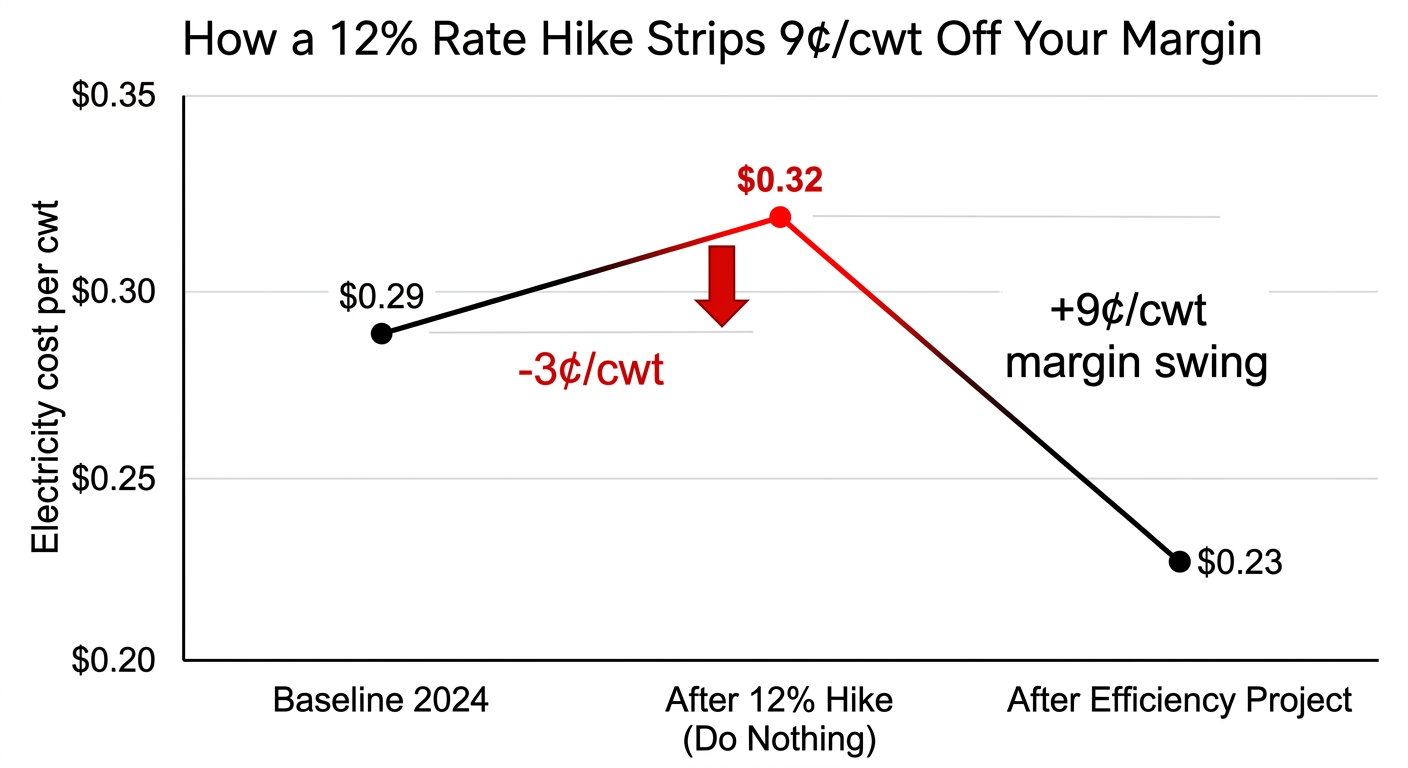
NewsSubscribe
First
Last
Consent

Same Milk, Different Payday: How Your Processor’s Product Mix Shapes Your Future

Two good herds. Same calving nights. Same butterfat goals. Five years later, one family had $400K more equity. The gap wasn’t created in the barn—their processor’s product mix created it.

Executive Summary: U.S. cheese and butter consumption hit all-time highs in 2023, and total dairy demand reached levels not seen since 1959—a real tailwind for the industry. But USDA projects more milk coming through 2026 with all-milk prices in the low-$20s: solid for some herds, uncomfortably close to breakeven for others. What’s increasingly separating those outcomes isn’t just fresh cow management or component focus; it’s where milk actually lands after it leaves the lane—pizza cheese and specialty yogurt versus commodity powder and private-label fluid. For a 400-cow herd, a steady $1/cwt pay-price difference adds up to roughly $400,000 in equity over four years. Inside, you’ll find six questions to ask your processor, three conversations to prioritize this year, and a framework for matching your channel position with your true cost of production. In this market, knowing where your milk goes may matter as much as anything happening inside your barn.

Let me start with a scene you probably know all too well.

Two 400-cow herds. Both kinds of barns are the kinds most of us would call “good.” Cows right around that 80-pound mark. Butterfat levels the field rep is happy with. Fresh cow management through the transition period is under control. No major train wrecks in the dry cow pen. Parlors are humming along well enough that nobody’s cursing the schedule over coffee.

Fast-forward four or five years. One of those farms has quietly added $300,000 to $400,000 in equity. The other is wondering why, after all the nights in the maternity pen and all the feed tweaks, the balance sheet isn’t where they hoped it’d be.

The difference often isn’t robots versus parlors, or sand versus mattresses, or who’s running what ration software. What I keep seeing, in conversations with producers and in the numbers themselves, is that it comes down to a question we didn’t really ask much fifteen years ago:

Where does your milk actually go when it leaves the lane—and what is that processor doing with it?

Looking at the latest data and at where processors are spending their capital, that “where” might matter just as much as anything you’re doing inside your fences.

Strong Demand, Tight Prices: The Current Picture

Let’s start with demand, because honestly, that part of the story is more encouraging than you’d think, listening to some outside commentators.

USDA’s Economic Research Service tracks how much dairy Americans eat each year on a milk-equivalent, milkfat basis. For 2023, they put per-capita dairy consumption at 661 pounds—7 pounds higher than 2022. Analysis of that dataset noted that 661 pounds ties the highest mark in the modern series and is the best level since 1959, when Americans consumed about 672 pounds on the same milkfat basis. The International Dairy Foods Association picked up on that too, using it to remind people that total U.S. dairy demand is anything but dead.

You know all the talk about cheese? The data backs it up. Using those same ERS tables, analysis shows 2023 per-capita cheese consumption at about 40.2 pounds, up from 39.9 pounds the year before and a new record. Grouping some cheeses more broadly, lands around 42.3 pounds per person. The precise number depends on how you slice the categories, but the trend line doesn’t change: Americans have never eaten more cheese than they do right now.

Butter’s right there with it. ERS data summarized by IDFA shows per-capita butter consumption at 6.5 pounds in 2023, the highest since the mid-1960s. Given where butter sat in the low-fat decades, that’s a meaningful swing back in our direction.

And if you zoom in further, some “old-made-new” products really jump out. Working off Circana retail data for the 52 weeks ending December 1, 2024, notes that paneer sales were up roughly a third, burrata climbed just over 30 percent, and queso quesadilla gained more than 20 percent. On top of that, ERS numbers show cottage cheese climbing from 1.9 to 2.1 pounds per person in 2023—an 11-plus percent increase. If you’ve walked a grocery dairy aisle recently, you’ve probably seen the explosion in cottage cheese brands, flavors, and single-serve packs yourself.

Fluid milk is the outlier. ERS figures show fluid milk consumption dropping to about 128 pounds per person in 2023, down from 130 the year before and well below the mid-1970s peak of around 247 pounds per person. Many Midwest and Northeast producers don’t need a chart to see that decline; they’ve watched the fluid case shrink for decades.

So, stepping back, the demand picture looks like this:

  • Overall dairy consumption is at or near record levels.
  • Cheese and butter are at all-time highs.
  • High-protein products like cottage cheese are clearly gaining ground.
  • Fluid beverage milk continues a very long, slow slide.

Now, if that were the whole story, we’d all be breathing easier. But you know it’s not.

USDA’s Livestock, Dairy, and Poultry outlooks for 2025 and 2026, summarized by Brownfield and Farm Progress, have had a consistent theme: more cows and more milk per cow. In mid-2025, Brownfield reported that USDA had bumped its 2026 milk production forecast up to about 231.3 billion pounds, nearly a billion pounds higher than the previous month’s estimate, based on herd expansion and productivity.

On price, USDA’s all-milk projections have shifted around as those production and demand expectations change. One widely cited outlook cut the 2026 all-milk price projection down to about $20.40 per hundredweight, roughly $1.50 lower than the prior version. Later in 2025, Brownfield covered another update where USDA raised that same 2026 all-milk projection to around $21.65 on improved demand assumptions. When you line up those various WASDE and LDP reports, you get a 2026 range that generally sits in the high teens to low twenties per hundredweight.

Putting it together:

  • Demand is strong, especially for cheese, butter, and some high-protein products.
  • USDA expects more milk on the market in 2025 and 2026.
  • Price projections are workable for some herds but will feel uncomfortably tight for others, especially after debt service and family living.

That combination is exactly why it’s worth asking not just “How well are we farming?” but “Where does our milk actually land in the chain?”

Same Pound, Different Payback

You know this in your gut already: not every pound pays the same.

Let’s walk through two different paths for a pound of cheese.

In the first path, your milk goes into mozzarella and blends for pizza chains and other foodservice accounts. The flow looks something like this: milk leaves your bulk tank and heads to the cheese plant, the plant turns it into blocks or shreds that move to a foodservice distributor or straight into a chain’s distribution network, and those shreds end up on pizzas where “extra cheese” is part of the selling point. Margins still get taken along the way, but the chain is relatively short, and the cheese is directly tied to perceived menu value.

In the second path, that same pound of cheese ends up as a private-label shredded bag or as part of a budget frozen entrée. Milk goes to the processor, cheese is shipped to another facility that turns it into frozen meals or snack items, and those products move through a retailer’s warehouse network and onto the shelf as house brands or value-tier items. More hands in the pot. More processing steps. More packaging. More trucks and cold storage.

Industry discussions in Dairy Global and processor profiles in Dairy Foods make a few things pretty clear:

  • When people cook at home, they generally don’t use as much cheese per serving as restaurants do. A pizza chain wants the cheese to be obvious in every bite; a family looking at a $6 bag of shredded cheese is often trying to make it stretch across several meals.
  • Every extra step after cheese leaves the vat—shredding, blending, bagging, freezing, plus added warehousing and retailer handling—adds cost. Those costs eat into the share of the final dollar that can flow back toward the raw milk.
  • Private-label fluid, commodity cheese, and butter have grown their share in many retail categories. Large retailers use their bargaining power to hold prices down, squeezing processor margins and limiting how much they can raise prices to farms without hurting themselves.

So that “pound of cheese” in USDA’s per-capita numbers might be part of a high-value pizza program, a premium specialty cheese, or a low-priced frozen meal. The consumption statistic looks the same. The payback back to your lane doesn’t.

When you put some numbers on it, the scale of that difference is hard to ignore. Take a 400-cow Holstein herd averaging around 80 pounds. That’s roughly 32,000 pounds a day—about 320 hundredweight. Over a year, you’re in the ballpark of 110,000 to 120,000 hundredweight. Data suggest that’s a realistic production level for many herds of that size. If your farm is shipping that much over four years, a consistent $1-per-hundredweight difference in pay price adds up to around $400,000 to $480,000 in gross milk revenue.

That’s the sort of gap that doesn’t just make the milk check look nicer—it shows up plain as day when you sit down with your banker and look at your equity.

MetricPizza Cheese & Specialty (Growth Channel)Powder & Commodity (Flat/Decline Channel)
Typical Product FocusMozzarella, specialty cheese, pizza chains, yogurt, high-protein beveragesSkim milk powder, bulk butter, private-label fluid, commodity cheddar
Annual Milk Volume (400-cow herd)~120,000 cwt~120,000 cwt
Base All-Milk Price (2026 USDA proj.)$21.50/cwt$20.50/cwt
Average Pay Price Premium+$1.00/cwt–$0 (baseline)
Annual Revenue Difference per Farm+$120,000
Processor Capital Investments (5-yr outlook)Adding vats, new packaging lines, export infrastructureMaintenance mode, modest efficiency upgrades
Product Demand Trend↑ Growing (cheese +record, yogurt +specialty)↓ Declining (powder commodity-driven, fluid secular decline)
Component Reward (Butterfat/Protein)Strong premium for high solidsMinimal differentiation on components
Margin for Production ErrorModerate to comfortableThin to uncomfortable
4-Year Cumulative Equity Impact+$520,000+$415,000

Why Processors Want “Predictable” Milk

Now, let’s do something we don’t always like doing and think like a plant manager for a minute.

Retailers and restaurant chains have spent years sharpening their forecasting. There’s a lot of software and analytics behind using multi-year sales history, seasons, promotions, and so on to predict how much they’ll sell each week. That “no surprises” mindset is pretty standard now.

In conversations with co-op folks and plant managers, and in reading between the lines in trade interviews, that thinking has crept upstream into how processors view farms.

Nobody at USDA hands them a template that says, “score your suppliers like this.” But if you listen to supply-chain managers quoted in places like Dairy Foods and Feedstuffs, you hear similar patterns:

  • They look at several years of volume history for each farm, not just last month’s ticket.
  • They watch butterfat and protein trends across seasons, so they know who’s steady and who’s up-and-down.
  • They track somatic cell and bacteria counts over time, looking at how often and how badly they spike.
  • They pay attention to how wildly loads swing when the weather is ugly or when feed quality changes.

In Wisconsin operations, in New York and Ontario freestalls, and out in California and Idaho dry lot systems tied into big plants, managers will quietly say they’d rather rely heavily on a smaller group of steady suppliers than juggle a large pool that’s always throwing them surprises.

From your side of the lane, that quietly raises the value of a few things:

  • Somatic cell counts that live in a narrow, low band instead of bouncing around.
  • Butterfat and protein that hold reasonably steady across seasons thanks to balanced rations and good fresh cow management.
  • Shipments that don’t yo-yo week to week, even when heat, mud, cold, or smoke are testing your team.

In component-based pay systems—which cover most of the U.S. and Canada—those traits can be worth even more. Plants making cheese and butter are fundamentally buying butterfat and protein. Those component pounds are exactly what generate premiums when markets are strong. Strong butterfat performance and solid protein don’t just help your check; they matter even more when your milk is going into cheese and butter plants that can turn those solids into high-value products, as opposed to fluid or powder plants where there’s less reward for components.

If you’re already strong on quality, components, and steady volume, that’s encouraging. You look like the kind of supplier plants are trying to keep and grow with.

Health Trends and High-Protein Dairy

Now let’s step briefly into something that sounds more like a doctor’s office than a dairy meeting, but it’s already shaping the dairy case: health trends, weight-loss medications, and “better-for-you” products.

There’s been a lot of buzz about GLP-1 drugs and weight management. Most of the detailed projections of how many people will use them come from medical journals and financial analysts, not from dairy economists. But there’s a clear theme in the nutrition advice around them: people taking these meds often eat fewer calories overall, and dietitians encourage them to keep their protein intake up and focus more on nutrient-dense foods.

You know where that points are.

Industry sources have noted that high-protein dairy is one of the hottest growth areas: Greek and skyr-style yogurts, high-protein spoonable and drinkable yogurts, performance-oriented dairy beverages, cottage cheese, and protein-enriched milks. When they look at scanner data, those products generally show stronger growth than a lot of traditional low-protein dairy desserts.

Cottage cheese is the poster child right now. ERS data show per-capita cottage cheese rising from 1.9 to 2.1 pounds in 2023, and analysis calls out cottage as one of the fastest-growing segments. The nutrition messaging and the dairy case are actually pulling in the same direction for once.

So nobody can honestly say, “GLP-1 will add exactly X pounds of extra dairy demand.” But the broader trend—less empty calories, more protein—is pulling in the same direction as high-protein dairy. If your milk is going into plants that specialize in those kinds of products, you’re plugged into one of the segments where nutrition advice and consumer behavior are aligning with what dairy offers.

What Farmers Are Finding Out

Most producers can rattle off their rolling herd average, butterfat levels, pregnancy rate, and cull percentage without even thinking. But if you ask, “What portion of your milk ends up as pizza cheese, specialty cheese, butter, powder, or fluid gallons?”, the answers often get a lot less precise.

In eastern Wisconsin, for example, a producer shared at a meeting that he’d long assumed most of his milk went into mozzarella and cheddar for foodservice. That was the story in his head. When he sat down with his co-op field rep and walked through their actual product and channel mix, he realized a bigger share than he’d thought was showing up as private-label fluid and commodity butter. His cows hadn’t changed. His ration hadn’t changed. But his understanding of where his milk really sat in the value chain changed overnight.

In the Northeast, a New York producer told a story almost the opposite of that. He moved from a co-op that leaned heavily on fluid and commodity American-style cheese into a plant specializing in mozzarella and Hispanic cheeses with strong export ties. Over several years, as that plant added cheese capacity and grew export business—and as he pushed harder on components and quality—he saw his average pay price improve in a meaningful way. That’s consistent with data showing Mexico alone buying roughly 392 million pounds of U.S. cheese in a recent year, accounting for about 38 percent of total U.S. cheese exports, with other Latin American and some Asian markets also growing. When your plant is tied to that kind of demand, the conversation changes.

Out West, many dry lot systems in California and Idaho, shipping primarily to powder plants, tell a different story. Their processors are heavily tied to skim milk powder and bulk butter. USDA outlooks and export analyses keep reminding us that these are critical products but are heavily commodity-driven and more volatile, with generally thinner margins than many cheese and value-added categories. For those herds, the biggest constraint often isn’t how well they manage the transition period or reproduction—it’s that their milk is structurally tied to products whose prices are set on a very competitive global market.

In Canada, supply management and quota changes alter some dynamics, but the channel question still bites. If your milk is locked into a processor focused on fluid or basic butter, and your hauling radius or quota setup limits your ability to move, your channel options can be even narrower than what some U.S. neighbors face.

Six Questions That Make the Picture Clearer

The nice thing is, you don’t need a consultant’s binder to start. A notebook and a bit of courage to ask direct questions go a long way.

Here are six questions that, in many cases, have really shifted how producers see their situation:

  1. “Broadly speaking, where does our milk go by channel?” Ask for rough percentages. How much of their total volume goes into foodservice, how much into retail, how much into ingredient sales, and how much into export? They already track this when they talk to the USDA and big customers. You’re just asking them to translate it into farmer terms.
  2. “What are the main products our milk becomes?” Try to get past “cheese and butter.” Is your milk mainly feeding fluid gallons, private-label cheddar and slices, process cheese, butter and powder, pizza cheese, yogurt, specialty cheeses? Your processor knows which buckets your milk is filling.
  3. “Over the last three to five years, have those product lines grown, stayed flat, or shrunk for you?” You’re listening for things like: “We’ve added vats for pizza cheese,” “specialty cheese and yogurt are where our growth is,” or “our branded fluid has been under real pressure.” That tells you whether your milk is riding an up-escalator, standing on level ground, or being pulled down.
  4. “Where are you investing for the next five to ten years?” The trade press has covered billions of dollars in investments in new cheese plants, dryers for higher-end powders, yogurt lines, and export packaging. Ask where your buyer is putting its own capital. Are they adding vats, building new lines, upgrading for exports, or mostly just patching roofs?
  5. “How is your customer base changing?” Are they picking up quick-service restaurant accounts, export cheese contracts, and health-focused retail customers—segments industry analysts call growth areas—or are they mostly trying to hold onto private-label fluid and butter slots in the face of aggressive pricing?
  6. “Based on quality and consistency, where would you place our farm in your supplier group?” Are you in their top third, the middle of the pack, or on the bottom rung? Many co-ops and plants maintain internal rankings based on multi-year quality, component, and volume data, even if they don’t share them with you. It’s nearly impossible to improve your position if you don’t know where you’re starting from.

What to Bring to Those Meetings

Before you sit down with your processor, your accountant, or your lender, it helps to have your own homework done. A few things to pull together:

  • Last 3 years of monthly pay prices and component tests. This shows your trends and lets you compare against co-op or regional averages.
  • Last 12 months of SCC and quality records. Plants are looking at your consistency, not just your best month.
  • A simple cost-of-production summary with your breakeven per cwt. If you don’t know this number, your accountant or extension office can help you get there.
  • Any recent processor or co-op letters outlining product/market changes. These often signal where they’re headed before they announce it publicly.

Having this in hand turns a vague conversation into a focused one.

Matching the Map With Your Own Numbers

Most dairy business consultants and land-grant economists will tell you that you really should know, at a minimum:

  • Your operating margin per hundredweight—milk income minus cash operating costs, divided by hundredweight shipped.
  • Your debt-to-asset ratio—total liabilities compared to the fair-market value of your assets.
  • Your interest coverage—operating margin divided by annual interest expense.
  • Your breakeven milk price, including family living—total costs (feed, labor, repairs, interest, depreciation) plus a realistic family draw, divided by hundredweight.

Recent dairy budgets and case-farm studies from universities like Wisconsin, Penn State, and Michigan State often show full-cost breakevens for 300- to 800-cow herds in the upper teens to low $20s per hundredweight under 2023–2025 feed, labor, and interest conditions. National statistics put many real herds in that same neighborhood once family living gets factored in.

On the revenue side, USDA’s 2025 and 2026 all-milk forecasts, as summarized LDP reports, suggest national all-milk prices in the low-$20s in 2025 and somewhere in the high-teens to low-$20s in 2026, depending on how production, exports, and domestic use unfold.

So here’s a practical rule of thumb a lot of advisors use—not as gospel, but as a conversation starter:

  • If your true breakeven, including family living, is at least about $2 per hundredweight below where USDA expects all-milk prices to land, and your processor is tying your milk into growing, value-added channels like cheese, butter, yogurt, and high-protein products, then you’ve got room to talk about modest expansion or targeted upgrades.
  • If your breakeven is within roughly $1 per hundredweight of those projected prices, and a big chunk of your milk is tied to low-margin, commodity-driven channels like powder and basic fluid, then your margin for error is thin, and your structural risk is high.

To put some flesh on that: a herd with a full-cost breakeven of $18/cwt, shipping into a plant that’s investing in mozzarella vats and pizza cheese programs and operating in a $21 all-milk environment, has cushion and options. A herd with a $20/cwt breakeven in a region where most of its milk goes to a powder plant and the all-milk price is expected to hover around $21, with global skim and butter driving things, is in a very different spot.

For herds in that second situation, tools like Dairy Revenue Protection or simple forward contracts can help keep that cushion intact—something worth discussing with your risk management advisor alongside your channel strategy.

Different Farms, Different Realities

One thing that comes through pretty clearly, both in the numbers and in conversations at the diner, is that not every dairy has the same realistic menu of options.

Farms Already Hooked to Growth Channels

Some of you are in a structurally favorable position.

In Wisconsin operations and across parts of the Upper Midwest, that often means shipping to a plant where the core business is mozzarella and other cheeses for domestic chains and export markets. Industry data shows that Mexico alone often buys close to 40 percent of U.S. cheese exports in a given year, with other Latin American and some Asian markets also growing. That kind of cheese demand helps underwrite those plants’ investments and their appetite for milk.

In the Northeast, it might be a specialty cheese plant or a yogurt plant with strong branded products and foodservice clients. On the West Coast, maybe it’s a facility focused on high-protein dairy beverages or value-added performance nutrition powders.

If your processor is talking about adding vats, installing new lines for drinkable yogurt, signing export cheese contracts, or launching functional dairy products—and they’re telling you they want more of your milk—that’s a good sign you’re tied to channels with built-in growth.

For farms in this situation, the questions usually sound like: How do we make sure we stay in their “must-keep” supplier group by being rock-solid on quality, components, and volume? Given our breakeven and USDA’s price outlook, does a careful move from 400 to 550 cows actually improve our resilience, or does it just stretch our labor and capital too thin? Are there specific investments—cooling, feed storage, data systems—that would make our milk more valuable to this particular plant?

Farms in the Middle

Then there’s a big group of herds—across the Northeast, Michigan, and many central U.S. regions—where the answer is more like, “It depends.”

They might ship mainly to a co-op that leans hard on private-label fluid and commodity butter, have a second potential buyer that focuses on cheddar and whey for domestic retail and ingredient markets, or sit within hauling distance of a specialty cheese, organic, or yogurt plant that’s open to new suppliers under certain conditions.

For these farms, you tend to see a mix of strategies. Some do change processors when the math and channel mix make sense—hauling costs, contract terms, and the new plant’s focus all have to stack up. Others seriously consider organic, grass-fed, or other identity-preserved paths, but only where there’s a credible buyer and where the land base and finances can support the costs and risks those systems bring. Quite a few stick with their main co-op but work hard to climb into the top tier of their quality and component grids and tap into any higher-value pools or programs they can.

There isn’t a one-size-fits-all answer here. The right move depends heavily on where you are, what your numbers look like, and what your family wants the operation to be ten years from now.

Farms That Are Structurally Boxed In

And then there are herds—often in more remote High Plains areas, some western dry lot regions, or parts of Canada where quota and hauling really limit options—where the structure of the local processing base makes the decision tree much narrower.

That usually looks like one realistic plant within economical hauling distance, focused on commodities like powder, bulk butter, or low-margin fluid, with no serious plans for new dairy processing capacity in the area.

Even very well-run herds can find their futures heavily constrained by the economics of that one plant. USDA outlooks and export analysis don’t mince words: skim milk powder and bulk butter are crucial to balancing the market, but global commodity prices heavily influence them and tend to be more volatile and lower-margin than many cheeses and value-added channels.

Families in those spots end up asking some hard questions: Do we spend the next several years focusing on harvesting as much income as we can, paying down debt, and maintaining our facilities, rather than betting big on expansion? Is it time to start talking seriously about succession, sale, leasing, or other exit options while we still have enough equity and time to choose our path? Would relocating to a stronger dairy region or diversifying into other enterprises make more sense than relying solely on a constrained local dairy market?

They’re not easy conversations, but they’re a lot easier while the farm is still in a strong enough position to make choices rather than having choices made for it.

Three Conversations Worth Having This Year

So if we boil it all down to “What do we do with this?”, there are three conversations worth putting on the calendar.

A Real Sit-Down With Your Processor or Co-op

Take those six questions and ask for some uninterrupted time. You’re trying to understand where your milk actually fits in their product and channel mix, and whether they see your farm as part of their long-term growth story or as volume they can dial up or down.

If they can’t—or won’t—give you a rough breakdown of where your milk goes and what it becomes, that alone tells you something about the relationship.

A Numbers-Focused Session With Your Accountant or Business Advisor

Ask them to help you put your true breakeven milk price, including family living, down in black and white. Look at how your equity has moved over the last three to five years. Line your numbers up next to the USDA’s price forecasts and regional cost-of-production benchmarks.

Most advisors and lenders have experience with the major land-grant tools and statistics and can translate them into what they mean for your particular herd, debt load, and capital plan. If you don’t know your breakeven, this is the year to fix that.

A Candid Conversation With Your Lender

Whether that’s Farm Credit, a regional ag bank, or your local lender, they see patterns across lots of dairies and processors. It’s worth asking how they view your processor’s financial strength and long-term outlook, what they’d need to see from you—on cash flow, equity, and channel position—to be comfortable supporting a modest expansion or a significant capital project, and what a planned, orderly scale-down or exit might look like for your operation if that ever seems like the right path.

Doing nothing is a decision too. The risk is leaving it so long that the market, the plant, or the bank ends up making the decision for you.

The Bottom Line

The data tells us Americans are eating more dairy than they have in decades—especially cheese and butter—and that high-protein products like Greek yogurt and cottage cheese are gaining real traction. USDA is signaling more milk in 2025 and 2026, and all-milk prices in a range where some operations will be comfortable, while others will be uncomfortably close to breakeven.

Where your milk goes really does matter. A pound going into pizza cheese, specialty cheese, or high-protein yogurt in a growing plant is not the same as a pound going into low-margin fluid or powder in a plant that’s heavily exposed to commodity swings.

Consistency is getting more valuable. As plants lean on data and forecasting, they favor farms that deliver steady milk quality, components, and volume. Strong butterfat and protein have much more earning power in cheese and butter plants than they do when your milk ends up in products that don’t reward solids as much.

Different farms need different strategies. The best move for a 600-cow freestall twenty minutes from a mozzarella plant in Wisconsin isn’t going to be the best move for a 600-cow dry lot tied to a powder plant in a remote region.

You still control what happens inside your fences: cow comfort, fresh cow care, feed efficiency, repro, and people. That’s the foundation.

What this moment adds is one more layer we can’t afford to ignore: Do you really know where your milk goes, whether those channels are growing or shrinking, and whether you’re tied to the right processor for the next decade?

If you know your channels and you know your breakeven, you’re in a much better spot to choose your path—expansion, steady state, pivot, or exit—before the market chooses it for you.

Key Takeaways:

  • Cheese and butter demand hit record highs in 2023, but USDA projects more milk through 2026 with all-milk prices in the low-$20s—the margin for error is shrinking
  • What your processor does with your milk—pizza cheese or powder, specialty yogurt or private-label fluid—shapes your pay price as much as your butterfat or SCC
  • A steady $1/cwt pay-price difference adds up to roughly $400,000 in equity over four years for a 400-cow herd—real money captured or left on the table
  • Ask your processor directly: What products does my milk become? Are those channels growing or shrinking? Where does my farm rank among your suppliers?
  • Know your breakeven, understand your channel exposure, and have candid conversations with your co-op, advisor, and lender—before the market makes decisions for you 

Learn More

83% of Dairies Overtreat Mastitis – That’s $6,500/Year Walking Out the Door

Michigan State researchers found treatment costs varying threefold across similar operations. The difference wasn’t the antibiotics. It was the decisions.

EXECUTIVE SUMMARY: With Class III averaging $17-18 and margins under pressure, there’s $30,000-50,000 per year hiding in your mastitis protocols—and Michigan State research shows exactly where to find it. Dr. Pamela Ruegg’s team tracked 37 commercial dairies and found treatment costs varying threefold ($120 to $330 per case) for identical infections, with the gap driven entirely by decisions, not antibiotics. The core issue: 83% of producers treat longer than label minimum, adding $65/day in unnecessary milk discard because we treat until milk looks normal—even though bacterial cure precedes visual cure by 24-48 hours. On-farm culture cuts antibiotic use in half while maintaining outcomes, with typical payback under 90 days. The hardest part isn’t the protocol change; it’s trusting the science when you’re staring at off-looking milk on day three. But the economics don’t lie—and in today’s market, leaving $30K on the table isn’t something most operations can afford.

mastitis treatment costs

You know, when Dr. Pamela Ruegg’s team at Michigan State University started digging into mastitis economics across 37 commercial dairies—operations averaging around 1,300 cows each—they found something that really made me sit up and take notice. Out-of-pocket treatment costs for cases that were essentially identical ranged from $120 to $330 per farm. Same antibiotics. Same case severity. Nearly three times the cost difference.

That finding deserves some thought because it points to something a lot of us have probably sensed over the years but rarely put numbers to. We’ve accepted for a long time that mastitis runs about $250 per case and somewhere around $2 billion annually across U.S. operations—figures the National Mastitis Council has been citing for years now. Those numbers get repeated so often they’ve almost become white noise at conferences and in the trade publications. But here’s what the Michigan State work actually shows: those averages hide enormous variation in real-world outcomes. Some operations are spending well under $250 per case while getting solid results. Others are spending considerably more and still can’t seem to get ahead of their udder health challenges.

The difference, as Dr. Ruegg’s research suggests, comes down to decisions we can control: treatment duration, pathogen identification, prevention investment, and culling calculations. None of this requires fancy new technology or major capital investment. It does require taking a fresh look at some practices we might not have questioned in a while. And with 2024-25 margins under pressure—Class III averaging in the $17-18 range, feed costs still elevated—the buffer that used to absorb inefficiency just isn’t there anymore.

The Math Most of Us Have Been Using—And What the Research Actually Shows

Here’s where things get interesting. The way most of us have been calculating mastitis costs doesn’t capture what’s actually happening economically. Take a look at how traditional thinking stacks up against what the research reveals:

FactorTraditional MathThe Real MathAnnual Impact (500-cow herd)
Treatment DurationTreat until milk looks normal (5+ days)Label minimum often sufficient (2-3 days)$6,500+ in unnecessary discard
Days in Milk ImpactAll cases cost ~$250Early lactation: $444; Late lactation: ~$120Varies 3-4x based on timing
Subclinical Loss“Not a problem if the bulk tank is fine.”Accounts for 48% of total mastitis costs$33,000+ in hidden losses
Culling DecisionsHeifer cost minus cull valueFuture profit potential over the planning horizonCulling = 48% of clinical mastitis costs

Sources: Michigan State University (Ruegg, 2021); Canadian Bovine Mastitis Research Network (Aghamohammadi et al., 2018)

Understanding Where Cost Variability Comes From

Dr. Ruegg’s work at Michigan State, published in the Journal of Dairy Science back in 2021, breaks down exactly where this variation originates—and honestly, the findings offer some pretty clear direction for anyone willing to act on them.

Subclinical mastitis and culling decisions (shown in red) account for 96% of total mastitis costs—yet most operations only track clinical treatment and discarded milk 

Timing matters more than most of us probably realize. A case hitting a cow in her first 30 days fresh averages around $444 in total impact because that production hit follows her through the entire lactation. That same infection at 200 days in milk? You’re looking at something closer to $120, simply because there’s less lactation left to affect. Makes sense when you think about it, but how often do we actually factor timing into our treatment intensity decisions? In my experience, not often enough.

A mastitis case in the first 30 days costs $444 vs. $120 in late lactation—yet most operations apply identical treatment intensity regardless of timing

What’s causing the infection matters quite a bit, too. Your gram-negative cases—E. coliKlebsiella—tend toward more dramatic presentation but often resolve without intervention. Meanwhile, gram-positive infections generally respond well to appropriate treatment but won’t clear up on their own. The research consistently shows that gram-negative infections incur higher total costs due to their severity, even though many will self-cure if given time.

And then there’s treatment duration. This is where the Michigan State findings become immediately useful. Their data showed that each additional treatment day beyond label minimum costs approximately $65 in discarded milk and extended withdrawal. Think about what that actually means on your operation: an 80-pound cow at $18 per hundredweight generates $14.40 in daily milk value. Extend treatment for three days beyond what’s actually necessary? That’s $43 in direct milk loss right there, plus your antibiotic costs, plus labor time. It adds up faster than most of us realize.

The Hidden Economics Most of Us Miss

What I’ve come to appreciate over years of following this research—and talking with producers who’ve really dug into their numbers—is that our standard accounting does a surprisingly poor job capturing actual mastitis costs. We track what shows up on invoices. We miss what accumulates quietly in the background.

A study published in Frontiers in Veterinary Science back in 2018 really quantified this gap in a way that hit home for a lot of folks I’ve discussed it with. Researchers from the University of Montreal and the Canadian Bovine Mastitis Research Network tracked 145 commercial operations and calculated total mastitis costs at CAD $662 per cow annually across the herd. Now, that’s not per case—that’s per cow in the milking string, whether she had clinical mastitis or not. And here’s the kicker: subclinical mastitis accounted for nearly half of those costs, with milk yield reduction being the biggest hidden driver.

Think about what typically shows up on your books: antibiotic purchases, discarded milk during withdrawal, vet visits for the severe cases, and labor during treatment. Now think about what usually doesn’t show up anywhere: the production drop that persists after an early-lactation infection clears, the extra days open that subclinically infected cows tend to accumulate, the culling decisions made without complete economic analysis, the bulk tank SCC that hovers just under penalty thresholds but quietly costs you quality premiums month after month.

I’m not pointing fingers here—the economic feedback most operations receive is simply incomplete. But that incomplete picture can lead us to underinvest in prevention and make treatment decisions that don’t really optimize for what matters most to the bottom line.

Reconsidering How Long We Treat

This is where the research translates most directly into money you can actually keep.

That same Canadian study found something really interesting about how producers actually handle treatment. Among farmers using a single protocol for mild or moderate cases, 83% were treating for longer than the labeled regimen—averaging about two extra days beyond the protocol’s duration. Only 17% were following the label duration exactly. If you think about your own habits or watch what happens in your parlor, those numbers probably ring true.

And look, the tendency to keep treating when milk still looks abnormal makes complete sense. You’re looking at clumpy milk on day three, and every instinct you’ve developed over years of working with cows tells you “she’s not better yet.” That’s a reasonable instinct. I get it.

But here’s what the biology actually shows, and this is worth really understanding: clinical cure—milk appearance returning to normal—lags biological cure by 24-48 hours. The bacteria can be cleared while the inflammation is still resolving. The udder is healing, even though the milk still doesn’t look quite right. Treating through visual normalization often means you’re medicating a cow whose infection has already resolved. As Dr. Ruegg puts it, the abnormal milk appearance is due to inflammation, and it’s not predictive of whether bacteria are still present.

Research from California, published in the Journal of Dairy Science, tracked non-severe gram-negative cases across different treatment protocols and found that a 2-day treatment achieved equivalent clinical outcomes to a 5-day treatment—at meaningfully lower cost. For operations running a typical mastitis incidence, those savings compound pretty quickly over a year.

I talked with a Wisconsin herd manager not long ago who shared his experience implementing shorter protocols: “First month was brutal,” he told me. “My lead milker was absolutely convinced I was going to kill cows by stopping treatment at two days. Milk still looked off in a couple of them. I had to stand between him and the treatment box physically. Three days later? Milk was normal. He’s a believer now, but we had to get through that crisis of faith first.”

83% of producers extend treatment beyond label minimum, adding $65 per day in unnecessary milk discard—even though bacterial cure precedes visual cure by 24-48 hours 

That psychological barrier—trusting the biology over what your eyes are telling you—seems to be the hardest part of making this change. The research supports shorter treatment for non-severe cases. The economics favor it clearly. But in the moment, standing in front of a cow showing abnormal milk… it takes real discipline to trust the science over your instincts.

Why Some Infections Just Won’t Clear—The Biology Most of Us Never Learned

Here’s something that wasn’t in the textbooks when most of us were coming up: bacteria talk to each other. And that communication—scientists call it quorum sensing—might explain why that chronic mastitis case keeps coming back no matter what you throw at it.

The basic concept is this: bacteria aren’t just mindless individual cells floating around waiting to be killed by antibiotics. They’re sophisticated communicators. Through quorum sensing, they release signal molecules to detect how many similar bacteria are nearby. When the population reaches a critical mass, they undergo what researchers describe as a phenotypic shift—essentially flipping a switch that triggers coordinated group behavior.

And one of the most important things that switch turns on? Biofilm formation.

You’ve probably seen biofilm in your water troughs or pipeline—that slimy layer that builds up over time. The same thing happens inside the udder. Research published in Frontiers in Veterinary Science in 2021 confirms that Staphylococcus aureus, one of our most problematic mastitis pathogens, forms biofilm communities inside udder tissue. Once established, these bacterial fortresses become remarkably difficult to eliminate.

Here’s why that matters for treatment: bacteria within a biofilm can be up to 1,000 times more resistant to antibiotics than the same bacteria floating freely. It’s not that the antibiotic doesn’t work—it’s that the biofilm creates a physical barrier AND, perhaps more importantly, bacteria inside biofilms actually change their gene expression. They essentially turn off the cellular processes that antibiotics are designed to target.

Dr. Johanna Fink-Gremmels, a veterinary pharmacology specialist, puts it this way: “Bacteria within a biofilm change their gene expression. They may turn down protein or membrane synthesis, which are common antibiotic targets, making the antibiotics ineffective because their target is gone.”

That’s a fundamentally different problem than what we typically think about with treatment failure. We’re not just dealing with resistant bacteria—we’re dealing with bacteria that have essentially hidden themselves and gone dormant until the threat passes.

This helps explain some patterns we’ve all probably noticed. That quarter that clears up after treatment but flares again three weeks later? Likely a biofilm reservoir that was never eliminated. The chronic subclinical case that never quite gets below 400,000 SCC no matter what you do? Same story.

What’s particularly interesting—and honestly, a bit concerning—is that sub-therapeutic antibiotic exposure can actually trigger biofilm formation. The bacteria sense a threat that isn’t quite strong enough to kill them, and they respond by building more protection. It’s a reminder that partial treatment or insufficient duration can sometimes make things worse rather than better.

The emerging research is exploring ways to disrupt quorum sensing itself—blocking the bacterial communication that coordinates biofilm formation in the first place. Some plant-derived compounds show promise for jamming these bacterial signals. A study from Texas A&M found that certain phytogenic compounds can reduce biofilm formation by 60-88% by interfering with quorum sensing pathways.

Now, I want to be careful here—this is still relatively emerging science, and I’m not suggesting everyone should abandon proven protocols for the latest thing. But understanding these mechanisms helps explain why:

  • Chronic S. aureus infections are so difficult to cure (biofilm formation is particularly strong)
  • Early-lactation infections can establish persistent problems (bacteria have time to form biofilms before immune function fully recovers)
  • Prevention consistently outperforms treatment economically (avoiding biofilm establishment is far easier than eliminating it)
  • On-farm culture matters more than we might think (knowing you’re dealing with a biofilm-prone pathogen changes the calculus)

For practical purposes, this biology reinforces what the economics already tell us: preventing infections from establishing is worth far more than treating them after the fact. And when you do have persistent problems, understanding that you may be dealing with protected bacterial communities—not just stubborn individual cells—changes how you think about the challenge.

It’s also worth noting that biofilm can form in your equipment, not just in udders. That slimy layer in water troughs or pipeline? Research from the University of Wisconsin suggests it can reduce water palatability enough to cut intake—and every pound of reduced water consumption costs you roughly a pound of milk. Keeping equipment truly clean, not just visibly clean, matters more than most of us probably realize.

The Value of Actually Knowing What You’re Treating

If treatment duration is probably the most accessible economic lever, bacterial identification might be the most impactful one over the long haul. The value of knowing what you’re actually dealing with becomes pretty obvious when you look at pathogen-specific outcomes.

Penn State extension has documented this stuff for years now. Here’s what systematic culturing typically reveals—and what it means for your treatment decisions:

Culture ResultFrequencyRecommended ActionEconomic Impact
No Growth10-40%Do not treatSaves antibiotics + 2-5 days milk discard
Gram-Negative25-35%Supportive care; short duration if treatedPrevents 2-3 days of unnecessary discard
Gram-Positive30-50%Targeted antibiotic therapyHigher cure rate with appropriate treatment

Source: Penn State Extension; Journal of Dairy Science

Farms implementing on-farm culture consistently report around 50% reductions in antibiotic use while maintaining or even improving cure rates. They’re using half the antibiotic and achieving comparable or better outcomes because they’re matching treatment to what’s actually happening in that quarter.

Operations implementing culture-guided protocols cut antibiotic use by 50%, reduce costs by 40%, and eliminate 80% of unnecessary treatments—all while maintaining or improving cure rates

The economics pencil out for most operations:

  • System cost: $2,500-3,000 for a quad-plate setup
  • Per-case culture cost: ~$10-15, including supplies and labor
  • Typical payback: 60-90 days for operations running industry-average mastitis incidence

Penn State’s extension materials emphasize that trained producers can achieve high accuracy in decisions that actually matter—distinguishing gram-positive from gram-negative from no growth. You don’t need laboratory-level precision here. You need enough accuracy to guide treatment decisions, and that’s absolutely achievable with proper training and consistent technique.

Culture ResultFrequencyRecommended ActionEconomic Impact Per Case
No Bacterial Growth10-40% of casesNO treatment neededSave $130-195
Gram-Negative
(E. coli, Klebsiella)
25-35% of casesSupportive care; short duration if treatedSave $65-130
Gram-Positive
(Staph, Strep)
30-50% of casesTargeted antibiotic therapy (2-3 days)Optimize drug selection
Contaminated Sample5-15%
(poor technique)
Re-sample with better aseptic techniqueWaste $10-15

Prevention Economics – Where the Real Returns Hide

There’s a tendency in our industry to view prevention as an expense category and treatment as the necessary response to problems that inevitably arise. The research suggests we might have that framing exactly backwards.

Post-milking teat disinfection emerges across virtually every study as the highest-ROI intervention. That Canadian study I mentioned earlier found 97% of participating farms were already using post-milking teat dipping—it’s become nearly universal because the returns are so clear and immediate. For any operation that isn’t doing this consistently, it’s probably the clearest opportunity out there.

Selective dry cow therapy is another area where research increasingly supports approaches different from the traditional blanket treatment most of us grew up with. Dr. Ruegg’s team at Michigan State examined what happens when farms move from blanket treatment to selective protocols—treating only infected or high-risk cows based on SCC history while applying internal teat sealants universally. They found potential for about 50% reduction in antibiotic use and estimated savings of roughly $5.37 per cow with equivalent or superior early-lactation udder health outcomes.

Now, this approach does require more management intensity and solid record-keeping, so it won’t fit every operation equally well. But for farms with the systems to implement it properly, the economics look pretty favorable.

InterventionInitial InvestmentPayback PeriodAnnual Savings (500-cow herd)Antibiotic Use Impact
On-Farm Culture System$2,500-3,00060-90 days$6,500+-50%
Post-Milking Teat Dip$800-1,200/yearImmediate$8,000-12,000Prevents infections
Selective Dry Cow Therapy$1,500-2,000 setup4-6 months$2,685-50%
Extended Treatment (Beyond Label)$0Loses $6,500/year-$6,500+35% (wasted)

The Norwegian dairy industry offers what might be the most comprehensive example of what prevention-focused economics can achieve at a whole-industry scale. Their systematic implementation of prevention priorities, mandatory health recording, and selective treatment protocols reduced national mastitis costs from 9.2% to 1.7% of milk pricebetween 1994 and 2007. They now report the lowest antibiotic use per kilogram of livestock biomass among all the European countries being tracked.

That kind of transformation didn’t happen overnight or by accident—it required infrastructure investment, aligned incentives across the supply chain, and genuine cultural change throughout their industry. But it demonstrates what becomes possible when prevention rather than treatment becomes the default mindset.

The Culling Calculation Worth Revisiting

Here’s a calculation I think a lot of farms are getting wrong, and it’s costing real money in both directions—keeping cows too long and culling too soon.

The common approach most of us use: replacement heifer cost minus cull cow sale value. With heifers running $3,000-4,000 and cull cows bringing $1,800-2,300 these days—those cull values are at historic highs, by the way—that math suggests a $1,200-2,200 replacement cost from culling. The narrowed gap might make culling seem more attractive on paper, but that simple calculation still misses what actually matters.

What’s the difference in future profit potential between keeping this specific cow versus replacing her with a specific heifer?

Think through a practical example. A second-lactation cow at 150 days in milk develops mastitis. Production drops from 75 to 68 pounds daily. She’s open but otherwise healthy.

  • Simple transaction math says culling costs around $1,500 (heifer price minus elevated cull value).
  • A complete economic analysis considers her remaining profit potential—finishing this lactation, completing a third lactation at mature-cow production levels, and eventual cull value—compared with what a replacement heifer would generate over the same timeframe.

That fuller analysis often favors keeping her despite the mastitis episode. The infection dropped her production, sure, but she may still be worth more than her replacement over the relevant planning horizon.

What’s particularly telling: that Canadian study found culling represented the largest single cost component for both clinical and subclinical mastitis—accounting for about 48% of clinical mastitis costs. That magnitude suggests these decisions deserve more systematic analysis than they typically get.

Even with today’s elevated cull values narrowing the replacement cost gap, the fundamental point remains: cows that would have been clear culling candidates when heifers cost $1,800 now have positive retention value at $3,500 heifers. The economic decision point has shifted. The question is whether our decision frameworks have shifted along with it.

The Subclinical Challenge That Keeps Nagging

Bulk tank SCC shows up on every pickup report. It’s probably the most frequently measured metric we have in dairy. Yet subclinical mastitis continues to cause estimated annual U.S. losses of $1 billion+, according to the National Mastitis Council. Why does that gap between measurement and management persist?

The limitation is that bulk tank SCC only tells you the aggregate average. It doesn’t tell you which cows are infected, how long they’ve been dealing with it, or whether the situation is trending better or worse.

A reading of 185,000 cells/mL could represent a herd with 85% healthy cows and 15% chronic infections. Or it could mean widespread low-grade infection that’s building toward clinical outbreaks. Same number, completely different situations requiring completely different responses.

A Pennsylvania producer shared a story with me that illustrates this really well: “We were running 178,000 bulk tank, feeling pretty good about ourselves,” he said. “Then we actually pulled the DHI data and found 14 cows averaging over 400,000 that weren’t showing any clinical signs. Given the production losses those cows were experiencing, we were bleeding money on milk that never even made it to the tank. The bulk tank number had us thinking everything was fine when it really wasn’t.”

Farms that manage subclinical mastitis effectively tend to have systematic protocols that convert data into specific, actionable decisions. They set clear thresholds: culture any cow over 200,000 on consecutive tests; immediate intervention at 400,000; and specific action plans at each level. They review watchlists weekly rather than just filing the DHI report and moving on to the next thing.

Regional and Seasonal Context

These economics aren’t uniform everywhere, and that’s worth acknowledging directly. The figures I’ve been citing primarily reflect Upper Midwest, Northeast, and Canadian commercial operations—the regions where most of this research has been conducted.

Southeast dairies deal with different realities. Heat stress and humidity create environmental mastitis challenges that shift the pathogen mix considerably. Summer months typically see more E. coli and Klebsiella from bedding contamination, while contagious pathogens spread more readily in winter housing. California’s large dry lot operations have different exposure patterns than Wisconsin freestalls. Organic operations face additional considerations regarding treatment options that significantly affect the calculations.

Smaller operations may find some interventions don’t quite pencil out at their scale—the fixed costs of on-farm culture systems require sufficient case volume to justify the investment.

The principles apply broadly: know your pathogens, match treatment to actual need, invest in prevention, and make culling decisions based on complete economics. But the specific numbers need local calibration.

The Implementation Reality

It’s worth being direct about why more farms haven’t adopted practices the research so clearly supports. The economics favor on-farm culture and selective treatment. Payback periods are short. Returns are well-documented. And yet adoption remains pretty modest across the industry.

Part of it is the psychology I already mentioned—trusting biology over visual appearance, accepting that abnormal-looking milk doesn’t always mean more treatment is needed. That runs against instincts we’ve built over entire careers.

Part of it is implementation discipline. The farms that succeed with culture-based protocols treat them like any other systematic management approach: written protocols everyone follows, trained staff at every level, and regular review of outcomes. The farms that struggle tend to treat it more casually—doing it when convenient, following culture results except when it doesn’t feel right. That second approach rarely holds up over time.

Sample contamination is another common practical failure point. Without solid aseptic technique, you get plates showing multiple bacterial species that can’t actually guide treatment decisions. When contamination rates run too high, farms often conclude the whole system doesn’t work—when really their collection technique just needs some refinement.

A veterinarian who consults with a lot of Upper Midwest operations framed it this way when I talked with him: “The farms that succeed have written protocols, trained staff, and monthly review meetings where we examine outcomes together. The farms that struggle treat it like a suggestion. That second approach just doesn’t hold up.”

Looking Ahead

Several forces seem likely to shape mastitis economics over the coming years.

Processor requirements are evolving beyond simple SCC penalties toward documentation of antimicrobial stewardship practices. Export markets and retail buyers increasingly demand verification of responsible antibiotic use, pushing processors to ask more of their suppliers. This trend isn’t going away—and producers who wait for processors to mandate culture-based protocols will find themselves implementing under pressure rather than capturing savings on their own timeline.

Technology keeps making selective treatment more practical. Activity monitoring systems from companies like SCR, Afimilk, and others increasingly incorporate udder health alerts that flag quarters before clinical signs appear. Inline sensors that measure conductivity and other milk parameters can detect problems earlier than visual observation alone. As these systems become more prevalent and affordable, the practical obstacles to selective treatment continue to diminish.

And economic pressure keeps forcing optimization throughout the industry. At current input costs and milk prices, the margins that once absorbed some inefficiency just don’t do that as comfortably anymore. Avoidable mastitis costs that might have been tolerable at better margins become harder to carry when overall profitability is tight.

Key Takeaways

On treatment economics:

  • Research supports label-minimum treatment durations for non-severe cases
  • Each extra treatment day costs approximately $65 in discarded milk
  • Biological cure precedes visual normalization by 24-48 hours—milk can look abnormal even after the infection has cleared

On bacterial identification:

  • On-farm culture systems typically achieve a 60-90 day payback
  • 10-40% of clinical cases show no bacterial growth—treating these provides zero benefit
  • Knowing the pathogen enables targeted therapy with better economic outcomes

On prevention investment:

  • Post-milking teat disinfection consistently shows the highest returns
  • Selective dry cow therapy can reduce antibiotic use by approximately 50% while maintaining udder health
  • Subclinical mastitis accounts for nearly half of the total mastitis costs in most studies

On culling decisions:

  • Simple transaction math (heifer cost minus cull value) still misses future profit potential—even with today’s elevated cull prices
  • At current heifer prices, many cows previously culled now have positive retention value
  • Culling accounts for 48% of clinical mastitis costs—these decisions matter

On implementation:

  • Written protocols consistently outperform verbal agreements
  • Cross-training multiple staff members prevents knowledge loss when people move on
  • Regular reviews make ROI visible and maintain protocol adherence
  • Veterinary partnership provides valuable expertise for protocol development and troubleshooting

Resources for Further Reading

For producers interested in exploring these approaches further, several university extension programs offer detailed implementation guidance:

  • Penn State Extension: On-farm culture training materials and mastitis treatment protocols at extension.psu.edu
  • University of Wisconsin Milk Quality Program: Decision support tools and economic calculators at milkquality.wisc.edu
  • Michigan State University Extension: Mastitis economics research and practical recommendations at canr.msu.edu/dairy
  • National Mastitis Council: Industry guidelines and research summaries at nmconline.org

The Bottom Line

The research points toward real opportunities for operations willing to examine their protocols against current evidence. The changes involved aren’t revolutionary—optimized treatment duration, bacterial identification, systematic prevention, more complete culling calculations—but the cumulative impact on farm economics can be pretty substantial. For a 500-cow herd running industry-average mastitis rates, the difference between optimized and traditional protocols could mean $30,000-50,000 in annual margin. That’s real money sitting in decisions you make every day.

For operations considering these approaches, documenting your current costs as a baseline, followed by a veterinary consultation on protocol options, provides a sensible starting point. The economics appear favorable for most situations. Implementation requires discipline and systematic follow-through. Whether that fits your operation’s circumstances, capabilities, and management style is ultimately a judgment only you can make—but at least now you’ve got solid numbers to inform that decision.

Next time you’re standing in the parlor on Day 3 of a treatment, put the tube back in the box and trust the biology. Your bottom line will thank you.

Complete references and supporting documentation are available upon request by contacting the editorial team at editor@thebullvine.com.

Learn More

The Sunday Read Dairy Professionals Don’t Skip.

Every week, thousands of producers, breeders, and industry insiders open Bullvine Weekly for genetics insights, market shifts, and profit strategies they won’t find anywhere else. One email. Five minutes. Smarter decisions all week.
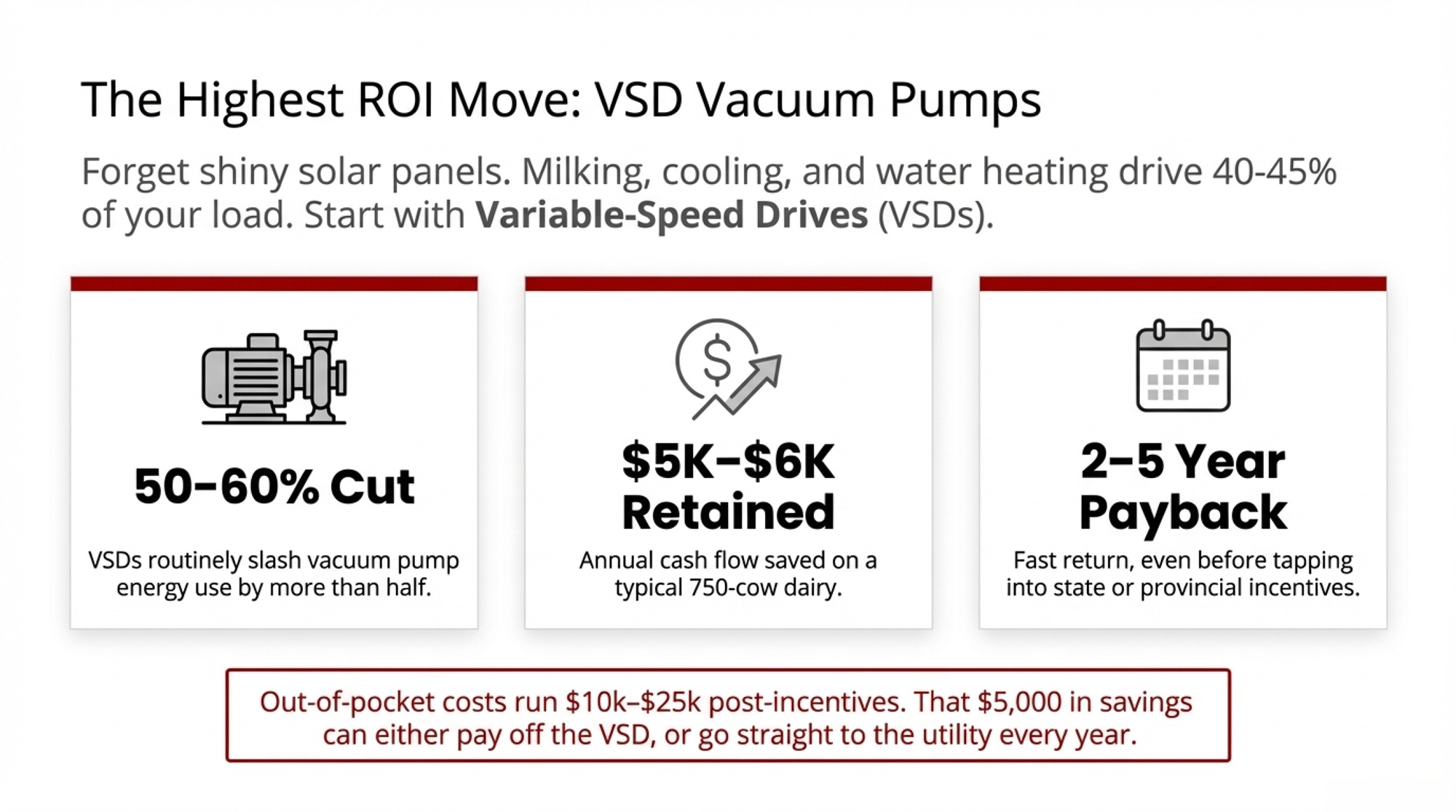
NewsSubscribe
First
Last
Consent
Send this to a friend