





Archive for Mexico dairy exports

38,000 Trucks, Four Days, One Question Your Co-op Hasn’t Answered About Your Milk Check

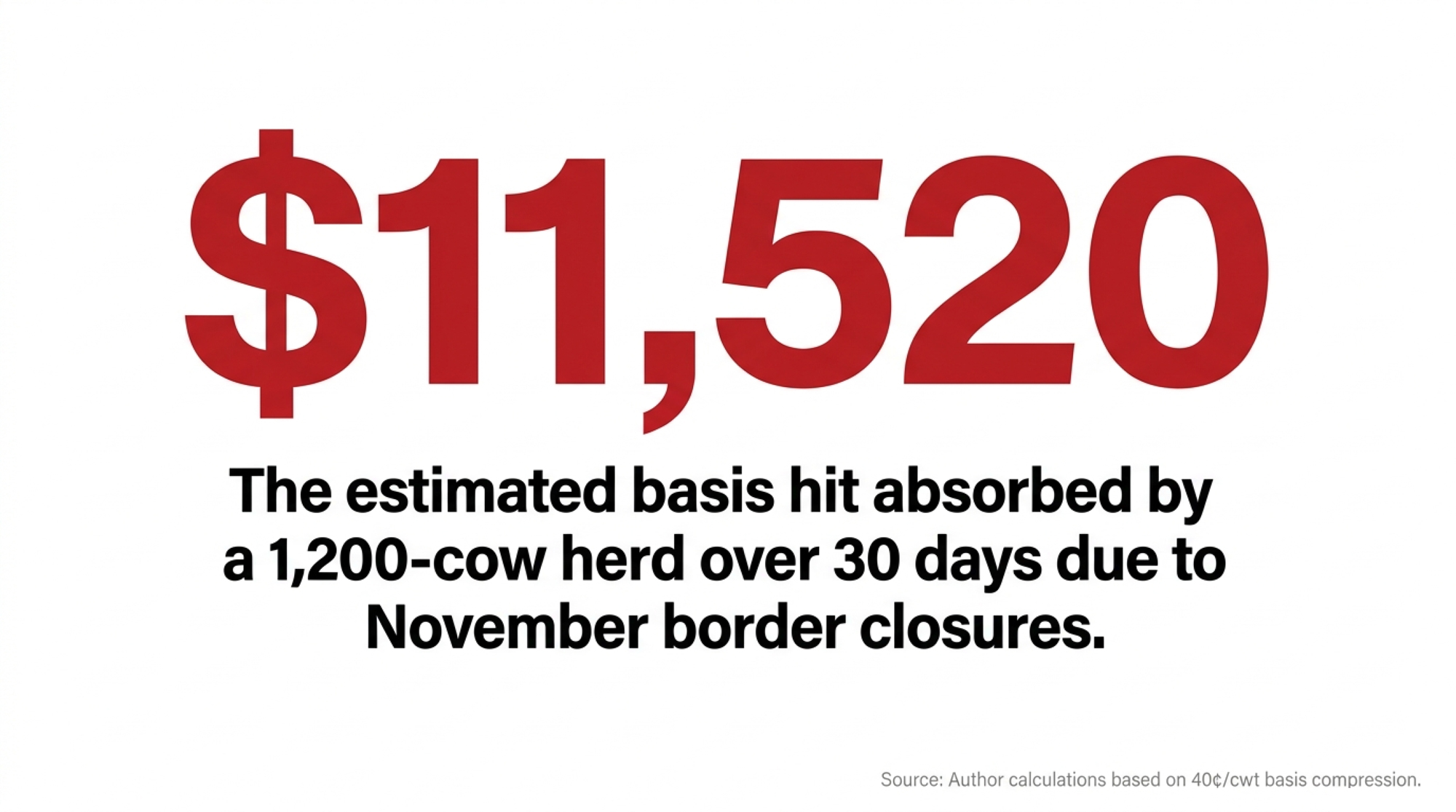
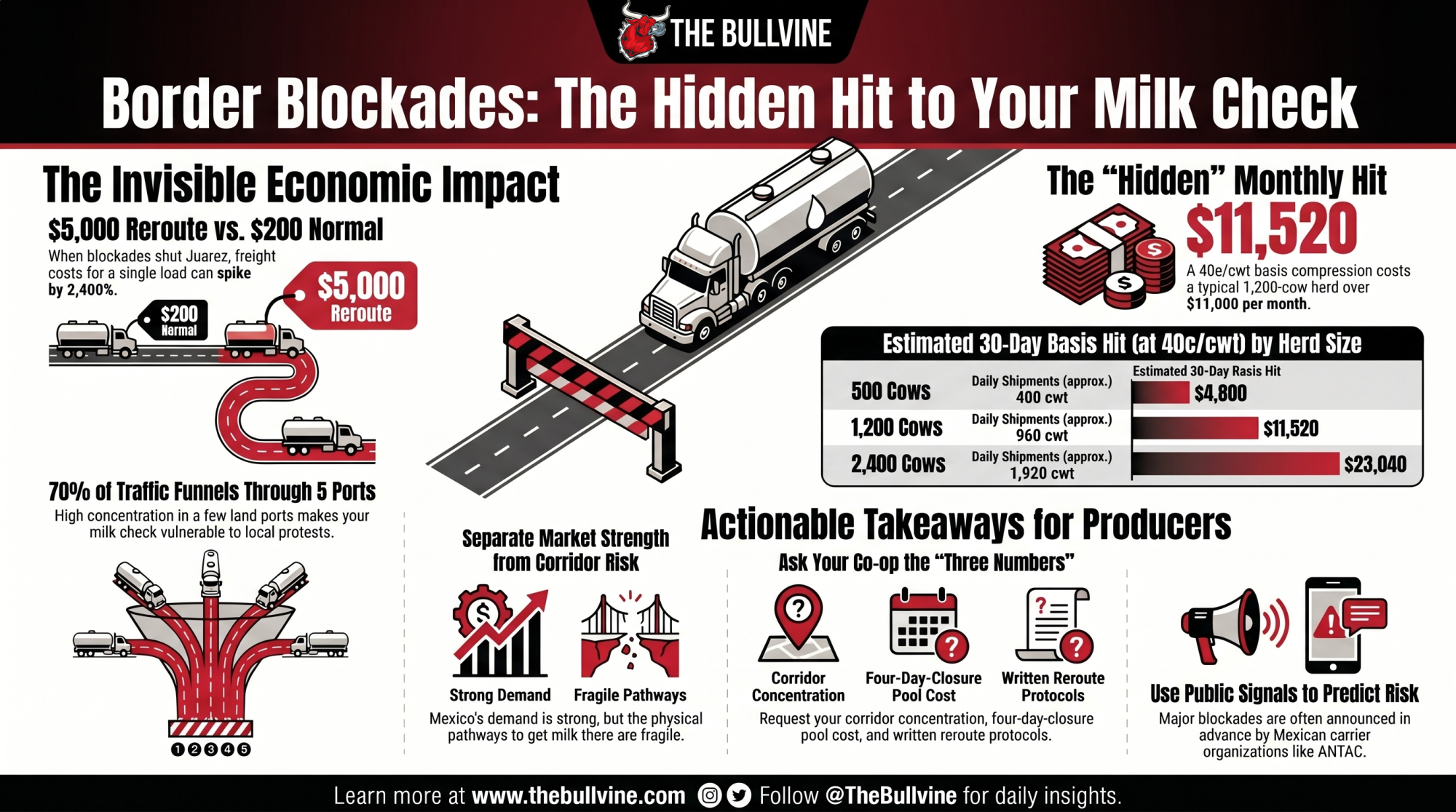
Four days of closed bridges. About $5,000 per reroute versus $200. On a 1,200-cow herd, ~40¢/cwt of compression for a month is roughly $11,520 — and your field rep can’t tell you why.

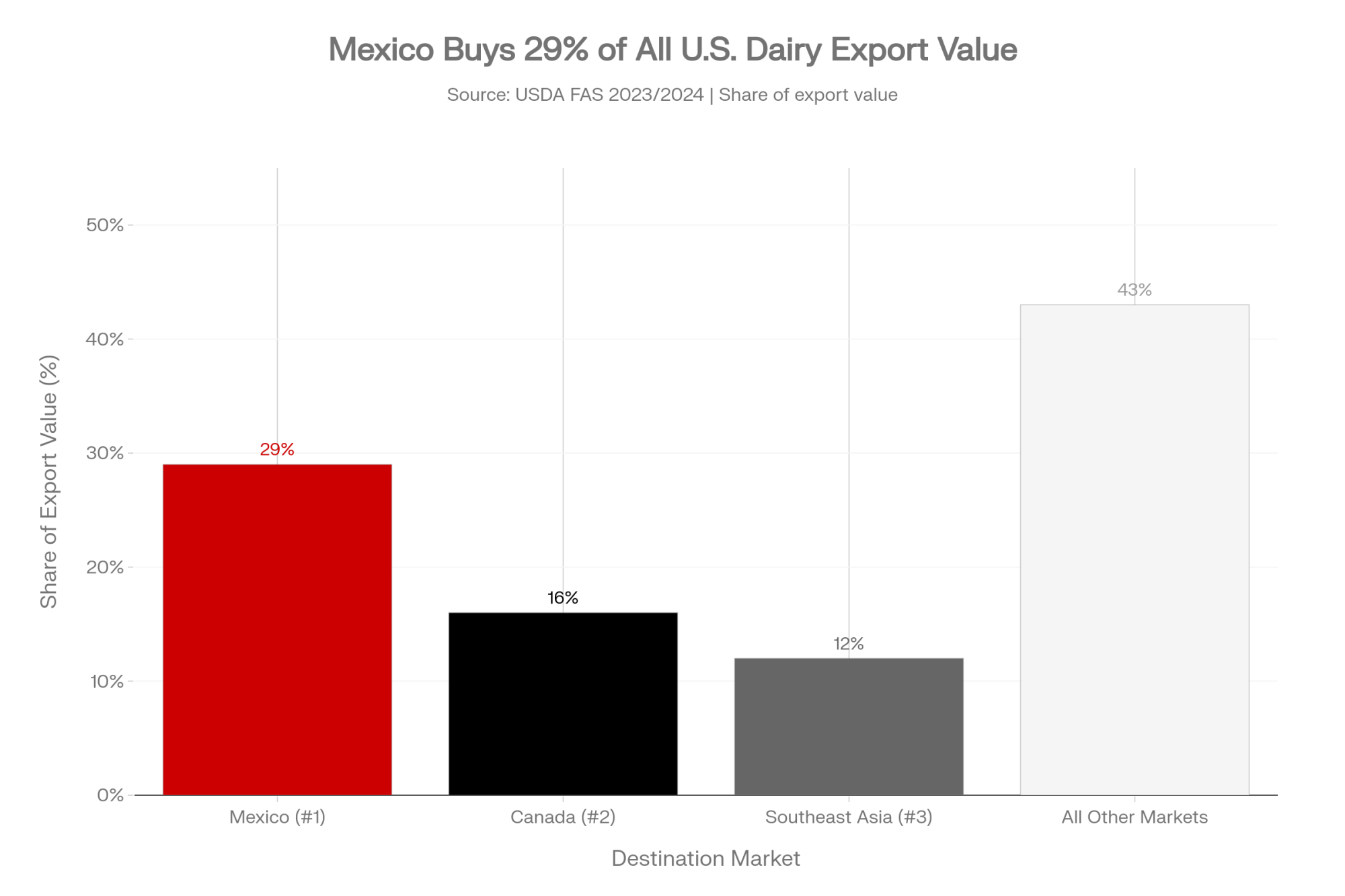
Executive Summary: Three coordinated farmer-and-trucker blockades in five months — November 24–28, December 17, and April 6–8 — shut down the Juárez–El Paso corridor that moves the highest commercial volume of any land border on earth, staging 38,000 trucks during the November round alone. Mexico now buys roughly 29% of U.S. dairy export value, about $2.32 billion in 2023 per USDA FAS, and more than 70% of that traffic funnels through five land ports. When co-op export desks rerouted through Nogales, costs jumped from $150–$200 a load to roughly $5,000 — and that compression got pooled and showed up as a soft export month, not a line item. On a 1,200-cow herd shipping 80 lbs/cow/day, a 40¢/cwt basis hit over 30 days runs about $11,520, and most producers can’t tell you whether November cost them that, double, or half. The wrinkle: December 2025 exports still finished +13% YoY, the strongest since 2022, so the aggregate headline and your co-op’s actual routing reality may be telling very different stories on the same milk check. With the USMCA review deadline July 1, 2026 and three blockade dates already announced publicly before they hit, the highest-leverage move is asking your co-op — this week — what percentage of your Mexico volume runs through Juárez and what a four-day closure costs the pool. If the field rep can’t answer, that’s the answer.
Mexico dairy export blockade

By the time Manuel Sotelo spoke to El Paso reporters during the November 24–28, 2025 closure, the standard freight workarounds had stopped working.

Sotelo serves as vice president of the Mexican Chamber of Cargo Transportation for Northern Mexico, the trade association representing northern Mexican freight carriers. According to the Chamber’s public materials, he’s logged roughly two decades in cross-border logistics across the Juárez–El Paso corridor — the highest-volume commercial land border on earth.

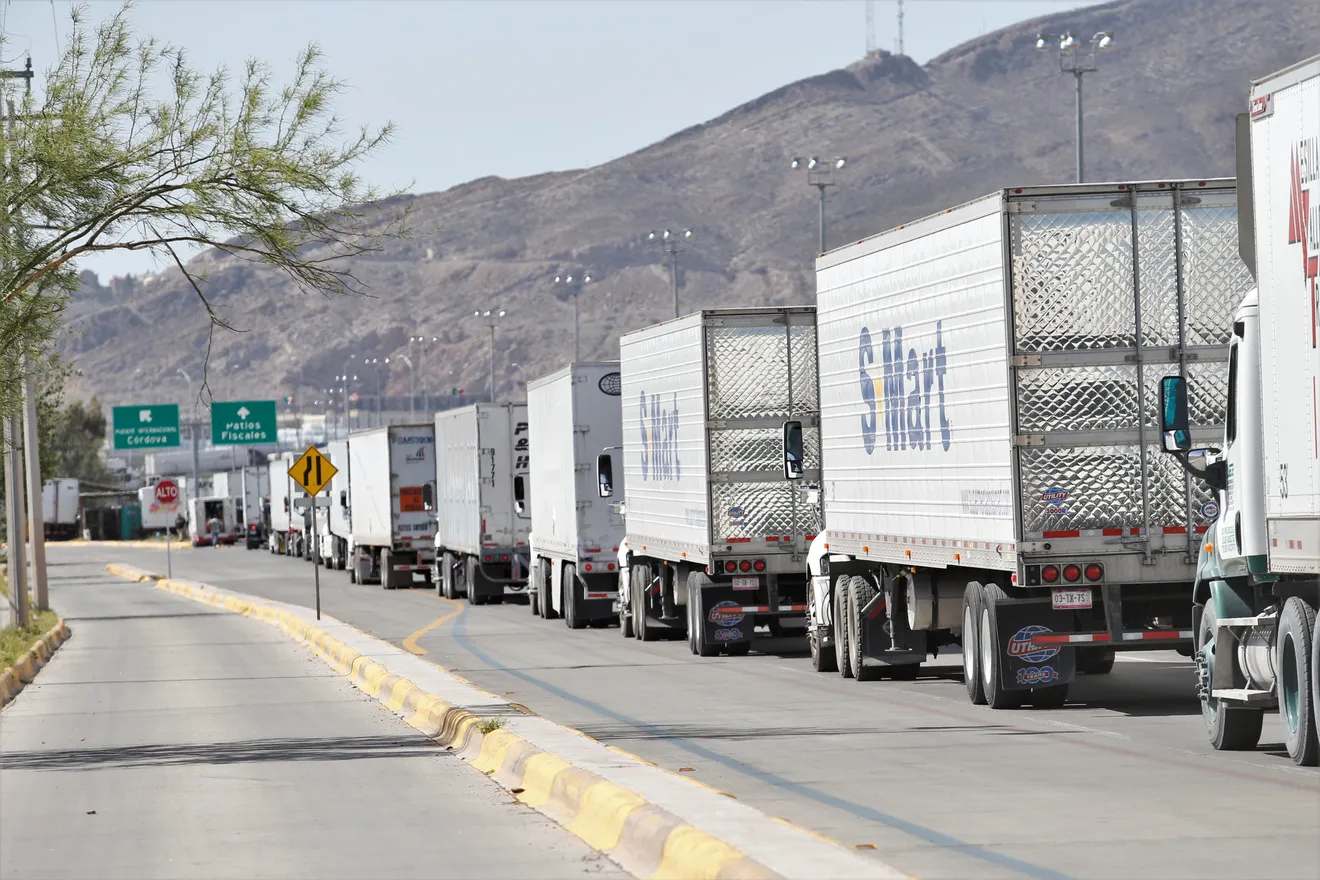
“There was no possibility on Tuesday or Wednesday to cross anything,” he told KFOX/ABC-7 in El Paso during the closure. The Ysleta–Zaragoza bridge: closed. The Córdova–Las Américas bridge: closed after protesters broke into the customs facility. The Colombia bridge to the north: barely functional. An estimated 38,000 trucks were staged at the Juárez–El Paso crossing alone — not delayed, not rerouted, but stopped. Nogales and Nuevo Laredo had already absorbed the overflow and hit their own ceilings. Gas stations across the Juárez region began running dry because the region itself couldn’t receive product from the south.

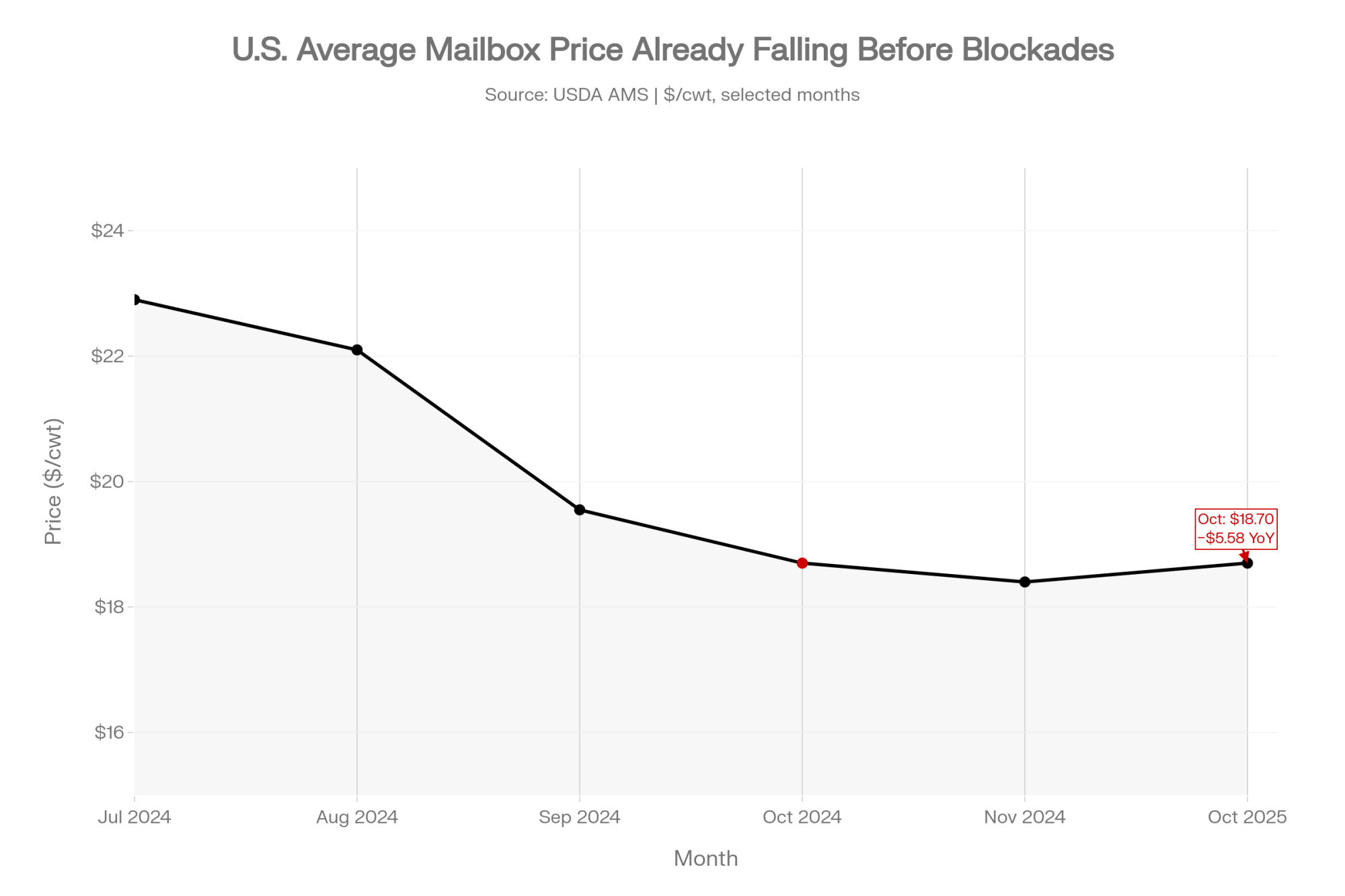
Six hundred miles north, in dairy country across the Upper Midwest and California, you were probably reading milk statements that didn’t quite reconcile. October’s U.S. average mailbox price had already dropped 85 cents in a single month to $18.70/cwt — $5.58 below the same month a year prior, according to USDA AMS. Then November and December came and went. For most producers, no one from the co-op called to explain what role the corridor closures played in the basis you’d just absorbed.
That gap — between what Sotelo’s industry was managing in real time and what generally surfaced on producer milk checks weeks later — is the part of this story that hasn’t been written yet. It’s also the part that matters most for what happens next.

The Blockade That Wasn’t a One-Off

The November 2025 mobilization didn’t surprise the organizations that launched it. The National Front for the Rescue of Mexican Farmland (FNRCM) and the National Association of Carriers (ANTAC) had been escalating since October, when a wave of highway closures across 17 Mexican states forced the federal government to the table. Mexico City offered a 25% increase in corn payments and a 950 peso per tonne subsidy. FNRCM said it wasn’t enough. They were demanding 7,200 pesos per tonne for white corn while receiving 5,050 to 5,200.

By the time the November 24 mobilization hit, 29 separate blockade sites were active across 25 states. The Confederation of National Chambers of Commerce, Services and Tourism (Concanaco-Servytur) estimated accumulated losses of 3 to 6 billion pesos — roughly $150 to $300 million USD at prevailing exchange rates — by day four. The National Confederation of Mexican Transporters (Conatram) pegged daily losses in excess of 100 million pesos, around $5 million USD, in fuel waste and contractual penalties alone. The first product to run short on shelves in northern Mexico wasn’t electronics or auto parts. It was dairy.
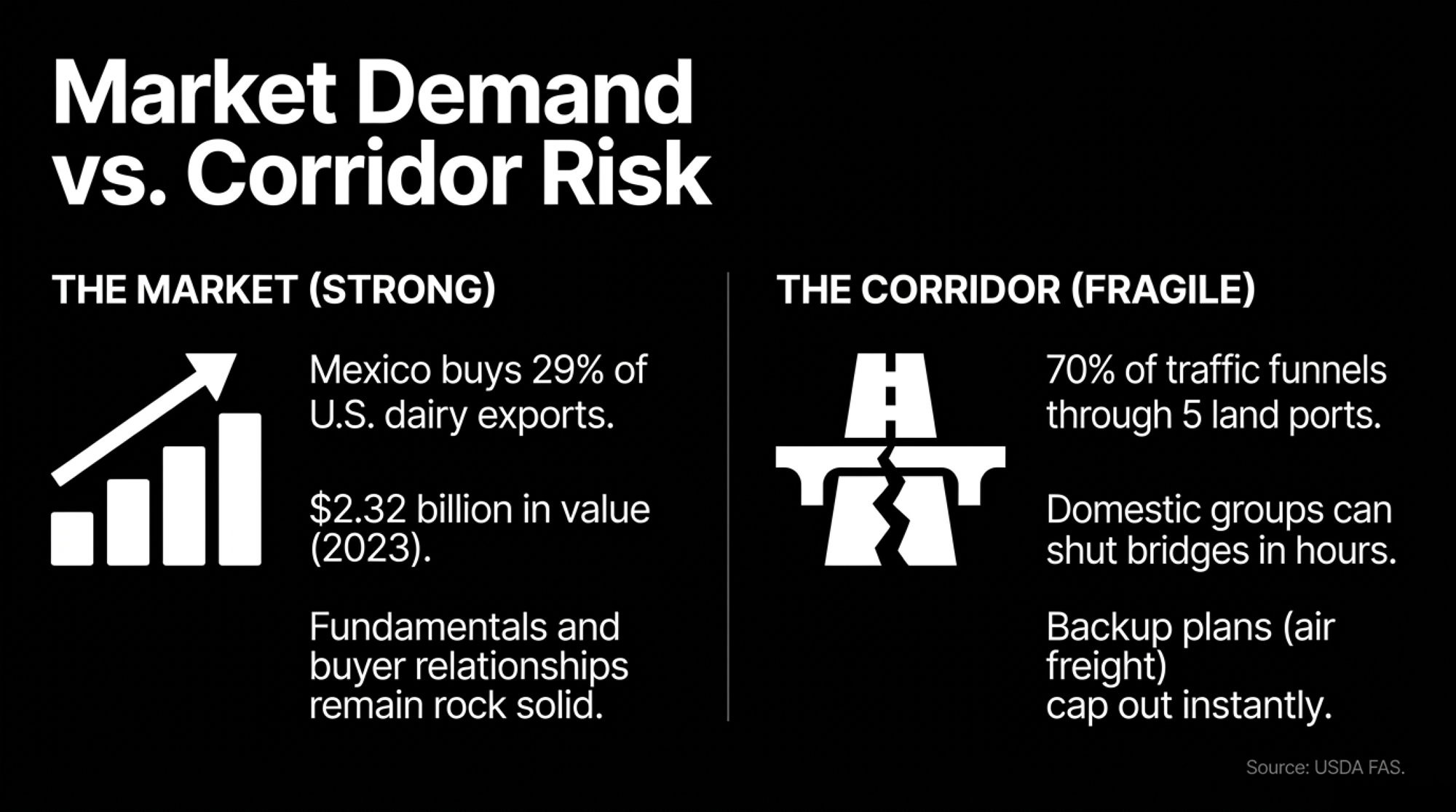
Here’s why that matters to anyone shipping into a co-op with Mexico exposure. Mexico has grown to roughly 29% of all U.S. dairy product export value, according to USDA Foreign Agricultural Service data through 2024 — making it the single largest customer by a wide margin. In 2023, Mexico imported roughly $2.32 billion in U.S. dairy products. Volume reached 1.38 billion pounds on a milk-solids basis, up 42% over the prior decade.
But more than 70% of that commercial traffic crosses through five land ports. The Juárez–El Paso cluster — Ysleta, Córdova, and Zaragoza — handles the highest commercial throughput of any land border crossing on earth. Organized groups proved in November that they can close it in hours.

What Your Co-op Was Doing While You Watched the News

The co-op export desk knew what was happening in real time. When C.H. Robinson — one of the largest freight brokers in North America — issued an emergency client advisory on the morning of November 24, the operative guidance came down to this: monitor local traffic authorities for resolution updates. That isn’t evasion. It’s the honest ceiling of what professional logistics infrastructure can offer when public protests are negotiating directly with their own federal government over corn prices.
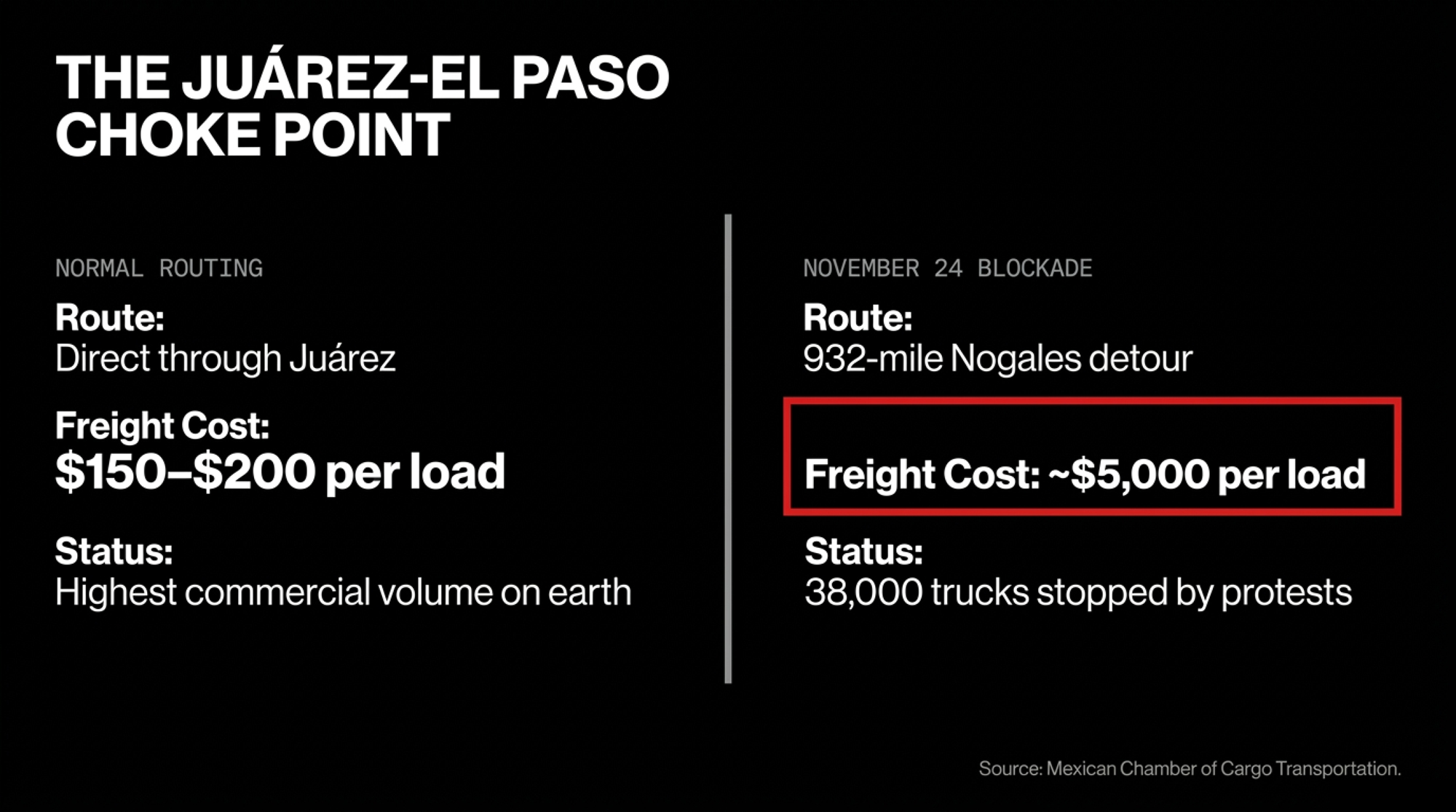
What the export desks did next was rational, and largely invisible to producers. They rerouted loads through Nogales — 466 miles in one direction on the Mexican side, 466 miles back on the U.S. side, to reach the same El Paso destination. Sotelo’s company made that move. “It cost us over 100,000 Mexican pesos per shipment,” he told KVIA in December. That’s roughly $5,000 per load versus $150 to $200 through Juárez. Some product moved through domestic spot channels at prices nobody had modeled. Some sat in staging. The export premium that Mexico-market volume supports began compressing.

That compression settled into pool pricing, got averaged across member volume, and eventually appeared on milk statements as softer export conditions. Picture what that meant on the ground at three operation scales:
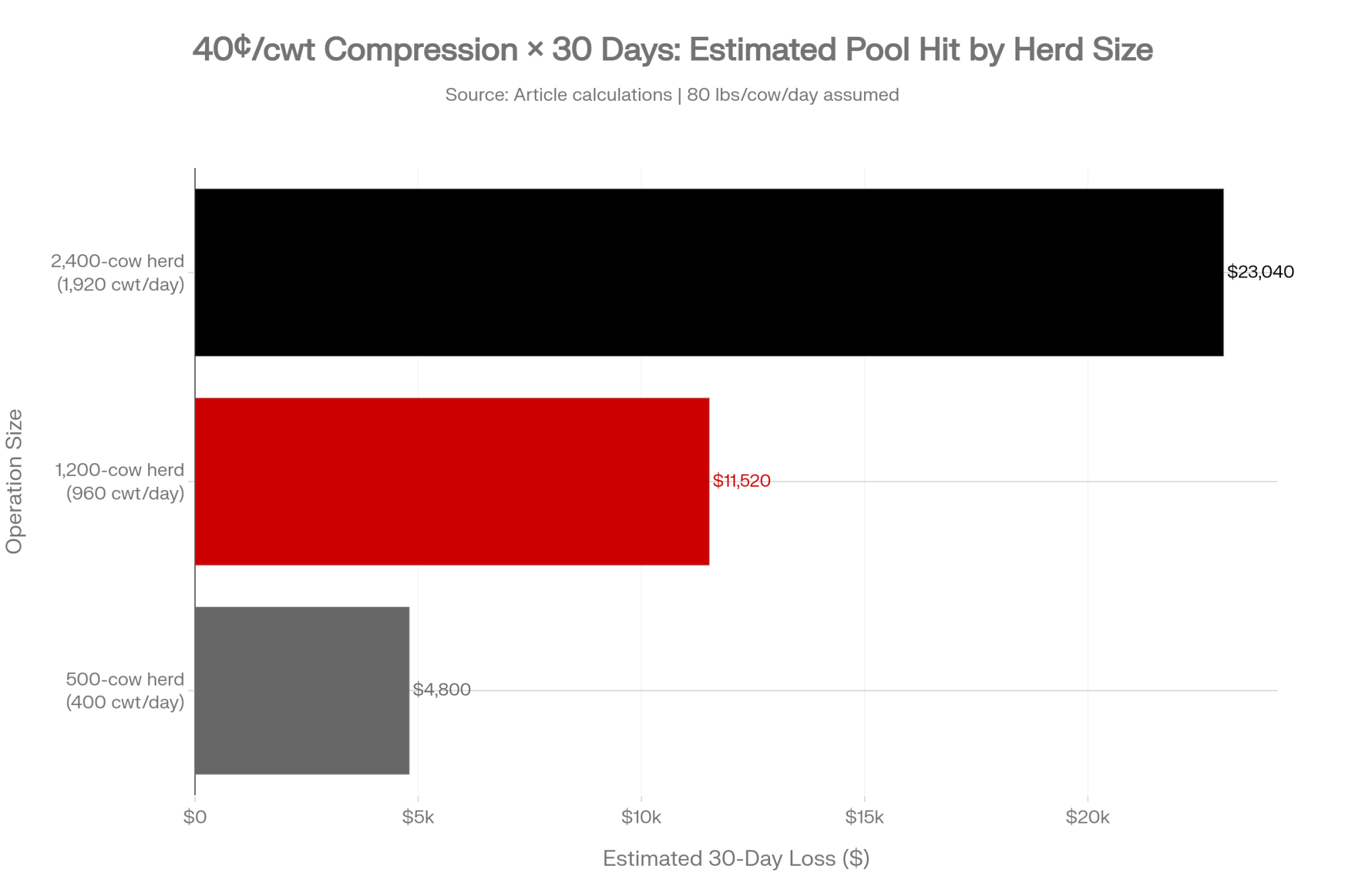
  • On a 500-cow operation shipping 400 cwt per day (roughly 80 lbs/cow/day), a 40 cent/cwt basis compression over 30 days works out to roughly $4,800 — about a month of one full-time labor cost.
  • On a 1,200-cow operation shipping 960 cwt per day (same per-cow assumption): roughly $11,520.
  • On a 2,400-cow operation: approximately $23,040.

Those figures are illustrative. Actual basis impact depends on your co-op’s specific Mexico exposure and routing. But the pattern is the point. Every operation shipping into a co-op with meaningful Mexico volume absorbed something in November and December. Most producers couldn’t tell you how much, because the information needed to calculate it lives inside co-op logistics departments — not in producer communications.

Why the Field Rep Didn’t Have Your Answer

A co-op’s pooling structure protects you from single-market volatility. It also obscures the specific source of disruption when something goes wrong. When the export desk absorbs rerouting costs and spot-channel discounts, those losses get averaged across total pool volume. They don’t appear on a milk statement as: the Juárez corridor was closed for four days and cost you X cents per cwt. They appear as a soft export month.

The field rep isn’t withholding information. They’re communicating at the resolution the system produces. Their training covers milk pricing, component premiums, and program updates — not cross-border freight logistics or corridor risk stratification by port of entry. That gap was never a problem when disruptions to the Mexico corridor were short and infrequent.

Because co-ops blend these logistics costs directly into pool pricing, isolating the exact pennies lost per hundredweight remains nearly impossible from the outside looking in. It requires a level of corridor-specific disclosure that isn’t currently standard practice in producer communications — but should be.
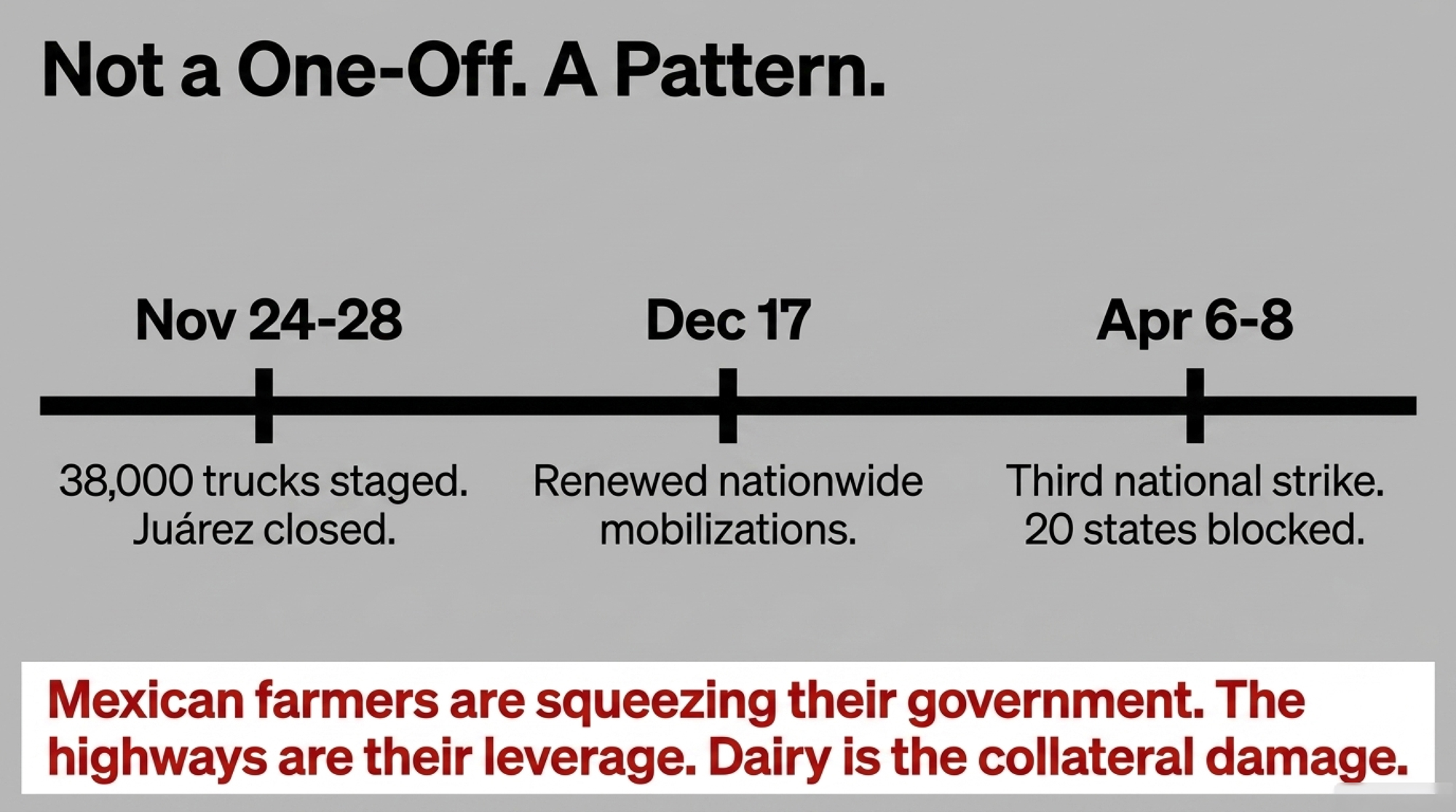
That changed in November. And the resolution wasn’t a resolution. When Interior Minister Rosa Icela Rodríguez announced the November deal on day four, Mexican media reported FNRCM and ANTAC framing the agreement as a truce rather than a settlement. The pattern that followed proved that framing accurate:

  • December 17, 2025: Renewed nationwide mobilizations launched by FNRCM and freight transport organizations. December 18 negotiations produced another truce — government commitments on highway security, escort programs, and a roadmap for price-support mechanisms (pignoración) for corn, beans, sorghum, wheat, barley, and soy. Sotelo’s December warning about the limits of contingency planning came in the middle of this round.
  • April 6–8, 2026: A third nationwide strike led by the National Transport Association (ANT) and FNRCM blocked routes in at least 20 states, including Mexico–Querétaro, Mexico–Puebla, the Culiacán–Mazatlán corridor, and access routes to Tijuana, Mexicali, and Ciudad Juárez. Protesters cited cargo crime, soaring diesel costs from Strait of Hormuz disruption, and stagnant grain prices.
Blockade EventDatesLead OrganizationsPrimary TriggerJuárez Corridor StatusEstimated Economic Loss
Mobilization #1Nov 24–28, 2025FNRCM, ANTACCorn price (demand: 7,200 vs. 5,050–5,200 MXN/tonne)Fully closed — Ysleta, Córdova, Zaragoza bridges shut3–6 billion MXN (~$150–$300M USD)
Mobilization #2Dec 17–18, 2025FNRCM, freight orgsNov truce violations; price-support commitments unmetPartial closure — routes disrupted nationwide100M+ MXN/day (~$5M USD/day) in fuel waste & penalties
Mobilization #3Apr 6–8, 2026ANT, FNRCMCargo crime + diesel costs (Hormuz) + stagnant grain pricesPartial closure — 20+ states, Juárez access routes blockedNot yet formally estimated
All Three Events5-month windowMultiple national coalitionsStructural: water law, grain prices, cargo security, fuel costsPattern established— corridors closed on avg every ~6 weeks~$11,520 est. basis hit on a 1,200-cow herd over 30 days

Three coordinated, politically-driven national mobilizations in five months. The pattern is established.

The structural drivers aren’t going away. Mexico’s new General Water Law removed the ability for agricultural users to transfer water concessions during land sales and granted CONAGUA broad discretionary authority to reduce existing water volumes during drought. Farmers describe the change as an existential threat to long-term land values and credit access. Cargo theft on Mexican federal highways has remained a persistent operational risk over recent years according to publicly reported industry tracking, and now diesel cost pressure from Middle East disruption compounds the squeeze. Corn prices remain well below break-even demands. The pressure for future mobilizations is intact.

If the highways close again, not just the customs facilities, Sotelo told KVIA the only fallback is air freight. “They don’t have as many planes as we do with ground transportation.” The infrastructure ceiling of the backup plan is the cargo capacity of Juárez International Airport. Against thousands of daily commercial export crossings averaging tens of thousands of dollars in value each, that ceiling closes fast.

How Much Did the November Blockade Actually Cost Your Milk Check?

The honest answer: it depends on your co-op’s Mexico exposure, and most producers haven’t been given enough information to calculate it.

Here’s what’s documented. The four-day November closure plus a roughly ten-day recovery backlog created about two weeks of compressed export throughput for co-ops routing significant volume through Juárez. During that window, loads moved at reroute cost or spot-channel discount. Those costs got pooled. October’s mailbox had already dropped 85 cents in a single month to $18.70/cwt — $5.58 below October 2024. September had been $19.55, $5.23 below the prior year. The November and December disruptions hit inside an already-deteriorating pricing environment, which is part of why their specific contribution is hard to isolate from your vantage point.
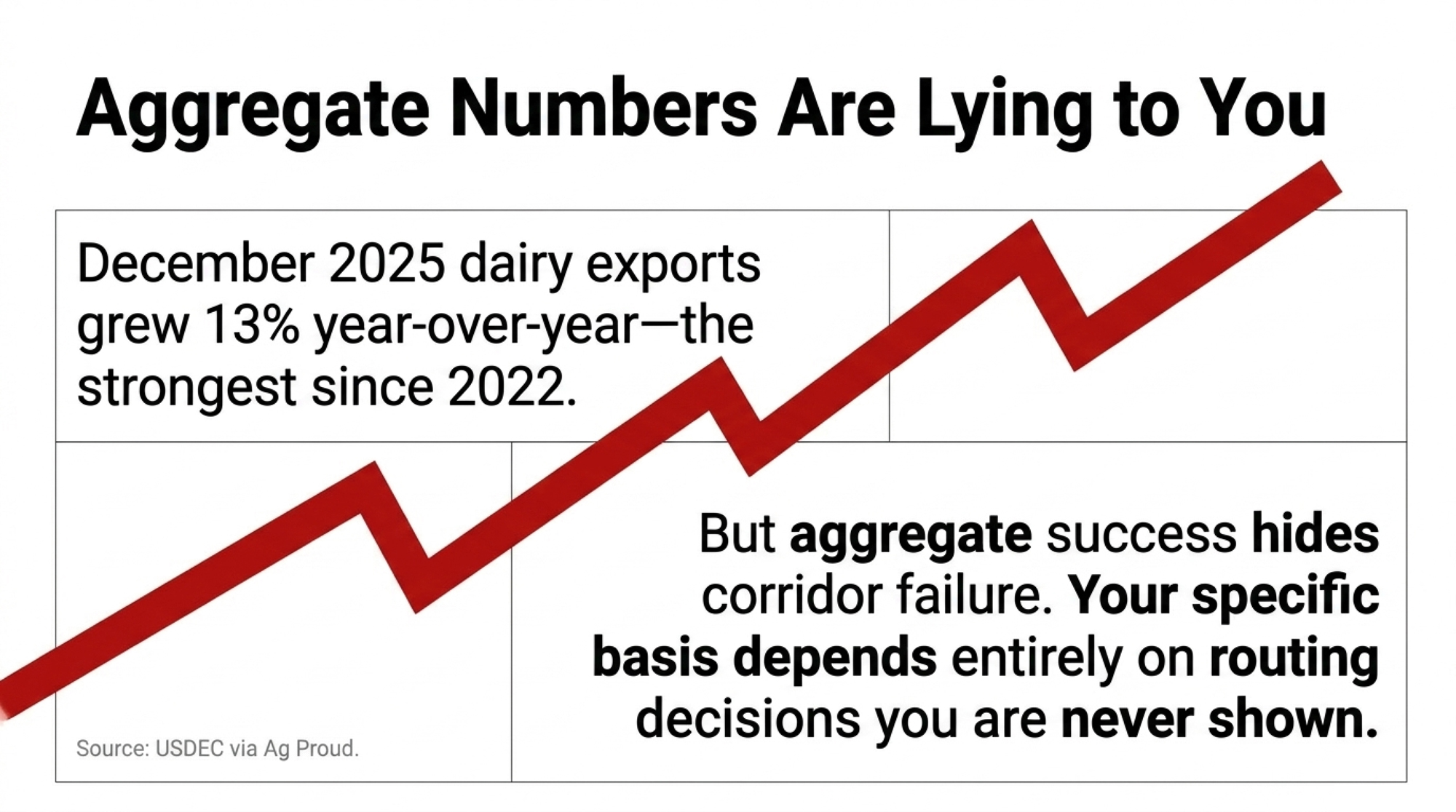
And here’s the wrinkle that complicates everything. Year-end U.S. dairy export volumes actually finished strong — December 2025 dairy product exports grew 13% year-over-year, reaching levels not seen since 2022, according to USDEC via Ag Proud. The aggregate story was good. The corridor-specific story was something else. Whether your co-op’s December basis reflected the strong aggregate or the disrupted corridor depends on routing decisions you almost certainly weren’t shown.

That’s the gap. Not a cover-up. A structural mismatch between where the information lives and who needs it.

Is Your Co-op’s Mexico Program Built for the Risk Environment That Actually Exists Now?

The USMCA review deadline arrives July 1, 2026 — 39 days from this writing. Mexican farm organizations have explicitly stated they want basic grains removed from the agreement. U.S. dairy groups want stronger market access enforcement. The December 18 government settlement with FNRCM included the creation of a formal institutional channel under Mexico’s Ministry of Economy specifically to analyze USMCA-related issues from the Mexican producer side.

Whatever the review produces, it won’t create an obligation for Mexican bridges to stay open during domestic protests. That gap — between what a trade agreement governs and what actually controls your load’s ability to move — exists regardless of the review outcome.

The co-ops best positioned for the next disruption aren’t necessarily the ones with the strongest Mexico buyer relationships. They’re the ones that have pre-negotiated reroute capacity at Nogales and Nuevo Laredo, modeled corridor-specific exposure for their member base, and have a communication protocol ready before the next mobilization date circulates — not after the bridges close. Those aren’t complex systems. They’re the difference between managing an event and being surprised by it.

For broader context on how trade policy is reshaping the export environment, see how the broader trade war is reshaping dairy export economics.

Options and Trade-Offs for Producers

The goal here isn’t alarm. It’s calibration. A few practical paths worth considering now:

1. Ask your co-op for corridor-specific exposure information — within 30 days. Your co-op’s export desk knows which crossings carry the majority of your Mexico-bound volume. Asking for that breakdown, even a rough percentage by corridor, is a legitimate member inquiry. You don’t need their full routing database. You need enough to understand whether a four-day Juárez closure is a minor inconvenience or a real basis risk for your operation. If the field rep can’t answer, ask them to escalate.

When it makes sense: Any operation whose co-op does meaningful Mexico export volume. What it requires: A direct, polite ask — email is fine. Key limit: Co-ops vary in how they handle governance-level member inquiries. Some have this conversation readily. Others route you through layers before anyone with the data responds. The response itself often tells you something useful about the institution.

2. Separate “market reliability” from “corridor reliability” in your risk thinking. These are different things, and the industry has communicated them as one. Mexico as a dairy market is genuinely strong — demand fundamentals, volume, and buyer relationships are real. But Mexico as a logistics corridor runs through infrastructure that organized domestic groups have demonstrated they can close in hours. Building both into your mental model doesn’t mean abandoning the export program. It means hedging differently. If you’re scenario-planning for milk price downside, add a 30-day corridor disruption scenario alongside your standard price sensitivity analysis.

When it makes sense: Larger operations where basis variance moves real dollars. What it requires: About 30 minutes with your accountant or risk manager. Key limit: Without corridor-specific exposure data from your co-op, you’re estimating. An estimate still beats nothing.

3. Track ANTAC, ANT, and FNRCM mobilization signals — they announce dates publicly. All three organizations communicated their dates in advance. The November 24 date circulated for weeks. The December 17 date was set within days of the November truce. The April 6 mobilization was announced openly. A Google Alert on “ANTAC blockade,” “FNRCM huelga,” or “Mexico carriers strike” gives you more lead time than most co-op communications currently provide. That lead time isn’t a trading signal. It’s context for timing decisions about forward sales and export-dependent premium months.

When it makes sense: Any producer who wants a more complete picture of export risk. What it requires: Five minutes of setup. Key limit: Knowing a date is circulating doesn’t tell you whether it’ll escalate to full closure. That depends on whether the Mexican government makes meaningful concessions in the interim.

4. If you sit on a co-op board or advisory committee, bring the governance question. The three numbers every producer with Mexico export exposure should have access to — percentage of volume through each corridor, estimated cost of a four-day closure to the pool, and the written reroute protocol — aren’t proprietary. They’re basic operational transparency. With the USMCA review deadline arriving July 1, the timing for raising those questions formally is now.

When it makes sense: Anyone with governance-level standing in their co-op. What it requires: A written request before the next board or delegate meeting. Key limit: Some boards receive this kind of question as constructive. Others read it as a confidence challenge. Knowing which culture you’re in is its own useful data.
Key Takeaways

  • If your co-op exports to Mexico and you haven’t asked which crossings carry your volume, send the email this week. That’s the single highest-leverage move available before July 1.
  • If your risk model treats market access and corridor access as one thing, fix it. They’ve been communicated as one. They aren’t.
  • If the next mobilization date is circulating in Mexican press and your co-op hasn’t flagged it, your information lag is the problem worth solving. ANTAC, ANT, and FNRCM announce publicly. Google Alerts close the gap.
  • If you sit on a board or advisory committee, ask the three numbers before the next meeting. Corridor concentration, four-day-closure pool cost, written reroute protocol. None are proprietary.
  • If the strong aggregate export number is reassuring you past the corridor question, you’re reading the wrong signal. The headline figure and your co-op’s routing reality can tell different stories on the same milk check.
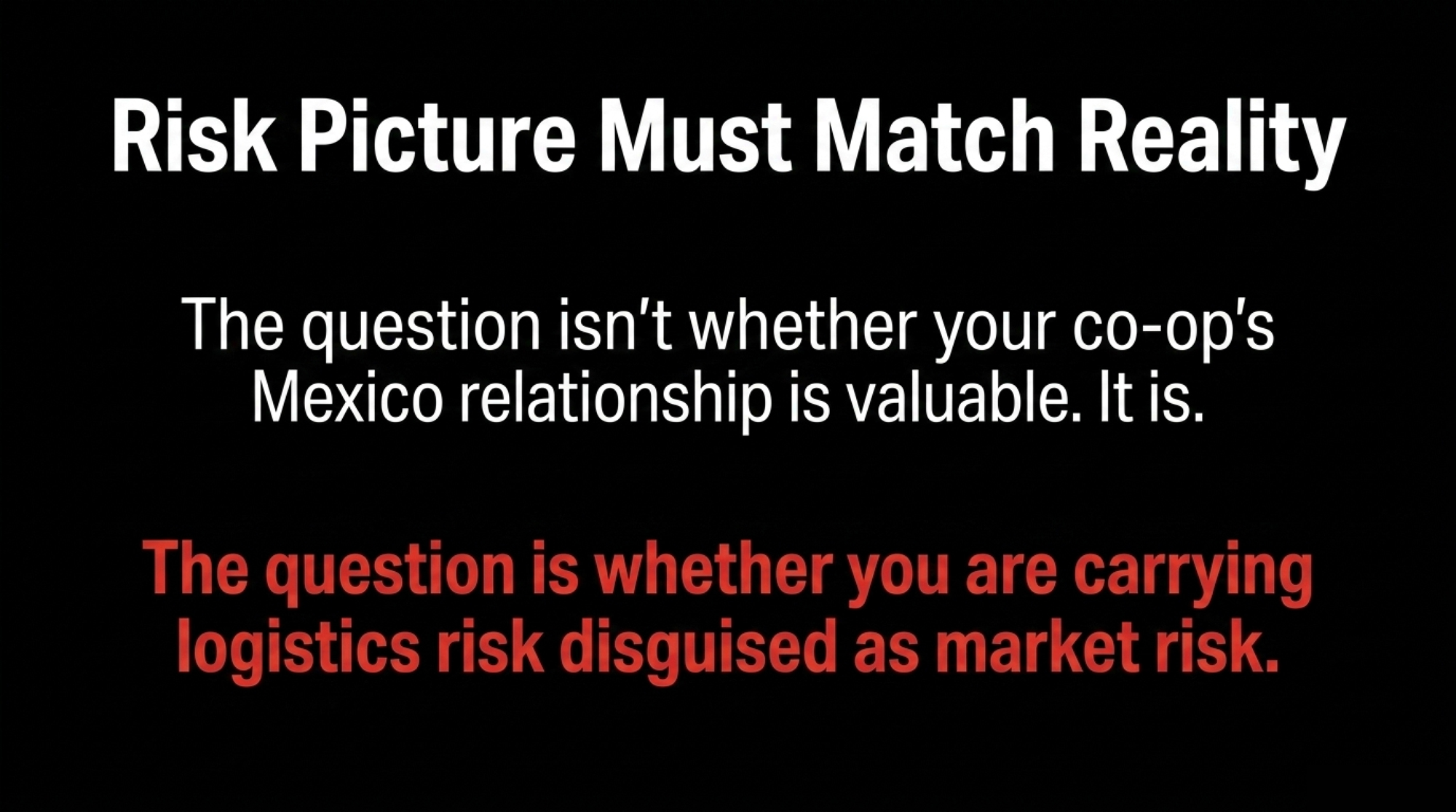
The question isn’t whether your co-op’s Mexico relationship is valuable. It is, and the export numbers support that — December 2025 closed with the strongest year-over-year export growth since 2022. The question is whether the risk picture you’ve been given matches the risk you’re actually carrying. For most producers, those two pictures haven’t been the same since November 24.

Worth knowing before the next date circulates.

Complete references and supporting documentation are available upon request by contacting the editorial team at editor@thebullvine.com.

Learn More

The Sunday Read Dairy Professionals Don’t Skip.

Every week, thousands of producers, breeders, and industry insiders open Bullvine Weekly for genetics insights, market shifts, and profit strategies they won’t find anywhere else. One email. Five minutes. Smarter decisions all week.
NewsSubscribe
First
Last
Consent

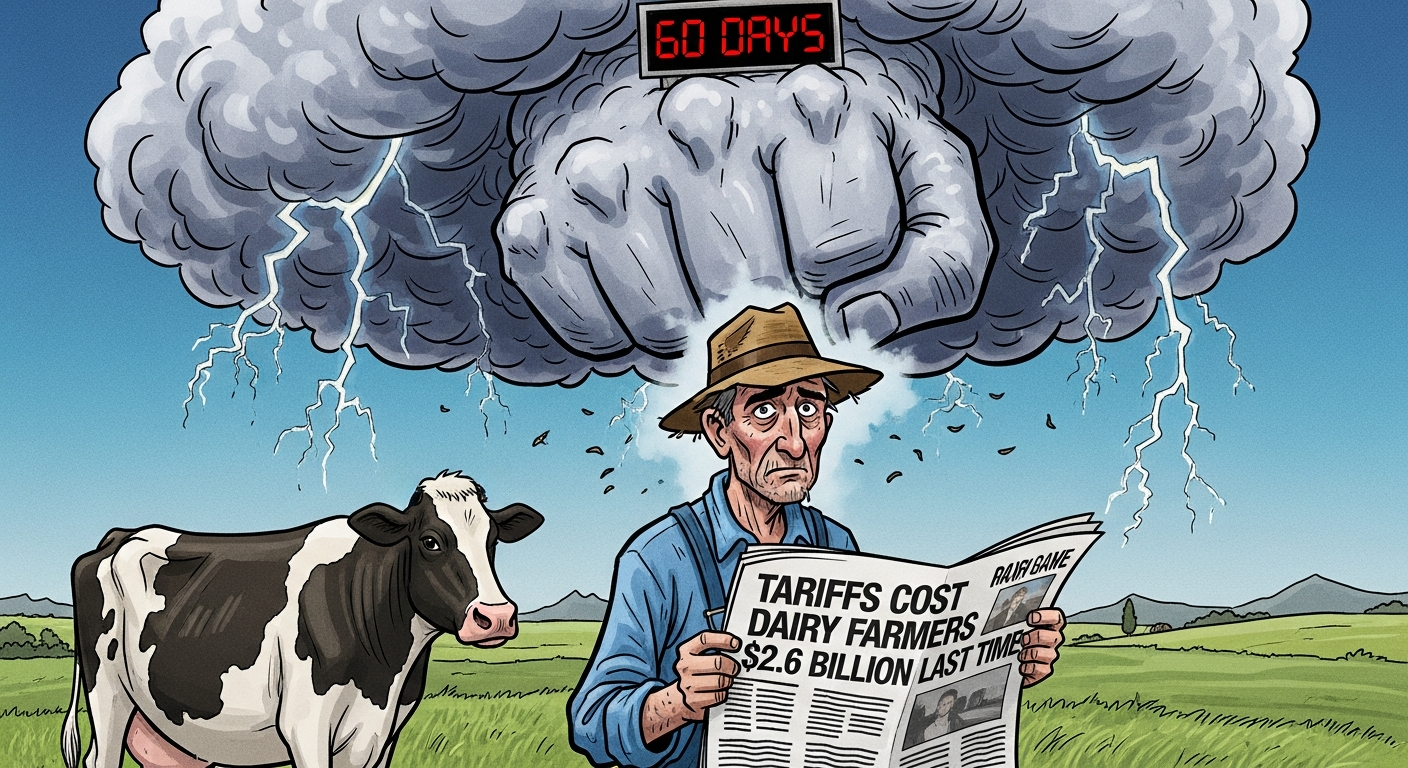
Tariffs Cost Dairy Farmers $2.6 Billion Last Time. You’ve Got 60 Days Before It Hits Again.

Tariffs stripped $2.6B from dairy farms last time. Use the next 60 days—or your milk check will make the decision for you.

Executive Summary: Tariffs stripped an estimated 2.6 billion dollars from U.S. dairy farms during the last China trade war, and today Mexico alone buys about 29 percent of all U.S. dairy exports while relying on the U.S. for more than 80 percent of its imported dairy. Using current data from USDA‑FAS, USDEC and CoBank, the article shows how that dependence on a few big buyers turns Washington’s tariff tools into direct Class III and milk‑check risk for every herd tied to cheese, powder, and whey markets. China’s experience—export value dropping to 377 million dollars and whey shipments collapsing 69 percent after retaliatory tariffs—illustrates how fast demand can vanish and how slowly it comes back once buyers switch to competitors like the EU. Against that backdrop, the piece lays out a plain‑spoken 60‑day decision window: put two price scenarios on paper, meet once with your co‑op and once with your lender, and use USDA/extension guidance to decide how DMC, LRP‑Dairy, and succession timing fit your risk tolerance. Written in a peer‑to‑peer, “over coffee” voice, it gives progressive dairy producers a clear, credible playbook to manage tariff risk before their milk check makes the decisions for them.

You know, if we were sitting down over coffee at World Dairy Expo or at a winter meeting in Ontario, with producers from Wisconsin freestalls, New York tiestalls, and California dry lot systems all at the table, I’d probably start with this: all the talk about presidential “emergency” tariff powers might sound like it belongs in Washington, but the impact doesn’t stay there. It flows through export channels and, sooner than most of us would like, it shows up in the milk check you’re depositing at home.

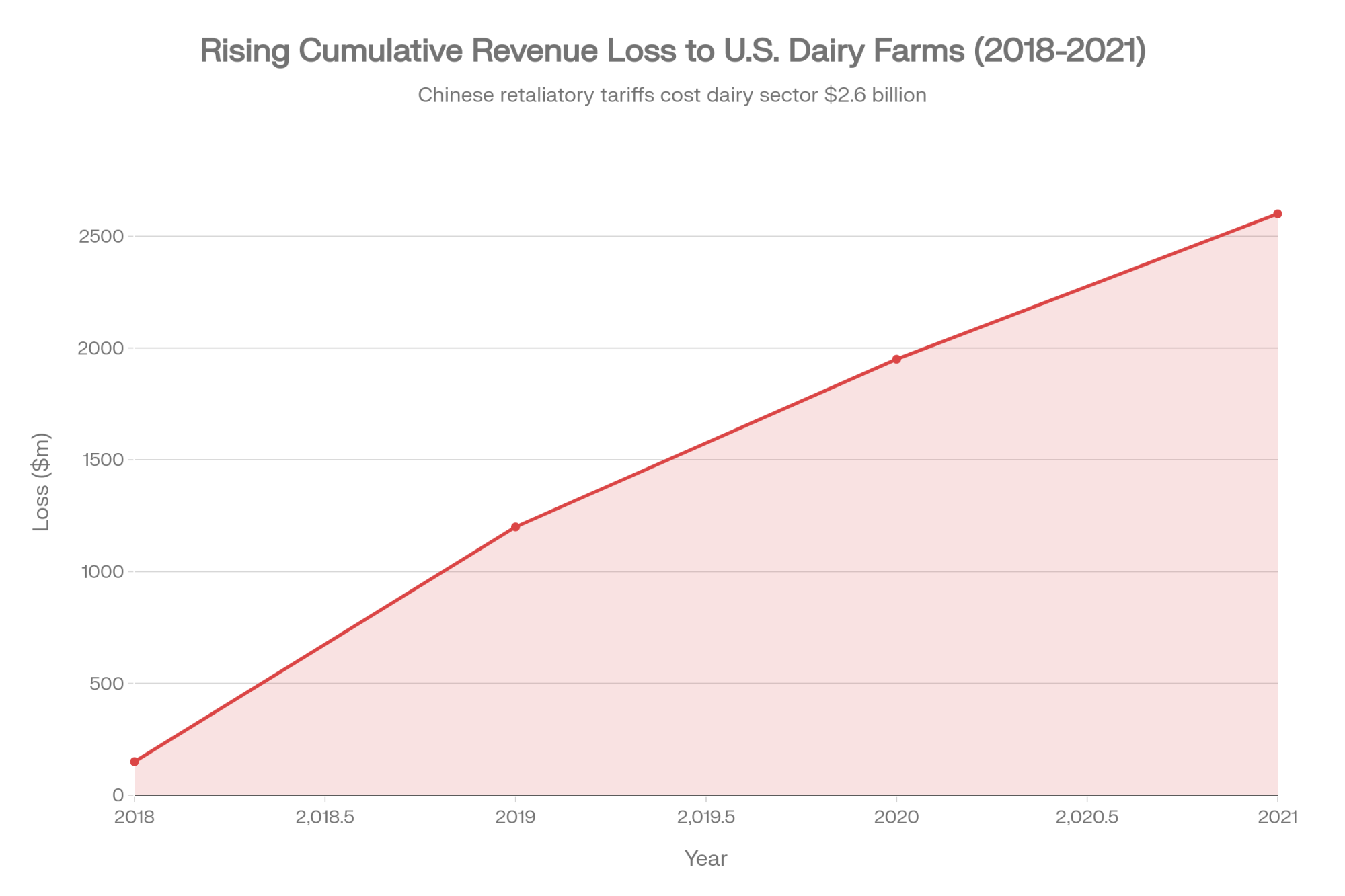
In early 2025, President Donald Trump signed executive orders imposing 25 percent tariffs on most goods from Mexico and Canada and 10 percent on goods from China, creating fresh uncertainty for U.S. dairy exporters and the farms that ultimately depend on those markets. Cornell University’s Charles Nicholson, Ph.D., an adjunct associate professor in the Charles H. Dyson School of Applied Economics and Management, told the Dyson Agricultural and Food Business Outlook conference that “if you pick a trade fight with our major export destinations… that has some substantive negative implications for dairy farms and processors”. What really made people sit up was his estimate that Chinese retaliatory tariffs alone cost U.S. dairy farms about 2.6 billion dollars in lost revenue from 2019 through 2021. 

What’s interesting here is that this isn’t just a policy debate. It’s about timing, concentration risk, and how much room you’ve got to maneuver before that next shock hits your milk price.

Let’s walk through what the data actually shows.

Looking Back: What 2018–2019 Really Taught Us

Looking at this trend, the 2018–2019 tariff period remains the clearest case study we’ve got on how quickly things can change.

On the Mexico side, USDA’s Foreign Agricultural Service published a GAIN report in June 2018 showing that Mexico responded to U.S. steel and aluminum tariffs with retaliatory tariffs on a range of U.S. products, including multiple cheese tariff lines. That report laid out how certain U.S. cheese categories were hit with new tariff rates starting June 5, 2018, and then increased again on July 5, with some lines moving into the 20–25 percent range depending on the specific HS code. That shift happened in a matter of weeks, not years. 

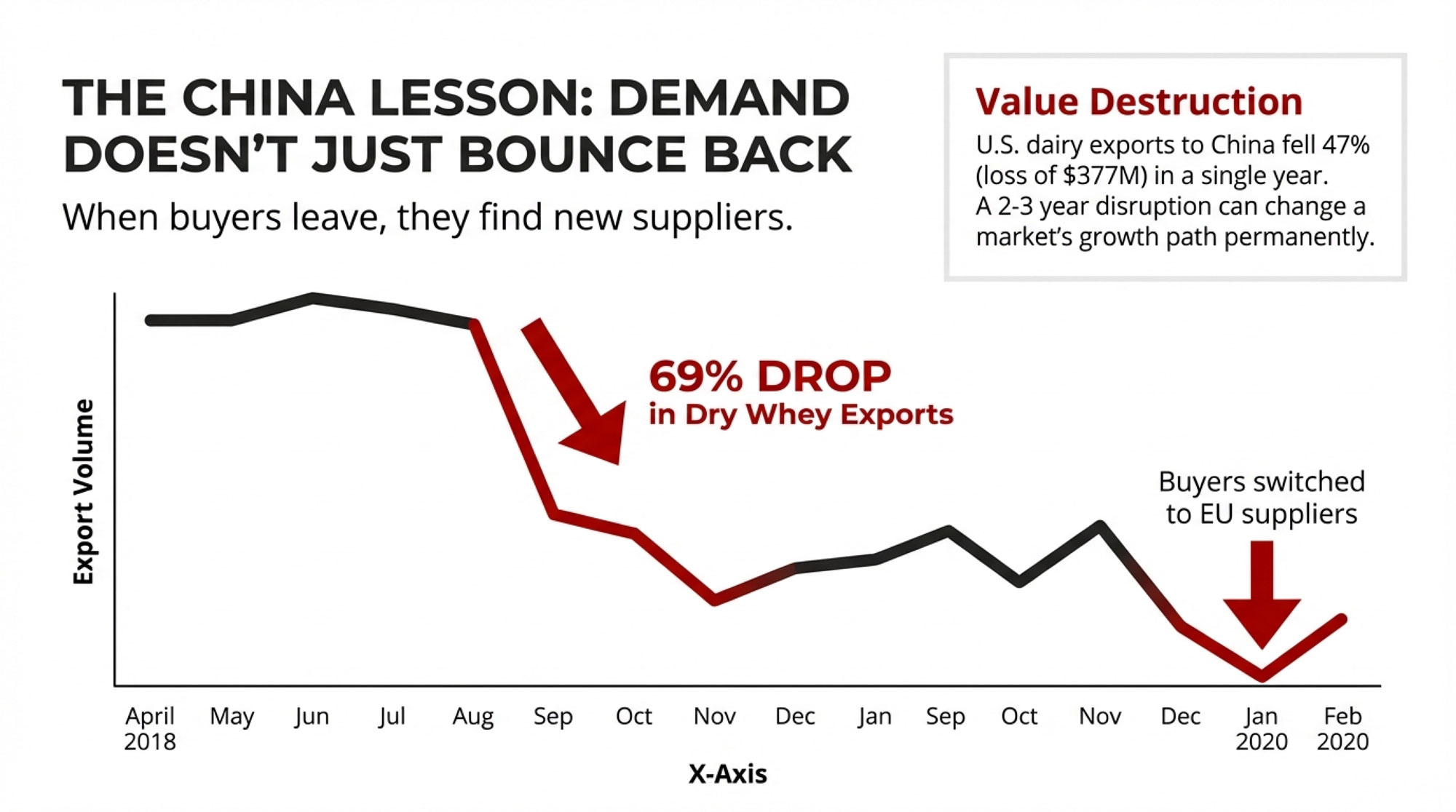
On the China side, the U.S. Dairy Export Council tracked the fallout as Beijing rolled out its own retaliatory measures. Cheese Reporter, summarizing USDEC’s January 2020 export review, noted that for the 12 months from December 2018 through November 2019, the value of U.S. dairy exports to China totaled about 377 million dollars—a roughly 47 percent decline from the prior 12‑month period. That’s a big haircut on a single key market. 

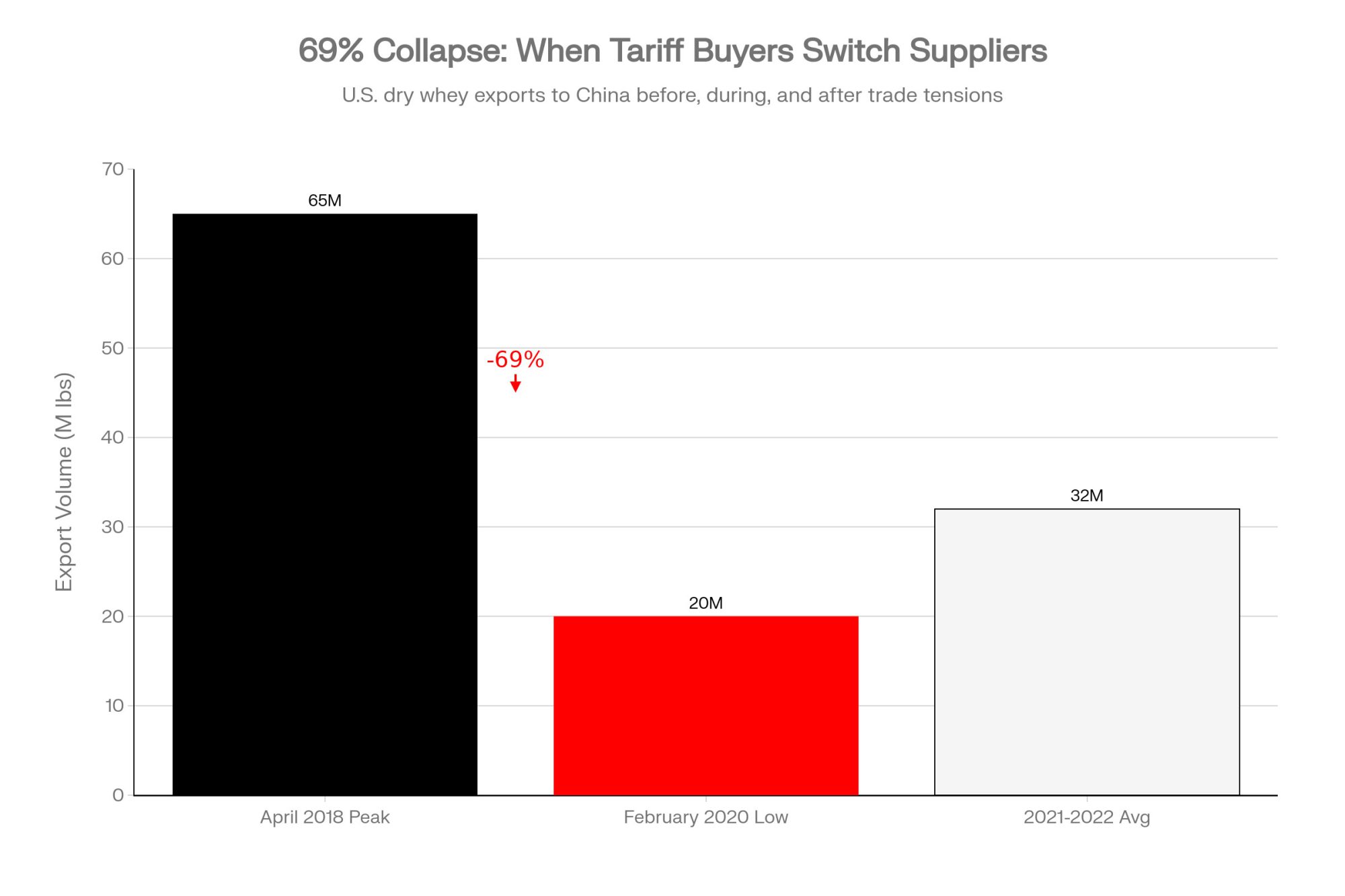
In an April 2025, after China imposed a 20 percent retaliatory tariff on U.S. dry whey in 2018, U.S. dry whey exports to China dropped 69 percent from their April 2018 peak to their February 2020 low, measured on a 12‑month rolling basis. That’s not just noise; that’s a major demand hole for a key by‑product that helps pay the bills in a lot of cheese and whey plants. 

As many of us have seen, once those kinds of volumes start moving, they don’t necessarily come back quickly. And if you wait to react until your milk check clearly reflects the problem, you’ve already given up most of your best options.

Mexico: Our Best Customer… and a Big Point of Exposure

You probably know this already, but the more recent numbers really drive home how central Mexico has become to U.S. dairy.

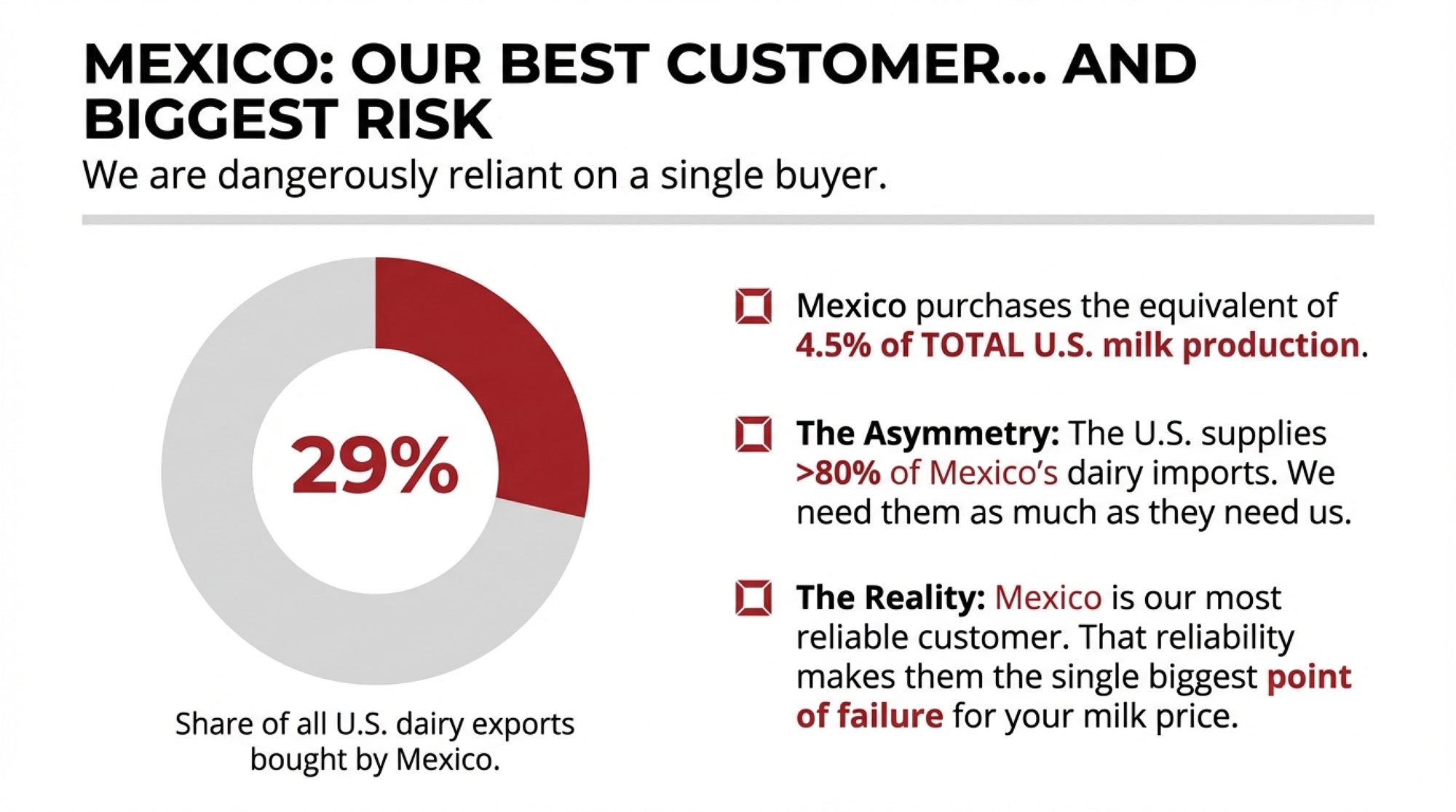
Citing USDA‑FAS data, it was reported that by September 2024, Mexico’s purchases accounted for 29 percent of all U.S. dairy product exports on a value basis. That same piece noted that the United States supplied Mexico with over 80 percent of its imported dairy products in 2024. So from Mexico’s side, the U.S. is the dominant supplier. From the U.S. side, Mexico accounts for close to a third of dairy export value. 

CoBank’s December 2024 report, “Mexico Has Become America’s Most Reliable Customer for U.S. Dairy Exports,” put it into milk terms. Their analysts calculated that Mexico purchases the equivalent of about 4.5 percent of total U.S. milk production through imported dairy products and ingredients. Corey Geiger, CoBank’s lead dairy economist, noted that Mexico runs a dairy product deficit of roughly 25–30 percent each year, and that the U.S. supplies over 80 percent of that shortfall. 

USDA‑FAS projections reinforce the idea that this isn’t going away overnight. In its May 2025 “Dairy and Products Semi‑annual – Mexico” report, FAS forecast Mexico’s fluid milk production to increase about 1 percent to 13.9 million metric tons in 2025 and projected similar modest growth in consumption. That same report highlighted that processors are expected to increase milk powder imports as they continue to favor lower‑cost raw materials for manufacturing. 

What the data suggests is an asymmetric relationship:

  • For Mexico, U.S. dairy is the dominant source of imports, but those imports sit on top of a large and growing domestic production base. 
  • For the U.S., Mexico is the single largest export destination—accounting for around 29 percent of total dairy export value and a major share of cheese, powder, and other products. 

So when CoBank calls Mexico “America’s most reliable customer” for U.S. dairy exports, they’re leaning on hard numbers. But Nicholson’s warning comes back into focus too: if trade tools get used aggressively and provoke retaliation in a market that important, the downside for U.S. dairy farms and processors is substantial. 

Key Numbers Worth Knowing

Looking at the numbers pulled together by USDA‑FAS, USDEC, and CoBank, a few datapoints really frame the risk:

  • Mexico’s share of U.S. dairy exports: about 29 percent by September 2024, based on USDA‑FAS trade data. 
  • U.S. share of Mexico’s dairy imports: over 80 percent of imported dairy products in 2024, per USDA‑FAS data reported by CoBank. 
  • Share of U.S. milk exported to Mexico: roughly 4.5 percent of U.S. milk production equivalent, according to CoBank’s 2024 analysis. 
  • U.S. dairy export value to China (Dec 2018–Nov 2019): about 377 million dollars, a 47 percent decline from the prior 12‑month period, per USDEC numbers reported by Cheese Reporter. 
  • Dry whey exports to China: a 69 percent drop from the April 2018 peak to the February 2020 low on a 12‑month rolling basis after China imposed a 20 percent retaliatory tariff, as documented by Hoard’s Dairyman. 
  • Estimated U.S. dairy farm revenue loss from China tariffs (2019–2021): about 2.6 billion dollars, according to Nicholson’s analysis cited by Cornell. 

Those numbers alone explain why tariff talk matters to your bottom line, even if all your cows are standing in a barn thousands of miles from the border.

China’s Lesson: When Demand Doesn’t Fully Come Back

Now let’s swing back to China, because what happened there is a warning about long‑term demand, not just short‑term pain.

USDEC’s review, as quoted in Cheese Reporter’s 2018–2019 tariff lessons column, showed that by 2017–2018, China had grown into a key destination for U.S. dairy—especially whey and other ingredients. Then the retaliatory tariffs hit. As mentioned earlier, USDEC’s tally showed the value of U.S. dairy exports to China fell to about $ 377 million in the 12 months from December 2018 through November 2019, a 47 percent drop from the previous year. 

2025 whey analysis dug deeper into the ingredient side. With a 20 percent retaliatory tariff on U.S. dry whey, exports to China dropped 69 percent from that April 2018 peak to a February 2020 low, using a rolling 12‑month comparison. During that period, it was noted that Chinese buyers shifted toward more EU dry whey, which wasn’t facing the same tariff penalty. 

Nicholson and other trade economists have pointed out that once buyers qualify alternative suppliers and re‑tool supply chains, not all of that business returns when tariffs ease or exemptions appear. A two‑ or three‑year disruption can change the growth path of a market for much longer than that. 

For U.S. producers, the key lesson is simple: when tariffs push a major buyer to diversify, some of that lost demand can become permanent.

So, Where Does This Leave Your Farm?

So, with all of that in mind, what does this actually mean when you walk back into your parlor or robot room?

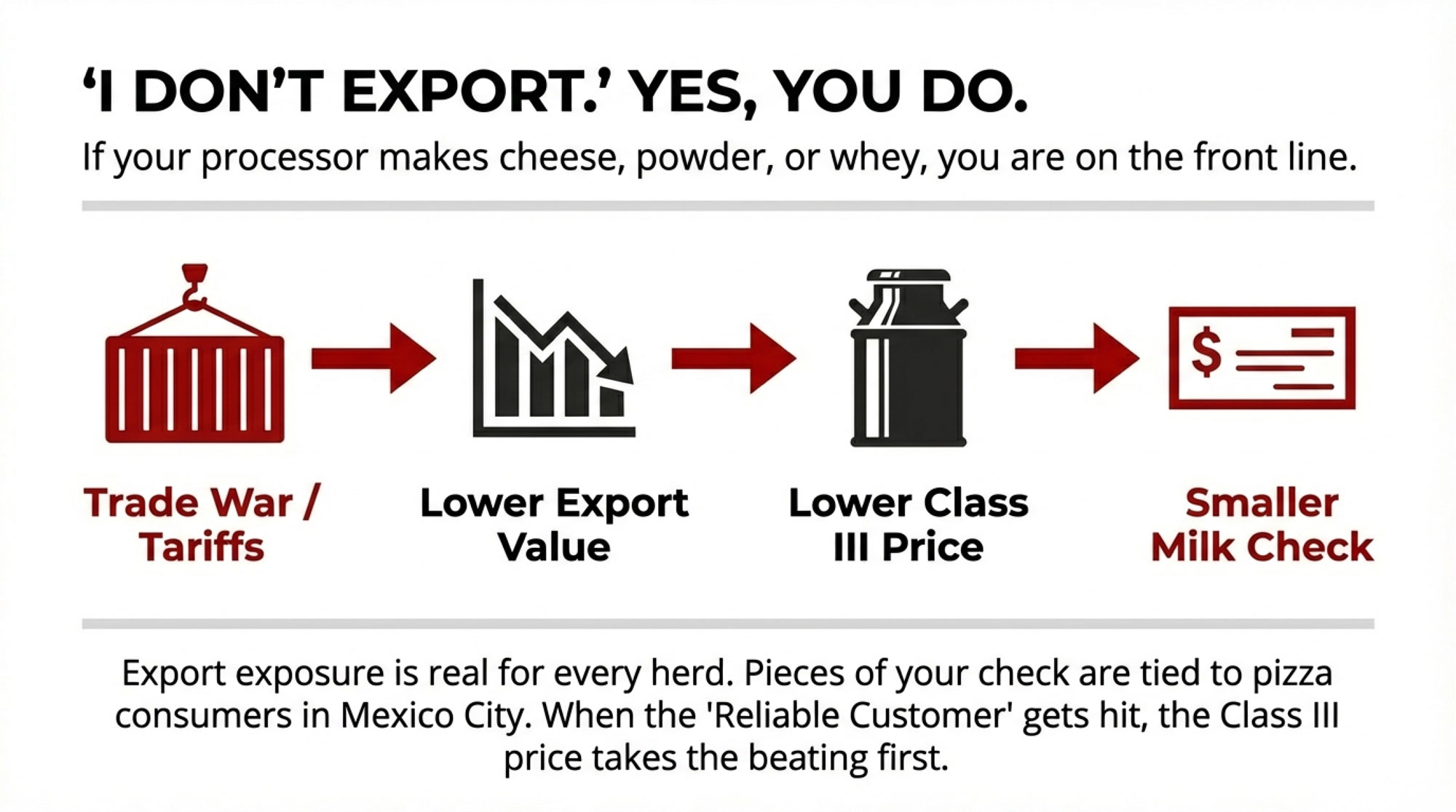
First, it means export exposure is real, whether you’ve ever thought of yourself as an “export farm” or not. If your milk goes to a cooperative or processor that makes cheese, nonfat dry milk, whey, or other export‑oriented products, then pieces of your check are indirectly tied to people buying pizza in Mexico City or feed products in Asia. The concentration numbers—Mexico taking 29 percent of U.S. dairy export value and importing the equivalent of 4.5 percent of U.S. milk output—make that pretty clear. 

Second, it means that when tariffs and trade headlines start moving from talk to action, you don’t have unlimited time to react. The 2018–2019 episode showed that retaliatory moves can go from announcement to significantly lower export values in less than a year, and in the case of whey, the effect on shipments was both steep and persistent. That’s why thinking in terms of a “window” makes sense—there’s a period where you can still get ahead of it. 

Third, it means that planning and conversations matter as much as any single policy announcement. And that part’s under your control.

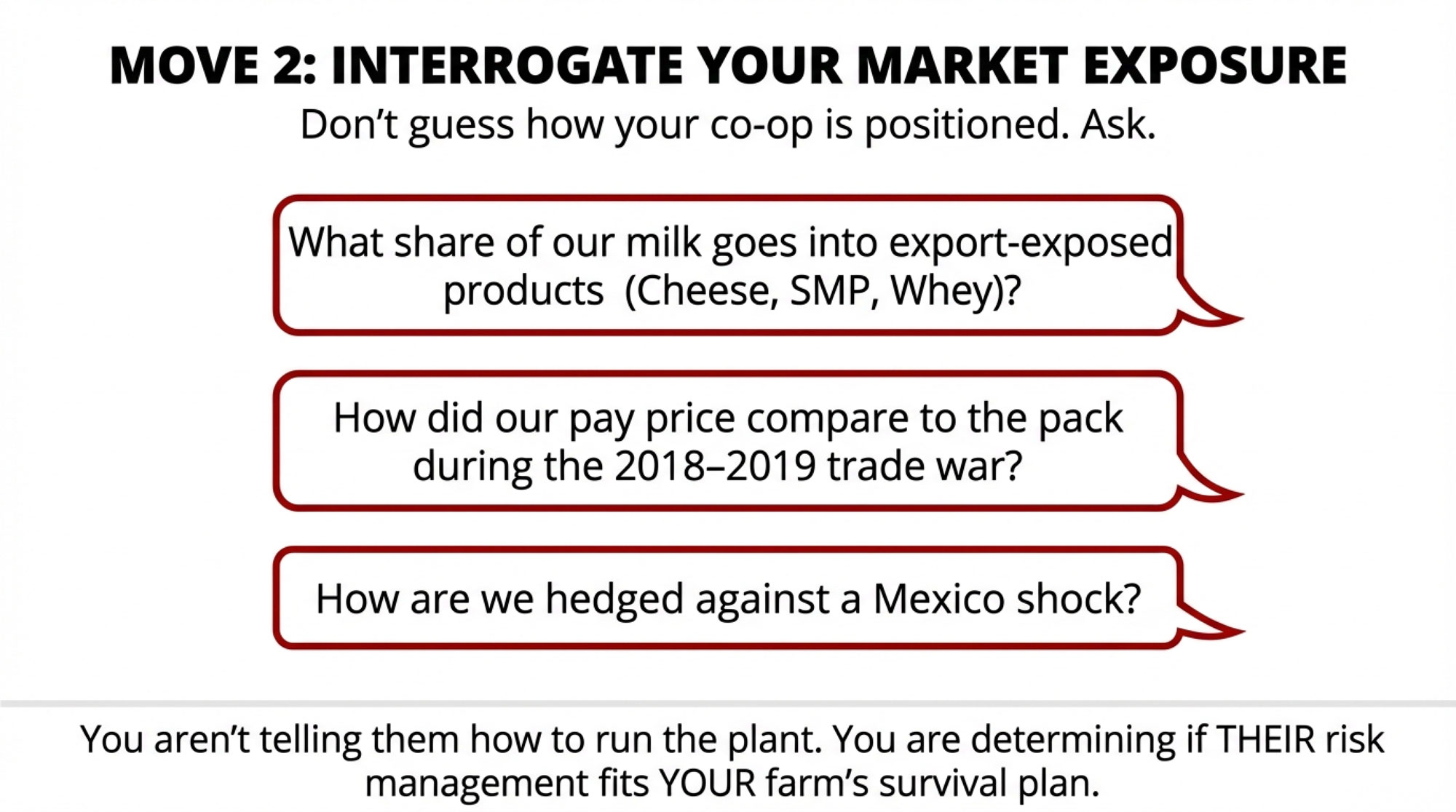
Questions to Bring to Your Co‑op or Buyer

Looking at this trend, one of the healthiest shifts in the last few years is that more producers are asking pointed, respectful questions about how their milk buyer is positioned.

For co‑op members in the Upper Midwest, for example, where a lot of milk heads into cheese vats, it’s worth asking your board or management:

  • Roughly what share of our milk is going into export‑oriented products like cheese, skim milk powder, and whey, given the national export patterns CoBank and USDEC have outlined? 
  • During the 2018–2019 tariff period, how did our average pay price compare to other buyers in our federal order—were we generally ahead, behind, or about in the pack?
  • What kinds of tools does the co‑op use today—hedging, product diversification, long‑term contracts—to buffer members from sudden export demand shocks?

If you’re shipping to a proprietary plant in Idaho or California that sells into both domestic and export markets, the questions are similar. You’re not trying to tell them how to run the business; you’re trying to understand how your farm fits into their risk picture.

Industry groups like the Wisconsin Cheese Makers Association have recently highlighted how trade tensions and export barriers shape decisions at cheese and whey plants, including product mix and market focus. Those kinds of articles make good conversation starters and show that processors are thinking about this, too. 

And I’ve noticed that when producers come to meetings with numbers and questions rather than just frustration, the conversation usually improves for everyone.

Sitting Down With Your Lender Before There’s a Fire

What many lenders have said in interviews with dairy media and farm‑management educators is pretty consistent: the best conversations happen before there’s a cash‑flow emergency. 

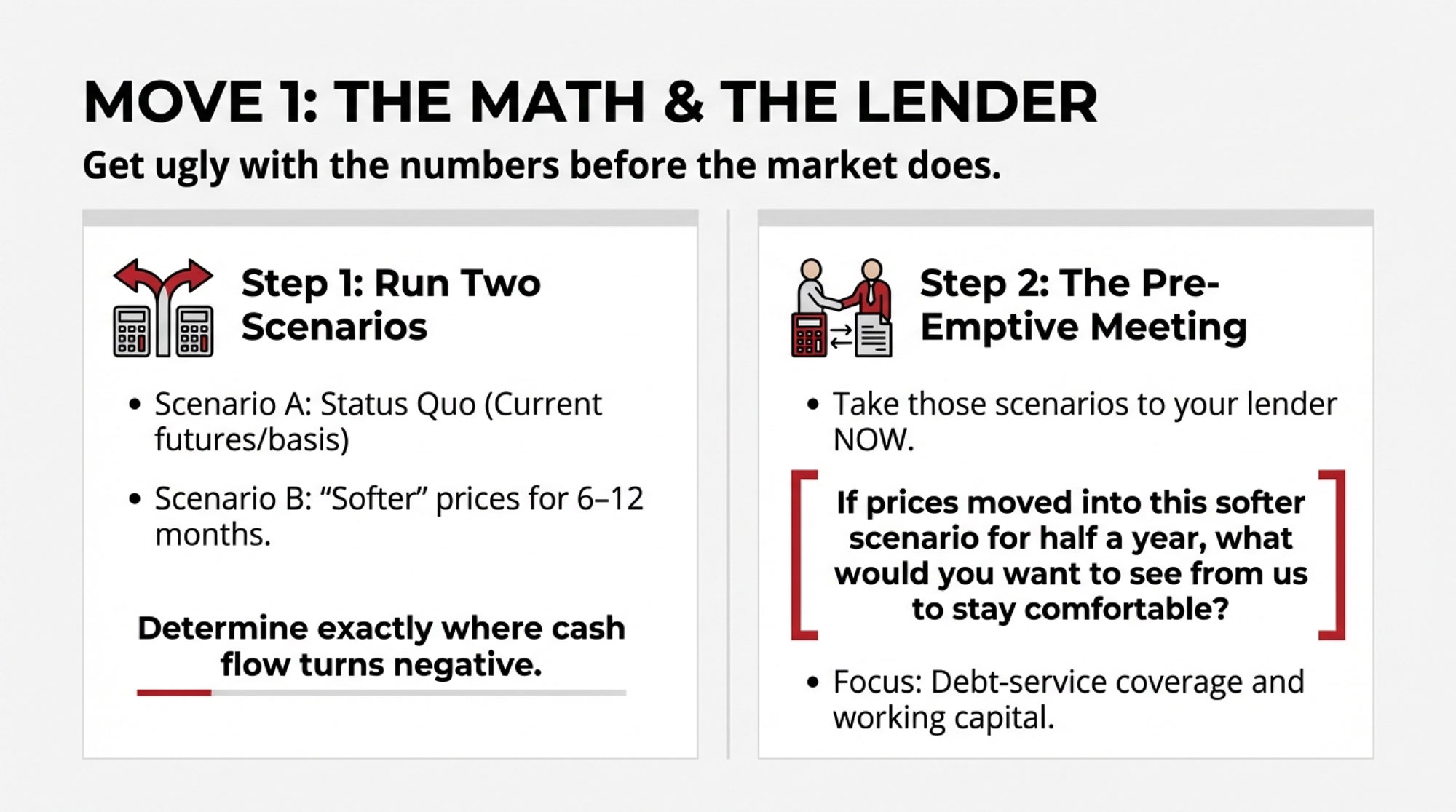
You don’t need perfect forecasts to have a useful meeting. What you do need are a few grounded scenarios you can walk through together:

  • One based on today’s outlook, using current futures and your local basis.
  • One that assumes a noticeable softening in prices for six to twelve months—something that would squeeze margins but not necessarily be catastrophic.

You might not know all your ratios off the top of your head, but you can bring a simple printout or spreadsheet with you:

  • Herd size and average production per cow.
  • Your recent butterfat performance and component levels.
  • Rough cost per hundredweight from your last farm financial review.
  • Current term debt schedule and operating line limits.

Then you can ask very practical questions:

  • “If prices moved into this softer scenario for half a year, what would you want to see from us to stay comfortable with our operating line?”
  • “Are there any term loans we could look at restructuring in advance to give us more breathing room on cash flow if things get choppy?”

Farm Credit associations and other ag lenders often publish their own dairy outlooks and risk‑management articles, and university extension programs pick them up and discuss them. Skimming one or two of those ahead of time can help you frame what your lender is already worrying about. 

What’s encouraging is that lenders generally don’t expect perfection. They expect awareness and a plan.

Thinking About Risk Tools Without the Sales Pitch

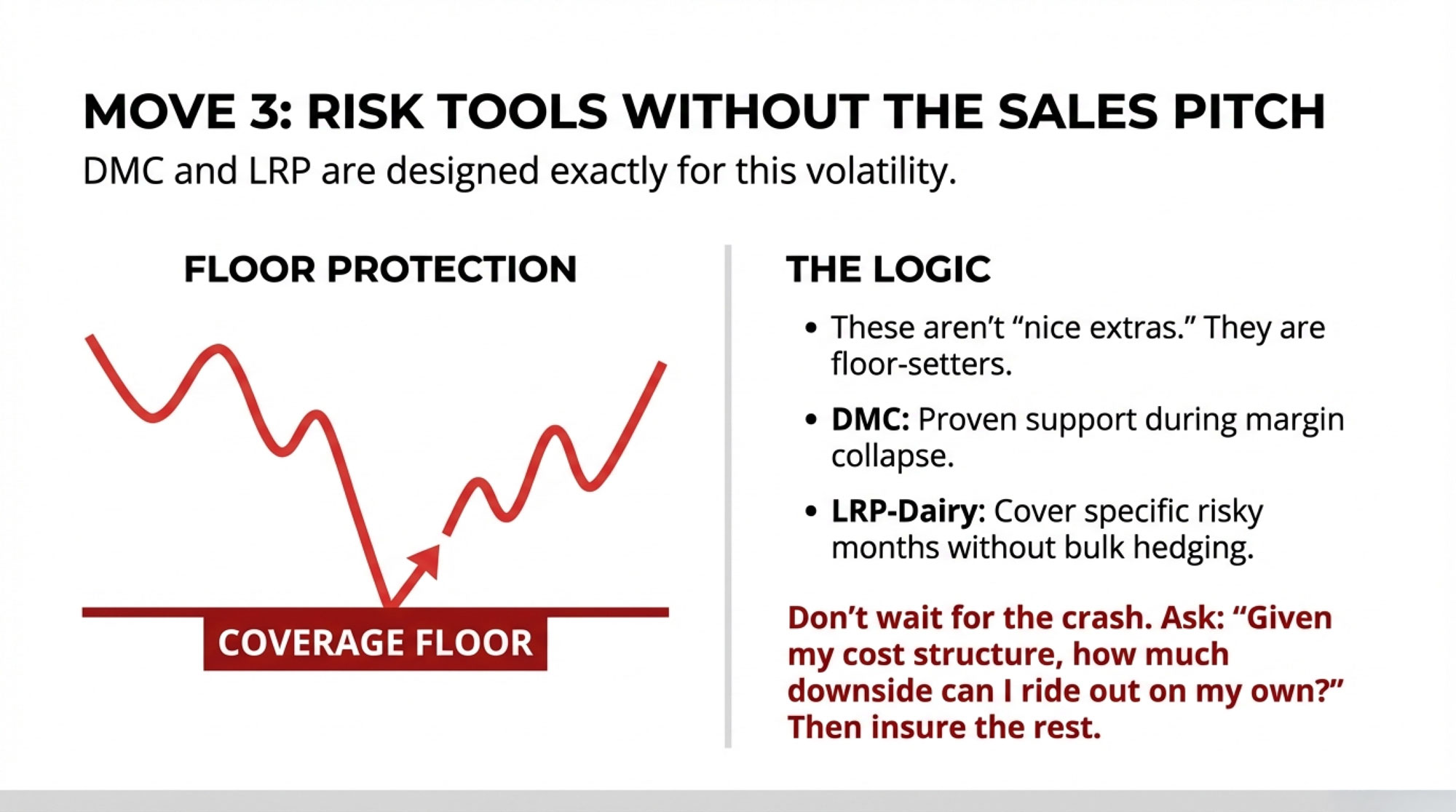
Programs like Dairy Margin Coverage and Livestock Risk Protection are designed for exactly the kind of volatility we’re talking about.

USDA’s Farm Service Agency has documented how DMC payments supported participating farms during the margin collapses of 2020, especially for operations that chose higher coverage levels up to the Tier I cap of 5 million pounds per year at 9.50 dollars per hundredweight. USDA’s Risk Management Agency, in its LRP‑Dairy materials, explains how producers can buy coverage on expected milk prices for specific months, with indemnities paid when actual index values fall below the coverage level, allowing smaller‑volume coverage than traditional futures or options. 

The data and case examples shared by land‑grant extension programs—like those from UW–Madison, Penn State, and Ohio State—suggest these tools tend to work best when they’re part of a thought‑out risk plan rather than a last‑minute scramble. Extension economists and dairy business management specialists have walked through examples of aligning DMC coverage with the cost of production and using LRP‑Dairy selectively on a portion of milk to cover the riskiest months. 

So instead of treating these programs as “nice extras” or something you only look at when prices are already ugly, it’s worth asking yourself:

  • “Given my cost structure and butterfat performance, how much downside can I realistically ride out on my own?”
  • “Beyond that point, what portion of my milk do I want to insure, and with what mix of tools that I actually understand?”

Your local extension educator, FSA staff, and crop insurance agent can help you look at USDA summaries of past payouts and current premium tables so you’re making decisions based on numbers, not anecdotes.

If Exit Is on the Horizon, Timing Still Matters

This is a tough topic, but it’s part of the real conversation on a lot of farms, especially in regions like the Northeast and Upper Midwest, where farm numbers have been under pressure for years.

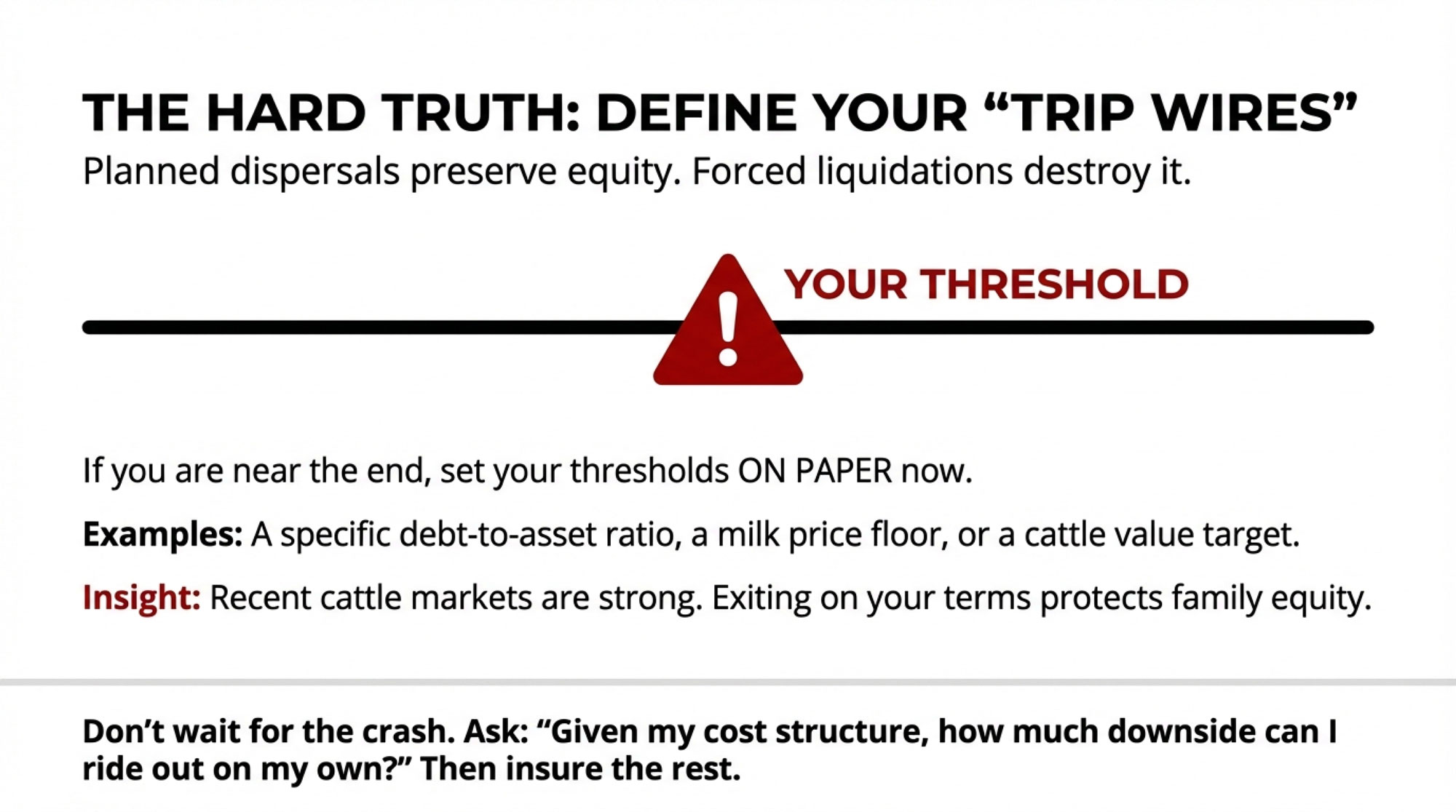
In some operations—where the next generation is unsure about taking over or where the main operators are dealing with health issues—the question isn’t just “how do we ride out another tough year?” It’s also “if we’re going to be done sometime in the next five to ten years, when and how do we want that to happen?”

Cull cow and bred heifer prices have gone through stronger periods recently, supported in part by tighter beef supplies and the growing use of beef‑on‑dairy genetics, which can improve the value of crossbred calves and cull animals. Farm‑management articles and extension transition resources from universities in Wisconsin, Pennsylvania, and Ontario have noted that planned dispersals in reasonably firm cattle markets often preserve more equity than forced liquidations after prolonged low‑margin periods and mounting debt, based on farm case studies and lender feedback. 

The exact dollars will vary herd by herd. But the pattern is consistent enough that it’s worth a kitchen‑table discussion if you’re in that stage:

  • “If we did decide to exit in the next few years, what conditions—milk price, cattle price, debt level—would make that feel like a planned move rather than a last‑ditch sale?”
  • “What level of equity do we want to protect for the family, whether that’s land, retirement savings, or off‑farm investments?”

Extension farm‑transition specialists have checklists and meeting templates that can help you structure those conversations and bring everyone into the loop before circumstances force decisions. 

It Might Not Be 2018–2019 All Over Again… But It’s Worth Being Ready

It’s worth noting that not every tariff scare becomes a full‑blown crisis.

USDA‑FAS’s 2025 outlook for Mexico shows continued growth in domestic dairy production and ongoing demand for imported powders and cheese, even in the face of broader trade tension. CoBank’s analysis frames Mexico as a structurally reliable customer for U.S. dairy, given its persistent deficit and heavy reliance on the U.S. supply. Trade press coverage has also highlighted that some announced tariff measures end up delayed, modified, or partially offset by exemptions and side deals, which can soften the blow for agriculture.

What’s encouraging is that the U.S. dairy sector has adapted to shocks before. Exporters have shifted product mixes and markets, processors have invested in new capabilities, and producers have improved fresh cow management, feed efficiency, and overall cost control in response to tough years. That doesn’t mean it’s easy; it means it’s possible. 

At the same time, the data from the last tariff cycle—and Nicholson’s 2.6‑billion‑dollar loss estimate—are a reminder that when major markets pull back, the financial damage can be both large and long‑lasting. That’s why this isn’t about predicting doom; it’s about deciding how you want to be positioned if the road gets rough. 

A Simple 60‑Day Framework You Can Actually Use

MetricCurrent OutlookSofter Scenario (6–12 mo)Change
Class III Milk Price ($/cwt)$18.50$16.00–$2.50
Butterfat Premium ($/lb)$2.10$1.85–$0.25
Feed Cost per Cow/Day$9.25$9.50+$0.25
Est. Margin per Cow/Day$3.20$1.15 ⚠️ RED–$2.05

So, over the next couple of months, here’s a straightforward way to put all this into practice without turning it into a full‑time project.

  1. Put two price scenarios on paper.
    Use your own numbers—your butterfat performance, average production per cow, and local basis. Start with something close to today’s outlook based on current futures. Then sketch a second scenario in which prices are meaningfully softer for 6 to 12 months. You don’t need to be perfect; you just need to see roughly where cash flow turns from positive to negative and what that looks like in dollars per month.
  2. Take those scenarios to one meeting with your co‑op or buyer.
    At a member meeting in Wisconsin, a one‑on‑one with a field rep in New York, or a call with a plant in the West, use the Mexico and China numbers as a backdrop and ask: “If export markets got choppy like they did in 2018–2019, how would that likely show up in our pay price, and what options would you have beyond just dropping the check?” Co-op and processor leaders have been talking publicly about trade risk and export barriers in venues like the Wisconsin Cheese Makers Association and national dairy policy forums—referencing those discussions shows you’re paying attention. 
  3. Take the same scenarios to one meeting with your lender.
    Sit down with your banker or Farm Credit officer and say: “Here’s what our cash flow looks like at these two price levels. If the softer scenario showed up for half a year, what would you want to see from us to stay comfortable? Are there things we could adjust now to give both of us more confidence?” Dairy‑focused lenders interviewed by farm media and extension often point to debt‑service coverage, working capital, and equity as the main gauges they watch. Ask them which ones they’re watching on your operation. 
  4. Ask good questions about risk tools.
    With your extension educator, FSA office, or insurance agent, walk through how DMC and LRP‑Dairy actually performed in 2020 and other recent years for farms your size, using USDA and extension summaries as your guide. You’re not committing on the spot; you’re making sure you understand what they can realistically do for your operation and the costs involved. 
  5. If succession or retirement is a live topic, name the “trip wires.”
    If the family’s talked about being “done at some point,” put rough thresholds on paper—maybe a certain milk price, debt‑to‑asset ratio, or cattle value—and discuss at what point a planned exit might be better than pushing through at any cost. Extension farm‑transition specialists and case studies from Wisconsin, Pennsylvania, and Ontario can give you examples of how other families have navigated those choices. 

None of this requires you to guess which tariff will be announced next or how Mexico or China will respond. It just puts you in a better position to decide, rather than react.

Closing Thoughts: Deciding While You Still Have Room

As many of us have learned, nobody—whether it’s USDA, USDEC, your co‑op, or your lender—has quite the same focus on your farm’s future as you do. They all bring tools and information to the table, but they’re looking across hundreds or thousands of farms, not just yours. 

What’s encouraging is that you don’t need to control court decisions, trade negotiations, or election outcomes to tilt the odds a bit more in your favor. You can use this “60‑day window” idea as a reminder: there is a period between policy talk and milk‑check pain where you still have room to adjust your plan.

If things stay relatively calm, you’ll have invested some time in understanding your operation better and strengthening relationships with the people who help finance and market your milk. If tariffs and trade disputes start biting into exports again, you’ll be glad you didn’t wait for your milk statement to tell you there was a problem.

Because once the damage is printed on that check, you’re not really deciding anymore. You’re reacting.

Right now, you still have room to decide.

Key Takeaways

  • $2.6 billion lost: Chinese retaliatory tariffs alone cost U.S. dairy farms an estimated $2.6B in revenue from 2019–2021, per Cornell economist Charles Nicholson. ​
  • 29% in one market: Mexico buys about 29% of all U.S. dairy exports and relies on the U.S. for over 80% of its imported dairy—one trade dispute could ripple through the entire sector. ​
  • Demand doesn’t snap back: After China imposed 20% tariffs on U.S. dry whey, exports dropped 69% and buyers shifted to the EU; much of that volume never fully returned. ​
  • You have a 60-day window: From tariff announcement to milk-check impact is roughly 60–90 days—enough time to run price scenarios, schedule one meeting each with your co-op and lender, and review your DMC/LRP position.
  • Decide now or your check decides later: Farms that act in the window keep their options open; farms that wait until the damage prints are already reacting instead of choosing.

Complete references and supporting documentation are available upon request by contacting the editorial team at editor@thebullvine.com.

Learn More

The Sunday Read Dairy Professionals Don’t Skip.

Every week, thousands of producers, breeders, and industry insiders open Bullvine Weekly for genetics insights, market shifts, and profit strategies they won’t find anywhere else. One email. Five minutes. Smarter decisions all week.

NewsSubscribe
First
Last
Consent

Mexico: America’s Top Dairy Ally

Why is Mexico the top market for U.S. dairy? How does this demand affect American farmers and exports? Uncover the future of this critical trade partnership.

Summary:

America’s dairy industry stands on the brink of a historic shift, with surging domestic consumption and robust international exports marking a new era of growth. Amidst this transformation, Mexico has emerged as the United States’ most steadfast and lucrative dairy customer, driven by modern trade agreements and geographical proximity. As the industry invests billions into expanding processing capabilities, understanding and leveraging the Mexican market’s growing demand could unlock unprecedented opportunities for American dairy farmers. This strategic partnership is key to future growth in dairy exports, driven by shared goals and complementary needs. As the industry navigates international trade complexities, strengthening this alliance could safeguard and amplify American dairy’s global influence, with Mexico buying over a quarter of all U.S. dairy exports. In 2023, Mexico purchased over 1.38 billion pounds of U.S. dairy products, primarily nonfat dry milk and skim milk powder, highlighting its essential role in the U.S. dairy export market.

Key Takeaways:

  • Mexico has become the top destination for U.S. dairy exports, accounting for over one-fourth of all products leaving the country, a trend driven by Mexico’s rising demand and consumption.
  • U.S. dairy investments and Mexico’s demand projection indicate that this relationship is set to expand further, providing significant growth potential for U.S. exporters.
  • The USMCA is pivotal in enhancing trade opportunities and strengthening the economic ties between U.S. and Mexican dairy markets.
  • Mexico’s dairy industry faces a notable deficit in production, which U.S. exports currently fulfill predominantly through milk powders, cheese, and whey proteins.
  • Investment in U.S. dairy processing infrastructure suggests increased production capacity to meet domestic and international demand, especially from Mexico.
  • U.S. dairy exports are diversifying markets, but half of the top 10 export markets, including China and Japan, lack similar free trade agreements as those with Mexico.
  • There exists immense opportunity for growth, as the average Mexican consumes significantly less dairy than the average American, indicating room for increased consumption.
  • Economic policies, currency fluctuations in Mexico, and the Federal Reserve’s monetary policy will continue to influence the success of U.S. dairy exports in this market.
U.S. dairy industry growth, Mexico dairy exports, U.S.-Mexico trade agreements, NAFTA impact on dairy, USMCA dairy regulations, dairy consumption increase, milk powders and cheese demand, U.S. dairy products sales, dairy infrastructure in Mexico, U.S. dairy export market.

Imagine a market that buys every fourth pound of dairy your country exports. For U.S. dairy farmers and producers, that market isn’t far away. It’s our neighbor, Mexico. This increasing demand is a big opportunity and a significant contributor to the U.S. dairy industry’s economic growth. Mexico has become America’s most reliable and profitable customer, a testament to the industry’s potential. This change didn’t happen overnight, but it’s clear that Mexico’s need for American dairy is new and game-changing. Key trade agreements, being close by, and rising dairy demand have all come together to support this relationship, ensuring consistently strong demand. As Mexican consumers want more high-quality proteins and fats, this is the start of a growing success story. This story depends on trade and shared taste, quality, and nutrition values.

The Dairy Renaissance: U.S. Ascends as a Global Powerhouse 

The U.S. dairy industry is remarkably high, with record domestic consumption and international exports. While the European Union and New Zealand have traditionally led the global dairy export market, the United States is emerging as a strong competitor. This success is not a stroke of luck but a result of meticulous planning and innovative market strategies. 

An $8 billion investment in new dairy processing facilities is part of a big plan to boost the country’s dairy production. A significant portion, $4 billion, is focused on expanding cheese and whey processing facilities. New large-scale cheese plants are already starting production, marking an important step for the industry. 

This significant investment shows confidence in the industry’s ongoing growth. It positions U.S. dairy producers to meet domestic demands and take advantage of growing export markets. As new facilities improve their processing capabilities, U.S. dairy suppliers are better positioned to meet the rising global demand for high-quality dairy products like milk powders and specialty cheeses. 

The effects of this investment go beyond increased production. They signal a new era of innovation, efficiency, and competitiveness in the U.S. dairy sector, opening opportunities for expansion into new international markets. These industry developments suggest that the U.S. is prepared to improve its position on the global dairy stage, supported by updated infrastructure designed to support and drive the next growth phase.

Mexico’s Dairy Appetite: A Boon for U.S. Suppliers 

The growing demand for dairy in Mexico tells an interesting story about changing diets and economic potential. Over the past decade, Mexicans have wanted more dairy due to changing consumer tastes and a rising population. Between 2011 and 2023, per-person consumption jumped from 244 pounds to 293 pounds, a 20% increase. This is much higher than the 8.3% growth seen in the U.S. during the same period. 

This significant increase in demand shows how Mexico partly relies on imports and highlights the gap between what it produces and consumes. This gap means 25% to 30% of the needed dairy products are short each year. Here’s where the United States comes in. The U.S. dairy industry is a major supplier, especially milk powders and cheese. These exports are crucial not only to meet consumer needs but also to support Mexico’s dairy infrastructure. 

In 2023, the U.S. met Mexico’s growing needs through innovative exports. According to U.S. Trade Monitor Data, Mexico bought over 1.38 billion pounds of U.S. dairy products in milk solids. Most of these—919 million pounds—were nonfat dry milk and skim milk powder, essential for adding protein to cheese and other dairy goods. Meanwhile, cheese exports reached 352 million pounds by October 2024, making Mexico a key part of the U.S. dairy export market. 

This partnership is a testament to the essential role that U.S. dairy products play in the lives of Mexican consumers. As Mexico’s appetite for dairy grows, the U.S. stands ready to meet this demand, further solidifying its position in Mexico’s dairy market.

Trading Paths to Prosperity: The Crucial Role of Free Trade Agreements in U.S.-Mexico Dairy RelationsFree trade agreements have significantly impacted the U.S.-Mexico dairy trade, helping both countries grow and work together. NAFTA, which started in 1994, removed tariffs on farm products, including dairy. By 2008, there were no tariffs on dairy exports, leading to a significant increase in U.S. dairy exports to Mexico, reaching $211 million. This agreement set the stage for the U.S. to become a major dairy supplier to Mexico. When NAFTA was improved and became the United States-Mexico-Canada Agreement (USMCA) in 2018, the rules for dairy exports were even more substantial. By 2011, Mexico became the first market to buy over a billion dollars worth of U.S. dairy products. USMCA has helped U.S. dairy exports to Mexico go over $ 2 billion by 2022, showing how important these agreements are for competing globally. 

When NAFTA was improved and became the United States-Mexico-Canada Agreement (USMCA) in 2018, the rules for dairy exports were even more substantial. By 2011, Mexico became the first market to buy over a billion dollars worth of U.S. dairy products. USMCA has helped U.S. dairy exports to Mexico go over $2 billion by 2022, showing how important these agreements are for competing globally. 

The U.S. and Mexico are close to each other, making it easier to transport and sell dairy products. Removing trade barriers through NAFTA and USMCA helped the U.S. dairy industry financially. It strengthened the economic relationship between the two nations. However, these agreements also come with challenges and risks, such as potential political leadership or policy changes that could affect the trade relationship. These agreements remain crucial in sustaining and possibly growing U.S. dairy exports, emphasizing the need for firm trade deals to open new markets for American dairy farmers and sellers.

Mexico’s Standout Status: The Gold Standard in U.S. Dairy Export Markets

Mexico’s role as a U.S. dairy customer is evident compared to other global markets. Mexico buys more than a quarter of all U.S. dairy exports, while China’s purchases account for only about 26% of what Mexico buys. This difference shows why Mexico is a better and more stable market for U.S. dairy products. 

Firstly, Mexico is close to the U.S., which makes shipping more straightforward and cheaper because goods don’t have to travel as far as they do to China. Shorter distances mean that dairy products can be delivered faster without the unpredictable and costly challenges of shipping across the Pacific Ocean. 

Trade agreements like the United States-Mexico-Canada Agreement (USMCA) have also significantly changed North American trade. These agreements have removed tariffs and simplified trading, giving U.S. dairy producers excellent access to Mexican markets without being blocked by trade barriers. On the other hand, trading with China has often been difficult due to conflicts and tariffs, which can make exporting dairy products harder and less profitable. Because of this, Mexico is more straightforward to trade with and offers a better payoff for export strategies. 

Finally, there’s the question of demand. Mexico’s growing middle class has a strong and increasing demand for dairy products, more so than in China, where dairy is slowly added to diets. Although China imports more dairy than any other country, most come from New Zealand, not the U.S. 

Looking at these factors, it’s clear that Mexico is a more reliable and ready market for U.S. dairy exports. With its closeness, helpful trade deals, and strong demand for dairy, Mexico is an important customer and a key partner in the U.S. dairy export plan.

Future-Ready: Unleashing the Potential of U.S.-Mexico Dairy Collaboration

We’re entering an exciting time for the dairy trade between the U.S. and Mexico. As Mexico is a leading buyer of American dairy products, there’s room for more growth, thanks to changes in Mexico. 

The growing middle class in Mexico offers significant opportunities for U.S. producers. As more people have extra money to spend, they’re likely to look for various good-quality foods, including dairy, which is rich in proteins and fats. This shift aligns well with American dairy, known for its substantial nutritional benefits and options. 

Picture a time when Mexican families often choose U.S. dairy brands for their nutrition. This future isn’t just possible; it’s likely, given the efficient logistics and trade systems in place. Plus, the close distance between the U.S. and Mexico helps keep the supply chain smooth, ensuring fresh dairy is always available in Mexico. 

But we’re not stopping with what we’ve achieved so far. There are still many opportunities to offer new products that suit the tastes and needs of a wider group of people. Unique dairy products with local flavors could become favorites in Mexico, strengthening the U.S.’s role in meeting Mexico’s growing love for dairy. 

Boosting marketing and highlighting the health benefits of high-quality dairy could drive up demand. Educational campaigns about these benefits and supportive trade policies can increase U.S. dairy exports. 

As we look to the future of U.S.-Mexico trade, one thing is sure: the possibilities are exciting. Industry leaders must take advantage of this partnership and make the most of it.

The Bottom Line

Looking ahead, it’s clear that Mexico is America’s most reliable partner in dairy exports. This relationship, built on free trade agreements, close location, and growing demand for quality products, makes Mexico a key player in the U.S. dairy industry. With one in four pounds of exported U.S. dairy products going to Mexico, their purchasing power is crucial for the growth of the American dairy industry. 

Strengthening this successful trade relationship is crucial for the future of U.S. dairy. American dairy farmers can benefit from a growing market by working together and understanding each other. This strengthens economic connections and increases the resilience of the U.S. dairy sector in a competitive global market. 

Mexico’s importance as a dairy export market offers the U.S. dairy industry a chance to grow globally. Further growth is possible by collaborating with Mexican partners, exploring new ideas, and continuously aligning trade policies. The bright future is bright, and significant rewards exist for investing in this vital partnership.

Learn more:

Join the Revolution!

Bullvine Daily is your essential e-zine for staying ahead in the dairy industry. With over 30,000 subscribers, we bring you the week’s top news, helping you manage tasks efficiently. Stay informed about milk production, tech adoption, and more, so you can concentrate on your dairy operations. 

NewsSubscribe
First
Last
Consent
Send this to a friend