
Archive for Dairy Farm Profitability

$2,000 Cull Cows Are Exposing Dairy’s Biggest Lie: Management Can’t Save You Anymore

Cull cow: $2,000. Daily milk profit: $2. You’re not failing – you’ve been lied to about what survival actually requires.

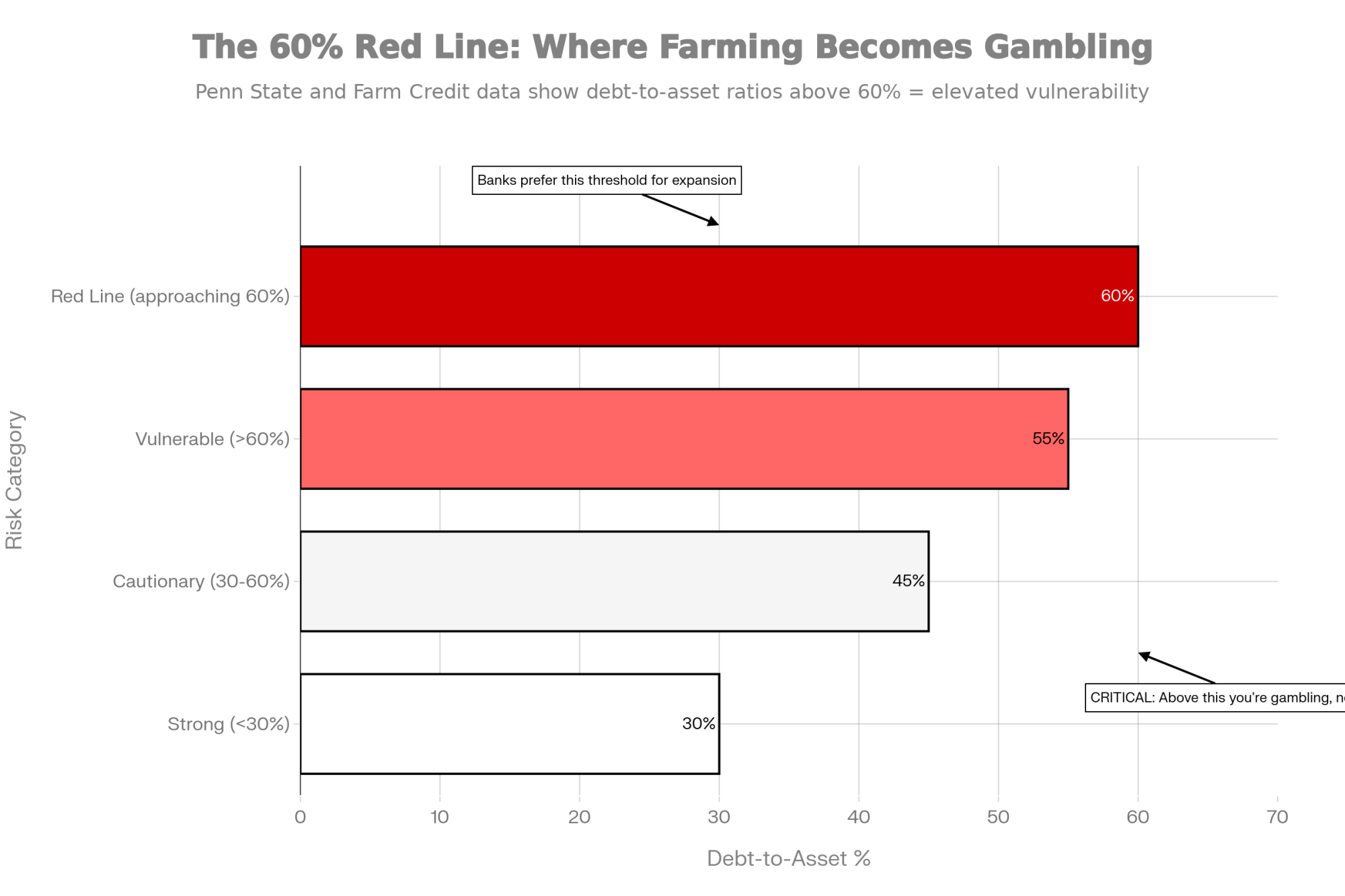
EXECUTIVE SUMMARY: The management myth just died. USDA’s October 2025 data confirms what the numbers have been screaming: your location now determines your profitability more than your skills ever will. Cull cows are fetching $2,000 as beef while daily milk margins scrape by at $2-3 per cow—and the smart money has noticed. Federal Milk Marketing Order data shows cheese-oriented regions pulling $1.00-1.50/cwt more than powder areas, handing some operations a $50,000+ annual advantage their neighbors can’t touch, no matter how hard they work. The heifer shortage—at 1970s lows—has flipped from crisis to cash flow, with producers breeding surplus heifers now banking $100,000+ annually. Billions in new processor investments are creating what analysts call “permanent regional stratification,” and lenders are already tightening credit windows. Strategic repositioning isn’t a five-year plan anymore—it’s a five-month decision. October’s culling data proves the reshuffling has already begun, and the producers who act now will be the ones still standing when the dust settles.

The USDA’s October 2025 Milk Production report confirms what we’ve all been feeling in our gut: The national herd is shrinking, but you know what? The reasons have fundamentally changed. This isn’t just about milk prices anymore—we’re watching a restructuring that’s making everything we thought we knew about good management seem… well, less relevant than it used to be.

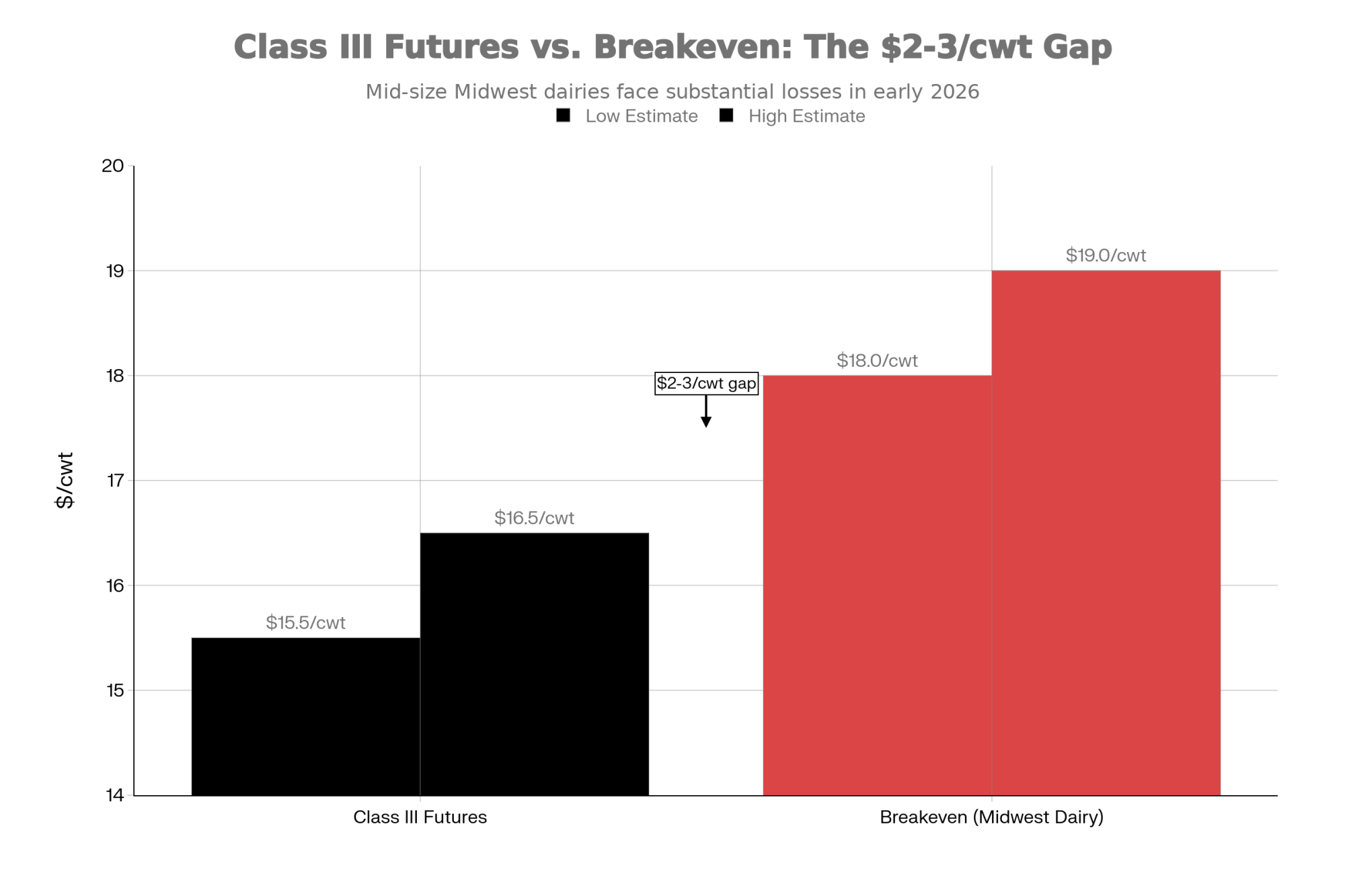
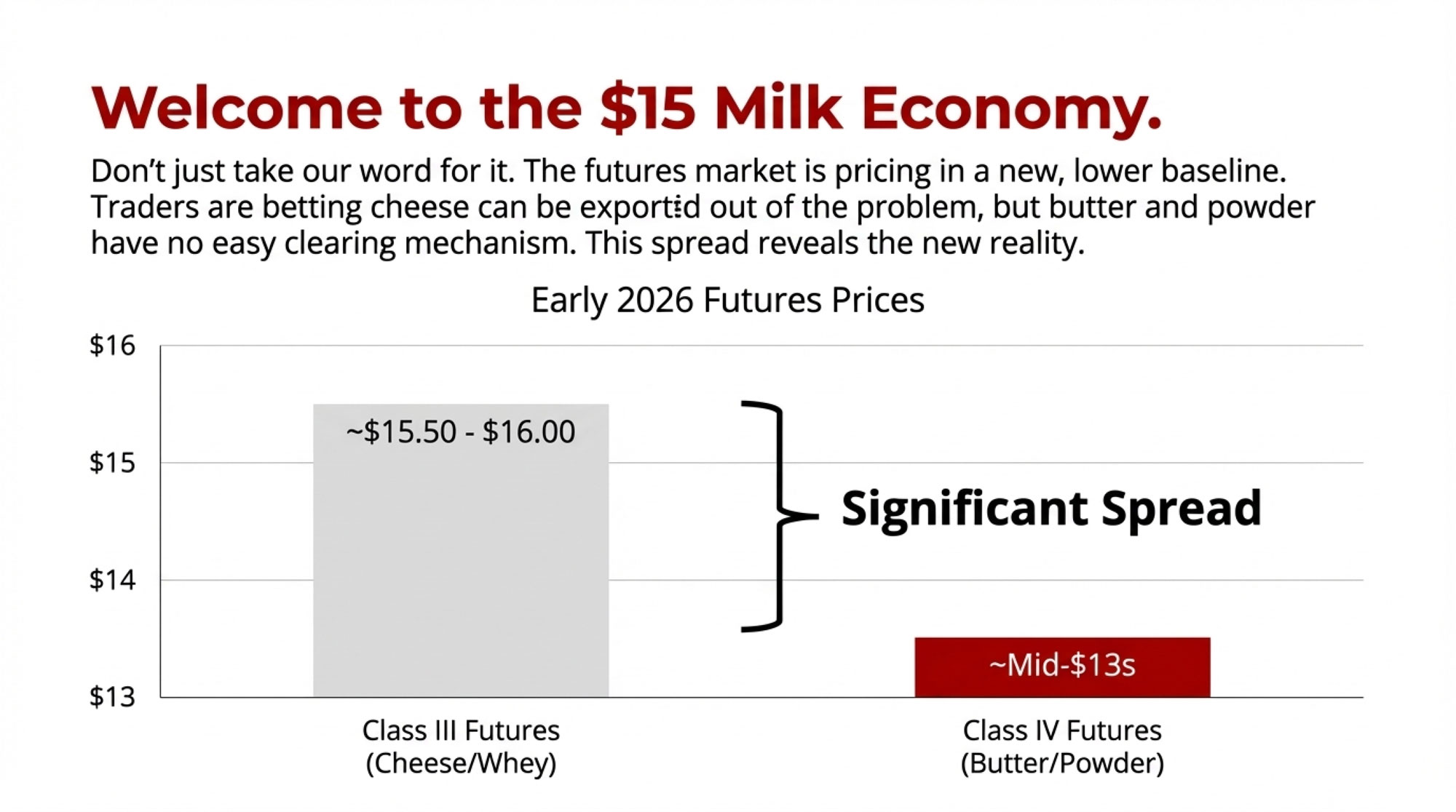
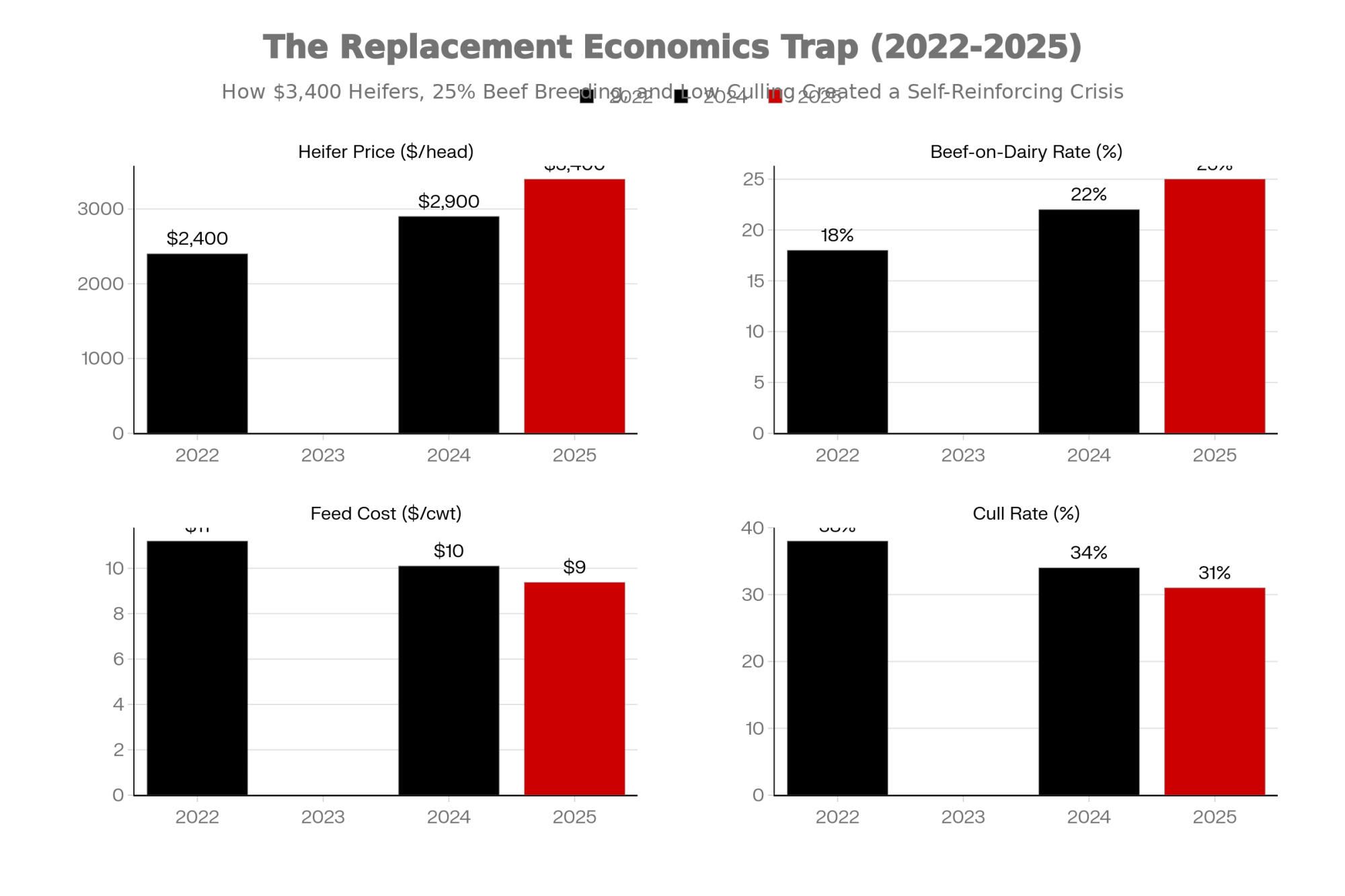
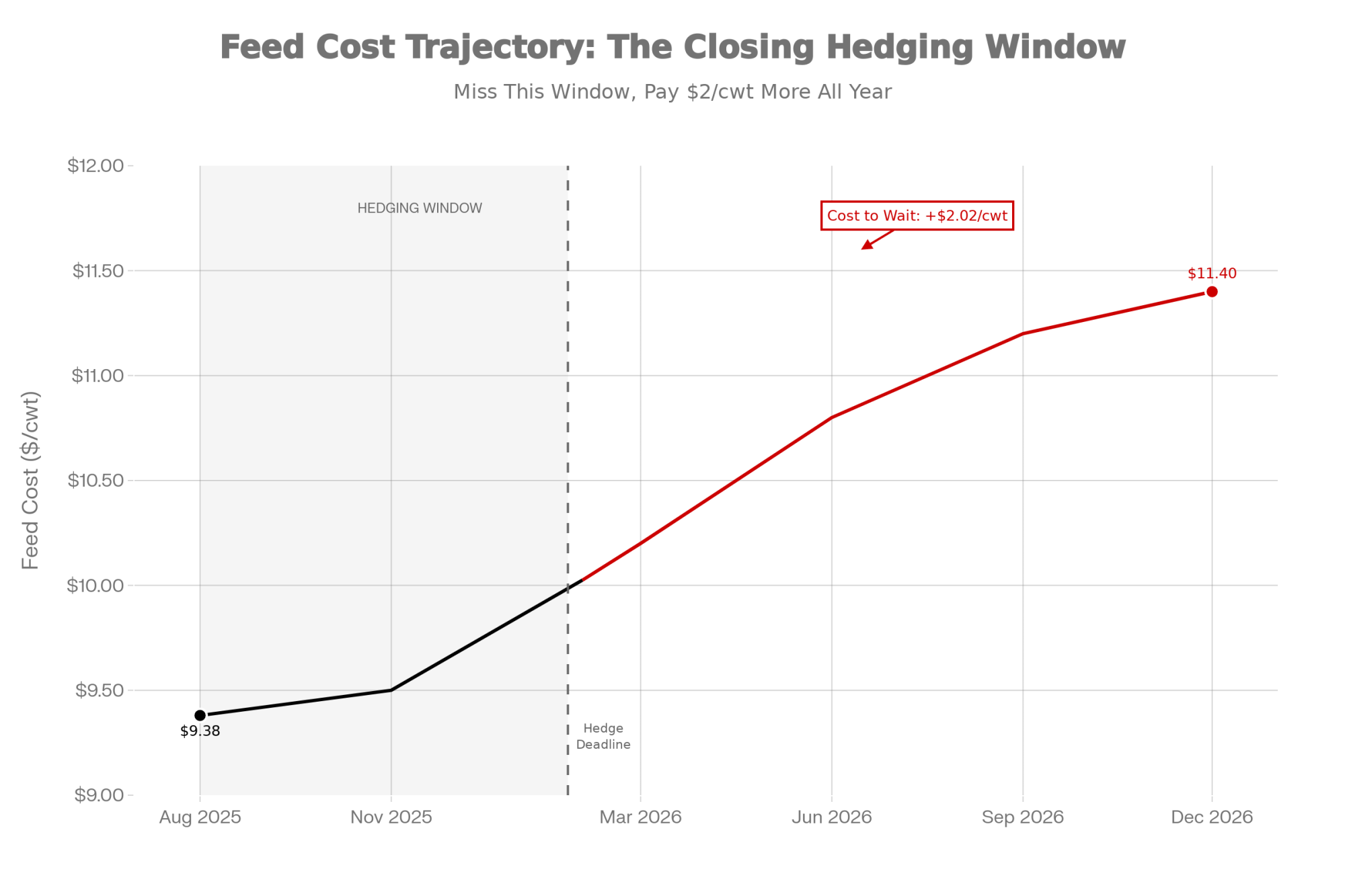
Here’s the math we’re all looking at. October’s Class III milk was hovering in the mid-$16s per hundredweight, according to CME Group’s daily settlement data. Take your typical cow producing around 65 pounds daily—she’s bringing in maybe $11 in gross revenue. Feed costs? Using the USDA Farm Service Agency’s Dairy Margin Coverage calculations from October, we’re looking at roughly $8 to $9 daily per cow. That doesn’t leave much after labor, utilities, and keeping the lights on…

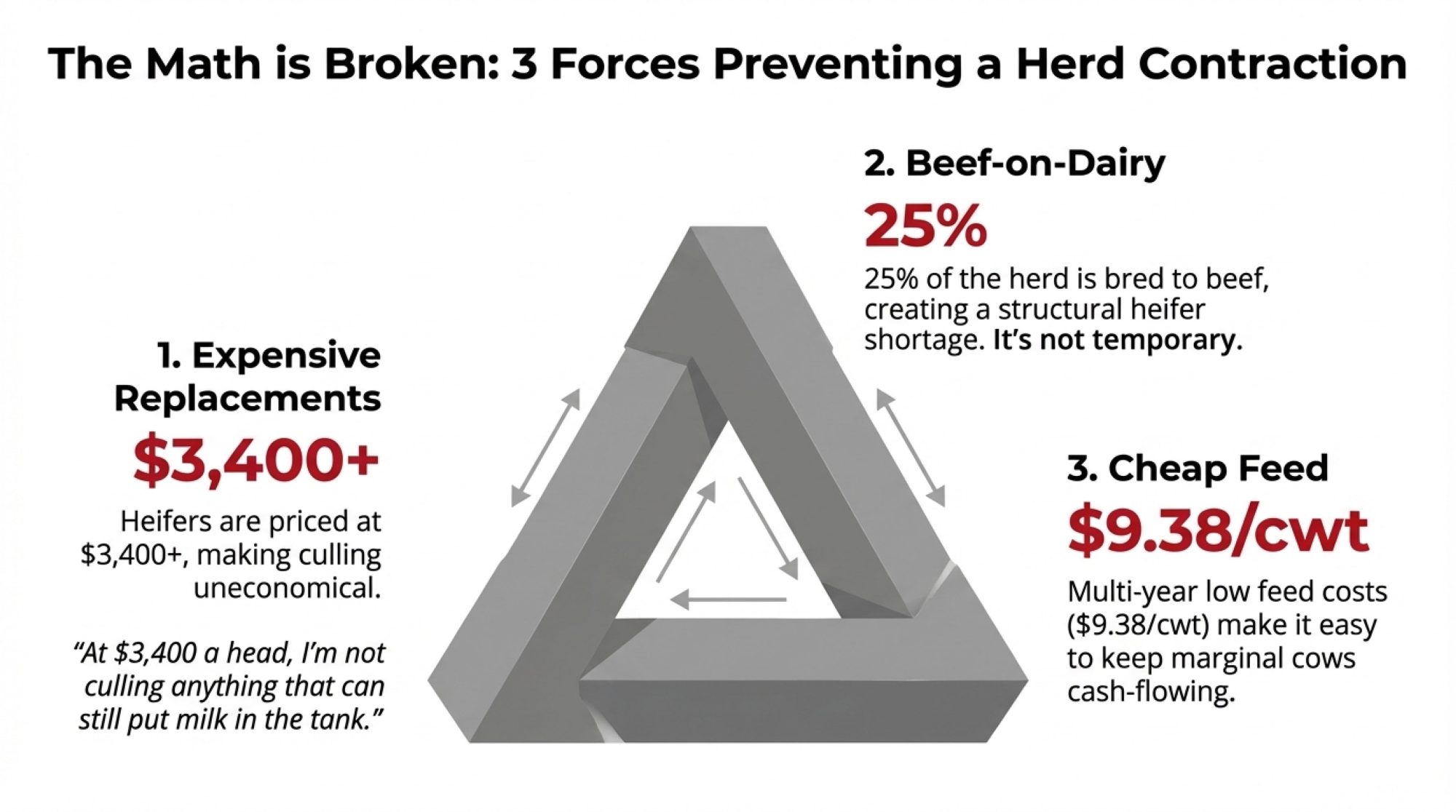
Meanwhile—and here’s what has everyone talking over morning coffee—that same cow is worth close to $2,000 as beef. USDA’s Agricultural Marketing Service weekly reports show cull cows bringing $1.60 to $1.70 per pound in some regions. A decent 1,200-pound cow? Do the math.

As one Extension economist down in Mississippi who tracks livestock markets put it to me, “When you’re looking at these beef prices, producers are asking themselves some pretty rational questions.”

But this goes deeper than just comparing milk checks to beef prices, doesn’t it? What October’s really showing us is the start of something bigger—where geography, genetics, and who you’re shipping to will matter more than ever. Management excellence? I hate to say it, but it’s becoming less relevant in the face of structural disadvantages.

The New Revenue Stream: Breeding for the Market, Not Just the Milking String

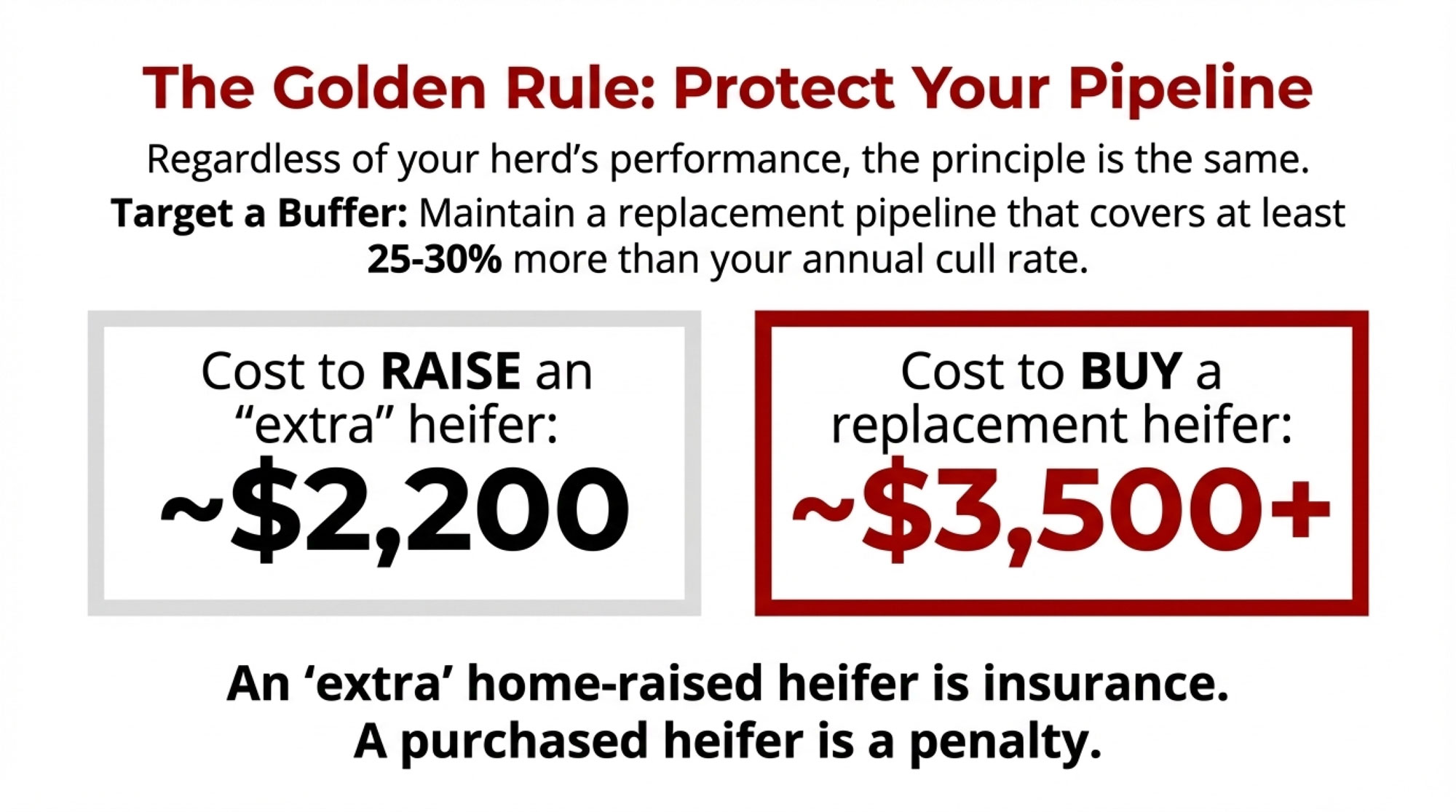
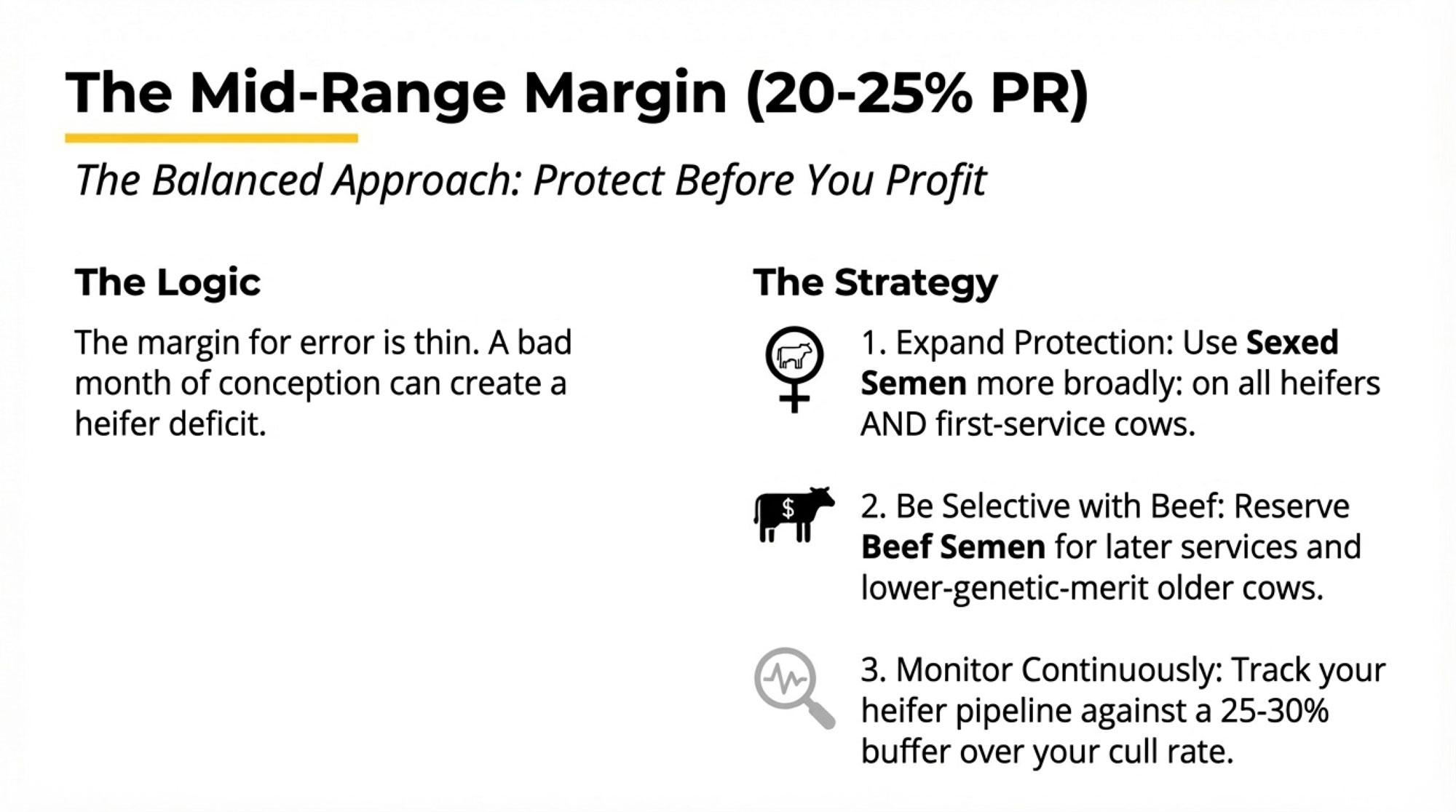
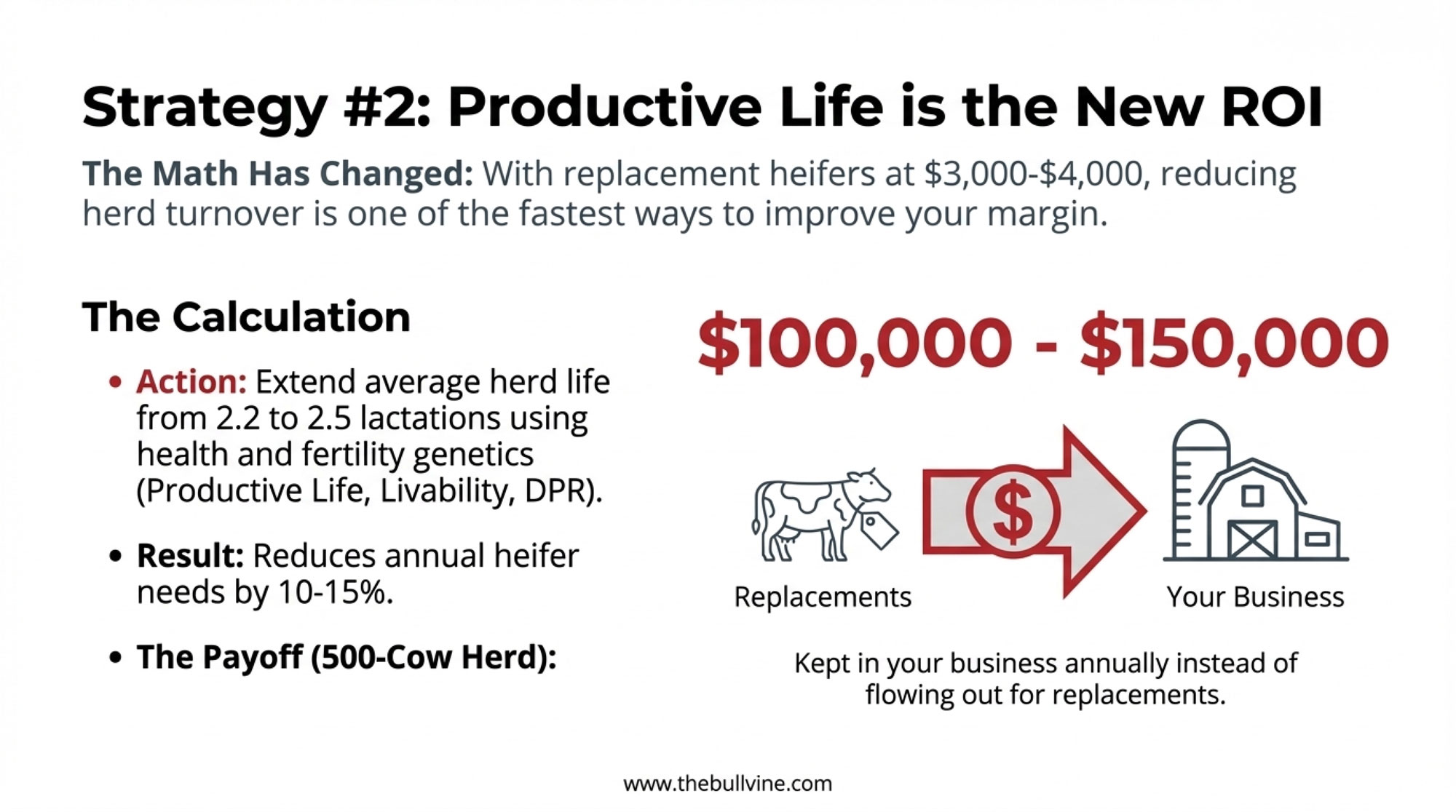
Here’s something clever that’s changing the entire breeding game—and I think more of us need to be talking about this. If you breed 20-25% more heifers than you need for replacements and sell the extras at these premium prices… well, as many of us have figured out, a 600-cow herd selling 30 surplus heifers at around $3,500 each? That’s roughly $100,000 in additional annual revenue. We’re talking about turning what most see as a constraint into a profit center.

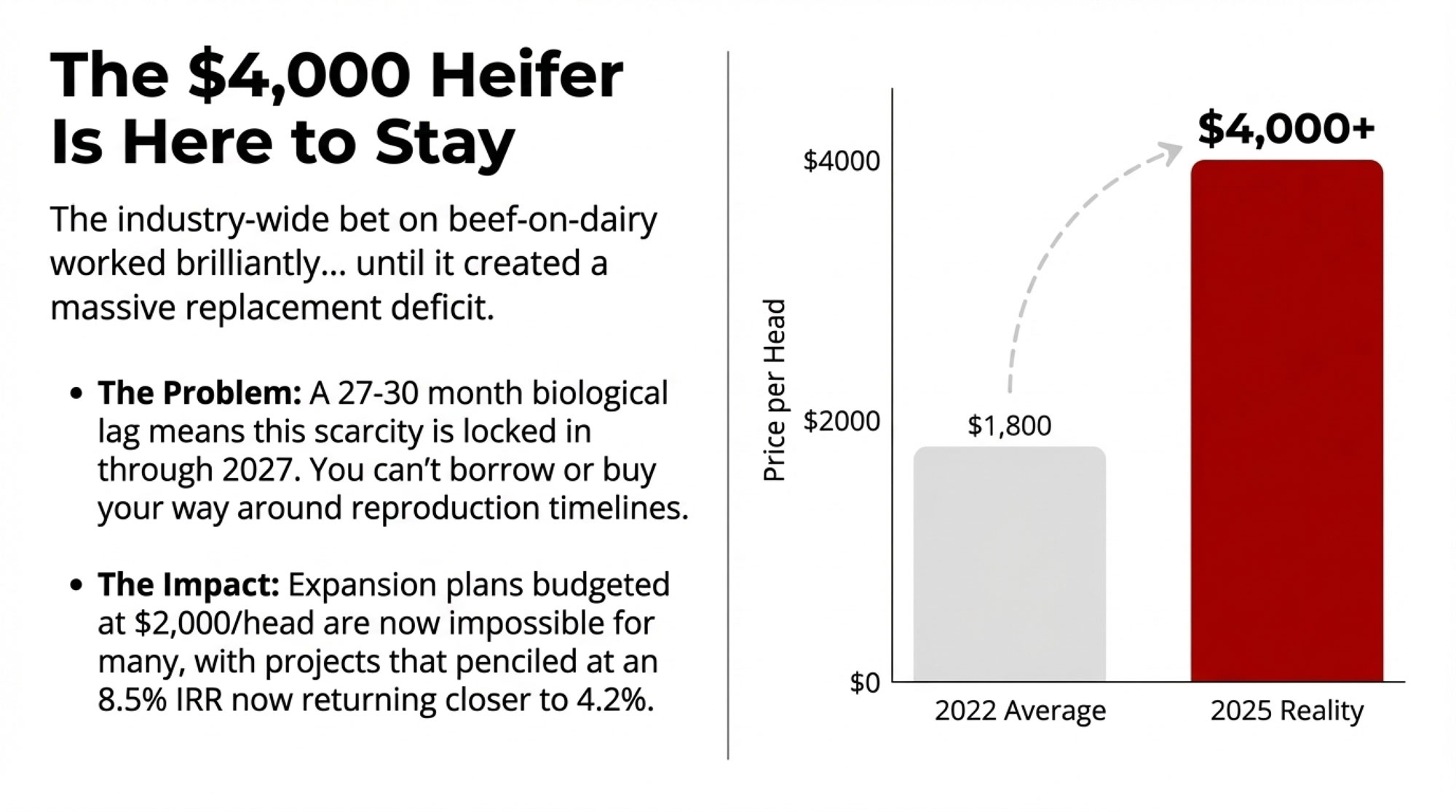
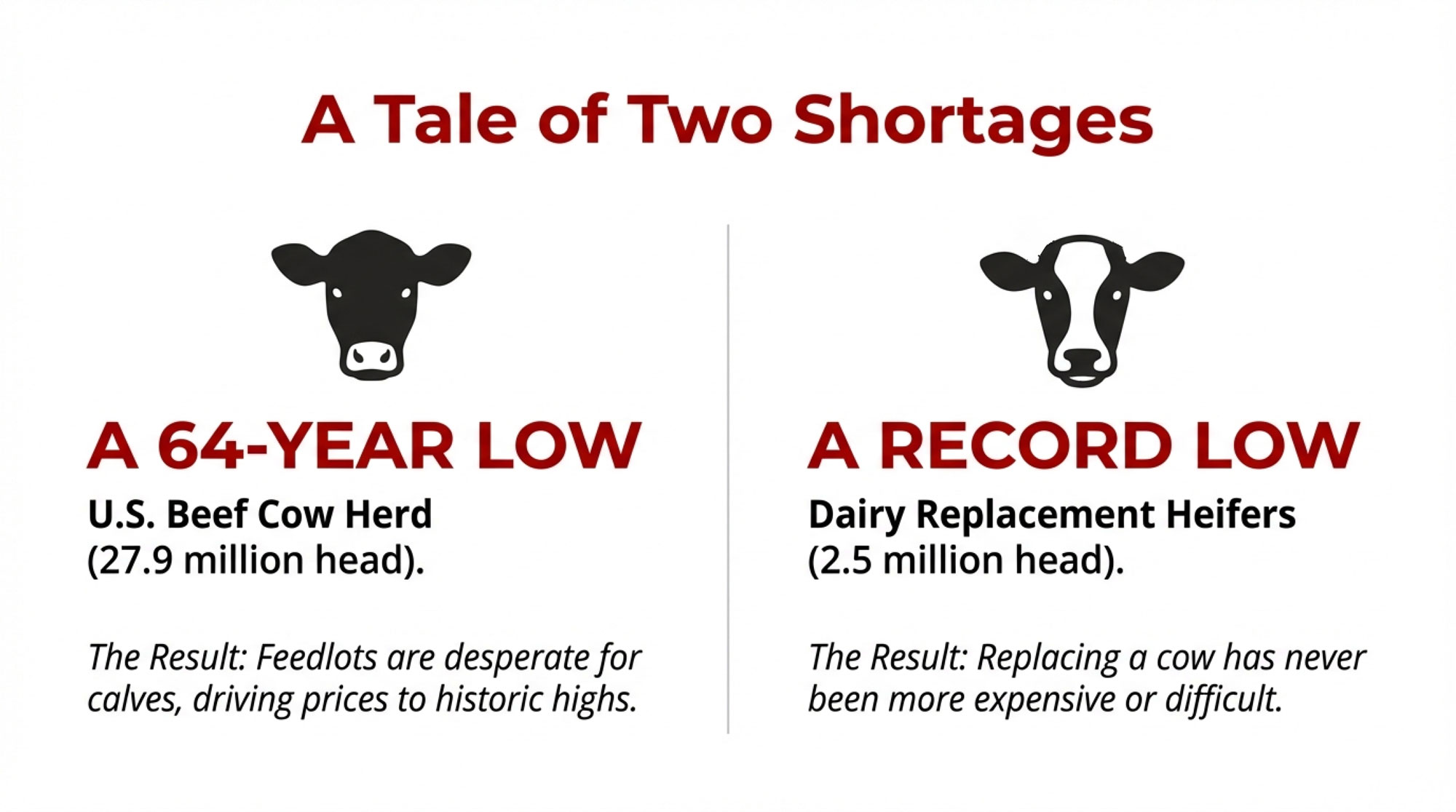
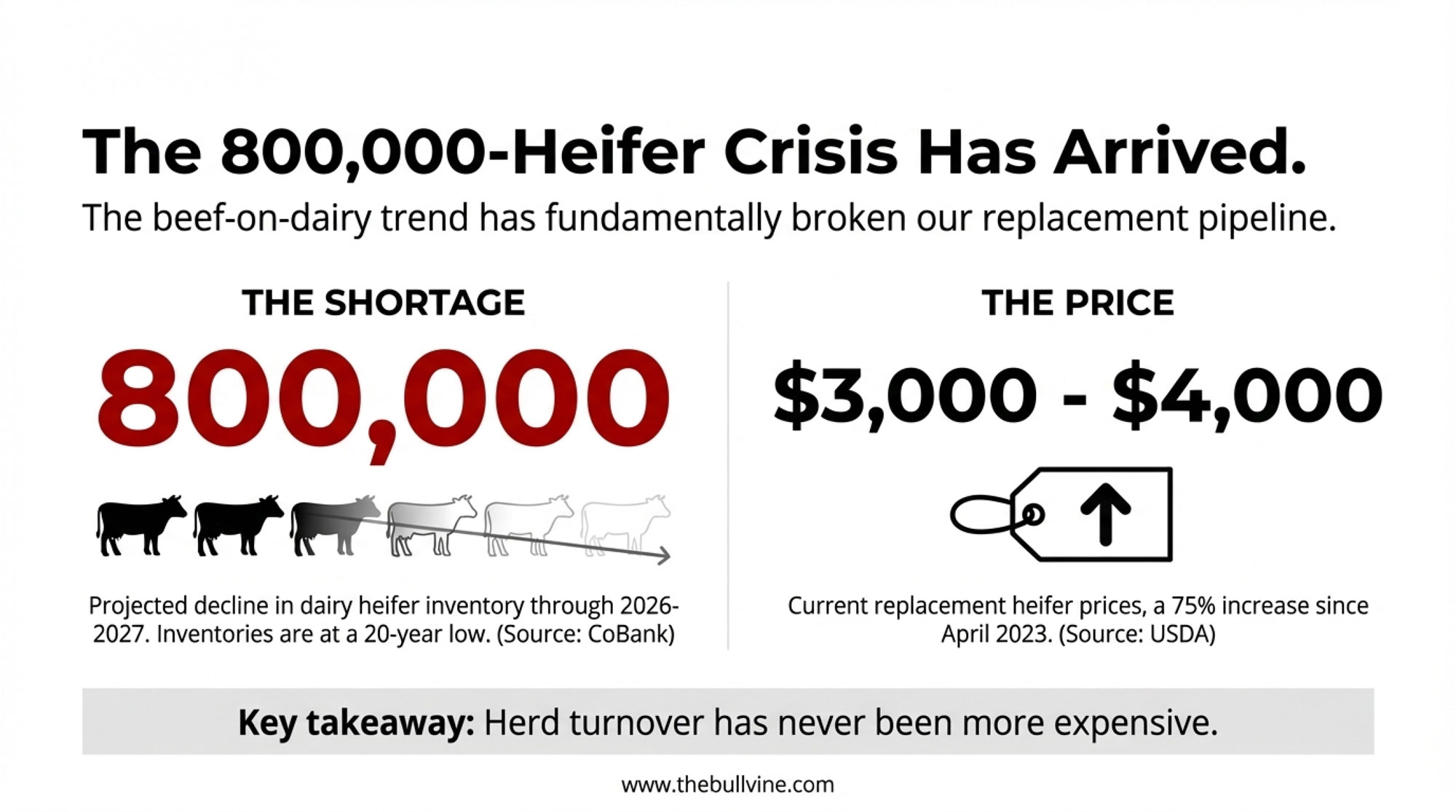
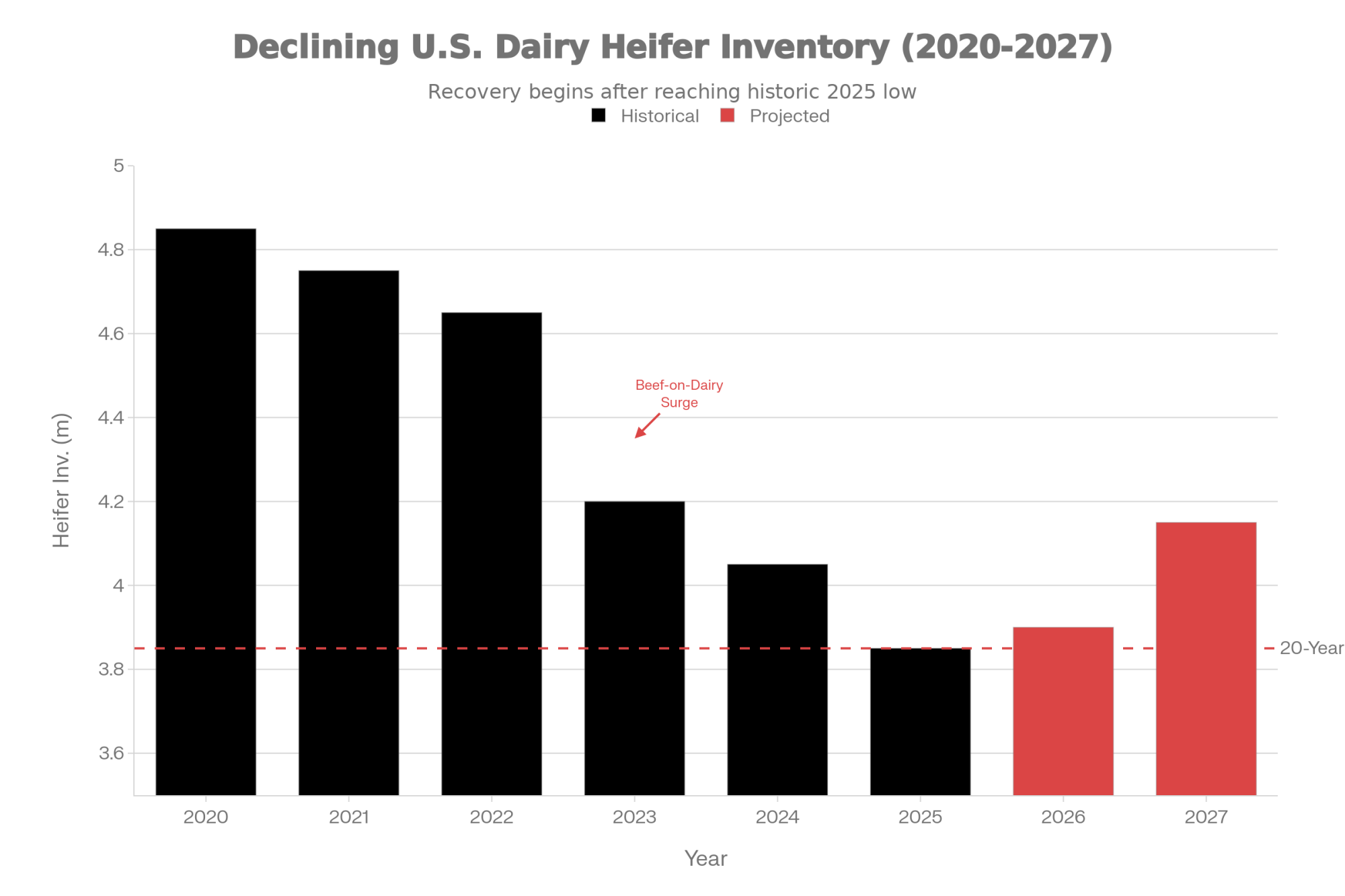
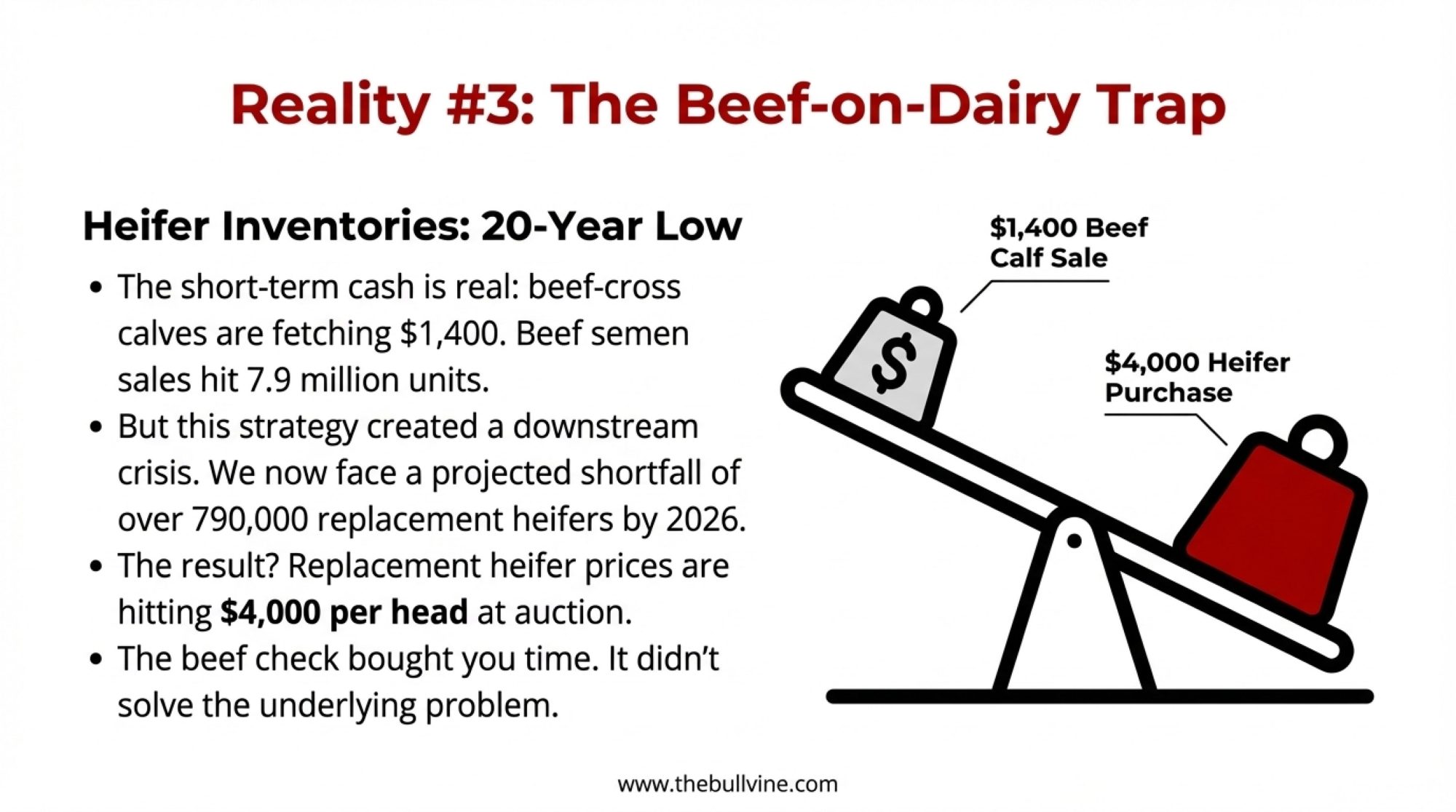
USDA’s January 2025 Cattle inventory report shows dairy heifer numbers at historically low levels—we haven’t seen this level since the late ’70s. All those years of breeding for beef-on-dairy when milk prices were tough? Well, now we’re seeing the consequences—or maybe the opportunities.

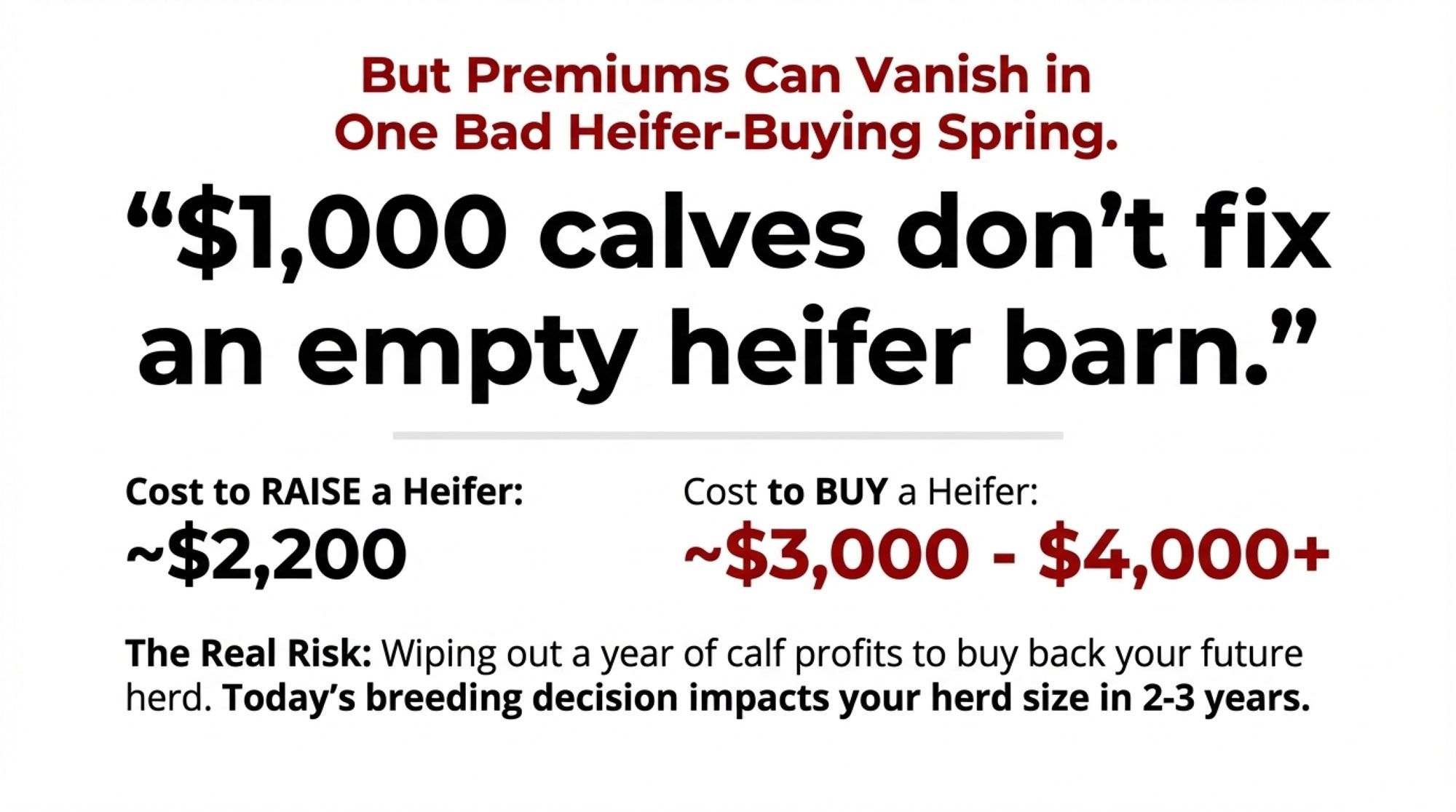
Recent auction reports from key dairy states show good springers regularly trading above $3,000 per head, with top groups occasionally pushing past $4,000 per head. I spoke with an extension specialist at the University of Florida who’s been tracking this closely. “The consistency of these high prices,” he said, “that’s what’s remarkable. We’re not seeing the usual seasonal dips.”

A lending specialist at CoBank pointed out something fascinating—and think about this—the shortage that prevents you from expanding also prevents your competition from growing. Operations that might have expanded to grab market share? They simply can’t get the heifers at prices that make sense. It’s creating this forced discipline in the market that we haven’t seen before.

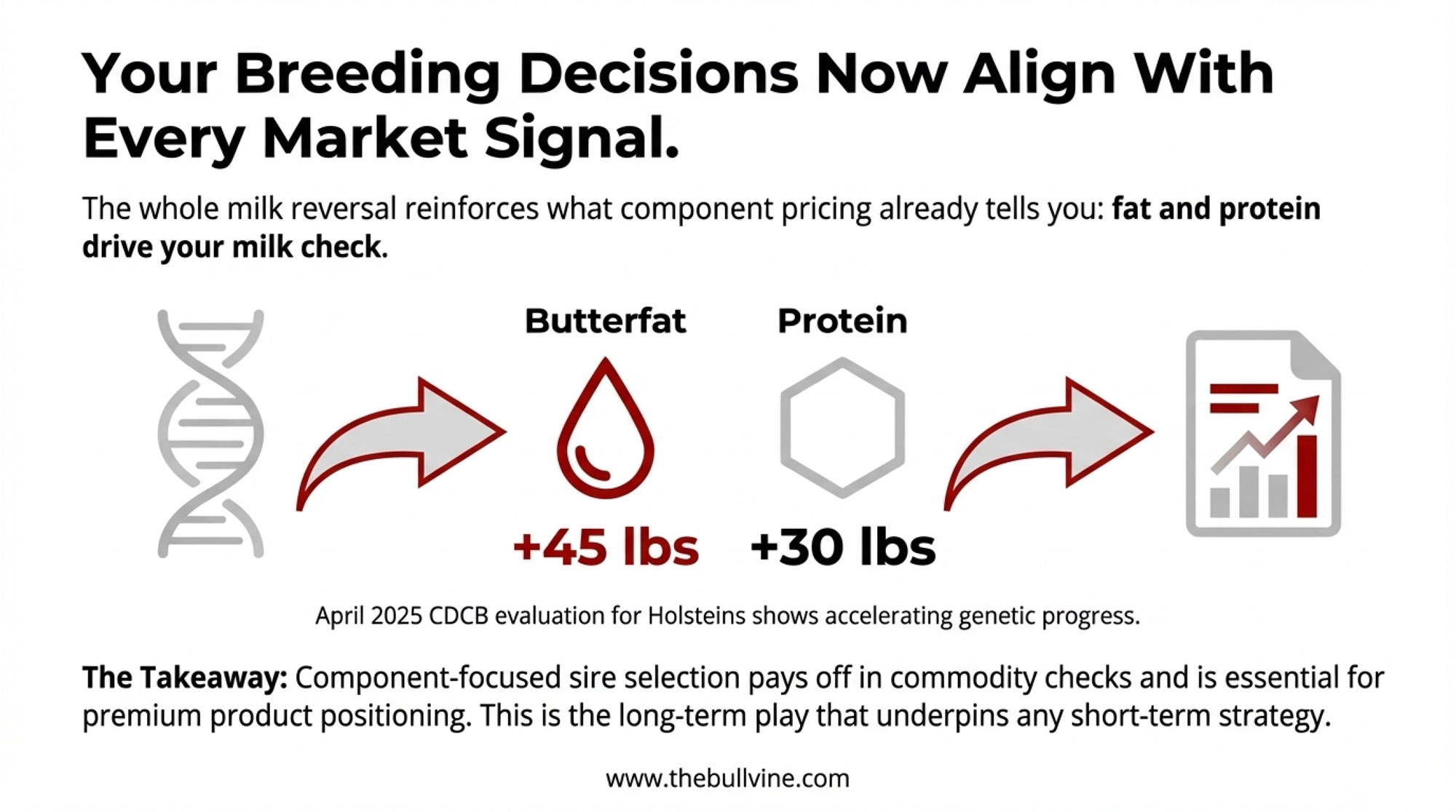
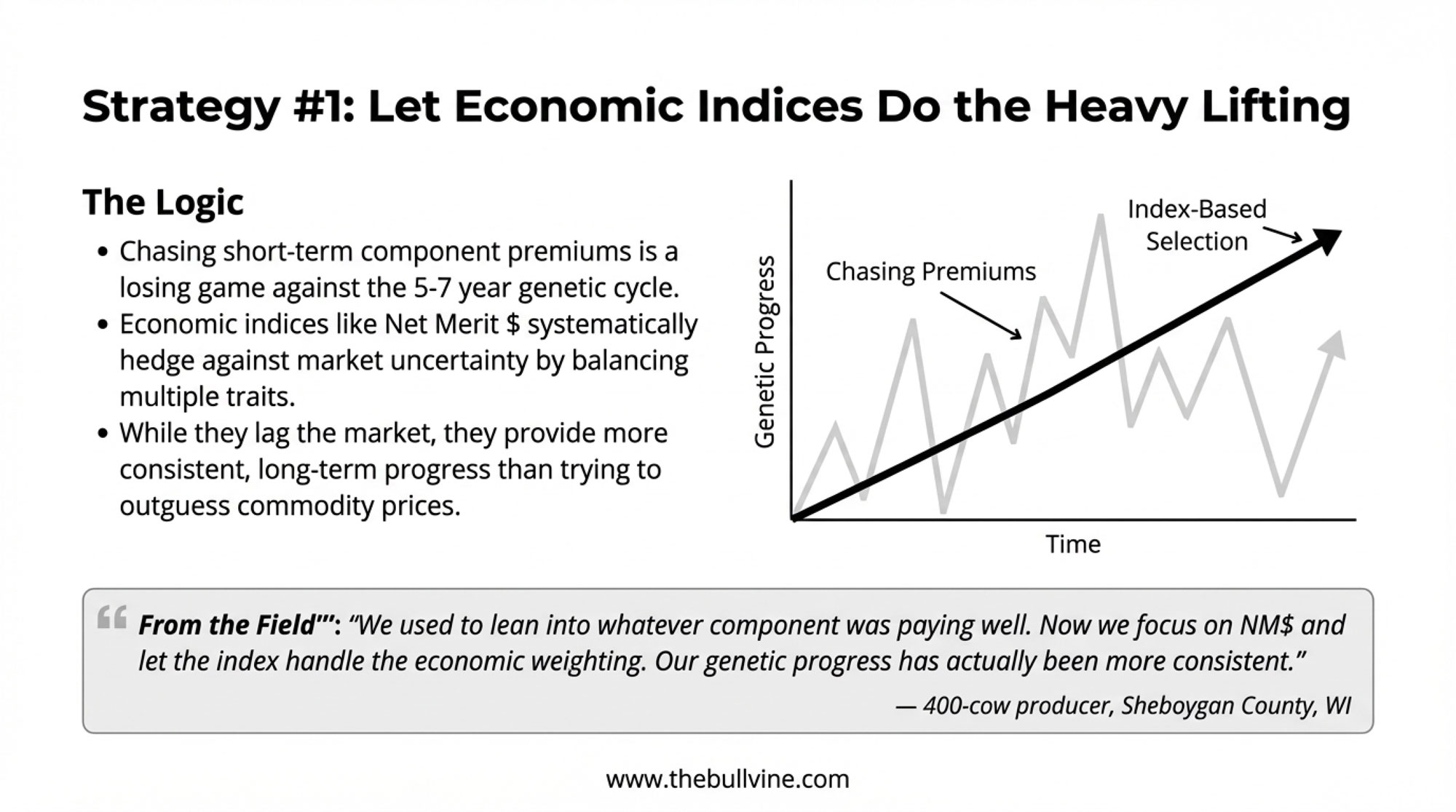
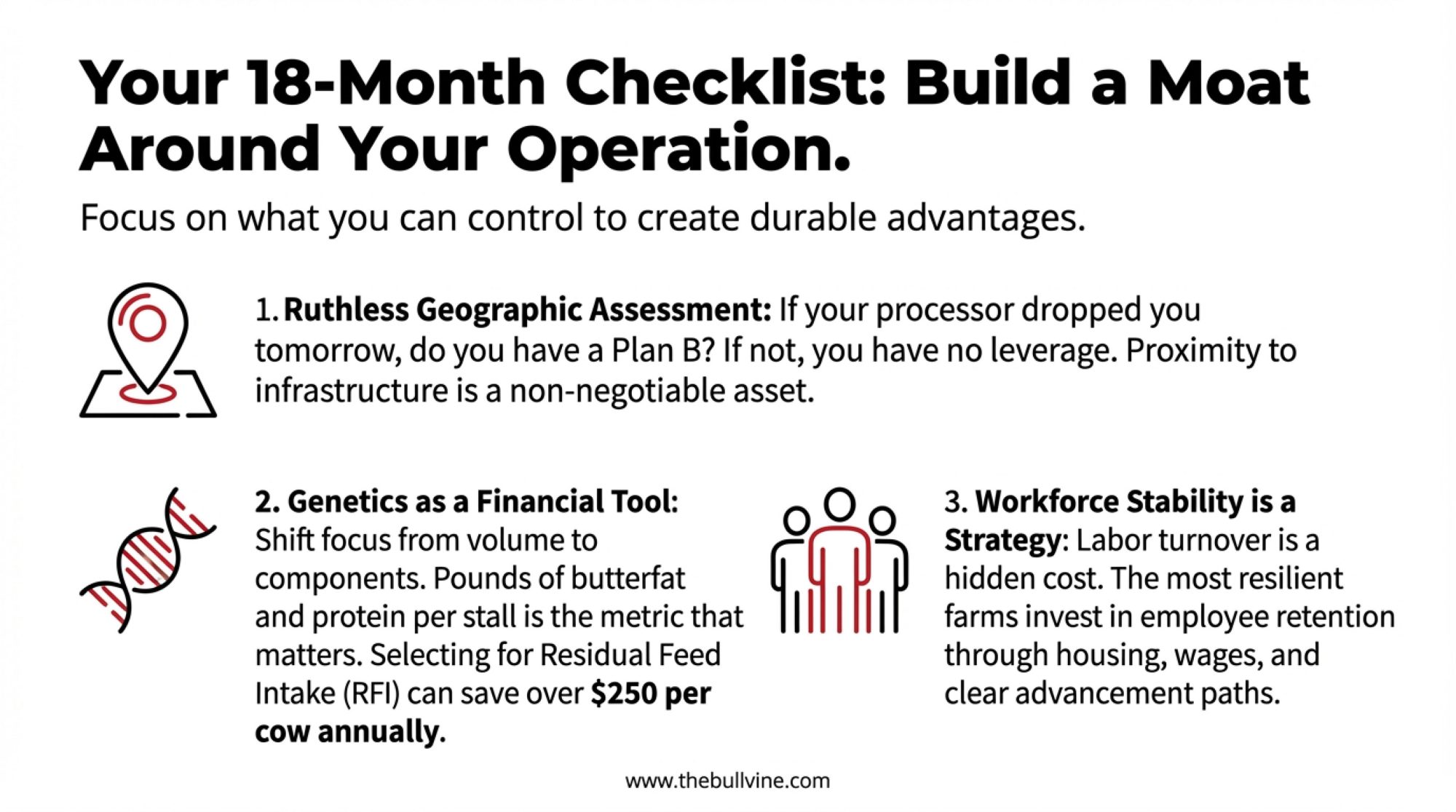
Smart producers are figuring out different ways to optimize. Can’t solve problems through expansion anymore—that playbook’s out the window. Instead, you’ve got to improve within your existing footprint. Genetic selection becomes crucial when you can’t add cows. I’m seeing more genomic testing than ever before.

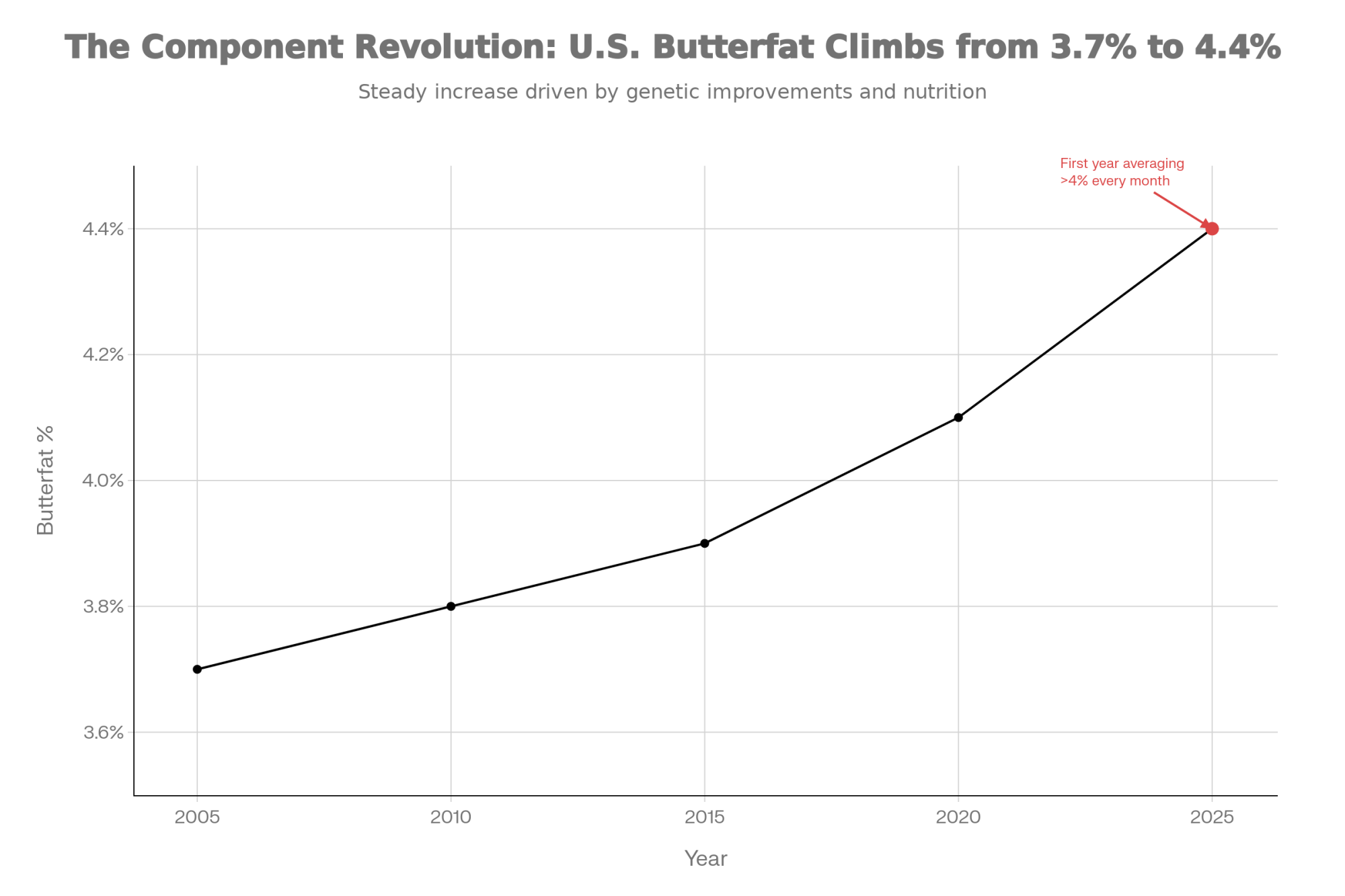
I recently heard from a 480-cow operation in central Wisconsin that made the switch to component-based optimization last spring. They’re seeing an extra $3,800 monthly just from butterfat premiums alone, even with slightly lower volume. “We’re producing less milk but making more money,” the owner told me. “That’s not something I thought I’d ever say.”

How Geography Trumps Management

You know, the old wisdom was that efficient operations outlast downturns. We’ve all believed that, right? But what I’m seeing now challenges that thinking in ways most of us haven’t fully grasped yet.

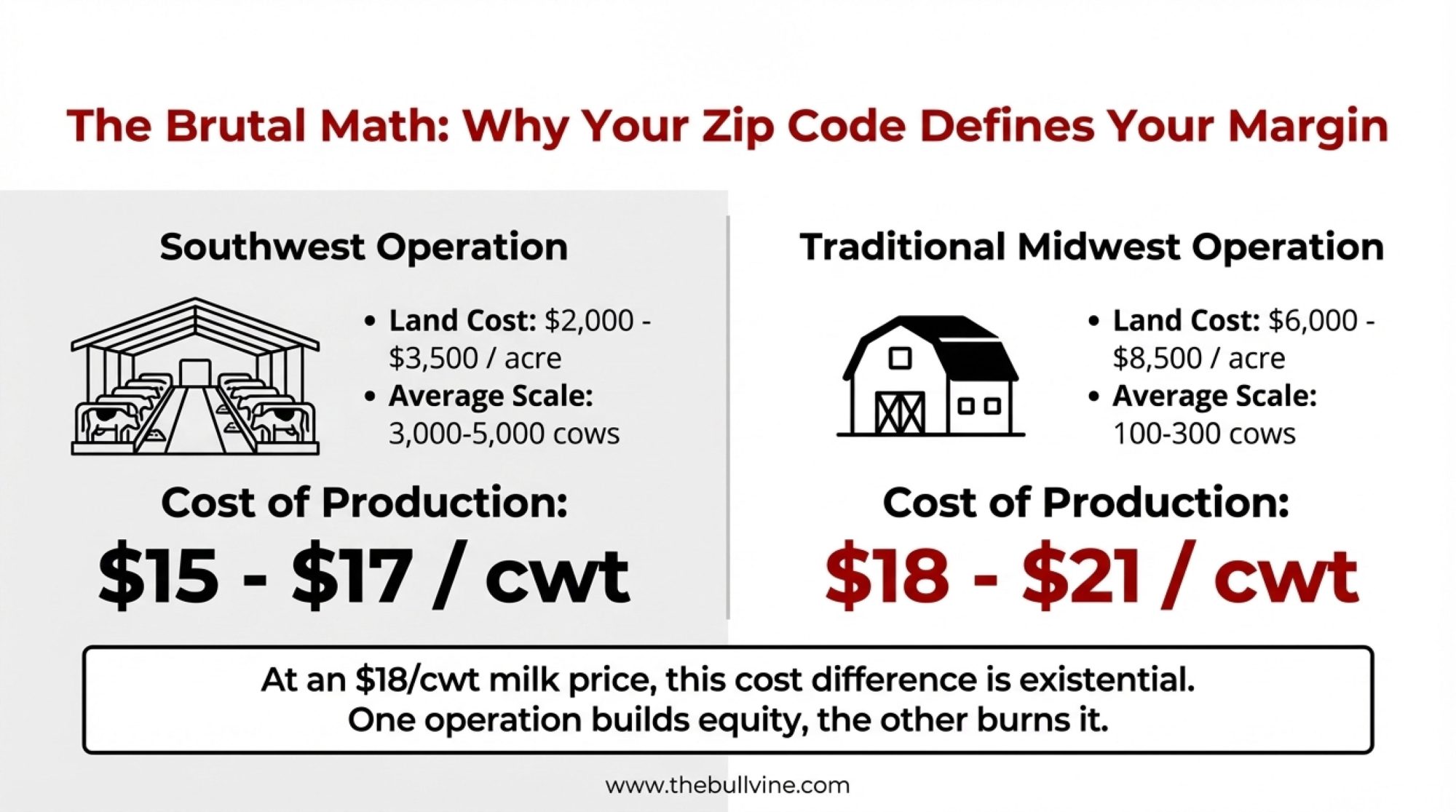
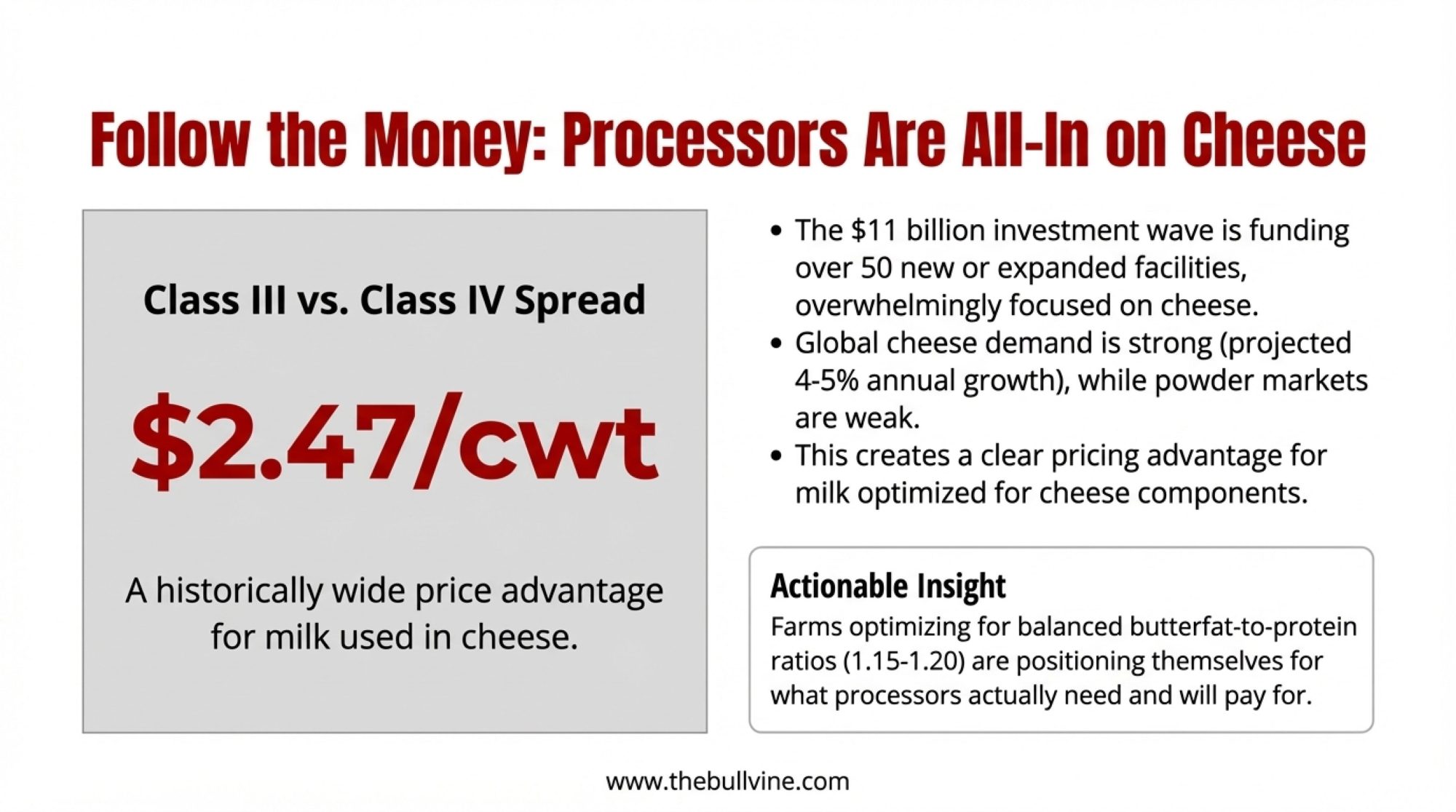
Federal Milk Marketing Order data from October 2025 shows some cheese-oriented regions getting roughly $1.00 to $1.50 more per hundredweight than powder-oriented areas. Think about that for a minute—if you’re running a thousand cows, that gap could mean $50,000 or more annually. That’s not something you can just manage your way around, no matter how good you are at what you do.

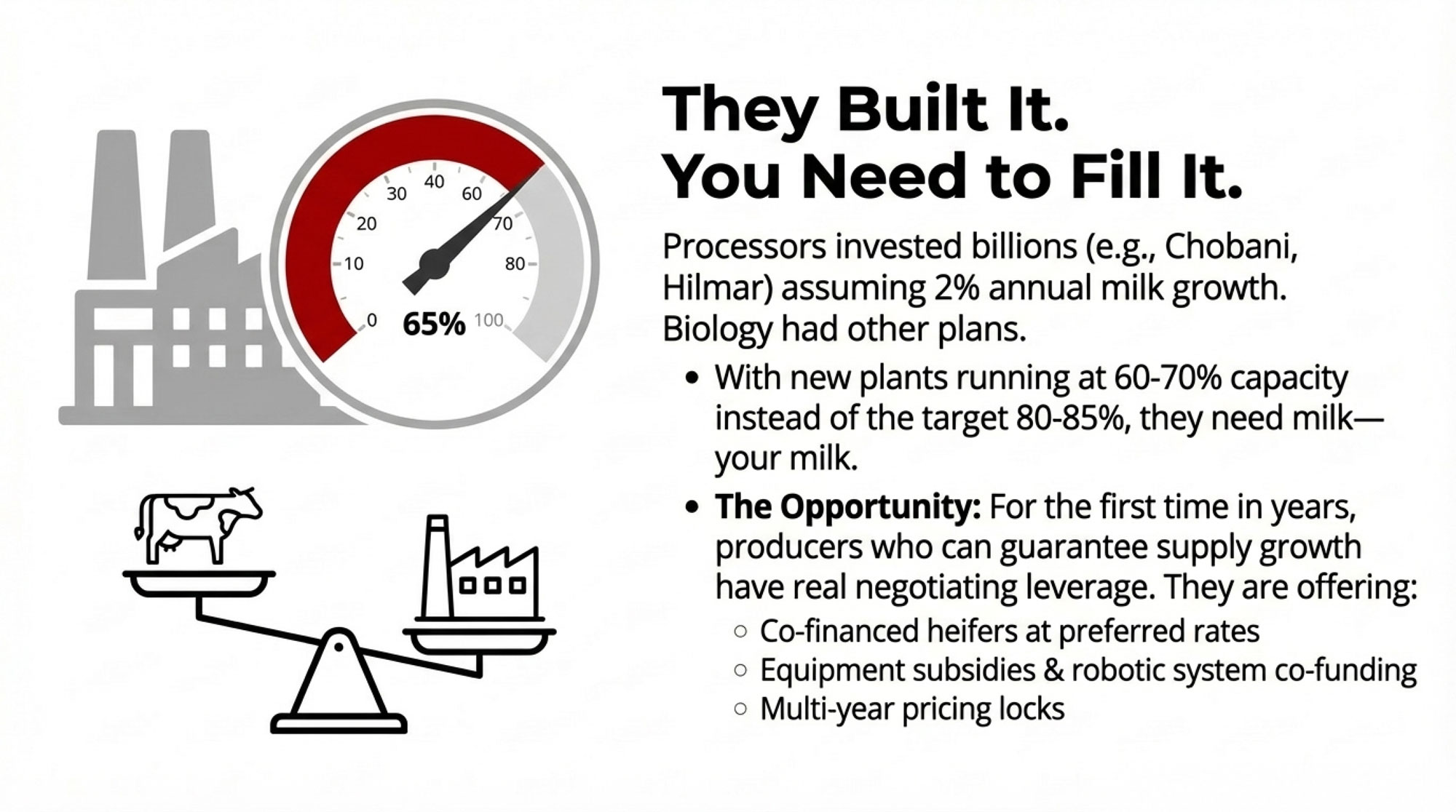
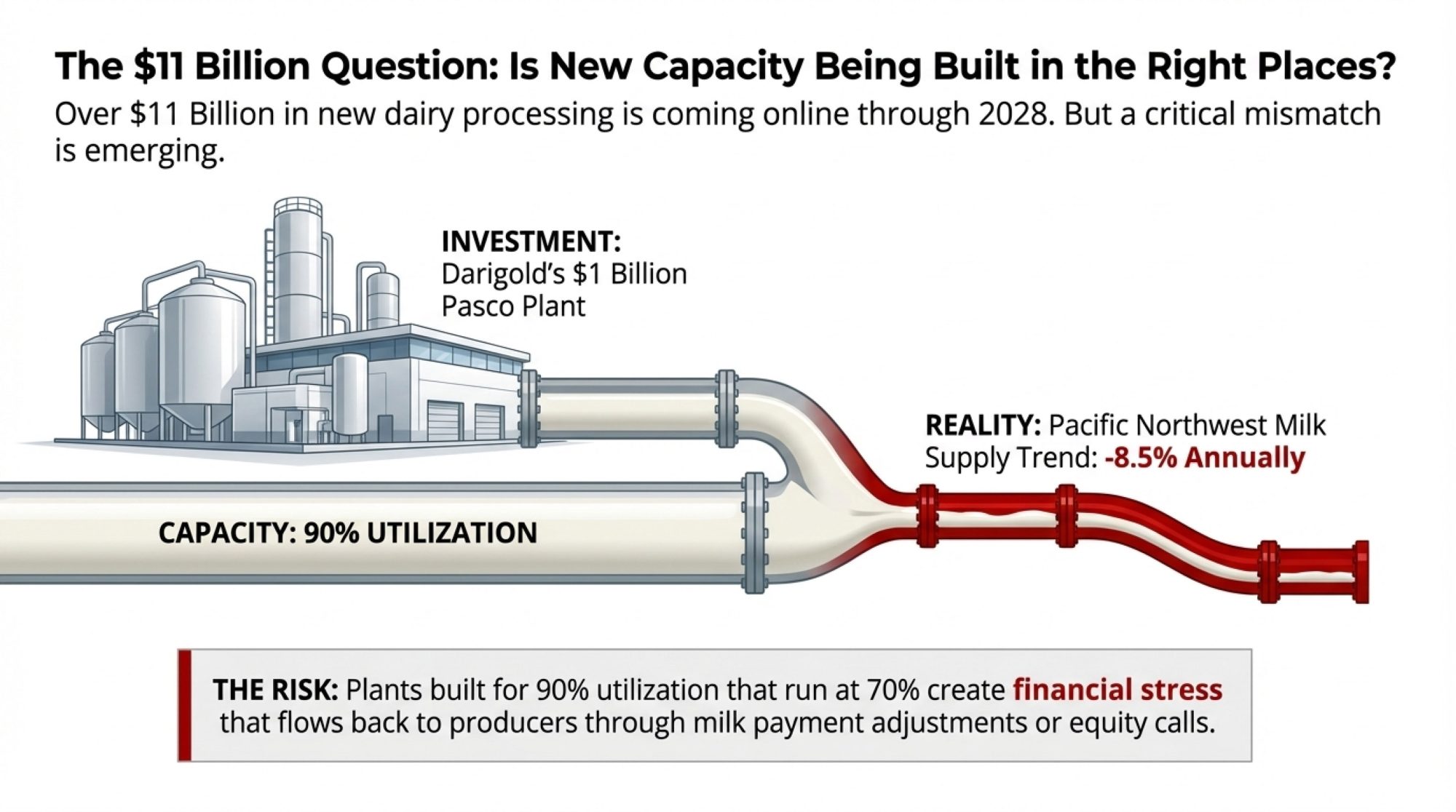
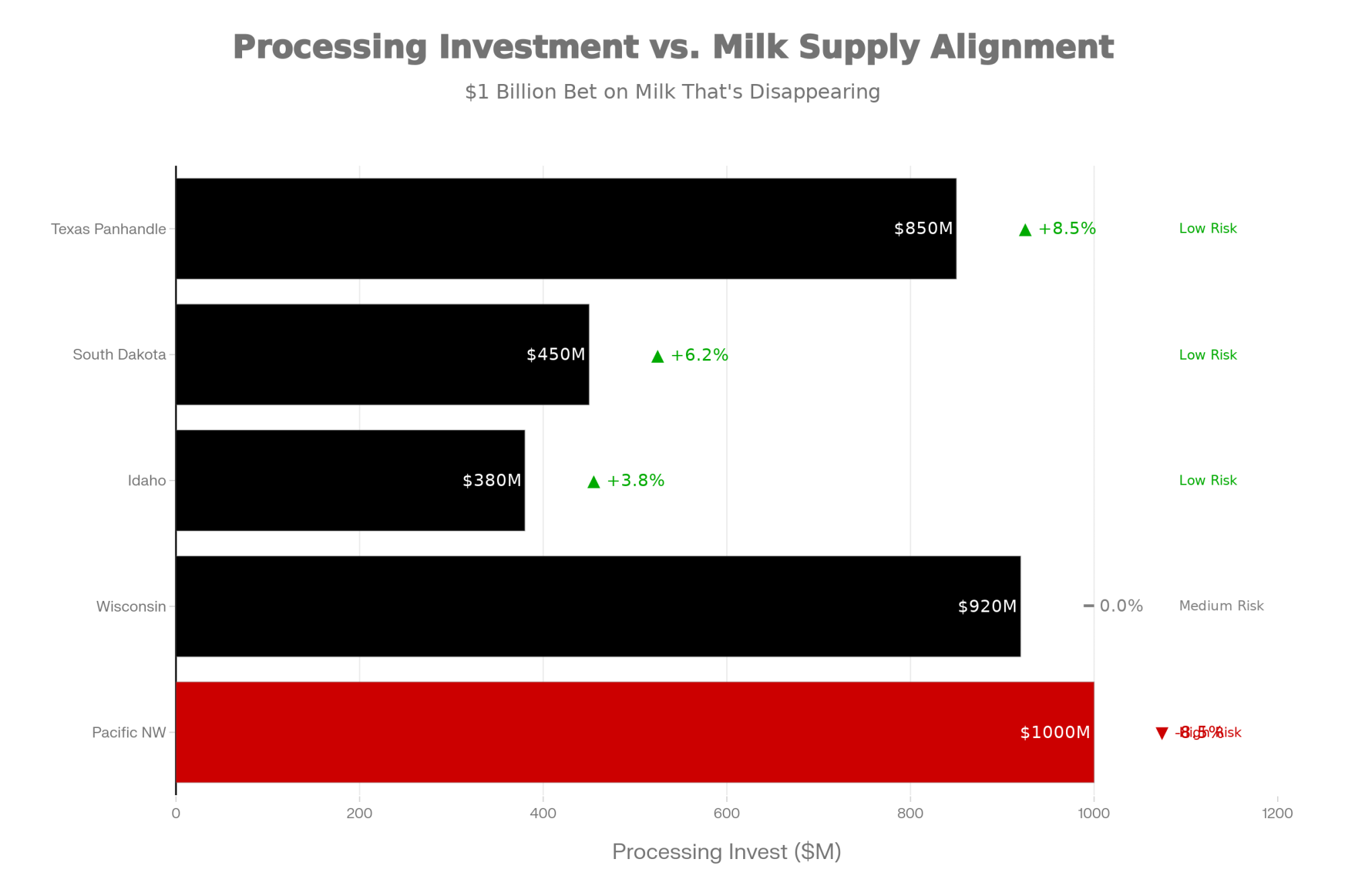
And the driver behind these gaps? It’s these massive processor investments we’re seeing. The International Dairy Foods Association’s October 2025 capital investment tracking report shows billions in new and expanded dairy processing projects—dozens of facilities either under construction or recently announced across multiple states through the rest of this decade.

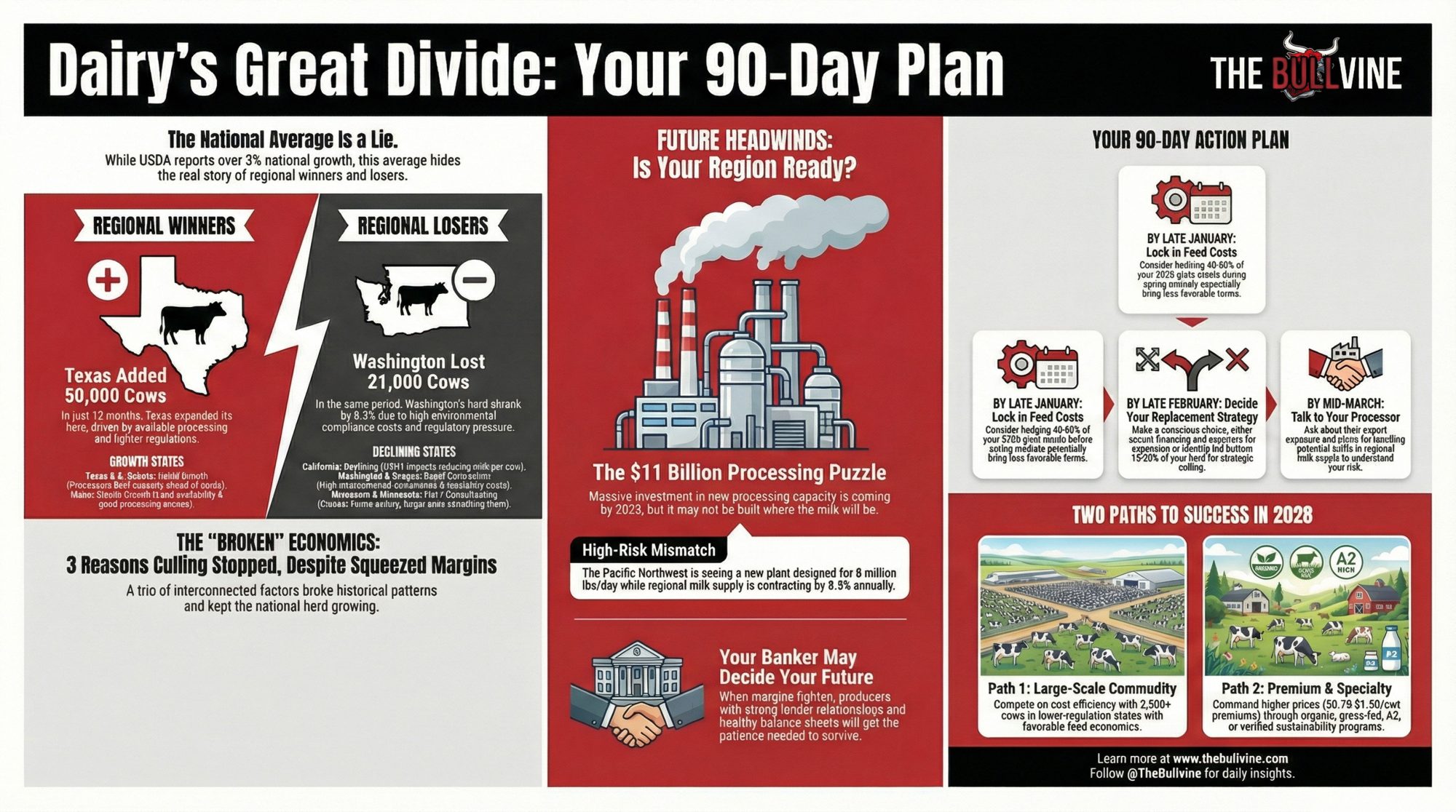
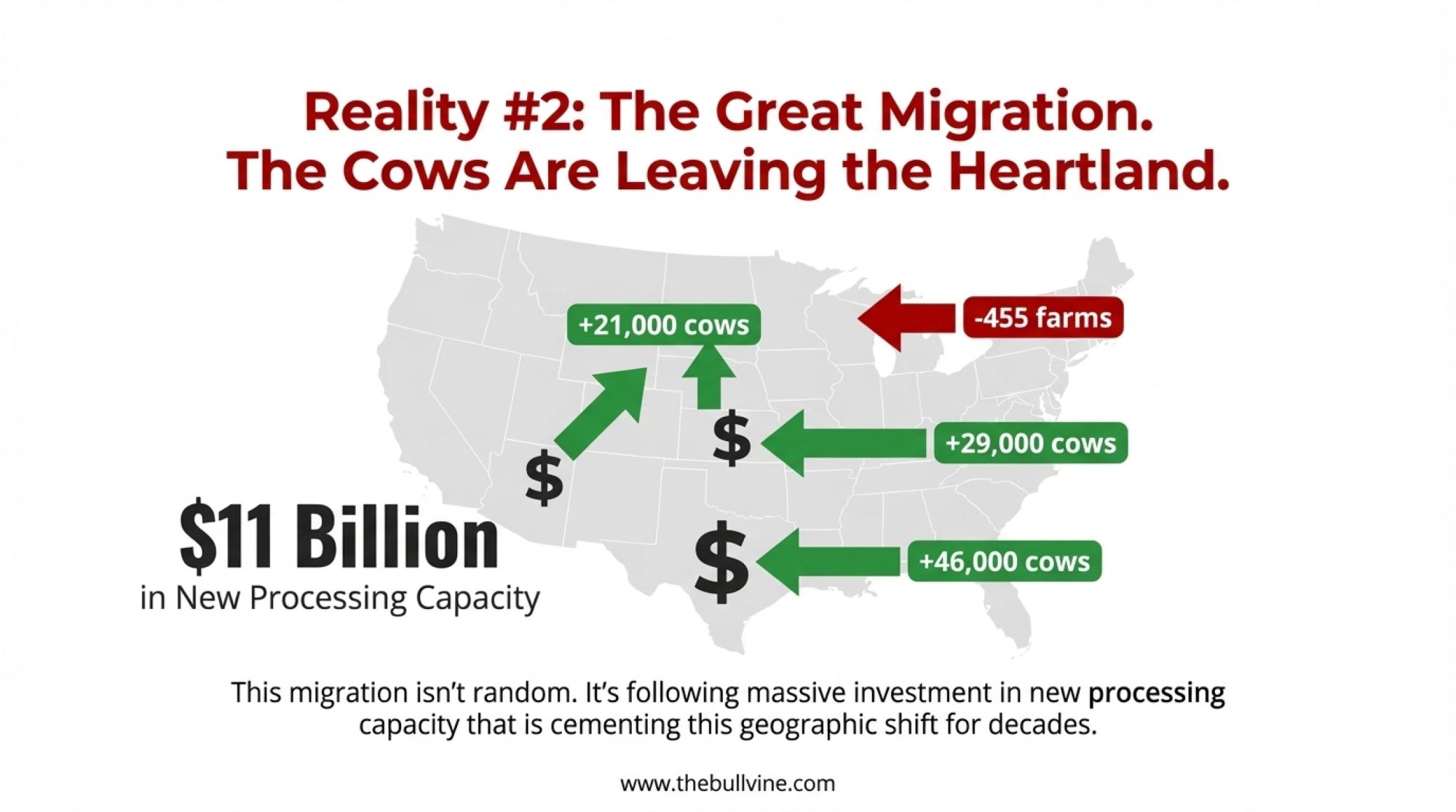
The concentration is what gets me. Texas is seeing major cheese facilities go in, including that big Leprino project near Lubbock everyone’s talking about. New York’s seeing major expansions in yogurt and premium milk. Idaho’s getting more cheese capacity around Twin Falls with Glanbia’s expansion. Wisconsin continues to add to its cheese infrastructure, with multiple expansion projects underway. Even the California Central Valley, despite its challenges, is seeing selective investment in specialized products.

What dairy economists at universities like Cornell and Wisconsin are telling me is this creates something like “permanent regional advantage.” Makes sense when you think about it. If you’re near these new cheese plants, you’re capturing premiums. If you’re shipping to butter and powder? Those challenges compound every month.

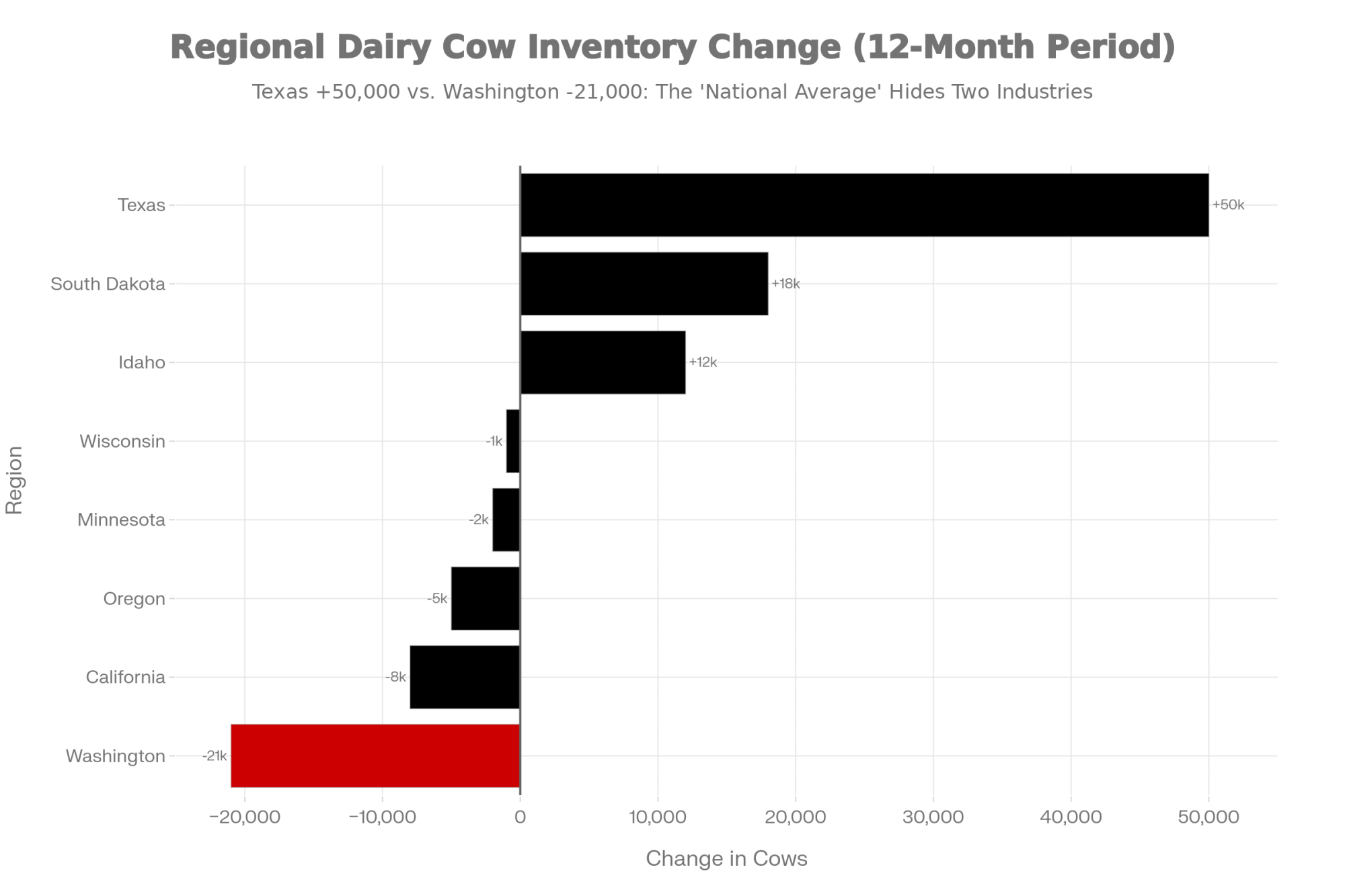
The producers in growth states—places like Idaho and Texas, where this new capacity promises good premiums—they culled selectively in October to upgrade genetics. Smart move.

But in other regions? Southwest dairy operations dealing with water restrictions, or Southeast producers managing not just heat stress but increasingly volatile feed costs and limited local grain production—that culling represented something different. Those folks are reducing exposure to what’s becoming a tougher competitive environment.

Building Your Bridge Through What’s Coming

For operations trying to navigate current challenges while positioning for better times, I’ve been collecting strategies from extension folks and producers who are making it work. From Southeast dairy operations dealing with heat stress and feed availability challenges to Upper Midwest producers managing seasonal variations, to California Central Valley farms wrestling with water costs.

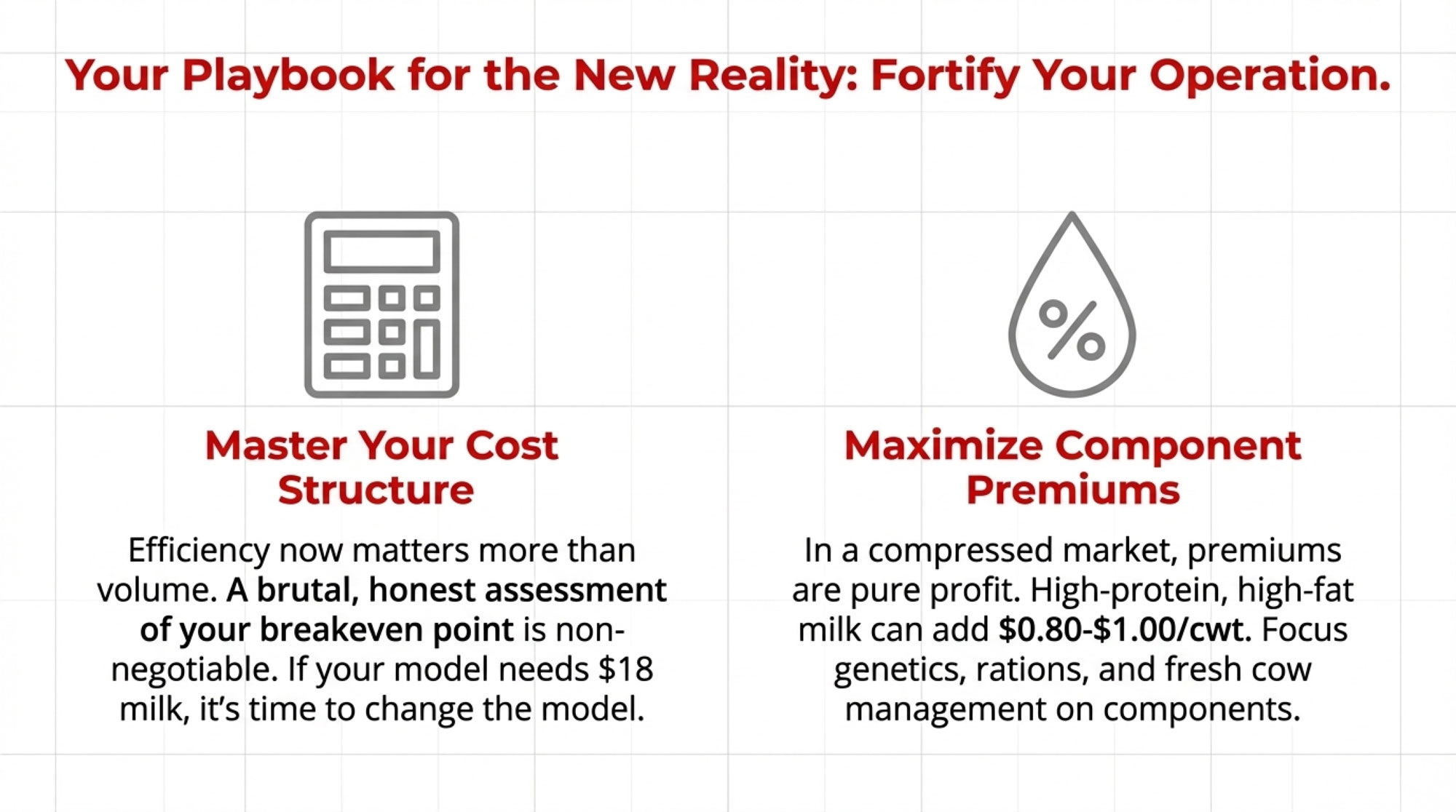
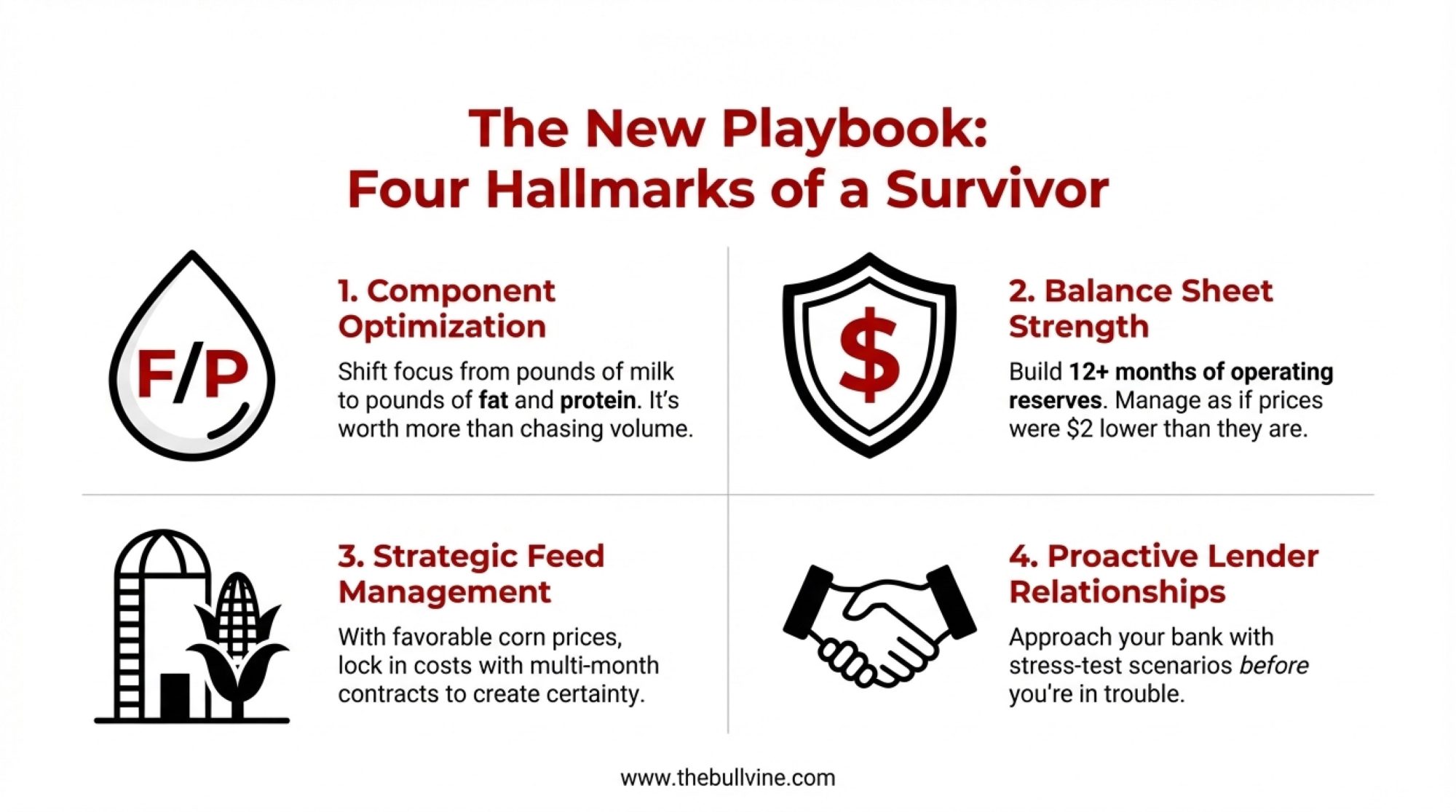
First thing—and this is crucial—you need to understand your true economics beyond just that all-milk price everyone talks about. Several dairy economists at land-grant universities keep emphasizing this, and they’re right. With current component premiums, if you’re optimizing for volume rather than components, you could be leaving tens of thousands annually on the table, even for a modest-sized herd.

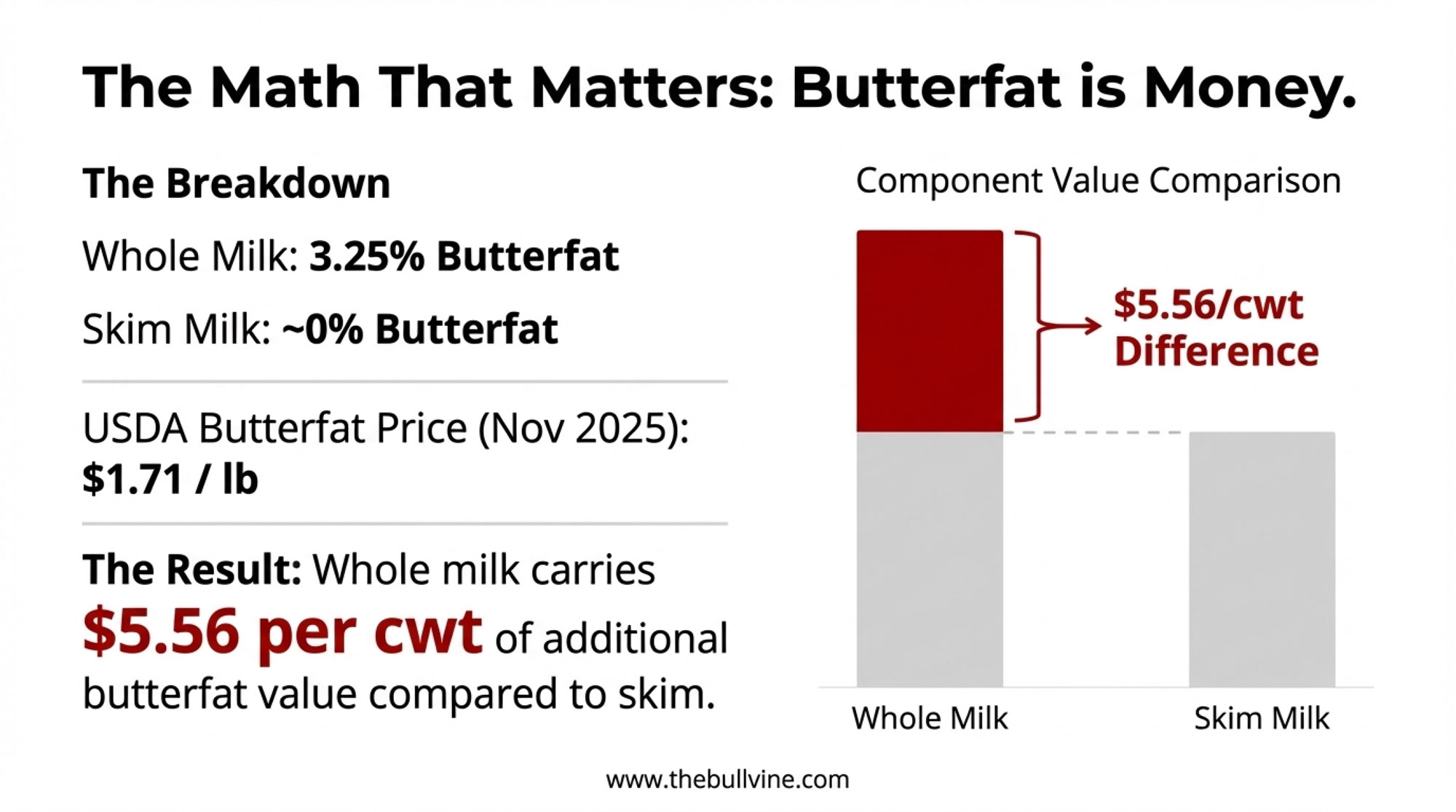
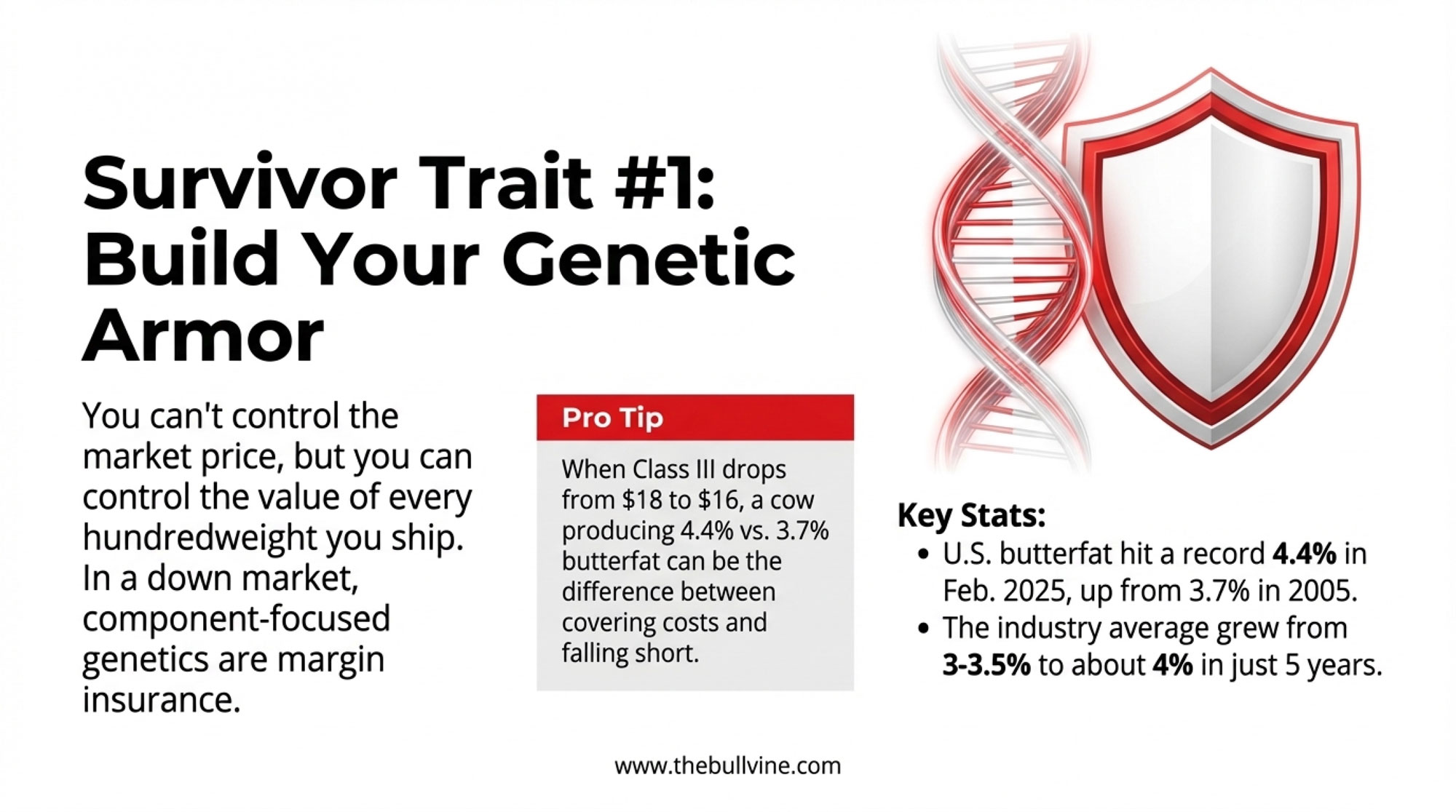
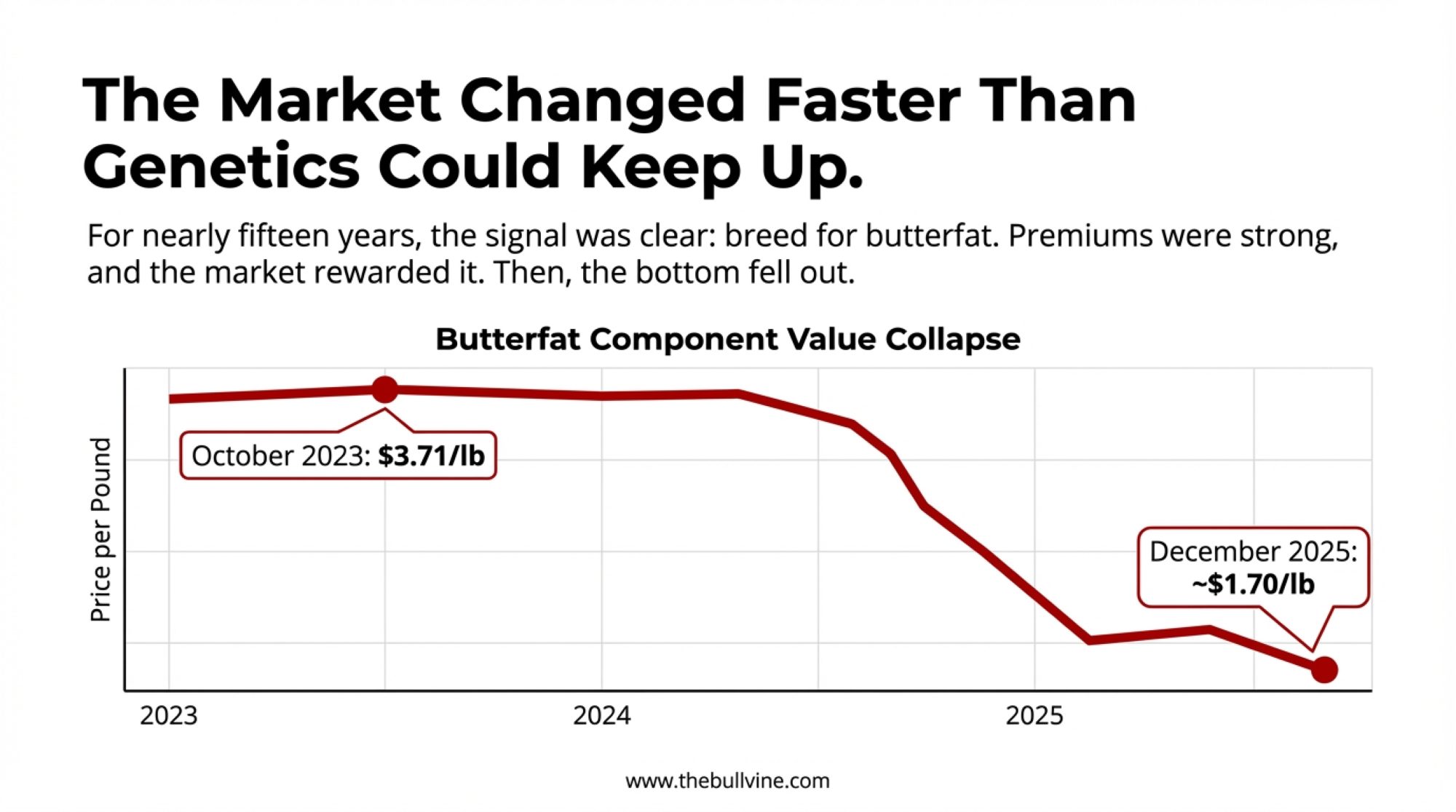
Component optimization matters more than ever. With butterfat premiums running anywhere from 50 cents to over a dollar per hundredweight above base in some areas—especially Upper Midwest operations shipping to cheese plants—if you’re still focusing on volume over components, you’re leaving serious money on the table.

Here’s what’s gaining traction based on my conversations:

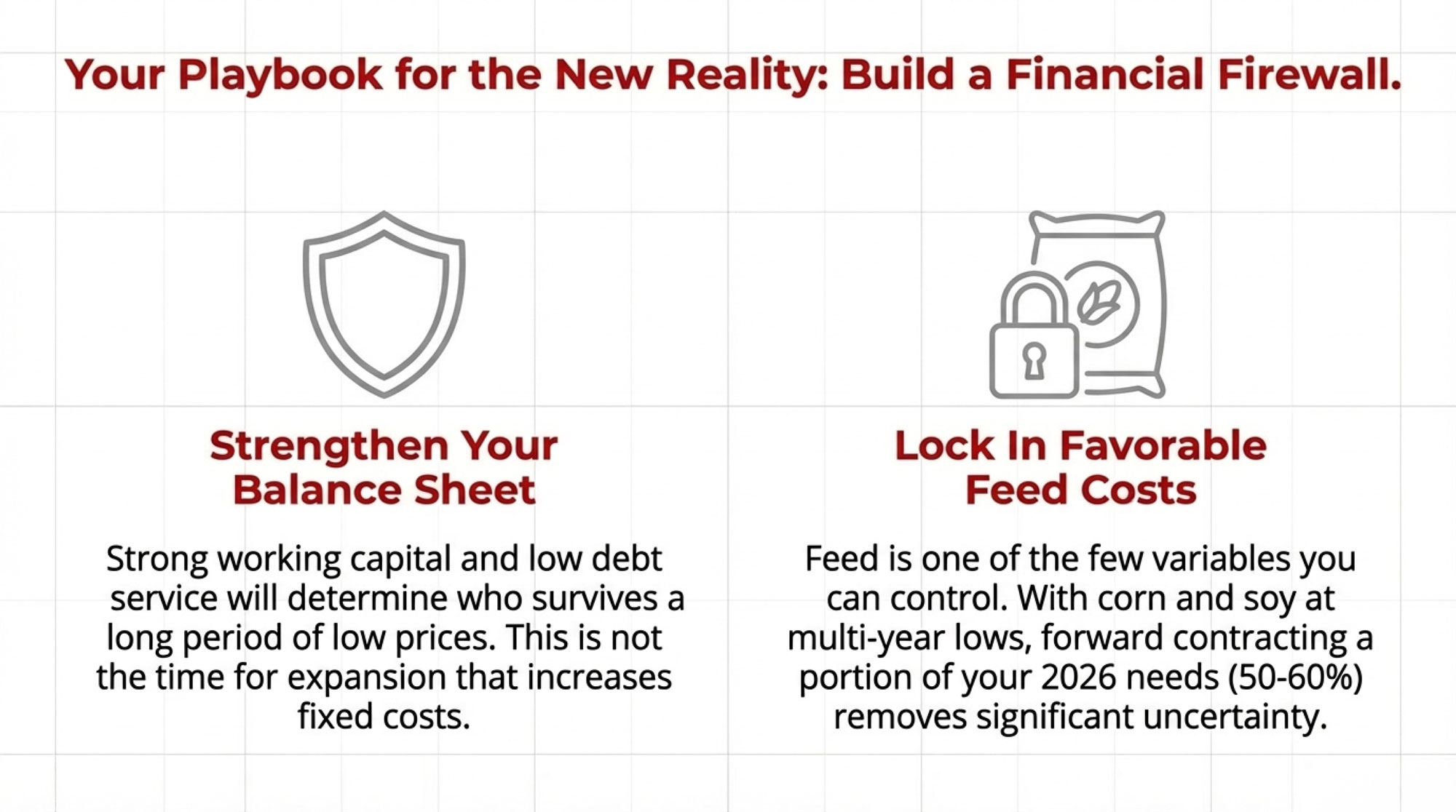
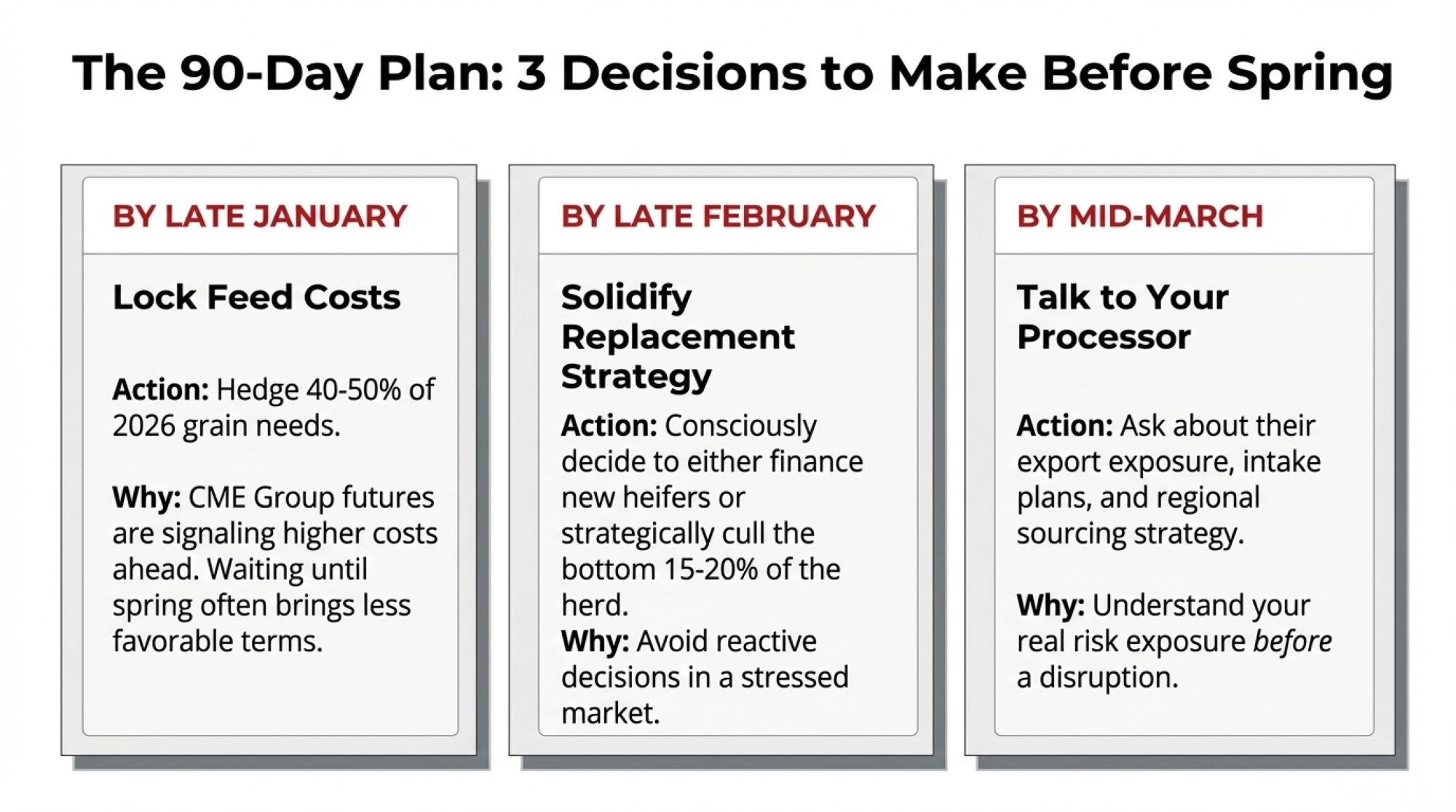
You need to secure working capital lines now, while your operation still looks stable to lenders. Several ag lenders, including Farm Credit Services and regional banks, are telling me they expect to become more cautious about new working capital over the next year or so. Some are even talking about focusing more on financing acquisitions and restructurings if margins stay tight. That window? It’s narrowing faster than most folks realize.

The Dairy Margin Coverage program makes sense, too. According to the USDA’s Risk Management Agency, October 2025 updates, depending on your coverage level and production history, premiums often run from a few dimes to maybe 70 cents per hundredweight. But that cash flow protection when margins get really tight? Could make all the difference between weathering the storm and… well, not.

And here’s something livestock economists at universities like Kentucky and Kansas State are watching—CME feeder cattle futures have pulled back sharply since mid-October. Producers who locked in their beef-on-dairy calf values earlier are feeling pretty good right now. Consider hedging at least half your production to protect what’s become crucial revenue.

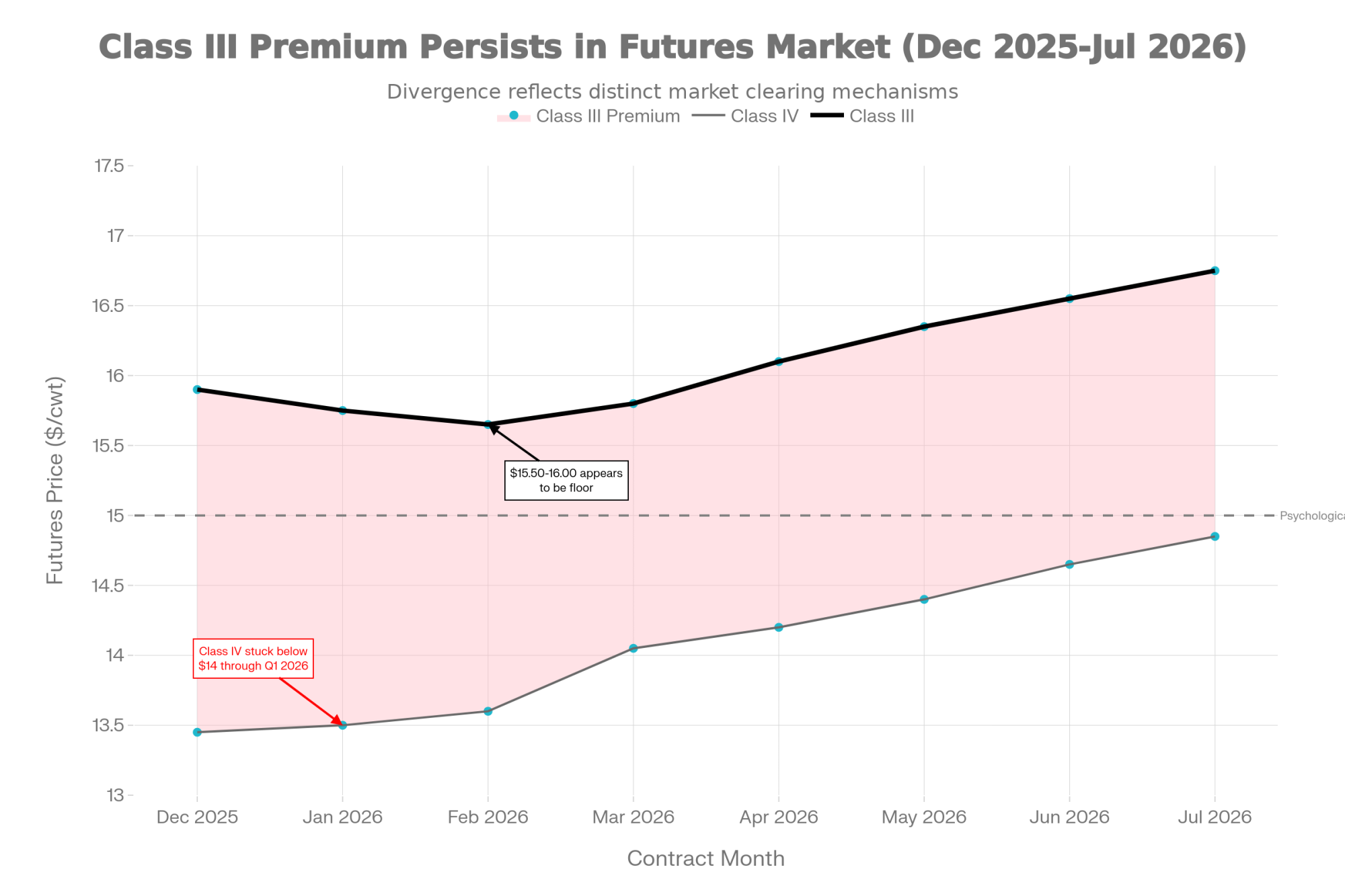
What’s interesting is that the operations doing these things aren’t expecting prosperity if milk prices drop to the $14-16 range that the USDA’s World Agricultural Supply and Demand Estimates suggest for next year. They’re building resilience to stay independent through what could be a tough stretch before things improve.

The Technology Factor and Labor Reality

The technology piece matters here too—and it’s changing the labor equation dramatically. Robotic milking systems, which can cost $150,000-250,000 per stall, are becoming more feasible for larger operations that can spread those fixed costs.

But here’s what’s interesting: these systems aren’t just about milking efficiency. They’re addressing the chronic labor shortage that’s hitting dairy farms nationwide.

One Pennsylvania producer running four robots told me, “We went from needing six milkers to basically one herd manager. In a market where finding reliable labor costs $18-22 per hour plus benefits, that math changes everything.”

For mid-sized farms, though, the capital requirements are creating another pressure point that’s accelerating consolidation decisions. And for those sub-300 cow operations? The technology investment rarely pencils out unless you’re adding significant value through on-farm processing or direct marketing.

Why Processors Keep Building While We’re Struggling

This apparent contradiction—processors pouring billions into new capacity while we’re dealing with tight margins—it makes more sense when you look at the longer game they’re playing.

Several outlooks from groups like Rabobank’s Q3 2025 Global Dairy Quarterly point to some interesting dynamics. The International Dairy Federation’s World Dairy Situation report is talking about potential gaps between global supply and demand later in the decade if trends continue.

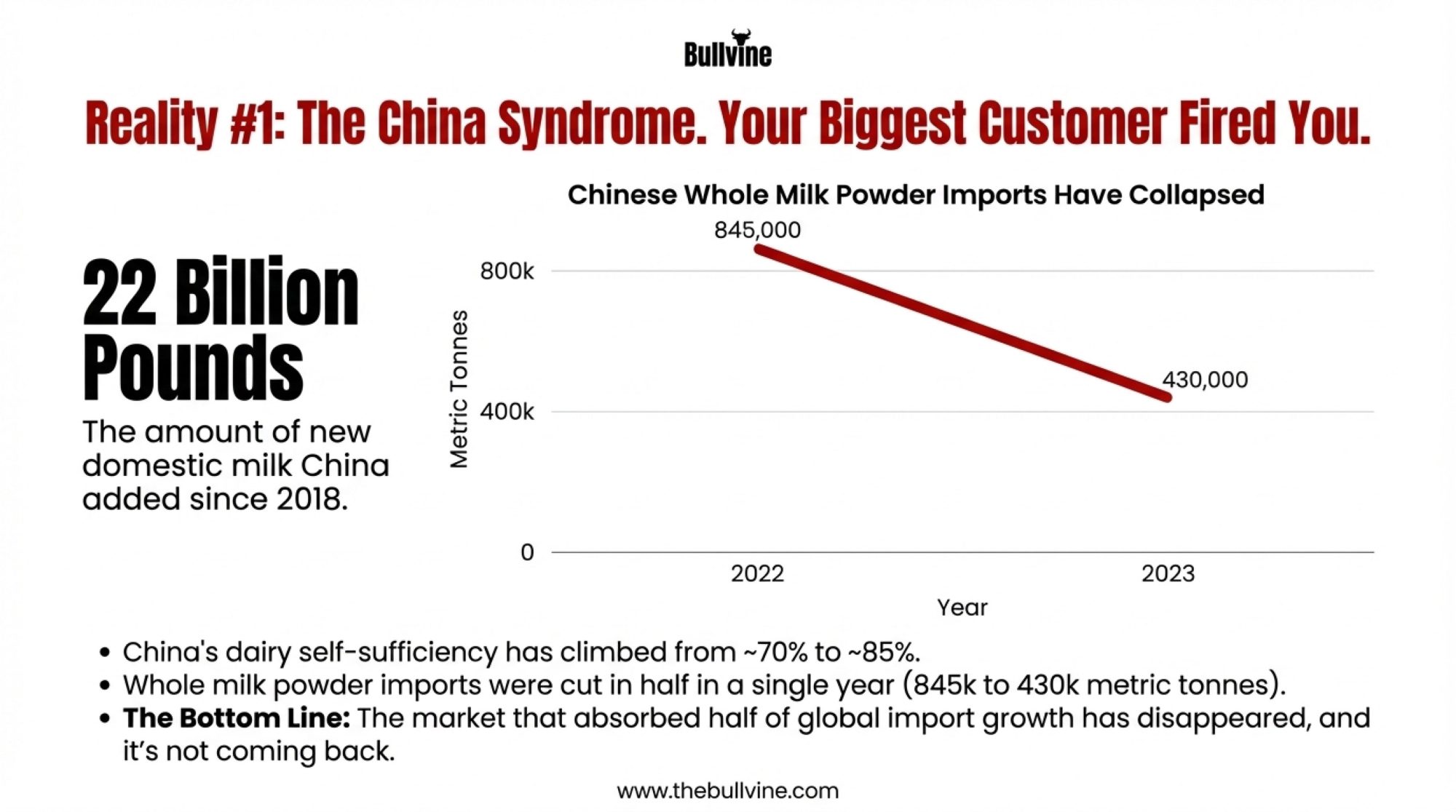
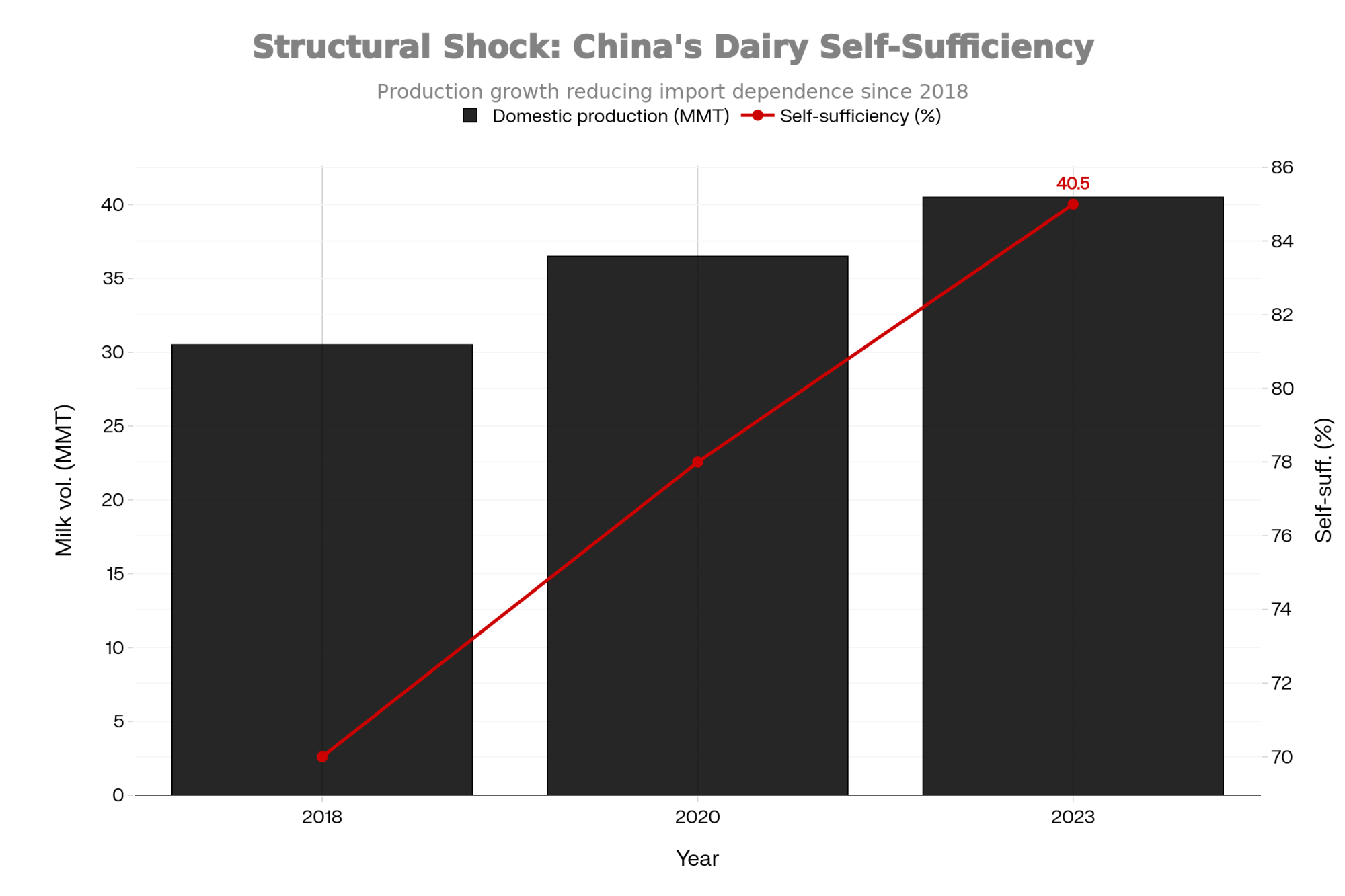
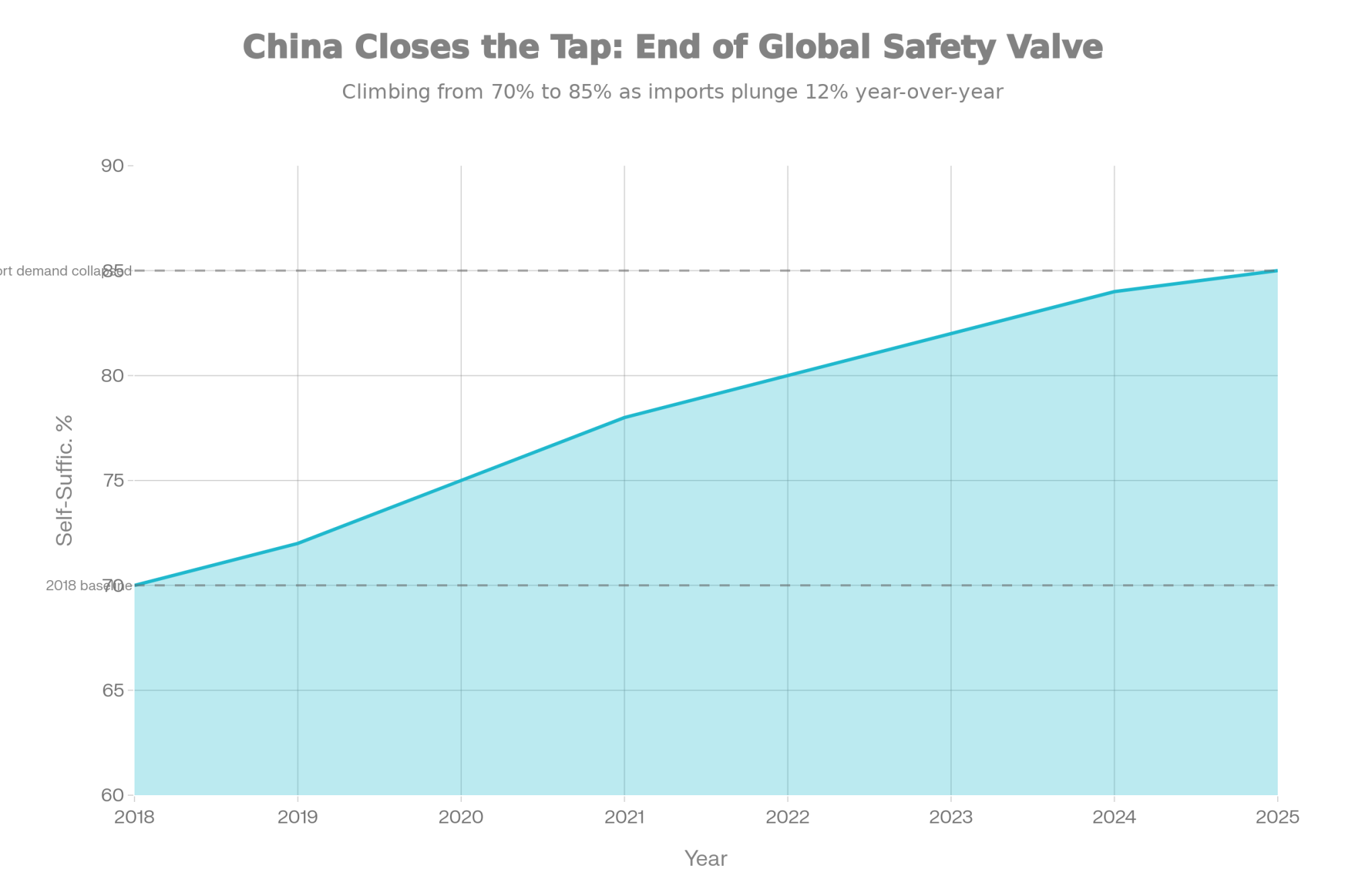
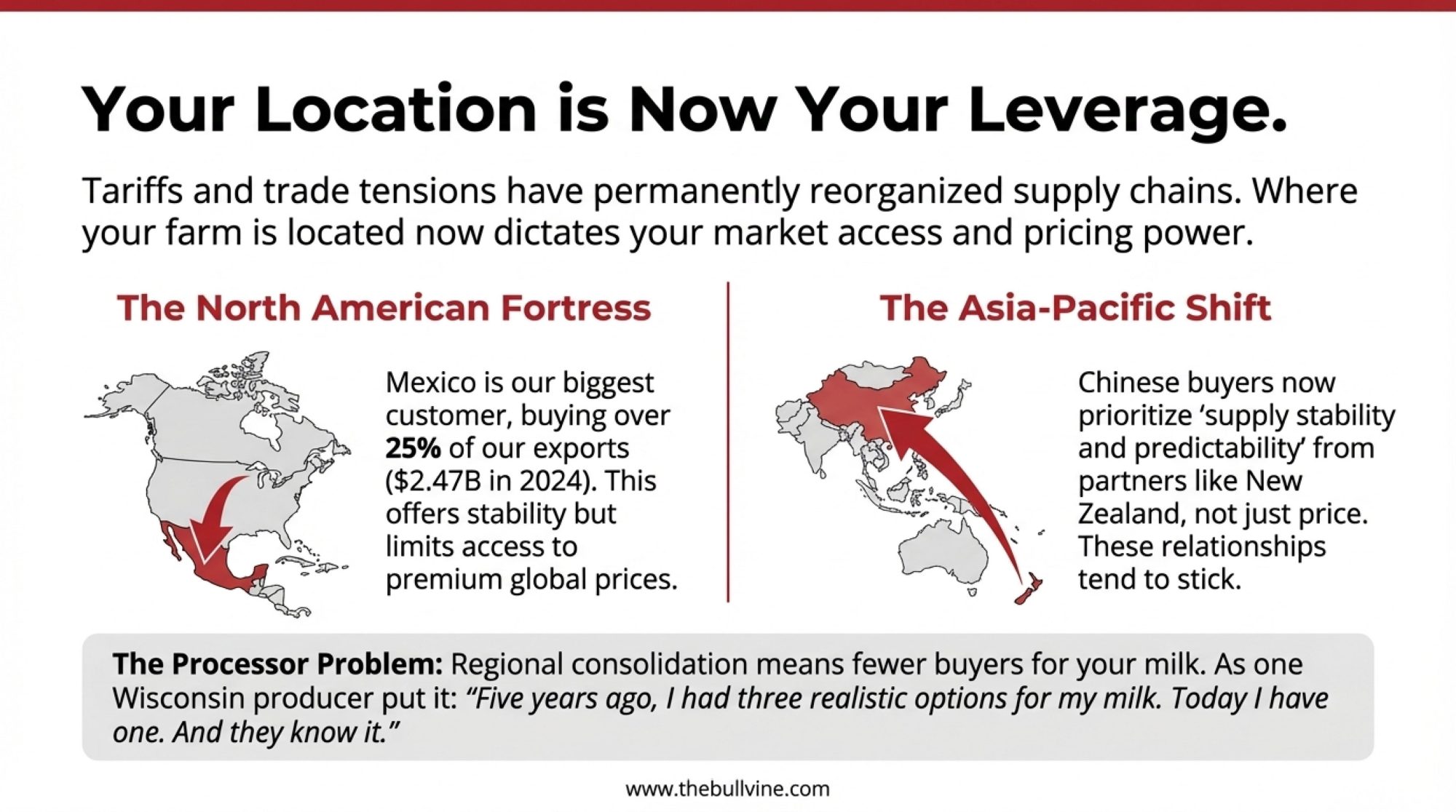
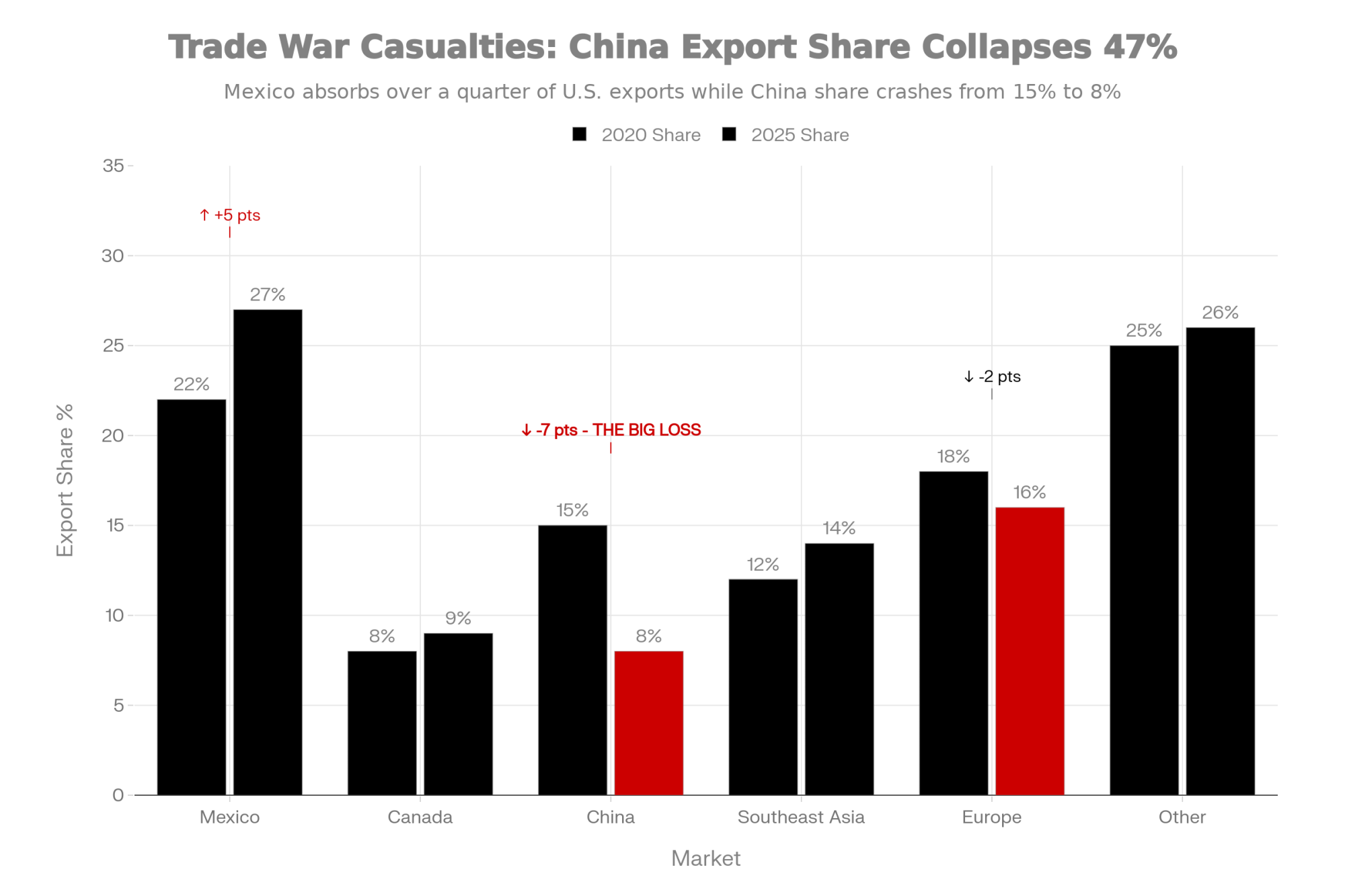
Recent trade data from USDA’s Foreign Agricultural Service shows Chinese imports of cheese and whole milk powder running well ahead of year-ago levels. Countries like Indonesia are expanding school milk programs that could add meaningful demand over the coming years. And with EU production constrained by environmental regulations, the U.S. is positioned well as a growth supplier.

Gregg Doud, who served as U.S. chief agricultural trade negotiator and now works with Aimpoint Research, explained it well at the recent World Dairy Expo: “Processors aren’t building for today’s prices. They’re looking at where they think we’ll be in 2028, 2030. The current downturn? It actually helps their positioning by limiting competitive expansion.”

What’s less visible—and this is based on industry analysis from groups like CoBank and what I’m hearing through the grapevine—is that a large share of new processing capacity appears to be already tied up in multi-year arrangements with larger farms. Contracts negotiated when prices were recovering in ’23 and ’24, locking in supply regardless of current spot conditions. It’s creating this two-tier market that not everyone fully grasps yet.

The Information Gap That’s Hurting Smaller Operations

One challenge I keep hearing about from mid-sized operations is what university economists call “information asymmetry.” Basically, larger farms dealing directly with processors often see market shifts months before that information reaches smaller producers through traditional channels.

This gap shows up in several ways. Larger operations often have earlier visibility into processor needs and plans. They might subscribe to proprietary research from firms like Terrain or StoneX, which costs tens of thousands of dollars annually. Meanwhile, smaller operations rely on cooperative communications that, honestly, can lag market realities by quite a bit.

A Pennsylvania producer managing 600 cows—a fifth-generation dairy farmer—put it to me straight: “We thought October’s price drop was temporary. We didn’t realize how much had already been decided about where the industry’s headed. By the time we understood, our lender was already getting cautious about new credit.”

The practical impact? By the time many producers recognize these fundamental shifts, the window for smart positioning has already narrowed considerably.

Regional Winners and What’s Creating Lasting Advantages

The geographic distribution of new processing investment is creating what analysts at CoBank call “permanent regional stratification.” Strong words, but they’re not wrong.

Looking at Federal Milk Marketing Order data from October 2025 and processor announcements, here’s who’s seeing sustained advantages:

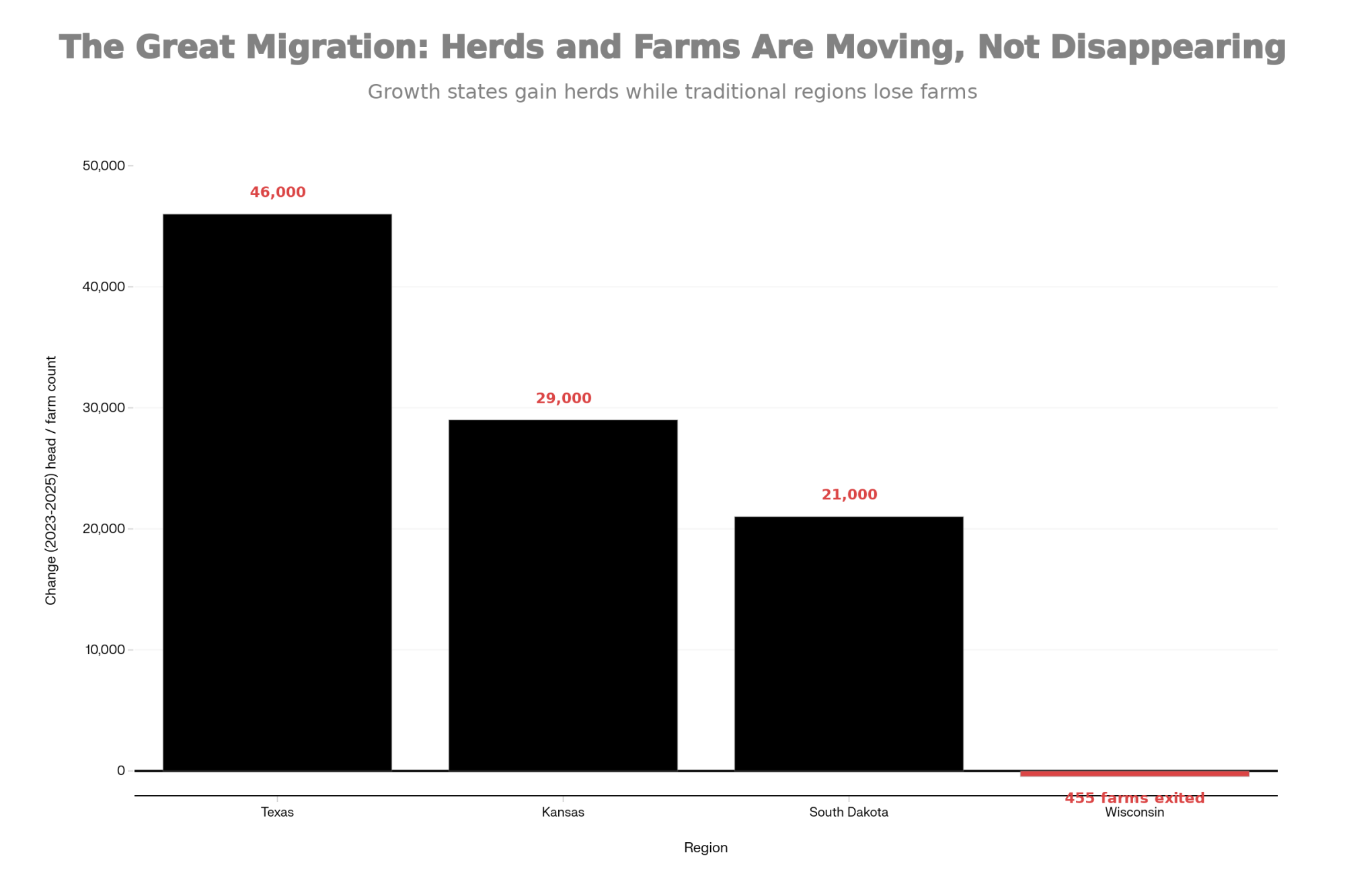
Idaho’s Magic Valley continues to benefit from expansions in cheese infrastructure. USDA National Agricultural Statistics Service data shows Idaho among the fastest-growing milk states, with many operations reporting solid annual gains. The Texas Panhandle’s seeing competitive pricing from multiple cheese plants.

Kansas—and this surprised me—has emerged as a real growth story, with some of the strongest percentage gains in the country according to USDA data. Central New York’s premium milk and yogurt facilities are creating genuine competition for local supplies.

But then you’ve got regions facing structural challenges. The Pacific Northwest remains primarily powder-oriented with limited cheese processing. California’s Central Valley operations are dealing with both water costs and a commodity-focused product mix that limit pricing upside.

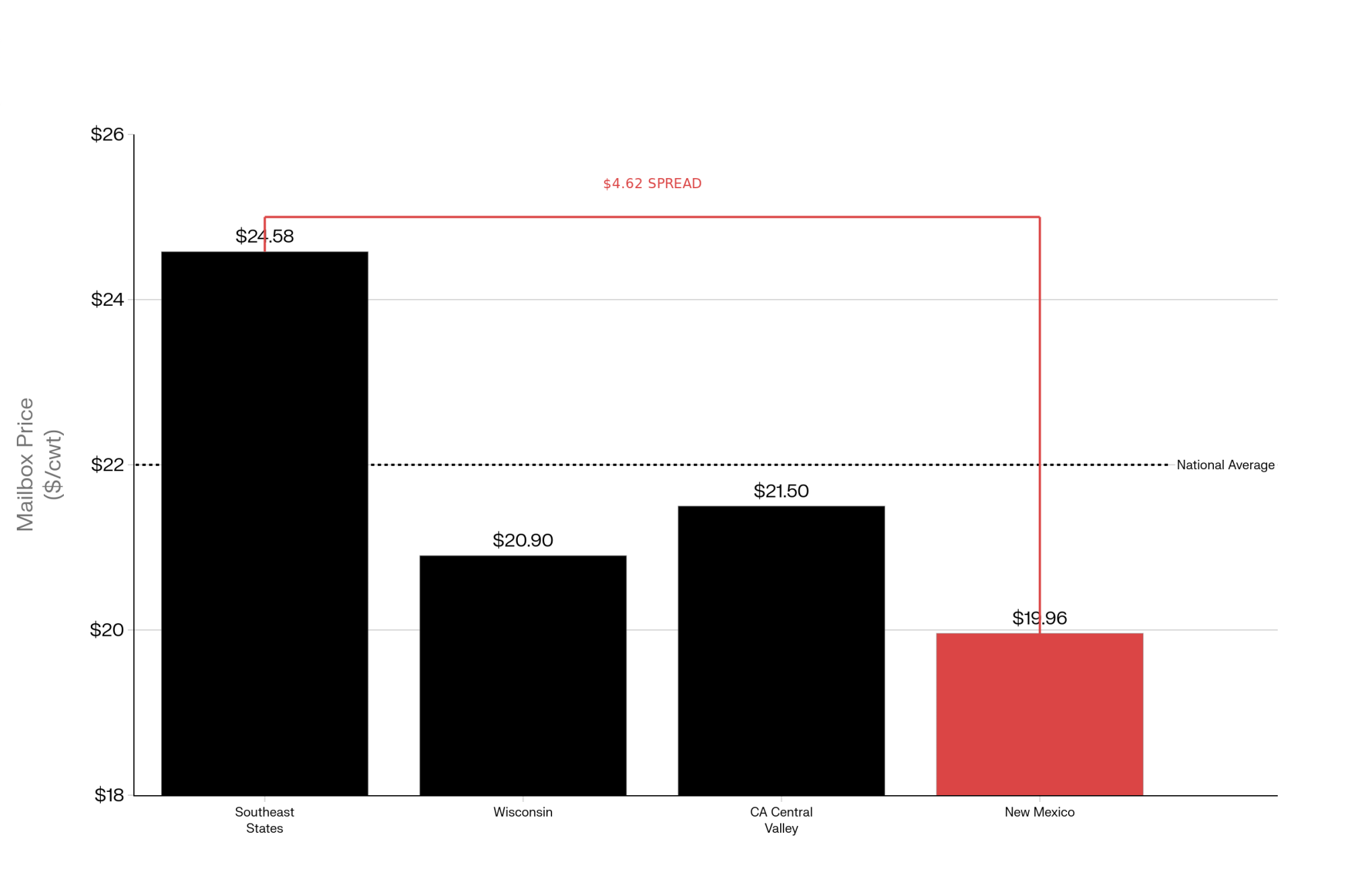
Southwest dairy producers face increasing water restrictions and rising costs for heat-stress management. Southeast operations are wrestling with not just heat stress but also limited local feed production and basis challenges that add $30-40 per ton to feed costs. The Upper Northeast faces geographic isolation that creates significant transportation penalties that can substantially erode margins.

The hard truth? And this is tough for many of us to accept—operational excellence can’t overcome a structural pricing gap of $1 or more per hundredweight by geography. That recognition is driving some of October’s herd adjustments.

Practical Steps Depending on Your Situation

Based on what’s emerging from October’s data and conversations with folks making it work, here’s what I’m seeing:

If You’re in a Growth Region:

Focus on genetic improvement within your existing herd rather than expansion. A Texas producer near one of the new cheese plants told me, “We’re genomic testing everything and being selective like never before.”

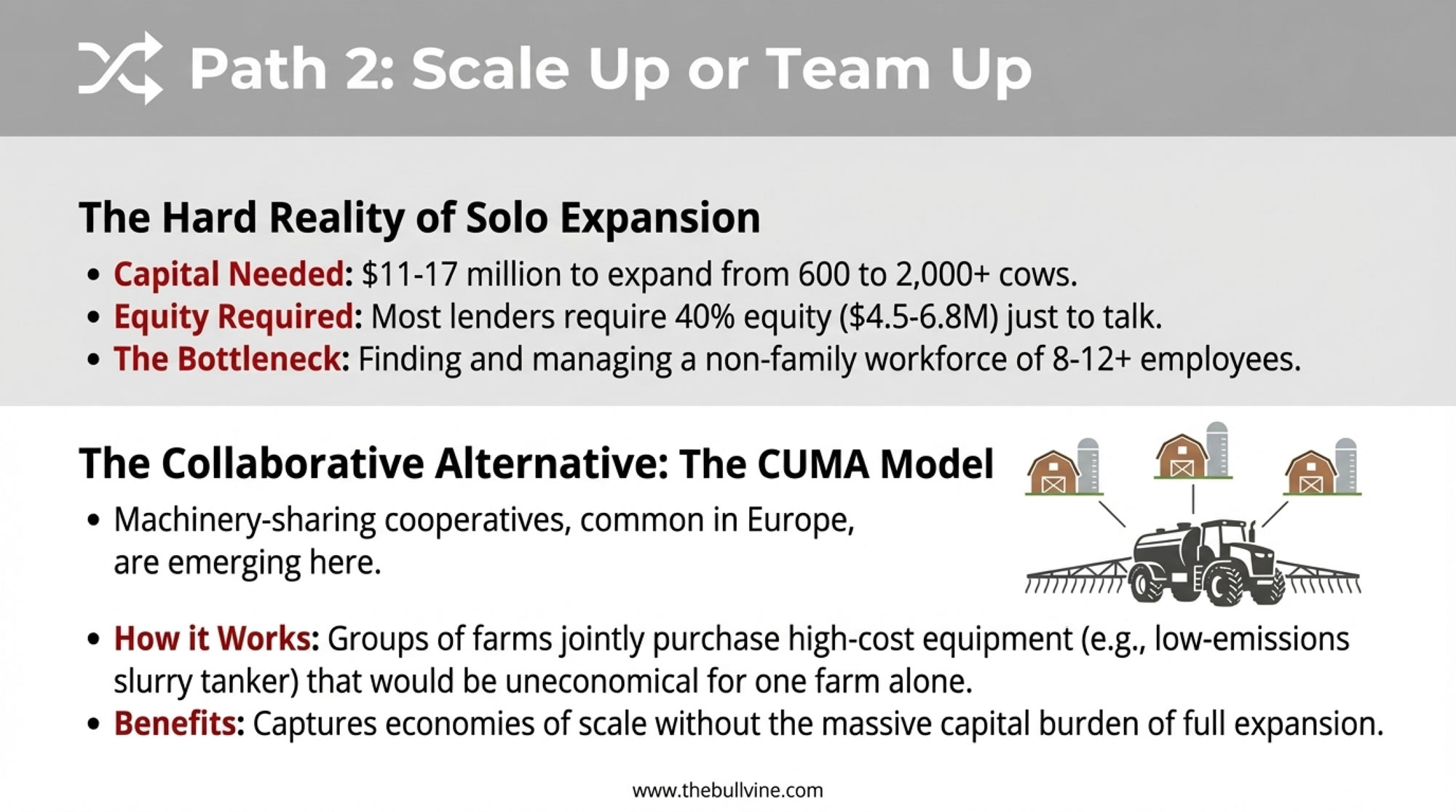
Work on developing direct processor relationships where possible. Several Idaho producers tell me they’re having success negotiating directly rather than relying only on their co-op. And consider partnerships with neighboring operations—achieve some scale advantages without individual expansion.

If You’re in a Challenged Region:

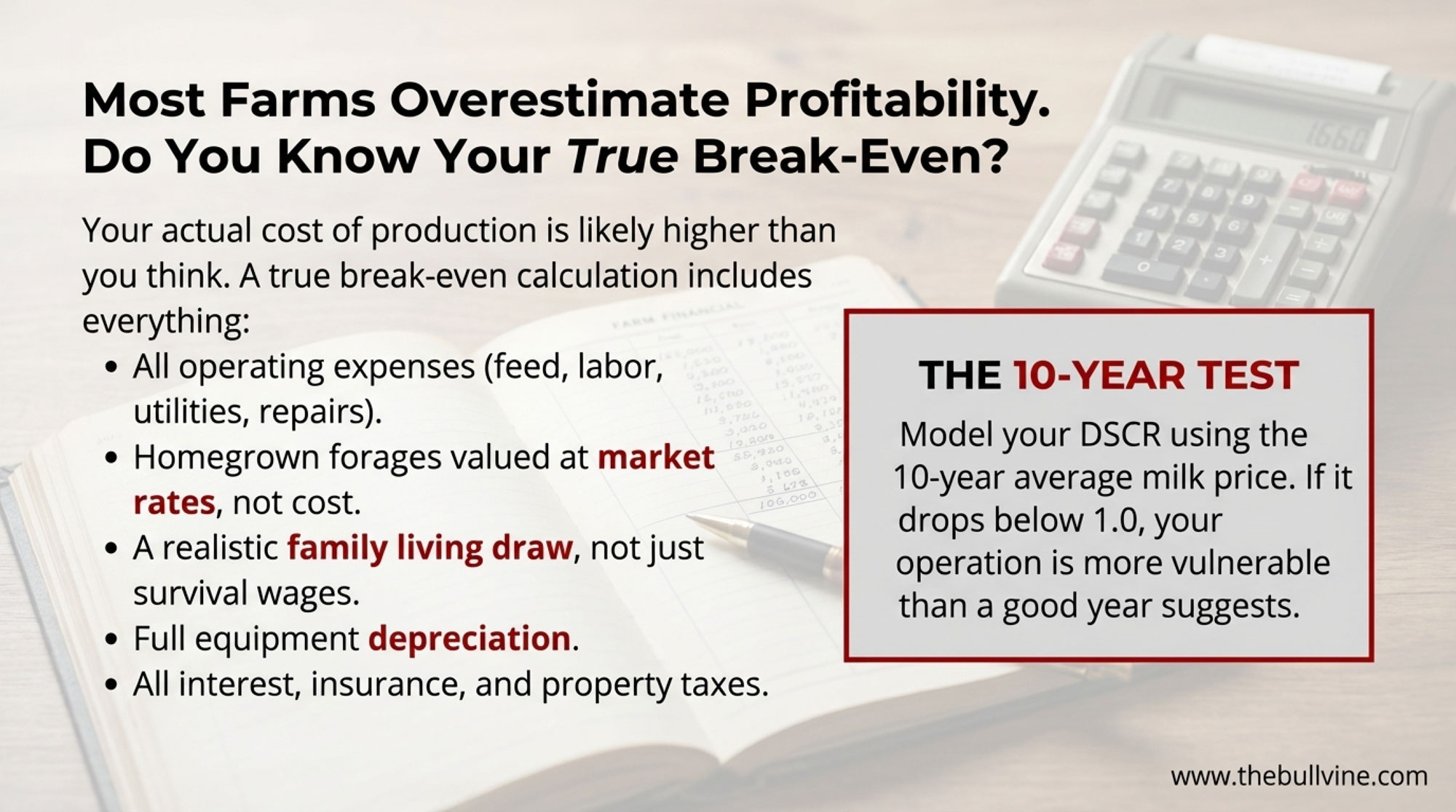
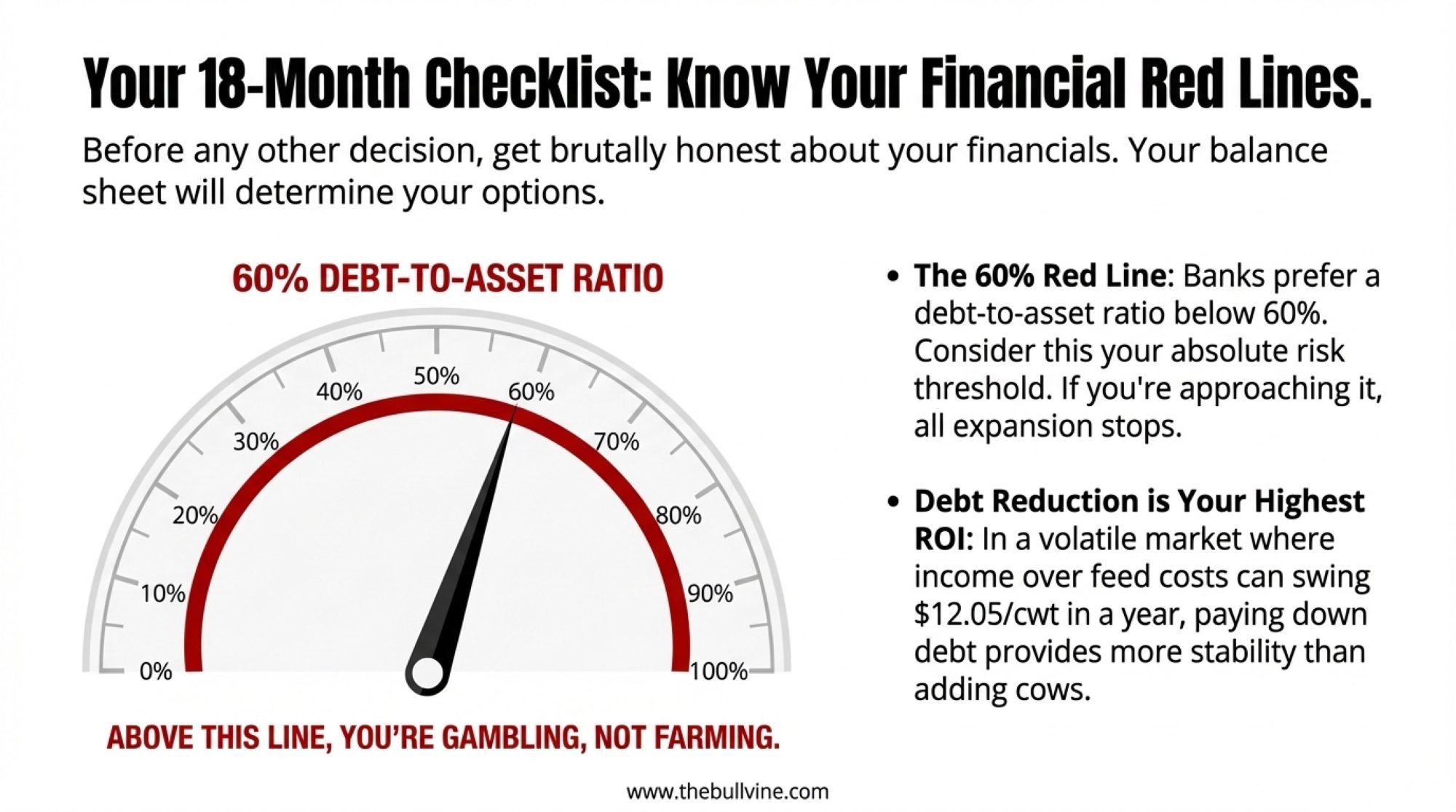
You need an honest evaluation of your long-term position given structural disadvantages. Run scenarios at different milk prices—$14, $16, $18—to really understand your breakevens. It’s sobering but necessary.

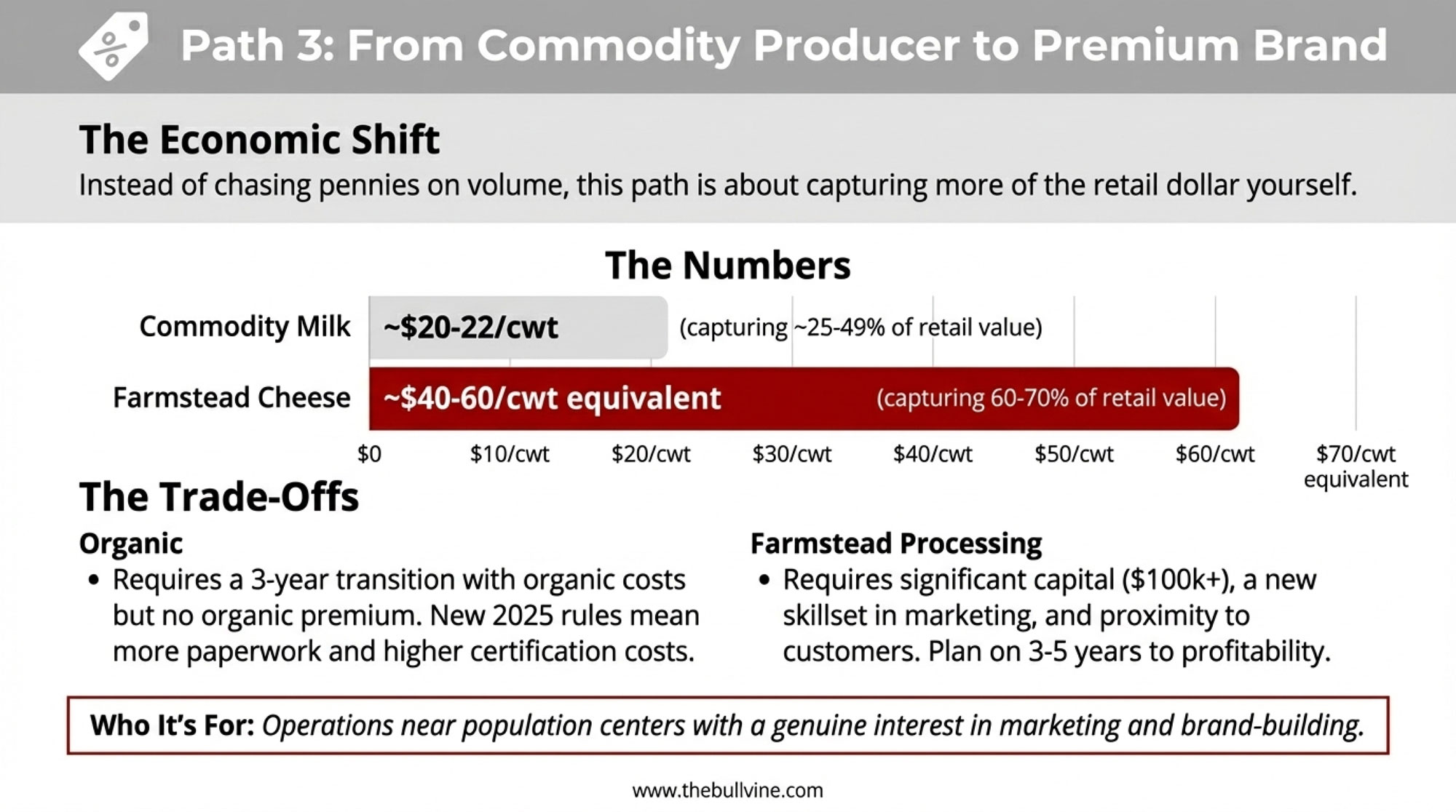
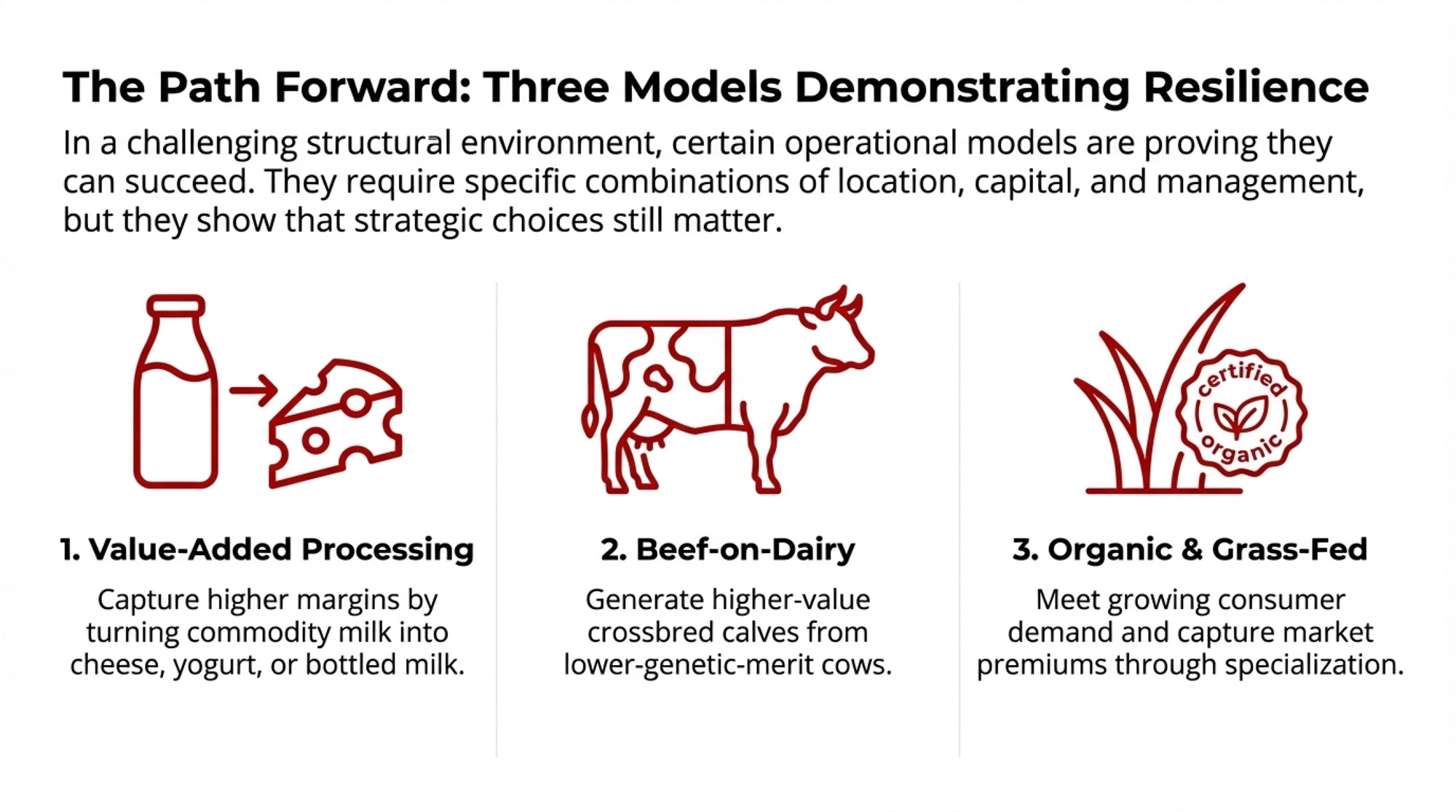
Look at diversification that reduces dependence on commodity pricing. I know Northeast producers are finding success with on-farm processing, agritourism—not for everyone, but worth considering. California Central Valley operations are exploring specialty milk products that command premiums despite the region’s challenges.

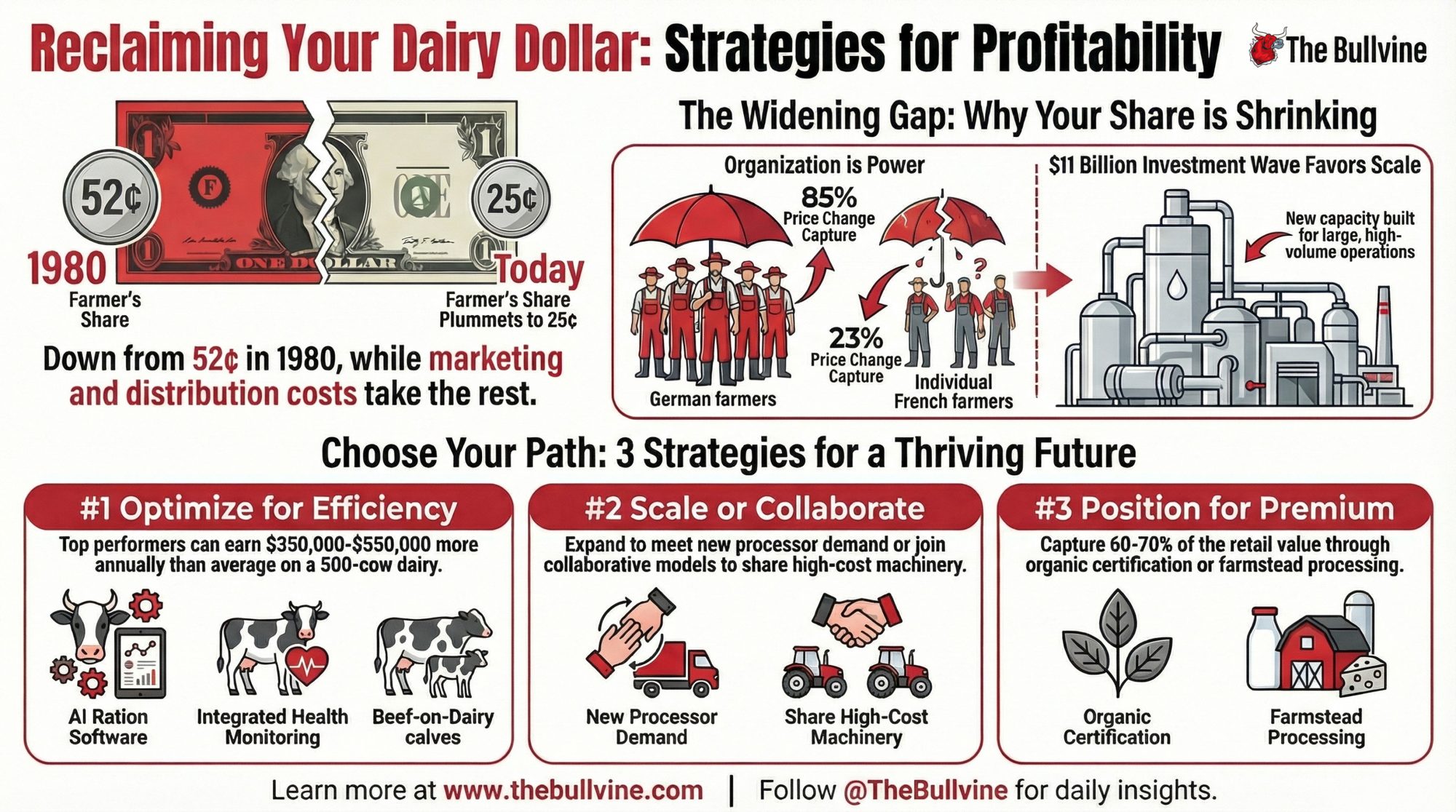
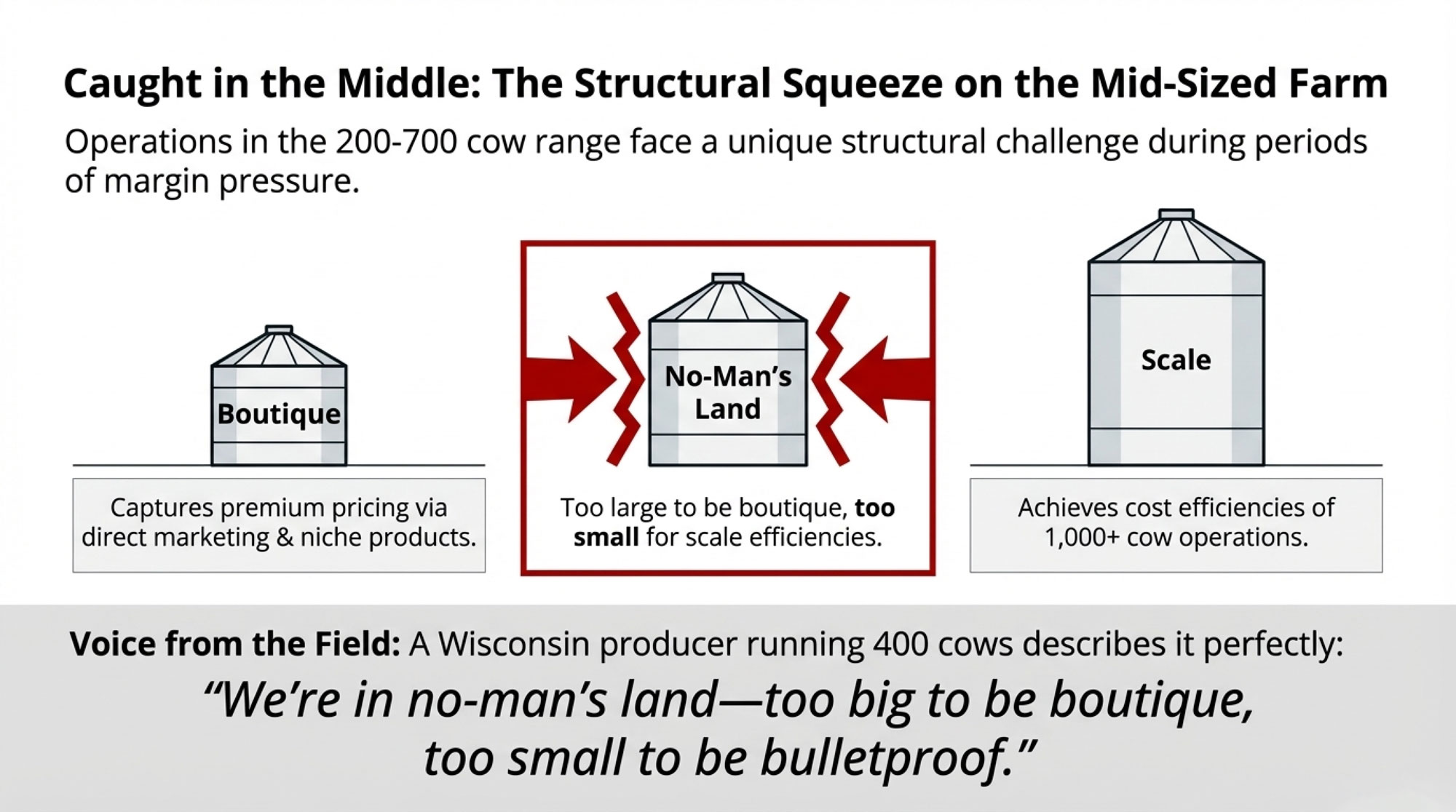
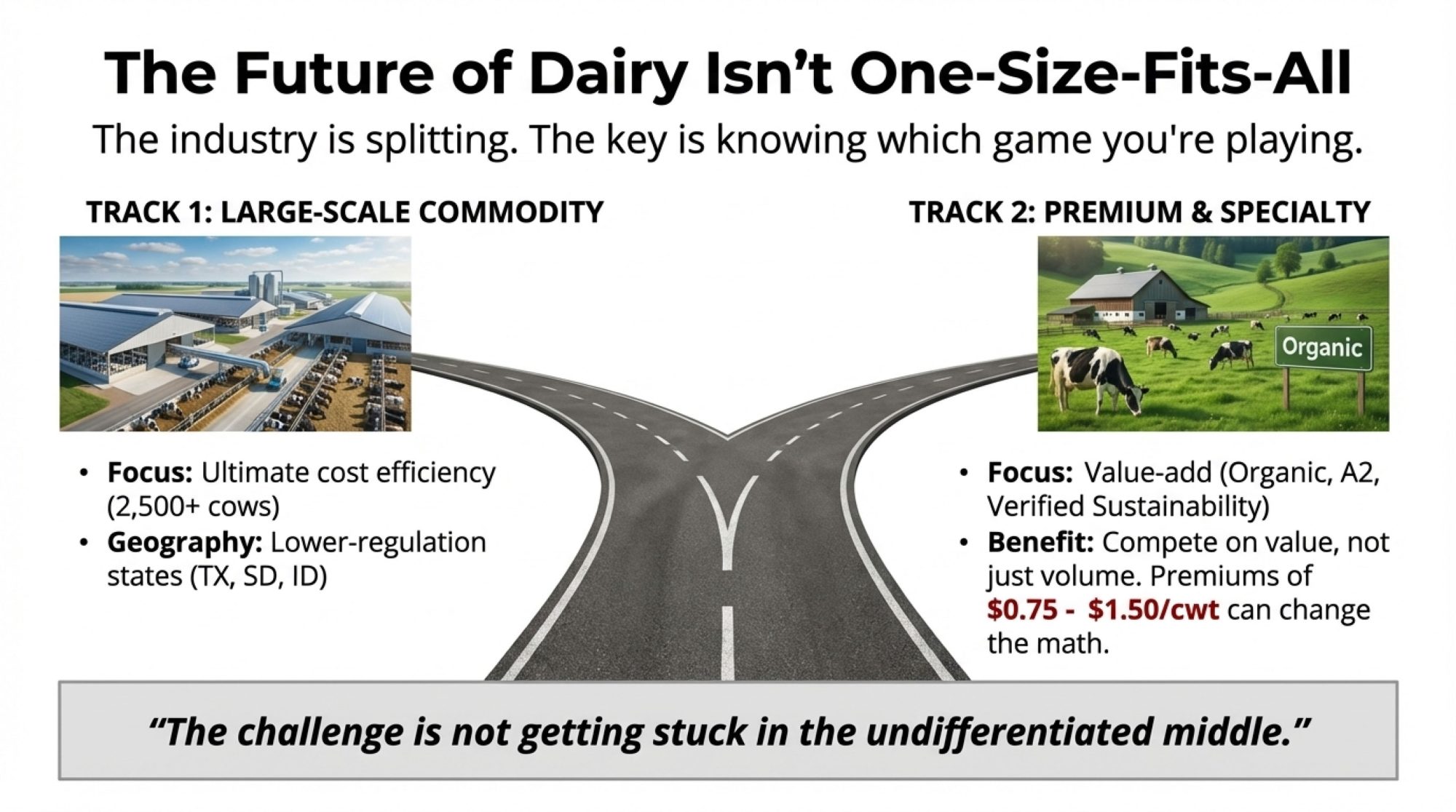
For those sub-300 cow operations, the math gets even tougher. But I’m seeing some find success through direct marketing, value-added products, or transitioning to organic, where premiums can offset scale disadvantages. Others are forming producer groups to share resources and negotiate collectively.

And assess whether relocating might work, though as one Wisconsin friend said, “The math on moving with current land and heifer prices? Brutal.”

Universal Strategies That Work:

Secure financial flexibility now while credit’s available. Every lender I’ve talked to expects standards to tighten over the next year.

Implement component-focused production aligned with how your processor actually pays. This means regular ration work, good DHI records.

And develop non-milk revenue streams. Despite some recent softening, beef-on-dairy remains profitable according to cattle market folks at the Chicago Mercantile Exchange. Every bit helps.

The Consolidation Already Underway

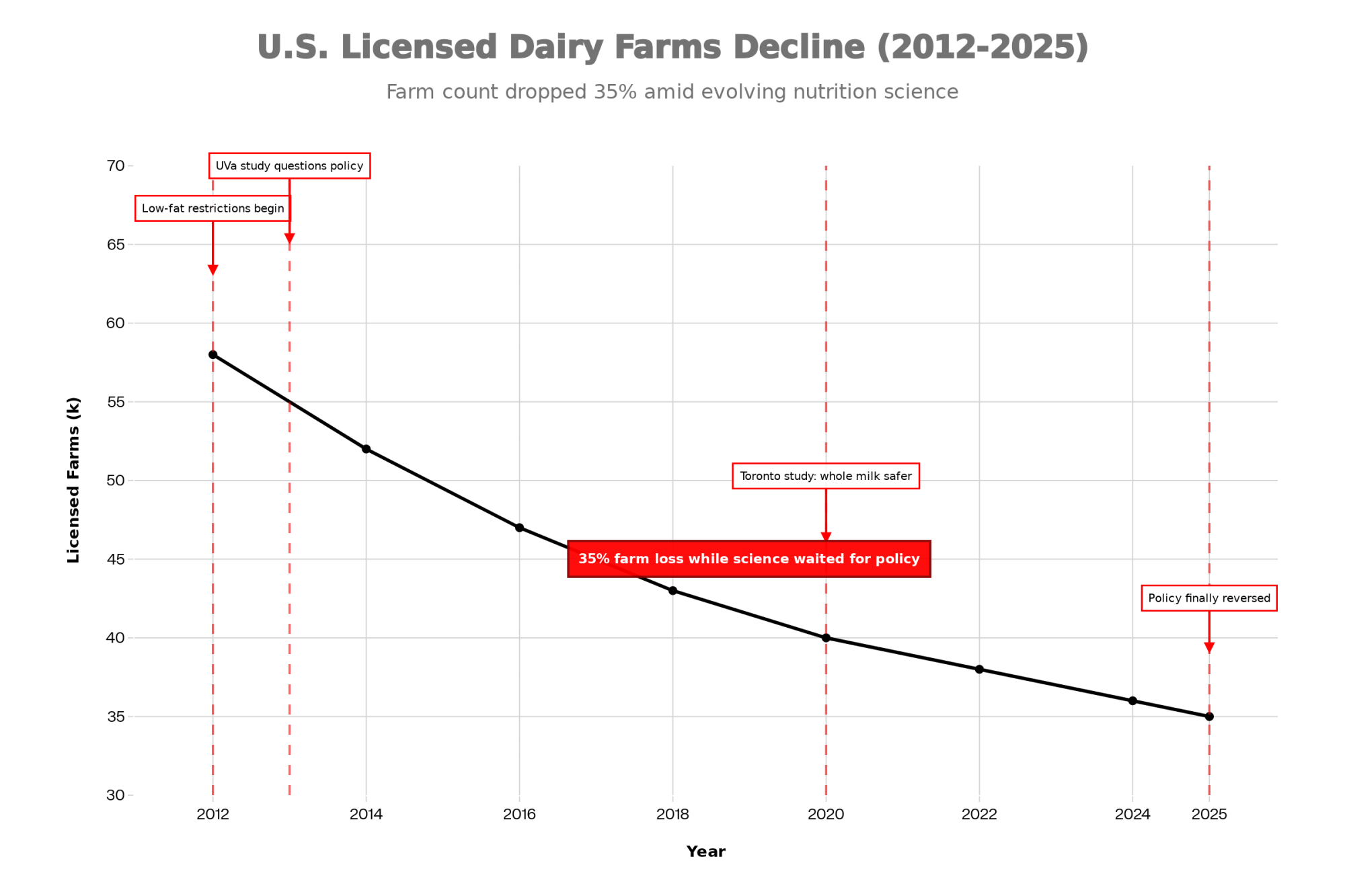
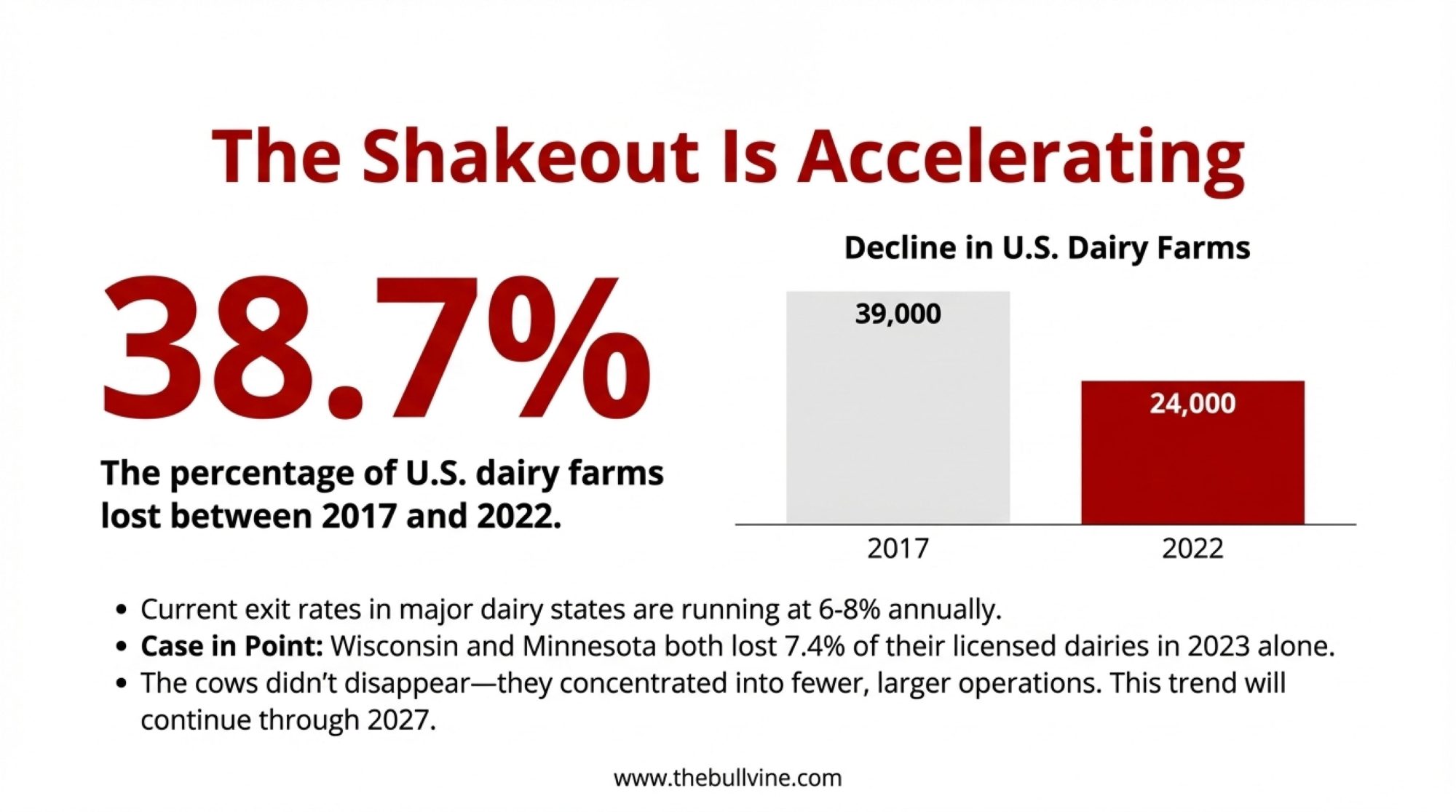
Let’s be honest about what’s happening here. Consolidation isn’t some future possibility—it’s here, right now. USDA’s 2022 Census of Agriculture shows dairy farm numbers in the mid-30,000s, and USDA Economic Research Service economists expect that to continue declining as the industry consolidates.

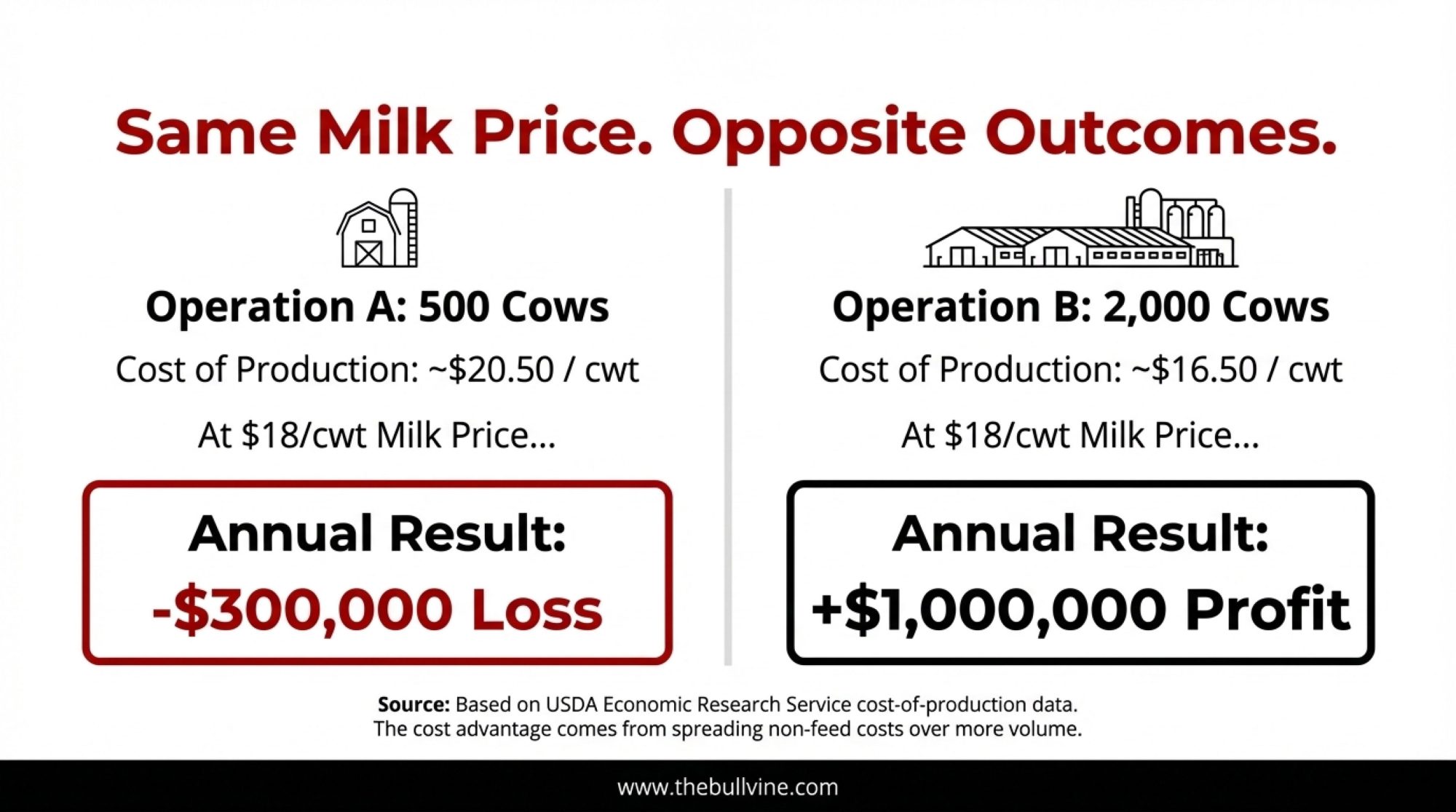
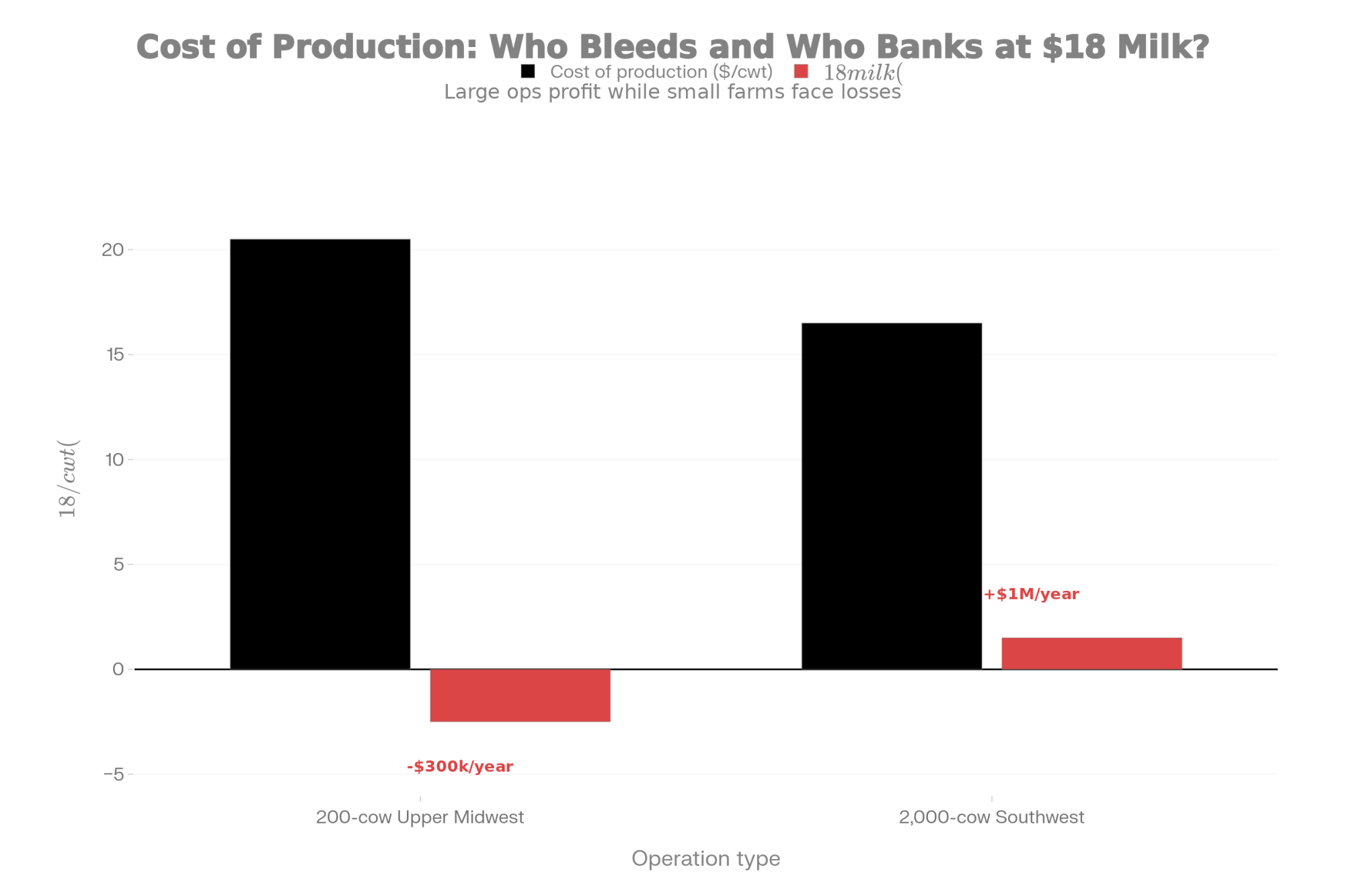
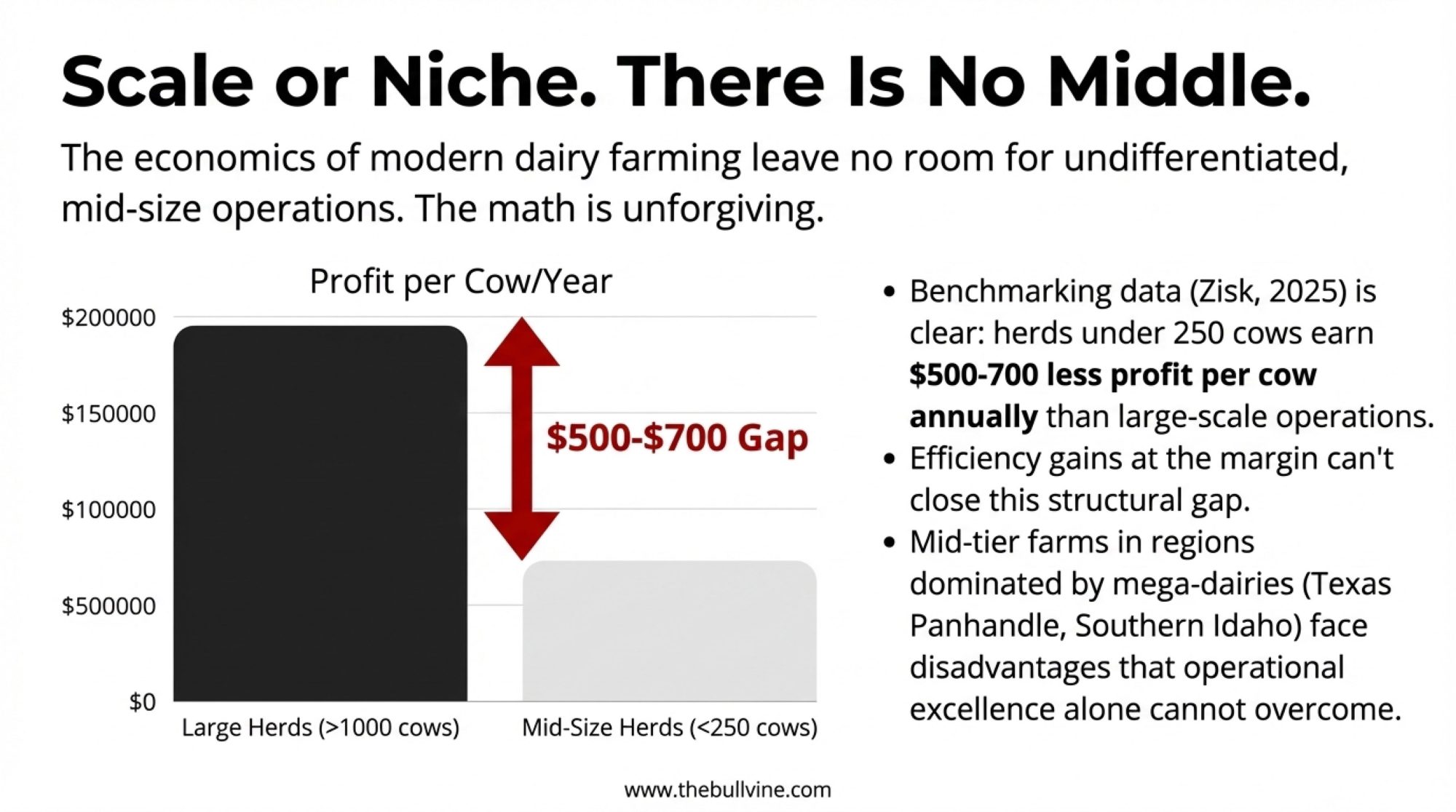
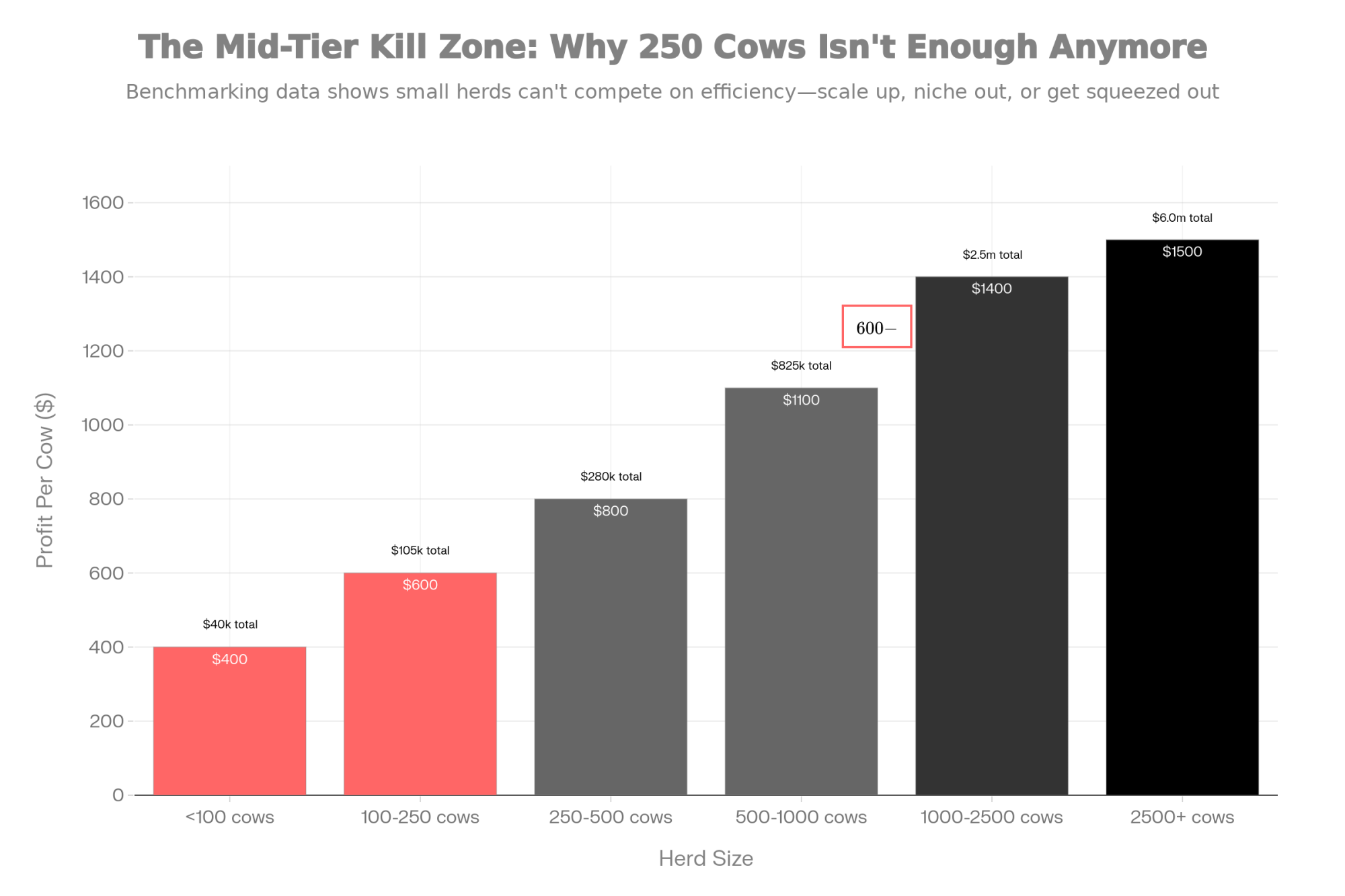
What’s driving this? ERS research consistently shows larger herds tend to have lower costs per hundredweight than smaller ones—often by several percentage points. Processors prefer fewer, larger suppliers to reduce complexity.

Technology adoption, especially robotic milking systems that can run $150,000-250,000 per stall, requires capital that favors bigger operations. The labor savings alone—reducing milking staff by 60-80% while addressing the chronic shortage of qualified dairy workers—makes automation almost mandatory for operations planning to survive long-term.

And the heifer shortage prevents smaller operations from achieving competitive scale, even if they wanted to.

Rather than viewing consolidation as failure—and this is important—many are recognizing it as evolution. As one university dairy economist at Wisconsin explained, “Operations that position strategically, whether through improvements, repositioning, or thoughtful exit timing, preserve more value than those forced into decisions.”

The Bottom Line

Several outlooks, including the Food and Agricultural Policy Research Institute’s baseline projections, suggest better price prospects later in the decade if global demand continues growing and herd size stays in check—though these are projections, not guarantees, as we all know.

Factors that could support recovery: The heifer shortage physically constrains expansion for a while. Global demand appears to be growing faster than supply, according to FAO data. Environmental regulations limit expansion in some major producing regions. And all this new processing capacity will need higher milk prices to generate returns.

But—and this matters—recovery probably won’t benefit everyone equally. Operations with secured processor relationships, geographic advantages, and superior genetics will likely capture premiums. Others might find that even recovered prices don’t fully offset their structural disadvantages.

What October’s Really Telling Us

After looking at the data and talking with folks across the industry, several lessons emerge pretty clearly.

Geography increasingly determines destiny. Those regional pricing gaps reflect structural realities that great management can’t overcome. If you’re in a disadvantaged region, that needs to factor into your planning—like it or not.

The heifer shortage creates both constraint and opportunity. Operations that optimize within their existing footprint while potentially monetizing excess production can turn the shortage to their advantage. Creative producers are making this work.

Information and relationships matter more than ever. Direct processor relationships and access to good market intelligence increasingly separate operations that thrive from those that struggle. Better information pays—literally.

Financial positioning can’t wait. Every lender emphasizes this—the window for securing working capital and risk management tools is months, not years. Wait until you need flexibility, and it might not be there.

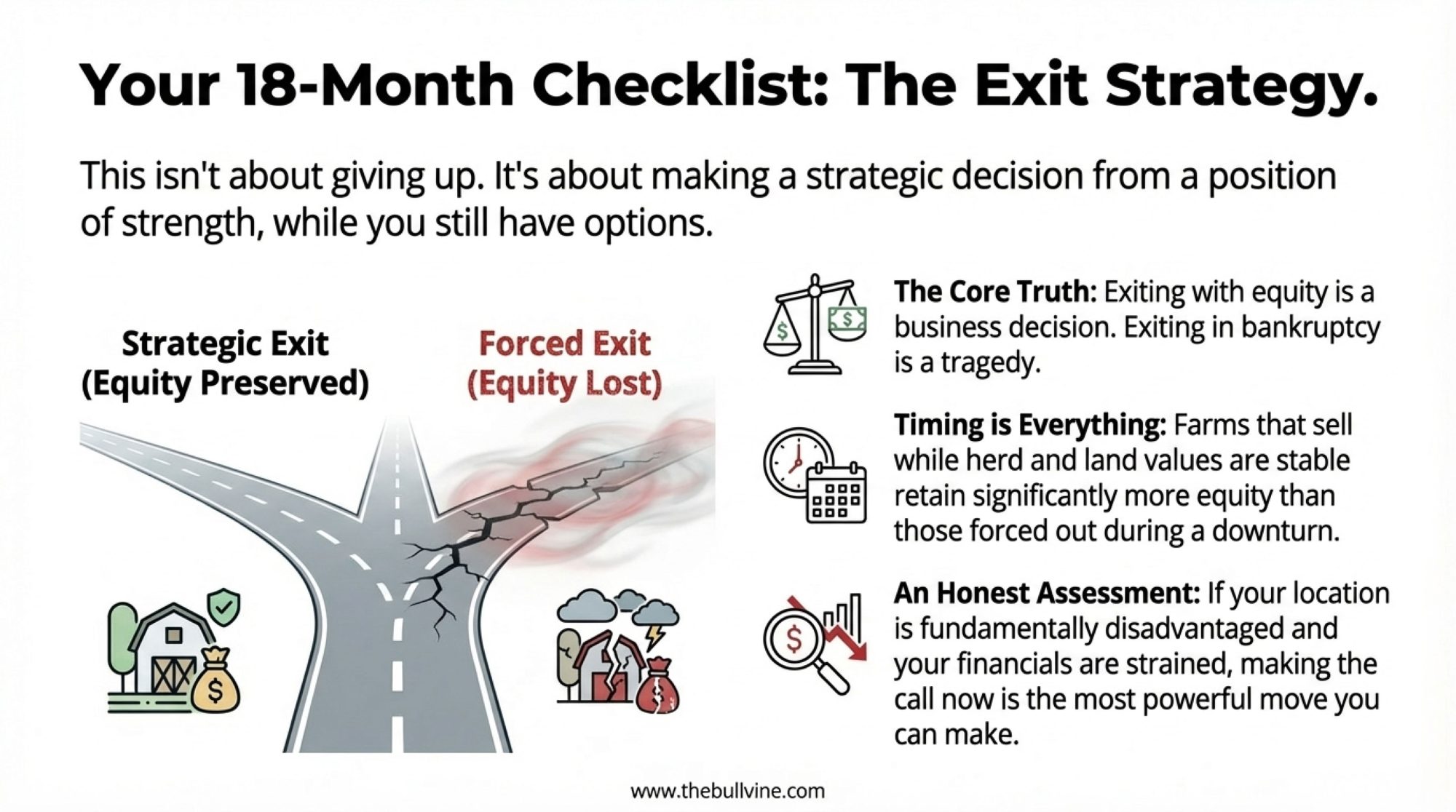
Strategic positioning beats stubborn persistence. Whether improving for independence, positioning for acquisition on good terms, or planning an orderly exit, proactive decisions preserve more value than reactive ones. There’s no shame in strategic repositioning—it’s smart business.

We’ve weathered dramatic transitions before—from diversified farms to specialized operations, through technological changes and trade upheavals. This is another transition. What’s different is both the speed and the degree to which these advantages are becoming structural. Operations that recognize and adapt, rather than hope for a return to old patterns, are best positioned.

October’s strategic culling by forward-thinking producers shows something important: successful operations aren’t waiting for change to happen to them. They’re actively positioning for whatever comes next.

For those still evaluating, October’s message seems clear—the time for strategic decisions is now, while you’ve got options and can preserve value through thoughtful positioning.

The path forward won’t be identical for everyone—and that’s fine. But understanding the forces reshaping our industry helps inform decisions. In a world where change keeps accelerating, maybe the biggest risk is standing still.

For more specific information on programs mentioned, producers can check with their local USDA Service Center, university extension offices, or agricultural lenders.

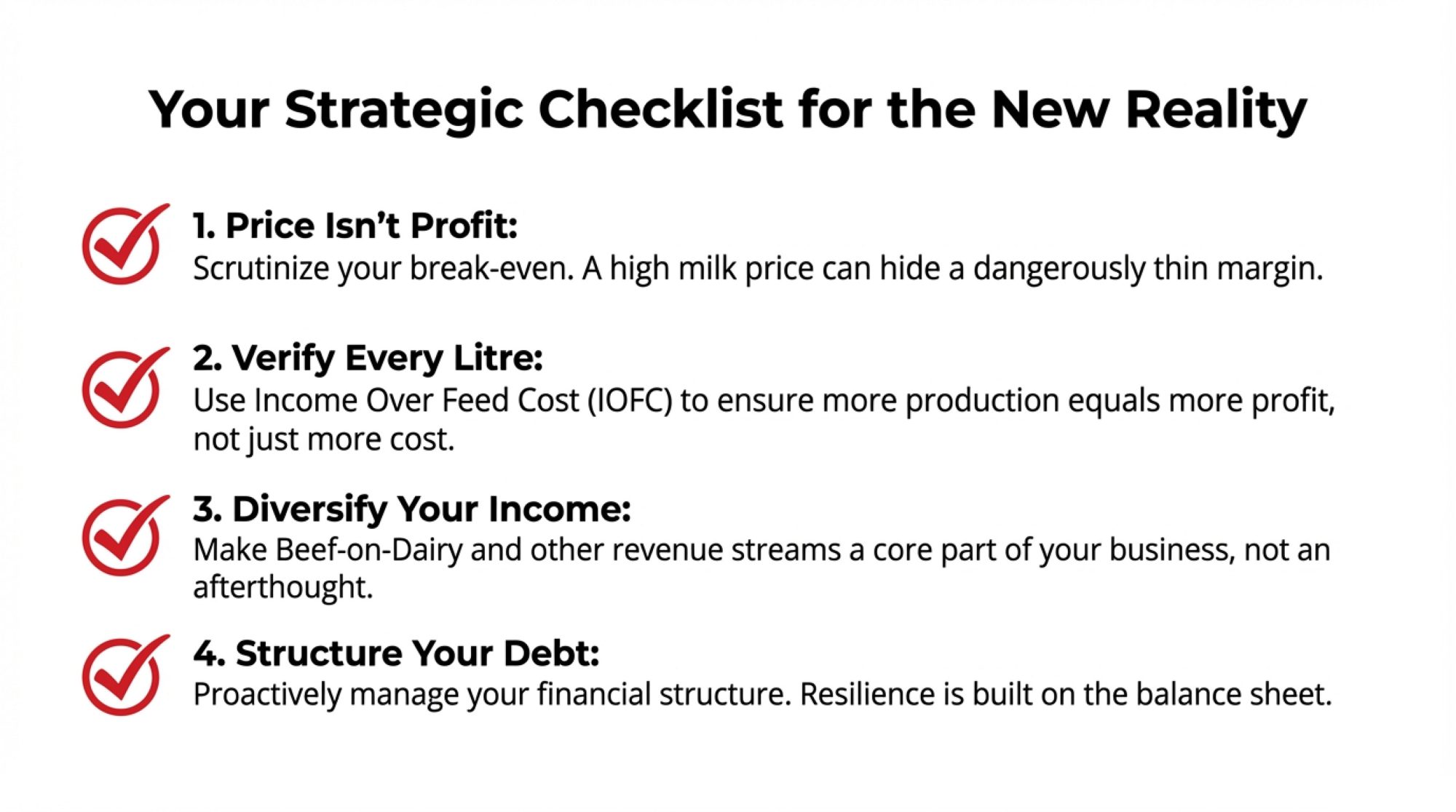
KEY TAKEAWAYS 

  • Your zip code now outweighs your work ethic: Cheese regions earn $1.00-1.50/cwt more than powder areas—that’s $50,000+ annually, no amount of great management will ever close
  • The heifer shortage is now your profit center: Breeding 20-25% surplus heifers generates $100,000+ annually while locking competitors out of expansion at today’s prices
  • Your lender’s flexibility has an expiration date: Working capital windows slam shut by mid-2026—secure financing now, not when you desperately need it
  • This is a five-month decision, not a five-year plan: October’s culling data proves the reshuffling has begun—producers positioning now will be the ones still milking in 2027

Complete references and supporting documentation are available upon request by contacting the editorial team at editor@thebullvine.com.

Learn More:

Join the Revolution!

Join over 30,000 successful dairy professionals who rely on Bullvine Weekly for their competitive edge. Delivered directly to your inbox each week, our exclusive industry insights help you make smarter decisions while saving precious hours every week. Never miss critical updates on milk production trends, breakthrough technologies, and profit-boosting strategies that top producers are already implementing. Subscribe now to transform your dairy operation’s efficiency and profitability—your future success is just one click away.
NewsSubscribe
First
Last
Consent

The $500 Transition Gap: Why Your Neighbor’s Fresh Cows May Outperform Yours by Next Winter

Next winter, one dairy will have fewer sick fresh cows and better margins. Yours or your neighbor’s? The gap starts now.

You know that feeling when you’re doing morning checks and spot a cow that’s just… off? Maybe she’s standing away from the bunk, head low, looking like she’d rather be anywhere else.

We’ve all been there. And we all know what comes next—that cow’s probably about to cost you anywhere from three hundred to a thousand dollars, depending on whether she develops ketosis, metritis, or decides to really complicate your week with multiple problems.

So here’s what’s interesting about the research coming out of Penn State lately. Adrian Barragan and his team over in their veterinary school think they’ve found a better way to prevent these crashes before they happen—and the thing is, they’re not asking you to buy fancy new equipment or send blood samples to a lab every week.

They’re using information most of us already collect.

THE ECONOMICS: Clinical ketosis costs $300-$350 per case in treatment plus 600-800 pounds of lost milk, while metritis runs $300-$500 per case—based on foundational research adjusted for current costs

You probably know the basic economics already, but it’s worth laying out just how expensive transition problems really are. Foundational research by McArt and colleagues, adjusted for current feed and treatment costs, estimates clinical ketosis at $300-$350 per case. And that’s before you count the 600 to 800 pounds of milk you’re typically losing over that lactation.

Metritis? Cornell and other research groups have been tracking this for years. More recent estimates put the true cost at $300 to $500 per case when you factor in treatment, lost production, and downstream fertility impacts.

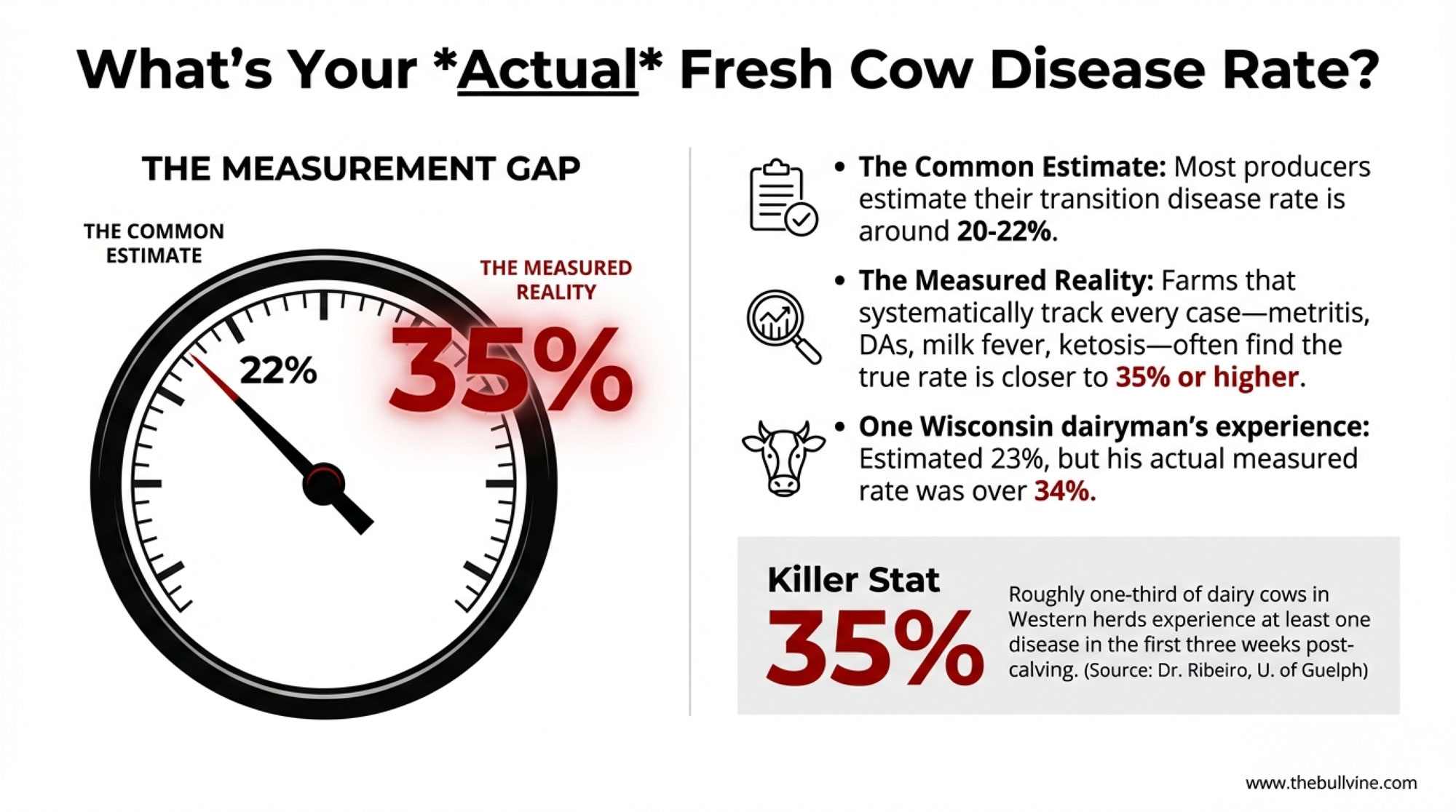
And here’s the kicker—when a cow gets multiple diseases (and research shows that happens about 35% of the time in that first month), you’re looking at losses that easily top a thousand dollars per cow. Makes you think, doesn’t it?

But—and this is where it gets complicated—the farms that could benefit most from this approach are often the ones that can’t actually implement it. Let me explain what I mean.

Understanding Which Cows Need Help (And When)

What farmers are finding with targeted cow management is that it’s surprisingly straightforward, at least in theory. Barragan’s framework focuses on three windows we’re all managing anyway: dry-off (about 60 days before calving), close-up (those critical two to three weeks before), and calving itself.

At each of these points, there are specific red flags that predict trouble ahead.

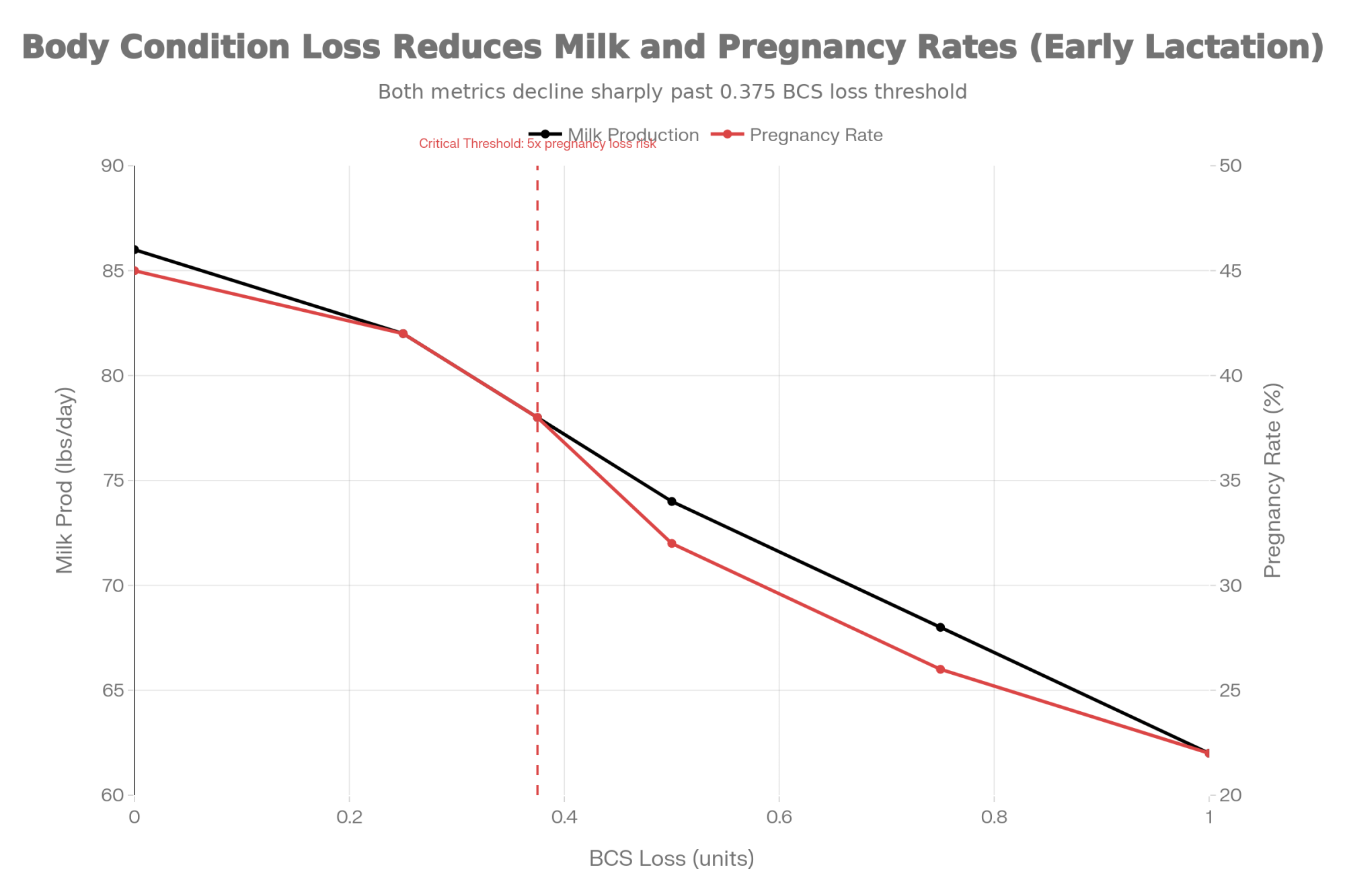
Take dry-off, for instance. We all know overconditioned cows are trouble—anyone with a body condition score of 3.75 or higher is asking for metabolic problems. Penn State tracked thousands of cow lactations over several years, and these cows produced about 560 pounds less milk during the first 16 weeks of their next lactation. Plus, they have 10% more health events.

That’s not exactly news to most of us. But having the hard numbers helps justify why we need to manage the condition more carefully.

Here’s another risk factor worth watching: high producers at dry-off. Cows still making 45 pounds or more when you’re trying to dry them off face increased risk of milk leakage and intramammary infections. The combination of high production and high body condition at dry-off? That’s your highest-risk group right there.

And then there’s the somatic cell piece. Pam Ruegg at Michigan State and Noelia Silva del Rio out at UC Davis have both shown that cows over 200,000 cells at dry-off have compromised colostrum quality. Their calves end up with lower antibody levels. These cows will produce about 1,000 fewer pounds of milk over the first 16 weeks, too.

Quick Reference: Targeted Cow Risk Windows

  • Dry-off (60 days before calving): Flag cows with BCS ≥3.75, high production (>45 lbs/day), or SCC >200,000
  • Close-up (21-14 days before): Watch for feed intake drops >30%, pen moves, DCAD balance issues
  • Calving: First-calf heifers, twins, and dystocia cases need immediate targeted protocols

Why Timing Changes Everything in Transition Management

Looking at this from a different angle, we’ve always known intuitively that some cows need more attention than others. Good managers—you know the type—they have that sixth sense about which cows are going to crash.

What’s fascinating here is how precision transition research actually quantifies what we’ve suspected all along. The same cow might need completely different interventions depending on when you catch her.

The anti-inflammatory work is particularly revealing. In peer-reviewed trials, Barragan’s team tested meloxicam at multiple time points. First-calf heifers treated a day or two before expected calving showed remarkable responses—up to 10 to 11 pounds more milk per day over the early lactation period in some trials, though results do vary by herd and individual cow.

A quick regulatory note here: meloxicam use in dairy cattle is considered extra-label in the United States, meaning it requires a valid veterinarian-client-patient relationship and prescription. This isn’t something you can pick up at the farm store—work with your vet if you’re considering this protocol.

Even at the conservative end, we’re talking 450 to over 1,500 pounds of extra milk over 150 days. At current market values averaging around $20 per hundredweight, that’s real money. And what really got my attention—stillbirth rates in these treated heifers dropped by about 20 percentage points in Penn State’s research.

But here’s where it gets interesting. Older cows? They showed a different pattern. They didn’t show the same positive response to prepartum treatment and, in some trials, showed no economic benefit from blanket prepartum protocols. Mike Overton from Elanco has been tracking these protocols on commercial dairies, and he’s finding that the timing question really matters by parity.

So that one-size-fits-all protocol we’ve been using for years? Turns out we need to be smarter about it.

The Reality Check: Making This Work on Real Farms

Let’s have an honest conversation about implementation. Knowing what to do and actually getting it done consistently are two completely different animals, right?

I’ve been tracking operations from Vermont to New Mexico, trying to implement these precision protocols, and here’s where things typically fall apart. First, somebody has to reliably score body condition—every cow, every time. Research from Wisconsin and other land-grant schools shows that when two people score the same cow, they disagree by half a point or more, roughly a third of the time. That’s enough to misclassify a cow completely.

Then you need to track which cows got flagged. Your feed crew needs different TMR specs for different risk groups. The fresh cow team needs to know which protocol applies to whom.

And here’s what nobody talks about at conferences—when José takes a few days off, and Miguel covers his shift, does Miguel know that cow 1847 is on the high-risk protocol? In many cases, probably not.

Marcia Endres at the University of Minnesota has been a leader in precision dairy research for years. What her work consistently shows is that farms with integrated herd management software—where BCS scores, milk weights, and health events flow into a single system—have significantly higher adoption rates for precision protocols than farms that try to manage everything in spreadsheets.

The gap is substantial. That tells you something right there.

The Economics: Traditional vs. Targeted Approaches

KEY FINDING: Field trials show farms implementing targeted transition protocols can achieve $200-$500 net benefit per cow per lactation through reduced disease and improved milk production

Looking at actual implementation data from extension-supported trials, the numbers tell a compelling story.

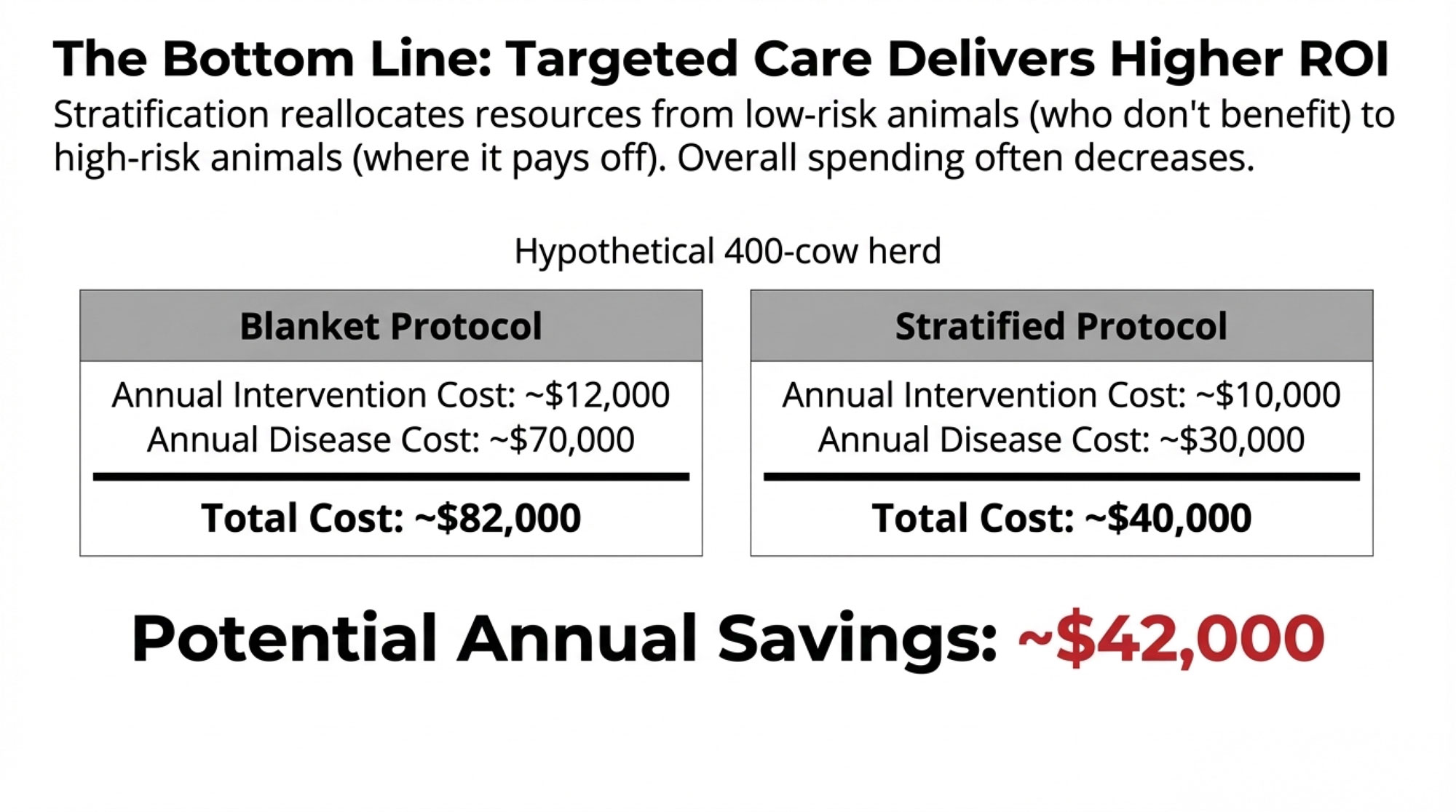
With traditional blanket treatment, you’re treating every cow the same at dry-off. Costs you about $45 to $60 per cow across your whole herd. Fresh cow disease rates typically run 27 to 35% in the first 60 days (that’s from NAHMS data), and you’re losing 600 to over 1,500 pounds of milk per affected cow.

Now with the targeted approach, you’re identifying high-risk cows at each transition point and customizing what they get. Low-risk cows might only need $15 to $25 worth of attention. High-risk animals receive $65 to $95 in targeted support.

What happens? Disease rates can drop to 18-24% in the critical first 60 days—we’re talking a 25-30% reduction, based on what extension programs are seeing in the field. And you’re recovering 500 to 1,000 pounds of milk per prevented case.

When it all shakes out, farms are seeing net benefits of about $200 to $500 per cow per lactation. But—and Chuck Guard from Cornell’s ambulatory clinic emphasizes this—that’s only if you can execute consistently. Big “if” there.

Why 80% of Farms Can’t Jump on This Yet

Here’s something we need to address head-on. Most of us are running on razor-thin margins right now. USDA’s latest economic outlook shows roughly half of dairy farms are projected to be profitable this year.

The all-milk price averaging around $20 per hundredweight sounds okay until you factor in elevated feed costs and labor shortages, pushing wages up into the double digits from recent years. Suddenly, that margin disappears real quick.

When you’re worried about making December’s feed payment, investing in new management protocols—even ones that pencil out great on paper—feels like a luxury you can’t afford.

There’s also the behavioral economists’ “prevention paradox.” Jennifer Van Os over at Wisconsin has been studying how farmers make decisions, and it’s fascinating. When you prevent ketosis, nothing visible happens. The cow doesn’t get sick. There’s no vet bill. No treatment record. It’s… psychologically unsatisfying, if that makes sense.

But when you miss one, and she crashes? That’s immediate, visible, and it sticks with you.

I heard an illustrative story at a recent producer meeting that captures this perfectly. A Wisconsin dairyman shared anonymously: “We tried targeted dry-off protocols for six months. Caught most of the high-risk cows. But we lost one valuable genomic heifer that we misclassified. That $3,000 loss is what I remember—not the dozen we saved.” Whether that’s one producer’s experience or a composite of many I’ve heard, it reflects a genuine psychological barrier that the research confirms is widespread.

Lessons from Europe’s Regulatory Push

You want to know what actually drives industry-wide change? Europe’s experience with selective dry cow therapy offers a masterclass.

The EU implemented Regulation 2019/6, which banned prophylactic antibiotic use—including blanket dry cow therapy—effective January 28, 2022. That date matters because it forced a complete industry shift.

According to European research, about two-thirds of Italian dairy farms had transitioned to selective protocols by the end of 2022. The Netherlands has become the gold standard, going from relatively low adoption to over 80% in just a few years.

The difference? Farmers changed because they had to.

But here’s what’s encouraging—Volker Krömker from Copenhagen University has been tracking outcomes, and after some initial resistance, Dutch farmers using selective protocols actually saw mastitis rates drop below what they had with blanket treatment. The whole infrastructure adapted: vet schools started requiring SDCT training, milk buyers provided protocol support, and software companies built decision trees right into their platforms.

Meanwhile, U.S. voluntary adoption is sitting at roughly one in four farms. The contrast is pretty striking.

Where Targeted Management Actually Works Today

Despite all the challenges, certain operations are making these protocols work brilliantly. What separates them?

Looking at successful implementations from Maine to California, you see patterns. Scale helps, but it’s not everything. Sure, a 3,000-cow operation in Idaho finds it easier to justify the cost of dedicated transition management software. But I’m also seeing 300-400 cow herds in places like Wayne County, Ohio, succeeding because their co-op provides shared advisory support.

Regional variations matter too. Down in New Mexico and Arizona, where heat stress just compounds everything, producers like Tom Barcellos out in Tulare County tell me precision management becomes even more critical. As he puts it, “When it’s 110°F in July, you can’t afford to guess which cows need extra support.”

In Florida, where the humidity is brutal, a group near Okeechobee adapted the protocols to conduct twice-daily body condition scoring during summer. Over in Texas, some of the larger operations near Stephenville are finding that targeted protocols help offset the stress of their long summers. Up in Vermont, where winter housing gets tight, farms are focusing more on the close-up pen management side of things.

And out in the Pacific Northwest—you know how wet it gets there—the larger dairies near Yakima Valley are finding targeted protocols help manage the stress that mud and moisture put on transition cows. One producer in Sunnyside told me they flag any cow that spent more than 2 weeks in the hospital pen during the last lactation. Those girls automatically get extra attention at dry-off, regardless of other metrics.

What do successful operations have in common? Three things keep coming up: integrated data systems (increasingly using cameras for BCS scoring), strong veterinary partnerships for ongoing tweaks, and what Nigel Cook from Wisconsin calls “implementation discipline”—basically, someone owns the process and reviews outcomes every month without fail.

Implementation Timeline: What to Really Expect

  • Weeks 1-4: Set up protocols, train your team, get baseline numbers
  • Weeks 5-12: Work out the bugs, build staff confidence
  • Months 3-4: Don’t panic—temporary plateau is normal
  • Months 5-6: Positive trends start showing up, fine-tune protocols
  • Month 7+: Full ROI kicks in, system runs itself

Making Targeted Protocols Work on Your Farm

After watching dozens of operations try this, here’s my practical advice if you’re thinking about it.

Start ridiculously simple. Pick ONE intervention for 90 days. I’d suggest dry-off BCS flagging. Now, this next part is my own practical recommendation, not part of any formal research protocol: get yourself an orange livestock marker. Every cow over 3.75 gets an orange stripe on her tailhead. That’s it. Everyone knows orange means “controlled energy dry cow ration.” Simple, cheap, and visible to every person who walks through that pen.

Set realistic expectations. Research on implementation curves suggests the average time to positive ROI is around five to six months. Some farms see a temporary production dip in month two as systems adjust. You need to budget for that.

And here’s crucial—involve your entire team from day one. Not a memo. Not a meeting where half the guys are checking their phones. A hands-on session where your feeders, fresh cow crew, and whoever does dry-off physically walk through the process together. Gustavo Schuenemann from Ohio State found that farms with hands-on training show significantly better compliance with protocols than those using written SOPs alone.

Track only what matters. Pick three things: fresh disease rate (shoot for under 20%), 60-day milk average (watch the trend, not the absolute number), and days to first service (target under 70). Review them monthly. Ignore everything else at first—you’ll drive yourself crazy otherwise.

The Hard Truth About Implementation Readiness

I need to be direct here. If you’re struggling to cover operating expenses, targeted transition management shouldn’t be your priority right now. This approach works best for farms with positive cash flow and at least six months of operating capital in reserve.

It’s one of those cruel ironies—the farms that most need efficiency gains are often least equipped to implement them. Chris Wolf, the ag economist at Cornell, calls this the “productivity trap.” The bottom 40% of farms by profitability are producing at significantly higher cost than the top 40%, but they lack the capital to make improvements that would close that gap.

Critical Limitations to Consider

Let’s be clear—targeted transition management isn’t universally applicable. Genetic differences matter. Jersey herds show different risk thresholds than Holsteins. Kent Weigel’s genomic research at Wisconsin shows cows with high genetic merit for health traits may show less dramatic response to targeted interventions—they’re already more resilient.

Facility design impacts success, too. Farms with two-row freestalls and adequate bunk space see better results than overcrowded three-rows. Peter Krawczel from Tennessee documented that overcrowded facilities—stocking densities in the 110-120% range and above—negate a significant portion of targeted protocol benefits as the stress from overcrowding overwhelms the precision interventions.

And geographic factors can’t be ignored. What works in Wisconsin’s climate needs adjustment for Louisiana’s humidity or Colorado’s altitude. You’ve got to calibrate locally.

What Would Accelerate Industry Adoption

Three things could shift targeted management from “interesting option” to “this is how we do things now.”

First, processor requirements. If the big co-ops like DFA or Land O’Lakes started requiring transition management documentation for quality premiums, adoption would happen overnight. Tillamook’s already doing this with SCC-based dry-off protocols for their suppliers.

Second, cooperative infrastructure. When your co-op provides training, software access, and shared advisory as part of membership, smaller farms can suddenly access the same tools as the big guys. Organic Valley’s vet support program is a good model for this.

Third, federal support. USDA’s got significant funds allocated for precision agriculture through 2027. If they added transition management to their cost-share eligibility, it would substantially lower barriers.

The Bottom Line for Your Dairy

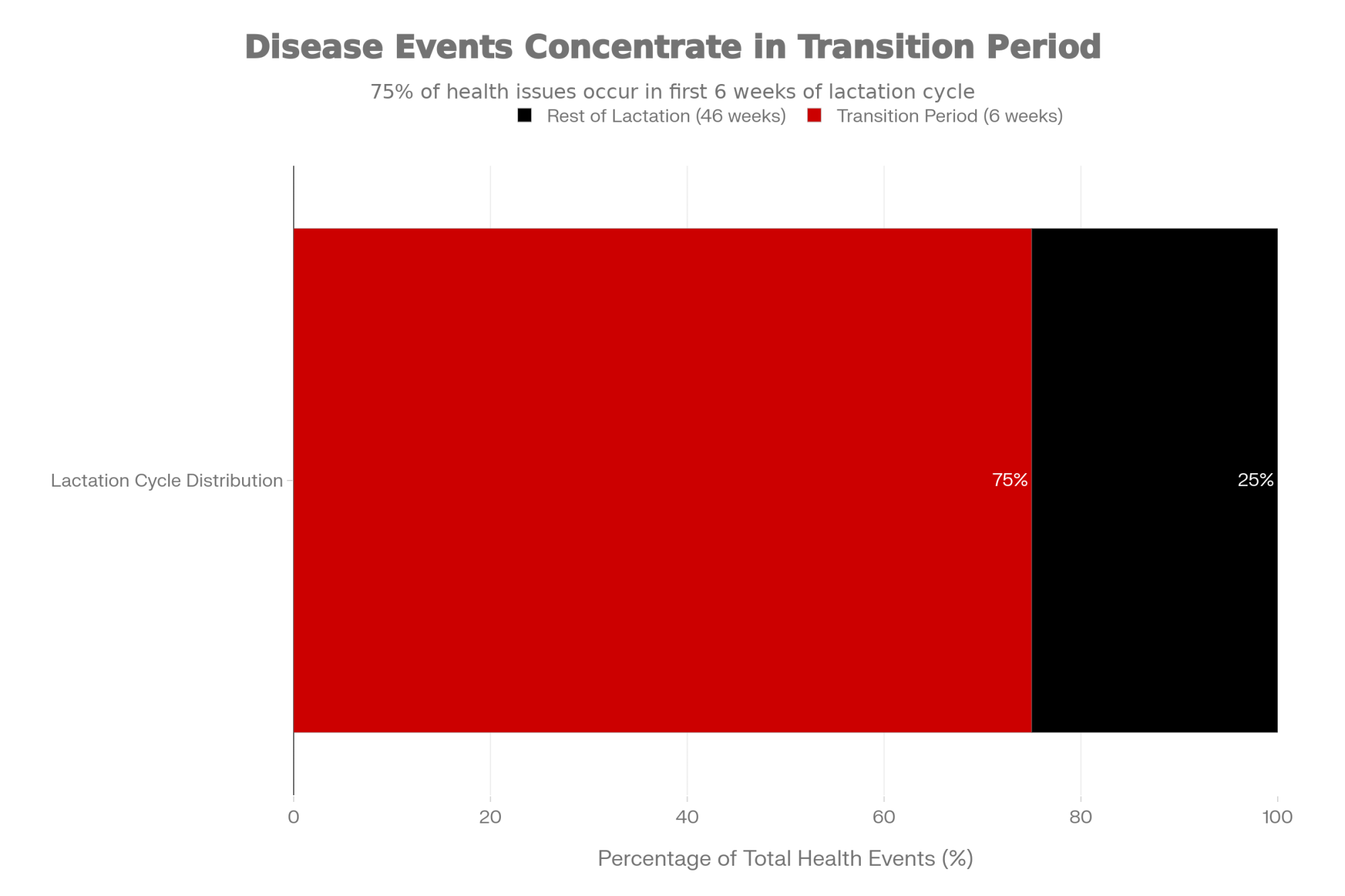
The transition period drives the majority of our health problems. We’ve known this for decades. What targeted cow management offers is a systematic way to identify and prevent these problems before they turn into expensive disasters.

But as we’ve talked about, knowing what to do and being able to do it are vastly different challenges. The science is solid. The economics work. Whether this becomes standard practice really depends on how the industry chooses to support implementation.

My advice? If you’re interested, start small. One protocol. One risk factor. Track your results religiously. And definitely get your vet and nutritionist involved from day one—this isn’t something you figure out alone.

The cows that need help are already in your barn. You walk past them every day. The question is whether you can build a system to identify and support them before each one costs you $500 to $1,000.

Some operations can absolutely do this today. Others need infrastructure development first. Understanding which category you’re in—honestly, without wishful thinking—that might be the most valuable assessment you make this year.

And here’s the thing that keeps me up at night: if you won’t pick one simple flag and execute it for 90 days, your neighbor probably will. In a year from now, one of you will have lower fresh-cow disease, better butterfat levels, and a stronger balance sheet.

Which one do you want to be? 

Key Takeaways:

  • The savings are proven: Farms executing targeted transition protocols cut fresh cow disease rates by 25-30%, saving $200-$500 per cow per lactation—and the gap between early adopters and everyone else is widening
  • Inaction costs more than you think: Ketosis runs $300-$350 per case, metritis $300-$500, and over a third of fresh cows develop multiple problems in their first month
  • Most dairies aren’t ready yet: Roughly 80% of U.S. operations lack integrated herd software or the cash reserves to implement precision protocols consistently—but that’s changing
  • The science scales: European farms mandated to adopt selective dry cow therapy in 2022 now report lower mastitis rates than they had with blanket treatment
  • Start with one thing: Flag cows with BCS ≥3.75 at dry-off, track outcomes for 90 days, and involve your vet—simple execution beats sophisticated plans that never happen

Executive Summary: 

Transition cow crashes are quietly draining dairy profits—ketosis and metritis each cost $300-$500 per case, and over a third of fresh cows develop multiple problems in their first month. Research from Penn State, Cornell, and Wisconsin shows that targeted protocols identifying high-risk cows at dry-off can cut disease rates by 25-30%, saving $200-$500 per cow per lactation. The challenge? Roughly 80% of U.S. dairies lack the integrated data systems or financial reserves to execute these approaches consistently. European farms mandated to adopt selective protocols in 2022 now report lower mastitis rates than they had with blanket treatment—proof that the science works at scale. Successful U.S. operations share three factors: integrated herd software, strong veterinary partnerships, and someone who owns protocol review every month. The realistic starting point is straightforward: flag body condition scores at dry-off and track outcomes for 90 days. By next winter, the gap between farms preventing fresh cow crashes and those still reacting to them will show up clearly on the balance sheet.

Complete references and supporting documentation are available upon request by contacting the editorial team at editor@thebullvine.com.

Learn More:

Join the Revolution!

Join over 30,000 successful dairy professionals who rely on Bullvine Weekly for their competitive edge. Delivered directly to your inbox each week, our exclusive industry insights help you make smarter decisions while saving precious hours every week. Never miss critical updates on milk production trends, breakthrough technologies, and profit-boosting strategies that top producers are already implementing. Subscribe now to transform your dairy operation’s efficiency and profitability—your future success is just one click away.
NewsSubscribe
First
Last
Consent

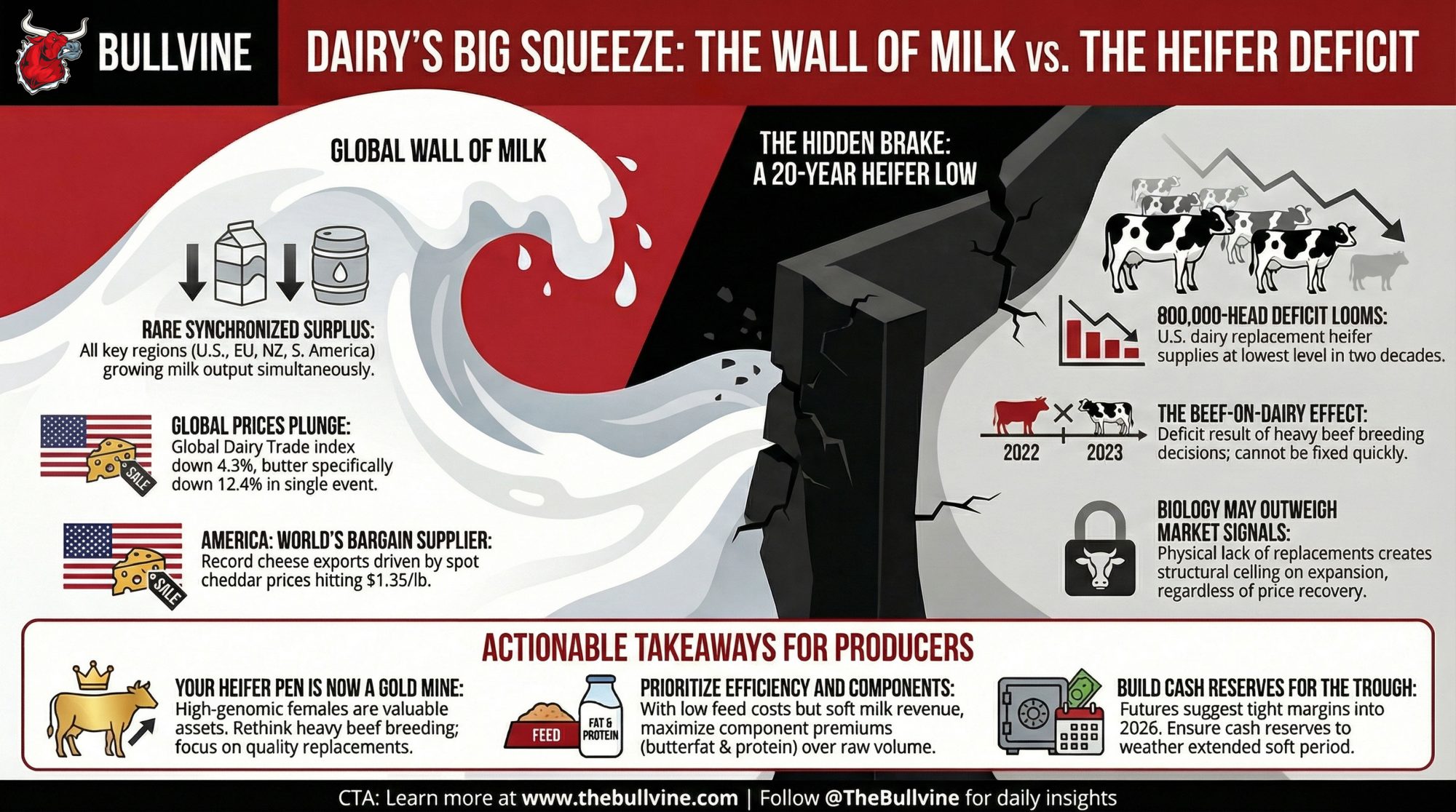
The Wall of Milk: Making Sense of 2025’s Global Dairy Crunch

This downturn feels different because it is. Four major exporters expanded at once, and $15 milk is testing every assumption. Here’s what the resilient dairies know.

EXECUTIVE SUMMARY: When producers say this downturn feels different, they’re right. For the first time, the U.S., EU, New Zealand, and Argentina all expanded production within the same window—creating a “wall of milk” that pushed July 2025 output to 19.0 billion pounds while Class III dropped from the $20s to around $15. Here’s what makes it unusual: exports are at record levels, confirming this is a supply squeeze, not a demand collapse. Dairy’s 24-month biological timeline means decisions that made complete sense at $22 milk are now delivering into a $15 market, with no quick reversal possible. Beef-on-dairy has added real value but also reduced the number of replacement heifers to 3.9 million head—the lowest since 1978—limiting culling flexibility when some operations need it most. The dairies navigating this effectively share common strategies: precision culling using income-over-feed-cost data, margin protection through DMC and Dairy Revenue Protection, and breeding for feed efficiency using traits like Feed Saved. This cycle will accelerate consolidation, but producers who know their numbers and deploy available tools will emerge stronger when markets rebalance.

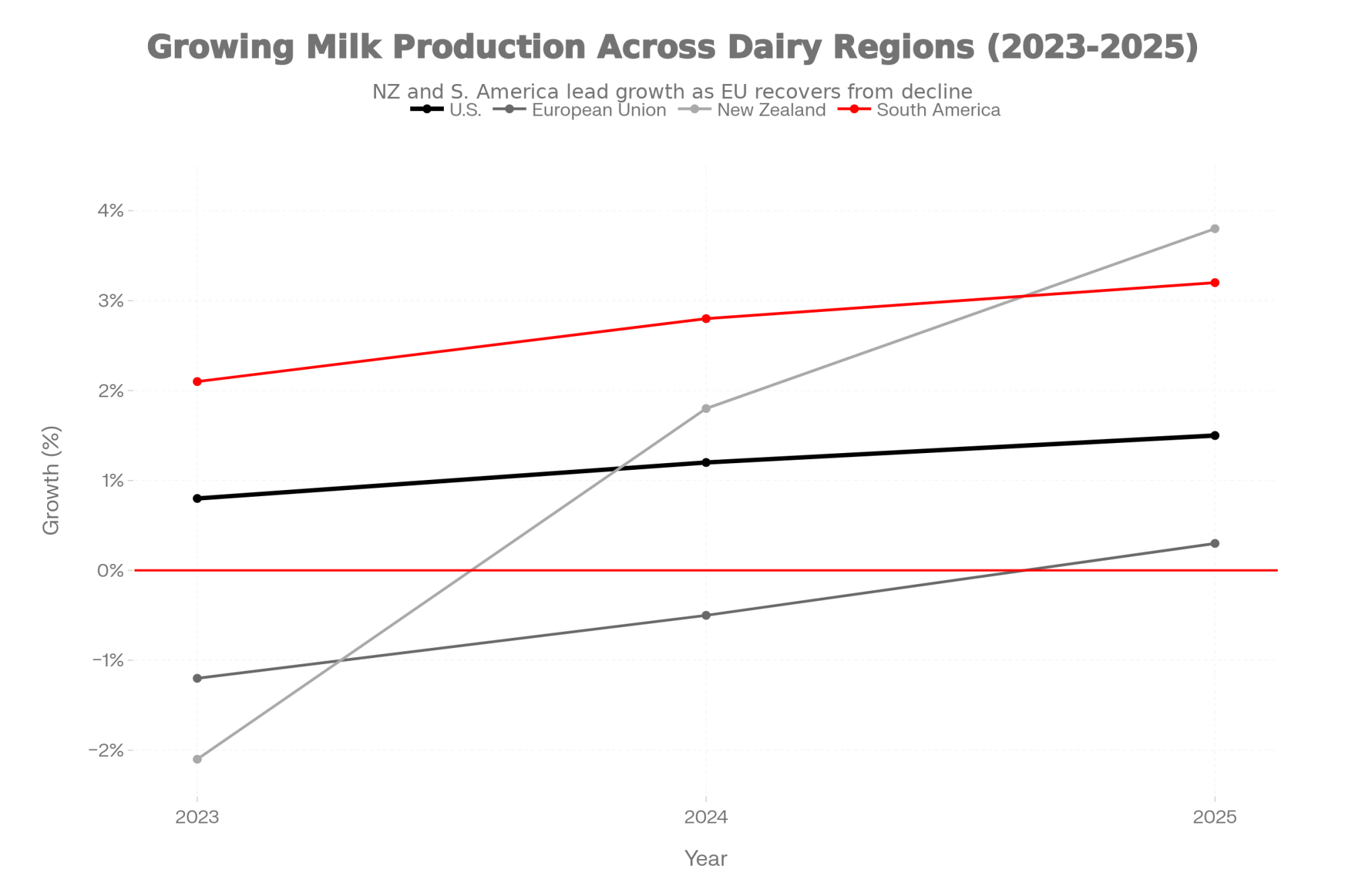
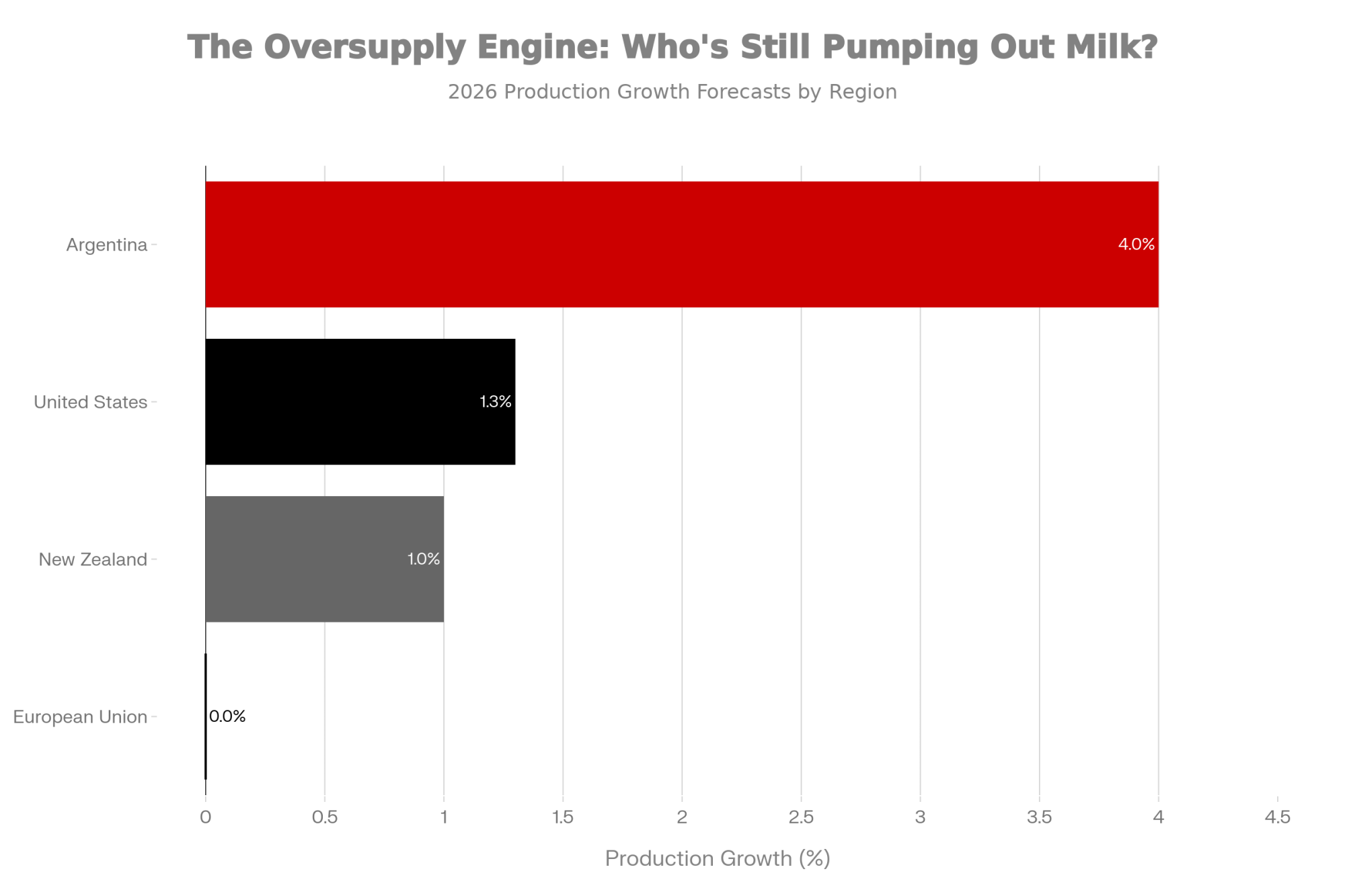
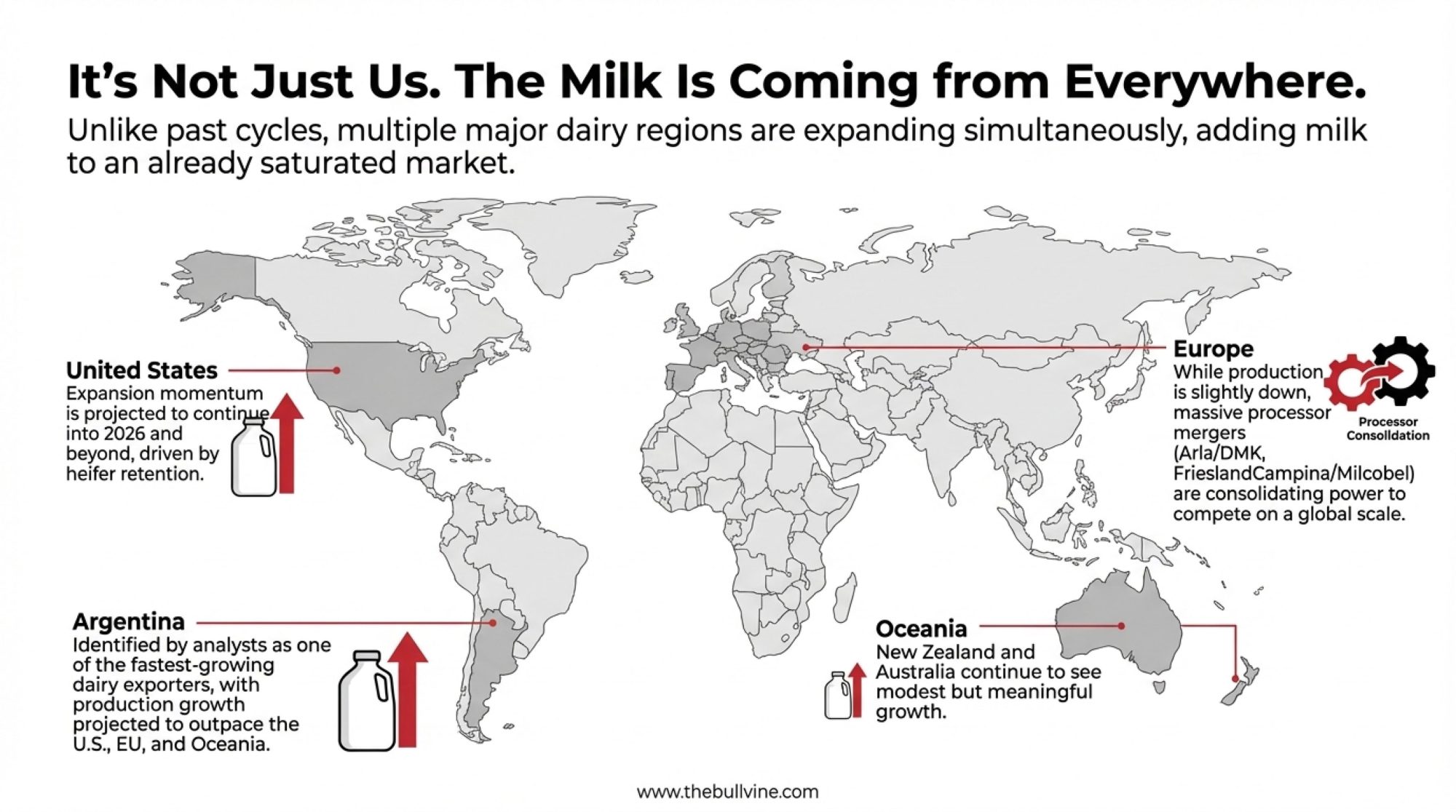
As milk checks tightened through 2025, I kept hearing the same thing from producers across the country: “We’ve seen low prices before, but this one feels different.” And as many of you have probably sensed on your own operations, they’re right. This isn’t just one region working through a rough patch. The U.S., the European Union, New Zealand, and key South American exporters all pushed production higher within a fairly tight window. A lot of that milk is now competing for the same buyers at the same time.

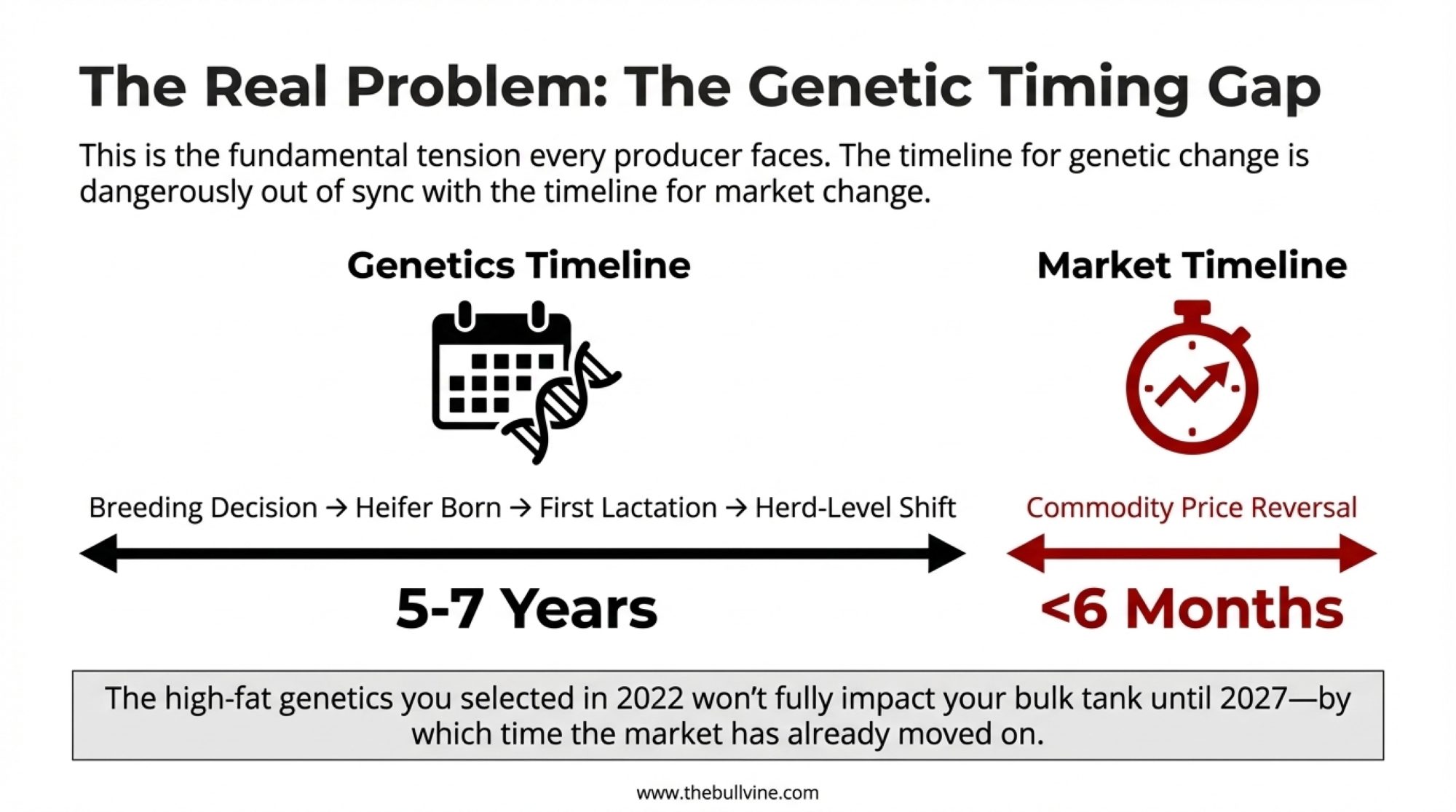
The 24‑month lag exposed: production peaks just as prices crash, proving this downturn is about too much milk, not weak demand

What makes this cycle particularly challenging is that feed, labor, interest, and environmental compliance costs haven’t returned to the levels we saw a decade ago. That’s especially true in higher-cost regions like California and parts of Western Europe. So you’ve got more milk hitting the market, softer world prices, and cost structures that remain stubbornly elevated. That combination is creating what many are calling the “wall of milk.”

In this piece, we’ll walk through what farmers and analysts are learning about this cycle: how the 24-month expansion lag plays out in practice, how beef-on-dairy has delivered real benefits while also creating some unexpected ripple effects, why lenders and processors kept supporting growth even as signals shifted, how different regions are experiencing this downturn in very different ways, and what the operations navigating this well seem to have in common. The goal is to offer a clearer view of the bigger picture so the decisions you’re making—about cows, facilities, or risk management—are grounded in how this system actually works.

Why This Cycle Really Does Feel Different

Let’s start with the production numbers and work back toward the parlor.

USDA’s Milk Production reports paint a stark picture:

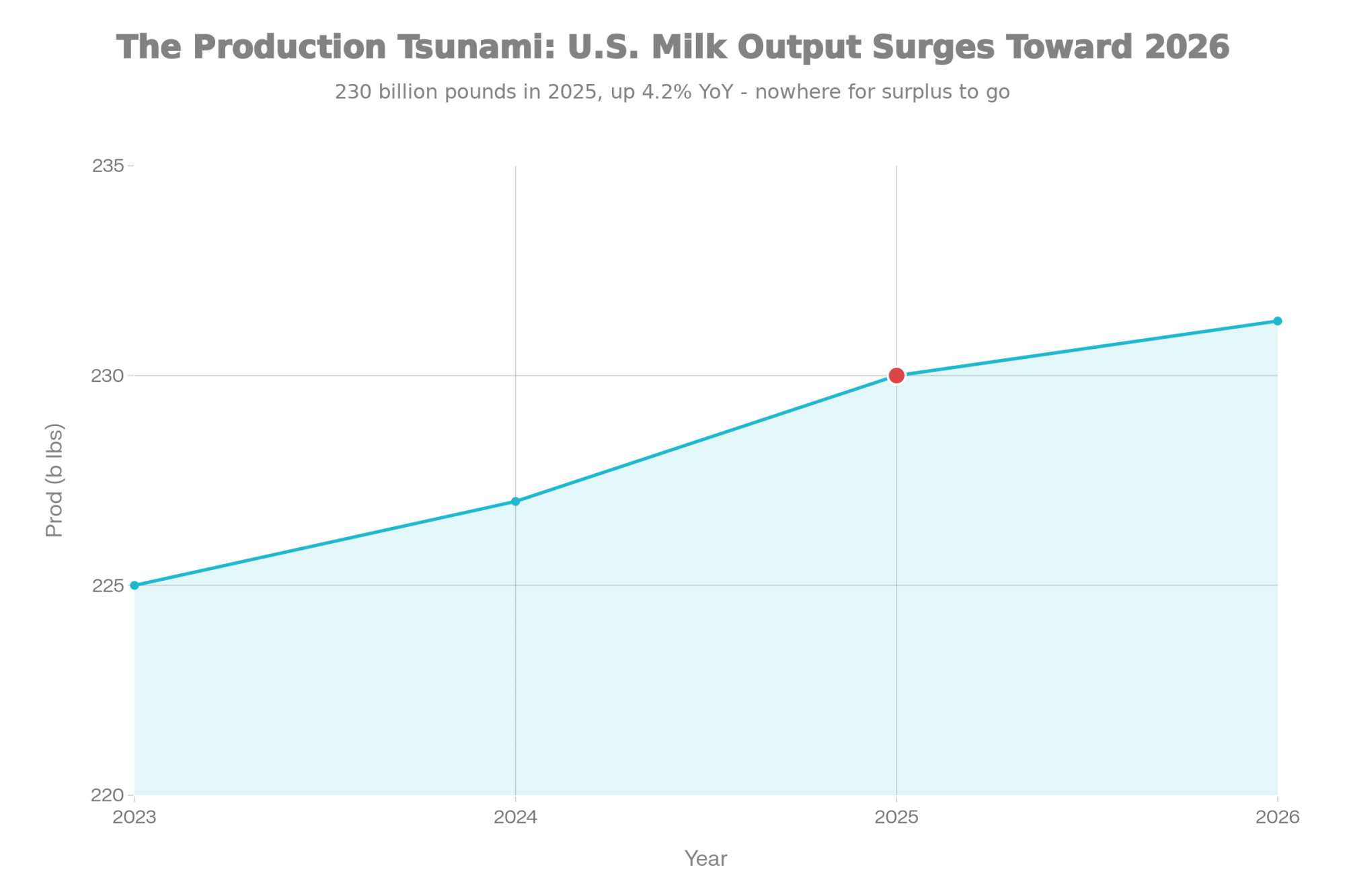
  • July 2025 Output (24 major states): 18.8 billion pounds initially, revised to 19.0 billion
  • Year-Over-Year Growth: +4.2%—the strongest since 2021
  • Total National Production: 19.6 billion pounds
  • Cow Numbers: Approaching the highest levels seen in decades

On the infrastructure side, the industry has been busy. More than 50 new or expanded dairy plants—particularly cheese and powder facilities in the Upper Midwest, Texas, and the High Plains—have come online, representing roughly $8 billion in capital investment over the past several years.

Leonard Polzin, the Dairy Economist and Farm Management Outreach Specialist at UW-Madison Division of Extension, framed it well at the 2025 Wisconsin Agricultural Outlook Forum. He noted that the industry is seeing “a substantial increase in processing capacity,” with an estimated $8 billion in gross investment creating new demand for milk. The challenge, as he pointed out, is that policy uncertainties—including potential tariffs and questions about labor availability—could affect prices before that demand fully materializes.

The picture looks similar in other major producing regions:

  • European Union: EU Milk Market Observatory data show deliveries climbing modestly in 2024, with product stocks building in early 2025 as cheese, butter, and powder production outpaced demand growth
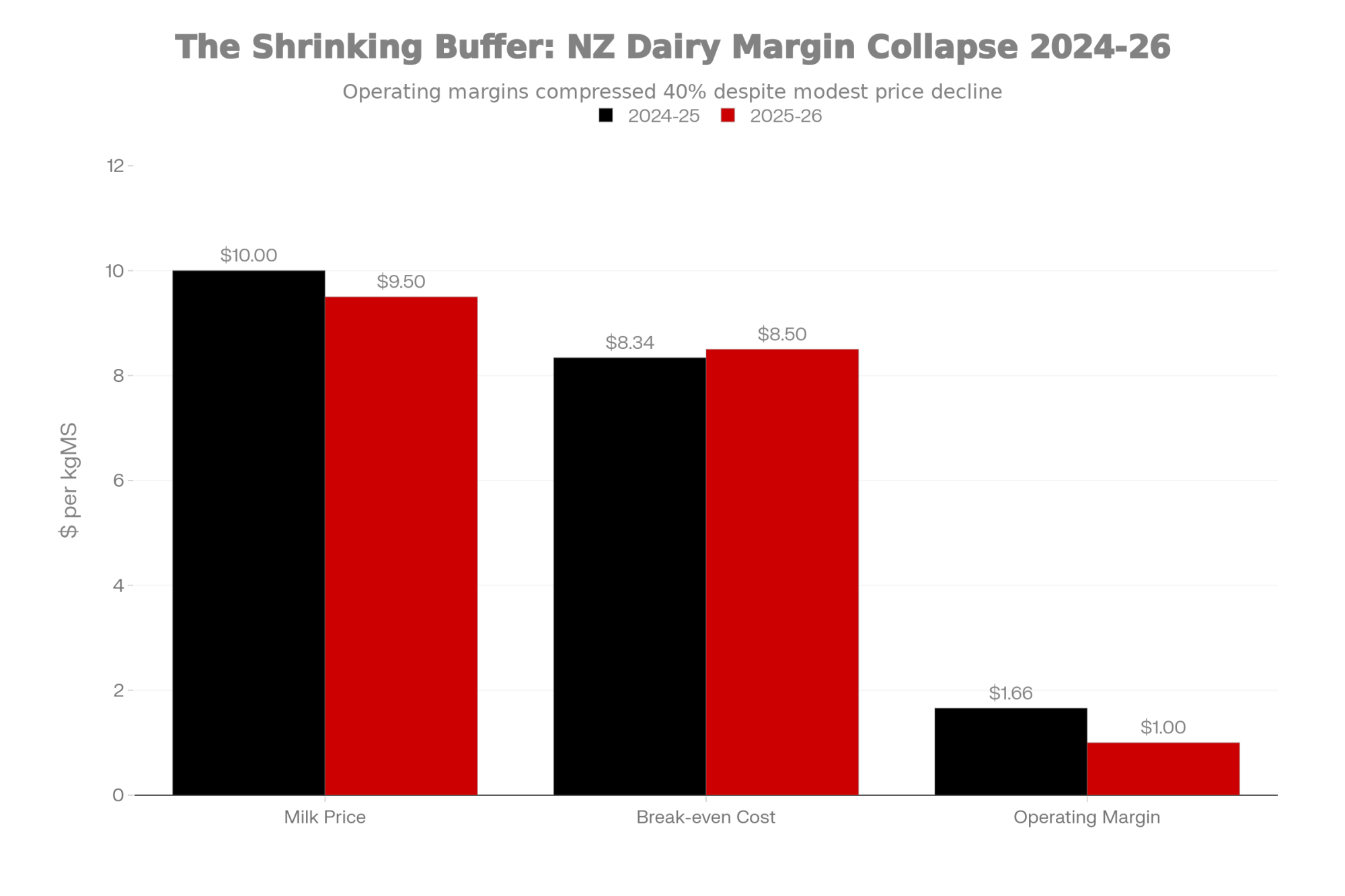
  • New Zealand: Fonterra’s 2025/26 season forecast shows milk solids volumes running several percent ahead of the prior year, with farmgate payouts around NZ$10 per kg of milksolids
  • Argentina: Ministry data and Tridge reports show national milk output in early 2025 running 10.9% above the same period in 2024, with March posting gains of 15.9% year-over-year

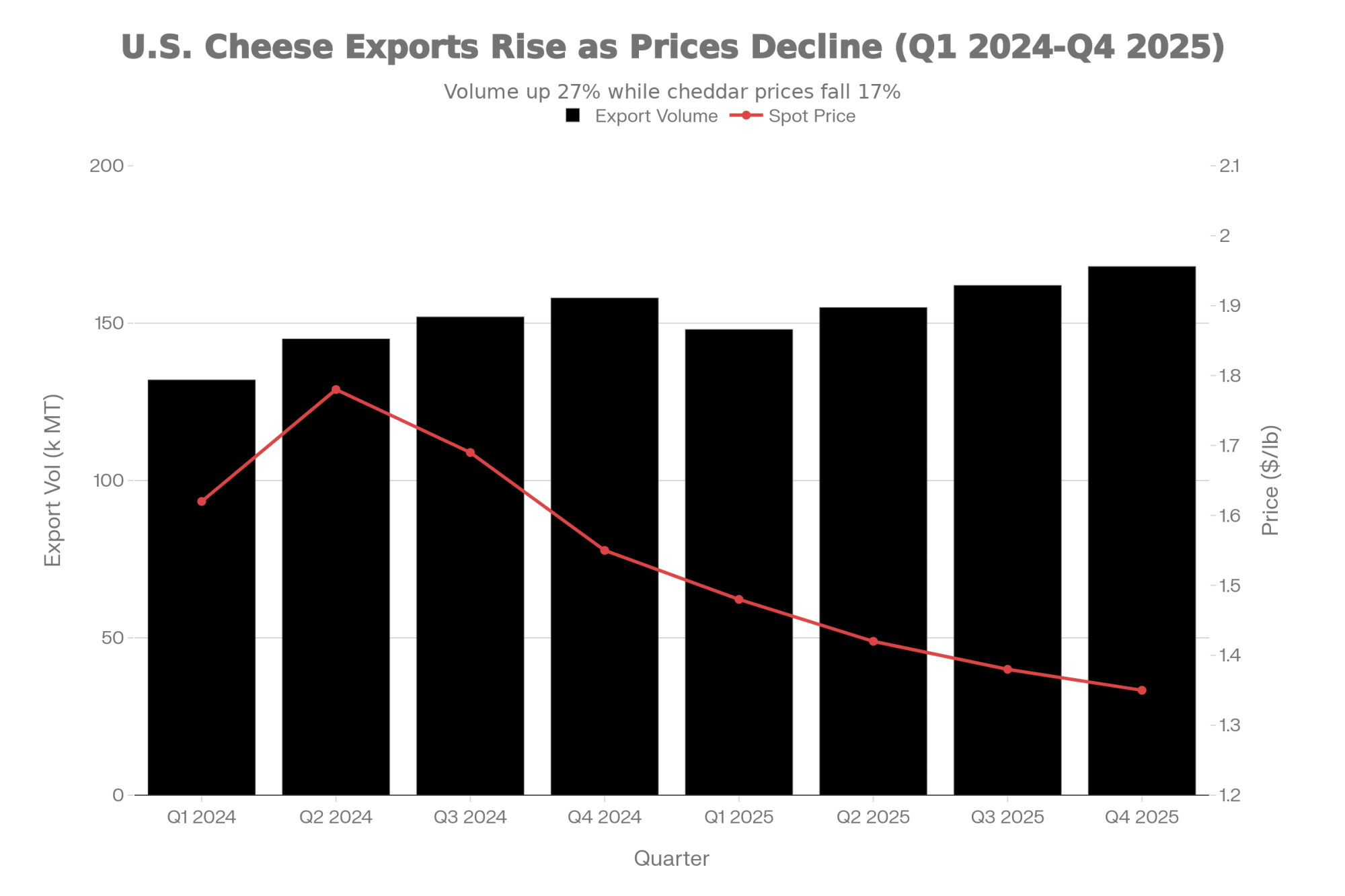
Here’s where it gets interesting on the demand side. Exports have actually performed well:

  • July 2025 U.S. Exports: 1.6 billion pounds (milk-fat basis)
  • Year-Over-Year Export Growth: +53%—a record for any single month
  • Yet Class III/IV Futures: Trading in the mid-teens through much of 2025, below full-cost breakeven for many conventional operations
July 2025 was the strongest export month in U.S. history, with shipments up 53% year‑over‑year—yet total production still outran demand by another 4.2%. That’s not a demand collapse; it’s too much milk from too many exporters at once.

The takeaway? World demand hasn’t collapsed. Exports are actually quite strong. But supply from multiple major exporting regions has grown faster than demand can absorb in the near term. That’s what makes this feel different from the regional downturns many of us have worked through before.

The 24-Month Expansion Timeline: When Biology Meets Economics

One of the lessons this cycle keeps reinforcing is how much dairy expansion is a commitment you can’t easily unwind. The biology and capital requirements simply don’t move on futures-market time.

Think back to 2023 and early 2024. Milk prices were strong, butterfat levels were excellent across many herds, and balance sheets looked healthier than they had in years. In that environment, deciding to add a pen, upgrade the parlor, or build out the dry cow facilities made a lot of sense. The numbers supported it.

Land-grant extension economists who model these decisions describe a fairly predictable timeline. In those first few months, you’re signing contracts, ordering equipment, and closing on financing. As one University of Wisconsin farm management publication notes, by the time the ink is dry, most of the financial risk is already committed—even though no extra milk has shipped yet.

Through months four to twelve, the facility goes up while you’re either buying bred heifers or ramping up your own replacement program with sexed semen. Cash is flowing out, but the additional milk revenue hasn’t started. Then in months thirteen through twenty-four, those heifers freshen, pens fill, and milk per stall climbs. The challenge is that the broader market—running on that same 18-24 month biological timeline—may have shifted considerably since you started.

Peter Vitaliano, who served as Vice President of Economic Policy and Market Research at the National Milk Producers Federation before retiring at the end of 2024, was already flagging concerns back in February 2024. He noted that “due to a number of factors, we’ll probably see a larger drop than usual” in dairy farm numbers, partly because USDA counts were likely collected before additional farms closed at the end of 2023 due to margin pressure. He added that any margin improvement wouldn’t “constitute anywhere near a full recovery from the financial stress that dairy farms, pretty much of all sizes, are experiencing.”

The 24-Month Trap in Action

I’ve been hearing about situations like this from lenders and consultants: a 900-cow Wisconsin operation signed expansion contracts in early 2024 for 300 additional stalls, with heifers due to freshen by mid-2025. By the time that barn was full, Class III had dropped from the low $20s to around $15.

The extra milk revenue is real, but so is the debt service. Over six months, the gap between projected and actual margins consumed roughly $180,000 in working capital that had been earmarked for feed prepays and equipment upgrades.

The family isn’t in crisis, but there’s no cushion left. They’re working with their lender on revised cash-flow projections and tightening culling criteria to protect equity.

Decisions that made complete sense at $22 milk are now playing out in a $15 world.

Beef-on-Dairy: Real Benefits with Some Unexpected Effects

Beef-on-dairy has been one of the more significant developments in recent years, and it’s delivered genuine value to many operations. At the same time, as it’s scaled across the industry, it’s also changed some dynamics that historically helped balance supply. What I’ve noticed talking with producers is that most understand the benefits clearly—but the systemic effects are only now becoming apparent.

Where the Value Has Been Clear

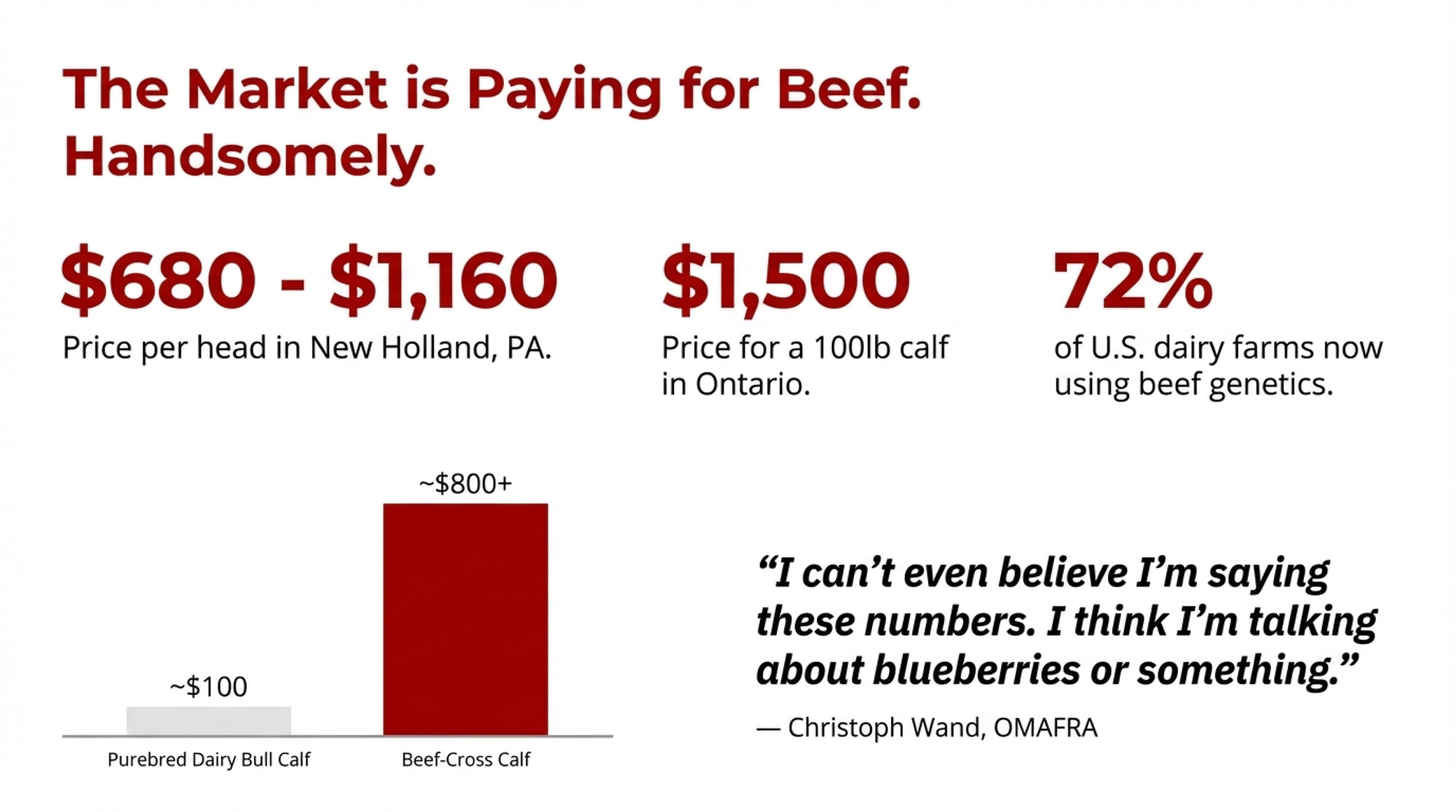
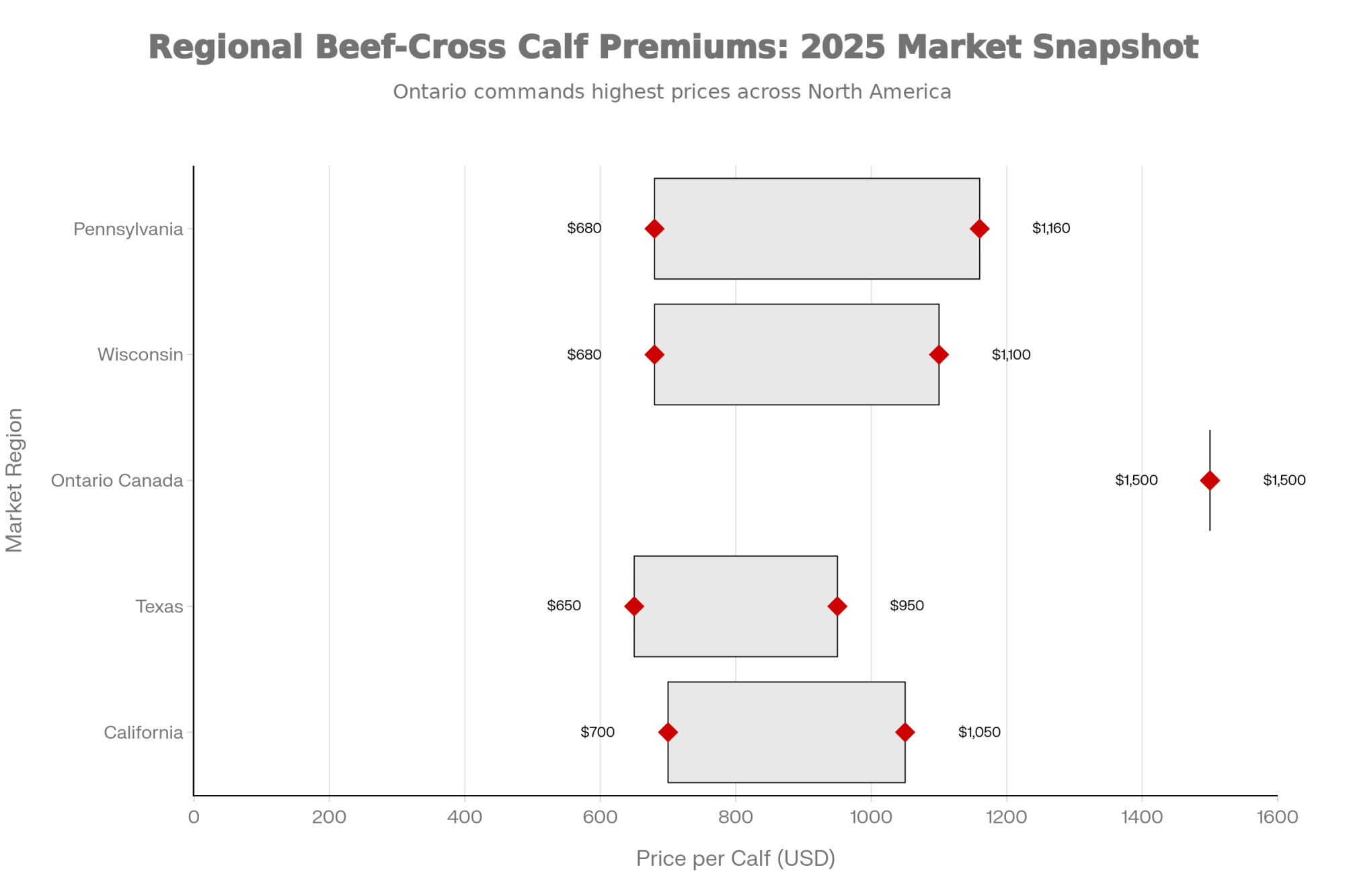
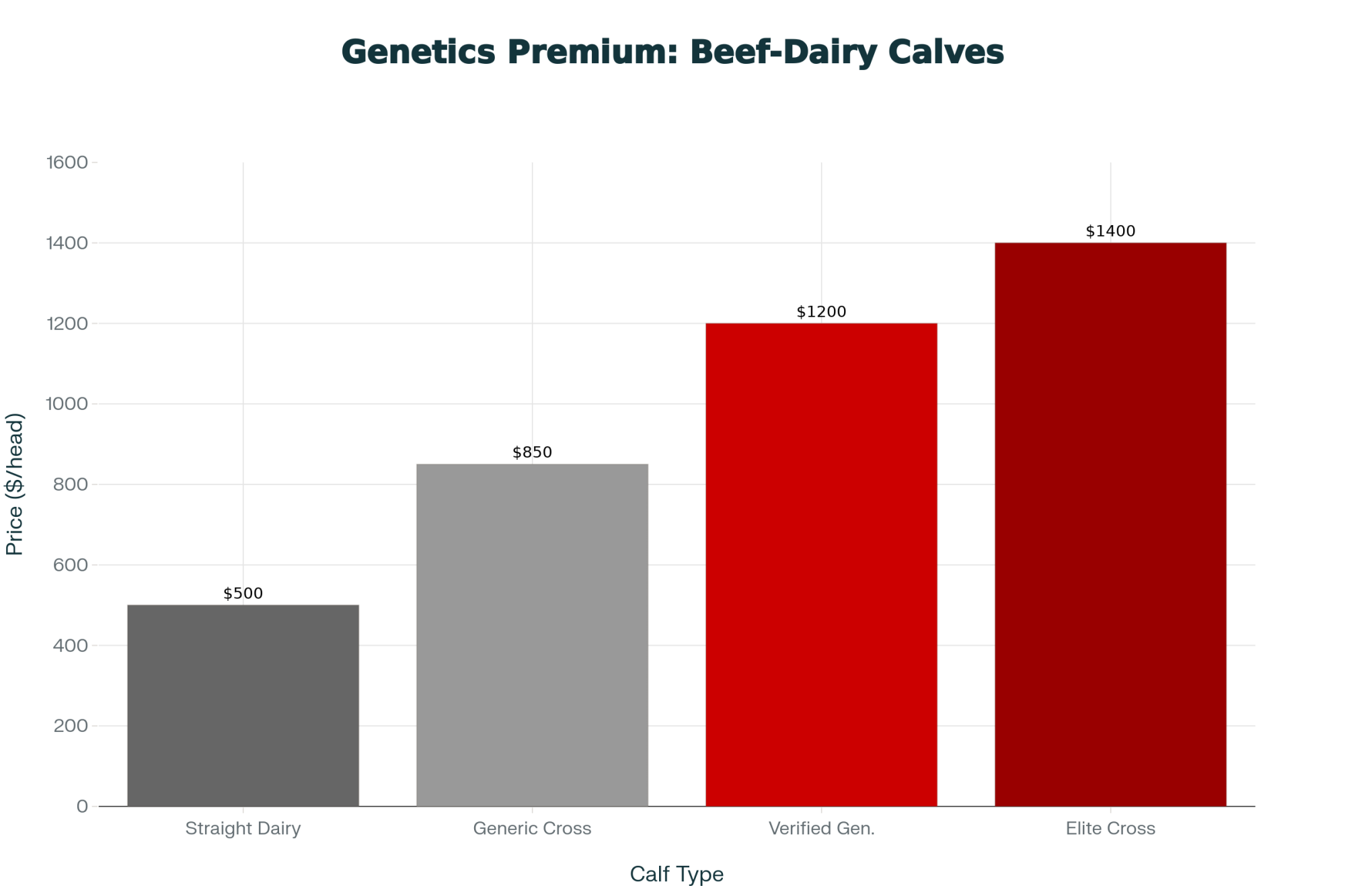
The research and market data are consistent on this: well-managed beef-on-dairy programs substantially increase calf value compared to straight dairy bull calves. Day-old beef-cross calves often fetch several hundred dollars more, and in program relationships where carcass performance is documented, they can approach native beef calf values.

With milk prices softening in the first half of 2025, beef has become a driver of dairy farm profitability through both cull cows and dairy-beef calves. For many operations, this revenue stream has made a meaningful difference in a tight-margin year.

Some Effects Worth Understanding

What’s become clearer over the past year is how beef-on-dairy interacts with culling decisions and replacement availability when prices fall.

Consider the culling dynamic. A few years ago, that seven- or eight-year-old cow with middling production and some foot issues—bred to a dairy bull and carrying a $50-100 calf—was an easier decision when milk prices dropped. Today, if she’s carrying a beef pregnancy that could bring four figures at calving, the economics pull toward keeping her “one more lactation.” Across a larger herd, those decisions on the bottom 15-20 percent of cows can add meaningful volume that wouldn’t have been in the tank in previous downturns.

Culling DecisionDaily Milk RevenueDaily Direct CostsDaily Net MarginStrategic Action
Keep Low Performer$9.00$8.00$1.00Deferred culling
Replace with High Performer$13.00$9.00$4.00Aggressive culling
Daily Margin Difference+$4.00+$1.00+$3.00Per stall advantage
Impact Over 6 Months$540Single cow (180 days)
Scale: 30 Cows in 600-Cow Herd$16,20030 decisions

On the replacement side, the numbers tell a striking story:

  • January 2025 USDA Cattle Report: Dairy replacement heifers over 500 pounds dropped to just 3.914 million head—the lowest since 1978
  • Heifer-to-Cow Ratio: 41.9%, the smallest since 1991 (per CoBank lead dairy economist Corey Geiger)
  • Primary Driver: More matings going to beef semen, fewer dairy heifer calves being raised

That pruning made sense when heifer-raising costs were high, and beef calves commanded strong premiums. But it also means some operations that would like to cull more aggressively now don’t have the springers available to maintain stall utilization.

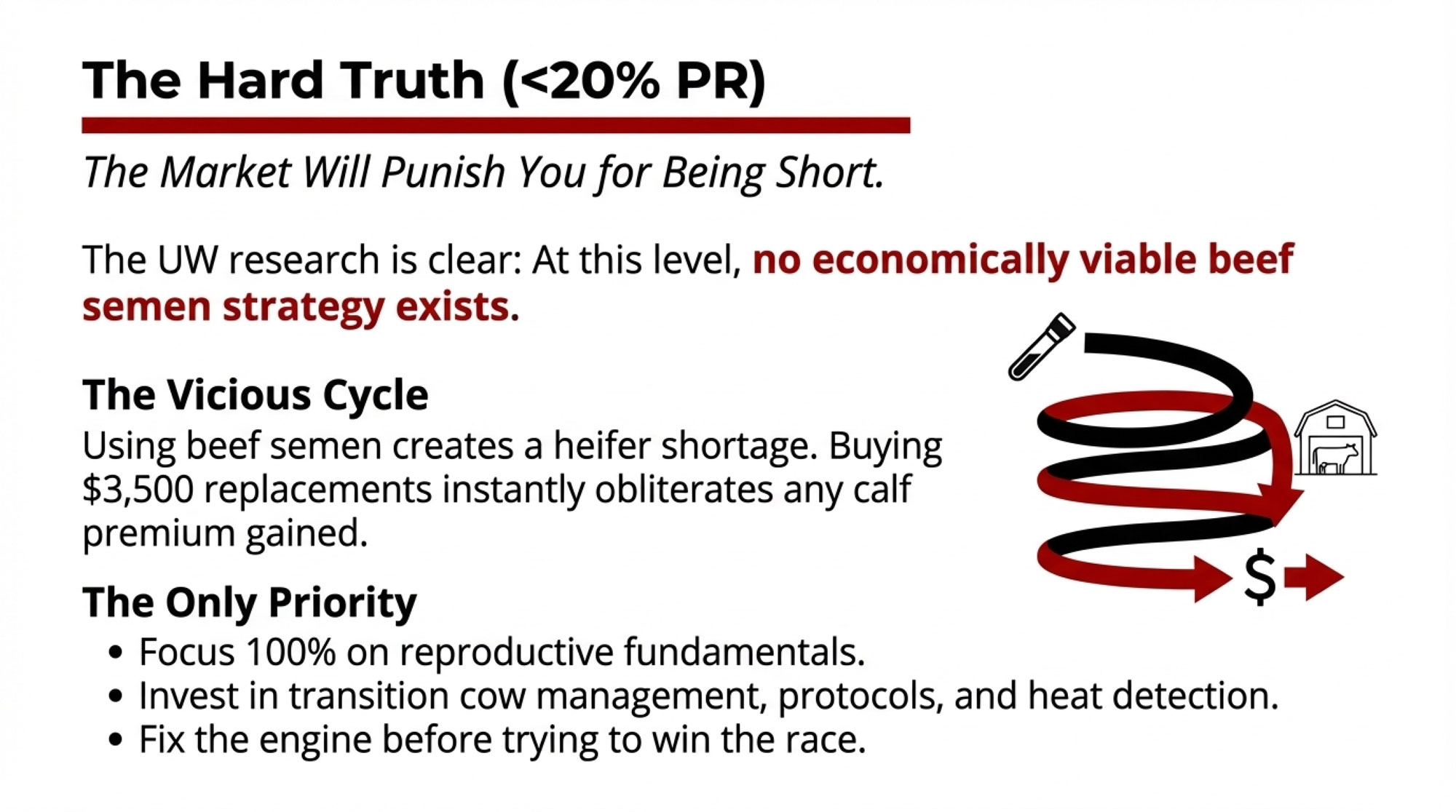
From windfall to choke point:” day‑old beef‑cross calves jumped from roughly $650 to $1,400, replacement heifers surged past $3,000, and heifer inventories fell nearly 20%. The same strategy that rescued margins is now what’s limiting culling options in a $15 milk world.

And there’s a productivity element worth noting. Because the heifers that are raised tend to come from the top of the genetic pool—identified through genomic testing—they often bring stronger milk and component performance than the animals they replace. Leonard Polzin noted at the 2025 Wisconsin Ag Forum that “despite a 0.35 percent year-to-date decline in total milk production, calculated milk solids production increased by 1.35 percent.” The industry is meeting demand “more quickly than in the past,” even with somewhat fewer total gallons.

None of this suggests beef-on-dairy is problematic. It’s been valuable for many operations. The consideration is managing it as part of an overall herd and business strategy rather than simply as a breeding decision.

Understanding Why Growth Continued

A reasonable question producers ask is why banks, co-ops, and processors kept supporting expansion even as supply signals shifted. You know, it’s easy to look back and wonder what everyone was thinking. But looking at the incentive structures helps explain the pattern—and honestly, it makes more sense than it might first appear.

The Lender Perspective

Ag lenders work within risk models and regulatory frameworks that emphasize historical cash flow, current balance sheet strength, and collateral values. In 2022-2023, many dairy clients showed multiple years of positive returns and improved equity. Land values in dairy regions were firm. Cull cow and breeding stock values had recovered.

Farm finance research consistently shows that lenders lean heavily on these historical and collateral metrics rather than attempting to time commodity cycles. Add competitive pressure—banks and farm credit systems competing for the same well-run operations—and you can see how turning down an expansion with strong historical numbers often meant losing that relationship to a lender willing to proceed.

From the credit committee’s perspective at the time, financing expansion with their strongest clients appeared reasonable and well-supported by the available data. The depth of the 2025 correction wasn’t yet visible in those metrics.

The Processor View

For processors, the math centers on fixed costs and throughput. Depreciation, labor, and energy don’t decline proportionally when a plant runs below capacity. With billions invested in new cheese, powder, and specialty facilities over the past decade, plant managers face pressure to run at high utilization, spread fixed costs effectively, and maintain market share.

That creates incentives to encourage volume growth from existing shippers, sign new suppliers, and move cautiously on base-excess programs that might push producers toward competitors. Some buyers have implemented tiered pricing systems that discount over-base milk, but these tools are often adopted late in the cycle and rarely coordinate across an entire region.

The result is a system in which internal metrics rewarded growth and utilization, even as external data pointed to a building supply. That’s not a criticism—it’s recognizing how institutional incentives shape behavior.

Regional Variations: Same Prices, Different Realities

One aspect that gets lost in national averages is how differently the same price environment affects operations across locations. As many of us have seen firsthand, cost structure, regulatory environment, and market access all matter enormously.

California: Navigating Significant Headwinds

California operations face several overlapping pressures this cycle.

Water constraints continue tightening. Implementation of the Sustainable Groundwater Management Act and new dairy waste discharge requirements from the State Water Resources Control Board are limiting groundwater pumping and establishing stricter nitrate standards in parts of the Central Valley. Environmental compliance costs—for covered lagoons, digesters, and monitoring systems—continue adding capital and operating expenses. And labor costs, housing prices, and land values remain substantially higher than in most other dairy regions.

When Class IV prices are in the low teens and world butter and powder prices are soft, those structural costs make breakeven difficult, particularly for operations that recently invested in facility upgrades. Understandably, some families are evaluating whether another 20-year investment cycle makes sense in that regulatory and cost environment.

Upper Midwest: Cost Structure Advantages

Wisconsin and neighboring states present a different picture.

A November 2024 University of Wisconsin-Madison study found that dairy contributes about $52.8 billion annually to Wisconsin’s economy, with substantial value coming through processing rather than just farm-level milk sales. The region’s processing network has grown considerably, with cheese plant expansions and new facilities drawing milk from an expanding geography. Feed costs benefit from local production, and land and labor costs, while rising, remain below coastal levels.

Low Class III prices continue to pressure margins, and smaller operations face ongoing consolidation. But many Upper Midwest producers describe having a cost structure that provides a path through this downturn with good management, even if it’s not comfortable.

New Zealand: Low Costs, High Exposure

New Zealand’s pasture-based system delivers meaningful cost advantages—solids produced with less purchased feed and lower energy use in favorable seasons. The 2025/26 forecast payout around NZ$10 per kgMS suggests many operations are maintaining positive margins, though narrower than recent years.

The trade-off is exposure. New Zealand sells the vast majority of its production into export markets. Shifts in Chinese demand, Southeast Asian buying patterns, or currency movements translate quickly into payout adjustments. Low production costs provide resilience, but global market volatility is a constant factor.

Europe and South America: Policy and Economic Dynamics

EU production has edged modestly higher overall, but policy pressure to limit cow numbers in high-density areas for environmental reasons is influencing regional patterns. The bloc appears to be shifting toward cheese and higher-value products while moderating output of commodity powders and butter.

Argentina’s production surge—that 10.9 percent first-quarter increase—reflects improved weather and on-farm economics. But Argentine producers also navigate inflation, policy uncertainty, and volatile input costs that can shift margins dramatically in short periods.

The point is that $15 milk creates very different situations in Tulare, Green County, Canterbury, and Santa Fe. Regional context matters enormously.

The Breeding Solution: Selecting for Feed Efficiency in a Low-Margin World

Here’s something that deserves more attention in these conversations: your genetic decisions today are one of the most powerful tools you have for navigating tight margins over the next decade. And there are now specific, measurable traits designed exactly for this environment.

Feed Saved: A Trait Built for This Moment

The Council on Dairy Cattle Breeding (CDCB) launched Feed Saved (FSAV) back in December 2020, and it’s become increasingly relevant as margins compress. The trait combines two components:

  • Body Weight Composite (BWC): Selecting for moderate-sized cows that require less feed for maintenance
  • Residual Feed Intake (RFI): Identifying cows that are metabolically more efficient—eating less than expected based on their production and body weight

According to Holstein USA’s April 2025 TPI formula update, every pound of feed saved returns approximately $0.13 per cow per lactation. That might sound modest, but across a 500-cow herd over multiple generations, the cumulative impact is substantial.

What’s particularly interesting is the research backing this. A November 2024 study published in Frontiers in Geneticsexamining genomic evaluation of RFI in U.S. Holsteins found that the difference between the most and least efficient first-lactation cows averaged 4.6 kg of dry matter intake per day—while producing similar amounts of milk. Over a 305-day lactation, that’s a significant difference in feed costs. The same study found even larger spreads in second-lactation animals.

How the Industry Is Weighting Efficiency

The April 2025 Net Merit update from CDCB reflects this shift. As Holstein Association USA’s TPI formula now shows:

  • Production (including Feed Efficiency): 46% of total index weight
  • Feed Efficiency $ Index: Combines production efficiency, lower maintenance costs from moderate body weight, and better feed conversion (RFI)

What’s encouraging is that research shows meaningful genetic variation in feed efficiency—the November 2024 Frontiers in Genetics study found RFI heritability in lactating U.S. Holsteins at approximately 0.43 (43%), indicating substantial potential for genetic progress through selection. That’s higher than many health and fertility traits, which means you can actually move the needle on this.

Efficiency MetricDaily Feed (lbs DM)Annual Feed Cost @ $0.12/lbMilk Production (lbs/day)Breeding Strategy Impact
Standard Efficiency Cow55$2,40985Baseline
High Efficiency Cow (Feed Saved)50$2,19085RFI + Feed Saved traits
Annual Advantage per Cow-5 lbs/day$219 savedSame outputImmediate selection
500-Cow Herd Annual Impact$109,500Same outputHerd-wide savings
10-Year Genetic Improvement$1,095,000Same outputCompound benefits

Practical Application

For producers looking to incorporate feed efficiency into their breeding programs:

  • Look for bulls with positive Feed Saved (FSAV) values in their genomic evaluations
  • Consider Body Weight Composite alongside production traits—extreme frame size increases maintenance costs
  • Balance feed efficiency with health and fertility traits; the most efficient cow isn’t profitable if she doesn’t breed back or stay healthy
  • Work with your AI representative or genetics consultant to model how different selection emphases might affect your herd’s economics over 5-10 years

This isn’t about abandoning production goals. It’s about recognizing that in a low-margin environment, the cow that produces 85 pounds while eating 10% less feed may be more profitable than the cow producing 90 pounds at average efficiency.

What the More Resilient Operations Have in Common

Every downturn separates operations that preserve equity and position well for the recovery from those that don’t. Several patterns are emerging among farms navigating this cycle effectively—and what’s encouraging is that most of these are things within a producer’s control.

Making Culling Decisions with Better Data

Operations that are doing well are generally bringing greater precision to culling. That means tracking income over feed cost by pen or individual cow, using parlor data and feed records to identify animals that are not covering their direct costs, plus a reasonable share of overhead. It means using genomic information and reproductive performance to spot heifers and cows unlikely to generate positive returns. And it means connecting culling plans to realistic replacement availability rather than culling until pens feel empty and then scrambling for springers.

The math consultants’ walk-through is straightforward: a cow generating $9 in milk revenue and consuming $7 in feed, plus $1 in bedding, breeding, and health costs, clears $1 in labor, debt, and margin costs. Replace her with a fresher or higher-producing animal netting $4 daily above direct costs, and over six months, that stall contributes $720 more. Scale that to 30 similar decisions in a 600-cow herd, and the difference exceeds $20,000 in half a year. That kind of analysis is making some producers more willing to make uncomfortable culling decisions earlier.

Managing Margins Rather Than Guessing Prices

Another pattern is shifting from attempting to call price tops to protecting survivable margin ranges.

Dairy Margin Coverage continues providing value for eligible operations, particularly smaller herds. A 2025 Government Accountability Office review noted that USDA paid out nearly $2.7 billion more to DMC participants than it collected in premiums from 2019 through 2024—significant catastrophic protection.

More operations are using Dairy Revenue Protection to establish floors on portions of future production, sometimes combined with feed contracts that define at least a rough margin band. The approach isn’t about optimizing returns; it’s about narrowing the range of outcomes to avoid truly damaging quarters.

Suppose you haven’t explored these tools recently. In that case, your local FSA office or an extension dairy specialist can walk you through current enrollment options and help you model how different coverage levels might fit your operation’s risk profile.

Treating Beef-on-Dairy as a Managed Program

Operations that consistently achieve value from beef-on-dairy tend to approach it systematically rather than opportunistically. That means selecting sires with documented growth, feed efficiency, and carcass data—often aligned with specific feedlot or packer programs. It means coordinating with buyers on calving timing, health protocols, and genetics to capture available premiums. And it means maintaining enough high-merit dairy genetics to ensure replacement availability as conditions change.

This program approach doesn’t eliminate beef market volatility, but it improves the odds of consistent returns and preserves flexibility on the dairy side. If you’re looking to establish these relationships, many breed associations and AI companies now maintain lists of feedlots and packers actively seeking dairy-beef partnerships.

Continuous Focus on Feed Efficiency

Feed remains the largest expense for most operations, and in low-margin periods, every pound of dry matter needs to perform. The farms that manage well keep returning to fundamentals: grouping by lactation stage so rations match requirements, reducing shrink through bunker management and feed-handling practices, and monitoring feed efficiency as a core metric.

Relatively modest improvements—a tenth or two-tenths improvement in feed efficiency, a few percentage points less silage waste—can represent $0.50-1.00 per hundredweight in income over feed cost. Across millions of pounds of annual production, that compounds into meaningful dollars.

Looking Toward 2027-2028: Reasonable Expectations

Forecasting specific prices years out isn’t realistic, but we can identify directions based on current trends and policy trajectories. These are scenarios, not predictions—individual outcomes will vary considerably.

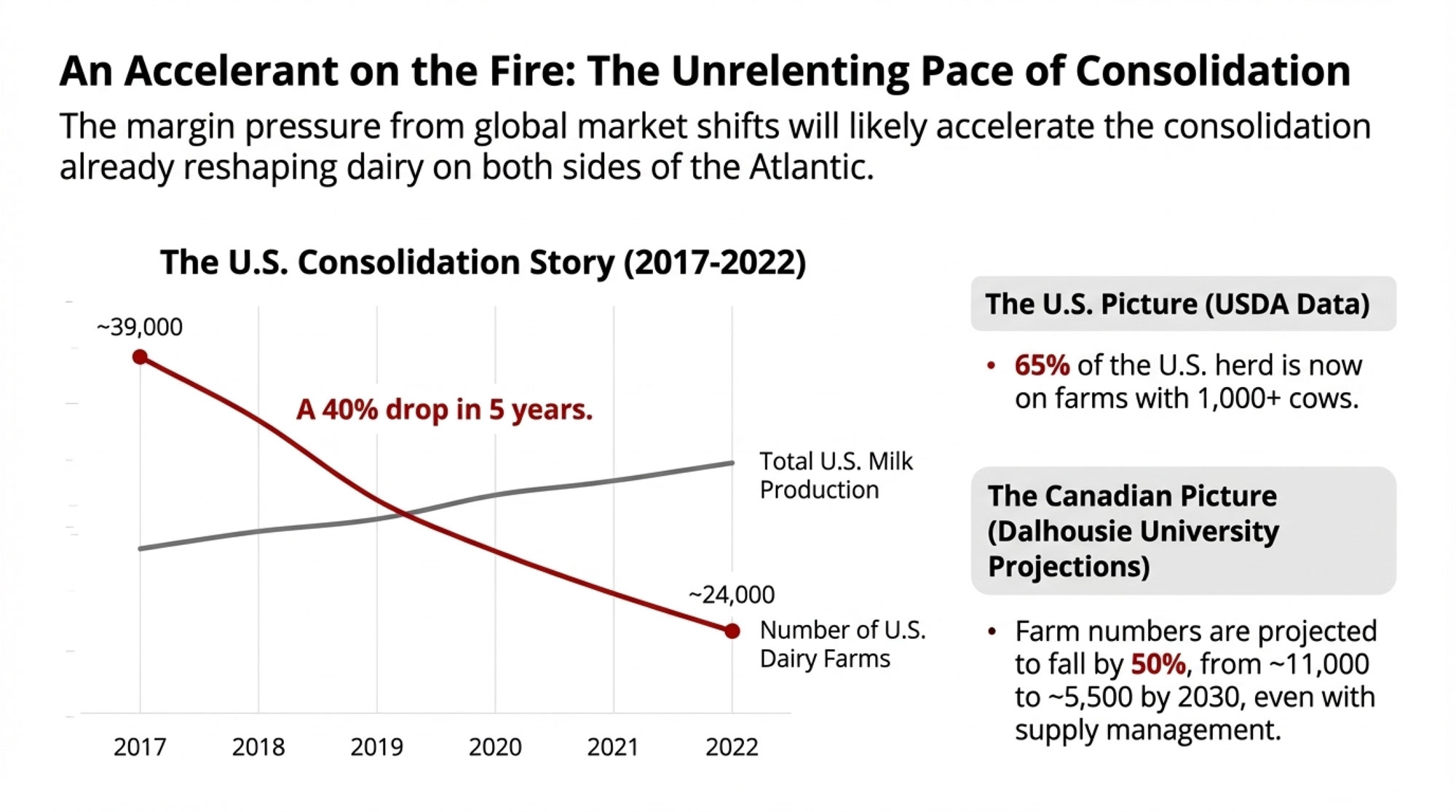
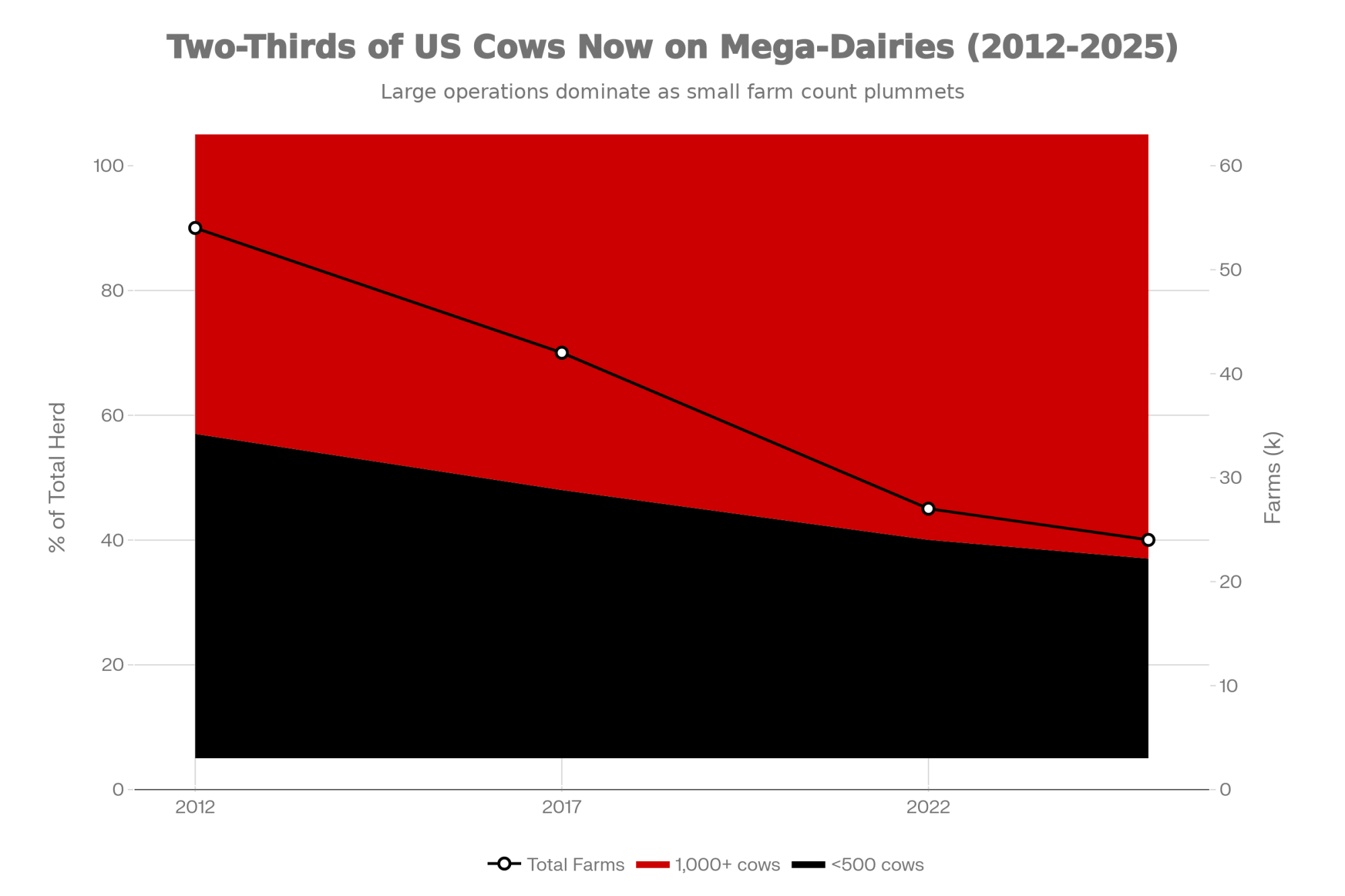
The consolidation pattern is well-documented. Lucas Fuess, Senior Dairy Analyst at Rabobank, noted in his analysis of the 2022 Census of Agriculture that the U.S. lost nearly 40 percent of its dairy farms between 2017 and 2022—from about 39,300 to around 24,000—while total production rose because “larger farms show lower production costs.” This downturn will likely accelerate that trend.

By the late 2020s, several developments seem probable:

The total number of licensed U.S. dairies may fall below 20,000, with an increasing share of national volume coming from herds milking several hundred to several thousand cows. Regional patterns may sharpen, with lower-cost areas—much of the Upper Midwest and Central Plains—holding or gaining share, while higher-cost, more regulated regions see gradual declines in cow numbers as families choose not to reinvest. Beef-on-dairy will likely remain prevalent but may stratify further between well-structured programs that capture consistent premiums and undifferentiated approaches that face greater volatility.

Globally, New Zealand will remain important in the powder and butterfat markets, while the EU continues to shift toward cheese and value-added products within environmental constraints.

The Bottom Line

These are the conversations I’m hearing producers have with their teams, advisers, and families. Every operation faces unique circumstances, and general advice only goes so far—but these questions seem to be helping people think through their situation:

  • Where are you in your own expansion timeline? How many heifers are scheduled to freshen over the next 18-24 months? Do those numbers align with what your facilities, labor, feed base, and market access can profitably support at current price levels?
  • Do you have clear visibility on cow-level economics? Which animals are covering feed plus a reasonable share of labor, debt, and overhead—and which aren’t? What would tightening culling criteria by 5-10 percent look like, and is your replacement pipeline ready for that?
  • How much of your margin is protected versus hoped for? What portion of the next 12-24 months could you realistically put under DMC, DRP, or forward contracts? Have you had direct conversations with your lender about your risk management approach?
  • Is your beef-on-dairy program intentional? Do you know what your calf buyers specifically want, and are you breeding to those specifications? Are you confident that your current approach will leave enough high-quality dairy replacements for the herd you want to be running in three years?
  • Are your genetic criteria aligned with a low-margin reality? Are you selecting strictly for high production, or are you also prioritizing Feed Saved, moderate frame size through Body Weight Composite, and Residual Feed Intake to lower lifetime maintenance costs? In an environment where feed represents 50-60% of production costs, breeding decisions made today will shape your cost structure for the next decade.
  • Are you making decisions for this week or for the next several years? Culling, breeding, feeding, capital allocation, and even family succession—are these being decided tactically or within a longer-term framework?

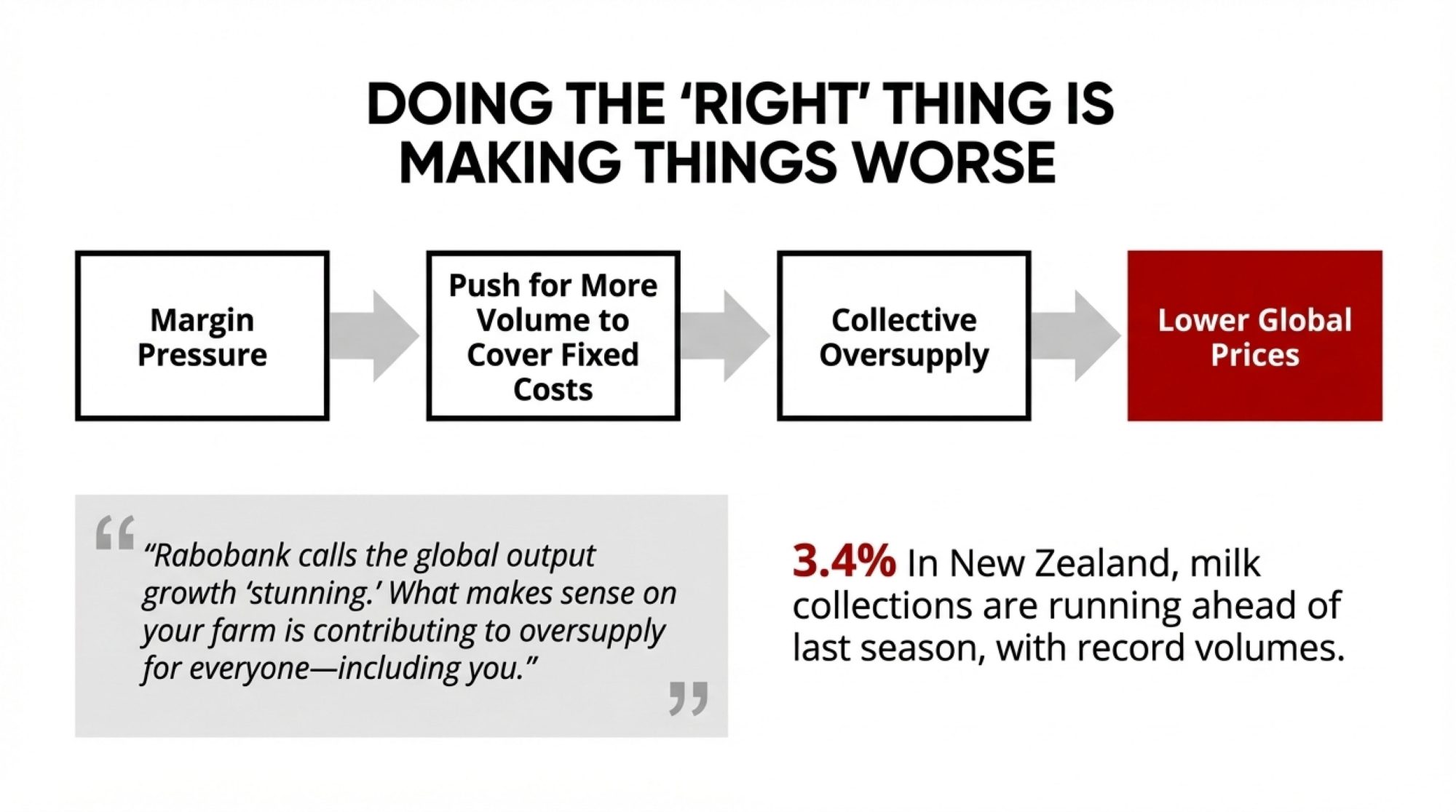
This cycle is demonstrating that individually sensible decisions—expanding when returns were strong, adding beef value to calves, filling new processing capacity—can produce collective oversupply when everyone responds to the same signals simultaneously. None of us individually controls global supply and demand. What each operation can control is understanding its position within the bigger picture, knowing its own numbers thoroughly, and using available tools—biological, genetic, and financial—to improve the odds of still being here, on your own terms, when conditions improve.

KEY TAKEAWAYS 

  • This is a global supply collision, not a demand problem. The U.S., EU, New Zealand, and Argentina all expanded at once—yet exports hit record highs. Pure oversupply.
  • The 24-month trap is unforgiving. Decisions that made sense at $22 milk are now delivering into a $15 market. Biology doesn’t wait for prices to recover.
  • Beef-on-dairy reshaped the culling equation. Replacement heifers dropped to 3.9 million—the lowest since 1978—limiting flexibility exactly when operations need it most.
  • Resilient dairies share three priorities: precision culling based on income over feed cost, margin protection through DMC and DRP, and breeding for feed efficiency traits.
  • Consolidation will accelerate—preparation separates outcomes. Producers who know their numbers and deploy available tools now will emerge stronger when markets turn.

Complete references and supporting documentation are available upon request by contacting the editorial team at editor@thebullvine.com.

Learn More:

Join the Revolution!

Join over 30,000 successful dairy professionals who rely on Bullvine Weekly for their competitive edge. Delivered directly to your inbox each week, our exclusive industry insights help you make smarter decisions while saving precious hours every week. Never miss critical updates on milk production trends, breakthrough technologies, and profit-boosting strategies that top producers are already implementing. Subscribe now to transform your dairy operation’s efficiency and profitability—your future success is just one click away.
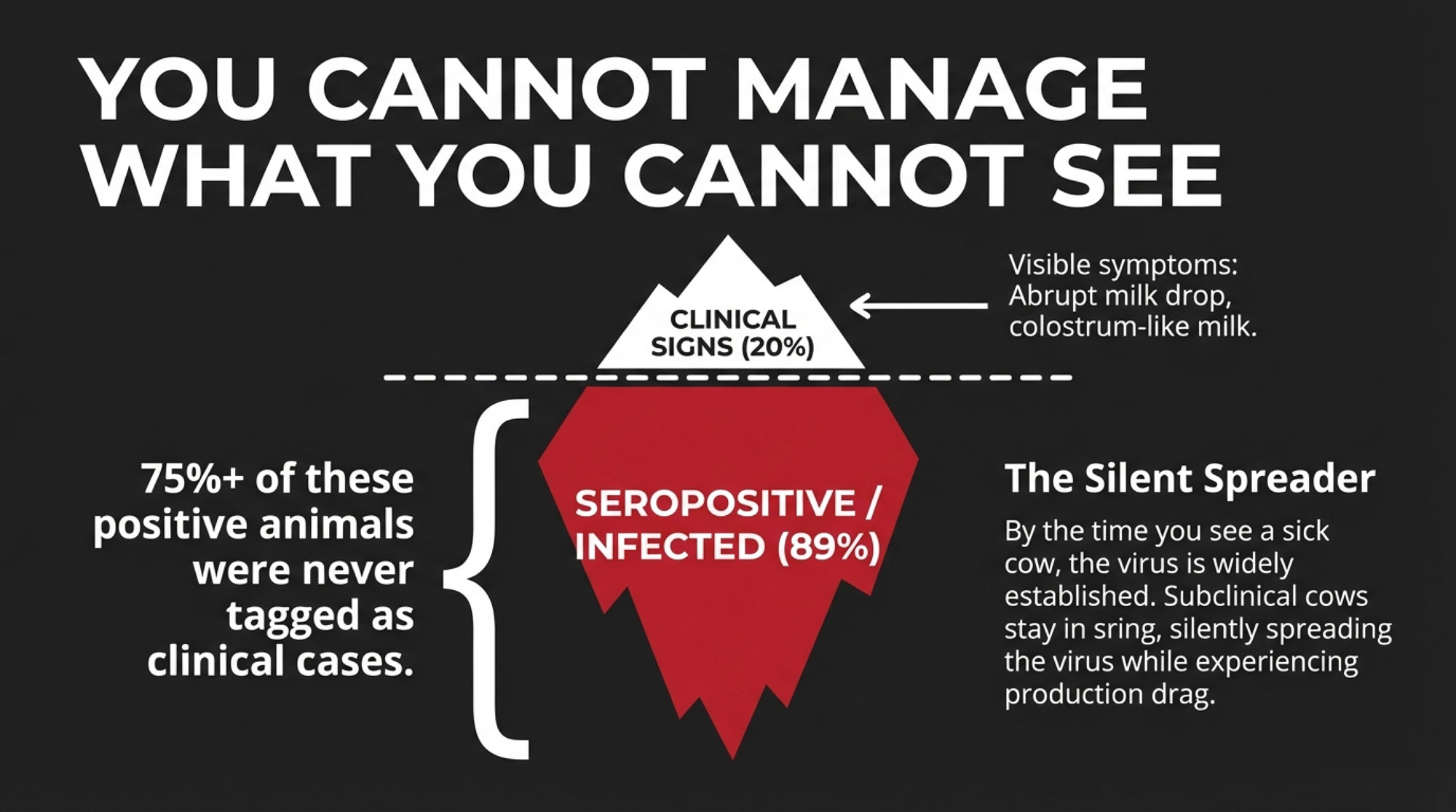
NewsSubscribe
First
Last
Consent

The €27,000 Question 80% of Dairy Farmers Can’t Answer (This Winter, You Will)

80% of dairy farmers can’t answer a €27,000 question. After this winter, you won’t be one of them.

EXECUTIVE SUMMARY: There’s a €27,000 (~$29,000 USD) question that 80% of dairy farmers can’t answer: What’s your feed efficiency ratio? That single number determines whether your operation’s biggest expense—50-70% of costs according to USDA data—generates profit or disappears into the manure pit. The math is compelling: improving from 1.4 to 1.6 efficiency captures €281 per cow annually without new genetics, additional cows, or capital investment. Research from Iowa State’s Dr. Lance Baumgard, Cornell’s transition cow program, and Penn State Extension reveals three proven strategies: systematic measurement, silage preservation, and metabolic optimization. Winter 2025-2026 is your measurement window—housed cattle, stable rations, no heat stress confounding your baseline. All you need: seven days, a bathroom scale, and a moisture tester. The bottom line is simple: you can’t deposit milk production; you deposit margin.

Growing numbers of progressive dairy operations are discovering that a single metric—feed efficiency—holds the key to capturing thousands in additional profit without producing more milk. Here’s what the industry’s efficiency pioneers are finding, and how your operation can benefit from their insights.

The question caught the experienced dairy farmer off guard during a routine consultation last winter: “What’s your current feed efficiency ratio?” After successfully managing 100 cows for 15 years, producing a respectable 35 kilograms of milk per cow daily, he couldn’t answer. Like many in the industry, he knew total feed costs and milk production, but not the critical ratio connecting them.

What happened next transformed his operation. Within twelve months of implementing systematic efficiency measurement, his farm captured over €15,000 (~$16,200 USD) in additional profit—without buying a single additional cow or increasing milk production. His story reflects a broader awakening across the dairy industry: improvements in feed efficiency from 1.4 to 1.6 generate approximately €270 (~$290 USD) per cow annually, based on current commodity prices of €0.25 per kilogram dry matter and €0.40 per kilogram milk. For a typical 100-cow operation, we’re talking about €27,000 (~$29,000 USD) in potential improvement.

This builds on what we’ve seen in operations worldwide. Farms implementing comprehensive efficiency strategies report remarkably consistent results. With feed costs accounting for 50-70% of operational expenses, according to USDA Economic Research Service data, understanding this metric has become fundamental to sustainable dairy farming.

Understanding the Industry’s Relationship with Efficiency Data

What’s particularly noteworthy is how sophisticated we’ve become in certain areas—genomic testing, milk component analysis, reproductive protocols—while feed efficiency remains a blind spot for many successful operations. I find this fascinating, actually.

Industry consultants Jacques Bernard and Christine Massfeller regularly encounter this pattern. When they ask fundamental questions about dry matter consumption or cost per kilogram of energy-corrected milk, even experienced producers often pause. This isn’t about capability—it reflects how our industry has traditionally measured success.

Recent industry observations suggest that while most farms diligently track milk production and components, regular efficiency calculation remains less common. The gap between what we measure and what drives profitability deserves our attention.

THE GOLDEN RATIOS: Know Your Efficiency Targets

GroupTarget
Whole Herd> 1.5
High-Producing Group> 1.7
First-Lactation Heifers> 1.6
Late Lactation> 1.2

⚠️ WARNING: Fresh Cows (First 21 Days) Above 1.5 = Metabolic Danger Zone

Fresh cows with efficiency above 1.5 are actually experiencing a dangerous negative energy balance, mobilizing body reserves at an unsustainable rate despite appearing to be top producers. Cornell University’s transition cow management resources indicate that these animals face a substantially higher risk of metabolic disease.

The Economics Behind Efficiency Improvement

Let me walk through some practical mathematics that illustrates why this matters so much to your bottom line. Consider a standard scenario with 35 kg of daily milk production at a milk price of €0.40 per kilogram and a dry matter feed cost of €0.25 per kilogram.

Metric1.4 Efficiency1.6 EfficiencyDaily Difference
Dry Matter Intake25.0 kg21.9 kg-3.1 kg
Feed Cost (€0.25/kg)€6.25€5.48€0.77 Saved
Income Over Feed Cost€7.75€8.52+€0.77 Profit
Annual Impact (100 Cows)+€28,100 (~$30,350 USD)

The difference—€0.77 per cow daily—accumulates to €281 annually per animal. Scale that across 100 cows, and you understand why progressive producers are prioritizing this metric.

I recently spoke with a Wisconsin producer who shared an interesting perspective. His cows are producing 2 kg less milk than three years ago, yet his operation is significantly more profitable because feed costs dropped by double digits through efficiency improvement. Sometimes the path to profitability isn’t about maximum production—it’s about optimal conversion.

Learning from Poultry and Swine: A Different Approach

The contrast between dairy and monogastric operations offers valuable lessons. Poultry and swine producers monitor feed conversion with remarkable precision, whereas dairy producers have traditionally focused elsewhere. Why this difference?

Part of it comes down to the simplicity of measurement. Tracking tissue growth in a broiler is straightforward compared to partitioning nutrients across milk components, body condition, and reproduction in dairy cattle. Their shorter production cycles provide rapid feedback, and integrated technology has become standard infrastructure.

Modern broiler facilities employ AI-powered systems, achieving impressive precision in automated monitoring. Swine operations use real-time tracking for weight, growth, and intake patterns. This isn’t futuristic—it’s current standard practice enabling continuous optimization.

What’s encouraging is dairy’s technological evolution. The Cattle Feed Intake System developed at the University of Wisconsin-Madison uses 3D cameras and deep learning for individual cow monitoring. Early adopters report payback within 18 months through efficiency gains alone. We’re catching up, and the results are promising.

Recognizing Efficiency Problems: Key Indicators

If you’re observing these signs, it’s time for closer examination:

  • Consistent whole corn kernels in manure—beyond occasional presence
  • Warm silage face—noticeably above ambient temperature, sometimes steaming
  • Severe TMR sorting—refusals predominantly long stems while grain disappears
  • Variable manure consistency within pens—suggesting diet variation
  • Body condition variance exceeding 0.75 points within groups
  • Reduced cud chewing—below the target 7-10 hours daily
  • Long particle predominance in refusals—above 19mm

Penn State Extension’s feed management resources indicate that multiple symptoms typically correlate with efficiency below 1.3.

Three Complementary Strategies for Efficiency Improvement

The evolution of nutrition strategies over the past decade has been remarkable. What started as competing philosophies has matured into complementary systems addressing different efficiency aspects.

Strategy 1: The Measurement Foundation (Data > Assumptions)

Improvement starts with accurate data. German-based AHRHOFF GmbH, operating across multiple countries since 1996, exemplifies this approach. Feed advisor Rainer Kossmann describes their priority as helping clients develop an intuitive understanding of herd consumption through systematic measurement.

The systematic approach incorporates digital tracking for precise dry matter intake, Penn State Particle Separator analysis for sorting behavior, manure evaluation for passage rate assessment, and regular moisture testing for ration accuracy. This foundation reveals the actual difference between assumed and actual intake—often a 10-15% gap worth thousands of dollars annually.

Strategy 2: Preserving Feed Value (The Hidden Rumen Driver)

Forage quality determines rumen function potential—and this is where many operations unknowingly leak profit. Luis Queiros from Lallemand Animal Nutrition explains how energy preservation during storage and feedout represents an often-overlooked opportunity.

Quality inoculant technology, incorporating specific bacterial strains like Lactobacillus buchneri and L. hilgardii, delivers measurable benefits. Research consistently demonstrates typical responses of 1.5 kg additional dry matter intake and nearly 2 kg increased fat-corrected milk. Properly treated silage maintains stability for over two weeks after opening, compared to just days for untreated material. The investment math is compelling: €4,500 (~$4,860 USD) in inoculant typically returns €12,600 (~$13,600 USD) in preserved feed value, before accounting for production benefits.

Strategy 3: Metabolic Optimization (The Stress-Efficiency Connection)

Research from Iowa State University’s animal science department, led by Dr. Lance Baumgard and published in the Journal of Dairy Science, demonstrates how metabolic stress fundamentally compromises efficiency. When cows experience heat stress, transition challenges, or subclinical acidosis, gut barrier function deteriorates. This “leaky gut” response triggers immune activation, consuming glucose equivalent to 25-30 liters of milk—energy that could otherwise support milk synthesis.

University of Florida’s dairy science team has quantified the opportunity through heat abatement studies. Operations implementing comprehensive cooling protocols during summer months recovered 8-12% of heat-stress-related efficiency losses. The key insight: stress management isn’t separate from nutrition—it’s foundational to feed conversion.

Cornell University’s transition cow program reinforces this connection. Their research shows that cows experiencing inflammation during the transition period allocate more nutrients to immune function and less to milk production. Targeted interventions—proper close-up nutrition, minimizing social stress, optimizing stocking density—can shift this balance back toward production. Some operations implementing comprehensive transition protocols report efficiency improvements of 0.1-0.2 points within the first 60 days in milk.

Strategic Timing: Why Winter Matters for Measurement

Over years of consulting, I’ve observed that operations that begin efficiency programs in winter consistently achieve superior results compared to those that start in summer. The science supports this pattern.

Winter provides measurement advantages that summer simply can’t match. Housed cattle consuming consistent TMR eliminate the variables inherent in grazing systems. Research from the University of Minnesota demonstrates that TMR-to-pasture transitions can initially reduce intake by nearly 30%, making accurate efficiency calculations challenging during grazing seasons.

Temperature effects matter enormously. When the Temperature Humidity Index exceeds 72, production impacts begin. USDA data from southwestern operations shows average decreases of around 12%, with severe heat causing dramatic drops. Winter measurement reveals true biological capacity rather than heat adaptation.

By mid-winter, silage has stabilized post-fermentation but hasn’t deteriorated. Moisture content remains consistent week to week—essential for calculation accuracy. Plus, without fieldwork pressure, you have bandwidth for careful measurement and analysis. As Dr. Jane Sayers from Northern Ireland’s CAFRE observes, winter provides an opportunity to focus on intake monitoring, which is often overlooked during busier seasons.

Regional Considerations and Operational Realities

Different systems require different approaches—what works for California’s Central Valley operations won’t necessarily translate to Irish grazing systems or Wisconsin tie-stalls.

Pasture-based operations in Ireland, New Zealand, and parts of the Netherlands face unique measurement challenges. Daily efficiency can swing 0.2-0.3 points based on grass quality and weather. These farms benefit from establishing winter baselines during housing, then using those benchmarks to evaluate grazing performance.

Large confined operations in California, Arizona, and emerging markets have measurement consistency advantages but face greater heat stress challenges. These systems often achieve dramatic efficiency gains from metabolic support strategies, particularly during the summer months.

Smaller operations sometimes question whether efficiency improvement justifies investment. The percentage gains remain consistent regardless of scale—a 30-cow herd capturing €8,100 (~$8,750 USD) annually still achieves excellent returns. The key is appropriate implementation: perhaps weekly rather than daily measurement, creative use of existing equipment, and acceptance that progress beats perfection.

Organic producers face intervention restrictions but consistently achieve respectable efficiency through careful forage management and natural fermentation optimization. Several Northeast organic operations report 1.55+ efficiency using approved methods exclusively.

Your 7-Day Efficiency Startup Checklist

Starting efficiency measurement doesn’t require sophisticated infrastructure. Here’s a practical approach using equipment most farms already have:

Day 1: The Weigh-In. Establish your weighing system—a bathroom scale with a bucket works initially. Conduct your first dry matter test using microwave methods validated by extension services. Record pen populations and milk production with components. This is your baseline moment.

Days 2-6: The Data Gather. Continue recording delivered feed from your mixer display, weigh refusals, and test moisture. Calculate daily intake and efficiency while watching for patterns. Don’t chase perfection here—consistency matters more than precision initially. You’re building a habit, not writing a research paper.

Day 7: The Reckoning. Calculate weekly averages by group. Fresh cow efficiency above 1.5 or a herd average below 1.3 warrants immediate consultation with a nutritionist—these indicate intervention needs. This is the number that tells you whether you’re leaving money on the table.

The calculations are straightforward: Dry matter intake equals delivered feed times dry matter percentage, minus refusals times their dry matter percentage, divided by cow count. Energy-corrected milk calculators from Cornell or Penn State handle standardization. Efficiency equals ECM divided by DMI.

Investment Reality and Return Expectations

Transparency about costs builds trust. Based on current market conditions, here’s the realistic investment requirements:

Measurement systems require approximately €3,500 (~$3,780 USD) initially, €2,200 (~$2,375 USD) annually for feed management software, moisture testing equipment, particle separation tools, and scales.

Silage preservation runs €4,500 (~$4,860 USD) annually for inoculant at typical application rates. This investment consistently returns triple value in feed preservation alone, before production benefits.

Transition and metabolic support through quality mineral programs and stress mitigation protocols costs around €3,500 (~$3,780 USD) annually for 100 cows. University research suggests that even modest improvements in transition cow health can recover this investment within the first lactation.

Investment CategoryYear 1Ongoing
Measurement Systems€3,500 (~$3,780)€2,200 (~$2,375)
Silage Preservation€4,500 (~$4,860)€4,500 (~$4,860)
Transition & Metabolic Support€3,500 (~$3,780)€3,500 (~$3,780)
Total€11,500 (~$12,420)€10,200 (~$11,015)
Conservative Benefit€20,000-27,000 (~$21,600-29,160)
Typical Payback5-7 months

Industry Evolution and Future Considerations

The dairy industry faces an interesting crossroads in measuring and reporting efficiency.

Major processors across Europe—Danone, Arla, FrieslandCampina—are incorporating efficiency metrics into sustainability programs and payment structures. While specific program details continue evolving, the direction is clear: efficiency measurement is transitioning from optional to essential.

Carbon market developments offer additional opportunity. Regulatory frameworks in California and Europe are beginning to assign value to efficiency improvements as methane reduction strategies. Operations achieving 1.6+ efficiency may access substantial additional revenue through emerging carbon credit markets.

Within several years, industry observers expect efficiency reporting will become standard for premium market access, sustainability program participation, and competitive financing. Progressive lenders already incorporate these metrics into risk assessment.

Practical Takeaways for Your Operation

The €27,000 annual opportunity exists within your current genetics through management improvement. Unlike genetic selection, requiring years, management delivers returns within months. Each month’s delay represents approximately €2,250 (~$2,430 USD) in foregone benefit.

Starting simple with consistent measurement beats waiting for perfect systems. Basic tools—scale, moisture tester, spreadsheet—combined with two hours weekly effort can generate substantial efficiency gains.

Winter timing provides optimal measurement conditions. January through March offers stable feeding without heat stress or grazing variables, establishing accurate baselines for year-round improvement.

Sequential implementation maximizes success. Begin with a measurement to understand current performance. Address forage quality to secure your input foundation. Then optimize metabolic health through evidence-based transition protocols. Each phase builds on previous improvements.

The 1.5 efficiency threshold separates sustainable from struggling operations. Below 1.3 indicates a crisis requiring immediate attention. Above 1.5 provides a foundation for optimization toward 1.6+ targets where premium opportunities emerge.

As one experienced consultant observed: “Weekly efficiency calculation drives profitable decisions. Annual calculation generates excuses. Never calculating ensures slow decline without understanding why.”

KEY TAKEAWAYS

  • €281 per cow. €27,000 per herd. Every year. Moving from 1.4 to 1.6 efficiency captures this without new genetics, additional cows, or capital investment. It’s management money—yours to take or leave.
  • Fresh cows above 1.5 efficiency aren’t stars—they’re sirens. High early efficiency signals dangerous mobilization of body reserves, not superior genetics. These cows are heading for ketosis. Monitor them; don’t celebrate them.
  • Three strategies. One system. No shortcuts. Measurement reveals your baseline. Silage preservation protects your inputs. Metabolic optimization unlocks conversion. Skip one, and the others underdeliver.
  • Winter 2025-2026 is your measurement window—use it. Housed cattle, stable rations, no heat stress skewing numbers. January through March gives you the cleanest baseline you’ll get all year.
  • The barrier to €27,000? Seven days and a bathroom scale. Add a microwave for moisture testing and a spreadsheet. That’s it. Start this week. Stop guessing. Start weighing.

The Bullvine Bottom Line

You can’t deposit milk production; you deposit margin. Genetic potential means nothing if your conversion is poor. For the cost of a bathroom scale and a moisture tester, you can unlock €27,000 (~$29,000 USD) in hidden value this winter. Stop guessing and start weighing.

Complete references and supporting documentation are available upon request by contacting the editorial team at editor@thebullvine.com.

Complete references and supporting documentation are available upon request by contacting the editorial team at editor@thebullvine.com.

Learn More:

Join the Revolution!

Join over 30,000 successful dairy professionals who rely on Bullvine Weekly for their competitive edge. Delivered directly to your inbox each week, our exclusive industry insights help you make smarter decisions while saving precious hours every week. Never miss critical updates on milk production trends, breakthrough technologies, and profit-boosting strategies that top producers are already implementing. Subscribe now to transform your dairy operation’s efficiency and profitability—your future success is just one click away.

NewsSubscribe
First
Last
Consent

The Cooperative Trap: UK’s 32p Milk Crash Proves Your Co-op Won’t Save You

When a Welsh dairy farmer sat in that boardroom and voted to slash his own income by £78,000 a year, he wasn’t being foolish. He was being a fiduciary. And that distinction matters for every cooperative member reading this.

Executive Summary: Mike Smith milks 450 cows in Wales and serves as vice chairman of First Milk. This month, he voted to cut his own milk price to 32.25p—a decision that costs his operation approximately £6,500 every month. He wasn’t being foolish. He was fulfilling his legal duty: UK company law requires cooperative directors to protect the enterprise first, even when farmgate prices fall below the 43-47p most producers need to break even. That tension between member interests and cooperative survival explains why UK dairy has consolidated from 35,000 farms in 1995 to roughly 7,000 today—and why analysts project just 4,000-5,000 by 2030. Cooperatives deliver real value: market access, collective bargaining, shared risk. But insulation from global oversupply? That’s not part of the deal. North American producers shipping through DFA, Agropur, or provincial marketing boards face the same structural dynamics—and understanding them now, while you still have options, is the point.

Dairy Farm Profitability Strategies

Mike Smith runs a 450-cow dairy in Pembrokeshire, Wales. He’s also vice chairman of First Milk, one of the UK’s largest British-headquartered farmer-owned cooperatives. This month, he sat in a boardroom and voted to cut his own milk price—a decision that will cost his operation roughly £6,500 every single month.

That image stuck with me as I worked through what’s happening across UK dairy right now. A farmer-owner, voting against his own short-term interest, because the alternative was watching the cooperative face serious financial difficulty. It tells you something important about how cooperative economics actually work when markets turn challenging—and it’s something Wisconsin, Ontario, and every other cooperative-heavy dairy region should understand.

This chart shows how UK dairy farms collapsed from roughly 35,000 to 7,000 in a single generation, with another third likely gone by 2030. Cooperatives kept processing capacity afloat, but the price mechanism quietly selected who stayed and who exited. The system is working exactly as designed—and that should scare any producer betting their future on membership alone.

The Numbers Behind the Decision

First Milk announced its January 2026 price at 32.25 pence per litre, down a staggering 3.6ppl from the prior month. That’s no small adjustment. According to Mike Smith in First Milk’s official announcement: “This change reflects the continuing challenges in the market. UK and global milk production remain at record levels, and there is still no sign of improvement in the supply/demand imbalance.”

Production costs vary significantly across UK dairy operations. What’s interesting here is that grazing systems generally run lower than housed herds, and regional differences in feed and labor costs create quite a range. Industry benchmarking from AHDB and farm business consultancies like Kite Consulting consistently shows that fully-housed systems average somewhere in the mid-to-upper 40s pence per litre when all costs, including unpaid family labor, are accounted for. According to Promar International’s UK Dairy Producer Cost Analysis 2025, leading producers sustain production costs of 41-43 pence per litre.

Let’s run some realistic numbers on a 150-cow herd shipping about 103,000 litres monthly. If we assume production costs around 43ppl—reasonable for a well-managed system:

  • Monthly revenue at 32.25ppl: £33,217
  • Monthly production cost at 43ppl: £44,290
  • Monthly shortfall: Around £11,073

That’s burning through £133,000 or more each year before the family draws any income for living expenses. The 3.6ppl cut alone strips roughly £3,700 monthly from an already tight position.

Here’s what’s worth noting, though. First Milk has maintained a strong corporate performance—the BV Dairy acquisition significantly expanded its processing capacity. But those processor-level numbers don’t change the reality that farmgate prices have to track global commodity markets, regardless of how well the creameries perform. The processing business can be healthy while the farm business struggles. That disconnect frustrates producers, understandably so.

This comparison shows the brutal reality of December 2025 pricing: all conventional UK processors are paying members less than even the best‑in‑class 43ppl breakeven cost. Only organic producers clear the breakeven wall. When co‑op boards talk about ‘alignment with market conditions,’ this is what they mean.

Understanding Why Cooperative Boards Make Difficult Choices

I’ve followed cooperatives across three continents over the years, and the pattern at First Milk is one I’ve seen before. Understanding these mechanics matters because they apply across all cooperatives that handle commodity dairy.

First, let’s acknowledge what cooperatives genuinely provide—and these benefits are real and significant. Collective bargaining power. Guaranteed market access even when spot buyers disappear. Shared infrastructure investment that individual farms couldn’t finance alone. There’s a good reason the cooperative model has endured for over a century in dairy.

But when global supply substantially exceeds demand—as it does currently—those benefits don’t override fundamental market dynamics.

First Milk’s board includes farmer directors like Mike Smith, who manage substantial operations themselves. These aren’t distant executives making decisions about someone else’s livelihood. They’re producers facing the same pressures as every other member.

Why did they vote for reductions? Three factors typically converge in these situations.

There’s a fiduciary duty. UK company law—specifically Section 172 of the Companies Act 2006—requires directors to act in the best interest of the enterprise as a going concern. When the cooperative faces potential covenant pressure on significant debt, preserving the business takes legal precedence over maximizing short-term member returns.

Then there’s the volume obligation built into the cooperative structure. Unlike corporate processors who can decline volume, cooperatives generally must accept what members ship. When global supply surges, that milk needs processing—even when margins suffer. Müller’s agriculture director Richard Collins acknowledged this pressure directly in their November announcement: “We’re seeing market price reductions, and daily collection volumes are still significantly higher than they were last year.”

And competitive positioning matters more than many producers realize. Arla UK set December prices at 39.21ppl (down 3.50ppl). Müller moved to 38.5 ppl (down 1.5 ppl). Freshways went to 30.4ppl. If First Milk holds significantly above market while competitors price lower, retailers shift contracts. Volume drops. Fixed processing costs are spread across fewer litres. The trajectory from there becomes concerning.

How One Welsh Family Is Working Through the Numbers

What follows is a composite based on industry figures and conversations with UK dairy advisors—not a specific identifiable operation, but representative of decisions many families are working through right now.

The Morgans milk 165 cows on 200 acres outside Carmarthen. Third generation on the land. Two children—one considering returning to farm after agricultural college, one leaning toward other opportunities.

Their numbers heading into 2026:

  • Monthly production: 114,000 litres
  • First Milk price (January): 32.25ppl = £36,765 revenue
  • All-in production cost: 44ppl = £50,160
  • Monthly gap: Around £13,395

They’re carrying about £340,000 in debt—equipment loans, a 2019 cubicle shed, and an operating line. Their debt-to-asset ratio sits around 45%. DEFRA’s Balance Sheet Analysis suggests that’s actually in reasonable shape compared to many UK dairy operations.

The family has been running scenarios this autumn:

Scale up option: Adding 80-100 cows would require roughly £400,000 in new investment—buildings, livestock, and slurry capacity. At current prices, that creates a larger shortfall with more debt service. They’d need milk to recover to 38-40ppl within three years for expansion to work financially. That’s possible, but far from certain.

Exit option: Cull cow prices are historically strong right now. AHDB’s weekly livestock reports from late 2025 showed deadweight cows averaging well above the five-year average. Land in their area has traded around £8,500/acre recently, according to Farmers Weekly market reports. They could likely clear debt and retain meaningful equity. But three generations of work and the children’s potential inheritance make this more than a financial calculation.

Reduce and reassess: They’re seriously considering culling 25-30 head this winter, generating £40,000-50,000 in cull revenue while beef prices hold. That cuts feed costs immediately and gives 18 months to see how markets develop. It’s not a permanent solution—more of a managed pause that preserves options.

Herd SizeMonthly LitresRevenue @ 32.25pCost @ 43pMonthly LossAnnual Bleed
100 cows68,000£21,930£29,240-£7,310-£87,720
150 cows103,000£33,218£44,290-£11,072-£132,864
200 cows137,000£44,183£58,910-£14,727-£176,724
300 cows205,000£66,113£88,150-£22,037-£264,444
450 cows (Mike Smith)308,000£99,330£132,440-£33,110-£397,320

The son, home for Christmas, asked his father what he thought would happen to UK dairy over the next decade. The response was sobering: “A lot of the farms that are here now won’t be in ten years. The question is whether we’re among those who continue or those who don’t.”

The Global Supply Dynamics Driving These Pressures

This situation feels different from previous dairy downturns—and that distinction matters for how farmers might respond.

The 2015-16 downturn was largely demand-driven. Russia embargoed EU dairy. Chinese buying slowed significantly. When those external factors resolved, prices recovered. This time, pressure is coming from the supply side. That’s more challenging because there’s no single external event to wait out.

Irish milk production increased substantially through 2025. AHDB’s tracking shows January-May 2025 Irish output running 7.6% above the same period in 2024—with March up 8%, April up 13%, and May up 7%. That’s farmers pushing volume ahead of tightening nitrate regulations—an understandable response to policy changes, but one that’s flooding markets with additional supply.

Meanwhile, European production dynamics are complex. USDA’s Foreign Agricultural Service EU Dairy Forecast from February 2025 showed EU milk deliveries forecast to decline marginally by 0.2% in 2025, with low farmer margins and environmental restrictions pushing some smaller producers out. But GB production tells a different story entirely—AHDB’s December 2025 forecast update projects UK milk production for 2025/26 at a record-breaking 13.05 billion litres, up 4.9% from the previous milk year.

The Global Dairy Trade auction results reflect these dynamics. The December 2025 auction saw the index decline 4.3%—the eighth consecutive decline—with butter crashing 12.4% to US$5,169 per tonne. AHDB noted that “increasing global dairy milk supplies and product stocks are weighing heavily on prices currently.”

Global dairy prices have fallen at every single GDT auction since spring, with the steepest hit in November and butter down 12.4% in December. That’s not a storm you ‘ride out’ with a bit of overdraft. It’s a structural oversupply that forces co‑ops to use your milk cheque as the shock absorber.

Independent dairy analyst Chris Walkland offered a stark assessment in late November: some producers could face milk payments between 30 and 35 pence per litre for eight to nine months.

The Brexit Trade Dimension

Everything described so far applies to dairy producers globally. But UK farmers are navigating the same supply environment while operating outside the EU’s single market. That creates additional complexity.

Trade data analyzed by Logistics UK shows UK dairy and egg exports to the EU declined approximately 6% since Brexit. The documentation requirements have proven substantial.

The mechanics are straightforward but add costs. Every dairy shipment to the EU requires export health certificates, veterinary sign-off, and potential border inspections under the sanitary and phytosanitary (SPS) control framework introduced in 2024. An analysis by Stone X noted that “the UK and EU now treat each other as ‘third countries,’ meaning any dairy products moving across the Channel are subject to rigorous SPS checks.”

John Lancaster, head of EMEA and Food Consultancy at Stone X, observed: “Volatility is nothing new for the dairy sector, but the nature of that volatility is evolving. The UK, traditionally a net importer of dairy, has seen strong milk collections in recent months, likely leading to reduced imports in 2025. This elevated supply, combined with administrative barriers to export, has meant that local spot prices can swing more sharply.”

UK dairy exports to the EU have slipped around 6% since Brexit—not because Europe banned our products, but because red tape throttles every truckload. While Irish and Dutch milk moves freely inside the single market, British producers fight the same oversupply with added paperwork drag.

Ireland and the Netherlands face similar global supply pressures. But they operate within the single market—frictionless trade, shared regulations, and access to EU support mechanisms. UK producers are competing with additional administrative and cost burdens that other major producing regions don’t face.

What Successful Adaptation Looks Like

Alongside these challenges, some operations are finding paths forward. The strategies vary but share a common element: reducing pure commodity exposure.

Millbrook Dairy in the West Midlands has developed direct export relationships, particularly targeting Middle Eastern markets where UK cheese commands a premium positioning. According to Dairy Reporter’s coverage from May 2025, the company has faced Brexit, COVID-19, the Red Sea crisis, and US tariffs—but rising global demand for premium cheese and butter has created opportunities for those willing to navigate the complexity.

Several Welsh operations have moved toward organic certification and secured premium contracts. While conventional prices have crashed below 35ppl for some, organic producers continue receiving prices in the upper 50s ppl—First Milk’s organic price remains at 57.95ppl, unchanged from the conventional cuts.

We’re actually seeing similar patterns in North America. Some Upper Midwest producers have moved into farmstead cheese or on-farm processing to capture more margin. A few Ontario operations have built agritourism components that complement their dairy income. These aren’t easy pivots—they require capital, skills, and market access—but they show the “expand or exit” framework isn’t the only path available.

None of these approaches fit every situation. They require specific circumstances and opportunities that vary significantly by region and operation. But they illustrate that other paths exist for those positioned to pursue them.

Questions Worth Asking Your Cooperative

For North American farmers watching the UK situation, there’s practical value in understanding what to monitor closer to home. DFA handles a substantial share of the US milk supply through cooperative structures. Canadian cooperatives like Agropur and provincial marketing boards face similar dynamics when global markets shift.

Having specific questions ready when cooperative leadership presents forecasts or pricing updates can be valuable:

On volume management:

  • Is the cooperative implementing or considering base-excess programs or volume adjustments?
  • What percentage of members are shipping above base allocation?
  • How does the cooperative plan to balance supply if market conditions weaken?

On financial position:

  • What are the cooperative’s current debt covenants, and how much flexibility exists?
  • What milk price level would create covenant concerns?
  • How much of the operating profit comes from processing versus member milk margin?

On forward planning:

  • What price scenarios is management modeling for the next 12-24 months?
  • At what price level would capacity rationalization become necessary?
  • How are competing processors positioned, and what’s the risk of contract shifts?

These aren’t confrontational questions—they’re the kind of information that business owners should reasonably have about enterprises they collectively own.

Indicators Worth Watching

The UK situation offers a framework for what to monitor. Several metrics are worth tracking.

Supply growth provides early signals. USDA’s monthly Milk Production report is the primary source. If year-over-year growth exceeds 3% for six consecutive months, supply is outpacing demand. That pressure eventually reaches farmgate pricing. Wisconsin producers might watch regional production trends particularly closely, given the concentration of cooperative membership in the Upper Midwest.

Futures markets offer forward visibility. CME Class III cheese futures below $17/cwt for extended periods suggest markets are pricing in oversupply conditions. Monthly checks of forward curves provide useful context for planning.

Cooperative communications often signal direction if you listen carefully. When leadership emphasizes “supply balance,” “market alignment,” or “production discipline,” they may be preparing ground for pricing adjustments. Richard Collins at Müller noted they’re “keeping a close eye on supply and demand”—that language often precedes action by 60-90 days.

Cull market conditions indicate exit dynamics. Strong cull prices create exit incentive—but also suggest culling hasn’t reached levels that would meaningfully reduce supply.

When multiple indicators converge, the UK pattern becomes more relevant to local planning.

The Broader Industry Pattern

After three decades in this industry—starting with a Master Breeder operation and later founding The Bullvine—I keep returning to a pattern that deserves direct discussion.

Cooperative commodity dairy, by its structural design, tends to address supply-demand imbalances partly through changes in membership. That’s not necessarily a failing of the model—it’s inherent to how cooperatives function in commodity markets. When global supply exceeds demand, and prices fall below production costs, cooperatives adjust farmgate pricing to maintain processing viability. Those price adjustments create pressure on higher-cost operations. Some exit. Supply eventually contracts. Prices stabilize for continuing producers.

The cooperative continues. Membership consolidates. The cycle continues.

AHDB’s latest survey of milk buyers revealed an estimated 7,040 dairy producers in GB as of April 2025—a loss of 190 producers (2.6%) since the previous year. Against a backdrop of rising volumes, this suggests a continued shift toward fewer, larger farms. Industry exits typically occur during the winter months, before housing and other input requirements rise seasonally.

This isn’t an argument against cooperatives. Their benefits remain genuine—market access, collective bargaining strength, shared risk, and infrastructure investment beyond individual farm capacity. But it does argue for a realistic understanding of what cooperative membership provides. Insulation from global market forces isn’t among those benefits.

Practical Considerations by Situation

For operations with strong balance sheets—debt-to-asset below 40%: This environment may present opportunities. Industry transitions often create acquisition possibilities. Operations that can achieve competitive production costs at scale, with family commitment to a long-term horizon, may be well-positioned for the consolidation ahead.

For operations with moderate leverage—40-60% debt-to-asset: Focus on cash preservation and maintaining flexibility. Cull strategically to generate near-term cash while beef prices remain favorable. Explore loan restructuring while lenders remain accommodating. Develop realistic exit valuations to understand your position. The objective is to navigate 24 months without eroding equity, then reassess.

For operations with higher leverage—above 60% debt-to-asset —the situation requires an honest assessment. At current UK price levels, highly leveraged operations face compounding challenges that can steadily erode equity. Voluntary, well-planned transition while cull and land markets remain favorable often preserves more family wealth than delayed, pressured decisions. That’s a difficult conversation, but an important one.

For all operations: Know your actual cost of production—including properly valued family labor. Understand your cooperative’s financial position and be prepared to ask informed questions. Watch the indicators that might signal your region following similar patterns. And recognize that choosing your timing generally produces better outcomes than having timing determined by circumstances.

Editor’s Note: All pricing data cited in this article comes from official processor announcements and AHDB reports from November-December 2025. Production cost figures reference AHDB, Promar International, and Kite Consulting industry benchmarks. National and regional averages may not reflect your specific operation’s circumstances. We welcome producer feedback and regional case studies for future reporting. Contact: andrew@thebullvine.com

Resources for Ongoing Monitoring:

Key Takeaways

  • 32p milk, 43p costs. First Milk’s January 2026 price leaves most UK producers hemorrhaging cash—£11,000+ monthly on a mid-size herd. The gap isn’t a glitch. It’s global oversupply working exactly as markets do.
  • A farmer voted to cut his own pay. Vice Chairman Mike Smith slashed his milk price by £6,500/month because UK law requires cooperative directors to protect the enterprise first. Fiduciary duty trumps member income when the cooperative’s survival is at stake.
  • Cooperatives manage consolidation—they don’t prevent it. UK dairy shrank from 35,000 farms to 7,000 over thirty years. Cooperative membership provided orderly exits and market access for survivors, not insulation from structural economics.
  • The supply glut is structural, not seasonal. Irish milk up 7.6% through May. GB production at record highs. Eight straight declines in the Global Dairy Trade auction. There’s no external shock to wait out—this is the new baseline until supply contracts.
  • Your turn is coming. DFA, Agropur, and provincial marketing boards face identical cooperative economics. The producers who understand these dynamics now—and position accordingly—will have options when pricing pressure arrives. The rest will have the options the market gives them.

Complete references and supporting documentation are available upon request by contacting the editorial team at editor@thebullvine.com.

Learn More:

  • Decide or Decline: 2025 and the Future of Mid-Size Dairies – This strategic guide targets the “squeezed middle” (700-1,200 cows), outlining three specific survival paths: intended expansion, rigorous optimization, or strategic exit. Essential reading for producers needing to calculate if their debt-to-asset ratio supports the scale required to survive current consolidation trends.
  • Global Dairy Market Dynamics: Navigating Volatility and Strategic Opportunities in 2025 – Expand your understanding of the supply-side pressures mentioned above with this deep dive into 2025 Global Dairy Trade (GDT) indices and regional production forecasts. It provides the broader economic context needed to anticipate price floor movements before they hit your milk check.
  • Digital Dairy: The Tech Stack That’s Actually Worth Your Investment in 2025 – Move beyond buzzwords with this ROI-focused analysis of farm automation and data integration. It demonstrates how integrating specific technologies—like AI-driven feed management—can slash costs by 5-10%, offering a tangible way to protect margins when milk prices fall below production costs.

Join the Revolution!

Join over 30,000 successful dairy professionals who rely on Bullvine Weekly for their competitive edge. Delivered directly to your inbox each week, our exclusive industry insights help you make smarter decisions while saving precious hours every week. Never miss critical updates on milk production trends, breakthrough technologies, and profit-boosting strategies that top producers are already implementing. Subscribe now to transform your dairy operation’s efficiency and profitability—your future success is just one click away.

NewsSubscribe
First
Last
Consent

22 of 30: Genosource’s Historic Sweep of the December 2025 US Holstein Genetic Evaluations

73% of the top 30 NM$ bulls. One breeding program. The December 2025 Holstein evaluations just rewrote the genetic playbook.

Executive Summary: The December 2025 US Holstein genetic evaluations expose a seismic shift: Genosource now owns 22 of the top 30 Net Merit bulls—73% of the industry’s elite profit genetics under one roof. GENOSOURCE RETROSPECT-ET defends the #1 NM$ position at $1296, while BEYOND HI-LEVEL-ET commands GTPI at 3612, a 73-point jump that widens the gap at the top. Newcomer SAN-DAN ON CALL-ET exploded onto the scene at #3 GTPI (3574) with production numbers that demand attention: 1845 Milk, 151 Fat, 70 Protein. Type leadership remains locked between SHG LEGO and REDCARPET STORY ARC-ET at 3.85 PTAT, while Red & White genetics surge forward with SIEMERS RLE PAPAYA-RED-ET topping at 3221 GTPI. The consolidation of profitable genetics into a single program isn’t a trend—it’s the new reality, and breeders who adapt their sire selection now will compound this advantage for generations.

December 2025 Holstein evaluations

Dairy breeders and industry professionals, welcome to our analysis of the December 2025 US Holstein Genetic Evaluations. This round of evaluations saw numerous high-ranking newcomers and shifts among the established leaders across the major indices, underscoring the continued rapid turnover in elite genomic performance.

GTPI (Genomic Total Performance Index) Highlights

The December 2025 evaluations present a highly competitive Top 100 GTPI list for bulls over 12 months with NAAB codes, with significant consolidation among the leading bull providers.

Top Movers and Shakers

BEYOND HI-LEVEL-ET maintains its position as the #1 GTPI bull overall, posting a GTPI of 3612. The bull demonstrates strong production credentials with 1121 PTA Milk, 145 PTA Fat, and 59 PTA Protein, combined with a solid Health Index of 6.5.

The top of the list saw considerable shifting:

  • BEYOND SHPSTR GOLLEY-ET made a major move to the #2 position in December, reaching 3605 GTPI. This sire excels with high PTA Fat (147) and strong PTA Type (1.51).
  • SAN-DAN ON CALL-ET (3574 GTPI) enters the top rankings directly at #3. This sire is exceptional for production, yielding 1845 PTA Milk, 151 PTA Fat, and 70 PTA Protein, while also ranking #9 for Net Merit at $1222.
  • OCD TROOPER SHEEPSTER-ET (3572 GTPI) now stands at #4 in the general Top 100 GTPI ranking.
  • PROGENESIS WATCHMAN rounds out the top five at 3568 GTPI.
  • BEYOND HI-PACE-ET secures #6 with 3566 GTPI, adding depth to the Beyond program’s GTPI dominance.

New Sires in the GTPI Top 100

The December 2025 GTPI ranking features numerous exciting new entrants that cracked the Top 100. Key new sires debuting near the top include:

  • S-S-I OLD RICHARD-ET ranks high at #7 with 3553 GTPI
  • S-S-I SIEMERS N MCLAURIN-ET follows closely at #8 with 3549 GTPI, showing impressive PTA Type (1.81) and Udder Composite (1.16)
  • STGEN MAZOR-ET (3539 GTPI) and GENOSOURCE LANDMAN-ET (3537 GTPI) secured the #11 and #12 spots, respectively
  • BEYOND HOORAY-ET also debuts strongly at #13 (3537 GTPI)
  • GENOSOURCE YAGERMEISTER-ET at #16 (3533 GTPI) and OCD SHEEPSTER ROCK-ET at #17 (3528 GTPI)

Net Merit ($NM) Evaluation Overview

The December 2025 Net Merit rankings reveal a seismic shift in genetic leadership that dairy breeders cannot ignore: Genosource bulls now hold an astounding 22 of the top 30 NM$ positions—representing 73% of the elite profitability tier. Even more remarkably, Genosource claims 5 of the top 7 spots, including the #1 position.

This level of concentration is unprecedented in modern Holstein genetics and signals a fundamental change in how profitable genetics are being developed and marketed. The Genosource breeding program has clearly cracked the code on balancing high production with health, fertility, and longevity traits that drive lifetime profitability.

NM$ Leaders

GENOSOURCE RETROSPECT-ET successfully defends its title as the #1 NM$ bull, achieving $1296 NM. This bull also appears at #87 on the GTPI list with a GTPI of 3477, demonstrating balanced genetic merit across multiple selection indices.

The Genosource dominance continues throughout the rankings:

  • 551HO06566 is the #2 NM$ sire at $1274 NM, featuring 2089 PTA Milk and 77 PTA Protein
  • STGEN STUART-ET ranks #3 NM$ at $1250 NM, providing 1666 PTA Milk, 145 PTA Fat, and 71 PTA Protein
  • GENOSOURCE MIKAIL-ET holds the #4 NM$ position with $1246 NM
  • GENOSOURCE ELVIS-ET at #5 with $1245 NM
  • GENOSOURCE VAMOOSE-ET at #6 with $1231 NM
  • GENOSOURCE ENDURANCE-ET at #7 with $1227 NM

Production Powerhouses in the NM$ Rankings

Many of the top NM$ bulls exhibit high combined Fat and Protein (CFP) figures, which are vital for milk component revenue. Notable examples include:

  • GENOSOURCE BENCHMARK-ET (NM $1207, #11) boasts the highest CFP among the top NM sires at 228
  • SAN-DAN ON CALL-ET, ranking #9 NM$ with $1222, delivers 221 CFP from 1845 PTA Milk
  • GENOSOURCE YUPPIE-ET (#27 NM$) showcases extreme production at 2662 PTA Milk, ranking high despite challenging functional traits, including Productive Life of -0.3 and Daughter Pregnancy Rate of -3.0

PTAT (Prediction of Transmitting Ability for Type) Focus

The December 2025 PTAT list features sires that transmit superior conformation and functional type.

PTAT Top Performers

The top two sires continue their dominance:

  • SHG LEGO remains #1 with 3.85 PTAT
  • REDCARPET STORY ARC-ET holds #2 with 3.85 PTAT

For breeders prioritizing show ring success or building maternal lines with exceptional udder quality, the stability at the top provides confidence—these proven type transmitters aren’t going anywhere. No emerging challenger has broken 3.75 PTAT, meaning the path to elite conformation genetics remains clearly defined.

Key Shifts and New Additions in the PTAT Top 50

  • STONE-FRONT EYECANDY APOLLO holds steady at #3 with 3.73 PTAT
  • GENOSOURCE SEENOFEAR-ET is a new, high-ranking entrant at #4 with 3.70 PTAT
  • ESKDALE HULU SHOUTOUT-ET (3.59 PTAT) secured the #8 spot
  • LAND-PRIDE UNBEATABULL-ET debuts at #19 with 3.38 PTAT
  • DG SANTINUS RC is a high-ranking newcomer at #20 (3.37 PTAT)
  • LE-O-LA CHISEL-ET secured #27 (3.30 PTAT)
  • COLDSPRINGS LAURENT 9901-ET debuted at #47 (3.14 PTAT)

Red Carrier and Red & White Genetic Leaders

Red Carrier (RC) GTPI

The Red Carrier list shows strong genetic progress at the elite level:

  • S-S-I SIEMERS FALCIFORM-ET maintains the #1 RC GTPI position at 3353, demonstrating a strong Health Index (5.8) and high Daughter Pregnancy Rate (DPR 2.1)
  • OCD DOMINANCE SUNDAY-ET holds steady at #2 with 3315 GTPI
  • The newcomer 551HO06476 enters at #3 (3302 GTPI)
  • New sires penetrating the Top 50 include 582891323034-ET (#5, 3276 GTPI) and STGEN GUDO P-ET (#7, 3264 GTPI)

Red & White (R&W) GTPI

The R&W GTPI rankings remain dynamic with multiple new entrants:

  • SIEMERS RLE PAPAYA-RED-ET is the #1 R&W GTPI bull at 3221 GTPI
  • DENOVO 21873 OKAFOR-RED-ET debuts strongly at #2 (3220 GTPI)
  • STGEN OCEAN-RED-ET is the #3 R&W GTPI bull at 3198 GTPI
  • GENOSOURCE MORRIS-RED-ET holds the #9 position at 3164 GTPI
  • New sires APRILDAY ORPH LYON-RED-ET (#5, 3182 GTPI) and STGEN RED LION-ET (#7, 3166 GTPI) mark strong debuts

The 391-point gap between SIEMERS RLE PAPAYA-RED-ET (3221) and BEYOND HI-LEVEL-ET (3612) represents the closest Red & White genetics have come to elite black & white performance in recent memory—a milestone that validates years of focused colored cattle breeding.

Red Carrier and R&W PTAT

In the Type rankings for colored cattle, REDCARPET STORY ARC-ET remains the dominant sire, leading the combined R&W and Red Carrier PTAT list at 3.85 PTAT. Other notable performers include:

  • ESKDALE HULU SHOUTOUT-ET makes a powerful entrance at #2 with 3.59 PTAT
  • DG SANTINUS RC debuts at #3 with 3.37 PTAT
  • LE-O-LA CHISEL-ET debuts at #5 with 3.30 PTAT
  • SKI-BRITE JOEL-RED-ET debuts in the Top 50 at #43 (2.66 PTAT)

The Bottom Line

This consolidation of profitable genetics demands a strategic response. Review your current sire lineup against these rankings and ask: Does your genetic strategy align with where profitability is actually being generated? Whether you prioritize NM$, GTPI, type, or colored genetics, the December 2025 evaluations provide clear direction—and clear leaders—in every category.

Key Takeaways

  • Profit genetics monopolized: Genosource captures 22 of 30 top Net Merit positions—73% of the industry’s most profitable sires now come from one program, led by RETROSPECT-ET at $1296
  • GTPI leadership extends: BEYOND HI-LEVEL-ET dominates at 3612; newcomer SAN-DAN ON CALL-ET explodes to #3 (3574) with 1845 Milk, 151 Fat, and dual ranking at #9 NM$
  • Type titans hold firm: SHG LEGO and REDCARPET STORY ARC-ET lock the PTAT summit at 3.85—no emerging challenger breaks 3.75
  • Red & White within striking distance: SIEMERS RLE PAPAYA-RED-ET reaches 3221 GTPI, closing the gap to just 391 points behind the #1 overall bull

Complete Lists:

Data source: Council on Dairy Cattle Breeding (CDCB), December 2025 genetic evaluations. All rankings reflect bulls with NAAB codes over 12 months.

Join the Revolution!

Join over 30,000 successful dairy professionals who rely on Bullvine Weekly for their competitive edge. Delivered directly to your inbox each week, our exclusive industry insights help you make smarter decisions while saving precious hours every week. Never miss critical updates on milk production trends, breakthrough technologies, and profit-boosting strategies that top producers are already implementing. Subscribe now to transform your dairy operation’s efficiency and profitability—your future success is just one click away.
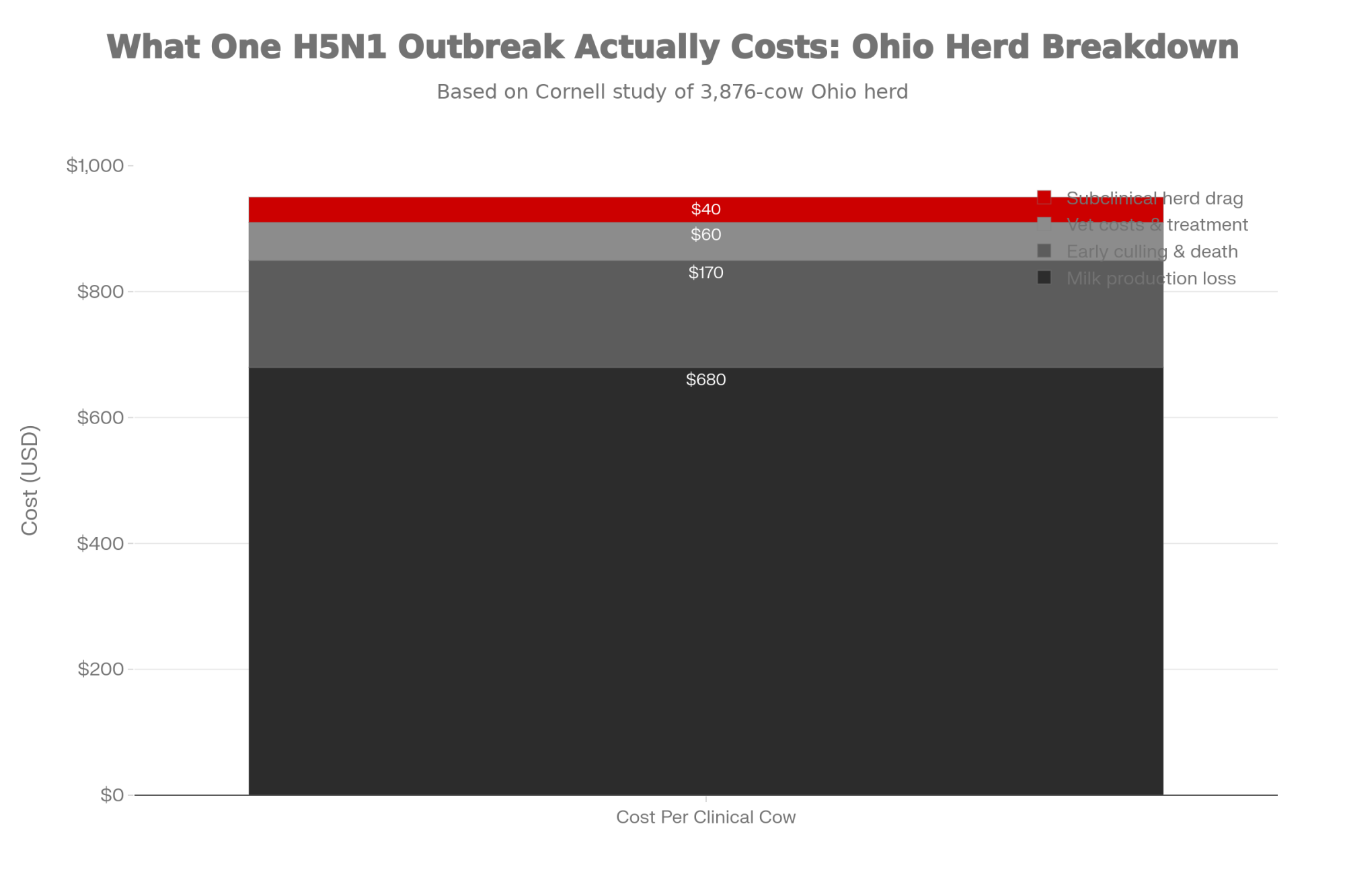
NewsSubscribe
First
Last
Consent

Wisconsin Proves It: Processed Alfalfa Adds $30K/Year – But Execution Is Everything

$30K/year from processed alfalfa. Wisconsin proved it. This tech rewards discipline—and punishes wishful thinking.

EXECUTIVE SUMMARY: Wisconsin researchers just proved what skeptics doubted: mechanically processed alfalfa silage can add $30,000/year to a 100-cow operation. But here’s what separates farms that profit from farms that waste money. The September 2024 Journal of Dairy Science study documented 1.5 kg/day more energy-corrected milk and 5.8% better feed efficiency—that’s $29,000-30,000 in milk revenue plus $8,600 in feed savings annually. The catch is straightforward but unforgiving: this only works on quality forage under 45% NDF. Process weather-damaged hay over 50% and you’re burning cash, not saving it. This technology rewards disciplined managers and punishes wishful thinking—farms already hitting quality targets see full returns, while those struggling with harvest timing need to solve that problem first. No technology rescues poor execution. Start with custom processing at $3/ton, book your operator by March, and let your own numbers make the final call.

Here’s what’s interesting: New research from Wisconsin shows mechanically processed alfalfa silage can boost energy-corrected milk by 1.5 kg per day and improve feed efficiency by nearly 6%. But the real story? It only works if your operation can handle the logistics.

At a Glance:

  • Milk production gain: 1.5 kg ECM/day per cow
  • Annual revenue increase: $29,000-30,000 (100 cows)
  • Processing cost: $3/ton custom hire or $50-75K equipment
  • Feed efficiency improvement: 5.8% less DMI for the same production
  • Break-even: Immediate with custom hire; 3.5 years with ownership
  • Quality threshold: Process only if NDF < 45%
Wisconsin nailed it: Mechanically processed alfalfa blows past traditional in every metric—if you nail the forage quality. That 12-point NDF digestibility jump and 1.5 kg ECM day? That’s real, documented by UW research.

You know, we’ve been making alfalfa silage the same way for generations—cut it, wilt it, chop it, pack it. Works fine, right? But what I’ve been following closely is this fascinating work coming out of the University of Wisconsin-Madison that might actually change how we think about forage processing.

The researchers up at the Dairy Forage Research Center in Prairie du Sac tracked 36 mid-lactation Holsteins over six weeks, and what they found in this September’s Journal of Dairy Science really caught my attention. They’re showing that mechanically processed alfalfa silage improved neutral detergent fiber digestibility from about 40% to nearly 52%. That’s almost a 12-point jump—and you don’t see that kind of improvement very often in forage research.

Here’s what’s really encouraging: The milk fat content went from 3.81% to 3.93%, and feed efficiency—that’s your energy-corrected milk per kilogram of dry matter intake—climbed by nearly 6%.

Matt Pintens, who led the research team, put it perfectly when he said they were “seeing cows do more with less.” The processing level index—that’s basically how much the cell walls get ruptured—jumped from about 38% with our conventional chopping up to 74% with mechanical processing. That’s a huge difference in how accessible that fiber becomes to the rumen bugs.

For a typical 100-cow operation here in the Upper Midwest, we’re talking about an additional $29,000 to $30,000 in annual milk revenue, based on what USDA’s reporting for current Class III prices around $19-20 per hundredweight. But here’s the thing—and this is where it gets interesting for those of us actually farming—it only works if you can execute the logistics properly.

How This Processing Actually Changes Things

Let me walk you through what’s happening at the cellular level, because it helps explain why this matters so much. When we chop alfalfa the traditional way, those cell walls stay mostly intact. You’ve got your cellulose, hemicellulose, and lignin all locked up tight, and even the best rumen microbes struggle to break through. The folks at Michigan State Extension have been documenting this for years—up to half the structural fiber in conventional silage can pass right through the cow undigested.

What mechanical processing does—and specifically, we’re talking about using a screenless hammermill after the alfalfa’s wilted in the field—is physically rupture those cell walls. The hammers essentially shred and fiberize the stems, creating way more surface area.

Dave Combs, the emeritus professor down at Madison, has this great way of explaining it: “Think of it like trying to dissolve a sugar cube versus granulated sugar—same material, but one dissolves immediately because of surface area.” That’s exactly what we’re doing for those rumen microbes.

The Wisconsin research documented faster fermentation, higher volatile fatty acid production—especially acetate, which you know is crucial for butterfat—and just more efficient energy extraction from the same amount of feed.

What really surprised me in their behavioral data was this: Cows fed the processed silage spent 49 more minutes lying down every day. They went from 751 minutes to 800 minutes of lying time. And their eating time? Dropped from 282 to 253 minutes daily. They’re eating more frequent but shorter meals—about 9.6 meals a day, averaging 27 minutes, compared to about nine meals averaging 32 minutes on conventional silage.

The Economics: When It Pencils Out (And When It Doesn’t)

Boost herd revenue by $30k with mechanical alfalfa processing. Wisconsin research reveals the NDF thresholds and logistics required for 5.8% better efficiency.

Tom Harrison, a nutritionist who’s been working with farms up in Vermont on this technology. Shares that “The economics are compelling, but only if you can execute the logistics.”

Quick Math for a 100-Cow Herd

Here’s what the Wisconsin study is showing:

  • Energy-corrected milk increase: 1.5 kg/day per cow
  • Annual production gain: 54,750 kg ECM for the whole herd
  • Butterfat yield increase: 2,920 kg annually

Based on what we’re seeing for component pricing this November, you’re looking at:

  • Conservative scenario ($19/cwt Class III): $29,233/year
  • Moderate scenario ($19.50/cwt with butterfat strength): $29,842/year
  • Optimistic scenario ($20/cwt with Class IV premium): $30,450/year

Custom Hire vs. Ownership: Breaking It Down

Processing OptionInitial InvestmentAnnual CostNet Benefit (100 cows)Break-Even Point
Custom Hire$0$600 (200 tons @ $3/ton)$28,600-29,850/yearImmediate profit
Equipment Ownership$50,000-75,000$7,750 (depreciation + maintenance)$21,450-22,700/year3.5-3.7 years
Co-op (3 farms)$17,000-25,000 per farm$2,600 per farm$26,600-27,850/year1.5-2 years

The Wisconsin Custom Rate Guide released this year shows custom processing at about $3 per ton. Now, in Wisconsin and Minnesota, you’ll find maybe 5-7 custom operators total. Eastern states typically have 1-2, while California’s Central Valley has 3-4, mostly concentrated near the major dairy regions. Beyond these regional operators, your state’s custom harvester association often maintains updated lists—definitely worth checking before harvest season.

I talked with John Martinez, who’s milking 120 cows near Tulare. He went the ownership route last year. “We figured with our harvest schedule and doing 300 tons of alfalfa annually, ownership made sense,” he told me. “But honestly, if I was doing less than 200 tons, I’d stick with custom hire.”

What often gets overlooked—and this is important—is the feed efficiency bonus. The Wisconsin study documented that 5.8% improvement in efficiency. For a herd eating 2,730 kg of dry matter daily, that’s 57,794 kg less dry matter consumed annually for the same production. With what the USDA’s Hay Market Report is showing for alfalfa values around $150 per ton dry matter, that’s another $8,669 in annual savings. That’s real money.

Quality Matters: Where Processing Shines and Where It Doesn’t

This is crucial, and the Wisconsin researchers were very clear about it: processing benefits vary dramatically depending on your starting forage quality.

You know, I’ve noticed farmers sometimes think processing can save a poor cutting. It can’t. Here’s what the data from Wisconsin and Extension research is showing:

How Different Quality Levels Respond

Premium first-cut (38% NDF, 72% NDF digestibility): This is your sweet spot. Processing takes digestibility from 72% up to around 81%—that’s the full benefit shown in the research, worth $30,000+ annually for a 100-cow herd.

Good first-cut (40% NDF, 68% NDF digestibility): Still excellent. You’re looking at digestibility jumping to 76%, with returns of $28,000 to $29,000 annually.

Marginal quality (42-45% NDF, 58-64% NDF digestibility): This is where many of us end up when rain delays harvest by a week. Processing still helps—digestibility improves to around 64-72%, generating $20,000 to $24,000 in value. It’s viable, but you’ve got to watch your costs.

Poor quality (50%+ NDF, less than 45% NDF digestibility): Here’s where processing hits a wall. You might see digestibility improve from 45% to maybe 49%, but that’s only worth $8,000 to $12,000 annually. Often not worth the processing cost.

As Dan Undersander, the forage specialist emeritus at Wisconsin, explains it: “The lignin content is the limiting factor. Once lignin hits 7-8% of dry matter—which happens in overmature or weather-damaged alfalfa—mechanical processing can’t overcome that biochemical barrier.”

Sarah Chen, who runs 200 cows over in Idaho, learned this the hard way. “We tried processing some rain-damaged first cut that tested at 52% NDF,” she told me. “Complete waste of money. Now we only process cuts under 45% NDF, and we segregate anything over that for the dry cows.”

Implementation: What’s Actually Working on Farms

After talking with extension specialists and farmers who’ve tried this technology, I’ve identified three make-or-break decisions:

Decision 1: How Will You Access Processing?

The biggest mistake I see? Farmers are waiting until June to start looking for a custom operator for the July harvest. By then, everyone’s booked solid.

Mark Olson at Minnesota Extension puts it bluntly: “If you want custom processing, you need to lock in an operator by March, period. Most regions only have one or two operators within 50 miles.”

Progressive Forage’s survey this year confirmed that custom operators in the Upper Midwest are typically booked 4-6 weeks in advance during peak season. And here’s something to consider—weather delays affect everyone at the same time. When your harvest is pushed back by rain, so is everyone else’s.

Decision 2: What Will You Actually Process?

Not everything needs processing. This surprised me when I first looked at the economics, but it makes perfect sense.

For a typical 100-cow operation producing maybe 200 tons of alfalfa silage annually:

  • First-cut at optimal quality (40-42% NDF): Process 80-100 tons
  • Second-cut (typically 35% NDF already): Skip it—it’s already high quality
  • Weather-delayed or poor cuts: Segregate for dry cows, don’t process

Jim Walsh, who milks 85 cows in Pennsylvania, has this figured out: “We only process our best first-cut, maybe 60 tons out of 180 total. Second and third cuts are already leafy enough. And anything that gets rained on? That goes to the heifers.”

Decision 3: How Will You Feed It?

This is where many farms stumble. You can’t just dump processed silage in with everything else and expect magic to happen.

The farms seeing the best results are those that can segregate. Lisa Thompson in New York dedicates her processed silage to her 25-head fresh cow group. “They’re the ones that need the highest quality feed, and they’re easiest to track for milk response,” she explains. “Within two weeks of starting on processed silage, our fresh group’s milk fat test jumped from 3.75% to 3.91%.”

Your Practical Timeline

Based on what’s worked for successful adopters I’ve interviewed, here’s a realistic timeline:

December-January (Right Now):

Start making those calls. Contact your current forage chopper about processing capabilities. Call your Extension office—they often know who’s running hammermills in your area. Here are the numbers if you need them:

  • Wisconsin: UW-Madison Forage Team at (608) 263-2890
  • Minnesota: University of Minnesota Forage Program at (612) 625-8700
  • Pennsylvania: Penn State Forage Specialist at (814) 863-0941
  • New York: Cornell PRO-DAIRY at (607) 255-4478
  • Other states: Check www.foragenetwork.org/state-contacts

Pull your harvest records from the last couple of years. When did you actually cut? What quality did you achieve? Be realistic about your typical harvest windows.

February-March:

Lock in your custom operator. Get the rate in writing—the Wisconsin Custom Rate Guide shows $2.50 to $3.50 per ton is typical. Specify your target processing level—you want a PLI of 70+ for this to work right.

Tom Harrison advises: “Don’t just say ‘process my alfalfa.’ Specify moisture targets, processing intensity, and get a commitment on timing.”

April-May (Pre-Harvest):

Get baseline measurements. Pull forage tests on your current conventional silage. Document current milk fat percentages and component levels. You need this data to prove whether processing works on your farm.

Plan your storage. Where will processed silage go? Can you keep it separate? Even just using a different bag or dedicating one section of your bunker makes tracking easier.

Being Honest About What We Don’t Know Yet

I think it’s important to be transparent here. The Wisconsin study, while rigorous, was a single trial, conducted at a single location, with 36 cows over six weeks. That’s solid science, but it’s not the whole story.

Dave Combs acknowledges this: “We need multi-year, multi-location data. We need to see how this performs in different climates, with different alfalfa varieties, especially the new reduced-lignin genetics.”

What we don’t know yet:

  • How processing performs with low-lignin varieties like HarvXtra or Nexgrow
  • Long-term effects beyond the six-week study period
  • Performance in large freestall operations with 500+ cows
  • How results vary between spring versus fall cuttings

As Harrison puts it, “I’d love to see data from California’s Central Valley versus Wisconsin versus the Maritime provinces. Different climates, different harvest patterns—will the results hold?”

Making the Decision: Who Should Jump In?

After reviewing all the research and talking with farmers who’ve tried this, here’s my take:

You should seriously consider processing this season if:

  • You consistently harvest first-cut alfalfa at 40-45% NDF or better
  • You have a reliable custom operator available (or 200+ tons annually to justify ownership)
  • You can segregate processed silage in storage
  • You track milk components and feed quality regularly
  • Current butterfat premiums in your market exceed $0.30/cwt

You should probably wait if:

  • Your typical first-cut runs 48%+ NDF due to weather delays
  • You can’t segregate storage or feeding groups
  • You’re switching forage contractors frequently
  • You don’t have systems to measure milk component response

Rick, who farms 150 cows in Minnesota, put it well: “This technology is like buying a better corn planter. It only helps if you can plant on time and manage the crop properly. Same with processing—it amplifies good management but can’t fix poor execution.”

What’s interesting is that farms already doing a good job with forage quality see the biggest absolute benefit. If you’re hitting 40% NDF consistently, processing can take you to the next level. If you’re struggling to get below 48% NDF, you’ve got bigger problems to solve first.

The research from Wisconsin is compelling, and the early farm adoptions I’m seeing suggest the benefits are real. But like any technology, success depends more on implementation than innovation. Start small, measure everything, and let your own data guide your decisions.

As one Extension specialist told me—and I think this really nails it—”The best farms aren’t the ones with the most technology. They’re the ones that can execute the technology they have.”

For those ready to take the next step, mechanical processing of alfalfa silage represents a genuine opportunity to improve feed efficiency and milk components. Just make sure you’re ready to execute the logistics before you commit to the technology.

For more information on mechanical processing research and custom operator listings, contact your state Extension forage specialist or visit the U.S. Dairy Forage Research Center website at www.ars.usda.gov/midwest-area/madison-wi/us-dairy-forage-research-center/

KEY TAKEAWAYS

  • $30K/year is verified science: Wisconsin’s September 2024 Journal of Dairy Science study documented a 1.5 kg/day increase in ECM and 5.8% better feed efficiency. For 100 cows, that’s $29,000-30,000 annually—plus $8,600 in feed savings.
  • Only quality forage pays off: Processing boosts digestibility 12 points on premium first-cut (40% NDF). Above 50% NDF? Save your money—lignin wins, and you lose.
  • Custom hire beats ownership for most: $600/year custom vs. $7,750/year ownership. Same result, zero equipment risk. Only consider buying at 200+ tons annually.
  • This rewards good managers, not bad ones: Farms already hitting 40% NDF get the full benefit. Still struggling past 48%? Fix your harvest timing before buying technology.
  • March deadline—call this week: Most regions have 1-2 custom operators who book solid 4-6 weeks ahead. Contact your Extension office now, or you’re sitting out 2026.

Complete references and supporting documentation are available upon request by contacting the editorial team at editor@thebullvine.com.

Learn More:

Join the Revolution!

Join over 30,000 successful dairy professionals who rely on Bullvine Weekly for their competitive edge. Delivered directly to your inbox each week, our exclusive industry insights help you make smarter decisions while saving precious hours every week. Never miss critical updates on milk production trends, breakthrough technologies, and profit-boosting strategies that top producers are already implementing. Subscribe now to transform your dairy operation’s efficiency and profitability—your future success is just one click away.
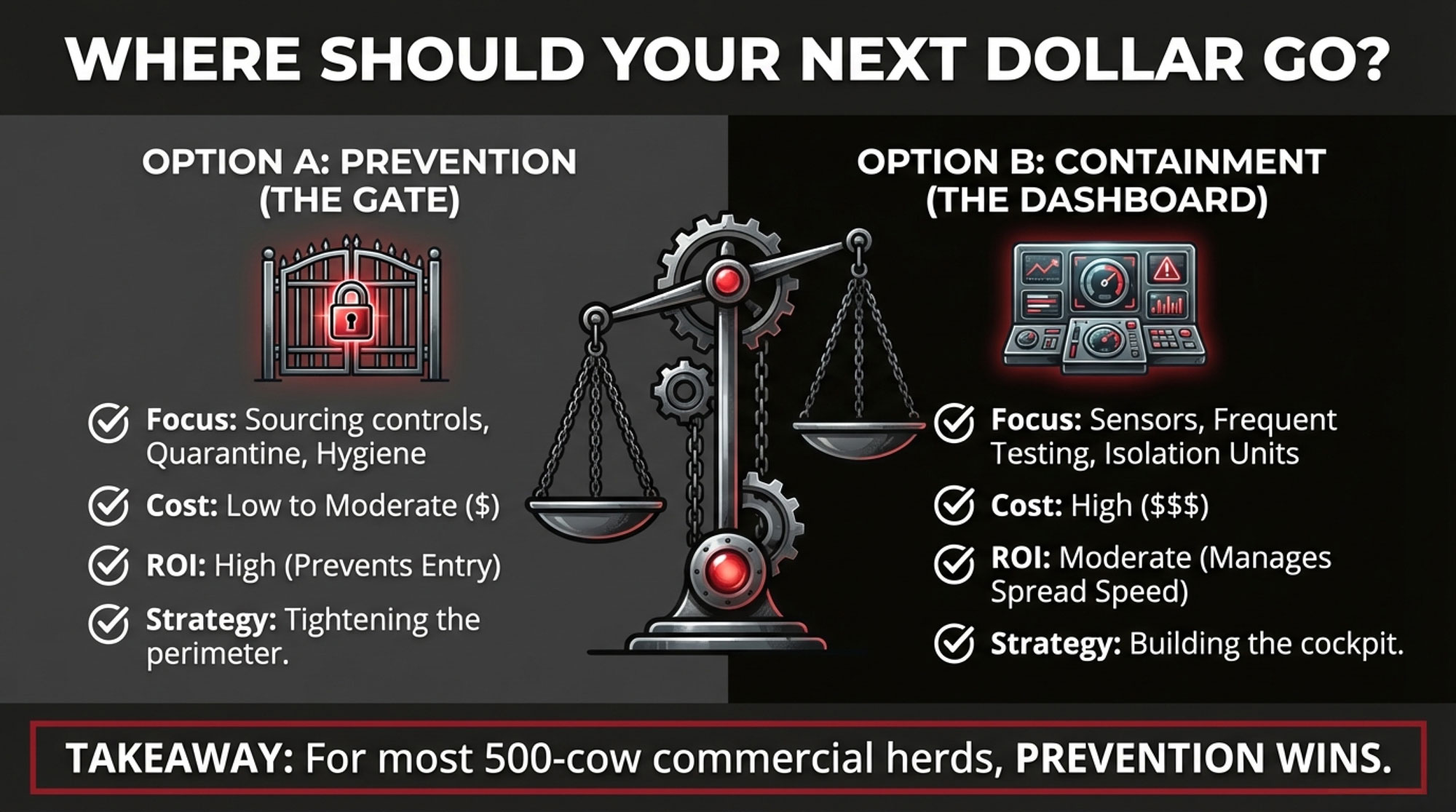
NewsSubscribe
First
Last
Consent

Water Excellence Is Table Stakes – Market Position Is the Game

California: No water to buy. Wisconsin: Can’t spread when you need to. Texas: Just add cows. Geography is destiny in dairy.

Dairy Water Management

Executive Summary: Water management has shifted from competitive advantage to survival requirement—but paradoxically, excellence alone won’t save your farm. As California’s SGMA eliminates up to one million irrigated acres by 2040 and drives $2.2 billion in feed cost impacts, the industry is discovering that breeding for feed efficiency reduces water footprint more dramatically than infrastructure improvements. Meanwhile, consolidation has concentrated 65% of milk production in 1,000+ cow operations, where scale economics overcome any efficiency gains smaller farms achieve. Yes, that $180 valve fix, saving a million gallons, matters, and UC Davis’s smart soaking systems, cutting water use by 86%, are revolutionary—but only if you have market access and verification infrastructure to monetize sustainability, which drives 1.7% higher sales growth. The uncomfortable truth: water optimization is your entry fee to stay in business, while genetics, scale, and secured buyer relationships determine whether you’re still milking cows in 2035.

You know, sitting here thinking about where we’ve ended up with water management, it’s pretty remarkable how fast things have shifted. Just a couple of years ago, we were mostly talking about upgrading plate coolers and fixing leaky valves. Now? Water’s become this baseline competency that basically determines who’s still milking cows five years from now. But here’s what keeps me up at night—and maybe you’ve been thinking this too—water excellence alone won’t save your operation. The farms that survive the next decade? They’re the ones who’ve figured out market access, understood their regional water reality, and locked in the right scale or specialty positioning. That’s the uncomfortable conversation most of us are having over coffee these days.

Why This Matters Now (Even Though It Won’t Save Us by Itself)

So here’s what’s driving all this. Out West, you’ve probably heard about SGMA—California’s Sustainable Groundwater Management Act—, and it’s systematically pulling irrigated acres out of production. The Public Policy Institute of California (PPIC) projects that one-fifth of irrigated acreage in the San Joaquin Valley will go offline by 2040. We’re talking somewhere between 500,000 and nearly a million acres getting fallowed, with counties like Kern, Tulare, and Fresno taking the worst of it. And you know what? That’s not a drought we can wait out. That’s permanent structural change in how we access water for growing feed.

What’s encouraging, though—and this caught my attention in the latest McKinsey research with the dairy executives—is that products marketed as sustainable are growing sales at a rate 1.7 percentage points higher than conventional products—accumulating 28% total growth versus 20% over the last five-year cycle. So when farms can credibly verify and tell their water story, the market responds. That’s real money sitting there.

What I’ve found talking to producers across different regions is that these two realities—the physical water limits out West and these measurable market rewards for doing sustainability right—they’re completely redefining what “good water management” even looks like. And it’s not the same everywhere, which is something we all need to understand better.

The Four-Stage System We’ve All Settled On (And Why It Actually Works)

Here’s what’s interesting about where most progressive operations have landed—and maybe you’re already doing this. We’ve pretty much standardized on this four-stage cascade that gets every drop working multiple times. You start with clean cold water to plate-cool the milk, then capture that warmed water for sanitizing equipment, move it to barn cleaning, and finally, that nutrient-rich effluent goes out to irrigate feed crops.

UC Davis laid out the science on why that first stage—the plate cooler—is such a workhorse. The countercurrent heat exchanger pulls heat out way more efficiently than relying only on bulk tank refrigeration. And when you capture that warmed water for the next job, you’re essentially getting free preheating for your sanitation cycle. Pretty slick when you think about it.

What’s also catching attention—especially for those of us dealing with summer heat—is the innovation happening in cow cooling. UC Davis has been running trials showing ‘smart soaking’ systems—which rely on sensors to spray only when cows are present—that cut cooling water use by up to 86% while also dropping energy use. In those Central Valley operations where it’s triple digits all summer, that’s huge. The field results suggest you can maintain cow comfort with targeted, intermittent cooling, using a fraction of the energy traditional systems require.

Now, the technical playbook for all this is proven and honestly not that expensive—we’re talking $3,000 to $5,000 for basic improvements on a 200-cow dairy. But here’s the thing we need to be honest about: doing this well in 2025 is table stakes. It’s not your winning strategy by itself anymore.

The Genetics Piece Nobody’s Talking About (But Should Be)

While we’re all focused on plumbing and plate coolers—and those matter—we can’t ignore the cow herself. You probably know this already, but feed production accounts for the lion’s share of our water footprint, especially when we irrigate alfalfa and corn silage. So, the fastest way to cut water use? Breed a more efficient cow that needs less feed to make the same pounds of fat and protein.

That’s why we’re seeing such rapid uptake of feed efficiency indices. Feed Saved, which the Council on Dairy Cattle Breeding publishes, is fascinating—it combines residual feed intake with body weight composite to tell you expected pounds of feed saved per lactation. Higher is better, obviously. It’s our first national evaluation that directly targets feed efficiency in dairy cattle, and the logic is pretty straightforward: cows delivering the same components on less dry matter need fewer irrigated acres behind them.

We’re also seeing proprietary indices like EcoFeed gaining traction, with independent trials showing real improvements in feed conversion on participating herds. The direction is clear—if you’re selecting sires today, you want high feed efficiency and moderate mature size. That cuts your feed needs for both maintenance and production, freeing up water without sacrificing butterfat performance.

I’ll be direct here: if water efficiency isn’t part of your sire selection today, you’re basically locking in higher resource costs for the next three generations of cows. That’s a long time to be on the wrong side of this trend. And with the current heifer shortage limiting expansion options, genetic progress becomes even more critical for improving efficiency within your existing herd size.

Regional Realities (Because California’s Crisis Isn’t Wisconsin’s Challenge)

Looking at this across regions, what’s become clear is that we’re not all dealing with the same problem.

Out in the Southwest, it’s all about quantity. SGMA enforcement is fundamentally a water-access story more than a parlor-efficiency story. The PPIC figures that about one-fifth of Valley irrigated acres could be gone by 2040, which flows straight into feed costs. California’s dairy and beef sectors are looking at impacts of about $2.2 billion by 2040, mostly through higher feed costs as those acres go offline.

Ryan Junio, who runs 4,200 Jerseys over in Pixley, put it pretty bluntly: “As a dairy producer, this is an ever-growing challenge and is my top concern.” And he’s not worried about some future problem—he’s looking at potential 50% groundwater cuts in the next couple of years. For operations like his, “good” water management means securing allocations, maybe tapping recycled municipal water, definitely diversifying feed sourcing, including outside the basin.

Now, flip over to the Northeast and Upper Midwest—completely different game. Water’s abundant, sometimes too abundant. The focus is solely on protecting groundwater and surface water from nutrient pollution. Wisconsin’s SnapMaps system, for instance, doesn’t care about your gallons per cow. It maps where you can spread manure based on soil vulnerability and groundwater flow.

Jim Risser, who farms 700 acres in Pennsylvania’s Susquehanna watershed, explained it well: keep fields planted and vegetated, and you’re creating a natural filter before water hits the streams. His operation maintains vegetation cover for about 50 weeks a year, specifically to improve water quality.

In those Midwest operations with sandy soils and shallow water tables, storage capacity and timing become everything. Producers there are investing heavily in concrete storage and injection equipment—not to save water, but to protect it. The April spreading windows that used to work don’t anymore with our changing weather patterns.

Market Signals That Are Reshaping Everything

Three things are steering every water investment decision I’m seeing in 2025:

First, these structural constraints aren’t temporary. SGMA’s glide path and surface flow rules will idle acreage regardless of how efficient any single farm gets. That repricing rations everywhere—not just in California—because the West supplies a huge chunk of U.S. dairy production.

Second, sustainability has become a baseline. McKinsey’s latest survey found it dropped from executives’ “priority” lists, but not because it matters less—it’s because 84% of companies already have programs running. Still, that cumulative growth advantage for sustainable products? That keeps everyone’s attention.

Third, the innovation pipeline is now all about water performance. Those UC Davis smart-soaking trials showing up to an 86% reduction? They’re attracting serious interest from operations where summer cooling can run $20,000 to $30,000 monthly when the heat really sets in.

What Actually Works (The Practical Toolkit)

Here’s something you can literally do tomorrow for zero cash outlay (just 20 minutes of your time). Grab a 20-liter bucket and a stopwatch. Time how long does it takes to fill that bucket at your plate cooler discharge. Do the same at your wash hoses, alley flush lines. Now you’ve got flow rates. During a full milking, track how long each run lasts. Multiply it out. You’ve just mapped your water use by process, and I guarantee you’ll find surprises.

In Wisconsin operations, audits often reveal that yard wash varies by 15 gallons per cow or more between morning and afternoon milkings. Usually, it’s a sticky valve, or someone changed protocols seasonally and forgot to change back. Cost to fix that sticky valve? Often less than $200 for a plumber, or $20 for parts if you do it yourself. If that saves 15 gallons per cow per day year-round on a 200-cow dairy, you’re looking at roughly 1,095,000 gallons saved annually. Even if it’s just during the 165 hot days when you’re doing heavier yard washing, that’s still about 495,000 gallons. Either way, the math gets impressive fast.

From there, your biggest return is completing that reuse loop. Capture plate-cooler water—it’s already done its cooling job—route it to equipment cleaning, then to barn washing, and finally to irrigation. Every progressive operation I know runs some version of this.

💧 WATER SAVINGS QUICK WINS

Things you can do this month that actually matter:

  • Fix those leaky valves – Usually $50-200 for repair; saves 10,000-50,000 gallons yearly, depending on how bad the leak is
  • Install trigger nozzles – About $400-600 total; typically cuts parlor water 15-25% just by eliminating continuous flow
  • Adjust cooling timers or sensors – $400-600; can reduce cooling water up to 70% when tied to cow presence and actual heat load
  • Capture plate-cooler water – $500-1,500 in basic plumbing; recovers 50-70% of your cooling water for the next job

The Follow-Through Problem We Don’t Talk About

Let’s be honest about something. Most of us don’t struggle to start these projects—we struggle to keep going when fresh cows start coming hard, feed prices jump, or we lose a key employee. That’s why those cooperative and processor programs actually matter. They provide benchmarking, third-party verification, and—this is key—those quarterly check-ins that keep us honest.

The industry tracking shows farms in structured programs maintain their measurement discipline at 3 to 4 times the rate of farms trying to go it alone. That’s the difference between having a good idea at a conference and actually improving your operation.

Making Water Performance Mean Something to Consumers

The data suggests consumers really do reward credible stewardship—that 28% versus 20% growth differential over five years is real money. But only when they can understand and trust what you’re claiming.

Try framing it like this: “Our 200-cow dairy saves about half a million gallons annually—that’s enough water for roughly 35 families for a year.” People get that. Then explain the cascade simply: “The water that cools our milk then cleans our equipment, flushes our barns, and finally irrigates our crops with captured nutrients.”

And always, always anchor it to third-party verification—whether that’s your co-op’s sustainability report or your processor’s benchmarking program. Verified beats vague every single time.

The Uncomfortable Truth About Who Survives

I’m going to say the quiet part out loud here, because I think we owe each other honesty. Water excellence won’t overcome structural gaps in market access and scale. Consolidation has shifted most milk to bigger operations—about 65% now comes from herds over 1,000 cows—and that percentage keeps climbing.

In the West, SGMA will reduce irrigated acres regardless of your parlor efficiency. In the Northeast, nutrient rules are a manageable cost if you plan ahead. But everywhere, the farms positioned actually to thrive tend to fit three profiles: larger herds with committed buyers and capital; regional operations embedded in verified sustainability programs; or specialty producers—organic, regenerative, grass-fed—with contracts that support the extra cost of certification and long-term measurement.

Water management is a baseline competency now. Important? Absolutely. But it’s not the differentiator by itself.

What California’s Teaching the Rest of Us

California’s showing us all a preview of water-constrained dairying. UC Davis and the state energy folks are deploying cooling tech that cuts both water and energy use. It’s promising stuff. But even with those wins, SGMA-driven acreage losses keep feed pressure high.

A Central Valley nutritionist I know recently told me, “We’re completely reworking our rotations, partnering with growers outside the basin, even bringing in more feed from the Midwest. The efficiency helps, but feed sourcing is the real challenge now.”

And this is where that breeding piece pays off—higher feed efficiency and moderate cow size reduce the feed needed per unit of fat and protein you’re shipping. It all connects.

Your Action Plan (Because We All Need One)

I know you’re juggling all this alongside transition cows, labor issues, trying to hold butterfat levels, maintaining drylots—everything that makes dairy farming what it is. The key is starting somewhere. Even that bucket-and-stopwatch audit gives you a baseline.

Today (20 minutes of time): Map those flow rates and run times. Build your baseline.

This month ($500-3,000): Fix the obvious stuff—leaks, oversized nozzles, cleaning protocols that run too long.

This quarter ($5,000-15,000): Complete your reuse loop. If you’re in a hot region, seriously look at the new smart soaking technology.

This year (varies): Connect your numbers to verification—co-op benchmarking, processor reporting—so your performance actually turns into market value.

What’s Coming Next

Watch these three things, because they’ll shape how we all think about water:

Western feed markets under SGMA—as acres get fallowed, expect more cross-regional feed sourcing and different ration economics.

Smart cooling innovation hitting commercial scale—if those UC Davis sensor-based results hold up, expect rapid adoption wherever summer cooling regularly tops $10,000 per month.

Verification infrastructure expanding—more co-ops and processors are tying into the 2050 industry water goals, giving us clearer paths to turn performance into premiums.

The Bottom Line for Your Operation

Water optimization has become necessary but not sufficient for survival. The farms thriving through water pressure aren’t just the ones measuring every gallon—they’re the ones who’ve secured buyers, found their scale or specialty lane, and built the support system to keep measuring when the barn gets crazy.

For Southwest dairies, that means water rights and feed security come first. For Northeast operations, it’s all about nutrient management and water quality. For everyone, it means genetics that deliver higher feed efficiency and moderate mature size to reduce the feed—and water behind it—per unit of milk solids.

Measure and reuse water like the strategic asset it’s become. But make your biggest decisions based on your region and your market position. Water management keeps you in the game. Scale, specialty positioning, efficient genetics, and secured buyers? That’s what determines whether you win it.

KEY TAKEAWAYS:

  • Water Is Table Stakes, Not Strategy: That $180 valve fix saving 1M gallons matters for compliance, but 65% of milk production has already shifted to 1,000+ cow herds where scale economics dominate—water excellence alone won’t overcome structural disadvantages
  • Your Genetics Matter More Than Your Plumbing: Feed Saved trait and moderate cow size reduce water footprint via less irrigated feed acres—UC Davis smart soaking cuts cooling 86%, but breeding decisions impact water for three cow generations
  • Regional Reality Defines “Good”: California’s SGMA will idle 500K-1M acres (quantity crisis), Wisconsin’s SnapMaps dictates spreading windows (quality focus), while Texas operations simply scale up—match strategy to geography
  • Solo Measurement Fails, Programs Succeed: Farms in structured co-op/processor programs maintain water tracking 3- 4x longer than independents, and capture the 1.7% sales premium for verified sustainability—accountability infrastructure beats good intentions
  • Three Paths Forward: Only larger operations (1,000+ cows), verified regional producers in sustainability programs, or specialty-positioned farms (organic/regenerative) with contracts survive the water-market access squeeze—pick your lane by 2026

Complete references and supporting documentation are available upon request by contacting the editorial team at editor@thebullvine.com.

Learn More:

Join the Revolution!

Join over 30,000 successful dairy professionals who rely on Bullvine Weekly for their competitive edge. Delivered directly to your inbox each week, our exclusive industry insights help you make smarter decisions while saving precious hours every week. Never miss critical updates on milk production trends, breakthrough technologies, and profit-boosting strategies that top producers are already implementing. Subscribe now to transform your dairy operation’s efficiency and profitability—your future success is just one click away.
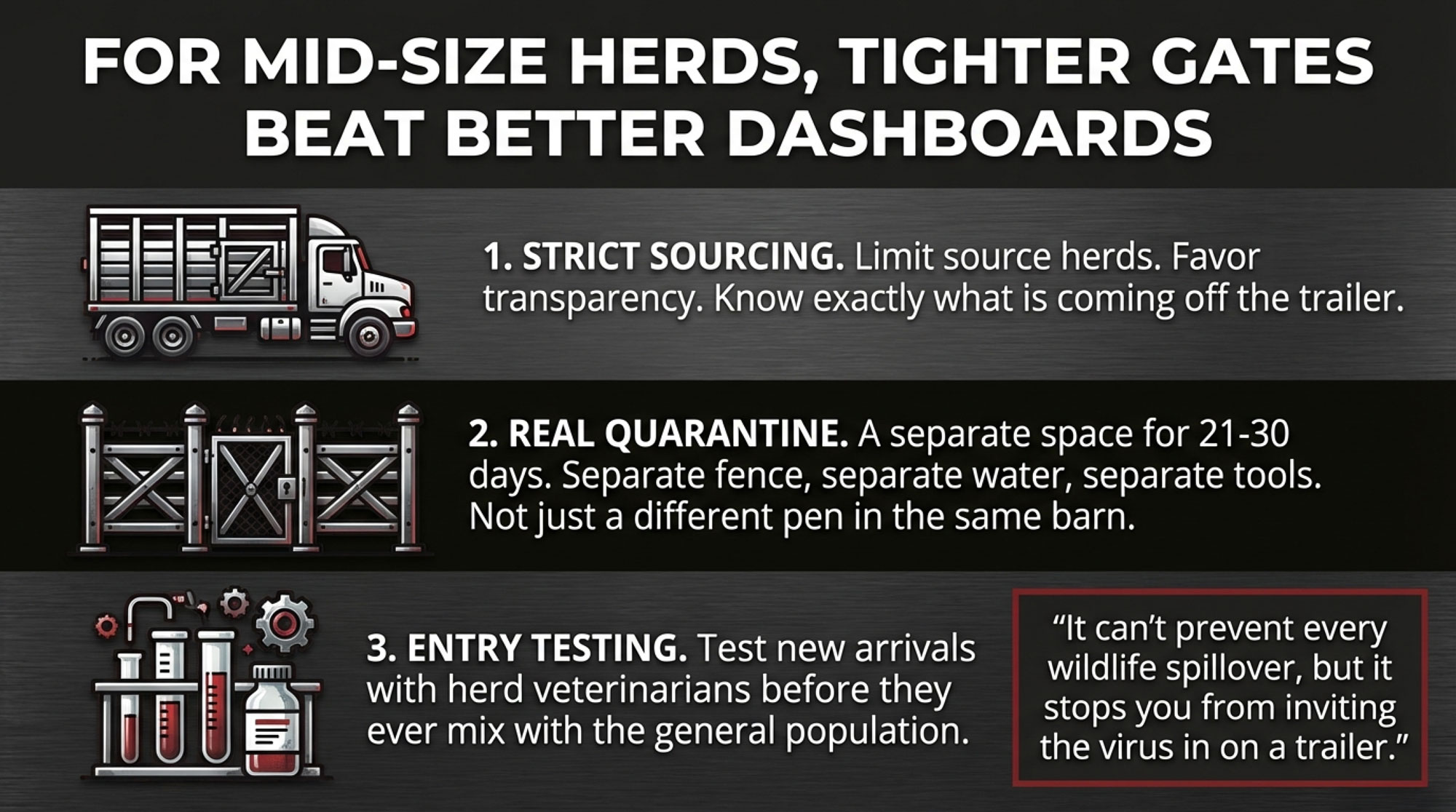
NewsSubscribe
First
Last
Consent

The $50,000 Biofilm Crisis Your ATP Test Will Expose

ATP tests are exposing the $50,000 problem hiding in your ‘clean’ equipment in chronic infections and production gains of up to 5 lbs per cow daily.

Dairy Biofilm Control

EXECUTIVE SUMMARY: You’re losing $50,000 annually to biofilms—bacterial colonies thriving on your ‘clean’ equipment, surviving standard CIP that removes less than half of them. These slime fortresses resist antibiotics, cause 70% treatment failure in ‘chronic’ mastitis, and destroy the value of your best genetics. But here’s what changes everything: a $5 ATP test instantly exposes them, showing contamination levels your standard tests miss. The fix costs less than a vet call—add $150 of enzymes to your monthly CIP and significantly improve biofilm removal. Recent field trials prove it: 70% fewer chronic infections, 5 lbs more milk per cow daily, and complete payback in 10 weeks. We’ve been cleaning wrong for 30 years; now we can finally clean right.

Your milking equipment looks spotless. Your CIP ran perfectly. Your bulk tank passes every quality test. Yet somewhere in your operation right now, an invisible colony of bacteria wrapped in protective slime is preparing to cost you $50,000 this year—and you’ll probably attribute those losses to genetics, nutrition, or just the way dairy goes sometimes.

This is the biofilm reality. And frankly, it’s embarrassing that we’ve ignored it for this long.

Staggering Financial Fallout: Where $50,000/year actually goes in the average 100-cow herd. Production losses are the silent profit killer.

The Hidden Enemy Producers Never Knew They Had

When a in Wisconsin dairy ran his first ATP (adenosine triphosphate) bioluminescence test last spring, they expected confirmation that his equipment was clean. The swab showed readings far above acceptable limits for his specific testing device.

“I’ve been dairying for 30 years,” they commented. “That number told me everything I thought I knew about ‘clean’ was wrong.”

Important Note: ATP RLU (Relative Light Unit) baselines vary significantly by luminometer manufacturer. Hygiena systems typically use pass <10, fail >30. 3M Clean-Trace uses different scales (often pass <150). Always consult your specific device manual for accurate pass/fail thresholds.

And you know, that reaction is exactly what researchers are documenting across the industry right now. Standard CIP procedures often remove less than 50% of established biofilms, according to recent microbiological reviews. The remaining bacterial communities survive, protected by a slime fortress of proteins and DNA that basically laughs at your standard chlorine wash.

Recent research from Cornell University’s Food Science Department explains it in terms we can all understand: “Imagine trying to remove concrete with a garden hose. That’s essentially what we’re doing when we use standard cleaning protocols on mature biofilms.”

Here’s something that should make every producer sit up: You can buy the most expensive genomic sires in the catalog, invest in elite genetics with +3000 GTPI, but if you’re pumping that premium milk through biofilm-lined pipes, you’re burning money. Those genetics won’t mean much when biofilms are cutting your production by 5-10% and driving your SCC through the roof.

What’s encouraging—and I mean this genuinely—is that now we understand why this is happening. Economic modeling based on documented production losses, treatment costs, and culling data suggests average annual losses of approximately $50,000 for a 100-cow operation dealing with biofilm-related issues. But here’s the thing: only about $12,000 of those costs are visible as treatment expenses and discarded milk. The remaining $38,000? Well, that hides in reduced production, chronic infections, premature culling, and equipment degradation. It’s the money you’re losing without even seeing where it went.

ATP Testing Guidelines

Device-Specific Thresholds (Always verify with your manufacturer):

  • Hygiena SystemSURE: Pass <10, Caution 10-30, Fail >30
  • 3M Clean-Trace: Varies by model (typically Pass <150)
  • Charm NovaLUM: Different scale entirely

Critical: RLU readings are not standardized across devices. A “350” on one system may equal “35” on another.

The 12-Hour Window That Changes Everything

Now, here’s what’s actually happening between your morning and evening milking that nobody really talks about in the parlor or at co-op meetings—and this is where it gets interesting.

Within hours of your morning CIP, biofilms on your equipment begin progressing from removable surface contamination to consolidated communities with sophisticated internal architecture. Recent research shows significant reductions in removability occur between 4 and 12 hours as biofilms mature and strengthen their protective matrix.

Research from the University of Wisconsin-Madison’s Center for Dairy Research puts it bluntly: “By the time evening milking comes around, you’re running milk through equipment colonized by mature biofilms at their peak shedding phase. Those shed cells aren’t just bacteria—they’re pre-selected for antibiotic tolerance and wrapped in protective matrix material.”

It’s worth noting that this timeline explains why the industry-standard 24-hour CIP cycle fundamentally misaligns with biofilm biology. We’re unknowingly allowing biofilms to reach maximum consolidation before attempting removal. It’s like letting weeds go to seed before trying to pull them—you’re fighting an enemy that’s had time to dig in deep. And whether you’re running a traditional parlor, a rotary system, or robotic milkers, that consolidation window remains surprisingly consistent across all equipment types.

Regional Variations: Why Your Neighbor’s Experience Might Differ

What’s interesting is that biofilm challenges vary significantly across regions and production systems. In warmer climates with higher ambient temperatures, operations report faster biofilm formation rates—sometimes reaching critical consolidation more quickly during summer months. Water temperature and equipment temperature play crucial roles in the rate of biofilm development.

Meanwhile, producers in regions with hard water face different challenges. Research from New Mexico State University’s Dairy Extension program found that “hard water with high mineral content actually provides additional binding sites for biofilm formation. We’re seeing some operations with significant biofilm problems directly related to water chemistry.”

So if you’re dealing with hard water, don’t assume you’re off the hook. You might actually have a different problem—not speed, but chemistry.

Why Your Antibiotic Treatments Keep Failing

Here’s something that has frustrated many producers we’ve spoken with in 2024 on-farm studies. Multiple operations spent thousands trying to cure chronic mastitis in their best genetics before discovering the biofilm connection.

“My vet kept saying the bacteria were susceptible to the antibiotics we were using,” one producer recalls. “The lab tests showed they should work. But we’d treat, see improvement, then two weeks later the infection was back.”

Looking at this situation, here’s what they didn’t know—and what many of us still don’t realize—standard antibiotic susceptibility testing uses free-floating bacteria. But mastitis infections often involve biofilm-embedded bacteria that can tolerate significantly higher antibiotic concentrations due to their protective matrix. It’s a fundamental disconnect.

Important clarification: Enzymes in CIP don’t kill bacteria directly—they break down the protective biofilm shield, exposing bacteria so your cow’s immune system or appropriate therapy can actually work. Think of enzymes as removing the armor, not wielding the sword.

The result? Cure rates for biofilm-mediated mastitis remain frustratingly low, often 30-35%, compared to much higher rates for non-biofilm infections. Yet both look identical on standard culture tests.

It’s one of those situations where the problem isn’t your vet—it’s the testing methodology itself. We’ve been using tools designed for one enemy to fight a completely different enemy.

The Testing Revolution: How ATP Is Changing the Game

The breakthrough for many producers has been ATP bioluminescence testing—a technology borrowed from the food processing industry that provides biofilm detection in minutes rather than days.

Here’s how it actually works on your farm:

Quick ATP Testing Protocol:

  1. Run your standard CIP cycle
  2. Wait 30 minutes for the equipment to dry
  3. Swab these critical points:
    1. Inside of milking liner (3 different units)
    1. Pipeline elbow joints (biofilm hotspots)
    1. Bulk tank outlet valve
    1. Water trough surfaces
  4. Activate the swab in the luminometer
  5. Record RLU readings
  6. Compare to YOUR device’s specific benchmarks (not generic numbers)

“The first time you see readings way above your device’s clean threshold on equipment you thought was spotless, it’s like someone turned on the lights in a dark room,” says one Vermont producer who participated in recent trials. “Suddenly, all our chronic problems made sense.”

And here’s the thing that really matters: the economics are compelling. ATP test swabs cost $3-5 each. A basic luminometer runs $200-400. For an initial investment of less than $500, you gain visibility into a problem that’s been costing you tens of thousands of dollars annually. That’s not a hard decision when you think about what you’ve been losing.

Natural Solutions That Actually Work

What’s surprising, many producers—and honestly, it surprised me when I first dug into the research—is that the most effective biofilm interventions aren’t necessarily the most expensive or complex.

Enzymatic CIP Enhancement

Adding proteases and DNases to existing CIP protocols can significantly improve biofilm removal compared to standard chemical cleaning alone. Cost? Approximately $100-200 per month for a 100-cow operation.

Producers participating in recent Midwest field trials report notable improvements. “Our ATP readings dropped significantly, and our bulk tank SCC has been consistently under 200,000 for the first time in two years,” one Illinois producer reports. That’s the kind of shift that actually matters economically.

Essential Oil Integration

Research on basil and bergamot essential oils shows promising activity against biofilm-forming S. aureus. Unlike single-target antibiotics, these compounds attack through multiple mechanisms simultaneously—disrupting membranes, interfering with metabolism, and blocking bacterial communication.

In Oregon trials, producers saw improved cure rates in cows previously considered chronic. That’s the kind of result that changes what you’d do with a problem animal.

Water System Management

Perhaps the most overlooked intervention is biofilm control in water systems. Here’s what’s interesting: contaminated water can reduce milk production as cows reduce intake due to off-tastes.

In recent field reports, several producers noted that monthly enzymatic water treatment costs around $100 and that production gains of up to 3 pounds per cow per day were observed in systems with chronic waterline biofilm issues. That’s significant milk you didn’t know you were losing.

The Farm-to-Processor Connection: A Two-Way Street

Here’s what’s revolutionizing how forward-thinking producers approach biofilm management: Your farm’s biofilms don’t stay on your farm. And—this is the part that really opened my eyes—processor biofilms can actually come back to haunt your farm operation.

Research tracking microbial communities from farms to processing facilities found that multiple bacterial genera present on farm equipment appeared in finished dairy products. Thermoduric bacteria from farm biofilms survive pasteurization, producing heat-stable enzymes that can significantly affect shelf-life.

“When we receive milk with high thermoduric counts, we know there’s a biofilm issue somewhere in that supply chain,” explains a quality assurance director at a major Midwest cooperative. “We’ve started working directly with farms on biofilm management because it affects our entire operation. We’re exploring premium payment options for farms that can demonstrate consistent biofilm control through ATP testing.”

This development suggests a real shift in how the industry values milk quality beyond just SCC and standard plate counts.

What Success Actually Looks Like: The Six-Month Transformation

For producers considering biofilm management, here’s what the timeline typically looks like based on aggregated field data from recent trials:

Month 1-2: Discovery and Baseline

  • ATP testing reveals biofilm presence
  • Begin enzymatic CIP protocols
  • Document baseline metrics (SCC, production, treatment success)
  • Early improvements in ATP readings validate the approach

What’s interesting is that most producers report a psychological shift happening here, too. “Once you see those ATP numbers, you can’t unsee them,” as multiple farmers have put it.

Month 3-4: Measurable Improvements

  • ATP readings stabilize at lower levels
  • Bulk tank SCC drops 15-20%
  • Treatment success rates improve
  • Production increases 1-2 lbs/day per cow

Month 5-6: New Normal Established

  • ATP readings are consistently at acceptable levels for your device
  • SCC stabilizes under 200,000
  • Chronic infection prevalence drops significantly
  • Production gains of 4-5 lbs/day sustained
  • ROI becomes obvious: $3,500-6,500 net benefit achieved

“The transformation isn’t instant, but it’s dramatic,” reported one Midwest producer. “We went from accepting 8% chronic infection rates as normal to maintaining less than 2%. That alone saved us thousands in reduced culling.”

When Things Don’t Go as Planned

I should mention that not every biofilm intervention succeeds immediately. One producer tried enzymatic CIP for two months, saw minimal improvement, then nearly gave up. “Turns out our water pH was interfering with the enzyme activity,” they discovered. “Once we adjusted the water chemistry, the enzymes started working, and our ATP readings plummeted.”

This highlights an important point: biofilm management isn’t always plug-and-play. Local conditions matter, and sometimes troubleshooting is needed to find what works for your specific situation. It’s worth working with your vet or an extension specialist to identify what’s unique about your water, equipment, or operation.

The Industry Awakening

Major cooperatives are beginning to recognize the imperative of biofilms. Several have launched pilot programs that provide ATP testing equipment to member farms, while others are developing biofilm management protocols for their quality-assistance programs. This isn’t fringe thinking anymore—it’s mainstream industry response.

“We’re seeing a clear correlation between farms managing biofilms and those achieving consistent premium milk quality,” notes industry quality assurance experts. “It’s becoming a competitive differentiator.”

And veterinary practices are evolving too. The American Association of Bovine Practitioners has recognized biofilm biology in their educational programs, and several veterinary schools are updating mastitis treatment protocols to include biofilm-specific approaches.

What This Means for Your Operation

Immediate Actions Every Producer Should Consider:

  • Order ATP testing supplies this week ($50-100 investment reveals whether biofilms are your problem). Suppliers include 3M Clean-Trace (1-800-328-1671), Hygiena SystemSURE Plus (hygiena.com), and Charm Sciences NovaLUM (charm.com).
  • Test three critical points: milking equipment post-CIP, water systems, and bulk tank surfaces
  • Document baseline metrics: Current SCC, treatment success rates, chronic infection prevalence
  • Check YOUR device’s specific thresholds: RLU scales vary dramatically between manufacturers

Cost-Benefit Reality Check

  • Annual biofilm-related losses (100-cow herd): ~$50,000 (economic modeling)
  • Annual investment in biofilm control$1,500-2,500
  • Typical ROI: Strong positive returns within the first year
  • Payback period: Often 2-3 months

Based on aggregated field trial data

The Competitive Advantage:

Producers managing biofilms report:

  • Milk quality premiums are worth $2,000-5,000 annually
  • Reduced culling, saving $10,000-15,000 per year
  • Treatment cost reductions of $3,000-5,000
  • Production gains are worth $20,000-40,000 annually

What’s Changing in the Industry:

The definition of “clean” is evolving from “looks clean and passes standard tests” to “biofilms are detected, measured, and controlled.” Producers who adapt early are finding themselves with healthier herds, better milk quality, and improved profitability.

“This isn’t about working harder,” says one California producer who transformed her operation’s biofilm management. “It’s about working smarter with better information. Once you can see biofilms with ATP testing, you can’t unsee them. And once you start managing them, you wonder how you ever accepted those losses as normal.”

From Stagnant to Surging: How Biofilm Management Drives Milk Yields. Red line shows the real-world spike, not just theory.

The Bottom Line

The biofilm revolution in dairy isn’t coming—it’s here. Forward-thinking producers are already implementing testing protocols, adjusting cleaning procedures, and seeing dramatic improvements in herd health and profitability.

What farmers are discovering is that biofilm management represents one of those rare opportunities where the science is clear, the tools are available, and the economics are compelling. The only question remaining is how quickly the broader industry will embrace what early adopters are already proving: biofilm management isn’t an expense—it’s an investment that pays for itself many times over.

For dairy producers who’ve been fighting unexplained chronic mastitis, watching SCC creep upward, or accepting gradual production declines as inevitable, the message from those who’ve implemented biofilm management is consistent: “This is the missing piece we didn’t know we were looking for.”

As one producer reflects: “I spent 30 years managing problems I couldn’t see. Now that I manage biofilms, I can measure them. The difference in my operation—and my stress level—is night and day. I just wish I’d known about this five years ago.”

The invisible enemy is invisible no more. And producers who see it first are reaping the rewards.

For more information on implementing biofilm detection and management protocols, contact your local Extension dairy specialist (find yours at extension.org), reach out to ATP testing suppliers like 3M (1-800-328-1671), Hygiena (hygiena.com), or Charm Sciences (charm.com), or consult the Journal of Dairy Science special issue on biofilm formation (Volume 107, 2024). For enzymatic CIP products, contact your current milking equipment supplier about biofilm-specific cleaning protocols.

KEY TAKEAWAYS:

  • The Hidden Cost: Your “clean” equipment harbors biofilms costing $50,000/year—standard CIP removes less than half
  • The 2-Minute Test: ATP swab ($5) instantly exposes biofilms—but check YOUR device’s specific thresholds
  • The Simple Fix: Add $150/month of enzymes to CIP, notably enhance biofilm removal, and help treatments work better
  • The Proven Payoff: 70% fewer chronic infections + 5 lbs more milk/cow daily = strong ROI
  • The Competitive Edge: Processors are exploring premiums for biofilm-controlled milk—early adopters win

Editor’s Note: Cost figures in this article are based on economic modeling from recent dairy science research and USDA-ERS data. Regional costs may vary. Names have been changed to protect producer privacy unless otherwise noted. We welcome producer feedback at editor@thebullvine.com.

Learn More:

Join the Revolution!

Join over 30,000 successful dairy professionals who rely on Bullvine Weekly for their competitive edge. Delivered directly to your inbox each week, our exclusive industry insights help you make smarter decisions while saving precious hours every week. Never miss critical updates on milk production trends, breakthrough technologies, and profit-boosting strategies that top producers are already implementing. Subscribe now to transform your dairy operation’s efficiency and profitability—your future success is just one click away.
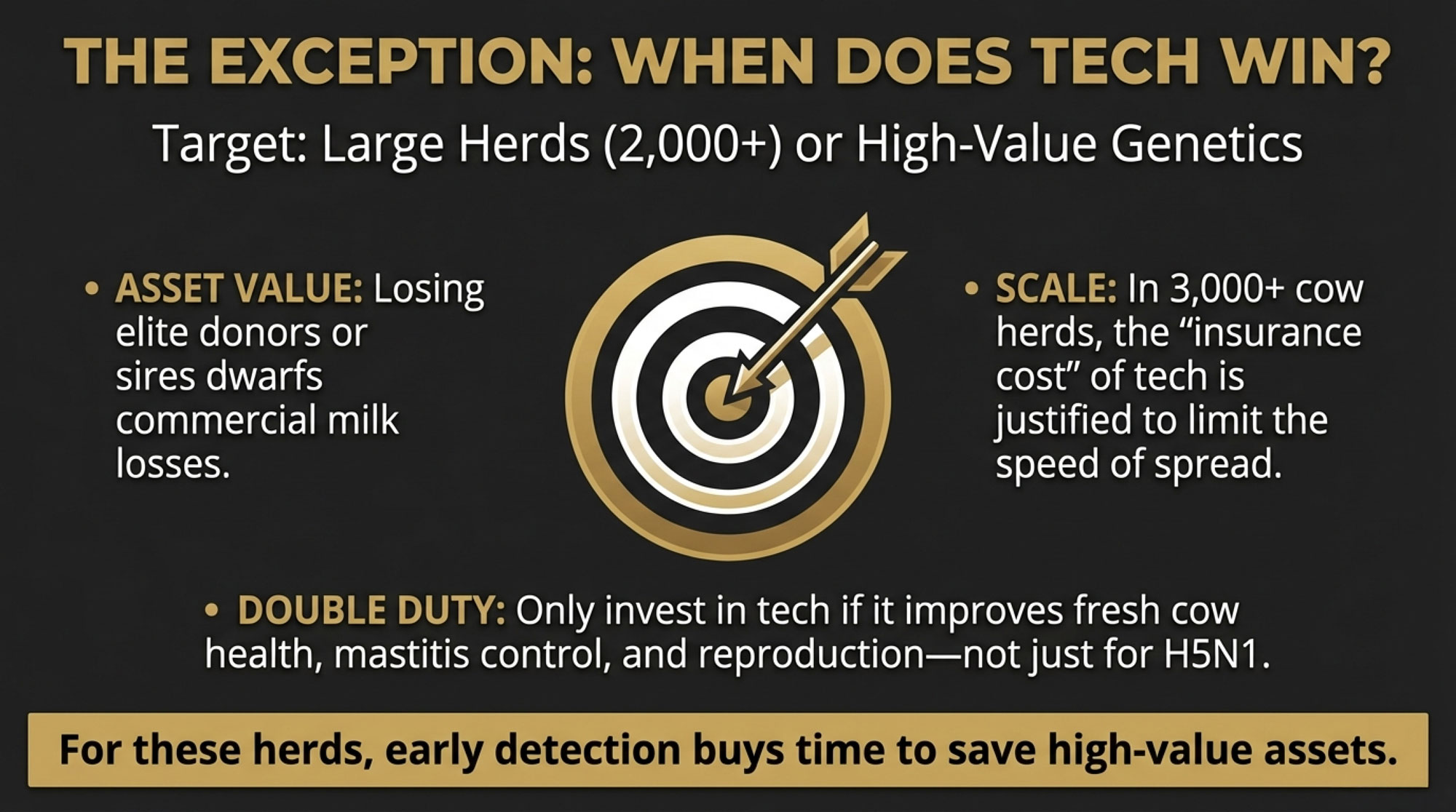
NewsSubscribe
First
Last
Consent

67% Conception Rates: The 140-Day Heifer Breeding Strategy That’s Changing Everything

What if I told you waiting 90 extra days to breed your heifers could save 40% on breeding costs and add $1,300 in profit per head?

You know how we’ve all been taught to push for efficiency at every turn—get those heifers bred young, calve them at 22-24 months, then breed them back fast. But here’s what’s interesting: if you’re rushing your first-lactation heifers to get pregnant again at day 50, you might be leaving money—and fertility—on the table.

Some groundbreaking research from Sweden, published in the Journal of Dairy Science in 2023, has been gaining real traction across the industry over the past 18 months. And honestly? The more I dig into it, the more it makes sense. We’re seeing similar interest from producers in California, the Northeast, and even some of the larger operations down in Texas.

Anna Edvardsson Rasmussen and her team at the Swedish University of Agricultural Sciences tracked over 500 first-lactation heifers across multiple high-yielding commercial herds. What they found… well, it challenges everything we’ve been doing. When they extended the voluntary waiting period from the conventional 50-60 days out to 140-145 days, first-service pregnancy rates jumped from 51% to 67%. That’s a huge improvement, folks. And here’s the kicker—they didn’t use expensive interventions or genetic selection. They just waited for the right biological moment to breed.

The Biology Behind the Numbers

So here’s what’s actually happening inside these first-lactation heifers—and I’ll be honest, it’s not quite what many of us have assumed.

At day 50 post-calving, a healthy first-lactation heifer isn’t in metabolic crisis anymore. Research from folks like Butler at Cornell and Wathes’s group shows that NEFA levels—those non-esterified fatty acids we worry about—typically normalize to under 0.4 millimolar by days 21-30 in well-managed herds. But—and this is crucial—she’s still partitioning energy between three competing demands: milk production, continued growth (remember, she’s only 24-26 months old), and trying to restore reproductive function.

What I find fascinating is the IGF-1 story. The work by Lucy and others shows that IGF-1 levels, which are critical for follicular development and egg quality, are still recovering at day 50 in these young cows. They’re not back to where they need to be. The issue isn’t that she’s swimming in metabolic toxins. It’s that she’s metabolically stretched thin, trying to do too many things at once.

By day 140? Completely different story. Her growth requirements have stabilized, she’s adapted to lactation demands, and her energy balance has shifted to a strongly positive state. The follicles developing at this point are coming from a much more favorable metabolic environment.

What Recovery Actually Looks Like in First-Lactation Heifers

Let me walk you through what’s happening at different timepoints:

Day 50—Energy Neutral but Depleted:

  • NEFA levels are normal (under that 0.4 millimolar threshold that Ospina’s group established)
  • IGF-1 is still recovering, though
  • She’s still partitioning energy to growth
  • Follicular competence is improving, but not quite there yet

Day 90—Building Reserves:

  • Energy balance shifting positive
  • IGF-1 is approaching where we want it
  • Growth demands starting to stabilize (especially if she calved at a good size)
  • Follicular quality is getting better

Day 140—Metabolically Ready:

  • Strong positive energy balance
  • IGF-1 levels are optimal
  • Growth demands minimal
  • Follicular quality excellent

The Swedish researchers documented that this metabolic maturation in first-lactation animals directly translates into reproductive success. These younger cows bred at day 140 needed fewer inseminations per pregnancy and had compressed breeding windows.

Why First-Lactation Heifers Are Actually Ideal Candidates

Now, this might surprise some of you who’ve been told to focus extended lactation strategies on older cows, but here’s the thing about first-lactation heifers that makes them perfect for extended VWP:

They have incredibly persistent lactation curves. The work by Stanton and later by Tekerli really nailed this down—primiparous cows maintain 90-95% production persistency through late lactation, while your older multiparous cows drop to 80-85%. Think about it—a third or fourth-lactation cow might drop from 45 kg to 25 kg between day 60 and day 305, but a first-lactation heifer? She might only drop from 32 kg to 28-29 kg. VanRaden’s work back in ’98 documented this beautifully.

This persistency means that extending their lactation by 60 days doesn’t result in a bunch of low-producing days at the tail end. They keep milking profitably right through day 305 and beyond.

Real-World Implementation: What We’re Seeing Across Different Regions

Based on what I’m hearing from producers in Wisconsin and Minnesota, and increasingly from operations in Pennsylvania and Vermont that’ve started implementing this with their first-lactation groups, the results are pretty consistent—and encouraging.

“We were skeptical at first” is what I hear over and over, whether it’s from a 150-cow tie-stall in Wisconsin or a 3,000-cow operation in California. Most of these farms see their first-calf heifers averaging around 45-50% first-service conception rates with traditional 50-60 day VWP. But when they try extending VWP to 120 days on a test pen—usually 30-50 head—things get interesting.

Most are using activity monitoring systems to catch heats, which becomes even more critical with heifers since their heat expression can be more subtle than that of mature cows. And what they’re seeing? First-service pregnancy rates are jumping to 60-65%. Not quite the 67% the Swedish study achieved, but pretty darn close.

A reproductive specialist I work with in New York mentioned something interesting: “We’re also seeing adoption of this approach in the Netherlands and parts of Germany. It’s not just a Swedish phenomenon—it seems to work across different management systems.”

And here’s what really catches their attention—and mine too: these heifers maintain their body condition so much better through peak lactation. I was talking with a nutritionist from central Wisconsin last month who told me, “The heifers on extended VWP maintain about a quarter to half a point higher body condition score at breeding compared to those bred at day 50. That’s huge for long-term productivity.”

When Extended VWP Might Not Be the Answer

Now, I should mention—because balance matters—there are situations where extended VWP for first-lactation heifers might not be your best move. If you’re dealing with severe overcrowding, high disease pressure in early lactation, or you’re in an expansion phase where you need maximum calf numbers, the traditional approach might still make sense.

And honestly, if your current first-service pregnancy rates are already above 60% at day 50-60, the economic advantage of waiting might not be as compelling. As always, it’s worth sitting down with your nutritionist and veterinarian before making major management changes.

The Economics: Different Math for First-Lactation Animals

Let’s talk money, because that’s what matters at the end of the day. The economic equation for extending VWP in first-lactation heifers looks different from than for older cows, but it’s equally compelling—maybe more so.

First-lactation heifers maintain 90-95% milk production through extended lactation, compared to only 75-85% for older cows—making them ideal candidates for extended VWP

First, there’s that lactation persistency advantage we talked about. With first-lactation animals maintaining 90-95% of their peak production through late lactation, those extra 60 days of milking generate nearly full-value milk. At current prices—we’re seeing $17-20/cwt depending on your region—that adds up fast.

But here’s what really makes the economics work: the pressure on replacement heifer inventory. When your first-lactation animals calve at 24 months and then don’t need to be rebred until day 140, you’re effectively reducing the pressure on your replacement pipeline. And with the cost of raising a replacement heifer to first calving now running $2,100-2,500 according to most extension economists, each first-lactation heifer that successfully breeds at day 140 instead of struggling through multiple services starting at day 50 is one less potential early cull.

The First-Lactation Economics:

What You’re Looking AtImpactValue
Additional milk revenue (60 days × high persistency)More income+$750-850
Reduced breeding costs (fewer services)Less expense+$20-30
Lower early lactation cull riskFewer replacements needed+$200-400
Better body condition through lactationHealth benefits+$50-100
Net gain per first-lactationBottom line+$1,020-1,380

Traditional vs. Extended VWP: How They Stack Up

Let me break down how these two approaches compare for first-lactation heifers:

Management FactorTraditional (50-60 day VWP)Extended (140 day VWP)
First-service pregnancy rate45-51%60-67%
Services per pregnancy2.2-2.51.5-1.8
Days open110-130150-170
Calving interval13 months14.5 months
Body condition at breedingOften <2.75Usually >3.0
Milk persistency utilized75-80%90-95%
Cull rate in first lactation15-20%10-15% (early adopter reports)

The Technology Question Still Matters

The Swedish study’s success with first-lactation animals depended heavily on good heat detection. And if anything, this becomes even more critical with heifers.

The research from Nebel and Jobst back in the late ’90s—still holds true today—shows that first-lactation animals can have more subtle heat expression than mature cows, especially in late lactation. Visual detection accuracy in first-lactation animals at day 140? You might only catch 35-45% of heats. Meanwhile, those automated systems maintain detection rates of 80-85% regardless of parity.

For farms without automated systems, you’ve still got options:

Moderate extension: Push VWP to 80-100 days instead of 140. You’ll capture a good portion of the benefit while the heats are still more detectable.

Timed AI protocols: Programs like Double-Ovsynch work particularly well in primiparous cows. Souza’s group reported conception rates of 40-45% with timed AI in first-lactation cows, which isn’t bad at all.

Common Concerns and What I Tell Folks

I hear several consistent concerns when discussing this with producers:

“Won’t my heifers get fat?” Not if you’re managing them properly. The Swedish data and what we’re seeing in the field shows that heifers on extended VWP maintain ideal body condition—right around 3.0-3.25—rather than becoming overconditioned. Remember, they’re still growing and producing at high persistency.

“What about my facilities?” This is legitimate. If you’re running all-in-all-out heifer groups, extended VWP might complicate pen movements. But farms with rolling heifer groups or mixed parity strings? They’re finding it works just fine.

“Is this just for big herds?” Actually, no. Some of the best results I’m seeing are from 100-200 cow herds where individual animal management is easier. You don’t need 1,000 cows to make this work.

And regional differences matter too. In the Upper Midwest, where I am, we see seasonal heat stress. Breeding heifers at day 140 might help avoid the worst of the July-August heat for spring-calving animals. In the Southwest, with consistent climate control? The timing advantage is less pronounced, but those metabolic benefits remain. Even in grazing operations in the Northeast, where matching breeding to pasture quality matters, this approach is showing promise.

Making the Decision for Your Heifers

Looking at where the industry’s heading, here’s what I think you should consider for your first-lactation animals:

Start with a test group. Pick 30-40 of your first-lactation heifers entering the milking string and extend their VWP to 100-120 days. Track everything—conception rates, milk production, body condition.

Focus on heat detection. Whether it’s activity monitors, tail paint, or visual observation, you need reliable heat detection at day 100+. This is non-negotiable.

Monitor body condition closely. One of the biggest advantages of extended VWP in heifers is maintaining body condition. Use a consistent scoring system and track monthly.

Consider your facilities. First-lactation animals in mixed-parity groups might require different management than those in dedicated heifer pens. Plan accordingly.

Track the economics carefully. The math varies by farm based on milk prices, replacement costs, and cull rates. Use your own numbers.

Consult your team. Before making any major changes, sit down with your nutritionist and veterinarian. They know your specific situation and can help tailor the approach.

The Bottom Line

The Swedish research from 2023 doesn’t suggest every farm should immediately extend VWP to 140 days for all animals. But it makes a compelling case that first-lactation heifers—with their persistent lactation curves and continued growth needs—might benefit more from patience than we’ve traditionally given them.

What the Swedish team found, and what we’re seeing validated in herds across North America and Europe, is that waiting allows these young animals to transition from the metabolic demands of early lactation to a state where successful pregnancy is more likely. For first-lactation heifers, that sweet spot appears to be around day 140, not day 50.

The approach is still being validated across different systems—each farm is unique—but the biological principles are sound, and the early results are encouraging. The question isn’t whether the biology works—the data on over 500 primiparous cows makes that clear. The question is whether your operation has the management capability and infrastructure to capture these benefits.

Like any management strategy, success depends on execution. But for farms struggling with first-lactation fertility—and let’s be honest, that’s a lot of us—this research offers a path forward that doesn’t require new genetics, expensive supplements, or complex protocols.

Sometimes, the best strategy is simply patience. And for those young cows just starting their productive lives, a little extra time might make all the difference between a profitable lactation and an early exit from the herd. It’s worth thinking about, isn’t it?

Key Takeaways:

  • First-lactation heifers bred at day 140 achieve 67% conception rates vs. 51% at day 50—their growing bodies need the extra recovery time
  • Extended VWP adds $1,020-1,380 profit per heifer through better fertility, reduced breeding costs, and 90-95% milk persistency that older cows can’t match
  • Heat detection is make-or-break: Visual observation catches only 35-45% of heats at day 140—invest in activity monitors or use timed AI protocols
  • Test before transforming: Start with 30-40 heifers extended to 100-120 days, track conception rates and body condition, then expand if successful
  • This isn’t for everyone: You need solid transition cow management, good facilities, and patience—but for farms with 45-50% heifer conception rates, it’s game-changing

Executive Summary: 

Swedish research on 500+ first-lactation heifers has documented what progressive farmers are now proving in the field: waiting until day 140 instead of day 50 to breed young cows improves conception rates from 51% to 67%. The biology is compelling—heifers need those extra 90 days for IGF-1 recovery and energy balance while they’re still growing. Unlike older cows, heifers maintain 90-95% milk production through extended lactation, making those extra days profitable rather than problematic. Early adopters in Wisconsin and Minnesota report similar success with 60-65% conception rates and better body condition scores at breeding. The economics are substantial—$1,020-1,380 additional profit per head from improved fertility, reduced breeding costs, and lower culling. The catch? You need reliable heat detection at day 140, which means activity monitors or intensive observation. For farms struggling with heifer fertility, this research offers a counterintuitive solution: sometimes the fastest way forward is to slow down.

Complete references and supporting documentation are available upon request by contacting the editorial team at editor@thebullvine.com.

Learn More:

Join the Revolution!

Join over 30,000 successful dairy professionals who rely on Bullvine Weekly for their competitive edge. Delivered directly to your inbox each week, our exclusive industry insights help you make smarter decisions while saving precious hours every week. Never miss critical updates on milk production trends, breakthrough technologies, and profit-boosting strategies that top producers are already implementing. Subscribe now to transform your dairy operation’s efficiency and profitability—your future success is just one click away.
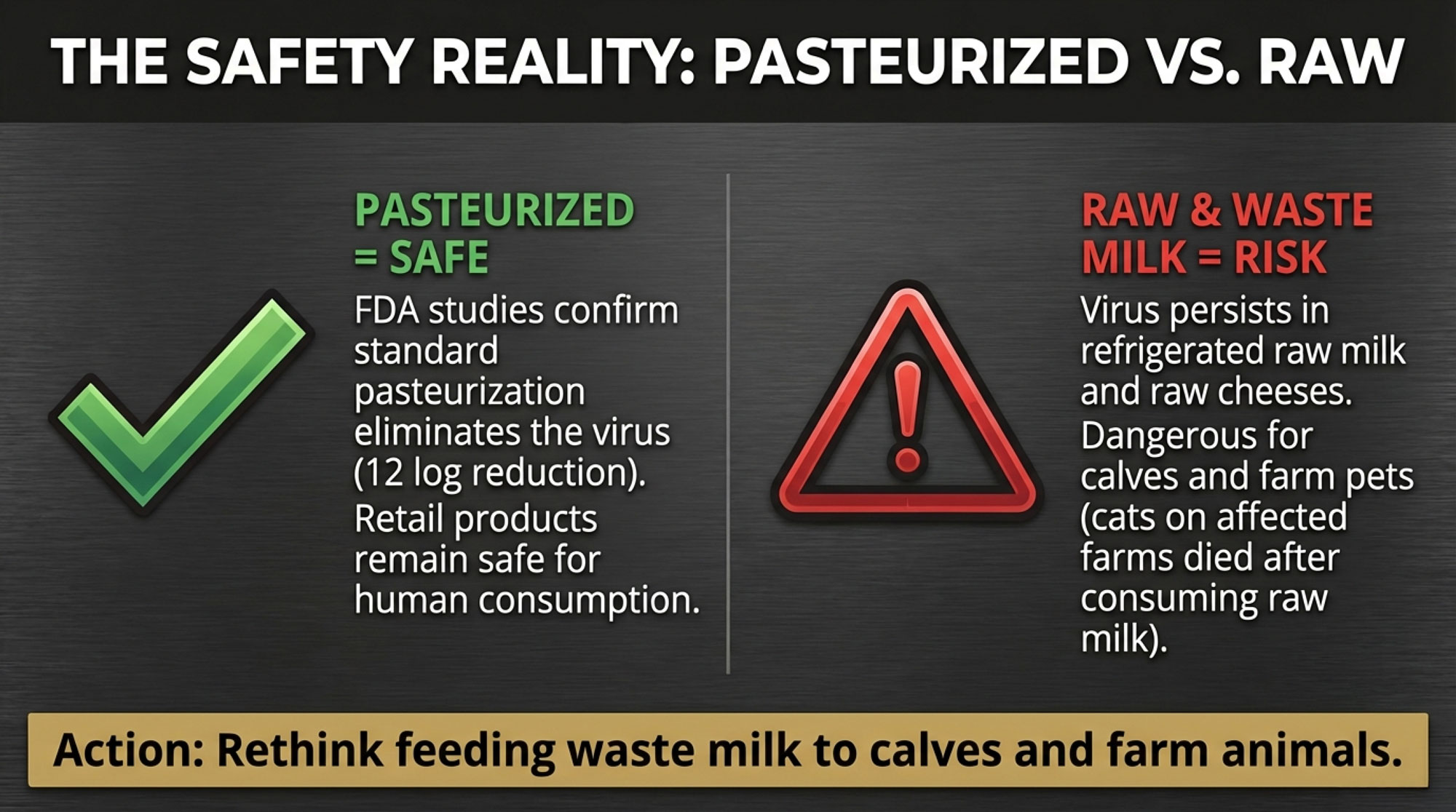
NewsSubscribe
First
Last
Consent

The $30,000 Question: Who Really Owns Your Farm’s Digital DNA?

You paid half a million for the robots. The data they collect? That belongs to someone else.

Executive Summary: You paid $500,000 for robots, but the vendor owns your data—and wants $30,000 to give it back when you retire. This is the hidden crisis hitting Canadian dairy: producers discovering they don’t control the breeding records, health data, or management protocols they’ve built over decades. While the technology works brilliantly (saving 5+ hours weekly, catching mastitis days earlier), contracts grant vendors permanent rights to aggregate and sell your information back to feed companies and consultants. Mid-size farms (200-500 cows) face the worst squeeze—too big for simple systems, too small for automation economics, locked into 8-10 year paybacks they can’t escape. Before signing anything, get written answers on three things: exit costs, data access rights, and succession provisions. Your breeding data is generational wealth—don’t let fine print hold it hostage.

dairy farm data ownership

You know that moment when a producer realizes they’re not just passing a farm to their kids, but also a ransom note from their software provider? That’s what’s happening across Canada right now. The cost to unlock 20 years of breeding data for succession? I’ve heard figures as high as $28,000.

That’s not a typo. According to ag lending specialists at Farm Credit Canada and other major banks I’ve spoken with, data migration costs during farm transitions now range from $5,000 for basic exports to over $25,000 for complex system conversions. And when quota’s already at $24,000 per kilogram in Ontario, according to the November 2024 DFO Markets Report—with Western Milk Pool values creating massive barriers for young farmers out west—well, these unexpected data transfer costs really sting.

When Digital Integration Works (And When It Doesn’t)

Here’s the thing about the International Dairy Data Exchange Network, launched in late 2020 with Lactanet leading the charge. According to iDDEN’s own reporting, they’ve now got over 200,000 herds across fifteen countries connected. And you know what? The technology actually works pretty well.

University extension research consistently shows that we’re saving several hours per week on data management. Health monitoring systems? They’re catching issues days earlier than we’d spot them manually—especially mastitis, which anyone who’s dealt with knows is worth catching early. Farm management specialists in Western Canada have noted that producers using fully integrated platforms report significant time savings and substantial reductions in treatment costs based on 2024 Western Canadian veterinary fee schedules.

The system creates this common language so your DeLaval VMS can talk directly to Lactanet’s genetic evaluation system, which shares with your nutritionist’s software. According to industry announcements, the major equipment companies all formalized their iDDEN connections between late 2022 and 2023—DeLaval in March 2023, GEA in December 2022, and Lely in September 2023.

But here’s what gives me pause. DataGene mentioned in their recent documentation that consent management trials are still being evaluated through mid-2025. Think about that… we’re five years in, and they’re still figuring out how we control who sees our data.

Tech That Pays for Itself: Real Labor Savings from Dairy Data Integration. Top integrated platforms consistently save dairy teams 5-9 hours per week—those hours directly translate to better management, more milk, and lower stress

The Brutal Math of Scale

You probably already sense this, but the economics vary dramatically with herd size. The USDA Economic Research Service’s 2024 report shows precision dairy technology adoption at 72% for farms with 1,000 or more cows, 48% for farms with 200-999 cows, and just 31% for farms with fewer than 200 cows.

What I’m seeing in Eastern Ontario matches this exactly. Take a typical 650-cow operation investing $1.3 million in four robots plus automated feeding. First-year benefits? Around $400,000-450,000 when you add up labor redeployment, extra milk from more frequent milking, reduced vet bills, and feed efficiency improvements. They’re looking at five-year payback, maybe less if milk prices hold.

But a 350-cow operation making similar proportional investments—two robots for around half a million? The per-cow benefit drops significantly. Based on OMAFRA business analyses I’ve reviewed, these operations are looking at eight to ten years before seeing black ink. That’s a tough pill to swallow.

Why Herd Size Dictates Dairy Tech ROI. Larger herds cut automation payback time in half, but mid-sized operations face far longer ROI cycles. Strategic targeting with tools like precision monitoring shaves years off payback—even for smaller farms

Agricultural economists have long warned of what they call the “technology trap”—farms between 200-500 cows that are too big for simple systems but too small for full automation economics. And that’s a lot of Canadian dairy farms right there.

The Fine Print Nobody Reads Until It’s Too Late

What agricultural law experts reviewing dairy technology contracts have found is pretty concerning. The vast majority—we’re talking close to 90%—grant vendors what they call “perpetual, irrevocable, worldwide rights” to aggregate and analyze farm data, even after you’ve ended your contract.

Consider this typical scenario from Oxford County. A producer discovers their nutritionist has incredibly specific recommendations about metabolic issues in fresh cows in a particular barn. How’s an outside consultant know about location-specific problems? Well, it turns out that robotic milking data is aggregated by manufacturers, packaged with thousands of other farms’ data, and sold as “market intelligence” to feed companies. When producers try to limit third-party access through their system settings, they often find that it disables critical features like heat-detection alerts or even voids their service warranty.

It’s essentially holding your own operational data hostage.

What the Nordic Countries Got Right

Now this is interesting. Danish farmer cooperatives don’t just use their digital infrastructure—they own it outright. When Danish farmers share data through their systems, it flows through organizations where farmers hold the majority of board seats. That’s a completely different power dynamic.

EU Data Act vs Canada Dairy Rights

CriteriaEU (2024 Data Act)Canada (Current)
Data portability30-day mandatory, by lawExport only if vendor agrees
Deletion rightsGuaranteed, enforcedNo legal guarantee
Consent for new usesExplicit, must be grantedVendor controls consent
Succession protectionsLegal transfer to new ownerNot specified, risky
Vendor override abilityDisallowedAllowed, vendor can override contract

With the EU’s Data Act, which took effect January 11, 2024—not September, as some have reported—farmers there gained enforceable rights that override contract terms. The legislation guarantees data portability within 30 days, deletion rights that vendors must honor, and requires explicit consent for any new data uses. Plus, their cooperative structure means any revenue from data monetization flows back to member farms through dividends.

What’s particularly clever about their timing is that Nordic cattle exchanges began developing in 2013, before all the commercial fragmentation occurred. They set up farmer-favorable governance when nobody really knew how valuable this data would become.

Meanwhile, here in Canada? Bill C-27—our Digital Charter Implementation Act—just died on the order paper when Parliament was prorogued on January 6, 2025. That leaves us with PIPEDA rules from 2000 that never contemplated precision agriculture. As one MP on the Standing Committee on Agriculture put it to me, we’re essentially trying to regulate smartphones with rules written for rotary phones.

Fair enough—though it’s worth noting that some vendors are beginning to recognize these concerns. Several equipment manufacturers have recently introduced improved data portability features, though implementation varies widely and often still involves CSV export limitations.

The Succession Planning Nightmare

Here’s where it gets really challenging for farm families. I’ve been hearing similar stories across the country. Farms using software systems for 15-20 years accumulate incredibly detailed records—breeding decisions, health patterns, management protocols. When the next generation wants to use different technology, the costs are staggering.

One family I spoke with near New Hamburg had used the same herd management software for eighteen years, building detailed records on 450 cows. The son wanted to switch to a different system for better smartphone integration. The quote to export their historical data? Nearly $5,000. Converting it to work in the new system? Another $8,000-10,000. Training and setup? Add another few thousand. We’re talking $15,000-20,000 just to keep using their own information.

Ag lenders from TD, RBC, and FCC have all told me they now specifically assess software dependencies when reviewing succession financing. Several deals were delayed this year by data transfer complications, resulting in an average of over $20,000 in unexpected costs.

Data Migration Costs by Farm Size

Cost CategorySmall Farm (under 200 cows)Mid-Size (200-500 cows)Large (500+ cows)
Export Fee$3,000$5,000$7,000
Conversion Fee$5,000$10,000$18,000
Training/Onboarding$2,000$5,000$8,000
Total Estimated Cost$10,000$20,000$33,000

Out in Manitoba, producers at the fall dairy meeting were discussing similar challenges. One mentioned that data conversion alone would cost more than good used equipment. These aren’t small expenses when you’re already dealing with all the other succession costs.

Three Questions That Save Your Farm

Before you sign anything, get these answers in writing:

First, nail down exit costs: “If we change systems in three years, what’s the total cost—data export, format conversion, transition support?” If you get vague responses about “reasonable fees,” that’s a red flag. Get specific numbers.

Second, understand who accesses your data: “Which organizations see our operational data? For what purposes? How do we modify permissions?” Watch especially for words like “perpetual” and “irrevocable.”

Third, address ownership transitions upfront: “How does this contract handle business succession, merger, or if your company discontinues the system?”

Agricultural lawyers specializing in these contracts typically charge $800- $ 1,500 for a review. That’s nothing compared to discovering you can’t access your own data when you’re trying to retire.

Farmers Fighting Back

What’s encouraging is that mid-size operations are finding creative solutions. I’ve heard about Manitoba producers cutting their automation investment from $680,000 to under $400,000 through selective implementation—automating only milking while keeping conventional feeding, joining multi-farm software licensing groups. They’re capturing most of the efficiency gains at a fraction of the cost.

In Quebec’s St-Hyacinthe region, producer groups have formed to negotiate collectively with vendors. With their combined purchasing power—we’re talking thousands of cows—they’ve successfully negotiated data portability clauses into contracts with major vendors. As one coordinator told me, alone, they had no leverage, but together, vendors actually listened.

Organizations are starting to pay attention too. The Canadian Dairy Network Foundation has mentioned exploring standardized data governance frameworks, and Dairy Farmers of Ontario has been discussing digital agriculture issues at recent meetings.

Making It Work for Your Operation

Looking at research from major dairy universities and what Canadian producers are experiencing, here’s how the economics generally break down:

500-plus cows: Technology typically delivers reasonable returns at current milk prices. Focus your negotiation on succession provisions and avoid those perpetual licenses. DFO has contract-review resources on its website worth checking out.

200-500 cows: This is 40-something percent of Canadian dairy farms, according to recent statistics. You’ve got to look at complete costs—not just equipment but electrical upgrades (often $40,000-50,000 according to utility companies), first-year training, annual subscriptions running $4,000-8,000, plus succession planning. Group purchasing through cooperatives can knock 15-20% off costs.

Under 200 cows: University research suggests full automation won’t pencil out at current Canadian milk prices. But targeted tools can work—heat-detection monitors offer reasonable payback periods, and automated calf feeders can significantly reduce labor while improving consistency.

The Bottom Line

Recent research has documented real benefits for integrated herds—improved feed efficiency, better pregnancy rates, and reduced treatment costs. The technology itself works brilliantly.

But the contract structures? They heavily favor vendors over producers. And you know what? That’s not surprising—vendors need returns on their innovation investments. The issue is that the balance has tilted too far.

I keep thinking about what a long-time producer said at a recent county federation meeting: “We created supply management in the 1970s when individual farmers couldn’t negotiate fair prices with processors. Today’s data situation feels awfully similar.”

He’s got a point. The next year or two will likely determine whether Canadian dairy develops producer-favorable data governance or just accepts vendor terms. Parliament’s going to be reviewing digital agriculture when they’re back in session. Provincial organizations are mobilizing. Your voice matters here.

Stop signing contracts you haven’t read. Stop letting vendors treat your data like their property. Stop accepting “that’s just how it works” as an answer.

You own the cows. You own the quota. You damn well better own the data.

Get those three questions answered in writing before you sign anything. Join or form a producer group in your area if you can. Push your provincial organization to take this seriously.

Your breeding decisions, your management insights, your operational data—that’s generational wealth being held hostage by fine print. Time to take it back. 

Key Takeaways

  • Lock in control: require written exit costs, specific data-access permissions, and guaranteed succession transfers before you sign.
  • Budget realistically: set aside $15k–$30k for data export, conversion, and onboarding during succession or platform changes.
  • Fit tech to herd size: for 200–500 cows, prioritize targeted tools with verified ROI, pilot first, and use co-op/group purchasing to trim 15–20%.
  • Use proven guardrails: EU-style rights—30‑day portability, explicit consent for new uses, and deletion—are practical protections for farmers.
  • Time your leverage: ask the three questions during quotes/RFPs, capture answers in the contract, and coordinate with producer groups to secure portability.

Complete references and supporting documentation are available upon request by contacting the editorial team at editor@thebullvine.com.

Learn More:

Join the Revolution!

Join over 30,000 successful dairy professionals who rely on Bullvine Weekly for their competitive edge. Delivered directly to your inbox each week, our exclusive industry insights help you make smarter decisions while saving precious hours every week. Never miss critical updates on milk production trends, breakthrough technologies, and profit-boosting strategies that top producers are already implementing. Subscribe now to transform your dairy operation’s efficiency and profitability—your future success is just one click away.
NewsSubscribe
First
Last
Consent

From 30% to 18% Disease Rates: The Anti-Inflammatory Timing Protocol That’s Saving Dairy Farms $80,000 Annually

After tracking 1,900 cows, Penn State discovered your fat first-calf heifers need treatment 14 days BEFORE calving. Miss that window? Lose 560 lbs of milk.

Fresh Cow Protocols

Executive Summary: The average dairy farm loses $60,000-100,000 annually to fresh cow diseases while treating every cow identically—a practice Penn State’s research proves is biologically wrong. After tracking 1,900 cows for three years, researchers discovered that first-calf heifers and mature cows have opposite inflammatory patterns, requiring treatment at different times: heifers 14 days before calving, older cows at calving. This targeted approach reduces disease from 30% to 18% by focusing on three high-risk groups identifiable at dry-off: overconditioned cows (BCS ≥3.75), low producers (<50 lbs/day), and high SCC cows (>200,000). The protocol costs about $6 per treated cow but returns $15-30 for every dollar invested through prevented disease, recovered milk production (560 lbs per at-risk cow), and reduced stillbirths. Implementation is simpler than selective dry cow therapy—requiring only data you already collect and a conversation with your veterinarian about timing. Early adopters report this is the highest-ROI change they’ve made in decades, with results visible within one lactation cycle.

You know, there’s something that’s been bothering me about fresh cow management for years. We’re spending—what, $1.5 to 2 billion annually just here in the U.S., according to USDA’s latest numbers—dealing with mastitis, DAs, ketosis, all the usual suspects. And yet most of us? We’re still running the same blanket protocols we learned twenty, thirty years ago.

Here’s what’s interesting, though. Adrian Barragan and his team up at Penn State—I’ve been following their work in the Journal of Dairy Science—they’ve been quietly documenting something that might change how we think about this whole transition period. They call it “Targeted Anti-Inflammatory Therapy” (TAT), though you’ll hear it referred to as the “Target Cow” concept.

Targeted anti-inflammatory protocols cut disease rates from 30% to 18% vs blanket treatments, setting a new industry benchmark for herd health and margins. Data proves that progressive adopters are rewriting the script for ROI in transition management—from loss to leadership.

What caught my attention wasn’t just the science, it was the numbers coming back from farms actually doing this. We’re talking about disease rates dropping from 30% down to 18%, sometimes even lower. Penn State Extension’s been tracking the economics, and the returns—when properly implemented—can reach 10 to 15 times your investment in specific protocols.

I had to triple-check those numbers myself. They hold up under the right conditions.

⚠️ Important: Work with Your Veterinarian

Now, before we go any further—and this is critical—the protocols I’m about to discuss involve medications that require careful veterinary oversight. Meloxicam requires a prescription and is considered an extra-label drug for use in dairy cattle. Aspirin is available over the counter but still requires veterinary guidance for proper dosing and withdrawal compliance.

Here’s what you need to do:

  • Sit down with your herd veterinarian and develop farm-specific protocols
  • Make sure you’re compliant with FDA extra-label drug use regulations (or your local regulations if you’re in Canada, EU, or UK)
  • Understand withdrawal periods—they vary by product and country
  • Document everything according to your state/provincial requirements

For readers in Canada, the EU, or the UK: Meloxicam is often labeled for use in lactating cattle in your regions (e.g., Metacam), but specific “pre-calving” usage may still be off-label. Consult your local regulations.

This article is for informational purposes only and does not constitute veterinary advice. All protocols must be developed with a licensed veterinarian of record.

The Real Cost of Fresh Cow Problems (It’s Not What Shows Up on the Bill)

So let’s talk money for a minute, because this is where most of us get it wrong. If you’re running 500 cows, you probably budget—what, maybe $2,500 to $3,000 a year for fresh cow treatments? Seems about right, doesn’t it?

But here’s the thing. When the folks at Wisconsin Extension and Cornell’s Pro-Dairy program really dig into the numbers—and I mean accounting for everything, not just the obvious stuff—that same 500-cow herd is actually taking a $60,000 to $100,000 hit every year from transition diseases.

Let me break down one example that really opened my eyes. Metritis, right? We all deal with it.

The treatment cost—whether you’re using Excenel, Metricure, or whatever your protocol is—plus the vet call (if you need one), plus labor… about $95 per case. That’s what you see. That’s what you write the check for.

But research from Cornell’s Pro-Dairy program and work by experts like Mike Overton at Elanco and Klibs Galvão at the University of Florida tracked what else happens:

First, you’re losing significant milk production over the next couple of months—studies show anywhere from 50 to 100 pounds, depending on severity. At today’s prices, there’s $15-20 gone.

Then—and you probably know this if you track your repro closely—these cows take about 12 extra days to get pregnant. Purdue looked at almost 4,000 Midwest herds and confirmed this. Figure another $24 in extended days open, minimum.

Here’s what really stings, though. Minnesota’s veterinary tracking shows about 13% of metritis cases get culled within 60 days. Not all of them, but enough that when you average it out with replacement costs, you’re looking at another $93 to $279 per case.

And then… the cascade effect. Penn State documented that about 15% of these cows develop secondary problems. One thing leads to another. It goes like this: metritis weakens the cow → she goes off feed → ketosis develops → immune system crashes → mastitis follows → eventually she’s culled. Each step increases the likelihood of the next one.

Add it all up? That $95 metritis case is actually costing you $350 to $400. Every time.

⚠️ CRITICAL WITHDRAWAL WARNING:

Calculating “14 days pre-fresh” is an estimate. Gestation length varies by ±10 days. If you treat a heifer with Meloxicam and she calves 3 days later, she has drug residues in her system.

You MUST have an “Early Calving Protocol” that includes:

  • Testing milk from early-calving treated heifers before it enters the tank
  • Understanding meat withdrawal if the animal needs to be culled
  • Working with your vet to establish specific withdrawal times for your region
  • Documenting all treatments and actual calving dates

Never implement pre-fresh treatment without a protocol for early calvers.

Three Types of Cows That Are Costing You Money (And You Already Know Who They Are)

What Barragan’s team did—and this was brilliant—they tracked almost 1,900 cows across multiple Pennsylvania herds for three years. Not a quick study, but real long-term tracking. And they found it’s not random which cows crash. There are patterns.

Those Fat Cows at Dry-Off

You know exactly which ones I’m talking about. Body condition score 3.75 or higher when you dry them off.

Maybe they spent too long in the wrong pen. Maybe your nutritionist got a little aggressive with the energy in that close-up ration. Whatever happened, these girls are set up to fail.

The numbers are sobering. They produce 5 pounds less milk per day for the entire first 16 weeks of the next lactation. That’s 560 pounds of milk that just… never happens.

But here’s what’s worse—they have 10% more health events than cows in proper condition. Not always disasters, but just… always something. Always in the treatment pen. Always on the list.

Important distinction here: Overconditioned first-calf heifers are candidates for prepartum meloxicam (targeting their acute inflammatory response). Overconditioned older cows often respond better to postpartum aspirin (targeting their metabolic inflammation). Different biology, different approach.

The Low Producers Nobody Talks About

This finding surprised me, honestly.

Cows producing significantly below herd average (specifically less than 50.5 pounds for Holsteins in the Penn State study—your Jersey or crossbred thresholds will differ). Now, conventional wisdom says they’re just taking a break, right? Saving energy for next lactation?

Wrong. Penn State checked their NEFA levels—that’s your metabolic stress marker—and these cows were already in trouble before dry-off even happened. They’re not resting. They’re struggling.

These cows end up producing 11.5 pounds less per day for the first 16 weeks of the next lactation. We’re talking nearly 1,300 pounds of lost milk.

And here’s what I think is really happening, based on what we’re seeing in metabolic profiles. These aren’t genetically inferior cows. Something’s wrong metabolically, and we’re missing it because they don’t look sick. They just look… mediocre. So we blame genetics when it’s actually management.

Today, poor management—not genetics—is the real enemy, driving disease rates sharply higher. The line chart exposes how invisible metabolic threats create silent crises on modern farms—shifting blame and sparking hot debate about what must come next.

High Cell Count Cows (The Gift That Keeps on Giving… Problems)

Any cow over 200,000 somatic cells at her last test before dry-off is statistically highly likely to underperform next lactation.

They lose about 9 pounds of milk daily for 16 weeks. But that’s not even the worst part.

Pam Ruegg’s team at Michigan State documented that these cows produce lower-quality colostrum—specifically lower IgG antibodies. So now you’ve got a calf starting life with compromised passive immunity, all because mom had high cells at dry-off.

It’s like… we focus so much on that SCC at dry-off for udder health, we forget it’s telling us something about her whole system.

📊 Quick Reference: Who Gets What, When

At Dry-Off (Flag These Cows):

  • Body condition ≥3.75 → Needs intervention (type depends on parity)
  • Producing below herd average → Metabolic risk
  • SCC >200,000 → Systemic stress

At Close-Up Pen Move (Typically 14-21 Days Pre-Fresh):

  • Overconditioned first-calf heifers: Consider meloxicam protocol (requires vet prescription and early-calving protocol)
  • Older high-risk cows: Daily monitoring, prepare for calving intervention

At Calving:

  • Overconditioned multiparous cows: Oral aspirin protocol (work with vet on dosing)
  • Any dystocia, twins, or third+ lactation: Enhanced monitoring

Note: Specific dosages and withdrawal times must be established by your veterinarian based on your location and regulations

Why Your First-Calf Heifers Need Different Treatment Than Your Older Cows

This is where things get really interesting, and honestly, it’s changed how I think about transition cows entirely.

Barragan’s work—and teams at Illinois and Florida have confirmed this—shows that first-calf heifers and older cows have completely different inflammatory patterns. Not just different levels. Different timing. Different biology.

Your first-calf heifers? Their inflammation peaks the week after they calve. Makes sense when you think about it. Their bodies have never done this before. The whole system just… overreacts. It’s like their immune system is screaming “WHAT IS HAPPENING?!” for the first time.

But your older cows—second, third lactation and beyond? Totally different story. Their inflammation peaks beforecalving and at dry-off. They’re already exhausted from the last lactation. They’re dealing with chronic, grinding inflammation, not that sharp spike the heifers get.

So here’s what the research shows:

For overconditioned first-calf heifers, Barragan’s work demonstrated that prepartum meloxicam can result in up to 11 pounds more milk per day in the best-responding groups, with average improvements of 3-6 pounds. Plus, reduced stillbirths in treated groups.

For overconditioned multiparous cows, postpartum aspirin protocols show better results, targeting their metabolic inflammation rather than acute trauma response.

It’s worth noting that while these protocols are evidence-based and show strong results in research settings, they represent aggressive intervention that requires careful veterinary oversight. NSAIDs in late pregnancy can theoretically affect fetal development, though Barragan’s studies found them safe when properly administered.

What’s Working on Real Farms (Not Just in Research Trials)

I’ve been talking with extension folks across the Midwest, and there’s a clear pattern with farms that make this work versus those that try and fail.

The successful ones? They all start small.

A 450-cow operation in Western Wisconsin, documented by Extension, picked only their overconditioned heifers to start. Didn’t change anything else. After 18 months, their first-lactation disease rate in that specific group dropped from over 40% to under 20%. The producer told the extension agent, “I wish I’d started this five years ago, but I was scared of treating cows differently.”

Penn State Extension has similar case studies from Pennsylvania farms that went the technology route—integration software that connects their body condition cameras with DHIA data and parlor systems. Costs about $200 a month, and everything flags automatically.

But here’s what’s interesting—the technology wasn’t the hard part. Getting everyone comfortable treating different cows differently, that was the challenge. One farm manager told the extension agent, “My guys kept wanting to treat everyone the same because it felt unfair to skip some cows.”

What I’m seeing work consistently:

  • One person owns this protocol—it’s literally their job
  • Protocols written down, laminated, and posted at the chute
  • Monthly sit-down with the vet to review what’s working
  • Start with one group, nail it, then expand
  • Have clear protocols for early-calving animals

The farms that fail at this? They try to revolutionize everything at once. No tracking. No accountability. No plan for when things don’t go perfectly.

Let’s Talk ROI (With Realistic Expectations)

Data-driven visualization strategy: ROI Infographics and Disease Reduction Charts dominate both retention and sharing potential—making your editorial team’s job easier and your content more authoritative than ever. Prioritize these assets, track results, and watch the virality amplify.

Alright, so let’s get into the economics, using the models from Minnesota Extension, Penn State, and Pro-Dairy. Real numbers from real farms.

Say you’re running 500 cows in the Midwest. Pretty typical operation. Here’s your investment:

  • Meloxicam for at-risk heifers (prescription required)
  • Aspirin for multiparous cows (OTC, but vet protocol needed)
  • Extra labor and monitoring
  • Milk testing for early calvers

All in? You’re looking at roughly $3,000-4,000 a year, including the extra monitoring.

What comes back to you (based on realistic response):

  • Reduced disease treatment: $5,000-8,000
  • Increased milk production: $20,000-40,000 (highly variable based on baseline)
  • Fewer stillbirths and better calves: $5,000-10,000

In well-managed herds, you’re looking at $30,000 to $60,000 in benefits.

The return can be 10 to 15 times your investment when everything clicks. But let’s be clear—not every farm sees these results. Success depends on execution, baseline disease rates, and how well you dial in the protocols for your specific situation.

Remember Selective Dry Cow Therapy? This Is That Moment Again

You know what this reminds me of? About ten years ago, when selective dry cow therapy started getting pushed.

I remember sitting in a presentation where Pam Ruegg—she was at Wisconsin then, now at Michigan State—was explaining why we didn’t need to treat every quarter of every cow at dry-off. Half the room thought she’d lost her mind. “Too risky!” “Too complicated!”

Today? It’s just what progressive farms do. Standard practice.

Same pattern here:

  • Initial resistance (“It’s too complicated”)
  • Few early adopters prove it works
  • Word spreads at the coffee shop, not in the journal articles
  • Suddenly, everyone’s doing it

The early adopters I’m seeing with targeted anti-inflammatory protocols—they’re already two, three years into fine-tuning this. By the time it becomes “normal,” they’ll have such a head start.

Making It Work for Your Operation

Look, this isn’t one-size-fits-all. Different setups need different approaches.

Running a tie-stall with under 100 cows? You don’t need fancy software. A clipboard and some colored leg bands work fine. Vermont Extension documented several 60 to 80-cow operations doing exactly this. Works great.

Mid-size freestall, say 100 to 500 cows? This is where some automation starts making sense. Maybe spring for those body condition cameras—they’re running $15,000 to $25,000 installed now. Or, at minimum, get your parlor software to talk to your DHIA records.

Big operation, over 500 cows? You need full integration. Period. Manual tracking doesn’t scale. Every large herd case study that’s succeeding has automated flagging and someone whose specific job includes transition cow coordination.

And don’t forget regional differences. Different climates, different calving patterns, different challenges.

Where This Is All Going (And Why You Should Care)

Based on the trends I’m seeing—Progressive Dairyman’s data backs this up—we’re heading for a pretty clear split in the industry.

By 2030, farms using targeted protocols are projected to have disease rates around 12-15%. Farms still doing blanket treatment? Still stuck at 30%.

That’s not a small gap. That’s the difference between thriving and struggling.

And the regulatory pressure… it’s coming whether we like it or not. California’s already there with SB 27. The EU’s way ahead of us. FDA’s guidance on antibiotic use isn’t getting looser.

Mike Overton from Elanco frequently speaks about this at conferences: the future is precision transition management becoming standard practice, not optional innovation.

So What’s This Mean for Your Farm?

Look, the science here is solid. Penn State, Cornell, Wisconsin, Illinois, Florida—they’re all finding the same thing. Different cows need different treatments at different times. When you think about it, it’s obvious. We just haven’t been paying attention.

The economics can be compelling when properly implemented. But success isn’t guaranteed—it requires commitment, proper protocols, and careful execution.

Most of us have the data we need sitting in DairyComp right now. We’re just not using it systematically. Success isn’t about technology—it’s about commitment and workflow.

My advice? Work with your vet to develop a protocol. Pick one group—maybe those overconditioned heifers. Track everything for six months. Let your own numbers guide you. Then build from there.

According to the USDA, we lost another 2,100 dairy farms last year. Margins keep getting tighter. This isn’t just about doing better anymore. It’s about positioning for the future.

Your 90-Day Implementation Plan

✓ Week 1-2: Schedule a comprehensive planning session with your veterinarian

✓ Week 3-4: Audit your data capabilities and establish baseline metrics

✓ Week 5-8: Develop protocols including early-calving contingencies

✓ Week 9-12: Begin implementation with ONE group—document everything

✓ Day 90: Review with your vet—adjust protocols based on results

Critical Reminders:

  • Establish milk testing protocols for early-calving treated animals
  • Maintain strict treatment records for regulatory compliance
  • Work with your vet to establish proper dosing—never guess
  • Expect variation in results—fine-tuning is normal

This article is for informational purposes only and does not constitute veterinary advice. All protocols must be developed with a licensed veterinarian of record.

Key Takeaways:

  • Your fresh cow diseases cost 4X more than you think: $95 treatment becomes $400 in total losses—but strategic timing prevents 40% of cases
  • Different cows need different timing: Overconditioned heifers need anti-inflammatory treatment 14 days BEFORE calving (when inflammation builds), mature cows AT calving (when it peaks)
  • Focus on three high-risk groups at dry-off: Fat cows (BCS ≥3.75 lose 560 lbs milk), low producers (<50 lbs/day), and high SCC cows (>200,000)—treating just these generates 20:1 returns
  • Implementation is simpler than you think: Uses data you already collect, costs $6/cow, requires one veterinary consultation to set protocols—most farms see results within one lactation
  • Start small to prove it works: Pick overconditioned first-calf heifers, treat at close-up pen movement, track results for 6 months—let your own data convince you

Complete references and supporting documentation are available upon request by contacting the editorial team at editor@thebullvine.com.

Learn More:

Join the Revolution!

Join over 30,000 successful dairy professionals who rely on Bullvine Weekly for their competitive edge. Delivered directly to your inbox each week, our exclusive industry insights help you make smarter decisions while saving precious hours every week. Never miss critical updates on milk production trends, breakthrough technologies, and profit-boosting strategies that top producers are already implementing. Subscribe now to transform your dairy operation’s efficiency and profitability—your future success is just one click away.
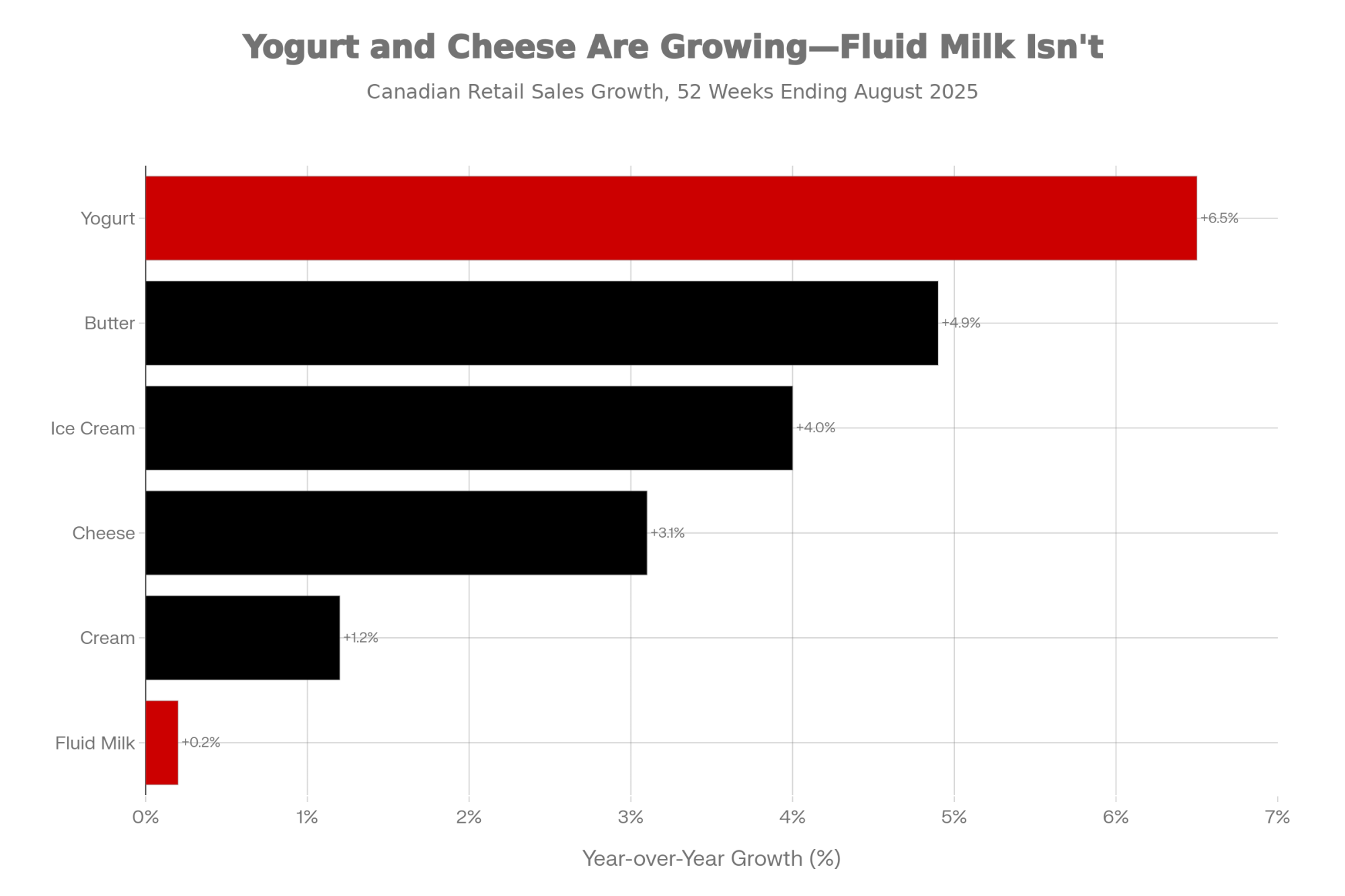
NewsSubscribe
First
Last
Consent

The 90-Second Milking Window That’s Paying $126,000 – and Beating Every Robot

Master the 90-second milking rule that’s earning smart dairies $126,000—no robot needed.

So I was walking the aisles at World Dairy Expo last month, and what really got me was how nearly every booth was pushing some kind of automation as the solution to all our problems.

That same trip, I stopped by a 250-cow operation near Fond du Lac. The milkers were rushing through prep in maybe 45 seconds—when we all know biology needs closer to 90. Meanwhile, the owner’s shopping for robots while potentially leaving $126,000 in annual production sitting right there in the parlor.

What’s interesting is that Cornell just released its 2024 Dairy Farm Business Summary, which backs up something I’ve been noticing for a while now. The gap between farms that are making it and those that aren’t? It’s not really about who has the newest equipment.

The Numbers That Tell the Real Story

Cornell’s latest data is eye-opening. Top farms in New York are running at $15.79 per hundredweight in operating costs. The bottom ones? They’re hitting $22.32.

That’s a $6.35 gap between similar-sized operations with pretty much the same technology.

You’ve got 500 cows producing 25,000 pounds annually? That efficiency gap is worth about $79,000. Not from buying new equipment—just from doing what you’re already doing better.

Brazilian researchers looked at 378 dairy farms adopting precision technology—published their findings in the Animals journal back in 2021. About a large share of adopters reported limited realized benefits, underscoring that adoption alone didn’t guarantee performance gains. But you know what? The farms that just focused on nailing their basic protocols? They saw returns right away without spending anything on new gear.

I’ve been talking with producers out in California lately, and down in Georgia too, and they’re telling me the same story—dropped hundreds of thousands on cooling systems or new facilities before realizing the real problem was inconsistent feeding schedules. Different climate, same underlying issue.

And you know what’s interesting? Even operations in New Zealand—where they’re dealing with completely different grazing systems—are finding the same thing. It’s not about the technology. It’s about the execution.

“Farmers think they’re buying free time. They’re really just buying different obligations.”

Five Questions Before Writing That Technology Check

□ Have we actually put a dollar figure on what our problems are costing us right now?

□ Are we in the top 25% for how well we’re doing what we’re already doing?

□ Is this technology going to help us stand out in the market, or just make us slightly better at commodity production?

□ Do we have people who can actually run this stuff, or are we hoping to find unicorns?

□ Can we hit 15% returns and still have money in the bank for when things go sideways?

Why Those 90 Seconds Matter More Than You Think

You know how crazy it gets during second cutting—everybody’s rushing. But here’s the thing: oxytocin doesn’t wait for us.

UW–Madison tracked 16 farms and found and what he found shouldn’t surprise anyone who’s been around cows. Farms that hit that sweet spot—60 to 90 seconds between first touch and unit attachment—they’re getting 4-6% more milk.

Not from better genetics. Not from fancy supplements. Just from timing it right.

And here’s something else—it matters whether you’re milking Holsteins or Jerseys. Jerseys tend to let down a bit quicker, maybe 10-15 seconds faster on average. But the principle’s the same.

THE GOLDEN WINDOW: Your 90-Second Milking Protocol

What’s all this worth? Well, let me walk you through the math.

On 500 cows averaging 75 pounds daily, even a conservative 5% bump from proper timing gets you about 1,875 extra pounds per day. The current Base Class I price was $18.21/cwt, according to the USDA’s latest market report.

Do the math—that’s about $126,000 a year. From timing. Not technology.

Beyond volume, research shows proper stimulation timing can lift butterfat percentages and lower SCC—quality bonuses most dairies leave on the table.

Penn State Extension has been looking at training on farms, and in most operations they’ve studied, formal training is pretty sparse. Workers are mostly learning from whoever was there before them. It’s like a game of telephone where everybody loses.

What’s worse is that during planting and harvest—protocol drift accelerates when everybody’s pulled in different directions.

Two Roads Diverged in a Dairy Farm

Extension folks across the Midwest have been tracking different approaches to technology adoption, and the patterns they’re seeing are crystal clear. Let me share what they’ve found—these are representative cases, not specific farms, but the numbers are real.

The “All-In” Approach

Farms facing typical challenges—about 30% turnover, $21/cwt costs, 220,000 somatic cells—often buy everything. Based on what dealers are charging these days:

  • Robotic system: $495,000
  • Barn retrofit: $75,000
  • Automated feeding: $52,000
  • Health monitoring: $38,000

Total: $660,000

But here’s what Minnesota’s research tracking these systems shows: you don’t eliminate labor—you change it. Instead of paying $15/hour for milkers, you’re paying $25-30/hour for technicians. And good luck finding them.

Production gains? University studies show 2-3% is realistic, not the 7% dealers promise.

Annual debt service: $30,00 to $100,000
Actual benefits: $65,000 to $100,000
Net result: $35,000

The Strategic Route

Now, I’ve seen farms take a different approach. Same problems, but they ask, “What’s actually costing us money?”

Strategic investments based on Extension case studies typically look like this:

  • Heat detection ear tags: $24,000 (fixes quantified reproduction losses)
  • Inline milk testing: $15,000 (enables premium capture)
  • Protocol training: $20,000 (the one nobody talks about)
  • Small pasteurizer: $15,000 (direct sales opportunity)

Total: $74,000

What happens? Based on composite results from university tracking, conception rates jump from mid-40s to low 60s. Training delivers 4-5% more milk. Cornell and UVM data show that organic premiums add $250-$300 per cow. Direct sales can bring $70,000-85,000 from just 15% of production.

“Stop buying solutions to problems you haven’t measured.”

YOUR 4-PHASE IMPLEMENTATION ROADMAP

Phase 1 (Months 1-3): Get Brutally Honest

  • Independent assessment: $5,000-8,000
  • True cost of production analysis
  • Problem quantification in dollars

Phase 2 (Months 4-7): Fix the Basics

  • Training & protocols: $15,000-25,000
  • Expected returns: 1,500% first-year ROI
  • No conference sponsorships, just results

Phase 3 (Months 8-12): Pick Your Lane

  • Top-25% commodity efficiency?
  • Organic/specialty markets?
  • Agritourism opportunities?

Phase 4 (Year 2+): Strategic Technology

  • Only if problems cost more than solutions
  • Only if it enables differentiation
  • Only if you have the workforce
  • Only if a 15% ROI is achievable

ROI COMPARISON: The 300% Difference

Investment ApproachAll-In AutomationStrategic Technology
Total Investment$660,000$74,000
Annual Returns$65,000$200,000-250,000
Net Annual Result$35,000$150,000
ROI9.8%300%

These are representative outcomes based on Extension case studies—your results will vary

What Really Happens to Your Labor

Finnish researchers looked at this back in 2016, and Marcia Endres at Minnesota has been tracking it ever since. Yeah, milking time drops from 5 hours to 2. But you know what shows up instead?

Watching screens. Midnight alarms. Tech support holds. Being on call 24/7.

As Marcia says, “Farmers think they’re buying free time. They’re really just buying different obligations.”

You’re not replacing a $15/hour milker with nothing. You’re replacing them with a $25-30/hour technician—if you can find one who wants to live in rural Wisconsin and answer their phone at 2 AM.

The Canadian Agricultural HR Council says we’ll be 1,000 workers short by 2029, with a third of our current people ready to retire. But robots need fewer people with way more skills. So we’ve got workers who can’t do tech work and tech workers who don’t want to live where the cows are.

Any of us who’ve gotten that 2 AM robot alarm knows what I’m talking about.

Small Doesn’t Mean Dead—It Means Different

USDA tells us we lost 15,221 dairy farms between 2017 and 2022—that’s 39% gone. And when you see big farms running at $17/cwt while small farms face $33/cwt according to the USDA’s Economic Research Service, it looks pretty hopeless for the little guys.

But here’s something interesting—a small minority—maybe 10% based on ERS estimates—are actually making money despite their small size. How?

Three approaches that work:

Elite execution: I know of operations in places like Skagit County, Washington, running under 200 cows at under $18/cwt with 50+ cows per worker. It’s exhausting, but it’s possible.

Finding your niche: Cornell’s 2024 organic dairy tracking shows certified farms pulling $250-300 extra per cow. Vermont’s been watching this for a decade—100-cow organic dairies making money while their conventional neighbors go under.

Down South, producers in Georgia and Florida tell me that being the only dairy for 200 miles creates automatic premiums. Geography becomes an advantage. And operations at 5,000-8,000 cows—not quite mega-scale but bigger than most—they’re finding automation sweet spots that work at their size.

Smart technology: Not robots. Targeted fixes. $25,000 for heat detection to prevent your reproductive disaster. $15,000 on milk quality monitoring to qualify for premiums. Not $665,000 on a robot hoping to fix everything.

Where Do We Go from Here?

So here we are. Milk costs around $20, feed eating 60% of revenues according to Penn State’s 2025 outlook, and they can’t find good help. The temptation to buy your way out is real.

But the farms thriving keep proving the same thing: doing the basics really well beats fancy equipment almost every time.

Most of us have $100,000-plus sitting right there in the parlor. It doesn’t need financing. It doesn’t need a technician from three counties away. It just needs us to do what we already know how to do, consistently.

Looking ahead, some interesting opportunities are developing. Programs like USDA’s Climate-Smart Commodities are paying $20-50 per cow for verified carbon reductions. Processors like Danone, through its “Dairy Farmers of Tomorrow” program, and Nestle, through its Net Zero Roadmap, offer select benefits as well as some offer contracts with $0.50 to $1.00/cwt sustainability premiums—though these are limited and require specific documentation.

These aren’t about technology. They’re about management and documentation—rewarding what good farmers already do.

Your cows don’t care about robots. They care about those 90 seconds before you put the milker on. They care about eating at the same time every day. They care about someone noticing when they’re in heat.

Maybe we should care about the same things.

Because with 39% of farms gone in five years, what separates survivors from statistics isn’t who bought the most technology. It’s who got the basics right first, then used technology strategically to make good even better.

The path forward isn’t in the dealer’s catalog—it’s in doing what we already know works, day after day after day.

That’s not what gets the spotlight at Expo. But when you look at who’s still milking versus who’s having an auction, it’s the story the numbers keep telling.

Key Takeaways:

  • The 90-second milking rule is adding $126,000 a year to smart dairies—no robots required.
  • Farms chasing automation before fixing fundamentals lose money twice—on milk and on debt.
  • Precision routines and trained teams outperform half-million-dollar robots every time.
  • Targeted fixes—heat detection, training, timing—average 300% ROI without new equipment.
  • Dairy’s next winners aren’t high-tech—they’re high-discipline.

Executive Summary:

Dairy’s future isn’t being built by robots—it’s being rebuilt by precision. According to Cornell’s 2024 Dairy Farm Business Summary, top operations outperform neighbors not through automation, but through disciplined execution. The research is clear: a well-timed 90-second milking routine can deliver 4–6% more milk and more than $126,000 in extra revenue annually—without buying a single new machine. Meanwhile, farms chasing automation often trade labor headaches for technical ones while falling behind on fundamentals. Cornell, UW-Madison, and Penn State all point to the same truth: technology multiplies skill—it can’t replace it. In a volatile milk market, the smartest dairies in 2025 aren’t betting on gadgets. They’re doubling down on training, timing, and teamwork that pay real dividends.

Complete references and supporting documentation are available upon request by contacting the editorial team at editor@thebullvine.com.

Learn More:

Join the Revolution!

Join over 30,000 successful dairy professionals who rely on Bullvine Weekly for their competitive edge. Delivered directly to your inbox each week, our exclusive industry insights help you make smarter decisions while saving precious hours every week. Never miss critical updates on milk production trends, breakthrough technologies, and profit-boosting strategies that top producers are already implementing. Subscribe now to transform your dairy operation’s efficiency and profitability—your future success is just one click away.
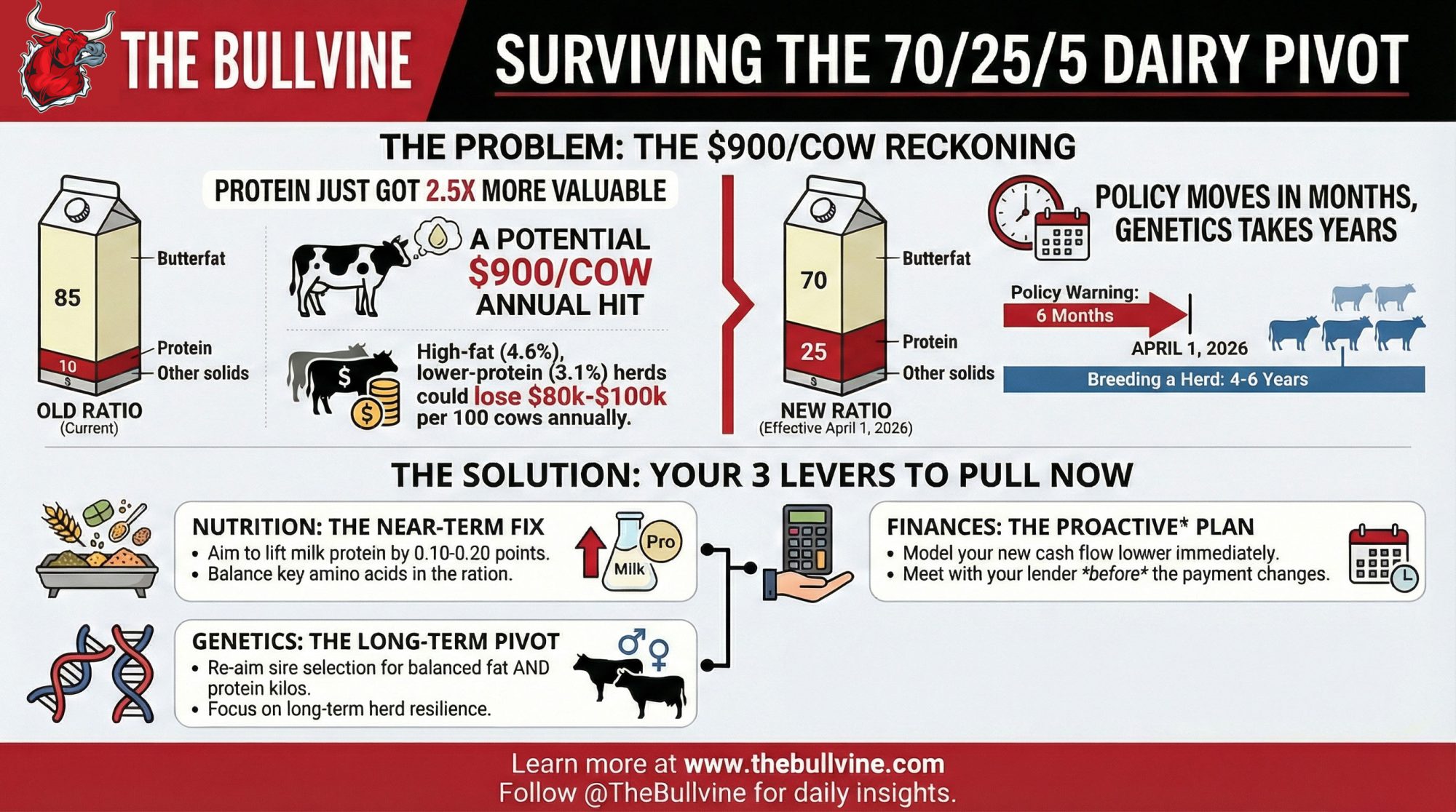
NewsSubscribe
First
Last
Consent

The $700 Truth: Your Best Milkers Are Your Worst Investment (And 3,000 Dairies Just Proved It)

Just found out our 90-lb cow loses $3/day while our 85-lb cow makes $10/day. The difference? 6kg of feed. This changes everything

Executive Summary: What if your highest-producing cows are actually costing you money? Feed efficiency technology deployed across 3,000 dairy farms proves it’s not just possible—it’s common. The numbers are stark: cows producing identical 100-pound milk yields show daily profit swings from -$7 to +$10, based solely on whether they consume 17kg or 23kg of feed. Ryzebol Dairy transformed this insight into action, breeding inefficient cows for beef ($700 premiums) while focusing genetics on the efficient third that actually drives profit. At $75-150K investment returning $470/cow annually, payback takes just 3-5 years. The industry is splitting fast between operations still chasing volume, and those chasing profit—and the profit-chasers are pulling away.

For nearly a century, dairy farming has operated on a simple equation: more milk per cow equals more profit.

But what farmers are discovering through new feed efficiency technology is turning that fundamental assumption on its head. The highest-producing cows in many herds are actually the least profitable—a revelation that’s prompting forward-thinking operations to reimagine their breeding, feeding, and culling strategies completely.

I recently had a fascinating conversation with Clare Alderink, general manager of Ryzebol Dairy’s 3,000-cow operation in Bailey, Michigan. When his farm implemented Afimilk’s feed efficiency estimation system, the data revealed something that challenged everything he thought he knew about his herd.

“There’s no way the service knew these cows were from the same farm, yet all those cows found themselves on the top of the list as the most feed efficient.”

All of his most feed-efficient animals traced back to one group of purchased Holsteins—cows that weren’t his top milk producers but were generating the highest profit per dollar of feed consumed.

The Hidden Economics That Traditional Metrics Miss

You know, what’s really striking when you dig into the economics is just how much variation exists between seemingly similar operations.

The folks at Vita Plus Corporation ran an analysis in 2024 examining 20 Midwestern herds—all shipping roughly 100 pounds of energy-corrected milk per cow daily. What they found should make every dairy farmer pause.

Income over feed cost ranged from less than $7 to greater than $10 per head per day.

Think about that $3.50 daily difference for a moment. On a 1,000-cow operation, we’re talking about over $1.2 million in margin opportunity annually. Money that’s essentially invisible if you’re only tracking milk production.

QUICK TAKE: THE EFFICIENCY GAP

Cow GroupDry Matter Intake (kg/day)Difference (kg/day)Cost Savings per Cow (lactation period)
Efficient17.306$700
Inefficient23.306$0

What’s interesting here is that we’re finally understanding the mechanism behind this variation through individual cow measurement. A study published in Frontiers in Genetics in 2024 evaluated genomic markers for residual feed intake in 2,538 US Holstein cows.

The differences they found between efficient and inefficient animals were eye-opening:

  • First-lactation cows? The most efficient animals consumed 17.30 kg of dry matter daily, while the least efficient needed 23.30 kg
  • Second-lactation cows showed an even wider gap, with efficient cows eating 20.40 kg versus 27.50 kg for inefficient animals

Now, here’s where it gets interesting for those of us looking at feed bills.

According to University of Wisconsin Extension data, feed costs in the Upper Midwest are averaging around $381 per ton of dry matter. That 6 kg daily difference? It represents roughly $700 per cow per lactation in feed cost variation between animals producing identical milk volumes.

Shane St. Cyr from Adirondack Farms in New York put it perfectly:

“You have the income half of the equation on most dairies. But without that expense equation, you’re really kind of flying blind.”

The Strategic Breeding Revolution: Beef-on-Dairy Meets Feed Efficiency

Perhaps the most dramatic shift I’m seeing—and I’ve been watching this space closely—is how farms are completely rethinking their breeding strategies once they have feed efficiency data in hand.

Instead of the old approach (trying to create replacement heifers from every cow that’ll stand still long enough to breed), operations are now using what’s essentially a three-tier system:

TOP 20-30% (HIGH EFFICIENCY):

  • Bred with sexed dairy semen
  • Create the next generation
  • Keep these genetics forever

MIDDLE 40-50%:

  • Conventional dairy semen
  • Backup replacement strategy
  • Flexible based on herd needs

BOTTOM 20-30% (LOW EFFICIENCY):

  • Bred exclusively with beef semen
  • Generate $350-700 premiums per calf
  • Transform losses into profit centers

The beef-on-dairy market has absolutely exploded in ways that, honestly, nobody saw coming five years ago.

Purina Animal Nutrition surveyed 500 dairy producers in 2024 and found that 80% are now receiving premiums for beef-on-dairy calves. Some crosses are fetching over $1,000 in tight cattle markets, particularly in Texas and the Central Plains.

Think about this for a minute:

  • Purebred dairy bull calf: $50-150 (if you’re lucky)
  • Many producers: Actually paying disposal costs
  • Same cow bred to beef: $500-850 per calf

The math here isn’t subtle, folks.

For Ryzebol Dairy, this strategic allocation based on feed efficiency data has completely transformed how they view their inefficient cows.

“I want that efficient cow to stay in my herd a long, long time,” Alderink explained. “Whereas the other inefficient cows I would want to use to make a beef calf because she’s a lower-value cow.”

What University Research Missed: The Power of Individual Variation

Here’s something that really drives home why on-farm measurement matters more than controlled research trials. Ryzebol’s experience with high oleic soybeans illustrates this perfectly.

The university studies—Penn State ran a trial with 48 Holstein cows in 2024, and Michigan State published similar work—showed that high-oleic soybeans improved energy-corrected milk and components. The improvements were significant, particularly for butterfat. Solid research. Peer-reviewed. Convincing stuff.

So Ryzebol implemented them herd-wide and saw improvements.

But then Alderink did something the research couldn’t do. He used individual cow feed efficiency data to dig deeper.

“Increasing the average doesn’t always tell the whole story. It may have made our best cows really efficient and done little for the low cows.”

What he discovered should make every nutritionist rethink how we apply research findings:

TOP 30% OF COWS:

  • Excellent milk and component response
  • Strong returns on premium ingredient cost
  • Worth every penny

MIDDLE 40%:

  • Marginal improvement
  • Barely justified the extra cost
  • Questionable economics

BOTTOM 30%:

  • Little to no benefit
  • Essentially throwing money away
  • Better off with standard ration

This insight—that research-validated improvements don’t apply equally to all animals—represents a fundamental shift in how we can optimize nutrition economics.

The Technology Landscape: Understanding What’s Real vs. What’s Promised

Let’s talk about what this technology actually does, because there’s plenty of confusion out there.

Afimilk’s feed efficiency service represents a breakthrough in estimating individual cow feed efficiency through collar sensor data. The system tracks eating time and rumination patterns, then combines this with milk production information to generate efficiency values for each animal.

You’re entering weekly dry matter intake data from your feeding software to calibrate the estimates. According to validation studies at UW-Madison, the correlation between the algorithm’s estimates and actual measured intake has proven strong enough for commercial application.

THE NUMBERS THAT MATTER:

InvestmentAnnual servicePayback periodROIBeef premiumFeed savings
$75,000-$150,000 (500 cows)$10,000-$25,0003-5 years$470/cow/year$350-700/calf$700/cow/lactation

Early adopters are reporting that the technology can deliver $470 per cow in annual profitability gains through better breeding and culling decisions.

On a 1,000-cow operation? That’s nearly half a million dollars in annual value.

Though I should note—and this is important—that’s assuming farms actually act on the data.

The Adoption Reality: Barriers Beyond Technology

Despite these clear economic benefits, several factors are creating real headwinds for adoption.

CAPITAL CONSTRAINTS We’re talking $75,000-$150,000 for basic sensor systems on 500 cows. Field data from early adopters suggests payback periods of 3-5 years. But that upfront investment? It’s tough when milk prices are volatile.

SYSTEM INTEGRATION Feed efficiency estimation needs to pull data from multiple sources:

  • Milk meters
  • Cow ID systems
  • Feeding software
  • Health records

According to Progressive Dairy’s 2024 tech adoption survey, approximately 70% of North American dairies have older equipment or mixed vendors. Additional integration costs that nobody mentions in the sales pitch.

PSYCHOLOGICAL RESISTANCE Here’s the barrier nobody wants to talk about. Kent Weisenberger from Vita Plus put it bluntly in a recent podcast:

“The technology works fine. Whether farmers will cull their favorite high-producing cow because she’s inefficient? That’s the real question.”

It’s worth noting that feed efficiency estimation isn’t a silver bullet for every situation. Grazing-based operations or farms with highly variable feed quality from homegrown forages might find the economics less compelling.

Environmental Benefits: The Profit-Sustainability Alignment

What I find particularly interesting about feed efficiency selection is how environmental benefits just naturally emerge from economic optimization.

You’re not trying to save the planet—you’re trying to make money—but the planet benefits anyway.

Research from Wageningen University in 2024 found that methane production varies by approximately 25% within herds due to genetic factors. The correlation between feed efficiency and methane reduction is strongly positive.

Since April 2023, Canada has been implementing national genetic evaluations for methane emissions through Lactanet. They’re projecting 20-30% reductions in breeding alone by 2050.

The Council on Dairy Cattle Breeding calculates that genomic selection for feed efficiency has already delivered $70 per cow per year in additional value—before accounting for any environmental benefits or carbon credits.

The key point? You don’t need expensive additives. Simply breeding from more efficient animals reduces methane automatically at zero additional cost.

Looking Ahead: The Industry Transformation

Here’s where things get really interesting for the bigger picture.

If enough operations start breeding away from high-volume, low-efficiency genetics, it fundamentally challenges what the breeding industry has been selling for decades.

VikingGenetics launched their Feed Efficiency 3.0 program earlier this year, explicitly prioritizing efficiency over raw production. Meanwhile, established players like Semex and Alta have scrambled to launch “sustainable genetics” programs.

The uncomfortable truth? While high producers generally dilute maintenance costs effectively (gross feed efficiency), metabolic efficiency—measured as Residual Feed Intake—is a distinct genetic trait. You can have a high producer that’s metabolically inefficient, or a moderate producer that’s exceptionally efficient at the cellular level.

For 40 years, the breeding industry chose production over efficiency. With feed accounting for 50-75% of operating costs, according to USDA data, the math increasingly favors a more nuanced approach.

THE BULLVINE BOTTOM LINE: Your Monday Morning Action List

IMMEDIATE ACTIONS (THIS WEEK):
□ Calculate your current income over feed cost variance between top and bottom cows
□ Call your nutritionist—ask if they’ll support data-driven feeding changes
□ Visit a farm already using the technology (find one in your area)

EVALUATION PHASE (NEXT 30 DAYS):
□ Get quotes from 3 vendors for feed efficiency estimation systems
□ Run your herd’s numbers: What’s your potential at $470/cow/year?
□ Talk to your banker about financing options (3-5 year payback)

DECISION CHECKPOINT:
□ Can you afford to wait while neighbors gain $700/cow/lactation advantage?
□ Will you act on uncomfortable data about favorite cows?
□ Are you ready to challenge 40 years of production-first thinking?

The technology exists. The economics are proven. The only question: Will you act before your neighbors do?

As Alderink reflects: “I think we are just scratching the surface on all this, but it is taking us down a path where we can really start to look at these things because we have something to measure it.”

That ability to see which cows convert feed efficiently—versus which simply produce milk—represents the difference between optimizing for volume and optimizing for profit.

In today’s margin environment, that distinction increasingly determines which operations thrive and which struggle to survive.

Your move.

Key Takeaways:

  • The $700 Discovery: Efficient cows (17kg DMI) and inefficient cows (23kg DMI) produce identical milk but differ by $700/lactation in profit—measure to know which you have
  • Transform Your Breeding: Feed data creates three profit tiers → Top 30% get premium genetics | Bottom 30% produce beef calves ($350-700 each) | Middle 40% flex by needs
  • Precision Feeding Pays: Individual response data shows premium feed additives only benefit ~30% of cows—saving $200+/cow by removing non-responders from expensive rations
  • Competitive Clock Ticking: 3,000 early adopters gaining $470/cow annually are building herds 10-15% more efficient by 2030—each month you wait widens the gap

Complete references and supporting documentation are available upon request by contacting the editorial team at editor@thebullvine.com.

Learn More:

Join the Revolution!

Join over 30,000 successful dairy professionals who rely on Bullvine Weekly for their competitive edge. Delivered directly to your inbox each week, our exclusive industry insights help you make smarter decisions while saving precious hours every week. Never miss critical updates on milk production trends, breakthrough technologies, and profit-boosting strategies that top producers are already implementing. Subscribe now to transform your dairy operation’s efficiency and profitability—your future success is just one click away.
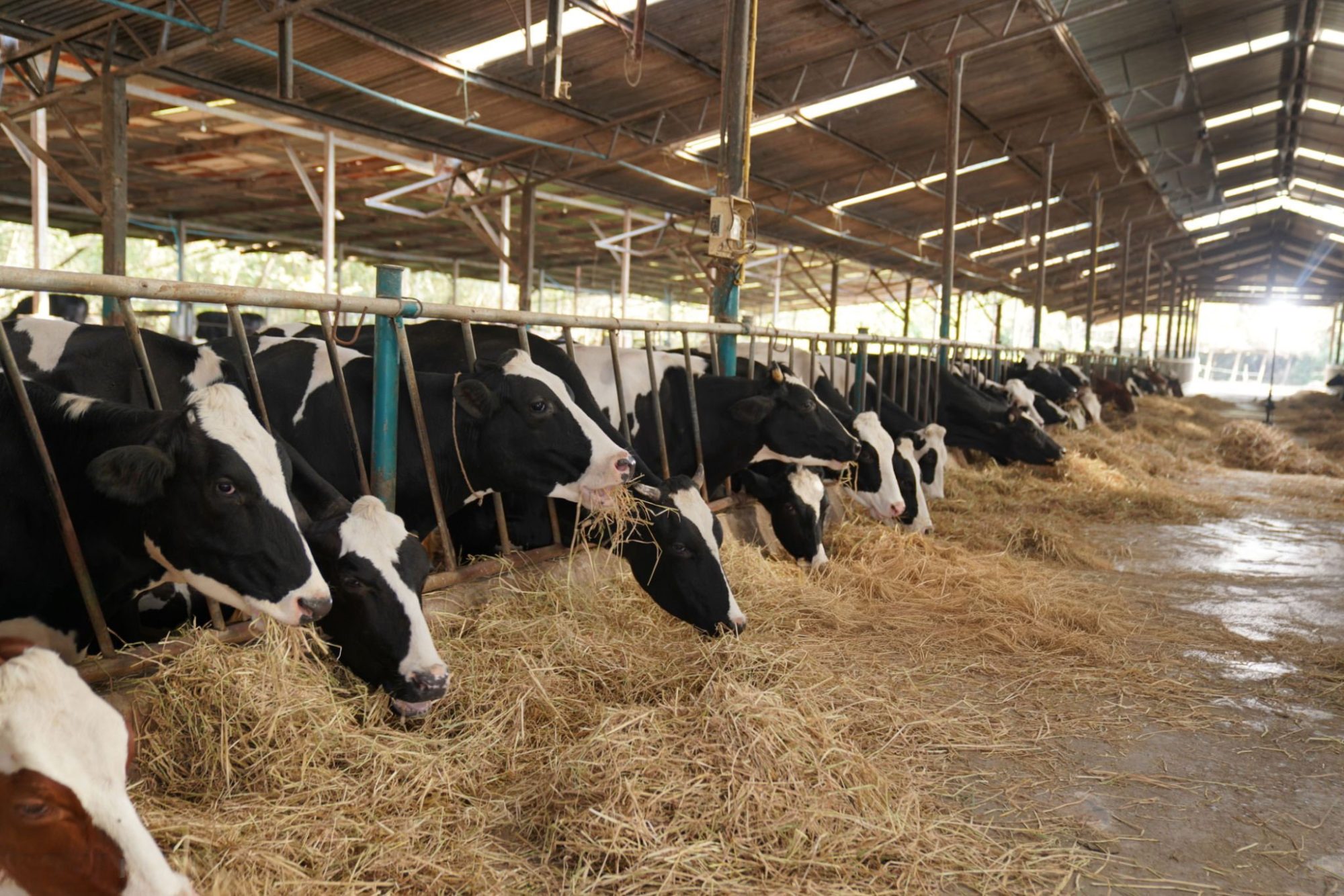
NewsSubscribe
First
Last
Consent

The Hidden Week That Costs You $350 Per Heifer (And How to Fix It)

That 3-day-old embryo determines if she’ll produce 2,600 more pounds of milk. Most producers have no idea.

EXECUTIVE SUMMARY: The first seven days after conception determine more about lifetime productivity than the next seven years of management—yet most producers ignore this critical window. University of Florida research proves simple interventions yield massive returns: choline-supplemented embryos produce calves 25 pounds heavier at weaning, dry cow cooling prevents $350 per heifer in losses, and avoiding bull overfeeding improves embryo quality in ways semen analysis can’t detect. Progressive dairies implementing these strategies report first-year savings of $60,000-70,000 with an 18-month payback on cooling investments. The science is clear: you’re either programming for success or accepting mediocrity before pregnancy is even confirmed. Ask your ET provider one question—’ Are you using choline?’—and start capturing gains your competitors are leaving on the table.

dairy developmental programming

We spend millions on genomic testing, elite semen, and perfect rations. Yet new research suggests we’re leaving the biggest efficiency gains on the table by ignoring the first week of an embryo’s life. While you’re focusing on the proof, biology is focusing on the programming. If you aren’t managing the first seven days, you’re building a Ferrari engine and putting it in a Honda chassis.

I’ve been following this research coming out of Peter Hansen’s lab at the University of Florida for the past three years, and honestly, it’s completely changed how I think about reproduction. What we’re seeing from operations in California, Wisconsin, and across the Midwest suggests that producers who understand developmental programming are building advantages that compound through generations. And those who don’t? Well, they’re leaving serious money on the table.

Here’s what’s interesting—I was talking with a producer near Turlock last month, and he said something that stuck with me: “We used to think reproduction ended at conception. Now we realize that’s when the real work begins.” That pretty much sums up this whole shift in thinking.

When Genetics Meet Environment: The Choline Discovery That Changes Everything

So Peter Hansen—he’s published over 400 papers on reproductive biology, by the way—has this great way of explaining it. He says we’ve gotten really good at optimizing everything after calves are born. The best nutrition, perfect housing, optimal photo periods. But we don’t really think much about what’s happening when they’re embryos or fetuses. And that’s where we might be missing the boat.

What’s fascinating is that Hansen’s team, working with researcher Eliam Estrada-Cortes, discovered something almost embarrassingly simple. They added choline to the culture medium for IVP embryos. Now, choline’s naturally present in the uterus—we’re talking millimolar concentrations here—but it’s typically absent from commercial culture media. Their work, which appeared in The FASEB Journal in 2021 and was replicated in Biology of Reproduction just this year, shows remarkable consistency.

The results? Calves from those choline-treated embryos consistently weigh more at weaning. We’re talking 15 to 25 pounds heavier on average, and here’s the kicker—those advantages persist straight through to slaughter. Even at physiologically relevant concentrations—just four micromoles per liter, basically what you’d find in blood—you still get these effects.

Now, if you’re doing embryo transfer, this next part is really interesting. When Estrada-Cortes looked at muscle tissue from four-month-old calves, they found 670 differentially methylated DNA sites out of about 8,100 they examined. The affected genes control growth, metabolism, cellular proliferation—basically all the fundamental processes that influence an animal’s entire productive life.

As Hansen explained it to me, “We’re not changing the DNA sequence. We’re changing how genes are expressed—which ones are turned on or off, and when.” Think of it like having the same recipe but changing the cooking instructions. Makes sense, right?

The Epigenetic Revolution: Why Your Dry Lot Decisions Matter More Than You Think

Let me break this down in a way that actually makes sense. You know how DNA is like the blueprint for building a barn? Well, epigenetic modifications are like the building permits that determine which parts of that blueprint actually get built, in what order, and how big they are.

During those first seven to fourteen days after fertilization—when that embryo’s just a ball of cells—these “building permits” are being written. Environmental factors like nutrient availability, temperature, and stress hormones all influence which genes are marked for activation or silencing. And once that window closes, these marks become semi-permanent. That’s the part that should make us all pay attention.

A reproduction manager from one of those big 3,000-cow operations near Hanford had this great insight when we talked: “Once we understood that what happens in the first week determines so much, we completely changed how we think about our IVP program. We’re not just counting blastocysts anymore—we’re thinking about quality at the cellular level.” That’s exactly the shift we all need to be making.

And here’s something else to consider—this could have implications for sexed semen use too. If we’re already manipulating sperm for sex-sorting, understanding these epigenetic factors becomes even more critical. We’re stacking technologies, so we need to optimize each one.

Heat Stress: The Multi-Billion Dollar Problem Hiding in Your Dry Pen

Now, if you’re up in Wisconsin, you might think heat stress is mainly a problem for those folks down in Texas or Arizona. But the research tells a different story—and it’s one that should concern every producer north of the Mason-Dixon line.

Geoffrey Dahl’s group in Florida has been doing incredible work on this, publishing some eye-opening data in the Journal of Dairy Science. Here’s what calves born to heat-stressed dry cows face:

  • They absorb about 33% less immunoglobulin from colostrum
  • They’re roughly 23% smaller at birth—we’re talking 8 to 10 pounds lighter
  • They produce about 19% less milk in the first lactation—that’s around 2,600 pounds over 305 days
  • And they’re 20% less likely to complete that first lactation

The mechanism behind all this, which was detailed in Biology of Reproduction earlier this year, is fascinating. During those last 60 days of pregnancy—when that fetus is packing on 60% of its birth weight—heat-stressed cows redirect blood flow from the uterus to the skin for cooling. So the developing calf experiences what amounts to chronic mild oxygen deprivation.

I know a Jersey producer in central Minnesota who learned this the hard way. They had a brutal July a couple of years back—temperatures and humidity combined to push the temperature-humidity index over 72 for three weeks straight. The calves born that October? They’re still dealing with the effects. More treatments, slower growth, and now that they’re coming into milk, production is definitely off.

By the time these heat-stressed calves hit the ground, they’re already behind. Their intestinal tissue shows higher rates of cell death, reducing the surface area available for absorbing those critical immunoglobulins. Their thymus and spleen—basically the headquarters of immune development—are measurably smaller. It’s a cascade that starts before they’re even born.

Bulls: The Hidden Variable Nobody’s Measuring Right

Here’s something that genuinely surprised me when I dug into the research—your bull’s body condition might matter more than his proof. I know, I know, that sounds crazy, but hear me out.

Arslan Tariq’s work at the University of Florida examined what happens when young bulls are pushed onto high-gain diets—you know, the standard protocol to get them to market weight faster. Bulls gaining 1.81 kilos per day versus a moderate 1.22 showed completely normal sperm motility and morphology. Any AI stud would stamp them “high fertility” and ship that semen worldwide.

But when Tariq used that semen for IVF? Completely different story. Embryo cleavage rates dropped significantly, blastocysts had fewer cells, cell death rates increased, and development timing lagged behind. The kicker? Standard semen analysis can’t detect any of this. The sperm look perfect, swim fine, and fertilize eggs normally. But they’re carrying what you might call epigenetic baggage—altered small RNAs and methylation patterns that compromise embryo development.

One semen procurement manager from a Wisconsin cooperative told me recently, “We’ve been evaluating bulls all wrong. We’re looking at motility and morphology when we should be asking about how that bull was raised and fed.” That’s a pretty profound shift in thinking, isn’t it?

The Seminal Plasma Question: What Are We Throwing Away?

For decades, the AI industry has removed seminal plasma before freezing semen. Makes perfect sense from a storage perspective—seminal plasma contains proteins and minerals that interfere with freeze-thaw survival. But research from Gabriela Macay’s doctoral work at Florida suggests we might be discarding liquid gold.

Offspring from inseminations where seminal plasma remained showed some pretty impressive advantages: heavier birth weights by 5 to 7 pounds4 to 8% greater milk yield in first lactation, and better persistence in the herd—basically, they stick around longer through multiple lactations.

What’s in this stuff? According to work that came out in Frontiers in Cell and Developmental Biology this year, seminal plasma contains these tiny extracellular vesicles—think of them as molecular FedEx packages—carrying proteins, lipids, and RNA molecules. High-fertility bulls, particularly in some Sahiwal research, exhibit distinct vesicle signatures, with proteins involved in energy production and sperm function.

But here’s the really interesting part—these vesicles don’t just help sperm. They interact with the cow’s reproductive tract, modulating immune responses and potentially influencing early embryonic development. It’s a whole communication system we’ve been, well, washing down the drain.

What Top Operations Are Actually Doing (And Getting Right)

Looking at the numbers—2.2 million embryos produced globally last year, up almost 16% according to the International Embryo Technology Society—you’d think everyone’s on the same page. But spend time with the operations getting exceptional results, and you’ll see some distinct patterns.

Take De-Su Holsteins out in New Mexico. They’re producing about 200 embryos a month, but what sets them apart isn’t volume—it’s their obsession with details that most operations ignore. They track offspring performance through multiple lactations and feed that data back into breeding decisions. They’ve adjusted bull management to avoid overconditioning. Their culture media protocols focus on mimicking natural oviductal conditions rather than just maximizing blast rates.

Down in California, I’ve heard from several operations that reducing nutrient concentrations in culture media by as much as 75% produces the same pregnancy rates with better calf quality. As one embryologist put it, “We were providing excessive supplementation that may actually impair embryo development. More isn’t always better.” That’s a lesson we could probably apply to a lot of things in dairy, right?

The real game-changer, though? Preimplantation genetic testing. Operations using PGT-A are reporting pregnancy rate improvements of around 7.5% and live birth rates up nearly 6%. As a Texas producer told me, “At about $300 per test, it pays for itself if it prevents just one failed pregnancy.” Hard to argue with that math.

The Economics: More Compelling Than You’d Think

Let’s talk dollars and cents here, because that’s what determines whether any of this actually matters on your farm.

The Compounding Advantage: Progressive operations implementing developmental programming strategies build an $800,000+ advantage over 5 years compared to operations using conventional approaches alone

Dry cow cooling for a 500-cow operation runs between $20,000 and $30,000 for a basic soaker-and-fan setup. Sounds steep, I know. But economic modeling from the University of Florida shows the payback period is typically under 1.5 years, with a benefit-cost ratio of about 3-to-1. Each heat-stressed replacement heifer costs you around $350 per cow in lost first-lactation milk alone—and that’s not even counting the health costs.

Colostrum management improvements? They cost virtually nothing. A BRIX refractometer runs maybe $300 to $500. Training your calf crew to feed 4 liters within 2 hours instead of “whenever we get to it”? That’s free. The return? Calves gain an extra 15 to 25 pounds by weaning, with 20 to 30% fewer treatments. Do the math on your antibiotic bills—it adds up fast.

Bull condition monitoring is basically free, too. Actually, you’ll save money feeding bulls for moderate gains instead of pushing them hard. Research from Tennessee shows feed costs drop 12 to 15% when you target moderate versus aggressive weight gains.

“Several western dairies report savings north of $50,000 annually from reduced treatments and improved growth when integrating colostrum and cooling protocols.”

One central California operation estimated first-year savings between $60,000 and $70,000 after implementing these strategies, based on herd health and production records reviewed by their consulting veterinarian. This year, those heifers are coming fresh, and preliminary data shows they’re outproducing their older herdmates by over 4 pounds per day. That’s real money.

Regional Realities: One Size Doesn’t Fit All

Know Your Risk: Annual heat stress days (THI >72) vary dramatically by region, from 100+ critical days in the Southwest to just 10-15 days in the Pacific Northwest—but even one week matters during peak breeding season

What works in California might not translate directly to Vermont, and that’s worth acknowledging.

In the Southwest and Southern Plains, where you’re dealing with 100-plus days of heat stress annually according to NOAA data, dry cow cooling isn’t optional—it’s survival. These operations are already seeing the difference between cooled and uncooled cohorts in their DHI reports.

In the Upper Midwest, heat stress might be critical for only 30 to 50 days, but those days often coincide with the peak breeding season. As one Minnesota producer noted, “We only need cooling for six weeks, but those six weeks determine our entire next calf crop.” That’s a pretty important six weeks.

In the Southeast, where humidity is a challenge, the temperature-humidity index remains elevated even at night. Georgia Extension guidance confirms that producers there run fans 24/7 from May through October. Different challenge, same principle.

Up in the Northeast and Pacific Northwest, where we get those occasional heat spikes but generally milder summers, the approach is different again. Vermont and Oregon producers I’ve talked with focus on portable cooling solutions they can deploy during those critical heat events. They’re not investing in permanent infrastructure like their Southwest counterparts, but they’re not ignoring it either. Strategic shade, increased water access, and temporary fans during those 10-15 critical days can make all the difference.

For grazing operations, it’s trickier. You can’t exactly install sprinklers in your pasture. But strategic shade structures, rotational grazing to maximize tree shade during peak heat, careful dry cow management—these still apply according to pasture management literature from multiple land-grant universities.

Your Monday Morning Action Plan

So you’re convinced this matters. What do you actually do about it?

This Week:

  • Order a temperature-humidity monitor for your dry pen—they’re 50 to 100 bucks
  • Check the body condition on any bulls you’re using
  • Pull records on colostrum feeding times for your last 20 calves

Next 30 Days:

  • Get quotes for a basic cooling system—fans and sprinklers
  • Buy a BRIX refractometer and start testing every batch of colostrum
  • Set up a simple spreadsheet to track calf health events by birth date

Next 3 Months:

  • Implement your cooling system before the heat hits
  • Standardize colostrum protocols: 4 liters within 2 hours, period
  • Start tracking weaning weights by birth cohort

Next 12 Months:

  • Evaluate your embryo production partners—ask specifically about their culture media
  • Ask your IVF/ET service provider specifically: “Are you using choline-supplemented media?” If they aren’t, ask why
  • Consider PGT-A testing for your high-value embryos
  • Build the data systems to connect calf performance back to prenatal conditions

The Competitive Reality Check

Here’s what I think happens over the next five years, based on everything I’m seeing.

The operations that integrate developmental programming now—really integrate it, not just dabble—will build advantages that compound. We’re talking 3 to 4% production advantages, 15 to 20% reduction in health costs, better feed efficiency, and superior reproduction. Add it up over five years, and you’re looking at an $800,000-plus advantage for a 1,000-cow dairy. That’s not pocket change.

The operations that don’t? They’ll still make progress through genetic selection—everyone will. But they’ll be leaving 40 to 50% of potential gains on the table because their animals can’t fully express those genetics.

Several nutritionists working with Midwest herds note that genetics may be the engine, but developmental programming acts like a tune-up—both matter to herd performance. You can have a Ferrari engine, but if it’s not tuned right, a well-tuned Honda will beat you every time. That pretty much nails it.

What Does This All Means for Progressive Producers

What’s fascinating about this whole field is how it connects things we thought were separate. Your dry cow cooling affects colostrum quality. Colostrum quality affects immune development. Immune development affects feed efficiency. Feed efficiency affects lifetime productivity. It’s all connected in ways we’re just beginning to understand.

The competitive landscape is shifting faster than most producers realize. Yes, genetic gains remain important—nobody’s arguing against genomic selection. But the operations that will thrive aren’t the ones with marginally better genetics. They’re the ones who that understand genetics are only half the story. The other half—how those genetics get expressed—depends on decisions you’re making right now.

The science is clear. The economics are compelling. The early adopters are already seeing results. The question isn’t whether developmental programming matters—it absolutely does. The question is whether you’ll be among those leveraging these insights for competitive advantage, or among those wondering why the neighbors’ calves always seem to do better.

Looking at this trend, one thing becomes crystal clear: we spent two decades learning how to get cows pregnant reliably. The next frontier isn’t about conception rates—it’s about ensuring those pregnancies produce calves programmed for exceptional lifetime performance.

As that reproduction manager from California put it, “We used to think breeding success meant a positive preg check. Now we know success is determined by what happens in those first seven days after conception.” That’s a fundamental shift in how we think about reproduction.

And that shift? It’s happening right now, whether your operation is ready or not.

KEY TAKEAWAYS: 

  • The Science: Those genetics you paid thousands for? Their expression is programmed in the first 7 days after conception—before you even know she’s pregnant
  • The Money: Simple interventions = massive returns: $350/heifer saved, $60-70K year one, $800K+ over 5 years (1,000-cow dairy)
  • The Action: Ask ET providers “Are you using choline?”, cool dry cows (3:1 ROI), monitor bull condition—not just motility
  • The Urgency: Top 10% of herds are already doing this. Every month you wait, the competitive gap widens

Complete references and supporting documentation are available upon request by contacting the editorial team at editor@thebullvine.com.

Learn More:

Join the Revolution!

Join over 30,000 successful dairy professionals who rely on Bullvine Weekly for their competitive edge. Delivered directly to your inbox each week, our exclusive industry insights help you make smarter decisions while saving precious hours every week. Never miss critical updates on milk production trends, breakthrough technologies, and profit-boosting strategies that top producers are already implementing. Subscribe now to transform your dairy operation’s efficiency and profitability—your future success is just one click away.
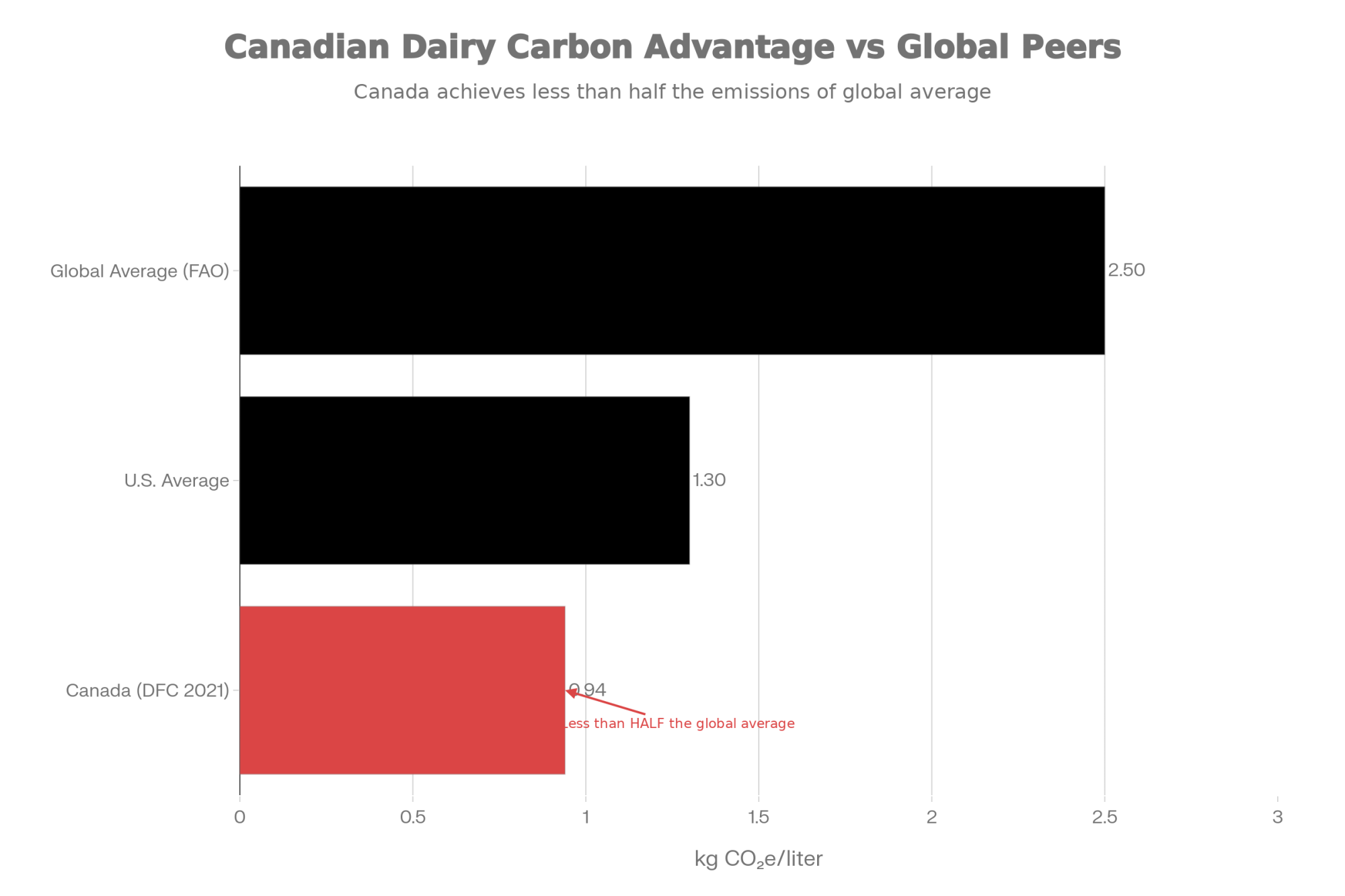
NewsSubscribe
First
Last
Consent

Ditching Robot Pellets: How Smart Farms Save $36,000 and Improve Milk Components

Plot twist: Your cows visit robots for the TMR behind them, not the pellets. This mistake costs $100K/year.

Executive Summary: What if the dairy industry has been wrong about robot pellets for 25 years? Growing evidence from 75+ farms across Wisconsin and Ontario shows that eliminating pellets entirely saves $36,000-46,000 annually while improving butterfat by 0.3-0.4%—with no long-term production loss. University research from Saskatchewan, Wisconsin, and Guelph confirms these pioneers’ discovery: cows visit robots to access fresh TMR beyond them, not for the pellets, making that $100,000 annual expense unnecessary. But here’s the reality check: success requires guided-flow infrastructure (not free-flow), premium forage quality, dedicated management, and the financial capacity to weather 10-15% production drops during a difficult 16-24 month transition. This revolution isn’t for everyone—operations with fewer than 200 cows or limited finances should proceed cautiously. What makes this story remarkable isn’t just the economics; it’s proof that some of agriculture’s most expensive assumptions have never been properly questioned.

You know, for more than two decades, those of us investing in robotic milking systems have accepted one fundamental truth: feeding pellets to the robot is essential to motivate voluntary cow visits. Equipment manufacturers designed for it. Nutritionists built entire programs around it. We all budgeted for it without question. But here’s what’s interesting—what if this core assumption, built into thousands of robotic dairy operations worldwide, turned out to be optional?

That’s exactly what a growing number of progressive dairy farmers are discovering. By eliminating feed pellets entirely from their robotic milking systems, operations from California to Wisconsin are reporting annual savings of $36,000–$46,000 per 200 cows, improved milk components, and simplified management—all while maintaining or even increasing production. Their success is backed by recent research from leading universities and represents a fundamental rethinking of how robotic dairy systems can operate.

What fascinates me most is that this isn’t just about cutting feed costs. It’s about what happens when farmers question inherited practices and discover that some of our industry’s most accepted truths might actually be holding us back.

The Discovery That Started It All

Matt Strickland, who operates Double Creek Dairy near Merced, California, didn’t set out to revolutionize robotic milking. With 500 cows and eight DeLaval VMS V300 robots, he was simply observing his herd with fresh eyes—something we could all probably benefit from doing more often.

Working alongside herd adviser Kelli Hutchings—whose Wyoming ranching background brought a completely different perspective to dairy operations—Strickland noticed something that challenged everything the industry had told him. The cows weren’t particularly excited about the robot feed. What they really wanted was to reach the feedbunk on the other side. The robot wasn’t the destination; it was more like a toll booth on the highway to fresh TMR.

“I didn’t invest in robots to feed my cows,” Strickland explains. “I got the robots to milk my cows.”

Now, that might sound obvious, but think about how much infrastructure and cost we’ve built around the opposite assumption. Over approximately two years, Strickland’s operation gradually reduced and eventually eliminated pellets from all eight robots. The results? Well, they defied everything we thought we knew:

  • No significant change in robot visits
  • No increase in incomplete milkings
  • Milk production actually increased
  • Butterfat improved by 0.3–0.4%

Today, only seven cows in Strickland’s 500-head operation still receive pellets—individual animals with specific needs that justify the cost. That’s a pretty remarkable shift from where they started.

What the Research Actually Shows

Here’s where it gets really interesting from a scientific perspective. Strickland’s experience isn’t some outlier or lucky break. Recent research from multiple institutions validates what these pioneering farmers are discovering in practice.

The University of Saskatchewan team, led by PhD student Sophia Cattleya Dondé working under Dr. Greg Penner at their Rayner Dairy Research and Teaching Facility, revealed something that should make us all pause. Changing pellet starch concentration—whether 24% or 34%—had essentially zero effect on milk production or voluntary visits. Even more eye-opening: when cows consumed additional pellets, they weren’t adding to their total intake. For every 1 kg increase in pellet intake, cows reduced their partial mixed ration intake by 0.63 kg on average. They were just swapping one feed source for another.

University of Wisconsin Extension research found something equally surprising—farms offering higher grain amounts in the robot actually produced less milk. Separate research from the University of Guelph examining Canadian farms found that feed push-up frequency correlated with higher production, with each additional five push-ups per day increasing milk yield by 0.77 lbs per cow.

It’s worth noting that the Wisconsin study also found free-traffic barns produced more milk than guided-flow barns overall, though higher pellet feeding wasn’t necessarily associated with more milk—potentially because farms feeding high pellet amounts in free-traffic systems were often compensating for poorer forage quality.

And then there’s the Vita Plus survey of 32 Upper Midwest herds from 2018 that really caught my attention. The biggest surprise? Pellet cost and composition had no effect on income over feed cost. In fact—and this is where it gets counterintuitive—farms feeding simple, low-cost pellets like corn gluten feed or basic shelled corn were more profitable than those using premium formulations.

An Important Note on Adoption

It’s worth emphasizing that pellet-free robotic milking is still an emerging practice, not yet an industry standard. While 75+ farms across Wisconsin and Ontario have successfully made this transition, and the research supports the concept, this represents early adoption rather than widespread acceptance. The equipment manufacturers continue to include pellet systems as standard, most nutritionists still recommend pellets, and the vast majority of robotic operations worldwide continue using them. What we’re seeing is growing evidence that pellets may be optional for well-managed guided-flow operations, but each farm needs to carefully evaluate whether this approach fits their specific situation. This isn’t a universal recommendation—it’s an opportunity for certain operations to consider.

Understanding the Economics: Where the Money Really Goes

Let’s talk dollars and cents, because that’s what keeps us all in business. The financial case for pellet-free operations extends far beyond just the obvious feed savings.

When you really dig into what a typical 200-cow robotic operation spends on pellet infrastructure, the numbers are eye-opening:

Annual Pellet System Costs:

  • Raw pellet costs (10 lbs/cow/day at $250/ton): $91,250
  • Inventory management labor: $2,500–$4,000
  • Feed table programming and updates: $1,500–$2,500
  • Feed waste and shrink (3–5%): $3,600–$5,400
  • Rodent control (attracted by stray pellets): $1,200–$2,000
  • System maintenance and calibration: $1,500–$2,500
  • TOTAL ACTUAL COST: $101,000–$109,000

Now, when farms eliminate pellets, they’re not simply pocketing all these savings—that would be too easy, right? Successful transitions require reinvestment:

Required Reinvestments:

  • Higher-quality forage: $800–$1,200 annually
  • Increased feed push-up labor (1–2 additional hours daily): $8,760
  • Enhanced monitoring systems: $2,000–$5,000
  • Potential infrastructure adjustments (gate modifications if needed): $0–$15,000

NET ECONOMIC BENEFIT: $18,000–$39,000 annually, plus an additional $10,400 from butterfat improvements of 0.2–0.4%. That’s real money we’re talking about.

Regional Success Patterns: Where It’s Taking Hold

The real numbers manufacturers won’t show: Pellet-free farms outproduce traditional robot barns—both in yield and milk components.

What I’ve found particularly interesting is how adoption patterns vary by region. We’re seeing the strongest uptake in Wisconsin’s central dairy corridor—about 45 farms as of late 2024—Southern Ontario around the Woodstock area with roughly 30 operations, and isolated pockets in Quebec.

Jay Heeg’s operation near Colby, Wisconsin, provides a compelling example of regional success. Heeg Brothers Dairy currently milks 1,050 cows in their conventional parlor and 450 in a new robot barn that opened in December 2023. From day one—and this is the key part—that robot barn has operated completely pellet-free using a guided-flow design.

Wisconsin/Ontario host 75 of 103 pellet-free farms—regional clustering drives change, not marketing.

The performance comparison really tells the story. Their robot barn with no pellets produces 98 lbs per cow per day, versus about 94 lbs in the parlor. Butterfat runs 4.5% in the robot barn. Somatic cell count? Lower in the robot barn, too.

“The cows have been performing well,” Heeg reports. “Once they’re trained, they do better without you out there in the pen.”

You know what’s notable? In these regions where multiple farms have adopted pellet-free systems, it’s becoming normalized. Once three or four neighbors prove it works, the regional skepticism evaporates pretty quickly. California remains more isolated—Strickland is still somewhat of a lone pioneer there—but Wisconsin and Ontario are seeing cluster effects.

The Reality Check: Not Every Farm Should Try This

Let me be really clear about something that doesn’t always get discussed openly. I recently spoke with a 120-cow operation in Vermont that wisely decided against attempting pellet-free after honestly assessing their situation. They had a free-flow barn, variable forage quality, and limited capital reserves. Smart decision to wait.

Not every operation is positioned to succeed with pellet-free systems. Through analyzing successful transitions and, honestly, some notable failures, four non-negotiable factors emerge.

First, you absolutely need guided traffic flow. Free-flow barns, where cows have unrestricted access to all areas, typically require pellets to maintain voluntary visits. Research from Michigan State and Cornell consistently backs this up. Guided-flow systems with pre-selection gates naturally direct cow traffic through the robot, making pellets less critical for motivation.

Second, when pellets disappear, your TMR becomes everything. And I mean everything. Successful operations maintain forage with greater than 65% NDF digestibility (test this, don’t guess), consistent moisture content with no more than 2% variation, excellent fermentation quality with pH below 3.8 and minimal heating, and fresh feed delivery timed to stimulate activity—usually 2–3 AM and 2–3 PM works best.

Third, fresh cows and heifers require dedicated training. We’re talking about bringing them through the robot manually 3 times daily for a minimum of 3–6 days. That’s approximately 18 hours of labor per fresh cow during the initial training period. It’s a front-loaded investment that pays dividends later.

And fourth, the transition requires 16–24 months of focused attention. You’ll see temporary production dips, increased fetch labor, and need systematic problem-solving skills. Farms attempting quick transitions or lacking dedicated oversight consistently fail. I’ve seen it happen multiple times—the farm that thinks they can “ease into it” over a month usually gives up by week six.

Navigating the Transition: What Really Happens

The transition to pellet-free isn’t a simple switch—it’s a carefully managed process that requires patience and, frankly, some courage during the tough weeks.

In weeks 1–2, you’ll see an immediate 10–15% production drop as cows adjust. This is normal, not a sign of failure. Keep reminding yourself of that at 4 AM when you’re questioning everything.

Weeks 3–8 are what I call the valley of despair. Fetch labor intensifies. Production remains 8–12% below baseline. You’ll have mornings when 30 cows refuse the robot, and you’re wondering what you’ve done.

But then weeks 9–16 arrive. Gradual recovery begins. Rumen function stabilizes—you can actually see this in the manure consistency. Behavioral adaptation completes, and milk components start improving.

By months 4–6, production returns to baseline or slightly higher, with improved components. The economic benefits become visible. You can actually breathe again.

Here’s the critical insight from those who’ve been through it: Most farms that fail give up during weeks 6–8 when the challenges feel overwhelming, but the benefits haven’t materialized. Understanding this as a normal phase—not a crisis—is essential for success.

Risk Mitigation: Your Exit Strategies

Something the research doesn’t always cover, but farmers need to know—what if you need to reverse course?

If production drops by more than 20% by week 8, you can reintroduce pellets at 50% of the original amount, stabilize for 2 weeks, then reassess. Several farms have successfully used this “pause and reset” approach.

Another option is to keep your fresh cows and first-lactation heifers on pellets while transitioning only mature cows. This reduces risk while you learn what works for your specific situation.

Some northern operations have found success going pellet-free during the grazing season, when TMR quality is highest, then reintroducing minimal pellets during the winter months, when forage quality varies more.

Industry Response: Reading Between the Lines

The equipment and feed industries are navigating this trend carefully, and their responses tell us a lot about where it might go.

DeLaval has published technical documents on no-feed practices and featured pellet-free farms at World Dairy Expo 2025. But here’s what’s telling—they continue to include pellet delivery systems as standard on new installations, positioning no-feed as a “specialist application” for sophisticated operators. That’s strategic positioning, not wholehearted endorsement.

Feed companies are quietly diversifying. I’ve noticed more pushing of liquid feed supplements and “alternative robot feeds” in the past year. Smart nutritionists are repositioning as “whole-system optimization” experts rather than pellet specialists. They see the writing on the wall.

Current adoption patterns and market response suggest pellet-free systems may remain in the 5–15% range for specialized operations in the near term, though exact industry projections remain speculative. The measured response from manufacturers and feed companies indicates they’re hedging their bets rather than embracing wholesale change.

Self-Assessment: Is Your Operation Ready?

Success FactorMust Have (Red Flag if Missing)Warning Signs (Proceed with Caution)Deal Breaker (Wait Until Fixed)Your Score (✓)
Traffic Flow SystemGuided-flow with pre-selection gatesFree-flow barn designFree-flow without modification options
Forage Quality (NDF Digestibility)>65% NDF digestibility60-65% NDF digestibility<60% NDF digestibility
TMR Moisture Consistency<2% variation2-3% variation>3% variation
Fresh Cow Training Capacity3 manual passes daily for 3-6 daysLimited labor (2 passes daily)Cannot commit to training
Financial Reserves$50K-$70K buffer (200 cows)$30K-$50K buffer<$30K reserves
Herd Size>200 cows OR strong finances120-200 cows with tight margins<120 cows with debt
Management Time Available3-4 hours daily during transition2-3 hours daily available<2 hours daily available
Nutritionist SupportAligned and supportiveNeutral or uncertainActively opposed

Before you even think about attempting a pellet-free transition, honestly evaluate your readiness. And I mean honestly—not optimistically.

For your facility, do you have guided-flow traffic with properly sized commitment pens at 6–7 cows per robot? Can cows move from the robot to the feedbunk without bottlenecks? Are your gates reliable and well-maintained?

Looking at your forage program, can you maintain consistent TMR quality with no more than 2% dry matter variation? Do you have covered storage and quality testing protocols? Is your forage digestibility consistently above 65% NDF?

And for management capacity—this is crucial—can you dedicate 3–4 hours a day to training during the transition? Do you have financial reserves to absorb $50,000–$70,000 in transition losses for a 200-cow herd? Are your nutritionist and veterinarian aligned and supportive?

Score yourself honestly on each dimension. Operations with strong capabilities across all areas are excellent candidates. Those with multiple weaknesses should address fundamental issues before attempting this transition.

Looking Beyond Pellets: What This Really Means

This pellet-free movement reveals something bigger than operational optimization. It demonstrates how entire industries can build complex systems around assumptions that never get questioned.

Think about it—this pattern of inherited practices becoming unquestioned truth likely exists in other areas of dairy management we haven’t even examined yet. Three-times-daily feeding schedules—is it really necessary? Complex genetic selection protocols—how much complexity actually adds value? Traditional parlor labor models—could workflow redesign cut labor 30%? Precision feeding systems—does the complexity justify the cost?

The farms that will thrive in the coming decades won’t be those perfecting existing systems. They’ll be those willing to ask uncomfortable questions about fundamental assumptions.

Key Takeaways for Your Operation

For operations considering pellet-free transitions, here’s what matters most.

First, assess your readiness honestly. This works brilliantly for farms with guided-flow barns, strong forage programs, and management capacity to weather transition challenges. It fails predictably for operations lacking these foundations.

Second, budget for the transition period. Expect 8–12 weeks of production losses totaling $50,000–$70,000 for a 200-cow operation. If you can’t absorb this without financial stress, wait until you can.

Third, connect with others who’ve done it. Reach out to producers in Wisconsin’s central corridor or Southern Ontario who’ve successfully transitioned. Their practical insights are invaluable. The Dairy Farmers of Wisconsin maintains a peer network list, and several Ontario producer groups facilitate farm visits.

Fourth, consider your regional context. If other farms in your area have successfully transitioned, you’ll face less skepticism from advisers and find more peer support. Being the regional pioneer is significantly harder.

And fifth, think generationally. Young farmers building new operations should seriously consider guided-flow, pellet-free designs from the start. It’s much easier than retrofitting later.

For specific guidance and support, the University of Wisconsin-Madison Extension offers robotic milking workshops quarterly. Contact Dr. Francisco Peñagaricano and his team. The University of Saskatchewan provides research updates through its Rayner Dairy facility, led by Dr. Greg Penner’s team. Cornell PRO-DAIRY maintains an AMS discussion group for Northeast producers. And the Ontario Ministry of Agriculture hosts pellet-free transition webinars through their Dairy Team.

What’s encouraging is that the pellet-free revolution isn’t really about pellets. It’s about recognizing that dairy innovation comes from farmers willing to test assumptions, not from equipment manufacturers or feed companies protecting existing business models.

As one Wisconsin dairy extension specialist told me recently: “The most valuable skill for the next generation of dairy farmers isn’t optimizing current systems—it’s questioning whether those systems are actually optimal.”

That questioning mindset, more than any specific practice or technology, will determine which operations thrive in an evolving dairy landscape where labor is scarce, margins are tight, and consumer preferences keep shifting.

The farms making these transitions today aren’t just saving money on pellets. They’re developing the adaptive capacity that will serve them regardless of what challenge comes next. And in an industry facing constant change, that capability might be worth more than any amount of feed savings.

Sometimes seeing it work on a neighbor’s farm is worth more than all the research papers combined. And that’s exactly what’s starting to happen across Wisconsin and Ontario—one successful transition at a time.

Have you tried reducing the number of pellets in your robot herd? What’s been your experience—success, challenges, or somewhere in between? Tell us in the comments below.

Complete references and supporting documentation are available upon request by contacting the editorial team at editor@thebullvine.com.

Learn More:

Join the Revolution!

Join over 30,000 successful dairy professionals who rely on Bullvine Weekly for their competitive edge. Delivered directly to your inbox each week, our exclusive industry insights help you make smarter decisions while saving precious hours every week. Never miss critical updates on milk production trends, breakthrough technologies, and profit-boosting strategies that top producers are already implementing. Subscribe now to transform your dairy operation’s efficiency and profitability—your future success is just one click away.
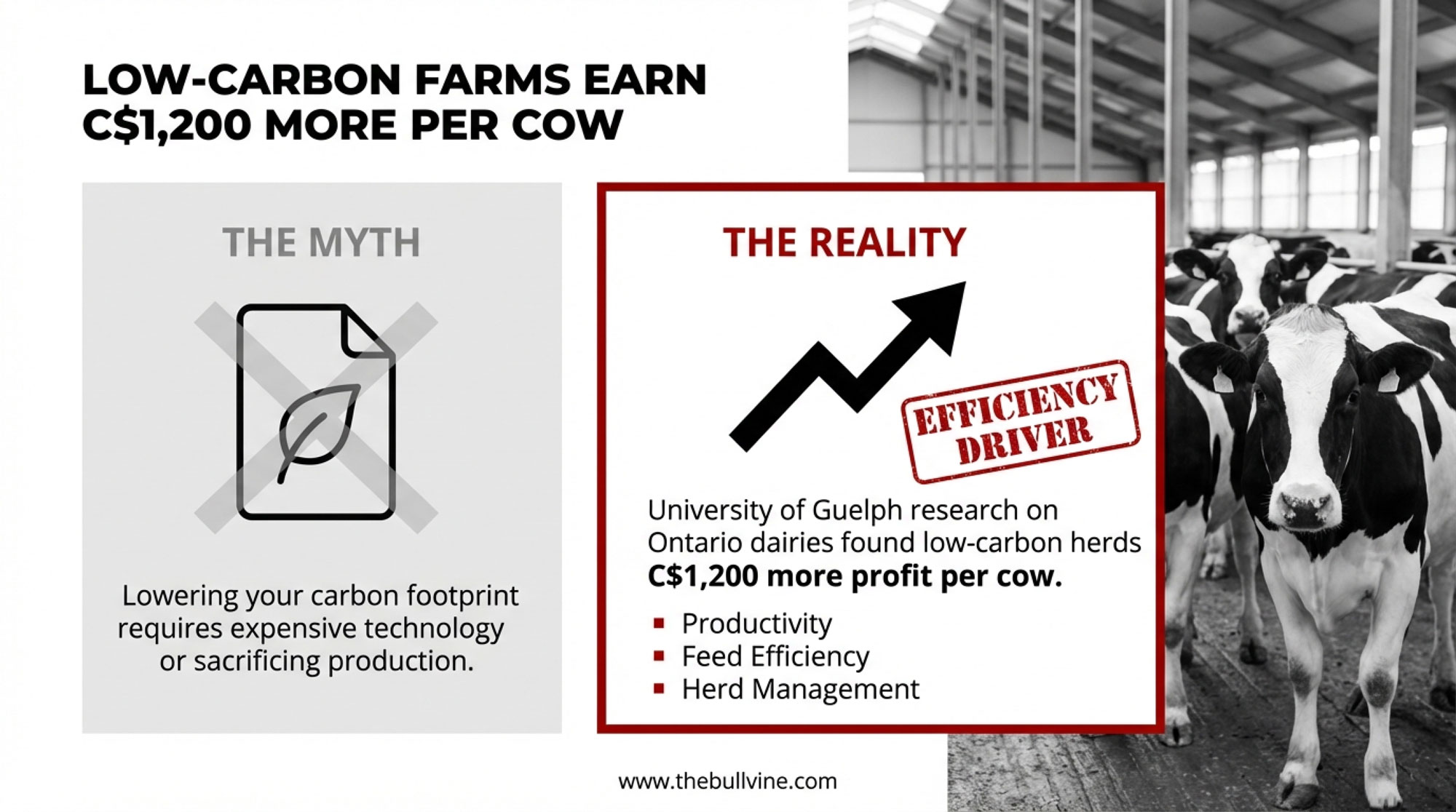
NewsSubscribe
First
Last
Consent

Whole Milk is Back in Schools. Here’s Why Only 834 Dairy Farms Will Really Win.

After 13 years of scientific vindication and structural transformation, the Senate’s unanimous approval reveals important lessons about policy, persistence, and what it really takes to survive in American dairy

EXECUTIVE SUMMARY: Whole milk returns to schools after 13 years, validating what dairy farmers knew all along—but for 17,000 operations that closed during the wait, vindication came too late. The University of Toronto’s 2020 research showed that whole milk reduces childhood obesity by 40%, yet policymakers needed five more years and a new administration to act. Today’s transformed industry means only farms with 1,500+ cows can capture meaningful returns ($40,000-$80,000 annually) from school contracts, while farms with fewer than 500 cows are effectively locked out. The December 31, 2025, deadline for cooperative engagement is the last chance to participate until 2029—but many mid-size farms are finding better opportunities in value-added production, earning 30% revenue increases versus marginal school milk returns. The harsh lesson: in agricultural policy, being scientifically right matters less than being financially resilient enough to outlast institutional inertia.

Whole Milk in Schools

You know, when I watched the celebrations after the Senate unanimously passed S.222 on November 20th—that’s the Whole Milk for Healthy Kids Act—I had mixed feelings. Don’t get me wrong, after thirteen years of being told our product was harmful to children, finally getting vindication feels good.

But I recently had coffee with a producer from central Wisconsin who put it perfectly:

“We won the battle, but the war changed while we were fighting it.”

— Wisconsin dairy farmer, November 2025

And that’s what I keep hearing as I talk with folks across the industry. This victory arrives in a fundamentally different world than the one we knew in 2012. The real question isn’t whether we were right about the science—turns out we were—but rather, what does this actually mean for operations trying to make it work today?

The Science Story: What Actually Changed Things

So let me walk you through what happened with the research, because it’s pretty revealing about how this whole system works.

The University of Toronto published this meta-analysis back in early 2020—Dr. Jonathon Maguire’s team analyzed 28 studies covering nearly 21,000 kids from seven countries. And here’s what knocked me sideways when I first read it: children drinking whole milk showed 40% lower odds of being overweight or obese compared to those drinking reduced-fat milk.

Think about that for a second. The 2010 policy that yanked whole milk from schools—we’re talking about 30 million students in the National School Lunch Program—that whole thing was built on the idea that cutting saturated fat would fight childhood obesity. The Toronto research basically said we might’ve had it backwards all along.

What’s really interesting is its consistency. Eighteen of those 28 studies pointed in the same direction. Not a single study showed that reduced-fat milk actually lowered obesity risk.

As the University of Toronto folks noted, these findings meant we needed to completely rethink our assumptions about whole milk and kids’ health.

But here’s where it gets frustrating, and I bet many of you felt this too. The 2020 Dietary Guidelines Advisory Committee had this research right in front of them—it’s in Part D, Chapter 9 of their Scientific Report if you want to look it up. They acknowledged it, called the evidence “limited” because it wasn’t from randomized controlled trials, and recommended no change to policy.

It would take five more years and a complete change in political administration before anything actually moved. That gap between having the evidence and getting the policy to shift? That’s something every agricultural sector needs to understand.

What Really Happened While We Were Waiting

The numbers tell part of the story, but they don’t tell all of it. USDA’s Census of Agriculture shows we went from about 43,000 dairy farms down to around 26,000. But let me break down what that meant in places we all know.

Wisconsin’s Department of Agriculture reported 2,740 operations closed. Pennsylvania’s Center for Dairy Excellence documented 1,570 farms gone. New York’s Department of Agriculture and Markets recorded 1,260 fewer operations.

These aren’t just statistics—these are neighbors, fellow co-op members, families we’ve known for generations.

What’s really revealing, though, is the structural shift. USDA’s Economic Research Service report from July shows that operations with over 2,500 cows actually grew from 714 to 834. Meanwhile, those mid-sized herds—the 500- to 999-cow operations that used to be the backbone of so many regions—declined by 35%. And farms running 1,000-2,499 head? Down 10%.

You know what this tells me? This isn’t just consolidation in the traditional sense. It’s a fundamental restructuring of who can even access certain markets anymore.

Component pricing arrangements, pooling structures, institutional procurement requirements—they’ve all evolved in ways that increasingly favor operations with scale and capital reserves.

Gregg Doud, President of the National Milk Producers Federation, acknowledged this reality in their press release after the Senate vote: “While we celebrate this victory, we must recognize that market access will vary significantly by operation size and regional positioning.”

He’s right. That’s the hard truth we need to face.

Three Producers, Three Different Paths

I was visiting with producers in three different states last month about exactly this. Dave from southeastern Pennsylvania, running 750 cows, told me, “We survived by diversifying early—not because we saw this coming, but because we couldn’t afford to wait around.”

A producer named Carlos down in West Texas with 3,500 cows had a different take: “We built for institutional markets from day one. Scale was always our strategy.”

And Sarah, milking 120 cows up in Vermont, said simply, “We stopped trying to compete in commodity markets five years ago. Best decision we ever made.”

Three different paths, all working. That’s what’s interesting about where we are now.

What the Whole Milk Opportunity Actually Looks Like

So here’s what industry analysts and cooperatives are projecting. If whole milk adoption in schools reaches 50%, we could see butterfat demand increase by tens of millions of pounds annually.

Schools account for roughly 8% of total fluid milk consumption through about 4.9 billion meals served each year—that’s based on USDA data—so we’re talking about meaningful volume.

But the distribution of that benefit? That’s where it gets complicated.

Based on what Federal Milk Marketing Order data and cooperative communications are suggesting, here’s how it breaks down:

Who Wins from Whole Milk’s Return?

Operation SizeProjected Annual ImpactStrategic Move
1,500+ Cows+$40,000–$80,000Aggressively bid 2026 RFPs; leverage volume for contracts
500–1,000 Cows+$1,500–$3,000 (marginal)Evaluate admin costs vs. return; focus on efficiency gains
Under 300 CowsLow/InaccessibleFocus on direct market/specialty; skip commodity school bids

Each operation needs their own pencil work here, but the pattern is clear: scale determines access.

The Timeline You Absolutely Need to Know

If you’re thinking about pursuing this, the window for action is pretty specific:

December 2025 is really your last shot to engage your cooperative about interest.

School districts typically release their RFPs between January and March 2026. You’ll need to get your documentation and compliance certifications together in February—and trust me, there’s a lot of paperwork.

Bids are due April through May. Awards get announced in June. New contracts start July 1, 2026.

Miss that window? You’re looking at waiting one to three years for the next cycle. That’s just how institutional procurement works.

What’s Actually Working Out There

While everybody’s been focused on the whole milk policy news, I’ve been tracking what successful operations are actually doing day to day. And the patterns are pretty instructive.

Value-Added Production: More Than Just Buzzwords

Market research shows that value-added dairy products are growing at about 12% annually, while fluid milk is pretty flat.

Michael Dykes, Senior Vice President for Regulatory Affairs at the International Dairy Foods Association, keeps saying what a lot of producers are discovering on their own: differentiation and innovation capture premiums that commodity markets just don’t offer.

Here’s what I’m seeing work:

  • Lactose-free products commanding decent premiums
  • A2 milk is getting significant price advantages in metro markets
  • Artisanal products at farmers’ markets are capturing really impressive margins—USDA’s direct marketing research backs this up consistently

I visited a family operation near River Falls, Wisconsin, last month that put in bottling equipment through a USDA Value-Added Producer Grant. They’re processing about 60% of their production on-farm now, and they’re seeing revenue increases pushing 30%. Plus, they created three local jobs.

But they’ll also tell you it took two years of planning and serious capital commitment. It’s not a quick fix.

Technology: What the Early Adopters Are Finding

The data on precision management is getting clearer, and it’s worth paying attention to.

IoT health monitoring systems are showing productivity improvements in the 15-20% range, with payback periods of 18-24 months—that’s based on extension research and what early adopters are reporting.

Precision feeding is demonstrating meaningful cost reductions, we’re talking tens of thousands annually for mid-sized operations. Robotic milking shows solid yield increases, though you’re looking at ROI horizons beyond seven years.

What’s interesting is how successful farms are approaching it. Mark from central Michigan told me, “We started with monitoring—low investment, quick returns. That funded our next technology step.”

That staged approach keeps showing up in the success stories.

Cooperative Innovation: Old Ideas, New Applications

Here’s something that gives me hope. Edge Dairy Farmer Cooperative’s President, Brody Stapel, recently discussed how producer groups are rediscovering collective bargaining power through the Capper-Volstead Act. This isn’t nostalgia—it’s a smart strategy.

Penn State Extension documented 12 Pennsylvania operations, each averaging 350 cows, that formed their own cheese-making cooperative. They’re getting $1.50 to $2.50 per hundredweight premiums through regional direct sales.

By controlling processing and marketing, they basically created their own market channel. Takes significant coordination, but it’s absolutely replicable.

How Different Regions Are Handling This

The whole milk opportunity plays out differently depending on where you are, and understanding your regional context really matters.

Traditional Dairy States: Infrastructure Without Volume

Wisconsin, Pennsylvania, New York—we’ve got the infrastructure and cooperative relationships to access school markets. But with way fewer farms to benefit now, the impact gets concentrated among fewer producers.

Wisconsin’s still losing hundreds of operations annually, according to their state statistics.

Bob Bosold from the Dairy Business Association frames it well: the infrastructure persists, but we’re down to half the number of farms we had when whole milk was banned. The survivors tend toward larger scale and efficiency, but there’s just fewer of them to capture the benefit.

Expansion Regions: Built for This

Texas, Idaho, and New Mexico operations? They were essentially designed for institutional contracts.

With $11 billion in processing capacity additions expected through 2026, according to industry investment tracking, these regions are optimized for high-volume, standardized production.

Average herd sizes in these areas now measure in the thousands, which aligns perfectly with procurement requirements. New facilities incorporate automated systems ensuring consistent butterfat ratios and daily delivery capacity from day one.

It’s industrial-scale dairying, and for that market segment, it works.

Specialty Markets: A Different Game Entirely

Vermont, Northern California, pockets of the Northeast—they’ve largely exited commodity competition. And honestly? Market research suggests organic dairy could exceed $30 billion by 2030.

For these regions, that represents a way better opportunity than school contracts.

Vermont’s Agency of Agriculture finds that about 75% of remaining farms now do value-added or direct marketing, up from 31% in 2012.

That’s not retreat—that’s strategic repositioning, and it’s working for them.

Understanding How Policy Actually Works

The whole-milk experience taught me something important about how agricultural policy really works. Scientific evidence alone—even compelling evidence like the Toronto study—doesn’t automatically drive policy change.

When FDA Commissioner Martin Makary started talking about ending what he called the “fifty-year war on saturated fat,” and Agriculture Secretary Brooke Rollins expressed support for whole milk, they provided something dairy producers couldn’t: institutional permission to challenge established frameworks.

That permission, not just the science, enabled the change.

NMPF had been citing the Toronto research since 2020, submitted formal comments, provided testimony—and followed all the proper channels. But as they noted in their testimony, they kept encountering “institutional commitment to existing guidance despite evolving science.”

The 2020 Dietary Guidelines Committee acknowledged potential benefits of higher-fat dairy for children but stuck with existing recommendations, saying the studies were observational rather than randomized controlled trials.

That’s institutional inertia in action—not conspiracy, just systematic resistance to change.

What This Means for Different Operations

Based on what I’m hearing from producers and seeing in market dynamics, here’s how I’d think about it:

Large operations (1,500-plus cows): You should probably evaluate school contracts pretty aggressively during that 2026 procurement window. The potential return likely justifies the effort.

And use that baseline volume to leverage value-added investments. But get talking to your cooperative now, not in March.

Mid-size operations (500 to 1,000 cows): You’ve got a more complex calculation. Those modest school premiums might not justify the administrative headaches.

University economics research keeps showing that value-added production, marketing alliances, or specialty certification offer better risk-adjusted returns for operations of your size.

Smaller operations (under 500 cows): Institutional markets are probably structurally out of reach, and that’s okay.

Extension research consistently shows that direct-to-consumer, on-farm processing, agritourism, or specialized production delivers way better margins than competing in commodity markets.

The Real Lesson Here

Here’s what the whole milk saga really reveals about agricultural policy:

  • Institutional frameworks resist change even when faced with strong contrary evidence
  • Individual operations can’t survive indefinitely waiting for policy-market misalignment to fix itself
  • Industry organizations face real constraints limiting how hard they can push
  • Political context matters just as much as scientific evidence

“The 17,000 farms that closed weren’t wrong about the science. They just couldn’t survive the wait.”

That’s the sobering part.

Looking Ahead: What Success Looks Like Now

Industry forecasts from major agricultural lenders suggest continued consolidation toward something like 15,000 total U.S. dairy farms by 2030.

The industry’s brutal restructuring: Total farms plunged 60% from 43,000 to 26,000 while mega-dairies with 2,500+ cows surged 67%—a tale of two industries in one policy shift

Within that reality, though, success patterns are emerging from USDA and extension data:

  • Operations with multiple revenue streams show way better five-year survival rates
  • Technology adopters demonstrate clear margin advantages
  • Direct market relationships command premium pricing
  • Innovative cooperative structures are creating market access for mid-sized producers who work together

What’s encouraging is that these strategies were working before the whole milk policy changed. The policy shift provides favorable conditions, not a fundamental transformation.

The Bottom Line

Whole milk’s return validates what many of us have understood intuitively about nutrition and what kids actually want to drink. That vindication deserves recognition, and I’m genuinely glad we got here.

But the thirteen-year wait extracted enormous cost from our industry. The farms that made it through built resilient businesses that didn’t depend on policy alignment finally happening.

So yeah, pursue whole milk opportunities if you’re positioned for it. But build your operation assuming policy corrections might take another decade—or might never come at all.

That’s not pessimism. That’s just strategic realism based on what we’ve all watched unfold.

The industry emerging from this period will be different—more concentrated, more specialized, more technology-enabled. Whether that’s good or bad depends on your perspective and where you sit.

What’s certain is that adaptability, not policy dependence, determines who’s still farming five years from now.

This moment offers real opportunity for those positioned to capture it, validation for those who stuck it out, and lessons for all of us about how science, policy, and agricultural economics actually interact.

How we apply those lessons will shape what American dairy looks like going forward.

Your Next Steps

If You’re Considering School Milk Contracts:

  • Contact your cooperative before December 31, 2025
  • Request procurement specifications and compliance requirements
  • Evaluate administrative capacity against projected returns

For Value-Added Exploration:

  • USDA Value-Added Producer Grant program: rd.usda.gov/vapg
  • Your state dairy association for regional guidance
  • Extension dairy specialists for business planning

For Technology Investment Planning:

  • University extension technology adoption studies
  • Your equipment dealer’s ROI calculators
  • Peer producers who’ve implemented similar systems

For Cooperative Innovation:

  • Capper-Volstead Act resources through the USDA
  • State extension cooperative development programs
  • Regional producer alliance case studies

General Resources:

  • National Milk Producers Federation: nmpf.org
  • International Dairy Foods Association: idfa.org
  • Your state dairy association
  • Local extension dairy specialist

Based on legislative records, USDA data, industry reports, and conversations with producers through November 2025. For operation-specific guidance, talk with your advisors who know your situation.

KEY TAKEAWAYS

  • December 31, 2025, Deadline: Contact your cooperative now for 2026 school contracts, or wait 3 years
  • Scale Determines Success: 1,500+ cow operations gain $40-80K/year; farms under 300 cows are locked out
  • Science Was Always Right: Whole milk reduces childhood obesity 40%—but 17,000 farms closed waiting for policy to catch up
  • Better Options Exist: Mid-size farms seeing 30% revenue gains from value-added production vs. marginal school milk returns
  • Adapt or Wait: Surviving farms built businesses that don’t depend on policy victories

Complete references and supporting documentation are available upon request by contacting the editorial team at editor@thebullvine.com.

Learn More:

Join the Revolution!

Join over 30,000 successful dairy professionals who rely on Bullvine Weekly for their competitive edge. Delivered directly to your inbox each week, our exclusive industry insights help you make smarter decisions while saving precious hours every week. Never miss critical updates on milk production trends, breakthrough technologies, and profit-boosting strategies that top producers are already implementing. Subscribe now to transform your dairy operation’s efficiency and profitability—your future success is just one click away.

NewsSubscribe
First
Last
Consent

Why the Same Cutting Height Earned One Farm $167,000 and Cost Another $36,000

6 inches or 18 inches? Wrong answer costs $36,000. Right answer gains $167,000. Context determines which.

corn silage cutting height

EXECUTIVE SUMMARY: Two neighboring farms made the same cutting height adjustment—one gained $167,000, the other lost $36,000, and new Wisconsin research explains exactly why. A meta-analysis of 35 studies shows that raising corn silage cutting height from 6 to 18 inches consistently increases starch by 2.7% and digestibility by three units, while sacrificing 0.8 tons/acre in yield. But whether this trade-off pays off depends entirely on your context: milk price, grain cost, herd genetics, inventory buffer, and management sophistication determine whether you’re the winner or the loser. Modern stay-green hybrids have completely reversed traditional thinking—immature stalks now hurt starch concentration more than fiber quality, making wetter corn benefit more from high cutting. This guide provides the exact decision framework, economic calculator strategies, and implementation timeline needed to position your farm on the profitable side of this $200,000 swing.

Every August, producers make a mechanical adjustment that swings profitability by six figures. The decision on cutting height has evolved from a simple harvest preference to a complex economic gamble that affects everything from milk production to inventory security.

A new 2024 comprehensive meta-analysis from the University of Wisconsin—Dr. Luiz Ferraretto’s team pulled together 35 studies with over 150 observations—challenges everything we thought we knew about corn maturity and cutting height. When combined with today’s volatile markets, the data is fascinating—and a little scary.

Under the right conditions, adjusting your cutting height could generate an extra $167,000 annually for a 500-cow dairy. But that exact same decision, under different circumstances, could cost you $36,000. Here’s why the context matters more than the setting.

The Science That’s Changing Everything

So Ferraretto’s Wisconsin team discovered something remarkably consistent across all those studies. For every centimeter you raise that cutting height—that’s about 0.4 inches for those of us still thinking in imperial—your corn silage gains 0.09 percentage units of starch and 0.08 units of NDF digestibility. But you’re also losing 0.06 tons per acre in yield. Every single time.

Now, those numbers might sound small, but let’s put this in perspective. When you raise your cutting height from 6 inches to 18 inches—a 30-centimeter increase—here’s what happens:

  • Your starch content jumps from around 28% to 30.7% (that’s a 2.7 percentage point gain)
  • NDF digestibility improves from 55% to 58% (3 units better)
  • NDF content drops from 45% to 42.3% (2.7 points lower)
  • But you’re losing approximately 0.8 tons per acre in yield

The quality improvements are remarkably consistent across different hybrids and growing conditions—that’s what made the research so compelling. The yield loss? That’s guaranteed too. But whether that trade-off makes economic sense… well, that depends entirely on your specific situation.

When Modern Genetics Flip the Script

Here’s where it gets really interesting—and honestly, it caught me off guard when I first saw the data. Those stay-green hybrids that dominate the seed market now? They’ve completely decoupled ear maturity from stalk maturity in ways that flip our conventional wisdom on its head.

The Wisconsin research revealed that wetter corn below 32% dry matter shows the strongest starch response to increased cutting height—we’re talking 0.10 percentage units per centimeter. Meanwhile, drier corn above 37% DM shows greater fiber digestibility (0.12 units per centimeter) but lower starch digestibility.

This contradicts what most of us learned years ago, doesn’t it? But when you think about how stay-green genetics actually work, it makes sense. These hybrids keep stalks green and photosynthesizing while the grain matures normally—it’s like the ear and stalk are running on completely different schedules. So at lower whole-plant moisture, you’ve got these mature ears sitting on relatively immature, high-moisture stalks. The bottom portions haven’t fully lignified yet, which makes them more of a starch-diluting factor than a fiber-quality problem.

What we’re seeing is that those immature stalks hurt you more by watering down starch concentration than by adding indigestible fiber. By the time you hit 37% DM, those stalks have finally lignified, and suddenly the cutting-height benefit shifts from starch concentration to improved fiber digestibility. Complete reversal of traditional thinking.

Two Scenarios, Same Decision, Completely Different Outcomes

Let me share two economic scenarios that really drive home why context matters more than the cutting height itself. These are based on detailed modeling using actual market conditions.

Scenario One: When Things Go Wrong—A $36,000 Loss

Picture a typical 500-cow dairy facing 2024 market conditions: milk at $20/cwt, corn at $3.90/bushel, and what seems like adequate inventory levels. They’ve read the Wisconsin research, seen those quality improvements from high cutting, and decide to chop at 18 inches instead of their usual 6 inches.

On paper, the math looks solid. They’re expecting a realistic 0.5 lbs/day milk response (reasonable for average genetics), worth about $18,250 annually. Grain savings from better forage quality add another $8,600. Against a silage yield loss valued at $10,820, they’re projecting a comfortable $16,000 gain.

But here’s where reality bites. That yield loss leaves them with dangerously thin inventory margins—something that doesn’t become apparent until March. A mold outbreak costs them a week’s silage. Weather delays compound the shortage. By April, they’re scrambling to buy replacement forage at $180/ton—typical spring pricing in the upper Midwest. Production drops 8 lbs/day when silage runs short because cows simply can’t eat enough alternative feeds. When you run all the numbers, it’s a $36,000 net loss from a decision that looked profitable in August.

Scenario Two: When Everything Aligns—$167,000 Additional Profit

Now consider the same 500-cow size, but under different conditions: milk at $25/cwt (as we saw in 2022-2023), grain at $20/cwt, with about 30% of the herd being high-producing, early-lactation cows averaging 55 lbs/day. This operation has genuine surplus inventory—not just “probably enough” but a real buffer—and excellent ration management with monthly forage testing.

Here’s what makes the difference: Those high producers physically can’t eat enough low-quality forage to maximize their genetic potential. They’re maxed out on intake. Better fiber digestibility from high cutting means lower rumen fill and higher passage rates, allowing more intake. In this scenario, the modeling shows these responsive cows converting the quality improvement into 1.6 lbs/day additional milk—worth $73,000 annually.

At $20/cwt, reducing supplementation by 3 lbs/cow/day saves $109,500. Against a $15,500 silage yield loss, the net result is $167,000 in additional profit. Same decision, completely different outcome.

The Tale of Two Farms: Economic Comparison

FactorLosing FarmWinning Farm
Milk Price$20/cwt$25/cwt
Grain Cost$14/cwt$20/cwt
Herd ProfileAverage genetics30% high producers (55 lbs/day)
Milk Response0.5 lbs/day1.6 lbs/day
Inventory StatusThin marginsGenuine surplus
Spring Shortage$41,000 replacement feedNone
Annual Result-$36,000 loss+$167,000 profit

The Middle Ground: A Practical Framework for Real Decisions

Most operations I work with fall somewhere between these extremes, facing milk prices around $21-22/cwt and moderate conditions where the economics don’t clearly point one direction. For these farms, the Wisconsin research suggests looking beyond pure economics to what I call the six critical tiebreaker questions:

The 6 Tiebreaker Questions

1. Are you meeting milk quota or supply contracts? If you’re under quota, extra milk has real value. But if you’re already flush and dumping or selling at lower prices? There’s zero upside to additional production. This is especially relevant for farms in Federal Order areas with base programs.

2. What are your herd genetics for feed efficiency? Those genomically selected, high-merit cows with +3000M genetics—they respond better to forage quality improvements than average commercial genetics. If you’ve been investing in genetics, you need to feed for it.

3. When do your cows freshen? Fall and winter fresh cows are in peak early lactation when feeding that high-quality silage—exactly when they’re most responsive. Spring calvers? They’ll be mid-to-late lactation by the time new silage is fed. Makes a huge difference.

4. How sophisticated is your forage testing and ration management? Monthly testing and active ration adjustments capture quality gains. If you’re testing once or twice a year, you’re probably missing the optimization window entirely.

5. What’s your working capital situation? Can you absorb an $80,000 swing if things go sideways? Tight margins mean lower risk tolerance—that’s just reality for many operations right now.

6. How important is feed cost predictability? High-cut silage reduces grain dependency, providing more stable feed costs when grain markets are volatile. For farms with locked-in milk contracts, this predictability has real value.

What I’ve found is that farms answering “yes” to four or more of these should lean toward high cutting. Those with two or fewer “yes” answers should favor conventional height. It’s not perfect, but it’s been remarkably consistent in predicting success.

The Wisconsin Calculator: More Strategic Tool Than You Think

The University of Wisconsin’s Corn Silage Cutting Height Calculator has become an essential tool—you can find it at dairy.extension.wisc.edu under their forage resources. But here’s what I’ve learned: it’s not about plugging in numbers once and calling it done.

The strategic farms run three milk price scenarios—conservative at $20, realistic at $22, and optimistic at $25. They test different yield baselines using their worst-case, average, and best-case historical yields. They vary baseline forage quality inputs to see how much improvement actually matters for their specific situation.

What’s really valuable is how the calculator makes the cost-per-ton reality impossible to ignore. When it shows your silage cost rising from 5/ton DM at conventional cutting to 3/ton at high cutting, you have to ask yourself: Do I genuinely believe my herd can convert that quality into enough milk to justify paying an /ton premium? That’s the real question, isn’t it?

Regional Variations Matter More Than You Think

Something I’ve noticed working with farms from California to New York—the optimal strategy varies significantly by region. In the Northeast, where purchased forage is readily available but expensive, inventory buffer matters less than in the upper Midwest, where replacement forage might be 200 miles away. California dairies with year-round production and minimal seasonality in fresh cow patterns face different economics than Pennsylvania operations with strong seasonal calving.

In the Southwest, where corn is often harvested multiple times per year, the risk of inventory shortages is lower, making high-cut strategies more viable. Meanwhile, in areas like Idaho, where transportation costs for replacement feeds are substantial, that 0.8 tons/acre yield loss becomes much more costly to replace if things go wrong.

Implementation Reality: The 60-75% Achievement Factor

Even with perfect planning, field reality introduces complications that the research can’t fully capture. Modern forage harvesters, even good ones, maintain cutting height within plus or minus 2-3 inches at best. That creates quality variation across every field.

Your 250-acre field isn’t flat. You’ve got valleys where the header runs at 13 inches, ridges where it hits 22 inches, all while you’re targeting 18 inches. You end up with four distinct quality profiles in a single harvest. When your forage test shows 29.5% starch instead of the projected 30.7%, that’s not necessarily a management failure—it’s equipment variation meeting field reality.

Given equipment consistency limitations and field variability, farms with basic equipment are likely to capture 60-75% of research-projected benefits, while precision-equipped operations may achieve 80-90%. But we’re talking an additional $15,000-25,000 for that precision equipment. Is capturing that extra 15% worth twenty grand? That depends on your operation’s scale and economics.

When Safety Trumps Everything: The Drought Factor

Drought-stressed corn throws all economic calculations out the window. Ohio State and Penn State Extension research demonstrates that nitrate accumulation in drought-stressed corn can reach 5,524 ppm in the lower third of stalks, compared to just 17 ppm in ears. With livestock safety thresholds at 1,000 ppm NO3-N, high cutting becomes mandatory regardless of economics.

The 2012 Midwest drought provided stark lessons about nitrate risk management. Extension reports from that period show that farms implementing high-cutting strategies and testing for nitrates generally avoided the livestock health issues—including animal deaths and reproductive failures—that affected operations using conventional cutting practices. No amount of saved tonnage is worth risking your herd’s health.

If you’re dealing with drought stress, the protocol is clear: test for nitrates before harvest, chop at 12+ inches minimum if levels exceed 1,500 ppm, and allow 3-4 weeks fermentation before feeding. It’s not about economics at that point—it’s about keeping your cows alive and healthy.

Why Are Seed Companies Silent on Harvest Strategy?

Here’s something that frustrates me, and probably you too: We’re spending $400 per bag on stay-green hybrids without anyone explaining how those genetics should influence harvest decisions six months later. I’ve sat through dozens of seed sales presentations, and they focus on yield, standability, and disease resistance—all important—but remain completely silent on how stay-green characteristics affect cutting-height optimization.

This communication gap means we’re making genetic investments in March that fundamentally alter our harvest economics in August, yet the connection is rarely made explicit. You’d think a simple matrix showing recommended cutting heights and quality responses by hybrid would be standard by now. But I haven’t seen a single major seed company provide this information.

The companies have their reasons, of course. Testing the cutting-height response for each hybrid is expensive. It complicates marketing. And honestly, they see it as a harvest management issue, not a seed selection issue. Fair enough from their perspective, but it leaves us in the dark when we’re trying to make informed decisions.

Critical Decision Timeline for Success

Looking at operations that consistently get this right, timing is absolutely critical. Here’s the timeline that actually works:

March-April (Seed Selection): Identify which hybrids have stay-green genetics. Note any “delayed senescence” or “premium stay-green” traits. Understand that these will respond differently to cutting height.

Late July (Critical Planning Week): Run the Wisconsin Calculator with multiple scenarios. Test drought-stressed fields for nitrates (5-10 plants, lower third). Score yourself on those six tiebreaker questions. Document your cutting height decision per field—in writing.

Early August (Harvest Preparation): Communicate specific targets to your harvest crew. Calibrate equipment, verify header consistency. Plan for that plus-or-minus 2-3 inch variation around the target.

During Harvest: Test first loads immediately for DM and quality. Adjust if quality differs from projections. Document actual versus planned for next year’s reference.

Post-Harvest: If nitrates were elevated, ferment for at least 3-4 weeks. Retest before feeding. Share results with your nutritionist for ration adjustments.

Key Takeaways for Strategic Implementation

What’s become clear from both the research and what we’re seeing in the field is that successful operations aren’t looking for a universal cutting height strategy. They’re the ones asking hard questions in July, testing their assumptions, and adapting their approach to match their specific economic reality.

The economics are incredibly context-dependent. That same cutting height that could generate $167,000 under optimal conditions might cost $36,000 under different circumstances. Your specific combination of milk price, grain cost, herd genetics, inventory situation, and management capability determines the outcome—not the height itself.

Quality improvements are real but not automatically bankable. Lab results consistently show improved starch and digestibility. But whether your cows convert that into milk depends on everything from ration reformulation to rumen microbiome variation to what percentage of your herd is actually in early lactation when you’re feeding that silage.

Variable strategies often work best. Instead of a single height across all fields, the smartest operators I know cut stay-green hybrids higher, conventional hybrids at standard height, and drought-stressed fields at a higher height, regardless of variety. It’s more complex, sure, but it captures value where it exists while avoiding losses where risk is high.

Looking Ahead

The decision on corn silage cutting height has evolved far beyond a simple mechanical adjustment. It’s become this sophisticated economic optimization that requires integrating agronomy, nutrition, economics, and risk management. The farms that recognize this complexity and plan accordingly are capturing significant value. Those that don’t? Well, they’re leaving money—sometimes substantial amounts—in the field.

The Wisconsin research provides the scientific foundation we needed. Their calculator and other economic modeling tools offer practical decision frameworks. But ultimately, each farm has to evaluate their unique situation against volatile markets, uncertain weather, and the biological variability that’s just part of dairy farming.

The $200,000 question isn’t whether to cut high or low. It’s whether you’re making that decision with complete information, at the right time, for your specific operation. In an industry where margins keep tightening and every decision counts, that level of strategic thinking around something as seemingly simple as cutting height might just be the difference between profitability and loss.

What’s interesting is how this all connects back to the bigger picture of precision management in dairy. We’re no longer in an era where one-size-fits-all recommendations work. The profitable farms of tomorrow—probably including yours—will be those that can integrate complex information, make field-specific decisions, and execute with discipline. Even on something as basic as where to set the chopper head.

You know, at the end of the day, it’s about being intentional with every decision. And that’s what separates the operations that thrive from those just trying to survive.

Additional Resources

Wisconsin Corn Silage Cutting Height Calculator: dairy.extension.wisc.edu/articles/corn-silage-cutting-height-calculator-background-and-guide/

Nitrate Testing Guidelines:

  • Ohio State Extension: Nitrate Toxicity in Livestock
  • Penn State Extension: Managing Drought-Stressed Corn Silage

Key Decision Thresholds:

  • Nitrate Safety: <1,000 ppm NO3-N
  • High-Cut Consideration: 4+ “yes” on tiebreaker questions
  • Economic Breakeven: Typically 0.5-1.0 lb/day milk response needed

KEY TAKEAWAYS

  • Same decision, $203,000 difference: Context (milk price, genetics, inventory) determines if you win or lose
  • Quality gains are guaranteed, profits aren’t: 2.7% more starch costs 0.8 tons/acre—the math only works with the right conditions
  • Stay-green genetics changed everything: Wetter corn now benefits MORE from high cutting than dry (opposite of tradition)
  • Winners plan in July, losers react in August: Use Wisconsin’s calculator to model YOUR specific scenario
  • Drought corn = mandatory high cut: Nitrates >1,500 ppm override all economics—it’s about safety

Complete references and supporting documentation are available upon request by contacting the editorial team at editor@thebullvine.com.

Learn More:

Join the Revolution!

Join over 30,000 successful dairy professionals who rely on Bullvine Weekly for their competitive edge. Delivered directly to your inbox each week, our exclusive industry insights help you make smarter decisions while saving precious hours every week. Never miss critical updates on milk production trends, breakthrough technologies, and profit-boosting strategies that top producers are already implementing. Subscribe now to transform your dairy operation’s efficiency and profitability—your future success is just one click away.
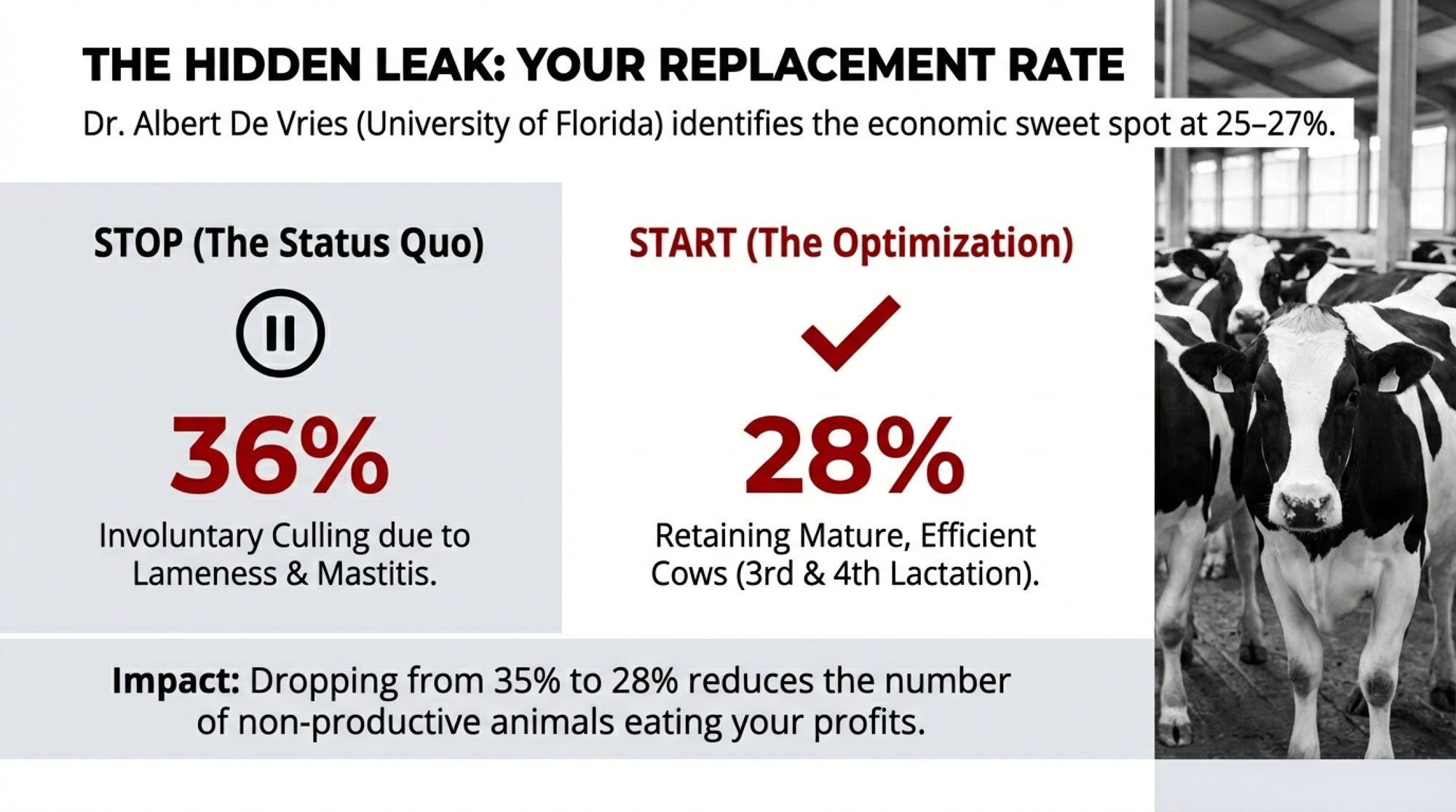
NewsSubscribe
First
Last
Consent

Carbon Credits: $150,000 for Large Dairies, $3,000 for Family Farms – Here’s Why

Two dairies. Same carbon practices. One makes $150K, the other makes $3K. The difference isn’t what you think.

EXECUTIVE SUMMARY: Athian paid dairy farmers $18 million for carbon reductions in 2024, but the money isn’t flowing where you’d expect—large farms pocket $150,000 yearly while small operations get just $3,000 for identical practices. The math explains why: although per-cow profits are similar at $40-56, only operations with 2,000+ cows can justify the $28,000-37,000 upfront investment and 6-12 month payment delays. Add requirements for digital records and working capital above 1.25, and 80% of U.S. dairy farms simply can’t participate. Yet for qualified operations, carbon credits offer genuine value—transforming feed additives you’re already considering into profit centers. This article delivers real economics, explains why scale wins again, and provides a practical framework for determining whether carbon credits make sense for your specific operation.

So I was reviewing Athian’s latest announcement the other day, and here’s what caught my eye—they’ve actually distributed million to dairy farmers for emissions reductions since early 2024. Not promises, not projections. Real checks hitting real farm accounts. And what’s interesting is, these are for practices many of us have been considering anyway for operational efficiency. You know how it is—in our industry, sustainability initiatives usually mean spending more money for the privilege of doing the right thing. This development, though, it deserves our careful attention.

I’ve been talking with producers from Vermont to New Mexico who’ve navigated these dairy carbon credit programs, and I’ve noticed a fascinating pattern emerging. Success varies dramatically across operations, and here’s what might surprise you—it’s not about environmental commitment or willingness to adapt. What I’ve found is it’s primarily about operational scale, cash flow position, and whether you’ve already got your data management systems dialed in.

Understanding the Market Forces at Play

Let’s talk about what’s really driving these payments. As many of us have seen, major food companies—Nestlé and Mars among them—have committed to reducing supply chain emissions by 30% before 2030, according to their recent sustainability reports. And here’s the thing: since most of their carbon footprint originates at the farm level rather than in processing facilities, they’re actively seeking verified reductions from us dairy suppliers.

This has led to something called “insetting”—basically, these companies are investing in emissions reductions within their own supply chains rather than buying random offset credits from who knows where. DFA pioneered this approach in January 2024, becoming the first U.S. cooperative to purchase verified livestock emissions reductions through Athian’s platform. Their initial transaction involved a Texas dairy using Elanco’s Experior technology, and they documented 1,150 metric tons of CO2 equivalent reduction. That’s not theoretical—it’s verified, third-party audited through SustainCERT standards, and most importantly, paid for.

What distinguishes this from all those previous carbon initiatives we’ve seen come and go? The verification rigor. These dairy carbon credit programs require comprehensive documentation—you’re matching feed invoices with ration records, integrating milk production data, running everything through standardized calculation models, and having independent auditors verify it all. This level of verification means buyers can confidently report these reductions to their stakeholders.

Current Practices Generating Returns

Looking at current market activity, four practice categories are demonstrating consistent value for dairy farm profitability, and each has distinct operational requirements and economics worth understanding.

Feed additives for enteric methane reduction have really emerged as the primary pathway. Bovaer—that’s the 3-nitrooxypropanol compound from DSM-Firmenich—got regulatory approval in Canada and the UK in January, and the FDA completed their review in May. What’s encouraging is the research consistency: across 56 peer-reviewed studies, we’re seeing approximately a 30% reduction in enteric methane when administered at recommended doses. According to the Journal of Dairy Science’s comprehensive analysis, this translates to a 10-15% reduction in overall GHG intensity per unit of milk production.

Now, pricing varies considerably by region and purchase volume—you probably know this already. Industry data suggests Bovaer costs range from $0.30 to $0.50 per cow daily, while Rumensin (that’s monensin from Elanco) typically runs $0.13 to $0.15 per cow per day. Rumensin provides modest emission reductions, but it also delivers about a 3% improvement in feed efficiency, according to Elanco’s published data. That’s nothing to sneeze at when you’re looking at overall dairy milk check revenue.

Precision nutrition approaches, particularly those low-protein, amino acid-balanced rations, offer another pathway without requiring infrastructure investment. These strategies reduce nitrogen excretion and associated nitrous oxide emissions while potentially improving your feed cost efficiency. Ajinomoto’s AjiPro-L protocol, which Athian approved in April, exemplifies this approach. University of Wisconsin Extension trials indicate potential for both ration cost savings and carbon credit generation, though—as you’d expect—results vary by operation.

Anaerobic digester systems continue to provide opportunities for larger operations. You can stack RNG revenue, RIN credits, nutrient products, and now carbon insets. But let’s be realistic about the economics here—USDA NRCS data and Cornell’s agricultural economics research show you need at least $1,800 per cow in capital investment. Even with RCPP cost-share programs covering 50-75% of installation costs, that’s a serious commitment that really only pencils out at significant scale.

What I’m particularly interested in are these whole-farm carbon intensity protocols. Rather than requiring specific expensive interventions, they measure your overall emissions per unit of milk production. California’s CDFA has been developing this methodology, while the Innovation Center for U.S. Dairy has been creating parallel frameworks. If you’re already efficient—getting more milk from fewer cows with less waste through better genetics and reproduction—you should theoretically qualify even without fancy additives. And looking ahead, emerging technologies such as seaweed-based additives and genetic selection for lower-emission cows could further expand options, though they are still in development.

Economic Realities Across Different Scales

Here’s where things get really interesting for dairy farm profitability, and the implications vary dramatically by operation size. Let me share what I’ve learned from producers at different scales, including those Southeast operations dealing with heat stress and different housing systems.

A Wisconsin producer I know with 450 cows spent three months getting all his documentation together, and when the first payment came through, it was $4,200. As he told me, “It’s certainly welcome income, but when you consider the time investment and upfront costs, it doesn’t fundamentally change our operation.”

For a typical 500-cow dairy in Wisconsin or Pennsylvania—and I’ve run these numbers with several folks—participating in carbon credits for dairy farms looks something like this: Initial investment in feed additives runs $25,000 to $30,000 annually, assuming you’re using a combination of products. Data system upgrades, if you need them, add $2,000 to $5,000. Nutritionist consultation and protocol documentation typically cost another $1,000 to $2,000.

So you’re looking at a total upfront investment of $28,000 to $37,000.

And here’s the kicker—you pay these costs immediately, but receive carbon credit payments after 6 to 12 months of verification, per Athian’s current terms. That means you need that cash sitting available, not borrowed.

Current carbon pricing at $60 per ton represents a historical high—the Ecosystem Marketplace reports voluntary carbon markets averaged just $6.37 per ton in 2024. At these prices, a 500-cow operation might generate $5,000 to $8,000 in annual carbon revenue. Combined with potential feed efficiency gains of $15,000 to $20,000, net benefits could reach $20,000 to $28,000 annually. But that’s assuming stable carbon prices, smooth verification, and favorable baseline calculations…

The economics shift significantly at larger scales. An Idaho dairy manager I spoke with, who’s running 3,200 cows, explained: “We’re generating about $47 per cow from carbon credits, plus the feed efficiency improvements. At our scale, that translates to over $150,000 annually—meaningful revenue that justifies the administrative investment.”

This reveals something important for dairy milk check revenue: while per-cow returns are similar ($40-56 for smaller operations versus $43-57 for larger ones), the absolute dollar amounts make participation worthwhile for larger operations while remaining marginal for smaller ones.

Operations That Should Consider Alternatives

Based on extensive discussions with producers and financial advisors from Michigan to Arizona, certain operations face structural barriers that make successful participation in current dairy carbon credit programs challenging for overall dairy farm profitability.

If your working capital ratio is below 1.25, you don’t have the financial flexibility to manage that 6 to 12-month payment delay. The Farm Financial Standards Council identifies this as a critical threshold for operational stability, and I’ve seen this play out firsthand. One producer near Viroqua, Wisconsin, with 380 cows, carefully analyzed his situation. He told me, “Borrowing to cover upfront costs at 8% interest would essentially eliminate any carbon revenue benefit. The mathematics simply didn’t support participation.”

If you’re still using paper-based or basic spreadsheet record-keeping, the documentation burden will probably eat you alive. These carbon programs for dairy farms require integrating feed invoices, ration records, and milk production data in formats that support third-party verification. It’s not impossible with manual systems, but honestly, the administrative burden often becomes prohibitive.

“The transition from paper to carbon credits simply doesn’t occur—it’s from digital systems to carbon credits.”

Pasture-based operations encounter technical limitations with current protocols. Both Bovaer and Rumensin require consistent daily dosing through total mixed rations. DSM’s product development pipeline includes slow-release bolus systems for grazing operations, but they aren’t yet commercially available. These producers may find better opportunities in whole-farm intensity protocols that recognize the inherent efficiency of well-managed grazing systems. This is particularly relevant for Southeast producers, where year-round grazing is more common.

And if you’re approaching retirement within 5 to 7 years, you should carefully evaluate participation. These programs typically achieve optimal returns over 10 to 15-year horizons, allowing carbon revenues to compound and infrastructure investments to fully amortize.

Industry Structure Implications

Something we need to consider thoughtfully is how these programs might affect industry structure and long-term patterns of dairy farm profitability. Large-scale operations in Texas, Idaho, and California that implement comprehensive carbon programs might generate $200,000 or more annually. That creates meaningful cash flow advantages and balance sheet improvements that can influence expansion decisions and market dynamics.

Meanwhile, a 400-cow operation might generate $3,000 in carbon credits—barely covering administrative costs. When milk prices cycle from $20 to $16 per hundredweight, as they periodically do, operations with substantial carbon revenue cushions have clear advantages in weathering these downturns.

Current USDA Census of Agriculture data show we’re losing 2,100 to 2,800 dairy farms annually, with exits concentrated in the 150- to 1,500-cow range. While dairy carbon credit programs don’t cause this consolidation, they may influence its pace by providing additional advantages to operations already benefiting from economies of scale.

This raises important questions about program design and accessibility that we as an industry continue to grapple with.

Common Success Factors

Producers successfully participating in these programs—whether they’re in the Northeast, Midwest, or Western regions—share several characteristics worth noting for those seeking to enhance dairy milk check revenue.

Cooperative participation proves crucial. Working through established programs at DFA, Land O’Lakes, or similar organizations significantly reduces administrative complexity. The co-ops handle documentation aggregation, facilitate buyer connections, and provide technical support that individual producers would struggle to replicate on their own.

Financial strength matters—a lot. Successful participants typically maintain working capital ratios above 1.5, giving them the flexibility to manage payment timing without incurring debt. As one Wisconsin producer with 1,100 cows near Fond du Lac observed, “If carbon payments are necessary for cash flow, the operation probably isn’t ready for program participation.”

These successful producers view carbon credits as complementary to operational improvements rather than primary drivers of dairy farm profitability. A Pennsylvania dairyman with 750 cows explained their perspective: “We were evaluating Rumensin for efficiency gains regardless. The carbon credits transformed a good decision into an obvious one.”

And digital infrastructure proves essential. Not necessarily sophisticated systems, but at least DHIA participation, computerized ration management, and organized record-keeping. The transition from paper to carbon credits simply doesn’t occur—it’s from digital systems to carbon credits.

Verification Processes and Practical Considerations

Understanding verification helps set realistic expectations for dairy carbon credit programs. Programs begin by establishing baseline emissions using models with acknowledged uncertainty ranges of 15-25%, in accordance with IPCC methodology and UC Davis CLEAR Center analysis. Your baseline could vary substantially in either direction—something to keep in mind.

Implementation requires comprehensive documentation—feed invoices, ration formulations, production records, and health events. Verification bodies, including SustainCERT and other ISO 14064-accredited auditors working with Athian, review this documentation through varying combinations of remote review and farm visits.

One Wisconsin producer with 650 cows near Bloomer experienced the complexity of verification firsthand. Initial approval was questioned 6 months later when butterfat levels changed, potentially indicating variation in the feed additive. Three additional months of documentation were required to verify consistent feeding practices. The final payment arrived 11 months late, rather than the anticipated 6.

Credit registration on Athian’s blockchain ledger prevents double-selling within their system. But as the Institute for Agriculture and Trade Policy noted in their recent analysis of insetting risks, enforcement mechanisms across different platforms remain underdeveloped. Something to be aware of.

Looking Ahead: Realistic Expectations for 2030

If current trajectories continue, what might we reasonably expect for dairy farm profitability by decade’s end?

Industry-wide emissions intensity could decrease 20 to 30% through combined adoption of feed additives, ration optimization, and efficiency improvements. California Air Resources Board data already show a 20% reduction in methane intensity from early adopter programs, suggesting this target is achievable.

Mid-size farm participation could expand through cooperative-led programs that aggregate verification costs and streamline administration. Replicating DFA’s model across major cooperatives could make participation as routine as DHIA testing for appropriately positioned operations.

Carbon price stabilization through corporate commitments seems plausible. Companies might guarantee minimum prices of $40 to $50 per ton for verified reductions from their supply chains, providing investment confidence for participating producers.

Policy mechanisms could amplify market-based approaches. Implementation of the 45Z tax credit under the Inflation Reduction Act could establish price floors. State programs, like California’s $25 million methane-reduction initiative through its Climate Smart Agriculture program, demonstrate potential for complementary support.

Realistically, I anticipate 2,000 to 3,000 larger farms generating $150 to $300 million in cumulative payments by 2030—meaningful for those operations but unlikely to transform industry-wide economics or substantially alter consolidation patterns affecting dairy milk check revenue across all farm sizes.

A Practical Decision Framework

For producers considering participation to enhance dairy farm profitability, here’s a systematic evaluation approach based on actual participant experiences:

Step 1: Assess your working capital ratio. Below 1.25 indicates you need operational stabilization before adding program complexity.

Step 2: Calculate your true break-even costs, including all expenses. If you’re exceeding $20 per hundredweight in current markets, carbon credits won’t address fundamental profitability challenges.

Step 3: Evaluate available cash reserves. Can you deploy $25,000 to $35,000 for 6 to 12 months without borrowing? Interest costs often eliminate carbon revenue benefits.

Step 4: Engage your cooperative. Established programs with clear protocols and payment histories indicate readiness. “Exploring options” suggests patience might be warranted.

Step 5: Review your documentation capabilities. Digital ration management, DHIA participation, and nutritionist relationships all contribute to readiness.

Step 6: Consider your time horizon. Ten-plus year operational plans align well with program economics. Five-year exit strategies likely don’t.

This framework probably excludes 70 to 80% of U.S. dairy farms, which itself reveals important characteristics about current market design and its impact on dairy farm profitability.

Broader Industry Implications

The emergence of functional dairy carbon markets represents genuine progress. It demonstrates corporate willingness to invest in verified emissions reductions, validates market mechanisms for environmental progress, and rewards efficiency improvements that many of us pursue regardless.

Yet it also illuminates the limitations of the agricultural market. These mechanisms naturally favor scale, sophistication, and capital access—characteristics already driving industry evolution. Programs generating $150,000 annually for large operations while offering $3,000 to smaller farms reflect market dynamics rather than program design flaws.

This isn’t attributable to any particular organization or conspiracy. It’s simply how markets function when transaction costs are substantial and economies of scale are significant. The relevant question isn’t fairness but rather our collective comfort with carbon markets as another factor influencing industry structure and dairy milk check revenue distribution.

My assessment? These represent useful tools rather than transformative solutions for dairy farm profitability. Well-capitalized operations already pursuing efficiency improvements will find carbon revenues provide a welcome acceleration. Marginal operations won’t find salvation here. For the broader industry, it’s another advantage accruing to scale in an already scale-advantaged system.

Evaluate these opportunities based on your specific situation. But maintain realistic expectations about carbon credits as supplemental revenue rather than foundational income, especially given agriculture’s historical pattern of commodity price volatility.

Athian’s $18 million in payments is real. The practices deliver results. The verification systems function. But whether this matters for your particular operation depends entirely on where you sit within dairy’s increasingly differentiated structure. And that’s the conversation we need to continue having—not just whether carbon markets work, but how they work within our evolving industry landscape and their real impact on dairy farm profitability.

Editor’s Note: Producer experiences shared in this article are based on interviews conducted in November 2025.

KEY TAKEAWAYS

  • The $18M reality: Carbon credits paid dairy farmers real money in 2024, but large operations (3,000+ cows) capture $150,000 annually while family farms (500 cows) get just $3,000-8,000 for identical practices
  • Why scale always wins: Per-cow profits are virtually the same at $40-56, but you need 2,000+ cows to cover the $30,000 upfront investment and 6-12 month cash flow gap
  • Your qualification checklist: Must have a working capital ratio >1.25, digital record systems already running, and participate through established co-op programs—miss any one and you should pass
  • Bottom line decision: Carbon credits work for well-capitalized operations planning 10+ year horizons, but won’t save struggling farms—they amplify existing advantages rather than leveling playing fields

Complete references and supporting documentation are available upon request by contacting the editorial team at editor@thebullvine.com.

Learn More:

Join the Revolution!

Join over 30,000 successful dairy professionals who rely on Bullvine Weekly for their competitive edge. Delivered directly to your inbox each week, our exclusive industry insights help you make smarter decisions while saving precious hours every week. Never miss critical updates on milk production trends, breakthrough technologies, and profit-boosting strategies that top producers are already implementing. Subscribe now to transform your dairy operation’s efficiency and profitability—your future success is just one click away.

NewsSubscribe
First
Last
Consent

The Great American Dairy Heist – Who Really Owns Your Milk Check in 2025?

66% of US milk money goes to 834 farms. The other 23,000 farms? Fighting for scraps. Which side are you on?

You know, looking at the American dairy landscape right now, you’d think we’re swimming in success. And in some ways, we are. The numbers are massive—we’re talking about a $111-120 billion industry that’s breaking production records while processors pour $11 billion into new facilities through 2028.

But here’s what’s interesting: while the industry gets bigger, the number of farmers running it keeps getting smaller.

The 2024 Dairy Power Rankings: Who Controls Your Milk Check

So let’s talk about who actually controls the milk flowing from America’s farms to consumers’ fridges—and more importantly, what that means for your operation.

The Giants: Who Owns the Checkbook?

Company2024 RevenueThe Real Story
Lactalis$31.9 BillionThe Global King: French giant buying everything in sight.
DFA$23 BillionThe Co-op Giant: Your “partner” with 44 processing plants.
Land O’Lakes$16.8 BillionDiversified Domestic: 23.2% US market share.
Saputo$13.9 BillionThe Aggressive Expander: 8.4% growth, highest in industry.
Nestlé N.A.$6.5-7.5 BillionThe Diversifier: Infant formula to coffee creamers.
Schreiber$7 BillionThe Hidden Giant: Supplies every major retailer.
Danone N.A.$5.5-6.5 BillionThe Yogurt King: Pushing plant-based hard.
Leprino$3.6 BillionThe Pizza Emperor: Controls 85% of US pizza cheese.

Lactalis, that French dairy behemoth, sits firmly at the global summit with .9 billion in worldwide dairy sales as of 2024. They’ve been on quite the acquisition spree lately. Just this year, they grabbed General Mills’ US yogurt business for $1.5 billion, and they’re in the process of acquiring Fonterra’s consumer operations for another $2.3 billion. Their Président cheese brand alone jumped 45% in brand value this year to $3.2 billion. That’s… well, that’s a lot of cheese.

Now, Dairy Farmers of America—that’s where things get complicated for American producers. DFA reported $23 billion in total revenue for 2024, making them the third-largest dairy company globally. They marketing milk for over 11,000 members and handle roughly 30% of US milk production. But here’s the rub that’s got farmers talking: DFA now owns 44 processing plants.

Think about what that means. When you’re selling milk to your own cooperative that also owns the processing plants, who’s really benefiting when margins get tight? Industry data shows that when milk prices crashed 30-40% in 2023, processors with integrated operations captured margin expansion while producers absorbed the losses. It’s something worth considering when you’re evaluating your marketing options.

“You’re not their partner; you’re their raw material supplier.”

The Department of Justice had concerns as well. When DFA bought Dean Foods’ assets for $433 million in 2020, they had to agree to strict conditions to prevent market manipulation. That tells you something about the concentration of power we’re dealing with here.

Land O’Lakes rounds out the domestic powerhouses with $16.8 billion in 2023 revenue, though they’ve been navigating tough waters lately. Despite the challenges, they maintain a 23.2% market share in US dairy product production and continue expanding their Tulare, California, facility. You’ve probably noticed their increased focus on value-added products—that’s not accidental.

Foreign Money, American Milk: The International Takeover

What’s fascinating—and maybe a bit concerning—is how foreign companies are carving up the American dairy market. Nestlé North America pulls in around $6.5-7.5 billion, though that includes infant nutrition and coffee creamers alongside traditional dairy. Their global dairy segment has been flat for three years running at about billion. Danone North America generates $5.5-6.5 billion, pretty much dominating the yogurt space while pushing hard into plant-based alternatives.

And then there’s Saputo, the Canadian giant. They posted $13.9 billion in 2024 with an impressive 8.4% growth rate—the highest among the top players, actually. They’re operating 29 US plants and have been particularly aggressive in cheese production and fluid milk processing. Their success shows what focused expansion with strong financial backing can accomplish.

You know what’s interesting about these international players? They often bring different approaches to their relationships with farmers. Many producers in the upper Midwest have mentioned that some of these companies maintain more consistent field presence than we’ve seen from domestic processors in recent years. Whether that translates to better prices… well, that’s another conversation.

The Silent Empire: Why Leprino Controls Your Pizza

Here’s something that might surprise you: America produced a record 14.25 billion pounds of cheese in 2024, with Wisconsin alone cranking out 3.75 billion pounds—that’s 26.3% of the nation’s total. But the real story is who controls that production.

Now, Leprino Foods—they’re the ones you might not hear much about, but they’re actually the world’s largest mozzarella producer with about $3.6 billion in revenue. They control roughly 85% of the US pizza cheese market. Think about that next time you’re eating pizza… pretty much any pizza. Meanwhile, Schreiber Foods, with $7 billion in revenue, is another major player in the cheese game, though they’re more diversified across different cheese types.

Together with Sargento, these companies hold about 30% of the shredded cheese market. Wisconsin might make the cheese, but increasingly, a handful of companies decide its fate.

What’s particularly telling—and this is something many of us have been watching—is that while overall cheese production hit records, output actually fell in three of the top six cheese-producing states last year. Pennsylvania’s production plummeted 11% to 463.5 million pounds, and Iowa dropped 2% to 387.7 million pounds. Here’s what’s happening: processors are consolidating production in states with the largest, most efficient operations. California, which produces about 20% of the nation’s milk, keeps gaining market share while smaller dairy states lose processing capacity. The cheese plants follow the milk, and the milk increasingly comes from fewer, larger farms. It’s geographic consolidation on top of farm consolidation.

Export Boom or Bust: Where Your Milk Really Flies

Let’s talk about the export boom, because this is genuinely exciting for producers near the right facilities. The US hit $8.2 billion in dairy exports in 2024—that’s the second-highest total ever, only behind 2022’s $9.7 billion. Mexico has become America’s dairy lifeline, purchasing $2.47 billion worth—that’s 29% of all our dairy exports. They’re buying 919 million pounds of nonfat dry milk and skim milk powder, plus 352 million pounds of cheese.

But—and there’s always a but, isn’t there?—the processors investing in export-capable facilities are banking on milk from specific types of farms. That $11 billion in planned dairy manufacturing expansions through 2028 isn’t being built for 24,000 small dairies. These facilities need consistent, large-volume supply chains. The new large-scale powder plants being built across the Midwest and West are increasingly working with limited numbers of high-volume suppliers to ensure consistency.

The Brutal Math: 24,000 Farms and Falling

15,866 Farms Vanished in 5 Years: Every size category collapsed except mega-dairies (2,500+ cows), which grew 17%. This isn’t natural attrition—it’s industrial restructuring designed to eliminate family farms

BY THE NUMBERS:

  • 15,000 farms lost in 5 years
  • 834 farms control 66% of revenue
  • $11 billion in new facilities, excluding small farms
  • 1,400-1,600 farms are disappearing annually

The 2022 Census of Agriculture laid it bare: America had 24,082 dairy farms, down from 39,303 just five years earlier. We’re losing farms at a breathtaking pace.

But what’s really reshaping the industry—and you probably see this in your own community—is where the milk comes from. Today, 65% of America’s dairy herd lives on farms with 1,000 or more cows. The 834 largest dairies, those with 2,500-plus head, control 66% of US milk sales by value. Meanwhile, 80% of dairy operations have fewer than 500 cows but produce less than 25% of the nation’s milk.

Think about what that means for processor relationships. If you’re running 150 cows in Pennsylvania, you’re competing for processor attention against operations running 5,000 head in New Mexico or Idaho. The processors are making what they see as rational business decisions—it’s more efficient to work with fewer, larger suppliers. But that efficiency comes at the cost of market access for smaller producers.

The $11 Billion Bet Against Small Farms

According to the International Dairy Foods Association, we’re seeing the biggest ag investment surge in US history—$11 billion flowing into 53 new or expanded dairy manufacturing facilities across 19 states between 2025 and 2028. That’s not just expansion; that’s transformation.

The $11 Billion Message: New processing capacity designed for 1,000+ cow operations only. Every dollar of this investment assumes smaller farms won’t exist to supply it. This isn’t market evolution—it’s systematic elimination

These aren’t small cheese plants or local bottling operations. We’re talking about massive facilities designed for export markets, specialized ingredients, and value-added products. They need a consistent, year-round milk supply in volumes that would have seemed impossible a generation ago.

The companies making these investments—DFA, Saputo, Land O’Lakes, and the foreign multinationals—they’re not betting on the current farm structure. They’re betting on continued consolidation. They’re pre-securing milk supply through exclusive contracts with mega-dairies because they know smaller operations will struggle to meet their volume and consistency requirements.

“Solo farms are dead farms.”

MetricSmall Farms (<200 cows)Mega-Dairies (2,000+ cows)Advantage
Cost per cwt$42.70$19.14Mega: -$23.56
Annual cost/cow$8,540$3,828Mega: -$4,712
Processor relationshipsCompeting for attentionDirect contracts/premiumsMega: Priority
Export facility accessMinimalDirect supply agreementsMega: Locked in
Component premiums$0-2/cwt$2-4/cwtMega: +$2
Survival rate 2017-2022-42%+17%Mega: Growing

Your Survival Playbook: Size-Specific Strategies That Work

Despite everything, there are reasons for optimism—if you know where to look and how to adapt.

For the Small Herd (<200 Cows): Think Outside the Tank

  • Go Organic: The organic dairy sector grew 7.7% to $8.5 billion in 2024, with organic whole milk sales up 13.2%. Organic fluid milk now holds 7.1% market share, up from just 3.3% in 2010.
  • Form Strategic Alliances: Regional cooperative marketing efforts have shown promising results, with small dairy groups in Pennsylvania and other states reporting premiums of $2-4/cwt when supplying specialty markets.
  • Direct Marketing: On-farm processing, farmstead cheese, agritourism.
  • Specialty Production: A2A2 milk, grass-fed certification, local brand development.

For the Middle Ground (200-1,000 Cows): The Tough Spot

  • Quality Premiums: Producer quality alliances in the Upper Midwest have successfully negotiated component premiums averaging $2-3/cwt by guaranteeing consistent butterfat above 4.0% and low somatic cell counts.
  • Component Specialization: High-component Jersey operations in California consistently achieve butterfat levels above 5.0% and protein above 3.7%, earning substantial component premiums.
  • Technology Adoption: Robotic milking systems can significantly reduce labor requirements while improving the milking consistency that processors demand.
  • Producer Alliances: Pool milk with similar-sized operations to negotiate directly with processors.

For the Big Players (1,000+ Cows): Maintain Your Leverage

  • Contract Flexibility: Never forward contract more than 60-70% of production.
  • Transportation Control: Own your hauling or maintain multiple options.
  • Price Protection: Demand escalators tied to feed costs in long-term contracts.
  • Market Diversification: Don’t depend on a single processor—maintain relationships with 2-3 buyers.
  • Component Focus: Invest in genetics and nutrition to maximize component premiums.

What seems to work best across all sizes? Collaboration without consolidation. Producer groups that maintain independence while negotiating collectively are seeing success in various regions. They’re still independent farms, but they’re learning to work together when it makes sense.

Five Questions That Could Save Your Farm

Looking at all this market concentration, here are the critical questions you should be asking:

  1. What percentage of your milk goes to export markets versus domestic?
  2. How does your pay price compare to farms of similar size in neighboring states?
  3. What quality premiums are available, and what’s required to earn them?
  4. Are there volume commitments that could lock you into unfavorable terms?
  5. What happens to your market if this processor closes or consolidates facilities?

The Bottom Line

The American dairy industry is being reshaped by forces beyond any individual farm’s control. The players are getting bigger—Lactalis will likely crack $35 billion globally within two years. The processors are getting pickier—they want consistent, large-volume suppliers. The exports are getting more critical—without Mexico and Canada, we’d be drowning in surplus.

Your challenge isn’t just producing quality milk anymore. It’s navigating a market where your cooperative might be competing for the same margins you need, where foreign companies control major segments, where 66% of value comes from 2,000 farms while 22,000 others fight for the remainder.

Knowledge really is power in this environment. Know who you’re selling to. Understand their global strategy. Recognize that the $111-120 billion American dairy industry looks impressive from 30,000 feet, but at ground level, it’s increasingly controlled by fewer hands making bigger bets on a future that might not include every farm—unless farms adapt to their reality or create their own path.

The dairy industry’s future is being written right now in boardrooms from Paris to Kansas City. Make sure you understand the script, because whether you’re milking 50 cows or 5,000, these companies aren’t just buying your milk—they’re determining whether your next generation will have a market at all.

Key Takeaways

  • Your Real Competition: It’s not other farmers—it’s your own co-op. DFA owns 44 processing plants, controls 30% of US milk, and profits when farm milk prices crash.
  • The 66% Rule: Just 834 mega-dairies now control 66% of all US milk revenue ($73 billion), while 23,000 smaller farms split the remaining $38 billion. Every processor’s future plans assume you won’t exist.
  • The Foreign Takeover No One’s Discussing: Lactalis (French, $31.9B), Saputo (Canadian, $13.9B), and Nestlé (Swiss, $6.5B) control more American dairy than you think—and they’re buying more every year.
  • Your Three Survival Paths: (1) Scale to 1,000+ cows for processor attention, (2) Capture premiums via organic/specialty markets (+$4-8/cwt), or (3) Form producer alliances to negotiate collectively.
  • The 2028 Deadline: $11 billion in new processing capacity comes online by 2028, designed for mega-farms only. If you haven’t adapted by then, you won’t have a market.

Executive Summary: 

Your milk check is now controlled by eight companies—three of them foreign—who’ve captured a $111 billion industry while 15,000 American dairy farms vanished in five years. The betrayal runs deep: DFA, your ‘farmer-owned’ cooperative, owns 44 processing plants and pocketed profits as milk prices crashed by 40%, while members lost billions. Today’s reality: 834 mega-farms control 66% of all US milk revenue while 23,000 smaller farms compete for the remaining third. With processors pouring $11 billion into facilities designed exclusively for 1,000+ cow operations, the message is unmistakable. This isn’t market evolution—it’s deliberate elimination of family dairy farms.

Editor’s Note: Market data cited reflects 2024 financial reports and USDA statistics through November 2025. Company revenues include total sales, not exclusively dairy operations. Regional variations apply.

Learn More:

Carol Prelude Mtoto: The £40 ‘Failure’ That Saved the Holstein Breed

How an Overpriced Italian Specialist Became Worth Billions (And Why His Story Could Save Your Herd from What’s Coming Next)

Carol Prelude Mtoto didn’t look like a production superstar, but his deep rib and rugged constitution provided the essential strength the breed had lost. While neighbors chased high-index frailty, this bull was quietly engineering the modern survivor.

You know that moment when you realize you’ve been doing everything wrong?

Farmers across Yorkshire had it in 2008, standing in empty barns, watching auctioneers sell off what was left. The high-producing daughters of those “bargain” bulls they’d bought five years earlier? They’d crashed and burned when feed costs doubled and milk prices tanked. Spectacular production for two lactations, then… nothing. Metabolic disasters. Fertility nightmares. Udders that looked like they’d been through hell.

Meanwhile, their neighbors—the ones who’d invested a premium £40 per straw in that expensive Italian specialist back in ‘98—were still milking. Still profitable. Fourth and fifth lactation cows just quietly doing their job while everyone else’s genetics fell apart.

The difference between those farms came down to one decision in October 1998. Whether to spend a painful £40 on Carol Prelude Mtoto—a massive premium when neighbors were buying “bargain” bulls for a tenner—or take the easy route and buy the cheaper, high-production sensations everyone else was using. At £40 per straw when standard proven bulls cost £10-15, Mtoto was a contrarian investment most farmers couldn’t justify.

Here’s the thing… the spreadsheets were dead wrong.

What happened with Mtoto isn’t just breeding history. It’s playing out again right now, except this time we’re using genomics to make the same mistakes at digital speed. And if you’re not seeing it in your barn yet, trust me—you will. We all will.

When Production Became a Disease

Let’s talk about what the industry looked like when Mtoto showed up. Picture walking into any tie-stall operation in the mid-’80s. You know that smell, right? Silage, manure, and something else that hits you wrong. Then you see them—Bell daughters everywhere.

Christ, those cows could milk. Carlin-M Ivanhoe Bell was putting 1,700 pounds above average into bulk tanks across North America. By the late ’80s, his genetics appeared in the pedigrees of nearly 30% of the Holstein population. Every AI stud was pushing his genetics hard. Every producer wanted them.

Producers who managed operations during that era tell the same story. “Those first two years were like Christmas morning every day,” they remember. “You’re watching the tank fill up, doing the math in your head, thinking you’ve figured out this whole dairy thing.”

But here’s what nobody wanted to admit—Bell daughters were frail. Narrow through the chest. Fragile, really. Their udders? By the second lactation, they were hanging so low you worried they’d drag on concrete. And third lactation… if they made it that far.

“It was like a battlefield,” producers from that era still say. “Cows down with milk fever everywhere. Others were standing with their legs all splayed out, trying to hold up udders that had completely broken down. We were getting maybe two, two and a half lactations before they were done.”

The math was brutal once university researchers ran the numbers. Cornell and others documented that Bell daughters lived significantly shorter, productive lives. In some cases, 2-3 years less than balanced genetics. All that spectacular production didn’t mean squat when you’re constantly buying replacements.

Farmers still shake their heads when they talk about it: “The production was so incredible those first couple years, we kept telling ourselves it was worth it. By the time we figured out what we’d done to our herds, Bell genetics were everywhere. There was no going back.”

The industry had created production monsters wrapped in tissue paper. And almost nobody saw the correction coming from, of all places, Italy.

The £40 ‘waste’ becomes the £24,000 advantage. Mtoto-type genetics deliver 450% higher net profit (,700 vs ,400 per cow) despite identical initial costs, proving longevity genetics transform farm economics through 4 additional lactations and 40% lower costs per lactation. This is the spreadsheet that saved Yorkshire farms in 2008

The Italian Accident That Changed Everything

July 13, 1993—a bull calf gets born in Italy, in that region where they make real Parmigiano. Nothing special about him. Average size. Production genetics that were, let’s be honest, pretty mediocre.

But Carol Prelude Mtoto had something hidden that you couldn’t see at birth—and I know this sounds weird—but it was all about how tight the teat ends would close after milking.

Stay with me here because this matters…

You know how after you pull the milkers off, there’s that window—maybe an hour, an hour and a half—where the streak canal’s still open? That’s when bacteria can cruise right up into the udder, especially when the post-milking spray misses the target. It’s like leaving your barn door open in a thunderstorm while the cows are lying in wet bedding.

Now, some bulls transmit daughters with loose, relaxed teat ends. Great for parlor throughput—those cows milk out fast. But they’re mastitis magnets. Others, like Mtoto? His daughters had tight teat closure. Annoyingly tight. Slow milkers that drove parlor managers crazy.

Producers in the Parma region called them ‘hard milkers’ and constantly complained about them. But this was the biological trade-off for survival. While neighbors were burning through antibiotics, treating mastitis every damn day, those Mtoto daughters just kept producing clean milk. Year after year. No treatments. No culled quarters. No cell count problems.”

The economics were invisible until you actually sat down and did the math. That extra couple of minutes of milking time? Maybe €30 a year in labor. But the vet bills you didn’t have, the cows you didn’t cull, the extra lactations you got? That was €2,000-3,000 in additional profit per cow. Per cow!

Breeding for Survival, Not Show Scores

But here’s what really made Italian breeding different…

Over 80% of Italian milk wasn’t going into retail jugs—it was becoming Parmigiano Reggiano, Grana Padano. Those Protected Designation of Origin cheeses with regulations so strict they make your bank’s lending standards look relaxed. And those cheese factories? They’d reject your milk flat-out if the cells were too high. When you’re aging cheese for two, three years, protein content matters way more than volume.

Italian dairy leaders from that era explained it simply: “We weren’t breeding for those production records Americans chase. We were breeding for cows that could deliver consistent, quality milk for cheesemaking while lasting long enough, actually, to turn a profit.”

Think about it. A cow pumping out 30,000 pounds for two years means absolutely nothing if the cheese factory won’t take her milk.

The Italian approach seemed backwards to those of us chasing TPI—that’s Total Performance Index, basically the dairy world’s report card for Holstein genetics. But when you can’t just throw corn silage at everything, when cheese factories set your market standards, when your family farm has to last another generation… mastitis resistance becomes survival, not luxury.

Mtoto was engineered to fix what Bell broke. His sire, Ronnybrook Prelude—himself a Starbuck son—brought good frame and dairy character. His dam, a Blackstar daughter, brought constitution. And there was Chief Mark back there for udder perfection. It was like someone designed the exact correction the industry needed but didn’t know it wanted.

By ’98, when Avoncroft brought him to Britain, Mtoto had proven himself across Italian herds. His daughters weren’t production champions. They were survivors—lasting when others broke down, staying healthy when others needed constant treatment.

According to UK dairy records from August 2025, his mature proof shows somatic cell scores of -13, a HealthyCow index of +17, and a lameness advantage of +0.7.

The £40 price tag wasn’t cheap. At nearly four times the cost of standard proven bulls, it was basically saying: “This bull solves expensive problems—if you’re willing to pay upfront to avoid them.”

Most farmers weren’t. Who could blame them? Why pay £40 for mediocre production when £10 bought you bulls with spectacular numbers on paper?

The Eight-Year-Old Cow That Changed Everything

Now here’s where it gets interesting…

The Pickford family from Staffordshire had purchased a Canadian heifer, Condon Aero Sharon, recognizing something in her genetics worth investing in. By ’99, Sharon was eight years old, still going strong. The AI companies? They literally laughed at the Pickfords wanting to flush her. “Too old,” they said. “Obsolete genetics.”

Helen Pickford still remembers the conversation: “The reps kept showing us data on first-lactation heifers. Dad just kept saying, ‘But Sharon’s still here, still producing well. These heifers you’re pushing—will their daughters still be milking in eight years?'”

The Pickfords, working with ABS’s St. Jacob’s program, made a decision that defied conventional wisdom. They bred their mature cow to Mtoto—that expensive Italian specialist with mediocre production proofs. They were essentially doubling down on contrarian genetics.

July 23, 1999. Morning mist at Spot Acre Grange in Staffordshire. Sharon drops a speckled bull calf. They named him Picston Shottle. Nothing special happened that day. The industry had moved on to newer, more “cutting edge” genetics. (Read more: From Depression-Era Auction to Global Dominance: The Picston Shottle Legacy)

What came next rewrote everything.

The “Obsolete” Matriarch: At eight years old, Condon Aero Sharon (pictured) was dismissed by genetic experts as having outdated bloodlines. The Pickford family ignored the data, seeing a rugged survivor instead. By breeding this “obsolete” cow to the overlooked Mtoto, they produced Picston Shottle—proving that actual longevity on concrete beats theoretical potential on a spreadsheet.

When Customer Satisfaction Beats Computer Models

Shottle goes into progeny testing—five years before you know anything, right? By 2006-2007, when his daughters start milking, the numbers look solid but not earth-shattering. Nothing that screams “generational breakthrough.”

The Ultimate “Customer Satisfaction” Bull: While experts critiqued his “obsolete” pedigree, farmers couldn’t get enough of him. Picston Shottle (pictured) didn’t just top the charts; he produced the kind of “invisible,” trouble-free cows that paid off mortgages, proving that real-world profitability always beats a spreadsheet prediction.

But something weird starts happening across the herds using him…

“Farmers would try ten straws, then call wanting hundreds more,” producers involved in that era recall. “The reorder rate was unlike anything we’d seen.”

Why? Shottle daughters were invisible cows. The ones that never show up on your treatment sheets. They’d milk out at a reasonable speed—faster than pure Mtoto daughters but still measured. Breed back first or second service. Just quietly produce for five, six, or seven lactations.

Wisconsin dairy consultants from that period report visiting herds where farmers had named multiple cows after Shottle—Shottle’s Pride, Shottle’s Dream, you name it. “These cows paid for my kids’ college,” one producer explained. “They’re family.”

Then, in January 2008. USDA CDCB records confirm Shottle achieved the #1 TPI ranking in the United States. A British bull from a mature dam and an expensive, slow-milking Italian sire. He maintained top rankings for multiple consecutive sire summaries. Something that almost never happens.

By retirement? ABS documentation confirms the sale of 1.17 million doses. Industry records indicate over 100,000 daughters across multiple countries. Breed classification data showing 9,674 Excellent daughters through 2014.

The estimated economic impact? Based on daughters’ combined milk production, improved longevity, and reduced health costs across multiple decades, industry analysts calculate the value in the billions globally.

Helen Pickford remembers when Shottle hit #1: “Dad didn’t say much. But that evening, he walked out to Sharon’s stall—she was still with us then, twelve years old—and just stood there with her for a while. She’d lived to see her son become one of the most influential bulls of his generation. You could see it in his eyes… all those experts who said she was too old, that we were wasting money on obsolete genetics? They’d been looking at the wrong numbers all along. Sharon knew. She always knew.”

But here’s what really matters—Shottle proved the industry’s obsession with production indexes was completely backwards. The most profitable bull of his generation came from genetics that everyone said were overpriced and underperforming.

Why His “Failure” Actually Proves His Success

Okay, so here’s the part that’ll mess with your head…

Look up Mtoto’s current proofs in 2025 relative to the modern base. The production numbers have fallen off a cliff due to thirty years of genetic progress. On paper, with negative kilos of milk and fat compared to today’s heifers, he looks like a statistical ghost.

But here’s what you need to understand—the breed average resets every five years. What was “high production” in 1998 is now below average. A bull from 1993 should have negative production numbers in 2025. If he didn’t, it would mean the breed hadn’t improved in thirty years!

Look closer at the health traits. Despite thirty years of genetic progress, his influence on somatic cell count and lifespan remains positive. His SCC score still sits at -13. HealthyCow index at +17. These health advantages haven’t eroded—they’ve become foundational.

It’s actually pretty simple when you think about it. Mtoto’s daughters had such good udders and lasted so long that they became the new normal. What was exceptional in ’98 is now just average—because his genetics lifted the entire breed’s baseline.

University genetics researchers explain it this way: “When we look at current genomic data, genetics from bulls like Mtoto consistently show up in regions associated with udder health and longevity. These aren’t random leftovers. They’re functional genes that survived thirty years of intense selection because they actually work.”

The negative production numbers don’t mean he failed. They mean he succeeded so completely that exceptional became ordinary.

It’s like… you know how milk cost roughly 40-50 cents per gallon in the mid-1960s, while the minimum wage was around $1.25 per hour? Same milk costs $4 now. The baseline shifted. The world moved on. But the foundation—Mtoto’s genetics—stayed put, supporting everything built on top of it.

The Disaster We’re Speed-Running Right Now

And this is what’s keeping me up at night…

We’re doing Bell all over again, except genomics makes it happen at warp speed. No five-year wait to see if daughters work. We’re marketing bulls from birth based on DNA predictions. If those predictions miss something—and they always do—we saturate the breed with problems before anyone notices.

I was at a large operation in the Midwest last month. Beautiful first-calf heifers, genomic tested at birth, bred to the highest TPI bulls available. The herd manager knows that half won’t make it to third lactation. I know it. But those numbers look so good on paper…

The Numbers Game Nobody Wins

Here’s the pattern that’s killing us…

You walk through any modern freestall now—especially these new robotic barns with all the technology—and you see it. Cows with spectacular genomic indexes are struggling through their second lactation. Metabolic disasters, even though we know more about nutrition than ever. Conception rates that require a reproductive specialist just to maintain.

A young producer in central Wisconsin told me last week: “I spent $50,000 on genomic testing and top-ranked semen last year. Half those first-calf heifers are already gone. My neighbor is using bulls ranking #350 with good health proofs? His cows are entering their fourth lactation. I feel like an idiot.”

That’s the reality nobody talks about at the sales meetings.

Producers managing operations across major dairy regions report similar patterns. “Herds using top-10 TPI bulls exclusively are seeing the same thing,” one Wisconsin consultant shared. “Great first lactation, problems by second, gone by third. Meanwhile, daughters from bulls ranking #300-400 with elite health traits? They’re still here after five years.”

Dairy genetics researchers at major universities have been warning about this. They note we’re selecting hard for traits we can measure genomically—production, type—while underweighting survival traits that are harder to predict. It’s Bell 2.0, except faster. More thorough. More dangerous.

Research on Holstein genetic diversity shows concerning patterns. Studies indicate the breed’s effective population size has collapsed to approximately 50-100 animals. We’re one disease outbreak from disaster, still chasing TPI like it’s gospel.

And here’s what really kills me—we know better. We’ve seen this movie before.

The 2025 Mtoto Is Already in Your Catalog

Here’s what keeps me up: the bull we need right now? He’s probably already out there. Ranking #300-something on TPI with elite fertility, great health traits, exceptional longevity, and yeah, moderate production.

Nobody’s using him because we all filter for top-50 and never see him. Plus, he probably costs more per straw than the “bargain” high-TPI bulls that’ll crash in two lactations.

Think what that bull would need today. Daughter pregnancy rates at +3.0 or better. Real metabolic resilience—cows that don’t crash during early lactation. Right teat structure for robots (because let’s face it, that’s where we’re headed). Some heat tolerance for what’s coming climate-wise. Feed efficiency for when corn hits $8 again.

That bull exists. I’d bet the farm on it. But he’s not sexy. He’s not topping lists. He’s probably priced at a premium because the breeding company knows his value. Just like Mtoto was.

As recent industry analysis of the Florida herds after the 2024 hurricane season showed, it wasn’t the highest-producing herds that made it through the storms. It was the ones with resilient genetics that could handle stress. The same will be true for whatever 2026 throws at us.

The Bottom Line

When you drive past what used to be productive dairy land in Yorkshire, It’s all housing development now—”Dairy Farm Estates” or whatever they call it. Makes you want to laugh and cry simultaneously.

Farmers still operating in those areas tell the same story over coffee: “Neighbors laughed at us for paying four times the price for those overpriced Mtoto straws back in ’98. Called it a waste. But when 2008 hit, our Mtoto descendants were still making a profit. Their high-production cows were bleeding money despite putting more in the tank.”

And that’s what this comes down to. The genetics that look expensive today look cheap in retrospect. The “bargains”? They become the mistakes that kill operations.

Standing in barns today where sixth-generation descendants of those Mtoto crosses are still working—no drama, no issues, just consistent production year after year—you realize what actually matters.

It’s not the cow producing 40,000 pounds before crashing. It’s the one nobody notices. Shows up every day for seven years. Breeds back without fuss. Never needs treating. Quietly pays the bills through every crisis.

“Shottle daughters saved farms,” producers who lived through 2008 will tell you flat out. “When feed doubled and milk crashed, operations with higher-producing herds went under. Those moderate-production cows that lasted six lactations? They kept us alive.”

Look, I’m not saying abandon genomics. Production still matters. Innovation matters. We’re not going backwards.

But somewhere in that catalog is a bull that costs more than you want to pay. Doesn’t top any lists. Most of us will skip him for cheaper bulls with better numbers.

The operations that recognize him—that understand survival beats spreadsheets and that premium genetics are worth premium prices—they’ll still be farming in 2050. The ones chasing cheap, high-index perfection? They’ll be case studies in what went wrong.

We’re at the same crossroads as ’98. Climate change is accelerating. Input costs are volatile. Consumer demands are shifting. Regulations tightening. Perfect conditions? They’re ending. Fast.

The question isn’t whether your cattle can hit 40,000 pounds under ideal management.

The question is whether they’ll still be alive and profitable when everything goes sideways. Because—and trust me on this—everything’s about to go sideways.

Your breeding decisions today determine whether your operation survives or becomes suburban development. Whether you’re still milking in 2050 or just a memory.

Carol Prelude Mtoto died peacefully in 2003, never famous outside breeding circles. Shottle passed away in 2014 after a distinguished career. But tonight, across six continents, their descendants are quietly milking. Invisible cows generating visible profits. Proving real genetic worth isn’t measured in show ribbons or rankings.

It’s measured in survival.

The £40 question remains: What are you willing to pay for genetics that last?

The catalog’s open. Your neighbors are ordering those cheap bulls with spectacular numbers. History says that won’t end well for them.

Your move.

KEY TAKEAWAYS:

  • Four times the price, ten times the return: Mtoto’s £40 “waste” became billions in value through daughters that lasted six lactations vs. 2
  • The best cows are invisible: They never need treatment, breed back first service, and quietly profit for 7 years—all from “inferior” genetics
  • Today’s #1 genomic bull = Tomorrow’s Bell disaster: Half your genomic heifers won’t see third lactation (sound familiar?)
  • Your 2026 savior is hiding at #300-400 TPI: Look for DPR +3.0, SCS <2.7, exceptional health traits—yes, he costs triple
  • History’s lesson: Farms that bought cheap in ’98 don’t exist; farms that paid a premium are still profitable

EXECUTIVE SUMMARY:

When Carol Prelude Mtoto arrived in Britain at £40 per straw—four times the normal price—farmers called it highway robbery for a slow-milking Italian bull. Ten years later, only farms that paid for that ‘robbery’ survived the 2008 crisis. The secret: Mtoto daughters lasted six profitable lactations while cheap, high-production genetics crashed after two. His son, Shottle, became the #1 bull globally, generating billions in value from genetics that everyone said were worthless. Today’s genomic selection is making the identical mistake—chasing cheap indexes while premium-priced health genetics get ignored. The bull that saves your farm in 2026 is in your catalog now, overpriced and overlooked, just like Mtoto was.

Learn More:

Join the Revolution!

Join over 30,000 successful dairy professionals who rely on Bullvine Weekly for their competitive edge. Delivered directly to your inbox each week, our exclusive industry insights help you make smarter decisions while saving precious hours every week. Never miss critical updates on milk production trends, breakthrough technologies, and profit-boosting strategies that top producers are already implementing. Subscribe now to transform your dairy operation’s efficiency and profitability—your future success is just one click away.
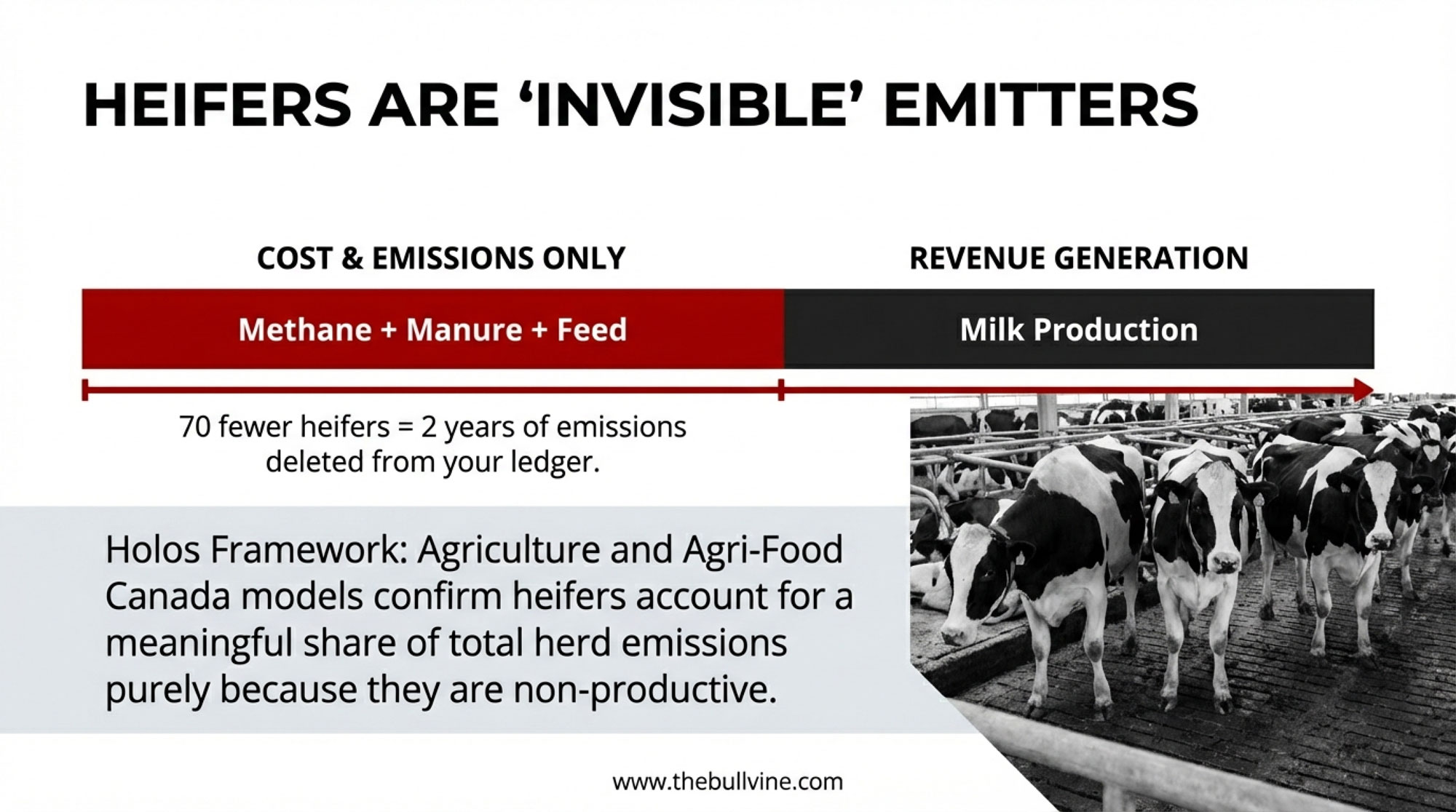
NewsSubscribe
First
Last
Consent

Why African Dairy’s $74B Boom Bypasses Local Farmers – And What It Means for Global Markets

African farmers: $21/cow/year. African dairy market: $74 billion. The money’s flowing—just not to farmers.

EXECUTIVE SUMMARY: Africa’s dairy market will reach $74 billion by 2035, yet local farmers capture just 2-3% while 80% flows to imports. The paradox: Africa owns 20% of global cattle but produces only 5% of milk, with farmers earning $21-200 per cow annually versus $1,800 breakeven in developed markets. Multinationals dominate through powder reconstitution rather than local sourcing—it’s cheaper to import at 5% tariffs than to collect from smallholders who produce 1-3 liters daily. East Africa proves transformation is possible, with Kenya and Rwanda becoming exporters through cooperatives and smart policy, while West Africa remains import-dependent. For global dairy professionals, success means abandoning Western models for adapted genetics, intermediate technologies, and hybrid strategies that match Africa’s unique reality—not replicating Wisconsin in Lagos.

African dairy market

At a recent dairy conference, I found myself in conversation with several producers interested in African opportunities. They’d all seen the same presentations—Africa’s dairy market reaching $74 billion by 2035, up from $61.7 billion today, according to IndexBox’s November 2024 analysis. “Last frontier for dairy,” one called it.

After spending the past few months examining the dynamics on the ground, I’ve come to realize we’re dealing with something far more complex than most investment presentations suggest. Africa isn’t developing a conventional dairy sector like we’ve seen elsewhere. Instead, it’s creating a unique hybrid system that challenges our traditional understanding of dairy market development.

The economic paradox of African dairy: A $74 billion market where local farmers earning $21 per cow annually capture just 2.5% of growth

The Market Growth Story: Real but Different

Understanding the Demographic Shift

The fundamentals driving growth are undeniably strong. McKinsey’s consumer research from June 2023 documented that Africa’s urban middle class is expanding from 300 million today to 500 million by 2035. That’s a demographic shift comparable to adding the entire U.S. population as potential dairy consumers.

What’s particularly noteworthy is how consumption patterns are evolving. Ethiopia’s Ministry of Agriculture reported in their 2024 sector review that urban dairy spending has accelerated dramatically, especially among middle-income households. Kenya’s Dairy Board projects 5.8% annual consumption growth through 2030—that’s faster than most Asian markets at a similar stage of development.

The Import Reality Check

Yet here’s where the story becomes more nuanced. The FAO’s November 2025 Africa Food Security Report reveals that approximately 80% of this consumption growth is met by imported dairy products and reconstituted powders, not by expanded local production.

Africa’s fundamental dairy paradox: controlling 20% of the world’s cattle but producing just 5% of global milk while importing 80% of consumption

“The continent currently produces just 5% of global milk while maintaining 20% of the world’s cattle.”

According to UN Comtrade data from 2024, Africa imports $7.5 billion in dairy products annually, with projections suggesting this could reach $15 billion by 2035. The European Milk Board’s October 2024 analysis shows traditional and fat-filled milk powder accounting for 76% of these imports—particularly dominant in West African urban centers.

KEY MARKET INDICATORS: The Scale of the Challenge

  • Current African production: 53.2 million tons (5% of global output)
  • Cattle population: 20% of the global herd
  • 2024 import value: $7.5 billion
  • Projected 2035 imports: $15+ billion
  • Powder products as a percentage of imports: 76%
  • Estimated local farmer share of market growth: 2-3%

Why Local Production Can’t Keep Pace

The Sobering Economics

I recently reviewed research from Mountaga Diop and colleagues at Senegal’s Institute of Agricultural Research, published in 2023. Their findings on smallholder economics were sobering:

“Average annual net returns of just $21.70 per cow”

Africa’s structural cost disadvantages: 70% feed costs, 40% infrastructure losses, and 53% heat-driven yield reductions make local production economically impossible against 5% tariff imports

In Kenya, often highlighted as a success story, the Kenya Institute for Public Policy Research’s 2024 analysis shows that farmers average $200 in annual profit per cow, with daily yields of 5-8 liters.

To put this in perspective, a Wisconsin producer recently told me their breakeven is around $1,800 per cow annually. The disparity illustrates fundamentally different economic realities.

Three Structural Challenges Blocking Progress

1. Feed Economics That Don’t Work

ILRI’s comprehensive study across eight African countries in 2024 found that feed accounted for 70% of production costs, compared to the 40-50% we typically see in North American operations. This difference alone changes everything about profitability calculations.

Ben Lukuyu, ILRI’s principal scientist for feed and forage development in Nairobi, shared with me that Kenya and Uganda face approximately 60% annual feed deficits. When the Russia-Ukraine conflict drove fertilizer prices up 81.9% and feed costs up 13.3%, many marginally viable operations simply couldn’t survive. And that’s in Kenya, which has better infrastructure than most.

2. Climate Stress Destroying Yields

The University of Melbourne’s research team, with support from the Gates Foundation, published compelling data in Animal Production Science this March. They documented Holstein yield reductions of 17-53% under African heat stress conditions—far exceeding what we see even in challenging U.S. environments like Arizona or Southern California.

“South Africa saw average yields decline from 21 liters to 16.1 liters per cow between 2018 and 2023—a 23% drop in the continent’s most developed dairy market”

This comes from the USDA Foreign Agricultural Service’s February 2025 report, and it’s particularly concerning because South Africa has the infrastructure we’d expect to mitigate these challenges.

3. Infrastructure That Can’t Support Growth

The World Bank’s 2024 Cold Chain Assessment estimates:

“Africa loses up to 40% of perishable food due to inadequate cold storage.”

CIRAD’s research indicates that only 1-7% of locally produced milk in West Africa enters formal trade channels. The investment required to fix this—estimated at $50-100 billion for comprehensive cold chain development—exceeds current funding commitments by roughly tenfold.

What Multinationals Are Actually Building

The Reconstitution Reality

The expansion strategies of major dairy companies offer important insights. Nestlé, Danone, and FrieslandCampina are indeed investing heavily across Africa, but their business models differ significantly from what many expect.

Okereke Ekumankama’s 2023 research at the University of Nigeria examined FrieslandCampina’s operations in detail. While the company controls 75% of Nigeria’s dairy market, they source virtually no local milk. Instead, they import powder from Europe for reconstitution in Nigerian facilities.

When “Development Programs” Don’t Develop

Their Dairy Development Programme, launched in 2010, aimed to integrate smallholder farmers. However, Ekumankama’s field research with 250 participating farmers revealed persistent challenges preventing meaningful integration.

The transaction costs of collecting from dispersed producers, averaging 1-3 liters daily, often in areas lacking roads, electricity, or cold storage, exceed the economics of importing powder at 5% tariff rates.

This pattern—building processing capacity for imported inputs rather than developing local supply chains—appears across much of the continent. It creates employment and provides affordable dairy products to urban consumers, which has value. But it doesn’t necessarily translate to local dairy sector development.

East Africa: A Different Story Emerges

The Success Stories

East Africa presents a notably different picture. The FAO’s October 2024 regional report shows the region accounting for 48% of Africa’s total milk production, with 26% growth between 2013 and 2023.

Rwanda’s Systematic Transformation

According to their Ministry of Agriculture’s presentation at September’s IDF Regional Conference:

  • Milk production tripled from 334,727 metric tons in 2010 to 1,092,430 metric tons in 2024
  • Per capita consumption doubled from 37.3 to 79.9 liters annually

The key? Mandatory quality testing at milk collection centers through Ministerial Order 001/11.30, strategic genetics programs with Heifer International, and sustained government investment spanning multiple administrations.

Kenya’s Cooperative Advantage

Kenya’s dairy success story: strategic policy and cooperative strength drove production from 4.2 to 5.7 billion kg while transforming from net importer to exporter by 2020

Kenya produces 5.7 billion kilograms annually, according to the Dairy Board’s 2025 outlook, with 80% originating from smallholder operations. The success factor isn’t individual farm productivity—yields remain at 5-8 liters per cow daily. Rather, it’s cooperative strength.

“Without the cooperative, I’d be selling to brokers at whatever price they offer. Now we negotiate as a group, and we get veterinary services I could never afford alone.”
— James Kibiru, dairy farmer in Nyeri County

Consider Meru Dairy Cooperative Union, which engages over 35,000 farmers through annual field days. They provide milk aggregation, veterinary support, quality-based payment systems rewarding butterfat performance, and collective bargaining power.

Uganda’s Export Achievement

IFPRI’s 2023 value chain analysis documents Uganda’s growth from a $2 million dairy industry in 2008 to $150 million by 2017. The country now exports $500 million worth of milk powder to Algeria, according to their Ministry of Trade’s 2024 data.

West Africa: Where Different Challenges Persist

I spoke with Kwame Asante, who manages a small dairy operation outside Accra, Ghana. “We can produce milk,” he told me, “but getting it to market before it spoils? That’s the real challenge. The processors prefer powder—it’s easier, cheaper, more reliable.”

His experience reflects broader West African dynamics. Ghana’s Fan Milk, now owned by Danone, built one of the region’s most successful distribution networks. Those yellow tricycles are everywhere in urban areas. Yet, as industry data shows, the operation relies primarily on imported powder, with local farmers supplying only about 2% of the processed volume.

The economics make sense from a processor perspective. A solar-powered cooling system for a single collection center runs about $15,000-20,000 according to equipment suppliers I’ve spoken with. When you’re collecting 50-100 liters daily from that center, the payback period stretches beyond what most investors will accept.

Policy Choices That Make or Break Markets

The fork in the road: policy choices and cooperative strength determine whether African dairy regions become self-sufficient exporters or import-dependent markets

The Tale of Two Approaches

Timothy Njagi at Kenya’s Tegemeo Institute documented how the country’s 2015 implementation of a 10% import levy plus 16% VAT on milk imports catalyzed transformation. Average daily yields from indigenous breeds increased by approximately 300% over the following decade, shifting Kenya from a net importer to an exporter.

By contrast, West African nations maintain just 5% tariffs through the ECOWAS Common External Tariff. Oxfam’s 2024 trade analysis shows the result: continued heavy import dependency, with fat-filled milk powder (a blend of skim milk and palm oil) dominating 70% of consumption in major cities.

Nigeria’s New Attempt

Nigeria’s National Dairy Policy Implementation Framework, validated in November 2025, offers:

  • Five-year tax holidays for processors
  • Low-interest credit for farmers
  • Guaranteed off-take schemes

Whether this succeeds where previous efforts struggled remains to be seen. The policy appears comprehensive on paper, but implementation has consistently been a challenge in Nigeria.

What This Means for Different Players

For Genetics Companies

Focus on adaptation, not maximum production. Raphael Mrode, who leads ILRI’s genetics program in Kenya, has been incorporating the “slick gene,” which confers heat tolerance through shorter, sleeker hair coats. These animals maintain reasonable productivity under conditions that would devastate conventional Holstein genetics.

The market opportunity exists for companies developing adaptation traits rather than pursuing maximum production designed for temperate conditions.

For Equipment Suppliers

Forget precision dairy technology designed for 1,000-cow operations. That’s not the market. Instead, think intermediate technologies: solar-powered cooling for collection centers (around $15,000-20,000 per unit), mobile apps for basic smartphones, robust milk testing equipment suitable for cooperative-level deployment.

Success requires matching technology to operational realities and economic constraints.

For Processors

Develop dual strategies: reconstitution capacity for urban markets while gradually building local collection infrastructure where economically viable. Don’t promise what you can’t deliver on local sourcing, but don’t ignore it either—governments are increasingly demanding local content.

The brutal reality: of the $74B African dairy market, local farmers capture just 2% ($1.5B) while European powder imports claim 58% ($43B)

The Bottom Line: Understanding the Real Opportunity

The $74 billion projection for the African dairy market from IndexBox appears realistic given demographic and income trends. However, understanding who captures this value—and how—requires nuanced analysis.

East African nations with strong cooperative structures and consistent policy support show genuine transformation potential. West Africa will likely remain import-dependent with selective local success stories. South Africa continues consolidating, potentially dropping below 500 commercial dairy operations by 2030.

What’s encouraging is seeing younger African dairy professionals returning from international training with fresh ideas. They understand both traditional systems and modern technology. They’re the ones who’ll ultimately bridge this gap between potential and reality.

For global dairy professionals, Africa represents opportunity—though not in ways that conform to conventional expectations. Success requires understanding the continent’s unique development trajectory, abandoning standard assumptions, and developing approaches appropriate to diverse regional contexts.

As we consider these opportunities, it’s worth noting that markets develop differently. Africa won’t follow the path of New Zealand or Wisconsin, or the Netherlands. It’s creating something new, and those who recognize and respect that difference will find the real opportunities.

This paradox—simultaneous consumption growth and production challenges—defines the current reality of African dairy. How the industry responds will shape both African food security and global dairy trade for decades to come.

What do you think? Are we looking at this opportunity the right way? I’d love to hear from producers who’ve worked in these markets or are considering investments there. The conversation continues.

KEY TAKEAWAYS:

  • Africa’s $74B dairy market is an import story, not a production opportunity—80% flows to European powder while farmers earning $21-200/cow yearly capture just 2-3% of value
  • Geography determines destiny—East Africa transforms through cooperatives and smart policy (Kenya exports after tripling yields), while West Africa stays import-dependent at 76% reconstituted powder
  • The economics simply don’t work at the current scale—African farmers face 70% feed costs (vs. 40% globally), 40% infrastructure losses, and compete against powder imports at just 5% tariffs
  • Success requires radical adaptation—heat-tolerant genetics (Holstein yields drop 17-53% in African heat), intermediate technology ($15K solar cooling, not $100K precision systems), and hybrid import-local business models
  • Multinationals aren’t villains, they’re rational—FrieslandCampina controls 75% of Nigeria’s dairy using zero local milk because collecting from smallholders costs more than importing

Complete references and supporting documentation are available upon request by contacting the editorial team at editor@thebullvine.com.

Learn More:

Join the Revolution!

Join over 30,000 successful dairy professionals who rely on Bullvine Weekly for their competitive edge. Delivered directly to your inbox each week, our exclusive industry insights help you make smarter decisions while saving precious hours every week. Never miss critical updates on milk production trends, breakthrough technologies, and profit-boosting strategies that top producers are already implementing. Subscribe now to transform your dairy operation’s efficiency and profitability—your future success is just one click away.
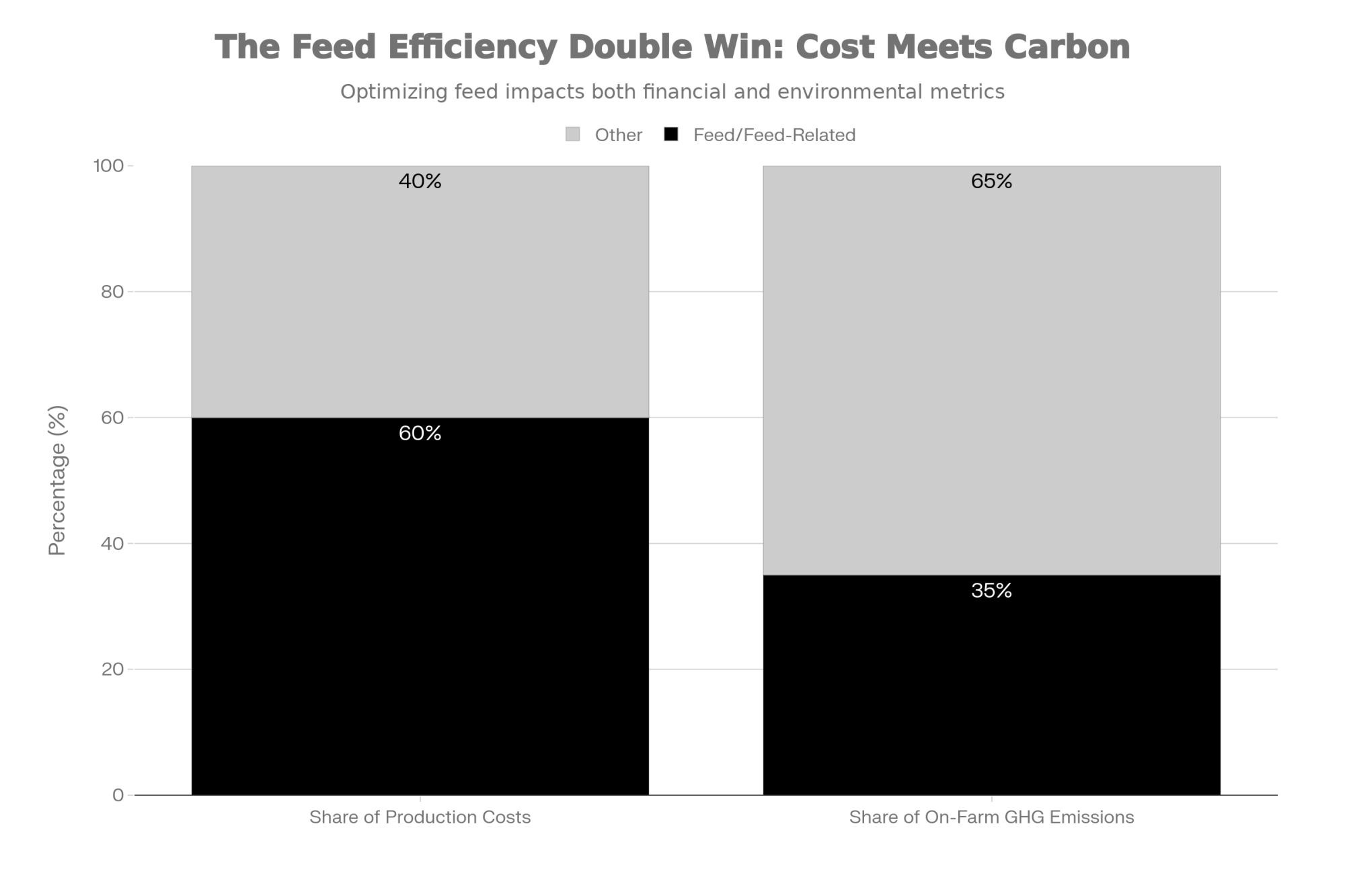
NewsSubscribe
First
Last
Consent

This Hidden $1,400/Cow Cost Is Killing Profits – Here’s the Fix

What happens when cows actually choose? German researchers tested it—and found $1,400/cow in costs disappeared. Here’s what they discovered.

Executive Summary: Conventional dairy practices are costing you $1,400 per cow annually in hidden losses from regrouping stress, transition disease, and premature culling—costs most farmers don’t even track. German researchers just proved these losses are preventable through an integrated approach: let cows choose their environment, maintain stable social groups, and keep calves with mothers longer. The data are striking: regrouping alone costs $3,400/year in a 500-cow herd, while their approach reduces lameness by 30-40% and produces calves gaining 3+ pounds daily. Implementation means rethinking barn design and investing 18-24 months in learning new management practices, but the returns justify the effort—$400,000-500,000 in annual benefit potential with a 4-6 year payback. With retailers like Walmart already demanding welfare-certified products and the market growing to .4 billion by 2033, early adopters gain a competitive advantage. The bottom line: when cows get choice, hidden costs disappear and everybody wins—especially your profit margin.

You know what caught my attention last week? A group of German agricultural researchers posed a question that’s got me rethinking everything about barn design: What if we actually let cows decide how they want to spend their day?

Prof. Dr. Lisa Bachmann and her team at the Research Institute for Farm Animal Biology in Dummerstorf, Germany, published their findings this fall in the Journal of Dairy Science, and honestly… some of these insights are making me reconsider assumptions I’ve held since I started in this business.

What makes German research distinctive is its integrated design concept, which combines stable family herds, cow-calf contact, free indoor-outdoor movement, and automation—a comprehensive approach documented in their published research. Their design concept maintains stable social groups throughout production, provides genuine barn-and-pasture choice during favorable seasons, and integrates cow-calf contact with automated milking. And here’s what’s really interesting—their research documents how this integrated approach addresses multiple cost drivers simultaneously—regrouping stress, transition disease incidence, and culling patterns—suggesting substantial economic advantages we haven’t really considered before.

Here’s the context that makes this relevant right now. USDA’s latest census shows we’ve gone from 105,250 dairy farms in 2000 to about 31,600 operations today. That’s a 70% drop, folks. So when we’re talking about alternative approaches to dairy infrastructure, we’re no longer just having an academic discussion. For a lot of mid-sized operations—maybe yours—this could be about finding a viable path forward.

The $1,000 Per Cow Opportunity: Conventional dairy systems leak $1,400 annually per cow through hidden stress, disease, and management costs—while welfare-integrated approaches reduce these losses by 71% to just $400 per cow. For a 500-cow operation, that’s $500,000 walking out the barn door every year.

What We’re Learning About Cow Preferences

What’s fascinating is how consistent cow behavior becomes when they actually have choices. Research on grazing behavior shows cows utilizing outdoor areas extensively, particularly during evening and nighttime hours. And get this—their motivation for pasture access rivals their drive for fresh feed. That’s saying something.

I was looking at production research from Ireland the other day, and the lying time data really stood out. Cows with pasture access were averaging about 9.9 hours of daily lying time compared to 9.5 hours for confined animals. Now, you might think, “That’s only 24 minutes, what’s the big deal?” But here’s what’s interesting—those pasture cows had fewer but longer lying bouts. Less getting up and down, more quality rest. You know how much that matters for rumination and production.

“Conservative estimates suggest we’re looking at $1,000-1,400 annually per cow in hidden costs from stress, disease, and management practices we’ve just accepted as normal.”

Marina von Keyserlingk’s animal welfare lab at UBC documented another noteworthy finding: cows with overnight pasture access show significantly more walking activity. And for those of us dealing with lameness issues—which is basically everyone, right?—that natural movement pattern correlates with better hoof health.

Speaking of lameness, research comparing different housing systems shows some pretty dramatic differences. We’re seeing lameness prevalence vary significantly by bedding and housing type, with comprehensive studies documenting reductions of 30-40% in systems incorporating pasture access. Penn State Extension puts lameness costs at around $337 per case. Do the math on that for your herd—it adds up fast.

The Real Cost of Moving Cows Around

Every Time You Move Cows, You’re Burning Cash: Each regrouping event triggers an immediate 8.5% milk production crash and 9% feed intake nosedive. The chaos lasts 3-7 days, and at 5 regroupings per lactation, you’re hemorrhaging $3,400 annually in a 500-cow herd—before you even factor in breeding delays and elevated somatic cell counts.

Here’s something we don’t talk about enough. Most of us regroup cows four to six times per lactation. It’s just… what we do, right? But Daniel Weary’s group at UBC has been quantifying what that actually costs us, and the numbers are sobering.

They’re documenting an immediate 8.5% production drop when you regroup—going from about 95 pounds down to 87 pounds daily. Feed intake drops 9% during that adjustment period. The behavioral chaos lasts 3-7 days. And there’s a clear negative correlation between aggressive interactions and butterfat levels.

So I ran the numbers for a typical 500-cow herd averaging 80 pounds at $20/cwt. Each regrouping event? That’s about $1.36 in lost production per cow. Five times across a lactation, you’re looking at $3,400 in revenue just… gone. And that’s before we even think about what stress does to breeding or somatic cell counts.

The German research proposes maintaining what they call “stable family herds”—basically keeping cows and their offspring together without constant pen changes. Yeah, it means rethinking your entire barn layout and cow flow. But when you add up all these hidden costs? The economics start looking different.

Hidden Costs Summary

Cost CategoryImpact Per Event/Case
Regrouping$6-10/cow per event
Transition disease$125-450/case
Lameness$337/case
Annual total per cow$1,000-1,400

Reconsidering Cow-Calf Contact

I’ll be honest—I’ve always been pretty skeptical about extended cow-calf contact. The colostrum management concerns are real, and disease control matters. But the data coming out of European research institutions is making me think twice.

Norwegian researchers tracking cow-calf systems in automated milking herds are seeing calves achieve average daily gains around 1.4 kg—that’s over 3 pounds a day. That’s beef calf territory, way beyond the 1.25 to 1.9 pounds we typically see with conventional feeding. Research shows that calves with extended dam access consume substantially higher milk volumes than those in conventional feeding programs.

Now, Swedish agricultural research acknowledges these systems can reduce your contribution margin by 1-5%, primarily from milk you’re not selling. Fair point. But here’s what that analysis often misses…

Research indicates significant labor reductions during the calving period when cows manage their own calves. Think about it—no milk replacer costs, no feeding equipment to clean, fewer health treatments. Studies consistently show improved calf health metrics in these contact systems. And for those of us struggling to find reliable calf feeders (which seems to be everyone these days), the labor savings alone might tip the scales.

How Automation Changes Everything

What’s really interesting is how automation is shifting the whole welfare conversation. Michigan State’s recent survey of large dairy farms with robots found something telling: 84.6% cited labor cost reduction as their main reason for automating, but 76.9% also reported improved cow welfare.

“Each regrouping event costs about $1.36 per cow in lost production. Five times across a lactation, you’re looking at $3,400 in revenue just… gone.”

The financials are compelling. University of Wisconsin data shows that operations with robots reduced labor costs from about 8.4% of revenue to 4.4%. That’s a 38-43% reduction in time per cow, with milking-related tasks down 62%.

But here’s what I’ve been noticing during farm visits… Most robot installations are still optimizing the same old confinement model rather than enabling the kind of cow choice that German research suggests could improve both welfare and profitability. Current designs assume conventional freestall housing with standard routing. Want to add real outdoor access? That requires completely different thinking.

Industry experts increasingly acknowledge that while technical solutions exist, our infrastructure tends to reinforce conventional approaches rather than enabling alternatives. Some equipment manufacturers are exploring systems compatible with grazing, especially for markets where that’s standard practice, but North American options remain pretty limited.

Understanding the Full Cost Picture

The Disease Tax Nobody Talks About: Every transition disease carries a price tag, but here’s the killer—they don’t come alone. Half your fresh cows deal with multiple conditions, compounding to $600-900 per affected animal. Subclinical ketosis hitting 30% of your herd at $125/case? That’s just the entry fee. Welfare-integrated systems cut these rates in half. Your call.

Recent research on dairy economics has been eye-opening about costs we usually don’t track properly:

You know transition cow challenges—nearly half of fresh cows deal with some metabolic issue. Subclinical ketosis alone runs about $125 per case based on recent studies. Clinical mastitis? USDA data puts it at $325-450 per case, with 71% of those costs from lost production, not treatment.

Lameness economics are brutal. Penn State’s research shows an average of $337 per case, with each additional week adding about $13. Digital dermatitis typically runs almost $100 more than other lameness causes. And here’s what really gets me—research consistently shows lameness hammering fertility, with reproduction-related costs representing a huge chunk of the total economic hit.

Then there’s culling and replacement. Canadian dairy industry data shows turnover at 35-40%, with replacement costs of $2,500-3,500, depending on where you are. Lose a cow before her third lactation? You never recover that rearing investment.

Add it all up, and conservative estimates suggest we’re looking at $1,000-1,400 in hidden costs per cow annually from stress, disease, and management practices we’ve just accepted as normal. That’s… that’s a lot of milk checks.

MetricConventional SystemWelfare-Integrated SystemNet Difference
Annual Cost Per Cow$1,400 hidden losses$400 reduced losses$1,000 savings/cow
Regrouping Events/Lactation4-6 times0-1 times4-5 fewer events
Lameness Prevalence20-25%12-15% (-40%)-40% cases
Lameness Cost Impact$337/case × 100+ cases$337/case × 60 cases~$13,500 savings
Transition Disease Rate~50% of fresh cows~25% of fresh cows-50% incidence
Calf Daily Gain (lbs)1.25-1.9 lbs3+ lbs+1+ lb improvement
Average Culling Rate35-40%22-25% (-35%)-13-15% points
Replacement Cost$2,500-3,500/cow$2,500-3,500/cowEarlier ROI
Labor Cost (% of revenue)8.4%4.4%-48% labor
Milk Production StabilityHigh variabilityMore consistentImproved flow
Veterinary CostsBaseline-30 to -35%$35K+ savings
Total Herd Cost (500 cows)$700,000 in losses$200,000 in losses$500,000 annual gain

Thinking About Infrastructure Investment

The German team’s estimates for welfare-integrated systems suggest substantially greater capital investment than conventional designs—we’re talking significant money here, potentially thousands of dollars per cow.

The Math That Changes Everything: Drop $1.5M on a welfare-integrated barn design and conventional wisdom says you’re crazy. But here’s what actually happens—you break even in 4-6 years, then bank $400K+ annually for the next decade. Total 15-year gain? Over $4 million. Meanwhile, “efficient” conventional operations keep bleeding that $1,400/cow every single year. Do the math

But let’s think through the returns. If these systems prevent even $800-1,000 annually in disease, stress, and culling losses, a 500-cow operation could see $400,000-500,000 in annual benefit. Finance that over 15 years at 6%, you’re looking at $200,000-300,000 in debt service, potentially leaving $150,000-250,000 in improved cash flow. That suggests a 4-6 year payback. I’ve seen producers jump on automation for returns that are less attractive than that.

Practical Implementation Thoughts

Based on conversations with producers who’ve made changes, here’s what seems to work:

Start with what you can control. You don’t need to revolutionize everything overnight. Several operations I know in Wisconsin started simple—adding outdoor access areas, reducing regrouping frequency, and trying modified calf management in just one pen.

Really assess your existing setup. Retrofitting current facilities for genuine cow choice is way harder than building it in from the start. If you’re already planning major construction or renovation? That’s your opportunity.

Think carefully about your market position. Nielsen’s 2023 consumer research documented a 57% increase in certified animal welfare products after mainstream retailers began stocking them. There’s a real differentiation opportunity, but you need to know what your milk buyer values.

And budget time for the learning curve. Managing pasture systems, cow-calf contact, stable herds—it’s different than running conventional confinement. Most folks find it takes 18-24 months to really develop the new management skills.

Regional Considerations

One thing the German research doesn’t fully address—and it matters here—is our climate variability. What works in temperate Germany needs adaptation for Arizona heat or Manitoba winters.

I’ve been hearing about different regional approaches. California researchers are testing shade and cooling for outdoor areas in hot climates. Canadian institutions are exploring winter paddock designs that maintain choice even in extreme cold.

In the upper Midwest, some producers are trying hybrid approaches—outdoor access during good weather, modified grouping strategies for winter housing. It’s not the full German model, but they’re seeing meaningful improvements in lameness and culling.

“Lose a cow before her third lactation? You never recover that rearing investment.”

Some producers implementing partial modifications report that eliminating regrouping practices resulted in substantial reductions in veterinary costs, though they acknowledge the learning curve was steep initially. I’ve heard of operations documenting 30-35% drops in vet bills after making these changes, though everyone admits it takes time to figure out the new management approach.

Looking Ahead

The $3.4 Billion Question: While most producers debate whether to adopt welfare practices, the certified animal welfare market is exploding—growing 183% to $3.4 billion by 2033. Early adopters positioning now will capture premium pricing before this becomes table stakes. Wait until mainstream adoption, and you’re just playing catch-up at commodity margins.

The consolidation trend isn’t slowing. Industry projections show substantial portions of milk production shifting to larger operations in the coming years. For mid-sized farms—those 200 to 1,000 cow operations that are the backbone of many regions—the traditional “get big or get out” message feels pretty heavy.

But this research illuminates other paths. The animal welfare certification market reached $1.2 billion in 2024 and is projected to reach $3.4 billion by 2033, according to Grand View Research (https://www.grandviewresearch.com). Major retailers like Walmart and Kroger have made procurement commitments for certified products. That’s creating a genuine market opportunity for differentiated producers.

Plus, emerging climate regulations are going to reshape the economics. Canada’s carbon framework for agriculture and similar U.S. initiatives will likely favor systems with greater efficiency, enhanced pasture management, and lower replacement rates.

What Producers Are Finding

Producers implementing modified approaches report interesting results. After dealing with steep learning curves around cow flow and grazing management, many are seeing veterinary costs drop significantly, labor requirements decrease, and production metrics improve—outcomes that surprise even them.

Others are taking different approaches, like maintaining limited cow-calf contact as a workable compromise between calf health improvements and milk sales. The key seems to be adapting concepts to specific circumstances rather than trying to copy someone else’s system exactly.

There’s no universal template here. Each operation needs to evaluate how these concepts might work with their unique combination of facilities, labor, markets, and management style.

The Bottom Line: Your Hidden Costs

When you factor in:

  • Regrouping losses: $3,400/year for 500 cows
  • Transition diseases: 50% of fresh cows are affected
  • Lameness: $337/case at 15-20% prevalence
  • Premature culling: Never recovering $2,500-3,500 investment

You’re losing $1,000 to $ 1,400 per cow annually in preventable costs.

Quick Takeaways for Action

Looking at all this research, here’s what you can start doing today:

  • Calculate your hidden costs: Track regrouping frequency, transition disease rates, and culling patterns for three months
  • Test small changes: Pick your highest-stress group and eliminate one regrouping event
  • Explore market premiums: Contact your milk buyer about welfare certification opportunities
  • Visit operations making changes: Nothing beats seeing these systems in action
  • Budget for learning: Any system change requires time—plan for it

Making Sense of It All

After really digging into this research, here’s what stands out to me:

The economics are way more complex than simple comparisons suggest. When you account for regrouping losses, disease costs, premature culling, and genetic potential that never gets expressed, conventional systems carry substantial hidden costs. Alternative approaches could meaningfully reduce those expenses.

Consumer expectations keep evolving. When certified products reach mainstream retail with clear differentiation, sales respond. That’s not a trend—it’s market reality.

Technology can enable choices. Current automation typically optimizes confinement, but alternative technical solutions exist. It’s more about design philosophy than technical barriers.

The transformation already underway creates both risk and opportunity. As margins compress and consolidation accelerates, differentiation becomes increasingly valuable. Whether you pursue commodity efficiency or welfare premiums—that’s a fundamental strategic decision.

And here’s the thing—the knowledge exists right now. The research has been published, the designs are documented, and the technical specifications are available. The question isn’t whether these systems work. It’s how they might fit your specific situation.

Looking at where we’re headed, understanding these alternatives becomes crucial for planning. This German research reminds us that innovation sometimes comes from questioning our basic assumptions.

The path forward varies by operation. A 5,000-cow facility in New Mexico operates under different constraints than a 200-cow farm in Vermont. But having genuine options—economically viable alternatives to consider—that’s what gives us flexibility to build operations aligned with our goals, values, and circumstances.

Maybe the question isn’t whether we can afford to implement such changes. Given the hidden costs already embedded in our operations and where markets are heading… maybe we should be asking: What’s the cost of not exploring these possibilities?

That answer will likely shape the next generation of dairy farming. And honestly? When cows get to make choices, it turns out everybody might win—including our bottom line.

Complete references and supporting documentation are available upon request by contacting the editorial team at editor@thebullvine.com.

Learn More:

Join the Revolution!

Join over 30,000 successful dairy professionals who rely on Bullvine Weekly for their competitive edge. Delivered directly to your inbox each week, our exclusive industry insights help you make smarter decisions while saving precious hours every week. Never miss critical updates on milk production trends, breakthrough technologies, and profit-boosting strategies that top producers are already implementing. Subscribe now to transform your dairy operation’s efficiency and profitability—your future success is just one click away.
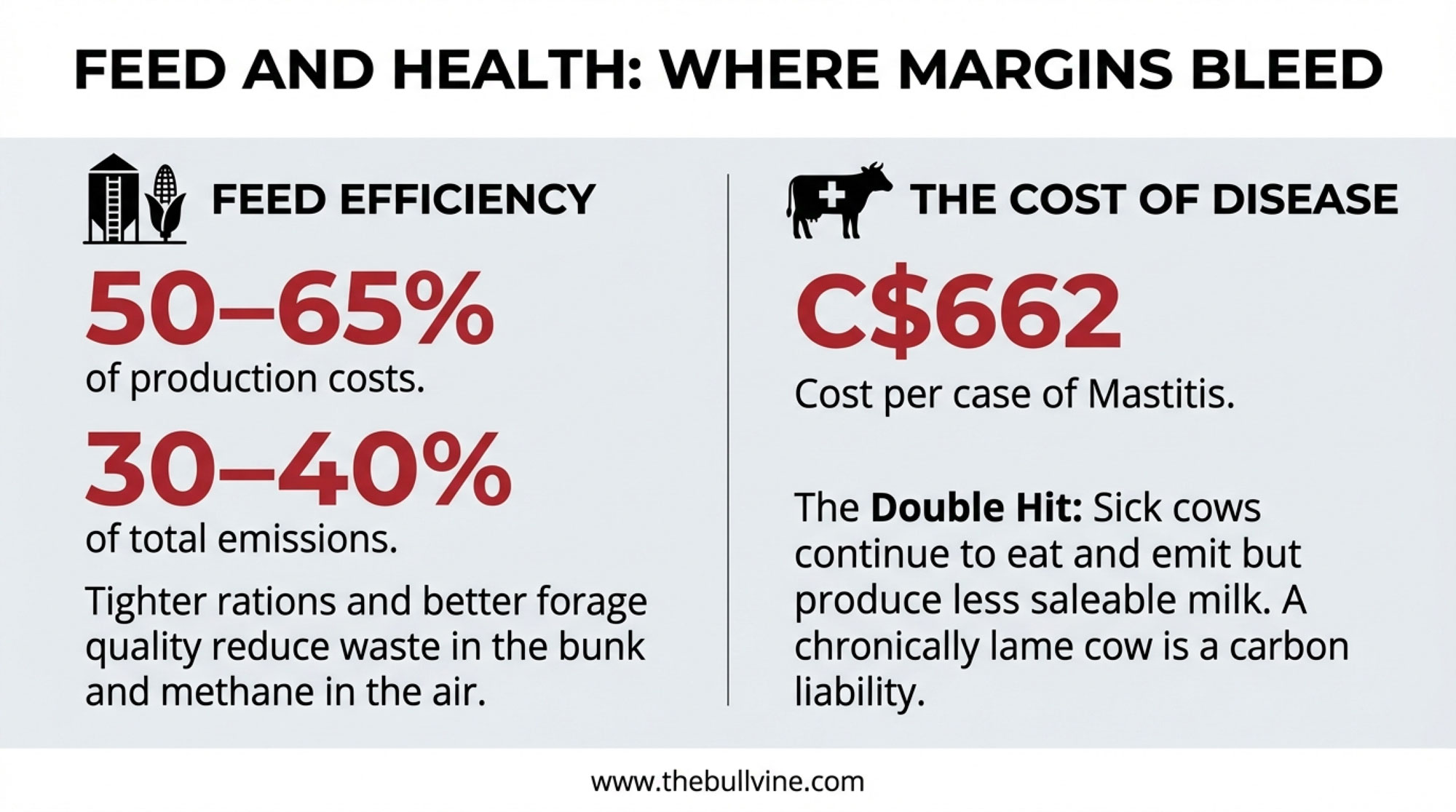
NewsSubscribe
First
Last
Consent

The Tyson Shutdown Playbook: How Plant Closures Steal $10,000 From Your Dairy – Every Year

When beef plants close, dairy basis widens. Here is the economic playbook used to squeeze producer margins—and how to protect your operation

EXECUTIVE SUMMARY: Tyson claims ‘unprecedented cattle shortages’ justified closing their Lexington plant—yet cattle inventory is down just 3% and the company paid $2 billion MORE for cattle this year, not less. This closure eliminates 30% of Nebraska’s processing capacity, extracting .5 million annually from producers through wider basis—the gap between futures prices and what farmers actually receive. Dairy farmers are already living this reality: processor consolidation costs the average 1,000-cow dairy ,000-14,000 yearly in reduced cull cow values alone. With four firms controlling 85% of beef processing (up from 25% in 1977), capacity decisions become price controls—no conspiracy required, just strategic plant closures. The same playbook that eliminated 61% of dairy farms over 25 years is now accelerating in beef. This investigation reveals how basis compression works, why consolidation makes it worse, and what producers can do to protect their operations before they become the next casualty.

Dairy cull cow revenue

When Tyson Foods announced the closure of their Lexington, Nebraska, beef processing plant on November 21st—citing “unprecedented cattle shortages”—it sparked conversations across agricultural communities. The facility processes 5,000 head daily, employs 3,000 workers in a town of 10,000, and will shut down by January 2026. That represents roughly 30% of Nebraska’s beef processing capacity disappearing in a single corporate decision. While this is a beef industry headline, the blueprint is identical to the consolidation already squeezing dairy margins—and understanding these mechanics could mean the difference between adapting successfully or becoming another farm closure statistic.

What makes this particularly relevant for dairy operations is how the actual cattle inventory data appears to tell a different story than the corporate narrative suggests. For those of us who’ve watched dairy consolidation over the past decade, these patterns feel remarkably familiar.

Economic Impact Distribution: When Tyson closes Lexington, $182.5M leaves rural Nebraska—cattle producers lose $37.5M annually in basis compression, the community loses $25M, workers lose $120M in wages. Processing companies and shareholders capture $60M in improved margins

Understanding Basis Pricing: The Mechanism Behind Local Markets

Let me share something that becomes increasingly important as markets consolidate—the concept of “basis” and how it affects what producers actually receive versus what they see on commodity screens.

Basis represents the difference between futures prices—those numbers flashing on Chicago Mercantile Exchange screens—and the actual cash price producers receive at their local market. Think of it as your regional market adjustment. In dairy, we see this same dynamic between Class III futures and mailbox prices, and the parallels are instructive.

Basis Compression Impact: Plant closures directly translate to lost revenue for dairy producers through wider basis differentials on cull cow sales. A 1,000-cow dairy loses $10,000-$17,000 annually as processing competition evaporates

The agricultural economics team at the University of Nebraska-Lincoln has extensively documented these patterns through its research publications. Their findings show that in competitive markets, feedlot operators typically receive the futures price minus a modest basis adjustment—perhaps 5 to 15 cents per hundredweight — for transportation and regional supply-and-demand factors.

What’s particularly noteworthy is how dramatically this changes when processing capacity leaves a region:

In a competitive market scenario: A feedlot 50 miles from multiple processors might see:

  • Basis of approximately -$0.05/cwt
  • Multiple competitive bids arriving weekly
  • Cash price around $193.95/cwt on a 1,250 lb steer, yielding $2,424

After significant capacity reduction: That same operation now shipping 180+ miles might experience:

  • Transportation costs are adding $33 per head (based on USDA-tracked rates of $5.50 per loaded mile)
  • Basis weakening to -$2.50/cwt or more
  • New cash price dropping to $191.50/cwt, or $2,394 per head

When you calculate that $30 per head difference across the 1.25 million head annually processed at Lexington, Nebraska producers potentially face $37.5 million in reduced annual revenue—not from market fundamentals, but from structural changes in competitive dynamics.

The Cull Cow Connection: What This Means for Your Bottom Line

Here’s something every dairy producer needs to understand about processing capacity: it directly affects your cull cow revenue. For a 1,000-cow dairy culling 35% annually, that’s 350 cull cows heading to market each year. When regional processing capacity shrinks, the basis on those cull cows widens just like it does for fed cattle.

Using current market dynamics, if basis widens by just $2.00/cwt due to reduced processing competition, that represents approximately $10,000 to $14,000 in lost annual cash flow for that 1,000-cow operation (assuming 1,400 lb cull cows at current prices). For many dairies, that’s the difference between profit and break-even—or between staying in business and selling out.

Examining the Supply Narrative: What the Data Actually Shows

The interesting thing about market narratives is how they sometimes diverge from documented data. USDA’s National Agricultural Statistics Service reported Nebraska’s January 2025 cattle inventory at 6.05 million head, down just 3% from the previous year. The state’s cattle-on-feed inventory in September 2025 stood at 2.43 million head, showing remarkable stability through recent reporting periods.

What’s particularly revealing—and this comes from Tyson’s own SEC filings—is that the company reported cattle costs increased by $2 billion in fiscal 2025 compared to the prior year. That pattern typically suggests competitive bidding for supply rather than genuine scarcity.

Dr. Derrell Peel at Oklahoma State University, who’s done extensive work on livestock markets, has observed that when processors simultaneously report supply challenges and increased input costs, it often indicates competitive pressure rather than actual shortage conditions. This aligns with what many market observers have noted.

Tyson’s beef segment reported an adjusted operating loss of $426 million in fiscal 2025, with forward guidance suggesting losses of $400-600 million in fiscal 2026. The closure removes 6,700 head of daily processing capacity from the market when you include reductions at their Amarillo facility—a significant structural change to regional competition.

Learning from Dairy’s Consolidation Journey: Regional Patterns Emerge

The dairy industry’s experience with consolidation offers a valuable perspective on these dynamics—and it’s playing out differently across regions.

Market Concentration Timeline: As processing consolidation accelerated from 25% to 85% control by four firms, dairy farm numbers collapsed by 61%. The correlation isn’t coincidence—it’s cause and effect

When Dean Foods filed for bankruptcy in November 2019, they operated 57 facilities across 19 states—essentially the largest fluid milk processor in America. Dairy Farmers of America’s 2020 acquisition of 44 of those plants for 3 million represented a significant concentration of processing capacity.

The Northeast Experience

Vermont exemplifies how consolidation pressures compound. The November 2025 Class I base price hit $16.75/cwt, down $1.29 from October, despite relatively stable national commodity markets. With 78% of Vermont experiencing severe drought conditions according to U.S. Drought Monitor data, producers face what economists describe as converging pressures—rising feed costs coinciding with price compression from national oversupply.

The Midwest Transformation

Wisconsin’s story shows how quickly landscapes change. Saputo’s recent optimization strategy provides a textbook example. Between 2024 and 2025, they’ve closed facilities in Belmont, Big Stone (South Dakota), Lancaster, Tulare (California), South Gate (California), and Green Bay. Each announcement emphasized “network optimization” and “operational efficiency.”

The Suamico, Wisconsin, closure eliminated 240 positions according to state workforce notifications. What’s particularly significant for smaller operations is that Saputo’s new Franklin, Wisconsin, facility requires 4-5 million pounds of milk daily for efficient operation—volume typically sourced from larger operations rather than traditional family-scale dairies.

Wisconsin has seen three major facility closures in 18 months. For producers in central regions, buyer options have decreased from five to perhaps two or three—a fundamental shift in market structure. International Dairy Foods Association tracking shows $11 billion in new processing capacity announced nationwide, with significant investment flowing to Texas, Idaho, and New Mexico—regions with operational scales different from traditional Midwest dairy.

I recently spoke with a Wisconsin producer milking around 400 cows who shared their experience after the Lancaster closure. Their milk hauling distance jumped from 45 miles to 110 miles, adding roughly 90 cents per hundredweight to their costs—assuming truck availability, which isn’t always guaranteed in tight transportation markets.

The Western Perspective

A California producer I connected with last month offered a different perspective. “We’ve watched consolidation reshape our market for two decades,” she explained. “When you’re down to two buyers for your milk in a 200-mile radius, the conversation changes completely. It’s not negotiation anymore—it’s take it or leave it.”

The progression seems consistent across all regions:

  • Processors announce efficiency-driven network optimization
  • Regional processing options decrease
  • Basis differentials widen as competition diminishes
  • Margin pressure intensifies for producers
  • Scale becomes increasingly critical for survival

USDA Economic Research Service data documents this trajectory in dairy—from approximately 100,000 operations to 39,000 over 25 years, a 61% reduction. American Farm Bureau projections suggest 2,800 dairy operations may exit in 2025 alone, though market conditions could affect these estimates.

Dairy Consolidation Acceleration: As processor consolidation squeezes margins, operations exit at increasing rates. Survivors must scale dramatically—average herd size jumped from 82 to 330 cows. The 300-cow family dairy that once thrived now barely survives

Understanding Make Allowance Impacts

The June 2025 Federal Milk Marketing Order adjustments increased make allowances in ways that the National Milk Producers Federation analysis suggests will shift approximately $91 million annually from producer revenues to processor margins. University of Wisconsin dairy enterprise budgets indicate a typical 300-cow operation that might have netted $10,000 annually could face $61,000 in losses under current conditions—challenging math for any operation.

The Economics of Community Impact

Rural development researchers have modeled the economic ripple effects of major facility closures, suggesting impacts of around $300 million over time for a community like Lexington—roughly $30,000 per capita in a town of 10,000. This encompasses lost wages, reduced tax revenue, diminished retail activity, and the broader multiplier effects that flow through rural economies.

Make Allowance Revenue Transfer: The June 2025 Federal Order changes shifted $91M annually from producer milk checks to processor margins. A typical 300-cow dairy loses $10,000/year—often the difference between profitability and loss. This isn’t market forces; it’s regulatory capture

Understanding where economic value flows in these transitions helps explain the dynamics:

For processing companies and shareholders: Industry analysis suggests potential margin improvements of $40-80 million annually through strategic capacity management and reduced regional competition. Tyson’s dividend program distributes $353 million annually to shareholders, with share buyback authorizations exceeding $1 billion in fiscal 2025.

For producers: Transportation cost increases alone could reach $42 million annually for cattle previously processed at Lexington. Add basis compression and reduced negotiating leverage, and the economic pressure compounds significantly.

For communities: Property tax revenue losses estimated at $15-25 million annually create budget pressures that affect schools, infrastructure, and essential services—impacts that persist long after the initial closure.

Monitoring Market Consolidation: Warning Signs to Watch

Language That Warrants Attention:

When processors use terms like “network optimization,” “reducing duplicate capacity,” or “investing in next-generation facilities,” it often precedes structural changes. Similarly, phrases about “managing supply challenges” or “consolidating operations” deserve careful consideration.

Market Indicators to Track:

  • Widening gaps between announced prices and actual payments
  • Shifting regional price differentials
  • Increasing hauling distances to remaining processors
  • Investment patterns favoring certain regions over others

Proactive Steps to Consider:

  • Maintain detailed records of basis trends
  • Build information networks with regional producers
  • Request transparency in pricing calculations
  • Preserve operational flexibility where possible

Price Discovery: The Foundation of Fair Markets

One fundamental shift deserves particular attention—the evolution of price discovery mechanisms. Iowa State University research documents that in the 1990s, approximately 80% of fed cattle were traded through transparent cash markets. Today, that figure has dropped to around 20%, with formula contracts dominating transactions.

Why does this matter? When price discovery depends on limited transactions, those prices become both less representative and potentially more influenced by strategic behavior. Academic research shows that as formula contracts grew from 20% to 80% of volume, the packer-to-retail price spread effectively doubled.

Price Discovery Erosion: Cash market trading collapsed from 80% to 20% of cattle transactions. Formula contracts now dominate—but those formulas are based on the thin cash market, creating a self-reinforcing cycle of reduced transparency and price control

Dairy maintains relatively better price transparency through Federal Order reporting, which explains why the June 2025 make allowance changes generated immediate producer response—the impacts were visible and quantifiable. Markets operating primarily through private formula contracts offer less transparency for impact assessment.

Strategic Considerations for Producers

While consolidation trends seem likely to continue, producers have options for navigating these changes:

Near-term Risk Management:

  • Document basis patterns systematically—tracking announced versus actual prices monthly reveals trends that inform decisions
  • Build information networks—comparing experiences with regional producers helps identify systematic patterns versus individual situations
  • Seek pricing transparency—understanding calculation methodologies helps identify where value gets captured
  • Maintain operational flexibility—long-term commitments may limit options during structural market shifts

Longer-term Positioning:

  • Evaluate differentiation opportunities—value-added production or direct marketing can provide alternative revenue streams, though these require different skill sets and market development
  • Strengthen collective representation—producer organizations provide platforms for information sharing and advocacy
  • Engage in policy discussions—market structure issues ultimately require policy responses
  • Assess scale strategically—understanding where your operation fits in evolving market structures informs investment decisions

Essential Questions for Processors:

  1. What methodology determines base pricing, and is the underlying data accessible?
  2. What proportion of supply comes through formula versus cash transactions?
  3. How does pricing compare across similar regional suppliers?
  4. Where are capital investments being directed geographically?
  5. How will any facility changes affect net returns after transportation?

Broader Implications for Agricultural Markets

The Tyson Lexington situation illustrates how market concentration—with four firms controlling 81-85% of beef processing, up from 25% in 1977—fundamentally alters market dynamics. Similar patterns in dairy, with comparable concentration levels, suggest these aren’t isolated incidents but structural trends.

What’s becoming increasingly clear:

  • Processor capacity decisions significantly influence regional pricing dynamics
  • Economic impacts flow predictably from rural communities toward corporate returns
  • Reduced price transparency through formula contract dominance creates structural advantages for processors
  • These patterns appear consistent across protein sectors

What remains less certain:

  • The potential for meaningful antitrust enforcement or policy intervention
  • Timeline and effectiveness of producer collective action
  • Whether technological or market innovations might create alternatives
  • How consumer preferences might influence market structures

Understanding these dynamics isn’t about pessimism—it’s about realistic assessment. Market structures have evolved significantly from previous generations’ experience. Success requires recognizing these changes, adapting strategically, and working collectively where appropriate to maintain competitive markets.

The fundamental question isn’t whether consolidation will continue—current trajectories suggest it likely will. The question becomes how producers can best position themselves within evolving market structures while advocating for policies that preserve competitive dynamics.

What unfolds in Lexington over the coming months may preview developments in other agricultural regions. Producers who understand mechanisms like basis compression, price discovery evolution, and formula contract implications will be better positioned to navigate these changes. Those who don’t may find themselves questioning why returns diminish even as demand appears stable.

Markets evolve. Producers who recognize and adapt to structural changes while maintaining operational excellence will be best positioned for long-term success. And perhaps, with sufficient understanding and collective action, we can influence how these markets develop rather than simply reacting to changes imposed upon us.

INDUSTRY RESOURCES

KEY TAKEAWAYS

  • The $10,000 Question: When processors close regional plants, your cull cow basis widens $2-3/cwt—costing a 1,000-cow dairy $10,000-14,000 annually in lost revenue
  • Decode the Language: “Network optimization” = plant closures coming. “Supply challenges” = margin restoration through consolidation. “Efficiency improvements” = fewer buyers for your milk
  • The Math That Matters: 4 firms control 85% of processing + only 20% cash market trading = they set prices, you take them
  • Your Action Plan: Track basis monthly (the gap between futures and your check), build regional producer networks for price transparency, and avoid long-term contracts during consolidation periods
  • The Pattern Is Clear: The same consolidation that eliminated 61% of dairy farms in 25 years is accelerating—understanding it is your best defense

Complete references and supporting documentation are available upon request by contacting the editorial team at editor@thebullvine.com.

Learn More:

Join the Revolution!

Join over 30,000 successful dairy professionals who rely on Bullvine Weekly for their competitive edge. Delivered directly to your inbox each week, our exclusive industry insights help you make smarter decisions while saving precious hours every week. Never miss critical updates on milk production trends, breakthrough technologies, and profit-boosting strategies that top producers are already implementing. Subscribe now to transform your dairy operation’s efficiency and profitability—your future success is just one click away.
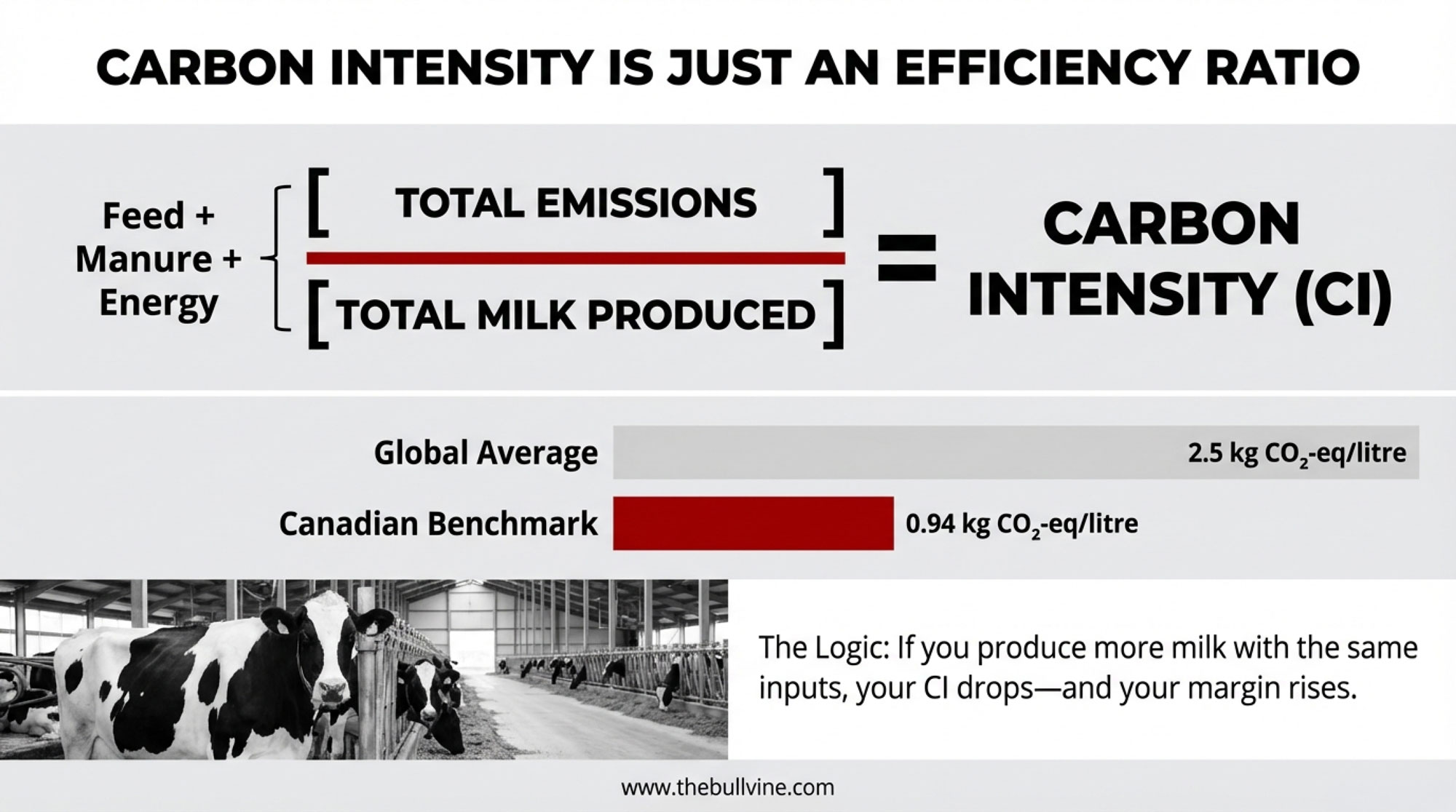
NewsSubscribe
First
Last
Consent

The Italian Warning: Why Your Cooling Fans Won’t Save You in 2030

$100K cooling system? Italian dairy families invested $50K in cheese vats instead—and DOUBLED profits.

EXECUTIVE SUMMARY: North American dairy faces an Italian preview: fourth-generation cheesemakers abandoning volume for value as cooling systems prove only 40% effective against extreme heat, exposing our industry’s dangerous bet on technology over adaptation. Wisconsin’s brutal arithmetic—7,000 farms vanished while production rose 5%—reveals that mid-sized operations carrying debt below the $18/cwt profitability threshold are mathematically doomed by 2030. Producers face three proven escape routes: scale to 2,000+ cows with $500K investment, pivot to seasonal/specialty for premium markets despite 30% volume cuts, or capture 10X commodity prices through on-farm processing. The clock is unforgiving—Q1 2026 marks the last moment to choose your path and begin the 3-4 year transition before market forces choose for you. Water scarcity, dependence on immigrant labor, and soil depletion compound the timeline, while genetic decisions force an uncomfortable trade-off: bulls whose daughters survive the August heat produce 500kg less milk annually. Italian farmers who accepted this reality doubled their profits; those who fought it with technology are gone. Your cooling fans won’t save you in 2030—but choosing the right business model today might.

Dairy Heat Stress Management

You know, I’ve been following what’s happening with dairy farmers in southern Italy, and it’s got me thinking about our own future here. These multi-generation families—some going back to their great-grandfathers—they’re not just adding bigger fans when the heat and drought hit. They’re completely rethinking how they farm.

Here’s what’s interesting: instead of fighting the climate with more technology, many are shifting to seasonal production with those beautiful heritage breeds like Podolica cattle. Moving from fresh mozzarella to aged cheeses that hold up better in both heat and volatile markets. Less milk, sure, but products that work with the reality they’re facing.

The European agricultural monitoring agencies have been tracking this, and the numbers tell a story. Summer milk production in Italy’s heat-affected regions has been declining by double digits over the past few years, and there’s been a steady increase in farms closing or transitioning. It’s not a crisis as much as it’s a transformation—and as I talk with producers from Vermont to California, I’m hearing remarkably similar questions bubbling up.

The insights I’m sharing here draw from extension research, industry data, and patterns I’ve observed across numerous dairy operations over recent years.

The Timeline We’re All Watching

Let me share what the research is telling us about the next decade, because this window for making strategic choices—it’s narrower than most of us realize.

The land-grant universities have been remarkably consistent. Cornell, Wisconsin, Minnesota—they’re all pointing to about a five-year period where we can still be proactive. After that? Well, the market and Mother Nature start making more of the decisions for us.

According to the U.S. Global Change Research Program’s latest work, by 2030, we’re looking at average temperature increases of 1.5 to 2.5 degrees Fahrenheit across dairy country. Now that might not sound like much sitting here, but translate that to your barn in July. We’re talking measurable production losses—maybe just over one percent nationally to start, but it won’t hit everyone equally. Some regions will feel it harder.

By 2040—and this is what really gets my attention—the modeling from multiple universities suggests heat stress days could double or even triple from what we see now. Instead of managing through 10 or 15 tough days, imagine 30 or 40 where even your best management can’t fully compensate.

Producers I’ve talked with in Wisconsin are already seeing this shift. What used to be a handful of brutal days has turned into weeks where the cows just can’t catch a break. And those power bills? Several operations tell me their cooling costs last summer ate up everything they’d saved for improvements.

Here’s the sobering part: research from both U.S. institutions and international teams, including work from Israel’s Institute of Animal Science, published in recent years, shows that even effective cooling technology mitigates only about 40% of production losses during extreme heat events. That’s not the technology failing—that’s just the reality of what we’re up against.

That Six-Figure Cooling System Question

So let’s talk about what everyone’s pushing—these comprehensive cooling systems. I’ve been looking at the real numbers from extension programs, and honestly, the range is eye-opening.

For smaller operations, say 50 to 100 cows, Penn State Extension and others offer basic fans and sprinklers at about $10,000. That’s manageable for many. But for mid-sized farms? The backbone of many communities? You’re looking at $100,000 or more for a system that really makes a difference. Tunnel ventilation, sophisticated soakers, smart controls—it adds up fast.

Extension research from multiple land-grant universities reveals cooling systems only mitigate 40% of production losses during extreme heat events. That $100K investment still leaves you bleeding 18-27% production when it matters most—the dirty secret equipment dealers don’t advertise.

What’s particularly challenging is the cash flow math. Farm financial analyses from multiple universities suggest you need fifty to seventy-five thousand in annual free cash to justify that kind of investment. Looking at current milk checks versus input costs… that’s a pretty select group right now.

Many producers tell me the same thing: taking on massive debt for a system that only solves part of the problem feels more like gambling than adapting.

Though I should mention, for some larger operations, the investment does pencil out. Operations with 2,000-plus cows that have invested in comprehensive cooling report maintaining over 90% of their baseline production through heat waves. At that scale, with those milk volumes, the economics can work.

The Italian dairy farmers who invested $50K in cheese vats instead of $100K cooling systems doubled their profits. This chart shows why smaller, strategic investments often outperform mega-tech solutions—a reality North American producers need to face before Q1 2026.

Breeding for the Heat

Before we dive into alternatives, let’s talk genetics—because this is where the future really gets interesting.

Recent research from the USDA and multiple universities shows we’re at a crossroads in heat-tolerance breeding. The good news? Genetic variation for heat tolerance exists, and it’s heritable enough to make selection worthwhile. Studies from Florida show that 13-17% of the variation in rectal temperature during heat stress comes from genetics—that’s lower than milk yield heritability (around 30%), but it’s significant enough to work with.

What’s really eye-opening is how different bulls’ daughters perform under heat. The latest genomic evaluations show that the most heat-tolerant bulls have daughters with 2 months longer productive life and over 3% higher daughter pregnancy rates than the least heat-tolerant bulls. But here’s the trade-off—their predicted transmitting ability for milk is typically 300-600 kg lower, depending on the sire.

University research has identified a critical finding: genetic variance for fertility traits increases under heat stress. This means sire rankings change entirely depending on temperature conditions. A bull whose daughters excel for pregnancy rates in Wisconsin might tank in Texas heat, while another bull’s daughters maintain fertility specifically under stress conditions.

The industry is responding. Genomic evaluation companies now provide heat tolerance indices, with breeding values ranging approximately from minus one to plus one kilogram of milk per day per THI unit increase, according to the latest industry reports. That spread between the best and worst—it’s significant when you’re facing 40 heat stress days.

But here’s what nobody’s talking about openly: the relentless selection for production has made our cows increasingly heat sensitive. Selection indices now include longevity, fitness, and health traits, but we’re still playing catch-up. Progressive producers are prioritizing moderate frame sizes—those efficient 1,350- to 1,500-pound animals that maintain production while handling heat better than the larger frames that were historical breeding targets.

The question is: are you willing to trade some production potential for cows that actually survive and breed back in August? Because that’s the real decision genetics is putting in front of us.

USDA genomic evaluations reveal the genetic contradiction killing herds: bulls whose daughters produce 300-600 kg more milk have daughters that live 2+ months less and show 3% worse pregnancy rates under heat stress. You’re breeding cows that excel in Wisconsin winters but die in August—everywhere

Three Alternatives That Are Actually Working

This is where it gets interesting, because what I’m seeing isn’t theoretical—it’s happening right now on real farms.

Working With the Seasons

The seasonal production model adopted by some Italian producers seemed backward at first. Deliberately dry off cows during peak summer? Accept 25-30% less annual milk? But then you look at the complete picture.

Extension studies from Vermont, Wisconsin, and Michigan show feed costs dropping three to five dollars per cow per day during grazing seasons. Labor needs ease up considerably. And here’s what’s really interesting—market data from various cooperatives shows processors now paying 10-15% premiums for seasonal, grass-based milk. The market’s recognizing quality differences.

I’ve been tracking operations in Vermont and elsewhere that made this shift. Despite producing less milk than year-round neighbors, many report their net income actually increased—sometimes by 20% or more. As one producer put it to me, “When you stop fighting the weather every day, when the cows are comfortable in August, everything changes. The stress level drops for everyone.”

Value-Added on the Farm

Let’s talk about processing, because the economics here can be compelling for the right operation. We all know commodity milk prices—eighteen to twenty dollars per hundredweight when things are decent, less when they’re not. But producers who bottle and sell direct? Industry surveys from the American Cheese Society and extension case studies consistently show returns of $60 to $90 per hundredweight equivalent. That’s not marginal improvement—that’s a different business entirely.

The investment for basic processing ranges from 50 to 100 thousand, about what you’d spend on cooling. But here’s the difference—Penn State feasibility studies and Wisconsin DATCP analyses show that many processors recover that investment in 6 to 12 months when they’ve got their markets lined up.

Operations that have gone this route tell me the aged cheese they make during spring flush can bring ten times what they’d get from the co-op. Ten times. Now, it takes skill, the right permits, and consistent marketing, but for those who make it work, it’s transformative.

Going Direct to Consumers

What’s really changed—and this deserves attention—is the regulatory landscape. The Farm-to-Consumer Legal Defense Fund now tracks over 30 states that permit some form of direct dairy sales. That’s up from basically zero fifteen years ago.

The price differential almost seems unfair to discuss. Raw milk, when it’s legal and properly marketed, sells for $8 to $12 a gallon directly to consumers. Compare that to the $1.80 or $2 equivalent at the farm gate.

What’s encouraging is you don’t need to convert everything. Producers successfully moving just 20% of their milk to direct channels report that it completely changes their financial stability. It’s about diversification that actually means something.

Your Three Pathways: A Quick Comparison

PathwayInvestment RequiredTypical PaybackVolume ChangeBest If You Have…
Scale Up & Cool$300k – $500k3-5 yearsMaintain/IncreaseStrong cash flow, <50% debt
Seasonal/Specialty$30k – $80k1-2 years-25% to -30%Pasture access, flexible mindset
Value-Added/Direct$50k – $150k6-18 months-20% to -30%Market access, marketing skills

The Math of Consolidation is Ruthless

Let’s stop dancing around this. If you’re mid-sized and carrying debt, the climate is coming for your margins—and the numbers don’t lie.

Research from Wisconsin and Cornell agricultural economists identifies the exact break points where your operation becomes a casualty. When your realized milk price consistently runs below eighteen dollars per hundredweight, you’re not adapting—you’re bleeding equity. When income over feed costs drops below seven or eight dollars per cow per day, you can’t service debt anymore. And when debt-to-asset ratios climb above 50%, banks won’t even return your calls for upgrade financing.

These thresholds aren’t suggestions—they’re mathematical realities derived from thousands of farm closures.

Wisconsin’s experience is the canary in the coal mine. USDA-NASS data shows the state hemorrhaged 7,000 dairy farms between 2015 and 2023, yet milk production hit records. Those weren’t random failures—they were mid-sized family operations caught in the consolidation vice. Meanwhile, according to the 2022 Census of Agriculture, operations with over 1,000 cows now control two-thirds of the nation’s milk supply, up from 57% just five years back.

The consolidation winners aren’t shy about it either. Producers who’ve successfully scaled tell me that at 2,000+ cows, they access technology and leverage that transforms the entire business model. As one mega-dairy owner put it bluntly, “Scale gave us options. Everyone else just has hope.”

If you’re sitting at 200 cows with 60% debt-to-asset and milk at $17.50, the math is already written. The question isn’t whether you’ll consolidate or exit—it’s how much equity you’ll have left when you do.

“Sometimes working with natural systems instead of against them might be the smartest strategy of all.”

Three Constraints We’re Not Discussing Enough

Beyond climate and economics, three pressures deserve more attention.

Water Is Everything

The situation with the Ogallala Aquifer has shifted from concerning to critical. U.S. Geological Survey data from 2024 shows that recoverable water continues to decline. Kansas reported drops exceeding a foot across wide areas last year. This directly affects irrigation for feed and long-term dairy viability.

In California, UC Davis research documents that Central Valley groundwater depletion is accelerating beyond sustainable levels. The San Joaquin Valley alone has lost over 14 million acre-feet of groundwater storage since 2019. We’re looking at maybe 15-20 years before water, not heat, determines who stays in business there.

Producers in those regions tell me water is now their first consideration every morning—something their grandfathers never worried about.

Labor Challenges Keep Growing

Industry analyses from the National Milk Producers Federation and Texas A&M converge on this: roughly half of dairy’s workforce consists of immigrant labor, and those workers produce the vast majority of our milk. When you overlay visa challenges and local labor shortages, smaller operations feel it first and hardest.

Rising labor costs—an extra two or two-fifty per cow per month in many areas—that’s often the difference between black and red ink when margins are already tight.

Soil Health Can’t Be Ignored

This might be our biggest long-term challenge. FAO data from 2024, backed by Iowa State research, shows soil organic carbon down by half in many agricultural regions. The fix—regenerative practices—takes three to five years and serious capital before you see results in forage quality.

The operations that most need soil improvement often lack the financial cushion to weather that transition. It’s a tough spot.

Making Your Own Decision

After countless conversations with producers and advisors, certain patterns have emerged to help frame decisions.

Suppose you’re consistently seeing milk prices above eighteen dollars, maintaining income over feed costs above seven or eight dollars per cow per day, keeping debt-to-asset ratios under 50%, and can access three to five hundred thousand in capital. In that case, scaling up with cooling infrastructure might work. But success still requires exceptional management and decent markets.

If those numbers don’t line up but you’re within reach of population centers, have some pasture, and can stomach lower volume for better margins, specialty production models offer real potential. Especially if you can develop that direct channel that provides price stability.

Timing matters. By year’s end, you need an honest assessment. First quarter 2026—decision time. Use 2026-27 for building infrastructure or markets. By 2028-29, you should be transitioning operationally. Come 2030, your model needs to be locked in, because the competitive landscape will be pretty well set by then.

Land-grant research from Cornell, Wisconsin, and Minnesota converges on one truth: you have 5-7 quarters to choose your survival path. Q1 2026 marks the last moment for proactive choice—after that, milk prices, heat waves, and bank covenants make the decision for you. Wisconsin’s 7,000 lost farms learned this the hard way

Regional Realities

RegionCurrent Heat Stress Days2035 Projected Heat DaysWater Crisis SeverityRunway to AdaptCompetitive Advantage
Upper Midwest (WI, MN, MI)12-1520-25StableLongest (~10 yrs)HIGH
Plains States (NE, KS)20-2535-45CRITICAL -1 ft/yrShort (~5 yrs)Declining
California & Southwest30-3545-55EXTREME 140 gal/cowIMMEDIATE (~2 yrs)Collapsing
Northeast (NY, VT)8-1215-20FavorableLong (~12 yrs)HIGHEST
Southeast (GA, FL)40-5060-70ModerateAlready Here (0 yrs)Experience Leader

Upper Midwest

Wisconsin, Minnesota, Michigan—you’ve got the longest runway. University of Minnesota Extension modeling suggests heat stress stays manageable through 2030, and water’s relatively stable. Focus on genetics, targeted cooling in holding areas, and protecting components during stress periods. Current operations average 12-15 heat stress days annually, expected to reach 20-25 by 2035.

Plains States

Nebraska and Kansas dairy operations face a double squeeze—the depletion of the Ogallala Aquifer threatening feed production while heat-stress days increase from the current 20-25 to projected 35-45 by 2040. Kansas State research shows producers here need water strategies yesterday, not tomorrow. Some are already transitioning to dryland-adapted forage systems or relocating operations entirely.

California and the Southwest

Water drives everything here. UC Davis reports show you’re already using 20-30% more water per cow than a decade ago just to maintain production. California dairy operations now consume an average of 140 gallons per cow daily during summer months, up from 95 gallons in 2014. If you haven’t developed a water strategy beyond hoping for wet years, you’re behind. The next five years will force hard choices about value-added production, relocation, or partnering with operations that have water rights.

Northeast

Cornell’s work shows you maintaining favorable conditions through 2035. That’s an opportunity—develop specialty markets now while you have the advantage. The artisan cheese growth in places like the Hudson Valley shows that real market appetite exists. New York State Department of Agriculture reports specialty dairy operations increased 35% between 2022-2024.

Southeast

You’re living tomorrow’s challenges today. Georgia and Florida operations already manage 40-50 heat stress days annually. Every smaller operation surviving your heat and humidity has developed strategies that the rest of us need to study. Your experience is our roadmap.

Resources for Moving Forward

Decision Support Tools:

  • Cornell’s IOFC Calculator (available through the PRO-DAIRY website)
  • Penn State’s Enterprise Budget Tool for processing feasibility
  • USDA Climate Hubs’ regional adaptation resources
  • National Young Farmers Coalition’s direct marketing guides

The Bottom Line

Climate change isn’t just forcing operational changes—it’s driving fundamental shifts in business models. The successful producers I see aren’t trying to preserve yesterday’s approach with tomorrow’s technology. They’re finding what works with emerging realities.

The choice isn’t simply to get bigger or get out. It’s about finding the model that fits your resources, market access, and what lets you sleep at night. For some, that’s scale and technology. For others, it’s lower volume with higher margins through differentiation.

What those Italian dairy farmers are teaching us isn’t that we should all make aged cheese or switch breeds. It’s that one-size-fits-all responses might be less adaptive than thoughtful, farm-specific strategies.

Your operation’s future depends on choosing a path, but mostly on choosing soon enough to control how you implement it. The changes are coming either way.

This is about preserving not just farms but farming as a viable way of life. Sometimes that means producing less to preserve more. Sometimes it means completely rethinking what success looks like.

And sometimes—just sometimes—it means recognizing that working with natural systems instead of against them might be the smartest strategy of all.

Key Takeaways:

  • Cooling = 40% solution to a 100% problem: That $100K system you’re considering? It only stops 40% of losses at extreme temps. Italian farmers who invested in $50K cheese vats doubled their income instead.
  • Three models survive 2030—pick one NOW: Mega-dairy (2,000+ cows), seasonal/specialty (30% less milk, 20% more profit), or value-added (10X commodity prices). Middle ground is extinction.
  • The $18/cwt line divides living from dying: Below it, with >50% debt, you’re already bleeding equity daily. Wisconsin lost 7,000 farms in this death zone while production rose 5%.
  • Genetics force a brutal trade: Accept 500kg less milk for cows that survive August, or chase maximum production with daughters that won’t breed in heat. There’s no middle option.
  • Water kills operations faster than heat: Ogallala Aquifer -1ft/year. California dairy: 140gal/cow/day. Your 2030 survival depends more on water rights than cooling technology.

Complete references and supporting documentation are available upon request by contacting the editorial team at editor@thebullvine.com.

Learn More:

Join the Revolution!

Join over 30,000 successful dairy professionals who rely on Bullvine Weekly for their competitive edge. Delivered directly to your inbox each week, our exclusive industry insights help you make smarter decisions while saving precious hours every week. Never miss critical updates on milk production trends, breakthrough technologies, and profit-boosting strategies that top producers are already implementing. Subscribe now to transform your dairy operation’s efficiency and profitability—your future success is just one click away.

NewsSubscribe
First
Last
Consent

The Dairy Mirage: How the Industry’s ‘Fixes’ Are Finishing Off the Farmer

Every ‘solution’ that claims to save dairy farms was never designed to fix anything — it was built to extract you, one milk check at a time.

You know the line by now. Every time milk prices crash, every time a farm auction makes the local news, somebody shows up with a binder and a slogan. “Efficiency will save you.” “Diversify into organics.” “Join a co-op — strength in numbers.”

I mean, I’ve heard them all. You probably have too. But here’s the thing that nobody in those meetings will ever say out loud — the system isn’t broken. It’s working exactly the way it was built. It just wasn’t built for you.

The math nobody wants to admit

Small dairies lose $6.27 per hundredweight while large operations profit $16.50 on the same product—a $23 gap that exposes the system’s built-in preference for scale over sustainability

Down in Wisconsin, the USDA’s Economic Research Service has been crunching the same numbers for years. Small herds — fewer than 100 cows — produce milk at $42 to $44 per hundredweight. Large herds — 2,000 cows and up — come in at $19 to $20.

That’s a $23 gap that no efficiency app, no robotic milker, and no “farm family tradition” can erase.

I was at a producer meeting in Madison when one co-op board member leaned back and said it plain: “Small dairies are emotionally important, but economically irrelevant.” Brutal. True. That’s the level of quiet truth people at the top already understand but never put in print.

And that’s the problem — your loss is their model.

Where the money actually goes

Let’s put real numbers to this thing.

A 250-cow dairy feeding 50 pounds per head per day spends roughly 0,000 a year on feed, per USDA feed cost indices. Feed companies take 8–12% margins on that. That’s $175,000 to $240,000 every three years transferred out of your pocket before you even pay labor.

Add the bank. The Farm Credit System’s nationwide reports list operating and mortgage interest averaging around 6.8%. On a $900,000 land note and a $300,000 operating loan, that’s about $85,000 a year in interest.

Then your co-op or processor adds another chunk. According to Rabobank’s 2025 Dairy Outlook, most processors net around $3.50 per hundredweight after hauling and processing — that’s $575,000 from your production.

A 250-cow dairy operation sends $1.27 million annually to feed companies, processors, banks, and consultants before the farmer pays for labor or takes home a single dollar—revealing the extraction system that profits from farm losses

So the next time someone says, “You just need to manage costs better,” tell them your losses financed someone else’s record quarter.

An accountant friend of mine told me over lunch, “For every dollar a farm burns in equity, someone up the chain makes six.” That right there should stop the room cold.

Starting with $1,000 in milk value, farmers watch $573 get extracted by feed companies, banks, processors, and consultants—keeping only $427 while upstream stakeholders profit $6 for every $1 of farm equity burned

The organic trap: paying to play

Here’s another shiny “fix” that just doesn’t add up.

Per the USDA’s National Organic Program, converting a farm means running the land chemical-free for 36 months, and feeding cattle organic rations for 12 months before certification. According to Cornell’s 2024 Organic Dairy Cost study, feed costs jump 30–40%, while tank weights drop 8%.

That’s an extra $180,000 in feed, $10,000 in certifications, and about $40,000 in lost yield a year before you even cash a single “organic premium” check.

Dan Richter, milking 220 cows out in Cashton, said it best: “We made it to certification, but we were broke before the first organic load hit the plant.” He’s not alone — Cornell data shows two-thirds of organic transitions never reach sustainable profitability.

What strikes me most? The programs keep rolling anyway. Because suppliers, certifiers, and consultants still make their margin, no matter what happens to the farm.

Equipment-sharing: good on paper, chaos in practice

You hear it at winter extension meetings — “Form an equipment co-op, cut your costs!”

But University of Minnesota Extension found that those shared projects shave about 10% off upfront ownership costs, while downtime climbs 20% and repair expenses eat another 7%.

A producer from Viroqua told me, “We spent more time arguing over whose turn it was to use the chopper than actually chopping.”

And look, that’s not laziness. That’s just how weather and manure work. You can’t partition urgency. The only folks winning from that plan are the sales reps who sold the machinery in the first place.

Component bonuses: chasing nickels, losing dollars

Processors love to brag about “protein incentives.” USDA Dairy Market News says the average premium sits around $1.25 per hundredweight.

The trouble is… that extra protein costs money. Cornell dairy nutritionists peg the annual ration bump at roughly $75,000, plus $15,000 for consultant fees and testing programs.

Best case — you net maybe $20,000.

Meanwhile, processors get exactly what they want — uniform, high-solids milk without buying a pound of extra grain.

Like one New York nutritionist told me quietly at a conference this year: “Protein bonuses aren’t a windfall. They’re a management leash.”

Co-ops: from shields to siphons

People forget the history — co-ops were started to protect producers from predatory processors. But the GAO’s 2024 Cooperative Governance Report revealed that 78% of major U.S. co-ops now use milk-volume voting.

One member equals one vote? Not anymore. It’s cubic tons of milk per vote now.

A 300-cow operator from Brookings County told me, “My co-op makes more on hauling my milk than I make milking the cows.” The sad thing? That’s not hyperbole.

Even the GAO data shows that cooperative processing divisions now generate more operational profit than they do from member payments. Somewhere along the line, the idea of “member-first” flipped to “margin-first.”

The big picture — and it’s not pretty

The USDA’s Agricultural Projections to 2034 project the U.S. will have 12,000–15,000 dairies left by 2030. We’re sitting around 26,000 now.

By 2034, the U.S. will lose 54% of its remaining dairy farms while six processors will control 82% of milk flow and five Holstein sires will dominate 82% of genetics—a consolidation designed to extract, not sustain

Rabobank’s forecast says six processors will control 80% of total U.S. milk flow, while the Council on Dairy Cattle Breeding (2025) reports five Holstein sires now sire 82% of all replacements.

Think about that — market and genetics bottlenecked into half a dozen corporate hands.

And what happens locally? UW–Madison economists calculated that each 100-cow farm loss strips $500,000 from regional rural economies — vet clinics, feed stores, mechanics, and local schools. Drive from Antigo to Arcadia this fall, and you’ll see them: boarded barns, “auction today” signs, and co-ops consolidating routes that used to serve three farms per mile.

That’s not bad luck. That’s a business plan.

“Just one more year…”

You can tell when somebody’s gone from hopeful to cornered — they start saying it. “If we can just make it one more year.”

You know who wants you to “hang on”? The people who profit from delay: bankers, feed mills, processors. Tom Greene calls it “equity farming for other people.”

Every year, small dairies run at a loss, but the rest of the chain keeps cashing checks on time.

That’s the hidden cost of loyalty — the longer you stay, the more they gain.

What you can actually do about it

This part matters because nobody else is going to say it straight.

  1. Call your accountant, not your lender. The bank lives on time. The accountant lives on truth. Ask them to run your net after unpaid family labor and true depreciation.
  2. Get a land appraisal. The American Society of Farm Managers and Rural Appraisers says Midwest farmland finally plateaued in 2025 after years of inflation. If you’re considering an exit, waiting means losing margin.
  3. Run two lists. Stay and lose $100K in equity per year. Exit, keep $2.5 million clean. Math doesn’t lie — it just hurts.
  4. Make the family meeting happen. Don’t wait until the next refinance or co-op contract cycle. This isn’t quitting; it’s protecting what generations built.

If that sounds heavy, that’s because it is. But so is the weight of hope that never pays off.

The inconvenient truth

The real betrayal here isn’t that the system failed small dairy. It’s that it pretended to save it while quietly making money off every stage of its decline.

This whole setup isn’t chaos — it’s choreography. And it plays out just as designed: the smaller farms provide the illusion of diversity, the mid-tier keeps the supply chain full, and the megas consolidate control.

So tomorrow morning, when you’re tightening hoses or scraping the feed alley, stop and look at your milk check before you start another year of “hanging on.” Ask yourself:

“If everyone else is making money off my losses, how long am I willing to play the game?”

Because the truth is — this system isn’t failing. It’s succeeding exactly the way it was designed to. And that’s the part nobody in a suit will ever say out loud.

KEY TAKEAWAYS

  • The dairy system isn’t “broken” — it’s performing exactly as designed. Farmers lose; everyone else wins.
  • The economics are brutal: small farms spend twice what megas do to produce the same milk. Passion doesn’t pay bills.
  • Every so‑called “solution” — co‑ops, consultants, organic programs — is just a polite way to harvest your last dollars.
  • For every dollar of farm equity burned, six show up elsewhere — in feed, finance, or processing profits.
  • The smartest play isn’t hope. It’s strategy: scale, specialize, or sell before the system cashes you out.

EXECUTIVE SUMMARY

The small dairy crisis isn’t some tragic accident — it’s the business model. The USDA’s data shows that small farms make milk for $44/cwt, while megas do it for $20. That’s not competition; that’s a setup. Meanwhile, every “solution” — organic transitions, efficiency programs, co-op loyalty — just keeps you milking long enough for everyone else to get paid. Cornell, Rabobank, and GAO reports show how feed dealers, banks, and processors profit from your losses. For every dollar of farm equity burned, six appear upstream. The system isn’t failing; it’s extracting. So if you’re still hanging on, here’s the real math: scale up, specialize, or get out while there’s still something left to save.

Complete references and supporting documentation are available upon request by contacting the editorial team at editor@thebullvine.com.

Learn More:

Join the Revolution!

Join over 30,000 successful dairy professionals who rely on Bullvine Weekly for their competitive edge. Delivered directly to your inbox each week, our exclusive industry insights help you make smarter decisions while saving precious hours every week. Never miss critical updates on milk production trends, breakthrough technologies, and profit-boosting strategies that top producers are already implementing. Subscribe now to transform your dairy operation’s efficiency and profitability—your future success is just one click away.
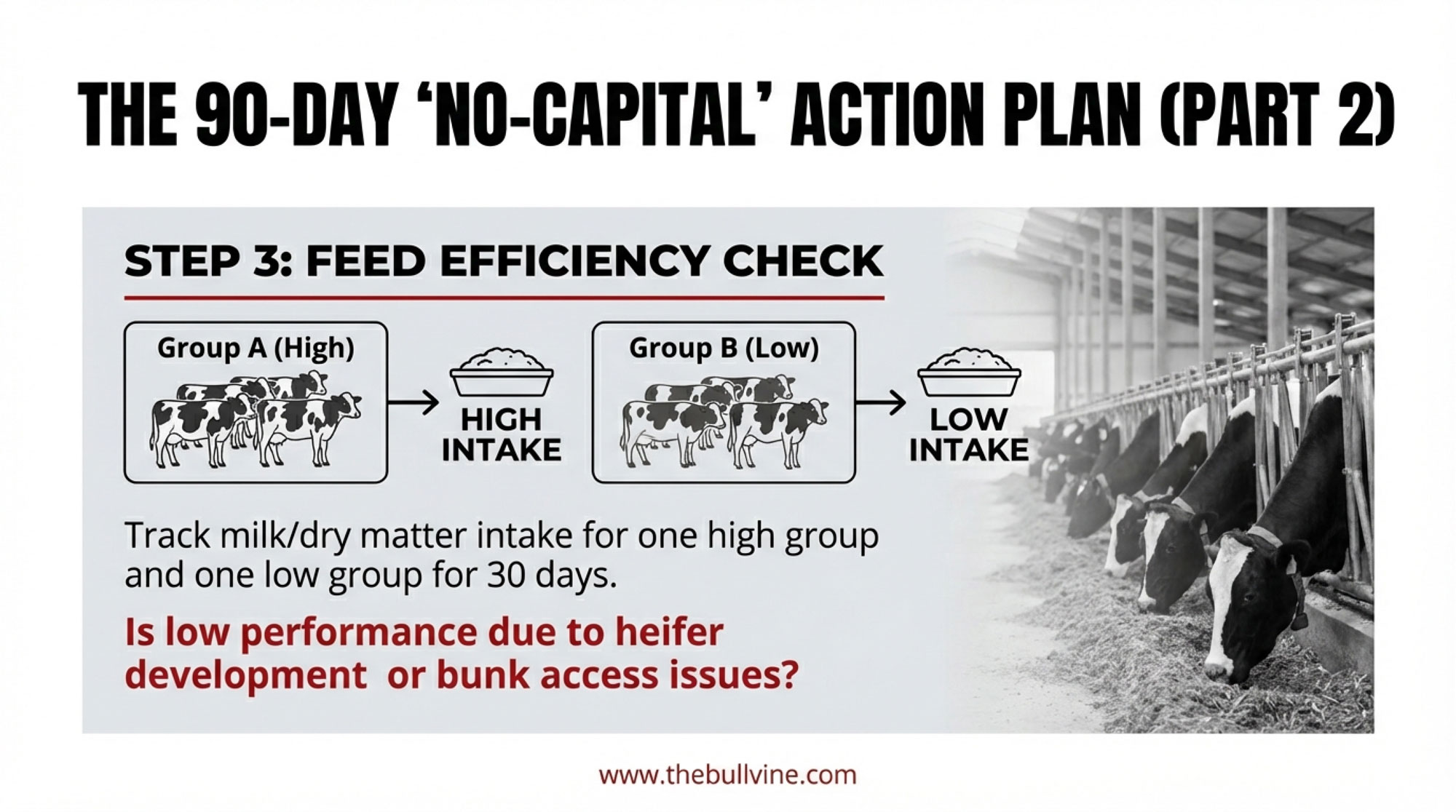
NewsSubscribe
First
Last
Consent

Whole Milk Returns to Schools After $4.3B Loss – But Only Mega-Dairies Can Capture the Win

We predicted it. Lost $4.3B fighting it. 11,000 farms died waiting. Whole milk’s finally back—but the industry that won isn’t the one that warned.

EXECUTIVE SUMMARY: Whole milk returns to schools after a 13-year ban that cost dairy $4.3 billion and killed 11,000 farms—but the survivors who’ll benefit aren’t the ones who warned Congress this would happen. University of Toronto research confirmed what producers always knew: whole milk reduces childhood obesity by 40% compared to skim milk, completely debunking the policy’s premise. However, consolidation during the fight means only mega-dairies (1,500+ cows) can access school contracts worth $40-80K annually, while 97% of remaining farms are effectively locked out. The window for action is narrow: producers must contact their cooperatives NOW to position for RFPs releasing January 2026, with contracts locking by July. Small operations should forget institutional milk and leverage whole milk’s vindication for premium direct sales, while mid-sized farms face a brutal choice between fighting for scraps or pivoting to specialty markets. The lesson is unforgiving: in agricultural policy, being right means nothing if you don’t survive long enough to collect.

You know, looking at what happened in the Senate last Tuesday—unanimous passage of the Whole Milk for Healthy Kids Act—you’d think we’d all be celebrating. And yeah, it’s definitely a victory. After watching kids dump skim milk down cafeteria drains for 13 years while our neighbors went under, whole milk’s finally coming back to schools.

But here’s what’s been keeping me up at night, and I’ve been hearing the same thing from producers all over. The dairy industry that gets to capture this opportunity? It looks nothing like the industry that warned Congress this would happen back in 2012. We’ve lost 11,000 farms during this fight. The survivors are entirely different breeds—either massive operations with 2,500-plus cows or specialty producers who found their niche. That 300-cow family dairy that needed this policy most? Most of ’em are gone.

Herd Size2012 Farms2025 FarmsChange %Milk Share 2025 %
Under 100 cows2814116334-427
100-499 cows88685889-3415
500-999 cows15801025-3510
1,000-2,499 cows1000900-1022
2,500+ cows7148341746

What I’m finding as I talk to folks trying to figure out what this means for their operations is that winning the policy battle doesn’t reverse the structural war we’ve already lost. So let me walk you through what actually happened, what it cost us, and—here’s the important part—what you can actually do about it in the next six months.

The Scale of What We Lost: More Than Just Milk Sales

YearPer Capita (lbs/year)School Policy PhaseAnnual Decline Rate %
2009190Pre-Ban0.75
2012185Ban Implemented2.6
2015172Ban Effect2.6
2018155Accelerated Decline2.6
2021141Continued Fall2.6
2023130Record Low1.5
2025128First Increase Signal-0.8

I’ve been going through the numbers with economists at Cornell and Wisconsin, and it’s worse than most of us realize. When the National Milk Producers Federation testified to the USDA back in April 2011 that restricting schools to skim and 1% milk would hurt consumption, they actually underestimated what would happen. You can look it up in their comments if you’re curious—docket USDA-FNS-2011-0019.

School milk represents about 7 to 8 percent of total U.S. fluid milk demand, according to the USDA’s Economic Research Service—we’re talking roughly a billion dollars annually. Sounds manageable, right? But here’s what nobody calculated: when you tell 30 million kids for 13 years that whole milk is unhealthy, you don’t just lose school sales. You lose a generation.

Before 2012’s restrictions kicked in, fluid milk consumption was declining at about 3/4 of 1 percent per year—concerning but manageable, according to the International Dairy Foods Association’s market reports. After? That rate exploded to 2.6 percent annually. That’s not evolution; that’s acceleration.

A Wisconsin producer I know who runs about 450 cows put it best: “We watched our school contracts evaporate overnight. But worse was watching those kids grow up thinking milk was bad for them. Now they’re adults buying oat milk.”

The direct hit to producer revenue over 13 years? Based on Federal Milk Marketing Order pricing data, it’s about $1.38 billion. But that’s just the beginning. When Class I utilization drops in the federal orders, it drags down the blend price every producer receives—University of Missouri’s policy research folks calculated another $182 million spread across all farms.

Then you’ve got the supply chain multiplier effect. USDA’s Economic Research Service uses standard agricultural multipliers of around 1.8 times for dairy. So that lost producer revenue of $1.38 billion means a total supply chain impact of around $2.49 billion. Haulers, feed suppliers, equipment dealers—everybody took a hit.

Add in competitive losses to plant-based alternatives—Euromonitor International’s dairy alternatives tracking pegged it at about $650 million in institutional market share—plus the waste. And the waste is mind-boggling. The Center for Science in the Public Interest estimates that about 45 million gallons annually that kids refused to drink, worth nearly a billion dollars at Class I pricing.

CategoryAmount ($ Billions)Percentage
Direct Producer Revenue Loss1.3832.1
Blend Price Impact (All Farms)0.1824.2
Supply Chain Multiplier Effect1.11225.9
Competitive Losses to Alternatives0.6515.1
School Milk Waste0.97622.7

When you combine all these factors—the direct losses, blend price impacts, supply chain effects using those standard multipliers, competitive losses, and waste values—you’re looking at a total economic impact approaching $4.3 billion. Though I should note that nobody’s done a comprehensive study pulling all these pieces together. We’re aggregating from multiple sources here.

“That’s not just a policy mistake, folks. That’s a generational disaster.”

What Science Now Shows: We Had It Backwards All Along

MetricWhole MilkSkim/Low-Fat Milk
Childhood Obesity Odds40% LOWERBaseline
Overweight Risk Reduction40% lower oddsNo reduction found
Added Sugar Content0g (natural)8-12g (added)
Satiety FactorHigh (natural fats)Lower
Fat-Soluble Vitamin DeliverySuperior (vitamins A,D,E,K)Reduced effectiveness
Studies Supporting18 of 28 studies0 of 28 studies

This is the part that really gets me—and I’m hearing the same frustration everywhere I go. The whole scientific foundation for banning whole milk? It’s completely collapsed.

Dr. Jonathon Maguire, up at the University of Toronto, published this meta-analysis in the American Journal of Clinical Nutrition back in December 2020—looked at 28 studies with 21,000 children. The finding? Kids drinking whole milk had 40 percent lower odds of being overweight or obese compared to those drinking reduced-fat milk. Not one study—not a single one—showed skim milk reducing obesity risk.

As Maguire wrote in the journal, children who followed the current recommendation to switch to reduced-fat milk at age two weren’t any leaner than those who consumed whole milk.

What’s interesting here—and this is what really burns me—is what schools actually did to make fat-free milk palatable. They added sugar. Lots of it. The Center for Science in the Public Interest did an analysis showing that fat-free chocolate milk in schools contains up to 12 grams of added sugar per carton. That’s nearly half what the American Academy of Pediatrics says kids should have in a whole day, based on their 2019 policy statement.

Think about that for a minute. We removed natural milk fat, which provides satiety and fat-soluble vitamins, and replaced it with processed sugar. A dietitian I know at Penn State Extension—she’s been doing this for 30 years—called it the most backwards nutritional policy she’d ever seen.

How Dairy Finally Won: The Coalition Nobody Expected

I’ve been covering dairy politics for two decades, and what happened this year was unlike anything I’ve seen. After failed attempts in 2016, 2019, and that unanimous consent block by Senator Stabenow last December, how’d we suddenly get unanimous passage?

The breakthrough came from the most unlikely place: the Physicians Committee for Responsible Medicine. Now, this group has historically opposed dairy consumption, right? But Senator Welch’s team made a strategic calculation—they added language guaranteeing schools could serve, and I quote, “nutritionally equivalent nondairy beverages that meet USDA standards.”

A Senate Agriculture Committee staffer familiar with the negotiations told me, “We realized we couldn’t win by fighting everyone. So we found ways to give opposition groups something they wanted while still achieving our core goal.”

The senator pairing was brilliant, too. Peter Welch from Vermont brought the economic urgency—his state’s lost more than 500 dairy farms since 2012, according to the Vermont Agency of Agriculture’s latest data through 2024, a crushing 55 percent decline. Roger Marshall from Kansas, an OB-GYN with 25 years of practice before Congress, provided medical credibility that transcended typical ag lobbying. When you’ve got a physician-senator arguing for whole milk’s nutritional benefits, it carries a different weight than dairy executives making the same case.

But the real game-changer came from school food service directors testifying about operational reality. One Pennsylvania director told legislators that the amount of waste they were throwing away each day was disheartening—kids just wouldn’t drink the skim milk.

That operational reality, from public sector administrators rather than industry advocates, changed the conversation entirely.

And then there’s the RFK Jr. factor. When the incoming HHS Secretary calls whole milk restrictions “nutrition guidance based on dogma, not evidence” in public statements, dairy’s position suddenly aligns with a broader health reform movement. FDA Commissioner nominee Dr. Martin Makary went even further at his confirmation hearing, saying we’re ending the 50-year war on natural saturated fat.

The Harsh Reality: Small Farms Can’t Access This Opportunity

Now here’s where I need to level with you about what this actually means for different operations. I’ve been talking to procurement specialists at DFA, Land O’Lakes, and regional cooperatives across the midwest, and the reality’s tough for smaller farms.

For Large Operations (1,500+ cows)

If you’re milking 1,500-plus head, this is a genuine opportunity. Based on current Class I differentials from the November federal order announcement and institutional pricing models, you could see $40,000 to $80,000 in additional annual revenue. These operations typically have what schools need—cooperative relationships for procurement access, daily volume to meet district minimums (usually 2,000-plus pounds), and standardized equipment to hit that 3.25 percent butterfat spec.

A large-herd operator in Wisconsin told me that his co-op has been preparing bid packages since October. “We’ve got the volume, the testing protocols, everything schools require,” he said.

For Mid-Size Operations (500-1,000 cows)

The opportunity exists, but it’s complicated. You might see $15,000 to $30,000 annually—helpful but not transformational. The challenge? You’re competing with larger operations for cooperative priority.

One Central Valley producer milking 650 told me, “I could supply our local district easily. But our co-op prioritizes the 5,000-cow operations because the logistics are simpler. One truck stop instead of eight.”

Down in Texas, the situation’s even tougher. A producer with 725 Holsteins outside Stephenville explained they’re 45 minutes from the nearest processor. “School contracts require daily delivery. The math just doesn’t work unless you’re right next to a bottling plant or have 2,000-plus cows to justify dedicated hauling.”

In Nebraska—right in Senator Marshall’s backyard—the consolidation’s been particularly stark. A producer near Grand Island, milking 550 cows, explained that their cooperative had merged with two others in the past five years. “We used to have direct say in school milk contracts. Now we’re competing with operations five times our size for the same procurement slots.”

For Small Operations (Under 300 cows)

I hate to say this, but institutional whole milk offers almost no direct opportunity for operations under 300 cows. School procurement requires minimums you can’t meet independently—typically 500 gallons per day, based on what I’ve seen in Michigan and Iowa district RFPs.

The path forward is different. A Vermont producer milking 180 Jerseys told me they’re focusing on farmers markets and local retail. “Whole milk’s vindication helps our direct marketing—we can tell customers the government was wrong, and they believe us now.”

In Georgia, small producers are finding similar alternatives. One producer with 220 cows near Quitman explained they can’t compete for Atlanta school contracts. “But we’re selling to three local private schools at $4.50 a gallon. They want local, and whole milk’s return legitimizes premium pricing.”

Farm SizeAnnual Revenue PotentialMarket AccessNumber of FarmsAccess Probability %
2,500+ cows$60-80KDirect/Priority83495
1,500-2,499 cows$40-60KDirect/Competitive90075
500-999 cows$15-30KLimited/Co-op Only102530
300-499 cows$5-10KMinimal32005
Under 300 cows$0-2KNone181092

The Seven-Month Sprint: Your Action Timeline

DateActionProducer ActionCritical Level
Nov 2025Senate passes bill unanimouslyContact co-op NOWHIGH
Jan 2026School RFPs releasedReview district opportunitiesHIGH
Feb-Mar 2026Producer positioning windowSubmit commitmentsCRITICAL
Apr-May 2026Bids due to districtsFinalize agreementsFINAL DEADLINE
Jul 1 2026New contracts beginBegin deliveriesGO-LIVE
Aug 2026+Market locked (incumbents only)Wait 1-3 years for next cycleLOCKED OUT

What’s catching producers off-guard is how fast this moves. We’re operating on school procurement timelines, not legislative calendars.

📅 The Critical Dates You Can’t Miss:

➤ January–March 2026: School districts release RFPs
➤ April–May 2026: Bids are due (If you aren’t positioned, you’re out)
➤ July 1, 2026: New contracts begin

After July 2026, breaking into the school supply means displacing an incumbent. Good luck with that—I’ve seen it happen maybe twice in 20 years covering dairy markets.

☎️ Your Homework: Call Your Milk Handler TODAY

Don’t wait until next week. Pick up the phone and ask these exact questions:

1. “Are you bidding on school whole milk contracts for 2026-27?”

2. “What commitments do you need from member farms?”

3. “What’s our current butterfat running?” (National average hit 4.23% in October per USDA)

4. “Can you standardize our 4.2% fat down to 3.25%?”

5. “What’s the premium for institutional Class I vs. our current blend?”

6. “Which school districts can we realistically reach?”

A procurement director at one of the midwest regional cooperatives told me they’re getting 50 calls a day about this. The producers who commit early get priority when bid packages go out.

The Genetics Question: Don’t Panic About Your Breeding Program

I’m getting panicked calls from producers worried their genetics are wrong for whole milk. Here’s what Dr. Kent Weigel, who chairs dairy science at UW-Madison, explains: You don’t need to change your genetics. You need standardization capability.

Current U.S. herds are averaging 4.23 percent butterfat according to USDA’s October milk production reports—a record high driven by cheese market premiums. School whole milk needs exactly 3.25 percent. That seems like a problem, but it’s actually an opportunity.

Patricia Stroup, who’s COO at Horizon Organic, explained to me that they standardize all their institutional milk. “Higher butterfat means more cream to separate and sell at premium prices. It’s additional revenue, not a problem.”

Your 4.2 percent milk becomes 3.25 percent whole milk. The separated cream? That’s going into premium butter—CME spot prices have been running around $3.20 a pound lately. You’re not losing value; you’re creating two revenue streams.

Butterfat has a heritability of 0.40 to 0.50 according to USDA’s genetic evaluation summaries—high enough to adjust if truly needed. But genetic changes take 3 to 5 years, depending on generation intervals. This opportunity window might shift again before your genetics catch up.

Dr. Chad Dechow, who does dairy cattle genetics at Penn State, advises keeping your breeding focused on components. “The cheese market isn’t going away, and standardization solves the institutional specifications,” he told me.

Market Outlook: What Economists See Coming

[CHART: Fluid milk consumption trends 2010-2025 with projections]

Looking beyond just the school opportunity, the broader market dynamics matter for positioning. Dr. Marin Bozic, the dairy economist at the University of Minnesota, sees structural shifts ahead.

“We’re entering a period where fluid milk might stabilize at 140 to 150 pounds per capita,” Bozic explained when we talked. “That’s not growth, but it ends the bleeding. For producers, predictable Class I demand at 22 to 23 percent of total utilization beats continued decline to 18 to 20 percent.”

The generational damage is real, though. Kids who drank skim milk in schools from 2012 through 2025 are adults now. They’re not suddenly switching to whole milk because policy changed. But their kids might—if whole milk’s available when they enter school.

IDFA reported in their August 2025 dairy market update that producers sold 0.8 percent more fluid milk than in 2023—the first increase since 2009. Whole milk specifically showed real strength. Conventional whole milk’s up 1.3 percent year-over-year according to IRI’s retail tracking data. Organic whole milk’s up 6.2 percent based on SPINS organic market reports. Flavored whole milk’s up 20 percent in peak months per Nielsen beverage category data.

Whole milk now represents 42 percent of retail sales—the highest since 2001.

The Consolidation Truth: Understanding Today’s Industry

This is the hardest conversation I have had with producers, but we need to face reality. Between 2012 and 2025, based on the USDA’s Census of Agriculture data and structural analyses, the changes are stark.

Farms under 100 cows are down 42 percent, from 28,141 to 16,334. The 100 to 499 cow operations dropped 34 percent. Mid-sized farms with 500 to 999 cows fell 35 percent. But farms with 2,500-plus cows? They’re up 17 percent.

The only category growing is mega-dairies. They now produce 46 percent of U.S. milk while representing just 3 percent of farms, according to USDA-NASS farm structure data.

A former Ohio dairyman who sold 350 cows during the 2015 price crash told me, “The whole milk policy would’ve saved our farm in 2015. But it’s too late now. We’re out, and the neighbor who bought our cows is milking 3,000.”

Wisconsin’s story is particularly telling. They’ve been losing 8 to 10 dairy farms per week from 2014 to 2024, according to data from the Wisconsin Agricultural Statistics Service. The survivors? Either massive operations with economies of scale or boutique producers selling $8 a gallon milk at farmers markets.

Vermont’s even starker. Of their remaining 480 farms—down from 973 in 2012, per the Vermont Agency of Agriculture—73 percent have fewer than 200 cows, accounting for 30 percent of production. Meanwhile, 9 percent are over 700 cows, producing 40 percent of milk.

The mid-sized farms that whole milk could’ve helped? They’re mostly gone.

What This Victory Actually Means

Let me be straight with you about what this moment represents, because false hope doesn’t help anybody make good decisions.

Yes, the science vindicated us—whole milk is better for kids than skim. The University of Toronto research is bulletproof. Yes, we built a coalition that achieved unanimous Senate passage. That’s remarkable in today’s politics. And yes, there’s real money here for farms positioned to capture it.

But let’s acknowledge what this victory can’t do. It can’t bring back the 11,000 farms we lost. It can’t reverse the consolidation that accelerated while we fought this policy. And it can’t transform the fundamental economics pushing dairy toward fewer, larger operations.

A Wisconsin farmer who sold his 450-cow operation in 2018 reflected, “This would’ve been transformational in 2012. Now it’s a nice win for the big guys who survived.”

What strikes me most is the gap between being right and having it matter. The dairy industry accurately predicted everything—consumption collapse, waste, and pressure to consolidate. NMPF’s 2011 testimony to USDA reads like prophecy now. But being right didn’t change the timeline.

“Policy moves on political schedules, not farm survival schedules.”

Your Strategic Choices for the Next Six Months

Based on conversations with successful operators across different scales, here’s what’s actually working.

If You’re Large (1,500+ cows)

Move aggressively on institutional contracts. You’ve got the scale schools need. Lock in that volume before competitors organize. One 5,000-cow operator in Idaho told me they’re dedicating a full-time person just to manage school RFPs through spring 2026.

If You’re Mid-Sized (500-1,000 cows)

You’re in the squeeze zone. Evaluate carefully whether institutional margins justify participation rather than premium-market opportunities. A 750-cow producer in Michigan shared their analysis: “School milk at $22 a hundredweight beats our current blend by $1.50. That’s $40,000 annually—worth pursuing but not transformational.”

Don’t sacrifice premium positioning for commodity institutional volume. If you’re already selling to local cheese plants at premiums, keep that relationship.

If You’re Small (Under 300 cows)

Institutional whole milk isn’t your play. But use the narrative shift. “Whole milk is healthy again” is powerful marketing for farmstead products. One 200-cow Vermont farm just raised its farm-store milk price by 50 cents per gallon, explicitly citing the Senate vote in its newsletter.

Focus on what you can control: direct sales, agritourism, and value-added products. Let the big operations fight over school contracts while you capture consumers wanting “real milk from local farms.”

Looking Forward: The Next Policy Battle

What worries me—and what should worry every producer—is how this pattern might repeat. Some policies constrain the industry; farms adjust or die. Then the policy reverses after structural damage.

The next fight’s already visible: methane regulations, water usage restrictions, carbon credit requirements. Each sounds reasonable in isolation. But we’ve learned what happens when agriculture loses narrative control to health or environmental advocates.

Dr. Kathleen Merrigan, who was USDA Deputy Secretary from 2009 to 2013 and now runs the Swette Center at Arizona State, advises starting to build coalitions now, before you need them. “Dairy can’t win these fights alone anymore,” she told me.

The producers surviving another decade won’t just be efficient operators. They’ll be politically savvy, coalition-aware, and positioned for multiple market channels. School whole milk is one opportunity, but it’s not salvation.

The Essential Reality

After covering this industry through 2009’s depression, 2014’s price spike, the 2015-16 collapse, and COVID’s chaos, here’s what I know: The farms still standing have survived things that should’ve killed them. They’re tougher, smarter, and more adaptable than any generation before.

Whole milk returning to schools is vindication that we were right all along. But it’s arriving to an industry that’s fundamentally restructured from the one that needed it most. The 300-cow farms that testified in 2012 about survival needs? Most are gone. The 3,000-cow operations capturing school contracts in 2026? They would’ve survived anyway.

Understanding that gap—between policy victory and structural reality—that’s what helps you make clear-eyed decisions about your operation’s future. Position for opportunities that match your scale. Build coalitions before you desperately need them. And remember that being right about policy doesn’t guarantee policy changes in time to matter.

The next six months determine who captures the institutional whole milk opportunity. But the next six years determine who’s still farming when the next policy crisis hits.

Plan accordingly, folks.

KEY TAKEAWAYS

  • Action TODAY: Call your milk handler immediately with six specific questions (provided in article)—cooperatives report 50 calls/day with early callers getting priority for $40-80K contracts
  • Size determines strategy: 1,500+ cows = pursue schools aggressively | 500-1,000 cows = evaluate if $1.50/cwt premium justifies effort | <300 cows = forget institutions, leverage whole milk vindication for premium direct sales
  • Critical 6-month window: School RFPs release January 2026 → Bids due April → Contracts lock July 1. After July, breaking in requires displacing incumbents (nearly impossible)
  • Harsh economics: The same consolidation that killed 11,000 farms now blocks 97% of survivors from accessing institutional opportunities—whole milk’s return helps those who survived despite the policy, not because of it

Complete references and supporting documentation are available upon request by contacting the editorial team at editor@thebullvine.com.

Learn More:

Join the Revolution!

Join over 30,000 successful dairy professionals who rely on Bullvine Weekly for their competitive edge. Delivered directly to your inbox each week, our exclusive industry insights help you make smarter decisions while saving precious hours every week. Never miss critical updates on milk production trends, breakthrough technologies, and profit-boosting strategies that top producers are already implementing. Subscribe now to transform your dairy operation’s efficiency and profitability—your future success is just one click away.
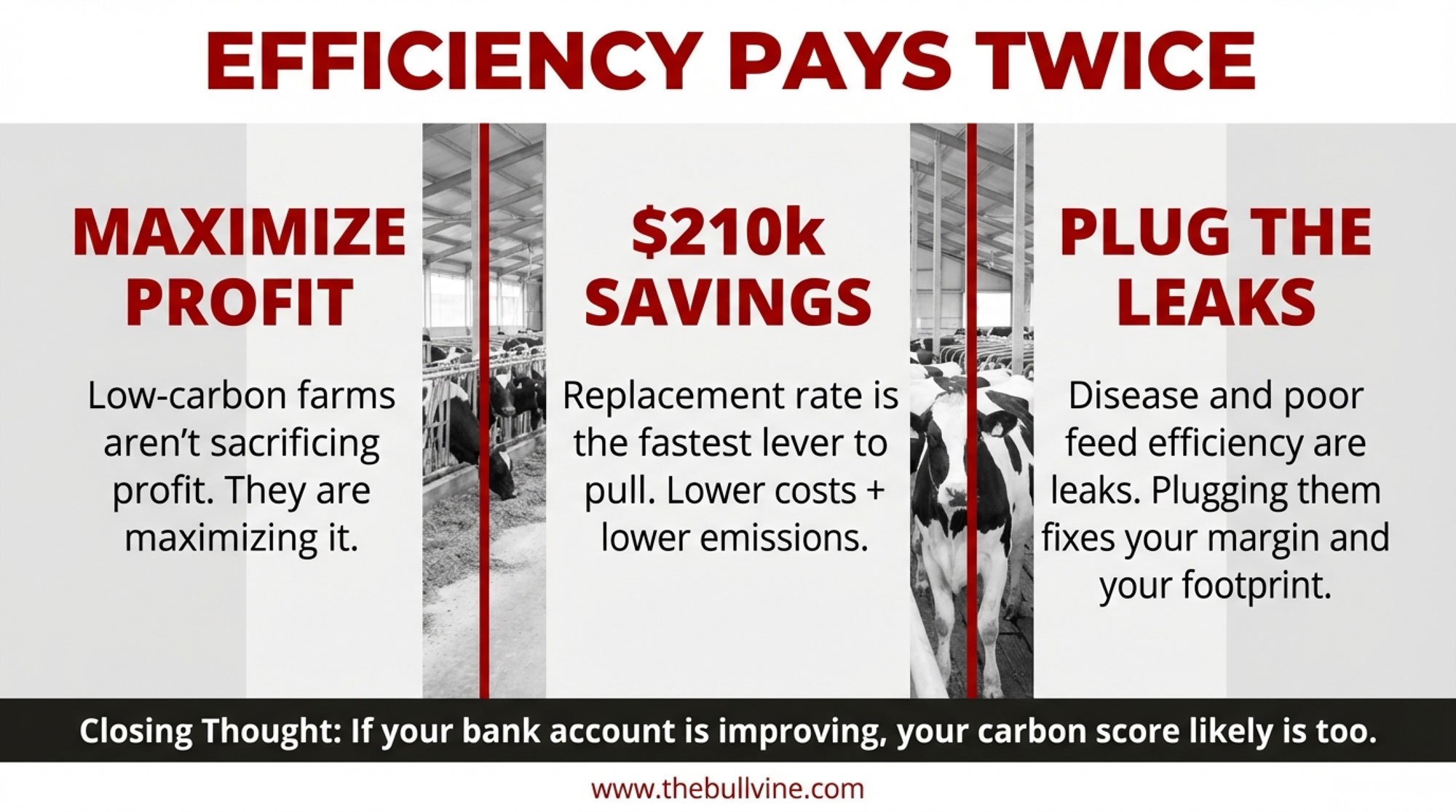
NewsSubscribe
First
Last
Consent

The Hidden Cost of Every $1,200 Beef Calf: A $4,000 Heifer Bill

The 60-day pregnancy check is becoming the most terrifying day on the dairy calendar.

EXECUTIVE SUMMARY: You’ve been breeding 35% to beef, banking $1,200 per calf while dairy bulls bring just $200—the math seemed obvious until June’s pregnancy check reveals you’re 150 heifers short. With dairy heifer inventory at its lowest since 1978 and replacements costing ,000 each, this “profitable” strategy has just created a 0,000 problem that will take two years to fix. The culprit: not tracking what percentage of pregnancies are dairy versus beef, the single metric that predicts replacement availability 18 months out. Successful operations monitor this number weekly—when it drops below 45%, they immediately increase sexed dairy semen usage, trading $520 in monthly semen costs to avoid a six-figure crisis. The entire monitoring system takes 30 minutes weekly, yet most producers don’t discover the problem until it’s biologically impossible to fix. The difference between thriving and crisis isn’t luck—it’s whether you’re tracking one number that takes five minutes to calculate.

beef on dairy strategy

You look at the ultrasound monitor as the technician calls out the results. Bull. Bull. Bull. Heifer. Bull. Your stomach drops. You’ve been breeding 35% to beef, following the plan you set in January. The math was perfect on paper—$1,200 beef calves versus $200 dairy bulls. But now you’re staring at a 120-heifer shortage for next year, and replacement heifers are selling for $3,500 to $4,000 each.

How did this happen? You followed your breeding plan to the letter.

Here’s what’s interesting—the answer lies in a calculation that deserves more attention: the forward-looking replacement inventory formula. The beef-on-dairy movement has certainly delivered valuable calf revenue when we’ve needed it most. Lord knows, those $1,200 beef calves have kept many of us afloat. At the same time, it’s creating what CoBank economists describe as a significant structural adjustment period for operations whose monitoring systems haven’t evolved alongside their breeding strategies.

The New Economics Reshaping Dairy Breeding

You know, the numbers tell a compelling story about where we are as an industry. The National Association of Animal Breeders reports that beef semen sales to dairy operations climbed from 2.5 million units in 2017 to 7.9 million units in 2024—a 216% increase that reflects fundamental changes in how we think about calf value.

Day-old beef-cross calves now command $1,000 to $1,400. Dairy bull calves? You’re lucky to get $100 to $200, and that’s if you can find a buyer. For a 1,000-cow operation breeding 35% to beef, that’s approximately $210,000 to $245,000 in additional annual calf revenue. That’s real money when you’re dealing with volatile milk prices and input costs that just won’t quit.

But here’s what’s particularly concerning—and what many of us are just starting to realize. The Holstein Association has documented that each percentage-point shift toward beef breeding removes approximately 95,000 dairy heifers from the national pipeline each year. The USDA’s January cattle inventory report reveals our dairy heifer inventory has declined to 3.914 million head. That’s a level we haven’t seen since 1978, when we were milking very different cows in very different systems.

CoBank’s dairy quarterly analysis from August makes this clear: we’re facing an 800,000-head decline in dairy heifer inventory before any meaningful recovery begins in 2027. This replacement shortage is becoming increasingly apparent to anyone who’s tried to buy heifers lately. They’re simply not available—at any price in some regions.

What’s worth noting is how this plays out differently across borders. Canadian producers navigating supply management face unique constraints when beef revenue opportunities conflict with quota requirements. European operations are balancing beef-on-dairy opportunities with stricter environmental regulations and different subsidy structures. Australian and New Zealand producers, with their seasonal calving systems, face entirely different timing pressures. But the fundamental challenge—balancing today’s revenue with tomorrow’s replacements—that’s universal.

The Critical Calculation Most Operations Miss

Let me share something that I’ve found most operations overlook:

The Forward Replacement Inventory Formula:

Herd Size × (Age at First Calving ÷ 24) × Cull Rate × (1 + Heifer Non-Completion Rate) = Annual Replacements Needed

ScenarioDairy Pregnancies %Annual Heifer ShortageReplacement CostCrisis Total
Unmonitored Herd (No Weekly Tracking)35%-150$3,500-$4,000$525,000-$600,000
Target Range (Disciplined Monitoring)45-55%On targetN/A$0 (Averted)
Early Warning (April Detection)42-45%-50$3,500-$4,000$175,000-$200,000
Sexed Semen Response50%+ recovery-25$520/month semen$6,240
annual
Late Detection (June Preg Check)35%-120+$3,800-$4,200$456,000-$504,000

Based on conversations with producers across the country—and I talk to a lot of them—most operations make at least one of three common miscalculations that can really bite you later:

First, we tend to be optimistic about heifer completion rates. Many of us plan with the assumption that 90-95% of heifer calves will eventually enter the milking herd. But research from folks at Elanco, based on extensive herd monitoring, shows actual rates are 75-80% on well-managed operations. That 15-20 point gap? It compounds annually, and suddenly you’re wondering where your heifers went.

Second: Age at first calving matters more than we think. Penn State Extension research shows that each month beyond 24 months increases replacement needs by approximately 4%. Push from 24 to 26 months—maybe because your heifer grower had a tough winter or you had some respiratory issues—and a 1,000-cow operation needs 33 additional heifers annually just to maintain herd size.

Third: And this is the one that really catches people—not tracking dairy versus beef pregnancy percentages. Research from UW-Madison identifies this as a critical predictive metric for future replacement availability. You probably know your overall pregnancy rate, but do you know what percentage of those pregnancies are dairy versus beef?

When Reality Hits: The 60-Day Moment of Truth

Here’s how it typically unfolds. You set your breeding plan in January, usually over coffee at the kitchen table or during that annual meeting with your nutritionist and vet. Execute it faithfully through spring. Everything looks fine on paper. Then June arrives with 60-day pregnancy checks and fetal sexing capability.

The ultrasound technician begins: “Heifer, bull, bull, bull, heifer, bull…”

Your expression changes as you realize the sex ratio isn’t what you expected. And here’s the kicker—five months of breeding decisions are now locked into 280-day gestations. A shortage of 120 to 150 replacement heifers is mathematically inevitable. You can’t unbred those cows.

What happens next? Well, I’ve watched this play out too many times:

  • July: You’re calling every heifer dealer in 200 miles
  • August: Prices climb from $3,000 to $3,600 per head
  • September-October: Crisis pricing hits—$3,800 to $4,200
  • November: You either write massive checks or keep those arthritic fifth-lactation cows another year

The Weekly Metric That Changes Everything

What successful operations are doing differently—and this really surprised me when I first learned about it—is monitoring dairy pregnancies as a percentage of total pregnancies weekly. Not monthly. Not quarterly. Weekly.

Your Decision Tree:

  • Dairy % between 45-55%: ✓ Continue current strategy
  • Dairy % at 42-45%: ⚠ CAUTION – Monitor closely next week
  • Dairy % below 42% or declining 3 weeks straight: 🔴 ACTION – Adjust immediately

This 5-minute habit can save you six figures. Think about that for a second. Identifying trends in April or May allows correction before June’s breedings lock in. Waiting for a 60-day pregnancy confirmation means the opportunity has passed. The biology is already set.

The Sexed Semen Solution That Surprises Producers

When dairy pregnancy percentages decline, here’s what seems counterintuitive: increase sexed semen usage despite lower conception rates. But look at the math:

Semen TypeConception RateFemale %Result per 100 Breedings
Conventional40%50%20 female calves
Sexed33%90%30 female calves

Despite an 18% conception penalty, sexed semen generates 50% more females. The cost difference? About $520 monthly in additional semen cost versus $3,500-4,000 per replacement heifer. That’s a no-brainer when you run the numbers.

The 30-Minute Weekly System That Works

Here’s what you need—and you probably already have most of it:

  • Your existing herd management software
  • A basic spreadsheet (or, honestly, even a notebook works)
  • 30 minutes weekly

Track five simple data points:

  1. Week number
  2. Total pregnancies confirmed
  3. Dairy pregnancies
  4. Beef pregnancies
  5. Dairy percentage (calculated)

Veterinarians I work with report that producers have avoided $400,000 replacement crises with nothing more than disciplined weekly monitoring. That’s it. Thirty minutes that could save you from financial disaster.

What Successful Producers Do Differently

They adjust breeding strategies based on real-time data rather than annual projections. When dairy pregnancy percentages drift, they respond within weeks, not quarters. No committee meetings, no analysis paralysis—just adjustments based on data.

They monitor conception rates by semen type. One California producer who asked not to be named noticed a problem when dairy conception was running at 38% while beef was at 44%. Overall, it looked fine at 41%, but the divergence signaled specific dairy bull fertility issues that needed to be addressed immediately.

They plan realistic completion rates. A Pennsylvania producer shared this experience: “We assumed 90% of heifer calves would reach the milking parlor. Reality was 76%. That 14% gap over three years? 180-heifer shortage.” That’s a lesson learned the hard way.

And perhaps most importantly, they resist market timing. When beef prices surge—and they will again, markets are cyclical—disciplined operations maintain their breeding allocation rather than chase short-term revenue.

The Industry Dynamics Creating This Challenge

Several factors are converging that make this more complex than it was even five years ago.

Rabobank identifies $10 billion in new processing capacity requiring 2-3% annual production growth. That milk has to come from somewhere—either more cows or higher production per cow, both requiring careful replacement planning.

Research from UW-Madison shows that keeping older, lower-genetic cows costs several hundred dollars per lactation in unrealized genetic potential. It’s a hidden cost that adds up quickly when you’re holding onto cows past their prime.

CME data confirms we’re seeing unprecedented spreads between beef-cross and dairy bull values. That economic pressure to breed beef is real and it’s intense.

And here’s what makes it tough—once beef-on-dairy revenue reaches a significant portion of farm income, as industry analysis suggests is happening for many operations, returning to previous breeding strategies becomes financially challenging, even when replacement needs suggest you should.

These industry pressures aren’t just numbers on a spreadsheet—they’re reshaping how we make decisions every single day on our farms.

Practical Lessons from the Field

Looking at how these dynamics play out in real operations, the patterns become clear.

One California producer managing 1,500 cows, who preferred to remain anonymous, shared this sobering experience: “We bred 40% to beef without weekly monitoring. By July, we were 180 heifers short. Cost us $650,000 in purchased replacements plus another $80,000 in health and adaptation challenges. Now we monitor weekly—takes 20 minutes, prevents million-dollar mistakes.”

A Pennsylvania operation with 800 cows reported better results: “When our dairy percentage dropped to 43% in April, we immediately increased sexed semen usage. That early adjustment means we’re actually ahead on replacements now.”

And from the other side of the equation, a Minnesota custom heifer raiser tells me: “Three years ago, I had excess capacity. Today, I’m declining inquiries weekly. The offers I’m getting—$500 per head premiums just to accept calves, before any feeding costs—show how desperate the situation has become. But biological realities mean these animals require two years regardless of how urgent the need.”

Looking Ahead: What This Means for Your Operation

The beef-on-dairy opportunity has provided crucial revenue during challenging economic periods—I’m not arguing against it. As replacement availability tightens and prices reach historic levels, though, success will belong to operations that balance opportunity with disciplined management.

This isn’t really about choosing between beef revenue and dairy replacements. It’s about implementing systems that enable real-time response rather than hoping annual projections prove accurate. These principles apply whether you’re managing 3,000 cows in an Arizona dry lot or 200 cows on a Missouri pasture—the mathematics remain consistent, only the scale varies.

So here’s the question that matters: Are you monitoring the right metrics weekly, or are you waiting for problems to become crises?

Tracking dairy pregnancies as a percentage of total pregnancies requires just 30 minutes weekly. The cost of not monitoring? Producers nationwide are discovering it can easily exceed $400,000 when replacement shortages force them to make desperate purchasing decisions.

The beef-on-dairy opportunity remains valuable—genuinely so. But like all agricultural opportunities, it rewards those who measure, monitor, and adjust based on data—not those who set plans in January and hope for the best.

As we approach 2026, your dairy pregnancy percentage might be the most critical metric on your farm. The encouraging news? The tools and knowledge exist to navigate this successfully. It simply requires discipline and perhaps a shift in how we think about breeding management—from annual planning to continuous optimization.

Don’t know your current Dairy Pregnancy %? Go check your herd management software right now. If it’s below 42%, call your breeding advisor today.

KEY TAKEAWAYS

  • Your dairy pregnancy percentage predicts your future: Below 45% means you’re heading for a 150-heifer shortage worth $600,000—monitor it weekly, not annually
  • Timing is everything: Problems discovered in April can be fixed with breeding adjustments; problems discovered at June’s 60-day check are locked in for two years
  • Sexed semen is cheaper than panic: $520/month extra for sexed semen generates 50% more heifers and beats paying $3,500-4,000 per replacement
  • The 30-minute solution: Weekly monitoring of one metric (dairy pregnancies ÷ total pregnancies) has prevented $400,000 crises for disciplined producers
  • Action required today: Check your dairy pregnancy percentage now—if it’s below 42%, increase sexed dairy semen usage immediately

Complete references and supporting documentation are available upon request by contacting the editorial team at editor@thebullvine.com.

Learn More:

Join the Revolution!

Join over 30,000 successful dairy professionals who rely on Bullvine Weekly for their competitive edge. Delivered directly to your inbox each week, our exclusive industry insights help you make smarter decisions while saving precious hours every week. Never miss critical updates on milk production trends, breakthrough technologies, and profit-boosting strategies that top producers are already implementing. Subscribe now to transform your dairy operation’s efficiency and profitability—your future success is just one click away.
NewsSubscribe
First
Last
Consent

80% Full or 95% Desperate: The $400,000 Difference in Dairy Expansion Timing

Expand at 80%: 28 months of cash runway. Expand at 95% = 8 months. Which farm survives the next milk price crash?

EXECUTIVE SUMMARY: Timing your expansion at 80% capacity versus 95% isn’t just about convenience—it’s a $400,000 decision that determines whether you’ll survive the next downturn. At 80% utilization, you have $400-600K working capital and 28 months of financial runway; at 95%, you’re down to $300K and 8 months before crisis hits. The hidden killer nobody’s calculating: heifer costs exploded from $1,800 to $4,000 between 2023 and 2025, adding an unbudgeted quarter-million to every expansion. Smart operators now work backwards from a 36-month timeline, securing heifer supplies before designing parlors. But here’s the plot twist—producers choosing NOT to expand are often outperforming expansion operations by 40%, using premium markets, cooperatives, and value-added processing to build margins without debt. This isn’t about getting bigger anymore; it’s about getting smarter with the assets you already have.

Dairy farm expansion strategy

I just came back from a producer panel in Madison, and—true to form—by the time coffee hit the table, we were deep into a debate: When’s the right time to expand? The folks from Texas mentioned USDA’s October 2025 figures—Texas added nearly 47,000 cows in the last twelve months. South Dakota? State data shows a 65% herd increase since 2019, thanks in part to Valley Queen’s ambitious processing expansion. And you can’t ignore Rabobank’s latest numbers: we’re talking billions in new dairy plant investment rolling out across the country through 2028. It’s a wild time for U.S. dairy.

But I noticed something as these success stories bounced around the room—nobody wanted to bring up the producers struggling under new debt loads or the expansions that triggered more stress than success. After reviewing cases with financial advisors, talking with university folks, and swapping stories with dairies from Georgia to Washington, I’m convinced we need a new framework for thinking about expansion. Let’s get practical.

The 80% Trigger—And Why Most Expansion Happens Too Late

Looking at this trend, it’s natural to assume the decision comes when the parlor’s maxed out, the labor’s grinding, and you’re racing against milk production efficiency limits. Michigan State University’s 2024 expansion analysis, along with similar work from Wisconsin’s Center for Dairy Profitability, reveals a different story. Their advice? Expand at 80% utilization—not after the wheels come off at 95%. When you do, your odds of profit skyrocket.

Here’s what I see in operations working at that 80% sweet spot:

  • Working capital sitting comfortably between $400,000 and $600,000 (not drained by constant cow turnover)
  • Debt-to-equity ratios below 0.5, so lenders trust you to ride out rough spots
  • Maybe 18–24 months’ cash cushion if things go sideways

But at 95%? Working capital has likely dropped below $300,000, debt pressures are building, and every new day at full tilt erodes your negotiating position. Lenders notice. Suddenly, rates creep up, terms get shorter, and flexibility disappears. This isn’t theoretical—producers in Iowa and New York both told me their latest refinancing offers came with “crisis” pricing, not partnership terms.

What’s particularly noteworthy is how that 80% number gives you time: time to fix bottlenecks, test labor models, and roll out changes before you’re under the gun. That breathing room is worth more than any construction discount you’ll ever get for waiting to expand.

The $400,000 Safety Net: Why 80% Capacity Expansion Timing Creates Financial Runway

Hidden Heifer Costs: The Expansion Killer in Plain Sight

What’s interesting here is how expansion plans rarely factor in the real price of replacements. CoBank’s October 2025 Dairy Quarterly puts current U.S. heifer inventories at a two-decade low—just shy of 3.9 million head. That’s about 18% lower than where we stood in 2018. And based on what I see at auctions and in dealer quotes around Wisconsin and Pennsylvania, a replacement heifer that cost $1,800 a couple of years back is now going for $3,500 to $4,000, with the best lines topping $5,000 on strong-herd sales.

USDA’s Livestock, Dairy, and Poultry Outlook supports this, showing heifer supply tightness through at least 2026. Plan for earlier recovery at your peril.

So if you’re modeling a jump from 300 to 450 cows, here’s what you’re really looking at:

The Quarter-Million Dollar Surprise Nobody Budgets For

Hidden Cost CategoryWhat You BudgetedWhat You’ll Actually Pay
Heifer Premium (150 head @ current market)$270,000 (@ $1,800/head)$525,000-$600,000 (@ $3,500-$4,000/head)
Additional Heifer Acquisition Cost+$255,000 to $330,000
Feed & Labor During 24-Month DevelopmentIncluded in operations+$50,000 (Cornell Pro-Dairy estimates)
Transition Health Management$5,000+$10,000-$15,000 (U of MN veterinary studies)
Overlapping Debt ServiceOften ignored+$35,000-$50,000
Total Unbudgeted:$350,000-$445,000

Bottom line? That quarter-million to nearly half-million dollar hole in your expansion budget isn’t a rounding error—it’s the difference between profit and bankruptcy. As Dr. Christopher Wolf at Cornell reminded us at a recent extension webinar, it’s not about filling the barn—it’s about whether you can afford to fill those stalls with cows that pay you back at today’s prices.

The Quarter-Million Dollar Surprise: Hidden Heifer Costs That Bankrupt Expansion Plans

Backward Planning: The 36-Month Expansion Timeline

From what I’ve seen in successful multisite operations across the Midwest and Northeast, the farms that ‘nail’ expansion don’t start with construction—they start three years out and work backwards.

Here’s how it plays out on farms that have grown without regrets:

  • At 36 months out, they’re assessing heifer facilities: can we build enough of our own, or do we need to secure outside sources? Consultants (think folks from Compeer Financial or university extension) are already involved, running stress tests and flagging operational or management gaps.
  • By 24 months, most of these producers are disabling beef semen programs and boosting sexed dairy semen use, which stings when you’re giving up $750–$900/hd for beef-dairy cross calves (just check any current USDA market report). Still, it’s necessary to provide the replacements.
  • 12 months out sees the start of construction—parlor design reflects actual heifer capacity, not fantasy projections. You’ll see operations using this window to bulletproof their management structure, too.

After the parlor goes live, it’s all about measured, gradual onboarding. Bringing heifers in over 12–16 weeks—rather than in one massive wave—gives everyone (cows and people) time to adapt, keeps butterfat performance on track, and helps maintain fresh cow management discipline.

One consultant put it to me like this: by the time you ‘decide’ to expand, if you’re doing it right, you’re really just executing the plan you made three years ago.

Designing for the Herd You’ll Have—Not the Cows You’ve Got

I visited a 400-to-650 cow Michigan operation that offers a simple but profound lesson: they built everything 50% bigger than needed—holding areas, feed alleys, manure storage, you name it. Wisconsin’s Dairyland Initiative supports this “150% Rule” in their 2024 planning guidelines, and the cost savings down the line are enormous.

Get this—building a larger holding pen initially costs $35,000–$50,000, while reconstructing a cramped one later runs $80,000–$120,000 and may force a multi-month shutdown. Operations from California (with tougher water board restrictions) to the Southeast (dealing with heat stress) should adapt the concept, but the “plan for growth” mindset seems universally valuable. Even Mountain West dairies dealing with seasonal water access and Southwest operations managing extreme summer temps are finding this forward-thinking approach pays dividends.

Modular barns—clusters of 250–350 stalls with independent ventilation—are growing popular in Idaho and Pennsylvania. You can add a new block without disrupting milk flow, which makes sense given the unpredictability of future herd size. Feed alleys and equipment, according to dealer experience and recent construction bids I’ve seen, cost more up front but save $100,000+ against retrofits later.

Building manure management for the next generation, not just today, is critical. One producer in central Wisconsin told me his “build only what you need now” approach meant a catastrophic $120,000 retrofit and 3 months of idle time when expansion couldn’t wait any longer.

Labor Is Now the True Bottleneck

Let’s talk labor, because nearly every operator I know admits it’s the limiting factor—sometimes more than parlor stalls or feed space. USDA’s 2025 Farm Labor Survey reports annual turnover rates near 40%, and Texas A&M’s economists calculate it costs $15,000–$25,000 every time you lose a trained hand. Think about it: that’s four to five cows’ worth of revenue lost every single year, just to churn.

I’m seeing operations adapt by leveraging automation—robotic milking, sort gates, feed pushers. The latest Lely and DeLaval systems, as deployed in California and New York herds, reduce labor needs up to 60% and pay for themselves in under two years if you’re in a tight labor market. This is transforming dairy farm management at every scale. And the non-wage elements—affordable housing, pickup shuttles, flexible shifts, pathways to supervisor roles—are finally getting attention. The University of Vermont’s 2024 dairy labor research suggests these perks cut turnover from 45% to 15% in pilot projects.

Big, multi-barn operations in the Midwest offer something else: real career ladders, so entry-level milkers can move up to shift lead or assistant manager roles as the farm grows. One HR director told me what keeps people isn’t just a fair hourly rate—it’s the chance to stick around and grow, plus an environment that respects their families and ideas.

The First Real Investment: Honest, Independent Analysis

Nearly every expansion I’ve seen succeed started with a $15,000–$35,000 commitment to serious, unbiased planning—a line item paid to consultants from Farm Credit, extension, or non-affiliated ag business planners. They’re not selling rotary parlors or advocating for any specific supplier. They’re just there to ask the brutal questions:

  • Would you expand if milk dropped $3/cwt for a year?
  • Can your buyer really take another 20% peak milk during the spring flush?
  • Does your current team have the management capacity for multisite or larger-scale operation, or are you training up as you go?

And here’s the value: good consultants model all this and often point out that your “8-year payback” plan will actually take 14 years under today’s risk profile. Sometimes, they even tell producers not to expand at all—which, believe it or not, is the advice that saves the most equity in the long run.

Choosing “Not to Expand”—and Winning Anyway

The Contrarian Play: Why NOT Expanding Often Beats Bigger-Herd Economics

What’s encouraged me most recently is meeting producers who took “no” for an answer after running the numbers—and ended up thriving. How? By focusing on premiums and efficiency, not just scale.

Consider organic transitions. The Organic Trade Association’s 2025 report shows price increases of 20–40% for certified milk. A2 milk and high-component lines command similar, sometimes higher, premiums. Even old-fashioned quality bonuses—holding SCC well under 100,000—mean an extra 40 to 60 cents per hundredweight at most Midwest and Northeast processors.

Out East, producer co-ops like Hudson Valley Fresh help members—regardless of herd size—earn meaningful premiums and negotiate better hauling and input deals. And Cornell’s Dairy Foods Extension has shown that on-farm cheese and yogurt ventures (with $150,000–$300,000 startup investment) routinely pay back in two to three years when executed well.

Don’t discount Vermont’s recovery model after 2015–17’s price crash. Instead of growing bigger, groups of family dairies leaned into direct-market sales, branded fluid milk, and value-added production. Their net margins—documented in Vermont Agency of Agriculture data—eclipsed many larger commodity peers.

A Farmer’s Framework for Deciding

For everyone I meet seriously eyeing expansion, here’s my basic checklist—honed from the best minds at Farm Credit, university extension, and my own seat-of-the-pants experience:

  • Stress test: How many months of negative cash flow can you truly weather? Most lenders want to see at least a year of history.
  • Scenario planning: Run the numbers for stable, down 12%, and down 15–20% price scenarios. Use current heifer prices and milk market conditions from sources like the USDA’s recent outlooks—never last year’s cheapest quotes.
  • Hidden costs: Don’t ignore transition losses (15–20% production dips are well-documented by Michigan State), overlapping debt, or retraining expenses.
  • Management readiness: Be honest—can your team adapt to delegation and documentation, or do you need to build that muscle before you break ground?
  • Alternatives analysis: Is there a premium brand, co-op, or processing venture you’re overlooking that could offer similar ROI with less debt risk?

If you’re short on any of those, slow down. Your farm’s resilience will depend on finding the right fit—not just the biggest number.

Looking Ahead: The Hard Truth About Smart Growth

Here’s what nobody wants to admit at those polite industry conferences: The era of “expand or die” is dead. It’s been replaced by “expand smart or die slowly.”

The data doesn’t lie. Based on Farm Credit lending data and recent expansion studies, operations expanding at 95% utilization with depleted working capital face substantially higher failure rates than those expanding from positions of strength. Farms that ignore the quarter-million-dollar heifer reality end up selling at distressed prices within five years. And those waiting for the “perfect moment” to expand? They’re still waiting while their neighbors either scaled strategically or pivoted to premium markets that pay double commodity prices.

The new reality is this: Smart growth beats fast growth. No growth beats dumb growth. And sometimes, the boldest move isn’t building bigger—it’s having the guts to stay exactly where you are and do it better than anyone else.

That 80% rule? It’s not just about timing. It’s about having enough oxygen in your operation to think clearly, plan strategically, and execute flawlessly. Because in today’s dairy economy, the difference between thriving and surviving isn’t the size of your herd—it’s the size of your margin for error.

And if that margin’s already gone? Well, maybe it’s time to stop focusing on expansion plans and start focusing on what actually makes money in this business. Because I’ll tell you what—it’s not always more cows.

KEY TAKEAWAYS

  • Your expansion trigger is 80%, not 95%—miss this and you’re $400,000 poorer: At 80% you have resources to plan; at 95% you’re making desperate decisions with 8 months runway instead of 28
  • Budget $4,000 per heifer, not $1,800—then add $100,000 for surprises: The quarter-million dollar gap between planned and actual heifer costs is bankrupting more expansions than milk prices
  • Winners plan backwards from a 36-month timeline: Secure heifer genetics at -24 months (yes, give up those $900 beef calves), build replacement inventory at -18 months, break ground at -12 months
  • The highest ROI might be NOT expanding: Producers capturing organic premiums (20-40%), joining cooperatives, or adding on-farm processing are beating expansion economics by staying exactly where they are

Complete references and supporting documentation are available upon request by contacting the editorial team at editor@thebullvine.com.

Learn More:

Join the Revolution!

Join over 30,000 successful dairy professionals who rely on Bullvine Weekly for their competitive edge. Delivered directly to your inbox each week, our exclusive industry insights help you make smarter decisions while saving precious hours every week. Never miss critical updates on milk production trends, breakthrough technologies, and profit-boosting strategies that top producers are already implementing. Subscribe now to transform your dairy operation’s efficiency and profitability—your future success is just one click away.
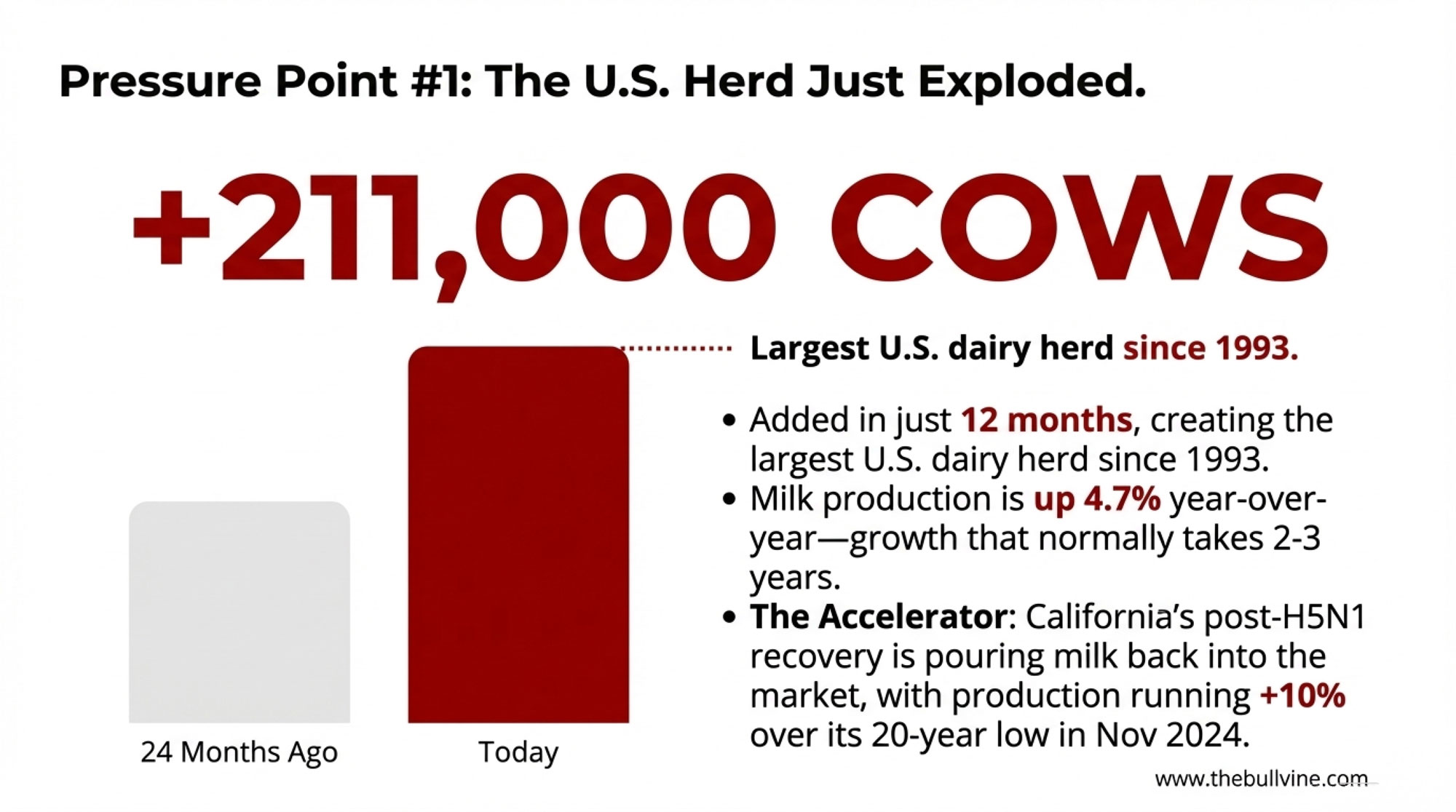
NewsSubscribe
First
Last
Consent

The Robot Truth: 86% Satisfaction, 28% Profitability – Who’s Really Winning?

When satisfaction rates soar but profitability plummets, the dairy industry’s automation revolution reveals uncomfortable truths about who really wins

The Robot Paradox reveals dairy farming’s uncomfortable truth: while 86% of farmers recommend robots to others, only 28% achieve the production gains needed for clear profitability. This 58-point gap exposes how quality-of-life improvements mask economic challenges

You know, that 4 a.m. alarm clock is becoming a thing of the past on more and more dairy farms. I’ve been tracking this transformation pretty closely, and what’s fascinating is where we’re at in 2025—the robotic milking market has grown to about $3.39 billion globally according to Future Market Insights, with projections suggesting we’ll hit $19.5 billion by 2035.

Big numbers, right? But here’s what’s interesting…

When you dig beneath all those impressive adoption statistics, there’s a more complicated story that I think every farmer considering robots really needs to hear. The University of Calgary followed 217 Canadian dairy producers through their robotic transitions—published the whole thing in the Journal of Dairy Science back in 2018—and what they found, combined with research from around the world, reveals some surprising patterns.

So yes, 86% of farmers who’ve installed robots would recommend them to others. That’s genuine satisfaction. But here’s the interesting part: only about 28% are actually achieving the production increases needed for clear profitability, based on the University of Minnesota’s economic modeling this year.

That gap? Well, it tells you something important about what’s really happening out there.

Why Farmers Love Robots Even When the Numbers Don’t Always Work

You probably know someone who’s installed robots and can’t stop talking about how it’s changed their life. A fifth-generation Prince Edward Island farmer told me recently, “I haven’t missed one of my kids’ events since we installed the robots.” And honestly, I hear this all the time.

This quality-of-life transformation—it’s real, and it explains why satisfaction rates stay high even when the economics get challenging.

Looking more closely at that Calgary data, some interesting patterns emerge. About 58% of farms report increased milk production, which sounds good. But these range from tiny 2-pound gains all the way up to exceptional 10-pound improvements. Meanwhile, 34% maintain exactly the same production levels despite dropping serious money on robots. And here’s what really stands out—18% actually see production go down. Makes profitability pretty much impossible when that happens.

Production Reality exposes the hidden complexity: while 58% of farms see production increases, most gain only 2-3 lbs/day when 5+ lbs is required for profitability. Meanwhile, 34% see no change and 18% actually lose production—making robots profitable for just 28% of adopters

As Trevor DeVries from University of Guelph recently explained, “What producers are discovering is that robotic milking success depends on having the right combination of factors. The technology changes the nature and flexibility of labor rather than simply reducing hours.”

The Scale Trap defies conventional wisdom: small farms see 355% profit increases while medium-sized operations (61-120 cows) lose money with robots. This “missing middle” represents 40-50% of North American dairies—too large for simplicity benefits, too small for economies of scale

When More Milk Doesn’t Mean More Money

A Kansas dairy farmer shared something with me that really stuck: “We tried to save money by retrofitting our existing barn—big mistake. Cow traffic issues cost us at least 10 pounds of milk per cow until we finally redesigned the entire layout a year later. Do it right the first time.”

His experience aligns with research from multiple countries. Yes, 58% of farms report some production increases according to that Calgary study. But this year, the Minnesota Extension discovered that you need gains of at least 5 pounds per day to overcome the technology’s cost structure.

Most farms are getting just 2-3 pound increases? They’re stuck in what researchers call the “marginal profitability zone”—where success depends on milk prices staying strong and everything else going perfectly.

The Numbers That Matter

The Minnesota team uncovered specific thresholds that determine success, and honestly, these are sobering:

If your production increases just 2 pounds per day, robots need to last longer than 10 years to be more profitable than your old parlor. If production stays flat—and remember, that’s a third of farms—you’re looking at robots needing 13 to 17 years just to break even. And if production actually decreases? Well, robots are never going to be as profitable as what you had before.

Now, the financial reality gets even tougher when farmers discover that operational costs are running 300 to 400% higher than dealers projected. Teagasc in Ireland documented electricity costs that were nearly three times higher than those of conventional systems back in 2011. New Zealand farmers have told researchers their electricity bills doubled after installation. One farmer showed me maintenance invoices that hit six figures in the first year—the dealer told him to expect five to nine thousand.

The Scale Problem Nobody Expected

Turkish researchers published something in 2020 that really challenges what we’ve assumed about farm modernization. They looked at robot economics across different herd sizes, and what they found… well, it surprised me.

The Scale Trap defies conventional wisdom: small farms see 355% profit increases while medium-sized operations (61-120 cows) lose money with robots. This “missing middle” represents 40-50% of North American dairies—too large for simplicity benefits, too small for economies of scale

Small operations with 10 to 60 cows saw profit increases of 355% with robots. Operations with 121 or more cows? Generally profitable with proper execution. But here’s the kicker—farms with 61 to 120 cows actually saw decreased profitability.

Now, this Turkish study reveals a pattern that, if it holds true for North America, has profound implications. That middle group represents about 40-50% of North American dairy farms. We’re potentially talking about what economists call the “missing middle”—too large for the simplicity benefits of small-scale operations, but too small for the economies of scale that make it work for bigger dairies.

Looking at different regions, the pattern seems to align. Wisconsin farms averaging 90 cows? They’re right in what could be this danger zone. Vermont’s typical 125-cow operations sit just above the profitability threshold. California’s larger operations generally do fine. But those traditional Midwest family farms in that 80 to 100 cow range… if this Turkish research applies here, they really need to think this through carefully.

Down in the Southwest, where operations tend to be larger, the economics often work better. But what about Southeast producers with their typically smaller herds and higher humidity challenges? That’s a whole different calculation. And up in Canada—where that Calgary study originated—producers in Ontario versus those in Alberta face completely different economics, based on quota systems and herd-size restrictions.

The Genetic Timeline That Changes Everything

Here’s something that doesn’t get nearly enough attention—it takes 5 to 8 years to breed a herd that’s actually optimized for robotic milking. I’m not kidding.

Research published in the Journal of Dairy Science last year analyzed over 5 million milking records from about 4,500 Holstein cows. What they found is that udder conformation traits crucial for robot efficiency are moderately to highly heritable—we’re talking 0.40 to 0.79. So yes, you can breed for robot success. But man, it takes time.

A Wisconsin farmer discovered this the hard way two years after installing his robots. “I sold three of my highest producers six months after installation,” he told me. “They were production champions but robot time hogs. After replacing them with more efficient cows, my output actually increased even though individual cow averages decreased slightly.”

Think about that—higher total output with lower individual averages. It’s all about efficiency.

CRV and other breeding organizations showed in 2023 that farmers using bulls specifically selected for robot-friendly traits ultimately get about 350,000 pounds more milk per robot annually. For a three-robot operation, that’s over $200,000 in additional revenue. But—and this is crucial—only after 5 to 8 years of strategic breeding.

The Efficiency Gap That Makes or Breaks You

What really blew my mind: individual cow efficiency in robotic systems varies by nearly 300%. Same production levels, wildly different robot utilization.

Lactanet did this fascinating comparison in 2023—two cows with almost identical daily production, 48 kilos versus 49.5 kilos. But one produced her milk nearly three times more efficiently in terms of robot time. Just think about the implications…

And here’s where genetics meets economics in ways we’re just beginning to understand…

This explains why manufacturer recommendations about running 60 to 70 cows per robot produce such different results from farm to farm. High-efficiency operations can profitably run 68 cows per robot, sometimes more. Low-efficiency farms struggle with just 45 cows on the same equipment.

The Facility Mistakes That Haunt Farmers

The Calgary study found something that should give everyone pause: 68% of farmers would do something differently during installation, with facility modifications topping the list of regrets.

We’re not talking minor tweaks here. These are fundamental design decisions that compound into permanent profitability problems.

A Michigan producer took a different approach worth noting: “We visited fifteen robotic dairies before finalizing our facility design. The three most successful operations all emphasized the same point—cow flow is everything.”

Three Design Elements That Can Make or Break Your Operation

Feed Space—The Hidden Killer

The Dairyland Initiative in Wisconsin has repeatedly shown that retrofitting four-row barns—where everyone tries to save money—creates permanent bottlenecks.

These facilities typically give you 12 to 18 inches of feed space per cow when you need 24 inches minimum. What happens? Subordinate cows see their feed intake drop 15 to 25%. Your fetching requirements jump from a manageable 5% to 20% of the herd. And lameness rates climb from a typical 20% to a devastating 35-45%.

I’ve seen this mistake too many times. Farmers think they can make that old four-row barn work. It rarely does.

Traffic Flow—More Than Philosophy

The choice between free and guided traffic isn’t just a matter of management philosophy—it’s economics.

Farms trying to save 40 to 60 thousand on selection gates often discover that their “savings” create massive waiting times. Research in Animal Welfare Science from 2022 showed that this reduces lying time from the required 12 to 14 hours to just 9 to 11 hours. You know what happens when cows don’t get enough rest—lameness goes up, production goes down.

Backup Capacity—The Insurance You Hope You’ll Never Need

Despite dealer assurances that all cows will adapt, the Calgary research shows that 2% of herds need culling because they won’t work with robots. Plus, fresh cow management requires special protocols.

An experienced farmer put it bluntly: “You can’t avoid having some backup milking capacity. The cull rate’s too high if you require everyone to be robot-trained.”

Who Actually Benefits from Automation

The industry often talks about labor savings driving automation, but the challenges are real. USDA data from this year shows immigrant workers make up 51% of the dairy workforce while producing 79% of U.S. milk. With 38.8% annual turnover creating measurable production losses, something’s gotta give.

But here’s what I’ve learned—successful automation requires specific labor economics.

Minnesota’s breakeven analysis this year shows that robots become competitive when labor costs range from $22 to $32 per hour (depending on production gains), or when turnover exceeds 50% annually. Ideally, you have both.

For farms with stable workforces at $18 to $20 per hour—common in many rural areas—the economics often don’t support automation regardless of other factors. As one Nebraska farmer explained, “We have great employees who’ve been with us 10-plus years. Robots would’ve solved a problem we don’t have.”

When Everything Goes Right: A Success Story

Let me share what success looks like based on several Vermont operations I’ve worked with that represent that successful 28%.

One particular farm began in 2021, selecting for robot traits while still milking in their double-8 parlor. “We genomic tested every animal and started culling hard for robot efficiency traits,” they explained.

By the time they installed four DeLaval robots in 2023, 40% of their 240-cow herd already had favorable genetics. They built a new freestall barn explicitly designed for robots—about a $1.7 million investment that hurt, but they had the capital reserves.

“We could’ve retrofitted for $800,000,” they noted, “but after visiting twelve robot farms, we saw how facility compromises created permanent problems.”

Today, successful operations like these are achieving 90 to 95 pounds per day, with robots running at 2.0 to 2.2 kilos per minute. Many report annual labor cost reductions of 40-50%. But what really matters to these families—they’re coaching youth hockey, returning to off-farm careers part-time, actually having a life outside the barn.

“This technology transformed our operation,” one farmer told me. “But I tell neighbors straight up—if you can’t absorb significant losses for three years and invest in genetics and facilities, wait. This isn’t for everyone.”

The Questions That Predict Success or Failure

After analyzing hundreds of operations, researchers have identified the key diagnostic question that predicts success with remarkable accuracy:

Can you comfortably absorb $100,000 in annual losses for three consecutive years while investing an additional $150,000 in facility corrections and genetic improvements—without threatening your farm’s survival?

If you can’t confidently say yes, the research suggests waiting or exploring alternatives. This single question brings together every critical factor: scale, capital reserves, commitment to the timeline, and strategic thinking capacity.

There’s also the temperament piece. Ask yourself: Am I comfortable with data-driven decision making rather than hands-on control? Can I wait 24 to 48 hours for technical support instead of fixing things immediately? Will I accept that 5-8% of cows will always need fetching?

That last one’s important—perfectionism becomes a liability with robots.

Dutch research from 2020 found something surprising: farmers who quit robotic milking actually scored higher on conscientiousness scales than those who successfully adopted robotic milking. The characteristics that make excellent conventional dairy farmers—disciplined, hard-working, hands-on—can work against you with systems requiring indirect management.

Making Sense of It All: Who Should Actually Buy Robots

Based on everything we’re seeing, clear patterns emerge for different situations.

You’re a Strong Candidate (about 28 to 40% of farms) If You Have:

  • 121 or more cows with plans to maintain or expand
  • High-wage labor markets ($24+ per hour) or severe turnover (over 50%)
  • Capital reserves to absorb $250,000 to $400,000 in losses and corrections over three years
  • Already started genetic selection for robot traits at least two years before installation
  • Willingness to build new or invest in proper retrofits ($1.2 million plus)
  • Comfort with systems thinking and data-driven management

Proceed with Extreme Caution (about 40 to 50% of farms) If You Have:

  • 60 to 120 cows—remember, scale economics work against this group
  • Moderate labor costs ($18 to $22 per hour) with manageable turnover
  • Limited capital requiring minimal facility retrofits
  • Haven’t begun genetic selection for robot efficiency
  • Need profitability within 2 to 3 years
  • Preference for hands-on problem solving over remote management

Consider Alternatives (about 20 to 30% of farms) If You Have:

  • Under 60 cows without expansion plans
  • Stable, affordable labor force
  • Existing facilities requiring extensive modification
  • Management style strongly favoring direct control
  • Can’t absorb three years of potential losses

The Bottom Line

What we’re learning about robotic milking challenges many of the assumptions we’ve held for years.

Quality-of-life improvements? They’re absolutely real and valuable. That 86% recommendation rate reflects genuine lifestyle benefits. But—and this is important—quality of life doesn’t automatically translate to profitability. I’ve seen too many farms discover this the hard way.

The 72% profitability gap is sobering but manageable if you understand what you’re getting into. Only 28% achieve the 5-plus-pound daily gains needed for clear profitability, according to Minnesota’s analysis. But understanding the specific requirements lets you make an informed decision rather than just hoping for the best.

Timeline expectations need radical adjustment, too. Full optimization takes 5 to 8 years, not the 1 to 2 years dealers suggest. Start genetic selection 2 to 3 years before installation and expect marginal performance for the first couple of years of operation. This isn’t pessimism—it’s realism based on what farmers have actually experienced.

Facility design really does determine destiny. Those 68% who regret their installation decisions teach us a powerful lesson: cutting corners on facility design creates permanent barriers to profitability. Proper design typically requires $1.2 to $2.2 million for most operations. If that number makes you uncomfortable… well, that’s valuable self-knowledge.

And scale economics aren’t what we thought. That 61 to 120 cow “dead zone” where robots actually decrease profitability challenges everything we’ve assumed about modernization improving economics. This has profound implications for mid-sized family farms—the backbone of our industry in many regions.

The dairy industry’s at an interesting crossroads. Technology adoption is accelerating even as economic pressures intensify. Robotic milking represents a genuine transformation for the 28 to 40% of operations that have the right combination of scale, capital, management style, and long-term commitment. For these farms, the technology really does deliver.

But for the majority—those who lack critical success factors at 60 to 72%—the technology might create more challenges than solutions. When you look at industry projections suggesting growth from $3.39 billion to $19.5 billion by 2035, those numbers require adoption rates that probably exceed the population of farms that are actually good candidates.

The lesson isn’t that robotic milking is good or bad. It’s that complex agricultural technologies require an honest assessment of your individual situation rather than following narratives about what’s “inevitable.”

The farmers succeeding with robots aren’t just early adopters or tech enthusiasts. They’re operations whose specific circumstances align perfectly with the technology’s requirements.

As that Vermont farmer put it perfectly: “This technology is amazing—for the right farm, at the right scale, with the right preparation. The challenge is being honest about whether you’re that farm.”

And honestly? That’s the conversation we all need to be having.

KEY TAKEAWAYS:

  • The One Question That Matters: Can you lose $100K/year for 3 years? If no, skip robots. Only 28% ever see profit.
  • The Scale Trap: 60-120 cows = robot dead zone (you’ll lose money). Under 60 or over 120 = potential profit.
  • The Timeline Nobody Tells You: Year 1-3: Losses. Year 4-5: Breakeven. Year 5-8: Maybe profit. Plan accordingly.
  • Your Best Cows Are Your Biggest Problem: High producers often fail at robots. Efficiency beats volume every time.
  • The Real Math: Dealers say $9K/year costs. Reality: $30-45K. Triple everything, including disappointment.

EXECUTIVE SUMMARY: 

The robot revolution has a secret: it’s only working for 28% of dairy farms. After tracking 217 operations, researchers discovered a brutal truth—farms with 60-120 cows (nearly half of U.S. dairies) actually lose money with robots, while those below 60 or above 120 can profit. Success demands crushing requirements: 0,000 in loss tolerance, 5-8 years of genetic prep, and willingness to cull your best producers for efficiency. Yet 86% of farmers still recommend robots, creating false confidence that drives unsuitable operations toward financial disaster. The industry needs these failures to hit its $19 billion target by 2035. One question predicts your fate: Can you bleed $100,000 a year for 3 years and survive?

Complete references and supporting documentation are available upon request by contacting the editorial team at editor@thebullvine.com.

Learn More:

Join the Revolution!

Join over 30,000 successful dairy professionals who rely on Bullvine Weekly for their competitive edge. Delivered directly to your inbox each week, our exclusive industry insights help you make smarter decisions while saving precious hours every week. Never miss critical updates on milk production trends, breakthrough technologies, and profit-boosting strategies that top producers are already implementing. Subscribe now to transform your dairy operation’s efficiency and profitability—your future success is just one click away.
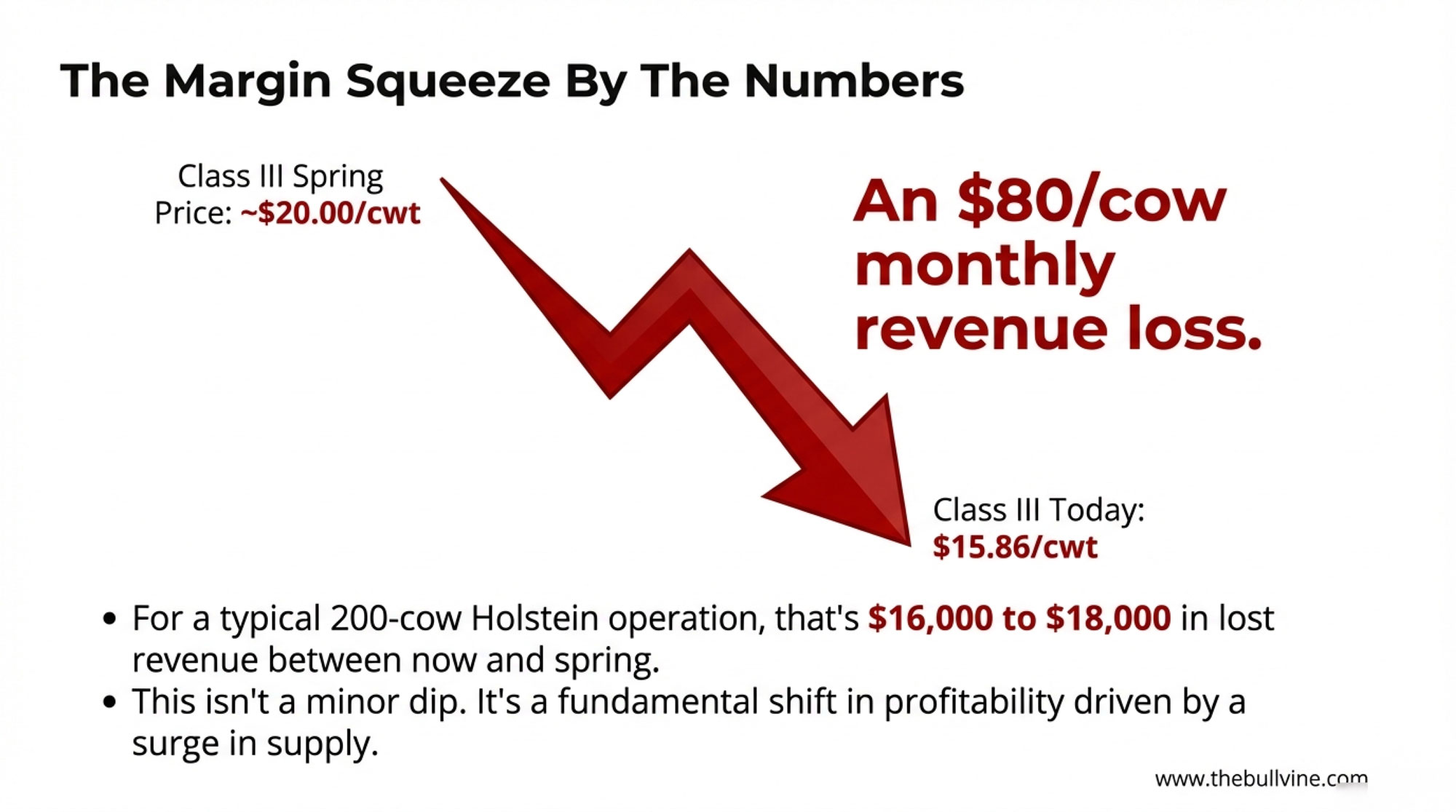
NewsSubscribe
First
Last
Consent

Record Dairy Exports Hide a Brutal Truth: You’re Selling at a Loss

Your co-op newsletter: ‘RECORD EXPORTS!’ Your milk check: -$2/cwt. Your banker: ‘We need to talk.’ The disconnect has never been wider.

EXECUTIVE SUMMARY: The U.S. dairy industry’s record cheese exports are actually distress sales, with producers losing $2/cwt as milk prices sit at $16.91 against $19 production costs. Mexico—buying 29% of our exports—is spending $4.1 billion to become self-sufficient, while China’s 125% tariffs have already destroyed our powder markets. The Class III-IV price spread has exploded to $4.06/cwt, the widest since 2011, forcing all production toward cheese that’s selling below profitability. Mid-size farms (500-1,500 cows) face extinction-level losses of $400,000+ annually, with survival limited to mega-dairies with 50% or less debt or premium operations near cities. Producers have 90 days to make irreversible decisions: scale massively, find niche markets, or exit before equity evaporates. The 800,000-head heifer shortage guarantees milk production will contract 3-5% through forced exits, but recovery won’t arrive until mid-2027—and only for the operations structured to survive.

dairy farm profitability 2025

On the surface, the numbers look fantastic. We exported 119.3 million pounds of cheese in August 2025—up 28% from last year, according to the Dairy Export Council. Butter exports nearly tripled. Processing plants are announcing $11 billion in new investments.

But check your bank account. The milk checks aren’t matching the celebration. The headlines say “Record Exports,” but the market reality says “Distress Sale.”

I’ve been talking with producers from Wisconsin down to Texas, and what I’m hearing doesn’t line up with these export headlines. Understanding this disconnect could be the difference between successfully navigating the next 18 months or becoming another casualty of industry restructuring.

The “record export” headlines your co-op newsletter celebrates tell only half the story. Yes, August 2025 cheese exports jumped 28% to 119.3 million pounds—but prices collapsed 13% to $1.82/lb. This is classic distress sale economics: moving volume at any price to avoid even bigger losses. When production costs sit at $18-19/cwt and you’re selling below $2/lb equivalent, every shipment deepens the red ink.

When Being the Cheapest Isn’t Actually Winning

The US dairy industry’s “record exports” mask a brutal reality: American cheese trades at $1.82/lb while European producers command $2.35/lb—a 45-60 cent disadvantage that signals desperation rather than competitive strength. When you’re underselling New Zealand butter by a full dollar per pound, you’re not winning global markets; you’re liquidating inventory below cost.

Here’s what’s bothering me about these export records. Global Dairy Trade auction results from November show American butter trading at $1.57 a pound. New Zealand? They’re getting $2.57. Our cheese is moving at $1.82 while Europeans fetch $2.27 to $2.42.

That 45 to 60 cent spread on cheese isn’t a competitive advantage. It’s desperation.

Penn State Extension’s 2025 dairy outlook shows that a typical 500-cow operation in Wisconsin or Minnesota has production costs running $18 to $19 per hundredweight. But milk prices? We’re at $16.91 for Class III according to CME October data. That’s annual losses of $32,000 to $62,000 for operations that size.

These record exports everyone’s celebrating are happening because we’re willing to sell at prices that don’t cover our costs. South Korean and Japanese buyers see cheap American dairy, and they’re stocking up. Can’t blame them. But volume at a loss isn’t success.

The Time Lag Trap We’re All Stuck In

The breeding decisions you made two years ago—when milk was over $20 per hundredweight—those heifers are just entering the milking herd now.

According to USDA’s latest milk production reports, we’ve added 200,000 cows to U.S. herds over the past 18 months. Every one of those additions made sense when the decision was made. But September production jumped 4.2% year-over-year, and we’re producing 18.3 billion pounds of milk at exactly the moment when global markets are saturated.

Your operation has maybe $300,000 to $500,000 in annual fixed costs—infrastructure doesn’t get cheaper just because milk prices drop. Equipment auction data from Machinery Pete shows you’re looking at 30 to 50% discounts from what things were worth two years ago if you try to sell now.

So we keep producing. We try to spread those fixed costs over more volume. It’s rational for each of us individually, but when everyone does it, oversupply drives prices even lower.

The Mexico Situation Nobody Wants to Talk About

While you’re focused on tariff headlines, Mexico is spending $4.1 billion to eliminate $1+ billion in US dairy imports by 2030. They’re not negotiating—they’re building processing plants in Campeche and Michoacán with 600,000-liter daily capacity and importing Holstein heifers from Australia. Mexico takes 29% of US dairy exports; losing even half that market erases profits for thousands of farms overnight.

While we’re celebrating that Mexico takes 29% of our dairy exports according to USDA Foreign Ag Service data, they announced last July that they’re spending $4.1 billion to become 80% self-sufficient in dairy by 2030.

They’re building processing facilities in Campeche and Michoacán that’ll handle 600,000 liters a day. They’ve imported 8,000 Holstein heifers from Australia—Dairy Australia confirmed that shipment. The Mexican government is guaranteeing their producers 12 pesos per liter.

Mexico buys 51.5% of all our nonfat dry milk exports, according to Export Council trade data. If they achieve even half their plan, we’re talking about losing a billion dollars or more in annual exports. This isn’t a trade dispute that’ll blow over. They’re building the infrastructure right now.

Why Powder Is Collapsing While Cheese Keeps Moving

Class III-IV pricing spread explodes to $4.06/cwt—matching 2011’s record gap and exposing dairy’s new geography of pain. Same cows, same work, but if your milk goes to butter and powder plants instead of cheese, you’re losing $15,000 monthly on a 500-cow operation. This isn’t market volatility; it’s structural divergence that’s rewriting the profitability map.

August export data shows cheese exports up 28%, but powder exports down 17.6%—the lowest August volume since 2019.

The October CME Spread tells the story:

  • Class III (Cheese): $17.81/cwt
  • Class IV (Powder/Butter): $13.75/cwt
  • Spread: $4.06/cwt—widest since 2011

For a 500-cow dairy, that’s a $50,000 swing in annual income depending purely on which plant takes your milk.

China put 125% tariffs on our dairy products back in March. We used to send them 70-85% of our whey exports. That market disappeared overnight. Processors are pushing every pound they can toward cheese because at least there’s still some margin there. Powder production? They’re running the minimum.

Different Operations, Different Realities

The dairy industry’s brutal bifurcation in one chart: mega-dairies break even at scale, mid-size operations hemorrhage $62K annually, while premium niche players bank $120K. If you’re running 500-1,500 conventional cows, you’re in the kill zone—producing milk at $17.05/cwt and selling it at $16.91. The math doesn’t work, and hoping for better prices won’t save you.

Based on the Center for Dairy Profitability at Madison and the Farm Credit System data:

Mega-dairies (3,500+ cows): Costs around $14.20 to $15.80/cwt thanks to automation and efficiency, according to Michigan State’s benchmarking study. If debt’s under 50% of equity, they can weather this storm. Some are buying out struggling neighbors at 30 to 50 cents on the dollar.

Mid-size operations (500-1,500 cows): The toughest spot. Production costs $16.30 to $17.80 based on Kansas State farm management data. With current milk prices, annual losses could exceed $400,000. Without a path to massive scale or premium markets, options are limited.

Premium niche (organic/grass-fed): Capturing $36 to $50/cwt through outfits like CROPP Cooperative are doing okay. But you need established customers near a city. Operations that went organic without premium market access are worse off than conventional farms due to higher feed costs.

Decision Time: The Next 90 Days Matter


Decision Path
Capital RequiredTimelineEquity RetainedSuccess RateKey Requirements
Exit Now (Controlled)$090-120 days85-95%95% (preserve wealth)Act before March 2026
Scale to Mega (3500+ cows)$8-15 million18-36 months20-40% (high debt)60% (if debt <50%)Low debt + expansion capital
Pivot to Premium Niche$500K-1.2M36 months (organic)70-85%70% (w/ city proximity)Within 50-100mi of major city
Status Quo / Wait & Hope$0Indefinite bleeding0-50% (forced exit by 2027)15-20% (statistically)Hope for market recovery

Based on Purdue’s Commercial Ag projections and USDA’s long-term outlook, you’ve got critical decisions to make in the next three to six months.

Considering expansion? Interest rates are 7.5 to 9% according to the Fed, ag credit conditions. Kansas State data shows that expanding when prices are falling rarely works. Maybe pay down debt instead.

Considering exit? Asset values today versus 18 months from now could be the difference between keeping most of your equity or losing it all. Equipment markets have declined for 25 straight months, according to Equipment Manufacturers data.

Considering organic/grass-fed? It’s a three-year conversion with negative cash flow. You need to be within 50 to 100 miles of a major city, based on consumer research. Penn State Extension says you need off-farm income during transition.

The Heifer Shortage Silver Lining

Here’s your silver lining in a crisis: an 800,000-head heifer shortage over two years mathematically guarantees milk production will contract 3-5% by 2027. Replacement inventory sits at 20-year lows while heifer prices exploded from $1,140 to $3,010—a 164% jump that makes expansion impossible. This forced contraction is exactly what balances supply-demand and triggers recovery. The question: will you survive to see it?

CoBank’s latest report shows we’re at 20-year lows for dairy replacement heifers. We’re short about 800,000 replacements over the next two years.

When you can get $3,500 to $4,500 for a beef-cross calf versus keeping a dairy heifer worth $800 to $1,200 in this market, the math is obvious. Progressive Dairy’s breeding survey shows most producers are making that same decision.

The dairy herd has to shrink—probably 3 to 5% by 2027, according to USDA projections. That might balance supply and demand. Rabobank and CoBank project stabilization by mid-2027, with gradual improvement into 2028.

How Geography Changes Everything

California’s Central Valley faces water costs up 40% according to UC Davis Cost Studies. Meanwhile, South Dakota State University Extension’s 2025 Feed Cost Analysis shows operations there seeing feed costs $1.50 to $2.00/cwtbelow the national average.

Texas added 50,000 cows while Wisconsin stayed flat. That’s economics playing out in real time.

What This All Means for You

Those record export numbers? They don’t mean what the headlines suggest. Moving volume at a loss is a distress sale on a national scale.

The decisions you make in the next 90 days are more important than what you do over the next year. By March 2026, many options available today won’t exist.

Mexico’s self-sufficiency plan is real. We need to plan for our biggest customer becoming a competitor. The Export Council knows it, but I’m not seeing contingency planning at the farm level.

Scale alone won’t save anyone. I’ve seen big operations with too much debt go under, and small operations with good positioning thrive. It’s about your total situation—debt levels, geographic location, market access.

The bifurcation—where you’re either huge or niche—is accelerating. If you’re in that middle range, especially 200 to 1,000 conventional cows, you need to decide which direction you’re heading.

Recovery is coming through contraction. The heifer shortage guarantees that. The question is whether you’ll be around to see it.

Looking Down the Road

By 2028, based on projections from Texas A&M and Cornell, we’ll have fewer, larger operations handling commodity production and smaller, specialized operations serving premium markets. That middle ground where many of us operated for generations is disappearing.

This isn’t random volatility. It’s industry restructuring in response to global competition, changing consumer preferences, as the Innovation Center for U.S. Dairy has tracked, and the reality of 2025 production costs.

When you see export headlines in your co-op newsletter and wonder why your milk check keeps shrinking, remember—it’s not about volume. It’s about margins. The difference between acting strategically now versus hoping things improve could be the difference between preserving or losing your family’s equity.

The herd is heading off a cliff. The record exports are just the dust they’re kicking up. Don’t follow the volume—follow the margin. The next 90 days will decide if you’re a casualty of the restructuring or one of the few left standing to see the recovery.

KEY TAKEAWAYS

  • Your daily reality: At current prices, a 500-cow dairy loses $175/day ($62,000/year). The Class III-IV spread of $4.06/cwt means the same milk yields $50,000 in different income based purely on plant destination.
  • The export trap: Record volumes are happening BECAUSE we’re desperate—selling cheese at $1.82/lb while New Zealand gets $2.42/lb isn’t winning, it’s liquidation.
  • 90-day decision window: By March 2026, you must choose—scale to 3,500+ cows, secure premium markets at $36+/cwt, or exit, preserving 85% equity (vs 0-40% if forced out later).
  • Geographic survival map: Texas/South Dakota operations save $1.50-2.00/cwt on feed. California faces +40% water costs. Location now determines viability as much as management.
  • The guarantee: 800,000-heifer shortage forces 3-5% production cut by 2027, ensuring recovery for survivors—but 40-50% of current operations won’t make it.

Complete references and supporting documentation are available upon request by contacting the editorial team at editor@thebullvine.com.

Learn More:

Join the Revolution!

Join over 30,000 successful dairy professionals who rely on Bullvine Weekly for their competitive edge. Delivered directly to your inbox each week, our exclusive industry insights help you make smarter decisions while saving precious hours every week. Never miss critical updates on milk production trends, breakthrough technologies, and profit-boosting strategies that top producers are already implementing. Subscribe now to transform your dairy operation’s efficiency and profitability—your future success is just one click away.
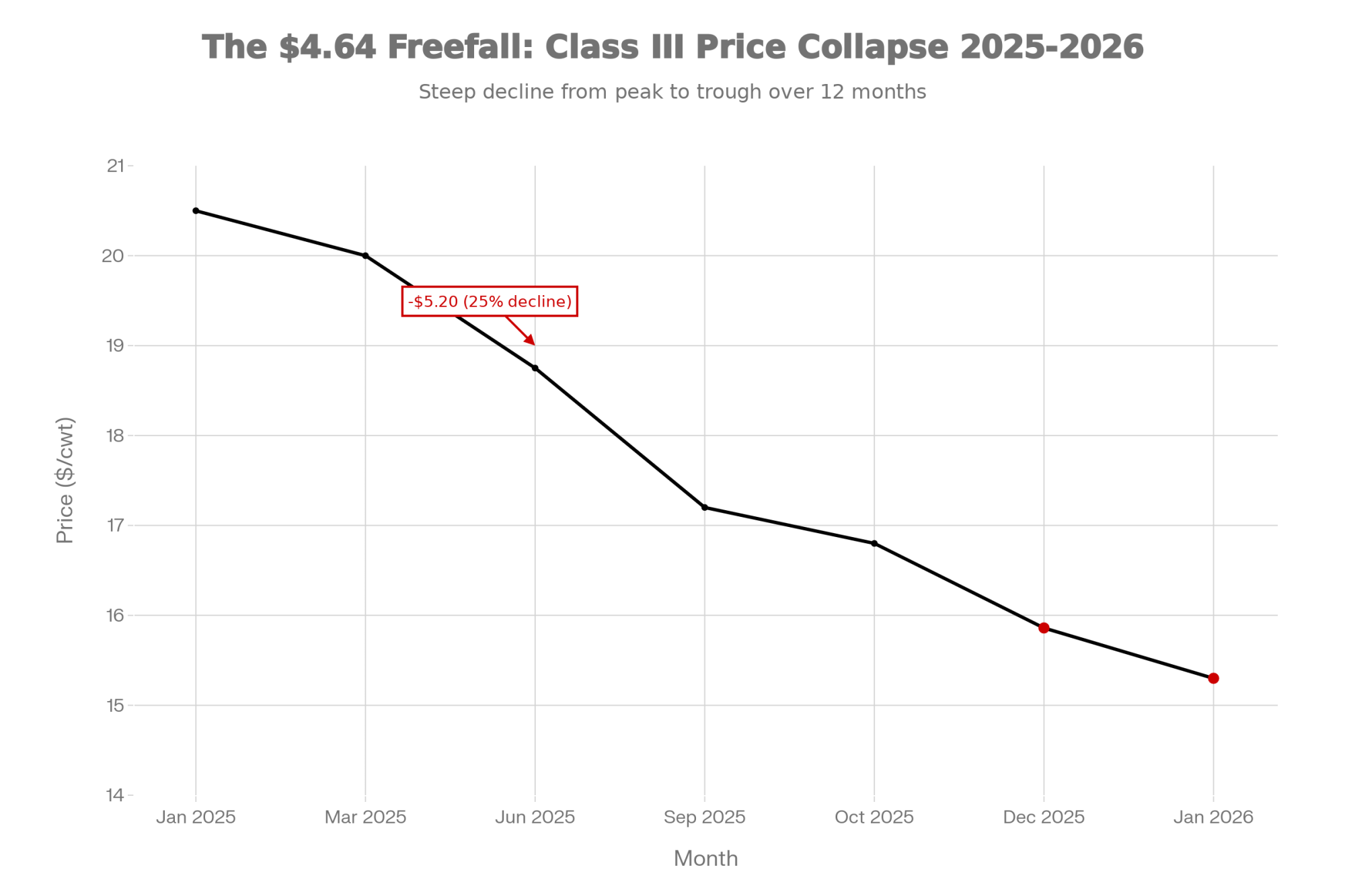
NewsSubscribe
First
Last
Consent

The 3.5-Hour Bottleneck: Why Smart Farms Track Parlor Time, Not Cow Count

Bigger isn’t better. 2,500+ cow farms plateau. 1,200-cow farms thrive. Here’s the math nobody talks about.

EXECUTIVE SUMMARY: The 3.5-hour rule changes everything: when cows spend more than 3.5 hours away from pens for milking, even ‘successful’ expansions fail. A Wisconsin producer who added 150 cows without upgrading infrastructure now hemorrhages $4,000 daily—a pattern replicated across farms that put cows before concrete. The industry data is unforgiving: proper expansion requires 18-24 months of infrastructure-first planning, $50,000-100,000 in management development, and debt-to-equity ratios under 0.50. Those who expand backwards face average first-year losses of $654,000 and 18-month recovery periods that many don’t survive. With 15,000 dairy farms already gone and processors building for mega-operations, mid-sized farms face a stark choice: master the expansion paradox of building for tomorrow’s herd today, or join the 2,500-3,000 operations projected to close in 2025. The survivors won’t be those who grew fastest, but those who counted minutes, not just cows.

Dairy Herd Expansion

As we head into winter planning season, I was talking with a producer the other day—a guy up near Eau Claire who expanded last spring—and his story really got me thinking. He went from 450 to 600 cows, following that logic we’ve all considered at some point: more cows equals more milk equals more revenue. Makes perfect sense on paper, doesn’t it?

Adding cows without infrastructure hemorrhages $654,000 in Year 1 alone—the mistake replicated across mid-sized farms. Infrastructure-first expansions recover within 18 months

But here’s what’s interesting… those extra 90 minutes his cows are now spending cycling through the parlor? It’s creating challenges he never anticipated. And from what I’m hearing at meetings and co-op discussions, he’s far from alone.

The 3.5-hour threshold: Parlor time over 3.5 hours triggers exponential losses in milk production and lameness rates—the single metric that predicts expansion failure

Quick Reference: The 3.5-Hour Rule

  • When cows spend over 3.5-4 hours away from pens, profitability declines
  • Each extra hour of rest can mean 2-3 pounds more milk per cow daily
  • $150+ daily losses are common when rest time drops by 90 minutes
  • Recovery from expansion problems typically takes 18 months, not 6
  • Smart operators build infrastructure before adding cows

A lot of folks—could be 40 percent or more based on recent industry conversations—are thinking about expansion right now. With all the investment flowing into processing facilities, we’re learning something that maybe should’ve been obvious all along. The difference between profitable growth and just getting bigger often comes down to something we haven’t traditionally measured: how long our cows spend away from their pens.

What’s fascinating is the work coming out of places like Cornell and Wisconsin’s extension programs (particularly their 2024 dairy expansion guides). They’re suggesting that when cows spend more than about 3.5 to 4 hours away from their pens for milking, something shifts. The economics change. Some folks are calling it the “3.5-hour rule,” and honestly, it’s making a lot of us rethink our expansion plans.

What Time Away Really Costs

Overstocked farms sacrifice 3 hours of cow lying time for extended parlor waits—costing 6 pounds of milk per cow daily. Time is literally money: $150+/day for 500-cow operations

I’ve been reading research from folks at the Miner Institute and other dairy research centers, and what they’re finding is eye-opening. You probably sense this intuitively, but they’re putting numbers to it—every additional hour of rest can mean significant production gains. We’re talking potentially 2-3 pounds per cow per day, maybe more. Sometimes up to 3.7 pounds, according to some studies, though your mileage may vary.

Think about it—when your girls are standing in the holding area instead of lying down, that’s lost production time. And it compounds.

Here’s what extension folks are telling us happens when operations run their parlors for more than 20 hours a day: everything gets compressed. Milking routines get rushed. Holding areas get crowded. The cows get stressed. Your people get stressed. It all adds up.

Let’s walk through the math, because this is where it gets real. Say you’ve got 500 cows losing even 90 minutes of rest time. That could mean 750 pounds less milk daily.

At today’s prices—what, around $20/cwt?—that’s $150 or more walking out the door every single day. And that’s just the beginning.

From what extension services documented in their 2023-2024 research, here’s what tends to happen:

  • Lameness that normally runs, maybe 15 percent? It can climb to 25-30 percent over a few months
  • Cell counts start creeping up past 300,000, and there go your quality premiums
  • Fresh cow problems—instead of 12 percent, you might see 20-25 percent or higher
  • And culling… well, that tends to jump 8-12 percent above normal

What Wisconsin’s Teaching Us

What’s happening in Wisconsin really tells the story. According to Wisconsin Extension’s 2024 dairy statistics, average herd sizes have grown from around 140 to over 200 cows in recent years—that’s roughly a 45 percent jump. And honestly? Most of us weren’t ready for it.

I’ve walked through a lot of these expanded operations, and you can see the challenges. These parlors—many built decades ago for different herd sizes—they’re showing the strain. The cows bunch up in holding areas. The milkers look frustrated. Everyone’s feeling it.

What the university folks have documented makes sense when you see it firsthand. When holding areas get tight—less than 15-20 square feet per cow—things happen physiologically. Stress hormones go up. That oxytocin we need for good letdown? It gets suppressed.

Cows stand on concrete for hours, and we all know where that leads.

First-lactation heifers have it worst. They’re still figuring out the routine, and now they’re competing with mature cows in tight spaces. Some research suggests they might produce 2 pounds less daily just from that stress. That’s potential walking away before it ever hits the tank.

As veterinarians keep reminding us, this isn’t just about cow comfort—though that matters. It’s about profitability. Some extension models suggest that operations expanding without proper infrastructure could face significant losses in the first year. We’re talking potentially hundreds of thousands, depending on your situation.

Rethinking What “Big Enough” Means

The controversial truth: Operations milking 1,200-1,500 cows achieve $850/cow profit—nearly matching mega-dairies while maintaining individual cow management. Scale doesn’t guarantee success

Here’s something that surprised me when I started digging into recent data. You’d think bigger is always more profitable, right? But profitability seems to level off around 2,000-2,500 cows, and sometimes even declines in really large operations.

Profitability by Herd Size (Typical Ranges)

Herd SizeProfit per CowKey Characteristics
< 250$125-$250Family ops, scale challenges
500-750$350-$450Sweet spot for independents
1,000+$600-$800Economies of scale emerge
2,500+$750-$900Efficiency gains plateau
5,000+$900-$1,000Complexity offsets benefits

Source: USDA Economic Research Service data and industry analyses, 2023-2024

Sure, total profit keeps going up with size. But the efficiency gains? They really taper off after a certain point.

What management experts point out—and this makes sense when you think about it—is that once you get past 3,000 cows, you can’t manage individuals anymore. You’re managing pens. That’s a fundamental shift, and it means accepting different realities about health, variation, and even mortality rates.

What I find really interesting is that the sweet spot for many operations seems to be around 1,200-1,500 cows. Big enough for real economies of scale, but you can still use technology to manage individual animals. That feels like the best of both worlds.

Learning from Folks Who’ve Done It Right

I’ve had the chance to work with several operations that successfully increased from 500 to over 1,200 cows and improved profitability. What’s striking? They all did pretty much the same things.

Getting the Finances Right First

Every successful expansion I’ve seen started from a strong financial position. Debt-to-equity ratios under 0.50, often down around 0.35-0.40. These folks had reserves for at least a year, sometimes 18 months, of potential negative cash flow.

As financial advisors keep telling us—and they’re right—if you’re not testing your plans against milk at $17/cwt for two years, you’re probably being too optimistic.

Building the Team Before the Barn

This one’s huge. I know of operations that spent a year and a half preparing their management systems before pouring any concrete. Hiring people, training them, making sure there’s backup for every critical job.

One producer told me he spent probably $75,000 on management development before construction started. “Best investment we made,” he said, and I believe him.

Actually Talking to Your Milk Buyer

This gets missed so often. You really need to sit down with your processor—really talk about capacity, hauling, components, everything—before you add a single cow.

I know several Wisconsin operations that found out their processor would need to charge significantly more for hauling additional volume. That completely changed their expansion math.

Growing in Stages

The smartest folks I know don’t try to do it all at once anymore. They phase it:

  • First, build for maybe 80 percent of where you want to be, and get it running smooth
  • Then optimize for a year or so—this is crucial
  • Only then finish the expansion

A guy near Fond du Lac told me this approach saved them when milk prices dropped. They could stay at their intermediate size without drowning in debt. Smart.

If You’re Already in a Tight Spot

Recovery takes 18 months minimum, not the 6 months most producers expect—and only with aggressive action. Status quo operations face 45% decline, explaining why 2,500+ farms will close in 2025

Look, I realize some of you reading this are thinking, “Great, but I’m already in it up to my neck.” Recovery is possible, but it depends on where you are in the process.

Warning Signs You’re in Trouble:

  • Parlor running over 20 hours
  • More than 90 minutes in the holding area
  • Lameness creeping above 20 percent
  • Cell counts are consistently high
  • Fresh cow problems over 20 percent
  • Your best people are looking burned out

Early Stage Recovery (First Few Months)

If your parlor time is around 90-120 minutes and lameness is still under 20 percent, you can turn this around. According to the University of Minnesota Extension’s 2024 parlor efficiency guide, some quick wins include:

  • Automated crowd gates or better cow flow—might save 10-15 minutes right away ($5,000-$15,000 investment)
  • Vacuum adjustments—another 5-10 minutes sometimes
  • Just splitting into two feeding groups instead of one—that alone can add $400-$500 per cow annually

But here’s the thing—you’ve got to move fast. Every month you wait, it gets harder.

When Problems Are Building (Months 3-6)

If parlor time’s over 2 hours and lameness is approaching 25 percent, you need bigger moves:

  • Maybe reduce the herd by 10-15 percent—I know, it hurts, but it works
  • Get some ventilation and cooling in that holding area ($30,000-$50,000 typically)
  • Consider bringing in outside help for a few months

Recovery takes time—18 months usually, not the 6 months we all hope for.

A producer I know from Marathon County told me, “We sold 80 of our lowest producers. Felt like failure at first. But the rest of the herd jumped 5 pounds per day. Math actually worked out better.”

When You Need Major Changes (Beyond 6 Months)

If you’re running over 3 hours in the parlor with lameness near 30 percent, the options get limited:

  • Permanent reduction to sustainable size
  • Major infrastructure investment—we’re talking $400,000+
  • Sitting down with your lender for some honest conversations
  • Maybe looking at bringing in a partner or succession planning

The Bigger Picture

Since 2017, the U.S. lost 16,500 dairy farms (-41%) while milk production rose 8% and average herd size jumped 70%. With 2,500+ more exits projected for 2025, mid-sized farms face extinction without strategic transformation

Looking at the industry broadly, we’re in for continued change. Various analyses suggest we might see 2,500-3,000 farms exit in 2025—that’s maybe 7-9 percent of what’s left.

USDA data shows we lost around 15,000-16,000 farms between 2017 and 2022, while milk production increased by 5 percent.

The big operations—over 2,500 cows—now produce nearly half our milk. And all that processor investment? It’s generally aimed at working with larger suppliers, not mid-sized folks like many of us.

The pace varies by region. Wisconsin’s been losing 400-500 farms yearly, according to state ag statistics. Pennsylvania and New York, similar stories. It’s reshaping dairy country as we know it.

Making the Math Work for You

Before any expansion, here’s the one calculation that matters: What’s your actual cost per hundredweight right now, and what happens to that if you add 20 percent more cows without upgrading infrastructure?

Cost Calculation Framework:

  1. Add up all your annual costs—feed, labor, facilities, health, everything
  2. Divide by your annual production in hundredweights
  3. Model what happens with more cows but no infrastructure upgrades:
    1. Labor costs typically increase 15-20 percent
    1. Health costs often rise 15-25 percent
    1. Production might drop 2-3 pounds per cow daily
    1. Quality premiums could be affected

Say you’ve got 500 cows producing 75 pounds per day. That’s 375 cwt. At $8,250 per day, you’re at $22/cwt.

Add 100 cows without infrastructure? Production might drop to 72 pounds per cow, and costs could rise to about $9,500 per day. Suddenly, you’re looking at $26/cwt.

If expansion pushes you from $22 to $25-26/cwt, that should make you pause.

It’s Different Depending on Where You Farm

These dynamics play out differently across regions, and that matters.

Texas and New Mexico operations often started big with appropriate infrastructure. But in the Upper Midwest? We’re adapting facilities built for our grandparents’ 50-cow herds.

California’s got its own challenges—water, regulations, land costs. A producer there told me that compliance alone can run into the hundreds of thousands.

Even within Wisconsin, it varies. Being near a cheese plant in Green County is different from shipping fluid milk from up north. And summer heat? That can easily add 30-45 minutes to your parlor time when cows move more slowly and need extra cooling.

What Really Seems to Matter

After looking at all this, here’s what I keep coming back to:

Build for where you’re going: Get the infrastructure right before adding cows. Yes, it takes longer and costs more upfront. But it’s often the difference between thriving and just surviving.

Watch that time clock: When cows spend over 3.5-4 hours away from pens, things tend to go sideways. Make that your benchmark.

Management matters most: Can your team handle 25 percent more complexity? If not, invest in people first—maybe $50,000-$100,000 in management development.

Know your real costs: Most of us don’t actually know our true cost per hundredweight. Without that, expansion is just gambling.

Consider other paths: Maybe the answer isn’t more cows. Maybe it’s robots for better labor efficiency, or genetic improvement for 10 percent more production, or capturing premium markets for A2A2 or grassfed milk.

The industry’s changing fast—fewer, bigger operations emerging. But bigger isn’t automatically better.

The operations I see thriving are making careful, infrastructure-first decisions based on real analysis. As one successful producer put it to me: “We spent a year planning before adding a single cow. Neighbors thought we were too slow. Now they’re asking how we stayed profitable.”

That conversation brings us full circle, doesn’t it? Remember that producer near Eau Claire I mentioned at the start? He’s working through his challenges now, looking at some of these same solutions. Had another coffee with him last week, actually. And what’s encouraging is he’ll probably come out stronger for it, because he’s learned what many of us are discovering: real growth isn’t about pushing more cows through your existing setup.

It’s about doing right by every cow you milk, keeping them healthy and productive for the long haul. In today’s dairy world—with all its complexity, consolidation, and change—that philosophy might be the smartest expansion strategy of all.

Don’t just count your cows. Count the minutes they stand waiting. The former feeds your ego; the latter feeds your bank account.

KEY TAKEAWAYS

  • Count Minutes Before Cows: Parlor time over 3.5 hours = automatic profit loss. Your next cow costs nothing; your next hour costs $150+/day
  • $22→$26/cwt = STOP: Before adding even one cow, calculate if expansion increases your cost/cwt by $3+. If yes, you’re planning bankruptcy, not growth
  • Build at 0.50 Debt-to-Equity or Don’t Build: Successful expansions require 18-24 months planning, $75K management investment, and reserves for 18 months of negative cash flow
  • 1,200-1,500 Cows = Profit Sweet Spot: Beyond 2,500, complexity kills margins. Below 500, scale limits competitiveness. Plan for the middle
  • Recovery Takes 18 Months + 15% Herd Cut: If you’re already bottlenecked (20+ hour parlor, 25%+ lameness), reduce first, rebuild second

Complete references and supporting documentation are available upon request by contacting the editorial team at editor@thebullvine.com.

Learn More:

Join the Revolution!

Join over 30,000 successful dairy professionals who rely on Bullvine Weekly for their competitive edge. Delivered directly to your inbox each week, our exclusive industry insights help you make smarter decisions while saving precious hours every week. Never miss critical updates on milk production trends, breakthrough technologies, and profit-boosting strategies that top producers are already implementing. Subscribe now to transform your dairy operation’s efficiency and profitability—your future success is just one click away.
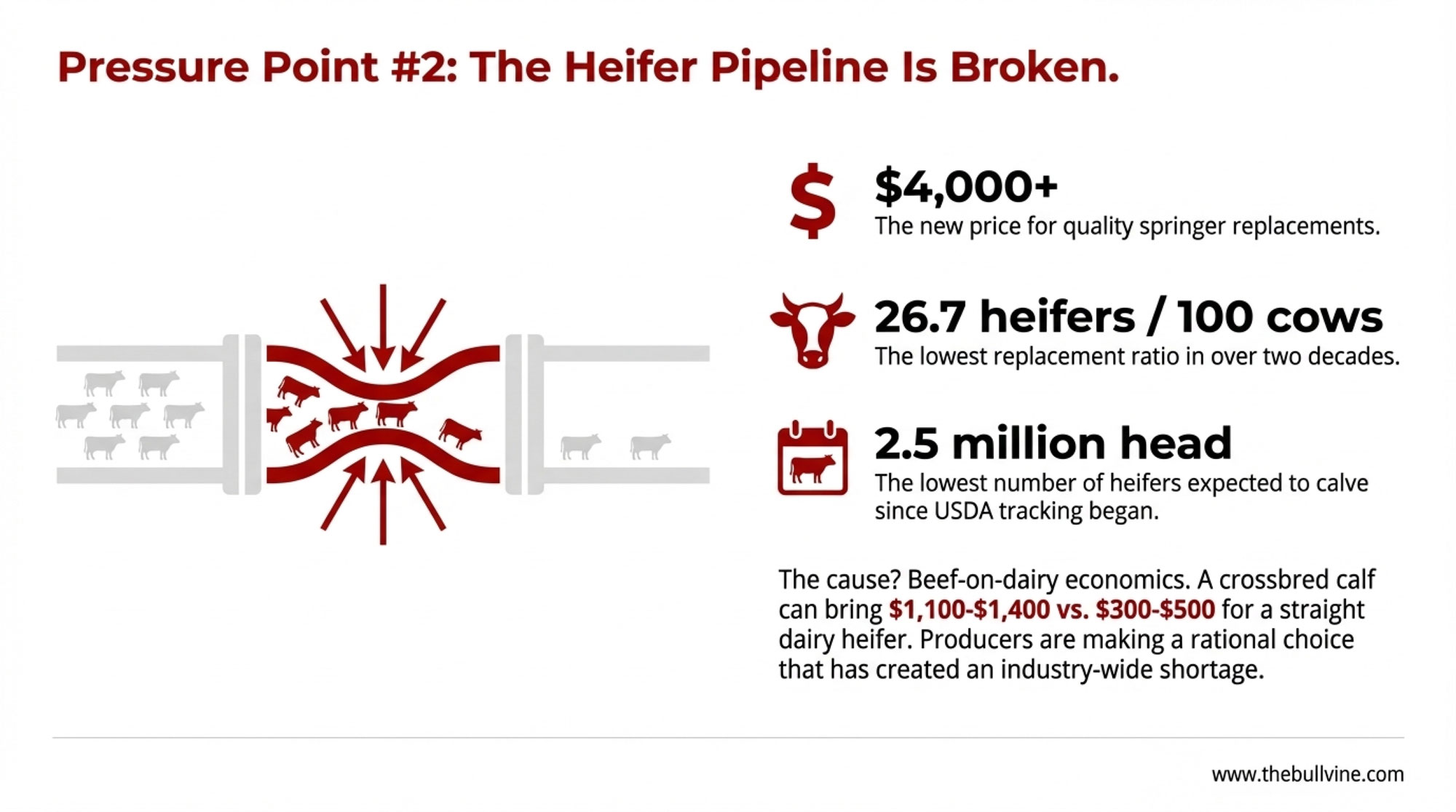
NewsSubscribe
First
Last
Consent

Dairy Wins, Beef Loses: Inside the 18-Month Window Where $1,400 Calves Meet Record Component Premiums

Plot twist: Dairy farms now produce more beef profit than beef ranches. $1,400/calf vs. their $800. The math is devastating.

EXECUTIVE SUMMARY: Dairy has stumbled into the opportunity of a generation: we’re producing 230 billion pounds of milk while simultaneously filling the void left by beef’s collapse to 1961 lows—effectively owning both markets. Three strategies are generating $600-770K in additional annual revenue for progressive operations: beef-on-dairy genetics transforming worthless bull calves into $1,400 assets; component optimization capturing $84,000 from butterfat premiums; and export positioning, as China and India desperately need our proteins. The proof is compelling—producers investing $70,000 are returning $200,000 in year one, with 60% efficiency. Here’s the urgency: only 28% have moved while premiums are maximum; by 2027, when adoption hits 70%, the window closes. Make no mistake—this isn’t about incremental improvement, it’s about who survives the next decade.

beef on dairy profitability

I was reviewing the November USDA reports, and something remarkable jumped out that deserves our attention. The latest WASDE data shows dairy production surging to 230 billion pounds, while beef production drops by 70 million pounds and pork production falls by 80 million pounds. What’s particularly noteworthy is how few producers have fully grasped the implications of this shift.

This development builds on what we’ve been seeing across the industry—not just another typical market cycle, but what appears to be a fundamental restructuring of North American protein production. Several economists I’ve spoken with are describing this as an 18-month window of genuine opportunity, and the more I analyze the data and talk with producers, the clearer the pattern becomes.

The consumption trends align with this narrative. USDA’s Economic Research Service shows Americans consuming record levels of dairy products, reaching historic highs that would have seemed impossible just five years ago. Globally, the milk protein market continues its substantial growth trajectory, with multiple analyses projecting sustained expansion through 2032. This coincides with the beef cow herd dropping to approximately 28 million head—USDA data confirms this represents the lowest level since the early 1960s.

In recent conversations with producers from various regions—Wisconsin cooperatives, California independents, Texas operations—those experiencing the most success share a common trait: they’re adapting now, even if imperfectly, recognizing that this convergence of factors presents opportunities we haven’t encountered in decades.

Beef-on-dairy calf prices have surged from $225 to $1,439 in under three years—a 540% increase—while Holstein bull calves remain virtually worthless at $50. This $1,389 price gap represents the single largest profit opportunity in modern dairy history

The Beef-on-Dairy Revolution: From Liability to Asset

How Forward-Thinking Farms Discovered the Formula

Here’s what’s happening on farms across the country. Producers are telling me they used to essentially give away Holstein bull calves—some mentioned getting as little as five dollars for two calves just a few years back. Today, according to USDA Agricultural Marketing Service data this fall, those same genetics bred to carefully selected beef sires are commanding $1,200 to $1,400 each.

For perspective, a large dairy operation implementing this strategy could potentially generate $600,000 to $770,000 in additional annual revenue, depending on their size and execution. Same facilities, same management team, fundamentally different economics.

What’s particularly interesting—and this has been confirmed through discussions with extension specialists at both Cornell and Wisconsin—is how beef genetics on dairy has evolved beyond simple calf value. It’s reshaping our entire approach to genetic progress and herd optimization.

The Strategic Framework That Makes It Work

The most successful implementations I’ve observed, from California’s Central Valley to New York’s traditional dairy regions, share common elements that go well beyond basic crossbreeding.

Progressive producers are walking me through their approach: genomic testing of the entire herd at approximately forty dollars per animal, creating a precise roadmap of genetic potential. This allows targeted breeding decisions—sexed semen (at a fifteen to twenty-five dollar premium per breeding) on the top 40 to 50 percent of cows, while the remainder are bred to proven beef sires.

The sire companies report Angus and SimAngus dominating these selections, and for good reason—the calving ease and growth characteristics align well with dairy operations. University of Wisconsin research continues to validate this approach, showing consistent economic advantages.

The beef cow herd has crashed to 27.8 million head—matching 1961 levels—while dairy’s contribution to the beef supply has surged from 10% to 32%. Dairy isn’t supplementing beef production anymore; it’s becoming the backbone of the entire protein system

Current industry data indicates dairy contributes approximately 28 percent of the total U.S. calf crop, compared to roughly 24 percent in the mid-1990s. Given beef cow rebuilding timelines—typically five to six years minimum based on historical cattle cycles—this percentage could realistically reach 32 to 35 percent by 2027.

The math is brutal: as adoption rates surge from 28% today to 70% by 2027, beef-cross calf premiums will collapse from $1,400 to $800. Early movers capture maximum value; late adopters fight for scraps. The 18-month window isn’t marketing hype—it’s market mechanics

Component Optimization: The Hidden Value in Every Tank

Why Volume-Based Production Is Becoming Obsolete

Producers in California have been showing me compelling comparisons of their milk checks from 2023 versus the current year. The transformation in how milk is valued has been striking.

When Federal Order changes took effect this summer, the entire pricing dynamic shifted. California pricing announcements show butterfat reaching $2.62 per pound, making component optimization increasingly critical. The economics are straightforward yet powerful—every 0.1 percent increase in butterfat adds approximately thirty-five cents per hundredweight in additional revenue.

Component premiums reward precision nutrition: a 0.2% butterfat improvement from 4.1% to 4.3% delivers $61,320 in additional annual revenue for a mid-sized operation, with zero additional cows or facilities. It’s not glamorous, but it’s pure margin expansion

For a typical herd producing 24,000 pounds daily, improving from 4.1 to 4.3 percent butterfat could translate to roughly $84,000 in additional annual revenue under optimal conditions.

These aren’t just theoretical projections—producers are seeing real improvements in their milk checks.

Progressive dairy operations are stacking three distinct revenue streams—beef-on-dairy genetics ($600K), butterfat optimization ($84K), and export premiums ($30K)—to generate over $714,000 in additional annual revenue without adding a single cow to the milking herd

The Genetic Revolution Driving Component Gains

The April genetic base change data from the Council on Dairy Cattle Breeding revealed something significant—a 45-pound rollback in butterfat Estimated Breeding Values, representing substantial industry-wide genetic progress.

During a recent genetics conference, specialists characterized this as unprecedented selection intensity for components. The practical impact? Producers selecting bulls with plus-50 pounds butterfat and plus-40 pounds protein are creating meaningful competitive advantages over operations using industry-average sires.

Nutritionists working with herds across Wisconsin are sharing their evolving approach: precise rumen pH management, maintaining a pH of 6.0 to 6.2 for optimal fat synthesis, and transitioning from generic bypass fats to targeted palmitic acid supplements at 200 to 250 grams per cow daily. University research from this past spring demonstrates that this can increase butterfat by 0.2 percent within 30 days—seemingly modest yet economically significant across an entire herd.

The Export Opportunity: Beyond Domestic Markets

China’s Strategic Shift Creates Targeted Opportunities

While the U.S. Trade Representative confirms 135 percent tariffs on many dairy products to China, the underlying trade dynamics tell a more nuanced story. USDA Foreign Agricultural Service data from this fall reveals interesting patterns in China’s import behavior.

According to trade data, imports of sweet whey powder have been growing significantly year over year, even as imports of commodity milk powder have declined. The driver appears to be specialized demand for swine feed ingredients and infant formula components rather than bulk commodities.

Producers shipping to export-oriented processors are reporting premiums of approximately forty cents per hundredweight for high-protein milk that yields better in whey extraction. For a mid-sized operation, that could translate to meaningful additional annual revenue—we’re talking potentially $25,000 to $30,000 for a 600-cow herd.

India’s Protein Crisis Opens New Channels

The opportunity in India may be even more significant, based on USDA attaché reports from New Delhi. Given that 70 to 80 percent of Indians do not meet daily protein requirements, according to the Medical Research Council, the government has launched a revised National Program for Dairy Development with substantial funding for fortification initiatives.

The tariff structure clearly reveals the opportunity. India applies approximately 30 to 60 percent tariffs on fluid milk and cheese imports, yet only around 8 percent on whey protein and 5 percent on lactose—reflecting limited domestic production capacity for these specialized ingredients.

European Market Dynamics

What’s also developing—and this hasn’t received much attention—is the European Union’s shifting protein strategy. With increasing pressure on their livestock sector from environmental regulations, industry reports suggest EU imports of specialized dairy proteins have been growing substantially since 2023. U.S. producers meeting specific sustainability metrics are finding opportunities for premium access to these markets.

The Operations at Risk: Recognizing Warning Signs

Who Faces the Greatest Challenges

We need to acknowledge candidly that not all operations are positioned to capture these opportunities. USDA’s Agricultural Resource Management Survey data from recent years indicates that operations with fewer than 200 cows face average production costs of around $20.93 per hundredweight, compared to $16.50 for operations with more than 1,000 cows.

Producers who’ve recently exited the industry have shared their experiences. When cooperatives announce infrastructure deductions—like the documented four-dollar-per-hundredweight case with Darigold in May—smaller operations can face thousands of dollars in additional monthly costs. For a 150-cow operation, that could mean over $7,000 in additional monthly expenses, creating immediate cash-flow challenges.

Studies suggest the majority of recent dairy exits have involved smaller operations with single-processor relationships and limited value-added strategies. While difficult to discuss, understanding these dynamics is essential for informed decision-making.

Regional Variations Matter

The strategies that succeed in Wisconsin may face challenges in Georgia—regional context matters tremendously. University of Florida dairy specialists have documented that Southeast operations often face production costs per hundredweight that are 2 to 3 dollars higher due to heat-stress management and feed procurement requirements.

Conversely, Texas Panhandle operations benefit from proximity advantages. Producers there report capturing an additional hundred to hundred-fifty dollars per calf on dairy-beef crosses compared to operations shipping longer distances, simply because of their location near multiple beef feedlots.

Technology Adoption Patterns

What’s interesting is how technology adoption varies by operation size. Research suggests operations between 500-1,000 cows often show strong adoption rates for genomic testing and precision feeding—they seem to hit a sweet spot of having adequate resources while maintaining operational flexibility.

Practical Implementation: Learning from Those Who’ve Done It

The Measured Approach That Works

Producers who’ve successfully transitioned share common timelines and approaches. They typically start with genomic testing—investing approximately $40-50 per animal for a comprehensive herd evaluation. This provides the genetic roadmap.

Within a few months, they’re implementing sexed semen on superior genetics. Then comes beef sire selection tailored to their facilities—calving ease often proves critical, especially in older barn configurations. By the following fall, they’re seeing the first beef-cross calves arriving.

“Year one, we captured perhaps 60 to 70 percent of the potential while learning the system. Even at that efficiency level, we generated substantial additional revenue on essentially unchanged feed costs.” — Minnesota dairy producer

Investment Reality Check

Based on producer experiences and consulting firm analyses, here’s the realistic investment framework:

  • Genomic testing: $40-50 per animal (one-time investment)
  • Sexed semen: $15-25 premium per breeding above conventional
  • Nutritionist consultation: $2,000-5,000 monthly, depending on service level
  • Component feed adjustments: Approximately $0.50 per cow daily
  • Data management software: $200-500 monthly for quality tracking systems

For a representative mid-sized operation, year-one implementation might total $60,000 to $80,000. However, combining beef-calf premiums with component improvements could potentially generate substantial additional revenue. While results vary, the fundamentals of economics generally favor well-managed operations.

Sustainability Considerations

What’s encouraging for long-term viability is how these strategies align with sustainability goals. The genetic improvements that reduce days to market for beef-cross calves can translate into lower lifetime emissions per pound of protein produced. Several processors are beginning to consider these metrics—something worth monitoring as carbon markets develop.

Looking Ahead: The Questions That Matter

Is This Sustainable or Another Bubble?

In discussions with agricultural economists and market analysts, the consensus suggests solid fundamentals underpin current conditions. Beef cow herd rebuilding faces structural constraints, with projections indicating a return to pre-drought inventory levels at the earliest in 2030. Global protein demand maintains 2 to 3 percent annual growth,according to FAO data—this reflects structural rather than cyclical factors.

However, appropriate caution is warranted. As beef-on-dairy adoption increases—already substantial in certain regions—some premium compression is likely. Markets are already seeing variation, with premiums ranging from $1,000 to $1,400 depending on genetics, location, and buyer relationships.

The indicator I’m monitoring most closely? USDA’s quarterly Cattle on Feed reports tracking dairy replacement heifer inventories, currently at approximately 1.88 million head—the lowest since the late 1970s, according to NASS data. Continued decline through 2026 would suggest structural transformation; recovery above 2.1 million might indicate temporary market dynamics.

What About Farmers Who Can’t or Won’t Change?

I’ve spoken with veteran producers approaching retirement who’ve made the conscious choice to maintain current practices rather than implementing new strategies. With paid-off operations and no succession plans, this approach has validity.

Industry observers suggest a significant portion of current operations may exit within the next decade, regardless of market conditions—due to demographic realities rather than economic failure. For these producers, operational stability may appropriately outweigh optimization opportunities.

Key Takeaways for Your Operation

After extensive data analysis, producer conversations, and expert consultation, several key insights emerge.

The opportunity window exists, but it continues to narrow. Early adopters captured the highest premiums with limited competition. Current implementers are seeing good returns, though not quite at early-adopter levels. By 2027, returns may normalize further, though they will remain profitable for efficient operations.

Geography influences profitability more than scale—surprising but documented. A strategically located, smaller dairy near beef infrastructure can perform well compared to larger operations that face logistical challenges. Understanding your regional advantages and constraints proves essential.

Processor relationships have evolved from customer-vendor to strategic partnerships. If your processor cannot articulate clear export strategies or component valuation methods, opportunities may remain unexploited. Business alignment now matters as much as traditional loyalty considerations.

Experience teaches that perfection often impedes progress. Producers achieving partial efficiency in year one while generating meaningful profits demonstrate that imperfect action often surpasses perfect planning.

Your Next Steps

Looking at actionable items for interested producers:

  1. Request genomic testing information from your breed association or genetics provider—understanding costs and logistics is the first step
  2. Schedule a conversation with your nutritionist about component optimization potential in your current ration
  3. Contact your processor to understand their component pricing structure and export market positioning
  4. Reach out to beef breed associations for information on dairy-appropriate sires and local calf buyer networks
  5. Connect with producers who’ve already made transitions—their practical experience proves invaluable

As we consider the industry landscape this November, dairy isn’t declining—it’s transforming. Producers who recognize the shift from commodity milk production to strategic protein business models position themselves for success. Those awaiting return to historical norms may discover that “normal” has fundamentally changed.

The data supports action. Strategies have proven effective. Progressive neighbors are already implementing changes. The question has evolved from whether to adapt to how rapidly you can position your operation for emerging opportunities.

KEY TAKEAWAYS

  • The $1,400 Reality Check: Your Holstein bull calves are worth $1,400 to smart producers, $50 to you—the difference is three breeding decisions and genetics testing
  • Triple Revenue Stream, Same Cows: Beef-on-dairy ($600K) + butterfat optimization ($84K) + export premiums ($30K) = $700K+ additional annual revenue without adding a single cow
  • The 18-Month Countdown: Today, only 28% have adapted; when it hits 70% by 2027, premiums crash from $1,400 to $800—early movers win, others consolidate
  • Proven ROI Formula: Invest $70K (genetics + nutrition + consulting) → Return $200K year one, even at 60% efficiency—this isn’t theory, it’s what producers are doing now

Complete references and supporting documentation are available upon request by contacting the editorial team at editor@thebullvine.com.

Learn More:

Join the Revolution!

Join over 30,000 successful dairy professionals who rely on Bullvine Weekly for their competitive edge. Delivered directly to your inbox each week, our exclusive industry insights help you make smarter decisions while saving precious hours every week. Never miss critical updates on milk production trends, breakthrough technologies, and profit-boosting strategies that top producers are already implementing. Subscribe now to transform your dairy operation’s efficiency and profitability—your future success is just one click away.
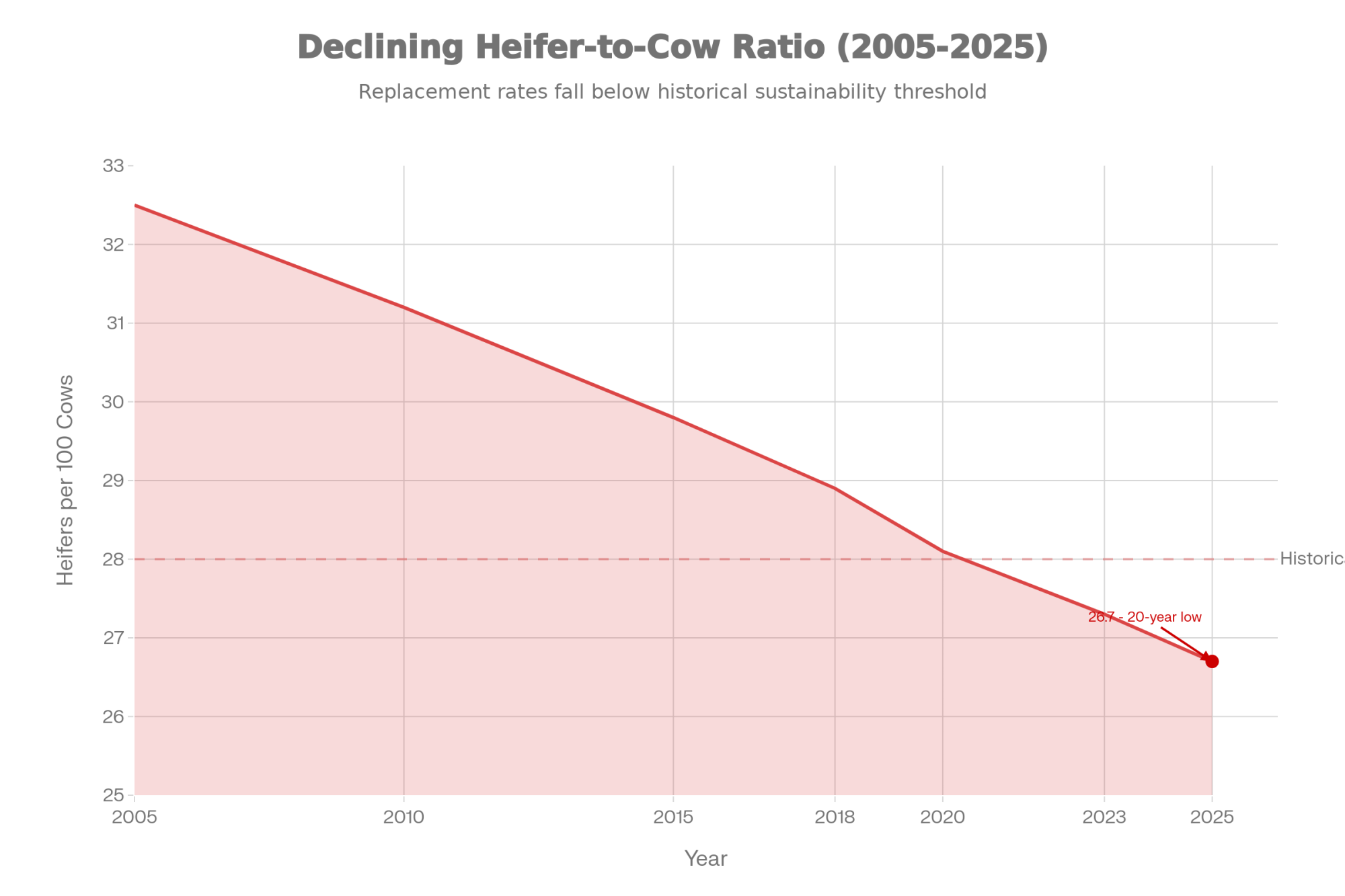
NewsSubscribe
First
Last
Consent

Butter Down €270, Processors Up 25%: Europe’s Dairy Collapse Hits Home

European dairy farmers are discovering that traditional market cycles no longer apply—and the implications reach far beyond the Netherlands

EXECUTIVE SUMMARY: When butter prices dropped by €270 in one week while processors reported 25% profit growth, it confirmed what many farmers suspected: the game has fundamentally changed. European cooperatives now profit from processing cheap milk rather than serving members, while retail algorithms lock in permanent price suppression—the recovery isn’t coming. With the Netherlands buying out farms for €1 million each and Germany losing eight operations a day, this isn’t a crisis; it’s a restructuring. Yet farmers capturing €0.95/liter through direct sales prove success is possible—just different than before. Smart operators are adapting now through specialty contracts, solar revenue, or value-added production, because after May 2027, government support ends, and today’s options disappear. The same patterns are emerging from Wisconsin to New Zealand, making this Europe’s story today, but everyone’s tomorrow.

dairy farm profitability

You know, when butter prices in the Netherlands dropped €270 per tonne in a single week this November—hitting €5,040, the lowest we’ve seen in two years—the phone lines lit up across dairy country. Had a Dutch producer near Utrecht tell me something that really stuck: “This isn’t like 2015. Back then, we knew it would bounce back. Now? Nobody’s sure what normal looks like anymore.”

He’s right. The European Dairy Association’s November report shows this was the steepest drop they’ve recorded since they began monitoring weekly prices in 2018. But here’s what’s got everyone talking over morning coffee—processors like FrieslandCampina are reporting strong profits while our milk checks keep getting smaller. That disconnect… well, we need to understand what’s really happening here.

“This isn’t like 2015. Back then, we knew it would bounce back. Now? Nobody’s sure what normal looks like anymore.”
— Dutch dairy farmer near Utrecht

What we’re seeing across Europe right now—this mix of cooperative changes, retail evolution, and policy shifts—it’s creating something genuinely new. And I think these patterns offer insights for all of us, whether you’re milking in Wisconsin’s rolling hills or managing pastures down in New Zealand.

KEY FACTS AT A GLANCE

The Market Situation:

  • €270/tonne butter price drop in one week (November 2025)
  • €5,040/tonne current price—24-month low
  • 56,500-tonne European butter surplus H1 2025

The Financial Picture:

  • FrieslandCampina: 25.7% profit increase H1 2025
  • Same period: 5.92 cent/liter milk price cut for farmers
  • US butter: €4,246/tonne vs. European: €5,100-5,500/tonne

The Demographics:

  • 12% of EU farmers are under 40 years old
  • 58% over 55 years old
  • Germany is losing 2,800 farms annually

The Policy Framework:

  • €32 billion Dutch nitrogen reduction program
  • €1 million average transition support per farm
  • 70% nitrogen reduction targets in 131 areas by 2030
With 58% of EU dairy farmers over 55 and Germany bleeding 8 operations daily, the demographic cliff isn’t coming—it’s here. This isn’t a crisis; it’s a restructuring that’s creating opportunities for prepared operators while crushing those waiting for ‘normal’ to return.

The Numbers Tell a Story We Can’t Ignore

European butter prices collapsed €270 in a single week to hit €5,040 per tonne—the lowest level in 24 months. This isn’t your grandfather’s market cycle; it’s a structural breakdown that signals permanent change in dairy economics.

So here’s what’s interesting—and the scale is pretty remarkable when you dig into it. The Agriculture and Horticulture Development Board’s latest assessment shows that European butter production alone created a 56,500-tonne surplus in the first half of 2025. That breaks down to 37,500 tonnes from increased production, 6,500 from exports drying up, and another 12,500 from higher imports. We aren’t talking minor fluctuations here.

What really gets me is how the processors are doing. FrieslandCampina’s July report showed their profits jumped 25.7% in the first half of 2025—we’re talking €301 million to €363 million. Then October rolls around, and they announce a 5.92-cent-per-liter cut to November milk prices. That’s… that’s one of the biggest monthly drops I’ve seen in years.

Dr. Alfons Oude Lansink over at Wageningen put it perfectly when talking to Dairy Global recently. He said we’re seeing processor profitability completely decouple from what farmers are getting paid. The old assumption—that cooperative success meant member success—well, that’s being challenged in ways we haven’t seen before.

And the international price gap? Man, that’s something else. Vesper’s August analysis has European butter at €5,100-5,500 per tonne, while the USDA shows American butter at €4,246 per tonne. That’s a $1.26-per-pound difference. Usually, these gaps close within months, right? This one’s been hanging around nearly a year now. Makes you think we’re dealing with something more permanent than temporary market hiccups.

How Our Cooperatives Changed While We Weren’t Looking

I’ve been watching cooperatives for over twenty years, and what’s happened recently… it’s remarkable how fast things shifted. Remember when cooperatives were basically just marketing organizations for our milk? That model—the one many of us grew up with—has morphed into something way more complex.

Take FrieslandCampina. Their 2024 annual report shows they’re processing 19 billion kilograms of milk across 30 countries. Think about that scale for a minute. It requires management structures that would’ve been unimaginable when most of us started farming. There’s now multiple layers between your morning milking and the boardroom decisions that affect your milk check.

While FrieslandCampina’s profits soared 25.7% to €363 million, member farmers saw milk prices slashed 11.4% to 54 cents per liter. This is the fundamental disconnect reshaping European dairy—cooperatives now profit from cheap milk rather than serving members.

Jan Willem Straatsma—farms 140 cows near Leeuwarden and serves on the Members’ Council—he told me something that really resonates: “We still have voting rights, but the distance between my morning milking and boardroom decisions has grown considerably.” I think that captures what a lot of us are feeling, doesn’t it?

What’s really shifted in these modern cooperatives:

  • They’re pouring money into processing assets—FrieslandCampina spent over €500 million on capital expenditure in 2024 alone
  • Member equity requirements? Up about 40% over the past decade, according to Rabobank’s analysis
  • Governance now includes folks who, let’s be honest, probably haven’t mucked out a stall in their lives
  • Payment formulas have gotten so complex that neighbors with nearly identical operations can have vastly different milk checks

The guaranteed price system—€55.63 per 100kg in the first half of 2025—sure, it provides some stability. But when butter tanks while cheese holds steady, cooperatives have to make allocation decisions. And understanding how those decisions get made… that’s becoming crucial for all of us.

The Retail Game Has Completely Changed

Here’s something that might surprise folks back home: German grocery retail has consolidated to where just four groups control between 65.9% and 85% of the market. We’re talking Edeka, Rewe, Aldi, and Schwarz Group—they run Lidl and Kaufland. The German Federal Statistical Office confirmed these numbers for 2025, and honestly, the implications are huge.

But what’s really wild is how technology’s changed pricing. Had a procurement manager from one of these chains explain it to me recently—didn’t want his name used, understandably. He said their systems constantly scan competitor prices, and when one store drops butter to €1.59, the others match within hours. All automatic. The computers handle the routine stuff while humans oversee strategic decisions.

“Our systems continuously monitor competitor pricing. When one retailer adjusts butter to €1.59, others typically match within hours.”
— German retail procurement manager

This creates what the academics call price convergence. Studies of German retail markets found butter prices across major chains vary by less than 2% on any given day. That’s… that’s basically identical pricing achieved through algorithms, not people sitting down together.

What’s this mean for us? Well, I was working with some Bavarian producers recently, and we calculated that retailers are selling butter at €1.59 per 250g while the actual milk cost for butter production runs about €11.50 per kilogram. That’s an €8 per kilo loss they’re taking.

Professor Hermann Simon at Cologne’s Retail Research Institute explained it pretty clearly—butter’s just the hook. Gets customers in the door. Then they make margins of 40-70% on everything else in the cart. So basically, our product is subsidizing their profit model. Tough pill to swallow, isn’t it?

Policy Changes That Are Reshaping Everything

The Netherlands’ nitrogen rules—probably the biggest agricultural policy shift we’ve seen in Europe in decades. Government documentation outlines requirements for a 70% reduction in 131 areas near protected sites by 2030. And folks, these aren’t minor tweaks we’re talking about.

Dutch farmers face brutal math: invest €300,000 to meet nitrogen mandates or take the €1 million buyout and retire with dignity. With that typical 58-year-old farmer whose son’s an Amsterdam engineer, the spreadsheet tells the story before emotion enters the room.

The money behind it is substantial, I’ll give them that. Parliament confirmed €32 billion for the program, with €25 billion specifically for farm transitions. Works out to roughly a million euros per farm for those taking the exit package. Real money.

Met a producer near Zwolle recently who’s taking the buyout. He’s 58, son’s an engineer in Amsterdam. His logic was pretty straightforward: “Continuing would mean over €300,000 in compliance investments. The transition support lets me retire with dignity.” Hard to argue with that, you know?

The ripple effects are everywhere:

  • Lely can’t keep up with demand for their Sphere systems—€180,000 to 250,000 installed, and they’re backordered
  • Feed companies pushing additives like Bovaer—runs about €50 per cow annually, but cuts emissions 30%
  • Land prices have gone crazy—saw a hectare near Utrecht sell for €140,000, triple its agricultural value

And demographics make it all worse. Eurostat’s latest census shows only 12% of EU farmers are under 40, while 58% are over 55. Germany’s losing about 2,800 farms a year, according to their Agriculture Ministry. That’s eight operations calling it quits every single day.

What’s Happening Elsewhere

Similar patterns are popping up globally, though the details vary. Understanding these helps put our own challenges in perspective.

The American Situation

USDA’s January report documented 1,420 dairy farms closing in 2024—that’s 5% of all operations. What’s interesting is these weren’t just small farms. Average herd size was 280 cows, way above the 180-cow national average. Seems like pressure’s hitting operations across the board.

Dairy Farmers of America, which handles about 30% of U.S. milk, is facing its own issues. Court documents from Vermont show that DFA began sending more member milk to its own processing plants after buying Dean Foods. Jumped from 50% in 2019 to 66% by 2021.

Dr. Marin Bozic from Minnesota testified before Congress about this, saying that when cooperatives own processing assets, their economics benefit from lower milk procurement costs. Creates real tension with member interests. That hits home for cooperative members everywhere, doesn’t it?

Had a Minnesota producer tell me recently they’re seeing the same disconnect—cooperative doing well while members struggle. “We’re basically funding their expansion while our margins shrink,” he said. Sound familiar?

New Zealand’s Big Move

Fonterra is selling their consumer brands to Lactalis for NZ$3.2 billion—that’s huge. Works out to about NZ$1,950 per farmer-shareholder. Meaningful money, but it’s also a fundamental strategy shift.

Alan Bollard, former Reserve Bank Governor, wrote in the Herald that it shows cooperative structures can’t compete with multinational capital in value-added markets. Sobering thought, but it reflects what many cooperatives are wrestling with.

The implications? Fonterra focuses on ingredients, while Lactalis—a private French company—focuses on premium brands. That’s a big shift in who captures value.

Australia’s Retail Challenge

The Competition Commission’s recent inquiry shows Coles and Woolworths expanding beyond retail into processing. Combined 65% market share plus direct farm sourcing creates unique dynamics.

Professor Frank Zumbo from the Dairy Products Federation notes that when retailers control processing and shelf space, traditional bargaining just disappears. We’re seeing this pattern everywhere now.

Strategies That Are Actually Working

Despite all these challenges—and they’re real—I’m seeing folks find viable paths forward. Not every approach works for everyone, but understanding what’s working helps us all.

[Visual suggestion: Infographic showing labor savings with robotic systems]

Going Direct to Consumers

Visited a 65-cow operation near Cologne that switched to farmstead cheese three years back. They invested €420,000 in equipment and aging rooms—a big risk. But now they’re getting €28 per kilo for their Gouda through direct sales and restaurants.

The farmer showed me his books—they’re showing about €0.95 per liter, compared to €0.54 through traditional channels. “Building customers took two years,” he said, “and my wife handles marketing full-time. It’s really a different business entirely.”

“I’d rather be profitable at 60 cows than losing money at 600.”
— Successful small-scale producer

What makes direct marketing work:

  • Location matters: Need to be within 40km of population centers
  • Capital requirements: €300,000-500,000 minimum—banks won’t touch these projects without collateral
  • Marketing skills: Quality alone won’t sell cheese—you need marketing
  • Regulations: EU hygiene requirements are mandatory and expensive
Small-scale farmers capturing €0.95 per liter through direct sales prove success is still possible—just radically different than before. That’s a 76% premium over the €0.54 commodity treadmill, and it’s why smart operators are adapting now rather than waiting for markets to ‘recover.

Smart Technology Choices

A 200-cow operation in northern Germany cut costs by 22% by carefully adopting technology. Nothing flashy—just practical improvements.

Their approach:

  • Used robots: €180,000 for two DeLaval units, eliminated one full-time position
  • Feed optimization: TMR mixer with sensors cut feed costs by 12%
  • Solar income: €42,000 annually from barn-roof panels

“Every percentage point matters when margins are this tight,” the manager told me. “Can’t control milk prices, but we can control costs.”

Seeing similar success in the States. A Wisconsin friend installed used robots for about $165,000, with the same labor savings. California dairy added solar across their barns—covers all electricity plus $35,000 extra annually. And up in Idaho, a 300-cow operation retrofitted their parlor with activity monitors and automated sort gates for under $80,000—cut breeding costs by 25% and improved pregnancy rates. These aren’t revolutionary—just practical adaptations that work.

A 200-cow German operation slashed costs 22% with €302K in strategic tech investments delivering €120K annual savings. Nothing revolutionary—just robots for labor, solar for energy, sensors for precision. Can’t control milk prices, but you damn sure can control costs.

Creative Revenue Streams

The innovation I’m seeing is really encouraging. Bavarian operation raising 120 replacement heifers annually at €3,200 each—better margins than milk, less volatility.

Successful diversification approaches:

  • Custom heifer raising: Five-year contracts provide stability that commodity markets never offer
  • Solar leasing: €1,100 per hectare annually, minimal labor
  • Specialty contracts: Amsterdam farm getting €0.78/liter for distillery milk—44% premium

In Vermont, a farm partnered with a local creamery for cultured butter—high-end restaurants pay $0.85 per liter equivalent. The Ohio operation makes $120,000 from agritourism while maintaining 150 cows. Shows innovation isn’t always about scale.

Making Sense of the Path Forward

After all these conversations and analysis, several things are becoming clear.

Markets have fundamentally shifted. The structural changes—retail consolidation, pricing algorithms, cooperative evolution—created new equilibrium points. Planning based on old cycles won’t work anymore.

Scale doesn’t guarantee success. I’ve seen all sizes struggle and succeed. It’s about positioning and differentiation. Like one farmer said, “I’d rather be profitable at 60 cows than losing money at 600.”

Cooperative engagement matters now. Can’t be passive members anymore. Either engage actively or develop alternatives.

Compliance is permanent. Whether it’s nitrogen, water quality, or animal welfare, these requirements aren’t going away. Early adoption usually costs less than fighting it.

Demographics create opportunity. With 60% of European farmers over 55, lots of assets will change hands. Prepared operators can build good operations—just avoid the debt traps that hurt previous generations.

The Critical 18-Month Window

What I’m seeing suggests we’re in a crucial period through May 2027 where decisions really matter.

Government programs are funded, cooperative equity’s stable, land markets haven’t crashed, and interest rates are elevated but manageable. But this could all shift quickly as more people make decisions.

For that typical 55-year-old with 80 cows and €2 million debt—and I meet lots in this situation—the math’s pretty clear. At €0.54/liter milk and €0.52 costs, including debt, you’re barely breaking even. Without succession plans or premium markets, continuing might cost more than transitioning.

Financial advisor who specializes in dairy told me recently: “I don’t tell people what to do, but I make sure they understand their real numbers. Emotions are understandable, but math doesn’t lie.”

WHAT THIS MEANS FOR YOUR OPERATION

Under 100 Cows:

  • Focus on being different—direct sales, specialty products beat commodity competition
  • Technology should cut labor, not boost production
  • Consider partnerships for resources and market access

100-500 Cows (The Squeeze Zone):

  • Too small for mega-efficiency, too large for niche marketing
  • Make strategic choices: scale up with clear planning or pivot to value-added
  • Get involved in your cooperative—you need to influence decisions

Over 500 Cows:

  • Efficiency is everything—every percentage point counts
  • Diversify into energy or services for stable revenue
  • Succession planning is critical—the next generation needs a clear profitability path

The Industry Keeps Evolving

This €270 drop in butter prices isn’t just volatility—it shows fundamental changes reshaping dairy globally. Success requires different thinking than what built our industry.

Resilient operations share traits: diversified revenue streams, strong customer relationships, smart technology use, and—crucially—realistic assessment paired with decisive action.

Not everyone will make it through. We need to acknowledge that. But those who recognize the new reality early and adapt, they’ll find opportunities. Just different ones than we’re used to.

“Farming isn’t just about producing milk. It’s about making decisions that protect your family’s future. Sometimes that means knowing when to change course.”
— Dutch farmer preparing for transition

Standing in that Dutch farmer’s parlor last week, watching him prepare for his final season after decades of dedication, his pragmatism struck me. “Farming’s more than milk production,” he said thoughtfully. “It’s stewarding family resources. Sometimes wisdom means recognizing when things have fundamentally changed.”

And you know what? That might be the key insight here. Success isn’t just about perseverance anymore. Sometimes it’s recognizing when the rules changed and having the courage to adapt—whether that’s innovation, diversification, or transition.

What’s happening in European dairy right now… it’s not doom and gloom, but it’s not false hope either. It’s just reality: an industry transforming where old strategies don’t guarantee old outcomes. For those willing to see clearly and act decisively, that clarity becomes an advantage.

What matters is honest evaluation. Not wishful thinking, not catastrophizing, just a realistic assessment of where we are and where we’re headed. That’s how we make decisions that serve our operations and families.

The industry’s changing. We can change with it or get left behind. As always, the choice is ours.

KEY TAKEAWAYS:

  • The old dairy economics are dead: When processors profit from your losses, the game has fundamentally changed
  • Your cooperative isn’t your partner anymore: They profit from cheap milk, not member success—act accordingly
  • Success formula flipped: Small + specialized beats large + commodity (€0.95/L direct vs €0.54 commodity proves it)
  • 18 months until options vanish: Government support, buyout programs, and stable markets end May 2027
  • Only three strategies work now: Go direct to consumers, cut costs with technology, or exit strategically—waiting isn’t a strategy

Complete references and supporting documentation are available upon request by contacting the editorial team at editor@thebullvine.com.

Learn More:

Join the Revolution!

Join over 30,000 successful dairy professionals who rely on Bullvine Weekly for their competitive edge. Delivered directly to your inbox each week, our exclusive industry insights help you make smarter decisions while saving precious hours every week. Never miss critical updates on milk production trends, breakthrough technologies, and profit-boosting strategies that top producers are already implementing. Subscribe now to transform your dairy operation’s efficiency and profitability—your future success is just one click away.
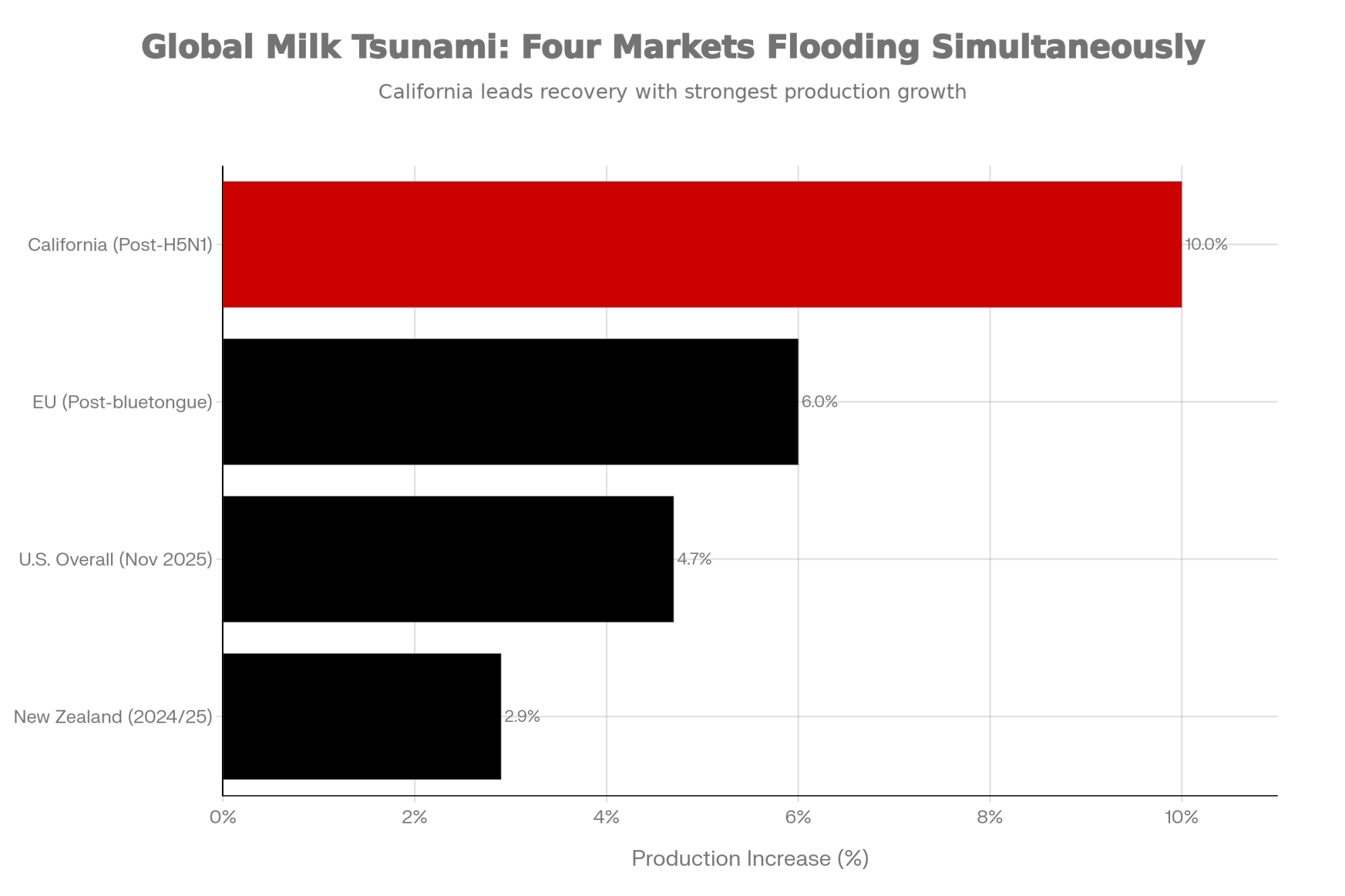
NewsSubscribe
First
Last
Consent

The $640 Question: Why Some Dairy Farmers Are Rethinking Everything They Know About Dry-Off

Wisconsin trial: 47% fewer deaths, 70% less leakage, $640 more per cow. The dry-off method? Backwards from everything you know.

I recently spoke with a producer from central Wisconsin who asked me something that really made me think: “What if everything we’ve accepted about dry-off losses is actually preventable?”

Looking at what’s happening on Wisconsin farms this past year, I’m starting to believe he’s onto something. Here’s what caught my attention—across two dairies with 404 cows total, the ones using StopLac had 70% less milk leakage and nearly half the death losses in the first 60 days after calving. And get this—they’re producing 6.7 pounds more milk daily during their first 100 days in milk. That’s data from AHV International’s trials, and honestly, it’s making me rethink a lot of assumptions.

StopLac achieves dramatic reductions in leakage and death loss, plus boosts daily milk yield post dry-off

The Story Behind the Science

Sometimes the best innovations come from people who just can’t accept “that’s how it’s always been done.” There’s this veterinarian in the eastern Netherlands, Dr. Gertjan Streefland, who kept running into cows that wouldn’t respond to antibiotics the way they should. As Jan de Rooy—he runs AHV International now—tells it, Streefland didn’t just throw more drugs at the problem. He started asking different questions.

Now here’s where it gets interesting. The Dutch couldn’t just expand when they hit problems—land costs were astronomical, and they had production quotas limiting them until 2015. So they had to get smarter with what they had. Traditional dry-off had worked fine for decades, but when you can’t add cows, you’ve got to make every single one count.

The breakthrough came around 2010, when de Rooy attended a university course on bacterial communication—something called quorum sensing. Basically, bacteria can coordinate their attacks through chemical signals. When de Rooy and Streefland connected after that course, they began wondering whether bacteria in udder tissue were essentially organizing themselves into a coordinated army rather than random raiders.

What they found aligns with research from places like Cornell’s Quality Milk Production Services—these bacterial communication patterns are real, and they’re a big part of why some infections are so hard to beat. Similar work from the University of Minnesota’s veterinary diagnostic lab has shown that mastitis pathogens exhibit comparable biofilm resistance patterns.

Understanding What Really Happens at Dry-Off

Let me walk you through what happens when we dry off a cow the traditional way. You’ve got a cow making 60, maybe 80 pounds of milk daily, and we just… stop. That udder pressure doesn’t magically disappear. Research from AHV’s work with Utrecht University shows it stays elevated for several days—creating stress we’re only now starting to understand.

Dr. Geoff Ackaert, who’s the Technical Director at AHV, has presented some fascinating evidence about this. Those stress hormones from the abrupt dry-off? They actually wake up dormant bacteria that have been hiding in what we call biofilms—think of them like bacterial apartment buildings where they protect each other and wait out the tough times.

And here’s the kicker—bacteria protected in these biofilms can be 10 times, sometimes much more, resistant to antibiotics in experimental settings. Even on the low end, that’s a huge problem. The National Mastitis Council has documented similar patterns, and independent research from institutions like Ohio State’s veterinary college confirms these biofilm resistance levels.

How This New Approach Actually Works

StopLac takes a completely different approach. Instead of that sudden stop, which creates all that pressure, it helps the cow naturally wind down production—basically a guided shift in how her body manages the transition. It’s different from selective therapy or just using teat sealants, and it’s also distinct from gradual cessation protocols that some farms have tried.

The Utrecht collaboration documented a 56% drop in milk production within 24 hours, but here’s the important part—it’s due to physiological changes, not pressure building up. Jon Beller, who runs about 2,400 cows in Wisconsin, told me something that really stuck: “A lot less vocalization during the dry-off period. The cows cease production almost instantly with no more milk secretion after dry-up.”

Steve Jaeger shared something similar that really caught my attention. “On Friday morning, when I do my walk through and I walk past the dry pen, in the past, after dry off, there were always cows screaming. I mean, just screaming. You could tell the udders were full. They were uncomfortable,” he told me. “Since May 15, I barely had a, you know, you want to say a murmur? The barn was quiet. I just couldn’t believe it.”

You probably know this already—when cows are quieter during dry-off, that tells you everything. They’re not stressed.

What’s happening in the udder is pretty clever, too. The pH shifts so bacteria don’t thrive. Lactose is reabsorbed instead of being fermented by bacteria. Calcium stays balanced—and anyone who’s dealt with milk fever knows how crucial that is. The liver keeps functioning properly instead of getting overwhelmed.

Flowchart comparing the stress-heavy traditional dry-off with the guided, health-protective StopLac approach

The Numbers That Matter

Let’s talk about what this means in real numbers. In those Wisconsin trials with 404 cows, only four cows—about 1.7%—in the StopLac group had milk leakage issues. The control group? Thirteen cows, or 7.6%. Death losses within 60 days were 1.3% versus 2.4%.

That 6.7-pound daily production advantage during the first 100 days? If that holds even partially through the full lactation, you’re looking at substantial gains. Many producers are reporting the improved start carries through, though individual results vary.

During that H5N1 outbreak at Joe Soares Farms—nobody wants to deal with that kind of crisis, but it gave us a valuable comparison. Their Turlock facility, with 2,500 cows using the AHV protocol, maintained about 88 pounds per cow daily, with monthly losses of around 40-60 cows. Their Chowchilla facility with 5,500 cows on traditional protocols? They dropped to 77 pounds per day and were losing over 100 cows per month. The comparison is eye-opening.

AHV protocol outperformed traditional methods during Bird Flu—Turlock dairy achieved 11 lbs more milk per cow daily.

Breaking Down the Economics

Here’s how the money actually works out. Traditional dry-off has all these hidden costs that add up:

You’ve got milk leakage at about $11.55 per cow. New infections run around $94. Death losses within 60 days average $66. Extra culling adds $120. Antibiotics and withdrawal time, another $32.90. Extra labor dealing with problems, at least $16.

Add it all up—that’s $340.45 per cow for each dry-off when things go relatively well.

Now, with an investment of roughly $40 per cow, plus implementation costs, you’re looking at a total investment of $55-60 per cow. The measured benefits in improved production during early lactation, reduced health events, and lower death losses average over $400 according to the trial data. When you stack the $340 in avoided costs on top of the $400+ in production/health gains, and subtract the investment, you are looking at a net economic benefit of $640 per cow.

For a 1,000-cow dairy, that’s significant annual savings. Even if you’re milking 200-300 cows, the proportional benefits are worth looking at. Actually, I talked to a producer in Vermont with 180 cows who started with just his repeat offenders—the cows that always seemed to have issues. He’s now using it across the whole herd because the results on those problem cows were so clear.

It’s important to note that individual results depend on current management practices, facility design, and local conditions. The $640 benefit represents best-case scenarios from trial data—your actual results may vary based on factors like current dry-off success rates, labor efficiency, and herd health status

For comparison, other dry-off innovations typically show different returns. Selective dry cow therapy can reduce antibiotic costs by about 50% while maintaining udder health, according to University of Wisconsin extension research. Internal teat sealants alone generally show ROI in the 200-300% range based on Cornell studies.

Sponsored Post

Who’s Ready for This (And Who Isn’t)

Not every farm is ready to make this change immediately, and that’s fine. The operations I’ve seen succeed with this usually have a few things in common. They’re closely tracking individual cow data. Their teams actually follow protocols—you know how that goes. They think in full lactations, not just quarterly numbers. And they see change as an opportunity, not a threat.

Of course, not everyone’s convinced yet. As one Pennsylvania dairyman told me, ‘I’ll wait to see three-year data before switching my whole herd.’ That’s fair—major management changes deserve careful consideration.

David Goodrich at Goodrich-Cylon Dairy really exemplifies this approach. He’s been using StopLac since early December and tells me, “I have no difference in cell count or fresh cows with mastitis. I find it works really well on the farm, and I have no plans of going back to using tubes and sealants and all that stuff anymore.”

What’s interesting is his observation about implementation: “I don’t think it takes really any more time than putting tubes and sealants in every cow. I actually think it might cut a step out… the employees have really liked that they don’t have to handle the cows twice in the parlor.”

I should mention—some farms in the trials did hit bumps initially, mostly around training staff and getting protocols consistent. One producer said it took about three weeks for his team to really get comfortable with the new approach, but the results made it worthwhile. Another operation struggled initially because it tried to implement during its busiest season—timing matters.

If you’re not tracking individual cows well yet, or if you’re managing finances month-to-month, you might want to build those systems first. There’s no shame in that—recognizing what you need before jumping into new technology is actually smart management.

What to Expect Month by Month

Based on what producers have told AHV during their follow-ups, here’s the typical timeline:

First couple of months: Your milking crew notices cows are calmer at dry-off. No udder engorgement. Staff finds it easier. As Steve Jaeger noted, “It’s obvious that pressure isn’t there, that the AHV StopLac is doing what we need it to do.”

Months 3-4: Hospital pen has fewer cows. The Giacomini trial showed conception rates improving by several percentage points—that’s meaningful progress.

Months 6-8: Treatment costs drop noticeably. Those first StopLac cows are milking better than expected in their new lactation. Jaeger is particularly excited about this: “If we can shrink that udder faster and give that udder more time to regenerate, those cows are going to take off, I hope, a lot faster and perform a little better.”

By month 12: Everything compounds. Better production, fewer deaths, less culling—your banker notices the improved cash flow.

Regional Differences to Consider

It’s worth noting that results might vary depending on where you are and how you manage. Operations in hot, humid areas might encounter different bacterial pressures than those in drier regions. Down in the Southeast, where heat stress is a constant battle, producers report that the reduced metabolic stress during dry-off seems especially beneficial. Meanwhile, Southwest producers dealing with dust and environmental challenges say the stronger immune response helps their cows better handle those conditions.

Grazing dairies could see variations compared to confinement. Organic producers—who can’t use many traditional treatments anyway—might find this particularly useful.

Spring and fall transitions might show different responses, too. Some producers report better results during cooler months, though the trials didn’t show major seasonal variations.

The Regulatory Picture

The regulatory landscape keeps evolving, as we all know. The EU’s Regulation 2019/6 took effect on January 28, 2022, basically ending blanket dry cow therapy as we knew it. Canada’s national framework includes clear objectives to reduce agricultural antibiotic use. And let’s be honest—consumers increasingly want products from farms using antibiotics responsibly.

According to AHV’s specifications, StopLac has a zero withdrawal time—something to consider as regulations continue to tighten.

The Bottom Line

We’re seeing an interesting split in our industry: some operations are questioning old assumptions, while others are sticking with tradition. The Dutch example shows what happens when you can’t just expand your way out of problems—you innovate.

AHV reports over 2,650 farms are now using StopLac, with more than a million tablets distributed since last June. Industry trends suggest these approaches will likely become more common, though nobody can predict exactly how fast things will change.

Questions worth asking yourself: How do your current dry-off results compare to what’s possible now? What happens when neighbors cut their fresh cow losses in half? How might evolving market preferences affect your opportunities?

What started as one vet’s frustration with antibiotic failures has become a documented opportunity for real economic improvement. Each dry-off cycle represents biological potential—once it’s lost, you can’t get it back. Wisconsin producers in these trials aren’t just saving money today; they’re building advantages that compound with each lactation.

The most successful farms I’ve seen treat this as fundamental management evolution, not just buying a new product. Maybe that’s the real lesson—when you can’t expand, innovation becomes essential.

MetricTraditional Dry-OffStopLac
Milk leakage (%)7.61.7
Death loss (%)2.41.3
Daily milk increase (lbs)06.7
Withdrawal time (days)3-60
Annual cost per cow ($)34055-60
ROI per cow ($)0640

KEY TAKEAWAYS

  • The $640/cow revelation: Traditional dry-off creates $340 in preventable losses (mastitis, deaths, culling)—a $55 StopLac investment returns $640 through prevention plus 6.7 lbs more daily milk in early lactation
  • Your barn doesn’t lie: Screaming dry cows = tissue damage and bacterial activation. Silent cows = healthy metabolic transition. Wisconsin trials proved the difference: 47% fewer deaths, 70% less mastitis
  • Implementation roadmap: Start with repeat offenders; implement during calmer seasons; expect a 3-week staff adjustment. Month 1: quieter barns. Month 3: fewer hospital cows. Month 12: banker notices cash flow improvement
  • The regulatory advantage: Zero withdrawal time positions you ahead of tightening regulations (EU already banned blanket dry therapy in 2022, North America following)

Complete references and supporting documentation are available upon request by contacting the editorial team at editor@thebullvine.com.

EXECUTIVE SUMMARY: 

Wisconsin data just proved the unthinkable: traditional dry-off costs you $640 per cow annually in completely preventable losses. In trials with 404 cows, StopLac achieved what tubes and sealants never could—70% less milk leakage, 47% fewer deaths, and 6.7 pounds more daily milk during the first 100 days. The breakthrough came when Dutch farmers, unable to expand due to land constraints, discovered that helping cows metabolically wind down production prevents the pressure that awakens biofilm-protected bacteria. 

Steve Jaeger describes the transformation: “After traditional dry-off, cows were screaming… now with StopLac, the barn is silent.” With an investment of roughly $40 per dose and zero withdrawal time, the economics are undeniable—invest $55-60 total, recover $640 in reduced deaths, mastitis, culling, and improved production. With 2,650 farms already switched and testimonials like David Goodrich’s (“tubes may have caused MORE mastitis”), for many producers, the question isn’t just whether to change—it’s whether they can afford not to.

Complete references and supporting documentation are available upon request by contacting the editorial team at editor@thebullvine.com.

Learn More:

Join the Revolution!

Join over 30,000 successful dairy professionals who rely on Bullvine Weekly for their competitive edge. Delivered directly to your inbox each week, our exclusive industry insights help you make smarter decisions while saving precious hours every week. Never miss critical updates on milk production trends, breakthrough technologies, and profit-boosting strategies that top producers are already implementing. Subscribe now to transform your dairy operation’s efficiency and profitability—your future success is just one click away.
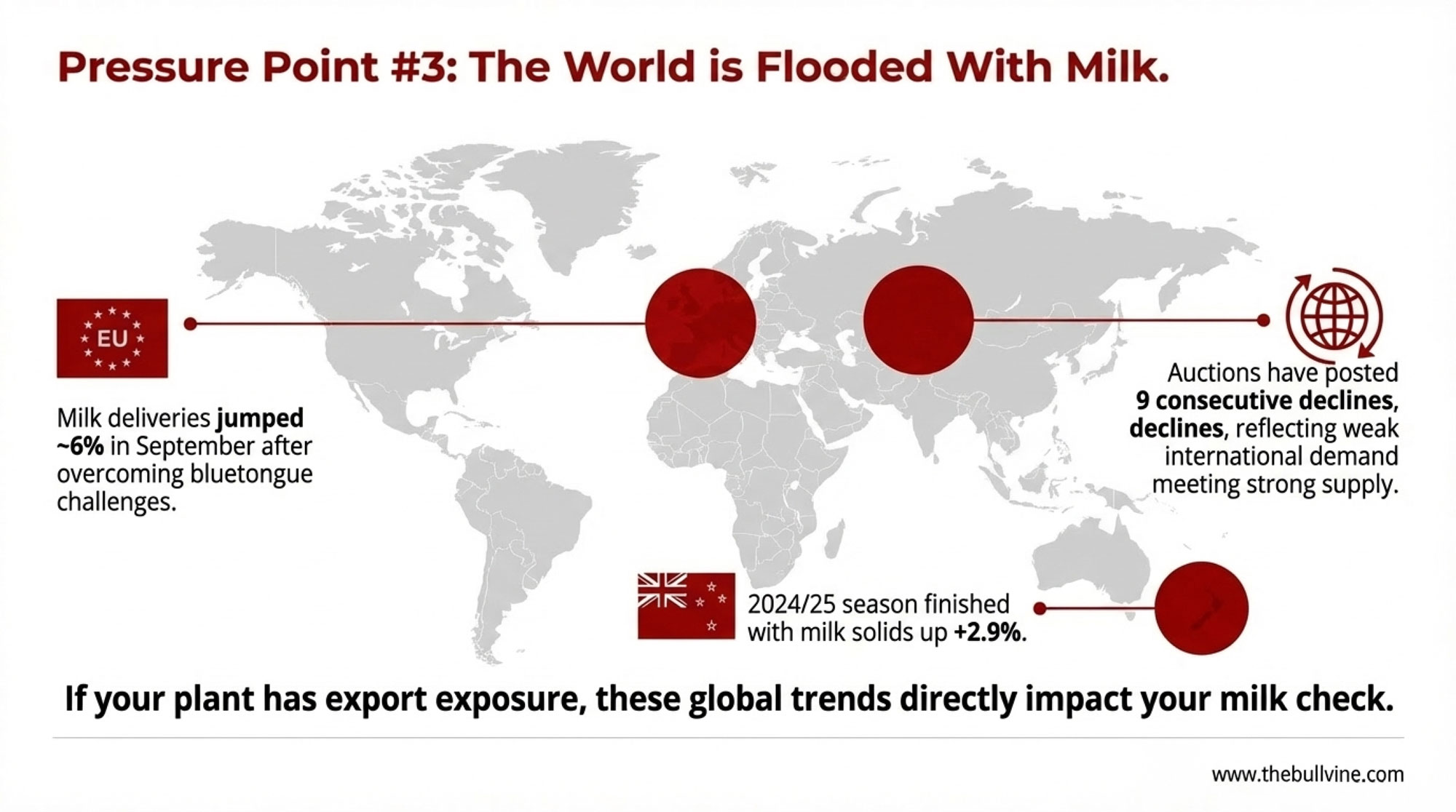
NewsSubscribe
First
Last
Consent

Regenerative Dairy’s $900,000 Reality: The Contract Terms That Make or Break Your Transition

$41/cwt regenerative vs $23/cwt conventional—same Ohio county. The difference? Contract terms most farmers miss. Here are the seven that matter.

EXECUTIVE SUMMARY: The regenerative dairy opportunity is real—some farmers are locking in $41/cwt for five years—but so is the $770,000 gap between what transitions actually cost and what processors pay. With Nestlé and Danone facing potential fines in the hundreds of millions for missing climate targets, farmers have unexpected leverage, but only through 2027. The difference between success and the fate of those 89 farms Danone dropped comes down to seven specific contract provisions that most farmers overlook. Three proven models have emerged: small farms joining networks like Maple Hill, large operations going vertical, and mid-size farms securing cost-plus deals that guarantee margins. Your next 90 days determine your next decade: get three written offers, have an attorney review them, and negotiate absolute protection—because by 2028, regenerative becomes mandatory compliance without the premiums.

Regenerative dairy contracts

You know what’s been interesting lately? I keep hearing the same story from different producers. They’ll spend hours reading through these regenerative dairy contracts, and there’s always this moment when they realize—the brochure promised a partnership, but the contract? That reads like they’re taking all the risk.

I’ve been watching this pattern develop over the past three years as processors roll out their billion-dollar sustainability programs. And here’s what’s caught my attention: the gap between what’s marketed and what’s actually in those contracts is… well, it’s revealing some important lessons for all of us.

The Regenerative Premium Window: Why 2025-2027 is Your Last Chance. Ohio regenerative producers lock in $41/cwt while conventional neighbors struggle at $23/cwt—but this gap narrows to zero by 2028 when regenerative becomes baseline compliance without premiums

The American Farm Bureau has been tracking farm bankruptcies and reports a 13% rise in fiscal year 2024, with that trend continuing into 2025. Meanwhile—and this is what’s fascinating—some regenerative operations are pulling in $40-42 per hundredweight. I’m seeing Ohio producers in regenerative programs achieving those prices while conventional operations two counties over are stuck at $23-24/cwt. The difference? It often comes down to contract negotiation and timing, not whether you believe in the philosophy.

361 Farms Filed Bankruptcy in 2025—Already Beating Last Year’s Total. The 67% surge proves conventional dairy’s broken economics while regenerative producers with protected contracts lock in $41/cwt. Your next 90 days determine which side of this divide you’re on

Understanding Why Processors Suddenly Need You

So what’s driving all this? The regulatory landscape shifted fundamentally this year, and it’s worth understanding why. The European Union’s Corporate Sustainability Reporting Directive kicked in January 2025, and it’s changing everything for companies like Nestlé and Danone. They’ve got to report emissions across their entire supply chain now. That includes every farm they buy milk from.

What’s particularly interesting is how different countries are handling penalties. In Germany, non-compliance can mean fines of 0.5% to 2% of annual revenue. France has gone even further—up to €75,000 plus potential director liability. For a company like Nestlé with $95 billion in revenue? We’re talking potential fines in the hundreds of millions.

And California’s not sitting this out. Their Climate Corporate Data Accountability Act—that’s SB 253, signed by Governor Newsom on October 7, 2023—kicks in for any company over $1 billion in revenue starting in 2027. That’s basically every major processor in your rolodex.

Now here’s where it gets interesting for farmers. Nestlé’s 2024 Creating Shared Value Report shows they’re sourcing 21.3% of key ingredients through regenerative programs, but they need to hit 50% by 2030. That’s a massive gap, isn’t it? And right now—this is crucial—they need committed farmers more than farmers need them. But you know how these windows work. They don’t stay open long.

The Real Economics (What They Don’t Put in Brochures)

I’ve been working through transition costs with extension economists from Cornell and Wisconsin, and what we’ve found… well, it deserves your attention. Everyone focuses on the visible stuff—fencing, water systems, maybe a seed drill. But that’s just the start.

Based on current NRCS cost-share estimates and auction activity, a typical 200-cow operation faces infrastructure investment costs of $250,000 to $280,000. Your rotational grazing setup alone—good fencing that meets EQIP standards—typically runs $90,000 to $100,000. Water systems vary by region. Wisconsin Extension engineers report $15,000 to $25,000, depending on your land, and that’s if you’re lucky with topography.

Working Capital Loss Crushes Dreams: The $280K Hidden Cost That Breaks Most Transitions. Processors promise partnership but deliver just $130K while farmers face $900K in real costs—that $770K gap explains why Danone dropped 89 farms in 2021

But here’s what really blindsides folks: certification and compliance. Based on USDA National Organic Program data and the various regenerative certification fee structures out there, you’re looking at costs exceeding $100,000 over a full transition. And the working capital crunch when production drops in year two—which it almost always does—that requires serious cash reserves.

A Lancaster County producer I spoke with recently transitioned her 180-cow operation. “We went from 24,000 pounds down to 20,000 pounds annually per cow during adjustment,” she told me. “That’s real milk you’re not shipping, but the bills keep coming.” Labor requirements jumped too—her family tracked 600 extra hours that first year. At market rates, that’s worth tens of thousands, except nobody’s paying it.

All told? You’re looking at close to $900,000 over seven years for a typical 200-cow operation. Are the processors offering these programs? They’re talking about maybe $130,000 in assistance. See the disconnect?

The Seven Contract Provisions That Matter Most

After reviewing contracts with dairy attorneys, here’s what separates good deals from disasters:

1. Contract length: Minimum 5 years with auto-renewal options
2. Price protection: Either cost-plus or guaranteed floor pricing
3. Volume flexibility: No penalties for increased production
4. Termination clarity: Only for material breach with cure periods
5. Upfront support: Actual money, not just technical assistance
6. Verification costs: Processor pays for certification and monitoring
7. Carbon credits: Clear ownership and revenue sharing

Questions to Ask Your Processor Tomorrow

Before signing anything, get clear answers on:

  • What happens if I exceed production targets?
  • Who pays when verification standards change?
  • Can you terminate for “convenience” or only breach?
  • What’s my guaranteed minimum price in Year 3?
  • Do I keep carbon credit revenues?

Three Models That Are Actually Working

Looking at successful transitions across different regions, three approaches keep emerging, and each offers different lessons depending on your situation.

Model 1: The Network Approach (50-150 cows)

Tim Joseph at Maple Hill Creamery figured out something important early on. Instead of going it alone, he built a network. Today, they’ve got 135 small farms—most around 50 cows—all receiving premium pricing through collective brand ownership.

What I find interesting is that these farms were already doing rotational grazing for economic reasons. As Joseph has explained, “Regenerative kind of came to us.” When Maple Hill formalized these practices and built the market, everyone benefited. They recently secured $20 million through USDA’s Partnership for Climate-Smart Commodities program, with funds flowing directly to member farms. Small operations getting resources usually reserved for the big players? That’s smart collective action.

Upstate New York producers in Maple Hill’s network, with 60-70 cow operations, tell me they couldn’t have transitioned on their own. But with 134 other farms and Maple Hill’s marketing power? They’re making it work.

Model 2: Vertical Integration at Scale (1,000+ cows)

Blake and Stephanie Alexandre, out in Crescent City, California, took a completely different path. They’re milking 4,500 cows across five locations, all on pasture with holistic management. Over 30 years—and this is remarkable—they’ve increased soil organic matter from 2-3% to 8-15%, as verified by their Regenerative Organic Certification documentation.

By controlling processing and retail, they’re getting $6-8 per half gallon for A2 regenerative organic milk. Can most of us replicate this? Probably not. But it shows what’s possible when you control more of the value chain. And here’s what’s encouraging—their butterfat performance stabilized and improved after transition, which addresses a common concern about pasture-based systems.

Model 3: Strategic Partnership with Protection (200-500 cows)

The McCarty family in Rexford, Kansas, offers maybe the most instructive model for mid-size operations. They spent two years—two full years—working with Cargill Dairy Enterprise Group advisors before finalizing their deal with Danone in 2012.

Their arrangement? Cost-plus pricing. Danone covers all production costs plus guarantees a margin. As Dave McCarty has explained in industry interviews, “I have a cost per hundredweight of my milk, and there’s a margin on top of that.” No wondering if you’ll cover feed costs when corn hits $8. That’s real security during transition.

What’s particularly noteworthy here is how they structured fresh cow management during the transition. They maintained separate groups for transitioning animals and closely monitored butterfat levels to adjust rations. Smart management, protected by smart contracts.

What Happened to Organic Is Happening Again (With a Twist)

We’ve all watched this before, haven’t we? USDA Agricultural Marketing Service data shows organic premiums compressed from $10-11 down to $3-5 per hundredweight between 2017 and 2022. Large operations in Texas and Colorado flooded the market, squeezing smaller farms.

The same pattern’s emerging with regenerative. Multiple certifications with different standards—this new Regenified program doesn’t even require an organic baseline according to their 2024 standards. Large operations claiming regenerative status with minimal changes. Processors favoring bigger suppliers for “efficiency.”

But there’s a crucial difference this time, and it actually gives me some optimism. The regulatory pressure I mentioned? That creates a floor that the organic never had. When non-compliance means hundreds of millions in fines, companies can’t just walk away when it gets inconvenient.

Based on processor sourcing needs and these regulatory timelines, I see 2025-2027 as the optimal window to secure favorable terms. After that? My guess is that regenerative becomes baseline—required for market access but not compensated with premiums.

Your Strategic Options (Geography and Scale Matter)

What farmers are finding is that opportunities vary considerably by region and operation size. Let me share what’s working in different situations.

For Smaller Operations (50-300 cows)

If you’ve got decent pasture, low debt, and you’re near urban markets, premium capture can work. This especially applies in the Northeast, Upper Midwest, and Pacific coastal areas, where you’ve got longer grazing seasons. Pennsylvania producers working with Origin Milk are reporting positive cash flow by year two—not huge returns, but sustainable progress.

Wisconsin producers transitioning 180-cow operations tell me similar stories. They’re in year three of transition, and while it’s been tough, they’re seeing light at the end of the tunnel. “Butterfat’s back up to 3.9%, and our feed costs are down 30% from where we started,” one told me recently. “If we’d waited another year to start, I don’t think we’d have gotten the contract terms we needed.”

Down in Georgia and the Carolinas? That’s tougher. Heat stress and shorter grazing seasons make pasture-based systems challenging. But I’m hearing about some producers there using silvopasture systems—integrating trees for shade—with interesting results. You’ve got to be realistic about your geography, but sometimes creative solutions work.

For Larger Operations (1,000+ cows)

If you’ve got capital access and management expertise, scaling for efficiency might make sense. UW-Madison’s Center for Dairy Profitability research consistently shows economies of scale advantages above 2,000 cows. But fair warning—current construction costs suggest you’re looking at $3-7 million for meaningful expansion. And you’d better be comfortable managing a business, not just a farm.

For Those Near Retirement

Many Wisconsin producers I know who are 55-60, with kids, unsure about succession, are taking a different approach. They’re maintaining current operations, avoiding major investments, and planning strategic exits to expanding neighbors. Sometimes the smartest move is knowing when not to invest.

As one producer put it to me: “We’re not going regenerative, we’re not expanding, we’re just milking what we have and banking cash. In three years, when our neighbor’s ready to expand, we’ll have a buyer lined up.”

Your 90-Day Action Plan (And Yes, Start Tomorrow)

Here’s what I’d tell any producer considering regenerative transition—this really should start tomorrow morning.

First 30 Days: Don’t respond to that processor brochure yet. Instead, call three different processors or cooperatives. Tell them you want actual contract terms in writing, not marketing materials. Get everything documented. Origin Milk, Maple Hill, Organic Valley—those are good starting points.

Second 30 Days: Take those proposals to an ag attorney. Budget $3,000-5,000—it’s worth it. Have them focus on termination clauses, price adjustments, and who’s obligated for what. Farm Commons has contract review resources specifically for regenerative dairy that are really helpful.

Third 30 Days: Run realistic financial models. Cornell’s Dairy Farm Business Summary provides adaptable scenarios. Model the ugly version—where production drops, expenses rise, and year two nearly breaks you. Make sure you’ve got working capital or credit lines to bridge that valley.

And connect with other farmers who’ve done this. Join NODPA or your regional grazing coalition. The peer learning alone is worth the $100 annual membership.

What This Really Means for Your Operation

Look, I’ve watched plenty of “next big things” come through our industry. BST in the ’90s. Crossbreeding in the 2000s. Robotic milking in the 2010s. Regenerative dairy feels different, though not for the reasons you might think.

The regulatory framework—that’s what’s different. Real financial penalties for corporate non-compliance. Potential investor lawsuits. Mandatory emissions reporting in major markets. This creates structural demand that voluntary programs never had.

For prepared producers, the 2025-2027 window offers a genuine opportunity. But only with proper contracts. Those seven provisions I mentioned? They’re not suggestions. They’re survival requirements are based on the 89 farms Danone dropped in August 2021 and the handful that prospered.

I understand the skepticism—especially after organic’s trajectory. And yes, conventional production remains viable if you’re either scaling big or planning a near-term exit. But that middle ground where most farms operate? It’s getting squeezed from both sides.

If you’re mid-career with succession possibilities, waiting for perfect clarity might mean missing the window. By 2028-2030, regenerative practices could become mandatory baseline requirements without premium compensation. Compliance instead of opportunity.

But here’s what gives me hope: Young farmers are using regenerative contracts with guaranteed premiums to qualify for farm purchase financing. Banks see those five-year price guarantees and approve loans that wouldn’t have worked otherwise. That’s a positive development for industry renewal. And I’m seeing established operations use these transitions to bring the next generation back to the farm—kids who weren’t interested in conventional dairy but are excited about regenerative approaches.

The fundamental question isn’t whether these practices will become standard. It’s whether you’ll be compensated for adopting them.

Get three contract offers. Have an attorney review them. Make your decision based on actual terms, not promises. That single action in the next 90 days matters more than any workshop or YouTube video about soil health.

The Valley of Death: Years 2-3 Destroy Farms Without Protected Contracts. Cumulative losses hit -$110K by Year 3—this is where the 89 farms Danone dropped went bankrupt. Strong contracts with working capital support bridge this gap to reach $235K cumulative profit by Year 7

This transition is happening. The market’s moving whether individual farms are ready or not. Which producers do I see as best positioned for 2035? They’re either embracing regenerative with strong contracts or planning strategic exits. They’re not waiting for perfect information.

Those holding out for complete clarity? Well, in my experience, the market rarely provides perfect information before critical windows close. And hesitation itself… that’s becoming an expensive decision.

But you know what? Whatever path you choose—regenerative, conventional scale-up, or strategic exit—make it with your eyes open and your contracts reviewed. The dairy industry’s always been about adapting to change. This is just the latest chapter, and with the right approach, it doesn’t have to be the last one for your operation. Some of the best dairy stories I know started with farmers facing tough transitions and making smart decisions based on real information, not marketing hype.

The opportunity’s real. So are the risks. But armed with the right information and proper contracts? You can navigate this transition successfully.

Key Takeaways:

  • The $770K reality check: Regenerative costs $900K to implement, but processors pay just $130K—only protected contracts bridge this gap successfully.
  • 2027 is your deadline: Processors facing hundreds of millions in climate fines need farmers now—after 2027, regenerative becomes mandatory without premiums.
  • Seven terms separate $41/cwt from $23/cwt: Contract provisions matter more than farming philosophy—know which ones protect your investment.
  • Three proven paths: Small farms network (Maple Hill), large farms integrate (Alexandre), mid-size farms demand cost-plus (McCarty).
  • Your 90-day window: Get three written offers → Invest $5K in legal review → Negotiate protection. Wait, and you’ll join the 89 farms Danone terminated.

Complete references and supporting documentation are available upon request by contacting the editorial team at editor@thebullvine.com.

Learn More:

Join the Revolution!

Join over 30,000 successful dairy professionals who rely on Bullvine Weekly for their competitive edge. Delivered directly to your inbox each week, our exclusive industry insights help you make smarter decisions while saving precious hours every week. Never miss critical updates on milk production trends, breakthrough technologies, and profit-boosting strategies that top producers are already implementing. Subscribe now to transform your dairy operation’s efficiency and profitability—your future success is just one click away.
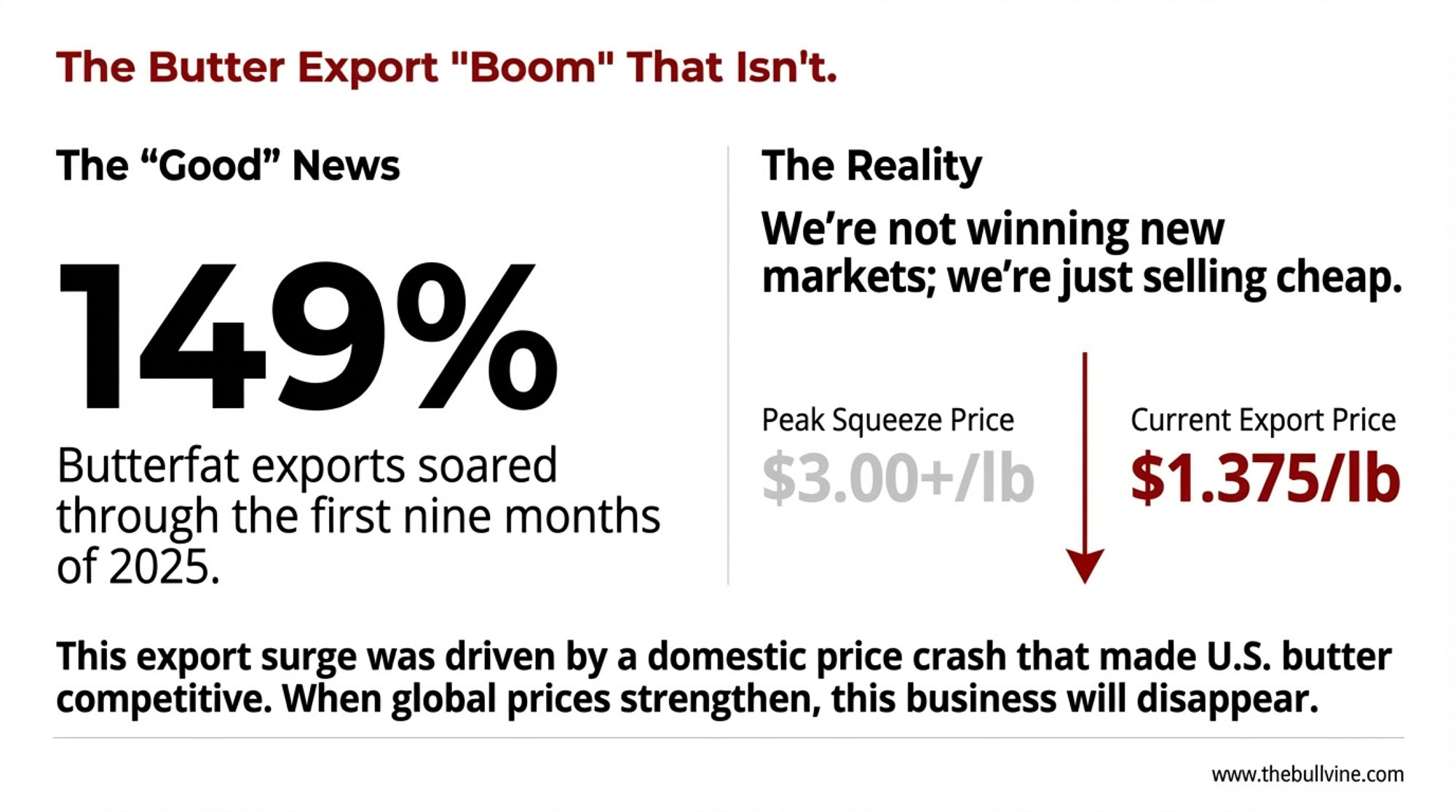
NewsSubscribe
First
Last
Consent

Matching the Feed to the Calf: Birth to 120 Days – Practical Science for Dairy-Beef Calves

Consistency isn’t a suggestion—it’s biology. Same time, same temp, same quality = 2.6 lb ADG and $100+ more per calf.

Good calf growth starts with steady habits—consistent feeding, clean water, and careful observation. From birth through 120 days, the calf’s diet and environment change rapidly, and how those changes are managed determines strength, health, and efficiency later on. Success comes from small, repeated actions done right every day.

Philosophy in Practice

Calves grow on consistency. Steady feeding times, clean water, dry air, and no sudden ration changes are the foundation of every good calf program.

Consistency Drives Growth

  • Feed at the same times every day
  • Keep milk solids and milk temperature consistent
  • Replace the starter daily so it smells clean and fresh
  • Make ration changes gradually over 4–7 days

Quick Start Essentials: 

□ Buy Brix refractometer ($30) 
□ Buy digital thermometer ($12) 
□ Set feeding times and stick to them 
□ Test first colostrum batch today 
□ Check milk temperature at next feeding

Birth to Day 3 — Immunity and Metabolic Activation

A newborn calf is born without immune protection in its bloodstream. All early protection comes from colostrum, which provides antibodies (IgG) and energy for warmth and early growth. If the calf doesn’t receive enough high-quality colostrum quickly, long-term health and gain are compromised.

What must happen in the first 24 hours:

  • Feed at least 4 quarts of clean, high-quality colostrum (Brix 24 or higher) within 2 hours of birth or 8.5%-10% of body weight
  • Provide another 2 quarts in the next 8–12 hours
  • Aim for 200+ grams of IgG total. A quick check is a Brix reading of 24% or higher
  • Dip the navel and provide deep, dry bedding
  • Offer warm water between liquid feedings
  • Keep calf temperature above 100°F

Research confirms that colostrum quality varies significantly between cows, with IgG concentrations ranging from less than 50 g/L to over 150 g/L. Using a Brix refractometer to test colostrum is now standard practice; readings of 22% or higher indicate good quality, and readings below 18% suggest the colostrum should not be used as the first meal. The 2024 National Animal Health Monitoring System (NAHMS) dairy study found that 29% of colostrum samples tested below minimum quality thresholds, while producers estimated only 8% was of poor quality.

Why Water Matters

  • Water and milk are not the same in the calf’s gut
  • Free-choice water helps rumen microbes begin developing early
  • No water equals weak fermentation, which equals slow rumen growth
  • Dump, clean, and refill water buckets daily

Water consumption is critical even in the first days of life. Unlike milk, which bypasses the rumen through the esophageal groove, drinking water enters the rumen directly and supports bacterial establishment and fermentation.

Days 3–21 — Rumen Initiation and Microbial Establishment

By day 3, the rumen is waking up. A good calf starter stimulates chewing and microbial activity. When microbes ferment starch, they produce volatile fatty acids (VFAs), especially butyrate, which signals the rumen lining to grow papillae—the structures that absorb energy later in life.

Feeding goals for this stage:

  • Feed milk replacer (20–24% CP, 20–22% fat) twice daily at consistent solids and temperature
  • Introduce textured starter by day 5 and keep it fresh
  • Starter formulation: 20–23% CP, 3–5% fat, 6–8% fiber
  • Provide clean, room-temperature water at all times
  • Maintain dry bedding and good airflow

Research demonstrates that VFA production, particularly butyrate and propionate, drives papillae development in young calves. Calves fed corn-based starters show improved rumen development compared to those fed barley or oats, with corn providing superior energy density and fermentability. Dr. Jud Heinrichs from Penn State, who’s been studying calf nutrition for 4 decades, emphasizes that these early days set the stage for lifelong digestive capacity.

Temperature consistency matters more than most realize. Research from Virginia Tech shows that milk temperature variations from 88 to 122°F within a single facility cause 40-65% more nutritional scours and 0.25-0.33 pounds of slower daily growth.

Temperature Consistency Drives Lifetime Value: Temperature swings from 88-122°F reduce ADG by 27% and cost $100+ per calf

Days 21–49 — Transition, Frame Growth, and Stable Fermentation

By week 3, calves transition from monogastric to ruminant digestion. Microbes multiply rapidly, and fermentation patterns shift toward propionate and butyrate production. These VFAs fuel lean growth and the development of rumen papillae.

Targets for this stage:

  • Starter intake: 1.5–3.0 lbs/day by week 6
  • Starter formulation: 18–23% CP, 3–5% fat, 6–8% fiber
  • Maintain uniform texture to prevent sorting
  • Watch manure consistency for early feedback on rumen health

Studies show that calves consuming adequate starter during this period develop larger, more functional rumens with greater papillae surface area. The relationship between starter intake and rumen pH becomes more pronounced as calves increase dry feed consumption, though young calves appear more tolerant of lower pH than adult cattle.

Sponsored Post

Days 49–70 — The Weaning Window

Wean by intake, not age. Calves are ready for weaning when they consistently eat 3 lb of starter per day for three consecutive days and drink water freely. A premature milk pull can cause growth slumps that can take weeks to recover from.

Best practices for weaning:

  • Taper milk gradually over 5–7 days
  • Keep the same starter ration during taper and for 10–14 days after full wean
  • Ensure dry housing, strong airflow, and adequate bunk space
  • Calves should be at least 8 weeks old before weaning is completed

Research consistently shows that weaning based on starter intake (minimum 3 lbs for three consecutive days) rather than age alone reduces stress and maintains growth momentum. Dr. Emily Miller-Cushon at Florida found that calves weaned before adequate intake show 180-280% increases in muscle breakdown markers, literally catabolizing their own tissue to survive the energy deficit.

Days 70–120 — Early Grower Phase for Dairy-Beef Calves

Three Biological Windows Programming Lifetime Value: Each missed critical period creates permanent deficits that cascade through production

Once fully weaned, calves function as true ruminants. The goal now is frame and muscle growth without digestive upset. A balanced grower with moderate starch, digestible fiber, and proper minerals supports this phase.

Key management points:

  • Target ADG of 2.4–2.6 lbs/day
  • Maintain 12–15% NDF from digestible fiber
  • Keep feed fresh and bunks clean
  • Manage heat with shade and airflow

Research on dairy-beef crossbred calves shows they can achieve exceptional growth rates when appropriately managed, with some studies reporting ADG exceeding 5.5 lbs/day on high-energy diets post-weaning. The optimal NDF level for starter diets appears to be in the range of 12-20%, with higher levels (above 27%) potentially reducing intake and growth.

This period is critical for marbling development. Research from South Dakota State shows that marbling adipocytes—the cells that determine quality grade—primarily form between days 70 and 120. Miss this window with inadequate nutrition, and those cells simply don’t form, costing 16.2 percentage points in Choice grading at harvest.

Common Mistakes and How to Avoid Them

  • Weaning by age instead of intake
  • Changing feed and pulling milk in the same week
  • Letting water get dirty—calves notice first
  • Feeding dusty or inconsistent starter
  • Overcrowding pens and limiting bunk space

Feeding Benchmarks by Stage

StageMilk Replacer (lb./day) 13.5% SolidsCalf Starter (lb/day)Water (qt/day)Target ADG (lb/day)
Birth–3 days1.12 – 1.682–40.8–1.0
3–21 days1.68 (6 quarts)0.25–1.04–61.2–1.6
21–49 days1.68 (6 quarts)1.5–3.06–81.6–2.0
49–70 days (wean)5.0–6.08–102.0–2.4
70–120 days6.0–8.0 (grower)8–122.4–2.6

Use these benchmarks as general guides. If calves fall below expectations, check water, environment, and feed freshness before adjusting the ration.

Nutritional Specifications by Stage

StageCP (%)Fat (%)NDF (%)Notes
Birth–3 daysColostrum quality (Brix ≥24%), warmth, hydration
3–21 days20–2318–20<5Starter + water drive rumen start-up
21–49 days18–203–56–8Uniform texture; watch manure form
49–70 days16–183–48–10Wean by intake; avoid new feeds during taper
70–120 days15–173–412–15Manage heat, bunk space, and cleanliness

The Economic Impact

Morbidity Collapse: Precision Feeding Reduces Pre-weaning Disease by 60%

While high milk replacer programs promise rapid early gains, the economics tell a different story. Operations using this starter-focused, consistency-based approach typically see:

  • 22% to 9% reduction in pre-weaning morbidity
  • 26 kg heavier weaning weights
  • 20 percentage point improvement in Choice grading
  • $100+ per calf additional value at harvest

The investment? A $30 Brix refractometer for colostrum testing, a $12 thermometer for milk temperature, and attention to daily details. These simple tools prevent the cascading failures that cost producers thousands in lost performance.


Economic Cascade: How Precision Practices Build $100+ Value Per Calf

Regional Considerations

Northeast operations dealing with harsh winters need insulated transport containers and pre-warmed feeding equipment when temperatures drop below zero.

Southwest producers face the opposite challenge—preventing milk from overheating when ambient temperatures exceed 100°F. Cooling systems and shaded feeding areas become essential.

Southeast operations must manage humidity’s impact on both heat stress and feed stability, requiring more frequent starter replacement and enhanced ventilation.

Putting It All Together

Healthy calves grow on predictability. If intakes or gains stall, start by checking basics: water, air, bedding, and space. When these fundamentals are right, calves stay on feed, develop strong rumens, and finish efficiently later in life.

The transition from colostrum-dependent newborn to functional ruminant represents one of the most critical developmental periods in a calf’s life. Research consistently demonstrates that calves receiving optimal early nutrition—including timely, high-quality colostrum, gradual increases in starter intake, and consistent access to clean water—show improved first-lactation milk production, reduced morbidity, and enhanced lifetime productivity.

For dairy-beef crossbred calves specifically, proper early management becomes even more critical as these animals represent an increasingly important segment of beef production. USDA data shows the dairy-beef sector expanded approximately 23% from 2021 to 2024. When managed with attention to the physiological transitions outlined here, dairy-beef calves can achieve growth rates and feed efficiencies that rival or exceed those of traditional beef calves while producing high-quality carcasses.

The key is consistency—the same times, same temperatures, same quality, every single day. Biology operates on its own schedule. Our job is to support that schedule with predictable, quality nutrition and management. Miss these critical windows in the first 120 days, and no feeding program can fully recover what’s been lost.

KEY TAKEAWAYS: 

  • Consistency Drives Everything: Feed same time, same temp (102-105°F), same quality daily—variation of just 14°F causes 60% more scours and 0.3 lb/day slower growth
  • Three Windows Program Forever: Immunity (0-3 days), rumen development (3-21 days), marbling formation (70-120 days)—miss any window and lose 16% Choice grade permanently
  • Water From Day 3 Changes the Game: Clean, fresh water drives rumen microbes; no water = weak fermentation = compromised lifetime efficiency
  • Wean by Intake, Not Calendar: 3 lbs starter/day for three consecutive days signals readiness—force it at 8 weeks and watch calves cannibalize their own muscle
  • $42 Tools Prevent $100 Losses: Brix refractometer ($30) catches bad colostrum that looks good; thermometer ($12) prevents temperature swings killing performance

EXECUTIVE SUMMARY: The first 120 days determine everything—calves grow on consistency, not complexity —and missing critical windows creates permanent deficits that no feeding program can fix. From birth through weaning, success requires unwavering precision: colostrum within 2 hours (Brix ≥24%), milk at 102-105°F (not the 88-122°F range common on farms), clean water from day 3, and weaning based on intake (3 lbs/day), not calendar. Three biological windows program lifetime performance: immunity (days 0-3), rumen development (days 3-21), and marbling formation (days 70-120)—miss any one and lose 16% Choice grade, 500 kg lifetime milk equivalent, or worse. This guide provides exact feeding benchmarks and nutritional specifications for each stage, showing how to achieve 2.4-2.6 lb daily gains while reducing morbidity by 60%. The tools are simple ($30 refractometer, $12 thermometer), the schedule is specific, and the payoff is clear: $100+ more per calf through better health, heavier weights, and superior carcass quality.

Complete references and supporting documentation are available upon request by contacting the editorial team at editor@thebullvine.com.

Learn More:

Join the Revolution!

Join over 30,000 successful dairy professionals who rely on Bullvine Weekly for their competitive edge. Delivered directly to your inbox each week, our exclusive industry insights help you make smarter decisions while saving precious hours every week. Never miss critical updates on milk production trends, breakthrough technologies, and profit-boosting strategies that top producers are already implementing. Subscribe now to transform your dairy operation’s efficiency and profitability—your future success is just one click away.
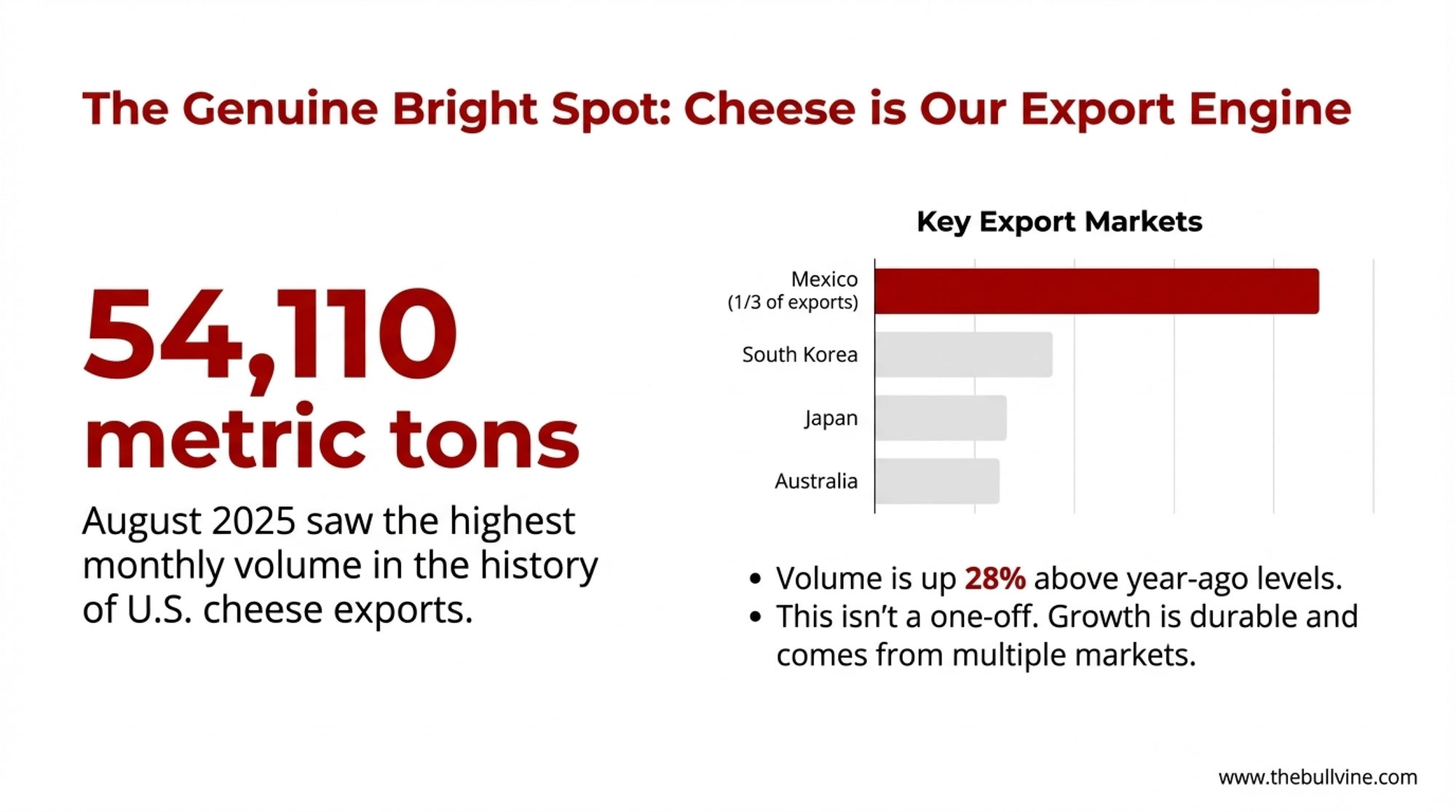
NewsSubscribe
First
Last
Consent

Your Next Milk Check Changes Everything: Why GLP-1 Drugs Just Made Protein King

Your grandfather chased butterfat. Your kids will chase protein. The switch happens on December 1. Miss it and you’re playing catch-up forever.

EXECUTIVE SUMMARY: The pharmaceutical industry just rewrote dairy economics: 30 million Americans on GLP-1 weight-loss drugs can’t digest traditional cheese but desperately need protein, ending 20 years of butterfat dominance. December 1st brings Federal Milk Marketing Order reforms requiring a 3.3% minimum protein—a threshold that will trigger deductions for unprepared farms. Three proven strategies offer paths forward: amino acid optimization (generating $38,000+ within 60 days), Jersey crossbreeding (worth $850-1,100 per cow annually), or direct processor contracts (securing $270,000+ yearly for a 650-cow operation). The split is already visible—early adapters report record profits while operations with 55%+ debt-to-asset ratios and sub-3.2% protein face elimination. December 15 marks the strategic decision deadline before January’s bank reviews. This isn’t a temporary market disruption but a permanent shift where protein premiums of $1.40-1.75/cwt will separate survivors from statistics. The market has spoken: adapt to protein economics or exit on your terms before the choice gets made for you.

Dairy Protein Strategy

I was reviewing the latest milk check when something struck me. The numbers looked familiar enough, but there’s a fundamental shift happening underneath—one that started, surprisingly enough, in pharmaceutical boardrooms rather than our dairy barns.

When Eli Lilly announced last month that its GLP-1 drug, tirzepatide, became the world’s bestselling medicine, with over $10 billion in third-quarter sales alone, most of us probably didn’t pay much attention. But here’s what’s interesting: this pharmaceutical success story is about to reshape how we think about milk components, and it’s happening faster than most producers realize.

According to Gallup’s health tracking released in October, 12.4% of American adults are now using injectable GLP-1 medications for weight loss. That’s more than double the 5.8% from February 2024. And the Trump administration’s recent negotiations with Eli Lilly and Novo Nordisk to reduce prices from around $1,000 monthly to $350 for injectables through Medicare and certain insurance programs—with oral versions potentially hitting $150 once the FDA approves them—well, that’s when adoption really takes off.

Dave Richards from IFF Consumer Insights shared something fascinating from their September 2025 report: households using these medications are fundamentally changing how they consume dairy. The implications reach far beyond individual shopping carts.

GLP-1 adoption among US adults has accelerated dramatically, doubling from 5.8% in February 2024 to 12.4% by October 2025, with projections exceeding 20% by March 2027 when oral formulations hit $150/month

Why Protein Is Suddenly Everything

The timing here is remarkable. Come December 1st—we’re talking 19 days from now—Federal Milk Marketing Order reforms kick in. The baseline protein standard jumps from 3.1% to 3.3%. If you’re shipping below that threshold, you’ll see deductions starting with your January milk check. Meanwhile, CME spot dry whey hit $0.75 per pound this week, marking an 11-month high according to the Daily Dairy Report.

Tom Henderson, who runs 600 cows near Eau Claire, Wisconsin, put it perfectly when we talked last week. “We’ve been chasing butterfat for twenty years,” he said, looking at his component premiums tracking sheet that goes back to 2008. “Now my co-op’s offering $1.40 per hundredweight premium for anything above 3.4% protein. That’s more than I’ve ever seen for fat premiums, even in the good years.”

What farmers are finding is that this isn’t just a U.S. phenomenon. The Canadian Dairy Commission announced in September that four western provinces—British Columbia, Alberta, Saskatchewan, and Manitoba—will shift their component pricing ratios come April 2026. They’re dropping butterfat’s payment weight from 85% to 70% while increasing protein from 10% to 25%. That’s a fundamental acknowledgment that the market has changed.

Looking at today’s futures tells the whole story. November Class III milk (your cheese milk) trades at $17.16 per hundredweight. Class IV (butter-powder)? $13.63. That $3.53 spread reveals exactly what processors value now.

You know, I’ve been watching robotic milking systems for years, and what’s interesting is how they might actually help with this protein push. A producer near Watertown, New York, told me his robots let him feed different groups more precisely—his high-protein genetics get exactly what they need, when they need it. “The robots don’t just milk,” he said. “They’re data collection points for component optimization.”

Timeline Watch: Critical Dates Approaching

  • Now through November 30: Last chance for nutrition adjustments to impact December protein tests
  • December 1: FMMO protein baseline increases to 3.3%
  • January 15: First milk check with potential deductions arrives
  • January 31: Banks finalize credit reviews based on new component economics

Understanding the GLP-1 Effect on Dairy Consumption

GLP-1 adoption among US adults has accelerated dramatically, doubling from 5.8% in February 2024 to 12.4% by October 2025, with projections exceeding 20% by March 2027 when oral formulations hit $150/month

Dr. Sarah Martinez, from UC Davis’s nutrition research program, has been studying the effects of GLP-1 since 2023. What she’s discovered explains a lot. These medications dramatically slow gastric emptying—food stays in the stomach much longer. While that’s great for feeling full, it creates real problems with high-fat foods.

Her research, published in the Journal of Clinical Endocrinology this September, shows that GLP-1 users experience increased discomfort with foods containing more than 20% fat. Think about that—cheddar cheese is 33% fat. Low-fat cottage cheese? Just 4%. The difference becomes physically uncomfortable for these consumers.

“My patients tell me they can’t even look at a grilled cheese sandwich anymore,” Dr. Robert Chen told me. He’s an endocrinologist at Mayo Clinic who’s prescribed GLP-1s to over 800 patients since 2022. “But they’re desperate for protein to prevent muscle loss during weight loss. We recommend 1.0 to 1.5 grams per kilogram of body weight daily.”

The IFF tracking data confirms what doctors are seeing clinically. GLP-1 households show unmistakable consumption shifts:

Declining consumption:

  • Cheese: down 7.2%
  • Butter: down 5.8%
  • Ice cream and whipped cream: down 5.5%
  • Fluid milk and cream: down 4.7%

Growing consumption:

  • Cottage cheese: up 13%
  • Greek yogurt: up 2.4% overall (premium Greek up 8.3%)
  • Whey protein beverages: up 38%

I’ve noticed something else, talking to grocery store managers from California to New York—the cottage cheese boom isn’t just about protein. It’s convenience. Single-serve containers that provide instant protein when appetite returns. No prep required.

What’s particularly telling is what’s happening in Europe. A dairy economist I know in the Netherlands mentioned their processors are already reformulating products for the “Ozempic generation”—lower fat, higher protein, smaller portions. They’re six months ahead of us on this trend.

Down in New Zealand, where grass-based systems dominate, they’re having different conversations. A producer I spoke with at a recent conference said they’re exploring supplementation strategies they never would’ve considered five years ago. “Grass milk’s great,” he said, “but grass alone won’t hit these protein targets.”

Three Strategies That Are Actually Working

StrategySpeed to ResultAnnual ImpactInvestmentRisk LevelTimeline
Nutrition Optimization60 days$38,000$3,500/monthLowStart immediately
Jersey Crossbreeding18-30 months$850-1,100/cow$18-35/breedingMediumHeifers freshen in 24-30 mo
Processor ContractsImmediate$270,000+ (650 cows)Relationship mgmtLowLock in 30 days

I’ve been talking to producers across different regions, and what’s fascinating is how operations are approaching this challenge. The smartest ones? They’re doing all three of these simultaneously.

Strategy 1: Fast-Track Nutrition (60-75 Day Results)

Mike Johannsen runs a nutrition consulting firm in Madison, working with about 40 dairy operations. “Forget dumping more crude protein in the ration,” he told me at World Dairy Expo. “That’s expensive and usually makes things worse.”

According to Johannsen, what works is precision amino acid balancing. Keep metabolizable protein at requirement levels but optimize the profile: lysine at 7.2-7.5% of metabolizable protein, methionine at 2.4-2.5%, maintaining that crucial 3:1 ratio.

A 480-cow operation near Fond du Lac documented everything for me. Started September at 3.12% protein. By late November, they’re expecting 3.28%. That translates to $38,000 additional annual revenue at current premiums. And here’s the kicker—they actually reduced crude protein by 1.5 percentage points and cut feed costs twelve cents per hundredweight.

Current market pricing for rumen-protected amino acids ranges from $8 to $ 12 per pound for lysine and $6 to $ 9 for methionine. For a 500-cow operation, you’re looking at roughly $3,500 monthly. But the documented returns are $3-5 for every dollar invested when you balance it right.

I talked to a producer near Modesto, California, who’s seeing similar results. “The heat stress out here makes protein optimization even more critical,” she explained. “We’re hitting 3.35% protein consistently now, up from 3.08% in July.”

What’s interesting about seasonal patterns—spring grass tends to be lower in metabolizable protein than people think. A nutritionist in Vermont told me that May and June are actually their toughest months for meeting protein targets in pasture-based systems. “Fresh grass looks great, but the protein’s all degradable. We need to supplement even on pasture.”

Strategy 2: The Genetics Play (18-30 Month Payoff)

This one’s controversial, I know. But the University of Minnesota’s 20-year crossbreeding study, which wrapped up in 2023 under Dr. Les Hansen, makes you think. Jersey × Holstein F1 crossbreds produce milk with 4.0-4.3% protein versus purebred Holstein’s 3.1-3.2%. Yes, they produce 3,000-4,000 pounds less milk annually, but their net income matches or beats purebreds due to better fertility (4-17 fewer days open), lower replacement costs, and those protein premiums.

Amy Steinberg, a genetic consultant working across Minnesota and Wisconsin, breaks it down simply. “This isn’t about converting your whole herd to Jerseys,” she explains. “Use Jersey AI on your bottom 40% ranked for protein genetics. Keep your top 30% pure Holstein with sexed semen for replacements.”

Jersey semen costs $18-35 per unit—same ballpark as decent Holstein genetics. Those F1 heifers will freshen at 24-30 months with 4%+ protein. At today’s premiums, each F1 cow could generate $850-1,100 extra annually just from protein.

I watched a breeding at a third-generation farm near Shawano last week. The producer laughed, “Grandpa would roll over seeing Jersey semen in our tank. But grandpa wasn’t dealing with GLP-1 drugs and protein premiums.”

Even producers in Texas are exploring this. One 2,000-cow operation near Stephenville told me they’re crossbreeding their bottom third. “The heat tolerance of the F1s is a bonus we didn’t expect,” the manager said. “They’re handling 105-degree days better than our Holsteins.”

Strategy 3: Direct Processor Deals (Immediate Impact)

Several producers aren’t waiting for their co-ops to act. One Green Bay area producer—let’s call him Steve—just locked a three-year contract with a regional yogurt manufacturer. He guarantees 95% of production at 3.8-4.2% protein, 3.7-4.0% butterfat, and somatic cells under 200,000. In return? $1.50 per hundredweight premium over base. That’s $270,000 extra annually on 650 cows.

The processor gets consistent milk that they can standardize products around. Steve gets price stability while neighbors scramble. Both win.

A Northeast producer near Lancaster, Pennsylvania, negotiated something similar with a specialty cheese maker. “They wanted consistent components for their aged products,” he explained. “We’re getting $1.65 over base for hitting their targets.”

Quick Math: Your Three Options

  • Nutrition route: $3,500/month cost, $3-5 return per dollar, results in 60 days
  • Genetics route: $18-35 per breeding, $850-1,100 annual premium per F1, results in 18-30 months
  • Processor contracts: $1.00-1.75/cwt premiums, 3-year stability, starts immediately

The Calendar Is Not Your Friend

Looking at what’s coming, the window for positioning is narrower than most realize:

December 1, 2025: FMMO protein baseline shifts. Below 3.3%? Deductions start.

January 15-31, 2026: Annual bank reviews. Mark Stevens from Farm Credit Services of Southern Wisconsin tells me they’re already identifying operations with debt-to-asset ratios over 60% and protein under 3.2%. “We’re not trying to force exits,” he emphasizes. “But farms without component improvement plans raise viability questions.”

April 1, 2026: Canadian pricing shifts take effect, influencing cross-border dynamics.

2026-2027: New processing capacity from Lactalis, Leprino, others comes online. Competition for high-protein milk intensifies.

March 2027: FDA expected to approve oral GLP-1s based on current trials. When pills cost $150 instead of $1,000 for shots, adoption explodes.

Who’s Most Vulnerable Right Now

Farm vulnerability matrix maps debt-to-asset ratios against current protein production, revealing three distinct zones: thriving operations (low debt, high protein), vulnerable farms requiring immediate action (moderate debt, marginal protein), and critical situations where strategic exit preserves equity

Let’s be honest about who needs to act immediately. Based on what lenders and co-op reps are telling me, here’s the danger profile:

  • 500-1,500 cow operations shipping commodity milk
  • Testing 3.0-3.2% protein currently
  • Debt-to-asset ratio over 55%
  • Production costs $18-21 per hundredweight
  • Milk price averaging $13.50-14.50

If this describes your operation, December’s protein shift could eliminate your remaining margin. You’ve got 60 days to make nutrition changes, or you need to start planning an exit that preserves equity.

Dr. Chris Wolf, Cornell’s dairy economist, sees a clear split developing. “Operations that pivot to high-protein, quality milk will find opportunities. Those locked into commodity production with high debt face significant challenges.”

What worries me is the middle group—farms that could adapt but are waiting to see what happens. Every week of delay is a week competitors lock contracts and implement changes.

The Community Impact We Can’t Ignore

What really keeps me up at night is what happens when 20-30% of farms in a region exit within two years.

Wisconsin has lost thousands of dairy farms over recent decades while maintaining stable production, according to USDA data. Fewer families, smaller tax bases, struggling Main Streets. Rick Peterson from Crawford County’s economic development office showed me projections—losing 25% more farms by 2027 means $400,000-600,000 less for schools annually. The hospital might close its birthing unit. Main Street loses another third of its businesses.

“Each farm exit eliminates five to seven related jobs,” Peterson explains. Feed dealers, mechanics, accountants—it cascades through the community.

I drove through Richland County last month. Three dairy farms for sale in ten miles. The café owner told me business is down 20% this year. “When farms go, everything follows,” she said quietly.

But I also visited Tillamook County, Oregon, where processors and producers worked together on component premiums early. They’ve maintained farm numbers better than most. “We saw this coming and acted collectively,” a local co-op board member explained. “Not everyone can do that, but it made the difference here.”

What Success Looks Like in 2030

Five-year financial transformation projection for a 500-cow dairy operation: protein optimization combined with genetics and market positioning drives net income from $127,000 to $495,000 annually while improving debt-to-asset ratio from 62% to 38%

But it’s not all challenging news. Producers who execute this transition well achieve remarkable improvements.

Jim Bradley, a dairy nutritionist and economist consulting for Upper Midwest banks, helped me model a typical 500-cow operation. Starting point: 3.10% protein, $13.90 milk, 62% debt-to-asset. By 2030, with proper execution:

  • Protein reaches 4.05% through nutrition and F1 genetics
  • Milk price hits $17.00/cwt with premiums
  • Net income grows from $127,000 to $495,000 annually
  • Debt-to-asset improves to 38%

“This isn’t speculation,” Bradley insists. “These projections reflect actual results from operations that started transitioning in early 2024.”

A Vermont producer who started his transition 18 months ago confirms this. “We’re already seeing $180,000 more annually just from protein premiums. The genetics haven’t even kicked in yet.”

Your Action Plan for the Next 30 Days

After dozens of conversations with producers from California to Vermont, here’s what separates those who’ll thrive from those who’ll struggle:

Make your strategic decision by December 15: Pivot to capture premiums or plan a strategic exit? Both are valid. Waiting to see isn’t.

If pivoting:

Call your nutritionist this week. Amino acid balancing can boost protein 0.15-0.25% within 60 days, often reducing feed costs. Budget $0.03-0.08 per hundredweight for protected amino acids.

Rank cows by protein genetics. Bottom 40% get Jersey AI. Top 30% get sexed semen for replacements. Middle tier? Consider beef semen—those calves bring $800-1,200 versus $50 for Holstein bulls.

Meet with three processors before November 30. Your current handler plus alternatives. Bring component data and projections. Producers securing $1.40-1.75/cwt premiums are negotiating now, not during the crisis.

Talk to your lender before January reviews. Present your plan. Show market understanding. Lenders support strategic direction, question apparent oblivion.

If exiting:

Engage transition specialists immediately. Strategic exits preserve 70-80% equity. Forced liquidations preserve 40-50%. The difference determines retirement versus bankruptcy. The National Farm Transition Network has advisors who can help.

The Choice Facing Each of Us

This transformation is happening now—in bulk tanks, processing plants, and lending offices across dairy country. The convergence of GLP-1 adoption, FMMO reforms, and processor consolidation creates unprecedented challenges and significant opportunities for those positioned to capitalize on them.

The strategic window measures in weeks, not years. Producers who make informed decisions by December 15 and execute systematically will likely view November 2025 as the month they secured their future. Those who delay may remember it as the moment when opportunity passed by.

Ironically, dairy products perfectly match GLP-1 users’ nutritional needs—quality protein in digestible formats. But capturing this requires acknowledging that successful strategies from the past twenty years won’t work for the next five.

The market has clearly stated its protein priorities. Whether you’re milking 50 cows in Vermont or 5,000 in New Mexico, the question isn’t whether to adapt, but whether you’ll adapt quickly enough to capture premiums before they become the new baseline.

In our rapidly evolving industry, decisive action—even if imperfect—often beats waiting for complete information that never materializes. This might be one of those moments where the cost of inaction exceeds the risk of imperfect action.

For implementation guidance on protein optimization or transition planning, consult your regional extension dairy specialist or agricultural lender familiar with current market dynamics. Time-sensitive conditions make professional consultation advisable.

KEY TAKEAWAYS

  • Protein is now king: GLP-1 drugs affecting 30M Americans killed butterfat’s 20-year reign—protein premiums hit $1.40-1.75/cwt while Class IV milk trades $3.53 below Class III
  • December 15 = Decision Day: Make your strategic choice before December 1st’s 3.3% protein requirement triggers deductions and January’s bank reviews force your hand
  • Three paths to profit: Fast nutrition fix ($38K return, 60 days) | Jersey crossbreeding ($1,100/cow/year, 18-30 months) | Direct processor deals ($270K+/year, immediate)
  • The survival line: Farms below 3.2% protein with >55% debt face elimination—but strategic exits now preserve 70-80% equity versus 40% in forced liquidation
  • First-mover advantage expires soon: Producers securing premium contracts today will be selling commodity milk to those same processors in 2027

Complete references and supporting documentation are available upon request by contacting the editorial team at editor@thebullvine.com.

Learn More:

Join the Revolution!

Join over 30,000 successful dairy professionals who rely on Bullvine Weekly for their competitive edge. Delivered directly to your inbox each week, our exclusive industry insights help you make smarter decisions while saving precious hours every week. Never miss critical updates on milk production trends, breakthrough technologies, and profit-boosting strategies that top producers are already implementing. Subscribe now to transform your dairy operation’s efficiency and profitability—your future success is just one click away.
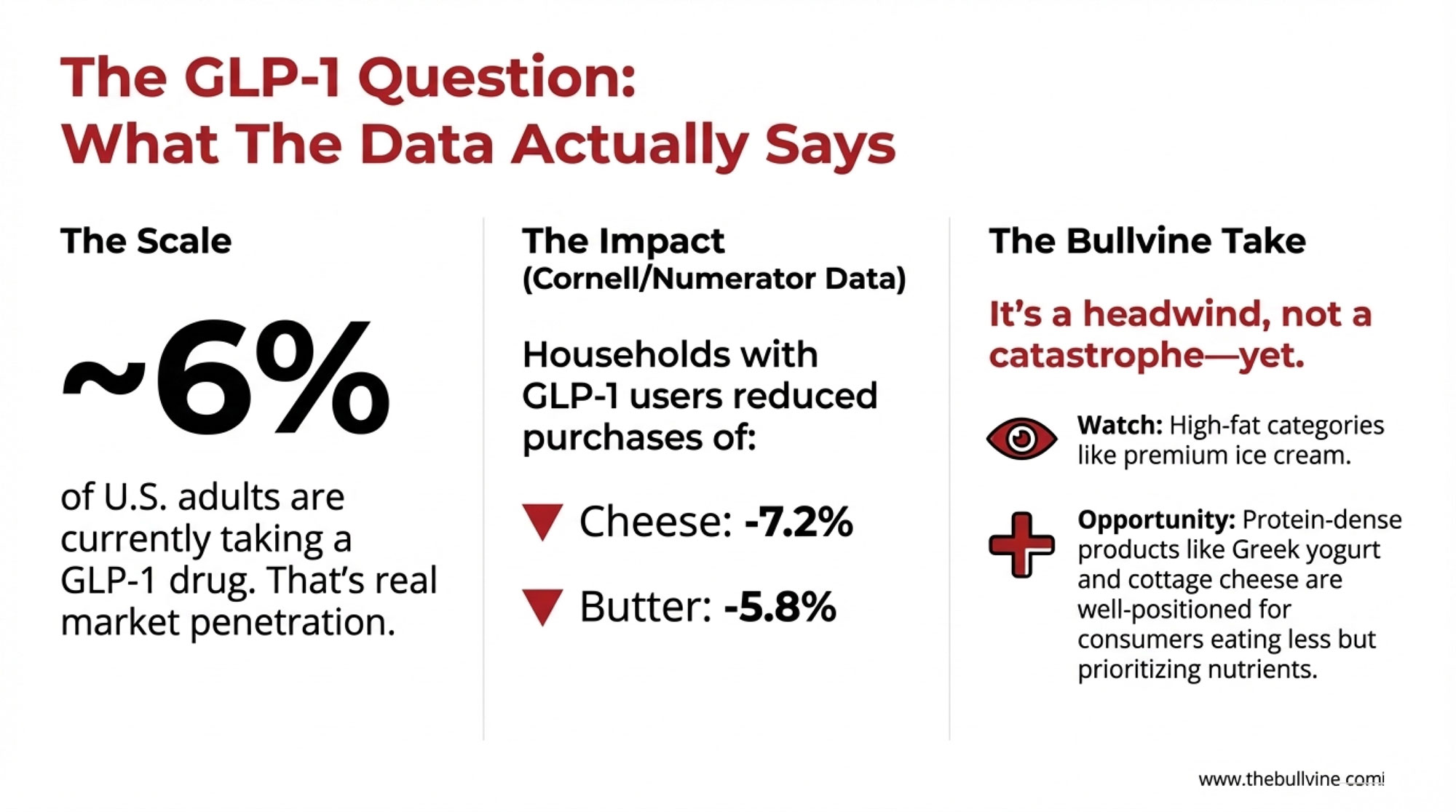
NewsSubscribe
First
Last
Consent

What Lactalis’s 270-Farm Cut Really Means for Every Producer

Only 11% of dairies under 300 cows are profitable. But three paths still work—if you move in the next 18 months.

EXECUTIVE SUMMARY: Lactalis cutting 270 dairy farms while investing $11 billion in processing isn’t a contradiction—it’s the clearest signal yet that commodity milk is finished and component quality now rules everything. The stark reality: 89% of dairies over 1,000 cows are profitable while only 11% under 300 cows make money, and this isn’t about management skill—it’s structural economics you can’t overcome with hard work alone. Three converging crises (interest rates doubling to 8%, heifer inventory at 20-year lows, and labor costs up 73%) have compressed what was once a gradual 5-year industry shift into an urgent 18-month decision window. Every dairy faces three paths: invest $6.75-10.25 million to scale beyond 1,000 cows, transition to premium markets (organic/specialty) despite 3-year losses, or exit strategically while you can still preserve family wealth. Real farmers are already choosing—a Minnesota couple successfully scaled to 1,100 cows, Vermont neighbors transitioned to organic, and a Wisconsin family preserved $2.1 million through strategic sale. The difference between 3.6% and 4.2% butterfat is now worth $529,000 annually for a 500-cow operation, making component performance literally the difference between survival and closure. Your window to control this decision closes in 18 months—after that, circumstances decide for you.

You know, when Lactalis—the world’s largest dairy processor—announces they’re cutting 450 million liters and ending contracts with 270 French farmers, we should probably pay attention. I’ve been digging into this, talking with producers, looking at the numbers… and what’s interesting is this isn’t just another market cycle. We’re seeing something bigger here, something that’s going to affect all of us, whether we’re milking 50 cows or 5,000.

What I’ve found is that the traditional commodity dairy model—you know, the one most of us grew up with—it’s changing faster than anyone expected. And the timeline to adapt? Well, that’s gotten surprisingly short.

The 89/11 Rule reveals the stark reality: structural economics, not management quality, determines survival in modern dairy

Understanding Why Processors Are Making These Moves

So here’s what caught my attention in Lactalis’s 2024 financials: €30.3 billion in revenue, but only 1.2% net profit margins. That’s down from 1.45% the year before. Now compare that to their premium products—the yogurt division they bought from General Mills is generating 15-20% operating margins. Premium cheese? Consistently 8-12% margins.

Lactalis’s supply director explained in their October statement that the valuation of excess milk is often very low and subject to market volatility—language that really reflects how processors are viewing commodity markets these days. When a processor that size essentially says commodity milk isn’t worth the trouble… well, that’s not just complaining, is it?

FrieslandCampina’s been going through similar challenges. They’ve talked about timing mismatches—buying milk at one price, processing it, then having to sell into a lower market. That kind of volatility makes it really tough to plan, and shareholders don’t like uncertainty.

The Component Game Has Changed Everything

Component performance is now non-negotiable—volume alone won’t pay the bills anymore

I was talking with a Wisconsin producer last week—he’s running 650 cows near Fond du Lac—and he helped me understand just how much components have shifted the whole economics of dairy farming. USDA data from November shows butterfat now represents 58% of your milk check value, and protein adds another 31%. Think about that… 89% of your income comes from components, not volume.

His neighbors who consistently hit 4.23% butterfat compared to the regional average of 3.69%? They’re capturing about $4.60 more per hundredweight. For a 500-cow operation producing 23,000 pounds per cow annually, that works out to roughly $529,000 in additional revenue—though your actual numbers will vary with production levels and regional premiums, of course.

Cornell’s latest farm business data shows some interesting patterns:

  • The big operations—1,000+ cows—they’re hitting 4.0-4.3% butterfat with 3.3-3.5% protein pretty consistently
  • Mid-sized farms, say 300-500 cows, generally average 3.6-3.8% butterfat, 3.0-3.1% protein
  • And here’s what’s telling: large farms maintain about 2% daily variation in components while smaller operations see 5-10% swings

Now, getting those high components isn’t just about genetics. You need systematic management—a good nutritionist runs $80,000 to $120,000 a year, based on what I’m hearing. Feed testing programs add another $15,000 to $25,000. Those precision feeding systems? Dealers are quoting $250,000 to $500,000, depending on what you need.

The math gets tough for smaller operations. When you spread the combined cost of nutritionist, vet services, and consultants across a thousand-cow operation, it might come to $0.08-0.12 per hundredweight. But for a 200-cow farm? You’re looking at $0.40-$0.60 per hundredweight for the same level of professional support. That’s a huge competitive disadvantage.

Three Things Hitting Us All at Once

Cornell’s dairy economics team has been documenting what they’re calling a compressed decision timeline, and I think they’re onto something. Three things have converged, forcing us to make decisions faster than we’re used to.

Three converging crises compressed a gradual 5-year industry shift into an urgent 18-month decision window

Interest Rates Hit Like a Hammer

Federal Reserve data shows operating loan rates doubled—went from about 4% in 2021 to over 8% by late 2023. Haven’t seen rates like that in 20 years. A lender in Pennsylvania told me that operations that were barely profitable at 4% are now losing $3,000 to $5,000 monthly.

The Illinois farm management folks found that farms carrying significant debt saw interest costs per tillable acre jump from $33 to $60 in three years. That’s 82% more in fixed costs, and you can’t pass that along to your milk buyer.

What really concerns me is the Q3 2024 ag lending data—operating loan volumes are up over 30% for the third quarter in a row. A Wisconsin banker friend put it best: “This isn’t growth borrowing, it’s survival borrowing.”

The Heifer Shortage Nobody Saw Coming

CoBank’s August report lays out a fascinating situation—dairy heifer inventory’s at a 20-year low just when we need expansion for all this new processing capacity.

Here’s how we got here: the breeding data shows beef semen sales to dairy farms tripled from 2.5 million units in 2017 to 7.2 million by 2020. Last year? 7.9 million of the 9.7 million total units were beef semen.

Can’t blame anyone really. When beef calves were bringing $1,000 to $1,500 last October, while it costs $2,200 to $2,500 to raise a heifer worth maybe $1,600… the math was obvious. Problem is, we all did the same math at the same time.

CoBank thinks we’ll lose another 800,000 head before things turn around in 2027. An Idaho producer told me he’s been offered $3,200 for breeding-age heifers—if he had any. “Five years ago at $1,400, I had too many,” he said. “Now I can’t find them at any price.”

Labor Is Getting Impossible

Texas A&M’s 2024 research shows that immigrant workers make up 51% of dairy labor and milk 79% of our cows. Their models suggest losing that workforce would cut U.S. milk production by 48.4 billion pounds annually. That’s not a typo.

And it’s not just finding workers—it’s affording them. USDA data shows dairy wages went from $11.54 an hour in 2015 to $18-20 by 2024. A large operations manager in New Mexico told me they’re at $28 an hour when you factor in housing, benefits, and recruitment. “And we still can’t stay fully staffed,” he added.

Three Producers Who Found Their Way Through

Despite all these challenges, I’ve met several operations that have successfully navigating this transition. Let me share what they did differently.

Smart Scaling in Minnesota

There’s a couple in central Minnesota who expanded from 350 to 1,100 cows between 2019 and 2023. They saw their co-op’s base program would limit growth for mid-sized farms, so they moved early. Got financing at 3.5% before rates spiked, used sexed semen exclusively for three years to build internally, and partnered with an experienced Venezuelan family.

What’s smart is they expanded in phases over four years—each phase had to cash flow before they moved to the next. They’re now shipping butterfat at 4.1% consistently and have signed a five-year contract with a cheese plant 40 miles away. Their breakeven’s around $17.50 per hundredweight, so they’ve got a cushion even when markets get tough.

Going Organic in Vermont

A Vermont family with 480 cows went organic in 2021—right when everyone said that market was full. Key thing? They got Organic Valley’s commitment in writing before starting the transition. They lost $210,000 over three years, but off-farm income and some timber sales bridged the gap.

Today, they’re netting $3.80 per hundredweight after all costs. “We focused on keeping cows healthy and production steady rather than trying to expand during transition,” the son told me. They maintained 92% of conventional production throughout the transition—well above the 85% average.

Making the Tough Call in Wisconsin

This one’s harder to talk about. A couple near Eau Claire sold their 280-cow operation in March 2024 after recognizing they were in what economists call the 18-month window—sustained losses with limited options. At 58, with kids established off-farm, expanding to a competitive scale meant $6 million in new debt.

They sold into a strong cull market, leased the cropland to a neighbor, and kept the house and 40 acres. The husband’s now using his 30 years of experience as a co-op field rep. “I sleep better, my wife’s happier, and financially we’re ahead,” he told me. They preserved about $2.1 million in equity that probably would’ve disappeared if they’d hung on another year.

Where All This New Processing Investment Is Going

Processors already chose their future—understand their strategy to predict yours

IDFA announced $11 billion in new processing capacity, and where that money’s going tells you everything about industry direction. Their October breakdown shows:

  • Cheese gets $3.2 billion—32% of everything
  • Milk and cream processing: $2.97 billion—30%
  • Yogurt and cultured products: $2.81 billion—28%
  • Butter and spreads: $1.23 billion—12%

Three new cheese plants in the Texas Panhandle need 20 million pounds of milk daily by mid-2025. But these aren’t commodity operations—they’re component extraction facilities making mozzarella for export while capturing valuable whey proteins.

What they’re NOT building? Commodity powder plants or basic fluid bottling. A processing engineer in Wisconsin explained it well: “We’re maximizing value from every component now. Just removing water to make powder doesn’t cut it anymore.”

And here’s something else—up in the Northeast, a couple of smaller specialty cheese operations just expanded. They’re not huge, but they’re finding success focusing on local markets and agritourism. Different model entirely from the big Texas plants, but it shows there’s more than one way forward. Out in California’s Central Valley, I’m seeing similar patterns with artisan operations carving out niches even as the big players consolidate.

The Cooperative Evolution We Need to Talk About

This is uncomfortable for many of us, but cooperatives have changed dramatically since DFA was formed in 1998 through regional mergers. They now control 30% of U.S. milk production, and after buying 44 Dean Foods plants in 2020, they’re both the biggest milk marketer AND processor.

A former board member explained how this creates tension: “When your co-op owns processing plants, optimizing those facilities becomes as important as your milk check—sometimes more important.”

Base-excess programs show this complexity. Cornell’s research indicates these programs typically use your best three consecutive months over three years as “base.” Milk over that? You might pay penalties of $5 to $13.30 per hundredweight.

A Vermont producer shared his frustration: “We wanted to add 50 cows to get more efficient, but overbase penalties would’ve killed any benefit. We’re locked at the current size.”

Meanwhile, operations that were already large when base programs started? They’re fine. It’s the 300-cow farms trying to grow to 500 that get squeezed.

Your Three Paths Forward—Let’s Look at Real Numbers

Path Comparison at a Glance

FactorScale UpGo PremiumStrategic Exit
Investment$6.75-10.25M$210-275K lossesPreserve equity
Timeline4-5 years3-year transition8-10 months optimal
Success Rate~20%Varies by market100% if timed right
Key RiskDebt burdenMarket saturationWaiting too long

Extension economists from Cornell and Wisconsin show that farms with sustained losses typically face critical decisions within 12-18 months. So what are your actual options?

Path 1: Scale Up to Compete

Investment Required: $6.75-10.25 million total

  • Buildings and infrastructure: $3.5-5.0 million
  • Cattle at current prices: $2.25-3.0 million
  • Feed base expansion: $500,000-1.5 million
  • Working capital: $500,000-750,000

Success Rate: According to lending industry estimates, about 20% achieve projected returns. Key Factor: Usually need family money for unexpected challenges. Financing Options: USDA FSA offers beginning farmer programs and guaranteed operating loans through participating lenders, though eligibility and terms vary by operation and region. Some states also have specific dairy expansion programs worth exploring.

Path 2: Find Your Premium Market

Organic Transition Example:

  • Typical losses: $210,000-275,000 over 3 years
  • Pay organic feed prices (30-50% higher) while getting conventional prices
  • Need written buyer commitment before starting
  • Must maintain 85%+ production through transition

Potential Returns: $2.45/cwt net (vs. -$5.29 for conventional, based on USDA 2023 data). Reality Check: Most regions aren’t currently seeking new organic production. Alternative Options: Consider grassfed certification, A2A2 markets, or local/regional branding

Path 3: Strategic Exit While You Can

Timing Matters—Example for 300-cow operation with $2M debt:

Exit at 8-10 months:

  • Assets bring ~$4.65 million
  • After $2M debt and costs ($230,000-390,000): $2.26-2.42 million preserved

Forced sale at 16-18 months:

  • Assets bring ~$3.4 million (discounted)
  • After everything: $650,000-970,000 retained

The difference: Over $1.4 million in family wealth

Three paths still work—but only if you move in the next 18 months. After that, circumstances decide for you

The Technology Wave is Coming Fast

I attended the Protein Industries Summit in Chicago last month, and what I heard was eye-opening. McKinsey’s early 2025 biotech analysis shows precision fermentation has already hit cost parity for certain dairy proteins. Boston Consulting thinks these proteins will be five times cheaper than ours by 2030.

Here’s what’s already happening—Perfect Day’s animal-free whey is in Ben & Jerry’s ice cream right now. Not someday. Today. Fonterra’s partnerships with Superbrewed Food and Nourish Ingredients show where big players are heading. Fonterra indicated in its August 2024 announcements that ingredients from these technologies can be used alongside traditional dairy products. Translation: they’re building systems that can use proteins from cows or fermentation tanks—whatever’s cheaper.

And it’s not just startups anymore. I’m seeing major food companies quietly building fermentation capacity. They’re hedging their bets, preparing for a world where they can source proteins from multiple streams.

How This Hits Different Regions

This transformation affects regions differently, and understanding your local dynamics matters.

California: UC Davis research shows farms with less than 22% quota coverage pay more into the system than they get back. “We’re subsidizing the big quota holders,” a Tulare County producer told me.

Southeast: Maintains higher Class I fluid use—over 60% according to Federal Orders—which provides some buffer since processors need consistent daily deliveries. But even there, consolidation pressure is building.

Upper Midwest: All about cheese, so components rule everything. Wisconsin processors consistently tell me 4% butterfat is their practical minimum for preferred suppliers.

Plains States: Seeing aggressive expansion with new processing, but these plants want a minimum of 50,000+ pounds daily per farm. Can’t deliver that volume? You won’t get a contract.

Pacific Northwest: Interesting developments with smaller operations finding niches in farmstead cheese and direct marketing. Not for everyone, but it’s working for some.

Northeast: Beyond the specialty cheese operations, there’s also growth in agritourism and on-farm processing. Entirely different economics, but viable for the right location.

Western States: Water rights and environmental regulations adding another layer of complexity to expansion decisions.

Questions to Ask Yourself Right Now

Before you make any big decisions, honestly assess:

  • Are you covering all costs, including family living?
  • Can you achieve 4%+ butterfat consistently?
  • Do you have succession lined up?
  • What’s your debt-to-asset ratio?
  • Could you survive another year like 2023?
  • What would happen if you lost two key employees tomorrow?
  • Is your processor investing in commodity or specialty capacity?
  • Are there emerging environmental regulations that could affect you?

What This All Means for Your Planning

After looking at all this, here’s what I think matters most:

Component performance isn’t negotiable anymore. The difference between 3.6% and 4.2% butterfat can mean hundreds of thousands annually for a 500-cow operation. That fundamentally changes farm economics.

That 12-18 month window Cornell documented? It’s real. Interest rates, heifer availability, and labor costs compressed what used to be a multi-year adjustment into a much shorter period. Within the next 12-18 months—essentially by mid-2026, based on the timeline Cornell economists have documented—many operations will have made their choice, voluntarily or not.

Scale economics show clear breaks. USDA data showing 89% profitability for 1,000+ cow operations versus 11% for under 300 cows… that’s not about who’s a better manager. It’s structural advantages smaller operations can’t overcome.

Your processor’s strategy matters more than ever. If they’re investing in commodity powder, you’ve got time. If they’re building component extraction or specialty facilities, that tells you something different.

Technology adoption keeps accelerating. The Good Food Institute tracked $840 million in precision fermentation investment last year. Alternative proteins are moving from the experimental to the commercial stage faster than most of us expected.

Risk management tools—like Dairy Margin Coverage and Dairy Revenue Protection—might buy you time but won’t change the fundamental economics. They’re Band-Aids, not cures.

The Bottom Line

What Lactalis is doing—cutting 450 million liters while investing in premium capacity—makes sense when you understand their strategy. They’re consolidating relationships with farms that can deliver consistent, high-component milk at scale while preparing for fermentation-derived proteins.

The Minnesota couple who scaled smart, the Vermont family succeeding in organic, the Wisconsin couple who preserved wealth through planned exit—they all made different choices. But they shared a realistic assessment of where things are heading and made decisions accordingly.

For those of us still figuring out our path, an honest assessment of where we fit in this evolving structure is critical. Whether that means pursuing scale, finding premium markets, or planning transition, the key is making informed decisions while we still have options.

And if you’re wondering about the next generation—I talked with several young farmers recently. The ones succeeding are incredibly sharp, using technology in ways we never imagined, and they’re not afraid to try completely different models. That gives me hope, even as things change.

The dairy industry will keep producing milk—consumers guarantee that. But who produces it, how it’s valued, and what matters most? That’s changing fundamentally. Understanding where your operation fits in that transformation might be the most important analysis you do this year.

Because waiting for things to “go back to normal”? Well, I think we all know that ship has sailed.

The Bullvine provides ongoing analysis and resources at www.thebullvine.com. Cornell’s Dairy Markets and Policy program and Wisconsin’s Center for Dairy Profitability offer valuable planning tools. The producer experiences shared here reflect confidential discussions, with identifying details modified for privacy.

KEY TAKEAWAYS

  • You Have 18 Months to Decide: Cornell economists confirm sustained losses trigger forced decisions within this window—control your choice now or lose that option forever
  • Three Paths Still Work: Scale to 1,000+ cows ($6.75-10.25M investment, 20% success rate) | Go premium (organic/A2/grassfed, 3-year transition) | Exit strategically (preserves $1.4M more than waiting)
  • Components = Survival: The 0.6% butterfat difference between average and top herds is worth $529,000/year, and processors are making this gap the entry requirement
  • The 89/11 Rule: 89% of 1,000+ cow dairies profit while only 11% under 300 cows survive—this is structural economics, not management quality
  • Processors Already Chose: They’re investing $11B in component extraction while cutting commodity suppliers—understand their strategy to predict your future

Complete references and supporting documentation are available upon request by contacting the editorial team at editor@thebullvine.com.

Learn More:

Join the Revolution!

Join over 30,000 successful dairy professionals who rely on Bullvine Weekly for their competitive edge. Delivered directly to your inbox each week, our exclusive industry insights help you make smarter decisions while saving precious hours every week. Never miss critical updates on milk production trends, breakthrough technologies, and profit-boosting strategies that top producers are already implementing. Subscribe now to transform your dairy operation’s efficiency and profitability—your future success is just one click away.
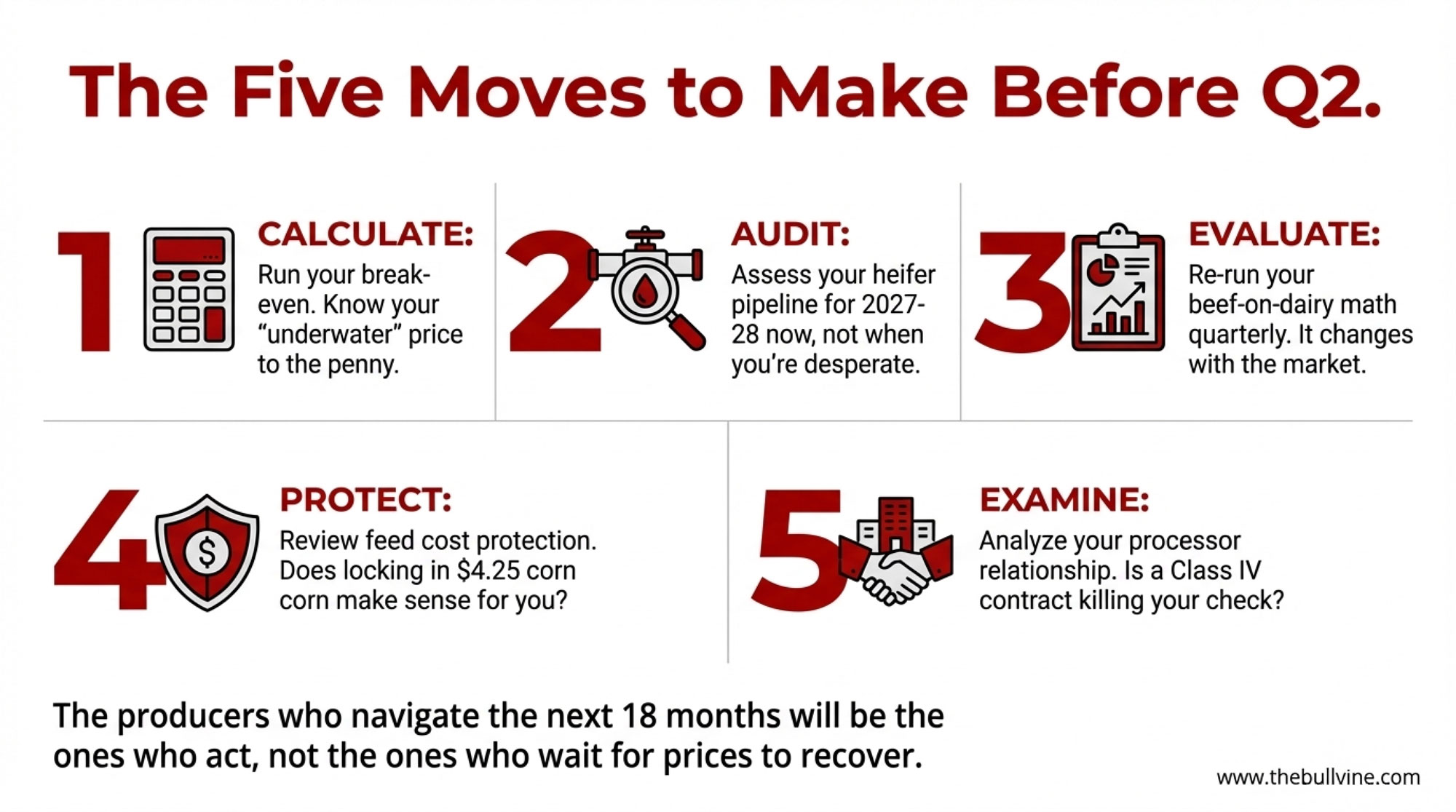
NewsSubscribe
First
Last
Consent

The Four Numbers Every Dairy Producer Needs to Calculate This Week

26,000 dairy farms are expected to drop to 20,000 by 2028. Which side of that line are you on? Four numbers will tell you

Executive Summary:  With milk stuck below $14/cwt through 2026 while global production rises 3-6%, this isn’t a downturn—it’s a restructuring. Five permanent changes (beef-on-dairy heifer shortage, China’s self-sufficiency, technology cost gaps, fixed-cost production traps, and processor overcapacity) mean the old recovery playbook is dead. Right now, mega-dairies operate at $13.80/cwt, niche producers capture $8-12 premiums, but mid-sized farms (500-1,500 cows) hemorrhage cash at $18-21/cwt. I’ve developed a four-number framework—true cost per cwt, liquidity runway, competitive investment ratio, and niche premium potential—that reveals your best path forward in minutes. Calculate these this week to determine whether you should expand, pivot to premium markets, or execute a strategic exit while you control the terms. The industry will shrink from 26,000 to 20,000 farms by 2028, but producers who act decisively in the next 90 days can still position themselves to thrive.

Dairy Farm Business Strategy

You know, I was checking the CME futures board this morning—Class IV milk sitting below $14/cwt all the way through February 2026—and it really got me thinking about what we’re all dealing with right now. Here’s what’s interesting: while we’re staring at these terrible prices, the production reports from early October show New Zealand’s up 3% year-over-year, Ireland’s pumping out nearly 6% more milk, and Belgium’s somehow surging 6.5%.

You’d think somebody would cut back, right? But they can’t. And that’s what makes this whole situation fundamentally different from anything we’ve weathered before.

The Profitability Death Zone: Only mega-dairies survive below $14/cwt milk prices while mid-size operations hemorrhage $5-7 per hundredweight

The Five Structural Changes We’re All Navigating Together

The Beef-on-Dairy Shift That’s Bigger Than We Realized

The Beef-on-Dairy Revolution: Farmers are choosing $1,000 in 7 days over $3,850 invested for 30 months—and it’s permanently shrinking the heifer pipeline by 700,000-800,000 head

So here’s something that’s really caught my attention—and I think most of us have been surprised by how big this has gotten. The National Association of Animal Breeders’ latest sales data shows beef semen sales to dairy operations jumped almost 18% last year alone. What started as a way to manage margins has become something much more structural.

I was talking with a producer in central Wisconsin last week—third-generation operation, really sharp guy—and he walked me through his breeding decisions. With those week-old beef-cross calves bringing $800 to $1,200 at regional auctions (I saw some exceptional ones hit $1,400 at Dairyland), and compare that to the $3,200 to $4,500 it costs to raise a replacement heifer to breeding age… well, the math’s pretty clear. Penn State Extension’s budgets back this up, though honestly, if you’re in an area with higher feed costs, you might be looking at even more.

What’s particularly worth noting is how this revenue stream—often covering 12-16% of total farm income—has become essential for cash flow, especially for making those monthly debt service payments. But here’s the thing that’s really starting to bite: once you commit to this breeding strategy, you’re locked in for at least 30 months. That’s just biology—you can’t speed up getting a heifer from conception to first lactation.

I was chatting with one of CoBank’s dairy economists at a meeting recently, and they’re suggesting the US dairy heifer inventory could shrink by 700,000 to 800,000 head through 2027. Even if milk prices doubled tomorrow—and let’s be honest, we all know they won’t—we simply can’t produce replacement heifers any faster than nature allows.

China’s Role Has Completely Changed

China’s Demand Collapse: The global dairy safety valve that rescued oversupply in 2009 and 2015 has permanently closed—imports down 30% while domestic production soars past 42 million tonnes

Remember how China always seemed to bail us out? You probably know this pattern—2009, 2015… we’d get oversupplied, prices would tank, and then Chinese demand would gradually soak up the excess. Well, that playbook’s done, and we need to accept it.

The China Dairy Industry Association’s data shows their per capita consumption dropped from 14.4 kg in 2021 to 12.4 kg in 2022, and from what I’m hearing from folks in the export business, it hasn’t bounced back. Meanwhile—and this is what’s really changed the game—their domestic production hit nearly 42 million tonnes in 2023. They actually exceeded their own government targets.

Looking at the customs data from August, whole milk powder imports into China were down over 30% year-over-year, while skim milk powder imports were down about 23%. I’ve noticed many of us still talk about Chinese demand “recovering,” but honestly? They’re dealing with their own oversupply while facing declining birth rates and changing dietary preferences among younger consumers. That safety valve we used to count on… it’s gone.

The Technology Gap That’s Becoming a Canyon


Farm Size
CowsRobot InvestmentAnnual Debt ServiceProduction GainLabor SavingsNet Annual BenefitROI at $20ROI at $14
Mega-Dairy3,800$2.7M (12 robots)$220K+$684K+$840K+$1,304K✓ PROFITABLE✓ PROFITABLE
Mid-Size (TRAP)500$900K (4 robots)$85K+$90K+$280K+$285K✓ Barely profitable✗ LOSES MONEY
Small Farm180$450K (2 robots)$43K+$32K+$140K+$129K✗ Marginal✗ UNPROFITABLE

You probably already know this, but that USDA Economic Research Service report—”Profits, Costs, and the Changing Structure of Dairy Farming”—really lays it all out. Farms with 2,000+ cows are running total production costs around $23/cwt. Smaller operations with 100-199 cows? They’re looking at $32-33/cwt. That’s a $10 gap, and here’s the thing: technology is making it wider, not narrower.

My neighbor just got quotes for a robotic milking system—both DeLaval and Lely are quoting $180,000 to $230,000 per unit right now. For his 500-cow operation, he’s looking at a minimum of $900,000 for the robots alone, plus another $200,000 for barn modifications. At current Farm Credit rates—which are running 7.5-8.5% for most of us with decent credit—that’s $85,000 to $90,000 annually just in debt service.

Now, the big dairies installing these systems are seeing real gains—8-10 pounds more milk per cow daily, plus labor savings of $60,000 to $80,000 annually per robot. But here’s what nobody wants to say out loud at the co-op meetings: the return on investment only works at scale. University of Minnesota Extension did this analysis showing robots can be profitable at $20 milk but lose significant money at $15. And where are prices heading?

A producer out in California shared something interesting with me last month—they’ve got 3,800 cows, and went fully robotic two years ago. “Best decision we ever made,” he said, “but only because we had the volume to spread those fixed costs. My neighbor with 600 cows? Same robots would bankrupt him at these prices.”

Why We Keep Milking Even When We’re Losing Money

This one puzzles a lot of people outside the industry, but if you’ve been doing this a while, you get it. Cornell’s Program on Dairy Markets and Policy explained it really well in one of their recent webinars—pasture-based systems like those in New Zealand and Ireland have completely different cost structures than our confinement operations here in the States.

DairyNZ’s economic surveys show their typical operation has variable costs around NZ$4.50 per kilogram of milk solids—that works out to roughly $7/cwt for us—but fixed costs that come to about $12/cwt. Think about that for a minute. When milk drops to $12/cwt, if they stop milking, they still owe that $12 in fixed costs, but lose the $5 that’s at least helping cover some of it. So they keep milking, even at a loss.

Irish producers are in the same boat. Teagasc’s reports show that Irish dairy farmers invested over €2.2 billion in expansion after the abolition of quotas in 2015. Those loans don’t just disappear when milk prices crash. The Central Bank of Ireland’s latest data shows 64% of Irish dairy farms carrying debt averaging over €117,000. You can’t just turn that off.

Processing Plants Running Half Empty

Here’s something that doesn’t get enough attention, but it’s affecting all of us. The International Dairy Foods Association has been tracking this—US processors have invested billions in new plant capacity over the last few years, expecting the kind of production growth we saw in the 2010s. But USDA’s Milk Production reports show we’re growing at maybe 0.4-0.5% annually. They built for 2-3% growth.

I was talking with a cheese plant manager in Wisconsin last month—won’t name names, but you’d know the company—and he put it pretty bluntly: “We’ve got a $45 million plant running at 60% capacity. We need milk, but we can’t pay farmers enough to make them profitable because Walmart won’t pay us more for cheese.”

That’s creating this weird dynamic where processors actually benefit from low farmgate prices as long as they can maintain their retail contracts. It’s not some conspiracy—it’s just economics playing out in a way that hurts us at the farm level.

Looking Back: Why This Isn’t Like 2009 or 2015

The Dairy Apocalypse Timeline: 21,809 farms wiped out between 2017-2028, with the steepest decline coming in the next 3 years as milk prices crater below break-even

It’s worth looking at how we got here, because understanding the differences helps explain why the old recovery patterns won’t work this time…

2009 was actually pretty straightforward. Lehman Brothers collapsed, credit markets froze, and people stopped buying. Class III went from $20 to $9 in six months. But once the economy recovered, so did we. By 2011, we were setting price records again.

2015 was about oversupply. The EU eliminated quotas on March 31st after 31 years. European production jumped 6% almost overnight. Russia banned imports. China had too much inventory. But eventually producers cut back, China started buying again, and markets found their balance within 18 months.

This time? We’ve got five structural changes all hitting at once. The beef-on-dairy heifer shortage that’s locked in for years. China is becoming self-sufficient rather than our backstop. Technology is creating cost gaps that can’t be bridged. Fixed costs that prevent production cuts. And processors built for growth that isn’t happening. There’s no single fix because these aren’t temporary problems—they’re permanent changes to how the industry works.

Seven Leading Indicators That’ll Signal the Turn

If you want to know when this market really turns—and I mean actually turns, not just bounces around—here’s what I’m keeping an eye on:

Weekly dairy cow slaughter – USDA reports every Thursday
Looking for sustained rates 15-25% above year-ago levels for 8+ weeks. Currently running 5-8% below average. When slaughter spikes above 65,000 head weekly, that’s capitulation.

CME spot whey prices
Holding at 71-72¢ while cheese crashed from $2.20 to $1.70/lb. Breaking above 75¢ signals genuine demand recovery.

Cold storage inventories
October cheese shipments totaled 1.48 billion pounds, up 5.2% year-over-year. Need two consecutive months of meaningful drawdowns.

Export volumes
Need 8-12% year-over-year growth to signal international demand strength. Currently flat to slightly positive.

Heifer inventory reports
July 2026 USDA report will be critical—looking for the first stabilization since 2021.

Futures curve shape
Currently in contango. Shift to backwardation signals near-term tightness.

Chapter 12 bankruptcy rates
Up substantially in Q1 2025. Peak usual coincides with the market bottom.

Three Types of Operations Emerging from This

Based on what I’m seeing across the country—and USDA’s Census of Agriculture data backs this up—here’s how I think this shakes out by 2028:

The Big Operations Will Get Bigger

These operations with 5,000 to 25,000 cows aren’t just surviving—they’re actively expanding. I visited a 7,500-cow dairy near Amarillo recently that’s running all-in costs at $13.80/cwt. They’re buying herds from struggling neighbors at 60-70 cents on the dollar and integrating them pretty seamlessly.

With private equity backing and professional management teams—and look, I know how we all feel about that, but it’s the reality—these operations will probably control over half of US milk production within three years. They’re not the enemy; they’re just adapting to the economic reality we’re all facing.

Premium Niche Players Will Do Just Fine

The October Organic Dairy Market News shows organic certification still pays an $8-12/cwt premium over conventional. A friend of mine in Vermont—she’s got 95 cows, beautiful grass-fed operation—is getting $45-48/cwt selling directly to consumers through her on-farm store and a handful of local restaurants.

These operations compete on story and quality, not efficiency. If you’ve got the right location, marketing skills, and family commitment to make it work, this can be really successful. But let’s be realistic—it’s maybe 1,500 to 2,500 farms nationally that can pull this off.

I know a family in Pennsylvania—180 cows—who transitioned to organic three years ago. The husband told me over coffee last month: “We’re netting more on 180 organic than we ever did on 350 conventional. But man, those three transition years nearly broke us financially and emotionally, and my wife’s at farmers markets every Saturday and Wednesday year-round. It’s a complete lifestyle change.”

The Middle Is Really Struggling

This is hard to say, but if you’re running 500-1,500 cows producing commodity milk, the math is really challenging. Farm Credit’s benchmarking across multiple regions shows operations this size averaging $18-21/cwt in total costs. You’re $5-7 above the mega-dairies but can’t access the premiums that niche markets provide.

Between 2017 and 2022, USDA census data shows we lost 15,866 dairy farms while milk production increased by 5%. And honestly, that trend seems to be accelerating rather than slowing down.

Your Four-Number Reality Check

“We’ve got a $45 million plant running at 60% capacity. We need milk, but we can’t pay farmers enough to make them profitable because Walmart won’t pay us more for cheese.” – Wisconsin cheese plant manager

Look, I know nobody wants to do this kind of analysis when things are tough, but you really need to sit down—pour yourself a coffee—and work through these four calculations honestly:

1. Your True All-In Cost Per Hundredweight

Include everything—cash costs, debt service, family living draws, depreciation, and opportunity cost of your labor.

  • Under $16/cwt: You might make it work with expansion or efficiency gains
  • $16-18/cwt: You’re marginal—evaluate all options
  • $18-21/cwt: Need a transition plan within 12 months
  • Over $21/cwt: Everyday costs you equity

2. How Many Months of Runway Do You Have?

Available cash and credit divided by the monthly losses at $14 milk.

  • 6+ months: Time to be strategic
  • 3-6 months: Decide within 30 days
  • Under 3 months: Crisis mode—act immediately

3. What Would It Take to Get Competitive?

Investment required to reach $15/cwt divided by available capital.

  • Under 2.0: Expansion might work
  • 2.0-3.0: Pretty risky
  • Over 3.0: Expansion won’t save you

4. Could You Make a Niche Work?

Net premium after transition costs. The Northeast Organic Dairy Producers Alliance shows $3-7/cwt additional cost during transition.

  • Premium covers 40%+: Strong pivot candidate
  • 25-40%: Possible with passion
  • Under 25%: Math doesn’t work

Your 90-Day Action Plan

Based on where you fall in those calculations:

If You’re a Survivor (costs under $17/cwt, 6+ months liquidity):
Lock in feed costs now. Get maximum Dairy Revenue Protection. Model expansion scenarios. Position for Q2 2026 asset opportunities.

If You’re Facing an Exit (costs $18-22/cwt, limited liquidity):
Consult an attorney confidentially. Get a professional appraisal. Gauge neighbor interest discreetly. Act before banks force decisions.

If You’re Considering a Niche (strong local market, family commitment):
Start organic certification now (36-month process). Test farmers markets. Run realistic equipment costs. Ensure family buy-in.

If You’re in Crisis (under 3 months liquidity):
Call an attorney today. Cull aggressively for cash. List sellable assets. Understand personal versus farm-only debt.

The Reality We’re Facing

What makes this downturn different is that all the traditional recovery mechanisms have changed. China’s not coming to rescue us from oversupply. The advantages of technology are growing, not shrinking. Fixed costs mean producers keep producing even when they’re losing money. And processing overcapacity creates all kinds of weird incentives that work against us.

The industry that emerges by 2028 will probably have 20,000 to 22,000 farms, down from about 26,000 today. Maybe 800 mega-dairies will produce 60% of our milk. Another 2,000 or so niche operations will serve premium markets. And the middle—those 500-1,500 cow operations that have been the backbone of dairy for generations—most of them will be gone.

If you’re in that middle tier, you’ve got maybe 90 days to make a strategic decision while you still have some control over the outcome. Calculate those four numbers. Be honest with yourself about what they tell you. Make your move.

Because by March, the producers who waited will wish they’d acted sooner. And I really don’t want you to be one of them. We’ve all worked too hard, sacrificed too much, to let this restructuring take everything from us.

Look, there’s still opportunity in this industry. But it’s going to look different than what most of us grew up with. Understanding that—and adapting to it while you still have options—that’s what’s going to separate those who thrive from those who just survive.

Stay strong, make smart decisions, and remember—there’s no shame in strategic change. There’s only shame in letting pride destroy what you’ve built.

Key Takeaways:

  • Your survival depends on four numbers: Calculate your true all-in cost/cwt, months of liquidity at $14 milk, investment needed to hit $15/cwt, and net premium from going niche—this week
  • The cost gap is unbridgeable: Mega-dairies operate at $13.80/cwt, small organic farms capture $45-48/cwt, but mid-size operations bleed cash at $18-21/cwt with no fix
  • Five permanent changes killed recovery: 72% beef-on-dairy locked through 2027, China down 30% on imports, tech ROI only at 2,000+ cows, fixed costs prevent production cuts, processors 40% overcapacity
  • 90 days to choose your path: Expand to 2,500+ cows, transition to premium niche, or execute strategic exit—after March, banks choose for you
  • 20,000 farms by 2028 (down from 26,000 today), but producers who act now can position themselves on the winning side

Complete references and supporting documentation are available upon request by contacting the editorial team at editor@thebullvine.com.

Learn More:

Join the Revolution!

Join over 30,000 successful dairy professionals who rely on Bullvine Weekly for their competitive edge. Delivered directly to your inbox each week, our exclusive industry insights help you make smarter decisions while saving precious hours every week. Never miss critical updates on milk production trends, breakthrough technologies, and profit-boosting strategies that top producers are already implementing. Subscribe now to transform your dairy operation’s efficiency and profitability—your future success is just one click away.
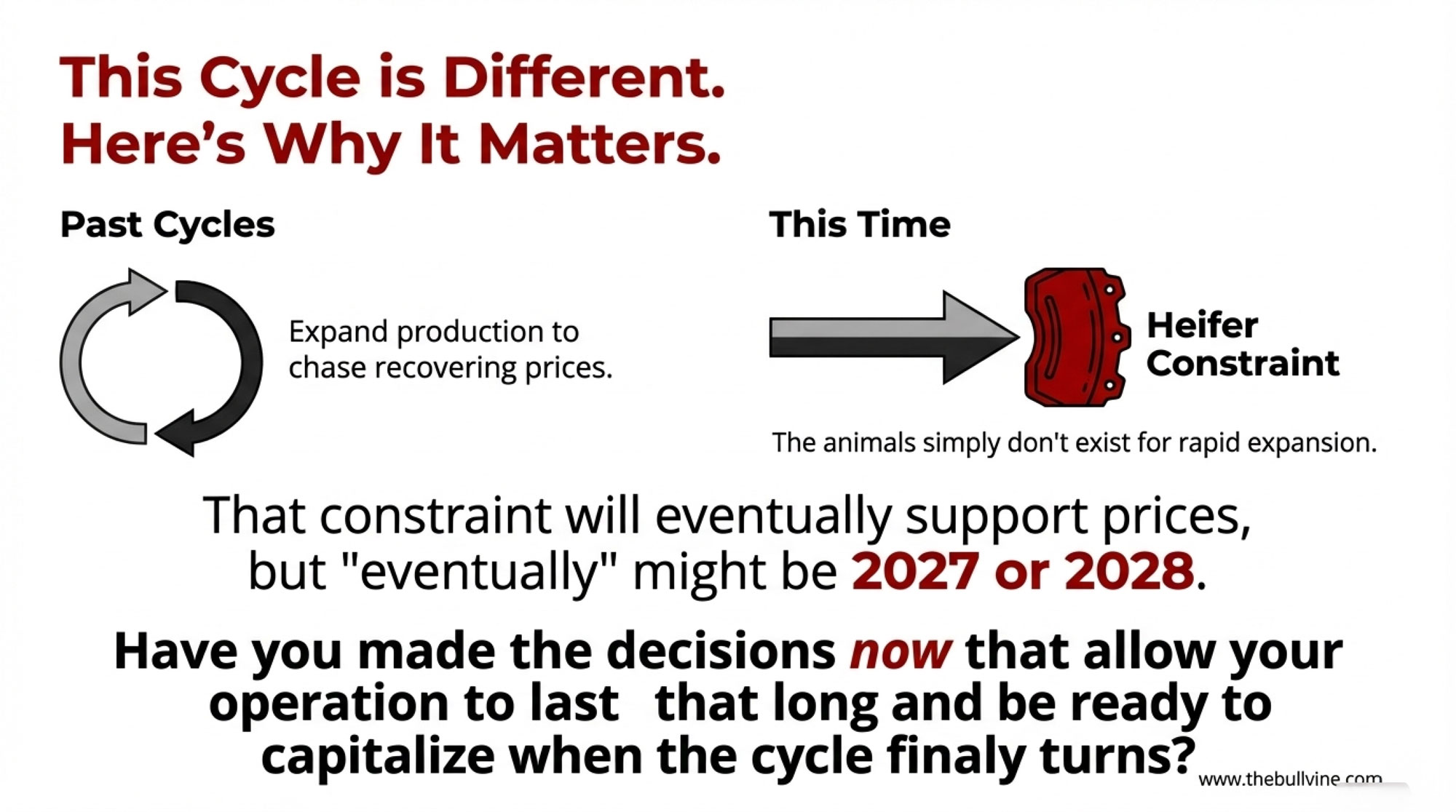
NewsSubscribe
First
Last
Consent
Send this to a friend