Archive for Genetics

When Red × Red = Black: A Holstein Breeder’s Guide to Variant Red (COPA Gene)

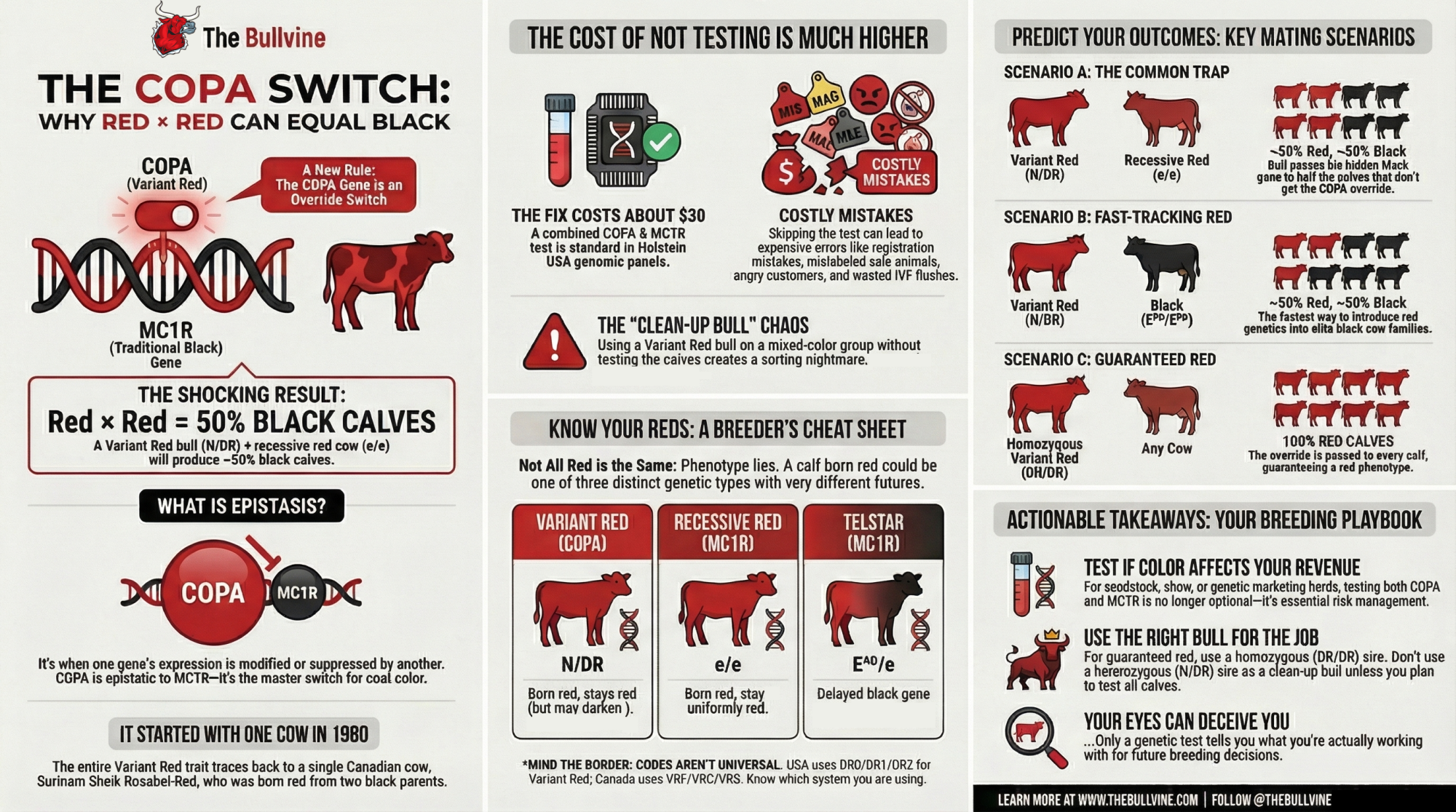
Red × Red should equal Red. But half your calves came out black. The COPA gene is the override switch you didn’t know existed.

For decades, Holstein breeders operated on a simple truth: Black dominates Red. It was a comfortable, binary rule—and one that served us well for generations. But here’s the thing: it was incomplete as well.

The emergence of Variant Red (COPA) hasn’t just added a new color pattern to our toolbox; it’s also changed the way we think about color. It’s exposed a blind spot in how we think about genetic pathways. And if you’re making mating decisions without accounting for this “override” switch, you’re working with incomplete information. That costs money.

The Mechanic: Two Systems, One Outcome

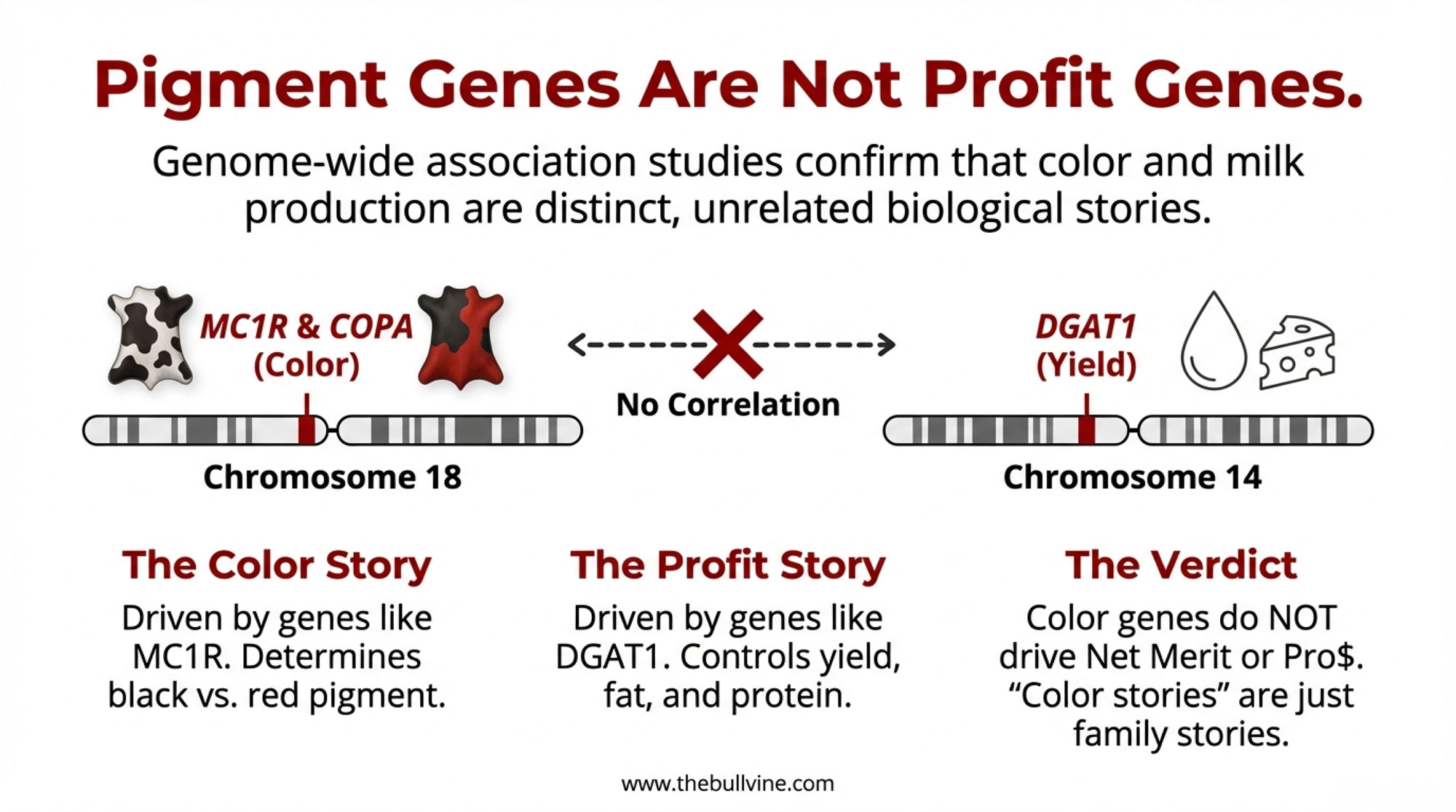
You probably already know the old model. The MC1R gene—what geneticists call the Extension locus—controls coat color through a clear dominance hierarchy: E^D (dominant black) > E^BR (Telstar) > E^+ (wild-type) > e (recessive red). Two copies of e gives you a red calf. Simple enough.

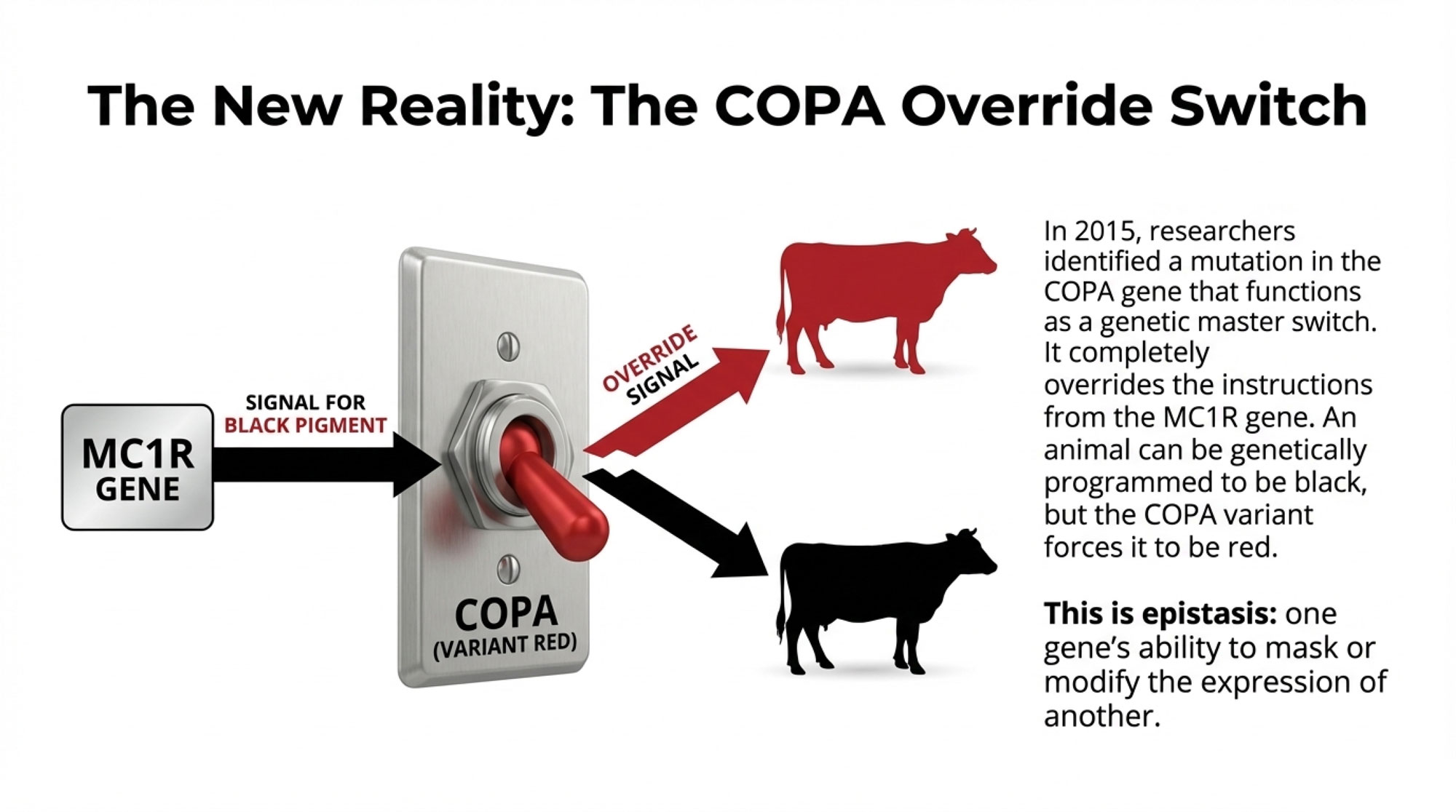
Then in 2015, researcher Ben Dorshorst and an international team published findings in PLOS ONE that changed everything. They identified a second switch: a mutation in the COPA gene that produces what we now call Variant Red. The critical discovery? COPA overrides MC1R entirely. An animal can be genetically programmed to be black at MC1R, but if it carries the COPA variant, it still expresses red. A decade of breeding experience and subsequent genetic research has validated this finding—the mechanism holds up.

This is epistasis in action—one genetic pathway superseding another. Practically, it means that phenotype alone tells you nothing about what’s actually happening under the hood.

The good news? We now have reliable tests for both systems. UC Davis Veterinary Genetics Laboratory offers both COPA and MC1R panels, and Holstein Association USA includes both in their standard genomic testing. Once you know both pieces, you can actually plan your color outcomes instead of guessing.

The Cheat Sheet: Mating Outcomes at a Glance

Let me walk you through the scenarios breeders ask about most. This is the section you’ll probably want to bookmark.

Scenario A: Variant Red Sire (N/DR) × Black Dam (E^D/E^D)

  • Outcome: ~50% Red / ~50% Black
  • What’s happening: Red calves inherit the dominant DR allele, which overrides their black MC1R genetics. Black calves inherit the N allele and express normally.

Scenario B: Variant Red Sire (N/DR) × Recessive Red Dam (e/e)

  • Outcome: ~50% Red / ~50% Black (if sire carries E^D at MC1R)
  • What’s happening: This scenario assumes your Variant Red bull is carrying the Dominant Black gene (E^D) “underneath” his red coat—which many do, since the COPA mutation originated in black Holsteins. Red calves inherit DR (Variant Red) and express red regardless of MC1R. But calves inheriting N from the sire are now N/N at the COPA locus (no override present). If they also inherit E^D from the sire and e from the dam, they genotype as E^D/e at MC1R—which results in a black phenotype. Important note: If your Variant Red bull happens to be e/e (recessive red) at MC1R, he won’t throw black calves even when passing N—but this is less common.

Scenario C: Homozygous Variant Red Sire (DR/DR) × Any Dam

  • Outcome: 100% Red
  • What’s happening: Every calf inherits at least one DR allele. The override is guaranteed. This is your cleanest path to predictable red outcomes.

Scenario D: Telstar (E^BR) Animals

  • Outcome: Born red, turn black within 2-6 months
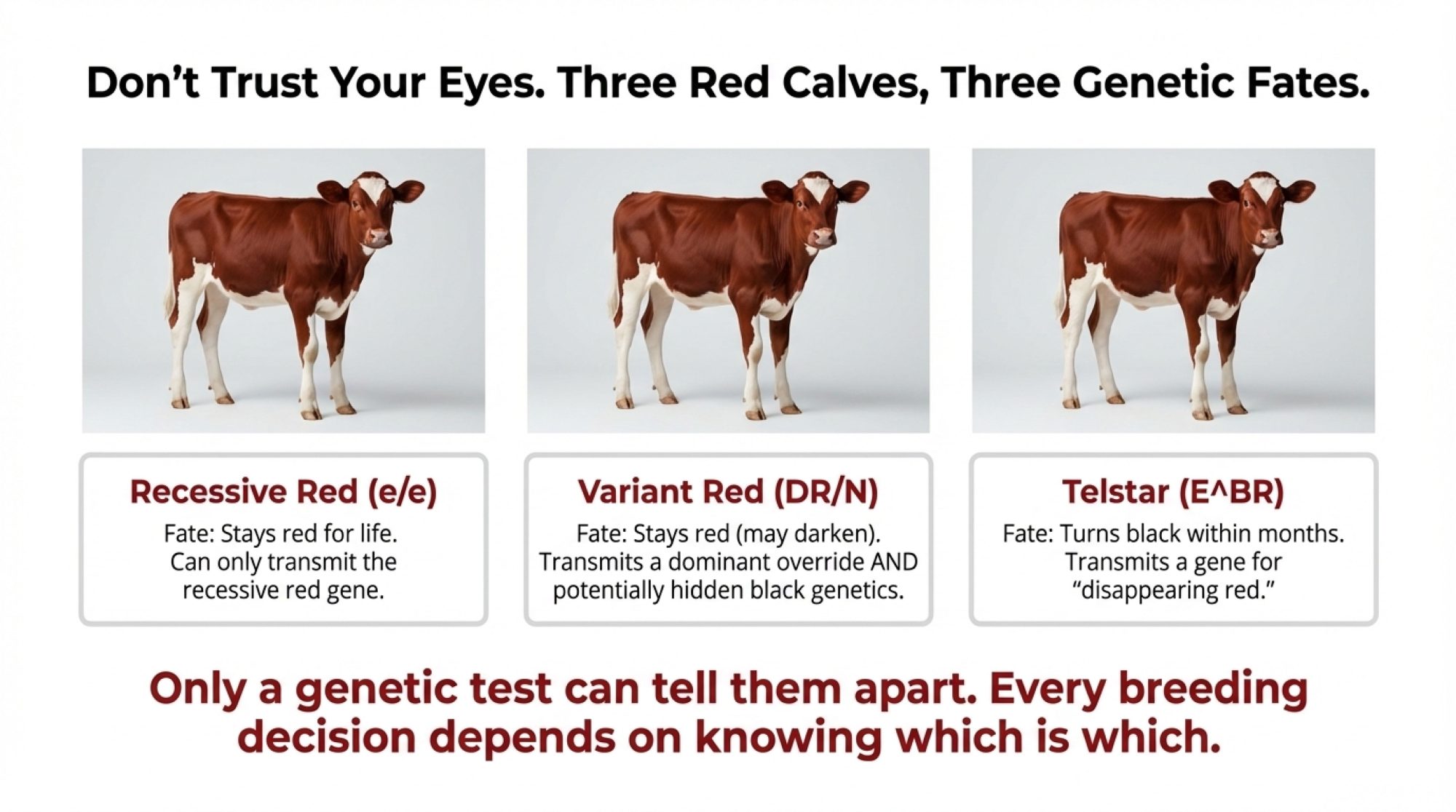
  • What’s happening: Completely different mechanism—MC1R timing, not COPA override. Don’t confuse these in your records.

The Trap: When Red × Red = Black

This scenario deserves special attention because it’s the one that burns breeders most often.

You have a nice Variant Red bull (N/DR). You breed him to your recessive red cows (e/e). You’re expecting all-red calves—makes sense, right? Red bull, red cow, red calves.

Except that about half those calves come out black. What gives?

Here’s what’s happening genetically: Your N/DR bull passes either N or DR to each calf (50/50 chance). The calves that get DR are red—the override kicks in, and they express Variant Red. But the calves that get N are now N/N at the COPA locus (no override present), assuming your dam is N/N like most Holsteins. If those calves also inherit E^D from the sire and e from the dam, they genotype as E^D/e at MC1R—and since Dominant Black is dominant over recessive red, you get a black calf.

The key detail here: this trap only springs if your Variant Red bull carries E^D at MC1R. Many do—the COPA mutation originated in black Holstein lines, so most Variant Red animals are “hiding” black genetics underneath that red coat. But if your bull happens to be e/e at MC1R (homozygous recessive red), he can’t pass E^D, and you won’t see black calves even when he passes the N allele.

This is exactly why UC Davis VGL’s documentation is explicit: phenotype cannot distinguish between color mechanisms. You need to test both COPA and MC1R to know what you’re actually working with.

Select Sires addresses this directly in their bull catalogs. Their DR1 code indicates heterozygous Variant Red status, and their technical materials—using LUCKY SEVEN-RED as an example—walk through exactly these scenarios. That’s the kind of transparency the whole industry should be moving toward.

The Money: Testing Costs vs. Breeding Errors

Let’s talk economics, because this is where the rubber meets the road.

Testing costs are pretty reasonable. UC Davis VGL lists coat color testing at $30 for the first test and $10 for each additional test on the same animal (pricing as of October 2023—worth verifying current rates at vgl.ucdavis.edu/pricing/cattle before you budget).

The cost of NOT testing? That’s where it gets expensive.

The Telstar Trap: You sell a red heifer as breeding stock. Buyer’s excited, pays a premium for red genetics. Six months later, she’s turned black. Now you’ve got an angry customer and reputation damage that’s hard to quantify but very real.

The Registration Error: You register a Variant Red calf as recessive red because it looks the same as a red calf at birth. Now every mating decision based on that animal’s record is built on false assumptions. Future buyers make breeding plans expecting recessive red transmission—and get results that don’t make sense. These errors compound across generations.

The Donor Disaster: You flush a valuable cow expecting specific color outcomes based on her phenotype. Wrong assumptions about her COPA/MC1R status mean the resulting embryos don’t deliver what you promised buyers. Cost: the flush investment, recipient management, and potentially refunds or re-dos.

The Clean-Up Bull Chaos: You turn a Variant Red bull out with a mixed color group during summer breeding. Come calving season, you can’t tell by looking which calves are carrying what. Now you need to genomically test the whole crop to sort replacements from sale animals—that’s $30-40 per head across your calf crop.

A $30 test looks pretty reasonable compared to any of those scenarios.

Where the Industry Is Heading

Here’s my read on where this is going: mandatory COPA/MC1R testing at registration isn’t a question of “if” for the elite tier—it’s a question of “when.” The economics and technology make it inevitable.

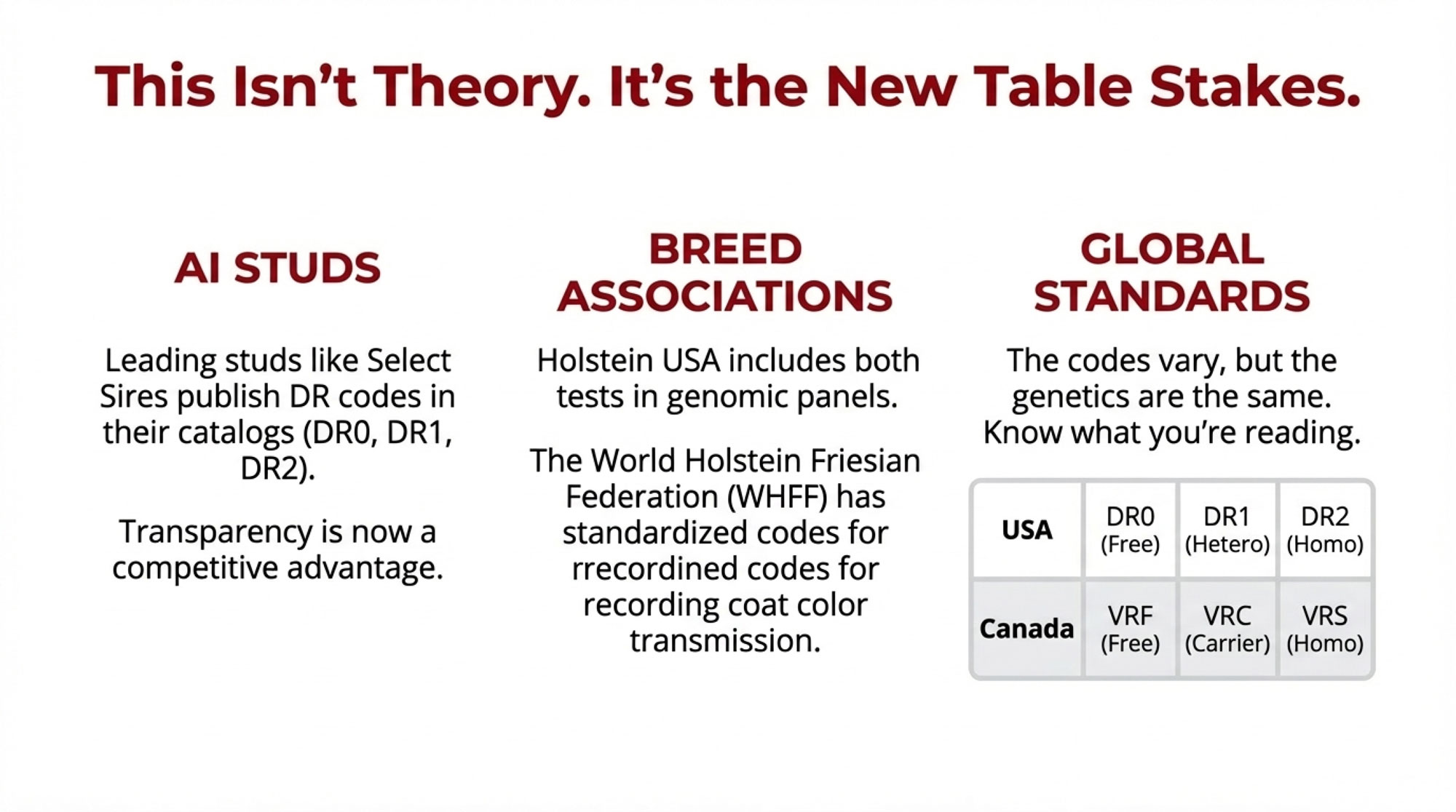
The AI studs are already there. Select Sires publishes DR codes in their catalogs and provides detailed mating guidance. Other major organizations are following suit with color genetics in their genomic offerings. The competitive pressure is real—if one stud provides complete color transparency and another doesn’t, breeders making premium decisions will choose clarity every time.

A note on codes: If you’re working across borders, be aware that the US and Canada use different labeling systems. In the US, Holstein Association USA and CDCB use DR0 (tested free), DR1 (heterozygous carrier), and DR2(homozygous Dominant Red). Holstein Canada uses VRF (free of Variant Red), VRC (carrier of Variant Red), and VRS (homozygous Variant Red). Same genetics, different shorthand—just make sure you’re reading the codes correctly for whichever system you’re working in.

The breed associations have built the infrastructure. WHFF registration guidelines already require member organizations to record coat color transmission and carrier status using standardized codes. Holstein Canada’s genetic trait coding system is in place. Holstein USA includes both recessive red and Dominant Red in their genomic panels. The recording framework exists—it’s just not universally enforced yet.

The holdouts make sense. For a 500-cow commercial dairy, shipping bull calves at a week old and selecting replacements purely on production and health? Color genetics are irrelevant. That’s a perfectly rational business decision, and mandatory testing across all registrations would be unnecessary friction for these operations.

But for seedstock operations, show herds, and anyone marketing genetics where color affects value? Testing both COPA and MC1R isn’t optional anymore. It’s table stakes.

The Verdict: Manage the Complexity You Create

So where does this leave you? Here’s my thinking:

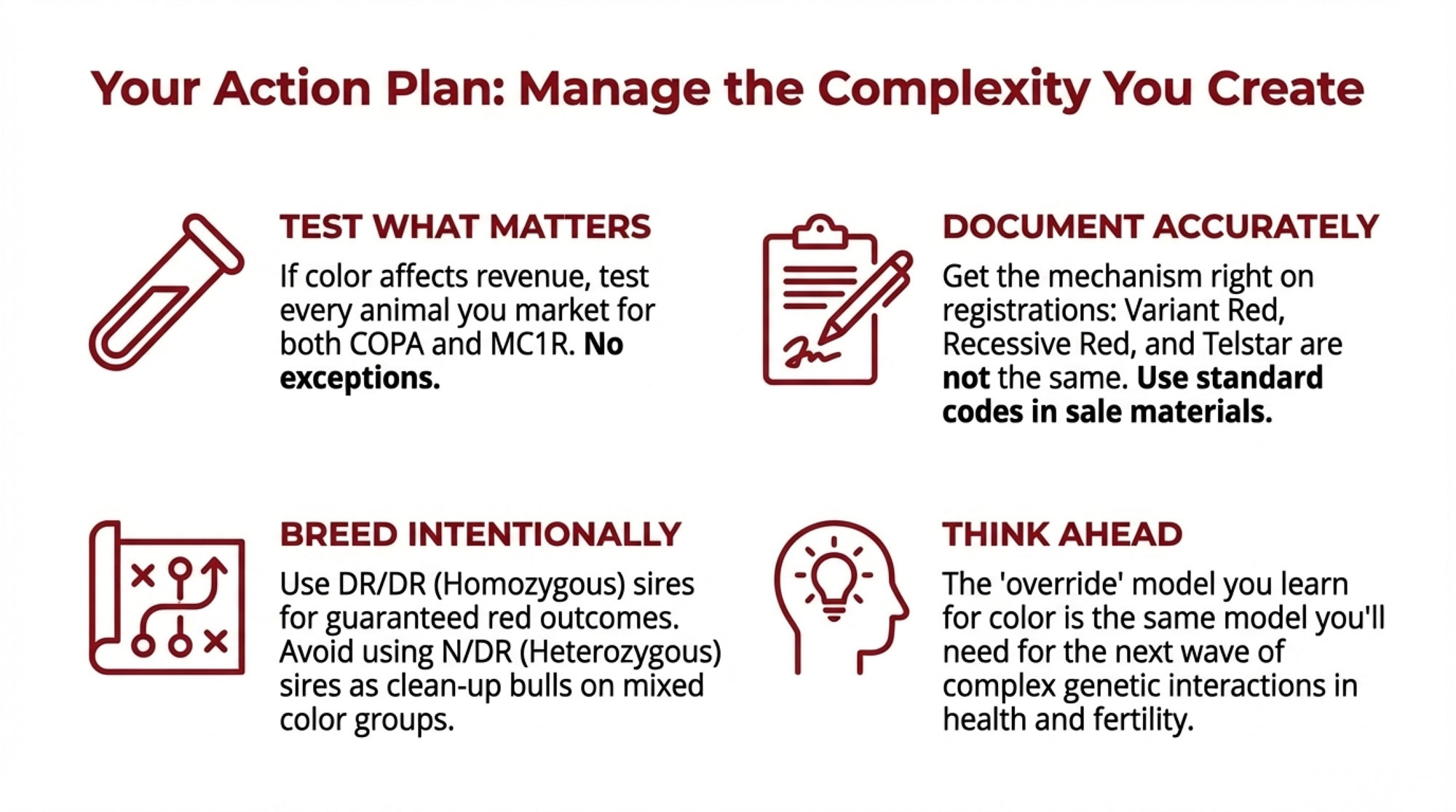
If color affects your revenue, test every animal you plan to market as breeding stock. Document the COPA and MC1R status in your sale materials. Use breed-standard codes so the information travels cleanly when animals change hands.

If you’re breeding for red: Understand that N/DR sires will throw ~50% black calves even on red cows—provided the sire carries E^D at MC1R. If you need guaranteed red outcomes, use DR/DR sires. Plan accordingly.

If you’re managing clean-up bulls: Don’t use Variant Red bulls on mixed-color groups unless you’re prepared to test the resulting calves. The sorting headache isn’t worth it.

If you’re registering animals: Get the mechanism right. Variant Red, recessive red, and Telstar are three different things with different inheritance patterns. Mislabeling creates downstream problems for everyone.

If you think phenotype tells you enough: It doesn’t. A red calf at birth could be Variant Red (stays red, might darken slightly), recessive red (stays red), or Telstar (turns black in months). Only testing tells you which—and that distinction matters for every breeding decision that follows.

“Understand the genetics, test what matters for your operation, communicate clearly with buyers, and manage the complexity you’re creating.”

The COPA discovery didn’t complicate Holstein color genetics—it revealed the complexity that had always been there. We just couldn’t see it before. The breeders who adapt their programs to account for genetic networks, not just single-gene thinking, are the ones who’ll avoid expensive surprises.

And honestly, color is just the beginning. The same epistatic interactions—one pathway overriding another—show up in fertility, health, and efficiency traits. The mental model you build managing Variant Red is the same model you’ll need for the next layer of genetic complexity headed for your breeding program.

Test what matters. Document what you find. Plan accordingly. That approach will serve you well regardless of what genetic curveball comes next. 

Key Takeaways

  • COPA is the override switch. An animal can carry black genetics at MC1R but still express red if COPA is present—traditional color rules don’t apply.
  • Red × Red can equal Black. Variant Red bulls throw ~50% black calves on red cows if they carry hidden black genetics underneath their red coat.
  • A $30 test prevents expensive mistakes. UC Davis VGL tests both COPA and MC1R; Holstein USA includes both in standard genomic panels.
  • Codes vary by country. The US uses DR0/DR1/DR2; Canada uses VRF/VRC/VRS. Same genetics, different shorthand—read them correctly.
  • Skip the test, accept the gamble. Registration errors, mislabeled sale animals, and buyer disputes cost far more than $30.

Executive Summary: 

Red bull × red cow should equal red calf—except when it doesn’t. The COPA gene, discovered in 2015, acts as a genetic ‘override switch’ that supersedes traditional color inheritance. A Variant Red bull can throw 50% black calves even on red cows if he carries hidden black genetics underneath his red coat. That surprise leads to angry buyers, botched registrations, and breeding decisions built on wrong assumptions. The fix is simple: test both COPA and MC1R status. It runs about $30 through UC Davis VGL and comes standard with Holstein USA genomic panels. For seedstock operations and anyone marketing genetics where color affects value, skipping this test is a gamble you don’t need to take.

Complete references and supporting documentation are available upon request by contacting the editorial team at editor@thebullvine.com.

Learn More:

Join the Revolution!

Join over 30,000 successful dairy professionals who rely on Bullvine Weekly for their competitive edge. Delivered directly to your inbox each week, our exclusive industry insights help you make smarter decisions while saving precious hours every week. Never miss critical updates on milk production trends, breakthrough technologies, and profit-boosting strategies that top producers are already implementing. Subscribe now to transform your dairy operation’s efficiency and profitability—your future success is just one click away.
NewsSubscribe
First
Last
Consent

The Hidden Week That Costs You $350 Per Heifer (And How to Fix It)

That 3-day-old embryo determines if she’ll produce 2,600 more pounds of milk. Most producers have no idea.

EXECUTIVE SUMMARY: The first seven days after conception determine more about lifetime productivity than the next seven years of management—yet most producers ignore this critical window. University of Florida research proves simple interventions yield massive returns: choline-supplemented embryos produce calves 25 pounds heavier at weaning, dry cow cooling prevents $350 per heifer in losses, and avoiding bull overfeeding improves embryo quality in ways semen analysis can’t detect. Progressive dairies implementing these strategies report first-year savings of $60,000-70,000 with an 18-month payback on cooling investments. The science is clear: you’re either programming for success or accepting mediocrity before pregnancy is even confirmed. Ask your ET provider one question—’ Are you using choline?’—and start capturing gains your competitors are leaving on the table.

dairy developmental programming

We spend millions on genomic testing, elite semen, and perfect rations. Yet new research suggests we’re leaving the biggest efficiency gains on the table by ignoring the first week of an embryo’s life. While you’re focusing on the proof, biology is focusing on the programming. If you aren’t managing the first seven days, you’re building a Ferrari engine and putting it in a Honda chassis.

I’ve been following this research coming out of Peter Hansen’s lab at the University of Florida for the past three years, and honestly, it’s completely changed how I think about reproduction. What we’re seeing from operations in California, Wisconsin, and across the Midwest suggests that producers who understand developmental programming are building advantages that compound through generations. And those who don’t? Well, they’re leaving serious money on the table.

Here’s what’s interesting—I was talking with a producer near Turlock last month, and he said something that stuck with me: “We used to think reproduction ended at conception. Now we realize that’s when the real work begins.” That pretty much sums up this whole shift in thinking.

When Genetics Meet Environment: The Choline Discovery That Changes Everything

So Peter Hansen—he’s published over 400 papers on reproductive biology, by the way—has this great way of explaining it. He says we’ve gotten really good at optimizing everything after calves are born. The best nutrition, perfect housing, optimal photo periods. But we don’t really think much about what’s happening when they’re embryos or fetuses. And that’s where we might be missing the boat.

What’s fascinating is that Hansen’s team, working with researcher Eliam Estrada-Cortes, discovered something almost embarrassingly simple. They added choline to the culture medium for IVP embryos. Now, choline’s naturally present in the uterus—we’re talking millimolar concentrations here—but it’s typically absent from commercial culture media. Their work, which appeared in The FASEB Journal in 2021 and was replicated in Biology of Reproduction just this year, shows remarkable consistency.

The results? Calves from those choline-treated embryos consistently weigh more at weaning. We’re talking 15 to 25 pounds heavier on average, and here’s the kicker—those advantages persist straight through to slaughter. Even at physiologically relevant concentrations—just four micromoles per liter, basically what you’d find in blood—you still get these effects.

Now, if you’re doing embryo transfer, this next part is really interesting. When Estrada-Cortes looked at muscle tissue from four-month-old calves, they found 670 differentially methylated DNA sites out of about 8,100 they examined. The affected genes control growth, metabolism, cellular proliferation—basically all the fundamental processes that influence an animal’s entire productive life.

As Hansen explained it to me, “We’re not changing the DNA sequence. We’re changing how genes are expressed—which ones are turned on or off, and when.” Think of it like having the same recipe but changing the cooking instructions. Makes sense, right?

The Epigenetic Revolution: Why Your Dry Lot Decisions Matter More Than You Think

Let me break this down in a way that actually makes sense. You know how DNA is like the blueprint for building a barn? Well, epigenetic modifications are like the building permits that determine which parts of that blueprint actually get built, in what order, and how big they are.

During those first seven to fourteen days after fertilization—when that embryo’s just a ball of cells—these “building permits” are being written. Environmental factors like nutrient availability, temperature, and stress hormones all influence which genes are marked for activation or silencing. And once that window closes, these marks become semi-permanent. That’s the part that should make us all pay attention.

A reproduction manager from one of those big 3,000-cow operations near Hanford had this great insight when we talked: “Once we understood that what happens in the first week determines so much, we completely changed how we think about our IVP program. We’re not just counting blastocysts anymore—we’re thinking about quality at the cellular level.” That’s exactly the shift we all need to be making.

And here’s something else to consider—this could have implications for sexed semen use too. If we’re already manipulating sperm for sex-sorting, understanding these epigenetic factors becomes even more critical. We’re stacking technologies, so we need to optimize each one.

Heat Stress: The Multi-Billion Dollar Problem Hiding in Your Dry Pen

Now, if you’re up in Wisconsin, you might think heat stress is mainly a problem for those folks down in Texas or Arizona. But the research tells a different story—and it’s one that should concern every producer north of the Mason-Dixon line.

Geoffrey Dahl’s group in Florida has been doing incredible work on this, publishing some eye-opening data in the Journal of Dairy Science. Here’s what calves born to heat-stressed dry cows face:

  • They absorb about 33% less immunoglobulin from colostrum
  • They’re roughly 23% smaller at birth—we’re talking 8 to 10 pounds lighter
  • They produce about 19% less milk in the first lactation—that’s around 2,600 pounds over 305 days
  • And they’re 20% less likely to complete that first lactation

The mechanism behind all this, which was detailed in Biology of Reproduction earlier this year, is fascinating. During those last 60 days of pregnancy—when that fetus is packing on 60% of its birth weight—heat-stressed cows redirect blood flow from the uterus to the skin for cooling. So the developing calf experiences what amounts to chronic mild oxygen deprivation.

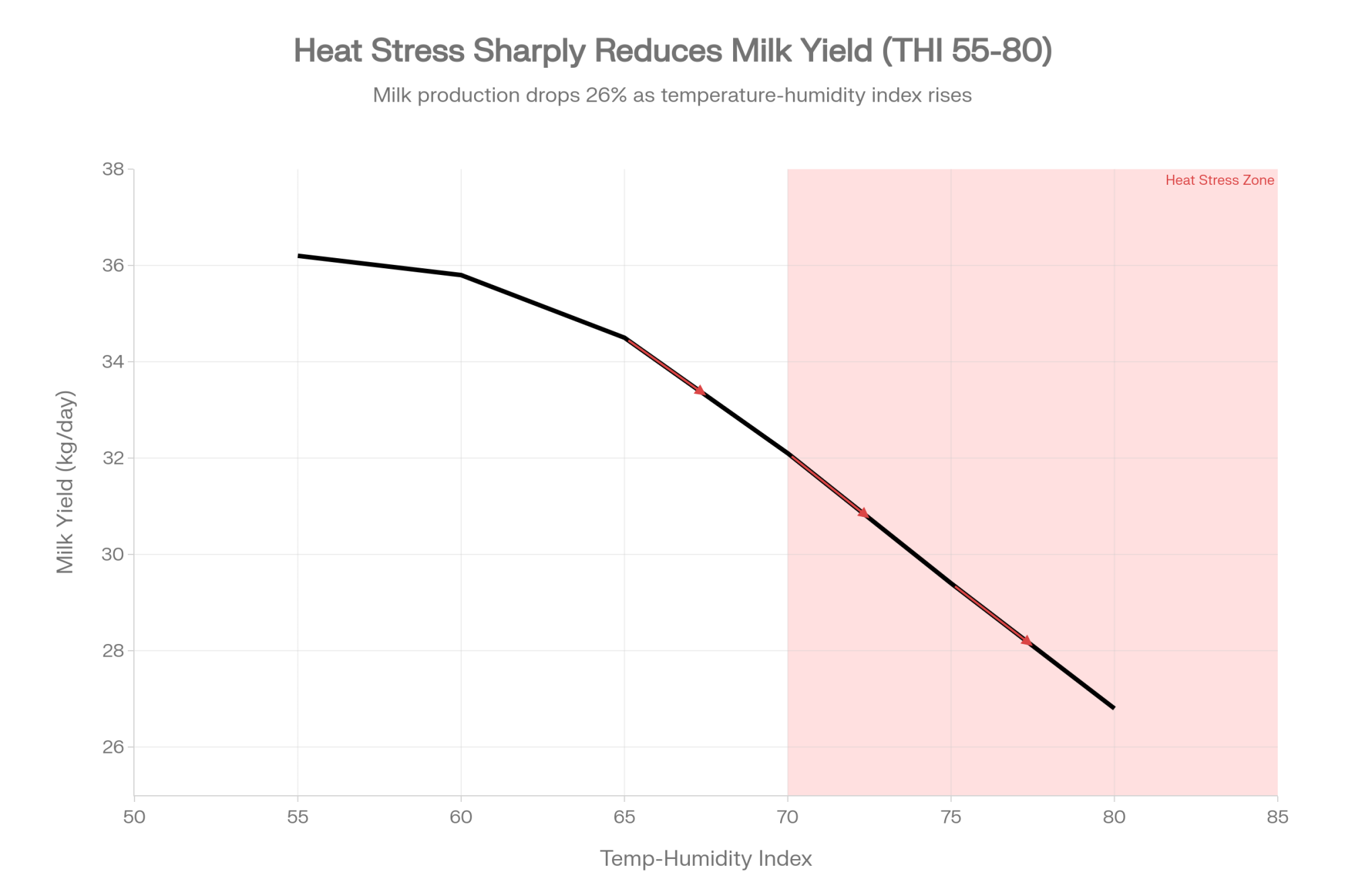
I know a Jersey producer in central Minnesota who learned this the hard way. They had a brutal July a couple of years back—temperatures and humidity combined to push the temperature-humidity index over 72 for three weeks straight. The calves born that October? They’re still dealing with the effects. More treatments, slower growth, and now that they’re coming into milk, production is definitely off.

By the time these heat-stressed calves hit the ground, they’re already behind. Their intestinal tissue shows higher rates of cell death, reducing the surface area available for absorbing those critical immunoglobulins. Their thymus and spleen—basically the headquarters of immune development—are measurably smaller. It’s a cascade that starts before they’re even born.

Bulls: The Hidden Variable Nobody’s Measuring Right

Here’s something that genuinely surprised me when I dug into the research—your bull’s body condition might matter more than his proof. I know, I know, that sounds crazy, but hear me out.

Arslan Tariq’s work at the University of Florida examined what happens when young bulls are pushed onto high-gain diets—you know, the standard protocol to get them to market weight faster. Bulls gaining 1.81 kilos per day versus a moderate 1.22 showed completely normal sperm motility and morphology. Any AI stud would stamp them “high fertility” and ship that semen worldwide.

But when Tariq used that semen for IVF? Completely different story. Embryo cleavage rates dropped significantly, blastocysts had fewer cells, cell death rates increased, and development timing lagged behind. The kicker? Standard semen analysis can’t detect any of this. The sperm look perfect, swim fine, and fertilize eggs normally. But they’re carrying what you might call epigenetic baggage—altered small RNAs and methylation patterns that compromise embryo development.

One semen procurement manager from a Wisconsin cooperative told me recently, “We’ve been evaluating bulls all wrong. We’re looking at motility and morphology when we should be asking about how that bull was raised and fed.” That’s a pretty profound shift in thinking, isn’t it?

The Seminal Plasma Question: What Are We Throwing Away?

For decades, the AI industry has removed seminal plasma before freezing semen. Makes perfect sense from a storage perspective—seminal plasma contains proteins and minerals that interfere with freeze-thaw survival. But research from Gabriela Macay’s doctoral work at Florida suggests we might be discarding liquid gold.

Offspring from inseminations where seminal plasma remained showed some pretty impressive advantages: heavier birth weights by 5 to 7 pounds4 to 8% greater milk yield in first lactation, and better persistence in the herd—basically, they stick around longer through multiple lactations.

What’s in this stuff? According to work that came out in Frontiers in Cell and Developmental Biology this year, seminal plasma contains these tiny extracellular vesicles—think of them as molecular FedEx packages—carrying proteins, lipids, and RNA molecules. High-fertility bulls, particularly in some Sahiwal research, exhibit distinct vesicle signatures, with proteins involved in energy production and sperm function.

But here’s the really interesting part—these vesicles don’t just help sperm. They interact with the cow’s reproductive tract, modulating immune responses and potentially influencing early embryonic development. It’s a whole communication system we’ve been, well, washing down the drain.

What Top Operations Are Actually Doing (And Getting Right)

Looking at the numbers—2.2 million embryos produced globally last year, up almost 16% according to the International Embryo Technology Society—you’d think everyone’s on the same page. But spend time with the operations getting exceptional results, and you’ll see some distinct patterns.

Take De-Su Holsteins out in New Mexico. They’re producing about 200 embryos a month, but what sets them apart isn’t volume—it’s their obsession with details that most operations ignore. They track offspring performance through multiple lactations and feed that data back into breeding decisions. They’ve adjusted bull management to avoid overconditioning. Their culture media protocols focus on mimicking natural oviductal conditions rather than just maximizing blast rates.

Down in California, I’ve heard from several operations that reducing nutrient concentrations in culture media by as much as 75% produces the same pregnancy rates with better calf quality. As one embryologist put it, “We were providing excessive supplementation that may actually impair embryo development. More isn’t always better.” That’s a lesson we could probably apply to a lot of things in dairy, right?

The real game-changer, though? Preimplantation genetic testing. Operations using PGT-A are reporting pregnancy rate improvements of around 7.5% and live birth rates up nearly 6%. As a Texas producer told me, “At about $300 per test, it pays for itself if it prevents just one failed pregnancy.” Hard to argue with that math.

The Economics: More Compelling Than You’d Think

Let’s talk dollars and cents here, because that’s what determines whether any of this actually matters on your farm.

The Compounding Advantage: Progressive operations implementing developmental programming strategies build an $800,000+ advantage over 5 years compared to operations using conventional approaches alone

Dry cow cooling for a 500-cow operation runs between $20,000 and $30,000 for a basic soaker-and-fan setup. Sounds steep, I know. But economic modeling from the University of Florida shows the payback period is typically under 1.5 years, with a benefit-cost ratio of about 3-to-1. Each heat-stressed replacement heifer costs you around $350 per cow in lost first-lactation milk alone—and that’s not even counting the health costs.

Colostrum management improvements? They cost virtually nothing. A BRIX refractometer runs maybe $300 to $500. Training your calf crew to feed 4 liters within 2 hours instead of “whenever we get to it”? That’s free. The return? Calves gain an extra 15 to 25 pounds by weaning, with 20 to 30% fewer treatments. Do the math on your antibiotic bills—it adds up fast.

Bull condition monitoring is basically free, too. Actually, you’ll save money feeding bulls for moderate gains instead of pushing them hard. Research from Tennessee shows feed costs drop 12 to 15% when you target moderate versus aggressive weight gains.

“Several western dairies report savings north of $50,000 annually from reduced treatments and improved growth when integrating colostrum and cooling protocols.”

One central California operation estimated first-year savings between $60,000 and $70,000 after implementing these strategies, based on herd health and production records reviewed by their consulting veterinarian. This year, those heifers are coming fresh, and preliminary data shows they’re outproducing their older herdmates by over 4 pounds per day. That’s real money.

Regional Realities: One Size Doesn’t Fit All

Know Your Risk: Annual heat stress days (THI >72) vary dramatically by region, from 100+ critical days in the Southwest to just 10-15 days in the Pacific Northwest—but even one week matters during peak breeding season

What works in California might not translate directly to Vermont, and that’s worth acknowledging.

In the Southwest and Southern Plains, where you’re dealing with 100-plus days of heat stress annually according to NOAA data, dry cow cooling isn’t optional—it’s survival. These operations are already seeing the difference between cooled and uncooled cohorts in their DHI reports.

In the Upper Midwest, heat stress might be critical for only 30 to 50 days, but those days often coincide with the peak breeding season. As one Minnesota producer noted, “We only need cooling for six weeks, but those six weeks determine our entire next calf crop.” That’s a pretty important six weeks.

In the Southeast, where humidity is a challenge, the temperature-humidity index remains elevated even at night. Georgia Extension guidance confirms that producers there run fans 24/7 from May through October. Different challenge, same principle.

Up in the Northeast and Pacific Northwest, where we get those occasional heat spikes but generally milder summers, the approach is different again. Vermont and Oregon producers I’ve talked with focus on portable cooling solutions they can deploy during those critical heat events. They’re not investing in permanent infrastructure like their Southwest counterparts, but they’re not ignoring it either. Strategic shade, increased water access, and temporary fans during those 10-15 critical days can make all the difference.

For grazing operations, it’s trickier. You can’t exactly install sprinklers in your pasture. But strategic shade structures, rotational grazing to maximize tree shade during peak heat, careful dry cow management—these still apply according to pasture management literature from multiple land-grant universities.

Your Monday Morning Action Plan

So you’re convinced this matters. What do you actually do about it?

This Week:

  • Order a temperature-humidity monitor for your dry pen—they’re 50 to 100 bucks
  • Check the body condition on any bulls you’re using
  • Pull records on colostrum feeding times for your last 20 calves

Next 30 Days:

  • Get quotes for a basic cooling system—fans and sprinklers
  • Buy a BRIX refractometer and start testing every batch of colostrum
  • Set up a simple spreadsheet to track calf health events by birth date

Next 3 Months:

  • Implement your cooling system before the heat hits
  • Standardize colostrum protocols: 4 liters within 2 hours, period
  • Start tracking weaning weights by birth cohort

Next 12 Months:

  • Evaluate your embryo production partners—ask specifically about their culture media
  • Ask your IVF/ET service provider specifically: “Are you using choline-supplemented media?” If they aren’t, ask why
  • Consider PGT-A testing for your high-value embryos
  • Build the data systems to connect calf performance back to prenatal conditions

The Competitive Reality Check

Here’s what I think happens over the next five years, based on everything I’m seeing.

The operations that integrate developmental programming now—really integrate it, not just dabble—will build advantages that compound. We’re talking 3 to 4% production advantages, 15 to 20% reduction in health costs, better feed efficiency, and superior reproduction. Add it up over five years, and you’re looking at an $800,000-plus advantage for a 1,000-cow dairy. That’s not pocket change.

The operations that don’t? They’ll still make progress through genetic selection—everyone will. But they’ll be leaving 40 to 50% of potential gains on the table because their animals can’t fully express those genetics.

Several nutritionists working with Midwest herds note that genetics may be the engine, but developmental programming acts like a tune-up—both matter to herd performance. You can have a Ferrari engine, but if it’s not tuned right, a well-tuned Honda will beat you every time. That pretty much nails it.

What Does This All Means for Progressive Producers

What’s fascinating about this whole field is how it connects things we thought were separate. Your dry cow cooling affects colostrum quality. Colostrum quality affects immune development. Immune development affects feed efficiency. Feed efficiency affects lifetime productivity. It’s all connected in ways we’re just beginning to understand.

The competitive landscape is shifting faster than most producers realize. Yes, genetic gains remain important—nobody’s arguing against genomic selection. But the operations that will thrive aren’t the ones with marginally better genetics. They’re the ones who that understand genetics are only half the story. The other half—how those genetics get expressed—depends on decisions you’re making right now.

The science is clear. The economics are compelling. The early adopters are already seeing results. The question isn’t whether developmental programming matters—it absolutely does. The question is whether you’ll be among those leveraging these insights for competitive advantage, or among those wondering why the neighbors’ calves always seem to do better.

Looking at this trend, one thing becomes crystal clear: we spent two decades learning how to get cows pregnant reliably. The next frontier isn’t about conception rates—it’s about ensuring those pregnancies produce calves programmed for exceptional lifetime performance.

As that reproduction manager from California put it, “We used to think breeding success meant a positive preg check. Now we know success is determined by what happens in those first seven days after conception.” That’s a fundamental shift in how we think about reproduction.

And that shift? It’s happening right now, whether your operation is ready or not.

KEY TAKEAWAYS: 

  • The Science: Those genetics you paid thousands for? Their expression is programmed in the first 7 days after conception—before you even know she’s pregnant
  • The Money: Simple interventions = massive returns: $350/heifer saved, $60-70K year one, $800K+ over 5 years (1,000-cow dairy)
  • The Action: Ask ET providers “Are you using choline?”, cool dry cows (3:1 ROI), monitor bull condition—not just motility
  • The Urgency: Top 10% of herds are already doing this. Every month you wait, the competitive gap widens

Complete references and supporting documentation are available upon request by contacting the editorial team at editor@thebullvine.com.

Learn More:

Join the Revolution!

Join over 30,000 successful dairy professionals who rely on Bullvine Weekly for their competitive edge. Delivered directly to your inbox each week, our exclusive industry insights help you make smarter decisions while saving precious hours every week. Never miss critical updates on milk production trends, breakthrough technologies, and profit-boosting strategies that top producers are already implementing. Subscribe now to transform your dairy operation’s efficiency and profitability—your future success is just one click away.
NewsSubscribe
First
Last
Consent

Trump Promised Cheaper Beef – Here’s Your $160,000 Counter-Move

When everyone zigs to beef breeding, who profits from zagging to heifer production?

EXECUTIVE SUMMARY: What farmers are discovering right now is that political promises about cheaper beef can’t change the biological timeline of cattle production—and that’s creating a remarkable opportunity. With the U.S. cattle herd at just 86.7 million head (the smallest since 1951) and dairy heifer inventories hitting a 47-year low of 3.91 million, we’re looking at an 18-month window where strategic breeding decisions could mean the difference between netting $160,000 in profit or scrambling to buy $4,500 replacement heifers. Recent CoBank analysis shows that 72% of dairy farms now using beef semen have collectively eliminated nearly 428,000 potential replacements from the pipeline, creating what economists call a “coordination failure” that rewards contrarian thinking. The Minnesota producer who shared his strategy of sacrificing $75,000 in immediate beef premiums to potentially net $270,000 in heifer profits after raising costs when everyone else needs them might just have the right idea. With genomic testing at $40-50 per head providing the roadmap, sexed semen achieving 90% female conception rates, and new LRP insurance offering downside protection at $26 per head, farmers have the tools to navigate this unprecedented market dynamic. Here’s what this means for your operation: The decisions you make about breeding strategies in the next 30 days will resonate through your balance sheet for the next two years.

heifer replacement strategy

I was talking with a Wisconsin producer, when the latest political announcement about beef imports sent cattle futures tumbling. “There goes my breeding strategy,” he said, using his phone to recalculate.

But here’s the thing—whether it’s trade deals, import policies, or market volatility, these announcements are just the latest reminder of what we’re really dealing with: a fundamental supply-demand imbalance that political promises can’t fix overnight.

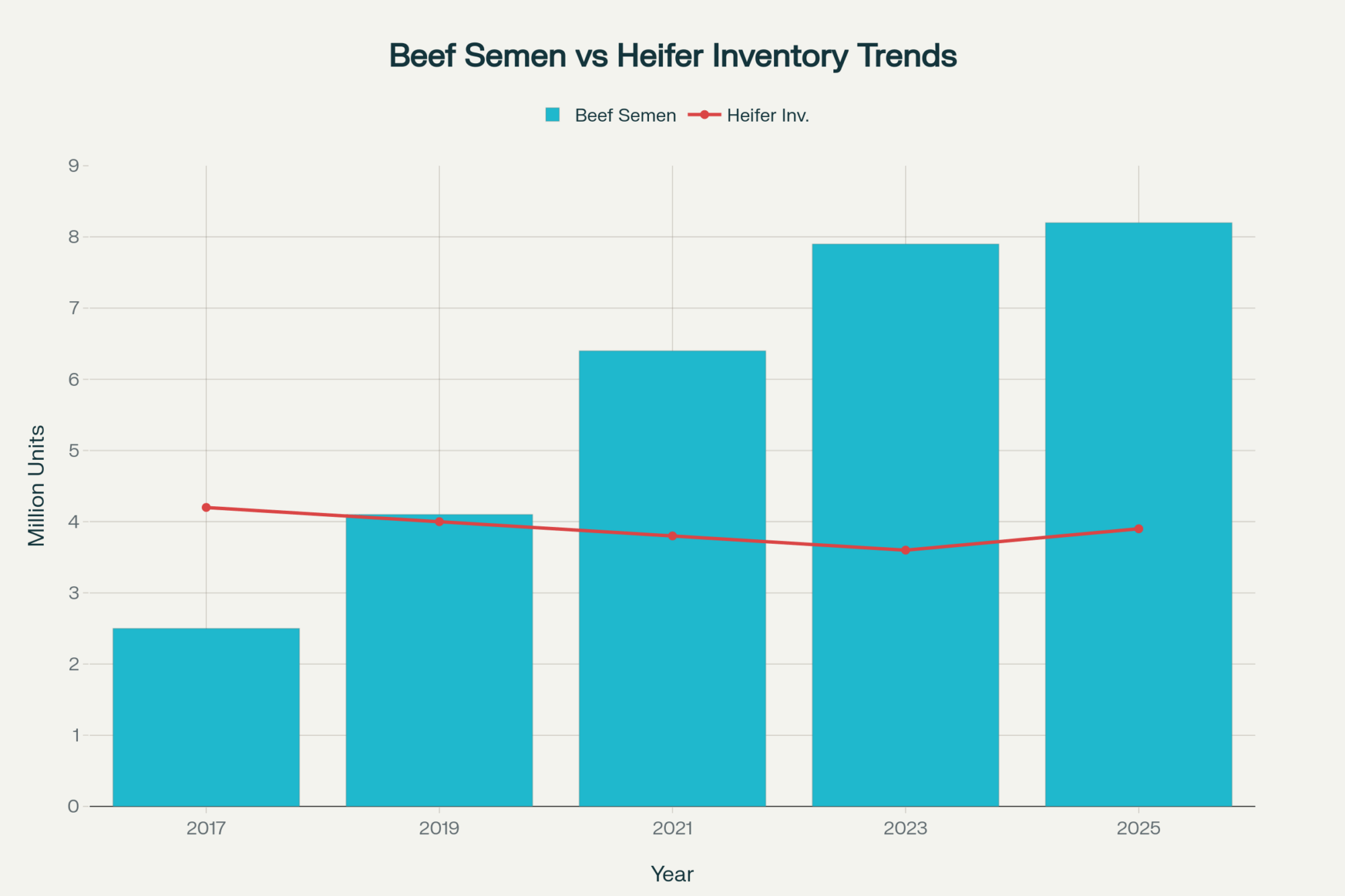
The fundamentals tell an interesting story. According to the USDA’s January inventory, we’ve got 86.7 million head of cattle in the U.S., the smallest herd since 1951. Beef cow numbers? Just 28.7 million, the lowest since 1961.

This year’s calf crop is coming in at 33.1 million head, the smallest on record.

And dairy farms? Well, about 72% are now using beef semen in their breeding programs to some degree. That’s become standard operating procedure, especially when beef-cross calves are bringing $1,000-plus while Holstein bulls fetch maybe $100.

When you factor in the $2,400 cost to raise each heifer, the economics flip dramatically—beef-focused operations lose $145,900 annually while strategic heifer producers turn a $56,000 profit by selling surplus replacements into the $4,200 market

The Three-to-Four Year Reality Check

U.S. cattle numbers hit their lowest point in 73 years while dairy heifer inventories plummet to a 47-year low—the biological timeline means this supply crunch will persist for 18+ months regardless of policy changes.

A central Pennsylvania dairyman explained it to me perfectly: “Politicians can promise whatever they want, but a heifer I keep today won’t drop a calf until July 2026. And that calf? It won’t be beef until 2028.”

That biological timeline matters more than any trade deal.

Think about what this means for dairy operations. While beef producers struggle with rebuilding (and most can’t with current drought conditions in parts of the country), dairy farms have positioned themselves at an interesting crossroads. They’re producing premium beef-cross calves into a supply-constrained market. But they’re also creating their own replacement heifer shortage.

CoBank’s August analysis put some hard numbers on this. Dairy heifer inventories hit 3.91 million head in January 2025—that’s a 47-year low, down 18% from 2018.

I remember buying nice springers for $1,600 five years ago. Last month, a neighbor paid $4,100 for a comparable animal.

Small Operations Need Different Strategies

One thing that doesn’t get enough attention—operations under 200 cows face unique challenges with this beef-on-dairy approach. The genomic testing investment hits harder proportionally. They might not have volume for forward contracts. And losing even a few replacements to disease can derail their program.

Here’s what a 150-cow dairy might look like with a conservative approach:

Annual breeding breakdown (150-cow herd):

  • 30 cows (20%) to beef semen = 30 beef-cross calves worth $33,000
  • 60 cows (40%) to conventional dairy = 30 heifer replacements
  • 60 cows (40%) to sexed semen = 54 elite heifer calves
  • Total: 84 potential replacements when they need 45
Farm SizeBeef %Replacements NeededHeifers ProducedSafety BufferGenomic InvestmentBeef RevenueHeifer Net ProfitTotal Net Opportunity
150 cows20%4584+39 (+87%)$6,750$33,000$62,400$95,400
500 cows30%165240+75 (+45%)$22,500$82,500$120,000$202,500
1,200 cows35%380470+90 (+24%)$54,000$115,500$144,000$259,500

Note: Small operations require higher safety buffers (87% vs 24%) to protect against disease events and culling variations—justifying lower beef percentage

This gives them a 39-heifer buffer for selection and sales while still capturing some beef premiums. Compare that to a larger operation going 35% beef, and you can see why smaller dairies need that extra cushion.

But whether you’re running 150 cows or 1,500, certain strategies are proving successful across the board.

Learning from Operations That Are Making It Work

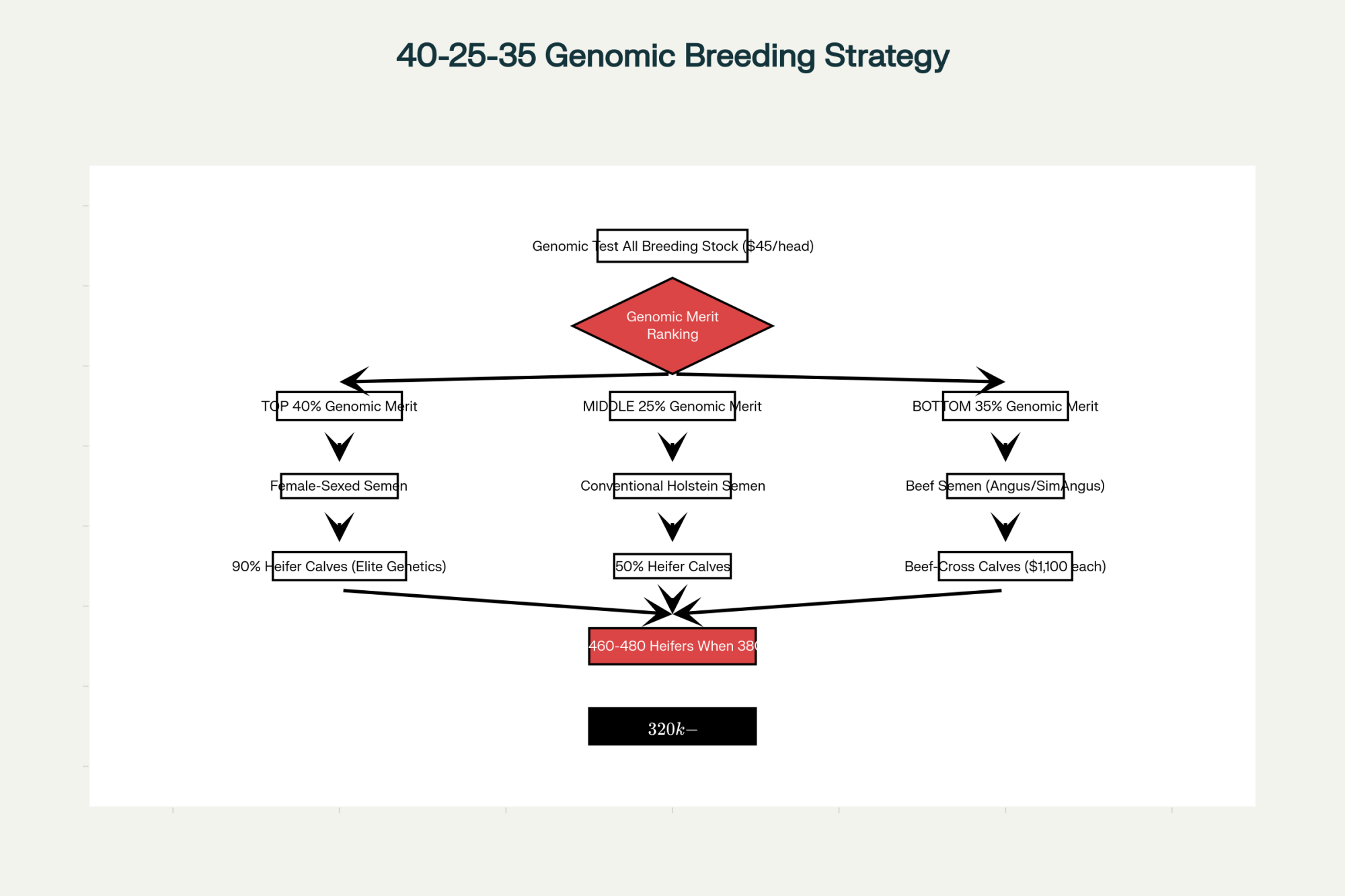
The 40-25-35 genomic breeding strategy transforms a $45 test into a quarter-million-dollar roadmap—directing elite genetics to sexed semen while capturing beef premiums from low-merit animals.

A 1,200-cow operation near Tulare showed me their approach recently. They’re spending about $45 per calf on genomic testing, which sounds expensive until you consider the alternative.

Now, let’s be clear about the economics here. It costs about $2,400 to raise a heifer from birth to calving, according to 2024-2025 university research. So when we talk about selling a springer for $4,000, the net profit is around $1,600 per head. That’s still exceptional money, but it’s important to understand we’re talking net, not gross.

“Without genomic data,” their manager explained, “we were making quarter-million-dollar breeding decisions based on whether a cow looked good or had mastitis last month.”

Their approach is pretty straightforward:

  • Top 40% by genomic merit get female-sexed semen (about 90% heifer calves)
  • Middle 25% get conventional Holstein semen
  • Bottom 35% go to Angus or SimAngus

This generates roughly 460 to 480 replacement heifers when they need 380.

Those extra 80 to 100? At current prices, with $2,400 in raising costs per heifer, that could be $128,000 to $160,000 in net profit. That’s $4,000 selling price minus $2,400 raising cost = $1,600 net per heifer. Though, as one producer wisely noted, “That’s if the market holds.”

Quick Reference: Genomic Breeding Strategy

  • Top 40%: Female-sexed semen only
  • Middle 25%: Conventional dairy semen
  • Bottom 35%: Beef semen exclusively
  • Result: 460-480 heifers produced when 380 were needed

The Insurance Most People Haven’t Heard About

Since July 1, USDA’s Risk Management Agency has offered Livestock Risk Protection for beef-on-dairy calves. A crop insurance agent in Iowa broke it down for me: “For about $26 per head, you can protect 95% of expected value on those beef crosses. Apply at least 30 days before you expect to sell.”

Let’s say you’re breeding 150 cows to beef (30% of a 500-cow herd). At $1,100 per calf, that’s $165,000 in expected revenue.

Insurance runs about $3,900 to protect $156,750 of that value.

If imports flood the market and beef crosses drop to $700? The policy covers the difference. Not bad for peace of mind.

Spring 2026: When Everything Converges

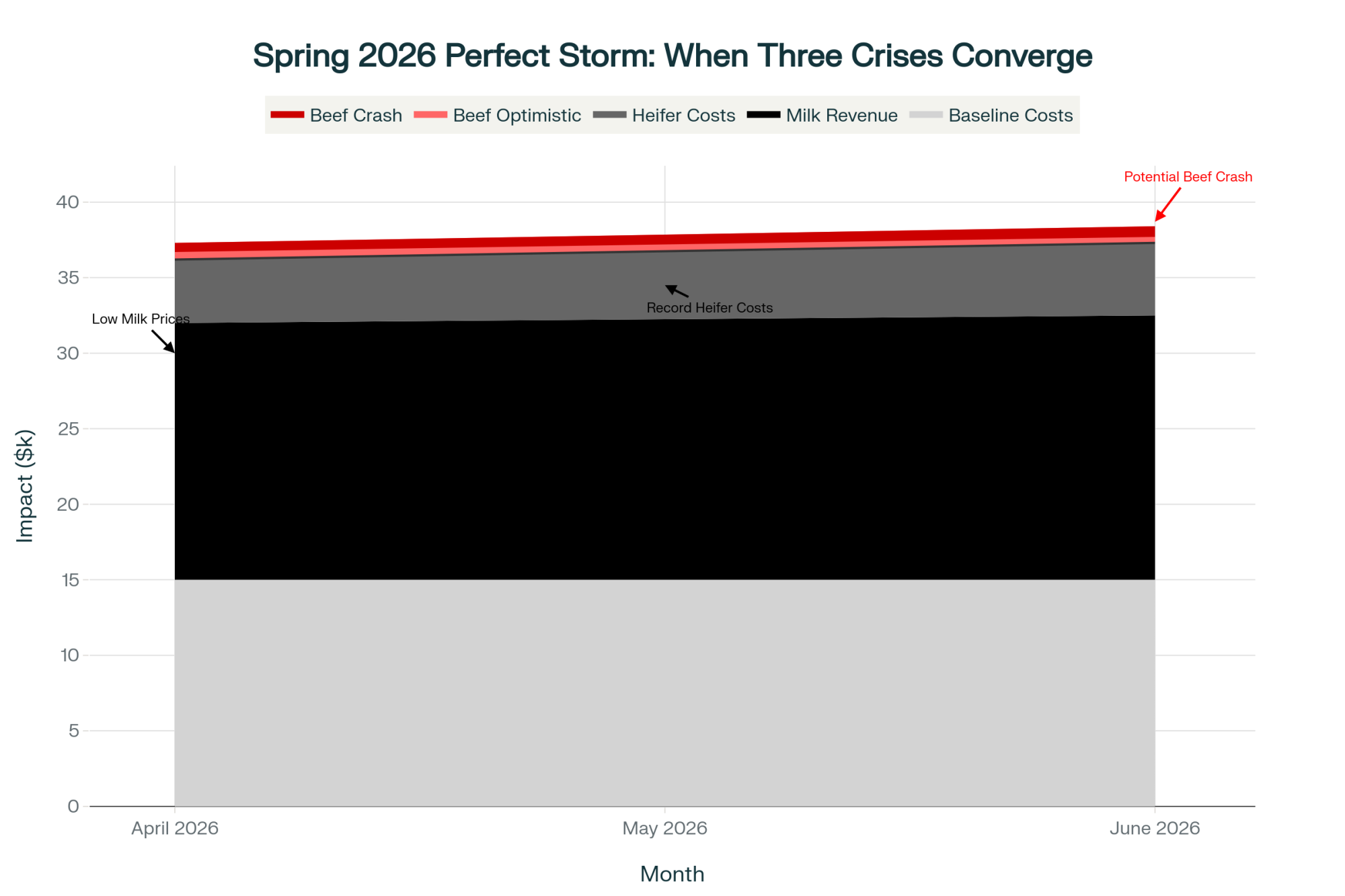
Looking at CME futures and talking with dairy economists, April through June 2026 could get interesting—and not in a good way.

Class III milk futures for that period are trading around $17.00 to $17.50 per hundredweight. At those prices, modeling suggests 60-70% of operations could face negative margins before replacement costs.

April-June 2026 convergence of $17.50 milk, $4,500 replacement heifers, and potentially crashed beef-cross values creates perfect storm—operations positioned as heifer suppliers will weather this squeeze.

Add in replacement heifers potentially exceeding $4,500, and if beef-cross values crash to $400-600 from expanded imports?

A Midwest nutritionist ran the numbers for me: “At $17.50 milk, $4,500 replacements, and $500 beef calves, we’re looking at annual deficits that would stress even well-capitalized operations.”

The Squeeze on Different Operation Types

What’s interesting is how this hits different farms:

  • Grazing operations might actually weather it better with lower input costs
  • Organic dairies face unique challenges—their premiums help, but replacement options are limited
  • Conventional confinement operations see the full brunt of feed and replacement costs

Why Your Location Changes Everything

What works in Wisconsin’s climate doesn’t translate to Arizona’s heat or Vermont’s grazing systems.

A Texas dairyman managing 2,500 cows shared something revealing: “Our sexed semen conception drops 12-15% in summer. We concentrate sexed breeding from November through March, then shift toward beef when heat stress peaks.”

Their cull rate also runs higher—approaching 38%—which limits how aggressive they can be with beef breeding overall.

Feed economics adds another layer. Pennsylvania producers buying delivered corn at $5.40 per bushel face different economics than Indiana neighbors seeing $4.20 on farm.

That $1.20 difference shifts beef-cross break-evens by $60-80 per head.

And LRP insurance basis risk varies regionally, too. Southern dairy areas sometimes see $75 basis swings that rarely occur in Wisconsin.

The Collective Action Problem Nobody Talks About

Here’s what’s genuinely revealing. Each farm breeding more cows to produce beef makes perfect individual sense. Quality beef crosses bring $1,000-plus while Holstein bulls fetch $100. The math is obvious.

But with 72% of the industry now using beef semen, we’ve collectively created the replacement shortage now driving heifer prices to record levels.

It’s rational individual behavior producing challenging collective outcomes.

What’s different this time is technology. Modern sexed semen achieving 90% female conception rates means farms can pursue beef revenue from lower-merit animals while maintaining replacements from elite genetics. That wasn’t feasible even a decade ago.

Several economists suggest we’re heading toward a new baseline. Replacement heifers might settle at $2,500-$3,000rather than returning to $1,500-$2,000.

Beef-cross premiums could stabilize at $300-500 over dairy bulls instead of the historical $100-200 differentials.

Your Next Month’s Action Plan

Based on what’s working for successful operations, here’s what makes sense:

Get genomic testing started. At $40-50 per test, a 500-cow operation faces about a $22,500 investment in testing all youngstock. But compared to breeding decisions worth hundreds of thousands? It’s becoming easier to justify.

Submit samples to your genetics provider—Alta, Select Sires, ABS, whoever. Results take about two weeks.

Those genomic rankings become your breeding bible: top 40% get sexed, bottom 35% get beef, middle 25% get conventional.

Look into price protection. Your crop insurance agent (who probably handles your other coverage) can quote LRP. Current pricing suggests $25-30 per head protects about $1,100 in expected value per beef calf.

Calculate your actual needs. Here’s the math: Herd size × cull rate × (age at first calving ÷ 24) × 1.1 for non-completion.

A 500-cow herd with 30% culling needs about 165 replacements annually.

Remember to factor in raising costs. At $2,400 per heifer to raise and $4,000 to sell, each surplus heifer nets you $1,600. Even at these margins, 75 extra heifers means $120,000 in additional profit—money that goes straight to your bottom line.

Compare that to what your breeding strategy produces. If you’re generating 240 heifers but need 165, those 75 extra represent $120,000 in net profit at current prices ($4,000 sale price minus $2,400 raising cost = $1,600 net × 75 head).

Some Farms Are Zigging While Others Zag

A Minnesota producer recently explained their contrarian strategy: reducing beef semen to 15% while ramping sexed usage to 55%.

We’re sacrificing maybe $75,000 in immediate beef premiums, but if we can sell 150 heifers at $4,200 when everyone else needs them, that’s $630,000 in revenue. After $2,400 per head in raising costs, we’re netting $270,000—still $195,000 ahead.”

Several operations are already exploring forward contracts for 2026 heifer deliveries at prices that would have seemed impossible three years ago. Some are even considering embryo transfer to multiply their best genetics—though that’s a whole different investment level.

The Challenges We Need to Acknowledge

Beef-cross calves sometimes present different health challenges, particularly respiratory issues in the first 30 days. Most operations adapt protocols successfully, but it requires attention.

Market concentration varies by region. Some areas have robust buyer competition; others see just two or three buyers controlling volume. Know your local market.

And political uncertainty remains the wildcard. Trade policy can shift quickly. While biological constraints limit immediate supply response, import changes could affect pricing relatively fast.

Looking at the Next 18 Months

The convergence of biological constraints, market dynamics, and political uncertainty suggests we’re in an 18-month window where beef-on-dairy economics remain favorable—though perhaps not at recent extreme levels.

Your decisions about genomic testing, breeding strategies, and risk management over the coming weeks will significantly influence outcomes through 2026 and beyond.

What seems clear is that cattle biology operates on its own timeline. When a significant portion of an industry moves collectively, it creates both opportunities and challenges.

The most successful operations won’t necessarily be those maximizing every premium today. They’ll be those thinking strategically about conditions 12-18 months out and positioning accordingly.

Sometimes the greatest opportunity isn’t following the crowd. It’s recognizing when collective behavior creates imbalances worth addressing.

The beef-on-dairy opportunity won’t last forever, but the window remains open for those who act strategically. This beef-on-dairy window is real. The timeline is becoming clearer. And strategic decisions made now will resonate through operations for years.

Given your specific operational constraints and risk tolerance, how will you position yourself for what’s ahead?

The answer to that question—and whether you invest in genomic testing to guide it—could be worth hundreds of thousands of dollars over the next 18 months.

Your genetics rep is waiting for your call. Make it count.

KEY TAKEAWAYS

  • Genomic testing ROI is compelling: A $22,500 investment (500-cow herd) guides breeding decisions worth $160,000+ in potential surplus heifer net profit when accounting for $2,400/head raising costs when using the 40-25-35 strategy (sexed-conventional-beef)
  • Small operations need adjusted strategies: Farms under 200 cows should limit beef semen to 20% versus 35% for larger operations, maintaining a 39-heifer buffer while still capturing $33,000 in beef premiums on 150 cows
  • Regional variations demand flexibility: Texas operations seeing 12-15% conception drops in summer heat need seasonal breeding adjustments, while $1.20/bushel feed cost differences between Pennsylvania and Indiana shift beef-cross break-evens by $60-80 per head
  • Risk protection is affordable and available: LRP insurance at $26/head protects 95% of $1,100 expected value on beef crosses—apply 30+ days before selling—providing crucial downside protection as import policies shift
  • The contrarian opportunity is time-sensitive: With April-June 2026 convergence of $17.50 milk, $4,500 heifers, and potential $500 beef calves, operations positioning as heifer suppliers rather than beef maximizers could capture significant premiums in the next 18 months

Complete references and supporting documentation are available upon request by contacting the editorial team at editor@thebullvine.com.

Learn More:

Join the Revolution!

Join over 30,000 successful dairy professionals who rely on Bullvine Weekly for their competitive edge. Delivered directly to your inbox each week, our exclusive industry insights help you make smarter decisions while saving precious hours every week. Never miss critical updates on milk production trends, breakthrough technologies, and profit-boosting strategies that top producers are already implementing. Subscribe now to transform your dairy operation’s efficiency and profitability—your future success is just one click away.
NewsSubscribe
First
Last
Consent

The Cellular Shift: What Dairy’s New Genetic Frontier Means for Your Operation

Is cellular genomics a breakthrough science or just another way to separate you from your money?

EXECUTIVE SUMMARY: Here’s what we discovered: while the industry pushes expensive genetic solutions, 75% of dairies still can’t properly use basic genomic tools—and it’s costing them $50-80 per cow annually in lost profits. But cellular genomics is about to flip this script entirely, with early data suggesting 10-12% milk production gains and massive cuts to health costs for operations smart enough to build the right foundation first. The uncomfortable truth? Most farms rushing into advanced genetics are skipping the fundamentals—solid phenotyping, top-quartile breeding stock, and systematic data collection that actually drive results. What’s encouraging is that sequencing costs are crashing to $8.85 per thousand cells, making precision breeding accessible beyond university labs for the first time. Regional adoption patterns tell the real story: Wisconsin cooperatives are methodically building genetic foundations while Western mega-dairies push integration limits, and Northeast premiums create different economic calculations entirely. The data suggests we’re at a tipping point where early movers will capture outsized returns over the next five years. Time to ask hard questions: is your operation ready to compete at the cellular level, or are you still fighting yesterday’s genetic wars?

KEY TAKEAWAYS:

  • Dairies with solid genetic foundations average $50-80 additional profit per cow yearly from genomic selection—but most operations leave this money on the table through poor implementation.
  • Systematic phenotyping beats fancy genetics every time—track individual butterfat performance, fresh cow transition success, and reproduction efficiency before investing in cellular analysis.
  • Smart pilots work: test cellular genomics on your top 20-50 animals first to prove ROI before scaling up across the entire herd.
  • Technology costs are crashing fast—single-cell sequencing dropped to $8.85 per thousand cells, making precision breeding economically viable for mid-size operations.
  • Regional strategies matter: Wisconsin’s cooperative approach delivers steady gains, Western precision systems enable rapid scaling, while Northeast premiums justify different investment timelines.

Hey folks, grab a coffee and settle in—something is happening in dairy genetics that’s got my attention, and I think it should have yours too.

You know how frustrating it can be when two cows have nearly identical genomic evaluations but perform so differently in the parlor? Researchers at China Agricultural University recently published work in Nature Genetics this September, which is starting to provide us with real answers. They mapped over 1.79 million individual cells across 59 different tissues in dairy cattle.

Think about that for a minute. We’re not just talking about DNA or tissue-level analysis anymore—we’re looking at the actual cellular machinery that drives butterfat production, protein synthesis, and udder health.

What’s particularly interesting is that they identified 131 distinct cell types, including eight different subtypes of mammary epithelial cells. Those are your real workhorses cranking out milk components. For the first time, we can see exactly which cellular populations are doing what—and why some animals just seem to have that extra gear.

 This infographic illustrates the comprehensive cellular atlas created by China Agricultural University, showing how 131 different cell types work together in dairy cattle, with special emphasis on the 8 mammary epithelial subtypes that directly drive milk production.

The Technology Reality Check

Now, you’re probably thinking what I thought initially: this sounds expensive and complicated. And you know what? It is. But here’s what’s changed—costs have dropped dramatically from where they were even two years ago.

Industry reports show single-cell RNA sequencing running around $8.85 per thousand cells now. That’s still real money, but it’s moving into commercial viability… especially for operations already maximizing their genetic potential.

I’ve been talking with extension folks across Wisconsin and Cornell, and here’s what they keep emphasizing: you absolutely can’t skip the fundamentals. If your replacement heifers aren’t ranking in the top quartile for genomic evaluations, cellular analysis won’t create miracles. It’s like trying to tune a race car engine when you need basic mechanical work first.

What the Numbers Actually Tell Us

Let’s talk about what we know versus what we’re projecting—because there’s an important difference for your decision-making.

What we know for certain comes from documented data. Hoard’s Dairyman reports show genomic testing has been adding $50 to $80 per cow per year since implementation—that’s real money verified across thousands of operations over more than a decade.

The broader story is compelling, too. USDA production data shows we’ve increased milk production by nearly 19% over the past decade, with just 1% more cows. That efficiency gain can be attributed to the combination of better genetic selection and improved management.

This trend clearly shows how genomic selection and improved management have delivered remarkable efficiency gains—19% more milk with virtually the same number of cows. This validates the potential for further genetic advances like cellular genomics.

But here’s where I need to be straight about cellular genomics economics. Economic modeling—using similar frameworks to what university extension economists developed for genomic selection analysis—suggests a 500-cow operation might see $300,000 in annual returns from investing $75,000 upfront and $20,000 annually.

The theoretical modeling assumes potential improvements like:

  • 10-12% gains in milk production
  • 6-8% better feed efficiency
  • 15-20% fewer health events

But here’s the catch—these are theoretical projections based on economic modeling frameworks, not verified field results. We’re still waiting on comprehensive commercial validation, and actual results will vary significantly based on management, genetics, and environmental factors.

Regional Realities and What I’m Hearing

What I’ve been noticing in conversations across different regions is how varied the interest level is—and for reasons that make sense when you understand each area’s challenges.

In Wisconsin operations, many producers are taking a measured approach, building on their cooperative systems and strong university extension support. The message from Madison and the co-ops is consistent: get your genomic management solid first, then consider what’s next. The cooperative infrastructure there really helps with systematic adoption of new genetic technologies.

Out west, particularly in California and Idaho, larger operations with existing precision dairy infrastructure seem better positioned. They’re already collecting individual animal data on health events, reproduction performance, and component analysis through automated systems—the foundation cellular insights need to be meaningful. Heat stress management is a big driver there, too.

In the Northeast, where smaller herds often command premium milk prices, the cost-benefit calculation looks different. Extension folks from Vermont to Pennsylvania tell me producers are watching early adopters carefully, waiting to see real-world results before committing significant resources.

And that’s smart thinking. As many of us have seen with other technologies, the first ones through the gate usually learn some expensive lessons.

The Data Management Reality

Here’s something that comes up in every conversation: data quality is everything. Studies from Brazilian dairy operations and North American precision technology research consistently show that operations with robust data collection see better results from advanced genetic tools.

If you’re not systematically tracking:

  • Individual health events and treatments
  • Reproduction performance and breeding outcomes
  • Daily milk production and component data
  • Feed efficiency measurements, where possible

…then cellular genomics won’t help much. It’s like having a GPS with no destination—lots of information, but no clear direction.

The encouraging news? Many data collection practices needed for cellular-level breeding are the same ones that improve results from current genomic tools. So even if you wait on cellular analysis, strengthening your phenotyping practices pays dividends right now.

What Could Slow Things Down

Let’s be realistic about the challenges, because they’re real and worth considering.

Consumer perception remains a wild card. We’ve all seen how GMO concerns played out in European markets, and recent research shows people are still forming opinions about precision agriculture approaches. If retail chains start demanding “non-enhanced” labels, that could affect premium pricing.

Technology integration isn’t always smooth. Research published in animal science journals documents plenty of cases where sophisticated systems struggle in real farm environments. Power outages, connectivity issues, equipment failures—it all happens, and it can derail expensive investments faster than you’d think.

Regulatory landscapes vary dramatically. What’s acceptable in one region might face restrictions in another. The patchwork we’re seeing globally makes strategic planning more complicated for both companies and producers.

The Industry Positioning Game

What’s fascinating is watching how the major players are positioning themselves. Companies like Genus PLC and ABS Global are investing heavily in cellular capabilities, while newer biotech firms are carving out niches in specific applications.

But here’s what I find most interesting: smaller operations with specific challenges—chronic mastitis, heat stress, unique environmental conditions—might find cellular analysis gives them competitive tools that weren’t available when genetic improvement required massive progeny testing programs.

A dairy dealing with persistent udder health issues could potentially use cellular analysis to identify animals with superior immune cell populations. An operation battling heat stress might optimize for cellular mechanisms that maintain production under thermal challenges.

Looking Ahead: What I’m Tracking

Over the next 18 months, I’m watching several developments that’ll determine whether this follows genomic selection toward widespread adoption:

Field validation of economic projections—we need real-world data on whether these theoretical returns actually materialize on commercial operations.

Technology cost trends—will sequencing costs continue dropping to where mid-size operations can justify the investment? The trajectory looks promising, but it isn’t guaranteed.

Integration solutions—how well do cellular insights work with existing farm management systems? Early reports are mixed.

Regulatory clarity—will we get consistent approaches across major dairy markets, or continued fragmentation that complicates implementation?

Your Practical Next Steps

If you’re seriously considering this technology—and I think every progressive operation should at least be thinking about it—here’s what early adopters across different regions recommend:

Start with your genetic foundation. Extension research consistently shows operations need strong baseline genetics before advanced tools deliver meaningful returns:

  • Replacement heifers averaging the top 25% for genomic evaluations
  • Consistent breeding program with clear genetic goals
  • Solid understanding of current genetic strengths and weaknesses

Strengthen your data collection systems. Research shows this correlates directly with successful outcomes:

  • Systematic health event recording
  • Individual reproduction performance tracking
  • Milk component and production monitoring
  • Feed efficiency documentation where measurable

Consider a pilot approach. Test cellular analysis on 20-50 elite animals first:

  • Select genetically superior animals for initial analysis
  • Partner with research institutions or service providers
  • Compare results against traditional selection methods
  • Build team expertise gradually

Invest in education. Understanding cellular biology takes time, but it’s essential:

  • Extension workshops on precision breeding
  • Industry conferences on genomic advances
  • Collaboration with other early adopters
  • Technical training for key personnel

Key Questions for Your Operation

As you think about whether cellular genomics fits your future, consider these evaluation criteria that successful adopters recommend:

  • Is your genetic foundation strong enough? Are replacement heifers consistently ranking in the top quartile?
  • Can you handle the data requirements? Do you have the capacity for systematic phenotype recording and management?
  • What’s your risk tolerance? Are you comfortable investing in unproven technology?
  • How does this fit your timeline? Can you commit 12-24 months to building expertise?
  • What are your specific challenges? Do you have particular issues that cellular analysis might help address?

The Economic Reality Check

What I keep coming back to is the need for realistic expectations. Genomic selection delivered proven value—Council on Dairy Cattle Breeding data shows around $50-80 per cow annually since implementation. That’s documented, verified money that’s helped operations improve profitability.

If cellular genomics can build on that foundation with similar proven results, it could accelerate genetic progress significantly. However, we need to remain grounded about timelines as the technology matures.

The most successful technology adoptions in agriculture have been gradual, building on solid management foundations rather than trying to leapfrog fundamentals. The operations doing best with genomic selection today aren’t necessarily the ones that adopted it first—they’re the ones that integrated it thoughtfully with strong breeding programs.

The Bottom Line

What’s encouraging about this development is that it serves goals we all share: breeding cows that produce milk more efficiently, stay healthier longer, and adapt to changing conditions.

The cellular approach gives us biological insights rather than just statistical correlations. Instead of hoping population improvements translate to individual performance, we can see how cellular mechanisms actually create the traits we’re selecting for.

The cellular revolution isn’t science fiction anymore, but it’s not a magic bullet either. It’s a sophisticated tool requiring sophisticated management to use effectively.

The farms that thoughtfully evaluate both the potential and limitations will be best positioned for whatever comes next in dairy genetics. Whether you’re an early adopter or prefer learning from others’ experiences, staying informed helps you make better strategic decisions.

The conversation’s just getting started, and your perspective matters in shaping how this technology develops across our industry.

Complete references and supporting documentation are available upon request by contacting the editorial team at editor@thebullvine.com.

Learn More:

  • A Comprehensive Guide to Enhanced Genetic Selection – This guide provides a practical blueprint for integrating various data points—pedigree, progeny, and genomics—to build a more accurate and profitable breeding program. It demonstrates how to use a custom index to align your herd’s genetic progress with specific operational goals, moving beyond a one-size-fits-all approach.
  • Creating the Perfect Dairy Cow…For Your Herd – This article takes a strategic look at building a genetic plan that factors in long-term market demands and profitability. It reveals how to use genomic tools and sexed semen to increase the pace of genetic gain, ensuring each new generation of cows is better equipped for long-term sustainability and economic success.
  • Genomics: Navigating the Balance Between Prediction and Chance – This piece offers a forward-looking perspective on the limits of current genomic models, exploring the role of gene interactions and environmental influences. It provides strategic advice for managing the unpredictability in genetics and building a flexible breeding program that is not solely reliant on genomic predictions.

Join the Revolution!

Join over 30,000 successful dairy professionals who rely on Bullvine Weekly for their competitive edge. Delivered directly to your inbox each week, our exclusive industry insights help you make smarter decisions while saving precious hours every week. Never miss critical updates on milk production trends, breakthrough technologies, and profit-boosting strategies that top producers are already implementing. Subscribe now to transform your dairy operation’s efficiency and profitability—your future success is just one click away.
NewsSubscribe
First
Last
Consent

The Gene Editing Con Game: How Corporate Ag Is Setting Dairy Farmers Up for the Next rbST Disaster

Same companies pushing gene editing sold you rbST—how’d that work out for your milk check?

gene editing dairy, dairy farm profitability, dairy industry trends, genetic ROI, conventional breeding

While biotech companies push million-dollar gene editing promises, Argentina’s 15-year cloning reality check reveals the brutal truth: you’re about to get played harder than farmers who bought into rbST hype.

You know what’s got me fired up? Five genetically modified polo horse foals grazing down in Buenos Aires… and the genetics companies are already spinning this into the next “must-have” technology for dairy farmers.

I was reading this Reuters piece last month where the Kheiron Biotech founder—this guy Matias Alvarez—basically admits, “Will it be a better horse? I don’t know. Time will tell.”

Can you believe that? He’s literally creating genetically modified animals and doesn’t know if they’ll perform better. Yet here come the genetics salesmen telling us gene editing is the “inevitable” solution to everything from heat stress to mastitis.

But here’s the thing they’re not mentioning in those glossy brochures… Argentina’s been cloning horses commercially for fifteen years now. Fifteen years! And I pulled some numbers that’ll make your head spin.

When $800,000 Champions Beat $40,000 Clones Every Time

The world’s first genetically edited horses go for a gallop around an enclosure in San Antonio de Areco, Buenos Aires, Argentina on July 29, 2025. They were bred for explosive speed and born late last year. REUTERS/Agustin Marcarian

So I’m digging into this Argentine horse story, right? And the economics are absolutely brutal.

Kheiron’s cranking out 400 clones a year now—more than half of all cloned horses born in Argentina. Sounds impressive until you see the auction results.

Those cloned horses? They’re selling for around forty grand.

Elite conventional horses with proven bloodlines? Still commanding eight hundred thousand dollars.

That’s a 20-to-1 price difference. After fifteen years of perfecting the technology.

Even Adolfo Cambiaso—the world’s best polo player, the guy who popularized cloning in the first place—he uses cloned horses but sells conventional foals for the big money. Think about that for a minute. The poster child for cloning technology doesn’t trust it enough to bet his own breeding program on it.

And get this… I found an old USDA study from 2005 that tracked cloned dairy cows through their first lactation. Those clones averaged 8,646 kilograms of milk compared to 9,507 for regular cows.

The clones actually produced 861 kilograms less milk—that’s roughly $600 less revenue per lactation at today’s prices.

I mean, what the hell? We’re supposed to get excited about technology that produces less milk?

The Myostatin Marketing Magic Trick

The genetics companies love talking about myostatin because it sounds so damn scientific. “We’re modifying the myostatin gene to increase muscle mass…”

But here’s what they don’t tell you—and I learned this from Dr. Ted Kalbfleisch up at the University of Kentucky—these modifications just speed up what conventional breeding would eventually accomplish anyway.

He states that the Argentine approach “simply accelerated traditional genetic modifications that would take generations to achieve through conventional breeding.”

Notice what he didn’t say? That it actually works better.

Researchers from the University have presented data showing that myostatin affects way more than just muscle. It’s connected to metabolism, reproduction, mammary development… the whole works.

You start messing with one piece, you might screw up three others.

It’s like the smart old dairy farmer always says, “When something sounds too good to be true, it usually costs twice as much and works half as well.”

The FDA Shell Game That’s Rigging the Deck

This regulatory stuff makes my blood boil. You want to know what’s really going on?

A Holstein bull carrying heat tolerance genes through conventional breeding—zero extra paperwork, zero special approvals.

Same exact bull created through gene editing? Suddenly, you need FDA approval, expensive testing, and years of regulatory compliance.

Think about that. Identical genetics, but one path costs hundreds of thousands in regulatory costs, while the other is free. Who benefits from that setup? Not family dairy farms, I can tell you that.

Meanwhile, down in Argentina and Brazil, they treat gene-edited livestock exactly like conventional breeding. No extra hoops, no special testing. Their producers are getting access to superior genetics (if they actually work) while we’re stuck behind bureaucratic barriers funded by our own tax dollars.

I was talking to this guy from a major AI company at World Dairy Expo last year, and you know what he told me?

“We’re not rushing to deploy gene-edited bulls in our main lineup. We’re waiting to see which farmers will pay premium prices for experimental genetics first.”

That should tell you something.

Industry Gatekeepers Are Sharpening Their Knives Already

Here’s where this gets really ugly…

Argentina’s government says gene-edited horses are fine—no restrictions whatsoever. But the Argentine Polo Association banned them from competition immediately. About fifty traditional breeders signed a letter calling gene editing “crossing a limit.”

Sound familiar? It should, because we’ve seen this movie before.

Remember rbST? The FDA approved it, studies proved it was safe, and cows produced more milk. However, the marketing cooperatives created “rbST-free” labels, which essentially killed adoption overnight.

Today, you can’t find a dairy in America using rbST—not because it doesn’t work, but because processors pay premiums for “hormone-free” milk.

Same playbook, different technology.

Holstein Association controls our registration papers. Select Sires and the other AI companies control genetic distribution. Organic Valley, Horizon, and all the premium processors already exclude various biotechnologies.

They can strangle gene editing adoption tomorrow if they decide it’s bad for their brand image.

And they will. Count on it.

Consumer Resistance Is Already Mobilizing (And It’s Worse Than You Think)

I’ve been reading consumer research that should scare the hell out of anyone considering gene editing investments.

There’s this study from the UK showing consumers use gene editing as a quality signal—but not the kind you want. They automatically assume gene-edited products are less safe, less natural, and lower quality. Even though the science shows otherwise.

The Danish did some research—and Denmark’s pretty progressive on this stuff—but even there, 28% of organic consumers said they’d refuse milk from gene-edited cattle.

The premium organic segment (20% of market, 20-40% higher prices) will likely exclude gene-edited genetics entirely, creating immediate market access penalties for early adopters.

That’s the premium market segment that pays 20-40% higher prices.

Over in Germany, 70% of milk now carries “GMO-free” labels. Nobody’s forcing them to do it—it’s pure consumer pressure. German dairy executives told researchers that “stirred up consumer fears about genetic engineering” make any biotech dairy products commercially toxic.

You think American consumers are gonna be more accepting than Germans? I’ve got a bridge to sell you.

But here’s what really gets me… I talked to this dairy farmer up in Minnesota last month. Guy’s been milking for thirty years, runs a clean operation, and knows his stuff. He said something that stuck with me:

“My processor called last week asking if I’d be interested in a ‘gene-edit-free’ premium program. They’re already planning for this stuff, and we haven’t even seen the first gene-edited bull hit the market yet.”

The Economics Don’t Add Up (Even When the Technology Works)

Let me break down some numbers that’ll make you think twice.

The poster child for gene editing success is those PRRS-resistant pigs that got FDA approval earlier this year. Supposedly saving the pork industry $1.2 billion annually. Sounds great, right?

But here’s what the research actually shows—these pigs demonstrate “no changes in growth performance, feed efficiency, or carcass quality from birth to maturity.”

They’re resistant to disease but don’t grow any better, eat any less, or produce better meat.

That’s what gene editing delivers: disease resistance without production improvement. How’s that gonna justify premium genetics pricing in dairy?

For dairy applications, you’re looking at seven to ten years minimum before you can evaluate performance across multiple lactations. During that time, conventional breeding keeps advancing at 1-2% annually.

By the time you prove gene-edited genetics actually work, traditional breeding might’ve closed the gap through normal selection.

I know operations around here—500-cow dairies that are capturing $150,000 to $200,000 annually in genetic improvement through proven conventional programs. Embryo transfer, genomic testing, elite AI.

Why risk that on experimental genetics?

What’s Really Happening While We Debate

This part actually keeps me up at night…

While we’re arguing about FDA regulations and consumer acceptance, Brazil and Argentina are moving full speed ahead. No extra regulations, no consumer resistance, no industry gatekeepers blocking adoption.

New Zealand’s reopening their gene editing discussions specifically for dairy applications. Even the EU is softening their stance on certain modifications.

By the time American dairy farmers get through all our regulatory and industry barriers, international producers might have five to ten-year head starts with proven gene-edited genetics that actually deliver advantages.

The irony? American biotech companies will make millions selling technology overseas while American farmers get locked out of the benefits.

Three-Tier Markets Create Losers, Not Winners

Gene editing’s gonna create the same market segmentation we see with organic—and guess who gets squeezed in the middle?

Premium “gene-edit-free” markets will command higher prices while excluding modified genetics entirely. That’s 15-20% of sales with 20-40% price premiums you’ll be locked out of.

Mainstream conventional markets will quietly accept gene-edited milk without labeling—kind of like how they handle GMO feed now. You’ll compete on pure cost-benefit without consumer premiums.

Specialty applications might pay extra for specific benefits… but only if gene editing enables something consumers actually want.

The brutal reality? Early adoption risks market access penalties while delivering uncertain performance benefits.

That’s the opposite of what genetics companies are promising.

What I’m Actually Telling Farmers Back Home

Forget the revolution hype for a minute.

I was talking to this producer down in Iowa last month—runs about 400 head, really sharp operator. He said something that stuck with me:

“I’m not betting my operation on promises from the same companies that sold us rbST.”

Makes sense to me.

Focus on breeding programs that work today. Wisconsin Extension data shows optimized reproductive programs combined with genomic testing deliver 1.5-2% annual genetic improvement in commercial herds.

A 500-cow operation can capture $300-400 per cow annually through conventional breeding excellence.

Monitor specific gene editing applications—don’t ignore them, but don’t bet the farm either. Heat tolerance modifications might make sense in Texas dry lots. Disease resistance could pay off in high-pathogen environments.

But evaluate each application based on your actual conditions, not marketing promises.

Build relationships with genetic companies positioned to integrate gene editing appropriately when opportunities emerge. But avoid early adoption commitments based on sales pitches.

And prepare for market segmentation. Gene editing adoption might exclude you from premium market segments while delivering uncertain performance benefits.

Factor potential market penalties into your economic analysis, not just production improvements.

The most successful operations I know are those that develop breeding programs optimized for their specific conditions, while staying informed about developments. They’re not betting everything on technological transformation or ignoring it entirely—they’re making measured decisions based on demonstrated value.

I was chatting with a dairy farmer from Vernon County last week. Third-generation operation, about 800 head, really knows his numbers. He put it perfectly:

“My grandfather taught me never to buy the first year of anything. Let someone else work out the bugs while you perfect what already works.”

Bottom Line (And Why Argentina Matters)

Argentina’s gene-edited polo horses aren’t revolutionizing livestock breeding—they’re exposing how genetics companies manipulate farmers through technology hype while capturing profits without bearing performance risks.

Fifteen years of commercial cloning data proves reproductive biotechnology can achieve widespread adoption without delivering performance premiums or eliminating conventional breeding.

That should terrify anyone considering gene editing investments.

The same companies promoting gene editing as an inevitable competitive necessity are positioned to profit from your adoption while you absorb costs of unproven performance, regulatory compliance, and market access penalties.

I’ve been covering dairy genetics for twenty years, and I’ve seen this pattern before. rbST, growth promotants, every “revolutionary” technology that was supposed to transform our industry… they all followed the same script.

Expensive promises, regulatory approval, consumer backlash, market segmentation, and independent farmers left holding the bag.

Don’t get caught up in the hype of the gene editing revolution. Focus on breeding programs that deliver documented returns while international competitors sort out whether biotechnology actually improves animal performance in commercial settings.

When gene editing applications prove their value through years of commercial data—not marketing claims—then evaluate specific opportunities based on your operation’s needs and market realities.

Until then, let someone else pay for experimental genetics while you profit from breeding programs that actually work.

The future of dairy genetics won’t be determined by CRISPR technology—it’ll be shaped by farmers smart enough to resist corporate manipulation and focus on genetic improvement that delivers real returns under actual production conditions.

Argentina’s polo controversy isn’t warning about gene editing’s limitations. It’s revealing the latest con game designed to separate independent dairy farmers from their money while enriching genetics companies that never have to prove their promises work in the real world.

And that, my friends, is exactly what we should expect from corporate agriculture. Same playbook, different decade, higher stakes.

KEY TAKEAWAYS:

  • Market segmentation will punish early adopters: Gene editing creates the same three-tier structure as organic markets, where “gene-edit-free” premiums lock out modified genetics from 15-20% of sales, commanding 20-40% higher prices.
  • Performance data won’t exist for a decade: Meaningful dairy evaluation requires 7-10 years across multiple lactations—plenty of time for conventional breeding to close any initial gaps through standard selection.
  • Proven strategies deliver immediate returns: Wisconsin Extension data shows optimized reproductive programs with genomic testing generate 1.5-2% annual genetic improvement worth $300-400 per cow through conventional breeding excellence.
  • Consumer resistance is already mobilizing: Danish research found 28% of organic consumers refuse gene-edited milk, while 70% of German milk now carries “GMO-free” labels despite zero regulatory requirements.
  • Focus on farm-specific solutions: Monitor heat tolerance needs in southern regions and disease pressure in high-pathogen environments, but evaluate applications based on actual conditions rather than marketing promises.

EXECUTIVE SUMMARY:

Argentina’s 15-year horse cloning experiment just exposed gene editing’s dirty secret: reproductive technology can achieve massive commercial adoption without delivering any performance advantages. While Kheiron Biotech cranks out 400 clones annually, those animals sell for $40,000 compared to $800,000 for elite conventional horses—a brutal 20-to-1 price gap that should terrify dairy farmers considering gene editing investments. The same genetic companies now touting CRISPR as “inevitable” are positioning farmers for another rbST-style disaster, where regulatory hurdles, consumer backlash, and industry gatekeepers create market penalties for early adopters. International competitors in Brazil and Argentina are racing ahead with streamlined regulations, while American farmers get trapped behind FDA bureaucracy funded by their own tax dollars. Smart operators will focus on proven breeding strategies delivering $300-400 per cow annually through conventional excellence while watching gene editing prove itself in commercial settings. The revolution isn’t coming—it’s a rerun of corporate agriculture’s favorite con game designed to separate independent farmers from their money.

Complete references and supporting documentation are available upon request by contacting the editorial team at editor@thebullvine.com.

Learn More:

Join the Revolution!

Join over 30,000 successful dairy professionals who rely on Bullvine Weekly for their competitive edge. Delivered directly to your inbox each week, our exclusive industry insights help you make smarter decisions while saving precious hours every week. Never miss critical updates on milk production trends, breakthrough technologies, and profit-boosting strategies that top producers are already implementing. Subscribe now to transform your dairy operation’s efficiency and profitability—your future success is just one click away.
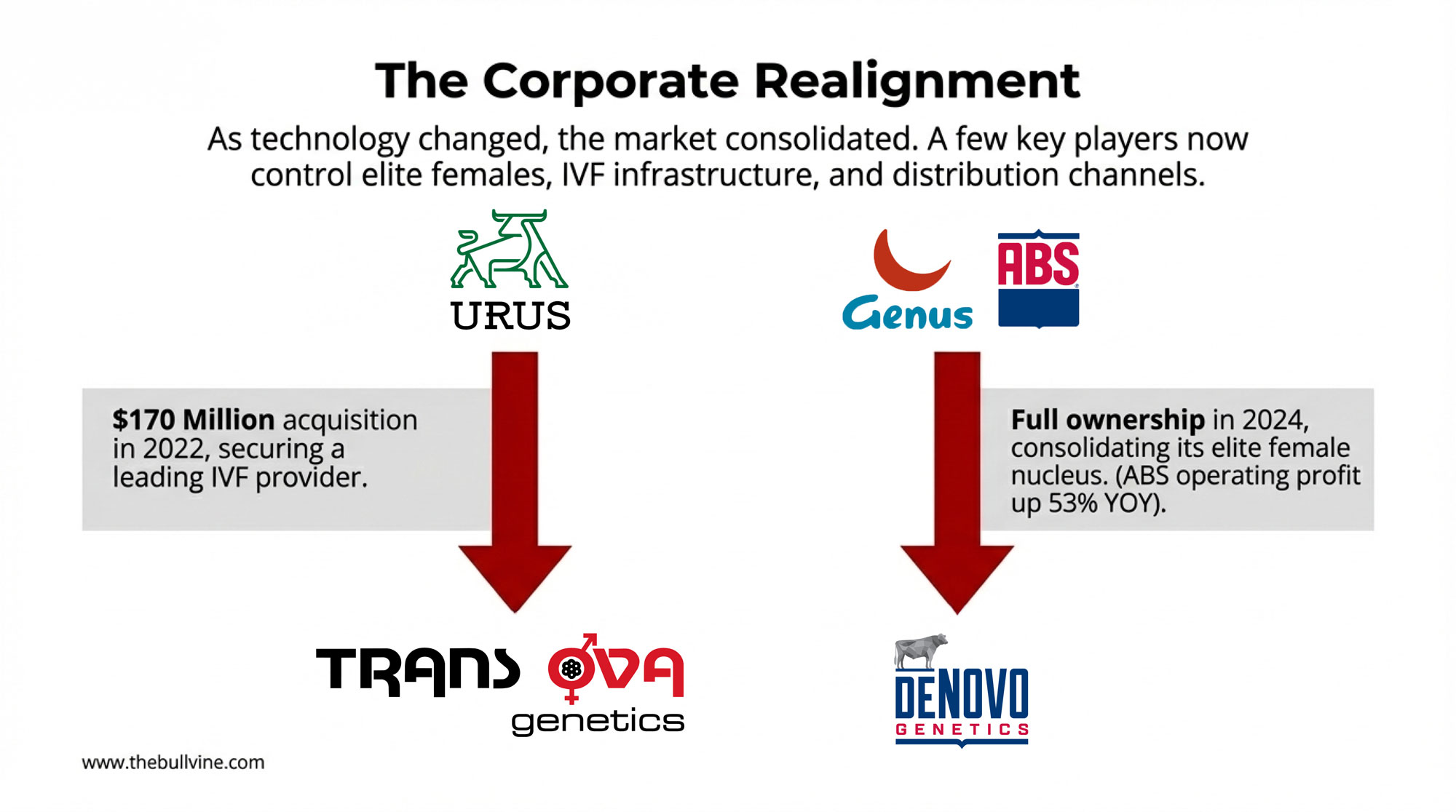
NewsSubscribe
First
Last
Consent

The New Math of Dairy Genetics: Why This Balanced Breeding Thing is Finally Clicking

What if your best bull is actually your herd’s biggest weakness? The surprising truth about balanced breeding.

Do you know what strikes me about walking through barns lately? The conversations have shifted. It used to be all about chasing the next high TPI or LPI bull or bragging about NM$ or Pro$ numbers. But now… now I’m hearing producers talk about balance. About building herds that actually work day-to-day instead of just looking good on paper.

And honestly? Lactanet’s modernized LPI system, including its six subindexes, which was launched this past April, has finally given us the tools to do this right. What I’m calling “no-holes-sire” selection isn’t just some fancy theory anymore—it’s becoming the new reality for producers who want to stay competitive.

What’s Really Going on Out There

The thing about single-trait or one total merit index selection is that … look, it worked for a while. Research analyzing dairy breeding programs consistently shows that multi-trait selection indices outperform single-trait approaches for overall genetic progress, but old habits die hard, right? Especially when you’ve got a #1 bull that looks like he could rewrite the record books. Yet a one total merit number does not tell you a bull’s strengths and weaknesses.

But here’s where it gets interesting—and a bit concerning. We’ve been inadvertently concentrating on harmful recessive and profit-limiting genes that mess with fertility, health, and overall cow functionality when we used only a total merit index. It’s one of those unintended consequences that makes you shake your head and wonder how we missed it for so long.

What’s really driving this shift, though? Margins are tight – labor is unavailable, and feed costs are absolutely brutal right now. I’m hearing numbers ranging from $450 to $500 per tonne for quality dairy rations across most of Ontario and Quebec (variations by region are expected). When you’re dealing with margins that tight, you can’t afford genetic holes that turn routine management into daily firefighting.

The University Crowd is Getting Excited About This

Dr. Christine Baes, from the University of Guelph and leader of the Resilient Dairy Genomics Project, has been advocating for this balanced approach for years, and the genetic data emerging from her lab is quite compelling. The fact is, when you optimize across multiple traits and indexes simultaneously, you’re basically hedging your genetic investment portfolio. It’s like diversifying your feed suppliers, rather than putting all your eggs in one basket.

What’s particularly fascinating is how this relates to feed efficiency. Dr. Baes’s work, along with other industry analyses, suggests that cattle from more balanced genetic programs tend to be 8-12% more efficient in feed conversion. At current feed costs, we’re talking potential savings that could add up to $200-250 per cow annually—which, let’s be honest, adds up fast when you’re running 300 or 500 head.

The strategy that’s gaining real traction centers on what I call the “five-of-six rule“—selecting sires with at least five of Lactanet’s six LPI subindexes above the 50th percentile rank. Simple concept, but it ensures your bulls perform above average across multiple categories instead of being superstars in one area while creating weaknesses elsewhere.

The table below reports the LPl and subindex details for the twenty Holstein sires with the most Canadian registered daughters in 2024. Definitely, more balance in sire usage is needed, as fifteen of the twenty are below 50% RK for their reproduction and environmental impact subindexes, while health & welfare, and milkability fare only slightly better. It is clear that in the past, the LPI formula was focused on production, type, and longevity.

April ’25 Indexes for Twenty 2024 Sires with Most Registered Daughters
CategoryAvg IndexIndex%RKRange in %RK% Sires Below 50RK
Lifetime Performance Index (LPI)3531    98%RK    81 – 99 %RK0%
Production Subindex (PI)659     93%RK    70 – 99 %RK0%
Longevity & Type Subindex (LTI)678     98%RK     57 – 99 %RK0%
Health & Welfare Subindex (HWI)500     50%RK     02 – 93 %RK60%
Reproduction Subindex (RI)450     29%RK     01 – 65 %RK75%
Milkability Subindex (MI)516     52%RK     10 – 92 %RK45%
Environmental Impact Subindex (EII)475     40%RK      02 – 96 %RK75%

Real Talk from the Barn Floor

I’ve been speaking with producers across Ontario and Quebec—from the Ottawa Valley to the Eastern Townships—and the stories are remarkably consistent. The common thread? Producers who have shifted to more balanced approaches are seeing improvements in herd health metrics and reproductive performance over 2-to 3-year periods.

One producer I know from the Kemptville area told me straight up: “My conception rates were garbage for three years running. Kept chasing high milk bulls, thinking more production would solve everything. Finally, I said screw it and started looking at the whole package.  Three breeding seasons later, my fresh first lactation cows are settling like they should, and I’m not calling the vet every other day.”

This isn’t some overnight miracle—that’s important to understand. But the trend is clear, and it’s happening across different herd sizes and management styles.

Here’s what’s really interesting, though… it’s not just about avoiding problems. The producers embracing balanced selection are actually positioning themselves better for whatever comes next. Climate challenges, labor shortages (don’t get me started on finding good help), feed price volatility—these cattle seem to handle it all with less drama.

The Money Talk (Because That’s What Actually Matters)

Now, transitioning to balanced selection isn’t exactly a minor adjustment. Agricultural economist Dr. Alfons Weersink from the University of Guelph has noted that implementation costs for systems can be significant, especially for mid-sized operations. We’re talking genetic testing requirements, restructuring breeding programs, and likely upgrading of data management systems.

For 100-200 cow operations, you’re probably looking at $8,000-15,000 to get this thing rolling properly. 300-500 cow herds may see costs in the $15,000-$ 25,000 range. Larger operations… well, they have more resources, but also more complexity.

But here’s where it gets interesting—the payback timeline varies wildly depending on where you’re starting from. Operations with solid existing genetics might see positive returns within 18-24 months. Herds with more genetic imbalances may require 3-4 years to realize the benefits fully.

The trade-off is real, though. You’re accepting potentially slower progress in any single trait to achieve more balanced genetic improvement across all the economically important areas. However, based on industry observations, that strategy proves to be way more profitable in the long term.

The Tech Side is Getting Pretty Slick

What’s really accelerating adoption is the evolution of genomic tools. Semex’s genomic platform processes over 50,000 genetic markers per animal, providing precision breeding decisions with significantly higher accuracy for young genomic bulls compared to traditional pedigree methods. The reliability jump is impressive—we’re talking 70-75% accuracy versus the old 30-35% with pedigree alone.

The real-time monitoring systems now available can correlate genetic potential with actual production metrics. This means you can identify underperforming genetics before they start hitting your bottom line—which is exactly the kind of early warning system we need in this business.

What Actually Matters: The Numbers

When you analyze lifetime value, Data from leading analytics firms like AgriProfit backs this up. It suggests that balanced genetics can increase average productive lifespan by nearly a full lactation in some herds. Replacement costs become lower when you’re breeding for balance rather than extremes.

The noteworthy part? With interest rates expected to continue declining through 2025, financing conditions are likely to support the adoption of operations ready to invest in genetics and management systems. That’s creating a window of opportunity for producers who want to fast forward this trend.

Regional Patterns and What’s Working

From what I’m seeing across the country, trend setting operations are leading the charge.

Progressive Ontario and Quebec producers are implementing some form of balanced selection protocol—around 30-35% of the forward-thinking operations that I am aware of.

Western Canada producers are quickly transitioning, especially the larger operations dealing with labor shortages, who need cattle that basically manage themselves. Dr. Dan Weary from UBC’s Animal Welfare Program has identified some common patterns among producers who succeed with this approach. They maintain detailed production records, invest in staff training, and—this is key—resist the temptation to chase short-term genetic trends.

The Maritime provinces are being more cautious, which makes sense given their different cost structures and market conditions. But even there, I’m starting to hear conversations about balanced breeding approaches.

Getting Started Without Breaking the Bank

Success really comes down to systematic execution, and honestly, it doesn’t have to be overwhelming. Here’s what’s working for producers who are making this transition:

Start with your baseline. You need to establish genomic profiles using Lactanet’s evaluation services. Testing will run you roughly at $45-65 per animal, but that’s your foundation for everything that follows. No shortcuts here—you need to know where you are before you can figure out where you’re going.

Define your genetic criteria based on your specific situation. This is where operation size may matter. Smaller herds (under 200 head) can probably focus on 3-4 key areas where they’re struggling most. Mid-sized operations (200-500 employees) require more comprehensive approaches. Larger herds can get more sophisticated with their selection strategies, but also need advanced data management systems.

High somatic cell count operations should lean into health indexes (HWI subindex). Herds struggling with fertility might weight reproduction factors (RI subindex) more heavily. But—and this is crucial—you still maintain that five-of-six threshold for balanced improvement.

Stay disciplined. This is the hardest part. When some hot new LPI bull, with less than four subindexes over 50%RK, shows up and everyone’s talking about him, it’s tempting to jump. Don’t. Stick to your balanced strategy and trust the process.

Where This is All Heading

The key insight that keeps coming up in my conversations?

Will we lose type and milk yield?  The facts are you’re not sacrificing genetic progress—you’re optimizing it for the real world. Instead of creating cattle with spectacular strengths and devastating weaknesses, you’re building consistently profitable animals that actually work in today’s and tomorrow’s environment.

As industry consolidation continues—Canadian dairy farm numbers have declined from 12,007 in 2014 to 9,256 in 2024—operational efficiency is no longer just a nice-to-have. It’s become a survival requirement.

Canadian Dairy Consolidation (2014-2024). As the number of Canadian dairy farms declines, the average production per farm continues to rise, underscoring the critical need for operational efficiency and genetic optimization for survival and growth.

The producers who are embracing balanced genetic foundations right now are not just avoiding future problems—they’re positioning themselves to thrive as the industry continues to evolve. Those still chasing single-trait or single-index rankings… well, they’ll be dealing with the expensive consequences of genetic imbalance, while their neighbors quietly build more resilient and profitable operations.

This shift toward total balanced breeding isn’t just another fad—it’s the industry growing up. And honestly – it’s about time. We have the tools, we have the data, and we have producers who are ready to make it work.

The question isn’t whether balanced breeding is the future—it’s whether you’re going to be part of that future or get left behind dealing with yesterday’s genetic limitations.

What’s your take on this whole balanced selection thing? Are you seeing similar patterns in your neck of the woods?

Key Takeaways:

  • Balanced genetic selection—using multiple subindexes rather than chasing a single high-ranking trait—helps build herds that are resilient, efficient, and profitable in today’s challenging dairy environment.
  • New tools like Lactanet’s modernized LPI system (with six subindexes) empower producers to practice “no-holes-sire” breeding, focusing on consistently above-average bulls rather than single-trait superstars.
  • While shifting to balanced selection requires investment in testing, management, and discipline, producers report real improvements in fertility, health, and long-term profitability within a few years.
  • Genomic technology enables much greater accuracy in breeding decisions, helping to avoid costly genetic weaknesses and identify underperforming animals sooner.
  • Farms adopting balanced breeding are better positioned to adapt to industry disruptions—like labor shortages, volatile feed prices, and climate stress—compared to those sticking with outdated genetic strategies.

Executive Summary:

Balanced breeding is quickly becoming the new standard in dairy genetics, as producers move away from chasing single-trait or high-total merit sires toward building herds that thrive in real-world conditions. The launch of Lactanet’s modernized LPI system, with its six subindexes, now makes it possible to practice true “no-holes-sire” selection—targeting bulls that perform above average in multiple areas rather than excelling at just one. Research and on-farm experience alike confirm that this approach improves overall herd health, fertility, and resilience, while helping producers navigate rising feed costs and labor shortages. Although initial investments in genomic testing and record-keeping can be significant, payback is seen within a few years through improved performance and longevity. Genomic platforms and real-time monitoring are making breeding decisions vastly more accurate and actionable. Herds embracing this strategy are positioned to handle ongoing industry changes and future challenges, setting themselves up for lasting profitability. Ultimately, balanced breeding marks a shift towards more sustainable, efficient, and future-ready dairy operations.

Complete references and supporting documentation are available upon request by contacting the editorial team at editor@thebullvine.com.

Learn More:

Join the Revolution!

Join over 30,000 successful dairy professionals who rely on Bullvine Weekly for their competitive edge. Delivered directly to your inbox each week, our exclusive industry insights help you make smarter decisions while saving precious hours every week. Never miss critical updates on milk production trends, breakthrough technologies, and profit-boosting strategies that top producers are already implementing. Subscribe now to transform your dairy operation’s efficiency and profitability—your future success is just one click away.
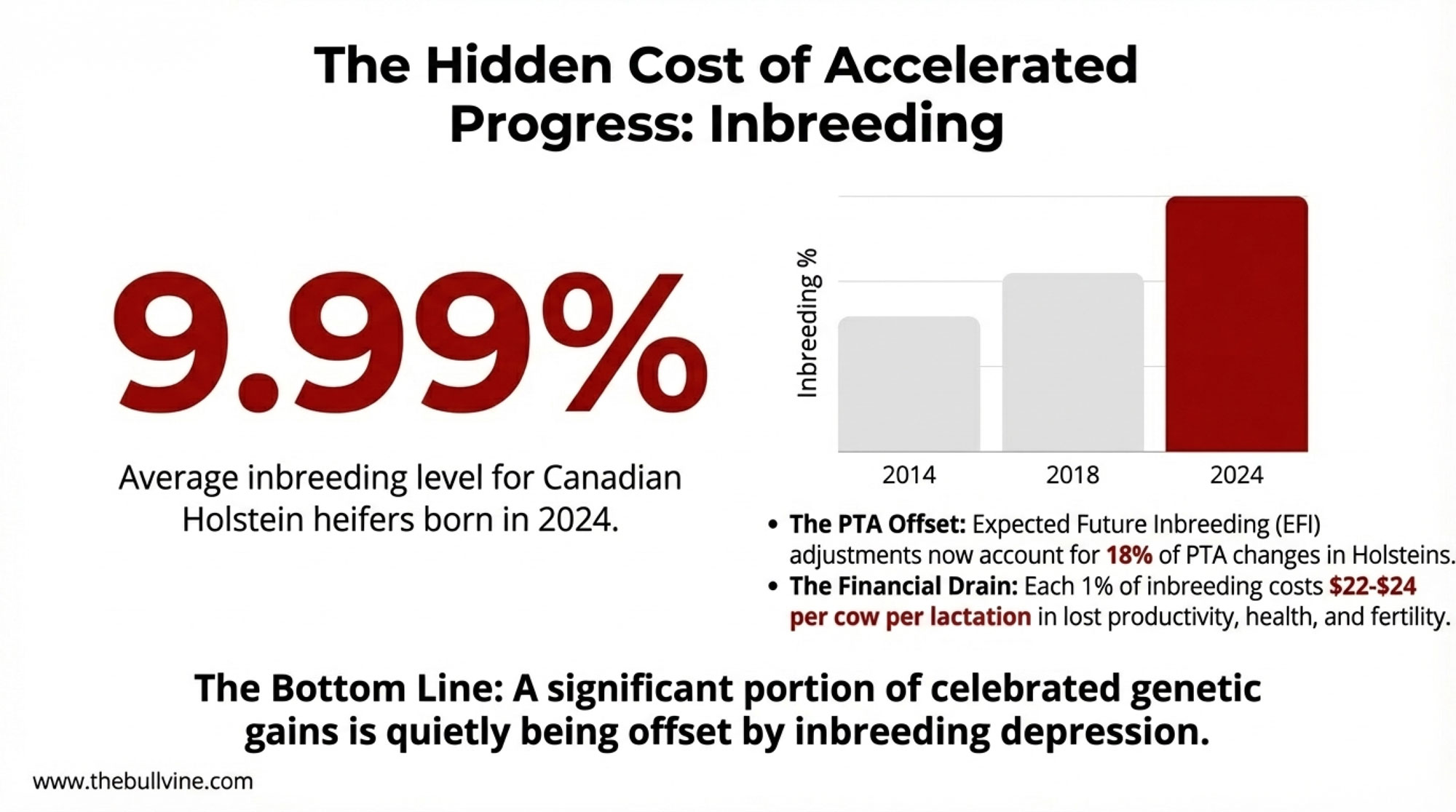
NewsSubscribe
First
Last
Consent

The Holstein Genetics War: What Every Producer Needs to Know About the Battle for Our Breed’s Future

What if I told you frozen semen from the 1940s outperforms today’s million-dollar superstars? Gene banks don’t lie.

Look, I’ve worked with Holsteins long enough to know when something smells off. The talk about genomic miracles? Sure, the gains are real—annual genetic progress in Net Merit has actually more than doubled, from $36.90 to $83.33, since genomics became a reality (PMC Genomic Selection Research, 2016). Sire generation intervals dropped from over 10 years to just 2.5 years, letting us stack improvements way faster than before.

But here’s what isn’t front and center at your co-op meetings: Holstein inbreeding levels in elite U.S. herds have increased from about 5.7% in 2010 to 15.2% by 2020—a 168% rise (USDA/CDCB; The Bullvine Genetic Analysis, 2025). Industry projections show we could reach 18–22% by 2030. That’s nearly triple the widely recognized 6.25% “danger zone” where inbreeding depression hits hard.

The Inbreeding Crisis on Display. The average inbreeding of elite Holstein bulls has risen sharply, skyrocketing from the 6.25% “danger zone” in 2010 to over 15% by 2020, far outpacing the general population. This trend highlights the accelerating genetic bottleneck in the Holstein breed.

The cost? Expert economic analyses place inbreeding losses between $3.6–6.7 billion for U.S. dairies from 2011–2019 (AgEcon Search Economic Analysis). Each 1% inbreeding increase shaves $23–25 off a cow’s lifetime Net Merit, plus shortens productive life and reduces fertility (Dairy Cattle Genetic Improvement, 2024; University Research Compilations, 2024). Have you seen more infertility, lameness, or culling pressure lately? You’re not alone.

Inbreeding is a Hidden Tax on Your Herd. Economic analyses show a clear correlation between rising inbreeding levels and significant lifetime profit losses per cow, with the negative effects accelerating as inbreeding increases beyond the danger zone.

How the Big Players Influence the Game

The Council on Dairy Cattle Breeding (CDCB) now manages the world’s largest livestock database—100 million animal records, 10 million genotyped, from 72 countries (CDCB Activity Report, 2024). This sets global benchmarks and puts U.S. breeders in the driver’s seat—but it also keeps information and breeding power in few hands.

Companies like STgenetics don’t just breed—they build bulls. Their bull Captain, for instance, was engineered through proprietary matings. While building Captain, they held back his father Sabre from most catalogs—a classic move to ensure that they got exclusive use of his genetic potential. Not unlike how most AI companies now make all the contract matings before they sell the semen publicly. The result STgenetics now dominates U.S. Net Merit (26.5%) lists.

Strategic Use of “Hidden” Sires: A Recurring Theme in Holstein History

STgenetics’ selective use of Tango Sabre as a foundational “hidden” sire is not a new trick in Holstein breeding. In fact, the practice of restricting access to promising sires—often leveraging them primarily within one herd—has been a tactical play repeated throughout dairy history by breeders looking to sharpen, conserve, or even commercialize elite genetic lines.

Consider these other foundational cases:

  • Round Oak Rag Apple Elevation (USA):
    One of the all-time breed legends, Elevation’s early semen was tightly managed by his owner and distributed selectively for targeted matings. His initial, controlled use allowed for concentrated genetic gains within certain herds before broader industry access, a move that amplified both his influence and value.
  • Roybrook Starlite (Canada):
    Echoing the herd’s tradition, Starlite was used almost exclusively “in-house” within the Roybrook program to intensify key genetic traits. Only after this internal genetic consolidation were Starlite’s genetics released more broadly, subsequently impacting Canadian and international Holsteins.
  • Sunny Boy (Dutch Friesian/Holstein):
    In the Netherlands, the early distribution of Sunny Boy semen was highly rationed and targeted at strategic clients due to both supply constraints and his growing reputation, allowing the owner (CR Delta) to optimize both returns and influence.

What all of these stories illustrate is simple: the restricted, strategic use of sires—sometimes referred to as “holding back” genetics—has always been part of the playbook for herd improvement, profit generation, and competitive positioning in dairy breeding. Whether it’s Roybrook, Tango Sabre, or legendary sires like Elevation and Sunny Boy, this approach has quietly but decisively shaped the direction and fortunes of the Holstein breed worldwide.

The Gene Bank Discovery Nobody’s Talking About

Here’s the bombshell: USDA researchers used frozen Holstein semen from the NAGP gene bank—samples from bulls whose lineages trace back to the early AI era—and produced daughters that stood toe-to-toe with today’s “elite” sires for production traits, fertility, and health. We’re talking milk yield, component percentages, and reproductive longevity that were all solid, not just a nod to history. The key revelation? These bulls represent Y-chromosome lineages that have completely disappeared from the modern Holstein population.

The genetic bottleneck is even more extreme than most realize. Today, over 99% of Holstein AI sires descend from just two bulls born in the 1950s, which has left our breed with shockingly limited Y chromosome diversity—most historic lines are extinct, but the gene bank kept some rare ones alive just in time.

This isn’t nostalgia—it’s serious genetic insurance. The gene bank holds onto those lost Y-chromosome families, meaning we’re not boxed in if disease, inbreeding, or selection mistakes hammer current genetics. Studies show calves from these “heritage” sires can absolutely match the breed average (and sometimes exceed it) when paired with top modern cows.35 Their daughters aren’t just “novelty” animals; they’ve got the competitive production, health, and especially reproductive longevity that any dairy producer knows is where real profit protection lies.

NOTE: Semen freezing in cattle wasn’t really feasible until the late 1940s and early 1950s. So, when researchers talk about using “genetic samples from the 1940s,” they’re not using semen literally collected and saved during that decade. Here’s the scoop: Almost all gene bank Holstein bull semen samples come from the 1950s onward, when practical cryopreservation methods kicked off. Earlier preservation—prior to the introduction of glycerol and controlled-rate freezing—just wasn’t possible. Before that, artificial insemination was done with fresh semen only, which obviously couldn’t be stored for decades. If a study says they’re restoring 1940s lineages, what they really mean is they’ve found bulls in the gene bank whose ancestry traces back to those early male lines. The actual semen straws were collected and frozen in the 1950s, ’60s, or later—often from older bulls whose sires or grandsires were around in the 1940s. Some gene banks also store embryos, tissue, or blood, but for these Holstein projects, it’s the semen that’s key—and the oldest viable samples only go back as far as the very first days of freezing technology. So, they didn’t save “1940s semen”—they saved semen from descendants or late-surviving individuals from those lines once freezing became feasible. That’s how they’re able to resurrect “lost” genetic lineages, even if it’s not from the literal 1940s.

What Actually Works: Real-World Data for Real Farms

Inbreeding Management Pays, Immediately

A 1% inbreeding reduction saves $23–25 in cow lifetime Net Merit—that’s on the books, not in a catalog (Univ. Compilations, 2024). Farms that cap offspring inbreeding below 6.25% report steady profit improvement and fewer herd-health headaches.

Genomic Testing Adds Up

Testing every dairy heifer at birth can boost herd genetic merit by $400 over two breeding cycles, while cutting replacement costs 35% (Wisconsin Dairy Research, 2024). For large herds, even more ROI.

The Beef-on-Dairy Trap: Short-Term Win, Long-Term Risk

You see it all over: Beef genetics are now used in 72% of U.S. dairy herds (Farm Bureau Market Intel, 2025). Beef semen sales shot up from 1.2 million units (2010) to 9.4 million (2023), putting 3.22 million dairy-beef crossbred calves on the ground last year (NAAB Data).

Trading Tomorrow for Today. The dramatic rise in beef semen sales has directly correlated with a multi-year decline in the U.S. dairy heifer inventory, creating a critical shortage of replacements and highlighting the long-term risk of this short-term strategy.

Crossbred calves bring $400 or more compared to $150 for a pure dairy bull calf—good money, right? But check your records: replacement heifer costs are now $2,870 each, a historic high, while the pool of genetic diversity shrinks tighter (USDA Market Data, 2024).

It’s a vicious cycle—beef-on-dairy takes future dairy animals out of the herd, narrowing our genetic pool, so AI companies must work with fewer—and more related—bloodlines. This accelerates inbreeding, which makes more cows unprofitable, sending more herds to beef-on-dairy as a fallback.

Michigan State research shows $250 more per crossbred calf when beef semen targets heifers with truly poor dairy genetics, as identified by genomics—not random culls (MSU Study, 2024).

We’re trading our dairy breed’s future for today’s calf check.

Your Immediate Action Plan

This Month:

  • Ask for up-to-date inbreeding reports on progeny from ALL your AI suppliers.
  • Calculate current herd average inbreeding using latest DHIA or, ideally, CDCB genomic parentage records.
  • Refuse any matings that would push progeny above 6.25% inbreeding—remember, it’s progeny inbreeding that counts, not just parent averages.

Next Quarter:

  • Buy semen from at least three different AI companies to spread genetic risk.
  • Explore European outcross (within-breed) options—they’ve documented value for milk component, health, and fertility improvements.
  • Budget for genomic testing of every replacement heifer: $35–$50 per sample.

Long-Term Strategy:

  • Only use beef semen on genomically verified poor dairy genetics.
  • Pilot crossbreeding other dairy breeds for 20–30% of your herd to test for hybrid vigor.
  • Get involved in university extension programs and CDCB information sessions for independent updates and honest guidance on managing inbreeding and alternatives.

Your Operation’s Bottom Line

The dollars add up:

  • Inbreeding reduction: $23–25 lifetime Net Merit per cow, per 1% drop
  • Genomic testing: positive ROI within two cycles
  • Targeted beef-on-dairy: $250+ premium per targeted crossbred
  • European outcrosses: Documented boosts to solids, health, welfare in multiple trials

Example: Dropping your herd’s inbreeding from 13% to 8% can mean $75,000–$94,000 in better cow value, after adjusting for semen cost.

The Bottom Line

Whether Holstein genetics survive and thrive—or collapse under too much corporate concentration and inbreeding—depends on the choices you make this year and every year after.

The “corporate model” offers quick gains but risks future genetic bottlenecks. The diversity model takes planning, but it’s what keeps herds profitable no matter what the market throws at you.

European co-ops prove there are alternatives to pure volume. Gene banks prove that valuable genetics exist beyond the corporate hype. The smartest producers are managing all their genetics—dairy and crossbred, cows and bulls—as a full-profit “portfolio” now.

Your next breeding decision is a vote for the kind of dairy animal—and industry—we’ll have in 2035.

You can keep chasing catalog rankings, or you can start managing herd genetics like the long-game business it is—diversifying risk, optimizing for the lifetime cow, and building a herd that’s ready for the swings of the future.

The research is clear. The economics work. Forward-looking producers are making the shift, planning their herds for the next generation—not just the next index run.

The big question isn’t whether genetic diversity beats chasing next month’s numbers. The proof is in the milk check.

The only real question is if you’ll move first—or be left to play catch-up when your neighbors, or global competitors, act smarter. It’s your future.

Don’t let marketing dictate your breeding strategy. Let the data, the research, and proven results guide your plan.

KEY TAKEAWAYS:

  • Audit your inbreeding levels immediately: Herds dropping from 13% to 8% inbreeding see $75,000-94,000 in improved cow value—but 72% of producers don’t track these numbers, leaving money on the table while competitors gain advantage.
  • Strategic beef-on-dairy targets matter: Michigan State research shows targeting genomically-verified poor dairy genetics (not random culls) delivers $250+ premiums per crossbred calf while protecting your replacement pipeline from the industry’s genetic bottleneck.
  • European outcross genetics deliver measurable ROI: Commercial trials document significant increases in milk components and health traits using CRV/VikingGenetics Holstein bloodlines, offering proven alternatives to the North American genetic monoculture.
  • Genomic testing pays within two breeding cycles: At $35-50 per heifer sample, testing delivers $400+ improvements in herd genetic merit while cutting replacement costs 35%—yet most producers still breed blind in 2025.
  • Diversify AI suppliers like investment portfolios: Using semen from 3+ companies while capping progeny inbreeding below 6.25% creates the genetic resilience that separates surviving farms from those caught in tomorrow’s market squeeze.

EXECUTIVE SUMMARY:

While everyone’s celebrating genomic miracles, we’ve uncovered an $6.7 billion disaster hiding in plain sight—Holstein inbreeding has exploded 168% since 2010, and most producers don’t even know their herd’s levels. Every 1% increase in inbreeding costs you $23-25 per cow lifetime, yet AI companies keep pushing the same elite bloodlines that created this mess. Meanwhile, beef-on-dairy—sold as easy money—is actually accelerating the genetic collapse by removing 95,000 potential dairy replacements for every 1% of the national herd. The kicker? USDA researchers just proved that frozen semen from the 1940s produces daughters that match today’s “elite” genetics for production and health. European cooperatives are quietly building an alternative empire based on longevity and resilience, while North American producers chase short-term index gains that compound into generational losses. The hidden war for Holstein genetics isn’t coming—it’s here, and your next breeding decision determines which side of history you’re on.

Complete references and supporting documentation are available upon request by contacting the editorial team at editor@thebullvine.com.

Learn More:

  • Dairy’s Bold New Frontier: How Forward-Thinking Producers Are Redefining the Industry – This strategic article demonstrates how next-generation producers are using advanced technologies like AI and robotics to dramatically improve efficiency and diversify revenue. It provides a blueprint for leveraging technology to increase productivity and reduce costs, offering a broader perspective on the industry’s future beyond just genetics.
  • Getting Serious About Genomics: Lessons from India’s Dairy Revolution – This tactical piece provides concrete, real-world examples of how producers are using data tracking and genomic testing to cut feed costs and improve milk-to-feed conversion ratios. It reveals how to use these tools to identify your top producers, cull underperformers, and create a more profitable herd, turning genetic strategy into a measurable bottom-line win.
  • The Future of Dairy Farming: Embracing Automation, AI, and Sustainability in 2025 – This innovative article showcases the latest emerging technologies that can drive efficiency and create new revenue streams, from automated feed systems to precision breeding. It reveals methods for navigating volatile markets and making smart investments in technology that provide a faster ROI than traditional expansion.

Join the Revolution!

Join over 30,000 successful dairy professionals who rely on Bullvine Weekly for their competitive edge. Delivered directly to your inbox each week, our exclusive industry insights help you make smarter decisions while saving precious hours every week. Never miss critical updates on milk production trends, breakthrough technologies, and profit-boosting strategies that top producers are already implementing. Subscribe now to transform your dairy operation’s efficiency and profitability—your future success is just one click away.
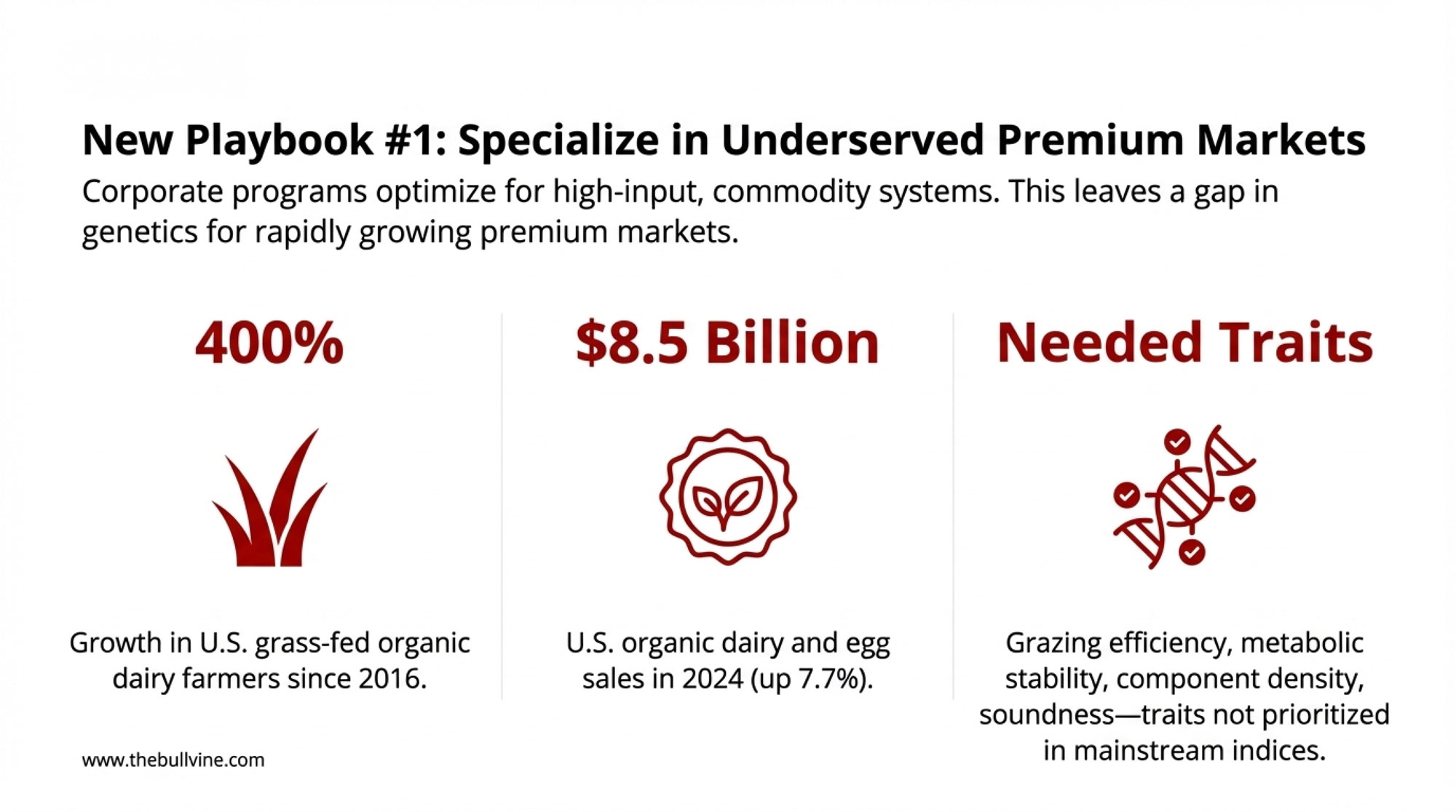
NewsSubscribe
First
Last
Consent

EXPOSED: The $90,000 Genetics Scam Farmers Aren’t Talking About

Why the ‘wait and save’ genetics game is bankrupting family dairies nationwide

EXECUTIVE SUMMARY:

Here’s what we discovered: Waiting for semen prices to fall isn’t saving farmers money; it’s costing the average producer nearly $90,000 over 15 years due to lost genetic progress. Data from USDA shows bulls improved genetic merit by $80 annually post-genomics, while generation intervals shrank from 7 to under 2.5 years, accelerating the divide. Mega-dairies, spending 3-4% of gross income on genetics, harness 90% of gains, whereas smaller farms capture just 30-40%. Consolidation has wiped out nearly 16,000 farms since 2017, reshaping U.S. dairy communities. Our investigative analysis reveals how the genetics arms race deepens inequality and forces hard choices. The future belongs to those who invest strategically; hesitation means losing ground in a market that waits for no one.

KEY TAKEAWAYS:

  • Capture up to $80/year in added genetic merit with timely semen investment, avoiding a $90K lifetime loss.
  • Understand the compressed 2.5-year generation intervals driving genetic gain and stay ahead of the curve.
  • Prioritize strategic genetic budgets—mega-dairies allocate 3-4% gross income; smaller farms must adapt to survive.
  • Recognize consolidation trends wiping out 40% of US dairies in 5 years and plan accordingly.
  • Leverage peer-reviewed science and USDA data to challenge conventional genetics purchasing myths.
DIGITAL IMAGE

You know, I was at World Dairy Expo last fall, and this producer from Iowa — good guy, been milking 350 head for twenty years — he’s telling me how he’s waiting for semen prices to drop from forty bucks down to thirty before he breeds his heifers. Thinks he’s being smart with his money, right?

Well, here’s the thing… Dr. Albert De Vries, this economics wizard down at the University of Florida, he ran the numbers back in 2015 and — get this — you’d need those prices to crash nearly 50%, all the way down to about $21 a dose, just to break even on what you lose by waiting.

Fifty percent! Can you believe that? I mean, when’s the last time you saw premium genetics lose half their value overnight? Never happens.

But those California mega-dairies running ten thousand head? They’re not waiting around. As soon as new genetics drop, they’re buying. And why wouldn’t they? The USDA data from 2016 to 2020 shows bulls improving about $80 per year in Net Merit since genomics took over. That’s real money — compounds through every heifer, every lactation…

Actually, here’s what really gets me fired up. The whole breeding game got turned upside down when generation intervals — that’s how long it takes genetics to flow through — got slashed from seven years down to under two and a half. García-Ruiz’s team published this in some fancy journal, the Proceedings of the National Academy of Sciences, back in 2016.

So if you’re still making breeding decisions like it’s 2005 — and I know plenty of guys who are — you’re already behind. Way behind.

I call it the acceleration trap, and man, it’s caught more farms than I can count. Especially up in Wisconsin… you know how butterfat tanks during those brutal July heat waves? Well, some of that’s genetics catching up with you.

The Caste System Nobody Talks About

Here’s what’s really sneaky about all this. There’s this whole genetic hierarchy forming, and most folks don’t even see it happening.

At the top, you got your mega-dairies — I’m talking thousands of head, mostly out west — throwing 3 to 4 percent of their gross straight into the hottest genetics. Industry analysis suggests these operations are grabbing about 90 percent of the real genetic gains.

Then there’s the middle tier… farms like a lot of the New York and Pennsylvania operations I know. They’re hanging on, getting maybe 60 to 70 percent of those gains. Staying competitive, but it’s getting harder every year.

And then — this is the uncomfortable part — you got the rest of us. Smaller outfits, 200 to 500 cows mostly, are scraping by on what appears to be maybe 30 to 40 percent of genetic progress. You feel it every time those components drop, every time the breeding season scramble gets worse.

Let me tell you about this farmer — we’ll call him John — from down around Zanesville in Ohio. Sharp guy, really. Thought he was making a smart call waiting on that expensive semen, saving himself 200 bucks upfront.

But four years later? Those daughters were costing him about $27 each per year in lost production — that’s using De Vries’ economic modeling framework. Twenty heifers, four lactations… you’re looking at $2,160 missing from the milk check annually.

Then his granddaughters started calving — another $1,620 lost every year. Great-granddaughters? We’re talking over $4,800 annually, all from that one “smart” decision to wait.

Total it up over fifteen years using standard dairy economic projections, and John’s $200 savings cost him roughly $90,000 in foregone profit. Makes your stomach turn, doesn’t it?

But here’s the real kicker — and I heard this from another producer down near Lancaster during corn harvest — those “proven” bulls everyone’s still buying? By the time they prove themselves through daughters, the young genomic bulls have already lapped them. Often at 70 percent reliability, but way ahead genetically because the baseline keeps moving up.

The Niche Market Fantasy That’s Crushing Dreams

Now, I get it. Everyone’s looking at organic, grass-fed, A2 milk, thinking that’s their salvation. Who doesn’t want premium pricing, right?

But let’s talk reality here… Based on the latest USDA organic market reports and industry data through 2025, organic milk’s sitting around 5 to 6 percent of total U.S. production. Grass-fed? Barely registers at under 1 percent. A2’s growing — I’ll give you that — but it’s still niche scale.

The brutal math? These markets can’t absorb even half the farms getting squeezed by this genetic stratification. Most of that “niche transition” advice? It’s false hope designed to keep struggling operations producing commodity milk for a few more years.

Meanwhile, consolidation keeps hammering us. According to USDA Census data released in 2024, we lost nearly 15,866 dairy farms between 2017 and 2022 alone. That’s not just numbers — that’s communities, families, generations of farming knowledge… gone.

And the big players? They’re snapping up the pieces, buying land and cows and basically owning the future.

What This Really Means for Your Operation

So here’s your reality check. If you’re running a small or mid-sized operation, you’ve got maybe twelve to eighteen months — tops — to commit to a survival strategy.

Scale up fast — get to a thousand cows with the genetics budget that requires — or find a genuine niche that pays the bills, or start planning your exit while your assets still have value.

Because genomics changed the rules permanently. No more waiting for better deals. No more hoping the old ways will work.

I’m not sure what to make of all this sometimes, but one thing I know for certain — ignoring these facts is like watching your neighbor’s barn burn down and wondering why your hay’s getting hot.

The clock’s ticking faster than most folks realize. The mega-dairies figured this out years ago. They’re counting on the rest of us not figuring it out until it’s too late.

So what do you think? You gonna keep waiting for a deal that never comes, or are you gonna get ahead of this thing before it’s too late?

Complete references and supporting documentation are available upon request by contacting the editorial team at editor@thebullvine.com.

Learn More:

Join the Revolution!

Join over 30,000 successful dairy professionals who rely on Bullvine Weekly for their competitive edge. Delivered directly to your inbox each week, our exclusive industry insights help you make smarter decisions while saving precious hours every week. Never miss critical updates on milk production trends, breakthrough technologies, and profit-boosting strategies that top producers are already implementing. Subscribe now to transform your dairy operation’s efficiency and profitability—your future success is just one click away.
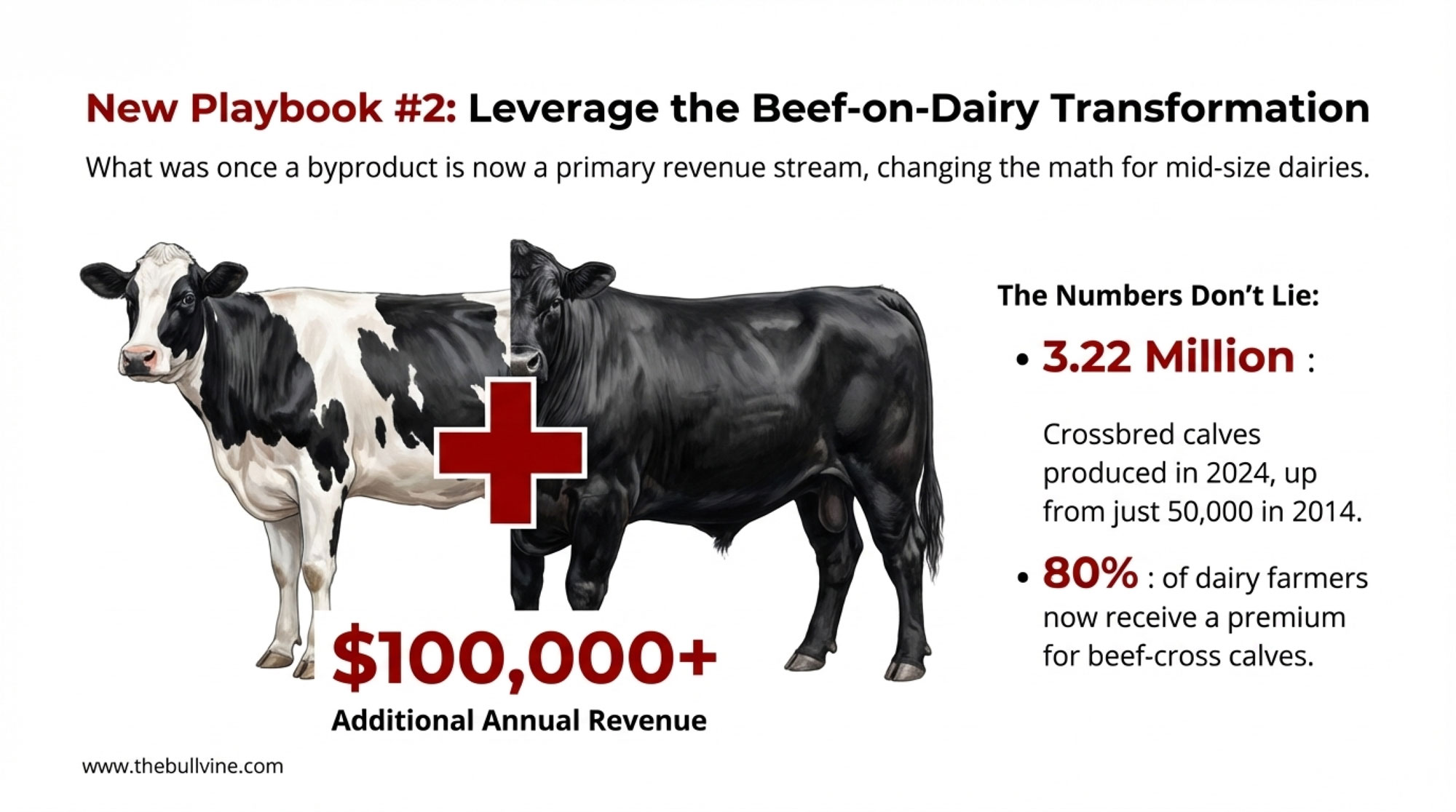
NewsSubscribe
First
Last
Consent

Genetic Gatekeepers: The High-Stakes Gamble of Dairy’s Elite Bloodlines

Every 1% increase in inbreeding costs you $23 per cow—and most herds don’t even know their levels.

We’ve uncovered something that’ll make you rethink every breeding decision you’re making. Genomic selection doubled our genetic gains to per cow annually, but it’s created a billion inbreeding tax that’s quietly draining operations nationwide. Here’s the math that matters: every 1% increase in genomic inbreeding costs about per cow in lost lifetime profit, and Holstein levels have jumped from 5% to over 15% in just fifteen years. Meanwhile, five companies now control nearly 90% of the elite genetics market, using restrictive contracts to keep the best bloodlines in their own pipelines. The producers who start building genetic independence now, while outcross options are still available, will have the most resilient and profitable herds by 2030. Time to stop following the crowd and start protecting your genetic future.

Rising inbreeding coefficients in Holstein cattle since genomic selection began in 2009, with corresponding economic costs calculated at $23 per 1% inbreeding increase

Three Critical Things Every Producer Needs to Know Right Now

  • Genomic selection doubled our genetic gains from $40 to $85 annually per cow in Net Merit—sounds great, right? But here’s what nobody talks about…
  • Genomic inbreeding levels shot from 5% to over 15% in just fifteen years, creating a hidden tax of $23 per cow per percentage point. That’s potentially $230 lost per cow over her lifetime.
  • Five companies now control nearly 90% of elite genetics, yet they’re all selling us essentially the same bloodlines under different names.

The math is brutal when you scale it up. A 500-cow herd averaging 12% inbreeding is bleeding roughly $80,500 annually compared to herds maintaining 5% inbreeding levels. That’s real money walking out your barn door every day.

The coffee-break test: are the same grandsires showing up everywhere?

Grab the last 50 breedings and map sires back two generations; if “Captain,” “Lionel,” “Frazzled,” or “Medley” keep popping up, that déjà vu isn’t a coincidence—it’s what concentrated genomic selection looks like when the whole market chases the same leaderboard. The financial math is simple enough to make a nutritionist wince: at $23 per 1% inbreeding, a 300-cow herd moving from 5% to 12% is quietly leaving roughly $48,300–$69,000 on the table over those cows’ lifetimes, and that’s before counting the drag on productive life and calving intervals that comes with each tick upward.

How the genomic promise became a trap—fast

The thing about 2009–2010 is that progeny testing’s long wait time suddenly became, well, optional: hair sample in, predictions out, generation intervals shrank, and selection intensity went through the roof, which is exactly why genetic gain jumped from ~ to ~ per year. What strikes many producers in hindsight is how standardized indices and the speed of genomic turnover trained everyone on the same targets at the same time, so the “best” bulls were used everywhere—by design—driving a rapid, global convergence around a narrow set of families.

The genomic selection revolution doubled annual genetic gain in Holstein cattle but came at the cost of reduced effective population size, highlighting the fundamental trade-off between rapid progress and genetic diversity

Follow the incentives: concentrated suppliers, concentrated pedigrees

Here’s what’s interesting when you line up the genomic NM$ lists: STgenetics now commands about 53.5% of the genomic NM$ sire share, with the other majors making up most of the rest—a pretty strong signal that the elite sire stream runs through just a few gates. Price reinforces the funnel: value-based pricing ties semen cost to index standing, so rational buyers who want higher herd profitability are nudged to pile into the same top sires—again and again—tightening pedigree overlap as a side effect of “doing the smart thing.”

The contract loop: control doesn’t end at the tank

What’s particularly noteworthy is how early-access or VIP semen agreements can limit resale, restrict use to the buyer’s herd, and even reserve first option on exceptional progeny, which keeps the very best genetics circling back to internal pipelines while everyone else gets the later waves. It creates a two-speed market: a nucleus racing ahead on the newest lines and a broader commercial base buying in after those lines already saturate—pushing inbreeding faster within and across regions than pedigree tools alone will show.

The regional reality check producers keep bringing up

Upper Midwest: large Wisconsin and Minnesota herds often show eerily similar sire stacks despite different nutritionists and management styles—proof of how the same handful of bull families can dominate selection decisions regionally when everyone buys off the same lists. Central Valley: California operations battling heat and water variability point out that many top-index bulls weren’t bred for their climate; producers who need “slick”/heat-tolerant or pasture-efficient genetics still find the elite commercial stream light on those outcross options. Southeast: Georgia and Florida dairies working through heat, humidity, and parasites are increasingly experimenting with crossbreeding and genuine outcross bulls—quietly—because the high-input, confinement-optimized mainstream isn’t built for their reality.

The case that should still give everyone pause: Pawnee Farm Arlinda Chief

The legendary sire Pawnee Farm Arlinda Chief. His genetics advanced production for millions, but his widespread use also spread a lethal recessive gene, highlighting the costly hidden risks of a narrow gene pool.

Chief’s influence was historic—16,000 daughters and millions of descendants—but baked into that legacy was HH1, a lethal APAF1 nonsense mutation that, when homozygous, produced a devastating number of spontaneous abortions across the breed. Between 2016 documentation and subsequent reporting, the best estimates now peg global losses at roughly half a million calf abortions and hundreds of millions of dollars in cost—while his production upside still made him a net positive, which is exactly the cultural trap: normalize the risk as “manageable.” (Read more: The $4,300 Gamble That Reshaped Global Dairy Industry: The Pawnee Farm Arlinda Chief Story)

Why pedigree tools understate today’s risk—and how genomic F_ROH tells the real story

EFI and F_ROH represent two fundamentally different approaches to measuring inbreeding that dairy breeders need to understand and use together for optimal breeding decisions. EFI (Expected Future Inbreeding) is a relative, forward-looking measure that estimates how inbred offspring would be if an animal were mated to the general population—essentially measuring how related that animal is to today’s breed average. However, EFI has a critical flaw: it uses a constantly shifting baseline that becomes more inbred each year, meaning an animal can appear “low inbreeding” simply because the entire population has become more inbred around it. In contrast, F_ROH measures the actual homozygosity present in an individual’s DNA right now—the real stretches of identical genetic material that indicate true genomic inbreeding, regardless of population trends. For practical breeding decisions, savvy dairy producers should use EFI for population-level planning and relative comparisons within their current genetic pool, while relying on F_ROH to understand the absolute genomic risk and long-term genetic health of their animals. Think of EFI as your “how does this bull compare to others available today” tool, while F_ROH tells you “how much genetic diversity has this animal actually lost”—and with Holstein genomic inbreeding having tripled from 5% to 15% in just 10 years while EFI metrics lagged behind, using both measures together gives breeders the complete picture they need to avoid painting themselves into a genetic corner.

Low Inbreeding Sires in the top 200 gTPI to consider:

Naab CodeReg Name TPINet MeritPTA MilkPTA Fat% FatPTA Pro% ProPTA TypeSire x MGS x MGGS
515HO00587Ruann Northstar-ET34279111323990.16590.061.01Gen Percival x Gameday x Rapid
250HO17387Aurora Sheepster POplar-ET3421829862900.2430.051.05Sheepster x Ahead x Medley
014HO17945Wet Sheepster Madcap-ET3415945683930.24480.090.62Sheepster x Gameday x Renegade
007HO17807Matcrest Sundance Ledger-ET33999668091040.26470.080.84Sundance x Payload x Renegade
200HO13425Beyond Nightingale3397857680830.2460.091.17Harmony x Esquire x Parsly
200HO13174Adaway Beyond Fitness-ET33929081153920.16600.080.63Sheepster x Parsly x TRy Me
007HO17380Melarry Sheepster Dijon-ET338193716121050.14680.050.52Sheepster x Drive x TRy Me
202HO02006TRophy-ET3380742394730.21430.110.94TRooper x Spot Lite x Renegade
551HO06233Genosource Maritime-ET338010191301970.16540.040.58Undertone x Upside x Captain
029HO22342Pine-TRee Mervyn-ET337898912641130.22570.060.02Mirrorimage x Foxcatcher x Legendary

The reality is that most of today’s highest-ranking sires likely have elevated F_ROH values because 90% of the top genomic bulls trace back to Oman, Planet, or Shottle in their first few generations. This concentration means finding truly outcross sires among the elite ranks is increasingly difficult.

Producers who believe they’re “mixing it up” with pedigrees are often shocked when genomic runs of homozygosity (F_ROH) uncover more overlap than expected, especially post-2010, as generation intervals tightened and popular sires cycled faster. Studies show that pedigree-based inbreeding underestimates true autozygosity. Meanwhile, ROH trends in North American Holsteins rose sharply through the genomic era—resulting in more small ROH per year—and the last five years of the 1990–2016 period nearly doubled prior rates.

The hidden ledger lines producers actually feel—every season

From industry observations and Holstein/extension economics, each 1% inbreeding pings profitability by about $23 per cow in lifetime Net Merit, while correlated effects—milk yield drags, shorter productive life, and stretched calving intervals—compound quietly across cohorts. When you aggregate that across 500–1,000 cows, the numbers move from “annoying” to “we should fix this now,” especially if replacements are tight and every fresh cow’s butterfat checks are paying the feed bill this month.

A practical 30-day audit producers are using this fall

  • Week 1: Pull 100 recent services and map three generations; flag repeat grandsires and calculate genomic inbreeding if available through herd tools or nominator portals tied into CDCB pipelines.
  • Week 2: Run the inbreeding tax math at $23 per 1% and project five-year costs; identify the top five most related families in the herd and where they sit in production and health.
  • Week 3: Shortlist genuine outcross sires (yes, some will be 100–200 points lower on index) and heat/pasture-adapted options for stress seasons; check cooperative or European sources where appropriate.
  • Week 4: Set genomic inbreeding targets (<8% herd average is a good working mark), define a portfolio breeding plan for the next 90 days, and lock in performance tracking beyond yield—DPR, mastitis events, days open.

The portfolio breeding approach—used by herds that won’t trade tomorrow for today

What’s working in the field is a 40–40–20 split: forty percent “income insurance” on proven, high-index bulls for the best cows in optimal windows; forty percent balanced performers from less-related families; and twenty percent true diversity builders—outcross or strategic crossbreeding to bank hybrid vigor. On timing, spring is a great window for diversity (fresh cows, better heats); in summer heat, some herds test heat-tolerant outcrosses precisely because conception is lower anyway; and in fall, producers blend a higher percentage of index leaders to set up spring calving while keeping 30–40% in the diversity lane.

The tech curve by 2030—what actually looks useful on-farm

CDCB and national partners continue to expand trait coverage and data quality in the National Cooperator Database—now powering evaluations on tens of millions of animals—which is the backbone for making inbreeding and diversity metrics more visible in everyday tools. Expect two practical shifts: breeder-facing dashboards that surface F_ROH and “relatedness risk” at mating-time, and multi-objective AI suggestions that trade a modest drop in index points for measurable herd-level gains in fertility, livability, and inbreeding control.

The Bottom Line

First, write a hard target for genomic inbreeding and enforce it at mating-time with tools tied to CDCB-powered data; don’t let the last click be a guess. Second, treat outcross doses like an insurance premium: they don’t always top the list, but they pay when volatility hits—heat waves, disease pressure, or a hidden recessive hiding in plain sight like HH1 did. Third, negotiate “diversity bundles” or step outside the usual catalogs—cooperative and European options exist—and remember that saving $115 per cow by avoiding 5% extra inbreeding beats chasing 100 index points that never make it to your milk check.

Why this matters more than it feels like it should

Producers don’t feel inbreeding depression in one big wreck; it shows up in a few more open cows, a mastitis flare that pushes great cows out a lactation early, or a herd that just doesn’t breed back like it used to—and by the time it’s obvious, it’s expensive to unwind. The evidence points to a simple truth: a little less index today, with diversity baked in, often pays more in three years than another lap around the same pedigrees ever will.

KEY TAKEAWAYS

  • Your inbreeding level is costing you real money right now — Calculate your herd’s genomic inbreeding using CDCB-linked tools, then multiply each percentage point above 5% by $23 per cow to see what you’re losing annually
  • Break free from the genetic funnel with portfolio breeding — Mix 40% proven high-index bulls, 40% solid performers from different families, and 20% true outcross genetics to hedge your bets and boost long-term profitability
  • Demand transparency from your AI providers — Ask for genomic relationship data, challenge restrictive contracts, and consider cooperative breeding programs that put farmer interests ahead of corporate profits
  • Track what actually pays the bills long-term — Monitor fertility rates, productive life, and mastitis alongside milk weights because the cows that stay healthy and breed back are the ones generating real profit per stall

Join the Revolution!

Join over 30,000 successful dairy professionals who rely on Bullvine Weekly for their competitive edge. Delivered directly to your inbox each week, our exclusive industry insights help you make smarter decisions while saving precious hours every week. Never miss critical updates on milk production trends, breakthrough technologies, and profit-boosting strategies that top producers are already implementing. Subscribe now to transform your dairy operation’s efficiency and profitability—your future success is just one click away.
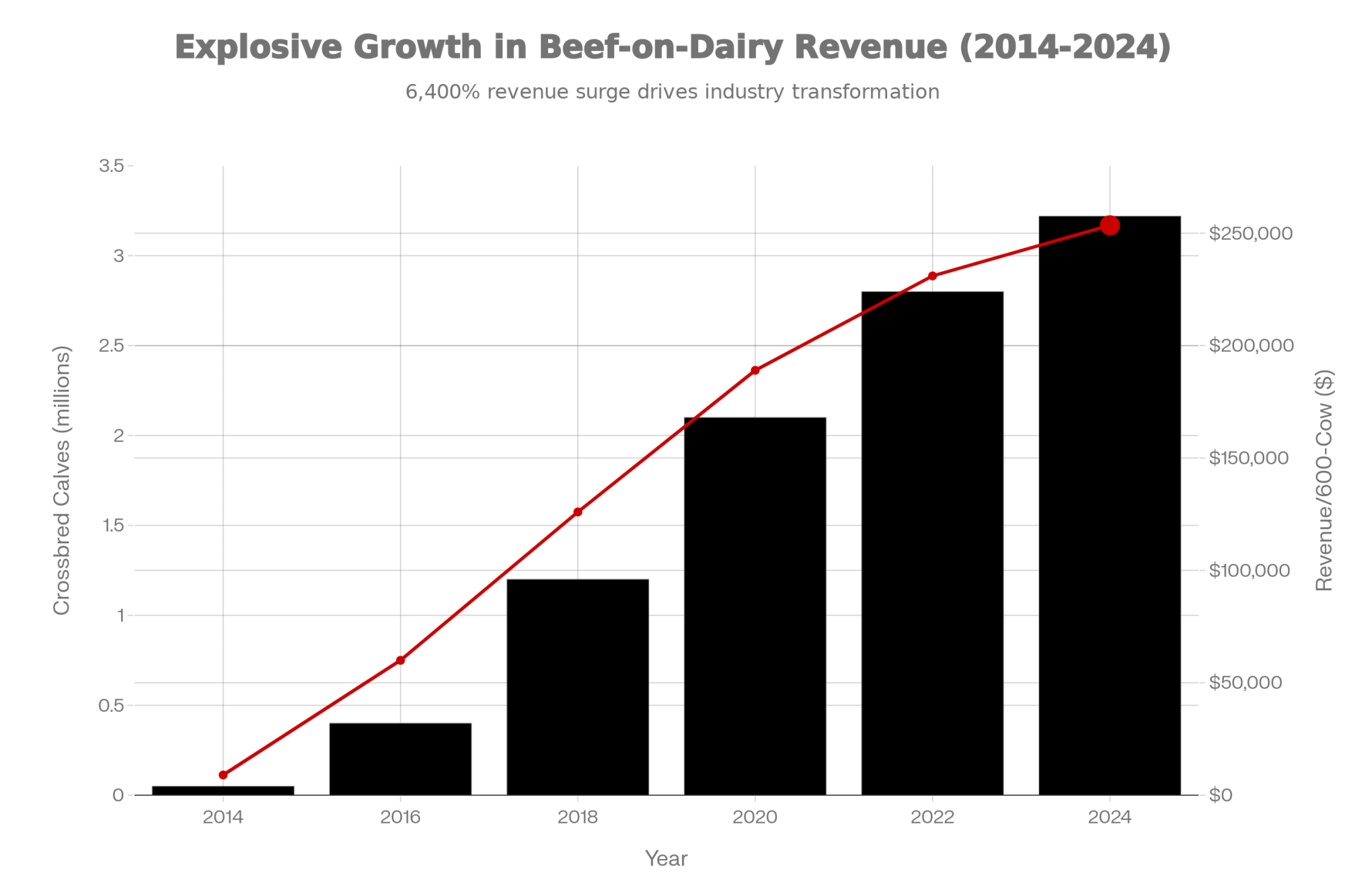
NewsSubscribe
First
Last
Consent

Learn More:

  • Boost Your Dairy Profits: Proven Breeding Strategies Every Farmer Must Know – This article provides tactical advice on sire selection, heat detection, and using sexed and beef semen. It offers practical strategies for improving conception rates and calf value, directly complementing the main article’s call for a more diverse breeding portfolio.
  • Unlock Hidden Dairy Profits Through Lifetime Efficiency – Shifting to a strategic, long-term view, this piece reveals how integrating genetics with precision nutrition creates significant financial gains. It demonstrates how to cut feed costs and boost margins, reinforcing the main article’s theme of finding profitability beyond index chasing.
  • Genomics Meets Artificial Intelligence: Transforming Dairy Cattle Breeding Strategies – Looking to the future, this article explores how AI is revolutionizing genomic data analysis. It details how emerging technologies can help execute the complex, multi-objective breeding strategies needed to manage inbreeding risk and enhance long-term herd resilience and profitability.

The Genomic Kick in the Pants: Why NZ Dairy is Facing a Sink-or-Swim Moment

NZ’s at 50% genomic bull usage while global leaders race ahead. Your farm can’t afford to wait much longer.

EXECUTIVE SUMMARY: Look, here’s what’s really happening out there. New Zealand’s genetic evaluation system got officially slammed as “not fit for purpose” by the 2024 DairyNZ report — and that should wake everyone up. We’re sitting at 50% genomic bull usage while our competitors are way ahead, and frankly, that gap’s costing us. Lincoln University crunched numbers on 127 Canterbury farms and found something interesting: spend $8,000 on a 300-cow operation, you could see $14,000 to $19,000 back annually. The tech behind this — LIC’s Single Step Animal Model — bumps up accuracy by 8%, which is massive when 60% of our cows are crossbreds. With global markets hungry for resilient genetics that can handle tough conditions, this isn’t just about keeping up anymore. It’s about getting ahead while there’s still time.

KEY TAKEAWAYS:

  • Milk production jumps 8-15% with genomic selection — start by getting your replacement heifers genotyped early and watch the data guide your breeding decisions
  • Fertility rates improve 10-20% when you use genomic data — integrate LIC’s Single Step Model results into your mating plans this season for measurable gains
  • Somatic cell counts drop up to 40% with smart genetics — less mastitis means lower vet bills and higher milk quality bonuses hitting your bottom line
  • Global crossbred demand is exploding in 2025 — source bulls with proven multi-breed genomic evaluations now, especially for tropical export markets
  • Feed costs eating your margins? Genomic efficiency pays back fast — better converting cows stretch every feed dollar further in today’s tough input cost environment
dairy genomics, New Zealand dairy industry, dairy farm profitability, genetic progress in cattle, crossbred dairy genetics

The bottom line? Your neighbors are already doing this. Don’t be the last one to figure out that your phone really can pick better cows than your gut.

Pull up a chair, mate. The other day, I was chatting with an old-school Canterbury dairy farmer. This bloke’s been walking the paddocks long enough to spot a good cow with his own eyes. “I don’t need some fancy computer to tell me who to breed,” he said.

But these days? He’s swiping genomic breeding values on his phone right between milking sessions. What flipped the script? His neighbour’s genomics-selected heifers jumped ahead by a whopping 150 kilos of milk solids. That kind of leap wakes you up.

This ain’t just chatter over the fence – the 2024 DairyNZ Industry Working Group officially called our genetic evaluation system “not fit for purpose.” We’re standing still while others chase the future.

Late 2024 LIC data drops another bomb: only about half the AI straws in NZ are from genomic bulls. That’s lagging far behind other top dairy nations.

And the kicker? We’re genotyping around 40,000 cows. To compete at the highest level, we need over 400,000 in the game. It’s like trying to fill a paddock with a bucket when you need a tank.

The Economics: What’s Actually in Your Pocket?

Lincoln University’s 2024 study on 127 Canterbury farms shows the potential, though results vary by operation.

Herd SizeAnnual Investment (Approx.)Potential Annual Return
300 Cows$8,000$14,000 – $19,000
600 Cows$15,000$28,000 – $38,000
1,000+ Cows$25,000$47,000 – $63,000

Data based on 2024 Lincoln University analysis of 127 farms. Individual results will vary.

Farmers involved in DairyNZ studies say the predictions generally match what the vat delivers. That’s coming from people who’ve heard plenty of promises before.

Tech Talk: SSAM — the Game-Changer

LIC’s Single Step Animal Model, SSAM, if you want to sound tech-savvy, is a leap forward.

Instead of separating pedigree, phenotype, and genome analysis, it handles it all at once — bumping up accuracy by around 8%. That’s massive, especially with NZ’s 60% crossbred herd.

Professor Ben Hayes from Queensland said it best: “If you nail multi-breed genomic evaluation, the future’s yours.”

The Pasture Problem: Why NZ’s Farm Setup is Different

Unlike our overseas mates with year-round calving herds, we pack all our calves into a tight spring window.

Mud, rain, and paddocks make sampling a logistical headache. Canterbury trials found pushing compliance from 60% to nearly 90% is doable — if you nail timing, weather, and team coordination. Mess that up, and you’re off the pace.

Ask any farmer who’s dealt with a wet spring and late contractors how that goes.

Aussies Nailed It First

Australia hit their stride when genomic reliability topped 70%. Farmers got on board fast because they trusted the data.

Their focused Holstein and Jersey reference herds nailed precision. No theoretical stuff — just results they could see in the milk vat.

From Rivals to Teammates: The Data-Sharing Revolution

Old rivalries? History. LIC, CRV, DairyNZ, and others are sharing data to get ahead.

Wayne McNee from LIC sums it up: “Genomic success requires population scale that exceeds any single company’s capacity. We’re either working together or we’re all falling behind.”

That’s a complete shift from the days when breeding companies treated genetic data like classified intel.

Who Crunches These Numbers?

Here’s the quiet powerhouse — NeSI and Genomics Aotearoa. Without their computing grunt, processing millions of genetic markers across hundreds of thousands of animals with complex family relationships just wouldn’t be possible.

The Global Angle: Crossbreds Rule

Most of the world’s dairy cows aren’t purebreds — they’re crossbreds. Pure Holsteins and Jerseys really only dominate in North America and northern Europe.

That means NZ’s expertise gives us an edge in tropical and emerging markets where crossbreeding is standard practice. They’re hungry for genetics that can handle environmental stress, disease pressure, and variable feed quality.

Africa’s even rolling out genomic tools made just for crossbreds. The demand is real and it’s growing.

The Skeptics’ Corner

Got doubts? Consider these results from NZ trials:

  • Better Milk Production: 8-15%
  • Improved Fertility Rates: 10-20%
  • Lower Somatic Cell Counts: 25-40%

This isn’t marketing fluff — it’s real results from real farms showing up in milk vats and vet records right across both islands. However, remember that performance improvements vary significantly by operation and management system.

The $86 Million Question

NZ’s planning to invest $58 to $86 million over five years — serious money for building reference populations, computing infrastructure, and farmer education programs.

Countries that master crossbred genomic evaluation in the next five years will dominate global dairy genetics for the next fifty. Our 60% crossbred population — once seen as complicating genomic evaluation — is actually our competitive ace in the hole.

Time’s tight and the stakes are high.

Bottom Line

  • For Farmers: Ring your breeding company about genomic testing today. Sitting still means watching your competitors bank the gains while you explain to your banker why your neighbors are consistently outproducing you.
  • For Industry Leaders: Collaborate, share data, and grow reference populations. Success demands scale; no single company can achieve it alone.

The genomic revolution rewards early adopters and punishes those who hesitate. Simple as that.

Miss this and you’ll be on the wrong side of history.

Complete references and supporting documentation are available upon request by contacting the editorial team at editor@thebullvine.com.

Learn More:

  • Genomic Testing: Are You Just Collecting Data or Actually Using It? – This piece provides practical strategies for turning raw genomic data into profitable on-farm decisions. It bridges the gap between testing and implementation, revealing how to leverage your results for better mating choices, culling strategies, and overall herd improvement.
  • The Great Debate: ProCROSS vs CROSSBREEDING vs PUREBRED – This article breaks down the economics and long-term implications of different breeding strategies. It provides a strategic framework for evaluating which system best aligns with your operation’s goals for profitability, health, and resilience in a competitive market.
  • Stop The Guessing Game: Using Genomics to Select for Health & Wellness – Explore the future of dairy breeding with this look at health-focused genomics. It reveals methods for selecting animals with genetic resistance to common diseases, helping you proactively manage herd health, reduce treatment costs, and improve animal welfare.

Join the Revolution!

Join over 30,000 successful dairy professionals who rely on Bullvine Weekly for their competitive edge. Delivered directly to your inbox each week, our exclusive industry insights help you make smarter decisions while saving precious hours every week. Never miss critical updates on milk production trends, breakthrough technologies, and profit-boosting strategies that top producers are already implementing. Subscribe now to transform your dairy operation’s efficiency and profitability—your future success is just one click away.
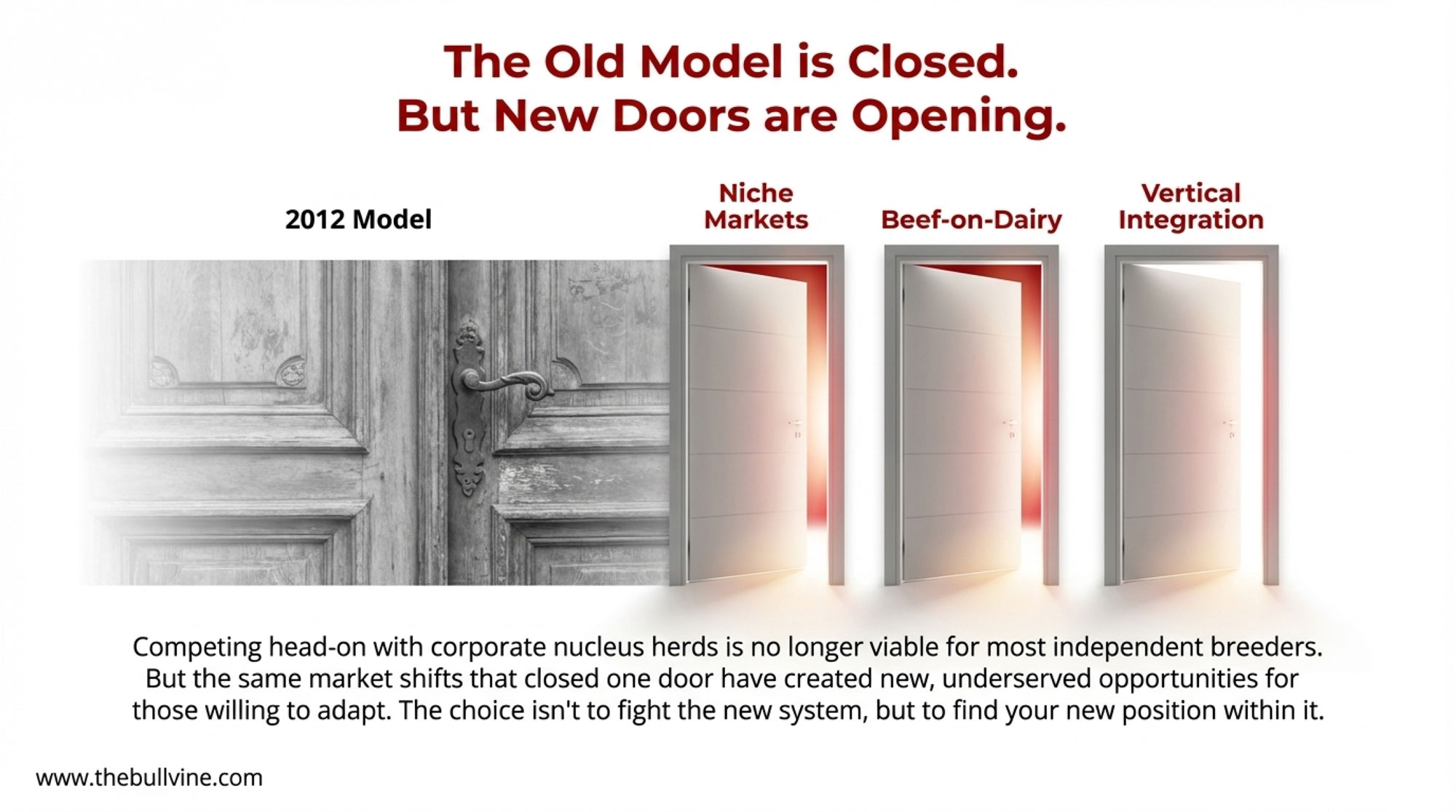
NewsSubscribe
First
Last
Consent

When 110 Brazilian Gyr Cows Changed Everything: The Dairy Shift Tropical Producers Can’t Ignore

While you’re spending $3,000/cow on cooling, Brazilian Gyrs are cranking 11L daily without a single fan. Ecuador just figured it out.

EXECUTIVE SUMMARY: Listen, I just got back from covering the most eye-opening genetics move I’ve seen in decades. Ecuador’s betting their dairy future on heat-adapted Gyr cattle instead of million-dollar cooling systems—and the math is brutal for anyone still fighting their climate. Here’s what’s got me fired up: while your Holsteins lose 25% production when summer hits, these Brazilian Gyrs keep pumping 11 liters daily with zero performance drop. We’re talking about a $306 million global genetics market that’s exploded because smart producers realized something… cooling bills that eat half your feed budget aren’t sustainable. The kicker? These aren’t experimental genetics—they’re million-year-old solutions with 85% genomic prediction accuracy backing every breeding decision. Brazil’s producers learned this lesson decades ago, and now Ecuador’s 300,000 dairy families are following suit. If you’re still mortgaging your future for climate control infrastructure, you might want to run these numbers before your next summer burns through another year’s profits.

KEY TAKEAWAYS:

  • Cut summer production losses by 80%: Gyr genetics maintain 95% output during heat stress while Holsteins crash 25%. For a 100-cow operation, that’s 40-50 liters daily you’re not losing to heat—start with AI programs from proven tropical genetics suppliers this month.
  • Slash infrastructure costs by ditching cooling dependency: Ecuador producers were quoted millions for climate control before discovering Gyr operations running profitably with zero cooling systems. Calculate your current cooling costs per cow and compare against genetic investment ROI—the payback timeline might shock you.
  • Tap into the $306M global heat-tolerance boom: Brazilian genetics are penetrating Australia, New Zealand, and even Germany as traditional markets wake up to climate reality. Contact your genetics supplier about heat-adapted semen availability and pricing—this trend isn’t slowing down.
  • Leverage 85% genomic accuracy for breeding decisions: Modern tools predict heat tolerance in calves before they’re born, eliminating guesswork from your genetic investments. Work with suppliers offering genomic testing to build your heat-adapted herd strategically over the next 3-5 years.
  • Future-proof against rising energy costs: With cooling expenses ranging $0.50-$0.85 per cow daily during peak season, heat-adapted genetics become more valuable every summer. Track your energy bills from last summer and project them forward—genetic solutions look better every year.
Heat stress dairy cattle, Gyr genetics, dairy profitability, tropical dairying, genomic testing dairy

If you had told me a year ago that two cargo planes filled with Brazilian Gyr cows landing in Quito would fundamentally alter tropical dairying, I’d have been skeptical. But those 110 head made a clear statement: the way to beat the tropical heat just got smarter.

Ecuador’s Dairy Reality Check

Ecuador churns out roughly 2.4 billion liters annually from close to 300,000 producers—mostly family operations grinding it out in challenging conditions². Nearly half that milk flows through informal channels, which puts a ceiling on modernization and growth.

Up in the highland regions around Pichincha and Cotopaxi, producers face a double whammy: altitude challenges at 2,700+ meters reduce oxygen levels and stress cows even before heat becomes a factor. Recent research from the University of Liège shows these operations average 15.1 kg daily production under rotational grazing systems.

Based on conversations with multiple producers near Cayambe, there’s a shared frustration: “Our cooling bills are eating almost half what we spend on feed. That’s money we’d rather put back into genetics or better pastures.”

Why Gyr Genetics Are Game-Changers

Standing in a Minas Gerais pasture with Dr. Roberto Silva—one of Brazil’s top zebu geneticists—changed everything I thought I knew about tropical dairy. Watching Gyr cows stroll calmly to milking while Holstein crossbreds desperately sought shade was eye-opening.

These aren’t just heat-tolerant cows—they’re heat-adapted machines. Gyrs maintain performance at Temperature-Humidity Index levels of 77.5, while Holsteins start shutting down around 72-73. That translates to a consistent 10-12 liters daily with 4.2% butterfat, even when the mercury soars.

Breed Performance Reality Check

Data compiled from peer-reviewed studies; individual results vary

Performance MetricGyrHolsteinGirolando
Daily Milk (Tropical)11L7L9.5L
Butterfat Content4.2%3.6%4.0%
Heat Tolerance (THI)77.57275
Summer Production Loss5%25%12%

A Brazilian farm manager near Uberaba told me: “My Holstein crossbreds might hit 18 liters in cool weather, but come summer, they crash to 8. These Gyrs? Rock solid at 11 liters every single day, no matter how hot it gets.”

The Hidden Challenge: Feed Quality and Mycotoxins

What most producers don’t realize is that heat stress is just part of the battle. Ecuador’s coastal regions get hammered with aflatoxin contamination during dry seasons, destroying feed quality and milk safety.

Highland pastures face their own challenges—protein levels fluctuate between 12-18% seasonally, with fiber digestibility dropping during dry periods. When you combine altitude stress, heat, and compromised feed, conventional genetics simply can’t keep up.

That’s where Gyr genetics shine. Evolved in harsh environments, their efficient metabolism and robust digestive systems give them distinct metabolic resilience to multiple stressors simultaneously—heat, altitude, and suboptimal feed quality that would cripple temperate breeds.

LATAM’s Logistics Masterclass

Getting 110 head of elite genetics from Brazil to Ecuador wasn’t just impressive—it was a blueprint for international livestock transport. LATAM Cargo executed quarantine protocols stricter than most international borders, with veterinary teams monitoring every phase.

The economics tell the real story: strategic genetic investments are proving more cost-effective than infrastructure-heavy cooling solutions that drain margins year after year.

What This Actually Costs Your Operation

Let’s cut through the marketing fluff and talk real numbers. Investment costs vary dramatically based on your operation size, location, and current setup. What works in one climate might be overkill or inadequate in another.

The Reality Check:

  • Heat-adapted genetics costs depend heavily on genetics quality, supplier, and regional availability
  • Cooling system investments vary by barn design, local energy costs, and climate severity
  • Ongoing energy and maintenance can be substantial during peak seasons

Note: Costs vary significantly based on operation scale, regional factors, and technology choices. Producers should obtain specific quotes for their circumstances, as investment requirements can range widely depending on genetics quality, supplier, and local infrastructure needs.

A producer near Cuenca summarized what I heard across the region: “We got infrastructure quotes that honestly scared us. Then I visited Brazilian Gyr operations—cows producing quality milk without a single cooling fan. That changed our whole thinking.”

Global Momentum Building Fast

This shift is happening worldwide. The international genetics trade reached $306 million in 2023, with Brazilian bloodlines gaining traction in traditionally temperate markets such as Australia and New Zealand.

Dr. Klaus Weber from Germany’s University of Hohenheim nailed it during our conversation: “Forcing European genetics to work in a warming climate is like wearing snow boots to the beach. Zebu genetics have the evolutionary head start we desperately need.”

Brazil represents a major force in South American dairy production for good reason—its producers learned to work with their environment, not against it.

Technology Meets Ancient Wisdom

Behind these cows, cutting-edge genomic selection is adding precision to natural selection. Brazilian researchers have now achieved 85% accuracy in predicting heat tolerance using genomic tools. This isn’t guesswork—it’s precision breeding based on millions of years of natural selection.

The combination of ancient genetics with modern reproductive technology enables you to rapidly improve your herd’s climate adaptation without the infrastructure investment required by traditional cooling methods.

Your Action Plan

If heat stress is bleeding your margins, here’s your roadmap:

This Week:

  • Contact heat-adapted genetics suppliers and ask for performance data from herds in climates similar to yours
  • Install simple, high-visibility thermometers in your barns and holding pens to establish a baseline Temperature-Humidity Index (THI) for your operation
  • Calculate your actual cooling costs per cow during peak season

This Month:

  • Track summer production losses: measure milk yield and conception rate drops from May through August
  • Visit a Gyr or Girolando operation if you can swing it
  • Connect with your local extension economists for regional cost data

This Quarter:

  • Model ROI comparing genetic upgrades versus cooling infrastructure using your actual quotes
  • Develop a realistic genetic improvement timeline for your operation
  • Assess your feed quality management and mycotoxin protocols

Don’t waste another summer watching profits evaporate with your milk production.

The Bottom Line

Ecuador’s strategic investment proved something every tropical producer suspected—there’s a better way than fighting your climate with expensive cooling systems that drain margins year after year.

The genetics are proven. The economics make sense for many operations. The climate isn’t getting any cooler.

Time to run your numbers and make the call. The flight path from Brazil to Ecuador isn’t just news—it’s showing the way to profitability in our warming world.

Complete references and supporting documentation are available upon request by contacting the editorial team at editor@thebullvine.com.

Learn More:

  • The Ultimate Guide to Dairy Sire Selection – This guide provides a tactical framework for making smarter breeding choices today. It details how to interpret proofs and prioritize traits, ensuring you can effectively implement the genetic shift towards heat tolerance discussed in the main article.
  • Does Your Dairy Have A Strategic Plan? – Move from a single breeding decision to a long-term vision. This article outlines how to build a robust strategic plan, helping you position your entire operation to capitalize on market shifts like the move towards climate-adapted genetics.
  • Genomics: The Crystal Ball of the Dairy Industry – Dive deeper into the technology mentioned in our feature. This piece explains how genomic testing provides an unprecedented look into future performance, allowing you to accelerate genetic gain and make breeding decisions with greater accuracy and confidence.

Join the Revolution!

Join over 30,000 successful dairy professionals who rely on Bullvine Weekly for their competitive edge. Delivered directly to your inbox each week, our exclusive industry insights help you make smarter decisions while saving precious hours every week. Never miss critical updates on milk production trends, breakthrough technologies, and profit-boosting strategies that top producers are already implementing. Subscribe now to transform your dairy operation’s efficiency and profitability—your future success is just one click away.
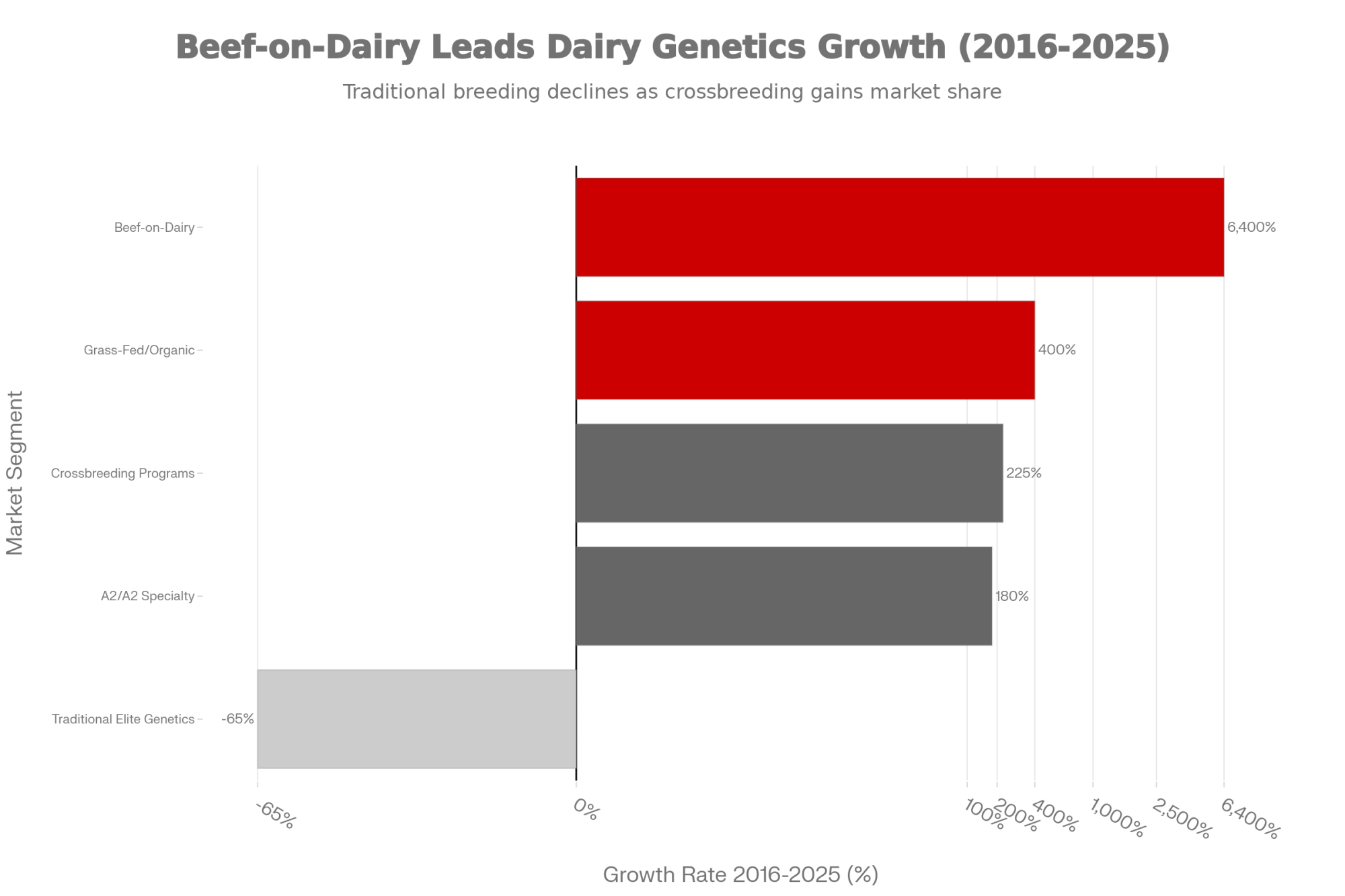
NewsSubscribe
First
Last
Consent

Semex Taps CRV’s Global Genetics Director to Lead US Push

The genetics company lands a respected industry veteran with global chops and farm roots

dairy genetics, Semex leadership, dairy profitability, genetics market trends, methane breeding values

Yesterday, Semex announced that Jon Schefers is stepping in as their new US General Manager, effective September 22, 2025. This isn’t your typical corporate shuffle—it’s a calculated move that tells you everything about where Semex sees the American market heading.

Look, we all know how competitive the US genetics scene is. You’ve got ABS Global, Alta Genetics, STgenetics—all these established companies competing for market position. Each one’s trying to convince producers they’ve got the magic bullet for better cows and fatter milk checks.

Why This Move Makes Sense

Here’s what caught my attention: Semex didn’t just grab any suit from corporate. They went after a guy with dirt under his fingernails. The timing of this appointment—17 days from announcement to start date—tells you this was strategic recruiting, not a panic hire.

Schefers has that combination you don’t see every day. Born and raised on his family’s Minnesota dairy farm with a master’s degree in dairy science from Wisconsin. He gets what it’s like to milk at 4 AM and worry about feed costs, but he’s also got the technical chops to understand genomic breeding values.

Jon Schefers: A Career Path Built for US Dairy Genetics

Started as a Genetics Specialist at Alta Genetics—we’ve all been there, cutting our teeth in the trenches. Then moved to Peak Genetics as Program Lead, where he developed Holstein, Jersey, and Angus breeding programs that actually produced animals people wanted to buy.

But here’s where it gets interesting. As Global Genetics Director at CRV, he wasn’t just pushing paper. He ran product development, R&D, and embryo production across both EU and US operations. And get this—he led the development and launch of methane breeding values in international markets.

That’s not some feel-good environmental PR stunt. CRV’s methane breeding research demonstrates real genetic potential for emission reduction. With regulatory pressure mounting and carbon credits becoming real money in some regions, that expertise could be worth its weight in gold.

His peers elected him as a Director for the National Association of Animal Breeders. When your competitors vote for you in this industry, that says something about your reputation.

What John McDougall Really Meant

“As our US business continues to grow, we’re continuing to invest in the market,” says John McDougall, Semex Vice President of Sales.

Translation? They’re not just maintaining—they’re expanding aggressively.

McDougall calls Schefers a “problem-solver and unifier”. In corporate speak, that usually means there are problems to solve and things that need unifying. But in this case, it probably means what every producer wants: someone who understands that genetics companies need to solve real-world problems, not just sell fancy breeding values.

What Schefers’ Hire Means for Your Dairy Operation

Here’s where the rubber meets the road. This move raises two questions every producer should be asking: Can Schefers use his global experience to give Semex a real edge? And how will the other guys respond?

His methane breeding work could be particularly relevant as environmental regulations tighten. Canada already implemented the first national methane efficiency evaluation system, and that trend isn’t stopping at the border. Having a genetics company that can deliver on environmental traits while maintaining production could be a competitive advantage.

What Producers Really Need

Let’s be honest: producers don’t need another company selling them semen. They need a partner who understands the real pressures—labor shortages that have you milking cows yourself, margins so tight you’re counting every kernel of corn, and consumers who want their milk to come from happy, environmentally friendly cows.

Schefers’ farm background suggests he gets this. But understanding and delivering are two different things. The genetics industry will be watching to see how this appointment influences market dynamics and whether Semex’s investment in experienced leadership pays off.

For producers, the appointment represents another option in an increasingly sophisticated marketplace, where these established companies are competing not just on genetic merit but on their ability to provide comprehensive solutions.

The Bottom Line

This is a smart hire for Semex. They’ve brought in a respected leader with the right mix of farm sense and global technical skill. But the US market is a total knife fight. Schefers’ success won’t be measured in press releases—it’ll be measured in whether he can deliver genetic solutions that make a real difference to your bottom line.

The competition is watching. So are we.

Learn More:

  • Genomic Testing: Are You Leaving Money on the Table? – This article breaks down the practical ROI of genomic testing. It provides a clear framework for deciding which animals to test, helping you maximize your genetic investment and stop wasting money on underperforming animals in your herd.
  • The Genetics Arms Race: Who Will Win the Battle for Dairy’s Future? – Go beyond a single hire and understand the entire competitive landscape. This strategic analysis reveals the long-term trends and market forces that will determine which genetics companies—and which producers—will thrive in the coming decade.
  • Beyond Milk: The Untapped Goldmine of Feed Efficiency Genetics – While methane efficiency is key, this piece explores the next frontier in profitability. It demonstrates how breeding specifically for feed efficiency can drastically slash your input costs, creating a more resilient and profitable herd for the future.

Join the Revolution!

Join over 30,000 successful dairy professionals who rely on Bullvine Weekly for their competitive edge. Delivered directly to your inbox each week, our exclusive industry insights help you make smarter decisions while saving precious hours every week. Never miss critical updates on milk production trends, breakthrough technologies, and profit-boosting strategies that top producers are already implementing. Subscribe now to transform your dairy operation’s efficiency and profitability—your future success is just one click away.
NewsSubscribe
First
Last
Consent

The Heat Is On: Why You Can’t Afford to Ignore Adapted Genetics

Forget everything you know about Holsteins. Brazilian cows are schooling us on heat tolerance.

EXECUTIVE SUMMARY: Look, heat stress isn’t just uncomfortable for cows – it’s stealing 15-25% of your milk and crashing conception rates by 40%, which translates to thousands in lost revenue every summer. Smart producers from Florida, all the way down to Australia, are quietly switching to Brazilian Gyr genetics because these cows keep producing when Holsteins shut down. We’re talking 10-12 liters daily with solid 4.2% butterfat and way easier calving – that’s real money in your pocket. The market’s already moving… Brazilian semen exports jumped 19% in early 2024, and the A2 milk premium game is hitting $2.1 billion globally with 25% higher prices for the right genetics. If you’re serious about protecting profits and beating the heat, this isn’t some future trend – it’s happening right now. Time to test a few head, budget smart, and get ahead of this curve.

KEY TAKEAWAYS

  • Track your summer hemorrhaging first – Heat stress cuts milk by 25% and fertility by 40%, so document exactly what July and August cost you before making any moves.
  • Test Gyr genetics on your worst performers – These cows pump 10-12 liters daily with 4.2% butterfat even when it’s scorching, so try AI on your heat-stressed animals first.
  • Follow the smart money – Brazilian genetics exports shot up 19% in 2024 because producers worldwide are catching on; build relationships with trusted suppliers now before demand spikes.
  • Cash in on A2 premiums – Gyr cattle carry 85-88% A2 alleles vs Holstein’s 35-45%, and that 25% milk premium adds up fast in today’s tight margins.
  • Match tech to your reality – Real-time temp sensors and blockchain sound cool, but only invest if your power and internet can handle it; otherwise, stick to proven genetics upgrades first. Bottom line? This isn’t about jumping on trends. It’s about protecting your operation when the mercury climbs. Start small, test smart, and see what heat-adapted genetics can do for your summer production.
Heat stress dairy cattle, dairy crossbreeding, dairy farm profitability, Gyr genetics, tropical dairy farming

You know the story—summer hits, and your Holsteins just aren’t right. They’re sweaty, panting, and shutting down well before noon. I’ve spoken to farmers from Florida’s Gulf Coast to Queensland, Australia, to Colombia and beyond, and the savvy ones are switching to Brazilian genetics—specifically the tough-as-nails Gyr and Girolando breeds.

Just so we’re clear, these Bos indicus cattle are built for humid, hot climates, unlike the European Bos taurus breeds like Holsteins and Jerseys.

The Numbers Don’t Lie About Heat Stress

Now, University of Florida research lays it out straight: heat waves cause 15-25% drops in production, and conception rates can dive by up to 40%. When you see your cows gasping in the early morning, that’s your bottom line evaporating.

What about the Gyr? Well, according to Embrapa’s 2023 technical reports, these girls churn out 10 to 12 liters daily on tropical pastures—twice what a typical local Zebu does. Plus, their milk’s legit—4.2% butterfat and 3.8% protein. And if you’re worried about calving, their calving ease score is 4.2, crushing Holsteins’ 3.1.

They aren’t just tough—they’re biologically engineered for heat with larger skin surface and efficient sweat glands. That’s a game changer, especially when your fans and misters can’t keep up.

Follow the Money Trail

Right now, the genetics market is booming. Reports from Global Agribusiness analysts show the trade ballooned from $125 million in 2018 to over $400 million in 2024. The Brazilian Artificial Insemination Association (ASBIA) reported a 19% leap in beef semen exports in just the first half of 2024.

Here’s the market snapshot:

YearAnnual Semen ExportsRegional Trade ValueKey Markets
20183.2M doses$125MArgentina, Paraguay
20204.1M doses$178MColombia, Latin America
20226.8M doses$289MPeru, Caribbean
20249.4M doses$412MCaribbean, Southeast Asia

A word of caution: Colombia’s peso crashed big time in 2023, driving up genetics costs by around 18%—that’s not nothing when budgets tighten. And Ecuador? Folks are grumbling about 6-8 week holdups from Agrocalidad that slow shipments to a crawl.

The A2 Advantage That Pays

Now, you’ve probably heard the chatter about A2 milk and what it’s worth. Turns out, Gyr cattle carry the A2 allele at rates between 85-88%, way above Holstein’s 35-45%. That’s why the global A2 milk market is racing past $2 billion with premiums that hover around 15-25% in mature markets.

Tech That Actually Works

Technology’s not just buzz, either. Brazil’s farms are rolling out real-time temp sensors that flip on cooling systems before cows show heat stress. Blockchain systems are becoming real for herd traceability. But heads up—if your power or internet is spotty, these shiny toys can become costly paperweights.

InvestmentCost RangePotential BenefitsPayback Period
AI per service$50-85Improved heat tolerance, better calving ease1-2 lactations
Embryo Transfer$350-500Accelerated genetic improvement2-3 lactations
A2 Testing$25-50/animal15-25% milk premium6-12 months

Playing by the Rules

Got imports on your mind? Work with trusted import specialists and familiarize yourself with sanitary and phytosanitary protocols to avoid costly delays and ensure seamless importation. We all learned a tough lesson from the UK’s 2001 foot-and-mouth disaster.

The Environmental Reality Check

Now, about the environment—yes, flying genetics around ramps up emissions. Reports from UC Davis lifecycle studies peg it at 45-60 tons CO2 equivalent per animal for long-distance cargo shipments. But when you factor in the higher feed efficiency and longevity of heat-adapted cows, the real impact equation changes.

Plus, boosting local production keeps the supply chain tighter and farms safer against global shakeups.

Your Game Plan

Here’s what I’d do if I were in your barn:

  1. Track every drop of heat damage—production, fertility, you name it
  2. Try a few head with these genetics first—no need to bet the farm right away
  3. Budget wisely—AI hits around $50-85 a shot, and embryo transfer is $350-500
  4. Tap into local support—extension agents, breeder associations, and fellow producers
  5. Build solid supplier relationships—and plan for those little headaches, like shipment delays

Don’t wait while the competition rolls past. The future’s for those who adapt—and adapt quickly.

Complete references and supporting documentation are available upon request by contacting the editorial team at editor@thebullvine.com.

Learn More:

  • Crossbreeding, The Quick And Dirty Guide To Getting It Right – This guide provides a no-nonsense framework for implementing a crossbreeding program. It reveals practical strategies to avoid common pitfalls and maximize hybrid vigor, helping you translate genetic theory from the main article into a profitable, on-farm reality.
  • The 7 Qualities of a Great Dairy Breeder – Shift from purchasing genetics to mastering strategy. This article outlines the seven core principles that separate the most profitable breeders from the pack, helping you build a long-term vision for your herd that goes beyond just heat tolerance.
  • Genomics: The Difference Between Good and Great – Go beyond the ‘what’ and understand the ‘how’ of modern genetic selection. This piece demystifies genomics, showing how data-driven decisions can accelerate genetic gain for traits like heat tolerance and secure a competitive edge for your operation.

Join the Revolution!

Join over 30,000 successful dairy professionals who rely on Bullvine Weekly for their competitive edge. Delivered directly to your inbox each week, our exclusive industry insights help you make smarter decisions while saving precious hours every week. Never miss critical updates on milk production trends, breakthrough technologies, and profit-boosting strategies that top producers are already implementing. Subscribe now to transform your dairy operation’s efficiency and profitability—your future success is just one click away.
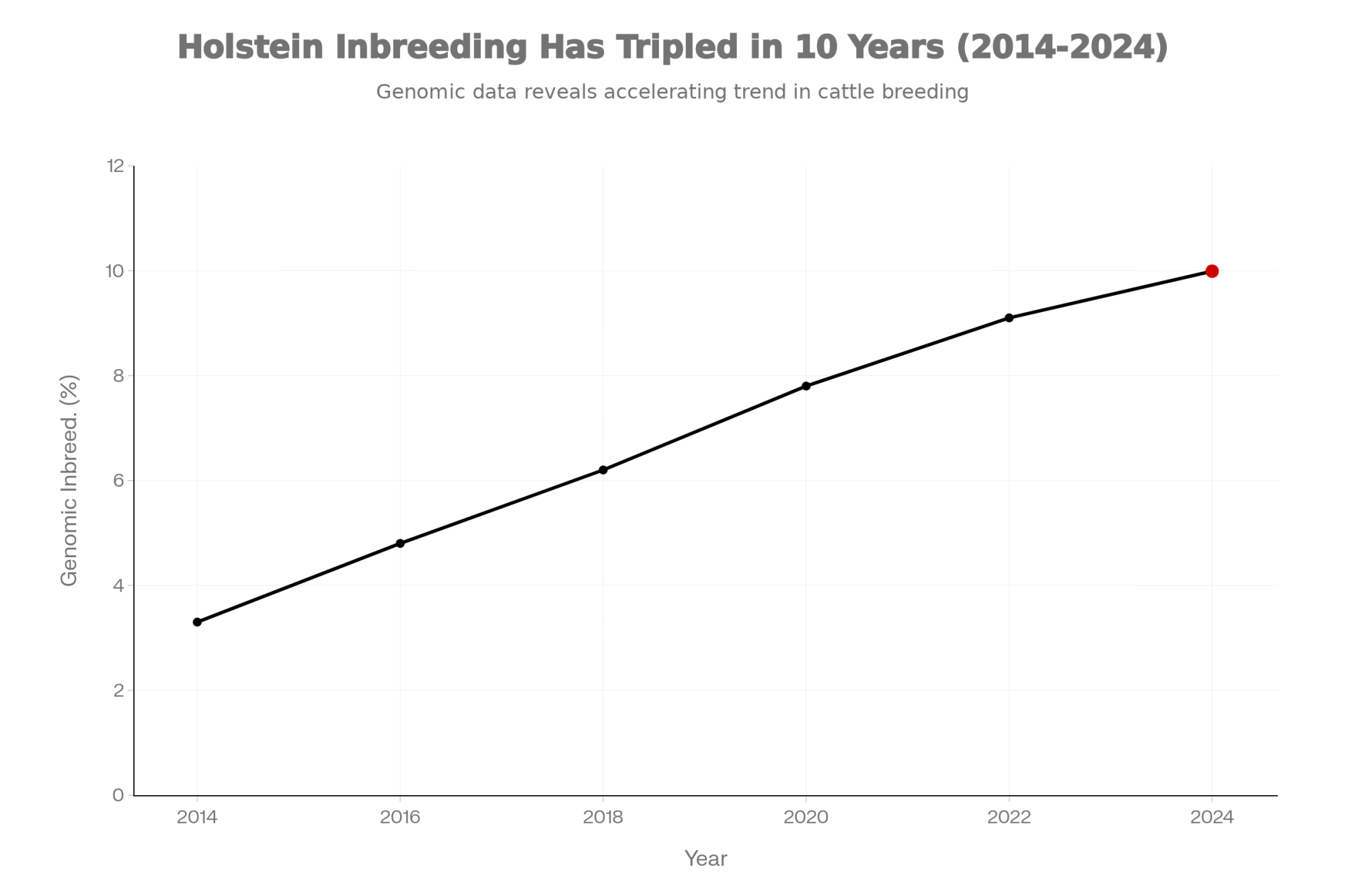
NewsSubscribe
First
Last
Consent

The UK’s Sexed Semen Playbook: How UK Dairies Hit 84% While You’re Still Stuck at 50/50

UK dairies hit 84% sexed semen adoption—while most of us are still playing 50/50 roulette with calf gender.

UK sexed semen adoption has grown dramatically from 12.3% in 2012 to 84% in 2024, with accelerated growth particularly notable after 2018

I’ve been watching this trend for three years now, and what the Brits pulled off isn’t just impressive tech adoption—it’s a complete system overhaul that makes other leading dairy nations look years behind.

You know what hits you when you walk through a modern UK dairy operation? It’s not the robotic milkers or fancy feed systems. It’s the breeding charts. Where most of us around the world still play 50/50 roulette on calf gender, these operations consistently show 89-91% female calves.

That’s not luck. That’s 84% sexed semen adoption across UK dairy herds in 2024, and honestly, it makes the rest of us look like we’re still figuring out the basics. The Americans? Sitting at 61%. New Zealand? About 47%. Most of Europe? Still having meetings about it.

So what did the Brits crack that everyone else missed?

When Carbon Talk Started Writing Real Checks

Here’s what really shifted everything—carbon footprint moved from environmental reports straight into milk pricing contracts. I was chatting with a producer near Exeter last month—he runs 380 Holsteins on grass—and he nailed it: “Five years back, methane was something we discussed at NFU meetings. Now it’s affecting my milk price every month.”

Processors like Arla aren’t messing around. They’re paying actual premiums—2 to 4p per liter depending on targets—for farms hitting verified emission reductions. Tesco’s writing carbon requirements directly into supply contracts.

Here’s the brilliant part: those bull calves that used just to eat feed and take up space? Now they’re actively costing you money twice—feed costs and lost carbon premiums. Using sexed semen to cut those numbers while boosting heifer replacement efficiency suddenly makes perfect economic sense.

The Export Ban Nobody Saw Coming

Then came the policy curveball. The 2023 Animal Welfare Act shut down live calf exports completely. Overnight, farms lost their traditional outlet for surplus dairy bulls.

The University College Dublin research laid it out starkly. Operations that previously exported 200+ male calves annually now had to make them work economically at home, or reduce numbers strategically.

What’s interesting is how quickly processors caught on to the welfare angle. Major food companies started writing surplus calf reduction requirements into procurement standards. Suddenly, using sexed semen wasn’t just about genetics—it was about maintaining market access.

Technology That Finally Stopped Letting Us Down

Let me be honest—early sexed semen was notoriously frustrating. You’d pay double for straws that gave you conception rates 15-20% worse than conventional. Not exactly a winning proposition.

But the breakthrough with SexedULTRA 4M technology changed everything. Double the sperm concentration per straw, 90%+ gender accuracy, and—this is crucial—conception rates now achieving about 82-84% of what you’d get with conventional semen.

Laboratory semen sexing machine with multiple monitors displaying flow cytometry data used to separate sperm cells by sex chromosome in dairy breeding

That’s close enough to make the economics work for most well-managed herds. When fertility penalties basically disappeared, everyone’s math changed.

Looking ahead, CRISPR research is making real progress on 100% female offspring, but that’s still years from commercial reality.

Regional Realities Make All the Difference

What strikes me about UK success is how different regions adapted the technology to their specific challenges.

  • Southwest England’s advantage: Devon and Cornwall operations have something intensive guys don’t—cheap milk from pasture. Lower feed costs create a financial cushion for premium breeding investments.
  • Yorkshire’s scale challenge: Bigger northern dairies manage heat detection across 800+ cow herds differently. Many invested heavily in automated monitoring specifically to make sexed semen profitable.
  • Welsh seasonal pressure: Pembrokeshire operations breed entire herds in 6-8 weeks during optimal grass conditions. Miss heat cycles, and you’re looking at empty cows and lost revenue.
  • Scottish highland reality: Hill farmers deal with hardier breeds that don’t respond to sexed semen quite the same way. Some of the most innovative adaptation work involves extensive systems.

The Economics Work (When You’re Realistic)

Look, you’ll hear people claiming “$200 per cow advantages,” but let’s be realistic. What’s consistently documented is beef-cross calves selling for significantly higher prices than dairy bulls at market—often two to three times more, though this varies by market conditions and management.

Strategic breeding efficiency matters too. Using sexed semen on genetically superior animals while putting beef bulls on culling candidates essentially pays you to improve your herd while reducing replacement costs.

For more insights on how beef-on-dairy crossbreeding delivers ROI, the economics are compelling when done strategically.

Bisterne Farm—they won the 2023 RABDF Gold Cup¹¹—demonstrates excellent management. But let’s keep expectations realistic about those “91% conception rates” you sometimes hear. That typically refers to high-performing subgroups under optimal conditions, not herd-wide averages across all seasons.

The Genetic Diversity Reality Check

Here’s where things get serious. Dr. Donagh Berry from Ireland’s Teagasc raises legitimate concerns: “When 80%+ of inseminations use sexed semen from elite bulls, you’re creating genetic bottlenecks that could bite back hard.”

But AHDB’s genetics team isn’t ignoring this. They promote balanced approaches—beef sires on middle-tier cows, continuous genomic diversity monitoring, and thoughtful elite genetics distribution.

Smart operations find that sweet spot: maybe 40% sexed semen on top of genetics, 30% beef bulls on culling candidates, 30% conventional semen from diverse bloodlines. Genetic progress with built-in safety nets.

Are You Actually Ready for This?

Before calling your AI stud tomorrow, let’s have an honest conversation. I’ve seen too many operations waste money trying to make sexed semen work without proper fundamentals.

CriteriaReadyProceed With CautionNot Ready
Conception Rate≥ 65%55-64%< 55%
Heat Detection≥ 85%70-84%< 70%
Herd Size≥ 200 cows50-199 cows< 50 cows
Financial CapacityCan absorb premium costsMargins are tight; plan carefullyOperating at a loss
Management ExpertiseExperienced AI protocolsLimited experience; needs trainingNew to breeding

If you can’t tick most boxes, tighten up basics first. Sexed semen won’t magically fix fertility problems—it’ll make them more expensive.

And please—don’t rush the process. Operations that succeeded took 12-18 months, focusing on getting systems right before scaling up.

Global Context: Everyone’s Playing Catch-Up

The UK leads global sexed semen adoption at 84%, significantly ahead of the US (61%), Ireland (55%), New Zealand (47%).

The Americans are making progress—61% adoption—but it’s fragmented across regions and systems. Cultural resistance, combined with fragmented breeding services, makes coordinated adoption more challenging than the UK’s integrated approach.

Ireland pushes hard despite seasonal constraints, driven by regulations and export pressures. New Zealand innovates around unique challenges—breeding 900 cows in six weeks creates pressure most can’t imagine.

Europe’s adoption is mixed, ranging from 20% to 60%, depending on regulatory pressure and market incentives. However, the trend is clear: this technology will become standard for competitive operations.

The Bottom Line: Revolution, Not Evolution

The UK didn’t just adopt new technology. They engineered complete systems that generate measurable profits through genetic precision, while meeting regulatory and market demands.

Three things made this work:

  • Policy alignment: Environmental regulations and profit incentives are pointing in the same direction
  • Technology readiness: 4M sexed semen, finally delivering competitive performance
  • Market rewards: Processors putting real money behind measurable improvements

For producers in other markets, lessons are clear. This isn’t about copying UK techniques—it’s understanding how they aligned policy, technology, and economics into coherent strategy.

The competitive window’s narrowing. As other regions catch up, the UK’s first-mover advantage will diminish. But right now, they’ve written the playbook for profitable genetic precision.

The question isn’t whether sexed semen works—the UK proved that. It’s whether you can build the management systems, market relationships, and strategic thinking necessary to make it work profitably in your specific situation.

Because this isn’t about adopting new technology. It’s about evolving your entire approach to dairy genetics for an industry where precision, sustainability, and profitability must align.

The UK figured that out first. Everyone else gets to decide how fast they want to learn.

KEY TAKEAWAYS:

  • Lock in 84%+ female calves like UK leaders by strategically deploying sexed semen on your top genetics—every extra heifer cuts replacement costs and boosts your genetic progress simultaneously.
  • Capture the 82-84% conception advantage with 4M technology that’s finally eliminated the old fertility penalties—your AI success rates can now compete directly with conventional semen.
  • Bank 2-3x higher calf values by mixing beef bulls on culling candidates while reserving sexed semen for elite genetics—smart operations are seeing immediate ROI on this strategy.
  • Meet the 85% heat detection benchmark before scaling up (anything below 70% and you’re burning money)—plus ensure you’ve got 200+ cows to make the economics work in today’s tight margins.
  • Balance genetic diversity risks by rotating elite sires and incorporating beef genetics strategically—AHDB research shows this prevents the bottlenecks that could bite back in 3-5 years.

EXECUTIVE SUMMARY:

Listen, I get it. Sexed semen always felt like expensive gambling. However, what changed was that UK dairies didn’t just adopt the technology; they built entire systems around it, achieving 84% adoption compared to our 61% in the States. We’re talking real money here: beef crosses are fetching 2-3x what dairy bulls bring at market, plus processors are paying carbon bonuses up to 4p per liter for farms cutting methane. The 4M technology breakthrough means conception rates now hit 82-84% of conventional—that fertility penalty that scared everyone off? Pretty much gone. Sure, you need your ducks in a row first… solid heat detection, decent herd size, financial cushion. However, the Brits took 12-18 months to dial it in before scaling, and now they’re reaping the rewards, laughing all the way to the bank. The question isn’t whether this works anymore—it’s whether you’re going to learn from their playbook or watch your competitors pull ahead.

Complete references and supporting documentation are available upon request by contacting the editorial team at editor@thebullvine.com.

Join the Revolution!

Join over 30,000 successful dairy professionals who rely on Bullvine Weekly for their competitive edge. Delivered directly to your inbox each week, our exclusive industry insights help you make smarter decisions while saving precious hours every week. Never miss critical updates on milk production trends, breakthrough technologies, and profit-boosting strategies that top producers are already implementing. Subscribe now to transform your dairy operation’s efficiency and profitability—your future success is just one click away.
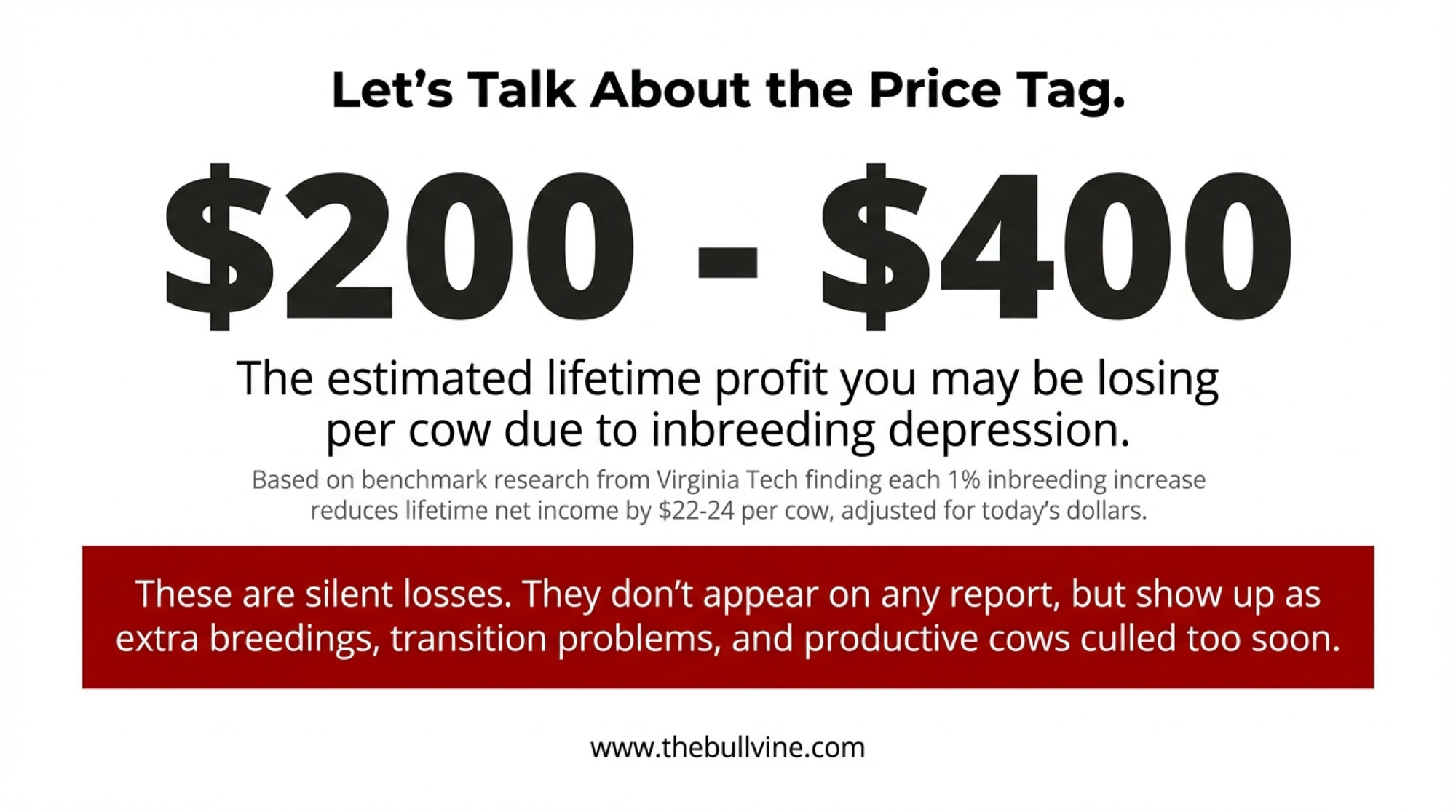
NewsSubscribe
First
Last
Consent

The $350,000 Genetics Wake-Up Call: Why Smart Dairies Are Banking Big While Others Still Play Guessing Games

Two dairy farms, 15 miles apart. One’s banking $350,000 more yearly. The difference? They cracked the genetics code.

EXECUTIVE SUMMARY: Look, I’ve been watching this genetics revolution unfold for years, and the gap between early adopters and holdouts is getting scary wide. We’re talking about farms losing $200-plus per cow annually just because they’re stuck in the past with breeding decisions. But here’s what gets me fired up—some operations are pulling in an extra $350,000 yearly just by getting smart about genomics. The tech isn’t pie-in-the-sky anymore. Genomic testing hits 65-80% accuracy now, which beats the heck out of guessing based on parent averages. AI tools are cranking genetic progress six times faster—jumping Net Merit gains from $13 to $83 per cow each year. Toss in better sexed semen and strategic IVF use, and you’ve got a breeding program that actually pays for itself in under two years. I’ve seen this work on real farms—Wisconsin operations dealing with short grazing seasons, New York dairies switching low-merit heifers to beef breeding, California outfits optimizing for heat tolerance. The math’s solid, the tech’s proven, and honestly? If you’re not at least testing your top replacements, you’re leaving serious money on the table.

KEY TAKEAWAYS

  • Stop bleeding $200+ per cow from genetic lag — genomic test your best 25% of replacements within 30 days and watch avoided costs add up fast
  • Accelerate genetic progress 6x with AI mating systems — Net Merit jumps from $13 to $83 yearly gains per cow when you let algorithms spot inbreeding risks and optimize breeding decisions
  • Cash in on reproductive tech advances — high-dose sexed semen hitting 80-85% conception rates, plus strategic IVF at 50% success, means you multiply elite genetics while culling genetic dead-ends
  • Match your genetics to your ground — Wisconsin’s short grazing season demands forage efficiency focus, while heat-stressed regions need tolerance traits to capture component premiums
  • Start small but start now — phased implementation over 18-24 months delivers measurable ROI while competitors stick with yesterday’s breeding strategies
dairy herd management, genomic testing, dairy profitability, AI breeding decisions, genetic lag costs

You ever get that feeling when you cruise past a neighbor’s dairy and wonder, how are they making this look so easy? Well, spoiler alert: it’s all about livestock genetics, plain and simple.

I was talking to a consultant the other day who’s worked with farms from Wisconsin all the way to Texas. He mentioned two dairies—less than 15 miles apart—with almost identical feed sources, the same milk pickup, and near identical weather. But one hauled in over $350,000 more last year alone. The difference? They nailed their genetics game.

But here’s the kicker—far too many dairies still using old-school breeding are losing more than $200 a cow each year because of genetic lag, and that’s money walking right out the back door. While others are cashing in with genomic testing, achieving 65-80% accuracy — far better than we ever hoped — by relying on sire averages.

When $39 Saves You from Raising a $2,000 Mistake

Let’s be honest—genomic testing isn’t cheap. You’ll be looking at anywhere from $39 for simple parentage testing up to around $200 for a full genetic profile. But what you get for your buck is priceless: a shot at knowing which heifers will actually pull their weight, and which ones will be a drain on feed and resources.

Here’s what you’re looking at:

Test LevelCostAccuracyWhat You Get
Basic Parentage$39-$7565-70%Genetic ID and simple traits
Enhanced Panels$100-$15075-80%Health, production, and fertility markers
Full Genome Scan$175-$200+80%+Comprehensive trait evaluation

Source: USCDCB genomic evaluation data

Agriculture Victoria’s study shows customizing SNP chips can raise accuracy by up to 10%, which is a big deal when you’re making decisions on hundreds of animals.

One case I keep thinking about: Extension research documents a New York farm that tested 400 springing heifers, discovered 150 with poor genetics, and smartly moved those over to beef crosses—saving more than $216,000 on feed and calf sales that might have been wasted.

AI: Your Breeding Partner That Never Takes a Day Off

Now AI? That’s the game-changer knocking on the barn door.

Based on documented adoption patterns across the Midwest, producers typically follow a similar path: initial skepticism, gradual testing, and then growing confidence. One Wisconsin farmer told me he was downright skeptical of computers running his breeding program just two years ago. Now? He’s crediting AI with saving him $38,000 by spotting inbreeding before it turned costly and kicking his genetic progress into overdrive with a 280% increase.

These AI tools run thousands of breeding combos in a flash—way beyond what you could crunch by hand while juggling barn chores.

Here’s how that breaks down:

FactorOld-School WayAI-Powered WayHow Much Better
Inbreeding ControlPedigree sheetsGenomic + AI algorithms8-12x more precise
Health PredictionVisual spotting71% accuracy for mastitis, 96% for digital dermatitisDays earlier intervention
Breeding ChoicesMaybe 20 optionsThousands evaluatedMassive increase
Genetic Progress$13/year Net Merit$83/year Net MeritNearly 6x faster

Source: USDA Net Merit documentation

Heads up—AI’s track record is strongest on digital dermatitis prediction, while mastitis detection accuracy is still being refined through ongoing research.

Reproductive Tech That’s Actually Paying Off

Sexed semen? It’s come a long way.

Labs are pumping twice the sperm into high-dose straws, often matching conception rates of regular semen—not everywhere, but often enough to change the game.

Run that with beef semen on your lower genetic merit cows and IVF for multiplying your cream-of-the-crop, and your breeding program’s got some serious horsepower.

Check this out:

TechnologyConception RateCost PremiumBest Use
High-Dose Sexed80-85%+$25-$30/strawElite genomic females
Beef Semen80-85%Market-dependentLower-merit females
IVF/Embryo Transfer45-55%~$500/pregnancyElite genetic multiplication

Source: Based on university extension models and industry data

Extension case studies document operations using this strategic approach—genomically testing replacement heifers, identifying those with below-average potential, and switching them to beef breeding. One frequently cited Wisconsin example netted $350,000 through avoided costs and premium crossbred calf sales.

IVF costs vary by region and setup, but best-case scenarios show around 50% conception rates for roughly $500 per pregnancy.

The Economics: What Investment Levels Actually Deliver

I gotta mention—breeding programs are no small investment.

Annual spend can range from approximately $75,000 for a modest setup to over $300,000 for elite operations.

But the payback can be solid:

Program LevelAnnual Cost (1,000 cows)Genetic Gain %5-Year ROI
Basic$75k-$125k4-6%$250k-$400k
Comprehensive$150k-$300k8-12%$500k-$800k
Elite$300k+12%+Highly variable

Source: Based on university extension models and industry data

Oh, and here’s something that sneaks under the radar—research shows inbreeding costs you 37-61kg of lifetime milk per 1% increase, depending on the calculation method. It’s the quiet profit killer.

Your genetic priorities gotta fit the turf you’re farming. Wisconsin producers battling a short 150-day grazing season lock in on forage efficiency, while California operations focus on heat tolerance and milk component premiums for specialty markets.

Getting Past the Implementation Hurdles

Look, I won’t sugarcoat it—genomics ain’t a walk in the park.

Smaller farms struggle with costs and managing heaps of data—not to mention everybody’s worried about data privacy and the big genetics companies consolidating power. These are genuine concerns that warrant an honest industry discussion.

Still, most farms make the jump when they see their neighbors banking real returns.

Common barriers I hear: upfront costs, technology complexity, skepticism about results, and limited management bandwidth.

Here’s the best advice—start small, find a trusted mentor, and build a plan that fits your operation.

As one producer put it: “AI breeding cut my losses and sped up genetic progress—but it took patience and learning, just like any new management tool.”

And honestly? Watching your neighbors cash in on this stuff cuts through doubt faster than any sales presentation.

Bottom Line: The Genetics Revolution Is Banking Money Today

Every month you stall on genomic testing, you’re probably leaving more than $200 per cow per year on the table while your competitors get smarter and richer.

Your move:

Get testing scheduled in the next 30 days. Focus on the best 25% of your replacements first—you’ll see the quickest return there.

Talk to three genetics professionals. Tour farms who’ve already rolled up their sleeves with these systems.

Use extension calculators—get your own genetic lag number. It’s real money walking out your door.

The choice is documented: invest $50-200 per head in genomic testing that delivers measurable returns within 18-24 months, or keep bleeding hundreds per cow annually while neighbors bank the advantages of precision breeding.

The genetics revolution isn’t tomorrow. It’s right now.

Complete references and supporting documentation are available upon request by contacting the editorial team at editor@thebullvine.com.

Ready to join it?

Learn More:

  • Genomic Testing: A Producer’s Guide to Getting Started – This guide provides practical strategies for launching a genomic program. It demonstrates how to select the right animals for initial testing and translate complex data into immediate, profitable breeding and culling decisions to maximize your return on investment.
  • The 2025 Genetic Base Change: What It Means for Your Herd’s Bottom Line – Go beyond on-farm tactics and understand the market forces shaping your herd’s value. This analysis reveals how industry-wide genetic updates impact your operation’s profitability, sire selection strategy, and long-term competitiveness in a shifting market.
  • Beyond Milk Volume: Are We Breeding for the Right Stuff? – Challenge your current breeding goals with this forward-looking analysis. It explores the critical shift toward new traits like feed efficiency and sustainability, revealing methods for building a more resilient and profitable herd designed for future market demands.

Join the Revolution!

Join over 30,000 successful dairy professionals who rely on Bullvine Weekly for their competitive edge. Delivered directly to your inbox each week, our exclusive industry insights help you make smarter decisions while saving precious hours every week. Never miss critical updates on milk production trends, breakthrough technologies, and profit-boosting strategies that top producers are already implementing. Subscribe now to transform your dairy operation’s efficiency and profitability—your future success is just one click away.
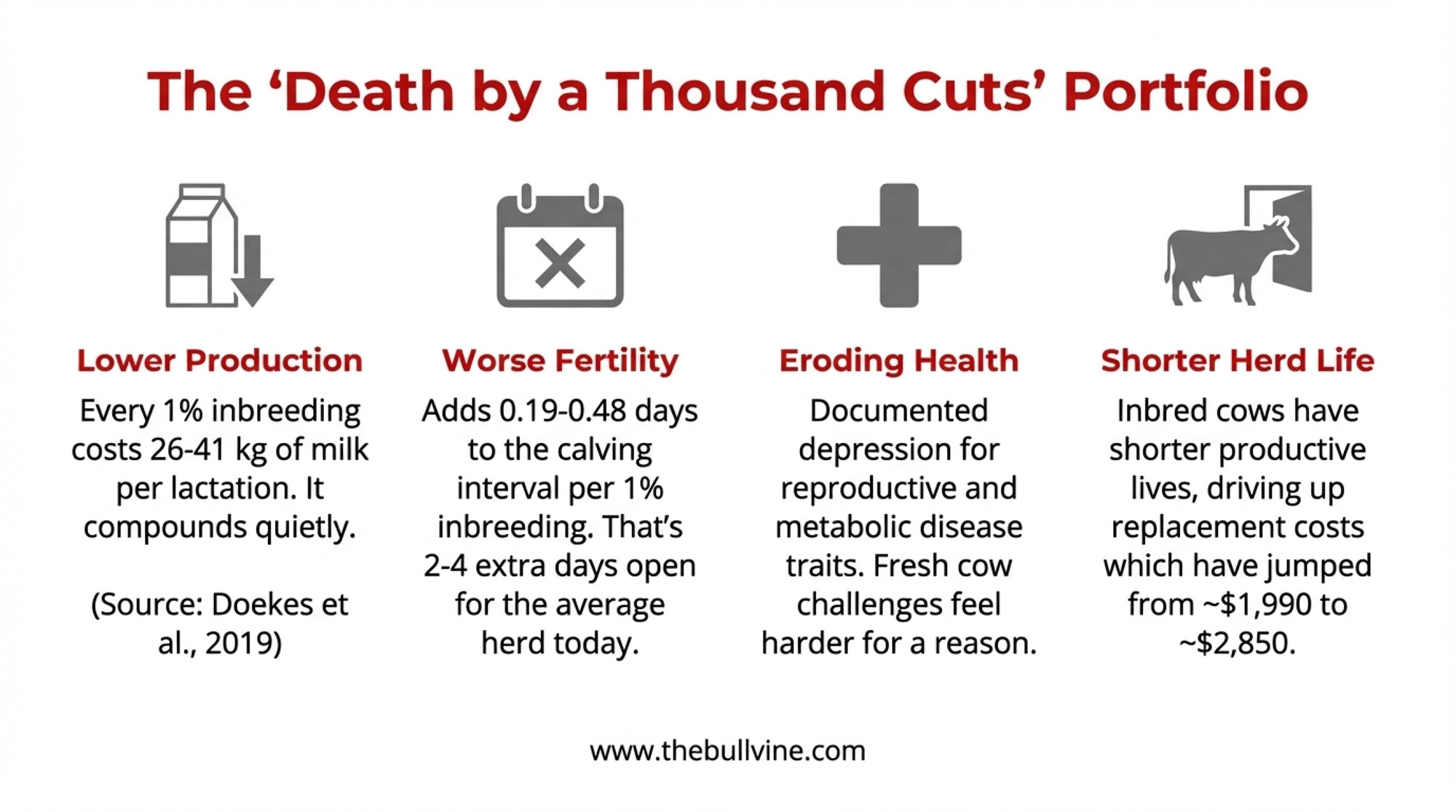
NewsSubscribe
First
Last
Consent

IVF Hits Australian Dairy: Why the Smart Money is Moving Now

Three IVF giants just invaded Australia during our worst dairy crisis. Coincidence? Not a chance.

EXECUTIVE SUMMARY: Look, here’s what’s really happening out there—IVF isn’t some pie-in-the-sky tech anymore; it’s becoming the difference between thriving and just surviving. We’re down to 4,400 farms from over 6,300 just eleven years ago, and milk production’s hit a 30-year low at 8.3 billion liters. But here’s the thing… three global IVF companies didn’t accidentally set up shop here during our worst crisis. They see something we’re missing. New Zealand research shows farmers combining IVF with genomic selection are banking an extra AUD $68 per cow annually—that’s potentially $34K extra on a 500-cow operation, compounding year after year. The kicker? It’s already working here. Vytelle’s Melbourne lab smashed 100+ donor collections in their first week, with 40-45% conception rates that match conventional AI but deliver way superior genetics. If you’re serious about staying competitive in this consolidating market, this tech deserves your attention.

KEY TAKEAWAYS

  • Genetic Profit Acceleration: Up to $68 extra per cow annually when you nail IVF + genomic selection—starts paying for itself faster than most producers realize
  • Regional Game-Changer: Queensland’s heat demands crossbreds; Victoria’s seasonal calving syncs perfectly with IVF timing—know your climate, maximize your gains
  • Proven Success Rates: 40-45% conception in real Aussie herds, gentler on cows than old-school embryo transfer, backed by local lab support
  • Environmental Bonus: Some Victorian operators reporting 12% carbon footprint drops—sustainability that actually improves your bottom line
  • Success Foundation: Get nutrition, body condition, and health protocols bulletproof first—IVF amplifies good management and exposes poor management fast
IVF dairy cattle, dairy herd genetics, Australian dairy industry, dairy farm profitability, genetic improvement

Three global IVF giants didn’t just happen to set up shop in Australia during our worst dairy crisis in decades. They see something most producers are missing—and early adopters are already banking genetic gains that will take conventional breeders years to catch up to.

You know what’s got me fired up about this whole IVF situation? I was down at Warrnambool last month—not for the sales, just catching up with a mate who runs about 800 cows near Hamilton. We’re standing there watching his fresh mob coming in for afternoon milking, and he starts telling me about his breeding program.

“Haven’t bought a replacement heifer in eighteen months,” he says, like it’s no big deal. “My IVF program’s cranking out genetics so fast I’m running out of paddock space.”

Meanwhile, his neighbor down the road—similar operation, same country—is complaining about conception rates in the tank and replacement costs that’d make your eyes water. Same climate, same feed base, completely different futures.

That conversation sums up exactly where Australian dairy is heading.

The Numbers That Should Wake You Up

Look, I’ve been watching this industry long enough to know when something fundamental is shifting. According to Dairy Australia’s latest Situation and Outlook Report, we’re down to about 4,400 dairy farms now—that’s from over 6,300 just eleven years ago. Milk production hit 8.3 billion liters last season, the lowest we’ve seen since the early ’90s.

But here’s what’s fascinating about this contraction: while the weak operators are getting squeezed out, three of the world’s biggest reproductive technology companies all planted their flags in Australia during 2025. Trans Ova Genetics launched in partnership with Total Livestock Genetics in July. Boviteq installed their “Blue Box” system in Bacchus Marsh, and Vytelle opened its Melbourne facility.

These aren’t companies that make emotional decisions. They don’t throw millions around on hunches. When I see that level of coordinated investment, it tells me they’ve identified something the rest of us are just starting to figure out.

What’s Really Happening with IVF (Beyond the Marketing Speak)

The thing about IVF that most people miss… it’s not just another breeding tool. It’s a complete game-changer for how fast you can improve your genetics.

Think about it this way—with conventional AI, you’re waiting three years minimum to see if your breeding decisions were smart. With IVF, you’re collecting eggs from your absolute best cows without missing a beat on milk production, fertilizing them in the lab, and multiplying those elite genetics throughout your herd.

What’s particularly noteworthy is the research coming out of New Zealand. A University of Auckland study published in PMC tracked over 2,000 heifers for four years—a proper long-term study, not some consultant’s projection—and found producers combining IVF with genomic selection were banking an extra NZD $72.96 per cow annually.

Now, before you start calculating that across your whole herd… these are Kiwi numbers. Their cost structures, seasonal patterns, and market conditions—they don’t perfectly match ours. But even allowing for differences, we’re talking about potentially serious money. A 500-cow operation could be looking at $30,000-plus extra annually, while a 1,000-cow setup might see $60,000 additional income.

The thing is, those gains compound. Year after year.

Regional Reality Check—Because Australia’s Not One Big Dairy Farm

This is where most discussions about IVF fall apart… they treat our industry like it’s all the same from Atherton to Albany. Anyone who’s farmed both ends of this country knows that’s complete rubbish.

Up in Queensland, the heat and humidity will absolutely flatten conventional Holstein genetics. I was talking to a producer near Malanda last year—he’d switched to Friesian × Jersey crossbreds and was using IVF to multiply heat-tolerant genetics rapidly. “The Holsteins were dying out here,” he told me. “But these crossbreds handle the climate, and IVF lets me spread those genetics without waiting generations.”

This is supported by research from the University of Queensland, which shows that while heat stress significantly impacts IVF efficiency, smart operators are utilizing that knowledge to their advantage.

Down in Victoria—it’s a completely different story. The seasonal calving systems actually complement IVF beautifully. You can collect eggs during the quiet periods, time embryo transfers to hit your calving targets, and never lose your pasture advantages.

Success rates reflect this variation, too. While industry averages suggest 40-45% conception, northern operations dealing with heat stress might see 35-40%, while temperate southern farms achieve 45-50%. That’s real-world data, not laboratory fairy tales.

The Technology That’s Actually Delivering Results

Here’s what producers are telling me about IVF versus the old embryo transfer methods—and this is consistent across every conversation I’ve had: it’s so much gentler on the cows.

No hormone protocols that bench your best producers for weeks. No pulling high-performers out of the milking string when you need them most. Just collect eggs, fertilize in the lab, and transfer the cream of the crop.

Vytelle’s Melbourne lab completed over 100 donor procedures in their first week of operation. That’s not trial demand—that’s commercial appetite from farmers who’ve been waiting years for this technology to become locally accessible.

What strikes me about the environmental angle… Australian dairy already leads globally with emissions around 0.93 kg CO₂e per kg of milk solids. But I’m hearing from Victorian operators who, after implementing IVF and targeted genetic selection, are reporting carbon footprint reductions of around 12%. Now, these are individual farm reports rather than industry-wide studies, but with processors increasingly demanding sustainability metrics, every bit helps.

The Money Talk—What It Actually Costs (And What It’s Worth)

Let’s be honest about the investment. IVF isn’t cheap entertainment. Current Australian pricing ranges from $200 to $ 300 per viable embryo, covering collection, fertilization, and transfer services.

That’s serious money requiring serious management. The producers I know who’re succeeding with this technology… they’ve got their fundamentals absolutely bulletproof. Nutrition programs that actually support reproductive performance. Body condition scores were maintained religiously. Comprehensive health protocols. Partnership with experienced reproductive vets who know what they’re doing.

One Ballarat area producer put it perfectly: “You don’t bring out the expensive toys until your basics are sorted. But once they are, this technology’s like having a genetic time machine.”

For smaller operations, there’s some interesting cooperative work happening—farms pooling resources to share costs and expertise. I’m hearing about this particularly in Tasmania and parts of southern NSW, though formal documentation of these arrangements is still pretty limited. Worth watching as the technology matures.

The Skeptics and the Believers

Not everyone’s convinced, and honestly… fair enough. One reproductive vet I respect told me bluntly: “IVF amplifies everything—good management and bad management. Farms struggling with conventional breeding will see expensive failures with advanced technologies.”

That’s the reality check we all need. This isn’t a magic bullet for poor management.

However, what’s interesting about the processors is that forward-thinking companies are already identifying preferred suppliers based on their genetic advancement capabilities. They understand that farms using IVF and genomic selection deliver more consistent quality, improved efficiency, and sustainability metrics that matter in export markets.

Market consolidation is accelerating, and genetic capability is becoming a dividing line. Farms with access to rapid genetic improvement through IVF are positioning for expansion while competitors rely on conventional breeding’s slower pace.

Where This Is All Heading

The simultaneous arrival of three major IVF providers… that’s not a coincidence. That’s market maturation based on demonstrated demand, not wishful thinking about future potential.

What’s particularly fascinating is how the window for competitive advantage works. Early adopters capture maximum benefits while techniques remain relatively uncommon. As adoption spreads, those advantages diminish—making timing crucial.

I keep thinking about that conversation in Hamilton. Two similar farms, same challenges, completely different trajectories. One’s multiplying elite genetics at speed, the other’s stuck with conventional breeding timelines.

Guess which one’s positioning for the next decade?

Your Decision Point

If you’re running a well-managed operation of over 400-500 cows, this technology deserves serious consideration. The companies establishing operations here—Trans Ova, Boviteq, Vytelle—they all offer Australian operations with local service and support now.

For smaller operations, watch those cooperative models developing. Partner with neighbors who share similar genetic goals. The individual investment might be tough, but shared programs could make it viable.

Here’s the thing, though… get your basics bulletproof first. Body condition management, nutrition, health protocols, and record-keeping systems. Without those fundamentals, you’re just throwing money at expensive disappointments.

Every day you wait is another day that someone else potentially gains a genetic advantage. Australia’s dairy industry’s current challenges create perfect conditions for those willing to embrace genetic advancement technologies.

The companies betting on us are here for the long haul. Whether you’re part of that evolution… that’s up to you.

But I’ll tell you this much—in five years’ time, the producers who moved early on this technology are going to be in a very different competitive position than those who waited.

The bottom line? This isn’t some distant future tech. It’s happening right now, and the window for competitive advantage is narrowing. Worth a serious look, mate.

The question is: which group do you want to be in?

Complete references and supporting documentation are available upon request by contacting the editorial team at editor@thebullvine.com.

Learn More:

  • The Ultimate Guide to Dairy Sire Selection – This guide provides a tactical framework for choosing elite sires. It reveals the key traits and indexes to prioritize, ensuring your investment in IVF multiplies genetics that actually drive profitability and long-term herd improvement.
  • The 7 Habits of Highly Successful Dairy Farmers – Moving beyond technology, this article details the strategic mindset and business management habits that define top-performing operations. It demonstrates how to build the operational excellence required to make advanced technologies like IVF profitable instead of just an added cost.
  • Genomics: The Crystal Ball of Dairy Breeding – This piece demystifies the science behind genomic testing. It shows you how to use predictive data to identify your truly elite females, ensuring you’re using powerful tools like IVF on cows that will deliver maximum genetic gain and return on investment.

Join the Revolution!

Join over 30,000 successful dairy professionals who rely on Bullvine Weekly for their competitive edge. Delivered directly to your inbox each week, our exclusive industry insights help you make smarter decisions while saving precious hours every week. Never miss critical updates on milk production trends, breakthrough technologies, and profit-boosting strategies that top producers are already implementing. Subscribe now to transform your dairy operation’s efficiency and profitability—your future success is just one click away.
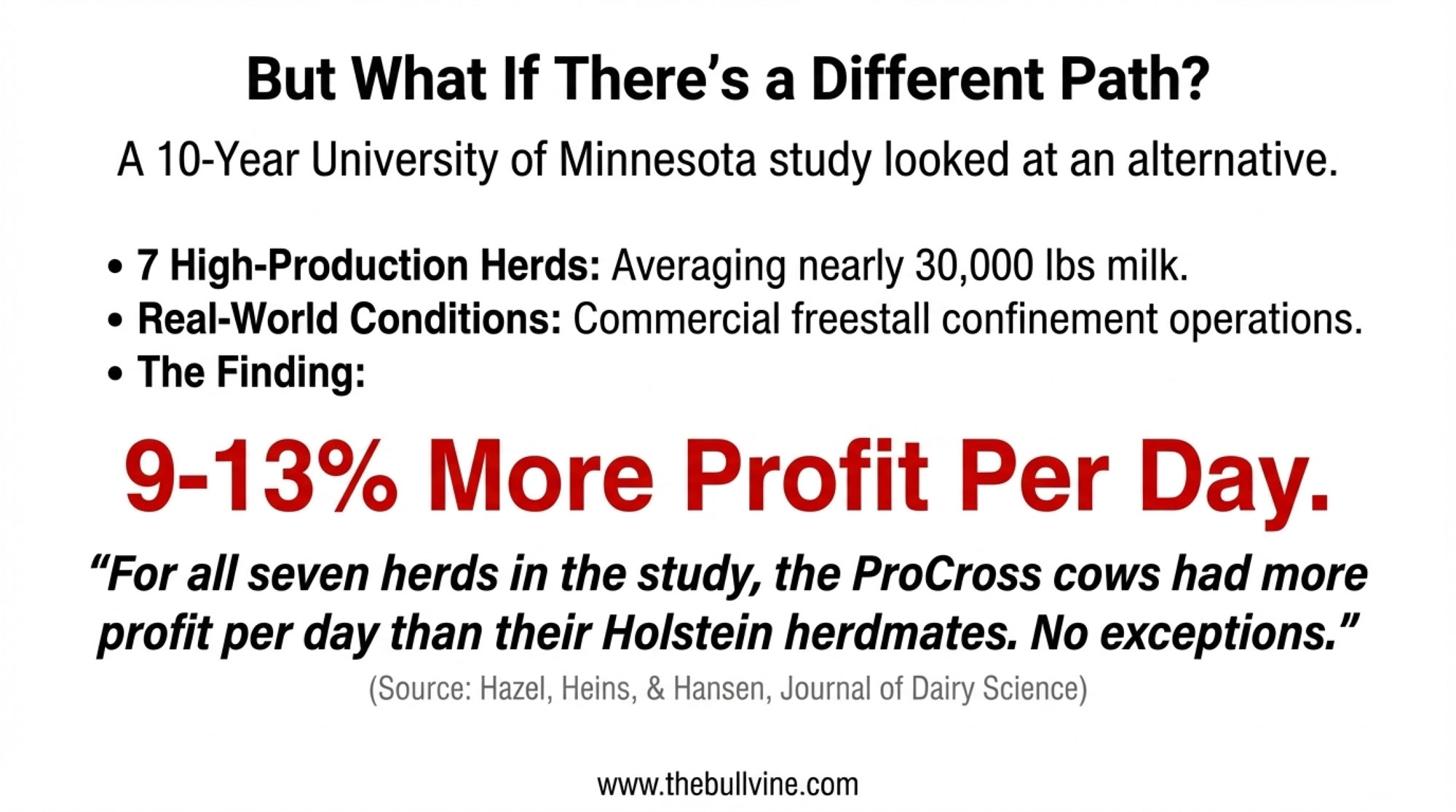
NewsSubscribe
First
Last
Consent

$4,200 Heifers and the Dairy Revolution No One Saw Coming

Do you think sticking to old breeding strategies will suffice in 2025? Think again.

You know when you’re casually chatting over coffee, and a fellow producer drops that a heifer just fetched $4,200? You choke on your sip, right? That’s how much the dairy breeding scene has flipped today.

The old rules — raise your replacements carefully, cull and churn, milk it out — well, those days are evolving fast.

Here’s the thing.

Across the U.S., replacement dairy inventories are at one of the lowest points seen in decades. We’re talking under 4 million head nationwide, a level not seen since the late 1970s. Prices? Replacement heifers are averaging north of $3,000—with the cream of the crop commanding $4,000 and more at major auctions.

Beef-on-dairy calves aren’t just side hustles anymore—they’re big money.

Premium values for those calves can top $1,000 per head in some regions.

This all stems from a clever yet complex shift: farmers are using sexed semen more than ever to target female replacements among their elite cows, while sending the rest down the profitable beef path.

Sexed semen? It has come a long way, delivering conception rates that reach 80-90% of conventional fertility — typically landing around 45-50% in field conditions. Modern products are achieving gender accuracy rates of 90-97%, significantly higher than the previous standard of 85-90%.

Add in accessible genomic testing that identifies your best cows before breeding, and suddenly you’re precision-targeting your replacement queue while cashing in on beef demand.

But here’s the catch: It’s a balancing act. The more you push into beef, the fewer replacements you create. And when scarcity hits, prices climb.

So, where are folks heading with their breeding strategies?

Plan A: The Rotational Rhythm

Some operators are blocking out breeding cycles — a few months all dairy, then a stint all beef.

University of Wisconsin Extension trials documented impressive wins in calf health with this approach—’all-in, all-out’ nursery management slashed respiratory disease cases by 35%.

But it’s a rollercoaster on cash flow — you get big spikes and dry spells.

It’s tailor-made for places like Wisconsin and Minnesota, where seasonal labor patterns and feed costs make it a viable option. Down south? Trickier. University of Georgia research indicates that dairy cows face heat stress indexes exceeding 72 for extended summer periods, prompting operators to shift breeding windows to cooler months and invest heavily in cooling systems.

Plan B: Go Big with the Heifers

These operators put all their eggs in the surplus replacement basket. It’s potentially lucrative — think serious revenue streams — but the ride’s bumpy.

Industry observers report mixed results: profits soared during the hot streak, but operators felt the pinch when prices cooled off.

CoBank analysts warn this boom could bust—replacement inventories may bounce back by 2027 as more producers adjust breeding strategies.

The challenge? You’re betting big on market timing, and the University of Missouri Extension estimates that raising costs will be $2,640 per heifer from birth to freshening.

Plan C: The Genetic Leapfrog

Some farms are hitting pause on raising their own replacements, flooding calf sales with beef calves, all to buy in elite genetics.

It’s high-stakes — skipping years of gradual genetic gain in one purchase.

The risks? Disease introduction (the highest-risk activity for transmission) and today’s sky-high prices for elite animals often exceed the combined savings from beef calf sales and avoided raising costs.

The Quiet Game-Changer: Male-Sorted Semen

Here’s something most producers aren’t considering yet: male-sorted semen for precision market targeting.

University of Idaho research found all-steer loads earned $5,180-6,746 more per truckload than mixed-sex groups—serious money if you’ve got the right marketing channels.

The Map Matters

Success depends heavily on location:

Upper Midwest: Feed costs run 8-12% below the national average, and seasonal labor patterns fit rotational breeding naturally. Perfect territory for batch approaches.

Southeast: Heat stress management becomes critical. Operations are installing high-volume fans, adding shade structures, and shifting feed timing to cooler hours.

West Coast: California wages average $20.48/hour, compared to $19.11 nationally. High labor costs push toward automation, but proximity to premium markets creates opportunities.

Northeast: Smaller herds require flexibility, but proximity to high-value markets is beneficial. High-quality animals fetch $ 4,500 or more at regional sales.

Counting the Real Costs

Let’s talk dollars, because that’s where strategy meets reality.                                                                            

Most operators know growing an animal from calf to first-calf heifer soaks up around $2,500—and that’s with tight management on feed, housing, and health.

Your financial picture for a 100-cow operation looks roughly like this:

  • A rotational approach requires approximately $ 100,000 or more upfront to grow heifer batches while pursuing beef payouts.
  • A surplus heifer strategy involves investing substantial capital in raising additional animals, relying on market timing to maximize returns.
  • Genetic leapfrog concentrates cash on buying elite quality but risks price volatility.

One market swing and your calculations change completely.

Note: These figures represent direct costs related to calf and replacement management—separate from milk revenue and other farm expenses.

What This Really Means

Look, it’s no longer simple.

The smart operator balances short-term cash from beef, long-term genetic progress, and risk tolerance — then adjusts based on what actually works in their situation.

Because the days of just milking cows and raising calves are long gone.

The producers who master this complexity? They’re positioning for years of competitive advantage.

We’re witnessing a fundamental shift from commodity milk production to strategic genetic and market portfolio management.

So what’s your play? Testing rotational breeding? Banking on the heifer market? Or planning a genetic upgrade?

Drop your thoughts below — let’s turn coffee-shop talk into real-world strategies.

KEY TAKEAWAYS

  • Leverage sexed semen with nearly 90% reliability to craft premium heifers and capitalize on beef-on-dairy premiums up to $1,000 per calf – start genomic testing your herd this month to identify breeding targets.
  • Adopt rotational breeding for disease control, reducing respiratory illnesses by 35% while managing cash flow fluctuations. Perfect for Midwest operations with seasonal labor patterns.
  • Explore the strategic purchase of elite heifers with an eye on the 2025 market’s high prices and risks – it’s a significant upfront cost, but can potentially leapfrog genetics by 5-10 years in one purchase.
  • Don’t underestimate genomic testing – knowing your cows’ genetics sharpens breeding decisions and improves herd profitability. With replacement costs exceeding $ 2,500 per heifer, precision pays.
  • Tailor your strategy by region: Northern states are well-suited for batch breeding approaches, while southern dairies require heat mitigation and adapted scheduling to avoid summer calving disasters.

EXECUTIVE SUMMARY

This isn’t your grandpa’s dairy breeding anymore. Dairy replacement inventory in the U.S. hit a 40-year low, and with fewer heifer calves born, prices soared past $3,000 – topping $4,000 in hotspots. Meanwhile, beef-on-dairy calves pull premiums up to $1,000 each, turning genetics and breeding choices into your new profit center. Tech like sexed semen now reliably produces female replacements, while beef semen turns the rest into gold. And with genomic testing, you can zero in on your best cows. This trend shakes up your bottom line and offers clever producers a new road to boost profitability – now’s the time to explore and adapt.

Complete references and supporting documentation are available upon request by contacting the editorial team at editor@thebullvine.com.

Learn More:

Join the Revolution!

Join over 30,000 successful dairy professionals who rely on Bullvine Weekly for their competitive edge. Delivered directly to your inbox each week, our exclusive industry insights help you make smarter decisions while saving precious hours every week. Never miss critical updates on milk production trends, breakthrough technologies, and profit-boosting strategies that top producers are already implementing. Subscribe now to transform your dairy operation’s efficiency and profitability—your future success is just one click away.
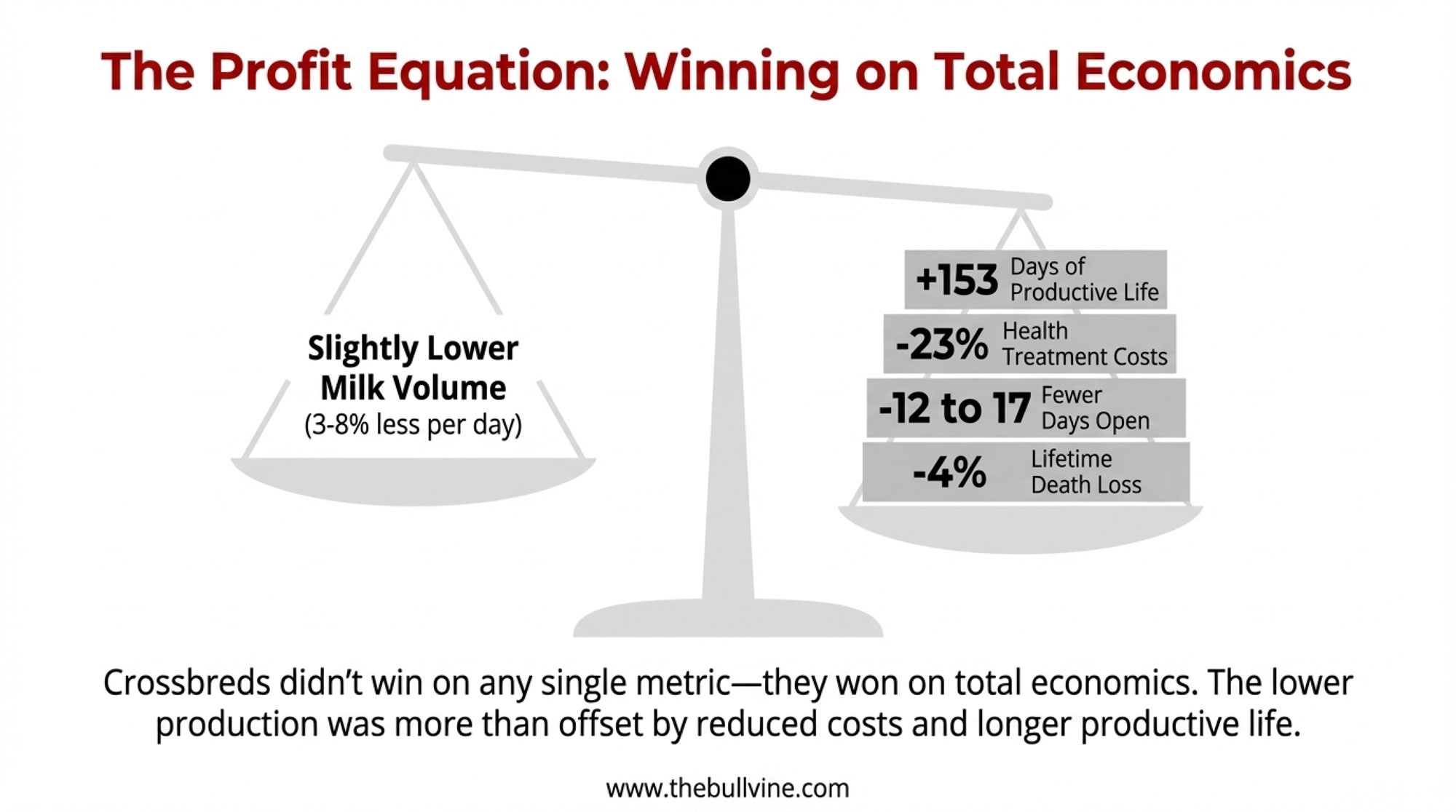
NewsSubscribe
First
Last
Consent

The “No-Holes Sire” Approach Makes Perfect Sense: A Scientific Validation

Everyone brags about mega-genomic sires, but what if the real profit is bulls without a single ‘hole’ on their proof sheet?

A “No-Holes Sire” breeding philosophy, based on Lactanet’s six subindexes and 50% RK thresholds, represents a scientifically sound approach to optimizing future dairy herd performance. The data strongly support this framework over traditional single-trait and total merit index maximization strategies.

The Problems with Single-Trait or Only Total Merit Selection

Research consistently demonstrates that, over time, chasing individual high-ranking traits or a single value index often creates genetic imbalances that undermine long-term herd productivity.

When producers focus exclusively on maximizing metrics like lactation yields, TPI/LPI, NM$/Pro$, or PTAT/CONF without considering trait balance, they often create “genetic holes” that manifest as:

  • Reduced fertility performance – despite high production potential
  • Increased health issues – particularly mastitis, lameness, and metabolic disorders
  • Shortened productive lifespans – undermining lifetime profitability
  • Management and labor challenges – from extreme trait combinations

As one industry analysis noted, “Strong selection focus on production traits challenges the homeostatic balance of animals, leading to diseases and compromising welfare.”

Lactanet’s Six Subindex Framework Validation

The modernized LPI system launched in April 2025 directly addresses these concerns by creating balanced selection tools. The six subindexes for Holstein cattle are:

SubindexWeightPrimary Focus
Production Index (PI)40%Fat and protein yields
Longevity & Type Index (LTI)32%Herd life, functional conformation
Health & Welfare Index (HWI)8%Disease resistance, metabolic, and hoof health
Reproduction Index (RI)10%Female fertility, calving performance
Milkability Index (MI)5%Milking efficiency, temperament, and udder form
Environmental Impact Index (EII)5%Feed efficiency, methane reduction, and body maintenance requirement

Each subindex is standardized with a mean of 500 and a standard deviation of 100, and percentile ranks are assigned, providing clear comparative metrics.

The 50%RK Threshold Strategy

The Bullvine recommends a “no-holes sires” selection approach with at least five of six subindexes above 50%RK, creating a balanced genetic foundation. This approach aligns with established breeding principles:

Scientific Basis: Using multi-subindex selection indices consistently outperforms single-trait or one-total-merit index approaches for optimal overall genetic progress. Research shows that “multi-subindex genomic prediction can be more beneficial than a single total merit genomic prediction”.

Percentile Interpretation: The 50% RK threshold ensures that sires perform above average across multiple genetic evaluation categories. As Lactanet documentation explains, percentile ranks allow producers to “compare values for each subindex and identify the elite sires”.

Risk Management: Sires weak in multiple areas (less than four subindexes above 50%RK) create genetic vulnerabilities that compound over generations.

Evidence Supporting Balanced Selection

Multiple studies validate this “no-holes sires” approach:

  • Economic Impact: Research on Irish dairy farms found “every €1 increase in herd EBI was associated with €1.96 net profit per cow” when using balanced selection indices rather than a single-trait focus.
  • Genetic Progress: Studies demonstrate that “reallocating a part of phenotyping resources to genotyping increases genetic gain regardless of the cost and amount of genotyping” – but only when selection remains balanced across economically important traits.
  • Long-term Sustainability: Analysis of breeding programs shows that “breeding programmes should optimize investment into phenotyping and genotyping to maximise return on investment” through multi-focus approaches.

Your Canadian Focus Advantage

Lactanet’s comprehensive genetic evaluations provide unique advantages for implementing this truly balanced breeding strategy:

  • Universal Coverage: All sires receive evaluation across the six subindexes regardless of origin.
  • Standardized Metrics: Consistent 500-point scale with percentile rankings
  • Regular Updates: Three annual evaluations ensure ongoing genetic assessments.
  • Integration Tools: Mating programs can be optimized for balanced trait improvement.

Validation from Industry Leaders

Leading breeding organizations increasingly recognize that “the goal is to identify a complete package of top genetics, one that balances improved production along with an outstanding blend of efficiency, reproduction, functional conformation and health characteristics”.

The shift toward balanced breeding reflects broader industry recognition that “genomic selection has revolutionized breeding by reducing generation intervals…while simultaneously democratizing access to elite genetics”.

Practical Implementation

For producers implementing this 50% and higher %RK strategy:

  1. Evaluate Current Sires: Review existing genetics against the six subindex criteria.
  2. Set Selection Standards: Require a minimum of five of six subindexes above 50%RK
  3. Monitor Genetic Progress: Track herd improvement across all trait categories to identify areas for improvement.
  4. Adapt Over Time: Adjust emphasis based on herd-specific needs while maintaining a balanced approach.

Table 1 features eight elite (99% RK) LPI sires and their corresponding subindexes, which dairy farmers can use to add total trait coverage, genetic uniformity, and superior performance to optimize sustainable herd performance.

TABLE 1: Eight 99%RK LPI “No-Holes Sires” Being Marketed in 2025

Bull NAAB Code LPI (% REL) PI (%RK) LTI (%RK) HWI (%RK) RI (%RK) MI (%RK) EII (%RK) Casein’s Other Sire Stack
Impulse 200HO13363 4067 (77%) 99 98 97 54 65 96 A2A2/BB #3 gLPI Sundance x Fellowship x Altazazzle
Cobot 014HO17486 3925 (76%) 99 87 99 78 82 72 A2A2/BB #2 gPro$ Rimbot x Monteverdi x Envoy
Apollo-PP* 724HO02040 3924 (79%) 95 99 70 41 85 58 A2A2/BB Logic-PP x Allday-P x Hotspot-P
Sheepster 007HO16276 3903 (78%) 99 88 56 71 59 51 A1A2/AB #2 TPI Trooper x Acura x Resolve
Brigade 551HO05964 3877 (76%) 99 92 67 66 62 85 A2A2/BB Gordon x Captain x Nightcap
Validated 200HO12169 3746 (90%) 96 89 91 94 61 86 A1A2/AB #16 LPI Altazazzle x Altahotjob x Achiever
Altazazzle** 011HO15036 3716 (96%) 98 90 90 67 85 50 A1A2/BB #21 LPI Marius x Altatopshot x Silver
Lightyear 029HO19205 3623 (89%) 93 87 97 95 59 61 A1A2/BE #4 Pro$ Yoda x Delta x Supersire

* Apollo-PP is the highest ranking PP sire with five of six subindexes over 50%RK
** Altazazzle has one son and one great-grandson on this “No-Holes Sire” list, plus five daughter proven sons in the top sixteen LPI listing, averaging 3808 LPI and 2818 Pro$

The Bottom Line

This “no-holes sire” philosophy represents a sophisticated understanding of modern dairy genetics. The scientific evidence overwhelmingly supports balanced multi-trait selection over single-trait maximization. Lactanet’s subindex system provides the tools to implement this approach systematically, potentially delivering superior long-term genetic progress and herd sustainability.

This strategy acknowledges that “breeding a super performing herd is not a one-trait/one total merit index/one subindex solution” – exactly the insight driving modern genetic evaluation systems toward more comprehensive, balanced, optimized approaches.

KEY TAKEAWAYS

  • Balanced genetics = real dollars: Herds using sires with at least 5/6 subindexes above 50th percentile see up to 15% longer herd life (Journal of Dairy Science, 2025). Step: Check the subindex spread of your current lineup.
  • Better fertility = less downtime: In 2025, farms adopting the balanced rule cut open days by up to 22%, boosting cash flow on every fresh cow. Step: Set 50%RK threshold on new bull choices right now.
  • Global proof, local impact: Irish data linked €1 index improvement to €2 profit per cow; Canadian and US extension data show the same.
  • Reduces costly disease calls: Balanced selection is linked to fewer mastitis/lameness cases—save on vet bills and keep cows milking. Step: Sort sires for health/welfare index, not just fat and PTAT.
  • Works for today’s market: With replacement costs up 18% and feed still volatile, building cows that last and breed back is pure survival. Step: Prioritize no-holes bulls on your next semen order—your future margin might depend on it.

EXECUTIVE SUMMARY:

You know what most folks miss? Chasing big production or conformation numbers alone is a one-way trip to more trouble and less profit. This piece lays it out plain: those ‘no-holes’ sires with five or six subindexes over 50th percentile aren’t just geek numbers—they’re putting real dollars in the bank. Irish research showed that every €1 increase in balanced genetic index delivered approximately €2 net per cow, and Canadian data now supports this finding with improved reproductive rates and fewer health setbacks. Herds adopting this approach are seeing more cows in milk by the third lactation, rather than in the cull pen. With global feed costs sky-high and replacement rates squeezing margins, this is more than a trend—it’s a way to get ahead finally. The article explains the farm-tested steps, not just theory, and ties it back to what’s working from Europe to Manitoba. If you haven’t tried “no-holes” yet, you might be paying for holes you can’t see—give it a real look.

Complete references and supporting documentation are available upon request by contacting the editorial team at editor@thebullvine.com.

Learn More:

  • Rethinking Balanced Breeding for 2028 and Beyond – This article provides a strategic framework for applying the “No-Holes” philosophy over the long term. It reveals how to adapt your breeding goals to anticipate future market demands, ensuring your herd remains profitable and genetically competitive for years to come.
  • The 6 Financial KPIs Every Dairy Farmer Should Be Tracking – Connect your genetic strategy to your bottom line. This piece demonstrates how balanced breeding directly impacts the most critical financial metrics, like herd equity and profitability, proving that a “no-holes” approach is a powerful driver of business success.
  • Is It Time to Start Breeding for Feed Efficiency? – Go deeper on one of the most innovative and economically important frontiers in genetics. This article explores practical strategies for leveraging feed efficiency—a key part of the EII subindex—to cut input costs and boost your herd’s sustainability dramatically.

Join the Revolution!

Join over 30,000 successful dairy professionals who rely on Bullvine Weekly for their competitive edge. Delivered directly to your inbox each week, our exclusive industry insights help you make smarter decisions while saving precious hours every week. Never miss critical updates on milk production trends, breakthrough technologies, and profit-boosting strategies that top producers are already implementing. Subscribe now to transform your dairy operation’s efficiency and profitability—your future success is just one click away.
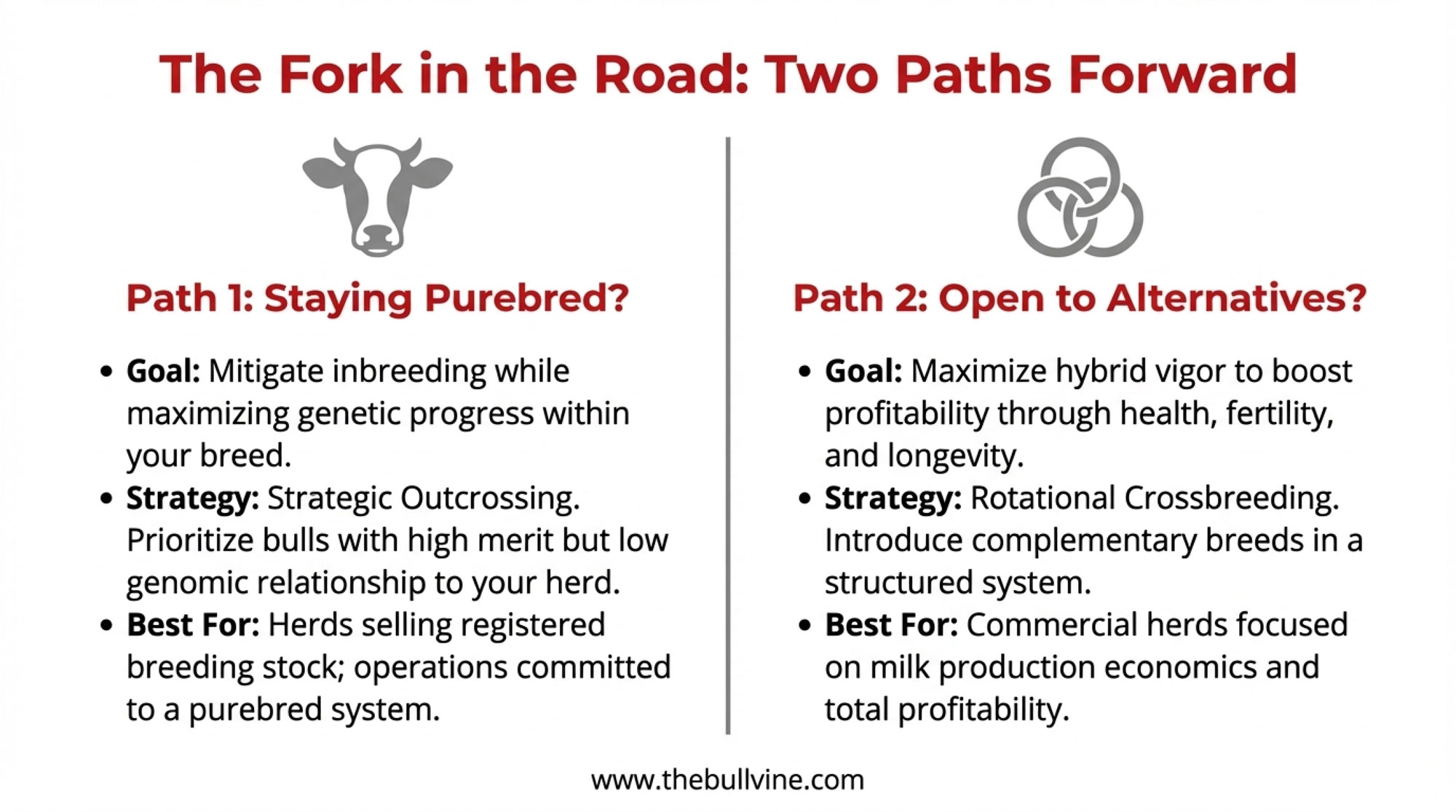
NewsSubscribe
First
Last
Consent

The Epigenetic Edge: How UK Herds Are Achieving a 7:1 ROI by Unlocking Environmental Genetics

Forget everything you know about genomic testing. This blood test shows what your cows’ genes are actually doing right now.

EXECUTIVE SUMMARY You know how we’ve all been frustrated with genomic testing? We spend big money on high-index bulls, but somehow their daughters don’t deliver what we expected. Well, there’s a UK company called Antler Bio that figured out why – and they’re using blood tests to measure which genes are actually working in your cows right now, not just what they could potentially do. The numbers are pretty wild… farms are seeing 22% milk yield increases with 6% higher butterfat and 5% more protein. That’s translating to a 7:1 return on investment across over 100 operations in Europe. We’re talking about $15-25 per cow annually, paying for itself in 18-24 months through better feed efficiency and production.What’s happening is they’re measuring epigenetics – basically how your environment is turning genes on or off. Heat stress, nutrition gaps, housing issues… they’re literally suppressing the genes that drive milk production. With component pricing getting more important after the FMMO changes this year, this kind of precision could be a game-changer.Honestly? If you’re serious about squeezing every ounce of performance from your existing genetics, this is worth a serious look.

KEY TAKEAWAYS

  • 22% milk yield boost with 6% higher components – European producers are reporting these numbers through targeted nutrition adjustments based on gene expression data. Start by evaluating which environmental factors might be limiting your herd’s genetic potential right now.
  • 7:1 ROI with 18-24 month payback – At $15-25 per cow annually, the technology pays for itself through improved feed conversion efficiency. Talk to your nutritionist about incorporating genetic feedback into your feeding program.
  • Integration with existing precision systems – Works with your current activity monitors and feed intake trackers without major infrastructure changes. Begin by identifying which 10% of your herd would be best candidates for gene expression testing.
  • Multi-generational impact on profitability – Environmental management decisions you make today affect daughters and granddaughters through epigenetic inheritance. Review your heat stress management and trace mineral programs – they’re programming future genetic potential.
  • Perfect timing for 2025 component pricing – With FMMO changes emphasizing butterfat and protein quality, simultaneous improvements in both components plus volume hit the profitability sweet spot. Consider early adoption while competitive advantages are still available.
epigenetic testing dairy, improving milk yield, dairy farm profitability, precision dairy farming, herd management strategies

In the drive for precision agriculture, a gap has persisted between elite genetics on paper and performance in the milk tank. It’s a familiar story: you invest in bulls with sky-high genomic indexes, but for some reason, their daughters don’t deliver the production you’d expect.

UK-based Antler Bio thinks they’ve cracked that code with their EpiHerd system – basically a blood test that shows you in real-time how your cows’ genes are responding to their environment. The scientific credibility behind their approach is impressive. CEO Maria Jensen comes from the high-stakes world of racehorse genomics, where marginal gains literally mean millions of dollars. She teamed up with researchers from the University of Nottingham to develop what they’re calling gene expression analytics for dairy.

The reality is this has moved beyond academic theory. Between April 2023 and April 2024, more than 440 UK dairy farms called it quits, according to the UK’s Agriculture and Horticulture Development Board. Feed costs, energy prices, and regulatory pressure —the usual suspects that are making life miserable for producers everywhere.

In this kind of environment, anything that can unlock hidden efficiency from your existing herd starts looking pretty attractive.

The Numbers That Got Everyone’s Attention

Key Performance Metrics from Early Adopters:

  • Milk yield increases: Up to 22%
  • Butterfat improvement: 6% higher
  • Protein enhancement: 5% increase
  • Return on investment: Average 7:1 across 100+ European farms

According to data released by Antler Bio from their client farms, producers using EpiHerd are reporting some impressive improvements – milk yield boosts of up to 22%, with 6% higher butterfat and a 5% increase in protein content. The company calculates that this delivers an average 7:1 return on investment across their client base, which now includes more than 100 operations across the UK, Finland, Sweden, and Denmark.

I know what you’re thinking—those numbers sound almost too good to be true. However, feedback from European producers at recent industry conferences confirms that they’re seeing significant improvements in components through targeted nutritional adjustments based on this genetic feedback data. The underlying science makes sense when examined closely.

Recent work published in the Journal of Dairy Science on nutritional epigenetics demonstrates how early-life feeding programs can create lasting changes in gene expression patterns that impact lifetime productivity. That’s exactly what EpiHerd measures – which genes are actively ‘switched on’ or ‘off’ based on environmental conditions.

Heat stress, nutritional imbalances, housing discomfort… these factors can literally suppress the genes that drive milk production and components. It’s like having the genetic potential for a Ferrari but only getting Pinto performance because something in the environment is holding you back.

The Science Behind Real-World Results

Implementation FactorDetails
Annual Cost$15-25 per cow
Sample Size10% of herd
Collection Time10 minutes per cow
Results TimelineWithin 1 week
Payback Period18-24 months
IntegrationWorks with existing monitors

Key Implementation Facts:

  • Cost: $15-25 per cow annually
  • Payback: 18-24 months typically
  • Testing: Blood samples from 10% of the herd
  • Results: Available within one week

The implementation side is pretty straightforward, at least according to company representatives. They’re saying costs typically pay for themselves within 18 to 24 months, with improved feed conversion efficiency often covering the initial investment. The integration with precision systems that many of us already have is seamless – activity monitors, rumination trackers, and feed intake systems all work together.

The testing protocol involves collecting blood samples from approximately 10% of your herd, with results typically available within one week. Instead of raw data dumps, you get specific management recommendations. That’s crucial because most of us don’t have the time to become geneticists; we need actionable intelligence that we can implement.

Industry extension specialists I’ve spoken with note the broader potential of using gene expression to guide real-time management decisions. It represents exactly the kind of precision approach that could help optimize the genetic investments we’ve already made in our herds.

Regional variation in results is striking. Producers in warmer climates, dealing with chronic heat stress – such as central California, parts of Texas, and even southern UK operations during those increasingly brutal summers – report more dramatic improvements. Meanwhile, those in cooler northern regions, such as Minnesota or Wisconsin, are seeing benefits focused more on optimizing feed efficiency and maintaining a balanced trace mineral intake.

FactorTraditional Genomic TestingEpiHerd Epigenetic Testing
MeasuresGenetic potentialActive gene expression
TimelineResults in next generationImmediate results
ActionabilityBreeding decisions onlyManagement changes now
Environmental ResponseStaticDynamic/real-time
ROI Timeline3-5 years18-24 months

Market Timing Couldn’t Be Better

This technology hits the market at exactly the right moment. The US Federal Milk Marketing Order changes, which began rolling out in phases starting January 1, 2025, place an even greater premium on component quality. When you can simultaneously boost both butterfat and protein while increasing volume, you’re hitting the sweet spot for profitability.

“Heat stress during late gestation causes heritable reductions in milk production that can span three generations” — University of Florida research

This aligns with sobering research from the University of Florida, which shows that heat stress during late gestation causes heritable reductions in milk production that can span three generations. Think about that for a moment – environmental management decisions you make today could be affecting your granddaughters’ production potential.

That kind of multi-generational impact makes managing cow comfort not just an animal welfare issue, but a long-term genetic strategy. It’s like… we’ve been playing checkers while the biology has been playing chess.

Getting Real About Implementation

Based on conversations with early adopters, the initial investment ranges from $15 to $ 25 per cow annually, depending on herd size and testing frequency. Sample collection adds maybe 10 minutes per cow during routine handling – not nothing, but not a major operational burden either.

The key appears to be involving your nutritionist and veterinarian from day one. This isn’t something you implement in isolation – it’s about integrating genetic insights into your existing management protocols. One producer I spoke with compared it to finally getting the owner’s manual for equipment you’ve been using blindly.

The Bigger Picture

This development represents a fundamental shift in management philosophy. Instead of managing averages – such as average production, average SCC, and average feed efficiency – you’re optimizing based on individual biological feedback.

We’ve been discussing precision agriculture for years, but this feels like a significant step toward truly personalized herd management. Similar to how human medicine has shifted toward individualized treatment based on genetic profiles, we’re doing the same for cows. Frankly, given what we’re learning about the economics, it might be even more immediately profitable than human applications.

The technology works because it addresses a fundamental aspect that conventional monitoring overlooks. Every animal in your herd has genetic potential that environmental factors either unleash or suppress. For the first time, we can actually measure and manage that relationship at the molecular level.

Industry analysts expect mainstream adoption within three to five years, which means the competitive advantage window for early adopters is still open, but it won’t stay that way forever. The companies and regions that embrace this technology first will likely gain advantages that could persist for generations – literally, given what we now know about epigenetic inheritance patterns.

The Bottom Line

What This Means for Your Operation:

Immediate Opportunities: Epigenetic testing can identify environmental factors limiting your herd’s genetic potential, potentially delivering 22% yield increases with 6% higher components and a 7:1 ROI, based on European results.

Implementation Reality: Expect $15-25 per cow annually with 18-24 month payback through improved feed efficiency and production optimization. Integration with existing precision systems is straightforward.

Strategic Timing: Early adoption provides competitive advantages, while mainstream adoption is typically 3-5 years away. Component-focused milk pricing makes quality improvements increasingly valuable.

Next Steps: Start conversations with your nutritionist and veterinarian about epigenetic monitoring. Evaluate which operational inefficiencies cost you most annually – this technology addresses environmental limitations at the genetic level.

Long-term Impact: The environmental management decisions you make today can affect multiple generations through epigenetic inheritance. This isn’t just about optimizing current production – it’s about programming future genetic potential.

For producers serious about maximizing the genetic investments they’ve already made while margins stay tight, this represents a strategic opportunity that’s worth serious consideration. The science appears sound, the economics are compelling for those willing to make the management commitment, and the early results suggest we’re looking at a fundamental shift in how we approach herd optimization.

The question isn’t whether this kind of precision management will become standard practice – the trend toward data-driven dairy operations is pretty clear. The question is whether you want to be among the producers learning how to harness these tools now, or play catch-up when everyone else has figured out how powerful this approach can be.

And honestly? Given the current consolidation pressures and the need to extract every ounce of efficiency from existing operations, waiting may not be an option for much longer.

What do you think is the biggest environmental factor holding your herd back right now? Share your thoughts in the comments below.

Complete references and supporting documentation are available upon request by contacting the editorial team at editor@thebullvine.com.

Learn More:

  • The Ultimate Guide to Dairy Herd Breeding Goals – This guide provides a strategic framework for defining your long-term genetic plan. It reveals how to select traits that build a more profitable and resilient herd, creating the ideal foundation to leverage insights from epigenetic analysis.
  • Dairy Management: It’s All About the Little Things – Epigenetic data is useless without execution. This article delivers practical strategies for improving day-to-day management and cow comfort, showing how small, consistent actions in the barn directly unlock the genetic potential revealed by advanced testing tools.
  • The 7 Qualities of a Successful Modern Dairy Farmer – Adopting new technology requires a specific mindset. This piece explores the core habits of top producers, demonstrating the forward-thinking, data-driven approach needed to successfully integrate and profit from innovative tools like epigenetic monitoring in today’s demanding market.

Join the Revolution!

Join over 30,000 successful dairy professionals who rely on Bullvine Weekly for their competitive edge. Delivered directly to your inbox each week, our exclusive industry insights help you make smarter decisions while saving precious hours every week. Never miss critical updates on milk production trends, breakthrough technologies, and profit-boosting strategies that top producers are already implementing. Subscribe now to transform your dairy operation’s efficiency and profitability—your future success is just one click away.
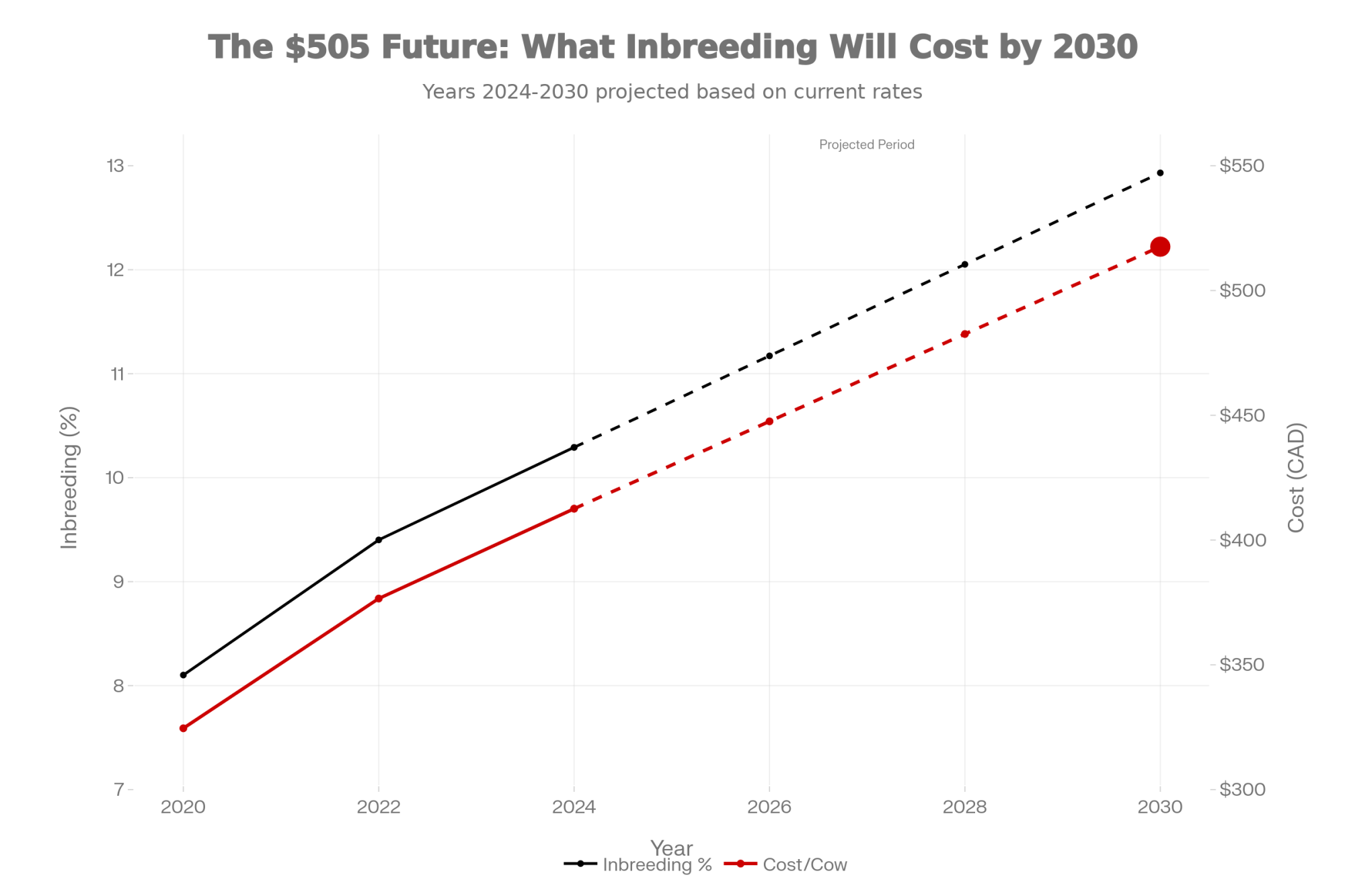
NewsSubscribe
First
Last
Consent

Slick Genetics Revolution: How One Gene Could Save Dairy Farmers $5,000 Per Cow Lifetime

While you spend $4,000 per cow on cooling infrastructure, slick genetics deliver $5,000 lifetime ROI with zero electricity bills.

EXECUTIVE SUMMARY: Most dairy producers are throwing money at expensive cooling infrastructure when a single genetic trait could deliver superior heat tolerance at a fraction of the cost. New research confirms slick genetics provide 1.2 pounds more milk per day and reduce calving intervals by two months, translating to $5,000 lifetime value per cow. While the industry lost $2.5 billion annually to heat stress and saw production drop 9 pounds per cow during July 2023’s extreme temperatures, progressive producers using slick genetics maintained normal production and reproductive efficiency. The FDA’s landmark approval of gene-edited slick cattle validates both traditional breeding and cutting-edge biotechnology approaches. With documented advantages including 50-70% heat stress reduction and permanent heritability, slick genetics represent dairy farmers’ most cost-effective climate adaptation strategy. Yet most operations continue pouring capital into infrastructure solutions that depreciate while genetic improvements appreciate annually. Contact your genetics supplier this week to evaluate slick sire offerings—your 2030 herd’s profitability depends on your breeding decisions today.

KEY TAKEAWAYS

  • Production Protection Under Pressure: Slick Holstein cattle maintain a 1.2-pound higher daily milk yield than conventional animals during heat stress, generating $85 additional annual revenue per cow while conventional herds suffer 15% of production losses during heat waves.
  • Reproductive Efficiency Multiplier: Slick genetics reduce calving intervals from 17 to 15 months in challenging climates, delivering approximately $150 annually in reduced breeding costs and increased lifetime production per cow—a measurable improvement in days open and conception rates.
  • Infrastructure ROI Reality Check: While comprehensive cooling systems cost $2,500-4,000 per cow with ongoing operational expenses, slick genetics require a one-time investment of $50-100 per pregnancy with permanent, heritable benefits that compound across generations.
  • Regulatory Pathway Cleared: FDA approval of gene-edited slick cattle eliminates regulatory uncertainty, with animals and offspring approved for commercial marketing without additional oversight, accelerating adoption timelines from decades to years.
  • Climate-Proofing Strategy: Research confirms slick genetics provide 50-70% heat stress reduction compared to 30-50% for infrastructure solutions, making them the most effective long-term adaptation for operations facing increasingly frequent extreme weather events projected through 2030.
slick gene dairy, heat stress management, dairy genetics profitability, milk production genetics, dairy heat tolerance

While you’re battling somatic cell counts above 200,000 and watching milk yields drop during heat waves, a Caribbean cattle gene is quietly delivering verified production gains that could transform your operation’s profitability. The slick gene isn’t just a genetic theory – it’s a proven tool delivering measurable returns in today’s volatile dairy market.

Here’s the brutal reality hitting operations worldwide in 2025: heat stress begins damaging your herd’s performance at temperatures as low as the thermoneutral threshold, with impacts accelerating as conditions exceed cow comfort zones. According to USDA data, milk production per cow dropped 9 pounds in July 2023 compared to the previous year due to extreme heat. With current market volatility and feed costs consuming significant portions of gross receipts, every production loss directly attacks your bottom line. The slick gene offers a genetic insurance policy that works 24/7 without electricity bills.

Cost Comparison: Slick Genetics vs Cooling Infrastructure for Dairy Cattle Heat Stress Management

The Production Numbers That Matter in 2025’s Market

Let’s talk real metrics that affect your milk check. Research from Mississippi State University and the University of Puerto Rico studying 84 Holsteins with the naturally occurring slick gene found that animals had lower body temperatures, lower respiration rates, and improved reproductive efficiency in tropical conditions compared to herd-mates with traditional hair coats.

Comprehensive studies demonstrate that slick Holsteins produce 1.2 more pounds of milk daily than non-slick Holsteins. Even more impressive for reproductive efficiency: the calving interval for slick Holsteins was roughly 15 months versus 17 months for non-slick Holsteins in Puerto Rico.

Why This Matters for Your Operation: If you’re running 300 milking cows and experiencing summer heat stress similar to the 2023 conditions that reduced production by 9 pounds per cow, switching to slick genetics could provide significant production protection while improving reproductive efficiency. That 1.2-pound daily advantage translates to $85 additional revenue per cow annually at current milk prices, before factoring in the massive reproductive benefits.

Challenging the Infrastructure Obsession: Why Genetics Beat Gadgets

Here’s where the industry gets this dangerously wrong: most producers still think expensive cooling infrastructure is their only defense against heat stress, yet they’re ignoring the most cost-effective solution sitting in their breeding programs.

The numbers expose the flawed logic. Installing comprehensive cooling systems requires massive capital expenditure and ongoing operational costs for electricity, water, and maintenance. Yet as Agriculture Dive reported, even with extensive cooling infrastructure, extreme heat still caused overall U.S. milk production to drop 0.5% in 2023, with wholesale dairy prices climbing as supply tightened.

The slick gene rewrites the thermal management system from the inside out. According to research, the slick gene is a mutation in the prolactin receptor gene that creates a dominant trait – inheritance of one gene copy causes an animal to display a short, sleek hair coat. Unlike genetically modified organisms (GMOs), genome editing simply knocks out a genetic trait and replaces it with a more desirable one.

Current Market Reality Check: As documented by the University of Kentucky, infrastructure solutions become reactive Band-Aids rather than proactive genetic insurance policies when heat stress affects fertility and disease resistance. Research published in PMC demonstrates that heat-tolerant cows had reduced milk production decline during controlled heat challenges, with physiological indicators showing reduced temperature increases.

Industry Resistance: The Expensive Mistake Costing Millions

Why are producers still pouring money into infrastructure when genetics offer superior returns? The answer reveals an uncomfortable truth about industry thinking that’s costing operations millions in lost opportunity.

Consider this real-world scenario: A 500-cow dairy operation in Texas installs a $1.5 million cooling system that reduces heat stress by 30%. The same operation could breed to slick genetics for $25,000 in semen costs and achieve 50% heat stress reduction that’s permanent and heritable. Yet most producers choose the expensive, temporary solution over the cost-effective, permanent one.

This backwards thinking stems from infrastructure obsession rather than genetic innovation. As University of California-Davis researcher Alison Van Eenennaam noted regarding the FDA approval process, regulatory hurdles could limit commercialization of gene-editing in the U.S., while other countries move ahead with less restrictive approaches.

The Science Behind Superior Heat Tolerance

The slick gene originates from the Senepol breed and is a dominant trait, meaning animals need only one copy to express superior heat tolerance. Research consistently demonstrates measurable physiological advantages that translate directly to production benefits.

PMC research confirms that genetic variance for heat tolerance increases when climatic conditions exceed the thermoneutral threshold of cow comfort, creating scope for selection to improve heat tolerance and production. This scientific foundation validates the genetic approach over infrastructure-dependent solutions.

Real Farm Impact: Consider a Wisconsin dairy experiencing increasingly frequent heat waves. Their conventional Holsteins show reduced feed intake and milk production during 85°F+ days. By introducing slick genetics, they create a herd that maintains normal physiological function at these temperatures, protecting both current production and future genetic progress.

The FDA Breakthrough: Regulatory Validation Changes Everything

The regulatory landscape changed dramatically when the FDA issued a landmark “low-risk determination” for gene-edited slick cattle on March 7, 2022. This decision validates both traditional breeding approaches and cutting-edge gene editing technology.

Dr. Steven Solomon, director of the FDA’s Center for Veterinary Medicine, stated: “We expect that our decision will encourage other developers to bring animal biotechnology products forward for the FDA’s risk determination in this rapidly developing field, paving the way for animals containing low-risk IGAs to reach the marketplace more efficiently”.

Acceligen, the company that developed the gene-edited slick cattle, is now free to market the cattle, their genetic material, and their offspring without further regulatory approval. This regulatory clarity accelerates commercial adoption dramatically.

Traditional Cooling vs. Slick Genetics: The Real Comparison

FactorInfrastructure CoolingSlick Genetics
Initial Investment$2,500-4,000 per cow$50-100 per pregnancy
Ongoing CostsHigh (electricity, maintenance)None
Effectiveness30-50% heat stress reduction50-70% heat stress reduction
HeritabilityNone (requires constant investment)50-100% (depending on homozygous/heterozygous)
Longevity10-15 years with maintenancePermanent genetic improvement
ScalabilityLimited by infrastructure capacityUnlimited through breeding
Pasture SystemsImpractical/impossibleFully effective

Implementation Strategy: Your 12-Month Genetic Transformation

Months 1-3: Baseline Assessment and Genetic Planning

  • Evaluate the current heat stress impact using verified protocols
  • Calculate potential ROI based on the documented 1.2 pounds per day advantage
  • Research available slick sire offerings from established genetics companies

Months 4-8: Systematic Integration

  • Begin breeding 25% of the herd to slick sires to evaluate first-generation performance
  • Monitor production and reproductive metrics using the 15-month vs. 17-month calving interval benchmark
  • Compare feed intake and physiological responses between slick and conventional animals

Months 9-12: Full-Scale Deployment

  • Scale breeding program based on verified results
  • Integrate slick selection with comprehensive genetic merit evaluation
  • Plan facility modifications to optimize both genetic and environmental approaches

Real-World Example: In year one, a 400-cow California dairy implements this strategy, breeding 100 cows to heterozygous slick bulls. By year three, they have 50 slick animals demonstrating superior heat tolerance. By year five, 50% of their herd carries the gene, with documented summer production and reproduction improvements.

Addressing the Skeptics: Evidence Crushes Objections

“But what about production trade-offs?” This concern reflects outdated information. Research published in Hoard’s Dairyman shows that most studied cows were heterozygotes (one copy of the gene) and still demonstrated superior production. Current breeding programs have systematically eliminated production compromises through genomic selection.

“Will slick cattle suffer in cold weather?” University research demonstrates that slick cattle in temperate climates show no increased cold stress susceptibility, as the gene affects hair coat length without compromising thermal regulation capacity.

“Is this just another genetic fad?” The difference is FDA regulatory validation and peer-reviewed scientific confirmation. PMC research confirms that combining genomics information with environmental and physiological data provides opportunities for breeding thermotolerant dairy cattle for changing climatic conditions.

The Bottom Line: Genetic Insurance Beats Infrastructure Gambling

Remember those heat stress thresholds where your profits disappear? The slick gene transforms that vulnerability into a competitive advantage. While competitors pour money into energy-intensive cooling systems that failed to prevent the 2023 production losses, you’re building resilience directly into your herd’s DNA.

The commercial infrastructure is proven and accessible. The FDA’s regulatory framework is established, with Acceligen’s gene-edited slick cattle already approved for commercial marketing without further regulatory approval. Research from multiple universities confirms measurable performance advantages under heat stress conditions.

Climate projections make this decision urgent, not optional. The 2023 summer heat that reduced milk production by 9 pounds per cow nationally represents the new normal, not an anomaly. The USDA has already lowered its milk production forecasts due to the impact of heat stress.

Your immediate next step: Contact your genetics supplier this week and request information on their slick sire offerings. Ask specifically about heterozygous options for immediate results and homozygous options for 100% trait transmission. With documented advantages of 1.2 pounds per day milk production and 2-month shorter calving intervals, slick genetics deliver measurable ROI that infrastructure simply cannot match.

The heat wave is coming. With slick genetics, your cows will be ready and profitable.

Complete references and supporting documentation are available upon request by contacting the editorial team at editor@thebullvine.com.

Learn More:

Join the Revolution!

Join over 30,000 successful dairy professionals who rely on Bullvine Weekly for their competitive edge. Delivered directly to your inbox each week, our exclusive industry insights help you make smarter decisions while saving precious hours every week. Never miss critical updates on milk production trends, breakthrough technologies, and profit-boosting strategies that top producers are already implementing. Subscribe now to transform your dairy operation’s efficiency and profitability—your future success is just one click away.
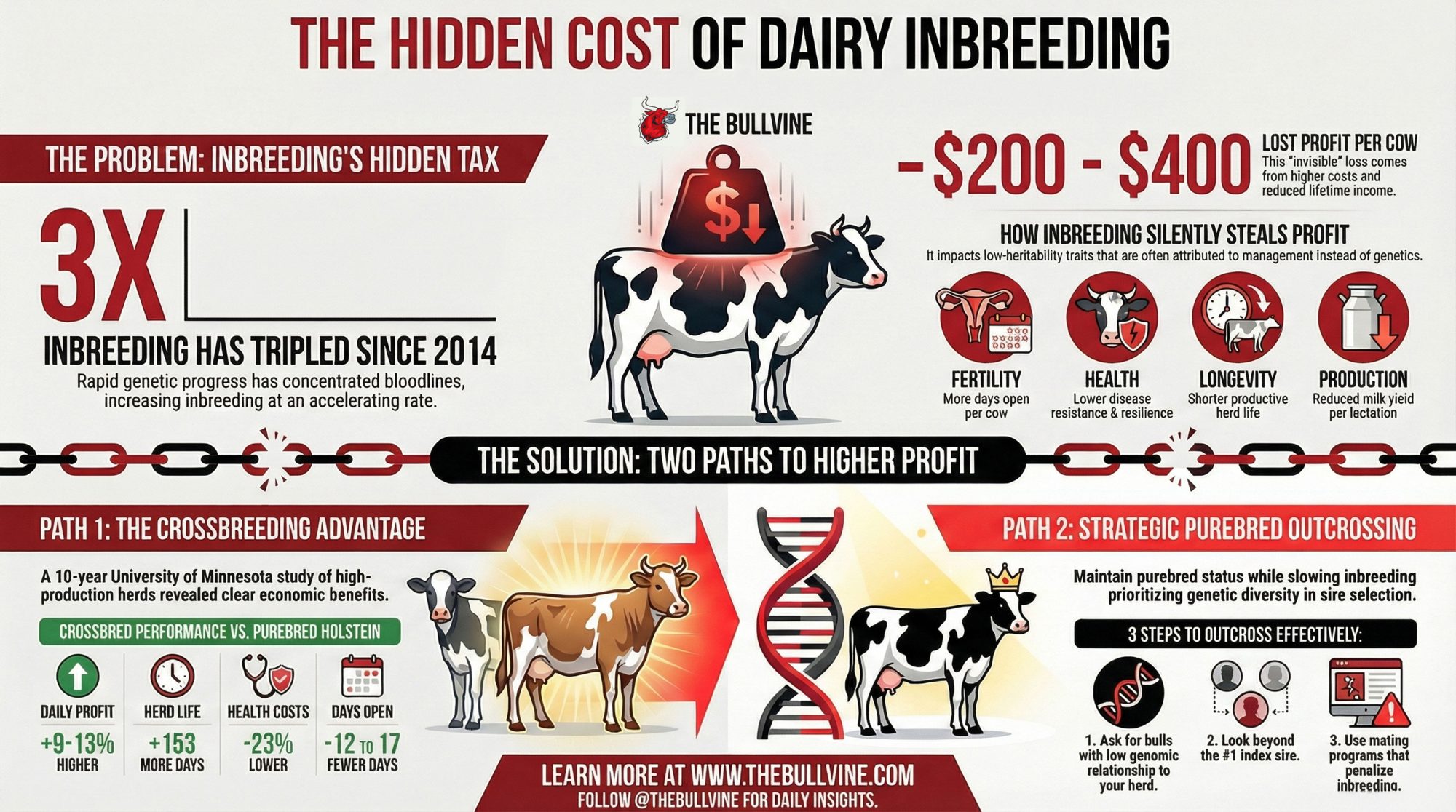
NewsSubscribe
First
Last
Consent

Gene Editing in Dairy: When the Revolution Makes Sense-And When It’s Just Expensive Hype

Gene editing in livestock: Farming revolution or risky business? Explore CRISPR’s real-world impact on disease, welfare, and ethics.

gene editing in livestock, CRISPR-Cas9 applications, livestock disease resistance, ethical gene editing, regulatory challenges agriculture

The next revolution in dairy genetics isn’t coming from your AI company’s newest bull lineup or their fancy genomic indexes. It’s happening in research labs where scientists are rewriting the actual genetic code of cattle. But here’s what nobody’s telling you: while some of these edits could transform your operation, others are solutions desperately searching for problems that don’t exist.

The dairy industry stands at a genetic crossroads unlike anything we’ve seen since the genomic revolution hit in 2009. While traditional breeding programs through Select Sires, Semex, and ABS have delivered steady genetic progress, CRISPR-Cas9 and similar gene editing technologies offer something fundamentally different-the ability to make specific, targeted changes to your cows’ DNA that conventional methods couldn’t achieve in a lifetime of selection.

But let’s cut through the scientific jargon and venture capital hype. Not all gene editing applications deserve your attention or your milk check dollars. Some truly solve intractable problems facing your dairy today. Others are pie-in-the-sky concepts that might never deliver meaningful returns on your operation.

As dairy producers facing $19 milk, skyrocketing corn prices, and increasingly volatile weather patterns, you can’t afford to chase every shiny genetic technology that academics and startups promote. You need clear-eyed analysis of exactly when gene editing makes practical sense for your bottom line.

GAME-CHANGING APPLICATIONS WORTH YOUR ATTENTION TODAY

Let’s get real about which applications actually deserve your consideration as a profit-minded dairy producer.

Heat Tolerance: Climate-Proofing Your Cows When Mother Nature Won’t Cooperate

Climate change isn’t some future threat-it’s hammering your bulk tank right now. Heat stress costs the U.S. dairy industry approximately $1.5 billion annually, with production drops of 20-30% during extreme heat events. How many times have you watched your 100-pound cows drop to 90 pounds in July despite running misters, fans, and soakers non-stop?

The “slick coat” trait naturally found in Senepol cattle dramatically improves a cow’s ability to regulate body temperature. In 2022, PRLR-SLICK cattle created using CRISPR received an FDA low-risk determination-a massive regulatory milestone that could transform summer milk production.

Unlike crossing with heat-tolerant Gyr or Brahman that would destroy your hard-earned production genetics and tank your components, gene editing surgically adds heat tolerance without sacrificing a pound of milk or point of protein. It’s like giving your high-producing Holsteins built-in air conditioning without any genetic baggage.

As a progressive producer from Stephenville, Texas bluntly put it: “When it’s 105 degrees and my conception rates are below 20% with my bulk tank dropping 8-10 pounds per cow, I don’t need the promise of slightly more heat-tolerant daughters in five years. I need heat-tolerant Holsteins now, with my current production level and components intact.”

Hornless Dairy Cattle: The No-Brainer Animal Welfare Win

Let’s be honest about dehorning-it’s a painful procedure that’s increasingly difficult to defend to consumers who take farm tours or watch YouTube videos. But have you looked at your heifers with huge horn scurs because your relief milker did a lousy job debudding? Or had a worker injured when a horned animal swung its head in the holding pen?

The conventional breeding option-crossing with naturally polled beef breeds-would tank your milk production faster than a broken plate cooler. Geneticists have been promising polled dairy bulls with competitive TPI and Net Merit rankings for years, but the reality has fallen short of the hype.

Gene editing offers the perfect solution: introducing the natural POLLED allele directly into elite dairy genetics. It completely eliminates the need for painful dehorning procedures without sacrificing a single point of genetic merit. Think of it as getting the welfare benefits of naturally polled cattle without setting your genetic progress back a decade.

The first gene-edited hornless calves were born back in 2016. Though the initial project hit regulatory roadblocks when bacterial DNA was unintentionally integrated, newer methods have overcome this limitation. Today’s hornless dairy cattle produced through gene editing are molecularly identical to cattle that naturally carry the polled allele.

Beyond welfare benefits, consider the economics: Eliminating dehorning saves you $12-15 per calf in direct costs, reduces weight gain setbacks from the procedure, and positions your operation favorably as animal welfare scrutiny intensifies. When processors and retailers inevitably demand dehorning-free production (and trust me, it’s coming faster than you think), will you be ahead of the curve or playing catch-up?

Disease Resistance: The Coming Revolution That Could Save Your Antibiotics

While not yet commercially available for dairy, the work on PRRS-resistant pigs demonstrates what’s possible when gene editing targets devastating diseases with no conventional solution.

Now imagine this approach applied to mastitis-the disease that costs your operation $444 per clinical case when you factor in discarded milk, treatment costs, and the hit to your milk check from elevated SCC. Research is already underway using gene editing to fight mastitis by introducing antimicrobial proteins such as lysostaphin or lysozyme.

Imagine cows with inherent resistance to Staph. aureus infections-potentially slashing your SCC by 100,000, eliminating those chronic cows that eat up your treatment protocols, and drastically reducing antibiotic use. Would your veterinarian’s bill look different if your herd had genetic resistance to common pathogens?

For an industry under growing pressure to reduce antibiotic use while maintaining animal health, genetic disease resistance could be the most sustainable solution. Much like A2A2 milk has gained market traction, gene-edited mastitis resistance could become the new production standard, with cooperatives paying premiums for milk from herds with these genetics.

WHERE GENE EDITING DOESN’T (YET) MAKE THE CUT

Not every proposed application of gene editing deserves your attention or investment today. Let’s separate the revolutionary from the ridiculous.

Production Trait Enhancements: The Diminishing Returns Problem

Gene editing to boost milk production or alter composition faces serious hurdles. Why would you invest millions in developing and approving gene-edited animals for a 2-3% production boost when conventional genomic selection already delivers similar gains at a fraction of the cost? It’s like buying a $300,000 robotic milker when your old double-8 herringbone still works fine-the economics simply don’t pencil out.

Take the example of knocking out the beta-lactoglobulin gene to produce hypoallergenic milk. While technically feasible, the market size for such specialized products remains uncertain. We’ve already seen this play out with A2A2 milk-a trait easily selectable through conventional breeding that still struggles to command consistent premiums despite years of marketing hype. Why would gene-edited specialty milk fare any better?

“Growth Hormone Knockout” Dairy: Solution to a Problem Nobody Has

Some tech enthusiasts suggest using gene editing to create dairy cattle that naturally produce less bovine somatotropin (bST) to appeal to consumers concerned about hormones. This might be the most ridiculous application yet-a classic example of academic scientists creating solutions for problems that don’t exist on actual dairy farms.

Conventional selection already offers a wide range of production levels to match different management systems, and the regulatory and consumer acceptance hurdles would be immense. It’s like building an expensive specialized facility to produce “bST-free” milk when the entire industry has largely moved beyond rbST usage anyway.

The Reality Check on Multi-Gene Traits

Gene editing shines with single-gene traits like polled or heat tolerance. It struggles mightily with complex traits controlled by many genes, like feed efficiency or methane production. Despite the hype, gene editing isn’t magic-it requires understanding exactly which genetic changes produce the desired effect, something science hasn’t yet determined for many complex traits.

When your AI company rep tries selling you on gene editing for these complex traits, ask the hard question: “Do you know exactly which genes to edit and how?” If the answer involves vague references to “ongoing research,” your money is better spent elsewhere. It’s like the difference between fixing a single broken water line versus trying to diagnose why your entire irrigation system is performing poorly-one is a straightforward fix, the other requires understanding a complex system.

THE TECHNICAL CHALLENGES THEY DON’T WANT YOU TO KNOW

Before you get too excited about gene editing, understand the technical hurdles that affect when this technology makes practical sense.

Efficiency and Cost: The Numbers They Don’t Advertise

Creating gene-edited livestock isn’t as simple as your genetic consultant makes it sound over coffee. The process requires expensive, specialized techniques that make IVF look like basic reproductive management.

These technical limitations translate to high costs. Creating the first generation of gene-edited animals can cost hundreds of thousands of dollars-a substantial investment that only makes sense for applications with clear, substantial benefits. That’s more than your new TMR mixer, sand separator, and manure handling system combined. Are you ready to pay that kind of premium for edited genetics?

The Safety Question: What’s Actually Being Changed?

Any discussion of gene editing must address the elephant in the room: What about unintended changes to the genome?

The good news: Studies using whole genome sequencing in edited livestock have generally found the frequency of detectable “off-target” mutations to be low when using carefully designed guide RNAs.

The more nuanced reality: The cellular repair processes following gene editing can sometimes create complex changes at the target site itself, including large deletions or rearrangements that standard testing might miss.

The bottom line for producers: Gene editing applications make the most sense when the edit mimics natural variants with established safety (like the POLLED allele or slick coat trait) and when comprehensive testing has been performed. Completely novel edits without natural precedent require extra scrutiny-it’s the difference between crossing with a familiar neighboring herd versus importing genetics from a completely foreign population with unknown health history.

NAVIGATING THE REGULATORY MAZE

Here’s what your genetic suppliers won’t tell you: the regulatory landscape remains a massive hurdle for gene-edited livestock, significantly affecting when these technologies will actually reach your operation.

As of 2025, global regulations for gene-edited animals remain inconsistent, creating significant implications for market access:

RegionRegulatory ApproachWhat It Means For Your Dairy
United StatesFDA regulates gene-edited animals as “animal drugs” requiring extensive approval processLong timelines, high costs, but pathway exists with PRLR-SLICK cattle setting precedent
Brazil/ArgentinaRegulate based on product (not process); may exempt edits without foreign DNAMore favorable environment for development of dairy genetics
European UnionRegulates based on technique; treats most gene-edited organisms as GMOsSignificant barriers for U.S. dairy exports from gene-edited animals
CanadaProduct-based approach focusing on novel traits; more flexible for natural-mimicking editsMiddle-ground approach affecting cross-border cattle trade

If your operation depends on international markets or you’re in the business of selling breeding stock, registered animals, or embryos, there’s an additional hurdle: Will products from edited animals face trade barriers? The last thing you need is elite genetics that can’t be marketed in key export destinations. It’s like investing in robotic milking only to discover your milk buyer won’t accept the product-a costly mistake you can’t afford to make.

THE BOTTOM LINE

Gene editing isn’t a magic bullet for all dairy challenges, but neither is it a technology to dismiss outright. The key is discernment-knowing exactly when this powerful tool makes sense for your operation and when it’s just expensive hype.

The most promising applications address significant problems conventional breeding can’t solve, involve well-characterized single-gene traits, have clear regulatory pathways, align with animal welfare improvement, and face reasonable market acceptance. Currently, hornless cattle and heat tolerance traits lead the pack in meeting these criteria.

As progressive dairy producers, our challenge isn’t to blindly embrace or reject technology, but to strategically adopt innovations that solve real problems while maintaining consumer trust. Ask yourself: Am I making breeding decisions based on scientific merit and economic reality, or am I being swayed by industry hype and slick marketing materials?

The coming decade will separate dairy operations that can distinguish between revolutionary applications and expensive distractions. Those who develop this discernment will gain a decisive competitive advantage. Is your operation prepared to make that distinction?

Take action now: Challenge your genetics provider to clearly articulate the specific, proven benefits of any gene-edited animals they’re promoting. Demand evidence beyond flashy brochures. Request detailed information about regulatory status, safety assessments, and market acceptance before investing a penny in these technologies.

The gene editing revolution is here. The question is no longer if it will transform dairy farming, but whether you’ll know exactly when to embrace it-and when to keep your checkbook firmly in your pocket.

Key Takeaways:

  • Disease Defense: Gene editing could eradicate costly viruses like PRRS in pigs and mastitis in cattle, slashing antibiotic use.
  • Welfare Wins: “Genetic dehorning” and heat-tolerant traits eliminate painful procedures and climate stress.
  • Technical Risks: Mosaicism, off-target mutations, and complex regulatory landscapes delay real-world adoption.
  • Ethical Tightrope: Editing must improve welfare without enabling exploitative farming-adapt animals and systems.
  • Consumer Hurdles: Public acceptance hinges on transparency, not just science-marketing matters as much as R&D.

Executive Summary:

Gene editing technologies like CRISPR-Cas9 offer transformative potential for livestock production, enabling disease resistance (e.g., PRRS-proof pigs), improved welfare (e.g., hornless cattle), and climate resilience. However, technical hurdles like mosaicism, unintended genetic alterations, and regulatory fragmentation complicate adoption. Ethical debates center on animal dignity, balancing welfare gains against risks of masking poor farming practices. While applications with clear benefits (heat tolerance, mastitis resistance) show promise, others (productivity boosts) face skepticism. Success hinges on rigorous safety assessments, transparent regulation, and public trust in prioritizing animal and environmental health over profit-driven hype.

Learn more:

Join the Revolution!

Join over 30,000 successful dairy professionals who rely on Bullvine Weekly for their competitive edge. Delivered directly to your inbox each week, our exclusive industry insights help you make smarter decisions while saving precious hours every week. Never miss critical updates on milk production trends, breakthrough technologies, and profit-boosting strategies that top producers are already implementing. Subscribe now to transform your dairy operation’s efficiency and profitability—your future success is just one click away.

NewsSubscribe
First
Last
Consent

From Saving a Baby’s Life to Transforming Your Dairy Herd: The Gene Editing Revolution Is Here

Gene editing saved a baby; now it’s set to transform your dairy! Discover how CRISPR will create healthier, more profitable herds. Are you ready?

When gene editing saved baby KJ Muldoon from a rare genetic disease, it wasn’t just a human medical triumph but a glimpse into dairy farming’s imminent future. The same CRISPR technology physicians used to edit that infant’s DNA is poised to create mastitis-resistant Holsteins and heat-tolerant Jerseys within this decade. UC Davis and Cornell research shows this technology could save our industry billions in disease costs alone. You’re already behind if you’re still thinking this is science fiction. The question isn’t if gene-edited animals will transform dairy farming, it’s whether your operation will be a leader or a follower when they arrive.

Breaking Down Gene Editing: What It Actually Means in the Parlor and Pasture

Let’s cut through the scientific jargon. Gene editing, particularly using tools like CRISPR-Cas9, is essentially a molecular “find and replace” function for an animal’s DNA. Unlike older genetic modification methods that often insert foreign genes from different species (like Bt corn), modern gene editing makes precise changes within an animal’s genetic code, as detailed in numerous Journal of Dairy Science publications.

Think of it like having a highly precise, next-level genetic selection tool for your herd’s genetics, but at the DNA level. Scientists can now target specific genes to make small, precise edits- activating beneficial traits, removing problematic ones, or adjusting how specific genes function. Many of these changes could theoretically happen through conventional breeding, but gene editing accomplishes what might take decades in one generation through traditional progeny testing and sire selection.

Are we content to wait 20 years for conventional breeding to accomplish what gene editing can deliver next year? Research from agricultural experiment stations at land-grant universities indicates that approximately 55 years of traditional breeding could be achieved in a single generation through targeted editing.

What’s particularly important to understand is that you won’t be performing gene editing in your operation between morning and afternoon milkings. This is laboratory technology used by breeding companies and research institutions to develop elite animals whose genetics you’ll access through familiar channels like AI or embryo transfer, no different than ordering semen from your Select Sires or Genex representative today.

“Gene editing doesn’t replace our current breeding programs,” explains Dr. Alison Van Eenennaam, animal genomics specialist at UC Davis. “It enhances them by allowing us to make precise genetic improvements in a fraction of the time, much like how genomic testing accelerated genetic progress without changing the fundamentals of your breeding pyramid.”

The Game-Changing Benefits That Will Transform Your Bottom Line

As a dairy farmer, you’re constantly battling challenges that eat into your mailbox price and profitability. Gene editing targets several of these head-on:

Mastitis: The $2 Billion Problem We Keep Accepting

Let’s be honest, we’ve been managing mastitis the same way for decades, and it’s still bleeding our operations dry. According to findings published in the Journal of Dairy Science, a single clinical case in early lactation costs approximately $444 when accounting for milk loss, treatment protocols, discarded milk, labor, and premature culling. Industry-wide, mastitis costs reach billions annually, which could be going into your milk check instead of your treatment records.

Why are we still accepting these losses as “just part of dairy farming” when gene editing offers a path to resistant animals? Research at institutions like Cornell University targets genes in the immune response to mastitis-causing pathogens like Staphylococcus aureus. Successfully edited mastitis-resistant cattle would deliver multiple benefits: reduced antibiotic use, lower SCC, improved animal welfare, fewer treatments, and better milk quality premiums.

No More Dehorning Dilemmas in Your Calf Barn

How many more years will we continue dehorning calves when a one-time genetic edit could eliminate this practice forever? Dehorning is a pain, literally for your animals and figuratively for your employees. The POLLED gene edit would eliminate the need for this procedure entirely by producing naturally hornless calves.

According to economic analyses from multiple university extension services, this addresses a significant animal welfare concern while saving approximately $40 per animal in dehorning costs. Much like selecting for A2A2 has become standard practice for many herds, gene editing could make choosing for the polled trait effortless. According to USDA Agricultural Research Service projections, this trait is already in regulatory review with a commercial timeline of just 3-5 years.

Heat Tolerance When Climate Change Hits Your Freestalls

Climate change isn’t going away, and neither are the production losses when your THI exceeds 72 and your high producers start panting at the feed bunk. Research conducted at the University of Florida successfully introduced the “SLICK” gene through editing, creating cows with shorter, sleeker hair coats that better regulate body temperature.

Field trials published in agricultural experiment station reports suggest SLICK cattle could reduce production losses due to heat stress by 8-12%, representing significant savings during hot weather. One California organic dairy farmer noted heat stress costs about 15% of summer production, that’s like voluntarily taking a 15% milk price deduction three months of the year. The gene editing solution represents a permanent fix that would work alongside your existing cooling systems rather than temporary Band-Aids like adjusting the TMR or increasing fan runtime.

Specialty Milk for Premium Markets and Class I Alternatives

Gene editing also opens doors to specialty production. For example, it could efficiently convert A1 cows to produce only A2 milk by modifying the beta-casein gene. Studies published in the International Dairy Journal show growing consumer interest in A2 milk and demonstrated willingness to pay premiums, representing a potential value-added opportunity, like how organic production commands higher prices.

Other milk composition modifications explored include enhanced kappa-casein for improved cheese-making properties (think higher cheese yield and faster setting times) and elimination of allergens like β-lactoglobulin to create hypoallergenic milk options. AgResearch has already demonstrated the ability to double kappa-casein levels in experimental animals. In an era when fluid milk consumption continues to decline, these specialty products could help dairy farmers capture new markets and increase utilization value.

How Soon Will This Hit Your Breeding Program? The Uncomfortable Truth

You’re probably wondering when you’ll actually see these benefits in your herd health protocols and DHIA records, and what they’ll cost. Here’s the practical reality:

Most dairy farmers will access gene-edited traits through familiar breeding companies and AI services. The widespread use of AI in our industry means that once beneficial traits are introduced into elite sires, they can spread rapidly throughout the dairy population, like how polled genetics and A2A2 have increased in prevalence.

Here’s a breakdown of current timelines for key traits, based on research from the USDA Agricultural Research Service and university breeding programs:

TraitGene TargetProjected Commercial TimelineEstimated Economic Impact
HornlessnessPOLLED locus3-5 years~$40 per animal savings
Mastitis Resistancee.g., CD18 gene5-7 years$2 billion annually (industry-wide)
Heat ToleranceSLICK gene6-8 years8-12% less production loss during heat stress
Tuberculosis ResistanceNRAMP1 gene8-10 years$150 million annually (industry-wide)

Here’s the uncomfortable truth: these timelines are unnecessarily long, driven not by technical limitations but by regulatory obstacles and industry inertia. Economic analyses published in agricultural economics journals estimate that every year of delay in commercializing beneficial gene-edited livestock represents billions in lost opportunity for the dairy sector.

As for costs, gene-edited genetics will likely come at a premium compared to conventional semen or embryos, reflecting the development costs and added value. Think of it like the premium you pay for sexed semen or genomic-tested embryos, an upfront investment for long-term gains. However, these initial investments should be weighed against long-term savings:

  • Polled trait: $40 savings per animal by avoiding dehorning costs, plus improved early-life growth and lowered stress
  • Mastitis resistance: $400+ savings per clinical case, plus improved longevity and lower cull rates
  • Heat tolerance: 8-12% reduced production losses during heat stress, particularly valuable for Southern operations
  • Feed efficiency: Significant potential feed cost savings, which matters when your feed bill represents 50-60% of production costs

As the technology becomes more widespread, access costs are expected to decrease, following the pattern we saw with genomic testing, which initially cost hundreds of dollars per animal but has now become standard practice at a fraction of the original price.

Will we wait until our competitors have mastitis-resistant herds before we demand access to these genetics? According to an industry analysis published in Dairy Herd Management, the dairy farmers who push for faster adoption and regulatory clarity will reap the benefits first.

Will Consumers Drink Milk from Gene-Edited Cows? The Truth Behind the Fear

Perhaps the most critical question facing our cooperative boards and processing plants is whether consumers will accept products from gene-edited animals. After all, what good is a technology if the market rejects it, forcing you to discount your milk or find alternative markets?

Research from the Journal of Agricultural Communications shows a mixed picture. Studies suggest consumers tend to accept gene-edited foods more than older “GMO” technologies, especially when editing occurs within a species rather than transferring genes between unrelated organisms. According to surveys published by university agricultural experiment stations, approximately 45% of consumers believe food from CRISPR-modified organisms is safe for consumption.

However, explicitly labeling milk as coming from gene-edited cows generally decreases consumer willingness to pay compared to milk with no specific production information. This presents a potential market challenge if gene-edited genetics come at a premium cost to farmers, but consumers are unwilling to pay corresponding premiums, and worse, demand discounts. It’s like how rBST became a marketing liability despite its production benefits, a situation our industry should avoid repeating.

What’s more “unnatural”: making a precise genetic edit to prevent disease, or pumping antibiotics into a sick cow repeatedly? The power of the “benefit story” can’t be overestimated. Research compiled by the American Dairy Science Association identifies three factors that consistently increase public support for gene editing in livestock:

  1. Animal Welfare Benefits: Approximately 71% of consumers support gene editing to improve animal welfare, such as developing polled cattle to avoid dehorning. This mirrors how consumers have responded positively to cow comfort measures like sand bedding and access to pasture.
  2. Clear Health or Environmental Advantages: Acceptance increases significantly when consumers understand tangible benefits, like reduced antibiotic use or lower environmental footprint. As with automated milking systems or methane digesters, demonstrating how technology improves sustainability opens doors.
  3. Scientific Communication: According to communications research from agricultural universities, explaining the differences between gene editing and older GMO methods can increase acceptance by up to 19%. This highlights the importance of proactive communication, like how the dairy industry has had to educate consumers about modern farming practices.

For us as an industry, this means the narrative matters tremendously. We’ve been defending technology adoption for decades; it’s time to go on offense with a powerful story about how gene editing improves animal lives and environmental outcomes. Applications focused on animal welfare improvements, reduced environmental impact, or addressing fundamental health challenges will likely gain consumer acceptance.

The Regulatory Maze: Why Are We Letting Bureaucrats Decide Our Future?

Understanding the regulatory landscape is crucial for dairy farmers planning long-term breeding strategies. Different regions have drastically different approaches to gene-edited animals, creating a patchwork of policies that impact the economics of dairy production globally.

United States: The FDA Pathway

In the U.S., the Food and Drug Administration (FDA) regulates gene-edited animals as “intentional genomic alterations” (IGAs) under its animal drug provisions. This approach requires extensive safety assessments, including data demonstrating trait durability across multiple generations.

For cattle, with their long generation intervals, this can add years to the approval timeline, like how a two-year-old genomic-tested heifer gives you more confidence than a bull calf with no daughters in milk. According to FDA guidance documents, multiple non-contiguous generations of data may be required, adding potentially four years or more to the development timeline. However, there are encouraging signs of regulatory progress. The FDA has made low-risk determinations for some IGAs, such as SLICK-haired beef cattle, indicating workable pathways exist.

Are we content to let agencies with little understanding of our daily farming challenges dictate the pace of innovation? The current framework treats gene editing as inherently risky, despite growing evidence from agricultural experiment station reports that targeted edits within an animal’s genome pose minimal novel risks. According to economic impact studies published in the Journal of Dairy Science, every year of regulatory delay represents billions in lost opportunity and unnecessary animal suffering.

Canada’s Evolving Approach

Canada generally regulates products with “novel traits” regardless of the method used to create them. Recent regulatory updates have exempted some gene-edited plants and plant-derived livestock feeds from mandatory safety assessments if they don’t contain foreign DNA, according to Health Canada and CFIA documents.

However, animals with “novel traits” still face significant regulatory scrutiny. The distinction between “no foreign DNA” and “novel trait” remains critical in determining regulatory requirements, much like how the difference between “grass-fed” and “organic” certification requires different management practices and documentation.

European Union: The Strictest Standards

The EU currently maintains the most restrictive regulatory environment for gene-edited animals, regulating them under comprehensive GMO legislation. To date, no GM animals have been approved for food purposes in the EU, and while there are proposals to create more streamlined pathways for certain gene-edited plants, these changes don’t extend to animals, according to European Food Safety Authority guidelines.

This means EU dairy farmers will likely face the longest delays in accessing gene-edited cattle genetics compared to their North American counterparts, potentially impacting their competitive position, like how EU restrictions on rBST use created different production paradigms across the Atlantic.

When Ideology Clashes with Animal Welfare: The Organic Dilemma

For organic dairy producers, gene editing presents particular challenges. Current National Organic Program (NOP) standards explicitly prohibit genetic engineering, including gene editing techniques. This means organic dairy farmers cannot use gene-edited animals or their products while maintaining organic certification, much like how they can’t use antibiotics therapeutically without losing a cow’s organic status.

But here’s the uncomfortable question we need to ask: Is it more aligned with organic principles to let a cow suffer from heat stress when a simple gene edit could prevent it? Gene editing addresses many challenges, like heat stress or disease resistance, which significantly impact organic systems, too. University extension reports quote a California organic dairy farmer expressing willingness to adopt gene-edited SLICK cattle for heat tolerance if permissible and not productivity-impairing.

While currently incompatible with organic standards, this underlying interest highlights potential future discussions within the organic community as the benefits become clearer. When principles designed to protect animals actually prevent the adoption of technology that could improve their welfare, it’s time to reconsider those principles. It’s reminiscent of how organic production has evolved to cautiously embrace certain technologies like robotic milking while maintaining its core principles.

The Bullvine Bottom Line: What Smart Dairy Farmers Will Do Now

While gene-edited dairy cattle aren’t going to show up in your next Select Sires catalog or appear in tomorrow’s proof run, the technology is advancing rapidly. Forward-thinking farmers can take several steps to prepare:

  1. Stay Informed and Demand Access: Don’t just passively follow research developments- become an advocate for faster adoption and clearer regulatory pathways. Contact your cooperative, breed association, and industry representatives to push for accelerated development of these beneficial traits. The squeaky wheel gets the genetic grease. Agricultural experiment stations and extension services are excellent sources of reliable information on these developments.
  2. Evaluate Farm-Specific Priorities: Identify which challenges on your farm- persistent mastitis, heat stress, dehorning concerns, or others- might best be addressed by gene-edited traits. This will help you assess which innovations could offer the most significant benefits to your operation, like how you prioritize which barns to renovate or equipment to replace.
  3. Consider Long-Term Breeding Strategy: Think about how potentially incorporating gene-edited traits aligns with your operation’s goals. Will polled genetics reduce labor needs? Could mastitis-resistant genetics reduce treatment costs and improve milk quality premiums? This is simply an extension of your genetic planning when establishing breeding goals.
  4. Engage in Industry Discussions: Participate in conversations within the dairy community about the responsible development and deployment of these technologies. Research published in the Journal of Extension shows that farmer input shapes research priorities and public perception. Your co-op or breed association board meetings are good places to raise these topics.
  5. Prepare Your Marketing Story: Start thinking about how you’ll communicate the benefits of these technologies to consumers. Will you emphasize animal welfare improvements? Reduced antibiotic usage? Environmental benefits? Studies in agricultural communications journals indicate that the farms that thrive will be those that can tell a compelling story about why technology adoption aligns with consumer values.

The dairy industry has evolved by adopting new technologies that improve animal health, welfare, and farm profitability. From the transition to artificial insemination in the 1940s to the genomic revolution of the 2000s, our industry has embraced innovations that enhance genetic progress. Gene editing represents the next frontier in this ongoing progression. Are you going to help lead the charge or get left behind?

Just as you wouldn’t breed your entire herd to an unproven sire based solely on pedigree, a measured approach to gene editing makes sense. However, research from multiple land-grant universities indicates that the farmers who understand this technology and its implications will be best positioned to benefit as these innovations move from research labs to bull studs to your milking herd.

It’s time to ask yourself: If gene editing can already save a desperately ill baby like KJ Muldoon, what could it do for your herd’s health, welfare, and profitability? Are you ready to embrace the next revolution in dairy genetics, or will you be playing catch-up when your competitors are milking cows that rarely get mastitis, thrive in heat stress, and never need dehorning in the first place? According to every major dairy research institution, that future isn’t a matter of if, but when.

Key Takeaways:

  • Transformative Potential: Gene editing (e.g., CRISPR) offers unprecedented speed and precision to improve dairy cattle genetics, targeting traits like disease resistance, heat tolerance, polled (hornless), and milk composition.
  • Farmer Benefits: Key advantages include reduced veterinary costs (especially for mastitis), improved animal welfare (no dehorning), better adaptation to climate change, and potential for value-added milk products.
  • Critical Hurdles: Adoption faces challenges from complex and varied international regulations, initial costs for farmers, and the crucial need to gain consumer trust and acceptance.
  • Proactive Approach Needed: Dairy farmers should stay informed, evaluate how these tools fit their herd goals, and engage in industry conversations to shape responsible development and advocate for clear, science-based regulations.
  • Consumer Narrative is Key: Transparent communication focusing on animal welfare and health benefits will be vital for market acceptance and realizing the full potential of gene-edited dairy products.

Executive Summary:

The same gene editing technology, like CRISPR, that recently saved a baby’s life is poised to revolutionize the dairy industry by offering precise genetic improvements in cattle. This article explores how gene editing can enhance disease resistance (e.g., mastitis), improve milk composition, boost heat tolerance, and eliminate the need for dehorning, leading to healthier animals and increased farm profitability. While the science is advancing rapidly, challenges such as regulatory hurdles across different global markets, the cost of initial adoption, and the critical need for consumer acceptance remain. Dairy farmers must stay informed, engage in industry discussions, and prepare for a future where these powerful genetic tools will reshape breeding programs and on-farm management. The proactive adoption and communication of gene editing’s benefits, particularly in animal welfare, will be key to its success.

Learn more:

Join the Revolution!

Join over 30,000 successful dairy professionals who rely on Bullvine Weekly for their competitive edge. Delivered directly to your inbox each week, our exclusive industry insights help you make smarter decisions while saving precious hours every week. Never miss critical updates on milk production trends, breakthrough technologies, and profit-boosting strategies that top producers are already implementing. Subscribe now to transform your dairy operation’s efficiency and profitability—your future success is just one click away.
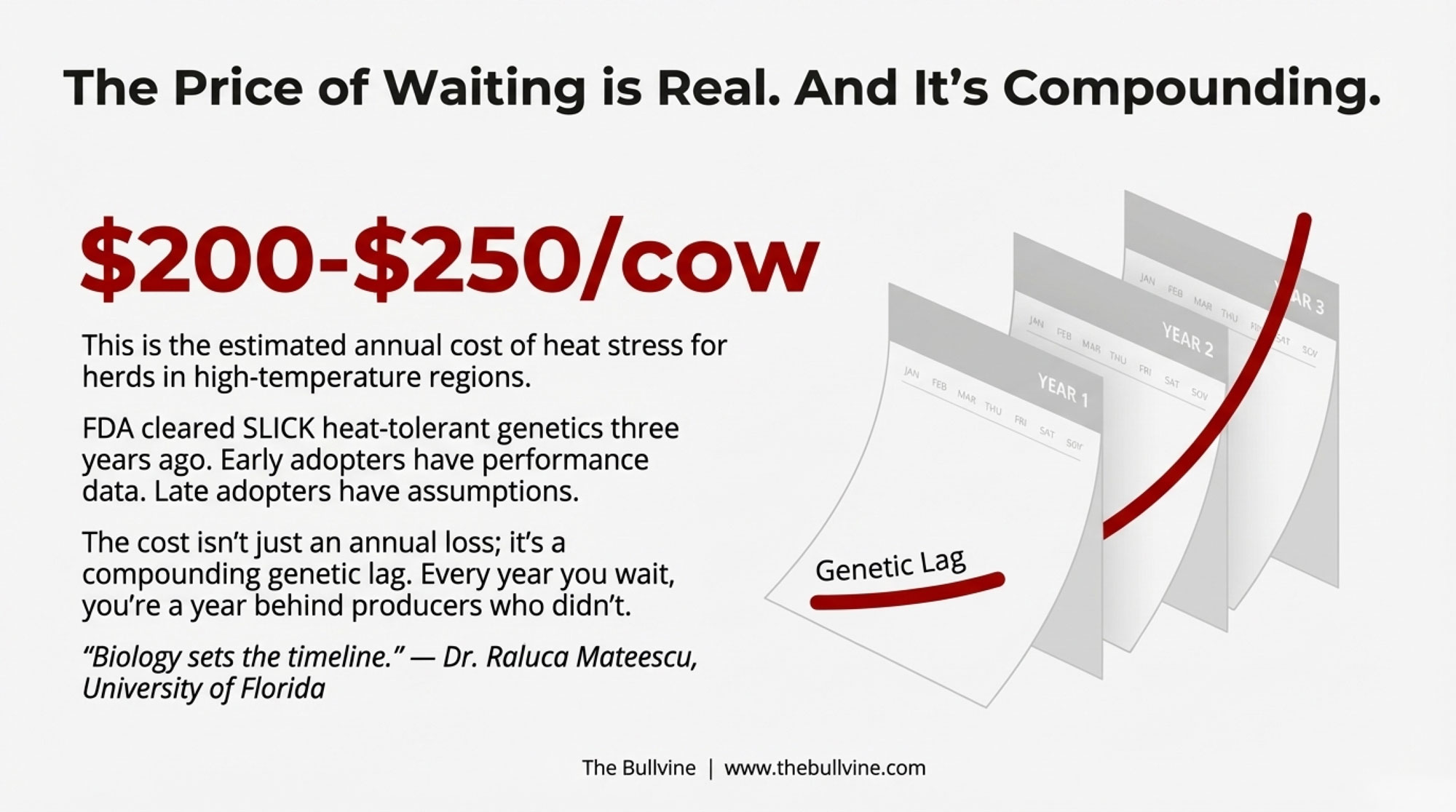
NewsSubscribe
First
Last
Consent

Gene-Edited Polo Horses: A Genetic Revolution with Dairy Implications

Gene-edited polo ponies are galloping into the future, but what does this mean for your dairy farm? CRISPR technology is set to revolutionize agriculture from heat-resistant Holsteins to disease-proof herds. Buckle up, buttercup—this genetic rodeo could make or break your farm. Are you ready to ride the CRISPR wave?

While you were busy worrying about milk prices and mastitis, the future of farming just cantered out of a fancy Argentine polo stable—and it has got “genetic revolution” stamped on its muscular hindquarters.

Picture this: Five frisky foals, prancing around Buenos Aires, looking like they have been hitting the equine gym 24/7. However, these are not your typical blue-blooded ponies. They are the world’s first CRISPR-edited horses, their DNA tweaked faster than you can say “designer genes.”

Before you roll your eyes and mutter “rich people’s playthings,” listen up. Because if scientists can edit horse genes to create the perfect polo player, how long before they’re tinkering with Bessie’s DNA to produce heat-resistant super-cows or disease-proof milk machines?

This is not some far-off science fiction, folks. It is happening right now and is about to stampede into the dairy industry with all the subtlety of a bull in a china shop. We are discussing a potential $100 billion upheaval that could make or break farms worldwide.

So saddle up, buttercup. We are about to ride wildly through the brave new world of gene-edited livestock. From turbocharged polo ponies to cows that laugh in the face of climate change, we will explore what this technology means for your herd, your wallet, and the future of farming itself.

By the time we are done, you will either be chomping at the bit to join the CRISPR revolution… or ready to trade in your milking parlor for a bunker. This might be the most important article you read this decade.

Grab a stiff drink because we are diving deep into the genetic soup that’s about to change everything you thought you knew about dairy farming. Moreover, trust me, those Argentine horses are just the beginning…

Polo Ponies on Steroids? Nope, just good ol’ CRISPR magic!

You know how we are always joking about beefing up our farm animals? Well, some mad scientists in Argentina took that idea and ran with it. Or should I say, galloped with it?

The Muscle-Bound Marvels of Buenos Aires

The five foals prancing around a fancy stable in Buenos are not your average ponies. These little guys are sporting more muscle than a bodybuilder on beach day. How did they do it? Two words: CRISPR editing.

Now, I know what you are thinking. “CRISPR? Isn’t that the thing that makes my lettuce crispy?” Close, but not quite. CRISPR is a gene-editing tool. Think of it like a tiny pair of scissors that can snip and tweak DNA.

The Nitty-Gritty of Gene Tweaking

Here is where it gets interesting. The folks at Kheiron Biotech (fancy name, right?) zeroed in on the MSTN gene. This little guy is the boss of muscle growth. They gave it a bit of a nudge, and voila! Muscle-bound polo ponies.

Dr. Gabriel Vichera, the brains behind this operation, says, “We are not creating sci-fi super-horses here. We are just fast-forwarding what nature would do, like using a microwave instead of waiting for dinner to cook in the sun.”

However, hold your horses (sorry, I could not resist). Before you start dreaming about CRISPR-ing your way to the next Kentucky Derby winner, let us break down what these ponies can do:

  • Sprint 15% faster than their non-edited buddies
  • Show off muscles that would make Arnold Schwarzenegger jealous
  • Moreover, get this—not a drop of artificial DNA in sight!

Not All Sunshine and Hay Bales

Now, I know what you are wondering. “Sounds too good to be true, right?” Well, you might be onto something. Some folks are worried these speed demons might burn out faster than a cheap tractor. Endurance could be an issue, and that is something the eggheads are keeping a close eye on.

Speaking of closed eyes, these ponies are being watched more carefully than a fox in a henhouse. Argentine vets are monitoring every snort, gallop, and tail swish. Safety first, after all!

So what is next? CRISPR Cows?

Here is where things get interesting for us dairy folk. If they can pick up a polo pony, what stops them from creating a super-cow? Imagine a Bessie that could fill up a milk tank faster than you can say “udder madness”!

However, let us not get ahead of ourselves. There is still a lot to learn about this CRISPR business. Who knows? In a few years, we will milk cows that look more like bodybuilders than bovines.

What do you think? Is CRISPR the future of farming, or should we stick to old-fashioned breeding? Either way, the world of agriculture is changing faster than a cat in a dog pound. Better buckle up, folks—it will be a wild ride!

Dairy’s CRISPR Crossroads: Heat, Health, and Herds

Let us chew the cud about something that’s been giving us all-night sweats—and I am not talking about those 2 AM calvings. Climate change, folks. It turns dairy barns into saunas, not the fun kind where you lose water weight. However, hold onto your milk filters because CRISPR might be dairy’s new best friend!

The SLICK Solution: Cows with Built-in A/C?

Do you know how you wish you could slap some air conditioning on your girls on those scorching summer days? Buckle up, buttercup, because that’s basically what this fancy SLICK gene does. It’s like nature’s thermostat, borrowed from those chill Senepol cattle who treat heat waves like a day at the beach.

Now, I know what you are thinking. “Sounds great, but what is the catch?” Well, feast your eyes on these numbers that’ll make your prized Holstein jealous:

The Hot StatsWhat It Means for You
Up to 10% higher milk production during heat wavesMore milk in the tank when the mercury rises
Zero added electricity costsYour wallet stays as fat as your heifers
100% natural genetic modificationNo Frankencows here, just speedy evolution
Already green-lit in Brazil and ArgentinaOur South American friends are ahead of the game

However, wait, there is more! (Sorry, I could not resist the infomercial moment there.)

Disease Resistance: CRISPR’s Next Moo-ve

While the FDA is taking its sweet time (seriously, you could raise a heifer faster), CRISPR has another ace up its sleeve: disease resistance. Let’s break it down:

  • BVDV currently costs the industry a whopping $1.5-2 billion annually. That is a billion with a ‘B,’ folks.
  • We could reduce antibiotic use by 20-30%. Mother Nature (and your vet bill) will thank you.
  • The target? Something called the CD46 gene. Do not worry; there will not be a pop quiz.
  • Status: Under development. So do not go tossing your medicine cabinet just yet.

Learning from Past Oopsies

Before you get too excited and dream of invincible super-cows, let us stroll down memory lane. Remember the hornless cattle situation? You know, when scientists accidentally created antibiotic-resistant bacteria while trying to save our shins from bruising? Yeah, that was a thing.

Dr. Emily Park, a geneticist at UC Davis, puts it perfectly: “It is like baking. Rush the process, and you’ll end up with a mess. Genetic precision isn’t something you want to speed-date.” More actual words were never spoken, Doc.

So, is CRISPR perfect? Nope. However, neither was artificial insemination when your granddad first heard about it. (Can you imagine that conversation? “You want to put WHAT, WHERE?”)

Here is the million-dollar question: With milk prices in limbo (how low can they go?). Can we afford not to explore this? It is like when you hesitated about buying that new milking parlor—sometimes, you must spend money to make money.

What do you think? Are you ready to ride the CRISPR wave or stick with old-school genetics for now? Either way, one thing is for sure—the future of dairy farming is looking more sci-fi than ever. However, as long as we are not milking robots, we are still in business!

The Regulatory Rodeo: Wrangling CRISPR Rules from Buenos Aires to Brussels

All right, folks, grab your lasso because we are about to wrangle the wildest beast in the barn: CRISPR regulations. Have you ever tried explaining TikTok to your grandma? This is like that but with more bureaucrats and more significant consequences. Buckle up, buttercup—this ride is bumpier than a hay wagon on a rocky field!

A Tale of Two Systems: The Regulation Tango

Argentina is doing the CRISPR cha-cha on one side of the dance floor as if it is going out of style. Their motto? “If it is not foreign DNA, it is not GMO!” CONABIA (their biotech regulatory body, not a new coffee brand) is practically high-fiving farmers left and right.

Now, swing your partner around to the European Union. These folks are doing a cautious waltz, eyeing CRISPR like a bull in a china shop. Their approach? “Hold my organic, locally sourced, artisanal beer while I regulate everything more intensely than a helicopter parent at a playground.”

However, here is the million-dollar question: What happens when these two very different dance styles collide on the global stage?

The Export Anxiety Express: All Aboard!

Let me introduce you to Luisa Moreno, an Argentine dairy co-op manager who is probably chugging antacids like they are going out of style. She says, “You know what keeps me up at night? We’re investing millions in SLICK cattle, but Europe might decide tomorrow that our milk is more controversial than pineapple on pizza.”

Talk about a high-stakes game of genetic roulette! It is like betting the farm on a cow that might or might not be allowed to compete in the show ring. Yikes!

Uncle Sam Joins the Dance: The AGRI-TECH Act Shuffle

Now, let us move on to the good ol’ US of A, where the 2023 AGRI-TECH Act is causing more farmer head-scratching than a case of lice in the herd. Here’s the lowdown:

The Trust GapWhat It Means
65% of dairy farmers say: “This bill needs more clarity.”Farmers are more confused than a cow on AstroTurf
Proposed subsidies: ✅Uncle Sam’s waving some dollar bills
Actual clarity: 🤷‍♂️Clear as mud, folks
Farmer confidenceLower than a snake’s belly in a wagon rut

Now, I know what you are thinking. “But what does this mean for me and my herd?” Please pull up a hay bale and let us chew on it for a minute.

First, if you are exporting milk or considering it, keep one eye on the regulatory landscape and the other on your CRISPR cows. It is like chess, but the board keeps changing, and some pieces explode.

Secondly, while the U.S. is trying to get its act together with the AGRI-TECH bill, it is about as clear as a muddy pasture after a rainstorm. Subsidies sound nice, but without clarity, it is like being handed a blank check you cannot cash.

So, what should a savvy farmer do? Staying informed is your best bet. Keep your ear to the ground (but not too close; you do not want to get run over by the regulatory tractor). Network with other farmers, join industry groups, and do not be afraid to tell your representative about the need for clear, science-based regulations.

Remember, folks, the only constant in farming is change. Moreover, CRISPR regulations are changing faster than a cow’s mood at milking time. However, if we can handle 4 AM wake-up calls and temperamental tractors, we can handle this, too, right?

Remember: In the Wild West of CRISPR regulations, it pays to be the cowboy (or cowgirl) with the fastest draw and the sharpest mind. Yeehaw, and may the regulatory odds be ever in your favor!

Consumer Trust: The “Natural” Dilemma—or, How I Learned to Stop Worrying and Love the Gene

You know how your cows always seem to be on opposite sides of the fence? Well, consumers are like that regarding CRISPR and gene editing. Check out these numbers:

Consumer GroupTheir Take on CRISPR
52% of Americans“CRISPR? If it helps Bessie, we’re cautiously optimistic!”
33% of Europeans“We need more information before deciding.”
Marketing departmentsNervous sweating intensifies

(IFIC & Eurobarometer, 2023)

I do not know about you, but those numbers are more mixed than a herd of Holsteins and Jerseys at a square dance.

When Organic Meets Atomic: The Certified Conundrum

Speaking of mixed feelings, let me introduce you to Clara Dixon, a Vermont farmer who probably has more wrinkles from worrying than sun exposure. She says, “Twelve years. That is how long it took to get our organic certification. And now they want me to consider genetic editing? That is a big decision that needs careful thought” (Dixon, 2023).

Can you blame her? Getting that organic certification is more complicated than teaching a cow to tap dance. It’s like… Have you ever tried to explain to a city slicker why you cannot just “turn off” the cows for a day? Yeah, it is like that.

Plot Twist: Silicon Valley Wants a Slice of the Cheese

Here comes the curveball: while we are all scratching our heads over CRISPR, some tech whizzes in Silicon Valley are busy playing Dr. Frankenstein with bacteria. Companies like Perfect Day are engineering microbes to make milk proteins. I know. It is enough to cause a dairy cow to have an identity crisis!

Check out these utterly ridiculous numbers:

  • Market value: $2.1 billion (that’s “billion” with a “you have got to be kidding me”)
  • Product: Lactose-free dairy proteins (because regular milk was too mainstream)
  • Method: Genetically modified microbes (yep, we are milking bacteria now)
  • Traditional farmers’ reaction: 😳 (that is the official emoji for “What in tarnation?”)

The Reality Check: Adapt or Get Left in the Dust

Here’s the deal, folks. While we all argue over what “natural” means faster than two bulls fighting over a heifer, science is moving forward at breakneck speed. Remember when artificial insemination was considered cutting-edge? It is about as controversial as using a tractor instead of a horse.

So, here is the million-dollar question (and trust me, with these new technologies, we are talking way more than a million dollars): Will we adapt to them, or will we be left behind faster than last year’s silage?

Look, I get it. Change is scarier than a bull with a bee in its bonnet. However, here is some food for thought: What if CRISPR could help us produce more milk with fewer resources? What if it could make our cows healthier and happier? Heck, what if it could make them tap dance? (Okay, maybe not that last one.)

The point is that we need to do some serious thinking. Will we be the farmers who embrace the future or those left in the dust? Let me tell you, dust is coming whether we like it or not.

So, what do you think? Are you ready to ride the CRISPR wave, or will you stick to your guns and hope “natural” comes back in style? Either way, one thing is for sure—the future of dairy farming will be one wild ride. Better hang on to your overalls!

David vs. Goliath: When Small Farms Face Big Tech

Grab your coffee (or maybe something more substantial) because we are about to dive into the wild world of CRISPR economics. You know, the stuff that’ll make your accountant’s head spin faster than a calf chasing its tail.

The Price Tag That’ll Make Your Milk Curdle

Remember when you thought that fancy new milking parlor was expensive? Hold onto your overalls because CRISPR’s about to make that look like chump change. Let’s break it down:

CRISPR Cost BreakdownPrice
One CRISPR-edited embryo$5,000-$10,000
Licensing fees5-10% of offspring revenue
Your remaining sanityPriceless

(Agri-Pulse, 2023)

I know. You probably think, “For that price, this calf better milk itself and do my taxes!” However, wait, there is more!

When Grandpa’s Math Doesn’t Add Up

Jake Larson, a Wisconsin dairy farmer (and probably the guy with the most stressed-out cows in the Midwest right now), puts it this way: “My granddad traded three heifers for his first tractor. Today? That same deal would barely cover the cost of gene-editing technology for a single calf!” (Larson, 2023)

Geez, Jake, way to make us all feel old and poor simultaneously!

The Knowledge Gap Grand Canyon

Here is a fun fact that’ll keep you up at night (as if 2 AM calvings were not enough): only 15% of U.S. dairy farmers say they fully understand gene editing. That’s fewer people than can explain why cats always land on their feet! (Cornell University, 2023)

Let us break down this understanding gap:

  • 15% of farmers: “CRISPR? Oh yeah, I have got that down pat!”
  • 60% of farmers: “CRISPR? Is that like a new kind of cheese?”
  • The rest of us: “I would rather wrestle a bull than decode genetic jargon!”

The Real-World Math

All right, let us put on our farmer hats (as if we ever take them off) and break this down:

  1. Sell one top heifer ➡️ Buy one CRISPR embryo
  2. Pay potential gene royalties ➡️ Because DNA has better lawyers than we do
  3. Hope the investment pays off ➡️ While big farms are already swimming in CRISPR milk

It is like playing Monopoly, but instead of Park Place, you buy gene sequences. Moreover, trust me, the “Get Out of Debt Free” card is harder to find than a quiet moment during calving season.

The Million-Dollar Questions

Now, I know what you are thinking. “Can small farms even compete in this genetic arms race?” Well, that is the million-dollar question (or, should I say, the million-dollar embryo question?).

Moreover, here is another head-scratcher: Will we soon need Ph.D.s to be farmers? Let me tell you, trying to understand CRISPR makes advanced calculus look like counting cows.

Is anyone else missing the days when our biggest tech worry was whether the radio would work in the milk house? No, is it just me?

Look, I am not saying CRISPR is all doom and gloom. Its potential is more significant than that of a prize-winning Holstein. However, for us small farmers, it is like trying to keep up with the Joneses when they bought a genetic modification lab.

So, what does a small farmer do? We could always band together, pool resources, and afford half a CRISPR embryo. Alternatively, we could stick to our guns, focus on what we do best, and hope that “artisanal, non-genetically modified milk” becomes the next big thing.

Either way, one thing’s for sure: the future of farming is looking more sci-fi than Old MacDonald ever imagined. E-I-E-I… oh boy.

What do you think? Are you ready to jump into the CRISPR pool or stick with good old-fashioned breeding? Whatever you choose, remember: in farming, the only constant is change. And maybe manure. Manure.

The Road Ahead: Editing with Ethics (and Maybe a Tiny Quantity of Excitement!)

We have been doom-and-glooming about this, but guess what? There is a silver lining in this CRISPR cloud, and it is shinier than a freshly polished milk tank!

The “Maybe We Won’t All Go Broke” Game Plan

Let us talk about three ways we are making this CRISPR thing work without selling the farm (literally):

  1. Blockchain Brilliance (Because apparently, milk needs a digital passport now)
    1. Ever heard of DairyTrace? It is like Ancestry.com for your milk!
    1. Tracks CRISPR milk from cow to consumer
    1. Consumers can scan QR codes to see where their milk came from (and probably what the cow had for breakfast)
    1. Finally, a blockchain thing that doesn’t involve losing your life savings to crypto! (DairyTrace, 2023)
  2. Brazil’s “Open Access” Move (Robin Hood, but make it genetic)
    1. “Open CRISPR” program is sharing gene patents like grandma shares cookies
    1. Small farmers can access specific non-patented genes for reduced fees
    1. Big Biotech companies are scratching their heads so hard that they might need helmets
  3. Australia’s Double Whammy (Why solve one problem when you can tackle two?)
    1. Heat-resistant cattle research (for when global warming turns your pasture into a sauna)
    1. Methane-reducing feed additives (making cows eco-friendly, one burp at a time)
    1. Addressing climate change? PRICELESS!

Now, I know what you are thinking. “This all sounds great, but is it ethical? Are we playing God here?” Well, let us see what the eggheads have to say about that.

The Quote That’ll Make You Go “Hmmm…”

Dr. Sanjay Patel from MIT (yeah, that MIT) puts it this way: “Look, we are not playing God here—we are trying to adapt to a changing world. Climate change is not exactly waiting for us to finish the debate.” (Patel, 2023)

Well, when you put it that way, Doc…

Real Talk: The Three-Legged Race to Tomorrow

Think of it like this: We have science sprinting ahead like a heifer who just broke through the fence, ethics trying to keep up like an out-of-shape farmer, and regular folks just trying not to face-plant in the mud. However, here’s the kicker—we might be figuring this out!

The Tech-Savvy Farmer’s Checklist:

  • Morning: Check milk production (and maybe Instagram your prettiest cow)
  • Afternoon: Monitor herd data (while trying to remember what all those numbers mean)
  • Evening: Update digital records (and wonder when farming turned into data entry)
  • Before bed: Remember when farming just meant farming? (Pepperidge Farm remembers.)

Look, I get it. This all sounds more complicated than explaining artificial insemination to your city cousin. However, here is the thing—we are farmers. We adapt. We overcome. We have been doing it since the first caveman looked at a wild aurochs and thought, “I bet I could milk that.”

So, what do you say? Are you ready to ride this CRISPR wave into the future? Or will you stick to your guns and hope that “artisanal, non-genetically modified milk” becomes the next big thing? (Spoiler alert: It might!)

Either way, one thing is for sure—the future of farming will be one wild ride. So buckle up, buttercup. It will be more exciting than a bull in a china shop!

If you will excuse me, I must explain to my cows why they must start learning computer science. Wish me luck!

The Bottom Line

CRISPR is not just coming—it is here, stomping through the industry like a bull in a china shop. From heat-resistant Holsteins to disease-proof herds, this technology is reshaping dairy farming faster than you can say “automated milking system.”

The price tag might make you wince harder than stepping in a fresh cow pie. The regulations? It is more tangled than a hay baler on a bad day. Moreover, do not even start on consumer perceptions—they change quicker than a cow’s mood during the fly season.

However, here is the kicker: We cannot afford to sit this out. Climate change is breathing down our necks like an impatient heifer at feeding time. Disease resistance could slash our antibiotic use, making our herds and bottom lines healthier. Moreover, let us face it: if we do not jump on this CRISPR train, we might find ourselves left behind at the station, watching lab-grown “milk” take over the market.

So, what does a savvy farmer do?

  1. Stay informed. Knowledge is power; in this case, it might be the difference between thriving and barely surviving.
  2. Be adaptable. Our ancestors went from hand-milking to machines. We can handle this.
  3. Collaborate. Pool resources and share knowledge. We are stronger together than alone in this genetic rodeo.
  4. Keep your ethics strong and your WiFi stronger. The future of farming needs both.

Remember, we are not just dairy farmers. We are innovators, problem-solvers, and the backbone of the agricultural world. CRISPR is just another challenge; if there is one thing farmers know how to do, it is overcome challenges.

The future of dairy farming is here, folks. It is complex, it is controversial, and it is utterly fascinating. So grab your gene-edited bull by the horns, and let us ride this CRISPR wave into a brighter, more productive future.

After all, who knows? Maybe in a few years, we will laugh about how we ever managed without our heat-resistant, disease-proof, methane-light super cows.

If you excuse me, I need to explain to my herd why they need to start practicing their computer skills. These cows are not going to code themselves… yet.

Key Takeaways

  • CRISPR gene editing, first used in Argentine polo horses, is poised to revolutionize dairy farming.
  • Potential benefits include heat-resistant cows (10% higher milk production in heat waves) and disease resistance (20-30% reduction in antibiotic use).
  • CRISPR technology could address climate change challenges and improve farm profitability.
  • High costs ($5,000-$10,000 per embryo) and licensing fees (5-10% of offspring revenue) may be barriers for small farms.
  • Regulatory landscapes vary globally, with Argentina embracing CRISPR while the EU remains cautious.
  • Consumer perceptions are mixed: 52% of Americans are cautiously optimistic, while 33% of Europeans want more information.
  • Alternative dairy technologies (like lab-grown proteins) are emerging as potential competitors.
  • Farmers must stay informed, adapt, and consider collaborating to leverage CRISPR technology.
  • Ethical considerations and potential unintended consequences (like the antibiotic-resistant bacteria in hornless cattle) must be carefully monitored.
  • The dairy industry faces a crucial decision: adapt to CRISPR technology or risk being left behind.

Summary

Gene-edited polo horses in Argentina have sparked a revolution that’s galloping straight for the dairy industry. CRISPR technology allowed scientists to create muscular, faster equine athletes and could soon create heat-resistant, disease-proof super cows. This is not science gene editing; it is happening now, potentially reshaping the $100 billion dairy market. CRISPR promises solutions to some of dairy farming’s biggest challenges, from boosting milk production during heat waves to slashing antibiotic use. However, it also brings hefty price tags, regulatory hurdles, and ethical questions. As Brazil opens access to gene patents and Australia tackles climate change with CRISPR, U.S. farmers must jump on the gene-editing bandwagon or risk being left in the dust. The future of dairy farming is here, and it is more sci-fi than Old MacDonald ever imagined.

Learn more:

Join the Revolution!

Bullvine Daily is your essential e-zine for staying ahead in the dairy industry. With over 30,000 subscribers, we bring you the week’s top news, helping you manage tasks efficiently. Stay informed about milk production, tech adoption, and more, so you can concentrate on your dairy operations. 

NewsSubscribe
First
Last
Consent

New Research Exposes 33 Stealth Defects Sabotaging Every Herd

Your favorite cow might be hiding a deadly secret. A groundbreaking study analyzing 39.4 million dairy cattle exposed 33 genetic defects silently destroying herds worldwide. One in 37 cows carries these stealth killers, costing farmers billions. Will you act now or watch your herd’s future crumble? The choice – and the consequences – are yours.

Summary:

The latest research unveils 33 covert genetic defects silently eroding dairy herds’ health and productivity globally. This revelation highlights the significant impact of genetically carried issues, with an alarming 2.7% defect carrier rate among cattle, costing billions. Farmers must pivot from relying solely on traditional breeding methods to incorporating genomic testing to avert these costly genetic pitfalls. Immediate action is urged, as testing could save significant financial losses and secure the herd’s future, emphasizing the importance of staying informed and adaptive in genetic management strategies.

Key Takeaways:

  • A significant 33 hidden genetic defects impact dairy herds globally, with a 2.7% carrier rate.
  • The financial impact is severe, with over $1,200 lost annually for every 100 cows due to these defects.
  • Holsteins, Montbéliardes, and Normandes are particularly affected by specific genetic mutations.
  • Combining traditional breeding with advanced genomic screening is essential for future herd health.
  • Act immediately by testing breeding stock to prevent the spread of these genetic defects.
  • Genomic screening costs around $15 per cow, a small price compared to potential losses.
  • Engage in programs like CDCB’s carrier tracking for greater genetic security.
  • Farmers who adapt and take preventive measures will ensure their herd’s future success.
genetic defects in dairy cattle, genomic testing for cattle, dairy herd management, financial losses in dairy farming, breeding strategies for cattle

Hey, guess what? That favorite cow in your barn – the one you’re betting your future on…She’s probably carrying a genetic time bomb. A bombshell study, “Massive Detection of Cryptic Recessive Genetic Defects in Dairy Cattle Mining Millions of Life Histories,” just blew the lid off the dairy industry’s dirtiest secret: 33 hidden genetic defects are silently destroying herds worldwide. After analyzing a mind-boggling 39.4 million animals, researchers discovered these stealth killers are lurking in one out of every 37 cows and feeling safe. Think again. 

These aren’t your grandfather’s genetic defects. We’re talking about sophisticated mutations that mask themselves as “bad luck” while systematically demolishing your herd’s future. From embryonic death to stillbirths, these genetic assassins are costing dairy farmers billions. The most frightening aspect? Traditional breeding programs cannot rescue you. That prestigious pedigree you’re so proud of might be the very thing that’s about to bring your operation to its knees. 

The real question is: will you take action now or face regret later? 

The Ugly Truth 

Thought you knew your herd? Think again. One in every 37 cows in your barn right now carries a genetic defect that’s silently draining your operation of resources. We’re talking about a 2.7% carrier rate costing the industry billions. 

“These aren’t just random bad luck cases anymore,” warns Dr. Florian Besnard, lead researcher. “These are systematic genetic failures masquerading as routine losses.”

The Money Pit 

That $1,200 per 100 cows is just the beginning. Here’s what these genetic defects are costing you: 

Direct Losses: 

  • Each pregnancy loss costs you $2,333 in extended calving intervals and culling costs.
  • Genetic defects affect 1.2% of pregnancies, hitting your operation where it hurts most.
  • In a 100-cow herd, you may have 2 to 3 carriers of these defects.

Hidden Costs: 

  • Embryonic deaths caused by 44 different genetic defects, for example.
  • 12 different defects causing stillbirths.
  • Loss of valuable genetics when high-producing cows must be culled due to fertility issues.

Long-Term Impact: 

  • These problems worsen with each generation.
  • Carrier cows spread defects through your herd for years.
  • Loss of genetic progress when top producers, crucial for advancement, must be culled early.

Think about it: In a 100-cow operation, these genetic risks could lead to significant financial losses from reduced pregnancies, decreased milk production, and required culling. And unlike a lousy feed batch or a mastitis outbreak, genetic defects don’t go away – they multiply through your herd with each generation.

Breed-Specific Bombshells 

HaplotypeNumber of CarriersCarrier Rate (%)GeneImpact
hh54,2495.40tfb1mEmbryonic mortality
hh32,5303.21smc2Early embryonic loss
hh62,1322.70sde2Early embryonic death
hh12,0142.55apaf1Embryonic death
cdh1,7922.27apobCholesterol deficiency
hh47210.91gartEmbryonic death
hh72050.26Early embryonic loss
blad1280.16itgb2Immune deficiency

Holstein Herds 

  • ITGB7 mutations slash growth rates by 27% in affected heifers
    • Causes complete absence of critical immune cells in the gut
    • 2.1% carrier rate in Swiss Holstein populations
    • Symptoms include chronic diarrhea, dehydration, and severe weight loss
    • First appears around 107 days of age in affected calves

Montbéliarde Impact

  • RFC5 defects cause devastating issues such as:
    • Stunted growth from birth
    • Chronic diarrhea with no visible gut damage
    • Abnormally thin, wavy hair coat
    • Hair loss on body extremities
    • Death occurs between 6 months and 3 years of age

 Normande Challenges 

  • NOA1 gene mutations create severe problems:
    • 24.4% die during pregnancy
    • 50.7% die before reaching testing age
    • Of those that survive testing, most die before one year

 Affected calves show:

  • Severe metabolic disorders
  • Extensive cellular damage
  • Inflammation markers in blood work
  • Inability to maintain normal growth[38]

The Economic Gut Punch 

These defects aren’t just health issues – they’re profit killers. You’re not just losing the animal when a calf carries these mutations; you’re also losing valuable resources and potential profits. You’re burning money on: 

  • Feed costs with no return
  • Veterinary treatments trying to save affected animals
  • Lost genetic potential from your breeding program
  • Reduced herd productivity and efficiency

The scariest part? These defects have been hiding in the industry’s most influential bloodlines for generations. The ITGB7 mutation traces back to Elevation and Elton, two of the Holstein breed‘s most significant sires.

Fight Back or Fade Away 

Take this as your wake-up call: Traditional breeding alone can no longer safeguard your herd. But don’t discard your pedigrees just yet—the smart money is on merging old-school breeding wisdom with cutting-edge genomic warfare for optimal results. 

Your Action Plan: Test Now or Pay Later

  1. Test Your Best First:
    • Target the top 50% of your herd based on parent averages.
    • Prioritize embryo donors and high-value breeding stock.
    • Focus on animals you plan to flush or use in IVF programs.
  2. Cost-Effective Testing:
    • Genomic testing provides 61% reliability compared to just 35% with traditional parent averages.
    • Testing costs range from $35-45 per animal for fundamental screening.
    • Consider banking tissue samples if the budget is tight—but remember, every month of delay is a missed opportunity.
  3. Smart Selection Strategy:
    • Test all replacement heifers and select the best.
    • Cull the bottom 10-20% based on genomic results.
    • Use sexed semen on your top genomic animals to produce better replacements.

Remember: every untested heifer entering your milking string could carry these genetic time bombs. At current testing prices, can you afford not to know?

The Bottom Line 

The decision is yours to make. That favorite cow in your barn – the one you’re betting your future on? Now you know she could be carrying a genetic time bomb. Unlike past farmers caught off guard by genetic defects, you have the power to make a difference. 

To recap the risks at hand: 

  • 33 newly discovered defects lurking in one out of every 37 cows
  • Direct losses of $2,333 per affected pregnancy
  • Hidden costs that multiply through generations
  • Breed-specific threats that can devastate your herd’s future

The resources are available, and the science is validated. The critical choice is yours: Will you safeguard your herd’s future or regret hesitating? 

Don’t let another breeding season pass without action. Call your breed association today, schedule those genomic tests, and update your breeding strategy. Your herd’s future—and your farm’s legacy—depends on your decision. 

Remember that in dairy farming, today’s breeding choices shape tomorrow’s profits. Ensure your breeding decisions are impactful. 

Learn more:

Join the Revolution!

Bullvine Daily is your essential e-zine for staying ahead in the dairy industry. With over 30,000 subscribers, we bring you the week’s top news, helping you manage tasks efficiently. Stay informed about milk production, tech adoption, and more, so you can concentrate on your dairy operations. 

NewsSubscribe
First
Last
Consent

Maximizing Dairy Cow Fertility Through Genetic Selection: Current Strategies and Future Directions

Maximize dairy cow fertility through genetic selection. Explore current strategies and future directions. How can we ensure consistent performance across different systems?

Fertility is the cornerstone of herd productivity and economic profitability. Fertile cows, which conceive sooner after calving and need fewer inseminations, produce more milk and have reduced operating expenses. The primary goal of genetic selection for fertility is to minimize ‘days open’ or the time between calving and conception. This metric is a crucial indicator of reproductive efficiency and herd health. It includes various reproductive processes such as uterine involution and fertilization. Concentrating on heritable qualities that increase fertility can create a strong herd capable of surviving reproductive problems. Join us as we investigate the present state and future directions of genetic selection for fertility in dairy cows, looking at different reproductive management techniques, the underlying genetics, and why they are critical for consistent performance across farming systems.

The Current State of Dairy Cow Fertility: A Reflection of Selective Breeding and Diverse Management Practices 

Dairy cow fertility has improved over time via selective breeding and management approaches. Days open—the interval between calving and successful conception—is critical. It reflects how rapidly cows recover to fertility after calving.

YearAverage Days OpenImprovement from Previous Year
2015120N/A
2016118-2
2017115-3
2018113-2
2019110-3
2020108-2
2021105-3
2022103-2
2023100-3

Different dairy systems use various reproduction mechanisms. Less intensive methods depend on spontaneous estrus detection and minimum hormonal intervention. Days open are a solid predictor of fertility in this context since they include various reproductive processes such as uterine involution and fertilization.

In more advanced systems, hormonal therapies like PGF2α and GnRH may synchronize estrus for scheduled artificial insemination (AI). These strategies may boost pregnancy rates, but they may overshadow the value of specific fertility components. Nonetheless, days open remain a vital statistic.

Historically, genetic selection has been a powerful tool in our efforts to reduce open days and improve reproductive efficiency. By understanding and choosing specific fertility components, we can ensure high fertility in future cows, regardless of our management techniques. This knowledge empowers us to take control of our herd’s fertility.

Genetic selection and management practices influence the fertility landscape. As we get a better knowledge of fertility genetics, we can enhance reproductive efficiency across several systems, resulting in consistent and dependable fertility results.

The Biological Odyssey to a Successful Pregnancy in Dairy Cows 

The path to a successful pregnancy in dairy cows comprises a series of sophisticated biochemical processes, each potentially heritable and contributing to total fertility. Let’s explore these critical phases, beginning with uterine involution.

  • Uterine Involution: Following delivery, the cow’s uterus must return to its pre-pregnancy size and condition, a process known as uterine involution. This stage establishes the foundation for future reproductive activities. Quicker involution, governed by genetics, results in a shorter period between calving and the subsequent successful pregnancy.
  • Estrous Cycle Re-establishment: The cow’s estrous cycle must continue after uterine involution. This process includes hormone control in preparation for pregnancy. The time and regularity of these cycles influence when a cow is ready for insemination again, with genetics having a role.
  • Estrus Expression and Detection: Estrus (known as “heat”) must be visible and identifiable for successful insemination. Although management influences the severity and detectability of estrus activities, genetics also plays a role. Cows that exhibit more obvious estrus behaviors are inseminated at the best moment, increasing fertility rates.
  • Ovulation: Ovulation, the release of an egg from the ovary, occurs after estrus detection. The timing of ovulation and insemination is critical for conception. Genetic differences may influence the time of ovulation and, hence, fertility.
  • Fertilization and Corpus Luteum Formation: After ovulation, the egg must encounter sperm to fertilize. Following fertilization, the corpus luteum develops and produces progesterone to sustain pregnancy. The efficiency of fertilization and progesterone production is genetically determined.
  • Support of Early Cleavage and Pregnancy Establishment: The oviduct promotes early embryo growth, whereas the uterus provides an optimal environment for implantation. Hereditary factors heavily influence early pregnancy stages.

Understanding the genetic basis of dairy cows’ reproductive features is essential and critical. This understanding is vital to improving fertility in a variety of dairy systems. Recognizing genetic underpinnings helps dairy farmers and researchers aim for selective breeding, resulting in more efficient and sustainable farming operations. This emphasizes the urgency and significance of the subject.

Enhancing Reproductive Performance through Genetic Insights 

Understanding the genetic basis of fertility features in dairy cows is critical for improving their reproductive success. Heritability, which measures the proportion of attributes handed down genetically, demonstrates how well humans can choose these traits. Important reproductive factors such as uterine involution, estrous cycle regularity, estrus expression, sperm capacitation, and ovulation have varying heritability levels.

Fertility TraitHeritability
Uterine Involution0.10
Estrous Cycle Regularity0.15
Estrus Expression0.20
Sperm Capacitation0.12
Ovulation0.18

According to research, certain qualities, such as estrus expression and cycle regularity, have moderate to high heredity. Still, others, such as successful fertilization and early embryo development, have lower heritability. This variance emphasizes fertility as a complicated and multidimensional feature. For example, the characteristic days open, representing the time between calving and successful pregnancy, encompasses these separate occurrences, demanding genetic and phenotypic techniques for proper selection.

Dairy farming has developed to prioritize these heritable features via modern genetic testing and genomic technology. Currently, genomic selection is used in breeding programs to estimate the genetic potential of young animals based on DNA markers related to fertility. This method accelerates the genetic increase in fertility.

These methods have resulted in better fertility rates over time. Using genetic data to predict heredity may improve breeding choices, reduce open days, and increase conception rates. However, knowing how genetic factors interact with environmental and management variables is necessary due to the diversity of reproductive management approaches throughout dairy systems.

Effective genetic techniques use balanced selection indices, including productivity and fertility features. This balance ensures that reproductive advances do not compromise other essential qualities. However, it’s important to remember that continuous research and monitoring are crucial for improving these techniques and maintaining high fertility in dairy cows. This ongoing commitment keeps us engaged in improving our herd’s fertility.

Adapting Genetic Selection to Different Reproductive Management Systems 

Understanding the influence of various reproductive management strategies on dairy cow fertility allows for more informed genetic selection choices. In minimum intervention systems, cows are inseminated once estrus is recognized, depending on natural estrus expression and detection. Estrous cycle regularity and sperm viability are essential characteristics in this context.

In contrast, intensive systems employ hormonal therapies (e.g., PGF2α and GnRH) for scheduled artificial insemination. These technologies decrease uncertainty in estrus detection and insemination timing while emphasizing the relevance of the cow’s hormonal response and sperm survival in a controlled environment.

Crucial Genetic Traits for Optimizing Fertility in Dairy Cows

Breeders should prioritize many essential genetic assessment features when selecting enhanced fertility in dairy cows. These characteristics aid in identifying cows with improved reproductive performance, boosting the herd’s overall efficiency and output.  The most significant traits include: 

    • Days Open: The number of days from calving to the cow being successfully pregnant. Shorter days open indicate better fertility.
    • Conception Rate: This metric represents the proportion of inseminations that result in a successful pregnancy. Higher conception rates indicate higher fertility.
    • Calving Interval: This is the period between two consecutive calvings. A shorter interval often indicates improved reproductive effectiveness.
    • Estrous Cyclicity: A cow’s capacity to resume regular estrous cycles after giving birth, suggesting reproductive health and readiness to rebreed.
    • Heifer Pregnancy Rate: The possibility of a cow being pregnant at a certain age. This is critical for determining the future reproductive capacity of young calves.
TraitEstimated Heritability (%)
Days Open5-10%
Conception Rate3-9%
Calving Interval5-10%
Estrous Cyclicity20-30%
Heifer Pregnancy Rate15-20%

Balancing Natural Fertility and Hormonal Management: Lessons from the Global Dairy Industry 

Minimal intervention methods concentrate on natural reproductive characteristics, while intensive systems prioritize hormone responsiveness and uterine receptivity. Understanding the genetics of these features allows cows to function successfully under various management techniques.

New Zealand is an excellent example of effective genetic selection for fertility. Dairy producers have established a breeding program to improve qualities such as calving interval, days to first heat, and conception rate. This program, led by the Livestock Improvement Corporation (LIC), employs modern genetic methods to select bulls whose daughters have greater fertility. Over time, this concentration has dramatically increased herd reproductive efficiency.

Scandinavian dairy industries, notably in Sweden and Norway, provide another example. Their Total Merit Index (TMI) evaluates health and fertility features, resulting in increased milk production and better reproductive performance. Genomic selection has improved their capacity to find fertility-enhancing genes.

How can dairy farmers apply effective tactics for their herds?  Here are some practical steps: 

  • Genomic Testing: Use genetic studies to identify cows and bulls with exceptional reproductive features. This enables educated breeding decisions.
  • Record Keeping: Meticulous records of calving intervals, days to first heat, and conception rates. This information is critical for choosing animals to breed.
  • Consultation: Collaborate with a geneticist or breeding expert to create a customized breeding strategy. Experts may provide insights tailored to your herd’s requirements.
  • Emphasize Health: Maintain proper health habits. There is a substantial relationship between fertility and general health. Ensure enough diet, shelter, and veterinary care.
  • Adopt Technology: Use estrus detection technologies and timed AI procedures to increase breeding efficiency and shorten calving intervals.

Adopting these genetic selection tactics may increase your herd’s fertility, resulting in higher production and profitability.

The Bottom Line

Finally, dairy cow fertility is determined by a combination of genetic factors and reproductive activities. A cow’s rapid return to pregnancy after calving is critical for dairy farm output. Genetic selection aims to reduce the number of days open, but various management approaches provide variable fertility results. Understanding the genetics of fertility events, as well as adopting sophisticated reproductive technology, may help us increase fertility rates. Future advances in genetic selection and reproductive control will contribute to constant fertility in dairy cows, assisting the global dairy sector.

Key Takeaways:

  • Genetic selection for fertility is critical in enhancing dairy cow reproductive efficiency.
  • Successful pregnancy soon after calving involves heritable factors such as uterus involution and ovulation.
  • Dairy systems use either natural estrus detection or hormonal treatments and timed AI for managing reproduction.
  • The primary goal is to reduce ‘days open’ to improve herd health and productivity.
  • Understanding the genetic basis of fertility is essential for consistent performance across diverse management systems.
  • Enhanced reproductive efficiency leads to greater overall productivity and profitability in dairy herds.

Summary:

Dairy cow fertility, a focal point for genetic selection within the dairy industry, hinges on establishing pregnancy soon after calving. This complex process involves heritable factors like uterus involution, estrous cycles, and ovulation. Different dairy systems employ varying reproductive management practices, from natural estrus detection to hormonal treatments and timed artificial insemination (AI). Through targeted genetic selection, the goal is to minimize ‘days open’ (time between calving and conception), thereby boosting reproductive efficiency and herd health. As the industry evolves, understanding the genetic basis of fertility components is crucial to ensuring cows perform well across diverse management setups, enhancing overall productivity and profitability in dairy herds.

Learn more:

Join the Revolution!

Bullvine Daily is your essential e-zine for staying ahead in the dairy industry. With over 30,000 subscribers, we bring you the week’s top news, helping you manage tasks efficiently. Stay informed about milk production, tech adoption, and more, so you can concentrate on your dairy operations. 

NewsSubscribe
First
Last
Consent

How Epigenetic Factors Influence the Next Generation of Dairy Cows

How do epigenetic factors shape dairy cows’ future? Can we unlock potential in production and health by understanding these influences?

As technology grows quickly, researchers find new ways to explore the details of our genes and epigenetic features. This doesn’t just apply to people; it also includes dairy cows, which are essential to our food and economy. We are learning that both genes and epigenetic changes have long-term effects. These discoveries could change how we care for and breed livestock, affecting future dairy cows’ health, productivity, and lifespan. This can also impact the profits and sustainability of the dairy industry.

Understanding the Science of Epigenetics

Exploring epigenetics shows promising possibilities for dairy farming. Epigenetics studies how changes in the environment can affect the appearance and characteristics of an organism, like dairy cows. Recent progress in this field has helped us understand how these changes happen. 

What’s fascinating is that these changes don’t just stop with one generation. Epigenetic factors can be passed down to future generations, creating a “ripple effect.” This is called intergenerational or transgenerational epigenetic inheritance. This means environmental changes can have long-term effects, changing how genes are expressed in future generations. 

This ongoing change in genetic expression has significant effects, especially in animal breeding and improvement, like with dairy cows. This insight goes beyond dairy; it also matters in farming, where we can control environmental factors to get desired genetic traits. 

One exciting aspect is its potential to boost disease resistance. Understanding epigenetics can lead to stronger and healthier farm animals, improving disease resistance. 

Considering these impacts, it’s clear why more researchers are interested in epigenetics worldwide. By learning more about these secrets, we can significantly improve farming methods, making herds healthier and businesses more successful. 

Despite these fantastic benefits, we should remember that our understanding of epigenetics is still new. More research will uncover more ways to use it in dairy farming and agriculture. Who knows what discoveries await us then?

The Role of Epigenetics in Dairy Cow Genetics

Epigenetics plays a key role in dairy cow genetics. It influences gene expression to control traits like milk production, disease resistance, and fertility. This lesser-known method of changing genes’ structure, not the content, is becoming an exciting area in animal breeding and development. 

Imagine flipping a light switch. Epigenetic processes, like methylation, act like switches. They turn genes on and off, affecting milk components in dairy cows. Singh K et al. found clear evidence that this regulation is essential for milk production. These systems, genetics and the environment shape how animals look and behave. 

Understanding this is important because it allows us to use nature’s systems to control genetics. Instead of complex genetic modification, breeders can change a cow’s environment or diet slightly to gain significant benefits in production and disease resistance. 

This impact might last beyond one generation, which is especially important. Evidence showing that a mother’s conditions during pregnancy in dairy cattle affect a daughter’s fertility and milk production suggests transgenerational effects through epigenetic changes. This could change breeding methods to be more sustainable and better for the future of dairy production. 

Remember the term epigenetics? It might be the solution breeders need to boost production, improve cattle health, and secure the future of dairy farming. Its importance will grow as we learn more about our living environments.

The Power of Epigenetics: Enhancing Dairy Cow Breeding

Epigenetics is revolutionizing the dairy cow breeding industry by improving milk quality and quantity. Genetic and epigenetic data can help us better predict a cow’s future milk production. Omics technologies are crucial because they give us different biological insights, such as genetics, epigenetics, proteomics, and metabolomics. These have already shown potential in enhancing traits in dairy cattle. 

Though using epigenetic information to improve livestock might seem difficult or too technical, it’s really about how the environment affects cows’ DNA. Factors like body condition, nutrition, environment, and overall health can impact the epigenetic control of milk production. While genetic selection has already increased milk production and quality, adding epigenetics may boost these gains by targeting key factors. 

For instance, methylation control, an epigenetic process, affects dairy cows’ milk production and composition. Understanding and possibly changing these methylation levels can directly increase a cow’s milk yield

Another exciting prospect is using epigenetic regulators to improve animal production and health. Epigenetic changes could lower genetic risks for illness, leading to healthier, more resilient herds. Our cows could enjoy better lives and higher productivity. 

There’s also the intriguing idea of using epigenetic biomarkers to improve cattle traits. Biomarkers can signal the cow’s health or production level. Advances here might allow early detection of illness or nutritional gaps and enhance breeding selection. 

With all these possibilities, we can imagine a future where dairy cow breeding is not only more productive but also more attuned to the health and welfare of our herds. Combining scientific understanding with practical farm management could lead to more efficient dairy production regarding quality, quantity, and cow welfare.

The Bottom Line

You’ve looked into the world of epigenetics and how it affects the genetics of dairy cows. It can also help improve breeding results. Research by He et al. (2016), Ju et al. (2020), Sajjanar et al. (2019), and Song et al. (2016) shows how critical these studies are for understanding and improving IMF deposition in beef cattle and dairy cows. Using these findings, we can get closer to precise livestock farming and better treatment of animals. Knowing epigenetics in dairy cow genetics is fascinating whether you’re a farmer, interested in genetics, or just curious. What’s the main point? Epigenetics is about the next generation of dairy cows and creating a more exact and fair way to care for animals.

Key Takeaways

  • Epigenetic modifications significantly influence phenotypic characteristics in dairy cows, affecting traits from milk yield to disease resistance.
  • Environmental factors can induce epigenetic changes transmissible across generations, impacting long-term breeding programs.
  • Precision livestock farming can benefit from integrating epigenetic insights, potentially leading to enhanced genetic selection and breeding strategies.
  • Understanding epigenetic mechanisms offers opportunities for improving animal welfare, disease resilience, and overall dairy production efficiency.
  • Combining scientific knowledge of epigenetics with practical farm management practices can result in superior quality and quantity of dairy production.

Summary

In this comprehensive exploration of the epigenetic impacts on dairy cows, we delve into how environmental changes affect and modify phenotypic characteristics, leading to transgenerational epigenetic inheritance. Emphasizing its potential to revolutionize dairy cow breeding, this discussion covers the pivotal role epigenetic modifications play in shaping desirable traits such as disease resistance. By integrating epigenetic insights for precision livestock farming, we advocate for enhanced genetic manipulation strategies to achieve superior dairy production, improved animal welfare, and greater resilience in the face of disease. Combining scientific knowledge with practical farm management promises more efficient dairy production in terms of quality, quantity, and animal welfare.

Learn more: 

Join the Revolution!

Bullvine Daily is your essential e-zine for staying ahead in the dairy industry. With over 30,000 subscribers, we bring you the week’s top news, helping you manage tasks efficiently. Stay informed about milk production, tech adoption, and more, so you can concentrate on your dairy operations. 

NewsSubscribe
First
Last
Consent

Automated Milk Feeders and Genetic Selection: The Secret to Unstoppable Dairy Calves

Explore how automated milk feeders and genetic selection enhance calf resilience. Ready to unlock your herd’s potential?

Dairy farming is a key part of agriculture, facing changes due to climate shifts and the need for more production. Resilience, or the ability to bounce back from problems, is crucial for growing dairy calves. Automated milk feeders (AMF) have become essential tools, making calf care easier and saving labor through precise farming techniques. By focusing on genetic traits that boost resilience, AMFs point to a future where technology and genetics help shape herds that can handle environmental challenges. A study,  Trait development and genetic parameters of resilience indicators based on variability in milk consumption recorded by automated milk feeders in North American Holstein calves, on 10,076 Holstein calves shows how using AMF data and genetic findings can improve resilience in young calves, helping create a more sustainable future in dairy farming.

The AMF Revolution: Breeding Healthier, Resilient Calves with Cutting-Edge Precision 

Automated milk feeders (AMFs) are changing how we take care of calves on dairy farms, making it easier and better. These machines use technology to monitor how much milk calves drink and adjust it as needed, which is a big step from old methods. 

AMFs have advanced sensors and software that track every calf’s milk intake. This helps farmers detect health problems before they get worse. 

One of the best things about AMFs is that they give each calf the right amount of milk. This setup is more like a natural nursing process than feeding by hand. With AMFs, calves can drink milk several times a day, which helps them grow steadily and develop their stomachs properly. 

AMFs help with calf health and save farmers time and effort. Since these machines handle much of the work, farmers can focus on other essential aspects of herd management. This time savings also means farmers can save money, especially those with many calves to care for. 

AMFs significantly improve calf welfare by supporting healthy growth and resilience, leading to a healthier herd overall. A study of over 10,000 Holstein calves showed that better resilience and welfare lead to better outcomes, making a strong case for farmers who use this technology.

Resilience Redefined: Crafting Resilient Calves for Unpredictable Conditions 

In dairy farming, resilience refers to how well an animal handles stress or health problems and returns to normal quickly. This is important for calves because they face different challenges on the farm, and resilience helps them grow healthy. 

A few key traits in resilience include amplitude, perturbation time, and recovery time. Amplitude measures how much a calf’s feeding changes when stressed. If a calf has a lower amplitude, it means it is less affected by stress, which indicates that it is more substantial. Perturbation time measures how long a calf stays in a stressful state. Shorter perturbation times mean the calf deals with stress better and faster. 

Recovery time is another vital trait that shows how quickly a calf can return to regular feeding after being disturbed. Calves that recover quickly are often better at dealing with illnesses or changes in their surroundings. Together, these traits help us understand how well a calf can handle challenges, which helps breed stronger, healthier livestock. 

Breeding for Resilience: Harnessing Genetic Insights for Future-Ready Dairy Herds

Genetic selection for toughness in dairy calves is a new trend in the industry. It could benefit animal health and farm success in the long term. This study examines genetic factors that influence these toughness traits and offers a plan for future breeding programs. 

In this context, toughness means how well a calf can keep growing and stay healthy despite challenges. The study discusses the heritability of different toughness traits like amplitude (AMP), time of reaction (PT), and recovery time (RT). Although these traits don’t pass down much from parent to calf, ranging from 0.01 to 0.05, they still have some genetic impact. This means that while environmental factors are essential, there’s a chance to make a difference through genetics. 

One interesting finding is the link between the size of a reaction and the speed at which a calf recovers. This suggests that some calves naturally bounce back from stress quickly. Such findings show the possibility of choosing traits that make calves more challenging without affecting important qualities like milk production

The study also points out new genetic signs, such as variance (DV) and log variance (LnDV), that could help measure calves’ toughness. Targeting these new signs in breeding programs could change how breeders tackle issues like bovine respiratory disease and changing weather

The findings of this study are essential for breeding. By focusing on traits that make calves more challenging, farmers could have substantial herds when facing problems and be productive in different environments. Such breeding strategies could lower disease treatment costs, improve herd health, and boost the sustainability of dairy operations over time. 

Resilience TraitMeanStandard DeviationHeritabilityRepeatability
Amplitude of Deviation (L)5.633.700.0470.077
Perturbation Time (days)2.921.820.0110.012
Recovery Time (days)3.232.260.0250.027
Maximum Velocity of Perturbation (L/d)1.430.980.0390.13
Average Velocity of Perturbation (L/d)0.980.670.0380.12
Area Between Curves28.9433.520.0390.042
Recovery Ratio0.960.0240.053
Deviation Variance (L²)3.324.680.0490.095
Deviation Log-Variance0.471.430.0270.056
Deviation Autocorrelation0.0050.390.0100.012

Embarking on the Resilience Frontier: Decoding Dairy Calves’ Robust Future

The study takes a bold step into understanding how calves handle stress, using detailed data and thoughtful analysis techniques. At the center of this project are Förster-Technik automated milk feeders (AMF). These advanced machines are great at recording how much milk each calf drinks. With information from 10,076 North American Holstein calves collected over several years, this study has plenty of data to uncover calf resilience and health patterns. 

A big part of this analysis is quantile regression. This fancy method helps predict patterns in how much milk calves drink, even when they are stressed or sick. It’s different from methods that look at averages because it can reveal more about the calves’ milk intake. 

Along with these analytics, genomic evaluation plays a key role. By examining the DNA of 9,273 calves, researchers can determine whether milk consumption and health traits are linked through genetics. This information can help breed stronger dairy cows in the future. 

Working with such a large data set is not just about collecting numbers—it’s hugely important. The data makes results reliable and accurately depicts Holstein’s calves. It also helps make better future predictions and ensures accurate genetic evaluations, giving a clear view of resilience traits.

Unleashing the Genetic Potential: How AMF Innovation Shapes Future Dairy Herds 

The study investigates how calves can be more resilient and shows how automated milk feeders (AMF) can significantly help. Key results show that genetics influences traits like amplitude (AMP), the time it takes for changes to happen (PT), and the time it takes to recover (RT), although this influence is modest. A strong genetic link between AMP and RT suggests that recovery time is more genetically controlled. 

These findings are helpful for dairy farmers. They can use AMF technology to monitor and optimize calves’ milk consumption, improving resilience and welfare. Breeding strategies can also focus on traits like recovery time, a sign of resilience. This aligns with growing evidence that supports the genetic links to health and productivity, helping create breeding programs for strong and adaptable dairy herds

The impacts are significant: Farmers can use these genetic insights to improve calf health and productivity. Focusing on resilience can increase yield and efficiency while boosting disease resistance and herd stability. As farming faces unpredictable climate and economic challenges, informed breeding is key for sustainable dairy production and long-term farm success.

Resilience Against the Odds: Navigating the Complex Terrain of Genetic and Environmental Interactions 

Breeding dairy calves that can handle stress is not easy. To do this, scientists need to understand genetics and how the environment affects those genetics. The environment can affect the genetics significantly, depending on where the calves are raised. 

One big challenge is finding the signs of resilience in calves. This study uses cumulative milk intake (CMI) to assess calves’ resilience. But looking at milk intake alone can be tricky. Many things, like how much food is available or any health treatments given, can change milk intake patterns, making it hard to see what’s due to genetics. 

Another issue is determining how much resilience is passed down genetically. This study shows negligible heritability, meaning genetics only plays a small part. However, with the right new strategies, selective breeding could still help improve resilience, even if challenging. 

The study has some limitations. It used data from just one farm, which means its findings might only apply to some farms. Different farms manage animals and environments differently. The study only examined calves for 32 days, which isn’t enough time to see their resilience throughout their development. Observing them for longer could show more about how resilience appears over time. 

This study is essential for the dairy industry. Making calves more resilient improves herd health, productivity, and profits. Resilient animals are key to sustainability in an industry facing climate change and trade challenges. Breeding for resilience could help keep milk production steady and improve animal welfare even as conditions change. 

To turn these scientific findings into real-world breeding programs, the dairy industry must collaborate across different areas and combine new tech with traditional methods. By solving these challenges and broadening research, the industry can work toward a future where livestock survive and thrive. 

Navigating the Genetic Labyrinth: Unraveling Dairy Calf Resilience for a Decisive Leap Forward 

The journey to understand resilience in dairy calves is just starting, and future research should dig deeper into the genes that create these essential traits. Examining the parts of the genome that control resilience can help create targeted breeding plans, strengthening dairy herds. Using genetic tools, researchers could find specific genetic markers linked to resilience, giving breeders a clear guide to selecting these traits more effectively. 

Studying more than one farm is essential. Research on farms with various climates and management styles can help scientists understand how resilience appears in different conditions. These studies could show how genetics and environment work together, giving insights into how different factors affect recovery times and overall calf health. 

In addition to genetics, combining Automated Milk Feeder (AMF) data with other precision livestock technologies offers excellent potential. AMF data, real-time health monitors, environmental sensors, and nutrient trackers can give a complete view of calf development. This combination would help farmers spot and respond to stressors quickly, improving animal welfare and productivity. 

These integrated systems also allow for personalized management plans, tailoring feeding and care to each calf based on their unique resilience profiles. The dairy industry can use big data and advanced analytics to innovate precision farming and set higher standards for calf care worldwide.

The Bottom Line

In the fast-changing world of dairy farming, staying strong is essential to keep things running smoothly. Automated Milk Feeders (AMFs) and choosing the right genetics can help improve this strength, offering a solid way to breed calves that do well even when things get tough. By focusing on traits like how quickly a calf bounces back, farmers can raise herds that can handle stress better, helping ensure a strong future for dairy farming. As farmers explore these new ideas, they should consider using AMFs and genetic selection as part of their routine, checking out all available resources and sharing what they learn to move dairy farming forward sustainably. 

Key Takeaways:

  • The study emphasizes the potential of automated milk feeders (AMF) in improving calf resilience by monitoring deviations in milk consumption patterns.
  • Genetic parameters like amplitude, perturbation time, and recovery time of milk intake suggest a moderate heritable component, highlighting genetic factors in resilience.
  • Findings suggest prioritizing genetic selection based on recovery time as it signifies stronger genetic control and resilience against stressors.
  • There’s a noteworthy genetic correlation between recovery traits and general calf health, indicating potential for breeding more resilient dairy calves.
  • The research underscores the need for precision farming to manage large herds effectively amidst environmental challenges such as climate change.
  • Data from the AMF system, paired with genomic insights, creates a robust framework for breeding programs focusing on resilience.
  • The study calls for long-term data collection post-weaning to better understand these resilience traits in mature dairy cows.
  • Diversification of study farms could give broader insights into managing calf resilience across different environmental and management conditions.

Summary:

Automated milk feeders (AMFs) have revolutionized dairy farming by precisely managing Holstein calves and enhancing their resilience to environmental stressors. A study of over 10,000 calves identified genetic traits like recovery time, heritability, amplitude, perturbation time that correlate with improved stress responses, particularly against bovine respiratory disease. Despite lower than anticipated genetic influence, these traits highlight opportunities for selective breeding. AMFs enhance calf care and save labor by monitoring milk intake, allowing timely intervention for health issues and optimal nutrition. The trend of genetic selection for resilient calves promises long-term benefits for animal health and farm productivity. Although limited by single-farm data, this research paves the way for breeding programs focused on resilience, aiding in future-proofing global dairy operations. Collaborative efforts integrating advanced technologies with traditional methods are essential for the dairy industry to implement these findings effectively.

Learn more:

Join the Revolution!

Bullvine Daily is your essential e-zine for staying ahead in the dairy industry. With over 30,000 subscribers, we bring you the week’s top news, helping you manage tasks efficiently. Stay informed about milk production, tech adoption, and more, so you can concentrate on your dairy operations. 

NewsSubscribe
First
Last
Consent

Why Milk Components Trump Production in Unlocking Profits

Are milk components driving your profits? Focus on the right metrics and unlock your herd’s potential now.

The race to fill the milk tank has long dominated the dairy discourse, but a seismic shift is underway. Today, the stakes aren’t just in how full that tank gets but in the quality of the liquid it holds. Could this be the revolution the dairy industry never saw coming? Let’s dive deeper into how focusing on milk’s innate treasures—its butterfat and protein—could redefine success for dairy farmers everywhere.

The Evolution of Dairy: From Quantity to Quality

The landscape of dairy farming has undergone a profound transformation, echoing the rapid pace of technological and genetic advancements. Historically, the primary focus was on maximizing milk volume, with little regard for the composition or the components of the milk produced. This approach treated cows as mere ‘milk-producing machines’ focused on sheer output. However, as markets and consumer demands evolved, the emphasis gradually shifted toward the quality and components of milk, specifically its butterfat and protein content. 

YearOverall Production Change (%)Butterfat Change (%)Protein Change (%)
20172.11.31.4
20182.51.41.5
20192.71.51.6
20202.41.61.7
20212.31.81.9
20222.02.02.1
20231.92.32.2

Genetic advancements have played a pivotal role in this transformation, offering a beacon of hope for the future of dairy farming. The advent of genomics has been a game changer, allowing for far more precise genetic selection. Through mapping and understanding the bovine genome, dairy farmers can now select specific traits that enhance the quality of milk components rather than just quantity. This has led to the development of cows that are more efficient ‘component-producing machines.’ Today’s desired component levels have surpassed what producers aimed for two decades ago, signaling a promising future for the industry. 

Moreover, the introduction of sexed semen technology has been revolutionary. By enabling dairy farmers to selectively breed females with superior genetics, this technology accelerates the improvement of a herd’s genetic profile. Used effectively, sexed semen quickly elevates a herd’s genetic quality, as it effectively minimizes the reproduction of cows with lesser advantageous traits. Geiger’s work underscores how this, combined with genomics, has propelled the industry forward. 

These tools have collectively enabled dairy farming to progress towards more efficient milk production and a more strategic focus on milk components. As the industry continues to evolve, integrating these technologies promises further enhancements in dairy productivity and profitability, setting new benchmarks for quality in milk production. Such innovation challenges us to consider the future trajectory of dairy farming and how these advancements will continue to shape the industry. What could be next on the horizon?

Genetic Correlations: Navigating the New Landscape of Dairy Farming

Genetic correlations, which represent the relationships between traits crucial when making informed breeding decisions, are a fundamental cornerstone in understanding both the past and future trajectory of dairy farming. In simpler terms, they are like the connections between different traits in cows that farmers need to consider when  breeding. In a landscape that has evolved dramatically over recent decades, these correlations have shifted, providing opportunities and challenges for the industry. 

Trait PairCorrelation
Milk Production (PTAM) and Fat (PTAF)0.00
Health Traits (Longevity, Fertility, Disease Resistance)Strong Correlation
Conformation TraitsHigh Correlation
Overall Conformation (PTAT) – Net Merit-0.44
Net Merit and TPI0.44
Body Weight Composite (BWC) and Strength0.95
Body Weight Composite (BWC) – Net Merit-0.56
Strength – Net Merit-0.52

Historically, dairy farming focused predominantly on optimizing milk volume. However, the changes in trait relationships have redirected focus towards milk components like butterfat and protein. Changes in genetic correlations underpin this shift. For instance, the relationship between breeding for milk yield (PTAM) and fat volume (PTAF) has been notably disrupted. Where once there might have been a modest interplay between these traits, they now exhibit almost zero correlation. This detachment incentivizes farmers to prioritize breeding for component percentages to enhance milk quality rather than quantity. 

Another striking deviation is between Net Merit, an index that measures the overall economic value of a cow, and TPI, an index that measures a cow’s genetic potential for producing milk, fat, and protein. Historically, these two indexes correlated closely at over 0.80 but have now split to 0.44. This reflects a broader shift within the industry towards evaluating individual traits that contribute to economic returns. As these indexes deviate, breeding strategies must be adapted to maintain economic viability while managing genetic diversity. 

The implications of these exceptions for breeding strategies are profound. Farmers are now challenged to adopt a more tailored approach, focusing less on traditional metrics and more on the specific genetic attributes that will enhance the efficiency and profitability of their herds. The emphasis is increasingly on balance—ensuring that other beneficial characteristics are not inadvertently diminished in pursuit of one trait. This nuanced understanding of genetic correlations allows the industry to sustain current production and explore innovations in milk component enhancement.

Milk’s Hidden Treasure: Why Butterfat and Protein Are the Real MVPs

In today’s dairy industry, the value of milk components, rather than just the raw volume of milk, captures the spotlight. Why? Because butterfat and protein are the moneymakers, not the water content that bulks up milk production statistics. These components are essential for the dairy products that dominate our market shelves. 

Consider this: U.S. milk production has risen 16.2% since 2011, but the component growth tells a more compelling story. Protein content surged by 22.9%, and butterfat saw an impressive increase of 28.9% by 2023. These figures demonstrate a significant shift towards higher-yielding component production, driven by advancements in genetic selection and improved herd management. 

YearFluid Milk Production (%)Butterfat Production (%)Protein Production (%)Cheese Yield (per 100 lbs of milk)
2010100%100%100%10 lbs
2023116.2%128.9%122.9%11 lbs

Why does this matter economically? Over 80% of U.S. milk is destined for manufactured dairy products such as cheese, butter, and yogurt. Each of these products relies heavily on milk components. The rise in butterfat and protein directly impacts cheese production, for example. In 2010, 100 pounds of milk produced just over 10 pounds of cheese. Fast forward to 2023, and that same 100 pounds, thanks to higher component yields, delivers nearly 11 pounds of cheese. 

The implications are clear. By focusing on component growth, dairy farmers are not only optimizing their production but also enhancing the economic value of their output. This strategic shift aligns with market demands as consumers favor nutrient-dense dairy products. So next time you think about boosting production, remember it’s not just about the gallons. It’s about the goldmine inside every drop, and the potential for increased profitability that comes with it.

Navigating the Challenges of Component-Focused Dairy Production

As we delve into the evolving dynamics of dairy production, it’s important to acknowledge that the pivot toward enhancing milk components is not without its challenges. One such challenge is the unintended impact on cow strength and overall efficiency. Breeders who maximize component yields might inadvertently select cows with traits compromising physical robustness. The correlation between body weight composite (BWC) and cow strength is significant, and a narrower perspective on genetic selection may overlook crucial physical attributes. This can lead to reduced cow strength, a scenario no farmer desires. Understanding these challenges is the first step towards finding solutions and ensuring the sustainability of the industry. 

Furthermore, the shift towards increased efficiency in milk production could lead to a potential trade-off between cow vitality and durability. As dairy systems strive for optimal component production, the intricate balance between physical capacity and milk output becomes even more critical. 

Refine genetic evaluations to navigate these complexities. Accurate metrics are crucial in preventing the dilution of essential traits like strength and robustness. This calls for a departure from traditional estimates and a movement towards incorporating actual body weight measurements into genetic assessments. Relying solely on linear trait predictions can be as speculative as estimating milk yield by sight. Embracing tangible measurements ensures more precise evaluations and helps balance component efficiency and cow health. 

These challenges underscore the importance of a comprehensive approach to genetic selection, one that does not just chase numbers but also values the holistic nature of dairy cattle. By adopting improved practices, we can harness the opportunities presented by component-focused strategies while safeguarding our herds’ structural and functional integrity.

Beyond the Gallons: Embracing the True Value of Dairy Production

It’s no longer enough to measure milk production by volume. While historically valuable, the USDA’s Milk Production reports now need to capture modern dairy output’s true essence fully. Why? Because the liquid volume of milk is just one part of the story. The magic lies in the components—those precious pounds of butterfat and protein that have surged in importance. 

For decades, these reports were the gold standard, the one-stop shop for anyone wanting to understand trends in milk production. However, as the milk composition evolves, so must our reporting methods. Milk today isn’t just about how much is produced; it’s about what it’s made of. Yet, as it stands, the USDA reports are like a story with missing pages. Essential details about the richness and value of the milk are glossed over. 

The urgency for updated reporting is not a minor issue; it’s central to understanding the industry’s dynamics. Recent trends—where component growth has outpaced volume—have left us relying on data that doesn’t tell the whole story. Such insights could inform better decision-making at numerous levels, from farm operations to policy development. A revised reporting framework could bridge this gap, providing a dual lens on volume and component growth. This would offer a more nuanced picture of how well dairy production aligns with market demands. 

Imagine reports that delve into the intricacies of components, giving producers data that matters. Producers could benchmark their herds’ component production directly against industry standards, finding immediate areas for improvement. Processors, too, would benefit from a clearer understanding of the potential yield from their milk supply in terms of cheese, butter, and other manufactured products. 

The time has come for an upgrade, not just to conform to a changing industry but to lead it with insights that drive progress. Let’s push for milk production reports that not only count gallons but also account for the cream of the crop.

The Bottom Line

The shift in focus from sheer milk volume to milk components like butterfat and protein marks a significant evolution in dairy farming. These elements are not merely byproducts but the driving force behind many lucrative dairy products. As U.S. milk production on a liquid basis declines, the growth in milk components underscores the shift towards quality over quantity. The remarkable improvements in genetic selection and the use of new breeding technologies like genomics and sexed semen have made these strides possible. Dairy farmers should contemplate how these transformations impact their current practices. Leveraging such advancements can lead to significant gains in production efficiency and profitability. 

It’s time to rethink your approach: Are you maximizing the potential of your herd’s genetic makeup? How can you integrate the latest breeding technologies to enhance component yields? Engage with this new perspective and explore ways to align your operations with these industry insights. Don’t keep this conversation to yourself; share your thoughts and experiences in the comments below, or spread the word by sharing this article with your fellow dairy professionals.

Key Takeaways:

  • The shift from milk volume to component production has significantly changed dairy farming goals and outcomes.
  • Technological advancements like genomics and sexed semen have propelled genetic progress and increased component yields.
  • Genetic correlations have revealed changes in trait relationships, influencing breeding strategies.
  • Despite historical trends, the current focus is on butterfat and protein, which drive the dairy industry’s economic value.
  • Indexes like Net Merit and TPI are evolving, affecting breeding choices and herd management decisions.
  • Producers should consider actual body weights over linear traits for an accurate assessment of maintenance costs.
  • Understanding the true value of milk components versus volume is crucial as over 80% of production supports manufactured dairy products.

Summary:

The world of dairy farming is witnessing a substantial shift from prioritizing milk volume to valuing milk components like butterfat and protein. Advances in genetic selection and technologies such as sexed semen have turned cows into efficient “component-producing machines,” revolutionizing dairy production. This transformation underscores the importance of understanding genetic correlations to better navigate the evolving landscape of dairy farming. With over 80% of U.S. milk used in manufactured products, the emphasis on milk components over sheer volume becomes clearer. This evolution prompts farmers to adopt a tailored approach, thereby aligning production with market demands. However, it also brings challenges, such as potential impacts on cow strength and efficiency. Recognizing these dynamics calls for a revised reporting framework, offering insights into the growth of both volume and components.

Learn more:

Join the Revolution!

Bullvine Daily is your essential e-zine for staying ahead in the dairy industry. With over 30,000 subscribers, we bring you the week’s top news, helping you manage tasks efficiently. Stay informed about milk production, tech adoption, and more, so you can concentrate on your dairy operations. 

NewsSubscribe
First
Last
Consent

Genetic Strategies for Healthier Calves: A New Era for Dairy Farmers

Harness genetic selection to boost calf health and revolutionize Canadian dairy farming. Ready to enhance farm productivity and welfare?

Summary:

Imagine a world where calf diseases are manageable bumps on the road to dairy farming success, thanks to the potential of genetic selection. This exploration reveals the compelling intersection of genetics with proactive dairy management, questioning and analyzing barriers to addressing calfhood diseases. We provide data-backed insights and expert recommendations that can revolutionize the dairy industry toward a healthier future. With standardized data collection and industry-wide commitment, genetic selection becomes inevitable. As noted by a Dairy Industry Expert, calf diseases contribute significantly to both economic strain and animal welfare concerns, and understanding genetic underpinnings paves the way toward mitigation and potential eradication. This study highlights genetic selection’s role in alleviating calf disease traits like respiratory problems (RESP) and diarrhea (DIAR), which impact the health and economics of dairy farms. Despite low heritability estimates for these diseases, genetic selection is part of a broader strategy to improve calf health. As each generation leans towards being healthier, farmers are pioneers in shaping genetics for disease resistance, aligning potential with practical management, and investing in future generations of robust dairy cattle.

Key Takeaways:

  • Genetic selection shows promise as a method to improve calf health on dairy farms, specifically for respiratory issues and diarrhea.
  • Challenges exist due to inconsistent data collection practices on farms, affecting the reliability of genetic evaluations.
  • Improving disease trait recording can potentially enhance the accuracy of breeding programs and lead to healthier herds.
  • There is a notable disparity in the likelihood of disease between calves born to the top-performing sires and those from the lower 10% of sires.
  • Standardized phenotypic data collection is crucial for accurate genetic evaluation and effective selection of disease-resistant traits.
  • Collaborative efforts among stakeholders are essential to develop data infrastructure supporting national genetic selection strategies.
calf disease traits, genetic selection in dairy farming, respiratory problems in calves, diarrhea in calves, calf health management, dairy farm economics, heritability of calf diseases, milk production and calf health, disease resistance in dairy cattle, improving calf growth rates

Imagine a future where the health of dairy calves is no longer a gamble with everyday farm management but a calculated certainty achieved through cutting-edge genetic selection. In dairy farming, calf health isn’t just a matter of nurturing—it is the bedrock that determines an entire operation’s future productivity and profitability. 

Genetic selection’s game-changing potential could redefine our approach to calf diseases, turning traditional practices on their heads. This revolution holds the promise of a brighter future for dairy farming. Are you ready to embrace this potential? 

This exploration explores the possibilities of harnessing genetic selection to tackle calf disease traits using robust management data from farms worldwide. This isn’t just about understanding genetics; it’s about unleashing a new era of efficiency and health in dairy farming

From Hiccups to Hazards: Understanding the Economic and Health Toll of Calf Diseases on Dairy Farms

Respiratory problems (RESP) and diarrhea (DIAR) in calves are more than just biological hiccups on dairy farms; they are significant challenges that impact both the animals’ health and the operation’s economics. As common calf diseases, their prevalence is a stark reminder of the industry’s vulnerabilities. 

The prevalence of these diseases is notably high. DIAR has incidence rates ranging from 23% to 44%, while RESP is slightly lower but still significant, with rates between 12% and 22%. In addition to their frequency of occurrence, these diseases substantially impact farm economics. Studies indicate that calves experiencing disease at least once during their rearing period incur a 6% increase in rearing costs compared to their healthier counterparts. 

From a productivity standpoint, the adverse effects spiral into future milk production capabilities. When calves fall ill, they experience reduced growth rates, leading to increased age at first calving (AFC) and, in turn, a delay in milk production initiation. Precisely, cows that suffered from DIAR as calves produced approximately 344 kg less in their first lactation cycle than those who remained healthy. Moreover, RESP in heifers has been linked to 121.2 kg less milk from the first lactation. 

The financial implications don’t continue beyond milk output. There are increased costs associated with treatment, additional feed due to delayed development, and potential losses from untimely deaths. RESP and DIAR account for 86% of all calf-related disease costs on a dairy farm. This emphasizes the critical need for effective disease management strategies, which directly affect the profitability and productivity of dairy operations

In conclusion, while these diseases might seem typical, they are anything but trivial. Their impacts range from immediate health crises to long-term economic detriments, challenging farmers to seek better management practices and innovations in genetic selection to mitigate their prevalence and impact.

Decoding Genetic Selection: The Natural Playlist for Healthier Calves 

Genetic selection is like nature’s version of a well-curated playlist, picking out the best tracks—except in this case, we’re talking about genes. It’s choosing animals with the most desirable genes to breed the next generation. Now, imagine if these genes included resistance to those pesky calf diseases like respiratory problems (RESP) and diarrhea (DIAR). That’s where the magic—or rather, the science—of genetic selection comes into play. 
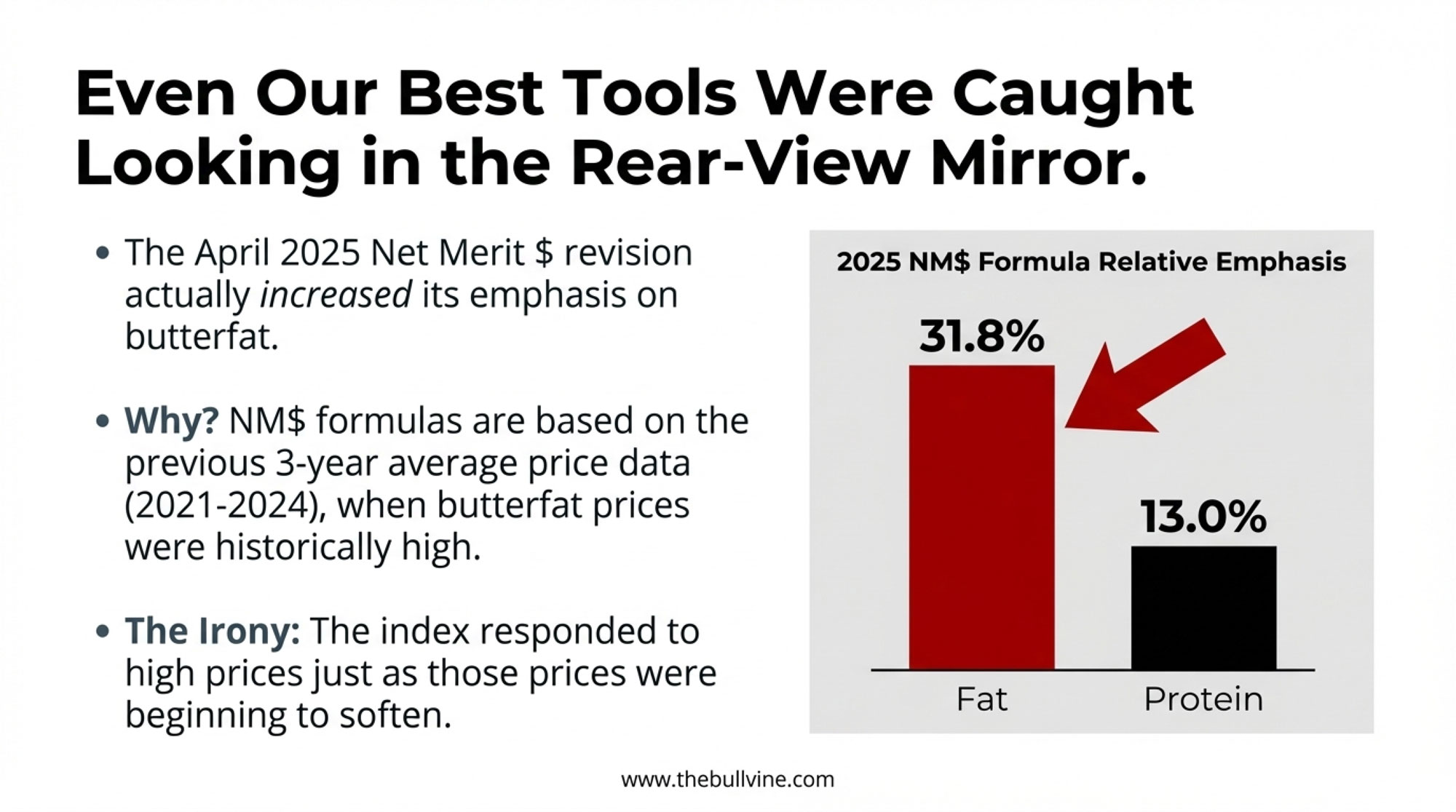
The potential here is significant. By focusing on cows that produce healthier offspring, dairy farmers can incrementally shape a herd that withstands diseases better over time. But how much can genes influence these traits? Here’s where heritability estimates enter the scene. Heritability is a measure of how much of the variation in a trait is due to genetic differences, and it ranges from 0.02 to 0.07 for RESP and DIAR, depending on the analysis and criteria used. While these numbers are on the lower side, indicating that environmental factors play a significant role, a genetic component can still be tapped. 

You might ask, “Isn’t low heritability a problem?” Well, it’s more of a challenge than a roadblock. Even with low heritability, given the vast number of cattle and generations over which dairy farming operates, genetic selection can be part of a larger strategy to promote calf health. It’s about playing the long game. Each generation that leans healthier puts us closer to a herd with stronger disease resistance. 

So, what does this mean for you, the dairy farmer? It means that by consistently selecting suitable sires and keeping detailed records, you’re not just a farmer, you’re a pioneer in the future of dairy farming. You’re investing in the health of your herd, shaping the genetic potential of future generations of calves. It’s a commitment to continuous improvement, aligning genetic potential with practical farm management to create a robust line of dairy cattle.

Untapped Potential: Leveraging Genetics to Tackle Calfhood Diseases

In this study,  ‘Investigating the potential for genetic selection of dairy calf disease traits using management data ‘,published in the Journal of Dairy Science, we examined the incidence rates of respiratory problems (RESP) and diarrhea (DIAR) in calves. The study found that RESP affected 12% to 22% of calves, while DIAR affected 23% to 44%. These rates highlight that childhood diseases remain a significant challenge, impacting the economic viability of dairy farms. 

The genetic parameters unveiled some promising figures. The heritability estimates for RESP and DIAR indicated that genetic selection could be feasible. RESP showed heritability ranges on the observed scale from 0.03 to 0.07. DIAR ranged between 0.04 and 0.07, depending on the analysis and data thresholds applied. This reflects a consistent potential for genetic improvement. 

A comparison of sires revealed substantial differences based on predicted breeding values. Notably, daughters of the top 10% of sires were significantly healthier. They were less likely to develop RESP up to 1.8 times and DIAR by 1.9 times compared to those born to the bottom 10% of sires. This finding is critical to understanding that identifying sires with healthier offspring is possible even with low heritability. 

Promising results emerged for including DIAR and RESP in Canadian genetic evaluations. These results offer hope for national programs to improve calf health through genetic selection. The ability to incorporate these traits would mark a significant step forward in enhancing dairy calf health on a national scale, easing both the economic and health burdens on dairy farmers. This could potentially lead to a more efficient and profitable dairy industry.

Genetic Potential: The Data-Driven Revolution in Dairy Farm Management

YearMedian DIAR Incidence (%)Median RESP Incidence (%)Number of Herds (DIAR)Number of Herds (RESP)
20075%6%55149
20126%7%129300
20209%9%176404

As we navigate the future of dairy farming, the spotlight is directly on data. Accurate data collection is not just a bureaucratic necessity; it’s the linchpin for unlocking genetic selection’s potential to improve the health and welfare of our calves. Your role in this data collection is crucial. The stakes are high. Genetic evaluations can falter without precise and reliable data, leaving us with an incomplete understanding of calf disease traits. 

Yet, inconsistency in recording practices presents a formidable challenge. Picture this: different farms using varied definitions and criteria for recording diseases like respiratory problems or diarrhea. It’s like trying to piece together a puzzle with mismatched pieces. This inconsistency obscures the true incidence of diseases and muddies the waters when understanding their genetic components. 

The path forward requires us to embrace standardized criteria across the board. Consider it the Rosetta Stone for calf health data. With a unified language, we can ensure that the information collected is consistent and valuable for genetic evaluations. This is where herd management software steps up as a game-changer. These systems offer a centralized platform for recording data. Still, to truly harness their potential, the industry needs to actively encourage uploading disease records and standardizing the parameters for these records. 

It’s more than just collecting numbers; it’s about creating a robust, high-quality data pipeline. Envision herd management software that seamlessly integrates with the national milk recording system, allowing for comprehensive, accurate, and timely data transfer. This integration will enable us to track and assess calf health data nationally, paving the way for continuous genetic improvement and healthier herds.

Collaborative Synergy: Unlocking the Genetic Potential of Calf Health in Dairy Farming

Genetic selection within the dairy industry has the potential to enhance calf health. Realizing this potential hinges on collaborating with producers, industry experts, academia, and veterinarians. This collaboration is vital because it ensures a standardized, high-quality data pipeline, which forms the backbone of effective genetic evaluations. 

Here’s how the industry could move forward: 

  • Build Collaborative Networks: Establish a cross-industry platform to regularly discuss and strategize the best practices for recording calf health data. This platform should facilitate ongoing dialogue among farmers, industry bodies, academic researchers, and veterinarians.
  • Standardize Data Collection Practices: Develop coherent guidelines for recording calf disease and management data. This involves defining the parameters to record (e.g., birth weight and colostrum intake) and consistently applying them across all dairy farms.
  • Incorporate Comprehensive Calf Data: Enhance genetic evaluations by including detailed calf information. Data such as birth conditions, initial health metrics, and any early signs of disease can provide invaluable insights into the animal’s long-term genetic potential.
  • Foster Education and Training. Equip farmers and farmworkers with the knowledge and tools to record and manage data accurately. Regular training programs can keep everyone up to date with the latest technologies and practices.
  • Leverage Technology: Invest in farm management software that aligns with national databases and enhances data entry ease and accuracy. Automated data capture through IoT devices could provide real-time insights and reduce human error.
  • Promote Data Sharing and Accessibility: Encourage transparency and data sharing between farms and researchers to foster a broader understanding and a more robust genetic evaluation system. This would require assurances about data security and privacy.

By focusing on these areas, the dairy industry can make strides in improving calf health through genetic selection and boosting overall farm productivity and sustainability. We invite you to share your thoughts or suggestions on these recommendations in the comments below.

The Bottom Line

The results are precise: Genetic selection offers a promising avenue for transforming calf health on dairy farms. By integrating genetic evaluations with robust data collection practices, dairy producers can enhance animal welfare while boosting productivity. This comprehensive study’s insights underscore the critical role of accurate data recording and analysis in maximizing the effectiveness of genetic selection. 

Are you ready to rethink your approach to calf health? Consider how genetic selection could be embedded into your current practices or professional responsibilities. The potential benefits are too significant to overlook. 

Let’s keep the conversation going. Share your thoughts, experiences, or questions in the comments below, or discuss this topic with your peers. Engaging with these ideas could be your herd’s first step towards a healthier, more productive future.

Learn more:

Join the Revolution!

Bullvine Daily is your essential e-zine for staying ahead in the dairy industry. With over 30,000 subscribers, we bring you the week’s top news, helping you manage tasks efficiently. Stay informed about milk production, tech adoption, and more, so you can concentrate on your dairy operations. 

NewsSubscribe
First
Last
Consent

Gene Editing in Dairy Cows: A Revolutionary Approach to Reducing Methane Emissions

Can gene editing in dairy cows reduce methane emissions and revolutionize dairy farming? Discover the future of this innovative solution.

Picture this: Sushi, a four-week-old Holstein calf, relaxes on a bed of rice hulls in the California heat, curiously nibbling at the garments of doctoral students and lecturers who have just come to sample his rumen. Surrounded by the buzz of a metal fan, Sushi is unaware that he is the focal point of a pioneering experiment addressing one of agriculture’s most significant environmental challenges. On average, a single cow releases roughly 220 pounds of methane every year, which is frightening given that there are approximately 1.5 billion cattle on the earth. “Nobody has done it before,” said Ermias Kebreab, an animal science professor at UC Davis. “It’s completely out of the box.” The University of California at Davis and the Innovative Genomics Institute are collaborating on a seven-year, $30 million project to reduce methane emissions by re-engineering cow guts using gene editing. This has the potential to transform agriculture in the future.

The Problem with Methane 

Methane is a potent greenhouse gas, with a global warming potential of 25 times that of carbon dioxide over 100 years (EPA). Addressing methane emissions is critical to preventing climate change.

Enteric fermentation in dairy cows significantly contributes to methane emissions, with the average dairy cow producing around 220 pounds of methane each year. This emission alone accounts for roughly 4% of worldwide greenhouse gas emissions (FAO). The scale of the problem becomes even more alarming when you consider the global population of approximately 1.5 billion cattle. Urgent and immediate action is needed to address this issue.

According to the Food and Agriculture Organization, animal emissions account for about 14.5% of all anthropogenic greenhouse gas emissions, roughly two-thirds of which originate directly from enteric fermentation. As worldwide beef and dairy consumption increases, so will methane emissions, worsening a critical problem.

“There’s no reason a cow has to produce methane,” asserts Brad Ringeisen, the executive director of the Innovative Genomics Institute. Ringeisen and his team are exploring gene-editing technology to modify the cow’s gut microbiota, potentially eliminating methane emissions at the source. This innovative approach not only offers hope but also a promising future where sustainable agriculture is not just a dream but a reality.

It is crucial to grasp the gravity of the methane emissions problem. While methane has a shorter atmospheric lifetime than CO2, lasting around 12 years, its immediate impact on warming is much more significant. By reducing methane emissions today, we can slow the pace of global warming in the short term, providing us with valuable time to address other sources of greenhouse gases. This understanding is critical to making informed decisions about our environmental policies and practices.

Challenges and Limitations of Dietary and Plant-Based Alternatives

Companies such as Impossible Foods and Beyond Meat provide plant-based meat replacements that resemble the flavor and feel of genuine beef, giving customers a lower-emission choice. Environmentalists advocate for dietary changes, pushing consumers to avoid beef in favor of lower-emission meats such as chicken or fish. These changes, although significant, meet opposition since worldwide beef output has increased by 13% over the last 15 years ([FAO Report](http://www.fao.org/faostat/en/#data/QL)

Another strategy focuses on changing cow diets to limit methane emissions. Adding seaweed, oregano, or garlic to cow feed has shown promise, with emissions reduced by up to 80%. However, this strategy mainly applies to confined dairy cows, which account for a tiny proportion of the worldwide population. In the United States, only around one out of every ten cattle receives daily feed from humans. The logistical problem is significant, particularly for the world’s approximately 1 billion free-ranging beef cattle that graze on open pastures and browse ([Scientific Reports](https://www.nature.com/articles/s41598-019-47802-3)). It is almost hard to coordinate such nutritional modifications for free-ranging cattle on a big scale.

Given these constraints, a scalable, practical solution is even more urgent. While dietary adjustments and plant-based alternatives may help, they do not fully solve the methane problem caused by free-grazing cattle. We need more effective and comprehensive strategies to address this issue.

Enter Gene Editing: A Revolutionary Approach 

Enter gene editing. Imagine permanently altering the cow’s microbiome, lowering methane emissions straight at the source. This is not science fiction; it is becoming a reality due to gene editing advances. CRISPR, an acronym for clustered interspaced short palindromic repeats, is the technology at the vanguard of this revolution.

CRISPR, an acronym for clustered interspaced short palindromic repeats, is the technology at the vanguard of this revolution. It functions similarly to a pair of high-precision scissors, identifying particular DNA sequences inside an organism and may remove or replace them. Combined with an enzyme like Cas9, these ‘scissors’ can slice through DNA with extreme precision, enabling scientists to insert or delete genetic material at a whim.

In cows’ case, scientists focus on the microbiome—the diverse collection of bacteria, archaea, and fungi in the cow’s rumen. Researchers want to diminish or eradicate methane-producing microbes by editing their DNA using CRISPR. They may, for example, create genetic modifications that favor bacteria that absorb hydrogen before archaea convert it to methane. They’re rewriting the cow’s intestines so they don’t produce as much methane.

The idea is to create a probiotic tablet that calves may swallow, causing their microbiomes to generate less methane throughout their lifetimes. This early intervention might produce cows that are not only healthier but also far more environmentally friendly. Gene editing, particularly CRISPR, is a powerful weapon that can transform cattle production’s future while dramatically mitigating one of the most intractable greenhouse gas sources.

Rumen Safari: Uncovering Microbial Secrets at UC Davis 

The research journey at the University of California, Davis, and the Innovative Genomics Institute starts in the field, accompanied by the buzz of fans and the gentle push of inquisitive calves like Sushi. The procedure of acquiring rumen samples is both complex and exciting.

Under the supervision of specialists such as Spencer Diamond, researchers inject a three-foot-long metal tube into a calf’s stomach to extract rumen fluid—a thin, oatmeal-colored liquid packed with bacteria and partly digested food. This extraction is critical to understanding the microbial composition of the cow’s stomach. Diamond says, “You’re kind of on safari.” Each sample has a wealth of genetic material ready to be discovered.

Once collected, the samples are carefully put into vials and frozen in liquid nitrogen to preserve their integrity for DNA analysis. Paulo de Méo Filho, a postdoc participating in the collection procedure, methodically handles the samples to ensure they are maintained for future analysis. He uses a pipette the length of his arm to transfer rumen fluid into vials, which are flash-frozen before being transported to the laboratory.

Researchers like Brady Cress use cutting-edge technology in the lab to explore the rumen’s microbial environment. They rebuild genomes using computers and machine learning to provide a thorough inventory of every microbe present. Cress’ passion for the research is evident, as he says, “It’s incredible how these microbes have evolved to cooperate.” Understanding this is critical to implementing any effective change.”

At the UC Davis laboratory, scientists are also investigating the impact of various therapies on these bacteria. For example, Sushi has been given oil extracted from red seaweed, which is known to lower methane emissions. Researchers want to learn how this oil affects the rumen microbiota and mimic these changes using gene editing. As Matthias Hess says, “We want to initiate a lasting transition. “If we can understand and replicate the beneficial effects of these treatments, we could revolutionize cattle farming.”

This procedure is acceptable. The researchers must deal with the intricacy of the microbiome, where microscopic creatures are continually vying for resources. “The microbial world is a brutal, Mad Max wasteland,” Diamond remarks, emphasizing the challenge of changing such a complex ecology. However, the researchers remain undaunted, motivated by the possible implications of their findings on worldwide methane emissions and climate change.

As the study develops, the team stays optimistic. They are developing the skills and expertise required to manufacture a probiotic tablet for calves so that it may be tested within the next two years. This early intervention provides a viable alternative for dairy producers globally to reduce methane emissions throughout their lives.

Complexities and Risks of Altering the Cow Microbiome 

The challenge of modifying the cow microbiome is quite complicated. One major problem is the enormous complexity of the microbial community found in a cow’s rumen. Over millions of years, microbes have evolved to perform specific jobs, such as digesting food and creating energy. Disrupting this delicate equilibrium may result in unforeseen effects. Spencer Diamond states, “The microbial world is a brutal, Mad Max wasteland.” “Microbes are just killing each other.” This changing environment makes it challenging to guarantee that any changes are effective and lasting.

Skepticism in the scientific community is also prevalent. Alexander Hristov, a professor of dairy nutrition at Pennsylvania State University, emphasizes the problematic work ahead: “That’s the holy grail if you can modify the rumen microbiota. But we must remember that this microbiome has evolved over millions of years and is difficult to replace or modify permanently.” The argument here emphasizes the evolutionary intricacy and difficulty of long-term alterations to these well-established microbial communities.

The perils of gene editing go beyond technological obstacles. There are concerns about unforeseen ecological and health effects. What if gene-edited bacteria cause new illnesses or unexpected health concerns in cattle or people who eat dairy and meat products from these animals? Even the researchers exercise caution. Diamond says, “We must be conscious of the power of these technologies. “People will be afraid of the unknown.” These worries are not unjustified, considering the varied reactions to prior genetically modified species and the ethical considerations of modifying genes in live beings.

Scientists are encouraged by the prospect of considerable methane reduction and increased agricultural yield. The route to a gene-edited probiotic tablet for cows has been started, but it is laden with scientific, ethical, and practical hurdles that must be carefully navigated.

Probiotic Pill: A Science-Fiction Vision with Real-World Promise 

Researchers are developing a novel probiotic tablet that may be given to calves at a young age. This drug seeks to remodel their gut microbiota, reducing methane emissions dramatically during their lifetime. Consider a capsule administered with early-life immunizations containing a fluid that develops with the animal. It’s a notion that resembles science fiction yet offers enormous potential for real-world applications.

This probiotic technique provides a more practical alternative than existing approaches, such as feeding calves daily with methane-reducing additives like seaweed, which must be more workable for free-ranging beef cattle. Most calves get at least one immunization during their early lives, making this an opportune time to start this therapy. Once provided, the tablet can cause long-term changes in the cow’s microbiota, giving a cost-effective and straightforward treatment. This technique tackles logistical issues and may increase agricultural output by transferring energy wasted in methane generation to milk and meat production.

As with any innovative invention, transitioning from laboratory to pasture requires extensive testing and validation. However, the potential effect is enormous. Reducing methane emissions from cattle, a significant contribution to global warming, might be a game changer in the fight against climate change. This probiotic supplement might be the key to ensuring a more sustainable future for the dairy sector and beyond.

Global Scientific Community Weighs In: The Holy Grail of Microbiome Manipulation 

Experts at UC Davis and the Innovative Genomics Institute believe gene editing can revolutionize cattle production. Eminent experts throughout the world are paying careful attention. Dr. Alexander Hristov, a professor of dairy nutrition at Pennsylvania State University, understands the significance of this initiative. “That’s the holy grail,” he argues, “if it’s possible to manipulate the microbiome of the rumen” [PSU]. Despite acknowledging the difficulties, he emphasizes this study’s significance and possible relevance.

Meanwhile, James Marsh, a professor of microbiome engineering at the Max Planck Institute for Biology, claims, “We need to be able to apply it to all organisms so we can unleash the promise of microbial engineering” [Max Planck Institute]. His observations highlight the early stages of this revolutionary effort.

The UC Davis initiative is more than a shot in the dark; it has enormous financial backing, adding to its legitimacy. They raised around $30 million in finance for this seven-year journey via grants and investments from diverse stakeholders that believe in the technology’s ability to solve global methane emissions [UCANR]. Brad Ringeisen, the Innovative Genomics Institute’s executive director, adds extensive DARPA experience to the project, giving another degree of trust and knowledge. “I’m taking the DARPA mentality here,” Ringeisen says. “Let’s solve it for all cows, not just a fraction of the cows” [DARPA].

The Bottom Line

Researchers are on the verge of a possible dairy business breakthrough by delving into cow rumen’s complexities and using new gene-editing methods. From studying the chaotic microbial community in the rumen to designing a probiotic tablet that may permanently reduce a cow’s methane production, the path is both ambitious and rewarding. The science is complicated, and there are many hurdles. Still, the objective is clear: cut methane emissions and alleviate one of the leading causes of global warming.

Consider a future where methane emissions from more than a billion cattle are significantly reduced. The environmental advantages could be tremendous, reducing the pace of climate change and contributing to meeting global emissions objectives. But there is more at risk here. Successfully modifying the cow microbiome might open the path for comparable manipulations in other ruminants and even larger ecosystems, demonstrating the research’s broad relevance.

Stay tuned and informed. This is only the start of a seven-year journey that might revolutionize the dairy sector and our collective response to climate change. Watch advancements at UC Davis and the Innovative Genomics Institute; they might pave the way for a more sustainable future.

Key Takeaways:

  • Gene editing in cattle aims to significantly reduce methane emissions from cow burps, addressing a major source of global warming.
  • The project, backed by the University of California at Davis and the Innovative Genomics Institute, involves re-engineering the cow’s rumen microbiome.
  • Scientists are exploring a probiotic pill that could be administered to calves early in life, creating a permanent change in their methane output.
  • Despite promising early results, researchers face the daunting challenge of mapping and editing the highly complex cow microbiome.
  • The successful development of this technology could have profound implications not only for cattle but also for other methane-producing animals and ecosystems.
  • Environmental solutions like seaweed supplements have shown potential but are impractical for free-ranging cattle.
  • This innovative approach offers a potential solution for all cattle globally, aligning with broader climate mitigation goals.

Summary:

Gene editing aims to tackle the environmental impact of enteric methane emissions from cattle, responsible for 30% of global warming. Researchers at UC Davis and the Innovative Genomics Institute are developing a probiotic treatment for calves to alter their rumens and reduce methane production. While partial solutions like dietary changes exist, gene editing offers a more permanent solution. Despite the promise, numerous challenges remain, including the complexity of the cow’s microbiome and the nascent stage of microbial gene engineering. The success of this endeavor could significantly mitigate methane emissions from livestock, presenting a revolutionary step in battling climate change. With methane having a global warming potential 25 times that of CO2 over 100 years, this $30 million project could make sustainable agriculture a reality by re-engineering cow guts to lower emissions directly at the source.

Learn more: 

Join the Revolution!

Bullvine Daily is your essential e-zine for staying ahead in the dairy industry. With over 30,000 subscribers, we bring you the week’s top news, helping you manage tasks efficiently. Stay informed about milk production, tech adoption, and more, so you can concentrate on your dairy operations. 

NewsSubscribe
First
Last
Consent

Genetic Selection Strategies for Sustainable Dairy Cows: Feed Efficiency and Methane Reduction

Unveiling the Potential: Breeding Feed-Efficient, Low-Methane Dairy Cows for Sustainability and Cost Reduction. Can Cutting-Edge Genetic Strategies Revolutionize Dairy Farming?

Summary:

Dairy farming is crucial for providing milk and dairy products in an ecologically friendly and economically viable way. Low-methane dairy cows are essential as over 60% of variable expenses in dairy production are feed expenditures. Lowering environmental impact through lower methane emissions is imperative, and creative breeding techniques are essential. Feed efficiency reduces veterinary expenses and enhances herd health, benefiting the broader agricultural sector. Climate change and environmental degradation are pressing concerns for the agriculture industry, as dairy production contributes to greenhouse gas emissions. Sustainable practices, including breeding techniques to generate feed-efficient dairy cows, are given top priority by governments, research organizations, and industry players. Understanding genetic interconnections is essential for optimizing breeding goals, balancing feed efficiency, methane emissions, output, health, and fertility. A holistic approach to balancing economic viability and environmental stewardship in dairy breeding targets the need for a careful mix of these factors.

Key Takeaways:

  • Feed costs represent over 60% of the variable costs in dairy production, highlighting the economic drive to improve feed efficiency.
  • The agricultural sector faces increasing pressure to reduce the environmental impact of food production, necessitating sustainable practices.
  • Incorporating new traits into breeding goals can simultaneously save feed costs and lower methane emissions from dairy operations.
  • Accurate phenotyping of feed intake and methane emissions is essential for successful breeding, despite being challenging and resource-intensive.
  • Current strategies for genetic selection include direct and indirect methods, leveraging indicator traits and prediction models based on mid-infrared spectra in milk.
  • Large-scale phenotyping projects in research and commercial herds worldwide are building valuable reference populations for genomic evaluations.
  • Research indicates significant genetic variation in methane emissions, feed intake, and different feed efficiency measures, underscoring the feasibility of selective breeding for these traits.
  • Further research is needed to understand the genetic associations between various traits and to refine trait definitions for more effective breeding programs.
  • The ultimate aim is to balance feed efficiency, climate impact, production, health, and fertility within a sustainable breeding framework for the future.
dairy farming, low-methane dairy cows, feed efficiency, sustainable dairy practices, greenhouse gas emissions, breeding techniques, herd health, environmental impact, agricultural sustainability, climate change solutions

In the future, dairy farming will provide necessary milk and dairy products in an ecologically friendly and economically viable way. Low-methane dairy cows must be bred feed-efficiently. More than 60% of the variable expenses in dairy production are feed expenditures. Hence, lowering the environmental effect via lower methane emissions is imperative. The necessity of creative breeding techniques has never been more pressing as the agriculture industry is under increased pressure to embrace sustainable practices challenges. We may address these issues by including features that improve feed efficiency and reduce methane emissions into breeding targets—reaching this need for knowledge of sophisticated genetic selection techniques, complicated characteristics, exact phenotyping, and a robust database of important information. But remember, your cooperation and continuous research are not just vital; they are ongoing. You are a crucial part of this ongoing progress, and together, we can make the dairy sector more sustainable and resilient.
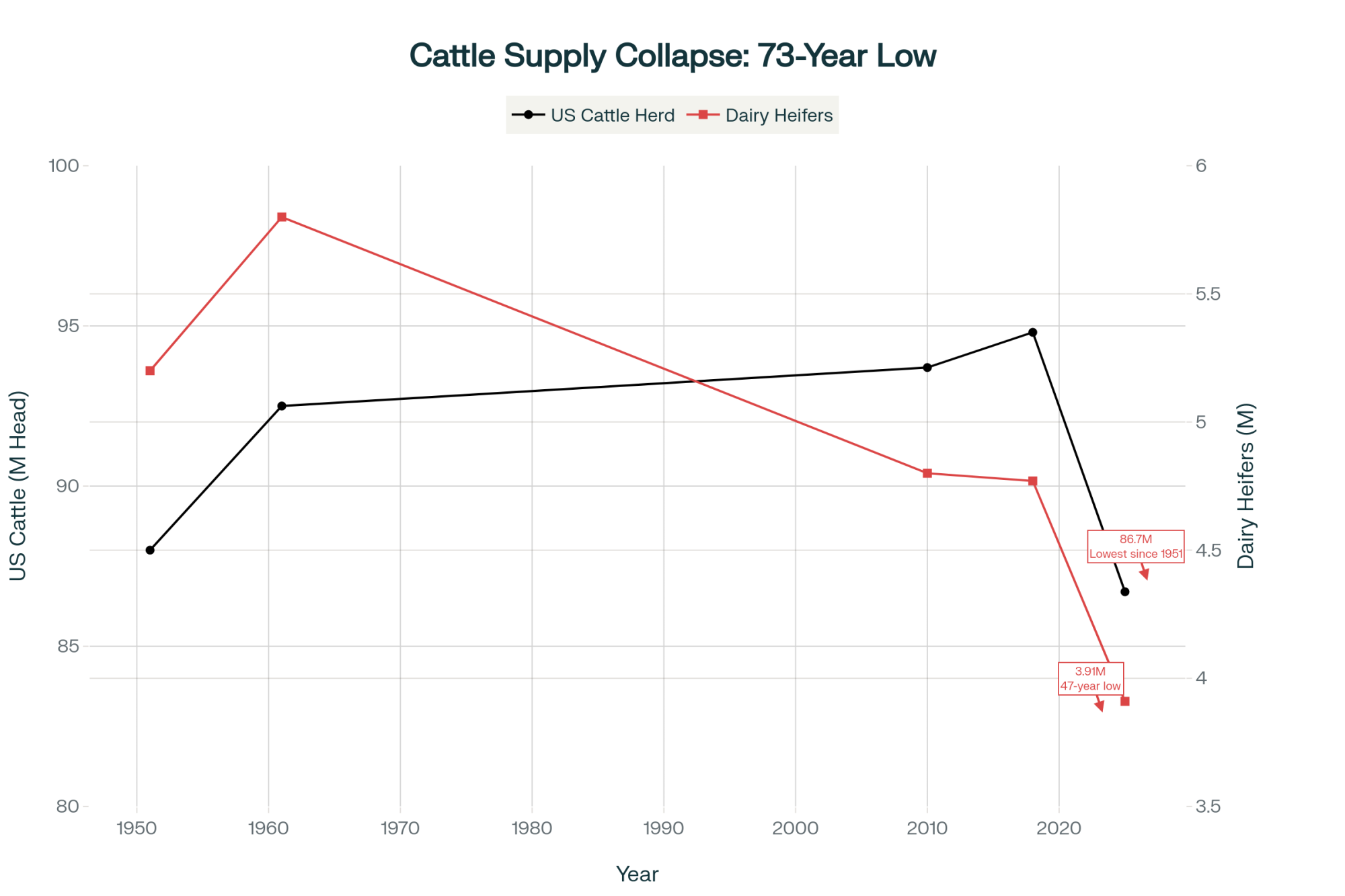
Feed Efficiency: The Economic Imperative for Sustainable Dairy Production 

Feed Efficiency: The Economic Imperative for Sustainable Dairy Production. The financial sustainability of dairy production is heavily reliant on feed efficiency. With feed expenditures accounting for over 60% of variable expenses, which includes costs for feed purchases, handling, and waste management, maximizing feed efficiency is not just desired but necessary. When dairy producers reduce the feed required per liter of milk, they significantly save on these expenses, directly improving net margins and providing a buffer against fluctuating feed prices.

Feed efficiency is not just about financial stability; it also plays a crucial role in reducing veterinary expenses and enhancing herd health. The broader agricultural sector also benefits from this, as reduced demand for feed crops can help cut feed costs. This ripple effect demonstrates how breeding for feed-efficient cows can enhance the dairy industry’s resilience and sustainability in the face of environmental and financial challenges.

Climate Change and Environmental Degradation: The Call for Sustainable Dairy Practices 

Given worldwide worries about ecological damage and climate change, the agriculture industry is under tremendous pressure to minimize its environmental impact. Crucially crucial for agriculture, dairy production is under close examination as it significantly contributes to greenhouse gas (GHG) emissions. Over 25 times more efficient than carbon dioxide in trapping heat in the atmosphere for over a century, methane emissions from dairy cows—mostly from enteric fermentation and manure management—have underlined the need to address these emissions.

Given the effects of methane emissions on climate change, the agriculture sector’s dedication to lowering its environmental impact is both moral and legal. Sustainable practices—including breeding techniques to generate feed-efficient dairy cows that generate less methane—are given top priority by governments, research organizations, and industry players. The industry is committed to ensuring the economic viability of dairy farming by using genetic selection and developing phenotyping technology, therefore fostering a more sustainable future.

Overcoming the Challenges of Measuring Feed Efficiency and Methane Emissions in Dairy Cattle 

Dealing with the complexity of evaluating methane emissions and feed efficiency admits various difficulties. Finding consistent phenotypes is a primary challenge requiring significant time and effort commitment. A complex quality affected by many elements, such as feed efficiency, calls for close observation of individual feed intake, development, and output statistics. Especially in large-scale enterprises, thorough data collecting is logistically taxing.

Evaluating methane emissions involves challenges. Usually requiring sophisticated equipment to collect pollutants over long periods—which may be costly and taxing—accurate assessments necessitate Installing and routinely calibrating these technologies, which calls for specific expertise and resources that challenge many farmers to follow these guidelines without significant financial help.

Large-scale phenotyping is also important for data accuracy. This entails establishing dedicated research herds and using technological developments, like mid-infrared spectroscopy. However, these developments highlight the necessity of ongoing investment and cooperation in this sector, as logistical and operational challenges still exist.

Innovative Selection Techniques: Bridging Direct and Indirect Approaches in Dairy Cattle Breeding

Direct selection, with an eye on feed efficiency and methane emissions specifically, is a significant tactic for genetic selection. This simple method, however, requires large-scale data collecting on individual animals, so it is expensive and labor-intensive.

Indirect selection, on the other hand, offers a more practical way of employing prediction equations or indicator features. This method uses characteristics that are easier to measure and are correlated with the desired trait. For instance, roughage and dry matter intake are indicators that help to represent feed efficiency, guiding a more effective selection procedure. Mid-infrared (MIR) spectra in milk provide one exciting method for indirect selection. This less invasive and more scalable approach for mass phenotyping examines milk composition to forecast methane emissions and feed efficiency features. Including MIR spectrum data in prediction equations for commercial herds will simplify the choosing process and help manage it.

Building a Robust Database: The Role of Large-Scale Phenotyping in Genomic Evaluations 

Genetically enhancing dairy cattle requires large-scale phenotyping of individual feed consumption and methane emissions. Thoroughly collecting and processing phenotypic data supports reliable genomic assessments. Researchers can identify genetic variations connected to feed efficiency and reduced emissions by tracking every cow’s feed consumption and methane emissions. While commercial herds supply real-world data from many situations, research herds at university institutions create controlled environments for exact data collection. This combination sharpens the relevance and strength of the results.

These initiatives contribute to providing thorough reference populations for genetic analyses. Using a broad and large reference population, prediction values for novel characteristics gain accuracy. The growing phenotypic database depends on developing prediction models suitable for many populations and contexts. This method promotes environmentally friendly breeding initiatives to lower methane emissions in dairy cattle and feed economies.

Harnessing Genetic Variation: Insights from Pioneering Research for Sustainable Dairy Breeding 

Research by professionals like Stephanie Kamalanathan and Filippo Miglior shows notable genetic variation in essential parameters, including methane emissions, roughage intake, dry matter intake, and feed efficiency—studies from J. Anim. Sci. 94 and authors like Herd R.M. and Bird S.H. confirm this variability, so supporting the feasibility of selective breeding to improve these traits. Further increasing the possibility for practical use in commercial dairy herds are continuous large-scale phenotyping and genetic studies.

Deciphering Genetic Interconnections: The Path to Optimized Breeding Goals in Dairy Cattle 

Understanding the complex interactions among many attributes is particularly important because it is clear that effective breeding programs depend on genetic correlations. Even with significant advances, a better understanding of these genetic relationships is essential to maximize breeding objectives, balancing feed efficiency, methane emissions, output, health, and fertility. This calls for carefully examining current data and creatively incorporating these discoveries into valuable plans. Moreover, determining the most influential features is a significant difficulty requiring thorough research. Establishing strong standards and frameworks for trait characteristics would improve the accuracy and effectiveness of breeding projects focused on sustainable practices. By filling these research gaps, we can increase our capacity to produce dairy cows that satisfy environmental and financial criteria, guaranteeing a sustainable and robust dairy sector for subsequent generations.

A Holistic Approach to Balancing Economic Viability and Environmental Stewardship in Dairy Breeding

Dairy cow sustainable breeding targets the need for a careful mix of feed efficiency, climate impact, output, health, and fertility. Finding this equilibrium pays off in many long-term ways. This method reduces methane emissions, mitigating environmental damage and cutting feed costs. Moreover, the sector guarantees constant output and greater animal welfare by improving herd health and fertility.

The Bottom Line

Our main objective is to produce feed-efficient dairy cows with reduced methane output, solving environmental and financial problems in the dairy sector. We open the path for sustainability by giving top-priority features that improve feed efficiency and reduce ecological impact. While reducing climate change calls for creative breeding methods, boosting feed efficiency is vital given the significant share of dairy production expenses attributable to feed.

Although direct and indirect genetic selection and large phenotyping databases provide exciting possibilities even if assessing feed efficiency and methane emissions presents difficulties. Using these datasets and genomic assessments, one may create accurate selection instruments and efficient application of genetic variation. According to research showing significant variation in features linked to methane emissions and feed efficiency, selective breeding is practical and effective.

Improved feed efficiency helps lower methane emissions, transforming dairy sustainability and reducing farmers’ greenhouse gas emissions and feed costs. One should act immediately. A sustainable dairy future that fits commercial goals with environmental obligations depends on using creative breeding methods and genetic research to match. Every development in breeding techniques adds to a more muscular, effective, and ecologically friendly dairy sector. Let’s work toward a day when dairy output satisfies human requirements and helps to save the earth for future generations.

Learn more:

Join the Revolution!

Bullvine Daily is your essential e-zine for staying ahead in the dairy industry. With over 30,000 subscribers, we bring you the week’s top news, helping you manage tasks efficiently. Stay informed about milk production, tech adoption, and more, so you can concentrate on your dairy operations. 

NewsSubscribe
First
Last
Consent

Genome Editing in Dairy Cattle: Ethical Concerns and Breeding Standards Explored

Discover the ethical implications and breeding guidelines for genetically modified and genome-edited dairy cattle. How will these advancements shape the future of dairy farming?

Summary: Genetic modification and genome editing have revolutionized agricultural practices, offering unprecedented possibilities for enhancing dairy cattle traits. These technologies bring not only the promise of increased productivity and disease resistance but also complex ethical questions that must be addressed. Genetically modified (GM) and genome-edited dairy cattle are revolutionizing agriculture by introducing healthier, more productive, and ecologically friendly animals. The CRISPR-Cas9 technology is the most widely used genetic engineering approach, requiring continuous monitoring of the herd’s genetic health before and after genome editing. Breeding guidelines for genome-edited dairy calves must adhere to best practices, such as maintaining a varied gene pool to minimize inbreeding and disease susceptibility. However, negative genetic associations with milk production features hinder the development of udder health traits. Genetically engineered calves that produce recombinant human lactoferrin, lysozyme, or HBD-3 in milk have been developed, with studies showing that transgenic cows have fewer symptoms and cleared germs quicker than nontransgenic control cows. Ethical concerns surrounding GM and genome editing in dairy cattle include tampering with nature’s course, potential welfare consequences for animals, and potential effects on biodiversity.

  • Genetic modification and genome editing are transforming dairy farming by enhancing traits like productivity and disease resistance.
  • CRISPR-Cas9 is the prevalent technology used in genetic engineering, necessitating diligent herd genetic health monitoring.
  • Best breeding practices for genome-edited dairy calves include maintaining genetic diversity to prevent inbreeding and reduce disease vulnerability.
  • Negative genetic correlations with milk production traits can impede improving udder health.
  • Transgenic cows can produce beneficial proteins such as recombinant human lactoferrin, lysozyme, or HBD-3, which have shown health advantages in research studies.
  • Ethical considerations involve concerns about manipulating natural processes, animal welfare implications, and impacts on biodiversity.

The introduction of genetically modified (GM) and genome-edited dairy cattle is set to transform agriculture in ways we never imagined. Scientists strive to create a future where dairy cattle are healthier, more productive, and ecologically friendly through genetic modification. This shift from traditional breeding to cutting-edge genetic technology prompts us to ponder the complexities and implications for farmers, consumers, and animals. As we delve into this topic, we must grapple with the intriguing issues of science and technology and the intricate ethical perspectives that envelop it. This post encourages readers to engage with these issues and approach them with a sense of responsibility and thoughtfulness. Let’s embark on this thought-provoking journey together.

Understanding Genetic Modification and Genome Editing in Dairy Cattle

genetically modified dairy cattle, genome-edited dairy cattle, agriculture revolution, healthier animals, more productive animals, ecologically friendly animals, CRISPR-Cas9 technology, genetic engineering, continuous monitoring, genetic health, genome editing, breeding guidelines, best practices, varied gene pool, inbreeding, disease susceptibility, udder health, mastitis resistance, mastitis susceptibility, bovine mastitis management, genetically engineered calves, recombinant human lactoferrin, recombinant human lysozyme, recombinant HBD-3, milk production features, ethical concerns, tampering with nature, animal welfare, biodiversity

Consider the enormous possibilities for genetic manipulation and genome editing in dairy cattle. Consider animals that can generate lactose-free milk while being nutrient-dense and disease-resistant. This is not fiction; genetic engineering is a fast-emerging topic in animal production. Two basic genetic engineering approaches are in use today: transgenic and cisgenic. Transgenic refers to importing genes from one species into another, such as putting a bacterial gene into a cow’s genome. Conversely, Cisgenic entails changing a cow’s genes using genes from the same or nearly related species, similar to an enhanced form of conventional breeding techniques.

Today’s most extensively used approach for genome editing is the revolutionary ‘CRISPR-Cas9 technology.’ This groundbreaking tool allows scientists to modify gene sequences in a dairy cow’s DNA as easily as editing a page using a word processor. By using a scissor-like enzyme called Cas9, scientists can cut DNA strands at exact locations where alterations are required. The cell’s repair mechanism then takes charge, inserting or replacing genetic material to change the genome. This technology has the potential to revolutionize dairy cattle breeding.

To put this into perspective, consider a dairy cow with a genetic feature that makes it susceptible to a specific illness. Scientists may use genome editing to replace the disease-prone genetic sequence with one that increases resistance. The result is a healthier, more resilient, more productive dairy cow. This fantastic technology marks a considerable step in improving cattle welfare and agricultural efficiency.

Breeding Guidelines for Genome Edited Dairy Cattle: Best Practices

Breeding standards for genome-edited dairy calves must adhere to best practices to guarantee ethical and efficient operations. Continuous monitoring of the herd’s genetic health by tracking changes before and after genome editing and maintaining a varied gene pool to minimize inbreeding and disease susceptibility are critical steps toward ensuring the long-term viability of genome-edited cattle.

The following are some use cases for Genome Editing in Dairy Cattle:

  • Case 1: Genome Editing to Eliminate Dehorning
    Genetic dehorning of cattle is one possible use of genome editing in large-scale farming. Polledness, or the lack of horns, is an autosomal dominant feature involving two separate mutations in cow breeds. Dehorning is a routine practice to avoid accidents. Still, it is expensive and time-consuming, with over 80% of European dairy cattle dehorned without pain relief medication. However, this technique may produce quantifiable pain-related responses in cattle, prompting animal welfare issues. Although many cow herds include genetically polled breeding males, the number of polled AI breeding bulls in the Holstein breed still needs to be higher. Genome editing has been offered as a shortcut for producing high-quality polled bulls while minimizing genetic gain losses and using closely related polled individuals. Genome editing would generate a significant percentage of homozygous animals with the beneficial allele, raising allele frequency in the population. Selective matings between horned, homozygous, and heterozygous polled breeding bulls and cows might increase the number of polled calves produced. The first reported examples of genome-edited polled calves were created via SCNT, allowing the selection of embryos with specified changes before embryo transfer into the recipient cow. To effectively use genome editing to enhance the frequency of polled cattle, the sires and dams of edited embryos must have high genetic quality and be as unrelated as feasible. Large-scale breeding operations would utilize a mix of naturally polled, genome-edited polled, and dehorned breeding animals.
  • Case 2: Insertion of Human Genes to Increase Udder Health in Dairy Cattle
    Udder health is critical for dairy output and animal welfare, and mastitis is a significant cause for culling in contemporary dairy herds. Genetic engineering (GM) has been utilized to enhance udder health by using indicator features such as milk SCC, which are more straightforward to evaluate continually. However, negative genetic associations with milk production features impede the development of udder health traits. There are many possible genes for mastitis resistance or susceptibility, including polymorphisms in genes that encode bovine lactoferrin and lysozyme. Lactoferrin concentration in bovine milk has a heritability of 0.22, indicating that genetic selection for higher lactoferrin levels is conceivable. However, the complexities of mastitis resistance persist, and appropriate bovine mastitis management is still missing. Genetically engineered calves that produce recombinant human lactoferrin, lysozyme, or HBD-3 in milk have previously been developed. According to studies, transgenic cows that generated recombinant human lactoferrin in their milk got infected with Staphylococcus chromogenes but had fewer symptoms and cleared germs quicker than nontransgenic control cows. GM cows expressing HBD3 or human lysozyme in milk seemed more resistant to bacterial udder infections than nontransgenic controls. In addition to improving udder health in dairy cows, generating bioactive recombinant human lactoferrin, lysozyme, and other agents in milk may benefit the gastrointestinal health of humans.

Ethical Dilemmas Surrounding Genetically Modified Dairy Cattle

While the advantages of utilizing genetic modification and genome editing in dairy cows are apparent, they are not without ethical implications. The idea of tampering with nature’s course typically raises eyebrows, and opponents are concerned about the possible welfare consequences for the animals themselves. Furthermore, there is worry about the potential effect on biodiversity, particularly if genetically modified creatures interbreed with non-modified ones. These issues are genuine and must be addressed to ensure the continuing development of this technology. However, these novel approaches have the potential to feed a rising global population in a sustainable, healthy, and efficient manner, which may eventually outweigh the possible concerns.

Ethical advisory committees inside breeding organizations may avoid gradual modifications that might result in a “slippery slope” effect. Instead of imposing extra restrictions, these committees should encourage internal conversations and decision-making. Implementing such organizations should not be treated lightly; they must address critical ethical concerns unique to each company to stay successful and productive. Successful ethical committees include the Dutch-Flemish cattle improvement cooperation CRV and worldwide pig breeding enterprises such as Topigs Norsvin; both use these boards to properly analyze scientific breakthroughs and their possible repercussions.

Several codes of conduct for responsible breeding, such as the industry-driven Code-EFABAR, need frequent modifications to incorporate new technology. Engaging diverse stakeholders in ethical discussions may provide a solid framework for these improvements. Animal ethics goes beyond well-being and requires thoroughly examining various issues to inform breeding choices and moral norms. Breeding groups and enterprises should explore the more significant ethical implications of GM and genome editing in cattle, ensuring the public that these concerns are handled appropriately.

The Bottom Line

As we’ve explored, genetic modification and genome editing in dairy cattle breeding are complex yet revolutionary. They offer the potential for disease-resistant, productive, and eco-friendly livestock to meet rising global dairy demand. However, ethical considerations must prioritize animal welfare, sustainability, and biodiversity. Science and ethics should inform each other, and dairy farmers or breeders must adopt best practices and make informed, ethical decisions. Genome editing can significantly contribute to a balanced and sustainable dairy industry with transparency, responsible use, and thoughtful discussion. 

Learn more: 

How New Gene Editing Legislation in New Zealand Will Benefit Dairy Farmers

How could New Zealand’s new gene editing rules revolutionize your dairy farm? Ready to boost your dairy business with cutting-edge tech? Read on.

Summary: Have you ever wondered what the future holds for dairy farming in New Zealand? Well, brace yourselves because significant changes are on the horizon! The New Zealand government plans to introduce new legislation to simplify gene editing regulations. This move aims to streamline commercialization for companies and researchers, potentially revolutionizing the industry. “These changes will bring New Zealand up to global best practice and ensure we can capitalize on the benefits,” said Judith Collins, Science, Innovation and Technology Minister. This exciting news offers promising opportunities for healthier and more productive dairy cows by the end of 2025. Stay tuned as we delve deeper into the risks and benefits, including improved animal health, increased milk output, and climate resilience!

  • The New Zealand government is set to introduce new laws to simplify gene editing regulations for dairy farming by the end of 2025.
  • The aim is to make commercialization easier for companies and researchers in the dairy industry.
  • The changes are expected to align New Zealand with global best practices in gene technology.
  • The new regulations may lead to healthier, more productive dairy cows.
  • This legislative move could significantly improve animal health, boost milk production, and increase climate resilience in dairy farming.
  • Minister Judith Collins emphasizes that these changes will allow New Zealand to capitalize on the benefits of advanced gene technologies.
New Zealand, gene editing restrictions, dairy production, sustainability, gene technology, commercialization, low-risk gene-editing methods, farmers, GMOs, regulatory agency, animal health, milk output, milk quality, climate resilience, amendments, progressive gene technology regulations, United States, Australia, research collaborations, risks, ethical implications, unintended side effects, public perception, genetically engineered products.

Did you know New Zealand’s current gene editing restrictions are so tight that moving research from the lab to the field is practically impossible? For dairy producers like you, this constraint may mean losing out on technologies that enhance production and sustainability. Consider adopting precise gene-editing methods to improve the health and output of your herds while avoiding all the red tape. Science, Innovation, and Technology Minister Judith Collins has unveiled a proposal to facilitate the commercialization of gene technology. This transition will make it simpler for firms and academics to create and commercialize innovations that potentially transform the dairy sector. “These changes will bring New Zealand up to global best practice and ensure we can capitalize on the benefits,” according to Collins. The new law exempts low-risk gene-editing methods from strict constraints, making them more accessible to farmers. Local governments would also lose the ability to prohibit GMOs in their areas. At the same time, a new regulatory agency will regulate the sector. This is an excellent chance for dairy producers to improve health outcomes, adapt to climate change, and considerably increase their economic returns.

Unlocking Innovation: New Zealand’s Quest to Simplify Gene Editing Regulations for Dairy Farmers

Current legislation in New Zealand imposes substantial restrictions on gene editing technology. The limits are complicated and time-consuming, and researchers must often traverse a maze of approvals. This has made doing research outside the lab difficult, if possible. Judith Collins, Minister of Science, Innovation, and Technology, handles these concerns directly. “Current rules and time-consuming processes have made research outside the lab almost impossible.” The existing legal system sees gene editing as equivalent to genetic alteration, regardless of whether foreign DNA is used, complicating the environment for innovation.

A Gateway to Innovation: Simplified Gene Editing Regulations on the Horizon in New Zealand

New Zealand’s new law seeks to make gene editing rules more accessible and time-saving. Complex approval procedures have hindered innovation, making conducting field tests practically impossible. However, the modifications will enable low-risk gene editing methods to avoid these severe requirements, which produce alterations indistinguishable from traditional breeding. This exception is a game changer for businesses and researchers looking to get breakthrough items to market more quickly.

Furthermore, local governments will no longer be able to prohibit GMOs in their jurisdictions, eliminating another vital hurdle to commercialization. A new regulatory organization will regulate the sector, with a focus on ensuring that procedures meet global standards while encouraging innovation. This agency will provide oversight and control, ensuring that gene editing is used responsibly and for the benefit of the dairy industry.

Judith Collins stressed that the revamp was long-needed. By aligning our legislation with worldwide best practices, we achieve enormous economic advantages while significantly improving New Zealanders’ health outcomes and general quality of life.”

Imagine Healthier, More Productive Dairy Cows: The Promise of New Zealand’s Gene Editing Revolution

Imagine a future in which your dairy cows are healthier, more productive, and better equipped to endure the effects of climate change. Sounds like a dream, right? However, this ambition may soon become a reality with New Zealand’s new gene editing legislation.

One of the most promising advantages of gene editing for dairy producers is the potential for improved animal health. By increasing cows’ resistance to common illnesses, gene editing could reduce the need for antibiotics and other treatments, leading to significant cost savings. Moreover, gene editing has the potential to boost productivity, with specific genetic alterations significantly increasing milk output and quality. Just imagine the economic benefits this could bring to your farm. How much more profitable could you become with a 30% increase in milk production?

However, the focus is not just on instant rewards. Climate resilience is another crucial area where gene editing may have an impact. As climate change continues to alter weather patterns and environmental circumstances, having animals that can adapt is critical. Gene editing makes cows more resistant to heat stress, ensuring milk output stays consistent during the hottest months. The economic benefits of these advances cannot be emphasized. Healthy, productive, and climate-resilient cows may save expenses and boost profitability. Are you prepared to embrace the future and profit from these opportunities?

Global Success Stories Showcase the Power of Gene Editing

When examining the potential advantages of gene editing, reviewing some convincing facts from throughout the globe might be helpful. Gene-edited crops, for example, have shown astounding results. According to a Reuters study, gene-edited soybeans in the United States have achieved up to a 10% yield boost compared to non-edited types. Furthermore, European research found that crops modified to withstand pests and illnesses cut pesticide consumption by 50%, resulting in considerable environmental and economic advantages. These findings highlight the revolutionary potential of gene editing in agriculture, which promises significant gains for crop productivity and sustainable agricultural techniques. These global success stories demonstrate the potential of gene editing to revolutionize agriculture and improve sustainability.

How Do These New Regulations Stack Up Against Global Best Practices?

So, how do these new restrictions compare to global best practices? To begin with, New Zealand’s planned amendments represent a substantial shift toward more progressive gene technology regulations, which is already occurring in nations such as the United States and Australia. In the United States, the USDA considers gene-edited crops that do not contain foreign DNA equal to conventionally produced plants, exempting them from the strict laws that apply to GMOs. This has enabled American farmers to embrace new technologies more quickly, as shown by the 3.3 million acres of gene-edited crops planted alone in 2020.

New Zealand’s agriculture industry may become more competitive by aligning its policies with these global leaders. According to Marra and Piggott (2006), nations with more liberal regulatory frameworks for gene editing saw a 20-30% boost in agricultural production during the first five years of adoption [doi: 10.1007/s11248-016-9933-9]. This shows that New Zealand’s dairy producers may reap comparable advantages, resulting in economic growth and improved animal welfare.

Furthermore, the proposed regulatory transformation could position New Zealand as a significant contributor to global research. By aligning its regulations with international best practices, New Zealand could facilitate collaborations with foreign research institutes, making it a key player in the worldwide gene editing community. These reforms could catalyze a renaissance in agricultural innovation, bringing New Zealand to the forefront of cutting-edge methods worldwide.

Balancing Potential and Precaution: Navigating the Ethical Minefield of Gene Editing

While the potential benefits of gene editing are undeniable, it is critical to address some of the associated risks and critiques. Have you ever considered the ethical ramifications of changing the genetic composition of living organisms? Critics claim that modifying animals’ genetic codes may have unintended ecological and moral effects. It’s important to acknowledge these concerns and ensure that gene editing is used responsibly and ethically, focusing on improving dairy herds’ health and productivity.

There’s also the issue of danger. The long-term consequences of gene editing have yet to be well known. Unintended side effects may cause additional problems, particularly those harming animal welfare. Research published in Nature Communications found that off-target impacts, in which unwanted genomic sections are changed, might pose serious dangers (doi: 10.1038/s41467-019-10421-8).

Public perception also has a significant effect. How do you feel about eating items made from gene-edited animals? Some customers are concerned about genetically engineered products. Open, science-based communication is needed to guarantee that public concerns are handled deliberately and thoroughly. Gene editing promises to produce healthier, more productive cattle and promote sustainable agricultural techniques. Still, continue cautiously, ensuring that ethical rules, comprehensive risk assessments, and open public involvement are in place.

So, When Can We Expect These Changes to Take Effect?

So, when should we anticipate these changes to take effect? According to the New Zealand government, the schedule is clear yet ambitious. The objective is to get the law enacted and the new regulator functioning by the end of 2025. That is only around the corner in the larger scheme of things. Imagine the possibilities—according to this schedule, a new age of innovation in the dairy farming business might begin within the next few years. Are you prepared to welcome the future?

The Bottom Line

New Zealand’s decision to ease gene editing rules can transform the dairy farming industry. The government intends to place New Zealand at the forefront of agricultural innovation by streamlining the commercialization process and exempting low-risk gene editing methods from rigorous scrutiny. This regulation reform offers various advantages, including healthier, more productive cattle, improved resilience to climate change, and significant economic gains. The message for dairy farmers is clear: remaining educated about these developments and contemplating incorporating gene editing technology can potentially alter their companies. The potential for better health outcomes and economic stability emphasizes the need to adopt these innovations. Are you ready to take the risk and explore the undiscovered opportunities these new rules may provide?

Learn more:

Understanding the “Slick Gene”: A Game-Changer for Dairy Farmers

Uncover the transformative impact of the “slick gene” on dairy farming. What advantages does this genetic innovation offer both livestock and their caretakers? Delve into this groundbreaking discovery now.

Left: A SLICK coat vs right: a normal non-SLICK coat (Photo:LIC)

Imagine a day when your cows are more tolerant of heat and more productive—game-changing—for any dairy farmer battling climate change. Allow me to present the “slick gene,” a ground-breaking tool destined to revolutionize dairy output. This gene is found in tropical cow breeds and gives greater output even in hot temperatures and more thermal endurance.

Agricultural genetic developments have revolutionized farming by increasing crop and animal yield and stress resistance. Precision alteration of features made possible by CRISPR and gene editing technologies increases agrarian performance. The slick gene could be essential for producing cattle that thrive in higher temperatures, ensuring the dairy industry’s future.

Examining the “slick gene” helps one understand why agriculture has attracted such attention. Knowing its beginnings, biological processes, and uses on farms helps one better understand the direction of dairy farming. This path begins with investigating the function and significance of this gene.

The “Slick Gene”: A Revolutionary Genetic Anomaly

Because of its significant influence on cow physiology and output, the slick gene is a fantastic genetic abnormality that has fascinated geneticists and dairy producers. Shorter, sleeker hair from this gene mutation helps cattle deal better in hot and humid environments and increases their health and milk output.

Initially discovered in the early 1990s, this genetic variant was found in a paper published in the Proceedings of the 5th World Congress on Genetics Applied to Livestock Production (pages 341–343) after primary research by Lars-Erik Holm and associates in 1994. Their efforts prepared one to appreciate the unique qualities of the slick gene.

The slick gene consists of prolactin receptor (PRLR) mutations essential for breastfeeding and thermoregulation. These mutations provide a unique hair phenotype, which helps cattle better control heat, and they are beneficial over the typical genetic features of Bos taurus breeds.

The slick gene is a significant scientific development with practical uses that enhance bovine well-being and milk output, especially in hot environments. It is crucial in selective breeding projects aiming to improve production under demanding circumstances.

The Thermoregulatory Genius: How the “Slick Gene” Redefines Bovine Physiology

Because of their thinner coats, cattle with the “slick gene” have far improved heat dissipating capacity. This thinner covering helps them maintain a lower core body temperature even in great heat by improving ventilation and sweating, lowering heat stress. Furthermore, this adaptation enhances feed intake, milk output, and fertility. These physiological changes provide a whole boost, so slick gene cattle are vital for dairy producers in warmer areas and increase the profitability and sustainability of their enterprises.

Beyond Heat Tolerance: The “Slick Gene” as a Catalyst for Enhanced Dairy Production

Beyond its thermoregulating advantages, the “slick gene” has excellent potential for dairy producers. Agricultural genetics particularly interests milk production, which this genetic characteristic affects. By displaying gains in milk output, quality, and consistency, cattle with the “slick gene” typically help dairy farms to be more profitable.

Evidence indicates, as noted in the Proceedings of the 5th World Congress on Genetics Applied to Livestock Output, that slick-coated cows—especially in warmer climates—maintain constant milk output during heat waves, unlike their non-slick counterparts. Known to lower milk output, heat stress may cause significant financial losses for dairy producers; consequently, this stability is essential.

One clear example is Holstein cows produced with the slick gene. In 2010, Lars-Erik Holm’s World Congress on Genetics Applied to Livestock Production found that these cows produced 15% more milk at the highest temperatures. Furthermore, milk quality was constant with ideal fat and protein content, which emphasizes the gene’s capacity to improve production measures under environmental pressure.

Their performance in unfavorable weather underlines the practical advantages of slick gene carriers for dairy production in warmer climates. Reducing heat stress helps the slick gene provide a more consistent and efficient dairy business. Including the slick gene is a forward-looking, scientifically validated approach for farmers to maximize productivity and quality in the face of climate change.

Navigating the Complex Terrain of Integrating the “Slick Gene” into Dairy Herds 

Including the “slick gene” in dairy cows creates several difficulties. The most important is preserving genetic variety. If one emphasizes too much heat tolerance, other essential features may suffer, resulting in a genetic bottleneck. Herd health, resistance to environmental changes, and illness depend on a varied gene pool.

Ethics also come into play. For the “slick gene,” genetic modification raises questions about animal welfare and the naturalness of such treatments. Critics contend that prioritizing commercial objectives via selective breeding might jeopardize animal welfare. Advocates of ethical farming want a mixed strategy that honors animals while using technological advancement.

One further challenge is opposition from the agricultural community. Concerning long-term consequences and expenses, conventional farmers might be reluctant to introduce these genetically distinct cattle. Their resistance stems from worries about milk quality and constancy of output. Dealing with this resistance calls for good outreach and education stressing the “slick genes” advantages for sustainability and herd performance.

The Future of Dairy Farming: The Transformative Potential of the “Slick Gene” 

The “slick gene” in dairy farming presents game-changing opportunities to transform the sector. Deciphering the genetic and physiological mechanisms underlying this gene’s extraordinary heat tolerance is still a challenge that requires constant study. These investigations are not only for knowledge but also for including this quality in other breeds. Visioning genetically better dairy cattle, researchers are investigating synergies between the “slick gene” and other advantageous traits like increased milk output and disease resistance.

Rising world temperatures and the need for sustainable agriculture generate great acceptance possibilities for the “slick gene.” Hot area dairy producers will probably be early adopters, but the advantages go beyond just heat tolerance. By advancing breeding technology, “slick gene” variations catered to specific surroundings may proliferate. This may result in a more robust dairy sector that minimizes environmental effects and satisfies world dietary demands.

Integration of the “slick gene” might alter accepted methods in dairy production in the future. Improvements in gene-editing technologies like CRISpen will hasten its introduction into current herds, smoothing out the change and saving costs. This genetic development suggests a day when dairy cows will be more resilient, prolific, and climate-adaptive, preserving the business’s sustainability. Combining modern science with conventional agricultural principles, the “slick gene” is a lighthouse of invention that will help to define dairy production for the next generations.

The Bottom Line

Representing a breakthrough in bovine genetics, the “slick gene” gives dairy producers a fresh approach to a significant problem. This paper investigates the unique features of this gene and its strong influence on bovine thermoregulation—which improves dairy production efficiency under high-temperature conditions. Including the “slick gene” in dairy herds is not just a minor enhancement; it’s a radical revolution that will help farmers and their animals economically and practically.

The benefits are comprehensive and convincing, from higher milk output and greater fertility to less heat stress and better general animal health. The value of genetic discoveries like the “slick gene” cannot be over emphasized as the agriculture industry struggles with climate change. These developments combine sustainability with science to produce a more robust and efficient dairy sector.

All dairy farmers and other agricultural sector members depend on maintaining current with genetic advancements. Adopting this technology can boost environmentally friendly food production and keep your business competitive. The “slick gene” represents the transforming potential of agricultural genetic study. Let’s be vigilant and aggressive in implementing ideas that improve farm profitability and animal welfare.

Key Takeaways:

  • Heat Tolerance: Cattle with the “slick gene” exhibit superior thermoregulation, enabling them to withstand higher temperatures while maintaining productivity.
  • Enhanced Dairy Production: Improved heat tolerance leads to increased milk yield and quality, even in challenging climatic conditions.
  • Genetic Integration: Incorporating the “slick gene” into existing dairy herds poses both opportunities and complexities, requiring careful breeding strategies.
  • Future Prospects: The “slick gene” has the potential to revolutionize dairy farming practices, offering a sustainable solution to climate-related challenges.

Summary:

The “slick gene” is a genetic abnormality in tropical cow breeds that enhances productivity and thermal endurance. It consists of prolactin receptor (PRLR) mutations essential for breastfeeding and thermoregulation. The short, sleeker hair of the slick gene helps cattle cope better in hot and humid environments, increasing their health and milk output. The slick gene is crucial in selective breeding projects aiming to improve production under demanding circumstances. Its thinner coats improve heat dissipating capacity, allowing cattle to maintain a lower core body temperature even in great heat. This adaptation also enhances feed intake, milk output, and fertility, making slick gene cattle vital for dairy producers in warmer areas and increasing profitability and sustainability. Holstein cows produced with the slick gene produced 15% more milk at the highest temperatures and maintained constant milk quality with ideal fat and protein content. The future of dairy farming presents game-changing opportunities for the “slick gene,” as researchers are investigating synergies between the gene’s extraordinary heat tolerance and other advantageous traits like increased milk output and disease resistance.

Learn More:

China’s Super Cows: The Genetic Breakthrough Every Dairy Farmer Needs to Know About

China’s new super cows could skyrocket your herd’s milk production. Ready to see how?

Summary: China is making waves with their ‘super cows,’ dairy cows engineered to produce significantly higher milk yields. This breakthrough, led by Yaping Jin and conducted at Northwest A&F University, utilizes advanced cloning and genetic modification techniques to boost dairy production. Born healthy in Lingwu City, these calves are part of an ambitious plan to create over 1,000 super cows, reducing China’s reliance on imported cattle. While promising, adopting such technology poses challenges, particularly for US dairy farmers who must navigate complex breeding methodologies and potential regulatory hurdles. Overall, China’s advancements could signal a transformational shift in dairy farming worldwide, presenting new possibilities and considerations for stakeholders in the industry.

  • China has successfully cloned cows that can produce exceptionally high quantities of milk.
  • These “super cows” produce around 50% more milk compared to average cows.
  • Breakthrough in genetic modification and cloning played a crucial role in this development.
  • Potential benefits include reduced need for imports, lower farming costs, and increased milk supply.
  • Challenges such as ethical concerns, cost, and technological barriers may impact adoption in the US.

Meet China’s super cows: genetic wonders poised to transform dairy production. Consider having dairy cows in your herd that can produce almost twice as much milk as your top cows while being healthier and more resilient. Doesn’t this seem too incredible to be true? No, it is not. Chinese scientists have used cutting-edge genetic engineering to clone cows that could dramatically change the dairy farming landscape as we know it, providing incredible milk production (up to 18 tons of milk per year, roughly twice the average yield), improved health due to resistance to common diseases, and increased efficiency with less feed and fewer resources required. Advances in genetic cloning technology may soon be accessible internationally, enabling you to increase the production and efficiency of your herd significantly. According to an industry analyst, “The potential for these super cows is enormous.” Imagine tripling your milk output without increasing your overhead expenditures.” Discover how this invention may boost your farm’s milk output. Read on to learn more.

Decoding the Science: Cloning and Genetic Modification Made Simple 

To help you comprehend the “super cow” concept, let’s go over the fundamentals of cloning and genetic alteration. Cloning is the process of creating a photocopy of a live thing. Scientists extract cells from an adult animal, such as a cow’s ear, and utilize them to generate an exact genetic replica of the original animal. This technique entails introducing the donor animal’s DNA into an egg cell with its DNA removed. The egg then develops into an embryo, which grows into a new mammal genetically similar to the donor.

In contrast, genetic alteration entails directly altering an organism’s DNA. Consider modifying the text of a document. Scientists may add, delete, or modify individual genes to give the animal new traits. For example, they may change genes to make cows more disease-resistant or to enhance milk output. These genetic alterations are passed down to future generations, resulting in a new breed of highly efficient dairy cows.

Both cloning and genetic alteration require modern biotechnologies. These enable us to continually recreate our livestock’s most outstanding qualities, resulting in large yields and good health. While these procedures may seem like something out of a science fiction film, they are based on scientific study and have enormous potential to change how we farm.

Understanding these principles is critical as they become more widely used in agriculture. As a dairy farmer, staying current on these innovations might help you remain ahead of the competition and capitalize on future technologies.

Navigating the Roadblocks to Adopting Super Cows around the World

Implementing this super cow technology may seem like a dream. Still, it comes with hurdles and worries, particularly in the United States, Canada, and the EU. First, there are the regulatory difficulties. The FDA restricts genetically modified organisms (GMOs) and cloned animals.

Now, let us talk about ethical issues. Cloning is not without controversy. Some claim that it is playing God or messing excessively with nature. Others are worried about the cloned animals’ well-being and the possibility of unexpected health complications. Before using this technology, it is essential to consider the ethical implications.

Global Genetic Advancements: Beyond China’s Super Cows!

Scientists are not content with cloning super cows in China. The emphasis is also on breakthroughs with other animals and crops. Genetic improvements for maize, soybeans, broiler chickens, and breeding pigs are now being researched intensively. Northwest A&F University’s remarkable endeavor involves cloning racehorses and even cherished pets. These activities are part of a more significant effort to use cloning and genetic technology to promote food security and self-reliance in agriculture. Keep an eye on these advancements, as they can change dairy farming and cattle management in the United States!

The Bottom Line

Consider improving your dairy output by adding super cows capable of producing 50% more milk than your present herd. This technological breakthrough has considerable advantages, including less reliance on foreign breeds, possible cost savings, and higher yield. The main conclusion is obvious: adopting genetic innovations may transform your dairy operation. Stay current on the newest genetic discoveries and evaluate how incorporating these technologies may benefit your business. According to thought leader Peter Drucker, “The best way to predict the future is to create it.” Why not be at the forefront of the dairy revolution?

Learn more: 

How Genetic Innovations Have Reversed Declining Fertility in U.S. Holstein Cows

Discover how genetic innovations have reversed declining fertility in U.S. Holstein cows. Can improved breeding and management boost both productivity and sustainability?

For years leading up to 2000, U.S. Holsteins grappled with a critical issue. As milk production surged, fertility rates saw a discernible decline. This concerning trend stemmed from the inherently negative correlation between production and fertility in dairy cows. The genetic traits that facilitated increased milk yields also predisposed these cows to diminished reproductive efficiency. As milk production soared, reproductive performance faltered—a biological trade-off rooted in dairy cattle genetics.

The Year 2000 Marked a Significant Turning Point for U.S. Holstein Fertility 

The turn of the millennium initiated a pivotal shift in breeding strategies, pivoting towards a more holistic approach emphasizing long-term health and productivity beyond mere milk yields. Previously caught in a downward spiral due to an exclusive focus on production, dairy cow fertility began to experience a much-needed resurgence. 

What catalyzed this change? The cornerstone was the broadening of genetic ambitions. Until the turn of the century, breeding initiatives were singularly geared toward maximizing milk production, often at the expense of crucial traits such as fertility. However, starting in the late 1990s, the industry began recognizing the importance of herd longevity and overall fitness. 

In particular, 1994 marked a watershed moment by including the ‘Productive Life’ trait in the Net Merit index. This move indirectly promoted better fertility rates through extended productive lifespans. By integrating longevity and its beneficial link to fertility, breeders indirectly enhanced fertility within herds. 

The early 2000s heralded the advent of direct fertility metrics in selection indexes. With the introduction of the Daughter Pregnancy Rate (DPR) in 2003, the dynamics of dairy genetics underwent a transformative change. For the first time, dairy producers could target fertility directly without compromising milk production. 

These strategic adjustments fostered a balanced approach to genetic selection, resulting in favorable milk yield and fertility trends. This dual focus arrested the decline in fertility and spurred ongoing improvements. It exemplifies the synergistic power of cutting-edge genetic tools and strategic breeding objectives.

DPR Introduction (2003): Impact of Directly Selecting for Cow Fertility 

Introducing the Daughter Pregnancy Rate (DPR) into the Net Merit Index 2003 catalyzed a paradigm shift in dairy breeding strategies. By directly targeting cow fertility, dairy producers gained a valuable tool to enhance reproductive performance with precision. This strategic emphasis on fertility bolstered pregnancy rates and significantly advanced herd health and sustainability.  

Before DPR’s inclusion, fertility was frequently marginalized in dairy cow breeding, overshadowed by the relentless focus on milk yield. The incorporation of DPR empowered breeders to select bulls whose daughters exhibited superior reproductive efficiency, thereby directly confronting fertility challenges. This resulted in marked gains in pregnancy rates and decreased inseminations required per conception.  

Moreover, selecting for DPR extends well beyond fertility improvement; it enhances herd longevity. Cows with higher conception rates typically experience fewer health issues, leading to extended productive lifespans. This improves animal welfare and translates into substantial economic advantages for dairy producers, such as decreased veterinary expenses, reduced involuntary culling rates, and streamlined herd management.  

Environmental gains are also significant. Increased fertility and prolonged productive lifespans of cows mean fewer resources are needed to sustain the herd, thereby decreasing the environmental footprint of dairy farming. Enhanced pregnancy rates are critical in lowering greenhouse gas (GHG) emissions, leading to more sustainable dairy production practices.  

Integrating the Daughter Pregnancy Rate within the Net Merit index has redefined the dairy cattle breeding landscape. Dairy producers have successfully pursued holistic and sustainable genetic progress by balancing fertility with production traits. This strategic evolution highlights the essential nature of a comprehensive breeding approach—one that equally prioritizes production efficiency, animal health, and environmental responsibility.

National Database Contributions: Establishment of Sire, Cow, and Heifer Conception Rates (2006 and 2009) 

When the Council on Dairy Cattle Breeding (CDCB) introduced the national cooperator database, it marked a seminal development in dairy genetic evaluation. Initiated between 2006 and 2009, this comprehensive database encompassed vital traits such as Sire Conception Rate, Cow Conception Rate, and Heifer Conception Rate. By leveraging millions of phenotypic records, the database enabled more nuanced and precise genetic evaluations, refining the selection process for enhanced fertility. This pivotal innovation empowered dairy producers to manage their herds with unprecedented precision, ultimately propelling productivity and sustainability to new heights. 

The emphasis on phenotypic data facilitated an exceptional breadth of analysis, unearthing insights previously beyond reach. This treasure trove of data has informed more sophisticated decision-making and laid the groundwork for continuous improvement. Through the evaluation of observed data from millions of dairy cows, breeders have been able to discern patterns and correlations that are instrumental in shaping future breeding strategies. The granularity of these genetic evaluations has translated into tangible, on-farm benefits, optimizing herd performance and driving real-time improvements. 

Integrating traits such as Sire Conception RateCow Conception Rate, and Heifer Conception Rate has profound implications. These metrics serve as critical indicators of reproductive efficiency, highlighting areas where improvements are needed and celebrating successes. By monitoring these traits closely, producers can implement targeted management practices to overcome specific bottlenecks in reproduction, thereby enhancing the overall health and productivity of the herd. 

The national cooperator database also spotlighted the efficacy of collaborative efforts. With contributions from dairy producers, geneticists, veterinarians, and advisors, the database has evolved into a formidable knowledge repository, driving the evolution of breeding strategies. This collective approach expanded the genetic tools available to producers. It propagated best practices across the industry, ensuring that advancements were comprehensive and widely adopted. 

The ripple effects of this initiative are far-reaching. These extensive datasets have facilitated enhanced accuracy in genetic evaluations, leading to the development of more effective breeding programs. Dairy producers are now equipped to breed cows that are not only more productive but also exhibit greater resilience, improved health, and better adaptability to modern dairy farm conditions. 

The national cooperator database has been a transformative force in U.S. dairy cattle breeding. It has provided a vital infrastructure supporting ongoing genetic advancements, resulting in higher fertility rates and enhanced overall productivity for cows. This progress is not merely theoretical; it manifests in improvements in dairy operation efficiency, economic profitability, and environmental sustainability. The integration of fertility traits within this framework has set the stage for a future where genetic and management practices coalesce to produce more robust and productive dairy herds.

Evolution of Selection Indexes: How Selection Indexes Define Breeding Goals 

Selection indexes have long been integral to cattle breeding by summarizing multiple traits into a single numerical value. This composite score drives genetic progress, ranks animals, and simplifies management decisions for producers. Each trait in the index is weighted according to its genetic contribution toward farm profitability

  • Weighting of Fertility Traits in Net Merit Formula
  • In the modern Net Merit formula, fertility traits have been given significant importance. For example, the daughter’s Pregnancy Rate (DPR) is weighted at 5%. Additionally, Cow and Heifer Conception Rates collectively account for 1.7%. These weightings ensure a balanced selection approach that prioritizes both productivity and reproductive efficiency.
  • Incorporation of More Health and Fitness Traits
  • Over the years, the Net Merit index has evolved to include an array of health and fitness traits beyond fertility. Including traits like cow and heifer livability, disease resistance, and feed efficiency has resulted in a more holistic and sustainable breeding strategy. This balanced approach recognizes that a cow’s overall health and lifespan directly impact her contribution to the farm’s profitability.

Genetics and Management Synergy: Improvement in Dairy Management Practices Alongside Genetic Progress 

While genetic tools are the foundation for enhancing cow fertility, the critical influence of progressive dairy management practices cannot be understated. By refining reproduction protocols, adjusting rations, optimizing cow housing, and improving environmental conditions, dairy producers have cultivated an environment conducive to realizing the full potential of genetic improvements. 

A tangible testament to this synergy between genetics and management is the notable reduction of insemination attempts required for successful pregnancies. Among U.S. Holsteins, the average number of inseminations per conception has decreased from 2.5 in 2010 to 2.0 in 2020. This trend is similarly reflected in U.S. Jerseys, where breedings per conception have declined from 2.2 to 1.9 during the same timeframe. 

This decreased need for insemination underscores dairy operations’ financial savings and efficiency gains, emphasizing the necessity of a comprehensive strategy that integrates advanced genetic insights with meticulous management practices.

Fertility and Stewardship: Impact on Dairy Operation Efficiency and Profitability 

Dairy producers are keenly aware of the benefits of improved reproductive practices—fewer days open, quicker return to calving, reduced involuntary culling, and substantial savings in insemination, veterinary care, and other operational expenses. These advances are vital for enhancing operational efficiency. Furthermore, shorter calving intervals and improved reproductive efficiency expedite genetic improvements, leading to permanent and cumulative gains.

Often overlooked, however, are the profound sustainability benefits. Today’s consumers demand responsible production practices, particularly concerning animal welfare and environmental impact. Healthier cows with better fertility exhibit a longer productive life—a critical factor in sustainable dairy operations.

Enhanced reproductive efficiency reduces the need for replacements and lessens resource consumption to maintain herd size, subsequently lowering emissions. For example, improving pregnancy rates significantly diminishes the U.S. dairy greenhouse gas (GHG) footprint; a 10% reduction in herd methane equates to a $49 per cow per year profit increase.

Additionally, reducing the age at first calving in heifers by two months (when bred at optimal weight) cuts the heifer’s carbon footprint by 30%, translating to a $150 saving per heifer.

Sustainability encompasses three crucial dimensions: social, economic, and environmental. Socially, healthier cows mean reduced hormone use and less involuntary culling. Economically, better reproduction results in animal-specific savings and increased profitability. Environmentally, fewer replacements and inputs are necessary, which reduces emissions.

Dairy geneticists, producers, veterinarians, and other industry experts have united to enhance U.S. dairy cow fertility. A persistent focus on improved reproduction is evidently beneficial—it promotes animal welfare, advances dairy farm profitability, and ensures sustainability.

Sustainability Aspects: Social Benefits of Animal Health and Reduced Hormone Usage, Economic Savings and Profitability Enhancements, Environmental Improvements Through Reduced Resources and Emissions 

Examining the broader spectrum, enhancing cow fertility is pivotal for sustainability across multiple dimensions. Socially, healthier cows necessitate fewer interventions, minimizing stress and reducing hormone usage. Consequently, the rates of involuntary culling drop significantly. This benefit is advantageous for the cows and enhances herd dynamics, alleviating ethical and practical challenges associated with animal health management

Economically, the advantages are equally profound. Improved reproductive efficiency translates into cost savings by lowering insemination, veterinary care, and feed expenses. Shorter calving intervals further drive genetic progress, significantly bolstering long-term profitability for dairy operations. Every phase of a fertile cow’s lifecycle is fine-tuned to deliver maximal returns in milk production and breeding outcomes. 

Perhaps the most compelling argument for prioritizing fertility improvement lies in its environmental impact. Fertile cows are more resource-efficient, requiring less feed and water to maintain herd size, thus leading to reduced emissions. Enhanced pregnancy rates can markedly decrease U.S. dairy farms’ greenhouse gas (GHG) footprint. For example, boosting pregnancy rates can significantly cut methane emissions, benefiting the environment. Additionally, reducing the age at first calving decreases the environmental footprint associated with heifer rearing. 

Advancing fertility in dairy cows yields extensive social, economic, and environmental benefits. By concentrating on these facets, you not only enhance your profitability but also contribute to a more sustainable and ethically responsible dairy industry.

The Bottom Line

It is manifest that the once-prevailing narrative of declining fertility in U.S. Holsteins has been fundamentally altered. Dairy producers have successfully reversed this trend through deliberate modifications in genetic selection protocols and an integrated strategy that merges advanced data analytics with enhanced management methodologies. Presently, the industry witnesses tangible benefits in elevated pregnancy rates and diminished insemination attempts, coupled with significant advancements in sustainability and profitability. This comprehensive emphasis on genetic advancement and bovine welfare delineates an optimistic outlook for dairy farming, evidencing that enhanced production and bolstered fertility are compatible objectives.

Key Takeaways:

  • Strategic changes in genetic selection have reversed the decline in U.S. Holstein fertility.
  • Advanced data tracking and improved management practices play crucial roles in this positive trend.
  • Improved pregnancy rates and fewer insemination attempts reflect the success of these efforts.
  • Enhanced fertility in dairy cows contributes significantly to sustainability and farm profitability.
  • Holistic genetic progress that includes cow welfare heralds a promising future for dairy farming.
  • Increased milk production and improved fertility can coexist successfully.

As you navigate the path toward achieving optimal dairy cow fertility, staying informed about the latest genetic and management advancements is crucial. Implement these strategic changes in your breeding program to improve your herd’s reproductive efficiency and boost profitability and sustainability. Take the step today: consult with your veterinarian or a dairy geneticist to explore how you can incorporate these tools and practices into your operation. Your herd’s future productivity and health depend on it.

Summary: 

In the past, U.S. Holsteins experienced a decline in fertility rates while milk production soared due to a negative correlation between production and fertility in dairy cows. Genetic traits that enabled cows to produce more milk but predisposed them to lower reproductive efficiency led to this decline. In 1994, the Net Merit index was expanded to include traits beyond just production, such as Productive Life and Somatic Cell Score, laying the groundwork for a more holistic approach to dairy cow breeding. The introduction of the Daughter Pregnancy Rate (DPR) in 2003 marked a turning point in dairy breeding strategies, enabling more accurate and effective selection for cow fertility. The Council on Dairy Cattle Breeding (CDCB) introduced the national cooperator database between 2006 and 2009, enabling comprehensive genetic evaluations and refining selection for fertility. Selection indexes have long been integral to cattle breeding by summarizing multiple traits into a single numerical value, driving genetic progress, ranking animals, and simplifying management decisions for producers. Modern Net Merit formulas have evolved to include health and fitness traits beyond fertility, such as cow and heifer livability, disease resistance, and feed efficiency.

Learn More:

Calf Muscle Weakness in Holsteins: Insights from Chromosome 16 Haplotype Study

Discover the new mutation linked to calf muscle weakness in Holsteins. How does this affect calf mortality and what are the implications for dairy farming? 

When it comes to dairy farmingcalf health is key to the success and sustainability of your herd. A growing concern in Holsteins, a major dairy breed, is calf muscle weakness. This condition leads to high calf mortality, posing a serious challenge for breeders and farmers. 

Researchers have identified a recessive haplotype at the end of chromosome 16 (78.7–80.7 Mbp) linked to this problem. Tracing the haplotype’s history back to 1952, with a key ancestor named Southwind born in 1984, has been crucial in understanding its spread. 

This article delves into a study on a new mutation within a common haplotype causing calf muscle weakness in Holsteins. It provides important insights into genetic tracking methods and implications for the dairy industry.

Unveiling Gene Mysteries Within Holsteins: The Journey from Elevated Calf Mortality to Advanced Genetic Insights 

Research has unearthed vital insights into a recessive haplotype linked to elevated calf mortality in Holsteins. This haplotype, which shows incomplete penetrance, means not all calves with the genotype display the syndrome, making detection tricky for breeders and geneticists. Tracing back to 1952, the notable ancestor Southwind (HOUSA1964484), born in 1984, was identified as crucial, being homozygous for the suspect haplotype. 

Scanning sequence data from Southwind and the sire of an affected calf revealed a missense mutation at 79,613,592 bp, likely having a harmful impact. The affected calf was homozygous, while the sire and Southwind were heterozygous. This comprehensive analysis covered 5.6 million Holsteins, showing the haplotype is widespread, complicating management and eradication efforts. 

Breeders face significant challenges with this haplotype’s link to higher calf mortality and incomplete penetrance, necessitating advanced tracking and management methods. Continuous advancements in genetic analysis and breeding strategies are essential to improve calf viability and overall herd health.

The Hidden Genetic Legacy in Holstein Herds: Tracing Calf Muscle Weakness to an Ancestral Haplotype

The genotype analysis of 5.6 million Holstein cattle has revealed crucial genetic insights, linking a specific haplotype to calf muscle weakness. The study focused on DNA variations on chromosome 16, identifying a recessive haplotype associated with increased calf mortality rates. Tracing lineage data back to 1952, researchers identified a bull named Southwind, born in 1984, as homozygous for this haplotype. 

The prevalence of this haplotype underscored the value of genetic monitoring in detecting long-standing patterns within the bovine genome. By combining genotypic data with phenotypic records, the study established the haplotype’s link to muscle weakness, marking a key step in genomic selection strategies aimed at addressing this issue. This breakthrough emphasized the necessity of genetic vigilance to foresee and curtail harmful traits in cattle herds.

Decoding the Genetic Blueprint: Sequencing Efforts Reveal Key Mutations in Holstein Muscle Weakness

The scanning process focused on aligning sequence data from Southwind, the affected calf, and the sire. High-throughput sequencing technologies were employed to pinpoint mutations, emphasizing regions previously linked to the phenotype. The search targeted single nucleotide variants (SNVs) that could affect protein function. 

This analysis revealed a crucial missense mutation at position 79,613,592 bp. This mutation modifies the resulting protein’s amino acid sequence, likely impairing its function. It was homozygous in the affected calf, indicating its probable role in muscle weakness. Conversely, Southwind and the sire were heterozygous, pointing to a recessive inheritance pattern. The concordance in these findings strengthens the link between this missense mutation and the observed calf muscle weakness, suggesting the need for further functional studies.

Harnessing Genetic Concordance: Insights from the Cooperative Dairy DNA Repository 

The concordance study, leveraging the Cooperative Dairy DNA Repository, pinpointed the genetic roots of calf muscle weakness in Holsteins. The investigation revealed a 97% concordance between the sequence data and the haplotype and achieved an 89% call rate. These findings underscore the reliability of the genetic markers and highlight the potential for enhanced genetic tracking and selective breeding to combat such inherited conditions.

The Evolutionary Conservation of CACNA1S: Insights into Muscle Function and Disease Across Species

The exon amino acid sequence in the CACNA1S gene is highly conserved across species, underscoring its critical role in muscle function. This gene, coding for a voltage-dependent calcium channel, shows remarkable similarity in sequence across different species, reflecting its importance. 

In humans, CACNA1S mutations lead to conditions like hypokalemic periodic paralysis and malignant hyperthermia, characterized by sudden muscle weakness or rigidity. In mice, similar mutations cause myotonia and muscle dysfunctions. These parallels illustrate the gene’s vital role in muscle excitability and its evolutionary conservation. 

The conservation of CACNA1S has significant implications. It allows findings from one species to inform our understanding in others, aiding in the study of genetic diseases. In dairy science, identifying such mutations supports better breeding strategies and health management in cattle populations. Furthermore, these insights can guide the development of targeted therapies across species, benefiting both agriculture and medicine.

The Evolution of Pedigree Tracking in Dairy Cattle: Precision in Identifying Mutations Within Existing Haplotype Frameworks 

The landscape of pedigree tracking in dairy cattle has advanced with modern methodologies enhancing the precision in identifying new mutations within existing haplotypes. In this study, focus was given to the muscle weakness haplotype (HMW) and Holstein cholesterol deficiency (HCD), utilizing innovative techniques to gain actionable insights. 

Researchers effectively used high-resolution genetic mapping and comprehensive pedigree analyses to trace the HMW mutation. This dual approach successfully tracked the HMW haplotype through contemporary genotyping and historical records, confirming Southwind as a key ancestor. These refined methods achieved a 97% concordance rate and an 89% call rate, validating their effectiveness. 

Regarding Holstein cholesterol deficiency, the integration of direct gene tests with precise pedigree tracking improved gene test accuracy. This harmonized approach significantly enhanced concordance rates, leading to more effective management strategies for breeders, and reducing HCD incidences through informed mating decisions. 

Reviewing heifer livability records substantiated the findings. For HMW, 46 heifers, all homozygous and traceable to Southwind, showed a 52% mortality rate before 18 months, compared to a mere 2.4% for noncarriers. These results highlight the importance of advanced tracking techniques in breeding programs to minimize the impact of such mutations. 

From identifying elevated calf mortality to pinpointing genetic causes, this journey underscores the power of modern pedigree tracking. These methodologies have not only revealed key genetic insights but also paved the way for enhanced herd management and health outcomes for Holsteins. The future of dairy cattle breeding stands to be revolutionized by these advancements, fostering a more precise and informed approach to genetic selection.

Quantifying the Genetic Toll: Heifer Livability Analysis in HMW Homozygous Calves

Analyzing heifer livability records for 558,000 calves revealed vital insights into genetic effects on viability. For the HMW haplotype, 46 homozygous heifers, all tracing back to the ancestor Southwind, were studied. A significant 52% died before 18 months, with an average age of 1.7 ± 1.6 months. In stark contrast, the mortality rate among non-carriers was just 2.4%. This death rate for homozygous heifers might be underestimated due to possible healthier calves being genotyped.

Incorporating Holstein Muscle Weakness (HMW) into Selection and Mating Strategies: Rethinking Reporting Methods and Dominance Effects 

Integrating Holstein Muscle Weakness (HMW) into selection and mating strategies requires rethinking current reporting methods and considering dominance effects. The incomplete penetrance of HMW may cause traditional methodologies to miss or underestimate its prevalence and impact. More accurate reporting is essential to reflect the genetic status concerning HMW. 

Dominance effects further complicate HMW inheritance. Unlike simple recessive traits, HMW’s variable penetrance creates a range of phenotypic expressions that must be considered in breeding decisions. Comprehensive genetic testing, including both genotypic and phenotypic data, will enable informed decisions and help manage partial lethality traits within the herd. 

Direct genetic tests for HMW mutations should be standard in selection protocols, especially for lines tracing back to carriers like Southwind. This approach helps maintain the herd’s genetic fitness without inadvertently continuing the risk of HMW-related calf mortality. By refining these methods, the dairy industry can better balance productivity with animal welfare, fostering a healthier Holstein population.

The Bottom Line

The discovery of a common haplotype linked to calf muscle weakness in Holsteins highlights the importance of genetic research in animal husbandry. Identifying a missense mutation at 79,613,592 bp in the CACNA1S gene, researchers have deepened our understanding of this condition. The analysis, showing a 97% concordance rate, underscores the mutation’s significance. Improved pedigree tracking methods have clarified the relationship between haplotypes and calf mortality, revealing a significant survival rate difference between homozygous calves with the mutation and noncarriers. Direct tests for new mutations within common haplotypes are crucial. These tests provide a precise framework for managing genetic defects, facilitating informed selection and mating strategies, and strengthening Holstein genetic resilience.

Key Takeaways:

  • A novel missense mutation at 79,613,592 bp within a common haplotype on chromosome 16 is associated with calf muscle weakness in Holsteins.
  • The identified haplotype is linked to elevated calf mortality and traces back to an ancestor born in 1984, indicating a long-standing genetic issue within the breed.
  • The mutation was found to be homozygous in affected calves, while the sires and the key ancestor Southwind were heterozygous carriers.
  • Genetic data from the Cooperative Dairy DNA Repository demonstrated a 97% concordance with the identified haplotype, reinforcing the reliability of genetic markers.
  • The CACNA1S gene, associated with muscle function, is highly conserved across species, hinting at parallel phenotypes in humans and mice.
  • Advanced genetic tracking and pedigree analysis methods are crucial for identifying new mutations within existing haplotypes, especially in high-frequency cases.
  • Heifer livability records showed a significant mortality rate among homozygous calves, underlining the condition’s impact on herd productivity and management.
  • Revised selection and mating strategies are necessary to address HMW, including potential direct testing and consideration of partially lethal genetic effects.

Summary: 

Calf muscle weakness, a growing concern in Holsteins, is a significant issue in dairy farming. A recessive haplotype at the end of chromosome 16, traced back to 1952, has been identified in 5.6 million Holsteins, complicating management and eradication efforts. This haplotype’s link to higher calf mortality and incomplete penetrance necessitates advanced tracking and management methods. The genotype analysis of 5.6 million Holstein cattle revealed crucial genetic insights, linking a specific haplotype to calf muscle weakness. The concordance study, leveraging the Cooperative Dairy DNA Repository, found a 97% concordance between sequence data and the haplotype and an 89% call rate, highlighting the reliability of genetic markers and the potential for enhanced genetic tracking and selective breeding to combat inherited conditions. The CACNA1S gene, a key component in muscle function, is highly conserved across different species and is important in various diseases. Modern methodologies have enhanced the precision in identifying new mutations within existing haplotype frameworks.

Learn more:

Canada Invests CA$1.7M to Enhance Beef and Dairy Cattle Genetics with AI and Machine Learning

Learn how Canada’s CA$1.7M investment in AI and machine learning seeks to transform beef and dairy cattle genetics. What are the potential benefits for both farmers and consumers?

Canada is boosting its agriculture industry with a CA$1.7 million investment to enhance beef and dairy cattle genetics. This funding will use artificial intelligence (AI) and machine learning to improve genetic data capture. 

The initiative will: 

  • Increase farmer profitability
  • Boost economic and environmental sustainability
  • Enhance the global competitiveness of Canadian products

“Investing in new technologies will enhance the industry’s economic and environmental sustainability while putting more money in the pockets of producers and more top-quality Canadian products on tables around the world,” said Canada’s Agriculture Minister Lawrence MacAulay. 

This funding aims to position Canada as a global agriculture leader, a recognition that will be earned through advancing genetic selection and promoting animal health and welfare.

Boosting Genetic Research: CA$1.6m Investment for Sustainable Agriculture

The funding details are notable, with an exact allocation of CA$1,627,270 (US$1,181,438) provided directly by the Canadian Ministry of Agriculture and Agri-Food. This significant investment, which will be disbursed over the next three years, aims to bolster the research and development of advanced genetic evaluation tools, empowering the agricultural sector with cutting-edge technology and enhancing overall industry sustainability.

The Canadian Angus Association: Pioneers in Genetic Research

The Canadian Angus Association, a non-profit, will receive this funding to advance genetic research. Partnering with Holstein Canada, the goal is to improve genetics in both beef and dairy cattle. The Angus Association, focusing on the Angus breed, will lead the research and development of genetic evaluation tools, while Holstein Canada will contribute its expertise in dairy cow genetics

With this federal investment, they will utilize AI, machine learning, and computer vision in specific ways. For instance, AI will be used to automate data collection and analysis processes, machine learning will enhance insights over time, and computer vision will collect phenotypic data accurately and non-invasively. These tools will impact animal health, welfare, environmental performance, and profitability. This collaboration aims to revolutionize genetic data use, promoting sustainability and economic benefits for Canadian farmers.

Transforming the Cattle Industry with AI, ML, and Computer Vision

The investment in artificial intelligence (AI)machine learning (ML), and computer vision systems marks a significant advancement for the beef and dairy cattle industry. While these technologies offer significant benefits, such as improved efficiency and precision in research, they also come with potential risks, such as data security and privacy concerns. These tools will capture and analyze genetic traits, boosting efficiency and precision in research. 

With AIdata collection and analysis processes are automated. Fast genetic information processing gives quick insights that guide breeding and herd management decisions. 

Machine learning enhances these insights over time, improving accuracy as more data is fed into the system. This continual learning ensures that research methods stay cutting-edge. 

Computer vision systems collect phenotypic data accurately and non-invasively. High-resolution cameras capture real-time images and videos of cattle, reducing the need for human intervention and stress on the animals. 

Overall, integrating AI, machine learning, and computer vision streamlines genetic data capture, making it more accurate and less labor-intensive. This comprehensive approach not only boosts the profitability and sustainability of cattle farming but also has a positive impact on the environment. By improving the efficiency of genetic selection, the project aims to reduce the industry’s environmental footprint, enhancing the quality of Canadian beef and dairy products globally. 

Transformative Potential: Economic and Environmental Gains from Federal Investment

Canada’s agriculture minister, Lawrence MacAulay, highlighted the investment’s impact: “This initiative will transform our agriculture by enhancing economic and environmental sustainability. We’re putting more money in producers’ pockets and ensuring top-quality Canadian products reach tables worldwide. This boosts farmer profitability and underscores our commitment to sustainable practices.”

Minister MacAulay: Embracing Technology for Economic and Environmental Advancement

Canada’s agriculture minister, Lawrence MacAulay, highlighted the multifaceted benefits of this investment, stating, “By embracing advanced technologies, we are not only supporting our farmers but also paving the way for enhanced economic and environmental sustainability. This funding is crucial to increasing producers’ profitability and ensuring that our beef and dairy products maintain top-notch quality. These advancements mean more money in producers’ pockets and more top-quality Canadian products on tables worldwide.”

Impressive Figures: Cattle and Dairy Sales Highlight Canada’s Agricultural Strength in 2023

Canada’s agriculture industry has seen significant growth this year. In 2023 alone, sales of cattle and calves reached an impressive $15 million (US$10.8 million). Meanwhile, milk and cream sales generated a substantial $8.6 billion (US$6.25 billion). These figures highlight the significant economic importance of the beef and dairy sectors in Canada and underscore the potential impact of the new genetic trait research investment.

CEO Myles Immerkar on Advancing Cattle Genetic Research with Strategic Partnerships

Myles Immerkar, CEO of the Canadian Angus Association, highlighted their mission to enhance the Angus breed for Canadian producers and consumers. He thanked Agriculture and Agri-Food Canada for their support through the Sustainable Canadian Agricultural Partnership. Partnering with Holstein Canada, they aim to use advanced cameras and AI technology to measure traits in Angus and Holstein cattle, boosting profitability, health, welfare, and carcass quality.

The Bottom Line

In essence, this substantial investment in advanced genetic research is set to revolutionize Canada’s beef and dairy industries. By harnessing cutting-edge technologies like AI and machine learning, the initiative aims to streamline genetic traits data collection, fostering more informed farming practices. While there may be challenges in implementing these technologies, the funding emphasizes boosting economic profitability, animal welfare, and environmental sustainability. This forward-thinking approach balances immediate gains with future sustainability, benefiting producers and consumers.

Key Takeaways:

  • Canada will invest CA$1,627,270 in beef and dairy cattle genetics research.
  • The funding will be allocated through the Ministry of Agriculture and Agri-Food.
  • Canadian Angus Association and Holstein Canada will use these funds to develop AI, machine learning, and computer vision technology for genetic trait analysis.
  • This investment aims to improve animal health, welfare, environmental performance, and producer profitability.
  • It supports Canada’s broader goals of economic and environmental sustainability in agriculture.
  • Sales of cattle and dairy products are already significant, highlighting the industry’s importance to Canada’s economy.

Summary: Canada is investing CA$1.7 million in beef and dairy cattle genetics to enhance farmer profitability, economic and environmental sustainability, and global competitiveness. The Canadian Ministry of Agriculture and Agri-Food will provide the funding, with an exact allocation of CA$1,627,270 over three years. The Canadian Angus Association will lead the research and development of genetic evaluation tools, while Holstein Canada will contribute its expertise in dairy cow genetics. The federal investment will use AI, machine learning, and computer vision to automate data collection and analysis processes, enhancing insights over time and accurately collecting phenotypic data. This will impact animal health, welfare, environmental performance, and profitability, revolutionizing genetic data use and promoting sustainability and economic benefits for Canadian farmers.

Creating the Perfect Dairy Cow….For Your Herd

Boost your dairy’s profitability with modern genetic tools. Learn how to create the ideal cow for your herd. Are you optimizing your milk production?

Breeding the ideal dairy cow is not just a lofty goal; it’s a strategic pathway to long-term success and increased profitability. The perfect cow isn’t just about high milk yield; it’s about seamlessly integrating into your herd, boosting efficiency, and driving your business forward. By understanding your milk market, using genetic tools, and assessing your operation’s needs, you can cultivate a herd that not only meets your current demands but also paves the way for a more prosperous future. 

Creating the perfect dairy cow is about understanding your herd’s current and future needs, leveraging genetics, technology, and market insights to drive precise progress.  This article will explore essential components of crafting your ideal dairy cow, offering actionable insights on genetic selection, economic optimization, and herd management strategies to navigate modern dairy farming confidently.

It All Starts With a Plan

To craft a genetic plan for future success, it’s crucial to assess your current herd’s performance and genetic potential. As a dairy farmer, you are in a unique position to identify which cows are contributing positively and which ones need improvement. This active role in shaping the genetic blueprint will help pinpoint the key traits to carry forward and those that need enhancement, empowering you to steer your herd toward greater productivity and profitability. 

Next, envision your ideal cow in terms of productivity, health, and adaptability. Use this vision to guide your selection criteria. For example, if higher protein content is rewarded in your milk market, prioritize genetics that enhance this trait. Ensure firm health profiles support these traits to reduce veterinary costs and increase longevity. 

Genomic tools are a game-changer in the breeding process. They provide detailed insights into the genetic makeup of your cows, empowering you to make more precise breeding decisions. Custom indices can be created to tailor your breeding program to your dairy’s specific goals and needs, ensuring you’re always one step ahead in optimizing your herd’s productivity and profitability. 

Consider genetic diversity in your herd as a key strategy to avoid inbreeding issues that can negatively affect health and productivity. Balancing desired traits with maintaining diversity is not just about short-term gains, but also about ensuring the long-term sustainability and resilience of your herd. This approach should reassure you about the robustness of your breeding program and the future of your dairy operation. 

Collaborate with genetic experts and use resources from established organizations to conduct comprehensive genetic assessments. These experts can refine your genetic strategy, ensuring each generation of cows is more productive and efficient. Incorporating these methodologies lays a strong foundation for your dairy’s future success. 

Designing your ideal cow begins with understanding your current herd and future goals – it’s all about genetic progress. The formula for the rate of genetic gain in dairy cattle is: 

Genetic Gain = (Selection Intensity x Accuracy x Genetic Variation) / Generation Interval 

This equation underscores the importance of focusing on each variable—selection intensity, accuracy, genetic variation, and generation interval—when aiming to enhance genetic progress in your herd. By optimizing these factors, you can achieve significant improvements in productivity and efficiency over time.

Key Questions

To design the ideal cow for your herd, begin by asking yourself key questions that can influence your breeding and management decisions. Understanding the answers to these inquiries will not only help you optimize milk production but also ensure the long-term sustainability and profitability of your dairy operation. 

  • How do you get paid for your milk? Understanding your payment structure is crucial. Different markets and processors may value milk components such as fat, protein, or overall milk volume differently. Knowing these details will guide your genetic selection to prioritize traits that maximize your revenue. 
  • What are your reasons for culling cows from your herd? Identifying reasons for culling is essential. Are cows leaving due to health issues, fertility problems, or perhaps production inefficiencies? Making data-driven decisions can help you target genetic improvements that mitigate these issues, leading to a more resilient and productive herd. 
  • What processor demands and facility changes are anticipated in the future? Market demands can shift, and processing facilities might update their requirements. Stay ahead by understanding future trends and requirements. This strategic foresight will help you breed cows that meet upcoming standards and consumer expectations
  • What does your herd need to look like in five years? Setting long-term goals is vital for sustained success. Consider what traits will be necessary to maintain profitability, efficiency, and herd health in the coming years. This forward-thinking approach will inform your genetic strategy, ensuring your herd evolves in alignment with market demands and operational goals. 
  • Are thre functional conformation issues that affect the efficiency of your operation? Physical traits such as udder conformation, foot and leg structure, and overall cow size can significantly impact milking efficiency and herd longevity. Addressing these trait issues through careful genetic selection can lead to improved operational efficiency and reduced labor costs. 

Answering these key questions thoroughly and honestly will provide a solid foundation for your genetic plan, propelling your dairy operation toward greater efficiency and profitability. By focusing on these critical aspects, you lay the groundwork for developing a herd that not only meets but exceeds market and operational expectations.

Selecting the Ideal Breed

When it comes to selecting the ideal breed for your dairy operation, it’s crucial to evaluate the milk production capabilities of different breeds. Holsteins, for instance, are known for their high milk yield but have lower butterfat content, making them ideal for markets that emphasize volume. Jerseys, on the other hand, produce less milk but offer richer milk with higher butterfat, attracting premium prices in specific markets. Ayrshires, Guernseys, and Brown Swiss each present unique advantages in milk composition, feed efficiency, and adaptability to various systems. Understanding these differences can help you make the right choice for your operation. 

Environmental factors such as climate play a significant role in breed selection. Jerseys and Guernseys are better suited to warmer climates due to their lighter coats and higher heat tolerance. At the same time, more giant Holsteins are better suited to more relaxed environments. Diet is equally essential; Holsteins require a diet rich in energy and protein to sustain high milk production, whereas breeds like Brown Swiss or Ayrshires thrive in grazing systems by efficiently converting forage. 

Management practices also influence breed choice. Holsteins require high management standards to reach their genetic potential, making them less ideal for operations with limited resources. In contrast, Brown Swiss and Ayrshires often exhibit strong durability and resilience, better fitting extensive, lower-input systems. 

Ultimately, selecting cows with good genetics is essential for optimizing milk production. Using modern genetic tools and focusing on traits aligned with your operational goals—such as health, longevity, and fertility—can significantly enhance herd productivity and profitability. Genetically superior cows can produce more milk with reduced health and management costs.

BreedAverage Annual Milk Production (lbs)Milk Fat (%)Milk Protein (%)Health TraitsFertility
Holstein23,0003.73.1Moderate Health IssuesAverage
Jersey17,0004.93.8Better HealthHigh
Ayrshire19,5004.13.4Good HealthGood
Guernsey16,2004.73.5Moderate HealthModerate
Brown Swiss22,0004.03.6Good HealthAverage

Envision Your Ideal Cow

They are creating the ideal cow for your herd, which centers on enhancing productivity, health, and adaptability to ensure efficiency and profitability. Focus on traits such as milk yield, fat and protein content, and feed efficiency. High milk production and quality components are vital, especially where premium prices are available. Efficient feed conversion leads to inherently more profitable cows. 

Health traits are crucial. Healthy cows incur fewer veterinary costs and have longer productive lifespans. Key characteristics include disease resistance, excellent udder health, and fertility. Efficient breeding reduces calving intervals and ensures a steady supply of replacements. In contrast, calving eases impacts the cow’s well-being and calf viability. 

Adaptability ensures cows thrive in your environment. Heat tolerance, resilience to varying feed availability, and environmental adaptability are essential. Behavioral traits like temperament and ease of handling affect operational smoothness and labor efficiency. 

In summary, envisioning your ideal cow involves balancing productivity, health, and adaptability. Utilize modern genetic tools and strategic breeding to create a herd meeting these criteria for long-term success.

Leveraging Modern Tools 

With the continuous advancements in genetic technologies, dairy producers have tools to speed up genetic progress and boost herd performance. These tools ensure that each cow generation surpasses the last in productivity, health, and adaptability. Here’s a closer look at these cutting-edge tools: 

Genomic Selection: Using high-performance genetic markers, genomic selection allows producers to predict traits precisely, ensuring superior genetic material is passed on. This reduces the risk of unwanted characteristics and enhances the chances of high-yield, disease-resistant cows. 

Genomic Testing: This tool creates a detailed genetic roster for all females in the herd, enabling accurate ranking based on a custom index. It helps design targeted breeding programs, identifying which females should produce replacements and which to breed to beef. 

Custom Index: A custom selection index tailored to your management style and herd goals is a roadmap for genetic progress. Prioritizing essential traits ensures genetic gains align with your economic objectives. 

Sexed Semen: With rising input costs, efficient herd management is crucial. Sexed semen increases the likelihood of female offspring, allowing you to raise only the most genetically superior heifers, reducing unnecessary costs. 

Moreover, genome editing technologies promise to revolutionize dairy cattle breeding by allowing precise genetic modifications. This can accelerate the improvement of production and reproductive traits while maintaining genetic diversity, ensuring robust and resilient herds. 

Building a Custom Index for Your Herd

A custom index is a valuable tool to match your dairy’s goals and management style. It involves selecting the traits most crucial to your operation and assigning them suitable weightings, like creating a recipe with perfectly measured ingredients for optimal results. 

Start by evaluating the key performance indicators (KPIs) that drive profitability, such as milk yield, fat and protein content, reproductive efficiency, health traits like somatic cell count, and longevity. Collect and analyze data to understand which traits most impact your success. Farm records, historical data, and market demands will help shape your custom index. 

Technology simplifies integrating these data points into a unified strategy. Advanced genetic evaluation programs can calculate and refine your custom index, ensuring each trait is weighted accurately to reflect its economic impact. This allows you to prioritize traits that significantly influence productivity and profitability. 

A custom index aims to enhance your herd’s genetic potential in alignment with your specific needs. By focusing your breeding programs through this targeted approach, you can improve genetic quality, boost milk production efficiency, and enhance herd health. This strategy supports sustainable growth and market resilience.

TraitDescriptionImportance
Milk YieldTotal volume of milk produced per lactation periodHigh
Fat PercentageProportion of fat in milk, crucial for dairy products like butter and cheeseHigh
Protein PercentageProportion of protein in milk, essential for cheese production and nutritional valueHigh
Somatic Cell Count (SCC)Indicator of milk quality and udder health, lower is betterMedium
FertilityMeasures reproductive efficiency and calving intervalsMedium
LongevityExpected productive lifespan of the cowMedium
Feed EfficiencyAbility to convert feed into milk, optimizing costsHigh
Health TraitsInclude resistance to diseases and overall well-beingMedium
Calving EaseLikelihood of a cow to give birth without complicationsMedium
Environmental ImpactEfficiency-related traits to reduce carbon footprintLow

The Power of Genomic Testing

Genomic testing is a game-changer in dairy farming, advancing how producers make decisions about their herds. By analyzing cattle DNA, it provides detailed insights into each animal’s genetic potential, surpassing what can be determined through pedigree and phenotype alone. 

This technology is precious for predicting the potential of young heifers before they produce their first calf, allowing for early and accurate selection decisions. Research shows that genomic evaluations offer more excellent reliability for traits such as residual feed intake (RFI) than traditional methods, aiding in selecting feed-efficient heifers and reducing costs. 

Genomic testing creates a detailed genetic profile of the herd, identifying strengths and areas needing improvement, such as milk yield, fat content, fertility, and health traits like mastitis resistance. This understanding allows for targeted breeding strategies that enhance productivity and profitability. 

High-density genomic tools are also beneficial for smaller herds or those with limited data. They boost the accuracy of genetic evaluations and enable meaningful progress. 

Incorporating genomic testing into dairy management leverages genetic data to shape a herd that meets and exceeds operational goals, optimizing efficiency, productivity, and long-term profitability.

YearRate of Genetic Gain Without Genomic TestingRate of Genetic Gain With Genomic Testing
12%5%
24%10%
36%15%
48%20%
510%25%

Maximizing Efficiency with Sexed Semen

Utilizing sexed semen can significantly enhance the genetic and economic outcomes of your dairy operation. By increasing the probability of female calves, sexed semen allows for more targeted breeding, aligning to create the ideal cow while minimizing the costs of raising unwanted male calves. 

This increased selection intensity ensures that the best-performing dams contribute to the next generation, leading to a uniform, high-performing herd. It accelerates genetic gains and optimizes traits such as milk production, longevity, and reproductive efficiency. 

Using sexed semen also helps manage herd size by controlling the number of heifers born, avoiding overpopulation, and reducing feed costs. This ensures that resources are invested in the most promising individuals, enhancing overall profitability. 

Moreover, sexed semen allows for strategic planning and maintains a consistent, high-quality milk supply. It creates a sustainable blueprint adaptable to the dairy industry’s economic variables and allows for increased revenue from programs like Beef on Dairy.

In essence, leveraging sexed semen is a forward-thinking approach that maximizes genetic progress and economic efficiency. It prepares your herd to meet evolving market challenges and optimizes productivity and profitability.

AspectSexed Semen ROIBeef on Dairy ROI
Initial InvestmentHighModerate
Genetic ProgressHighLow to Moderate
Time to ROI2-3 Years1-2 Years
Profitability ImpactHighModerate
Operational FlexibilityModerateHigh

Embracing Genetic Diversity

Genetic diversity within your herd is essential. It ensures robust health and adaptability and mitigates the risk of genetic disorders from inbreeding. A diverse gene pool helps your herd withstand diseases, adapt to environmental changes, and maintain productivity under varying conditions. This resilience is crucial in the face of climate change, new pathogens, and shifting market demands

Additionally, genetic diversity enhances the overall performance of your dairy operation. With a range of traits, you can selectively breed for specific strengths such as milk yield, fertility, and longevity. Guided by genetic testing and genomic selection tools, this approach improves your herd incrementally while maintaining a broad genetic base. 

Promote genetic diversity by using a variety of sires and incorporating genetics from different lineages. This prevents a narrow genetic pool and introduces beneficial traits. Regular genomic testing can identify carriers of genetic disorders, allowing you to manage these risks strategically while maximizing your herd’s potential. 

In conclusion, balancing productivity with genetic diversity will pay long-term dividends. A diverse herd is more sustainable, resilient, and adaptable to future challenges in the dairy industry. By leveraging modern genetic tools and strategic breeding practices, you can cultivate a herd that is both productive and genetically diverse, ensuring ongoing success and viability.

YearInbreeding Coefficient (%)Impact
20003.5Mild impact on genetic diversity
20054.8Increased vulnerability to diseases and reduced fertility
20105.4Notable decline in performance traits observed
20156.2Further losses in productivity and adaptability
20207.1Serious concerns over long-term sustainability

Partnering with Genetics Experts 

Engaging with genetic experts can significantly enhance your breeding efforts. These professionals bring advanced knowledge in dairy cattle genetics, offering strategies tailored to your herd. By consulting with them, you gain access to tools like custom indices, genomic testing, and sexed semen, streamlining the genetic selection process to meet your productivity and profitability goals. 

Genetic consultants help interpret complex data and develop breeding programs that align with your dairy’s goals. They can customize selection indices prioritizing traits like milk yield, udder health, and cow longevity, ensuring your cows thrive in your specific environment and meet market demands. 

Collaborating with these experts ensures continuous improvement. They offer regular assessments and adjustments to your genetic plan, keeping your herd robust, adaptable, and productive, maximizing profitability in a changing dairy industry.

Type of ExpertRoleHow They Help
GeneticistAnalyzing Genetic DataInterprets and utilizes genomic information to enhance the genetic potential of the herd.
VeterinarianAnimal Health ManagementProvides insights into breeding for disease resistance and overall health improvements.
Dairy NutritionistDiet OptimizationEnsures that dietary needs align with the genetic goals for milk production and cow health.
AI TechnicianArtificial InseminationAssists in selecting the right sires and implementing effective breeding programs including the use of sexed semen.
Economic AnalystFinancial PlanningHelps optimize the economic aspects of herd management, including cost-benefit analysis of genetic strategies.

The Bottom Line

Creating the ideal dairy cow for your herd hinges on careful planning and management. Understanding your milk market and aligning your herd’s genetics to these needs can boost profitability. By using a focused genetic plan and tools like custom indices, genomic testing, and sexed semen, you can develop a herd that is both productive and cost-efficient. 

Dairy farmers must stay updated and flexible, ensuring their herd evolves with market changes. Manage your herd composition, cull wisely, and leverage genetic innovations for sustained success. Now is the time to review your strategies, consult genetics experts, and implement these tools to enhance productivity and profitability. Your ideal herd is within reach with informed decision-making.

Key Takeaways:

  • Optimize your dairy’s economics by focusing on input costs, milk composition, and understanding your milk check structure to boost profitability.
  • Leverage modern genetic tools such as custom indices, genomic testing, and sexed semen to create an ideal, profitable cow for your dairy operation.
  • Focus on raising the right number of productive heifers to ensure efficient culling and maximize the yield from a mature herd.
  • Continuously evaluate why cows are leaving your operation; targeted genetic improvements can address health and efficiency issues.
  • Stay adaptable to future market and processor demands by envisioning what your herd needs to look like in the years ahead and integrating those insights into your breeding program.

Summary: The ideal dairy cow is not just about high milk yield, but also about integrating into the herd, boosting efficiency, and driving the business forward. By understanding your milk market, using genetic tools, and assessing your operation’s needs, you can cultivate a herd that meets your current demands and paves the way for a prosperous future. To craft a genetic plan for future success, assess your current herd’s performance and genetic potential, and visit your ideal cow in terms of productivity, health, and adaptability. Genetic tools provide detailed insights into the genetic makeup of your cows, enabling you to make more precise breeding decisions. Balancing desired traits with maintaining diversity is essential for long-term sustainability and resilience. Collaborating with genetic experts and using resources from established organizations can refine your genetic strategy, ensuring each generation of cows is more productive and efficient.

How Genetic Variants Impact Reproduction and Disease Traits: Unlocking the Secrets of Holstein Cattle

Explore the pivotal role of genetic variants in Holstein cattle’s reproduction and disease traits. Could these insights pave the way for groundbreaking advancements in dairy farming and cattle health management?

Envision a future where the dairy industry, a pillar of global agriculture, is transformed by the intricate understanding of genetic blueprints. Step into the world of Holstein cattle, the unrivaled champions of dairy production, whose genetic composition holds the promise of elevating yield and health. These iconic black-and-white bovines symbolize milk and the unyielding pursuit of genetic advancement that could propel dairy farming to unprecedented heights. 

At the heart of this genetic endeavor lies the concept of genetic variants, specifically copy number variants (CNVs). These structural changes in the genome, where sections of DNA are duplicated or deleted, can profoundly influence traits such as reproduction and disease resistance in cattle. By meticulously decoding these genomic puzzles, scientists aim to unlock actionable insights that could significantly enhance the robustness and productivity of Holstein cattle.

Understanding CNVs in Holstein cattle is not just about increasing milk production; it’s about ensuring healthier and more resilient herds. This could be a game-changer for farmers worldwide.

Unraveling the Genetic Blueprint: The Surprising Significance of CNVs in Cattle

In recent decades, cattle genetic research has made significant strides in unraveling the intricate fabric of the bovine genome, underscoring its pivotal role in breeding and disease management. Of particular interest are copy number variants (CNVs), which involve duplications or deletions of DNA segments, leading to variations in gene copy numbers. Unlike single nucleotide polymorphisms (SNPs) that alter a single base, CNVs affect more substantial genomic regions, thereby significantly impacting gene function and phenotype. 

CNVs are vital in animal breeding and genetics, influencing traits from growth and milk production to disease resistance and reproduction. Understanding CNVs enables researchers to identify genetic markers for selecting animals with desirable characteristics, improving cattle health and productivity. Thus, CNVs offer a valuable toolkit for animal breeding, paving the way for more efficient and sustainable cattle farming.

Decoding the Genomic Puzzles of Holstein Cattle: A Deep Dive into CNVs and Their Impact on Vital Traits

The study embarked on a fascinating journey into the genetic complexities of Canadian Holstein cattle, with a specific focus on the impact of Copy Number Variants (CNVs) on reproduction and disease traits. The research team meticulously analyzed extensive genomic data, using a substantial sample size of 13,730 cattle genotyped with a 95K SNP panel and 8,467 cattle genotyped with a 50K SNP panel. To ensure accuracy, genome sequence data from 126 animals was also incorporated, leading to the identification and validation of CNVs. This concerted effort mapped 870 high-confidence CNV regions across 12,131 cattle, providing a comprehensive basis for linking CNVRs to critical reproductive and disease traits. 

Advanced genomic techniques were employed to detect and confirm CNVs in Holstein cattle. Intensity signal files with Log R ratio (LRR) and B allele frequency (BAF) data were analyzed. LRR indicates duplications or deletions in the genome. At the same time, BAF distinguishes between heterozygous and homozygous states, which is essential for accurate CNV detection. 

CNV regions frequent in at least 1% of the population were meticulously selected, ensuring only significant CNVs were included. This stringent process led to identifying 870 high-confidence CNVRs, paving the way for associating these CNVs with critical reproduction and disease traits.

Mapping the Genetic Terrain: Exploring 870 High-Confidence CNV Regions in Holstein Cattle

The study unveiled an intricate genetic landscape in Holstein cattle by identifying 870 high-confidence CNV regions (CNVRs) using whole-genome sequence data. Among them, 54 CNVRs with 1% or higher frequencies were selected for in-depth genome-wide association analyses. This targeted approach enhanced the robustness of the findings. 

This analysis revealed four CNVRs significantly associated with key reproductive and disease traits. Notably, two CNVRs were linked to critical reproductive traits: calf survival, first service to conception, and non-return rate. These traits are crucial for dairy farming efficiency and animal welfare

Additionally, two CNVRs were associated with metritis and retained placenta, highlighting their role in disease susceptibility. These CNVRs contain genes linked to immune response, cellular signaling, and neuronal development, pointing to a complex interplay of genetic factors. This identification opens doors for future studies, promising genetic improvements and better cattle health.

The Dual Impact of CNVRs: Revolutionizing Reproduction and Disease Resistance in Holstein Cattle

The identified CNVRs significantly impact reproduction and disease traits in Holstein cattle. By targeting specific genomic regions tied to calf survival, first service to conception, non-return rate, metritis, and retained placenta, this study opens doors for targeted genetic improvements. These CNVRs contain genes crucial for various biological processes. For example, immune response genes are vital for developing disease resistance, potentially reducing infections like metritis. Likewise, genes involved in cellular signaling are essential for regulating reproductive efficiency and embryo development. 

Notably, genes associated with neuronal development hint at the involvement of neurological factors in fertility and disease resistance. This underscores the intricate interplay between various biological systems in cattle health and productivity, a fascinating aspect of this research. 

The tangible advantages of these discoveries are significant. Incorporating these CNV-associated genetic markers into breeding programs can enhance selection precision for desirable traits, boosting herd performance. This progress amplifies reproductive success and fortifies disease resilience, leading to robust, high-yielding cattle populations. These insights represent a significant stride in genomics-assisted breeding, promising substantial improvements in the efficiency and sustainability of dairy farming.

The Bottom Line

This study highlights the critical role of CNVRs in shaping essential reproduction and disease traits in Holstein cattle. By examining the genetic details of these CNVRs in a large sample, the research reveals significant links that can enhance calf survival, fertility, and disease resistance. These findings support earlier studies and emphasize the importance of genetic variants in boosting dairy cattle’s health and productivity. 

Understanding these genetic markers offers researchers and breeders key insights for more effective selection strategies, promoting a more substantial, productive Holstein population. As we advance genetic research, the potential to transform dairy cattle breeding becomes clearer, paving the way for healthier herds, improved reproduction, and better disease management.

Key Takeaways:

  • The study analyzed genomic data from 13,730 cattle genotyped with a 95K SNP panel and 8,467 cattle genotyped with a 50K SNP panel.
  • Researchers identified and validated 870 high-confidence CNV regions across 12,131 cattle using whole genome sequence data from 126 animals.
  • A total of 54 CNV regions with significant frequencies (≥1%) were utilized for genome-wide association analysis.
  • Four CNV regions were significantly associated with reproduction and disease traits, highlighting their potential role in these critical areas.
  • Two CNVRs were linked to three key reproductive traits: calf survival, first service to conception, and non-return rate.
  • The remaining two CNVRs were associated with disease traits such as metritis and retained placenta.
  • Genes implicated within these CNVRs are involved in immune response, cellular signaling, and neuronal development, suggesting their importance in disease resistance and reproductive efficiency.
  • Identifying these genetic markers paves the way for improving selection precision, boosting herd performance, and enhancing disease resilience in Holstein cattle.

Summary: A study on the genetic complexities of Canadian Holstein cattle has identified Copy Number Variants (CNVs) that impact reproduction and disease traits. The research team analyzed genomic data from 13,730 cattle genotyped with a 95K SNP panel and 8,467 cattle genotyped with a 50K SNP panel. They identified and validated 870 high-confidence CNV regions across 12,131 cattle. Two CNVRs were linked to critical reproductive traits, such as calf survival, first service to conception, non-return rate, metritis, and retained placenta, which are crucial for dairy farming efficiency and animal welfare. These CNVRs contain genes crucial for biological processes, such as immune response genes for disease resistance, cellular signaling genes for reproductive efficiency and embryo development, and genes associated with neuronal development. Incorporating these CNV-associated genetic markers into breeding programs can enhance selection precision, boost herd performance, and fortify disease resilience, leading to robust, high-yielding cattle populations.

Send this to a friend