






Archive for genomic sire selection

ANAFIBJ August 2026 gPFT: QHR Santry Debuts at #1 (+5487) as Five Bulls Fall Out of Italy’s Top 10

Five bulls just fell out of Italy’s August 2026 gPFT top 10. QHR Santry debuts at +5487. If Mirosh, Saxony, Liverpool, Sonador, or Jegolo are on your mating list, read this before Monday.

Executive Summary: Five bulls just fell out of Italy’s domestic genomic gPFT top 10 in a single ANAFIBJ run — the biggest one-cycle turnover this list has seen. QHR Inseme Santry ET (Rome × Cronk, Inseme) debuts at #1 at +5487 gPFT / +1386 IES € / +1440 ICS-PR €, dropping Ecbert to #3; Go-Farm Mirosh, DM Saxony, Isolabella Liverpool, Wil Sonador RF, and GGA Jegolo need same-week replacement — Passini Odino, GPlus Oakland, SH Jalnus, and Santry himself pick up the fat, udder, type, and milk-volume roles those five were carrying. Vivify sons now hold 3 of the top 8 domestic genomic slots, so herds already Vivify-heavy have a real concentration problem, and Santry, Oakland, and Gill Impeto are the cleanest outcross plays that don’t cost index. On the daughter-proven side, Go-Farm Boero ET RF took #1 at +5241 (+79 in one run), unseating stablemate ZFZ Crisalis RF (−86) — Italy’s highest reliability-plus-gPFT combination if you won’t bet contract heifers on genomic-only sires. The real ceiling still isn’t domestic: Denovo Locust-ET widened his Interbull-converted lead to +5613, +126 clear of Santry, while Progenesis Vivify himself graduated to foreign-proven #1 at +5491 — putting Vivify and Santry inside noise of each other at the second tier. Read the full piece if you buy semen in Italy or on the Italian scale and your Q4 mating plan isn’t locked; skip it if your last mating decision was signed off more than a week ago and you’re not planning to reopen it.
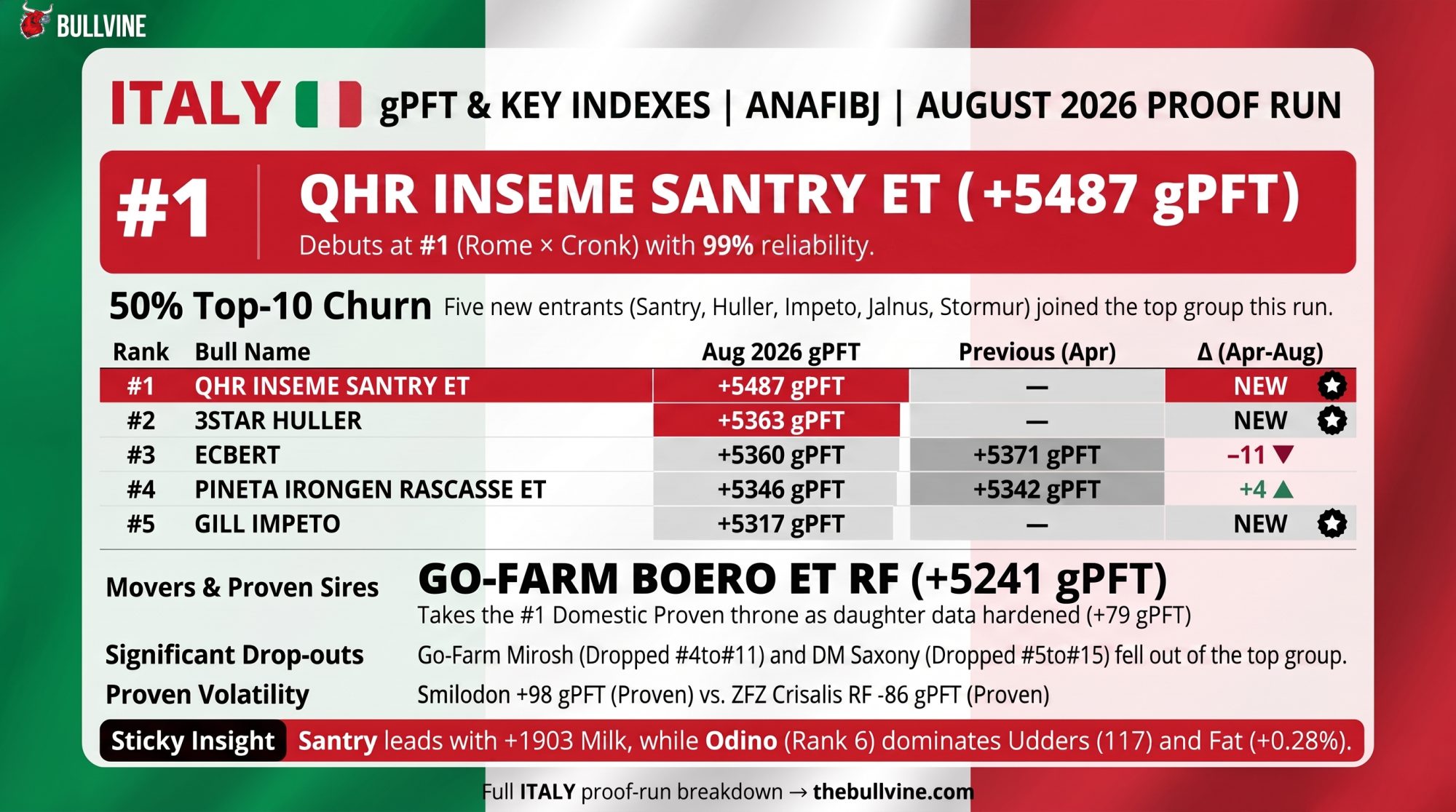
Italy’s August 2026 ANAFIBJ proof run resets the domestic genomic gPFT board — five new bulls in the top 10 in four months, a brand-new #1 in QHR INSEME SANTRY ET (DE001604948960) at +5487 gPFT / +1386 IES € / +1440 ICS-PR € (Rome × Cronk, Inseme), and the previous #1 ECBERT slipping to #3 at +5360 (from +5371 in April). Behind Santry, Dutch import 3STAR HULLER debuts at #2 (+5363, Magello × Picard, Intermizoo), and GILL IMPETO (GTA × Beerbum, Intermizoo) crashes in at #5 (+5317).

Casualties are just as loud: GO-FARM MIROSH ET (Reunion × Mookie) fell from #4 (+5296) to #11 (+5278), and DM SAXONY slid from #5 to #15. On the daughter-proven side, GO-FARM BOERO ET RF (+5241) flipped positions with ZFZ Crisalis RF to take the domestic proven throne — a Crisalis RF son leapfrogging a Gywer son whose MGS is Crisalis’s own stablemate. And here’s the thing: the real Italian gPFT ceiling still isn’t domestic. DENOVO LOCUST-ET widened his Interbull-converted lead to +5613, now +126 gPFT clear of Santry.

Table 1 · August 2026 Italian Genomic gPFT — Top 10

RankBullgPFT Aug 2026 (Rk %)gPFT Apr 2026Δ gPFTSire × MGSStud
1QHR INSEME SANTRY ET+5487 (99)new in top 10newRome × CronkInseme
23STAR HULLER+5363 (99)new in top 10newMagello × PicardIntermizoo – PD
3ECBERT+5360 (99)+5371 (99)−11Gladius × DatelineChiacche./ABS IT
4PINETA IRONGEN RASCASSE ET+5346 (99)+5342 (99)+4Vivify × Geyser PIntermizoo – PD
5GILL IMPETO+5317 (99)new in top 10newGTA × BeerbumIntermizoo – PD
6PASSINI ODINO+5311 (99)+5252 (99)+59Vivify × PellegrinoChiacche./ABS IT
7SH JALNUS ET+5310 (99)new in top 10newReal Syn × GladiusIntermizoo – PD
8GO-FARM STORMUR ET+5305 (99)new in top 10newVivify × SentimentInseme
9GPLUS HFP GP-OAKLAND+5302 (99)+5259 (99)+43Owen × CaptainGPLUS – BG
10ISOLABELLA BANGLES+5298 (99)+5310 (99)−12Pacific × RoyalflushIntermizoo – PD

Rank derived by sorting gPFT descending within the August ANAFIBJ file — no explicit rank column in the source (ANAFIBJ August 2026 domestic genomic list).

  • New #1 vs. old #1: Santry (+5487) is +127 gPFT clear of Ecbert (+5360). April’s #1-to-#3 spread was just +29 (Ecbert +5371 → Bangles +5310), so the top of the list has physically decompressed in one run.
  • Turnover: 5 of 10 bulls (Santry, Huller, Impeto, Jalnus, Stormur) are new to the top 10 in four months — the highest single-run churn on this list versus April.
  • Band shift: April’s top 10 spanned +5371 → +5227 (144-point / roughly +216 IES € spread); August spans +5487 → +5298 (189-point / roughly +332 IES € spread). Both ceiling and floor lifted — Santry lifts the ceiling, but the #10 threshold also rose by +71 gPFT.

Table 2 · The 30-Day Swap Map — Replace the 5 Dropped Bulls in the Role They Were Filling

If any of these five bulls are in your active mating list, this is your rebuild:

Dropped bull (April rank → August rank)Trait role they were fillingNew top-10 replacementWhy the swap works
GO-FARM MIROSH / WIL SONADOR RF (4→11, 9→14)Kg Fat / component powerPASSINI ODINO or GPLUS OAKLANDOdino +0.28% fat, Oakland +0.60% fat / 107 Kg Fat — both in top 10, both delivering the fat trait Mirosh & Sonador were used for
GGA JEGOLO (10→16)Raw milk volumeQHR SANTRY+1903 Kg Milk in the top 10, and he’s now #1 overall — no reason to keep Jegolo in a milk-first slot
ISOLABELLA LIVERPOOL (6→13)Udder qualityPASSINI ODINOUdder cmp 117, F&L 1.90 — the strongest udder in the current top 10
DM SAXONY (5→15)Balanced typeSH JALNUS ETAA κ-casein, Longevity 116, balanced kg fat/protein — the closest profile match to Saxony inside the new top 10

Honestly, the awkward part is that most of these five dropped bulls still work — just not at the rank the mating sheet was built around. If you’re using them for rank-based positioning, that argument has expired for this run.

Biggest risers

  • PASSINI ODINO (Vivify × Pellegrino): +5252 → +5311 (+59), rank 8 → 6. Best udder in the top 10 (Udder cmp 117, F&L 1.90) with Kg Fat 66 and +0.28% fat.
  • GPLUS GP-OAKLAND (Owen × Captain): +5259 → +5302 (+43), rank 7 → 9. Elite components (Kg Fat 107 on +0.60% fat, Kg Pr 80), but Fert 87 remains the persistent brake.
  • PINETA RASCASSE ET (Vivify × Geyser P): +5342 → +5346 (+4), rank 2 → 4. Marginal gPFT drift, but the type stack (F&L 2.75, Udder 2.35) held.

Biggest fallers and drop-outs

  • ISOLABELLA BANGLES (Pacific × Royalflush): +5310 → +5298 (−12), rank 3 → 10. Still the strongest functional-type sire on the list (Longevity 119, Type 1.55) — just overtaken.
  • GO-FARM MIROSH ET (Reunion × Mookie): +5296 → +5278 (−18), rank 4 → 11 — dropped out. Still elite for fat (109 Kg Fat on +0.51% fat) and stays useful as a component pick.
  • DM SAXONY ET (Enclave × Monteverdi): +5274 → +5257 (−17), rank 5 → 15 — dropped out. Balanced, but no extreme trait to defend the slot.
  • GGA INSEME JEGOLO (Rome × Ridercup): +5227 → +5234 (+7 gPFT but rank 10 → 16) — dropped out despite gaining points. Highest Kg Milk in the surrounding pack (+1950) if raw yield leads.

What this list is rewarding now

The August top 10 leans harder on component-percent Vivify sons on functional bodies than April’s did. Three Vivify sons (Rascasse #4, Odino #6, Stormur #8) each carry ≥+0.28% fat and Longevity ≥110. The trade-off is explicit at the extremes: Santry brings the top raw milk in the top 10 (+1903) on modest fat % (+0.16); Odino flips that with +972 milk but +0.28% fat, +0.19% protein, and the elite udder.

Stud and family concentration — the market-power story

  • Intermizoo – PD houses 5 of 10 (Huller, Rascasse, Impeto, Jalnus, Bangles). That 5-of-10 grip is the strongest single-stud concentration this list has held in the two runs we can directly compare — and something Inseme(Santry, Stormur) and Chiacche./ABS Italia (Ecbert, Odino) are both actively contesting with the biggest movers in the run.
  • Vivify sons hold 3 slots; no other sire has more than one son in the top 10.
  • Cleanest Vivify-free anchors for outcross: QHR SANTRY (Rome × Cronk) and GPLUS OAKLAND (Owen × Captain).

Reliability and volatility

  • All 10 carry Rk 99 — max Italian genomic reliability. When Rk 99 bulls move this much, it’s the reference population re-anchoring, not the bull changing.
  • Newest debuts most exposed to further re-ranking: QHR SANTRY and 3STAR HULLER, both first-run entrants at the top of the pyramid.
  • Longest-standing anchors: ECBERT and PINETA RASCASSE have now held top-4 across two consecutive runs.

Table 3 · Italian Daughter-Proven gPFT — Top 5

RankBullgPFT Aug 2026gPFT Apr 2026 (Apr rank)Δ gPFT
1GO-FARM BOERO ET RF+5241+5162 (#2)+79
2ZFZ CRISALIS RF+5161+5247 (#1)−86
3SMILODON ET+5159+5061 (#5)+98
4G-PLUS GEWISS ET+5154+5120 (#4)+34
5GPLUS FIS GP-GLORYDAYS+5130+5056 (#6)+74
  • New #1: GO-FARM BOERO (Crisalis RF × Pursuit) unseats his stablemate ZFZ Crisalis RF — Boero’s daughter data hardened (+79) while ZFZ softened (−86) in one run.
  • SMILODON’s +98 gPFT jump is the biggest positive move on the proven list — Kg Fat 65, Kg Pr 90, Longevity 102, though Type 0.47 and IMA 94 keep him a functional rather than type sire.
  • The domestic proven list rewards milk-first, functional bodies: Boero +1567 Kg Milk, Smilodon +1914, G-Plus Gewiss +1549 — versus the genomic list’s leaner-yield / higher-solids-percent tilt.

Table 4 · Foreign gPFT — 3 Bulls to Know (Interbull MACE-converted to ANAFIBJ scale)

CategoryBullgPFT Aug 2026Δ vs. AprilWhy it matters
Foreign Genomic #1DENOVO 23392 LOCUST-ET (Lodi × Cascade)+5613+86 vs. +5527The real Italian ceiling — +126 gPFT clear of Santry, +372 clear of Boero
Foreign Genomic biggest leaperPEAK ALTASAFEZONE-ET (Overdrive × Exquisite)+5493 (#7)+87 vs. +5406 (#20 in April)Biggest single-run rank jump on the foreign list; the bull to watch next run
Foreign Proven #1 (new to list)PROGENESIS VIVIFY-ET (Royalflush × Plinko)+5491new to proven listThe sire behind the Vivify daughters now driving Italian herds’ component averages

Three new top-5 entrants on the foreign genomic list joined Locust in one run — Foughty Bubba (+5546, Kg Fat 110 on +0.72%), DG Opine-P (+5519, +1927 milk / Kg Fat 110), and Vividoor (+5503, Vivify × Star P RF — the Dutch Vivify import surfacing on the Interbull pass). On the foreign proven side, DELTA MORGAN graduated in at #3 (+5322), GEN PERCIVAL (+5239) and GLADIUS (+5235) hold the Gladius-line anchor slots, and Peak Powerhouse (+5387) gave up the crown but stayed the top Wheelhouse son at +136 Kg Fat.

Base note: ANAFIBJ expanded the foreign-proven list from 93 to 100 bulls this run — Vivify and Delta Morgan are among the graduates.

Where the four gPFT pools agree — and where they don’t

All four lists are the same ANAFIBJ gPFT (Interbull MACE for foreign bulls), so values ARE directly comparable across pools:

  • Ceiling stack: foreign genomic (LOCUST +5613) > foreign proven (VIVIFY +5491) ≈ domestic genomic (SANTRY +5487) > domestic proven (BOERO +5241). Vivify and Santry are inside noise of each other — treat them as tied at the second tier. The gap between Locust and Boero is 372 gPFT, and that’s the difference between the ceiling and the safe floor of Italian mating decisions every single cycle.
  • Vivify’s fingerprint shows up in three of the four #1-region slots: Progenesis Vivify himself at foreign-proven #1, Vividoor at foreign-genomic #5, and three Vivify sons in the domestic genomic top 8. Only the domestic proven list is Vivify-free at the top — that’s the Crisalis RF / Gywer axis.
  • Same-index, different profile: GILL IMPETO (domestic genomic #5, +5317, IQC 115) vs. IDEVRA CARLOMAGNO (domestic proven #6, +5126, IQC 108). Impeto brings extreme milk (+1507) and 80 Kg Fat; Carlomagno brings SCE 89 and functional longevity. Same country, same gPFT — very different herd fit.
  • For North American readers: on the ANAFIBJ scale, +5487 gPFT is the top of the Italian domestic genomic list — comparable in position (not value) to a top-10 gTPI ranking on the CDCB scale, but Italy weights fat %, functional longevity, and IES/ICS-PR economics more heavily than TPI does. That’s the mechanical reason Vivify’s Italian dominance runs harder than his TPI ranking suggests.

How to use these sires this season

  • Domestic genomic anchors for high-turnover contract matings: QHR SANTRY, ECBERT, PINETA RASCASSE. For herds prioritizing max gPFT with balanced components, these are the three names to build a top-shelf mating plan around.
  • Component / udder specialist: PASSINI ODINO. For herds paid on solids and battling udder-durability culls, his +0.28% fat / +0.19% protein / Udder 117 stack is unmatched in the top 10.
  • Vivify-free outcross options: QHR SANTRY (Rome × Cronk), GPLUS OAKLAND (Owen × Captain), GILL IMPETO (GTA × Beerbum). For herds already stacking Vivify daughters, these three keep pedigree diversity without sacrificing index.
  • Daughter-proven anchor for risk-averse programs: GO-FARM BOERO. For herds unwilling to bet contract heifers on genomic-only bulls, Boero is Italy’s highest reliability-plus-gPFT combination on the domestic proven list.
  • Foreign genomic ceiling play: DENOVO LOCUST. For herds using the Interbull-converted lens to chase the absolute top of the Italian scale, Locust is +126 gPFT clear of anything domestic.

Full Lists

The Sunday Read Dairy Professionals Don’t Skip.

Every week, thousands of producers, breeders, and industry insiders open Bullvine Weekly for genetics insights, market shifts, and profit strategies they won’t find anywhere else. One email. Five minutes. Smarter decisions all week.

NewsSubscribe
First
Last
Consent

Methodology note

Data sources: Italian Genomic gPFT (domestic and foreign) and Italian Daughter-Proven gPFT (domestic and foreign), all published by ANAFIBJ (Associazione Nazionale Allevatori della Razza Frisona, Bruna e Jersey Italiana). Runs analyzed: current 08-01-2026 (published 08/11/2026), previous 04-01-2026 (published 04/07/2026). The Italian domestic genomic list was chosen as the lead because it produced the highest top-10 volatility (5 new entrants + 5 drop-outs + 5 anchors shifting ≥2 positions = volatility score 15), versus ~6 on domestic proven, ~11 on foreign genomic, and ~9 on foreign proven. Italy’s official primary total-merit index for Holstein is gPFT itself — the same index across all four lists, applied to four sub-populations (domestic vs. foreign origin, genomic vs. daughter-proven), so values ARE directly comparable across the tables above. Top groups: top 10 for the lead list, top 5 for the domestic proven list, and top 3 named bulls for the foreign lists. Bulls were matched between runs by unique registration ID (IT/DE/NL/US/CA/FR/DK country prefix + registration number) — never by short name. Ranks are derived by sorting gPFT descending within each file (no explicit rank column in the source). Genomic vs. daughter-proven status is explicit (separate files) and not inferred. New entrants and drop-outs were labeled only where the ID was clearly present in one run and absent from the top group of the other; no missing gPFT values were guessed. Base note: ANAFIBJ expanded the foreign-proven list from 93 to 100 bulls between April and August 2026 — the added bulls include Progenesis Vivify and Delta Morgan graduating from the foreign-genomic list. All bulls named above carry Rk 99, but the three foreign-genomic newcomers (Foughty Bubba, DG Opine-P, Vividoor) are making their debut in the Italian evaluation and can re-rank meaningfully in future runs. €/dose commentary reflects historical stud repricing patterns, not Inseme, Intermizoo, or Chiacche./ABS Italia forward guidance.

Italy’s New #1: DENOVO LOCUST Rises as ECBERT Falls 40 Points in December’s Genomic Rankings

LOCUST claims #1. ECBERT drops 40 points. ECUADOR crashes 98. December’s Italian rankings just reshuffled the deck.

Executive Summary: DENOVO LOCUST-ET seized Italy’s #1 international genomic ranking in December 2025, posting gPFT 5450 with +1,472 kg milk, +115 kg fat (+0.57%), and +96 kg protein. Domestic leader ECBERT retained his crown but dropped 40 points to gPFT 5349, while PINETA IRONGEN RASCASSE surged 42 points to become December’s top domestic mover. The proven sector delivered the cycle’s biggest story: The high-profile polled star KNO ECUADOR P plunged 98 points as daughter data corrected earlier projections, while ZFZ CRISALIS RF held firm at the top with gPFT 5180. Four international newcomers—HARMONY, SCOTTY, DREAMER, and THUMPING—broke the 5300 barrier. Eight Italian bulls debuted above gPFT 5070, signaling that domestic genetics are closing the gap. December’s lesson: the sires you banked on in August deserve a fresh evaluation today.

Italian Holstein gPFT rankings

December’s evaluation crowned a new international leader—and exposed cracks in former favorites. DENOVO 23392 LOCUST-ET (Sire: LODI; MGS: CASCADE) claimed the number one position with a commanding gPFT of 5450, edging out previous contenders with exceptional production credentials: +1,472 kg Milk, +115 kg Fat (0.57%), and +96 kg Protein (0.40%).

Hot on his heels, PEAK VINDICATE-ET and PEAK SPELLBOUND-ET sit virtually tied at gPFT 5445, making the top three positions a photo finish separated by just five index points.

Fresh International Genetics Breaking Through

Several high-powered international sires made notable December debuts above the 5300 gPFT threshold :

  • KENYON-HILL OC-ET HARMONY (Harmony x Gameday) – gPFT 5386
  • ADAWAY SUNDANCE SCOTTY-ET  (Sundance x Hayk) – gPFT 5374
  • KINGS-RANSOM O DREAMER-ET  (Owen x Happen) – gPFT 5348
  • PROGENESIS THUMPING (Hipster x Frost Bite) – gPFT 5318

Domestic Drama: ECBERT Holds Top Spot Despite 40-Point Drop

Italy’s homegrown genomic leader ECBERT (Sire: GLADIUS; MGS: DATELINE) maintained his domestic crown but couldn’t avoid a 40-point index decline, falling from 5389 to 5349 gPFT. Meanwhile, PINETA IRONGEN RASCASSE ET surged upward with a +42 point gain to secure second position at gPFT 5321—the evaluation’s biggest domestic mover.

New Italian Sires Entering the Elite (gPFT ≥5070)

Bull NamegPFTBull NamegPFT
GPLUS HFP GP-OAKLAND5247INSEME TEX SURFER5125
GGA INSEME JEGOLO5151WILDER INSEME FAKTOR5095
FIS ENOLA-ET5146PALASSOTTO RIGHEIRA5085
BELLAVISTA PEACE5131CRISTELLA NAZARIO ET5077

Proven Sector: Stability at Top, Volatility Below

The daughter-proven rankings tell a more cautious story. ZFZ CRISALIS RF held firm as Italy’s top proven bull, ticking up slightly from 5169 to 5180 gPFT with a strong fat percentage (+0.16%). IDEVRA ROYAL INSEME CARLOMAGNO secured second place at gPFT 5068, delivering impressive milk volume (+1,568 kg) and solid longevity (105).

The proven sector’s headline loss: KNO ECUADOR P plummeted 98 points—from 4943 to 4845 gPFT—as additional daughter data recalibrated expectations. Conversely, ISOLABELLA DISTEFANO ET climbed 34 points to 4982 gPFT.

The Bottom Line

For breeders finalizing 2026 matings, December’s volatility demands one response: reassess before you commit. LOCUST’s emergence and ECBERT’s decline demonstrate why continuous index monitoring matters more than ever. For breeders targeting the Italian market, December’s evaluation reinforces that international genetics continue to set the pace—but domestic programs are closing the gap fast.

Data Source: ANAFIBJ December 2025 Italian Holstein Genetic Evaluations

Key Takeaways:

  •  LOCUST seizes #1: DENOVO LOCUST-ET tops Italy’s international genomics at gPFT 5450 with +1,472 kg milk, +115 kg fat, and +96 kg protein
  • ECBERT drops 40 points: Domestic leader holds #1 but bleeds index value while PINETA IRONGEN RASCASSE surges 42 points behind him
  • ECUADOR plunges 98 points: December’s proven-sector collapse proves daughter data can shatter genomic confidence overnight
  • 12 new elite sires debut: Four international bulls cracked gPFT 5300; eight Italian bulls entered above 5070—fresh firepower for 2026 matings
  • Your August picks need a December review: Index swings this size reward breeders who adapt, not those married to last cycle’s rankings

Top Lists:

The Sunday Read Dairy Professionals Don’t Skip.

Every week, thousands of producers, breeders, and industry insiders open Bullvine Weekly for genetics insights, market shifts, and profit strategies they won’t find anywhere else. One email. Five minutes. Smarter decisions all week.

NewsSubscribe
First
Last
Consent

Genetic Gatekeepers: The High-Stakes Gamble of Dairy’s Elite Bloodlines

Every 1% increase in inbreeding costs you $23 per cow—and most herds don’t even know their levels.

We’ve uncovered something that’ll make you rethink every breeding decision you’re making. Genomic selection doubled our genetic gains to per cow annually, but it’s created a billion inbreeding tax that’s quietly draining operations nationwide. Here’s the math that matters: every 1% increase in genomic inbreeding costs about per cow in lost lifetime profit, and Holstein levels have jumped from 5% to over 15% in just fifteen years. Meanwhile, five companies now control nearly 90% of the elite genetics market, using restrictive contracts to keep the best bloodlines in their own pipelines. The producers who start building genetic independence now, while outcross options are still available, will have the most resilient and profitable herds by 2030. Time to stop following the crowd and start protecting your genetic future.

Rising inbreeding coefficients in Holstein cattle since genomic selection began in 2009, with corresponding economic costs calculated at $23 per 1% inbreeding increase

Three Critical Things Every Producer Needs to Know Right Now

  • Genomic selection doubled our genetic gains from $40 to $85 annually per cow in Net Merit—sounds great, right? But here’s what nobody talks about…
  • Genomic inbreeding levels shot from 5% to over 15% in just fifteen years, creating a hidden tax of $23 per cow per percentage point. That’s potentially $230 lost per cow over her lifetime.
  • Five companies now control nearly 90% of elite genetics, yet they’re all selling us essentially the same bloodlines under different names.

The math is brutal when you scale it up. A 500-cow herd averaging 12% inbreeding is bleeding roughly $80,500 annually compared to herds maintaining 5% inbreeding levels. That’s real money walking out your barn door every day.

The coffee-break test: are the same grandsires showing up everywhere?

Grab the last 50 breedings and map sires back two generations; if “Captain,” “Lionel,” “Frazzled,” or “Medley” keep popping up, that déjà vu isn’t a coincidence—it’s what concentrated genomic selection looks like when the whole market chases the same leaderboard. The financial math is simple enough to make a nutritionist wince: at $23 per 1% inbreeding, a 300-cow herd moving from 5% to 12% is quietly leaving roughly $48,300–$69,000 on the table over those cows’ lifetimes, and that’s before counting the drag on productive life and calving intervals that comes with each tick upward.

How the genomic promise became a trap—fast

The thing about 2009–2010 is that progeny testing’s long wait time suddenly became, well, optional: hair sample in, predictions out, generation intervals shrank, and selection intensity went through the roof, which is exactly why genetic gain jumped from ~ to ~ per year. What strikes many producers in hindsight is how standardized indices and the speed of genomic turnover trained everyone on the same targets at the same time, so the “best” bulls were used everywhere—by design—driving a rapid, global convergence around a narrow set of families.

The genomic selection revolution doubled annual genetic gain in Holstein cattle but came at the cost of reduced effective population size, highlighting the fundamental trade-off between rapid progress and genetic diversity

Follow the incentives: concentrated suppliers, concentrated pedigrees

Here’s what’s interesting when you line up the genomic NM$ lists: STgenetics now commands about 53.5% of the genomic NM$ sire share, with the other majors making up most of the rest—a pretty strong signal that the elite sire stream runs through just a few gates. Price reinforces the funnel: value-based pricing ties semen cost to index standing, so rational buyers who want higher herd profitability are nudged to pile into the same top sires—again and again—tightening pedigree overlap as a side effect of “doing the smart thing.”

The contract loop: control doesn’t end at the tank

What’s particularly noteworthy is how early-access or VIP semen agreements can limit resale, restrict use to the buyer’s herd, and even reserve first option on exceptional progeny, which keeps the very best genetics circling back to internal pipelines while everyone else gets the later waves. It creates a two-speed market: a nucleus racing ahead on the newest lines and a broader commercial base buying in after those lines already saturate—pushing inbreeding faster within and across regions than pedigree tools alone will show.

The regional reality check producers keep bringing up

Upper Midwest: large Wisconsin and Minnesota herds often show eerily similar sire stacks despite different nutritionists and management styles—proof of how the same handful of bull families can dominate selection decisions regionally when everyone buys off the same lists. Central Valley: California operations battling heat and water variability point out that many top-index bulls weren’t bred for their climate; producers who need “slick”/heat-tolerant or pasture-efficient genetics still find the elite commercial stream light on those outcross options. Southeast: Georgia and Florida dairies working through heat, humidity, and parasites are increasingly experimenting with crossbreeding and genuine outcross bulls—quietly—because the high-input, confinement-optimized mainstream isn’t built for their reality.

The case that should still give everyone pause: Pawnee Farm Arlinda Chief

The legendary sire Pawnee Farm Arlinda Chief. His genetics advanced production for millions, but his widespread use also spread a lethal recessive gene, highlighting the costly hidden risks of a narrow gene pool.

Chief’s influence was historic—16,000 daughters and millions of descendants—but baked into that legacy was HH1, a lethal APAF1 nonsense mutation that, when homozygous, produced a devastating number of spontaneous abortions across the breed. Between 2016 documentation and subsequent reporting, the best estimates now peg global losses at roughly half a million calf abortions and hundreds of millions of dollars in cost—while his production upside still made him a net positive, which is exactly the cultural trap: normalize the risk as “manageable.” (Read more: The $4,300 Gamble That Reshaped Global Dairy Industry: The Pawnee Farm Arlinda Chief Story)

Why pedigree tools understate today’s risk—and how genomic F_ROH tells the real story

EFI and F_ROH represent two fundamentally different approaches to measuring inbreeding that dairy breeders need to understand and use together for optimal breeding decisions. EFI (Expected Future Inbreeding) is a relative, forward-looking measure that estimates how inbred offspring would be if an animal were mated to the general population—essentially measuring how related that animal is to today’s breed average. However, EFI has a critical flaw: it uses a constantly shifting baseline that becomes more inbred each year, meaning an animal can appear “low inbreeding” simply because the entire population has become more inbred around it. In contrast, F_ROH measures the actual homozygosity present in an individual’s DNA right now—the real stretches of identical genetic material that indicate true genomic inbreeding, regardless of population trends. For practical breeding decisions, savvy dairy producers should use EFI for population-level planning and relative comparisons within their current genetic pool, while relying on F_ROH to understand the absolute genomic risk and long-term genetic health of their animals. Think of EFI as your “how does this bull compare to others available today” tool, while F_ROH tells you “how much genetic diversity has this animal actually lost”—and with Holstein genomic inbreeding having tripled from 5% to 15% in just 10 years while EFI metrics lagged behind, using both measures together gives breeders the complete picture they need to avoid painting themselves into a genetic corner.

Low Inbreeding Sires in the top 200 gTPI to consider:

Naab CodeReg Name TPINet MeritPTA MilkPTA Fat% FatPTA Pro% ProPTA TypeSire x MGS x MGGS
515HO00587Ruann Northstar-ET34279111323990.16590.061.01Gen Percival x Gameday x Rapid
250HO17387Aurora Sheepster POplar-ET3421829862900.2430.051.05Sheepster x Ahead x Medley
014HO17945Wet Sheepster Madcap-ET3415945683930.24480.090.62Sheepster x Gameday x Renegade
007HO17807Matcrest Sundance Ledger-ET33999668091040.26470.080.84Sundance x Payload x Renegade
200HO13425Beyond Nightingale3397857680830.2460.091.17Harmony x Esquire x Parsly
200HO13174Adaway Beyond Fitness-ET33929081153920.16600.080.63Sheepster x Parsly x TRy Me
007HO17380Melarry Sheepster Dijon-ET338193716121050.14680.050.52Sheepster x Drive x TRy Me
202HO02006TRophy-ET3380742394730.21430.110.94TRooper x Spot Lite x Renegade
551HO06233Genosource Maritime-ET338010191301970.16540.040.58Undertone x Upside x Captain
029HO22342Pine-TRee Mervyn-ET337898912641130.22570.060.02Mirrorimage x Foxcatcher x Legendary

The reality is that most of today’s highest-ranking sires likely have elevated F_ROH values because 90% of the top genomic bulls trace back to Oman, Planet, or Shottle in their first few generations. This concentration means finding truly outcross sires among the elite ranks is increasingly difficult.

Producers who believe they’re “mixing it up” with pedigrees are often shocked when genomic runs of homozygosity (F_ROH) uncover more overlap than expected, especially post-2010, as generation intervals tightened and popular sires cycled faster. Studies show that pedigree-based inbreeding underestimates true autozygosity. Meanwhile, ROH trends in North American Holsteins rose sharply through the genomic era—resulting in more small ROH per year—and the last five years of the 1990–2016 period nearly doubled prior rates.

The hidden ledger lines producers actually feel—every season

From industry observations and Holstein/extension economics, each 1% inbreeding pings profitability by about $23 per cow in lifetime Net Merit, while correlated effects—milk yield drags, shorter productive life, and stretched calving intervals—compound quietly across cohorts. When you aggregate that across 500–1,000 cows, the numbers move from “annoying” to “we should fix this now,” especially if replacements are tight and every fresh cow’s butterfat checks are paying the feed bill this month.

A practical 30-day audit producers are using this fall

  • Week 1: Pull 100 recent services and map three generations; flag repeat grandsires and calculate genomic inbreeding if available through herd tools or nominator portals tied into CDCB pipelines.
  • Week 2: Run the inbreeding tax math at $23 per 1% and project five-year costs; identify the top five most related families in the herd and where they sit in production and health.
  • Week 3: Shortlist genuine outcross sires (yes, some will be 100–200 points lower on index) and heat/pasture-adapted options for stress seasons; check cooperative or European sources where appropriate.
  • Week 4: Set genomic inbreeding targets (<8% herd average is a good working mark), define a portfolio breeding plan for the next 90 days, and lock in performance tracking beyond yield—DPR, mastitis events, days open.

The portfolio breeding approach—used by herds that won’t trade tomorrow for today

What’s working in the field is a 40–40–20 split: forty percent “income insurance” on proven, high-index bulls for the best cows in optimal windows; forty percent balanced performers from less-related families; and twenty percent true diversity builders—outcross or strategic crossbreeding to bank hybrid vigor. On timing, spring is a great window for diversity (fresh cows, better heats); in summer heat, some herds test heat-tolerant outcrosses precisely because conception is lower anyway; and in fall, producers blend a higher percentage of index leaders to set up spring calving while keeping 30–40% in the diversity lane.

The tech curve by 2030—what actually looks useful on-farm

CDCB and national partners continue to expand trait coverage and data quality in the National Cooperator Database—now powering evaluations on tens of millions of animals—which is the backbone for making inbreeding and diversity metrics more visible in everyday tools. Expect two practical shifts: breeder-facing dashboards that surface F_ROH and “relatedness risk” at mating-time, and multi-objective AI suggestions that trade a modest drop in index points for measurable herd-level gains in fertility, livability, and inbreeding control.

The Bottom Line

First, write a hard target for genomic inbreeding and enforce it at mating-time with tools tied to CDCB-powered data; don’t let the last click be a guess. Second, treat outcross doses like an insurance premium: they don’t always top the list, but they pay when volatility hits—heat waves, disease pressure, or a hidden recessive hiding in plain sight like HH1 did. Third, negotiate “diversity bundles” or step outside the usual catalogs—cooperative and European options exist—and remember that saving $115 per cow by avoiding 5% extra inbreeding beats chasing 100 index points that never make it to your milk check.

Why this matters more than it feels like it should

Producers don’t feel inbreeding depression in one big wreck; it shows up in a few more open cows, a mastitis flare that pushes great cows out a lactation early, or a herd that just doesn’t breed back like it used to—and by the time it’s obvious, it’s expensive to unwind. The evidence points to a simple truth: a little less index today, with diversity baked in, often pays more in three years than another lap around the same pedigrees ever will.

KEY TAKEAWAYS

  • Your inbreeding level is costing you real money right now — Calculate your herd’s genomic inbreeding using CDCB-linked tools, then multiply each percentage point above 5% by $23 per cow to see what you’re losing annually
  • Break free from the genetic funnel with portfolio breeding — Mix 40% proven high-index bulls, 40% solid performers from different families, and 20% true outcross genetics to hedge your bets and boost long-term profitability
  • Demand transparency from your AI providers — Ask for genomic relationship data, challenge restrictive contracts, and consider cooperative breeding programs that put farmer interests ahead of corporate profits
  • Track what actually pays the bills long-term — Monitor fertility rates, productive life, and mastitis alongside milk weights because the cows that stay healthy and breed back are the ones generating real profit per stall

The Sunday Read Dairy Professionals Don’t Skip.

Every week, thousands of producers, breeders, and industry insiders open Bullvine Weekly for genetics insights, market shifts, and profit strategies they won’t find anywhere else. One email. Five minutes. Smarter decisions all week.

NewsSubscribe
First
Last
Consent

Learn More:

  • Boost Your Dairy Profits: Proven Breeding Strategies Every Farmer Must Know – This article provides tactical advice on sire selection, heat detection, and using sexed and beef semen. It offers practical strategies for improving conception rates and calf value, directly complementing the main article’s call for a more diverse breeding portfolio.
  • Unlock Hidden Dairy Profits Through Lifetime Efficiency – Shifting to a strategic, long-term view, this piece reveals how integrating genetics with precision nutrition creates significant financial gains. It demonstrates how to cut feed costs and boost margins, reinforcing the main article’s theme of finding profitability beyond index chasing.
  • Genomics Meets Artificial Intelligence: Transforming Dairy Cattle Breeding Strategies – Looking to the future, this article explores how AI is revolutionizing genomic data analysis. It details how emerging technologies can help execute the complex, multi-objective breeding strategies needed to manage inbreeding risk and enhance long-term herd resilience and profitability.

Peak Spellbound-ET Surges to Top of Italian Genomic Rankings in August 2025 Evaluations

Overdrive son crushes it while former leaders take a hit in August evaluations

Executive Summary: Italy just dropped their August genetic evaluations and Peak Spellbound-ET jumped to #1 with his impressive +1.07% fat and +0.54% protein, while former top dog Peak Vindicate-ET fell 20 points to second place. But here’s the kicker – Cookiecutter Hadley-ET went from #2 to #10, losing 102 points in one round. Meanwhile, the proven bulls? Rock steady. ZFZ Crisalis RF actually gained 29 points and strengthened his #1 proven position with that killer +1.95 udder composite. The Italians are obsessed with cheese production profits (their ICS-PR€ index), and guess what – the bulls ranking highest on both genomic and economic merit are the ones staying power. You want my advice? Start weighting proven performance heavier in your breeding decisions, especially with feed costs still brutal in 2025.

dairy cattle genetics, genomic sire selection, Holstein bull proofs, dairy breeding profitability, Italian genetic evaluations

The August Italian genetic evaluations just dropped, and honestly? The reshuffling is pretty dramatic. Peak Spellbound-ET came out of nowhere to grab the #1 spot among international genomic bulls with a gPFT of 5458. This Overdrive son is putting up some serious numbers – +1.07% fat and +0.54% protein – which explains why Italian cheesemakers are paying attention.

But here’s what’s really catching my eye: while the genomic bulls are bouncing around like ping-pong balls, the proven bulls are sitting pretty with much more stability. Makes you wonder if we’re getting a little too excited about these genomic predictions, doesn’t it?

The Genomic Roller Coaster Continues

RankBull NameSiregPFTICS-PR€Milk kgFat %Protein %AI Center
1Peak Spellbound-ETOverdrive545812909401.070.54Novagen S.R.L.
2Peak Vindicate-ETSamson5445138516280.720.35Novagen S.R.L.
3Danhof Calculus-ETOwen5438125816540.570.32Semex Italia SRL
4Smartie P-ETSega P RDC5417139815410.220.37Novagen S.R.L.
5Delta MorganGladius5394117118100.210.31Novagen S.R.L.
6Peak Altasafezone-ETOverdrive5382150112200.730.43Alta Italia – MI
7Peak Powerhouse-ETWheelhouse5346124017920.650.36Novagen S.R.L.
8Progenesis Vivify-ETRoyalflush5334136812580.420.25Semex Italia SRL
9OCD Rad Lightsaber-ETRad5333124420560.590.21ST Gen Group
10Cookiecutter Hadley-ETPattern5332113116570.830.27Semex Italia SRL

Top 10 Foreign Genomic Bulls – August 2025

Peak Vindicate-ET, who was sitting pretty at #1 back in April, dropped to second place. Not a disaster by any means – he’s still at 5445 gPFT – but that’s a 20-point slide. This Samson son from Zemini bloodlines is still delivering solid milk production at 1628 kg with an impressive ICS-PR€ of 1385. The Italians love that cheese production index, and for good reason.

The real shocker? Cookiecutter Hadley-ET absolutely tanked from #2 in April all the way down to #10 in August. We’re talking about a 102-point drop here – from 5434 down to 5332. That’s the kind of volatility that should make any breeder nervous about putting all their eggs in one genomic basket.

What strikes me about these swings is how they contrast with the proven bull rankings. ZFZ Crisalis RF actually gained 29 points and strengthened his hold on the #1 proven spot. This Gywer son is showing what real daughter data looks like – +1.95 udder composite and solid type traits that actually hold up over time.

RankBull NameSiregPFTICS-PR€Milk kgFat %Protein %AI Center
1ZFZ Crisalis RFGywer516992112760.170.19Intermizoo – PD
2Idevra Royal Inseme CarlomagnoBramante506285815390.070.27Inseme
3Isolabella Distefano ETHothand49488726380.220.24Italian Genetics
4KNO Ecuador PHothand494383913740.050.22Intermizoo – PD
5K&L RM Inseme Barone Rosso RSantorius48443549920.090.25Italian Genetics
6All.Nure WendatEinstein483791912060.180.24Intermizoo – PD
7SmirneSupreme48328676430.160.25Intermizoo – PD
8SFH Redshift RGywer48158471545-0.080.05Intermizoo – PD
9Wilder HolocronAristocrat48126238170.230.33Intermizoo – PD
10Dotti DorandoLetsgo47808955850.130.24Intermizoo – PD

Top 10 Italian Proven Bulls – August 2025

The Overdrive Factor

Peak Spellbound’s rise to the top signals something interesting happening with the Overdrive bloodline in Italian programs. His ICS-PR€ of 1290 puts him right in the sweet spot for Italian dairy operations focused on cheese production. When you’re dealing with Parmigiano-Reggiano and Gorgonzola, those component percentages matter more than raw volume.

Peak Altasafezone-ET, another Overdrive son sitting at #6 with 5382 gPFT, is showing similar strengths. The economic merit on that bull is even stronger – ICS-PR€ of 1501. That’s the kind of number that gets Italian producers’ attention, especially with feed costs still brutal in 2025.

The thing about Overdrive genetics… they’re delivering this combination of components and economics that works really well for the Italian market. But I keep coming back to the volatility issue. These genomic predictions are jumping around based on relatively small daughter groups, while the proven bulls with thousands of daughters are showing much more consistency.

Proven Performance Tells a Different Story

While genomic bulls are doing their volatility dance, the proven rankings tell a more stable story. ZFZ Crisalis RF moved from 5140 to 5169 gPFT between April and August. That’s real improvement based on actual daughters in real herds.

Idevra Royal Inseme Carlomagno held steady at #2 with only a 3-point drop to 5062. This Bramante son continues putting up solid milk production numbers – 1539 kg – with the kind of consistency you want to see from proven genetics.

What’s particularly noteworthy is Isolabella Distefano ET jumping 43 points to secure #3 at 4948 gPFT. This Hothand son is showing exceptional type traits with a +2.93 udder composite. Those are the kind of numbers that translate to longevity in commercial herds.

The Economics Tell the Real Story

Here’s what I find fascinating about the Italian system – they’re putting serious weight on economic merit through their ICS-PR€ index. Smartie P-ET leads all bulls with matching IES€ and ICS-PR€ values of 1398. That kind of balance between total merit and cheese production profit is exactly what Italian operations need.

The proven bulls average around 800-900 ICS-PR€, while the top genomic bulls are pushing 1200-1400. Either the genomic predictions are overly optimistic, or we’re seeing some real genetic progress. Given the volatility we’re witnessing, I’m leaning toward the former.

Bloodline Diversification Continues

Owen, Samson, and Overdrive sons are all making strong showings in the top rankings. Danhof Calculus-ET and Progenesis Pellegrino, both Owen sons, are performing particularly well in milk production traits. The maternal grandsire diversity is providing some balance to these genetic packages, which is encouraging.

But here’s the thing – we’re seeing the same sire lines dominating across multiple countries. That concentration should make us nervous about long-term genetic diversity, especially when genomic predictions are driving so much of the selection pressure.

What This Means for Your Program

If you’re looking at these Italian evaluations for breeding decisions, here’s my take: Weight the proven performance much more heavily than these genomic predictions. Peak Spellbound might be #1 today, but will he still be there in December? The 102-point drop for Cookiecutter Hadley suggests probably not.

The proven bulls like ZFZ Crisalis RF are showing the kind of consistency that translates to profitable daughters. When you’re dealing with real farms, real feed costs, and real milk prices, that stability matters more than chasing the latest genomic superstar.

For Italian operations specifically, those ICS-PR€ numbers are critical. Don’t get distracted by flashy gPFT scores if the economic merit isn’t there. Cheese production profitability is what pays the bills, especially in today’s economic environment.

The volatility we’re seeing in these genomic rankings should be a wake-up call. We’re making multi-generational breeding decisions based on predictions that can swing 100+ points in a single evaluation. That’s not the foundation for sustainable genetic progress – it’s speculation.

Focus on proven performance, diversify your genetics, and remember that consistency often beats peak performance when you’re building a sustainable dairy operation.

Editorial Note: Following publication, ANAFIBJ Technical Coordinator Maurizio Marusi provided important statistical context regarding the evaluation changes highlighted in this article. Key technical clarifications include:

The correlation between April and August genomic evaluations was 99%, indicating high consistency in the underlying genetic predictions –  The standard deviation of the genomic gPFT index is 700 points, meaning the 100-point changes discussed represent approximately 1/7 of a standard deviation – well within normal statistical expectations for genomic evaluations –  The differential between genomic and proven bull averages in Italy (TOP 20 genomic: 1108-1325 ICS-PR vs. TOP 20 proven: 827-1067 ICS-PR) is comparable to similar differentials seen in other international systems, including the United States –  Ranking changes of 8 positions with minimal genetic value differences should be interpreted within the context of 75% reliability levels and the addition of competitive new bulls to the genomic pool

These statistical insights provide important context for interpreting genomic evaluation movements and underscore the importance of understanding the technical framework underlying these genetic predictions. We appreciate ANAFIBJ’s commitment to transparency and technical accuracy in their evaluation system.

Send this to a friend