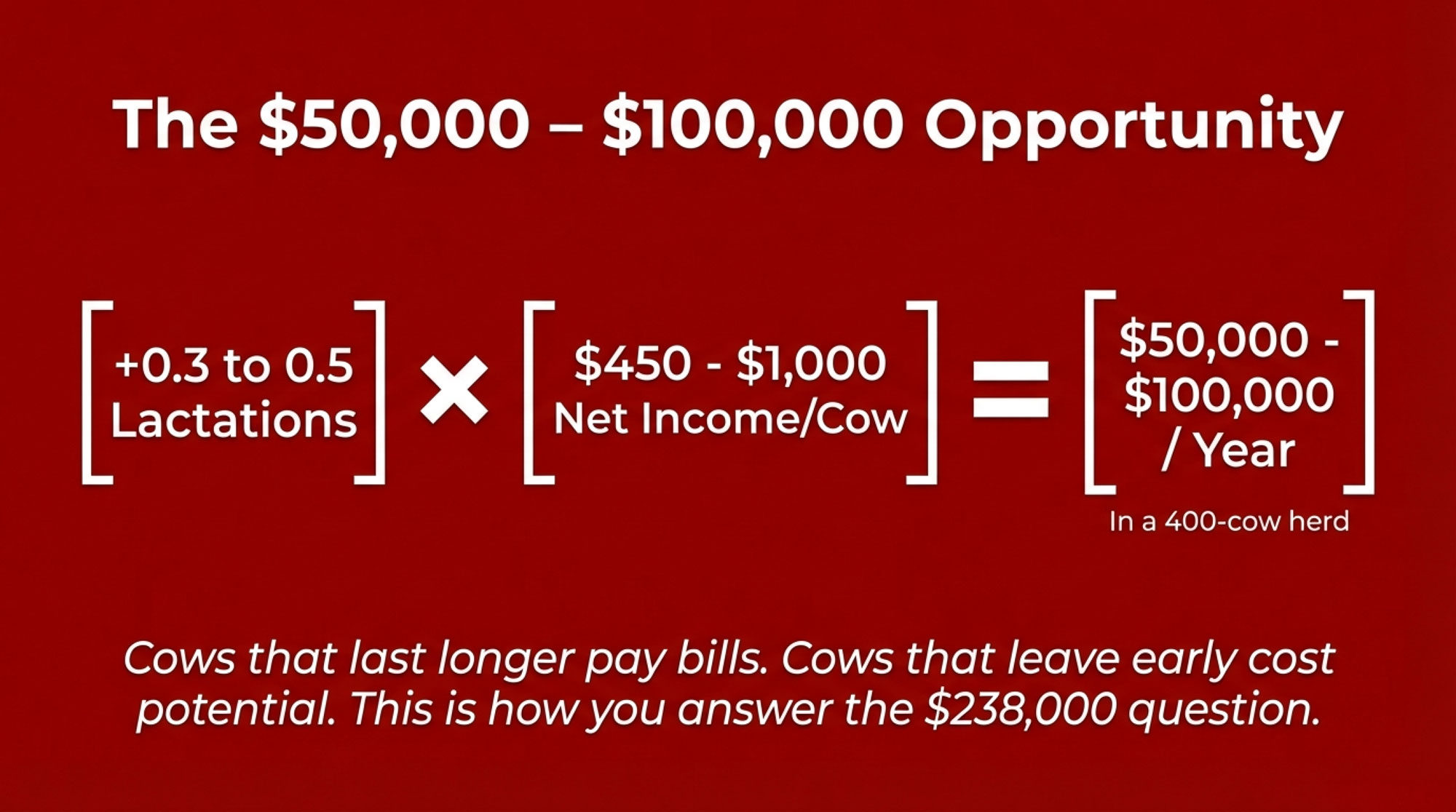
Cargill Milwaukee never bought your calves. Tyson did. See how a 4,200-cow Wisconsin herd with 2,500 beef‑on‑dairy crosses is rewiring its sire and packer risk.
Executive Summary: Ebert Enterprises in Algoma, Wisconsin, runs 4,200 cows and raises 2,000–2,500 beef‑on‑dairy crosses a year, using beef premiums to keep inflation from chewing up their margins. The Cargill Milwaukee plant that just hit the headlines is a ground beef facility that hasn’t slaughtered cattle since 2014, so it never bought their calves — or yours. The real shock to beef‑on‑dairy economics came earlier, when Tyson shut its 5,000‑head‑a‑day Lexington, Nebraska, plant and cut capacity at Amarillo, tightening kill‑floor access as CattleFax and NAAB data show volume surging to 3.22 million beef‑on‑dairy calves and 7.9 million beef semen units in dairy herds. That mismatch is why the Eberts now track where their calves actually land, spread their marketing beyond a single buyer, and favor Angus and Simmental‑Angus sires through AI — breeds with strong documented feedlot and carcass performance. Penn State research backs that play, showing all beef × Holstein sires can hit Choice, but some deliver far better gain and marbling than others. For your herd, the message is blunt: beef‑on‑dairy still works, but only if packer capacity and carcass predictability sit right beside conception rate and calving ease in your breeding plan.
The Milwaukee headline was a ghost story. But if you aren’t looking at Nebraska, you’re missing the real monster under the bed.
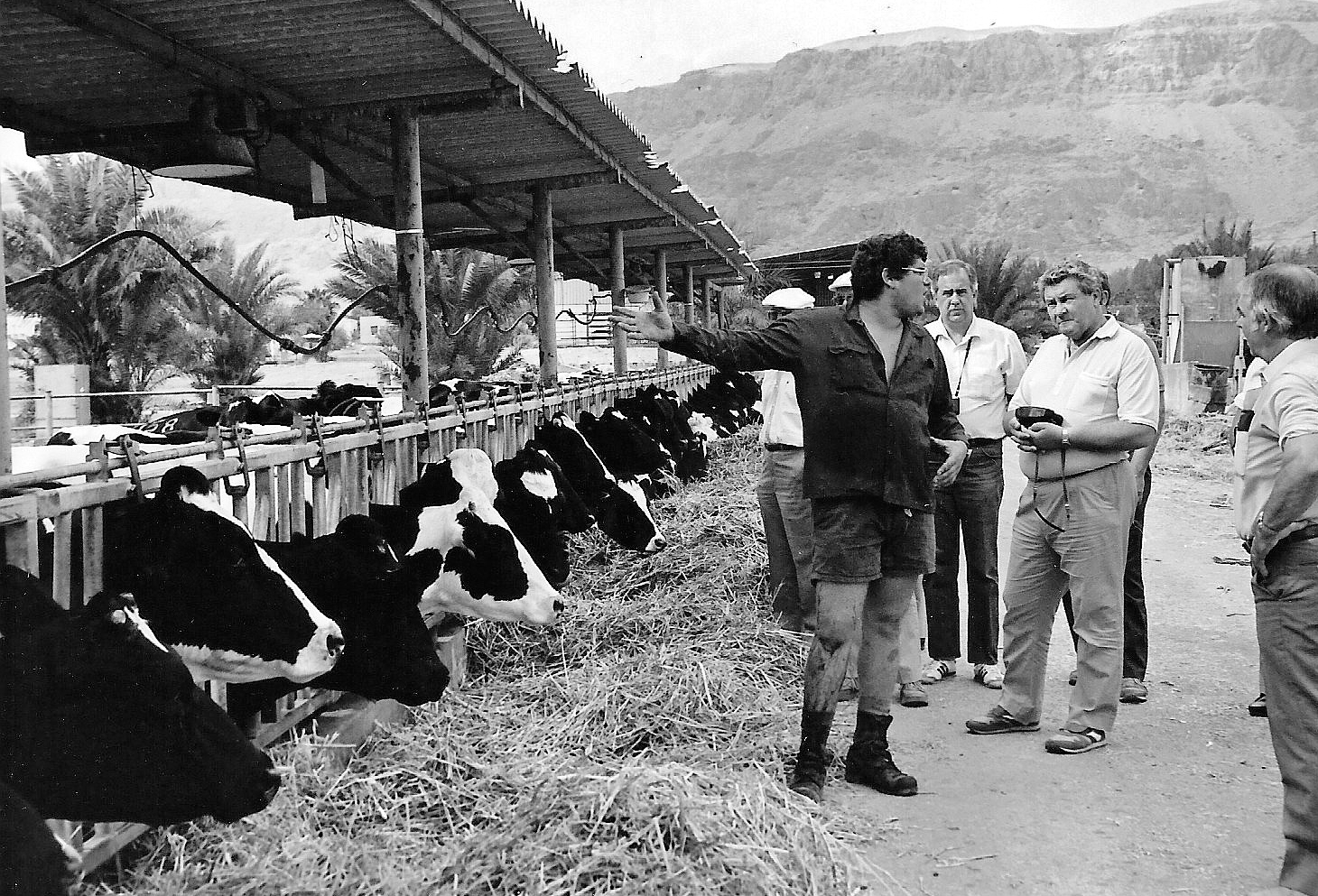
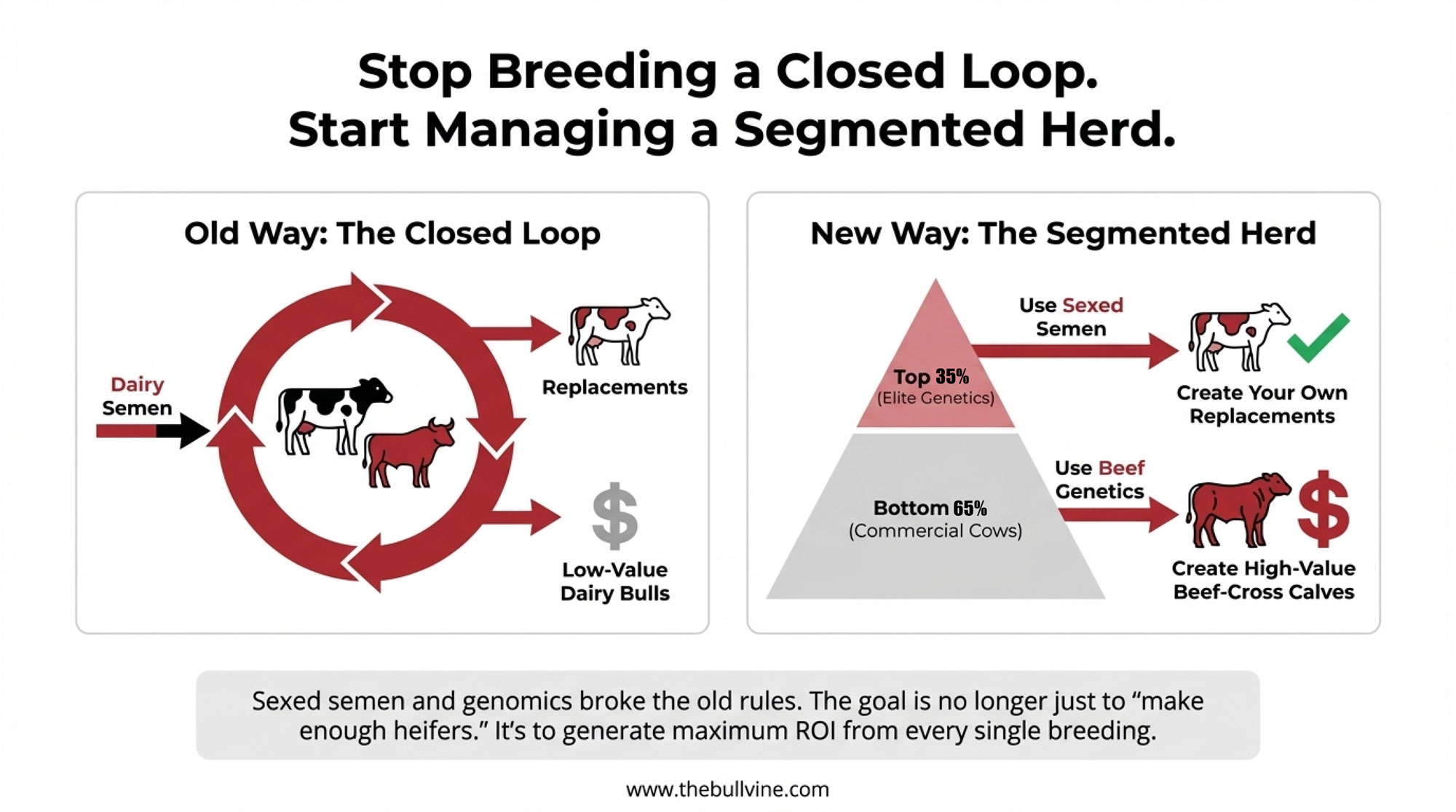
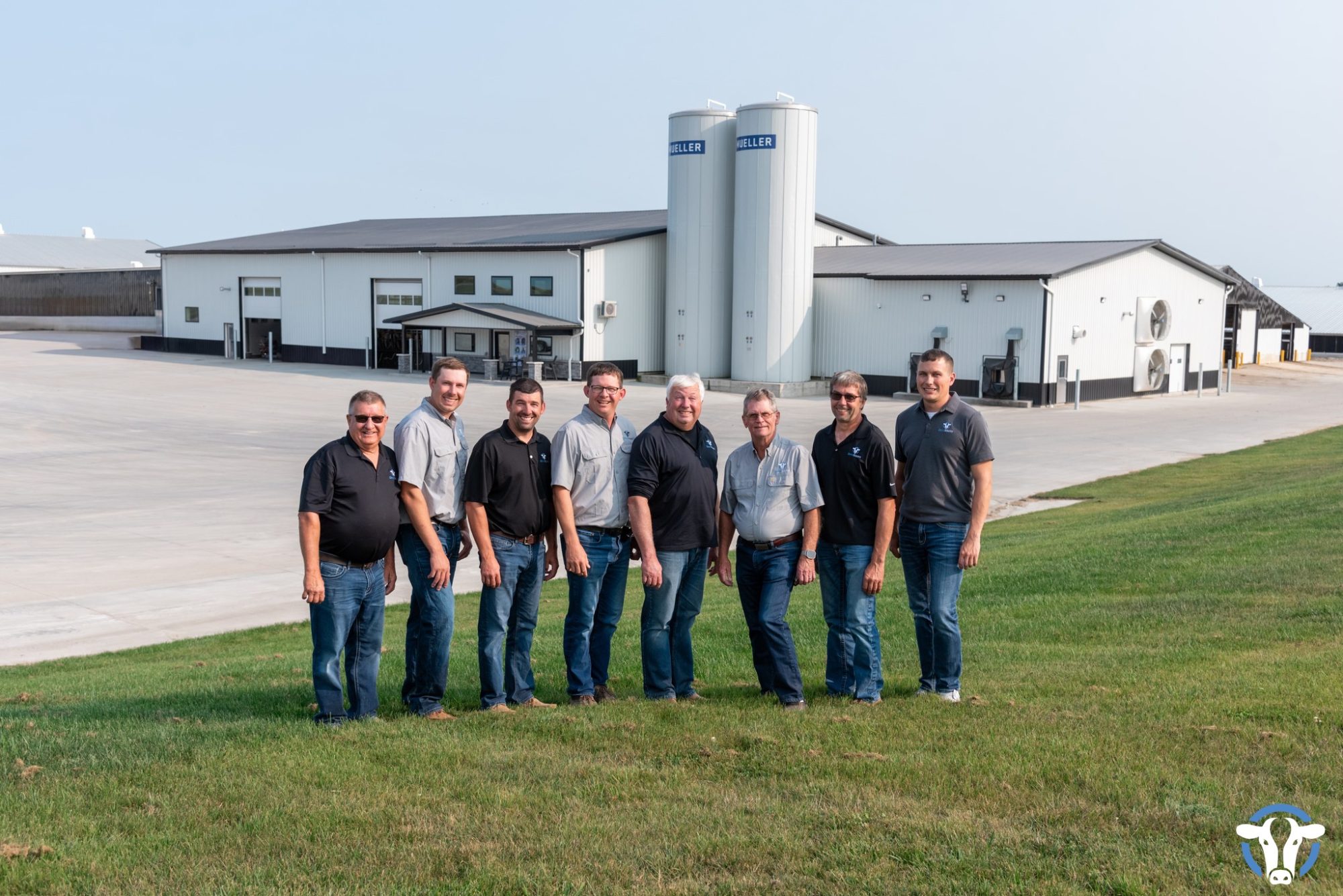
Randy Ebert knows the beef-on-dairy math as well as anyone. He and Renee run Ebert Enterprises near Algoma in Kewaunee County, Wisconsin — a sixth-generation operation with son Jordan and daughter Whitney now the seventh generation at the table. They milk 4,200 cows three times a day through an 80-stall rotary parlor and farm close to 9,000 acres. The family breeds the top 20% of the herd to sexed dairy semen and puts AI Angus and Simmental-Angus bulls on the rest, raising between 2,000 and 2,500 beef cattle from post-wean to finish, depending on the cycle.
“This is one of the few things that is helping us combat inflation costs of what we do, is what beef has done to us,” Ebert told Brownfield last July.
So a packer closure in Milwaukee gets your attention when you’ve got that many beef crosses moving through the system. Here’s the problem: the plant that’s closing wasn’t buying anyone’s calves.
The Facility That Didn’t Process Your Calves
Cargill filed a WARN Act notice with the Wisconsin Department of Workforce Development on February 10, confirming the permanent closure of its facility at 200 S. Emmber Lane in Milwaukee. About 221 positions will be eliminated. Production stops around April 17, full closure by May 31.
But look at what they actually make there. The WARN filing lists job titles like “CR Production Grind,” “Grinder Operator,” “Formax Operator,” and “Patty Stacking Robot Operator.” Not a single kill-floor position. This plant takes boxed beef as an input and turns it into ground beef and value-added meat products for grocery store private labels. It doesn’t slaughter cattle. It doesn’t accept live animals.
Cargill did run a cattle harvest operation at this site once — a real one, processing 1,300 to 1,400 head per day after purchasing it in 2001. But that slaughter plant closed on August 1, 2014, when Cargill cited a tight cattle supply. The ground beef operation was the only part that stayed open. And even that production isn’t leaving the area — it’s shifting to Cargill’s Butler, Wisconsin facility about 13 miles northwest, where roughly 500 employees already make frozen ground beef patties for restaurant chains.
This isn’t a loss of packing capacity. It’s a ground beef consolidation within the same metro area.
5,000 Head a Day Gone: The Closure That Actually Matters
The event that should have your attention happened two months earlier and 600 miles west.
On January 20, Tyson Foods permanently shuttered its beef processing plant in Lexington, Nebraska. This was a full-scale cattle harvest operation — roughly 5,000 head per day, or about 5% of total daily U.S. beef slaughter capacity, according to Brownfield Ag News. More than 3,000 workers lost their jobs. Tyson simultaneously cut its Amarillo, Texas, plant to a single shift, eliminating another 1,761 positions according to a WARN notice filed with the Texas Workforce Commission.
Buck Wehrbein, president of the National Cattlemen’s Beef Association and a Nebraska cattle feeder himself, didn’t dance around it: “It’s not really a surprise that we lost those plants because the herd is down so far. We were all worried about this.”
And then the line that matters most if you’re breeding beef-on-dairy:
“The cattle aren’t in the right place.” — Buck Wehrbein, NCBA President
Fewer slaughter plants mean longer hauls for finished cattle, fewer packers bidding at the feedlot gate, and less competition working its way back to the price of your week-old beef-cross calf. That calf’s value is tethered to what a packer will pay for the finished animal 18 months from now. When fewer packers bid, the tether gets thinner.
3.2 Million Calves Need Somewhere to Go
To understand why infrastructure deserves this much attention, look at what dairy producers have built — and how fast.
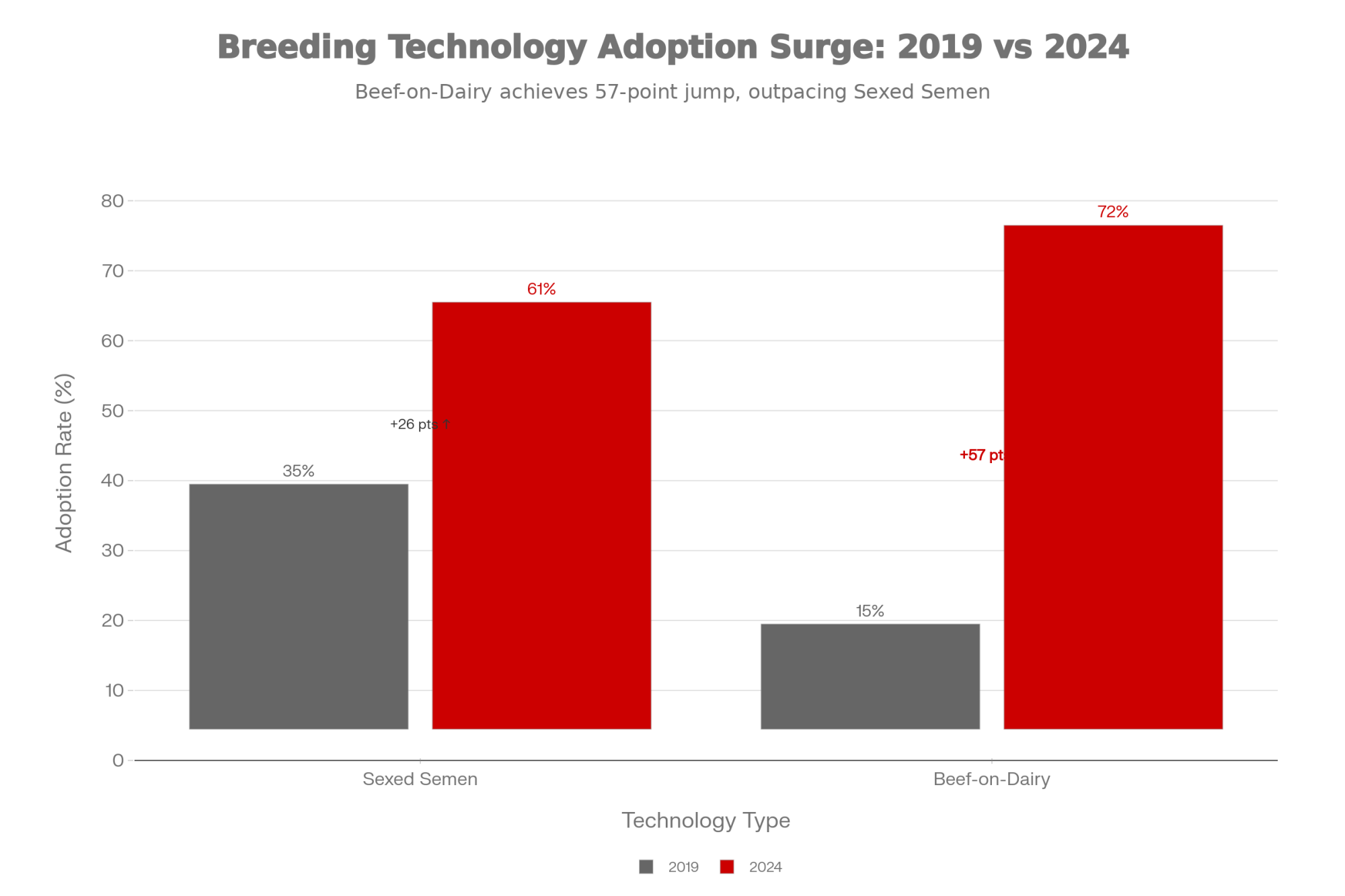
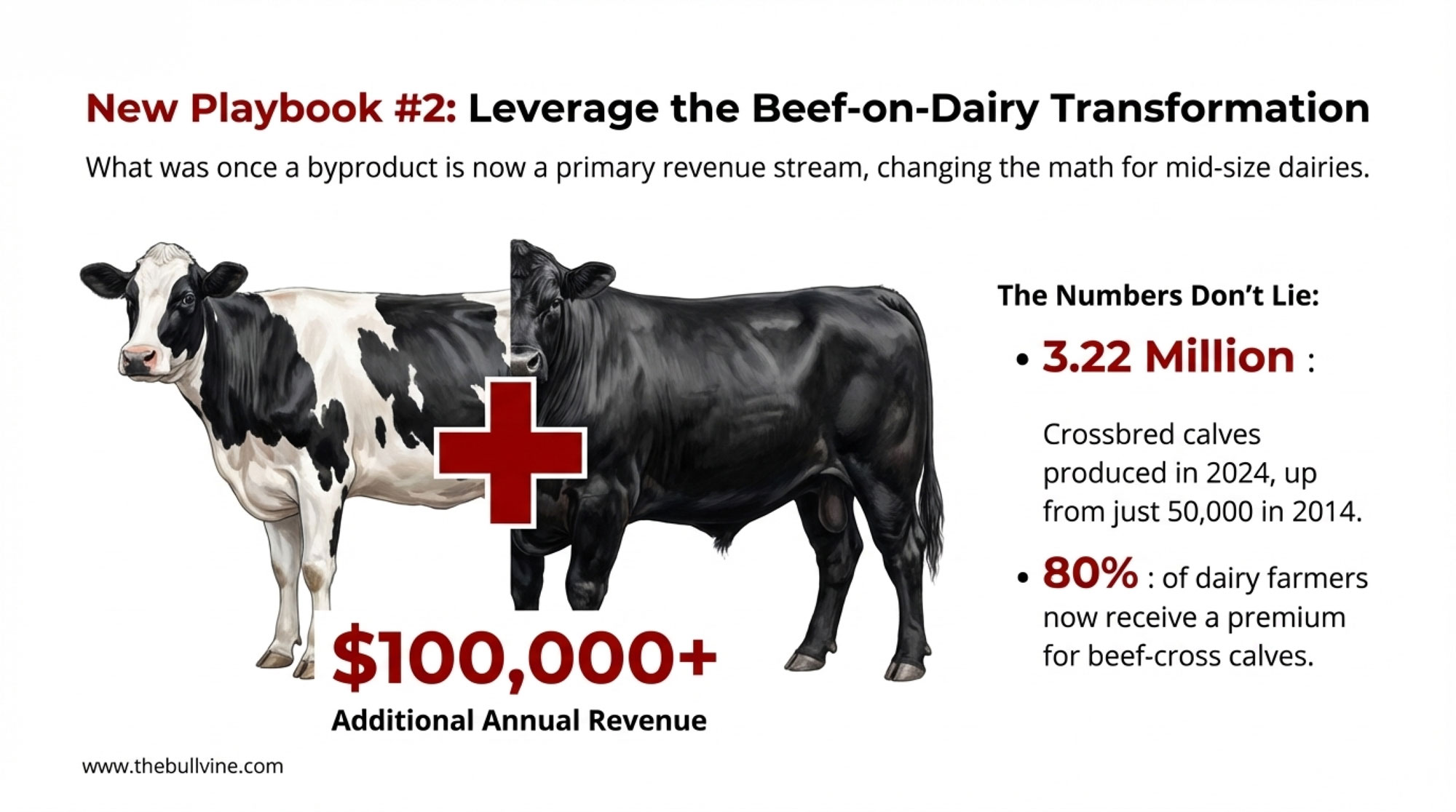
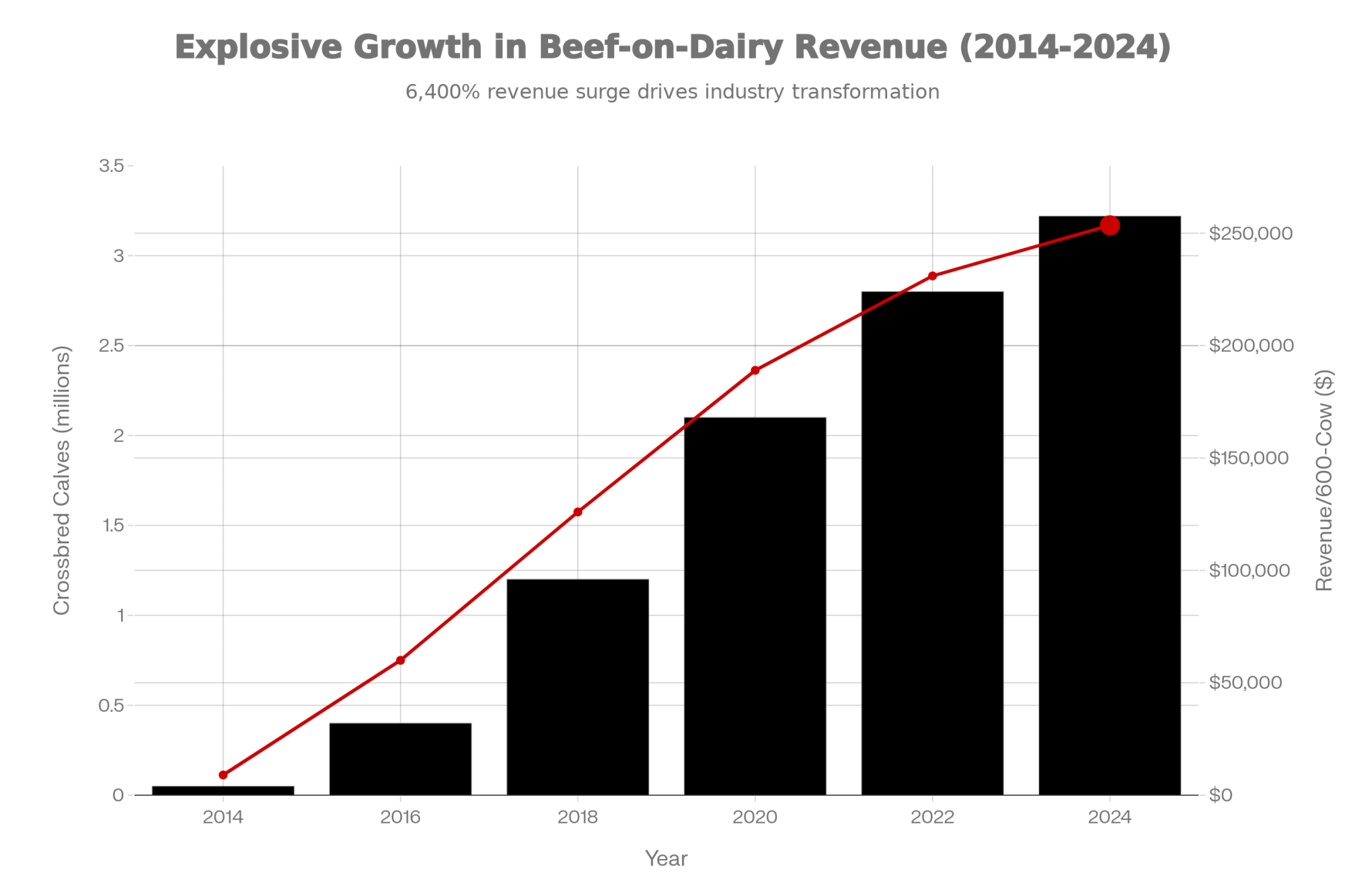
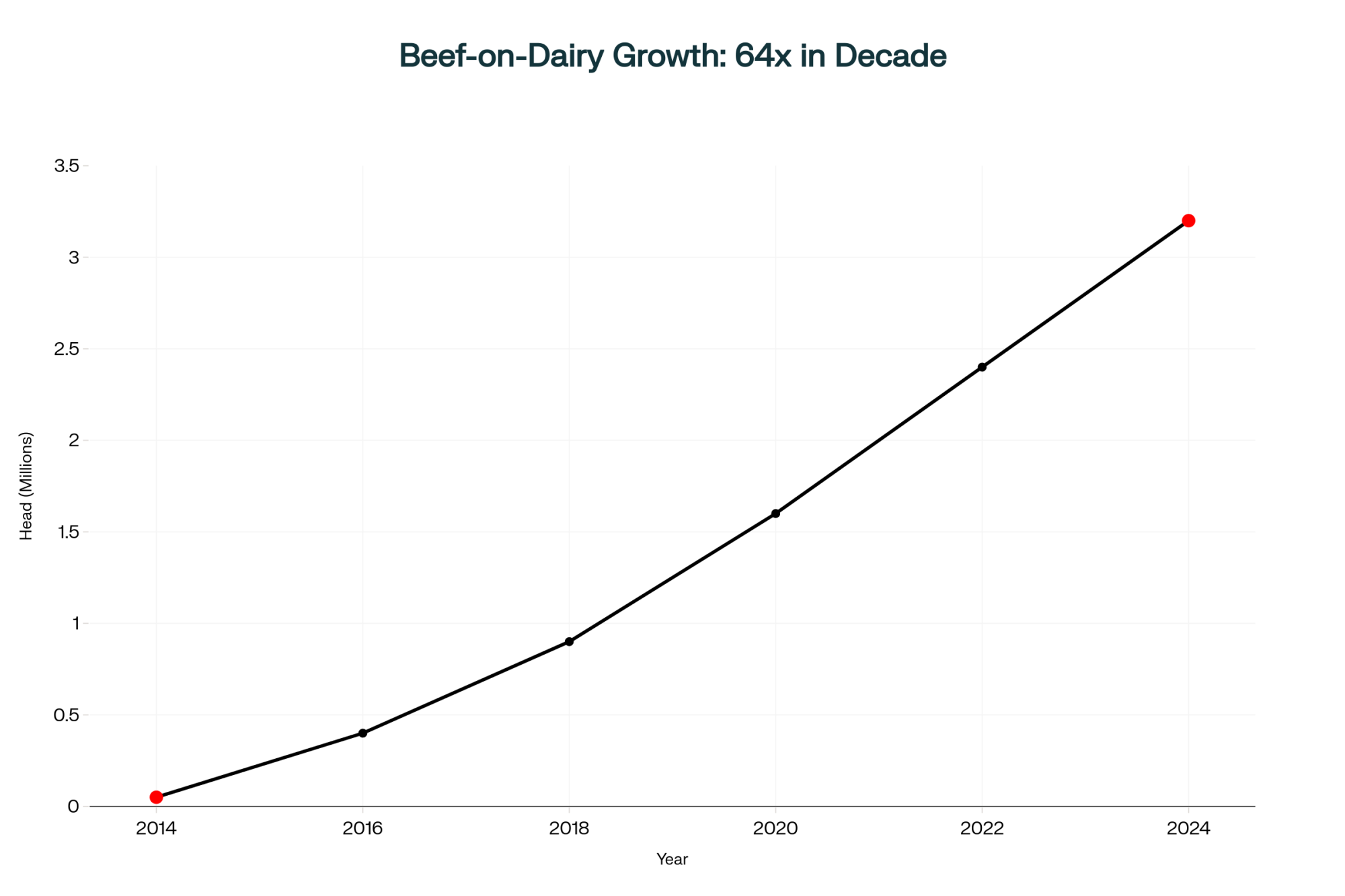
CattleFax estimates beef-on-dairy calf production jumped from roughly 50,000 head in 2014 to 3.22 million in 2024. The American Farm Bureau puts national adoption at 72% of U.S. dairy farms now using beef genetics on at least part of the herd. And NAAB data confirms that of the 9.4 million units of beef semen sold domestically in 2023, 7.9 million went into dairy herds — making beef-on-dairy the second-largest category of semen used in dairy cattle behind gender-selected dairy semen. That 7.9 million figure held steady through 2024, when total domestic beef semen sales rose to 9.7 million units.
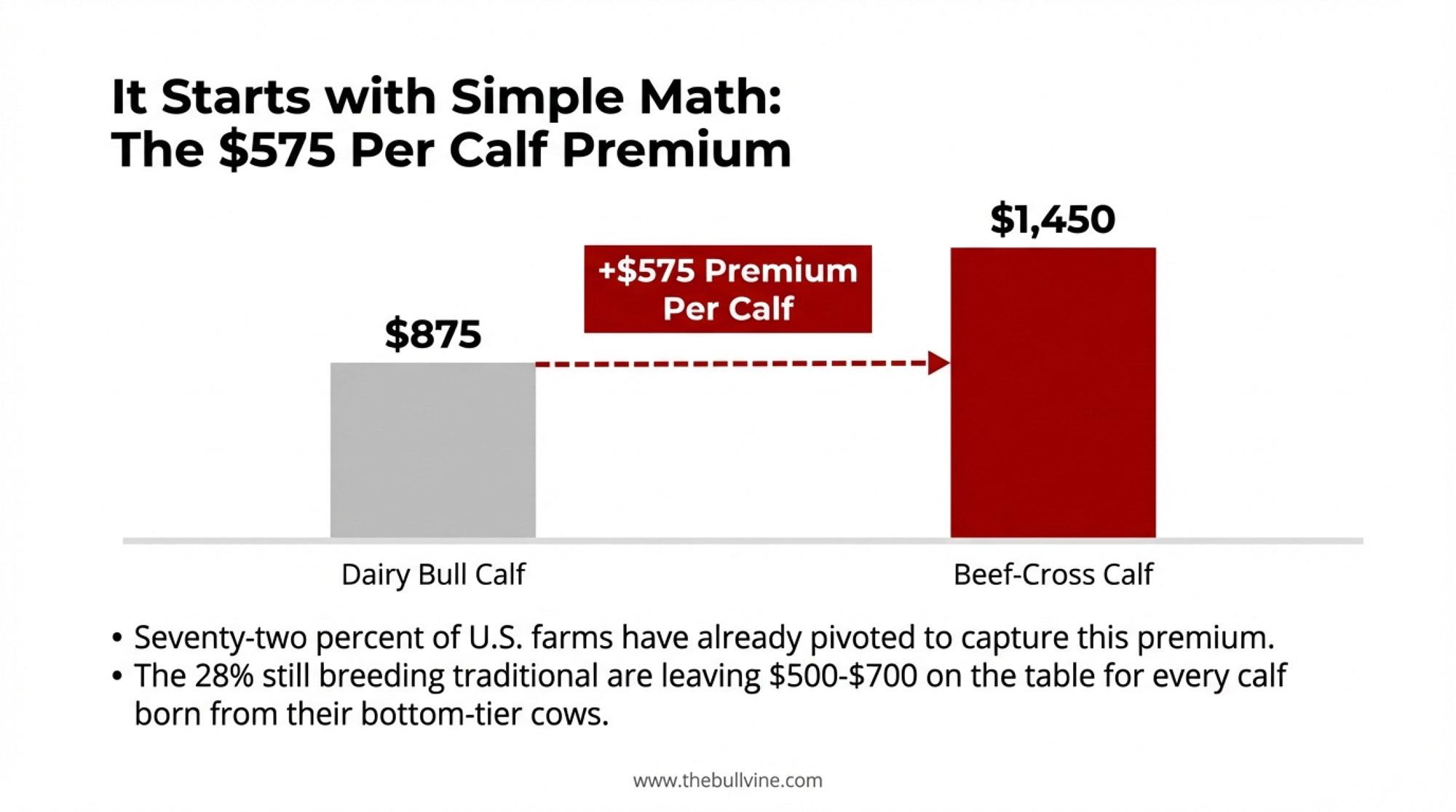
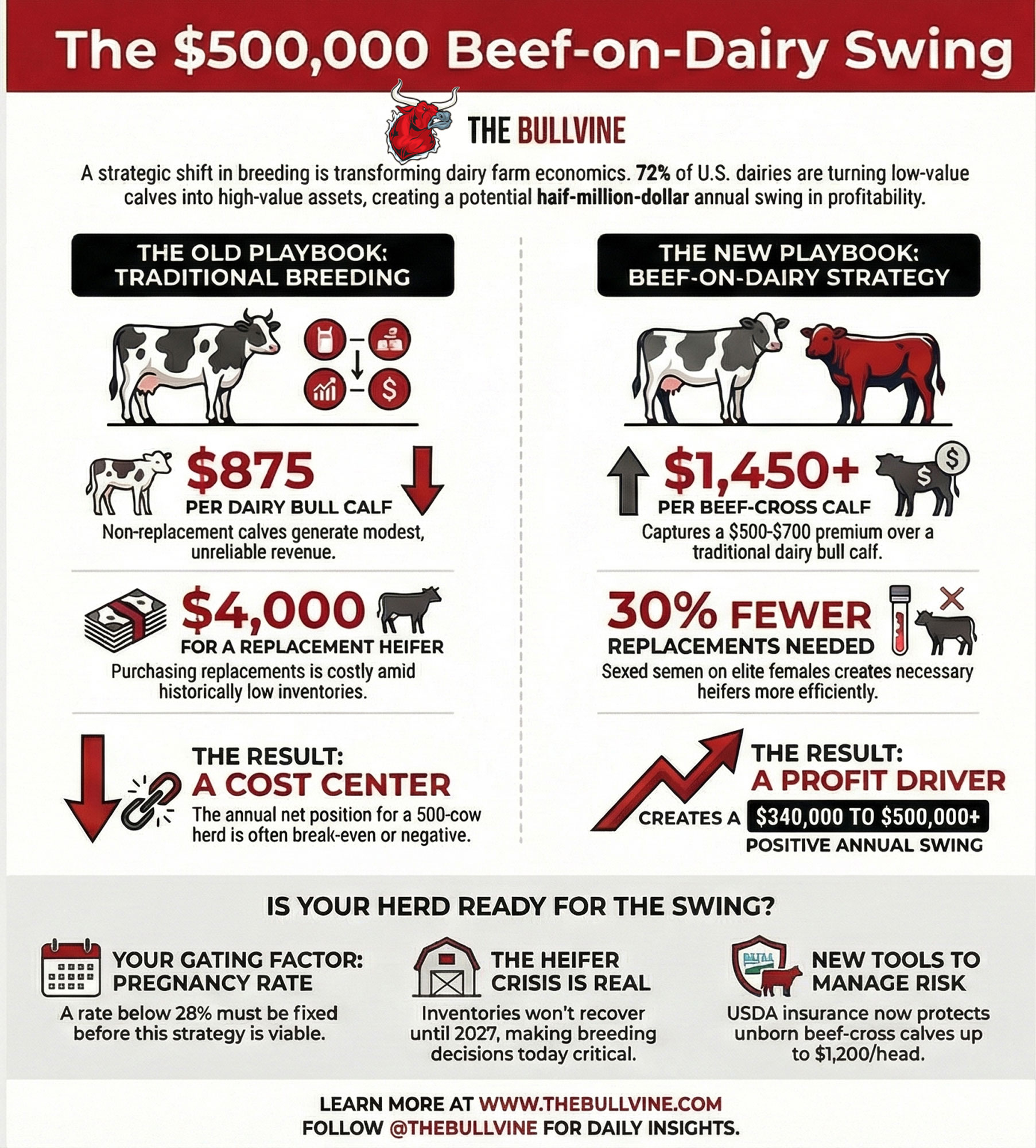
The economics driving that growth are obvious. Beef-cross calves have commanded prices as high as $1,400 day-old, compared to roughly $200 for conventional Holstein bull calves. At that kind of spread, the premium still justifies the program for most operations. But only if you’re actively managing marketing channel risk—not assuming it away.
The Eberts illustrate how that commitment plays out at the farm scale. Jordan told Dairy Star the family has been breeding beef “for over 10 years,” and Brownfield reported their beef-on-dairy efforts began roughly fourteen years ago. In 2013, they decided to start raising their own beef cattle rather than selling calves. “We make more beef calves now than dairy calves,” Jordan said. With only the top 20% of the herd designated for dairy semen, the remaining roughly 80% goes to beef bulls. Farm Progress profiled them at 2,200 beef crosses in 2021; Dairy Star reported 2,500 post-wean-to-finish in January 2024, while a Visit Algoma listing from the same year put it at approximately 2,000. They market through Equity Livestock and have even added their own harvest facility and the Ebert Grown retail brand.
That kind of commitment — breeding protocols restructured, a butcher shop and restaurant built to capture more of the value chain — doesn’t reverse easily. Which makes the question of where those calves ultimately end up a lot more than academic.
Three Pressure Points Between Your Beef-on-Dairy Calf and Its Buyer
The infrastructure challenge hits differently depending on your scale. A 200-cow dairy selling 80 beef-cross calves a year through a single local auction is more exposed to any one of these shifts than a 4,000-cow operation with multiple marketing channels. Scale doesn’t eliminate risk, but it changes where the risk concentrates.
Here’s a quick-glance look at the three facility moves shaping the landscape right now:
Facility
Location
Daily Capacity
Impact on Your Calves
Cargill Milwaukee
Milwaukee, WI
Ground beef only (ZERO live cattle since 2014)
NONE – Never bought your calves
Tyson Lexington
Lexington, NE
5,000 head/day
CRITICAL – 5% of U.S. capacity GONE
Tyson Amarillo
Amarillo, TX
Cut to single shift
HIGH – 1,761 jobs eliminated
AFG America’s Heartland
Wright City, MO
2,400 head/day (NEW)
POSITIVE – Built for dairy-beef crosses
Packing capacity is tightening. USDA’s February 10, 2026 WASDE report projects 2026 beef production at 25.987 billion pounds — about 0.3% below 2025 levels. That continues a multi-year contraction as the beef cow herd sits at historic lows. The agency has revised its 2026 forecast upward in each of the last two monthly reports, largely due to heavier carcass weights. But the direction is still down year-over-year, and when packers bleed money, they close plants. Tyson’s restructuring is Exhibit A.
Geography is getting harder. A University of Wisconsin Extension survey of 40 dairy farms using beef-cross genetics found the average herd produced 454 beef-cross calves per year, with the largest operations topping 6,200 annually. These calves move through auction barns, calf ranches, and regional dealer networks that all depend on nearby infrastructure staying intact. When a plant closes in central Nebraska, feedlot operators in that region ship finished cattle farther, and that cost works its way backward.
Marketing costs are rising on their own. Wisconsin’s DATCP proposed increasing auction barn licensing fees from $420 to $7,430 — a 1,669% jump — and livestock trucker registration fees from $60 to $370. Jason Mugnaini of the Wisconsin Farm Bureau called it “a substantial burden on markets, dealers, and truckers that will unavoidably be passed down to farmers.” Public outcry forced DATCP to scale the proposal back to a more modest inflationary adjustment, but the revised fees still leave an annual funding gap exceeding $680,000.
Not All Contraction: New Capacity With Wisconsin Roots
One major development is working in the other direction.
American Foods Group, headquartered in Green Bay, Wisconsin, opened its $800 million America’s Heartland Packing plant in Wright City, Missouri, in April 2025. The facility spans 775,000 square feet, has the capacity to harvest 2,400 head per day, and is projected to employ 1,300 workers at full capacity.
AFG president Steve Van Lannen told Brownfield before the plant opened that dairy-origin cattle were central to the business model: “A big part of our model is the dairy industry. There will be opportunities for cattlemen to feed those beef-dairy crosses.”
That’s meaningful — a Wisconsin-headquartered company building specifically to handle mixed cattle, including dairy-beef crosses. But the plant is in Missouri, not the Upper Midwest. For Wisconsin producers, the transportation math still matters.
The Bottom Line
The Cargill Milwaukee headline is a useful false alarm. It exposes a question most of us haven’t asked directly: Do you actually know the path your beef-cross calves travel from your farm to a packer’s kill floor?
But it should also sharpen a harder question about your sire stack. Because, as the Tyson closure proves, when capacity is tight, packers get picky. They aren’t just buying “beef-on-dairy” — they’re buying predictable rail performance.
Map your supply chain this month. Ask your calf buyer which feedlot your calves reach, and which packer that feedlot uses. If they can’t or won’t tell you, that gap in visibility is itself a risk.
Count your marketing channels. If more than two-thirds of your beef-cross calves go through a single auction barn or buyer, you’re overexposed. Smaller herds may find diversifying harder — which is exactly why it matters more, not less.
Move past the three C’s. The UW Extension survey found most Wisconsin producers still pick beef sires primarily for conception rate, calving ease, and semen cost. Those matter. But when fewer plants are competing for your calves’ finished product, carcass uniformity becomes the trait that separates you from the skip list.Feedlots forecast finish dates and schedule packer appointments for entire pens — inconsistent growth rates within a pen mean some animals hit the target and others miss, creating discounts for the whole group. Andrew Sandeen of Penn State Extension, relaying feedback from JBS beef plant buyers, described the challenge head-on: “Everything from the quality to the shape and size — it’s all over the board.” JBS had built strategies around the consistency of straight Holstein beef. As beef-on-dairy volume grows, that variability is becoming a real friction point for packers.
Select for what the packer actually measures. Ribeye area and shape, marbling, yield grade, and moderate frame — those are the traits that earn premiums at the rail. A 2024 Penn State study led by Basiel et al. evaluated 262 beef × Holstein steers across seven sire breeds over three years and found that, on average, all sire breed groups graded USDA Choice with yield grades of two or three. But within that average, sire selection drove meaningful variation: Angus-sired steers gained 1.76 kg/day versus just 1.39 kg/day for Wagyu-sired steers (P < 0.01), and marbling scores ranged from 4.14 (Limousin-sired) to 5.03 (Red Angus-sired). The Eberts use Angus and Simmental-Angus crosses through AI — breeds that showed strong feedlot ADG in that same research. That’s not a coincidence. It’s a marketing strategy disguised as a breeding decision.
Don’t confuse processing with packing. Cargill Milwaukee makes ground beef for grocery stores. It doesn’t buy cattle. Before you react to any plant closure headline, check whether the facility handles live animals or boxed beef. The difference determines whether the story applies to your farm.
Know your nearest packing plants — and what happened to them in the last 12 months. Tyson Lexington is gone. AFG Missouri is new. Cargill stated in November 2025 that it doesn’t intend to close any of its eight primary beef processing facilities and is investing in them. That landscape shifts. Stay current. Watch USDA’s next Cattle report and any signals on AFG Missouri’s actual throughput mix — both will indicate where beef-on-dairy infrastructure is heading through the rest of 2026.
The Eberts learned something interesting when they added on-farm meat processing through their Ebert Grown brand. Making their own sausage products, Randy told Brownfield, actually cost more than buying from a supplier. “We can still buy that product cheaper from a supplier than what we can efficiently do it,” he said. “That’s where we thought we could vertically integrate and have an advantage, and it’s actually, it isn’t that way.”
It’s a quietly important detail. The beef-on-dairy math works — the Ebert family has spent over a decade building a program with 2,000-plus head to prove it. But every link in that chain has its own economics, and assumptions about what you control versus what the system controls get tested eventually. Knowing the difference between a ground beef plant and a packing plant isn’t trivia. And neither is knowing the difference between a sire that gets your cow pregnant and one that gets your calf paid. As capacity tightens, the calves with predictable carcass performance are increasingly the ones that find homes first — and that reality should be part of every sire selection conversation you have this spring.
Key Takeaways
The Cargill Milwaukee plant that’s closing is a ground beef facility that hasn’t slaughtered cattle since 2014, so it never bought your calves and doesn’t change your day‑to‑day beef‑on‑dairy marketing.
Tyson’s 5,000‑head‑a‑day Lexington shutdown — plus cuts at Amarillo — is the real pressure point, tightening kill‑floor access beef‑on‑dairy volume has jumped to about 3.22 million calves and 7.9 million beef semen units in dairy herds.
Ebert Enterprises’ 4,200‑cow Wisconsin herd shows one workable path: know exactly where your calves go, avoid being tied to a single buyer, and use Angus and Simmental‑Angus sires with documented feedlot and carcass performance, not just the cheapest semen.
Penn State data backs that approach, finding that all beef × Holstein groups average Choice, but some sire breeds deliver significantly better gain and marbling — the kind of consistency packers remember when hooks are tight.
If you’re serious about beef‑on‑dairy, packer capacity and carcass predictability now belong in the same conversation as conception rate and calving ease every time you build your breeding list.
Complete references and supporting documentation are available upon request by contacting the editorial team at editor@thebullvine.com.
Learn More
Beef-on-Dairy’s $6,215 Secret: Why 72% of Herds Are Playing It Wrong – Stop leaving money on the table by chasing the wrong premiums. This breakdown arms you with a specific ROI framework to pivot from “just selling calves” to capturing the full margin your genetics deserve.
Processor Power Play: Is Your Milk Check Getting Squeezed? – Packer consolidation isn’t just a beef problem—it’s a dairy blueprint. This analysis exposes the structural shifts in regional processing, giving you the foresight to position your operation before the next major plant closure.
$3,010 Per Heifer. 800,000 Short. Your Beef-on-Dairy Bill Is Due. – The beef-on-dairy craze has a massive blind spot: your own replacement pipeline. Discover how maverick herds are using precision data to balance beef premiums without nuking their future dairy herd’s genetic progress.
Join the Revolution!
Join over 30,000 successful dairy professionals who rely on Bullvine Weekly for their competitive edge. Delivered directly to your inbox each week, our exclusive industry insights help you make smarter decisions while saving precious hours every week. Never miss critical updates on milk production trends, breakthrough technologies, and profit-boosting strategies that top producers are already implementing. Subscribe now to transform your dairy operation’s efficiency and profitability—your future success is just one click away.
$225K from beef‑on‑dairy, $6M digesters in the red, and 10-year permits on offer. This isn’t theory — it’s where herds are actually moving.
Executive Summary: South Dakota has become dairy’s new magnet, adding 25,000 cows in a year to hit 240,000 head by January 2026, while California Dairies Inc. shut a 99‑year‑old plant in Los Banos. The piece shows how that kind of dairy farm relocation is being driven by 10‑year CAFO permits, nine‑figure cheese investments, and genetics built for component pricing on the I‑29 corridor — and by rising water, labor, and methane‑rule friction in the West. It puts real faces on the shift: David Lemstra leaving California after 40 years to build Dakota Line Dairy in South Dakota, and California producers like Jared Fernandes and Simon Vander Woude staying put but flipping genetics, forage use, and beef‑on‑dairy strategy to make the math work. On the income side, beef‑on‑dairy crosses that bring $80–90 a head over Holsteins can add about $225,000 a year to a 2,000‑cow herd; on the cost side, $6‑million digesters and LCFS credits falling from $200 to ~$60/ton have turned many “green” projects into long‑shot paybacks. From there, it lays out three concrete paths — relocate, stay and adapt, or cash out — backed by specific rules of thumb like a $0.75/cwt 3‑year basis trigger, a 7–10‑year relocation payback window, and a 20% 21‑day pregnancy rate threshold for sexed‑on‑top/beef‑on‑bottom programs. The takeaway for 2026 is blunt: sitting in the middle — too big for niche, too small for true scale, stuck in a high‑friction state — is a choice, and probably the riskiest one on the table.
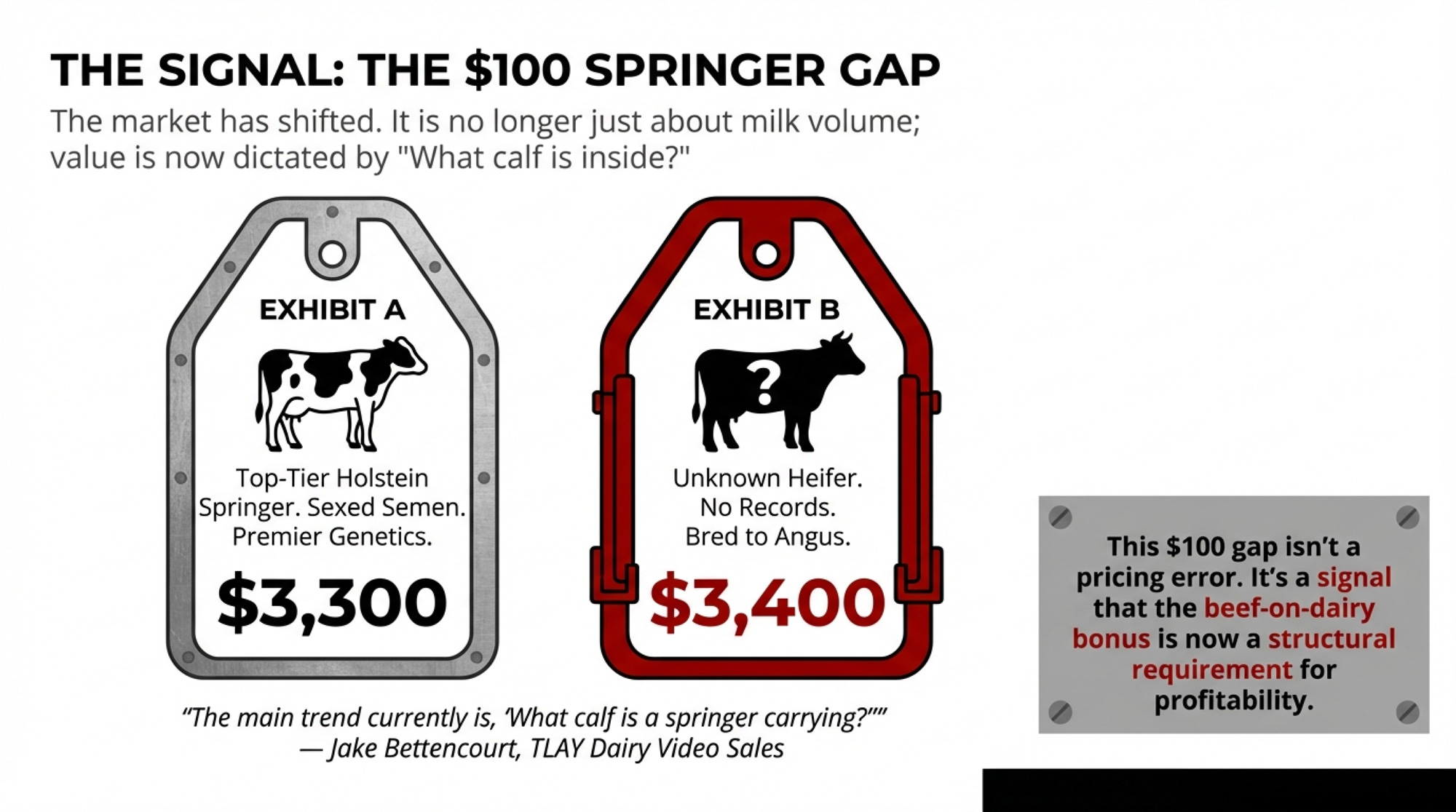
In January 2026, a load of Holstein springers from a top-tier herd — impeccable records, sexed-semen confirmation, premier genetics — sold for $3,300 a head. Two loads of heifers from custom raisers, with no birthdates, no records, and bred to natural-service Black Angus bulls, cleared $3,400. Jake Bettencourt of TLAY Dairy Video Sales, who witnessed the sale, put it plainly: “The main trend currently is, ‘What calf is a springer carrying?'”
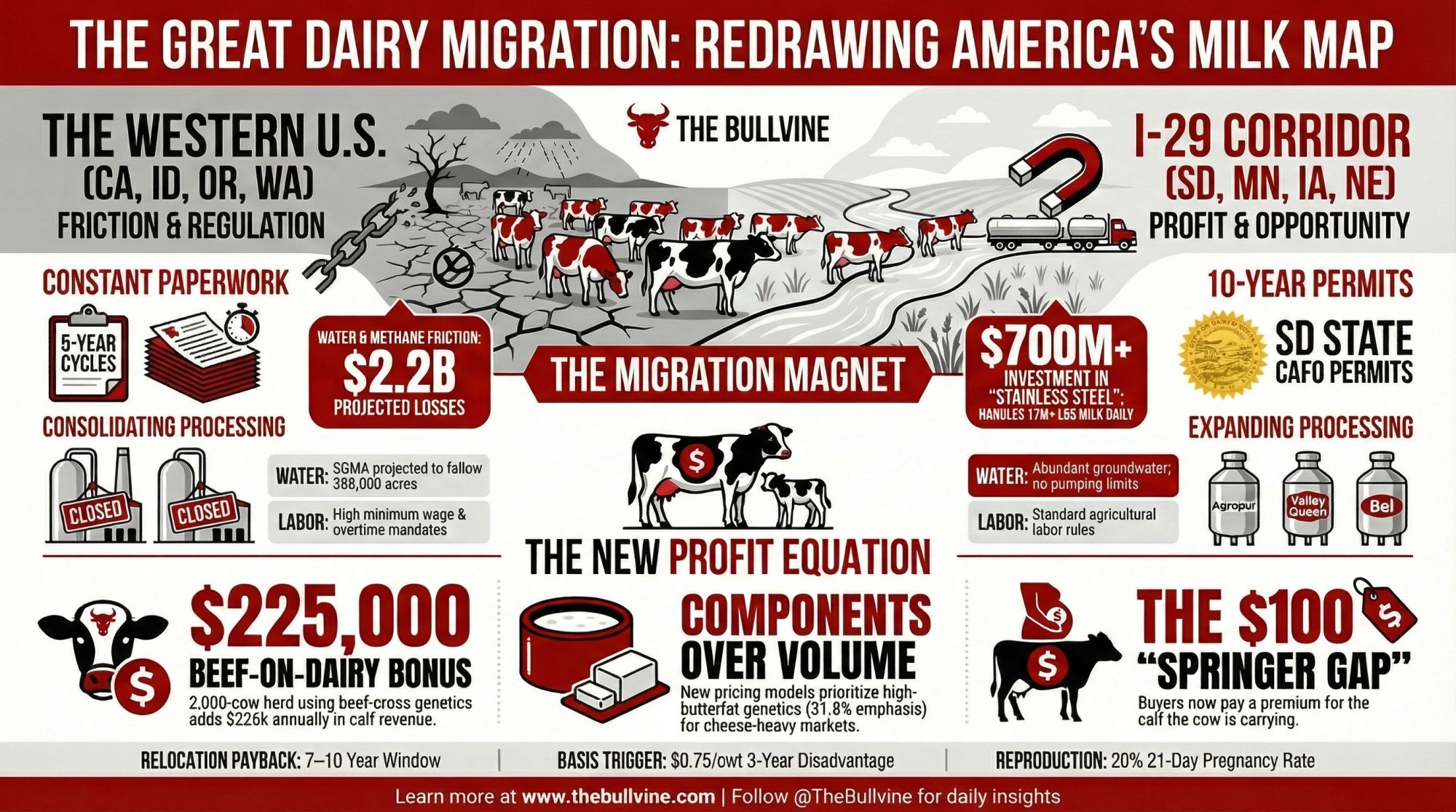
That $100 gap is a small number with a big message. This dairy migration — the relocation of dairy farms at an industrial scale — isn’t just about geography. It’s about which regions built systems where every piece of the profit equation works together, and which ones quietly stacked friction until producers started loading trucks.
88,000 Cows in Five Years — and 25,000 More Right Behind Them
The I-29 and I-90 corridors running through South Dakota, Minnesota, Iowa, and Nebraska have become the primary growth engine for U.S. milk production. The reason isn’t abstract. It’s stainless steel.
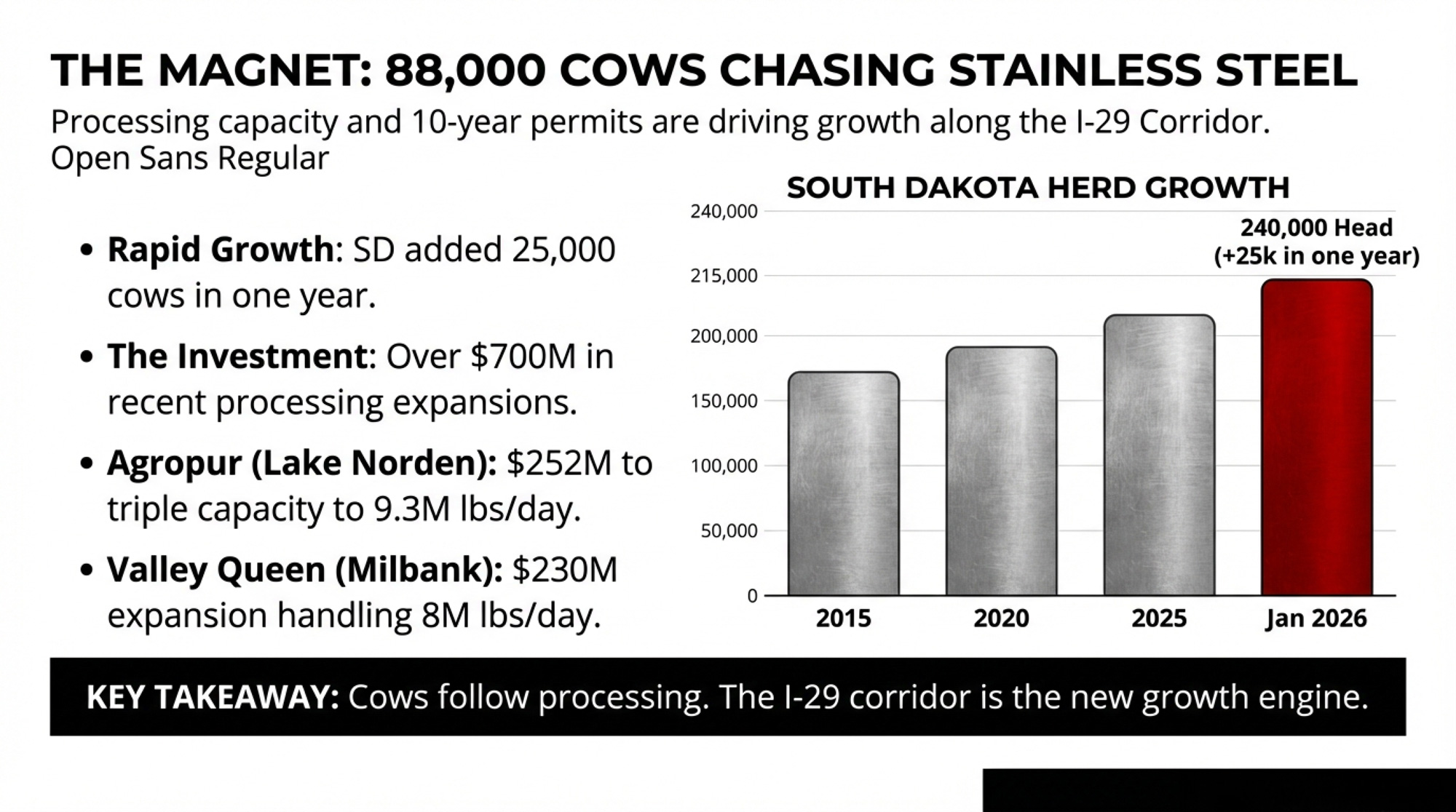
Three processor expansions tell the story. Agropur invested $252 million to nearly triple capacity at its Lake Norden, South Dakota, plant, going from 3.3 million to 9.3 million pounds of milk per day. Valley Queen Cheese in Milbank broke ground on what was originally announced in 2022 as a $195 million expansion, its largest in 93 years. That project came in at $230 million and by late 2025 was handling 8 million pounds of milk daily. Bel Brands launched its Brookings facility, adding still more demand.
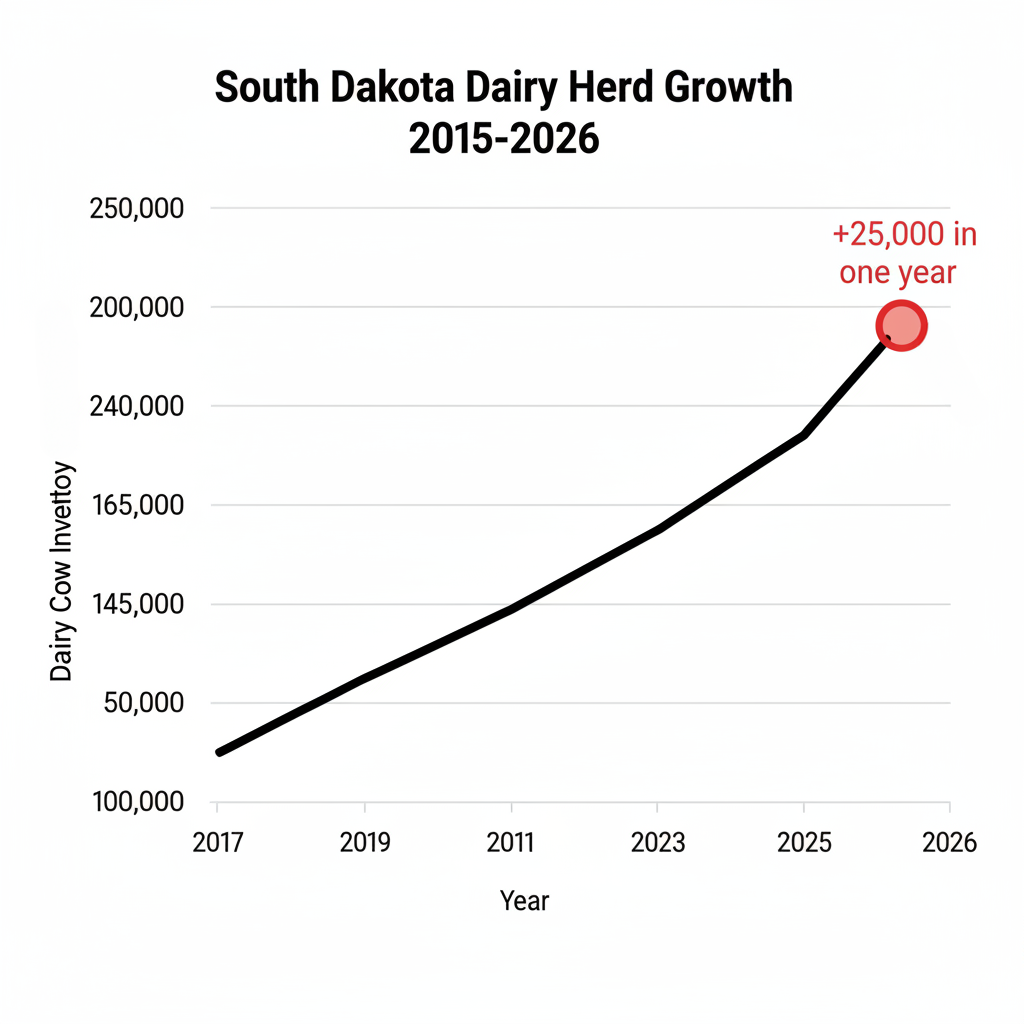
The cows came — fast. South Dakota’s milk cow population reached 215,000 as of January 1, 2025 — more than doubling in a decade, a gain of 117% that leads the nation. Some 88,000 of those cows arrived in just five years, a 69% jump. Then it kept going. USDA NASS confirms the state’s dairy herd reached 240,000 head as of January 1, 2026 — exactly the 25,000 additional cows Valley Queen’s Evan Grong had projected. South Dakota’s December 2025 milk production ran more than 11% above the prior year, the biggest increase among the 24 major dairy states — in a national herd of 9.57 million, South Dakota punched well above its weight.
Tom Peterson, executive director of South Dakota Dairy Producers, describes a deliberate effort: “About 20 years ago, South Dakota leaders and stakeholders came together with farmers and milk processors to develop a plan to not only ensure dairy industry survival in the state, but with aspirations of creating a dairy destination”. GOED Commissioner Chris Schilken estimated in early 2024 that the economic impact of 118,000 additional cows was “nearly $4 billion annually”. With 25,000 more since then, that number has only climbed.
A Genetics Gap Is Emerging
Here’s a dimension of this migration that gets overlooked: the cows moving east aren’t just changing zip codes. They’re changing what gets selected for.
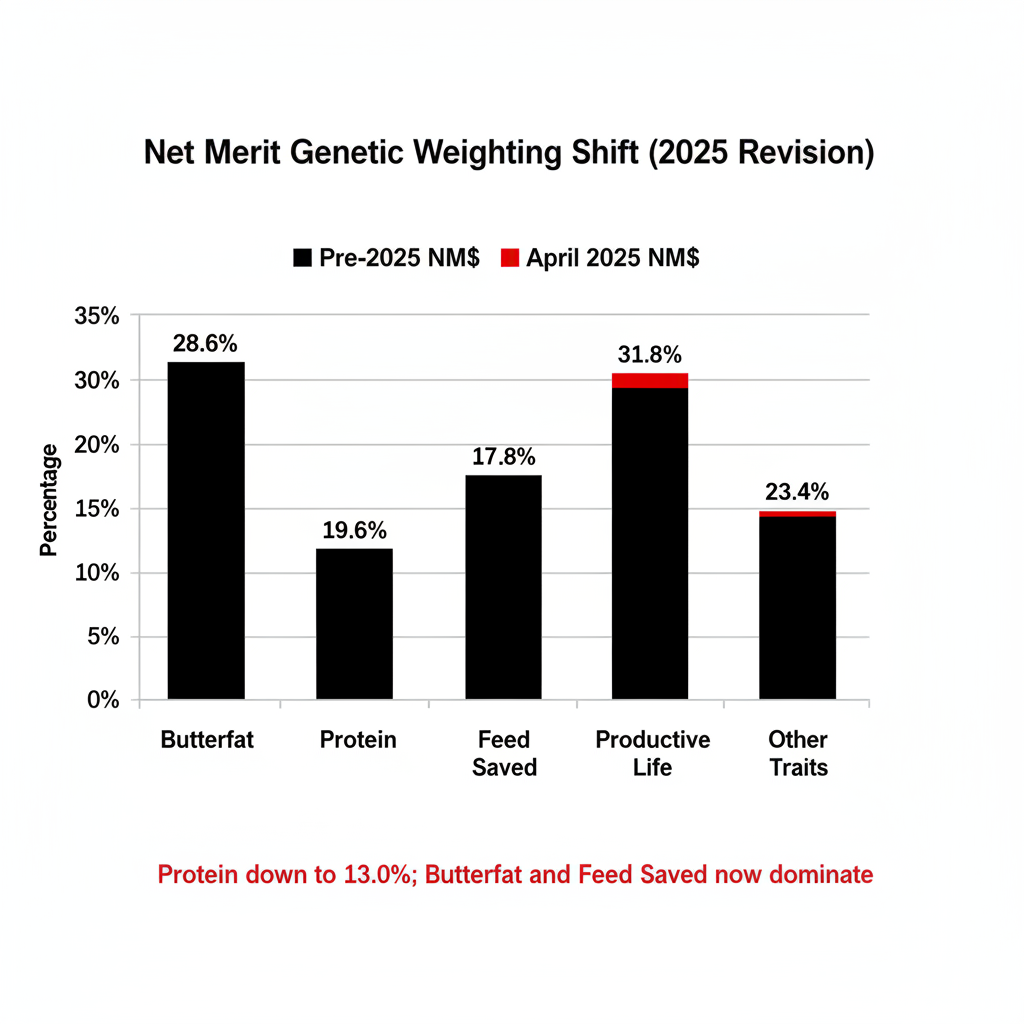
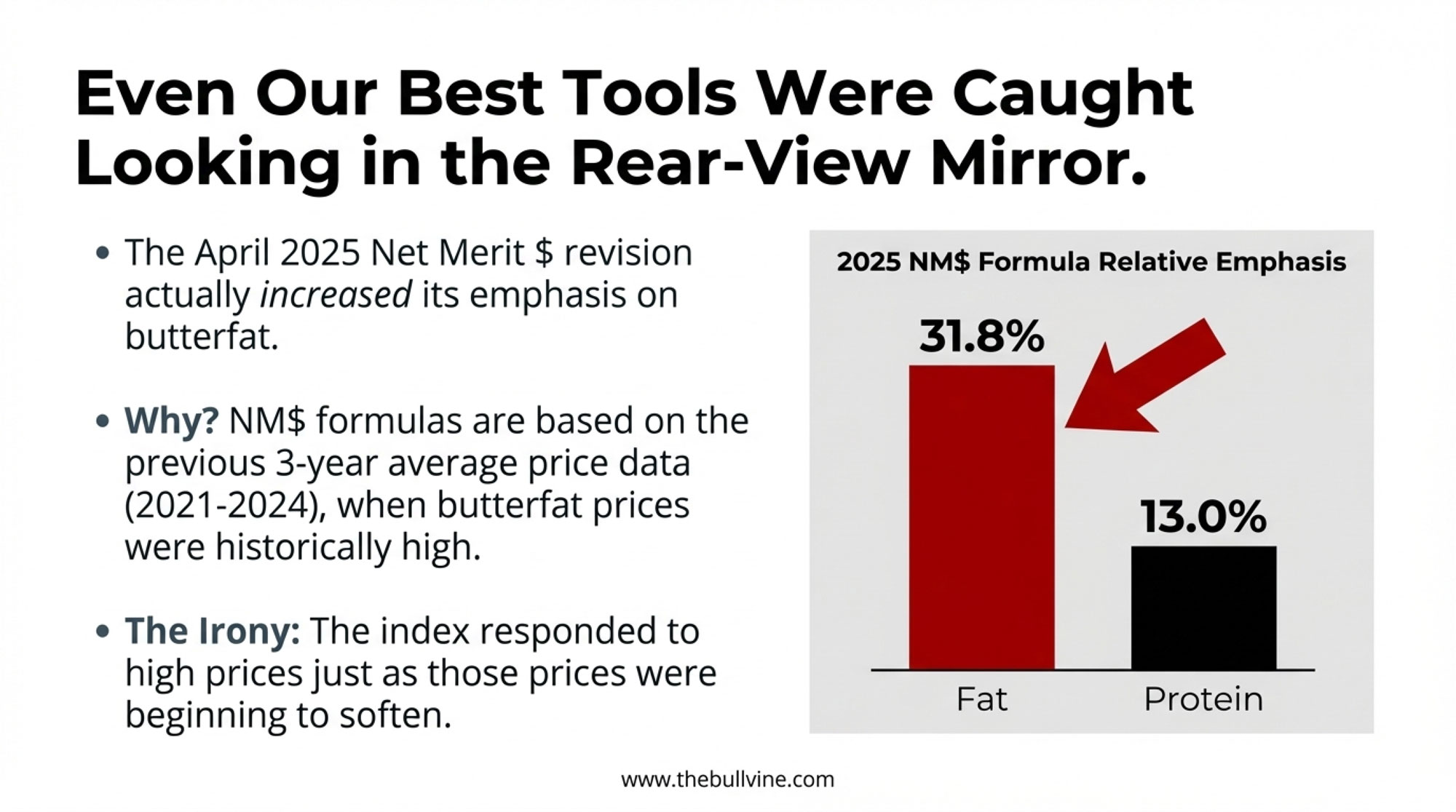
The Upper Midwest model is built around cheese vats. Valley Queen, Agropur, Bel Brands: component-driven processors. That means the genetics flowing into the I-29 corridor increasingly prioritize high-butterfat, high-component cattle that fit Cheese Merit profiles — and component pricing rewards them for it. The April 2025 Net Merit revision tells the same story nationally: CDCB bumped butterfat emphasis to 31.8% (up from 28.6%) while dropping protein from 19.6% to 13.0%, and pushed Feed Saved to 17.8%. Holstein butterfat hit a national average of 4.23% in 2024, per CoBank’s Corey Geiger. Under the revised NM$ weightings, a cow with top-decile butterfat and Feed Saved genetics delivers meaningfully more lifetime profit than a volume-only counterpart — the exact dollar advantage varies by herd and market, but the directional shift is unmistakable.
For I‑29 shippers, CM$ often beats NM$ as your main index, because plants like Valley Queen and Agropur pay you on components, not volume.
The Western model may need a different genetic profile entirely. Jared Fernandes at Legacy Ranches in Tulare County made that call: he switched from Holsteins to Jerseys, cutting forage consumption by 30% and reducing water use on a 4,500-cow operation facing tight water supplies. In Merced County, Simon Vander Woude took a different approach: genomic testing since 2012, beef-on-dairy crosses on 60% of calvings, cull rate around 30%, and average lactations pushed to 2.7 — up from 2.2 when he started. “We are creating more milk with fewer cows, more components in the milk with fewer cows,” Vander Woude said. “That’s fewer mouths eating, fewer heifers”.
Dairy Migration: Two Systems, Two Sets of Friction
California’s December 2024 milk production fell 6.8% year over year — the state’s steepest monthly drop in roughly 20 years, heavily amplified by HPAI, which hit 747 of approximately 950 dairy farms. California recovered by mid-2025 — production up 2.7% in June versus 2024 —, but the episode exposed structural vulnerabilities that predate the outbreak. Idaho’s Rick Naerebout reported the cost of production “above $18.50 per hundredweight and still around $20 for many.” Oregon’s John Van Dam: “staying above water but not going anywhere”.
Upper Midwest (I-29 Corridor)
Western U.S. (CA, ID, OR, WA)
CAFO Permits
10-year state permits (SD DANR)
5-year federal NPDES cycle; annual state layers
Processing
$700M+ invested 2019–2025; coordinated with cow growth
CDI closed Artesia (2020) and Los Banos (Oct. 2024) — two plants in four years
Water
Abundant groundwater; no pumping restrictions
SGMA projected to fallow 388,000 acres, cut dairy output $2.2B by 2040
Methane Rules
Minimal state mandates
$300–$675M/year in projected losses under direct regulation
Digester Economics
N/A (not required)
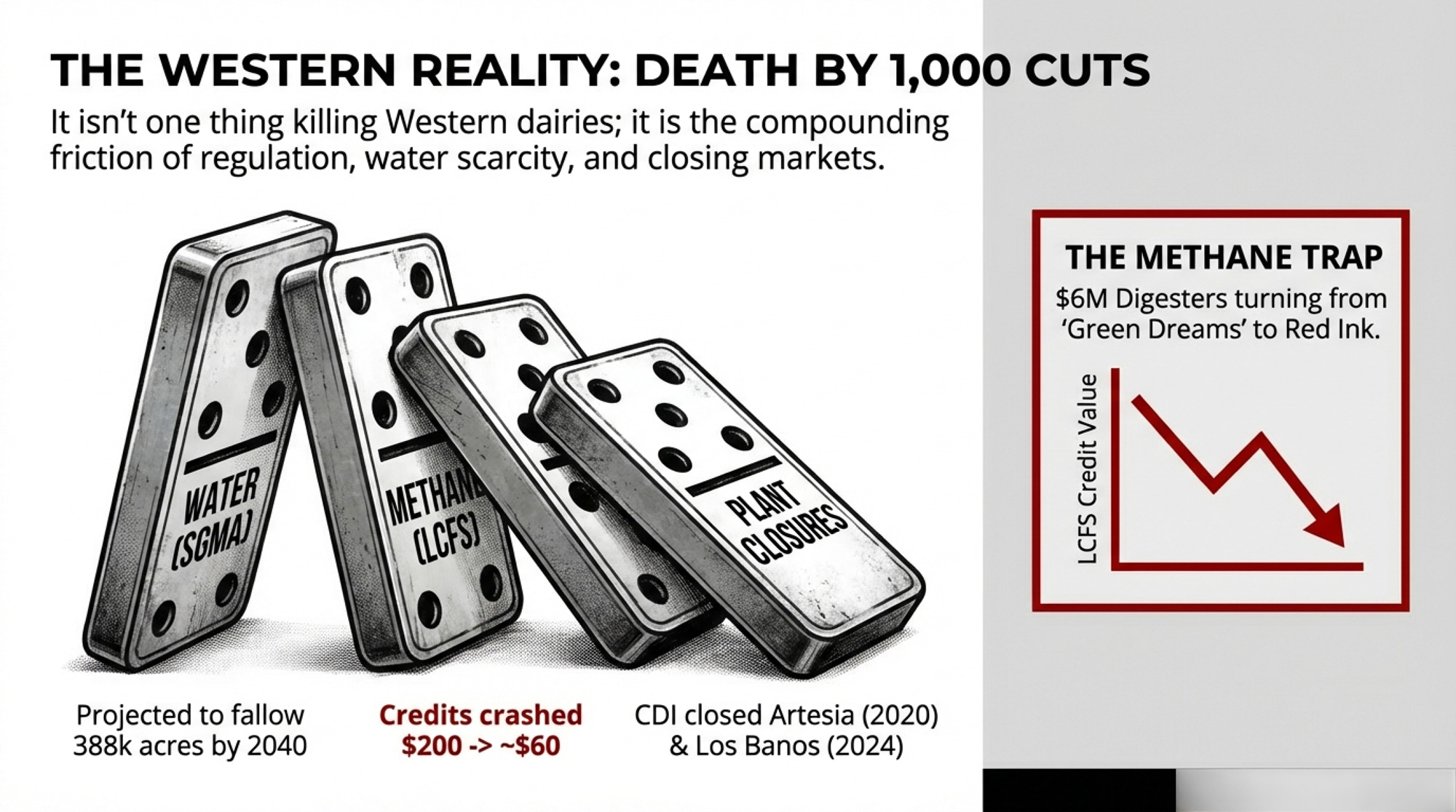
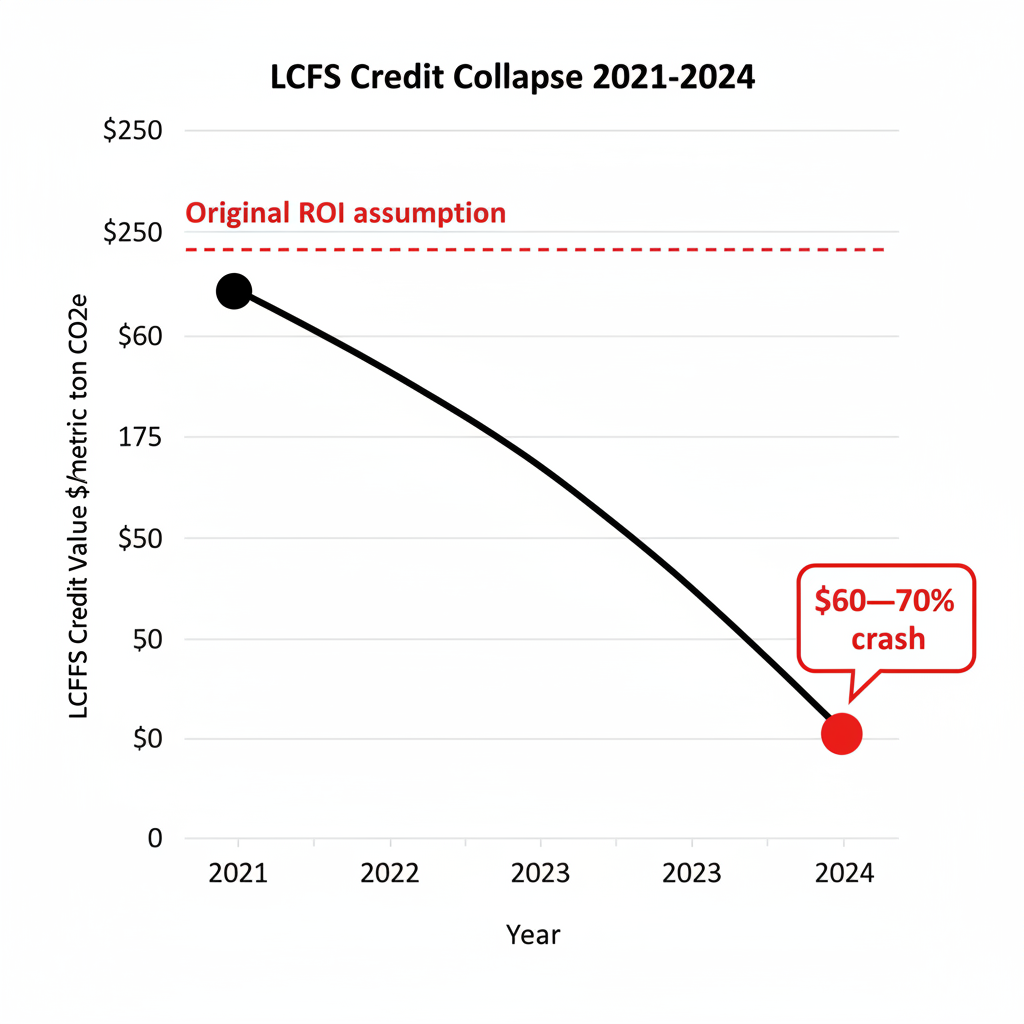
$6M+ per unit; LCFS credits crashed from $200 to ~$60/MT (2021–2024)
Labor
Standard ag labor rules
CA/WA: highest minimum wages + ag overtime mandates
Legislative
Pro-dairy incentive programs (GOED)
25 anti-dairy bills killed cumulatively through 2023
Genetics
Component-driven (CM$); fits cheese processing
Under pressure to shift — Fernandes (Jersey pivot) and Vander Woude (genomic efficiency) lead
The LCFS column deserves a closer look. Digester construction averages over $6 million per unit. Those investments were supposed to pencil on strong carbon credit revenue. Instead, the green dream turned into a red-ink reality for many Western digesters. UC Berkeley professor Aaron Smith found dairy digester developers need approximately 10 years to achieve ROI on avoided methane credits — and that’s if credit values hold, which they haven’t. Anja Raudabaugh, CEO of Western United Dairies, noted that producers face “years of delay for approval and additional years of waiting for the actual money to show up”.
ERA Economics’ February 2023 analysis projects a 130,000-head reduction in California’s herd by 2040 under SGMA. A separate ERA report from September 2024 estimates 20–25% of small dairies could exit under direct methane regulation. These aren’t one-time hits. They compound annually — and they fall hardest on mid-sized commodity operations too large for niche premiums and too small to absorb six- and seven-figure regulatory overhead.
The Beef-on-Dairy Premium: A Profit Engine That Follows the Truck
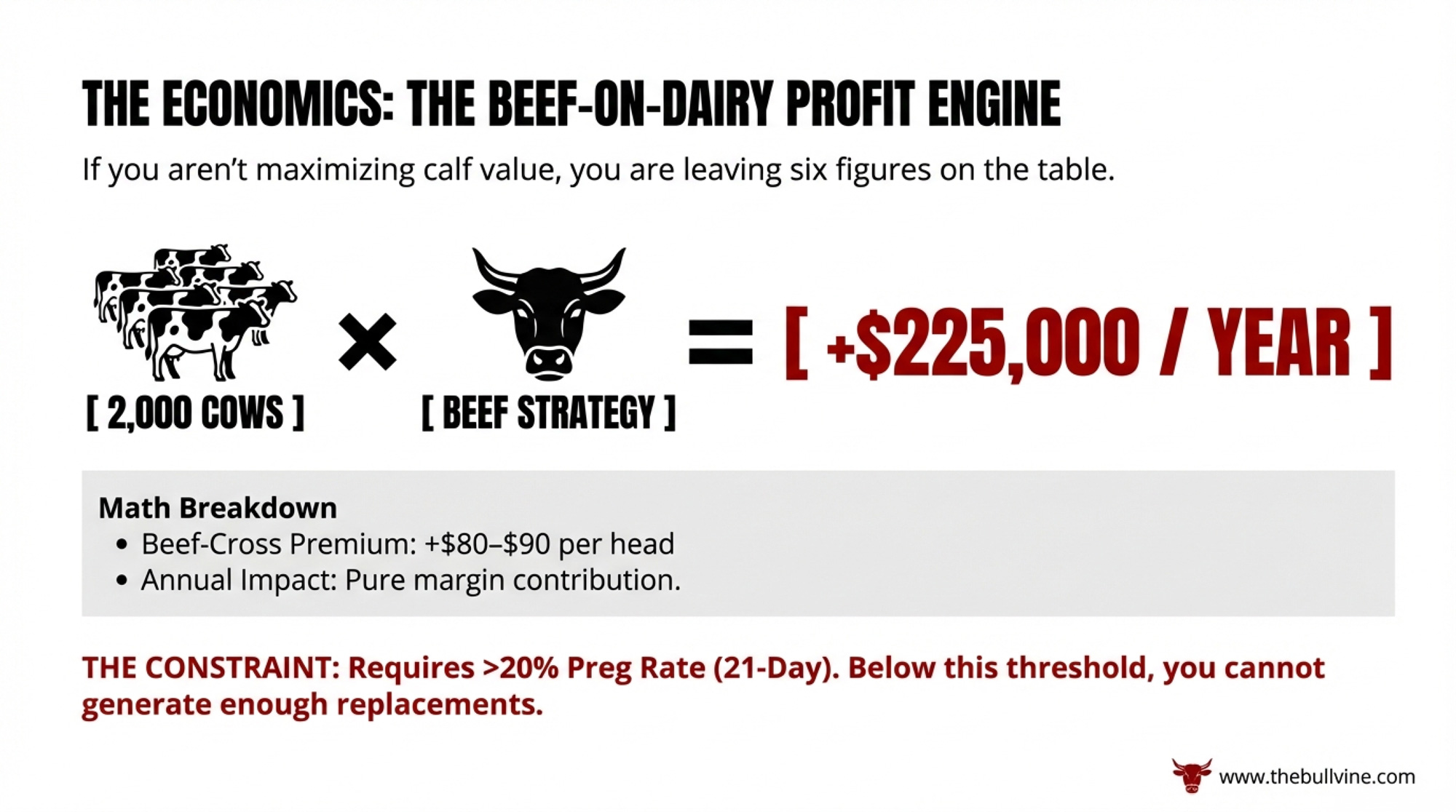
The $100 springer gap Bettencourt described is the visible edge of a much larger shift. Kansas State University researchers, analyzing 14,075 feeder steer lots through Superior Livestock (2020–2021), found beef-on-dairy crosses at 550–600 pounds bringing roughly $80–90 per head more than straight Holstein steers. UF dairy economist Albert De Vries found that when 21-day pregnancy rates exceed 20%, a sexed-on-top, beef-on-bottom strategy maximizes calf income while still generating enough replacements. Below that threshold, you may not be making enough heifers to sustain the replacement pipeline.
Scale it: a 2,000-cow herd producing roughly 1,500 beef-cross calves annually at a conservative $150/head advantageworks out to $225,000 per year in extra calf revenue. That premium is location-sensitive — regions with established feedlots and packers set up for beef-on-dairy pay more consistently. The I-29 corridor has that infrastructure. And with the U.S. beef cattle inventory at a 75-year low of 86.2 million head as of January 2026, those premiums have structural support. But cattle cycles turn.
Three Paths Forward — and What Each One Costs
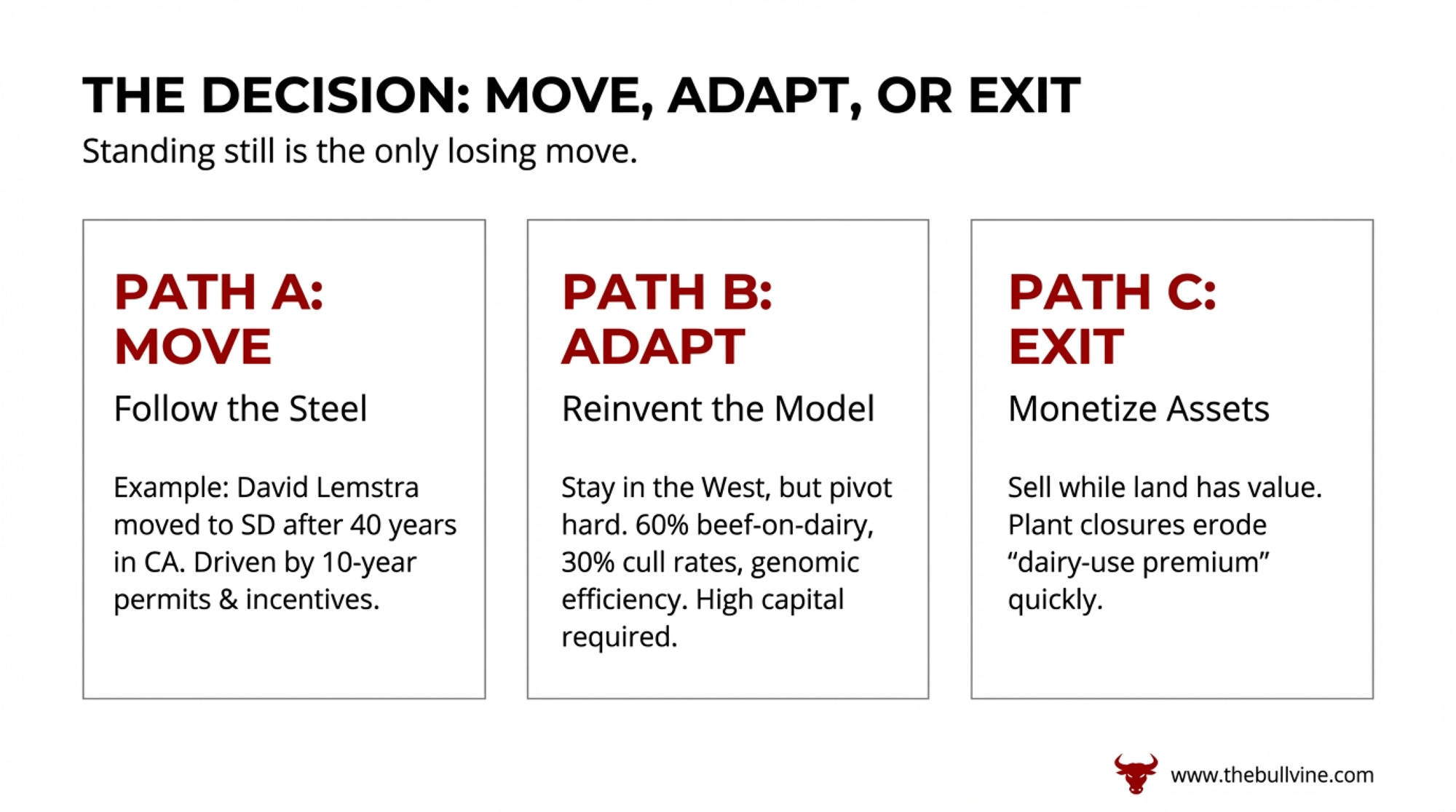
Path A: Move the cows to fit the system. David Lemstra did exactly this. After more than 40 years in central California, he spent nearly a decade researching alternatives before building Dakota Line Dairy in Humboldt, South Dakota. Today, the Lemstras milk 4,000 cows and ship to Agropur’s Lake Norden plant. Feed, permits, and processing” drove the move. He described leaving California as “death by 1,000 cuts”. Compare your 10-year “stay” cost to building in a growth corridor after selling your current assets. If the payback falls within 7–10 years, it pencils out. The risk: capital-intensive, and the best processor relationships won’t wait.
Path B: Change the model to fit the ground. Fernandes built a digester, went deep on regenerative ag, and made the genetic pivot to Jerseys. “We do a lot of things that you don’t hear about, that I think are sustainable,” he said at the 2025 California Dairy Sustainability Summit. Vander Woude kept Holsteins but used genomics to push average lactations from 2.2 to 2.7 while running 60% beef-on-dairy — more milk and more valuable calves from fewer animals. ERA Economics notes that digester revenue-share agreements typically provide $50–100 per cow per year, which is meaningful if volatile. The risk: heavy capital and regulatory tolerance required; niching down means brand-premium volatility.
Path C: Monetize the asset base. For operations where neither moving nor reinventing pencils, the honest option may be selling while assets still command value. ERA projects 388,000 acres could be fallowed in the San Joaquin Valley under SGMA. Selling from strength is a different negotiation than selling from distress.
Path
A: Relocate to Growth Corridor
B: Reinvent In Place
C: Monetize & Exit
Description
Move cows to I-29 corridor; build on 10-yr permits, processor contracts
Digester + genetics pivot (Jersey/genomic efficiency) + regen ag
Sell assets while value remains; avoid distressed sale
7–10 years (basis advantage + calf premium + water/compliance savings)
10+ years (digester ROI alone ~10 yrs; genetics 3–5 yrs to see full shift)
Immediate liquidity; capital preservation
Key Risks
Capital-intensive; best processor relationships won’t wait; market timing
Heavy regulatory tolerance required; LCFS/SGMA volatility; brand-premium niche risk
Timing matters—asset values eroding as Western processing consolidates
Best Fit For…
2,000+ cow herds with equity, rolling 3-yr basis drag >$0.75/cwt, appetite for scale
Established Western herds with strong brand access, regen ag commitment, high reproductive efficiency
Mid-size commodity herds: too big for niche, too small for scale, stuck in high-friction state
Your 90-Day Decision Checklist
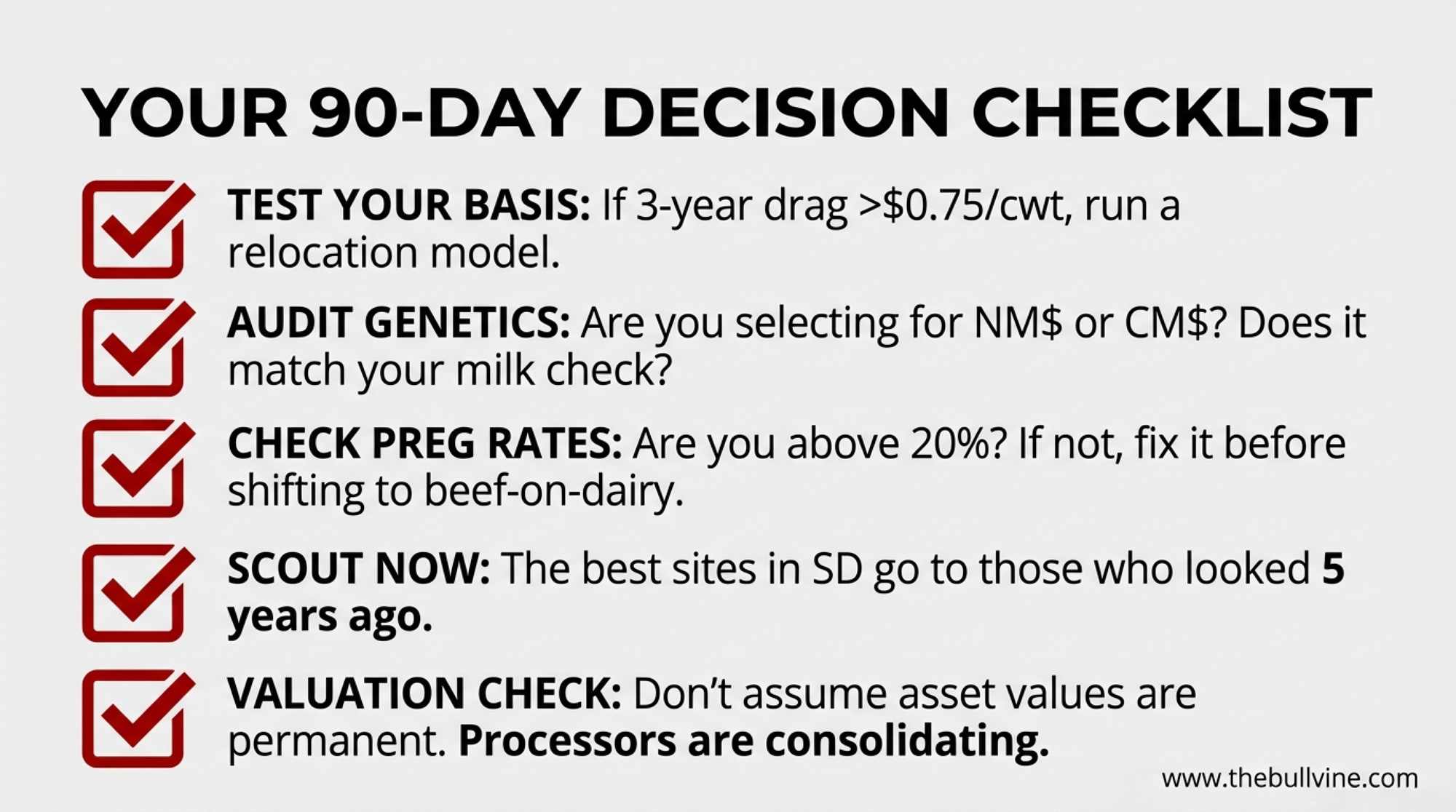
Run your 10-year “stay” scenario. Pull your rolling 3-year basis versus the best alternative region. Add actual water and compliance cost trends. If the cumulative drag exceeds $400,000–$500,000 per year, relocation deserves a serious model.
Test your basis trigger. A rolling 3-year disadvantage exceeding $0.75/cwt means $225,000 annually on a 2,000-cow herd shipping 300,000 cwt/year. Before water, compliance, or calf value.
Audit your genetic alignment. Are you selecting for CM$ or NM$ to match your actual processor contract? The April 2025 NM$ revision puts butterfat at 31.8% — if you’re shipping into a fluid market, that may not be your index.
Check your 21-day pregnancy rate against the De Vries threshold. Below 20%, a sexed-on-top/beef-on-bottom program may not generate enough replacement heifers.
Scout destination regions before you need them. Lemstra spent nearly a decade researching before he moved. The best sites and processor relationships go to producers who are already known.
Don’t assume your current asset values are permanent. CDI closed two California plants in four years — Artesia in 2020 and Los Banos in October 2024. If processors are consolidating around you, your land’s dairy-use premium may already be eroding.
Key Takeaways
South Dakota’s dairy herd hit 240,000 cows as of January 1, 2026, adding 25,000 head in a single year — exactly matching Grong’s projection, built on 10-year CAFO permits, reinvestment incentives, and nine-figure processor expansions.
The $100 springer premium for beef-cross calves signals that calf revenue belongs in the same strategic column as milk price, basis, and water cost. Beef herd at a 75-year low supports that premium — but cattle cycles turn.
A genetics gap is emerging between component-driven Midwest herds (butterfat now 31.8% of NM$) and Western herds pivoting toward longevity and efficiency. Fernandes’s Jersey switch and Vander Woude’s genomic program show what that pivot looks like.
Western producers face compounding threats: $2.2 billion in projected SGMA losses by 2040; $300–$675 million per year in methane regulation; LCFS credits crashing from $200 to $60; and CDI closing two plants in four years.
Watch in 2026–2027: SGMA implementation deadlines, Midwest processor capacity utilization, and beef-cycle signals that could compress cross-calf premiums.
The Bottom Line
The middle ground — too big for niche, too small for scale, stuck in a high-friction state with genetics optimized for a pricing structure that’s shifting underneath you — is the most dangerous place to be in 2026. The producers hauling cattle east on I-90 have run the numbers long enough to know it. The ones staying, like Fernandes and Vander Woude, are reinventing their operations from the genetics up. Both are making active choices with their eyes open. The only losing move is standing still and hoping the spreadsheet doesn’t notice.
Complete references and supporting documentation are available upon request by contacting the editorial team at editor@thebullvine.com.
Learn More
The 90-Day Dairy Pivot: Converting Beef Windfalls into Next Year’s Survival – Arms you with a tactical 90-day blueprint to convert temporary $1,000 beef-on-dairy windfalls into long-term resilience. Reveals how top-tier herds are stacking $266/cow in extra revenue to survive flat milk checks and rising fixed costs.
211,000 More Dairy Cows. Bleeding Margins. The 2026 Math That Won’t Wait. – Exposes the structural reset of 2026, where a 20-year heifer low meets $11 billion in new processing capacity. Breaks down the $19.80 “real” break-even math to help you position your operation for the upcoming margin squeeze.
Join over 30,000 successful dairy professionals who rely on Bullvine Weekly for their competitive edge. Delivered directly to your inbox each week, our exclusive industry insights help you make smarter decisions while saving precious hours every week. Never miss critical updates on milk production trends, breakthrough technologies, and profit-boosting strategies that top producers are already implementing. Subscribe now to transform your dairy operation’s efficiency and profitability—your future success is just one click away.
Super Bowl LX will burn $8M a spot. Your sire picks can swing $869 per cow. Still letting someone else call the breeding plays?
Executive Summary: Top‑quartile genetics are already worth $869 more lifetime profit per cow, according to a nine‑year Zoetis study on 12,952 Holsteins across 11 US dairies. This article shows how that gap has widened with the 2025 NM$ revision, where a higher weight on Feed Saved and longevity – and a 11% hit on cow size – quietly killed the idea that a show‑ring cow is also the most profitable commercial cow. Framed against Super Bowl LX’s $8 million ad slots, it argues your sire choices deserve the same level of strategy, because they move far more money across a 200‑cow herd than any 30‑second commercial. You’ll get a concrete “game plan”: a four‑slot sire roster with named December 2025 bulls, a one‑page scorecard to run every bull through, and a simple starting plan for genomic testing on your next 20 heifers. Stories from Simon Vander Woude in California, the Baileys at Moorhouse Hall Farm in the UK, and DataGene focus farms in Australia show what happens when producers stop delegating sire selection and let the numbers challenge old habits. The core message is direct: over the next five years, genetics is shifting from “nice‑to‑optimize” to a structural survival factor for any dairy paid on components.
A nine-year Zoetis study tracking 12,952 Holsteins across 11 US dairies found that cows in the top 25% of genetic profitability generated $869 more in lifetime profit than cows in the bottom 25% (Zoetis, August 2022, ranked by Dairy Wellness Profit Index). On a 200-cow herd, that gap adds up to $173,800 per cow generation. On a 100-cow herd, $86,900. That’s not a model. It’s observed data from real operations over nearly a decade.
Tonight, brands paying $8 million for 30 seconds of Super Bowl LX airtime at Levi’s Stadium have stress-tested their campaigns for months — audience-segmented, ROI-modeled, every frame data-validated. Meanwhile, a 2010 reader survey found that 46% of producers simply use whatever mating program their A.I. company provides, and only 11% match sire traits to individual cow weaknesses. That survey is 16 years old now — and given the complexity genomics has added, the delegation rate may well be higher today.
Your sire selection deserves the same analytical rigor that advertisers bring to a 30-second spot.
The Widening Genetic Gap
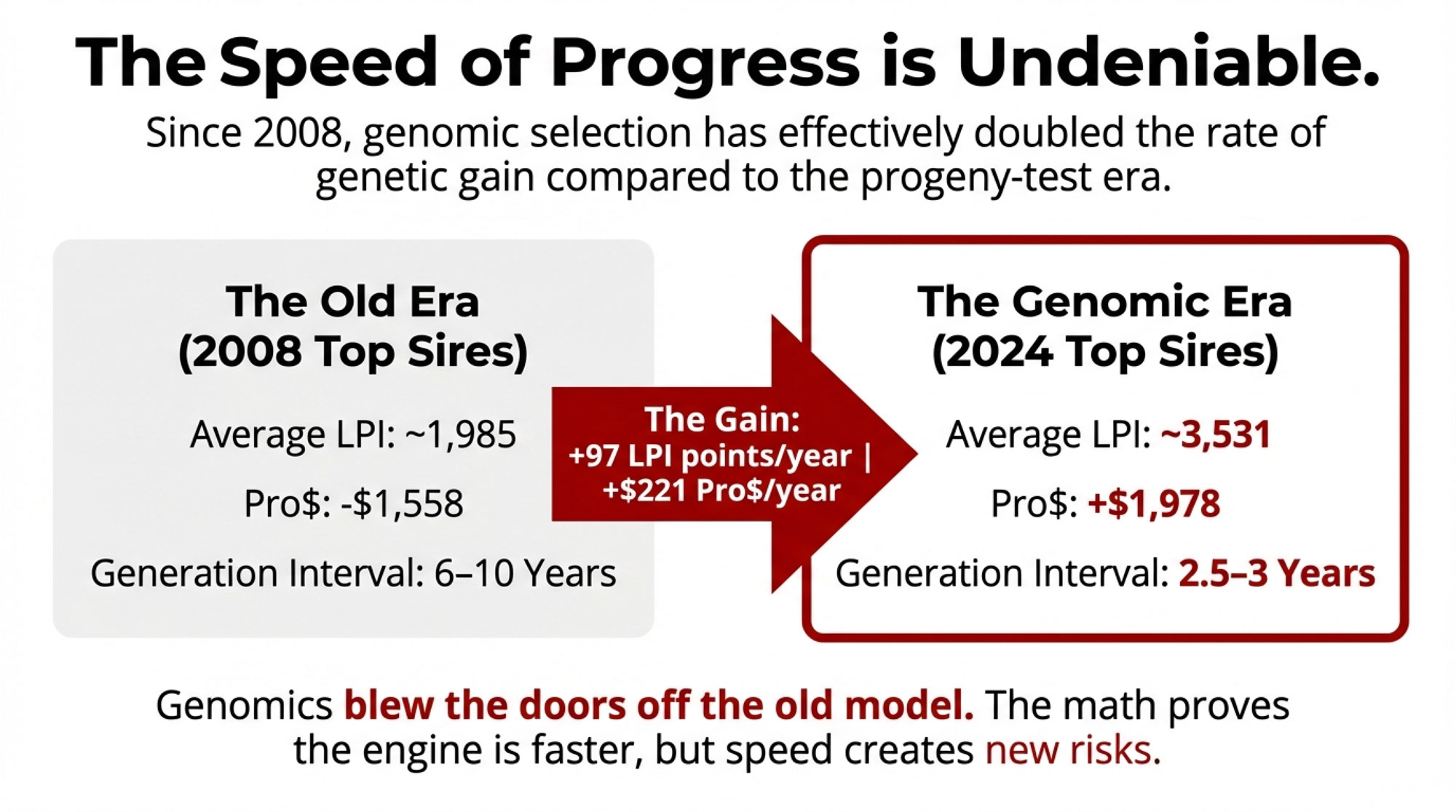
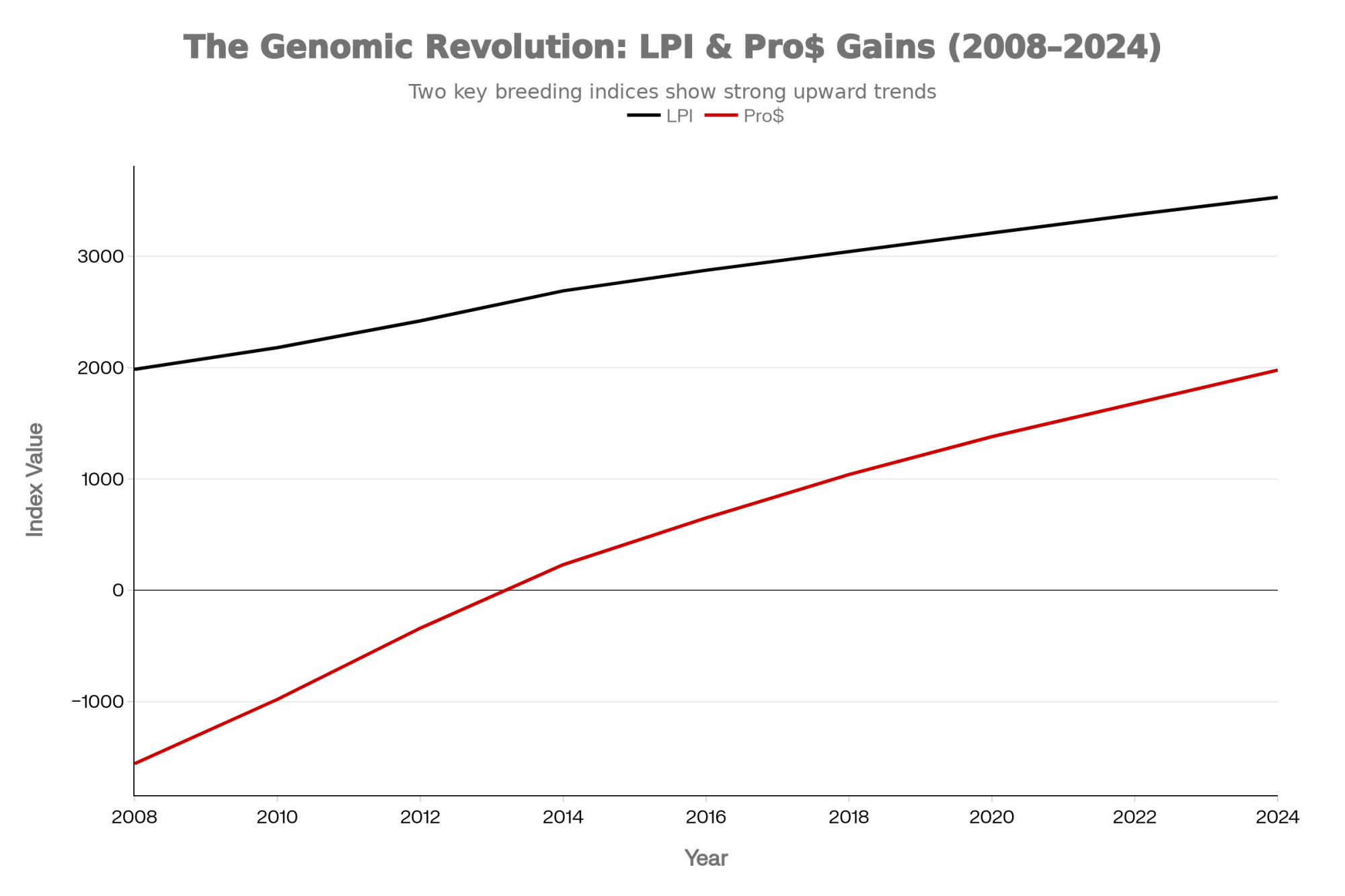
Genomic selection has fundamentally accelerated genetic progress in US Holsteins. Before genomics took hold, from 2005 through 2009, the average Net Merit gain for marketed Holstein bulls was roughly $40 per year. Since 2011, that rate has more than doubled. Wiggans and Carrillo documented the acceleration in a 2022 review published in Frontiers in Genetics. CDCB’s own genomic impact data tells a similar story — $40.33 per year from 2005–2010, jumping to $79.20 per year from 2016–2020. The distance between elite and middle-of-the-pack genetics grows larger with each proof round, and if you’re not actively capturing that progress, you fall further behind every cycle.
The December 2025 US Holstein genetic evaluations made the concentration at the top impossible to ignore. Genosource now holds 22 of the top 30 NM$ positions — 73% of the industry’s elite profitability bracket. The number-one bull, GENOSOURCE RETROSPECT-ET, sits at +1,296 NM$. The NM$ true transmitting ability standard deviation is $228 (VanRaden et al., NM$, January 2025), which means a single standard deviation of difference between your sire battery and the industry average shows up as real dollars at the bulk tank. Every month. For years.
Mid-size operations — 100 to 500 cows — feel this most acutely. You’re large enough that genetic differences compound into serious money, but you probably don’t have a dedicated genetics manager parsing proof sheets three times a year.
What Producers Discovered When They Stopped Delegating
Alta Genetics has built its entire product philosophy around what they call the 4-EVENT COW — a cow whose card reads FRESH, BRED, PREGNANT, DRY, and nothing else. No treatments, no repros, no vet calls between those four entries. Their Alta CONCEPT PLUS sire fertility evaluation, built on real pregnancy check data from progressive dairies across North America since 2001, identifies bulls that create more pregnancies faster — CONCEPT PLUS DxD sires deliver a 2–5% conception rate advantage over the average conventional sire on cows, and CONCEPT PLUS 511 sires add 3–7% when using sexed semen on heifers (Alta Genetics, 2025). A mating program adjusts the consistency of type traits within your herd. Sire selection determines the genetic level of the herd itself. Delegate the selection, and no mating optimization closes the gap.
The Zoetis study made this concrete. The difference between top-quartile and bottom-quartile genetics wasn’t just dollars — it was 35% more milk, 44% fewer antibiotic treatments over their lifetimes, 5% less feed for maintenance, and an estimated 10% less enteric methane. And that gap held regardless of management quality across all 11 herds studied. That’s why the conversation has shifted from “genetics is about production” to “genetics is about total cost structure.”
Simon Vander Woude’s operation illustrates how the shift actually happens on a working farm. Vander Woude owns and operates three dairies totaling 6,000 cows near Merced, California, and has run over 10,000 genomic tests with Zoetis CLARIFIDE Plus. His team started genomic testing simply to identify bottom-end heifers to sell off and get heifer inventory in line with cow numbers. But the test results revealed something uncomfortable: they’d been chasing Daughter Pregnancy Rate as a standalone trait without evaluating how it connected to the rest of the animal. “We focused on DPR pretty heavily and kind of forgot about milk for a while,” Vander Woude shared in 2022. “We’ve stubbed our toes plenty along this path.” That honest reassessment reshaped their entire program. Today, they run IVF on top genomic females — 40 to 60 embryo calves born per month — sexed Holstein semen on the next tier, and Angus on everything else. A tiered system that didn’t exist before they let the data challenge their assumptions.
The Bailey family at Moorhouse Hall Farm in Cumbria, England, had a different trigger entirely. John, Kate, and their son Chris — a full-time vet — started genomic testing their heifers after hearing Nuffield Scholar Neil Easter describe how he’d built a herd with youngstock in the top 1% for Profitable Lifetime Index. As they tested, AHDB’s broader UK analysis revealed a startling finding: around 17% of calves had their recorded sires updated when genotypes were analysed — 7% because the wrong sire was recorded, another 10% because no sire was recorded at all (AHDB, 2024). The Baileys now genomic test every heifer, breed their top-performing animals to dairy sires and the bottom 10–20% to beef, and sit just shy of the top 1% nationally for £PLI in their youngstock. “We used to always find an excuse for why a certain cow should be bred,” John Bailey told AHDB. “But now with genomics, the data gives us much more confidence in identifying the bottom performers.”
The 2025 NM$ Revision: Why USDA Rewrote the Formula
Here’s where a lot of conventional wisdom about cow size and type starts to break down.
When USDA researchers ran genomic regressions on actual feed intake data from over 8,500 lactations of more than 6,600 dairy cows in US and Canadian research herds, the number that came back caught everyone off guard: real maintenance costs were 5.5 pounds of dry matter intake 1,000 per pound of body weight per lactation. That’s roughly twice the previously used phenotypic regression estimates. Every producer who’d been selecting for bigger, taller cows had been unknowingly selecting for higher maintenance costs than anyone calculated.
So USDA rebuilt the formula. Here’s what changed (VanRaden et al., NM$, January 2025):
Feed Saved now commands 17.8% combined emphasis — 11% from body weight composite and 6.8% from residual feed intake. Productive Life carries 13% emphasis at $30 per month, and when you add Cow Livability’s 5.9%, the durability complex totals 18.9% — making longevity the largest non-yield trait group in the index. The lifetime economic values driving NM$ are $5.01 per pound of fat PTA and $3.32 per pound of protein PTA, calculated across 2.70 average lifetime lactation equivalents for Holsteins.
And the traditional type-trait weightings? They dropped hard enough to change the conversation:
Trait Category
NM$ Emphasis
Direction
What Changed
Why It Matters for Your Herd
Feed Saved
+17.8%
↑
Real maintenance costs were 2× previous estimates; emphasis jumped from ~9% to 17.8%
Bigger cows now cost you more than the old formula calculated—select for efficiency, not size
Productive Life + Cow Livability
+18.9%
↑
PL at 13% ($30/month), Livability 5.9%—longevity is now the largest non-yield trait group
Cows that last five lactations beat cows that peak high and break down by lactation three
Udder Composite
1.3%
↓
Dropped from ~5%; two decades of selection finished the job
Further emphasis yields diminishing returns on work already done—udders are largely fixed
Feet & Legs Composite
0.4%
↓
Classifier scores correlated poorly with actual lameness and hoof health
Direct health traits predict lameness better than visual scores ever did
Body Weight Composite
−11.0%
↓↓
Active penalty—NM$ now selects against excess cow size
Every extra pound of body weight costs you 5.5 lbs DMI per lactation; the show-ring cow is now a commercial liability
The math is hard to argue with: NM$ has driven a permanent wedge between the show ring cow and the commercially profitable cow. For two decades, the industry could pretend the gap wasn’t that wide. With Udder Composite at 1.3%, Feet and Legs at 0.4%, and body weight penalized at −11%, that pretense is over. You can still breed show cattle. You can still win banners. But the economics now say, clearly and quantifiably, that the traits rewarded in the ring and the traits rewarded at the bulk tank have parted ways.
The type-to-health connection runs deeper than index weightings. Dechow et al. (2003, Journal of Dairy Science) documented a −0.73 genetic correlation between Body Condition Score and Dairy Form in first-lactation Holsteins — meaning cows that score high for angular dairy character are genetically predisposed to thin body condition at calving. That predisposition elevates ketosis risk.
The traits that actually drive longevity are functional: rear udder height, teat placement, and udder depth. Not the visual sharpness that wins ribbons.
One caveat worth stating plainly: if you market breeding stock, embryos, or show cattle, you may rationally weight type traits higher than a commercial herd optimizing for tank revenue. The NM$ recalibration reflects commercial profitability priorities. Seedstock economics are different — that’s a legitimate strategic choice, not a mistake. But don’t confuse the two. And don’t let anyone tell you that a cow that scores EX-95 is automatically more profitable than a VG-86 daughter who freshens easy, breeds back fast, and milks hard for five lactations. The numbers no longer support that story.
Your Game Plan: Three Strategies Producers Are Using Right Now
Build a Complementary Sire Roster — Not a Ranked List
Think of it like building a Super Bowl roster. You don’t field a team of four quarterbacks. You need depth at every position, and each player fills a specific role. Same with your sire lineup.
The instinct is to line up your top four NM$ bulls and start breeding. But a ranked list isn’t a roster. Four bulls who share the same weaknesses leave your herd exposed in exactly the same spots.
A complementary depth chart assigns each sire a defined role:
Adebayo-P is a functional specialist, not a production leader (56M, 54F, 33P per Holstein Association August 2025 TPI list)—that’s precisely why he fills a role your franchise and component bulls can’t. All rankings may shift at the April 2026 proof run.
Verrier et al. (1993, Journal of Dairy Science) showed that factorial mating designs — where dams see several different sires — produced significantly lower inbreeding rates relative to genetic gain than single-sire approaches. And the December 2025 rankings saw considerable reshuffling, including BEYOND SHPSTR GOLLEY-ET vaulting to #2 GTPI at 3,605. A diversified roster absorbs that kind of volatility. A single-sire strategy doesn’t.
Where this can fall short: It takes more time and familiarity with trait profiles than picking one bull. If reading sire summaries feels overwhelming, you can capture roughly 80% of the benefit by setting an NM$ floor and using three bulls from different sire lines — even without position-specific assignments. For more on building genetic selection resources, start with the evaluation archives.
Genomic young sires carry reliability of roughly 70–75%, compared to 95%+ for daughter-proven bulls. Using three or four sires instead of one hedges that reliability gap — another reason the roster approach outperforms going all-in.
Your Halftime Adjustments: The One-Page Sire Scorecard
Every team makes adjustments at the half based on what the first two quarters showed them. Your sire scorecard works the same way — it forces you to look at what your herd actually needs before your next breeding play.
Before you open a catalog or take a call from your rep, answer these questions and write down actual numbers:
What are your current fat and protein pounds per cow? Pull your last three DHIA milk recording reports.
What are your top three cull reasons over the past 12 months? Most DHI software generates this in minutes.
What’s your NM$ floor? With December 2025 bulls clearing $1,200+, there’s little reason to go below $900 on any roster sire.
What’s your maximum Expected Future Inbreeding? Most geneticists suggest keeping genomic inbreeding below 7–8%.
What functional traits does your facility specifically demand? Robotic milking needs teat placement and milking speed. Grazing operations weight feet-and-legs and body weight differently than freestalls.
Tape that sheet to the wall. Next time anyone recommends a bull — your rep, a catalog, a neighbor — run him through the scorecard first.
This doesn’t replace your A.I. rep. It redirects the relationship. You direct the strategy. They source bulls that fit your framework. That’s a fundamentally different conversation than “send me what you think is good.”
One index note: If your plant pays a cheese yield premium, consider weighting CM$ alongside NM$. Under CM$, protein carries $4.73/lb emphasis versus $3.32 in NM$ (VanRaden et al., NM$, 2025). If you’re on a Class I fluid contract, FM$ may be your better primary index. Know your market before you choose your yardstick.
Genomic Test Your Next 20 Replacement Heifers
You don’t have to test every animal tomorrow. Start with the next group approaching breeding age. UK data from the AHDB showed that herds genotyping 75–100% of their heifers had an average Profitable Lifetime Index of £430 per animal in their 2023 calf crop, compared to £237 for herds testing 0–25% of heifers. That £193 gap translates to roughly £19,300 in theoretical profit potential for a typical 175-head herd — but AHDB’s analysis of actual farm business accounts revealed the real advantage at that genetic difference to be over £50,000. Those aren’t projections. They’re margins from real accounts.
Genomic Testing Rate
Avg £PLI Per Animal
Theoretical Profit Potential (175-head herd)
Actual Profit Advantage (Farm Accounts)
0–25% Testing
£237
Baseline
Baseline
75–100% Testing
£430
+£19,300
+£50,000+
The Gap
+£193 per animal
—
Real margins from UK farm business accounts, not projections
Dave Erf, dairy technical services geneticist with Zoetis, offers three ground rules for getting started: have a plan for how you’ll use the results before you test, lay out a herd roadmap of where you’re strong and where you need to improve, and test all your heifers — not just the ones you think are best. “If you just test your best ones, you can’t make a culling decision, because you don’t know,” Erf shared.
The trade-off is real, though. Testing creates a two-tier system — dairy sires on your top genomic females, beef sires on the bottom. If you test but don’t actually follow through on that split, you’ve spent the money without capturing the value. And on very small herds under 50 cows with limited replacement needs, the per-head cost may not generate enough selection differential to justify universal testing. Start with 20 and scale from there.
The Five-Year Outlook: Marginal Edge or Structural Separation
Five years out, is disciplined sire selection a nice-to-have or a survival factor?
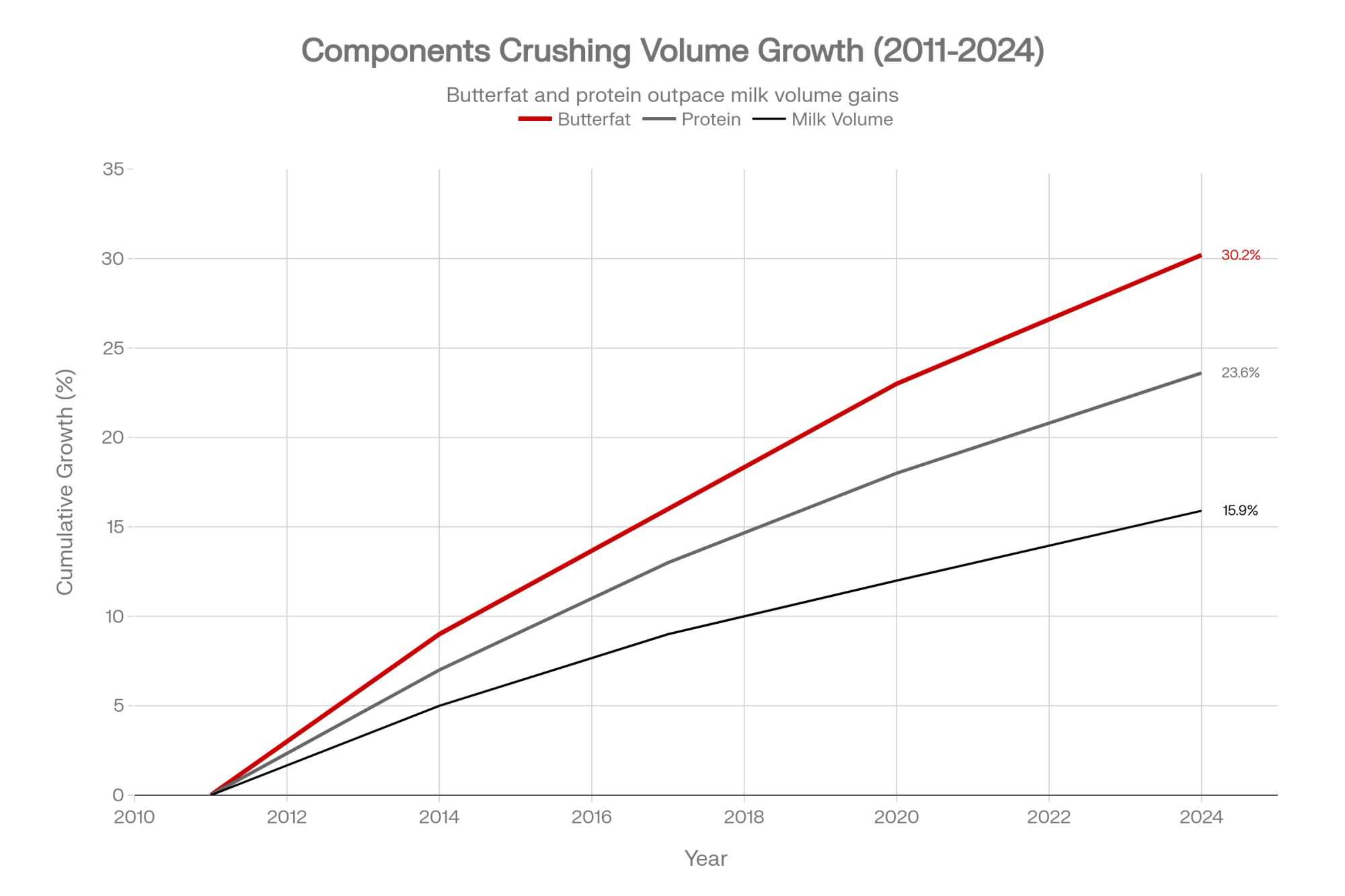
The evidence points toward structural separation. CoBank’s lead dairy economist Corey Geiger laid out the financial logic in a March 2025 Knowledge Exchange report: “there’s a clear financial incentive for producers given that multiple component pricing programs place nearly 90% of the milk check value on butterfat and protein.” And the genetic pipeline is delivering. Butterfat in US Holsteins hit a record 4.23% in 2024, and protein reached 3.29% — both per USDA/NASS data. Between 2011 and 2024, butterfat production surged 30.2% and protein by 23.6%, both outpacing the 15.9% growth in fluid milk volume (CoBank, March 2025). For a broader context on where this is heading, see the 2025 genetic evaluation updates.
“Selecting animals for highly heritable traits and having a market incentive to do so has formed a strong foundation for dairy producers to develop their herds to produce more butterfat and protein,” Geiger wrote. “Genetics should continue to gain momentum in the coming years.”
In the UK, 112,507 cows were genomically tested in 2024 — a 19% jump over the prior year. The adoption curve is accelerating. Marco Winters, head of animal genetics at AHDB, put it bluntly: “Improving genetics is probably the cheapest and most sustainable way of making long-term improvements to any herd, and when you’re using a genetic index which has been developed specifically to increase profitability, this feeds straight through to a farm’s bottom line.”
In Australia, DataGene’s ImProving Herds project — which tracked 27 Genetic Focus Farms and 7 Herd Test Focus Farms — found that every single case study farm adopting data-informed genetic decisions reported improved business performance, even during a severe milk price crash and drought (DataGene, 2023 final report). Six of seven Herd Test Focus Farms continued testing permanently. Once the feedback loop started working, going back felt reckless.
Here’s what makes genetics different from every other efficiency tool on your dairy. Feed systems, robotic milkers, and activity monitors — they all require ongoing capital and operating expense. Genetic gains are baked into the biology. They compound without additional spend. In a margin squeeze, the operation running genetically superior cows carries a fundamentally lower breakeven. Not because they manage better. Because their cows are biologically cheaper to run.
What This Means for Your Operation
Before your next semen order, build the one-page scorecard. Thirty minutes, five questions, taped to the wall. Every sire candidate is scored against your herd’s actual needs—not catalog rankings or rep recommendations.
This month, genomic test your next 20 breeding-age heifers. Use the results to split your replacement pipeline: dairy sires on top-tier females, beef sires on the rest. Test them all — not just the ones you think are best.
At your next rep conversation, hand them the scorecard and ask them to fill four roster positions—not just recommend their current favorites. Which bull addresses your top cull reason? What’s the Expected Future Inbreeding for each sire mated to your herd? Do they have outcross options from distinct sire lines?
Every proof round (April, August, December), revisit your roster. December 2025 reshuffled the rankings significantly. A lineup built in January may need adjusting by August.
If your herd averages over 1,600 lbs body weight, the NM$ maintenance cost recalibration means your feed costs per unit of production are likely higher than your old genetic plan accounted for. With BWC now carrying −11% emphasis in NM$, selecting for lower body weight composite and positive Feed Saved isn’t optional anymore.
If you market breeding stock or show cattle, recognize that NM$ reflects commercial priorities. Weighting type traits more heavily is a legitimate strategic choice — just make it with full awareness of the trade-off in commercial efficiency.
Questions to Ask Your Genetics Rep This Week
Print this. Bring it up in your next conversation about your semen order.
Can you show me trait profiles — not just index rankings — for every bull in my current lineup?
Which of my current sires directly addresses my top cull reason?
What is the Expected Future Inbreeding for each bull when mated to my herd?
Do you have outcross options from distinct sire lines and maternal grandsires?
How does my current lineup score on Feed Saved and body weight composite under the 2025 NM$ revision?
The Longest Game You Play
Tonight’s Super Bowl ends in four quarters. Your sire decisions don’t resolve for a decade.
Vander Woude has been at this for over a decade now. He wouldn’t still be testing 6,000 cows if he didn’t believe it paid for itself. “It’s really hard to quantify how it pays for itself,” he shared. “But I have a much better herd of cows.” Dave Erf, his Zoetis geneticist, was more specific: “I’ve never seen such a good reproduction performing herd… I think genetics helped them get there.”
Know your cows. Know your numbers. Match the bull to the need. That’s the whole shift in one sentence—and the data shows most of the industry still isn’t doing it.
Your semen tank is right there. The scorecard takes half an hour. And every daughter that walks into your parlor two years from now will be the commercial that plays on repeat, for better or worse, for the rest of the decade.
Key Takeaways
Your sire choices now move $869 per cow in lifetime profit, based on a nine‑year Zoetis study of 12,952 Holsteins on 11 US dairies — that’s $173,800 a generation on 200 cows.
The 2025 NM$ changes pay you more for Feed Saved and longevity and hit you for excess cow size (−11% BWC), so chasing big, showy cows is now a direct hit to commercial profitability.
You can upgrade from “favorite bulls” to a real breeding game plan by running a four‑slot sire roster: franchise profit bull, high‑component hammer, durability/fertility fixer, and an outcross to keep inbreeding in check.
A one‑page scorecard (NM$ floor, EFI cap, top three cull reasons, facility needs) plus genomic testing on your next 20 heifers is enough to start sorting dairy vs. beef matings with confidence.
If you’re getting paid on butterfat and protein, genetics is no longer a “nice extra” — it’s one of the few levers that can permanently pull your breakeven down while feed and labor keep marching up.
Complete references and supporting documentation are available upon request by contacting the editorial team at editor@thebullvine.com.
Learn More
The $1750 Calf: Is Your 2026 Breeding Plan Leaving $800 a Head on the Table? – Arms you with a 90-day blueprint to capitalize on the $1,750 beef-on-dairy market without hollowing out your future herd. This guide delivers the specific math you need to convert surplus pregnancies into immediate, high-margin revenue.
The Next Frontier: What’s Really Coming for Dairy Cattle Breeding (2025-2030) – Breaks down the 2025–2030 roadmap of AI-driven selection and microbiome markers that promise 70% labor reductions. This vision of the future delivers a massive early-adopter advantage for producers ready to move beyond traditional production metrics.
Join the Revolution!
Join over 30,000 successful dairy professionals who rely on Bullvine Weekly for their competitive edge. Delivered directly to your inbox each week, our exclusive industry insights help you make smarter decisions while saving precious hours every week. Never miss critical updates on milk production trends, breakthrough technologies, and profit-boosting strategies that top producers are already implementing. Subscribe now to transform your dairy operation’s efficiency and profitability—your future success is just one click away.
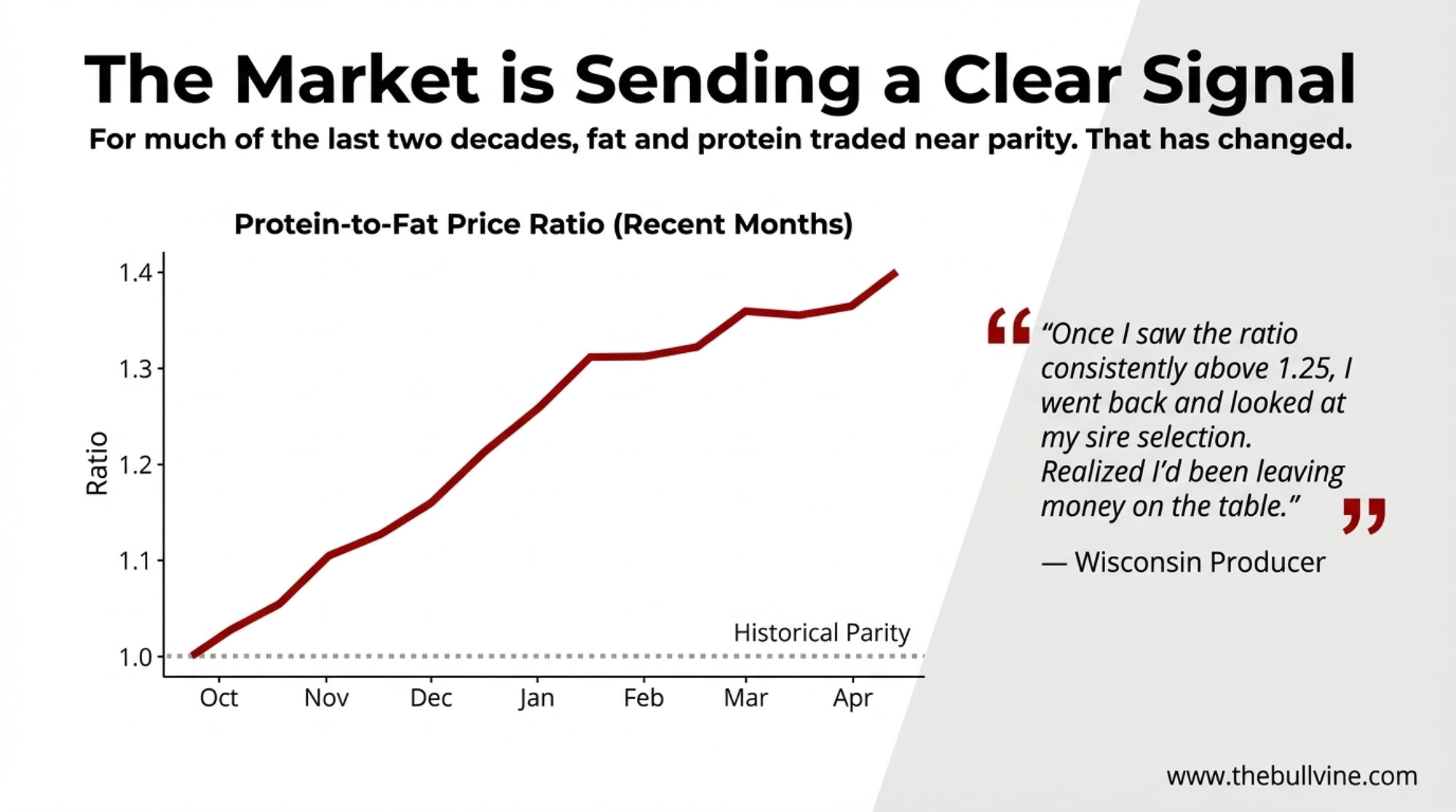
Is your herd’s protein‑to‑fat ratio making your processor money—or quietly costing you on every 2026 milk check?
Executive Summary: Looking at 2026, what’s really moving the needle on dairy profitability isn’t just how many hundredweights you ship—it’s how much protein and butterfat are in each one. CoBank’s recent component analysis points out that U.S. herds excelled at boosting butterfat, but processors and cheese plants now need more protein, and that’s starting to change which components lead the milk check. USDA outlooks add another layer of pressure, with softer butter prices and tighter margins, meaning component value and processor fit will matter more than ever. This feature unpacks that “component economy” in plain language, explains why your herd’s protein‑to‑fat ratio matters to plant yield and standardization costs, and shows how nutrition, fresh cow management, and genetics can be tuned to support stronger protein without sacrificing fat. It also walks through how this plays out differently in Upper Midwest cheese country, Western dry lot systems, Northeast fluid markets, and under Canadian quota, so you can see your own reality in the numbers. By the end, you’ll have a clear set of questions to ask at your own kitchen table—about your milk check, your processor contracts, and your breeding and feeding strategy—so you can decide if you’re still built for the butterfat era or ready for protein to do more of the heavy lifting.
You know, after watching milk checks and component trends for a lot of years now, I’m more convinced than ever that we’re in one of those quiet turning points you only really see clearly in hindsight. In October 2025, USDA’s National Agricultural Statistics Service reported that the 24 major dairy states shipped about 18.7 billion pounds of milk, up 3.9% from the previous October, with total U.S. production up 3.7% year‑over‑year. That’s real growth on top of an already big base. What’s interesting here is that when you look under the hood, the story isn’t just about more milk—it’s about what’s in that milk, especially in terms of butterfat performance and protein yield.
The herds that read this shift right are going to hang on to more dollars per cow in 2026. The ones that don’t may find money quietly slipping away, even if the tank looks full.
Looking at This Trend From the Plant Side
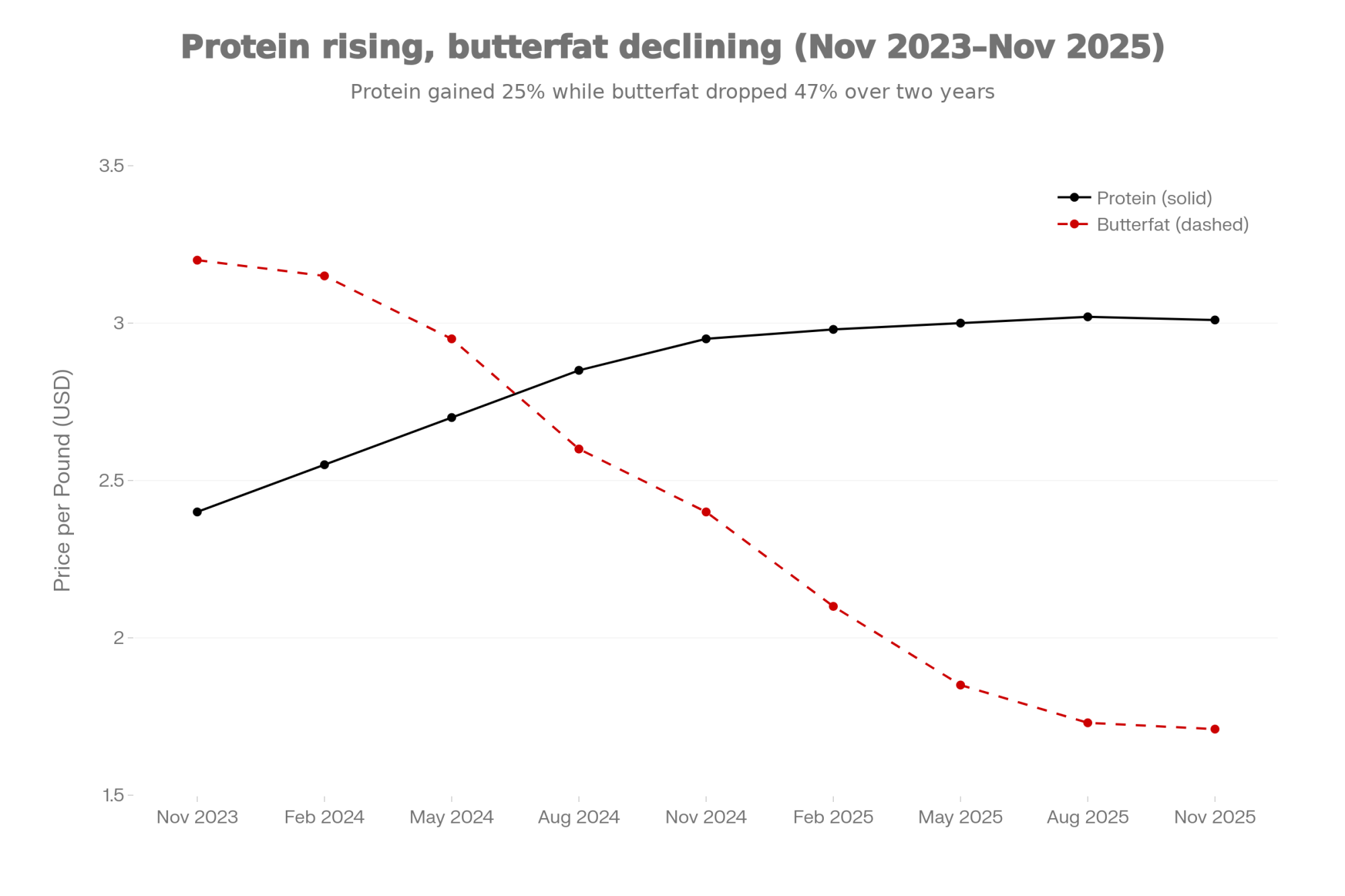
Looking at this trend from the plant side, you start to see a different layer of the story. A 2025 analysis from CoBank’s Knowledge Exchange group, led by Corey Geiger—lead dairy economist at CoBank—dug into how milk components have changed over the last decade. They found that butterfat levels in U.S. milk climbed about 13.1% over 10 years, while butterfat levels in the European Union and New Zealand rose only about 2.4–2.5%. Geiger’s team linked that jump to strong domestic demand for butter and full‑fat dairy products, plus component‑based pricing in many Federal Orders that paid generously for fat. Other market coverage has pointed out that U.S. cows are shipping more total fat and protein per hundredweight today than they did a decade ago, thanks to genetics and feeding.
Year
Butterfat Growth (%)
Protein Growth (%)
Protein-to-Fat Ratio
2015
0.0
0.0
0.82
2017
3.5
1.2
0.81
2019
7.2
2.1
0.79
2021
9.8
3.0
0.78
2023
12.1
3.8
0.77
2025
13.1
3.9
0.77
On paper, that sounds great—and to be fair, it has been. Many Midwest producers will tell you there were years when butterfat premiums essentially “saved the year” on cheese‑market milk. But as butterfat kept rising, something else began to appear in the data. CoBank’s follow‑up commentary and articles in dairy media have begun asking whether the U.S. might actually have more butterfat than some processors really need, especially cheese plants that also depend heavily on protein to make both cheese and whey efficiently.
If you look at late‑2025 market coverage, you see that tension showing up in prices. News outlets reported butter falling sharply from the record territory seen in 2022, with analysts warning that lower butter values and larger supplies were helping pull down milk prices and setting up weaker milk checks moving into 2026 as production stayed strong. USDA’s own outlook work around the same time projected continued growth in milk production and lower average butter, cheese, and all‑milk prices compared with those earlier highs.
Now, here’s where components and ratios come into play. Cheesemaking research and USDA work on predicting cheese yield have shown for years that cheese and whey yields are highly sensitive to the balance of protein and fat in the vat. Plants can standardize milk, of course, but they run most efficiently when the incoming milk is already in a workable range. Industry guidance and component tables suggest that, for many common U.S. cheeses, milk somewhere just over 3% true protein and in the upper‑3s to around 4% butterfat—often yielding a protein‑to‑fat ratio near 0.80—makes life a lot easier in the plant.
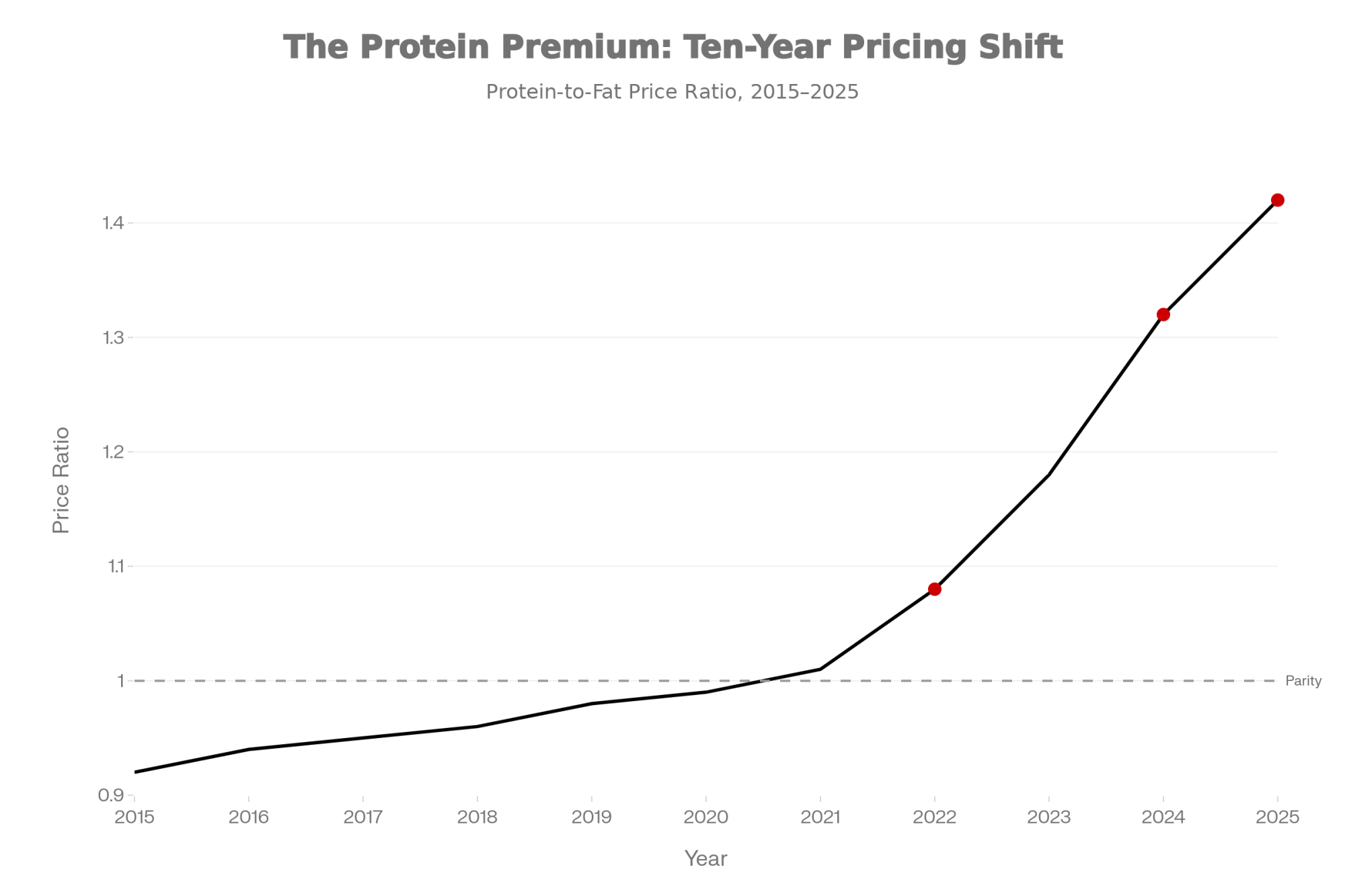
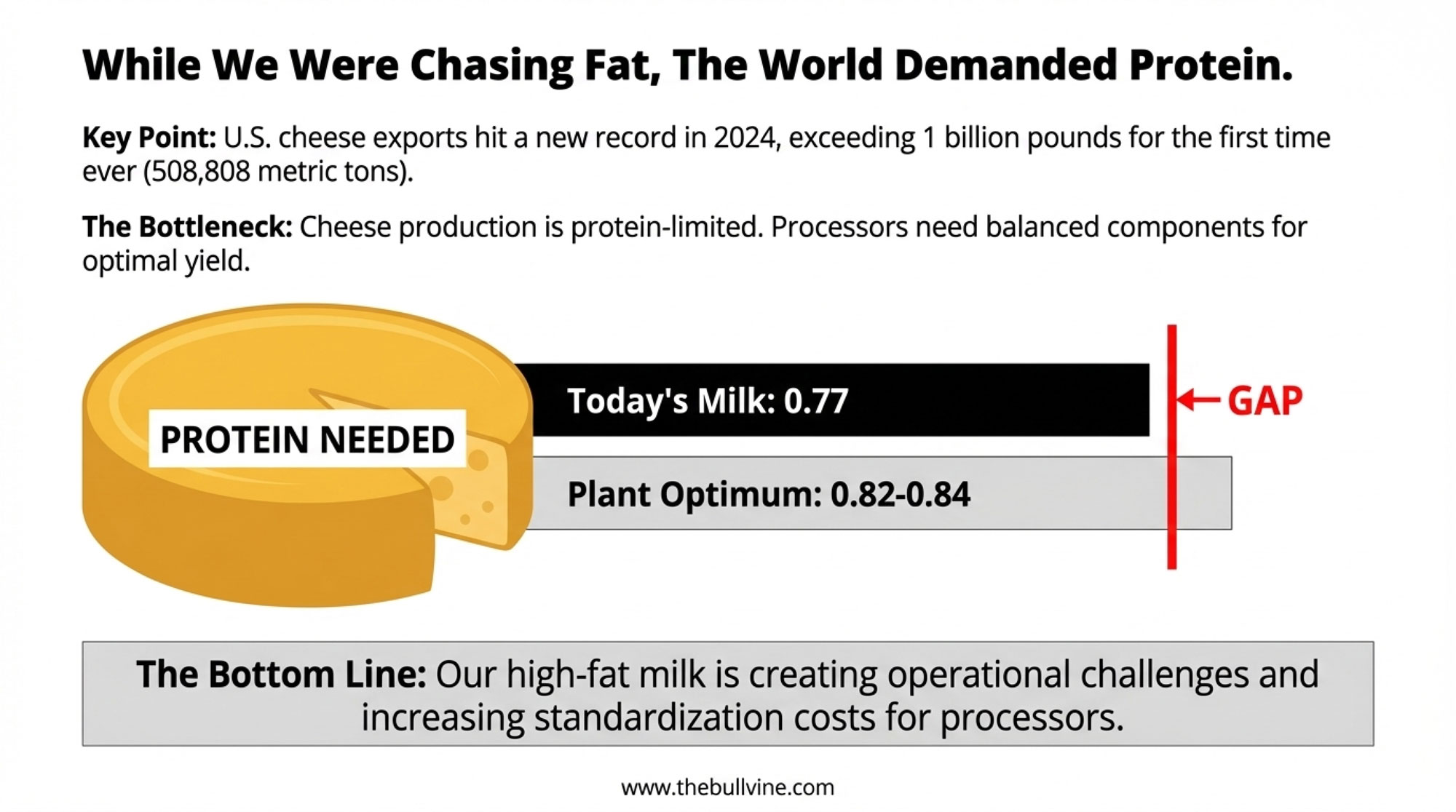
It’s worth noting that this isn’t about chasing a single magic target to two decimal places. What CoBank’s report points out is the trend: for much of the 2000s and early 2010s, the U.S. protein‑to‑fat ratio hovered around 0.82–0.84, then drifted down toward roughly 0.77 as butterfat grew faster than protein. When that ratio drops, cheesemakers are forced to do more standardizing—adding protein or skimming off fat—to hit the composition they need. That extra work is routine, but it isn’t free.
In an article on “reading the signs” from milk components, Mike Hutjens—Emeritus Professor of Animal Sciences at the University of Illinois—suggests using the protein‑to‑fat ratio as a simple “dashboard light.” He notes that when herd averages sit below about 0.75, cows are often “missing milk protein,” and when they’re above about 0.90, milkfat may be depressed. That rule of thumb aligns with what cheesemakers and plant managers have been telling CoBank and others: they don’t just want high butterfat levels; they want balanced components that fit their vats and product mix.
Herd Size (cows)
Protein-to-Fat Ratio
Herd Type
Region
80
0.88
Tie-stall
Northeast
125
0.85
Organic
Northeast
150
0.76
Freestall
Wisconsin
220
0.82
Organic
Midwest
300
0.78
Freestall
Wisconsin
400
0.81
Freestall
California
700
0.74
Drylot
California
1200
0.79
Freestall
Midwest
2000
0.75
Drylot
California
So the big takeaway from the plant side is this: butterfat is still valuable, but now that we’ve pushed fat so hard, protein is starting to carry more weight in cheese and ingredient markets. And more plants are watching that protein‑to‑fat ratio than a lot of farms realize.
Looking at This Trend in Consumer Behavior and GLP‑1
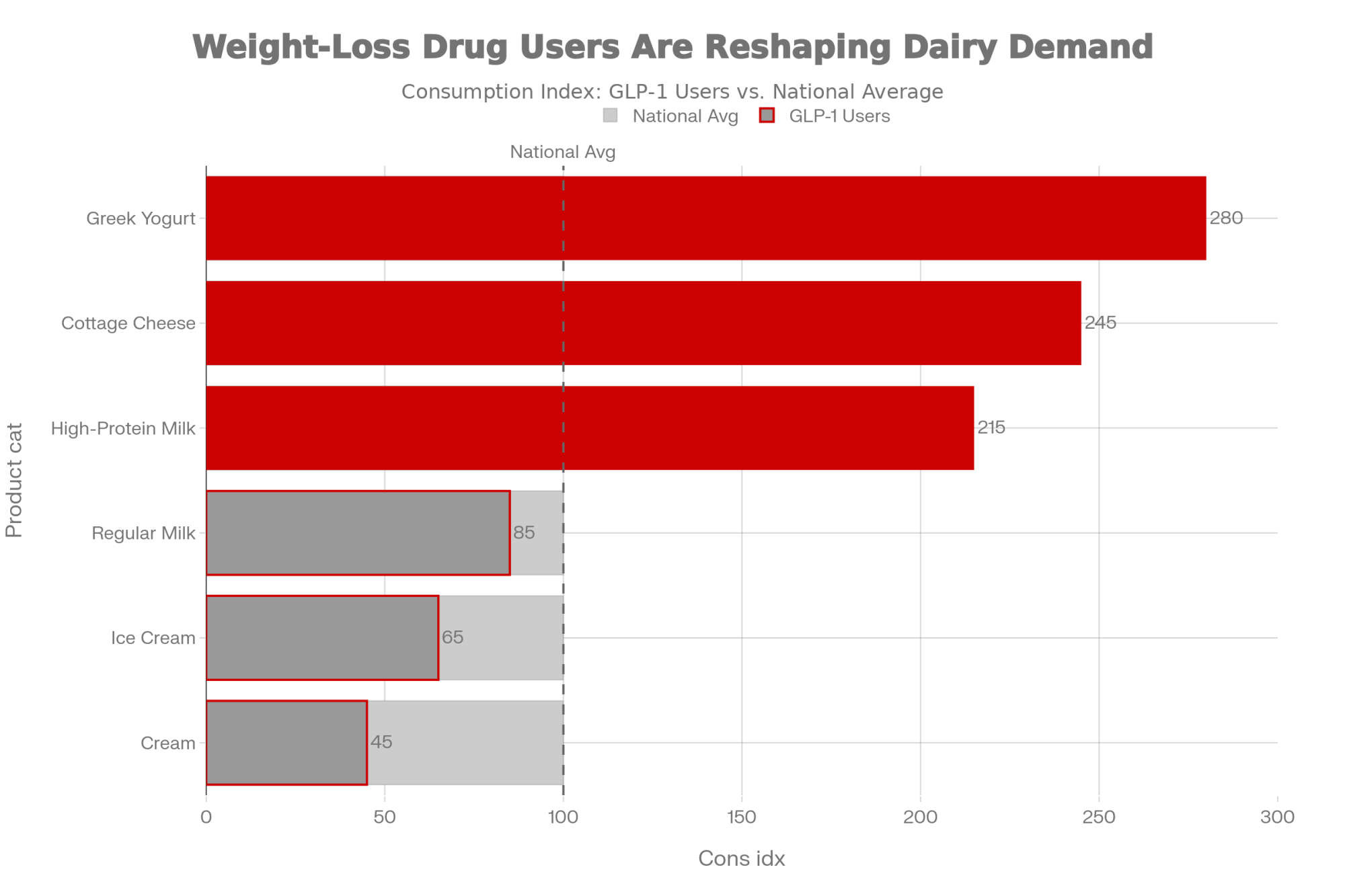
You’ve probably heard plenty of noise about GLP‑1 medications like Ozempic and Wegovy and what they might do to food demand. Some general media stories make it sound like these drugs are going to hollow out the whole snack aisle and maybe dairy with it. When you dig into the food‑industry analysis that actually looks at what these consumers buy, the picture is more measured.
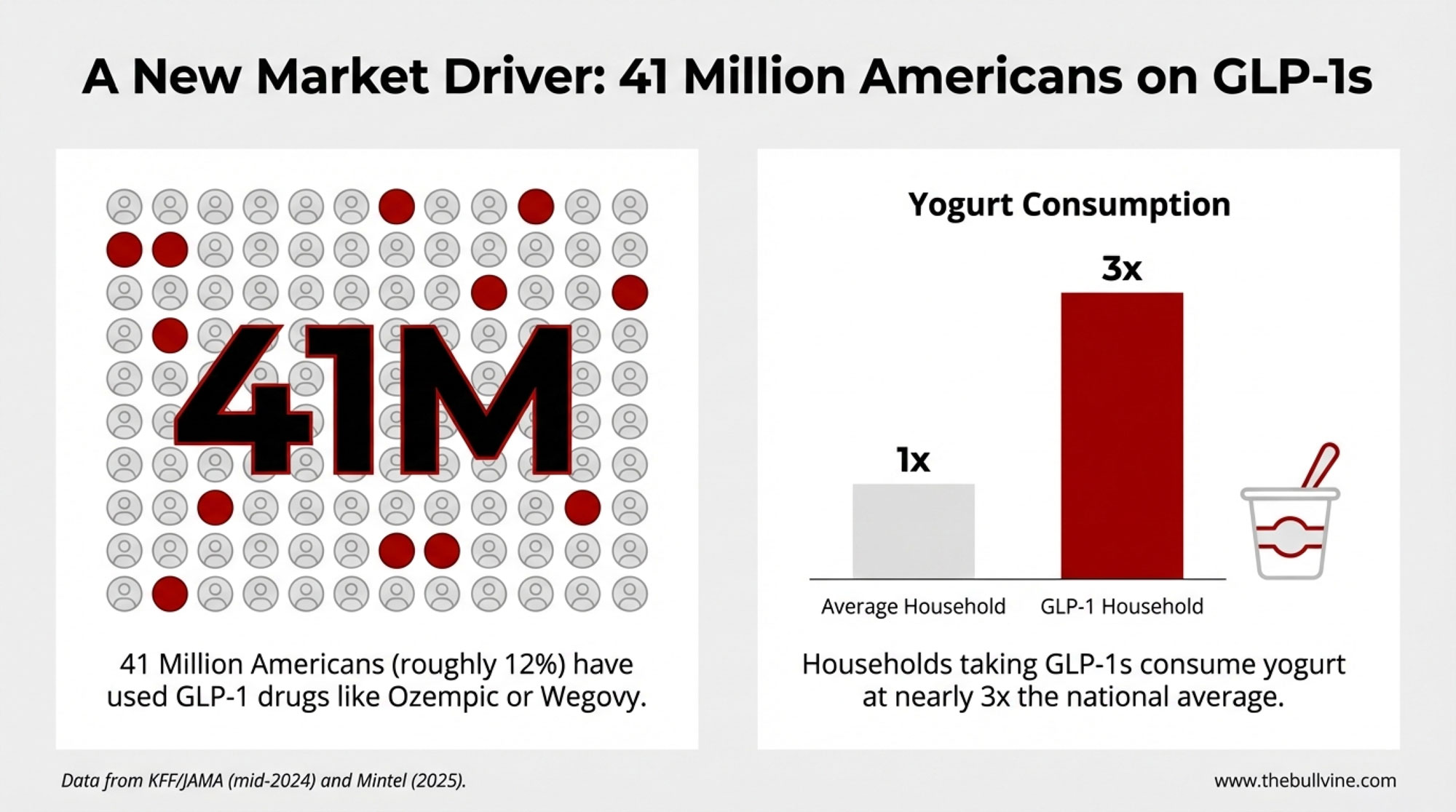
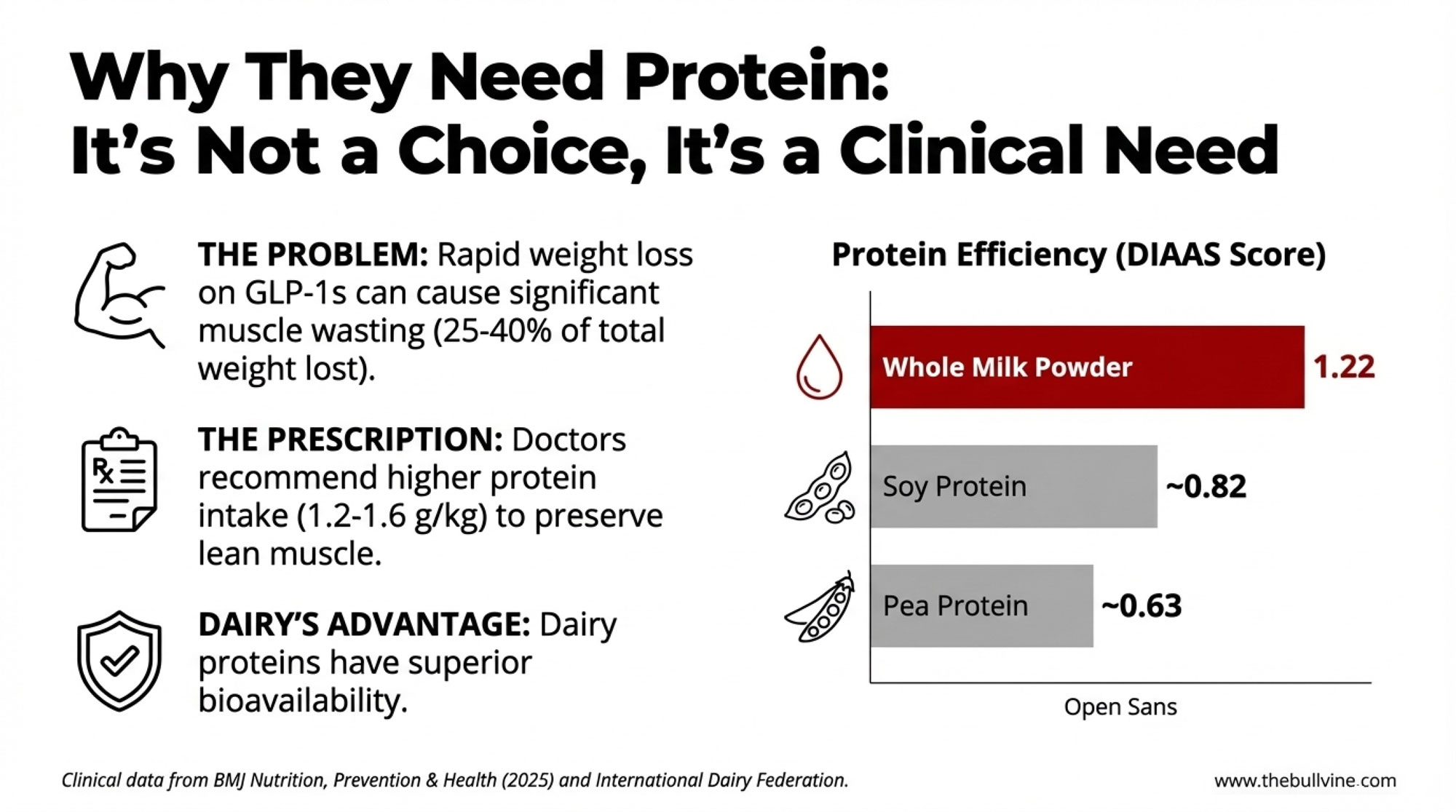
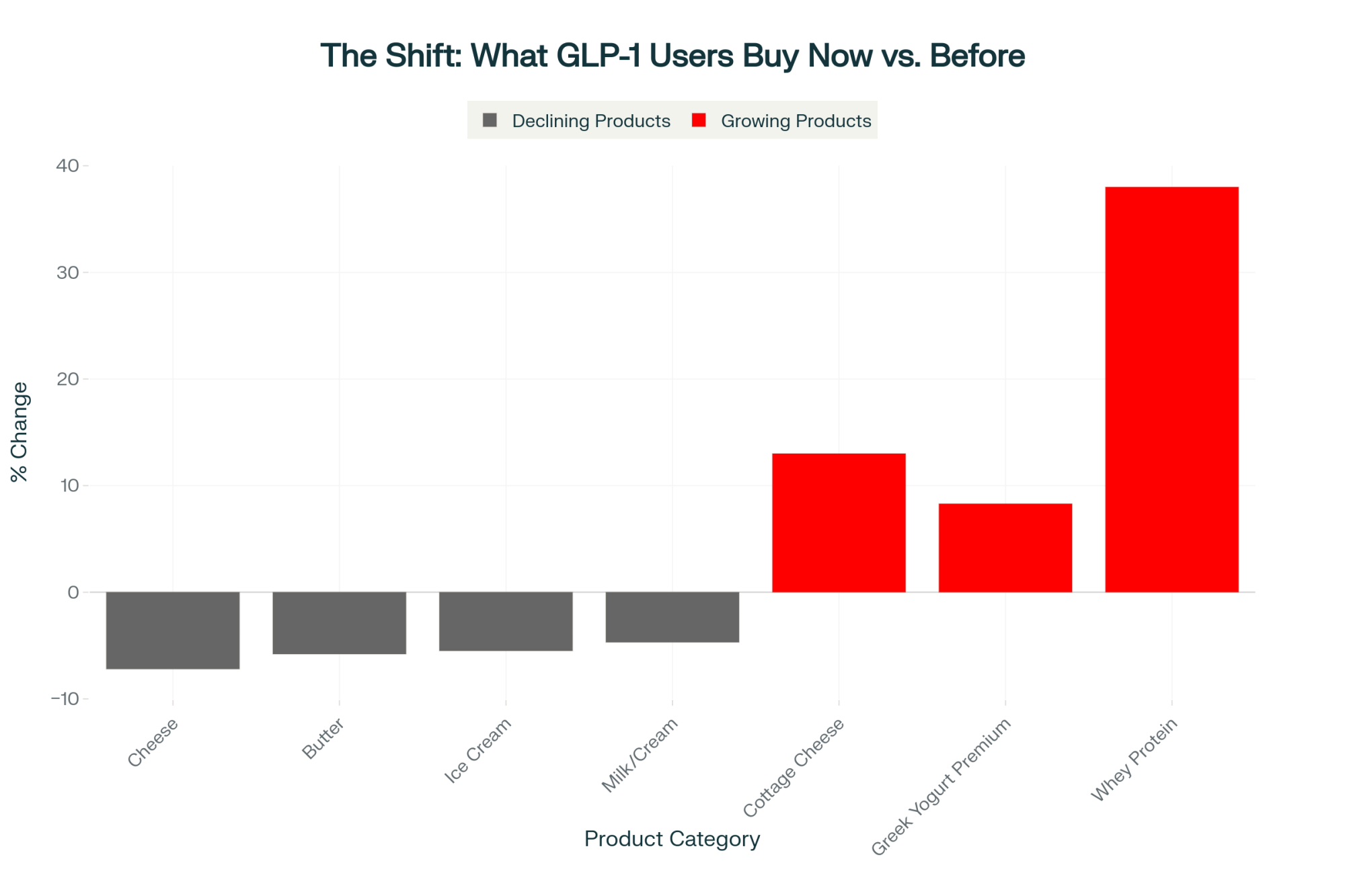
Analysts following GLP‑1 users’ eating habits report that, as use of these medications grows, many people do change how they eat: they generally cut overall calories, but they also tend to gravitate toward foods that deliver more protein and nutrition per bite. Several large food and dairy companies, in their own product briefings and category outlooks, have pointed to high‑protein Greek yogurts, strained yogurt drinks, cottage cheese, and cheese‑based snacks as growth areas for health‑conscious consumers. A theme that keeps coming up is grams of protein per serving and satiety in a smaller portion.
For plants making concentrated or high‑protein dairy products, that puts a premium on milk that brings strong protein content right through the door. Filtration and concentration technology can boost solids, but starting with milk that already has good protein levels makes the whole system more efficient. So instead of seeing GLP‑1 as “anti‑dairy,” it’s probably more accurate to say it nudges part of the market further toward higher‑protein, nutrient‑dense dairy products—a direction that was already building.
The Bigger Protein Story That’s Been Building for Years
Stepping back from GLP‑1 for a moment, the bigger story is that consumers have been chasing protein for quite a while. Surveys from the International Food Information Council over the last several years, including a 2025 spotlight on protein, have found that roughly seven in ten Americans say they’re actively trying to increase their protein intake. Trade coverage summarizes this as a kind of “protein obsession”—you’ve likely noticed how often “high protein” shows up on packaging now, from snack bars to coffee creamers.
Dairy naturally sits in the middle of that trend. Peer‑reviewed nutrition research has repeatedly described dairy proteins as high‑quality, with complete amino acid profiles and good digestibility. Phillip Tong, Professor Emeritus of Dairy Science at California Polytechnic State University and former director of the Dairy Products Technology Center, has emphasized in his work that milk proteins provide not just nutrition but also functional properties—gelling, foaming, water‑binding, emulsifying—that make them valuable to food manufacturers. Those properties are a big reason why whey protein concentrates, isolates, and milk protein ingredients have grown steadily in sports nutrition, medical nutrition, products for older adults, and a whole list of “better‑for‑you” foods.
So when you line these things up—consumer protein interest, functional advantages of milk protein, and CoBank’s finding that butterfat has outpaced protein growth and pulled the national protein‑to‑fat ratio downward—the pattern is pretty clear. We’re not just living in a “butterfat era” anymore. We’re operating in a component economy where protein is moving closer to center stage, especially in processing‑heavy, cheese‑oriented regions.
What Farmers Are Finding at the Feed Bunk
All right, enough big‑picture talk. Let’s bring this back to decisions you can make at the feed bunk and in fresh cow management.
Land‑grant university nutrition work—from Nebraska, Illinois, and others—has reinforced for years that butterfat and protein both respond to the basics: forage quality and chop length, effective fiber, starch fermentability, physically effective NDF, and overall energy balance. They also stress that the transition period and early fresh cow management are critical. Poor intakes, subclinical ketosis, and cow comfort problems in the first weeks after calving often manifest later in milk volume and components.
You probably know this from your own records: when energy gets tight, or rumen health slides, protein is often the first to sag while fat hangs on a bit longer. That’s a signal.
Over the last decade, a lot of herds leaned on palmitic‑rich rumen‑protected fat supplements to push butterfat performance. Research and field experience have shown that, in well‑balanced rations with healthy rumens, these products can bump milkfat percentage and, in some cases, fat yield. Combined with genetics and management, that helped drive regional butterfat averages upward. Some herds in the Upper Midwest increased their components toward 7 pounds of fat and protein per cow per day by focusing on both nutrition and genetics.
Scenario
Component
Annual Cost/Value
Result
2022 Butter Peak
Supplement Cost
-$54,000
Baseline
2022 Butter Peak
Butterfat Value @ $2.20/lb
+$43,362
Net: +$10,638
2026 Outlook
Supplement Cost
-$54,000
Baseline
2026 Outlook
Butterfat Value @ $1.35/lb
+$26,608
Net: –$27,392
Protein-Focused Alternative
Nutrition + Genomics Cost
-$30,000
Baseline
Protein-Focused Alternative
Protein Value @ $1.80/lb
+$31,200
Net: +$1,200
But as butter prices have come off their highs and more processors are paying attention to protein, it’s worth sharpening the pencil on those investments. The exact cost per cow per day and the exact response in butterfat for any one product will depend on your ration and conditions. Rather than relying on a canned example, the best move is to sit down with your own numbers:
What are you actually paying per cow per day for any fat supplement?
What change in butterfat test and fat pounds shipped have you documented when using it versus not using it?
What’s your current value per pound of butterfat on your milk check?
If, after that exercise, the extra butterfat dollars comfortably outrun the cost—and you’re not harming rumen health or protein—then that tool may still have a solid place in the ration. If the margin has narrowed or turned negative under today’s component prices, it might be time to consider shifting some of that budget into strategies that help both protein and overall efficiency, like higher‑quality forages, more precise starch and fiber balance, or amino acid balancing.
On the protein side, extension and research consistently highlight a few themes in diets that support higher true protein:
Forages harvested at the right stage and moisture, with consistent quality across the year.
A solid balance of rumen‑degradable and rumen‑undegradable protein, so microbes and the cow both get what they need.
Enough fermentable starch to fuel microbial protein production without driving subacute ruminal acidosis.
Targeted methionine and lysine supplementation when diets are limited in those key amino acids.
Strong transition and fresh cow programs that keep intakes up and cows out of deep negative energy balance.
Hutjens’ component “dashboard” fits nicely with this. When the protein‑to‑fat ratio averages below about 0.75 across a herd, there’s usually room to improve protein yield. When the ratio climbs above about 0.90, milkfat may be compromised. That gives you a simple, herd‑level way to keep an eye on how well your feeding program, fresh cow management, and genetics are working together.
So here’s a practical check that’s worth doing: pull your last 12 months of test results and calculate the average protein‑to‑fat ratio. If most of your milk goes to cheese and that ratio is consistently down in the low‑to‑mid 0.70s, it’s probably time to sit down with your nutritionist—and maybe your plant field rep—and ask whether your feeding program and your plant’s needs are still aligned.
Genetics: The Quiet Lever Behind Tomorrow’s Components
Once you’ve taken a hard look at the feed bunk, the next quiet lever is genetics.
Genetic evaluations in Holsteins and Jerseys show that fat and protein yields are positively correlated—selecting for more milk and better components generally moves both traits upward, though not always at the same rate. Economic indexes like Net Merit (NM$) put explicit economic weights on fat and protein, and USDA’s 2021 revision documented changes to those values based on updated milk and component prices. For much of the last decade, strong butterfat pricing helped push index emphasis toward fat, and that made sense in the markets at the time.
As plants and markets begin to value protein more heavily—particularly in cheese, whey, and protein ingredients—that weighting becomes worth a second look. Some recent commentary and genetic updates have already noted that bulls with strong protein proofs and overall solids are climbing in rankings as the economics shift.
Genomic testing has made it much more practical for commercial herds to act on this. Many herds now test heifers genomically, at costs typically ranging from the mid‑teens to around $50 per head, depending on the panel and country, and use those results to:
Rank replacement heifers by projected lifetime profit, including fat and protein yields.
Identify families that consistently underperform on components.
Tune sire selection so that the component profile—fat and protein percentages and pounds—matches where their milk actually goes.
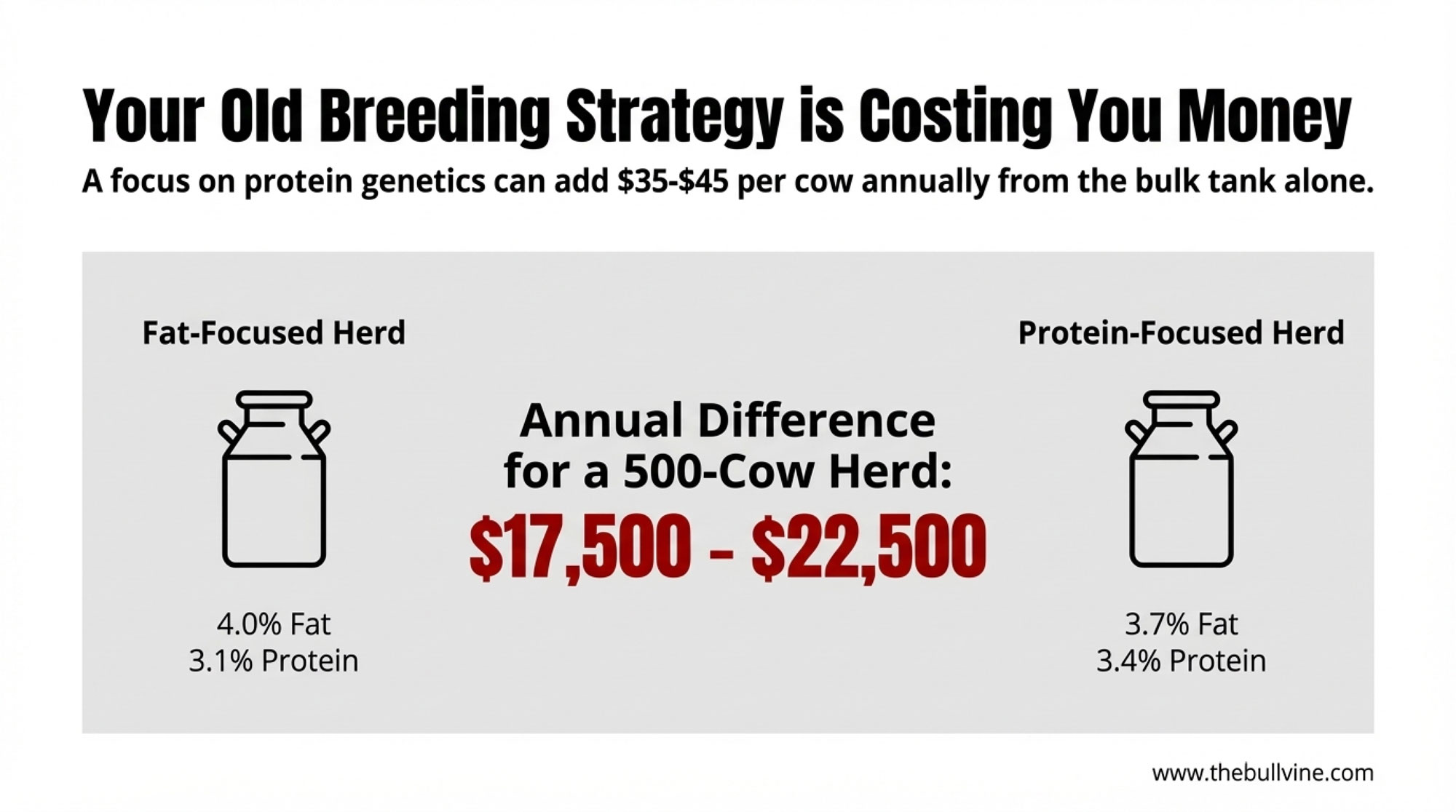
Breed mix also plays a role. Typical Holstein herd averages often sit around 3.7% butterfat and just over 3.1% true protein, giving a protein‑to‑fat ratio in the mid‑0.80s. Jerseys commonly run up in the high‑4s for fat and around 3.8% protein, with a ratio just under 0.80. Crossbred herds land in between, depending on the breeds and selection emphasis. None of these profiles is “right” or “wrong” on its own. The key is whether your genetics give you a component profile that fits your market.
What I’ve noticed, looking at sire lists in a lot of herds, is that there’s still a tendency to default to a single index number and only later ask, “Does this bull actually fit my processor’s needs?” In a world where cheese plants and ingredient makers are increasingly vocal about wanting more protein to catch up with butterfat, it’s worth pulling out those proofs and asking a slightly different question: “Is my sire selection moving my herd toward a better protein‑to‑fat balance for where my milk is going?”
Region
Primary Market
Ideal Butterfat
Ideal True Protein
Target P:F Ratio
Payment Emphasis
Upper Midwest (WI, MN, MI)
Cheddar, mozzarella, whey concentrate
3.8–4.0%
3.2–3.4%
0.80–0.85
Ratio-sensitive; protein gaining
Western States (CA, ID, NV)
Mixed (cheese, powder, fluid, ingredients)
3.6–3.9%
3.0–3.2%
0.77–0.82
Volume + flexibility; less ratio-rigid
Northeast & Atlantic Canada
Fluid, yogurt, regional cheese, specialty
3.4–3.7%
3.1–3.3%
0.85–0.95
Quality premium + components vary
Canadian Quota Markets
Butter, cheese, powder (supply-managed)
3.9–4.1%
3.1–3.3%
0.78–0.82
Factors adjusted annually; quota limits output
Organic Processors
Premium fluid, specialty cheese, yogurt
3.5–3.8%
3.0–3.2%
0.80–0.88
Organic premium overshadows fine diffs
Regional Realities: One Trend, Many Local Versions
As many of us have seen, these trends don’t play out exactly the same way everywhere, and it’s important to respect that.
In Wisconsin and other Upper Midwest cheese states, the fit between components and plant needs is front and center. A large share of the milk in these regions is used to make Cheddar, mozzarella, and other cheeses, thanks to modern whey recovery systems. CoBank and regional market coverage have emphasized that cheesemakers there are especially sensitive to the protein‑to‑fat ratio and total solids because both cheese and whey yields depend heavily on those numbers. Education pieces walking through new pricing rules have shown examples where herds with modestly lower fat but stronger protein outperform very high‑fat, low‑protein herds at the same cheese plant, purely on yield and component value. That’s the kind of quiet math that makes protein more than just a “nice to have” in those markets.
In Western states like California, the picture gets more layered. Many herds are large, often in dry lot systems, and ship into a mix of cheese, powders, fluid milk, and value‑added products. At the same time, they’re operating under high feed costs, water limitations, and some of the toughest environmental regulations in the business. Market analysis and sustainability work from that region make it clear that components still matter, but they’re just one lever among many—alongside stocking density, water use, regulatory risk, and plant capacity.
In the Northeast and across Atlantic Canada, much of the milk ends up in fluid markets, regional brands, yogurt plants, and specialty cheeses. Some cooperatives and proprietary processors in these areas have moved more aggressively toward component‑based payments, including protein, while others still lean heavily on volume and quality premiums. In Canada, national supply management and quota limit total output, but planning documents from the Canadian Dairy Commission emphasize the need to manage components to meet butter and cheese requirements; component allowances and factors are adjusted accordingly.
Organic herds see yet another twist. Many have a base premium for organic milk that can overshadow fine‑grained component differentials, but processors and organic brand programs still pay attention to components because they affect product yield and cost. Some organic buyers include composition and quality benchmarks as part of their sourcing criteria, even if the pay formula is simpler.
So while the big pattern says protein is gaining importance, the way it shows up in your milk can be quite different in Wisconsin, California, New York, or Ontario. That’s why those local conversations with your nutritionist, field rep, and lender matter just as much as the national reports.
What the Outlook for 2026 Is Really Saying
When you bring together USDA’s outlooks, CoBank’s component analysis shared that the picture for 2026 is pretty consistent: it’s likely to be another tight‑margin year for many dairies. USDA projections anticipate continued growth in milk production, driven mainly by higher milk per cow, while average prices for butter, cheese, and the all‑milk price are expected to stay below the highs we saw a few years ago. Analysts have already noted that rising supply and strong component levels are weighing on prices, and that “weaker milk checks” are a real possibility if production doesn’t moderate.
At the same time, more and more people in the industry are using that “component economy” language to describe where we are. Fat and protein are being priced, managed, and in some cases hedged more independently. New or revised pay formulas are paying closer attention to how each component contributes to product yield and plant margins.
For your farm, the message is pretty straightforward: when base prices soften, the share of your milk check that comes from components, quality, and program premiums becomes more important. If protein is gradually gaining ground in your pay structure and your herd’s protein‑to‑fat ratio is drifting in the wrong direction, you can end up working just as hard for a less competitive milk check.
Year
Base Milk
Butterfat Premium
Protein Premium
Quality/Other
Total
2022
18.50
3.42
1.86
0.92
24.70
2024
18.20
2.64
2.07
0.89
23.80
2026E
17.90
2.10
2.42
0.88
23.30
Practical Questions to Ask at Your Own Kitchen Table
So, with all that in mind, if we were sitting together at your kitchen table with a stack of milk checks and test reports between us, here are the questions I’d want to walk through:
Over the past 12 months, what’s your average protein‑to‑fat ratio—not just on one test, but across the year? Are you closer to 0.72, 0.78, or 0.85? How does that compare to the 0.75–0.90 “healthy range” Hutjens and others talk about?
Looking at your milk checks, how many dollars per hundredweight in the last year came from butterfat, and how many from protein? Has that mix shifted as butter prices eased and protein held or strengthened?
When was the last time you asked your processor or cooperative, “If you could design the ideal butterfat and protein tests for your plant today, what would they be—and how would you pay for that?” Some plants and contracts are quietly adjusting to encourage the component balance they need.
Are you still spending money on fat supplements mostly to chase higher butterfat levels, and have you re‑run that ROI using your current butterfat value, actual response in your herd, and today’s feed costs?
Are you using genomic testing—or at least looking closely at sire proofs—to nudge your herd toward a component profile that matches where your milk actually ends up: cheese, yogurt, fluid, or export ingredients? Are protein traits getting the weight they deserve on your bull list?
When you look at your top sires, how many are genuinely strong on protein, not just fat and total yield?
The answers will look different for a 120‑cow tie‑stall herd in the Northeast, a 400‑cow freestall in Wisconsin, a 2,500‑cow dry lot in California, or a quota‑managed herd in Ontario. And that’s okay. The goal isn’t to chase every trend or copy the neighbor. It’s to be intentional about which trends actually matter to your milk check and which don’t.
A Balanced Way to Look at the Future
When you line up the current numbers—from USDA’s production and price outlooks, from CoBank’s component growth analysis, from IFIC’s consumer protein surveys, and from cheesemaking research and extension work—the pattern is pretty clear: protein is becoming a bigger part of how milk is valued, especially in cheese and ingredient markets. That doesn’t mean butterfat suddenly stops mattering. Butter, cream, and full‑fat dairy products still resonate with consumers, and strong butterfat performance will remain a point of pride on many farms.
What’s encouraging is that a lot of the practices that help protein also help build durable, resilient dairies in general: good forages, thoughtful starch and fiber balance, strong fresh cow and transition management, attention to cow comfort, and smart use of genetics and genomics. You’re not being asked to tear your operation down to the studs. You’re being invited to fine‑tune a few dials based on where the money seems to be heading instead of where it used to be.
For some herds, that might mean easing off an “all‑in on fat” mindset and giving protein a bit more focus in both rations and sire selection. For others, especially those already shipping to plants that pay well for protein and running healthy protein‑to‑fat ratios, it might simply confirm that the path you’re on lines up well with your market.
Either way, as you look ahead to the next few seasons, it’s probably worth pouring another coffee, spreading out those milk checks and test reports, and asking yourself a simple question: Is your herd set up for the protein pivot that’s shaping 2026 milk checks—or mainly for the butterfat boom we were cashing in a few years ago?
Key Takeaways:
Butterfat won the decade—protein didn’t keep pace: U.S. fat jumped ~13% in ten years while protein lagged, pulling the national ratio from ~0.82 to ~0.77. Cheese plants are pushing back.
Your plant needs balance, not just fat: Cheese and whey yields hinge on a ~0.80 protein-to-fat ratio. Fat-heavy milk means extra standardization—and that cost comes back to you.
Protein is about to do more heavy lifting on your milk check: Butter prices are off their highs, USDA sees tighter 2026 margins, and component formulas are shifting toward protein.
Know your number and act on it: Pull your 12-month protein-to-fat ratio. Below 0.75? Protein opportunity. Above 0.90? Possible fat depression. Tune rations, transition protocols, and your bull lineup.
One trend, many local versions: Upper Midwest cheese plants are ratio-obsessed; Western herds weigh components against water and regulations; Canadian quota adjusts factors to hit national targets.
Complete references and supporting documentation are available upon request by contacting the editorial team at editor@thebullvine.com.
Same Tag, Different Feed: The Molasses Problem – Protect your heifer investment from hidden nutritional swings that derail growth. This research breakdown exposes massive variability in common feed ingredients and delivers the critical questions you need to ask your supplier to ensure performance.
Join the Revolution!
Join over 30,000 successful dairy professionals who rely on Bullvine Weekly for their competitive edge. Delivered directly to your inbox each week, our exclusive industry insights help you make smarter decisions while saving precious hours every week. Never miss critical updates on milk production trends, breakthrough technologies, and profit-boosting strategies that top producers are already implementing. Subscribe now to transform your dairy operation’s efficiency and profitability—your future success is just one click away.
Spending $2,000 to raise a heifer because she’s got more white? Genomics says that’s a losing bet. Beef-on-dairy says there’s $4+/cwt on the table.
If we were sitting over coffee at a winter meeting in Ontario or Wisconsin, you’d probably hear someone say, “Those white cows just seem to last,” or “I like that kind of pattern; they’re my kind.” A lot of us grew up with that way of thinking. For decades, the way a Holstein looks—her color, pattern, and style—has sat right beside milk records, butterfat levels, and fresh cow management notes when we’ve made breeding decisions, just like breed associations and coat‑color labs still describe for Holsteins today, especially around the red factor and MC1R work coming out of places like the University of Saskatchewan and VHLGenetics.
Here’s what’s interesting in 2025. The ground under that old habit has shifted. Genomic evaluations, population‑genetics work on inbreeding, new heat‑stress research, and some pretty eye‑opening 2025 beef‑on‑dairy economics are all pointing in the same direction: your eye still matters a lot, but it’s no longer the sharpest tool for predicting which calves will pay back rearing costs and stay productive through multiple lactations. A big U.S. Holstein study in the journal Proceedings of the National Academy of Sciences showed that once genomic selection came in, the generation interval for sires of young bulls dropped from roughly seven years down to about two and a half, and the annual genetic gains for milk, fat, protein, fertility, and productive life basically doubled compared with the old progeny‑test era.
When you put that next to the economics, the stakes get very real. A Canadian study by CanFax and the Beef Cattle Research Council found that the average cost to raise a replacement heifer was about CA$2,904 in 2023, with a range of CA$1,900 to CA$3,800 across farms. North American dairy budgets generally put that in the US$1,800–2,500 range to get a heifer to calving, once you factor in feed, housing, labor, health, and breeding. At the same time, market analysis from HighGround Dairy in late 2025 estimated that, under strong beef markets and structured beef‑on‑dairy programs, cull cows and beef‑on‑dairy calves together could add more than US$4.00 per hundredweight of milk shipped on some operations, and in another model, they projected beef‑related income above US$4.50 per hundredweight, with several months over US$5.00.
So those breeding calls—who gets sexed Holstein, who gets beef, which heifers you raise—aren’t cosmetic anymore. They’re big‑ticket cash‑flow decisions.
What I’ve found, talking with progressive herds in Ontario, Wisconsin, the northern Plains, and over in parts of Europe, is that the farms making the most consistent progress are letting genomics and economics set the main breeding direction. Then they use their eye to manage cows and fine‑tune individual decisions, not the other way around.
As Kent Weigel, who teaches dairy cattle genetics at the University of Wisconsin–Madison and has spent years working with Holstein producers, likes to tell producer groups, genomics doesn’t replace good stockmanship; it just tells you things about a heifer you can’t see by looking at her—things like fertility, disease resistance, and how long she’s likely to stay in the herd. The eye still matters a lot for the day‑to‑day management side.
Looking at This Trend: What Color Really Tells You
Let’s start with the big myth on the coffee‑shop circuit: does coat color actually tell you anything reliable about a Holstein’s genetic merit for milk, fertility, or health?
On the black‑versus‑red side, a lot of the story runs through the melanocortin 1 receptor gene—MC1R—on chromosome 18. Geneticists have known for quite a while that MC1R is a central switch between black pigment and red/brown pigment across many species, and Holsteins fit right into that pattern. Holstein‑specific work from Canadian and U.S. labs shows that the main MC1R alleles—often called Dominant Black, Black/Red, wild‑type, and Recessive Red—largely determine whether a Holstein shows up as black‑and‑white or red‑and‑white on the outside.
A really interesting twist came in 2015, when a team publishing in PLOS ONE described a new Dominant Red coat pattern in Holsteins and tied it to a missense mutation in the COPA gene. They showed that this COPA variant acts through the pigment pathway and essentially overrides the usual MC1R signal, turning black areas red. The important point here is that their work was about coat color; they didn’t find evidence that COPA itself was a major driver of milk yield or fertility.
The classic black‑and‑white patch pattern has its own genetic story. Genome‑wide analyses in Holstein‑Friesians have repeatedly identified strong signals around the KIT gene on chromosome 6 and other pigmentation genes, such as MITF, as key players in spotting and patterning. That matches what many of us see in sire families—certain bulls stamp a recognizable pattern on their daughters.
Now, set that beside what we know about the heavy‑hitter milk genes. Large genome‑wide association studies in Holsteins, including recent work from Asia and Europe, continue to confirm major effects for milk yield, fat, and protein near DGAT1 on chromosome 14 and at several other regions. Reviews of milk‑trait genomics and meta‑analyses don’t flag MC1R or COPA as major milk‑yield QTL. They’re busy with DGAT1 and a suite of other production loci scattered around the genome.
So when you map this out, you see two fairly separate stories. One is the pigment story—MC1R, COPA, KIT, MITF. The other is the production story—DGAT1 and dozens of other loci that drive yield, fat, protein, and things like somatic cell score. Color genes just don’t show up as the big drivers of milk or fertility that we see in genomic evaluations.
That doesn’t mean you won’t find a cow family where “the red ones” or “the ones with more white” seem to be your better cows for a while. In a tight family, that absolutely happens. But genetically, what’s going on there is that you’re seeing a family package, not a universal rule. Across the breed, coat color by itself just isn’t a reliable shortcut to Net Merit, Pro$, or the overall profit indexes that matter to the milk cheque.
What Farmers Are Finding: Popular Sires and “Color Stories”
What farmers are finding, especially when you look back over a few decades of AI use, is that our “color stories” are usually really “family stories.”
Most of us can name the bulls that left a big genetic footprint in our barns: Shottle, Goldwyn, Planet, Mogul, Supersire, and now the current crop of genomic sires. Population geneticists call this “popular‑sire” or “founder” effect—when a relatively small number of bulls contribute a large share of the genes in a breed over a short period. A high‑density genomic study in Genetics Selection Evolution examined these selection signatures in Holstein‑Friesians and other breeds and found long stretches of DNA—haplotypes, where variation had been squeezed out by strong selection for milk, components, stature, and udder traits.
When you use a bull like that heavily, his daughters don’t just share his “under the hood” production package; they also share his visible stamp. So for a few generations, a particular pattern or “kind” can feel like it always goes with a particular level of performance. That’s real at the family level. But those haplotype blocks are made up of many linked genes, including both color and production loci. As time goes on and mating gets more diverse again, those blocks break up and recombine.
So inside a family, coat pattern can be a reasonable clue that you’re looking at daughters or granddaughters of a particular bull. At the breed level, the big studies just don’t support simple rules like “more white cows are always better cows.” The family resemblance is real; the population‑wide rule based on color is not.
Where Color Really Does Matter: Heat, Sun, and Lost Milk
Now, there is one place where coat color genuinely shows up in performance, and it has nothing to do with type scores or classification sheets. It’s heat.
Dark surfaces absorb more solar radiation than light surfaces; that’s just basic physics. Studies using thermal imaging and surface temperature sensors have shown that black patches of hair on cattle backs can run several degrees hotter than adjacent white patches when animals are in full sun. That extra absorbed heat adds to the load the cow has to get rid of.
A 2024 paper in the Journal of Dairy Science examined Holstein–Friesian crossbred cows in Tanzania and drew on earlier THI work on Holsteins. As the temperature‑humidity index moved into heat‑stress ranges, the researchers observed that rectal temperature, respiration rate, and panting scores all increased. At the same time, milk yield, milk fat percentage, and solids‑not‑fat percentage dropped. In other words, as cows got hotter, they gave less, and the component tests slipped too.
On pasture‑based systems in New Zealand and Australia, extension folks and researchers have seen the same basic pattern. Under heat stress, cows stand and pant more, graze less, and produce less milk unless they’ve got shade, water, and some form of cooling. Some work suggests that cows with lighter coats or slicker hair hold up a bit better under those conditions, which is why there’s been interest in breeding for heat tolerance in grazing systems.
One pretty eye‑catching example came out of CSIRO. Their team produced Holstein–Friesian calves from embryos edited at a coat‑dilution gene called PMEL. Those calves had lighter coats and, when they were put in the sun, took on less radiative heat than their darker‑coated herdmates. They’re strict research animals, not anything you’ll find on a commercial farm, but it shows how seriously some groups are taking the connection between coat, heat, and performance.
What This Means on Your Farm
Here’s how color and heat pencil out in different setups:
Your situation
Focus first on
Hot, high‑sun region or dry lot with limited shade (Central Valley, CA, parts of Texas/Florida, southern Europe)
Shade structures, fans, sprinklers, and good water access. Don’t count on breeding for more white to solve heat stress. Fix the environment first, because that’s where the biggest gains are.
Moderate climate with decent ventilation (Ontario, Wisconsin, Quebec, northern Europe)
Solid ventilation and transition‑period management first. Genomic testing and index‑based selection will move the needle more than fussing over color, though heat‑abating investments still pay on the worst days.
Pasture‑based with limited infrastructure (NZ‑style or U.S. grazing herds)
Shade and water access, careful grazing management on hot days, and—if the genetics are available—looking at heat‑tolerant and slick‑hair lines can help, especially as summers get hotter.
So yes, color does play a role in heat load, especially in hot, bright environments and in dry lot systems. It can absolutely show up as lost milk and tougher breeding if cows are constantly fighting heat stress. But even in those regions, coat color is one part of a bigger heat‑stress and cow‑comfort picture. It’s not a substitute for good ventilation, shade, or water, and it’s not a stand‑alone selection tool for profit.
What Genomics Has Actually Changed for Your Bottom Line
Now let’s talk about genomics, because that’s where the biggest shift has happened in how Holstein genetics translate into dollars.
When genomic evaluations came onto the scene in the U.S. and Canada around 2008–2010, the promise was pretty simple: use DNA information from young animals to predict their genetic merit before they have milking daughters, shorten generation intervals, and speed up genetic progress.
That big U.S. Holstein study in the National Academy Journal really put numbers to it. Once genomics was adopted, the sire‑of‑bull generation interval came down from roughly 6.8–6.9 years to about 2.4 years. Annual genetic gains for milk, fat, and protein almost doubled. For health and fertility traits such as somatic cell score, daughter pregnancy rate, and productive life, gains were three- to four‑fold.
More recent work, including a 2023 paper in the journal G3, has combined fertility traits into a single reproductive index and shown that there’s sufficient genomic signal to select for fertility, not just milk effectively. That lines up with what many of us have seen on real farms: herds that use genomic information well can walk that tightrope of driving production up while also improving fertility and udder health, rather than trading one off against the other.
So genomics gives you a much clearer window into traits your eye just can’t judge in a young heifer. You can’t see the daughter pregnancy rate or expected survival to third lactation by looking across the calf pen, but the DNA markers give you a probability estimate that, while not perfect, is a lot better than guessing.
The Cost Reality
Then there’s the math.
That Canadian heifer‑cost study we talked about pegged the average replacement cost at CA$2,904 per head, with many farms running well over CA$3,000. North American dairy budgets usually land in the US$1,800–2,500 range when you include feed for the entire rearing period, housing, labor, vet bills, and breeding costs.
On the testing side, commercial genomic panels—like CLARIFIDE and similar offerings—typically price out at US$35–50 per heifer in North America, depending on the panel and your volume.
Cost Component
Typical Range
Strategic Note
Feed (to 12–18 months)
$800–$1,200 USD
Largest single expense; improves with forage/commodity costs
Housing, bedding, utilities
$300–$500 USD
Per-heifer share of fixed barn and infrastructure
Labor (handling, health, records)
$250–$400 USD
Often underestimated; includes AI tech/vet time
Veterinary, vaccines, breeding
$200–$350 USD
Reproduction drugs, health treatments, AI straw(s)
TOTAL REARING COST (pre-calving)
$1,800–$2,500 USD
Average: ~$2,000 USD or ~$2,900 CAD per head
Genomic test (commercial panel)
$35–$50 USD
= 1.75–2.8% of total rearing cost
% of Heifers Typically Culled by Index (bottom 20–30%)
$360–$750 USD
Waste eliminated: cost of rearing low-index heifers avoided
Payoff: Genomi test cost recovered if you cull just 1–2 poor heifers per year
Break-even: ~$40–75 per year
Risk management, not a luxury
So when you step back, you’re talking about spending forty dollars to find out whether an animal is worth a two‑thousand‑dollar investment. For a lot of herds, that’s not a luxury; it’s basic risk management.
Looking at Inbreeding: Faster Progress, Tighter Gene Pools
Here’s where the story gets a bit uncomfortable. The same genomic tools that gave us faster gains have also made it very clear that tightening up the gene pool in Holsteins.
A North American Holstein study in BMC Genomics dug into runs of homozygosity—those long stretches of identical DNA on both chromosomes—and tracked them from animals born in 1990 through to 2016. They found that the average number of ROH segments at least 1 megabase long per animal went from around 57 in the 1990 cohort to about 82 in animals born by 2016. In the last five years of that period—right when genomic selection really took off—the yearly increase in these ROH segments was almost double what it had been earlier.
The authors made an important point: on a per‑generation basis, the increase in inbreeding wasn’t dramatic. But because the generation interval was so much shorter, you were stacking generations faster and building inbreeding per calendar year much more quickly.
Italian Holstein data tell a similar story. A 2022 paper in Frontiers in Veterinary Science looked at genetic diversity before and after genomic selection. Pedigree‑based inbreeding was around 7%, but genomic inbreeding, based on ROH, was clearly higher and rising faster, and the effective population size—a measure of how many “independent” genetic contributors you really have—was dropping. Follow‑up work linked higher genomic inbreeding to reduced stayability: more inbred cows simply didn’t stay in the herd as long.
So here’s the irony that’s worth sitting with for a minute. For years, a lot of us chased a very particular “look”—the Goldwyn kind, Shottle daughters, that tall, sharp cow. Then genomics came along, and many herds stopped worrying as much about that look and started chasing the top indexes instead. The data now say that in the process, we’ve pushed a lot harder on the same gene pool, faster, especially through very heavy use of a small number of elite bulls.
You look across your pens today, and the cows may not look as cookie‑cutter as those ‘90s flush families. But under the skin, genetically, they’re more closely related than most of us realize.
What You Can Do About It
The good news is that the same genomic tools that measure inbreeding can help you manage it.
A recent review from Italy on on‑farm genetic management describes how using genomic relationship matrices and “optimal contribution” strategies can balance genetic gain and inbreeding in dairy herds. What that means in practice is this: instead of just looking at pedigree inbreeding, you use the actual genomic relationships between your cows and potential sires to decide who should be the parents of the next crop of replacements.
On a real farm, that often comes down to:
Using mating programs that incorporate genomic relationship data, not just sire stacks and pedigree inbreeding.
Being careful about breeding a bull back too heavily to his own daughters and granddaughters.
Spreading your bull usage across a team of high‑index sires instead of hammering one or two “super sires.”
Sometimes, being willing to use a slightly lower‑index bull if he’s less related to your cow family and still meets your key trait goals.
It’s worth noting that no one is saying “stop selecting hard.” The point is to keep the inbreeding curve from getting too steep, so you don’t quietly paint yourself into a corner when it comes to health, fertility, or adaptability down the road.
Why the Eye Still Matters—and Where It Fits Now
So with all this talk about genomics and indexes, it’s fair to ask: where does your eye fit now?
In a lot of barns, what I’ve seen is that the role of the eye has shifted from being the primary genetic gatekeeper to being the primary management tool.
You know how this goes. You still need to walk pens and:
Spot a cow that’s just starting to limp before she’s three‑legged lame.
Watch body condition as cows move through the transition period to prevent crashes right after calving.
See how cows actually use stalls, bedding, waterers, robots, and feed lanes in your specific barn layout.
Catch fresh cows that are “just off” a bit before they show up in the software as a health case.
Genomic indexes and national evaluations can’t do that job. What they can do is take some of the guesswork out of which heifers you invest in and which cows you want daughters from.
At a genetics workshop in Ontario, one Holstein producer described that evolution nicely. He said he used to think his eye was the best tool he had. Now he sees it as his best management tool, while genomic tests tell him which heifers are actually worth raising. A lot of Midwestern and Quebec producers I’ve talked with would say something similar in their own words.
What This Means for Your Holstein Breeding Strategy
So let’s bring this back to your breeding plan, because that’s where all this needs to land.
Picture a 280‑cow Holstein freestall herd in Wisconsin or southwestern Ontario, shipping into a cheese market where butterfat and protein premiums really drive the cheque. Cows are averaging mid‑30s kilos per day with good components, the transition cows get a lot of attention, and the farm already uses some sexed semen and a bit of beef‑on‑dairy.
You could just as easily imagine a 120‑cow tie‑stall in Quebec or a 600‑cow dry lot system in California. The genetics math is the same; you just adjust the heat‑stress and housing parts.
Here’s what a practical, 2025‑ready strategy can look like.
1. Run a One‑Year Genomic Trial
One very low‑risk way to start is a “learn from your own data” trial over 12 months.
Test every heifer calf for a year. Take hair or tissue samples in the first week or two and send them to your preferred lab—Zoetis, Neogen, Lactanet, or your national provider—and ask for the main economic index your market uses, whether that’s Net Merit, Pro$, or LPI.
Keep making keep/cull and breeding decisions exactly the way you do now, based on dam performance, cow family, and what you see in the pen.
At the end of the year, sit down with your vet, nutritionist, or a genetics advisor and compare your actual decisions to the genomic rankings.
In many herds that have tried this, a familiar pattern pops up: there are some heifers you really liked visually that sit only middle‑of‑the‑pack on fertility and longevity indexes, and a few plainer heifers that rank near the top. Seeing that in your own animals tends to carry more weight than any sales pitch.
If your main criterion for keeping a heifer is how much white she has, what the genomic work and the big GWAS studies are saying is that you’re effectively betting a couple of thousand dollars on a trait that doesn’t even show up as a major driver in Net Merit or Pro$. That’s a tough bet to justify once you’ve seen your own data.
2. Let One Economic Index Be Your Compass
To keep it from being overwhelming, most herds do best if they pick one total merit index—Net Merit, Pro$, LPI, or the relevant national index—and let that act as the primary compass.
Heifer Tier (by Index Rank)
% of Herd
Semen Strategy
Expected Calf Outcome
Economic Note
Action
TOP 20–30% (High Index)
20–30%
Sexed Holstein(maximize daughters)
Female calves; all raised as dairy replacements (or top beef-cross if surplus)
Maximizes calf value ($400–600/head vs. $50–100 for dairy bull); eliminates low-merit dairy genetics; often breaks even or profitable on rearing cost
Fast-track to beef channel; NO heifer rearing; recoup heifer costs via calf value
PROBLEM COWS (repeat breeders, chronic mastitis, severe structural defects)
5–10%
Beef Semen
Crossbred calves to beef
Removes undesirable traits from breeding; converts problem cows into profitable calf source
Terminal decision; one more calf, then cull
Then you:
Rank all heifers and young cows by that index, high to low.
Decide on a cutoff—maybe the bottom 10–20% or a certain dollar amount below your herd average—below which you don’t raise heifers as dairy replacements.
Use that ranking to structure semen use:
Top tier: sexed Holstein semen on the females you want daughters from.
Middle tier: conventional Holstein semen.
Bottom tier and problem cows (chronic mastitis, very poor feet, reproduction issues): beef semen.
This is where the math really shows up. If you’re putting US$35–50 into a genomic test and US$1,800–2,500 into rearing a heifer, using that index ranking to decide who gets a replacement slot and who doesn’t will change your cost per hundredweight over the next few years.
3. Use Mating Programs to Manage Inbreeding
The next step is to ensure your mating program uses genomic data to mitigate inbreeding.
It’s worth asking your AI rep or mating service a couple of direct questions:
Are you using genomic relationship information, or just pedigree, to calculate inbreeding risk?
Can you show me the expected genomic inbreeding for each proposed mating?
Given that both the North American and Italian Holstein studies show faster increases in genomic inbreeding and more ROH in the genomic‑selection era, it makes sense to watch this. Some advisors suggest targeting expected genomic inbreeding for replacement heifers in the mid‑single digits, where practical, and only accepting higher values when you’re getting a very significant bump in other traits. The exact target will depend on your herd and sire options, but the principle is to avoid stacking closely related bulls on closely related cows over and over.
In practice, that often looks like still using the elite bulls, but spreading their use across more unrelated cow families, rotating between several high‑index sires instead of just one or two, and sometimes choosing the “second‑highest” bull on a list because he’s less related to your cows, while still very strong on your key traits.
4. Line Up Sexed and Beef Semen With Your Index and Markets
Genomics also helps answer a very practical question: which cows should make your next generation of Holstein replacements, and which should be making calves for the beef market?
Those HighGround Dairy numbers we talked about—over US$4.00 per hundredweight of milk in some scenarios from cull cow and beef‑on‑dairy calf revenue, and earlier projections with several months over US$5.00—show just how big that lever has become on the income side when beef markets are favorable. At the same time, semen‑sales trends and processor programs in North America and Europe show beef‑on‑dairy has become mainstream, especially where packers and branded programs pay up for black‑hided crossbred calves.
A genomics‑aligned plan that a lot of progressive herds are using looks like this:
Sexed Holstein semen on the top 20–40% of females by your chosen index—the ones you really want daughters from.
Conventional Holstein semen is on the middle group, where you still want some dairy bull calves and a share of replacements.
Beef semen on the bottom tier and on cows with traits you don’t want to multiply, such as chronic mastitis, repeat breeders, or severe structural issues.
Combine that with your heifer‑raising cost numbers and your local calf market, and you start to get a very clear picture of where your breeding dollars and semen investments are actually coming back to you.
5. Keep Your Eye in Its Best Role
Through all of this, your eye stays central. It’s just playing a different position on the team.
You know your cows. You know who milks through tough rations, who bounces back after a hard calving in the transition period, and who always seems to find trouble. That day‑to‑day cow sense is the piece no index can replicate.
What genomics does is help you decide which calves deserve the chance to become that kind of cow in the first place. It narrows the group, so you’re not putting full rearing costs into animals that were never likely to reach third or fourth lactation under your system.
Looking Ahead: Diversity, Climate, and the Holstein of 2050
If we zoom out past next year’s milk cheque and think about the Holstein cow of 2040 or 2050, three big forces keep coming up in both research papers and barn‑aisle conversations: genetic diversity, climate, and markets.
On the diversity side, the North American ROH work and the Italian Holstein studies send a pretty consistent message: genomic inbreeding is rising, and effective population size is shrinking in intensively selected Holstein populations. No one credible is predicting a sudden cliff, but there is a very real concern that if we keep pushing hard on a narrow gene pool, we could slowly chip away at the breed’s ability to adapt to new diseases, production systems, or environmental pressures.
On the climate side, more frequent heat waves and higher average summer temperatures are already a reality in parts of the U.S., southern Europe, and elsewhere. That 2024 Journal of Dairy Science review that pulled together heat‑stress studies put numbers on what many of you see in the barn: as THI climbs, cows eat less, energy‑corrected milk drops, and the strain shows up in both milk yield and reproduction. Some of the work digs into the biology—oxidative stress, rumen changes—but the bottom line is simple enough: hot cows don’t use feed efficiently and don’t breed as well.
On the market side, we’re seeing more beef‑on‑dairy programs, more milk cheques driven by components and quality premiums, and more processor attention to consistency and welfare. All of that favors cows that stay in the herd, handle stress, and breed back reliably, not just cows that peak high in first lactation.
What’s encouraging is that we’ve got better tools than ever to work with:
Genomic inbreeding and relationship data, not just pedigree estimates.
Mating strategies like optimal contribution that let you balance genetic gain and inbreeding.
Economic indexes that include fertility, udder health, productive life, and sometimes feed efficiency, alongside milk and butterfat.
A growing body of heat‑stress research to guide decisions on ventilation, shade, sprinklers, and water management.
Beef‑on‑dairy programs and pricing signals that can pay you properly for the right kind of crossbred calves.
The challenge is putting those tools together in a way that fits your herd size, your barns, your labor situation, and the markets you’re shipping into.
The Bottom Line
So if we’re back at that kitchen table and you ask, “Alright, what should I actually do with all this?”, here’s how I’d boil it down into concrete moves for the next year or two.
Run a one‑year genomic test trial on all heifer calves. Don’t change your decisions for that year—just compare what you did to what the index ranking suggests at the end and see where your eye and the DNA agree or disagree.
Pick one economic index—Net Merit, Pro$, LPI, or your national equivalent—and use it as your main compass to sort females into top, middle, and bottom tiers for semen strategy and replacement decisions.
Ask your mating program provider to show you genomic inbreeding for planned matings, not just pedigree inbreeding, and work together to avoid pushing replacement heifers into very high genomic inbreeding levels.
Line up sexed Holstein and beef semen use with both your index ranking and your real replacement needs, keeping today’s heifer‑raising costs and beef‑on‑dairy calf values in mind.
Take a hard look at your heat‑stress plan before next summer—especially if you’re in hot regions or dry lot systems—and ask whether your shade, fans, sprinklers, and water access match what the research and your own cows are telling you.
The herds that lean into this in the next five years will quietly build cows that last longer and earn more per stall. The ones that keep breeding by color and habit will feel it in higher heifer costs, more inbreeding‑related headaches, and fewer options when weather or markets shift on them.
What this whole development suggests is that the next chapter in Holstein breeding isn’t about arguing whether the eye or the computer is “right.” It’s about putting them in the right jobs and letting them work together.
And if we keep sharing what’s actually working—how herds are using genomic tests, indexes, mating programs, heat‑stress strategies, and beef‑on‑dairy opportunities—then, as a group, we’re in a strong position to keep Holsteins productive, profitable, and adaptable well into 2050.
As for color? It’ll probably always be part of how we talk about Holsteins and the kind of cow we like to look at. It just doesn’t need to be driving the bus anymore.
Key Takeaways:
Breeding by coat color won’t move your index. Pigment genes like MC1R and COPA are far from the major milk and fertility loci, so selecting heifers based on “more white” doesn’t reliably improve Net Merit or Pro$.
Genomics doubled genetic gain—and sped up inbreeding. Sire generation intervals dropped from ~7 years to ~2.5 years, nearly doubling annual progress, but genomic inbreeding and runs of homozygosity are climbing faster per calendar year as a result.
Color matters for heat stress, not genetic merit. In hot climates and dry lots, darker coats absorb more solar load, pushing cows into heat stress sooner and costing milk, components, and fertility when cooling falls short.
Beef-on-dairy can add $4+/cwt when done right. HighGround Dairy’s 2025 modelling shows well-structured beef programs can add more than US$4.00/cwt to margins in favorable markets—real money that changes breeding math.
A $40 genomic test protects a $2,000 bet on a heifer. With rearing costs often US$1,800–2,500, using index rankings to decide who gets sexed semen and a replacement slot is risk management, not a luxury. Your eye then shifts to its best role: daily cow management and fresh-cow troubleshooting.
Executive Summary:
Many Holstein herds are still quietly letting coat color and “kind” influence breeding decisions, even though pigment genes like MC1R and COPA sit on different parts of the genome than the big milk and fertility loci that large Holstein GWAS keep identifying. Genomic selection has roughly doubled genetic gain in U.S. Holsteins by cutting sire generation intervals from about 7 years to about 2.5 years, but North American and Italian data also make it clear that genomic inbreeding and runs of homozygosity are rising faster per calendar year as a result. New heat‑stress research backs up what producers in hot regions and dry lot systems see every summer—darker coats absorb more solar load, cows hit heat stress sooner, and milk and components slip—while 2025 modelling from HighGround Dairy shows well‑designed beef‑on‑dairy programs can contribute more than US$4.00 per hundredweight of milk shipped to margins when markets are favorable. With heifer‑raising costs often in the US$1,800–2,500 (or CA$2,000–3,000) range, spending about US$40 on a genomic test to decide which calves actually justify that investment is, in many cases, simple risk management rather than a luxury. This article gives producers a concrete playbook: run a one‑year “test every heifer” trial, use one economic index as the main compass, use genomic mating tools to manage inbreeding, and align sexed Holstein and beef semen use with both index rankings and true replacement needs. The core message is that if you stop breeding by color and start breeding by genomics, heat‑stress realities, and beef‑on‑dairy math, you give your Holstein herd a much better shot at stronger per‑stall margins between now and 2030.
Complete references and supporting documentation are available upon request by contacting the editorial team at editor@thebullvine.com.
Learn More
Selective Breeding: The Art and Science of Beef-on-Dairy – Stop guessing at the bunk and start capturing market premiums. This breakdown delivers a field-tested protocol for selecting terminal sires that guarantee the carcass quality beef buyers demand, transforming your bottom-tier cows into high-margin profit centers.
Navigating the 2025 Dairy Economy: Maximizing Margins in a Volatile Market – Master the shifting financial landscape by aligning your herd expansion goals with current global supply trends. This analysis arms you with the economic foresight to hedge against rising input costs while maximizing your milk-to-beef revenue ratio through 2028.
Gene Editing and the Dairy Industry: Beyond the Horizon – Break past traditional breeding limits by leveraging CRISPR and slick-gene technology to heat-proof your herd. This deep dive exposes the genetic advancements that will define cow comfort and performance as climate volatility becomes the new normal for global producers.
Join the Revolution!
Join over 30,000 successful dairy professionals who rely on Bullvine Weekly for their competitive edge. Delivered directly to your inbox each week, our exclusive industry insights help you make smarter decisions while saving precious hours every week. Never miss critical updates on milk production trends, breakthrough technologies, and profit-boosting strategies that top producers are already implementing. Subscribe now to transform your dairy operation’s efficiency and profitability—your future success is just one click away.
In 2006, Francisco Rodriguez didn’t own a single registered cow. A decade later, he’d bred a World Dairy Expo Supreme—and realized his real mission wasn’t trophies, it was how he’d lived that decade.
Your next great cow isn’t going to show you everything as a fresh two‑year‑old. If you listen to Francisco—the fifth‑generation Colombian behind Shakira, Marsella, and a growing tropical genetics footprint—world‑class cows and world‑class herds still come together on a ten‑year clock, not on a single proof run.
Here’s the thing. We’ve just come through a year when GLP‑1 drugs chipped away at appetite and snacking, retailers in many countries started pushing “high‑protein, lower‑calorie” options, and milk buyers everywhere began talking a lot less about butterfat and a lot more about protein yield on the milk cheque. In many regions, cheese and powder prices spent parts of 2025 in uncomfortable territory, margin pressure stayed very real, and more than a few processors—from Europe to the Americas—sent letters that felt way too much like “we need less milk, and we’ll be more selective about who we keep.” A lot of solid family herds, whether they milk 80 cows or 800, spent the fall asking the same basic question: “Will my milk still have a secure home three years from now?”
In the middle of all that noise, Francisco is quietly saying, “Slow down. Think in tens, not twos.” And with what he’s actually done, that’s not a comment you just brush off at coffee time.
From Colombian Hills to Madison
The story doesn’t start at Madison. It starts up in the Colombian hills.
While most kids were wearing out video games or hockey cards, young Francisco was wearing out bull catalogues—Starbuck, Aerostar, all the big Holstein cow families memorized long before he ever owned a purebred. Vet school led to an internship at a progressive U.S. dairy, but when he went home, he didn’t look for a safe job. He started a tiny herd with his parents and a consulting business on the side, because in his head, he was going to be a breeder and an entrepreneur, not just an employee.
Newly married and already a team—Francisco and Sofia with Colganados D Avianca-Red, a class winner in Illinois. She would go on to score EX-96, win Reserve Grand at the Royal and Grand at the All-American, and take the Type & Production Award the same year Shakira was Supreme. Two cows, one Apple family, one Decade Rule.
In 2007, two things happened at once: Francisco joined DeLaval Colombia, and the family launched Colganados with just 10 cows. One simple line they lived by—start small, think big, keep the vision wide. Over the next decade, that little hillside pilot turned into one of Latin America’s better‑known Holstein breeding programs. By Francisco’s own tally, Colganados has bred around half of Colombia’s national champions in the last ten years, the herd has run near the top of the country for production, and they hold the highest classification score in their category. The herd grew from those original 10 milkers to roughly 400. Not bad for a kid who used to read catalogues instead of comic books.
Grand and Reserve together in Bogotá: Francisco and the Colganados team celebrate their Holsteins topping the Colombian National Show—another chapter in a program that now accounts for roughly half of the country’s champions.Lined up under the Colombian hills—the recent string of National Show grand champions bred by Francisco, visual proof that Colganados’ ten-year plan now delivers champions in multiples, not one-offs.
Then DeLaval calls again. It’s 2010, and they want him in Madison, Wisconsin, helping drive robotic milking with some of the biggest dairies in the world. He describes it as feeling like a local pilot being handed the keys to a Formula 1 car. He jumps anyway. By 2011, he’s landed in the U.S.—World Dairy Expo on the doorstep, mega‑herds and robots all around, and the very cow families he used to study in print now walking past his boots. All while Colganados keeps growing back home.
That same year, 2011, he bought clone genetics from the Apple family—Apple A1—from a breeder named John Erbsen. They didn’t partner on that deal; Francisco simply saw something special and moved on it.
That’s about when The Bullvine first wrote about him, in 2012, under the headline “Passion with a Purpose.” That same year, Francisco crystallized the vision: breed a world champion. Not just dream about it—actually map out what it would take. Back then, he’ll tell you, he mostly heard the “passion” part of that phrase. “Everything I do, I love, which is passion, but everything I do has a very strong why, which is purpose,” he says now. The core hasn’t really changed. What’s changed is where that purpose points—less toward proving he can win, more toward helping others do it, too.
Ask him for a racing analogy today, and he doesn’t say “pilot” anymore. “Now I want to be the leader of those pilots,” he laughs. The guy helping the next hungry 26‑year‑old land in a foreign country, stay grounded, and build something that lasts longer than one championship season.
How the Decade Rule Really Works
Looking at this Decade Rule he keeps talking about, it didn’t come out of a strategy workshop. It came in the shower at a Colombian show.
In 2025, when Marsella—that jet‑black Diamondback daughter out of the Jacobs Goldwyn Brittany family that he and his partner, U.S. breeder John Erbsen, had carefully put together—took Colombian National Champion and then Latin American Champion, Francisco did something a lot of us promised ourselves we’d do after COVID and never quite managed. He stopped and thought.
Marsella, Colombian National Champion 2025—the Diamondback daughter that brought Apple and Brittany together and gave the Decade Rule its name.
He walked the calendar backwards. From Marsella, standing at the top of Latin America, all the way back to the conversation with John about what to do with the Shakira cheque. Here’s the thing about that timeline: they sold Shakira in 2017, and Marsella won in 2025—eight years on paper. But the reality, as Francisco points out, is that the wondering started before Shakira even sold. By the time she was a calf, he was already asking, “What cow family is next?” That’s the only way you keep your product pipeline delivering consistently. Year after year, he’s developing new projects, not waiting for one to finish before starting the next.
Then he went back and checked Shakira’s timeline. In 2011, he bought the Apple A1 clone from John. In 2012, they aligned the vision of what it would mean to breed a world champion. By 2013, they’d become partners through Snapple. In 2014, they made the mating—O’Kalibra into that Apple blood, chasing a pretty specific picture in their heads. Shakira was born in 2015. There was never any illusion that he’d own the facility or show program to keep a real superstar cow at the very top. The strategy right from the start was: build the right calf, then find the right exhibitor and environment. They sold her in 2017. Fast‑forward to 2021, and Erbacres Snapple Shakira EX-97 is Grand Champion at World Dairy Expo. By 2023, she’s Supreme. From vision to Supreme banner—roughly a decade.
And Colganados itself? From that first milking cow in 2007 to their first Colombian National and Supreme Champion in 2017, they hit that same ten‑year arc. At some point, even the most genomics‑driven among us have to admit that’s more than luck.
So he finally gave language to what he’d been living: a ten‑year cycle in two five‑year chapters. Not as a fancy framework to sell in a course. Just as a way to explain to young breeders why nothing big really happens “by next show season,” even in a fast‑moving, genomic‑heavy industry.
The First Five Years: Wonder, Invention, Discernment
The first five years are the slow part. That’s where most of us either lose patience or get distracted.
He calls that half Wonder, Invention, and Discernment.
Wonder is where you hit pause long enough to ask, “Where’s the real opportunity for my herd, in my market, with my particular gifts?” For some readers, that’s still going to be show type and banners. For others, especially after a year where GLP‑1 use kept climbing and retailers kept leaning into high‑protein messaging, the “wonder” question sounds more like: “What if I targeted 4.1–4.3% protein and built my breeding and feeding program around solid, efficient components for a local cheese plant that suddenly cares a lot more about protein yield than raw volume?”
And for more farms every hot July, Wonder is becoming, “How do I get cows that don’t fall apart every time Ontario or Wisconsin feels like a Florida dry lot?” If you talk to producers in Ontario, Michigan, and Wisconsin, many will tell you the worst 2025 heat events cost them four to six pounds of milk per cow per day and made fresh cow management a real adventure—more retained placentas, more sluggish intakes, more cows standing instead of lying when the barn turned into a sauna. It’s no longer a southern issue.
Invention is about stopping daydreaming and actually building the recipe. Which cow families line up with that goal? Which bulls? What type of matings? What kind of business model sits underneath it? That’s where he looked at Apple and Brittany and said, “What if we put these two families together and repeat what worked with O’Kalibra x Apple—only this time on a Jacobs cow?” That’s Marsella’s origin story: Apple power built into a Brittany engine.
Discernment is the bit most of us like least, because it kills pet ideas. That’s where he forces himself to ask, “What roadblocks are going to sink this? Does this plan make sense with my land base, my cash flow, my show program, my health?” He knew he was never going to own the show barn Shakira needed to stay at the top, so working with Jacobs and putting her in an environment that matched her potential wasn’t an afterthought. It was baked into the vision before she ever walked into a trimming chute in Madison.
The Second Five Years: What Everyone Sees
The second five years are what everybody else sees on social media and in the ring.
He calls that Galvanizing, Enablement, and Putting All Things Together.
Once the calf is on the ground and he’s convinced the plan is on the right track, he starts to galvanize—get people’s eyes on her without turning it into empty hype. That might mean a flush or two, some show exposure, or just quietly letting the right breeders know she exists. It’s not “influencer marketing”; it’s the old‑school version of letting the industry see a genuinely interesting young cow.
Enablement is where the cow becomes an athlete. That’s fresh cow management, comfort, nutrition, trimming, breeding, and, in the show world, fitting and travel. In Shakira’s case, Enablement meant placing her in the Jacobs program, where the environment, the barn culture, and the show miles had all been proven on other big cows. If you’ve ever watched a good cow fall short because the environment wasn’t there—wrong feed, wrong stalls, wrong show crew—you know why he treats that step like a non‑negotiable.
Putting All Things Together is what it sounds like—the part where effort, environment, cow comfort, and, as he’ll tell you without blinking, God’s blessing all line up on the same day. Looking back across his career, most of the cows that “fit” his Decade Rule hit their true peak around 5 years old. If you think back to the cows that stick in your own memory, you’ll probably see the same pattern.
He’s pretty blunt that there’s nothing mystical about this. It’s just his answer to a dairy world that fell in love with instant genomic gratification and short‑term ROI while still quietly dreaming of producing a once‑in‑a‑lifetime cow. “If it was just numbers,” he says, “anybody with a calculator could make champions.” When you talk to top herds in Wisconsin or Quebec that have been consistent for decades, you hear a lot of nodding in that direction, even from the ones running plenty of genomic bulls.
And that’s the key point: he’s not anti‑genomics at all. He uses them the way a lot of serious herds do now. He starts with cow families and breeders he trusts—families he’s seen transmit over multiple generations—and then uses both genomic and daughter‑proven numbers as a tiebreaker between bulls. Milk, fertility, health traits, functional type, all of it. But the first filter is still the dam, the sire stack, the breeder’s track record, and his own eye.
That last piece goes back to a car ride and an Angus show.
Champions, Clean Shirts, and What Really Matters
Years before he owned a Holstein, Francisco was in the Angus business and needed a hoof trimmer before a national show. Someone told him that Canadian Holstein legend David Brown happened to be living nearby. Francisco called. David’s answer was classic: “A cow is a cow.” He climbed in the truck.
Somewhere between farms, Francisco asked, “You’ve made so many champions—what’s the secret?” Brown told him, “Champions are made out of your eye, not out of the numbers. You really want to create champions? Look at the mother, look at the sire, look at the breeding pattern. That’s how you do it.”
Later, working with John Erbsen, Francisco picked up another line: “Better late and right than early and wrong.” He’s repeated that to a lot of younger breeders.
Put those two ideas together, and you get a guy who line‑breeds to Apple without losing sleep—two hits through Altitude in Shakira, two shots of Apple in Marsella, even more Apple in Delia—and just smiles when people say he’s crazy. His attitude is, “If a cow line‑breeds well, go for it without fear.” And it’s hard to argue with that when you look at how those cows have performed on the tanbark.
What really sticks with people, though, isn’t the theory. It’s how he lives it in the ring.
Francisco walks Erbacres Snapple Shakira as a bred heifer at World Dairy Expo 2016—white shirt spotless, heifer scrubbed, grinning like he’d already won. “Every time I walked in the ring with her, I was Supreme Champion,” he says. “Maybe she wasn’t yet. But I was.”
One of his favourite photos—and one a lot of us have seen floating around—shows him walking Shakira out of the ring as a yearling at World Dairy Expo. She didn’t win. She wasn’t the “hot” heifer that day; she carried a bit more condition and substance than the class favoured at the time. But you wouldn’t know it from his face. White shirt spotless, jeans clean, heifer scrubbed whiter than the wash pen, and he’s grinning like she just won Supreme.
Erbacres Snapple Shakira-ET, 2021 World Dairy Expo Supreme Champion. A decade from dream to purple blanket—and proof that vision, partnerships, and patience can outrun capital.
“Every time I walked in the ring with her, I was Supreme Champion,” he says. “Maybe she wasn’t yet. But I was a champion.” For him, that moment was about the kid from the mountains who, in 2006, didn’t own a single registered cow and used to fall asleep studying North American sales catalogues. Just walking into that ring with a homebred heifer was the dream he’d carried for twenty years.
When she finally did win, it didn’t flip some switch in him. When Jacobs had her dialed under the willows and cars were honking, people were literally chanting “Shakira” from the road, as if she were a pop star, he says he mostly felt gratitude. Gratitude for God, for his partners, for his family. “God loves me,” he wrote later. “To be that big in such a short time with such an amazing cow—it’s almost a miracle.”
Family and partners on the tanbark: Francisco, his parents, his wife, his daughter, and John Erbsen stand with Erbacres Snapple Shakira at World Dairy Expo—the moment the Decade Rule wore a purple blanket.
So then the practical question becomes: what do you do with a cheque like that?
Reinvesting the Shakira Cheque
This is where his breeder brain kicks back in.
He’ll be the first to tell you he likes experiences. He’s proud that his daughter has already traveled to more than ten countries by age six. But when Shakira sold in 2017, his first real instinct was, “We need to reinvest part of this back into the next chapter.” In his words, “Reinvest in your business.”
He and John did what serious cow people do: they went looking for the next family. They jumped on a plane to Quebec with their friend and agent, Norm Nabholz, and walked into Jacobs Holsteins with Brittany on the brain. At that point, Brittany wasn’t yet the industry icon she is now, but Francisco had watched enough to feel she’d become theJacobs cow in time. Beauty, the Sid daughter of Brittany, had just won at Madison, and he liked what Sid was doing on that cow.
They bought Bermuda, the Sid heifer out of Brittany, brought her to the States, and pushed her to VG‑87 as a two‑year‑old. Then they flushed her to Avalanche to bring Apple blood into the family—basically rerunning the O’Kalibra x Apple playbook with a different cow as the engine.
Three generations of belief in one frame: Francisco, his parents, his wife, and Sigal stand with Apple PTS Crannapple-RED-ET-EX-92, the last Apple daughter, at World Dairy Expo— Apple, the cow family that turned a Colombian dream into a global mission.
Some embryos stayed in the U.S. Four went down to Colombia. One of those became Colganados Avalanche Beauty—EX‑93, a tremendous uddered cow who, in Francisco’s eyes, still needed more raw power. For that, he reached for Diamondback: more strength, plus another shot of Apple. That mating created Marsella, the cow he now describes as “the best of Apple with the best of Brittany,” and the one that pulled the Decade Rule into focus when she won Colombia and Latin America in 2025.
What’s interesting here is that if you ask him to unpack that strategy, he barely talks in terms of individual proof numbers. He talks about families. How Apple line‑breeds. What Brittany throws. How certain crosses just keep landing on the right kind of cow. Then he fills in the rest of the picture by doing what a lot of top breeders quietly do over Christmas: sending late‑night texts to people like Mike Duckett or Jordan Siemers and asking, “How does this family really breed? Which side of the pedigree do you trust more?”
That’s pretty much how many serious herds are using genomics in 2026. They lean on the numbers to sort among bulls and to keep an eye on inbreeding, fertility, and health. But they’re still starting with cow families, breeder reputation, and what their own eyes and records tell them.
The Colganados crew in the Colombian hills—the people behind the Decade Rule, proving that world-class cows are always a team project, never a solo act.
From Doer Mode to 25–25–25–25
Now, all of that is great ring‑side talk. Where Francisco’s story really bumps up against 2025‑style farm stress is at home.
He’s pretty honest that, for a long stretch, he lived in “doer mode.” Non‑stop traveling for DeLaval. Building robotic projects. Growing Colganados. Launching side businesses. Dreaming up tropical projects in hotel rooms. Meanwhile, his wife, Sofia, was on a completely different wavelength: focused on health, mindset, homeschooling their daughter, and keeping her inner and outer lives aligned.
Like a lot of dairy marriages that went through COVID, that gap eventually hit a breaking point. “Francisco, I’m done. I need to go back home,” she told him. When he tried the classic husband question—”Is that an option or a decision?”—she made it clear: it was a decision.
That hits pretty close to home for a lot of producers who spent 2025 staring at margin squeezes, labour headaches, interest rates, and buyer uncertainty. It’s one thing to grind when milk’s solidly over $20, and everyone’s calling it a golden age. It’s another when every cost line is creeping up, your fresh cow pen is a constant triage zone, and your processor is hinting about future volume cuts.
Out of that whole crucible, he thought about something Michael Jordan once said: “You can’t be successful in just one area. Success means being successful in all areas.” That line stuck. From it, Francisco built a simple operating system for his life: 25% You, 25% God, 25% Relationships, 25% Create.
“You” is self‑knowledge, health, mindset—the 3:30 a.m. routine of prayer, meditation, and study that he says became non‑negotiable in 2025 when everything else felt shaky. “God” is his faith and his effort to live like the servant‑leader he sees in Jesus. “Relationships” is being the husband, father, son, and partner he actually wants to be remembered as. Only then comes “Create”—the businesses, cows, and projects.
“In the past, business was 80%,” he admits. “Now it’s 25%.”
At the center of that shift is Sofia, the person he calls “the most aligned human I know, for sure after Jesus.” She was the one dragging the family toward reflection, health, and alignment years before he was ready. Once he finally joined her there, through some tough moments—he says their family and business life suddenly felt “magically” aligned again.
Desert days, not just dairy days—Francisco, Sofia, and Sigal outside Dubai, living the 25-25-25-25 rule that puts family and experiences on the same level as business.
The way he talks about raising their daughter, Sigal, really shows how much his definition of success has changed. She’s homeschooled and “unschooled,” as he phrases it—not drilled on tests, but hauled along on real‑world experiences in over ten countries. At a show in Cremona, he handed her a calf and said, “You’re leading.” Just before they walked in, she whispered, “Daddy, why are my legs shaking?” He laughed and said, “That’s something all of us feel sometimes.” When they came back out, she asked the question he’d coached her to ask: “Did I do it with excellence?” His answer: “You did it with excellence.”
Sigal Rodriguez takes her calf into the ring at Cremona, with Francisco just behind her—a quiet reminder that his Decade Rule now starts with the next generation, not the next banner.
For a guy who has a Supreme banner on his résumé, you notice how often he circles back to that six‑year‑old in white pants. For him, that’s the heart of the whole winning vs. fulfillment conversation. “Winning is momentary,” he says. “Fulfillment is feeling at peace with yourself, win or lose. That’s what lets you get back up and show again next year.”
Embryos Are Transformation, Semen Is Evolution
What’s happening across the tropics might feel a long way from a tie‑stall in Ontario or a freestall in Wisconsin, but it’s worth paying attention to.
Francisco’s current vision with Proterra sits squarely in that world. If you look at places like Nigeria, most sources put the national dairy herd north of 20 million cattle, but with average milk yields in the ballpark of a liter or two per cow per day. Puerto Rico has historically imported the vast majority of its beef—older USDA and academic work pegged meat imports extremely high—and local industry folks have talked about needing hundreds of thousands of mother cows if they ever want to get serious about self‑sufficiency.
You don’t move those kinds of numbers with one more round of AI on whatever cows happen to be in the pasture. Francisco’s one‑liner for that reality is, “Embryos are transformation, semen is evolution.”
Here’s what he means—and it’s important to understand where this applies. For purebred programs, you can use embryos to transform a herd in a single generational leap. Say you’re running conventional, average Holstein genetics and you want to shift to high‑quality, heat‑tolerant, A2A2 genetics. Embryo transfer gets you there fast. Once that new genetic base is established, semen takes over—slowly, steadily evolving the herd generation after generation.
The tropical F1 crosses are a different story. With Girolando (Gyr x Holstein) or Brangus, you’re always producing F1 animals with F1 embryos—that’s the product. You go from a local zebu cow giving a liter or two to a well‑bred Girolando that can realistically reach double‑digit production under decent management. Yes, the per‑pregnancy cost is higher than a straw of semen. But when you’re doubling or tripling output in one generation, the math starts to look very different.
Francisco in his element on home turf—showing a Grand Champion Gyr in Colombia and proving that his Decade Rule mindset applies just as much to tropical genetics as it does to Holsteins in Madison.
Proterra’s running versions of these models in Puerto Rico, parts of Latin America, parts of Africa, and, interestingly enough, on some U.S. dairies using beef‑on‑dairy and heat‑tolerant Holstein crosses as part of their long‑term risk management.
From the barn to the boardroom—Francisco representing Proterra Genetics at a global food summit in Dubai, taking his “embryos are transformation, semen is evolution” message straight to the people shaping tomorrow’s supply chains.
They’re not doing it alone, either. Names Bullvine readers know—ST Genetics, Colombian‑born innovator Juan Moreno and his long history with sexed semen, and U.S. dairy leader Mike McCloskey—are all tied into different pieces of the puzzle. Francisco likes to say he sees McCloskey as the “Steve Jobs of the dairy industry” and himself as the student, which tells you a bit about how he tries to approach those partnerships.
Juan Moreno, Mike McCloskey, and Francisco Rodriguez off the coast of Puerto Rico—where “embryos are transformation” isn’t just a philosophy, it’s the business plan.
So why should a 90‑cow tie‑stall in Bruce County or a 900‑cow freestall in Wisconsin care what happens with Girolando embryos in Puerto Rico?
Because the same forces—heat, protein focus, efficiency pressure—are working their way north, just in different clothing. Producers across Ontario and the upper Midwest will tell you that the worst 2025 heat events cost them real milk and created headaches in dry cow pens, fresh cow transitions, and lame cow numbers. Research crews keep publishing papers that confirm what we see in the barn: heat‑stressed cows give less milk, eat less, lie less, and get bred back harder.
On top of that, with GLP‑1 use still projected to grow and retailers experimenting with “high protein, lower sugar” messaging, there’s an obvious scenario where processors lean harder into protein value over straight volume. A cow that keeps eating, lying down, and milking on those nasty July afternoons—while still putting out very solid protein and decent butterfat—isn’t just a nice‑to‑have. She’s part of your ability to keep shipping profitable milk into the late 2020s.
Francisco’s basic read is simple: if we all know this decade is going to be defined by protein efficiency, heat tolerance, and cost control, then keeping your breeding plan and barn design stuck in 2012 is a risky way to roll the dice. He’s not saying everyone should suddenly switch to Girolando. But he is saying, “Start folding traits like heat tolerance, fertility, and functional strength into your plan now. And be honest about cow comfort—air, shade, space, footing—because that’s where your genetics actually get to pay you.”
What This Means for Your Next Ten Years
So, sitting around a table at World Dairy Expo, what would all this mean for your semen tank and your next ten years?
First, he’d probably ask you where you are in your own decade. Are you in year two of a new direction—still in that Wonder and Invention phase—or in year eight, where, if the plan is sound, you ought to be starting to see the first big fruits of it? If you’re only three years into chasing a new show‑type profile or a different component target, beating yourself up because you don’t have a Marsella yet is pretty pointless. In his world, the really big outcomes almost never show up before year ten.
Second, he’d nudge you to flip how you use genomics. Start with the cow families and breeders you actually trust. Use your own eyes, your own DHI reports, your own fresh cow notes. Then, once you’ve narrowed it down to two or three bull options, let the numbers break the tie. That approach—blending art and science—is exactly what a lot of respected herds in Wisconsin, Quebec, and western Canada say they’re doing quietly in 2026, even while neighbors chase whatever’s at the top of the list every proof run.
Third, he’d tell you to treat the environment like it’s another trait you’re breeding and investing for. Ask, “What kind of summers am I likely to see between now and 2036?” not “What were summers like back in 2010?” If you’re already seeing cows back off feed, stand more than they lie, or struggle to rebreed on the worst weeks, start planning now for a mix of heat‑tolerant genetics and barn changes—fans, sprinklers, more airspeed, less overcrowding, better flooring. Those changes compound over a decade, just as smart breeding does.
And finally, he’d probably circle back to that 25‑25‑25‑25 framework. Not because it’s catchy, but because he’s watched enough talented people crash and burn. The herds that will still be around—and still want to be around—in 2036 won’t just be the ones with the biggest robots or the highest ECM. They’ll be the ones where the owners still talk to each other, the kids still want to be in the barn at 5:30, and the passion for cattle hasn’t been suffocated by a never‑ending list of fires to put out. For some families, that might mean making time for a kid’s 4‑H show even when the bunker needs covering. For others, it might mean carving out actual days off or accepting that “enough cows” is a valid goal.
As he tells teenagers who message him from Colombia, Europe, or small North American towns with big dreams and very little capital: “If someone tells you to be realistic, you’re talking to the wrong person. Surround yourself with dreamers, visionaries, doers, leaders.”
Winning is nice. Milk cheques matter. But in a decade where everything from GLP‑1 drugs to brutal heat waves is trying to knock you off balance, the question Francisco throws back at all of us in 2026 is pretty simple:
Are you breeding—and living—for the next ribbon, or for the next ten years?
KEY TAKEAWAYS
The Decade Rule works: Shakira took roughly ten years from vision (2012) to Supreme (2023). Marsella, Colganados—same pattern. World-class results don’t happen “by next show season.”
Use genomics as a tiebreaker, not a starting point: Start with cow families and breeders you trust. Narrow it to two or three bulls. Then let the numbers break the tie.
Heat tolerance and protein efficiency are the traits of this decade: GLP-1 drugs are shifting demand toward protein. Heat stress is costing farms 4–6 lbs/cow/day. The cows that stay profitable are the ones that keep eating and milking when July turns brutal.
25-25-25-25: Inspired by Michael Jordan’s line that “you can’t be successful in just one area,” Francisco now divides his life equally into You, God, Relationships, and Create. Business dropped from 80% to 25%. Burnout isn’t a badge of honor.
A kid from the Colombian hills bred a Supreme Champion: Francisco started with 10 cows and bull catalogues. Vision, partnerships, and patience got him to Madison’s colored shavings. Capital helps, but it’s not the only path.
EXECUTIVE SUMMARY
In 2006, Francisco Rodriguez didn’t own a single registered cow. By 2023, he’d co-bred Apple-CR Shakira Red to World Dairy Expo Supreme Champion—and realized the journey mattered more than the banner. His “Decade Rule” framework, drawn from tracking Shakira (2012 vision → 2023 Supreme), Marsella, and Colganados through roughly ten-year arcs, challenges an industry chasing quick genomic wins: start with cow families you trust, use numbers as a tiebreaker, and accept that world-class results don’t arrive “by next show season.” That message lands differently in 2026, with GLP-1 drugs shifting demand toward protein, heat stress costing farms 4–6 lbs/cow/day, and processors tightening contracts from Europe to the Americas. Beyond breeding, his 25-25-25-25 life framework—You, God, Relationships, Create—emerged when his wife told him she was done and he had to rebuild from the inside out. For breeders wondering whether to chase the next ribbon or build something that lasts a decade, Francisco’s path from the Colombian hills to Madison’s colored shavings is both proof and provocation.
Continue the Story
The Farnear Formula: How Strategic Thinking Built a Sixty-Year Dairy Dynasty – The Farnear family walks a similar path of conviction, proving that genetic excellence is a sixty-year foundation. Their story echoes Francisco’s belief that long-term strategic thinking always outlasts the noise of a single proof run.
Erbacres Snapple Shakira – The New International Superstar – This chapter carries forward the moment Francisco’s dream met reality. It captures the same spirit of partnership and persistence that transformed a kid with a bull catalogue into the breeder of an global icon.
Join the Revolution!
Join over 30,000 successful dairy professionals who rely on Bullvine Weekly for their competitive edge. Delivered directly to your inbox each week, our exclusive industry insights help you make smarter decisions while saving precious hours every week. Never miss critical updates on milk production trends, breakthrough technologies, and profit-boosting strategies that top producers are already implementing. Subscribe now to transform your dairy operation’s efficiency and profitability—your future success is just one click away.
Did genomics really deliver what you think it did—or is that extra $238,000 in profit still stuck in your semen tank?
Let’s sit with a big number for a minute: a couple thousand dollars more lifetime profit per cow. That’s the kind of difference Lactanet uses in its Pro$ examples when it compares daughters of today’s high‑Pro$ sires to daughters of a decade older, lower‑ranking bulls, because Pro$ is built to reflect expected lifetime profit per cow based on real Canadian revenue and cost data up to six years of age or disposal.
If you spread that kind of genetic advantage across a few hundred cows over several breeding seasons, you’re quickly into tens of thousands of dollars in extra lifetime profit per year, the result of breeding decisions—assuming your fresh cow management, herd reproduction, and culling strategy actually lets those genetics show up in the tank.
That’s not hype. That’s the math behind Pro$, and it aligns with what genomic selection has achieved globally, where genetic progress in milk, fat, protein, health, and longevity has accelerated by 50–100% compared with the pre‑genomic era.
What’s interesting, though, is that when you start peeling back the layers on how we got here, you see both huge wins and some red flashing lights—especially around diversity, fertility, and hidden genetic risks.
That’s what this conversation is really about.
When Banners Steered the Breeding Bus
If you look back 15–20 years, you can probably still picture the late‑2000s bull lists. In Canada, Holstein Canada sire‑usage data from that era show a relatively tight group of sires—Goldwyn, Buckeye, Dolman, and their close relatives—accounting for a significant share of registrations.
In 2008, just three bulls (Dolman, Goldwyn, Buckeye) accounted for about 12% of all registered Holstein females in Canada, and the top five sires together made up roughly 15.7% of registrations. That kind of concentration perfectly reflected the breeding philosophy of the time: moderate yield, “true type” conformation, and pedigrees that lit up both classifier sheets and show‑ring banners, but not always the enterprise balance sheet.
On many commercial freestall and tie‑stall farms, those cows were often the ones that:
Struggled harder through the transition period
Needed more care of their feet and legs
Didn’t routinely make it to that profitable fourth or fifth lactation
That isn’t just coffee‑shop talk. Work from the University of Guelph and Agriculture and Agri‑Food Canada has consistently shown that lifetime profitability is closely tied to lifetime milk revenue, length of productive life, days dry, age at first calving, and reproductive-related interventions. Cows that leave early, spend more time open, racking up vet bills, and simply don’t deliver their potential lifetime profit—even if they look great and milk well in first lactation.
Producers like Don Bennink at North Florida Holsteins have been lightning rods on this topic for years. He’s been very blunt that high production, strong health traits, and feed efficiency are the bywords for breeding profitable cows—not show ribbons—and that genomics has “increased our progress at a rate we could never have dreamed of previously,” creating a huge profitability gap between herds that use genomic information and those that don’t.
So even before we talk about SNP chips and genomic proofs, there was already a clear split between what wins banners and what pays bills in freestalls, robots, parlors, and dry‑lot systems.
From Pedigree and Type to Profit and Function
The Canadian Holstein breeding landscape has gone through one of the most profound shifts in its history since about 2008. Over 16 years, selection has moved from pedigree‑driven, visually focused decisions to a much more complete “facts‑first” approach that prioritizes profitability, health, and functionality based on accurate animal and herd data.
You can see this change clearly in which sires actually sired the most daughters in Canada. In 2008, the most‑used 20 sires accounted for about 33.5% of all registered females, and the average “top‑sire” had over 4,300 daughters. By 2024, that share dropped to around 22.6%, and the average daughters per top sire fell to roughly 2,984. At the same time, the top five sires in 2024 (Pursuit, Alcove, Lambda, Fuel, Zoar) represented only about 9.1% of registrations—down from that 15.7% level in 2008.
Overview of Top Sires of Canadian Holstein Female Registrations
Category
2008
2012
2016
2020
2024
Total Female Registrations
257,040
272,264
273,785
297,192
263,149
Five Sires with Most Daughters
Dolman
Windbrook
Impression
Lautrust
Pursuit
Goldwyn
Fever
Superpower
Impression
Alcove
Buckeye
Steady
Jett Air
Alcove
Lambda
Frosty
Lauthority
Dempsey
Bardo
Fuel
Sept Storm
Jordan
Uno
Unix
Zoar
Percent of Registrations
– Top Five Sires
15.70%
14.80%
7.30%
7.50%
9.10%
– Top Ten Sires
23.70%
22.20%
13.50%
12.60%
14.90%
– Top Twenty Sires
33.50%
30.10%
22.20%
20.20%
22.60%
– Top Thirty Sires
39.90%
34.70%
28.10%
25.90%
28.70%
Top Twenty Sires – avg # Daus
4,309
4,093
3,035
3,001
2,984
Highest Ranking Genomic Sire
30th
27th
8th
6th
5th
No. Genomic Sires in Top Ten
0
0
1
4
5
Percent of Sires – A2A2
20%
25%
35%
50%
60%
That’s not a “bull of the month” world anymore. That’s breeders intentionally spreading genetic risk, targeting specific trait profiles, and using more bulls per herd for shorter periods, while still driving genetic gain.
The underlying philosophy has evolved from two narrow extremes—high‑conformation or high‑milk two‑lactation cows that were often culled early—to a more complete target: four‑plus‑lactation, healthy, fertile, self‑sufficient, high‑solids cows that can survive modern housing, automation, and economic pressure.
What Genomics Actually Changed
When genomic evaluations hit around 2008–2009, they blew the doors off the old progeny‑testing model. Researchers like Adriana García‑Ruiz and Paul VanRaden, working with US national Holstein data at USDA‑AGIL, showed that once genomics was adopted, sire‑of‑sons generation intervals were effectively cut in half, dropping from roughly 6–10 years down to around 2.5–3 years. Canadian data tracked the same pattern.
That shorter generation interval, combined with higher selection intensity and more accurate young‑animal evaluations, is exactly why genetic gains picked up speed. Analyses of Holstein breeding programs published in the Journal of Dairy Science and the Proceedings of the National Academy of Sciences report:
50–100% higher rates of genetic gain for milk, fat, and protein in the genomic era
3–4x higher genetic progress in some health and productive‑life traits between 2008 and 2014
Metric
2008 (Progeny-Testing Era)
2024 (Genomic Era)
Average LPI (Top 20 Sires)
1,985
3,531
Average Pro$ (Top 20 Sires)
-$1,558
+$1,978
Milk Proof (kg)
-578
+860
Fat Proof (kg)
-33 (-0.10%)
+85 (+0.31%)
Protein Proof (kg)
-27 (-0.07%)
+50 (+0.15%)
Top 5 Sires’ Market Share
15.7%
9.1%
Daughters per Top Sire
4,300
2,984
Top 20 Sires’ Market Share
33.5%
22.6%
Inbreeding (Top Sires’ Daughters)
~9.5%
11.5%
Canada’s own data comparing bull April 2025 indexes on the 20 most‑used sires, 2008 vs 2024, makes this very real:
The average LPI of those bulls climbed from about 1,985 in 2008 to around 3,531 in 2024—roughly +97 LPI points per year.
Pro$ swung from about –$1,558 in 2008 to about +$1,978 in 2024—roughly +$221 per year in predicted daughter lifetime profit.
Average proofs for those sires went from roughly –578 kg milk, –33 kg fat (–0.10%F), and –27 kg protein (–0.07%P) in 2008 to about +860 kg milk, +85 kg fat (+0.31%F), and +50 kg protein (+0.15%P) by 2024.
That works out to about +90 kg of milk, +7.4 kg of fat, and +4.8 kg of protein in genetic improvement per year in the bulls that Canadian Holstein breeders actually used the most.
Year
LPI
Pro$
2008
1,985
-$1,558
2010
2,180
-$980
2012
2,420
-$340
2014
2,690
+$230
2016
2,875
+$650
2018
3,045
+$1,040
2020
3,210
+$1,380
2022
3,375
+$1,680
2024
3,531
+$1,978
Put simply: genomics, combined with LPI and Pro$, did exactly what it was supposed to do in Canada—faster genetic gain for production and overall profit.
Indexes for Twenty Sires with the Most Registered Daughters
Year
LPI
Pro$
Milk
Fat / %F
Protein / %P
CONF
Mammary
Feet & Legs
D Strength
Rump
2008
1985
-1558
-578
-33 / -.10%
-27 / -.07%
-6
-6
-4
1
0
2012
2378
-728
-415
-14 / .01%
-17 / -.02%
1
-1
0
4
3
2016
2680
173
130
6 / .00%
2 / -.05%
1
0
1
2
3
2020
3054
1016
555
45 / .21%
25 / .04%
5
3
3
4
4
2024
3531
1978
860
85 / .31%
50 / .15%
8
6
8
7
5
Change/Year
97
221
90
7.4
4.8
0.88
0.75
0.75
0.38
0.31
*Lactanet Indexes Published in April 2025
Where biology pushes back is on which traits move fastest. Higher‑heritability traits like milk, fat, and protein, as well as major type traits, make faster genetic progress than lower‑heritability traits like fertility, health, and productive life. Genomics improves accuracy across the board, but when semen catalogs and marketing materials still lead with production and type, it’s easy for those traits to keep outrunning fertility and health on the genetic trend lines.
That’s how we end up with a proof landscape that shows: extreme strength in production and conformation, modest but improving gains in fertility and health, and some nagging functional issues that still frustrate producers.
The Diversity Question: Are We Painting Ourselves Into a Corner?
One major concern that doesn’t appear directly on a proof sheet is genetic diversity.
Geneticists talk about effective population size—the number of prominent sires contributing progeny, especially genomic sires entering AI programs and daughters being used as bull dams. Dutch and Italian Holstein genomic studies have examined this closely. In one well‑cited Dutch‑Flemish analysis, effective population size in AI bulls born between 1986 and 2015 ranged from about 50 to 115 prominent sires at different periods, with lower values during times of intense selection. Italian and Nordic Holstein work using both pedigree and SNP data has reported similar patterns—effective population sizes are often below 100, with prominent sires trending downward in the genomic era.
International guidelines from the FAO and genetic diversity experts generally suggest that an effective population size of 100 or more prominent sires is acceptable. Values below about 50 for prominent sires raise concerns about inbreeding depression and lost adaptability.
At the same time, genomic and pedigree analyses across multiple countries have shown that inbreeding is rising faster each year in the genomic era—often increasing by 0.3–0.5 percentage points annually. At current generation intervals, that can mean 1.5–2.5% per generation. Pedigree studies summarized by Chad Dechow at Penn State and reported in Hoard’s Dairyman have also highlighted how a disproportionate share of modern Holstein ancestry traces back to just a handful of bulls (Chief, Elevation, Ivanhoe), underlining how concentrated the global gene pool has become.
In the Canadian context, that broader story plays out in very practical ways. The 20 most‑used sires in 2024 have daughters with an average inbreeding coefficient of about 11.5%—above a Holstein breed average already considered uncomfortably high at around 10.6%. That means the bulls delivering the most genetic progress on paper are also nudging herds further into undesirable inbreeding territory.
Practically, if you always grab the top two or three bulls on the list:
You’ll quickly improve your herd’s genetic level.
While you’ll also make your heifers more closely related to each other, especially if those bulls also share cow families.
On farm, that’s when inbreeding starts to show up in ways you feel: more fertility trouble, more health events, and cows that don’t seem as robust as the previous generation—even while milk solids and type keep improving.
Hidden Passengers: Haplotype and Recessive Stories
Another layer that genomics exposed is fertility haplotypes and single‑gene defects.
Over the past decade, collaborations between the USDA’s Animal Genomics and Improvement Lab, European institutes, and AI organizations have identified several Holstein haplotypes—HH1, HH2, HH3, HH4, HH5, HH6—and defects like cholesterol deficiency (CD/HCD) that are tied to embryonic loss or weak calves.
The pattern is pretty straightforward:
These haplotypes are stretches of DNA where homozygous calves (same version from sire and dam) often die early in gestation or are born weak and fail to thrive.
Carrier frequencies in many national populations sit in the low single digits but can reach 5–10% for some haplotypes in certain birth years and cow families.
The cholesterol deficiency story is a good cautionary tale. CD traces back to lines including Maughlin Storm and involves a mutation affecting fat metabolism; affected calves often die within weeks due to diarrhea and failure to thrive, while carriers look normal and can be high‑index animals.
The good news:
Major AI studs routinely test their bulls for these defects, and they, their breeds, and genetic evaluation centers publish the carrier status of animals.
Mating programs can automatically avoid carrier × carrier matings once herd and sire statuses are known.
If you don’t use those tools, the math can quietly bite you. Even a few percent of pregnancies lost to lethal combinations in a 400–500 cow herd can mean thousands of dollars in dead calves, extra breedings, and longer calving intervals each year—losses that are largely avoidable with the data breeders already have access to.
The 2025 Modernized LPI: A Better Dashboard
All of this—faster genetic gain, tighter diversity, more trait data, and new environmental pressure—is why genetic evaluation systems are updating how they calculate and present information.
In Canada, Lactanet launched a modernized Lifetime Performance Index (LPI) framework in April 2025. The old three‑group structure (Production, Durability, Health & Fertility) was replaced with six subindexes for Holsteins and five subindexes for the other breeds:
Production Index (PI)
Longevity & Type Index (LTI)
Health & Welfare Index (HWI)
Reproduction Index (RI)
Milkability Index (MI)
Environmental Impact Index (EII)
For Holsteins, these subindexes carry specific weightings in the new LPI formula: about 40% on Production, 32% on Longevity & Type, 8% on Health & Welfare, 10% on Reproduction, 5% on Milkability, and 5% on Environmental Impact. As well, Lactanet has an online routine where breeders can rank bulls by assigning their own weightings for the subindexes.
Two important comfort points from Lactanet:
The correlation between the current and modernized LPI is expected to be around 0.98, so the bulls you like don’t suddenly become “bad”—their strengths and weaknesses just become more visible.
Splitting Health & Fertility into Health & Welfare and Reproduction, plus the creation of a separate Milkability subindex, allows new traits such as calving ability, daughter calving ability, milking speed, temperament, and environmental traits (such as feed and methane‑related efficiencies) to be properly handled in the indexing.
For a lot of producers, the practical value is this: you can now see at a glance where a bull stands not only on overall LPI or Pro$, but on:
Reproduction
Health & Welfare
Environmental footprint
On separate scales, without having to decode 20 individual trait proofs.
What the Top 2024 Sires Miss—and What That Means for 2026 Matings
Here’s where the Canadian sire usage data really tells a story.
April ’25 Indexes for Twenty 2024 Sires with Most Registered Daughters
Category
Avg Index
Index%RK
Range in %RK
% Sires Below AVG
Lifetime Performance Index (LPI)
3531
98%RK
81 – 99 %RK
0%
Production Subindex (PI)
659
93%RK
70 – 99 %RK
0%
Longevity & Type Subindex (LTI)
678
98%RK
57 – 99 %RK
0%
Health & Welfare Subindex (HWI)
500
50%RK
02 – 93 %RK
60%
Reproduction Subindex (RI)
450
29%RK
01 – 65 %RK
75%
Milkability Subindex (MI)
516
52%RK
10 – 92 %RK
45%
Environmental Impact Subindex (EII)
475
40%RK
02 – 96 %RK
75%
When you line up the 20 sires with the most registered daughters in 2024 and score them on the new subindexes, you get a clear pattern:
They’re elite for LPI, Pro$, the Production, and the combined Longevity & Type subindexes.
They’re roughly breed average for Health & Welfare and Milkability subindexes.
They’re significantly below the breed average for Reproduction and Environmental Impact subindexes.
Their daughters are running about 11.5% inbreeding vs a breed average of 10.6%.
In plain language:
We’ve done an excellent job selecting bulls that lead the pack in production, type, and overall profit indexes.
We’ve been less aggressive on fertility, cow survival under stress, and environmental footprint.
The bulls that did the most “work” in Canadian herds in 2024 also nudged inbreeding higher.
That sets up the key question for 2026: What are you going to do when you breed those daughters?
If you continue stacking similar high‑production, below‑average‑fertility, high‑relationship sires on top of them, you’ll keep moving LPI and Pro$ up—but you may also:
Push inbreeding higher.
Put more strain on reproduction and transition‑cow programs.
Lag on traits processors and regulators are starting to reward, like feed efficiency and methane‑related performance.
The alternative is to stay aggressive on genetic gain where it matters most for your herd, while using the new LPI subindexes and genomic tools to protect functional traits and diversity.
It’s worth noting that many AI companies are now actively promoting outcross or lower‑relationship bulls and subindex “balanced” sires to help address future genetic needs. Those options are on the semen delivery truck—it just comes down to whether we actually use them.
What Progressive Herds Are Doing Differently
Across Canadian Lactanet‑profiled herds, US herds highlighted in Hoard’s and Dairy Herd, and European setups facing tight environmental rules, the most progressive operations tend to do four things with their breeding programs.
1. They Don’t Stop at the Top Line Index
Most of us have, at some point, just circled the top two or three bulls on our preferred total merit index list—LPI, Pro$, Net Merit, etc.—and then called it a breeding plan. It’s quick—and to be fair, it used to work “well enough.”
The herds that are pulling ahead now ask:
What are my top three herd problems right now—reproduction, mastitis, lameness, culling age, transition disease?
How do those problems line up with the Reproduction, Health & Welfare, Longevity & Type, and Milkability subindexes?
Then they pick bulls that are high enough on LPI/Pro$/Net Merit and are very strong where their herd is weakest.
Examples:
A Western Canadian quota herd shipping into a butterfat‑heavy market may load more weight on fat %, reproductive efficiency, and Environmental Impact (feed efficiency, methane efficiency), because contract and policy pressures are moving in that direction.
A robot barn in Ontario may rank bulls first on Milkability (speed, temperament, udder/teat traits compatible with robots), then on LPI/Pro$, because slow‑milkers drag down box throughput.
The point is: the overall index gets you in the right ballpark; the subindexes and trait profiles decide whether you actually fix the problems that cost you money.
2. They Set Clear Inbreeding and Relationship Limits
Modern mating programs—whether through AI company software or integrated herd tools—let you set an expected inbreeding ceiling per mating.
A common approach:
Target: keeping individual matings under about 8% expected inbreeding (roughly “cousin‑level” or less).
Cap: avoid using any one sire providing more than 5–10% of replacements in a given year, so you don’t wake up in five years and realize half the herd traces back to only two bulls.
Genomic relationship data give much sharper views of how closely related bulls actually are, so herds and advisors are using it to:
Avoid stacking very closely related sires on the same cow families.
Balance high‑index sires across different lines to keep the gene pool wider.
This isn’t about avoiding genomics—it’s about using genomics to capture speed without painting yourself into a corner.
3. They Treat Haplotypes and Recessives as Standard Inputs
In 2026, ignoring fertility haplotype and genetic defect data is a bit like ignoring somatic cell counts. You can do it, but it will cost you.
The practical rule of thumb:
Carrier sires are okay if they bring needed strengths.
Carrier × carrier matings are not made.
On the farm, that means:
Genomically test all replacement heifers.
Make sure genomic testing and AI reports clearly identify carrier cows and bulls for known Holstein defects (HH1–HH6, CD/HCD, and others tracked by your provider).
Turn on “block carrier × carrier” in mating programs.
Review your herd’s carrier percentages; if a high proportion of heifers carry a given defect, re‑balance the sire lineup to avoid stacking that issue deeper.
Preventing even a handful of lost pregnancies or weak calves per year more than pays for the time it takes to configure those filters.
4. They Mix “Rocket Fuel” and “Workhorse” Genetics on Purpose
A pattern that shows up in data‑driven herds is deliberate stratification of matings.
For example:
Use a select group of very high‑index “rocket fuel” sires (top LPI/Pro$/Net Merit) on the very best genomic heifers and cow families to keep the top of the herd pushing forward fast.
Use a broader group of balanced “workhorse” sires—above average for Reproduction and Health & Welfare, solid for Longevity & Type—on the rest of the herd, especially family lines that have given you trouble on fertility or health.
That way, you:
Capture the upside of genomics where it pays the most.
Build a herd that isn’t full of fragile “one‑and‑done” cows that leave before third lactation.
A Quick Ontario Illustration
Imagine a 400‑cow Holstein herd.
The numbers say:
Too many cows are leaving before their fourth lactation.
Reproduction is “okay” but not great.
The current sire used list is heavy on very high LPI/Pro$ bulls that are below breed average for Reproduction Index and only average for Health & Welfare, with some matings up around 12–14% expected inbreeding.
A revised 3–4 year strategy might look like this:
Keep one or two of those elite genomic or proven sires for your best genomic heifers and highest‑index cows.
Add three to four “workhorse” genomic or proven less inbred bulls that are at or above breed average for Reproduction Index and Health & Welfare Index, and still have solid LPI/Pro$ numbers, even if they’re 200–300 points lower than the “rocket fuel” bulls.
Set an inbreeding ceiling goal of around 8% in the mating program.
Turn on avoidance for key haplotypes and genetic defects.
Over the next few years, you’re likely to see:
Modest improvement in pregnancy rate and fewer days open.
More cows are making it into fourth and fifth lactation without a parade of health or welfare events.
Slightly slower LPI/Pro$ progress on paper, but higher actual milk shipped per cow over a lifetime, because more cows stick around long enough to exceed paying back their rearing cost and reach peak productivity.
Here’s the rough math on that last point. If shifting your sire mix means an average cow stays an extra 0.3–0.5 lactations, and each additional lactation is worth roughly $1,500–$2,000 in net margin after feed and overhead, you’re looking at $450–$1,000 extra net income per cow over her lifetime. In a 400‑cow herd turning over 30–35% of cows per year, that trade‑off can easily be worth $50,000–$100,000+ per year on the income side—money that more than offsets a slightly slower climb on paper index.
Metric
“Rocket Fuel Only” Strategy
Balanced “Rocket + Workhorse” Strategy
Difference
Avg LPI/Pro$ Annual Gain
+110 LPI / +240PRO$
+85 LPI / +190PRO$
-25 LPI / -50PRO$
Avg Productive Life (Lactations)
2.8
3.3
+0.5 lactations
% Cows Reaching 4th Lactation
32%
48%
+16 percentage points
Avg Inbreeding (%)
12.8%
9.2%
-3.6 percentage points
Pregnancy Rate (21-day)
18.5%
22.0%
+3.5 points
Extra Net Income per Cow (Lifetime)
Baseline
+$650–$900
+$650–$900
400-Cow Herd (Annual Impact)
Baseline
+$65,000–$90,000/year
+$65,000–$90,000/year
3–5 Year Cumulative ROI
Baseline
$195,000–$450,000
$195,000–$450,000
That trade‑off—slightly less “flash” for more “cows that work longer and require less individual care”—is where the real money often sits.
Three Questions to Ask Your AI Rep This Spring
If you’re not sure where to start, these questions cut through the catalog noise fast:
“Which bulls in your lineup are above breed average for both Reproduction and Health & Welfare subindexes, and still strong on LPI/Pro$?” This forces the conversation beyond the very top LPI or Net Merit names.
“Can you run a report showing my herd’s average expected inbreeding and carrier status for major Holstein haplotypes and genetic defects?” This gives you a baseline for both diversity and hidden risk.
“If I wanted to balance my sire lineup between a few elite ‘rocket fuel’ bulls and more ‘workhorse’ functional sires, what would that look like for my herd?” This turns a product pitch into a strategy discussion tailored to your data.
A Straightforward Pre‑Order Checklist
Before your next semen order or breeding push, a simple checklist ties all of this together:
Pull the last 2 years of herd data.
Look at culling reasons and ages; how many cows leave before fourth lactation?
For each bull, jot down Production, Longevity & Type, Reproduction, Health & Welfare, Milkability, and Environmental Impact scores under the new LPI structure.
Flag bulls that are strong for Production but clearly below breed average for Reproduction or Health & Welfare.
Decide on an inbreeding ceiling and diversity plan.
Work with your advisor to set a mating target (e.g., an expected inbreeding level below 8%).
Consider setting limits on how much any single bull can contribute to replacements over the next 1–2 years.
Make sure haplotype and recessive filters are turned on.
Confirm your mating software blocks carrier × carrier matings for known Holstein haplotypes and genetic defects.
Ask for a herd‑level carrier summary so you know your starting point.
Balance your sire list.
Keep a select group of elite “rocket fuel” sires for the very top females.
Add at least one or two “workhorse” sires that are clearly strong for Reproduction and Health & Welfare to shore up your everyday cows.
If you remember nothing else, remember those three pillars: protect functional traits, manage diversity, and balance elite and workhorse genetics. Together, they do more for long‑term profitability than chasing any single proof list.
So, Did Genomics Deliver? The $238,000 Answer
If we’re honest, the answer is “yes—and.”
Yes, genomics delivered faster progress and more precise selection. Studies from the US, Canada, and Europe are very clear: genetic gains in production, health, fertility, and longevity traits are higher now than in the old progeny‑testing era.
And at the same time, genomics amplified both the strengths and the weak spots in our breeding goals:
We pushed production and type forward fast.
We made positive strides in some health and fertility traits, but they still lag behind production in terms of genetic gain rate.
We leaned hard on a relatively small set of sire and cow families, tightening the gene pool and increasing inbreeding.
We uncovered haplotypes and genetic defects hitchhiking on high‑index lineages, reminding us that progress always comes with complexity.
The good news is that the tools to manage those trade‑offs—modernized LPI, Pro$, genomic testing, mating software, and herd analytics—are better than ever.
The Bottom Line
Here’s the critical point: without genomics, there is no measurable ROI on genetic improvement. In the pre‑genomic era, you couldn’t reliably capture this kind of return because you couldn’t accurately identify high‑profit genetics early enough or fast enough. Today you can—and the math works out. A 400‑cow herd making smarter breeding decisions with genomic tools can realistically capture $50,000–$100,000+ per year in additional lifetime profit from cows that stay longer, breed back faster, and require less intervention. Over a typical planning horizon of three to five years, that’s the $238,000 question answered: genomics delivered the tools; your breeding decisions determine whether you actually capture that ROI.
Most of us aren’t in this to win a banner once and sell the herd. The goal is herds we actually like milking: cows that calve in with ease, handle transition without a parade of treatments, breed back on a reasonable schedule, stay sound on their feet, and survive long enough to make heifer raising pencil out positively.
The bulls you choose this year will still have daughters freshening in your barn in 2032. The closer those daughters are to the cows you actually want in your parlor—on reproduction records, on health reports, and on your balance sheet—the more of genomics’ promise you’ll actually capture.
Genomics gave us the speed. Now the job is making sure we’re steering it in the right direction for our own future dairy enterprise.
Key Takeaways
Genomics delivered: Genetic gains for milk, fat, protein, health, and longevity have roughly doubled since 2008—faster than progeny testing ever achieved.
But there’s a catch: Intense selection on a small elite group has pushed inbreeding past 11% and narrowed the gene pool, quietly eroding fertility and robustness.
New tools help you see the trade-offs: Lactanet’s six LPI subindexes show exactly where a bull stands on Reproduction, Health & Welfare, Milkability, and Environmental Impact—not just total merit.
Progressive herds are steering, not chasing: They mix “rocket fuel” and “workhorse” sires, cap inbreeding under 8%, and block carrier × carrier matings for haplotypes and defects.
The payoff is real: A 400-cow herd using these strategies can capture $50,000–$100,000+ per year in extra lifetime profit—that’s the $238,000 answer over 3–5 years.
Executive Summary:
Genomic selection has roughly doubled the rate of genetic gain for milk, fat, and protein, while also improving health and longevity traits compared with the old progeny‑testing era. Canadian data on the 20 most‑used Holstein sires show LPI and Pro$ values rising so fast since 2008 that daughters now generate several thousand dollars more lifetime profit per cow, adding up to $50,000–$100,000 or more per year in a well‑run 400‑cow herd. The flip side is that heavy reliance on a small group of elite families has increased inbreeding and reduced effective population size, which can chip away at fertility, health, and robustness if it’s ignored. Lactanet’s modernized LPI, with subindexes for Reproduction, Health & Welfare, Milkability, and Environmental Impact, gives breeders the dashboard they need to see those trade‑offs instead of just chasing one total merit number. Leading herds are using genomics to cap inbreeding, avoid carrier‑to‑carrier matings for haplotypes and defects, and deliberately mix a few high‑index “rocket fuel” sires with more balanced “workhorse” bulls that protect functional traits. In that context, the “$238,000 question” has a clear answer: genomics really can deliver that level of return over a few years, but only for farms that actively steer their breeding programs rather than letting the proof list do the driving.
Complete references and supporting documentation are available upon request by contacting the editorial team at editor@thebullvine.com.
Learn More
The Missing Piece in Genomic Selection: Why the Best Herds Still Walk the Pens – Stop the profit drain of early exits by identifying why cows leave before paying back their $2,600 rearing costs. This breakdown arms you with a tactical checklist to filter genomics through “cow sense” and secure more third-plus lactations.
2025 Dairy Year in Review: Ten Forces That Redefined Who’s Positioned to Thrive Through 2028 – Exposes the ten structural forces—from beef-on-dairy premiums to a shrinking replacement pipeline—shaping the next three years. It delivers the strategy to treat breeding as capital allocation, positioning your operation to thrive through the most volatile heifer market in 20 years.
Join over 30,000 successful dairy professionals who rely on Bullvine Weekly for their competitive edge. Delivered directly to your inbox each week, our exclusive industry insights help you make smarter decisions while saving precious hours every week. Never miss critical updates on milk production trends, breakthrough technologies, and profit-boosting strategies that top producers are already implementing. Subscribe now to transform your dairy operation’s efficiency and profitability—your future success is just one click away.
How a farm boy’s love of pedigrees sparked a data revolution that reshaped global dairy genetics—and why his lessons matter more than ever in 2025
Robert Chicoine at Semex Alliance headquarters. He championed indices when everyone else trusted photographs—and half the breed’s DNA proves he was right.
The young bull arrived at the Centre d’Insémination Artificielle du Québec in the fall of 1967 with papers that would make any geneticist’s heart race. Three generations of sires with AI proven positive indices in both production and conformation—an almost unheard-of alignment of genetic excellence. On paper, this calf was exactly what the testing program needed.
But here’s where it gets interesting. His dam’s photo? Disappointing. Lacked the dairy character breeders prized. And worse—much worse, actually—she wore a speckled coat pattern that most cattlemen viewed with something between annoyance and outright dread.
Now, you have to understand something about 1967. Breeders had to hand-draw the coat markings of every calf submitted for registration. Every. Single. One. The prospect of reproducing that mottled pattern on form after form, getting all those spots just right… it was enough to make most turn away without a second glance.
When 73HO101 Senator—as he’d come to be known—was offered for testing, the Quebec breeding community responded with collective indifference. Most ignored him outright. CIAQ’s inseminators eventually got instructions to use his semen when a farmer requested a test bull without naming a specific choice. A last resort for an animal nobody wanted.
What happened next would validate a philosophy that had been building for years in the mind of one young geneticist. It would prove that the future of dairy breeding lay not in what the eye could see, but in what the numbers revealed. And it would cement Robert Chicoine’s legacy as one of the most consequential figures in the history of Canadian animal genetics.
The same principle that vindicated Senator now powers the SNP chips ranking your next breeding decisions. That’s not a coincidence—that’s legacy.
The Gift of The Holstein-Friesian Journal
Long before he’d revolutionize an industry, Robert Chicoine was a boy captivated by cows on a modest mixed farm in Saint-Pie-de-Bagot, Quebec. Born in 1943, he grew up surrounded by the familiar rhythms of rural life—laying hens clucking in their coop, apple trees bearing fruit in the small orchard, maple sap running each spring for the family’s syrup. The farm’s 15 to 20 dairy cows provided the primary source of income, with their milk destined for a Montreal dairy that paid nearly double the local rate in exchange for strict hygiene protocols and consistent year-round volume.
But it was the cattle that held young Robert’s complete attention. You know how some kids gravitate toward tractors, others toward the fields? Chicoine was a barn kid through and through. Whenever his family visited relatives or friends who farmed, he had only one request: to see the herd.
People noticed. An uncle who belonged to the Holstein Association of Canada recognized something in his nephew’s eyes—that spark you see in young people who just get it when it comes to cattle. Each month, after glancing through his copy of The Holstein-Friesian Journal, he’d pass it along to the boy who waited with barely contained anticipation.
“For me, this was the most beautiful gift I could receive,” Chicoine later recalled.
He spent hours poring over those pages, memorizing the names of advertised animals and studying their performance data—individual lactations, lifetime production, fat percentages—until the information became second nature. The kind of obsessive studying that would make any modern breeder recognize a kindred spirit.
His parents, watching their son’s devotion deepen with each passing season, made him a proposition that would alter the course of his life. If he agreed to handle all the paperwork and draw the animal portraits for registration applications, they’d gradually transition their grade herd to purebred Holsteins. It was a moment of trust and responsibility—the kind that plants seeds for everything that comes after.
Around the same time, the family kept a small flock of Bantam chickens in varied colors to brighten the farmyard. What began as decoration became Robert’s first laboratory. His parents let him build a separate flock where he could control which males bred with which hens, carefully observing how traits like color passed from one generation to the next.
“My little experiments with the Bantam chickens demonstrated to me with certainty that a breeding male can influence an entire herd,” he explained, “and even a whole segment of a population with the use of artificial insemination.”
Those childhood experiences—the journals filled with performance data, the hands-on breeding experiments, the patient parents who recognized and nurtured his interests—formed the bedrock upon which everything else would be built.
A Conversion in the Lecture Hall
When Robert Chicoine arrived at Laval University in the fall of 1960, Quebec itself was transforming. The ultra-conservative Duplessis era had ended, replaced by Jean Lesage’s Liberal government and its promise to modernize the province. It was the dawn of the Quiet Revolution—a period that championed science and gave education new prominence. In agriculture, the mandate was clear: productivity must improve, and quickly.
Chicoine came to university already fascinated by the performances of high-producing cows—those exceptional animals whose records qualified them for the honor roll published annually in the Holstein Journal. But his genetics courses delivered a revelation that would become the intellectual foundation of his entire career.
Here’s the thing about phenotype and genotype that changed everything for him: what you can observe—the physical expression of an animal’s traits—is only part of the equation. Environment and management play enormous roles in shaping a cow’s performance.
Think about it this way. A bull whose daughters averaged 8,000 kg of milk wasn’t necessarily superior to one whose daughters averaged 7,500 kg—not if the first bull’s daughters happened to be in high-feeding, top-management herds while the second bull’s daughters labored under average conditions. The raw numbers, stripped of context, could deceive. We’re still wrestling with this same issue today when we compare herds running robots versus parlors, or operations in Wisconsin versus Arizona.
Quebec genetics meet Negev heat: Robert Chicoine (second from right) tours an Israeli dairy where Canadian bloodlines perform under desert sun. It’s a living lesson in why raw production numbers deceive—and why contemporary comparison became his gospel.
This insight led Chicoine to embrace a method called Contemporary Comparison. Rather than judging a bull solely by his daughters’ raw production totals, this approach compared those daughters against the daughters of other bulls of the same age, in the same herds, during the same season. It created a level playing field that isolated the genetic contribution from the noise of management and environment.
It was a conversion—from intuition to analysis, from impressions to evidence, from what his grandfather’s generation believed to what the science actually showed. And it would become the philosophy he carried into battle against decades of ingrained industry skepticism.
The Challenge Nobody Warned Him About
A summer job at CIAQ in 1963 proved to be the pivot point. Management noticed the young man’s knowledge and passion for the Holstein breed, and before his internship ended, they extended an extraordinary offer: return after completing a Master’s degree in animal breeding, and take on the task of establishing Quebec’s first young sire testing program.
Chicoine was thrilled. His Master’s research, conducted under Dr. C.G. “Charlie” Hickman at the Ottawa Experimental Farm, taught him the mechanics of managing a testing program. But it also revealed critical flaws in the research project he was observing—it ignored conformation indices, causing the physical type of the herds to regress, and it used a closed population that limited genetic diversity.
From these lessons, he extracted a principle that would guide his entire approach: “To be acceptable to dairy producers, particularly those in purebred breeding, one must offer the testing program young bulls that have the best possible indices in production, but they must also have attractive indices in conformation.”
Sound familiar? We’re still having this exact conversation in 2025—balancing production traits against longevity, health traits, fertility, and feed efficiency. The fundamentals Chicoine identified sixty years ago haven’t changed.
On March 22, 1966, Robert Chicoine walked into CIAQ with a clear mandate—and an enormous problem.
For more than twenty years, animal production specialists had been preaching a single gospel to farmers: use herd proven bulls. Artificial insemination had given ordinary producers access to the very best genetics, and the message had been hammered home at every meeting, in every article, through every extension service. Now Chicoine had to convince those same farmers to do something that seemed to contradict everything they’d learned. He had to ask them to reserve a portion of their herds for young, unproven sires from his testing program.
“It was a great challenge,” he acknowledged—with what I suspect was considerable understatement.
Winning Hearts Through Data and Mail
Chicoine launched a campaign of patient persuasion that would span years. Picture him at those meetings—a young man not long out of university, standing in front of packed halls of weathered farmers in their good boots, the smell of coffee and cow still lingering on work clothes. Skeptical faces everywhere. These weren’t academics; these were men who’d been told for decades to trust proven bulls, and here comes this kid telling them to try something different.
He wrote article after article for industry publications, explaining the science of contemporary comparison in terms that farmers could understand. He spoke at annual meetings of insemination clubs and breed associations across the vast Quebec territory—sometimes so remote that travel required small aircraft.
A particularly effective collaboration emerged with Raymond Corriveau, a fellow Laval graduate who’d joined Holstein Canada as a regional representative. Corriveau’s information days were already popular with breeders, and he regularly invited Chicoine to present alongside speakers covering nutrition and management. During these sessions, Chicoine patiently explained principles that often sparked vigorous debate—like his assertion that a cow, regardless of her raw production totals, shouldn’t be considered a bull mother unless she was positive compared to her contemporaries.
“Which often created good discussions!” he recalled with characteristic understatement.
He promoted research from the University of Guelph demonstrating that optimal genetic gain could be achieved by using young test bulls on 40% of a herd’s females and proven sires on the remaining 60%. The study’s author, Murray Hunt, had since joined Holstein Canada’s staff in Brantford, lending credibility to the formula that Chicoine preached. (Read more: Dad at 80: How Murray Hunt Revolutionized Canadian Dairy Genetics)
But perhaps his most ingenious move was the mailbox campaign. From the beginning of the program, CIAQ made a habit of mailing the pedigrees and photographs of each new young bull to every breeder whose herd qualified for genetic evaluations. Part education, part marketing, wholly effective at building anticipation and loyalty.
“Over the years, several breeders confided in me that when they were young, they waited impatiently for the arrival by mail of the pedigrees of these young bulls,” Chicoine recalled. “Thus, a bond of loyalty to the program was created from one generation to the next.”
The results vindicated his balanced approach. Of the first seven young bulls submitted to the CIAQ testing program, three achieved the coveted recognition of EXTRA bull from Holstein Canada. Breeders began noticing that test bulls’ offspring stood out at shows. Visitors—Canadian and foreign—arrived regularly to inspect the daughters of the emerging stars. The momentum was building.
But the ultimate test of Chicoine’s numbers-over-narratives philosophy was already in the barn, waiting to prove him right—or destroy his credibility entirely.
73HO101 Craiglen Sevens Senator: The speckled coat that terrified breeders. The dam’s photo that disappointed. The pedigree indices that proved everyone wrong. Today, his genetics flow through more than half of contemporary Canadian Holsteins—including Madison Grand Champions Goldwyn and Gold Missy.
Senator’s Vindication
When Robert Chicoine spotted the advertisement in the October 10, 1967, issue of Holstein World, his attention was immediately fixed on the pedigree. A young bull named Craiglen Sevens Senator was being offered in the dispersal sale of American auctioneer Harris Wilcox’s herd in New York state. The calf’s maternal grandmother, mother, and sire were all connected to bulls that showed progeny proofs with positive indices in both production and conformation from artificial insemination programs. His sire was Sevens Burke Skylark; his dam’s sire was Osborndale Ivanhoe; his second dam was a Burkgov Inka Dekol.
“I had never seen such an eloquent pedigree on the male side,” Chicoine recalled.
But the dam’s photograph told a different story. She lacked the dairy character that breeders prized, appearing disappointing in ways that would ordinarily disqualify her offspring from serious consideration. Still, the indices were too compelling to ignore. CIAQ decided to attend the auction but to make a strict evaluation of the mother’s actual conformation before deciding whether to bid.
On-site, Chicoine’s team quickly determined that the dam was far superior to what her photograph suggested. Her mammary system was excellent, and their concerns about dairy character proved unfounded. That day, while one of New York’s most renowned herds won the bidding for the mother, CIAQ became the owner of her young son.
Henceforth, the bull would carry the semen identification code 73HO101 Senator.
When the time came to offer him for testing, CIAQ prepared promotional materials highlighting the richness of the indices in his pedigree. The hope was that breeders would look past the mother’s modest production records and disappointing photograph to see the genetic potential revealed by the comparison numbers.
The hope was misplaced. Most breeders ignored the young bull entirely. The reservations were multiple: the dam’s appearance, her unremarkable production figures, and most frustratingly, the speckled coat that would require tedious hand-drawing on registration forms. The pattern terrified breeders who could imagine hours spent trying to reproduce those mottled markings.
CIAQ instructed its inseminators to always try to use Senator when a farmer requested a test bull without making a specific selection. A humbling workaround, and there were real fears that he’d never accumulate enough daughters under official control to achieve an official proof.
Then the numbers started coming in.
The genetic evaluations published in February 1973 assigned 22 daughters to Senator with positive production results. He also posted positive results in conformation. CIAQ put him back into service, presuming that his true potential exceeded what the small daughter sample revealed. As more evaluations arrived and his proof strengthened, his use as a proven bull gradually increased.
Finally, in 1978, Holstein Canada awarded 73HO101 Craiglen Sevens Senator the coveted recognition of Extra bull. The strong potential that his pedigree had promised finally expressed itself in undeniable form.
February 14, 1979, Holstein Canada’s 96th Annual Meeting: Robert, as CIAQ representative, accepted Extra sire certificates for the bull nobody wanted. Eleven years after breeders dismissed Senator over his dam’s speckled coat, the indices had been vindicated—and half the breed’s future was written into his DNA.
Yet Senator’s destiny remained tragic in certain ways. A health test returned doubtful results, and after repeated trials at the doubtful level, CIAQ removed him from the bull stud. His semen reserves were quickly exhausted just as elite breeders were beginning to take notice. He also left a few daughters who attracted attention at exhibitions.
But genetics has a longer memory than markets.
The most famous of Senator’s daughters was Proulade Ruth Senator, who at age four captured Grand Champion honors at the Quebec provincial exhibition in 1981 and earned an All-Canadian nomination that same year. In a profile of Pierre Boulet published in Holstein International, the legendary breeder credited his lifelong passion for Holsteins to his adolescence, when he helped care for and prepare that very cow for shows.
“I remember that upon reading this article, I made the reflection that if 73HO101 Senator had only sired one female who inspired the awakening of the career of the now legendary Pierre Boulet, he would have done useful work for the Holstein breed,” Chicoine observed.
But Senator’s influence extended far beyond one inspiring daughter. Several important Quebec cow families that trace back to his era carry his genetics. The most significant is surely Comestar Laurie Sheik, whose third dam was sired by Senator. (The cow Chicoine called “the best kept secret of Quebec Holstein breeding of the last 50 years.”)
Rosiers Blexy Goldwyn Ex-96, the magnificent cow who was Grand Champion at both the International Holstein Show and the Royal Winter Fair in 2017, has one of her maternal ancestors sired by a son of Senator. Eastside Lewisdale Gold Missy Ex-95, who captured Grand Champion honors at Madison and Toronto in 2011, traces her lineage to Senator twice.
“It appears to me that more than 50% of Canadian subjects whose documented ancestry goes back to the time when 73HO101 Senator was in service feature his presence in their pedigree,” Chicoine estimated. “He may have been Québec Holstein breeding best kept secret of the 70s and the 80s,” he added.
Comestar Laurie Sheik: The principal vessel that carried Senator’s genetics into countless Holstein pedigrees worldwide. Her third dam was sired by the bull nobody wanted—making her what Chicoine called “the best kept secret of Quebec Holstein breeding of the last 50 years.
The lesson from Senator’s story became a foundational principle: favorable indices with high repeatability in an individual’s pedigree were an important indicator of the animal’s genetic potential—far better than the mother’s phenotypic production values. But Chicoine also learned a pragmatic corollary: for a testing program to function effectively, young bulls’ dams must have phenotypic values impressive enough to excite breeders and ensure participation.
The indices had triumphed over impressions. But the revolution was only beginning.
Breaking the Star Brood Cow Rule
Senator’s vindication loosened one knot of tradition, but an even more stubborn one remained. For as long as anyone could remember, the dairy industry operated under an unwritten rule: a potential test bull’s mother had to be at a minimum classified Very Good, preferably old enough to have established herself through her progeny, and ideally being already recognized as a proven brood cow.
The logic seemed sound. Before superovulation and embryo transfer became commercial practices, a cow needed years to produce enough offspring to demonstrate her breeding value. By the time she earned the coveted Star Brood Cow designation, she might be nearly ten years old—and if she’d given birth to mostly males in her early years, she might not even still be alive.
When Chicoine once asked a prominent breeder—who’d later become president of Holstein Canada—whether an exception could be made for an exceptional young cow who’d suffered an accident preventing her from reaching the desired classification level, the reaction was immediate and absolute.
“It was out of the question!”
No discussion. No consideration. Just… no.
So deeply ingrained was this belief that it took CIAQ twenty years to build the institutional confidence to challenge it. Think about that—twenty years of knowing the rule was probably costing them elite genetics, but not having the nerve to buck convention. The breakthrough finally came when the organization dared to test sons from a promising young primiparous cow classified only Good Plus at 84 points—below the traditional Very Good threshold.
You can imagine the anxiety in those hallways. What if the traditionalists were right? What if this gamble destroyed the program’s credibility?
Two bulls emerged from this audacious decision: Comestar Lee and Comestar Top Gun.
Both achieved Extra bull status from Holstein Canada. But here’s where it gets remarkable—Comestar Lee transcended his origins to become one of the most used bulls in the entire history of the Holstein breed. 1.5 million doses of semen were distributed around the world.
Let that sink in. A bull from a dam who didn’t meet the traditional standard. A dam the old guard would’ve dismissed out of hand. And his genetics went everywhere.
Marc Comtois at the Royal Winter Fair with statues honoring two Semex millionaire bulls: Comestar Lee and Comestar Leader. Lee—born from a dam the old guard would have dismissed—went on to distribute 1.5 million doses worldwide. Comestar remains the only breeder with four millionaire bulls: Lee, Leader, Stormatic, and Lheros.
The phones at CIAQ must have been ringing off the hook when those proofs came back. The breeders who’d insisted on the Star Brood Cow rule—what could they say? The evidence was undeniable. Sometimes the most valuable discoveries await those willing to break sacred rules.
From Prosperity to Innovation: Boviteq
The testing program’s success created something rare in cooperative agriculture: a surplus. The identification of particularly popular bulls, such as Glenafton Enhancer, Hanoverhill Starbuck, and Kingstead Valiant Tab, generated revenues that exceeded all expectations.
Chicoine saw an opportunity—and for him, this wasn’t just institutional strategy. It was personal. If CIAQ had mastered the male side of the genetic equation through rigorous data analysis, why shouldn’t the female side deserve the same scientific approach?
Thus, Boviteq was born in 1986 with a clear mandate: research. At the time, frozen embryos rarely achieved acceptable fertility rates when implanted. Boviteq’s first mission was to improve those results—a challenge that still resonates today as IVF continues transforming how progressive dairies approach reproduction.
The new entity faced immediate resistance from three directions. The veterinary faculty at the University of Montreal believed research funds in embryology rightfully belonged to them. Veterinarians specializing in embryo collection feared a new competitor. And breeders worried that Boviteq would eventually compete with them in embryo sales.
Chicoine’s solution required structural creativity. Boviteq became a subsidiary with its own board of directors and independent management. Ann Louise Carson was appointed general manager, bringing competence and diplomacy to smooth over tensions with industry partners. Gradually, Boviteq came to be seen as a natural part of the Quebec cattle breeding community.
Looking at where Boviteq and genomics have taken us today—with gender-sorted semen commonplace and sexed embryos increasingly viable—Chicoine’s bet on female-side research seems almost prophetic.
The Alliance Forged in Crisis
If Boviteq was born from prosperity, the Semex Alliance was forged in fire.
September 1988, URCEO AI Centre, Rennes, France: Doug Blair (left) and Robert Chicoine, where a conversation about income sharing planted the seeds. Nine years and one corporate crisis later, those seeds became the Semex Alliance.
The seeds were planted in September 1988, at a seminar on Canadian genetics in Rennes, France. Robert Chicoine and Doug Blair, CEO and owner of Western Breeders Service in Alberta, found themselves discussing a persistent vulnerability: a small regional center might not always have star bulls to market, leaving it financially exposed during lean genetic years.
Blair proposed an income-sharing arrangement among Canadian centers based on each center’s share of the breed’s numbers. By pooling resources, partners could smooth out the inevitable fluctuations in genetic fortune. By January 1990, WBS, BCAI, and CIAQ signed an agreement, and Genexcel became a reality.
The early years proved the concept in an unexpected way. CIAQ, which had enjoyed brilliant success with Starbuck and his herdmates, found itself without star performers among Starbuck’s sons, while its Genexcel partners identified great stars among their Starbuck offspring. The smaller partners supported CIAQ during its dry spell, demonstrating that the sharing principle could work even when the founding major-partner organization was in need of help.
Then everything changed. Western Breeders acquired the American center Landmark Genetics, creating Alta Genetics and fundamentally altering the landscape.
Suddenly, Western Breeders possessed its own international distribution network and announced its intention to leave the Semex Canada export structure. They offered to integrate Semex Canada into Alta’s global system, with one condition that proved insurmountable: the remaining Canadian partners wanted a majority stake in any merged entity. Alta wouldn’t yield control.
The negotiations were intense. Two sessions of back-and-forth, positions hardening, stakes climbing. Finally, the Alta board chairman announced that the parties’ positions were irreconcilable.
Hours later, Semex Canada’s general manager—who’d supported Alta’s proposal—tendered his resignation and left the same day. Just walked out.
“It was quite a dramatic situation,” Chicoine recalled, “since we, the partners in Semex who had just refused Alta’s offer, did not have a clearly defined plan for the future.”
Picture that moment. The key negotiation has collapsed. Your general manager just quit. International competition is intensifying. And you’re sitting there with your partners—CIAQ, BCAI, Gencor, and EBI—looking at each other, knowing that fragmentation might mean the end of Canadian genetics’ global competitiveness.
“We don’t have a clear plan,” someone likely said.
“Then we make one,” came the response. “In the meantime, let’s try to carry on as effectively as possible.” Wilbur Shantz, who had recently retired from United Breeders, was appointed interim general manager.
Chicoine and Gordon Souter championed a radical solution: pool the ownership of all bulls into a single new legal entity. Unlike Genexcel, where a one-year notice allowed any partner to exit, this new alliance would be structured to make departure extremely difficult. The cooperative model they championed anticipated the consolidation pressures many operations face in 2025—the understanding that fragmented players can’t compete against consolidated giants.
On January 1, 1997, the Semex Alliance became a reality.
January 1, 1997: Robert Chicoine and the founding general managers seal the Semex Alliance with joined hands. Hours earlier, negotiations had collapsed and their GM walked out. This moment—born from crisis—launched nearly three decades of Canadian genetic dominance on the world stage.
“A picture of Wilbur Shantz and the four general managers of the Semex Alliance founding centres that was taken to mark this new beginning and symbolize their willingness to cooperate mutually is particularly dear to my heart,” Chicoine reflected.
That photograph captured not just five men, but the end of an era of regional competition and the beginning of unified Canadian genetic excellence on the world stage. Looking at Semex’s global presence today—still a major force despite intense competition from American and European programs—you can trace it directly back to that moment of crisis that became an opportunity.
Taking Canadian genetics global: Robert Chicoine (center) at a Japanese dairy exhibition, where the data-driven philosophy that vindicated Senator found eager buyers half a world away. The cooperative model he helped forge from crisis now competes on every continent.
The Long Ripple of One Breeding Decision
Among the many decisions Robert Chicoine made during his career, one stands out for the extraordinary distance between his actions and their impact.
In late spring of 1972, Chicoine stopped at the Sunnylodge farm while the cows were on pasture. His attention was immediately captured by a cow named Sunnylodge Janice. She possessed good general conformation and a remarkably well-preserved quality udder, despite her very superior production for her era. Her pedigree was heavily concentrated on the Rag Apple line, particularly the Montvic Rag Apple Ajax branch, known for transmitting excellent udders.
Chicoine proposed a contract mating to owner Carl Smith. The bull selected was No-Na-Me Fond Matt, whose pedigree was equally rich in the Rag Apple line. In May 1973, the mating produced a bull calf named Sunnylodge Jester.
Jester’s testing results were positive in both production and conformation, earning him regular service for a time. But his timing was cruel. He was negative for size and stature at the precise moment when Quebec breeders were working hardest to improve those very traits. His popularity suffered accordingly, and his influence on the breed remained limited.
By conventional measures, the mating that produced Jester was a modest success at best.
But the story didn’t end there.
The following year, Sunnylodge Janice was bred again to Fond Matt. On July 1, 1974, this repeat mating produced a heifer named Sunnylodge Fond Vickie.
Decades would pass before her true significance emerged.
On January 3, 2000, Sunnylodge Fond Vickie became the seventh dam of Braedale Goldwyn—one of the most unique and spectacular bulls in modern Holstein history.
The mating of Chicoine, arranged on an Eastern Ontario farm in 1972, rippled through seven generations to help produce a global genetic legend. It’s a perfect illustration of how vision in dairy breeding operates on timescales that dwarf human careers—and how the most impactful decisions may not reveal their significance for decades.
Something to think about when you’re making breeding decisions on your own operation today.
The Philosophy That Guided Everything
Throughout his career, Robert Chicoine returned to a single guiding principle when facing difficult decisions: “Necessity is the law.”
“It has nothing to do with not respecting the law,” he explained. “In a difficult situation, seeking to find the best possible solution becomes the rule to which one must adhere without hesitation.”
This pragmatism shaped his handling of every crisis, from the early skepticism toward young sire testing to the high-stakes negotiations that forged the Semex Alliance.
His core management philosophy: “Surround yourself with the most competent people possible, create a healthy and warm working climate, and analyze regularly and seriously the challenges that the company must face as well as the opportunities offered by the industry.”
Not a bad framework for anyone running a dairy operation in 2025, honestly.
One experience taught him how to apply this philosophy to failure. CIAQ invested heavily in recruiting over 1,000 new herds into milk recording programs, aiming to expand the testing pool. The initial results were painful—no star bulls emerged even as competitors identified legends from their Starbuck offspring. The board questioned whether to abandon the effort.
Chicoine argued for patience. The program’s design was sound; immediate results didn’t invalidate the long-term strategy. CIAQ persevered, and eventually the genetic evaluations of July 1996 vindicated the decision—identifying global superstars like Startmore Rudolph and Maughlin Storm.
His advice: “After having planned a project well and executed it rigorously, one should not throw in the towel too quickly if the results do not meet expectations.”
Words worth remembering when genomic predictions don’t pan out the way you expected, or when a highly-indexed young sire disappoints…
In retirement, Chicoine pursued the passions that shaped his youth—exploring the national parks of the Canadian and American West and playing bridge once or twice a week. But one hobby directly connected to his life’s work: spending countless hours tracing Holstein pedigrees back to their foundation animals and analyzing the combinations that produced exceptional individuals. He created a fund supporting graduate students at Laval University who chose the field of genomics.
“I can summarize my career by saying that I am blessed to have always been passionate about my work,” he reflected. “I went to work with enthusiasm daily.”
The Bottom Line
Today, when commercial farmers achieve rapid genetic progress in functional conformation and milk components through genomic selection, they’re building on foundations that Robert Chicoine helped lay. When breeders evaluate young sires through data-driven indices rather than subjective appearance, they’re practicing principles he championed when they were still controversial. When Canadian genetics enjoys global prestige under the Semex banner, they’re benefiting from an alliance he helped forge from crisis.
And somewhere in the DNA of perhaps half of all contemporary Canadian Holsteins, the genetics of a speckled bull that nobody wanted continue to flow.
The next time you trust an index over a photograph—whether it’s an LPI ranking or a health trait evaluation—you’re walking the path Chicoine cleared. That’s not just history. That’s the foundation of every breeding decision you’ll make tomorrow.
Key Takeaways:
Trust Data Over Appearances
Indices beat photographs. Senator’s stellar pedigree predicted genetic greatness despite his dam’s disappointing picture—a principle that now powers every genomic ranking you trust.
Environment masks genetics. An 8,000 kg cow in a top-management herd isn’t genetically superior to a 7,500 kg cow under average conditions. Strip away the environment to reveal true merit.
Challenge sacred rules. The Star Brood Cow requirement seemed untouchable until CIAQ tested sons from a primiparous Good Plus cow—producing Comestar Lee with 1.5 million doses distributed worldwide.
Lead Through Crisis
“Necessity is the law.” When Semex Canada faced collapse, Chicoine built consensus around a radical solution: pooling all bulls into a single alliance that still dominates global markets 30 years later.
Convert skeptics through results, not arguments. Instead of labeling resistant breeders as heretics, he mailed pedigrees, presented data, and let observation change minds organically.
Play the Long Game
Don’t abandon well-designed projects at the first disappointment. Operation Identification produced no star bulls initially—then delivered Startmore Rudolph and Maughlin Storm, global legends that vindicated years of perseverance.
Failure seeds future success. Those early struggles exposed the risks of operating solo and directly informed the thinking that created the Semex Alliance.
Genetics operates on generational timescales. A mating Chicoine arranged in 1972 rippled through seven generations to produce Braedale Goldwyn—proof that your best breeding decisions may not reveal their impact for decades.
Balance Progress with Practicality
Production without conformation fails. A testing program that ignores type will see physical quality regress—and lose the breeder participation it needs to function.
Select for sustainability without sacrificing productivity. On methane: give the trait all possible importance without significantly altering progress on other characters—otherwise, you need more animals to produce the same milk.
Executive Summary:
The dairy industry’s most influential genetic legacy began with a bull nobody wanted. In 1967, Quebec breeders dismissed 73HO101 Senator because his dam’s speckled coat meant hours of tedious hand-drawing on registration forms—yet his genetics now flow through more than half of contemporary Canadian Holsteins, including Madison Grand Champions Braedale Goldwyn and Eastside Lewisdale Gold Missy. Robert Chicoine spent six decades proving that indices beat photographs, breaking the sacred Star Brood Cow rule to produce Comestar Lee (1.5 million doses sold worldwide) and forging the Semex Alliance from a corporate crisis that saw the general manager walk out the same day negotiations collapsed. The same principle that vindicated Senator—trusting pedigree data over phenotypic impressions—now powers every genomic ranking guiding your breeding decisions. The next time you dismiss a high-indexed bull because his dam’s photo disappoints, remember: that’s exactly how Senator was treated, and he went on to shape the modern Holstein breed.
Complete references and supporting documentation are available upon request by contacting the editorial team at editor@thebullvine.com.
When Lightning Strikes: The Braedale Goldwyn Story That Changed Everything – The ripple effect of Chicoine’s 1972 mating didn’t stop at a single heifer; it led to the bull that eventually rewrote the Holstein playbook. Dive into the deep genomic analysis of how Goldwyn truly conquered the world.
FERME PIERRE BOULET: First Comes Love Then Comes Genetics – Chicoine often reflected that if Senator only inspired one breeder, his work was worth it. This profile of Pierre Boulet—whose legendary career was sparked by a Senator daughter—is the living, breathing proof of that enduring legacy.
Join the Revolution!
Join over 30,000 successful dairy professionals who rely on Bullvine Weekly for their competitive edge. Delivered directly to your inbox each week, our exclusive industry insights help you make smarter decisions while saving precious hours every week. Never miss critical updates on milk production trends, breakthrough technologies, and profit-boosting strategies that top producers are already implementing. Subscribe now to transform your dairy operation’s efficiency and profitability—your future success is just one click away.
Your Guernseys might be naturally A2—but if you’re not hitting 50,000 lb per run, your premium is probably disappearing in someone else’s silo.
U.S. Guernsey cattle are now officially sitting in the “Watch” category on The Livestock Conservancy’s Conservation Priority List, which is the tier reserved for breeds with fewer than 2,500 annual U.S. registrations and an estimated global population under 10,000 registered animals according to the Conservancy’s parameters. The latest list still places Guernseys in that Watch bracket, which gives you a pretty clear sense of how small the registered population has become compared with where it once was in North America.
Over roughly the same period, the business around A2 milk has gone from a niche curiosity to serious money. Precedence Research pegs the global A2 milk market at about 2.86 billion U.S. dollars in 2025 and projects it out to around 7.62 billion by 2034 if current demand growth holds, which works out to roughly an 11‑plus percent annual growth rate over that stretch. So you’ve got a rapidly growing premium segment on one hand, and on the other, you’ve got heritage breeds like Guernsey that, based on both breed descriptions and on‑farm A2 testing results, tend to show a very high frequency of the A2 β‑casein variant when samples are sent in.
The global A2 milk market is projected to nearly triple from $2.86B in 2025 to $7.62B by 2034—an 11%+ annual growth rate that explains why heritage breed owners thought they had a goldmine
On paper, you’d think those two things would line up a lot better than they have. As many of us have seen over coffee at meetings or in the bleachers at shows, they mostly haven’t.
What’s interesting here is that once you strip this back to what’s actually in the genes, how plants are built, and where the dollars really move, the answer is pretty straightforward… and a bit uncomfortable.
Looking at the genetics, not the sales pitch
Looking at this trend from the genetics side first, A2 isn’t some magical “heritage package.” It’s one specific change in the β‑casein protein coded by the CSN2 gene—a single nucleotide substitution that flips one amino acid at position 67 from histidine (A1) to proline (A2). Reviews on A2 milk from food science and nutrition researchers keep coming back to the same point: the distinction between A1 and A2 β‑casein is that single amino acid difference, not a wholesale change in the cow or in other milk proteins.
That’s very different from things like butterfat performance, fertility, or how a cow holds up through the transition period in a grazing system, which all involve many genes and years of selection pressure. A2 is more like a light‑switch trait. If you’ve got genomic tools and access to semen catalogues that clearly label A2A2 sires, you can shift the A2 status of a Holstein herd pretty quickly.
A group led by B.A. Scott in Australia pulled together Holstein genomic data and published it in 2023 in Frontiers in Animal Science. They showed that the proportion of A2A2 Holstein cows in their dataset rose from about 32 percent in 2000 to roughly 52 percent in 2017 as selection for the A2 allele increased in the population. That’s a big shift in less than two decades, driven mainly by AI studs and breeders nudging A2 sires up their lists once the trait started to matter commercially.
Holstein herds went from 32% A2A2 in 2000 to 52% by 2017 through simple genomic selection—proving that the “heritage A2 advantage” was never a sustainable moat
Once brands like The a2 Milk Company started talking about A2 in grocery aisles, studs did what they always do: they flagged A2A2 sires clearly in proofs and catalogs and, where feasible, folded A2 into their mating tools and marketing. If a bull was already strong on production, health traits, and type, A2 became one more box that was easy to tick when planning matings.
You can see how fast this can move when you look at operations like Sheldon Creek Dairy in Ontario. Their own story describes how they used Holstein genetics and careful sire selection to transition their herd to produce only A2 β‑casein, then built a bottled milk brand around that. They didn’t need to change breeds to do it.
So if you’ve been told that Guernseys or other heritage breeds had a “baked‑in A2 advantage” that nobody else could catch, the genetics really don’t support that. The initial advantage was real—many Guernsey herds do test very high for A2—but it was easy for Holstein programs to copy once there was a commercial reason to do so.
The plant math that quietly decided everything
Now, genetics is only half the story. The other half is the part that doesn’t show up in glossy brochures: how milk actually moves through a plant, and what it costs to treat a stream as “special.”
Let’s walk through two real‑world scenarios the way you’d probably talk them through around a table with a pencil and a notepad. The numbers themselves will feel familiar if you’ve ever sat down with an extension engineer or a processing consultant.
In Scenario A, imagine a 5,000‑cow Holstein herd. If you decide to test all those cows for A2 using a typical genomic panel that includes β‑casein, you’re probably looking at something in the $45–50 per head range based on current commercial lab pricing in North America. Call it roughly $225,000 to test the whole string.
If around 45 percent of those cows test A2A2—which lines up with where a lot of Holstein herds land once A2 has been on the radar for a while—that’s about 2,250 cows. If those cows are averaging roughly 70 pounds of milk per day, that subset alone is producing around 157,000 pounds of A2 milk per day. Even if a processor only pulls part of that into a dedicated stream, you’re still comfortably over the 50,000‑pound volume that makes a separate A2 run realistic.
Most large plants can justify a separate A2 run at that kind of volume, including a full clean‑in‑place cycle between the A2 product and regular milk. Processors running A2 programs in markets like the U.S., Australia, and New Zealand report premiums of $1.50 to $2.50 per hundredweight over conventional pay prices, depending on contract structure and the products they’re making. Stack that over a month, and you’re talking tens of thousands of dollars in extra revenue, without changing barns, freestall layout, dry lot systems, or core fresh cow management—just sorting cows, managing groups, and scheduling dedicated loads.
Daily production from that herd might be in the 7,500 to 9,000 pound range if cows are giving 50–60 pounds apiece, depending on components, fresh‑cow management, and days in milk. And that’s where the problem starts. In many Guernsey herds that have actually done the testing, a very high proportion of cows do come back A2A2, which matches what breed descriptions and breeders report, even though there isn’t a single global genomic survey that pins down one exact percentage.
Daily production from that herd might be in the 3,000 to 4,000 pound range, depending on butterfat performance, fresh cow management, and days in milk. And that’s where the problem starts. The same plants that are happy to schedule a special A2 run at 50,000 pounds in Scenario A can’t justify a completely separate run for 7–9,000 pounds a day from one small herd. By the time you factor in hauling logistics, testing, and the time and chemicals for a full CIP, that small stream just doesn’t carry its weight in a conventional plant.
Unless you and several neighbours can pool your milk into a unified, A2‑only stream that gets into the tens of thousands of pounds per week, your A2 milk is simply going to disappear into the regular tank. The premium doesn’t vanish because anyone dislikes Guernseys; it vanishes because the plant can’t afford to treat that small volume as a separate product under its current design.
In the Upper Midwest, for example, plant managers will tell you candidly that every new product run means lining up dedicated loads, testing them, possibly tweaking process settings, and then doing a full CIP before switching back. For many plants, a rough threshold where that becomes feasible is somewhere around 50,000 pounds per run, not as a hard rule but as the point where per‑unit costs start to look sensible.
So a lot of heritage herds find themselves at a three‑way fork:
One path is to invest in some level of on‑farm processing. When you talk to extension specialists and farmstead processors, a modest 50–150 cow setup—pasteurizer, bottling line, food‑grade processing room, cold storage, licensing, and working capital—often lands in the $175,000 to $325,000 range once everything’s on paper.
Another path is to organize a serious pooled stream with like‑minded neighbours so you can show up at the plant door with enough volume and consistency to justify a separate A2 or heritage run.
The third path, which many people end up on by default, is to accept that as long as you’re shipping into a conventional pool, A2 alone won’t change your milk cheque much, if at all.
A Vermont producer who priced all this out with advisors summed it up bluntly in a regional article: the A2 premium at the plant is real, he said, but they couldn’t see how to capture it “without becoming a completely different kind of business.” That’s a pretty honest read on the gap between the A2 sales pitch and plant‑level infrastructure.
What on‑farm processing really looks like when you sharpen the pencil
If you’re seriously kicking the tires on processing your own milk—even just part of it—those big ballpark numbers start to look a lot more real once you break them down into line items.
Extension publications and small dairy plant consultants tend to put the major capital costs into a few familiar buckets. A decent-sized batch or HTST pasteurizer, plus a filler and basic controls, might run in the $75,000–$125,000 range, depending on whether you’re buying new or reconditioned equipment. Building out or upgrading a room to meet food‑grade standards—floors, walls, floor drains, CIP‑friendly design, HVAC, and electrical—can easily add another $40,000–$80,000.
Then there’s the regulatory and compliance side. Between design review, permits, inspections, and initial lab work, many farms end up in the $15,000–$40,000 range just to get through licensing. Add in $20,000–$40,000 for packaging and cold storage—bottles, caps, labels, cases, coolers, or a small walk‑in—and whatever you’re comfortable holding as working capital for a few months of payroll and utilities, which might be another $25,000–$40,000.
Put all of that together, and that’s how so many farmstead dairies land in that $175,000–$325,000 startup range for a 50–150 cow operation. It’s a big step, especially when you’re still milking mornings and evenings and trying to keep cows moving cleanly through the transition period.
So what does that investment actually buy you on a per‑hundredweight basis?
When you talk to direct‑market farms that are selling whole milk under their own label and turning some of the tank into cheese, yogurt, or ice cream, you hear similar patterns in their back‑of‑the‑envelope math. Once they reverse‑engineer their retail sales back to the farm gate, many find that bottled whole milk is effectively returning somewhere in the high‑30s to mid‑40s per hundredweight equivalent. Value‑added products like cheese or yogurt often come out in the mid‑50s to maybe around $80/cwt equivalent in some markets, especially near cities with strong local‑food demand.
Nobody is suggesting that every farm will hit those exact numbers; it depends heavily on your location, customer base, product mix, and ability to manage both the plant and the cows. But when you blend it all together—a portion of the milk as bottled whole, some as chocolate, some as yogurt or cheese—a lot of these operations report blended returns in the roughly $48–$65/cwt equivalent range.
Compare that to a commodity price in the low‑20s per hundredweight in many recent U.S. mailbox averages, and you start to see why some heritage herds are making that jump, even if it means learning to run a pasteurizer in the afternoon instead of heading straight from the parlor to the shop.
Heritage herds that successfully process on-farm report blended returns of $48–$65/cwt versus low-$20s in bulk pools—a 2–3× multiplier that justifies the capex if you can realistically climb this ladder in your market
The real question for your yard isn’t “Is on‑farm processing a good idea?” It’s “Can I realistically see a path to that blended $45+/cwt equivalent in my own postcode with the time, talent, and markets I have—or can build?”
Who’s actually making heritage genetics pay?
What farmers are finding is that the heritage herds that are growing or at least holding steady aren’t hanging their hats on A2 alone. They’re building full business models around their cows.
Two Guernsey Girls Creamery in Wisconsin is a good example. Owner Tammy Fritsch runs a state‑licensed micro‑dairy near Freedom, milking a small Guernsey herd and processing the milk right there on the farm. The idea didn’t start with spreadsheets; it started with years of showing Guernseys at the Wisconsin State Fair and hearing visitors ask where they could still buy Golden Guernsey milk like they remembered.
Today, that operation tests cows to confirm A2 status, pasteurizes milk on‑farm, and bottles non‑homogenized milk so the cream rises in the bottle—something customers notice right away. They also make Guernsey cheese curds and other products, selling through farm pickup, local stores, and outlets that want something distinct and local. A2 is part of the story, but it sits alongside breed identity, the visible cream line, and a direct relationship between the family and their customers.
In Ontario, Eby Manor near Waterloo has done something similar with its Golden Guernsey label. Their own materials describe their Guernsey milk as naturally rich and A2, and they bottle that into milk, chocolate milk, cream, yogurt, and cheeses under their family brand. They’re working inside a quota system, but the basic approach is similar: don’t wait for a processor to create a Guernsey A2 silo—build your own lane and brand.
When you lay these examples side by side, the pattern is fairly consistent. The heritage herds that are really making it work often share a few traits:
They’ve taken control of at least some processing and packaging under their own roof.
They’ve built direct‑to‑consumer channels—farm stores, markets, local grocers, cafés, and delivery.
They’ve diversified beyond fluid milk into at least one or two value‑added products, often including cheese or yogurt.
They’re stacking A2 with other premiums like grass‑based feeding, local identity, sometimes organic certification, and the heritage angle itself.
They’ve built a community of customers who know the farm and the cows by sight.
For heritage herds that are still shipping everything into a single tanker and hoping a processor will someday decide to pay more just because the milk is A2, that’s the real gap.
The consumer confusion that muddies the water
There’s another piece here that’s easy to underestimate when you’re living in the barn: what’s going on in the consumer’s mind.
You probably know this already, but a lot of people use “lactose intolerance” as a catch‑all label for any discomfort they feel after drinking milk, even though true lactose intolerance is about low lactase enzyme levels and not about casein proteins. Reviews that look over the A2 literature point out that many consumers don’t clearly distinguish between issues with lactose and possible differences in how they respond to A1 versus A2 β‑casein.
So someone who’s genuinely lactose intolerant sees A2 milk on the shelf, hears that it’s “easier to digest,” and decides to give it a try. Since A2 milk still contains essentially the same lactose content as regular milk, that person may not feel any better. They walk away thinking, “That was just expensive milk that didn’t help me.”
At the same time, some people do report feeling better on A2 milk in controlled digestion studies, especially in terms of bloating or GI discomfort, but those are often individuals whose issues weren’t driven purely by lactose in the first place. That nuance is tough to convey in three lines on a label or in a 15‑second ad.
For small heritage herds trying to build a local A2 niche, that confusion creates headwinds. The big A2 brands have done a lot to get the term “A2” into consumer vocabulary, which helps. But they haven’t always helped shoppers understand why a local Guernsey A2 milk, sold in glass with a visible cream line and a pasture story, is another step different again.
So what stands out in conversations with farmers here is that A2 can be a door‑opener. It might be the reason someone tries your milk for the first time. But the reasons they keep coming back—flavour, mouthfeel, how they feel after they drink it, the kids’ reactions, what they see when they visit the farm—go way beyond that one gene marker.
What processors are really up against
As many of us have seen, it’s tempting to chalk all this up to processors “not getting it.” But when you actually sit in a plant office and ask how they’d make a heritage A2 run work, the answer often comes down to mechanics: plant design, labour, and scheduling.
In many Midwest plants, managers will tell you that every new product run means lining up dedicated loads, verifying composition, possibly adjusting process settings, and then performing a full CIP before switching back. That’s a lot of labour and downtime for a small stream. For many plants, the rough threshold at which this becomes feasible is around 50,000 pounds per run; below that, the extra cost per unit can erode the premium quickly.
There have been attempts in states like Wisconsin and Vermont to set up specialty pools—grass‑based pools, local pools, sometimes A2 pools. Some of those have made progress; others have run into predictable problems: not enough consistent volume, too much compositional variation, too much scheduling complexity relative to plant capacity. In California’s Central Valley, where a lot of milk moves through very large, highly optimized plants tied to big Holstein herds in freestalls or dry lot systems, there’s even less room to carve out tiny lanes for heritage milk.
So if your business plan is built on a conventional plant paying a stable, meaningful premium just because your milk is both A2 and heritage, at a relatively small volume, you’re basically betting against the way most plants are currently engineered. That doesn’t make processors villains; it just means the system wasn’t built to do what we now wish it could do.
The pasture angle we don’t want to lose sight of
It’s also worth stepping back from the plant for a minute and looking at where these cows actually earn their keep: on the ground.
Teagasc, the Irish agriculture research and advisory organization, has done a lot of work comparing straight Holstein‑Friesian cows with Holstein‑Friesian × Jersey crossbreds in grass‑based, seasonal systems. In several of those multi‑year pasture studies, the crossbreds have come out ahead on profit per cow and per hectare, mainly because of better fertility, survival, and components, even when straight Friesians had an edge on pure volume. An analysis highlighted by Agriland reported that crossbred cows at Teagasc’s Clonakilty research farm were generating around €162 more profit per cow per lactation than straight Holsteins in that grass‑based system.
Those aren’t Guernseys, but they do back up what many graziers in the Northeast and Upper Midwest have already noticed on their own farms: the cow that’s a star on a high‑input TMR in a big freestall isn’t always the cow that makes you the most money when you’re walking to the back paddock in April, dealing with wet springs, and trying to get an efficient bite off grass.
Heritage breeds like Guernsey, Ayrshire, and Brown Swiss, evolved in environments closer to those of grazing systems. The Livestock Conservancy, breed associations, and extension sources describe Guernseys as good grazers that can do well on quality pasture, hardy across a range of climates, and relatively easy to manage. Ayrshires have long been known for strong feet and legs and good performance on rougher ground. Brown Swiss carry a reputation for longevity and for producing milk with protein and casein profiles that work well for cheesemaking, especially in alpine‑style cheeses.
So if you’re in a pasture‑heavy system—think New York’s hill farms, Vermont and Quebec grazing herds, Wisconsin seasonal dairies, or coastal British Columbia—chasing A2 might be less important than asking, “Which genetics give me the best lifetime production and profit per acre on this land base?” A2 can still be part of that picture, but fertility, days in milk, hoof health, and how well a cow converts your grass into fat and protein are often the real levers.
Crossbreeding: where heritage genes quietly move into big herds
There’s also a quieter trend that doesn’t show up in breed registration numbers: heritage genetics getting into commercial herds through deliberate crossbreeding.
Many larger Holstein herds frustrated by fertility, lameness, and short productive lifespans have already considered crossbreeding with Jerseys, Montbéliardes, or Scandinavian Reds, and the literature on crossbred systems consistently shows heterosis benefits for functional traits such as fertility and survival. Adding Guernsey, Ayrshire, or Brown Swiss sires into that mix—especially sires that are A2A2—is another way to bring in hybrid vigor and some of those pasture or functional traits without flipping the whole herd overnight.
Guernsey breeders like Tom Ripley, who has worked extensively with the American Guernsey Association, have shared field reports from producers who use Guernsey sires on Holstein cows and report improvements in calving ease, component levels, and, sometimes, fertility in the resulting crossbreds. These aren’t controlled university trials, and they’re not going to show up in Journal of Dairy Science the same way Teagasc’s work does, but they do line up with the broader crossbreeding literature from New Zealand and Ireland that shows heterosis boosting “functional” traits in many three‑breed systems.
What’s encouraging about that is it opens up revenue beyond the milk cheque for heritage breeders who are paying attention. If you’ve got a Guernsey, Ayrshire, or Brown Swiss family with real performance behind it—good components, sound udders, durable feet and legs—you may have an opportunity to sell semen or breeding stock into commercial herds that want those traits, even if your own milk still goes into a conventional pool.
The bigger genetic picture and why it matters
One more piece that matters more in the long run than in any given month’s milk statement is genetic diversity.
Geneticists working on dairy cattle have been pointing out for years that the effective population size of Holsteins—the number of unrelated founders you’d need to reproduce the existing genetic variation—is relatively small compared with the actual number of Holsteins in barns. That’s what happens when you run intense selection on a fairly narrow group of elite sires for multiple generations. It’s been great for yield and components, but it has nudged inbreeding steadily upward.
Scott’s 2023 analysis of selecting for A2 in the Australian Holstein population went a step further and showed that selecting for the A2 allele alone, without careful management of relationships, could increase both regional and genome‑wide inbreeding, because it narrows the sire pool even more. That’s not a reason to avoid A2 completely, but it’s a reminder that stacking too many selection criteria on top of each other in a single breed can have side effects you don’t fully feel until years down the road.
Heritage breeds like Guernsey, Ayrshire, and Brown Swiss carry trait combinations that aren’t easy to rebuild if we lose them—heat tolerance paired with decent components, strong grazing instincts with solid structure, and cheese‑friendly casein variants, just to name a few. The fact that Guernseys sit in that Watch category, with thresholds of fewer than 2,500 annual U.S. registrations and fewer than 10,000 registered animals globally, is a quiet alarm bell that those options are not endless.
Breed
Annual U.S. Registrations
Est. Global Population
Conservation Status
Holstein
>200,000
>10 million
Not at risk
Jersey
~40,000
~1 million
Not at risk
Guernsey
<2,500
<10,000
Watch
Ayrshire
<1,000
<5,000
Threatened
Brown Swiss
~5,000
~50,000
Watch
Milking Shorthorn
<500
<3,000
Critical
Source: The Livestock Conservancy Conservation Priority List; breed association estimates
It doesn’t mean every commercial herd needs to go buy a string of Guernseys tomorrow. But it does mean that breed associations, co‑ops, and policy folks should be thinking consciously about whether they want those tools still available when our kids and grandkids are the ones making the breeding decisions.
So, where does this leave you in 2026?
Looking at this trend as a progressive producer, you start to see where the real decision points sit once the dust from the A2 hype settles.
A few things stand out:
Consumer preferences around A2, local, grass‑based, and heritage products are real in certain markets, especially urban and higher‑income areas, but they’re patchy. Survey‑based work on A2 consumer preferences in Europe and Oceania shows that some shoppers will pay a noticeable premium for A2 milk, while others don’t see enough perceived benefit to justify switching from conventional milk, which mirrors what many of us see in farm stores and markets.
Heat stress and climate volatility are already costing the dairy sector serious money in lost production and fertility, and those costs are expected to grow rather than shrink. Economic analyses of heat stress in U.S. dairy herds estimate total losses in the billion‑dollar range annually, once you add up milk yield, reproduction, and health impacts. Cows that handle heat and weather swings better are going to become more valuable in most regions.
Infrastructure support for new models is becoming increasingly flexible. Vermont’s Working Lands Enterprise Initiative, Wisconsin’s Dairy Innovation Hub, and similar programs are investing public funds in on-farm processing, small regional plants, and broader dairy innovation projects. That doesn’t guarantee success, but it does mean there’s some help out there if you want to test a new model rather than go it completely alone.
Genetic diversification remains an under‑valued hedge. Whether it’s crossbreeding, bringing in some heritage lines, or just broadening your selection goals beyond the next hundred pounds of milk, diversifying your genetics can give you more room to manoeuvre when markets, policies, or weather patterns shift.
Coffee‑table takeaways, now that the mugs are half empty
If you’re already milking heritage cows, the big takeaway is that A2 is a nice card to have, but it’s not the ace by itself. The herds that are winning with heritage breeds right now are stacking A2 on top of strong butterfat performance, good grazing fit, on‑farm processing, and deep customer relationships. Before you spend a couple of hundred thousand dollars on stainless and concrete, it’s worth asking yourself whether you can realistically see a blended return in that $45+/cwt equivalent range through bottled milk and value‑added products in your area. If you can’t, you may find that your energy is better spent tightening your grazing, strengthening your direct‑to‑consumer channels, or positioning your herd as a source of genetics for crossbreeding and semen sales.
If you’re thinking about moving into heritage breeds, it’s worth starting not with the cow but with the market. Who exactly would buy this milk? In which form? At what price? Is there a realistic path to processing either on‑farm or through a small creamery that’s willing to build a heritage or A2 brand with you? Spending a day or two with people who already made that jump—walking their plant, talking about their transition period, and listening to their cash‑flow stories—is probably one of the best investments you can make before you call a Guernsey breeder. And don’t forget to think about genetic revenue: semen, embryos, and breeding stock can all sit alongside the milk cheque if you build the reputation and the data.
If you’re looking at things more from the 30,000‑foot view—maybe you’re involved in a co‑op board, a breed organization, or a policy group—then the message is that heritage breeds aren’t going to be “saved” by the A2 boom alone. But they still have important roles to play in crossbreeding programs, in pasture‑based systems, and as a reservoir of traits we may need badly in years to come. Supporting more flexible processing infrastructure, targeted grants, and thoughtful breeding work may do more to keep those options alive than any single A2 marketing campaign.
In the end, the A2 boom didn’t so much ignore heritage breeds as flow into the channels that were already built: big Holstein herds, big plants, big distribution. That’s frustrating if you’ve been sitting on a naturally A2 herd for decades. But once you see it clearly, it also frees you up.
Instead of waiting for the system to notice and reward you, you can decide whether you want to build a different kind of business around your cows, or whether you’re better off using their genetics as one tool in a broader, more diversified strategy. It’s more work either way, no doubt about it. But as many of us have seen on farms that have made these choices with clear eyes and solid numbers, that’s also where the real, lasting opportunities tend to live.
Key Takeaways:
A2 isn’t a heritage lock‑in. It’s a single‑gene trait Holsteins copied fast once the market cared—Guernseys’ natural head start didn’t last.
Plant math decides who gets the premium. Most processors need ~50,000 lb A2 runs to justify segregation; a 150‑cow Guernsey herd’s 3–4,000 lb/day just disappears into the bulk tank.
On‑farm processing can pay, but know your numbers. Expect $175K–$325K capex and aim for $45+/cwt blended returns—if you can’t see that path in your market, stainless may not be your move.
Winning heritage herds stack premiums, not just genes. A2 opens doors, but repeat customers come back for cream‑top bottles, local identity, pasture stories, and real relationships.
Heritage genetics still matter—for crossbreeding, grazing, and the long game. Functional traits, heat tolerance, and diversity are worth more as inbreeding and climate pressure keep rising.
Executive Summary:
This feature digs into a simple question a lot of producers are asking: if A2 milk is headed toward a $7.6 billion global market, why are Guernseys still on the Watch list instead of cashing in? It shows that A2 is just a single‑gene switch Holsteins adopted quickly, while the real gatekeeper is plant design—big processors need 50,000‑lb A2 runs from 5,000‑cow herds, not 3–4,000 lb/day from 150‑cow heritage barns. You’ll see the hard numbers on on‑farm processing—typical $175,000–$325,000 capex and blended $48–$65/cwt returns—so you can tell if a bottling room pencils out for your postcode or just steals sleep and cashflow. The article profiles Two Guernsey Girls in Wisconsin and Eby Manor in Ontario to show how some herds are actually making heritage genetics pay by stacking A2 with grass‑based stories, cream‑top bottles, and value‑added products. It also walks through where heritage genes fit into crossbreeding, pasture‑based systems, and long‑term genetic diversity, especially as heat stress and inbreeding pressure keep rising. The piece ends with clear, coffee‑table style takeaways that help you decide whether your best move is chasing A2 contracts, investing in stainless, leaning into crossbreeding, or staying bulk and focusing on the cows and markets you already do best.
Complete references and supporting documentation are available upon request by contacting the editorial team at editor@thebullvine.com.
What Lactalis’s 270-Farm Cut Really Means for Every Producer – Exposes why commodity milk is effectively dead and how to navigate the 18-month decision window before major processors shut you out. Delivers a hard-nosed roadmap for transitioning into the premium specialty markets that actually pay.
Join over 30,000 successful dairy professionals who rely on Bullvine Weekly for their competitive edge. Delivered directly to your inbox each week, our exclusive industry insights help you make smarter decisions while saving precious hours every week. Never miss critical updates on milk production trends, breakthrough technologies, and profit-boosting strategies that top producers are already implementing. Subscribe now to transform your dairy operation’s efficiency and profitability—your future success is just one click away.
$4,000 for a replacement heifer. $875 for a dairy bull calf. But 72% of farms get up to $1,450 for beef-cross calves, AND cut replacement needs by 30%. The $500K swing isn’t theory—it’s math.
Last spring, I was talking with a Wisconsin dairy producer who described a moment that’s becoming increasingly common across the industry. He’d just finished reviewing his 2024 breeding costs—nearly $38,000 between sexed semen, genomic testing, and beef genetics—and realized he was spending six times what his father had budgeted for the same line item in 2018. The question that kept him up that night wasn’t whether the investment was worthwhile. It was whether he was even measuring the right outcomes anymore.
You know, that producer’s experience captures something significant happening across North American dairy right now. For generations, farmers identified themselves by the breed they milked. Holstein operators pointed to volume records and global market dominance. Jersey advocates countered with components, feed efficiency, and longevity. These conversations shaped industry gatherings, show ring rivalries, and breeding decisions for the better part of a century.
But something’s shifted over the past decade. While traditionalists continued debating which breed was superior, many producers started asking a different question entirely: “What combination of genetics—regardless of color—maximizes my return on investment?”
The answers to that question are reshaping dairy genetics in ways that would have seemed unlikely just 15 years ago.
The Numbers Behind the Shift
The breeding landscape has changed dramatically in just five years, and the National Association of Animal Breeders’ 2024 year-end report tells the story pretty clearly. Gender-selected semen now accounts for 61% of all dairy breeding decisions in the United States—that’s 9.9 million units out of 16.1 million total domestic dairy units sold. We’ve come a long way from roughly 35% back in 2019.
Technology
2019 Rate
2024 Rate
Growth
Sexed Semen
35%
61%
+26 pts
Beef-on-Dairy
15%
72%
+57 pts
And beef-on-dairy? Those crosses have surged to 7.9 million units annually, making beef genetics the fastest-growing category in dairy barns across the country. According to American Farm Bureau analysis, 72% of dairy farms are now using beef genetics to boost the value of calves from lower-performing cows—a remarkable adoption rate for a strategy that barely existed a decade ago.
Meanwhile, USDA data confirms that replacement heifer inventories have dropped to historic lows. The January 2025 Cattle report shows heifers expected to calve this year at roughly 2.5 million head—the lowest since USDA started tracking this series back in 2001. Total dairy heifers are sitting at levels we haven’t seen since 1978.
Year
Heifer Shortage (thousands)
Springer Price ($)
2023
0
1,720
2024
-200
2,400
2025
-400
3,010
2026
-438
3,800
2027
-153
4,500
These trends connect in important ways, reshaping how dairy operations think about genetic investment, replacement economics, and long-term profitability.
How Technology Changed the Breeding Playbook
Understanding today’s genetics landscape means recognizing how fundamentally the rules have changed since 2010.
The traditional purebred breeding model rested on a straightforward biological constraint: farmers needed to produce enough replacement heifers from their own herds to maintain herd size. This meant breeding most cows to bulls of their chosen breed, creating an inherent link between breed loyalty and operational necessity.
Gender-selected semen technology changed that equation entirely.
Here’s how to think about it: The old model was essentially a closed loop—every cow bred to a dairy bull, every heifer raised as a potential replacement, every bull calf sold for whatever the market offered. Today’s model is more of a segmented herd approach. Your top 15-20% of cows get sexed dairy semen to produce your replacements. Your bottom tier gets beef genetics to produce premium calves. And your middle tier? That’s where the economic optimization happens—balancing replacement needs against beef calf revenue based on your pregnancy rate and market conditions.
This shift from “closed loop” to “segmented herd” represents a fundamental change in how dairy barns function economically.
When farmers can achieve 90%+ heifer conception rates with sexed semen—something that’s become routine with modern sorting technology—they no longer need to breed their entire herd for replacements. A 500-cow operation that needs 110 replacement heifers annually can now direct its top genetics to dairy sires and point the remaining breedings elsewhere.
For most operations, “elsewhere” increasingly means beef genetics. Research by Dr. Victor Cabrera and his team at the University of Wisconsin-Madison has documented that beef-cross calves command substantial premiums over pure dairy bull calves at auction. Current market data shows beef-cross calves bringing $1,250-$1,700 per head compared to$750-$1,000 for dairy bull calves—a premium of $500-$700 per calf that adds up fast across a herd.
Pregnancy Rate
Breeding Strategy
Beef Breeding %
Risk Level
Below 25%
FIX REPRODUCTION FIRST
0-10%
N/A – Focus on fertility
25-28%
Limited beef breeding
15-25%
Moderate
28-30%
Balanced approach
40-50%
Low
Above 30%
Aggressive beef program
60-70%
Very Low
That revenue shift matters. On a 500-cow operation producing 350+ calves from non-replacement breedings, the difference between $875 average for dairy bulls and $1,450 average for beef-crosses represents over $200,000 in additional annual revenue—before you even factor in the replacement heifer math.
The Quiet Crisis at Breed Associations
Here’s where we need to have an honest conversation about what’s happening to breed associations—and whether the current model can adapt.
Holstein Association USA CEO Lindsey Worden acknowledged the situation directly in her 2024 State of the Association address: registrations decreased 8% from 2023, and participation in core programs like Herd Complete dropped 4% in both animals and herds. What’s notable is that Worden attributed the decline directly to fewer Holstein heifers being born as more dairies breed cows to beef.
Industry data shows Holstein’s share of the U.S. dairy herd has declined from around 90% in the early 2010s. Meanwhile, crossbred dairy animals have grown significantly—Council on Dairy Cattle Breeding data shows their numbers increased from fewer than 3,000 in 1990 to over 207,000 by 2018, with continued growth since as crossbreeding programs have expanded.
Budget Category
Annual Cost
% of Total
Genomic Testing
$24,000
63.2%
Sexed Dairy Semen
$7,500
19.7%
Data Analytics/Consulting
$4,250
11.2%
Beef-on-Dairy Semen
$2,850
7.5%
Breed Association Services
$300
0.8%
Breed association fees now represent less than 1% of what commercial operations spend on genetics. When registrations, classification, and breed services capture such a tiny slice of the breeding dollar, you have to ask: Is the current association model serving today’s commercial dairy industry, or is it serving a shrinking segment that values pedigree for its own sake?
The Bullvine has been asking this question for years. As we noted in our analysis, “Are Dairy Cattle Breed Associations Nearing Extinction?” Breed associations face mounting pressure from technological advancements, shifting market demands, and environmental concerns—all while struggling with leadership transitions and declining relevance to commercial producers.
The Case for Associations: A Different Perspective
To be fair, association leaders push back on the “declining relevance” narrative—and they have some data to support their position.
Worden, in a recent interview, offered a direct counter-argument: “Animal identification is the foundation to any genetic program, and that’s our core business. From there, the goal is to make it easy for every herd, large or small, to capture value with the Holstein cow.”
She points to growth in other metrics even as registrations decline. In 2024, Holstein USA officially identified 544,438 Holsteins in the herdbook—up 16% from the prior year. The Basic ID program, which provides official ear tags, sire/dam identification, and birthdate recording at a lower cost than full registration, grew 10%.
“Basic ID is an inexpensive way for herds to get involved,” Worden explained. “With an official ear tag, sire, dam, and birthdate, plus genomic testing, we can start showing the value of having data in the national database, not just in Dairy Comp on the farm.”
She also highlighted breed performance gains: In 2024, Holstein USA’s TriStar 305-day mature equivalent averages surpassed 1,200 pounds of fat for the first time, protein topped 900 pounds, and milk hit 28,443 pounds.
“We still offer all the same programs our longtime members value,” Worden commented in a recent interview. “If someone wants to register a calf with a photo and a paper application, we’ll do that. But we’ve also streamlined programs, invested in I.T., and created automated processes for large herds. We have herds milking 10,000 cows or more, so we’ve made it as efficient and seamless as possible.”
The question isn’t whether breed associations will survive. Some will. The question is whether they can evolve from membership organizations selling breed identity to service organizations selling genetic value—and do so fast enough to remain relevant when the value proposition has fundamentally shifted.
What Crossbreeding Adopters Are Experiencing
The documented results from systematic crossbreeding programs offer useful data points for producers evaluating their options.
The ProCROSS system—a structured rotation of Holstein, VikingRed, and Montbéliarde genetics developed through collaboration between Coopex Montbéliarde in France, VikingGenetics in Scandinavia, and CRV in the Netherlands—has accumulated over a decade of commercial data across multiple countries.
A University of Minnesota study led by Dr. Amy Hazel, Dr. Brad Heins, and Dr. Les Hansen tracked 3,550 cows across seven commercial dairies from first calving through multiple lactations. Their findings, published in the Journal of Dairy Science in 2017, showed ProCROSS crossbreds produced at least as much milk solids, gave birth to more live calves, were more fertile, and returned to peak production sooner than their pure Holstein herdmates.
The economics are worth examining closely. Research published in the Journal of Dairy Science by Clasen and colleagues in 2020 calculated crossbreeding advantages, including:
€20-59 higher contribution margin per cow per year compared to pure Holsteins
30.1% replacement rate versus 39.3% for pure Holsteins—roughly 45 fewer replacements needed annually on a 500-cow dairy
Improved fertility is driving most of the economic gain, with health cost reductions adding further margin
Ongoing research at the University of Minnesota’s West Central Research and Outreach Center in Morris continues to track these outcomes. According to recent NIMSS project reports, crossbred cows in their studies show daily profit 13% higher for two-breed crossbreds and 9% higher for three-breed crossbreds compared to their Holstein herdmates, with lifetime death loss 4% lower for both crossbred groups.
From Wisconsin to California: U.S. Operations Are Implementing at Scale
It’s one thing to see research data. It’s another to see it work on commercial farms across different scales and regions.
Dornacker Prairies is a 360-cow dairy in Wisconsin run by fifth-generation farmer Allen Dornacker and his wife Nancy, in partnership with Allen’s parents Ralph and Arlene. According to VikingGenetics case study materials, the farm has embraced both crossbreeding and robotic milking as part of their strategy to future-proof the operation.
The Dornackers transitioned to robotic milking in 2018, installing Lely A5 robots, and have built their ProCROSS program alongside the technology investment. Their production runs around 9,200 kg per year, with 4.6% fat and 3.6% protein—strong component levels that align with research findings on crossbred performance. They also rear dairy-cross beef calves, capturing value on both sides of the breeding decision.
What’s notable about the Dornacker operation is how it represents a typical Wisconsin dairy in scale—the state averages around 350 cows per farm—while implementing progressive breeding and technology strategies. They’re 90% self-sufficient in feed, growing their own soybeans, alfalfa, corn, and winter wheat across 405 hectares.
But crossbreeding isn’t just for medium-scale family operations. In California—the nation’s largest milk-producing state—approximately 81% of dairy operations reported using beef semen in a 2020 survey cited in Choices Magazine research by Latack and Carvalho. These include many of the state’s large-scale operations, which run 2,000-5,000+ cows.
The scale of adoption is remarkable. According to The Bullvine’s market analysis, nearly 4 million crossbred calves were born nationally in 2024, with forecasts projecting that number could reach 6 million by 2026. Texas alone saw herd counts increase by 50,000 cows in 2024, complemented by a production spike of over 10% per cow—with beef-on-dairy breeding playing a significant role in the economics.
Tom and Karen Halton converted their 500-cow UK operation to ProCROSS roughly fifteen years ago. According to ProCROSS case study materials, Tom offered a candid perspective: “Without these cows doing what they have done, we wouldn’t still be farming.”
These results are encouraging, though it’s worth noting that crossbreeding success depends heavily on consistent implementation and appropriate genetic selection within the rotation.
When Master Breeders Face Commercial Realities
What’s particularly telling is how even elite breeders—those who’ve achieved the industry’s highest recognition—are adapting to commercial pressures.
Take Cherry Crest Holsteins in Ontario. Don Johnston and Nancy Beerwort, along with their son Kevin and wife Tammy, secured their third Master Breeder shield in 2024—a remarkable achievement made more impressive by the fact that the farm has undergone three complete herd dispersals in its history. Their philosophy prioritizes animal well-being, balanced breeding, and practical, economically sound decisions.
“The Master Breeder shield gives you the satisfaction that you’ve been making some of the right decisions,” Johnston said in an interview.
The ability to achieve elite breeding recognition despite multiple dispersals demonstrates an important point: successful breeding today requires adaptability and economic pragmatism, not just genetic idealism. The Johnstons rebuilt their program three times by consistently applying sound principles—identifying superior genetics, making economically rational decisions, and staying focused on what actually works.
This pragmatic approach is increasingly common among recognized breeders. The 2024 Holstein Canada Master Breeder class included operations running robots alongside tie-stalls, farms that started from scratch and achieved recognition in less than two decades, and multi-generational operations that have evolved their programs significantly to remain competitive.
The message from these elite breeders is clear: genetic excellence and commercial viability aren’t opposing forces. The best breeders find ways to achieve both.
The Case for Focused Purebred Programs
Crossbreeding isn’t the right answer for every operation, and some producers are achieving excellent results with focused purebred programs. This deserves equal attention.
The approach relies on intensive genomic testing of every heifer calf, strategic culling of bottom-tier genetics, and careful bull selection emphasizing productive life and fertility alongside traditional production traits. Producers with strong management systems, good facilities, and the discipline to cull strategically can build highly profitable purebred herds averaging 32,000+ pounds per cow with solid pregnancy rates.
Here’s what’s worth recognizing: the genetic tools that enable crossbreeding—genomic testing, sexed semen, data-driven selection—also enable more sophisticated purebred programs. The key consideration isn’t which approach is universally “better,” but whether a breeding program aligns with an operation’s management capacity, market access, and operational goals.
Jersey producers have seen particularly strong results in recent years. The US Jersey Journal reported in March 2025 that the breed achieved record production levels in 2024: 20,719 lbs milk with 5.08% fat and 3.77% protein on a mature equivalent basis—numbers that would have seemed ambitious a generation ago. For operations selling to processors with strong component premiums, Jersey genetics continue delivering compelling economics.
Why Components Are Driving Breeding Decisions
And those component premiums matter more than ever. According to CoBank’s lead dairy economist, Corey Geiger, multiple component pricing programs now allocate nearly 90% of the milk check value to butterfat and protein.
Here’s what that looks like in practice: Under Federal Milk Marketing Order pricing for December 2025, butterfat is valued at $1.7061 per pound according to the USDA’s Announcement of Class and Component Prices. For a producer shipping 100 pounds of milk, the difference between 3.5% and 4.5% butterfat represents roughly $1.70 per hundredweight—over $17,000 annually on a 1,000-cow dairy shipping 80 pounds per cow per day.
Real dollars at the farm level: According to MilkPay’s June 2025 component analysis, with butterfat valued at $2.66 per pound and protein at $2.48 per pound, increasing butterfat from 3.90% to 4.25% adds $0.93 per hundredweight. Increasing protein from 3.16% to 3.32% adds another $0.40 per hundredweight. Combined, that’s $1.33 per hundredweight of additional revenue—roughly $13,300 annually on a 1,000-cow operation.
Some cooperatives go further with quality incentives. Curtis Gerrits, senior dairy lending specialist at Compeer Financial, noted that Upper Midwest processors work with farmers who consistently deliver high-quality milk, offering approximately $0.85 per hundredweight in quality premiums for consistent volume and good components. That’s enough to make a real difference in margin.
The University of Wisconsin Extension’s February 2025 Dairy Market Update confirmed that U.S. butterfat tests hit 4.218% as of November 2024—up 0.088 percentage points from the prior year. Protein reached 3.29%. Both represent continued genetic progress, and both reward producers who’ve selected for components.
The message is clear: genetics that deliver components are genetics that deliver revenue. Whether that’s Jerseys, crossbreds emphasizing Montbéliarde or VikingRed, or Holsteins selected for component indexes—breeding decisions that ignore component trends are leaving money on the table.
The Genomics Paradox: Worth Understanding
This next point challenges some assumptions about genetic investment.
Genomic selection, introduced commercially in 2008-2009, promised to accelerate dairy breeding by nearly halving generation intervals. And genetic progress on paper has accelerated substantially—bulls are improving at rates that would have seemed unlikely under the old progeny-testing system.
Yet a peer-reviewed analysis by the Agricultural & Applied Economics Association in late 2024 found something worth noting: while genetic milk yield potential increased approximately 60-70% following genomic selection implementation, actual farm-level milk yield growth remained essentially unchanged at approximately 1.3% annually—the same rate as before genomics arrived.
“If your genetics are improving at 2% annually but your replacement costs are rising at 10%, you aren’t winning—you’re just running faster on a treadmill. The goal isn’t better cows in the abstract. It’s better margins on your operation.”
Why the disconnect? Management constraints often matter more than genetics—facilities, nutrition, and labor frequently limit genetic expression. Feed economics have shifted, meaning that higher production doesn’t always translate into higher profit. And inbreeding is accumulating faster under intensive genomic selection, with measurable implications for fertility and health traits.
Recent Canadian research adds another dimension. A study published in the Canadian Journal of Animal Science in December 2025 found that “While milk yield had improved, profitability had shown a negative genetic trend, which means that an exclusive focus on higher milk production is detrimental to long-term economic efficiency.”
This doesn’t mean genomic testing lacks value—for parentage verification, genetic defect screening, and informed culling decisions, it remains genuinely useful. But evaluate genomic investments against realistic expectations rather than theoretical maximums.
What Could Go Wrong: Risks Worth Understanding
Before diving into the economics comparison, let’s be honest about what could derail these strategies. No breeding approach is risk-free.
Beef market volatility is real—and it can move fast. In October 2025, cattle markets experienced a sharp correction. According to The Bullvine’s market analysis, crossbred calf values dropped significantly—an 11.5% decline in just twelve days. Drovers magazine noted that “tight supplies and strong demand could push cattle prices to even higher highs in 2025, but uncertainty is infusing more risk and volatility into the markets.”
Sexed semen isn’t foolproof. While the technology has improved dramatically, conception rates still run below those of conventional semen. According to ICBF data, the relative performance of sexed semen compared to conventional semen is about 92%. Industry data from British Dairying suggests that the current 4M technology achieves roughly 82-84% of conventional conception rates in well-managed herds. Herds that tried sexed semen and stopped reported much lower results—averaging just 37% conception with sexed versus 58% with conventional. Management and timing matter enormously.
Crossbreeding implementation failures happen. Research reviews have documented that crossbreeding programs can fail due to “insufficient funding, low return on investment in biotechnology, poor monitoring and evaluation of breeding programs.” Operations with excellent Holstein management may see less benefit from switching than operations struggling with purebred health and fertility issues.
Managing Beef Market Risk: New Tools Available
The good news? Risk management options have expanded significantly.
As of July 1, 2025, the USDA’s Livestock Risk Protection (LRP) program added a game-changing option: Unborn Calves Coverage specifically designed for beef and beef-on-dairy crossbred calves. According to Farm Credit East, this federally subsidized insurance program now allows dairy producers to lock in price protection for calves before they’re even born.
Here’s how it works: producers can protect calves intended for sale within 14 days of birth, with coverage levels allowing protection of up to $1,200 per calf. The program uses a price adjustment factor (multiplier) so producers can protect values closer to what they’re actually receiving at market.
Other risk mitigation strategies:
Forward contracting with calf buyers when prices are favorable
Diversifying beef sire selection across multiple breeds (Angus, Limousin, Simmental)
Maintaining breeding flexibility by keeping pregnancy rates high enough to shift back toward dairy replacements if beef markets weaken
Staggering calf sales throughout the year, rather than selling in large batches
What This Looks Like in Practice
Category
Traditional Approach
Sexed + Beef-on-Dairy
Annual Breeding Budget
$12,000
$38,000
Calf Revenue (200-350 calves)
$150,000 – $200,000
$437,500 – $595,000
Replacement Purchases Needed
($120,000 – $160,000)
($40,000 – $60,000)
Net Annual Position
($12,000) to +$28,000
+$340,000 to +$495,000
THE SWING
BASELINE
+$340K to +$500K
THE ECONOMICS THAT MATTER: A 500-COW COMPARISON
This is the calculation every dairy should run with their own numbers.
Traditional Approach (Conventional + Some Sexed Dairy Semen):
Replacement heifer purchases needed: 10-15 head at $4,000 = $40,000-$60,000
Net breeding/replacement position: +$340,000 to +$495,000
The Swing: $340,000 to $500,000+ difference in annual economics
Here’s the key insight: Dairy bull calves are finally worth real money—$750-$1,000 is nothing to dismiss. But beef-cross calves at $1,250-$1,700 are worth 50-70% MORE. That $500-$700 premium per calf, multiplied across 350 calves, is where the swing comes from.
RUN YOUR OWN NUMBERS
Plug in your operation’s actual figures to see where you stand:
Your Variable
Your Number
Industry Benchmark
Current pregnancy rate
___%
28-30% minimum for flexibility
Annual replacement rate
___%
30-35% typical, 25% achievable
Cost to raise a heifer
$___
$2,800-3,500
Current springer purchase price
$___
$3,800-4,200 (projected $4,500+ by 2027)
Dairy bull calf sale value
$___
$750-1,000
Beef-cross calf value (local market)
$___
$1,250-1,700
Sexed semen conception rate
___%
82-92% of conventional
Current butterfat test
___%
4.22% national average
Current protein test
___%
3.29% national average
Processor component premium
$___/cwt
$0.85-1.33/cwt typical
If your pregnancy rate is below 28%, focus there first. The best breeding strategy won’t overcome poor reproductive performance.
The Replacement Heifer Challenge Ahead: 2026-2027 Projections
One consequence of widespread beef-on-dairy adoption deserves attention for anyone planning breeding programs through 2027—and the projections are sobering.
With heifer inventories at multi-decade lows and springer prices reaching $4,000 or more in major dairy markets—CoBank reported top dairy heifers in California and Minnesota auction barns bringing upwards of $4,000 per head by mid-2025—replacement economics have fundamentally shifted.
But here’s what’s coming: According to CoBank’s modeling published in August 2025, dairy replacement inventories will not rebound until 2027. The numbers are stark:
2025 and 2026 combined: Nearly 800,000 fewer dairy replacements than needed
2026 specifically: The model predicts 438,844 fewer dairy heifers compared to 2025
2027 outlook: A potential net gain of 285,387 dairy heifers available for replacements compared to 2026—the first positive turn in years
The price trajectory tells the story. According to the USDA’s July 2025 Agricultural Prices report, dairy replacement prices have jumped from $1,720 per head in April 2023 to $3,010 per head—a 75% increase in just over two years.
University of Illinois dairy economist Mike Hutjens, in his 2026 Feed and Forage Outlook, summarized the situation: “The critical heifer shortage is expected to persist, with replacement heifer inventories projected to shrink further before a potential rebound in 2027. Farmers are already ‘hoarding’ older cows and adopting gender-sorted semen to maintain herd sizes.”
What this means for your 2025-2026 breeding decisions: Every heifer you breed to beef today affects your replacement availability in 2028-2029. The 30-month biology of dairy cattle doesn’t negotiate.
Dr. Victor Cabrera at the University of Wisconsin-Madison has modeled this extensively. His research suggests that operations need pregnancy rates of 28-30% to achieve meaningful flexibility in beef-on-dairy programs without compromising replacement availability. Herds below that threshold face harder tradeoffs.
Farmers navigating this environment are employing several strategies:
Extended productive life focus: Keeping healthy cows in the herd through 4-5 lactations reduces replacement needs by 20-30%
Precision replacement breeding: Using genomic testing to identify the top 15-20% of genetics for heifer production
Earlier breeding programs: Achieving first calving at 22-23 months rather than 24-26 months
Custom heifer partnerships: Contracting heifer development to manage capital constraints
Regional Realities: Context Matters
Optimal breeding strategies vary significantly by region, scale, and market access. There’s no universal answer.
Western mega-dairies in California, Idaho, Texas, and New Mexico, operating 3,000+ cows, often have dedicated reproduction teams and processor relationships that reward consistent volume. With 81% of California dairies already using beef semen and Texas adding 50,000 cows in 2024 alone, the Western region has embraced this shift at scale.
Midwest family operations in Wisconsin, Minnesota, Michigan, and Iowa, averaging 200-500 cows, face different considerations. Tighter labor availability and the need for management simplicity often make single-breed programs more practical. Operations like the Dornackers show that medium-scale farms can successfully implement crossbreeding—but it requires commitment and consistent execution.
Northeast and Mid-Atlantic producers contend with higher land costs and often-limited expansion options. For these farms, maximizing income per cow frequently drives breeding decisions toward higher-component breeds or crossbreeding systems emphasizing longevity.
Grazing-based operations prioritize different traits—moderate body size, strong feet and legs, and fertility under seasonal breeding pressure. These systems have long embraced crossbreeding or alternative breeds that don’t appear prominently in conventional AI catalogs.
The principle that emerges: matching genetic strategy to operational reality matters more than following any single approach.
Your Next 90 Days: Practical Steps
For farmers evaluating breeding strategies heading into 2025-2026, here are specific actions:
In the next 30 days:
Calculate your actual cost per replacement heifer—including all raising costs, not just purchase price. Many operations underestimate this by $500-800 per head.
Pull your pregnancy rate trend for the last 12 months. Is it above 28%? This single number determines how much flexibility you have.
In the next 60 days:
Get current beef-cross calf quotes from your local auction or buyer. Prices vary significantly by region and genetics—current ranges are $1,250- $1,700 for quality beef crosses.
Review what your processor is actually paying for. Check your milk statement for actual dollars per pound of butterfat and protein.
In the next 90 days:
Run the 500-cow comparison with your own numbers. See where your operation actually stands.
Talk to your AI rep about a pilot program. Start with 20% of breedings rather than a wholesale shift.
Contact your crop insurance agent about LRP Unborn Calves Coverage. The new coverage could protect up to $1,200 per calf against market downturns.
Questions to discuss with your advisors:
Can my management system capture the genetic potential I’m paying for?
Do I have the reproductive performance to support aggressive beef-on-dairy programs?
What’s my contingency if beef markets drop 15-20%?
Given CoBank’s projections of continued heifer tightness through 2026, should I be more conservative on beef breeding this year?
Looking Forward
The breed wars, as traditionally understood, may be evolving into something different. What’s emerging is a dairy genetics landscape where farmers can select from an expanding toolkit of genetic resources—purebred, crossbred, and integrated beef programs—based on what delivers sustainable profit for their specific operation.
This doesn’t mean breed identity disappears. Holstein, Jersey, and other purebred programs will continue serving producers who find success with focused genetic selection. Show rings will still draw interest. Elite breeders will still command premium prices for exceptional genetics. And as Lindsey Worden’s data shows, breed associations are finding new ways to deliver value—even if registrations decline, services like Basic ID and genomic integration are growing.
But for the commercial dairy industry—the operations producing the majority of North America’s milk supply—breeding decisions increasingly follow economic logic rather than breed loyalty alone.
The Bottom Line
That $340,000 to $500,000+ annual swing in breeding economics is real. Dairy bull calves at $750-$1,000 are finally worth something—but beef-crosses at $1,250-$1,700 are worth substantially more. The $500-$700 premium per calf, multiplied across hundreds of breedings, is where fortunes are being made or missed.
Whether that swing works in your favor depends on running the numbers—your numbers, not industry averages—and on making decisions that align with your management capacity, your market access, and your operation’s specific goals.
For producers willing to evaluate their options thoughtfully, that half-million-dollar swing represents a genuine opportunity.
KEY TAKEAWAYS:
The $500,000 breeding flip. Optimized operations capture $1,450 beef-cross calves instead of $875 dairy bulls—a $575 premium per head. Traditional approach: Still selling $875 calves when you could be netting $1,700. The annual swing on 500 cows: $340,000-$500,000+.
72% already pivoted. The 28% are leaving money on the table. Three-quarters of U.S. dairies use beef genetics. Haven’t switched? You’re missing $500-$700 per calf while competitors capture it.
Pregnancy rate is the gating factor. Below 28%? Fix reproduction—beef-on-dairy won’t save a broken repro program. Above 30%? Every dairy-bred bottom-tier cow costs $500-700 in missed calf premium per year.
Today’s breeding decision locks in 2028 economics. CoBank: heifer inventories won’t recover until 2027. Springers: $4,000+. The 30-month biology of cattle means this quarter’s breedings set replacement costs for three years.
New hedging tools match the strategy. USDA’s LRP Unborn Calves Coverage (launched July 2025) protects beef-cross calves up to $1,200/head—critical after October 2025’s 11.5% market correction.
EXECUTIVE SUMMARY:
The $500,000 question every dairy faces: Are you capturing the beef-on-dairy swing, or funding your competitors’ replacement heifers? Seventy-two percent of U.S. farms have already pivoted—using sexed semen on top genetics for replacements while turning bottom-tier breedings into $1,250-$1,700 beef-cross calves instead of $750-$1,000 dairy bull calves. The result: an annual economics flip of $340,000 to $500,000+, transforming breeding from modest revenue to a major profit driver. But timing matters—CoBank projects heifer inventories won’t recover until 2027, springer prices have hit $4,000, and every beef breeding today locks in your 2028 replacement position. This analysis delivers the complete breakdown: the threshold pregnancy rates that determine if beef-on-dairy works for you (hint: below 28%, fix that first), the October 2025 market correction that exposed downside risk, and a concrete 90-day action sequence. The 28% of operations still breeding traditional aren’t just missing upside—they’re leaving $500-$700 per calf on the table while subsidizing the heifer market for everyone else.
Complete references and supporting documentation are available upon request by contacting the editorial team at editor@thebullvine.com.
Learn More
Beef-on-Dairy’s $6,215 Secret: Why 72% of Herds Are Playing It Wrong – Delivers a tiered implementation roadmap that transforms breeding from a guessing game into a high-margin system. Use these specific pregnancy rate benchmarks to stop wasting sexed semen and start capturing maximum calf revenue immediately.
Join over 30,000 successful dairy professionals who rely on Bullvine Weekly for their competitive edge. Delivered directly to your inbox each week, our exclusive industry insights help you make smarter decisions while saving precious hours every week. Never miss critical updates on milk production trends, breakthrough technologies, and profit-boosting strategies that top producers are already implementing. Subscribe now to transform your dairy operation’s efficiency and profitability—your future success is just one click away.
What dairy breeders are discovering about the gap between traits that theoretically eliminate bulls and the ones that actually prevent collection and sale
EXECUTIVE SUMMARY: The traits that should disqualify bulls increasingly don’t—and that gap is costing commercial producers real money. While genomic screening has driven lethal haplotype carriers below 2% according to Lactanet data, problematic traits like elevated SCS and marginal udders now get marketed with management caveats rather than screened out. Operations ranging from small tie-stalls to 20,000-cow multi-state enterprises share a striking philosophical alignment: cow families and validation matter more than catalog numbers alone. GenoSource tracks cow families across generations—their matriarch, Miss OCD Robust Delicious, Holstein International Cow of the Year in 2018, still contributes embryos today. McCarty Family Farms discovered that roughly a quarter of their parentage records were incorrect before implementing systematic tracking that now achieves compliance in the mid-to-high 90s. Canadian operations like Walnutlawn, Lovholm, and Bosdale have bred World Dairy Expo champions while focusing on cow families rather than chasing the latest rankings. Their shared conviction: genomics tells you what genes an animal carries, but pedigree analysis reveals whether families actually transmit predictably. Commercial producers can close this gap through greater sire diversification, realistic expectations about young genomic predictions, and systematic tracking of what actually works in their own herds.
Here’s a number that caught my attention when I first saw it: according to a 2023 paper in Animals describing the BullVal$ decision-support model developed at the University of Wisconsin-Madison, when researchers applied their economic framework to actual AI company inventory, they recommended culling 49% of bulls because their projected net present value was negative.
Nearly half. That’s not a typo.
Whether those bulls were actually removed from service? The paper doesn’t say. And honestly, that gap between “should cull” and “actually culled” tells you a lot about how knockout traits really work today.
For decades, the industry operated on a pretty straightforward premise: certain genetic weaknesses could render an otherwise elite bull unmarketable. Terrible udders on a high-production bull? Knockout. Daughters that couldn’t get pregnant despite great indexes? Knockout. These single-trait failures were supposed to disqualify bulls regardless of their other merits.
But the reality has gotten more nuanced. The traits that actually prevent bull collection have narrowed considerably, while the traits that probably deserve more scrutiny often get marketed around rather than screened out. With component prices holding strong and butterfat premiums rewarding production efficiency, the economic stakes of genetic decisions have rarely been higher. Understanding this dynamic matters whether you’re running 200 cows in Vermont or 5,000 in the Central Valley.
What Actually Constitutes a Knockout Trait Today
Let’s start with what genuinely prevents a bull from being collected and marketed. Based on industry data and published research, true knockouts fall into surprisingly narrow categories.
Physical impossibilities remain absolute barriers. Bulls that can’t produce viable semen, have poor libido, or produce semen that doesn’t survive freezing simply can’t generate revenue. Studies on breeding bull disposal consistently show that subfertility issues—especially poor semen quality, inadequate libido, and poor semen freezability—are among the leading reasons bulls get culled from AI programs. These physical limitations account for the vast majority of young bull removals, not genetic trait concerns.
Genomically verifiable defects create binary decisions. Haplotypes like HH1 through HH6, which cause embryonic loss or calf mortality, are now routinely screened via genomic testing. Genetic evaluation centers like CDCB publish carrier status for these defects on most bulls marketed in North America—it’s become standard practice.
The screening has been effective. Lactanet reports that for Canadian Holsteins born between 2020 and 2023, carrier frequencies for HH1 through HH4 are now below the 2% level. HH5 carriers have dropped to close to 5%, and HH6—discovered only in 2019—has reached nearly 2% for 2023 births. The newer concern is Early Onset Muscle Weakness Syndrome (MW), which Lactanet added to its routinely published evaluations in 2024. Because it’s a more recent addition to screening panels, carrier frequency remains higher and warrants continued attention. But for the established haplotypes, genomic testing has largely solved the problem before bulls ever reach collection—exactly what the technology was supposed to do.
Trait Category
Industry Performance
Current Status
Feedback Loop Speed
Farmer Action Needed
Lethal Haplotypes (HH1-HH4)
✓ Solved
Below 2% carriers
Immediate (genomic test)
Trust genomic screening
HH5 Haplotype
⚠ Improving
~5% carriers
Immediate (genomic test)
Verify carrier status
Somatic Cell Score (SCS)
⚠ Unresolved
Bulls >3.00 SCS still marketed
1-2 lactations
Apply personal cutoffs
Inbreeding Accumulation
✗ Worsening
Doubling annually vs. pre-genomic era
3-5+ generations
Diversify bloodlines now
Young Bull Prediction Accuracy
✗ Overstated
Common 100+ NM$ downward drift
5-6 years (daughter proof)
Mentally discount 10-15%
Stature Extremes
✓ Self-corrected
Market shifted to moderate
1-2 lactations
Select <+2.0 stature
You either carry the mutation, or you don’t. There’s simply no gray zone to work around.
Market-specific requirements have emerged as conditional knockouts—and they vary more by geography than most North American producers realize.
For Jersey programs in some regions, sexed semen production capability has become nearly essential. In VikingJersey herds, sexed semen usage reached 72% of all dairy inseminations by March 2021, according to VikingGenetics. In Norway, 99% of VikingJersey semen sales are sexed. In the United States, the trend is growing but less dramatic—Journal of Dairy Science data shows Jersey sexed semen usage increased from 24.5% to 32.1% between 2019 and 2021. Still, a Jersey bull that can only produce conventional semen faces a shrinking market regardless of his genetic merit.
Market/Region
Breed
Sexed Semen Usage (%)
Implication for Bulls
Norway
Jersey
99%
Cannot produce sexed = unmarketable
VikingJersey Herds (Mar 2021)
Jersey
72%
Sexed capability near-essential
United States (2019)
Jersey
24.5%
Conventional bulls still viable
United States (2021)
Jersey
32.1%
Growing pressure for sexed capability
A2A2 status has become essential for producers targeting A2 milk premiums—a consideration that barely existed ten years ago.
In Dutch and Flemish markets, the NVI total merit index places substantially more weight on functional traits—longevity, health, udder health, fertility, and claw health—than on production, according to CRV documentation. That’s a fundamentally different emphasis than TPI’s production-heavy weighting. Buyers in these markets apply stricter thresholds for feet and legs, udder health, and milking speed than typical US selection criteria.
What does that fragmentation mean practically? A bull that ranks elite on TPI may look mediocre on NVI or RZG because those indexes weigh traits so differently. Getting a sire that fits all systems requires more, not less, due diligence, as genomic selection has expanded internationally.
The Gray Zone: Traits That Deserve Attention But Don’t Stop Collection
Experienced breeders often report similar patterns when it comes to somatic cell score. Bulls with SCS predictions around 3.00 or higher tend to leave daughters with noticeable cell count issues. The correlation isn’t perfect, but it’s consistent enough that many elite operations treat elevated SCS as a serious concern regardless of other merits.
You’ve probably noticed this in your own cows. Genetic evaluations consistently show that higher SCS breeding values are associated with a higher genetic predisposition to mastitis, which is why many breeders treat elevated SCS as a red-flag trait when choosing sires.
But here’s the market reality—elite genetics operations represent a small fraction of total semen purchases. When a breeder decides not to use a bull because of concerning SCS, the AI company’s sales numbers barely register the difference. They’ve already moved thousands of units to commercial operations that evaluated the NM$ ranking and placed orders.
Regional Threshold Differences
What constitutes a knockout varies substantially by market—and understanding those differences matters if you’re selling genetics internationally or evaluating bulls developed for other markets.
European buyers, particularly in the Netherlands and Belgium, tend to apply harder cutoffs on functional traits than North American selectors. The Dutch-Flemish NVI devotes substantial weighting to health, fertility, longevity, and conformation, with claw health and saved feed costs explicitly included since 2018. A bull borderline on udder health or feet and legs might move thousands of units in Wisconsin but struggle to gain traction in the Dutch-Flemish market. Conversely, some international markets still use raw milk volume as a primary screening threshold—which might seem outdated to producers focused on fat-plus-protein economics, but reflects local pricing structures.
The practical implication: when evaluating an imported bull or one heavily marketed for “global” appeal, check how he actually ranks in his home market’s index system. Elite TPI doesn’t guarantee elite LPI, RZG, or NVI performance—and the gaps can be substantial.
Industry geneticists at major AI companies acknowledge that severely negative mammary scores effectively disqualify bulls in most international markets. That sounds like a knockout trait. But what actually happens when an elite genomic bull tests at + with a slightly negative udder composite?
In practice, the marketing materials emphasize his exceptional production genetics and outstanding feet and legs. The udder concern gets mentioned—but perhaps framed as “best suited for herds with excellent management protocols.” Let me be direct about what that language means: when a catalog says a bull is “best suited for excellent management,” it’s a signal that his daughters will need him. The bull gets collected. The semen gets sold. And to be fair, in many well-managed operations, those daughters may perform just fine.
This isn’t meant as criticism of AI companies—they’re responding to market signals and customer demand. But it does mean commercial producers benefit from understanding that “knockout trait” and “marketed with management caveats” represent different categories.
The Stature Correction: How Trait Priorities Actually Shift
Perhaps no trait better illustrates how genetic priorities evolve—and why some corrections happen faster than others—than stature.
For decades, the dairy industry selected for taller cows. Show rings rewarded height. Classification systems scored it positively. The prevailing assumption was that a bigger frame meant bigger capacity for high production.
That’s changed. Tall bulls that would have commanded premiums a decade ago now face resistance in many markets—a change driven largely by commercial producer feedback rather than show ring preferences.
What changed wasn’t the underlying biology. What changed was that commercial producers—particularly those with freestall facilities—accumulated enough direct experience to question the institutional preference for height. Many breeders with freestall operations learned the same lesson independently: their tallest cows didn’t hold up as well in the stalls, often ending up moved to alternative housing or culled earlier than expected.
Research eventually caught up to what farmers were observing. A Canadian Dairy Network analysis found that stature had essentially no meaningful correlation with herd life compared with other functional traits—despite decades of positive selection for tall cows. European research has similarly shown that very heavy cows are often less efficient than moderate-weight animals, producing less milk per unit of feed intake at the extremes of body size.
Why did the stature correction actually work? A few key characteristics made the difference:
The problem was visible within individual herds. Farmers could see their tall cows go lame, struggle with stall fit, and get culled earlier. Attribution was relatively clear—tall cows had specific, observable problems that were harder to blame on nutrition or management alone. The solution was straightforward: select for moderate stature. And crucially, there was no competitive penalty—shorter bulls still carried high genetic merit for production.
This last point matters enormously. When you can address a problem without sacrificing production, the market tends to self-correct. When fixing a problem means accepting lower genetic merit… those corrections stall. Sometimes for decades.
The Problems That May Not Self-Correct
Here’s where the conversation gets more complicated—and more important for long-term planning.
Inbreeding rates are increasing. A 2022 study in Frontiers in Veterinary Science analyzing Italian Holstein populations found that genomic inbreeding has been increasing measurably since the adoption of genomic selection, with annual genomic inbreeding growth roughly doubling compared to the pre-genomic era. Studies in Dutch-Flemish, French, and North American populations show broadly similar patterns.
Why doesn’t this trigger a market correction like stature did? Probably because inbreeding depression manifests through diffuse symptoms—slightly lower fertility here, slightly higher disease incidence there, somewhat shorter productive life. No individual producer can easily identify inbreeding as the specific cause of their herd’s challenges. The effect appears real, but it’s invisible primarily at the individual farm level.
Genomic predictions for young bulls tend to be optimistic. Canadian and US evaluation centers have documented that daughter proofs for genomically preselected sires often drift downward relative to their original genomic predictions. The mechanism makes sense: when you genomically test millions of animals and select the absolute best fraction of a percent as bull mothers, you’re selecting from an already pre-selected population. The genomic model assumes something closer to random sampling. Reality works differently.
We’ve seen this pattern play out as daughter data accumulates. Several heavily-used young sires from 2021-2022 have come in meaningfully below their original predictions—in some cases by 100 points or more on NM$. The pattern isn’t universal—some bulls hold or even improve—but the downward drift is common enough that mentally discounting those catalog numbers reflects reality better than taking them at face value.
What does this mean practically? Consider this scenario: if you’re selecting bulls at +900NM$ expecting +$900 performance, but reality delivers something closer to +$720, that’s a meaningful gap in genetic merit you’re not capturing. Across 100 replacement heifers per year, that kind of shortfall adds up to real money—potentially tens of thousands of dollars annually in genetic value you expected but didn’t receive. That’s not a published industry average; it’s a realistic scenario producers should be prepared for when relying heavily on young genomic bulls.
Heat tolerance is becoming increasingly relevant. Genetic and management research has highlighted a tension between high production and heat tolerance. Higher-producing cows generate more metabolic heat, making them more vulnerable to heat stress in hot, humid conditions—a relationship that Lactanet and other organizations have flagged in their heat-tolerance extension materials.
This tension between genetic selection and climate adaptation may not self-correct through normal market mechanisms. The feedback is slow, attribution is difficult, and any producer who prioritizes heat tolerance typically accepts some trade-offs in production metrics. For operations in the Southeast or Southwest, this is already pressing. Upper Midwest operations have more runway, but increasingly intense summer heat events are changing that calculus.
The Feedback Loop Challenge
What really distinguishes problems that get market correction from problems that persist?
Stature got corrected because problems became visible in 1-2 lactations, cause-and-effect was reasonably clear, solutions didn’t require sacrificing production, and individual farmer decisions aggregated into a market signal.
Challenges like inbreeding accumulation, genomic prediction bias, and heat tolerance adaptation may persist because problems emerge gradually across 3-5+ lactations, attribution is genuinely difficult at the individual herd level, solutions often involve trade-offs against genetic merit, and there’s no clear mechanism for individual observations to aggregate into market pressure.
Here’s a concrete timeline that illustrates the problem: A bull marketed heavily in early 2021 produces daughters that start calving in late 2022. You get meaningful first-lactation performance data by mid-2024. By the time you have enough information to evaluate whether he delivered on his genomic promise—late 2025—you’ve already bred to his sons and grandsons for two or three generations. If there’s a problem, it’s already propagated through your herd before you knew it existed.
Genomic selection compressed generation intervals to 2.3 years—bulls have grandsons breeding before their daughters even finish first lactation. Meaningful validation requires 5-6 years, creating a catastrophic timing mismatch
Genomic selection now proceeds in 2-3 year cycles—generation intervals have dropped from around 5 years pre-genomic to as low as 2.3 years for some selection pathways. But daughter performance feedback still takes 5-6 years to accumulate. The math doesn’t work in the producer’s favor.
To be fair, genomics has delivered substantial progress on many traits—something AI company geneticists rightly point to when defending the system. US data from CDCB and Holstein USA show that rates of severe calving difficulty have dropped substantially over the past few decades as breeders have consistently selected for calving ease. But calving ease had characteristics that enabled rapid correction: immediate feedback, clear attribution, and universal agreement that it was worth addressing.
The traits that concern forward-thinking breeders today often lack those same characteristics.
What Elite Operations Do Differently
Two operations—one placing around 200 bulls into AI annually from a large Iowa herd, the other managing the largest registered Holstein herd in the United States across multiple states—share a striking philosophical alignment with smaller, elite breeders: cow families and validation matter more than catalog numbers alone.
The Genomic Validators
“We’re not afraid to mate apparent opposites. Progress requires calculated risks,” says Kyle Demmer, COO of GenoSource, a family-owned Iowa operation that’s become a global genetics powerhouse since eight families combined their herds in 2014. But those calculated risks aren’t blind bets on genomic numbers—they’re grounded in cow-family evaluation spanning generations.
When GenoSource CEO Tim Rauen discusses his favorite cow, the answer isn’t their highest-testing heifer. It’s T-Spruce Jaela 47718 VG-87. As Rauen explained in The Bullvine’s profile of the operation: “Out of her, already more than 50 sons, grandsons, and great-grandsons have left for AI, so she will truly have a lot of influence.” That’s not a genomic prediction—that’s multi-generational transmitting consistency you can actually verify.
Their legendary Miss OCD Robust Delicious proves the point even more dramatically. Named Holstein International Cow of the Year in 2018, this bovine matriarch still contributes valuable embryos to their program today. Her genetic fingerprint is evident across their top GTPI sires. Rauen notes that Delicious combines high genetic merit with strong mammary traits and efficiency, which is why her influence shows up in so many of GenoSource’s highest-ranking bulls. In an industry where youth often reigns supreme, Delicious demonstrates that longevity and productivity can validate genomic promise—but only if you’re tracking results long enough to see it.
GenoSource’s approach to show cattle reinforces this philosophy. Their three-time World Dairy Expo champion Ladyrose Caught Your Eye-ET isn’t just a show animal—sixteen of her daughters score VG-87 or higher and are productive members of working herds, according to The Bullvine’s coverage. That’s the kind of validation genomics alone can’t provide.
The operation tests a large number of bull candidates annually, placing around 200 in AI programs with companies such as Select Sires, Semex, ABS, and others. But what separates GenoSource from operations that simply chase genomic numbers is their insistence on tracking cow families across generations—verifying whether genomic promise translates into barn performance.
The Data-Driven Approach at Scale
At McCarty Family Farms—2025 World Dairy Expo Dairy Producers of the Year, operating the largest herd of registered Holsteins in the United States across Kansas, Nebraska, and Ohio—the approach scales differently, but the principle holds.
“Unlike managing by feel, we allow the data to drive many of our decisions,” Ken McCarty has explained. But critically, that data isn’t just genomic predictions—it’s actual performance systematically tracked across their operation.
When the McCartys first implemented comprehensive genomic testing, they discovered something sobering: roughly a quarter of recorded parentage in their herd was incorrect. As Ken reflected in interviews, how can you drive appropriate genetic progress or make the breeding decisions that will propel your business forward with that kind of foundational error? Today, after overhauling data capture and mating systems, their monthly compliance reports for mating recommendations consistently reach the mid-to-high 90% range.
McCarty’s standardization approach offers a template for commercial operations. Each farm operates the same synchronization protocols, treatment protocols, breeding strategies, and vaccination strategies. This consistency across their multi-site operation creates the statistical power to identify which sire families actually deliver—and which disappoint.
Since the early 2010s, they’ve increased both milk yield and overall output per cow substantially as the operation expanded, reflecting the combined impact of genetics, nutrition, and management changes. Their focus on genetic enhancement of milk protein content, which is notably harder to improve via diet than butterfat, serves both customer demand and sustainability goals.
Ken acknowledges they haven’t abandoned traditional cow sense—they’ve augmented it with technology and analytics. Being able to sharpen the focus on traits where the herd may be deficient has been transformational, he notes. Their newest facility in Rexford, Kansas, completed in 2023, reflects this commitment to both scale and precision management.
The Common Thread
What GenoSource and McCarty share with smaller elite breeders isn’t rejection of genomics—both operations embrace genomic testing extensively. What they share is a conviction that validation matters.
GenoSource tracks cow families across generations. Jaela’s 50+ descendants to AI, Delicious still producing and contributing embryos, Captain’s daughters showing up in global herds while his grandsons continue the legacy. McCarty standardizes protocols specifically to enable performance comparison—consistent data entry, identical definitions across locations, real-time feedback on what’s actually working. Both prioritize multi-generational transmitting consistency over single-point genomic tests.
Rauen captures the philosophy when discussing their flagship bull GenoSource Captain: “Captain’s consistency across generations is unprecedented. His daughters dominate global herds while his grandsons, like Garza, continue the legacy.” Consistency—that’s what genomic predictions alone can’t guarantee.
The practical application for commercial producers is clear: when evaluating bulls, verify how the cow family has performed across multiple generations and multiple environments. Check if daughters from that line actually delivered on the genomic promise in similar operations to yours. Elite operations at every scale don’t trust catalog numbers alone.
Proof of Concept From Small Herds
While operations like GenoSource and McCarty demonstrate these principles at commercial scale, it’s worth noting what smaller operations have accomplished. Recent Bullvine profiles have highlighted Canadian herds such as Walnutlawn, Lovholm, and Bosdale, which have bred World Dairy Expo champions and amassed impressive numbers of Excellent-classified cows relative to their herd sizes.
“Cow families are probably number one,” says Michael Lovich of Lovholm Holsteins. “If I don’t like the cow family the bull comes from, we won’t use him. When I see bulls that are out of three unscored dams, I don’t care what the numbers are.”
Their cows average considerably longer productive lives than the industry norm. When you can keep cows productive that much longer than average, your entire economic model shifts.
The common thread across all these operations—whether 72 cows or approaching 20,000—is disciplined focus on cow families and consistent transmission, not just chasing the latest bull rankings.
Practical Strategies for Commercial Operations
Given these market realities, what can commercial producers actually do? You can’t completely insulate yourself from system-wide dynamics—but you can meaningfully reduce your exposure.
Strategy
Bulls Used
Avg. Genetic Merit
Risk if 2 Bulls Disappoint
Annual Cost/Cow
Verdict
Concentrated “Elite”
4-6 bulls
Top rankings (+NM$)
$20,000-$40,000 lossacross 3-4 years(40-50% of breedings affected)
$0 genetic trade-off+ high disappointment risk
High risk
Diversified Insurance
10-15 bulls
85th-95th percentile(20-30 NM$ lower)
$4,000-$8,000 lossacross 3-4 years(15-20% of breedings affected)
Diversify more than conventional wisdom suggests. If you’re currently using 4-6 bulls, consider spreading across 10-15. The genetic merit trade-off is real—you might average 20-30 NM$ lower across breedings compared to concentrating in your top picks. On a 500-cow herd, that’s foregone genetic potential.
But here’s the math that matters: if two of your concentrated bulls disappoint significantly—which happens more often than catalog marketing suggests—you’ve absorbed that loss across a large portion of your herd. When you spread breedings across more sires, individual disappointments hurt less. The insurance usually wins.
Recognize which predictions deserve more confidence. Production traits (milk, fat, protein) and linear type traits have relatively strong genomic prediction accuracy—reliability often above 70%—because they’re highly heritable and measured on enormous reference populations.
Trait Category
Reliability(%)
Confidence Level
Milk production
75%
High – Trust prediction
Fat production
75%
High – Trust prediction
Protein production
73%
High – Trust prediction
Linear type traits
68%
High – Trust prediction
Somatic cell score
40%
Medium – Moderate confidence
Longevity
15%
Low – Skepticism warranted
Metabolic resilience
8%
Low – Skepticism warranted
Daughter fertility (DPR)
4%
Very Low – Near guesswork
Daughter fertility (heritability around 4%), metabolic resilience, and longevity have substantially lower prediction accuracy. When choosing between bulls with similar production indexes, consider breaking the tie based on proven functional traits from older bulls in the pedigree.
Develop your own red flag checklist:
SCS above +2.8 (potential mastitis pressure—could cost $100-200/cow annually based on university extension estimates)
Stature above +2.0 (mobility and facility-fit considerations)
Extreme production combined with a negative udder composite (potential antagonism)
Heavy concentration of single bloodlines in recent generations (inbreeding risk)
Consider the 85th-95th percentile rather than chasing top rankings. Bulls in the 85th-95th percentile typically deliver strong genetic gain without the extreme trait combinations that sometimes accompany absolute top rankings. You might sacrifice 50-100 pounds of milk per lactation—call it $8-15 per cow annually at current component prices—but potentially avoid antagonisms that accompany extreme selection.
Track performance systematically in your own herd. Most modern DHI programs and herd management software—DC305, PCDART, DairyComp, BoviSync—can generate sire-based performance reports when appropriately configured. After 3-4 years, you’ll start seeing patterns emerge. When three consecutive bulls from the same bloodline show similar problems in your operation, that’s a signal worth acting on.
Learn from operations that actually track results. McCarty’s discovery that roughly a quarter of their parentage records were incorrect before implementing systematic tracking should concern every producer who hasn’t verified their own data quality. Their subsequent improvement to compliance in the mid-to-high 90s shows what’s possible when you take data integrity seriously.
Use proven bulls strategically. You can’t use daughter-proven bulls exclusively without falling behind on genetic progress. But for your best cow families, your older cows that have already proven their value, and animals with reproductive challenges? The predictability of proven genetics has genuine worth.
What This Means for Your 2026 Breeding Decisions
With the spring breeding season approaching and proof updates coming in April and August, here’s how to put this analysis to work.
Before your next semen order: Pull your current bull lineup and honestly assess concentration. How many distinct sire lines are you actually using? If fewer than 8-10, you’re probably overconcentrated.
Apply realistic expectations. When evaluating young genomic bulls, remember that daughter proofs often come in below initial predictions. If a bull is still attractive, assuming some regression from his current numbers, proceed. If your enthusiasm depends entirely on that top-end number being accurate, that’s a warning sign.
Ask better questions of your AI rep. Instead of “who’s your hottest young bull,” try: “Which bulls have you seen daughters from, and how are they holding up?” Good reps appreciate being treated as consultants rather than order-takers.
For Southeast and Southwest operations: Heat tolerance should already be a significant factor in your bull selection. Don’t wait for more data—the direction is clear.
For Upper Midwest and Northeast operations: You have more runway on heat tolerance, but start tracking summer performance by sire now. The data you collect this year will inform decisions in 2027-2028.
For Canadian producers: The same principles apply to LPI—the prediction mechanics and preselection dynamics work the same way, even if the index construction differs.
Looking Ahead
Heat tolerance is transitioning from academic interest to practical necessity. Lactanet and other organizations are beginning to publish heat tolerance metrics worth monitoring.
Feed efficiency selection is entering mainstream genetic programs, which introduces complexity. French national research has highlighted the importance of preserving robustness and reproductive performance while pursuing efficiency gains—flagging concerns about excessive body condition loss during the transition period when cows are genetically selected for extreme efficiency.
Early data on residual feed intake shows it’s heritable (estimates generally range from 0.12 to 0.38), which means we can select for it. Whether aggressive selection before we fully understand the reproductive and health implications makes sense is worth careful consideration.
Regional data-sharing cooperatives represent one mechanism that could strengthen market feedback. If 10-15 commercial dairies in your area agreed to pool anonymized daughter performance data by sire, you’d collectively have enough statistical power to identify performance patterns years before official evaluations reflect them. Your local DHI cooperative or breed association can tell you what’s available in your region.
Six Things to Do This Breeding Season
The system won’t protect you from genetic disappointment. AI companies are doing their job: selling semen. Your job is the hard part—living with the results. A 72-cow tie-stall operation has bred World Dairy Expo champions by trusting cow families. A 20,000-cow operation discovered that a quarter of its parentage records were incorrect before fixing them. Your job is to find your own version of that balance: diversify against the bulls that won’t deliver, be realistic about predictions that may be optimistic, and track what actually works in your barn. That’s not cynicism. That’s what people who breed elite cattle have been doing all along.
This week: Pull your current bull lineup. Count distinct sire lines—if you’re under 8-10, start planning to diversify.
Before your next order: Be realistic about young bull predictions. If he’s still your pick, assuming some regression from catalog numbers, proceed with confidence.
This breeding season: Reserve your proven bulls for your top 20% cow families and any animals with reproduction challenges.
Within 90 days: Set up sire-based reporting in your herd management software. The capability is probably there—you just haven’t configured it yet.
This season: Verify your parentage data before trusting it for your genetic decisions. What McCarty found wasn’t unique; it’s what they found when they actually looked.
This year: Start a conversation with 3-4 neighboring operations about comparing sire performance informally. Shared observations over coffee can reveal patterns that help everyone.
Your cows are generating information about which genetics actually work in your operation. The question is whether you’re capturing that information systematically—and whether you trust it as much as you trust the marketing materials.
Key Takeaways
True knockouts have shrunk to physical impossibilities and verified genetic defects. Lactanet data shows haplotype carriers HH1-HH4 are now below 2% in recent Holstein births. Meanwhile, traits like elevated SCS and marginal udders get marketed with “best suited for excellent management” caveats—translation: his daughters will need it.
Be realistic about young bull predictions. Canadian and US evaluation centers have documented that genomic proofs for heavily preselected sires often decline when daughters are added. That gap between expectation and reality can cost you meaningful genetic progress over time.
Validation beats prediction at every scale. GenoSource tracks cow families across generations—Delicious is still contributing embryos after being named the 2018 Cow of the Year. McCarty discovered roughly a quarter of their parentage records were wrong before implementing mid-to-high 90s mating compliance. Canadian operations have bred WDE champions by focusing on cow families rather than catalog rankings. The common thread: multi-generational transmitting consistency.
Diversify harder than you think you should. Use 10-15 bulls, not 4-6. When concentrated bulls disappoint, you’ve absorbed that loss across a large portion of your herd. Spreading breedings means individual disappointments hurt less. The insurance math usually wins.
Your cows are generating data—use it. Elite operations from small tie-stalls to multi-state enterprises track sire performance systematically. The question isn’t whether that information exists; it’s whether you trust your barn data as much as the marketing materials.
Complete references and supporting documentation are available upon request by contacting the editorial team at editor@thebullvine.com.
The Year Dairy Lost $6.7 Billion: The Bullvine’s Top 15+ Articles of 2025 – Arms you with the “survival architecture” industry disruptors use to defy consolidation. This analysis exposes the GenoSource and McCarty playbook for collective investment and vertical integration, providing the blueprint for building a resilient, multi-generational business moat.
Join the Revolution!
Join over 30,000 successful dairy professionals who rely on Bullvine Weekly for their competitive edge. Delivered directly to your inbox each week, our exclusive industry insights help you make smarter decisions while saving precious hours every week. Never miss critical updates on milk production trends, breakthrough technologies, and profit-boosting strategies that top producers are already implementing. Subscribe now to transform your dairy operation’s efficiency and profitability—your future success is just one click away.
The dairy genetics business that built family operations for generations? It’s been restructured. $1.5M down to $150K. But some breeders are finding new paths. Here’s what they figured out.
I was talking with a third-generation Holstein breeder from central Wisconsin not long ago, and what he shared really stayed with me. Back in 2012, his operation moved about $900,000 in genetics—semen, embryos, and a handful of elite females. Last year? Around $85,000. Same dedication, arguably better cows, and he’s generating roughly a tenth of what he used to.
His story isn’t unusual. Based on conversations across the industry and market data, a well-managed seedstock operation with 50 elite cows could realistically generate over $1.5 million annually from genetics sales. Today, that same operation might see $100,000 to $200,000. The genetics haven’t declined. If anything, they’ve improved considerably. But the economics have shifted in ways that caught many breeding families by surprise. (Read more: Master Breeder Killed in Triple Homicide and Who Killed The Market For Good Dairy Cattle?)
What’s worth understanding here isn’t simply that the industry changed—it always does. The more useful question is where the value actually went, and what realistic options remain for producers navigating this new landscape.
AT A GLANCE: Key Numbers Shaping Dairy Genetics
$170 million — What URUS paid for Trans Ova Genetics back in 2022
9.99% — Average inbreeding level for Canadian Holstein heifers born in 2024
400% — Growth in U.S. grass-fed organic dairy farmers since 2016
$8.5 billion — U.S. organic dairy and egg sales in 2024, up 7.7% from the year before
18% — Portion of Holstein PTA changes now tied to inbreeding adjustments
$14.78 billion — Where the global animal genetics market is headed by 2032
How the Breeding Model Changed
Dimension
2012 Model
2025 Model
Bull Ownership
Breeder retains full ownership; collects and markets semen independently
An AI company typically controls collection rights; the breeder may own the animal, but not the revenue stream
Elite Female Sales
Direct sales to other breeders at market-negotiated prices; ongoing relationships
24-month purchase options at preset prices; females enter corporate nucleus herds
Revenue Streams
Semen royalties, embryo sales, show winnings, private treaty females, consulting
Primarily one-time sale; limited ongoing participation in genetic value
Perpetual, royalty-free licenses to AI companies through testing agreements
Market Access
Direct relationships with commercial farms and other breeders
Corporate distribution channels; limited independent marketing
Capital Requirements
Moderate investment in facilities and marketing
$2-5 million+ to compete at the elite level with JIVET infrastructure
The Technology That Reshaped Everything
The transformation really began with genomic testing around 2009, though the full impact emerged when reproductive technologies matured enough to compress generation intervals in ways few anticipated.
Here’s the development that matters most: Juvenile IVF—sometimes called JIVET—now allows oocyte recovery from heifer calves as young as two to three months old. Consider what that means. Traditional breeding required waiting until an animal reached puberty, typically 10 to 14 months, before any embryo work could begin. That single advancement compressed generation intervals from roughly 36 months down to around 12 months for operations with the capital and infrastructure to implement it.
The Council on Dairy Cattle Breeding has documented how genomic selection approximately doubled the rate of genetic progress compared to the pre-genomic era—a finding confirmed by research published in Frontiers in Genetics and validated through years of industry data. Combine that with shortened generation intervals through juvenile IVF, and you’re looking at genetic advancement rates that simply weren’t achievable under the previous model.
Dr. Paul VanRaden—the research geneticist with USDA’s Animal Genomics and Improvement Laboratory—noted in CDCB documentation that the April 2025 genetic base change reflects the improvements in genetics and management accumulated over the previous five years. Those gains are real, and commercial farmers are genuinely benefiting from better cattle arriving faster than ever before.
But here’s the catch: the technology that accelerated genetic progress also concentrated its benefits. Running a competitive juvenile IVF program generally costs $1,500 or more per attempt, with success rates showing considerable variability—often ranging from 10 to 30 percent for transferable embryos, depending on stimulation protocols and individual donor response. At scale, those economics work well. For individual operations without that scale, each attempt carries meaningful risk.
Technology Compressed Generation Intervals by 67%—And Changed Who Wins” — Juvenile IVF and genomics slashed breeding cycles from 36 months to 12, tripling genetic progress. But only operations with $2-5M in capital can compete at this speed
Technology Era
Generation Interval (months)
Annual Genetic Gain (%)
Pre-Genomic (2008)
36
1.0
Early Genomic (2012)
30
1.5
Genomic + IVF (2016)
22
2.0
JIVET Era (2020)
15
2.8
Current (2025)
12
3.2
Following the Corporate Realignment
The past seven years have brought consolidation that has significantly restructured market access. For those who haven’t been closely tracking corporate developments, here’s the landscape.
In 2018, URUS formed through the merger of Koepon Holding (Alta Genetics’ parent company) and Cooperative Resources International, which owned GENEX. That created the second-largest global cattle genetics company. Four years later, URUS acquired Trans Ova Genetics—North America’s leading embryo transfer and IVF services provider—for $170 million in upfront cash plus a potential $10 million earnout. Those figures come directly from the SEC filings for the deal, which closed in August 2022.
David Faber, the veterinarian who serves as Trans Ova’s CEO and President, explained at the time that the company looked forward to working with URUS to add strategic resources that would further enhance their reproductive technology capabilities.
Meanwhile, ABS Global—owned by UK-based Genus PLC—moved to full ownership of De Novo Genetics in September 2024, consolidating control over its elite female nucleus. Genus PLC’s 2025 annual report showed the ABS division with adjusted operating profit up 53 percent year-over-year. That’s substantial growth in a mature industry segment.
What does this mean practically? When a single company controls elite females, IVF infrastructure, semen distribution, and genomic evaluation tools, the traditional breeder’s role in that value chain changes considerably. That’s neither inherently good nor bad—it’s just different from how things worked before, and it requires different strategies.
The Contract Terms Worth Understanding
Contract Element
Breeder Retains (2012 Model)
Breeder Retains (2025 Model)
Value Transfer to Corporate
Bull Semen Rights
100%
0%
Complete
Elite Female Purchase Options
100%
0%
Complete
Genomic Data Ownership
100%
0%
Complete
Male Offspring Sales
100%
15-25%
Substantial
Ongoing Royalties
100%
0-5%
Near-Complete
Modern elite genetics programs typically come with contractual arrangements that differ from how breeding partnerships worked a generation ago. While terms vary by program and continue evolving, here’s what many current structures look like.
Under programs in the past, breeders using elite genetics generally sign contracts that transfer the rights to collect semen to the AI company. The breeder may own the bull, but the company controls—and captures revenue from—semen production and sales. Male offspring from elite matings are typically directed to beef markets or sold to the AI company at predetermined prices. Breeders usually cannot retain bulls for independent semen collection or sell them to competing operations.
For elite females, purchase options often extend 24 months, during which the genetics company holds first right of refusal at preset prices—frequently in the $40,000 to $100,000 range for top-ranked animals based on current market activity. After that transaction, the cow typically enters a corporate nucleus herd, and the original breeder captures no further value from her offspring.
Genomic testing agreements generally grant AI companies perpetual, royalty-free licenses to use all submitted genetic data. That information—aggregated across thousands of herds—becomes the proprietary database that powers genetic indices and breeding recommendations.
These arrangements are disclosed in publicly available terms and conditions. Understanding them before committing helps breeders make informed decisions about whether specific programs align with their business objectives.
BEFORE YOU SIGN: Questions for Elite Genetics Programs
Who controls semen collection rights if I raise a high-genomic bull?
What are the purchase option terms and timeline for elite females?
How is my genomic data used, and do I retain any ownership rights?
What happens to male offspring from elite matings?
Are there restrictions on selling genetics to competing programs?
Want more detail? Download our expanded Contract Negotiation Guide at thebullvine.com/resources—including term-by-term analysis, red flags to watch for, and questions your attorney should ask before you commit.
The Inbreeding Question
One development that deserves attention alongside consolidation is the acceleration of inbreeding within major dairy breeds. It’s a pattern that accompanies rapid genetic progress under concentrated selection, and it warrants thoughtful monitoring.
Lactanet’s August 2025 inbreeding update reports that average inbreeding levels for Canadian Holstein heifers born in 2024 reached 9.99 percent, with Jerseys at 7.56 percent. U.S. figures from CDCB show similar patterns, with genomic inbreeding in Holsteins running notably higher than a decade ago.
The April 2025 CDCB genetic base change revealed something worth noting: Expected Future Inbreeding adjustments now account for roughly 18 percent of PTA changes in Holsteins. As the National Association of Animal Breeders explained in their base change documentation, CDCB introduced additional changes to their genetic evaluations that weren’t included in earlier estimates, including updated EFI calculations.
What this means, practically, is that a portion of apparent genetic progress is offset by inbreeding depression. Industry estimates, including those from the Holstein Association USA, suggest each percentage point of inbreeding costs approximately $22 to $24 per cow per lactation in reduced productivity, health, and fertility.
Breed
Current Inbreeding %
Cost per 1% ($/cow/lactation)
Total Annual Cost per Cow ($)
Warning Level
Holstein
9.99%
$23
$230
High
Jersey
7.56%
$22
$166
Elevated
Brown Swiss
6.80%
$23
$156
Moderate
Ayrshire
5.20%
$22
$114
Acceptable
Is this tradeoff problematic? Not necessarily. Faster genetic gain may still outweigh inbreeding costs for most operations, particularly those using crossbreeding strategies or careful mating programs. But the calculation isn’t as straightforward as index numbers might suggest—something worth considering for breeders making long-term decisions about bloodline diversity.
Real-World Adaptations
I’ve been watching how different operations respond to these shifts, and the approaches vary considerably based on scale, goals, and regional markets. What’s encouraging is that several breeders are finding genuine opportunities in segments the major programs don’t prioritize.
The grass-fed and organic dairy sector offers a compelling example. According to Market Growth Reports, the global grass-fed milk market reached approximately $63.7 billion in 2024, with projected compound annual growth exceeding 20 percent through 2033. North America represents the largest share of that consumption.
The Organic Trade Association reported that organic dairy and egg sales rose 7.7 percent to $8.5 billion in 2024, with organic yogurt growing 10.5 percent—what they called the second highest growth rate in the category in more than 15 years.
Why does this matter for genetics? Corporate programs optimize primarily for high-producing operations using concentrate-based feeding systems. Grass-fed operations need different trait combinations: grazing efficiency and forage intake capacity; metabolic stability across seasonal pasture variations; component percentages (butterfat and protein performance on grass-only diets); fertility and calving ease with minimal intervention; and structural soundness for pasture locomotion across multiple lactations.
Those traits don’t receive priority in mainstream selection indices. Which creates a genuine opportunity for breeders willing to specialize.
A University of Vermont survey led by researchers Heather Darby and Sara Zeigler found that U.S. grass-fed organic dairy farmers have expanded by over 400 percent since 2016. The Northeast Organic Dairy Producers Alliance reports continued movement toward grass-fed certification, with companies like Maple Hill actively signing new farms in Pennsylvania and New York.
Some breeders are already building genetics programs around these requirements. Jersey and Jersey-cross genetics perform well in grazing systems due to component density and moderate frame size. Scandinavian Red influence—Norwegian Red, Swedish Red, VikingRed—contributes health and fertility traits developed under Nordic grazing conditions. Careful selection within Holstein for grazing efficiency, emphasizing moderate stature, strong feet and legs, and metabolic resilience, can effectively serve this market segment.
For breeders positioned to develop genetics suited explicitly to these systems, there’s an addressable market that larger programs haven’t captured.
The Mid-Size Challenge—And an Unexpected Opportunity
What’s becoming clear is that genetics questions can’t be separated from broader farm economics. Many mid-size operators are navigating this tension daily.
Industry analysts have observed that dairies without defined strategic plans tend to lose equity gradually through deferred maintenance, inefficiency, and missed opportunities—a pattern that compounds over time. It’s the gradual erosion that proves most damaging.
A 600-cow operator from southern Minnesota described it well at a Dairy Strong conference session: “We thought doing nothing was the safe move. Turns out, the slow leak was killing us.”
USDA data shows significant dairy consolidation continued through 2024, with over 1,400 operations exiting, resulting in a roughly 5 percent annual decline. Many of those closures were concentrated among mid-size operations caught between rising costs and tighter credit without the scale advantages of larger competitors.
But here’s something that’s changed the math for a lot of those 600-cow herds: beef-on-dairy. The numbers have gotten hard to ignore.
CattleFax estimates that crossbred calf production exploded from just 50,000 head in 2014 to 3.22 million in 2024, according to American Farm Bureau analysis. That’s not a trend—that’s a transformation. A 2024 Purina survey found that 80 percent of dairy farmers now receive a premium for beef-on-dairy calves, with reported revenues of $350 to $700 per head over straight dairy calves. USDA-verified auction reports show beef-cross calves selling for $680 to $1,160 per head at markets like New Holland, Pennsylvania.
Year
Crossbred Calves Produced (millions)
Revenue per 600-cow herd ($)
2014
0.05
$9,000
2016
0.4
$60,000
2018
1.2
$126,000
2020
2.1
$189,000
2022
2.8
$231,000
2024
3.22
$253,500
For mid-size operations, the economics add up quickly. University of Wisconsin research led by Dr. Victor Cabrera found that herds maintaining 30 percent or higher pregnancy rates can generate over $6,200 in net calf income per month through optimized beef-on-dairy programs. University extension services are documenting operations that implemented beef-on-dairy strategies in early 2024, projecting $100,000 to $150,000 in additional annual revenue from crossbred calves alone.
The genetics piece matters here, too. Beef semen sales to dairy operations reached 7.9 million units in 2024, according to NAAB data—up dramatically from 3.7 million total beef units in 2014. That creates demand for breeders who understand both sides of the equation: which beef genetics produce calves that finish efficiently, grade well, and don’t create calving problems on Holstein or Jersey dams.
This isn’t the traditional seedstock model, but it’s a way mid-size operations can leverage genetic knowledge to generate real revenue without competing directly with corporate nucleus herds for elite dairy genetics.
For seedstock operations specifically, the challenge compounds differently: genetic income has compressed while production economics have tightened simultaneously. The wait-and-see approach carries increasing risk. But diversification—whether into grass-fed genetics, beef-on-dairy optimization, or vertical integration—offers paths forward that pure dairy genetics increasingly doesn’t.
A Note on Regional Dynamics
Most of what I’ve covered here reflects the reality for operations in the Upper Midwest and Northeast—where the traditional seedstock model developed and where most family breeding operations still operate. But it’s worth acknowledging that dairy economics look quite different in other parts of the country.
According to Progressive Dairy statistics, dairy herds averaged more than 2,000 head in several Western states—including New Mexico, Arizona, and Texas—while seven additional states averaged more than 1,000 head. The locational contrast is stark—states with small herds are concentrated entirely in the Midwest and Northeast, while Western dairy states operate at substantially larger scale.
Texas added 50,000 cows to its dairy herd in just 12 months, growing from 640,000 to 690,000 head according to USDA state-level data. That single-state expansion accounted for 56 percent of the entire national herd growth in 2024. Idaho ranked fourth nationally in milk production, accounting for about 7.5 percent of U.S. output, according to Capital Press reporting. Meanwhile, Kansas posted 11.4 percent production growth, emerging as another major expansion center.
California remains the national leader with 1.7 million cows and a $23.2 billion economic contribution to state GDP in 2024, according to the California Milk Advisory Board and UC Davis research. But the state’s regulatory environment—including methane reduction mandates and LCFS credit changes—is creating consolidation pressure that an ERA Economics analysis suggests could push 20 to 25 percent of small California dairies to exit.
These Western mega-dairy operations face different genetics decisions than a 200-cow Wisconsin seedstock farm. Their scale allows direct negotiation with AI companies, in-house reproductive programs, and purchasing power that smaller operations can’t match. The consolidation dynamics—and the opportunities for independent breeders—may look quite different in those markets.
We’re planning a follow-up piece exploring how genetics economics play out differently in California’s mega-dairy environment and the rapidly expanding Texas and Idaho sectors. If you’re operating in those regions and have insights to share, reach out—we’d like to hear your perspective.
Strategic Options Worth Considering
Looking at what’s working for breeding operations in this environment, several approaches show promise. The right choice depends on individual circumstances, available capital, and where you see opportunity.
Market Segment
Growth Rate 2016-2025 (%)
Corporate Dominance (%)
Breeder Opportunity
Traditional Elite Genetics
-65%
95%
Limited
Grass-Fed/Organic
+400%
15%
Strong
Beef-on-Dairy
+6,400%
25%
Strong
A2/A2 Specialty
+180%
30%
Moderate
Crossbreeding Programs
+225%
20%
Moderate
Premium market specialization means building genetics for segments that corporate programs underserve. Grass-fed, organic, A2/A2 milk, alternative breeds for specific production systems—these markets are smaller but growing faster than commodity dairy, and they offer pricing flexibility that commodity genetics typically don’t provide.
The capital requirements are substantial. Current market conditions suggest a range of $2 to $5 million to build a competitive reference population and marketing infrastructure. But the economics can work for well-positioned operations. A heifer bred specifically for grass-fed systems might command $5,000 to $8,000 versus $2,500 to $4,000 for a comparable commodity Holstein. Embryos can move at $1,500 to $3,000 rather than $500 to $800.
Cooperative and collaborative models draw inspiration from European structures such as the Alpine Genetic Evaluation Team, which coordinates breeding programs across multiple countries through shared infrastructure, phenotype recording, and research partnerships. This approach requires substantial coordination and typically depends on public research support, making North American implementation more challenging. But it represents a proven alternative for breeders willing to invest in collective infrastructure.
Vertical integration means using elite genetics to build your own production operation rather than relying on genetic sales as your primary source of revenue. Income flows perhaps 80 percent from milk or beef, 20 percent from surplus genetics. You become your own multiplier, independent of external semen sales volatility.
Strategic exits remain viable for operations with genuinely elite bloodlines. Corporate genetics companies are active acquirers. Breeders with exceptional genetics may find that well-timed sales—whether specific cow families or entire herds—capture more value than competing independently in consolidated markets.
Market research, breed adaptation, and direct customer relationships
Moderate—market growing, but competition emerging
Regional network + shared values
Cooperative model
Coordination capacity, public research partnerships, and long-term commitment
Low—but requires a 3-5 year development horizon
Elite genetics + production infrastructure
Vertical integration
Milk market access, management bandwidth, and capital for expansion
Low—can implement gradually
Top-tier bloodlines + exit timeline
Strategic sale to an AI company
Professional valuation, legal counsel, and timing awareness
High—value erodes as consolidation continues
Mid-size herd + reproductive efficiency
Beef-on-dairy optimization
Pregnancy rate management, beef sire selection knowledge, and calf marketing
Low—can start immediately
Under $200K genetics revenue + no clear edge
Accelerated decision
Honest assessment, financial planning, family alignment
Critical—12-month decision window
What the Numbers Suggest Going Forward
Fortune Business Insights projects the global animal genetics market will grow from $8.31 billion in 2024 to $14.78 billion by 2032. That growth will flow predominantly through corporate channels—the infrastructure investments are already in place, and competitive advantages compound over time.
For commercial dairy farmers focused on milk production, the consolidated system delivers genuine value: faster access to genetics, sophisticated breeding tools, and reduced complexity in sourcing genetics. The August 2025 CDCB evaluations showed continued progress on production, health, and fertility traits. That benefits most producers directly.
For breeding operations, the calculation differs. The traditional model—developing elite genetics and capturing value through semen sales, embryo production, and female marketing—faces structural headwinds unlikely to reverse.
Practical Implications
For commercial operations:
Current genetics delivery systems offer real advantages in accessibility and genetic progress
Match selection to your specific production system and management approach
Monitor inbreeding levels when making mating decisions, particularly in purebred Holstein programs—Lactanet’s inbreeding calculator and similar tools help identify concerning combinations
Consider whether alternative breeds or crossbreeding strategies might benefit your specific goals
For seedstock operations:
Operations generating under $200,000 in genetic revenue need a 12-month decision timeline—not a five-year plan
Evaluate niche market positioning in segments where corporate programs are less dominant
Assess whether vertical integration economics compare favorably to a continued genetic sales focus
Review contract terms thoroughly before committing to elite genetics programs
Recognize that strategic options narrow as consolidation continues—the window for positioning is measured in years, not decades
For the industry broadly:
Genetic diversity management deserves increased attention as selection intensity rises
Public genetic evaluation systems like CDCB and Lactanet remain valuable reference points alongside proprietary indices
Alternative breeding approaches, even at a smaller scale, provide resilience and options that pure consolidation doesn’t
The Bottom Line
The dairy genetics industry has always evolved. Proven sires gave way to genomics, conventional AI gave way to IVF, and distributed breeding gave way to concentrated nucleus herds. Each transition created winners and losers, opportunities and challenges.
What distinguishes this moment is the pace of change and the scale of capital required to remain competitive at the elite level. Understanding that reality—neither resisting it nor ignoring it—is the starting point for any strategic decision about where breeding fits in your operation’s future.
The genetics are better than they’ve ever been. The infrastructure to deliver them has never been more sophisticated. And for producers willing to work within the new system, access has never been easier.
But if you’re a breeder who built something over generations—who selected, culled, tested, and refined bloodlines that carry your family’s name—the question isn’t whether the new system works. It’s whether there’s still a place in it for you.
That answer isn’t written yet. But the window to write it yourself is closing faster than most people realize.
Key Takeaways
The money moved—it didn’t vanish — Seedstock revenue dropped from $1.5M to $150K for many operations. Value shifted to corporate infrastructure because technology changed who captures genetic gains—not because the genetics got worse.
Read the contracts before you sign — Elite programs often transfer semen rights, lock in female purchase options at preset prices, and claim perpetual licenses to your genomic data. Know whether you’re sharing in value creation or just supplying raw material.
Inbreeding carries a real cost — Holstein heifers now average nearly 10% inbreeding. At $22-24 per cow per lactation per percentage point, this quietly offsets the genetic progress everyone’s celebrating.
The old model closed—but new ones opened — Grass-fed genetics (400% market growth since 2016), beef-on-dairy programs ($100K+ annual revenue), and vertical integration are working for breeders who’ve repositioned.
Your window is measured in months, not years — operations with $200K or less in genetics revenue need a 12-month action plan. Strategic options narrow as consolidation continues. Waiting is its own decision.
Executive Summary:
Here’s the reality facing dairy breeders: a seedstock operation that generated $1.5 million in genetics revenue a decade ago might see $150,000 today—even with better cows. The money didn’t disappear. It moved. Genomic testing and juvenile IVF compressed generation intervals from 36 months to 12, while corporate consolidation put companies like URUS and ABS Global in control of elite females, reproductive infrastructure, and genetic data. Commercial producers benefit through faster access to improved genetics at lower complexity. Independent breeders face a harder calculation—compressed margins, restrictive contracts, and rising inbreeding levels approaching 10% in Holsteins. But genuine opportunities exist for those willing to adapt: grass-fed and organic genetics serving a market that’s grown 400% since 2016, beef-on-dairy programs adding $100,000+ in annual revenue, and strategic repositioning before options narrow further. The window is measured in years, not decades. This analysis traces where value migrated, breaks down the contracts worth scrutinizing, and maps which paths are actually working for breeding operations in 2025.
Complete references and supporting documentation are available upon request by contacting the editorial team at editor@thebullvine.com.
Learn More
The 90-Day Dairy Pivot: Converting Beef Windfalls into Next Year’s Survival – Arms you with the exact math to convert temporary $1,000 beef-on-dairy windfalls into long-term operational resilience. It reveals the $26,600 “stacking” opportunity that mid-size dairies must capture before the current market window slams shut in 2026.
The McCarty Magic: How a Family Farm Became the Dairy Industry’s Brightest Star – Breaks down the high-stakes strategy of on-farm processing and vertical integration used to scale from 15 to 20,000 cows. It gives you the roadmap for capturing the value chain through the “DIRT” management principles and 75% logistics savings.
Join the Revolution!
Join over 30,000 successful dairy professionals who rely on Bullvine Weekly for their competitive edge. Delivered directly to your inbox each week, our exclusive industry insights help you make smarter decisions while saving precious hours every week. Never miss critical updates on milk production trends, breakthrough technologies, and profit-boosting strategies that top producers are already implementing. Subscribe now to transform your dairy operation’s efficiency and profitability—your future success is just one click away.
Every breeding decision you’ll make next year connects to lessons buried in this year’s best journalism. A $260,000 gamble from 1926 that critics called insanity. A bankruptcy that produced three generations of World Dairy Expo champions. A bull whose daughters added $6,500 per head in today’s dollars, while his modern genomic evaluation shows negative Net Merit—a $2,117 swing from December 2025’s top bull. These aren’t just stories – they’re the strategic frameworks top breeders reference when everyone else is guessing.
Look, we published over 300 feature articles this year. Breeder profiles, sire spotlights, donor stories, industry investigations. When our editorial team sat down to identify which ones actually mattered—not which got the most clicks, but which ones readers bookmarked, shared with their herd managers, or referenced in breeding meetings—ten articles kept coming up.
These pieces combined a strong readership with lasting impact. Our Elevation story generated over 340 comments and was shared more than 2,800 times across platforms. The Blackrose piece prompted eight separate emails from readers who’d reconsidered their approach to dispersal auctions. The “Death of Get Big” article? At least a dozen producers told us they’d shared it with their lenders.
That’s the standard we used. Months after publication, readers were still emailing about these stories, arguing about them, applying them.
If you’re planning your 2026 breeding strategy, reviewing dispersal auction opportunities, or just trying to understand why certain genetic decisions matter more than others, these articles deserve your attention. Your competitors have probably already read them twice.
Here’s the thing about Holstein history—most of us think we know it. We can name the big bulls, recite a few famous prefixes. But this article did something different. It traced four distinct breeding philosophies through five legendary figures and showed how each remains valid today.
Take T.B. Macaulay’s gamble on Johanna Rag Apple Pabst in 1926. According to Bank of Canada inflation calculations, that $15,000 purchase represents roughly $260,000 in today’s dollars—for one animal, in a post-WWI economy when farmers were still digging out from agricultural depression. The critics thought he’d lost his mind.
And here’s what makes this relevant to your operation right now: Holstein Canada pedigree records confirm that virtually every registered Holstein walking the planet today carries that bull’s blood.
Why Macaulay’s Math Still Works
What made Macaulay different? He came from actuarial science, not cattle breeding. He was doing progeny testing—evaluating bulls by their daughters’ actual performance—decades before Holstein Association formalized the practice in the 1930s. The man treated genetic improvement like a math problem while everyone else bred on gut instinct and show-ring appearance.
The article pairs Macaulay’s data-driven approach against Stephen Roman’s empire-building through marketing muscle, Roy Ormiston’s patient cow-family development, and Heffering and Trevena’s paradigm-shifting partnership at Hanover Hill.
The question worth asking yourself: Are you breeding like Macaulay (data-first), Roman (marketing-first), Ormiston (cow-family-first), or some combination? Your answer shapes every semen purchase you’ll make in 2026. Knowing your bias reveals your blind spots.
You can’t have a serious conversation about Holstein breeding without talking about Elevation. But this article went beyond the usual tribute piece—it interrogated his legacy while respecting it. That tension is exactly what makes it Editor’s Choice material.
Born in 1965 on a modest Virginia farm from what the article calls “a questionable mating,” this unassuming black-and-white calf became the most significant genetic influencer Holstein breeding has ever seen. His bloodline now runs through nearly 9 million descendants. Almost every glass of milk you’ve ever enjoyed likely came from a cow with some connection to this sire.
His numbers were off the charts for the era: daughters averaging 29,500 pounds of milk during their first lactations—beating their peers by 15%—while sporting picture-perfect udders described by Charlie Will of Select Sires as having “high and wide rear udders with exceptional shape and symmetry”.
Here’s where it gets interesting for your bottom line. Those udders stayed attached for 2-3 lactations longer than average, translating into an extra $1,200 in profit per cow in 1970s dollars. Adjusted for inflation, that’s roughly $6,500 per cow today—the difference between a profitable and breakeven herd on longevity alone.
The Paradox Every Breeder Should Understand
What sets this piece apart is how it handles the tension between Elevation’s historical importance and his modern genomic evaluation. His current CDCB summary shows a Net Merit of -$821. Compare that to December 2025’s #1 Net Merit bull, Genosource Retrospect-ET, sitting at +$1,296 NM. That’s a $2,117 swing—representing six decades of genetic progress built on Elevation’s foundation.
That seems damning until you understand—as the article carefully explains—that these numbers compare him to a modern Holstein population he helped create. As Will put it: “Elevation’s genes form the baseline against which we measure progress—you can’t delete the foundation of a skyscraper and expect it to stand”.
Six decades after his birth, his DNA still runs through 14.5% of active proven Holstein sires. Understanding why matters when your genetics rep is pushing the latest trendy lineup. Foundation sires created the genetic architecture you’re building on. Ignoring that context leads to concentration mistakes.
READER ACTION: Before your next mating batch, review CDCB’s relationship tools to understand how heavily your current herd relies on Elevation and Chief genetics. Concentration you don’t see is concentration you can’t manage.
This is the kind of story conventional dairy media won’t touch—financial ruin, bankruptcy, bull calves sent to slaughter just to keep the electricity on. But it’s also a story about vision, opportunity recognition, and the staying power of superior genetics.
Picture it: mid-80s, brutal January morning. Jack Stookey—once a larger-than-life figure who owned some of North America’s most elite cattle—can’t scrape together payroll. Decades of careful breeding sitting in legal limbo. And Louis Prange looks at that situation and sees a buying opportunity where everyone else sees disaster.
Prange worked out a deal with the bankruptcy trustee: lease the best cows, flush embryos, split proceeds three ways. His vision was what breeders call a “corrective cross”—mating two animals whose strengths perfectly complement each other’s weaknesses. He wanted to breed the red-and-white champion Nandette TT Speckle to To-Mar Blackstar, a production powerhouse who needed help on the structural side.
On March 24, 1990, Stookey Elm Park Blackrose came into this world.
From $4,500 Purchase to Dynasty
Sold as an 18-month-old for $4,500—about $10,400 in today’s money—she grew into a commanding presence that dominated wherever she went. Her numbers: 42,229 pounds of milk at five years old, 4.6% butterfat, 3.4% protein, EX-96 classification. She won All-American honors as both a junior two-year-old and a junior three-year-old, then captured the Grand Champion title at the Royal Winter Fair in 1995, joining an exclusive club of U.S. cows to win Canada’s most prestigious show.
But what really earns this story Editor’s Choice status is tracing Blackrose’s influence forward. Her descendants include Lavender Ruby Redrose-Red, who in 2005 became the first and only Red & White cow ever named Supreme Champion over all breeds at World Dairy Expo. And Ladyrose Caught Your Eye—a Unix daughter born in 2019 who’s won World Dairy Expo three consecutive years (2021-2023) with 16 milking daughters classified VG-87 or higher.
Financial disaster. Genetic gold. Same story, same cow family. If you’re not looking at dispersal auctions and bankruptcy sales as potential genetic opportunities, this article might change your mind.
READER ACTION: Before your next dispersal auction, ask: what second-chance genetics might be available that well-funded operations are overlooking? The Blackrose story suggests financial distress creates buying opportunities—if you know what you’re looking for.
“Have you ever gotten one of those calls that just stops you cold? Mine came the day after Christmas, 2013. Hardy Shore Jr. was gone.”
That opening line sets the tone for something different—not just a breeder profile, but a meditation on legacy, creative genius, and the personal costs of relentless pursuit of excellence.
The Shore story spans four generations, from William H. Shore’s leap into purebreds in 1910 (when most thought he’d lost his mind) to Hardy Jr.’s embryo exports in the genomic era. It’s a century of dairy evolution through one family’s decisions.
Why This History Matters Right Now
What really struck me, rereading this article, is how it mirrors challenges producers face today. Consider William’s decision to buy those first purebred Holsteins from Herman Bollert when mixed farming was safe, predictable, and profitable. Sound familiar? How many of us are weighing similar pivots right now with robotic milking systems, precision nutrition protocols, or carbon-neutral initiatives?
The genetic throughline is extraordinary. Follow it from Hardy Sr.’s twin bulls Rockwood Rag Apple Romulus and Remus, through Shore Royal Duke, to Fairlea Royal Mark—described as “possibly the best bull to come out of Western Ontario”—and you’ll find it leads directly to Braedale Goldwyn. Breeding decisions made in the 1940s shaped the breed through to the 2000s and beyond.
The article doesn’t shy away from Hardy Jr.’s personal struggles either. “The same creative fire that produced breakthrough genetics also fueled personal demons that few understood”. The industry’s response—celebrating his contributions while acknowledging his difficulties—showed the best of our community.
That’s nuanced, human storytelling. The dairy industry deserves more of it.
If Elevation changed everything, Chief changed it alongside him. According to CDCB data cited in this article, up to 99% of AI bulls born after 2010 can be traced back to either Round Oak Rag Apple Elevation or Pawnee Farm Arlinda Chief. That’s not influence—that’s near-total genetic dominance of the modern Holstein population.
This piece opens with a pregnant cow traveling 1,152 miles by train from Nebraska to California in 1962, then traces how her calf would revolutionize milk production worldwide. Chief contributed nearly 15% to the entire Holstein genome—a level of genetic concentration unprecedented in livestock breeding.
The Question That Makes This Essential Reading
What earns this story Editor’s Choice status isn’t just the historical account—though that’s compelling. It’s the article’s willingness to honestly interrogate the legacy.
Chief transmitted tremendous production, yes. But he also passed along udder conformation challenges that breeders spent decades managing. The piece asks a provocative question: would Chief still have become the most influential Holstein sire in history if today’s genomic tools had been available? Would we have managed his genetics differently if we’d known what we know now from the start?
That’s not second-guessing history. That’s learning from it. And it’s exactly the kind of uncomfortable question we exist to ask.
READER ACTION: Run your herd through CDCB’s haplotype and relationship tools. Understanding your concentration on foundation sires like Chief helps you make smarter outcross decisions—and avoid repeating mistakes the breed made when we couldn’t see what we were building.
For years, the industry’s biggest voices told mid-size dairies to expand or exit. This article asked: what if that conventional wisdom was incomplete—and what if the data revealed something more nuanced?
Every decade has its orthodoxy. For the past fifty years, dairy’s orthodoxy has been scale. This piece challenged it directly, examining how mid-size operations leveraging precision technology achieve profitability metrics that compete with operations several times their size in specific market conditions.
Now, to be clear: scale advantages are real. Recent USDA data shows larger operations generally achieve lower per-unit costs, and the correlation between size and overall profitability remains strong in aggregate. The article didn’t dispute that.
What the Article Actually Found
What it documented was more specific: certain 500-cow operations in the Upper Midwest using robotic milking, precision feeding, and intensive management protocols were achieving component yields and margin-per-cwt figures that challenged the assumption that they were simply waiting to be consolidated out of existence.
The key variable wasn’t size—it was technology adoption intensity and management focus. Operations that couldn’t compete on scale were competing on precision.
That’s a different argument than “small is better.” It’s an argument that technology can substitute for some—not all—of the scale advantages when management intensity matches the investment.
The response from readers was telling. At least a dozen producers emailed us about sharing this article with their lenders when justifying technology investments over expansion. One Wisconsin producer credited the piece with helping secure $180,000 in automation financing instead of a $2.4M expansion loan that would have stretched his operation thin.
If you’re running a mid-size operation and feeling pressure to “grow or go,” this article offers a more nuanced framework for evaluating your options.
The Human Stories: Hearts, Tragedy, and Triumph
Not every Editor’s Choice selection centers on breeding decisions and production records. Two articles this year reminded us why the human element matters—and earned their place through reader impact rather than genetic analysis.
This Youth Profile documented young dairy farm girls battling extraordinary health challenges while their families remained committed to dairying. What struck readers wasn’t just the adversity—it was the community response. The article traced how neighboring operations stepped in during medical crises, how 4-H networks mobilized support, and how the fabric of rural dairy communities showed its strength when tested.
The piece generated more reader emails than any other youth profile we’ve published. Several readers mentioned sharing it with family members who questioned why they stayed in dairy when the economics got tough. It captured something data can’t measure—the emotional core of agricultural life, the values that keep operations running when spreadsheets say they shouldn’t.
This profile showed how setbacks can catalyze the kind of focused intensity that produces greatness. Bons’s trajectory—tragedy, rebuilding, excellence—provided both inspiration and a practical framework for breeders facing their own obstacles.
The article documented specific decisions Bons made during his lowest points that positioned him for later success: doubling down on cow families he believed in when others suggested selling, maintaining classification standards when cutting corners would have been easier, and building relationships that paid dividends years later.
For anyone dealing with challenges right now—and honestly, between labor pressures, feed costs, and processor consolidation, who isn’t?—this piece offers more than motivation. It offers a model.
Some topics require going beyond surface-level reporting. The competing visions for Holstein breeding’s direction—the economic forces, policy implications, and philosophical tensions shaping the breed’s future—demanded exactly that treatment.
This article examined the battle lines between different approaches to genetic improvement: index-driven selection versus holistic breeding programs; concentration of elite genetics versus diversity; and short-term gains versus long-term sustainability. It named the tensions other publications dance around—including specific industry voices pushing concentration and the researchers warning against it.
Whether you’re navigating US component pricing shifts, EU Green Deal compliance costs, Canadian quota considerations, or NZ emissions regulations, the strategic questions this article raises apply across markets. The breed’s direction isn’t being set in a vacuum. Policy, economics, and genetic decisions interact in ways this piece helped readers understand.
The article generated exactly the kind of productive disagreement we aim for—readers with strong opinions engaging substantively rather than nodding along. When industry professionals argue thoughtfully about something we’ve written, that tells us we hit a nerve worth hitting.
If your genetics rep is pushing hard for one approach, this article gives you a framework for asking better questions and evaluating whether their recommendations align with your operation’s long-term interests.
Trade policy isn’t sexy. We made it essential reading anyway.
By connecting Canada’s supply management debate to real-world implications for American producers, this article transformed dry policy discussion into a story about survival, fairness, and the future of family farming. It examined the evidence honestly—acknowledging both legitimate criticisms of supply management and the genuine problems it addresses that free-market systems struggle with.
The response was polarized. Some readers sent passionate disagreements, arguing that any government intervention distorts markets and punishes efficiency. Others thanked us for finally explaining a system they’d heard criticized but never understood—and pointed to the stability Canadian producers enjoy while American operations ride brutal price cycles.
Both responses tell us the same thing: this was journalism that mattered to people trying to understand their competitive environment.
Whether you think Canadian dairy policy is a model worth studying or a cautionary tale about protectionism, understanding how it actually works—rather than relying on political talking points from either side—makes you a better-informed decision maker.
Articles That Almost Made the List
A few pieces came close and deserve mention for readers looking to go deeper:
Bell’s Paradox: The Worst Best Bull in Holstein History examined a bull who excelled in production traits while transmitting significant type faults—challenging comfortable assumptions about what “best” even means in genetic evaluation. Strong engagement, genuine controversy, but slightly narrower application than our final selections.
The Robot Truth: 86% Satisfaction, 28% Profitability—Who’s Really Winning? found that robotic milking adopters reported high satisfaction rates, but far fewer achieved projected profitability targets within expected timeframes. If you’re considering automation investments, add this to your reading list before signing anything.
The Silent Genetic Squeeze documented inbreeding coefficients in the Holstein population rising steadily over recent decades, with specific data on haplotype frequency changes that affect fertility and calf survival. Important reading for anyone concerned about where genomic selection’s concentration is taking the breed.
The Bottom Line: Your 2026 Reading List
Looking at this collection, patterns emerge. We gravitate toward stories that challenge assumptions rather than reinforce them, connect historical decisions to present-day implications, humanize the industry without losing analytical rigor, and tackle uncomfortable topics when the evidence demands it.
You can read publications that confirm what you already believe, or you can read the ones that make you uncomfortable enough to improve. These ten articles fall in the second category. That’s why they earned Editor’s Choice.
The conversations these articles started aren’t finished. Genomic selection keeps evolving—as the December 2025 proofs showed, with Genosource capturing 22 of the top 30 Net Merit positions and reshaping the competitive landscape overnight. The tension between consolidation and resilience intensifies. Component pricing shifts and processor relationships tighten. And the human stories—the triumphs, the setbacks, the stubborn persistence of people who believe in this industry—keep unfolding.
We’ll be here to cover them. Starting in January with our deep-dive into what the December 2025 proof run means for your spring matings—and why three bulls everyone’s talking about might not deserve the hype.
With data. With nuance. And with the same commitment to making you think rather than just nod along.
That’s what these ten articles delivered in 2025. That’s what we’re aiming for in 2026.
EXECUTIVE SUMMARY:
‘We published 300 articles in 2025—these ten are the ones readers bookmarked, argued about, and shared with lenders and genetics reps months later. Inside: the $260,000 gamble that put one bull’s blood in every registered Holstein alive today, a bankruptcy that spawned three consecutive World Dairy Expo champions, and data showing tech-savvy 500-cow dairies beating mega-farms on margin-per-cwt. You’ll find Elevation’s $6,500/cow longevity advantage explained against his -$821 Net Merit—a $2,117 swing from today’s #1 bull representing sixty years of progress built on his foundation. Each piece delivers actionable breeding frameworks for 2026, not just history. One Wisconsin producer used our scale article to secure $180,000 in automation financing instead of a $2.4M expansion loan. Your competitors already read these twice—have you?
Join the Revolution!
Join over 30,000 successful dairy professionals who rely on Bullvine Weekly for their competitive edge. Delivered directly to your inbox each week, our exclusive industry insights help you make smarter decisions while saving precious hours every week. Never miss critical updates on milk production trends, breakthrough technologies, and profit-boosting strategies that top producers are already implementing. Subscribe now to transform your dairy operation’s efficiency and profitability—your future success is just one click away.
How One Iowa Grandfather’s ‘Best Bull, Not Cheapest Bull’ Principle Built GenoSource Into a 4,000-Cow, Genetics Powerhouse
There’s a photograph I keep coming back to.
Eight families standing together in front of their Blairstown, Iowa operation. The Carrolls, the Simons, the Rauens, the Demmers. Husbands and wives. Partners who became family. Three generations of dairy people captured in a single frame.
The GenoSource partnership: Eight families, one philosophy. From left: Steve Rauen, Kyle Demmer, Tim Rauen, Bill Rauen, Tom Simon, Pat Carroll, Rick Simon, and Matt Simonstand in front of their Blairstown, Iowa facility—the operation built on Joe Simon’s 63-year conviction that it costs the same to feed a bad cow as a good one.
What moves me isn’t the scale of what they built—though 4,000 cows producing 93 pounds daily at 4.8% butterfat and 3.6% protein is genuinely extraordinary. What moves me is that they’re all still standing there together. Eleven years into a partnership that most consultants would say couldn’t work. Eight families who somehow agreed on the one thing that matters most.
Joe Simon started it all.
Here’s the part of this story I can’t stop thinking about: Joe lived to see everything. He passed away in September 2025 at age 97—just three months before the Dairy First Award was announced.
I find myself turning that timing over in my mind more than I probably should. Ninety-seven years old. Sixty-three years of living by a principle most people would’ve abandoned the first time it got expensive. And he left just before this final piece of validation arrived.
I don’t know if that’s tragic or perfect. Maybe both. Maybe by the time you’ve watched two of your bulls win Premier Sire at the same World Dairy Expo—which happened in October 2024, less than a year before he passed—maybe you’ve already seen everything you needed to see. Maybe the award was just paperwork at that point.
The Simon family philosophy has always been clear: never use the cheapest bull—use the best bull.
I’ve covered this industry long enough to know that everyone claims to believe in quality. What moves me about this story is that these families actually lived it—through market crashes, through a derecho that destroyed half their farm, through every moment when the cheap option sat right there waiting.
That philosophy changed everything for these families. It might change something for you, too.
The Man Who Refused to Compromise
Joe Simon founded Farnear Holsteins in 1962 with a principle so simple it almost sounds naive: invest your resources wisely, because it costs the same to feed a bad cow as it does a good one.
I imagine him saying it—probably in a barn somewhere, probably to one of his ten children or forty grandchildren who’d just suggested cutting corners on a breeding decision. The kind of quiet wisdom that doesn’t feel revolutionary until you try to actually live by it when money gets tight, and the cheap option is sitting right there.
Joe lived by it for sixty-three years. Right up until the end.
Tom Simon (center, holding banner) and the Farnear team celebrate a historic achievement at the 2024 World Dairy Expo, where Farnear Delta Lambda-ET and Farnear Altitude Red-ET were both named Premier Sires—a testament to sixty years of strategic breeding.
I think about what his face must have looked like when he heard that two Farnear-bred bulls had won Premier Sire at World Dairy Expo in October 2024. Delta-Lambda taking the black-and-white honor. Altitude Red is claiming the red-and-white title. The same show, the same year, the same family philosophy validated twice over.
In his late nineties at that point. Watching his life’s conviction proven on the biggest stage in dairy.
There’s a moment in every family when wisdom stops being “what Grandpa says” and becomes “what we believe.” Joe Simon didn’t just live long enough to see that moment—he lived to see it matter.
We all pay lip service to quality. But when milk checks shrink, and feed costs rise, “quality” is usually the first line item cut from the budget. That’s where the Simon family differed.
Joe held onto it anyway. And somehow, that stubbornness (because that’s what it is—a kind of holy stubbornness) passed down through the family like genetics itself.
The Conversation That Started Everything
I wish I could have been there in 2014 when the eight families first sat down together.
Pat Carroll. Tom Simon. Rick Simon. Matt Simon. Tim Rauen. Bill Rauen. Steve Rauen. Kyle Demmer. Their spouses, their hopes, their fears about what they were considering.
I picture the scene: maybe someone’s kitchen table, coffee going cold as the conversation stretched longer than anyone expected. Probably some uncomfortable silences. Definitely some hard questions about money, risk, and what happens if this doesn’t work. Someone’s kid wandering through asking when dinner would be ready, not understanding that the adults were deciding something that would shape their family’s next fifty years.
Tim Rauen, who would become CEO, describes their founding vision this way: “GenoSource was founded to create a modern, efficient cow capable of excelling in free-stall environments with few health issues and high feed efficiency. Each of our partners already had a start on their own genetic lines, and we believed bringing these bloodlines together could ultimately create a great genetic offering not only to our farm but to dairymen across the country.”
I don’t know if everyone said yes immediately. I’d be surprised if they did—eight families means eight different risk tolerances, eight different financial situations, eight different ideas about what “quality” actually means when you’re writing checks. But somehow, through whatever conversations I wasn’t there to hear, they found their way to the same answer.
That’s the part that still amazes me.
They formed GenoSource LLC with three cousins at the helm: Tim as CEO, handling vision and genetics strategy; Matt as CFO, managing the financial weight of their collective bet; and Kyle as COO, turning philosophy into daily operational reality.
“We don’t want to milk just any cow,” Tim explains. “We want to milk the best cow.”
What strikes me about that quote is who’s saying it. The conviction runs so deep now that it doesn’t matter whose grandfather first said it. That’s the thing about principles you actually mean—they don’t stay in one family. Somehow, they spread until everyone owns them.
The eight families didn’t just agree to use good genetics; they agreed to live by it. They agreed that “best bull, not cheapest bull” would be the non-negotiable foundation of every decision they’d make together.
“It costs the same to feed a bad cow as a good cow, so invest your resources wisely.” — Joe Simon, founding philosophy of Farnear Holsteins, 1962
When Teams Actually Work
Here’s something Matt Simon shared earlier this year that I keep thinking about: “Each member of our partner team brings their own area of expertise, whether it’s genetics, milk markets, finances, construction, cow care, or other specialties. We depend on each other to offer the best solutions, collaborating openly.”
That sounds like corporate boilerplate until you hear what comes next.
“With such a diverse team of partners and employees, we approach challenges with a focus on what’s best for the farm, leaving emotions aside. Disagreements or better suggestions don’t hold us back; we understand that everyone shares the same ultimate goal. We have discussions, make decisions, and move forward together.”
Eleven years. Eight families. “We have discussions, make decisions, and move forward together.”
The fact that they made it work for eleven years says something profound about what shared conviction can accomplish. Or maybe they’re all just really good at group texts.
I’ve seen partnerships like this fracture over less—over one family wanting to exit when another wanted to expand, over different ideas about debt tolerance, over whose kids get leadership roles and whose don’t. Eight families is a lot of futures to keep aligned.
But they did it. And six of their original team members have been with them since 2014. That kind of loyalty doesn’t happen by accident.
When Everything Falls Apart
Five years ago, the skies over Iowa darkened.
A derecho—a wall of wind with hurricane-force intensity—tore across the state in August 2020. When it passed, half of GenoSource lay in ruins.
[IMAGE: Aerial view of GenoSource facility damage following the August 2020 derecho]
Matt described the moment of decision that followed: “We had to decide whether to make quick fixes or invest in long-term improvements. True to GenoSource’s style, we chose to invest and started making upgrades.”
That’s not a small sentence. “True to GenoSource’s style” means they saw a destroyed farm and an opportunity to build something better. Most operations would have patched what they could and moved on. These eight families decided to rebuild toward a vision rather than back toward what they’d lost.
“Since then, we’ve been in a continuous state of construction,” Matt continued. “We’ve added stalls to all our barns, installed tunnel ventilation with smart controls, built a new 90-stall rotary, created a sand separation facility, and incorporated numerous cattle monitoring systems.”
They’re still not done. A methane digester is coming online. A state-of-the-art maternity barn is in progress.
“When we set our minds to something, we dive in fully.”
That’s the same philosophy Joe Simon lived by for sixty-three years. Never the cheapest option. Never the easy path. Always the best choice for the long term, even when the short term is screaming for relief.
The derecho didn’t break them. It revealed what they were made of.
The Numbers That Tell the Story
Today, GenoSource milks 4,000 cows in that 90-stall rotary parlor, with plans to expand to 4,500. They milk three times daily—a practice most large dairies avoid because the labor economics seem impossible. They’re producing 18,000 embryos annually from a donor group of about 250 head and placing around 200 bulls into AI collection each year.
Their herd averages 93 pounds per cow daily at 4.8% butterfat and 3.6% protein. Those aren’t just impressive numbers individually—achieving them consistently across 4,000 cows is where management discipline and genetic foundation intersect in ways that matter.
And here’s the detail that shows me the philosophy actually works at scale: they test every female calf genomically. Every single one. All to identify which animals carry the legacy forward and which don’t.
Kyle Demmer captures the mindset driving all of this: “If you are not progressing, you are dying. We don’t believe in sitting still in any space of our business.”
Most operations would call genomic testing on every calf excessive. GenoSource calls it the whole point.
When Welfare and Economics Stop Fighting
Here’s something that surprised me in researching this story.
GenoSource milks three times daily across all 4,000 cows—not just the elite genetics tier, not just the registered animals, but everyone. That’s expensive. That’s labor-intensive. Most large operations avoid it because the math doesn’t seem to work.
Running a 90-stall rotary three times daily means cows are moving through that parlor around the clock—early morning, midday, and evening. It means staffing patterns that most operations can’t sustain. It means every cow, every day, getting that third milking, whether she’s a $50,000 donor or a commercial animal. No exceptions. No shortcuts.
But three-times-daily milking reduces udder pressure. It improves cow comfort. It lowers mastitis risk when properly managed. At their component levels—4.8% fat, 3.6% protein—the extra production from 3x milking actually pays for the additional labor.
They didn’t choose 3x milking because it was profitable. They chose it because it was right for the cows—and then they built a system where being right for the cows also happened to be right for the business.
Tim puts the broader philosophy this way: “Our milk check tells the story. Higher pregnancy rates, lower vet costs, and premium components all trace back to smart genetics.”
That’s not an accident. That’s what happens when you start every decision with “what’s actually right?” instead of “what’s cheapest?” Sometimes—not always, but sometimes—you discover that right and profitable aren’t as far apart as everyone assumes.
The Recognition That Kept Coming
The validation came in waves during 2024 and 2025—each one a quiet answer to sixty-three years of conviction.
First, Tim Rauen was named Holstein Association USA’s 2025 Distinguished Young Holstein Breeder. Then came the 2024 World Dairy Expo, where Farnear Delta-Lambda-ET won Premier Sire of the International Holstein Show and Farnear Altitude Red-ET won Premier Sire of the International Red & White Show. Two Premier Sires from the same breeding program in the same year. That almost never happens.
Joe Simon was still alive for that. In his late nineties, watching his philosophy proven on the biggest stage in dairy.
Then, in December 2025—three months after Joe’s passing—Boehringer Ingelheim announced that GenoSource had won the 2025 Dairy First Award for their commitment to milk quality and animal welfare.
I’ll admit I’m always a little skeptical when pharmaceutical companies hand out awards. There’s usually a business relationship underneath, and recognition programs are rarely pure altruism. But here’s what matters: GenoSource had actually to perform to be award-worthy. You can’t fake 4.8% butterfat across 4,000 cows. You can’t fake the three-times-daily milking commitment when there’s no one watching.
Tim Rauen’s response captures something real: “We take great pride in the products we create for the end user. Whether it’s the milk or cheese, or selling semen around the world, we’re producing the best products to the best of our abilities, and feel really proud of what we’re doing.”
Pride. That word echoes through this whole story. Not pride in the scale—though the scale is impressive. Pride in knowing that every cow in that rotary, whether she’s registered elite or commercial milk, gets the same 3x milking, the same baseline of care. Pride in the philosophy holding up when it would’ve been easier to let it slip.
The Uncomfortable Math Most Farms Face
I want to be honest about something that bothers me about award stories: they can make success seem inevitable. They can make the distance between “you” and “them” feel unbridgeable.
So let me be clear about what GenoSource has that most farms don’t.
They have 63 years of genetic inventory, which began with Joe Simon in 1962. You can’t replicate that in a decade. They have eight families’ combined capital cushion—enough to absorb bad years, fund long-term investments, and rebuild after a derecho without betting the whole operation.
They have scale economics that make technology investments cost far less per cow than they would on a smaller operation. They have relationships with genetics companies that took years to build—partnerships with STgenetics, Select Sires, Semex, ABS, and others developed through consistent performance.
A 200-cow dairy reading this story cannot simply “do what GenoSource does.”
I need you to hear that, because pretending otherwise would be dishonest.
But—and this is the part I keep coming back to—a 200-cow dairy can absolutely do what Joe Simon did.
You can decide, today, that you’ll never use the cheapest bull again. Premium semen versus budget options might cost several thousand dollars more annually, but the genetic gain compounds over decades.
You can genomically test your top heifer calves and make smarter culling decisions. That’s a few thousand dollars per year for information that used to be impossible to get.
You can identify your elite cows and produce embryos for regional sales. That’s investment for genetics revenue that most farms leave on the table.
You can focus on milk components that earn premium pricing and invest in welfare practices that reduce health costs while improving cow comfort.
That’s not GenoSource at 200-cow scale. That’s Joe Simon at any scale—a commitment to something better, applied to whatever you’re working with.
The eight families didn’t start with 4,000 cows. They started with a shared belief. The cows came later.
What Keeps Me Up at Night
Here’s the question nobody asks at award ceremonies: What happens next?
Eight families can agree on a philosophy when they’re building something together. It’s harder to stay aligned when you’re protecting something valuable, and everyone has different ideas about how to do so.
The generation with direct memory of Joe Simon is getting older. Tim, Matt, and Kyle are running the operation beautifully. But their kids are growing up too—some already showing cattle on the national circuit. Within ten years, they’ll be in their 30s, asking their own questions about what “best bull” means in 2035.
Some families will have kids ready to enter the business. Some will be approaching retirement. Some will have children with no interest in dairy. What happens when those interests diverge?
Tim said something earlier this year that gives me hope: “We want to pass our farm down to our kids and in order to do that we have to make all our decisions count.”
That’s not just about genetics. That’s about building something durable enough to survive the transitions that break most partnerships.
I don’t know how that story ends. Nobody does. That’s the article someone will write in 2035.
But here’s what gives me hope: they’ve already done the hard thing once. They’ve already proven that eight families can share one vision, that cousins can lead together, that a grandfather’s wisdom can scale beyond anything he imagined. They’ve already rebuilt from a derecho that would have ended most operations.
If they did it once, maybe—just maybe—they can keep doing it.
What This Story Actually Means
I’ve been thinking about why this matters to farmers who will never have 4,000 cows, produce 18,000 embryos, or win industry awards.
It matters because Joe Simon’s principle isn’t really about bulls at all.
“Never use the cheapest—use the best” is a decision framework for life. It applies to the genetics you choose, yes. But it also applies to the people you hire, the equipment you maintain, the corners you refuse to cut, the standards you hold when nobody’s watching.
Every dairy farmer faces that choice daily. The easy path or the right path. The cheap option or the quality option. Good enough or actually good.
Kyle Demmer captures this mindset: “If you are not progressing, you are dying. We don’t believe in sitting still in any space of our business.”
The choices add up. Joe Simon understood that in 1962. His grandchildren proved it in 2024. And somewhere in the math of sixty-three years of breeding decisions, the compounding became undeniable.
The Photograph, One More Time
Look again at those eight families standing together in Blairstown, Iowa.
Pat Carroll. Tom Simon. Rick Simon. Matt Simon. Tim Rauen. Bill Rauen. Steve Rauen. Kyle Demmer. Their spouses. Their children. Their shared conviction.
What you’re seeing isn’t just a 2025 award winner. You’re seeing a sixty-three-year experiment in whether the choices actually add up, whether families can stay united around shared principles, whether a grandfather’s simple stubbornness can survive industrialization and scale, and whether a derecho that destroyed half of everything they’d built can be overcome.
The experiment is still running. The next generation is already learning the philosophy—some of them probably rolling their eyes at another “Grandpa Joe story” while secretly taking notes. The future is already being shaped by decisions made today.
Joe Simon isn’t here to see what comes next. He passed in September 2025, at 97, having witnessed more validation of his life’s philosophy than most people ever do. Two Premier Sires. An operation that kept his principle at its center. Eight families still standing together. Grandchildren who speak his wisdom as their own.
And somewhere, right now, a farmer is reading this story and thinking about next spring’s breeding decisions. Not because they’ll ever have 18,000 embryos or win industry awards. Because they recognize the truth in what Joe Simon figured out before most of us were born.
Joe bet sixty-three years on a simple idea. Eight families bet their futures on it. The awards and the photograph already answered whether they were right.
The question is what you’ll bet on, the next time you’re standing in front of a choice that could go either way.
Unlock Hidden Dairy Profits Through Lifetime Efficiency – Cut your feed costs by $251 per cow using the specific RFI genetic selection and nutrition protocols detailed here. This guide moves beyond theory to show you exactly how efficiency compounds on your balance sheet, regardless of milk price volatility.
Bred for Success, Priced for Failure: Your 4-Path Survival Guide – Decide your operation’s future before the market decides for you. We break down the only four viable business models left in the genomic era—from hyper-scale to specialized niche—so you can stop guessing and start positioning your farm for 2030.
The Epigenetic Edge: How UK Herds Are Achieving a 7:1 ROI – See the technology that makes standard genomic testing look outdated. Discover how European herds are generating a 7:1 return by measuring gene expression (not just potential), delivering a 22% yield bump that most U.S. producers don’t even know is possible yet.
Join the Revolution!
Join over 30,000 successful dairy professionals who rely on Bullvine Weekly for their competitive edge. Delivered directly to your inbox each week, our exclusive industry insights help you make smarter decisions while saving precious hours every week. Never miss critical updates on milk production trends, breakthrough technologies, and profit-boosting strategies that top producers are already implementing. Subscribe now to transform your dairy operation’s efficiency and profitability—your future success is just one click away.
New research puts hard numbers on the hidden price tag of genetic progress—and what a 10-year crossbreeding study reveals might change how you think about your next breeding decisions.
Executive Summary: Inbreeding in Holsteins has tripled since 2014—silently adding an estimated $200-400 per cow in lifetime losses. These costs are not reflected in any report but appear as extra breedings, transition problems, and productive cows culled too soon. A 10-year University of Minnesota study tracked seven high-production herds averaging nearly 30,000 lbs. The finding: crossbred cows made 9-13% more profit per day. Every herd. No exceptions. That doesn’t make crossbreeding right for every operation—but it does change the math. For purebred programs, strategic outcrossing can slow the trend. For those open to alternatives, a decade of data demands attention. Both paths start with understanding what your genetics are actually costing you.
Here’s a number that probably isn’t on your radar: $200 to $400 per cow.
That’s the estimated lifetime profit you may be losing to inbreeding depression—losses that never show up on a breeding report, never get their own line item, and rarely get blamed on genetics. They show up as the cow that took an extra breeding. The calf that didn’t quite thrive. The cow you culled in the third lactation instead of the fifth. Most of us have seen these patterns in our herds without necessarily connecting them to genetics.
And here’s what makes this worth a closer look: Holstein genomic inbreeding has climbed dramatically over the past decade. The Council on Dairy Cattle Breeding’s trend data shows genomic inbreeding in young Holstein bulls has roughly tripled since 2014, with current averages pushing into the mid-teens percentage-wise. Lactanet Canada’s August 2025 update puts the average for Holstein heifers born in 2024 at 9.99%—nearly double what it was fifteen years ago. John Cole walked through this acceleration in detail at the 2024 Beef Improvement Federation symposium—and honestly, the rate of change caught even some industry veterans off guard.
Now, I want to be clear from the start: genomic selection has been one of the most valuable tools our industry has ever had. The genetic progress over the past decade has been remarkable. But there’s a growing body of research suggesting we need to look at the full picture—both the gains and the costs. And increasingly, producers I talk to are asking a fair question: What’s the net benefit when you account for everything?
Let me walk through what the research actually shows, what’s driving these trends, and what options might make sense for different operations.
What Inbreeding Is Actually Costing You
Let’s start with the economics, because that’s ultimately what matters when you’re making decisions for your operation.
Back in 1999, researchers at Virginia Tech—Cassell, Adamec, and Pearson—published a study in the Journal of Dairy Science that’s still the benchmark for understanding inbreeding costs. They found that each 1% increase in inbreeding reduces lifetime net income by $22-24 per cow, depending on whether you’re selling into fluid or cheese markets.
That study is over two decades old now, and I’ll be upfront about that. The underlying biology hasn’t changed, but dollar values certainly have. A rough inflation adjustment would put that figure somewhere around $40-45 per cow per percentage point in today’s terms—though I should note that’s a back-of-envelope calculation, not a formal research finding. We could really use an updated economic study on this, and I know several universities have been discussing it.
So, when genomic inbreeding rises substantially over a decade You’re potentially looking at $200-450 in lost lifetime profit per cow. For a 200-cow dairy in Wisconsin or a 500-cow operation in California’s Central Valley, that adds up to real money—$40,000 to $90,000 or more in economic impact that’s essentially invisible on your monthly reports.
Inbreeding depression silently steals profit from dairy producers because it is expressed mostly for traits that are not readily noticeable, such as embryo loss, less disease resistance, and shortened survival. That word “silently” is important. These aren’t losses you see on a vet bill or a milk check. They’re distributed across your operation in ways that are genuinely hard to track.
Production losses add up quietly. Research published in Genetics Selection Evolution—including detailed work by Doekes and colleagues in the Netherlands—found that every 1% increase in genomic inbreeding costs roughly 26-41 kg of milk per lactation. Doekes specifically documented a 36.3 kg decrease in 305-day milk yield per 1% increase in runs of homozygosity. Not dramatic for any single cow. But across a herd and over multiple lactations? It compounds.
Fertility takes a hit, too. That same body of research shows 0.19-0.48 additional days in the calving interval per 1% inbreeding increase. I know—sounds small. But if your herd is averaging 8-10% more inbreeding than a decade ago, that’s potentially 2-4 extra days open per cow. Talk to any reproductive specialist, and they’ll tell you what that costs over time.
Health resilience erodes. U.S. research involving hundreds of thousands of Holstein cows has documented significant inbreeding depression for reproductive and metabolic disease traits. The cows aren’t necessarily falling over sick, but they’re not quite as resilient as they could be. Fresh cow challenges. Transition period issues. Mastitis susceptibility. All of these have genetic components that inbreeding can compromise. I’ve had several producers tell me their fresh cow management seems harder than it used to be, and while there are many factors involved, this may be part of the picture.
Longevity shortens. Inbred cows tend to have shorter productive lives. And you know what replacement heifers cost these day, prices jumped from around $1,990 to $2,850. Getting four lactations instead of five from each cow changes your economics significantly.
Here’s what I find particularly telling: these are exactly the kinds of traits that don’t show up well on genomic evaluations. They’re low in heritability, hard to measure consistently, and easy to attribute to management rather than genetics.
The Numbers at a Glance
Metric
Data
Holstein genomic inbreeding trend
Roughly tripled since 2014
Current Holstein heifer average (Canada)
9.99% for 2024-born animals
Cost per 1% inbreeding
$22-24/cow lifetime (1999 dollars)
Potential herd impact (200 cows)
$40,000-90,000
Annual rate of increase
Approximately 0.35-0.44% per year
Data from Council on Dairy Cattle Breeding trend reports; Lactanet Canada August 2025; Cassell et al. 1999, Journal of Dairy Science; Doekes et al. 2019, Genetics Selection Evolution
What’s Behind the Trend
So why has inbreeding accelerated so dramatically? Several factors are working together, and here’s what’s worth understanding—each one made sense as an individual decision.
Genomic selection changed the timeline. Before genomics, progeny testing meant waiting 5-7 years to know if a bull was actually delivering what his numbers promised. Now we can identify elite genetics essentially at birth. That’s genuinely powerful, and it’s driven tremendous progress. But it also means popular sire lines spread through the population much faster than they used to. Bulls that would have taken a decade to significantly influence breed genetics now achieve similar penetration in 3-4 years. The genetics are better—but they’re also more concentrated.
Sexed semen reshaped breeding patterns. The technology has been transformative for heifer inventory management. Data from the UK’s Agriculture and Horticulture Development Board shows sexed semen now accounts for 84% of all dairy semen sales in Great Britain—with Holsteins specifically hitting 88-89% by April 2024. North American adoption continues climbing, too. The economics make sense for individual operations. But here’s the tradeoff: before sexed semen, breeding elite cows with conventional dairy semen produced roughly 50% bull calves, giving AI organizations a large pool of potential sires to evaluate. Today, that pipeline has narrowed considerably.
Beef-on-dairy became standard practice. And for good reason—those calves are worth real money, and the quality has improved dramatically. The National Association of Animal Breeders reported that beef semen represented about 31% of total semen sales to dairy operations in 2023, and Farm Bureau data from early 2025 indicates 72% of dairy farms now use beef genetics on at least part of their herd. That’s a rational economic decision for most operations. But combined with sexed semen on your top-end genetics, it means fewer Holstein matings overall. Canadian data from Lactanet shows Holstein-on-Holstein breedings have dropped from the mid-90s percent range to around three-quarters of matings in recent years
Industry structure evolved. This one’s worth understanding because it affects sire availability. Lactanet Canada’s analysis shows that between 2014 and 2019, bulls from AI-owned dams increased from 34% to 52% of marketed young bulls. I want to be clear about something: this isn’t a criticism of AI companies. They’re doing what makes business sense—investing in elite genetics and accelerating progress. And they’ve developed real tools to help manage inbreeding. But the concentration does have implications for genetic diversity that are worth being aware of when you’re making breeding decisions.
The Industry Perspective
It’s worth acknowledging that AI organizations aren’t ignoring this issue—far from it. Most major companies now offer mating programs that calculate genomic relationships and help avoid closely related matings. Tools like ABS’s Genetic Management System, Semex’s OptiMate, and similar platforms from other organizations are designed specifically for inbreeding management. These tools work, and they’re more sophisticated than what was available even five years ago.
And the industry has delivered real value. Various analyses suggest genomic selection has generated substantial economic benefit—potentially billions of dollars—through accelerated genetic progress over the past decade. That represents genuine improvement in production, health traits, and efficiency, as shown by milk checks and herd performance.
Here’s where it gets complicated, though. USDA geneticist Paul VanRaden and others have noted the fundamental tension: accepting slower genetic progress to manage inbreeding means potentially watching competitors move faster. For individual operations, using the highest-ranking bulls often makes economic sense regardless of relatedness. But when everyone does that, breed-wide inbreeding accelerates. It’s a classic collective action problem—individual optimization can lead to collective challenges.
Some countries have approached this differently. Nordic breeding programs in Denmark, Sweden, and Finland have historically weighted health, fertility, and longevity more heavily in their selection indexes—and their inbreeding trajectories look different as a result. Now, it’s not a perfect comparison. Different population sizes, different market conditions, different payment systems. But it does suggest that how we design selection indexes has real consequences for genetic diversity over time.
The question isn’t whether genomic selection has been valuable—it clearly has. The question is whether we’re fully accounting for all the costs alongside the benefits, and whether there are adjustments worth considering.
What a Decade of Crossbreeding Data Actually Shows
Here’s where the conversation gets really interesting: while most of the industry focused on maximizing genetic indexes in purebred Holsteins, researchers at the University of Minnesota spent 10 years collecting data on an alternative approach.
This wasn’t some small-scale grazing experiment or low-input system. These were seven high-producing herds averaging just under 30,000 lbs milk per cow—freestall confinement operations that would look familiar to commercial dairies across the Upper Midwest and beyond. The kind of herds where management is tight, and expectations are high.
The findings, published by Amy Hazel, Brad Heins, and Les Hansen in the Journal of Dairy Science, got my attention:
“For all seven herds in the study, the ProCross cows had more profit per day than their Holstein herdmates,” the researchers concluded. Not some of the herds. All seven.
Performance Metric
Holstein (Baseline)
Crossbred Advantage
Daily Profit
Baseline
+9-13% higher
Herd Life
Baseline
+153 days
Health Treatment Costs
Baseline
23% lower
Days Open
Baseline
12-17 fewer days
Stillbirth Rate
Baseline
Lower
Lifetime Death Loss
Baseline
4% lower
Now, I can hear the question you’re probably asking: “What about production?” Fair point. Crossbred cows in these studies did produce somewhat less milk per day than their purebred Holstein herdmates—typically 3-8% less in early generations, depending on the specific cross and lactation.
But here’s what the data showed: the lower production was more than offset by reduced costs and longer productive life. The crossbreds weren’t winning on any single metric—they were winning on total economics. Lower vet bills, fewer reproductive interventions, and more lactations per cow.
Producer Case Study: Cunningham Dairy, Iowa
Kelly and Christy Cunningham lost their fluid milk market in 2017 and began looking for a cow that would produce high components with a moderate size. Their search led them to the ProCross program. After purchasing cattle from three established ProCross herds through Creative Genetics and beginning their own breeding program, they now keep detailed comparative records on their crossbred and Holstein groups.
Their results:
Days open: ProCross cattle are open 22 days less than Holsteins
Pregnancy rates: 4-5 percentage points higher than Holsteins
Fresh cow health events (ketosis, metritis, DA, milk fever, retained placenta): Half of what they experience with Holsteins
Mastitis and pneumonia: More than 50% less than Holsteins
Health costs: $0.28/cow/day, lower than Holsteins
Dry matter intake: 4-10% less for ProCross cows
Components: +0.3% fat and +0.2% protein compared to Holsteins
“We are very pleased with the ProCross cattle,” Kelly says. “We have realized better components, better health, better reproduction, and lower herd turnover rate. As our ProCross herd matures, milk volume and ECM are improving compared to Holsteins.”(Source: Creative Genetics of California / ProCross testimonials)
Performance Metric
Holstein
ProCross
Winner
Days Open
Higher by 22 days
Baseline
ProCross
Pregnancy Rate
Lower by 4-5%
Baseline
ProCross
Fresh Cow Health Events
2× higher
Baseline
ProCross
Mastitis & Pneumonia
2× higher
Baseline
ProCross
Health Cost/Cow/Day
Higher by $0.28
Baseline
ProCross
Dry Matter Intake
Higher by 4-10%
Baseline
ProCross
European research published in the Journal of Dairy Science found similar patterns, noting that crossbreds achieved what researchers called a “win-win trade-off” on milk yield and fertility, while purebred Holsteins tended to show opposing trade-offs between the two. You could optimize heavily for one or the other, but getting both simultaneously was harder.
The mechanism behind this is well established in animal breeding: crossbreeding captures heterosis—hybrid vigor—which delivers approximately 5% improvement in production traits and 10-15% improvement in fertility, health, and survival. Those happen to be exactly the traits most affected by inbreeding depression. In a sense, crossbreeding reverses the inbreeding penalty while adding hybrid vigor on top.
Why More Farms Aren’t Crossbreeding
Given those results, you might wonder why rotational dairy crossbreeding remains relatively uncommon. I’ve had this conversation with producers across the country, and the reasons are worth understanding:
Index comparisons get complicated. Crossbred animals can’t be directly compared to purebreds on TPI or NM$, making it harder to evaluate genetic merit with the tools most of us rely on. For operations that use indexes as their primary selection framework, this creates genuine uncertainty. How do you track progress generation over generation when you can’t use the same yardstick?
Registration doesn’t fit. Breed associations require high purity thresholds—typically 87.5% or higher—for registration. If you’re selling breeding stock or involved in shows, crossbreds don’t work within that system.
Semen availability takes more effort. The breeds used in successful crossbreeding programs—Viking Red, Montbéliarde—aren’t as widely distributed through major North American AI organizations. You have to seek them out, work with specialized suppliers, and sometimes pay more for shipping.
Cultural factors are real. The dairy industry has deep roots in purebred genetics, and there’s social pressure—whether spoken or not—around breeding decisions.
For commercial operations focused primarily on milk production economics rather than registered genetics or show competition, these barriers may matter less than the profitability data suggests. But they’re real considerations, and I don’t think it’s helpful to dismiss them.
Practical Options for Your Operation
So what does this mean for your breeding decisions? It depends on your goals, your market, and honestly, your appetite for doing something different from your neighbors. Here’s how I’d think through the options:
If You’re Staying Purebred
Strategic outcrossing offers a middle path that many operations are exploring. The concept is straightforward: identify bulls with high genetic merit but low genomic relationship to your herd. You’re prioritizing diversity alongside performance rather than just chasing the highest index numbers.
What that looks like in practice:
Ask your AI representative for genomic relationship data, not just rankings. Most mating programs can generate this information—you just need to request it specifically.
Look at bulls’ pedigrees for underutilized sire lines. Sometimes the second or third-ranked bull is a better fit for your herd’s genetic profile than the top option.
Consider international genetics—Nordic, European, and New Zealand—that may be less related to dominant North American bloodlines.
Use mating programs that penalize inbreeding, not just maximize index. Most major AI organizations offer this setting, but it’s not always the default.
What about cost? Here’s something worth knowing: outcross bulls aren’t necessarily more expensive than top-ranked conventional options. Pricing depends more on proof of reliability and demand than on relatedness. In many cases, you can find bulls with strong genetic merit and lower relationship to your herd at comparable prices—you just have to ask specifically for that combination. Your AI rep can run the numbers for your situation.
Another option worth considering: use conventional semen on some of your top genetics. Sexed semen makes sense for maximizing heifer production, but using conventional semen on elite cows preserves the option for producing bull calves—potentially valuable if you’re interested in contributing to genetic diversity or selling to AI organizations looking for outcross genetics.
And here’s something important: for herds with high genetic merit that actively sell breeding stock into competitive registered markets, intensive purebred selection may remain the right strategy despite higher inbreeding levels. The premium prices for elite genetics can offset the inbreeding costs, and your market position depends on staying at the leading edge. Know your situation and your numbers.
If You’re Considering Crossbreeding
A measured approach lets you learn without betting the whole operation:
Start with 20-30% of your herd. This gives you enough animals to genuinely evaluate performance under your specific conditions—your feed program, your facilities, your management style—without a wholesale transformation. You’ll learn a lot in three years.
Choose breeds with research backing. Three-breed rotations using Holstein × Viking Red × Montbéliarde have the strongest long-term data behind them. The UMinn research specifically validated this combination in high-production environments.
Plan for the timeline. First crossbred daughters will calve approximately 3 years after initial breeding decisions. This isn’t a quick fix—it’s a strategic shift that requires patience.
Focus on commercial females. Crossbreeding strategies work best for cows whose daughters will enter your milking herd rather than the breeding stock market.
Organizations like Creative Genetics and Viking Genetics offer crossbreeding-focused programs and technical support if you want to explore this direction seriously.
Regardless of Which Direction You Go
Track your herd’s genomic inbreeding over time. Request runs of homozygosity (FROH) data from your genomic testing provider—Zoetis, Neogen, whoever you’re working with. Compare your herd average to breed benchmarks, and watch how it trends over generations.
And have a direct conversation with your AI rep. Ask specifically: “What are my outcross options? Which bulls in your lineup would reduce my herd’s average relatedness?” You might be surprised at what’s available when you ask the right questions.
A Few Things I’m Watching
A few developments worth keeping an eye on over the next several years…
Effective population size is a metric geneticists use to gauge long-term genetic health. Research published in the Journal of Heredity and elsewhere suggests that when effective population size drops below 50, populations face accelerated genetic drift and loss of rare alleles—genetic variation that can’t be recovered once it’s gone. Various studies estimate Holstein effective population size somewhere between 50 and 100, depending on methodology, which is why researchers are paying closer attention than they were a decade ago.
Evaluation systems may evolve. Some European breeding programs have begun incorporating inbreeding penalties into their selection indexes, rewarding bulls that combine high genetic merit with genetic diversity. If North American programs move in this direction—and there’s been discussion about it—that could shift which bulls rise to the top of rankings.
The math that keeps me up at night: At current accumulation rates of 0.35-0.44% per year, breed-average inbreeding will add another 2-3.5 percentage points by 2030. That’s $44-158 per cow in additional silent losses—already baked in unless breeding decisions change. The cows being bred this year will be milking through that reality.
Here’s how I think about it: You don’t buy fire insurance because you expect your barn to burn down. But you’re glad you have it if something unexpected happens.
Reader Challenge: What’s Your Herd’s Inbreeding Level?
Here’s something I’d genuinely like to know: What does your herd’s average genomic inbreeding look like?
Pull up your latest genomic herd report—whether it’s from Zoetis, Neogen, or another provider—and find your herd’s average FROH (runs of homozygosity) or genomic inbreeding percentage.
Drop your number in the comments below. No judgment here—we’re all dealing with the same industry trends. But seeing where different operations land could start an interesting conversation about what’s realistic to manage and what strategies are actually working.
If you’ve been actively using outcross sires or implementing crossbreeding, I’d especially like to hear how your numbers compare to where you started.
Not sure where to find this data? Your genomic testing provider can generate a herd inbreeding summary—you just need to ask for it.
Key Takeaways
The economics are real, even if they’re hard to see. Research from Virginia Tech found that each 1% increase in inbreeding costs approximately $22-24 per cow in lifetime profit. With breed-average inbreeding up substantially over the past decade—Lactanet Canada now reports 9.99% for 2024-born Holstein heifers—that represents meaningful money. Potentially $200-400 per cow that doesn’t appear on any line item but affects your bottom line.
Crossbreeding data is more compelling than many realize. The University of Minnesota’s 10-year study found crossbred cows delivered 9-13% higher daily profit across seven high-producing commercial herds. The advantages came from longer productive life, lower health costs, and better fertility. This was a decade of real data from real operations.
You have options within purebred programs. Strategic outcrossing—prioritizing bulls with high merit and low relationship to your herd—can slow inbreeding accumulation while maintaining genetic progress. The tools exist, outcross genetics are often competitively priced, and good AI reps can help you use them.
Track what matters to your operation. Request genomic inbreeding data on your herd and watch trends over time. Ask your AI representative specifically about outcross options, not just top rankings.
Match your strategy to your goals. Crossbreeding makes most sense for commercial operations focused on milk production economics. If you’re selling registered breeding stock into competitive genetic markets, intensive purebred selection may still be your best path. Neither approach is wrong. They’re optimizing for different outcomes.
The goal isn’t to abandon genomic selection—it’s delivered tremendous value to our industry. But making breeding decisions with full awareness of the trade-offs helps ensure short-term genetic gains don’t come at the expense of long-term herd profitability and resilience.
As with most decisions in dairy farming, the right answer depends on your situation. What’s changed is that we now have more data than ever to inform those decisions. The question is whether we’re willing to look at all of it, not just the parts that confirm what we’re already doing.
Key research referenced: Cassell, Adamec, and Pearson (1999), Journal of Dairy Science; Hazel, Heins, and Hansen, Journal of Dairy Science (ProCross study); Doekes et al. (2019), Genetics Selection Evolution; Council on Dairy Cattle Breeding trend data; Lactanet Canada August 2025 Inbreeding Update; AHDB sexed semen market reports; American Farm Bureau Market Intel.
Complete references and supporting documentation are available upon request by contacting the editorial team at editor@thebullvine.com.
Learn More
Does Your Breeding Program Fit Your Milk Market? – Stop overpaying for genetic potential your market won’t reward. This guide delivers a tactical five-step audit to align your sire selection with processor payouts, exposing the hidden inbreeding drags that quietly siphon $190,000 from your annual revenue.
2025 Dairy Year in Review: Ten Forces That Redefined Who’s Positioned to Thrive Through 2028 – Future-proof your operation against the 27-month supply constraint. This briefing exposes the structural forces reshaping the industry through 2028, arming you with the long-term capital allocation strategies needed to thrive while heifer scarcity drives replacement costs upward.
Genetic Revolution: How Record-Breaking Milk Components Are Reshaping Dairy’s Future – Gain a first-mover advantage as the genetic goalposts shift. This analysis breaks down how AI and microbiome PTAs are transforming selection, revealing the emerging tools that will define high-efficiency, climate-resilient herds by the turn of the decade.
Join the Revolution!
Join over 30,000 successful dairy professionals who rely on Bullvine Weekly for their competitive edge. Delivered directly to your inbox each week, our exclusive industry insights help you make smarter decisions while saving precious hours every week. Never miss critical updates on milk production trends, breakthrough technologies, and profit-boosting strategies that top producers are already implementing. Subscribe now to transform your dairy operation’s efficiency and profitability—your future success is just one click away.
Congress just reversed the whole milk ban—$4.3 billion and 13 years after dairy farmers first called it out. But here’s the uncomfortable truth: the farms best positioned to profit aren’t the ones that fought for it. Your 90-day playbook to change that.
Executive Summary: Whole milk won—13 years and $4.3 billion too late. Congress reversed school milk restrictions in December 2025, finally acknowledging what a 28-study meta-analysis proved in 2020: children who drink whole milk have a 40% lower risk of obesity than those who drink skim. The catch for most producers: school contracts require 500+ gallons daily, effectively locking out two-thirds of U.S. dairy farms. But the opportunity is real if you know where to look—mid-sized operations should be pushing cooperatives toward whole milk school packaging lines, smaller farms can tap a $2.15 billion premium market where marketing fat as a feature beats hiding it, and component-focused genetics now align with both institutional and consumer demand signals. This playbook segments 90-day action steps by herd size because the market opportunity from this shift is unevenly distributed. The lesson that outlasts whole milk: surviving in dairy means building operations resilient enough to weather the years between when science proves you right and when policy finally catches up.
Thirteen years of watching kids push away skim milk cartons. $4.3 billion in estimated industry losses. Roughly one-third of U.S. dairy farms are gone.
And now, finally, whole milk is coming back to schools.
The U.S. Senate passed the Whole Milk for Healthy Kids Act by unanimous consent on November 20, 2025. The House followed on December 15. But before you celebrate, here’s the uncomfortable truth: the farms best positioned to capture this win aren’t necessarily yours—unless you’re running several thousand cows or you’ve already built direct consumer relationships.
So what can the rest of us actually do with this?
The Policy Shift at a Glance
2012 Restrictions
2025 Reversal
Flavored milk
Fat-free only
Whole and 2% permitted
Unflavored milk
Fat-free or 1% only
All fat levels permitted
Saturated fat rules
Milk counted toward weekly limits
Milk exempted from sat-fat caps
Scientific basis
1980s-era low-fat consensus
A 2020 meta-analysis showing 40% lower obesity risk with whole milk
Market access
Favors large processors
Still favors large processors
The Component Math: Why This Actually Matters to Your Milk Check
Let’s talk numbers—because this is where the policy shift translates into real economics.
Whole milk contains 3.25% butterfat. Skim milk? Essentially zero. That’s a 3.25-pound butterfat difference per hundredweight.
According to the USDA’s November 2025 component price announcement, butterfat is currently priced at $1.71 per pound. That means whole milk in school channels carries approximately $5.56 per cwt additional butterfat valuecompared to skim.
Milk Type
Butterfat %
Nov 2025 Value/cwt
Jan 2025 Peak Value/cwt
Skim milk
0.0%
Baseline ($0)
Baseline ($0)
1% milk
1.0%
+$1.71
+$2.95
2% milk
2.0%
+$3.42
+$5.90
Whole milk
3.25%
+$5.56
+$9.59
Here’s where it gets interesting: butterfat prices have been volatile this year. Earlier in 2025, butterfat ran as high as $2.95 per pound back in January, which would put that same differential at roughly $9.59 per cwt. Even at today’s lower prices, the component value difference is meaningful.
Quick ROI comparison—Premium Channel Economics:
Channel
Price per cwt
Annual Revenue (100 cows, 23,000 lbs/cow)
Commodity (Class III, Nov 2025)
~$17.18
~$395,140
Premium direct/organic (based on Intel Market Research organic grass-fed pricing, typically 2-3× conventional)
~$40-50
~$920,000-$1,150,000
Difference
$525,000-$755,000
The math explains why producers willing to build direct relationships are capturing fundamentally different economics—even if the transition requires significant upfront investment.
The Genetics Connection: Breeding for a Whole Milk Future
Here’s something worth considering for those of you making breeding decisions right now: the whole milk policy shift adds another data point to an already strong case for component selection.
According to CDCB, the April 2025 genetic base evaluation showed unprecedented gains—Holsteins improved by 45 pounds for butterfat and 30 pounds for protein. The butterfat number’s almost double any number that’s taken place in the past.
The drivers are clear: genomic testing has improved selection accuracy, and multiple-component pricing allocates the majority of milk check value to butterfat and protein—the two components that drive your check under current FMMO formulas. With 61% of all dairy semen sold in the U.S. now coming from sexed categories, producers can accelerate genetic progress by creating heifer calves from top-component females while using beef semen on the rest.
Industry analysts projects that genetic selection could push average butterfat content above 5% within the next decade if herd nutrition can keep pace with genetics.
The practical takeaway for breeding programs: The whole milk policy shift reinforces demand signals that already favor component-focused genetics. If you’re not already emphasizing butterfat and protein in your sire selection, the economics increasingly favor that direction. Top Holsteins are now adding 45 lbs butterfat per genetic base reset—that’s real money showing up in component checks.
How We Got Here
The original policy wasn’t arbitrary. When the Healthy, Hunger-Free Kids Act passed in 2010, policymakers were responding to real concerns—childhood obesity had tripled since the early 1970s, climbing from around 5% to 15% by 2000, according to CDC data.
And you know what? The people who designed these policies weren’t acting in bad faith. They were working within the scientific framework available at the time. The problem? That framework had blind spots that dairy farmers spotted immediately.
Kids stopped drinking the milk. Schools added sugar to improve palatability. The anticipated health benefits never materialized.
When we chatted with a producer who runs a 650-cow operation near Fond du Lac, Wisconsin—who is a third generation on his family’s farm—he put it to me pretty directly: “We knew something was off within the first year. You’d watch the trash cans fill up with barely-touched cartons. The nutritionists were telling us fat was the problem, but we could see with our own eyes that kids just wouldn’t drink the stuff. My dad used to say the same thing about the low-fat push in the ’80s—consumers know what tastes right.”
It’s a sentiment I’ve heard echoed across dairy country, from Vermont to California.
What the Research Actually Found
The turning point came in February 2020. Dr. Jonathon Maguire, a pediatrician at the University of Toronto’s St. Michael’s Hospital, led a meta-analysis published in the American Journal of Clinical Nutrition that encompassed 28 studies across seven countries.
The findings were striking:
Children drinking whole milk had 40% lower odds of being overweight or obese
Not a single study showed that reduced-fat milk is associated with a lower obesity risk
The biological mechanism makes intuitive sense: dietary fats support satiety; remove them, and kids end up consuming more calories elsewhere
What I found particularly frustrating in this research was the timing. A 2013 University of Virginia study had already pointed in this direction—preschoolers who drank 1% or skim milk had higher odds of being overweight than peers who drank whole milk.
That study came out just one year after the restrictions took effect. It took seven more years for the Toronto meta-analysis and five more for the policy reversal.
Which raises an uncomfortable question many of us have asked ourselves: how many farms might still be operating if the policy had responded to evidence more quickly?
The Economic Damage
The American Farm Bureau’s analysis documents the consumption collapse pretty clearly:
School milk use fell from 4.03 cartons per student per week (2008) to 3.39 (2018)—a 15% drop
Rate of decline accelerated 77% after the 2012 rule change compared to the years before
An industry analysis by The Bullvine estimated a total economic impact of around $4.3 billion (though, like any economic model, that involves assumptions about multiplier effects and competitive dynamics)
“A policy that takes 13 years to correct can put an operation out of business long before the evidence wins out.”
The farm-level damage has been severe. USDA analyses show licensed U.S. dairy farms have fallen by roughly one-third over the past decade. You probably know some of those families personally.
Wisconsin: Steady reduction throughout the decade, particularly among smaller herds
California: Fewer but larger operations capturing an increasing production share
Canadian producers operate under different economic conditions—quota systems insulate them from some commodity volatility but create constraints on fluid milk innovation. The whole milk policy shift is a U.S.-specific development, but Canadian producers watching cross-border trends should note the demand signals. If American consumers are increasingly seeking full-fat dairy products, that sentiment doesn’t stop at the border. Some Ontario and Quebec processors are already watching U.S. premium channel growth with interest, and there may be lessons here for Canadian direct-market producers positioning their own operations.
A third-generation Vermont producer who transitioned to organic during this period described the frustration I’ve heard from many in the region: the school milk situation was just one piece of the economic pressure, but it was the piece that felt most frustrating because producers could see with their own eyes it wasn’t working.
What the Reversal Actually Means for Markets
Here’s where we need to be realistic with each other.
The Farm Bureau projects whole milk could shift 2-3% of U.S. butter production into higher-value bottled milk channels. That’s meaningful volume—but it’s not transformational on its own.
The adoption timeline is going to stretch out:
Early 2026: Districts start releasing procurement RFPs
Spring 2026: Contract bids due
July 1, 2026: First-wave contracts begin
Year 1: Maybe 40-50% district adoption, realistically
Year 3: Perhaps 50-60% adoption
School milk procurement requires a minimum of 500 gallons per day and favors operations that can consistently meet volume and delivery demands. For herds under 300 cows—roughly two-thirds of remaining U.S. dairy farms—direct school contracts just aren’t realistic. The logistics don’t pencil out.
The “Missing Middle” Problem—And What to Do About It
If you’re running 300 to 1,000 cows, you’re in a tough spot. Too small for institutional school contracts. Too large (and too busy) for a farmers’ market stand on Saturday mornings.
But you’re not without options. And frankly, your cooperative’s board probably isn’t thinking about this as hard as you are. That’s your job to push them.
Pressure your cooperative to innovate. Farmers own their co-ops—you can sit on the board, attend meetings, and push for change. Major cooperatives, including DFA, Land O’Lakes, and California Dairies, all offer forward contracting and risk management programs for members. Land O’Lakes launched its Dairy 2025 Commitment, a sustainability and processing innovation initiative. Some specific asks worth raising at your next member meeting:
School-specific packaging lines for whole milk that your co-op can bid on district contracts
Higher-fat fluid product development—the demand signal from this policy shift is clear
Regional processing partnerships that keep more value closer to member farms
Consider cooperative processing arrangements. One Minnesota cooperative involving four farms with a combined 1,800 cows reports routing 25% of collective production through a small processing facility they financed together, according to a recent Bullvine analysis of mid-sized farm strategies. That portion generates roughly twice the commodity price. The remaining 75% continues through traditional channels, so they’re not betting the whole operation on one approach.
“We didn’t have the scale individually to make processing investment work,” one participating farmer explained. “Together we did.”
This isn’t quick or easy—figure 24-36 months for facility build-out and $200,000-$500,000 in shared investment. But for operations with geographic proximity and complementary goals, it’s worth having a feasibility conversation over coffee with neighboring farms.
What if you do nothing? Let’s run those numbers honestly. If you’re in the 300-1,000 cow range, shipping commodity milk at ~$17/cwt while premium channels deliver $35-50/cwt, every year of inaction leaves roughly $200,000-$400,000 on the table (depending on herd size and component production). Over a five-year window, that’s potentially $1-2 million in foregone revenue—capital that could have funded the very infrastructure needed to access premium markets. The cost of waiting isn’t zero, even if it feels safer in the short term.
Advocate for policy that helps mid-sized operations. The school milk win came from organized industry pressure sustained over the years. The same approach applies to FMMO reform, processing infrastructure grants, and cooperative development programs. Individual voices get lost; collective voices get heard.
Your 90-Day Action Checklist
For operations under 300 cows (direct-to-consumer potential):
[ ] Contact your state dairy promotion board about marketing support programs—Midwest Dairy, American Dairy Association Northeast, Southeast Dairy Association, and regional councils often have resources specifically for small-scale direct marketing
[ ] Research farmers’ market requirements and seasonal milk subscription models in your region
[ ] Calculate your break-even point for premium channel investment (licensing, packaging, refrigeration)
Direct school district contracts + institutional positioning
Contact cooperative about 2026 school RFPs; request school milk bid timeline; explore branded whole milk partnerships
Immediate (contracts start July 1, 2026); leverage existing volume
The Premium Opportunity: Marketing the Fat
Here’s where smaller operations have a genuine advantage—if they understand what’s actually working out there.
Market research from Intel Market Research estimates the U.S. organic grass-fed milk market at $2.15 billion in 2025, projected to reach $3.28 billion by 2032 at roughly 7.3% annual growth. Subscription-based delivery models grew 92% over the past year alone.
But here’s what I’ve noticed watching the producers winning in this space: they’re not just producing premium milk. They’re marketing the fat. That’s a meaningful distinction.
Take Painterland Sisters, a fourth-generation Pennsylvania organic dairy. According to a recent Forbes profile, co-founder Stephanie Painter puts it directly: “We aimed to change the narrative surrounding milk fat.”
Their skyr yogurt contains 6% milkfat—double cream. According to Dairy Processing, each 5.3oz container holds the equivalent of four cups of milk. The sisters have emphasized that those healthy fats are central to their product’s nutritional profile—it’s a feature, not something to minimize or apologize for.
The result? Over 6,000 stores in all 50 states, including Whole Foods, Sprouts, and Publix. Forbes’ “30 Under 30” list. The fastest-growing yogurt brand in the natural foods space.
Their insight is instructive: the whole milk vindication isn’t just about returning to what was—it’s about actively marketing fat as a feature.
“Our story is what sets us apart on the shelves,” they told in a recent interview. “Every detail on the cup is designed to tell a story, bridging the gap between the farm and the fridge.”
For farms considering this pathway: launching farmers’ market sales, subscription programs, or an on-farm store requires real investment in licensing, packaging, and refrigeration. Your state dairy promotion board or cooperative extension office can connect you with producers who’ve made similar transitions in your region.
The honest question to ask yourself: Do you have the temperament for direct customer relationships, the capital for infrastructure, and the patience to build a brand? It’s not for everyone—and that’s okay. But for farms that fit the profile, the whole milk story provides a ready-made narrative that consumers genuinely want to hear right now.
Why Policy Correction Takes So Long
Understanding this dynamic helps prepare for whatever comes next—methane regulation, climate requirements, antibiotic restrictions. There’s always something on the horizon.
Research published in 2022 in the journal Public Health Nutrition examined the Dietary Guidelines Advisory Committee. The finding: 19 of 20 members (95%) had at least one documented financial or professional relationship with actors in the food or pharmaceutical industries.
Now, this doesn’t mean committees are corrupt or that members are consciously biased. What it illustrates is something more structural: these committees naturally draw from pools of credentialed experts who’ve built careers within existing consensus frameworks. Challenging established positions carries professional risk. Confirming them is safer. The incentive structure doesn’t reward rapid revision, even when new evidence accumulates.
The result? A system that changes slowly, regardless of how compelling the contradicting evidence becomes.
For producers, the takeaway isn’t that experts can’t be trusted. It’s that policy timelines operate on a different clock than farm economics. Plan accordingly.
Practical Lessons for What Comes Next
Build flexibility into your revenue structure. The farms that survived the last 13 years weren’t entirely dependent on a single market channel. Diversification provides a cushion when policy shifts unexpectedly against you.
One California producer I spoke with recently—running about 2,200 cows in the Central Valley—described it as “not putting all your milk in one tank.” He’s got relationships with three different buyers, plus a small direct-sales operation his daughter runs. When one channel gets disrupted, the others absorb the shift. It’s not complicated, but it requires intentionality.
Consider your story as an asset. If you’ve been farming through these years, you have credibility with consumers who’ve grown skeptical of institutional guidance. A farm that can authentically say “we knew whole milk was nutritious when experts said otherwise” has differentiation that larger operations simply can’t replicate.
Engage policy discussions before consensus hardens. The dairy industry’s organized response to school milk restrictions gained real momentum only after substantial damage had already accumulated. For emerging issues—such as methane regulation and climate requirements—earlier engagement yields better outcomes.
Plan for policy timelines, not evidence timelines. You might be right about the science for years before policy catches up. Your operation needs to survive that gap. That means capital reserves, operational flexibility, and revenue diversification that doesn’t depend on regulatory environments being rational.
The Bottom Line
The immediate market impact from whole milk’s return will be modest—a few percentage points of butterfat utilization, phased in over several years as districts convert.
But the broader lessons apply to whatever comes next:
Policy corrections take longer than farm economics can absorb. Build flexibility to survive the gaps.
Being right doesn’t automatically translate to market benefit. Thousands of farms closed while dairy farmers were correct about whole milk.
Market opportunity distributes unevenly. Large operations win on institutional contracts; small operations can win on premium positioning; mid-sized farms need cooperative innovation or collective processing strategies.
Direct consumer relationships provide policy insulation. And marketing the fat—not just producing it—is what’s actually working in premium channels.
Genetics reinforce the direction. Component-focused sire selection aligns with both premium market demand and institutional whole milk needs—top Holsteins are now adding 45 lbs butterfat per genetic base reset, and that’s real money showing up in component checks.
And honestly, that’s what this whole 13-year story comes down to. The farms that thrive going forward will likely be those that learned from this experience: not just that whole milk was right, but that surviving in this industry requires building operations resilient enough to weather the gaps between when evidence emerges and when policy finally responds.
That’s the real lesson here. Not just vindication—preparation.
We’ll be tracking school district adoption rates and Class I utilization by FMMO region throughout 2026—watch for quarterly updates on how whole milk demand is actually showing up in producer checks.
KEY TAKEAWAYS
$4.3 billion too late: Whole milk won in December 2025—but one-third of U.S. dairy farms closed during the 13 years policy ignored the science that proved them right
School milk isn’t your opportunity (yet): Contracts require 500+ gallons daily, locking out two-thirds of farms. Push your cooperative to bid on school packaging—that’s how mid-sized herds access this market
Your 90-day move by herd size: Under 300 cows → premium direct channels (organic grass-fed is $2.15B, growing 7.3%). 300-1,000 cows → cooperative pressure + shared processing ($200K-$500K). 1,000+ cows → 2026 school RFPs start soon
Butterfat math favors whole milk: At $1.71/lb, whole milk carries $5.56/cwt more value than skim. Top Holsteins now add 45 lbs butterfat per genetic base reset—component breeding pays regardless of channel
Build resilience before the next policy fight: Thirteen years between science and policy correction is normal, not unusual. Methane rules, climate mandates, antibiotic restrictions—your operation needs to survive the next gap, not just celebrate this win
Complete references and supporting documentation are available upon request by contacting the editorial team at editor@thebullvine.com.
Learn More
Whole Milk is Back in Schools. Here’s Why Only 834 Dairy Farms Will Really Win. – Exposes the brutal administrative reality of school contracts and delivers a segmented ROI analysis. This breakdown arms you with specific volume thresholds to determine if institutional bidding actually pencils out for your specific herd size.
$2 Milk or $20 Milk: The Simple Testing Strategy Creating 1000% Premiums – Breaks down the unconventional testing protocols that allow smaller herds to unlock thousand-percent price premiums. It delivers a proven blueprint for transforming regulatory transparency into a high-margin brand that completely bypasses the commodity price squeeze.
Join the Revolution!
Join over 30,000 successful dairy professionals who rely on Bullvine Weekly for their competitive edge. Delivered directly to your inbox each week, our exclusive industry insights help you make smarter decisions while saving precious hours every week. Never miss critical updates on milk production trends, breakthrough technologies, and profit-boosting strategies that top producers are already implementing. Subscribe now to transform your dairy operation’s efficiency and profitability—your future success is just one click away.
Three years ago, the FDA cleared gene-edited cattle. Today, early adopters have data. Late adopters have… assumptions. Which are you betting your genetics program on?
EXECUTIVE SUMMARY: Dairy farmers estimate 60% of consumers reject gene-edited products. Research shows only 18% are firmly opposed. That perception gap may be the most expensive blind spot in your genetics program. Three years after the FDA cleared SLICK heat-tolerant cattle, early adopters have data—late adopters have assumptions. For heat-stressed herds, the cost of waiting runs $200-250/cow annually, with genetic improvements compounding each generation you delay. But the math isn’t universal: California operations losing $275/cow face a different decision than Wisconsin herds at $75-80. Meanwhile, Indonesia and Pakistan are now importing heat-tolerant genetics—positioning matters. This analysis delivers the research, the regional economics, and a threshold framework to help you decide: adopt, wait, or pass. Your answer depends on your numbers, not industry noise.
Three years and potentially $200-250/cow in heat-stress savings later, North American dairy producers are weighing a decision that’s less about the science itself and more about competitive timing. Here’s what the emerging data suggests—and why the assumptions driving most producers’ hesitation may be years out of date.
Mark Thompson (name changed at his request) runs 650 Holsteins outside Fresno, California, where summer temperatures routinely top 105°F. Last July, he watched his herd’s conception rates drop to 18%—down from 42% in the cooler months. His cooling infrastructure costs nearly $85,000 in electricity alone annually.
“I’ve been following the SLICK genetics conversation for two years now,” Thompson told me when we spoke in early December. “My AI rep keeps bringing it up. But every time I think about pulling the trigger, something holds me back. It still feels like we’re early on this.”
You know, Thompson’s hesitation reflects what I’m hearing from producers across the country—a reasonable caution about adopting new technology balanced against growing questions about what waiting might cost. That push-and-pull is worth unpacking.
Semen premium at current pricing: ~$60/breeding × 200 breedings = ~$12,000/year
Net potential benefit: ~$167,000/year (before accounting for multi-year genetic lag)
Your numbers will be different. That’s exactly the point.
Region
Annual Heat Stress Cost per Cow
Typical THI Days >72
SLICK Break-Even at $60 Semen Premium
Adoption Priority
California (Central Valley)
$250-275
90-120
Year 1
High
Texas (South)
$220-240
85-110
Year 1
High
Arizona
$260-280
95-125
Year 1
High
Wisconsin
$75-80
25-35
Marginal
Evaluate
Minnesota
$60-70
20-30
No
Low
Pacific Northwest
$50-65
15-25
No
Low
What European Regulatory Shifts Signal for You
European regulatory shifts on gene-edited crops signal where livestock rules may eventually head—but if you’re tracking this space, don’t expect quick clarity. The EU has been moving toward a more permissive framework for new plant genomic techniques, though several member states, including Germany and Austria, remain cautious. Livestock-specific regulations are still being worked out, and Germany’s retail sector may create de facto barriers regardless of what Brussels decides.
Here’s what matters for your planning: A 2024 survey commissioned by the German Association for Food without Genetic Engineering (VLOG) and conducted by the Civey polling institute with over 5,000 respondents found that 84% of German voters want mandatory labeling for new genetic engineering in food. That’s a significant number, and it creates real tension between regulatory permission and actual market acceptance.
German retailers have shown they’re willing to go beyond what regulations require. Back in 2022, ALDI’s German chains committed to shifting their private-label fresh milk to higher Haltungsform animal welfare tiers, and since then, they’ve steadily moved away from lower-tier sourcing—using welfare labeling as a competitive signal to consumers. Industry observers expect similar dynamics could develop around gene-edited dairy, where regulation might eventually permit it, but major retailers will continue to differentiate based on production methods.
In practice, this probably means Europe’s gene-edited dairy market—whenever it materializes—will develop as a two-speed structure. Denmark, the Netherlands, and parts of France appear more receptive to the technology. Germany and Austria may maintain de facto barriers through retail positioning, regardless of what Brussels ultimately permits. For North American producers thinking about export opportunities down the road, this regional variation matters.
Canadian producers face additional considerations given Health Canada’s separate regulatory process for novel foods and animal products—another variable for cross-border operations to track.
The Performance Data That’s Accumulating
While European regulators deliberate, North American genetics companies have been building a meaningful head start. SLICK genetics—the naturally occurring mutation in the prolactin receptor gene that produces a shorter, slicker coat for better heat dissipation—have been commercially available in beef cattle since the FDA issued its low-risk determination and chose enforcement discretion in March 2022. That’s three years of real-world performance data.
Dr. Raluca Mateescu, professor of quantitative genetics at the University of Florida and one of the lead researchers on SLICK cattle, has documented the performance differences in studies published in the Journal of Dairy Science and Journal of Heredity. Research from her team and collaborators in Puerto Rico has shown that slick Holsteins hold milk production better during hot months and demonstrate shorter calving intervals under tropical conditions compared with their herd-mates—indicating measurable advantages for both production and fertility in heat-stress environments.
I spoke with a producer in south Texas who adopted SLICK genetics two years ago. “The first summer, I wasn’t sure I was seeing much difference,” he told me. “The second summer, when we had that brutal August, my SLICK-sired heifers held production while everything else dropped. That’s when it clicked for me.” His experience isn’t universal—results vary by operation and climate—but it reflects the pattern researchers are documenting.
What’s particularly worth considering is how genetic advantages compound over generations. Producers implementing SLICK genetics in 2026 will have daughters producing by 2028. Those daughters provide lactation data that refines selection for subsequent generations. A producer starting in 2030 enters four years behind operations that have already completed multiple breeding cycles.
Dr. Mateescu framed it this way: “The genetics that go into your herd this year produce daughters that lactate in 2027-2028. Every year you wait, you’re a year behind the producers who didn’t wait. And unlike other management decisions, you can’t accelerate genetics. Biology sets the timeline.”
That’s a consideration worth weighing—though it needs to be balanced against the legitimate questions some producers have about technology maturity and market acceptance.
The Case for Deliberate Waiting
Not everyone is convinced the timing pressure is as urgent as some suggest, and those perspectives deserve serious consideration.
I spoke with a third-generation dairy operator in central Wisconsin who has deliberately decided to hold off. “My heat stress losses run maybe $75-80 per cow in a bad year,” he told me. “Most years it’s less. At current semen premiums, the math just doesn’t work for my operation. I’m not opposed to the technology—I’m just not going to pay a premium for a problem I don’t really have.”
His point is worth sitting with. A Wisconsin producer at $80/cow heat losses and a Fresno producer at $280/cow are facing fundamentally different math. For Upper Midwest, Northeast, and Pacific Northwest operations, where heat-stress events are less frequent and less severe, the economic case looks fundamentally different.
There’s also a reasonable argument for letting early adopters work through the learning curve. “Someone has to be first,” another producer in Minnesota mentioned. “But that doesn’t have to be me. I’d rather see three or four more years of commercial data before I commit my breeding program.”
That’s not resistance to technology—it’s rational risk management.
Beyond Heat Stress: The Broader Genetic Shift Coming
Heat tolerance represents the first commercially available application of gene editing in cattle, but it’s not the only trait in development. The same precision editing techniques are being applied experimentally to other welfare-relevant traits—and this broader shift may reshape how consumers and producers think about genetic technology altogether.
Gene editing has already been used experimentally to produce polled dairy calves—born without horn buds—which, if commercialized at scale, could eliminate the need for traditional dehorning. According to USDA’s 2014 NAHMS Dairy study and related welfare research, roughly 94% of U.S. dairy operations disbud or dehorn heifer calves. No commercial timeline for polled gene-edited dairy cattle has been announced, but the research is progressing.
As these alternatives approach availability, an interesting question arises: How will consumers view operations that continue traditional procedures when genetic alternatives exist? I don’t think anyone knows the answer yet, but it’s worth considering.
Work from Dr. Candace Croney’s team at Purdue University’s Center for Animal Welfare Science suggests that when gene editing is explicitly tied to animal welfare benefits—such as reduced pain or better heat comfort—consumer acceptance rises noticeably, and a substantial share of consumers report they’d be willing to pay more for those products.
Consumer Segment
No Context (%)
Heat Comfort Benefit (%)
Polled Benefit (%)
Firmly Opposed
22%
18%
15%
Skeptical but Persuadable
28%
20%
18%
Neutral
30%
25%
22%
Supportive
15%
24%
28%
Strong Supporters
5%
13%
17%
The Perception Gap You Should Know About
This brings me to something genuinely surprising from the research—and it’s worth paying attention to.
European consumer research, including work from the University of Copenhagen published in peer-reviewed journals, has found that when benefits are clearly explained, only about one in five consumers express firm opposition to gene-edited dairy products—substantially lower than most farmers estimate.
When farmers in those same studies estimated consumer response to gene-edited dairy, most thought only 30-40% would accept it. The research suggests acceptance runs considerably higher than that.
Think about that: most of us have been making breeding decisions based on consumer resistance assumptions that the research says are roughly twice the actual level. That’s a meaningful blind spot.
Why might this be? Anti-GMO messaging is organized, visible, and gets significant media coverage. But across multiple consumer studies on GM and gene-edited foods, researchers commonly find a relatively small but vocal minority who are strongly opposed, while a much larger middle group is either neutral or open to these technologies once they understand the benefits—particularly when those benefits relate to animal welfare.
There’s also loss aversion to consider. Behavioral economics research consistently finds people weight perceived losses roughly twice as heavily as perceived gains when evaluating new decisions—a pattern that applies to technology adoption in agriculture. The immediate $50-75 premium for gene-edited semen feels more significant than a delayed annual benefit per cow—even when the math clearly favors adoption over time.
Dr. Nicole Olynk Widmar at Purdue, who’s done extensive published work on agricultural technology perceptions, put it to me this way: “Producers are making rational decisions based on the information environment they’re in. But that information environment is heavily weighted toward vocal opposition. The silent majority of consumers who are neutral or positive just don’t show up in the same way.”
Consumer attitudes can shift, and survey responses don’t always predict purchasing behavior. But the size of this perception gap suggests many producers may be working with assumptions that are years out of date.
The Global Picture—And Why It Matters for Your Genetics
For those of you tracking export genetics opportunities, here’s the global context in brief.
Indonesia has set a target of importing around 1 million dairy cattle by 2029 under their Fresh Milk Supply Road Map, according to Agung Suganda, director general of livestock and animal health at Indonesia’s Ministry of Agriculture. The opportunity isn’t selling commodity milk—it’s supplying heat-tolerant genetics that make tropical dairy production viable.
In May 2025, University of Florida researchers shipped the first SLICK Holstein genetics to Pakistan, working with a commercial operation called DayZee Farms in Bahawalpur, Punjab province, where temperatures routinely exceed 115°F in summer. Traditional Holstein genetics struggle in those conditions—this is exactly the kind of market where heat-adapted genetics could become essential.
China is building domestic breeding capabilities rather than remaining dependent on Western genetics. And recent trade actions—China imposed provisional duties of up to 42.7% on EU dairy products effective December 23, 2025, according to multiple news sources, including Reuters and ABC News—suggest the country views dairy increasingly through a strategic lens.
Operations building heat-adapted genetics now are positioning for export markets that may become significant—but that window may not stay open indefinitely.
Running Your Numbers: A Decision Framework
So what does this mean for your operation? Here’s how to think through it:
As a rough threshold: Operations seeing heat-stress losses above $150/cow annually in an average year are likely candidates for serious evaluation. Those below $75/cow may find the current semen premium harder to justify. Between those numbers? That’s where your specific circumstances—facilities, climate trajectory, breeding goals—really matter.
Understand your actual heat stress economics. Pull DHI records from the last three summers. Identify days when your Temperature-Humidity Index exceeded 68-72. Calculate the production drop compared to your spring and fall baseline. When Thompson dug into his records, he estimated that heat stress was costing him about $250-300 per cow annually. The Wisconsin producer pegged his at $75-80. Those aren’t national benchmarks—they’re individual calculations that show how sharply the economics diverge by region.
Have the availability conversation. SLICK genetics are commercially available through university programs and select AI providers, with availability expanding. Ask your rep about current sire offerings and pricing in your market, and whether they can connect you with producers in your region who’ve made the switch.
Factor genetics into infrastructure decisions. If you’re planning significant upgrades to cooling infrastructure, consider model genetics as a partial alternative. SLICK genetics won’t eliminate cooling needs in serious heat-stress environments, but they may deliver a meaningful portion of the benefit at lower cost.
Document your baseline. Whatever you decide, keep detailed records. If you adopt, you’ll want data showing improvement. If you wait, you’ll want to understand what that decision cost—or saved—you.
Heat Stress Loss ($/cow/year)
Years to Break Even
Annual ROI
Economic Verdict
Typical Regions
$50-75
5-7 years
Low (10-15%)
Hold – Wait for cost decline
PNW, Upper Midwest
$75-125
3-4 years
Moderate (20-30%)
Marginal – Evaluate closely
Wisconsin, N. Minnesota
$125-175
2-3 years
Strong (35-50%)
Favorable – Consider adoption
Iowa, S. Wisconsin, N.Y.
$175-250
1-2 years
Very Strong (60-80%)
Strong – Adopt strategically
Missouri, S. Texas
$250+
<1 year
Exceptional (90%+)
Compelling – Delay costs money
CA, AZ, S. TX
Your Next 30 Days
Pull DHI records for the last three summers—calculate your actual heat stress cost per cow
Call your AI rep and ask specifically about SLICK sire availability and current pricing
If cooling infrastructure investment is on your horizon, model genetics as a partial alternative
Watch for processor/retailer sustainability messaging shifts in your market
Document your 2025 baseline so you can measure whatever you decide
Finding the Right Path for Your Operation
The gene-editing question isn’t really about whether the science works—the accumulating data from the University of Florida and commercial operations suggest it does. And it’s increasingly less about whether consumers will accept it—the research shows most will when benefits are explained, though some uncertainty remains.
The question is about timing, risk tolerance, and competitive positioning. And reasonable people can reach different conclusions.
Thompson called me last week with an update. He’s planning to breed 30% of his heifers to SLICK sires starting this spring. “I’m not going all-in,” he said. “But I’m done waiting for perfect certainty. The cost of being wrong looks a lot smaller than the cost of being late.”
That’s one framework—partial adoption that builds experience while maintaining flexibility. The Wisconsin producer is taking a different approach, deliberately waiting until the economics make more sense for his climate. The Minnesota dairyman wants more commercial data before committing.
Each of these can be the right decision depending on circumstances.
What’s clear is this decision deserves fresh evaluation—not because adoption is right for everyone, but because the assumptions driving most producers’ hesitation may be three years out of date. The landscape has evolved. In a global market, you’re either the one setting the pace or the one wondering where the margin went. Your 2026 breeding list is the first signal of which one you intend to be. Choose based on your math, not your neighbor’s comfort zone.
Key Considerations for Your Decision
Your heat stress threshold matters most. Above $150/cow in annual heat losses? Serious evaluation warranted. Below $75/cow? Current premiums may not pencil. Know your number before deciding.
Consumer resistance is lower than you probably think. European research consistently shows that only about one in five consumers firmly oppose gene-edited dairy when benefits are explained. Most farmers estimate roughly half that acceptance level—a meaningful blind spot worth correcting.
The welfare narrative is shifting. When gene editing is framed around animal welfare benefits, consumer acceptance increases substantially. Watch for shifts in processor messaging in your market.
Genetic improvement compounds. Decisions made in 2026 produce results in 2028; subsequent generations build on that. Biology sets the timeline—you can’t accelerate later.
European markets are fragmenting. German retail dynamics may create barriers even with EU regulations in place. Factor this into export genetics calculations.
Deliberate waiting can be rational. For cooler climates with minimal heat stress, or operations wanting more commercial data, waiting may be appropriate. The right answer depends on your math, not industry hype.
The Bottom Line
Here’s my take: Gene editing in dairy isn’t a question of if anymore—it’s a question of when and whether it fits your operation. The producers I respect most aren’t rushing in or digging in their heels; they’re running their own numbers, watching the early data, and making decisions based on their specific circumstances rather than industry hype or outdated fears.
KEY TAKEAWAYS
You’re likely 3X wrong on consumer rejection. Farmers estimate 60% oppose gene editing. European research shows 18%. That gap may be the most expensive assumption in your genetics program.
Your threshold: $150/cow in heat-stress losses. Above that annually? Gene editing math likely works. Below $75? It probably doesn’t. In between? Your specific numbers decide.
Genetics compound. Delay doesn’t. 2026 semen → 2028 daughters → 2030 granddaughters. Wait until 2030 to start, and you’re four years behind the herds that moved now.
Same technology, 4X different economics. A Fresno operation losing $275/cow and a Wisconsin herd at $75/cow aren’t facing the same decision—even when the pitch sounds identical.
Deliberate waiting is thoughtful. Defaulting to “not yet” isn’t. If you’re holding off based on your climate and math, that’s a strategy. If you’re holding off based on 2019 assumptions, that’s a blind spot.
Complete references and supporting documentation are available upon request by contacting the editorial team at editor@thebullvine.com.
Learn More
Genetics vs Management: The Multi-Million Dollar Dairy Tug-of-War – Reveals exactly where management failures mask your genetic potential. This guide breaks down the “profit leak” audit, ensuring you stop wasting elite genetics on facilities that simply cannot support the extra production.
The Global Dairy Outlook: Strategic Positioning for 2025 and Beyond – Exposes the structural shifts in global trade that will favor “cleaner” genetics. It arms you with the foresight to position your herd for premium export markets before the window of opportunity slams shut.
Gene Editing: The Next Frontier in Dairy Cattle Breeding – Delivers a technical roadmap for the traits following heat tolerance. Understand the commercial timeline for disease-resistant edits, giving you the competitive edge to pivot your breeding program before the rest of the industry reacts.
Join the Revolution!
Join over 30,000 successful dairy professionals who rely on Bullvine Weekly for their competitive edge. Delivered directly to your inbox each week, our exclusive industry insights help you make smarter decisions while saving precious hours every week. Never miss critical updates on milk production trends, breakthrough technologies, and profit-boosting strategies that top producers are already implementing. Subscribe now to transform your dairy operation’s efficiency and profitability—your future success is just one click away.
$97,500. That’s what weight-loss drugs are worth to a 500-cow dairy. Here’s how to capture it.
Executive Summary: $97,500 annually. That’s what a 500-cow dairy can capture by responding to the protein shift—a market realignment most producers haven’t traced to its source. GLP-1 weight-loss drugs have reached 41 million Americans who now consume high-protein dairy at triple the normal rate, reshaping what your milk is worth. Protein premiums have hit $5/cwt at cheese facilities, and December’s Federal Order update raised baseline protein to 3.3%—meaning below-average herds now subsidize neighbors who ship higher components. The opportunity stacks three ways: nutrition optimization ($8,750-$15,000), protein-focused genetics ($17,500-$22,500), and processor premiums ($24,000-$60,000). The catch: breeding decisions this spring won’t reach your bulk tank until 2029, rewarding producers who move early. The math is clear, the window is open, and this analysis shows exactly how to capture it.
A number worth sitting with: households taking GLP-1 weight-loss medications are consuming yogurt at nearly three times the national average. Not 20% more. Not double. Three times.
That data point comes from Mintel’s 2025 consumer tracking. It tells you something important about where dairy demand is heading—and raises questions worth considering if your breeding program has been focused primarily on butterfat.
Something meaningful is shifting in how the market values what comes out of your bulk tank. This isn’t a temporary blip or a pricing anomaly. What we’re seeing appears to be a structural change driven by forces that weren’t on most of our radars even five years ago—pharmaceutical trends, aging demographics, and global nutrition demands all converging at once.
This creates opportunities for producers positioned to respond. It also creates challenges for those caught off guard. The difference often comes down to understanding what’s actually driving these changes.
THE QUICK MATH: What’s This Worth?
For a 500-cow herd positioned to capture the protein shift:
Opportunity
Annual Value
Nutrition optimization (amino acid balancing)
$8,750 – $15,000
Genetic improvement (protein-focused selection)
$17,500 – $22,500
Processor premiums (above-baseline protein)
$24,000 – $60,000
Combined Annual Opportunity
$50,000 – $97,500
These figures assume: 500 cows, 24,000 lbs/cow annually, current component price relationships, and access to a processor paying protein premiums. Individual results vary based on current herd genetics, ration, and market access.
The Pharmaceutical Connection
When GLP-1 drugs first hit the market, I didn’t give much thought to dairy implications. Weight-loss medications seemed pretty far removed from breeding decisions and component pricing.
That thinking needed updating.
As of late 2025, roughly 12% of Americans—about 41 million people—have used GLP-1 medications like Ozempic, Wegovy, or Mounjaro. That figure comes from a KFF poll reported in JAMA in mid-2024, with subsequent tracking by RAND and others confirming the trend has held. Market projections for these drugs range from $157 billion to $324 billion by 2035, depending on which analyst you ask. This isn’t a niche trend anymore. It’s a mainstream pharmaceutical category reshaping eating behavior at a population level.
What makes this relevant to your operation is how these medications change consumption patterns. GLP-1 drugs work by slowing gastric emptying—patients feel full faster and eat much less. But their protein requirements don’t drop. If anything, clinical guidance suggests they increase.
Obesity medicine specialists now recommend GLP-1 users consume 1.2 to 1.6 grams of protein per kilogram of body weight daily—backed by research in the Journal of the International Society of Sports Nutrition and clinical practice guidelines from multiple medical organizations. That’s substantially higher than typical recommendations. The reasoning? Rapid weight loss without adequate protein intake leads to significant muscle wasting.
And this is where it gets clinically important: studies published in peer-reviewed journals indicate that between 25% and 40% of weight lost on these medications can come from lean body mass rather than fat. A 2025 analysis in BMJ Nutrition, Prevention & Health quantified this at “about 25%–40%” as a proportion of total weight loss. That’s a real concern for patients and their physicians—and it’s driving specific dietary recommendations.
So you have millions of people who can only eat small portions but genuinely need concentrated protein sources. What foods fit that profile?
High-protein dairy fits it remarkably well.
The consumption data supports this. According to Mintel’s tracking, Greek yogurt and cottage cheese consumption has increased significantly among GLP-1 users, while higher-fat dairy categories have moved in the opposite direction. Reports in June 2025 showed that “plain dairy and protein powders hold steady” while “processed goods are taking the biggest hit.” The exact percentages vary by study, but the directional trend is consistent.
There’s also a bioavailability dimension worth understanding. The DIAAS score—Digestible Indispensable Amino Acid Score, the FAO-recommended measurement method—indicates how efficiently the body uses different protein sources. According to research by the International Dairy Federation and the Global Dairy Platform, whole milk powder scores around 1.22 on DIAAS, while other dairy proteins consistently score 1.0 or higher. Compare that to soy at roughly 0.75-0.90, depending on processing, and pea protein at 0.62-0.64. For someone eating limited quantities, that efficiency difference matters considerably.
What does this means practically? This isn’t just a preference shift—there’s a physiological basis driving these patients toward nutrient-dense protein sources. Dairy happens to fit that need particularly well.
Reading Your Milk Check Differently
So consumer preferences are shifting. What does that actually mean for component pricing?
The answer depends partly on your market, but broad trends are worth understanding.
Looking at USDA component price announcements over recent months, protein has traded at a meaningful premium over butterfat. Through late 2025, the protein-to-fat price ratio has been running in the range of 1.3 to 1.4—a notable departure from historical norms. For much of the past two decades, these components traded closer to parity, with fat often commanding a slight premium.
I recently spoke with a Wisconsin producer who’d been closely tracking this shift. “I started paying attention about two years ago,” he told me. “Once I saw the ratio consistently above 1.25, I went back and looked at my sire selection. Realized I’d been leaving money on the table.”
That experience isn’t unusual. Many producers look at their check, review the component breakdowns, and maybe note whether fat or protein prices have changed from last month. But they’re not calculating what the spread actually means for breeding strategy over time.
Let me put some illustrative numbers on it, using late 2025 component price relationships as a guide.
Consider a 500-cow operation producing 24,000 pounds per cow annually. If you compare a fat-focused breeding approach averaging 4.0% fat and 3.1% protein against a protein-focused approach averaging 3.7% fat and 3.4% protein, the difference in total component value can run $35 to $45 per cow annually from the bulk tank alone (these figures shift as component prices move, but the general principle holds when protein maintains its current premium over fat). For that 500-cow herd, you’re looking at roughly $17,500 to $22,500 in annual difference from genetics alone.
That’s before considering processor premiums that cheese and ingredient plants often pay for high-protein milk. Factor those in, and the opportunity can be larger still.
I want to be measured here. I’m not suggesting everyone immediately overhaul their breeding strategy. What I am suggesting is that this ratio deserves more attention than most producers have been giving it.
The Federal Order Update
Another dimension affects how money flows through the pricing system.
The June 2025 updates to Federal Milk Marketing Order formulas—finalized by USDA in January 2025 after the producer referendum—adjusted baseline composition factors to reflect current herd averages. According to the USDA Agricultural Marketing Service final rule, protein moved from 3.1% to 3.3%, other solids from 5.9% to 6.0%, and nonfat solids from 9.0% to 9.3%. The composition factor updates became effective December 1, 2025.
Why does this matter practically? Processors now assume your milk contains 3.3% protein as the baseline. If you’re consistently shipping 3.0% or 3.1%, you’re not just missing premiums—you may be contributing to the pool that pays premiums to higher-component herds.
I’ve spoken with producers who didn’t fully grasp this dynamic at first. They knew their components were “a little below average” but figured it wasn’t significant. When we worked through their position relative to the pool, they were surprised to see how much value was being transferred out of their operation each month.
The system isn’t unfair—it’s designed to reward quality. But you need to understand where you stand within it.
Genetic Strategies Worth Considering
For operations looking to improve protein production, genetic selection offers the most durable path forward. The challenge, as we all know, is that results take time to show up in the bulk tank.
The timeline reality looks something like this:
From Breeding Decision to Bulk Tank Impact
Select high-protein sires (January 2026) → Semen in tank
Breed cows (Spring 2026) → Conception
Gestation (Spring 2026 – Winter 2027) → Calf born
Heifer development (2027 – 2028) → Growing replacement
First calving (Late 2028) → Enters milking string
First full lactation data (2029) → Bulk tank impact measurable
Phase
Timing
Months from Decision
Sire Selection
January 2026
0
Breeding/Conception
Spring 2026
3–6
Gestation
Spring 2026 – Winter 2027
12–15
Heifer Development
2027 – 2028
24–30
First Calving
Late 2028
33–36
Measurable Bulk Tank Impact
2029
36–48
If you breed a cow this spring, her daughter won’t enter the milking string until late 2028 at the earliest. That’s just the biology. So breeding decisions you make in the next few months will shape your herd’s component profile three to five years from now.
Metric
Fat-Focused Strategy
Protein-Focused Strategy
Avg Fat %
4.0%
3.7%
Avg Protein %
3.1%
3.4%
Component Value/Cow/Year
$1,245
$1,290
Processor Premium/Cow/Year
$0
$120
Total Annual Herd Revenue (500 cows)
$622,500
$705,000
Revenue Advantage
—
+$82,500
This is why genetics is a long game—but it’s also the only permanent solution. Nutrition can help capture more of your genetic potential today, but it can’t exceed what the genetics allow.
One development that’s accelerating this timeline for some operations: genomic testing. If you’re testing heifers at a few months of age, you can identify your high-protein genetics earlier and make culling decisions before investing in two years of development costs. It doesn’t change the biological timeline, but it does let you be more selective about which animals you’re developing in the first place.
Selection Index Considerations
Most producers default to Total Performance Index (TPI) when evaluating Holstein sires, and it remains useful for balanced selection. But if protein improvement is a specific priority, Cheese Merit (CM$) rankings warrant closer scrutiny.
Trait Category
Minimum Threshold
Protein-Focused Target
Why It Matters
PTA Protein %
+0.03%
+0.04% to +0.06%
Improves concentration—the key to premiums
PTA Protein Pounds
+40 lbs
+50 lbs or higher
Ensures volume doesn’t drop as % increases
PTA Fat %
No minimum
+0.01% to +0.03%
Hedges against protein premium narrowing
Productive Life (PL)
+2.0
+3.0 or higher
Cows must last long enough to justify investment
Daughter Pregnancy Rate (DPR)
+0.5
+1.0 or higher
Poor fertility destroys genetic progress
Somatic Cell Score (SCS)
2.90 or lower
2.85 or lower
High SCC kills premiums faster than low protein
Inbreeding Coefficient
—
Monitor: keep below 6.25%
Aggressive protein selection can concentrate genes
Selection Index
—
Use CM$ or updated NM$
Better protein weighting than traditional TPI
CM$ places greater emphasis on protein per pound and protein percentage than TPI does. It was designed for operations shipping to cheese plants, where protein drives vat yield. The updated Net Merit (NM$) formula has also adjusted component weightings in recent years to reflect market realities.
General Thresholds to Consider
When evaluating individual sires for protein improvement, what many nutritionists and AI representatives suggest—keeping in mind these are general guidelines, not hard rules:
PTA Protein %: Bulls at +0.04% or higher are generally considered strong for protein concentration. Bulls above +0.06% are moving the needle meaningfully.
PTA Protein Pounds: Targeting +50 lbs or higher helps maintain total protein production while improving percentage.
Combined approach: The ideal sires show positive values in both categories. Bulls that improve percentage by diluting volume aren’t actually helping you.
One important caution: don’t chase protein so aggressively that you sacrifice health and fertility traits. A cow that burns out after 1.8 lactations isn’t profitable regardless of her component profile. Setting minimum thresholds for Productive Life and Daughter Pregnancy Rate before optimizing for components makes sense. Talk with your AI rep about what fits your specific situation.
Intervention Strategy
Low Estimate
High Estimate
Timeline to Impact
Nutrition Optimization (amino acid balancing)
$8,750
$15,000
2–4 weeks
Genetic Improvement (protein-focused sires)
$17,500
$22,500
3–5 years
Processor Premiums (high-protein milk)
$24,000
$60,000
Immediate (if available)
TOTAL ANNUAL OPPORTUNITY
$50,250
$97,500
Varies by strategy
A Note on Inbreeding
Another consideration doesn’t get discussed enough: selecting heavily for narrow trait clusters can accelerate inbreeding. Pennsylvania State University’s Dr. Chad Dechow, who has extensively studied genetic diversity in Holsteins, notes that intense selection for specific traits can accelerate genetic concentration faster than many producers realize—as he’s put it, “if it works, it’s line breeding; if it doesn’t, it’s inbreeding.” Research published in Frontiers in Animal Science found that selection for homozygosity at specific loci (like A2 protein) significantly increased inbreeding both across the genome and regionally. The takeaway: if you’re selecting aggressively for protein traits, monitor inbreeding coefficients and work with your genetic advisor to maintain adequate diversity in your sire lineup.
The Beef-on-Dairy Angle
There’s strategic flexibility that comes with the current beef market. Beef-on-dairy calves have been commanding strong prices—industry reports from late 2025 show day-old beef-cross calves going for $750 to over $1,000 in many markets, with well-bred calves sometimes topping $1,600 depending on genetics and condition. Dairy Herd Management reported in August 2025 that Jersey beef-on-dairy calves were fetching $750 to $900 at day of birth, with the market remaining robust through the fall.
Some producers are using this strategically: breed your top 40-50% of the herd to high-protein dairy sires for replacements, and use beef semen on the bottom half. You capture immediate cash flow from beef calves while concentrating genetic improvement on animals that will actually move the herd forward.
A California producer I spoke with recently has been doing exactly this for three years. “It changed my whole approach to replacement decisions,” she said. “I’m more selective about which genetics I’m actually keeping in the herd, and the beef calves are paying their own way.”
It’s not the right approach for every operation, but it’s worth thinking through.
The Nutrition Bridge
Genetics determine the ceiling for what your cows can produce. Nutrition determines how close you get to that ceiling. And unlike genetics, nutrition interventions can show results within weeks.
The most targeted intervention for protein production involves amino acid supplementation—specifically rumen-protected methionine.
The background: in typical U.S. dairy diets built around corn silage and soybean meal, methionine often becomes the limiting amino acid for milk protein synthesis. You can feed all the crude protein you want, but if the cow runs short on methionine, she can’t efficiently convert it to milk protein. The excess nitrogen gets excreted.
Rumen-protected forms of methionine—coated to survive rumen degradation—allow the amino acid to reach the small intestine, where absorption actually happens.
What the Research Shows
University trials—including work from Cornell, Penn State, and Wisconsin dairy extension programs—have demonstrated that rumen-protected methionine can boost milk protein percentage, often by 0.08% to 0.15% within 2 to 3 weeks of implementation. Results vary by herd and baseline diet, so verifying response on your own operation before committing fully makes sense.
Run a trial with one pen of mid-lactation cows for 21-30 days. Compare their component tests to a control group or their own pre-trial baseline. Work with your nutritionist on the economics—supplement costs, expected response, and whether it pencils at current protein prices. If you’re seeing the expected response, roll it out more broadly. If not, you haven’t invested much to find out.
One thing I’ve noticed, talking with nutritionists across the Midwest and Northeast, is that the response tends to be most consistent in herds that haven’t previously optimized their amino acid balance. If you’ve already been balancing for methionine and lysine, the incremental gain may be smaller. Fresh cows and early-lactation groups often show the most dramatic response, since that’s when protein synthesis is competing most with other metabolic demands during the critical transition period.
For a 500-cow herd seeing a 0.10-0.12% protein increase, that can translate to $8,750 to $15,000 annually in additional component value at current prices—often exceeding the supplement cost by a meaningful margin.
An additional benefit: because you’ve addressed the limiting amino acid, you may be able to reduce total ration crude protein slightly without sacrificing production. That can offset some or all of the supplement cost.
Processor Relationships
This dimension deserves more attention than it typically gets.
Not all processing facilities are equally equipped to capture the value of high-protein milk. Before making significant changes to your breeding program, it’s essential to understand what your buyer can actually afford.
Cheese plants—particularly the large cooperative facilities across Wisconsin’s cheese belt and specialty operations in California’s Central Valley—are generally the most straightforward. Higher protein concentration means more cheese per gallon processed. A plant can increase output without expanding capacity simply by sourcing higher-protein milk. Clear economic incentive exists to pay for it.
Processor Type
Protein Threshold
Premium per CWT
Annual Value (500 cows)
Commodity Powder Plant
No premium
$0.00
$0
Regional Cheese Co-op
3.3%
$0.50–$0.75
$60,000–$90,000
Large Cheese Facility (WI)
3.3%
$1.00–$1.50
$120,000–$180,000
Specialty Protein Plant
3.35%
$2.00–$3.00
$240,000–$360,000
Direct Contract (High-volume)
3.4%
$3.00–$5.00
$360,000–$600,000
Cheese plant managers I’ve spoken with confirm they’re actively seeking higher-protein milk supplies. One plant manager in central Wisconsin told me their facility has increased protein premiums twice in the past eighteen months, specifically to attract higher-component milk. “We’re competing for that milk now,” he said. “Five years ago, we weren’t having that conversation.”
What Premiums Actually Look Like
Processor premiums vary considerably by region and facility, but here’s what the market data shows: USDA Dairy Market News reports the average protein premium is around $1.25 per hundredweight above baseline. Some producers shipping to cheese-focused cooperatives report premiums in the $0.50 to $0.75/cwt range for modest improvements, while direct contracts with protein-hungry facilities can reach $3.00 to $5.00/cwt for milk consistently testing above 3.35% protein—though these premium contracts typically require volume commitments and consistent quality.
For a 500-cow herd producing 120,000 cwt annually, even a $0.50/cwt premium adds $60,000 to the annual milk check. At $1.00/cwt, that’s $120,000. The math quickly draws producers’ attention.
Ingredient and filtration plants making whey protein concentrates, milk protein isolates, and similar products also value protein highly. Operations in Idaho and across the West are specifically tooled to extract and monetize protein fractions. These facilities serve the growing functional nutrition market, including products for GLP-1 users.
Fluid milk bottlers and commodity powder dryers may have less ability to monetize elevated protein. If a bottler standardizing for the Southeast fluid market is already adjusting milk to regulatory specifications, excess protein beyond those specs doesn’t necessarily yield premium returns.
PROCESSOR CONVERSATION CHECKLIST
Download and bring to your next meeting with your milk buyer:
☐ Premium Structure
“What protein threshold triggers premium payments?”
“Is there a cap on protein premiums, or do they scale continuously?”
“How is the premium calculated—per point above threshold, or tiered brackets?”
☐ Testing & Verification
“How frequently is my milk tested for components?”
“Can I access my component test history for the past 12 months?”
☐ Plant Capabilities
“Does your plant have protein standardization capability?”
“What’s your target protein level for incoming milk?”
☐ Market Trends
“Are you seeing increased demand for high-protein products from your customers?”
“Do you anticipate changes to your premium structure in the next 12-24 months?”
☐ Contract Options
“Are direct premium contracts available for consistent high-protein suppliers?”
“What volume and consistency requirements would apply?”
Keep notes from this conversation—the answers should inform your breeding and nutrition decisions.
The answers might influence how aggressively you pursue protein genetics. If your buyer caps premiums at 3.3%, there is less incentive to push for 3.5%. If they’re paying meaningful premiums with no cap because they’re expanding ingredient production, that’s entirely different information.
A Decision Framework
Given this complexity, a framework for thinking through whether an aggressive protein pivot makes sense:
Consider aggressive protein focus if:
You ship to a cheese plant or ingredient facility
Your current herd averages below 3.25% protein
Your buyer explicitly pays protein premiums without caps
You have flexibility in your replacement strategy
Your herd health metrics are already solid
Consider a balanced approach if:
You ship to a fluid bottler or a diversified cooperative
Your herd already averages 3.3%+ protein
Your buyer caps protein premiums at a specific threshold
You’re still working on fertility or longevity genetics
You operate in a region with limited processor options
Consider maintaining the current strategy if:
Your processor has no protein premium structure
Switching buyers isn’t practical for your location
Your herd has significant health or fertility challenges to address first
You’re already at or above pool averages for both components
There’s no single right answer here. The key is matching your genetic strategy to your actual market circumstances.
Your Current Situation
Aggressive Protein Focus
Balanced Approach
Maintain Current Strategy
Processor pays protein premiums?
Yes, uncapped or high cap
Yes, but capped at 3.3–3.4%
No premium structure
Current herd protein average
Below 3.25%
3.25–3.35%
Above 3.35%
Milk buyer type
Cheese/protein plant
Diversified co-op
Fluid bottler/powder plant
Herd health & fertility status
Already solid (DPR >20%)
Some challenges
Significant problems to fix first
Ability to switch processors
Yes, within 50 miles
Limited options
Locked into current contract
Replacement strategy flexibility
Can use beef-on-dairy
Raising most replacements
Must raise 100% replacements
Risk tolerance
Willing to commit 3+ years
Moderate
Conservative
RECOMMENDATION
Go aggressive: aim for 3.4–3.5% protein
Incremental improvement: target 3.3–3.4%
Focus on other profit drivers first
Regional Considerations
This analysis doesn’t apply uniformly across all operations and regions—something worth acknowledging.
Upper Midwest herds shipping to Wisconsin cheese plants are positioned differently than Southeast operations serving fluid markets. A 3,000-cow operation in the San Joaquin Valley faces different economics than a 100-cow farm in Vermont or a grazing dairy in Missouri.
Those shipping to cheese-focused cooperatives in Wisconsin and Minnesota have generally been tracking protein-to-fat ratios more closely—some for several years—and have adjusted breeding programs accordingly. In conversations with producers in these areas, I’ve repeatedly heard that neighbors who were initially skeptical are now asking about sire selections.
But producers in fluid-heavy markets often take a more measured approach. If your buyer can’t pay for high protein, breeding for a premium you can’t capture doesn’t make economic sense. Watching trends while maintaining flexibility is entirely reasonable.
Both perspectives make sense given their circumstances.
The fundamental trends—GLP-1 adoption, component pricing shifts, global protein demand—are real regardless of location. But how you respond depends on your specific situation: current herd genetics, processor relationship, cash flow position, and risk tolerance.
The Global Context: America’s Protein Export Opportunity
What’s happening domestically aligns with broader international patterns—and positions the U.S. dairy industry for a significant strategic shift.
New Zealand’s dairy industry—historically the world’s dominant dairy exporter—has hit production constraints. Environmental regulations capping nitrogen runoff have effectively frozen their national herd. Rather than competing for market share in commodity whole milk powder, they’ve pivoted toward high-value protein products.
According to a 2023 report from DCANZ and Sense Partners, protein products rose from 8.6% to 13.2% of New Zealand’s export mix between 2019 and 2023. DairyNZ reported that protein product exports increased 120% over that period, reaching $3.4 billion. That’s a deliberate strategic shift, not an accident.
Here’s what’s interesting for U.S. producers: we’re no longer just a dairy exporter—we’re increasingly becoming a protein exporter. According to the International Dairy Foods Association, U.S. dairy exports reached $8.2 billion in 2024, the second-highest level ever recorded. That’s a remarkable transformation. As IDFA noted in their February 2025 analysis, “After being a net importer of dairy products a decade ago, the United States now exports $8 billion worth of dairy products to 145 countries.”
The composition of those exports is shifting in telling ways. Brownfield Ag News reported in November 2025 that high-protein whey exports rose nine percent, led by sales to Japan. Farm Progress confirmed in July 2025 that “high-end whey exports continue to grow both in volume and value,” specifically noting that whey protein concentrates and isolates with 80% or more protein are driving the growth. According to the U.S. Dairy Export Council’s reference materials, the United States is now the largest single-country producer and exporter of whey ingredients in the world, with total whey exports reaching 564,000 metric tons in 2023—up 14% from 2019.
The industry is investing, and strong growth prospects have led to $8 billion in new processing plant investments set to increase production over the next two years. By mid-2025, nearly 20 million additional pounds of milk were flowing through new facilities, with much of that capacity focused on cheese—and the whey protein streams that come with it.
This matters for producers because U.S. dairy protein must increasingly meet global specifications. The U.S. Dairy Export Council has been working with the American Dairy Products Institute to develop industry standards for U.S. products and with the International Dairy Federation to develop worldwide technical standards. The National Milk Producers Federation prompted an investigation in 2025—through the U.S. International Trade Commission—into global competitiveness for nonfat milk solids, including milk protein concentrates and isolates.
Why does this matter at the farm level? Asian markets have evolved. China’s domestic milk production has grown, reducing the need for basic powder imports. What they’re purchasing now are specialized high-protein ingredients: lactoferrin for infant formula, protein isolates for clinical nutrition, functional ingredients for the growing urban fitness market.
With New Zealand capacity-constrained and the U.S. investing heavily in protein-processing infrastructure, there’s a genuine opportunity—but only if we’re producing what global buyers want. They’re not paying premium freight costs to import commodity milk. They want protein density that meets international quality standards. The farms supplying that milk are part of an increasingly export-oriented value chain, whether they realize it or not.
Balancing Opportunity and Risk
Any time someone presents a market opportunity, you should ask: “What if the assumptions don’t hold?”
Fair question.
What if the protein premium narrows?
It could happen. Processor capacity might expand. Consumer trends might shift. The protein-to-fat ratio could drift toward historical norms.
My thinking: even if protein premiums moderate, protein is unlikely to become less valuable than fat on a sustained basis. The fundamentals—bioavailability advantages, consumer demand for functional nutrition, processing economics—support continued protein value.
More importantly, breeding for combined solids rather than protein alone provides insurance. Bulls that improve both fat and protein percentages protect against shifts in the ratio. The market has never penalized producers for shipping high total solids. The risk is in low-component production, not in being wrong about which component the market favors most.
What if GLP-1 adoption plateaus?
Possible, but current trajectory suggests otherwise. These medications are being prescribed not just for weight loss but for diabetes management and cardiovascular protection. Insurance coverage is expanding. Pill formulations are entering the market. The user base appears to be institutionalizing rather than peaking.
But even setting GLP-1 aside, other demand drivers—aging populations seeking muscle preservation, fitness culture emphasizing protein intake, Asian markets wanting protein imports—remain intact.
Practical risk management approaches:
Use Net Merit (NM$) rather than extreme protein indexes for a balanced hedge
Maintain health and longevity trait minimums regardless of component goals
Keep some flexibility through beef-on-dairy rather than raising 100% of replacement heifers
Consider nutrition interventions (reversible) before genetic changes (permanent)
Monitor inbreeding coefficients when selecting heavily for protein traits
Practical Takeaways
Bringing this together into actionable items:
Understanding Where You Stand
Calculate the protein-to-fat price ratio from your last few milk checks
Compare your herd’s protein percentage to the Federal Order pool average (now 3.3%)
Have an explicit conversation with your milk buyer about protein premiums and thresholds
Evaluating Genetic Options
Review your current sire lineup for protein trait emphasis
Consider CM$ or updated NM$ rankings alongside traditional TPI
Set minimum thresholds for health and fertility traits before optimizing for components
Look for bulls positive in both protein percentage and protein pounds
Work with your AI rep on what makes sense for your herd
If you’re genomic testing heifers, use protein traits in your retention decisions
Monitor inbreeding levels when concentrating selection on protein traits
Near-Term Nutrition Interventions
Discuss rumen-protected methionine with your nutritionist
Consider a 21-30 day pen trial before full implementation
Track component response carefully to verify ROI on your operation
Pay particular attention to fresh cow and early lactation response
Timeline Expectations
Nutrition changes: visible results in 2-4 weeks
Genetic changes: first daughters milking in 3+ years
Spring 2026 breeding decisions will shape your 2029 bulk tank
Questions to Keep Asking
Does my processor have the infrastructure to pay for high-protein milk?
Am I positioned above or below the pool average for components?
What’s my risk tolerance for genetic strategy changes?
Am I tracking the protein-to-fat ratio, or just looking at absolute prices?
The Bottom Line
The dairy industry has navigated plenty of transitions over the decades. What makes this moment noteworthy is the convergence of forces—pharmaceutical, demographic, and economic—pointing in a consistent direction.
I’m not predicting that butterfat will become worthless or that every operation needs to overhaul its breeding program immediately. What I am suggesting is that assumptions many of us have operated under for the past decade deserve fresh examination.
The market is sending signals. Processors are paying premiums for protein that would have seemed unusual five years ago. Consumer demand is shifting in ways that favor nutrient density over volume. Global buyers are seeking protein ingredients, not commodity powder. And American dairy is increasingly positioned as a global protein exporter, not just a domestic commodity producer.
The combined opportunity is real. For a 500-cow herd that optimizes nutrition, adjusts genetic selection, and captures processor premiums—we’re talking $50,000 to $97,500 annually in additional value. That’s not theoretical. It’s math based on current market conditions and achievable improvements.
Producers who take time to understand these dynamics—and thoughtfully evaluate what they mean for their specific operations—are well positioned. Those who assume the old rules still apply may find themselves wondering why neighbors’ milk checks look different.
This isn’t about chasing trends. It’s about recognizing when fundamental market structures are shifting and responding accordingly. For some operations, that response might be modest adjustments. For others, more significant changes might make sense. Either way, understanding what’s actually happening is the essential first step.
That protein-to-fat ratio on your milk check? It’s telling you something.
Complete references and supporting documentation are available upon request by contacting the editorial team at editor@thebullvine.com.
Learn More
The $4.78 Spread: Why Protein Premiums Won’t Last Past 2027 – Gain an immediate competitive edge with a targeted 60-day action plan for capturing surging protein premiums. This breakdown delivers the exact math on amino acid balancing and arms you with a high-impact “Must-Do” list for Monday morning.
Your 0.77 Ratio Is Wrong: The $67,500 Component Fix That Can’t Wait Until 2028 – Reveal the hidden structural flaw in your bulk tank that could be costing you $67,500 annually. This strategic analysis exposes why breeding for butterfat alone is a losing bet and positions your herd for the 2028 processor requirements.
The GLP-1 Gold Rush: Why Dairy Protein is Pharma’s New Best Friend – Step inside the high-stakes worldwhere pharma meets the milk check. This deep dive into functional nutrition reveals how A2A2 and Kappa-Casein genetics are securing exclusive 15% premiums through new multi-billion dollar weight-loss support contracts.
Join the Revolution!
Join over 30,000 successful dairy professionals who rely on Bullvine Weekly for their competitive edge. Delivered directly to your inbox each week, our exclusive industry insights help you make smarter decisions while saving precious hours every week. Never miss critical updates on milk production trends, breakthrough technologies, and profit-boosting strategies that top producers are already implementing. Subscribe now to transform your dairy operation’s efficiency and profitability—your future success is just one click away.
The same genetics cost one farm $190,000/year and make another farm $57,000. The difference? Market alignment.
Here’s something I’ve been thinking about quite a bit lately. After spending time reviewing proof sheets and talking with dairy farmers from Wisconsin to California, I keep coming back to the same observation: there’s a growing gap between what the catalogs celebrate and what actually drives profitability on individual farms.
Don’t get me wrong—the numbers look impressive. Genetic progress is accelerating. Index values keep climbing. But sit down with producers who’ve been making these decisions for two or three decades, and they’ll share something the marketing materials tend to leave out: genetics that work beautifully on one operation can quietly underperform on another.
What’s interesting here isn’t that some bulls are better than others. It’s that every elite sire represents a specific vision of where dairy is headed—and whether that vision aligns with your milk market, your management approach, and your economic reality is really the question worth exploring.
The Three Gears That Must Mesh
Think of profitable breeding decisions as three interlocking gears: Genetics, Market, and Management. When these gears mesh smoothly, genetic investments translate into income over feed cost and long-term herd health. When they don’t—when you’re selecting for traits your market doesn’t reward or your management can’t support—you’re essentially paying for genetic potential you can’t capture.
As many of us have seen, that’s how you end up with cows that look great on paper but don’t quite pay their way in your specific system.
The visual is simple enough to sketch on a napkin: three gears touching. Genetics turns Market turns Management. If one gear is spinning in the wrong direction—or sized wrong for the others—you get grinding instead of progress.
Gear Misalignment Example
Midwest Freestall — Class III Cheese Plant Contract — Volume-Focused Genetics
Picture a 600-cow Midwest freestall operation shipping exclusively to a cheese plant on a Class III contract. The processor pays heavily on components—protein especially, since that’s what drives cheese yield. At current prices, protein is worth $3.01 per pound and butterfat $1.71 per pound.
The breeding program, though, has been chasing milk volume for years. High-production sires. Big milk numbers. The tank is full, but the tests are running 3.6% fat and 2.95% protein—below the current Holstein breed average of 4.15% fat and 3.36% protein, according to the Canadian Dairy Information Centre’s 2024 data.
Where money leaks out:
Lost protein premium: At 2.95% protein instead of 3.2–3.3%, this herd leaves roughly $0.75–$0.90 per cwt on the table compared to a component-focused herd at similar production levels. On 60 lbs/cow/day, that’s $140–$195 per cow per lactation in foregone protein revenue alone.
Butterfat gap: The 0.3–0.4% fat test difference adds another $95–$125 per cow per year in missed premiums.
Feed efficiency drag: High-volume, low-component cows often require more DMI per pound of milk solids produced. Using USDA’s NM$ 2025 values, moving that extra water through the system costs feed dollars without generating proportional component revenue.
Estimated annual cost for this 600-cow herd: Approximately $150,000–$190,000 in component revenue the cheese plant would have paid—if the genetics matched the market.
The cows aren’t “bad.” The bulk tank isn’t empty. But the breeding program was optimized for a fluid milk check that no longer exists. The Genetics gear is turning toward volume. The Market gear is turning toward components. They’re grinding against each other instead of working together.
Understanding What You’re Actually Buying
Looking at three sires that represent distinctly different breeding philosophies helps make this concrete.
Denovo 2776 Leeds from ABS is built on a premise that resonates with many operations right now: labor is expensive and increasingly difficult to find, so invest in genetics that reduce calving interventions. His pedigree runs through Sandy-Valley Laker back to the De-Su Frazzled 6984 cow family—the same family that gave us Gateway, Hercules, Ajax, and Skeet, according to ABS pedigree records. With essentially flat components, Leeds isn’t designed to transform your butterfat levels. His value proposition centers on strong calving-ease and a solid productive life from a family known for commercial functionality.
Denovo 6856 Hotshot takes a completely different approach. His pedigree traces through Pine-Tree Shadow to the Bomaz Perfect-P line—part of what ABS describes as “one of the premier cow families of the breed for longevity.” Hotshot isn’t positioned as a production leader. He’s built around health, livability, and keeping cows productive through the transition period and beyond.
Urzokari from Synetics represents yet another direction—explicit optimization for robotic milking systems. Emphasizing teat position, udder balance, and locomotion traits that influence whether cows visit the robot voluntarily or need fetching.
Producers are discovering that none of these bulls represents a universally optimal choice. Each makes excellent sense for some operations and may quietly cost money on others. The question isn’t which bull is “best,” but which breeding philosophy fits your particular three gears.
Where NM$ and TPI Fit—And Where They Don’t
Before we go further, it’s worth talking about how this framework relates to Net Merit and TPI, since that’s how most of us were taught to think about genetics.
The April 2025 NM$ revision—documented in detail by Paul VanRaden and colleagues at USDA’s Animal Genomics and Improvement Laboratory—now places 31.8% emphasis on butterfat, 13% on protein, and a combined 17.8% on Feed Saved, which includes body weight composite and residual feed intake. The remaining emphasis spreads across productive life, health, fertility, calving, and conformation traits.
Here’s what’s important to understand: NM$ is designed to maximize lifetime profit for an average U.S. Holstein herd selling into average market conditions. It’s a remarkably well-constructed tool for that purpose. Canadian producers working with LPI or Pro$ face similar considerations—different weightings, different assumptions, same fundamental question of whether those assumptions match your operation.
How the Major Indexes Compare
The differences between selection indexes reflect different market realities and breeding priorities:
NM$ (U.S.) places heavy emphasis on components—31.8% on butterfat alone in the 2025 revision—reflecting the cheese-heavy U.S. processing sector. Feed efficiency gets significant weight at 17.8% combined.
TPI (U.S.) weights production, type, and health traits differently, placing greater emphasis on conformation. Operations selling breeding stock or show cattle often weight TPI more heavily.
Pro$ (Canada) incorporates Canadian market conditions and pricing structures. The formula accounts for Canadian component pricing ratios, which—as we’ll see—are shifting significantly.
LPI (Canada) takes a different approach to balancing production, durability, and health traits within the Canadian context.
The point isn’t that one index is “right,” and others are wrong. It’s that each embeds assumptions about markets, management, and priorities that may or may not match your operation.
A Global Trend, Not Just a North American One
This isn’t just a North American consideration. Globally, component emphasis is intensifying—and the herds that have been selecting for it are pulling ahead.
In Ireland, milk fat content reached 4.51% and protein hit 3.58% in January 2025, according to the Central Statistics Office—both up from the prior year. New Zealand’s Fonterra bases its milk price calculations on standardized 4.2% fat and 3.4% protein, as documented in the Commerce Commission’s September 2025 review—benchmarks that reflect decades of component-focused breeding in pasture-based systems. And across the EU, butter prices hit record highs in early 2025, reaching €7,422 per metric ton in January according to CLAL data—a 36.5% increase over the same month in 2024. Industry analysts describe the fat premium as becoming “structural, not some temporary blip.”
The takeaway? Market alignment isn’t a U.S. phenomenon. It’s a global reality that’s reshaping which genetics deliver returns, regardless of where you farm.
When “Average” Doesn’t Describe Your Situation
But “average” may not describe your situation. If you’re shipping Class III milk to a cheese plant with strong component premiums, NM$ may actually underweight the traits driving your revenue. If you’re in a fluid market with minimal component pay, the 31.8% butterfat emphasis in NM$ could be steering you toward genetics that don’t match your milk check.
The framework in this article doesn’t replace NM$ or TPI—it complements them by asking: Does this index’s assumptions match my actual market, management, and constraints?
Think of NM$ as an excellent starting filter. But the final selection—especially for your top sires getting heavy use—benefits from the three-gear alignment check.
The Concentration Question Worth Understanding
Looking at this trend at the breed level, something jumps out that doesn’t get nearly enough airtime.
Multiple studies have estimated the effective population size of Holsteins—a measure of genetic diversity based on how animals are actually related—at 66-79 animals, despite millions of Holstein cows walking into parlors around the world. Geneticists generally view an effective population size below 50 as the line where long-term adaptability becomes a serious concern, so we’re not over that cliff—but we’re closer than many would guess.
Dr. Chad Dechow, Associate Professor of Dairy Cattle Genetics at Penn State University, has been writing and speaking about this for years. His work shows that genomic selection—for all its tremendous benefits in accelerating genetic improvement—has also sped up how quickly we concentrate genetics in fewer lines.
Why does this matter for your next semen order?
Because the bulls marketed as “outcrosses” today often trace back to the same handful of influential sires, once you unfold the pedigree far enough. And the economic bite of that concentration isn’t theoretical—it’s been quantified.
The Mogul Example: When Success Creates Its Own Risk
Mountfield SSI Dcy Mogul—the youngest Holstein sire to exceed one million units sold. His daughters delivered. His influence now appears throughout the breed’s pedigree, making genuine outcrosses increasingly difficult to find.
Mountfield SSI Dcy Mogul is one of the most influential Holstein sires in breed history. Select Sires announced in September 2017 that he’d exceeded 1 million units sold at just seven years of age, making him the youngest bull to reach that milestone. His impact as a foundation sire for subsequent generations has been enormous.
That success wasn’t accidental. Mogul daughters delivered. But the sheer scale of his use means his genetics now appear in a substantial percentage of the breed’s pedigrees—often multiple times per animal when you trace back six or seven generations.
The concern isn’t that Mogul was a poor bull. He wasn’t. The concern is that when any sire achieves that level of market penetration, finding genuinely unrelated genetics becomes progressively harder. Research by Doublet and colleagues, published in 2019, documented annual inbreeding rates rising to 0.55% per year in the genomic era—roughly double the rate considered sustainable in the long term.
For individual herds, this means that selecting a “new” high-ranking bull may actually be deepening your connection to Mogul, O-Man, Planet, or Supersire rather than diversifying away from them. Checking kinship data isn’t paranoia—it’s due diligence.
What Inbreeding Actually Costs
Italian research from Ablondi and colleagues, published in the Journal of Animal Science in 2023, found that a 1% increase in genomic inbreeding—specifically measured via runs of homozygosity (FROH), which captures actual stretches of identical DNA—is associated with about 134 pounds (61 kg) less milk over a 305-day lactation, along with lower fat and protein yields.
German work from Mugambe and colleagues in the Journal of Dairy Science in 2024 found similar patterns:
32–41 kg less milk per 1% increase
1.4–1.7 kg less fat
1.1–1.3 kg less protein
Calving intervals stretched by roughly a quarter-day per 1% increase
I recently talked with a Wisconsin producer milking about 400 cows who’s been tracking inbreeding and performance for a decade. His take was pretty straightforward: “The daughters are producing more milk than their dams, so the genetic progress is real. But conception rates and feet-and-leg issues have gotten harder to manage. I’m not sure the net gain is as large as the proof sheets suggest.”
The Component Premium Question
The shift toward component-focused genetics has really picked up speed in recent years, especially with the 2025 NM$ revision, which placed 31.8% emphasis on butterfat alone. On paper, that makes a lot of sense given recent price trends. In practice, it depends heavily on where your milk check comes from.
The November 2025 USDA Agricultural Marketing Service announcement showed protein at $3.0143 per pound and butterfat at $1.7061 per pound—a very different picture from a year earlier, when butterfat was over $3.00 a pound. Class III settled at $17.18 per hundredweight. Those relationships move, sometimes dramatically.
Processor Contracts Are Tightening
And processor expectations are tightening—that’s something worth paying attention to. Western Canadian provinces—British Columbia, Alberta, Saskatchewan, and Manitoba—announced through the BC Milk Marketing Board a major component pricing ratio shift effective April 1, 2026, moving from 85% butterfat / 10% protein / 5% other solids to 70% butterfat / 25% protein / 5% other solids. That’s a significant rebalancing toward protein that will reward herds already selecting for it and penalize those who aren’t.
In the U.S., the story is similar. New processing capacity often comes with stricter contract requirements. Today’s direct contracts increasingly expect consistent volume, protein tests above 3.2%, and premium somatic cell counts. If your genetics have been drifting away from protein while you’ve been chasing other traits, the next contract renewal window may deliver an unwelcome surprise.
Quick Math Check: What’s Your Component Revenue Share?
Pull your last six milk checks. Add up the component premiums (fat + protein payments above base). Divide by total milk revenue.
Above 25%: Component genetics is likely paying well for you. The 2025 NM$ emphasis on butterfat aligns with your market.
15–25%: Mixed picture. Component genetics help, but don’t over-rotate away from production.
Below 15%: You may be over-investing in component genetics. Consider whether volume-focused or balanced sires deliver better returns in your specific market.
This 5-minute exercise can save thousands in misaligned genetic decisions.
Red Flag Checklist: 5 Warning Signs Your Genetics Don’t Match Your Market
Your fat or protein test has dropped 0.2%+ over 3 years while selecting high-NM$ bulls. NM$ emphasizes components, so if your tests are declining despite following index rankings, something in your selection isn’t translating to your tank.
Your component revenue share (from the Quick Math Check) is under 20%, but you’re heavily using component-focused sires. You may be paying for genetic potential your market doesn’t reward.
You can’t find a prospective sire with less than 8% relationship to your herd. Genetic concentration has narrowed your options more than you realize—time to seek outcross genetics actively.
Your processor has mentioned tightening component thresholds or premium structures in recent communications. With Western Canadian provinces shifting to 70/25/5 (fat/protein/other) pricing in April 2026 and U.S. processors increasingly requiring 3.2%+ protein for premium contracts, genetic decisions made today need to anticipate tomorrow’s standards.
You’re using beef genetics on more than 40% of your herd but haven’t genomic-tested to identify your true top-tier replacements. With dairy heifer inventories at 20-year lows—2.5 million head as of January 2025, according to HighGround Dairy—the cows you keep replacements from matter more than ever.
If you checked two or more: Your three gears may be grinding. Consider a formal review of your breeding program’s alignment with your current market before your next semen order.
The Feed Efficiency Factor
There’s another dimension to this calculation that’s getting more attention in 2025: feed efficiency. The April 2025 NM$ revision now includes 17.8% combined emphasis on Feed Saved, which incorporates both body weight composite and residual feed intake—a significant increase from previous versions.
Here’s what the research tells us: residual feed intake has moderate heritability, typically estimated between 0.15-0.25 in Holstein populations, making it a meaningful selection target over time. And USDA research used in the NM$ calculations shows that feed costs average about 58% of milk income, broken down into 39% for production costs and 19% for maintenance. That’s not “a big part” of the budget; it’s often the biggest lever you have.
Detailed Per-Cow, Per-Lactation Example
Let’s put real numbers to a side-by-side comparison using November 2025 Class III prices and the economic values from the 2025 NM$ revision.
Scenario: Two cows in the same 500-cow Midwest Class III herd
Factor
Cow A (Volume-Focused)
Cow B (Component-Aligned)
Daily milk
62 lbs
56 lbs
Fat test
3.7%
4.2%
Protein test
3.0%
3.3%
305-day milk
18,910 lbs
17,080 lbs
305-day fat
700 lbs
717 lbs
305-day protein
567 lbs
564 lbs
Revenue calculation (Class III component pricing):
Cow A: Fat (700 × $1.71) + Protein (567 × $3.01) + Other solids ≈ $2,904
Cow B: Fat (717 × $1.71) + Protein (564 × $3.01) + Other solids ≈ $2,927
Component advantage for Cow B: ~$23/lactation
Feed cost calculation (using USDA’s NM$ 2025 values of $0.13/lb DMI and requirements of 0.10 lbs DMI per pound of milk, 8.0 lbs per pound of fat, and 6.5 lbs per pound of protein):
Feed cost difference: 375 lbs × $0.13 = $49/lactation advantage for Cow B
If Cow B also has 3% better residual feed intake (genetic feed efficiency): Additional savings: ~325 lbs DMI × $0.13 = $42/lactation
Total advantage for component-aligned Cow B in Class III market: $23 (components) + $49 (baseline feed) + $42 (RFI) = ~$114/lactation
Over a 500-cow herd: That’s roughly $57,000/year in additional margin from aligned genetics—not from buying “better” bulls, but from buying bulls that fit the operation’s market and management.
In a fluid market with minimal component premiums, this math reverses. Cow A’s extra 1,830 lbs of milk volume generates more revenue, and the feed efficiency advantage shrinks because you’re not capturing the component value. The same genetics, completely different financial outcome.
What Specialization Actually Costs
Every specialized sire carries trade-offs embedded in his genetic package. The proof sheet highlights the specialization; it doesn’t spell out what you’re giving up.
Leeds’ calving-ease strength comes from specific physical characteristics—smaller, finer skeletal structure, lower birth weight calves, and reduced pelvic dimensions. For operations genuinely struggling with calving difficulty—assisted births over 18–20%—the trade-off often pencils out. For herds where calving assistance is already well-managed, the structural compromise might cost more than the calving-ease saves.
Hotshot’s emphasis on longevity reveals a different dynamic. His moderate milk proof looks more like a genetic ceiling than a starting point. When bred heifers bring $4,000 or more at auction, and raising costs run around $1,700–$2,400 per head, keeping cows in the herd for more lactations makes sense on paper. But if those cows are giving 6–8 lbs/day less than alternatives, whether longevity genetics pay off depends on your culling rate, replacement strategy, and feed costs.
A Northeast grazing operation I spent time with last spring leaned into longevity-focused genetics five years earlier and were genuinely happy with the outcome. “The per-cow production dropped some,” the producer told me, “but with lower replacement costs and better cow health, we’re actually keeping more of what we make.”
Sire Type
Intended Benefit
Hidden Trade-Off
Best Fit
Expensive Misfit
Calving-Ease (e.g., Leeds)
Lower assisted births, reduced labor during calving, fewer injury losses
Smaller frame, reduced mature size, often comes with 6-8 lbs/day lower lifetime production
First-calf heifers; herds with assisted calvings >18%; operations with limited labor for calving supervision
Well-managed herds with <10% assisted births; operations where replacement heifers cost $4,000+ and production matters more than calving ease
Longevity-Focused (e.g., Hotshot)
Extended productive life, lower replacement costs, better transition cow health
Moderate milk proofs often represent genetic ceiling, not starting point; slower genetic progress on production traits
High replacement costs ($2,200+ per heifer); grazing operations; herds targeting 3.5+ lactations; limited heifer inventory
Operations with strong cull cow markets; herds breeding beef-on-dairy on bottom 40%; processors paying volume bonuses; low feed costs favoring higher production
Robotic-Optimized (e.g., Urzokari)
Improved voluntary robot visits, better teat positioning, reduced fetch time
Emphasis on udder/teat traits may sacrifice component genetics or production potential; value only captured if robots utilized efficiently
Robotic dairies; operations struggling with fetch rates >15%; herds prioritizing labor efficiency over per-cow production
Conventional parlor operations; herds with no robot plans; component-paying markets where udder traits matter less than tests
When Realignment Pays Off: A Recovery Story
What happens when a producer recognizes the mismatch and corrects course? I talked with a 550-cow operation in central Minnesota that went through exactly that process.
“We’d been chasing TPI for about eight years,” the herd manager explained. “Good bulls, good genomics, no complaints about the genetics themselves. But we were shipping to a cheese plant, and our protein test just kept sliding—went from 3.25% down to 3.05% over that stretch. Meanwhile, the premiums for protein kept going up.”
When they ran the numbers in 2022, they realized they were leaving close to $180 per cow in component revenue on the table annually. “That’s when it clicked. We weren’t using bad genetics. We were using the wrong genetics for our market.”
They shifted their sire selection criteria—still using high-ranking bulls, but filtering hard for positive protein deviation and component balance. Three years later, their protein test is back to 3.22% and climbing.
“The genetic progress feels slower on paper,” he admitted. “But the milk check is bigger. That’s the number that actually matters.”
Regional Considerations
Where you farm changes these calculations more than most proof sheets acknowledge.
In the Southeast and Southwest, producers dealing with persistent heat stress often find that moderate production with stronger health and fertility traits out-earns elite production genetics that struggle through extended summers. In the Upper Midwest and Northeast, grazing-heavy systems face different realities—a cow built for a California dry lot isn’t always the cow you want walking hillsides in Vermont.
The Beef-on-Dairy Connection
The three-gear framework applies to more than just which dairy sires you’re using—it also shapes your beef-on-dairy strategy.
The 2024 NAAB semen sales report shows 7.9 million beef semen units flowing into U.S. dairy operations, representing over 80% of all beef semen sales. Meanwhile, dairy heifer inventories expected to calve dropped to 2.5 million head as of January 2025—the lowest level since USDA began tracking this data, according to HighGround Dairy analysis. CoBank research projects 357,490 fewer dairy heifers for 2025 compared to the prior year, driven largely by beef-on-dairy breeding decisions.
Here’s where the gears mesh—or grind: If you’re using beef genetics on your bottom-tier cows, you’ve already made a three-gear decision. You’re saying those animals don’t fit your Genetics goals (not worth keeping daughters from), don’t justify the Management investment of raising replacements, and the Market for beef calves currently rewards that choice.
But the framework cuts both ways. With heifer supplies this tight, the cows you do keep replacements from matter more than ever. Beef Magazine’s November 2025 report notes that beef-on-dairy cattle now represent 12–15% of all fed slaughter—the crossbreds have become an indispensable part of the beef supply chain. That’s fine, as long as your top-end genetics are truly aligned with your dairy operation’s market and management. Using beef on low-merit cows makes sense; accidentally breeding beef on cows that should be producing your next generation of high-component replacements is a costly mistake that compounds over time.
Finding Genuine Genetic Diversity
While genetic gains have more than doubled in the genomic era, breeding for diversity inside Holsteins now takes real effort.
For Purebred Holstein Operations
Seek out niche Holstein lines. Legacy maternal lines like Hanover-Hill, Landmark, Meteor, Durham, or Elegant, which were prominent 20–30 years ago but don’t dominate today’s rankings, can bring different genetics to the table.
Request genomic kinship data. Most major AI companies can show you how closely a prospective sire is related to your herd’s core cow families. CDCB offers inbreeding tools as well. For operations that haven’t genomic-tested their cows yet, current testing runs around $40–50 per head—a worthwhile investment if you’re serious about managing inbreeding across your herd.
Unfold pedigrees further back. Many so-called outcross sires look different in the first three generations, then converge on Mogul, O-Man, Planet, or Supersire once you get back to generation six or eight.
Consider the National Animal Germplasm Program. USDA’s germplasm program maintains semen and embryos from older, less-represented lines to preserve genetic diversity for long-term breed health.
“I’ve stopped looking at the top 10 TPI list entirely. If a bull doesn’t have positive deviation for protein and decent feet-and-legs, he doesn’t enter my tank, regardless of his rank. The proof sheets tell you what a bull can do genetically. They don’t tell you whether those genetics fit your parlor, your market, or your management. That’s the part you have to figure out yourself.”
— Wisconsin producer, 650-cow operation
A Framework for Matching Genetics to Your Operation
Five Questions Before You Pick a Bull
1. What’s my actual milk market? How much of your check comes from components versus volume?
2. What’s my primary constraint? Is involuntary culling above 25%? Are assisted calvings over 18%? Is production lagging?
3. Does this sire truly address that constraint? If calving isn’t a major issue, calving-ease sires might just be giving away production.
4. How closely is this bull related to my herd? Check genomic kinship or pedigree overlap.
5. What does the five-year math look like? Account for production, components, feed costs, replacements, and health.
The Larger Perspective
When you put all of this together, what’s interesting is how much breeding has shifted from “Which bull is best?” to “Which bull best fits what I’m actually trying to do here?”
The Holsteins that maximize returns on a 3,000-cow California dry lot shipping Class III milk are not the same Holsteins that fit a 200-cow Wisconsin grazing herd shipping mostly fluid milk. Both operations might reasonably use bulls like Leeds or Hotshot—but in very different proportions, for very different reasons, and with very different expectations.
Three Actions Before Your Next Semen Order
Calculate your component revenue percentage from your last six milk checks. If it’s under 15%, reconsider heavy use of component-focused sires.
Request kinship reports on your top 5 prospective sires from your AI representative. Flag any showing an elevated relationship to your existing cow families or heavy Mogul/O-Man/Planet ancestry.
Identify one genuine outcross sire from an underrepresented maternal line for 5–10% of your matings—not to chase diversity for its own sake, but to maintain options as the breed continues to concentrate.
The tools to make smarter, more aligned decisions exist—genomic kinship, feed efficiency data, inbreeding metrics, and diverse sire options. The challenge, and the opportunity, is taking the time to line those tools up with the reality of your own farm.
The Bottom Line
What’s been your experience with specialized genetics? Have calving-ease, longevity-focused, or component-heavy sires delivered the returns their proofs suggested under your conditions? The most useful lessons often come from comparing what the proofs promised with what actually showed up in the bulk tank and the balance sheet.
Key Takeaways
Fit beats rank. The same genetics can cost one farm $190,000/year and add $57,000 to another—the difference is market alignment, not genetic quality.
Misalignment drains profit quietly. Volume genetics in a cheese market can leave $150,000–$190,000 annually on the table, even when production looks strong.
NM$ is designed for the average herd. The 2025 revision puts 31.8% emphasis on butterfat. If your market doesn’t reward components, you’re paying for genetic potential you can’t capture.
Inbreeding costs compound. Each 1% increase means ~134 lbs less milk plus weaker fertility—and at 0.55% annually, the breed is accumulating it faster than ever.
Before your next semen order: Calculate your component revenue share (5 minutes), request kinship data on prospective sires, and reserve 5–10% of matings for genuine outcrosses.
EXECUTIVE SUMMARY:
The same genetics can cost one operation $190,000 a year and add $57,000 to another. The difference isn’t genetic quality—it’s market alignment. This article introduces a three-gear framework (Genetics, Market, Management) that helps producers evaluate whether their breeding program actually fits their milk check. Drawing on USDA’s April 2025 NM$ revision and peer-reviewed research, it demonstrates how misaligned genetics can quietly drain profitability even when production looks strong. Practical tools include a 5-minute component revenue analysis, five questions to ask before selecting any sire, and strategies for finding genuine diversity as the breed concentrates. The goal isn’t finding “better” bulls—it’s finding bulls that fit your operation.
Complete references and supporting documentation are available upon request by contacting the editorial team at editor@thebullvine.com.
Join over 30,000 successful dairy professionals who rely on Bullvine Weekly for their competitive edge. Delivered directly to your inbox each week, our exclusive industry insights help you make smarter decisions while saving precious hours every week. Never miss critical updates on milk production trends, breakthrough technologies, and profit-boosting strategies that top producers are already implementing. Subscribe now to transform your dairy operation’s efficiency and profitability—your future success is just one click away.
How Net Merit changes, fairlife’s $7.4 billion success, and the premium pivot are reshaping what your genetics are worth.
Executive Summary: For the first time since 2009, fluid milk sales grew in 2024—up 0.8%, ending a 14-year decline. The turnaround didn’t come from better marketing of commodity milk; it came from building what consumers actually wanted: lactose-free, high-protein, premium products that command real price premiums. fairlife proved the model works spectacularly, generating $7.4 billion in total value for Coca-Cola and reshaping the value of dairy genetics. The April 2025 Net Merit revision tells the story: butterfat emphasis jumps to 31.8% while protein drops to 13.0%—volume-only genetics are losing economic ground. But here’s the hard truth: 40% of U.S. dairy farms exited between 2017 and 2022, and premium market access isn’t equally distributed. The strategic question for every producer is no longer whether this shift is real—it clearly is—but whether your operation’s genetics, scale, and processor relationships position you to capture value from it.
After decades of falling fluid milk sales, the industry posted growth in 2024 for the first time since 2009. The story behind that turnaround holds lessons for every farmer making decisions today.
By the Numbers: Dairy’s Turnaround at a Glance
Metric
Then
Now
Per capita fluid milk consumption
247 lbs (1975)
141 lbs (2020)
2024 fluid milk sales vs. 2023
14-year decline
+0.8% growth
U.S. dairy farms
39,303 (2017)
24,082 (2022)
Milk from farms with 1,000+ cows
60% (2017)
68% (2022)
Holstein butterfat average
3.9% (2019)
4.23% (2024)
fairlife annual retail sales
$90M (2015)
$1B+ (2022)
Net Merit protein emphasis
19.6% (2021)
13.0% (April 2025)
Net Merit butterfat emphasis
28.6% (2021)
31.8% (April 2025)
Here’s something that caught a lot of people off guard last year. Fluid milk sales actually grew in 2024—not just stabilized, but genuinely increased. USDA data show total U.S. fluid milk sales were up about 0.8% from 2023, ending a 14-year streak of annual declines. The National Milk Producers Federation called it the first year-over-year gain since 2009.
That’s worth sitting with for a moment.
What’s interesting here isn’t just the number itself. It’s what had to happen to get there. This wasn’t a lucky break or some temporary consumer fad. The growth came after roughly a decade of strategic decisions that ran counter to almost everything the dairy industry had believed about competition and survival.
I’ve been watching this unfold for years now. The more you dig into what actually changed, the more you realize there’s a playbook here that matters to producers navigating what comes next.
Understanding How Deep the Decline Really Was
To make sense of the comeback, you need to understand how challenging things had gotten. Not just the headlines—the structural shift that was reshaping the entire category.
Between 1975 and 2020, per capita fluid milk consumption in the United States dropped by nearly 43%, according to Federal Milk Market Administrator data. We went from around 247 pounds annually down to about 141 pounds per person. Penn State Extension’s dairy trends research shows similar figures—they tracked a decline from 247 pounds in 1975 to 134 pounds by 2021. That’s not a temporary dip. That’s a generational shift away from a product that used to be on every breakfast table in America.
The reasons were accumulating, as many of us observed firsthand. Beverage options multiplied—sports drinks, bottled water, energy drinks, and the expanding coffee culture. Plant-based alternatives began to claim serious shelf space in the mid-2010s. Younger consumers, especially, seemed to be reconsidering whether dairy belonged in their daily routine.
And the financial pressure kept building. Class III prices dropped below $14 per hundredweight multiple times during 2018 and 2019. The Class III average for 2018 was just $14.61, the lowest in years. If you were shipping milk during those months, you remember.
Then came Dean Foods. The largest fluid milk processor in the country filed for Chapter 11 bankruptcy on November 12, 2019, in the Southern District of Texas—USDA’s Agricultural Marketing Service confirmed the filing date in subsequent proceedings. When a company of that size goes down, it sends a signal about industry direction. Or at least, that’s what everyone assumed at the time.
The Strategic Pivot: Asking a Different Question
The turning point, looking back, came when industry leadership started asking a fundamentally different question.
Instead of “How do we convince people to drink more regular milk?”—which promotion campaigns had been attempting for years—they asked: “What do modern consumers actually want that dairy could provide better than alternatives?”
Why does that distinction matter? Because it shifts the entire strategic framework.
Dairy Management Inc., the organization that manages the national dairy checkoff, commissioned extensive consumer research starting around 2014-2015. According to DMI’s published partnership reports, what they found reshaped the entire strategic approach.
Here’s what the research revealed: consumers weren’t rejecting dairy’s core benefits—protein, nutrition, taste. They were rejecting the format and the limitations. The National Institutes of Health estimates that somewhere between 30 and 50 million American adults are lactose intolerant—MedlinePlus and federal health resources have consistently cited this range. Many of those people wanted dairy’s nutritional benefits but couldn’t tolerate conventional milk. Others wanted higher protein for fitness goals, lower sugar for health reasons, or longer shelf life for convenience.
This consumer insight work became the foundation for everything that followed. DMI announced more than $500 million in fluid milk partnerships with seven major companies—Dairy Herd and other industry publications covered the announcement extensively. What’s particularly noteworthy is the leverage structure: most of that investment came from partners putting money into processing plants and infrastructure, while the checkoff’s direct commitment was about $30 million. That ratio—partners investing roughly $15 for every checkoff dollar—represents a fundamental strategic pivot from defending commodity milk to building new categories where dairy had natural advantages.
The fairlife Case Study
No single product illustrates the transformation better than fairlife, which has become Coca-Cola’s fastest-growing brand acquisition. The timeline is worth examining because it shows what patient long-term investment actually looks like in practice.
fairlife launched as a joint venture in 2012 between Select Milk Producers—a Texas-based dairy cooperative with just 99 member farms, as confirmed by multiple industry sources, including the Texas Agricultural Council and the University of Guelph—and Coca-Cola, which took an initial 42.5% ownership stake. The product uses ultrafiltration technology (not new technology exactly, but newly commercialized at scale) to concentrate protein, remove lactose, and reduce sugar while maintaining dairy’s nutritional profile.
National rollout came in late 2014, after test markets in Denver showed something remarkable. Coca-Cola’s Mike Saint John, speaking to industry groups, noted that the Denver test showed fairlife driving a 4% increase in fluid milk sales—not just capturing share from other brands, but actually growing the category. That distinction matters considerably when you’re trying to reverse a multi-decade decline.
The growth trajectory tells the story. By the mid-2010s, fairlife had reached about $90 million in annual sales. Industry estimates put 2019 sales at around $500 million. In January 2020, Coca-Cola acquired the remaining 57.5% stake for $979 million, according to SEC filings.
Here’s where the economics get striking. fairlife surpassed $1 billion in annual retail sales by 2021-2022, as Dairy Reporter and Coca-Cola’s earnings communications confirmed. The company’s SEC filings now show that total payments for fairlife—including the original acquisition plus performance-based earnouts—have reached approximately $7.4 billion. That earnout structure meant Coca-Cola paid more because fairlife exceeded financial targets.
Year
Retail sales (USD billions)
Cumulative value/investment (USD billions)
2015
0.09
0.50
2019
0.50
1.50
2022
1.00
5.00
2024
1.20
7.40
Today, fairlife sells at a clear premium to conventional milk in most retailers. High Ground Dairy’s analysis highlights these strong price premiums, while USDA retail price tracking shows conventional milk averaging about $4.39 per gallon in 2024. Consumers are paying meaningful premiums for a product delivering 50% more protein, 50% less sugar, no lactose, and a longer shelf life.
But Can Other Cooperatives Replicate This?
Here’s the question many producers are asking: Is the fairlife playbook actually replicable, or do you need Coca-Cola’s balance sheet to make it work?
The honest answer is complicated.
fairlife didn’t just have good milk—it had a partner with essentially unlimited capital, global distribution networks, and decades of beverage marketing expertise. Select Milk Producers brought the supply chain and dairy knowledge; Coca-Cola brought everything else. That’s not a model most regional cooperatives can simply copy.
fairlife’s own FAQ clarifies the supply structure: “As a milk processor, fairlife does not own farms or cows. We partner with dairy co-ops in geographies where we have plant locations to source milk.” All supplying farms must meet fairlife’s specific animal care requirements and maintain both FARM and Validus third-party certifications. That creates a meaningful barrier for farms not already connected to fairlife’s supply network.
Consider this: Select Milk Producers has just 99 member farms. That’s a deliberately small, carefully managed supplier base—not an open door for any operation wanting premium market access. And when Organic Valley, the largest organic dairy cooperative in the country, added new farms in 2023, they brought on just 84 operations, according to Dairy Herd reporting. Premium market access is growing, but it’s not unlimited.
For mid-sized cooperatives exploring this space, the entry barriers are substantial: processing infrastructure for ultrafiltration runs into the tens of millions; third-party certification programs require ongoing investment; and finding a retail or foodservice partner willing to commit long-term distribution adds another layer of complexity.
That said, some regional cooperatives are finding their own paths. Cobblestone Milk Cooperative in Virginia built its model around exceptionally high-quality standards—bacteria and somatic cell counts far below industry norms, as Dairy Herd has documented—creating differentiation without the use of ultrafiltration technology. The approach requires different capabilities than the fairlife model, but it shows there’s more than one route to premium positioning.
The key insight: fairlife’s success proves the premium fluid milk market exists and can grow. Replicating it requires either a massive corporate partnership or finding alternative differentiation strategies appropriate to your cooperative’s scale and capabilities.
The Genetics Angle: Why “Volume-Only” Selection Is Losing Ground
For Bullvine readers, here’s where the story gets especially relevant. The shift toward premium, composition-focused products isn’t just changing processor strategies—it’s fundamentally reshaping what genetics are worth money.
The April 2025 Net Merit revision from CDCB clearly tells the story. According to the official USDA-AGIL research document “Net merit as a measure of lifetime profit: 2025 revision,” the updated NM$ formula shifts emphasis significantly:
Trait
2021 NM$ Weight
April 2025 NM$ Weight
Direction
Protein
19.6%
13.0%
↓ Decreased
Fat
28.6%
31.8%
↑ Increased
Feed Saved
12.0%
17.8%
↑ Increased
Productive Life
11.0%
8.0%
↓ Decreased
Why the shift? Dr. Paul VanRaden, Research Geneticist at USDA and lead author of the Net Merit revision, describes NM$ 2025 as “a strategic response to the evolving dairy industry,” integrating recent economic data and market signals. Butterfat emphasis increased because consumer demand for butter and high-fat dairy products has strengthened. Protein emphasis decreased partly because the cheese market has matured, and premium fluid products like fairlife actually remove some protein during ultrafiltration.
The real-world expression of these genetic shifts is already visible. Corey Geiger with CoBank told Brownfield Ag News that Holstein butterfat levels reached a record 4.23% in 2024, while protein levels were 3.29%. The April 2025 genetic base change reflects this: Holsteins saw a 45-pound rollback on butterfat—that’s 87.5% higher than the 24-pound adjustment in 2020, and the largest base change in the breed’s genetic history. Protein rolled back 30 pounds.
Geiger’s projection is striking: he told Brownfield he believes butterfat levels “could pass five percent in the next decade” based on current consumer demand and genetic momentum.
What this means practically: bulls selected purely for milk volume without strong component percentages are becoming less valuable relative to high-component, high-health-trait sires. TPI formula adjustments reflect similar trends—Holstein Association USA has been increasing emphasis on fat and protein pounds while rebalancing type traits.
For breeding decisions today, the implications are clear:
Component percentages matter more than ever. A sire with +0.10% Protein and +0.35% Fat commands attention in ways volume-only genetics don’t.
Feed efficiency is gaining weight. The Feed Saved emphasis increase from 12% to 17.8% in NM$ reflects tighter margins and environmental pressure.
Health and longevity traits remain important but are being rebalanced against productivity gains.
The premium pivot isn’t just about finding a processor who’ll pay more for your milk. It’s about recognizing that the entire genetic selection framework is shifting toward what those premium products require.
The Two-Tiered Reality: Who Actually Benefits?
This brings us to what might be the most uncomfortable part of the story. The premium pivot and genetic evolution I’ve been describing don’t affect all operations equally. In fact, there’s a reasonable argument that these trends are accelerating the exit of smaller producers who can’t afford the entry costs.
The numbers are sobering. The 2022 USDA Census of Agriculture found just 24,082 U.S. dairy farms—down from 39,303 in 2017. That’s nearly a 40% decline in five years, as Brownfield Ag News and Dairy Reporter both reported. Lucas Fuess, senior dairy analyst at Rabobank, points out that 68% of U.S. milk now comes from farms with 1,000 or more cows—operations that represent only 8% of total farms.
Category
2017
2022
Number of U.S. dairy farms
39,303
24,082
Share of milk from farms with 1,000+ cows
60%
68%
Estimated share of farms with 1,000+ cows
6%
8%
Cost advantage of >2,000-cow farms vs. 100–199
$8/cwt cheaper
$10/cwt cheaper
The cost dynamics are stark. USDA data show farms milking more than 2,000 cows can operate roughly $10 per hundredweight cheaper than farms with 100-199 cows. That’s not a small gap—it’s the difference between profitability and struggling to break even.
Meanwhile, the 50-99 cow category—traditionally the heart of family dairy—has seen dramatic declines according to USDA census data, with the segment nearly halving between 2017 and 2022. Dr. Frank Mitloehner at UC Davis has noted that one of the main reasons smaller dairy farms are disappearing is “ever-tightening profit margins,”—and larger farms’ cost advantages enable them to “achieve much higher net returns,” as Dairy Global reported.
Peter Vitaliano, economist for the National Milk Producers Federation, told Brownfield that 2023 saw nearly 6% of licensed dairy farms exit, and he expected “an even higher rate of dairy farm closures” in 2024. Industry analysts project that this consolidation trend will continue, with production increasingly concentrated on the largest operations.
So when we talk about genomic testing at $25-50 per head, third-party certification programs, and processor relationships that require data transparency and infrastructure investment—who can actually afford that?
For a 2,000-cow California operation, genomic testing the replacement heifer crop might run $50,000-100,000 annually—a meaningful but manageable investment against a multi-million dollar revenue base. The same testing for a 150-cow Vermont farm costs $3,750-7,500—proportionally similar, but coming out of a much tighter margin with far less negotiating leverage on the premium side.
The infrastructure requirements for premium programs add another layer. FARM certification, video monitoring at handling points, sustainability documentation, and unannounced audit preparation—these require administrative capacity that larger operations can absorb more easily than smaller ones running lean.
Does “Collaborative Competition” Help the Small Producer?
The DMI partnership model—where checkoff dollars leverage private investment—has clearly grown the premium category. But does that growth help the 150-cow operation, or does it primarily benefit the large farms and cooperatives already positioned to capture that value?
The evidence is mixed.
On one hand, composition-based pricing tiers are expanding across cooperatives of various sizes. FarmFirst, Foremost Farms, and DFA all have programs that, in theory, reward any member farm that ships high-component milk. Genetic improvement is available to everyone who chooses to pursue it.
On the other hand, premium market access often requires scale. fairlife’s supplier base is deliberately limited to 99 member farms in Select Milk Producers. Organic Valley added just 84 farms in 2023 despite significant producer interest. The infrastructure investments driving premium product growth—like fairlife’s $650 million Webster, New York facility—create jobs and markets, but they don’t automatically open doors for every nearby farm.
The most honest assessment: the premium pivot has created new opportunities, but those opportunities aren’t equally accessible. Farms with existing cooperative relationships, geographic proximity to premium processors, capital for certification and genetic investment, and administrative capacity for compliance requirements are better positioned than those without. The “collaborative competition” model has grown the pie, but the slices aren’t being distributed equally.
For smaller operations, the strategic question becomes: what premium pathways are actually accessible given your scale, location, and cooperative membership? Direct-to-consumer sales, farmstead processing, local food networks, and quality-differentiated regional cooperatives like Cobblestone may offer more realistic paths than trying to break into fairlife’s supply chain.
Navigating the Fair Oaks Crisis
Every turnaround has a moment where the whole thing nearly falls apart. For dairy’s innovation strategy, that moment came in June 2019.
The Animal Recovery Mission, an animal welfare organization, released undercover footage from Fair Oaks Farms—one of fairlife’s primary milk suppliers in Indiana. The footage showed systematic mistreatment of calves, and Dairy Reporter, along with other trade publications, covered the story extensively.
The response from retailers was immediate. Industry reporting confirmed that major chains, including Jewel-Osco, Tony’s Fresh Market, and several others, pulled fairlife from shelves within days. Consumer boycotts gained momentum. Class action lawsuits were filed alleging deceptive marketing around animal welfare claims.
What happened next offers lessons for crisis management across the industry.
Rather than minimize the situation or deflect blame, fairlife and Coca-Cola chose transparency. They immediately suspended all milk deliveries from Fair Oaks Farms. Dairy Reporter confirmed they increased unannounced audits at supplier farms from once annually to 24 times per year—a dramatic escalation in oversight. They installed video monitoring systems at animal handling points and commissioned independent investigations of all supplying farms.
fairlife’s 2024 Animal Stewardship Report, as covered by Food Dive, notes the company has invested, along with its suppliers, nearly $30 million in its animal welfare program since the crisis. The company eventually paid $21 million to settle related litigation—Food Dive called it one of the largest settlements ever in an animal welfare labeling case.
It was expensive. It was risky—admitting failure often accelerates brand damage in the short term. But the approach preserved something more valuable: trust in the brand and in the category. By 2020-2021, fairlife had returned to most retail shelves. By 2022, it reached $1 billion in sales.
Practical Implications for Producers
So that’s the industry-level narrative. But what does it mean for someone actually running a dairy operation? That’s the question that matters most.
The shift affecting producers most directly is the changing economics around milk composition. The traditional model rewarded volume—more pounds shipped meant more revenue. The emerging model increasingly rewards components and quality characteristics that premium products require.
I’ve talked with several Upper Midwest producers who are seeing this play out in real time. Farms focusing on protein percentage and butterfat rather than volume alone are reporting meaningful improvements in their milk checks—even when shipping slightly less total volume. It requires a different way of thinking about what you’re actually producing.
Here’s the practical reality. Current Class III prices have been running in the mid-to-upper teens per hundredweight according to USDA milk pricing data, with month-to-month variation. Farms meeting premium composition targets through preferred supplier programs can access additional premiums, though specific rates vary considerably by processor and region.
Metric
Herd A – Volume Focus
Herd B – Premium Components
Avg. milk shipped/cow/day
90 lb
82 lb
Butterfat / Protein test
3.7% F / 3.05% P
4.2% F / 3.25% P
Base milk price
$18.00/cwt
$18.00/cwt
Component & quality premiums
$0.40/cwt
$1.30/cwt
Net mailbox price
$18.40/cwt
$19.30/cwt
Regional dynamics matter here. Upper Midwest cooperatives like FarmFirst and Foremost Farms have been building out composition-based pricing tiers, according to their published producer communications. California’s larger operations often negotiate directly with processors. Southeastern producers working through DFA have seen new preferred supplier programs emerge over the past couple of years. Pacific Northwest operations shipping to Darigold have their own regional dynamics. The opportunity exists, but access varies.
What many producers are discovering is that capturing these premiums requires intentional decisions rather than hoping the bulk tank tests well:
Genomic testing is typically the starting point. Testing replacement heifers for protein traits, A2 beta-casein status, and kappa-casein genotype generally runs in the $25-50 range per animal through commercial services, though prices vary by service level and volume. University extension dairy genetics research confirms these trait associations translate to real composition differences in the bulk tank over time. For a 100-heifer crop, you’re looking at a few thousand dollars—an investment that can return value within the first year of improved milk checks if you’re making culling and breeding decisions based on the results.
Sire selection follows from testing—and this is where the Net Merit shifts become directly actionable. Bulls ranking high on protein percentage, fat percentage, A2A2 genetics, and kappa-casein BB genotypes are increasingly valuable. A2A2 milk commands premiums in some markets because consumers perceive it as easier to digest. Research published in the Journal of Dairy Science confirms that kappa-casein BB genetics improve the processing characteristics of milk for ultra-filtered products.
Given the April 2025 NM$ revision, which emphasizes butterfat (+31.8% weight) and feed efficiency (+17.8% weight) while de-emphasizing protein pounds, sire selection strategies should reflect these economic realities. Volume-only genetics—high milk pounds without strong component percentages—are losing ground in the index and in the marketplace.
It’s worth noting that these genetic shifts take time. We’re talking about a 3-5 year timeline before you see the full expression in your herd. Decisions made today won’t show up meaningfully in bulk tank averages until 2028-2030. That’s the reality of cattle genetics—no shortcuts available.
Processor relationships are becoming strategic rather than purely transactional. I’d encourage any producer reading this to contact your processor’s sourcing or sustainability department and ask directly: What composition targets are you looking for? What premiums do you offer for hitting them? Do you have a preferred supplier program?
Some processors—DFA, Darigold, Land O’Lakes, and others—have formal programs that offer price premiums, contract stability, and technical support to farms that commit to composition targets and data transparency. These programs aren’t always well-publicized, but they exist.
Certification requirements are expanding as well. fairlife, Horizon Organic, and other premium brands increasingly require third-party sustainability verification from their suppliers. FARM certification, DHI participation, and documented environmental practices are becoming baseline expectations rather than differentiators.
Challenges and Uncertainties Ahead
It would be incomplete to discuss this turnaround without acknowledging the challenges that remain. Success creates its own vulnerabilities.
Capacity constraints are affecting the market right now. fairlife is production-limited, according to Coca-Cola’s Q3 2024 earnings commentary. CEO James Quincey explicitly stated they couldn’t meet demand until new capacity comes online. Cowsmo reported on a 745,000-square-foot, $650 million facility under construction in Webster, New York, that should help, but it’s been a bottleneck.
Policy changes create uncertainty. The Federal Milk Marketing Order reform, taking effect in 2025, is expected to affect milk pricing in various ways. The exact impact depends on your region and class utilization, so it’s worth checking with your cooperative or university extension for current projections specific to your situation.
Plant-based competition continues. The category keeps growing, with various market research firms projecting continued expansion through the early 2030s. Growth has moderated from the rapid 2018-2020 period, but oat milk in particular continues gaining ground with younger consumers.
Consolidation pressure isn’t easing. The trajectory from the 2022 census—40% fewer farms in five years—continues to pressure mid-size operations caught between the flexibility of small farms and the cost advantages of large ones.
Complacency may be the biggest risk. The discipline that built the turnaround—long-term research investment, consumer-centric product development, collaborative strategy—is exactly what successful industries tend to abandon once growth returns. If checkoff boards redirect funding from innovation to short-term promotion, or if processors reduce R&D as margins improve, the momentum could stall.
The Underlying Lesson
Looking at this entire arc, there’s a counterintuitive insight that applies beyond dairy.
The instinct when an industry faces decline is to work harder at the existing business. Cut costs. Improve efficiency. Fight for market share. Promote more aggressively.
Dairy tried all of that for years. It wasn’t sufficient—because when the market itself is shifting away from your core product, being better at the old thing only delays the inevitable.
What changed around 2014-2015 was a fundamental acceptance that commodity fluid milk, as traditionally sold, was unlikely to return to growth. Instead of fighting that reality, industry leaders asked what they could build that consumers actually wanted, using the infrastructure and supply chain already in place.
Same farms. Same cows. Same processing facilities. But instead of trying to sell more commodity milk at mid-teens per hundredweight, the focus shifted to creating categories where dairy had genuine advantages: ultra-filtered, lactose-free, high-protein, composition-specific products commanding meaningful premiums.
Volume is flat or slightly declining. Revenue per farm is higher. Margin per cow improved. Farm sustainability is better—for those who can access the premium markets.
That last qualifier matters. The turnaround is real, but its benefits aren’t flowing equally to all producers. The strategic question for any individual operation isn’t whether the premium pivot worked at the industry level—it clearly did—but whether and how you can position to capture some of that value given your specific scale, location, genetics, and cooperative relationships.
The Bottom Line
The dairy industry in late 2025 sits at an interesting inflection point. The turnaround appears real—2024’s growth wasn’t an anomaly, and analysis suggests the trajectory is continuing. Premium categories are expanding. Consumer perceptions of dairy are improving among key demographics. Genetic selection is evolving to support composition-focused production.
But the foundational work isn’t complete. New processing capacity is still coming online. Composition-focused genetics will take another 3-5 years to express in herds that are now fully selecting. Policy and trade uncertainty could affect even well-planned operations. And the consolidation pressure that’s eliminated 40% of U.S. dairy farms since 2017 shows no sign of reversing.
For producers, the practical implications come down to several key considerations:
Assess your herd’s genetic profile if you haven’t already. The information shapes every breeding decision going forward. With NM$ now emphasizing butterfat and feed efficiency more heavily, your selection criteria may need updating.
Initiate conversations with your processor about composition premiums. Programs exist but aren’t always well-publicized. Ask specifically what they’re seeking and what they offer for hitting targets.
Be realistic about premium market access. Not every farm can break into fairlife’s supply chain or join Organic Valley. Understand which premium pathways are actually accessible given your scale and cooperative membership—and consider alternatives, such as quality-focused regional cooperatives or direct marketing—if the major premium programs aren’t realistic options.
Plan for the 2028-2030 timeframe, not just next year’s milk check. Genetic decisions compound over time. Processor relationships require time to develop. The farms positioned well three years from now are making those decisions today.
Watch the consolidation dynamics. If you’re a mid-size operation, clearly understand whether your cost structure and market access can remain competitive as larger operations continue to gain share.
The turnaround didn’t happen because someone discovered a compelling marketing message that made consumers embrace commodity milk again. It happened because the industry stopped trying to preserve something consumers had moved past and started building what they actually wanted.
That’s perhaps the most transferable insight here. Not the specific technology or product. The willingness to accept that what worked for 50 years may not work for the next 20—and to build something new while there’s still time.
Key Takeaways
The 15-year decline is over. Fluid milk sales grew 0.8% in 2024—driven by premium products like fairlife, not commodity milk marketing.
Your genetics are being repriced. April 2025 Net Merit boosts butterfat to 31.8% and cuts protein to 13.0%. Volume-only bulls are losing economic ground.
$7.4 billion proves the premium model. Coca-Cola’s total fairlife investment shows the upside is real—but capturing it requires scale, certifications, and cooperative positioning most farms don’t have.
40% of U.S. dairy farms are already gone. Operations dropped from 39,303 (2017) to 24,082 (2022). Premium market benefits are concentrating in larger herds.
The question has changed. It’s no longer whether this shift is real—it’s whether your operation’s genetics, processor relationships, and market access position you to benefit from it. The farms winning in 2028 are making those decisions now.
Complete references and supporting documentation are available upon request by contacting the editorial team at editor@thebullvine.com.
This Dairy Innovation Just Made Gatorade Look Like Sugar Water – And It’s Now at Costco – Demonstrates how ultrafiltration technology is opening massive new retail categories beyond fluid milk. Learn how “waste” permeate is being transformed into high-value sports nutrition products, creating significant revenue opportunities for progressive operations.
Join the Revolution!
Join over 30,000 successful dairy professionals who rely on Bullvine Weekly for their competitive edge. Delivered directly to your inbox each week, our exclusive industry insights help you make smarter decisions while saving precious hours every week. Never miss critical updates on milk production trends, breakthrough technologies, and profit-boosting strategies that top producers are already implementing. Subscribe now to transform your dairy operation’s efficiency and profitability—your future success is just one click away.
Bred for $3 fat. Paid $2.50. The 5-year genetic timing gap just got real—and the smartest dairies are already adapting.
Executive Summary: October 2024 delivered record U.S. butterfat at 4.30%—genomic selection is doing exactly what it promised. The problem is timing: those genetics were chosen when fat topped $3.00 per pound, and today’s market pays $2.50. This 5-7 year gap between breeding decisions and bulk tank reality is dairy’s toughest planning challenge, made more complex by an April 2025 Net Merit $ revision that increased butterfat emphasis just as prices softened. Factor in heifer inventories at 20-year lows—CoBank projects 800,000 fewer replacements through 2027—and record cheese exports making protein the processing bottleneck, and genetic strategy looks different than it did three years ago. The producers navigating this well are leaning on economic indices rather than chasing premiums, building health traits into their programs, and treating extended productive life as the new margin strategy. The window for assessing your positioning runs through 2026—before current selections fully express into whatever market awaits.
You know what struck me when I was looking at the October milk production numbers? That month delivered the highest butterfat production in U.S. dairy history. We’re talking 1.947 billion pounds at 4.30% concentration—that’s straight from USDA’s November report. By any measure, genomic selection delivered exactly what it promised. The science worked.
But here’s what’s interesting. Those genetics trace back to breeding decisions made in 2021-2022, when butterfat was running north of $3.00 per pound on CME spot markets. Some of you probably remember that October 2022 peak at $3.18. Farmers making aggressive butterfat selections back then were doing exactly what the numbers told them to do. Made perfect sense at the time.
Now those genetics are expressing into a market paying $2.50-2.80 per pound. That’s just how it played out.
And look, this isn’t about second-guessing anyone. It’s about understanding something we all have to work with: genetic cycles run on 5-7-year timelines, while commodity markets… well, you’ve seen how fast those can shift. That timing mismatch creates challenges, no matter how sound the original thinking was.
QUICK TAKE: The Numbers That Matter
4.30% butterfat — October 2024’s record test, up from 4.08% five years ago
0.77 protein-to-fat ratio — Below the 0.82-0.84 optimal range for cheese plants
$3,000-$4,000 — Current replacement heifer prices (75% increase since April 2023)
508,808 metric tons — Record U.S. cheese exports in 2024, first time exceeding 1 billion pounds
800,000 head — Projected dairy heifer inventory decline through 2026-2027
Let me walk through the data, because there’s a nuanced story here worth understanding.
U.S. dairy cows hit 4.30% butterfat in October—up from 4.08% just five years back.
That 5.4% increase in concentration doesn’t sound like much until you multiply it across 9.36 million cows producing roughly 226 billion pounds of milk a year. That’s a real shift in what’s going into bulk tanks nationally.
Now, it’s worth noting that October typically shows higher butterfat tests anyway—fall milk tends to run richer than summer production due to temperature effects on cow metabolism and feed intake patterns. But even accounting for seasonal variation, we’re seeing a structural increase that goes beyond normal fluctuation. The trend line has moved.
Protein’s held pretty steady at 3.30%, which brings us to what might be the most telling metric:
The protein-to-fat ratio has dropped to 0.77 — and that matters more than it might seem at first glance.
If you’ve spent any time around cheese operations—and many of you have—you know processors generally like to see that ratio closer to 0.82-0.84 for optimal standardization and yield. Dr. David Barbano over at Cornell has published extensively on this in the Journal of Dairy Science, and his milk standardization work documents these ranges pretty clearly.
When milk comes in heavy on fat relative to protein, plants have to adjust. Dr. John Lucey at the Center for Dairy Research in Madison describes it as “real operational adjustments at the plant level—not unmanageable, but it affects processing economics in ways that eventually work back through the value chain.”
I’ve heard similar things from cooperative procurement managers in the Upper Midwest. One large regional co-op’s field services director told me their standardization costs have increased noticeably over the past two years, which is starting to factor into component premium structure discussions at the board level. The genetic decisions we made five years ago are genuinely showing up in plant economics today. It’s worth being aware of.
The Timing Question—And the Ironic Twist in the 2025 Index Update
The Timing Trap: How Genetic Decisions Lag Market Reality by 5-7 Years
Here’s something I’ve been thinking about a lot lately. Genetic selection success depends heavily on when decisions get made—not just what traits you’re selecting for.
And here’s where it gets really interesting—even our selection tools were caught in this timing paradox.
The April 2025 Net Merit $ revision, documented in USDA-AGIL’s technical report, actually increased emphasis on butterfat and decreased emphasis on protein compared to the 2021 formula. Why? Because NM$ economic weights are based on recent price trends—specifically, the previous three-year average. Butterfat prices from 2021-2024 averaged $2.88 per pound, well above the $2.10 forecast used in the 2021 index. Meanwhile, protein prices averaged only $2.27, below the $2.60 that had been projected.
The Ironic Index Trap: How April 2025’s NM$ Formula Emphasized Butterfat Just as Prices Fell
So the index that’s supposed to help us hedge against market uncertainty was itself responding to high butterfat prices—just as those prices were beginning to soften. The 2025 NM$ formula now places 31.8% relative emphasis on fat and only 13% on protein for Holsteins. There’s a certain irony in that timing.
This doesn’t mean NM$ is broken—far from it. The 2025 and 2021 formulas correlate at 0.992, meaning most animals rank similarly. But it does illustrate how even our best tools reflect backward-looking price data. Nobody’s crystal ball works perfectly.
Consider two groups of producers who approached genomics differently.
The early adopters—those who started genomic testing between 2010 and 2015—were operating in a different world entirely. Back then, reliability scores for production traits in young animals ranged from 41% to 50%. That’s from VanRaden’s foundational work in the Journal of Dairy Science. Better than parent average, sure, but with enough uncertainty that most folks spread their selection emphasis across multiple traits almost by necessity.
I was talking with a producer in southwest Wisconsin not long ago—a third-generation operation running about 650 Holsteins. “We started genomic testing in 2012 and were pretty conservative about it,” he told me. “The reliability numbers just weren’t high enough to justify betting heavy on any single trait. We focused on steady progress across the board.”
That approach, whether he planned it that way or not, positioned his herd well for different market scenarios. Including this one.
The more recent selectors—those making decisions in 2021-2023—faced different conditions. Genomic reliability had improved to 70-78% on young animals according to CDCB documentation. The tools were more precise. And butterfat prices were at historic highs. The economic signals seemed pretty clear.
Dr. Kent Weigel at UW-Madison, who’s done as much genomic selection research as anyone, puts it this way: “When you’re looking at butterfat premiums that high, and you’ve got genomic tools with that kind of reliability, the math seems obvious. The challenge is that nobody can reliably predict commodity prices five to seven years out. The genetics will do what the genetics do. Markets are another matter.”
Both approaches made sense given what people knew at the time. That’s important to acknowledge.
The Breed Diversity Conversation
There’s been more discussion lately about genetic diversity in Holsteins, and it deserves thoughtful consideration. Not alarm, not dismissal—just honest assessment.
The breed has achieved remarkable progress. CDCB’s periodic genetic base adjustments document substantial merit increases. That’s a real achievement, and we shouldn’t lose sight of it.
But that progress has come alongside increasing genetic concentration. Dr. Chad Dechow at Penn State has researched this extensively—his work in the Journal of Dairy Science shows Holstein inbreeding levels around 8% on average now, with young bulls running somewhat higher at 9-10%.
“What we’re seeing is the natural consequence of intense selection on a relatively narrow genetic base,” Dr. Dechow explains. “The bulls ranking highest on TPI and NM$ tend to be related to each other, so when everyone selects from the top of the list, inbreeding accumulates. It’s not a crisis yet, but it’s a trend worth monitoring.”
The Hidden Cost of Genetic Progress: Why Inbreeding Now Costs $23 Per Percentage Point Per Cow
It’s worth noting that we’re not alone in grappling with this. Dairy industries in New Zealand and across the EU have been addressing similar questions about genetic diversity within their own populations. The Dutch, in particular, have invested significantly in maintaining broader genetic bases in their Holstein-Friesian herds, and there’s been interesting research coming out of Wageningen on balancing selection intensity with diversity preservation. Different systems, different approaches—but the underlying challenge is universal when you’re selecting intensely from elite genetics.
The practical effects show up gradually. Published research from several groups—Pryce’s team in 2014 and Smith’s in 2019, both in the Journal of Dairy Science—has documented that each percentage point of inbreeding correlates with roughly 0.2-0.3 additional days in the calving interval. Not dramatic on its own. But it compounds over time, as many of us have seen.
What’s encouraging is that tools now exist to proactively manage this. CDCB publishes Expected Future Inbreeding scores through uscdcb.com that help identify high-merit genetics with less relationship to your existing herd. Several AI organizations have built mating programs around this. These are practical solutions for folks who want to stay ahead of the trend.
What Seems to Be Working
I’ve had a lot of conversations with producers and consultants across the Midwest and Northeast over the past year. Some patterns keep coming up among operations that seem to be navigating current conditions well.
Letting Economic Indices Do the Heavy Lifting
The operations that appear best positioned aren’t chasing whatever component pays best this month. They’re using economic indices—particularly Net Merit $—as their primary guide.
What makes NM$ useful is that USDA updates those economic weights periodically based on current conditions. Yes, those updates lag the market somewhat—as the April 2025 revision illustrates—but over time, the adjustments provide more systematic hedging than trying to guess where prices will be in five years.
A producer I know in Sheboygan County, Wisconsin—400-cow operation—made this shift about three years back. “We used to lean into whatever component was paying well,” he said. “Now we focus on NM$ and let the index handle the economic weighting. Our genetic progress has actually been more consistent.”
You hear variations of this story across different regions. California, Upper Midwest, Northeast—the specifics vary, but the principle holds.
Rethinking Replacement Economics
Here’s something that’s changed the math for a lot of operations—and it ties directly to one of the biggest structural shifts in our industry.
With heifer prices sustained at $3,000-$4,000 across many markets, herd turnover economics look dramatically different than they did five years ago. USDA data shows a 75% increase in heifer prices from April 2023 to mid-2025, moving from $1,720 per head to over $3,000—reaching unprecedented levels.
The driver? The beef-on-dairy trend has fundamentally reshaped our replacement pipeline. According to CoBank’s August 2025 analysis, dairy replacement heifer inventories have fallen to a 20-year low and could shrink by an estimated 800,000 head through 2026-2027 before beginning to recover. The National Association of Animal Breeders tracked the shift: of 9.7 million units of beef semen sold in 2024, 7.9 million went to dairy farmers—up from 5 million of 7.2 million units in 2020.
The Replacement Reckoning: How 800,000 Missing Heifers Reshape Genetic Strategy
The Financial Reality
Any genetic strategy conversation has to acknowledge what most of us are actually dealing with. Dairy farms generally run on tight margins with real debt service obligations. That’s just the reality.
Annual summaries consistently document substantial debt across dairy operations. When milk prices run in that $22-23 per cwt range—roughly where USDA forecasts have pointed for early 2025—margins support current operations but don’t leave much cushion for experiments.
Dr. Weigel acknowledges this: “You have to be realistic about financial constraints. The best genetic strategy doesn’t matter if it creates a cash flow problem. For most operations, the answer is gradual adjustment—incorporating diversity and health traits incrementally while maintaining production genetics that support current obligations.”
What seems to work is matching the strategy to your actual situation:
If you’ve got some balance sheet flexibility: Consider incorporating Expected Future Inbreeding scores in selection. Explore health trait emphasis. Build reserves that give you room to adjust.
If margins are tighter: Focus first on extending herd life to reduce replacement costs. Use economic indices rather than chasing component premiums. Address refinancing conversations while conditions are favorable.
Both approaches make sense—they just align with the circumstances.
The calculation that keeps coming up: extending herd average from 2.2 to 2.5 lactations through improved fertility and health genetics can reduce heifer purchases by 10-15%. On a 500-cow operation, that potentially keeps $100,000-$150,000 annually in the business rather than flowing out for replacements.
The genetic tools to support this exist. Productive Life and Livability carry reasonable genomic reliability. The daughter pregnancy rate directly influences how long cows stay productive. It’s a different way of thinking about genetic investment—through cost reduction rather than just chasing more production.
Taking Health Traits Seriously
This is one area where the tools have really improved. Modern genomic evaluations include predictions for health traits that weren’t reliably measurable a decade ago. CDCB documentation shows mastitis resistance predictions now achieving around 40% reliability. Lower than production traits, sure, but meaningful enough for selection purposes.
Research from Canadian dairy genetics programs—including University of Guelph work in the Journal of Dairy Science—has documented that herds emphasizing health traits can achieve substantially lower lifetime antibiotic use alongside improved productive life. The economic benefit often runs $150-200 per cow annually when you factor in reduced vet costs and culling.
Dr. Filippo Miglior at Lactanet Canada sees this as the emerging opportunity: “Health traits are where I think we’ll see the most practical progress over the next decade. The genomic tools have become reliable enough for meaningful selection, and the economic payback is real even when it’s harder to see on individual milk checks.”
That resonates with what I’ve seen on farms.
The Export Picture—And Why Protein Is Becoming the Bottleneck
One more piece worth understanding, because it adds important context to the milk composition discussion.
U.S. cheese exports are on a historic run. According to the U.S. Dairy Export Council, 2024 set a new record at 508,808 metric tons—the first time ever exceeding 1 billion pounds. That’s 17% above the previous record set in 2022. As USDEC president Krysta Harden noted, “U.S. suppliers posted record-high cheese exports, strengthened their presence across Latin America, lifted U.S. dairy export value, and demonstrated their commitment to global markets.”
U.S. suppliers set records in several key markets in 2024, including Mexico, Central America, South America, and the Caribbean. Strong demand continues across Asia, particularly in Southeast Asian markets.
Here’s why this matters for milk composition: cheese production is protein-limited, not fat-limited. When we’re shipping record volumes of cheese overseas—and new processing capacity keeps coming online—protein becomes the bottleneck. Our current high-fat, relatively lower-protein milk actually creates challenges for exporters trying to maximize cheese output.
So while we’ve been genetically optimizing for butterfat premiums, the export market that’s driving so much of our growth needs protein. That’s not to say fat doesn’t matter—it absolutely does, especially for butter exports, which rebounded strongly in 2024 with AMF shipments more than doubling year-over-year according to USDEC data. But it does suggest that balanced milk composition may have more strategic value than we’ve been pricing in.
Dr. Mark Stephenson at UW-Madison, who directs dairy policy analysis, notes that “the export growth reflects genuine U.S. competitiveness on price and quality. Maintaining that position long-term depends partly on genetic resources—having flexibility to produce milk that meets diverse market specifications.”
As we compete globally, our ability to produce milk suited to different end uses becomes a competitive factor. Our genetic flexibility—or lack of it—shapes what market opportunities we can pursue.
Some Questions Worth Asking Yourself
As genetics selected in 2023-2024 move toward full expression in 2026-2028, there’s time to evaluate where you stand.
What’s happening with inbreeding in your herd? CDCB provides coefficients at uscdcb.com, and AI organizations often do herd-level analysis. If you’re trending toward 8-9%, it might be worth a conversation with your genetic advisor.
How balanced is your selection emphasis? Heavy concentration in any single area creates market exposure. Looking at where you stand across production, health, and fertility gives a useful perspective.
What’s your replacement rate telling you? Elevated involuntary culling often signals underlying fertility or health issues that compound over time. Sometimes it’s worth addressing root causes at the genetic level.
How dependent is your milk check on specific premiums? Understanding what happens if butterfat premiums compress further helps inform genetic emphasis going forward.
Looking Ahead
Timing matters as much as trait selection. That 5-7 year expression cycle means today’s decisions meet future conditions we can’t fully predict. October’s record butterfat illustrates this pretty clearly.
Even index formulas chase prices. The April 2025 NM$ update increased butterfat emphasis based on recent high prices—just as those prices were softening. It’s a reminder that all our tools are, to some degree, backward-looking.
Economic indices still offer systematic hedging. Despite their limitations, NM$ balances multiple trait values and adjusts as conditions change. Generally beats trying to forecast commodity prices years out on your own.
Breed diversity warrants attention. Progress has been remarkable, and tools exist to balance improvement with diversity maintenance. Expected Future Inbreeding scores make this practical.
The heifer shortage is real and structural. With replacements at 20-year lows and 800,000 fewer heifers projected through 2026-2027, extending productive life through genetics has never been more valuable.
Protein matters more than we’ve been pricing. Record cheese exports mean protein is increasingly the bottleneck. Balanced composition may have strategic value beyond what component premiums currently reflect.
Assessment time is now through 2026. Genetics selected will fully express in a few years. Evaluating your positioning while there’s time for adjustments makes sense.
The Bottom Line
Today’s genomic tools are genuinely more capable than anything we’ve had before. What experience keeps teaching us is that effective use requires careful consideration of timing, market uncertainty, and the development of genetic flexibility that works across different conditions. The producers who seem to navigate these cycles best tend to balance ambition with appropriate humility about what any of us can actually predict.
For ongoing coverage of genetic trends, market analysis, and practical strategies, visit www.thebullvine.com.
Resource Note
CDCB offers several free tools at uscdcb.com—Expected Future Inbreeding scores, individual inbreeding coefficients, and genetic evaluations across production, health, and fertility. Your AI rep can help interpret these for your situation. Most organizations can also pull a herd-level inbreeding trend report that shows where you’ve been heading over the past several breeding cycles.
Key Takeaways:
Timing beats genetics: The $3 butterfat genetics you selected in 2021-2022 are now producing into a $2.50 market—the 5-7 year cycle creates risk no breeding decision can fully hedge
Even the indices lag: April 2025’s Net Merit $ revision increased fat emphasis based on recent high prices—just as those prices softened. All tools look backward.
Productive life is the new ROI: Heifer inventories at 20-year lows and 800,000 fewer replacements through 2027 mean extending herd life now pays faster than chasing production gains
Protein is the emerging bottleneck: Record 2024 cheese exports—first year over 1 billion pounds—mean processors need balanced composition more than current component premiums suggest
Your window is now through 2026: Genetics selected today will fully express by 2028-2030. Assess your herd’s positioning while adjustment time remains.
Complete references and supporting documentation are available upon request by contacting the editorial team at editor@thebullvine.com.
Learn More:
2025 Genetic Reset: How Rigid Bull Selection Could Cost Your Herd $147,000 – This tactical guide provides a five-step checklist for recalibrating sire benchmarks post-April 2025. It demonstrates how to use adaptive thresholds and breed-specific Z-scores to avoid the costly inbreeding and production losses caused by outdated selection rules.
The 800,000-Heifer Shortage Reshaping Dairy: Why Some Farms Will Thrive While Others Exit – This strategic analysis explores the economic fallout of the historic 20-year low in replacement inventories. It provides essential frameworks for understanding how component-focused “fortress farms” are securing their future while navigating structural expansion constraints and plant capacity shifts.
2025 Dairy Year in Review: Ten Forces That Redefined Who’s Positioned to Thrive Through 2028 – This review highlights emerging solutions to the industry’s most pressing challenges, including the “27-month supply trap” and the revolutionary shift in culling math. It reveals how progressive operators are using precision genetics to convert heifer constraints into long-term capital efficiency.
Join the Revolution!
Join over 30,000 successful dairy professionals who rely on Bullvine Weekly for their competitive edge. Delivered directly to your inbox each week, our exclusive industry insights help you make smarter decisions while saving precious hours every week. Never miss critical updates on milk production trends, breakthrough technologies, and profit-boosting strategies that top producers are already implementing. Subscribe now to transform your dairy operation’s efficiency and profitability—your future success is just one click away.
When satisfaction rates soar but profitability plummets, the dairy industry’s automation revolution reveals uncomfortable truths about who really wins
The Robot Paradox reveals dairy farming’s uncomfortable truth: while 86% of farmers recommend robots to others, only 28% achieve the production gains needed for clear profitability. This 58-point gap exposes how quality-of-life improvements mask economic challenges
You know, that 4 a.m. alarm clock is becoming a thing of the past on more and more dairy farms. I’ve been tracking this transformation pretty closely, and what’s fascinating is where we’re at in 2025—the robotic milking market has grown to about $3.39 billion globally according to Future Market Insights, with projections suggesting we’ll hit $19.5 billion by 2035.
Big numbers, right? But here’s what’s interesting…
When you dig beneath all those impressive adoption statistics, there’s a more complicated story that I think every farmer considering robots really needs to hear. The University of Calgary followed 217 Canadian dairy producers through their robotic transitions—published the whole thing in the Journal of Dairy Science back in 2018—and what they found, combined with research from around the world, reveals some surprising patterns.
So yes, 86% of farmers who’ve installed robots would recommend them to others. That’s genuine satisfaction. But here’s the interesting part: only about 28% are actually achieving the production increases needed for clear profitability, based on the University of Minnesota’s economic modeling this year.
That gap? Well, it tells you something important about what’s really happening out there.
Why Farmers Love Robots Even When the Numbers Don’t Always Work
You probably know someone who’s installed robots and can’t stop talking about how it’s changed their life. A fifth-generation Prince Edward Island farmer told me recently, “I haven’t missed one of my kids’ events since we installed the robots.” And honestly, I hear this all the time.
This quality-of-life transformation—it’s real, and it explains why satisfaction rates stay high even when the economics get challenging.
Looking more closely at that Calgary data, some interesting patterns emerge. About 58% of farms report increased milk production, which sounds good. But these range from tiny 2-pound gains all the way up to exceptional 10-pound improvements. Meanwhile, 34% maintain exactly the same production levels despite dropping serious money on robots. And here’s what really stands out—18% actually see production go down. Makes profitability pretty much impossible when that happens.
Production Reality exposes the hidden complexity: while 58% of farms see production increases, most gain only 2-3 lbs/day when 5+ lbs is required for profitability. Meanwhile, 34% see no change and 18% actually lose production—making robots profitable for just 28% of adopters
As Trevor DeVries from University of Guelph recently explained, “What producers are discovering is that robotic milking success depends on having the right combination of factors. The technology changes the nature and flexibility of labor rather than simply reducing hours.”
The Scale Trap defies conventional wisdom: small farms see 355% profit increases while medium-sized operations (61-120 cows) lose money with robots. This “missing middle” represents 40-50% of North American dairies—too large for simplicity benefits, too small for economies of scale
When More Milk Doesn’t Mean More Money
A Kansas dairy farmer shared something with me that really stuck: “We tried to save money by retrofitting our existing barn—big mistake. Cow traffic issues cost us at least 10 pounds of milk per cow until we finally redesigned the entire layout a year later. Do it right the first time.”
His experience aligns with research from multiple countries. Yes, 58% of farms report some production increases according to that Calgary study. But this year, the Minnesota Extension discovered that you need gains of at least 5 pounds per day to overcome the technology’s cost structure.
Most farms are getting just 2-3 pound increases? They’re stuck in what researchers call the “marginal profitability zone”—where success depends on milk prices staying strong and everything else going perfectly.
The Numbers That Matter
The Minnesota team uncovered specific thresholds that determine success, and honestly, these are sobering:
If your production increases just 2 pounds per day, robots need to last longer than 10 years to be more profitable than your old parlor. If production stays flat—and remember, that’s a third of farms—you’re looking at robots needing 13 to 17 years just to break even. And if production actually decreases? Well, robots are never going to be as profitable as what you had before.
Now, the financial reality gets even tougher when farmers discover that operational costs are running 300 to 400% higher than dealers projected. Teagasc in Ireland documented electricity costs that were nearly three times higher than those of conventional systems back in 2011. New Zealand farmers have told researchers their electricity bills doubled after installation. One farmer showed me maintenance invoices that hit six figures in the first year—the dealer told him to expect five to nine thousand.
The Scale Problem Nobody Expected
Turkish researchers published something in 2020 that really challenges what we’ve assumed about farm modernization. They looked at robot economics across different herd sizes, and what they found… well, it surprised me.
The Scale Trap defies conventional wisdom: small farms see 355% profit increases while medium-sized operations (61-120 cows) lose money with robots. This “missing middle” represents 40-50% of North American dairies—too large for simplicity benefits, too small for economies of scale
Small operations with 10 to 60 cows saw profit increases of 355% with robots. Operations with 121 or more cows? Generally profitable with proper execution. But here’s the kicker—farms with 61 to 120 cows actually saw decreased profitability.
Now, this Turkish study reveals a pattern that, if it holds true for North America, has profound implications. That middle group represents about 40-50% of North American dairy farms. We’re potentially talking about what economists call the “missing middle”—too large for the simplicity benefits of small-scale operations, but too small for the economies of scale that make it work for bigger dairies.
Looking at different regions, the pattern seems to align. Wisconsin farms averaging 90 cows? They’re right in what could be this danger zone. Vermont’s typical 125-cow operations sit just above the profitability threshold. California’s larger operations generally do fine. But those traditional Midwest family farms in that 80 to 100 cow range… if this Turkish research applies here, they really need to think this through carefully.
Down in the Southwest, where operations tend to be larger, the economics often work better. But what about Southeast producers with their typically smaller herds and higher humidity challenges? That’s a whole different calculation. And up in Canada—where that Calgary study originated—producers in Ontario versus those in Alberta face completely different economics, based on quota systems and herd-size restrictions.
The Genetic Timeline That Changes Everything
Here’s something that doesn’t get nearly enough attention—it takes 5 to 8 years to breed a herd that’s actually optimized for robotic milking. I’m not kidding.
Research published in the Journal of Dairy Science last year analyzed over 5 million milking records from about 4,500 Holstein cows. What they found is that udder conformation traits crucial for robot efficiency are moderately to highly heritable—we’re talking 0.40 to 0.79. So yes, you can breed for robot success. But man, it takes time.
A Wisconsin farmer discovered this the hard way two years after installing his robots. “I sold three of my highest producers six months after installation,” he told me. “They were production champions but robot time hogs. After replacing them with more efficient cows, my output actually increased even though individual cow averages decreased slightly.”
Think about that—higher total output with lower individual averages. It’s all about efficiency.
CRV and other breeding organizations showed in 2023 that farmers using bulls specifically selected for robot-friendly traits ultimately get about 350,000 pounds more milk per robot annually. For a three-robot operation, that’s over $200,000 in additional revenue. But—and this is crucial—only after 5 to 8 years of strategic breeding.
The Efficiency Gap That Makes or Breaks You
What really blew my mind: individual cow efficiency in robotic systems varies by nearly 300%. Same production levels, wildly different robot utilization.
Lactanet did this fascinating comparison in 2023—two cows with almost identical daily production, 48 kilos versus 49.5 kilos. But one produced her milk nearly three times more efficiently in terms of robot time. Just think about the implications…
And here’s where genetics meets economics in ways we’re just beginning to understand…
This explains why manufacturer recommendations about running 60 to 70 cows per robot produce such different results from farm to farm. High-efficiency operations can profitably run 68 cows per robot, sometimes more. Low-efficiency farms struggle with just 45 cows on the same equipment.
The Facility Mistakes That Haunt Farmers
The Calgary study found something that should give everyone pause: 68% of farmers would do something differently during installation, with facility modifications topping the list of regrets.
We’re not talking minor tweaks here. These are fundamental design decisions that compound into permanent profitability problems.
A Michigan producer took a different approach worth noting: “We visited fifteen robotic dairies before finalizing our facility design. The three most successful operations all emphasized the same point—cow flow is everything.”
Three Design Elements That Can Make or Break Your Operation
Feed Space—The Hidden Killer
The Dairyland Initiative in Wisconsin has repeatedly shown that retrofitting four-row barns—where everyone tries to save money—creates permanent bottlenecks.
These facilities typically give you 12 to 18 inches of feed space per cow when you need 24 inches minimum. What happens? Subordinate cows see their feed intake drop 15 to 25%. Your fetching requirements jump from a manageable 5% to 20% of the herd. And lameness rates climb from a typical 20% to a devastating 35-45%.
I’ve seen this mistake too many times. Farmers think they can make that old four-row barn work. It rarely does.
Traffic Flow—More Than Philosophy
The choice between free and guided traffic isn’t just a matter of management philosophy—it’s economics.
Farms trying to save 40 to 60 thousand on selection gates often discover that their “savings” create massive waiting times. Research in Animal Welfare Science from 2022 showed that this reduces lying time from the required 12 to 14 hours to just 9 to 11 hours. You know what happens when cows don’t get enough rest—lameness goes up, production goes down.
Backup Capacity—The Insurance You Hope You’ll Never Need
Despite dealer assurances that all cows will adapt, the Calgary research shows that 2% of herds need culling because they won’t work with robots. Plus, fresh cow management requires special protocols.
An experienced farmer put it bluntly: “You can’t avoid having some backup milking capacity. The cull rate’s too high if you require everyone to be robot-trained.”
Who Actually Benefits from Automation
The industry often talks about labor savings driving automation, but the challenges are real. USDA data from this year shows immigrant workers make up 51% of the dairy workforce while producing 79% of U.S. milk. With 38.8% annual turnover creating measurable production losses, something’s gotta give.
But here’s what I’ve learned—successful automation requires specific labor economics.
Minnesota’s breakeven analysis this year shows that robots become competitive when labor costs range from $22 to $32 per hour (depending on production gains), or when turnover exceeds 50% annually. Ideally, you have both.
For farms with stable workforces at $18 to $20 per hour—common in many rural areas—the economics often don’t support automation regardless of other factors. As one Nebraska farmer explained, “We have great employees who’ve been with us 10-plus years. Robots would’ve solved a problem we don’t have.”
When Everything Goes Right: A Success Story
Let me share what success looks like based on several Vermont operations I’ve worked with that represent that successful 28%.
One particular farm began in 2021, selecting for robot traits while still milking in their double-8 parlor. “We genomic tested every animal and started culling hard for robot efficiency traits,” they explained.
By the time they installed four DeLaval robots in 2023, 40% of their 240-cow herd already had favorable genetics. They built a new freestall barn explicitly designed for robots—about a $1.7 million investment that hurt, but they had the capital reserves.
“We could’ve retrofitted for $800,000,” they noted, “but after visiting twelve robot farms, we saw how facility compromises created permanent problems.”
Today, successful operations like these are achieving 90 to 95 pounds per day, with robots running at 2.0 to 2.2 kilos per minute. Many report annual labor cost reductions of 40-50%. But what really matters to these families—they’re coaching youth hockey, returning to off-farm careers part-time, actually having a life outside the barn.
“This technology transformed our operation,” one farmer told me. “But I tell neighbors straight up—if you can’t absorb significant losses for three years and invest in genetics and facilities, wait. This isn’t for everyone.”
The Questions That Predict Success or Failure
After analyzing hundreds of operations, researchers have identified the key diagnostic question that predicts success with remarkable accuracy:
Can you comfortably absorb $100,000 in annual losses for three consecutive years while investing an additional $150,000 in facility corrections and genetic improvements—without threatening your farm’s survival?
If you can’t confidently say yes, the research suggests waiting or exploring alternatives. This single question brings together every critical factor: scale, capital reserves, commitment to the timeline, and strategic thinking capacity.
There’s also the temperament piece. Ask yourself: Am I comfortable with data-driven decision making rather than hands-on control? Can I wait 24 to 48 hours for technical support instead of fixing things immediately? Will I accept that 5-8% of cows will always need fetching?
That last one’s important—perfectionism becomes a liability with robots.
Dutch research from 2020 found something surprising: farmers who quit robotic milking actually scored higher on conscientiousness scales than those who successfully adopted robotic milking. The characteristics that make excellent conventional dairy farmers—disciplined, hard-working, hands-on—can work against you with systems requiring indirect management.
Making Sense of It All: Who Should Actually Buy Robots
Based on everything we’re seeing, clear patterns emerge for different situations.
You’re a Strong Candidate (about 28 to 40% of farms) If You Have:
121 or more cows with plans to maintain or expand
High-wage labor markets ($24+ per hour) or severe turnover (over 50%)
Capital reserves to absorb $250,000 to $400,000 in losses and corrections over three years
Already started genetic selection for robot traits at least two years before installation
Willingness to build new or invest in proper retrofits ($1.2 million plus)
Comfort with systems thinking and data-driven management
Proceed with Extreme Caution (about 40 to 50% of farms) If You Have:
60 to 120 cows—remember, scale economics work against this group
Moderate labor costs ($18 to $22 per hour) with manageable turnover
Limited capital requiring minimal facility retrofits
Haven’t begun genetic selection for robot efficiency
Need profitability within 2 to 3 years
Preference for hands-on problem solving over remote management
Consider Alternatives (about 20 to 30% of farms) If You Have:
What we’re learning about robotic milking challenges many of the assumptions we’ve held for years.
Quality-of-life improvements? They’re absolutely real and valuable. That 86% recommendation rate reflects genuine lifestyle benefits. But—and this is important—quality of life doesn’t automatically translate to profitability. I’ve seen too many farms discover this the hard way.
The 72% profitability gap is sobering but manageable if you understand what you’re getting into. Only 28% achieve the 5-plus-pound daily gains needed for clear profitability, according to Minnesota’s analysis. But understanding the specific requirements lets you make an informed decision rather than just hoping for the best.
Timeline expectations need radical adjustment, too. Full optimization takes 5 to 8 years, not the 1 to 2 years dealers suggest. Start genetic selection 2 to 3 years before installation and expect marginal performance for the first couple of years of operation. This isn’t pessimism—it’s realism based on what farmers have actually experienced.
Facility design really does determine destiny. Those 68% who regret their installation decisions teach us a powerful lesson: cutting corners on facility design creates permanent barriers to profitability. Proper design typically requires $1.2 to $2.2 million for most operations. If that number makes you uncomfortable… well, that’s valuable self-knowledge.
And scale economics aren’t what we thought. That 61 to 120 cow “dead zone” where robots actually decrease profitability challenges everything we’ve assumed about modernization improving economics. This has profound implications for mid-sized family farms—the backbone of our industry in many regions.
The dairy industry’s at an interesting crossroads. Technology adoption is accelerating even as economic pressures intensify. Robotic milking represents a genuine transformation for the 28 to 40% of operations that have the right combination of scale, capital, management style, and long-term commitment. For these farms, the technology really does deliver.
But for the majority—those who lack critical success factors at 60 to 72%—the technology might create more challenges than solutions. When you look at industry projections suggesting growth from $3.39 billion to $19.5 billion by 2035, those numbers require adoption rates that probably exceed the population of farms that are actually good candidates.
The lesson isn’t that robotic milking is good or bad. It’s that complex agricultural technologies require an honest assessment of your individual situation rather than following narratives about what’s “inevitable.”
The farmers succeeding with robots aren’t just early adopters or tech enthusiasts. They’re operations whose specific circumstances align perfectly with the technology’s requirements.
As that Vermont farmer put it perfectly: “This technology is amazing—for the right farm, at the right scale, with the right preparation. The challenge is being honest about whether you’re that farm.”
And honestly? That’s the conversation we all need to be having.
KEY TAKEAWAYS:
The One Question That Matters: Can you lose $100K/year for 3 years? If no, skip robots. Only 28% ever see profit.
The Scale Trap: 60-120 cows = robot dead zone (you’ll lose money). Under 60 or over 120 = potential profit.
The Timeline Nobody Tells You: Year 1-3: Losses. Year 4-5: Breakeven. Year 5-8: Maybe profit. Plan accordingly.
Your Best Cows Are Your Biggest Problem: High producers often fail at robots. Efficiency beats volume every time.
The Real Math: Dealers say $9K/year costs. Reality: $30-45K. Triple everything, including disappointment.
EXECUTIVE SUMMARY:
The robot revolution has a secret: it’s only working for 28% of dairy farms. After tracking 217 operations, researchers discovered a brutal truth—farms with 60-120 cows (nearly half of U.S. dairies) actually lose money with robots, while those below 60 or above 120 can profit. Success demands crushing requirements: 0,000 in loss tolerance, 5-8 years of genetic prep, and willingness to cull your best producers for efficiency. Yet 86% of farmers still recommend robots, creating false confidence that drives unsuitable operations toward financial disaster. The industry needs these failures to hit its $19 billion target by 2035. One question predicts your fate: Can you bleed $100,000 a year for 3 years and survive?
Complete references and supporting documentation are available upon request by contacting the editorial team at editor@thebullvine.com.
Join over 30,000 successful dairy professionals who rely on Bullvine Weekly for their competitive edge. Delivered directly to your inbox each week, our exclusive industry insights help you make smarter decisions while saving precious hours every week. Never miss critical updates on milk production trends, breakthrough technologies, and profit-boosting strategies that top producers are already implementing. Subscribe now to transform your dairy operation’s efficiency and profitability—your future success is just one click away.
Your grandfather chased butterfat. Your kids will chase protein. The switch happens on December 1. Miss it and you’re playing catch-up forever.
EXECUTIVE SUMMARY: The pharmaceutical industry just rewrote dairy economics: 30 million Americans on GLP-1 weight-loss drugs can’t digest traditional cheese but desperately need protein, ending 20 years of butterfat dominance. December 1st brings Federal Milk Marketing Order reforms requiring a 3.3% minimum protein—a threshold that will trigger deductions for unprepared farms. Three proven strategies offer paths forward: amino acid optimization (generating $38,000+ within 60 days), Jersey crossbreeding (worth $850-1,100 per cow annually), or direct processor contracts (securing $270,000+ yearly for a 650-cow operation). The split is already visible—early adapters report record profits while operations with 55%+ debt-to-asset ratios and sub-3.2% protein face elimination. December 15 marks the strategic decision deadline before January’s bank reviews. This isn’t a temporary market disruption but a permanent shift where protein premiums of $1.40-1.75/cwt will separate survivors from statistics. The market has spoken: adapt to protein economics or exit on your terms before the choice gets made for you.
I was reviewing the latest milk check when something struck me. The numbers looked familiar enough, but there’s a fundamental shift happening underneath—one that started, surprisingly enough, in pharmaceutical boardrooms rather than our dairy barns.
When Eli Lilly announced last month that its GLP-1 drug, tirzepatide, became the world’s bestselling medicine, with over $10 billion in third-quarter sales alone, most of us probably didn’t pay much attention. But here’s what’s interesting: this pharmaceutical success story is about to reshape how we think about milk components, and it’s happening faster than most producers realize.
According to Gallup’s health tracking released in October, 12.4% of American adults are now using injectable GLP-1 medications for weight loss. That’s more than double the 5.8% from February 2024. And the Trump administration’s recent negotiations with Eli Lilly and Novo Nordisk to reduce prices from around $1,000 monthly to $350 for injectables through Medicare and certain insurance programs—with oral versions potentially hitting $150 once the FDA approves them—well, that’s when adoption really takes off.
Dave Richards from IFF Consumer Insights shared something fascinating from their September 2025 report: households using these medications are fundamentally changing how they consume dairy. The implications reach far beyond individual shopping carts.
GLP-1 adoption among US adults has accelerated dramatically, doubling from 5.8% in February 2024 to 12.4% by October 2025, with projections exceeding 20% by March 2027 when oral formulations hit $150/month
Why Protein Is Suddenly Everything
The timing here is remarkable. Come December 1st—we’re talking 19 days from now—Federal Milk Marketing Order reforms kick in. The baseline protein standard jumps from 3.1% to 3.3%. If you’re shipping below that threshold, you’ll see deductions starting with your January milk check. Meanwhile, CME spot dry whey hit $0.75 per pound this week, marking an 11-month high according to the Daily Dairy Report.
Tom Henderson, who runs 600 cows near Eau Claire, Wisconsin, put it perfectly when we talked last week. “We’ve been chasing butterfat for twenty years,” he said, looking at his component premiums tracking sheet that goes back to 2008. “Now my co-op’s offering $1.40 per hundredweight premium for anything above 3.4% protein. That’s more than I’ve ever seen for fat premiums, even in the good years.”
What farmers are finding is that this isn’t just a U.S. phenomenon. The Canadian Dairy Commission announced in September that four western provinces—British Columbia, Alberta, Saskatchewan, and Manitoba—will shift their component pricing ratios come April 2026. They’re dropping butterfat’s payment weight from 85% to 70% while increasing protein from 10% to 25%. That’s a fundamental acknowledgment that the market has changed.
Looking at today’s futures tells the whole story. November Class III milk (your cheese milk) trades at $17.16 per hundredweight. Class IV (butter-powder)? $13.63. That $3.53 spread reveals exactly what processors value now.
You know, I’ve been watching robotic milking systems for years, and what’s interesting is how they might actually help with this protein push. A producer near Watertown, New York, told me his robots let him feed different groups more precisely—his high-protein genetics get exactly what they need, when they need it. “The robots don’t just milk,” he said. “They’re data collection points for component optimization.”
Timeline Watch: Critical Dates Approaching
Now through November 30: Last chance for nutrition adjustments to impact December protein tests
December 1: FMMO protein baseline increases to 3.3%
January 15: First milk check with potential deductions arrives
January 31: Banks finalize credit reviews based on new component economics
Understanding the GLP-1 Effect on Dairy Consumption
GLP-1 adoption among US adults has accelerated dramatically, doubling from 5.8% in February 2024 to 12.4% by October 2025, with projections exceeding 20% by March 2027 when oral formulations hit $150/month
Dr. Sarah Martinez, from UC Davis’s nutrition research program, has been studying the effects of GLP-1 since 2023. What she’s discovered explains a lot. These medications dramatically slow gastric emptying—food stays in the stomach much longer. While that’s great for feeling full, it creates real problems with high-fat foods.
Her research, published in the Journal of Clinical Endocrinology this September, shows that GLP-1 users experience increased discomfort with foods containing more than 20% fat. Think about that—cheddar cheese is 33% fat. Low-fat cottage cheese? Just 4%. The difference becomes physically uncomfortable for these consumers.
“My patients tell me they can’t even look at a grilled cheese sandwich anymore,” Dr. Robert Chen told me. He’s an endocrinologist at Mayo Clinic who’s prescribed GLP-1s to over 800 patients since 2022. “But they’re desperate for protein to prevent muscle loss during weight loss. We recommend 1.0 to 1.5 grams per kilogram of body weight daily.”
The IFF tracking data confirms what doctors are seeing clinically. GLP-1 households show unmistakable consumption shifts:
Declining consumption:
Cheese: down 7.2%
Butter: down 5.8%
Ice cream and whipped cream: down 5.5%
Fluid milk and cream: down 4.7%
Growing consumption:
Cottage cheese: up 13%
Greek yogurt: up 2.4% overall (premium Greek up 8.3%)
Whey protein beverages: up 38%
I’ve noticed something else, talking to grocery store managers from California to New York—the cottage cheese boom isn’t just about protein. It’s convenience. Single-serve containers that provide instant protein when appetite returns. No prep required.
What’s particularly telling is what’s happening in Europe. A dairy economist I know in the Netherlands mentioned their processors are already reformulating products for the “Ozempic generation”—lower fat, higher protein, smaller portions. They’re six months ahead of us on this trend.
Down in New Zealand, where grass-based systems dominate, they’re having different conversations. A producer I spoke with at a recent conference said they’re exploring supplementation strategies they never would’ve considered five years ago. “Grass milk’s great,” he said, “but grass alone won’t hit these protein targets.”
Three Strategies That Are Actually Working
Strategy
Speed to Result
Annual Impact
Investment
Risk Level
Timeline
Nutrition Optimization
60 days
$38,000
$3,500/month
Low
Start immediately
Jersey Crossbreeding
18-30 months
$850-1,100/cow
$18-35/breeding
Medium
Heifers freshen in 24-30 mo
Processor Contracts
Immediate
$270,000+ (650 cows)
Relationship mgmt
Low
Lock in 30 days
I’ve been talking to producers across different regions, and what’s fascinating is how operations are approaching this challenge. The smartest ones? They’re doing all three of these simultaneously.
Strategy 1: Fast-Track Nutrition (60-75 Day Results)
Mike Johannsen runs a nutrition consulting firm in Madison, working with about 40 dairy operations. “Forget dumping more crude protein in the ration,” he told me at World Dairy Expo. “That’s expensive and usually makes things worse.”
According to Johannsen, what works is precision amino acid balancing. Keep metabolizable protein at requirement levels but optimize the profile: lysine at 7.2-7.5% of metabolizable protein, methionine at 2.4-2.5%, maintaining that crucial 3:1 ratio.
A 480-cow operation near Fond du Lac documented everything for me. Started September at 3.12% protein. By late November, they’re expecting 3.28%. That translates to $38,000 additional annual revenue at current premiums. And here’s the kicker—they actually reduced crude protein by 1.5 percentage points and cut feed costs twelve cents per hundredweight.
Current market pricing for rumen-protected amino acids ranges from $8 to $ 12 per pound for lysine and $6 to $ 9 for methionine. For a 500-cow operation, you’re looking at roughly $3,500 monthly. But the documented returns are $3-5 for every dollar invested when you balance it right.
I talked to a producer near Modesto, California, who’s seeing similar results. “The heat stress out here makes protein optimization even more critical,” she explained. “We’re hitting 3.35% protein consistently now, up from 3.08% in July.”
What’s interesting about seasonal patterns—spring grass tends to be lower in metabolizable protein than people think. A nutritionist in Vermont told me that May and June are actually their toughest months for meeting protein targets in pasture-based systems. “Fresh grass looks great, but the protein’s all degradable. We need to supplement even on pasture.”
Strategy 2: The Genetics Play (18-30 Month Payoff)
This one’s controversial, I know. But the University of Minnesota’s 20-year crossbreeding study, which wrapped up in 2023 under Dr. Les Hansen, makes you think. Jersey × Holstein F1 crossbreds produce milk with 4.0-4.3% protein versus purebred Holstein’s 3.1-3.2%. Yes, they produce 3,000-4,000 pounds less milk annually, but their net income matches or beats purebreds due to better fertility (4-17 fewer days open), lower replacement costs, and those protein premiums.
Amy Steinberg, a genetic consultant working across Minnesota and Wisconsin, breaks it down simply. “This isn’t about converting your whole herd to Jerseys,” she explains. “Use Jersey AI on your bottom 40% ranked for protein genetics. Keep your top 30% pure Holstein with sexed semen for replacements.”
Jersey semen costs $18-35 per unit—same ballpark as decent Holstein genetics. Those F1 heifers will freshen at 24-30 months with 4%+ protein. At today’s premiums, each F1 cow could generate $850-1,100 extra annually just from protein.
I watched a breeding at a third-generation farm near Shawano last week. The producer laughed, “Grandpa would roll over seeing Jersey semen in our tank. But grandpa wasn’t dealing with GLP-1 drugs and protein premiums.”
Even producers in Texas are exploring this. One 2,000-cow operation near Stephenville told me they’re crossbreeding their bottom third. “The heat tolerance of the F1s is a bonus we didn’t expect,” the manager said. “They’re handling 105-degree days better than our Holsteins.”
Strategy 3: Direct Processor Deals (Immediate Impact)
Several producers aren’t waiting for their co-ops to act. One Green Bay area producer—let’s call him Steve—just locked a three-year contract with a regional yogurt manufacturer. He guarantees 95% of production at 3.8-4.2% protein, 3.7-4.0% butterfat, and somatic cells under 200,000. In return? $1.50 per hundredweight premium over base. That’s $270,000 extra annually on 650 cows.
The processor gets consistent milk that they can standardize products around. Steve gets price stability while neighbors scramble. Both win.
A Northeast producer near Lancaster, Pennsylvania, negotiated something similar with a specialty cheese maker. “They wanted consistent components for their aged products,” he explained. “We’re getting $1.65 over base for hitting their targets.”
Quick Math: Your Three Options
Nutrition route: $3,500/month cost, $3-5 return per dollar, results in 60 days
Genetics route: $18-35 per breeding, $850-1,100 annual premium per F1, results in 18-30 months
Looking at what’s coming, the window for positioning is narrower than most realize:
December 1, 2025: FMMO protein baseline shifts. Below 3.3%? Deductions start.
January 15-31, 2026: Annual bank reviews. Mark Stevens from Farm Credit Services of Southern Wisconsin tells me they’re already identifying operations with debt-to-asset ratios over 60% and protein under 3.2%. “We’re not trying to force exits,” he emphasizes. “But farms without component improvement plans raise viability questions.”
April 1, 2026: Canadian pricing shifts take effect, influencing cross-border dynamics.
2026-2027: New processing capacity from Lactalis, Leprino, others comes online. Competition for high-protein milk intensifies.
March 2027: FDA expected to approve oral GLP-1s based on current trials. When pills cost $150 instead of $1,000 for shots, adoption explodes.
Who’s Most Vulnerable Right Now
Farm vulnerability matrix maps debt-to-asset ratios against current protein production, revealing three distinct zones: thriving operations (low debt, high protein), vulnerable farms requiring immediate action (moderate debt, marginal protein), and critical situations where strategic exit preserves equity
Let’s be honest about who needs to act immediately. Based on what lenders and co-op reps are telling me, here’s the danger profile:
500-1,500 cow operations shipping commodity milk
Testing 3.0-3.2% protein currently
Debt-to-asset ratio over 55%
Production costs $18-21 per hundredweight
Milk price averaging $13.50-14.50
If this describes your operation, December’s protein shift could eliminate your remaining margin. You’ve got 60 days to make nutrition changes, or you need to start planning an exit that preserves equity.
Dr. Chris Wolf, Cornell’s dairy economist, sees a clear split developing. “Operations that pivot to high-protein, quality milk will find opportunities. Those locked into commodity production with high debt face significant challenges.”
What worries me is the middle group—farms that could adapt but are waiting to see what happens. Every week of delay is a week competitors lock contracts and implement changes.
The Community Impact We Can’t Ignore
What really keeps me up at night is what happens when 20-30% of farms in a region exit within two years.
Wisconsin has lost thousands of dairy farms over recent decades while maintaining stable production, according to USDA data. Fewer families, smaller tax bases, struggling Main Streets. Rick Peterson from Crawford County’s economic development office showed me projections—losing 25% more farms by 2027 means $400,000-600,000 less for schools annually. The hospital might close its birthing unit. Main Street loses another third of its businesses.
“Each farm exit eliminates five to seven related jobs,” Peterson explains. Feed dealers, mechanics, accountants—it cascades through the community.
I drove through Richland County last month. Three dairy farms for sale in ten miles. The café owner told me business is down 20% this year. “When farms go, everything follows,” she said quietly.
But I also visited Tillamook County, Oregon, where processors and producers worked together on component premiums early. They’ve maintained farm numbers better than most. “We saw this coming and acted collectively,” a local co-op board member explained. “Not everyone can do that, but it made the difference here.”
What Success Looks Like in 2030
Five-year financial transformation projection for a 500-cow dairy operation: protein optimization combined with genetics and market positioning drives net income from $127,000 to $495,000 annually while improving debt-to-asset ratio from 62% to 38%
But it’s not all challenging news. Producers who execute this transition well achieve remarkable improvements.
Jim Bradley, a dairy nutritionist and economist consulting for Upper Midwest banks, helped me model a typical 500-cow operation. Starting point: 3.10% protein, $13.90 milk, 62% debt-to-asset. By 2030, with proper execution:
Protein reaches 4.05% through nutrition and F1 genetics
Milk price hits $17.00/cwt with premiums
Net income grows from $127,000 to $495,000 annually
Debt-to-asset improves to 38%
“This isn’t speculation,” Bradley insists. “These projections reflect actual results from operations that started transitioning in early 2024.”
A Vermont producer who started his transition 18 months ago confirms this. “We’re already seeing $180,000 more annually just from protein premiums. The genetics haven’t even kicked in yet.”
Your Action Plan for the Next 30 Days
After dozens of conversations with producers from California to Vermont, here’s what separates those who’ll thrive from those who’ll struggle:
Make your strategic decision by December 15: Pivot to capture premiums or plan a strategic exit? Both are valid. Waiting to see isn’t.
If pivoting:
Call your nutritionist this week. Amino acid balancing can boost protein 0.15-0.25% within 60 days, often reducing feed costs. Budget $0.03-0.08 per hundredweight for protected amino acids.
Rank cows by protein genetics. Bottom 40% get Jersey AI. Top 30% get sexed semen for replacements. Middle tier? Consider beef semen—those calves bring $800-1,200 versus $50 for Holstein bulls.
Meet with three processors before November 30. Your current handler plus alternatives. Bring component data and projections. Producers securing $1.40-1.75/cwt premiums are negotiating now, not during the crisis.
Talk to your lender before January reviews. Present your plan. Show market understanding. Lenders support strategic direction, question apparent oblivion.
If exiting:
Engage transition specialists immediately. Strategic exits preserve 70-80% equity. Forced liquidations preserve 40-50%. The difference determines retirement versus bankruptcy. The National Farm Transition Network has advisors who can help.
The Choice Facing Each of Us
This transformation is happening now—in bulk tanks, processing plants, and lending offices across dairy country. The convergence of GLP-1 adoption, FMMO reforms, and processor consolidation creates unprecedented challenges and significant opportunities for those positioned to capitalize on them.
The strategic window measures in weeks, not years. Producers who make informed decisions by December 15 and execute systematically will likely view November 2025 as the month they secured their future. Those who delay may remember it as the moment when opportunity passed by.
Ironically, dairy products perfectly match GLP-1 users’ nutritional needs—quality protein in digestible formats. But capturing this requires acknowledging that successful strategies from the past twenty years won’t work for the next five.
The market has clearly stated its protein priorities. Whether you’re milking 50 cows in Vermont or 5,000 in New Mexico, the question isn’t whether to adapt, but whether you’ll adapt quickly enough to capture premiums before they become the new baseline.
In our rapidly evolving industry, decisive action—even if imperfect—often beats waiting for complete information that never materializes. This might be one of those moments where the cost of inaction exceeds the risk of imperfect action.
For implementation guidance on protein optimization or transition planning, consult your regional extension dairy specialist or agricultural lender familiar with current market dynamics. Time-sensitive conditions make professional consultation advisable.
KEY TAKEAWAYS
Protein is now king: GLP-1 drugs affecting 30M Americans killed butterfat’s 20-year reign—protein premiums hit $1.40-1.75/cwt while Class IV milk trades $3.53 below Class III
December 15 = Decision Day: Make your strategic choice before December 1st’s 3.3% protein requirement triggers deductions and January’s bank reviews force your hand
Three paths to profit: Fast nutrition fix ($38K return, 60 days) | Jersey crossbreeding ($1,100/cow/year, 18-30 months) | Direct processor deals ($270K+/year, immediate)
The survival line: Farms below 3.2% protein with >55% debt face elimination—but strategic exits now preserve 70-80% equity versus 40% in forced liquidation
First-mover advantage expires soon: Producers securing premium contracts today will be selling commodity milk to those same processors in 2027
Complete references and supporting documentation are available upon request by contacting the editorial team at editor@thebullvine.com.
The $11 Billion Gap: Where Processing Investment Meets Producer Reality – This strategic analysis breaks down the December 1st FMMO reforms. It explains exactly how the new 3.3% protein baseline will create deductions and premiums, revealing the hard economics driving the $11 billion processing investment.
Join over 30,000 successful dairy professionals who rely on Bullvine Weekly for their competitive edge. Delivered directly to your inbox each week, our exclusive industry insights help you make smarter decisions while saving precious hours every week. Never miss critical updates on milk production trends, breakthrough technologies, and profit-boosting strategies that top producers are already implementing. Subscribe now to transform your dairy operation’s efficiency and profitability—your future success is just one click away.
Half these farms won’t exist in 20 years. But watch these kids at 5:47 AM—they’re not learning to show cows. They’re learning to lead an industry.
You see kids washing cattle. I see Canada’s next dairy CEOs learning their most valuable skill: helping competitors when nobody’s keeping score. That teenager in the red jacket? They don’t know it yet, but in 15 years they’ll build a genetics company with someone washing calves three stalls over. The rival they’re about to help with a stuck zipper? Future business partner.
I’ll never forget standing in that wash rack before dawn, exhausted and covered in soap, when the truth finally hit me: This was never about the cattle.
It was about who we become when nobody’s watching.
I was fourteen, third year competing at what was then called the Scotiabank Hays Classic. I’d just placed third in Intermediate Showmanship—respectable, not remarkable. But what moved me most wasn’t the ribbon. It was what happened in those quiet hours before the crowds arrived, before the judges appeared, before anything counted.
Younger members from another county team started seeking me out during those early-morning wash sessions. Not because anyone told them to. But because in those cold morning wash racks, we all learned the same truth: You survive this together, or you don’t survive it at all.
“Can you help me?” they’d ask. “How do you stay calm when everything goes wrong?”
That’s when the weight of it landed—the kind of responsibility that changes you. I wasn’t just competing anymore. I was becoming someone others looked to when the pressure got real.
Our Wentworth County team, celebrating our Premier Hays Classic win, was in my second year competing at what was then called the Scotiabank Hays Classic. The pride in this moment went beyond the ribbons; it was about the teamwork and leadership that earned us that “Building Youth Leadership” banner.
The Winter Everything Almost Fell Apart
The courage it took to walk away from security still catches my breath when I think about it.
By my late twenties, I had everything society says matters. Six-figure consulting salary. Professional prestige. A clear path forward. Three generations of our family had built a Master Breeder operation in southern Ontario. Dad spent nearly three decades revolutionizing Holstein Canada’s genetic evaluation system. His philosophy wasn’t just words on his office wall: “Lead, follow, or get out of the way.”
But there I was. Following. Following someone else’s dream while mine withered.
My wife’s faith saved me. When I told her I couldn’t do it anymore—couldn’t keep trading my soul for a paycheck—she didn’t panic about the money we’d lose. She believed we’d figure it out together.
So I came home and started building from nothing. A marketing agency from our kitchen table. Within five years, we’d grown to serve four Fortune 500 companies. But even that success felt hollow. The pull back to dairy—to the industry that raised me—was too strong to ignore.
Why David Beats Goliath in Canadian Dairy
Here’s what shouldn’t make sense but does.
Canada has roughly 9,000 dairy farms, according to Agriculture Canada’s latest count. The United States? Over 30,000. We have 1.4 million dairy cattle. They have 9.4 million.
By every logical measure, we should be irrelevant. A footnote in global dairy genetics.
Instead—and this still amazes me—Canada exports between $155 and $178 million in dairy genetics annually. Our Holstein genetics consistently rank in the top three globally. We achieve the world’s best carbon efficiency at 48% below global averages.
How does a country a fraction of the size punch so far above its weight?
Look at who’s leading Canadian dairy. The vast majority came through 4-H programs like the Classic. That’s not a coincidence. That’s what happens when you systematically build leaders from age twelve up.
Curtis McNeil proved it. Won the Classic Grand Championship in 2005, the same week he captured Holstein Canada’s President’s Cup—first person ever to claim both. Today, he’s earned three Master Breeder shields, serves on Semex Alliance’s executive board. When he returned to judge the 2024 Classic showmanship, watching 300 teenagers compete, he called it “the best showmanship class I have ever seen in my life.”
Tyler Canning, 2022 Grand Champion. Nadia Uhr, 2024 Champion, after five years of competing. The pattern repeats across hundreds of Classic alumni now leading every major dairy organization in Canada.
My brother, Paul, then CEO of URUS, judging the TD Canadian 4-H Dairy Classic. Here, he’s congratulating Peter Leach from Kawartha Lakes, the Grand Champion Showman. Seeing Paul, a Classic alumnus, return to judge and recognize the next generation of leaders vividly illustrates how this network comes full circle and continues to shape the industry’s future.
The Conversation That Keeps Me Awake
But here’s the hard truth these kids deserve to hear, even though it hurts to say it.
Based on current consolidation trends, industry analysts project that approximately half the dairy farms operating today won’t exist when these teenagers are thirty-five. Not because farmers failed. Because the economics became impossible for mid-size operations.
In the United States, mega-dairies with 2,500+ cows now produce 46% of milk while representing just 3% of operations. Technology isn’t optional anymore—robotic milking, AI monitoring, and precision agriculture demand millions in investment that most farms simply can’t afford.
The world these kids are entering is exponentially harder than what I faced.
So what do I tell those 300 teenagers preparing for the 2025 Classic, knowing what’s ahead?
Don’t be afraid to change the world. Use what you’re learning here to take on the world. And remember—the bend in the road is not the end of the road unless you fail to make the turn.
Some will leave dairy. That’s not giving up—it’s using the judgment skills we learned right here. Sometimes the bravest decision is recognizing when to pivot toward where your skills create more impact.
What Really Happens at 5:47 AM
Standing at the Royal Winter Fair last November, watching the 41st annual TD Canadian 4-H Dairy Classic, I saw myself in every teenager preparing their calf in those pre-dawn hours.
The wash racks at dawn tell the real story. Three hundred teenagers from counties across Canada, all preparing for classes that start in two hours. Premier County championships hang on every point. The competition is fierce.
But watch what actually happens: Competitors from rival counties stop their own preparations to help someone who is struggling. They share equipment without being asked. They teach techniques to direct competitors. They offer encouragement when frustration peaks.
Nobody mandates this. No rules require it.
This is simply who we are. Who we’ve always been.
Those people beside you at 5:47 AM become your professional network for the next forty years. When you need someone who understands the weight of impossible decisions, when you need truth without judgment, you call someone you showed against decades ago. That trust—you can’t manufacture it in boardrooms or build it through LinkedIn. It’s forged when you’re all exhausted, scared, and determined not to let each other fail.
Why I Had to Build The Bullvine
The moment that changed everything came when I was thirty-five. February 2012. Two weeks from initial idea to launching The Bullvine’s first article.
For that entire first year, I did not seek advertisers. Complete editorial freedom mattered more than financial security. People thought I’d lost my mind. Looking back, maybe I had.
But every skill I needed to make it work came from those years competing at the Classic. Making split-second decisions when your calf won’t cooperate and five hundred people are watching. Getting up the next morning after not doing as well as you had hoped. Walking back into that ring knowing you might fail again.
That’s the real training. Not for showing cattle—for life.
Today, The Bullvine reaches over 400,000 monthly readers. It’s become dairy’s most essential, most provocative platform. But what matters more is what it represents: proof that skills learned at fifteen in a show ring can build something at thirty-five that changes an entire industry’s conversation.
The Network That Will Save Everything
What happens at the Classic doesn’t stay at the Classic. It builds the collaborative tissue that makes Canadian dairy globally competitive despite our size.
When Canadian dairy organizations pioneered genomic selection—doubling genetic progress rates—it succeeded because people who’d competed as teenagers trusted each other as adults. Research institutions, AI organizations, breed associations, and progressive breeders are all collaborating across traditional boundaries.
That web of trust, built at 5:47 AM in wash racks over shared exhaustion and determination, drives Canada’s outsized global impact. You can trace nearly every major innovation in Canadian dairy back to relationships formed in 4-H.
What These Kids Really Need to Know
Parents watching their children compete face an impossible question: How do you prepare kids for an industry that might not exist when they’re ready to take over?
Here’s what my journey taught me: You’re not preparing them for dairy farming. You’re preparing them to navigate complexity and uncertainty with grace. Whether they lead dairy operations, genetics companies, technology startups, or ventures we can’t yet imagine—they’re learning to drive change rather than be consumed by it.
For ten years competing, I thought I was learning to show cattle.
I was actually learning to make impossible decisions with incomplete information. To find hope when logic says quit. To lift others when you’re barely standing yourself. To persist when persistence seems pointless.
These aren’t cattle skills. They’re survival skills. The same ones that let you leave a secure job with young kids depending on you. Launch a media platform that everyone says will fail. Tell uncomfortable truths that an industry needs to hear. And somehow find a way to make it all work.
My parents always said 4-H was our stepping stone for learning. From projects that taught responsibility to giving reasons that built confidence and public speaking skills, 4-H became the cornerstone of everything that came after.
The Real Legacy Forged at 5:47 AM
Standing at the Royal last November, I saw myself in every teenager preparing their calf in those pre-dawn hours.
5:47 AM. Three hundred teenagers from across Canada. Premier County championships hang on every point. The competition is fierce.
But watch what actually happens.
I saw a young woman from western Ontario helping a first-timer from the Maritimes who couldn’t get all the soap out of her calf. I saw a senior competitor from Ontario lend clipping equipment to someone from Alberta whose clippers failed.
Nobody mandates this. No rules require it. No one is keeping score.
This is simply who we are.
Those people beside you at 5:47 AM become your professional network for the next forty years. When you need someone who understands the weight of impossible decisions, you call someone you showed against decades ago. That trust—you can’t manufacture it in boardrooms. It’s forged when you’re all exhausted, scared, and determined not to let each other fail.
Three hundred teenagers. One cold November morning. The future of an industry that statistics say shouldn’t survive.
But we will. We always have. Not through miracles or magical market corrections.
Through each other.
That’s the harvest that matters most—not in the field or barn, but in the people we become together.
The road will bend. It always does. But if you use what you learn here—really use it—you’ll make the turn. Trust me on this. I’ve made that turn several times now, and each time I’ve drawn on skills learned standing exactly where these kids stand today.
In a world that often forgets, this is what we’re really teaching in those wash racks at dawn: How to be the person someone else needs when everything feels impossible.
The cattle were always just the excuse to bring us together.
The humans we become in those moments before dawn—that’s the real legacy.
KEY TAKEAWAYS
Your competition at 5:47 AM becomes your career safety net at 35: The teenager you help in the wash rack today calls you with the opportunity that saves your farm in 2040
Canada’s secret weapon costs nothing: We export $178M in genetics with 1/3 the farms because rivals helping rivals at dawn creates trust that boardrooms can’t buy
The skills that matter aren’t about cattle: Walking into the ring after public failure, making decisions while 500 watch, lifting others when you’re drowning—that’s the real curriculum
“The bend in the road is not the end”: When half of dairy farms vanish, Classic alumni thrive because at 14 they learned the difference between quitting and pivoting
The cattle were always just the excuse: Building humans who understand collective success beats individual achievement—that’s why 4-H kids run Canadian dairy
Join the Revolution!
Join over 30,000 successful dairy professionals who rely on Bullvine Weekly for their competitive edge. Delivered directly to your inbox each week, our exclusive industry insights help you make smarter decisions while saving precious hours every week. Never miss critical updates on milk production trends, breakthrough technologies, and profit-boosting strategies that top producers are already implementing. Subscribe now to transform your dairy operation’s efficiency and profitability—your future success is just one click away.
As CDCB implements data quality improvements this month, industry experts see preparations for a fundamental shift in how genetic evaluations could work within three years
EXECUTIVE SUMMARY: Tuesday’s genetic evaluation delivers four technical changes that signal dairy breeding’s shift from traditional statistics to artificial intelligence. CDCB is eliminating seven years of duplicate health records and 1.1 million outdated type evaluations—data quality issues that have subtly influenced every breeding decision since 2018. While most PTAs will barely budge (0.97-0.99 correlations), producers using bulls whose daughters transfer between elite herds should expect adjustments, especially for milk fever resistance. The February 2026 mandatory switch to HTTPS authentication isn’t just a security upgrade—it’s infrastructure for AI systems that need controlled data access. These December modifications, following April’s disruptive base changes, confirm that genetic evaluations are being systematically rebuilt for machine learning integration that industry experts project will revolutionize breeding accuracy by 2028.
You know, Tuesday’s December triannual evaluations from CDCB will bring more than just updated rankings and PTAs. Here’s what’s interesting—when you dig into these “operational efficiency improvements” they announced on November 5th, there’s something bigger happening beneath the surface.
The changes themselves sound routine enough. They’re eliminating duplicate health records, removing 1.1 million outdated type evaluations, optimizing data pipelines, and transitioning from anonymous FTP to secure HTTPS access. But after talking with folks across the industry and really examining the details, what I’ve found is we’re seeing essential groundwork being laid for machine learning systems that could reshape how we make breeding decisions in the next few years.
THE FOUR KEY CHANGES:
Duplicate health records eliminated
1.1 million pre-1998 type records removed
Pipeline processing optimized
FTP to HTTPS transition (Feb 2026)
KEY DATES TO REMEMBER
Dec. 10, 2025: December genetic evaluation release
Feb. 2, 2026: Anonymous FTP access ends
2026-2028: Projected AI implementation timeline (based on current research trends and industry analysis)
Understanding December’s Technical Changes
So here’s the thing—the CDCB December 2025 genetic evaluation changes include four primary modifications that the CDCB team—Kristen Gaddis, Sam Comstock, Jason Graham, Ezequiel Nicolazzi, Jay Megonigal, and Frank Ross—describe as refinements to improve data quality and system efficiency. Let me walk you through what’s actually happening and why it matters for your breeding decisions.
Health Record Deduplication
What’s particularly interesting about this first change is that CDCB discovered cows transferring between herds during lactation were generating duplicate health records, artificially influencing disease resistance PTAs for their sires. Makes sense when you think about it—when a cow moved from one farm to another mid-lactation, both DHI systems could report the same health events. Double-counting in the national database.
Testing with August 2025 data revealed correlations between old and new health PTAs ranging from 0.97 for milk fever resistance to 0.99 for displaced abomasum and metritis. Now, while these correlations suggest minimal population-level impact, individual bulls whose daughters frequently transfer between elite herds may see more significant adjustments. Worth checking if you’re using popular genomic young sires.
You know what I find fascinating? Milk fever showed more variation than other traits, and there’s a biological reason. Research by Santos and colleagues published in the Journal of Dairy Science shows that subclinical hypocalcemia affects up to 60% of dairy cows in the first three days postpartum. That 0-4 day window—when cows are coming fresh and hypocalcemia typically occurs—coincides precisely with when many elite heifers transfer between herds. And with multiparous cows experiencing such high incidence rates, plus elite genetics programs routinely testing blood calcium levels… well, these duplicate records really messed with milk fever evaluations more than other health traits.
Historic Type Record Removal
This one’s interesting when you understand the history. Holstein Association USA and CDCB are removing 1.1 million animals born before 1998 from genomic type evaluations. These animals never qualified for traditional type evaluation but remained in the system through “supplementary evaluations”—basically, statistical adjustments that provided slightly better predictions than parent averages alone.
Now, in the pre-genomic era, these supplementary evaluations made perfect sense. They added real value. But today? With Holstein’s type reference population exceeding 750,000 animals and genomic predictions achieving 60-70% reliability without any phenotypic data, these outdated records just contribute noise. Testing showed a 99.99% correlation between evaluations with and without these records. So their removal won’t disrupt your breeding program.
Pipeline Modernization
I know this sounds technical, but bear with me—it actually matters. Recent updates to Interbull’s international evaluation schedule now deliver MACE (Multiple-trait Across Country Evaluation) results on Day 1 of CDCB’s genomic cycle, rather than partway through the cycle. So basically, CDCB can now eliminate redundant processing steps and incorporate international data earlier in the evaluation sequence.
Testing showed correlations exceeding 99.9% across all traits and breeds between old and new pipelines. Most of the variation came from slightly fresher international data influencing domestic evaluations—which is actually an improvement if you’re using international genetics, as many Upper Midwest operations are these days. Those Pennsylvania tie-stall operations importing Canadian genetics will particularly benefit from this fresher data integration.
Access Control Implementation
Starting February 2, 2026, CDCB will discontinue anonymous FTP access and require all users to authenticate via HTTPS. Sure, it provides enhanced encryption and improved access control. But here’s what matters for us as producers: CDCB will now know exactly who’s accessing genetic evaluation data, when, and how frequently.
If you’re using any third-party services that pull CDCB data—and let’s face it, most progressive operations are—you’ll want to verify they’ve secured authenticated access before February. I’ve been hearing from several consultants who haven’t even started this transition yet. A Wisconsin producer mentioned his consultant hadn’t even heard about the HTTPS change yet, so don’t assume anything.
The AI Transformation Timeline: From Data Cleanup to Machine Learning Dominance (2025-2028) | December’s so-called “housekeeping” isn’t routine maintenance—it’s the first domino in a four-year transformation that will make AI the primary breeding evaluation method by 2028. While CDCB talks operational efficiency, they’re systematically eliminating data contamination that machine learning can’t tolerate
The Timing Strategy: Why December, After April’s Major Changes
You might be wondering—I certainly was—why CDCB is implementing more changes in December, eight months after April’s significant genetic base change and Net Merit formula revision already shook things up.
Here’s what I’ve learned: April 2025 delivered the most comprehensive changes to U.S. evaluations we’ve seen in years. CDCB’s documentation shows PTAs reset to 2020-born cow averages, resulting in drops of 50 pounds of fat, 30 pounds of protein, and 2.5 months of productive life. And simultaneously, Net Merit weights shifted substantially—butterfat emphasis increased 11%, feed efficiency jumped 48%, protein emphasis dropped 33%.
So why add more changes now? The pattern suggests several strategic objectives:
Separating data quality improvements from formula changes prevents confusion about what caused specific ranking shifts
We had eight months to adapt to new Net Merit weights and base adjustments before facing additional modifications
CDCB likely used the April-December period to identify and resolve issues that only became apparent after the base change
What We Learned from April’s Reset
You know, watching bulls that showed +2500 milk in December 2024 evaluations suddenly display +1800-1900 in April 2025 was jarring for everyone. Same genetics, completely different numbers after the base reset. It took months to retrain our eyes about what “good” looks like.
The Net Merit formula revision proved equally challenging. Bulls that ranked highly under the old system’s protein emphasis suddenly fell behind competitors with superior butterfat and feed efficiency profiles. What we all learned—sometimes the hard way—is that genetic merit isn’t absolute. It reflects current economic priorities that change with market conditions.
And different operations are adapted differently, as you’d expect:
Large-scale operations in California and the Southwest, focused on component production, generally transitioned smoothly to the butterfat emphasis
Grazing-based operations in Vermont and Wisconsin that traditionally prioritized protein for cheese market premiums had to reconsider their breeding strategies completely
Those New York and Michigan operations with mixed market contracts found themselves recalibrating somewhere in between
These regional differences still matter as we navigate the changes in December.
What These Changes Reveal About Data Quality
Looking at December’s modifications, what strikes me is how long these data quality issues persisted before being addressed.
Duplicate health records from herd transfers have apparently influenced evaluations since the launch of health traits in 2018. That’s seven years of subtle contamination affecting our breeding decisions on disease resistance. Similarly, pre-1998 type records influenced genomic predictions throughout the genomic era from 2009 to 2025, affecting every breeding decision that incorporated type traits via Net Merit, TPI, or custom indices.
“Genetic evaluation systems are inherently conservative about implementing changes, even when problems are suspected. Given the stakes—every evaluation affects thousands of breeding decisions worth millions of dollars collectively—this caution makes sense. But it also means known issues can persist for years before resolution.”
The Hidden Story: Preparing for AI-Powered Evaluations
Here’s what I think many of us are missing: December’s changes serve a dual purpose beyond correcting historical problems. They’re establishing infrastructure for artificial intelligence and machine learning systems that could transform genetic evaluations sooner than we think.
Clean Data for AI Training
Having worked with data scientists on various projects, here’s what I’ve learned—machine learning algorithms need pristine training datasets. The duplicate health records being eliminated? They’d propagate errors exponentially in AI models. Those 1.1 million outdated type records would introduce inconsistencies that deep learning systems just can’t tolerate.
Dr. Victor Cabrera from UW-Madison’s Dairy Brain Initiative has some fascinating perspectives on this. Modern neural networks for genomic prediction show promise for improved accuracy compared to traditional methods—there’s a 2023 review in Frontiers in Genetics by Chafai and colleagues exploring various machine learning models, though specific performance improvements vary by trait and population.
“What CDCB calls ‘operational efficiency improvements’ are actually essential preprocessing for AI implementation. Data quality is everything.”
Real-Time Evaluation Infrastructure
The pipeline optimization isn’t just about speed. It’s about enabling continuous-learning AI systems that can update predictions in real time as new data flows in. Companies like EmGenisys are already demonstrating this with AI-powered embryo viability evaluation. CDCB’s infrastructure changes create similar potential for genetic evaluations.
Controlled Access for AI Development
The shift from anonymous FTP to authenticated HTTPS gives CDCB visibility into who’s developing AI models with their data. With over 11 million genotypes in the National Cooperator Database as of June 2025 and roughly 100 million lactation records… that’s extraordinary value for machine learning applications. Controlled access becomes essential for both security and potential commercialization.
Industry Perspectives and Cost Considerations
The reactions I’m hearing from industry stakeholders have been really interesting:
Data service providers are emphasizing the technical challenges—hundreds of automated scripts need rewriting for the authentication transition
Advisory services, especially smaller consultants who’ve relied on simple FTP downloads, worry about increased administrative requirements
Academic researchers note that graduate students who previously accessed data instantly now need formal data-use agreements
Looking at what this might mean for your operation, industry sources suggest these changes could involve various costs—though actual expenses will vary significantly:
HTTPS authentication setup: $500-1500 in one-time programming costs if you’re working with a consultant transitioning from FTP
AI-literate genetic advisors: Generally commanding 15-25% premium over traditional advisors—roughly $150-200 additional per consultation
Future AI evaluation subscriptions: Based on similar ag-tech services, we’re probably looking at $50-150 monthly for basic access to $500+ for premium predictive analytics
WHAT THIS MEANS FOR YOU The real question isn’t whether these changes matter—it’s how quickly you can adapt to maintain your competitive edge as genetic evaluations evolve from traditional calculations to AI-powered predictions.
Practical Implications by Operation Type
Let me break down what December’s changes mean for different types of operations:
Elite Genetics Programs
If you’re marketing high-genomic females, using contract heifer growers, or exporting genetics internationally, you likely had higher exposure to duplicate health record issues. Bulls heavily used in these programs may show more variation in health PTAs this December—on top of adjustments you’re still processing from April.
What you should do:
Compare December health PTAs against both pre-April and post-April baselines to understand cumulative impacts
Pay particular attention to milk fever resistance (which showed the most variation during testing)
Success here means maintaining your genetic progress rates despite evaluation adjustments
Data-Dependent Operations
Farms relying on third-party software, consultants, or services that access CDCB data via FTP need immediate action.
Your action items:
Verify providers have secured HTTPS access before February 2026
Don’t assume compliance—I know several consultants who haven’t started the transition
Document current data access methods as backup
Technology-Forward Operations
Progressive dairies should recognize December’s changes as early indicators of the AI transformation coming to genetic evaluations.
What to focus on:
Build relationships with AI-literate genetics advisors now
Invest in farm data quality—every accurate record improves future AI predictions
Start budgeting for potential AI evaluation subscription costs
Understanding the Broader Context
December’s refinements are happening within a rapidly evolving dairy genetics landscape that’s still adjusting to April’s disruptions. Genomic testing volume continues to expand—CDCB processed its six millionth genotype in February 2022, and by January 2023, the database contained over 7 million genotypes. What’s really interesting? 92% of those are from females.
Novel traits like feed efficiency and methane emissions gained real prominence following April’s 48% increase in Feed Saved emphasis. International competition keeps intensifying as global genetics companies leverage advanced analytics. And technology adoption—sensors, robotics, precision management systems—is becoming standard on progressive operations from California’s Central Valley to Pennsylvania’s tie-stall barns.
These trends are creating demand for sophisticated evaluation systems that can integrate diverse data streams and deliver real-time insights. Traditional linear models can’t provide these capabilities, but AI systems potentially can. The genetic evaluations we rely on today may look primitive compared to what’s coming.
Looking Ahead: The Next Three Years
Based on current research trends and what I’m seeing in the industry, here’s what we might expect:
2026: Foundation Building
We’ll likely see continued data quality improvements framed as technical maintenance
First commercial AI tools for specific traits—mastitis prediction, feed efficiency optimization—should hit the market
Universities will start publishing research using CDCB’s cleaned datasets for deep learning models
2027: Parallel Systems
I expect AI evaluations will run alongside traditional models for validation
Early adopters will begin incorporating AI predictions into breeding decisions
CDCB might announce pilot programs for enhanced evaluations, following patterns from their Producer Advisory Committee, founded in 2019
2028: The Transition
AI predictions could become primary, with traditional models serving validation roles
Genomic prediction accuracy is potentially improving significantly, with preliminary machine learning studies showing trait-specific gains
At that point, evaluation interpretation will require specialized expertise that most of us don’t currently have
As Dr. Cabrera suggests, producers who understand this trajectory and begin preparing now will likely maintain competitive advantages.
Key Takeaways for Dairy Producers
As we approach Tuesday’s evaluation release and continue adapting to April’s major changes, here’s what I think matters most:
Immediate Actions
Check high-value animals: Compare December PTAs against both pre- and post-April baselines to understand cumulative impacts
Verify data access: Confirm all third-party software and consultants have secured HTTPS access before the February deadline
Document current PTAs: Track how successive changes affect your genetics
Strategic Considerations
Invest in data quality: Research from Weber and colleagues demonstrates that data quality is the primary factor determining AI model accuracy
Build technology literacy: Understanding AI basics will likely become as essential as understanding EPDs became in the 1990s
Maintain flexibility: April showed us that long-standing assumptions can change rapidly
Long-Term Planning
Accept temporary stability: Technology and economics drive continuous change in evaluations
Focus on principles: Genetic principles matter more than specific numerical values
Prepare for subscriptions: AI-powered evaluations probably won’t remain free public services forever
The Bottom Line
As these CDCB December 2025 genetic evaluation changes take effect, dairy breeding decisions will increasingly rely on clean data and sophisticated analysis. These changes represent more than routine maintenance—they’re essential preparations for what could be a fundamental transformation in dairy breeding. While CDCB frames these as “operational efficiency improvements,” coming eight months after April’s disruptive base change and Net Merit revision, the pattern seems pretty clear: the industry is systematically upgrading infrastructure for next-generation evaluation systems.
For those of us still adjusting to April’s new reality—where historical benchmarks shifted dramatically, and component emphasis changed substantially—December’s modifications might feel like one more thing to deal with. But you know what? These changes are actually stabilizing forces, addressing long-standing data quality issues while preparing systems for future improvements.
What strikes me most is that success in this evolving environment won’t require becoming a computer scientist. But it will demand openness to continuous change, investment in data quality, and strategic partnerships with advisors who understand both traditional genetics and emerging technologies.
The December 2025 evaluation changes, following April’s significant adjustments, confirm that transformation is accelerating—not slowing. Those who recognize this trajectory and adapt accordingly will discover opportunities within the evolution. The future holds exciting possibilities for operations ready to embrace precision breeding powered by AI-enhanced evaluations.
The opportunity—and the responsibility—rests with each of us as dairy producers. We need to embrace change while maintaining focus on what matters most: breeding better cows for profitable, sustainable dairy farming in an era of continuous innovation. That’s what I’m taking away from all this, and I hope it helps you navigate these changes in your own operation successfully.
KEY TAKEAWAYS:
URGENT: Verify all genetics services have HTTPS authentication before February 2, 2026—failure means lost data access
PTAs TUESDAY: Most bulls unchanged, but check elite sires with transferred daughters for milk fever adjustments
HIDDEN FIXES: CDCB eliminated 7 years of duplicate health records + 1.1M obsolete evaluations contaminating your decisions
FUTURE READY: December’s cleanup enables AI breeding systems projected to boost prediction accuracy 10-25% by 2028
Complete references and supporting documentation are available upon request by contacting the editorial team at editor@thebullvine.com.
Learn More:
Fertility Bulls Failing? Your PTAs Are 30% Inflated – Here’s the Fix – Dives deeper into the “data quality” theme, revealing why current fertility PTAs are systemically inflated and offering immediate strategies to adjust your breeding program for real-world results while awaiting systemic fixes.
Is AI The Next Frontier in Dairy Breeding? – This article directly supports the main piece’s thesis by exploring the specific machine learning models being tested and how AI can overcome the limitations of traditional statistical methods in genomic selection.
Genomic Testing: A Producer’s Guide to Smarter Breeding Decisions – This guide provides the tactical “how-to” for implementing on-farm genomic testing, helping you optimize the quality of the exact data that will soon be used to train the next generation of AI evaluations.
Join the Revolution!
Join over 30,000 successful dairy professionals who rely on Bullvine Weekly for their competitive edge. Delivered directly to your inbox each week, our exclusive industry insights help you make smarter decisions while saving precious hours every week. Never miss critical updates on milk production trends, breakthrough technologies, and profit-boosting strategies that top producers are already implementing. Subscribe now to transform your dairy operation’s efficiency and profitability—your future success is just one click away.
CDCB’s August release proved sensor data beats subjective scoring by 2X. Smart producers are already adjusting breeding strategies. Are you?
EXECUTIVE SUMMARY: Your parlor sensors just revealed a genetic goldmine: 42% heritability for milking speed that breeds twice as fast as milk yield. This breakthrough—requiring unprecedented data sharing among 10 competing manufacturers—can save $70/cow annually when managed correctly. But there’s a critical trade-off: faster-milking cows tend to have higher somatic cell counts, making balanced selection essential for long-term profitability. The U.S. now leads with sensor-based evaluations while other countries cling to subjective scoring, fracturing international genetics markets and potentially isolating American genetics globally. Robot dairies must wait until 2030 for reliable evaluations, and the entire system depends on fragile manufacturer cooperation that could collapse if even one major player withdraws. Smart producers will adjust breeding strategies now to capture benefits while managing risks, because sensor genetics isn’t just another trait—it’s the future running through your parlor today.
You know that morning routine—standing in the parlor at 4:30 AM watching your third group come through, and you’re thinking there’s got to be a better way to breed for efficiency.
Well, CDCB just handed us something worth talking about over coffee.
When those Milking Speed PTAs came out in August, my first reaction was pretty much like yours probably was: “Great, another number to track.” But here’s what’s interesting—we’re looking at a heritability of 42%. That’s double what we typically see with milk yield at around 20%. And it absolutely dwarfs productive life or mastitis resistance, which hover down around 8% and 3% respectively, based on CDCB’s official genetic parameters.
What I’ve found is this isn’t just another incremental improvement. Those inline sensors sitting in parlors from California’s Central Valley to the family farms across Wisconsin and Minnesota… turns out they’ve been collecting incredibly valuable genetic information for years. We just didn’t know how to use it properly until now.
Dr. Kristen Parker Gaddis, CDCB’s Genetic Evaluation Research Scientist, summed it up well during their October industry meeting at World Dairy Expo. She mentioned that the really exciting part—at least from a geneticist’s perspective—is that it has really high heritability. Because what that leads to is even with their fairly modest dataset of 146,000 records, they’re getting relatively high reliabilities right from the start.
But as many of us have seen with new technology, there’s always more to the story than those headline numbers…
Quick Facts: MSPD at a Glance
Heritability: 42% (vs. 20% for milk yield)
Dataset: 146,517 lactation records from ~132,000 cows
Herds: 215 participating farms
Manufacturers: 10 equipment companies sharing data
Development: 2021-2025 (4 years)
Release: August 2025
Milking Speed’s 42% heritability is unprecedented – more than double milk yield and six times higher than most health traits. This means genetic progress happens FAST
Behind the Curtain: The Infrastructure Battle Nobody Talks About
Looking at what it actually took to get this trait to market, I’m honestly amazed it happened at all. You had USDA’s Animal Genomics and Improvement Laboratory working with CDCB, plus Dairy Records Management Systems, a specially-formed Milking Speed Task Force, 215 participating herds across the country, and—this is the part that gets me—10 different milking equipment manufacturers actually agreeing to share data. The official presentations reference those 10 original manufacturers, though folks in the industry tell me 11 were ultimately involved.
Now, if you’ve ever tried getting your DeLaval system to talk to your Boumatic feed software, or your GEA equipment to play nice with your herd management program, you know exactly what I’m talking about. These companies spent decades—I mean decades—building systems explicitly designed NOT to share information. Classic vendor lock-in that drives us all crazy, right?
People who were close to those negotiations tell me they had to create entirely new frameworks that nobody had really tried before:
So they developed Format 8—basically a standardized data specification that lets different systems finally speak the same language. About time, honestly.
They also had to hammer out legal agreements ensuring manufacturers couldn’t use the genetic evaluation data to trash their competitors. You can imagine how fun those conversations were…
And they built data-sharing structures that protect our ownership—because, let’s be clear, it’s our data—while still enabling the research we need.
Now get this—and this is what really blows my mind—they started with over 50 million sensor observations from those 132,000 cows. After quality control? They aggregated all that down to 146,517 lactation-level records. We’re talking about averaging hundreds of individual milkings per cow into usable genetic data.
Makes you wonder what else might be hiding in all that sensor information we’re collecting every single day, doesn’t it?
The Economics: When Faster Milking Actually Costs You Money
Your herd’s current udder health status determines whether speed selection saves you $26K annually or costs you money. The bottom-right cell is the danger zone – aggressive selection with existing mastitis problems destroys profitability
Let me walk you through a scenario that’s probably pretty familiar. Say you’re running 1,000 cows through a double-12, milking three times daily like many Wisconsin operations do now. The economic modeling around sensor-based genetic evaluation suggests that if selection bumps your average speed up by just half a pound per minute—it doesn’t sound like much, does it?—you’re looking at tens of thousands in annual labor savings. And that’s using typical labor costs around $16 per hour, though I know plenty of folks paying more than that.
Sounds great. Sign me up, right?
But wait a minute.
What CDCB deliberately left out of Net Merit—and they actually had solid reasoning here—is that Milking Speed shows a positive genetic correlation of 0.37 with Somatic Cell Score. Plus, it’s negatively correlated with Mastitis Resistance at -0.28, based on CDCB’s published genetic parameters.
CDCB’s data reveals the hidden cost: bulls with the fastest genetics (+8.5 lbs/min) tend to pass on weaker udder defense. The sweet spot sits around 7.5-8.0 lbs/min where you gain efficiency without destroying mastitis resistance
So in plain English? Genetically faster-milking cows tend to have weaker udders. There’s your trade-off.
I’ve been running numbers for different scenarios, and the differences are really eye-opening:
For herds with solid udder health—I’m talking around 15% clinical mastitis and 8% subclinical, which is pretty typical for well-managed operations in the Midwest:
That moderate half-pound per minute improvement? You’re looking at substantial annual savings
Push it to a full pound per minute? Even better returns
But if you’re already fighting mastitis—and I know plenty of good managers dealing with this, especially with environmental challenges where you’re seeing 35% clinical and 25% subclinical rates:
That same moderate improvement? Your returns drop way down
Try for aggressive selection? You’re really walking a tightrope there
What the data suggests—and this is crucial—if your clinical mastitis rate’s already pushing 40% annually, even moderate selection for milking speed can trigger what the veterinary folks call cascading health problems. At that point, the math just doesn’t work anymore.
Heritability Comparison: How Traits Stack Up
Trait
Heritability
Relative Response
Milking Speed (MSPD)
42%
2.1x faster
Milk Yield
20%
1.0x (baseline)
Productive Life
8%
0.4x slower
Mastitis Resistance
3%
0.15x slower
Source: CDCB genetic parameters, 2025
The International Split That’s Developing
Evaluation Aspect
US Sensor-Based (MSPD)
International Subjective
Winner/Risk
Data Source
Inline sensors, 50M+ observations
Classifier observations, scored 1-9
US (objective)
Heritability Estimate
42% (EXTREME)
14-28% (Moderate)
US (2X higher)
Genetic Progress Rate
2.1X faster than milk yield
Slower, less predictable
US (much faster)
International Compatibility
Incompatible with subjective systems
Compatible across countries
INTERNATIONAL (compatibility)
Cost to Implement
High (requires manufacturer cooperation)
Low (existing appraisal systems)
INTERNATIONAL (lower barrier)
Data Quality
Objective, continuous measurement
Subjective, infrequent
US (more accurate)
Update Frequency
Real-time, every milking
Once or twice per lactation
US (real-time)
Market Impact
May isolate US genetics globally
Maintains global trade compatibility
RISK (market fracturing)
Here’s something that worries me for anyone selling genetics internationally—and that’s a lot of us these days. While we’re moving to these sensor-based evaluations with that impressive 42% heritability, other countries are still using subjective scoring systems. They’re generally getting heritabilities ranging from 14% to maybe 28%, depending on their approach.
A colleague of mine who’s involved with international genetic evaluation coordination—they asked not to be named, given the sensitive negotiations going on—put it pretty bluntly: “We’re basically creating incompatible systems here. International evaluations typically need substantial genetic correlations between countries—usually 0.70 or higher—to make those conversion equations work properly. Early indications? We might not hit that threshold.”
Think about what this actually means for your breeding program:
Your U.S. bulls might not have converted milking speed values for those export markets
That fancy European genetics you’ve been considering? No MSPD predictions are coming with them
We could see the global Holstein population basically fragment into sensor-based and subjective-scoring camps
It’s not ideal—I’ll be the first to admit that. But honestly? The alternative was sticking with subjective scoring that doesn’t really deliver meaningful genetic improvement. Sometimes you’ve got to pick your path and commit to it.
Why Robot Dairies Are Still Waiting
If you’re running robots—and more Midwest producers are every year—I’ve got news that requires some patience. CDCB openly acknowledges that extending MSPD to automatic milking systems is their biggest challenge right now. They’ve got about 20,000 AMS cow-lactations in their database. Compare that to 146,517 from conventional parlors, and you see the problem.
But it’s not just the sample size that’s the real issue here. What’s fascinating—at least to those of us who geek out on this stuff—is that robots fundamentally change what we’re actually measuring.
In your conventional parlor, everybody milks on schedule. Three times daily means roughly every eight hours, nice and standardized. But with robots? Research on voluntary milking behavior shows some cows visit 2.2 times daily while their pen-mates are hitting the box 3.5 times.
That variation comes from all sorts of factors, as you probably know:
Individual cow motivation—some just handle udder pressure differently than others
Your pellet allocation strategy (I’ve seen everything from half a kilo to 8 kg, depending on what the nutritionist recommends)
Whether you’re running free-flow or guided traffic systems
So here’s the million-dollar question that’s keeping the geneticists up at night: Is a cow milking 3.5 times at 6 pounds per minute genetically equivalent to one milking 2.5 times at 7 pounds per minute when they’re both putting the same total pounds in the tank?
Nobody knows yet. Based on what we’ve seen with similar trait development, we’ll probably need 50,000 to 80,000 AMS lactations to sort this out properly. At current adoption rates? You’re realistically looking at 2030 to 2032 before robot dairies get reliable MSPD evaluations.
Looking Ahead: The 3-5 Trait Reality
Let’s have an honest conversation about what’s actually possible versus what the tech companies are promising. CDCB and USDA combined have the capacity to develop maybe—and I’m being optimistic here—3 to 5 new sensor traits per decade. That’s just the reality of resource constraints.
MSPD took 4 years from the time they formed the task force to release. You do the math. We’re limited in what we can realistically accomplish.
Based on current research priorities, here’s what I think we’ll actually see:
Near-term stuff (2025-2028):
Activity and rumination from those neck collars that many of us are already using
Robot-specific evaluations for box time and actual flow rate
Medium-term possibilities (2028-2032):
Feed intake consistency—research herds are building those datasets now
Milk spectral traits that might predict efficiency
Heat tolerance based on how activity changes with temperature (and boy, do we need that one)
The real challenge? Technology cycles every 5 to 7 years. By the time we validate these traits, the sensors themselves might be obsolete. It’s like chasing your tail sometimes.
The Real Economics Behind Development
It’s worth understanding what this whole MSPD development actually cost. Industry estimates suggest we’re talking millions in development costs, with annual operating expenses running in the hundreds of thousands. And the direct value capture? It barely breaks even, if that.
Makes you wonder why they did it, right?
Well, here’s the thing—the alternative was watching companies like DeLaval and Lely build their own proprietary genetic evaluation systems. Can you imagine? We’d have ended up with five different “milking speed” scores that don’t compare, and you’d be getting your genetic information from equipment dealers rather than breed associations. Agricultural economists who’ve examined this estimate say that such market fragmentation would cost our industry tens of millions of dollars annually in lost efficiency. Sometimes you’ve got to spend money to save money, I guess.
The Governance Tightrope
What really concerns me—and this is based on conversations with folks who work closely with the system—is just how fragile this whole arrangement is. These equipment manufacturers had never been part of dairy’s traditional cooperative data structure before. Why would they be? They just made the equipment. They didn’t control the data.
But inline sensors changed everything, didn’t they? Suddenly, these companies are sitting on absolute goldmines of genetic information. Getting them to share required some pretty creative solutions that, frankly, might not hold long-term:
The agreements need renewal every few years—nobody’s locked in forever here. Any company can basically walk away whenever they want. There are these non-disparagement clauses preventing anyone from publishing performance comparisons between manufacturers. And the proprietary algorithms? They stay secret. Manufacturers only share the processed data.
“The trust holding this together is tissue-paper thin. One major player pulls out, and it could all unravel.”
That’s from a technical specialist I trust who works closely with the system. And honestly? It keeps me up at night.
What This Means for Your Operation Today
After really digging into all this (probably spending way too much time on it, my wife would say), here’s my practical take for different types of operations:
If You’re Running a Conventional Parlor
With good udder health (meaning your SCC is under 150,000 and clinical mastitis below 20%):
Look for bulls with MSPD values running +0.5 to +1.0 lb/min above breed average
You should see meaningful per-cow savings annually within 5 to 7 years
But keep tracking that bulk tank SCC quarterly—if it starts creeping up faster than you expected, ease off the gas
If mastitis is already giving you headaches (SCC over 250,000, clinical cases above 30%):
Keep your MSPD selection modest—no more than +0.3 to +0.5 lb/min maximum
Focus on fixing that udder health situation first (you know you need to anyway)
Only chase milking speed after you’ve got mastitis under control
For Robot Operations
Don’t expect MSPD evaluations for your system until 2030 at the earliest—I’m being realistic here
Current conventional parlor values might not predict robot performance well at all
For now, focus on temperament and milking frequency genetics—that’s what’s going to matter in your system
If You’re Marketing Genetics
Bulls with exceptional MSPD values—anything over +1.0 lb/min—have real domestic marketing potential
But those international markets? They might not recognize these evaluations. Keep that in your back pocket
You’ll want to maintain balance with traditional traits if you’re selling globally
The Big Picture: Where We’re Really Headed
The August 2025 MSPD release is more than just another number showing up on bull proofs. What we’re witnessing—and I really believe this—is the opening move in a complete transformation of how dairy genetics works. And between you and me? It’s going to get messier before it gets clearer.
Here’s what I think really matters:
We’ve been sitting on high-heritability goldmines in our sensor data for years without realizing it. That 42% heritability for milking speed? It suggests other valuable traits are probably hiding in those data streams. If you’re already collecting comprehensive sensor data, you’re well positioned for whatever comes next.
The economics, though—they’re not as straightforward as the headlines suggest. Yes, faster milking saves labor. No argument there. But if it compromises your udder health, you’re going backwards fast. Every farm’s break-even point is different. You’ve really got to run your own numbers carefully here.
For those of you in global genetics markets—and I know there are many—the international market’s fracturing. The U.S. bet big on precision dairy genetics while others stuck with cheaper subjective scoring. Neither approach is wrong, necessarily, but they’re becoming increasingly incompatible. This matters now, not five years from now.
I also think we need to acknowledge that cooperative genetics faces a real existential moment. The structures that barely got MSPD across the finish line… well, they’re held together with baling wire and good intentions. Within 5 to 10 years, we might be receiving evaluations from multiple competing platforms rather than a single national system. That’s not necessarily bad, but it’s definitely different from what we’re used to.
And finally—technology moves way faster than validation. By the time sensor traits get through that development pipeline, the technology itself often changes fundamentally. We need to accept that some infrastructure investments just won’t pay off the traditional way. That’s the new reality.
What gives me hope is that MSPD proves sensor-based evaluation actually works. It delivers exceptional heritability and integrates into our existing breeding programs. But it also reveals these tensions between our cooperative traditions and commercial realities that, frankly, we haven’t figured out yet.
Progressive producers who understand both the opportunities and the limitations—they’ll navigate this transition just fine. Those expecting sensor genetics to plug into existing systems like traditional traits simply always have? Well, they’re in for some surprises.
The revolution isn’t coming—it’s here, running through your parlor every single day. MSPD opened that door. What comes through next will reshape dairy breeding for generations. The question isn’t whether to embrace sensor-based genetic evaluation. It’s how to use it intelligently while the ground shifts beneath the entire industry.
And that’s something we’ll all be figuring out together, one breeding decision at a time.
KEY TAKEAWAYS
$70/cow awaits—with conditions: Select bulls +0.5 to +1.0 lb/min above breed average for milking speed, but ONLY if your herd maintains SCC under 150,000 and clinical mastitis below 20%
Speed kills udder health: The 42% heritability is a double-edged sword—aggressive selection (+1.0 lb/min) without monitoring SCC quarterly could trigger cascading mastitis problems costing more than you save
Your system determines your timeline: Conventional parlors can profit NOW from MSPD, but robot dairies must wait until 2030 for reliable evaluations—plan breeding strategies accordingly
International genetics just got complicated: U.S. sensor-based evaluations won’t translate to countries using subjective scoring—if you export genetics, maintain traditional trait balance or risk losing global markets
The revolution is fragile: This entire system depends on 10 manufacturers continuing to share data voluntarily—smart producers will capture benefits while preparing for potential fragmentation
Complete references and supporting documentation are available upon request by contacting the editorial team at editor@thebullvine.com.
Learn More:
New Sensor-Based Milking Speed Trait from CDCB Debuts in August – Reveals actionable steps for implementing sensor-based milking speed PTA on your farm, including best practices for data collection, cow sorting, and using these evaluations to boost parlor efficiency and profitability.
The Milking Speed Breakthrough That Fixes Your Labor Problem – Demonstrates how producers are actually saving time and labor by breeding for optimal milking speed, with real-world results showing payback timelines and pen management tips you can adopt now.
The Digital Dairy Barn: Inside Cornell’s CAST and Its Future – See how advanced sensor systems and machine learning are transforming modern dairies, from real-time cow monitoring to health prediction and sustainability—essential reading for staying one step ahead in dairy technology.
Join the Revolution!
Join over 30,000 successful dairy professionals who rely on Bullvine Weekly for their competitive edge. Delivered directly to your inbox each week, our exclusive industry insights help you make smarter decisions while saving precious hours every week. Never miss critical updates on milk production trends, breakthrough technologies, and profit-boosting strategies that top producers are already implementing. Subscribe now to transform your dairy operation’s efficiency and profitability—your future success is just one click away.
31% of dairy services now use beef semen. Fertility evaluations? Still pretending it’s 2005. No wonder your PTAs don’t work.
Executive Summary: If you’ve spent years selecting elite fertility bulls with zero improvement, you’re not alone—and you’re not failing. The genetic evaluation system has been broken for 20 years, inflating fertility PTAs by an estimated 25-30% based on the timing bias and management misalignment Dr. McWhorter described and costing the average 500-cow dairy $25,000 annually. Modern management broke the system: it assumes you breed at 50 days when the industry average is 67.5, can’t account for 31% of services using beef semen, and actively punishes progressive practices like extended VWP as genetic deficiencies. CDCB admits the problems and promises fixes in 2026, but smart producers aren’t waiting—they’re already discounting elite PTAs by 25-30%, trusting proven bulls with 750+ daughters, and spreading services across 8-12 sires. Your cows aren’t broken, your management isn’t failing—the measurement system just hasn’t caught up to how modern dairies actually operate.
You know, I’ve been having the same conversation at every producer meeting lately—from Wisconsin to Pennsylvania, even down in Georgia where—let’s be honest, the heat stress alone should explain everything. Folks who’ve spent five to ten years selecting top-tier fertility bulls are seeing pregnancy rates that just… aren’t budging.
Here’s what’s interesting: the disconnect between what the PTAs promise and what shows up in the tank has left many questioning their management. But after sitting through Dr. Taylor McWhorter’s presentation at World Dairy Expo this year—and digging into the research behind it—I’m convinced we’ve been measuring the wrong thing, in the wrong environment, for about two decades now.
What Dr. McWhorter laid out at Madison this October were nine major updates to fertility evaluations scheduled for 2026. And while CDCB is presenting these as routine improvements, if you read between the lines… well, they’re quietly acknowledging that our fertility evaluations have been systematically miscalculating genetic merit for herds using modern management practices.
The economic modeling CDCB has done suggests we’re looking at tens of millions in foregone genetic progress over the past decade. That’s real money left on the table.
The Hidden Cost of Assumptions That No Longer Match Reality
So here’s how something as basic as your voluntary waiting period created this mess.
For over 20 years, the genetic evaluation system has assumed that everybody’s breeding cows at 50 days after calving. Made perfect sense back when that’s what we all did, right? I remember my dad’s operation in the ’90s—50 days was gospel.
But here’s the thing: CDCB’s own data shows that by 2020, the actual industry average VWP had crept up to 67.5 days. And I know operations pushing 80-85 days, especially those high-producing herds out West trying to let cows get their metabolic act together before breeding. Even smaller operations I work with in the Northeast are extending to 70 days based on their vets’ recommendations.
As Dr. McWhorter explained it—and this really hit home for me—the evaluation methodology was assuming all cows had the opportunity to become pregnant starting at 50 days in milk. But when you’re actually waiting 70 days, there’s this phantom 20-day window where cows physically can’t be pregnant, yet the evaluation expects them to be.
What this means for your breeding decisions is pretty straightforward, and honestly, kind of frustrating. Bulls whose daughters were in extended-VWP herds looked artificially poor for fertility. Not because the daughters weren’t getting pregnant—they just couldn’t even be bred during the timeframe the evaluation was looking for.
The economic modeling suggests this mismatch alone costs an estimated $50 per cow annually based on CDCB economic modeling of missed genetic progress in distorted selection decisions and missed genetic progress. You do the math on your herd… for a 500-cow operation, that’s $25,000 every single year. It adds up fast.
Time Period
Industry Average VWP (Days)
Evaluation System Assumption
Timing Gap (Days)
Annual Cost Per Cow
1990s-2005
50
50
0
$0
2010
52
50
2
$5
2015
58
50
8
$15
2020
67.5
50
17.5
$50
2024 (Progressive Herds)
75-85
50
25-35
$75-100
When Beef-on-Dairy Changed Everything We Thought We Knew
But the VWP issue? That was just the warm-up act.
You probably know this already, but the beef-on-dairy explosion happened faster than anyone expected. The National Association of Animal Breeders’ data shows beef semen sales to dairy farms hit 7.9 million units in 2023—that’s 31% of all semen sold to dairies. Five years ago? That number was basically nothing.
Holstein semen dropped from complete market dominance to just 43% of cow services by 2024, with Angus alone accounting for nearly 29% according to CDCB’s April evaluation summary. I mean, that’s a fundamental shift in what we’re doing reproductively.
The beef-on-dairy explosion happened faster than anyone predicted—Holstein semen dropped from 95% market dominance to just 43% in five years, while Angus alone captured 29% of dairy services by 2024
And it’s not just a market trend—it’s changed what “fertility” even means in a modern breeding program.
The research McWhorter presented from her University of Georgia work shows Angus semen produces slightly different conception rates than Holstein semen—we’re talking 33.8% versus 34.3% in lactating cows. But here’s what really matters: beef semen gets used strategically on problem breeders, averaging a service number of 3.04, compared to Holstein’s 2.13.
Conception rates look nearly identical—Angus at 33.8%, Holstein at 34.3%. But the story’s in the service numbers. Beef semen goes to problem breeders averaging 3.04 services, nearly 50% higher than Holstein’s 2.13. When 30% of your services use beef strategically on cows that already failed dairy breeding, the evaluation system can’t tell the difference. It attributes all that reproductive struggle to the dairy bull’s genetics. Bulls in heavy beef-on-dairy herds look artificially poor—even when their actual dairy daughters are doing just fine.
What I’ve found is that when 40-50% of services in a herd use beef semen—and those services concentrate on cows that already struggled with dairy breeding—the evaluation system can’t tell the difference. It attributes all of that to the dairy bull’s genetics.
So bulls in herds doing extensive beef-on-dairy look artificially poor for fertility, even when their actual dairy-breeding daughters are doing just fine.
The Five Games: When One Size Doesn’t Fit Anyone
Here’s what’s become crystal clear from analyzing all that data in the National Cooperator Database—you know, that massive collection of over 100 million lactation records we all contribute to…
“Fertility” has basically fragmented into at least five distinct biological processes. And each one selects for different genetic capacities.
Modern dairies aren’t playing one fertility game—they’re juggling five distinct breeding strategies simultaneously. With genetic correlations of only 0.65-0.75 between these systems, a bull ranking top 10% for elite replacements might rank bottom 30% for problem breeders. The evaluation system averages them all together and calls it “fertility merit.” No wonder your PTAs don’t work.
Think about it this way:
The elite replacement game. These are your nucleus herds using sexed Holstein semen on high-merit heifers and first-lactation cows at optimal timing. They’re pushing for maximum conception rates to produce superior replacements. Based on DHI participation patterns, about 20% of herds operate primarily this way.
You know the type—those big registered operations in Wisconsin and New York.
Commercial dairy breeding. Your typical commercial operation using conventional semen on mid-tier cows after standard VWP. This probably represents 35% or so of operations, based on what CDCB sees in their herd management surveys. Most of the 200-500 cow herds across the Midwest fall here.
Problem breeder salvage. We’ve all been there—service number four or five, just trying to get that cow pregnant before you have to cull her.
The Wisconsin research suggests this affects about 30% of the breeding-eligible population at any given time.
Beef-on-dairy terminal breeding. Strategic use of beef genetics on lower-genetic-merit cows to maximize calf value. NAAB data shows this grew from basically zero to representing 15-20% of breeding decisions in just five years. And it’s still growing.
The ET programs. Elite genetics multiplied through embryo transfer, bypassing natural breeding entirely. Small percentage overall, but concentrated in high-value genetics.
Now, current evaluations average performance across all five of these “games” into a single Daughter Pregnancy Rate or Cow Conception Rate score. But—and this is where it gets really interesting—the genetic correlations between these management systems have dropped to 0.65-0.75, based on recent genotype-by-environment research.
What’s that mean in plain English? A bull ranking in the top 10% for elite replacement production might rank in the bottom 30% for problem breeder management. Same genetics, completely different outcomes depending on which game you’re playing.
What Progressive Producers Are Learning the Hard Way
I was talking with a producer managing about 1,800 cows in Wisconsin—he’d been selecting exclusively on top-tier genomic bulls for fertility since 2019. His pregnancy rate? Still stuck around 28%.
He told me, “I kept thinking we were screwing something up with our management. We extended VWP to 72 days based on the University of Wisconsin recommendations for better first-service conception. We adopted beef-on-dairy for inventory control—now using about 35% beef semen. Everything the consultants said should help.”
What he didn’t realize—and what nobody was really talking about clearly—was that his progressive management practices were systematically penalized by the evaluation methodology.
Here’s the kicker that CDCB research has shown: high-fertility daughters enter genetic databases 6-12 months before low-fertility daughters. It’s this timing bias thing. Young bulls get their first evaluations based predominantly on their best-performing daughters. The PTAs look fantastic initially, then drift downward as more complete data rolls in.
Young bulls enter the market with fertility PTAs inflated by 25-30% because high-fertility daughters report 6-12 months earlier than struggling daughters. It’s like judging a pitcher’s ERA by only counting scoreless innings—the evaluation looks fantastic until complete data rolls in. By month 36, that elite +3.0 PTA has eroded to +2.0. Your breeding decisions weren’t wrong. You were sold incomplete scorecards.
Kind of like judging a pitcher’s ERA after only counting the scoreless innings, you know?
And it’s not just one or two operations seeing this. I’ve heard similar stories from California to Idaho—producers who thought they were doing something wrong when, in reality, the evaluation system wasn’t capturing what they were doing right.
One producer near Boise who made the shift told me his pregnancy rates reportedly improved notably after he started ignoring genomic fertility PTAs and selecting more on within-herd performance. Sometimes going backwards is actually going forwards.
Practical Steps for Managing Through the Uncertainty
What I’ve noticed is that savvy producers aren’t waiting for the 2026 updates. They’re already adjusting their selection strategies based on what they’re seeing in their own barns.
After talking with consultants and progressive producers across the country, several strategies keep coming up.
First, you’ve got to discount those sky-high PTAs. Many consultants I work with are recommending haircuts of 25-30%on top-ranked fertility PTAs. A large-herd manager I know in Idaho put it pretty bluntly: “A bull showing +3.0 DPR? We treat him like he’s maybe a +2.0, +2.2 at best for our operation.” It’s not perfect, but it’s more realistic.
Trust proven bulls for fertility. Dr. Kent Weigel at Wisconsin-Madison has published extensively on this—progeny-proven bulls with 750+ daughters have already been through the timing bias wringer. While their genetics may be a generation older, their fertility predictions have proven more reliable in field conditions.
Match your bulls to your management. If you’re running an extended VWP with substantial beef-on-dairy, bulls evaluated in traditional 50-day VWP environments may underperform pretty dramatically. With those genetic correlations of 0.65-0.75 between evaluation and deployment environments, you’re looking at only 65-75% of predicted gains actually showing up.
And don’t ignore your own data. For herds that are substantially different from national averages, selecting replacement heifers based on actual performance in your environment may outperform genomic predictions. A heifer that conceives on first service in your system? She’s carrying genetics that work for you, regardless of what her genomic PTA says.
I know one producer in Pennsylvania who’s been tracking this meticulously—he’s seen better results selecting on within-herd performance than chasing high genomic PTAs for fertility. Sometimes the old ways still work.
They’re also diversifying bull selection. Rather than putting all their eggs in 3-5 elite bull baskets, they’re spreading services across 8-12 sires. When top-ranked bulls prove overestimated—which history suggests some will—the damage is contained.
Many are building custom indices, creating herd-specific selection criteria that weight production traits (where evaluations remain pretty accurate) more heavily than fertility traits (where accuracy has… degraded).
Producer networks are sharing real outcome data. “This bull delivered, that one didn’t”—the kind of real-world validation that matters more than PTAs sometimes.
Keep in mind, with generation intervals what they are, you’re looking at 2-3 years before these breeding strategy adjustments really show up in your pregnancy rates. It’s a marathon, not a sprint.
Selection Strategy
Old Approach (Pre-2024)
New Reality (2024+)
Impact
Trust Top Genomic PTAs
Use +3.0 DPR at face value
Treat +3.0 as +2.0-2.2
25-30% inflation risk
Apply 25-30% Discount
Not applied
Applied to all elite PTAs
More realistic expectations
Young Bulls (<750 daughters)
Primary selection pool
High risk for inflation
Timing bias exposure
Proven Bulls (750+ daughters)
Considered “”outdated genetics””
More reliable predictions
Already corrected
Bull Diversification
3-5 elite bulls
8-12 bulls minimum
Risk mitigation
Selection Weight on Fertility
35-40% of TPI weight
15-20% of custom index
Reduce unreliable traits
Custom Index Approach
Standard TPI/NM$
Production-heavy weighting
Weight what works
Industry Trends Reshaping How We Think About Fertility
The changes coming in 2026 aren’t happening in a vacuum. They’re responses to massive shifts that caught the evaluation system flat-footed:
You’ve got management fragmentation—DHI data shows VWP now ranges from 50 to 85+ days across herds, compared to that narrow 45-55 day range we had two decades ago.
The beef integration explosion is real. NAAB reports show that 7.9 million units of beef semen were produced in 2023, up from 7.6 million the previous year. That’s not a trend anymore—it’s the new normal.
Then there’s the problem of missing data. CDCB estimates that about 6.6% of breedings have unknown or unrecorded service sires. Hard to evaluate what you can’t even identify, right?
Technology adoption is huge, too. The 2024 National Dairy FARM Program data suggests that around 68% of herds with 500 or more cows now use some form of automated heat detection. That’s creating management variation that the evaluations just can’t capture yet.
And here’s what really accelerates everything: generation intervals have collapsed from about 7 years pre-genomics to 2.5 years now, according to Holstein Association USA genetic trend reports. So evaluation errors multiply through breeding pyramids faster than… well, faster than the system can correct them.
What’s Actually Changing in 2026 (If Everything Goes Through)
Dr. McWhorter outlined nine specific updates at World Dairy Expo, pending Interbull validation this January. Let me break down what actually matters for us:
They’re finally going to adjust for variable VWP, accounting for herd-specific waiting periods from 50 to 85 days. About time, right?
Service sire breed effects will be adjusted for differences in conception rates between dairy and beef semen. That should help with the beef-on-dairy distortion.
There’s a 36-month age restriction coming to prevent that timing bias from early-reporting daughters I mentioned.
They’re introducing First Service to Conception as a new trait that measures only the post-breeding interval. That’s actually pretty clever—sidesteps a lot of the VWP confusion.
The variance components are being updated using the most recent 10 years of data rather than… well, let’s just say, much older averages.
Plus improvements to genomic validation, methods for handling those unknown service sires, some tweaks to the Early First Calving trait, and better modeling across multiple lactations.
If these pass Interbull validation in January, we’ll see implementation in April 2026 evaluations at the earliest. Miss that window? Add another 6-12 months minimum. So don’t hold your breath.
The Bigger Picture: Why Change Takes Forever
You might wonder why it takes 20 years to fix problems everyone can see. I’ve been asking the same question for… well, a long time.
The answer lies in how genetic evaluation governance works. CDCB operates through consensus among groups with very different priorities. Breed associations worry about the continuity of genetic trends. AI studs are protecting bull valuations. Data providers are managing costs. Getting them all to agree? It’s challenging, to put it mildly.
As Dr. Paul VanRaden explained at his retirement seminar last year, the system is designed for stability and credibility, not rapid adaptation. That served us well when management practices changed slowly. But when beef-on-dairy transforms the industry in 5 years, our 15-20 year update cycle just can’t keep pace.
What’s fascinating—and maybe a bit frustrating—is that this governance structure is working exactly as designed. It just wasn’t designed for the pace of modern dairy innovation.
Looking Ahead: What This Means for Different Operations
The impact varies quite a bit depending on your operation. And our friends north of the border in Canada are dealing with similar challenges through their own evaluation system—affecting international semen trade in ways we’re just starting to understand.
Smaller herds—say, under 200 cows—are often less affected because many still operate closer to traditional management. But those adopting beef-on-dairy to capture calf premiums? They face the same evaluation distortions as anyone.
Large Western dairies have been hit hardest. They led beef-on-dairy adoption and VWP extension. Their progressive management gets penalized most severely by these outdated evaluation assumptions.
In the Southeast, heat stress complicates everything, making it harder to separate management effects from genetic merit. The evaluation updates may actually help these herds most by reducing some of those confounding factors.
And grazing operations? That’s a different ballgame entirely. Seasonal breeding and pasture-based systems create genotype-by-environment interactions that the evaluation system barely acknowledges. Many have already moved to within-herd selection just out of necessity.
For seasonal calving systems in places like New Zealand or Ireland? They’re playing an entirely different game that the evaluation system barely recognizes.
Key Takeaways for Your Breeding Program
After all this, several lessons really stand out:
Your management wasn’t failing—the measurement was. If fertility hasn’t improved despite selecting high-PTA bulls for years, evaluation bias likely explains most of that gap. So you can stop second-guessing yourself.
Progressive practices have been getting penalized. Extended VWP, beef-on-dairy integration, those individualized strategies that actually improve fertility? They can make genetic evaluations look worse. The system has been interpreting sophistication as genetic failure.
Production traits remain reliable, thankfully. Milk yield, components, and type evaluations maintain high accuracy with genetic correlations above 0.90 across different management systems, according to recent published research. So focus your genetic selection firepower there.
For fertility specifically? Proven beats potential right now. Young bulls’ fertility PTAs are most inflated. Bulls with large progeny groups provide predictions you can actually bank on.
And honestly? Local performance beats global predictions. For traits with high management sensitivity, your herd’s actual outcomes predict future performance better than national evaluations that measure different environments.
Change is coming—slowly. The 2026 updates will help, but won’t fully resolve the fragmentation across management systems or the historical bias already baked into current breeding pyramids.
Fertility by the Numbers: A Quick Review
Discount elite fertility PTAs by 25-30%
Prefer bulls with 750+ daughters for fertility
Spread services across 8-12 bulls
Genetic correlation between evaluation and your environment: 0.65-0.75
Cost of VWP mismatch: $50/cow annually
For now, those of us who understand these limitations can make smarter breeding decisions: discounting inflated predictions, preferring proven performance, and trusting our own herds’ outcomes when genomic promises don’t match what we see in the barn.
The evaluation system is adapting, just at a pace that ensures progressive producers will keep operating at least one management revolution ahead of the genetic measurements trying to catch up. But that’s not necessarily a crisis; it’s just the new reality we need to factor into our breeding decisions.
After all, we’ve been dealing with the difference between promise and performance since the first bull stud opened, and we’ll figure it out, like we always do.
Complete references and supporting documentation are available upon request by contacting the editorial team at editor@thebullvine.com.
Join over 30,000 successful dairy professionals who rely on Bullvine Weekly for their competitive edge. Delivered directly to your inbox each week, our exclusive industry insights help you make smarter decisions while saving precious hours every week. Never miss critical updates on milk production trends, breakthrough technologies, and profit-boosting strategies that top producers are already implementing. Subscribe now to transform your dairy operation’s efficiency and profitability—your future success is just one click away.
Your milk: Complete nutrition. Coke: Sugar water. They keep 70¢/$, you get 30¢/$. Coke’s secret, Ship syrup, not liquid. Save 87% on shipping. We found dairy’s version.
You know, every time I’m in a grocery store, I can’t help but notice something interesting. These two beverages are sitting right there in the cooler—one’s basically sugar water (we’re talking 87% water with some flavoring thrown in), and the other’s got proteins, minerals, vitamins… pretty much everything nutritionists say we need. Yet here’s what gets me: Coca-Cola’s latest quarterly results show they’re capturing somewhere between 60 and 70% of every retail dollar. Meanwhile, USDA’s March data shows we’re getting about a 30-49% share of the retail dollar as dairy producers.
So I’ve been thinking about this a lot lately, especially when it comes to dairy farm profitability. What makes Coca-Cola’s approach work so well? And maybe more importantly—what can those of us in dairy actually learn from how they do business? Because while we obviously can’t turn Milk into concentrate (wouldn’t that be nice for shipping costs?), there’s definitely some strategies here worth considering.
The 70/30 Reality That Changes Everything. Coca-Cola captures 70 cents of every retail dollar selling sugar water, while dairy farmers get just 30 cents for nutrient-dense milk. This isn’t a market inefficiency—it’s a structural business model gap that demands strategic response, not hope for better markets.
Two Completely Different Ways of Doing Business
Here’s what’s fascinating when you dig into the numbers. Coca-Cola’s first-quarter 2025 results showed operating margins reaching 32%. They’re capturing 60-70% of retail value, with gross margins reaching up to 80% in some cases. Now compare that to what USDA’s March 2025 dairy market data shows—we’re receiving about $1.97 per gallon when consumers are paying $4.48 at retail. That’s roughly 44% of what folks are shelling out at the store.
What’s creating this gap? Well, the folks at Cornell’s Program on Dairy Markets and Policy have done some interesting work on this. Turns out, raw materials—the actual ingredients Coca-Cola needs—represent just 5% of its revenue. For dairy processors? Raw milk purchases eat up about 50% of their costs. That’s a huge difference right there.
And think about the logistics for a minute. Coca-Cola ships concentrated syrup to bottlers, who then add water, carbonation, and packaging. They’ve basically eliminated 87% of the product’s weight from their shipping and storage costs. Pretty clever, right? Meanwhile, every gallon of our milk must be continuously refrigerated from the moment it leaves the bulk tank. The University of Wisconsin’s Center for Dairy Research has calculated those cold chain costs—we’re looking at 10 to 15 cents per gallon daily just for storage. That adds up quick.
Business Factor
Coca-Cola
Dairy Farmers
Impact
Raw Material Cost
5% of revenue
50% of costs
10x cost advantage
Marketing Power
$4.24 billion annually
$420 million (fragmented)
10x marketing spend
Product Control
Proprietary formula, legally protected
Commodity, identical across producers
Pricing power vs. price taker
Distribution Model
Ship concentrate, save 87% weight
Ship full product, continuous cold chain
87% logistics savings
Operating Margin
32%
8% (typical processor)
4x margin advantage
Retail Value Capture
60-70%
30-49%
2x value retention
But here’s what I find really interesting… it’s not just about the logistics. It’s about who controls what in the whole system.
When One Brand Rules Them All
So MediaRadar tracked Coca-Cola’s marketing spend for 2023—$4.24 billion annually. That’s billion with a B. One company, one brand family, all pushing the same message everywhere you look. Now, our dairy checkoff program collected about $420 million from producers last year, according to DMI’s annual report. And that gets spread across multiple programs, different regions, sometimes even competing messages when you really think about it.
Coca-Cola keeps incredibly tight control over their formula—it’s legally protected, nobody else can make exactly what they make. But milk from a Holstein in Wisconsin? It’s the same as milk from a Holstein in California, Georgia, or anywhere else, really. We’re all producing essentially the same product while they’ve created something nobody else can legally copy.
Dr. Andrew Novakovic over at Cornell’s Dyson School has this great way of putting it. He says Coca-Cola created scarcity around abundance—they took ingredients you can get anywhere and made them exclusive. We’ve got the opposite problem in dairy. We have abundance without any scarcity, and that’s what makes pricing power so challenging.
You probably remember what happened with Dean Foods back in November 2019. They had over 100 processing plants at their peak, but when they filed for bankruptcy, the court documents showed something interesting. All that processing scale, but zero consumer brand loyalty. When Walmart decided to build its own plant, Dean lost major supply contracts overnight. It really shows how hard it is to build that Coca-Cola-type brand power when you’re dealing with a commodity product.
What Coca-Cola’s Playbook Can Teach Us
Now, looking at what they do well, I see three strategies that some dairy operations are starting to figure out how to use:
Tell Your Story, Not Just Your Specs
Here’s something Coca-Cola figured out ages ago—they don’t sell beverages, they sell feelings. Happiness, refreshment, nostalgia. You’ll never see their ads talking about corn syrup or phosphoric acid, right?
I was talking with a Vermont producer recently who finished her organic transition—took about 6 years and cost around $45,000 in certification fees, based on what Extension tells us—and she had this great insight. She said they stopped trying to sell milk and started selling their values instead. Environmental stewardship, animal welfare, and the whole family farming tradition. Her customers aren’t just buying organic milk anymore; they’re buying into what the farm represents.
The Organic Trade Association’s research supports this. These story-driven premium markets are growing 7 to 9% annually, and they’re projecting the market could hit $3.2 to $5.4 billion by the early 2030s. The operations getting $35 to $50 per hundredweight instead of the usual $20 to $22 commodity price? They’re the ones who’ve figured out how to market their story, not just butterfat levels and protein content.
Down in the Southeast, where summer heat stress can knock production down by 25% in conventional systems (according to their Extension services), several producers have switched to grass-fed operations. Sure, the heat’s still tough, but their story about heat-adapted genetics and pasture-based systems really resonates with consumers looking for local, sustainable products. Many are getting $3 to $4 per hundredweight premiums through regional retail partnerships.
Out in Colorado and New Mexico, where water’s becoming increasingly precious, I’m hearing from producers who’ve turned water conservation into a marketing advantage. They’re documenting their drip irrigation for feed crops, recycling parlor water, and other practices. One producer told me retailers are actually seeking them out because of their sustainability story.
Keep It Simple to Make It Work
Coca-Cola’s concentrate model is all about simplification when you think about it. They make syrup in a handful of facilities, let thousands of bottlers handle all the messy logistics, and focus their energy on brand building and market development.
We’re seeing something similar with beef-on-dairy genetics. The American Farm Bureau Federation’s October data shows that 81% of U.S. dairy herds now use beef semen. That’s huge. And it’s really a simplification strategy—same breeding program, different semen, massive value difference.
Wisconsin producers I’ve talked with are seeing results that match up with what Lancaster Farming’s been reporting—beef crosses averaging around $480 while Holstein bull calves bring maybe $110 this spring. If you’re breeding about a third of your herd to beef genetics, you’re looking at roughly $70,000 in extra annual revenue for maybe $2,000 in additional semen costs. Those are the kind of margins Coca-Cola sees on their concentrate.
Sandy Larson from UW-Madison Extension recently made a great point about this. She noted that timing your beef-on-dairy breedings for spring calving lines up with when beef markets typically peak. It’s about working with market cycles, not against them. Makes sense, doesn’t it?
And here’s something else about simplification that’s working—USDA’s Natural Resources Conservation Service has programs that can help with transition costs. Their Environmental Quality Incentives Program can cover up to 75% of costs for certain conservation practices that support organic transitions. Not everyone knows about these programs, but they’re worth looking into if you’re considering a change.
Create Your Own Version of Scarcity
So Coca-Cola’s got their secret formula that creates artificial scarcity—anybody can make cola, but only they can make Coca-Cola. That exclusivity drives their pricing power.
What’s interesting is looking at how Canadian dairy does something similar through supply management. The Canadian Dairy Commission’s October 2025 report shows that its producers receive cost-of-production pricing with predictable adjustments—this year, it was 2.3%. Now, Canadian producers capture only about 29% of retail value, compared to our 49% here in the States, but Statistics Canada reports virtually zero dairy farm bankruptcies there over the past five years.
Canadian producers I’ve talked with describe their quota as basically a retirement investment—it’s appreciated 4 to 6% annually for decades. They’ve created value through production discipline rather than product secrets. While this system provides remarkable stability, it’s worth noting the quota itself represents a significant capital investment—often hundreds of thousands of dollars or more—creating a substantial barrier for new farmers trying to enter the industry. Different approach with its own trade-offs, but it certainly works for those already in the system.
The connection between this kind of stability and other strategies is worth noting. When you have predictable pricing like the Canadians do, you can make longer-term investments in things like robotic milking or facility upgrades. It’s a different kind of scarcity—scarcity of market chaos, you might say.
Rethinking How We Handle Distribution
One of Coca-Cola’s smartest moves was separating production from distribution. They make the concentrate; bottlers handle everything else. This freed up their capital while keeping brand control. There’s lessons there for us.
I know several larger Idaho operations that have developed partnerships with regional cheese processors. They’re typically getting around $1.50 over Class III pricing in these arrangements. Now, that might not sound super exciting, but the predictability? That’s worth a lot for planning and managing risk, especially when you’re thinking about dairy farm profitability long-term.
The Innovation Challenge We’re Both Facing
Here’s where things get really interesting for both industries. Precision fermentation is coming for both of us. Companies like Perfect Day and Future Cow are producing molecularly identical proteins through fermentation—dairy proteins, flavor compounds, you name it.
Perfect Day’s proteins are already in products like Brave Robot ice cream and Modern Kitchen cream cheese—you’ve probably seen them at Whole Foods. Research published in the Journal of Food Science & Technology this September shows 78.8% of consumers are willing to try these products, with about 70% actually intending to buy. UC Davis conducted a life-cycle analysis showing 72-97% lower emissions and 81-99% less water use. Those are big numbers.
Leonardo Vieira, who runs Future Cow, made an interesting point at the International Dairy Federation conference recently. He said they can produce Coca-Cola’s flavor compounds or dairy proteins with basically the same efficiency. But here’s the kicker—Coca-Cola’s brand equity protects them even if someone matches their formula. Our commodity status? That’s a different story.
The Math Is Simple: 18 Months to Position or 3:1 Odds Against Survival. This isn’t fear-mongering—it’s timeline analysis based on precision fermentation deployment schedules and market disruption patterns across multiple industries. Farms executing strategic adaptation now (beef-on-dairy, premium positioning, or partnerships) show 85% survival probability. Those waiting for markets to improve? Just 25%. Your decision window closes in 18 months. Where will your operation stand?
This really drives home the point. Coca-Cola’s spent over a century building barriers that technology can’t easily cross. We need different strategies.
Three Paths That Actually Work
Based on what I’m seeing across the industry, three strategies can help capture better margins within dairy’s natural constraints:
Path 1: Go Big on Efficiency (500+ cows)
Three Proven Paths, One Critical Timeline, Zero Room for Half-Measures. With precision fermentation launching 2026-2028, farms choosing and executing a strategy today show 85% survival probability. Those waiting? Just 25%. This flowchart isn’t theoretical—it’s a decision-forcing tool based on market disruption patterns across multiple industries. Pick your path and commit now.
Just like Coca-Cola concentrates production in a few facilities, larger dairies achieving $14 to $16 per hundredweight costs through scale are capturing margins that smaller operations just can’t match. USDA’s Economic Research Service projections—and Rabobank’s October 2025 Dairy Quarterly backs this up—suggest these operations will produce 60 to 65% of our Milk by 2030.
Path 2: Build Your Premium Story (40-200 cows)
You know how craft sodas get huge premiums over Coca-Cola? Same principle. Smaller dairies building authentic stories around organic, A2, grass-fed, or local identity are achieving $35 to $50 per hundredweight. The key is they’re selling identity, not just Milk.
Path 3: Partner Strategically (800-2,500 cows)
Following Coca-Cola’s bottler model, mid-size operations partnering with processors for guaranteed premiums while focusing on production excellence are finding sustainable profitability without needing all that processing infrastructure capital.
Four Pricing Strategies, Dramatically Different Outcomes—Which Fits Your Competitive Advantage? While commodity producers accept $22/cwt as price takers, premium storytelling operations command $35-50/cwt—up to 127% more for the same milk. Strategic partnerships offer stability ($23.50); large-scale efficiency offers margin control ($14-16 cost). The question isn’t which strategy is ‘best’—it’s which aligns with your operation’s unique strengths and market position.
Making This Work for Your Operation
When I think about everything we’ve covered, the successful operations I’ve observed all started by asking themselves some key questions:
What percentage of retail value are you actually capturing? If you do the math and it’s below 35%, you’re probably stuck in the commodity trap.
Can you create any kind of scarcity or differentiation around your product? Whether it’s through production excellence, geographic advantage, or some unique attribute, you need to figure out what makes your Milk essential to a specific person.
Are you trying to do everything, or are you focusing on what you do best? Remember, Coca-Cola doesn’t grow sugar cane. They focus on what creates value. What’s your focus?
Here’s what stands out for immediate action:
Value capture matters more than production volume – focus on your percentage of retail dollar, not just pounds shipped
Beef-on-dairy offers immediate returns – $70,000+ annual revenue for minimal investment if you’re not already doing it
Your story might be worth more than your Milk – premium markets pay for narratives, not just nutrients
Partnerships can provide stability – you don’t need to own the entire supply chain to capture value
Technology disruption is coming – precision fermentation by 2026-2028 will change the game
Think about controlling your narrative. Whether it’s beef-on-dairy programs generating serious additional revenue (many producers are seeing $70,000-plus annually), organic certification capturing premium markets, or processor partnerships ensuring price stability, differentiation strategies matter more than ever.
Operational focus is crucial, too. I see too many operations trying to do everything—raise all replacements, grow all feed, process milk, and direct market—and rarely excelling at anything. Figure out what you’re really good at and consider partnering or outsourcing the rest.
What the Next 18 Months Will Bring
Based on current market dynamics and what Rabobank’s been saying, I think we’re going to see accelerating changes over the next year and a half. Mid-size operations—those 100 to 500 cow dairies—are at a crossroads. They’ll either scale up, develop premium market strategies, or exit.
Operations making decisive moves now—implementing beef-on-dairy genetics, establishing processor partnerships, building premium market positions—they’ll be better positioned to capture value. Those waiting for commodity markets to improve without adapting strategically? They’re facing increasingly tough times ahead.
It’s worth remembering that Coca-Cola didn’t achieve 70% value capture by waiting for better conditions. They built systems that capture value regardless of market cycles.
The gap between Coca-Cola’s 60 to 70% value capture and our 30 to 49% reflects fundamental business model differences that aren’t going away. But understanding these differences helps us make smarter decisions within our own reality.
Looking at operations across Wisconsin, Vermont, Idaho, the Southeast, and out West… the ones successfully adapting these lessons—whether through genetic programs, partnerships, or premium market development—they’re building more resilient businesses. The question isn’t whether we can copy Coca-Cola’s exact model. We can’t. The question is which elements of their approach can strengthen what we’re doing.
In today’s market, just producing excellent Milk isn’t enough anymore. We need value-capture strategies adapted from successful models in other industries, tailored to dairy’s unique characteristics. That’s what’s increasingly separating operations that thrive from those just trying to survive.
Where’s your operation going to stand in all this? What strategy from the beverage giants makes sense for your farm? Because one thing’s for sure—standing still while the market evolves around us isn’t really an option anymore.
KEY TAKEAWAYS
The 70/30 Reality: Coke keeps 70¢ of every dollar it sells sugar water for. You get 30¢ for nutrient-rich Milk. This gap is structural and permanent—but you can still win
Your Immediate $70K: Beef-on-dairy generates $70,000+ annually for just $2,000 in semen costs. If you’re not in the 81% already doing this, you’re leaving money on the table
Choose Your Path NOW: Scale to 500+ cows ($14-16/cwt costs), capture premium markets ($35-50/cwt), or secure processor partnerships ($1.50+ over Class III). Half-measures guarantee failure
The 18-Month Countdown: With precision fermentation launching 2026-2028, farms adapting today show 85% survival probability. Those waiting? 25%. Your equity is evaporating while you decide
Focus on What Matters: Stop obsessing over production volume. Start tracking your percentage of retail dollar. If it’s below 35%, you’re in the commodity trap
EXECUTIVE SUMMARY:
Walk into any grocery store and you’ll see the paradox: Coca-Cola’s sugar water captures 70 cents of every retail dollar while dairy farmers get just 30 cents for nutrient-dense milk. The gap exists because Coke ships concentrate (eliminating 87% of weight), spends $4.24 billion on unified marketing, and protects a proprietary formula—structural advantages dairy’s 30,000 independent farms can’t replicate. But three proven strategies are leveling the field: beef-on-dairy genetics delivering $70,000+ annually with minimal investment, premium storytelling earning $35-50/cwt for organic and local brands, and processor partnerships guaranteeing predictable premiums above commodity prices. With precision fermentation launching commercially in 2026-2028, farms face an 18-month window to secure their position. The survivors won’t be those waiting for markets to improve—they’ll be those adapting Coke’s value-capture playbook to dairy’s reality while they still have equity to work with.
Complete references and supporting documentation are available upon request by contacting the editorial team at editor@thebullvine.com.
Learn More:
Beef-on-Dairy: Real Talk on Turning Calves into Serious Profit – This guide moves from the “why” to the “how,” providing the tactical framework for implementing a successful beef-on-dairy program. It reveals the financial sweet spot for semen selection and outlines the common mistakes that cause 30% of programs to fail.
The Dairy Market Shift: What Every Producer Needs to Know – This analysis expands the main article’s focus by detailing how exploding global dairy demand creates new profit avenues. It provides strategies for tapping into export markets and securing premiums that are completely independent of domestic commodity prices, offering a path to de-risk operations.
Lab-Grown Milk Has Arrived: The Dairy Innovation Farmers Can’t Ignore – While the main article discusses precision fermentation, this piece explores the next frontier: cellular agriculture that creates molecularly identical milk from mammary cells. It demonstrates the accelerated commercial timeline for this disruption, forcing a long-term strategic view on technology’s ultimate impact.
Join the Revolution!
Join over 30,000 successful dairy professionals who rely on Bullvine Weekly for their competitive edge. Delivered directly to your inbox each week, our exclusive industry insights help you make smarter decisions while saving precious hours every week. Never miss critical updates on milk production trends, breakthrough technologies, and profit-boosting strategies that top producers are already implementing. Subscribe now to transform your dairy operation’s efficiency and profitability—your future success is just one click away.
Your best cow makes 4.5% butterfat. Your processor pays for 4%. Your neighbor with robots is profitable at $16 milk. You need $19.50. Welcome to dairy’s new reality.
Executive Summary: Fresh cows across America are now routinely exceeding 4.2% butterfat—a genetic miracle achieved in five years that should’ve taken thirty. But here’s the crisis: processors built for 3.7% milk can’t handle today’s components, capping payments at 4% while farmers produce 4.5%. With heifer inventory at its lowest since 1978 (3.914 million head) and milk prices stuck at $16.70, mid-sized farms bleeding cash at $19-20/cwt production costs watch 5,000-cow operations profit at the same prices. Four proven paths exist: scale to competitive size with locked-in processing contracts, exit strategically while preserving 70-85% equity, differentiate into $42-48/cwt niche markets, or adopt robotics for megadairy-level efficiency at family scale. The genetic revolution is permanent and irreversible. The only question is whether you’ll adapt by choice or by force.
You know, I recently spent time with a third-generation Wisconsin dairyman reviewing his latest DHIA test results, and what we saw tells the whole story. Every fresh cow in his transition pen—every single one—was testing above 4.2% butterfat, right out of calving. He looked at those numbers, shook his head, and said something that’s been rattling around in my mind ever since: “We’ve bred exactly what we wanted, and now we’re not entirely sure what to do with it.”
That conversation really captures what’s happening across our industry right now. According to the USDA’s September 2025 Milk Production report, we’ve pushed average butterfat from 3.95% in 2020 to 4.36% today. Think about that for a minute—what took our grandfathers thirty years, we’ve done in five. August milk production hit 19.5 billion pounds, up 3.2% from last year, with the average cow producing 2,068 pounds monthly. It’s incredible progress by any measure.
And yet… here we are, looking at Class III futures stuck around $16.70 through spring 2026 on the CME, and many of us are wondering how success became so complicated.
The genetic miracle becomes a processing nightmare: butterfat jumps from 3.95% to 4.36% while plants designed for 3.7% struggle to handle excess cream, triggering payment caps at 4%
Understanding the New Production Reality
What’s really fascinating is how fundamentally genomic selection has changed the game since it took off around 2009. The Council on Dairy Cattle Breeding’s August 2025 data shows we’ve essentially doubled our rate of genetic gain—from about $40 in Net Merit annually to $85.
Now, Net Merit—for those who haven’t dug into the genetics reports lately—basically captures lifetime profit potential. It rolls milk production, components, fertility, and longevity into one dollar value. When that’s jumping $85 every single year, well… you’re looking at cows that are fundamentally different from what we milked even a decade ago.
Here’s what this means in practical terms on your farm. The genetic potential for butterfat percentage is increasing by about 0.04-0.06% annually, according to CDCB’s latest evaluations. When combined with nutritional advances, this results in the total observed improvement of 0.1% or more that we see in the tank—and the genetic portion is baked in permanently. Protein content has risen from around 3.18% in 2020 to 3.38% today based on the USDA’s component testing data. Generation intervals have compressed from 5 years to just over 3, as Holstein Association USA’s genomics report documents. We’re seeing component-adjusted milk solids up 1.65% year-to-date, even though actual volume declined slightly, according to Progressive Dairy’s June 2025 analysis.
What’s particularly noteworthy—and honestly, kind of sobering—is that these improvements are permanent. Unlike feed rations, you can adjust, genetic potential can’t be dialed back when market conditions shift. Dr. Chris Wolf and his team at Cornell’s Dyson School have been documenting this reality extensively in their market outlook papers. Once those genetics enter your herd, that production capacity is there to stay.
I recently spoke with nutritionists working with Idaho operations averaging 95 pounds daily at 4.4% butterfat, and here’s what’s interesting: they’re now reformulating rations, trying to moderate component production. Can you imagine? Five years ago, we were doing everything possible to push components higher. Now, some folks are actually trying to pump the brakes. It’s a complete reversal of production philosophy.
And it’s not just us dealing with this. New Zealand’s LIC reports similar acceleration in genetic gains in their latest breeding worth statistics, though not quite at our pace. European data from Eurostat’s dairy production reports show that average butterfat has gone from 4.05% to about 4.18% over the same period. Australia’s seeing comparable trends according to DataGene’s genetic progress reports. But nobody’s matched what American genetics have achieved, and… well, that’s becoming part of the problem, isn’t it?
“We’ve bred exactly what we wanted, and now we’re not entirely sure what to do with it.” — Wisconsin dairy producer, reviewing 4.2%+ butterfat across his entire fresh pen
Understanding Component Changes
Metric
2020 Baseline
2025 Current
Annual Change
Butterfat
3.95%
4.36%
+0.1-0.15%
Protein
3.18%
3.38%
+0.04%
Manufacturing Impact
Baseline
+20-25% cheese yield
Permanent gain
The Processing Bottleneck Nobody Saw Coming
Here’s where things get really interesting—and frankly, a bit concerning for many of us. While we’ve been celebrating these genetic achievements, we’ve created this mismatch between what our cows produce and what our plants can actually handle.
Several Midwest cheese plants are reporting that their systems were engineered for milk with an average butterfat content of 3.7%. Today’s routine deliveries at 4.5% or higher? That creates real operational challenges. During spring flush, some facilities literally can’t process all the cream they’re separating. Nobody really saw that coming.
California’s experience really illustrates this challenge. Their Department of Food and Agriculture’s October 2025 utilization report shows that over 55% of milk now flows to Class IV processing—that’s butter and powder—because cheese manufacturers struggle to utilize all that excess butterfat efficiently. When your infrastructure expects one thing and your milk delivers something entirely different, you get these localized surpluses that hammer prices even when demand is actually pretty decent.
You know what’s making this worse? We used to count on seasonal variation. University extension research from Wisconsin and Minnesota has long documented that summer heat stress typically reduces component levels by 0.2-0.3%, giving plants a natural breather. But with better cooling systems, enhanced summer rations… that dip isn’t happening like it used to. Plants that historically scheduled maintenance for July and August are running at full capacity year-round.
What many producers are encountering now—and you’ve probably experienced this yourself:
Some processors have implemented butterfat payment caps at 4.0%—anything above that, you’re not getting paid for it
Seasonal penalties ranging from $0.50 to $1.00 per hundredweight when components get too high, according to various Michigan and Wisconsin co-op reports
Regional price differences of $2-3 per hundredweight based on what local plants can handle
Several Wisconsin cooperatives are introducing component ratio requirements for the first time in decades
The industry’s responded with substantial investment—CoBank’s August 2025 Knowledge Exchange report and Rabobank’s dairy quarterly show about $8 billion in new processing capacity over three years. Major projects include Leprino’s Texas expansion opening in March 2026, Hilmar’s Kansas facility operational since July 2025, and California Dairies’ new beverage plant with 116,000 gallons daily capacity. But here’s the catch: these facilities were designed using milk projections for 2020-2021. They might be underestimating where genetics are actually taking us.
Jim, a VP of Operations at a major Midwest processor, told me at a recent industry meeting: “We’re essentially trying to retrofit 20th-century infrastructure for 21st-century milk. It’s like trying to run premium gasoline through an engine designed for regular—it works, but not optimally.”
The Demand Side Reality Check
Now, it’s worth acknowledging that demand hasn’t been standing still either. USDA Foreign Agricultural Service data shows U.S. dairy exports totaled around $7.8 billion in 2024, with cheese and whey products leading growth. Mexico remains our largest market, accounting for nearly 30% of exports, while Southeast Asian demand for milk powders continues to expand at 5-7% annually, according to USDA FAS regional analyses.
Domestically, we’re seeing interesting innovation too. Ultra-filtered milk sales grew 23% year-over-year according to IRI market data, and high-protein dairy products are capturing premium shelf space. The yogurt category alone has shifted toward Greek and Icelandic varieties that utilize more milk solids per unit—Chobani and Siggi’s now represent nearly 40% of the yogurt market by value, according to Nielsen data.
But here’s the reality—and this is what the economists at CoBank and Rabobank keep emphasizing in their reports—these demand-side factors, while positive, simply can’t keep pace with genetically-driven supply growth. When you’re adding 0.1-0.15% butterfat annually across 9.3 million cows, that’s creating manufacturing capacity equivalent to adding 200,000 cows every year without actually adding any cows. Export growth of 3-4% annually and domestic innovation can’t absorb that kind of structural increase.
A Wisconsin cheese maker I talked with last month put it pretty clearly: “We can sell everything we make, but we can’t make everything that’s being produced. The components are just overwhelming our systems.”
Why the Heifer Shortage Changes Everything
The replacement crisis creating tomorrow’s volatility: heifer inventory crashes to 3.914 million as 30% beef semen usage guarantees delayed expansion followed by genetically-supercharged production surges in 2028-2029
Now let’s talk about something that’s really reshaping market dynamics—the heifer situation. USDA’s October 2025 Cattle report shows we’re at 3.914 million replacement heifers. That’s a 25-year low, a level we haven’t seen since the turn of the century.
Regional heifer markets reflect this scarcity in a big way. At a sale in Lancaster County, Pennsylvania, last month, quality-bred animals brought $3,200 to $3,800. Five years ago? Those same heifers would’ve been $1,800 to $2,200. Mark Johnson, a buyer from Maryland, whom I talked with there, summed it up: “At these prices, every heifer has to offer exceptional potential.”
What’s driving this shortage is fascinating—and kind of predictable in hindsight. National Association of Animal Breeders’ 2025 annual report shows beef semen sales to dairy farms reached 7.9 million units last year, representing about 30% of total breedings. When feed costs spiked during 2023-2024, many operations reduced replacement programs by 30-40%. Tom Harrison, who runs 2,200 cows near Syracuse, New York, told me last week, “We cut our heifer program dramatically back then. We’re definitely paying for those decisions now.”
Here’s what this means for how markets will behave going forward:
Traditional expansion when prices improve? That’s now delayed 24-30 months minimum
When expansion eventually occurs, accumulated demand will likely trigger rapid growth
Those delayed heifers will carry enhanced genetics, amplifying future production increases
We’re basically setting up conditions for extended corrections followed by more dramatic rebounds
CoBank dairy economist Ben Laine’s latest analysis—published in their September 2025 outlook—offers really intriguing projections. He suggests milk prices might strengthen in 2026-2027 because no one can expand quickly. But then watch out for 2028-2029 when all those genetically superior heifers enter production. It’s like we’re loading a spring that’ll release all at once.
The Consolidation Reality Reshaping Farm Economics
The brutal mathematics of survival: mega-dairies banking $2.70 per hundredweight while mid-sized farms bleed $2.80—same milk price, catastrophically different outcomes determined purely by scale
At World Dairy Expo this October, every conversation seemed to circle back to consolidation. Dr. Andrew Novakovic’s team at Penn State released dairy markets research showing we’re approaching 85% processor concentration among the top five companies. Meanwhile, USDA’s preliminary 2024 Census of Agriculture data documents the decline from 648,000 dairy operations in 1970 to about 25,000 today.
But this isn’t just about getting bigger. I’ve been looking at cost-of-production data, and the disparities are striking. Wisconsin’s Center for Dairy Profitability September 2025 benchmarks show large operations exceeding 2,500 cows report production costs around $13-15 per hundredweight. Mid-sized farms—that 500-999 cow range many of us operate in—are looking at $19-20.
At current Class III prices near $17, that differential literally determines who’s profitable and who’s burning equity. A dairy farmer fromt the Texas Panhandle running 5,000 cows, showed me his books—still making money at $16 milk. His neighbor with 800 cows? He needs $19.50 just to break even. That’s not management quality—that’s structural economics.
Dairy’s ruthless transformation: 55 years collapse 648,000 farms to a projected 15,000 by 2030 while five processors tighten control to 90%—power consolidating on both sides of the check
But you know, smaller operations aren’t completely out of the game. A growing number of sub-200-cow farms are exiting the commodity markets entirely.
Strategic Pathways for Mid-Sized Operations
Pathway
Key Requirements
Success Factors
Typical ROI Timeline
Scale Up(1,500+ cows)
$5-8M capital; Processing partnerships secured first
Economies of scale; Strategic processor relationships
7-10 years
Strategic Exit
Act before distress; Professional valuation
Timing (retain 70-85% equity); Current market: $5,500-$7,000/cow
Immediate
Niche Markets
Location near population centers; Marketing capability
Direct sales at $42-48/cwt vs. $17 commodity; Strong brand development
3-5 years
Robotic Technology
$225-300K total installed cost per robot; 60-70 cows/robot
Labor efficiency rivals megadairies; Maintains family management
5-7 years
Four Strategic Pathways for Mid-Sized Operations
For those of us running 500 to 1,500 cow operations—and that’s still most of us, right?—the current environment demands some really honest assessment. Based on extensive discussions with lenders, consultants, and farms that have recently navigated these choices, I’m seeing four main pathways emerge.
Scaling to Competitive Size
This means expanding to 1,500-plus cows to capture those economies of scale. Dairy outlook reports show you’ll need $5-8 million in capital, and—this is crucial—processing partnerships secured before you break ground. Based on what lenders and consultants are telling me, successful transitions remain relatively uncommon, mostly limited by capital access and those processor relationships.
Strategic Exit Timing
This is about selling while you can still retain 70-85% of your equity rather than waiting for forced liquidation. Legacy Dairy Brokers, who handle many Northeast sales, tell me that success improves significantly with early action rather than distressed sales.
Differentiation Beyond Commodities
This involves transitioning to specialized markets—organic, A2, and local brands. While success varies considerably by location and marketing ability, farms near population centers with strong direct marketing skills are finding viable niches.
Technology-Driven Efficiency Through Robotics
Here’s an interesting fourth pathway that’s gaining traction, especially for that squeezed middle segment. DeLaval’s 2025 North American sales report shows robotic milking installations increased 35% this year, primarily on farms with 300-800 cows. Lely and GEA report similar growth trends. These operations are achieving something remarkable—labor efficiency approaching megadairies while maintaining family management structures.
I visited a family near Eau Claire, Wisconsin, who installed six robots last year for their 400-cow herd. They’re down to three full-time people, including family members, and their cost per hundredweight dropped significantly—by nearly $3. The initial investment was substantial—around $1.8 million total—but with current labor challenges and costs, the five- to seven-year payback looks increasingly attractive, according to equipment manufacturers’ ROI analyses.
What’s particularly interesting is that these robotic operations can often secure better financing terms. Lenders see them as technology-forward with lower labor risk. It’s not the right fit for everyone, but for operations with good management and a willingness to embrace technology, it’s proving to be a viable middle path.
Risk Management Tools Every Farmer Should Understand
What surprises me is how many folks still aren’t using available federal programs effectively. Let me share what’s actually working based on USDA Farm Service Agency data and producer experiences.
Dairy Margin Coverage at the $9.50 level has provided exceptional value. FSA’s October 2025 program report documents average net benefits of $0.74 per hundredweight above premiums during challenging margin periods from 2021-2023. For Tier 1 coverage—your first 5 million pounds—the premium’s just $0.15 per hundredweight. That’s essentially subsidized protection. Enrollment deadlines are on March 31 each year, and you can enroll online at farmers.gov/dmc or call your local FSA office at 1-833-382-2363.
And here’s something interesting—with USDA’s Agricultural Marketing Service reporting October cull cow prices at $150-157 per hundredweight, strategic culling has become a real opportunity. Dave Carlson, a Michigan producer I spoke with last week, managing 650 cows near Grand Rapids, summarized it pretty well: “At $2,000 per cull cow while we’re losing money on milk, the math becomes pretty straightforward. We’ve reduced our milking herd by 15% and improved cash flow immediately.”
Regional Perspectives Reveal Different Realities
What fascinates me is how differently this transformation affects various regions. In Vermont and the Northeast, smaller operations with strong local markets are often outperforming mid-sized commodity producers. NOFA-VT’s 2025 pricing survey documents local, grass-fed, or organic premiums reaching $10-15 above conventional prices.
Down in the Southern Plains—Texas, Kansas, Oklahoma—it’s a completely different story. The massive investments in processing are driving aggressive expansion. A farmer I talked with in Texas, with 3,500 cows outside Amarillo, described the situation: “It’s basically a land grab for processing contracts. If you don’t have one locked in by 2027, you’re done.”
Pennsylvania’s situation particularly illustrates the challenges faced by mid-sized farms. Built on family operations, Penn State Extension’s latest report shows they lost 370 dairy farms in 2024 alone—predominantly in that 200-700 cow range. A farmer, managing 650 cows near Lancaster, explained his predicament when we talked last month: “We’re too large for direct marketing, too small for processor attention. We’re caught between models.”
Even within states, the variations are remarkable. Northern New York benefits from proximity to Canada and strong cooperatives, generally maintaining better margins than western New York operations shipping to distant processors. It’s all about local dynamics now.
Looking Ahead: What 2030 Actually Looks Like
Based on current trends and industry analysts’ projections—Rabobank’s September 2025 five-year outlook and CoBank’s consolidation analysis are particularly telling—the dairy landscape in the 2030s will be dramatically different. We’re likely looking at:
14,000 to 16,000 total operations, down from today’s 25,000
Five major processors potentially controlling 90-92% of capacity
Average herd size around 600-650 cows, though that masks huge variation
Butterfat potentially averaging 4.52% if current genetic trends continue
The vast majority of production—maybe 75-80%—from operations exceeding 1,500 cows
Dr. Marin Bozic, the University of Minnesota dairy economist, made an observation at a conference I attended last month that really stuck with me: “Dairy is industrializing in 20 years what took poultry 40 years and swine 30 years to accomplish.”
The traditional 500- to 1,500-cow family dairy—the backbone of Wisconsin, Minnesota, and Pennsylvania—will need to either scale up, specialize, embrace technology, or transition out. Those aren’t easy choices, but ignoring them doesn’t make them disappear.
Practical Takeaways for Dairy Farmers
So what should you actually do with all this information? Here’s what I think makes sense:
Within the next month:
Calculate your true production costs, including family labor at market rates (University Extension has excellent worksheets—Wisconsin’s are particularly thorough)
Get written quotes from multiple processors or cooperatives for comparison
Make sure you’re enrolled in DMC before the March 31 deadline—it’s basically free protection
Have an honest conversation with your lender: Can we survive 18 months at $16.50 milk?
Over the next quarter:
Honestly evaluate which of the four strategic pathways aligns with your capabilities and family objectives
If you’re considering selling, start conversations now while maintaining your negotiating position
Reassess genetic selection strategies—maybe maximum production isn’t the goal anymore
Explore local differentiation opportunities or technology investments that might provide a competitive advantage
Long-term positioning:
Accept that genetic gains create permanent structural changes requiring adaptation
Understand that processing relationships increasingly determine profitability beyond farm efficiency
Recognize that scale economies, differentiation, or technology adoption are becoming essential
Build cash reserves—volatility’s the new normal
The Bottom Line
After months of researching this and talking with farmers nationwide, here’s my conclusion: The genetic revolution we’ve achieved—doubling productivity gains in 15 years—is absolutely remarkable. It represents American agriculture at its finest.
But it’s also fundamentally altered what economically viable dairy farming looks like. The efficiencies we’ve pursued individually have, collectively, created structural oversupply that traditional market mechanisms struggle to address. When everyone improves components 0.1% annually through permanent genetics… well, we’ve changed the entire game.
An Iowa breeder I’ve known for years, recently showed me comparative bull proofs from his files—1985’s top butterfat bull was plus 45 pounds, today’s leaders exceed plus 150. His observation was telling: “We achieved exactly what we selected for. Maybe we should’ve considered whether we truly wanted it.”
What’s becoming clear is tomorrow’s dairy success won’t just be about efficient milk production. It’ll be about strategic positioning, processing partnerships, risk management sophistication, technology adoption, and having the courage to make difficult decisions before they’re forced on you.
For those willing to adapt—whether through scaling, specializing, embracing technology, or strategic exit—viable pathways remain. The question becomes whether we’ll acknowledge these changes and adapt, or keep hoping for an industry structure that’s already gone.
The genetic revolution hasn’t merely changed how we produce milk. It’s reshaped what sustainable dairy farming means. Understanding and adapting to that reality, rather than resisting it, offers the clearest path forward.
As a Wisconsin farmer told me just last week: “We keep searching for someone to blame—genetics companies, processors, imports. Maybe we just got too good at what we do. Now we need to figure out what comes next.”
That’s the conversation we need to be having. And it needs to happen now, while options remain, not after another thousand farms close their doors.
For more information on the risk management programs mentioned in this article:
Dairy Margin Coverage (DMC): farmers.gov/dmc or call 1-833-382-2363
Livestock Gross Margin for Dairy (LGM-Dairy): Contact your approved crop insurance agent
Find your local FSA office: farmers.gov/service-locator
Complete references and supporting documentation are available upon request by contacting the editorial team at editor@thebullvine.com.
Learn More:
Rethinking Dairy Cattle Breeding: A Guide to Strategic Sire Selection – This guide provides tactical methods for adjusting your breeding program in a component-saturated market. It demonstrates how to select sires that balance production with crucial health and efficiency traits, directly impacting your herd’s future profitability and market relevance.
The Dairy Farmer’s Guide to Navigating Market Volatility – Explore advanced financial strategies for building resilience against the price volatility described in the main article. This analysis reveals how to leverage marketing tools, manage input costs, and build a flexible business model to protect your equity through unpredictable cycles.
The Robotic Revolution: Is Automated Milking the Future for Your Dairy? – For those considering the technology pathway, this deep dive details the operational ROI and management shifts required for robotic milking. It provides a crucial framework for evaluating if automation can deliver the labor efficiency and production gains needed to compete.
Join the Revolution!
Join over 30,000 successful dairy professionals who rely on Bullvine Weekly for their competitive edge. Delivered directly to your inbox each week, our exclusive industry insights help you make smarter decisions while saving precious hours every week. Never miss critical updates on milk production trends, breakthrough technologies, and profit-boosting strategies that top producers are already implementing. Subscribe now to transform your dairy operation’s efficiency and profitability—your future success is just one click away.
The surprising market shift that’s making component quality more valuable than volume—and what producers are learning about the 3-5 year window ahead
EXECUTIVE SUMMARY: China’s premium dairy surge is handing component-focused producers $150,000-$200,000 in extra annual revenue—no expansion required. While premium imports rocket up 18%, commodity imports are tanking 12%, creating a historic quality-over-quantity shift driven by 670 million Chinese middle-class consumers who prioritize safety and nutrition over price. Here’s the critical part: the 3-5 year window to lock in premium supplier status is already 40% gone, with October 2025 marking a crucial decision point. Producers implementing targeted nutrition changes see results in 12-18 months, while genomic improvements take 36-48 months—both achievable before the 2027 market saturation deadline. Right now, component-optimized milk commands $24/cwt versus $18 for commodity, a $6 gap that represents survival versus thriving. Bottom line: farms that pivot to components this winter will count premium checks in 2026, while volume-chasers will still be wondering what happened when the window slams shut.
You know, last week I was going through Chinese customs data, and something really caught my attention. China’s economy is slowing down to 4.6% GDP growth—we all know that story. But here’s what’s interesting… their dairy import patterns are telling a completely different tale, one that’s got progressive American producers rethinking how they value every pound of milk in the bulk tank.
So the USDA Foreign Agricultural Service released its May 2025 report, showing that China’s overall dairy imports grew by about 6% through September. Not bad, nothing spectacular. But when you dig into the specific categories—and this is where it gets really fascinating—premium dairy products are advancing nearly 18% year-over-year while commodity products are retreating around 12%, based on what we’re seeing in Chinese customs data and the latest Tridge market analysis. For those of us who’ve built our operations around maximizing volume for generations, well… this divergence is something we need to talk about.
Component-optimized milk commands $24/cwt versus $18 for commodity—a $6 gap that separates profitable farms from struggling ones. Right now, this premium represents the difference between counting checks in 2026 or wondering what happened.
What the latest customs reports are showing is cheese imports rising 13.5% and butter—get this—surging 72.6% year-over-year. Meanwhile, skim milk powder? That’s heading the other direction. I’ve been talking with dairy market analysts who’ve tracked this stuff for the past decade, and they’re telling me this isn’t just another market fluctuation. It looks like we’re seeing a fundamental shift in what the world’s largest dairy import market actually values.
Butter imports to China exploded 73% while skim milk powder declined 8%—proof that premium components crush commodity volume. Chinese consumers are voting with their wallets for quality over quantity.
“The premium shift isn’t temporary—it’s structural. Producers who position themselves now will capture long-term value that commodity markets simply can’t match.”
And here’s what really makes you think… China’s middle class is continuing to expand—the USDA projects they’ll add 80 million people by 2030—and we’re observing similar patterns across Southeast Asia, India, and parts of Africa, according to Rabobank’s December 2024 analysis. What I’ve found is this could represent the most meaningful value shift in global dairy markets we’ve seen in decades.
China’s dairy market is splitting in two—premium products rocket up 18% while commodity imports crater 12%. This historic quality-over-quantity shift represents survival versus thriving for global dairy exporters.
Understanding What’s Really Driving This Premium Shift
When you look at the forces reshaping China’s dairy demand, they actually make a lot of sense—wealth creation, food safety consciousness, evolving consumer preferences. Understanding these drivers helps explain why this shift feels different from the usual market cycles we’ve all ridden out before.
The Food Safety Factor That Won’t Go Away
It’s been seventeen years since that 2008 melamine incident—the World Health Organization reports documented six infant deaths and 300,000 illnesses. Yet Chinese consumers still show a strong preference for imported dairy products, especially when it comes to their kids. The China Dairy Industry Association’s data shows imports of infant formula increased from 28% of dairy imports in 2008 to 45% by 2019.
What’s particularly telling—and this surprised me—is that premium infant formula now represents 37% of market share, up from 32.8% just a year ago, according to July 2025 market research from Innova. The Chinese Academy of Agricultural Sciences recently published consumer research showing Chinese consumers prioritize nutritional value at 59%, quality at 45%, and safety at 39%. Price? That ranks at just 6% when they’re selecting a formula. That preference hierarchy creates real pricing opportunities for suppliers who can demonstrate superior quality and traceability.
How Middle Class Growth Changes Everything
The scale here is… well, it’s something else. China’s middle class expanded from 3.1% of the population in 2000 to 50.8% in 2018, according to McKinsey Global Institute data. We’re talking about roughly 670 million people joining the ranks of consumers with discretionary income. The National Bureau of Statistics of China reports per capita income grew at a 6.1% compound annual rate from 2019 to 2024, reaching 41,300 RMB—that’s about $5,792 annually.
What I’m seeing in the consumption data is these folks aren’t looking for the cheapest option on the shelf. They want Western-style products with clear quality differentiation. USDA estimates show cheese consumption alone could hit 495,000 metric tons by 2030, growing at a 9.1% compound annual rate. And here’s the kicker—60 to 75% is being consumed in foodservice settings like Western restaurants and pizza chains.
Why China Can’t Make These Premium Products Themselves
This caught me off guard when I first looked into it. China aims to achieve 75% dairy self-sufficiency under its 14th Five-Year Plan, but its domestic production focuses mainly on fluid milk and basic dairy products. The USDA’s May 2025 China dairy report shows Chinese farms are actually reducing output—down 0.5% in 2024 with another 1.5% decline forecast for 2025—as farmgate prices hit decade lows around 3.20 RMB per kilogram.
But here’s the real issue… China lacks the processing infrastructure for specialty cheese production, premium protein concentrates, and other high-value categories. The USDA report notes that while “domestic cheese production will increase gradually, with growing investment in natural cheese capacity,” current production is just 30,000 MT, compared to 178,000 MT imported.
Dr. Leonard Polzin from the University of Wisconsin’s Center for Dairy Profitability calls this “structural import dependency” for premium products—and it’s likely to persist given the technical expertise and infrastructure requirements. Makes sense when you think about it.
How Payment Systems Shape Who Wins in Export Markets
What’s really revealing about the competition between major dairy exporters is how payment structures influence what farmers produce, which ultimately determines export success. New Zealand is capturing 46% of China’s dairy imports? That’s not luck—it’s directly tied to how they pay farmers.
The Fonterra Approach Makes You Think
So Fonterra pays farmers solely on the basis of kilograms of milk solids—butterfat plus protein. Water? Doesn’t matter. Lactose? Not counted. Their 2025/26 forecast, announced in May, stands at $10.00 NZD per kilogram of milk solids.
Research published this year by dairy economics specialists shows the New Zealand payment system essentially discourages chasing volume. When volume isn’t the main metric, farmers naturally optimize for component density instead of pushing cows for maximum daily production. It’s a different mindset entirely.
What I find interesting is how this payment structure aligns farmer incentives with premium market demand almost automatically. When Chinese buyers want high-protein cheese or concentrated dairy ingredients, New Zealand farmers are already producing that milk profile—not specifically for exports, but because that’s what their payment system rewards.
Where American Payment Systems Create Challenges
And this is where it gets tricky for us. Most American cooperatives still use volume-focused payment systems with base prices per hundredweight, treating component premiums as add-ons rather than the main event. This creates an interesting situation—we’re optimizing for volume because that’s what payment systems reward most directly, even as global markets increasingly value component density.
Cornell University’s 2020 research on payment structures, led by Dr. Chris Wolf, found something eye-opening: non-cooperative handlers allocated 37% of premiums to quality incentives, while cooperatives allocated just 18% to quality. As the research shows, some cooperatives reward production excellence while others… well, they basically reward showing up.
“We spent decades asking, ‘How much milk can we ship?’ Now we ask, ‘How much value can we create?’ That change in thinking transformed everything about our operation—and our future.”
Learning from European Approaches
What’s interesting is looking at how European producers handle this. In the Netherlands, FrieslandCampina’s payment system includes substantial sustainability and quality bonuses that can add up to 15% to the base price. German cooperatives like DMK have shifted toward value-based pricing models that reward both components and environmental metrics. These systems took years to implement, but they’re now seeing the payoff in premium export markets.
What Progressive Producers Are Learning
I’ve been talking with forward-thinking dairy operations across the country, and many aren’t waiting around for payment system reform. They’re discovering that transitioning from volume to value can happen faster than we’ve traditionally thought—often with pretty encouraging financial results.
The Nutrition Strategy That Works Right Now
A Wisconsin producer I spoke with recently—runs about 500 cows near Eau Claire—told me something interesting: “We figured component improvement would take years, but our nutritionist showed us we could see real changes within a single lactation cycle.”
Based on Penn State Extension research and field trials across the Midwest, here’s what’s delivering results:
Amino acid balancing targeting 6.5-7.2% lysine and 2.4-2.6% methionine in metabolizable protein: University of Wisconsin trials show 0.1-0.2% protein increases are worth approximately $71,000 annually for a 500-cow operation
Fatty acid supplementation using rumen-protected fats: Michigan State research demonstrates 0.2-0.3% butterfat increases valued at $98,000+ annually
Forage quality optimization, maintaining 26-32% neutral detergent fiber: Cornell studies confirm this supports efficient rumen fermentation for better component production
Dr. Mike Hutjens, Professor Emeritus of Animal Sciences at the University of Illinois—he’s worked with dozens of component-focused operations—tells me farms are capturing $150,000 to $200,000 in additional annual revenuethrough nutrition changes alone, before even touching genetics.
How Genomics Accelerates the Timeline
The genomic testing revolution has really changed the game here. Chad Ryan, genetic programs manager at Select Sires, puts it this way: “What used to take 6-7 years now happens in 36-48 months for herds committed to change.”
The Council on Dairy Cattle Breeding reports that as of April 2025, the average Holstein heifer calf produces 45 more pounds of butterfat and 30 more pounds of protein annually compared to one born in 2015—purely through genetic selection. That’s progress.
Strategic Approaches by Farm Size
Through conversations with producers nationwide, it’s becoming clear that farms of every size can access premium value—though the best strategies vary quite a bit based on scale, location, and market access. Now, not every region has equal access to premium processors—let’s be honest about that—but opportunities are expanding faster than many folks realize.
Mid-Size Operations (300-800 cows): Finding the Balance
These operations often have that nice combination of enough scale for efficiency while maintaining flexibility to adapt. A producer milking 550 cows near Green Bay shared this with me: “We’re big enough to matter to processors but small enough to pivot when we need to.”
Wisconsin’s Department of Agriculture reports that operations focusing on cheese-quality milk are seeing annual revenue increases of $150,000-$200,000 through component optimization. You know what’s interesting about this size operation? They can often implement changes faster than larger dairies while still having enough volume to negotiate favorable terms with processors.
Large Operations (1,500+ cows): Leveraging Scale
California’s larger dairies are taking a different approach. A manager running a 2,100-cow operation in Tulare County explained their strategy: “We provide consistent, high-volume premium supply for export contracts.”
What I’ve noticed with these larger operations is that they’re often dealing with tighter margins per cow, so even small percentage improvements in components can make a huge difference to the bottom line. And with California’s ongoing water challenges and environmental regulations, maximizing value per gallon of water used is becoming critical.
Small Family Farms (Under 200 cows): The Niche Advantage
What’s been really encouraging—and honestly, kind of surprising—is how smaller farms are finding lucrative opportunities in specialty markets. A Pennsylvania family running 165 cows who switched to A2 production three years ago now gets $24 per hundredweight. “Would’ve seemed impossible five years ago,” they told me.
Penn State Extension specialist Lisa Holden confirms what we’re seeing: “Small farms using modern management systems are proving that farmstead-scale operations can achieve competitive margins. The key is identifying and serving premium niches that value authenticity and story alongside quality.”
The Window of Opportunity—And Its Limits
Dr. Mary Ledman, global dairy strategist at Rabobank, sees a clear but limited window here. “Producers have about 3-5 years to establish themselves as premium suppliers before market saturation occurs,” she explained at a recent industry conference. “China’s premium import growth won’t stay at 18% forever.”
What makes this particularly compelling is that nine out of ten emerging markets—Southeast Asia, India, Africa—are reporting double-digit gains in premium dairy demand according to IFCN Dairy Research Network data. Southeast Asia’s dairy market alone is projected to grow at 7-8% annually through 2030, according to FAO projections.
But let’s be realistic here. Not every producer has convenient access to premium processors. Transition costs can be substantial upfront. And yeah, there’s risk in shifting away from what’s worked for generations. Plus, with the way weather patterns have been changing—we all saw what happened with the flooding in California’s Central Valley last spring—maintaining consistent component levels through environmental challenges adds another layer of complexity.
Practical First Steps You Can Take
Based on everything I’ve learned researching this shift, here’s what I’d suggest doing in the next 30 days:
Week 1: Figure Out Where You Stand
Calculate your average components from the past year (and compare them seasonally—summer depression is real)
Compare your payment structure to what others in your region are getting
Identify processors in your area who pay component premiums
Week 2: Look at Nutrition Options
Set up a meeting with your nutritionist about amino acid balancing
Get quotes for rumen-protected fat supplements
Test your current forage quality—NDF digestibility, particle size, the works
Week 3: Explore Your Market
Call three specialty processors or cheese makers within reasonable hauling distance
Research what certifications the premium markets in your area require
Talk with your cooperative about their export programs and premium opportunities
Week 4: Build Your Plan
Set component targets for the next 12 months
Budget for genomic testing of heifer calves
Pick your first step—nutrition usually offers the quickest payback
Where This All Leads—And Why Time Matters Now
Looking at everything together—the data, what producers are experiencing, where markets are heading—this shift from volume to value in global dairy markets isn’t just talk anymore. It’s happening right now, and we’re seeing clear differences between those adapting and those holding steady.
What really strikes me is how China’s market is basically showing us the future. That surge of nearly 18% in premium dairy imports, while commodity products decline around 12%? That’s not just noise. We’re seeing similar patterns across emerging markets—FAO, Rabobank, and IFCN are all documenting this—which creates multiple opportunities for well-positioned suppliers.
I’ll be straight with you—the window for action feels tighter than many producers might expect. Those who establish premium positioning in the next 3-5 years will likely lock in long-term contracts and relationships. If we look at historical patterns in agricultural markets, waiting for others to prove the model usually means competing for whatever’s left in increasingly crowded markets.
And here’s the thing that should really get your attention: we’re already ten months into 2025. If that 3-5 year window started when these trends became clear in early 2024, we’re already approaching the halfway point of year two. The producers making moves now—this fall, this winter—are the ones who’ll be established when the real competition for premium contracts heats up in 2026 and 2027.
What gives me hope is that farms of every size genuinely have pathways forward. From 150-cow family operations I’ve visited who’re targeting local specialty markets to 2,000-cow enterprises supplying export containers, there are viable strategies across the board.
The window’s open right now—but with 2025 nearly in the books and premium market competition accelerating, every month of hesitation means watching another competitor lock in the contracts and relationships that could’ve been yours. Based on everything I’m seeing and hearing, by the time the 2026 harvest rolls around, the early movers will already be counting their premium checks while others are still debating whether to make the shift.
The clock is ticking. The question isn’t whether this shift will happen—it’s whether you’ll be part of it.
Key Takeaways:
The Opportunity: Premium dairy imports to China up 18% while commodity down 12%—this isn’t temporary
The Timeline: 3-5 year window to establish premium positioning before market saturation
The Money: $150,000-$200,000 potential annual revenue increase for 500-cow operations through component optimization
The Path: Nutrition changes deliver results in 12-18 months; genetic improvements in 36-48 months
The Reality: Not every producer has equal access to premium markets, but opportunities are expanding rapidly
Complete references and supporting documentation are available upon request by contacting the editorial team at editor@thebullvine.com.
Learn More:
Seizing the Moment: Maximizing Milk Solids Output Through Strategic Nutrition and Genetics – This article provides a tactical playbook for implementing the component-focused strategy discussed in the main piece. It details specific nutritional targets, supplement strategies, and breeding advice to help you start boosting your milk solids and revenue right away.
Genetic Revolution: How Record-Breaking Milk Components Are Reshaping Dairy’s Future – Looking at innovation, this article explores how genomics is the engine driving the industry’s shift to high-component cows. It reveals how DNA testing accelerates genetic progress and why the latest 2025 genetic updates prioritize butterfat and feed efficiency.
Join the Revolution!
Join over 30,000 successful dairy professionals who rely on Bullvine Weekly for their competitive edge. Delivered directly to your inbox each week, our exclusive industry insights help you make smarter decisions while saving precious hours every week. Never miss critical updates on milk production trends, breakthrough technologies, and profit-boosting strategies that top producers are already implementing. Subscribe now to transform your dairy operation’s efficiency and profitability—your future success is just one click away.
Fonterra commits $75M to butter while powder markets collapse 39%. Smart producers already pivoting: 10-15% profit gains documented.
Executive Summary: Progressive dairy farms are adding $32,000-87,000 annually by switching from volume to component focus—and Fonterra’s $75 million butter expansion validates their strategy. Butter commands $7,000 per tonne while powder sits at $2,550, a gap that’s widening as Chinese powder demand drops 39% and global butterfat markets stay strong. Smart farms are already moving: investing $10-20 per cow per month in targeted nutrition generates returns of $25-85 within 60-90 days. The window for action is closing—$8 billion in new North American butter and cheese capacity will come online by 2027, and farmers positioned to supply components will capture those premiums, while others scramble to adapt. This analysis provides your roadmap: immediate nutrition optimization, strategic processor positioning within 18 months, and staged genetic transitions starting with your bottom third. The verdict from global markets to Wisconsin farms is unanimous: component density drives profit, volume doesn’t.
The global dairy industry is experiencing a fundamental shift in value creation—from volume to components—and farmers who recognize this transition early will position themselves for success in the emerging market structure
You know, when Fonterra announced their NZ$75 million investment to double butter production capacity at the Clandeboye facility in Canterbury, I found myself thinking about what this really means for dairy farmers like us. This goes beyond just another infrastructure upgrade—it represents a fundamental shift in how our industry values milk.
What caught my eye about the timing is this: Global Dairy Trade auctions through October 2025 have consistently shown butter trading between $6,600 and $7,000 per tonne, while skim milk powder sits around $2,550. We’re talking nearly triple the value here. And that price differential isn’t just a temporary market quirk—it reflects something deeper happening across the entire dairy value chain.
What particularly caught my attention was Fonterra’s simultaneous decision to divest their consumer brands to Lactalis for $4.22 billion while expanding butter capacity. On the surface, these moves might seem contradictory, right? But dig deeper, and a coherent strategy emerges—one that dairy farmers everywhere should understand.
Butter commands nearly triple the price of powder, rewriting the playbook for component-focused production and dismissing old volume-based strategies forever.
Understanding the Strategic Shift Behind the Investment
Miles Hurrell, Fonterra’s CEO, framed this investment as increasing production of high-value products while improving their product mix. The numbers behind that statement tell a compelling story. Their ingredients channel, which processes 80% of their milk solids, generated $17.4 billion in their most recent fiscal year. Consumer products? Just $3.3 billion.
That disparity explains why processors globally are refocusing on B2B ingredients rather than consumer brands. It’s a strategic shift that reflects where value creation actually happens in modern dairy markets.
Looking at processing flexibility in the Pacific region, what’s remarkable about New Zealand’s cream plants is their operational agility. They can shift substantial portions of milkfat between anhydrous milk fat and butter production based on market signals. This allows processors to capture whatever premium the market’s offering at any given time.
The global supply picture adds another layer to this story. According to the European Commission’s October 2025 dairy market observatory, European milk production continues growing despite relatively weak farmgate prices. USDA’s Dairy Market News shows U.S. dairy herds have expanded by 2.1% in recent months. DairyNZ confirms New Zealand’s having another strong production season with August 2025 collections up 8.3% year-over-year.
So we’ve got milk oversupply, yet butter prices remain remarkably resilient while powder markets struggle. There’s something structural happening here, and it’s worth paying attention to.
What This Means for Component-Focused Production
This brings us to what really matters for farmers: How do these market dynamics translate to on-farm decisions?
Metric
Jersey/Crossbred
Holstein
Advantage
Butterfat Content
4.3-4.5%
3.6%
+0.7-0.9% (Jersey)
Protein Content
3.6-3.8%
3.2%
+0.4-0.6% (Jersey)
Component Efficiency
Superior
Standard
Jersey
Economic Returns vs Holstein
+10-15%
Baseline
Jersey
Feed Efficiency
Improved
Standard
Jersey
Reproductive Performance
Fewer Days Open
Baseline
Jersey
Research from extension services at Wisconsin, Cornell, and Penn State consistently shows that component efficiency drives profitability more effectively than pure volume production. And the data is compelling. Farms implementing Jersey crossbreeding programs typically see economic returns increase by 10-15% compared to pure Holstein operations—that’s according to multi-year studies in the Journal of Dairy Science. Component levels often reach 4.3-4.5% butterfat and 3.6-3.8% protein, compared to Holstein averages around 3.6% and 3.2% respectively.
What’s encouraging is the improvement in feed efficiency and reproductive performance that comes along with these component gains. Many producers report their crossbred cows show fewer days open and require less intervention during the transition period—you probably know someone who’s seen similar results.
Dr. Randy Shaver from Wisconsin-Madison’s dairy science department documented fascinating case studies in which farms optimizing amino acid nutrition and removing polyunsaturated fat sources saw butterfat increase from around 3.4% to over 4% within weeks. When that translates to several dollars more per hundredweight… well, that’s meaningful money when you’re shipping milk every day, all year long.
I’ve noticed a generational shift happening, too. Younger farmers entering the industry aren’t as attached to the traditional “fill the tank” mentality. They’re looking at component efficiency from day one, asking different questions about genetics, nutrition, and marketing strategies. It’s refreshing, honestly.
The Powder Market Reality Driving Change
China’s powder demand has fallen off a cliff—erasing decades of growth and leaving billions in powder-drying assets stranded.
So why is this shift toward butterfat happening now? The answer lies partly in what’s happening to global powder markets.
Global Dairy Trade auctions in September and October 2025 show both skim milk powder and whole milk powder trading well below historical averages. Chinese imports—which drove powder demand for nearly two decades—remain significantly depressed. China Customs Administration data from August 2025 shows a 39% year-over-year decline. That’s not a blip; that’s a trend.
The situation in China deserves particular attention. While their domestic milk production has been declining (which, in theory, should support imports), the China Dairy Industry Association’s September 2025 report indicates that many Chinese dairy farms are operating at a loss, with farmgate prices hitting multi-year lows. This suggests structural challenges that won’t resolve quickly.
What we’re witnessing is potentially billions of dollars in powder-drying capacity built for a market dynamic that no longer exists. Rabobank’s Q3 2025 dairy quarterly describes these as potential “stranded assets”—infrastructure investments that may never generate expected returns. That’s a sobering thought for processors heavily invested in powder.
Component Optimization: A Practical Framework
For producers considering this transition, here’s what progressive operations are focusing on:
✓ Baseline assessment: Review component tests from the past 6 months to understand where you’re starting ✓ Efficiency calculation: Measure total fat and protein pounds against dry matter intake ✓ Market exploration: Request quotes from 2-3 processors to understand regional pricing dynamics ✓ Nutrition refinement: Work with your nutritionist on amino acid balancing strategies ✓ Fat supplementation: Consider palmitic acid products at 1.5-2% of diet dry matter ✓ Interference removal: Identify and eliminate high PUFA sources that suppress butterfat synthesis ✓ Progress monitoring: Track component response weekly during the initial transition month
Practical Steps for Farmers: The 18-Month Transition Strategy
Based on conversations with producers who’ve successfully navigated this shift, along with extension recommendations, a three-phase approach seems most practical.
Immediate Actions (Next 60-90 Days)
Nutrition optimization offers the fastest path to capturing component premiums. University dairy specialists consistently recommend focusing on amino acid profiles in metabolizable protein, incorporating appropriate fat supplements, and eliminating factors that suppress butterfat synthesis.
The economics are encouraging here. Research from land-grant universities, including Michigan State and the University of Minnesota, suggests that investing $10-20 per cow per month in targeted nutrition typically yields returns of $25-85. Even if your current processor doesn’t fully reward components today, you’re still capturing feed efficiency gains and often seeing reproductive benefits that improve overall herd health.
One practical approach: Start by reviewing your current ration with fresh eyes. Many farms discover they’re feeding ingredients that actively suppress butterfat—things that made sense when volume was king, but work against component optimization. It’s surprising what you might find.
Short-Term Strategy (6-18 Months)
This development suggests interesting market dynamics ahead. With processors across North America investing billions in new capacity—the International Dairy Foods Association reports over $8 billion in announced projects through 2026—they’ll need a quality milk supply to fill that infrastructure.
For U.S. producers operating outside supply management, this creates direct opportunities. I recently heard from a producer in Pennsylvania who documented her component levels and quality metrics over several months, then approached three processors for competitive quotes. When her existing buyer realized she had genuine alternatives offering 50 cents more per hundredweight, they suddenly found room to improve their pricing structure. Funny how that works.
The Canadian experience offers different lessons. While producers there can’t negotiate directly with processors—they sell to provincial milk marketing boards, which allocate milk—their transparent pricing system, administered by the Canadian Dairy Commission, clearly rewards components. October 2025 butterfat prices are $11.84 per kilogram, versus $8.31 for protein. This regulated system has driven on-farm decisions toward component optimization for years, since that’s how farmers maximize returns within the supply management framework. Canadian producers have focused intensively on genetics and nutrition to optimize components because that’s their only lever for improving revenue—they can’t negotiate volume or switch buyers.
U.S. producers following the June 2025 Federal Milk Marketing Order reforms have more flexibility but less pricing transparency. The principle of demanding clear component pricing from cooperatives remains valid for those who can negotiate or explore alternatives.
Long-Term Positioning (18+ Months)
Genetic decisions made today will determine your component profile when new processing capacity comes online in 2028-2030. Extension geneticists generally recommend starting conservatively—perhaps with your bottom third of cows for initial crossbreeding trials.
This staged approach allows you to evaluate results while maintaining operational flexibility. If market signals remain positive by mid-2026, you can expand the program. The timeline matters here because first-cross heifers bred today won’t enter your milking string for about 24 months.
Understanding Regional Variations
Different regions are adapting to this component-focused reality in distinct ways, and there’s something to learn from each approach.
New Zealand demonstrates that the model works even with smaller herd sizes—their average herd size remains under 500 cows, according to DairyNZ’s 2024-25 statistics. Their payment system has been optimized for milk solids rather than volume for years, creating remarkable efficiency. What’s particularly noteworthy is that, as Fonterra’s market share has declined to 77.8% according to the New Zealand Commerce Commission’s September 2025 report, and competitors have offered attractive component-focused pricing, it’s actually forced all processors to be more responsive to farmer needs.
In the United States, the Federal Milk Marketing Order reforms implemented in June 2025—the first major update since 2008—formally recognized that butterfat now accounts for 58% of milk check income, according to the USDA’s Agricultural Marketing Service. Yet many cooperative payment systems haven’t fully adjusted to this reality, creating opportunities for producers willing to negotiate or explore alternatives.
California producers face unique challenges with transportation distances and processor consolidation, but they’re also seeing some of the strongest component premiums in the country. The California Department of Food and Agriculture’s September 2025 data shows component premiums averaging $0.85 per hundredweight above the state average. That adds up quickly.
The Northeast presents another interesting case. Smaller farms there are finding that component optimization allows them to remain competitive despite scale disadvantages. When you’re shipping high-component milk, processor transportation costs become more manageable on a solids basis—that’s just math working in your favor.
Component optimization delivers impressive profit across all herd sizes, proving quality trumps scale in the new dairy order.
The Risks We Should Monitor—And How to Prepare
Now, while the component-focused future seems clear, several risks deserve attention along with strategies to address them.
China’s economic trajectory remains the biggest wildcard. If their dairy demand remains weak for several more years, global export markets will come under pressure. But what’s encouraging is butter’s diverse demand base—spanning Asia, the Middle East, and developed markets—provides more resilience than powder’s historically China-dependent structure. Smart farms are diversifying their risk by not betting everything on export-dependent processors.
Precision fermentation technology represents a longer-term consideration. Companies like Yali Bio and Melt & Marble are developing fermented dairy fats, with some targeting commercial launches in 2026, according to their August 2025 corporate announcements. While price parity is likely 5-10 years away, according to the Good Food Institute’s September 2025 analysis, this technology could eventually compete for commodity ingredient applications. The best defense? Focus on premium quality that commands loyalty beyond pure commodity competition.
The impact of GLP-1 weight-loss medications on dairy consumption patterns is another emerging factor. Research in the American Journal of Agricultural Economics from July 2025 indicates households using these medications reduce butter consumption by approximately 6%, primarily in retail channels rather than foodservice. Current adoption sits at 3.2% of the U.S. population according to CDC data from August 2025, though Morgan Stanley projects potential growth to 7-9% by 2035. It’s worth monitoring, but foodservice demand remains more stable.
Perspectives from Progressive Operations
Extension case studies from farms that have successfully transitioned offer valuable insights. The University of Wisconsin-Madison’s August 2025 extension bulletin documented Wisconsin farms reporting economic improvements ranging from $32,000 to $87,000 annually for 500-cow operations. The variation depends largely on their starting point and local market dynamics, but the direction is consistently positive.
The common thread among successful transitions? Methodical tracking of component efficiency—measuring pounds of fat and protein against pounds of dry matter intake. This metric, more than any other, determines economic sustainability in a component-valued market.
International examples provide additional perspective. Brazilian operations dealing with heat stress have found Jersey genetics particularly valuable. Embrapa Dairy Cattle’s 2025 annual report shows 12-15% improvement in component efficiency under tropical conditions—that’s significant when you’re battling heat and humidity. Australian producers recovering from recent industry challenges are focusing intensively on specialty cheese and butterfat products for Asian markets, as documented in Dairy Australia’s September 2025 market analysis. These diverse experiences suggest the component-focused approach adapts well across different production environments.
Essential Lessons for Dairy Farmers
After examining the data, market trends, and producer experiences, several principles emerge clearly.
Component optimization is transitioning from competitive advantage to operational necessity. The most successful farms won’t necessarily be the largest, but those producing high-component milk at competitive costs while maintaining operational flexibility.
Processing flexibility matters tremendously. Fonterra’s ability to shift between butter, AMF, and cream products based on market signals provides the resilience that single-product strategies can’t match. We should seek similar flexibility in our own operations.
Information asymmetry remains expensive but addressable. Farms that invest modestly in market intelligence and professional advisory services often identify pricing opportunities worth tens of thousands of dollars annually. The key is translating that information into actionable operational changes.
The transition period through 2027 creates a particular opportunity. As new processing capacity comes online, farmers who’ve already positioned for component production will be ready to capture emerging premiums.
Looking Forward: Your Strategic Path
The dairy industry stands at a genuine inflection point. Processing infrastructure is shifting toward butterfat-intensive products. Payment systems are gradually recognizing the value of components. Technology continues creating both opportunities and challenges for traditional dairy farming.
Fonterra’s $75 million investment signals confidence that butterfat will maintain its premium status despite powder market challenges. They’re betting this trend continues for at least the next decade. Whether they’re right depends on multiple variables—economic recovery in key markets, technology advancement rates, and evolving consumer preferences.
What seems certain is that measuring dairy success purely by tank volume is becoming increasingly obsolete. As one thoughtful producer recently observed at the World Dairy Expo: “My grandfather measured success by how full the bulk tank was. I measure it by what’s in it. Same tank, completely different business.”
The capital flowing into Clandeboye’s butter expansion represents Fonterra’s vision for dairy’s future. The decisions each of us makes about breeding, feeding, and marketing our milk will determine who captures the value that investment creates.
For an industry with deep traditions and generational farming operations, change comes slowly. Yet the message from New Zealand—and increasingly from progressive farms worldwide—deserves serious consideration. The future of profitable dairy farming isn’t just about filling the tank anymore. It’s fundamentally about what’s in it.
The producers who’ve already made this shift aren’t looking backward. They’re focused on optimizing components, improving efficiency, and building sustainable operations for the next generation. They’re positioning their farms to thrive in this new reality, not just survive it.
And honestly? They’re wondering why it took the rest of us so long to recognize what they figured out years ago.
The path forward is clear for those willing to see it. The only question is whether you’ll be among the farmers leading this transition—or playing catch-up when the market forces your hand.
Key Takeaways:
The Opportunity: Butterfat pays 3X powder ($7,000 vs $2,550/tonne) and the gap’s widening as Chinese powder demand craters 39%
The Payoff: Component-focused farms are banking $32,000-87,000 extra annually—proven across 500-cow Wisconsin operations to small Northeast herds
The Fast Win: Invest $10-20 per cow monthly in amino acid nutrition, capture $25-85 returns within 60 days (400% ROI)
The Deadline: $8 billion in new butter/cheese processing capacity comes online by 2027—position now or watch others lock in your premiums
Your Action Plan: Start Monday with nutrition optimization, document components for processor leverage, breed the bottom 30% to Jersey genetics this cycle
Complete references and supporting documentation are available upon request by contacting the editorial team at editor@thebullvine.com.
Learn More:
The Art of Feeding for Components: Beyond the Basics – This article provides advanced nutritional strategies for maximizing butterfat and protein. It reveals specific methods for balancing fatty acids and improving rumen health, allowing you to turn the market signals discussed in our main feature into tangible gains in your bulk tank.
Navigating the New FMMO Landscape: What Producers Need to Know Now – While our feature covers the global market shift, this analysis drills down into the recent FMMO reforms. It provides critical insights for understanding your milk check and leveraging new pricing realities to negotiate more effectively with your processor.
Genomic Testing Isn’t Just for the Elite Sires Anymore – To accelerate the genetic progress mentioned in our 18+ month strategy, this piece demonstrates how to use affordable genomic testing on your commercial heifers. Learn how to make faster, data-driven breeding decisions to boost component traits across your entire herd.
Join the Revolution!
Join over 30,000 successful dairy professionals who rely on Bullvine Weekly for their competitive edge. Delivered directly to your inbox each week, our exclusive industry insights help you make smarter decisions while saving precious hours every week. Never miss critical updates on milk production trends, breakthrough technologies, and profit-boosting strategies that top producers are already implementing. Subscribe now to transform your dairy operation’s efficiency and profitability—your future success is just one click away.
The most profitable dairies aren’t milking harder—they’re walking smarter. The hoof holds the hidden margin.
Executive Summary: Hidden beneath every hoof is a profit story most producers never see. New data from the University of Nottingham and North American research show milk output and fertility start slipping weeks before obvious lameness appears—costing herds thousands in unseen loss. This Bullvine feature connects the biology to the balance sheet, showing how small timing changes in dry‑cow trimming, transition management, and housing comfort translate directly into stronger cash flow. It also explores how genetics, nutrition, and environment can turn hoof resilience into a permanent herd advantage. Examples from Wisconsin to Ontario prove one thing: the most profitable dairies aren’t just milking harder—they’re walking smarter.
Walk into any freestall barn, and you’ll hear that familiar rhythm—milkers humming, gates clanking, the easy shuffle of cows heading to the bunk. It’s a comforting sound of routine. But every so often, there’s a different note: a soft drag of a hoof, a pause in stride. For years, we’ve thought of that as a welfare concern. Important, yes—but separate from core profitability. The latest data suggest it’s time to reframe that thinking completely.
A groundbreaking study from the University of Nottingham tracked over 6,000 cows across 11 herds and analyzed more than 2 million milk records. The findings were striking—hoof problems cost an average of $336 per case, and could cut up to 17 percent of net farm profit. But what’s most interesting? Milk yield began dropping weeks before a limp appeared.
As Dr. Marcos Veira from the University of British Columbia recently put it, “The money starts leaving your tank long before the cow starts limping.” That line has stuck with many producers because it captures what science now proves: lameness isn’t just an animal welfare issue. It’s one of the most under‑recognized management costs in dairying.
The “Invisible Cow” That Costs You
The true cost structure of lameness—milk production losses and premature culling consume nearly two-thirds of the economic damage, yet most producers focus only on the visible 13% spent on treatment and labor
Every herd has them—cows that look fine but quietly underperform. They milk, they eat, they breed back, but they never quite reach potential. Everything else in the herd may look solid—dry matter intake, conception rate, butterfat performance—yet something small keeps the herd average just below expectation.
The University of Wisconsin research team, led by Dr. Nigel Cook, found that cows showing subclinical inflammation in their hooves lose an average of 3.3 pounds of milk daily, even before lameness is visible. Across a 500‑cow freestall herd, assuming just 20% of cows are subclinically affected, that’s easily $30,000–$40,000 in milk revenue gone each year—without a single “lame cow” on the books.
What producers across North America are discovering is that the “invisible cow” problem doesn’t show up until it’s systemic—when the herd average drops, reproduction slows, and no one can pinpoint why. The solution lies not in more treatments but in catching every small signal before it compounds into loss.
Sole ulcers hit hardest per case at $216 and 574 kg milk loss, but digital dermatitis’ 35% prevalence makes it the real profit killer—knowing which battle to fight first changes everything
What’s Actually Happening Inside the Hoof
Looking closer, the pathway from fresh cow to lameness begins well before any visual signs. During the transition period, a cow burns energy reserves to fuel milk production. That means not just backfat, but also fat from the digital cushion—the small pad beneath the coffin bone responsible for absorbing impact.
Work from Cornell University and the University College Dublin shows that when this cushion thins, the coffin bone (P3) begins pressing into the corium—the sensitive layer that forms the hoof wall. That pressure leads to micro‑bruising weeks before external changes appear. The immune system responds, redirecting nearly 40 percent of the liver’s protein synthesis away from milk components toward tissue repair.
What’s interesting here is that production losses begin long before clinical lesions do. In practical terms, that means a cow’s milk and butterfat test may be telling you about her feet weeks in advance.
Producers who have added hoof-scoring to transition audits—particularly in Wisconsin and Ontario—report lower fresh cow pullouts and steadier butterfat recovery. It’s a powerful reminder that hoof health isn’t an isolated variable. It’s baked into the biology of early lactation.
Why “Prevention” Often Misses the Mark
Most dairy operations already have some form of hoof care in place—scheduled trimming, routine footbaths, lesion recording, and even digital tracking. Yet despite those investments, the average herd still reports around 30 percent of cows experiencing hoof problems annually. The issue usually isn’t neglect—it’s timing.
Footbaths are indispensable for controlling digital dermatitis, but they do little to offset metabolic or mechanical strain. Likewise, blanket trimming during peak lactation can cause more harm than good.
Hoof-care pioneer Karl Burgi has spent decades talking to producers about timing and prevention. “If you’re trimming after she freshens, you’re already behind,” he says. Moving that routine to the dry period—before the hormonal wave and metabolic stress hit—gives horn tissue time to harden and dramatically reduces lesions.
I’ve noticed many herds adopting Burgi’s logic in recent years—not because it’s trendy, but because it simply pays. Prevention only works when it happens before damage begins.
The Transition Period: Management’s Sweet Spot
Timing is everything—the digital cushion starts thinning three weeks before calving while lameness risk explodes after, proving Dr. Burgi’s point that trimming post-fresh means you’ve already lost the game
The transition window remains the most profitable period for hoof protection. Data from NAHMS 2023 and European dairy studies consistently show that cows losing > 0.5 BCS units between dry‑off and peak milk face exponentially higher lameness risk later in lactation.
Here are strategies that consistently yield returns:
Trim 6–3 weeks before calving. Research from the University of Bristol showed that when trimming was moved to this window, hoof lesions dropped by 62 percent.
Prioritize rest and comfort. A deeper bedding base and consistent cubicle space are critical. The University of Minnesota Extension found that each hour of lost rest correlates to 3 pounds of milk loss per cow, per day.
Fortify claw health nutritionally. Supplement 20 mg biotin/head/day and 50–60 ppm zinc (half organic) to strengthen horn growth.
Watch BCS swings closely. Logging condition scores at dry‑off, calving, and 21 days in milk creates a simple, herd‑level index of hoof risk.
One producer I spoke with near Green Bay summed it up well: “We didn’t change anything except timing, and the numbers told the story. Once we started trimming at dry‑off, it was like the cows got their footing back before calving even began.”
Closing the Freestall–Pasture Gap
It’s no secret that pasture systems show lower lameness rates—about 23 percent incidence versus 50 percent in conventional freestalls, according to data from the University of Guelph and University of Wisconsin. Still, it’s entirely possible to achieve similar comfort scores in high-producing freestall herds with fine-tuned management.
Across leading dairies, five consistent success points stand out:
Rubber use in high-pressure zones. Installing mats in holding pens and return alleys reduces trauma by up to 40 percent.
Modern stall design. According to the Dairyland Initiative, modern Holsteins perform best in 48‑inch stalls, 10‑foot lengths, neck rails 48–50 inches high, and 67 inches from the curb.
Floor texture matters. Grooves, planted ¾ inch wide and 3¼ inches apart, ensure balance and minimize slips.
Deep, dry bedding. Sand still wins on metrics of comfort and traction—reducing cases by 40 percent versus solid‑surface alternatives.
Manage standing time. Research from Guelph suggests that keeping total standing time below 3½ hours daily minimizes the risk of sole ulcers.
Some Northeast producers have described how relatively inexpensive changes—re‑grooving lanes, adjusting neck‑rail height, or correcting parlor flow—reduced overall lameness nearly as much as large capital upgrades. What matters most is not the budget, but precision.
Genetics: The Silent Multiplier
Genetics isn’t quick, but it’s permanent—selecting for hoof health cuts lameness from 30% to 15% over four generations, building sound feet into your herd’s DNA instead of fighting the same fires every year
Short-term changes can deliver immediate progress, but genetics create lasting impact. Genome mapping led by the Council on Dairy Cattle Breeding (CDCB) and Wageningen University has already linked 285 markers to hoof integrity, with heritabilities as high as 30 percent.
Producers no longer have to wait to select for sound feet. The Council on Dairy Cattle Breeding (CDCB) has already released a Hoof Health (HH$) index and direct PTAs for traits like Digital-Dermatitis-Free and Hoof-Ulcer-Free. We can even select for Digital Cushion Thickness (DCT), the very structure discussed earlier in this article. While we can still use proxies like Productive Life and Feet & Legs Composite, producers can now directly attack hoof health issues through genetic selection with far greater precision.
As Tom Lawlor, Research Director at CDCB, pointed out recently, “Every generation that overlooks hoof traits ends up paying the same bill twice.” Selecting for the right structure now locks in herd mobility—and profitability—for years to come.
A 90‑Day Plan That Delivers
Wisconsin’s 2025 pilot proves prevention pays fast—herds following the 90-day protocol cut milk losses by 30% and lameness cases by 20%, with the biggest gains happening before anyone sees a limp
For dairies looking to translate research into action, the University of Wisconsin’s 2025 Hoof Health Pilot condensed years of data into a working template. Participating herds reduced hoof treatments by 30–40 percent within six monthsand replacement rates by around 15 percent annually.
Here’s the quick version:
Weeks 1–4: Mobility‑score every cow; record one year of hoof treatments and case types. Weeks 5–8: Standardize footbath systems (change solution every 200 passes), move trimming to dry cow groups, flag any fresh cow losing > 0.5 BCS. Weeks 9–12: Re‑groove high‑traffic lanes if needed, fine‑tune stall design, and prioritize AI bulls in the top 25 percent for Net Merit and Feet & Legs Composite (≥ +2.0).
As one Minnesota dairyman told me, “We didn’t need an extra hoof trimmer—we just needed a plan that matched our rhythm.”
Seeing Hoof Health for What It Really Is
I remember an Ontario producer who told me, “We used to fix feet because it was the right thing to do. Now we fix them because it pays.” That statement says it all.
Hoof health has always been about welfare, but it’s also about efficiency, longevity, and sustained performance. The research, the genetics, and the management practices all tell the same story: when cows move comfortably, everything—from butterfat yield to pregnancy rate—stabilizes or improves.
What’s encouraging is that none of these solutions requires a drastic change. They’re layered, attainable, and already validated by producers who are seeing results.
Because when cows walk soundly, the entire operation gains stride—and every step becomes a step toward profit.
Key Takeaways:
Profit leaves before the limp. Subclinical hoof pain steals milk and profits weeks before you notice.
Start prevention early. Shifting trims, rations, and foot care to the dry period pays back fast.
Comfort compounds. Small improvements in stalls, rubber, and cow flow can cut lameness by up to 40%.
Breed soundness in. Bulls with positive Feet & Legs and Productive Life scores create durable cows built for longevity.
Manage with intention. A clear 90-day plan of scoring, trimming, and tracking turns hoof health into herd stability and profit.
Complete references and supporting documentation are available upon request by contacting the editorial team at editor@thebullvine.com.
Learn More:
Hoof Lesions in Dairy Cattle: The Hidden Profit Killer Costing Your Herd Thousands – This piece provides a tactical deep-dive into specific hoof lesions, revealing how to implement cost-effective monitoring and housing adjustments. It offers research-backed footbath protocols and trimming strategies that deliver a proven $4.20 ROI for every $1 invested in prevention.
Join over 30,000 successful dairy professionals who rely on Bullvine Weekly for their competitive edge. Delivered directly to your inbox each week, our exclusive industry insights help you make smarter decisions while saving precious hours every week. Never miss critical updates on milk production trends, breakthrough technologies, and profit-boosting strategies that top producers are already implementing. Subscribe now to transform your dairy operation’s efficiency and profitability—your future success is just one click away.
What farmers are discovering: beef-on-dairy breeding jumped from 50K to 3.2M head, boosting calf revenue from 2% to nearly 6% of total farm income
EXECUTIVE SUMMARY: What farmers are discovering is that beef-on-dairy breeding has surged from around 50,000 head in 2014 to over 3.2 million in 2024, driving calf revenue from 2% to nearly 6% of total farm income (NAAB 2024; UW Center 2025). Recent research shows that targeting sires in the top 15% for calving ease and top 20% for marbling can yield $100–$200 more per calf, translating to over $360,000 additional annual profit on a 1,500-cow dairy (Penn State 2024; K-State Extension 2025). This development suggests that building a systematic beef-on-dairy program—complete with rigorous colostrum Brix monitoring and detailed health protocols—will remain profitable even if calf prices normalize to $700 by 2028 (USDA WASDE 2025). Across regions from Pennsylvania to California, securing direct feedlot relationships can command $1,200–$1,250 per calf versus $950 at auction, enhancing cash flow and fresh cow management (UW-Madison 2025). While market cycles will fluctuate, adopting documented genetics evaluation and buyer partnerships today positions farms to thrive through changing conditions. Here’s what this means for your operation: build sustainable systems now to secure lasting profitability.
I recently spoke with a producer outside Dodge City whose operation tells a remarkable story about what’s happening in our industry. Nearly half his total farm revenue—not a supplement to milk income, but half—now comes from selling beef-cross calves. Three years ago, those same bull calves brought maybe $250 on a good day.
The National Association of Animal Breeders documented this transformation in their spring report, showing beef-on-dairy breeding has grown from roughly 50,000 head in 2014 to over 3.2 million today. For those making breeding decisions this week for next spring’s calf crop, understanding what’s really driving this shift has become essential.
The beef-on-dairy revolution in numbers: from backyard experiment to mainstream strategy, jumping from 50,000 head to 3.2 million in just ten years—transforming dairy calf economics forever.
What’s particularly noteworthy is what I’ve observed visiting operations from Pennsylvania to Wisconsin recently. The most successful producers aren’t simply riding today’s high prices. They’re building systems that remain profitable even when—but it’ll be when—beef calf values return to more historical levels.
Understanding the Supply Dynamics
Looking at this trend, the numbers tell a big part of the story. USDA’s July cattle inventory report revealed the U.S. beef cow herd at about 28.7 million head—the lowest level since 1961. That’s a generational shift.
Drought from 2020 through last year devastated many cow-calf operations in Texas, Oklahoma, and Kansas. When pastures dried up and feed costs skyrocketed, producers had to liquidate. Now we have about 3.7 million replacement heifers according to the USDA’s latest count, down 3% from two years earlier.
Even with perfect weather tomorrow (which Western Kansas certainly isn’t seeing yet), the biological realities remain unchanged. A heifer bred today won’t calve for nine months, and that calf requires another 18–20 months to hit market weight. That points toward beef supply normalization not before late 2027 or early 2028.
Here’s what’s fascinating: dairy farms have stepped in to fill that gap. NAAB’s data from March shows dairy operations now purchase 84% of all beef semen sold domestically—five times more than traditional beef ranchers. That reversal of historical patterns underscores a major shift.
Fed cattle prices hovering around $214 per hundredweight on the CME are historic. USDA’s World Agricultural Supply and Demand Estimates project we could see $249 next year, with most analysts keeping prices elevated through 2027.
The Genetics Investment That Pays Dividends
What farmers are finding is that sire selection matters more than ever. Many assume that any Angus bull improves on Holstein genetics for beef production. While technically true, practically, that oversimplification can cost hundreds per head.
Penn State’s breed comparison published in the Journal of Animal Science this year shows Angus crosses finish in about 121 days with gains of over 4 pounds daily. Strong. But Limousin crosses require 152 days with gains just over 3 pounds daily—that extra month of feeding means additional costs and lower feedlot bids.
The genetics reality check: Angus and Simmental finish in 121-122 days with 4+ pound daily gains, while Limousin drags an extra month costing you feed and opportunity. Not all beef semen delivers equal value.
What caught my attention was Simmental: 122-day finish with nearly 4 pounds daily gain, matching Angus performance. Yet many operations haven’t considered this breed simply because Angus has become the default choice.
Michigan State’s Translational Animal Science research shows beef-dairy crosses finish roughly 21 days faster than straight Holsteins, with 20% larger ribeyes and superior yield grades. But—and this is crucial—those gains only materialize with the right genetics.
Wisconsin Extension notes Limousin pregnancies typically last 285–287 days compared to Holstein’s 279 days. Those extra days in the close-up pen, eating expensive pre-fresh rations but not producing milk, can cost $40–$50 per cow. Across 400 breedings, that adds up fast.
Superior Livestock’s auction summaries, compiled by Kansas State Extension this August, indicate the premium for superior genetics versus average bulls at $100–$200 per calf. On 100 calves, saving $6 on semen while losing $100 at sale just doesn’t pencil out.
Regional Market Dynamics and Opportunities
Farmers are also finding huge regional price gaps. New Holland’s Monday sale in Pennsylvania, according to their October reports, sees 75-pound beef-cross calves bringing $1,400–$1,725 per hundredweight. That same calf at Equity Livestock in Stratford, Wisconsin, brings $900–$1,200.
Why the difference? Pennsylvania sits at the heart of America’s veal industry. USDA data shows about 133,000 formula-fed calves processed annually in that region, with Lancaster County a major hub and generations of family-run operations creating steady demand.
Penn State Extension specialists explain that New Holland’s market structure—sales on Monday, Thursday, and Wednesday—creates exceptional liquidity. When veal buyers and feedlot buyers compete, prices naturally rise.
What’s encouraging for producers outside Pennsylvania is the chance to capture similar value through direct feedlot relationships. The University of Wisconsin’s Center for Dairy Profitability reports Wisconsin dairies shipping calves to Kansas earn $1,200–$1,250 when local auctions pay $950.
Location determines your check: Pennsylvania’s veal market competition drives calves to $1,562 while generic auctions settle at $950. Smart producers are building direct feedlot relationships to capture that $250-$600 premium.
I recently visited a Wisconsin operation near River Falls that ships about 200 calves annually to a Kansas feedlot. The producer told me, “They pay us a premium because we provide documented genetics, health records, and consistent quality. It’s well worth the extra coordination.”
California dairies facing water and regulatory challenges, and Texas operations dealing with heat stress in transition periods, are also finding beef-dairy diversification boosts cash flow when milk prices are tight.
Financial Realities: A 1,500-Cow Example
Beef calf prices will normalize as supply rebuilds. Operations built on $1,300 calves will struggle when—not if—markets hit $700. The winners are designing systems today that profit at both extremes
Let’s break down what this means for a 1,500-cow dairy breeding 40% to beef:
2022 Baseline (All Dairy Breeding)
Holstein bull calves: 612 annually
Revenue at $250 each: $153,000
Semen costs: $78,000
Net calf income: $60,000
2025 With 40% Beef Breeding
Beef crosses: 285 at $1,300 = $370,500
Holstein bulls: 229 at $600 (reflecting the elevated overall cattle market) = $137,400
Total calf revenue: $508,200
Semen costs: $76,000 (as premium conventional beef semen often replaces more costly sexed dairy semen)
Net profit from calves: $420,000
That’s an improvement of $360,000 annually—profit, not revenue.
The University of Wisconsin’s dairy profitability reports show calf sales jump from 2% to nearly 6% of total revenue. Producers breeding 50–60% to beef are seeing calves represent 8–12% of revenue. That diversification is a welcome buffer when milk prices drop.
The diversification story nobody saw coming: calves jumped from throwaway income at 2% to a legitimate revenue pillar at 6-10% of total farm earnings. That’s a business model transformation, not a price spike.
Planning for Market Normalization
Nobody expects these prices to last forever. CoBank’s dairy quarterly outlook suggests gradual moderation as supply recovers, though timing remains uncertain.
Economists modeling historical patterns and current fundamentals anticipate:
2026: Beef calves near $1,250
2027: Approximately $1,100
2028: Potentially $950 (base case)
The bear-case scenario—if Mexican imports resume in force, beef herds rebuild quickly, and dairy-beef calves flood the market—could see $700 calves by 2028.
Even at $700, beef-dairy remains more profitable than Holstein bulls alone. The break-even point where beef-dairy loses its edge sits around $145 per calf. Historical prices have never approached that level, even during the 2008–2009 economic downturn.
Cornell’s dairy management specialists caution against expansion decisions based on peak prices. Farms that factored $1,300 calf revenue into projections risk financial stress if markets normalize rapidly.
Implementation Strategies That Work
From visiting dozens of operations, I’ve noticed successful programs share certain practices:
Genetics Evaluation: Review breeding records and consult breed association EPD databases. Bulls outside the top 15% for calving ease and the top 20% for marbling need revaluation.
Feedlot Partnerships: Build relationships with three feedlots within shipping distance. Phone calls often create stronger commitments than emails. Buyers prioritize documented genetics and health records.
Documentation Systems: Recording data at birth takes minutes:
Birth date and weight
Dam ID and sire genetics
Colostrum management (Brix readings >22%)
Health protocols and treatments
Sale weight and age
Premium Genetics Investment: Spending $18–$25 on beef semen instead of $10–$12 often earns $100–$200 per calf premium at auction or on contract.
Trial Shipments: Start with batches of 10–20 documented calves. Feedlots track health, average daily gain, and feed conversion, then share that data so dairies can refine protocols.
Documented standard operating procedures—breeding protocols, calf care standards, health programs—ensure consistency. Regular check-ins with buyers build relationships that drive premiums. As Dairy Herd Management noted this September, “Producers earning top prices aren’t just selling cattle—they’re selling confidence through consistent quality.”
The 2030 Outlook
By 2030, analysts expect two distinct tiers in the beef-dairy market:
Top 15–20% of producers, with systematic quality programs and relationships, commanding $900–$1,100 per calf
University of Illinois consultants predict the quality premium will widen from $300–$400 today to $500–$700. Quality will move from an important differentiator to the primary driver of value.
Technology adoption—genomic testing to allocate dairy vs. beef breeding—continues accelerating. While sophisticated, these data-driven approaches deliver tangible returns.
The quality-commodity divide is about to explode. Today’s $350 premium grows to $500-$700 by 2030 as buyers demand documented genetics and health protocols. Commodity producers will be fighting for scraps while quality systems command sustainable premiums.
Quick Implementation Reference
Key Genetic Thresholds:
Calving ease: Top 15% of the breed
Marbling: Top 20% of breed
Birth weight: Below breed average
Ribeye area: Above breed average
Financial Break-Even Points:
Current beef-cross value: $1,300
Projected 2028 base case: $950
Projected 2028 bear case: $700
Mathematical break-even: $145
Documentation Essentials:
Birth date and weight
Dam ID and sire genetics
Colostrum management (Brix >22%)
Health protocols and treatments
Sale weight and age
Timeline Considerations:
Beef supply recovery: 2027–2028
Market normalization: 2026–2027
Quality premium expansion: Through 2030
The Bottom Line
As you consider breeding strategies, ask yourself:
Does your program remain viable at $700 calves? If not, you’re speculating, not building a system.
Are you building documented quality systems or chasing today’s highs? Systems endure cycles.
Does beef-dairy complement your dairy operation or add complexity? UW-Madison specialists emphasize that it should boost butterfat performance and fresh cow management, not distract from core milk production.
What we’re witnessing transcends temporary price spikes. The dairy industry is discovering systematic value creation from calves that once had minimal worth. But long-term success rewards disciplined, sustainable approaches over opportunistic plays.
For operations willing to invest in quality genetics, develop robust documentation, and cultivate real buyer partnerships, beef-dairy can generate $200,000 to $400,000 in additional annual profit. That’s transformational for most dairies.
Those simply riding current market waves without building sustainable systems may find 2027 to 2028 challenging.
The opportunity is genuine. The transformation is occurring now. How each operation responds will determine its role in this evolving market dynamic.
KEY TAKEAWAYS
Beef-on-dairy breeding lifted calf revenue from 2% to nearly 6% of total farm income, adding $360,000 net annually for a 1,500-cow herd (NAAB 2024; UW Center 2025).
Use top 15% calving-ease and top 20% marbling sires to capture $100–$200 premium per calf, offsetting extended dry-period costs (Penn State 2024; K-State Extension 2025).
Establish direct feedlot contracts to earn $1,200–$1,250 per calf vs. $950 at auction, smoothing cash flow and supporting butterfat performance in 2025 markets (UW-Madison 2025).
Implement calf documentation—colostrum Brix >22%, health and treatment records—to boost buyer confidence, improve fresh cow management, and command relationship premiums.
Monitor USDA heifer inventory and fed cattle futures to adjust breeding rates strategically, ensuring profitability even if calf prices fall to $700 by 2028.
Complete references and supporting documentation are available upon request by contacting the editorial team at editor@thebullvine.com.
Learn More:
The Ultimate Guide to Finishing Beef-on-Dairy Calves for Maximum Returns – This guide provides a tactical blueprint for the critical finishing phase. It details actionable strategies for nutrition, health protocols, and stress reduction to help you maximize the value and meat quality of every beef-cross calf you raise.
Transform Your Dairy Economics: How Beef-on-Dairy Crossbreeding Delivers 200% ROI – Go beyond simple premiums with this strategic financial analysis. The article unpacks the complete ROI calculation for a beef-on-dairy program, revealing often-overlooked profit centers and operational efficiencies that compound to boost your bottom line.
Join over 30,000 successful dairy professionals who rely on Bullvine Weekly for their competitive edge. Delivered directly to your inbox each week, our exclusive industry insights help you make smarter decisions while saving precious hours every week. Never miss critical updates on milk production trends, breakthrough technologies, and profit-boosting strategies that top producers are already implementing. Subscribe now to transform your dairy operation’s efficiency and profitability—your future success is just one click away.
In Madison’s barns, I watched ‘old’ cows and small dreams demolish everything experts said was impossible. My heart still pounds.
A dream realized: Tessa Schmocker, overcome with emotion, celebrates with her Supreme Champion Luck-E Merjack Asalia at the Junior Show. For Tessa, her sister Stella, and for every producer who’s poured their heart into their herd, this victory was a powerful testament to the quiet hopes and persistent belief that truly become champions.
I’ll never forget the feeling in the barn aisle that Sunday night. Exhaustion, hope, and the kind of quiet reverence you only find at the close of a long Junior Holstein Show. Madison had pressed on—show halters still in hand, nerves humming, memories being written with every final lap. The moment Luck-E Merjack Asalia was named Grand Champion, something shifted. What moved me most wasn’t just the banner—it was the affirmation for every producer who still believes in hard-won wisdom and the worth of experience. Against all odds, Tessa and Stella Schmocker of Whitewater, Wisconsin, had a trusted heart and history. Their barn had, in every way, saved their dreams.
Judge Pierre Boulet—humble, thoughtful, a master of his craft—sorted through over three hundred hopefuls with associate Richard Landry. When he pointed to Asalia, it was as if he placed every sunrise, every storm endured, at the center of the ring. That’s Madison at its best: resilience rewarded and hope rekindled.
The Courage to Trust Your Gut
B-Wil Kingsire Willow, the International Ayrshire Grand Champion, represents a victory built on pure intuition. Her owners, Budjon Farms and Peter Vail, saw something special and acted on it, proving that the most profound choices in this business aren’t always found on a spreadsheet.
Wednesday sent a jolt through the barns. There was an urgency to the Ayrshire show—a pulse that belonged to every farmer watching B-Wil Kingsire Willow capture Grand Champion for Budjon Farms and Peter Vail. It wasn’t just conformation; it was intuition. The wisdom I witnessed was extraordinary: bets made without guarantees, risks measured not in numbers but in decades spent chasing possibility.
For a third consecutive year, Stoney Point Joel Baile proved she was a living legend, once again capturing the International Jersey Show Grand Champion title for Vierra Dairy Farms. In the face of new challenges, her quiet determination was a powerful reminder that the spirit that withstands disappointment is the same one that drives every comeback.
And then Jersey legend Stoney Point Joel Bailey stepped into the spotlight—once more, Grand Champion, three years running. Standing ringside with her, all humility and resolve, you saw the spirit that withstands disappointment and persists beyond recognition. That spirit, humble and proud, is the quiet engine that drives every barn at dawn, every comeback after a setback.
When Giants Fall and New Legends Rise
With 468 entries, the International Holstein Show was a battle for the crown. In a powerful moment, judge Aaron Eaton points to Lovhill Sidekick Kandy Cane, owned by Alicia and Jonathan Lamb, as his Grand Champion. Her victory signaled a profound shift, proving that even a reigning champion can be toppled and that tomorrow’s legend is always just one step away.
The International Holstein Show brought its own kind of drama—468 entries, each one carrying dreams that had been months, sometimes years, in the making. When Judge Aaron Eaton pointed to Lovhill Sidekick Kandy Cane as his Grand Champion, owned by Alicia and Jonathan Lamb of Oakfield, New York, you could feel the shift in the barn’s energy. This wasn’t just another win; it was the passing of a torch.
What struck me most was watching last year’s sensation, Jeffrey-Way Hard Rock Twigs—the cow who’d dominated headlines and completed the coveted North American double—stand as Reserve. In that moment, I witnessed something profound: even the most celebrated champions eventually step aside for the next generation. Kandy Cane’s victory reminded every exhibitor in that massive class that no reign is permanent, and tomorrow always belongs to someone willing to believe in their next great cow.
Standing there among nearly five hundred hopefuls, each handler knew they were part of something bigger than ribbons. They were writing the next chapter of Holstein excellence, one careful step at a time. That’s the beauty of Madison—it doesn’t just crown champions; it creates legends and teaches us that even giants, eventually, must make room for new dreams to take flight.
When Confidence Meets Courage: The Guernsey Moment
A champion built on quiet courage and unwavering confidence: Kadence Fames Lovely, pictured here with her lead, embodies the spirit of the Guernsey ring. Her victory as Grand Champion for the Dorn Family of New Glarus was a powerful testament to the beauty of showing up with your best, proving that the loveliest victories are the ones you never see coming.
The Guernsey show in Madison brought its own bright spark, thanks to Kadence Fames Lovely, bred and exhibited by the Dorn Family of New Glarus. Lovely had a presence that seemed to light up the ring, her poise and confidence drawing attention well before the judges made their choice.
When the hush broke and Lovely was named Grand Champion, it felt like more than a win—it was a triumph for every farm that had weathered setbacks and kept believing. That moment in the Guernsey ring was a quiet testament to courage and connection: proof that the most beautiful victories come not from perfection, but from the strength to show up and the faith that hope, sometimes, really does prevail.
When Age Becomes a Badge of Honor
That harvest of hope,” grown from patience and persistence, felt personal as Iroquois Acres Jong Cali (pictured) claimed her second Grand Championship at 10 years old. Here, age became an asset—a badge proudly earned, showing every sunrise and every storm endured together.
Thursday’s Brown Swiss ring held its own kind of truth. Iroquois Acres Jong Cali, a ten-year-old in her seventh lactation, stood among younger rivals and glided for judges Alan “Spud” Poulson and Brian Olbrich like she’d never known a hard day. When Brian Pacheco’s Cali was crowned Grand Champion for the second time, you could sense every old hand in the barn take a breath. That “harvest of hope,” grown from patience and persistence, felt personal.
There’s something sacred in the relationship with the animals who become family—not just for the ribbons, but for the years of partnership and worry, faith and gratitude. Age, for once, was recognized as a badge earned—not just endured.
When Small Dreams Become Big Victories
Emily Fisher, with her Grand Champion Milking Shorthorn, Mountainview TC Fired Up, proves that hope, not herd size, carries you to the winner’s circle. Her family’s triumph resonated deeply, a powerful reminder that small dreams can indeed become big victories in Madison.
Friday, nobody expected what happened next. In the Milking Shorthorn ring, Emily Fisher brought Mountainview TC Fired Up out of Pittsfield, New Hampshire, and left with the Grand Champion banner. I’ll always remember the gratitude and happiness on her face, shared with family and friends in a tight barn aisle. “Hope is enough,” she’d said. Watching her celebrate, you could see the strength built on sleepless nights. Her win belonged to every small farm fighting to hold on when times get tough.
The impossible became real because someone refused to quit, because a family believed their modest hope mattered. Emily’s victory was a moment for everyone.
The Supreme Moment
Against all odds, the Red & White Grand Champion Golden-Oaks Temptres-Red captured the ultimate title. Her victory, shared here with an emotional member of the Milk Source team, was the culmination of a week that proved that in the face of dynasties, courage and persistence will always win out.
No one could have predicted how Supreme would unfold. Golden-Oaks Temptres-Red-ET, the Red & White champion from Milk Source and partners, faced off with Bailey as the pulse in the Coliseum slowed, collective breath hanging in the air. The underdog prevailed, and the barn erupted. Tears. Hugs. Laughter. The roar was for every comeback and every hope reborn when disappointment whispered “try again.”
But there were other victories. Across the barn, I caught sight of a young exhibitor leading her heifer home with no ribbon but a fire in her step. “I’ll be back. You just watch,” she said, her determination outshining any prize. That, right there, is the heart of dairy—the spirit that refuses to break.
The Strength That Refused to Break
In a powerful moment that defined the week’s true meaning, the industry’s highest honor—the Klussendorf Award—was given to Clark Woodmansee III (right), pictured here with Showbox’s Matt Lange. Clark’s lifetime of humility and sportsmanship was a poignant reminder that while ribbons are won in a day, true legacy is built over a lifetime of mentorship and kindness.
If you only watch the ring, you’ll miss some of the truest moments at Expo. The handshake between Clark Woodmansee III, who was collecting the Klussendorf Award, and Matt Sloan, who was honored with the Klussendorf-MacKenzie Award, said everything about legacy. Respect, kindness, and knowledge passed quietly from one generation to the next, with gratitude and humility as the glue.
As Clark Woodmansee III was honored with the Klussendorf Award, the young-gun of dairy leadership, Matt Sloan (left), received the Klussendorf-MacKenzie award. Their handshake was a powerful, silent moment that said everything about legacy: a story of mentors and mentees, and the essential lessons of kindness and hard work being passed down from one generation to the next.
What changed me most? It wasn’t a singular victory; it was the community of people who keep showing up, who choose hope during tough times, and who believe in each other despite what the world tells them. This isn’t just farming—it’s partnership, faith, and the unwavering belief that tomorrow can bring a harvest of hope.
The Promise That Lives in Every Barn
As trucks rolled out, and the lights faded to memory, new stories stirred in quiet barns across the country. Madison doesn’t just crown champions—it rekindles the fire everywhere, from California to Quebec, from Iowa to New Hampshire.
Here’s to barns that save dreams, cows that become family, and a spirit that, no matter what, refuses to break. If you have a story worth telling, let’s keep this circle unbroken. Every hope matters—here, and in the hearts of dairy farmers everywhere.
This story honors every person and every moment with respect and full consent, rooted in the lived truth and the verified triumphs of 2025. For every dream not yet realized, remember: the next sunrise is yours.
Key Takeaways:
Age defeated algorithms: 10-year-old Jong Cali proved longevity beats genomics
David beat Goliath: New Hampshire’s small dairy outshone industry giants
Three-year dynasty ended: Red & White underdog toppled Jersey legend Bailey
Instinct trumped indexes: judges chose gut feelings over genetic data
Madison’s message: The heart of dairy farming still beats stronger than technology
Executive Summary:
World Dairy Expo 2025 shattered industry assumptions, awarding Grand Championships to barn veterans and unlikely contenders alike. Ten-year-old Jong Cali’s triumph sent a message: age and experience still matter in the ring. Emily Fisher’s 18-cow dairy showed the world that hope, grit, and small dreams transform into big wins, inspiring anyone who ever doubted their place on the colored shavings. Madison’s Supreme Champion drama saw a Red & White challenger topple Jersey icon Bailey, signaling a new era where dynasties fall and belief rises. Trust, instinct, and tenacity defined the week—judges and farmers alike proved that spreadsheets can’t measure heart. More than ribbons, these victories marked a return to the soul of dairy farming, rekindling optimism for producers facing storms ahead. The true lesson of Madison? The heart and hope we cultivate at home are still what make champions.
Learn More:
9 Best Practices That Set The Best Dairy Operations Apart from the Rest – The main article celebrated champions of longevity and teamwork; this tactical guide provides a practical blueprint for achieving those results. It reveals how to build a winning team, set clear expectations, and make informed decisions that prioritize profitability over passing trends.
AI and Precision Tech: What’s Actually Changing the Game for Dairy Farms in 2025? – The main piece honored a 10-year-old cow defying norms, while this innovative article shows how new technology is making that kind of longevity possible. It details how AI and automation can improve cow health, slash costs, and provide the data needed to keep proven veterans in the herd longer.
Join the Revolution!
Join over 30,000 successful dairy professionals who rely on Bullvine Weekly for their competitive edge. Delivered directly to your inbox each week, our exclusive industry insights help you make smarter decisions while saving precious hours every week. Never miss critical updates on milk production trends, breakthrough technologies, and profit-boosting strategies that top producers are already implementing. Subscribe now to transform your dairy operation’s efficiency and profitability—your future success is just one click away.
Judge calls it: Juniors dominated to the extent that the open show was ‘unsuspenseful.’ The pros never stood a chance.
EXECUTIVE SUMMARY: On September 29, at World Dairy Expo, juniors stopped preparing for dairy’s future and started owning it. Judge Mark Rueth watched teenagers crush seasoned professionals in the open shows, calling the outcome “unsuspenseful”—these kids brought cattle with the structural excellence and genomic superiority that veterans couldn’t match. With replacement heifers at $3,010 and climbing, the youth displaying “width to the chest floor” genetics that extend productive life aren’t just showing cattle—they’re demonstrating economic survival skills most established operations lack. Minnesota’s third consecutive collegiate judging victory and SUNY Cobleskill’s Post-Secondary sweep confirm that this isn’t just youth development—it’s industry succession happening in real-time. The brutal truth from Madison: farms partnering with these genomic-native juniors will thrive, while those still referring to them as “kids” are managing their own obsolescence.
MADISON, WIS — Let me tell you what happened on September 29 at World Dairy Expo, because if you weren’t standing ringside, you missed watching the dairy industry’s power structure flip on its head.
Judge Mark Rueth from Oxford, Wisconsin, stepped into those colored shavings Monday morning to evaluate the International Guernsey Show, and by the time he was done, everyone knew we’d witnessed something special. But it wasn’t just the cattle quality that had folks talking — it was who was winning.
When the Kids Beat the Pros at Their Own Game
Here’s what’s got me and every other industry watcher scratching our heads: the juniors didn’t just compete well — they dominated the open show so thoroughly that Judge Rueth actually called the outcome “a little unsuspenseful”.
Now I’ve been around long enough to remember when junior shows were about learning the ropes. You’d bring your decent heifer, gain some experience, and maybe place in the middle of the pack if you worked hard. Not anymore. These kids are bringing cattle that would’ve been grand champions five years ago, and they’re beating professionals who’ve been breeding cattle longer than these juniors have been alive.
Take Donnybrook Ammo Stevie, owned by Brittany Taylor and Laylaa Schuler from New Glarus. This cow didn’t just win the Junior Show — she took Reserve Grand in the open competition. When teenagers are placing ahead of operations that have been perfecting genetics for generations, something fundamental has shifted.
The Guernsey Show: Where Excellence Met Economics
The Grand Champion that wrapped things up Monday afternoon tells you everything about where this industry’s headed. Kadence Fames Lovely, owned by Kadence Farm, swept the whole show — Grand Champion, Best Bred and Owned, Best Udder, Total Performance Winner. That’s what we call a clean sweep, and it doesn’t happen by accident.
What really caught my attention was what Rueth was looking for. He kept talking about “power and some front end” and specifically “width to the chest floor”. Now, for those of you milking cows every day, you know what that means — these are cows built to last. With replacement heifers selling for $3,010 per head, according to the USDA’s July numbers, and some markets reaching $4,000 for springers, every extra lactation is money in the bank.
Valley Gem Farm from Cumberland, Wisconsin, took Premier Breeder while Springhill from Big Prairie, Ohio, grabbed Premier Exhibitor. But here’s the kicker — Springhill James Dean was Premier Sire for the heifer show, showing how AI has leveled the playing field. When everyone has access to the same genetics, it’s management and cow care that makes the difference.
Jersey and Ayrshire: California Meets the Midwest
The Jersey heifer show started at 7 a.m. sharp on Monday, and California came to play. Kash-In Video Stop and Stare-ET, owned by Kamryn Kasbergen and Ivy Hebgen from Tulare, took both open and junior division Junior Champion titles. That’s West Coast genetics making a statement.
But don’t count out the Midwest. The Millers Joel King Majesty, owned by the partnership of Keightley-Core, Millers Jerseys, and junior members Rhea and Brycen Miller from Oldenburg, Indiana, didn’t just take Reserve — they earned the Junior Champion Bred & Owned award. That’s homegrown genetics saying, “we can compete with anybody.”
The Ayrshire show on Monday afternoon was the Bricker Farms show, as plain and simple as that. Their Reynolds daughter, Bricker-Farms R Cadillac-ET, swept Junior Champion honors in both divisions. When you’ve got Todd and Lynsey working with their kids, Allison, Lacey, and Kinslee, plus partners like Carli Binckley and Wyatt Schlauch, that’s three generations of knowledge in one cow.
The Judging Contests: Tomorrow’s Leaders Today
While the cattle shows grab headlines, what happened in the judging pavilion on Sunday might be even more important. The University of Minnesota just three-peated the National Intercollegiate contest with a score of 2,505. That’s not luck — that’s a program.
Brady Gille, Alexis Hoefs, and Keenan Thygesen didn’t just pick the right cattle; they explained why, taking top honors for oral reasons with 821 points. When you can articulate why one cow beats another under pressure, you’re developing skills worth real money. These are the folks who’ll be making million-dollar genetic decisions in five years.
SUNY Cobleskill’s performance in the Post-Secondary division was even more dominant — they swept everything. Connor MacNeil’s 769-point individual score demonstrates what happens when farm kids take education seriously. Coach Carrie Edsall has these students thinking like they already own the farm.
The 4-H contest? Five points separated Minnesota and Wisconsin — 2,058 to 2,053. Campbell Booth from Wisconsin had the high individual at 708, but Minnesota’s depth carried the day. These aren’t just kids learning to show — these are future herd managers, nutritionists, and geneticists cutting their teeth.
What Monday’s Shows Mean for Your Operation
Looking at what went down on September 29, a few things jump out at me.
First, if you’re not investing in youth programs, you’re missing the boat. When Rueth talks about the Guernsey breed’s “family-oriented” and “welcoming” culture, which fosters this success, he’s onto something. The farms bringing juniors to Madison aren’t doing charity work — they’re building their future. With 6 million kids in 4-H and another million in FFA, we are witnessing the largest agricultural education movement in history unfold right now.
Second, cow longevity has just became your most important profit center. With replacement costs where they are — Wisconsin seeing a 69% spike year-over-year to $2,850 per head — keeping cows healthy for that fourth and fifth lactation isn’t optional anymore. Research shows extending productive life by just one lactation can reduce replacement needs by 25%. At current prices, that’s serious money.
Third, the genomic revolution has democratized excellence. When Judge Rueth praised these “milkier” Guernseys with exceptional “strength” and “balance,” he was describing genetic progress that would’ve taken decades before the advent of genomics. The 2025 genetic base change indicates that we’ve made significant progress in five years, requiring us to recalibrate the scale.
The Real Story from the Colored Shavings
Standing there on Monday, watching these young exhibitors parade cattle that made seasoned breeders take notice, I kept thinking about what this meant for the dairy industry’s future.
See, it’s not just that the kids are good — it’s that they’re approaching cattle breeding differently. They grew up with genomics as a given. They’ve never known a world without EPDs and PTAs. While some of us learned to evaluate cattle with our eyes first and data second, these juniors learned both simultaneously.
The economics support them as well. CoBank’s research indicates that heifer inventories could decline by another 800,000 head before recovering in 2027. With processing capacity expanding — we’re talking $10 billion in new facilities coming online — the producers who can navigate this shortage while maintaining quality will write their own ticket.
Monday’s Bottom Line
September 29, 2025, won’t go down as just another day at World Dairy Expo. It’ll be remembered as the day we saw the future take the halter and lead.
When juniors consistently beat open competition, when genomic data matters as much as visual appraisal, and when cow longevity becomes the difference between profit and loss, you’re not watching gradual change — you’re watching revolution.
The message from Madison is clear: The next generation isn’t preparing to enter the industry. They’re already here, they’re already winning, and they’re already changing the rules. The question isn’t whether you’ll adapt to their way of doing things — it’s how quickly you can learn from what they’re already doing better.
For those of us who’ve been in this industry awhile, Monday was either a wake-up call or validation, depending on how much we’ve invested in bringing young people along. For the juniors? It was just Monday — another day of doing what they’ve been trained to do since they could walk: evaluate, select, compete, and win.
The colored shavings have witnessed a great deal of history over the years. But mark my words — September 29, 2025, will be remembered as the day dairy’s future became its present.
Learn More:
Canada’s Young Breeders Take Europe by Storm – Discover how North American youth programs are creating international champions, with tactical insights on training methods and mentorship structures that produce juniors who dominate against 13 countries’ best talent.
Why Raising Your Heifers Just Became Profitable Again – With replacement heifers hitting $3,010 nationally, this analysis reveals why raising your own is now 54% cheaper than buying, including genomic selection strategies that cut heifer losses by 40% and deliver $2,810 more lifetime revenue.
Component Gold Rush: Are You Still Breeding for Volume While Your Neighbors Cash In? – Learn how genomics doubled genetic progress rates since 2009, why butterfat at 4.23% changes your breeding priorities, and specific sire selection criteria that progressive farms use to mine component profits while others chase outdated volume metrics.
Join the Revolution!
Join over 30,000 successful dairy professionals who rely on Bullvine Weekly for their competitive edge. Delivered directly to your inbox each week, our exclusive industry insights help you make smarter decisions while saving precious hours every week. Never miss critical updates on milk production trends, breakthrough technologies, and profit-boosting strategies that top producers are already implementing. Subscribe now to transform your dairy operation’s efficiency and profitability—your future success is just one click away.
Feed efficiency isn’t just another metric—it’s determining who thrives in today’s tight margins
EXECUTIVE SUMMARY: What’s fascinating about the current dairy economy is how producers who focus on feed efficiency are weathering market volatility better than those still chasing production records. Recent data from land-grant universities confirm that improving feed conversion from 1.55 to 1.65 ECM/DMI can generate $40,000-$ 75,000 in additional annual profit for a 500-cow operation—and that’s with feed costs consuming 50-60% of variable expenses, according to the USDA’s latest numbers. Scandinavian breeding programs have been incorporating these efficiency traits for years, achieving heritability rates between 0.15 and 0.40 that rival traditional production traits we’ve selected for decades. The technology exists, from $35 genomic tests to precision feeding systems with 18-36 month ROI for larger operations, but what’s really driving success is how producers integrate genetics, nutrition, and management rather than tackling them piecemeal. With milk processors increasingly selective about production attributes and lenders beginning to factor efficiency metrics into credit decisions, those operations that move thoughtfully on this now will have significant competitive advantages. The knowledge and tools are available—what matters is thoughtful implementation that fits each farm’s unique situation, whether that’s a 150-cow grazing operation in Pennsylvania or a 3,000-head dry lot in California.
Certain topics consistently resurface at every meeting, conference, and gathering of producers. Feed efficiency has become one of those discussions—and honestly, for good reason. We’ve tracked this ratio of energy-corrected milk to dry matter intake for years, but lately, it’s shifting from something we monitor in the background to a metric that might determine who stays profitable when markets get tight.
What’s encouraging is the pattern I’m seeing across different operations and regions. Producers who focus intensely on feed conversion generally report better financial resilience, especially when milk prices fluctuate and feed costs… well, when don’t they remain stubbornly high? Not overnight transformations, mind you. But those steady improvements that compound over time? That’s where the real opportunity sits.
Let’s Break Down What These Numbers Actually Mean
Here’s what we know from research coming out of universities like the University of Wisconsin, Cornell, and Penn State. Feed efficiency typically runs between 1.3 and 1.8 ECM per pound of DMI, depending on where your girls are in lactation—that’s been pretty consistent in the dairy science literature for quite a while. Recent work from the University of Wisconsin’s Dairy Management program (2024) confirms these ranges hold true across different production systems. Even the latest research presented at the 2025 Joint Annual Meeting shows similar patterns. But here’s what’s interesting: the economics behind those numbers have shifted considerably.
With feed costs accounting for 50 to 60 percent of variable expenses (and, yes, the USDA’s 2024 cost of production data backs this up year after year), every little bump in that efficiency ratio matters more than it might have five or ten years ago. Simple math, really. When your biggest expense category keeps climbing, managing it better becomes… well, it becomes everything. Feed prices vary significantly by region, too—ranging from $200 to $300 per ton in the Midwest versus $250 to $350 in California, depending on the season.
Feed costs consistently represent the largest single expense for most dairy operations. Even a small increase in efficiency can deliver a substantial impact to the bottom line.
The principle holds whether you’re running a California dry-lot with 3,000 head, a Wisconsin freestall barn with 500, or a grazing system in Pennsylvania with 150. Sure, the specific numbers vary—I mean, desert dairies dealing with heat stress face completely different challenges than those of us managing through Midwest winters—but improving feed conversion? That generally translates to better margins across the board. It is worth noting that Jersey herds often exhibit slightly higher efficiency ratios than Holsteins, while crossbred operations report their own unique optimization points.
When Those “Impressive” Numbers Are Actually Red Flags
Red Alert: When ‘Efficiency’ Signals Disaster – ECM/DMI ratios above 2.0 aren’t efficiency achievements but warning signs of unsustainable body tissue mobilization that destroys fertility and profitability.
This is something we need to talk about more. University research from institutions like the University of Wisconsin-Madison and Michigan State suggests that cows showing efficiency ratios above 2.0—sometimes reaching 2.4—aren’t achieving some magical feed conversion. They’re burning through body reserves at rates that create real problems down the road.
The transition cow research published in the Journal of Dairy Science over recent years is pretty clear on this. When you see excessive body tissue mobilization in early lactation, you tend to see:
Conception rates that tank compared to your herd averages
Treatment costs that eat up any perceived efficiency gains (and then some)
Higher culling rates in cows that should be hitting their stride
It’s that classic situation where what looks fantastic on your morning reports creates expensive headaches by summer. A cow showing exceptional early lactation efficiency through body condition loss? She often becomes that problem cow by mid-lactation. We’ve probably all had those animals—the ones that start strong but fade fast—even if we didn’t always connect the dots back to those early efficiency measurements.
How the System Shapes Our Decisions
One thing worth considering—and this might ruffle some feathers—is how our payment structures influence management choices. The milk check doesn’t care if your cow is maintaining condition while producing sustainably or if she’s essentially eating herself. Volume is volume, components are components, and the check clears the same.
This connects to genetic selection in interesting ways. When the Council on Dairy Cattle Breeding added Feed Saved to the Net Merit index back in 2021, it got about 13 percent of the total weighting. That’s progress, absolutely. But we’re still heavily selecting for production traits that might actually increase total feed consumption rather than improve conversion efficiency. Makes you think about our priorities, doesn’t it?
U.S. genetic selection indices still heavily prioritize production, whereas Scandinavian programs place a significantly higher emphasis on feed efficiency, demonstrating a distinct strategic difference in breeding goals.
And then there’s what I call the specialist challenge. Many operations have different advisors optimizing different aspects—your nutritionist is laser-focused on the ration, your reproductive specialist on pregnancy rates, and your geneticist on their favorite traits. But who’s looking at how it all fits together? It’s understandable, given the increasing specialization of dairy management. Still, you can end up optimizing the parts while missing the whole picture.
Learning from What’s Working Elsewhere
What’s particularly interesting is how Scandinavian breeding programs—especially in Denmark, Sweden, and Norway—have incorporated feed efficiency for years now. Not as the only thing, but as one important piece of the profitability puzzle. They’re using data from commercial farms (not just research herds) to identify genetics that reduce feed requirements while maintaining production.
What is the heritability for these efficiency traits? Generally falls between 0.15 and 0.40, according to published genetic studies from various universities and breeding programs. That’s right in line with many traits we’ve successfully selected for over the past few decades. So the genetic potential is there—it’s more about how we choose to use it.
Why hasn’t this gained more widespread adoption here? Tradition certainly plays a role. Next time you’re at a sale, notice what gets emphasized—it’s still production records, maybe some show wins, but rarely efficiency or lifetime profitability metrics. That takes courage to change. Different operations have different priorities. However, it reveals how deeply certain evaluation methods are ingrained in our thinking.
Practical Approaches That Are Actually Working
Getting Your Numbers Right
Based on what’s succeeding across different operations—and keeping in mind that what works beautifully on one farm might need serious tweaking on another—some patterns are emerging.
First off, you need accurate baseline data. I can’t tell you how many producers discover their estimated feed efficiency is way off once they actually measure it properly. Not because they were doing anything wrong, but because eyeballing it is no longer precise enough. Yeah, measurement systems aren’t cheap. But producers generally say the better decision-making pays for itself pretty quickly—often within 6-12 months for well-managed operations.
Small management adjustments often yield surprising results. Take feed bunk management—just ensuring consistent availability throughout the day. Nothing fancy. Good push-up schedules, adequate bunk space, and keeping feed fresh. These fundamentals don’t require huge investments but can deliver solid returns. Sometimes the basics are basic for a reason.
The Technology Question
Technology definitely has its place, although its implementation varies widely. Some operations dive straight into precision feeding systems and achieve great results. Others build gradually—measurement first, then management tweaks, then maybe technology. Both can work. It depends on your capital situation, your comfort with technology, and your labor availability… there’s no one-size-fits-all solution here.
Companies like DeLaval, Lely, BouMatic, and GEA Farm Technologies offer various precision feeding options, but honestly? The brand matters less than having good support and training. I’ve seen operations struggle with top-tier systems because they didn’t invest in learning how to use them properly. The ROI on these systems typically ranges from 18 to 36 months for operations with over 500 cows, and longer for smaller herds.
Regional Differences Really Do Matter
Region
Feed Cost Range ($/ton)
Heat Stress Factor
Primary Challenge
Midwest
$200–300
Low
Weather swings
California
$250–350
Very High
Heat mgmt.
Southeast
$220–320
High
Humidity/intake
Northeast
$230–330
Medium
Cold stress
Great Plains
$180–280
Medium
Drought conds
What works to optimize efficiency in Arizona’s 115-degree summers bears little resemblance to strategies for Vermont’s minus-20 winters. Missouri grazing operations have completely different optimization points than California’s total confinement systems. Mountain state producers, who deal with elevation and temperature swings, face their own unique set of challenges. And that’s before we even talk about feed availability and pricing differences.
This season has been particularly interesting. Southeast producers dealing with this extended heat and humidity—their intake challenges are real. Meanwhile, Midwest operations are managing through these weather swings, while Pacific Northwest dairies, with their unique forage options, and Great Plains producers are dealing with drought conditions. Everyone has their own puzzle to solve.
These aren’t just academic differences. They fundamentally change which strategies pencil out economically. Heat abatement systems, which are absolutely essential in Texas, are increasingly needed even in Wisconsin during those brutal July heatwaves—climate patterns are shifting, and what worked 20 years ago might not be effective today. Conversely, cold weather housing critical in Minnesota would still be a wasted investment in most of Florida.
The Human Side Nobody Talks About
Here’s something we don’t discuss enough at meetings: the psychological piece of changing management focus. Many of us—myself included—come from families that built successful operations emphasizing production above all else. Changing that approach, even when the data supports it… that takes real courage.
The operations I’ve seen successfully evolve don’t frame it as abandoning what worked before; instead, they focus on building upon it. They talk about adapting proven principles to today’s economic reality. It’s still about excellence in dairy farming. We’re just measuring it more comprehensively than maybe our parents or grandparents did.
And peer influence? That’s huge. When a respected neighbor reports success with a different approach, that carries more weight than any university study or industry recommendation. We’re a community that learns from each other’s experiences. Always have been.
These psychological factors don’t exist in isolation, though. They’re intertwined with the very real economic and environmental pressures reshaping our industry. Understanding how we think about change is just as important as understanding why change is necessary.
Why This Matters More Now Than Ever
Several trends are converging that make efficiency increasingly important—and they’re all connected to those human decisions we just discussed.
Milk processing consolidation continues reshaping how we market milk. While specifics vary by region, buyers are generally becoming more selective about various production attributes beyond just volume and butterfat. Some areas are starting to see pricing that reflects sustainability metrics. That trend isn’t going away.
Environmental considerations keep evolving, too. Whether you’re dealing with methane regulations out West or nutrient management in the Chesapeake watershed, operations producing milk with fewer resources per hundredweight generally have advantages. What’s voluntary today often becomes required tomorrow.
Agricultural lenders are also paying attention. Increasingly, more of them are considering efficiency metrics alongside traditional production measures when making credit decisions. Farm Credit Services and various regional banks are incorporating these factors into their lending criteria. It’s not yet universal, but if you’re planning expansion or need operating capital, it’s worth knowing that this is on their radar.
Some Practical Steps to Consider
If you’re considering focusing more on efficiency, here are some approaches that seem to work—though, obviously, your specific situation will determine what makes sense.
Start with measurement. Even pen-level intake data beats guessing. If you’re already conducting genomic testing (and at around $35 per animal through companies like Zoetis, Neogen, or STgenetics, it’s quite affordable these days), ensure you’re evaluating efficiency traits alongside production markers. The tools are there—might as well use them.
For making changes, many producers find value in balanced genetic selection—picking bulls that perform decently across multiple traits rather than spectacularly in just one or two. Focus on optimizing what you have: consistent feed availability, solid transition cow protocols, and basic comfort measures. These fundamentals often deliver better returns than any fancy technology.
Speaking of technology, those investments might make sense down the road—such as precision feeding, advanced monitoring, and perhaps some automation. But by then, you’ll know what fits your specific operation rather than hoping something works.
The Economics in Practice
Let’s talk real-world impact. Producers report gains ranging from $50 to $150 per cow annually, depending on their starting efficiency and the effectiveness of the implemented changes. A 500-cow dairy that improves efficiency modestly might see $40,000 to $ 75,000 in additional annual profit. Not life-changing overnight, but compound that over several years? That’s serious money.
The Feed Efficiency Profit Ladder – Even modest 0.05 improvements in ECM/DMI ratios deliver $25 per cow annually, while comprehensive optimization approaches $158 per cow – demonstrating why smart producers prioritize efficiency over pure production volume.
The key is to start somewhere and measure progress. You don’t need to revolutionize everything overnight.
Pulling It All Together
After considering this from various angles, a few things seem clear.
First, improving feed efficiency doesn’t mean backing off on production. The successful approaches I’m seeing maintain or even increase total output while reducing input costs per hundredweight. That’s the sweet spot—not less milk, but more efficient milk production.
Second, this isn’t something you can tackle piecemeal. Genetics, nutrition, facilities, management—they’re all connected. I’ve watched operations invest heavily in one area while ignoring others, then wonder why results didn’t match expectations. It rarely works that way.
Third, there’s still an opportunity for operations to move thoughtfully in this direction. Right now, superior efficiency can differentiate your business. Five years from now? It might just be table stakes for staying in the game.
Look, we’re all trying to build operations that are sustainable—financially, environmentally, and personally. Operations we can hand off to the next generation with confidence. Feed efficiency isn’t the magic bullet, but it’s probably a bigger piece of the puzzle than many of us have been treating it.
The knowledge is out there. Research from land-grant universities, data from commercial farms, tools from genetics companies—it’s all available. What’s needed is thoughtful implementation that fits each farm’s unique situation. Your challenges are different from mine, your resources are different, and your markets are different.
What’s your take on all this? I’m always curious to hear what others are seeing in their operations and regions. Sometimes the best insights come from comparing notes with someone dealing with similar challenges from a different angle. Please share your thoughts—whether you think efficiency is overhyped or undervalued, I’d be interested in hearing your perspective.
After all, that’s what makes these conversations valuable—learning from each other while figuring out what works for our own places.
KEY TAKEAWAYS:
Producers report $50-150 more profit per cow annually through modest feed efficiency improvements, with measurement systems typically paying for themselves within 6-12 months when properly managed
Start with accurate baseline data and simple management tweaks—consistent feed availability, proper push-up schedules, and transition cow protocols often deliver better returns than expensive technology investments
Regional differences fundamentally change the economics: Heat abatement essential in Texas is increasingly needed even in Wisconsin’s July heat waves, while cold weather housing critical in Minnesota remains unnecessary in Florida
The heritability of feed efficiency traits (0.15-0.40) matches many production traits, yet it only receives 13% weighting in Net Merit, while we continue selecting for genetics that may actually increase total feed consumption
By 2030, superior feed efficiency will shift from a competitive advantage to a survival requirement as environmental regulations tighten, processors become more selective, and agricultural lenders incorporate efficiency metrics into lending criteria
Complete references and supporting documentation are available upon request by contacting the editorial team at editor@thebullvine.com.
Learn More:
11 Proven Strategies to Lower Feed Costs and Boost Efficiency on Your Dairy (https://www.thebullvine.com/management/11-proven-strategies-to-lower-feed-costs-and-boost-efficiency-on-your-dairy/) – This article provides a comprehensive tactical checklist, detailing how to implement immediate changes through feed bunk management, cow grouping strategies, and rumen health protocols. It reveals tangible, low-cost actions producers can take now to begin capturing those critical efficiency gains.
2025 Dairy Market Reality Check: Why Everything You Think You Know About This Year’s Outlook is Wrong (https://www.thebullvine.com/news/2025-dairy-market-reality-check-why-everything-you-think-you-know-about-this-years-outlook-is-wrong/) – This strategic analysis provides the broader context for why feed efficiency is so crucial. It breaks down current trends in component pricing, labor costs, and global policy, demonstrating how focusing on efficiency is essential for navigating market volatility and securing future profitability amidst changing industry dynamics.
Join over 30,000 successful dairy professionals who rely on Bullvine Weekly for their competitive edge. Delivered directly to your inbox each week, our exclusive industry insights help you make smarter decisions while saving precious hours every week. Never miss critical updates on milk production trends, breakthrough technologies, and profit-boosting strategies that top producers are already implementing. Subscribe now to transform your dairy operation’s efficiency and profitability—your future success is just one click away.
4.2% butterfat herds lost money while 3.3% protein dairies gained $47K—here’s why the math changed
EXECUTIVE SUMMARY: This fall’s butter market correction revealed a fundamental shift that’s catching producers off-guard: despite genetic advances pushing national butterfat averages above 4.2%, cheese-focused processors are prioritizing protein premiums over traditional fat bonuses. Operations tracking component optimization report capturing $40,000-$75,000 in additional annual revenue by balancing breeding programs toward protein production, with technology investments typically paying back within 2-3 years for herds above 400 cows. While 73% of U.S. milk now flows into cheese manufacturing—up from 68% just five years ago—many producers remain focused on butterfat genetics that no longer align with processor economics. Regional variations matter significantly: Southeast operations face higher bypass protein feed costs that can reduce net benefits, while Upper Midwest farms benefit from established cheese processing infrastructure offering competitive protein premiums. What farmers are discovering is that successful component strategies require understanding processor priorities, not just herd genetics. The most resilient operations develop flexible approaches that can adapt to changing market spreads between Class III and Class IV pricing.
You know those weeks when the markets do something that makes absolutely no sense until you dig deeper? Well, we had one of those this fall when butter futures took a hit that had everyone talking. And not just a little dip—we’re talking about the kind of drop that gets people’s attention real quick.
But here’s what really caught my eye, and maybe you’ve noticed something similar… Despite our herds producing some of the highest butterfat levels in decades—and the genetic advancement reports from places like Hoard’s Dairyman confirm we’re seeing unprecedented gains in component production—butter manufacturing in many regions actually declined while cheese production kept expanding.
That disconnect tells us something important about how the industry’s evolved. And honestly, it’s creating opportunities for those willing to think differently about component production.
Understanding What’s Really Happening in Processing Plants
U.S. Milk Utilization Shift demonstrates the steady move toward cheese production driving component strategy changes – the 5-percentage-point swing since 2020 represents billions of pounds redirected from butter to cheese manufacturing, fundamentally altering processor premium structures.
I recently spoke with a producer in central Wisconsin who put it this way: “The plant manager told us flat out that they’re making decisions based on contract stability, not what’s coming through the separator that week.” This builds on what I’ve been hearing across the Midwest, and what’s particularly noteworthy is how consistent this pattern seems to be.
You can see this playing out in the trade patterns. Industry reports suggest cheese exports to Mexico have been growing consistently, while butter exports haven’t kept pace despite our production advantages. From what I’m observing—and I’d be curious to hear if you’re seeing something different—processors seem to be responding to these market signals by prioritizing protein over butterfat, even when there’s plenty of cream to work with.
What’s interesting here is how this creates opportunities for those willing to adapt. What I’ve been noticing—and I wonder if this matches your experience—is that protein premiums appear to be widening while butterfat bonuses often stay relatively flat across several cooperative systems I’ve been tracking.
Making the Numbers Work: When Component Strategy Actually Makes Sense
Let me share a situation that really drives this point home. I had a conversation with a producer who asked to remain anonymous—a 650-cow operation in Wisconsin—and their experience represents what many farms are discovering. A couple of years ago, their genetic selection focused heavily on butterfat production. You know the approach: targeting sires with those high fat EBVs (Expected Breeding Values—basically the genetic prediction for how much extra fat or protein a bull’s daughters will produce), getting the herd up above 4% butterfat. Should’ve been a winner, right?
But here’s what they found… Their cooperative was offering significantly higher premiums for protein than for butterfat. Most of their milk was flowing into cheese contracts with guaranteed protein bonuses that substantially exceeded what they could earn from fat.
This aligns with broader industry data suggesting that most of our milk production is now going into cheese manufacturing—a notable increase from just a few years back. While the data is still developing on exact percentages, the trend reflects export opportunities and margin stability that butter manufacturing simply can’t match (especially with European competition limiting our butter export potential).
Now, it wasn’t all smooth sailing for them—they had their share of feed mixing mistakes and breeding errors in the first year. The learning curve was steeper than they expected. But the financial impact was significant once they got the systems working properly. By adjusting their breeding program toward more balanced component production and modifying feeding programs to support protein synthesis, they captured substantial additional premiums. We’re talking about enough money to cover genetic improvement costs and generate meaningful additional revenue.
What’s particularly encouraging is how this approach builds on traditional dairy management principles. Instead of chasing single-component extremes, it’s about optimizing the whole milk profile for current market realities.
The Investment Reality Check: Making Technology Pay
Here’s where things get practical, and this is where I think we need to be really honest about the economics. Making these adjustments isn’t just about changing breeding decisions—though that’s certainly part of it. This Wisconsin operation invested in:
RFID collar systems for dynamic herd grouping
Automated feeding equipment that can deliver different rations to different groups
Herd management software that tracks component yields by group
The investment typically runs into six figures for comprehensive systems, but their payback fell into that 2-3 year range that most lenders can live with. And that’s key: you need enough scale to spread those fixed costs across sufficient volume to make it pencil out.
Early indications suggest—and this matches what I’m hearing from extension folks—that component optimization investments typically make economic sense for larger herds, generally starting around 400-500 cows. Although this varies significantly based on existing infrastructure and local market conditions, which highlights an important point about regional differences.
Component Optimization ROI by Herd Size shows the 400-500 cow threshold where technology investments become economically viable – below 400 cows, payback periods stretch beyond 4 years, while operations above 600 cows achieve sub-3-year returns that most lenders can support.
For operations below that threshold, the recommendation I keep hearing is to focus on cooperative programs and selective nutrition adjustments rather than major technology investments. As one specialist explained to me, you can often capture most of the component benefits through precision feeding without the big capital outlay.
It’s worth noting that some of the most successful implementations I’ve seen started small—maybe just separating first-lactation heifers from mature cows, then gradually adding complexity as management systems improved.
Regional Realities: Why Geography Still Matters More Than Ever
This is where I think we need to be careful about painting with too broad a brush. What works in Wisconsin doesn’t necessarily translate elsewhere, and recent conversations with producers across different regions have really driven this home.
Take the Southeast, where summers routinely hit the mid-90s with high humidity. Heat stress naturally depresses butterfat production, making protein premiums more attractive—but feed costs for bypass protein sources run notably higher than in the Upper Midwest. I recently spoke with a Georgia producer who found the economics to be completely different from what he had read about Wisconsin operations.
Regional Component Premium Comparison reveals why geography matters more than genetics in today’s dairy markets – Upper Midwest protein premiums exceed butterfat bonuses by 140%, while Southeast operations face compressed margins that challenge component optimization economics
Here’s what I’ve observed across different regions:
In Wisconsin, Minnesota, and Iowa, you’ve got established cheese processing infrastructure that creates competitive protein premiums. Cooperative payment structures often favor milk testing above certain protein thresholds—and those bonuses can be quite attractive when you hit them consistently.
Down in Georgia, Florida, and the Carolinas, heat stress challenges butterfat production, but local processors serving regional cheese markets still offer protein incentives. However, higher feed costs for bypass protein sources can reduce the net benefits. One North Carolina producer told me, “The math works, but barely.”
In the western United States, specifically in California, Arizona, and New Mexico, large-scale operations benefit from economies of scale in component tracking technology; however, water costs and heat management present distinct challenges for optimization. I haven’t spent as much time talking with Western producers, but the conversations I’ve had suggest they’re dealing with challenges the rest of us don’t fully appreciate.
Up in Vermont, New York, and Pennsylvania, seasonal variation is more pronounced. Winter component production often exceeds summer levels by several tenths of a percent for both fat and protein—partly because of cooler temperatures, but also because fresh cow management tends to be easier when you’re not dealing with heat stress. Something you need to factor into any optimization strategy.
Pacific Northwest operations face their own unique challenges with seasonal pasture systems and proximity to export facilities, which could alter the entire optimization equation. The proximity to Asian export markets may create different premium structures than those seen in other regions.
What’s becoming clear to me is that successful component strategies need to match regional processing infrastructure, not just herd genetics.
Financial Risk Management: Beyond Basic Marketing
What’s emerged alongside component optimization is a different approach to financial risk management—and this is where things get interesting. Dairy Revenue Protection has seen growing adoption across the country, with industry estimates suggesting increasing participation rates, but successful operations aren’t just buying coverage.
They’re integrating it with component-specific strategies. When cheese-focused markets strengthen relative to butter markets, these operations adjust their approach accordingly. They might maintain different strategies for different production focuses, increasing cheese-related protection when protein premiums widen, or adjusting toward butter-related positions when those premiums improve.
This requires more management sophistication than traditional marketing, and I’m still trying to figure out if it’s truly necessary for everyone or just certain types of operations. What’s your experience been with financial risk management complexity?
I’ve noticed that the farms handling this complexity best are treating it like any other management system—they’ve got protocols, regular review schedules, and clear decision criteria rather than making it up as they go along.
When Technology Strategies Fall Short
Not every attempt at component optimization succeeds, and I think it’s important to talk honestly about what can go wrong. Here’s a representative example that really opened my eyes—an Illinois operation with around 480 cows that invested heavily in similar technology upgrades.
Within several months, they’d shut down the component tracking systems and returned to single-group management. The complexity overwhelmed their labor situation. Feed mixing errors, breeding mistakes, and constant system troubleshooting. The theoretical benefits never materialized because they couldn’t execute consistently on a day-to-day basis.
That said, they did learn some valuable lessons about their operation’s limitations, and they’ve actually improved their basic component tracking through simpler nutrition adjustments. Sometimes knowing what doesn’t work for your situation is just as valuable.
This highlights something I see repeatedly: operational excellence still trumps sophisticated strategies that are poorly executed. That operation now focuses on cost control and traditional efficiency measures, which have proven more reliable given their management situation.
I should mention that there are plenty of successful producers who think this whole component optimization trend is overcomplicating things. One farmer I know in Iowa puts it this way: “I’d rather be really good at the basics than mediocre at advanced strategies.” And honestly, he’s got a point—his cost per hundredweight is consistently lower than many high-tech operations.
The common failure points in component optimization usually come down to execution issues that most of us can relate to:
Feed mixing precision becomes critical when different groups require different rations, which necessitates attention to detail that some operations simply can’t maintain consistently during busy seasons like planting or harvest.
Managing multiple genetic lines increases the chance of breeding errors that can take years to correct—and we all know how expensive those mistakes can be.
Technology dependence means system failures during critical periods can disrupt months of planning. And we’ve all had those equipment failures at the worst possible times.
Staff turnover necessitates ongoing retraining on more complex protocols, which can become expensive and frustrating.
What I’ve learned is that the most successful implementations have built-in simplicity and backup systems from day one.
Alternative Pathways That Work Just Fine
Component optimization isn’t the only way to respond to changing market dynamics, and maybe that’s the most important point of this whole discussion. Several successful operations pursue different strategies that might be more suitable for farms facing management or capital constraints.
Value-added production offers one interesting path. Organic certification and quality standards that exceed commodity requirements can generate premiums that reward operational excellence rather than component manipulation. This approach is particularly attractive for farms that prefer focusing on traditional management skills—and there’s nothing wrong with that approach.
Specialty markets present another option worth considering. I know operations supplying artisan cheese makers or local processors that capture premiums based on quality and consistency rather than specific component levels. These relationships require different skills—such as reliability, flexibility, and direct communication with manufacturers—but can generate comparable returns without significant technology investments.
Many cooperatives now offer pooled services that allow smaller farms to access sophisticated strategies without individual infrastructure investments. Professional support for component tracking and risk management can be more cost-effective than going it alone, especially if you’re not at that 400-500 cow threshold.
Direct marketing continues to work well for farms in the right locations. Farm stores, on-farm processing, agritourism—these approaches can generate premiums that dwarf any component optimization program, though they require completely different skill sets.
The Technology Risks Nobody Discusses
One aspect that often receives insufficient attention is what happens when systems fail. I heard about cybersecurity issues this past spring that affected feed management software, leaving farms unable to access their protocols for days. Most recovered quickly, but operations running complex component programs faced more significant disruptions.
The lesson learned—and this came up in several conversations—was maintaining backup systems for everything. Technology enables precision, but you need redundancy when precision matters. Paper copies of feeding recipes, breeding schedules, and group assignments. It adds administrative overhead but provides essential backup when systems go down.
Cybersecurity concerns are growing as farms connect more systems to internet-based platforms. Agriculture has seen an increase in security incidents, and dairy operations with financial programs can present attractive targets for malicious actors. This is something we all need to consider as we integrate connected systems.
There’s also the question of what happens when technology companies go out of business or discontinue support. I’ve seen farms stuck with orphaned software systems that cost thousands to replace.
The Global Economic Picture
Looking beyond individual farm decisions—and this is where I find the whole situation fascinating—this component focus reflects broader changes in global dairy trade. European milk production has seen some decline, while New Zealand production has remained relatively flat despite generally favorable conditions.
That’s created export opportunities for U.S. cheese that don’t exist for butter, where European producers maintain competitive advantages in premium markets. Industry reports suggest U.S. cheese exports have grown significantly compared to butter exports, and these global patterns are what’s really driving domestic processing decisions.
Growing middle-class populations in Southeast Asia are driving cheese consumption in markets that previously relied primarily on traditional dairy products. This creates long-term export demand that supports protein-focused processing strategies, thereby enhancing the sustainability of these strategies. However, I’m genuinely curious about whether this component focus will remain long-term or if we’ll see the pendulum swing back toward simpler approaches as the market evolves.
The development that really has me thinking is how currency fluctuations affect these export patterns. When the dollar strengthens, our export competitiveness changes, which could shift processor priorities again.
Seasonal Patterns Most Producers Miss
Here’s something I’ve noticed from years of watching component production, and maybe you’ve observed the same thing… Seasonal variation in optimization returns is more significant than most producers realize.
Many producers observe that winter months often favor butterfat premiums as holiday demand increases, while spring and summer frequently see stronger protein premiums as cheese manufacturing ramps up for fall and winter consumption. Current conditions suggest this pattern is holding, though regional variations seem more pronounced this year.
Some operations adjust feeding programs seasonally to capture these patterns—shifting toward higher-fat rations in fall, then transitioning to protein-focused feeding by late winter. This seasonal flexibility requires more management attention but can add meaningful revenue to component premiums—though it also adds another layer of complexity that not every operation can handle.
The seasonal aspect becomes particularly important for farms using financial strategies. Price spreads show patterns that experienced farms can often anticipate and position for, though recent market volatility has made traditional patterns less reliable.
What’s interesting is how the seasonal patterns seem to be getting more pronounced as export markets become more important to domestic pricing.
Key Questions Every Producer Should Ask
Before diving into component optimization, here are the questions I’d recommend asking yourself:
Can your current management team handle increased complexity? Be honest about attention to detail during busy seasons like planting or harvest, when dairy tasks might get less focus.
What’s your cooperative’s actual payment structure? Don’t assume—get the specific thresholds and premiums in writing and calculate the real potential benefits for your current production levels.
Do you have backup systems in place for your technology dependence? Paper records, alternative feeding protocols, and manual sorting systems for when (not if) technology fails.
What’s your real payback timeline tolerance? Six-figure investments with 2-3 year paybacks sound reasonable until cash flow gets tight during a downturn.
How does this fit your long-term farm goals? Component optimization might not align with succession planning, debt reduction, or quality-of-life objectives.
Practical Steps for Different Farm Situations
For producers considering component optimization—and this might not apply to your situation, but here’s what I’ve learned from both successful and unsuccessful attempts:
If you’re running 500 or more cows, start with data analysis. Review a couple of years of component tests and cooperative payments to identify what opportunities you might be missing. Many farms discover significant premiums they didn’t even realize were available. Technology infrastructure investments typically make sense at this scale, though the learning curve can be steeper than expected.
For mid-size operations, focus on cooperative programs and precision nutrition rather than major technology investments. Most cooperatives offer component assistance that provides much of the benefits without the capital requirements. Consider sharing costs with neighboring farms if that’s feasible—I’ve seen some interesting collaborative arrangements that spread technology costs across multiple operations.
Smaller operations should first evaluate value-added opportunities and specialty markets. Fixed technology costs often make traditional approaches more profitable at a smaller scale. However, selective breeding changes that favor balanced component production rarely harm and usually provide modest improvements over time.
Regardless of size, honestly assess your management capacity. The most sophisticated strategy fails without consistent execution—and I’ve learned this the hard way. Component optimization requires attention to detail that not all operations can maintain, and that’s perfectly fine. Focusing on operational excellence often provides better returns than poorly executed advanced strategies.
The Bottom Line
The market disruptions we saw this fall exposed how much the industry has changed beneath the surface. Genetic advances—documented in publications like Hoard’s Dairyman’s coverage of unprecedented gains in milk components—have created component abundance that many farms haven’t learned to capture yet.
Processing strategies now prioritize export stability over domestic price volatility. Financial tools exist that weren’t available to previous generations. But you know what? The fundamental principles haven’t changed.
Animal care, feed quality, labor management, and cost control—these remain essential. Component optimization and financial sophistication are additional tools, not replacements for solid farming practices. This builds on what we’ve always known: good farming fundamentals matter more than any technology or market strategy.
The operations that are thriving understand this balance. They’re not trying to become trading companies that happen to milk cows. They’re dairy farms that have added market intelligence and appropriate technology to their skill sets—and they’re doing it in ways that fit their particular situations.
Looking ahead, I expect we’ll see continued evolution in how farms approach component production and risk management. The producers who master this integration—combining solid farming with market awareness and appropriate technology—are positioning themselves well regardless of where cycles head next.
The choice isn’t between traditional farming and technological sophistication. It’s about finding the right combination for your operation, your markets, and your management style. What happened in the butter markets taught us that change will continue. The question is whether individual farms will adapt in ways that make sense for their particular circumstances.
And honestly? That’s what makes this business interesting. There’s no single right answer—just different approaches that work for different situations, different management styles, different markets. The key is understanding what’s changing and figuring out how to respond in ways that fit your operation and keep you sustainable for the long haul.
I’d love to hear if your experience has been different, or if you’re seeing patterns in your region that don’t match what I’ve described here. That’s how we all keep learning in this business.
KEY TAKEAWAYS
Component optimization investments typically generate $120-$180 additional revenue per cow annually for operations above 500 cows, with comprehensive RFID and automated feeding systems paying back in 2-3 years through enhanced protein premium capture
Herds targeting balanced component profiles (3.25%+ protein alongside 4.0%+ fat) consistently outperform single-component strategies by 15-25% in cooperative premium payments, particularly in regions with established cheese processing infrastructure
The 400-500 cow threshold represents the economic break-even point for component tracking technology, while smaller operations can capture 60-70% of optimization benefits through precision nutrition and cooperative pooled services without major capital investment
Regional processing economics vary dramatically—Upper Midwest protein premiums often exceed butterfat bonuses by 7-10 cents per pound, while Southeast operations face higher feed costs that can reduce net component optimization benefits by 30-40%
Seasonal component management strategies can add $15,000-$20,000 annually through tactical feeding program adjustments that capture winter butterfat premiums and spring-summer protein bonuses, requiring enhanced management attention but minimal additional infrastructure investment
Complete references and supporting documentation are available upon request by contacting the editorial team at editor@thebullvine.com.
Precision Feeding Strategies Every Dairy Farmer Needs to Know – This guide provides actionable steps for implementing precision nutrition on your farm, with specific strategies for benchmarking, herd grouping, and using feed additives to capture component premiums without major technology investments.
Join over 30,000 successful dairy professionals who rely on Bullvine Weekly for their competitive edge. Delivered directly to your inbox each week, our exclusive industry insights help you make smarter decisions while saving precious hours every week. Never miss critical updates on milk production trends, breakthrough technologies, and profit-boosting strategies that top producers are already implementing. Subscribe now to transform your dairy operation’s efficiency and profitability—your future success is just one click away.
Is cellular genomics a breakthrough science or just another way to separate you from your money?
EXECUTIVE SUMMARY: Here’s what we discovered: while the industry pushes expensive genetic solutions, 75% of dairies still can’t properly use basic genomic tools—and it’s costing them $50-80 per cow annually in lost profits. But cellular genomics is about to flip this script entirely, with early data suggesting 10-12% milk production gains and massive cuts to health costs for operations smart enough to build the right foundation first. The uncomfortable truth? Most farms rushing into advanced genetics are skipping the fundamentals—solid phenotyping, top-quartile breeding stock, and systematic data collection that actually drive results. What’s encouraging is that sequencing costs are crashing to $8.85 per thousand cells, making precision breeding accessible beyond university labs for the first time. Regional adoption patterns tell the real story: Wisconsin cooperatives are methodically building genetic foundations while Western mega-dairies push integration limits, and Northeast premiums create different economic calculations entirely. The data suggests we’re at a tipping point where early movers will capture outsized returns over the next five years. Time to ask hard questions: is your operation ready to compete at the cellular level, or are you still fighting yesterday’s genetic wars?
KEY TAKEAWAYS:
Dairies with solid genetic foundations average $50-80 additional profit per cow yearly from genomic selection—but most operations leave this money on the table through poor implementation.
Systematic phenotyping beats fancy genetics every time—track individual butterfat performance, fresh cow transition success, and reproduction efficiency before investing in cellular analysis.
Smart pilots work: test cellular genomics on your top 20-50 animals first to prove ROI before scaling up across the entire herd.
Technology costs are crashing fast—single-cell sequencing dropped to $8.85 per thousand cells, making precision breeding economically viable for mid-size operations.
Regional strategies matter: Wisconsin’s cooperative approach delivers steady gains, Western precision systems enable rapid scaling, while Northeast premiums justify different investment timelines.
Hey folks, grab a coffee and settle in—something is happening in dairy genetics that’s got my attention, and I think it should have yours too.
You know how frustrating it can be when two cows have nearly identical genomic evaluations but perform so differently in the parlor? Researchers at China Agricultural University recently published work in Nature Genetics this September, which is starting to provide us with real answers. They mapped over 1.79 million individual cells across 59 different tissues in dairy cattle.
Think about that for a minute. We’re not just talking about DNA or tissue-level analysis anymore—we’re looking at the actual cellular machinery that drives butterfat production, protein synthesis, and udder health.
What’s particularly interesting is that they identified 131 distinct cell types, including eight different subtypes of mammary epithelial cells. Those are your real workhorses cranking out milk components. For the first time, we can see exactly which cellular populations are doing what—and why some animals just seem to have that extra gear.
This infographic illustrates the comprehensive cellular atlas created by China Agricultural University, showing how 131 different cell types work together in dairy cattle, with special emphasis on the 8 mammary epithelial subtypes that directly drive milk production.
The Technology Reality Check
Now, you’re probably thinking what I thought initially: this sounds expensive and complicated. And you know what? It is. But here’s what’s changed—costs have dropped dramatically from where they were even two years ago.
Industry reports show single-cell RNA sequencing running around $8.85 per thousand cells now. That’s still real money, but it’s moving into commercial viability… especially for operations already maximizing their genetic potential.
I’ve been talking with extension folks across Wisconsin and Cornell, and here’s what they keep emphasizing: you absolutely can’t skip the fundamentals. If your replacement heifers aren’t ranking in the top quartile for genomic evaluations, cellular analysis won’t create miracles. It’s like trying to tune a race car engine when you need basic mechanical work first.
What the Numbers Actually Tell Us
Let’s talk about what we know versus what we’re projecting—because there’s an important difference for your decision-making.
What we know for certain comes from documented data. Hoard’s Dairyman reports show genomic testing has been adding $50 to $80 per cow per year since implementation—that’s real money verified across thousands of operations over more than a decade.
The broader story is compelling, too. USDA production data shows we’ve increased milk production by nearly 19% over the past decade, with just 1% more cows. That efficiency gain can be attributed to the combination of better genetic selection and improved management.
This trend clearly shows how genomic selection and improved management have delivered remarkable efficiency gains—19% more milk with virtually the same number of cows. This validates the potential for further genetic advances like cellular genomics.
But here’s where I need to be straight about cellular genomics economics. Economic modeling—using similar frameworks to what university extension economists developed for genomic selection analysis—suggests a 500-cow operation might see $300,000 in annual returns from investing $75,000 upfront and $20,000 annually.
The theoretical modeling assumes potential improvements like:
10-12% gains in milk production
6-8% better feed efficiency
15-20% fewer health events
But here’s the catch—these are theoretical projections based on economic modeling frameworks, not verified field results. We’re still waiting on comprehensive commercial validation, and actual results will vary significantly based on management, genetics, and environmental factors.
Regional Realities and What I’m Hearing
What I’ve been noticing in conversations across different regions is how varied the interest level is—and for reasons that make sense when you understand each area’s challenges.
In Wisconsin operations, many producers are taking a measured approach, building on their cooperative systems and strong university extension support. The message from Madison and the co-ops is consistent: get your genomic management solid first, then consider what’s next. The cooperative infrastructure there really helps with systematic adoption of new genetic technologies.
Out west, particularly in California and Idaho, larger operations with existing precision dairy infrastructure seem better positioned. They’re already collecting individual animal data on health events, reproduction performance, and component analysis through automated systems—the foundation cellular insights need to be meaningful. Heat stress management is a big driver there, too.
In the Northeast, where smaller herds often command premium milk prices, the cost-benefit calculation looks different. Extension folks from Vermont to Pennsylvania tell me producers are watching early adopters carefully, waiting to see real-world results before committing significant resources.
And that’s smart thinking. As many of us have seen with other technologies, the first ones through the gate usually learn some expensive lessons.
The Data Management Reality
Here’s something that comes up in every conversation: data quality is everything. Studies from Brazilian dairy operations and North American precision technology research consistently show that operations with robust data collection see better results from advanced genetic tools.
If you’re not systematically tracking:
Individual health events and treatments
Reproduction performance and breeding outcomes
Daily milk production and component data
Feed efficiency measurements, where possible
…then cellular genomics won’t help much. It’s like having a GPS with no destination—lots of information, but no clear direction.
The encouraging news? Many data collection practices needed for cellular-level breeding are the same ones that improve results from current genomic tools. So even if you wait on cellular analysis, strengthening your phenotyping practices pays dividends right now.
What Could Slow Things Down
Let’s be realistic about the challenges, because they’re real and worth considering.
Consumer perception remains a wild card. We’ve all seen how GMO concerns played out in European markets, and recent research shows people are still forming opinions about precision agriculture approaches. If retail chains start demanding “non-enhanced” labels, that could affect premium pricing.
Technology integration isn’t always smooth. Research published in animal science journals documents plenty of cases where sophisticated systems struggle in real farm environments. Power outages, connectivity issues, equipment failures—it all happens, and it can derail expensive investments faster than you’d think.
Regulatory landscapes vary dramatically. What’s acceptable in one region might face restrictions in another. The patchwork we’re seeing globally makes strategic planning more complicated for both companies and producers.
The Industry Positioning Game
What’s fascinating is watching how the major players are positioning themselves. Companies like Genus PLC and ABS Global are investing heavily in cellular capabilities, while newer biotech firms are carving out niches in specific applications.
But here’s what I find most interesting: smaller operations with specific challenges—chronic mastitis, heat stress, unique environmental conditions—might find cellular analysis gives them competitive tools that weren’t available when genetic improvement required massive progeny testing programs.
A dairy dealing with persistent udder health issues could potentially use cellular analysis to identify animals with superior immune cell populations. An operation battling heat stress might optimize for cellular mechanisms that maintain production under thermal challenges.
Looking Ahead: What I’m Tracking
Over the next 18 months, I’m watching several developments that’ll determine whether this follows genomic selection toward widespread adoption:
Field validation of economic projections—we need real-world data on whether these theoretical returns actually materialize on commercial operations.
Technology cost trends—will sequencing costs continue dropping to where mid-size operations can justify the investment? The trajectory looks promising, but it isn’t guaranteed.
Integration solutions—how well do cellular insights work with existing farm management systems? Early reports are mixed.
Regulatory clarity—will we get consistent approaches across major dairy markets, or continued fragmentation that complicates implementation?
Your Practical Next Steps
If you’re seriously considering this technology—and I think every progressive operation should at least be thinking about it—here’s what early adopters across different regions recommend:
Start with your genetic foundation. Extension research consistently shows operations need strong baseline genetics before advanced tools deliver meaningful returns:
Replacement heifers averaging the top 25% for genomic evaluations
Consistent breeding program with clear genetic goals
Solid understanding of current genetic strengths and weaknesses
Strengthen your data collection systems. Research shows this correlates directly with successful outcomes:
Systematic health event recording
Individual reproduction performance tracking
Milk component and production monitoring
Feed efficiency documentation where measurable
Consider a pilot approach. Test cellular analysis on 20-50 elite animals first:
Select genetically superior animals for initial analysis
Partner with research institutions or service providers
Compare results against traditional selection methods
Build team expertise gradually
Invest in education. Understanding cellular biology takes time, but it’s essential:
Extension workshops on precision breeding
Industry conferences on genomic advances
Collaboration with other early adopters
Technical training for key personnel
Key Questions for Your Operation
As you think about whether cellular genomics fits your future, consider these evaluation criteria that successful adopters recommend:
Is your genetic foundation strong enough? Are replacement heifers consistently ranking in the top quartile?
Can you handle the data requirements? Do you have the capacity for systematic phenotype recording and management?
What’s your risk tolerance? Are you comfortable investing in unproven technology?
How does this fit your timeline? Can you commit 12-24 months to building expertise?
What are your specific challenges? Do you have particular issues that cellular analysis might help address?
The Economic Reality Check
What I keep coming back to is the need for realistic expectations. Genomic selection delivered proven value—Council on Dairy Cattle Breeding data shows around $50-80 per cow annually since implementation. That’s documented, verified money that’s helped operations improve profitability.
If cellular genomics can build on that foundation with similar proven results, it could accelerate genetic progress significantly. However, we need to remain grounded about timelines as the technology matures.
The most successful technology adoptions in agriculture have been gradual, building on solid management foundations rather than trying to leapfrog fundamentals. The operations doing best with genomic selection today aren’t necessarily the ones that adopted it first—they’re the ones that integrated it thoughtfully with strong breeding programs.
The Bottom Line
What’s encouraging about this development is that it serves goals we all share: breeding cows that produce milk more efficiently, stay healthier longer, and adapt to changing conditions.
The cellular approach gives us biological insights rather than just statistical correlations. Instead of hoping population improvements translate to individual performance, we can see how cellular mechanisms actually create the traits we’re selecting for.
The cellular revolution isn’t science fiction anymore, but it’s not a magic bullet either. It’s a sophisticated tool requiring sophisticated management to use effectively.
The farms that thoughtfully evaluate both the potential and limitations will be best positioned for whatever comes next in dairy genetics. Whether you’re an early adopter or prefer learning from others’ experiences, staying informed helps you make better strategic decisions.
The conversation’s just getting started, and your perspective matters in shaping how this technology develops across our industry.
Complete references and supporting documentation are available upon request by contacting the editorial team at editor@thebullvine.com.
Learn More:
A Comprehensive Guide to Enhanced Genetic Selection – This guide provides a practical blueprint for integrating various data points—pedigree, progeny, and genomics—to build a more accurate and profitable breeding program. It demonstrates how to use a custom index to align your herd’s genetic progress with specific operational goals, moving beyond a one-size-fits-all approach.
Creating the Perfect Dairy Cow…For Your Herd – This article takes a strategic look at building a genetic plan that factors in long-term market demands and profitability. It reveals how to use genomic tools and sexed semen to increase the pace of genetic gain, ensuring each new generation of cows is better equipped for long-term sustainability and economic success.
Genomics: Navigating the Balance Between Prediction and Chance – This piece offers a forward-looking perspective on the limits of current genomic models, exploring the role of gene interactions and environmental influences. It provides strategic advice for managing the unpredictability in genetics and building a flexible breeding program that is not solely reliant on genomic predictions.
Join the Revolution!
Join over 30,000 successful dairy professionals who rely on Bullvine Weekly for their competitive edge. Delivered directly to your inbox each week, our exclusive industry insights help you make smarter decisions while saving precious hours every week. Never miss critical updates on milk production trends, breakthrough technologies, and profit-boosting strategies that top producers are already implementing. Subscribe now to transform your dairy operation’s efficiency and profitability—your future success is just one click away.
What if your best bull is actually your herd’s biggest weakness? The surprising truth about balanced breeding.
Do you know what strikes me about walking through barns lately? The conversations have shifted. It used to be all about chasing the next high TPI or LPI bull or bragging about NM$ or Pro$ numbers. But now… now I’m hearing producers talk about balance. About building herds that actually work day-to-day instead of just looking good on paper.
But here’s where it gets interesting—and a bit concerning. We’ve been inadvertently concentrating on harmful recessive and profit-limiting genes that mess with fertility, health, and overall cow functionality when we used only a total merit index. It’s one of those unintended consequences that makes you shake your head and wonder how we missed it for so long.
What’s really driving this shift, though? Margins are tight – labor is unavailable, and feed costs are absolutely brutal right now. I’m hearing numbers ranging from $450 to $500 per tonne for quality dairy rations across most of Ontario and Quebec (variations by region are expected). When you’re dealing with margins that tight, you can’t afford genetic holes that turn routine management into daily firefighting.
The University Crowd is Getting Excited About This
Dr. Christine Baes, from the University of Guelph and leader of the Resilient Dairy Genomics Project, has been advocating for this balanced approach for years, and the genetic data emerging from her lab is quite compelling. The fact is, when you optimize across multiple traits and indexes simultaneously, you’re basically hedging your genetic investment portfolio. It’s like diversifying your feed suppliers, rather than putting all your eggs in one basket.
What’s particularly fascinating is how this relates to feed efficiency. Dr. Baes’s work, along with other industry analyses, suggests that cattle from more balanced genetic programs tend to be 8-12% more efficient in feed conversion. At current feed costs, we’re talking potential savings that could add up to $200-250 per cow annually—which, let’s be honest, adds up fast when you’re running 300 or 500 head.
The strategy that’s gaining real traction centers on what I call the “five-of-six rule“—selecting sires with at least five of Lactanet’s six LPI subindexes above the 50th percentile rank. Simple concept, but it ensures your bulls perform above average across multiple categories instead of being superstars in one area while creating weaknesses elsewhere.
The table below reports the LPl and subindex details for the twenty Holstein sires with the most Canadian registered daughters in 2024. Definitely, more balance in sire usage is needed, as fifteen of the twenty are below 50% RK for their reproduction and environmental impact subindexes, while health & welfare, and milkability fare only slightly better. It is clear that in the past, the LPI formula was focused on production, type, and longevity.
April ’25 Indexes for Twenty 2024 Sires with Most Registered Daughters
Category
Avg Index
Index%RK
Range in %RK
% Sires Below 50RK
Lifetime Performance Index (LPI)
3531
98%RK
81 – 99 %RK
0%
Production Subindex (PI)
659
93%RK
70 – 99 %RK
0%
Longevity & Type Subindex (LTI)
678
98%RK
57 – 99 %RK
0%
Health & Welfare Subindex (HWI)
500
50%RK
02 – 93 %RK
60%
Reproduction Subindex (RI)
450
29%RK
01 – 65 %RK
75%
Milkability Subindex (MI)
516
52%RK
10 – 92 %RK
45%
Environmental Impact Subindex (EII)
475
40%RK
02 – 96 %RK
75%
Real Talk from the Barn Floor
I’ve been speaking with producers across Ontario and Quebec—from the Ottawa Valley to the Eastern Townships—and the stories are remarkably consistent. The common thread? Producers who have shifted to more balanced approaches are seeing improvements in herd health metrics and reproductive performance over 2-to 3-year periods.
One producer I know from the Kemptville area told me straight up: “My conception rates were garbage for three years running. Kept chasing high milk bulls, thinking more production would solve everything. Finally, I said screw it and started looking at the whole package. Three breeding seasons later, my fresh first lactation cows are settling like they should, and I’m not calling the vet every other day.”
This isn’t some overnight miracle—that’s important to understand. But the trend is clear, and it’s happening across different herd sizes and management styles.
Here’s what’s really interesting, though… it’s not just about avoiding problems. The producers embracing balanced selection are actually positioning themselves better for whatever comes next. Climate challenges, labor shortages (don’t get me started on finding good help), feed price volatility—these cattle seem to handle it all with less drama.
The Money Talk (Because That’s What Actually Matters)
Now, transitioning to balanced selection isn’t exactly a minor adjustment. Agricultural economist Dr. Alfons Weersink from the University of Guelph has noted that implementation costs for systems can be significant, especially for mid-sized operations. We’re talking genetic testing requirements, restructuring breeding programs, and likely upgrading of data management systems.
For 100-200 cow operations, you’re probably looking at $8,000-15,000 to get this thing rolling properly. 300-500 cow herds may see costs in the $15,000-$ 25,000 range. Larger operations… well, they have more resources, but also more complexity.
But here’s where it gets interesting—the payback timeline varies wildly depending on where you’re starting from. Operations with solid existing genetics might see positive returns within 18-24 months. Herds with more genetic imbalances may require 3-4 years to realize the benefits fully.
The trade-off is real, though. You’re accepting potentially slower progress in any single trait to achieve more balanced genetic improvement across all the economically important areas. However, based on industry observations, that strategy proves to be way more profitable in the long term.
The Tech Side is Getting Pretty Slick
What’s really accelerating adoption is the evolution of genomic tools. Semex’s genomic platform processes over 50,000 genetic markers per animal, providing precision breeding decisions with significantly higher accuracy for young genomic bulls compared to traditional pedigree methods. The reliability jump is impressive—we’re talking 70-75% accuracy versus the old 30-35% with pedigree alone.
The real-time monitoring systems now available can correlate genetic potential with actual production metrics. This means you can identify underperforming genetics before they start hitting your bottom line—which is exactly the kind of early warning system we need in this business.
What Actually Matters: The Numbers
When you analyze lifetime value, Data from leading analytics firms like AgriProfit backs this up. It suggests that balanced genetics can increase average productive lifespan by nearly a full lactation in some herds. Replacement costs become lower when you’re breeding for balance rather than extremes.
The noteworthy part? With interest rates expected to continue declining through 2025, financing conditions are likely to support the adoption of operations ready to invest in genetics and management systems. That’s creating a window of opportunity for producers who want to fast forward this trend.
Regional Patterns and What’s Working
From what I’m seeing across the country, trend setting operations are leading the charge.
Progressive Ontario and Quebec producers are implementing some form of balanced selection protocol—around 30-35% of the forward-thinking operations that I am aware of.
Western Canada producers are quickly transitioning, especially the larger operations dealing with labor shortages, who need cattle that basically manage themselves. Dr. Dan Weary from UBC’s Animal Welfare Program has identified some common patterns among producers who succeed with this approach. They maintain detailed production records, invest in staff training, and—this is key—resist the temptation to chase short-term genetic trends.
The Maritime provinces are being more cautious, which makes sense given their different cost structures and market conditions. But even there, I’m starting to hear conversations about balanced breeding approaches.
Getting Started Without Breaking the Bank
Success really comes down to systematic execution, and honestly, it doesn’t have to be overwhelming. Here’s what’s working for producers who are making this transition:
Start with your baseline. You need to establish genomic profiles using Lactanet’s evaluation services. Testing will run you roughly at $45-65 per animal, but that’s your foundation for everything that follows. No shortcuts here—you need to know where you are before you can figure out where you’re going.
Define your genetic criteria based on your specific situation. This is where operation size may matter. Smaller herds (under 200 head) can probably focus on 3-4 key areas where they’re struggling most. Mid-sized operations (200-500 employees) require more comprehensive approaches. Larger herds can get more sophisticated with their selection strategies, but also need advanced data management systems.
High somatic cell count operations should lean into health indexes (HWI subindex). Herds struggling with fertility might weight reproduction factors (RI subindex) more heavily. But—and this is crucial—you still maintain that five-of-six threshold for balanced improvement.
Stay disciplined. This is the hardest part. When some hot new LPI bull, with less than four subindexes over 50%RK, shows up and everyone’s talking about him, it’s tempting to jump. Don’t. Stick to your balanced strategy and trust the process.
Where This is All Heading
The key insight that keeps coming up in my conversations?
Will we lose type and milk yield? The facts are you’re not sacrificing genetic progress—you’re optimizing it for the real world. Instead of creating cattle with spectacular strengths and devastating weaknesses, you’re building consistently profitable animals that actually work in today’s and tomorrow’s environment.
Canadian Dairy Consolidation (2014-2024). As the number of Canadian dairy farms declines, the average production per farm continues to rise, underscoring the critical need for operational efficiency and genetic optimization for survival and growth.
The producers who are embracing balanced genetic foundations right now are not just avoiding future problems—they’re positioning themselves to thrive as the industry continues to evolve. Those still chasing single-trait or single-index rankings… well, they’ll be dealing with the expensive consequences of genetic imbalance, while their neighbors quietly build more resilient and profitable operations.
This shift toward total balanced breeding isn’t just another fad—it’s the industry growing up. And honestly – it’s about time. We have the tools, we have the data, and we have producers who are ready to make it work.
The question isn’t whether balanced breeding is the future—it’s whether you’re going to be part of that future or get left behind dealing with yesterday’s genetic limitations.
What’s your take on this whole balanced selection thing? Are you seeing similar patterns in your neck of the woods?
Key Takeaways:
Balanced genetic selection—using multiple subindexes rather than chasing a single high-ranking trait—helps build herds that are resilient, efficient, and profitable in today’s challenging dairy environment.
New tools like Lactanet’s modernized LPI system (with six subindexes) empower producers to practice “no-holes-sire” breeding, focusing on consistently above-average bulls rather than single-trait superstars.
While shifting to balanced selection requires investment in testing, management, and discipline, producers report real improvements in fertility, health, and long-term profitability within a few years.
Genomic technology enables much greater accuracy in breeding decisions, helping to avoid costly genetic weaknesses and identify underperforming animals sooner.
Farms adopting balanced breeding are better positioned to adapt to industry disruptions—like labor shortages, volatile feed prices, and climate stress—compared to those sticking with outdated genetic strategies.
Executive Summary:
Balanced breeding is quickly becoming the new standard in dairy genetics, as producers move away from chasing single-trait or high-total merit sires toward building herds that thrive in real-world conditions. The launch of Lactanet’s modernized LPI system, with its six subindexes, now makes it possible to practice true “no-holes-sire” selection—targeting bulls that perform above average in multiple areas rather than excelling at just one. Research and on-farm experience alike confirm that this approach improves overall herd health, fertility, and resilience, while helping producers navigate rising feed costs and labor shortages. Although initial investments in genomic testing and record-keeping can be significant, payback is seen within a few years through improved performance and longevity. Genomic platforms and real-time monitoring are making breeding decisions vastly more accurate and actionable. Herds embracing this strategy are positioned to handle ongoing industry changes and future challenges, setting themselves up for lasting profitability. Ultimately, balanced breeding marks a shift towards more sustainable, efficient, and future-ready dairy operations.
Complete references and supporting documentation are available upon request by contacting the editorial team at editor@thebullvine.com.
Learn More:
Slick Genetics Revolution: How One Gene Could Save Dairy Farmers $5,000 Per Cow Lifetime – This article provides a compelling look into a specific, single-trait solution—the “slick” gene for heat tolerance. It reveals how strategic genetic selection can deliver massive, quantifiable economic benefits by solving a key environmental challenge, offering a complementary, tactical perspective to the main article’s broader discussion on balanced breeding.
From Milk Machines to Component Champions: How Genomics and Sexed Semen Are Remaking the Dairy Cow – This article delves into the core technologies that make balanced breeding possible. It demonstrates how genomic testing and sexed semen empower producers to precisely select for profitable traits, such as butterfat and protein, providing a technological and operational foundation for the balanced selection principles discussed in the main article.
Join the Revolution!
Join over 30,000 successful dairy professionals who rely on Bullvine Weekly for their competitive edge. Delivered directly to your inbox each week, our exclusive industry insights help you make smarter decisions while saving precious hours every week. Never miss critical updates on milk production trends, breakthrough technologies, and profit-boosting strategies that top producers are already implementing. Subscribe now to transform your dairy operation’s efficiency and profitability—your future success is just one click away.
With heifers costing $3,000+ each, can you afford to ignore fertility gaps that smart dairies are closing?
EXECUTIVE SUMMARY: Here’s what we’re seeing across progressive operations: heifer fertility represents one of the most underutilized profit drivers in modern dairy management. Recent comprehensive analyses show national heifer conception rates averaging 55-60%, while first-lactation cows achieve 44% conception — a performance gap that’s costing operations real money (Journal of Dairy Science, 2023; DHI, 2023). With replacement costs now pushing $3,000 per head in many regions, even modest improvements in heifer pregnancy rates deliver substantial ROI (DHI, 2023). We’re finding that regional factors — from brutal Midwest winters to Southern heat stress — dramatically influence reproductive success, making location-specific strategies essential rather than optional (PMC, 2017). The operations that are getting ahead are those that integrate proven technologies, such as CowScout monitoring, into daily workflows, reporting measurable gains in pregnancy rates while reducing hormone dependency. Bottom line: the data points to heifer fertility management as a competitive differentiator that forward-thinking producers can’t afford to overlook in 2025.
KEY TAKEAWAYS
Target the conception gap: We’re tracking operations that’ve moved heifer conception from the 55% national average toward 60%+ through systematic protocol improvements, directly impacting genetic progress and reducing replacement needs (Journal of Dairy Science, 2023).
Adapt regionally, win locally: Southern dairies leveraging heifers’ heat stress resilience and Midwest operations optimizing winter nutrition programs are seeing measurable fertility improvements compared to one-size-fits-all approaches (PMC, 2017).
Make technology work for you: Farms integrating activity monitoring like CowScout collars into daily breeding decisions report pregnancy rate improvements of 15-20% alongside reduced hormone costs — but only when data drives real management changes.
Weight-based breeding wins: Operations following Michigan State’s 55% mature weight breeding guideline combined with monthly monitoring are hitting breeding targets more consistently while adapting to seasonal feed quality variations (MSU Extension, 2024).
Think long-term ROI: With replacement costs at $3,000+ per heifer, improving conception rates by even five percentage points translates to fewer culls, better genetic retention, and stronger cash flow — especially critical as we head into an increasingly competitive 2025 market environment.
The thing about heifer fertility… it’s often the quiet contender in dairy herd management. Most eyes stay glued to butterfat percentages and fresh cow health — and yeah, those transition cows are absolutely critical — but what about those future workhorses standing in the dry lot? Those heifers represent the genetic foundation for where your entire operation goes next.
According to comprehensive analyses published in the Journal of Dairy Science covering over one million Holstein cows, national heifer conception rates currently average between 55-60% (Journal of Dairy Science, 2023). For comparison, Dairy Herd Improvement reports show first-lactation cows now reaching conception rates near 44% (DHI, 2023). That performance gap? It’s a pile of untapped opportunity sitting right there.
Regional Heifer Fertility Management: Winters That Test vs Summers That Sizzle
Managing heifers in Wisconsin or Michigan? You know exactly what it’s like trying to hit growth and breeding targets through snow drifts and short grazing seasons. Industry practitioners consistently emphasize how critical winter preparation becomes for spring breeding success.
Comparison of Heifer and First-Lactation Cow Conception Rates by Region, highlighting fertility performance differences crucial for targeted reproductive management strategies in 2025
Flip to the South, and heat becomes the challenge. Studies published in PubMed Central demonstrate that heifers weather heat stress considerably better than their mature counterparts (PMC, 2017). This physiological advantage means Southern dairies have more flexibility during summer breeding windows but need strategies tuned to the heat’s relentless rhythm.
Economic Realities and Smart Growth Targets
Replacement heifers now command prices pushing toward $3,000 in many regions, according to Dairy Herd Improvement and Canadian Cow-Calf production analyses (DHI, 2023; Canadian Network, 2024). Sure, some estimates get tossed around about delayed breeding costing thousands more, but those numbers lack precision — costs vary dramatically based on individual farm management.
Trend in Average Replacement Heifer Costs from 2022 to 2024, illustrating rising economic pressures on dairy operations
Michigan State Extension research recommends breeding heifers once they reach approximately 55% of their mature body weight, targeting 85% by calving (MSU Extension, 2024). These evidence-based benchmarks help producers adjust for fluctuating feed quality and seasonal management challenges.
Heifer Breeding Technology: When It Actually Works
CowScout collars being used across Vermont dairies remind us that technology alone isn’t the magic answer, but when integrated with sharp management practices, it creates measurable impact. These operations report improved pregnancy rates and reduced hormone interventions through real-time activity and heat cycle monitoring, which is embedded in daily breeding workflows.
Strategic Dairy Heifer Breeding Protocols
Look to Germany for disciplined excellence. Systematic adherence to synchronization protocols results in heifer conception rates hitting approximately 64%. The takeaway? Precise timing and disciplined protocol management separate winning operations from struggling ones.
Growth Monitoring Fundamentals
Simple, routine weigh-ins continue proving their worth. Operations implementing monthly weight assessments report catching development issues early, enabling targeted nutritional adjustments that dramatically improve reproductive outcomes. No-frills approaches often deliver outsized results.
What This Means for Your Operation
There’s no silver bullet here, but the pathway to enhanced heifer fertility runs through systematic measurement, consistent protocol execution, region-specific tactical adjustments, and seamless technology integration where it adds value.
If you want genetic progress advancing and profit margins expanding, don’t let heifer fertility management slide into background priorities. These future production stars deserve focused, strategic attention.
Ask yourself: Are your heifers receiving management intensity proportional to their value in your operation?
Because if they’re not, you’re likely passing up substantial returns while your competition gains ground.
Complete references and supporting documentation are available upon request by contacting the editorial team at editor@thebullvine.com.
Learn More:
The $4,000 Heifer: Seven Strategies to Navigate the New Dairy Economy – This article provides a strategic look at the unprecedented rise in heifer prices in 2025. It reveals actionable strategies for balancing the high cost of buying replacements against the economics of raising your own, offering a critical financial perspective not covered in the main article.
Bovine Repro – Today and Tomorrow – Delve deeper into the tactical, on-farm implementation of advanced reproductive technologies. This piece complements the main article by offering practical insights on reproductive scoring, synchronization protocols, and the real-world application of progesterone monitoring to drive measurable fertility improvements.
The Future of Dairy: Lessons from World Dairy Expo 2025 Winners – This article provides a forward-looking perspective on the dairy industry. It explores the innovative strategies and technologies (including genomic testing and sexed semen) used by top-performing farms in 2025 to improve herd genetics and manage heifer programs for long-term profitability.
Join the Revolution!
Join over 30,000 successful dairy professionals who rely on Bullvine Weekly for their competitive edge. Delivered directly to your inbox each week, our exclusive industry insights help you make smarter decisions while saving precious hours every week. Never miss critical updates on milk production trends, breakthrough technologies, and profit-boosting strategies that top producers are already implementing. Subscribe now to transform your dairy operation’s efficiency and profitability—your future success is just one click away.
To provide the best experiences, we use technologies like cookies to store and/or access device information. Consenting to these technologies will allow us to process data such as browsing behavior or unique IDs on this site. Not consenting or withdrawing consent, may adversely affect certain features and functions.
Functional
Always active
The technical storage or access is strictly necessary for the legitimate purpose of enabling the use of a specific service explicitly requested by the subscriber or user, or for the sole purpose of carrying out the transmission of a communication over an electronic communications network.
Preferences
The technical storage or access is necessary for the legitimate purpose of storing preferences that are not requested by the subscriber or user.
Statistics
The technical storage or access that is used exclusively for statistical purposes.The technical storage or access that is used exclusively for anonymous statistical purposes. Without a subpoena, voluntary compliance on the part of your Internet Service Provider, or additional records from a third party, information stored or retrieved for this purpose alone cannot usually be used to identify you.
Marketing
The technical storage or access is required to create user profiles to send advertising, or to track the user on a website or across several websites for similar marketing purposes.
To provide the best experiences, we and our partners use technologies like cookies to store and/or access device information. Consenting to these technologies will allow us and our partners to process personal data such as browsing behavior or unique IDs on this site and show (non-) personalized ads. Not consenting or withdrawing consent, may adversely affect certain features and functions.
Click below to consent to the above or make granular choices. Your choices will be applied to this site only. You can change your settings at any time, including withdrawing your consent, by using the toggles on the Cookie Policy, or by clicking on the manage consent button at the bottom of the screen.
Functional
Always active
The technical storage or access is strictly necessary for the legitimate purpose of enabling the use of a specific service explicitly requested by the subscriber or user, or for the sole purpose of carrying out the transmission of a communication over an electronic communications network.
Preferences
The technical storage or access is necessary for the legitimate purpose of storing preferences that are not requested by the subscriber or user.
Statistics
The technical storage or access that is used exclusively for statistical purposes.The technical storage or access that is used exclusively for anonymous statistical purposes. Without a subpoena, voluntary compliance on the part of your Internet Service Provider, or additional records from a third party, information stored or retrieved for this purpose alone cannot usually be used to identify you.
Marketing
The technical storage or access is required to create user profiles to send advertising, or to track the user on a website or across several websites for similar marketing purposes.








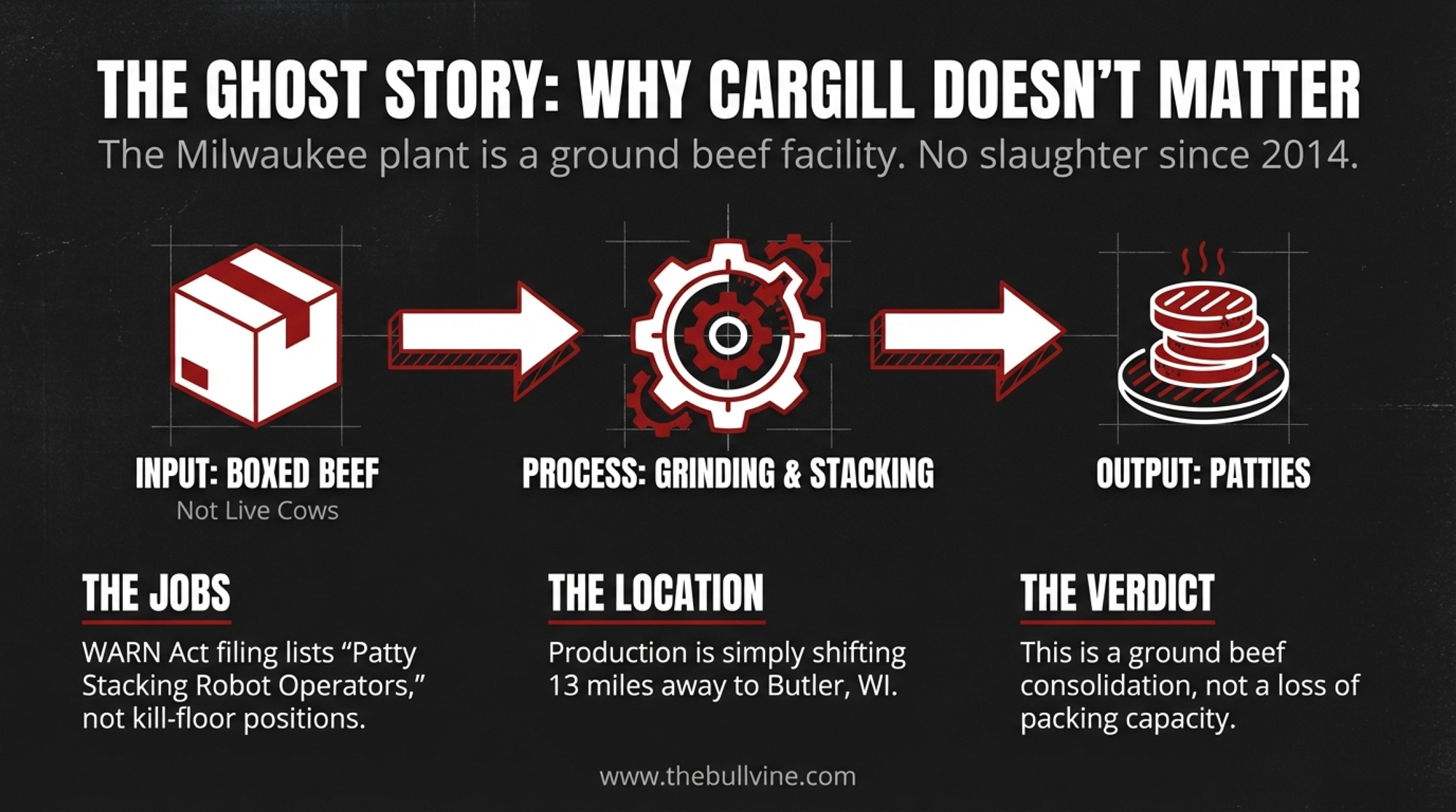
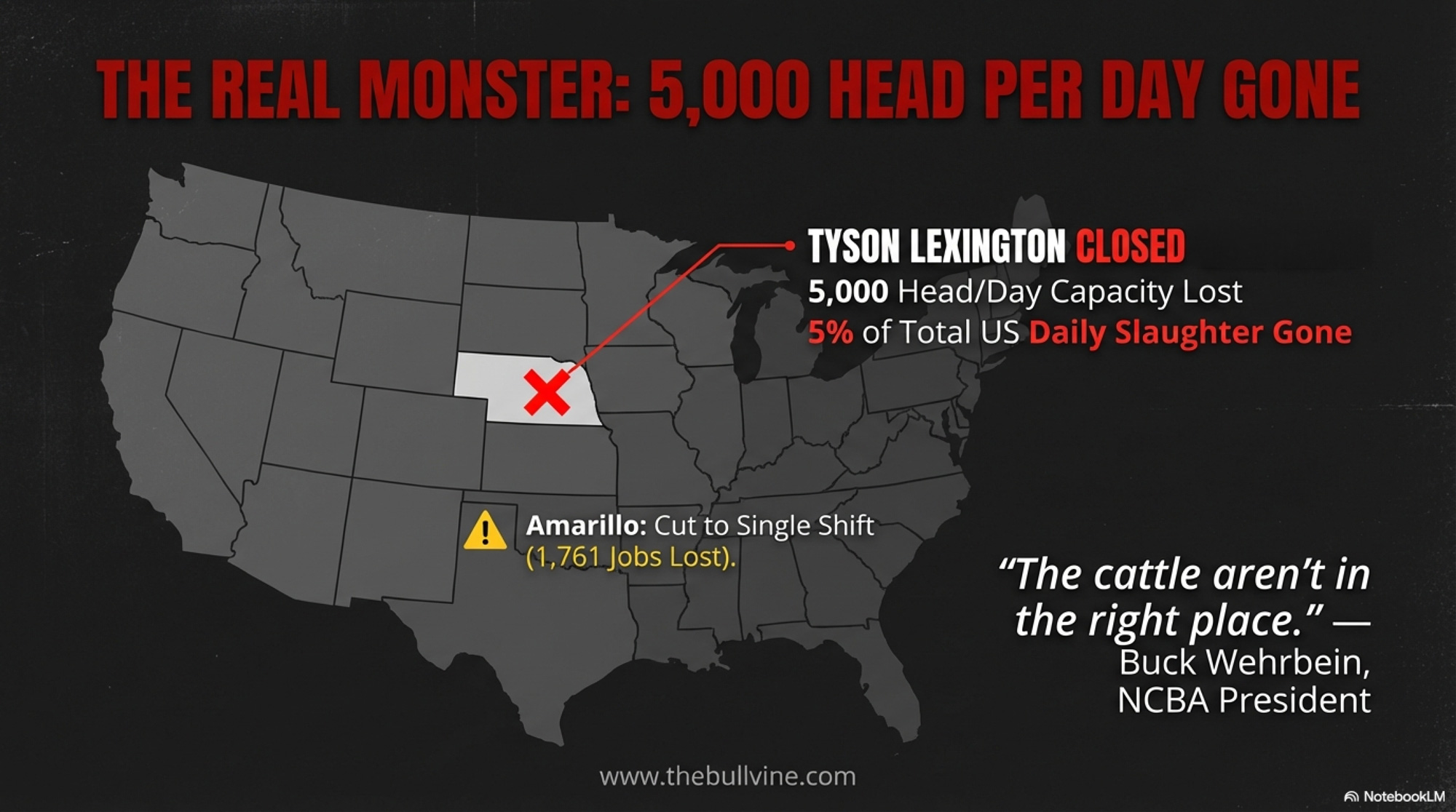
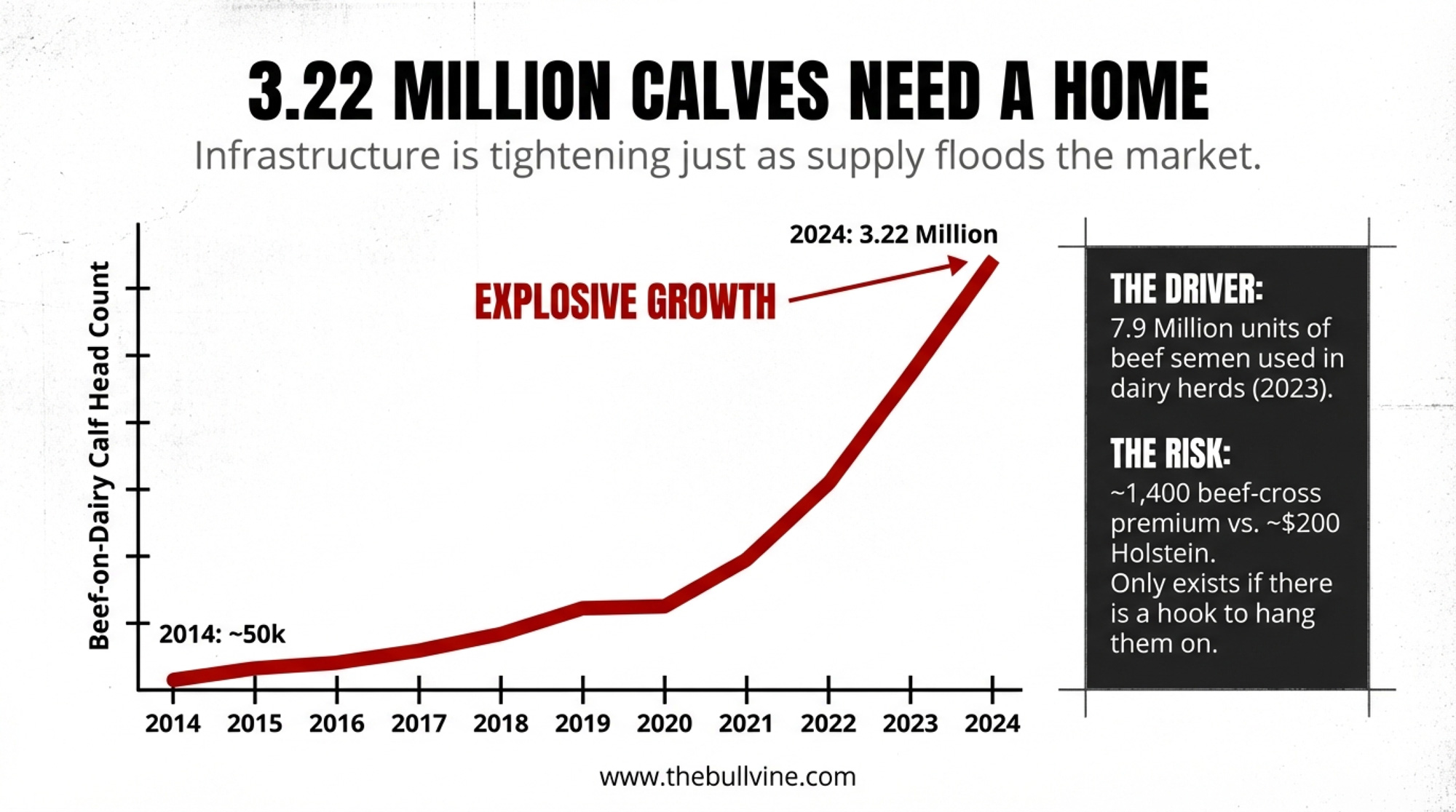

 Join the Revolution!
 Join the Revolution!