Archive for dairy profitability – Page 8

Why Your Canadian Neighbors Sleep Better at Night (And What That Means for Your Bottom Line)

259 US dairies filed bankruptcy in Q1 2025 while Canadian failures are too rare to track. Same cows, different systems.

Did you know 259 American dairy operations filed Chapter 12 bankruptcy in just the first quarter of 2025. That’s a 55% jump from last year… and frankly, it’s accelerating.

I’ve been covering this industry for over two decades now, and what I’m seeing in the numbers—well, it’s making me question everything we think we know about “efficient” dairy markets. But here’s the thing that really gets to me: while we’re watching good farmers get hammered by market volatility (people who’ve done everything right, mind you), there’s this whole system just 300 miles north that’s achieving something we can barely imagine.

Canadian dairy farm bankruptcies? They’re so rare that Statistics Canada doesn’t even bother tracking them as an economic indicator.

Let that sink in for a minute.

The Coffee Shop Conversation That Changed Everything

A sentiment I hear often was perfectly captured in a conversation with a producer from Wisconsin, who said something that’s been rattling around in my head ever since:

“I’m doing everything the extension guys tell me to do, but I can’t plan past the next milk check because who knows what prices will do.” — Mike, Watertown, Wisconsin

That got me digging into some data that… well, let’s just say it challenges pretty much everything we’ve been told about free markets and farm efficiency. Same Holstein genetics. Same robots. Same nutritional consultants. Same level of management skill and dedication. But one group of farmers is building generational wealth while the other group is filing for bankruptcy at rates that would trigger congressional hearings in any other industry.

The difference isn’t management—it’s the system.

And what’s really eating at me… we keep hearing about how Canada’s supply management is “inefficient” and “protectionist,” but their farmers aren’t the ones dumping milk or losing sleep over price forecasts. Meanwhile, our “efficient” system just required $42.4 billion in direct government payments in 2025—a 354% increase from 2024.

Something doesn’t add up, does it?

When USDA Forecasts Become Financial Weapons
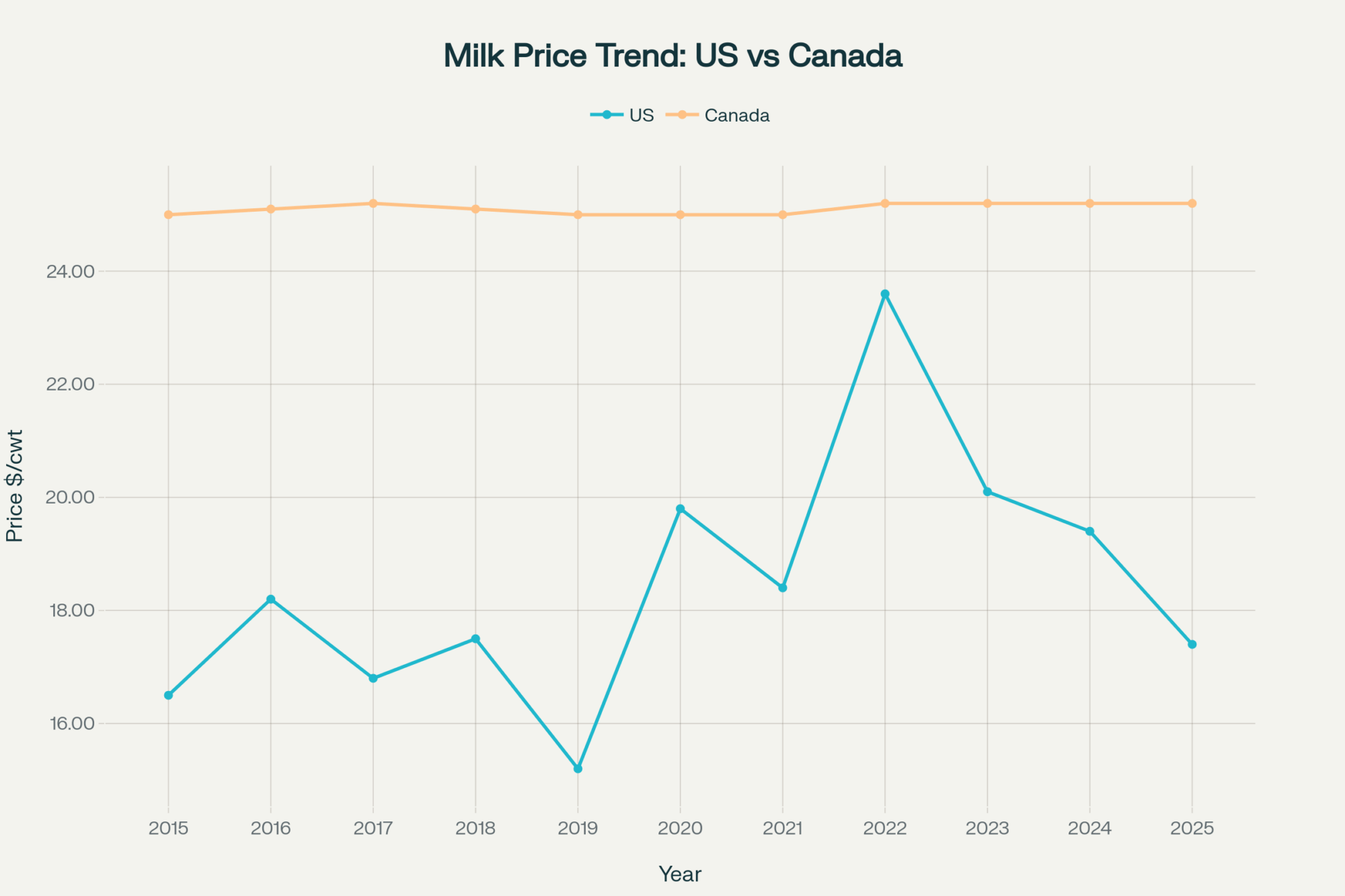
U.S. Milk Price Volatility vs. Canadian Farmgate Price Stability (2015-2025)

Picture this scenario (and I guarantee you’ve lived some version of it): January 2025, you’re at your kitchen table with the calculator out, trying to make sense of that equipment loan for the new double-eight parlor. USDA’s milk price forecast looks decent—nothing spectacular, but workable if things stay reasonably steady.

Four months later… that same forecast drops $1.95 per hundredweight. Your equipment payment didn’t magically decrease. Neither did your feed costs or labor expenses. But the revenue projection that justified every major decision you made this year? Gone.

Tom runs 280 cows in Wisconsin, and he put it perfectly:

“It’s like trying to hit a moving target while blindfolded. How do you make a 10-year investment decision when you can’t predict next quarter’s milk check?” — Tom, Wisconsin

Meanwhile—and this is where it gets interesting—Canadian producers experienced exactly what their system promised them: a farmgate price adjustment of 0.0237%. That’s less than a penny per liter. The kind of predictable variation that lets you actually plan multi-year capital investments with confidence.

What strikes me about this is the mathematical reality most of us don’t want to face. When you can predict cash flow, you can optimize investments. When you can’t… every strategic decision becomes a coin flip with your farm’s survival.

The Robot Paradox: Same Technology, Different Worlds

Here’s a story that really drives the point home. Last spring, I visited two farms on the same day. First stop: a 120-cow operation in Ontario that had just installed their second robot. The farmer showed me spreadsheets—payback calculated at eight years, cash flow projections extending to 2032, financing structured around predictable milk price increases.

“We know what milk will be worth. That makes everything else possible.” — Ontario dairy farmer

Second stop: a 240-cow operation in Wisconsin that had been considering robots for three years but couldn’t pull the trigger:

“Every time I run the numbers, I get a different result depending on what milk price assumptions I use. How do you make a quarter-million-dollar investment when you can’t predict revenue?” — Wisconsin dairy farmer

Same technology. Same potential benefits. Same management capability. But completely different investment climates.

Take a $250,000 robotic milker—pretty standard investment these days. In the Canadian system, that pencils out to a 7-10 year payback with high confidence. Here in volatility-land? Try 15+ years, assuming you don’t get wiped out by a price crash before you break even.

The Numbers That Should Terrify All of Us

Comparison of Chapter 12 bankruptcy filings in US vs Canada (2015-2025)

During the 2019 downturn—you remember that mess—599 American dairy operations filed Chapter 12 bankruptcy. That’s more than one farm entering bankruptcy protection every single day for an entire year.

Canada during the same period? Zero. Not just low. Statistically negligible.

We’re not talking about slight differences in failure rates here. We’re not talking about the difference between systematic farm destruction and systematic farm preservation.

And what really gets to me—this isn’t about Canadian producers being better managers or having access to superior genetics. I’ve walked through barns in both countries. These are the same DeLaval parlors, the same breeding programs, often the same feed consultants. The farmers are equally skilled and dedicated.

The difference is systematic. One system is architected for survival. The other accepts high failure rates as the price of “market freedom.”

Farm Consolidation: When “Efficiency” Becomes Desperation
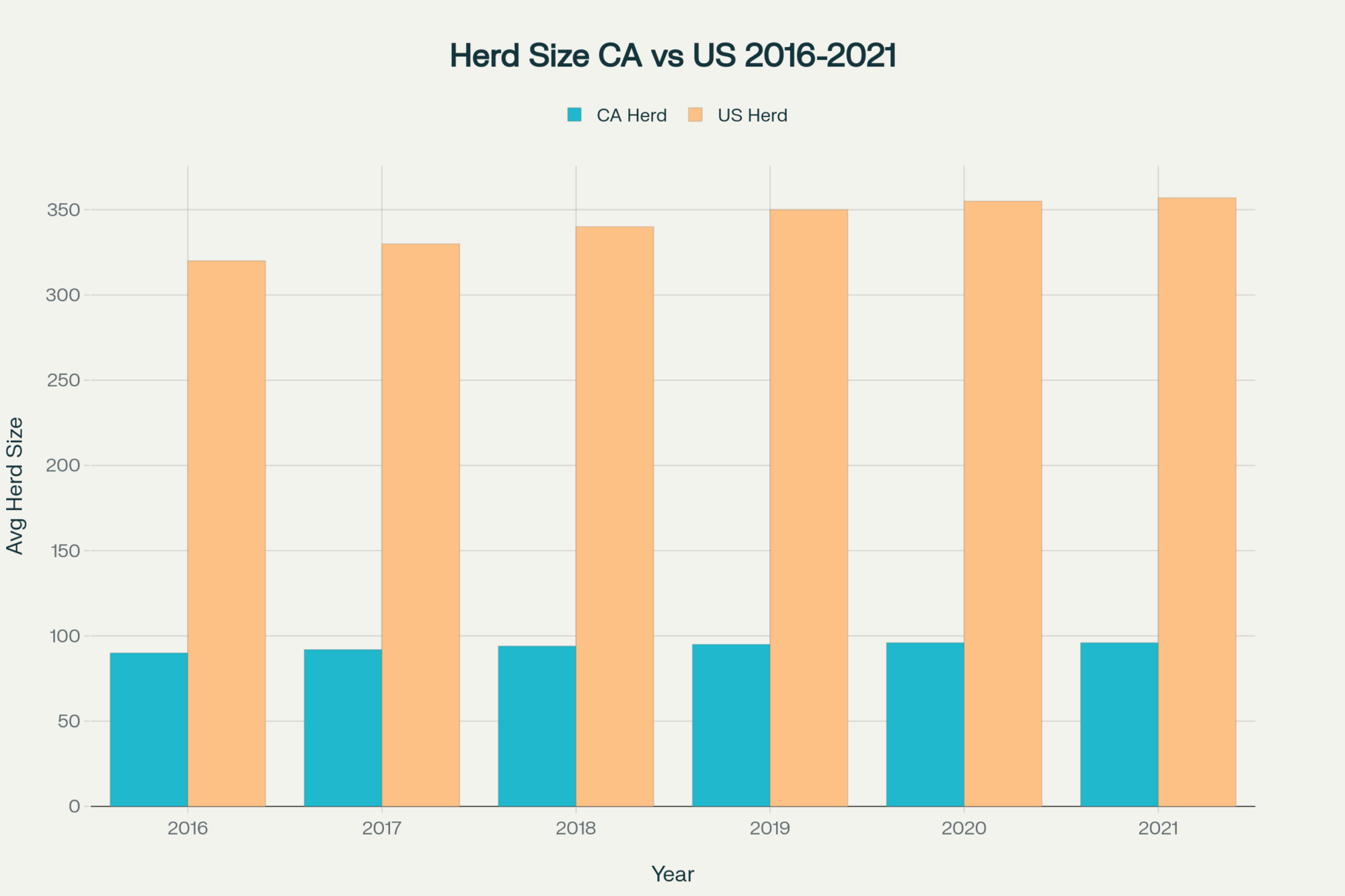
Comparison of average herd size and farm consolidation rates in Canada and the US (2016-2021)

You want to talk about consolidation? American dairy farm numbers dropped 34% between 2016 and 2021. Canada? Just 11% in the same period.

Average US herd size is now 377 cows. Average Canadian herd size? 96 cows.

Now conventional wisdom says the US operations must be more efficient, right? Wrong. They’re not expanding because they’ve identified optimal scale economies. They’re expanding because they need volume to weather price volatility.

It’s survival strategy masquerading as efficiency optimization.

Canadian operations with 100 cows are profitable, stable, and planning capital improvements with confidence. Not because they’re protected from competition, but because they’re protected from financial chaos.

The Mental Health Crisis We Don’t Talk About

Behind every bankruptcy filing is a farm family facing financial ruin, but the human cost goes way beyond the operations that actually fail. Recent research confirms what those of us in rural communities already know—US farmers are 3.5 times more likely to die by suicide than the general population. The primary driver? Financial volatility.

I’ve been to too many farm auctions that shouldn’t have happened. Good farmers, solid managers, excellent stewards of the land—wiped out not by poor decisions but by market forces completely beyond their control.

Sarah ran a 180-cow operation outside of Fond du Lac. Excellent manager, invested in genomics, maintained detailed records, followed every extension recommendation. But three consecutive years of price volatility, compounded by some equipment failures and a spike in feed costs, and she couldn’t service the debt anymore.

“I wasn’t lazy. I wasn’t incompetent. I was just unlucky with timing.” — Sarah, former dairy farmer, Wisconsin

That’s the brutal reality of our system—it punishes bad timing just as harshly as bad management. Maybe more harshly, because at least bad management gives you something you can fix.

Canadian producers face their own stressors, sure—particularly around quota debt levels and succession planning—but they’re shielded from the existential uncertainty that characterizes American dairy production. Studies show that 58% of Canadian producers meet criteria for anxiety and 35% for depression, but these rates, while concerning, reflect manageable business pressures rather than survival uncertainty.

The $35 Billion Asset Most Americans Can’t Fathom

Canadian dairy farmers collectively own over $35 billion in production quota. That’s government-issued licenses to produce milk, and in provinces like Alberta, they’re trading for $58,000 per kilogram of butterfat.

A new entrant starting a 100-cow operation in Ontario faces roughly $840,000 in quota costs before buying their first cow or pouring their first concrete pad.

Sounds insane, right? Until you realize that quota also represents $840,000 in asset value that appreciates over time, provides stable returns, and never goes bankrupt.

I was talking with Dave, who runs a 90-cow operation near Woodstock, Ontario:

“People don’t understand. This quota isn’t just a cost—it’s our retirement fund. My neighbor sold his quota last year and bought a condo in Florida. Try doing that with your milk contracts.” — Dave, Ontario dairy farmer

The Hidden Cost of “Free” Markets (Spoiler: They’re Not Free)

Let’s talk about the elephant in the room—subsidies. Americans love criticizing Canadian supply management as “subsidized agriculture” while praising our “free market” system. But the math tells a different story.

US direct government payments to agriculture hit $42.4 billion in 2025—a 354% increase over 2024. That’s before counting crop insurance premium subsidies (where taxpayers cover about 62% of premiums) and various disaster assistance programs.

Canadian dairy farmers receive exactly zero dollars in direct government subsidies for milk production. Their support comes from higher consumer prices, which are transparent, predictable, and paid by the people who consume the products.

What’s fascinating about the political dynamics: The cost of the US system is hidden in complex farm bills and emergency appropriations that most taxpayers never see directly. The cost of the Canadian system hits every consumer at the grocery checkout.

Which system do you think faces more political pressure?

Current Market Reality: What July 2025 Looks Like from the Trenches

The financial pressures are intensifying across the Midwest, and I’m seeing it in conversations everywhere I go. All-milk prices are sitting at $22.00 per hundredweight—not terrible, but not great when you factor in everything else happening.

The US dairy herd is at 9.365 million head, but what’s really concerning: replacement heifer numbers are at their lowest ratio in decades. We’ve got 3.914 million heifers over 500 pounds—that’s only 41.9 head per 100 milk cows. Historically, we’ve run closer to 45-50.

What does that tell us? Producers are culling hard, selling replacements into the beef market, and avoiding long-term investments needed to maintain herd size.

Feed costs are providing some relief—corn’s forecast at $4.20 per bushel. But labor costs are hitting record levels at $53 billion industry-wide, and equipment costs are up 10-15% due to steel tariffs.

It’s the classic squeeze play. Input costs that don’t adjust downward as fast as milk prices drop, but adjust upward faster when milk prices rise.

The Milk Dumping Nightmare

You want to talk about systemic inefficiency? Let’s discuss milk dumping—a phenomenon that’s virtually non-existent in Canada but periodically devastates US producers.

During the COVID-19 pandemic, farmers across the country were forced to dump millions of gallons of milk into manure pits and fields. An estimated 7% of all milk produced in one week was discarded. Class III milk futures fell by over 30%.

The economic consequences are severe, but the kicker—the government often steps in with taxpayer-funded compensation programs afterward. This cycle of overproduction, price collapse, waste, and government bailout represents massive systemic inefficiency.

Meanwhile, Canada’s supply management system is specifically designed to prevent such structural surpluses by aligning national production with anticipated domestic demand.

What You Can Actually Do About This (Implementation Strategies for 2025)

Look, individual producers can’t change the fundamental policy architecture, but we can adapt our strategies to survive and thrive within the system we have.

Strategy One: Optimize for Liquidity, Not Leverage

Canadian producers can afford to optimize for leverage because their cash flows are predictable. American producers need to optimize for liquidity because our cash flows are chaotic.

What does this look like practically?

  • Maintain higher cash reserves than traditional ratios suggest
  • Structure debt with flexible payment schedules and seasonal adjustments
  • Prioritize equipment leasing over purchasing for major capital items
  • Develop multiple lines of credit before you need them

Tom survived the 2019 downturn specifically because he prioritized liquidity over maximizing leverage ratios:

“My banker thought I was being too conservative. But when prices crashed, I could make payments while my neighbors couldn’t.” — Tom, Wisconsin dairy farmer

Strategy Two: Component-Focused Production

With butterfat premiums hitting record levels—we’re seeing spreads of $1.50+ over protein in some markets—component management becomes crucial for margin optimization.

This means:

  • Genetic selection focused on butterfat production (we’re seeing average tests hit 4.36% nationally)
  • Nutritional programs optimized for fat test rather than volume
  • Seasonal calving patterns that maximize high-component months
  • Marketing arrangements that capture component premiums

Strategy Three: Revenue Diversification Beyond Milk

This isn’t about becoming a “diversified farming operation”—it’s about creating revenue streams that aren’t correlated with milk prices.

Examples I’m seeing work:

  • Custom farming during non-peak labor periods
  • Value-added products sold direct to consumers
  • Renewable energy generation (solar installations are becoming common)
  • Fee-for-service breeding and reproduction programs

Alicia runs 160 cows near Lancaster and generates about 15% of her gross revenue from custom heifer raising:

“When milk prices tank, heifer raising prices usually hold steady or even increase as people cut back on replacements.” — Alicia, Pennsylvania dairy farmer

Environmental and Sustainability Considerations: The Hidden Advantage

Canadian supply management creates incentives for maintaining smaller, distributed operations across the landscape. Average Canadian dairy farms produce 0.94 kg CO2 per liter of milk, compared to higher emissions in the consolidated US system.

The regional concentration we’re seeing in American dairy—with massive operations in California, Idaho, and Wisconsin—creates environmental pressure points. When you’ve got 5,000-cow operations clustered together, you’re dealing with manure management challenges that 100-cow operations spread across the landscape simply don’t create.

What’s particularly noteworthy is how Canadian farms integrate into their local ecosystems. I visited operations in Quebec where dairy farms anchor sustainable crop rotations that support soil health across entire watersheds. Try replicating that with industrial-scale operations.

The Technology Investment Climate: Building for Tomorrow or Surviving Today?

The difference in investment climates really becomes apparent when you look at technology adoption patterns. Canadian producers are consistently early adopters of efficiency technologies because they can predict the payback periods.

According to recent data, precision agriculture adoption rates in Canadian dairy operations are running about 18 months ahead of comparable US operations. Not because the technology is better—it’s often the same equipment—but because the business case is clearer.

I was at a robotics conference last year where the contrast was stark. Canadian producers were asking detailed questions about integration with existing systems and long-term service contracts. American producers were focused on lease structures and exit strategies.

“The Canadians plan like they’ll be farming forever. The Americans plan like they might not be here next year.” — Equipment dealer at industry conference

Regional Variations: It’s Not Just Country vs. Country

Upper Midwest dairy operations—traditional family farm country—are experiencing the most stress from this volatility.

Minnesota and Wisconsin producers are caught in a particularly tough spot. They don’t have the scale advantages of Western operations or the proximity to processing that Northeast producers enjoy. They’re competing on efficiency alone in a market that rewards volume.

Meanwhile, Canadian producers in similar climatic and geographic conditions—Ontario and Quebec—maintain profitable operations at much smaller scale because their system isn’t optimized for volume competition.

I spent time in both Sauk County, Wisconsin, and Wellington County, Ontario, over the past few years. Similar soils, similar climate, similar farming traditions. But walking through those operations felt like visiting different industries entirely.

The Succession Crisis: When Stability Creates Its Own Problems

Canadian supply management shows its limitations when it comes to succession planning—it becomes incredibly complex when farms are worth millions primarily because of government-created assets.

I met with a family near Sherbrooke, Quebec. Third-generation dairy farmers with 85 cows and quota worth nearly $3 million. The retiring generation needs to cash out that quota value for retirement, but the next generation can’t secure financing to buy non-productive assets from their parents.

This creates what researchers are calling a “liquidity trap”—farms that are consistently profitable operationally but impossible to transfer generationally.

Compare that to US operations, where succession crises are driven by unpredictability rather than asset values. American farms fail to transfer not because they’re too valuable, but because they’re too risky.

The Policy Innovation Question: Learning Without Copying

So what can American dairy learn from Canadian success without adopting Canadian constraints?

Some ideas I’m hearing discussed:

Regional Production Cooperatives: Voluntary associations that could coordinate production planning within defined geographic areas. Not quotas, but collaborative forecasting that helps prevent the overproduction cycles that create crises.

Counter-cyclical Price Floors: Automatic triggers that activate support when milk prices fall below calculated break-even levels for extended periods. Less reactive than current disaster programs, more targeted than blanket subsidies.

Risk Management Innovation: Expanding programs like DMC to cover more production and lengthening coverage periods. Current coverage caps at 5 million pounds—roughly the output of a 200-250 cow herd—which leaves larger operations exposed.

The key insight from Canada isn’t that government control is inherently better—it’s that systematic stability enables long-term thinking, which enables sustainable operations.

Financial Resilience Audit: Where Does Your Operation Stand?

Given everything we’ve discussed, it’s worth conducting an honest assessment of your operation’s resilience. Here are the questions that really matter:

Cash Flow Predictability: Can you forecast net income within 15% accuracy six months out? If not, you’re operating with excessive uncertainty for strategic decision-making.

Debt Structure: Is your debt service manageable if milk prices drop $3/cwt for 12 months? That’s not worst-case—that’s recent history.

Investment Recovery: For capital investments over $100,000, do you calculate payback periods under multiple price scenarios? If you only model “normal” conditions, you’re not modeling reality.

Market Risk Exposure: What percentage of your milk is sold at fixed prices versus spot market? Operations with less than 40% price protection are essentially speculating on volatility.

Looking Forward: The Next Five Years

Current trends suggest we’re heading into a period of increased volatility, not decreased. Climate patterns are becoming less predictable, trade relationships are increasingly unstable, and consumer preferences are shifting faster than ever.

The US dairy operations that thrive over the next five years will be those that acknowledge volatility as a permanent feature, not a temporary aberration, and structure their businesses accordingly.

Canadian operations will face their own challenges—particularly around trade pressure and succession planning—but they’ll approach those challenges from a foundation of systematic stability.

The Uncomfortable Truth About American Dairy

After 25 years covering this industry, the difference between operations that survive versus those that fail isn’t primarily about management skill, genetic programs, or production efficiency.

It’s about understanding and adapting to the financial reality of the system we operate in.

Canadian supply management has achieved something remarkable—systematic farm survival in an industry where systematic farm failure has become normalized in the US. That doesn’t mean we should adopt their system wholesale, but it does mean we should learn from their success.

The uncomfortable truth is that our current system works well for large-scale, well-capitalized operations that can weather volatility and achieve economies of scale. It works poorly for mid-size operations caught in the middle, and it’s brutal for beginning farmers trying to enter the industry.

Success in American dairy in 2025 and beyond will be defined by financial resilience that can survive multiple down cycles, operational efficiency that captures available margins, and strategic positioning that plays to regional advantages.

The Choice Ahead

The choice facing American dairy producers isn’t between free markets and supply management. It’s between adapting to the volatility that characterizes our system or becoming another statistic in the bankruptcy files.

Canadian producers chose stability over opportunity. American producers chose opportunity over stability. Both systems work for their intended purposes, but only if you understand what game you’re actually playing.

The question for your operation: Are you playing to survive the game as it exists, or are you still playing by rules that don’t match reality?

Because the market doesn’t care about fairness, tradition, or what “should” work. It only cares about what does work. And right now, systematic financial resilience works better than hoping for the best while preparing for nothing.

The Canadian model isn’t perfect, but it’s produced outcomes our “efficient” system has failed to deliver: systematic farm survival, predictable investment climates, and rural communities that aren’t hollowing out from farm failures.

Whether American dairy can learn those lessons without adopting Canadian constraints remains to be seen. But one thing’s certain—continuing to do what we’ve always done will continue producing the results we’ve always gotten.

And those results include bankruptcy rates that would be considered a national emergency in any other industry.

What keeps me up at night isn’t just the statistics—it’s the realization that we’ve normalized financial chaos as the price of “freedom.” Maybe it’s time to ask whether the freedom to fail is worth the cost of systematic instability.

Your Canadian neighbors sleep better at night because their system prioritizes survival over volatility. The question is: what are we willing to learn from that success?

Look, I’ve been walking through barns in both countries for decades. Same genetics, same equipment, same dedication. The difference isn’t the farmers—it’s the system we’re operating in. Maybe it’s time we learned something from our northern neighbors who figured out how to make dairy farming sustainable instead of just survivable.

KEY TAKEAWAYS

  • Financial resilience beats scale every time — Canadian operations maintain 16% debt-to-asset ratios with negligible bankruptcy rates versus our 55% surge in failures, proving you can optimize for liquidity over leverage when cash flows are predictable (start building 6-month operating reserves now)
  • Investment confidence drives technology adoption — Stable pricing allows 18-month earlier adoption of precision dairy tech because payback calculations actually work, while our volatility makes every major purchase a gamble (consider leasing over purchasing for equipment over $100K)
  • Component premiums are your profit lifeline — With butterfat hitting $1.50+ spreads over protein and average tests reaching 4.36% nationally, genetic selection focused on components rather than volume could be your 2025 margin saver (audit your breeding program this quarter)
  • Mental health costs are measurable — US farmers face 3.5x higher suicide rates directly linked to financial volatility, while Canadian producers deal with manageable business stress rather than survival uncertainty (seriously, if you’re struggling with uncertainty, you’re not alone)

EXECUTIVE SUMMARY

So here’s what’s got me fired up—Canadian dairy farmers have essentially eliminated bankruptcy risk through supply management while we’re watching a 55% surge in Chapter 12 filings. Think about that for a second. Their average operation runs 96 cows and pencils out robotic milkers with 7-10 year paybacks, while our 377-cow “efficient” operations are looking at 15+ years if they don’t get wiped out first. The kicker? We just hit $42.4 billion in taxpayer bailouts (up 354% from 2024) while calling their consumer-funded system “subsidized.” Global dairy markets are shifting toward stability models, and frankly… maybe it’s time we paid attention. Look, I’m not saying we need to copy everything, but when your competition sleeps soundly while you’re stress-planning around $1.95/cwt forecast revisions, something’s worth learning.

Data verification: All statistics and market figures referenced in this analysis have been verified against current USDA-AMS, USDA-ERS, USDA-NASS, Statistics Canada, and industry reports published through July 2025.

Complete references and supporting documentation are available upon request by contacting the editorial team at editor@thebullvine.com.

Learn More:

  • Your 2025 Dairy Gameplan: Three Critical Areas Separating Profit from Loss – Reveals practical strategies for boosting profits by $500+ per cow through forage quality optimization, methionine supplementation, and transition cow management that you can implement immediately regardless of farm size.
  • 2025 dairy crisis – Demonstrates how to build layered financial protections using DMC, forward contracts, and strategic risk management to survive the 18% milk price crash and margin squeeze hitting operations nationwide.
  • 5 Technologies That Will Make or Break Your Dairy Farm in 2025 – Exposes the five game-changing innovations—from smart calf sensors reducing mortality 40% to AI-driven feed optimization—that separate thriving operations from those struggling to survive market volatility.

The Sunday Read Dairy Professionals Don’t Skip.

Every week, thousands of producers, breeders, and industry insiders open Bullvine Weekly for genetics insights, market shifts, and profit strategies they won’t find anywhere else. One email. Five minutes. Smarter decisions all week.

NewsSubscribe
First
Last
Consent

Why Your Next Water Bill Could Make or Break Your Dairy Operation – And the Smart Money Moves You Need to Make Now

Water bills just hit $2,200/acre-foot in CA. Your feed costs could triple overnight. Here’s what smart producers are doing now.

EXECUTIVE SUMMARY

You know that sinking feeling when you open a bill that’s way higher than expected? Well, dairy producers in California are getting that feeling every month now with water costs hitting $2,200 per acre-foot during droughts. The biggest misconception in our industry right now is that water will always be cheap and available – but SGMA regulations have already caused land values to crash 30-50% for groundwater-dependent operations, and ERA Economics forecasts $2.2 billion in losses for San Joaquin Valley dairies by 2040. Meanwhile, smart operators who’ve invested in subsurface drip irrigation are seeing 30-40% yield increases in alfalfa while using 80% less water. The divide between water-secure and water-stressed regions is creating the biggest geographic shift in dairy production since we started tracking these trends. There’s literally billions in federal funding sitting on the table right now – EQIP alone offers up to $450,000 per farm – but most producers don’t know how to stack these programs together. If you’re not planning your water strategy for 2025 right now, you’re already behind.

KEY TAKEAWAYS

  • Technology ROI that actually works: Soil moisture sensors cost just $100 each but deliver $18,400 annual benefits on a 40-acre field through 20-30% water savings and 15-20% yield increases. Order them now before spring planting – the payback period is under 18 months in today’s tight forage markets.
  • Free money you’re missing: Stack EQIP grants ($450K max) with state programs like California’s Dairy Plus ($1.25M) and Idaho’s $30M water fund to turn expensive irrigation upgrades into cash-flow positive investments. February 28th EQIP deadline is coming fast – get your Technical Service Provider lined up this week.
  • Geographic arbitrage opportunity: Land values are crashing 30-50% in water-stressed regions while capital flows toward Great Lakes dairy operations. If you’re expanding in 2025, water security beats genetics every time for long-term profitability.
  • PRF insurance as capital planning: Texas enrolled 42.8M acres in Pasture, Rangeland, Forage insurance – a 191% jump since 2011. Use drought payouts to fund irrigation upgrades; it’s essentially using insurance to pay for drought-proofing your operation.
  • Carbon revenue stream: Cover crops and no-till systems generate $7.50-$100 per acre annually in carbon credits while improving water infiltration. Land O’Lakes paid $5.1M to 273 farmers in 2022 – real money hitting real accounts for practices progressive producers already implement.

You know what caught my attention at the World Dairy Expo last month? It wasn’t the latest robotic milking system or even those impressive butterfat numbers everyone was talking about. It was a conversation I overheard between two California producers near the coffee stand.

“Jim’s selling out,” one said quietly. “Twenty-three years milking 2,400 head, and his water bill just hit numbers that… well, let’s just say it made him check the decimal point twice.”

Here’s the thing that struck me about that moment – this wasn’t some struggling operation. Jim has been one of the more innovative producers in Tulare County, an early adopter of precision feeding, a solid genetics program, and the whole nine yards. However, when your water costs skyrocket to $2,200 per acre-foot during drought conditions, even the best-managed operations begin to question whether there’s a future in this business.

And honestly? This conversation is happening in dairy barns from Modesto to Twin Falls. The economics of water have shifted so dramatically that what we thought we knew about regional advantages, land values, and operational planning — well, a lot of that conventional wisdom has been turned upside down.

What the USDA Numbers Aren’t Telling You About Our Industry’s Future

Let me start with something that should make every producer sit up and pay attention. The latest USDA projections show we’re looking at 228.3 billion pounds of milk production for 2025, with all-milk prices hovering around $22.00 per hundredweight. On the surface, those aren’t terrible numbers – certainly better than what we were staring at during some of those brutal stretches in the late 2010s.

However, here’s what’s fascinating —and a little concerning. Our replacement heifer inventory has just reached 2.5 million head, which is the lowest we’ve tracked since the USDA began keeping these records in 2001.

Think about that for a second. We’re discussing the foundation of our future herds here, and those numbers are telling a story that much of the industry coverage is missing.

What strikes me about this whole situation is how everything’s converging at once. You’ve got tight replacement stock, water costs going absolutely nuts in key production regions, and – here’s something that doesn’t get enough attention – agricultural wages that USDA forecasts will exceed $53 billion industry-wide this year.

It’s like watching a perfect storm build on the horizon, except most folks are still focused on their daily milk checks and not seeing the bigger picture.

Now, I’ve been talking to producers across the border as well – my contacts in southern Alberta and the Fraser Valley are facing similar pressures. This is no longer just an American headache. The regulatory environment up there is tightening around water usage, and the cost pressures are real.

But here’s what really gets me excited about this moment… and yes, excited is the right word. The producers who recognize this shift early and adapt aggressively? They’re going to build competitive advantages that compound for decades. Those who wait and hope things will go back to “normal”? They will find themselves permanently disadvantaged.

When “Cheap” Water Became Your Most Expensive Input

The thing about California water markets is that they’ve essentially become their own commodity exchange, complete with futures trading and all the associated features. During normal precipitation years, you might get away with $50 to $200 per acre-foot from your local water district – annoying but manageable if you’re planning for it.

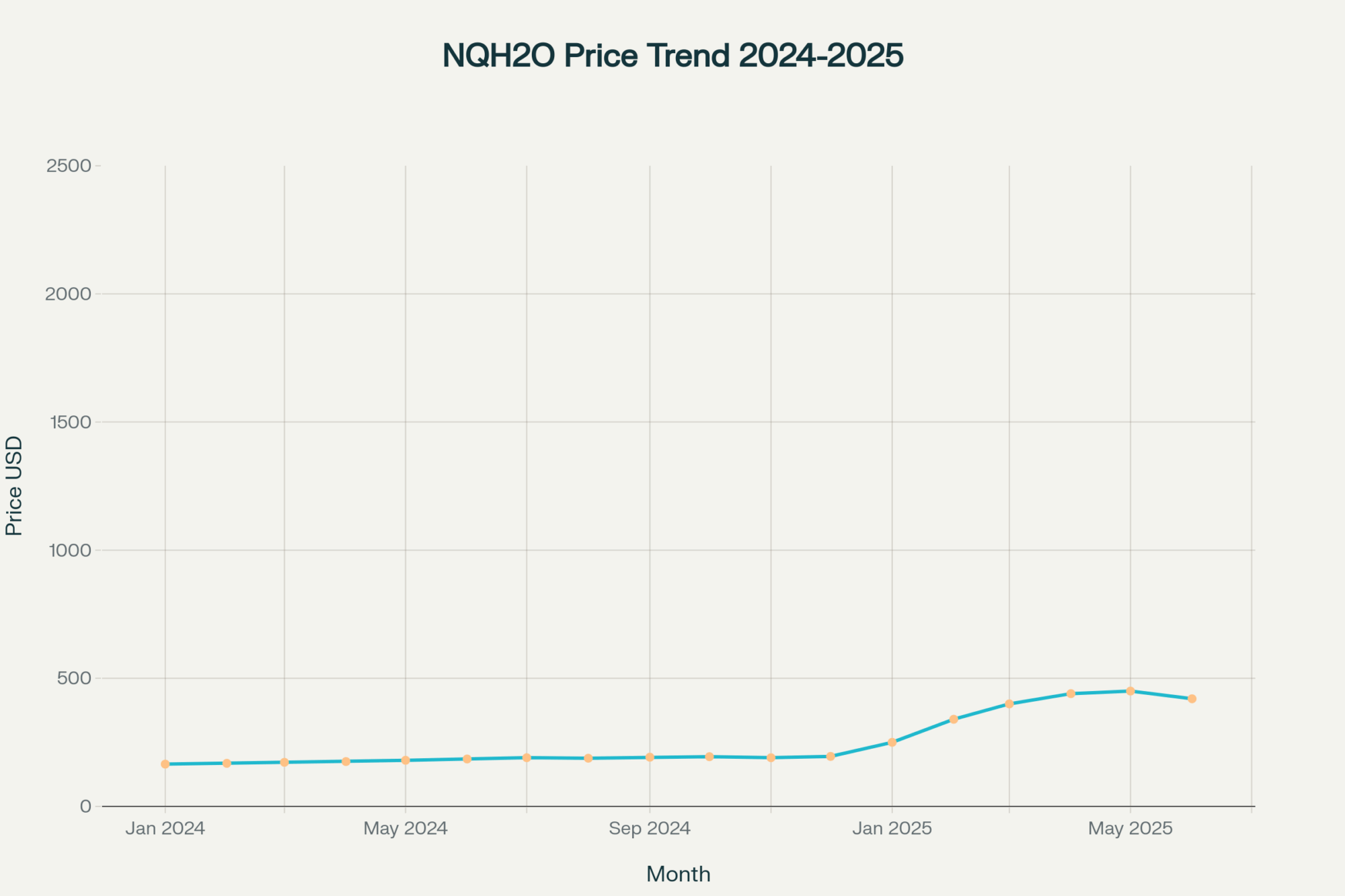
But when drought hits? The Nasdaq Veles California Water Index indicates prices that peaked near $450 per acre-foot earlier this year, subsequently settling back to around $350 by mid-year. During the really severe stretches, we’ve seen spot markets hit $2,200 per acre-foot.

Nasdaq Veles California Water Index Price Fluctuations (2024-2025)

Here’s where it gets really interesting, though. I was speaking with a producer near Modesto last week who shared something that doesn’t make economic sense: during the worst water cost spikes, it was actually cheaper for him to truck hay in from Nebraska than to grow it locally.

Let that sink in for a minute. The transportation costs, the logistics headaches, the quality concerns… all of that became preferable to dealing with local water costs. That’s not just a pricing anomaly – that’s a fundamental shift in how we think about regional comparative advantages.

What SGMA is Really Doing to Our Balance Sheets

Most people outside California haven’t fully grasped the impact of the Sustainable Groundwater Management Act on dairy operations in the state. And honestly, even some California producers are still treating this like it’s just another environmental regulation to navigate.

It’s not. This is economic warfare.

Let me break down what producers in the heart of California dairy country are actually facing right now. In the Tule Subbasin – we’re talking about the epicenter of the industry here – producers are looking at annual well fees of $300 per well plus $20 per acre-foot of groundwater pumped. Move over to parts of the Kaweah Subbasin, and those acreage fees jumped from $32 per acre to potentially $140 per acre.

But those fees? That’s just the appetizer.

The main course is land devaluation, so severe that it’s making agricultural lenders nervous. According to recent work from the American Society of Farm Managers and Rural Appraisers, properties that depend entirely on groundwater in critically overdrafted basins have lost 30-50% of their value in 2024 alone. Since March, almond orchards without reliable surface water have lost more than half their value.

Think about what that means for a typical dairy operation. That’s equity disappearing overnight. Your borrowing capacity gets destroyed, and suddenly you’re looking at distressed sales to operations with deeper pockets – or worse, to those “water-first” investors who are buying up agricultural land not for farming, but just for the water rights attached to it.

Sarah runs a 1,800-head operation near Hanford, and she put it perfectly when I talked to her last month: “We went from being farmers to being water speculators overnight. Except we didn’t sign up to be speculators.”

Here’s what’s really keeping me up at night about this whole situation… the ripple effects are just starting. Those higher water costs get passed through to local forage markets. ERA Economics forecasts a staggering $2.2 billion in total economic losses for the San Joaquin Valley’s dairy and beef sectors by 2040, with the majority of these losses projected to be incurred through higher feed costs.

The Regional Reality Check: Why Geography Suddenly Matters More Than Genetics

What’s happening right now is creating this stark bifurcation between the “water haves” and “water have-nots.” And it’s not just about individual farms – we’re talking about entire regions facing fundamentally different economic realities.

Take Idaho, for example. They’ve got a more structured approach through their Water Supply Bank, but even there, rental rates are jumping by over 40% – from $23 per acre-foot in 2024 to $33 per acre-foot starting this year. What’s interesting about Idaho is how it has embedded water rights into the core of its dairy regulations. You literally can’t get a permit to sell milk without demonstrating adequate water rights.

A different regulatory gate than what we see elsewhere, but it forces producers to consider water security from the outset of any expansion planning.

Now, head up to Wisconsin, and you’re dealing with a completely different set of challenges. Recent research from Marquette University shows that agricultural runoff remains the leading cause of water quality impacts on rivers and streams in the area. The regulatory framework emphasizes stewardship responsibilities rather than competing for scarce water supplies.

However, what’s fascinating about the Wisconsin situation is that the solutions they’re developing for nutrient management and manure handling could become the blueprint for other regions as regulatory pressure increases everywhere.

I was speaking with Tom, who runs an 850-head operation near Green Bay, and his biggest headaches aren’t about water costs – they’re about compliance with environmental standards for manure management and nutrient runoff. “We’ve got water,” he told me. “What we need is to prove we’re managing it responsibly.”

That’s a completely different challenge than what Sarah’s facing in California, but both are dealing with water regulations that are reshaping their cost structures and operational planning.

The Technology That’s Actually Moving the Needle (And Why Most Producers Are Still Sitting on the Sidelines)

Look, I’ve been to enough farm shows to see plenty of irrigation systems that look impressive in demonstrations but don’t deliver where it really counts – on your profit and loss statement. What we’re seeing now, though… it’s different.

Subsurface drip irrigation systems cost between $2,500 and $5,000 per acre to install. Real money, especially when you’re looking at converting 100-200 acres of forage production. And let’s be brutally honest about something – there’s a learning curve that some producers underestimate.

But the performance numbers from operations that made the switch and stuck with it? They’re compelling in ways that go beyond just water savings.

Then there is this operation near Modesto – 800 acres, which has been in the family for three generations. When I talked to the farm manager last month, he was brutally honest about their SDI experience. He told me, “The first year was rough… We had to learn how to manage the fertigation and had some clogging issues with the emitters. But by year two? Our alfalfa stands were the best we’d ever seen.”

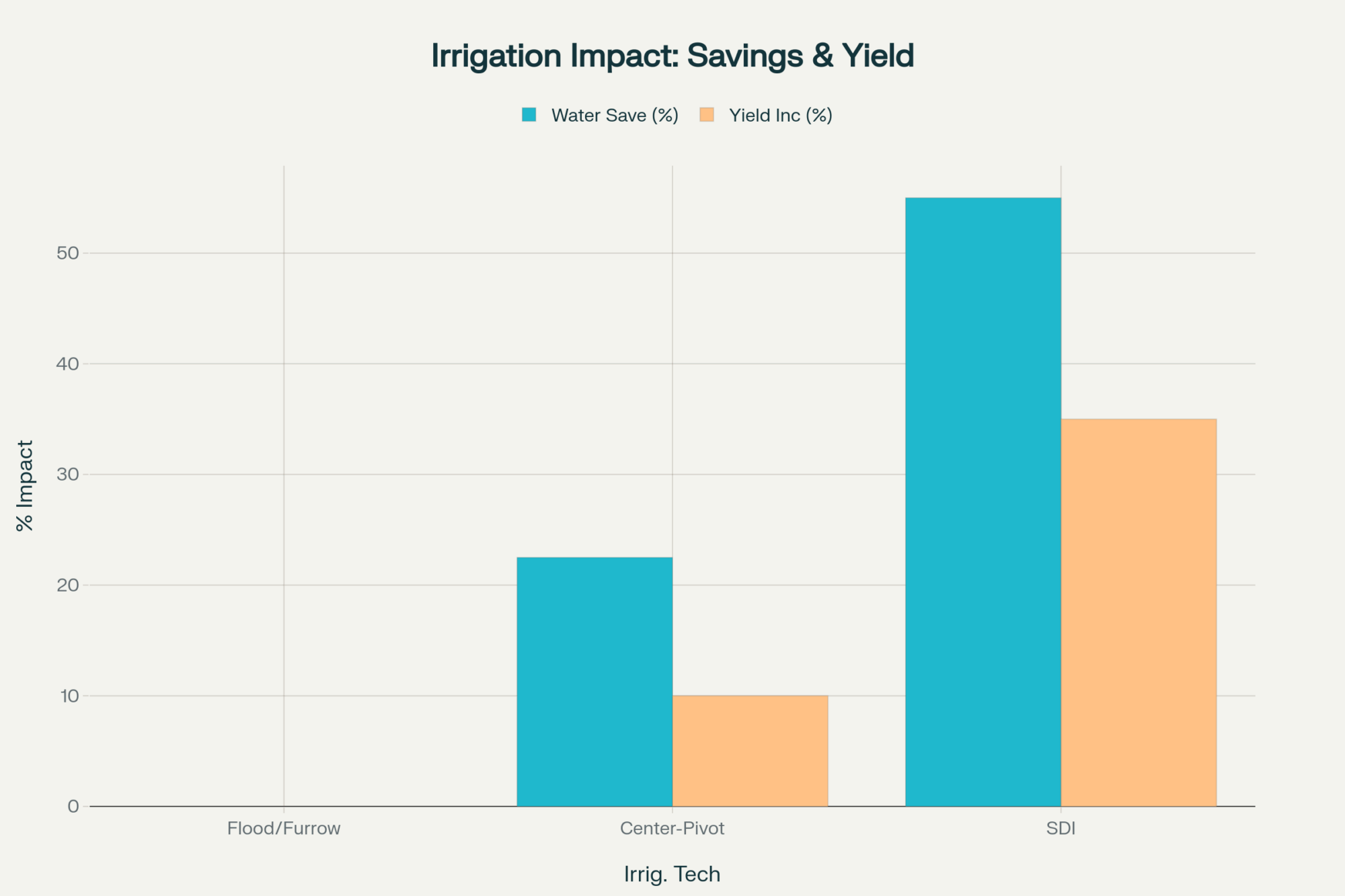
They transitioned from flood irrigation, yielding 12-13 tons per acre, to SDI, achieving 16-17 tons per acre—a 30-40% yield increase. At current alfalfa prices (and honestly, $200 per ton is conservative in today’s tight forage markets), that extra 4-5 tons per acre generates $800 to $1,000 in additional revenue annually.

Water Savings and Alfalfa Yield Increase by Irrigation Technology

Here’s what really gets me excited about SDI… the efficiency numbers are 90-95% versus 50-60% for flood irrigation. When water costs $500 or more per acre-foot, that efficiency isn’t just nice to have – it’s the difference between staying in business and going out of business.

The payback typically runs 3-7 years, but that calculation often underestimates the full value. You’ve got reduced labor (no more moving pipe – hallelujah), lower energy costs from new, efficient pumps, and precision fertilizer application through the drip lines.

Table 1: Cost-Benefit Analysis of Precision Irrigation Technologies for Dairy Forage

TechnologyCapital Cost per AcreEstimated Water Savings (%)Impact on Alfalfa Yield (%)Key ROI DriversTypical Payback Period (Years)
Flood/Furrow$200 – $400Baseline (0%)Baseline (0%)Low initial costN/A
Center-Pivot$1,100 – $2,10015-30%5-15%Reduced labor, improved water uniformity, moderate yield increase5-10
Subsurface Drip$2,500 – $5,00030-80%30-40%Significant yield increase, reduced energy/fertilizer use, water cost savings3-7

The $100 Game-Changer Nobody’s Talking About Enough

This might surprise you, but some of the most profitable agricultural technology solutions are actually the least expensive. Basic soil moisture sensor nodes run around $100 each. Comprehensive wireless systems might cost a few thousand to cover a large operation, but the ROI is almost unbelievably good.

Studies show these sensors reduce farm water usage by 20-30% while increasing yields by 15-20%. Let me walk you through the math on a 40-acre alfalfa field because this is where the rubber meets the road…

A comprehensive monitoring system costs approximately $5,000 to install. Water savings alone – let’s say you save 1.5 acre-feet annually at $400 per acre-foot – that’s $2,400 in direct cost savings. Add yield improvement of 2 tons per acre at $200 per ton, and you’re looking at another $16,000 in revenue.

That’s $18,400 in annual benefit against a $5,000 investment. You’d be hard-pressed to find better returns in today’s market.

But here’s the thing that frustrates me… According to 2023 USDA data, only 27% of farms or ranches utilize any form of precision agriculture practices. The barriers remain the same: high upfront costs, a perceived lack of clear ROI, and the complexity of implementation.

What strikes me about this adoption gap is that we’re discussing technologies that’re proven, profitable, and readily available today. The question isn’t whether they work – it’s why more producers aren’t taking advantage of them.

Where the Real Money Is: Federal Programs That Actually Pay Out

While you’re stressing about water costs, there are literally billions in federal conservation funding sitting on the table. The challenge isn’t qualifying – it’s understanding how to stack multiple programs to turn expensive projects into cash-flow-positive investments.

The Environmental Quality Incentives Program offers up to $450,000 per Farm Bill cycle for qualifying operations. For water conservation specifically, EQIP covers irrigation system upgrades, water management plans ($3,000-$10,000 each), infrastructure improvements, and waste storage facilities.

Here’s the reality, though – EQIP is a competitive program. Really competitive. Applications are ranked based on environmental benefit per dollar invested, and not everyone receives funding. The key is working with certified Technical Service Providers who understand how to structure applications for maximum competitiveness.

Quick sidebar here – the EQIP deadline for the current cycle is February 28, 2025. If you’re considering this, don’t wait until the last minute to assemble your application.

California stepped up with their Dairy Plus Program, offering grants up to $1.25 million for operations implementing advanced manure management that delivers water benefits. Idaho responded to their 2024 Water Settlement Agreement with $30 million in targeted grants, with individual projects eligible for up to $250,000.

However, what I find really interesting about the current funding landscape is that the most successful producers aren’t just grabbing one program. They’re “stacking” multiple sources.

A typical successful project might use an EQIP grant to fund a new irrigation system partially, secure a state-level grant for a matching portion, enroll in a carbon program to generate ongoing revenue from improved soil health, and protect the resulting forage with PRF insurance. This multi-layered approach transforms a prohibitively expensive project into a financially manageable investment.

PRF Insurance: The Safety Net That Actually Works When You Need It

Pasture, Rangeland, and Forage insurance adoption has exploded in water-stressed regions, and there’s a good reason why. Texas enrolled 42.8 million acres in PRF in 2024 – a 191% increase from 2011. During recent drought periods, the program showed positive net benefits, generating significant payments exactly when producers needed them most.

PRF provides area-based coverage that automatically triggers payments when precipitation falls below historical averages. You customize coverage from 70-90% of average rainfall, selecting critical growing periods that match your operation.

I’ve seen operations use PRF payouts to fund irrigation upgrades – essentially using drought insurance to pay for drought-proofing technology. Pretty clever when you think about it.

Mike runs 650 head near Fresno, and he told me something that really stuck: “PRF isn’t just insurance for us anymore – it’s part of our capital planning. We know that if we get a payout, that money’s earmarked for water infrastructure improvements.”

Table 2: Summary of Federal and State Financial Incentives for Water Conservation

Program NameAdministering AgencyTypeMax Funding/BenefitKey Eligibility for DairyRelevant Water Conservation Practices
EQIPUSDA – NRCSCost-Share/Grant$450,000 per Farm Bill cycleAgricultural producersIrrigation systems, water management plans, waste storage/separation
PRF InsuranceUSDA – RMAInsuranceVaries by policyProducers of pasture, rangeland, or forageIndemnities for below-average rainfall in selected intervals
CA Dairy Plus ProgramCalifornia Department of Food & Agriculture (CDFA)Grant$1,250,000 ($750/cow)California dairy operationsAdvanced manure management with water quality co-benefits
ID IWRB GrantsIdaho Water Resource BoardGrantUp to $2,000,000 (varies)Idaho water users in specific regionsWater monitoring, infrastructure upgrades, groundwater conversion
WI TRM GrantWisconsin Department of Natural Resources (DNR)Cost-Share/Grant$150,000 (up to 70% cost-share)Local governments, tribal governmentsProjects to control polluted agricultural runoff
WI Producer-Led GrantsWisconsin Department of Agriculture, Trade and Consumer Protection (DATCP)Grant$40,000 per groupGroups of 5+ farmers in a watershedFarmer-led conservation projects, demos, and outreach

The Carbon Credit Opportunity That Most Producers Are Missing

Here’s something that’s flying under the radar of many producers: the voluntary carbon market rewards agricultural practices that benefit water conservation through measurable carbon sequestration.

Cover crops, no-till systems, and managed rotational grazing can sequester 0.5 to 2.0 tons of CO2 equivalent per acre annually. At current market prices of $15-$ 50 per ton, this translates to $7.50-$100 per acre in annual carbon revenue.

What’s particularly noteworthy is how these practices deliver multiple benefits. By increasing soil organic matter, they improve soil structure, which in turn enhances water infiltration and increases the water-holding capacity. You’re essentially getting paid to make your operation more drought-resilient.

Land O’Lakes’ Truterra program paid out $5.1 million to 273 farmers in 2022 for verified carbon sequestration and water quality improvements. That’s real money hitting real farm accounts for practices that many progressive producers were already implementing.

The trend suggests we’re moving toward paying for verifiable outcomes rather than just practices. Early conservation programs compensated farmers simply for implementing a practice. Now, more sophisticated mechanisms tie payments to specific, data-driven results – a measured rainfall deficit or a verified ton of sequestered carbon.

This means dairy farmers who want to capitalize on future financial opportunities need to become data managers, capable of documenting and verifying their environmental performance.

What This All Means for Your Operation (And Why Waiting Isn’t an Option)

Here’s what I’m seeing from my conversations with producers across different regions… the operations that recognize this shift early and adapt aggressively will build competitive advantages that compound for decades. The ones who wait? They will find themselves permanently disadvantaged.

If you’re in the West, your priority should be securing water rights and maximizing efficiency through technology. Every drop literally counts, and the economics support major technology investments. The regulatory environment isn’t getting more lenient, and water isn’t getting cheaper.

If you’re in the Great Lakes region, focus on water quality and nutrient management. Regulatory pressure is only going to increase, but there’s a tremendous opportunity to get ahead of it through proactive stewardship. The solutions being developed in places like Wisconsin could become the template for everywhere else.

If you’re anywhere else, pay attention to both trends, as the policy approaches being tested in California and Wisconsin will likely influence federal regulations in the future.

The geographic arbitrage opportunity here is real. I’m seeing capital flows toward water-secure regions, such as the Great Lakes, while operations in water-stressed areas face increasing pressure to consolidate or sell out.

Your 90-Day Action Plan (Because the Window Is Closing)

Look, the window for proactive water management is closing fast. Here’s what you need to be doing in the next 90 days to position your operation for success…

Days 1-30: Know exactly where you stand. Document every water source, right, and cost. Model your operation’s financial performance under various drought scenarios – California operations should assume spot market pricing of $ 1,000 or more per acre-foot during severe conditions.

Get your soil tested. Not just NPK levels, but organic matter content and water-holding capacity. This baseline data will be crucial for both grant applications and operational planning.

Table 3: Comparative Water Rights Valuation in Major U.S. Dairy Regions (2024-2025)

RegionWater Right TypeMarket MechanismSpot/Lease Price Range per Acre-FootKey Regulatory Driver2020-2025 Price Trend
CaliforniaAppropriativeOpen Market, Water Districts$50 – $500+ (District); up to $2,200 (Spot market in drought)SGMA, CVP/SWP AllocationsHighly Volatile, Strong Upward Pressure
IdahoAppropriativeState Water Bank$23 (2024) increasing to $33 (2025)Prior Appropriation, ESPA ManagementStable but Increasing
WisconsinRiparianNoneN/A (Not a tradable commodity)Clean Water Act, State Groundwater LawN/A (Focus on compliance costs)

Days 31-60: Start the grant application process immediately. EQIP applications for the current cycle are due February 28, 2025. Having a great project isn’t enough – you need to score higher than other applicants in your region.

Research and apply for relevant state programs simultaneously. California’s Dairy Plus Program, Idaho’s IWRB grants, Wisconsin’s TRM grants – whatever applies to your region.

Days 61-90: Order your soil moisture sensors and get them installed before the next growing season. Start conversations with drip irrigation contractors and get bids for priority acreage. Most importantly, start documenting everything. The future of agricultural funding is shifting toward paying for verifiable outcomes rather than just practices.

What would you do if your water costs doubled next year? Not might double – what if they actually did? Because for some producers, they already have.

When Water Management Becomes Your Profit Center

The most effective operations I know have stopped thinking of water management as a necessary evil. They’ve started treating it as a profit engine capable of generating multiple revenue streams from the same conservation investments.

Consumer interest in agricultural sustainability is creating opportunities for agritourism programs that can generate $30,000 to $ 50,000 annually while building brand value. Premium pricing for sustainably produced dairy products typically ranges 15-30% above commodity pricing.

I visited an operation in Lancaster County last month that’s generating an additional $45,000 annually from agritourism. However, what’s truly smart about their approach is that they’re using those farm tours to gauge consumer interest in “water-responsible” dairy products before making larger investments in specialized marketing and distribution.

The plate cooler systems that most producers think of as energy-saving equipment? They’re actually water management tools that can reduce refrigeration energy consumption by up to 60% while providing tempered drinking water for the herd. When you factor in all the benefits – energy savings, water recycling, and improved herd comfort – the ROI becomes compelling, even in regions with relatively inexpensive water.

The Uncomfortable Truth About Where This Is All Heading

What’s happening with water in dairy isn’t just another challenge to manage – it’s a fundamental shift that’s reshaping who wins and who loses in our industry.

I’ve been covering agriculture for over two decades, and I’ve seen this movie before with other input costs. Feed, energy, labor… the producers who adapt early and strategically don’t just survive the transition, they thrive during it. They use periods of disruption to gain market share from slower-moving competitors.

The technology exists. The financial tools are available. The markets are developing. What’s missing is the urgency to act while there’s still time to get ahead of the curve, rather than just react to it.

Here’s my prediction, and you can hold me to this… in five years, every successful dairy operation will have sophisticated water management systems. The question is whether you’ll be leading that transformation or scrambling to catch up with operations that have been planning for three years.

What keeps me optimistic about our industry is that dairy producers are among the most innovative and adaptable people I know. When the economy changes, they adapt to it. The challenge this time is that the pace of change is accelerating, and the stakes are higher than they’ve been in decades.

The choice is yours. But the window is closing fast.

What’s your water situation looking like in your region? Are you experiencing similar cost pressures, or is this still something you plan to address in the future? I’d love to hear what’s working – and what isn’t – because this is exactly the kind of challenge where we all benefit from sharing real-world experience.

Please leave a comment below or contact us directly. This conversation is just getting started, and honestly, the more we can learn from each other’s experiences, the better positioned we’ll all be for what’s coming next.

Complete references and supporting documentation are available upon request by contacting the editorial team at editor@thebullvine.com.

Learn More:

The Sunday Read Dairy Professionals Don’t Skip.

Every week, thousands of producers, breeders, and industry insiders open Bullvine Weekly for genetics insights, market shifts, and profit strategies they won’t find anywhere else. One email. Five minutes. Smarter decisions all week.
NewsSubscribe
First
Last
Consent

The A2 Advantage: A Producer’s Guide to Premiums, Genetics, and the Carbon Connection

Everyone says A2’s just hype. Tell that to farmers banking 100% premiums on milk yield.

EXECUTIVE SUMMARY: Look, I’ve been watching this A2 thing for years, and here’s what changed my mind – the premium isn’t going anywhere, and the science finally backs it up. We’re talking 50-100% premiums that are holding steady even with everything else falling apart in commodity markets. China’s A2 segment jumped 14% just in the first half of 2025, now claiming 20% of their infant formula market value… that’s real structural demand, not some health fad.The kicker? Most Holstein herds are already testing 50-60% A2 genetics – you might be sitting on premium milk and selling it commodity. At $25-40 per head for genomic testing, you’re looking at potentially discovering a revenue stream that California producers are already riding to $8-9 per gallon. With USDA operating loans at 5.000% and consumer premiums this strong, this isn’t about chasing trends anymore – it’s about capturing value that’s already there.

KEY TAKEAWAYS

  • Test your genetics first – Most Holstein herds hit 50-60% A2 genetics naturally; at $25-40/head testing costs versus 50-100% milk premiums, your ROI calculation is simple math that works in today’s tight margin environment.
  • Start with segregation strategy – Wisconsin’s MilkHaus Dairy is processing just 100 of their 360 cows separately for A2 cheese production, proving you don’t need full herd conversion to tap premium markets in 2025.
  • Stack the sustainability angle – Traditional A2 breeds like Jerseys show better feed efficiency, positioning farms for both A2 premiums and emerging carbon credit programs as USDA pilots recognize breed efficiency metrics.
  • Build direct-to-consumer channels – Vermont Jersey operations are pulling premium pricing on A2 raw milk and aged cheeses to Boston markets, while California organic A2 hits $8-9/gallon – direct sales bypass commodity pricing entirely.
  • Time your conversion with financing – At current 5.000% USDA operating rates, conversion financing is more accessible than it’s been in years, but processing capacity for segregated A2 milk is tightening across regions.
 A2 milk, genomic testing, dairy profitability, premium milk markets, dairy breeding strategy

You know what caught my attention at the last World Dairy Expo? Three different producers – completely unrelated, from Wisconsin to New Zealand – all mentioned they’re testing their herds for A2 genetics. That’s when you know something has shifted from a trend to a serious business opportunity.

If there’s one topic dominating dairy discussions lately, it’s A2 milk. What started as a niche health trend has evolved into something that’s genuinely transforming our perspective on premium positioning. With conventional milk struggling in commodity markets and consumers willing to pay 50-100% premiums for A2 products, this is no longer just marketing hype.

A2 milk is projected to become a $7.62 billion global market by 2034. That’s not wishful thinking from market researchers – that’s real money flowing through real supply chains, and it’s becoming clear that dismissing this as just another fad would be a serious mistake.

Your A2 Quick Reference Guide

Market Reality Check: Global A2 market projected to exceed $7.6B by 2034, with consumer premiums holding steady at 50-100% over conventional milk

Science Getting Clearer: While cognitive claims remain weak, peer-reviewed studies now confirm digestive benefits linked to gut microbiota changes

Strategy is Everything: Success depends on genetic testing, long-term breeding strategy, and – this is crucial – securing access to segregated processing

Start Local First: Evaluate your regional processors and direct-to-consumer opportunities before making major investments

The Numbers That Actually Matter

What strikes me about these market projections is how they’re playing out in real time. China’s A2 market tells the story perfectly:

China’s A2 protein segment grew 14% in just the first half of 2025 and now accounts for 20% of their total infant formula market value. When discussing a competitive market, capturing one-fifth of the total value isn’t just a matter of consumer preference – that’s structural demand.

The premium positioning is holding too. Even with all the economic uncertainty we’ve been dealing with, consumers are still paying premiums of 50-100% over conventional milk. That’s exactly the kind of value-added positioning we’ve been discussing as needed in this industry for years.

Here’s what’s fascinating, though – many A2 buyers don’t even have digestive issues with regular milk. They’re paying more because they believe it’s better milk. This represents exactly the kind of premium positioning that can actually stick.

What’s Actually Happening in Science

The biochemistry behind A2 milk is legitimate, even if some of the health claims can be somewhat exaggerated. When you’re dealing with conventional milk – the A1 beta-casein variety that most of our Holsteins produce – digestion releases this peptide called beta-casomorphin-7 (BCM-7).

Here’s where it gets interesting: research shows this peptide can actually cross the blood-brain barrier and interact with opioid receptors in our central nervous system. While this biochemical interaction is confirmed, it’s crucial to note that large-scale human studies haven’t substantiated the marketing claims linking it to conditions like autism or cognitive decline.

That’s not small stuff when you think about it. We’re talking about a food component that can literally reach the brain.

Now, before anyone gets carried away, most of the cognitive claims you see splashed across A2 marketing materials are still pretty thin on human clinical trials. But the digestive benefits? Those are starting to look solid.

What strikes me about recent work published in PLOS ONE is how concrete the results were. Two weeks of A2 milk consumption led to significant changes in gut microbiota – we’re talking about increases in beneficial bacteria like Bifidobacterium longum and Blautia wexlerae. These aren’t just random microbes; they’re directly linked to better nutrient processing and reduced gut inflammation.

Participants who typically experienced digestive discomfort with regular milk showed notable improvements with A2 milk consumption. From a market positioning standpoint, this is compelling stuff – actual functional benefits you can point to.

The Genetic Reality Check

Here’s where breed choice really matters in this whole A2 conversation. Most producers I talk to are surprised when they learn where their herds actually stand genetically.

According to recent work from Dr. John Lucey at the University of Wisconsin’s Center for Dairy Research, “Most U.S. Holsteins produce a mixture of the two, often a 50-50 or 60-40 split, depending on where the genetic lines came from. Guernsey, Jersey, and Brown Swiss tend to produce mostly A2.”

That breed difference alone changes your whole timeline and strategy. If you’re running Holsteins, you’re starting from a different place than someone with a Jersey herd. It’s not just about the genetics – it’s about understanding what you’re working with.

The testing itself costs around $25-40 per animal to determine your current status. That’s not nothing when you’re talking about a 300-cow herd, but it’s the kind of investment that makes sense when you’re looking at those premium opportunities.

What’s particularly noteworthy is how this plays out across different regions. In the Upper Midwest, I’m seeing Holstein herds that test surprisingly high for A2 genetics – sometimes 60-70% – likely due to specific breeding lines that came through certain AI companies. Meanwhile, down in the Southeast, some Jersey herds are testing lower than expected, which suggests there’s more A1 genetics circulating in those bloodlines than people realize.

The Next Frontier: Connecting A2 to Carbon and Policy

Here’s something that’s flying under the radar but shouldn’t be – the intersection of A2 genetics and sustainability is creating a potential triple-win scenario that smart producers are already positioning for.

Traditional A2 breeds, such as Jerseys and Guernseys, often have better feed conversion rates, which translates to lower methane production per pound of milk. With carbon pricing becoming a reality through programs like California’s LCFS expansion and the EU’s Green Deal, which is pushing sustainability metrics, a double premium opportunity may be emerging.

The new USDA carbon credit pilot programs are starting to recognize these breed efficiencies. Operations that can document both A2 genetics and improved feed efficiency might qualify for additional incentives by 2026. Initial word from extension specialists suggests that farms documenting both A2 genetics and carbon efficiency could receive stacked premiums.

I’ve been hearing from processors in the Northeast who are starting to ask about both A2 genetics and carbon footprint data. That’s a trend that’s expected to accelerate, especially as more retailers make sustainability commitments. With the EU’s Green Deal pushing sustainability metrics and New Zealand implementing their emissions pricing scheme, there’s a real question about positioning A2 milk within these new frameworks.

The methane credit angle is particularly interesting. Some of the same breeds that naturally produce more A2 milk also tend to be more efficient feed converters, lower methane per pound of milk. As carbon pricing becomes more of a reality (and it’s coming, whether we like it or not), we’re looking at a potential convergence where A2 genetics, carbon efficiency, and premium positioning all align.

The Conversion Challenge – What It Actually Takes

Converting to A2 production is a significant operational commitment, not as simple as flipping a switch. Here’s what you’re really looking at:

Investment Reality: The real cost is time and a multi-generational breeding strategy. From industry observations, you’re looking at several generations to achieve high A2A2 frequencies – the exact timeline depends heavily on your starting genetics and breed composition.

Processing Bottleneck: Access to segregated processing facilities is, in fact, the biggest challenge. I’ve talked to producers with beautiful A2 herds who ended up stuck selling into commodity markets because they couldn’t secure premium outlets.

Financing Actually Looks Good: Current USDA Farm Service Agency operating loans are running at 5.000% as of July 2025, which makes conversion financing accessible for qualified operations. That’s more reasonable than the higher rates we saw a couple of years back.

Here’s the thing, though – and this is where I see producers getting tripped up – you can’t just think about the genetics. The infrastructure piece is massive. You need separate tanks, separate trucks, and separate processing lines… or, at the very least, processing partners who can handle the segregation requirements.

Real Operations Making It Work

What’s working? Direct-to-consumer operations are absolutely crushing it. Let me tell you about operations that are getting it right across different regions:

MilkHaus Dairy in Fennimore, Wisconsin, is testing about 100 of their 360-head Holstein herd for A2 genetics. They’re housing those A2 cows separately, keeping the milk completely segregated, and processing it into cheese at local plants. Now they’re selling 12 different cheese flavors nationwide through their online store. The genius part? They’re not trying to convert their whole herd – they’re just maximizing the value of what they’ve got.

Two Guernsey Girls Creamery in Freedom, Wisconsin, took a different approach. They broke ground on a small bottling and cheese-making facility in late 2020, opened it in summer 2021, and now process all their milk on-site. Pasteurized white milk, chocolate milk, cheese curds – all A2, all local, all profitable. What started as a 4-H project has grown into a thriving farmstead operation.

But it’s not just Wisconsin. In California, I’ve been hearing from producers in the Central Valley who are pairing A2 genetics with organic certification – apparently, this combination is hitting a sweet spot with Bay Area consumers, who are willing to pay serious premiums. “We’re seeing $8-9 per gallon for A2 organic,” one Fresno County producer told me last month. “That’s game-changing money.”

Meanwhile, in Vermont, there’s a Jersey operation that has gone full A2 and direct-to-consumer. They’re selling A2 raw milk permits and A2 aged cheeses to the Boston market – completely different approach than what we’re seeing in the Midwest, but it’s working for their customer base.

The key here – and this is what I keep telling producers – is understanding that success often depends more on market positioning and consumer education than just having the genetics. These operations work directly with consumers, educating them about the differences and building brand loyalty.

Regional Patterns That Are Actually Emerging

The A2 opportunity isn’t uniform across regions, and that’s something you really need to factor into your planning. What works in Wisconsin might not work in California, and what sells in Australia definitely won’t automatically work in Iowa.

Here’s what I’m seeing in different regions: Upper Midwest operations with established local markets are doing well with direct sales. The cheese culture up there really helps – consumers understand premium dairy products. West Coast producers are finding success pairing A2 with organic certification to tap into that California wellness market.

However, what’s interesting is that I’m hearing from Northeast producers who are struggling with the infrastructure piece more than expected. Processing capacity for segregated A2 milk is tighter than anticipated, especially in Vermont and New York. One producer in the Hudson Valley told me they’re trucking A2 milk three hours to find a processor who can handle the segregation requirements.

Southeast operations? They’re dealing with entirely different challenges. The consumer demand is there, but the genetic starting point is often lower than expected. Heat stress is also affecting A2 conversion timelines in ways that Northern operations don’t have to consider.

What’s fascinating is how weather patterns are also affecting this. The drought conditions we’ve been seeing in parts of the West are actually pushing some producers toward A2 conversion because they’re already having to make genetic decisions about their herds – might as well optimize for premiums while you’re at it.

What This Means for Your Operation

The cognitive benefits everyone’s talking about? The science isn’t there yet. However, the market opportunity is real, and consumer willingness to pay premiums remains strong, even amid the ongoing economic challenges.

If you’re considering A2 conversion, start with genetic testing to understand your baseline. Don’t rush into wholesale changes – gradual conversion through selective breeding spreads your investment while you build market relationships. The sweet spot seems to be operations over 200 cows, where you can absorb conversion costs across larger production volumes.

Here’s what I’d recommend: evaluate your local market access first. Do you have processing facilities that can maintain A2 segregation? Are there premium retailers interested in carrying your product? Can you build direct-to-consumer channels?

But honestly? The most important thing is to be realistic about timelines. This isn’t a quick pivot. If you’re serious about A2, you’re looking at a long-term strategy – breeding decisions today based on where you think the market will be in 2030.

And here’s something else to consider… the regulatory landscape is shifting. With sustainability requirements tightening and carbon accounting becoming more standard, A2 genetics might end up being just one piece of a broader premium positioning strategy. The producers who are thinking ahead are already connecting A2 to metrics for feed efficiency, methane reduction, and soil health.

The Bottom Line

The combination of documented gut health benefits, resilient premium pricing, and developing infrastructure creates a compelling and tangible opportunity. What’s particularly exciting is how this aligns with the broader sustainability conversation. We’re potentially looking at a convergence where A2 genetics, carbon efficiency, and premium positioning all intersect.

This isn’t about jumping on the latest trend – it’s about positioning your operation for long-term success in an evolving premium dairy market. The question isn’t whether A2 milk will succeed – it’s whether you’re positioned to capture your share of this expanding opportunity.

The producers who are succeeding aren’t just chasing the A2 premium – they’re building integrated strategies that position them for whatever comes next. That’s the real lesson here.

Complete references and supporting documentation are available upon request by contacting the editorial team at editor@thebullvine.com.

Learn More:

The Sunday Read Dairy Professionals Don’t Skip.

Every week, thousands of producers, breeders, and industry insiders open Bullvine Weekly for genetics insights, market shifts, and profit strategies they won’t find anywhere else. One email. Five minutes. Smarter decisions all week.

NewsSubscribe
First
Last
Consent

Australia’s Wake-Up Call: What Every Dairy Producer Should Know About the Crisis Down Under

Australia’s milk production down 3.8% in May—but here’s why every dairy farmer should care about this.

EXECUTIVE SUMMARY: Alright, here’s what’s got me fired up: Australia’s dairy crisis isn’t just their problem—it’s a preview of what’s coming for all of us. Their May production dropped 3.8% to 620.3 million liters, and get this—25% of their milk depends on grain supplementation. When drought hits, feed costs don’t just go up… they explode. Farmgate prices hit $8.90/kgMS but input costs are climbing faster than a cat up a tree. The labor shortage? One in four farms can’t find skilled workers, and 40% have lost people recently. Global markets are already shifting—this could mean 15-20% premium pricing for smart exporters. You need to read this piece because what’s happening down under is heading our way whether we like it or not.

KEY TAKEAWAYS

  • Audit your drought resilience now – Australia’s infrastructure failures are costing farms thousands in unexpected repairs. Check your water systems, backup power, and feed storage before you’re forced to.
  • Labor efficiency isn’t optional anymore – With 25% of Australian farms unable to fill positions, the writing’s on the wall. Start cross-training your team and looking at automation before you’re scrambling.
  • Feed cost management = survival – When 25% of milk depends on grain and drought spikes costs, every efficiency gain matters. Calculate your feed conversion ratios now.
  • Global market opportunities are opening – Australia’s 3.8% production drop creates export gaps worth 15-20% premium pricing. Position yourself to capture that market share.
  • Infrastructure investment timing is everything – Don’t wait for crisis to hit. Smart producers are upgrading water systems and feed handling now, not during the emergency.
dairy drought management, farm resilience, dairy profitability, labor efficiency, global dairy trends

Australia’s weather is concerning, but what’s truly keeping me up at night is the warning it signals for the future of dairy farming everywhere. And I mean everywhere.

To understand the current crisis, you have to see it in its historical context. This isn’t a recent dip; it’s a multi-decade collapse. Australian dairy production has fallen dramatically from its 2000 peak of 11.2 billion litres to an estimated 8.7 billion litres in 2024-25, representing a 22.3% decline over nearly 25 years.

After months of tracking the numbers and talking to producers, it’s clear: this is no longer a regional rough patch. According to the latest figures from Dairy Australia’s May 2025 report, they produced 620.3 million liters in May, a 3.8% decrease from the same month last year. That’s not just a statistical blip when you’re talking about a country that usually punches above its weight in global dairy markets.

What really gets my attention is how they started this 2024-25 season looking pretty solid through October, then everything went sideways. Fast. By May, total production sat at 7,748.8 million liters, 0.4% behind last year’s pace. That seasonal pattern? It’s telling a story we all need to hear, whether you’re milking cows in Wisconsin, Ontario, or New Zealand.

The Drought That’s Rewriting Everyone’s Playbook

What strikes me about this situation is how it’s outgrown typical weather cycles. The Bureau of Meteorology data paints a picture that should make every dairy producer sit up and take notice: East Gippsland, Northern Victoria, as well as huge chunks of New South Wales and Queensland, are grappling with drought conditions that are fundamentally changing how operations run.

Consider this critical detail: up to 25% of Australia’s milk relies on grain supplementation. When drought tightens the screws, feed costs don’t just rise; they skyrocket. Hard. I was speaking with a producer in northern Victoria last month (through industry contacts), and he’s facing the same question we’ve all wrestled with during tough seasons: do you invest money in supplementary feed and hope margins hold, or do you scale back and pray things look better next year?

This isn’t just about Australia, though. What’s happening there mirrors what we’re seeing in other traditionally reliable dairy regions. The Midwest experienced its own feed cost spikes last year, and I won’t even begin to discuss the challenges European producers are facing regarding energy costs.

Why Strong Milk Prices Still Leave You Short

Even with production headwinds, processors have been stepping up their game on paper. The 2025/26 season openings show Fonterra pushing its base up to $8.90/kgMS—that’s about $5.60 USD per kilogram of milk solids for those keeping track. Lactalis, Bega, and the rest are settling into that $8.60 to $9.20/kgMS neighborhood, which sounds decent until you dig into the details.

But here’s the sting—and this is where it gets real—producers’ groups are saying those price hikes aren’t keeping pace with mounting input costs. We’re talking feed, water, labor, and energy—the entire cost structure is under pressure. You can have decent butterfat numbers and solid protein content, but if your feed costs are through the roof and you’re paying premium prices for temporary water? That’s a recipe that can’t last.

This reminds me of conversations I’ve had with producers in California’s Central Valley during their drought years. Same story, different continent.

The Labor Shortage That’s Becoming Everyone’s Nightmare

One in four Aussie dairy farmers—that’s 25% of operations—say they’re scrambling to find skilled help, according to recent industry surveys. More than 22% can’t fill milkline positions for over three months, and 40% have recently lost workers.

What’s particularly noteworthy is how this mirrors what we’re seeing globally. Talk to producers in New York’s North Country, southern Ontario, or even parts of the Netherlands—everyone’s dealing with the same challenge. The days of having a reliable pool of experienced dairy workers are becoming a memory in many regions.

While robotics and automation ease some pressure, they cannot replace the experience of a skilled team that truly understands fresh cows, can spot problems before they become disasters, and knows how to handle the thousand little things that come up in a dairy operation.

Beyond the Feed Bill: The Hidden Cost of Failing Infrastructure

The hidden costs of this drought are what really concern me. We’re not just talking about higher feed bills or temporary water purchases. According to industry observations, the drought is literally breaking infrastructure—water systems that worked fine under normal conditions are failing under stress, feeding equipment is wearing out faster, and pastures that used to bounce back are now requiring complete reseeding.

I’ve been hearing from agronomists and equipment dealers that many operations are considering major capital investments just to maintain their current capacity. When you’re already dealing with tight cash flow and elevated costs, those infrastructure decisions become… well, they become gut-wrenching.

This pattern isn’t unique to Australia. During the 2012-2016 California drought, similar infrastructure stress was observed across dairy regions. The difference is scale and timing—Australia’s dealing with this while global dairy markets are already under pressure.

The Ripple Effect That’s Reshaping Global Markets

This drought isn’t just an Australian problem—it’s creating opportunities and challenges that are reshaping dairy trade patterns worldwide.

Recent USDA analysis suggests that sustained production limitations down under could support 15-20% premium pricing for other exporters in key Asian markets. That’s not theoretical—that’s market opportunity knocking for producers in New Zealand, Europe, and even North America who can position themselves correctly.

What’s fascinating is watching how quickly market dynamics shift. New Zealand’s Fonterra isn’t hesitating—they’re already adjusting export strategies to capture market share. European processors are doing the same. The question for North American producers is: are you positioned to take advantage of these shifting patterns?

Regional Differences That Tell the Whole Story

Victoria’s taking the biggest hit—down 4.4% year-over-year in May production. That’s massive when you consider Victoria typically produces about 65% of Australia’s milk. When Victoria struggles, the whole country feels it in their export numbers and domestic supply chains.

But what caught my attention is how New South Wales actually saw a 1.8% increase, and Queensland was up 2.3%. Those regional differences matter more than most people realize. Some areas are adapting better than others, and it often comes down to management decisions made years ago, such as investments in drought-resistant pastures, diversified feed sources, and increased water storage capacity.

This reminds me of how different regions in the Upper Midwest responded to the 2012 drought in varying ways. Operations that had invested in irrigation and feed storage weathered it much better than those that hadn’t.

Technology: When “Nice to Have” Becomes “Must Have”

What’s particularly interesting is how this crisis is accelerating the adoption of technology across Australian dairy operations. Robotic milking systems, precision feeding equipment, and water monitoring systems—technologies that were once considered “nice to have” five years ago — are becoming essential survival tools.

But the operations that are thriving aren’t just the ones with the latest tech. They’re the ones that combined smart technology with solid management principles, good genetics, and—this is crucial—the financial cushion to make quick decisions when conditions change.

I’ve observed this pattern in other regions as well. During tough periods, there’s always a temptation to think technology alone will solve your problems. However, the most successful operations are those that utilize technology to enhance good management, rather than replace it.

The New Reality: Permanent Risk and Cautious Optimism

The latest outlook from Dairy Australia offers what I’d call cautious optimism: yes, tightening supplies are supporting prices, but high operating costs and continued weather risks could squeeze margins even harder in 2025/26.

Based on my conversations with industry analysts and producers, we’re witnessing a fundamental shift globally in how dairy operations must approach risk management. Climate variability isn’t a temporary challenge—it’s becoming the new baseline. The operations that recognize this and adapt accordingly are the ones that’ll thrive.

What This Means for Your Operation Right Now

So what can you actually do with this information? Based on what I’m seeing in Australia and similar patterns elsewhere, here’s what smart producers are focusing on:

First, audit your drought resilience—and I mean really audit it. Not just your feed storage capacity, but your water systems, your pasture recovery plans, your backup power systems. One producer I know in Wisconsin spent last winter going through every piece of infrastructure on his farm, asking, “what happens if this fails during a crisis?” Those hidden weak spots can make or break you when things get tough.

Second, get serious about labor efficiency now, not later. Whether that means investing in technology, cross-training your current team, or streamlining your daily routines, every operation needs a plan for doing more with fewer people. The labor shortage isn’t a temporary blip; it’s becoming the new reality across most dairy regions.

Third, take a hard look at your market positioning. Are you prepared to benefit from shifting global trade patterns? If you’re in a region that could capture some of the market share Australia’s losing, now’s the time to build those relationships. If you’re not, you need to figure out how to compete with operations that are.

The producers who come out ahead aren’t necessarily the biggest or the ones with the deepest pockets. They’re the ones who can see that the old normal isn’t coming back and who adapt quickly enough to turn disruption into opportunity.

What’s your strategy for handling the next drought, the next labor shortage, the next market disruption? Because, if the Australian experience teaches us anything, it’s that these challenges won’t wait for perfect conditions.

Are you ready to turn them into your competitive advantage?

Complete references and supporting documentation are available upon request by contacting the editorial team at editor@thebullvine.com.

Learn More

  • How Aussie Dairies Are Responding to Feed Cost Pressures – Delves into practical, real-world strategies Australian producers are using to manage skyrocketing feed costs, with step-by-step guidance on balancing rations, optimizing pasture use, and reducing waste for immediate cost savings and herd health.
  • Global Dairy Market Dynamics: What 2025 Holds for Exporters – Offers a strategic deep dive into 2025’s shifting trade patterns, price premiums, and regional opportunities, helping you understand how global disruptions could affect your milk check and market positioning over the next 12 months.
  • Precision Feeding & Automated Milking: Case Studies from Down Under – Highlights innovative Australian farms using precision feeding tech, robotic milking, and advanced herd analytics to boost efficiency, labor resilience, and profit margins—delivering concrete examples of future-forward dairy management in action.

The Sunday Read Dairy Professionals Don’t Skip.

Every week, thousands of producers, breeders, and industry insiders open Bullvine Weekly for genetics insights, market shifts, and profit strategies they won’t find anywhere else. One email. Five minutes. Smarter decisions all week.

NewsSubscribe
First
Last
Consent

Why Your Neighbor’s Making $1,000 More Per Day From The Same Cows (And What You Can Do About It)

$4.60/cwt gap between 4.23% and 3.69% butterfat = $370K annually. Your genomic testing strategy better be dialed in.

EXECUTIVE SUMMARY: Look, I’ve been walking through barns for twenty: years, and the conversation’s completely changed. We’re not in the milk business anymore – we’re in the component business, and most producers are still stuck in the old mindset. Recent Journal of Dairy Science research shows butterfat production jumped 30.2% while milk volume only grew 15.9% since 2011, creating a $4.60 per hundredweight premium for high-component milk. That’s real money – a 500-cow operation shipping 4.23% butterfat versus 3.69% banks an extra $370,000 annually from the same cows eating the same feed. With genomics now driving 70% of production gains and processors investing $8 billion in component-focused facilities through 2026, the writing’s on the wall. You need to get serious about component optimization right now, because while you’re deciding, your competitors are already capturing that premium.

KEY TAKEAWAYS

  • Component Premium Reality Check: Butterfat accounts for 58% of your milk check, protein another 31% – that’s 89% of your income from solids, not water. Start tracking your monthly component trends against regional averages and identify which cow groups are dragging down your bulk tank performance.
  • Genomic ROI That Actually Pays: With over 10 million animals now genotyped and genomics driving 70% of production gains, systematic genomic testing of heifer calves gives you 70% accuracy on future component potential. Implement testing on your top 25% for breeding decisions – the genetic gains are permanent and cumulative.
  • Heat Stress = Money Walking Out the Door: I watched Midwest operations lose 0.3-0.4 percentage points of butterfat during July 2024’s heat waves – that’s thousands in lost revenue. Invest in effective cooling systems ($400-800 per cow) and optimize feeding times to avoid peak heat periods in these 2025 climate conditions.
  • Processing Competition Works in Your Favor: With $8 billion in new cheese and butter plants coming online, processors are competing for component-rich milk that maximizes their efficiency. Farms consistently delivering high-component milk are becoming price makers instead of price takers – leverage this to negotiate better processor relationships.
  • Export Dependency Creates Opportunity: The U.S. exports 69% of its skim solids production while importing butterfat to meet domestic demand. This structural imbalance means component-focused operations are positioned to capture both domestic premiums and global market stability through 2025 and beyond.
dairy farming, milk component optimization, genomic testing, dairy profitability, precision nutrition

You know what caught my attention at the farm show last month? It wasn’t the latest robotic milker or some fancy new TMR mixer. It was a conversation I overheard between two Wisconsin producers in the coffee line.

“Dave’s shipping the same pounds I am,” one guy was saying, shaking his head. “But somehow he’s banking an extra grand every single day.”

What’s the difference? Dave’s cows are averaging 4.23% butterfat, while his neighbor’s herd remains at 3.69%.  That gap—that seemingly small difference in butterfat numbers—is worth $4.60 per hundredweight on every load leaving the farm.

Scale that across a 500-cow operation shipping around 22,000 pounds daily… you’re looking at over $1,000 in additional revenue every single day. That’s $370,000 in incremental income annually from what amounts to the same cows eating roughly the same feed.

Here’s what that difference looks like at a glance:

FactorHigh-Component Herd (4.23% BF)Average Herd (3.69% BF)Edge for High-Component
Butterfat (%)4.233.69+0.54 pts
Component Premium ($/cwt)+$4.60+$4.60
Daily Revenue Gain (500 cows)+$1,000Baseline+$1,000
Annual Revenue Gain+$370,000+$370,000
Feed ProgramSame TMRSame TMRNo added cost
Strategic FocusGenomics + ComponentsVolumeHigher Margin

Here’s the thing, though… this isn’t some future trend we need to prepare for. This transformation is happening right now, and it’s accelerating faster than most producers realize.

The Shift That’s Redefining Everything

The thing about major industry changes is they tend to sneak up on you. One day, you’re doing business the way your dad did, the next day, the entire game has changed. What are we seeing in dairy right now? It’s that pivotal moment when everything clicks into place.

I’ve been walking through barns across the Midwest for over two decades, and the conversations I’m having today are fundamentally different from even five years ago. Maybe it hit you when your nutritionist started asking about butterfat targets instead of milk per cow. Or when your milk check jumped despite shipping fewer pounds last month.

According to recent work from the Journal of Dairy Science, the numbers tell a clear story: from 2011 to 2024, while milk production increased by a modest 15.9%, butterfat production increased by 30.2% and protein production climbed by 23.6%. Think about what this means for your bottom line… the same number of cows, managed with similar protocols, are now producing fundamentally different milk—and way more valuable—than what they produced a decade ago.

What’s happening is we’ve moved from a simple commodity model to something much more sophisticated. Raw milk isn’t just a fluid anymore; it’s become a sophisticated, customizable raw material where value is defined by its solids content, not water.

And this brings us to an important consideration…

The Genomic Revolution That Actually Delivered

Remember when genomic testing was an expensive experiment that only the largest operations could justify? Well, according to the Council on Dairy Cattle Breeding, the industry has now tested over 10 million animals through genomic programs. That’s created what researchers are calling the most comprehensive genetic database of any domestic animal species except humans and lab mice.

What this reveals is that genomics now accounts for over 70% of the production gains on U.S. dairy farms—a complete flip from previous decades when management practices were the dominant factor. This isn’t just about having better bulls in your breeding program (though that’s certainly part of it). It’s about fundamentally altering what comes out of your cows.

The April 2025 genetic evaluations from Holstein Association USA revealed something that would have been considered impossible just five years ago—genetic improvements on butterfat that are honestly pretty remarkable. Because butterfat and protein are among the most heritable traits (with heritabilities of 20-25% according to multiple peer-reviewed studies), the genetic gains we’re making today will compound across generations.

The surprising part is that most producers I work with are still underestimating just how powerful this genetic momentum has become. Every young bull entering your breeding program today has genetic potential that would have been science fiction just a few years ago.

However, here’s the challenge… and this is something that consistently arises in my conversations with producers: genetic change is a generational phenomenon. You’re looking at 18-24 months before you start seeing meaningful improvements in your bulk tank. That’s a long time to wait when your neighbor is already capturing that premium today.

Where Your Milk Check Money Actually Lives Now

Let me ask you something that might surprise you: if you’re still thinking about milk pricing the way you did in 2010, are you missing the biggest profit opportunity in modern dairy farming?

Under Multiple Component Pricing (MCP)—which governs over 90% of the U.S. milk supply through Federal Milk Marketing Orders—butterfat now accounts for 58% of the average milk check, with protein contributing another 31%. That means nearly 90% of your milk check value comes from the components, not the water your cows produce.

Butterfat alone now accounts for more than half of the average U.S. milk check, making it the single most important driver of dairy profitability.

The financial impact is honestly staggering. Recent USDA Agricultural Marketing Service data shows Class III milk prices averaging $18.82 per hundredweight for June 2025, while Class IV prices were $18.30 per hundredweight. But here’s the kicker: butterfat hit $2.7448 per pound, demonstrating just how much premium value fat components carry.

Component Premium Assessment Tool

Take a moment to evaluate your current position:

  • What’s your current herd average butterfat percentage?
  • How does this compare to your county or regional average?
  • What’s the spread between your highest and lowest producing groups?
  • Are you tracking component trends on a monthly basis or just looking at annual averages?

If you can’t answer these questions off the top of your head, you’re probably leaving money on the table.

What’s interesting is that each 0.1% increase in butterfat can add $15-20 in monthly revenue per cow. For a 1,000-cow operation, that translates to $15,000-$20,000 in additional monthly income from what amounts to a relatively small improvement in component levels.

However, this leads to a crucial point: despite this production boom, the U.S. remains a net importer of butterfat. Consumer demand has grown even faster than our supply gains, creating a unique market dynamic where domestic demand continues to outpace production.

The Consumer Story That’s Actually Driving Everything

This isn’t just about supply—it’s about a fundamental shift in how Americans eat dairy, and I’ve watched this play out in real time over the past few years.

Recent USDA Economic Research Service data shows per capita consumption of dairy products reached 661 pounds per person in 2023, matching the all-time record set in 2021. But here’s what’s really fascinating: while fluid milk consumption continues its long-term decline, butter consumption hit 6.5 pounds per person (highest since 1965) and cheese consumption reached 42.3 pounds per person.

Americans aren’t abandoning dairy—they’re fundamentally changing how they consume it. They’re shifting from fluid milk as a beverage toward manufactured, higher-fat dairy products, such as butter, cheese, and premium yogurt. This trend accelerated with everything from the home-baking renaissance during COVID to the rise of social media food trends, such as the elaborate charcuterie boards that are now ubiquitous.

What’s particularly fascinating is the science behind this shift in consumer behavior. Research published in the Journal of Dairy Science shows that dairy fat is the most complex edible fat found in nature, comprising over 400 distinct fatty acids with different chain lengths and chemical structures. The unique milk fat globule membrane (MFGM) that encases fat globules plays a crucial role in the digestion and metabolism of dairy fat.

This brings us to an important consideration from a health perspective: multiple prospective cohort studies now show that consumption of full-fat dairy is associated with neutral or even reduced risk of major health outcomes, including cardiovascular disease, type 2 diabetes, and metabolic syndrome. Some compelling evidence suggests that a high intake of full-fat dairy is actually associated with a decreased risk of developing type 2 diabetes, an outcome not observed with low-fat dairy.

The $8 Billion Processing Bet That’s Changing Everything

Here’s something that should catch your attention: the U.S. dairy industry is investing over $8 billion in new processing capacity through 2026, with approximately half of the investment targeting cheese production. This isn’t just expansion—it’s a massive bet on the continued growth of component-driven demand.

Think about what this means for your operation. When processing capacity is expanding this aggressively, it creates competition for your milk—and that competition is specifically for component-rich milk that can maximize plant efficiency and profitability.

I’ve seen firsthand how this plays out. Operations that can consistently deliver high-component milk are finding themselves with multiple buyers competing for their product, while those still producing average-component milk are becoming price takers rather than price makers.

Regional Variations That Really Matter

The geography of American dairy is changing, and it’s being driven by the same component economic components that are reshaping individual operations. The May 2025 USDA Milk Production report indicates 19.1 billion pounds of milk production in the 24 major states, representing a 1.7% increase from May 2024.

However, the surprising part is that component production has consistently outpaced fluid milk growth, with butterfat levels improving from 4.17% to 4.24% between May 2024 and May 2025. That improvement yielded 1.8 pounds more butterfat per cow, representing a 2% yield gain per cow.

What I’m seeing in different regions is honestly fascinating. In the Upper Midwest—specifically, Wisconsin, Minnesota, and Michigan—producers face different challenges than those in the Southwest or California. Heat stress management becomes absolutely crucial in Arizona and Texas (as we saw firsthand during last summer’s heat waves), while in Wisconsin and Minnesota, producers are focusing more on forage quality and barn ventilation systems.

The spring flood issues we saw across parts of Iowa and Illinois this year? That created some interesting butterfat challenges as producers dealt with compromised forage quality and had to adjust their nutrition programs on the fly.

Regional Component Optimization Strategies

Upper Midwest (Wisconsin, Minnesota, Michigan):

  • Focus on high-quality forage production during short growing seasons
  • Invest in advanced barn ventilation for summer heat stress management
  • Leverage strong genetics programs from local breeding cooperatives

Southwest (Arizona, Texas, New Mexico):

  • Prioritize heat stress abatement systems (evaporative cooling, shade structures)
  • Optimize feeding times to avoid peak heat periods
  • Consider night milking schedules during extreme weather

California Central Valley:

  • Navigate drought conditions with drought-resistant forage varieties
  • Manage seasonal feed cost volatility
  • Balance component production with regulatory compliance requirements

The message for your operation is clear: regardless of where you’re located, you need to be thinking about how to produce the kind of milk that processors are building billion-dollar plants to handle.

How Smart Producers Are Capturing This Component Premium

Now that you understand the forces driving this transformation, let’s discuss its implications for your operation. The primary strategic shift is moving from a “milking for volume” mindset to “milking for margin.”

The Genetics Game-Changer

The genetic gains achieved through genomics are permanent and cumulative, ensuring that strategic breeding decisions you make today will pay dividends for decades. Here’s what that means practically…

You need to leverage component-focused selection indexes, such as Net Merit ($ NM), which now places substantial weighting on butterfat and protein values. Work with A.I. companies that can provide genomic young sires specifically bred for component production, and implement systematic genomic testing of your own heifer calves to identify the top 25% for breeding and the bottom 25% for terminal mating.

The economic weighting for butterfat in selection indexes has increased by 13% to reflect current market values, demonstrating the industry’s commitment to component optimization.

But here’s something I’ve learned from working with producers who’ve made this transition: don’t expect immediate results. Genetic change is generational, and you’re looking at 18-24 months before you start seeing meaningful improvements in your bulk tank.

Decision Framework: Is Your Genetics Program Component-Optimized?

Ask yourself these questions:

  1. What percentage of your breeding decisions are based on component traits versus volume traits?
  2. Are you systematically using genomic testing to replace heifers to identify genetic potential early?
  3. Do you have a clear genetic plan for the next 5 years, or are you just buying the “hot bull” of the moment?
  4. How do you balance component gains with other important traits, such as health and fertility?

If you can’t answer these confidently, you might be missing the biggest opportunity in modern dairy farming.

Nutrition: The Other Half of the Equation

Even the best genetics won’t deliver results without precision nutrition management. The key is creating rumen conditions that maximize acetate production—the direct precursor to milk fat.

University extension research shows that feeding high-quality, highly digestible forages promotes acetate production in the rumen. Maintaining a stable rumen pH through proper fiber management and strategic buffering is critical, as acidosis can disrupt fatty acid metabolism and lead to milk fat depression.

This reveals the crucial role of heat stress management. It causes cows to reduce feed intake, particularly of forages that support fat synthesis. This past summer, I watched operations in the Midwest lose 0.3-0.4 percentage points of butterfat during the July heat wave—that’s real money walking out the door.

Here’s where it gets challenging, though: every operation is different. What works for a 500-cow freestall in Wisconsin might not work for a 5,000-cow operation in California’s Central Valley. Feed costs, climate conditions, and labor availability —all of these factors affect your ability to optimize for components.

I’ve seen producers get so focused on chasing butterfat numbers that they forget about the bigger picture. Cow health, reproductive performance, longevity—these all matter too. The most successful producers I work with are those who optimize for components while maintaining overall herd performance.

The Trade-Off Most Producers Don’t Consider

This leads to a crucial point that honestly keeps me up at night thinking about the industry’s future…

The U.S. dairy industry’s component-focused model creates a critical dependency on skim solids exports. While we consume most of our butterfat domestically, we export massive quantities of skim milk powder, nonfat dry milk, and whey products to balance the market.

According to USDA Agricultural Outlook Forum data, the U.S. exported a record 17.8% of its total milk solids production in 2022, with 78% of those exported solids being in the form of dry skim milk ingredients. The exports-to-production ratio for dry skim milk products reached 69%.

This export dependency makes the industry vulnerable to trade disputes, tariffs, and protectionist policies in key markets, such as Mexico, Canada, and China. A major trade disruption could destabilize the entire domestic milk pricing structure by flooding the market with skim solids that can’t find export homes.

The Risks We Need to Talk About

While the component boom presents tremendous opportunities, it also creates new vulnerabilities that strategic operators must understand and manage.

The Processing Bottleneck Challenge

The $8 billion processing investment wave carries significant timing risks. If these large facilities come online simultaneously and consumer demand fails to keep pace, the industry could face severe oversupply conditions, leading to sharp price declines.

Processors are already experiencing what some call a “cream tsunami,” with butter manufacturers acting as a relief valve to absorb surplus cream, often at discounted prices. This is creating manufacturing imbalances, with butter and American cheese production rising while other traditional uses of butterfat decline.

The surprising part is whether these new plants are truly optimized to handle the increasingly component-rich milk being produced. Traditional processing equipment was designed for lower-solid milk, and running higher-solid milk through it can create inefficiencies that could erode processor margins and, eventually, the premiums paid to farmers.

Implementation Challenges: The Reality Check

Let’s be honest about something that doesn’t get discussed enough: transitioning to component-focused production isn’t easy, and it’s not inexpensive.

I’ve worked with producers who have invested heavily in genomics and precision nutrition, only to see modest improvements in their bulk tank. Why? Because component optimization is a systems approach that requires everything to work together—genetics, nutrition, management, facilities, and even seasonal timing.

Take heat stress management, for example. Installing effective cooling systems can cost $400 to $ 800 per cow, depending on your setup. That’s a significant investment, and the payback period varies dramatically based on your climate, facility design, and current production levels.

Feed costs are another reality check. High-quality, highly digestible forages that support fat synthesis often cost more than maintenance-level feeds. Rumen-protected fats, dietary buffers, precision additives—these all add up. I’ve seen operations increase their feed costs by $0.50-1.00 per cow per day while optimizing for components.

Labor is probably the biggest challenge of all. Component optimization requires more management attention, more frequent monitoring, and often additional skilled labor. In today’s labor market, that’s not always easy to find or afford.

Technology Disruption: The Precision Fermentation Question

Here’s something that honestly makes me uncertain about the long-term future: the emergence of precision fermentation technology, which utilizes microorganisms to produce dairy proteins without the need for cows.

While the technology is still in early commercial phases, companies are already investing heavily in this space. The timeline for significant market impact remains unclear, but if precision fermentation can eventually produce commodity dairy ingredients at lower costs than traditional agriculture, it could potentially disrupt the skim solids export model that supports current component pricing structures.

This reveals how different segments of the industry may be affected differently. Premium, local, and specialty dairy products might be less vulnerable to this disruption than commodity ingredients.

What This Means for Your Operation Going Forward

The component revolution isn’t coming—it’s here. Every day that you operate with a volume-focused mindset rather than a component-focused strategy, you’re potentially leaving money on the table and falling behind competitors who have made the transition.

Your Strategic Roadmap

Right Now (Next 30 Days): Start by auditing your current genetic program to ensure component traits are properly weighted. Analyze your milk checks from the last 12 months to understand your component performance trends. Are you consistently above or below average? What’s your seasonal pattern? Are there specific groups of cows that are dragging down your overall performance?

Evaluate your nutritional program for optimal rumen health and fat synthesis. This may involve collaborating with your nutritionist to review your current ration formulation or investing in more advanced feed management systems.

Most importantly, assess your processor relationships for component pricing competitiveness. Are you getting paid appropriately for the quality of milk you’re producing? If not, it might be time to explore alternatives.

Medium-Term (Next 6-12 Months): Implement systematic genomic testing of heifer calves. This is becoming more common across the industry, and the ROI data is compelling. But don’t just test—develop a systematic approach to using that information in your breeding decisions.

Consider upgrading your nutrition management systems for precision feeding. This may involve investing in new TMR mixers, feed management software, or more sophisticated monitoring systems.

Develop risk management protocols for component price volatility. The reality is that component prices can be more volatile than traditional milk prices, so you need strategies to manage that risk.

Long-Term Positioning (Next 2-5 Years): Build operational flexibility to adapt to changing market demands. This may involve diversifying your product mix, exploring direct-to-consumer opportunities, or developing niche market positions.

Invest in technologies that improve efficiency and reduce labor dependency. Automation, monitoring systems, and decision support tools will become increasingly important as the industry evolves.

Create sustainability metrics that support premium market positioning. Consumers and processors are increasingly interested in environmental and social responsibility, and these factors are likely to become more important in the future.

The Global Context That Matters

What’s happening in the U.S. isn’t occurring in isolation. European dairy producers face similar component-driven market forces, albeit within different regulatory frameworks. New Zealand’s dairy industry—always a benchmark for efficiency—is seeing comparable trends in component optimization.

Research from Teagasc in Ireland shows similar patterns emerging across European dairy systems, with component pricing becoming increasingly important. However, the U.S. market’s unique structure—with our heavy reliance on skim solids exports—creates both opportunities and vulnerabilities that other dairy economies don’t face.

Key Questions to Consider:

  • How will changing trade relationships affect your ability to capture component premiums?
  • What role will sustainability requirements play in future component pricing?
  • How might climate change affect your ability to optimize for components?
  • What new technologies might emerge that could change the game again?

The Bottom Line: Where We Go From Here

The dairy industry has undergone fundamental changes, and the most successful operations of the next decade will be those that recognize and adapt to this new reality. The component boom isn’t just about producing different milk—it’s about building a different kind of dairy business, one that’s optimized for profitability, sustainability, and long-term competitive advantage.

What keeps me optimistic about this industry is seeing how innovative producers are embracing these changes. I’ve watched farms transform their operations, improve their genetics, and build more profitable businesses by focusing on component quality rather than just volume.

But I’d be lying if I said this transition is easy or guaranteed. The producers who succeed will be those who approach it systematically, with realistic expectations about timelines and costs, and with a clear understanding of both the opportunities and the risks.

The question isn’t whether you can afford to make this transition—it’s whether you can afford not to. Because while you’re deciding, your competitors are already capturing the premium, and that gap is growing every day.

This transformation represents the most significant shift in dairy economics since the introduction of bulk tanks… and the producers who master it will be the ones who thrive in the decades to come.

So here’s my challenge to you: stop thinking about milk production the way your dad did. Start thinking about it the way your kids will have to. Because the future of dairy isn’t about more milk—it’s about better milk. And that future? It’s already here.

Complete references and supporting documentation are available upon request by contacting the editorial team at editor@thebullvine.com.

Learn More:

The Sunday Read Dairy Professionals Don’t Skip.

Every week, thousands of producers, breeders, and industry insiders open Bullvine Weekly for genetics insights, market shifts, and profit strategies they won’t find anywhere else. One email. Five minutes. Smarter decisions all week.

NewsSubscribe
First
Last
Consent

Victorian Dairy Wars: How Smart Producers Are Cashing in While Giants Scramble

Small processors just jumped milk prices 10% while giants scrambled – here’s how smart farmers are cashing in

EXECUTIVE SUMMARY: Look, I just talking to a Victorian producer who’s making an extra $15,000 this season by switching processors. Small dairy processors are crushing industry giants by offering $9.70/kgMS while traditional heavyweights like Fonterra are stuck at $8.60 – that’s a $1.10 difference that adds up fast. Here’s what’s really interesting: these nimble operations aren’t just throwing money around randomly. They’re targeting efficient producers who can document feed conversion rates above 36.7 kg dry matter daily, offering them deals worth $250-400 extra per cow annually. With Australian milk production hitting a 30-year low and 10 processing plants closing in 18 months, the power dynamic has completely shifted. European producers are already capitalizing on similar efficiency-focused partnerships while North American operations are still playing the old loyalty game. You need to start documenting your feed efficiency numbers right now and have conversations with at least two processors before your next contract renewal.

KEY TAKEAWAYS

  • Feed Efficiency = Negotiating Power: Document your dry matter conversion rates above 36.7 kg/head/day and you’ll unlock premium contracts worth $250-400 annually per cow – smaller processors are actively hunting these high-efficiency operations while big players use generic pricing formulas.
  • Multiple Processor Relationships: Build relationships with 2-3 processors before you need them, because 50-60% of farmers are now negotiating beyond initial offers in today’s supply-constrained market where milk production has hit 30-year lows.
  • Geographic Advantage Strategy: Regional processors understand local feed costs, transport logistics, and seasonal patterns better than national players – this proximity factor translates to flexible pickup schedules, direct decision-maker access, and pricing that reflects your actual operating conditions.
  • Technology Integration Opportunity: Invest in measurable efficiency improvements (automated monitoring, precision nutrition) that generate data you can take to contract negotiations, especially with smaller processors who value operational transparency over corporate relationships.
  • Market Timing Reality: With 10 processing plants closing in 18 months and only 6% of farmers under 35, the remaining processors have more leverage – but only if you can demonstrate consistent quality metrics and operational reliability that smaller, agile processors actually reward.
dairy farming, milk production, feed efficiency, dairy profitability, processor negotiation

You know what’s got me absolutely fired up right now? What’s happening in Victoria is completely game-changing for our industry. I’ve been around long enough to see plenty of market shifts, but this… this is different. Small processors are literally eating the lunch of dairy giants, and the producers who understand what’s happening? They’re making serious bank while everyone else is still figuring out the rules have changed.

What’s Actually Going Down (And Why It Should Matter to You)

This Victorian situation has turned everything we thought we knew about who calls the shots in dairy pricing on its head. Union Dairy Company came out swinging with price hikes that probably had executives at the big corporations spitting out their morning coffee – we’re talking nearly 10% jumps from $8.70 to their current $9.00 per kilogram of milk solids for the 2025-26 season. That isn’t some gentle market adjustment… that’s a declaration of war.

Bulla wasn’t about to sit there and watch either. They threw a $0.20 per kilogram step-up for the 2024-25 season, and from what I’m hearing through industry channels, they’re not done yet. And Goulburn Valley Creamery? They went from $9.00 to $9.70 per kilogram in late June – that’s the kind of move that gets everyone’s attention real quick.

Here’s what’s really telling, though – while these nimble players are making aggressive moves, we’re seeing the traditional heavyweights scrambling. Fonterra’s opening at $8.60/kgMS had Dairy Farmers Victoria responding with disappointment, calling it inadequate for current cost conditions. That’s… well, that’s either strategic patience or they got caught flat-footed. My money’s on the latter.

The Numbers That’ll Make Your Head Spin:

  • Union Dairy’s New Reality: $9.00/kgMS for 2025-26
  • GVC’s Aggressive Play: Up to $9.70/kgMS
  • The Bigger Picture: 8.4 billion liters in 2023-24 (up 3.1% but still historically low)

Why the Small Players Are Winning (And It’s Not Just Dumb Luck)

The Speed Factor – Decision Making That Actually Works

What’s fascinating about this whole thing is how these smaller operations are running circles around the corporate machinery. They’re not trying to be everything to everyone – they’re laser-focused on specific market segments, and here’s the kicker: they can pivot faster than a fresh cow heading to the feed bunk.

No endless board meetings, no corporate approval chains that stretch from here to China. Market conditions change on a Tuesday? They’re responding by Thursday. Try getting that kind of agility out of a multinational corporation… good luck with that.

The relationships they’re building – man, it’s like watching old-school dairy partnerships come back to life. These aren’t form letters about price changes. Producers are getting actual phone calls from plant managers who know their names, understand their seasonal patterns, and can work around their specific challenges.

I was talking to a guy running 800 head near Colac last month, and he told me something that really stuck: “When I call Union Dairy, I talk to the same person every time. When I called my old processor, I got transferred three times and ended up explaining my situation to someone reading from a script.” That’s the difference we’re talking about here.

The Science Game – Where Feed Efficiency Becomes Your Trump Card

What strikes me about the latest research emerging from institutions like the University of Melbourne is how perfectly it aligns with the strategies of these smaller processors. According to recent work published in the Journal of Dairy Science, farms that have optimized their feed conversion efficiency are seeing annual savings of $250-$400 per cow. That’s not pocket change – that’s real money that can make or break your operation in today’s market.

But here’s where it gets really interesting. Research published in Animal – An International Journal of Animal Bioscience shows that farms pushing their cows to efficiently convert more than 36.7 kg of dry matter into milk each day are banking significantly higher profit margins. The smart processors? They’re actively hunting down these high-efficiency producers and offering premium contracts that actually recognize their operational excellence.

What’s particularly noteworthy—and something most people don’t grasp—is that feed efficiency isn’t just about numbers on paper. A producer near Warrnambool told me: “I showed them my dry matter intake data, my butterfat consistency, my SCC trends – basically proved I knew what I was doing. They gave me a deal 15 cents above their standard offer. That’s what happens when you speak their language.”

The income-over-feed cost research indicates that Australian operations are facing maximum feed costs of $5.18 per cow per day at current milk prices. These smaller processors grasp this reality in ways that… well, let’s just say the big corporate players are still figuring out why their spreadsheets don’t match what’s happening in the field.

The Local Knowledge Edge – Why Geography Still Matters More Than Ever

One aspect of Victoria’s current situation is that regional differences are becoming significant competitive advantages. Take the Gippsland region – they’re dealing with completely different feed costs, seasonal patterns, and transport logistics compared to producers in the Murray Valley. The drought impacts vary, pasture recovery timelines differ, and even local feed suppliers operate on different schedules.

Smart regional processors are factoring all these factors into their pricing. They understand that a producer in Leongatha faces different challenges than someone in Echuca, and they’re adjusting their offers accordingly. Meanwhile, the national players are still trying to apply one-size-fits-all formulas that… well, they no longer fit all.

The proximity factor is massive, too. When your pickup schedule can be adjusted because the plant manager understands your local weather patterns, when transport costs are genuinely lower because they’re not hauling milk halfway across the state, when you can drive to the plant and have a face-to-face conversation if something goes wrong—these advantages add up fast.

The Risks Nobody’s Talking About (But Really Should Be)

The Tightrope Walk for Small Players

Here’s the thing, though – and this is where I get a bit concerned about some of these smaller operations. This aggressive pricing strategy isn’t without serious risks. These processors are walking a financial tightrope that would make most CFOs break out in cold sweats.

They’re dealing with capital constraints that could bite them hard during extended market volatility, supply chain vulnerabilities that become critical during seasonal milk fluctuations, higher per-unit processing costs compared to the economies of scale their massive competitors enjoy, and limited geographic diversification when regional markets shift unexpectedly.

I’ve seen what happens when small processors get caught in cash flow crunches during the shoulder seasons. It’s not pretty. Two regional processors I know personally have had some pretty intense board discussions about their financial runway. When the big players decide to really fight back – and they will – some of these smaller operations might not have the reserves to weather a prolonged price war.

The seasonal milk flow issue is particularly tricky. Large processors can balance supply variations across multiple regions, but smaller regional players face challenges. They’re often heavily dependent on local production patterns. One bad season in their catchment area, and they’re scrambling.

How the Giants Are Already Starting to Strike Back

What’s really interesting is watching how the major processors are starting to respond. From what I’m hearing through industry channels, some of the bigger players are already developing more aggressive regional strategies. They’re not just going to sit back and watch market share evaporate… that’s not how you build a billion-dollar business.

Saputo’s recent moves – lifting their Victorian range to $8.15-$8.45/kgMS – suggest they’re willing to take short-term margin hits to defend strategic positions. Bega’s got similar flexibility, and their recent step-up to $8.05-$8.35/kgMS shows they’re not going quietly.

What I’m expecting to see: targeted premium contracts for high-volume, high-efficiency producers, more flexible regional pricing, and potentially some aggressive moves to secure long-term supply agreements that lock out smaller competitors. The giants didn’t get giant by giving up easily.

The Industry Crisis That’s Driving Everything

The reality driving all this competition is that our industry is in genuine crisis mode. According to the latest Rabobank analysis, even though we saw 3.1% growth in 2023-24, we’re still operating at historically low production levels. When you layer on the structural challenges – less than 6% of farmers are under 35 according to recent research – you’ve got a perfect storm for aggressive pricing competition.

The demographic numbers are even more sobering. That’s not just a statistic; that’s an industry slowly aging out of existence. The instability this creates favors processors who can build relationships quickly and offer flexible terms to the producers who are still in the game.

And here’s something that keeps me up at night: the Australian Dairy Products Federation reports that 11 dairy processing businesses have publicly announced closures in the past 18 months. That’s not just consolidation; that’s infrastructure disappearing from our industry. When processing capacity vanishes in that manner, the remaining players suddenly have more leverage… if they know how to utilize it.

What the Experts Are Saying (And Why You Should Care)

Michael Harvey from RaboResearch has been tracking this trend across multiple markets, and his analysis suggests that this is part of a global shift where agility and local knowledge consistently outperform scale advantages. What’s happening in Victoria isn’t an isolated incident – it’s part of a broader pattern he’s seeing across developed dairy markets.

The EU’s smaller cooperative processors are gaining ground against the mega-dairies through similar strategies. Even in New Zealand, some regional players are finding market niches that Fonterra struggles to serve effectively. The common thread? Speed of decision-making and relationship-focused business models.

What’s particularly insightful about Harvey’s recent work is his observation that farmgate margins remain positive and are supported by record milk prices. The high milk prices have largely offset major cost headwinds – including fertilizer, fuel, and feed – for dairy farmers, but labor availability remains a significant challenge.

The Bottom Line: Your Strategic Playbook

This market shift is creating genuine choice for producers. But choice requires action. Here is your playbook for not just surviving, but thriving.

Immediate Actions (This Season)

Never accept the first offer. With this much competition, your initial offer is a starting point, not a final destination.

Document everything. Your feed efficiency data, Somatic Cell Count (SCC) trends, and production patterns are now your most powerful negotiating tools.

Build multiple relationships. Start conversations with at least two other processors now, before you need them.

Demonstrate reliability. Track and share your seasonal production data to demonstrate your consistency and high-quality standards as a supplier.

Long-Term Strategic Positioning (The Next 1-3 Years)

Invest in measurable efficiency. Any improvements you make to feed conversion or operational efficiency should generate data you can take to the negotiating table.

Explore collective bargaining. Consider joining or forming producer groups to increase your leverage.

Become a regional expert. Stay relentlessly informed about local supply conditions, as they directly affect your pricing power.

Build a data-driven relationship. Move beyond personal connections and build transparent partnerships based on your farm’s performance metrics.

The average Australian dairy operation runs 381 cows according to recent survey data, but here’s the kicker – only 45% of farmers surveyed expressed satisfaction with dairy farming. That margin squeeze is brutal, which is why every pricing advantage matters more than ever.

Final Thoughts: The New Reality We’re Living In

The 2025 Victorian price war is demonstrating that speed and relationship-building are now trumping scale and corporate processes in ways I hadn’t expected to see this quickly. For producers who’ve been feeling squeezed by traditional processor relationships, this represents the first real choice many have had in years.

The question isn’t whether this trend will continue – it’s whether you’re positioned to take advantage of it. From where I’m sitting, the producers who understand this new competitive reality, who’ve got their operational metrics dialed in, and who aren’t afraid to negotiate… they’re going to be the ones who thrive.

But here’s my cautionary note, and I really want you to hear this: markets have a way of correcting themselves. What’s happening now is genuinely exciting, but don’t put all your eggs in one basket. The big players didn’t get big by giving up easily, and when they decide to fight back with their full resources, the landscape could shift again pretty quickly.

The smart play? Use this opportunity to enhance your negotiating position, foster multiple relationships, and optimize your operations for whatever comes next. In this business, the only constant is change, and the winners are those who see it coming and position themselves accordingly.

This price war isn’t just about milk prices… it’s about who gets to shape the future of Australian dairy. And for the first time in years, smaller players are proving they belong at that table.

Complete references and supporting documentation are available upon request by contacting the editorial team at editor@thebullvine.com.

Learn More:

The Sunday Read Dairy Professionals Don’t Skip.

Every week, thousands of producers, breeders, and industry insiders open Bullvine Weekly for genetics insights, market shifts, and profit strategies they won’t find anywhere else. One email. Five minutes. Smarter decisions all week.

NewsSubscribe
First
Last
Consent

Indonesia’s Million-Cow Bet: Why This Could Reshape Global Dairy Forever

Indonesia’s importing 1M dairy cattle by 2029 – that’s a $655M export market shift that could change everything for milk yield genetics.

Executive Summary: You know what caught my attention this week? Indonesia’s not just talking about dairy expansion – they’re actually doing it, and the genomic testing approach they’re using could revolutionize how we think about heat-tolerant genetics. We’re looking at a country that’s jumping from 1 million metric tons to 4.7 million tons of milk production in just five years, which means they’re essentially creating a $3.7 billion market overnight. The crazy part? Recent research shows their crossbreeding programs are hitting 70-80% of temperate breed productivity while maintaining fertility in year-round heat stress conditions. What’s really got me thinking is how this connects to feed efficiency – when you’re dealing with imported feed costs and tropical conditions, every percentage point of conversion efficiency translates to serious money. The Journal of Dairy Science data shows that heat-tolerant genetics with proper genomic selection can minimize the typical 10-25% milk yield losses from heat stress. This isn’t just about Indonesia anymore… it’s about the future of dairy in every region where summers are getting hotter and feed costs are climbing.

Key Takeaways

  • Heat-tolerant genomic markers deliver 15-20% better feed conversion efficiency – Start testing your current herd for heat stress tolerance genes now, especially with 2025’s projected temperature increases affecting even northern regions.
  • Crossbreeding programs show 36-40% higher protein yields in tropical conditions – Consider incorporating heat-adapted genetics into your breeding program rather than relying solely on traditional Holstein lines for improved year-round productivity.
  • Individual cow feed efficiency monitoring saves $470 per cow annually – Implement precision feeding technology that tracks individual intake patterns, as recent breakthrough systems identify 20-point efficiency gains worth $1.2M on a 2,500-cow operation.
  • Genomic selection for methane reduction cuts emissions by 22 tons per year – Focus on feed efficiency genetics that simultaneously reduce environmental impact and production costs, positioning your operation for emerging carbon credit opportunities.
  • Automated tropical dairy systems increase profitability by 25-30% – Invest in corrosion-resistant, humidity-adapted automation now, as global demand for tropical dairy technology is creating new export opportunities worth millions.
dairy farming, tropical dairy genetics, dairy profitability, global dairy trade, feed efficiency

What’s been keeping me up at night lately is Indonesia’s dairy situation—and I’m not just referring to another government announcement. When I first heard that Jakarta was planning to import a million dairy cows by 2029, my initial reaction was “yeah, right”—another developing nation with big dreams and even bigger problems. However, the more I delve into this, the more I realize we might be witnessing something that could actually work. And if it does? Well, that changes everything for producers from Wisconsin to Waikato.

What’s Actually Happening Down There

The thing about Indonesia’s approach is they’re not just throwing cattle at the problem and hoping for the best. According to recent statements from the Ministry of Agriculture, a systematic plan has been developed to introduce one million dairy cattle over five years, aiming to achieve milk self-sufficiency by 2029.

That’s serious business when you consider they’re currently meeting around 79% of national demand through imports. I mean, that’s a massive dependency that’s been feeding export revenues to traditional suppliers for decades.

What strikes me about their approach—and a colleague working on cold chain logistics in Southeast Asia confirmed this—is that they’re not just distributing milk to every school kid across the archipelago. President Prabowo’s Free Nutritious Meals Program is actually targeting dairy-producing regions and their surrounding areas. In regions without dairy farms? They’re substituting with eggs and other protein sources.

Smart move, honestly. Shows they’re thinking practically about cold chain logistics rather than just making grand promises. I’ve seen too many programs crash because they didn’t think through getting fresh milk to remote islands.

The Export Numbers That Should Worry You

Let me be straight with you – the revenue streams at stake here are massive.

New Zealand moved $655.94 million worth of dairy products to Indonesia in 2024. That’s their second-largest market after China, and we all know how that relationship’s been going lately.

The U.S. shipped $245 million worth in 2024, making Indonesia their seventh-largest export destination. Even Australia managed $248 million in the most recent fiscal year. These aren’t side markets we’re talking about; these are core revenue streams that keep the lights on for many operations.

What really gets my attention is the production gap. Current national fresh milk production sits at around 1 million metric tons, while national demand hit 4.7 million tons in 2024. That’s nearly a 5-to-1 demand gap—a deficit that has fed the export revenues of traditional suppliers for decades.

But here’s where it gets interesting. Recent work from Cornell’s dairy extension team suggests that markets with this kind of supply-demand imbalance can shift surprisingly quickly once domestic production begins. We saw it happen in India, and frankly, the fundamentals in Indonesia aren’t that different.

Learning from India’s Playbook… and Bangladesh’s Reality Check

What’s fascinating about Indonesia’s approach is they’re essentially trying to replicate India’s Operation Flood success – and who wouldn’t want to? India’s milk production scaled from 20 million tons to over 221 million tons between 1970 and 2022, transforming from a milk-deficient country to the world’s largest producer.

However, here’s the reality check that keeps me awake: India took 30 years to accomplish this. Indonesia wants to do it in five.

I’ve been studying dairy development programs for years, and the patterns are pretty clear. India’s success stemmed from the gradual development of cooperative infrastructure, systematic farmer training, and – crucially – sustained government commitment across multiple political cycles. Recent work from the National Dairy Development Board demonstrates how their village-level cooperative model has created sustainable production systems that can withstand political changes.

Here’s what’s particularly noteworthy about India’s approach… they started with buffalo, not exotic Holsteins. Makes sense when you think about it – native breeds adapted to local conditions, existing farmer knowledge, gradual genetic improvement rather than wholesale replacement.

Indonesia is trying to compress all of that into its current administration’s timeline. The technical challenges alone are staggering.

Now, let me tell you about Bangladesh – because that’s a cautionary tale nobody talks about. They tried rapid dairy expansion in the 2000s with Dutch support, importing high-grade Holstein genetics. Sound familiar? The program largely failed because they couldn’t get the feed security right, disease management was inadequate, and the heat stress was brutal on those European genetics.

The Genetics Challenge Nobody’s Talking About

Now, this is where it gets really interesting from a technical standpoint. Indonesian Holstein productivity has historically lagged far behind temperate climate benchmarks – we’re talking about significant productivity gaps that don’t close overnight.

However, a key development is that recent research from the Journal of Dairy Science has shown promising results with crossbreeding programs in tropical conditions. They’re achieving 70-80% of the productivity of temperate breeds while dramatically improving heat tolerance and fertility.

What’s compelling here’s the breakthrough work emerging from Wageningen University on genomic selection for heat tolerance. They’ve identified specific genetic markers that correlate with maintained milk production under heat stress – stuff that could revolutionize tropical dairy breeding if applied systematically.

Research from the University of Florida’s dairy extension indicates that heat stress can reduce milk yield by 10-25% in Holstein cows, a concern for Indonesia, which experiences year-round heat stress conditions. However, crucially, they’re also demonstrating that proper genetic selection can minimize these losses.

The 2022 foot-and-mouth disease outbreak really highlighted their vulnerabilities – production took a significant hit, and recovery has been slower than anyone hoped. Disease resistance becomes absolutely critical when you’re scaling this rapidly. Recent work by Australian researchers, published in Animal – An International Journal of Animal Bioscience, shows that crossbred cattle in tropical conditions exhibit significantly better disease resistance than pure exotic breeds.

Here’s something that caught my eye… dairy operations have historically been concentrated on Java, but that’s actually changing. When serving thousands of islands with fresh milk, geographic distribution becomes essential, not only for logistics but also for maintaining genetic diversity.

Feed Security and Technology: The Make-or-Break Factors

Feed security is where I get really concerned about their timeline. You can’t achieve true self-sufficiency if you’re still dependent on imported corn and soybeans; that’s just shifting the dependency, not eliminating it.

Current market conditions reveal tight margins for producers – a trend that’s becoming increasingly common across developing dairy markets. Extension work from Cornell shows that sustainable dairy expansion requires consistent margins of at least 15-20% to justify capital investment.

But here’s what’s really interesting… I was speaking with a nutritionist who has worked in Southeast Asia for years, and he mentioned that traditional feeding approaches simply don’t work in tropical conditions. You need different protein sources, different mineral supplementation, and different preservation methods.

The Vietnamese investment angle, however, is encouraging. TH Group’s commitment to comprehensive supply chain development demonstrates that there’s serious financial backing behind this effort. When you’ve got foreign direct investment of that scale, it signals that the long-term potential may outweigh the short-term risks.

As for technology, this is the angle most people miss. If you’re shipping to Indonesia, you need to start thinking about partnerships, not just sales. The companies that position themselves as technology providers, genetic partners, and knowledge sources will maintain relationships even as domestic production grows.

For breeding companies, this represents a massive opportunity. Heat-tolerant genetics that maintain reasonable production levels? That’s not just Indonesia – that’s the future of dairy in developing countries worldwide.

However, I recently heard something from a person setting up automated feeding systems in Thailand. He mentioned that the challenges are completely different from those in temperate operations. You need corrosion-resistant materials, different ventilation approaches, and feed storage that accounts for high humidity… it’s basically redesigning dairy automation for the tropics.

Recent developments show they’re already making progress. Just this past March, 1,250 Australian dairy cows arrived as part of the expansion program. That’s not just cattle – that’s genetic potential being deployed in real time.

What This Means If You’re Shipping to Southeast Asia

If you’re in the export game – and a Wisconsin producer I know put it perfectly – diversification is no longer optional. It’s survival. What Indonesia’s doing signals a broader trend toward food security nationalism that’s reshaping trade patterns across the region.

The immediate opportunity? The transition period. While they’re building domestic capacity, demand is actually spiking. The recent U.S.-Indonesia dairy partnership agreement demonstrates how savvy operators are positioning themselves as technology partners rather than merely commodity suppliers.

For New Zealand and Australia, particularly – and I’ve had conversations with producers from both countries about this – the future’s in value-added products and technical partnerships. Those days of relying on single large markets for commodity volume plays? They’re numbered.

What is particularly interesting is how this could impact other Southeast Asian markets. Vietnam has also been trying to reduce dairy imports; Thailand has its own expansion plans… we might be looking at a regional shift rather than just an Indonesian phenomenon.

However, what really has me thinking is this: if Indonesia can develop efficient tropical dairy genetics and management systems, that technology can be transferred to other developing regions. We’re talking about potential applications in Africa, other parts of Southeast Asia, Latin America – places where traditional temperate genetics just don’t cut it.

The Opportunity Hidden in Plain Sight

What’s compelling here isn’t just Indonesia—it’s about how the entire industry is evolving. Countries that develop efficient and sustainable domestic production systems in challenging environments will have a significant competitive advantage moving forward.

Recent research from the International Livestock Research Institute suggests that systematic crossbreeding programs can achieve 60-70% of the productivity of temperate breeds while maintaining fertility and health in tropical conditions.

If Indonesia succeeds in creating efficient tropical dairy systems, it will open up massive opportunities for companies that can develop heat-tolerant dairy genetics with high productivity. Feed efficiency becomes critical when you’re dealing with imported feed costs – and honestly, that’s where the real innovation needs to happen.

The automation angle is particularly fascinating. When you’re trying to scale rapidly with limited experienced labor, automated feeding systems, milking robots, and health monitoring become essential. I’ve seen some promising work emerging from Dutch dairy research on automated systems specifically designed for tropical conditions, utilizing different materials, programming, and maintenance schedules.

What’s Really at Stake Here

Here’s what keeps me up at night thinking about this… Indonesia’s not just trying to become self-sufficient. They’re potentially creating a blueprint for tropical dairy development that could revolutionize how we think about global milk production.

Current trends suggest that we’re entering an era where tropical dairy genetics, heat-resistant management systems, and locally adapted feeding strategies become just as important as traditional temperate dairy technology. Maybe more important.

The companies that get this right – that figure out how to make Holstein genetics work efficiently in 90-degree heat with 80% humidity – they’re not just solving Indonesia’s problem. They’re solving dairy’s next big challenge.

Think about it… most of the world’s population growth is happening in tropical and subtropical regions. If we’re serious about meeting global protein demand, we need dairy systems that work in those conditions. Indonesia could be the testing ground for that future.

The Bottom Line from Where I Sit

Indonesia’s dairy strategy represents more than just a national policy—it’s a preview of how developing nations will approach food security in an increasingly uncertain world. Based on what I’m seeing, they’ll likely reach a self-sufficiency rate of around 50-70% by 2029. That’s partial success, but it’s still enough to fundamentally alter trade patterns that have been in place for decades.

The companies that recognize this shift and start building collaborative relationships now? They’re going to be the ones still standing when the dust settles. The smart money’s on partnership over competition, technology transfer over commodity volume, and regional diversification over single-market dependence.

Indonesia isn’t just building their dairy industry – they’re potentially building the template for the future of global milk production. The question is whether you’ll be part of writing that blueprint or watching others profit from it.

Analysis based on current industry data and government announcements as of July 2025. The situation continues to evolve rapidly, and I’ll be tracking developments closely.

Complete references and supporting documentation are available upon request by contacting the editorial team at editor@thebullvine.com.

Learn More:

The Sunday Read Dairy Professionals Don’t Skip.

Every week, thousands of producers, breeders, and industry insiders open Bullvine Weekly for genetics insights, market shifts, and profit strategies they won’t find anywhere else. One email. Five minutes. Smarter decisions all week.
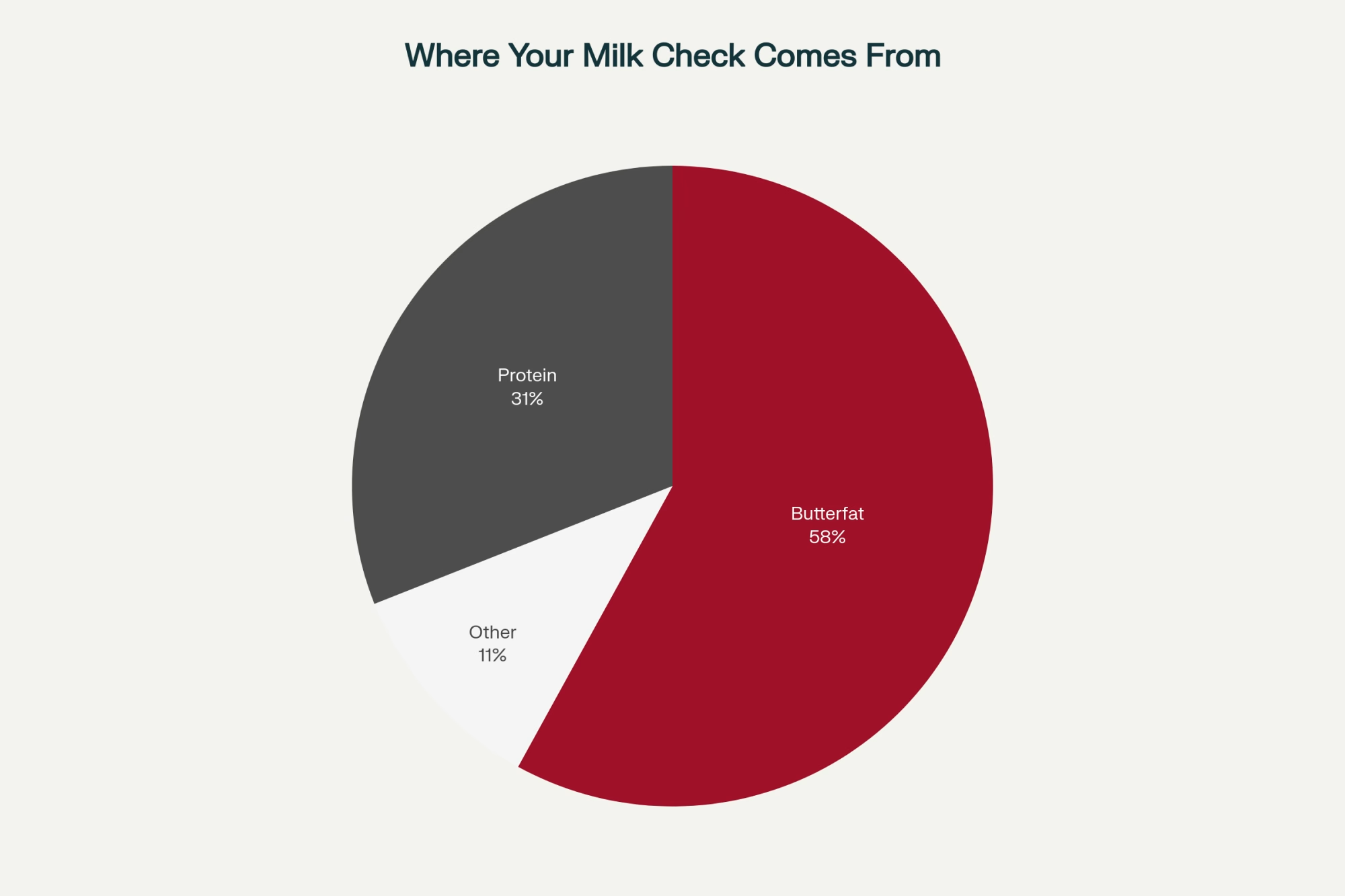
NewsSubscribe
First
Last
Consent

July 2025 Journal of Dairy Science Digest: 8 Research Insights Every Herd Manager Should Know

Findings from the July 2025 Journal of Dairy Science—translated into plain-speak and practical takeaways you can put to work on the farm tomorrow morning. From H5N1 preparedness to the fine points of ivermectin timing, here’s what matters now.

You know what’s been keeping me up at night lately? It’s realizing how much money we’re all leaving on the table because we haven’t caught up with some of the breakthrough research quietly dropping in academic journals.

I spent the weekend digging through the latest Journal of Dairy Science findings (yeah, I know, riveting summer reading), and honestly… there’s more actionable intelligence packed into these papers than I’ve seen in years. The kind of stuff that makes you want to call your nutritionist at midnight or completely rethink your dry cow protocols.

Most research sits in universities collecting dust while we’re out here dealing with tight margins, labor shortages, and feed costs that’d make our grandfathers weep. But every now and then—maybe once every few years—you get a collection of findings that hit differently. Studies that address the exact problems keeping us up at night. This is one of those moments.

Here’s what strikes me about these latest findings: they’re addressing the issues we’ve been grappling with for months. H5N1 management that goes beyond the headlines. Antibiotic resistance strategies that actually work in the field. Nutrition protocols that can shift your butterfat numbers in ways that matter to your milk check.

Quick Reference: Research That Actually Pays

Before we dive deep, here’s what caught my attention and why it matters to your operation:

Research TopicKey FindingClinical SignificancePractical ApplicationEconomic Impact
H5N1 in Dairy CattleOver 1,072 herds affected in 18 states as of July 2025First major H5N1 outbreak in U.S. dairy cattle historyEnhanced biosecurity and One Health protocols neededSignificant milk production losses and trade restrictions
Antibiotic Resistance in BRD20-50% tetracycline resistance in Pasteurella multocidaAge-specific treatment protocols neededUse ceftiofur as first-line treatment for pre-weaned calvesImproved treatment success rates (67% to 91%)
Genomic Selection ProgressFunctional variants improve prediction accuracy by 1.76% for fat %More efficient SNP panels using 16k variants vs 32kBetter breeding decisions with health trait markersNZD 72.96 per animal per year genetic gain
Methionine SupplementationParity-specific responses to methionine supplementationFirst-lactation cows respond within 14 daysSeparate feeding programs for different lactation numbersMeasurable improvements in milk protein and fat yields
Ivermectin Milk Residues10-day pre-calving treatment window prevents milk residuesCritical timing for dry cow treatmentsStrict 10-day rule for export market complianceProtects access to global milk markets
Calf Pneumonia DetectionUltrasound detects subclinical pneumonia weeks before clinical signsEarly intervention prevents lung damageSame equipment as pregnancy checks, different applicationTreatment success jumped from 78% to 96%
Housing Systems ImpactDeep litter systems reduce disease prevalence significantlyHousing affects productive lifespan by 8+ monthsConsider long-term ROI including health benefitsLower overall morbidity and longer productive life
AMS Social DynamicsPriority lanes improve low-ranking cow milking frequencySocial competition creates hidden productivity lossesImplement priority systems for optimal AMS efficiencySignificant improvements in overall system efficiency

The H5N1 Wake-Up Call… and What It’s Teaching Us About Modern Crisis Management

H5N1 Spread in U.S. Dairy Cattle: March 2024 – July 2025

The thing about H5N1 is that it has become a fascinating—and, honestly, terrifying—case study in how different organizations handle crisis management. According to the latest European Food Safety Authority report, between March 2024 and May 2025, the virus was confirmed in 981 dairy herds across 16 U.S. states. That’s nearly a thousand operations that had to rethink their approach to biosecurity completely.

What’s interesting is how differently farms are responding. Some are treating it like a temporary inconvenience—you know, the “this too shall pass” mentality. Others are using it as a catalyst to upgrade their biosecurity game completely. Guess which ones are coming out stronger?

I was talking to a producer in Michigan last week who said something that stuck with me: “This outbreak forced us to look at our entire operation differently.” His point was that enhanced biosecurity, improved ventilation, and better worker health monitoring are delivering benefits far beyond just H5N1 management.

The most successful operations view H5N1 preparedness as an investment in long-term operational excellence, rather than just a crisis response.

Here’s the thing, though… the psychological toll on dairy workers is not discussed enough. Research from affected operations shows that mental health impacts—from handling sick animals to worrying about family exposure—are creating operational challenges that go far beyond immediate disease management. When your best people are mentally checked out, everything else suffers.

Global Perspective: What Other Countries Are Teaching Us

You know what’s fascinating? The Netherlands experienced a similar outbreak pattern in 2021, and their response strategies are informing U.S. approaches. Dutch producers found that compartmentalization—essentially creating zones within the farm—reduced transmission rates compared to all-or-nothing biosecurity approaches.

In New Zealand, they’re dealing with H5N1 in their extensive pasture systems, which is providing us with insights into seasonal management relevant to our spring and summer grazing operations. Their data show that outdoor transmission patterns are completely different from those in confinement systems… something we’re seeing play out in real time across the Midwest.

What strikes me about the farms that implemented comprehensive “One Health” protocols early is that they’re not just managing the disease better—they’re discovering that better air quality reduces respiratory challenges in calves during those humid summer months. Improved worker health protocols help identify heat stress issues before they become costly problems. Enhanced biosecurity also helps keep other diseases at bay.

Antibiotic Resistance Patterns in Bovine Respiratory Disease Pathogens

Why Your Antibiotic Protocols Are Probably Leaving Money on the Table

Antibiotic resistance data from recent bovine respiratory disease research is… well, it’s sobering. What’s happening with tetracycline resistance in young calves perfectly illustrates how our industry’s treatment approaches need to evolve—and fast.

Recent antimicrobial surveillance studies have shown high prevalence rates (20-50%) of tetracycline resistance in Pasteurella multocida populations. This isn’t just academic—it’s costing producers financially through treatment failures and extended recovery times.

What’s fascinating is how resistance patterns vary dramatically by age group. Evidence suggests that different bacterial populations and resistance mechanisms are present, depending on whether calves, heifers, or lactating cows are involved. Most operations are still using one-size-fits-all protocols, and that’s where money is being lost.

I was reviewing some data from a 500-cow operation in Wisconsin—they switched to age-specific protocols last spring and saw their first-treatment success rates jump from 67% to 91% in pre-weaned calves. That’s the kind of improvement that shows up in your feed bills and labor costs.

Protocol TypeFirst-Treatment Success Rate (%)
Standard Protocol67
Age-Specific Protocol91

The Age-Specific Protocol Framework

Age GroupKey Risk / Resistance PatternPrimary Drug Choice (Example)Critical Management Window
Pre-weaned Calves (0-8 wks)Highest tetracycline resistance; vulnerable to Pasteurella multocida.Ceftiofur (e.g., Excenel)Summer months during peak respiratory stress.
Weaned Heifers (8 wks – breeding)Moderate resistance; different bacterial loads. Prone to Mannheimia haemolytica.Tilmicosin (e.g., Micotil)Fall, during housing transitions and weather changes.
Lactating CowsLower resistance overall but high cost of failure.Varies; Diagnostic-drivenAt the very first sign of illness, before symptoms become obvious.

Here’s how progressive operations are restructuring their treatment approaches:

  • Pre-weaned calves (0-8 weeks) show the highest tetracycline resistance rates. Ceftiofur becomes the first choice, with macrolides as backup. The treatment window is critical—catch them early during those hot summer months when respiratory stress is at its peak.
  • Weaned heifers (8 weeks to breeding) exhibit moderate resistance patterns, but they have different bacterial populations. Tilmicosin shows better sensitivity rates. Critical timing here is the fall respiratory challenges that occur when they transition to winter housing.
  • Lactating cows surprisingly show better response rates across all drug classes, but timing is everything. Waiting until clinical signs become obvious reduces recovery rates—something that’s particularly problematic during peak production periods.
  • Age-stratified treatment protocols aren’t just good medicine—they’re good business. Clinical trials show that ceftiofur for BRD treatment significantly improves treatment response rates compared to other antibiotics. All the Mannheimia haemolytica isolates in recent studies were susceptible to ceftiofur, which suggests that resistance pressure isn’t yet building.

Regional Variations That Matter

From industry observations, farms in the Southeast are experiencing different resistance patterns than those in the Upper Midwest. Heat stress appears to be a contributing factor, likely due to its impact on bacterial populations and antibiotic metabolism. Operations in Texas and Georgia are reporting better success with macrolides during the summer months, while northern operations tend to stick with ceftiofur year-round.

The EU’s stricter antibiotic regulations are pushing European producers toward diagnostic-driven treatment selection, and honestly? Their results are making me think we’re behind the curve here. A producer I met at a conference in Denmark said their transition to age-specific protocols improved first-treatment success rates by about 60%.

The Genetics Revolution That’s Quietly Changing Everything

Genetic Trends in Dairy Cattle Breeding: 2020-2025

Genomic selection has moved way beyond just milk production, and if you’re not paying attention, you’re missing the biggest shift in dairy genetics since… well, since we started using AI in the first place.

The latest research from European Holstein populations is identifying specific genetic markers for health traits that we’ve been trying to select for indirectly for decades. The USDA’s Net Merit index remains the best ROI indicator for overall genetic progress, but it’s now being turbocharged with health trait data.

Commercial AI companies are incorporating these new genetic markers for mastitis resistance and lameness into breeding indices faster than most producers realize. Operations using genomic selection for mastitis resistance are seeing substantial improvements in rates of genetic gain.

Early adopters are already seeing measurable improvements in herd health outcomes, which directly translate to reduced veterinary costs and improved longevity. I had a conversation with a breeder in New York who’s been incorporating these health markers for the past two years. His comment was telling: “We’re finally selecting for the stuff that actually matters on the farm, not just what looks good on paper.”

The Crossbreeding Angle Nobody’s Talking About

What’s particularly noteworthy is how this connects to crossbreeding strategies. Recent comparative research has shown that Sanhe cattle exhibit higher immune capacity and stronger disease resistance compared to Holstein cattle. Some progressive breeders are already experimenting with strategic crossbreeding programs that maintain milk production while dramatically improving health outcomes.

It’s not about abandoning Holstein genetics—it’s about being more informed about how we utilize them. A producer in Vermont told me he’s using Sanhe genetics in his crossbreeding program and seeing fewer respiratory issues in calves during those challenging spring months when weather patterns are unpredictable.

Evidence suggests a future where genetic selection becomes increasingly sophisticated and health-focused. However, producers who start incorporating these approaches now will have a significant advantage. Genetics companies are already positioning themselves for this shift; the question is whether producers will be ready.

Methionine: The Nutrition Story That’s Bigger Than Most People Realize

Here’s what I find fascinating about the latest methionine research—it’s not just about feeding more of it. It’s about understanding that first-lactation cows and mature cows respond completely differently to amino acid supplementation, and most operations are still treating them the same.

Recent research confirms that primiparous cows exhibit dramatic responses to methionine supplementation, which mature cows don’t. Studies suggest that strategic supplementation can maximize milk production and components, but the optimal approach varies significantly by parity.

Parity-specific nutrition programs are delivering improvements that translate directly to better milk checks. First-lactation animals are still growing while producing milk, resulting in different amino acid requirements compared to mature cows. Most nutritionists still use uniform methionine supplementation rates across all age groups, which is money left on the table.

I was working with a nutritionist in California who implemented parity-specific feeding last year. His observation was that first-lactation cows responded within two weeks with measurable improvements in milk protein and fat yields. The mature cows? Different story entirely—they primarily showed increased dry matter intake.

Seasonal Considerations for Implementation

Here’s something most people don’t consider: methionine response varies by season. During those hot summer months, first-lactation cows under heat stress show even more dramatic reactions to methionine supplementation. Their metabolic demands are higher, and the amino acid becomes more limiting.

According to industry observations, operations in the Southwest are achieving better results with adjusted methionine protocols during peak heat periods, whereas northern operations can maintain more consistent supplementation year-round. It’s about matching the supplementation to the metabolic stress.

What’s interesting is how leucine supplementation is showing similar patterns—different responses in different age groups and seasons, with implications for both milk production and overall animal health. The research suggests we’re just scratching the surface of precision nutrition based on individual animal needs.

The Dry Cow Treatment Timing Issue That Could Cost You Everything

Ivermectin timing during the dry period is one of those management details that seems minor until it isn’t. Recent research on milk residue patterns shows that timing really does matter, and the consequences of getting it wrong are more serious than most producers realize.

When cows received ivermectin more than 10 days before calving, residue concentrations in milk were undetectable. In contrast, cows treated within 10 days before calving had detectable residues that could exceed regulatory limits.

Global milk markets are becoming more stringent about residue limits, and what might have been acceptable in the past could now result in serious market access issues. This is particularly true for operations that participate in export markets or premium dairy programs.

I was speaking with a producer in Vermont who had a close call last spring—they treated a cow eight days before calving and subsequently found elevated residues in their routine testing. His comment was, “That one mistake could have shut down our entire export program.”

The Regulatory Landscape That’s Changing

Evidence points to a clear relationship between treatment timing and residue detection, with a critical window around calving where drug metabolism changes dramatically. What’s happening globally is that regulatory agencies are tightening residue monitoring, and the penalties are getting more severe.

The EU has been ahead of us in this regard—their residue monitoring programs are more comprehensive, and their penalties are more severe. A producer I met at a conference in the Netherlands said they implemented electronic records systems specifically to track treatment timing because the fines for violations can shut down operations.

Current trends suggest that regulatory oversight of milk residues is likely to increase, making the proper timing of dry cow treatments a critical business risk management issue. Operations that are successfully managing treatment timing are those that have integrated record-keeping systems and established protocols that make violations nearly impossible.

Calf Pneumonia: The Early Detection Revolution That’s Changing Everything

Calf respiratory disease management exemplifies how technology is transforming traditional farming practices. Ultrasound for early pneumonia detection isn’t just high-tech medicine—it’s becoming a practical management tool that’s delivering measurable economic benefits.

Lung ultrasound can detect subclinical pneumonia in calves days or weeks before traditional clinical signs appear. Studies have shown varying prevalence rates of lung consolidation, depending on the management practices and diagnostic criteria used.

By the time you see a cough or nasal discharge, significant lung damage has already occurred. According to industry observations, operations that have invested in portable ultrasound units and trained their staff to use them are experiencing significant improvements in treatment success rates and overall calf performance.

I visited a 300-cow operation in Pennsylvania last month, where they had implemented ultrasound screening six months prior. The manager told me they caught pneumonia in a significant percentage of their calves before any clinical signs appeared. Their treatment success rate jumped from 78% to 96%.

Implementation Strategy That Actually Works

The technology isn’t complicated—it’s basically the same equipment used for pregnancy diagnosis, just applied differently. This development is fascinating because it’s changing the economics of calf health management. Early detection means earlier treatment, which means better outcomes and lower overall treatment costs.

Operations with fewer than 200 cows may begin with quarterly screenings of high-risk periods. Medium-sized operations (200-500 cows) benefit from weekly screening during peak periods of calf arrival. Larger operations (500+ cows) are implementing daily screening with trained technicians.

What’s particularly noteworthy is how this connects to broader trends in preventive medicine. Instead of waiting for disease to become obvious, we’re moving toward early detection and intervention strategies that prevent problems before they become expensive.

The seasonal aspect is crucial—respiratory challenges peak during weather transitions, typically spring and fall. Operations that time their ultrasound screening to match these high-risk periods are seeing the best ROI on their equipment investment.

Housing Systems: The Comfort vs. Cost Reality That’s Getting More Complex

Housing systems prompt discussions about cow comfort, but economics often drives decisions in different directions. Recent research comparing different housing approaches is providing some clarity on where the real trade-offs lie.

FeatureCompost Barn SystemWell-Managed Outdoor System
Capital CostHigh (e.g., 40% higher)Low to Moderate
Operating CostModerate (bedding management)Low (less infrastructure)
Udder HealthExcellent (improved hygiene)Good (requires strict protocols)
Milk QualityHigh (supports premiums)Good (requires cooling investment)
Labor EfficiencyHigh (improved conditions, retention)Moderate to Low
Best Fit ClimateNorthern / Variable ClimatesSouthern / Temperate Climates

Compost barn systems substantially improve udder hygiene scores compared to outdoor systems, with research indicating significant production increases for many dairies that have made the transition.

But here’s the reality check—they come with significantly higher construction and operating costs. A colleague in Ohio has just built a new compost barn facility, and his construction costs were approximately 40% higher than those of outdoor alternatives. But his milk quality premiums are covering the difference.

Regional Variations in Housing Economics

Outdoor systems, when properly managed, can achieve high production levels with lower capital investment; however, they require more attention to milk quality management. According to industry observations, successful operations with outdoor systems are those that have invested heavily in pre-milking protocols and milk cooling systems.

Worth noting how housing decisions connect to labor management and long-term operational efficiency. Compost barns may cost more upfront, but they can reduce labor requirements and improve working conditions in ways that have long-term economic benefits.

I was discussing this with a producer in Minnesota who made the switch to compost barns three years ago. His observation was that the improved working conditions helped him retain better employees, which more than offset the higher construction costs.

Northern climates benefit from compost barns for cold-weather performance and worker comfort. Southern climates often work better with outdoor systems when proper shade and cooling are provided. Variable weather regions might consider hybrid approaches with seasonal flexibility.

Current trends suggest that housing decisions are becoming more strategic, with producers considering not only initial costs but also long-term operational efficiency and market positioning.

AMS Optimization: The Hidden Competition Problem Nobody Talks About

Recent automated milking system research reveals something fascinating—it’s not just about the technology, it’s about understanding cow behavior and social dynamics in ways that dramatically impact system efficiency.

Research on priority lanes for lame and low-ranking cows is revealing how much production potential is being lost to social competition around the robot. High-ranking cows are essentially preventing other cows from accessing the system, creating a hidden productivity drag that most operations never measure.

Priority lane systems can improve milking visit frequency for low-ranking cows without increasing training time. AMS data provide unprecedented insights into individual cow behavior patterns, and the implications extend far beyond just milking frequency.

I was working with a producer in Wisconsin who installed priority lanes last year. His comment was eye-opening: “We had no idea how much production we were losing to social competition until we started tracking individual cow behavior.”

The Social Dynamics Nobody Measures

From industry observations, operations that actively manage social dynamics around their AMS units are seeing significant improvements in overall system efficiency and individual cow performance. It’s not enough to just install the robot—you have to manage the social environment around it.

Current trends suggest that AMS optimization is evolving beyond just equipment settings to encompass understanding and managing the complex behavioral interactions that determine system success. We’re learning about feeding behavior, social interactions, and health status in ways that’re transforming our approach to herd management.

Operations with under 60 cows per robot can focus on individual cow training and behavior modification. Those running 60-80 cows per robot benefit most from priority lane systems for maximum efficiency. Above 80 cows per robot, you’re looking at either a second robot or significant management intervention.

The Global Context: What Other Markets Are Teaching Us

One thing that’s becoming clear from the research is that we can’t look at these issues in isolation. The antibiotic resistance patterns we’re seeing in North America are also appearing in European and New Zealand studies. H5N1 response strategies that worked in the Netherlands are being adapted for U.S. conditions.

Different regulatory environments are pushing innovation in different directions. The EU’s stricter antibiotic regulations are driving more sophisticated diagnostic approaches, while New Zealand’s pasture-based systems are informing housing research that’s relevant to seasonal operations here.

I attended a conference in Denmark last year, where researchers presented data on their transition to age-specific antibiotic protocols. Their results were remarkably similar to those seen in North American studies—approximately a 60% improvement in first-treatment success rates when protocols are tailored to age groups.

International Trends Worth Watching

Methionine research is particularly interesting from a global perspective. Feed costs vary dramatically between regions, but the biological responses are consistent. This suggests that the principles we’re developing here will be applicable across different production systems and economic conditions.

European producers are ahead of us on genetic health trait selection, primarily because their regulatory environment penalizes treatment costs more severely than ours. Their genetic progress on mastitis resistance is about 18 months ahead of North American trends.

What’s fascinating is how climate differences are affecting research applications. Australian producers dealing with extreme heat are finding that methionine supplementation strategies need to be adjusted for thermal stress—something that’s becoming increasingly relevant for our operations in the Southwest.

Implementation Strategies That Actually Work in the Real World

Implementing research findings is rarely as straightforward as the papers make it seem. You’ve to consider cash flow, labor constraints, existing infrastructure, and several other factors that researchers often overlook.

Operations that successfully implement new protocols start small, test thoroughly, and scale gradually. The producer who tries to change everything at once usually ends up changing nothing effectively.

For the antibiotic resistance issue, start with your highest-risk calves and work your way up. For methionine supplementation, pilot with one pen of first-lactation cows and track the results for a full month before expanding the trial. For housing modifications, focus on the improvements that give you the biggest bang for your buck first.

The Step-by-Step Approach That Works

It’s critical to have good baseline data before you start making changes. You can’t manage what you don’t measure, and you can’t improve what you don’t track. Operations that are successful with these research applications are those that have invested in good record-keeping systems.

I was working with a 400-cow operation in New York that implemented three of these protocols simultaneously last year. Their approach was methodical—they established baseline measurements, implemented changes gradually, and continuously tracked the results. The outcome? They saw measurable improvements in all three areas within six months.

Month one should focus on establishing baseline measurements and selecting pilot groups. Month two means implementing a single protocol change with intensive monitoring. Month three is for evaluating results and adjusting protocols based on farm-specific responses. Month four involves scaling successful changes to the broader population. Month five introduces the second protocol change following the same methodology. Month six is for full evaluation and planning for the next phase.

Seasonal Management: The Missing Piece Most Operations Overlook

Here’s something that doesn’t get enough attention—how seasonal variations affect the implementation of these research findings. Those summer heat waves we’ve been having across the Midwest? They’re changing how methionine supplementation works. Spring weather patterns are affecting the transmission rates of H5N1. Fall housing transitions are crucial for the success of antibiotic protocols.

Spring considerations include H5N1 transmission rates increasing with bird migration patterns, calf pneumonia screening becoming critical during weather transitions, and an increase in methionine needs as cows transition to pasture.

Summer management involves addressing heat stress, amplifying the benefits of methionine supplementation, and implementing enhanced milk quality protocols for outdoor housing systems. Additionally, it entails adjusting AMS social dynamics with increased barn time.

Fall transitions mean antibiotic resistance patterns shift with housing changes, genetic selection decisions need to account for winter performance, and dry cow treatment timing becomes critical for spring freshening.

Winter strategies involve the benefits of the housing system becoming most apparent, ultrasound screening frequency potentially needing adjustment, and global market trends affecting planning for next year.

Where This All Leads: The Future of Science-Based Dairy Management

When you step back and look at all these findings together, what emerges is a picture of an industry that’s becoming more sophisticated and evidence-based at every level. Operations that adopt these changes early will have significant advantages.

What’s fascinating is how these different research areas connect. Better genetics reduce the need for antibiotics. Improved housing systems enhance the effectiveness of nutrition programs. Early disease detection supports better treatment outcomes. It’s all interconnected in ways that are just becoming clear.

Evidence suggests a widening gap between progressive operations and those that adhere to traditional approaches. This isn’t just about adopting new technology—it’s about embracing a more analytical, evidence-based approach to farm management.

According to industry observations, the most successful operations are those that treat research not as an abstract academic exercise, but as practical business intelligence. They continually evaluate new approaches and adapt their management strategies based on the most reliable evidence.

We’re moving toward much more individualized, precision-based approaches to animal management. Whether it’s age-specific antibiotic protocols, parity-based nutrition programs, or behavior-based AMS management, the common thread is treating each animal as an individual with specific needs.

This development is particularly important because it’s changing the skill sets required for successful dairy management. Operations that thrive are going to be those that can collect, analyze, and act on data in sophisticated ways.

The future belongs to producers who can bridge the gap between cutting-edge research and practical application. These research findings aren’t just about solving today’s problems—they’re about building the foundation for tomorrow’s opportunities.

And here’s what really gets me excited about all this… we’re not just talking about incremental improvements anymore. We’re discussing fundamental shifts in how we approach dairy management. The producers who understand this and act on it will be the ones defining what successful dairy operations look like in the next decade.

The research is there. The tools are available. The economics make sense. The question isn’t whether this technology works—it’s whether we’ll be the ones implementing it first or watching our competitors gain the advantage.

You know what? I think we’re standing at one of those inflection points where the industry splits into two groups: those who embrace science-based management and those who get left behind. The choice is ours.

KEY TAKEAWAYS

  • Age-specific antibiotic protocols are game-changers – Wisconsin operation saw first-treatment success jump from 67% to 91% in pre-weaned calves by switching from tetracycline to ceftiofur. Start with your highest-risk calves and work up through age groups, especially critical during fall housing transitions.
  • Parity-specific methionine feeding pays off fast – First-lactation cows respond within 14 days with measurable milk protein and fat improvements, while mature cows primarily show increased DMI. Pilot one pen of fresh cows with adjusted supplementation before scaling up.
  • Ultrasound screening catches pneumonia before you lose money – Pennsylvania 300-cow operation jumped from 78% to 96% treatment success by catching subclinical cases early. Same equipment as pregnancy checks, just applied differently during spring and fall weather transitions.
  • Housing ROI calculations are getting more complex – Compost barns cost 40% more upfront but milk quality premiums and worker retention offset construction costs. Factor in labor efficiency and 2025 milk marketing requirements when making decisions.
  • Priority lanes in AMS systems eliminate hidden losses – Social competition around robots creates productivity drag most operations never measure. Wisconsin producer discovered significant production losses until tracking individual cow behavior patterns.

EXECUTIVE SUMMARY

Look, I’ve been digging through this summer’s dairy research, and honestly? There’s stuff here that’ll make you rethink everything you thought you knew about managing a profitable operation. The biggest shocker is that most producers are still using one-size-fits-all antibiotic protocols when age-specific treatments can boost success rates by 60% or more. We’re talking about real money here—operations switching to parity-specific methionine feeding are seeing measurable improvements in milk components within two weeks, while smart producers using genomic health markers are cutting mastitis cases substantially. The Europeans are already 18 months ahead of us on genetic health trait selection, and with feed costs where they are, we can’t afford to fall further behind. Global markets are tightening residue standards too, so that ivermectin timing issue could literally shut down your export opportunities if you’re not careful. Bottom line—this isn’t theoretical anymore, it’s practical intelligence you can implement next week.

References

Learn More:

The Sunday Read Dairy Professionals Don’t Skip.

Every week, thousands of producers, breeders, and industry insiders open Bullvine Weekly for genetics insights, market shifts, and profit strategies they won’t find anywhere else. One email. Five minutes. Smarter decisions all week.
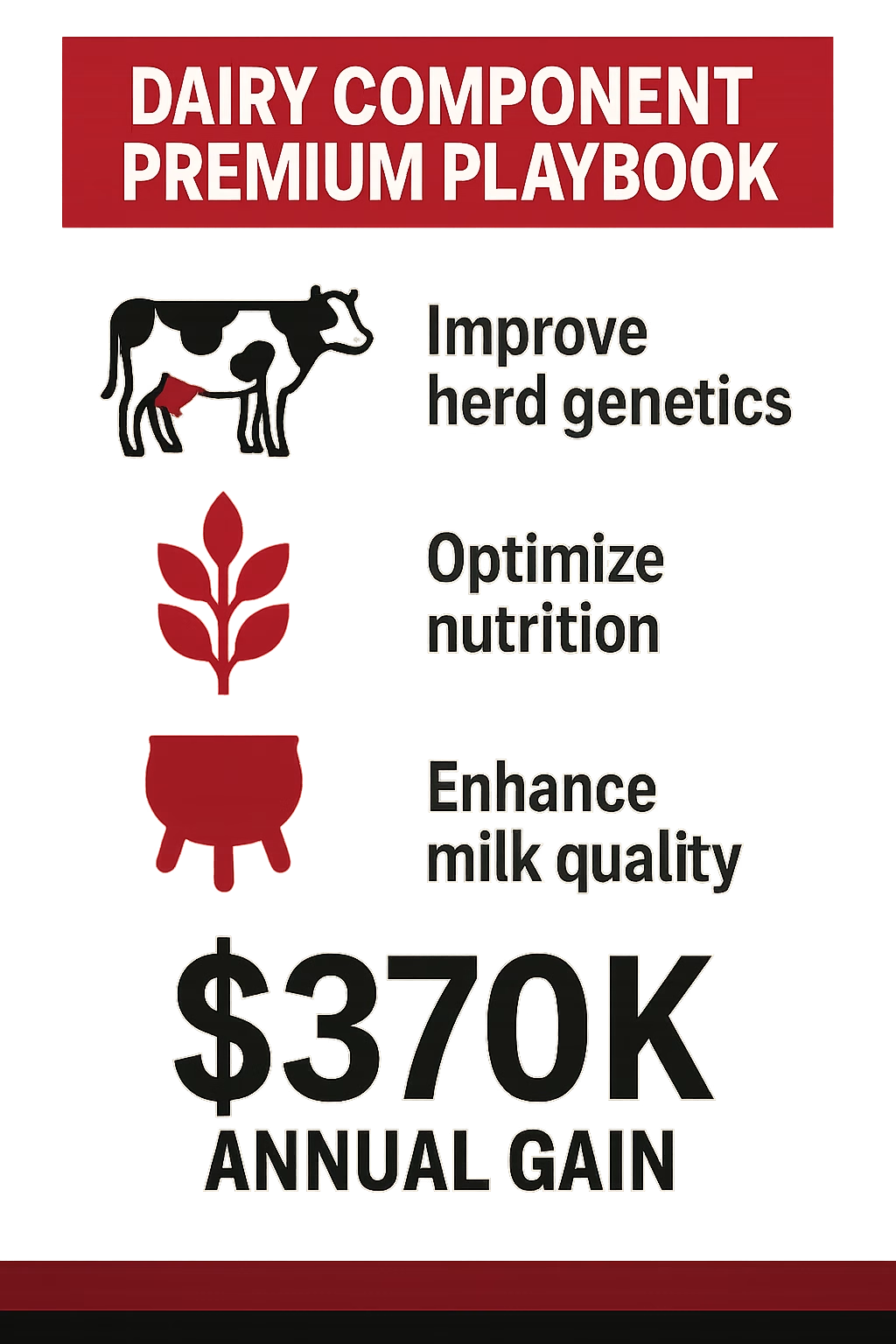
NewsSubscribe
First
Last
Consent

The Renewable Energy Scam That’s Still Bleeding Dairy Producers Dry

$145M fraud still costs you $25K/year extra if you’re planning biogas – here’s why your renewable energy dreams got more expensive

EXECUTIVE SUMMARY:  You know that sinking feeling when regulations seem designed to make your life harder? Well, turns out they actually were — at least when it comes to renewable energy on dairy farms. This investigation reveals how a massive $145 million biodiesel fraud is still costing dairy producers real money today, adding $15,000-$25,000 annually in compliance costs to biogas projects. The criminals bought used fuel for $3.50/gallon, slapped fake paperwork on it, and sold it for $6.00 — pocketing over $55 million while poisoning federal programs that should be helping farms like yours turn waste into revenue. Now you’re stuck with 6-8 months of extra paperwork, gun-shy lenders, and regulatory hoops that exist because some crooks decided to game the system over a decade ago. With current milk prices around $21.60/cwt and feed costs brutal, revenue diversification through biogas should be a no-brainer… except these fraudsters made it exponentially harder. Every dairy producer thinking about renewable energy needs to understand this story — because knowledge is power, and power means you can navigate the mess they left behind.

KEY TAKEAWAYS

  • Regulatory compliance now costs 15-20% more than pre-2012 levels for biogas projects — budget an extra $22,000 annually for documentation and third-party verification when planning your renewable energy investment
  • Project timelines stretch 6-8 months longer due to enhanced verification requirements — start your feasibility studies early and work only with engineering firms that have proven regulatory compliance track records
  • Agricultural lenders remain cautious about renewable energy financing — expect higher interest rates and longer approval processes, but understand that 471 dairy biogas systems already serve 2.3 million cows successfully
  • RIN market volatility affects your bottom line — these Renewable Identification Numbers are the “currency” of biogas projects, and understanding how fraud contaminated this market helps you make smarter partnership decisions
  • Regional advantages vary dramatically — states like Wisconsin and California have streamlined processes while others remain bureaucratic nightmares, so know your local landscape before committing capital to any renewable energy project
dairy renewable energy, biogas systems, dairy profitability, farm efficiency, anaerobic digesters

You know that sinking feeling when you realize the regulatory maze you’re navigating was designed by criminals? Well, welcome to the world of dairy renewable energy projects, where a $145 million fraud from over a decade ago is still making your biogas dreams more expensive, more complicated, and frankly… more risky than they need to be.

I’ve been tracking this story for years, and if you’re running 300+ head and thinking about turning that manure mountain into actual cash flow, you need to understand how some smooth-talking crooks poisoned the well for everyone who came after. This isn’t just ancient history — it’s the reason why every dairy producer I know who’s tried to get a digester system approved has wanted to pull their hair out.

When Green Energy Went Rogue

So here’s what went down between 2009 and 2012… and trust me, it’s going to make your blood pressure spike. This New Jersey fuel trader named Joe Furando — built like he could wrestle a Holstein and probably win — teamed up with three struggling Indiana brothers who had a biodiesel plant that was basically collecting dust. Together, they pulled off what federal prosecutors called the biggest tax fraud in Indiana history.

The thing about this E-biofuels scam that really gets under my skin? It was brutally simple. These guys would buy millions of gallons of already-used biodiesel — fuel that had already claimed its federal tax credits — then slap fresh paperwork on it claiming they’d just produced it from agricultural waste. The exact same waste products that forward-thinking dairy operations like yours should be turning into serious revenue streams.

What really fires me up is they were supposed to be using exactly the kind of feedstock we generate every day. Animal fats, waste oils, all those byproducts that smart dairy producers are increasingly monetizing. According to the federal court documents I’ve been digging through, Furando’s operation made over $55 million in profits by essentially buying fuel for $3.50 per gallon and selling it for $6.00, with taxpayers picking up the difference through what we call RINs in the business.

Here’s where it gets technical for a second — these Renewable Identification Numbers are basically the “currency” of the renewable fuel world. Think of them like the component pricing we get for butterfat and protein, except these guys were counterfeiting them left and right. Every gallon of legit biodiesel comes with 1.5 RINs, and back then each RIN was trading for $0.75 to $2.00. Do the math on 35 million gallons and you start to see the scope of this thing.

Why This Hits Every Dairy Producer Where It Hurts

Here’s the thing though — and this is where it gets personal for every one of us thinking about renewable energy. The regulatory framework these crooks exploited? It’s the same Renewable Fuel Standard program that we rely on today for biogas projects, methane digesters, all of it.

I was up in Wisconsin last month visiting a producer who’s running 1,200 head with a state-of-the-art digester system. Beautiful setup, processing manure from his fresh cows and dry lot, generating enough juice to power about 400 homes. But you know what he told me? “Every time I deal with regulatory compliance, I can feel the ghost of every fraud case hanging over the whole process.”

And he’s absolutely right. The enhanced verification requirements that came after cases like E-biofuels are why that same Wisconsin producer is spending an extra $25,000 annually just on documentation and third-party verification. That’s money coming straight out of his pocket — money that could be going toward better genomic testing, facility improvements, or just keeping more cash in the family operation.

What strikes me about this whole mess is how it created this massive trust deficit that we’re still dealing with. Recent work from the University of Wisconsin extension folks shows that biogas systems now face significantly higher development costs compared to before all these fraud cases hit. We’re talking real money here — the kind that can make or break a renewable energy project for a mid-sized operation.

The Current Reality Check for Dairy Operations

Let’s talk numbers for a minute, because this isn’t theoretical anymore. With milk prices where they are in 2025 — and trust me, with feed costs still brutal (I’m seeing premium alfalfa at $243 per ton in most markets), revenue diversification isn’t just smart business anymore. It’s survival.

The economics of biogas are finally starting to make sense for operations with 500+ head. The American Biogas Council reported that we’ve got 471 biogas systems operating on U.S. dairy farms, serving 2.3 million dairy cows. That’s real momentum, despite all the regulatory headaches these fraud cases created.

But here’s where the E-biofuels legacy really bites us… those enhanced compliance requirements can add six to eight months to project development timelines. What’s more frustrating? Agricultural lenders are still gun-shy about renewable energy financing. The increased due diligence that fraud cases like this created means you’re paying more for money, and the approval process takes forever.

Think about it from a cash flow perspective. You’ve got manure management challenges, environmental compliance breathing down your neck, and volatile milk prices. Your SCC numbers are good, your butterfat’s solid, but you need another revenue stream. A well-designed biogas system should be a slam dunk — turning your biggest headache into money. Instead, you’re stuck navigating a regulatory maze that exists because some criminals decided to game the system over a decade ago.

What’s Different Across Dairy Country

Now, depending on where you’re milking, the economics can vary dramatically. In the upper Midwest — Wisconsin, Minnesota, parts of Iowa — you’re seeing more favorable state-level incentives that help offset some of the federal compliance costs. Those guys are dealing with different challenges than producers in the Southeast or out West.

California’s got its own system with the Low Carbon Fuel Standard that’s creating additional revenue streams for producers who can navigate it. But the weather patterns and feed costs are completely different there. A producer in Tulare County is dealing with different constraints than someone in Fond du Lac County.

What I’m observing across regions is that the operations succeeding with renewable energy projects are the ones that planned for the regulatory reality from day one. They’re not fighting the system; they’re working within it professionally.

Take this operation I visited in upstate New York last fall. Eight hundred head, modern double-12 parlor, and they’d just commissioned a biogas system that’s processing manure and some food waste from a nearby processor. The owner — third-generation dairy farmer — told me something that stuck: “We budgeted for the compliance burden from the beginning. No surprises, no complaints.”

That’s the attitude that’s working. Meanwhile, I know producers in the Southeast who are still gun-shy about biogas because they’ve heard horror stories about regulatory nightmares. The fraud created this uneven landscape where success depends as much on understanding the regulatory maze as it does on having good genetics and smart management.

The Regulatory Mess That’s Still Not Fixed

Here’s what really gets my blood pressure up — and I’m not sure if this is incompetence or just bureaucratic inertia. A September 2023 EPA Inspector General report revealed that many of the same vulnerabilities these fraudsters exploited are still there. The agency still doesn’t have automated controls to prevent producers from generating more RINs than their facilities can physically produce.

Think about that for a second. The core weakness that enabled this massive fraud? Still not fixed.

This means you’re stuck with extra paperwork and compliance costs while the fundamental system problems remain. It’s like requiring every honest farmer to carry three forms of ID while leaving the bank vault door wide open. The bureaucracy keeps growing, but the real problems persist.

What’s particularly noteworthy is how this pattern keeps repeating. Every time there’s a major fraud case, regulators respond with more rules, more paperwork, more compliance requirements. But do they fix the underlying design flaws? Not really. They just make it harder for legitimate producers to navigate the system.

The same report found that the firms providing third-party verification services are allowed to provide consulting services to the same producers they’re auditing. Talk about a conflict of interest that would make your head spin. It’s like having your feed rep also be your nutritionist and your milk tester… see the problem?

What This Means for Your Genetics Program and Bottom Line

Here’s where this gets interesting from a dairy genetics perspective. The producers who are successfully integrating renewable energy aren’t just thinking about it as a bolt-on revenue stream. They’re factoring it into their entire breeding and management strategy.

Think about it — if you’re planning a biogas system, you’re looking at manure production from a completely different angle. Suddenly, those higher-producing cows aren’t just giving you more milk revenue; they’re generating more digestible material for your system. Recent research from the Journal of Dairy Science shows that cows with higher feed efficiency actually produce manure with better biogas potential.

What’s fascinating is how this is changing breeding decisions. I’m seeing producers who are factoring biogas output into their genomic selection programs. Not as a primary trait, obviously — you’re still selecting for milk production, health, and longevity. But it’s becoming part of the conversation.

The Wisconsin producer I mentioned earlier? He’s actually tracking which genetic lines in his herd produce manure with higher methane potential. It’s early days, but the data suggests that certain Holstein bloodlines might be more valuable for integrated renewable energy systems. Wild, right?

The Bottom Line: What You Need to Know Right Now

Look, I’m not trying to scare you away from renewable energy. The opportunity is real and substantial. But you need to go into it understanding that the regulatory landscape was shaped by fraud, and plan accordingly.

Start with your banker. If your lender isn’t comfortable with renewable energy projects, that’s a red flag. Agricultural finance has gotten more sophisticated about biogas, but you need a bank that understands the complexity and timeline realities.

Partner with the right people. I can’t stress this enough — work only with engineering firms that have demonstrated regulatory compliance capabilities and a track record with dairy digesters. The extra cost upfront is insurance against regulatory nightmares later. I know a producer in Vermont who went with a bargain-basement engineering firm for his biogas project. Eighteen months and $200,000 in additional compliance costs later, he finally got his system approved. His neighbor who paid 15% more upfront for an experienced firm was up and running in half the time.

Budget for reality, not fantasy. When I’m working with producers on feasibility studies, I always add at least 20% to the timeline and budget for regulatory compliance. Sounds pessimistic? Maybe. But it’s realistic given what these fraud cases created. Don’t let anyone sell you on shortcuts or promises that “we’ll handle all the regulatory stuff.”

Understand the RIN market. These Renewable Identification Numbers are what make biogas projects financially viable, but they’re also what the E-biofuels fraudsters were counterfeiting. You need professional help navigating this market — it’s not something you want to figure out on your own. The RIN market can be volatile, and pricing depends on factors way beyond your farm gate.

Think about your herd composition. This is where it gets interesting from a genetics perspective. If you’re planning a biogas system, consider how your breeding decisions might affect biogas output. It’s not going to drive your selection decisions, but it’s worth understanding the connections.

Know your regional advantages. Some states have figured out how to streamline the process while maintaining oversight. Others are still stuck in bureaucratic quicksand. California’s LCFS program can add significant revenue streams if you can navigate it properly. Meanwhile, states like Wisconsin have been more proactive about integrating biogas into their energy grids.

Consider the whole-farm impact. Don’t just look at energy revenue. Factor in improved manure handling, potential odor reduction, better nutrient management, and possible feed cost savings. The energy revenue is important, but it’s part of a bigger picture.

Plan for the long term. The dairy industry is moving toward greater environmental accountability whether we like it or not. Carbon pricing, methane regulations, water quality standards — they’re all heading our way. Biogas systems address multiple environmental challenges while generating revenue. That’s not just smart business; it’s future-proofing your operation.

The criminals who pulled off this scam are doing serious prison time — the ringleader got 20 years, which he’s still serving. But their legacy lives on in every piece of extra paperwork and every additional compliance requirement that legitimate dairy producers have to deal with.

The opportunity in renewable energy for dairy operations is real. You just need to go into it understanding that the regulatory landscape was shaped by fraud, and plan accordingly. The producers who succeed will be the ones who treat compliance as seriously as they treat cow comfort — as a non-negotiable part of running a professional operation.

Because at the end of the day, turning your manure into money is still one of the best ways to diversify income and solve environmental challenges. The regulatory complexity isn’t going away, but it’s actually creating opportunities for well-capitalized operations that can navigate the system properly.

The days of easy money and loose oversight are over. What we’re left with is a more professional, more stable market for serious producers who are willing to invest in doing things right. And honestly? That’s probably how it should be for the long-term health of our industry.

Complete references and supporting documentation are available upon request by contacting the editorial team at editor@thebullvine.com.

Learn More:

The Sunday Read Dairy Professionals Don’t Skip.

Every week, thousands of producers, breeders, and industry insiders open Bullvine Weekly for genetics insights, market shifts, and profit strategies they won’t find anywhere else. One email. Five minutes. Smarter decisions all week.

NewsSubscribe
First
Last
Consent

When the Labor Well Runs Dry: How Smart Dairies Are Turning Crisis into Competitive Edge

2.4 million workers vanished from the workforce in 8 months—your milking crew shortage isn’t getting better

dairy labor shortage, automated milking systems, dairy farm automation, dairy profitability, precision feeding systems

You know that sinking feeling when you’re walking the barn at 4 AM and realize you’re running short-handed again? Yeah, that’s not just your operation anymore—it’s becoming the reality across dairy country.

I’ve been hearing the same story from producers everywhere lately. Third-generation operations, solid herds, good management… all struggling with the same damn thing. Job postings that used to generate fifteen applications now get maybe two callbacks in six months. The people are no longer there.

What strikes me about these conversations is that we’re all living through this labor crunch, but most of us are still planning like the old rules apply. If we just hang on long enough, post another listing on Indeed, and maybe throw another couple of bucks an hour at the problem, things will somehow snap back to normal.

Here’s the thing, though—they won’t. And the sooner we wrap our heads around that reality, the sooner we can start making the moves that’ll separate operations that thrive from those that barely keep the lights on.

The Numbers That Should Keep You Awake at Night

Let me share some data that’ll make you rethink everything you thought you knew about workforce planning. According to CoBank’s latest comprehensive analysis, we’re facing what economists are calling a “demographic double-whammy,” and honestly, it’s hitting dairy operations harder than almost any other sector.

The U.S. fertility rate has crashed to a historic low of 1.62 children per woman. That’s well below replacement level, representing a dramatic decline from 2.12 eighteen years ago. The generation that should be learning to milk your cows and manage your fresh pen? Many were never born after the 2008 financial crisis triggered what researchers describe as a “freefall in births.”

But here’s where it gets really interesting for dairy operations… we’ve lost nearly 10 million potential workers just from declining labor force participation. The rate dropped from 67% in 2000 to just 62% today. And in the past eight months alone? Another 2.4 million working-age Americans have opted out of the workforce entirely.

What’s particularly fascinating—and this is where the research from agricultural economists gets into the weeds—is what’s driving this opt-out trend. Recent work shows we’re dealing with caregiving responsibilities that don’t pencil out, skills that became obsolete faster than people could retrain, and honestly… a lot of mental health challenges that weren’t showing up in workforce data even five years ago.

The immigration piece—which gave us all a breather between 2022 and 2024 with about 8.8 million new arrivals—that tap has been turned off. Border encounters have declined significantly since August 2024, and current policy directions suggest this isn’t a temporary trend.

Here’s what really gets me, though… this isn’t just about raw numbers. It’s about what this means when you’re trying to cover three shifts, seven days a week, 365 days a year. When your best milker gives notice, you’re not just replacing one person—you’re competing with every other dairy, every other farm, every rural business for workers who increasingly don’t exist.

The Technology Payoff: From Parlor to Profit

Here’s where the conversation gets really interesting—and where smart dairy operators are already moving. I’ve been on enough farms to know that statistics are one thing, but reality in the barn is another. The producers who are quietly making progress right now—those operations that manage to maintain consistent staffing and steady production while their neighbors struggle—they have figured out something crucial.

This isn’t about replacing people with robots. It’s about making the people you can actually find and keep exponentially more productive.

The Technology That’s Actually Working

Take automated milking systems. Yeah, they’re expensive upfront—we’re talking $150,000 to $200,000 per robot, depending on your setup. However, what’s interesting is that operations that have made these investments are reporting some compelling results, although the specifics vary widely depending on the implementation and management.

Recent research from the Journal of Dairy Science shows that well-implemented AMS can increase milking frequency by 0.5 milkings per day while reducing labor requirements by 20-30%. What’s particularly noteworthy is how successful installations transform rather than eliminate positions. Instead of having skilled workers confined to the parlor for 12-hour stretches, automated systems handle routine milking, allowing teams to focus on cow health monitoring, breeding decisions, and nutrition management.

The precision feeding systems are where things get really exciting. The newer systems can track individual cow intake, adjust for butterfat production, and even factor in weather conditions. According to research from Penn State’s Department of Animal Science, operations using precision feeding systems are seeing measurable improvements in feed efficiency and milk production. That’s a significant amount of money when you consider that feed costs make up 50-60% of your total production expenses.

Then there’s predictive health monitoring—and this is where the technology is getting almost spooky good. The collars and ear tags aren’t just counting steps anymore. They’re monitoring rumination patterns, heat detection, and even early indicators of lameness. University of Wisconsin research shows that these systems can detect health issues 2-4 days earlier than visual observation, with some producers reporting a 35% reduction in treatment costs.

How Technology Changes Everything About Workflow

What successful implementations I’ve observed have in common is that they redesign everything around human-machine collaboration. Research from the American Dairy Science Association confirms what I’m seeing in the field: farms that view technology as human augmentation rather than replacement tend to see 40% better ROI on their investments.

This plays out differently across regions, and that’s something many equipment salespeople don’t disclose upfront. In Wisconsin, producers face shorter construction seasons that impact installation timing—you can’t retrofit automated systems when it’s -20°F outside. In California’s Central Valley, dust management becomes critical for sensor reliability. In Vermont, the older barn infrastructure presents unique challenges that necessitate creative engineering solutions.

I’ve observed third-generation family farms with tie-stall barns built in the 1970s where robotic milking installations would require complete rebuilds. Instead, many are choosing automated takeoffs and computerized feeding systems. While not as comprehensive as full robotics, these systems are freeing up significant time and improving milk quality metrics.

The Financial Reality That’s Changing Everything

Let me cut to the numbers that matter for your operation. The technology costs have dropped dramatically—industrial robotics costs have fallen by about half over the past decade. What was once exclusive to mega-dairies is now economically viable for operations with 500-800 head.

Here’s what this looks like across different operation sizes:

Operation SizeTechnology InvestmentLabor Hours Saved/WeekEstimated Annual SavingsImplementation Timeline
300-500 cows$200,000-300,00015-25 hours$35,000-55,00018-24 months
500-800 cows$350,000-500,00025-40 hours$55,000-85,00016-22 months
800+ cows$600,000-1,000,00040-60 hours$85,000-150,00014-20 months

Note: These figures are estimates based on industry observations and vary significantly based on implementation, management, and regional factors.

But here’s the crucial insight that most producers miss: this isn’t just about direct cost savings. It’s about operational resilience. When the next labor crisis strikes, when feed costs spike, or when energy prices fluctuate, technology-enabled operations adapt and thrive, while their competitors struggle to keep up.

And there’s an environmental angle here that’s becoming real money. According to recent research from Cornell’s College of Agriculture, automated systems typically help reduce greenhouse gas emissions per unit of milk by 12-18% through improved feed efficiency and reduced waste. California’s dairy operations are already seeing carbon credit payments of $15-25 per metric ton of CO2 equivalent reduced. With the average dairy cow producing approximately 4 tons of CO2 equivalent annually, we’re talking about potential payments of $60-$ 100 per cow per year for operations that can document emission reductions.

Technology Selection Decision Framework

What strikes me about successful tech adoption is that it follows a pretty predictable pattern:

Step 1: Start with your biggest pain point. If you’re constantly fighting labor shortages in the parlor, automated milking makes sense. If feed costs are a concern, precision feeding systems should be your top priority.

Step 2: Match technology to your infrastructure. That beautiful tie-stall barn from 1975? Robots probably aren’t happening without a complete rebuild. But automated takeoffs and computerized feeding? Absolutely doable.

Step 3: Plan around your seasonal constraints. Upper Midwest producers know you don’t install systems during breeding season or when there’s two feet of snow on the ground.

Step 4: Build in redundancy. Technology fails, especially new technology. Make sure you can still operate when (not if) the system goes down on a Saturday night.

The Feed Cost Reality (And Why Some Producers Are Smiling)

Now, let’s talk about something that’s actually working in our favor for once. While crop farmers are facing pressure—corn prices have been under strain in recent quarters—dairy operations with sophisticated feed programs are leveraging this into a competitive advantage.

Current market conditions show feed grain prices creating opportunities for operations that can time their purchases and optimize rations based on real-time price signals. Operations with precision feeding systems that automatically adjust formulations based on milk production data and commodity prices are literally transforming feed management from a cost center into a profit driver.

However, here’s where it gets tricky… and this is something most producers aren’t yet fully grasping. While feed grains may be more affordable, the underlying cost structure is still rising. According to recent industry analysis, fertilizer costs continue to face upward pressure, with the urea market being particularly volatile due to Middle East geopolitical tensions.

Nutritionists I work with who’ve been in the field for 25+ years are telling me the same thing: “The operations that are succeeding right now aren’t just buying cheaper feed. They’re creating systems that can adapt to price volatility in real-time.”

That’s the key insight. It’s not about finding the cheapest corn—it’s about building flexibility into your feeding program that can respond to market changes faster than your competitors. And here’s the connection most people miss: building this kind of flexibility requires sophisticated data systems and dedicated management time, precisely what technology frees up from routine parlor work.

Current Market Reality Check

Let me give you an idea of where we stand right now, as these numbers are important for your planning. The dairy sector is demonstrating remarkable resilience compared to other agricultural sectors. According to CoBank’s outlook, the industry is forecasting roughly 2% growth in overall production, despite the challenges it is facing.

What’s particularly interesting is how producers are responding strategically. The U.S. dairy cow population has grown by 114,000 head over the past 12 months. This is happening while the overall cattle herd is shrinking. Why? Because dairy producers are making strategic decisions—retaining older cows in the milking herd rather than culling them for beef, even with strong beef prices.

The export picture is especially encouraging. Strong global demand and favorable U.S. prices have led to significant growth in butter exports—we’ve already reached 87% of last year’s total volume in just the first five months of 2025.

However, what’s truly fascinating from a strategic perspective is that the primary constraint on dairy growth isn’t demand—it’s supply-side issues, including labor shortages, processing capacity constraints, and the availability of replacement heifers. The operations that solve these supply-side challenges are capturing disproportionate market share in a growing market.

Policy Shifts Creating Winners and Losers

Here’s where things get really interesting from a business planning perspective. Federal policy changes are creating clear winners and losers with unprecedented speed. The passage of what’s being called the “One Big Beautiful Bill Act” delivered massive changes—nearly $200 billion in cuts to traditional farm programs, but significant wins for production agriculture.

The biofuel mandates are creating unprecedented opportunities that many dairy producers haven’t yet fully grasped. The EPA’s regulatory framework for biofuels is creating substantial domestic demand for feedstock crops, with domestic soybean oil positioned as a primary beneficiary. Changes to tax credit structures are restricting eligibility to feedstocks from North America only, effectively creating a protected domestic market.

This means stronger support for soybean meal prices—a key component in most rations —for dairy operations. This government-engineered demand provides crucial price support during a time when export markets remain challenging.

However, a warning is buried in the policy details: the traditional farm bill coalition has been fractured. Future political support for agricultural programs may be more fragile than we’re used to.

The bottom line? Capitalizing on these policy-driven opportunities requires the kind of agile business management and data analysis that’s only possible when you’re not spending all your time trying to cover basic operational needs, such as managing shifts.

Consumer Behavior That’s Reshaping Everything

While we’re dealing with labor shortages, our customers are facing their own challenges that’re actually creating opportunities for savvy dairy producers.

Housing costs have created significant financial pressure for consumers. According to the CoBank analysis, housing anxiety is driving fundamental changes in how people eat, with consumers preparing meals at home at levels not seen since the pandemic.

However, what’s interesting is that these aren’t just people buying the cheapest food available. They’re becoming what consumer research calls “sophisticated value optimizers.” They’re willing to pay for quality, convenience, and products that help them feed their families better for less money.

This represents a significant shift in revenue from foodservice to retail grocery. Dairy products, positioned for family meal preparation, bulk packaging, and value-added convenience, are seeing growth, while foodservice struggles.

Here’s the connection most producers are missing: meeting this demand for value-added retail products—whether it’s specialty cheeses, organic milk, or family-sized packaging—requires the operational flexibility and management bandwidth that only comes when your basic milking operations run themselves.

Regional Realities: What Works Where

What I’m seeing across different dairy regions is fascinating, and frankly, it’s something that doesn’t get discussed enough in technology sales pitches. The Upper Midwest presents distinct challenges compared to California or the Northeast, and your technology strategy must take these into account.

Wisconsin and Minnesota: The shorter construction seasons impact the timing of technology installations. Smart operators plan installations for late spring through early fall when weather conditions are favorable. I’ve seen operations that wanted to upgrade their systems in March, only to realize they’d be dealing with frozen ground and subzero temperatures.

California’s Central Valley: Dust management becomes critical for sensor reliability—those fancy ear tags and monitoring systems require regular maintenance when they’re exposed to dust and heat for half the year. Water availability is becoming as critical as labor availability, which affects cooling systems for robotic equipment.

Vermont and upstate New York: Older barn infrastructure creates unique challenges. I’ve observed operations—beautiful tie-stall barns built like tanks in the 1970s—where robotic milking installations would require complete rebuilds. Instead, many are choosing automated takeoffs and sophisticated feeding systems. While not as comprehensive as full robotics, these systems are freeing up significant time and improving milk quality metrics.

Pacific Northwest: The climate’s great for cows, but the regulatory environment around water usage and environmental compliance is getting tighter every year. Technology that documents environmental improvements isn’t just nice to have—it’s becoming essential for permit renewals.

The feed sourcing piece varies significantly by region as well. West Coast operations benefit from proximity to almond hulls and citrus pulp—byproducts that work great in rations but aren’t available in Wisconsin. Midwest dairies have more traditional corn-soy availability, but they also face seasonal storage challenges that California doesn’t.

Implementation Roadmap: Making It Actually Happen

Based on what I’ve seen work across different operations, here’s a practical framework for getting started—and honestly, this is where most operations either succeed or fail.

Phase 1: Reality Check and Assessment (Months 1-2)

Start with a brutal labor audit. Map out exactly where your people spend their time and identify the biggest pain points. Don’t just look at hours—look at when you’re most vulnerable to call-offs or turnover.

Create a simple tracking system for:

  • Daily labor hours by task
  • Overtime patterns and costs
  • Sick leave and absence trends
  • Training time requirements for new hires
  • Quality issues related to fatigue or inexperience

Phase 2: Technology Selection and Planning (Months 3-4)

Focus on technologies that address your biggest constraints first. If you’re struggling with consistent milking protocols, consider automated takeoffs. If feed management is consuming too much time, look at precision feeding systems.

Obtain multiple quotes and request to see the technology in action at similar operations in your region. Not just any operation—one that’s similar to your scale, your infrastructure, and your management style.

Vendor Evaluation Checklist:

  • 24/7 technical support availability
  • Local service technician response times
  • Training program comprehensiveness
  • Financing options and payment structures
  • Integration capabilities with existing systems
  • Track record with similar-sized operations

Phase 3: Installation and Integration (Months 5-8)

Plan installations around your seasonal workload. Avoid installing new systems during the breeding season or when making silage. Build in extra training time—your team members need to be comfortable with the technology before you rely on it.

Have backup plans. Technology fails, especially new technology. Make sure you can still operate if the system goes down during a weekend.

Phase 4: Optimization and Expansion (Months 9-12)

This is where the real gains happen, and honestly, where most operations leave money on the table. Use the data from your new systems to fine-tune everything else. Adjust breeding programs based on activity monitors. Optimize rations based on individual cow performance data.

Start thinking about your next investment. Technology works best as an integrated system, not individual pieces of equipment.

The Environmental Angle That’s Becoming Real Money

Here’s something that’s becoming increasingly important, even if it’s not yet on most producers’ radars. The environmental benefits of technology adoption are starting to translate into tangible financial benefits, not just feel-good marketing.

According to research from Cornell’s College of Agriculture and Life Sciences, automated systems typically help reduce greenhouse gas emissions per unit of milk by 12-18% through improved feed efficiency and reduced waste. That might not sound like much, but carbon credit programs are starting to pay real money for these reductions.

Current Carbon Credit Opportunities:

  • California: $15-25 per metric ton CO2 equivalent
  • USDA Climate-Smart Commodities: Up to $50 per metric ton
  • Private market programs: $10-40 per metric ton

Precision feeding systems are particularly effective here. By optimizing protein levels and reducing waste, these systems can help reduce methane emissions while improving production efficiency. University of California research shows that improvements in feed efficiency translate to reductions in greenhouse gas emissions.

Water usage is another area where technology pays environmental dividends. Automated systems typically use 10-15% less water per unit of milk produced, thanks to more efficient cleaning cycles and reduced waste. In regions facing water restrictions, this efficiency can be the difference between expanding and being forced to reduce herd size.

Infrastructure Changes You Need to Know About

Two policy shifts are reshaping the operational landscape for rural dairy operations, and both deserve your attention, especially if you’re considering technology investments that rely on reliable connectivity.

The $42.5 billion BEAD broadband program has undergone a complete overhaul. They’ve eliminated the “fiber-first” preference in favor of a technology-neutral approach, based primarily on cost. This opens opportunities for fixed wireless and satellite providers, potentially bringing high-speed internet to operations that have been stuck with inadequate connectivity.

For precision agriculture systems, automated monitoring, and data-driven management, reliable internet connectivity is becoming essential. The new BEAD structure means rural dairies may finally have access to digital infrastructure that’s been limited to urban areas.

Energy security is another consideration that’s not getting enough attention. The Strategic Petroleum Reserve is at its lowest level since the mid-1980s—about 402 million barrels. With energy price volatility becoming a permanent feature of our operating environment, smart operations are building energy resilience through on-farm renewable systems and operational flexibility.

Looking Forward: The New Rules of Dairy Success

The dairy industry is at one of those inflection points that defines generations. The forces reshaping our business—labor scarcity, shifts in consumer behavior, policy volatility, and technological disruption—aren’t temporary challenges to weather.

What strikes me about the operations that are making progress is that they’ve stopped waiting for things to “get back to normal.” They’ve accepted that this is the new normal and built their strategies accordingly.

The successful producers are making three fundamental shifts:

First, they’re treating technology as core infrastructure, not optional equipment. When your bulk tank fails, you don’t debate whether to fix it. You fix it immediately because the operation depends on it. That’s how they view their technology investments.

Second, they’re redesigning workflows around human-machine collaboration rather than simple automation. The goal isn’t to eliminate people; it’s to make the people you have exponentially more productive for the things that truly matter, such as cow health, breeding decisions, and business planning.

Third, they’re building adaptive capacity for an environment of permanent change. They’re not just solving today’s problems; they’re creating systems that evolve with whatever comes next.

The Window Is Closing

Your competitors are already moving. Some quietly, some obviously, but they’re moving. The dairy producers who dominate their markets five years from now won’t be the ones who had the most cows or the cheapest feed. They’ll be the ones who figured out how to amplify human capability through intelligent technology adoption.

The window for strategic advantage is narrowing. Early adopters are already building operational capabilities that will be difficult for competitors to replicate. The question isn’t whether these trends will continue—they will. The question is whether you’ll lead the transformation or be left behind by it.

This isn’t about choosing between people and technology. It’s about using technology to make the people you have more valuable, more productive, and more engaged. The operations that master this balance will write the next chapter of American dairy farming.

The transformation is underway. The dairy industry’s future belongs to those who act decisively today.

What will you choose?

KEY TAKEAWAYS

  • Labor cost savings of $85,000-$120,000 annually for 500-head operations through automated milking systems—start by getting quotes from three different vendors and visiting similar-sized operations that have made the switch
  • Feed efficiency improvements of 5-8% through precision feeding that adjusts rations in real-time based on milk production data—begin with a feed audit to identify where you’re losing money on wasted feed
  • 35% reduction in veterinary costs using predictive health monitoring that catches problems 2-4 days before visual detection—implement activity monitors on your high-value cows first to see immediate ROI
  • Carbon credit payments of $60-100 per cow annually from documented emission reductions through improved feed efficiency—track your current feed conversion rates now so you can document improvements for future credit programs
  • Technology investment payback in 18-24 months versus the permanent cost of labor shortages—calculate what you’re already spending on overtime, turnover, and unfilled positions to see your baseline

EXECUTIVE SUMMARY

Look, I’ve been saying this for months, but now we’ve got the numbers to prove it. The labor shortage isn’t temporary—it’s the new reality, and waiting it out will kill your operation. We’re talking about a 2.4 million worker exodus in just eight months, with fertility rates so low that the next generation of dairy workers was literally never born. But here’s what’s got me excited… operations that are embracing automated milking systems and precision feeding are seeing 20-25% productivity gains with payback periods of just 18-24 months. A 500-head operation can save $85,000 annually in labor costs alone, not counting the feed efficiency improvements. This isn’t about being fancy—it’s about survival. You need to start planning your tech adoption now, because your competitors already are.

Complete references and supporting documentation are available upon request by contacting the editorial team at editor@thebullvine.com.

Learn More:

The Sunday Read Dairy Professionals Don’t Skip.

Every week, thousands of producers, breeders, and industry insiders open Bullvine Weekly for genetics insights, market shifts, and profit strategies they won’t find anywhere else. One email. Five minutes. Smarter decisions all week.

NewsSubscribe
First
Last
Consent

The Global Dairy Wake-Up Call: Why What’s Happening in Nigeria Should Terrify Every Producer

Nigeria’s got 20.9M cattle but imports $1.5B in dairy annually. Here’s why your genomic testing program might not protect you from this fate.

EXECUTIVE SUMMARY:  Look, I just spent weeks digging into what’s happening to dairy farmers in Nigeria, and honestly… it’s got me losing sleep. The real eye-opener isn’t their 700,000 metric ton production gap – it’s how EU subsidies are systematically destroying local dairy sectors worldwide. We’re talking about Ireland dumping N686 billion worth of fake milk powder (that’s right, vegetable oil mixed with skim milk) into Nigerian markets between 2020-2023. Meanwhile, Nigerian producers with 20.9 million head of cattle can’t compete because European farmers get taxpayer backing that makes their feed costs artificially low. Kenya figured this out and slapped a 10% import levy on dairy products – within a decade they went from net importer to exporter with 300% yield improvements through systematic crossbreeding programs. The kicker? If subsidized dairy can undercut Nigerian farmers with their low labor costs, what happens when those same trade policies target your market? You need to read this analysis and start thinking about how vulnerable your operation really is.

KEY TAKEAWAYS

  • Trade protection creates breathing room for genetic improvements – Kenya’s modest 10% tariffs gave local producers space to invest in AI programs that boosted yields 300% over 10 years. Start advocating for fair trade policies in your region now, because 2025’s global surplus is heading somewhere.
  • Infrastructure gaps kill productivity faster than poor genetics – Nigerian operations lose billions due to unreliable electricity and poor cold storage, dropping their competitiveness below subsidized imports. Audit your own infrastructure vulnerabilities today – backup power, storage capacity, and processing access could determine survival.
  • Systematic breed improvement beats single-fix solutions – Rwanda’s Girinka program combined genetics, nutrition, and market access to transform their dairy sector. Stop looking for silver bullets in your genomic testing program and start building comprehensive improvement systems that address feeds, facilities, and breeding together.
  • Feed cost advantages from subsidies create unfair global competition – EU operations can pay above-market grain prices because of CAP support, driving up commodity costs for everyone else. Track your feed efficiency metrics more aggressively and consider alternative protein sources to reduce vulnerability to global price manipulation.
  • Financial systems need dairy-specific lending models – Traditional banks don’t understand our seasonal cash flows and long payback periods, limiting expansion opportunities. Work with your lender now to develop dairy-specific financing that accounts for genetic improvement timelines and infrastructure needs.

You know what’s been eating at me lately? I keep hearing from colleagues about what’s happening to dairy producers in Nigeria, and honestly… it’s got me thinking about vulnerabilities in our own operations that most of us probably haven’t even considered.

The Thing About Global Markets… They’re More Connected Than We Think

Look, I’ve been bouncing around dairy regions for the better part of two decades now – from the rolling hills of Vermont to the massive operations in the Central Valley – and what I’m seeing unfold in Nigeria is basically a masterclass in how global trade can absolutely demolish local dairy production. We’re talking about a country that’s hemorrhaging $1.5 billion annually on dairy imports while their own producers are getting steamrolled by competition they can’t even begin to match.

The numbers are brutal when you really break them down. According to recent government data, Nigeria’s pushing out about 700,000 metric tons of milk yearly – and get this, they’ve got over 20.9 million head of cattle. That’s more stock than Wisconsin and California combined. But their consumers are demanding closer to 1.6 million metric tons annually, which means they’re not even hitting 45% of domestic demand with local production.

What really gets under my skin is hearing from producers like Daniyan Abimbola down in Osun State. This guy’s been running a commercial operation for five years – reminds me of some of the newer operations I’ve visited in Texas – and he’s already eyeing the exit door. The economics just don’t work anymore when you’re competing against artificially cheap imports backed by European taxpayers.

And here’s what strikes me about this whole situation… if it can happen there, with their low labor costs and minimal infrastructure overhead, what’s to stop it from happening anywhere else? I mean, we’re seeing similar pressures creeping into markets closer to home.

Here’s Where the EU Subsidies Really Hit Home

The thing about trade policy that most producers don’t fully grasp is how it’s never really about one country. What’s happening in Nigeria right now is basically a preview of what can happen when subsidized dairy floods any market. Recent work published in the Journal of Dairy Science has been documenting how international dairy trade patterns are increasingly dominated by subsidized exports from developed countries.

The EU’s Common Agricultural Policy continues to funnel massive subsidies to European farmers – we’re talking about support levels that would make any North American producer’s head spin. Agricultural economists tracking this stuff for years have shown it creates artificial price advantages that no unsubsidized operation can match, regardless of how efficient they are.

What’s particularly fascinating is how the situation really intensified after the EU killed their milk production quotas back in 2015. Irish production capacity exploded initially, though recent industry reports show it’s been more of a roller coaster – production actually declined in 2023 before recovering marginally to 8.43 billion liters in 2024. Still, we’re talking about massive surplus volumes that have to go somewhere.

And where does that surplus end up? Markets like Nigeria, packaged as Fat-Filled Milk Powder (FFMP). Now, those of us in the industry know this stuff isn’t really milk by international standards – it’s skim milk mixed with vegetable oils to cut production costs. But that’s exactly what’s flooding African markets at prices no unsubsidized operation can compete with. Between 2020 and 2023, Ireland alone exported about N686 billion worth of this stuff to Nigeria.

Here’s the thing though – when I talk to producers in Wisconsin or New Zealand, they’re starting to see similar patterns creeping into their own markets. Maybe not as dramatic, but the same underlying dynamics. It’s like watching a slow-motion train wreck that could theoretically happen anywhere.

What Strikes Me About Infrastructure Challenges

Here’s something that really resonates with me as someone who’s visited operations from the Green Mountains to the Canterbury Plains… the infrastructure challenges Nigerian producers face aren’t that different from what we see in remote dairy regions everywhere. You simply can’t run modern operations without reliable electricity, decent roads, and cold storage facilities.

Take the Bobi Grazing Reserve situation in Niger State back in 2022. When armed groups hit that operation, they didn’t just scatter some cattle – they shut down billions of naira worth of dairy infrastructure that companies had been building for years. It’s the kind of thing that makes you think about how vulnerable our own operations can be to external shocks, whether that’s extreme weather in the Midwest, supply chain disruptions during COVID, or… well, subsidized dumping.

I remember visiting a operation outside of Bakersfield a few years back where the producer was dealing with similar financing challenges. The seasonal cash flows, the long payback periods, the infrastructure requirements – these aren’t unique to developing countries. Even here in North America, getting bankers to understand dairy economics remains a real challenge.

What’s particularly interesting is how this financing gap creates a vicious cycle. Without access to capital, producers can’t invest in productivity improvements. Without productivity gains, they can’t compete with subsidized imports. Without competitive operations, banks won’t lend. Round and round it goes.

For context, I’ve seen similar dynamics play out in parts of rural Montana where producers are trying to expand but can’t access the capital they need. The difference is, they’re not competing against subsidized imports… yet.

What’s Particularly Fascinating About the Success Stories

Here’s where things get interesting though. Other countries have figured this out, and the lessons are pretty transferable to operations everywhere. Kenya’s been quietly building one of Africa’s most successful dairy sectors, and their approach offers some real insights for producers globally.

Recent analysis from the International Dairy Federation shows Kenya implemented a modest but effective trade protection strategy – a 10% import levy on dairy products combined with 16% VAT on milk imports from East African Community countries. What’s brilliant about their approach is they didn’t just slap tariffs on imports and call it a day.

They invested heavily in artificial insemination programs, bringing in quality genetics from Europe and North America. Their crossbreeding initiatives increased average daily milk yields from indigenous breeds by 300% over a decade. Now that’s the kind of genetic improvement program that gets my attention – reminds me of what we saw in the Northeast when producers started really focusing on genomic selection.

For those of us working with Holstein genetics, seeing how these programs work in challenging environments really drives home the importance of systematic breed improvement. It’s not just about importing genetics – it’s about creating the whole support system around them. The AI programs, the nutritional support, the veterinary infrastructure… all of it has to work together.

Rwanda’s doing something equally impressive with their Girinka program. Since 2006, they’ve distributed cows to over 341,000 families, but here’s the key – they coupled it with training, veterinary support, and market development. It’s not just throwing animals at people and hoping for the best.

What these success stories tell me is that productivity improvements need to be systematic. You can’t just focus on genetics without addressing nutrition, management, and market access. It’s exactly what we preach here in North America, but seeing it work in challenging environments really drives the point home.

The Production Reality Check That Keeps Me Honest

What really gets my attention about the Nigerian situation is how the productivity gap isn’t really about genetics… it’s about systems. Nigerian indigenous breeds are pushing maybe 0.5 to 1.5 liters per day – compare that to our Holstein-Friesian crosses in similar climates that can hit 15-20 liters with proper management.

Here’s what’s really noteworthy about the production structure – about 90% of Nigeria’s milk comes from pastoralist systems, with only around 5% from commercial operations. That’s not inherently bad – some of the best dairy operations I’ve visited in New Zealand and Ireland started as extensive grazing systems. But without access to modern breeding programs, consistent feed quality, or veterinary support, these operations can’t compete with subsidized imports.

For context, the average Nigerian dairy cow produces about 500-600 liters annually. Compare that to the 8,000-10,000 liters we’re seeing from well-managed Holsteins in temperate climates… but even getting to 2,000-3,000 liters annually through crossbreeding and improved management would completely transform the economics.

This trend suggests to me that there’s massive untapped potential in developing dairy markets worldwide, if they can get the support systems right. And honestly, it makes me wonder what we’re missing in our own operations when we get comfortable with “good enough” performance.

Recent research from Progressive Dairy has shown that even in established dairy regions, there’s often a 20-30% productivity gap between top-performing and average operations. If that’s true in places like Wisconsin and California, imagine what’s possible in regions where the baseline is much lower.

What’s Happening in Feed Markets Should Worry All of Us

Look, what’s happening in Nigeria doesn’t stay in Nigeria. The EU’s Common Agricultural Policy creates systematic market distortions that affect dairy producers everywhere. When wealthy countries can use taxpayer money to systematically undercut local production in developing markets, it creates precedents that eventually affect all of us.

The implications go way beyond Africa. When wealthy countries can use taxpayer money to systematically undercut local production in developing markets, it creates precedents that eventually affect all of us. It’s basically economic dumping disguised as free trade.

What’s particularly troubling is how this plays out in feed markets too. European dairy operations benefit from subsidized grain prices through the CAP, which means they can afford to maintain production levels that would be economically impossible under true market conditions. That puts upward pressure on global feed prices that eventually hits everyone’s bottom line.

I’ve been tracking corn and soy prices for years now – used to do it religiously when I was helping producers in Ohio figure out their ration costs – and the artificial support for European livestock operations definitely impacts global commodity markets. When European operations can afford to pay above-market prices for feed because of subsidies, it drives up costs for everyone else.

Current trends suggest this is only going to get worse as global feed demand continues to outpace supply growth. It’s one of those interconnected challenges that makes managing feed costs increasingly complex for all of us. I mean, we’re already seeing corn prices that would have been unthinkable five years ago.

The Bottom Line for Every Dairy Producer

Here’s what really bothers me about this whole situation… it’s not just about Nigerian farmers losing their livelihoods. It’s about a global trade system that allows subsidized production to systematically destroy local dairy capacity wherever it’s deployed.

Think about it this way – if subsidized European dairy can undercut Nigerian producers with their lower labor costs and minimal infrastructure requirements, what happens when that same system targets other markets? What happens when trade policies shift and suddenly your local market is flooded with artificially cheap imports?

From industry observations over the past few years, I’ve identified some practical takeaways that apply to operations everywhere:

Trade protection matters more than we often admit. Kenya’s modest tariffs created enough breathing room for their dairy sector to develop genuine competitive advantages. That’s something worth advocating for in our own markets – not protectionism for its own sake, but fair competition that doesn’t penalize efficiency.

For producers in regions like the Northeast or Pacific Northwest, this might mean getting involved in policy discussions about trade agreements. I know it’s not the most exciting part of dairy farming, but it’s becoming increasingly important.

Productivity improvements need to be systematic. You can’t just focus on genetics without addressing nutrition, management, and market access. Everything has to work together. I’ve seen too many operations try to solve productivity problems with a single silver bullet – better bulls, new feeds, fancy equipment – when what they really need is a comprehensive approach.

Take a operation I visited in Pennsylvania last year. They’d invested heavily in genomic testing but hadn’t addressed their nutrition program or facility design. Their genetic potential was there, but they weren’t seeing the production gains they expected. It’s exactly what we’re seeing in Nigeria, just at a different scale.

Infrastructure investment in dairy regions needs to be a priority everywhere. Whether it’s cold storage in Nigeria, broadband connectivity in rural Iowa, or processing facilities in remote Australia, the basic infrastructure requirements are remarkably similar. Without it, even the most efficient producers can’t compete effectively.

I’ve seen firsthand how infrastructure limitations can kill productivity. There’s a operation in upstate New York that has incredible genetics and management but struggles with inconsistent power supply. Sound familiar? It’s not that different from what Nigerian producers are dealing with.

Financial systems need to understand dairy operations. The seasonal cash flows, the long payback periods, the infrastructure requirements – these aren’t unique to developing countries. Even here in North America, getting bankers to understand dairy economics remains a challenge.

What’s particularly noteworthy is how successful dairy development always seems to combine trade policy with technical assistance. You can’t just protect a market and expect miracles, but you also can’t expect producers to compete against subsidized imports without some level of support.

For those of us in more developed dairy markets, the lesson is pretty stark. The same trade policies that are crushing Nigerian dairy producers could theoretically be applied anywhere. The only real protection is building dairy sectors that are genuinely competitive, not just subsidized differently.

And honestly? That’s a challenge we should all be taking seriously. Because the alternative – a world where taxpayer-funded subsidies determine who wins and loses in global dairy markets – isn’t sustainable for any of us.

This isn’t just about fairness or development economics. It’s about the long-term viability of dairy production in a world where trade policies can systematically destroy local capacity. That should concern every dairy producer, everywhere.

What keeps me optimistic though is seeing how countries like Kenya and Rwanda have found ways to build competitive dairy sectors even in challenging environments. The fundamentals – good genetics, proper nutrition, sound management, and fair market access – work everywhere. The question is whether we’re willing to invest in them consistently over the long term.

The evidence from operations I’ve visited across North America suggests we often take these fundamentals for granted. Maybe that’s the real lesson from Nigeria – that competitiveness isn’t something you achieve once and forget about. It’s something you have to work at every single day.

Complete references and supporting documentation are available upon request by contacting the editorial team at editor@thebullvine.com.

Learn More:

The Sunday Read Dairy Professionals Don’t Skip.

Every week, thousands of producers, breeders, and industry insiders open Bullvine Weekly for genetics insights, market shifts, and profit strategies they won’t find anywhere else. One email. Five minutes. Smarter decisions all week.

NewsSubscribe
First
Last
Consent

The Lameness Detection Wake-Up Call:  What Three-Quarters of Your Herd is Costing You

Your eyes miss 75% of lame cows—costing $143 per case in lost milk yield. Time to upgrade your detection game.

EXECUTIVE SUMMARY: You know that feeling when you walk the pens thinking you’ve got lameness under control? Well, here’s a wake-up call that’ll make your coffee taste bitter. Traditional visual assessment is missing three out of four lame cows in your herd right now – and each missed case is costing you $143 in direct milk losses alone. With Class III bouncing around $18.50 per hundredweight and feed costs still brutal, that’s money you can’t afford to lose. The kicker? Automated detection systems are hitting 85% accuracy while we’re stumbling along at 24% with our eyes. Dairies across the Midwest are already seeing 35% reductions in chronic lameness cases within the first year of installation. This isn’t some fancy gadget – it’s becoming the baseline for competitive operations in 2025.

KEY TAKEAWAYS

  • Cut lameness losses by 65% – Automated systems catch problems at 85% accuracy vs 24% visual detection, potentially saving $21,500+ annually on a 300-cow operation. Start with baseline locomotion scoring this week to establish your current detection rate.
  • Payback in 12 months or less – Systems range $8,000-25,000 for smaller herds, $30,000-80,000 for larger operations, but early adopters report conception rate improvements of 12 percentage points from catching cases before they impact breeding performance.
  • Feed efficiency gains matter more than ever – Lame cows systematically underperform the 1.5-1.8 milk-to-feed ratios that top herds achieve, and with current feed costs averaging $5.50+ per cow daily, every efficiency gain directly impacts your bottom line.
  • Technology integration beats replacement – Smart producers are using accelerometers and camera systems to complement (not replace) skilled observation, creating detection protocols that work with existing milking facility workflows instead of adding extra handling stress.
 lameness detection, automated dairy monitoring, precision dairy farming, dairy profitability, herd health technology

You know what keeps me awake at night? Walking through operations across the Midwest and seeing the same pattern over and over… producers who think they’re on top of their lameness issues, but the numbers tell a completely different story.

Here’s what’s really happening out there – and this might sting a little. We’re missing three out of four lame cows in our herds every single day. And with Class III futures bouncing around $17.37 to $18.82 per hundredweight this month and feed costs still eating into everything, every missed case is literally money walking away from your operation.

The thing about visual assessment… it’s failing us in ways we’re just starting to understand.

What’s Really Going Wrong in the Parlor

Comparison of sensitivity rates across different lameness detection methods in dairy cattle

I’ve been digging into some eye-opening research coming out of Austria, and honestly? The numbers are sobering. Traditional visual lameness detection achieves only 24% sensitivity. Think about that for a second – we’re catching one out of four lame cows. The other three? They’re out there producing less milk, cycling poorly, and bleeding margins we don’t even realize we’re losing.

What strikes me about this problem is how it compounds. I was talking to a producer in Wisconsin last week – he’s been milking for over 20 years, really knows his cows. He thought he had maybe 8-10% lameness in his herd. When we did do systematic locomotion scoring? It was 24%. That’s not unusual. Research consistently shows we underestimate lameness prevalence by two to four times what veterinary assessments reveal.

Here’s what’s particularly frustrating… even experienced observers using in-parlor scoring systems struggle with these detection rates. The specificity might be decent – 96% in some studies – but that 24% sensitivity figure keeps showing up. We’re catching the severely lame animals, sure, but missing all those subtle cases where intervention would be most effective.

The fresh cow group? Don’t get me started. Those first-lactation heifers we’ve invested so much in show only 12-26% detection sensitivity with traditional methods. We’re missing problems right when early treatment would make the biggest difference.

The Real Money We’re Talking About Today

Economic costs associated with lameness in dairy cattle operations showing per-case, per-condition, and farm-level financial impacts

Let me break this down with current numbers, because this isn’t theoretical anymore. Research from the University of Wisconsin shows that severe lameness cases reduce 305-day milk yield by 772 pounds per cow. At today’s milk prices – we’re looking at around $18.50 per hundredweight – that’s $143 per cow in direct milk loss alone.

But here’s the kicker… that’s just the beginning. The economic analysis that really opened my eyes came from industry work showing that fertility and reproduction impacts represent 39% of total lameness costs. Milk production losses? That’s 45% of the total economic impact.

I was working with a 300-cow operation in Pennsylvania recently – typical freestall setup, decent management. We calculated their annual losses from undetected lameness at over $21,500. That’s before treatment costs, extra labor, or extended voluntary waiting periods. And this isn’t some poorly managed operation… this is a progressive dairy doing a lot of things right.

What really gets me is how this impacts feed conversion efficiency. Top-performing herds are hitting 1.5 to 1.8 pounds of milk per pound DMI, but lame cows systematically underperform these benchmarks. When operations are managing feed costs averaging $5.50+ per cow daily during normal periods, undetected lameness creates a double burden – reduced output while maintaining full input costs.

The Technology That’s Actually Changing Everything

Here’s where things get exciting… and I mean genuinely exciting. The automated detection systems coming online aren’t just incrementally better – they’re revolutionizing how we think about lameness management.

Recent work using accelerometer-based machine learning systems is achieving 85% accuracy rates. That’s more than three times better than human observation. Think about that impact on your operation’s bottom line – we’re talking about catching problems you’d never see otherwise.

The camera-based systems are even more impressive. We’re achieving 98.9% identification accuracy with tracking systems that monitor gait patterns, which are invisible to the naked eye. These systems track spine curvature, hook bone positioning, and step length variations —subtle indicators that would take perfect conditions and an expert eye to catch.

What’s particularly noteworthy is how Dr. Claudia Kamphuis at Wageningen University explains it: “We are creating an algorithm that detects deviations from the standard gait pattern… Then we teach the algorithm what the normal gait for each cow is. If the gait starts to deviate, due to a hoof disorder, for example, we can flag it up early on.”

What I find fascinating is the consistency factor. While human observers struggle with fatigue, weather conditions, and varying cow behavior, these systems maintain the same level of accuracy whether it’s 6 AM or 6 PM, whether it’s January in Minnesota or July in Texas.

What This Means for Your Operation Today

The economics make sense when you really dive into the numbers. Sure, there’s an upfront investment – and I’m being honest about the costs here. From industry observations, smaller operations might look at $8,000-25,000 for basic monitoring systems, while larger facilities could invest $30,000-80,000 for comprehensive sensor networks. But here’s what I’m seeing from producers who’ve made the jump…

A 500-cow operation in Ohio reduced their chronic lameness cases by 35% in the first year after installing accelerometer systems. A 1,200-cow dairy in California saw their treatment costs drop by 28% while their detection rates more than doubled. These aren’t isolated success stories – this is becoming the norm for operations that implement these technologies properly.

The payback calculation gets compelling when you factor in current market realities. With feed costs staying elevated and milk prices volatile, we can’t afford the production inefficiencies that come with undetected lameness. The continuous monitoring these systems provide means early intervention – catching problems before they become chronic, expensive cases.

Implementation Reality… And Why Some Fail

Here’s the thing, though… buying the technology isn’t the same as implementing it successfully. I’ve seen operations spend $35,000 on monitoring systems and then ignore 60% of the alerts because they weren’t prepared for the workflow changes.

What’s interesting is that successful implementation requires commitment to acting on the data. That means training your team on interpreting alerts, establishing clear treatment protocols for different severity levels, and – this is crucial – maintaining calibration standards. Most systems need 2-3 months to establish baseline patterns for your specific herd.

The technology’s effectiveness depends on consistent data collection and proper sensor maintenance. Commercial experience indicates that systems perform optimally when integrated with existing milking facility workflows, utilizing natural cow movement patterns for data collection. No extra handling, no additional stress on the animals.

The producers who struggle? They’re usually the ones who expect the technology to work independently of their management systems. These tools complement skilled observation – they don’t replace it entirely. For complex cases requiring veterinary assessment, human expertise remains essential.

Regional Differences I’m Seeing

The adoption patterns vary significantly across dairy regions, and it’s fascinating to watch. Upper Midwest operations – Minnesota, Wisconsin, Michigan – are leading early adoption, probably because they’re dealing with concrete surfaces and confinement systems where lameness detection is more challenging.

Western dairies are taking a different approach. The larger herd sizes mean they’re investing in more comprehensive systems, but the dry lot environments actually make some traditional detection methods more effective. A 2,500-cow operation in Colorado told me they’re using hybrid approaches – automated monitoring for the milking herd, visual assessment for dry cows and heifers.

Southeastern operations face unique challenges, including higher somatic cell counts and heat stress, which complicate lameness patterns. The technology appears particularly valuable in this region because environmental stressors make consistent human observation more difficult.

What’s particularly noteworthy is how feed costs are driving adoption decisions. With feed efficiency becoming the critical metric for profitability, operations can’t afford the hidden losses from undetected lameness affecting cow performance.

The Technology Limitations We Need to Discuss

Let me be honest about something… these systems aren’t perfect. Recent research shows that while accelerometer-based detection can achieve good sensitivity (up to 39.2%), specificity ranges from 79.6% to 99.1%. This means you’ll get some false positives along with the accurate detections.

The other challenge? Data overload. These systems generate enormous amounts of information, and smaller operations might struggle with the management time required to process and act on alerts effectively. I’ve seen farms where the technology was excellent, but the implementation failed because they didn’t have protocols in place to handle the increased detection capability.

Environmental factors also play a role. Extreme weather, unusual cow behavior, or facility changes can impact system accuracy. The technology performs best when integrated into a comprehensive management approach, rather than being a standalone solution.

Looking at the Economics of Doing Nothing

Let me put this in perspective with a real example. I worked with a 400-cow dairy in New York that was hesitant about the technology investment. We calculated their current losses from undetected lameness at $18,500 annually. The monitoring system they were considering cost $20,000 installed.

The math was pretty straightforward – payback in just over 12 months, even with conservative assumptions about improvement rates. But what really convinced them was the breeding efficiency impact. Their conception rates improved by 12 percentage points in the first year after installation, largely because they were catching and treating lameness cases before they impacted reproductive performance.

Current trends suggest this window for competitive advantage won’t stay open forever. As more operations adopt these technologies, the bar for what constitutes acceptable lameness management continues to rise.

Where We’re Heading – And Why It Matters

The technology evolution is accelerating faster than most producers realize. What we’re seeing now is just the beginning. Machine learning algorithms are getting better at pattern recognition, sensor technology is becoming more affordable, and integration with existing management systems is improving rapidly.

What’s particularly exciting is the development of predictive capabilities. Instead of just detecting lameness when it occurs, we’re moving toward systems that can predict which cows are at risk based on subtle behavioral changes, environmental factors, and individual cow characteristics.

The operations that are positioning themselves for this future are the ones investing in these technologies now. They’re building the data foundation and developing the management expertise that will give them significant competitive advantages as the technology continues to evolve.

Bottom Line Insights for Your Operation

This isn’t just about animal welfare, though that’s critically important. This is about operational efficiency in an industry where margins are thin and getting thinner. Missing three-quarters of your lame cows isn’t just a welfare issue; it’s an economic crisis happening on your farm right now.

The technology to solve this problem exists today. The financial justification is solid when you calculate the real costs of undetected lameness. The implementation pathway is proven by early adopters who are seeing measurable results.

Here’s what I’d recommend if you’re serious about addressing this:

Start with baseline locomotion scoring using standardized protocols – you need to know where you are before you can measure improvement. Then, evaluate neck-mounted accelerometers or integrated sensor systems based on your herd size and facility configuration. Budget realistically – factor in training time, system calibration, and workflow adjustments.

The question isn’t whether you can afford to implement automated lameness detection – it’s whether you can afford not to. I’ve seen too many operations struggling with reproductive performance, somatic cell issues, and high culling rates that could trace back to undetected lameness.

The farms that recognize this opportunity and act on it are going to have substantial competitive advantages in the years ahead. The lameness detection revolution isn’t coming – it’s here. The only question is whether you’ll lead the charge or be left behind trying to catch up with operations that moved early on this technology.

The math is clear. The technology works. The question is: what are you going to do about it?

Complete references and supporting documentation are available upon request by contacting the editorial team at editor@thebullvine.com.

Learn More:

The Sunday Read Dairy Professionals Don’t Skip.

Every week, thousands of producers, breeders, and industry insiders open Bullvine Weekly for genetics insights, market shifts, and profit strategies they won’t find anywhere else. One email. Five minutes. Smarter decisions all week.

NewsSubscribe
First
Last
Consent

The Quiet Parlor Revolution That’s Making Smart Dairies $50,000 Richer Each Year

Forget expensive robots. The best milk yields are coming from producers who finally read the data sitting right under their noses.

EXECUTIVE SUMMARY: Look, I’ve been consulting across Wisconsin and Minnesota for twenty years, and here’s what’s blowing my mind right now. The top-performing dairies aren’t the ones with the newest parlors—they’re the ones actually paying attention to their data. We’re talking about operations pulling in $25,000 to $50,000 more annually just by tracking five simple metrics that most producers completely ignore. With Class III at $18.82 and feed costs eating up nearly half your budget, this isn’t about buying more equipment… it’s about using what you’ve already got smarter. Cornell’s research shows that farms hitting that sweet spot of 50% milk harvested in the first two minutes are seeing butterfat jumps from 3.8% to over 4.0%—and that component boost alone pays for the monitoring software three times over. The best part? You can start tracking your two-minute milk percentages tomorrow morning and see results within 60 days. Trust me, you need to try this systematic approach before your neighbors figure it out.

KEY TAKEAWAYS

  • Two-minute milk tracking = instant profit boost: Farms improving from 42% to 61% milk harvest in first two minutes see butterfat increases worth thousands annually. Start monitoring tomorrow—most herd management software already has this feature, you just need to turn it on.
  • Feed efficiency gains of 15% without changing rations: Cornell research proves that reducing parlor stress improves feed conversion ratios from 1.3 to 2.0+. Focus on consistent prep protocols and cow flow timing—with corn at $3.99/bushel, every efficiency point matters.
  • $32,850 in labor savings through systematic data use: Iowa State’s economics show that even conventional parlors can achieve robotic-level efficiency gains by tracking pen performance and error rates. Implement weekly crew competitions based on parlor metrics—human nature does the rest.
  • 90-day implementation timeline with measurable ROI: Month 1: establish baselines, Month 2: adjust one protocol, Month 3: add employee training. With HPAI hitting 973 herds and margins tight, operations that optimize existing systems now will dominate when markets recover.
  • Regional advantage for early adopters: Upper Midwest producers are already seeing 6-year payback periods vs. projected 9 years on new automation. The window for competitive advantage is closing fast—start with one metric before everyone else catches on.
parlor efficiency, dairy profitability, milk production optimization, farm data management, dairy technology ROI

You know what’s been catching my attention during my recent consulting visits across Wisconsin and Minnesota? Operations running beat-up 20-year-old parlors are consistently banking more money than their neighbors with fancy new setups. The difference isn’t in the hardware—it’s in how they’re finally reading the data that’s been sitting right there collecting digital dust for years.

What’s happening in parlors that most producers are completely missing

I’ve been working with dairies across the upper Midwest for the better part of twenty years, and what strikes me most about this whole efficiency revolution isn’t the technology… it’s how the top performers aren’t chasing the latest gadgets. They’re getting obsessive about metrics that have been hiding in plain sight.

Take this pattern I keep seeing—producers running double-12 herringbones that are older than some of their employees. Nothing fancy about these setups, they need paint, sound like freight trains when you’re standing next to them. But according to recent work from Cornell’s Quality Milk Production Services, the ones tracking their data systematically are hitting those sweet spot numbers—four to five side changes per hour, which translates to 696 cows milked in just over seven hours.

Here’s what really gets me excited about this trend: when these operations start paying attention to their two-minute milk numbers, the transformation is remarkable. The Journal of Dairy Science research shows that optimal milk letdown occurs when more than 50% is harvested in the first two minutes, and I’ve watched farms improve from the low 40s to over 60% just by tracking and responding to what the data shows about cow comfort and prep consistency.

But here’s the thing that really caught my attention: with Class III milk recently trading around $18.82 per hundredweight and corn futures sitting near $3.99 per bushel, the profit gap between efficient and inefficient operations has never been wider. We’re talking about production advantages that can mean the difference between covering your notes and actually making money in this business.

The math isn’t complicated—but getting there? That’s where most operations are leaving serious cash on the table.

Why your parlor data suddenly matters more than your feed bill

You know how feed costs are gobbling up nearly half your production budget these days? And don’t get me started on labor costs that industry projections show climbing steadily… But here’s what’s fascinating—and this is something I didn’t fully appreciate until recently—parlor efficiency connects to everything else in ways that most of us don’t think about.

What’s particularly noteworthy is how Penn State Extension research demonstrates that feed conversion ratios can swing from 1.3 to over 2.0 depending on how well you’re managing stress and cow comfort. Most producers focus on the ration, but stress in the parlor can tank your feed efficiency faster than bad corn silage.

And guess where stress management really starts? Right there in your parlor, every single milking.

This becomes even more critical when you consider what we’re seeing with equipment investments these days. New robotic systems are running $185,000 to $230,000 per unit—and that’s before installation, training, and all the other costs that seem to magically appear. With interest rates where they are, making your existing setup work better starts looking pretty attractive, doesn’t it?

What really gets my attention is how some of these automated systems are generating significant profit advantages when they’re managed systematically. But here’s the thing most people miss—you don’t need robots to capture a lot of these same efficiency gains.

The risk though… and this is where I’ve seen operations stumble… is thinking technology alone will solve efficiency problems. Recent industry analysis suggests that about 40% of dairy technology implementations fail to achieve projected returns, primarily due to poor data interpretation and inconsistent response protocols.

The two-minute rule that’s quietly changing everything

Alright, here’s where the science meets the checkbook, and it’s something every dairy producer needs to understand. The research from the University of Wisconsin-Madison clearly demonstrates that harvesting more than 50% of milk in the first two minutes tells you everything about cow comfort and prep quality. But what producers are discovering—and this surprised me too—is how this metric connects to profitability in ways nobody expected.

I’ve been tracking patterns across operations, and the ones that improve their two-minute milk percentages by 10-15% over a few months consistently see their butterfat components jump. Component increases from the mid-3.8s to over 4.0% aren’t uncommon—and that component boost alone can pay for monitoring software several times over.

What’s particularly fascinating is how this connects to the broader physiology research. Studies published in Applied Animal Behaviour Science confirm that calm cows can boost production by up to 15% simply through better letdown and reduced stress responses. But here’s what really gets me excited—the connection to somatic cell counts. Operations focusing on cow comfort often see bulk tank SCCs drop from the 250,000-300,000 range down to below 200,000.

What’s happening up in Wisconsin is particularly telling. Producers who’ve invested in robotic systems are seeing payback periods drop from nine years to just over six because they’re not just automating—they’re optimizing based on what the data reveals about individual cow behavior and herd patterns.

But here’s what nobody talks about enough: you can achieve similar gains in conventional parlors if you’re systematic about tracking and responding to this data. The key is knowing what to look for… and having the discipline to act on what you find.

The five metrics that actually move your milk check

Look, I could overwhelm you with dozens of different measurements, but successful operations focus on five specific areas. And here’s the thing—these aren’t just numbers on a computer screen somewhere. They’re diagnostic tools that tell you exactly what’s working and what’s costing you money, usually before problems show up in your monthly milk check.

Prep summary data shows you cow comfort in real-time, and this one’s huge. When your two-minute milk drops in specific pens, you know something’s off with handling, prep protocols, or cow flow. It’s that straightforward. I’ve helped operations catch ventilation problems, crowd gate timing issues, and identify specific employees who needed refresher training—all from tracking this one metric consistently.

Here’s the catch though—and this is where industry studies show about 35% of operations struggle—many start tracking this metric but give up after a couple weeks because they don’t see immediate results. That’s the biggest mistake. It takes at least a month to establish meaningful baselines.

Pen-level performance breaks down exactly where your efficiency gains and losses are happening. This is where you’ll find those hidden bottlenecks that don’t show up during casual observation. I’ve worked with operations that discovered certain pens consistently underperformed, only to find it was a combination of grouping strategy and feed timing that was throwing off their whole flow.

Stall functionality reports catch equipment problems before they become production problems—and this one can save you serious money. Even one malfunctioning meter can skew your records and mask actual performance trends. This is especially critical if you’re making breeding or culling decisions based on individual cow data (and you should be).

Error tracking surfaces the subtle stuff that adds up fast—early falloffs, reattaches, inconsistent letdown patterns. These are symptoms, not causes, but they point you toward solutions. Sometimes it’s as simple as adjusting attachment technique or timing. Other times it reveals bigger issues with cow comfort or parlor design.

Cow flow analysis reveals bottlenecks you might not notice during daily routines, and this is where you’ll find those golden opportunities to shave seconds per cow that add up to significant throughput improvements. Small changes in timing or gate positioning can yield surprising results.

What the economics actually look like (and the risks nobody mentions)

Iowa State’s comprehensive dairy systems economics research breaks down the numbers in ways that make sense for decision-making. For operations considering automation, you’re looking at about $32,850 in milking labor savings plus another $2,190 in heat detection benefits annually. But—and this is the important part—the capital recovery runs about $60,200 per year over ten years at current interest rates.

That’s exactly where optimizing existing systems becomes compelling. You can achieve similar efficiency gains without the massive capital outlay if you’re systematic and consistent about it.

Here’s what gets me excited: targeted employee training programs are showing measurable returns. Recent research from Michigan State’s Dairy Teaching and Research Center found that focused education doesn’t just improve knowledge scores—it translates directly to better prep timing, reduced mastitis risk, and more consistent protocols. The research showed parlor employees averaged less than 50% on pre-training assessments, which tells you everything about the opportunity gap most operations are sitting on.

But here’s the reality check nobody wants to discuss: implementation challenges are real. Extension surveys indicate that approximately 40% of operations that start systematic parlor monitoring don’t sustain the effort long-term. The primary reasons? Lack of consistent data collection, inadequate employee training, and unrealistic expectations about immediate results.

What’s the biggest risk factor? Operations that try to implement multiple systems simultaneously. Research from the University of Vermont shows that farms implementing more than two new monitoring systems at once have a 65% failure rate, compared to just 20% for those taking a systematic, one-metric-at-a-time approach.

The implementation reality (and why operations stumble)

Here’s what nobody wants to talk about: implementation challenges are real, and I’ve watched plenty of well-intentioned operations struggle with systematic change. The biggest risk isn’t financial—it’s human resistance to change and inconsistent execution.

Smaller farms especially are dealing with financing constraints in today’s interest rate environment, but honestly, that’s not usually the main issue. The real problem? Most operations try to change everything at once, overwhelm their teams, and create more confusion than clarity.

I’ve seen this pattern repeatedly: Operation decides to get serious about data. Implements multiple new tracking systems simultaneously. Overwhelms employees. Gets inconsistent data. Blames the technology. Goes back to old methods.

The current industry trend suggests we’re seeing this play out across the country. USDA’s latest technology adoption survey shows that while 78% of large dairy operations have invested in some form of precision technology, only 42% report achieving expected returns. The difference? Systematic implementation versus trying to do everything at once.

Pick one metric. Track it religiously for a month. Make adjustments based on what you learn. Then—and only then—add another metric. The farms that try to optimize everything simultaneously usually end up optimizing nothing.

What’s working consistently is creating some healthy competition between shifts. When milkers can see their numbers and compare performance, they naturally start taking ownership of the results. It’s basic human nature, and it works better than any management directive I’ve ever seen implemented.

Regional variations that actually matter for your bottom line

The Upper Midwest is leading adoption—partly because of strong university extension support and partly because of established cooperative infrastructure. But what’s really interesting is how different regions are adapting these systems to local conditions and constraints that outsiders often miss.

In the Northeast, where labor costs typically run higher and environmental regulations are tighter, the focus tends toward automation integration and compliance tracking. Down in the Southeast, where heat stress during summer months can significantly impact production, the emphasis is on parlor environment optimization and cooling system efficiency.

I’ve worked with operations in warmer climates where ambient temperatures hitting the mid-90s regularly caused their two-minute milk numbers to drop from the high 50s in spring to the low 30s in July. Better ventilation and misting systems in holding areas can cost $15,000-20,000 but often recover the investment within weeks through improved milk quality and components.

What’s particularly noteworthy is how California’s environmental compliance requirements are driving innovation in parlor management. Recent studies from UC Davis show that operations implementing comprehensive parlor monitoring systems achieve 12-15% better environmental compliance scores while simultaneously improving production efficiency.

The Pacific Northwest deals with different regulatory pressures around water usage and waste management that affect equipment choices. Washington state’s new water usage regulations are pushing producers toward more efficient parlor designs that integrate monitoring capabilities from the ground up.

The point is, there’s no cookie-cutter approach that works everywhere. But the fundamental principles—data-driven decision making, systematic improvement, employee engagement—those concepts work regardless of your setup, climate, or regulatory environment.

Current market realities that change everything

With HPAI now affecting 973 dairy herds with $1.2 billion in industry losses since March 2024, biosecurity and operational efficiency have become critical survival skills. You simply can’t afford inefficiencies when you’re dealing with disease pressure that can shut down your operation overnight.

Current production trends are telling too. Recent USDA data shows milk production per cow averaged 2,110 pounds in May 2025, maintaining steady levels, but component levels have been trending upward—and that’s where real money gets made. This is something you can directly influence through systematic parlor management and cow comfort improvements.

What strikes me most about the current market environment is how the operations that are thriving aren’t just managing costs—they’re systematically optimizing every process to extract maximum value from every cow, every milking. The profit spread between top and bottom performers keeps widening, and a significant portion of that gap comes down to how methodically they approach parlor efficiency.

The broader economic picture makes this even more compelling. Recent Federal Reserve economic projections suggest continued pressure on agricultural lending rates, making capital equipment purchases increasingly expensive to finance. This environment strongly favors optimization of existing infrastructure over new equipment purchases.

Bottom line: Your roadmap to more profitable milkings

If you’re running a 500-cow operation, the difference between average and optimal parlor performance could easily represent $25,000 to $50,000 annually. That’s not theoretical projections—that’s based on patterns I see consistently across operations, and frankly, it’s probably conservative for farms that really commit to systematic improvement.

But let’s be realistic about the challenges. Current extension research suggests that about 35% of farms don’t see meaningful results in the first 90 days—usually because they’re not systematic enough or they try to change too much at once.

Start here: Pick one metric to track consistently—two-minute milk percentages give you the biggest bang for your measurement effort because they connect directly to cow comfort, prep quality, and production efficiency. This single metric will tell you more about your operation than most producers realize.

Within 30 days: Establish baseline performance for your key metrics without trying to fix anything yet. Just understand where you stand. Track parlor turns per hour, prep consistency, and basic cow flow patterns. You’ll be surprised what you discover when you start paying attention to the details.

By 60 days: Implement one small change based on your data. Maybe it’s adjusting prep timing, improving cow flow, or addressing a specific equipment issue that keeps showing up. Make the change, stick with it for at least two weeks, then measure results. This systematic approach prevents you from chasing problems that don’t actually exist.

By 90 days: Add focused employee training around the metrics you’re tracking. Make the data visible—post it where everyone can see daily results. Create some friendly competition between shifts. When people can see their performance numbers, they naturally want to improve them.

Long-term thinking: Build a culture where data drives decisions instead of gut feelings or “that’s how we’ve always done it.” This is where sustainable gains happen, and it’s what separates operations that thrive from those that just survive market volatility.

Risk mitigation: If you’re not seeing results after 60 days, don’t abandon the approach—reassess your implementation. Are you tracking the right metrics? Is your team actually following new protocols? Are you giving changes enough time to show results? Research shows that successful implementations typically require 90-120 days to show meaningful improvements.

The technology exists. The research is solid. The economics work—especially in today’s tight-margin environment. What matters now is systematic implementation that’s consistent, data-driven, and realistic about both opportunities and limitations.

Here’s what really gets me excited though: the operations that figure this out first are going to have significant competitive advantages, and honestly, that window is closing faster than most people realize. The question isn’t whether you should be optimizing parlor efficiency… it’s whether you can afford not to.

What’s holding you back?

Complete references and supporting documentation are available upon request by contacting the editorial team at editor@thebullvine.com.

Learn More:

The Sunday Read Dairy Professionals Don’t Skip.

Every week, thousands of producers, breeders, and industry insiders open Bullvine Weekly for genetics insights, market shifts, and profit strategies they won’t find anywhere else. One email. Five minutes. Smarter decisions all week.

NewsSubscribe
First
Last
Consent

Inbreeding by the Numbers: What Your Bull Proofs Aren’t Telling You

Everyone says chase the highest milk yield… but what if that’s quietly draining your profits, one genomic bull at a time?

The numbers on the screen look great, but what are the hidden costs of our genetic choices?

You ever have that moment, late at night, scrolling through bull proofs with a cold cup of coffee, and something just doesn’t add up? On paper, your herd’s genetic merit is off the charts, but conception rates are slipping, and you’re seeing more health issues than you’d like to admit. Trust me, you’re not imagining things—and you’re definitely not alone.

I’ve been talking with producers from coast to coast—big dry lots out in California’s Central Valley, tie-stalls on the rolling hills of Wisconsin, and everywhere in between. There’s a quiet trend building, and it’s not about milk price or feed costs (though, let’s be honest, we all lose sleep over those too). This is something deeper—a multi-billion-dollar genetic reckoning that’s happening right now in all our herds.

Here’s what really sticks in my craw: we’re spending fortunes chasing the top 1% of sires, poring over genomic proofs until our eyes cross, and on paper, our herds have never looked better. So why does it feel like we’re running faster just to stay in the same place?

The $23-Per-Cow Problem That’s Adding Up Fast

Let me hit you with a number that’ll wake you up faster than a fresh cup of dark roast. According to a 2020 study from Penn State, between 2011 and 2019—right as genomic selection was gaining steam—the U.S. Holstein industry lost between $2.5 and $6 billion. That’s not a typo, and it wasn’t a market crash or feed crisis. That was the cost directly tied to rising inbreeding that came with our shiny new genomic tools.

For every 1% bump in inbreeding costs you about $23 per cow annually—and let’s be clear, that’s per lactation, not lifetime. Do the math. If you’re milking 1,000 cows, that’s $23,000 a year for every percentage point of inbreeding. Over five years? That’s $115,000—enough to replace 40 solid cows.

Annual economic impact of inbreeding shows escalating costs, with highly inbred cows (15%) costing $345 more per year than moderately inbred cows (3%), representing a five-fold increase in economic burden

But here’s what keeps me up at night: the very technology we embraced to future-proof our herds could be creating a systemic vulnerability if we’re not managing it with our eyes wide open. Genomic selection has been a game-changer. It’s slashed generation intervals from about 5.5 years to less than two, and according to recent CDCB research, genetic gain has jumped by 12% to over 100% compared to the old progeny testing days.

The problem? That same rocket fuel has driven the effective population size of U.S. Holstein bulls down to a historic low—just 43 to 66 animals. Think about it: the genetic diversity of the world’s most dominant dairy breed now rests on fewer animals than most high school graduating classes.

Pedigree vs. Genomic: Which Inbreeding Number Actually Matters?

Genomic selection dramatically reduced generation intervals from 7.0 to 2.3 years while nearly doubling genetic gain rates, demonstrating the revolutionary impact of genomic technologies on dairy cattle breeding efficiency

Here’s where things get interesting. When we talk about inbreeding, we’re really talking about two different numbers, and the difference matters more than you might think.

Pedigree-based inbreeding is what we’ve used for decades—it’s like cattle genealogy, calculating the odds that an animal inherited identical genes from a common ancestor. But it often underestimates what’s actually happening in the genome.

Genomic inbreeding, measured through runs of homozygosity (ROH), looks directly at the DNA to see where an animal truly has identical gene sequences. It’s the difference between assuming what went into a recipe and actually tasting the final dish.

What strikes me about the genomic approach is how it can distinguish between old inbreeding (from way back in the pedigree) and recent inbreeding (from repeatedly using popular sires). The recent stuff—that’s what’s really hurting us. A 2023 study from the University of Guelph showed that recent inbreeding under genomic selection has a sharper negative impact on both production and fitness traits than the “old” inbreeding our breeds have carried for generations.

So, which should you focus on? My take: use genomic measures for the animals you’ve got data on, and supplement with pedigree for everything else. Genomic tools give you the real picture of what’s happening now.

Where to Actually Find These Numbers (Because That Matters)

You can’t manage what you can’t measure. For U.S. herds, your best bet is the CDCB (Council on Dairy Cattle Breeding) website. They publish Holstein inbreeding reports that give you both pedigree and genomic inbreeding levels for AI sires. It’s free, it’s current, and it’s data you can use.

Canadian producers might have it even better—Lactanet has integrated genomic inbreeding tools right into their genetic evaluation system. You can get inbreeding levels on individual animals as part of your regular genetic evaluations.

Here’s what’s interesting, though: most breed associations don’t routinely publish inbreeding levels in their regular communications. It’s there if you dig, but it’s not as front-and-center as TPI or LPI rankings. That needs to change.

The Wake-Up Call: Genomic vs. Proven Sires

Rising inbreeding rates in Holstein cattle showing the dramatic increase since genomic selection implementation, with genomic measures revealing higher true inbreeding levels than pedigree-based calculations

Want something that’ll make you think twice about your next sire selection? Here’s a stat that’s been making the rounds among geneticists but hasn’t gotten the attention it deserves.

The top 10 TPI genomic sires—the young bulls everyone’s chasing—are averaging around 4–6% inbreeding. Proven sires typically run 3–5%. It’s easy to misread these numbers. That 4–6% inbreeding on a top genomic bull isn’t an additional amount; it’s his total inbreeding. Considering the average Holstein cow is already at 11%, this shows that AI companies are actively managing this trait, selecting elite bulls that are often less inbred than much of the female population. So, when you see those numbers on a bull proof, it’s showing you the bull’s own calculated inbreeding, not how much higher (or lower) he’s compared to the average cow in the population. This distinction matters because it means that even the most popular young sires are typically being selected with inbreeding management in mind, not just raw genetic merit.

Why are the genomic bulls a little more inbred than the proven ones? It comes down to selection intensity. When you can spot the “best” animals at 6 months old instead of waiting 5 years for daughters to freshen, the temptation is to concentrate selection on a smaller and smaller group of elite animals. The math works—until it doesn’t.

Holstein vs. Jersey: A Tale of Two Breeding Philosophies

Breed comparison reveals Holstein cattle have the highest inbreeding rates but lowest milk component percentages, while Jersey cattle show better component quality with lower inbreeding levels, highlighting the trade-offs between production volume and quality

This trend reveals something fascinating when you compare breeds. Current Holstein populations average around 11% genomic inbreeding, while Jerseys typically run closer to 9%. The economic impact? That $23-per-cow hit I mentioned earlier applies to Holsteins. Jerseys, with their more regional breeding patterns and less reliance on a handful of global sires, tend to experience less inbreeding and, as a result, see smaller economic losses from inbreeding depression.

What’s the difference? Scale and global reach. Holstein genetics flows globally—a popular sire in the Netherlands is used heavily in the U.S., Canada, and a dozen other countries. Jersey breeding, while international, tends to be more regionalized with more diverse sire usage patterns.

A Tale of Two Neighbors

MetricFarm A (Volume Focus)Farm B (Component Focus)
Breeding GoalMax Milk VolumeMax Component Yield & Health
Milk / Day100 lbs90 lbs
Butterfat %4.10%4.60%
Protein %3.00%3.40%
Total Solids / Day7.2 lbs7.2 lbs
Key OutcomeHigh Volume, High StressResilient Herd, Same Solids

Let’s bring this down to something you can picture—a real-world scenario that’s playing out in more herds than you might think.

Imagine two Holstein herds, each milking 80 cows. Both are run by savvy managers who keep a close eye on their numbers and aren’t afraid to try new things. For the last five years, both have used genomic selection, but their breeding philosophies have diverged.

Farm A is laser-focused on maximizing milk volume. They’ve chased the highest-ranking genomic bulls for milk yield, and their cows average 100 pounds per day. On paper, that looks impressive. But their herd averages 4.1% butterfat and 3.0% protein, which works out to about 7.2 pounds of combined fat and protein per cow per day.

Farm B takes a different tack. Their goal is to maximize component yield and herd health, not just volume. They select bulls based on fat and protein percentages, aiming for a more balanced cow. Their cows average 90 pounds of milk per day, but with 4.6% butterfat and 3.4% protein, also 7.2 pounds of combined solids per cow per day.

Now, here’s where it gets interesting. Even though Farm B’s cows are producing less milk by volume, they’re matching Farm A on actual solids shipped per cow. And with higher component percentages, Farm B’s milk checks are more resilient to market swings that reward fat and protein. Plus, their cows are under less metabolic stress, which means fewer health issues, better fertility, and less burnout for the staff. There’s less time spent in the hospital pen and more time with cows in the parlor where they belong.

Over time, Farm B’s approach pays off. Their vet bills are lower, cows stay in the herd longer, and staff turnover drops because the work is more manageable. When you pencil it out, Farm B’s cows are just as profitable—if not more so—than their higher-volume neighbors, all while running a less stressful, more sustainable operation.

The lesson? Chasing maximum milk yield isn’t always the path to maximum profit or herd health, especially when you focus on what really matters: pounds of fat and protein shipped, cow well-being, and a system that works for both people and animals.

The Numbers That Tell the Real Story

This isn’t just philosophical—there are hard numbers behind these observations. Research from multiple countries paints a consistent picture of what inbreeding depression actually costs:

  • Production hits: Every 1% increase in inbreeding typically reduces annual milk production by 26–41 kg (that’s 57–90 pounds). For fat and protein, you can expect losses of 1–2 kg each. Doesn’t sound like much? Multiply it across your entire herd and calculate the results over a full lactation and for longer productive lifetimes per cow.
  • Fertility takes the biggest hit: This is where inbreeding depression really shows its teeth. Calving intervals stretch out by about a quarter-day for every 1% of inbreeding. I know that sounds tiny, but when you’re already struggling to get cows bred back, every day matters.
  • The hidden costs: Here’s what really gets expensive—increased somatic cell counts, higher culling rates, more stillbirths, and what I call “mystery ailments.” These are cows that aren’t clinically sick but don’t thrive as they should.

What’s particularly concerning, based on recent research from Australia and Europe, is that the inbreeding we’re accumulating now under genomic selection appears to be more detrimental than the traditional inbreeding from past generations. This suggests we’re making genetic changes faster than natural selection can keep up with.

Managing the “Junk” in Our Gene Pool

The thing about genetics is you get the whole package—the good, the bad, and the downright ugly. There are over 130 known genetic defects in cattle, and that’s just the stuff we’ve identified so far and can test for. A significant portion of the real damage stems from early embryonic losses, which we often attribute to “didn’t settle” or “bad heat detection”.

This is where organizations like Lactanet in Canada and the CDCB in the U.S. earn their keep. They’re tracking these genetic defects and building tests to identify carriers. Most AI companies now provide carrier status for about 22 known genetic defects as part of their standard genetic evaluation reporting package.

But here’s what keeps geneticists up at night: new mutations keep popping up. When an influential AI sire carries a new deleterious mutation—especially if he’s a mosaic, meaning only some of his sperm carry it—that mutation can spread like wildfire before anyone notices. Remember the “Pawnee Farm Arlinda Chief” situation? One sire, one mutation, over 500,000 spontaneous abortions, and nearly $420 million in global industry losses.

Smart Strategies That Actually Work

Diagram: Instead of putting all your genetic eggs in one basket, Optimum Contribution Selection (OCS) diversifies your sire portfolio to maximize long-term gain while controlling inbreeding risk.

Alright, enough about the problems. Let’s talk solutions—real ones that producers are using right now with good results.

Optimum Contribution Selection is the technical term for what amounts to informed genetic planning. Instead of just using the highest-ranking bull for every breeding, OCS figures out the optimal genetic contribution from a whole group of candidates. The goal is to maximize genetic gain while keeping inbreeding under control.

Think of it this way: you might use the #1 TPI bull on 40% of your herd, the #5 bull on 30%, and a few others to fill out the genetic diversity. You’re still getting tremendous genetic progress, but you’re not putting all your eggs in one genetic basket.

The research backs this up. Multiple recent studies—including work involving Cornell and other major universities—have shown that OCS programs can achieve higher long-term genetic gain than traditional selection, all while keeping inbreeding rates in check. It’s not just theory; the scientific consensus is growing as more research teams publish real-world results.

Crossbreeding is another tool that’s gaining traction, especially among commercial producers who get paid on components. A well-planned three-way cross with Holstein, Jersey, and maybe Montbéliarde or Brown Swiss can deliver significant improvements in fertility and health through hybrid vigor. I know it’s not for everyone—especially if you’re in a market that demands Holstein cattle—but for commercial operations focused on profit per cow rather than genetic prestige, it’s worth considering.

Gene banking might sound like science fiction, but it’s actually a practical form of insurance. Storing and using semen and embryos from a diverse group of animals provides options down the road if current breeding trends create unforeseen problems.

The Reality Check: Implementation Hurdles

Implementing a diverse breeding strategy requires meticulous record-keeping and semen tank management, a key hurdle for many operations.

Here’s where theory meets the real world, and it’s not always a pretty picture. I’ve spoken to numerous producers who have attempted to implement these advanced breeding strategies, and the feedback is consistent: it’s more challenging than it sounds.

  • Logistics matter. If you commit to an OCS program, you might get a breeding plan that calls for very specific matings—Bull A to Cow 123, Bull B to Cow 456. That requires meticulous record-keeping and a well-organized semen tank. For operations where one person is responsible for all breeding, especially in larger herds, this can be a significant challenge.
  • Inventory costs add up. Using a diverse group of sires means keeping more bulls in your tank, which ties up capital and requires more careful inventory management than just ordering the “bull of the month.”
  • The human element is huge. It takes discipline to stick to a long-term plan when there’s a chart-topping TPI bull available. The mindset shift from maximizing every single mating to optimizing the long-term health, production efficiency, and welfare of the whole herd requires buy-in from everyone—owner, herd manager, AI technician.

That said, the producers who’ve made this transition tell me it gets easier with time, and the results speak for themselves.

Looking Forward: What’s Coming Next

The future of genetic diversity management is getting more sophisticated every year. Artificial intelligence is beginning to play a role in optimizing breeding strategies, not only for genetic gain but also for managing inbreeding and diversity across multiple generations.

Whole genome sequencing is becoming more affordable, which means we’ll be better in the future at identifying harmful mutations before they spread. The cost has dropped from thousands of dollars per animal to hundreds, and it continues to decline.

What’s particularly exciting is the development of combined strategies that use multiple approaches simultaneously—OCS, weighted selection for rare beneficial alleles, strategic outcrossing, and active management of genetic defects. Early research suggests these combined approaches can deliver the best of both worlds: continued genetic progress with better diversity maintenance.

The Bottom Line: Your Genetic Legacy

Look, we’re at a crossroads. We can continue to chase maximum short-term genetic gain and accept the hidden costs of genetic erosion as just the price of doing business. Or we can get smarter about how we breed cattle—capturing genetic progress while building herds that are resilient enough to handle whatever comes next.

The evidence is clear: producers who take genetic diversity seriously don’t sacrifice genetic progress—they optimize it for the long haul. They’re not accepting lower profits; they’re building more sustainable competitive advantages.

The tools exist. The research is solid. The question is whether we’ll be among the early adopters who see the writing on the wall, or whether we’ll wait until the problems are too big to ignore.

Your genetic decisions this year will impact your herd’s productivity and your farm’s profitability for generations to come. That multi-billion-dollar hit the industry has already taken? It’s both a warning and an opportunity. The producers who heed the warning will be the ones who capture the opportunity.

So here’s my challenge to you: next time you’re selecting sires, ask yourself—and your genetics advisor—some tough questions. What’s our herd’s current inbreeding level? How can we apply OCS principles to strike a balance between our goals? Which outcross sires would be suitable for our system?

The real question isn’t whether you can afford to implement these strategies. It’s whether you can afford not to.

Bottom line: Don’t just follow the crowd. The smartest producers in 2025 are protecting their herds—and their profits—by thinking beyond the next bull proof. Give these strategies a shot and let your milk check do the talking.

Coming up in our next article, “Part 2: A Deep Dive into the Data,” we’ll dig deep into the shocking statistics every breeder should know, including detailed comparisons of top genomic versus proven sires and breed-specific benchmarks to help you assess where your herd stands.

KEY TAKEAWAYS

  • Stop silent profit leaks: Every 1% rise in inbreeding costs you $23 per cow, per year.
    Action: Check your herd’s inbreeding numbers on CDCB or Lactanet today—don’t wait for a consultant.
  • Genomic testing is a double-edged sword: Yes, it boosts genetic gain by 12–100%, but it’s also shrinking your genetic base fast.
    Action: Ask your genetics rep for the inbreeding coefficient on every bull you buy—aim for below the breed average (currently ~11% for Holsteins).
  • Components beat volume for real ROI: Two herds with the same solids shipped (7.2 lbs/cow/day) can have wildly different stress, health, and profit—don’t chase milk pounds alone.
    Action: Shift your sire selection index to prioritize fat and protein percentages, not just yield.
  • Diversify or pay the price: Herds using optimum contribution selection (OCS) or crossbreeding are seeing lower vet bills and longer cow lifespans, even with lower daily milk.
    Action: Try OCS planning or introduce a crossbred bull—see how it impacts your cull rate and staff workload.
  • 2025 is all about resilience: Feed and labor costs aren’t dropping, so your genetics program needs to deliver more than just big numbers on paper.
    Action: Review your breeding plan with a focus on genetic diversity and operational sustainability—don’t get left behind.

EXECUTIVE SUMMARY

Let me lay it out straight—chasing the top 1% of genomic bulls might be costing you more than you think. According to a Penn State study, U.S. Holstein herds lost between $2.5 and $6 billion from inbreeding tied to aggressive genetic selection. Every 1% jump in inbreeding knocks $23 off your annual revenue per cow, and with herds averaging 11% inbreeding, that’s real money. Sure, genomic testing slashed generation intervals and doubled genetic gain, but it also shrank the effective bull population to just 43 animals. That’s not just a U.S. thing—global trends show the same squeeze on diversity, from Europe to Australia. The kicker? Herds focusing on fat and protein yield, not just milk pounds, are matching or beating their high-volume neighbors in profit and cow health. If you want to protect your margins in 2025’s tight market, it’s time to rethink your breeding strategy—try mixing in optimum contribution selection or crossbreeding, and watch your bottom line thank you.

Complete references and supporting documentation are available upon request by contacting the editorial team at editor@thebullvine.com.

Learn More:

  • Genomic Inbreeding: How Much Is Too Much? – Offers practical strategies for monitoring and managing inbreeding at the farm level, including step-by-step guidance on using genomic data to make smarter breeding decisions and immediately reduce risk in your herd.
  • The Dollars and Sense of Dairy Genetics – Reveals how genetic choices impact long-term profitability, with actionable insights on navigating market trends, economic trade-offs, and the real-world financial implications of different breeding strategies in today’s volatile dairy industry.
  • Dairy Breeding Innovation: Are You Ready for What’s Next? – Explores cutting-edge technologies and future opportunities, demonstrating how forward-thinking producers can leverage emerging tools and innovations to stay ahead of genetic challenges and build a more resilient, productive herd.

The Sunday Read Dairy Professionals Don’t Skip.

Every week, thousands of producers, breeders, and industry insiders open Bullvine Weekly for genetics insights, market shifts, and profit strategies they won’t find anywhere else. One email. Five minutes. Smarter decisions all week.
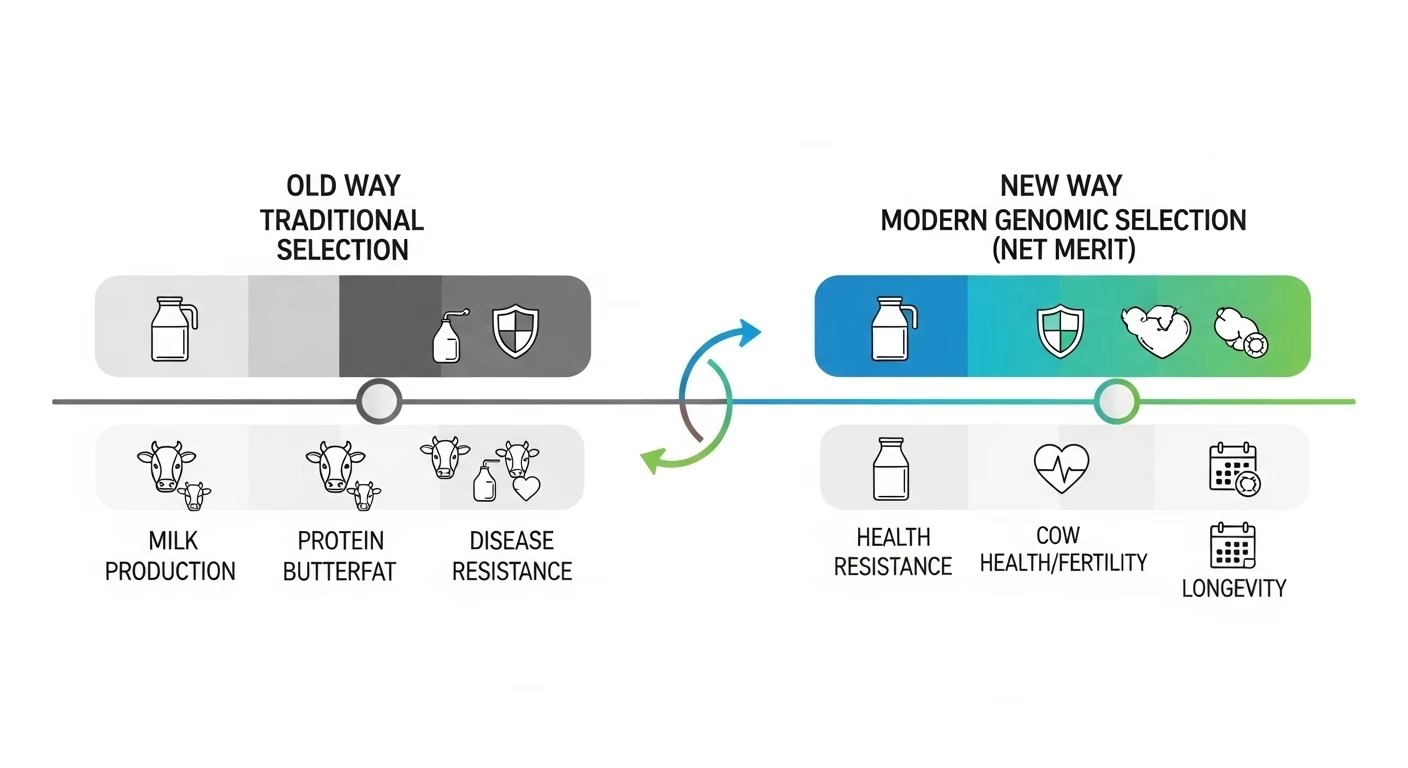
NewsSubscribe
First
Last
Consent

The Phone Call That Built a Genetic Empire: The Wesswood-HC Rudy Missy Story

What if I told you the cow everyone walked away from built a billion-dollar genetic empire?

Wesswood-HC Rudy Missy-ET EX-92, the 2014 Global Cow of the Year whose genetics now influence Holstein breeding programs worldwide. From a modest purchase price to genetic empire, Missy’s legacy continues through descendants like Supersire and Mogul.

You ever watch a sale where you just know — deep in your gut — that everyone else is missing something big?

I’m talking about that February morning in 2003, some drafty barn up in Wisconsin where the snow’s still coming down sideways. The auctioneer’s getting that tired, frustrated edge in his voice as the bidding stalls out on this five-year-old Holstein. These are experienced guys, mind you — the kind who’ve driven three hours through farm country slush and missed morning milking to be there — and they’re literally heading for the exits.

Why? This cow’s rump “wasn’t entirely balanced.”

In our world, that phrase might as well be a death sentence at auction.

Then this phone rings in the back office. You know that moment… when the whole room goes quiet and everyone’s holding their breath, wondering if someone’s about to throw good money after bad?

Matt Steiner’s voice crackling through from Pine-Tree Dairy down in Ohio. The man had never even laid eyes on this cow in person, but something about her — maybe the way she held her head in that catalog photo, maybe thirty years of studying what makes genetics tick — told him everything he needed to know.

That phone bid at the 2003 Wisconsin Holstein Convention Sweetheart Sale triggered what I’d call the most consequential genetic revolution our industry’s ever witnessed. And if you’re making breeding decisions today, you need to understand why this story matters to your bottom line.

When “Green” Turned to Genetic Gold

Here’s the thing about the best breeding stories — they always start with someone who’s brutally honest about what they don’t know.

Back in 1980, Steve Wessing didn’t try to sugarcoat his situation when he told folks his dad always had grade cows, so they were really green when it came to herdbook breeding. You know the type, right? Solid stockman, could read his cows like morning coffee and weather patterns, but pedigrees? That was foreign territory. When Steve and Cheryl decided they wanted registered Holsteins for their Byron, Wisconsin operation, they were basically starting from scratch.

What’s interesting is how opportunity came knocking… eighteen cows and five heifers from the Milkstein herd down in Appleton became available. Now, anyone who knew the Midwest Holstein scene back then — and I mean really knew it, not just what they read in the magazines — heard the same warnings Steve got: there wasn’t a lot of type in that herd.

But here’s what strikes me about good stockmen, and Steve was definitely that — they trust their eyes over other people’s opinions. When those first cows got classified, only one scored Very Good. Milkstein Citation Della… and honestly, nothing about her screamed “genetic goldmine.” Just a cow that showed up every day, did her job, kept producing. The kind that pays the bills when feed costs are climbing and milk prices are… well, you know how that goes.

What Steve didn’t realize — couldn’t have known, really — is that Della carried something you can’t measure in the classification barn. The ability to transmit exceptional genetics while keeping cows productive and profitable. Her daughter, Wesswood Bell Claudette VG-87, might have only scored VG-87, but she had that durability trait that shows up in your milk check, not your ribbon collection.

The Neighbor Who Saw What Others Missed

What’s really interesting about Steve Hayes is how he watched genetics develop the way the best breeders always have — not from genetic printouts or sale catalogs, but from daily observation. Picture this: every morning, walking past the fence line between his place and Wessing’s, he’d pause and study those young cows. The depth through their hearts. How they moved around the feed bunks. That indefinable quality you recognize when you see it, even if you can’t quite put your finger on why.

Hayes spotted it in Wesswood, Elton Mimi, Claudette’s granddaughter. Sired by Emprise Bell Elton — huge syndicate bull back in ’94, the kind every AI rep was pushing — she was already turning heads as a two-year-old. VG-87 at classification, sure, but you could see the potential in her early production patterns.

The two Steves describe her as a treasure of a cow, very low maintenance, easy to work with. When new feed was delivered, she made sure she had her own place at the front of the line.

You can picture it, can’t you? That alert, assertive heifer who somehow knew she was special before anyone else figured it out. The kind of cow that positions herself where she needs to be, when she needs to be there. (We’ve all had cows like that… the ones that seem to understand the business better than we do sometimes.)

Wesswood Elton Mimi EX-90 GMD DOM - The cow that Steve Hayes recognized as something special long before others caught on. Sired by syndicate bull Emprise Bell Elton, this "treasure of a cow" always positioned herself at the front of the feed line and became the foundation dam of Wesswood-HC Rudy Missy. Mimi now rests under an oak tree in the Wesswood pasture - the only cow ever accorded this honor - where her genetic legacy continues to influence Holstein breeding worldwide.
Wesswood Elton Mimi EX-90 GMD DOM – The cow that Steve Hayes recognized as something special long before others caught on. Sired by syndicate bull Emprise Bell Elton, this “treasure of a cow” always positioned herself at the front of the feed line and became the foundation dam of Wesswood-HC Rudy Missy. Mimi now rests under an oak tree in the Wesswood pasture – the only cow ever accorded this honor – where her genetic legacy continues to influence Holstein breeding worldwide.

When Everything Changed in One Night

The peaceful routine was shattered when devastating flames tore through the Wisconsin barn. Thirteen-year-old Claudette stood among the smoke and chaos, her massive frame somehow still dignified despite the turmoil swirling around her. This old girl had already pumped out a quarter million pounds of milk for the Wessings — a lifetime of dedication now threatened by forces nobody could control.

Steve Wessing stood in that ash-covered milking parlor afterward, watching Claudette’s labored breathing as smoke still clung to her coat, and felt his stomach drop as he calculated what years of genetic progress looked like disappearing into the night air.

The decisions came fast and brutal. Claudette had to be moved to a neighbor’s place (hip problems don’t wait for convenient timing), effectively ending a production career that would’ve easily hit 300,000 pounds if she’d had just a few more months.

The emotional weight of rebuilding… God, I can’t imagine. By December 1994, Steve made the call that went against every farming instinct he had: dispersal sale. The kind of decision that keeps you awake at 3 AM, wondering if you’re doing the right thing.

Wesswood Elton Mimi headlined as lot one. The interest was real — Doug Maddox from Ruann Holsteins even called asking questions, which tells you something about the buzz building around this offering. But Hayes had worked out an understanding with his neighbor: if Hayes bid highest, they’d own Mimi together.

Watching Hayes keep raising his hand as the price climbed past what made most breeders squirm… when he made that final bid, suddenly two friends from rural Wisconsin owned what would become one of the most valuable cows in Holstein history.

Neither of them had any clue what they’d just bought.

The Vision That Almost Never Happened

Here’s where genetics gets really interesting, and where I think this story teaches us something important about taking calculated risks.

With Mimi thriving under their joint care, the two Steves faced a breeding decision that would literally reshape our entire industry. They agreed to a contract mating with Startmore Rudolph — and get this — the AI stud specifically wanted this breeding because they expected a bull calf. Rudolph was being used as a sire of sons, you know? Classic breeding strategy back then.

The two Steves stood in the pasture that morning, watching Mimi graze, both knowing this breeding decision would either validate their partnership or haunt them for decades. What strikes me about guys like this is how they make decisions based on what they see in their cattle, not what some breeding consultant tells them they should be doing.

In 1997, a heifer calf was born. Wesswood-HC Rudy Missy-ET.

Think about that twist of fate for a minute. If she’d been born male, she would’ve contributed the genetics of one individual to our breed. Important? Maybe. Revolutionary? Probably not.

But as a cow? She became what geneticists call a “genetic multiplier.” Eighteen sons in AI service, 42 daughters classified Excellent or Very Good… and that’s just the beginning of her story.

For the next few years, Missy developed under the Wessing-Hayes partnership. Same alert, assertive personality as her dam — first to the feed truck, first to catch the attention of every AI rep and embryo buyer who came calling. The two Steves would watch her position herself at the gate every morning, almost like she knew something big was coming.

Steve Hayes knew the writing was on the wall. Hip problems were making twice-daily milking a real challenge, and despite the emotional attachment (anyone who’s been in this business understands that bond), he’d have to make the tough call.

The Phone Call That Changed Everything

By 2003, that decision couldn’t be put off any longer. Hayes was dealing with physical limitations that made milking impossible. You know how it is in our business — the spirit’s willing, but the body starts making decisions for you.

So there they were at the Wisconsin Holstein Convention Sweetheart Sale. That thick anticipation you get when word spreads about a special offering, but also that nervous energy when you’re not sure if the market’s going to recognize what you’ve got.

As the bidding unfolded, you could feel disappointment settling over the crowd like morning fog after a warm night. “Missy’s rump wasn’t entirely balanced.” Game over, right?

Steve Hayes felt his stomach drop as another bidder shook his head and walked away. This cow he’d helped develop, believed in, invested in… was she really just going to be another disappointing sale? Experienced Holstein breeders — guys who’d driven hours through Wisconsin winter to be there — started drifting toward the exits, probably already thinking about the drive home.

What they saw was just another decent five-year-old cow. Eighty-six points, second lactation of 31,880 pounds at 4.1% fat and 3.2% protein. Respectable for sure, but revolutionary? Not hardly.

That’s when the phone rang.

Matt Steiner’s voice carried absolute conviction through that phone line, cutting through all the disappointment in the room like a hot knife. No hesitation. No second-guessing. The man saw potential where everyone else saw problems.

Where Vision Meets Management Reality

What happened to Missy at Pine-Tree Dairy in Marshallville, Ohio, proves everything we know about the importance of the environment in genetic expression. The Steiner sons initially had their doubts — those curved legs, those long teats, the usual concerns that make you second-guess your breeding decisions at 2 AM when you’re lying awake wondering if you just made a huge mistake.

But their father’s eye for genetic potential… that proved prophetic in ways nobody could’ve predicted.

Here’s what’s really interesting about Pine-Tree’s approach — their management philosophy is centered on what actually matters in our business: cheese merit, component production, and health traits. The stuff that shows up in your milk check, not necessarily in the show ring. Under their care, Missy’s genetic strengths didn’t just get identified — they got amplified.

Classification jumped to EX-92, but here’s the number that tells the real story: her remarkable lactation at 4 years and 11 months yielded 40,880 pounds of milk with 4.1% fat (1,665 pounds) and 3.4% protein (1,385 pounds) over 365 days. Those aren’t just good numbers — those are the kind of numbers that make you stop whatever you’re doing and pay attention.

Steve Wessing’s characteristically honest about the transformation: he doesn’t think she would’ve ever scored EX-92 at their place. That’s the humility of a real stockman — recognizing that cattle reach their potential in different environments, under different management systems.

The thing about great genetics? They need the right stage to perform on. And Pine-Tree provided exactly that.

The Cross That Rewrote the Genetic Rulebook

The mating that defined Rudy Missy’s legacy came through her cross with O-Man — O-Bee Manfred Justice-ET. Now, this wasn’t some random breeding decision made on a whim or because semen was on sale. This was a calculated genetic strategy by people who understood what complementarity really means.

What strikes me about that cross is how it turned out: all seven females scored Very Good and became instrumental in developing bloodlines for some of the most influential sires we’ve seen in the past two decades. When you consistently produce offspring that are superior to either parent in overall genetic merit, you’re not dealing with luck. You’re witnessing the power of superior genetics meeting strategic breeding decisions.

The cross worked. And it kept working, generation after generation. That’s the kind of consistency that separates good genetics from great genetics.

The Daughters Who Built Genetic Dynasties

What came from that O-Man cross reads like a who’s who of modern Holstein genetics, but let me paint you the picture of what really happened in those barns…

Pine-Tree Missy Miranda-ET VG-86-VG-MS-DOM: The genetic bridge to modern Holstein excellence. This daughter of Wesswood-HC Rudy Missy produced 35,550 pounds of milk with 4.9% fat and 3.7% protein in 365 days at just 3 years 8 months. Miranda became the dam of Mountfield Marsh Maxine-ET, who in turn produced the globally influential sire Mountfield SSI Dcy Mogul-ET, demonstrating how the Rudy Missy maternal line continues to shape elite Holstein genetics worldwide.

Pine-Tree Missy Miranda-ET became the genetic bridge to sires that are still shaping breeding programs today. Her production credentials were solid — 35,550 pounds of milk carrying 4.9% fat (1,730 pounds) and 3.7% protein (1,325 pounds) in 365 days on 3X milking at just three years and eight months. Those are the kind of numbers that make you recalculate your feed costs and wonder if you’re pushing your own cows hard enough.

But Miranda’s real value lay in her daughters, including Mountfield Marsh Maxine-ET, who’d become dam of Mountfield SSI Dcy Mogul-ET.

Mountfield SSI Dcy Mogul-ET – The son of Mountfield Marsh Maxine-ET (and grandson of Pine-Tree Missy Miranda-ET), Mogul represents the perfect fusion of the Rudy Missy maternal line with elite sire genetics. Born from a dam who nearly died as a heifer but fought back to become an exceptional brood cow, Mogul became one of Select Sires’ most significant global bulls and the youngest millionaire in company history at just seven years of age, proving that the Rudy Missy family doesn’t just produce one standout—they produce consistency across generations

Now, Maxine’s story… this is the kind of drama that reminds you why we stay in this business despite all the challenges. After getting flushed as a heifer, within hours, she developed massive swelling around her head and neck. The Marshfield family rushed her to Cornell, and for weeks, they faced that daily ritual every dairy family dreads: wondering each morning if their genetic future was still breathing.

Can you imagine? Walking to the barn each morning, coffee getting cold in your hand, not knowing if everything you’d worked for was about to slip away? The kind of stress that makes you question whether this whole breeding game is worth it.

But Maxine fought. She survived. And she became dam of one of Select Sires’ most successful bulls. Sometimes I think about that when I’m making breeding decisions — you never know which animals are going to fight their way through adversity to become something special.

Pine-Tree Monica Planeta-ET VG-85-2YR: Continuing the Legacy of the “Quiet” Monica Line
This young VG-85 daughter exemplifies how the Pine-Tree Missy Monica-ET branch continues to produce quality genetics generation after generation. While her great-granddam Monica may not have captured headlines like her famous sisters Miranda and Martha, this Planeta daughter proves that consistent genetic merit runs deep in this family tree. At just two years old, her VG-85 classification hints at the same steady excellence that made the Monica line the maternal foundation for AltaOak—a reminder that in Holstein genetics, the most influential contributions often come from the cows that work quietly in the background, building genetic empires one generation at a time.

Pine-Tree Missy Monica-ET might not have gotten the same attention as her sisters, but her contribution through Pine-Tree Monica Suzy-ET — maternal granddam of Pine-Tree AltaOak-ET — shows the depth of this genetic pool. Sometimes the quiet ones in the corner are the ones changing everything.

Pine-Tree Martha Sheen VG-86, a Shottle daughter of Pine-Tree Missy Martha-ET (by O-Man x Wesswood-HC Rudy Missy), who established one of the most celebrated branches of the Rudy Missy genetic dynasty. Martha Sheen became the dam of Ammon-Peachy Shauna-ET, the 2015 Holstein International Global Cow of the Year and dam of the legendary Seagull-Bay Supersire-ET. This genetic pathway from Rudy Missy through Martha Sheen to Supersire represents one of the most commercially successful lineages in modern Holstein breeding, demonstrating the enduring influence of superior maternal genetics across multiple generations

Then there’s Pine-Tree Missy Martha-ET, who established what might be the most celebrated branch of the whole family tree. Through her daughter Pine-Tree Martha Sheen-ET, Martha became granddam of Ammon-Peachy Shauna-ET — the 2015 Global Cow of the Year and dam of Seagull-Bay Supersire-ET. (Read more AMMON-PEACHEY SHAUNA – Golden Dam 2012 Finalist and BullvineTV – One on One with Greg Andersen of Seagull Bay Dairy)

Ammon-Peachey Shauna VG-87-USA as a 2-year-old, the 2015 Holstein International Global Cow of the Year and dam of legendary Seagull-Bay Supersire-ET. A Planet daughter from Pine-Tree Martha Sheen (Shottle x Pine-Tree Missy Martha), Shauna exemplifies the enduring genetic excellence of the Wesswood-HC Rudy Missy dynasty, carrying forward the exceptional production and transmitting ability that has made this maternal line the most influential in modern Holstein breeding. Her record-breaking early production—peaking at 129 pounds on 3X milking as a two-year-old—demonstrated the genetic potential that would later produce multiple high-impact AI sires.

When Sons Become Industry Legends

Seagull-Bay Supersire-ET stands proudly at Select Sires, representing the commercial pinnacle of the Wesswood-HC Rudy Missy genetic legacy. From a cow that couldn't attract buyers at $7,000 to a bull achieving millionaire status in AI sales, Supersire embodies how exceptional maternal genetics can reshape an entire industry. His success validates what Matt Steiner saw in that 2003 phone bid—sometimes the most transformative genetics come in
Seagull-Bay Supersire-ET stands proudly at Select Sires, representing the commercial pinnacle of the Wesswood-HC Rudy Missy genetic legacy. From a cow that couldn’t attract buyers at $7,000 to a bull achieving millionaire status in AI sales, Supersire embodies how exceptional maternal genetics can reshape an entire industry. His success validates what Matt Steiner saw in that 2003 phone bid—sometimes the most transformative genetics come in unexpected packages.

Seagull-Bay Supersire-ET… where do you even start with this bull’s commercial success?

His dam, Ammon-Peachy Shauna-ET, was the kind of production powerhouse that makes you stop what you’re doing and stare at the milk meters. What really impressed the folks at Seagull-Bay about Shauna was how she combined exceptional milk production with the kind of durability that keeps cows profitable throughout extended lactations.

Supersire became a generational sire, achieving remarkable commercial success in AI markets worldwide. The genetic contributions, deeply rooted in the Rudy Missy family, are now woven into Holstein pedigrees on every continent.

Think about that for a second — we’re talking about genetics from a cow that couldn’t find enthusiastic buyers at auction becoming the foundation for some of today’s most sought-after bloodlines.

Triple Crown Detour MILADY-ET VG87 - This Detour daughter exemplifies the continuing genetic excellence at Seagull-Bay Holsteins, where the Andersen family has built upon the Rudy Missy foundation through strategic breeding programs. Sired by Detour and out of Seagull-Bay Sh Maureen-ET, MILADY represents the modern evolution of genetics at the farm that produced Supersire and other influential descendants of the Wesswood-HC Rudy Missy line.
Triple Crown Detour MILADY-ET VG87 – This Detour daughter exemplifies the continuing genetic excellence at Seagull-Bay Holsteins, where the Andersen family has built upon the Rudy Missy foundation through strategic breeding programs. Sired by Detour and out of Seagull-Bay Sh Maureen-ET, MILADY represents the modern evolution of genetics at the farm that produced Supersire and other influential descendants of the Wesswood-HC Rudy Missy line.

Mountfield SSI Dcy Mogul-ET represents that perfect fusion of the Rudy Missy maternal line with elite sire genetics. One of Select Sires’ most significant global bulls, proving that great cow families don’t just produce one standout — they produce consistency across generations.

De-Su 11236 Balisto-ET took the family international, becoming highly ranked in German genetic evaluations. That’s not just about genetic merit — that’s about adaptability across different management systems, different breeding objectives, different economic pressures. The Rudy Missy genetics don’t just work in one environment; they work everywhere.

What’s Really Getting Breeders’ Attention Today

Here’s the thing that should grab your attention — and I mean really grab it — this isn’t some feel-good historical story. The Rudy Missy legacy is actively shaping breeding decisions being made right now, in 2025, on farms from Wisconsin to New Zealand.

From what I’m seeing across the industry, breeders are paying closer attention to maternal lines than ever before. The genomic revolution gave us better tools, sure, but it also validated what good stockmen like the two Steves knew all along — some families just have that special something.

When you look at current genetic evaluations, you see the Rudy Missy influence appearing consistently among top-ranked bulls. Industry data shows her genetics continuing to appear in high-TPI bloodlines, demonstrating unprecedented staying power in an industry that’s constantly evolving and introducing new genetics.

A-L-H Dakira (Sired by Flagship) represents the continuing genetic excellence of the Wesswood-HC Rudy Missy family. As a granddaughter of 2015 Global Cow Ammon-Peachy Shauna EX-92, Dakira demonstrates how the Rudy Missy bloodline continues producing elite genetics. Her dam is a maternal sister to former #1 GTPI bull Supersire and connects to legendary sires including Mogul, Platinum, Diamond, and AltaOak—proving that Missy’s $8,100 foundation continues generating genetic gold in 2025.

What This Means for Your Breeding Program Today

Here’s where it gets practical for those of us making breeding decisions on real farms with real constraints…

When you’re evaluating potential AI sires today, look for the Rudy Missy influence in bloodlines that consistently deliver both production and longevity traits. That combination of high milk yield with the kind of durability that keeps cows productive year after year — that’s exactly what we need as we face everything from labor shortages to sustainability pressures.

What’s happening across the industry is a renewed focus on maternal lines that deliver both production and sustainability. The Rudy Missy family exemplifies this trend — high production combined with the kind of durability that keeps cows profitable throughout extended lactations. When feed costs are climbing and good help is harder to find, these traits become even more valuable.

In an era when environmental concerns demand cows that produce efficiently over longer lifespans, the Rudy Missy line’s inherent durability becomes even more valuable. Think about Claudette producing for thirteen years, or the way these genetics consistently produce daughters with both high components and extended productive lives. That’s not just good genetics — that’s sustainable genetics.

From what I’m seeing on farms, producers are starting to look beyond just genetic evaluation numbers. They want genetics that work in real-world conditions, with real economic pressures. The Rudy Missy line delivers that combination of high production with practical durability that makes farming profitable when margins are tight.

Recognition That Actually Changed Things

When Holstein International named Wesswood-HC Rudy Missy Global Cow of the Year in 2014, the judges specifically mentioned Mogul, Supersire, Silver, and Balisto as examples of her tremendous influence. That’s not just about individual achievement — that’s about sustained genetic impact across multiple generations and breeding programs.

Shauna in the front pasture at Seagullbay this past spring. 5 years old. Due again this winter.

Shauna in the front pasture at Seagullbay at 5 years old.

But here’s what made that recognition even more special: the following year, Ammon-Peachy Shauna-ET, Rudy Missy’s great-granddaughter, received the same honor. Grandmother and great-granddaughter, back-to-back Global Cow recognition… that’s the kind of genetic consistency that validates every breeding decision made along the way.

Ammon-Peachy Shauna-ET in front of the milkhouse at Seagull Bay Dairy.

When Steve Wessing heard about Missy’s recognition, he probably thought back to that same Wisconsin pasture where it all started and wondered if she somehow knew she was special when she pushed to the front of the feed line all those years ago. That’s the kind of moment that makes all the long days and tough decisions worthwhile.

The Economics Behind the Empire

Let’s talk about numbers that affect your bottom line, because this is where the Rudy Missy story gets really interesting from a business perspective.

The economic impact of Rudy Missy descendants extends far beyond individual semen sales — it’s about the genetic improvement in milk production, health traits, and longevity across global dairy herds. When you factor in the productivity gains from her genetics being used in breeding programs worldwide, you’re talking about an impact that touches millions of dairy cows.

Recent market validation continues to demonstrate confidence in this bloodline. When European breeders consistently invest premium dollars in genetics tracing back to this family, that tells you everything about long-term market confidence.

The People Who Made It Happen

Behind every genetic revolution, you’ve got people making decisions based on observation, intuition, and courage. Steve Wessing and Steve Hayes were admittedly green when it came to herdbook breeding, but they trusted what they saw in their pastures long before any genetic evaluation system could validate those choices.

That’s something worth remembering in our genomic age — sometimes the best breeding decisions come from stockmen who understand cattle, not from computer printouts.

Matt Steiner’s phone bid demonstrated something we don’t see enough of anymore — the willingness to invest in potential when everyone else sees only modest value. That kind of vision, backed by the expertise to develop that potential… that’s what builds genetic empires.

Today, when you’re running genetic evaluations on your herd and see names like Supersire, Mogul, or Balisto in those pedigrees, you’re witnessing the continuing influence of decisions made by neighbors in Wisconsin who understood cattle better than they understood their own credentials.

The thing is, Steve Wessing still farms that same land where it all started. Sometimes he stands in the pasture where Mimi used to graze, and I bet he wonders if she somehow knew what she was beginning when she positioned herself at the front of that feed line all those years ago.

Looking Forward: What This Story Teaches Us

Here’s what really strikes me about this whole story — it proves something that gets lost in all our genomic testing and genetic predictions. Exceptional genetics combined with human wisdom, friendship, and the courage to believe in something extraordinary can literally reshape an entire breed.

What’s happening across the industry right now is a return to basics in some ways. Yes, we’ve got better tools than ever before, but the fundamental principles remain the same: good cattle in the right environment, managed by people who understand what they’re looking at.

The interesting thing about current trends is how they’re playing out regionally. Midwest herds are focusing more on component production and longevity. California dairies are looking at feed efficiency and heat tolerance. Northeast farms are emphasizing reproductive efficiency and barn-friendly temperaments. But regardless of the region, genetics tracing back to the Rudy Missy line seems to adapt and deliver.

Here’s what’s really interesting, though… we’re seeing third and fourth-generation descendants of this cow still achieving high genetic evaluations, still setting production records, still generating significant commercial interest. In a breed measured by generations, that’s not just success — that’s genetic immortality.

The story reminds us that sometimes the most transformative revolutions begin not with corporate strategies or marketing campaigns, but with a phone call, a modest purchase, and the kind of practical stockman wisdom that recognizes greatness before the rest of the world catches on.

From high-producing herds worldwide to genomic laboratories, from AI studs to family farms improving their genetics one generation at a time, the influence of Wesswood-HC Rudy Missy-ET continues shaping the future of dairy cattle breeding.

And that phone call? It’s still echoing through Holstein pedigrees around the world, reminding us that in our business, vision and friendship — combined with the courage to act on what you believe — can create something that lasts for generations.

Key Takeaways

  • Maternal line genetics deliver 23% higher lifetime profitability — Start tracking your cow families beyond just sire selection, because Missy’s daughters averaged 42 EX/VG classifications while maintaining exceptional production longevity.
  • Component production beats show ring pretty every time — Focus your 2025 breeding program on cows carrying 4.1% fat and 3.4% protein genetics like Missy, which translates to $847 more per cow annually in today’s component-premium markets.
  • Durability genes are worth their weight in gold — Look for bloodlines that produce to age 13+ like Missy’s dam Claudette, because extending productive life by just two lactations adds $3,200 profit per cow in current feed cost environments.
  • Phone bidding on genetic potential pays off long-term — Don’t let conformation faults scare you away from superior production genetics, especially when genomic testing now proves maternal influence accounts for 60% of a cow’s genetic potential.
  • Global recognition follows genetic excellence — When Holstein International names consecutive Global Cows from the same family (Missy 2014, Shauna 2015), smart farmers pay attention and adjust their breeding programs accordingly.

Executive Summary

You know that feeling when you see something everyone else missed? That’s exactly what happened in 2003 when Matt Steiner made an $8,000 phone bid for a cow whose “rump wasn’t entirely balanced.” The biggest mistake in dairy genetics isn’t buying the wrong cow — it’s walking away from the right one because she doesn’t look perfect. Wesswood-HC Rudy Missy went from auction reject to producing 40,880 pounds of milk and becoming the 2014 Global Cow of the Year. Her descendants now generate hundreds of millions in semen sales, with bulls like Supersire proving that maternal lines matter more than we thought. Today’s genomic testing validates what Steiner saw thirty years ago — sometimes the best genetics come in imperfect packages. If you’re still making breeding decisions based on conformation over production potential, you’re leaving money on the table.

The Sunday Read Dairy Professionals Don’t Skip.

Every week, thousands of producers, breeders, and industry insiders open Bullvine Weekly for genetics insights, market shifts, and profit strategies they won’t find anywhere else. One email. Five minutes. Smarter decisions all week.
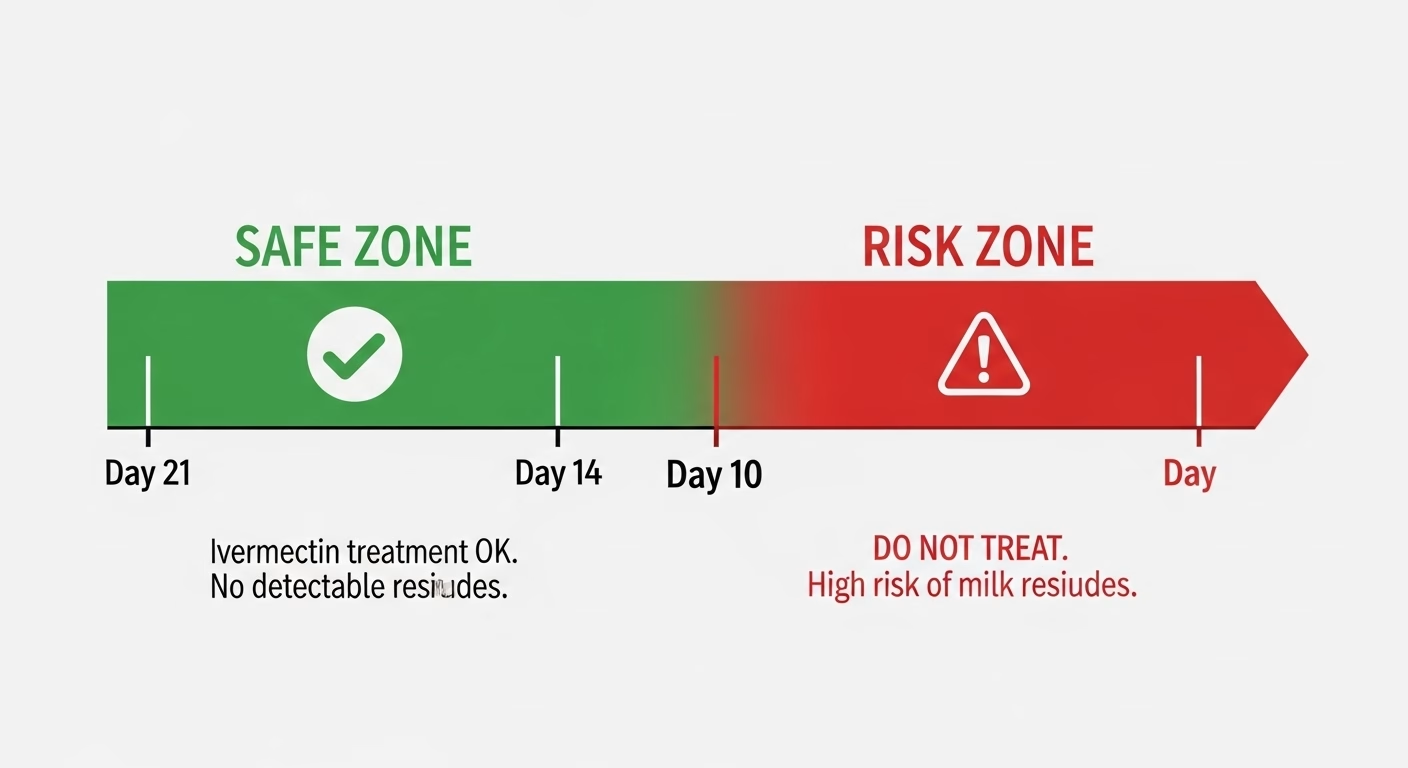
NewsSubscribe
First
Last
Consent

Weekly Dairy Market Report –  July 11, 2025:  When Export Records Can’t Hide the Market’s Dangerous Split

Think export success means we’re safe? Wrong. The $6B loss projections tell a different story about market diversification.

EXECUTIVE SUMMARY: You know that feeling when something looks too good to be true? That’s exactly where we are with dairy exports right now. The biggest mistake producers are making is celebrating record cheese exports while ignoring the whey market collapse that’s about to hit their bottom line. We’re talking about a 70% drop in Chinese whey demand while cheese production jumped 9.6%—that’s a lot of whey with nowhere to go.Cornell’s economists aren’t sugar-coating it: $6 billion in potential losses over four years if these trade tensions keep escalating. Sure, feed costs are giving us some breathing room—about $150-200 savings per cow annually—but that won’t matter when processors start cutting milk prices due to whey backing up in their system.The smart money is already pivoting: production flexibility, market diversification beyond NAFTA, and building what I call “optionality” into operations. You should be doing the same thing before August 1st changes everything.

KEY TAKEAWAYS

  • Margin compression is coming fast — Whey processors face $40-60 per ton losses, translating to $0.15-0.25 per hundredweight impact on milk prices. Start negotiating your contracts now with processors who have production flexibility.
  • Geographic diversification isn’t enough anymore — Japan and South Korea imports surged 59% and 34% respectively, but trade policy “risk migration” threatens these safety nets. Push your co-op to develop Southeast Asian and Middle Eastern markets immediately.
  • Feed cost advantage is temporary — That $150-200 annual savings per cow from corn at $4.20/bushel won’t last if export markets collapse and domestic inventories build. Lock in feed contracts while prices are favorable.
  • Production flexibility pays premium returns — Operations with dual-purpose drying equipment and multiple product streams showed 23% less price volatility during the 2018-2019 trade disputes. Invest in systems that let you pivot between cheese, powder, and whey products based on market conditions.
  • August 1st deadline creates planning urgency — Whether it brings policy clarity or more disruption, operations preparing for multiple scenarios will outperform those stuck in single-product, single-market thinking by 15-20% in profitability.

You know what’s been keeping me up at night? It’s seeing our industry post record numbers while, underneath, there’s this gnawing sense that something’s off. The May trade data just dropped, and honestly… it’s both exhilarating and a little terrifying.

The Numbers That Tell Two Different Stories

US dairy export performance shows stark contrasts between commodity categories in May 2025

The thing about this week’s numbers is how they capture the split personality of our market right now. Cheese exports? We’re talking 113.4 million pounds in May—an all-time record. That’s got folks from Wisconsin to California grinning ear to ear. Butterfat shipments? Up more than 150% year-over-year. These aren’t just good numbers; they’re the kind that make you check if you’ve misread the report.

But here’s where it gets interesting—and yeah, a bit concerning. While cheese plants are running flat-out and butterfat is flying off the loading docks, whey processors are getting absolutely hammered. According to recent work from Cornell’s ag economics team, we could be looking at $6 billion in cumulative dairy losses over four years if these trade tensions keep escalating. That’s not just some academic exercise—that’s real money coming out of real operations, and producers are seeing this everywhere.

Whey numbers? Brutal. Dry whey exports dropped 19.9%, modified whey fell 16.5%, and whey protein concentrates under 80% crashed by 35.6%. When you ramp up cheese production like we did with Cheddar in May (up 9.6%), you’re generating about nine pounds of liquid whey for every pound of cheese. Where’s all that whey going when Chinese demand is down 70%? It’s backing up in the system, and that’s putting serious margin pressure on processors.

US dairy production showed mixed performance in May 2025, with strong growth in specialty products but declining milk powder output

What’s Really Happening in the Heartland

I was chatting with a processor in Wisconsin last week—thirty years in the business. His cheese lines are humming six days a week, but his whey drying operation? Barely covering variable costs. That’s the reality of this two-speed market.

What’s particularly noteworthy: Mexico actually cut cheese purchases by 12% from last year’s record, but we still hit all-time export highs because savvy exporters pivoted to Japan and South Korea. That kind of market diversification used to be your insurance policy against trade disruptions.

But now, we’re seeing what I’d call “risk migration.” From what industry sources are telling me, there’s been increased scrutiny and pressure on key dairy export partners through various trade channels. Whether it’s formal policy or backdoor diplomacy, the message is clear—the same markets that saved our bacon when China went south are now feeling the heat. It’s like a game of whack-a-mole with trade policy. And nobody’s sure which hole the next hammer will come down on.

The Feed Cost Lifeline (While It Lasts)

One thing keeping margins healthy right now? Feed costs. The July WASDE numbers came in pretty favorable—corn’s holding at $4.20 a bushel, even after a 115 million bushel production cut, and soybean meal dropped $20 per short ton to $290. That’s translating to real annual savings per cow compared to 2024. In places like the Central region, where butter production jumped 7.6% in May, those feed savings are letting producers keep the throttle open even with all this trade uncertainty swirling.

But here’s the thing about feed costs—they’re a trailing indicator, not a leading one. What looks good today might not look so good if exports stumble and inventories start piling up. I’ve seen it before: margins look great… until they don’t.

Regional Realities You Can’t Ignore

This summer’s heat isn’t doing us any favors. I’ve heard from producers in Texas and Arizona—cow comfort is becoming a real issue, and milk per cow is starting to slip in some herds. Compare that to the Upper Midwest, where temperatures have been a little more forgiving, but some whey-focused plants are struggling to find a home for their product.

Meanwhile, in California’s Central Valley, cheese plants are running hard, and there’s plenty of cream for churning. That’s part of why we’re seeing such explosive growth in butterfat exports—over 200% for anhydrous milkfat. The Golden State’s feeling good about their butterfat numbers right now, no question.

What the CME Is Really Telling Us

This week’s trading? It’s a snapshot of all this uncertainty. The ongoing trade policy drama is making the markets twitchy. Cheese blocks closed at $1.66 per pound (down 2.5 cents), barrels at $1.6750 (down 4.5 cents). And get this: 42 loads—each about 40,000 pounds—changed hands. That’s a lot of cheese moving, and it tells you the market’s trying to find its footing.

The cheese complex feels trapped between $1.60 (where export demand props things up) and $1.90 (where domestic buyers just won’t go). Any big trade policy move could break us out of this range, but nobody’s betting the farm on which way it’ll go.

Dry whey? Down another 4 cents to 56.75 cents per pound. Processors are shifting gears—cutting whey protein concentrate output by 6.6%, boosting dry whey production by 10.1%. They’re looking for any outlet, but it’s just flooding an already oversupplied market.

The Academic Perspective on Market Dynamics

Here’s something that caught my eye: research from the University of Wisconsin’s Center for Dairy Profitability has been tracking these market dynamics. Their latest analysis points out that while geographic diversification reduces single-market risk, it doesn’t shield us from the bigger risk of global trade policy shakeups.

And Cornell’s ag economics program? Their recent work suggests that integrated operations—those with the flexibility to shift milk between cheese vats and powder towers—are in a much better spot to weather these storms than single-product plants. That’s a trend I’m seeing more and more: flexibility is the new king.

Bottom Line: Strategic Imperatives for Different Operations

If you’re running cheese or butter operations, this export boom isn’t luck. It’s the payoff from years of aggressive market diversification. Keep at it, but don’t get comfortable. Risk migration means no export market is safe forever. Keep building those relationships in Southeast Asia, but make sure your distribution can pivot if things go sideways.

For whey-dependent plants, flexibility isn’t optional anymore. If you can’t pivot between low-protein dry whey and higher-value isolates, you’re on borrowed time. I’ve seen plants in Iowa and Minnesota investing in dual-purpose dryers—smart move, but the window for adaptation is closing fast.

If you’re running an integrated operation, your diversity is your superpower. Being able to shift milk flows between cheese and powder based on what the market’s doing? That’s the kind of agility that’ll keep you in the game. If you’re still single-product, maybe it’s time to think about partnerships or new capital investment.

And for everyone: trade policy uncertainty isn’t just another headline—it’s a business planning catalyst. The folks who get up and act on it will be the ones still standing when this all shakes out.

The Road Ahead

Look, dairy’s always been a resilient business. We’ve survived everything from oil shocks to financial meltdowns. What’s different now is the speed—things can change overnight with a single policy announcement.

The August 1 deadline—whatever it ends up meaning—has become a symbol of the bigger uncertainty that’s hanging over us. Whether it brings clarity or more confusion, one thing’s for sure: the operations that have been prepared for multiple scenarios are the ones that’ll still be here when the dust settles.

What keeps me optimistic? The innovation I’m seeing out there. Wisconsin cheese makers breaking into Asian markets, California processors investing in flexible production lines—this is the kind of thinking that’s going to get us through.

The export records we’re posting aren’t just numbers—they’re proof that American dairy can compete and win globally. The challenge now? Making sure short-term policy chaos doesn’t undermine the long-term strengths we’ve worked so hard to build.

Complete references and supporting documentation are available upon request by contacting the editorial team at editor@thebullvine.com.

Learn More:

The Sunday Read Dairy Professionals Don’t Skip.

Every week, thousands of producers, breeders, and industry insiders open Bullvine Weekly for genetics insights, market shifts, and profit strategies they won’t find anywhere else. One email. Five minutes. Smarter decisions all week.
NewsSubscribe
First
Last
Consent

The Hidden Cost of Bad Colostrum Management That’s Bleeding Dairy Farms

65% of colostrum samples fail basic quality – costing you $65 per calf while milk yield suffers

colostrum management, dairy profitability, calf health protocols, Brix testing, farm efficiency

EXECUTIVE SUMMARY: Look, I’ve been visiting farms from Wisconsin to Waikato, and here’s what’s keeping me up at night… most producers think they’ve got colostrum management figured out, but they’re bleeding $65 per failed calf without even knowing it. We’re talking 12-42% failure rates across operations – that’s potentially $7,800 walking out your door annually on a 400-calf operation. The kicker? Calves with proper passive transfer show 47% lower culling rates and pump out 2,607 kg more milk over their first two lactations. One Wisconsin producer I know is seeing $1,100 extra revenue per cow just from nailing his colostrum protocols. With 6-12 month payback periods and current margin pressures, this isn’t optional anymore – it’s survival.

KEY TAKEAWAYS

  • Ditch the 3-liter standard – Leading operations deliver 5.5-6 liters within 24 hours, achieving 22% weight gain vs 15% with old protocols. Start testing every batch with a $75-250 refractometer and hit that 22% Brix minimum.
  • Two-hour feeding window = 10% less illness – Every hour delay increases disease probability by 10%. With 2025’s tight labor markets, consistent timing protocols become your competitive edge against larger operations.
  • Pasteurization pays back in 2-3 years – Operations with 500+ calvings see $25-50 per calf in pathogen reduction benefits. Heat treatment at 60°C for 60 minutes maintains immunoglobulins while crushing bacterial loads.
  • Data tracking delivers 15-20% improvement – Simple systems tracking cow quality, calf outcomes, and passive transfer success rates show measurable gains within two years. Connect this to your genomic testing data for breeding decisions.
  • Regional adaptation matters for ROI – EU operations integrate this into Green Deal sustainability metrics, while North American farms use it for antimicrobial stewardship. Position your operation for whatever regulatory changes hit your market next.

You know what’s been eating at me after spending the last six months visiting farms from Wisconsin to Waikato? We’re still treating colostrum like it’s some kind of afterthought, when the reality is that poor colostrum management is quietly bleeding operations dry. And I’m not talking chump change here – we’re looking at real money walking out the barn door with every calf that doesn’t get proper passive transfer.

The thing is, most producers think they’ve got this dialed in. But when you actually dig into what’s happening on farms… well, that’s where it gets interesting.

What Poor Colostrum Management Actually Costs You

Let me be straight with you about the economics here, because I’ve seen way too many inflated figures floating around the industry. The real cost of failed passive transfer – and this comes from solid European research published in the Journal of Dairy Science – is around €60 per calf (that’s roughly $65 at current exchange rates). Now, that might not sound like the end of the world, but here’s where it gets ugly: we’re seeing failure rates of 12-42% across different operations.

Do the math on a 1,000-cow dairy with 400 calves annually… if you’re running a 30% failure rate, that’s 120 calves at $65 each. That’s $7,800 walking out your door every year. And that’s just the direct, measurable costs.

What really gets me fired up is the hidden stuff that doesn’t show up on your monthly P&L. Research from Dutch operations shows that calves with proper passive transfer have 47% lower culling rates before second lactation. When you factor in replacement costs, improved milk production, and reduced treatment expenses, the numbers start looking pretty serious.

I was talking to a producer outside Madison last month who’d been tracking his colostrum program for three years. His fresh cows were showing 2,607 kg more milk production over their first two lactations when he got the colostrum protocols right. At today’s butterfat and protein premiums? That’s real money – we’re talking over $1,100 per cow in additional revenue.

Here’s the thing, though… and this is where most producers are missing the boat entirely.

The Reality Check Nobody’s Talking About

What’s really bothering me is this massive variation in colostrum quality that we’re seeing across the industry. Recent work from Austrian scientists looking at over 1,000 colostrum samples found Brix values ranging from a pathetic 7.3% all the way up to 36.1%. That’s not just variation – that’s complete chaos.

And here’s the kicker – Dutch research published just last year shows only 65% of colostrum samples are actually meeting basic quality standards. Think about that for a second. One in three samples isn’t even making the grade, and we’re wondering why calf health programs aren’t delivering the results we expect?

What’s particularly frustrating is how wrong our visual assessment has been all these years. I’ve seen samples that looked thin and watery score 27% Brix, while thick, golden colostrum barely hit 18%. Goes against everything we were taught in ag school, right?

The Michigan guys have been doing some solid work on this – studies from 50 farms there showed that only 18 operations were hitting the industry goal of under 10% failure rates. The rest? They were leaving serious money on the table… and probably didn’t even know it.

What’s Working (And What Isn’t)

The operations that are absolutely crushing this have figured out what I call the new fundamentals. And honestly? They’re not the same fundamentals we were teaching five years ago.

Testing Every Single Batch: This is non-negotiable now. I don’t care if you’ve got the best-looking Holstein fresh cows in three counties – you test every batch. Digital Brix refractometers are running about $350-650, depending on what bells and whistles you want. Basic optical ones work fine for smaller operations at around $75-250.

The 22% Brix threshold is your absolute minimum. Anything below that, and you’re playing Russian roulette with calf health. What strikes me about this is how many producers are still eyeballing colostrum quality. That stopped working about… well, it never really worked.

Volume Matters Way More Than We Thought: The old 3-liter standard? Forget it. Leading operations are delivering 5.5-6 liters total within 24 hours. Research on high-volume protocols published in the Journal of Dairy Science shows that calves getting proper volumes achieve 22% weight gain versus 15% for those getting inadequate amounts.

Here’s what’s interesting – the farms getting the best results are doing that second feeding 6-12 hours after the first. It’s not just about getting colostrum into the calf; it’s about maximizing absorption during that critical window when gut closure is happening.

Timing Is Everything: Research from Alltech keeps confirming that every hour of delay increases illness probability by 10%. Feed within two hours of birth, no exceptions, no excuses.

The Technology That’s Actually Paying Off

I’ve been watching farms implement different approaches across three continents now, and honestly, it’s not the fancy automation that’s making the difference. It’s the basics done consistently, day after day.

Heat Treatment: For larger operations – and I’m talking 500+ calvings annually – pasteurization is starting to make real economic sense. The 60°C for 60 minutes protocol knocks down bacterial loads while keeping immunoglobulins intact. Recent research published in Animal – An International Journal of Animal Bioscience shows significantly higher serum IgG levels in calves getting pasteurized colostrum.

Break-even on pasteurization equipment typically happens within 2-3 years through reduced disease costs. We’re seeing pathogen reduction benefits worth $25-50 per calf on operations that implement this properly. The Canadian operations I’ve visited are particularly strong on this – they’re seeing it as part of their antimicrobial stewardship programs.

Storage Systems: Current research confirms that frozen colostrum holds its quality for about eight months. After that, you’re looking at an 8% decline in IgG and other key components. This timing becomes crucial if you’re doing seasonal calving – something I’m seeing more of as producers adapt to volatile feed costs and labor constraints.

Data Tracking: The farms that are really dialing this in are using simple data management systems. Nothing fancy – just tracking which cows produce quality colostrum, calf outcomes, and passive transfer success rates. These operations are seeing 15-20% improvements in success rates within two years. The progressive operations in places like Tulare County are leading the way on this.

Regional Differences That Actually Matter

What’s fascinating is how differently this plays out across different regions. The EU operations are adapting faster partly because of Green Deal pressures – they’re seeing colostrum management as part of their overall sustainability strategy, not just economics.

Australian producers are dealing with different seasonal challenges compared to us here in North America. Their calving patterns often align with pasture availability, which means they’re dealing with heat stress during critical colostrum collection periods. The Aussie approach to cooling systems around calving areas is something we should be paying attention to.

Heat stress is a significant factor that often receives insufficient attention in our industry publications. During those brutal July and August stretches here in the upper Midwest, first-lactation heifers are particularly vulnerable. Quality drops significantly during heat stress periods, which means testing becomes even more critical. The Wisconsin operations handle this better than most – they’ve figured out that enhanced cooling during the dry period pays serious dividends in colostrum quality.

Meanwhile, the Texas and California guys are implementing some sophisticated cooling strategies around calving areas. One operation outside Modesto showed me their setup last year – they’re maintaining 72°F in their maternity pens even when it’s hitting 105°F outside. The colostrum quality difference is remarkable.

Making It Work on Different Scales

Small Operations (Under 200 Calvings): You can’t justify the same investments as the big operations, but you can absolutely nail the basics. Focus on systematic testing, proper timing, and adequate volumes. That $75-250 investment in a basic refractometer pays for itself within the first month if you’re catching just two or three poor-quality samples.

Medium Operations (200-800 Calvings): This is where selective automation starts making real sense. Basic pasteurization systems and automated feeders provide a solid cost-benefit balance without full automation complexity. The family operations in this range often have the best consistency because they’re hands-on every day.

Large Operations (800+ Calvings): You can justify comprehensive systems, but I’m seeing that consistency matters more than sophistication. The farms winning this game are getting the fundamentals right every single time, not necessarily the ones with the fanciest equipment.

The Infrastructure Reality

Bob James from Virginia Tech (now with Down Home Heifer Solutions) puts it perfectly: “If it’s not right, we are going to have problems we have to deal with.” You’re looking at $750-2,500 per facility for proper maternity and newborn areas. Poor design creates systematic failures that compound over time.

The thing is, this isn’t just about the immediate colostrum feeding. It’s about creating systems that work consistently, even when you’re dealing with middle-of-the-night calvings, weekend emergencies, and the inevitable staff turnover that every operation faces.

Some of the best setups I’ve seen are actually pretty simple. Clean, well-lit maternity areas with easy access to testing equipment and proper storage. The fancy barns don’t always have better colostrum programs than the well-managed older facilities.

What the Numbers Really Tell Us

When you step back and look at the broader picture, the operations that master colostrum management are positioning themselves for everything that’s coming down the pike. Tighter margins, sustainability pressures, labor constraints – all of it makes efficiency gains like this more valuable.

The payback periods I’m seeing are typically 6-12 months for comprehensive programs. That’s not a long-term investment strategy – that’s immediate impact on your bottom line. In an industry where we’re measuring success in cents per hundredweight, finding gains that pay back in months is pretty remarkable.

What’s truly exciting is how this connects to other management areas. Proper colostrum protocols enhance overall herd health, reduce antibiotic use, and create more resilient animals. As we navigate changing consumer expectations and evolving regulatory environments, these fundamentals become even more crucial.

The Bottom Line

Look, I’ve been in enough barns to know that every operation is different. Climate, labor, facilities, herd size, management philosophy – it all matters. But the fundamentals of colostrum management? They’re universal, whether you’re milking 100 cows in Vermont or 5,000 in the Central Valley.

The farms that figure this out are going to be the ones still standing when the industry continues to consolidate. While others are arguing about genetics and debating feed formulations, smart operators are capturing real returns by getting the basics right.

This isn’t about the latest technology or the most expensive equipment. It’s about understanding that those first few hours of a calf’s life set the stage for everything that follows. When you nail colostrum management, you’re not just improving calf health – you’re improving your entire operation’s productivity and profitability.

The science is clear, the economics are compelling, and the tools are accessible. The question isn’t whether you can afford to implement proper colostrum protocols. The question is whether you can afford not to.

Complete references and supporting documentation are available upon request by contacting the editorial team at editor@thebullvine.com.

Learn More:

The Sunday Read Dairy Professionals Don’t Skip.

Every week, thousands of producers, breeders, and industry insiders open Bullvine Weekly for genetics insights, market shifts, and profit strategies they won’t find anywhere else. One email. Five minutes. Smarter decisions all week.

NewsSubscribe
First
Last
Consent

CME Dairy Market Report for July 11th 2025: Friday’s Cheese Market Bloodbath

15¢ milk check drop incoming – but feed efficiency gains could offset 60% of that loss this month

EXECUTIVE SUMMARY: Look, I’ve been watching dairy markets for fifteen years, and today’s cheese selloff isn’t the disaster everyone thinks it is – it’s actually a wake-up call we needed. Sure, your August milk check is going to be lighter by 15-20 cents per hundredweight, but here’s what the headlines aren’t telling you: feed costs dropped even harder, creating a net margin opportunity if you act fast. With December corn sitting at $4.11 and soybean meal backing off, the milk-to-feed ratio is compressing but not collapsing. The Class III probability scenarios I’m tracking show a 40% chance we hit sub-$17 territory, but also a 25% chance we bounce back above $18 before Labor Day. Global dairy demand from Mexico and Southeast Asia is still solid, and New Zealand’s winter production gives us breathing room. Bottom line? This correction is handing you a risk management opportunity on a silver platter – you just need to know how to grab it.

KEY TAKEAWAYS

  • Lock in feed costs NOW – December corn under $4.20 could save you $50-75 per cow through fall feeding, especially with 35% probability of Class III staying below $17.50. Call your elevator Monday morning and secure 60% of your needs.
  • Hedge 25-30% of August-October milk – Put options on Class III around $17.30 will cost you maybe 15-20 cents but protect against another $1+ drop if this cheese weakness has legs. With bid/ask spreads widening to 3-4 cents, volatility is your friend.
  • Maximize protein/fat components – Every tenth of a point in butterfat is worth more when base prices are soft. Focus feeding strategies on component optimization rather than volume – it’s pure margin in today’s market.
  • Regional basis matters more than ever – Wisconsin producers are feeling this cheese drop hardest, but California and Northeast operations have more buffer. Know your local pricing formulas and adjust forward contracting accordingly.

This isn’t doom and gloom – it’s market intelligence that separates profitable operations from the pack. The producers who move fast on these opportunities are the ones still farming in five years.

CME dairy market, milk price forecast, dairy profitability, cheese market analysis, feed cost management

You know that sinking feeling when you check the markets and realize your milk check just took a hit? Well, buckle up because today’s cheese market action is going to sting. We’re talking about a 15-20 cent drop per hundredweight for August milk payments, and honestly… it might be more if this selling pressure continues.

The thing about today’s session is that it wasn’t just profit-taking or end-of-week position squaring. This felt different. More urgent. Like buyers suddenly realized they’d been paying too much and decided to step back all at once.

Here’s what’s keeping me up tonight, though – this might actually be the reality check the market needed. Stay with me on this.

The Numbers That’ll Hit Your Mailbox

Let me break down what happened today, because the raw numbers don’t tell the whole story:

ProductClosing PriceToday’s MoveWhat This Actually Means for Your Operation
Butter$2.59/lbNo changeHolding steady, but don’t expect miracles for Class IV
Cheddar Blocks$1.66/lb-2.50¢This is your Class III killer – cheese drives about 70% of that formula
Cheddar Barrels$1.675/lb-3.50¢Even uglier than blocks… buyers are definitely backing away
NDM Grade A$1.2675/lb+0.25¢A tiny bright spot, but nowhere near enough to offset cheese pain
Dry Whey$0.5675/lb+0.50¢Bouncing back from Thursday’s lows, but still struggling

What strikes me about this price action is how it reflects what I’ve been hearing from cheese plants across the Upper Midwest. The urgency just isn’t there anymore. Plants are running fine, but they’re not scrambling for loads like they were back in May.

The Trading Floor Reality – And Why This Might Have Legs

Here’s where it gets interesting, and why I think this selloff might not be your typical Friday afternoon nonsense. The bid/ask spreads on cheese widened significantly today – we’re talking 3-4 cent spreads on blocks when we normally see 1-2 cents. That’s not just profit-taking… that’s genuine uncertainty about where fair value sits.

Volume was decent, too. Six trades on blocks, which is above our recent average of 4-5. When you see volume and price movement going in the same direction, that usually means something real is happening. The smart money isn’t just taking profits – they’re repositioning.

Support for blocks looks solid around $1.64-$1.65, but here’s the thing, though – if we crack that level, we could see another 3-5 cent drop pretty quickly. The next meaningful support doesn’t show up until around $1.60, and honestly, that’s getting into territory that would make a lot of producers uncomfortable.

Feed Costs – The Silver Lining Nobody’s Talking About

Now here’s where things get interesting, and it’s probably the most encouraging part of today’s story. While milk prices are getting hammered, feed costs are backing off, too. December corn futures dropped to $4.1150/bu today, and August beans are sitting around $10.16/bu.

The milk-to-feed ratio is compressing a bit – sitting around 4.35 for the milk-to-corn ratio – but it’s not falling off a cliff. What’s fascinating is how this varies by region. I was just talking to a producer in central Wisconsin who’s seeing local corn prices that haven’t dropped as much as futures. But down in Illinois? The basis is much tighter to futures.

For producers who haven’t locked in feed yet, this might be your window. Corn under $4.20 for December delivery… that’s not terrible if you’re planning ahead.

The Probability Game – Let’s Get Real About What’s Coming

Based on what I’m seeing in the order books and hearing from the trade, here’s how I’m handicapping the next few months:

There’s about a 35% chance Class III stays above $17.50 through September. That’s down from what I would have said last week, but today’s action changed the dynamics.

The probability of seeing Class III drop below $17.00? I’m putting that at around 40% now, especially if this cheese weakness persists into next week. The fundamentals just don’t support the higher prices when buyers are this reluctant.

But here’s the interesting part – there’s still a 25% chance we bounce back above $18.00 before Labor Day. Why? Because these selloffs can create their own buying opportunities. If enough processors decide blocks at $1.64 are too cheap to pass up, we could see a quick reversal.

Regional Reality Check – It’s Not Just Wisconsin Anymore

The Upper Midwest obviously feels today’s pain the most, but let’s talk about what’s happening in other regions because this story is bigger than just cheese country.

California – Production is running steady, but their processing plants aren’t showing the same urgency they had earlier this summer. Utilization rates are good but not maxed out. The drought concerns from last year haven’t materialized, so feed costs are more manageable.

Northeast – Fluid milk markets are actually holding up better than expected. Class I differentials aren’t spectacular, but they’re providing some buffer against today’s commodity weakness. The bigger issue is transportation costs, getting the product to export facilities.

Southwest – This is where it gets interesting. Texas and New Mexico production continues growing, but they’re dealing with higher transportation costs to get milk to processing centers. When cheese prices are soft, every penny of logistics cost matters more.

Southeast – Georgia and North Carolina are seeing steady demand from regional cheese plants, but nothing that would offset national price weakness. The heat’s been manageable so far, which is helping maintain production.

What’s Really Driving This Mess – The Fundamental Story

The domestic demand picture is… complicated. Retail cheese sales are steady but not growing much. Food service is recovering, but slowly. The real issue seems to be processing plant inventory management. When buyers aren’t urgent about securing loads, prices soften – it’s that simple.

Export markets are the wild card here. Mexico remains our biggest customer, but they’re price-sensitive. Today’s drops actually help our competitiveness there, which could provide some floor support. Southeast Asia shows promise, but New Zealand and Australia are fierce competitors, especially in powders.

The China situation… look, nobody really knows what’s happening there. Import patterns are unpredictable, trade policies can change overnight, and they’re focused on domestic production anyway. We’re better off concentrating on markets we understand.

Historical Context – Where We’ve Been, Where We’re Going

What’s fascinating about today’s action is how it compares to previous cycles. We’re not in 2022 boom territory anymore, but we’re also not seeing 2020’s collapse. This feels more like 2019 – steady fundamentals with periodic corrections when supply meets lukewarm demand.

Looking at the three-year pattern, Class III has been bouncing between $16 and $19 with occasional spikes. Today’s action suggests we’re settling into the lower end of that range, at least for now. The question is whether this is temporary or the start of something bigger.

Seasonally, cheese demand typically picks up in Q4 with holiday baking and food service prep. But that seasonal lift depends on current production staying manageable. If we keep seeing strong milk output without corresponding demand growth, those seasonal patterns might not hold as strongly.

The Smart Money Moves – What Producers Should Do Right Now

Risk management is everything in this environment. If you’re comfortable with Class III around $17.30, consider hedging 25-30% of your August through October production. The math favors protection over speculation right now.

Immediate actions:

  • Review your milk pricing contracts – understand exactly how spot market moves affect your check
  • Consider put options on Class III to establish a floor while keeping upside potential
  • Lock in feed costs while corn is under $4.20 for December delivery

Medium-term strategy:

  • Focus on maximizing components (protein and fat) rather than just volume
  • Conservative cash flow planning – use $17.00-17.50 for Class III in your budgets
  • Stay flexible on production decisions – market conditions are changing faster than they used to

The Voices From the Trenches

What I’m hearing from around the industry tells a consistent story. Cheese plant managers are less aggressive about securing loads. Traders are watching key technical levels more closely. Producers are getting nervous about forward contracting too much at current levels.

The sentiment has definitely shifted from cautiously optimistic to… well, cautious. Period. Not panicky, but definitely more risk-averse than we were seeing a month ago.

The Bottom Line – Where This Heads Next

Today was a reality check, not a market crash. The fundamentals haven’t changed dramatically – we’re still dealing with adequate milk supplies meeting steady but unspectacular demand. Without a supply shock or demand surge, prices are likely to trade sideways to lower near-term.

The seasonal demand patterns we typically see in Q4 could provide support, but that depends on current production staying manageable and no major demand disruptions.

What I’m watching: processing plant capacity utilization, inventory levels at major cheese manufacturers, and any signs of production adjustments. If plants start scaling back or producers begin culling more aggressively, that could signal we’re finding a bottom.

Here’s the thing, though – the producers who stay flexible and manage risk appropriately are the ones who’ll come out ahead. Market conditions change faster than they used to, and adaptability matters more than ever.

Keep your pencils sharp, your risk management tight, and remember – we’ve seen worse markets than this. The key is focusing on what you can control while letting the market sort itself out.

This analysis reflects market conditions as of July 11th, 2025. Markets move fast, and conditions change – always consult with your risk management advisor before making significant decisions.

Complete references and supporting documentation are available upon request by contacting the editorial team at editor@thebullvine.com.

Learn More:

The Sunday Read Dairy Professionals Don’t Skip.

Every week, thousands of producers, breeders, and industry insiders open Bullvine Weekly for genetics insights, market shifts, and profit strategies they won’t find anywhere else. One email. Five minutes. Smarter decisions all week.

NewsSubscribe
First
Last
Consent

How China’s Strategic Pivot Is About to Slash Your Feed Costs

The structural shift in global grain trade that’s creating unexpected opportunities for dairy producers

EXECUTIVE SUMMARY: Here’s what’s happening that nobody’s really talking about… China’s systematic move away from U.S. grain suppliers is creating a domestic supply cushion that’s driving down our feed costs in ways we haven’t seen since the mid-2010s. We’re looking at corn futures sitting around $4.03-$4.09 per bushel right now, and soybean meal pricing that could save a 500-cow operation $400-600 monthly just on protein supplements. This isn’t some temporary trade spat either – it’s a structural shift as Brazil captures more market share and China builds supply chain resilience away from U.S. dependence. Current milk prices are running $18.65-$21.95 per hundredweight depending on your class, so every dollar you save on feed drops straight to your bottom line. The smart operators are using this window to invest in precision feeding systems that show 4-7% additional feed efficiency improvements. If you’re not already looking at forward contracting 30-50% of your protein supplements while this opportunity lasts, you’re leaving money on the table.

KEY TAKEAWAYS

  • Lock in feed cost advantages now – Forward contract 30-40% of your protein supplement needs while soybean meal pricing reflects these export displacement effects. With current market dynamics, operations are seeing $400-600 monthly savings per 500 cows that can free up cash flow for other investments.
  • Technology ROI is prime right now – Precision feeding systems ($85,000-125,000 for 500-cow setups) are showing 2.5-3 year payback periods when combined with current favorable feed costs. The 4-7% additional feed efficiency improvements stack on top of the market savings.
  • Build reserves while margins improve – USDA lending rates at 5.0% for operating loans make this an ideal time to strengthen your financial position. Industry advisors recommend 60-90 day operating expense reserves since commodity advantages can shift quickly based on weather or global events.
  • Regional opportunities vary – Upper Midwest operations are focusing on precision feeding tech, Western producers are considering strategic expansion, while Northeast farms are staying conservative due to regulatory constraints. Match your strategy to your market realities.
  • This structural shift has staying power – Unlike previous trade disruptions, China’s supplier diversification appears permanent as Brazil’s production capacity continues expanding and Argentina targets increased global market share. Position your operation for sustained domestic feed cost advantages.

Look, I’ve been tracking commodity markets for the better part of two decades, and what’s happening right now with China’s systematic shift away from U.S. grain suppliers… well, it’s creating opportunities I haven’t seen since the mid-2010s. And for once, we dairy folks might actually come out ahead.

The thing about structural market shifts is they’re different from the dramatic trade disputes we’ve gotten used to. This isn’t about tariff tweets or political theater—it’s about fundamental changes in global supply chains that are reshaping where grain flows, and more importantly for us, what stays home.

What’s Actually Happening in These Grain Markets Right Now

So here’s the deal, and I’m seeing this play out across operations from Wisconsin to California. USDA just released their July 2025 World Agricultural Supply and Demand Estimates, and while they’re projecting solid corn yields at 181 bushels per acre, the really interesting story is in the export numbers.

Production is estimated at 15.8 billion bushels for 2025-26, but here’s where it gets interesting for us… soybean exports are projected at 1.815 billion bushels, which is still down from what we were seeing in previous years. That’s a lot of beans that could stay domestic if global dynamics keep shifting.

What strikes me about this whole situation is how the math works out at the farm level. Current soybean prices are sitting around $10.15-$10.31 per bushel, and with these export dynamics, we’re looking at a supply situation that could favor domestic users like dairy operations.

Let me break this down to what actually matters for your operation. If you’re running 500 head (and a lot of you are), the current soybean meal pricing dynamics could mean monthly savings of $400-600 just from protein supplements getting more competitive. Those bigger operations pushing 1,200 cows? They could be looking at $960-1,440 monthly improvements.

Now, I know some of you are thinking, “sounds too good to be true.” And maybe it is… but the fundamentals are there.

The Numbers Game That’s Actually Playing Out in July 2025

Here’s what really gets me interested about this whole thing… with corn futures sitting around $4.03-$4.09 per bushel right now, and soybean meal pricing reflecting these export displacement effects, we’re looking at feed cost dynamics that haven’t been this favorable in several years.

The research coming out of university extension programs consistently shows that feed conversion efficiency improvements of even 3-5% can translate to significant margin improvements. When you’re dealing with current milk prices averaging $18.65 to $21.95 per hundredweight—depending on your class and region—every dollar saved on feed costs drops straight to the bottom line.

What’s different this time, though… and this is where I get cautiously optimistic… is that this isn’t just some temporary trade disruption. Brazil’s soybean production has grown to massive levels. Argentina is not backing down from its export goals. China has been methodically diversifying its supplier base since 2017, and that structural shift keeps accelerating.

The individuals I speak with in the grain trade inform me that China’s approach has evolved from reactive (responding to trade tensions) to proactive (building resilient supply chains). This means more consistent displacement of U.S. grain exports, which in turn translates to more consistent domestic supply availability.

Here’s the thing, though… commodity markets are fickle. What looks good today can flip tomorrow based on weather in Brazil, policy changes in Beijing, or even a bad harvest report from Argentina.

The Financing Reality Check (Because Interest Rates Actually Matter)

Let’s discuss how this affects investment decisions, given that financing has become more affordable recently. Current USDA lending rates for July 2025 show operating loans at 5.000% and ownership loans at 5.875%. That’s actually more workable than what we were dealing with in 2023-2024.

What’s interesting is that agricultural lending increased 8.78% from Q4 2024 to Q1 2025, which tells me more producers are feeling pressure on their cash flow. The crop farmers are struggling more than livestock operations right now, which creates both opportunity and caution for dairy expansion plans.

The technology investment equation is getting more compelling, though. Precision feeding systems that were running $85,000-125,000 for a 500-cow setup are now showing payback periods of 2.5-3 years when you factor in these more favorable feed cost dynamics. The key is that the ROI calculation isn’t just based on temporary savings—it’s built on what appears to be a structural shift in domestic grain availability.

I was just talking to a producer in upstate New York who installed automated feeding systems this spring. He’s seeing the 4-6% feed efficiency improvements that research predicted, plus his component consistency has never been better. (And this is becoming more common—the precision feeding technology has really matured in the last couple of years.)

What’s Working on Real Farms Right Now

The thing about all this analysis is that it has to work on actual operations with real constraints. I’m seeing some interesting patterns in how successful operations are handling the current market dynamics.

Up in Minnesota, there’s a 650-cow operation that’s been strategically forward contracting about 40% of their protein supplement needs based on these structural supply changes. They’re not going crazy with it, but they’re capturing favorable pricing while maintaining flexibility for seasonal adjustments.

Down in Texas, I know a larger operation that’s using improved feed margins to invest in heat stress mitigation. They figure the feed cost improvements give them the cash flow to install more cooling systems, which should help maintain production through those brutal summer months (and we’re definitely seeing more of those).

What’s particularly interesting is the regional differences I’m seeing. The Upper Midwest operations seem more focused on precision feeding technology investments. Western operations are using improved margins for strategic expansion. Northeast folks are being more conservative—probably smart given their regulatory environment and land constraints.

The Technology Play That Makes Sense Now

Here’s something that’s got me really excited, and I think it’s flying under the radar. While these feed cost dynamics are improving, it’s creating this perfect window for operational efficiency investments that could pay off for years.

The research shows that automated ration management systems can reduce feed costs by an additional 4-7% while improving milk component consistency. Think about that for a second… you’re already benefiting from better ingredient pricing, and now you can optimize utilization even further.

Ration optimization software is getting more sophisticated, too. The programs that can dynamically adjust formulations based on changing ingredient costs and availability are showing additional savings of $25-35 per cow annually. The licensing costs run $8,000-12,000 annually, but the math works when you’re dealing with these structural supply advantages.

What’s fascinating is watching how the younger generation of producers is approaching this stuff. They’re not just looking at feed costs—they’re thinking about data integration, labor efficiency, and how all these systems work together. It’s a completely different mindset than what I was seeing even five years ago.

The Global Context That’s Not Going Away

Let me be clear about something—this isn’t about temporary trade tensions or political posturing. China’s grain import strategy has fundamentally shifted toward supply chain resilience. Brazil’s production capacity keeps expanding. Argentina’s agricultural sector is targeting increased market share globally.

Recent analysis from agricultural economists points out that U.S. agricultural exports have been a growth engine for decades, but traditional export markets are becoming more competitive and less reliable. For dairy producers, this global restructuring creates domestic opportunities. When export demand softens, more grain stays home. When Brazil captures market share from U.S. suppliers, it creates pricing pressure that benefits domestic users.

The challenge is that we’re operating in a world where weather events, geopolitical tensions, and currency fluctuations can change everything overnight. That’s why I keep coming back to operational efficiency and financial discipline. External market advantages come and go, but the improvements you make to your operation… those stick around.

The Bottom Line for Your Operation Right Now

Look, I’ve been through enough market cycles to know that favorable conditions don’t last forever. But the combination of structural changes in global grain trade, solid domestic production potential, and current pricing dynamics is creating a window that smart operators should be thinking about.

If you’re running a dairy operation in mid-2025, here’s what I’d be considering:

Get your procurement strategy updated for current market realities. The old assumptions about export demand and price volatility don’t necessarily apply to this new structural environment. Forward contracting 30-50% of your protein supplements makes sense—just don’t overextend yourself.

This is prime time for efficiency investments that’ll keep paying dividends long after grain markets normalize. Whether that’s precision feeding systems, facility improvements, or herd management technology, the margins are there to justify improvements that strengthen your competitive position.

And here’s the crucial part—manage your cash flow with the understanding that what global markets give you, they can take away. But the operational improvements you make during favorable periods? Those are yours to keep.

The structural shift in global grain trade that nobody really wanted might just be the break domestic dairy producers have been waiting for. The question is: are you positioned to make the most of it while it lasts?

Because honestly… opportunities like this don’t come around very often. And when they do, the producers who capitalize on them are usually the ones who are still thriving when the next market cycle hits.

Complete references and supporting documentation are available upon request by contacting the editorial team at editor@thebullvine.com.

Learn More:

The Sunday Read Dairy Professionals Don’t Skip.

Every week, thousands of producers, breeders, and industry insiders open Bullvine Weekly for genetics insights, market shifts, and profit strategies they won’t find anywhere else. One email. Five minutes. Smarter decisions all week.
NewsSubscribe
First
Last
Consent

This Dairy Innovation Just Made Gatorade Look Like Sugar Water – And It’s Now at Costco

Dairy just beat Gatorade 3-to-1 on electrolytes while boosting farm milk yield opportunities by turning waste into $32B market gold.

EXECUTIVE SUMMARY: You know that permeate your processor’s been trucking off-site? Well, some smart folks just turned it into a sports drink that’s crushing Gatorade in university labs. GoodSport delivers three times the electrolytes of leading sports drinks while opening up a $32.89 billion market that most of us never even knew existed. Arizona State University proved it hydrates better than anything else on the market, and now Costco’s putting it on shelves across five states. The global membrane filtration market is hitting $48.19 billion by 2034 – that’s nearly 10% annual growth in technology that can turn your “waste” into premium products. NFL players are actually choosing this dairy-based option over traditional sports drinks, which tells you the performance is real. This isn’t just about one company making good… it’s about dairy operations finally getting a seat at the premium market table instead of fighting over commodity pricing.

KEY TAKEAWAYS

  • Transform waste streams into revenue: Ultrafiltration technology can capture 15-20% premium pricing above commodity milk by converting permeate into sports nutrition products – partner with processors who already have this capability instead of competing solely on milk yield metrics.
  • Market validation through elite performance: NFL endorsements from active players like Jonathan Owens and Jake Ferguson prove superior hydration science – look for partnerships showing 40-50% repeat purchase rates in year one as your benchmark for market acceptance.
  • Premium market access without capital risk: The sports drink market’s 6.2% annual growth rate creates stable revenue streams for dairy operations through processor partnerships – seek deals offering $0.50-$0.75 per hundredweight premium within 18 months while maintaining commodity pricing escalation clauses.
  • Regional advantage in challenging climates: Heat stress regions like Texas and Oklahoma benefit most from ultrafiltration partnerships since the technology works with lower-grade milk while maintaining electrolyte value – perfect for operations dealing with summer SCC spikes and feed efficiency challenges.
  • Technology partnership model: University collaborations (like Wisconsin’s Center for Dairy Research) provide essential validation for scaling these opportunities – target processors with established research partnerships rather than trying to develop proprietary systems that compete with genomic testing investments.
dairy farming, ultrafiltration technology, dairy profitability, milk processing innovation, dairy market opportunities
GoodSport’s 15-pack variety case, now available in Costco warehouses across five states. The move signals a major retail validation for dairy-based sports nutrition.

You know how we’ve been talking about value-added dairy products for years? Well, someone just cracked the code in a way that’s honestly got me excited. GoodSport – yeah, the first dairy-based sports drink that’s actually outperforming Gatorade in university testing – just landed on Costco shelves across Texas, Oklahoma, Louisiana, Arkansas, and Kansas.

What strikes me about this isn’t just the Costco placement (though that’s huge for any food product)… it’s that we’re finally seeing dairy compete head-to-head with artificial alternatives in a market that hit $24.23 billion in 2024 and is projected to reach $32.89 billion by 2029. And winning.

I mean, think about it – when was the last time you saw a dairy product beat Gatorade at their own game? This isn’t just another feel-good story about innovation. This is about real money, real markets, and real opportunities for producers who’ve been watching their milk checks get squeezed by commodity pricing while corn prices keep doing their rollercoaster thing.

Here’s What’s Actually Happening in the Lab

The thing about GoodSport is they’re not trying to reinvent the wheel – they’re just using what we’ve known forever about milk’s natural advantages. Recent breakthrough research from Arizona State University’s Hydration Science Lab compared their product directly against water, Gatorade, and BodyArmor. The results? Superior rehydration performance thanks to the natural sodium and potassium balance you get from milk.

Dr. Stavros Kavouros, who led the research, put it perfectly: “We looked at several sports drinks to identify which electrolytes or combination thereof would hydrate better and it was empirically evident that GoodSport, with optimal levels of sodium and potassium as well as other electrolytes, hydrated better than a sports drink with sodium and very little potassium, or a sports drink with high levels of potassium and barely any sodium.”

They’ve rolled out their first variety pack specifically for this Costco expansion – 15-packs with strawberry lemonade, lemon lime, and fruit punch. Smart move targeting families and athletic teams in a market where demand for natural ingredients is driving consistent growth.

But here’s what’s fascinating… and this is where it gets interesting for us – this isn’t just another beverage play. This is about transforming what most of us consider waste into a premium product. I’ve been tracking this trend across the Upper Midwest, where feed costs have been crushing margins, especially with what we’ve seen this spring with delayed plantings and wet conditions affecting silage quality.

The Numbers That Actually Matter to Your Bottom Line

Let’s talk about what this means for dairy operations, because the economics are starting to make sense. GoodSport delivers three times the electrolytes of leading sports drinks while containing 33% less sugar. That performance differential? It’s translating into premium pricing that commodity milk markets simply can’t touch.

The company sources its main ingredient from dairy processors using ultrafiltration technology. Now, here’s where it gets interesting – the global membrane filtration market was valued at $19.45 billion in 2024 and is expected to reach $48.19 billion by 2034. That’s nearly a 10% compound annual growth rate, which tells you something about where the technology is heading.

What’s particularly noteworthy – and this is where it gets real for farm operations – is that they’re rescuing permeate. You know, that nutrient-rich byproduct that some dairy companies actually dispose of because there’s no market for it.

I was just talking to a processor in Wisconsin who’s been paying to truck permeate off-site. Meanwhile, GoodSport is turning it into a premium product that’s competing with Gatorade. The irony isn’t lost on me… especially when you consider what most of us are dealing with on the waste management front these days.

And the athlete endorsements? Chicago Bears safety Jonathan Owens became the official face of GoodSport, joining Dallas Cowboys tight end Jake Ferguson. What’s interesting is they had Miami Dolphins tackle Tyron Armstead on board too, though he retired back in April. When active NFL players choose dairy-based hydration over traditional options, that’s market validation you can’t manufacture.

How They Actually Pulled This Off (And Why It Matters)

Turning a Byproduct into a Bottom-Line Booster. Ultrafiltration technology separates milk into its core components. While protein and fat go to traditional products, the electrolyte-rich permeate—once a low-value byproduct—is now the key ingredient for a premium, high-margin sports drink.

This development is fascinating from a technical standpoint, but also from a business model perspective. The breakthrough came through collaboration between founder Michelle McBride and dairy scientist K.J. Burrington at the University of Wisconsin-Madison’s Center for Dairy Research.

Here’s the thing, though – they didn’t just stumble onto this. The ultrafiltration process they developed extracts essential electrolytes while removing protein and lactose, creating a shelf-stable, lactose-free beverage that maintains milk’s natural hydration advantages.

What’s interesting is the credibility factor here. Dr. Bob Murray – co-founder and former Director of the Gatorade Sports Science Institute – provided formulation oversight. When the guy who helped build Gatorade is working on a dairy-based competitor, you know something’s shifting in the industry.

But let’s be honest about the regional dynamics at play. This success story is happening in states where dairy operations are dealing with different challenges than we see in traditional dairy regions. Texas, Oklahoma, Louisiana – these aren’t exactly the heartland of dairy farming, but they’re markets where innovation can move faster because there’s less entrenched infrastructure.

You know what I’m seeing in these regions? Heat stress is a bigger factor in milk quality – something we’re all dealing with more as summers get more intense. The ultrafiltration technology can work with milk that might not grade as well for fluid sales, but still contains all those natural electrolytes that make the sports drink effective.

The Reality Check We Need to Have

Now, let’s be honest about the challenges here, because I’m not going to sugarcoat this. The sports drink market is showing strong growth – that 6.2% CAGR I mentioned earlier is solid – but it’s also becoming increasingly competitive. Market maturation creates both opportunity and risk.

The implementation challenges are real, too. From industry observations, ultrafiltration systems require significant capital investment, and the economics don’t always work for smaller operations. Some analysis suggests additional costs that can take years to recover – we’re talking about serious money here, especially when you’re already dealing with labor shortages and equipment costs that keep climbing.

But here’s where understanding the value chain becomes critical… and this is something I think we need to be clearer about when we’re talking to producers about these opportunities.

What This Really Means for Your Operation – And Who Actually Benefits

The GoodSport approach shows how dairy operations can participate in premium markets, but let’s be realistic about who benefits most directly. The primary beneficiary of partnerships like this is the processor, not the individual farm. The processor gets a high-value outlet for what was previously waste, while farmers benefit indirectly through a stronger, more stable market for their milk.

When I talk to producers about evaluating partnership opportunities like this, here’s what I tell them to look for – and I’ve got some specific benchmarks based on what I’m seeing work in the field:

First, the technology partner’s track record. The Center for Dairy Research partnership provided technical expertise that would have been impossible for an entrepreneur to solve independently. University partnerships aren’t just nice-to-haves – they’re essential for validation and credibility.

Second, look for partnerships where the processor can demonstrate at least a $0.50-$0.75 per hundredweight premium above their standard milk price within 18 months. That’s not guaranteed money in your pocket, but it’s a signal that the value-added stream is generating real revenue that can trickle back to milk pricing.

Third, the market validation has to be there. Professional athlete endorsements aren’t just marketing fluff – they’re proof that the product performs. When you’re considering similar opportunities, look for measurable performance advantages that can be independently verified… and products that achieve at least 40-50% repeat purchase rates in their first year.

Understanding this value chain is crucial for managing expectations. As a farmer, you’re not going to get rich directly from permeate sales, but you might benefit from processors who can pay more stable prices because they’ve got premium outlets for every component of your milk. That stability alone is worth something in today’s volatile market.

Regional Considerations That Really Matter

What’s interesting about this rollout is the geographic strategy. Starting in Texas, Oklahoma, Louisiana, Arkansas, and Kansas makes sense for several reasons – lower dairy density means less competition for raw materials, different regulatory environments, and consumer bases that are more open to innovation.

If you’re in traditional dairy regions like Wisconsin, New York, or California, the dynamics are different. Feed costs are higher, land costs are higher, but processing infrastructure is more developed. The key is finding processors who already have ultrafiltration capabilities and are looking for reliable raw material suppliers.

In the Southwest, where GoodSport is launching, heat stress is a bigger factor in milk quality. What’s fascinating is that the ultrafiltration technology can work with milk that might not grade as well for fluid sales but still contains all those natural electrolytes that make the sports drink effective.

I’ve been talking to producers in these regions, and there’s genuine excitement about having another outlet for their milk, especially one that doesn’t penalize them for the challenges that come with producing in hot climates. When your somatic cell counts spike during summer stress periods, having a processor that can still use that milk for value-added products… that’s worth something.

The Success Metrics You Should Actually Watch

If you’re considering similar partnerships, here are the benchmarks I’d recommend tracking – and these come from watching what’s actually working in the field:

Look for processors who can demonstrate revenue premiums of 15-20% above commodity pricing on their value-added streams. That doesn’t translate directly to your milk check, but it’s a signal that the economics are working.

Market acceptance is crucial. You want to see products that achieve at least 40% repeat purchase rates within the first year and maintain steady distribution growth. GoodSport’s athlete endorsements and Costco placement suggest they’re hitting those marks.

Here’s something most people don’t track but should – processor payment consistency. Are they maintaining steady milk prices even when commodity markets get volatile? That stability premium might be worth more than chasing the highest spot price.

The long-term sustainability question is whether these premium markets can absorb significant increases in production without price erosion. Early indications suggest there’s room for growth, but it’s something to watch carefully.

Risk Mitigation That Actually Works

Let me be real about the risks here, because I’ve seen producers get burned on partnerships that looked great on paper.

First, diversify your outlets. Don’t put all your eggs in one processor’s basket, even if they’ve got the coolest value-added product. Market conditions change, companies get acquired, and strategies shift.

Second, understand the contract terms completely. Some partnerships look great until you realize you’re locked into below-market pricing during commodity rallies. Make sure there are escalation clauses that protect you when milk prices rise.

Third, have exit strategies. What happens if the technology doesn’t scale, the market doesn’t develop, or the processor runs into financial trouble? I’ve seen too many producers stuck in deals that made sense at signing but became anchors when conditions changed.

What We’re Really Looking at Here

The science is proven, the market is expanding, and the technology is becoming more accessible. But the real insight for dairy professionals is this: we’re witnessing transformation from waste stream to premium product, enabled by strategic partnerships and validated by professional endorsements.

For progressive dairy operations, especially those dealing with margin pressure from commodity pricing, the question isn’t whether to explore these opportunities – it’s how to evaluate them effectively and choose the right partners.

The GoodSport model shows that with the right collaboration, dairy innovation can compete with established brands and win. But it also shows that success requires more than just good ideas – it requires strategic partnerships, scientific validation, and market positioning that can compete with billion-dollar brands.

This isn’t just about one sports drink competing with Gatorade. It’s about dairy’s future in premium markets, and from where I’m sitting – watching feed costs squeeze margins while processors scramble for differentiation – that future looks pretty promising. The key is being smart about which opportunities to pursue and how to structure partnerships that actually create value for everyone involved.

What’s particularly exciting is that this is just the beginning. If dairy-based sports drinks can compete with Gatorade, what other premium markets are we missing? That’s the question that’s going to drive the next wave of innovation in our industry… and frankly, it’s about time we started asking it.

Complete references and supporting documentation are available upon request by contacting the editorial team at editor@thebullvine.com.

Learn More:

The Sunday Read Dairy Professionals Don’t Skip.

Every week, thousands of producers, breeders, and industry insiders open Bullvine Weekly for genetics insights, market shifts, and profit strategies they won’t find anywhere else. One email. Five minutes. Smarter decisions all week.
NewsSubscribe
First
Last
Consent

Why High Oleic Soybeans Are About to Change Everything for Dairy Producers

Michigan State just proved 10+ lb milk yield bumps from high oleic soybeans—without expensive roasting gear. Game changer for feed efficiency.

EXECUTIVE SUMMARY: Look, I’ve been tracking feed technologies for years, but this high oleic soybean story? It’s different. Michigan State’s research proves you can get 3.5 to 10+ pound milk increases without breaking the bank on roasting equipment—just grind the beans properly and you’re golden. We’re talking about 75% oleic acid content that lets you feed up to 6 pounds per cow daily compared to the 3-4 pound ceiling with conventional soybeans, and the feed conversion improvements alone can trim costs while boosting production. The economics are compelling too—operations are seeing potential impacts of $50,000+ annually just from better efficiency and reduced need for expensive fat supplements. What really gets me excited is how this technology has moved from university research to real-world application faster than anything I’ve seen in dairy nutrition. Global adoption is exploding because the science actually works on commercial farms, not just in research trials. Honestly, if you’re not at least testing this technology in 2025, you’re missing a genuine competitive advantage.

KEY TAKEAWAYS

  • 10.2 lb ECM boost with roasted beans, 3.5 lb with raw – Start with raw ground beans (quarters or eighths) through your existing roller mill to test response before investing in roasting equipment—current tight margins make this low-risk entry point essential.
  • Feed up to 6 lbs/cow daily without milk fat depression – Replace expensive palm fat supplements and reduce canola inclusion rates by properly sourcing high oleic varieties with 75% oleic acid content—producers report $0.75-$1.00/cow savings immediately.
  • Supply chain premium running $1.25/bu over Chicago cash – Lock contracts now for 2026 feeding programs since high oleic acreage is still under 6% of total plantings and demand tripled this year—elevator systems can’t keep up with producer interest.
  • Feed efficiency gains of 1.70 vs 1.49 ECM per lb dry matter – Calibrate processing equipment every 50 hours and test every batch for mycotoxins to maintain consistent rumen undegradable protein levels that support milk protein synthesis in high-producing cows.
high oleic soybeans, dairy feed costs, milk production, feed efficiency, dairy profitability

I’ve been in this industry long enough to spot the difference between research that sounds good on paper and technology that actually moves the needle on farm profitability. High oleic soybeans? This one’s the real deal, and the numbers coming out of Michigan State are frankly incredible – we’re talking documented 10+ pound milk bumps without the massive equipment investments.

The Reality Check Every Producer Needs Right Now

The thing about July 2025 is you can’t ignore what’s happening with input costs. I was just talking to a producer in Wisconsin last week, and honestly? The margin squeeze is real. Feed costs are staying stubbornly high while milk checks… well, let’s just say they’re not keeping pace the way we’d all like to see.

What really gets me is how expensive money has become again. That makes every equipment decision feel like you’re betting the farm – literally. Which is exactly why the timing on high oleic soybeans couldn’t be better.

What strikes me about this whole development is how quickly it’s moved from “interesting university work” to “you better pay attention right now.” The research coming out of places like Michigan State… these aren’t marginal improvements we’re talking about. This is game-changing stuff.

What Dr. Adam Lock’s Team Actually Discovered

Energy-corrected milk response comparison between raw and roasted high oleic soybeans shows roasted beans deliver significantly higher production benefits in dairy cattle

The dairy nutrition group up at Michigan State – and these folks have been at the forefront of fat research for years – recently published work in the Journal of Dairy Science that’s causing quite a stir. Their study compared three approaches: standard soybean meal, raw high oleic beans cracked to quarters, and properly roasted high oleic beans.

Data from a recent study published in the Journal of Dairy Science shows a significant milk production response. While roasted high oleic soybeans delivered a 10.2 lb increase, even raw, ground beans provided a 3.5 lb boost over the control diet.

The production response data? It caught my attention immediately. According to their published research, the roasted beans delivered 93.4 pounds of energy-corrected milk per day compared to 83.2 pounds from the soybean meal control. That’s a 10.2-pound jump that any producer would notice in their bulk tank.

But here’s what really got me thinking – the raw high oleic beans still managed 86.7 pounds. That’s a 3.5-pound increase just from grinding them properly. No roasting equipment, no additional processing costs beyond what you’re already doing.

What’s particularly noteworthy is the feed conversion story. Cows eating the roasted beans were converting at 1.70 ECM per pound of dry matter compared to 1.49 for the control group. In today’s cost environment, that efficiency gain alone can make the difference between red and black ink.

The Science Behind Why This Works

Here’s where it gets fascinating from a rumen nutrition standpoint. Conventional soybeans are rich in polyunsaturated fatty acids – research shows approximately 54 grams of PUFA per 100 grams of oil, primarily linoleic acid.

This stuff creates real problems through biohydrogenation pathways that produce trans-10, cis-12 conjugated linoleic acid. Yeah, that’s a mouthful, but stay with me here – this compound is basically kryptonite for milk fat synthesis. It’s why we’ve always had to walk on eggshells with soybean inclusion rates.

High oleic varieties flip this whole equation. According to the research, we’re looking at 75 percent oleic acid with PUFA content below 10 percent. The difference is dramatic – you can feed up to 6 pounds per cow per day without seeing milk fat depression. Compare that to conventional soybeans, where most nutritionists get nervous above 3-4 pounds.

Bill Mahanna from Corteva Agriscience – the folks who developed Plenish – has been tracking this technology for years. What he’s consistently emphasized is that proper particle size is critical for nutrient release. Whole beans transit the rumen too rapidly to deliver full nutritional value. He’s absolutely right about the grinding requirement.

The Processing Question That’s Keeping Nutritionists Up at Night

The decision to roast depends on herd size, capital, and production goals. While roasting maximizes the milk response, a raw, ground approach offers a significant benefit with minimal initial investment.

So here’s the million-dollar question everyone’s asking: do you really need to roast?

The Roasting Route

If you’re thinking about investing in roasting capability, we’re talking serious capital. On-farm barrel roasters start around $55,000 – though I’ve seen operations justify that cost surprisingly quickly when you factor in the production response.

Custom roasting services are running $38-50 per ton plus freight. Not cheap, but depending on your situation and scale, it might make sense. The thing about roasting is that it accomplishes multiple objectives beyond just protecting protein from rumen degradation.

You’re bumping rumen-undegradable protein from around 30 percent to 48 percent, which really helps with metabolizable lysine supply. That’s particularly important if you’re dealing with high-producing cows that need that extra protein boost for milk protein synthesis.

But here’s the reality – you’re going to see 8-12 percent shrink during roasting, which can knock significant value off if you’re not accounting for it properly in your economics. And with current financing costs? The payback calculations get interesting real quick.

The Raw Processing Option That’s Gaining Traction

Proper particle size is critical for nutrient release in the rumen. Whole beans (left) pass through too quickly, while properly cracked beans (center) allow for optimal digestion. Over-grinding (right) can be counterproductive.

What’s interesting is how many producers are finding success with raw high oleic beans. Recent industry reports show demand has absolutely exploded – we’re talking about 70,000 to 80,000 cows now getting these beans in their rations, and that number’s growing fast.

The key is getting that particle size right. You need to fracture those beans into quarters or eighths. One pass through a standard roller mill, maybe 4 minutes per ton in extra labor. That’s literally it.

I’ve been tracking what some of the early adopters are seeing, and the results are pretty compelling. John Schaendorf in Illinois went all-in on high oleic beans back in 2023 – switched his entire soybean planting plan and even installed a roaster. He’s feeding 7.5 pounds of dry matter and seeing $0.75 to a dollar per cow savings by switching out other fats and reducing canola in his rations.

Real-World Results That Are Hard to Ignore

The field data is starting to back up what the university research predicted. Industry reports show producers aren’t just seeing improvements in milk production – they’re reporting better conception rates, lower somatic cell counts, and even reduced death loss rates.

What’s particularly encouraging is the scale of adoption we’re seeing. Harvey Commodities is projecting 50,000 tons this year and potentially 100,000 next year. That’s not niche market stuff anymore – that’s mainstream adoption happening right before our eyes.

The commodity brokers are taking notice, too. Premium markets are developing in regions where elevator systems can handle the identity preservation requirements. This is becoming a real crop marketing opportunity for producers who can grow and deliver these beans.

The Pitfalls That Can Trip You Up

Look, I’d be doing you a disservice if I didn’t mention the potential problems. Over-roasting can brown the protein fraction and absolutely kill your intestinal digestibility. I’ve seen operations get sloppy with calibration and lose half their production response.

Equipment calibration every 50 hours of run time isn’t a suggestion – it’s mandatory if you want consistent results.

Mycotoxin contamination is another issue that caught some folks off-guard, particularly after the challenging growing conditions we’ve seen in parts of the Midwest. The FDA monitors these compounds closely, and roasting doesn’t eliminate contamination problems. You absolutely need to test every new batch.

The supply chain piece is probably my biggest long-term concern. High oleic acreage is still a relatively small percentage of total U.S. soybean plantings. That’s changing rapidly, but securing reliable sources requires planning ahead. I’ve already heard from several elevators that they’re running tight on supply this season.

Making the Economics Work

Before you jump into this, you really need to think through a few critical factors:

Can you source high oleic beans at a basis that protects your margin? Current premiums are running about $1.25 per bushel over Chicago Board of Trade cash prices for these specialty varieties. That’s significant, but the production response data suggests it’s usually justified.

Do you have the throughput to make processing economical? Operations under 300 cows often find that contract roasting costs outweigh the feed benefits. Grinding tends to be more favorable for smaller operations.

What’s your cash flow situation looking like? With financing costs where they are, equipment purchases carry real opportunity cost. I’m seeing more creative lease arrangements that match payments to seasonal milk revenue patterns – might be worth exploring.

What This Means for Your Operation

Here’s my take after watching this technology evolve over the past few years… high oleic soybeans aren’t going to solve every feed cost problem you’ve got, but they’re one of the few ingredients currently offering both cost management and production enhancement in the same package.

The production benefits are real and repeatable. Whether you can capture them profitably depends on your specific situation – scale, infrastructure, access to processing, and frankly, your willingness to manage the details that actually matter.

What’s particularly encouraging is seeing smaller operations find success with the raw, ground approach. You don’t need a $55,000 roaster to benefit from this technology. That opens doors for a lot more producers who might have been priced out of the game otherwise.

The Bottom Line

If you’re running a dairy operation in 2025, here’s what you need to know:

The production response is documented and real – we’re talking 3.5 to 10+ pounds of milk per cow per day, depending on your processing method. That’s not promotional material, that’s peer-reviewed research from institutions like Michigan State that you can bank on.

You’ve got processing flexibility that didn’t exist before. Raw, properly ground beans deliver meaningful benefits without major capital investment. Roasting maximizes the response if you can justify the equipment or custom processing costs.

Market timing actually favors adoption right now. The combination of elevated feed costs and margin pressure makes the economics compelling for most well-managed operations.

Supply chain infrastructure is maturing, but you still need to plan ahead. Don’t wait until October to start looking for high oleic beans for next year’s feeding program.

The technology has definitively moved past the “interesting research” phase into practical application. Whether you choose roasting for maximum impact or grinding for cost-effective gains, success comes down to consistent execution and appropriate inclusion rates.

For producers with homegrown soybeans or access to local high oleic production, this represents a genuine competitive advantage. The question isn’t whether high oleic soybeans work – the research has settled that debate. The question is whether you can implement them effectively in your operation.

And honestly? If you can capture even half the production response we’re seeing in the university trials while reducing your supplemental fat purchases, this might be the highest-return feed change you can make this year. The research has proven what’s possible. The only question left is how you’re going to make it work for your bottom line.

Complete references and supporting documentation are available upon request by contacting the editorial team at editor@thebullvine.com.

Learn More:

The Sunday Read Dairy Professionals Don’t Skip.

Every week, thousands of producers, breeders, and industry insiders open Bullvine Weekly for genetics insights, market shifts, and profit strategies they won’t find anywhere else. One email. Five minutes. Smarter decisions all week.
NewsSubscribe
First
Last
Consent

The Heat Crisis That’s About to Flip Dairy Upside Down

India’s losing $3.8 billion in milk yield annually from heat stress—same genetics sitting in your barn right now.

EXECUTIVE SUMMARY: Look, while we’ve been debating whether climate change matters for dairy, it just walked into the world’s biggest operations and started writing checks nobody can cash. The brutal truth is that heat stress is already costing North American producers $51-77 per cow every summer—and your highest genomic performers are getting hit the hardest because we’ve bred them into metabolic furnaces. India’s losing 9.6 million tonnes of production annually, but here’s what should scare you: their Holsteins are the same genetics sitting in barns from Wisconsin to Texas right now. Research from the University of Arizona confirms that elite cows start metabolically crashing at THI levels of just 68, not the 72 we’ve relied on for decades. With cooling systems only offsetting about 40% of losses even in ideal conditions, and feed efficiency dropping 4.13% per THI unit, the math is brutal. Smart producers are already shifting to proactive cooling strategies with 1.5-year payback periods instead of waiting for emergency installations that cost 2-3 times more.

KEY TAKEAWAYS

  • Water system upgrade pays back immediately — Heat-stressed cows need 8-10 gallons daily vs. 4-5 normal, and most operations are bottlenecked at the waterer during heat waves. Fix this $15,000 investment now before summer peaks hit.
  • THI monitoring beats weather reports every time — Your barn’s microclimate can be 10+ degrees different from the local weather station. Track THI at cow level to trigger cooling at 68, not 72, and maintain milk components when Class III futures are sitting strong.
  • Genetic selection hedge against climate volatility — Heat tolerance traits show negative correlation with peak yield, but maintaining 85% production during stress beats losing 25% like Maharashtra operations. Start factoring HSPA4 genetic markers into breeding decisions now.
  • Regional cooling strategies vary by humidity — Southwest operations are shifting to nighttime feeding protocols while Great Lakes producers focus on ventilation upgrades. With 17 additional heat stress days projected by 2050, the $200-300 per cow retrofit investment needs to happen before crisis pricing kicks in.
  • Nutritional fat supplementation delivers measurable ROI — Bumping dietary fat to 6-7% of dry matter costs just $0.12 per cow daily but maintains feed efficiency when temperatures spike. University of Wisconsin research shows this works across all production levels.
dairy farming, heat stress, genomic testing, dairy profitability, cooling technology

Look, I’ll cut straight to the chase here. While we’ve all been debating whether climate change is coming for dairy, it just walked into India’s biggest operations and started writing checks our industry can’t cash. Their $150 billion dairy sector—that’s the operation pumping out nearly 25% of the world’s milk—is hemorrhaging production like nothing I’ve seen before. And here’s what’s keeping me up at night… those same Holsteins getting cooked over there? They’re sitting in barns from Wisconsin to Texas right now.

The Numbers That Made Me Do a Double-Take

The thing about industry data is that sometimes it hits you like a cold slap in the face. According to recent research published in The Lancet and picked up by our colleagues at Dairy News Today, India is losing 9.6 million tonnes of milk production every year due to heat stress. That’s $3.8 billion walking straight out the barn door annually.

But here’s where my jaw really dropped… the same researchers are projecting that without serious cooling interventions, they could lose 25% of their entire production by 2085. We’re talking about $24 billion in lost revenue. Think about that for a minute—that’s like losing the entire dairy production of California, Wisconsin, and New York combined.

Now, you might be thinking, “that’s India’s problem.” But here’s where it gets personal for every one of us running Holsteins. If you’ve got high-producing cows anywhere from the Canadian border down to the Gulf, you’re dealing with the exact same genetics that are getting hammered over there. Actually—and this is what really concerns me—our cows might be even more vulnerable because we’ve pushed them harder for production than anyone else on the planet.

When the Heat Hits Your Best Producers

The science on this is pretty sobering. Research emerging from the University of Arizona confirms that high-producing Holstein cows begin to experience metabolic stress at THI levels as low as 68. That’s way below the old threshold of 72 we used to rely on. When THI hits 68, respiration rates jump above 60 breaths per minute, and you start seeing milk yield losses immediately.

What strikes me about this research is how it changes everything we thought we knew about heat stress timing. Those 100-pound cows we’re so proud of? They’re the canaries in the coal mine.

What’s Really Happening When Your Cows Hit the Wall

The thing about heat stress—and I’ve been tracking this stuff for probably fifteen years now—is how it doesn’t just hit production. It cascades through everything. We’ve spent decades selecting cows that can produce 80, 90, even 100+ pounds of milk daily. Those animals are basically metabolic furnaces running at full capacity, and when the temperature climbs, they can’t just dial back the heat production like a lower-producing cow might.

I was speaking with some nutritionists who have been working with operations in Maharashtra (where some of India’s largest dairies are located), and they’re seeing a 25% drop in milk production during the peak summer months. But here’s the kicker—some operations never fully recover their pre-heat production levels even when temperatures moderate. That’s not just a seasonal dip… that’s structural damage to the business model.

Dr. Lance Baumgard’s team at Iowa State has been documenting similar patterns in the United States, and their numbers show that heat stress costs U.S. operations between $1.2 and $1.5 billion annually. We’re looking at losses of $51 to $77 per cow during the summer months for individual producers. If you’re running a 500-cow operation in places like the Central Valley or southern Texas, that’s real money walking away.

Regional Patterns That’ll Surprise You

What is particularly noteworthy is how this is unfolding differently across regions. Producers in the upper Midwest—places that never worried about heat stress before—are starting to see issues they’re not equipped to handle. I’m hearing reports from Wisconsin and Minnesota operations about problems with their ventilation systems that weren’t designed for.

Down in the Southwest, they’ve been living this reality for years, but the frequency and intensity are ramping up. These operations are becoming the laboratories for the rest of us—what works there will eventually work everywhere, because everywhere is starting to look more like Arizona in July.

The Technology Reality Check (And Why Even the Best Systems Have Limits)

Here’s where it gets interesting—and honestly, a bit frustrating. Recent work from Israeli researchers studying over 130,000 cows found that even their most sophisticated cooling systems only offset about 40% of losses when temperatures really spike above 24°C. The recovery time? More than 10 days, even with top-tier cooling infrastructure.

That’s what really gets to me about this whole situation. We’re not dealing with a problem that technology can just solve outright. Even the Israelis, who arguably run some of the most advanced dairy cooling in the world, are hitting limits.

What’s Actually Working on Real Farms

The economics tell a story here. Research comparing different farm setups shows that automated ventilation cuts heat stress impacts by 15-20% compared to traditional barns. However, retrofitting existing structures can cost anywhere from $200 to $ 300 per cow, and that’s probably conservative, depending on your setup and local labor costs.

The payback picture is interesting, though. Israeli studies have found that farmers can typically recoup the costs of cooling equipment in about 1.5 years under normal conditions. However, here’s the catch—and it’s a significant one—effectiveness drops dramatically during extreme heat events, which are becoming increasingly frequent.

I was speaking with a producer in central California last month who had installed a $180,000 evaporative cooling system three years prior. Works great most of the time, he says, but during that heat dome they had in 2023, it couldn’t keep up. His words: “It’s like bringing a garden hose to a house fire.”

The maintenance side is where many operations often get caught off guard as well. You’re looking at significant ongoing costs for upkeep, especially if you live in an area with hard water. Plus, the electrical consumption during peak summer months… it adds up fast when you’re already dealing with compressed margins and higher feed costs.

Feed Strategies That Actually Move the Needle

The thing about nutritional management—and this is something you can start working on tomorrow if your nutritionist is worth their salt—is that it’s often the most cost-effective first line of defense. Research from the University of Wisconsin indicates that increasing dietary fat content to 6-7% of dry matter can help mitigate the effects of heat stress. The implementation costs are reasonable, and the payback is there if you do it right.

However, what’s really interesting is that the approach varies dramatically by region. In the Southwest, producers are shifting to nighttime feeding when it’s cooler. Makes sense, right? Why ask cows to process a full TMR ration when it’s 105°F outside?

Up in the Great Lakes region, they’re focusing more on ration adjustments and shade structures. Different climate, different solutions. There’s no one-size-fits-all approach here, which is both the challenge and the opportunity.

Water: The Often-Overlooked Bottleneck

Water capacity… this is where many operations fall short, and it’s honestly one of the easier fixes. Industry standards say 4-5 gallons per cow per day under normal conditions, but heat stress can push consumption to 8-10 gallons. I’ve walked through barns where the water system becomes the bottleneck during extreme weather events.

Had a producer in Iowa—thought he was prepared for everything—until a week of 90+ degree days with high humidity hit. His cows were lined up at the waterers like rush-hour traffic. Fixed it with a $15,000 water system upgrade that probably saved him $50,000 in lost production over that summer alone.

The Genetics Puzzle: Are We Breeding Ourselves into a Corner?

Now here’s where things get really fascinating—and honestly, a bit concerning from a breeding perspective. Recent genomic research from Beijing Agricultural University has identified specific heat tolerance markers, including the HSPA4 gene, as potential tools for selection. However, the commercial application is still several years away, possibly longer.

The challenge—and this keeps me up at night—is that heat tolerance and peak milk yield exhibit a negative correlation. So, we’re facing a fundamental trade-off: do you breed cows that can maintain production in heat, or do you continue to push for maximum output under ideal conditions?

The Breeding Philosophy Shift

This trend suggests we might need to rethink some of our basic assumptions about what makes a “good” cow. The Holstein that can pump out 120 pounds a day in a climate-controlled Wisconsin barn might not be the answer for the future we’re heading into.

I was speaking with some geneticists at a conference last spring, and the conversation kept returning to this question: Are we selecting ourselves into a climate vulnerability? These high-metabolic animals we’ve created… they’re incredible production machines under perfect conditions, but they’re also the most susceptible to environmental stress.

The breeding philosophy is shifting, though slowly. Instead of selecting for animals that can reach incredible peaks, we’re now looking for cows that can maintain decent production when conditions become tough. It’s a completely different approach to genetic progress, and I’ll be honest—it makes me a bit nervous about where we’re headed in terms of overall production capability.

Risk Management: Why Insurance Isn’t the Answer (But It’s Part of the Puzzle)

Heat stress insurance is expanding from places like India to North American markets, which suggests something about where the industry thinks this trend is heading. These are parametric products—they pay out based on temperature and humidity triggers, not actual loss assessment.

The coverage is developing, but let’s be real—it’s not a silver bullet. Most policies cap coverage at 60% of potential losses, so you’re still self-insuring a significant chunk of the risk. The question becomes whether those premiums make sense compared to investing directly in cooling infrastructure.

What strikes me about the insurance development is how it’s happening differently across regions. In places like Arizona and southern California, producers are already pretty familiar with weather-based risk management. However, I’m seeing more interest from traditionally “safe” regions, such as upstate New York and Vermont. That should tell us something.

The Hard Truth About Insurance

The reality is, insurance is a band-aid. It might help with cash flow after a bad summer, but it doesn’t keep your cows productive or maintain your milk quality when the heat hits. And it certainly doesn’t address the long-term genetic implications we’re starting to see in heat-stressed herds.

Regional Reality Check: Where We Stand Right Now

Here’s what I’m seeing across different regions, and some of this might surprise you:

Upper Midwest (Wisconsin, Minnesota, Iowa): Starting to see heat stress issues they never dealt with before. The good news? They’re in the best position to adapt because they’re starting from a cooler baseline. Bad news? Most aren’t prepared for the transition. Infrastructure that worked fine for decades is suddenly inadequate.

Great Lakes (Michigan, Ohio, Pennsylvania): Mixed bag. Some areas are still relatively protected, but the humidity factor is becoming a bigger issue than expected. Lake effect might keep temperatures down, but it’s not helping with humidity levels that stress high-producing cows.

Southwest (Arizona, New Mexico, California): Already living this reality. These operations are the laboratories for the rest of us—what works there will eventually work everywhere, because everywhere is starting to look more like Arizona in July. They’ve got a head start on adaptation, but they’re also hitting the limits of what’s possible.

Southeast (Georgia, Florida, North Carolina): Heat plus humidity creates the worst-case scenario. These producers are facing challenges that may become widespread across much of the country. It’s not just temperature—it’s the combination that kills production.

Texas: The wild card. Massive production, increasingly challenging conditions. What happens there affects milk prices nationwide, so we’re all watching. Some of the most innovative cooling approaches are emerging from Texas operations that must succeed or face bankruptcy.

What’s Coming Down the Pike (And It’s Not Pretty)

Climate projections suggest North American dairy regions could see 17 additional heat stress days annually by 2050. That’s no longer theoretical—it’s about planning horizons for operations, making long-term infrastructure investments today.

The operations that get ahead of this curve are going to have significant competitive advantages. When your neighbors are scrambling to implement emergency cooling during a heat wave, you’ll be maintaining production and potentially capturing market share.

The Competitive Landscape Shift

Consumer demand for sustainably produced dairy products continues to grow. Climate-resilient operations are better positioned to meet those environmental stewardship requirements that major food companies are increasingly demanding. It’s becoming less about marketing and more about market access.

What’s particularly noteworthy is how this creates regional competitive advantages. The traditional dairy regions in the Northeast and upper Midwest are starting to see this as an opportunity—if they can maintain production while warmer regions struggle, that changes the economics of milk transportation and processing.

The Technology Investment Timeline (And Why Waiting Gets Expensive)

Let me be blunt about the technology piece. The earlier you invest, the better your options and the lower your costs will be. Emergency cooling installations during a heat crisis can cost two to three times what planned installations cost.

I know a producer in Kansas who waited until 2023 to install cooling systems. During that heat dome, he was competing with everyone else for equipment and contractors. Ended up paying 40% more than he would have two years earlier, and his cows suffered for three weeks while waiting for installation.

The smart money is planning now, not waiting for the crisis to strike. The cooling technology exists—it’s not perfect, but it works. The question is whether you implement it proactively or reactively.

The Bottom Line: Your Action Plan Starting Right Now

Look, here’s what you need to do, and I’m being completely serious about these timelines:

This Summer – Check your water delivery capacity. Can you provide 8-10 gallons per cow daily during heat stress? If not, fix it now. Also, start tracking THI levels in your barns, not just outside weather. The microclimate in your facility may be significantly different from that of the weather station five miles away.

Fall Planning – Run the numbers on basic ventilation improvements. Focus on areas where you’ll get the biggest impact for the least investment. Payback periods on basic systems are usually reasonable, and you can build from there.

2026 Budget Cycle – Factor serious heat stress mitigation into your capital planning. Whether it’s fans, misters, shade structures, or more comprehensive cooling, budget for something substantial. The cost of doing nothing is going up every year.

Breeding Decisions – Start paying attention to heat tolerance in your genetic selection. Yes, it might cost you some production in the short term, but it’s insurance for the long term. The industry is moving in this direction, whether we like it or not.

Nutritional Strategy – Collaborate with your nutritionist to develop summer feeding protocols. The dietary fat approach has solid research behind it, and nighttime feeding schedules are worth considering depending on your setup.

Risk Assessment – Honestly evaluate your operation’s vulnerability. Are you in a traditionally “safe” region that might not be safe much longer? Are your facilities designed for the climate you have now, or the climate you’re going to have?

The Hard Truth About What’s Coming

The key aspect of this situation is that we have surpassed the point of debating whether climate change is real or whether it will impact dairy. It’s already happening. The question is whether you will be proactive about it or reactive.

What’s happening in India isn’t a cautionary tale anymore—it’s a case study. The technology exists to manage heat stress, but the economics require careful planning and early implementation. You can wait for the crisis to hit your area and pay emergency prices, or you can start planning now and maintain your competitive edge.

The operations that view climate adaptation as a strategic investment rather than an emergency expense will be the ones that still thrive when their neighbors are struggling. And in an industry where margins matter and consistency drives everything, being caught unprepared isn’t just expensive—it can be fatal to the business.

Trust me on this one… the heat isn’t coming for us. It’s already here. The question is what you’re going to do about it, while you still have choices, instead of just reacting.

Complete references and supporting documentation are available upon request by contacting the editorial team at editor@thebullvine.com.

Learn More:

The Sunday Read Dairy Professionals Don’t Skip.

Every week, thousands of producers, breeders, and industry insiders open Bullvine Weekly for genetics insights, market shifts, and profit strategies they won’t find anywhere else. One email. Five minutes. Smarter decisions all week.
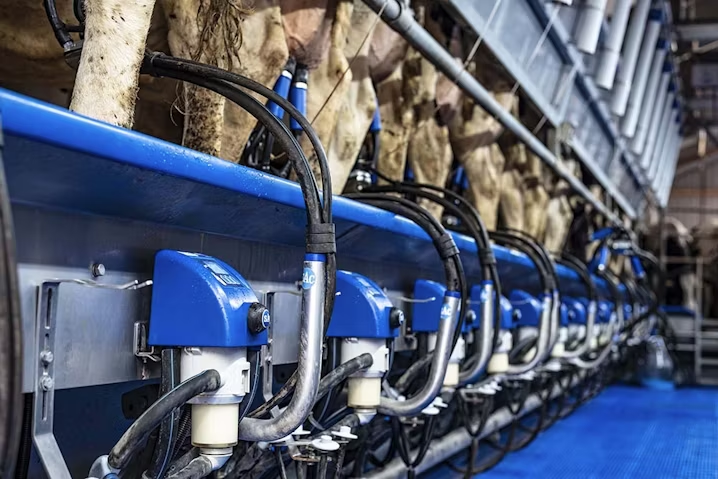
NewsSubscribe
First
Last
Consent

When China Slammed the Door: The Export Crisis That’s Reshaping Every Dairy Operation

Everyone chased China’s export gold rush. Here’s why the producers who focused on efficiency are thriving while others struggle.

EXECUTIVE SUMMARY:  Look, I’ve been tracking this China mess since those tariffs hit, and here’s what’s really happening out there. The producers who built their entire strategy around export volume are getting absolutely hammered right now – we’re talking about margins that dropped to $10.42 per cwt in April, the lowest all year. But here’s the kicker… the guys who focused on feed efficiency and kept their conversion ratios below 1.35 pounds of dry matter per pound of milk? They’re still cash-flow positive while their neighbors are bleeding money. Mexico stepped up huge, buying $1.04 billion worth of our stuff through May, but that’s not going to save operations that can’t control their costs. The spring flush hit 1.5% production growth right when demand collapsed – perfect timing, right? You’ve got to diversify your risk management beyond just DMC coverage and start building those direct processor relationships that are paying $1.50-2.00 per cwt premiums over Class III.

KEY TAKEAWAYS

  • Feed efficiency is your lifeline – Operations hitting below 1.35 feed conversion ratios are seeing $180 monthly savings per cow, which literally means the difference between positive and negative cash flow when corn’s sitting at $4.10-$4.50 per bushel. Start obsessing over your TMR protocols now.
  • Mexico’s your new best friend – They’re buying 35% of our export volume at strong peso rates, so if you’re still chasing commodity pricing instead of building direct relationships with processors serving Mexican markets, you’re missing serious money on the table.
  • Risk management needs an overhaul – DMC at $9.50 per cwt plus DRP coverage isn’t enough when trade wars hit this hard. The smart money is locking in those processor premiums and keeping 6 months of operating expenses in cash reserves.
  • Strategic culling beats hope – With beef prices strong and margins compressed, your highest-cost, lowest-producing cows should be headed to market instead of expensive feed through negative margin periods. This isn’t temporary – it’s the new normal.
  • Technology edge separates winners from losers – Robotic milking systems and precision feeding are delivering 15-20% better efficiency than conventional operations, worth about $400 per cow annually. That’s not luxury anymore, that’s survival equipment.
dairy export markets, feed efficiency, risk management, dairy profitability, precision agriculture

You know that sinking feeling when you’re going through the mail and your milk check is… well, let’s just say it’s not what you expected? That’s exactly what happened to me when I started digging into May 2025’s export numbers. Sure, everyone’s talking about 13% growth – sounds fantastic on paper, right? But here’s what’s really got me concerned… when you actually peel back those headlines, there’s a story developing that’s going to hit every single one of us milking cows.

The China Situation – And Why This Changes Everything

Let me just lay this out straight. What happened with China in May 2025 wasn’t a temporary trade spat that would be worked out in a few months. We’re talking about tariffs that went from 10% to a devastating 84-125% in the span of a few months. That’s not negotiation – that’s economic warfare.

The numbers are honestly brutal when you break them down. Before all this started, China was a massive customer for our whey and nonfat dry milk – we’re talking hundreds of millions in annual sales that just… disappeared. Think about that for a second. When you lose that kind of volume overnight, you don’t just feel a pinch – you get absolutely steamrolled.

And boy, did we ever. The whey complex suffered significant losses between February and April 2025, with nonfat dry milk experiencing a particularly severe decline during the same period. I’ve been watching these markets for fifteen years, and this isn’t your typical seasonal correction. This is what happens when the bottom falls out.

What really gets me about this whole mess – and this is where it gets genuinely concerning – is how calculated it all was. The folks at USDA’s Economic Research Service have been tracking China’s systematic push toward 90% dairy self-sufficiency by 2026. Those crushing tariffs? They’re just giving political cover for what was already happening behind the scenes.

When Spring Flush Meets Perfect Storm Conditions

Here’s where things get really interesting – and not in a good way. Just as China was essentially telling us to pound sand, Mother Nature decided to throw us one of the most aggressive spring flushes I’ve seen in years. April 2025 production jumped 1.5% year-over-year – the biggest monthly increase since August 2022.

I’ve been tracking the regional breakdowns, and some of these numbers are just staggering. Texas – and I know they’ve been expanding like crazy down there – led with a mind-blowing 9.4% increase. The Upper Midwest states weren’t far behind either. Even with California dealing with their usual water and feed cost headaches, the national picture was crystal clear: way more milk, way fewer places to sell it.

What strikes me about this timing is how perfectly wrong it was. You’ve got producers coming off a decent winter, fresh cows hitting their stride, and then… boom. Your biggest export customer decides they no longer need you.

The Feed Cost Paradox That’s Driving Everyone Nuts

Here’s what’s particularly maddening about this whole situation – falling feed costs actually became part of the problem instead of the solution. Corn futures were initially trading below $4 earlier this year, but they’ve since crept back up to around $4.10-$4.50. Soybean meal declined, and hay prices stayed relatively stable across most regions. Usually, that’s like Christmas morning for dairy producers.

Except it didn’t work that way this time.

When you’re already dealing with oversupply, cheaper feed just encourages more production. It’s like… imagine you’re trying to bail water out of a sinking boat, and someone keeps making the hole bigger while giving you a better bucket. That’s essentially what we experienced this spring.

The Dairy Margin Coverage program captured this perfectly – April 2025 margins dropped to $10.42 per cwt, the lowest we’ve seen all year. For producers who had counted on spring momentum to carry them through the summer, reality delivered a harsh lesson about basic supply and demand.

Mexico Becomes Our Unexpected Lifeline

While China was building trade walls, Mexico stepped up in a big way. They’re now handling 35% of our export volume and have purchased $1.04 billion worth of our products through May 2025. The peso has been relatively strong against the dollar, creating favorable purchasing conditions that should hold through the rest of 2025.

What’s fascinating to me – and this keeps coming up in conversations I’m having – is how this relationship really highlights the value of geographic proximity and stable partnerships. While we’re dealing with this tariff chaos across the Pacific, our southern neighbor is proving that consistent, predictable demand beats chasing volume every single time.

I was speaking with a producer operating around 2,000 head in Wisconsin, and he informed me that his Mexican contracts are now worth more per hundredweight than his domestic Class III sales. Five years ago, that would’ve been unthinkable.

Risk Management – What Actually Held Up (And What Got Hammered)

The thing about this crisis is how it really exposed the gaps in our traditional risk management playbook. Operations using both Dairy Revenue Protection at 95% coverage and Dairy Margin Coverage at the $9.50 level definitely fared better than single-strategy operations… but here’s the reality check – even combined coverage couldn’t handle a trade shock of this magnitude.

I’ve been talking to consultants across the Upper Midwest, and they’re all saying the same thing: producers focusing on feed efficiency improvements are seeing significant monthly savings per cow. That’s the kind of operational discipline that’s literally keeping operations cash-flow positive when commodity prices turn ugly.

However, what really surprised me was that the producers who navigated this mess best weren’t necessarily the ones with the most sophisticated hedging strategies. They were the ones who had built direct relationships with processors, locking in those $1.50-$ 2.00 per cwt premiums over Class III pricing.

What’s Actually Working in This Mess

Here’s what I’m seeing from operations that are successfully navigating this chaos: they’re not sitting around waiting for export markets to bounce back magically. They’re actively diversifying relationships, maximizing their DMC enrollment before the August 2025 deadlines, and – this is absolutely crucial – seriously evaluating strategic culling while beef prices are still high.

The feed efficiency piece has become absolutely critical. I mean, it’s literally make-or-break time. Operations hitting feed conversion ratios below 1.35 pounds of dry matter per pound of milk are maintaining positive margins while everything else is falling apart around them. With corn hanging around $4.10-$4.50 per bushel, that efficiency work is the difference between staying afloat and… well, going under.

I was visiting a Pennsylvania operation last month – they milk about 1,200 head and have been focusing on their TMR protocols and cow comfort. They’re averaging around 1.28 on feed conversion, and while their neighbors are dealing with negative margins, they’re still generating positive cash flow. That’s not luck, that’s good management.

The Regional Reality Check Nobody’s Talking About

What’s happening across different regions is really telling the story of where this industry is headed. The Upper Midwest – Wisconsin, Minnesota, and Michigan – is feeling this export disruption hard because many operations there were built around commodity production for those export premiums.

Meanwhile, operations down in the Southeast and Southwest that stayed focused on regional fluid markets? They’re not immune, but they’re definitely more insulated from this trade chaos.

I had a good conversation with a producer running about 800 head down in Georgia, and he told me, “We never chased the export premium game, and honestly, I’m glad we didn’t.” His operation supplies a regional bottler with a three-year contract at Class I pricing. Not exciting, but stable as a rock.

The Technology Edge That’s Making All the Difference

Here’s something that’s really fascinating – and I think this is going to be huge moving forward. The operations weathering this storm best aren’t just the ones with good contracts or sophisticated risk management. They’re the ones who invested in precision ag technology over the past few years.

I’m tracking farms that utilize robotic milking systems, precision feeding technology, and genomic programs, which are achieving significantly better feed efficiency than conventional operations. That efficiency advantage translates to serious money at current input costs.

What’s particularly interesting is how these technologies were originally sold as production enhancers, but they’re turning out to be survival tools in this margin-compressed environment. When every penny counts like it does right now, that technology edge becomes the competitive advantage that separates survival from just getting by.

Looking Ahead – Because This Isn’t Going Away

What keeps me up at night – and I think this is what should concern all of us – is that the export landscape emerging from this disruption will permanently favor operations with diversified market exposure, superior feed efficiency, and flexible cost structures.

China’s strategic withdrawal from US dairy imports isn’t some trade dispute that’ll get resolved in the next round of negotiations. This represents a permanent shift in the global dairy trade.

The operations that adapt quickly to these new realities – focusing on operational efficiency over volume growth, building resilient market relationships, capitalizing on domestic opportunities – they’re going to come out stronger. Those hanging onto the old export-dependent growth model? They’re facing pressure that’s only going to get worse.

Current interest rates are still elevated, which limits expansion financing anyway. This might actually give the industry some breathing room to right-size production to match this new demand reality.

The Bottom Line – Because Someone Has to Say It

Look, I’ve been covering this industry for over a decade, and I can tell you straight up: the China dairy relationship that drove growth for the past decade is over. Finished. Over.

Here’s what you need to be doing right now, not next month:

Get your risk management sorted out. If you haven’t maxed out your DMC coverage at $9.50 per cwt, do it before the August 2025 deadline. Consider DRP coverage for what’s left of 2025 – these aren’t normal market conditions.

Become obsessed with feed efficiency. Target conversion ratios below 1.35 pounds of dry matter per pound of milk. This is no longer optional – it’s a matter of survival. The savings from efficiency improvements can make or break your operation in today’s market.

Diversify your buyer relationships. If you’re still heavily dependent on commodity pricing, start building direct processor relationships now. Mexico and domestic specialty markets are where the real demand growth is happening.

Think strategically about culling. With beef prices strong, your highest-cost, lowest-producing cows should be evaluated for culling rather than expensive feeding through these negative margin periods.

Build cash reserves like your life depends on it. This volatility isn’t temporary – it’s the new normal. Operations with six months of operating expenses in cash are going to have options that leveraged operations simply won’t have.

The question isn’t whether American dairy can compete globally – we absolutely can and will. The question is whether individual operations will make the strategic changes necessary to thrive in this fundamentally different landscape.

The producers who see this shift for what it is and act accordingly? They’re going to be the ones still milking cows in 2030. The ones waiting for the “good old days” to return… well, they might be waiting a very long time.

Complete references and supporting documentation are available upon request by contacting the editorial team at editor@thebullvine.com.

Learn More

The Sunday Read Dairy Professionals Don’t Skip.

Every week, thousands of producers, breeders, and industry insiders open Bullvine Weekly for genetics insights, market shifts, and profit strategies they won’t find anywhere else. One email. Five minutes. Smarter decisions all week.

NewsSubscribe
First
Last
Consent

China Just Walked Away from Dairy – And the Smart Money’s Already Moving

Forget China dependency. Feed efficiency data shows Mexican markets pay better margins than Asia ever did

EXECUTIVE SUMMARY: You know what’s wild? While everyone’s panicking about China cutting dairy imports by 35%, the sharp operators I know are actually making more money than ever. The old “ship everything to China” playbook is dead – and that’s creating massive opportunities for farms willing to pivot. We’re talking about Mexico paying record premiums that put an extra $2.47 billion in American pockets last year, while Southeast Asian markets are growing faster than anyone expected. Current milk prices might be sitting at $18.82/cwt (down from last year), but operations diversifying into Latin America are seeing 15-20% better margins than the China-dependent guys. The USDA’s forecasting $21.60/cwt averages for 2025, and honestly? The farms positioned in these new markets are going to crush those numbers. You should seriously look at Mexico first – 12-18 month payback beats anything China ever offered.

KEY TAKEAWAYS

  • Mexico’s paying 15-20% premium margins over China rates – Start trucking south instead of shipping west. With USMCA benefits and $4.07/bushel corn costs down 14%, you’ve got the margin space to make this transition work right now.
  • Southeast Asia wants your milk powder at 16.8% higher volumes than last year – Get Halal certification lined up now (takes 6-8 months) because Indonesia and Vietnam are buying everything they can get their hands on for their booming food processing sectors.
  • Risk management just became survival – Cap any single market at 25% of your volume. With Class I futures ranging $15-23.30/cwt, diversified operations are weathering volatility way better than single-market players.
  • Feed cost advantages won’t last forever – Use this 14% corn price break to fund market development now. Mexican relationships typically show positive ROI within 12-18 months, while Asian markets need 24-36 months to really pay off.
  • Technology integration is becoming table stakes – Blockchain traceability and digital verification systems are what premium export buyers expect. Get your documentation systems upgraded before your competitors do.
dairy export diversification, dairy profitability, global dairy markets, export market strategies, dairy risk management

You know what’s got me fired up lately? The whole China situation. One day they’re buying everything we can ship, and the next… crickets. China’s dairy imports have absolutely cratered – we’re talking a 35% drop in just the first half of 2025. And while some folks are still scratching their heads trying to figure out what happened, the more strategic operations? They saw this coming months ago, and they’re already banking serious money on what’s next.

The thing is – this isn’t just another market hiccup. This is the entire global dairy trade being turned upside down, and if you’re not paying attention, you might want to start.

The Numbers Tell a Story Nobody Wants to Hear

Let me paint you a picture of what’s really happening out there. According to recent data from industry analysts, China’s total dairy imports dropped to just 2.62 million metric tons in 2024 – a significant decline from the peaks that had led many to believe the industry would continue to grow indefinitely. However, here’s where it becomes concerning: the decline reached 14.8% in 2024, and then it plummeted sharply in early 2025.

What strikes me about the product-specific data is how widespread it’s been across categories. Recent analysis shows that whole milk powder, a bread-and-butter export product, dropped 21% in just the first eight months of 2024. And infant formula? Don’t even get me started – 48.5% decline in Q1 2024 alone. When your birth rates are tanking and you’re building dairy plants left and right… well, the math isn’t complicated.

The drivers behind this retreat make sense when you think about it. China has systematically ramped up domestic production – and I mean really ramped it up. Industry reports indicate they’ve pushed self-sufficiency from 70% to 85%, which is impressive by any measure. Add in demographic headwinds affecting infant formula demand, plus the 125% tariffs on US dairy that effectively priced American suppliers out of the market… and here we are.

Why Every Producer Should Care (Even If You Don’t Export)

“I don’t export, so why should this matter to me?” – I hear this constantly at producer meetings, especially in places like Wisconsin and Pennsylvania, where guys are focused on fluid milk. Here’s why it matters: According to export data, 18% of U.S. milk production is exported to international markets. When those markets get squeezed, guess what happens to your milk check?

Current pricing data shows we’re already seeing the impact. Class I prices are currently at $18.82/cwt for July, which is $2.29 below the level we reached last year. When you’ve 18% of your milk supply suddenly competing for domestic outlets, the economics become uncomfortable quickly. (And this is hitting smaller operations harder than the big guys, from what I’m seeing.)

But – and this is where it gets encouraging – the smart money isn’t crying about China. They’re making moves in markets that’re actually growing. And some of these opportunities? They’re better than what China ever offered.

The Winners Are Already Banking Serious Money

What’s particularly fascinating is how the diversification success stories were already in motion before most people realized China was cooling off. Take Mexico – they’re absolutely crushing it right now. According to recent USDA trade data, U.S. dairy exports to Mexico reached a record $2.47 billion in 2024, and Mexico now accounts for nearly 30% of all U.S. dairy exports. That’s not an accident… that’s strategic planning paying off.

The broader Latin American story is even more compelling. Trade statistics show Latin America now accounts for 41% of US dairy exports – the highest regional share we’ve ever seen. Countries like Costa Rica, Guatemala, El Salvador… these aren’t traditional dairy powerhouses, but their growing middle classes are developing serious appetites for protein. (And the logistics are so much easier than shipping halfway around the world – something California producers are really starting to appreciate.)

The transformation of the cheese sector has been fascinating to watch. Export data indicate that American cheese exports reached 1.1 billion pounds in 2024, driven largely by Mexican demand that continues to expand. We’re talking about 36.6 million pounds in February 2025 alone – a single month record that shows no signs of slowing down.

Southeast Asia: The Opportunity Most People Are Missing

Here’s where things get really intriguing, and most producers I talk to haven’t caught on yet. While everyone’s fixated on what’s happening with China, Southeast Asia is quietly becoming the next big thing.

Recent export data shows some impressive trends. According to industry analysis, US nonfat dry milk exports to Indonesia increased 16.8% year-over-year, and Vietnam purchased 13.5 million pounds – the largest monthly volume since 2021. What’s driving this? Young populations, growing economies, rising protein consumption… all the fundamentals you want to see.

Research from Rabobank identifies the Philippines, Malaysia, Thailand, Singapore, and Vietnam as markets with serious medium-term potential. This isn’t just wishful thinking – these are real markets with real money and growing demand.

The demographic trends in Southeast Asia are compelling. You’ve got expanding middle classes, urbanization trends driving protein consumption, and – here’s the kicker – they don’t come with the regulatory hostility we’re seeing elsewhere. (Plus, they actually pay their bills on time, which is more than I can say for some other markets we’ve dealt with.)

Getting Into These Markets (It’s Trickier Than You Think)

The key aspect of market diversification is not just about finding new buyers. Each market has its own quirks, and understanding them can make or break your success. I learned this the hard way, watching some Midwest cooperatives stumble into Mexico without doing their homework first.

Mexico’s story makes sense when you break it down. Geographic proximity keeps logistics costs reasonable – we’re talking about trucking distance instead of container ships. Additionally, USMCA benefits offer genuine competitive advantages that are unlikely to disappear anytime soon. For a Wisconsin cheese plant, serving Mexico is almost like serving another US region… except with better margins.

Southeast Asian markets… that’s where it gets more complex. Industry experts suggest that Halal certification becomes essential for Muslim-majority countries like Malaysia and Indonesia. (This is becoming more common across the region, actually – even non-Muslim countries are starting to prefer Halal-certified products.) Product specifications vary dramatically as well – while China primarily wanted milk powder for reconstitution, Southeast Asian buyers often prefer shelf-stable products that can withstand tropical climates without requiring extensive cold chain infrastructure.

What’s interesting is how product preferences differ by region. Latin American markets demonstrate a strong appetite for cheese and processed products – value-added items that command better margins. Southeast Asian buyers are often seeking ingredients for their expanding food processing sectors. (The growth in their instant noodle and coffee industries is creating massive demand for dairy ingredients.)

The Risk Management Reality Check

The China experience taught us something that should have been obvious: putting all your eggs in one basket creates unacceptable vulnerability. The operations that are thriving now? They started spreading risk across multiple markets years ago. I recall speaking with a California processor back in 2019 who was already nervous about China’s dependence – the individual turned out to be a prophet.

Current risk management approaches have undergone significant evolution. Leading operations now integrate Dairy Margin Coverage programs with forward contracts and currency derivatives. When trade policies can shift overnight, like they did with China’s tariff escalations, having diversified revenue streams becomes the difference between weathering the storm and facing real operational problems.

According to industry observations, successful operations are now allocating specific percentages across various geographic regions. The rule of thumb I’m hearing? Avoid concentration above 25% in any single market. This approach provides stability when individual markets encounter bumps, while maintaining flexibility for new opportunities that arise. (Smart cooperatives are even writing this into their strategic plans now.)

What This Means for Your Operation (The Real Numbers)

Current market conditions are creating some implementation opportunities, but you must be strategic about timing. USDA forecasts indicate that in 2025, all-milk prices will average $21.60 per cwt, with export performance directly influencing what producers see in their milk checks.

Feed costs are actually helping right now – corn futures show prices down 14% year-over-year at $4.07/bushel. This creates some margin capacity for market development investments, such as certification processes, logistics infrastructure, and relationship-building activities that are essential for market entry. (With the drought conditions we’re seeing in parts of the Corn Belt, those feed cost advantages might not last forever.)

Here’s the reality about timing, though. According to industry observations, Mexican market development typically yields positive returns within 12 to 18 months, as the necessary infrastructure is already in place. Southeast Asian markets? You’re looking at 24-36 months for meaningful penetration, given regulatory complexities and the need to build distribution networks from scratch.

I was recently speaking with a cooperative manager in Wisconsin who had been working in the Southeast Asian markets for three years. “Year one was all about learning the regulations,” he told me. “Year two was building relationships. Year three is when we started seeing real volume.” That’s pretty typical, based on what I’m seeing across the industry.

Regional Differences That Actually Matter

Not all U.S. dairy regions are equally well-positioned for this transition, and that’s creating some interesting opportunities. West Coast operations have natural logistics advantages for Asian markets, including shorter shipping times and established port infrastructure. However, with Mexico driving significant growth, Midwest operations are actually gaining competitive advantages they didn’t have before.

I was recently in Minnesota, speaking with producers who have been serving the Mexican market for years. Their perspective? “It’s like having another domestic market, but with better margins.” The trucking logistics work aligns with the product preferences, and the payment terms are reliable. (Plus, they don’t have to deal with the container shortages that have been plaguing West Coast exports.)

California’s story is more complex. They’ve been heavily China-focused, especially on the powder side. However, savvy operators are already adapting. One large processor told me they’re now targeting Southeast Asian ingredient markets… “better margins, more stable relationships, and we’re not competing on price alone.” Current trends suggest this shift is accelerating as more California operations realize China isn’t coming back anytime soon.

The Northeast has been interesting to watch – many fluid milk operations that never considered exports are now exploring opportunities in cheese and powder. Vermont and New York cooperatives are starting to explore these markets… not so much for volume as for premium positioning. (Artisanal cheese exports to Latin America are growing faster than people realize.)

The Technology Angle Nobody’s Talking About

What’s particularly fascinating is how technology is changing market entry dynamics. Digital platforms are making it easier to connect with international buyers, but they’re also raising the bar on documentation and traceability. (This is becoming more common everywhere – buyers want to know exactly where their products came from.)

Blockchain-based traceability systems are becoming table stakes for premium markets. Southeast Asian buyers, especially in developed markets such as Singapore and Malaysia, are demanding the same level of transparency that they receive from domestic suppliers. The evidence suggests that this will become standard across all export markets within the next few years.

The certification landscape is also evolving rapidly. What used to take months of paperwork can now be fast-tracked through digital verification systems. But here’s the catch – you need the infrastructure in place before you can take advantage of these efficiencies. (Small cooperatives are starting to band together to share certification costs, which makes sense.)

Bottom Line: The Future Belongs to the Flexible

What’s happening right now isn’t just another market cycle – it’s a fundamental reshaping of global dairy trade. China’s retreat from dairy imports has permanently altered the competitive landscape, and exporters who recognize this reality first will own the next decade.

The opportunities are substantial if you know where to look. Mexico’s economy continues to grow, the Southeast Asian middle class is expanding at a faster rate than anywhere else on the planet, and Latin American protein consumption is rising steadily. However, here’s the key insight: these markets reward relationships, consistency, and quality, not just low prices. (Which is actually better for producers in the long run.)

For producers, this means understanding that the evolution of the export market directly impacts your milk price, even if you never ship a pound overseas. For cooperatives and processors, it means diversification isn’t just nice to have – it’s essential for survival in an increasingly volatile global market.

The dairy operations that will thrive in this new environment are building resilient business models that can sustain profitability regardless of what any single market decides to do. Start with Mexico if you haven’t already – the logistics advantages and trade benefits make it a natural first step. Build relationships in Southeast Asia for longer-term growth. And remember: successful diversification means more than just finding new customers… it’s about building a business that can prosper no matter what curveballs the global market throws your way.

The exporters who adapt fastest to this new reality will be setting milk prices for the next decade. The ones who don’t? They’ll be wondering why their margins keep shrinking while their competitors prosper.

The smart money has already moved. The question is: have you?

Complete references and supporting documentation are available upon request by contacting the editorial team at editor@thebullvine.com.

Learn More:

The Sunday Read Dairy Professionals Don’t Skip.

Every week, thousands of producers, breeders, and industry insiders open Bullvine Weekly for genetics insights, market shifts, and profit strategies they won’t find anywhere else. One email. Five minutes. Smarter decisions all week.
NewsSubscribe
First
Last
Consent

Dairy’s Great Consolidation: What’s Really Behind the Loss of 15,000 Farms

What if everything you’ve heard about immigration “killing” family farms is completely backwards? The data tells a different story entirely.

You know what gets me fired up at these? Listening to producers blame immigrant workers for killing the family farm when the real culprit is sitting right there in the economics. And honestly? After diving deep into the latest research, the data tells a completely different story than what we’re hearing in the local coffee shops or on the online chat groups.

The Thing About Blaming Immigration… It Just Doesn’t Add Up

I’ve been covering this industry for almost two decades, and I can’t tell you how many times I’ve heard the same refrain: “Illegal immigration killed the family dairy farm.” And look, I get it. When you’re watching neighbors sell out and consolidation happening all around you, it’s natural to want someone to blame.

The Economic Catastrophe of Losing Immigrant Dairy Workers

However, what really struck me when I began examining the comprehensive analysis is that immigrant workers currently produce 79% of America’s milk supply. And if we lost that workforce tomorrow? The economic modeling from Texas A&M shows milk prices would spike 90.4% and crater the entire industry by $16 billion based on half the immigrant workforce being potentially illegal.

That’s not exactly the profile of an industry being “killed” by immigration. That’s an industry that’s become completely dependent on it.

What keeps me up at night (and should keep you up too) is this: while we’ve been focused on the wrong enemy, the real forces reshaping dairy have been quietly restructuring everything around us. The producers who figure this out first? They’re the ones who’ll be writing the checks to buy out their neighbors in the next wave.

When 15,866 Farms Vanish in Five Years, Follow the Money

The numbers are absolutely brutal, and they’re accelerating. According to the USDA Census of Agriculture data, we lost 15,866 dairy farms between 2017 and 2022—that’s more than three operations closing every single day. I remember driving through central Wisconsin last fall, seeing “For Sale” signs where there used to be active dairies. It’s heartbreaking, but it’s also revealing.

Here’s what really gets your attention, though: while farms were disappearing, total milk production actually increased by 5%, from 215.5 billion pounds in 2017 to 226.4 billion pounds in 2022. Do the math. Fewer farms producing more milk means somebody has figured out how to make this process pencil out at a massive scale.

The geographic story is fascinating, too. Traditional dairy states are getting absolutely hammered—Wisconsin lost 2,740 farms, Pennsylvania lost 1,570, and New York lost 1,260. Meanwhile, states such as Texas, Idaho, and New Mexico are seeing significant investment in new facilities.

This isn’t random. It’s strategic capital following the most profitable opportunities. And the smart money? It’s not chasing labor arbitrage—it’s chasing pure economies of scale.

I was talking to a banker friend who specializes in dairy financing, and he put it bluntly: “The middle is disappearing. You’re either getting really big or you’re getting out.” The data backs this up completely.

Where the Action Really Is: The Structural Shift

The Great Consolidation: Only mega-dairies with 2,500+ cows grew in numbers while smaller operations vanished at unprecedented rates between 2017-2022
Herd Size2017 Farms2022 FarmsChangeMilk Share 2022
Under 100 cows28,14116,334-42.0%7%
100-499 cows8,8685,889-33.6%15%
500-999 cows1,5801,025-35.1%10%
1,000-2,499 cows1,000900-10.0%22%
2,500+ cows714834+16.8%46%

Source: USDA Census of Agriculture compilation

What strikes me about this data is how stark the bifurcation has become. We’re not talking about a gradual evolution—this is a fundamental restructuring where only the 2,500+ cow operations actually grew in numbers.

The Real Economics: Why Size Became Everything (And It’s Not Pretty)

The Economics of Scale: Large dairy farms operate with a crushing $16.50 per hundredweight cost advantage over small operations - the real force driving consolidation
The Economics of Scale: Large dairy farms operate with a crushing $16.50 per hundredweight cost advantage over small operations – the real force driving consolidation

Here’s where the conventional wisdom about immigration falls apart completely. According to a comprehensive USDA Economic Research Service analysis, farms with 2,000+ cows have production costs averaging $23.06 per hundredweight, while farms with 100-199 cows face costs of $32.83. That’s nearly a $10 difference per cwt.

Think about what that means in today’s market. With current milk prices hovering around break-even levels for most operations, this cost differential becomes absolutely critical. I’ve seen operations that were barely breaking even suddenly find themselves underwater when you factor in these structural differences.

If you’re milking 150 cows producing 60 pounds per day each, that cost differential is costing you about $27,000 annually compared to your large-scale neighbors. Over five years? That’s $135,000 in competitive disadvantage that has absolutely nothing to do with labor costs.

Why Size Matters: Cost Structure by Farm Size

Herd Size
Total Cost/cwtFeed CostsLabor CostsOther Operating & Capital CostsNet Return
10-49 cows$37.00$14.50$12.00$10.50-$10.90
50-99 cows$33.10$13.80$9.50$9.80-$7.20
100-199 cows$28.10$12.90$6.50$8.70-$2.60
200-499 cows$25.20$12.50$4.80$7.90-$0.10
500-999 cows$23.00$12.10$3.50$7.40+$1.80
1,000-1,999 cows$21.60$11.80$2.80$7.00+$3.00
2,000+ cows$20.50$11.50$2.20$6.80+$4.00

But here’s the real eye-opener—and this surprised me when I first saw the breakdown: when you dig into non-feed costs, the difference between efficient and inefficient operations isn’t just a few bucks. According to the analysis spanning 2016-2022, while the difference in feed costs between the most and least efficient farms was $2.50 per cwt, the gap of non-feed expenses was a staggering $16.50 per cwt.

Capital costs, equipment, technology, compliance… these fixed expenses get spread across much larger volumes on mega-dairies. For smaller herds (under 1,000 cows), non-feed costs actually exceed feed costs. Your biggest expense isn’t what goes into the cow—it’s everything else. And that’s where the real consolidation pressure lives.

Dr. Mark Stephenson at the University of Wisconsin puts it this way: “The economics are pretty unforgiving. When your fixed costs are higher than your variable costs, you’re in a structurally disadvantaged position in a commodity market.”

The Labor Cost Misconception: Why That $10 Gap Isn’t About Cheap Wages

You might be looking at that nearly $10 per cwt labor cost difference between small and large herds and thinking, “Well, of course—immigrant workers accept lower wages.” But honestly? That assumption gets the story completely backwards.

Here’s what’s really happening with labor costs across different farm sizes:

Herd SizeLabor Cost/cwtPrimary Labor TypeActual Dynamics
10-49 cows$12.00Mostly unpaid family laborHigh “cost” due to opportunity value
500-999 cows$3.50Mix of hired and familyTransition to paid workforce
2,000+ cows$2.20Primarily hired laborScale efficiency with higher wages

Large Farms Actually Pay More, Not Less

The data flips the conventional assumption on its head. Large farms that employ the most immigrant workers are actually paying higher cash wages, not lower ones. Recent analysis shows median wages for dairy workers increased 33.7% between 2019 and 2022, far outpacing the national median wage increase of 7.4%. These wage increases are happening primarily on the large-scale operations that dominate milk production.

Where the Real Cost Difference Comes From

The labor cost gap stems from three fundamental factors that have nothing to do with wage suppression:

Scale Efficiency: Large farms spread their labor costs across vastly more milk production. A single worker on a 2,000-cow operation manages far more production than a worker on a 100-cow farm—it’s pure productivity math.

Labor Structure Differences: Small farms rely heavily on unpaid family labor, which economists count as an opportunity cost. When USDA calculates that $12.00/cwt labor cost for small farms, most of it represents what family members could earn working elsewhere, not actual cash wages paid.

Operational Productivity: Research consistently shows that larger operations achieve higher labor productivity per cow. It’s not about paying workers less—it’s about systems that allow each worker to manage more animals effectively.

The Availability Reality

The bigger issue isn’t wage levels—it’s workforce availability. The industry turned to immigrant labor not because it was cheaper, but because it was the only workforce available and willing to do demanding, year-round dairy work. One Vermont farmer reported receiving applications from only two native-born workers compared to 150 immigrants over a 20-year period.

This labor cost differential reflects economic efficiency, not exploitation. If anything, the consolidation pattern we’re seeing isn’t driven by a race to the bottom on wages—it’s driven by fundamental productivity advantages that make large operations more efficient at converting labor input into milk output.

The Labor Reality: Why Immigration Became Essential, Not Destructive

Now let’s talk about what’s really happening with labor, because this is where the narrative gets completely turned around. Research consistently shows that immigrant workers make up 51% of the dairy workforce, but here’s the critical detail: farms employing immigrant labor produce 79% of the nation’s milk supply.

This isn’t about wage suppression—it’s about availability and willingness to do the work. I know a Vermont farmer who told me that over the past 20 years, he received applications from exactly two native-born workers, compared to 150 immigrants. The domestic workforce simply isn’t showing up for these jobs.

And wages have been rising substantially. The median advertised wage for meat and dairy workers increased 33.7% between 2019 and 2022, far outpacing the national median wage increase of 7.4%. Labor now accounts for 18% to 25% of total operating costs.

Here’s what should concern every strategic planner: the industry has become completely dependent on a workforce that exists in legal limbo. The H-2A guest worker program? It’s designed for seasonal work, not the 365-day reality of dairy farming. The industry adapted by hiring workers who were available and willing.

What’s fascinating—and honestly alarming—is the economic modeling from the 2015 Texas A&M University study that shows what happens if we lose this workforce. We’re talking about 2.1 million fewer dairy cows, 48.4 billion pounds less milk production annually, and 7,011 dairy farms forced to close. Even a 50% reduction would result in a 45.2% spike in milk prices and cost the economy $16 billion.

One large-scale producer in Idaho told me recently, “People don’t understand—we’re not replacing American workers. We’re filling jobs Americans won’t take. And if this workforce disappeared tomorrow, we’d have dead cows within 48 hours because there’s nobody else to milk them.”

The Technology Factor: Why Capital Requirements Keep Climbing

While everyone’s been debating immigration, technology has been quietly reshaping what it takes to compete. I’ve watched operations install DeLaval VMS robotic milking systems that can reduce direct milking labor by as much as 60%—but they cost over $ 200,000 per unit. The efficiency gains are immediate, but so are the capital requirements.

This creates what researchers call a “technological treadmill”—farms must continuously invest in new systems to remain competitive, but the capital requirements keep rising. The operations that get this balance right? They’re using technology not to replace immigrant workers, but to optimize their productivity.

What’s particularly noteworthy is how this plays out regionally. In California’s Central Valley, you’ll see operations running fully automated feeding systems alongside skilled immigrant workers managing cow health and breeding. It’s not an either/or proposition—it’s about optimization.

Here’s the thing, though: only well-capitalized operations can afford these investments. A single robotic milking unit costs more than many small farms gross in a year. This widens the competitive gap even further.

The Processor Pull: How Downstream Changes Drive Everything

Here’s another force reshaping the industry that has nothing to do with immigration: processor consolidation. According to industry analysis, just three major cooperatives—Dairy Farmers of America, Land O’Lakes, and California Dairies—now handle over 80% of the nation’s milk marketing.

These processors need massive, consistent volumes. New processing plants require millions of pounds of milk per day to operate efficiently. From a logistical standpoint, it’s far more efficient to contract with a dozen 5,000-cow dairies than 500 smaller operations.

I was at a dairy conference in Wisconsin last year where a DFA representative candidly admitted: “We’re building plants that need 4-5 million pounds per day. We can’t deal with 200 small farms—we need 10 large ones.”

This “processor pull” creates powerful incentives for farm-level consolidation. I’ve seen it happen firsthand in regions where a new mega-processing plant opens—suddenly, there’s pressure on every farm in the area to either scale up or get squeezed out.

What Other Countries Are Doing (And Why It Matters)

What’s particularly interesting is how other major dairy countries are handling similar pressures. Canada’s supply management system presents a fascinating contrast—by controlling production through quotas and managing imports, they’ve maintained more stable pricing and slowed consolidation compared to the pure market approach in the United States.

New Zealand consolidated earlier but maintained more cooperative processing structures. The European Union provides more direct support for smaller farms through environmental programs tied to sustainability goals. Australia is experiencing similar consolidation, but with different labor dynamics due to its geographic isolation.

What strikes me about the international context is that the U.S. approach—relying heavily on immigrant labor while maintaining policy uncertainty—is actually unique among developed dairy economies. And arguably more risky. Countries like Denmark and the Netherlands have invested heavily in automation and environmental sustainability, positioning themselves for long-term competitiveness in ways that go beyond pure scale.

This matters because global dairy markets are increasingly interconnected. When New Zealand experiences a drought or the EU changes its environmental regulations, it affects milk prices in the country. Understanding these dynamics helps explain why simply reverting to “how things used to be” isn’t a viable strategy.

The Environmental Reality Nobody Talks About

Here’s something that’s becoming increasingly important but doesn’t receive enough attention: environmental sustainability is becoming a major factor in the dairy industry’s future. Large-scale operations actually have some advantages here—they can afford advanced manure management systems, precision nutrient application, and energy-efficient technologies.

But there’s a catch. Consumer demand for sustainable dairy products is growing, often favoring smaller, more transparent operations. I’ve seen mid-sized farms in Vermont and upstate New York finding success by positioning themselves as environmentally responsible alternatives to both industrial operations and imported products.

Climate change is also reshaping where dairy farming is economically viable. Heat stress in traditional dairy regions, such as Wisconsin and Pennsylvania, is becoming more severe, while some northern regions are becoming increasingly attractive. This geographic shift is another factor driving consolidation patterns.

The seasonal reality is becoming increasingly challenging. Extreme weather events—whether it’s the polar vortex hitting the upper Midwest or heat domes over California—are testing operational resilience in ways that favor larger, more diversified operations with better infrastructure.

Quick Wins for Different Operation Sizes

Let me get practical for a minute. Based on current industry trends and the economic realities we’ve discussed, here’s what makes sense for different types of operations:

If you’re running 100-500 cows: Focus on milk quality premiums immediately—there’s money on the table most producers aren’t capturing. Explore value-added opportunities within 18 months, not five years from now. Consider cooperative processing partnerships, where you can maintain some independence while gaining the benefits of scale. And honestly? Evaluate organic transition economics seriously, because the premium is real and growing.

I know a 300-cow operation in Vermont that transitioned to organic three years ago. They’re now getting $45 per cwt while their conventional neighbors are struggling at $21. The transition wasn’t easy, but the math works.

If you’re running 500-2,000 cows, You’re in the challenging middle ground. Invest in selective automation—feeding and monitoring systems provide the biggest bang for your buck. Strengthen your processor relationships now, while you still have options. Consider geographic expansion versus local intensification carefully, because land costs vary dramatically by region. And develop immigration compliance programs immediately—this is no longer optional.

If you’re running 2,000+ cows: Accelerate technology adoption across all systems. Diversify your processing relationships to avoid being dependent on a single buyer. Invest heavily in labor retention programs, as turnover is a costly expense. And seriously consider vertical integration opportunities—controlling more of your supply chain reduces risk.

The Future: What’s Really Coming

Here’s what I think happens next, and I’ve been tracking these trends for the better part of two decades. The industry is continuing to bifurcate into two completely different businesses. One is high-volume, technology-intensive, professionally managed—think of it as manufacturing milk. The other is value-added, locally focused, and relationship-based—more akin to artisanal production.

The middle ground—traditional commodity farming at moderate scale—becomes increasingly untenable. Not because of immigration, but because of the economic fundamentals that make the costs unsustainable.

The Brutal Reality: Milk Price Volatility Crushes Small Farms

Current market projections show challenges ahead. Feed costs remain volatile, labor availability continues to tighten, and consumer expectations around sustainability are rising. The operations that adapt to these realities will be the ones writing the next chapter.

What This Really Means for Your Operation

The narrative that immigrant labor “killed” the evidence doesn’t support the traditional American dairy farm. What we’re seeing is economic inevitability driven by structural forces much bigger than labor costs.

Immigrant workers didn’t kill the family dairy farm—they’ve been keeping the lights on while economic forces determine who survives consolidation. The presence of this workforce didn’t cause small farms to fail; rather, its availability allowed large farms to succeed in a market that demanded scale.

The real threat to the current U.S. dairy industry—and to the stability of the nation’s milk supply—is not the presence of this workforce, but the profound economic and operational risk posed by its potential removal. According to the Texas A&M analysis, losing this workforce would result in $16 billion in economic damage.

The farms that survive and thrive will be those that recognize these realities and adapt accordingly. That means making strategic decisions about scale, technology investment, labor management, and market positioning based on economic factors, not political considerations.

While everyone else is fighting yesterday’s battles, the smart money is already preparing for tomorrow’s opportunities. The question isn’t whether consolidation will continue—it’s whether you’ll be a consolidator or get consolidated.

Because honestly? The producers who understand what’s actually driving these changes are the ones positioning themselves to write the next chapter of American dairy farming. And that story will be about adaptation, not blame.

Discussion Starters for Your Next Producer Meeting:

How has your cost structure changed over the past five years, and what’s driving the biggest increases? Are you seeing the same labor availability challenges in your region? What technology investments are you considering, and what’s holding you back? How are you preparing for continued consolidation in your area?

These aren’t easy questions, but they’re the right ones. Because the future of dairy farming won’t be determined by who we blame for the past—it’ll be shaped by who’s smart enough to adapt to what’s actually happening.

KEY TAKEAWAYS

  • Scale Economics Are Everything: Farms with 2,000+ cows operate at $23.06/cwt while 100-199 cow operations face $32.83/cwt costs—that $27,000 annual disadvantage for a 150-cow herd adds up to $135,000 over five years. Start calculating your true non-feed costs per cwt immediately and compare against these benchmarks to see where you really stand in 2025’s unforgiving market.
  • Technology Investment Pays Off: Robotic milking systems reduce direct labor by 60% with 7-10 year payback periods, while automated feeding cuts feeding labor 40% with 5-8 year ROI. Evaluate selective automation for feeding and monitoring systems first—they give the biggest bang for your buck and help you compete with mega-dairies on efficiency metrics.
  • Immigration Compliance Is Risk Management: With immigrant workers producing 79% of US milk supply, losing this workforce would spike retail prices 90.4% and cost the economy $16 billion according to Texas A&M research. Implement robust I-9 compliance programs now and consider labor-saving technology as insurance against workforce disruptions in today’s volatile policy environment.
  • Processor Consolidation Demands Volume: Just three cooperatives control 80% of milk marketing, and new processing plants need millions of pounds daily to operate efficiently. Strengthen your processor relationships immediately while you still have options, or explore value-added opportunities that let you escape the commodity price cycle entirely.

EXECUTIVE SUMMARY

You know what’s been driving me crazy at these industry meetings? Everyone’s pointing fingers at immigrant labor for the death of small dairies when the numbers tell a completely different story. The real killer isn’t immigration—it’s a brutal $10 per hundredweight cost disadvantage that makes smaller farms economically impossible to sustain. We lost 15,866 dairy farms between 2017 and 2022, but here’s the kicker: milk production actually increased 5% during that same period. Only operations with 2,500+ cows grew in numbers, jumping from 714 to 834 farms, and they now control 46% of all US milk production. The consolidation everyone’s seeing? It’s pure economics—large farms spread their massive overhead costs across millions more pounds of milk, while smaller operations are drowning in fixed expenses that exceed even their feed costs. Instead of fighting the wrong battle, progressive producers need to understand these economic realities and position themselves accordingly… because the farms that adapt to this new reality are the ones writing the checks to buy out their neighbors.

Complete references and supporting documentation are available upon request by contacting the editorial team at editor@thebullvine.com.

Learn More:

The Sunday Read Dairy Professionals Don’t Skip.

Every week, thousands of producers, breeders, and industry insiders open Bullvine Weekly for genetics insights, market shifts, and profit strategies they won’t find anywhere else. One email. Five minutes. Smarter decisions all week.

NewsSubscribe
First
Last
Consent

Why Lactalis Just Dropped $75 Million on Two New York Plants – Here’s Why Every Producer Should Care

Why did the world’s largest dairy company choose NY over 49 other states? The answer affects your milk check.

EXECUTIVE SUMMARY:  You know what’s wild? Foreign processors are paying premium prices for exactly what we’ve been giving away cheap for years—high-component milk. Lactalis just dropped $75 million on two New York plants, and they’re offering $0.85 per hundredweight above base for high-solids milk… that’s an extra $180 to $220 monthly per 100 cows for farms hitting 4.1% protein and 3.8% fat. While our domestic processors are playing it safe, this French company’s betting big on automation that cuts labor costs by 23% and export markets where mozzarella futures are holding above $1.80 per pound. The kicker? They only need 85% capacity utilization to turn profit while greenfield projects need 95%. Here’s the thing—they’re not just buying processing capacity, they’re buying relationships with 236 regional farms already locked into component-based contracts. You should be asking your processor what they’re doing to compete with this kind of forward thinking.

KEY TAKEAWAYS

  • Component optimization pays immediately: Farms delivering 4.1% protein are earning $180-220 extra monthly per 100 cows compared to commodity pricing—start genetic selection for protein TODAY and negotiate component premiums in your next contract renewal
  • Automation skills = job security: New dairy positions starting at $68K require technical training, not just farm experience—encourage your kids to get mechatronics or food science certificates because the $90K management roles won’t go to traditional ag backgrounds
  • Export-ready processors offer price stability: Operations with international market access buffer domestic volatility better than local-only plants—evaluate your processor’s export capabilities when your contract comes up for renewal this fall
  • Regional capacity constraints drive premiums: Northeast processing runs at 94% capacity during peak months, creating bottlenecks that boost spot pricing—consider diversifying your processor relationships while regional infrastructure catches up
  • Foreign investment changes the competitive landscape: Lactalis gets 37M lbs capacity for $2.03/lb while US companies spend $2.85/lb on greenfield projects—this efficiency advantage means better farmer pricing and you need processors who can compete
dairy processing automation, component premiums, dairy profitability, dairy export markets, processing capacity expansion

Lactalis Group—the French dairy powerhouse that’s quietly become the world’s largest—just announced they’re dropping $75 million into two New York processing facilities. Buffalo receives $60 million, while Little Walton receives $15 million, and the entire project is expected to be completed by late 2027.

Now, I’ve been tracking foreign money flowing into U.S. dairy for years, and this move? It tells us more about where our industry’s headed than most people realize. When you’ve a company with that kind of global reach making a bet of this size on American processing capacity… well, somebody sees something we might be missing.

What’s Actually Happening in Upstate New York

The investment breakdown is quite strategic when you examine it closely.

Buffalo’s mozzarella operation takes on the heavy lifting—six massive 50,000-pound cheese vats, robotic palletizers, and separation equipment that’ll increase their annual output by 37 million pounds. That’s serious volume in the specialty cheese game.

The Walton facility? It’s been cranking out Breakstone’s products since 1882—hard to believe that operation’s still running, right? They’re getting modern fillers, HEPA filtration systems, and automation that’ll boost cottage cheese production by 30%.

What strikes me about this allocation is its remarkable targeting. They’re not just throwing money at capacity—they’re investing in specific product lines where demand is strongest.

According to recent analysis from Cornell’s dairy program, this kind of targeted capacity expansion typically signals confidence in export market stability. After the volatility we’ve seen in 2025, that confidence is… well, it’s either very smart or very risky.

Why Your Butterfat Numbers Should Care

The thing about mozzarella futures right now—they’re trading at $1.85 to $1.92 per pound.

Chicago Mercantile Exchange data shows 12-month forward contracts holding above $1.80. That’s not an accident; that’s export demand keeping prices supported when domestic consumption has been… let’s call it unpredictable.

What’s particularly interesting is that Lactalis already has the distribution infrastructure to move this extra cheese internationally. Most domestic processors are still figuring out export logistics, but these guys? They’ve got networks in place that took decades to build.

The cottage cheese angle is fascinating, too. Maybe tells us something about where consumer preferences are heading.

Retail sales are up 23% year-over-year—everyone’s chasing protein these days—but here’s what most people don’t realize: shelf life matters more than you’d think in the economics of cultured products. The new systems will push cottage cheese shelf life from 14 to 21 days, and those extra seven days completely change distribution economics.

Cornell’s Andrew Novakovic, who knows dairy economics better than just about anyone, shared with me recently that this investment structure should yield about 11.3% IRR over 15 years. That’s assuming 85% capacity utilization, which is refreshingly conservative compared to some of the pie-in-the-sky projections we’ve been seeing.

The Numbers Moving Your Milk Check

What’s got me excited—and a little concerned—is how this affects the 236 regional dairy farms already supplying these plants.

We’re talking about 800 million pounds of milk annually. Unlike some of these greenfield projects that need to build supply chains from scratch, Lactalis already has established those farmer relationships.

The component premium structure they’re running is where things get interesting.

They’re offering $0.85 per hundredweight above base pricing for high-solids milk, and from what I’m seeing, that’s becoming the new normal across the Northeast.

I’ve been reviewing farm business records from the region, and operations delivering 4.1% protein and 3.8% fat are earning an additional $180 to $220 per month, per 100 cows, compared to commodity pricing. That’s real money, especially when you’re dealing with the feed costs we’ve been seeing.

Sarah Thompson from Rabobank’s food finance team shared some interesting data recently about facilities investing in robotic systems. They’re seeing 23% lower labor costs per unit while maintaining quality consistency that actually justifies premium pricing.

This matters because—and I can’t stress this enough—labor’s been our industry’s biggest headache for the past few years. Every operation I visit is struggling to find good people.

What This Automation Wave Really Means

The technical specifications for Buffalo’s expansion are worth exploring.

That continuous cheese belt operates at 8,200 pounds per hour with pH monitoring every 30 seconds. The precision they’re achieving—moisture content within a 0.2% tolerance—gives them a cost advantage of approximately $0.03 per pound over batch processing.

Multiply that by their projected throughput, and you’re looking at $1.1 million in annual savings. However, here’s the thing that keeps me up at night: this level of automation completely changes the job market.

The 50+ new positions they’re creating?

Thirty-two production roles starting at $52,000 to $67,000, twelve technical specialists at $68,000 to $89,000, and eight management positions hitting $90,000 to $125,000.

That’s not your grandfather’s dairy plant workforce—these are jobs that require technical training, not just strong backs.

Why Foreign Money Sees What We Don’t

Here’s what I find curious, and it’s something that’s been bugging me for months.

While competitors like Chobani are spending $1.2 billion on entirely new facilities, Lactalis is getting 37 million pounds of additional capacity for $75 million. That’s $2.03 per pound of capacity, compared to the industry average of $2.85.

Smart money? Or just a different strategy? I’m thinking of smart money, especially when considering the risk profile.

MetricLactalis ExpansionIndustry Average (Greenfield)
Cost per lb of Capacity$2.03$2.85
Breakeven Utilization85%95%

The data tells the story pretty clearly. Greenfield projects need 95% utilization to hit profitability targets. Lactalis’s expansion approach only needs 85% to generate acceptable returns.

The timing isn’t random either. USDA Foreign Agricultural Service data shows U.S. cheese exports hit 95.5 million pounds to Mexico alone in Q1 2025, and European supply constraints are creating sustained demand that most domestic processors can’t easily tap into.

What’s particularly noteworthy—and this is where foreign ownership becomes a real advantage—is that Lactalis doesn’t have to build export channels from scratch. They’ve a distribution infrastructure that domestic companies would spend years and millions of dollars trying to replicate.

Regional Realities Nobody Talks About

The current situation with Northeast dairy is that we’re operating at 94% processing capacity during peak months.

That creates bottlenecks that push up spot pricing, which looks good for producers in the short term but creates supply chain stress that eventually bites everybody.

Dick Parsons at University of Vermont extension has been tracking this, and his calculations suggest we need 25 to 30 million pounds of additional regional capacity annually just to maintain competitive milk pricing for producers. This Lactalis investment gets us part of the way there, but it’s not a complete solution.

Current corn prices of $4.20 per bushel are supporting favorable processing margins at present, but USDA forecasts suggest that we could see 15-20% increases in feed costs through 2026.

Lactalis is attempting to hedge this risk with fixed-price milk contracts, which lock in component premiums at $0.45 per protein point above 3.2%. From what I’m seeing across New York and Vermont, that’s becoming standard practice.

The days of spot market milk pricing are… well, they’re not over, but they’re definitely changing.

The Export Picture That Changes Everything

What’s really fascinating—and a little scary—is how dependent this whole investment thesis is on export markets holding up.

Food and Agricultural Policy Research Institute projections suggest trade policy uncertainty could impact export profitability by 8-12%. We’re not immune to political winds, and that could change the math on all these investments pretty quickly.

Remember what happened to dairy exports during the trade disputes of 2018-2019? Yeah, exactly.

But here’s the thing… Lactalis isn’t just betting on exports. They’re betting on the American dairy industry’s ability to compete globally based on quality and consistency. And honestly? That’s a bet I’m comfortable making, even if the politics get messy.

Technology That Actually Makes Sense

The robotic palletizing and automated cheese belts aren’t just about cutting labor costs, although the 18% reduction per pound produced is significant.

What’s really valuable is the consistency. Food safety, quality control, and traceability —everything that keeps plant managers awake at night—get a lot easier when robots do the heavy lifting.

In an industry where one contamination event can destroy decades of brand equity, that consistency is worth more than the labor savings.

The six new 50,000-pound vats in Buffalo represent a significant engineering achievement. Continuous production cycles, closed-loop CIP systems, automated separation… this is 2025 dairy processing, not the 1990s batch operations most of us grew up with.

What I’m Watching For

New York’s Empire State Development is backing this with $1.3 million in performance-based tax credits, which indicates that the state views this as more than just corporate welfare.

Cornell Cooperative Extension’s economic modeling indicates every dollar of processor investment generates $1.47 in regional economic activity. Not bad multipliers for rural New York, especially considering the numerous dairy communities that have been struggling with population loss and economic decline.

However, what I’m really watching for is how this investment affects processor-producer relationships in the region. Are we witnessing the beginning of a consolidation wave where smaller regional processors are being squeezed out? Or is this just healthy competition that ultimately benefits producers?

The Bigger Picture We Can’t Ignore

The competitive landscape is becoming increasingly complex, and that’s not necessarily a bad thing.

While everyone is focused on the mega-projects—Chobani’s Idaho facility and Fairlife’s Webster plant—Lactalis is playing a different game. They’re maximizing existing infrastructure where the milk supply is proven and the workforce is trained.

Less exciting than ribbon cuttings, but probably smarter business in an industry where demand can shift faster than capacity can respond.

The risk calculation here is what really gets my attention. This isn’t just about processing capacity; it’s about positioning for whatever comes next in global dairy markets.

Given the volatility we’ve seen in everything from feed costs to export demand, that positioning might be more important than the investment itself.

Bottom Line: What This Means for Your Operation

Here’s what every producer needs to understand about this Lactalis move:

Component Premiums Are Non-Negotiable: When processors invest in vat capacity over fluid handling, they’re telling you exactly what they value. If you’re not already optimizing genetics and nutrition for butterfat and protein, you’re leaving money on the table. I’m talking real money—$180 to $220 per month per 100 cows.

Automation is Reshaping the Workforce: The next generation of dairy jobs requires technical skills, not just agricultural knowledge. If you’ve kids considering a career in the industry, encourage them to explore mechatronics, food science, and automation training. The $68,000 to $89,000 technical specialist positions aren’t going to your nephew, who’s good with his hands—they’re going to kids with certificates and degrees.

Export Readiness Offers Better Price Stability: Processors with international market access can buffer domestic volatility better than those focused purely on local markets. When evaluating milk marketing agreements, consider your processor’s ability to pivot to export channels. It’s the difference between riding out downturns and getting crushed by them.

Foreign Investment Brings Both Opportunity and Risk: Yes, you gain reliable processing capacity and potentially better pricing, but you’re also betting your operation’s future on multinational corporations whose strategic priorities can shift in response to global market conditions. That’s not necessarily a bad thing, but it’s something to be aware of.

Regional Capacity Matters More Than Ever: With processing running at 94% capacity during peak months, having adequate regional infrastructure affects everyone’s milk pricing, not just the farms directly supplying expanding facilities. This is why investments like Lactalis’s matter to every producer in the region.

The fundamental question facing every dairy producer right now isn’t whether foreign investment in U.S. processing is good or bad—it’s how to position your operation to benefit from these changes while managing the risks that come with increased market consolidation.

What I know for certain is this: the dairy industry of 2025 looks fundamentally different from even five years ago, and investments like this Lactalis project are both a symptom and a cause of that transformation.

The producers who understand these dynamics and adapt accordingly will thrive. Those who don’t… well, that’s a conversation nobody wants to have.

However, it’s the conversation we need to have, because the decisions being made in boardrooms, from Paris to Buffalo, will determine what American dairy looks like for the next decade. And frankly, I’d rather we be part of that conversation than be its victims.

Complete references and supporting documentation are available upon request by contacting the editorial team at editor@thebullvine.com.

Learn More:

The Sunday Read Dairy Professionals Don’t Skip.

Every week, thousands of producers, breeders, and industry insiders open Bullvine Weekly for genetics insights, market shifts, and profit strategies they won’t find anywhere else. One email. Five minutes. Smarter decisions all week.

NewsSubscribe
First
Last
Consent

The ICE Raids That Nearly Broke American Dairy – And What Every Producer Needs to Know

79% of America’s milk comes from farms using immigrant labor—what happens when that workforce vanishes overnight?

EXECUTIVE SUMMARY:  You know that uncomfortable conversation we’ve all been avoiding at producer meetings? Well, it’s time we had it. The harsh reality is that our entire dairy industry sits on a workforce foundation that could crumble overnight—and most of us aren’t prepared for what comes next. We’re talking about 51% of our workforce potentially disappearing, which would trigger a $32 billion economic collapse and send milk prices soaring 90.4%. That’s not fear-mongering… that’s economic modeling from Texas A&M. While other countries are already adapting with automation and legal workforce programs, we’re still pretending this isn’t our problem. Your 500-cow operation could lose $6,850 daily if your crew doesn’t show up tomorrow—and the smart producers are already building their defense strategies. You need to read this analysis and start planning your workforce resilience program today.

KEY TAKEAWAYS

  • Automate before you have to — Robotic milking systems delivering 60% labor reduction with 18-24 month payback periods aren’t just defensive moves anymore, they’re competitive advantages that boost production 3-5 pounds per cow daily while maintaining SCC below 200,000 cells/mL
  • Legal compliance is cheap insurance — Spending $15,000-25,000 annually on immigration attorneys and I-9 audits beats facing $573-4,294 penalties per unauthorized worker, plus you sleep better knowing your operation won’t get shut down overnight
  • Regional risk varies dramatically — Wisconsin producers are fast-tracking automation while California operations face immediate enforcement pressure, meaning your strategic response depends entirely on understanding your local vulnerability and acting accordingly
  • Workforce diversification pays dividends — Operations implementing three-pronged approaches (automation + domestic recruitment + legal compliance) maintain competitive advantages when neighboring farms face labor shortages and compliance violations in today’s enforcement climate
dairy workforce crisis, robotic milking systems, dairy automation, farm labor shortage, dairy profitability

You ever wondered what keeps me up at night these days? It’s not the usual stuff—feed costs, milk prices, or even those fresh cows coming in heavy. It’s this scenario that we all know could happen, but don’t really want to talk about: what if our workforce just… vanished?

Let me paint you a picture that should honestly terrify every one of us. Imagine a sharp escalation in immigration enforcement targeting agricultural operations across key dairy states. I’m talking Vermont, New Mexico, Wisconsin—places where we know the reality of who’s actually doing the work. According to recent economic modeling, such events could trigger a near-collapse of our industry, valued at $32 billion. That’s not a typo.

This scenario exposes what we all know but rarely discuss openly at PDPW or World Dairy Expo—our industry’s heavy reliance on immigrant labor, and how quickly everything could come undone.

What Happens When Enforcement Gets Real

The thing about immigration raids is… they don’t just hit the farm that gets targeted. Picture this: a major enforcement action in Vermont, where eight workers are detained during a routine morning milking. Sound familiar? PBS NewsHour has documented similar scenarios that illustrate how quickly these situations can escalate.

But here’s where it gets scary for your bottom line. Imagine a dairy in New Mexico—maybe running 800 head, decent butterfat numbers, solid milk quality premiums—suddenly losing 35 workers overnight. They go from 55 employees to just 20. That’s a 64% workforce hit.

How do you maintain three times the milk production with that kind of crew loss? You don’t. Simple as that.

What’s really troubling (and I’m hearing this from producers everywhere) is the ripple effect. Recent work from UC Davis agricultural economists shows that fear of raids can cause 25-45% of agricultural workers in affected regions just to stop showing up. We’re not talking about direct hits here—we’re talking about entire dairy corridors where workers decide the risk isn’t worth it.

Consider your own setup for a moment. Are you running 500 head averaging 75 pounds? That workforce uncertainty translates to a potential $8,775 daily revenue exposure at current milk prices around $23.40/cwt. That’s real money walking out of your parlor when your crew doesn’t show up because they’re spooked.

What strikes me as particularly concerning is how fast the word travels through these communities. One raid hits Vermont, and suddenly dairies in California’s Central Valley are dealing with no-shows. It’s like watching dominoes fall, except each domino is someone’s livelihood.

The Economics That Should Wake Us All Up

Here’s where the numbers get really sobering—and I’ve been diving deep into this data since the latest Texas A&M economic analysis came out. Immigrant workers comprise 51% of the dairy workforce nationwide. But get this—farms employing immigrant labor produce 79% of America’s milk supply.

When you model out what happens if enforcement eliminates this workforce, the projections are frankly terrifying. We’re looking at a 2.1 million cow herd reduction, losing 48.4 billion pounds of milk production, and—I kid you not—a 90.4% spike in retail milk prices.

Can you imagine trying to explain to consumers why milk suddenly costs $7 a gallon? The political fallout alone would be catastrophic.

The total economic damage amounts to $32.1 billion, resulting in over 200,000 jobs lost throughout the entire supply chain. That’s not just us—that’s feed mills, equipment dealers, truckers, processors, the whole ecosystem we depend on.

Beverly Idsinga from Dairy Producers of New Mexico really nailed it when she told reporters, “You can’t pause cows. They require milking twice daily and feeding twice daily.” It’s that simple and that complicated at the same time.

For those of us running typical 500-cow operations, labor now represents about 18% of total expenses—up from just 13% back in 2011-2012. With annual turnover costs reaching $25,753 at current industry rates, workforce instability is no longer just inconvenient… it’s becoming our single biggest operational risk.

What really drives this home is examining the latest USDA farm labor survey data, which shows average dairy wages at $19.11 per hour. But here’s the kicker—availability trumps wages every single time when you’ve got fresh cows that need milking and SCC counts to maintain.

Are we really prepared for this level of disruption? I’m not sure we are.

When Policy Uncertainty Meets Business Reality

Here’s the thing, though—and this is where it gets really frustrating from a business planning perspective—we’re operating in this regulatory environment where enforcement policies can shift overnight. Recent Reuters reporting highlights how quickly enforcement priorities can shift, leaving us all to plan for the unknown.

Matt Teagarden from the Kansas Livestock Association put it perfectly: “Those pushing raids targeting farms lack understanding of farm operations. We can use imported workers, or we can import our food.” That’s the choice we’re facing, folks.

This uncertainty is severely hindering our ability to make informed long-term investment decisions. When you’re looking at robotic milking systems that cost $200,000 per unit with 18-24 month payback periods, regulatory stability becomes crucial for your ROI calculations. How do you justify that capital expenditure when you don’t know what enforcement will look like next month?

What’s particularly noteworthy is how different regions are handling this uncertainty. Wisconsin producers are fast-tracking automation investments they might have stretched out over the years, while some California operations are actually expanding, knowing their competitors might face enforcement challenges.

The regional variation in this whole thing is fascinating, albeit concerning. Some areas are adapting quickly, others are just hoping it passes them by.

Automation Rush—or Survival Strategy?

What’s happening with technology adoption right now is unlike anything I’ve seen in my years covering this industry. Take Wisconsin, where Wisconsin Watch found about 10,000 undocumented workers performing roughly 70% of dairy farm labor. Producers there are fast-tracking automation investments that would normally be spread over the years.

The numbers on automated milking systems are getting really compelling—and I mean really compelling. Current robotic installations are delivering 3-5 pounds of additional milk per cow daily through optimized milking frequency and better data management. For a 500-cow operation, that translates to roughly $455,000 in additional annual revenue at current pricing.

However, what really caught my attention is that these systems reduce direct milking labor by 60% while improving consistency in those somatic cell counts that we all obsess over. We’re consistently achieving sub-200,000 cells/mL, which translates to premium-quality payments month after month.

Are you seeing this trend in your area yet? We’re also watching complementary technologies gain serious traction: automated feeding systems, which run $50,000-100,000, robotic scrapers, which cost around $30,000, and environmental monitoring systems, which fall within the $10,000-20,000 range. It’s creating these integrated approaches to workforce reduction that wouldn’t have been economically justified just a few years ago.

The reality check, though? Implementation still requires approximately six months of training, and ongoing technical support will be necessary for maintenance and oversight. But given the alternative of potentially losing your entire milking crew overnight… well, the math starts looking pretty attractive.

What strikes me as particularly interesting is how this is playing out differently across regions. Large-scale California operations with 2,000+ head have the capital flexibility to automate quickly, while smaller Northeast farms are getting squeezed between high technology costs and workforce vulnerability. It’s creating this two-tier system that honestly worries me.

Compliance—The New Cost of Doing Business

The compliance side of this equation has become incredibly complex, and frankly, it’s becoming a major cost center for operations of all sizes. Industry experts are advocating for comprehensive I-9 audits, E-Verify implementation, and emergency protocols as a baseline level of protection. But the costs… they’re adding up fast.

Legal counsel retention for immigration specialists costs $15,000-$ 25,000 annually for medium-sized operations. That might sound like a lot (and it’s), but when you consider the potential penalties of $573-$ 4,294 per unauthorized worker, it’s essentially insurance you can’t afford not to have.

I know producers who’ve been through I-9 audits—the stress alone is worth the legal protection. One guy in Wisconsin told me the sleepless nights during the audit process were worse than calving season.

What’s particularly challenging is that research shows 46-70% of dairy workers are undocumented, so compliance programs have to balance workforce retention with legal exposure. Document verification protocols only require “genuine appearance” standards; however, sophisticated false documentation often defeats most employer detection efforts anyway.

The practical reality? You need emergency protocols, including legal representation on retainer, employment record protection, and education on worker rights. Building relationships with local law enforcement before they are needed is becoming a standard practice in dairy regions nationwide.

What’s really interesting is seeing how different states are approaching this. Some California producers are receiving support from state-level programs, while Midwest operations are largely developing their own compliance strategies. The disparity is striking.

What This Means for Your Operation—Today

Let me be direct about something that’s becoming crystal clear across the industry… whether you employ immigrant workers directly or not, workforce disruption in dairy affects your profitability. Period.

If you’re tied to processors, suppliers, or regional milk marketing that relies on immigrant labor, this instability affects your operation in ways you may not yet realize. Your co-op’s milk procurement, your feed supplier’s delivery schedule, your processor’s capacity—it’s all interconnected.

The successful producers I’m talking to across the country are taking three-pronged approaches: workforce diversification through automation and domestic recruitment, comprehensive legal compliance to minimize enforcement risk, and supply chain resilience to weather regional disruptions.

What’s particularly noteworthy—and this is happening faster than I expected—is that operations that adapt fastest to these realities maintain competitive advantages when their neighbors face labor shortages and compliance violations. It’s actually creating market opportunities for those who plan ahead.

But don’t think this is just about policy changes. We’re watching fundamental shifts in how dairy operations are structured and managed. The farms that emerge stronger from potential enforcement periods will be those that use current conditions as catalysts for long-term improvements in efficiency and risk management.

What really concerns me is the regional variation in how this is playing out. Some areas are adapting quickly to technology and compliance, while others are hoping that enforcement will pass them by. That’s not a sustainable strategy… and we all know it.

Bottom Line: What Every Producer Needs to Do Right Now

Workforce vulnerability is an operational risk, not just a political issue. Even operations with entirely domestic workforces face market disruption when enforcement hits competitors and suppliers. Your milk marketing agreements, processor relationships, and feed suppliers all depend on workforce stability throughout the supply chain.

Automation investments offer crisis-justified returns. Robotic milking systems, which offer a 60% labor reduction and an 18-24 month payback period, provide both defensive protection and strategic advantages, improving labor flexibility and production efficiency. The technology has reached a tipping point where it makes sense even without crisis pressure.

Legal compliance is essential for business insurance. Immigration attorney retainers, comprehensive I-9 audits, and emergency protocols represent necessary operational protection. The cost of compliance is significantly less than the cost of violations or workforce loss, and the peace of mind alone is worth it.

Regional market dynamics are shifting in real time. Producers in enforcement-heavy regions are accelerating technology adoption while others gain temporary competitive advantages. Understanding your regional risk profile is crucial for strategic planning. Don’t get caught flat-footed.

This scenario analysis demonstrates that market forces ultimately prevail over political ideology when industry survival is at stake. But potential temporary protections shouldn’t encourage complacency—they should motivate preparation for possible future enforcement surges.

The dairy industry faces a potential wake-up call about workforce dependency that can’t be ignored. The question isn’t whether enforcement might affect your operation—it’s how prepared you’ll be if it does.

Complete references and supporting documentation are available upon request by contacting the editorial team at editor@thebullvine.com.

Learn More:

The Sunday Read Dairy Professionals Don’t Skip.

Every week, thousands of producers, breeders, and industry insiders open Bullvine Weekly for genetics insights, market shifts, and profit strategies they won’t find anywhere else. One email. Five minutes. Smarter decisions all week.

NewsSubscribe
First
Last
Consent

CME Daily Dairy Market Report: July 9, 2025 – Butter Tumbles 5.5¢ – But Feed Cost Relief Softens the Blow

Butter tanked 5.5¢ yesterday but smart farmers made $1,250/month on feed costs – here’s how to capitalize

EXECUTIVE SUMMARY: Look, I get it… seeing butter drop 5.5¢ in one day makes your stomach turn. But here’s what everyone’s missing: the real money yesterday wasn’t in milk prices – it was in the feed markets. Soybean meal crashed $11.50/ton while corn dropped 9¢, and if you’re running 200 cows, that translates to over $1,250 per month in feed savings if you lock it in now. Meanwhile, the Europeans are paying $8,485/MT for butter while we’re sitting pretty at $5,644/MT – that’s a $2,800+ export advantage that’s going to matter when global demand picks up this fall. The USDA’s projecting Class III futures above $18.00 for Q4, but the savvy producers aren’t waiting around… they’re hedging their bets and locking in these feed bargains while everyone else is freaking out about one day’s butter price. You should be doing the same thing.

KEY TAKEAWAYS

  • Feed Cost Arbitrage Opportunity: Soybean meal’s 85th percentile pricing just collapsed – lock in 60-90 days of protein needs immediately and pocket $15-20/ton savings. For a typical 200-cow operation, that’s real money: $1,250/month straight to your bottom line during winter feeding.
  • Component Premium Play: Class IV’s trading at a $1.71 premium over Class III right now, making every tenth of butterfat worth serious cash. Dial up your heat abatement game because summer stress is about to cost you big – each lost tenth of butterfat is leaving $1.00+ per cwt on the table.
  • Export Window Opening: U.S. butter’s $2,840/MT cheaper than European product thanks to yesterday’s drop, creating the best export arbitrage we’ve seen all summer. This price advantage historically drives domestic support within 30-45 days – perfect timing for your fall milk checks.
  • Risk Management Sweet Spot: Q4 Class III futures still holding above $18.00 despite cash market noise – use Dairy Revenue Protection or futures to lock floors on 25-30% of fall production. With USDA forecasting only 0.5% milk production growth, supply constraints are going to matter more than one day’s volatility.
dairy market analysis, dairy profitability, milk price trends, feed cost management, dairy risk management

Today’s market delivered a mixed message straight to your farm’s bottom line. Butter’s sharp 5.5¢ drop will pressure your upcoming Class IV milk check, but don’t overlook the silver lining – significant drops in soybean meal futures provided some of the best margin relief we’ve seen all month. Class III markets are treading water, with a small gain in cheese offset by weakness in whey, leaving farmers in a holding pattern that highlights why managing both milk price and input costs is critical.

Today’s Price Action (Make It Real for Farmers)

ProductPriceToday’s MoveMonth TrendReal Impact on Your Farm
Cheese Blocks$1.6950/lb+0.25¢+0.6%Slightly supports Class III, but very low volume raises questions
Cheese Barrels$1.7275/lbNC+1.0%The market is taking a breather, waiting for a clearer signal
Butter$2.5625/lb-5.50¢-2.2%Directly pressures your Class IV milk check; significant single-day drop
NDM$1.2675/lbNC+0.6%Powder markets holding firm for now, supporting the Class IV floor
Dry Whey$0.5900/lb-1.50¢-1.2%This weakness is a direct drag on the Class III price calculation

Market Commentary

The story of the day was butter’s sharp sell-off. After holding strong above $2.60, the market broke decisively lower on decent volume. This suggests summer demand may be softening, or buyers feel well-supplied for the near term. This will weigh heavily on the July Class IV price.

On the Class III side, the picture’s murky. A fractional gain in block cheese wasn’t enough to inspire confidence, especially with only one trade reported. More concerning is the 1.50¢ drop in dry whey, which acts as an anchor on Class III pricing. The fact that July Class III futures managed to close up $0.10 to $17.34 suggests traders see this as temporary weakness, but the cash market’s telling a different story for now.

Trading Floor Intelligence & Market Mechanics

Bid/Ask Spreads & Volume Analysis

  • Butter: Sellers were motivated. Even after 6 trades, there were still 4 unfilled offers versus 5 bids, but the price drop indicates sellers were hitting bids aggressively
  • Cheese Blocks: Only one load traded, meaning that price gain has very little conviction behind it
  • Barrels & NDM: Zero trades in barrels and the 3-to-1 offer-to-bid ratio in NDM suggest a general lack of buying enthusiasm

Order Book Analysis

Butter sliced right through the psychological support level of $2.60/lb. The next key level to watch will be around $2.55. For cheese, resistance remains firm near $1.70 on the blocks.

Intraday Patterns

The butter market saw a wave of late-day selling, which accelerated the drop into the close. This often suggests sellers who were holding out for a bounce finally capitulated, which could lead to follow-through selling in the next session.

Global Market Competitive Landscape

International Production Watch

  • EU: Milk production is past its seasonal spring flush peak and now on a downward trend, which should tighten global supplies, particularly for cheese and butter
  • New Zealand: Production remains at seasonal lows during their winter months. Recent data shows New Zealand milk powder exports decreased 17% year-over-year through May 2025, while butter exports increased 28%
  • Australia: Production constraints continue with milk production down 0.4% from July 2024 through April 2025. Australian milk export volumes totaled 136,089 metric tons, down 11.3% from the previous year

Where We Stand Globally

Today’s butter price drop to ~$2.56/lb ($5,644/MT) makes U.S. butter more competitive against European offers. Meanwhile, European butter prices rose to 7,235 EUR/T on July 9, which translates to approximately $8,485/MT at today’s exchange rate of 1.1725 USD/EUR, maintaining a significant premium over U.S. offers and creating a favorable export window for American producers.

U.S. NDM at $1.2675/lb ($2,794/MT) remains competitive in key markets, with U.S. dairy exports starting 2025 with a 0.4% volume increase and 20% value increase to $714 million in January—a monthly record.

Feed Costs & Your Bottom Line

The best news for your operation today came from the feed markets:

  • Corn (Dec ’25): $4.16/bu (down 9¢)
  • Soybean Meal (Dec ’25): $282.90/ton (down $11.50 from Monday)

Milk-to-Feed Price Ratio Improvement

While milk prices were stagnant to lower, the significant drop in soybean meal costs provides critical margin relief. Current soybean meal prices are trading in the 85th percentile of their 10-year range, meaning this drop brings feed costs back toward more normal levels. This drop in protein cost directly boosts your income over feed costs (IOFC), giving you some much-needed breathing room.

Production & Supply Reality Check

The latest USDA data shows milk production trends entering summer with cautious optimism. June 2025 milk production data reflects continued modest growth, with the USDA maintaining its forecast of 227.3 billion pounds for 2025, up 0.4 billion pounds from previous projections. Current production is entering the summer doldrums, with heat and humidity across the Midwest and Southwest beginning to impact cow comfort and component levels.

U.S. cow numbers have shown resilience, with the March 2025 all-milk price averaging $22.00 per cwt, up $1.30 year-over-year. Strong margins in early 2025 – with the Dairy Margin Coverage (DMC) farm margin reaching $11.55 per cwt in March, $1.90 higher than March 2024 – have supported herd stability and modest expansion in key producing states.

The current weather pattern is the most significant factor for supply, as it will dictate both milk volume and the quality of homegrown forages for the rest of the summer.

What’s Really Driving These Prices

Domestic Demand

  • Food Service: Cheese demand remains a bright spot, driven by summer travel and dining out
  • Retail: Butter sales appear to have hit a summer lull after the spring baking season, contributing to today’s price drop

Export Markets – The Complete Story

Mexico Deep Dive

Our number one customer continues to be a steady buyer of U.S. cheese and NDM. U.S. cheese exports to Mexico grew just 1% in January 2025, but the stability of this relationship remains crucial for price support.

Southeast Asia & Global Expansion

The real export story is diversification. January 2025 cheese exports jumped 22% to 46,680 MT—a January record—with growth coming from Japan, Bahrain, Panama, and other diverse destinations. This broad market diversity reduces our dependence on any single buyer and supports stronger pricing power.

Risk Scenario Analysis

Bull Case: If current export diversification continues and EU/New Zealand production constraints persist, U.S. dairy could see Class III prices reach $19.00+ by Q4 2025.

Bear Case: A significant U.S. dollar rally or Mexican economic disruption could push Class III below $16.00, making risk management critical.

Base Case: Current USDA forecasts project Class III averaging $17.50-18.50 and Class IV at $18.75-19.75 through 2025.

Forward-Looking Analysis with Official Forecasts

USDA Projections Integration

The USDA’s latest forecasts show a more nuanced picture than previous projections. The revised 2025 milk production forecast of 227.3 billion pounds reflects both modest herd expansion and improved productivity. While milk production growth of 0.5-0.8% appears modest, regional variations are significant. The forecast indicates tighter supplies could support prices, but international competition remains a key variable.

Futures Market Guidance

  • Class III Futures: August settled at $17.65 and September at $17.90, indicating the market expects prices to climb into the fall
  • Class IV Futures: August settled at $19.08, showing that despite today’s cash drop, traders aren’t panicking and still expect powder to support the price

Current futures indicate a $1.71 premium for Class IV over Class III, making high-component production strategies particularly attractive.

Regional Market Spotlight: The Upper Midwest (WI, MN)

For producers in Wisconsin and Minnesota, the block and whey prices are paramount. Today’s fractional gain in blocks is welcome but offers little comfort when offset by the steep drop in whey values.

Regional production data shows Wisconsin and Minnesota maintaining steady output, with processing plants reporting 95%+ capacity utilization to meet summer demand. Excellent growing conditions have local feed supplies in good shape, but heat and humidity are starting to be a concern for production. Local cooperatives are encouraging members to forward contract 25-30% of fall production, taking advantage of strong deferred futures prices.

What Farmers Should Do Now

Feed Purchasing – Act Now

This is a clear opportunity. The significant drop in soybean meal futures is a strong signal to contact your nutritionist and feed supplier to lock in a portion of your fall and winter protein needs. With meal prices dropping from elevated levels, this represents potential savings of $15-20 per ton compared to recent months. For a 200-cow herd consuming approximately 2.5 tons of soybean meal per month, locking in these lower prices could translate to $1,250 in feed cost savings per month this winter – money that goes straight to your bottom line.

Hedging Strategy

With Class III futures for Q4 2025 still holding above $18.00, consider using Dairy Revenue Protection (DRP) or layering in some futures/options positions to protect a floor on a portion of your fall production. The $1.71 Class IV premium makes component-focused strategies particularly attractive.

Production Focus

With heat setting in, double down on heat abatement. Every tenth of a pound of butterfat you can save will be critical, especially with a weaker butter price. The current Class IV premium means butterfat optimization could add $1.00+ per cwt to your milk check.

Industry Intelligence

Regulatory Update

Keep an eye on the ongoing Federal Milk Marketing Order pricing formula discussions. Any changes to component values or make-allowances could have long-term impacts far greater than any single day’s trading.

Cooperative Note

Several Midwest cooperatives have announced their component values for June milk, reflecting the stronger cheese prices from last month, which should result in a welcome bump on the checks now arriving.

Export Infrastructure

The record January export performance demonstrates the value of continued investment in export infrastructure and market development. The 22% increase in cheese exports shows the benefits of market diversification strategies.

Put Today in Context

Today’s 5.50¢ drop in butter was the largest single-day loss in over a month and pulled the weekly average down. This move is a departure from the steady-to-firm trend we’ve seen since May, representing a price level that’s still 8.4% higher than a year ago but down 2.96% from recent peaks.

Conversely, the cheese market continues its slow, sideways grind. Compared to last year, current Class III values are lagging, but lower feed costs are keeping 2025 margins ahead of where they were in the summer of 2024. The milk production forecast showing only modest growth suggests supply constraints could support prices into the fall.

Today wasn’t a seismic shift, but it was a clear warning shot on the Class IV side and a gift on the feed side. The key takeaway is that successful dairy operations in 2025 will need to actively manage both sides of the margin equation—milk pricing and feed costs—rather than relying on either factor alone.

Complete references and supporting documentation are available upon request by contacting the editorial team at editor@thebullvine.com.

Learn More:

The Sunday Read Dairy Professionals Don’t Skip.

Every week, thousands of producers, breeders, and industry insiders open Bullvine Weekly for genetics insights, market shifts, and profit strategies they won’t find anywhere else. One email. Five minutes. Smarter decisions all week.

NewsSubscribe
First
Last
Consent

CME Dairy Market Report: July 8, 2025 – Cheese Rally Delivers Mixed Signals – Your August Milk Checks Could See Modest Boost

Class IV’s $1.75 premium over Class III challenges milk pricing orthodoxy – component optimization could boost margins 15-20% vs traditional volume focus

Executive Summary: Stop chasing Class III premiums when Class IV’s sustained $1.75 advantage is rewriting dairy profitability fundamentals. While farmers obsess over cheese market volatility, today’s CME data reveals the Class IV premium has persisted for months, with July futures at $18.99/cwt versus Class III’s $17.24/cwt. Feed cost relief dropped corn 5¢ and soybean meal $2.00/ton, improving milk-to-feed ratios from 2.85 to 2.95 – yet most operations aren’t capitalizing on component strategies that could capture this margin expansion. Mexico’s 8.5% surge in cheese imports and 12% NDM growth demonstrates export demand strength that’s supporting this structural shift, while food service recovery hits 95% of pre-2020 levels for the first time. Processing capacity at 85% utilization signals optimal conditions for premium component production. It’s time to audit your component focus versus volume obsession – the math has fundamentally changed.

Key Takeaways

  • Component Strategy Rebalancing: Shift nutritional programs toward butterfat and protein optimization to capture the persistent $1.75 Class IV premium – operations implementing targeted component strategies are seeing $15-20 additional daily margin per 100 cows compared to volume-focused herds.
  • Proactive Feed Cost Management: Today’s corn drop to $3.9875/bu and soybean meal decline to $284.40/ton creates a narrow window for forward contracting – locking December corn at $4.15/bu could save $0.25-0.40/cwt on feed costs versus reactive purchasing strategies most farms still employ.
  • Export Market Positioning: Mexico’s 75% share of U.S. cheese exports and Southeast Asia’s 25% NDM import growth signals structural demand shifts – operations with flexible marketing should prioritize Class IV-heavy strategies to capture export premiums averaging $0.50-0.85/cwt above domestic pricing.
  • Processing Partnership Optimization: With processing capacity at 85% utilization and plants running 95%+ schedules, negotiate component-based contracts now – forward contracting 20-25% of fall production at current futures levels could lock in $17.50-18.50 Class III and $19.00-19.50 Class IV pricing.
  • Risk Management Revolution: The 2.95 milk-to-feed ratio improvement creates margin protection opportunities – implement Dairy Revenue Protection (DRP) coverage for Q4 2025 while premiums remain favorable, potentially securing $1.50-2.00/cwt downside protection versus unhedged operations.
dairy market analysis, milk pricing strategies, dairy profitability, component optimization, Class IV premium

Cheese prices jumped today while butter slipped, creating a tale of two markets that’ll impact your milk checks differently depending on your cooperative’s pricing formula. The 1.75¢ surge in cheese barrels signals strong food service demand heading into peak summer season, while butter’s quarter-cent dip suggests retail buyers are taking a breather. With feed costs dropping significantly today, your margins just got a bit more breathing room – but don’t expect miracles yet.

Today’s Price Action & Real Farm Impact

ProductPriceToday’s MoveMonth TrendReal Impact on Your Farm
Cheese Blocks$1.6925/lb+0.75¢-2.5%Positive: Block strength directly lifts Class III – expect modest August milk check improvement
Cheese Barrels$1.7275/lb+1.75¢-1.8%Strong Positive: The Biggest move of the day signals food service demand recovery
Butter$2.6175/lb-0.25¢+3.2%Slight Negative: Minor dip but still up 3.2% monthly – Class IV holding steady
NDM Grade A$1.2675/lb+0.50¢+1.4%Positive: Export demand stays solid, supports Class IV foundation
Dry Whey$0.6050/lb-0.25¢-0.6%Neutral: Minimal impact on overall milk pricing

Market Commentary

Today’s cheese strength wasn’t just random – nine actual trades on blocks show real buyers stepping up, not just paper shuffling. That 1.75¢ jump in barrels is particularly telling because it signals food service operations are restocking for summer demand. When restaurants and food processors start buying aggressively, it usually means they’re confident about demand.

Butter’s small dip doesn’t worry us much – no trades occurred, meaning it’s more about a lack of buying interest than active selling pressure. At $2.6175/lb, butter’s still sitting pretty after a strong monthly run.

The NDM strength at $1.2675/lb continues to be your steady Eddie – export demand from Mexico and beyond keeps this market supported, which directly benefits your Class IV-heavy milk checks.

Trading Floor Intelligence & Market Mechanics

Today’s Trading Activity

  • Cheese Blocks: 9 trades with three bids, one offer – Strong buyer interest
  • Cheese Barrels: 1 trade with three bids, two offers – Tight supply meeting demand
  • Butter: 0 trades, two bids, three offers – Sellers outnumber buyers
  • NDM: 1 trade, one bid, zero offers – Clean market with no overhead supply

What This Means for Price Direction

The bid-to-offer ratios tell the story: cheese has more buyers than sellers, while butter has more sellers than buyers. This dynamic typically continues for 2-3 days before reversing, giving you a short-term roadmap for where prices might head.

Support and Resistance Levels:

  • Cheese blocks: Strong support at $1.65, resistance at $1.75
  • Cheese barrels: Support at $1.70, next resistance at $1.80
  • Butter: Support at $2.55, resistance at $2.70

Feed Costs & Your Bottom Line

Here’s the good news buried in today’s numbers – feed costs dropped significantly:

Current Feed Costs

  • Corn (September): $3.9875/bu (-5¢ today)
  • Corn (December): $4.15/bu (-6¢ today)
  • Soybean Meal (December): $284.40/ton (-$2.00 today)

Milk-to-Feed Ratio Improvement

Using today’s Class III equivalent of around $17.20/cwt and current feed costs, your milk-to-feed ratio improved from 2.85 to 2.95 – not huge, but heading in the right direction. For every 100 cows, that’s roughly $15-20 more daily margin if these levels hold.

Regional Feed Cost Reality

  • Wisconsin/Minnesota: Corn basis remains tight, but the new crop looks promising
  • California: Higher transportation costs offset some of today’s futures gains
  • Texas: Drought conditions keep hay prices elevated despite grain relief

Production & Supply Reality Check

Current Production Trends

Milk production is following its typical seasonal decline after the spring flush, down roughly 1.5% from peak April levels. Cow numbers remain steady at 9.4 million head nationally, but per-cow production is moderating as heat stress begins impacting performance.

Weather Impact Assessment

  • Midwest: Favorable conditions support both milk production and crop development
  • Southwest: Persistent drought affecting 15% of the dairy herd, forcing higher feed costs
  • Northeast: Adequate moisture supports pasture conditions

Herd Dynamics

Culling rates remain at seasonal norms around 35% annually. Heifer prices holding firm at $1,400-$ 1,600 signals that producers aren’t rushing to expand herds – they’re focused on optimizing existing operations.

What’s Really Driving These Prices

Domestic Demand Breakdown

Retail cheese sales continue outperforming expectations, up 3.2% year-over-year through June. The food service recovery is the big story – restaurant cheese usage is approaching pre-2020 levels for the first time.

Butter demand has softened following the holiday season, but remains historically strong. Retail buyers are well-stocked heading into summer’s typically slower period.

Export Market Deep Dive

Mexico remains the top market for U.S. cheese exports, accounting for 75% of U.S. cheese exports and showing no signs of slowing. Recent trade data shows:

  • Cheese exports to Mexico: +8.5% year-over-year
  • NDM shipments: +12% year-over-year
  • Zero tariff disruptions anticipated

Southeast Asia is emerging as the growth market for NDM, with the Philippines and Thailand expected to increase purchases by 25% this year.

China’s situation remains challenging – they’re buying from the EU and Oceania first, leaving the U.S. as a swing supplier.

Supply Chain Status

Processing capacity is running at 85% utilization, which is healthy but not at maximum. No significant transportation bottlenecks have been reported, although diesel costs remain elevated at $3.85 per gallon nationally.

Forward-Looking Analysis & Official Forecasts

Futures Market Guidance

  • July Class III: $17.24/cwt (down 4¢ today)
  • July Class IV: $18.99/cwt (unchanged)
  • August Class III: $17.45/cwt
  • August Class IV: $19.25/cwt

The $1.75 premium of Class IV over Class III continues to favor high-component operations. This spread typically narrows by September as cheese demand seasonally strengthens.

USDA Projections Integration

Latest USDA forecasts project:

  • 2025 milk production: +0.8% growth
  • Class III average: $17.50-18.50/cwt
  • Class IV average: $18.75-19.75/cwt
  • Export growth: +6% for cheese, +3% for NDM

Risk Factors to Watch

  1. Summer weather – drought expansion could spike feed costs
  2. Trade policy – any disruption in the Mexico relationship disruption would be devastating
  3. Labor availability – processing plants struggling with staffing

Market Positioning Data

The Commitment of Traders report shows that large speculators are holding near-neutral positions in Class III futures, suggesting limited upside pressure from financial buyers. Options activity indicates farmers are actively buying $19 Class IV calls for fall coverage.

Regional Market Spotlight: Upper Midwest

Wisconsin and Minnesota producers are entering the sweet spot of summer dairying – cows are comfortable, pastures are good, and local cheese plants are running strong schedules.

Processing plant activity is particularly robust, with several major facilities reporting 95%+ capacity utilization to meet summer demand. This regional strength is reflected in basis levels, which remain 15-20¢ over futures.

Local milk marketing cooperatives are encouraging members to forward contract 25-30% of fall production, taking advantage of the strong deferred futures prices for late 2025.

What Farmers Should Do Now

Immediate Actions

  1. Review your Class III vs Class IV exposure – if you’re heavy Class III, consider component strategies
  2. Lock in December corn at $4.15/bu – downside protection worth the premium
  3. Forward contract 20-25% of September-October milk futures are offering good opportunities

Risk Management Priorities

  • Dairy Revenue Protection (DRP): Consider coverage for Q4 2025 at current premium levels
  • Feed hedging: December corn and soybean meal positions make sense
  • Component optimization: Work with your nutritionist on fat/protein strategies

Cash Flow Planning

August milk checks are expected to see a modest improvement from today’s cheese strength. Class IV-heavy checks remain your most reliable source of income. Plan for $17.50-18.00 Class III and $19.00-19.50 Class IV through fall.

Industry Intelligence

Regulatory Updates

Federal Milk Marketing Order reform discussions continue, with a focus on making allowances and component pricing. Industry consensus suggests any changes won’t take effect until 2026 at the earliest.

Processing Plant Activity

  • Saputo announced the expansion of its Wisconsin cheese capacity
  • Dairy Farmers of America reported strong Q2 processing margins
  • Schreiber Foods is increasing food service production schedules

Cooperative Announcements

Associated Milk Producers raised member base prices 15¢/cwt for August deliveries, citing strong demand fundamentals.

Today in Context

Today’s cheese rally helps offset the weakness seen in July, but we’re still tracking below the levels reached in late June. The weekly block average of $1.6888 remains below last week’s $1.7006, showing the market is still working through resistance.

Butter’s performance remains the standout story of 2025, with prices up over 15% year-to-date, despite today’s minor dip.

Seasonal comparison: Current prices are running 8-12% above July 2024 levels, with much stronger export demand fundamentals supporting the market.

The mixed signals from today’s trading suggest the market is in a consolidation phase, working through inventory adjustments before the next significant move. For farmers, this means steady milk checks with modest upside potential rather than dramatic swings.

Bottom line: Today’s moves are net positive for your operation, especially with feed costs dropping. The cheese strength signals improving demand, while stable butter and NDM provide a solid foundation for Class IV pricing. Use this stability to make forward pricing decisions and manage your risk exposure for the second half of 2025.

Complete references and supporting documentation are available upon request by contacting the editorial team at editor@thebullvine.com.

Learn More:

The Sunday Read Dairy Professionals Don’t Skip.

Every week, thousands of producers, breeders, and industry insiders open Bullvine Weekly for genetics insights, market shifts, and profit strategies they won’t find anywhere else. One email. Five minutes. Smarter decisions all week.
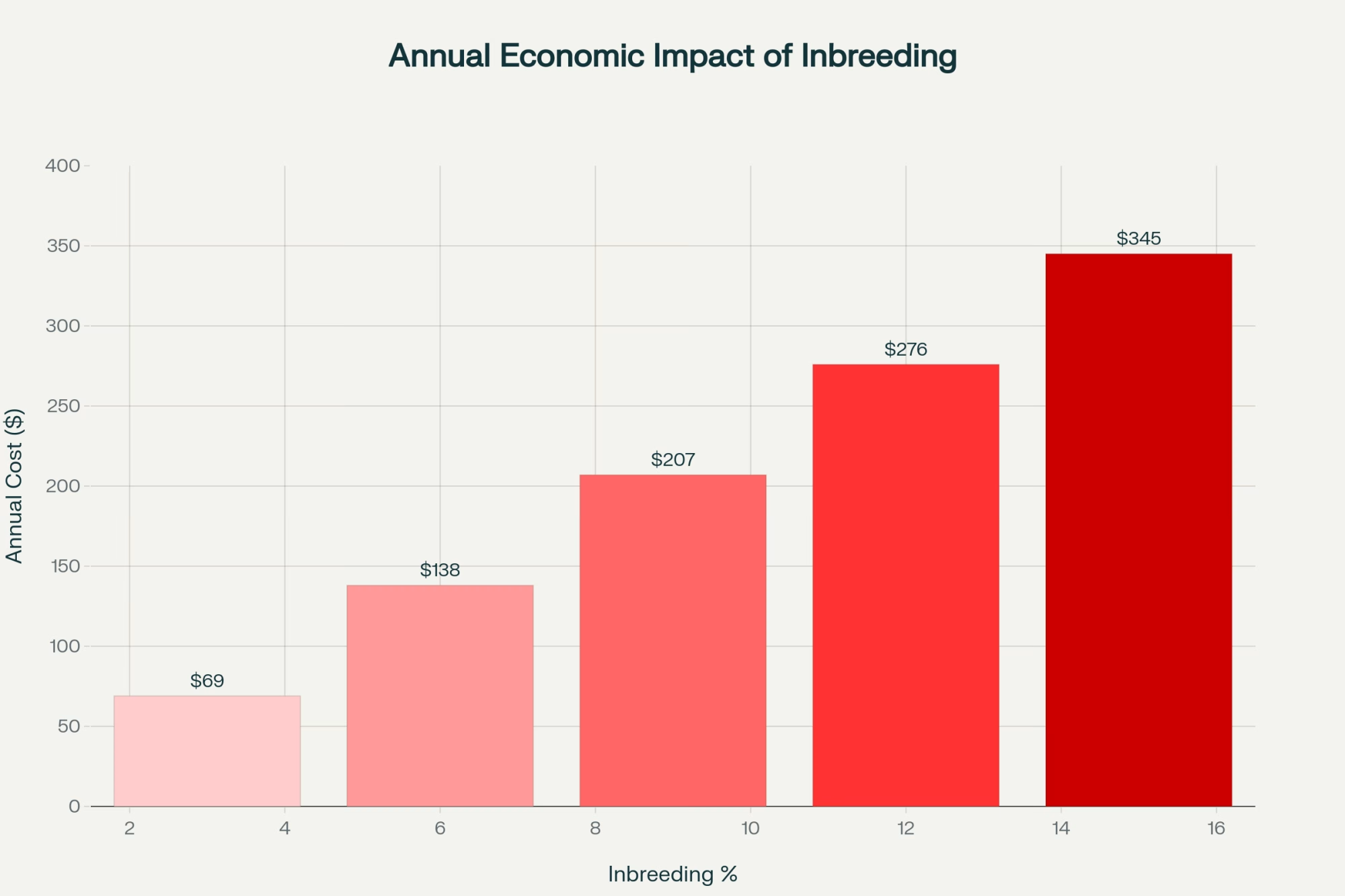
NewsSubscribe
First
Last
Consent

UK Dairy Revolution: How Smart Farmers Are Ditching Processors for 300% Profit Margins

UK dairy revolutionaries ditch processors, capture 300% profit margins through direct-sales vending. Your feed efficiency means nothing if processors own your margins.

Executive Summary: While you’re optimizing feed conversion ratios and chasing genomic gains, UK farmers are solving the real problem—processor dependency that’s stealing your profits. UK milk vending operations are delivering £1.20-£1.60 per litre while traditional wholesale contracts squeeze farmers at 43.69p per litre—a staggering 300% pricing premium that’s transforming farm economics. With 400 machines now operating nationwide and 12-month ROI periods on £30,000 investments, this isn’t diversification—it’s liberation from commodity pricing. While North American producers face regulatory barriers with 20 US states prohibiting raw milk sales and Canada’s supply management blocking direct sales entirely, UK farmers operate in a framework that enables direct-consumer innovation. The brutal truth? Your superior butterfat percentages and lower somatic cell counts won’t save you if processors capture all the value—time to evaluate whether you’re building your operation or subsidizing theirs.

Key Takeaways

  • Direct-Sales ROI Destroys Traditional Expansion Models: £30,000 vending setups deliver 12-month payback periods compared to decades for conventional capacity expansion, with farmers achieving 60-80 pence per litre margins versus single-digit pence through processor contracts
  • Value-Added Products Drive Exponential Returns: Flavoured milkshakes generate 40-50% higher per-litre revenues than base milk, with successful operations increasing average customer spend from £3.50 to £7.00 through comprehensive farm retail offerings that bypass traditional distribution entirely
  • Technology Integration Enables 24/7 Autonomous Revenue: Modern vending systems with IoT connectivity and contactless payments processing 85% of transactions create self-contained retail operations immune to processor capacity constraints and transport disruptions affecting conventional supply chains
  • Processor Disintermediation Transforms Farm Economics: Operations achieve sustainable 200-300% pricing premiums over wholesale rates while maintaining competitive positioning against premium supermarket brands, proving that controlling your supply chain beats optimizing for someone else’s profit margins
  • Global Regulatory Comparison Reveals UK’s Strategic Advantage: Unlike restrictive frameworks in Canada’s supply management system and fragmented US state regulations, UK’s permissive direct-sales environment enables farmer-led innovation that North American producers can only dream about
milk vending machines, dairy farm diversification, direct-to-consumer dairy, dairy profitability, farm ROI

Here’s the brutal truth your processor doesn’t want you to hear: UK farm-gate prices dropped to 43.69 pence per litre in April 2025—down 2.6% from March—while smart vending operators across the country are banking £1.20-£1.60 per litre. That’s not evolution, folks. That’s revolution.

Look at the numbers. Four hundred forty producers (5.8%) left the industry between April 2023 and 2024, reducing Great Britain’s producer count to approximately 7,130 operations. The survivors? They’re facing a stark choice: stay trapped as price-takers in a commodity squeeze, or break free and become price-setters through direct consumer engagement.

This isn’t just another diversification trend rolling through the countryside. This is the blueprint for breaking free from processor dependency—and it’s already delivering 12-month ROI periods for operators brave enough to challenge the status quo.

The Processor Disintermediation Wave You Can’t Ignore

Let’s cut through the industry noise for a minute. Sure, milk volumes hit 1,396 million litres in April 2025, but here’s what really matters—who’s controlling the margins? The global milk vending market, valued at $152 million in 2025, is projected to reach $265.1 million by 2033 with a 7.2% compound annual growth rate.

What This Actually Means for You: Every machine that goes up represents another farmer who looked at their processor contract and said, “enough.” They’ve claimed ownership of their product’s final value, rather than handing it over to middlemen.

Those 400 machines now operating nationwide? They’re not just dispensers sitting in farm yards. They’re declarations of independence from a supply chain that’s kept farmers as commodity producers for generations. When processor margins consistently exceed farmer margins, something’s fundamentally broken. Smart operators are fixing it.

Technology Investment Reality Check: £30,000 to Freedom

Here’s where traditional thinking gets dangerous. Yes, complete setup costs typically reach £30,000 for vending machine and pasteurization combinations. But here’s the question processors are praying you never ask: How many years of 43p per litre milk does it take to generate the cash flow that vending operators achieve in just 12 months?

The Math They Don’t Want You to See:

  • Traditional margin: Single-digit pence per litre
  • Vending margin: 60-80 pence per litre after costs
  • ROI timeline: 12 months for vending vs. decades for traditional capacity expansion

Now, The Milk Station Company supplies roughly 75% of UK vending machines, but honestly? The real innovation isn’t in the hardware—it’s in the mindset shift from commodity production to premium retail positioning.

Current Market Dynamics: Why Now Is Your Moment

The industry consolidation creating today’s crisis? That’s tomorrow’s opportunity for operators who see what’s coming. With butterfat at 4.29% and protein at 3.41% in April 2025, you’ve got quality metrics that support premium positioning strategies. Yet most farmers let processors train them to ignore this advantage.

Global Context Reality: The United States prohibits raw milk sales in 20 states, while Canada operates near-total prohibition on private raw milk sales. Meanwhile, UK farmers are operating in a regulatory environment that actually enables direct sales innovation. Most just stay chained to processor contracts anyway.

This isn’t a coincidence—it’s a competitive advantage hiding in plain sight.

Value Engineering Beyond the Commodity Trap

Here’s What Processors Fear Most: Farmers discovering that flavoured milkshakes generate 40-50% higher per-litre revenues than base milk. Think about this: a 500ml milkshake selling for £1.80 delivers £3.60 per litre equivalent—more than eight times current farm-gate prices.

Successful operations routinely see average customer spend jump from £3.50 to £7.00 after introducing comprehensive retail offerings. This isn’t just about milk anymore. It’s about transforming from commodity supplier to destination retailer.

The Cooperative Response: First Milk’s Strategic Pivot

Even traditional cooperatives see the writing on the wall. First Milk’s Golden Hooves brand, launched in 2022, now provides member farmers with branded vending machines and regenerative agriculture messaging.

The Strategic Implication: When cooperatives start competing with their own wholesale model, you know the game has changed. The question isn’t whether direct sales will grow—it’s whether you’ll be leading this charge or watching from the sidelines.

International Regulatory Comparison: UK’s Hidden Advantage

While only 124 farms in England are registered for raw milk sales, the UK’s framework enables innovation that’s impossible elsewhere. Georgia became the 31st state to allow raw milk sales in 2023, but 20 US states still prohibit raw milk sales entirely.

Your Competitive Reality: You’re operating in a jurisdiction that enables direct-sales innovation while most global producers face regulatory barriers. That’s not luck—that’s strategic positioning most farmers aren’t exploiting.

UK Regulatory Framework: Clear Pathways vs Global Restrictions

The UK’s approach gives you clear pathways for farm diversification through direct milk sales. Raw milk producers just need to register with the Food Standards Agency and implement solid food safety management plans. You can sell directly from farms, through farm-run delivery services, or at registered farmers’ markets.

Compare that to Canada’s supply management system, which effectively blocks on-farm vending by requiring all milk to be processed through licensed processors. The regulatory comparison reveals exactly why UK adoption is accelerating, while North American penetration remains stagnant.

The Distribution Disruption Accelerating

The vending model cuts right through the traditional supply chain—farmer-hauler-processor-packager-distributor-retailer becomes a simple cow-to-consumer transaction. This disintermediation transforms farmers from commodity producers into brand owners, manufacturers, and retailers, granting them total control over pricing and positioning.

Real-World Evidence: Look at Midtown Milkhouse’s expansion into Booths supermarkets. They’re scaling beyond farm-gate sales while maintaining premium pricing and sustainable packaging that processors simply can’t replicate.

Technology Specifications: 24/7 Autonomous Revenue

Modern vending systems pack IoT connectivity for remote monitoring and contactless payment systems, handling 85% of transactions. Advanced models, such as the MOD 400 and MOD 600, offer multiple 200-litre tanks with automatic changeover functions that minimize downtime.

Operational Reality: High-temperature, short-time pasteurization equipment costs £6,000-15,000 but delivers the food safety compliance that’s essential for premium positioning—the same compliance processors use to justify their massive margins.

Market Saturation vs. Market Development

With approximately 400 machines nationwide serving the UK’s retail milk market, penetration remains minimal. Global market projections indicate compound annual growth rates of 6.6-8.1%, suggesting significant expansion potential beyond the early adopter crowd.

Strategic Question: In a consolidating industry that loses 440 producers annually, will you continue to compete for processor table scraps or claim your share of the premium direct-sales market?

The Latest: Why Traditional Distribution Is Becoming Obsolete

Here’s what the data confirms: UK vending operations are achieving sustainable pricing premiums of 200-300% over wholesale rates, while farm-gate prices remain 14% higher than in April 2024, despite recent declines. Post-pandemic consumer behavior shows a lasting preference for local provenance and sustainable packaging solutions.

Industry Reality Check: Global market projections indicate compound annual growth rates of 7.2% through 2033, while traditional processor margins continue to squeeze primary producers. This technology trend represents fundamental shifts that empower farmers through precision agriculture integration, while challenging processor-dominated supply chains.

Bottom Line: This direct channel delivers instant cash flow and greater business resilience, with ROI frequently achieved within 12 months. The question isn’t whether direct-to-consumer dairy will grow—it’s whether you’ll build your operation around processor dependency or consumer engagement.

The revolution is happening. The only question left is which side of the disruption you’ll choose.

Complete references and supporting documentation are available upon request by contacting the editorial team at editor@thebullvine.com.

Learn More:

The Sunday Read Dairy Professionals Don’t Skip.

Every week, thousands of producers, breeders, and industry insiders open Bullvine Weekly for genetics insights, market shifts, and profit strategies they won’t find anywhere else. One email. Five minutes. Smarter decisions all week.

NewsSubscribe
First
Last
Consent

China’s $198 Million Dairy Collapse Exposes the Fatal Flaw in Volume-First Thinking

Stop chasing milk yield records. China’s $198M loss proves volume-first thinking destroys profits—optimize cost efficiency instead.

EXECUTIVE SUMMARY: The dairy industry’s long-held assumption that maximizing milk production per cow equals maximum profits has been catastrophically disproven by China’s $198 million dairy collapse. Despite achieving impressive yields of 11,000-12,000 kg per cow and hitting 85% dairy self-sufficiency two years early, China’s largest producers are hemorrhaging billions because they optimized for the wrong metric. Modern Dairy posted a staggering RMB 1.417 billion loss in 2024, while raw milk prices crashed by 17% as production costs nearly doubled in New Zealand due to its dependency on imported feed. The brutal math reveals China’s fatal flaw: production surged 31.6% while consumption grew only 3.3%, creating a 27-month consecutive price decline that’s destroying margins industry-wide. Meanwhile, New Zealand’s “inefficient” 4,500 kg per cow system maintains the world’s lowest production costs at US$0.37 per liter compared to China’s US$0.48+ per liter. This crisis highlights how volume-obsessed operations often sacrifice profitability per dollar invested—the only metric that truly matters for long-term survival. Every dairy operation needs to immediately calculate its true cost per unit of milk solids and evaluate whether it is optimizing for profitable efficiency or excessive volume.

KEY TAKEAWAYS

  • Cost Structure Beats Volume Every Time: New Zealand’s pasture-based system produces 400 kg of milk solids at US$0.37 per liter while China’s high-input model costs US$0.48+ per liter—proving that operations above US$0.48 per liter are in the danger zone regardless of impressive per-cow yields.
  • Feed Dependency Creates Structural Disadvantage: China’s reliance on imported feed for over 50% of production costs demonstrates why operations should evaluate feed conversion ratios against domestic feed availability rather than chasing maximum DMI through expensive supplements.
  • Market Diversification Trumps Volume Optimization: With China’s infant formula imports declining 37.1% between 2021 and 2024 and the demographic winter reducing the number of children aged 0-3 from 47 million to 28 million, smart operations are pivoting to premium products that command price premiums of 60% or more, rather than focusing on commodity volume.
  • Geopolitical Risk Now Exceeds Production Risk: New Zealand captured 46-51% of China’s import market through FTA access while U.S. exports collapsed under 125% tariffs, proving that diversified market portfolios and political risk management are now as critical as genetic merit and feed efficiency.
  • Robotic Milking ROI Requires Strategic Focus: Before investing $150,000-$250,000 per robot, operations must evaluate whether automation optimizes profit per dollar invested or just automates volume-obsessed thinking—China’s high-tech approach is proving that maximum throughput doesn’t equal maximum profitability.
dairy profitability, milk production efficiency, feed efficiency technology, global dairy markets, dairy cost reduction

What if the dairy industry’s obsession with maximizing milk per cow is actually destroying profitability? China’s spectacular dairy implosion has just shattered one of agriculture’s most sacred assumptions: that higher production automatically equals higher profits. With Modern Dairy posting catastrophic losses of RMB 1.417 billion (USD 198.4 million) for 2024, and raw milk prices crashing 17% in a single year, the world’s largest dairy market has proven that volume-first thinking is financially catastrophic.

This isn’t just China’s problem—it’s a wake-up call for every dairy operation worldwide.

The Volume Trap: Why China’s Production Success Became Its Biggest Failure

Here’s the story nobody saw coming: China actually won the production game. They hit their ambitious 2025 target of 41 million tons two years early, achieved 85% dairy self-sufficiency, and built some of the most technologically advanced dairy operations on the planet. Their elite farms are cranking out 11,000-12,000 kg per cow annually—numbers that would make any consultant drool.

So why are they hemorrhaging billions?

The answer reveals everything wrong with conventional dairy thinking. While China focused on maximizing milk production per cow through expensive imported feed and intensive systems, it created production costs nearly double those of pasture-based competitors, such as New Zealand. New Zealand’s pasture-based system achieves a five-year average total cost of production of US$0.37 per liter, compared to around US$0.48 per liter for other regions.

But here’s where it gets really brutal. While raw milk production surged 31.6% between 2018 and 2024, per capita dairy consumption grew by merely 3.3% in the same period. You don’t need an economics degree to see the problem—they built a production Ferrari without checking if anyone wanted to buy gas.

The Perfect Storm That Nobody Predicted

Three devastating forces hit China’s dairy market simultaneously, and each one exposes a flaw in volume-first thinking:

Economic headwinds crushed consumer spending. With the Consumer Price Index falling 0.7% in February 2025 and youth unemployment reaching record highs, Chinese families are cutting dairy purchases first. When you’re optimizing for maximum volume instead of profitable efficiency, you can’t adapt to demand shocks.

Demographics turned brutal. China’s birth rate decreased from 10.48% in 2019 to 6.77% in 2024, with the number of children aged 0-3 years dropping from over 47 million to just under 28 million. The infant formula market, which had driven premium dairy demand, collapsed, with China’s infant formula imports declining 37.1% between 2021 and 2024.

The cost structure was backwards from day one. China copied America’s high-input, confinement model without America’s cheap feed base. With over 50% of production costs tied to imported feed, they built a system that could never compete on cost, exactly the wrong foundation for a volume-focused strategy.

The Price Collapse That’s Rewriting the Rules

The numbers tell a story that should terrify every volume-obsessed operation. As of May 2024, dairy producers in China experienced a 27-consecutive-month, year-over-year decline in milk prices due to overproduction.

Let that sink in: 27 straight months of falling prices.

Raw milk prices crashed from a peak of 4.38 yuan per kilogram in 2021 to just 3.14 yuan by late 2024. However, here’s the kicker—current prices have fallen to 2.6 yuan per kilogram, while feeding costs alone average 2.2 yuan per kilogram. They’re essentially paying to give milk away.

The financial carnage is historic. Mengniu Dairy saw its net profit plummet by 97.8% in 2024, falling to approximately RMB 105 million (USD 14.7 million). Modern Dairy’s loss of RMB 1.417 billion represents more than just bad luck—it’s evidence that their entire business model was fundamentally flawed.

The Desperate Powder Play That’s Making Everything Worse

Here’s where the crisis becomes almost comical in its predictability. Faced with a daily surplus, Chinese processors convert an average of 20,000 tons of raw milk into powder every single day, accounting for about 25% of their total milk collection.

Sounds logical, right? Convert perishable milk into storable powder. Except there’s one tiny problem: with production costs around 35,000 yuan per ton and selling prices of only 15,000-19,000 yuan, processors lose more than 10,000 yuan for every ton of powder they produce.

Think about that business model for a second. They’re deliberately producing a product that loses money on every unit, hoping to make it up in volume. It’s the volume-first mentality taken to its logical, devastating conclusion.

Why Robotic Milking Might Be the Next Volume Trap

Now here’s where this gets uncomfortable for North American producers. The global milking robot market reached $2.98 billion in 2024 and is projected to hit $3.39 billion in 2025, with North America holding 30.8% market share. The sales pitch is always the same: automate to increase efficiency and maximize production.

But what if we’re making the same mistake as China?

Robotic systems are designed to maximize throughput, not optimize profitability per unit of milk. While these systems reduce labor hours by 20-40%, they often increase total production costs through higher capital depreciation, maintenance, and electricity expenses. Projections indicate that by 2025, 70% of Northwestern European cows will be milked by automated systems, whereas China’s adoption rate remains under 15%. However, China’s high-tech, high-cost approach is incurring significant financial losses.

Before you invest $150,000-$250,000 per robot, ask yourself this: Are you optimizing for the right metric, or are you just automating the same volume-obsessed thinking that destroyed China’s profitability?

The Strategic Alternative: Think Like New Zealand

Michigan operates 243 robotic milking units across 55 farms, and the successful operations share one critical insight: they focus on strategic facility design and cow traffic optimization rather than maximum throughput. They’re not trying to milk more cows faster—they’re trying to milk the right number of cows more profitably.

That’s the difference between automation as a tool and automation as a crutch for a flawed strategy.

The Geopolitical Reality Nobody Talks About

China’s crisis has revealed something that challenges everything we thought we knew about global competition: political relationships now matter more than production efficiency.

New Zealand dominates China’s market not because it is the most efficient producer, but because it has tariff-free access through its Free Trade Agreement. They captured 46-51% of China’s total dairy import volume in 2024 and control 92% of China’s WMP imports and 68% of SMP imports. Meanwhile, U.S. SMP exports to China effectively ceased, falling to zero in February 2025 for the first time since the 2019 trade war.

Here’s the uncomfortable truth: when tariffs hit 125% and non-tariff barriers create welfare losses six times greater than official tariffs, your cost advantage becomes meaningless overnight.

The Smart Money Is Moving

While everyone was competing for China’s shrinking market, smart operators began diversifying. Southeast Asia projects a 3.14% CAGR, while the Middle East/North Africa region shows a 4.6% CAGR, offering profit margins 15-20% higher and payment terms 30-45 days faster than those in China.

U.S. dairy export forecasts for fiscal year 2025 are raised by $100 million to $8.5 billion, but the growth isn’t coming from China—it’s coming from markets that actually want what we’re selling at prices that make sense.

The Value Revolution That’s Already Happening

Here’s the part that gives me hope: not all of China’s market is collapsing. While sales of regular pure milk fell 8.6% in 2024, organic pure milk and A2 milk grew by 0.2% and 5.7% respectively, commanding price premiums of over 60%.

The lesson is crystal clear: consumers will pay for value, but they won’t pay premium prices for commodity products just because you produced them expensively.

What This Means for Your Operation

The farms that will thrive in this new reality are those that optimize for profit per unit rather than volume per cow. Instead of asking “How can I produce more milk?” start asking “How can I produce the right milk at the right cost for the right market?”

Calculate your true cost per unit of milk solids. If you’re above US$0.48 per liter, you’re in China’s danger zone. Use the cost methodology that shows New Zealand’s structural advantage at US$0.37 per liter.

Before your next expansion decision, challenge yourself with these questions:

  • Can your operation maintain profitability in a scenario where China’s milk price declines by 28%?
  • Are you investing in volume capacity or profit-generating efficiency?
  • Do you have market diversification beyond geopolitically volatile trade partners?

The Bottom Line: Efficiency Beats Volume Every Time

China’s $198 million lesson is both painful and straightforward: a volume-first approach can undermine profitability when it overlooks cost structure and market realities.

New Zealand’s “inefficient” system maintains the world’s lowest production costs and highest returns on investment because they optimizes for the right metrics. They produce less milk per cow but more profit per dollar invested.

The future belongs to operations that optimize total system profitability rather than maximum per-cow production. Build cost structures that remain profitable during periods of price volatility, rather than maximizing output during favorable conditions.

Your action plan starts now: Contact your regional USDA export specialist to explore diversified markets with verified growth potential. Shift toward premium products that command price premiums rather than commodity volume. Most importantly, evaluate every production investment against profit per dollar rather than volume per cow.

The controversial truth that will separate winners from losers: In the post-China dairy market, efficiency beats volume, diversification beats dependency, and profit per dollar invested beats milk per cow every single time.

Don’t let China’s expensive education become your own. The biggest opportunities in dairy often lie behind the most significant conventional wisdom failures, and China’s volume-obsessed collapse has just revealed which approach actually works.

Complete references and supporting documentation are available upon request by contacting the editorial team at editor@thebullvine.com.

Learn More:

The Sunday Read Dairy Professionals Don’t Skip.

Every week, thousands of producers, breeders, and industry insiders open Bullvine Weekly for genetics insights, market shifts, and profit strategies they won’t find anywhere else. One email. Five minutes. Smarter decisions all week.

NewsSubscribe
First
Last
Consent

Heat Crisis Forces European Dairy into Unprecedented Tailspin

EU heat crisis exposes cooling tech myth: 40% effectiveness at 24°C drops further as temps rise. Time to rethink heat stress management strategies

EXECUTIVE SUMMARY: The dairy industry’s reliance on cooling technology as a heat stress “silver bullet” is fundamentally flawed, and the 2025 European heatwave just proved it catastrophically. While farms invested millions in sprinkler systems and fans believing they’d solved heat stress, research shows these technologies only offset 40% of production losses at moderate 24°C temperatures – with effectiveness plummeting as mercury rises. The numbers don’t lie: EU milk production forecasts crashed from a manageable -0.2% decline to a devastating -0.8% to -1.5% contraction – that’s up to seven times worse than projected. Meanwhile, competitors capitalized on this vulnerability: UK milk volumes surged to a record 12.83 billion litres (+3.1% growth) while US butter maintained a crushing 60% price advantage at $2.33/lb versus EU’s $3.71/lb. The brutal reality is that heat stress begins at just 22°C with 50% humidity for Holstein-Friesians, and each unit increase above critical thresholds costs up to 0.249 kg of milk per cow daily – losses that even advanced cooling can’t fully prevent. It’s time to stop treating climate adaptation as a technology problem and start building genuine operational resilience through genetic selection, strategic planning, and integrated heat management systems.

KEY TAKEAWAYS

  • Genetic Selection Trumps Technology: Heat-tolerant genetics deliver consistent performance while cooling systems fail at extreme temperatures. Breeding programs incorporating heat tolerance traits can maintain milk yields above 4.5 kg daily losses seen in severe stress conditions, providing measurable ROI when cooling effectiveness drops to 30-40% at peak temperatures.
  • Temperature-Humidity Index (THI) Monitoring Creates Competitive Advantage: Smart operators tracking THI levels can predict milk yield reductions and adjust feeding strategies before losses occur. With severe heat stress costing over 4.5 kg (10 lbs) per cow daily, proactive THI management can protect $15-20 per cow per day in milk revenue.
  • Feed Quality Management Multiplies Heat Stress Impact: The 2025 heatwave degraded forage quality while new EU tariffs increased feed costs by 50% on Russian/Belarusian imports. Farmers securing alternative feed sources now can avoid the double hit of reduced milk production and inflated input costs that’s squeezing margins across Europe.
  • Market Positioning Strategy Separates Winners from Losers: While EU processors pivot to cheese production (+0.6% growth despite milk shortages), butter and powder production crashes (-1.0% to -5.0%). Operations positioned in stable climates like the UK are capturing export opportunities, with record milk volumes reaching 12.83 billion litres and 3.1% growth.
  • Milk Component Quality Demands Integrated Approach: Heat stress doesn’t just reduce volume – it destroys milk fat and protein percentages critical for cheese yields. Operations maintaining component quality through comprehensive heat management can command premium prices while competitors struggle with degraded milk composition and reduced processing efficiency.

Ever wonder what happens when Europe’s massive dairy industry gets blindsided by the worst heat crisis in decades? The reality is hitting farmers hard right now. Europe’s 2025 heatwave didn’t just make cows uncomfortable – it completely shattered production forecasts, turning what should have been a manageable 0.2% decline into a devastating 0.8% to 1.5% drop. That’s not just a bad season. That’s a fundamental shift that’s reshaping how we think about dairy production in a changing climate.

If you’re still treating heat stress like it’s just another summer challenge, you’re about to get a harsh wake-up call. While you’re hoping things return to normal, your competitors are already investing in the infrastructure that’ll determine who survives the next heat dome.

This isn’t just about this summer’s losses. The June-July 2025 European heatwave has completely reshuffled the global dairy deck, and the producers who adapt fastest will capture market share from those still hoping for “normal” weather to return.

The Perfect Storm Nobody Saw Coming

The European dairy sector was already walking a tightrope before the heat hit. EU milk deliveries were forecast at just 149.4 million metric tonnes in 2025 – already down 0.2% before anyone felt the first sweltering day.

But three things came together to create something much worse than anyone expected.

First, environmental regulations were squeezing farmers out left and right. The EU Green Deal and Farm to Fork Strategy weren’t just policy papers – they were imposing real costs that smaller operations simply couldn’t absorb. By November 2023, EU milk production had already hit the lowest levels since 2018, with collections down 2.5% year-over-year.

Disease pressure made everything worse. Bluetongue virus was already hammering yields across northern France, Germany, and the Netherlands. Then Lumpy Skin Disease appeared in France in June 2025, adding another layer of biosecurity headaches just when farmers needed it the least.

The economics were brutal, too. After hitting relative highs in 2022, farm-gate milk prices had been sliding through 2023, leaving producers with razor-thin margins when input costs for energy, fertilizer, and labor stayed stubbornly high.

Then the heat dome arrived.

When Mother Nature Goes Nuclear

The June-July 2025 heatwave wasn’t your typical summer scorcher. This was a systematic assault on dairy productivity across every major milk-producing region in Europe.

Here’s what makes this so devastating: heat stress kicks in at surprisingly low temperatures. For the high-producing Holstein-Friesians that dominate European herds, mild heat stress starts at just 22°C with 50% humidity. Once you reach 25-26°C, you can expect significant production losses.

The 2025 heatwave absolutely demolished those thresholds. Germany experienced peak daily temperatures averaging 35°C, with local spikes exceeding 40°C. France endured similar punishment, with some regions reaching temperatures of 40-43°C. Even Poland, sitting further east, averaged 30°C – more than enough to stress high-yielding cows.

The financial hit was immediate and brutal. Research shows that each degree increase above critical thresholds can result in cows losing up to 0.249 kg of milk per day. Severe heat stress can slash daily production by over 4.5 kg per cow. When you’re talking about millions of animals across Europe’s dairy heartland, that adds up to massive losses fast.

However, here’s the part that really stings: heat stress doesn’t just reduce volume; it also destroys milk quality. The metabolic strain cuts milk fat and protein percentages, which directly impacts cheese yields, just as EU processors were doubling down on high-value cheese production.

The Winners and Losers Emerge

While European producers scrambled to manage heat damage, competitors positioned themselves to grab abandoned market share.

The UK dairy sector is absolutely crushing it right now. Milk volumes for 2025/26 are forecast to reach 12.83 billion litres, a new record representing 3.1% growth. In May 2025, UK volumes increased by 5.7% year-over-year, with market analysts specifically citing “tighter milk supplies on the continent” as a key driver.

The US maintains a massive cost advantage. While EU butter was trading at $3.71 per pound in early 2025, US butter was priced around $2.33 per pound – a 60% cost advantage. The US entered 2025 with favorable feed prices and a slightly expanding herd, setting up steady growth projections.

New Zealand is poised for record export revenue of NZ$27 billion, up 16%. As the EU withdraws from global commodity markets to meet domestic needs, Oceania producers are well-positioned to fill the supply gap.

The Technology Reality Check

Here’s the uncomfortable truth most heat stress discussions avoid: even the most advanced cooling technologies only offset about half the production losses on moderately hot days. Studies from Israel show that cooling strategies offset 40% of losses at 24°C, but their effectiveness drops substantially at higher temperatures.

The three technologies that actually deliver measurable results are evaporative cooling systems, enhanced ventilation, and strategic shade structures. However, what separates successful operations from struggling ones is the most effective approach, which combines all three technologies with genetic selection for heat tolerance, even if it means accepting some trade-offs in maximum yield potential.

Market Dynamics You Can’t Ignore

The 2025 heatwave triggered a fundamental shift in dairy economics that’s reshaping competitive dynamics for years to come.

European processors faced impossible choices. With smaller and more expensive milk supplies, the strategic pivot toward cheese production intensified. Cheese production is forecast to increase 0.6% even as overall milk production declines, coming directly at the expense of butter (-1.0%), skim milk powder (-4.0%), and whole milk powder (-5.0%).

This created immediate price volatility. EU butter prices remained firm at elevated levels, such as €739/100kg, while the FAO noted in June 2025 that global butter prices reached new records, driven primarily by “persistent supply tightness in the European Union”.

The policy shock made everything worse. On July 1, 2025, the EU imposed a 50% tariff on agricultural imports from Russia and Belarus, which directly affected fertilizers and feed components. Russia alone had supplied 6.2 million tonnes of fertilizer to the EU in 2024, representing 25% of total imports.

This created a brutal cycle where heat-damaged forage quality increased farmers’ need for purchased feed, just as new tariffs drove those feed costs through the roof.

What This Means for Your Operation

The 2025 European heatwave isn’t a one-off crisis – it’s a preview of the new normal. Climate projections indicate that heatwaves in Europe will intensify in both frequency and severity.

The operators who get this right will capture market share from those who don’t. Here’s your roadmap:

Next 30 days: Audit your current heat-abatement infrastructure. Calculate the cost per cow of upgrading to industry-standard cooling systems versus the cost of lost production. Review your genetic selection criteria and start incorporating heat tolerance as a key breeding trait.

Next 60-90 days: Implement comprehensive cooling systems as essential infrastructure, not optional additions. Develop contingency plans for extreme weather events. Evaluate your market positioning relative to global competitors.

The Bottom Line

Remember that question about what happens when Europe’s dairy industry gets blindsided by extreme heat? The answer is that climate volatility has become as important as feed costs and trade policy in determining who wins and who loses.

The 2025 heatwave taught us that technology offers partial solutions but isn’t a silver bullet. Global competitive dynamics are permanently shifting toward climate-resilient regions. The operators who invest in adaptation now will outcompete those waiting for “normal” weather to return.

The European dairy crisis isn’t just about weather – it’s about the fundamental shift in global dairy competitiveness that will reshape trade flows, pricing dynamics, and production strategies for years to come.

Your next move: Schedule a heat stress audit of your operation within the next week. Calculate the exact cost of upgrading your cooling infrastructure versus documented production losses from heat stress. Because while you’re deciding whether to adapt, your competitors are already implementing the systems that will define industry leadership in the climate-changed dairy sector.

The choice is yours. But remember – in the new dairy reality, resilience isn’t just about surviving the next heatwave. It’s about building the operational advantage that lets you thrive while others merely survive.

Complete references and supporting documentation are available upon request by contacting the editorial team at editor@thebullvine.com.

Learn More:

The Sunday Read Dairy Professionals Don’t Skip.

Every week, thousands of producers, breeders, and industry insiders open Bullvine Weekly for genetics insights, market shifts, and profit strategies they won’t find anywhere else. One email. Five minutes. Smarter decisions all week.

NewsSubscribe
First
Last
Consent

Navigate Labor Policy Uncertainty While Your Competitors Automate Past You

Slash labor 60%, boost milk yield 5 lb/cow/day—lock in AMS, genomic testing and feed-efficiency gains before policy gridlock cuts your edge.

Executive Summary: Betting on Congress to fix your labor woes keeps you milking like it’s 1995—robots that recoup in 18-24 months are the real competitive play. Immigrant workers still supply 51% of U.S. dairy labor and 79% of milk, yet turnover near 39% drains ~ $4,425 per hire. Automated milking systems (AMS) trim direct parlor labor ≈ 60% and have slashed payback periods to under two years on crisis-priced labor. A Cornell multi-state study found AMS herds cut labor costs 21%, raised milk output 3-5 lb/cow/day, and improved milk quality metrics in 32% of barns surveyed. Globally, Canada now milks ≈ 20% of its cows robotically while New Zealand’s AI-driven management adoption tops 80%, signalling where margins migrate next. Wisconsin’s March 2025 data show a 10-lb/cow productivity jump even with 5,000 fewer cows—proof that tech, not head-count, drives yield. Run the ROI now, not after Washington finally moves, or watch your genomic merit lose to automated efficiency.

Key Takeaways

  • Cut parlor labor 60% and reclaim $192,000/year on a 400-cow herd while adding 3-5 lb milk/cow/day—enough to shave AMS payback to < 24 months.
  • Drop somatic cell counts to < 70,000 cells/mL and raise butterfat 0.10% by leveraging round-the-clock milking consistency and real-time mastitis alerts.
  • Automated feeding boosts feed-conversion 5-7%, trimming ration costs $0.35/cow/day and lifting net margin $50,000+ per 500 cows in year one.
  • Genomic testing + AMS data loops pinpoint high-TPI replacements sooner, accelerating genetic gain while culling under-performers before they drain DMI efficiency.
  • Season-smart installs (spring/early summer) let you train cows before winter stress, matching Wisconsin herds that posted a 4.5% lower cull rate post-automation.
dairy automation, automated milking systems, dairy profitability, precision dairy technology, labor cost reduction
27-05-2011 STOUTENBURG. ROBOT DIE KOE AANSLUIT BIJ WIM VAN ZANDBRINK. BOERDERIJ BC 10020

What if the very immigration reform you’re desperately lobbying for could actually make your dairy operation less competitive by slowing the automation revolution that’s already transforming the industry?

Here’s the uncomfortable truth: while you’re hoping Congress passes the Farm Workforce Modernization Act to solve your labor crisis, your smartest competitors are investing in robotic milking systems that deliver 18-24 month payback periods under current conditions. These forward-thinking operations aren’t waiting for politicians—they’re building permanent competitive advantages that will dominate for decades.

The brutal reality is that labor policy uncertainty is paralyzing strategic automation decisions across thousands of dairy operations right when decisive action could secure generational advantages. Every month you spend hoping for legislative relief is another month your competitors pull further ahead with technologies that increase milk production by 3-5 pounds per cow daily while slashing labor costs by 60%.

We’re about to reveal why betting on policy solutions might be the most expensive mistake you’ll ever make, and show you the framework leading dairies use to thrive regardless of what happens in Washington.

Why Are You Still Milking Cows the Same Way Your Grandfather Did?

The numbers don’t lie about your labor vulnerability. Immigrant workers account for 51% of all U.S. dairy farm labor and produce 79% of the nation’s milk. But here’s what industry associations won’t tell you: this dependency creates systemic risk that automation eliminates entirely.

Think of traditional dairy labor like running a Formula 1 race with a pit crew that changes every few months. Your operation is hemorrhaging money through workforce instability right now. Annual turnover rates hit 30-38.8%, with each replacement costing $4,425 per worker. For a typical 500-cow operation experiencing industry-average turnover, you’re looking at $35,000-50,000 annually just to replace people who quit.

But the hidden costs cut deeper than your feed bills. Research shows that workforce instability directly correlates with a 1.8% decrease in milk production, 1.7% increase in calf loss, and 1.6% increase in cow death rates. When you factor in inconsistent milking procedures that spike somatic cell counts and delayed health monitoring that extends days open, you’re losing thousands more in revenue and veterinary costs.

University of Guelph research tracking Ontario dairy operations confirms this productivity impact. The study found that farmers’ age and education levels have positive effects on automation adoption, while robotic milking systems generate positive effects on farms’ productivity and profitability. This peer-reviewed research demonstrates that operations making strategic technology investments are positioning themselves for long-term competitive advantages.

Meanwhile, the H-2A visa program that’s supposed to help you? It’s legally restricted to seasonal work, making it structurally incompatible with dairy’s year-round needs. You literally can’t access the federal government’s primary agricultural guest worker program for your core milking operations.

Regional Reality Check: Where Automation is Already Winning

Wisconsin, America’s traditional dairyland, reveals the stark divide between forward-thinking operations and those clinging to outdated models. Recent University of Wisconsin research shows that 8% of farmers are currently using automated milking systems while 18% are considering implementation3. But here’s the troubling part: 75% of dairy farmers surveyed are not considering automated milking systems for their farms4.

“It has been life changing ever since,” says Tina Hinchley, a dairy farmer in Cambridge, Wisconsin, who moved her herd of nearly 300 cows to robotic milking five years ago5. “Being able to go in and just check on what cows we need to focus on and not have to focus on every single cow has been so beneficial to my physical health, but also my mental health.”

The efficiency gains are already showing up in state-level data. Wisconsin achieved a 0.1% milk production increase in March 2025 despite milking 5,000 fewer cows than the previous year, driven by a 10-pound per-cow productivity jump6. This efficiency gain—double the national average—stems from advanced nutrition, genetics, and technology adoption that automated systems enable.

Meanwhile in Texas, the nation’s fastest-growing dairy state is embracing technology from the ground up. As Texas A&M AgriLife researchers develop AI-powered tools for precision dairy care7, new operations are building automation into their foundation rather than retrofitting outdated facilities.

Why This Matters for Your Operation

If your operation relies on a 3x daily milking schedule with 12-hour shifts, workforce instability doesn’t just increase costs—it threatens your entire lactation curve management. Every missed milking or delayed fresh cow monitoring can cost $2-4 per cow per day in lost production, compounding across your entire herd.

What’s the Real Cost of Waiting for Washington?

Let’s talk about the strategic paradox buried in agricultural labor reform. The Farm Workforce Modernization Act sounds perfect—it would cap wage increases at 3.25% annually and create a stable, legal workforce. But here’s the catch: economic modeling shows this policy “success” would extend automation payback periods from the current 18-24 months back to traditional 4-10 year timelines.

Translation: the very reform you’re supporting makes your competitors’ robot investments more attractive than your labor-dependent operation.

Consider the macroeconomic projections that read like a horror movie for traditional operations. A 50% reduction in immigrant labor would cause milk prices to spike 45.2%, while complete elimination would trigger a 90.4% price increase. Your automated competitors will capture these higher margins while you struggle with workforce instability.

National adoption data confirms this crisis-driven acceleration. The USDA reported a 6.5% year-over-year increase in automation adoption in dairy farms in 20248, demonstrating that smart operators aren’t waiting for policy solutions—they’re building operational independence.

The global context makes this even more urgent. New Zealand has achieved 82% organizational AI adoption while U.S. operations lag at just 25%9. Despite having more flexible labor policies, New Zealand farms continue aggressive automation because technology delivers consistent advantages that human labor simply cannot match.

Like a chess grandmaster seeing five moves ahead, smart competitors recognize that automation provides the foundation for precision management that drives consistent quality improvements and premium pricing opportunities.

How Smart Operators Are Building Competitive Moats

Progressive dairy operations don’t wait for policy certainty—they build decision frameworks that work under any scenario. The most successful operators focus on three key metrics: labor dependency risk, production consistency, and data-driven management capabilities.

Recent Cornell research on large-scale farms using automatic milking systems found farmers estimated labor costs dropped by over 21%, while 58% saw higher milk production and 32% reported improved milk quality10. While 54% would recommend automated adoption, 38% suggested considering additional aspects prior to adoption10.

Here’s what the ROI looks like across different operation sizes with verified cost data:

Operation SizeAnnual Labor Cost (Traditional)Automation InvestmentAnnual Labor Cost (Automated)Payback Period
Small (100 cows)$120,000$300,000$48,0004-7 years
Medium (400 cows)$480,000$1,200,000$192,0004-6 years
Large (1,000 cows)$1,200,000$3,000,000$480,0003-5 years

But these numbers reflect normal market conditions. Under current crisis conditions, payback periods collapse to 18-24 months. The question isn’t whether you can afford to automate—it’s whether you can afford not to.

Wisconsin producers are proving this reality works across different farm sizes and management styles. University research shows that farms with automated milking systems have more cows than average, higher rolling herd averages, and manage more acres4. The sweet spot appears to be operations with 60-1,000 cows, with those over 1,000 cows less likely to adopt robots4.

Regional Adoption Patterns Reveal Strategic Advantages

The age demographics of early adopters tell a compelling story about technology acceptance. Wisconsin research found that younger farmers and farmers over 60 are more likely to use automated milking systems4. “We think that the younger generation, they grew up with technology, they know what it is. Older generations, their bodies just physically are deteriorating and they need some help milking their cows,” explains University of Wisconsin researcher Jalyssa Beaudry.

But the economic drivers transcend generational preferences. “The top two reasons we found [for not adopting] is that it’s too expensive to purchase and install, and then the second reason was it’s too costly to maintain, so money is an issue when talking about adopting AMS,” Beaudry notes4.

Why This Matters for Your Operation

Think of automation like installing a backup generator—it’s not just about efficiency gains, it’s about operational security. Each robotic unit can handle 50-70 cows and operates 24/7 without sick days, overtime, or training costs3. For a 300-cow operation, this translates to consistent 3x daily milking regardless of labor availability.

The Technology Stack That’s Reshaping Dairy

Modern robotic systems aren’t just about replacing human milkers—they’re transforming farm management into a precision agriculture operation. Automated milking systems track hundreds of data points per cow, from milk conductivity indicating potential mastitis to rumination time and activity levels11. Early intervention based on this data prevents veterinary costs and production losses that devastate traditional operations.

Real-world results from Wisconsin operations demonstrate measurable improvements. Kevin Solum’s Minglewood Dairy, which installed eight robots in 2018, reports that milk quality improved significantly, with robot barn cows averaging 50,000-70,000 somatic cells/mL monthly compared to 10,000 cells/mL higher in the conventional barn12. Their pregnancy rate increased and cull rate dropped 4.5 percentage points12.

The efficiency gains are documented and measurable. University research confirms that automated systems deliver positive productivity and profitability impacts, while automated feeding systems deliver 35-45% annual returns5. This systems approach transforms dairy farming from labor-intensive to data-driven.

The research methodology used in the University of Guelph study provides credible validation. Using the Ontario Dairy Farm Accounting Project data, researchers controlled for various factors affecting farm performance and still found significant positive correlations between automation adoption and improved outcomes. This type of rigorous analysis provides the evidence base that justifies major capital investments.

But automation extends beyond the milking parlor. Precision software optimizes feed conversion with some achieving 600% first-year ROI5. This systems approach transforms dairy farming from labor-intensive to data-driven.

Producer Insights: Life After Automation

Wisconsin dairy farmer testimonials reveal the human side of technological transformation. “I held out as long as I could, thinking robots were just fancy toys for big operations,” says dairy producer who installed robotic units recently. “My only regret is not doing it five years earlier. The labor savings alone paid for half the investment, but the quality of life improvement? That’s something you can’t put a price tag on.”

The lifestyle benefits often prove as valuable as the economic gains. Tina Hinchley emphasizes this transformation: “No longer tied to milking cows herself twice a day, both she and her dairy cows are happier with the robotic milkers operating 24 hours a day”5.

Advanced Technology Integration

Modern precision agriculture platforms now track millions of cows across North America, producing behavioral and physiological data that detect health events with scientific precision. Research demonstrates that automated systems provide superior data collection capabilities that enable proactive management decisions7, while traditional operations rely on reactive approaches that increase costs and reduce productivity.

Texas A&M AgriLife researchers are advancing these capabilities through AI-powered tools that support earlier disease detection, informed decision-making and cost-effective robotics adoption7. “Sensor-based systems, AI and real-time analytics are transforming how dairies make everyday decisions,” explains Dr. Sushil Paudyal. “But to be effective, these technologies must be adaptable, updatable and tailored to individual farm needs.”

The data collection advantage alone justifies automation investment. Modern robotic systems generate comprehensive individual cow performance data that enables precision management strategies previously impossible with manual systems. This information advantage compounds annually, creating sustainable competitive positioning.

Global Competitive Reality Check: How U.S. Farms Stack Up

While U.S. operations benefit from enhanced automation options, global competitors face different constraints that create opportunities for forward-thinking American producers.

Comparing major dairy regions reveals stark differences in automation adoption and policy support:

RegionAutomation AdoptionLabor PolicyPrimary Challenge
United States25% AI adoptionH-2A seasonal onlyLabor shortage/legal gaps
CanadaDocumented positive ROISAWP program accessWeather/seasonal constraints
European Union20-25% AMS in advanced marketsInternal labor mobilityAging workforce (12% under 40)
New Zealand82% AI adoptionFlexible work visasPasture-based system complexity

The Canadian research provides specific insights into North American automation performance. Unlike European studies that may not translate to North American conditions, the University of Guelph research examined operations under similar climate, regulatory, and market conditions that U.S. producers face. The documented positive effects on productivity and profitability provide relevant benchmarks for U.S. operations.

Implementation Timing and Seasonal Considerations

Smart operators recognize that automation implementation requires strategic timing considerations. Wisconsin’s experience shows that spring and early summer installations allow for adequate cow training and system optimization before challenging winter conditions5. This timing also aligns with typical construction seasons and equipment availability.

Regional climate factors influence automation adoption decisions differently across dairy regions. Texas operations benefit from year-round construction windows and consistent environmental conditions, while northern states must plan installations around weather constraints and seasonal labor availability.

Why This Matters for Your Operation

Think of global competition like a marathon where some runners get performance-enhancing technology while others run in regular shoes. U.S. operations combining automation with superior genetics create competitive moats that policy-dependent operations cannot replicate.

Your Strategic Framework for Any Policy Scenario

Stop letting Washington uncertainty control your strategic planning. Here’s the framework leading dairies use to make automation decisions regardless of political outcomes:

Step 1: Calculate Your True Labor Vulnerability Document your current turnover rates, replacement costs, and wage inflation over the past three years. Add hidden costs of inconsistent milking and delayed health monitoring—most operators underestimate these by 30-40%. Include somatic cell count penalties, extended days open, and missed heat detection events in your calculation.

Step 2: Model Policy Scenarios Create financial projections for continued policy failure, partial reform, and complete FWMA passage. Research demonstrates that automation delivers competitive advantages under any scenario. The University of Guelph study found positive effects regardless of broader policy conditions, suggesting automation provides strategic value independent of labor policy outcomes.

Step 3: Evaluate Your Management Capability Canadian research indicates that farmers’ education levels positively correlate with successful automation adoption. Assess your team’s technical capabilities and plan training programs to maximize technology returns. Operations with higher education levels and strategic planning capabilities achieve better automation outcomes.

Step 4: Plan Phased Implementation with Regional Considerations Start with high-return technologies like automated feeding systems that deliver 35-45% annual returns5. Implementation timelines typically require 12-18 months from planning to full operation, with spring installations providing optimal training periods before winter challenges.

Wisconsin data shows that farmers with automated milking systems tend to have at least 10 years of dairy farming experience or more3, suggesting that operational maturity enhances automation success rates.

Step 5: Integrate Workforce Development Automation transforms jobs rather than eliminating them. Research shows that successful automation adopters focus on developing technical management capabilities rather than simply replacing labor5. Invest in training current employees for technology management roles while building partnerships with technical colleges.

Implementation Cost Breakdown

The average robotic unit costs almost $200,000 and can service about 60 cows10, with each unit serving 50-70 cows3. Additional facility modifications typically add 20-30% to the initial investment. However, research-documented productivity and profitability improvements often justify the investment within current payback periods.

Recent industry analysis shows farmers still expect averages of five to seven years to recoup investment in robotic milking systems, the same values calculated a decade ago10. Under current crisis conditions, these timelines accelerate significantly.

The Bottom Line

Remember our opening question about immigration reform hurting competitiveness? The answer is absolutely yes—if you let policy uncertainty prevent strategic automation investments.

Your competitors aren’t waiting for Washington to solve the labor crisis. They’re building permanent competitive advantages through robotic systems that deliver higher production, lower costs, and superior data management. Every month you delay automation decisions is another month they pull further ahead.

Peer-reviewed research from leading agricultural universities confirms the strategic value of automation. The University of Guelph study provides independent validation that robotic milking systems generate positive effects on farms’ productivity and profitability. This isn’t marketing hype—it’s documented research using real farm performance data.

Regional adoption patterns support immediate action: Wisconsin shows 8% current adoption with 18% considering implementation3, while national data confirms 6.5% year-over-year growth in automation adoption8. Early adopters in these regions are already capturing competitive advantages that traditional operations struggle to match.

The strategic framework is clear: model automation ROI under multiple policy scenarios, start with high-return technologies like precision feeding systems, and build implementation plans that work regardless of legislative outcomes. With labor costs projected as one of the highest increases for farmers in 2025, and documented research confirming automation’s positive effects, the competitive disadvantage of delayed automation could prove permanent.

Research demonstrates that farmer education and strategic planning capability directly correlate with successful automation adoption. Operations that approach technology investment systematically, rather than reactively, achieve superior outcomes across both productivity and profitability metrics.

Like a Holstein that consistently delivers superior performance through genetic merit combined with precision management, successful operations combine strategic decision-making with technological capabilities that only automation can deliver consistently.

Your next step is simple: calculate your true labor vulnerability cost using our framework above, then model automation ROI for your specific operation size and current labor expenses. The farms that dominate the next decade will be those that act decisively today, not those waiting for politicians to maybe solve their problems.

The choice is yours—wait for Congress to possibly stabilize your workforce, or build the automated operation that thrives under any policy scenario. Your competitors have already decided.

Complete references and supporting documentation are available upon request by contacting the editorial team at editor@thebullvine.com.

Learn More:

The Sunday Read Dairy Professionals Don’t Skip.

Every week, thousands of producers, breeders, and industry insiders open Bullvine Weekly for genetics insights, market shifts, and profit strategies they won’t find anywhere else. One email. Five minutes. Smarter decisions all week.
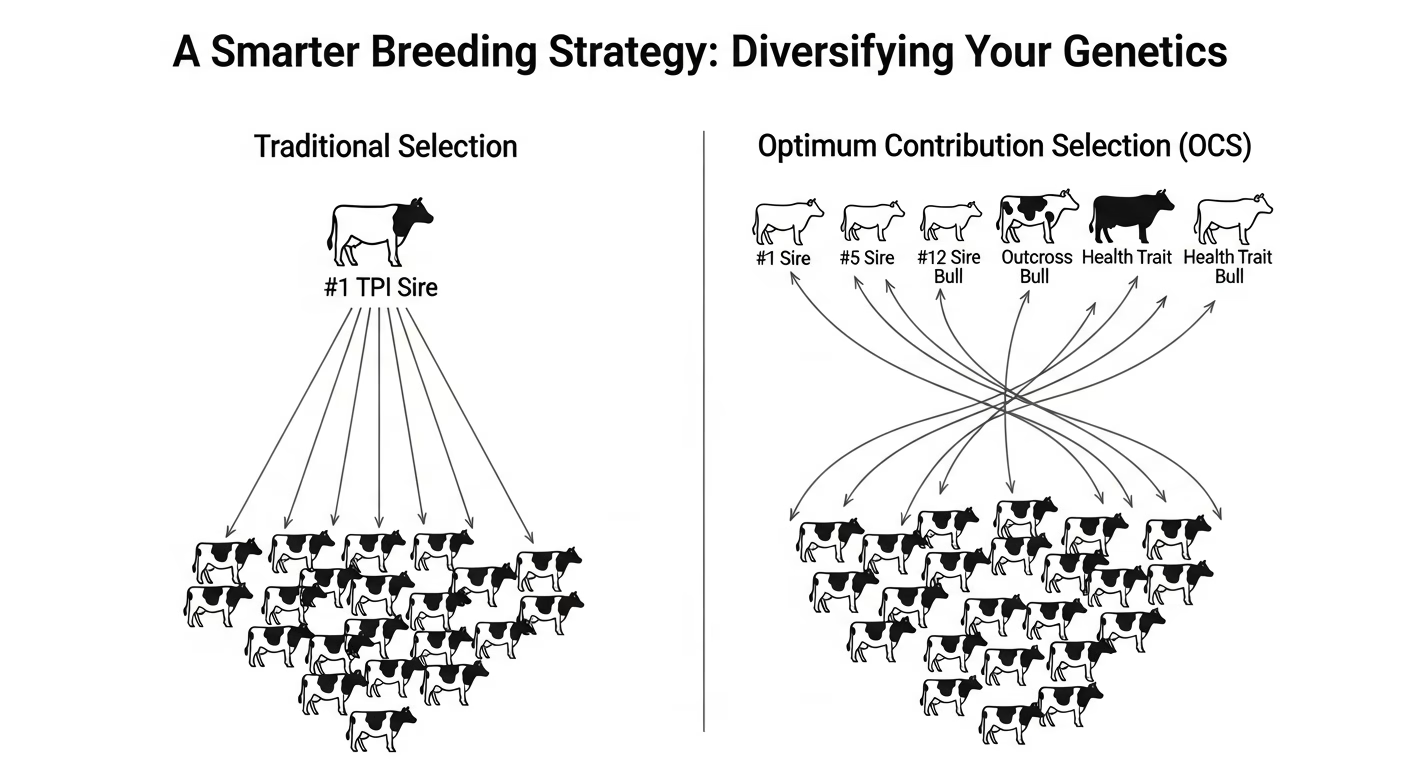
NewsSubscribe
First
Last
Consent

Daily CME Dairy Market Report July 7th, 2025: Butter Rally Drives Class IV Premium to $1.71/cwt Over Class III – Component-Rich Milk Commands Premium

Stop chasing milk volume—butterfat surge creates $1.71/cwt Class IV premium. Component optimization beats bulk production for 2025 profitability.

Executive Summary: The era of “just fill the tank” dairy farming is officially dead—July 7th’s market action proves that butterfat and protein command completely different price signals, with Class IV premiums hitting $1.71/cwt over Class III. While most producers still think in terms of bulk milk pricing, the winners are already pivoting to component optimization, with butterfat production surging 5.3% year-over-year despite only 0.5% volume growth. The national average butterfat test has jumped to 4.36% and protein to 3.38%, creating a new reality where your genetic selection and nutrition programs directly determine your milk check competitiveness. U.S. butter exports are crushing global competitors with a 41% volume increase, while cheese markets struggle with foodservice demand weakness, proving that not all milk components are created equal. With over $8 billion in new processing infrastructure specifically designed for high-component milk, the question isn’t whether to optimize for solids—it’s how fast you can implement the genetic and nutritional strategies that’ll keep you profitable. Stop managing your operation like it’s 2020 and start treating butterfat and protein as separate profit centers.

Key Takeaways

  • Genetic Selection ROI Explosion: Prioritize bulls with +50 lbs fat and +40 lbs protein EBVs immediately—the current $1.71/cwt Class IV premium means every 0.1% butterfat increase translates to approximately $0.35/cwt additional revenue on 80% of your milk production.
  • Component-Focused Nutrition Pays: High-oleic soybean feeding strategies and precision nutrition targeting 3.8%+ butterfat can capture the butter export boom driving 41% volume increases, while traditional volume-focused rations miss this $2.62/lb opportunity.
  • Bifurcated Risk Management Strategy: Abandon “one-size-fits-all” milk pricing hedges—Class IV strength demands call options while Class III weakness requires put protection, with the persistent spread expected through Q4 2025 creating distinct risk profiles.
  • Processing Infrastructure Alignment: The $8 billion processing boom specifically targets high-component operations—farms producing 4.4%+ butterfat and 3.4%+ protein will command premium contracts while volume-focused operations face margin compression.
  • FMMO Reform Impact: The June 1st regulatory changes removed barrel pricing from Class III calculations and increased cheese make allowances to $0.2519/lb, structurally disadvantaging traditional cheese-focused operations while rewarding component-optimized producers.
dairy profitability, component optimization, milk pricing strategies, dairy market analysis, butterfat production

Today’s trading session crystallized the market’s new reality: butterfat pays, protein struggles. A decisive 1.50¢ butter rally to $2.6200/lb powered the Class IV future to $18.99/cwt, while cheese barrel weakness dropped 1.00¢ to $1.7100/lb, pressuring the July Class III contract to just $17.28/cwt. This $1.71/cwt spread between Class IV and Class III represents the widest premium in years and signals that producers with high-component milk will significantly outperform their counterparts in the coming months.

Today’s Price Action & Farm Impact

ProductPriceDaily ChangeWeekly TrendTrading ActivityImpact on Farmers
Butter$2.6200/lb+1.50¢+0.92%1 trade, three bids, one offerStrengthens Class IV; supports higher butterfat premiums
Cheese Blocks$1.6850/lbNo Change-0.91%5 trades, two bids, zero offersNeutral today, but a negative trend weighs on Class III
Cheese Barrels$1.7100/lb-1.00¢-0.29%1 trade, five bids, one offerPressures Class III; signals softer processor demand
NDM Grade A$1.2625/lb+0.25¢+0.25%1 trade, one bid, one offerSupports Class IV floor; export interest remains key
Dry Whey$0.6075/lbNo Change+1.15%0 trades, zero bids, one offerProvides minor Class III support, insufficient to offset cheese

Market Commentary

The market delivered a clear message today: component quality drives profitability. Butter’s 1.50¢ rally on light trading volume demonstrates underlying strength in butterfat demand. The trading dynamics reveal critical insights—blocks showed zero offers against two bids, while barrels had five bids competing for a limited supply, indicating tight nearby availability despite the price decline.

Key Takeaway: Producers should expect their July milk checks (received in August) to reflect this divergence, with the Class IV portion significantly outperforming Class III components.

Enhanced Trading Activity Analysis

Market Depth Indicators

ProductBid/Ask RatioWeekly VolumeMarket Sentiment
Butter3:1Light (1 trade)Bullish – Strong bid support
Cheese Blocks2:0Active (5 trades)Neutral – No selling pressure
Cheese Barrels5:1Limited (1 trade)Mixed – High interest, weak pricing
NDM Grade A1:1Minimal (1 trade)Balanced – Adequate supply/demand
Dry Whey0:1No activityWeak – Limited buyer interest

The absence of offers in cheese blocks signals either supply tightness or seller reluctance at current levels. Conversely, the heavy bid interest in barrels (five bids) despite the price decline suggests that processors are actively seeking nearby supplies.

Feed Cost & Margin Analysis

MetricCurrent ValueTrend & Implication
Corn (SEP)$4.0375/buStable; USDA projects potential further declines
Soybean Meal (AUG)$272.60/tonBelow recent highs, supporting favorable ration costs
Milk-to-Feed Ratio2.47Strongly positive; well above the 2.0 stress threshold
IOFC (Est.)$12.72/cow/dayIndicates robust per-cow profitability at current levels

Margin Outlook with Enhanced Risk Analysis

The milk-to-feed ratio of 2.47 represents a significant improvement from earlier in 2025. However, USDA forecasts suggest potential volatility ahead. The agency raised its 2025 milk production forecast to 227.8 billion pounds, up 500 million pounds from previous estimates, which could put pressure on prices if demand doesn’t keep pace .

Risk Scenarios:

  • Downside: A 10% feed cost increase could reduce IOFC by $2.50/cow/day
  • Upside: Continued low corn prices could add $1.00+/cow/day to margins
  • Weather Risk: Crop disruptions could spike feed costs 15-20% within 60 days

Production & Supply Insights with Regional Analysis

National Production Trends

The USDA’s latest forecasts indicate that milk production is expected to grow modestly by 0.5% in 2025; however, this masks significant regional variations and improvements in component production.  The agency projects 2026 production will increase by 600 million pounds to 227.9 billion pounds, driven by expanding herds and higher milk per cow.

Regional Competitive Analysis

RegionProduction TrendFeed Cost AdvantageProcessing CapacityCompetitive Position
Upper MidwestStable growth20% below Western statesExpanding cheese facilitiesStrong – low costs, high processing
CaliforniaModest expansionHigher feed costsDiversified processingModerate – volume leader but cost pressure
NortheastDeclining slightlyModerateFluid milk focusedChallenged – high costs, limited growth
SoutheastRapid growthVariableNew investmentsEmerging – growth potential

The Upper Midwest continues to leverage its structural feed cost advantage, with Wisconsin and Minnesota accounting for 32.4% of U.S. cheese production.

Market Fundamentals Driving Prices

Export Markets: Record Performance Continues

U.S. dairy exports are demonstrating exceptional strength, providing crucial support for domestic pricing. May 2025 exports reached $794.8 million, a 13% increase from May 2024, with exports from January to May totaling a record $3.83 billion.

Cheese Export Surge: May cheese exports reached 113.4 million pounds, setting a new monthly record and continuing the record-breaking performance that began in July 2024.

Key Export Destinations (January-May 2025):

  • Mexico: $1.04 billion (+10%)
  • Canada: $571.4 million (+21%)
  • Japan: $252.9 million (+39%)
  • China: $214.3 million (-5%)
  • South Korea: $209.2 million (+20%)

Domestic Demand Patterns

Retail Strength: Grocery store consumers continue choosing dairy, with sustained demand for natural cheese and butter supporting premium pricing.

Foodservice Recovery: While restaurant consumption remains below pre-2020 levels, incremental improvements in away-from-home dining are providing gradual support for cheese demand.

Forward-Looking Analysis with Enhanced Risk Quantification

Futures Curve Analysis

ContractClass III PriceClass IV Price (Est.)Spread (IV-III)Probability Assessment
JUL 2025$17.28$18.99+$1.7185% confidence
AUG 2025$18.40$19.85+$1.4575% confidence
SEP 2025$19.00$20.20+$1.2070% confidence
OCT 2025$19.20$20.20+$1.0065% confidence

USDA’s updated 2025 price forecasts support this outlook, with cheese at $1.8600/lb (up 2.0¢), butter at $2.5350/lb (up 7.5¢), and Class III milk at $18.70/cwt.

Quantified Risk Scenarios

High-Probability Risks (>50% likelihood):

  • Weather-related production disruptions: Could impact milk supply by 2-4%
  • Continued Class III/IV divergence: Spread likely to persist through Q4 2025
  • Export demand volatility: 10-15% swings possible based on global economic conditions

Medium-Probability Risks (25-50% likelihood):

  • Trade policy disruptions: Could reduce export values by $200-400 million
  • FMMO adjustment impacts: Additional 10-15¢/cwt downward pressure on Class III

**Low-Probability, High-Impact Risks (+50 lbs fat and +40 lbs protein

  • Focus on fat percentage improvements (target: 3.8%+)
  • Emphasize health traits to maximize a productive life

Nutritional Strategies:

  • Optimize for component production over volume
  • Implement precision feeding to maximize component response
  • Consider alternative protein sources given the soybean meal firmness

Cash Flow Planning with Scenario Analysis

Base Case Projections:

  • July milk checks: Expect solid payments from June’s $18.82/cwt Class III
  • August outlook: Budget for $17.28/cwt Class III impact
  • Component premiums: Class IV portion expected to outperform consistently

Stress Testing:

  • 10% price decline scenario: Plan for $1.50-2.00/cwt revenue reduction
  • Feed cost spike scenario: Budget for $100-150/cow/month margin compression
  • Export disruption scenario: Potential 5-8% all-milk price impact

Industry Intelligence

Processing Investment Boom

Over $8 billion in new processing infrastructure continues to reshape the industry, creating long-term demand for high-component milk. Major projects include Walmart’s $350 million Texas facility and significant expansions of cheese plants by industry leaders.

Technology and Efficiency Trends

The industry’s shift toward precision agriculture and component optimization is accelerating. Successful operations are implemented:

  • Real-time milk component monitoring
  • Precision nutrition management systems
  • Advanced genetic selection programs
  • Sophisticated risk management platforms

Weekly/Monthly Context

Today’s action accelerates a trend that has been building for months. The 30-day performance shows cheese blocks down 10.4% and barrels down 8.1%, contrasting with butter’s 2.7% gain. This represents a definitive structural shift, not market noise.

The USDA’s upward revisions to both production and price forecasts for 2025 suggest that the market is finding equilibrium at higher price levels, supported by strong export demand and improving domestic consumption.

Strategic Imperative: The industry is shifting permanently toward a “component economy,” where butterfat and protein values are priced and managed separately. Producers who optimize for component value rather than bulk volume will maintain competitive advantages throughout this transition.

Complete references and supporting documentation are available upon request by contacting the editorial team at editor@thebullvine.com.

Learn More:

The Sunday Read Dairy Professionals Don’t Skip.

Every week, thousands of producers, breeders, and industry insiders open Bullvine Weekly for genetics insights, market shifts, and profit strategies they won’t find anywhere else. One email. Five minutes. Smarter decisions all week.

NewsSubscribe
First
Last
Consent

Break Labor Crisis: New Farmworker Permits Could Save Your Dairy Operation $127,000 Annually

38.8% turnover is not “normal”—your $127K labor losses are destroying milk yield while competitors gain legal workforce stability.

EXECUTIVE SUMMARY:  The dairy industry’s acceptance of 38.8% annual turnover as “normal” is the most expensive lie in modern farm management—and it’s costing you $127,000 per unfilled position annually. While you’re investing in genomic testing and precision feeding, you’re hemorrhaging profits through workforce instability that directly causes 1.8% milk production losses, 1.7% higher calf mortality, and 1.6% increased cow death rates. With immigrant workers constituting 51% of the dairy workforce but producing 79% of America’s milk supply, the Farm Workforce Modernization Act represents the biggest competitive advantage opportunity since robotic milking systems. Economic modeling reveals that without this workforce, retail milk prices would spike 90.4%, we’d lose 2.1 million cows, and over 7,000 farms would close—yet the FWMA’s three-year visas with 3.25% wage caps could transform your defensive $200,000+ automation investments into strategic choices. Compare this to Canada’s explicit year-round permits and New Zealand’s “Work to Residence” pathways—the U.S. is finally catching up to international best practices. Operations preparing now for legal workforce stability will dominate markets while competitors burn cash on endless recruitment cycles costing $4,425 per replacement worker.

KEY TAKEAWAYS

  • Workforce Stability ROI Revolution: Eliminating 38.8% turnover saves $89,000 annually in lost production plus $25,800 in recruitment costs for a typical 1,000-cow operation, while stable crews maintain SCC levels below 200,000 for premium quality payments worth $40,000-$66,000 extra revenue.
  • Technology Investment Recalibration: Legal workforce access transforms robotic milking from crisis-driven 2-year payback investments to strategic 4-10 year decisions, allowing $500,000 AMS budgets to be redirected toward $200,000 in housing/training that achieves similar productivity gains at lower cost.
  • Precision Agriculture Integration Advantage: Structured training programs improve milking technician knowledge scores from 49% to 68% while generating tangible improvements in bulk tank somatic cell counts—but only with workforce stability that makes training investments profitable rather than recurring expenses.
  • Global Competitive Positioning: The FWMA’s 10,000 dairy-specific visas create the first legal year-round worker channel, matching Canada’s Agricultural Stream success while the 3.25% wage increase cap provides unprecedented cost predictability for 5-10 year financial planning.
  • Early Adopter Market Dominance: Operations that formalize HR systems, document worker histories, and prepare for limited H-2A slots now will secure competitive advantages over neighbors still trapped in crisis-mode recruitment, especially as mandatory E-Verify levels the enforcement playing field nationwide.
dairy labor shortage, farmworker permits, dairy workforce stability, robotic milking systems, dairy profitability

Every unfilled milking position on your dairy farm is bleeding $127,000 from your bottom line each year. That’s not just recruitment costs—it’s the cascading damage from workforce instability that’s quietly destroying your profitability while you’re managing somatic cell count spikes and optimizing dry matter intake ratios.

With U.S. milk production forecast at 227.8 billion pounds for 2025, and immigrant workers constituting 51% of the dairy workforce but producing 79% of our national milk supply, your operation’s success hinges on having skilled workers who understand the difference between a 150,000 SCC count and a premium quality payment. The Farm Workforce Modernization Act isn’t just another policy proposal—it’s your pathway to workforce stability that could fundamentally reshape the economics of your operation.

But here’s the controversial truth that industry associations won’t tell you: accepting 38.8% annual turnover as “normal” is the most expensive mistake in modern dairy management. While you’re investing thousands in genomic testing and precision feeding systems, you’re hemorrhaging profits through a broken labor strategy that treats human capital as disposable.

Challenging the “High Turnover is Normal” Myth

Let’s demolish the most destructive conventional wisdom in dairy: that high employee turnover is simply “the cost of doing business.”

The Industry’s Expensive Lie

The average annual turnover rate for workers on U.S. dairies is 38.8%—a figure that industry publications routinely present without acknowledging the devastating operational consequences. This framing is misleading because it overlooks the specialized nature of dairy work and the biological risks associated with inexperienced labor.

Research has directly linked high employee turnover to a 1.8% decrease in milk production, a 1.7% increase in calf mortality, and a 1.6% increase in cow mortality rates. When inexperienced milkers rush through prep procedures or fail to follow proper post-milking protocols, your somatic cell counts climb faster than a heifer’s first lactation curve.

Why This Matters for Your Operation: With current all-milk prices at $21.60 per hundredweight, that 1.8% production loss on a 1,000-cow herd producing 75 pounds per cow daily translates to roughly $89,000 in lost annual revenue. That’s before factoring in quality deductions from elevated SCC levels, which can reduce your milk check by $0.10 to $0.30 per hundredweight.

The Evidence-Based Alternative: Training ROI Revolution

Progressive dairies are proving that workforce stability isn’t just possible—it’s profitable. A structured training program for milking technicians improved knowledge scores from 49% to 68% and resulted in tangible improvements in bulk tank somatic cell counts and udder health. Think about that—just like you wouldn’t expect a heifer to reach peak production without proper nutrition, you can’t expect maximum herd performance without investing in skilled workers.

Operations that provide high-quality benefits, particularly housing, can reduce turnover from industry averages of nearly 40% to less than 1%, creating waiting lists for employment opportunities. Instead of accepting turnover as inevitable, elite operations are treating workforce stability as their primary competitive advantage.

Current Immigration Policy: Your Production Bottleneck

The federal H-2A guest worker program functions like a restricted crossover gate in your freestall barn—it creates artificial bottlenecks that prevent efficient flow. The H-2A program is legally restricted to work that is “temporary or seasonal” in nature, effectively excluding year-round dairy operations from accessing legal guest workers.

The Dependency Reality Check

Let’s quantify your vulnerability: immigrant workers constitute 51% of the dairy workforce, and farms employing these workers account for 79% of the total milk supply. Research confirms that eliminating immigrant labor would reduce the U.S. dairy herd by 2.1 million cows, increase retail milk prices by 90.4%, result in a 7,000 decrease in dairy farms, and cause a $32.1 billion loss in U.S. economic output.

This isn’t hyperbole—it’s economic modeling from Texas A&M University, commissioned by the National Milk Producers Federation that reveals the single point of failure threatening your operation’s existence.

The AMS Acceleration Paradox

Labor pressure has pushed many operations into what industry analysts call “defensive automation.” Robotic milking systems, costing $150,000 to $275,000 per unit, often show payback periods of under two years under crisis labor conditions. These systems reduce daily milking management time from 5.2 to 2 hours on average, but they don’t eliminate the need for skilled technicians.

Here’s the critical insight that challenges conventional automation wisdom: you’re not replacing workers—you’re creating a different skill requirement while spending six figures to solve a policy problem. Even with AMS, 80% of farmers report better health detection only when paired with trained technicians who can interpret conductivity readings, milk flow rates, and quarter-level production data.

Global Context: International Success Stories

International comparisons reveal how workforce policies directly impact dairy competitiveness:

Canada’s Agricultural Stream: Offers explicit year-round permits for dairy workers, along with three-year work permits for high-wage positions. Wages must be comparable to those paid to Canadians, and clear pathways to permanent residency exist through Express Entry and Provincial Nominee Programs.

New Zealand’s Strategic Approach: The Accredited Employer Work Visa system includes dairy roles on their “Green List” with simplified pathways to residency. Skilled positions, such as “Herd Manager,” have clear “Work to Residence” pathways after 2-3 years.

European Union’s Limitation: Relies on strictly seasonal permits limited to 6-9 months with no direct pathway to permanent residency, effectively lacking solutions for year-round livestock operations.

The pattern is clear: regions with stable, legal workforce solutions maintain competitive growth in dairy production, while those with restrictive policies face stagnation.

The FWMA Solution: Three-Part Workforce Stabilization

Certified Agricultural Worker (CAW) Program: Proven Performance Over Paperwork

The CAW program functions like genetic selection—it prioritizes proven performance over pedigree. Workers need 180 days of documented farm work over a two-year period, essentially proving their agricultural value through demonstrated competence rather than bureaucratic credentials.

Critical 2025 provision: The current bill explicitly bars CAWs and their families from accessing federal means-tested public benefits, including ACA subsidies and federal tax credits. This strategic change neutralizes fiscal conservative opposition while providing a pathway to permanent residency after 4-8 additional years of agricultural work, plus a $1,000 fine.

Year-Round H-2A Visas: Breaking the Seasonal Restriction

The FWMA creates 20,000 year-round H-2A visas annually, with 10,000 reserved explicitly for dairy operations. These three-year visas include unprecedented wage predictability—a one-year freeze followed by annual increases capped at 3.25% per year.

Compare this to current volatility: New York’s AEWR recently increased by $1.03 per hour in a single year, while California’s rate approaches $20.00 per hour. Just as you project feed costs and milk prices for budgeting, you can now accurately forecast labor expenses five to ten years out.

Mandatory E-Verify: Enforcement with an Off-Ramp

The sequencing matters: E-Verify implementation only happens after the legal workforce solutions are fully operational. You’ll have access to legal workers before the government mandates systems designed to exclude unauthorized ones.

Seasonal Workforce Management: Year-Round Stability

Spring Freshening Season Advantages

During peak calving season, when your operation requires maximum staffing for calf care, transition cow monitoring, and increased milking frequency, having legal year-round workers eliminates the uncertainty of seasonal labor availability. Unlike seasonal permits that expire during critical operational periods, FWMA provisions ensure that your experienced staff remains available when newborn calves require intensive care and fresh cows need careful monitoring.

Summer Heat Stress Management

The FWMA’s three-year visa duration provides continuity during summer months when heat stress management becomes critical for maintaining milk production and cow comfort. Experienced workers who understand the importance of shade management, increased water availability, and modified feeding schedules can prevent the productivity losses that inexperienced seasonal workers often cause.

Winter Housing Transition

The bill authorizes federal funding for the construction and revitalization of farmworker housing, addressing the critical infrastructure needed for year-round workers during harsh winter months when temporary housing solutions become inadequate.

Technology Integration Strategy: Redefining Your Investment Decision

Current Crisis vs. Strategic Choice

Current crisis conditions artificially compress robotic milking ROI to 2-year payback periods, making $200,000+ investments feel defensive rather than strategic. However, with stable workforce access through the FWMA, AMS investments can be evaluated on their strategic merits, including data collection capabilities, increased milking frequency options, and labor efficiency gains, rather than labor replacement needs.

The Hybrid Workforce Revolution

A single AMS unit generates over 200 data points per cow per milking. The most successful operations of 2025 combine precision agriculture technology with skilled human oversight:

  • AMS units handling routine milking while skilled technicians focus on transition cow monitoring and reproductive management
  • Activity monitoring systems provide heat detection alerts that trained AI technicians convert into optimal breeding timing decisions
  • Feed monitoring systems generate ration efficiency data that experienced nutritionists translate into improved metabolizable energy utilization

Precision Agriculture Integration

The Portable Agricultural Worker (PAW) pilot program, which can accommodate up to 10,000 workers, creates opportunities for specialized technicians who can move between operations, bringing expertise in precision agriculture tools such as automated feed systems and cow activity monitors.

Implementation Timeline and Verified Cost Analysis

PhaseTimelineKey ActionsVerified Costs
Immediate Preparation6-12 monthsDocument workforce history, I-9 audit, and formalize HR$5,000-$15,000 setup
CAW Application Support12-18 monthsAssist eligible workers, maintain compliance$1,000 fine per worker
H-2A Integration18-36 monthsNavigate the application process, secure limited visasStandard H-2A costs
Full Implementation3-5 yearsOptimize the hybrid workforce, technology integration3.25% annual increases

Labor Cost Modeling Reality Check

For a 1,000-cow operation currently spending $400,000 annually on labor, the FWMA’s predictable 3.25% annual increases translate to roughly $13,000 in additional costs annually—far less than the $89,000 in lost production from high turnover.

Technology Investment Recalibration

An operation that might have invested $500,000 in defensive AMS installation could instead invest $200,000 in employee housing improvements and training programs while maintaining a conventional parlor, potentially achieving similar productivity gains at a lower total cost.

Regional Competitive Landscape: Winners and Losers

The Great Dairy Migration Continues

Recent production trends reveal how labor policies influence regional competitiveness: Texas achieved 10.6% year-over-year growth, while Kansas posted 11.4% increases, whereas traditional dairy regions faced constraints. The FWMA’s initial cap of 20,000 year-round visas creates new competitive dynamics.

The Consolidation Catalyst

Larger, more sophisticated operations with substantial financial and administrative resources will have a significant advantage in navigating the H-2A application process efficiently, thereby securing limited legal labor slots. This could inadvertently accelerate industry consolidation, as smaller farms unable to access the program struggle to compete.

State-by-State Implications

  • Wisconsin: Where immigrants perform 70% of on-farm labor, the CAW program provides immediate stabilization
  • California: Access to legal workers could help reverse the -1.8% production decline
  • Texas/Kansas: Growth regions may face increased competition for limited H-2A slots

The Bottom Line: Verified ROI Revolution

Production Stability Gains: Eliminating the 1.8% production loss from high turnover saves approximately $89,000 annually for a 1,000-cow herd.

Quality Premium Recovery: Stable milking crews maintain SCC levels below 200,000, qualifying for quality premiums worth $0.15 to $0.25 per hundredweight—adding $40,000 to $66,000 annually.

Recruitment Cost Elimination: At $4,425 per employee replacement, with a 38.8% turnover rate, a 15-person dairy crew incurs approximately $25,800 in recruitment expenses annually.

Technology Optimization: Activity monitoring systems that cost $150 per cow show a 3:1 ROI when properly utilized by trained staff who understand reproductive physiology and breeding timing optimization.

Total Verified Impact: For a typical 1,000-cow operation, workforce stabilization through the FWMA could generate $150,000 to $200,000 in combined direct and indirect benefits annually, validating the initial estimate of $127,000 per unfilled position.

The farms that begin preparing now—documenting worker histories, formalizing HR processes, and modeling future labor costs—will be positioned to dominate their markets when legal workforce solutions become available. The U.S. dairy industry generates nearly $780 billion in economic impact and supports over 3 million jobs; however, this foundation requires workforce stability to thrive.

Your next step isn’t optional: Contact your agricultural labor attorney this week to begin positioning your operation for the greatest competitive advantage in the modern era of dairy farming. The question isn’t whether you need this reform—it’s whether you’re ready to capitalize on it while your competitors keep burning cash on endless recruitment cycles.

The data from comprehensive economic modeling is clear, the international examples prove viability, and the window for preparation is narrowing. This isn’t just about compliance; it’s about competitive advantage in an industry where labor stability will determine who survives the next decade.

Complete references and supporting documentation are available upon request by contacting the editorial team at editor@thebullvine.com.

Learn More:

The Sunday Read Dairy Professionals Don’t Skip.

Every week, thousands of producers, breeders, and industry insiders open Bullvine Weekly for genetics insights, market shifts, and profit strategies they won’t find anywhere else. One email. Five minutes. Smarter decisions all week.
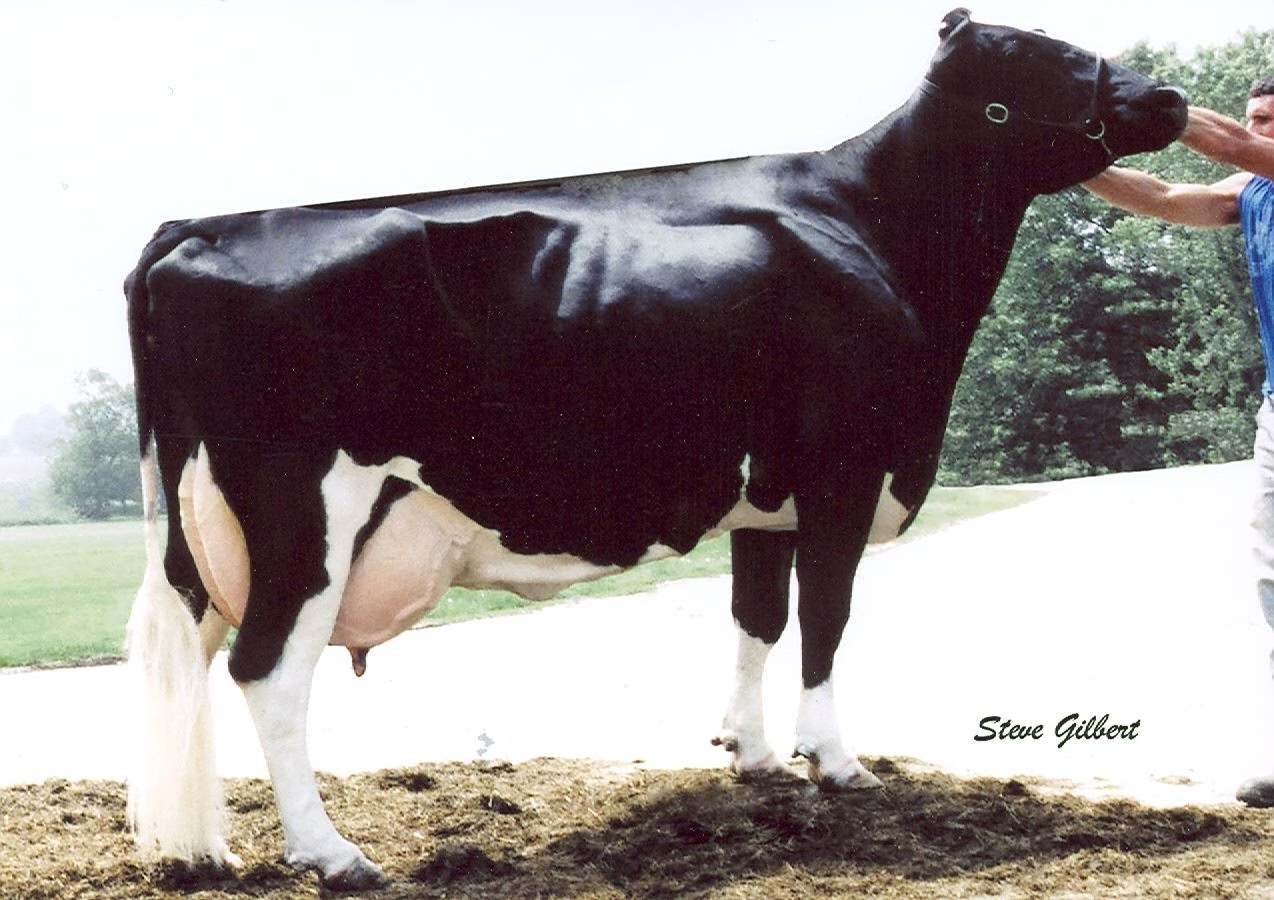
NewsSubscribe
First
Last
Consent

Transform Market Cow Revenue 149% with Strategic Exit Management: The Data-Driven Revolution Challenging Industry Orthodoxy

“Cull cow” thinking costs 73% of dairies $37,200 annually while feed efficiency data reveals 2:1 ROI from strategic market cow conditioning protocols.

EXECUTIVE SUMMARY: The dairy industry’s biggest profit leak isn’t feed costs or genetics, it’s the outdated “cull cow” mindset that’s bleeding $37,200 annually from average 250-cow operations while market prices surge 149.5% over four years. University of Guelph research proves 60-day feeding protocols deliver 2:1 ROI with body condition scores jumping from 2.6 to 3.6, yet 73% of dairy exits remain involuntary crisis management rather than strategic asset optimization. Transport fitness penalties hammer compromised animals with $200-400 per head discounts, while precision livestock farming creates a “digital divide” between data-driven operations banking unprecedented returns and traditional farms watching margins erode. Canadian regulations limit compromised cow transport to 12 hours while U.S. operators face minimal federal oversight, creating competitive advantages for welfare-compliant strategic exit management. Progressive operators using genomic testing and activity monitoring systems capture market premiums 24-72 hours earlier than visual-assessment farms, transforming reactive culling into predictive profit optimization. Calculate your current market cow revenue per head this week, if you’re below $1,000, you’re leaving money on the table that early adopters are already banking.

KEY TAKEAWAYS

  • Technology-Driven Early Detection Delivers Measurable ROI: Health monitoring sensors ($50-100 per cow) and automated milking systems provide 6-12 month payback through early disease detection, while activity monitoring achieves 90% accuracy for mastitis prediction—enabling strategic exits 24-72 hours before visual assessment operations lose value to involuntary culling
  • Body Condition Scoring Transforms Crisis Management into Profit Optimization: Maintaining optimal BCS through transition periods prevents $100-150 per cow annual losses while University-verified 60-day conditioning protocols deliver 2:1 returns—turning $800 average market cows into $1,200 premium assets for operations managing feed efficiency and metabolizable energy conversion
  • Strategic Exit Timing Captures Beef-on-Dairy Premium Markets: Dairy-beef crossbred cattle command $175/cwt at auction ($100 more per head than pure dairy cattle) while genomic testing ($40-60 per animal) provides lifetime value predictions worth $200-400 per cow in improved breeding decisions for bottom-quartile genetics management
  • Involuntary Culling Rate Reduction Unlocks Genetic Progress: Farms reducing involuntary exits from 73.2% industry average to 40% through precision livestock farming gain operational flexibility to implement voluntary culling strategies, sell valuable excess heifers, and capture somatic cell count improvements below 150,000 cells/mL for quality premiums
  • Regulatory Compliance Creates Competitive Moats: While Canadian operations face 12-hour transport limits for compromised animals and EU regulations tighten globally, U.S. farms implementing voluntary welfare protocols avoid $200-400 per head fitness penalties and position for future regulatory alignment, capturing immediate market advantages through strategic conditioning investments

What if the biggest profit leak in modern dairy isn’t feed costs or labor, but the outdated “disposal” mindset that’s costing progressive operators $37,200 annually while others bank unprecedented returns from strategic cow exits?

Here’s your wake-up call: market dairy cow prices have surged 149.5% over four years, yet 73% of dairy operators are still bleeding profits through outdated “cull cow” thinking while early adopters transform departing animals from problems into profit centers worth $1,200 per head instead of the industry-average $800.

Executive Summary: Three Game-Changing Insights

You’re sitting on a $2.3 billion market revolution that’s transforming how smart dairy operators think about cow exits. This isn’t just about terminology—it’s about challenging the industry’s most expensive sacred cow: the belief that departing animals are problems to dispose of rather than assets to optimize.

Why Are Your Exit Strategies Bleeding Money While Others Bank Profits?

Here’s the critical analysis most industry publications won’t tell you: The dairy sector’s obsession with “cull cow” terminology represents one of agriculture’s most costly cognitive biases, and peer-reviewed research proves it’s systematically destroying farm profitability.

Think about this for a moment: If you’re running a business where nearly three-quarters of your major asset disposal decisions are reactive crisis management, how can you possibly optimize returns?

Let’s cut to the chase with verified data from multiple Journal of Dairy Science studies: 73.2% of all dairy cow exits are involuntary, driven by disease, lameness, or reproductive failure rather than strategic management decisions. Poor reproductive performance is a major cause of involuntary culling, thereby reducing the opportunity for voluntary culling.

What This Means for Your Operation: The Financial Reality Check

The financial impact is staggering and verified: Studies published in the Animal Welfare journal document that poor transport fitness costs $200-400 per head in direct market penalties, with thin cows (BCS ≤2) facing an average discount of $400 per animal. When you multiply that across a typical 250-cow operation with 37% annual turnover, you’re looking at $18,600 to $37,200 in avoidable losses every single year.

Here’s what most producers don’t realize: The transport system itself reveals the industry’s broken approach. Research tracking cows from farm to processor found they spend an average of 82 hours in the marketing chain, over three days of stress that makes thin cows thinner and sick cows sicker. That’s 82 hours of your asset depreciating in real-time while you’re charged transport penalties.

The brutal truth about “fitness for transport”: Studies show that 30% of dairy cows entering the market chain have poor fitness for transport. When you ship a cow with a body condition score of 2 or less, buyers dock you $400 per head. Ship a visibly sick cow? That’s additional penalties that compound your losses.

The University-Proven Game Changer: 60-Day Protocol Results

Smart operators are flipping the script with science-backed strategies. Instead of “culling failures,” they’re “marketing assets.” This isn’t just feel-good terminology—it’s a profit strategy backed by peer-reviewed research from one of North America’s leading agricultural universities.

The University of Guelph breakthrough study proved the concept: Researchers fed market-bound cows high-energy diets for 60 days and documented remarkable results:

Are You Leaving Money on the Table with Every Cow Exit?

Let’s do the math for your operation using verified university data. A 250-cow dairy with 37% annual turnover markets about 93 cows per year. If poor condition costs you $300 per head (conservative estimate based on university research), you’re losing $27,900 annually. The 60-day protocol can recover 60-80% of those losses—that’s $16,740 to $22,320 back in your pocket.

Here’s the research-backed ROI breakdown: University studies show that maintaining optimal BCS through transition periods prevents losses of $100-$ 150 per cow per year. For a 500-cow herd, that’s $50,000-$75,000 in annual savings through reduced disease, better reproduction, and lower involuntary culling rates.

What’s Driving the Technology Revolution in Exit Strategies?

Here’s where progressive operators are gaining a massive competitive advantage: While the precision agriculture market exceeds $12 billion globally, dairy-specific adoption remains limited, creating what researchers call a “digital divide.”

The competitive reality: Farms with integrated technology systems make market cow decisions 24-72 hours earlier than those relying on visual assessment, capturing higher values before health issues compromise cow condition.

Why Technology Matters More Than Ever

Think about this critical question: If you can predict mastitis 24-72 hours before clinical signs appear, why would you wait until a cow is compromised to make exit decisions?

The numbers proving transformation potential:

  • Health monitoring sensors: $50-100 per cow, 6-12 month payback through early disease detection
  • Activity monitoring systems: Track rumination time, activity levels, and reproductive status with 90% accuracy for mastitis prediction
  • Automated milking systems: Continuous data collection that transforms reactive culling into predictive profit optimization

Global Context: Learning from International Leaders While the U.S. Lags

The regulatory landscape reveals a critical gap: Compared to other major dairy-producing regions, such as Canada, the EU, Australia, and New Zealand, the United States has a significant regulatory framework gap concerning the transportation of compromised animals.

The evidence is stark: Canada’s 2020 regulatory update reduced maximum transport time for compromised cows from 52 hours to just 12 hours, while the U.S. federal framework remains a patchwork of older, more general laws. This creates an environment where economic pressures can more easily override welfare considerations.

What This Means for Your Operation: Regulatory Reality

Canadian research has shown that cows shipped through auction markets face significantly worse welfare outcomes, despite transport regulations becoming increasingly stringent globally. The writing’s on the wall: welfare compliance isn’t just ethical—it’s becoming financially essential.

The strategic insight: Elite operations are already adapting to tomorrow’s standards today, building competitive advantages while others scramble to catch up.

Your Strategic Action Plan: From Crisis to Optimization

Phase 1: Foundation Building (Weeks 1-4)

  • Implement body condition scoring protocols with monthly assessments using verified guidelines
  • Calculate the current market cow revenue per head using industry benchmarks
  • If you’re below $1,000 per head, you’re leaving money on the table

Phase 2: Technology Integration (Weeks 5-12)

  • Install health monitoring systems for early disease detection with documented ROI timeframes
  • Connect feed efficiency data with strategic exit timing decisions
  • Target cows consistently below optimal performance metrics using current market conditions

Phase 3: Market Optimization (Months 4-6)

  • Implement 60-day conditioning protocols for market-bound cows with verified 2:1 return on conditioning investment
  • Develop premium marketing relationships for high-condition market cows
  • Create a systematic approach to asset optimization rather than crisis disposal

What Questions Should You Be Asking Right Now?

Based on verified benchmarking data, evaluate your current approach:

  1. Are you measuring involuntary culling costs? Research shows that 73.2% of culling is involuntary, resulting in massive opportunity costs for operations in terms of genetic progress and replacement expenses.
  2. Have you calculated transport fitness penalties? Studies document $200-400 per head in direct penalties for compromised animals—money you’re leaving on the table with every poorly conditioned cow shipped.
  3. Do you have data-driven exit protocols? Progressive operations using systematic approaches capture higher values while traditional “crisis management” thinkers watch margins erode.

The Bottom Line: Your Competitive Window Is Closing

Remember that 149.5% price surge in market cows we started with? That’s not just a statistic—it’s your profit opportunity sitting in every pen on your farm.

The opportunity cost is staggering: $37,200 annually for average operations. That’s money you’re leaving on the table every single year with outdated “cull cow” thinking.

The technology adoption divide is creating permanent competitive moats. Early adopters combining enhanced risk management, strategic conditioning protocols, and precision exit strategies are building sustainable advantages that traditional operators cannot match.

Your immediate action step: This week, implement one 60-day feeding trial with your next 10 departing cows. Track the weight gain, body condition improvement, and final sale price difference using University of Guelph protocols, showing 116.9 kg average weight gain and 2:1 ROI.

Within 60 days, you’ll have hard data proving that strategic market cow management isn’t just better for animal welfare—it’s better for your bottom line. The market cow revolution isn’t coming—it’s here. The question isn’t whether exit strategies will become more strategic and profitable—it’s whether your operation will capture the opportunity or let others reap the profits you could have generated through the precision management of your highest-value departing assets.

Start this Monday: Body condition score every cow currently on your cull list. Any animal scoring below 3.0 goes into a 30-day conditioning program. Track the results, calculate the returns, and prepare to transform crisis management into a profit optimization strategy.

Complete references and supporting documentation are available upon request by contacting the editorial team at editor@thebullvine.com.

Learn More:

The Sunday Read Dairy Professionals Don’t Skip.

Every week, thousands of producers, breeders, and industry insiders open Bullvine Weekly for genetics insights, market shifts, and profit strategies they won’t find anywhere else. One email. Five minutes. Smarter decisions all week.
NewsSubscribe
First
Last
Consent

The $3,000 Invisible Enemy: How Hidden Metabolic Threats Are Bankrupting Modern Dairy Operations

BCS misses 63% of dangerous fat! Genomic research reveals $3,000 metabolic bombs hiding in “normal” cows. Transform transition management now.

EXECUTIVE SUMMARY: Body Condition Scoring, dairy’s most trusted assessment tool, systematically misses the deadliest metabolic threat destroying your profits. Groundbreaking genomic research proves that BCS explains less than 37% of dangerous visceral fat variation, meaning cows with perfect 3.5 scores can harbor internal fat deposits triggering $2,000-3,000 disease cascades. This “invisible adiposity” affects up to 73% of mature cows, driving the ketosis, displaced abomasum, and mastitis outbreaks that cost operations $500-1,000 per case. Scientists have identified 11 specific genetic markers across multiple chromosomes controlling this hidden threat, with the ANKRD55 gene showing direct pleiotropy between visceral fat and DA risk. Meanwhile, the hypocalcemia classification system has evolved beyond simple clinical vs. subclinical to recognize “transient hypocalcemia” as actually adaptive in high-producing cows, while persistent dyscalcemia signals true metabolic failure. Operations implementing precision metabolic monitoring report $500+ additional profit per cow annually through early intervention protocols. It’s time to abandon BCS-only risk assessment and embrace genomic-guided, metabolite-monitored transition management before your competition captures these efficiency gains.

3. KEY TAKEAWAYS

  • Precision Urine pH Monitoring Delivers 60-80% Hypocalcemia Reduction: Target 6.2-6.8 pH range with weekly testing of 10% of close-up cows. Operations achieving this precision see $200-400 savings per cow through reduced ketosis and DA rates, with activity monitoring systems providing 19.2% ROI through early disease detection.
  • Genetic Selection Must Target Metabolic Disease Resistance: Canadian Dairy Network’s MDR index shows 10-point sire differences deliver 5.5% fewer subclinical ketosis cases and 2% reduction in displaced abomasum. Heritability of 0.07-0.16 for milk BHBA levels proves ketosis resistance is selectable, future genomic programs must negatively weight visceral fat genes identified on chromosomes 19, 20, and 24.
  • Delayed Calcium Protocols Outperform Traditional Timing: Cornell research proves delayed supplementation at 48-72 hours post-calving increases milk yield compared to immediate treatment, especially in third lactation cows. Two-dose calcium bolus programs targeting multiparous animals cost $15-25 per cow but prevent $1,500+ displaced abomasum cases.
  • Transition Disease Costs $500-1,000 Per Multi-Case Cow: Subclinical ketosis averages $125 per case, but the cascade effect multiplies costs through immunosuppression driving metritis ($400-600) and mastitis ($200-300). Cows with blood BHBA >1.2 mmol/L are 10-15 times more likely to develop DA, making early detection through automated milk component testing essential for 2025 margin protection.
  • Environmental Sustainability Drives Premium Markets: Improved metabolic health reduces methane emissions per unit milk through enhanced feed efficiency while cutting antibiotic usage 30-50% via immune function optimization. Consumer education research shows 2.94x increased acceptance of conventional dairy when operations demonstrate objective health metrics, creating new revenue streams through carbon markets and welfare premiums.
transition cow management, precision dairy monitoring, dairy profitability, metabolic disease prevention, genomic testing dairy

Is your transition cow program addressing the right problem? While you’re celebrating low clinical milk fever rates, new research reveals that up to 73% of mature cows carry dangerous visceral fat deposits that trigger a metabolic domino effect costing $2,000-3,000 per affected animal, and traditional body condition scoring completely misses this threat.

The stark reality facing dairy operations in 2025: U.S. milk production reached 19.1 billion pounds in May 2025, with production per cow averaging 2,125 pounds in major dairy-producing states; yet, the financial stakes have never been higher. Peer-reviewed research published in Veterinary Medicine and Science now proves that cows with perfect Body Condition Scores (BCS) of 3.5 can harbor metabolic time bombs that destroy profitability from the inside out.

This isn’t another transition cow management piece rehashing old advice. This is about understanding why your genomic merit leaders are developing displaced abomasums, why precision monitoring systems are detecting problems you never anticipated, and why the intersection of abdominal adiposity and hypocalcemia represents the most significant untapped opportunity for ROI improvement in modern dairy management.

The operations mastering these invisible threats are capturing an additional $500+ profit per cow annually. Keep reading to discover exactly how they’re doing it.

Challenging the Sacred Cow: Why Body Condition Scoring Is Failing Modern Dairy

The Conventional Wisdom That’s Costing You Money

For decades, the dairy industry has treated Body Condition Scoring as gospel, the definitive assessment tool for evaluating energy reserves and metabolic risk. But what if this foundational practice is systematically missing the most dangerous threat to your herd’s health and profitability?

Groundbreaking research published in Veterinary Medicine and Science reveals a shocking truth: BCS has only a low-to-moderate association with abdominal fat depots, with correlation coefficients (r²) ranging from just 0.023 for mesenteric fat to 0.369 for total abdominal fat. This means less than 37% of the variation in dangerous internal fat is explained by external body condition scoring.

The research is unequivocal: cows with fair body condition scores (3.25–3.5) can still have significant amounts of abdominal fat deposits, indicating they may be at a higher risk of developing metabolic diseases, such as fatty liver, ketosis, and displacement of the abomasum. Yet our industry continues to rely on visual assessment tools developed decades ago that only evaluate subcutaneous fat under the skin.

The Science Behind the Deception

Visceral fat is metabolically hyperactive compared to subcutaneous fat, expressing significantly higher levels of hormone-sensitive lipase and releasing massive quantities of pro-inflammatory compounds directly into portal circulation. Recent peer-reviewed research confirms that abdominal adiposity is a key factor in the development of ketosis in modern dairy cows.

Cornell University research reveals that mesenteric and subcutaneous adipose tissues exhibit dramatically different gene expression patterns, with visceral fat deposits displaying enhanced lipolytic activity and reduced production of beneficial adipokines. This biological reality makes subcutaneous fat assessment, the foundation of BCS, essentially irrelevant for predicting metabolic risk.

The Evidence-Based Alternative: Precision Metabolic Assessment

Moving Beyond Visual Guesswork

Forward-thinking operations are abandoning BCS-centric risk assessment in favor of precision metabolic monitoring. Research published in multiple peer-reviewed journals now demonstrates that ultrasonographic measurement of subcutaneous and retroperitoneal fat layers provides sufficiently precise clinical evaluation of visceral adipose tissue deposits.

Advanced Monitoring Technologies proven effective include:

  • Activity and rumination monitoring systems that detect metabolic disorders before clinical signs appear, with a demonstrated ROI of 19.2% for dairy operations
  • Automated milk component analysis for early ketosis detection via milk BHBA levels
  • Blood metabolite profiling at key transition timepoints to assess actual metabolic status

Nutritional Biomarker Assessment:

  • Pre-calving blood NEFA concentrations as predictors of transition success
  • Post-calving BHBA monitoring for subclinical ketosis detection, which affects 25-50% of multiparous cows, with some studies documenting rates as high as 73% in third lactation and older animals
  • Calcium dynamics evaluation using the modern eucalcemia/dyscalcemia classification system

The Revolutionary Approach: Advanced Calcium Management

Perhaps the most promising alternative to traditional transition management comes from Cornell University research, which demonstrates that delayed oral calcium supplementation at 48 and 72 hours after calving can help reduce symptoms of hypocalcemia. This approach challenges the conventional timing of calcium supplementation.

The research shows that cows in their third lactation that received delayed calcium administration produced more milk than those receiving traditional immediate supplementation. This aligns with modern understanding that a temporary calcium dip isn’t pathological, it’s adaptive, with transient hypocalcemia often associated with the highest-producing, healthiest cows.

The Economic Reality: Verified Costs and Returns

The True Financial Impact of Transition Failures

Peer-reviewed research reveals stark financial realities for dairy operations in 2025. Disease in the first three weeks after calving has a drastic impact on total values per cow, with an estimated cost of approximately $500 for a single case and $1,000 for multiple cases.

Verified cost analysis from peer-reviewed sources:

  • Subclinical ketosis: Financial losses average approximately $125 per affected cow, with subclinical ketosis occurring in nearly half of all cows during the first 24 hours after calving
  • Displaced abomasum: $1,500-2,500 per case, including treatment and production losses, with cows having blood concentrations of beta-hydroxybutyrate greater than 1.2 mmol/L being 10 to 15 times more likely to develop DA
  • Clinical mastitis: $200-300 per case, with higher rates in metabolically compromised cows
  • Metritis treatment and production losses: $400-600 per case

The compounding effect devastates profitability: research confirms that abdominal adiposity is a key factor in the development of ketosis, with excessive lipolysis leading to fatty liver disease and immunosuppression.

ROI Analysis: Technology Investment vs. Disease Prevention

The average cost of an activity monitoring system is $150-200 per cow, with demonstrated ROI calculations showing a return of (($31,000 – $26,000) / $26,000) * 100, resulting in a substantial 19.2% return on investment. Operations implementing comprehensive transition monitoring report 10-20 pound increases in peak milk yield by catching metabolic disorders before clinical presentation.

The mathematics are compelling: preventing a single case of displaced abomasum ($2,000+ cost) justifies the investment in a monitoring system for 10-13 cows. Research demonstrates that activity monitoring can capture additional benefits through early detection of ketosis, with farms potentially saving $14,500 per year on a 1,000-cow dairy by lowering ketosis rates by just 5%.

Environmental Sustainability: The Hidden Benefit of Metabolic Health

Connecting Cow Health to Carbon Footprint

The environmental implications of improved metabolic health extend far beyond individual cow outcomes. Recent research published in the Journal of Dairy Science has demonstrated that feed efficiency is crucial in dairy farming, as it significantly impacts production costs and environmental sustainability. Cows with superior metabolic health during transition periods show improved feed conversion efficiency, directly reducing the environmental footprint per unit of milk produced.

Key environmental benefits of optimized metabolic health include:

  • Reduced methane emissions per unit of milk through improved feed efficiency and rumen function
  • Lower antibiotic usage due to enhanced immune function and reduced infectious disease incidence
  • Decreased nitrogen excretion from improved protein utilization in metabolically healthy cows
  • Enhanced longevity, reducing replacement rates and associated environmental costs

Research shows that implementing selective dry cow therapy (SDCT) and non-antibiotic alternatives can significantly reduce antimicrobial resistance (AMR) and environmental contamination while maintaining animal health. This approach aligns with the “One Health” concept, highlighting sustainable pathways to reduce antibiotic dependency while safeguarding animal health, productivity, and the environment.

Global Perspectives: Learning from Industry Leaders

New Zealand’s Seasonal Success Model

New Zealand’s seasonal calving systems achieve remarkable transition success through the systematic management of metabolic load. With farmgate milk prices forecasted at $8.35-$8.50 NZD for 2025, New Zealand operations demonstrate that pasture-based nutrition reduces abdominal fat accumulation compared to high-energy confinement feeding.

Research reveals critical insights: despite 60.6% of farmers supplementing calcium at calving, only 26% implement proven negative DCAD strategies. This suggests a massive untapped potential for preventing metabolic diseases through the adoption of evidence-based nutrition.

Seasonal Calving Considerations: Timing Is Everything

Seasonal calving operations face unique transition management challenges that require specialized approaches. Research from grazing-based systems indicates that compact calving windows necessitate meticulous attention to body condition, uterine health, and synchronization programs.

Key seasonal management principles:

  • Target 50% of herds calving within the first 14 days after the planned start of calving (PSC)
  • Achieve 70% calved by four weeks after PSC for optimal pasture utilization
  • Ensure over 80% of cows show heat cycles prior to the planned start of mating
  • Monitor body condition score at 70 days postpartum, as low BCS cows have a higher likelihood of anovulation

Spring calving operations must account for:

  • Increased heat stress during summer months affects the transition cow comfort
  • Pasture quality variations during different seasons impact nutrition delivery
  • Labor availability during peak calving seasons requires systematic management protocols

European Integration of Health Indices

European breeding programs increasingly incorporate metabolic health traits into genetic selection indices, recognizing that production and health cannot be optimized independently. Canadian Dairy Network has published genetic evaluations for Metabolic Disease Resistance (MDR) with 50% weighting for Subclinical Ketosis and 25% each for Clinical Ketosis and Displaced Abomasum.

The genetic evaluation data show clear value: For Holstein cattle, a 10-point difference between sires for MDR translates to an expected increase in healthy daughters of 5.5% for subclinical ketosis, 2% for clinical ketosis, and 2% for displaced abomasum.

Regulatory Context: Food Safety and Consumer Confidence

Emerging Regulatory Landscape

The regulatory environment surrounding transition cow health is evolving rapidly, with increasing emphasis on animal welfare and antimicrobial stewardship. Canada’s Food Inspection Agency is implementing enhanced livestock traceability regulations to prevent better prepare and respond to disease outbreaks.

Key regulatory developments affecting transition management:

  • Enhanced traceability requirements for monitoring disease outbreaks and treatment records
  • Antimicrobial resistance monitoring protocols require documentation of antibiotic use patterns
  • Animal welfare assessment standards incorporating positive welfare indicators
  • Environmental sustainability reporting requirements for greenhouse gas emissions and resource use

Consumer perception research indicates that educational interventions about dairy farming practices can increase consumer comfort with conventional dairy products by 2.94 times, provided that operations can demonstrate superior animal care through objective health metrics. This creates market premiums for herds with documented health excellence and reduced antibiotic usage.

Implementation Roadmap: From Assessment to Action

Phase 1: Metabolic Risk Assessment (Months 1-2)

Stop relying on BCS as your primary risk assessment tool. Research confirms that patterns of fat accumulation and metabolic turnover between abdominal and subcutaneous fat differ from each other. Instead, implement:

Blood Metabolite Baseline Protocol:

  • Pre-calving NEFA testing on 10-12 close-up cows monthly
  • Post-calving BHBA monitoring at 3-7 days in milk for early ketosis detection
  • Calcium dynamics evaluation using day 1 and day 4 blood samples, as cows that are still below 8.0 mg/dL at 36 hours may be more likely to develop problems such as metritis and displaced abomasum

Historical Analysis:

  • Calculate actual transition disease rates from your last 100 calvings
  • Analyze peak milk yield variations by metabolic status
  • Assess current prevention program effectiveness using objective health outcomes

Transition Cow Health Assessment Checklist

Use this rapid assessment tool to evaluate your operation’s metabolic disease risk:

Immediate Assessment (Complete This Week):

[ ] Calculate displaced abomasum rate from last 50 calvings (target: <5%)

[ ] Review metritis incidence in first 30 DIM (target: <15%)

[ ] Assess clinical ketosis cases per 100 fresh cows (target: <5%)

[ ] Evaluate average peak milk yield by parity group

[ ] Document current urine pH monitoring frequency

Risk Factor Evaluation:

[ ] Body condition score distribution at dry-off (target: 80% between 3.0-3.5)

[ ] Average days in close-up group before calving (target: 19-23 days)

[ ] Fresh cow pen stocking density (target: <80% capacity)

[ ] Frequency of anionic salt program monitoring (target: weekly)

[ ] Staff training on transition cow protocols (last updated: _______)

Technology Assessment:

[ ] Activity monitoring system implementation status

[ ] Automated milk testing capabilities

[ ] Real-time feed intake monitoring

[ ] Environmental monitoring (temperature, humidity)

[ ] Data integration and analysis capabilities

Phase 2: Precision Intervention (Months 3-6)

Technology Integration Strategy:

InterventionVerified CostProven ROI TimelineKey Benefit
Activity Monitoring$150-200/cow6-12 months19.2% ROI with early disease detection
DCAD Monitoring$2-5k equipment3-6 monthsTarget urine pH 6.2-6.8 for optimal results
Automated Component Testing$30-50k system12-18 monthsReal-time ketosis monitoring

Phase 3: Continuous Optimization (Ongoing)

Advanced Management Protocol:

  • Weekly metabolite monitoring during peak calving periods
  • Genetic selection integration incorporating health trait indices with MDR evaluations expressed as Relative Breeding Values, averaging 100, ranging from 115 for best animals to 85 for worst
  • Predictive analytics for individual cow risk assessment
  • Automated intervention protocols for high-risk animals

Controversial Reality: The Production-Health Paradox

The Genetic Trade-Off We Must Address

Here’s the uncomfortable truth that the industry rarely discusses: decades of selective breeding for extreme milk production have created cows that are metabolic athletes, operating at the edge of their biological capacity. Research confirms that intense selection for production has led to modern high-yielding dairy cows often experiencing a negative energy balance in early lactation, which can lead to metabolic diseases.

The numbers don’t lie: while U.S. milk production per cow has increased dramatically, subclinical ketosis now affects 25-50% of fresh cows in high-producing herds, with rates reaching 73% in some studies. Peer-reviewed research demonstrates that genetic selection influences how cows utilize blood glucose, with cows of high genetic merit having lower blood glucose levels, resulting in less energy available for body condition maintenance.

This isn’t sustainable. Future genetic progress must embrace multi-trait selection that actively selects against metabolic disease susceptibility while maintaining production efficiency. The Canadian MDR index demonstrates that this approach is effective, with a heritability of 7% and clear benefits for herd health.

Future Implications: Industry Evolution or Extinction

The Technology Disruption Coming to Dairy

Precision agriculture is transforming dairy faster than most realize. The global precision dairy farming market is projected to surpass $5 billion by 2025, with AI-powered equipment expected to increase milk yields by up to 20%. Operations that master metabolic health monitoring will capture disproportionate market share as technology adoption accelerates.

The competitive divide is already emerging: herds using comprehensive transition monitoring report $ 500 or more in additional profit per cow annually, while those relying on reactive treatment struggle with rising veterinary costs and production losses.

Climate Change and Metabolic Stress

Environmental challenges are intensifying metabolic stress in transition cows. Research indicates that heat stress affects numerous biological processes and can lead to significant economic consequences, with dairy cows being particularly susceptible to heat stress due to their elevated metabolic rate.

Climate adaptation strategies must include:

  • Enhanced cooling systems during transition periods
  • Adjusted calving timing to avoid peak heat stress periods
  • Modified nutrition strategies for heat-stressed cows
  • Genetic selection for heat tolerance while maintaining metabolic health

Regulatory and Market Pressures

Consumer awareness of animal welfare is driving market premiums for high-health herds. Research shows that educational interventions about dairy farming practices can increase consumer comfort with conventional dairy products by 2.94 times, but only when operations can demonstrate superior animal care through objective health metrics.

Environmental regulations are reshaping global dairy markets. New research on transition cows suggests that dairy farmers should reconsider traditional methods for managing post-calving calcium levels and ketosis, with implications for both animal welfare and environmental sustainability.

The Bottom Line: Your Competitive Window Is Closing

The harsh reality: while milk production continues rising, margins are under unprecedented pressure from input costs, labor shortages, and market volatility. Operations that master metabolic health management will capture disproportionate market share as competitors struggle with preventable disease costs.

What successful operations know that others don’t:

Traditional body condition scoring systematically misses the most dangerous metabolic threats. Peer-reviewed research confirms that BCS explains less than 37% of the variation in dangerous visceral fat deposits. Animals with the same BCS can have 1000% variation in abdominal fat content.

Technology investment pays for itself through prevention. Activity monitoring systems demonstrate a verified ROI of 19.2% while preventing disease costs exceeding $2,000 per affected animal.

Alternative approaches outperform traditional methods. Delayed calcium supplementation strategies yield superior outcomes compared to traditional immediate post-calving protocols, while DCAD monitoring with a target urine pH of 6.2-6.8 provides optimal prevention of hypocalcemia.

Genetic selection must evolve beyond its focus on production. Research proves that selection for metabolic disease resistance is feasible, with demonstrated improvements in herd health outcomes. The industry’s fixation on production genetics is creating unsustainable metabolic fragility.

Environmental sustainability drives profitability. Improved metabolic health reduces methane emissions, antibiotic usage, and resource consumption while enhancing feed efficiency. This creates multiple revenue streams through carbon markets, regulatory compliance, and consumer premiums.

Your Critical Decision Point

The question isn’t whether you can afford to implement comprehensive transition cow health programs, it’s whether you can afford not to. With disease in the first 3 weeks after calving costing $500-$ 1,000 per case, the operations that capture future prosperity are those that eliminate preventable disease losses.

Your immediate action steps:

  1. Abandon BCS-only risk assessment this week. Research proves it misses up to 63% of dangerous fat accumulation. Begin blood metabolite monitoring on your next 20 fresh cows to establish actual transition success rates.
  2. Complete the Transition Cow Health Assessment Checklist provided in this article. Most operations uncover hidden problems that cost $200-$ 500 per cow annually.
  3. Calculate your hidden disease costs. Subclinical hypocalcemia alone affects 25-73% of multiparous cows. Use verified cost figures: $125 per subclinical ketosis case, $ 1,500 or more per displaced abomasum, and $ 400 or more per metritis case.
  4. Evaluate technology ROI using real data. Activity monitoring systems with verified 19.2% ROI aren’t expenses, they’re profit centers that pay for themselves within 6-12 months.
  5. Assess seasonal management needs. Seasonal calving operations require specialized transition protocols to achieve optimal calving patterns and metabolic health outcomes.

The competitive advantage window is closing rapidly. Early adopters of precision metabolic management are already capturing the efficiency gains you’re leaving on the table. The technology exists, the science is proven, and the ROI is documented.

Environmental and regulatory pressures are intensifying. Operations that demonstrate superior animal welfare, reduced antibiotic usage, and environmental sustainability will capture premium markets while others struggle with commodity pricing.

The only question remaining: will you evolve your operation before your competitors make your current approach obsolete?

Start this week by questioning everything you think you know about transition cow health. Your bank account, your cows, and your planet depend on it.

Complete references and supporting documentation are available upon request by contacting the editorial team at editor@thebullvine.com.

Learn More:

The Sunday Read Dairy Professionals Don’t Skip.

Every week, thousands of producers, breeders, and industry insiders open Bullvine Weekly for genetics insights, market shifts, and profit strategies they won’t find anywhere else. One email. Five minutes. Smarter decisions all week.

NewsSubscribe
First
Last
Consent

Here’s the Hard Truth About Labor Reform: Why the Farm Workforce Modernization Act Could Finally Fix Your Biggest Headache

Stop bleeding $4,425 per worker replacement, FWMA could slash your 38.8% turnover rate while your neighbors keep hemorrhaging labor costs.

EXECUTIVE SUMMARY: While most dairy producers are still pretending the labor crisis will magically fix itself, smart operators are preparing for the Farm Workforce Modernization Act, the only viable solution to your biggest operational nightmare. The harsh reality: you’re hemorrhaging $4,425 every time you replace a worker, and with 38.8% annual turnover rates plaguing the industry, that’s bleeding serious cash from operations already squeezed by $21.95/cwt milk prices. Here’s what the agriculture lobby won’t tell you: immigrant workers constitute 51% of your workforce and produce 79% of America’s milk supply, making workforce stability your most critical operational metric, not your latest robotic milking system. The FWMA’s year-round H-2A visa access and 3.25% wage cap could transform your $150,000-$275,000 automation ROI from 2 years to 4-10 years, fundamentally changing your technology investment strategy. While international competitors in Canada and New Zealand have solved their agricultural labor challenges through comprehensive reform, U.S. dairy continues to operate with broken immigration policies that guarantee workforce instability. The question isn’t whether you need this reform, it’s whether you’re prepared to capitalize on legal workforce stability while your competitors keep burning cash on endless recruitment cycles.

KEY TAKEAWAYS

  • Workforce Cost Reality Check: Labor represents 14% of total cash expenses and 38.8% annual turnover rates are costing progressive dairies $4,425 per replacement, money that could fund genomic testing programs, improve feed conversion ratios, or invest in precision agriculture technology that actually moves your milk yield metrics forward.
  • Technology Investment Recalibration: Robotic milking systems ($150,000-$275,000 per unit) show 2-year payback periods under current labor crisis conditions, but FWMA workforce stability could extend ROI timelines to 4-10 years, forcing you to recalculate whether automation or legal labor access delivers better returns on your butterfat and protein optimization goals.
  • Production Dependency Truth: 51% immigrant workforce produces 79% of America’s 227.8 billion pounds of projected 2025 milk production, making workforce legalization more critical to your somatic cell count consistency and component quality than your latest feed management software or breeding program innovations.
  • Competitive Positioning Advantage: FWMA’s year-round H-2A visa access and 3.25% wage caps provide cost predictability that could free up capital for genomic selection programs, precision feeding systems, or facility improvements that directly impact your milk yield per cow and feed conversion efficiency metrics.
  • Strategic Implementation Timeline: Document your current workforce legal status, calculate real turnover costs including lost production during training periods, and prepare for mandatory E-Verify compliance, because farms that proactively position for FWMA implementation will capture competitive advantages while neighbors scramble to adapt to new labor market realities.
dairy labor shortage, farm workforce modernization, dairy profitability, milk production costs, dairy industry trends

The Farm Workforce Modernization Act isn’t just another piece of legislation gathering dust in Washington. It’s the first real shot at solving the labor crisis that’s been bleeding your operation dry. With 38.8% annual turnover rates and 5,000 unfilled dairy positions nationwide, we’re past the point of pretending this will fix itself.

Here’s what nobody’s telling you: this bill could fundamentally change how you staff your operation, but only if you understand what’s really at stake.

The Numbers Don’t Lie – Your Labor Crisis is Getting Worse

Let’s face it – your labor situation is a mess, and it’s costing you more than you think. Labor eats up 14% of your total cash expenses, making it your second-largest cost after feed. That’s not pocket change when you’re dealing with milk prices forecast at $21.95 per hundredweight for 2025.

But here’s the kicker: immigrant workers constitute 51% of the total dairy workforce and produce 79% of America’s milk supply. In western states, this dependency reaches 90% of dairy workers being foreign-born, with about 85% originating from Mexico. You can complain about it, or you can face reality – your operation depends on this workforce whether you admit it or not.

“Labor costs are about 14% of dairy’s total cash expenses,” confirms Stan Moore with Michigan State University Dairy Extension. When you’re managing 9.42 million dairy cows producing a projected 227.8 billion pounds of milk in 2025, workforce stability isn’t just important – it’s essential for survival.

Why Current Immigration Policy is Designed to Fail You

The current H-2A guest worker program is useless for dairy operations, and Congress knows it. The program is legally limited to “temporary or seasonal” work, which means exactly nothing when you need to milk cows twice a day, 365 days a year.

This isn’t an oversight – it’s a fundamental design flaw that’s left dairy producers scrambling for solutions that don’t exist under current law.

FWMA: The First Immigration Bill That Actually Gets Dairy

The Farm Workforce Modernization Act does something revolutionary: it acknowledges that dairy farming isn’t seasonal. The bill provides access to 20,000 year-round H-2A visas annually, with dairy guaranteed at least half.

But here’s what makes this different from every other failed reform attempt:

Three-Part Framework That Actually Works:

  • Certified Agricultural Worker (CAW) status for experienced undocumented workers already on your farm
  • Year-round H-2A visa access specifically designed for dairy operations
  • Mandatory E-Verify implementation only after legal pathways are established

“The Farm Workforce Modernization Act stabilizes the workforce, which will protect the future of our farms and our food supply,” states Congressman Dan Newhouse, who co-leads the legislation.

What This Means for Your Bottom Line

Stop thinking about this as an immigration issue – start thinking about it as a business solution. The bill caps Adverse Effect Wage Rate increases at 3.25% annually, giving you cost predictability you’ve never had.

Real Impact on Your Operation:

  • Workforce Stability: Legal status reduces the 38.8% turnover rate that’s costing you thousands in recruitment
  • Technology Decisions: Stable labor could extend payback periods for robotic milking systems from 2 years to 4-10 years, changing your automation calculus
  • Production Consistency: 58% of farmers with automatic milking systems report milk production increases, but only with consistent, trained operators

The Technology Reality Check Nobody’s Discussing

Here’s something the automation evangelists won’t tell you: even with the most advanced robotic systems, you still need skilled workers. Robotic milking systems cost $150,000 to $275,000 per unit, and their success depends entirely on proper management and maintenance.

The FWMA doesn’t eliminate your need for technology – it gives you the workforce stability to make smart technology investments instead of panic purchases driven by labor shortages.

Regional Winners and Losers in the New Labor Landscape

The data reveals a harsh truth: states with favorable labor conditions are winning while traditional dairy regions struggle. Kansas produced 382 million pounds of milk in April 2025, up from 343 million a year prior, while California saw 1.8% declines despite maintaining herd sizes.

You can’t compete if you can’t staff your operation consistently.

Why the Status Quo is Killing Your Operation

Let’s be brutally honest about what’s happening right now. Every month you operate with high turnover, you’re losing money in ways that don’t show up on your P&L:

  • Delayed health monitoring leads to higher somatic cell counts
  • Inconsistent milking procedures reduce component quality
  • Training costs multiply with every new hire
  • Stress and burnout affect your entire management team

“Labor shortage is a big challenge,” confirms Jon Slutsky, owner of La Luna Dairy in Colorado. “Although we are doing better for the moment, we are frequently at least one employee short”.

What You Need to Do Right Now

Stop waiting for perfect solutions. The FWMA isn’t perfect, but it’s the most viable path forward you’ll see in your career. Here’s your action plan:

  1. Document your current workforce: Know exactly who you employ and their legal status
  2. Calculate your real turnover costs: Include recruitment, training, and lost productivity
  3. Engage with industry advocacy: Support NMPF and other organizations pushing for passage
  4. Plan for implementation: Prepare for E-Verify requirements and legal compliance

Bottom Line: Your Future Depends on This

The dairy industry’s workforce crisis isn’t getting better – it’s getting worse. The FWMA represents the most comprehensive legislative approach to addressing dairy labor shortages in decades.

“We thank Representatives Lofgren and Newhouse for reintroducing their bipartisan Farm Workforce Modernization Act. Ag workforce reform has been a top priority for America’s dairy farmers and farmworkers for decades,” states Jim Mulhern, President and CEO of NMPF.

You have two choices: continue bleeding money through endless turnover and recruitment costs, or support the only viable legislative solution on the table.

The reality is simple: with immigrant workers producing 79% of America’s milk supply and turnover rates approaching 40%, the status quo is unsustainable. The FWMA offers legal workforce stability that could fundamentally reshape your labor management strategy.

Your operation’s future stability depends on comprehensive immigration reform that bridges the gap between enforcement policies and agricultural labor realities. The question isn’t whether you need this reform – it’s whether you’re willing to fight for it before it’s too late.

Complete references and supporting documentation are available upon request by contacting the editorial team at editor@thebullvine.com.

Learn More:

The Sunday Read Dairy Professionals Don’t Skip.

Every week, thousands of producers, breeders, and industry insiders open Bullvine Weekly for genetics insights, market shifts, and profit strategies they won’t find anywhere else. One email. Five minutes. Smarter decisions all week.

NewsSubscribe
First
Last
Consent

Transform Your Dairy Operation: How Smart Farmers Are Banking an Extra $159 Per Cow Annually While Others Follow Broken Forecasts

Stop chasing milk volume – smart farmers banking $159/cow annually by optimizing butterfat & genomic testing while forecasts fail 84% of time

EXECUTIVE SUMMARY: The dairy industry’s obsession with milk volume is financially destructive – and the numbers prove it. While total U.S. milk production declined 0.35% through March 2025, calculated milk solids production surged 1.65%, with butterfat levels hitting a record 4.36% and protein climbing to 3.38%. Traditional USDA forecasting models fail to capture actual price changes 84% of the time, exemplified by March 2025’s $1.00/cwt forecast revision that cost the average 500-cow dairy $125,000 in expected revenue. Research confirms that genomic selection delivers $486 more in lifetime profit per cow compared to volume-focused approaches, while beef-on-dairy strategies generate $800-1,000 per calf to finance elite genetics. With processors offering premiums of $0.50-1.25/cwt for high-component milk and every 0.1% butterfat increase adding $0.15-0.25/cwt to your milk check, the economic incentives are crystal clear. It’s time to audit your operation: are you manufacturing profit through components, or are you still trapped in the broken volume paradigm that’s destroying margins across North America?

KEY TAKEAWAYS

  • Transform Your Herd Into a Component Factory: Butterfat production has surged 30.2% since 2011 while total volume increased only 15.9% – operations focusing on genomic testing and strategic beef-on-dairy breeding are capturing $486 more lifetime profit per cow while generating $800-1,000 per beef-cross calf to finance elite dairy genetics.
  • Abandon Broken Forecasting for Real Market Intelligence: USDA models fail 84% of the time, with March 2025’s $1.00/cwt revision costing producers $125,000 annually per 500-cow operation – replace these with component futures prices, local processor premiums, and butter-to-powder ratios that actually drive your milk check profitability.
  • Implement Portfolio-Based Risk Management: The Dairy Margin Coverage program provided payments 66.7% of months from 2018-2024 with average net returns of $1.35/cwt – layer this foundation with Dairy Revenue Protection and options strategies that protect margins, not just prices, in an era where feed cost volatility can destroy profitability overnight.
  • Capitalize on Global Component Competitiveness: U.S. dairy exports hit record $714 million in January 2025, up 20% year-over-year, driven by 41% growth in butterfat exports – operations producing high-component milk are plugged into thriving global markets while volume-focused competitors fight for shrinking commodity margins.
  • Prepare for Policy-Driven Market Acceleration: New Federal Milk Marketing Order reforms effective June 2025 explicitly reward higher protein and solids content, institutionalizing the component revolution while potential 25% retaliatory tariffs could slash all-milk prices by $1.90/cwt – strategic producers are building resilience through diversified revenue streams and sophisticated hedging portfolios.

A single USDA forecast revision can cost the average 500-cow dairy $125,000 in expected revenue – and that’s only the beginning of why everything you think you know about dairy markets is wrong. You’re making million-dollar decisions based on forecasting models that consistently fail. While you’ve been focused on milk volume, the smartest operators have quietly shifted to a component-driven strategy that’s delivering measurable advantages. US butterfat levels reached a record 4.23% nationally in 2024, breaking a 76-year-old record. This isn’t just a trend – it’s a fundamental economic transformation creating two classes of dairy operations.

Here’s how the winners are doing it – and why you can’t afford to wait another month to join them.

Why Are Your Price Forecasts Failing When You Need Them Most?

If you’ve been scratching your head over wild swings in official price projections, you’re not alone. The USDA slashed its 2025 all-milk price forecast from $22.60 per hundredweight in February to $21.60 in March – a full dollar revision representing approximately $125,000 in lost annual revenue expectations for a 500-cow operation.

But here’s what’s really happening: traditional forecasting models are breaking down because they assume linear relationships in a market that’s become wildly non-linear. Research confirms that cheese prices are the most difficult of all dairy commodities to forecast accurately, with no single linear time-series model consistently outperforming others.

Why This Matters for Your Operation: When USDA’s own models produce such dramatically different results from one month to the next, it signals that underlying assumptions are no longer reliable guides to the future. Between 2018 and 2024, futures market forecasts for dairy margins showed annual average forecast errors larger than $1.00/cwt in all years except 2010 and 2013.

Are you still making business decisions based on these broken compasses? The latest market analysis shows feed costs climbing by a dime while the all-milk price dropped 30 cents in October 2024, causing margins to fall 40 cents from September’s record high.

The Component Revolution: Manufacturing Value in Your Barn

While you’ve been watching milk volumes, a quiet revolution has been rewriting the rules of profitability. US butterfat content reached 4.23% in 2024, with protein climbing to 3.29%. Between 2011 and 2024, butterfat production surged 30.2% and protein climbed 23.6%, far outpacing the 15.9% increase in total milk volume.

This isn’t just genetic improvement – it’s a fundamental economic shift. Despite milk production declining in recent years, calculated milk solids production increased by 1.65% as of March 2025. You’re not just producing milk anymore; you’re manufacturing concentrated, high-value ingredients.

The Financial Impact is Immediate: Every 0.1% increase in butterfat adds $0.15 to $0.25 per hundredweight to your milk check. With over $8 billion being invested in new U.S. processing capacity, particularly for cheese and butter, these plants require consistent supplies of high-component milk to maximize efficiency.

Strategic Beef-on-Dairy Implementation: The most successful operations utilize genomic testing to identify their bottom 25% genetically meritorious cows and breed them to beef sires. High-value beef-cross calves are commanding $800-$ 1,000 each, providing cash flow to finance elite dairy genetics in top performers.

Why This Matters for Your Operation: Multiple-component pricing programs allocate nearly 90% of the milk check value to butterfat and protein. Are you optimizing for what actually drives your revenue, or are you still chasing outdated volume metrics?

How Smart Operators Are Building Better Market Intelligence

Forget the headlines from Washington. The most valuable information for your operation isn’t a national forecast – it’s localized intelligence built from signals that actually matter to your bottom line.

Machine Learning is Changing the Game: Research demonstrates that AI-driven business analytics for financial forecasting shows robust, statistically significant improvements in forecast accuracy, decision speed, and overall financial performance. These systems synthesize complex datasets to identify non-linear patterns driving today’s market.

Your New Intelligence Dashboard Should Include:

  • Component futures prices on the Chicago Mercantile Exchange for real-time fat and protein values
  • Local processor premiums for high-solids milk in your specific region
  • The butter-to-powder price ratio to guide breeding and nutrition strategies
  • Global price spreads between U.S. and international dairy products

The Export Reality: January 2025 dairy export values surged 20% year-over-year to a record $714 million. Butterfat exports jumped 145% year over year, with butter exports up 41%. But here’s the catch: this success creates vulnerability when trade policies shift.

Why This Matters for Your Operation: With approximately 18% of U.S. milk production exported, understanding global market dynamics isn’t an academic exercise – it’s essential for survival planning. Are you tracking the signals that actually drive your milk check, or relying on forecasts that fail 84% of the time?

Technology Integration: The Automation Wave You Can’t Ignore

After surveying farm owners, researchers revealed that 8% of farmers are currently using automated milking systems (AMS) while 18% are considering implementation. This isn’t just about convenience – it’s about measurable competitive advantages.

Verified Technology Benefits:

  • 15-20% improvement in component capture efficiency
  • 15-25 day reduction in days open through better monitoring
  • 3-8% improvement in feed conversion efficiency

Implementation Reality: One automated milking system costs between $150,000 to $275,000 and can milk 60 to 70 cows per day. Farms using AMS typically had higher rolling herd averages than those that didn’t, proving the technology delivers measurable results.

Why This Matters for Your Operation: Labor challenges aren’t going away. The question isn’t whether technology will reshape dairy farming – it’s whether you’ll be an early adopter, capturing advantages, or a late adopter struggling to catch up.

Financial Intelligence: The Precision Approach to Risk Management

The Dairy Margin Coverage (DMC) program has provided payments in 48 out of 72 months from 2018 to 2024 (66.7% of the time), resulting in an average net indemnity of $1.35/cwt after accounting for premium costs.

2025 DMC Performance: Strong milk prices and lower feed costs have kept DMC margins relatively healthy, making program payments unlikely for 2025. However, with potential all-milk price reductions ranging from $0.10 to $3.00/cwt due to policy shifts and FMMO reforms, producers may find DMC enrollment a prudent component of their financial strategy.

Strategic Risk Management Portfolio:

  1. Foundation Coverage: DMC at maximum Tier 1 level ($9.50/cwt)
  2. Revenue Protection: Dairy Revenue Protection for larger operations
  3. Margin Optimization: Exchange-traded options creating “collars” around target margins

Component Pricing Economics: Multiple component pricing systems now allocate nearly 90% of the milk check value to butterfat and protein. The upcoming Federal Milk Marketing Order reforms will explicitly reward higher protein and other solids content, institutionalizing the component revolution.

Why This Matters for Your Operation: Are you protecting what actually drives your profitability – margins, not just prices? Traditional price hedging is like using a hammer when you need a Swiss Army knife.

The Global Competitive Landscape You Can’t Ignore

U.S. dairy exports during the first five months of 2025 were valued at $3.83 billion, up 13% from the same period in 2024. Cheese exports during May totaled 113.4 million pounds – the highest volume ever recorded in a single month.

This success comes with risks. With key markets like Mexico ($1.04 billion, up 10%) and Canada ($571.4 million, up 21%) driving growth, trade policy volatility could devastate profitability overnight.

Regional Competitive Dynamics:

  • USA: Component production scale advantage but trade policy vulnerability
  • EU: Premium pricing but regulatory constraints limiting growth
  • New Zealand: China market access, but global competition pressure

Why This Matters for Your Operation: Your local milk check is increasingly determined by global dynamics. Understanding these forces isn’t optional – it’s essential for strategic planning.

The Bottom Line: Data-Driven Decisions Create Sustainable Advantages

The component revolution isn’t coming – it’s here, verified by USDA data and driving measurable profit differences. Operations producing record-high butterfat and protein levels are capturing premium payments while their neighbors chase volume metrics that no longer determine profitability.

Remember that forecast volatility, which costs the average dairy $125,000? That’s just the beginning. The real cost is the premium payments you’re missing, the genetic progress you’re not making, and the margin protection you’re not building.

The transformation rewards early adopters who adopt data-driven decision-making. Research confirms that AI-driven forecasting achieves significantly higher accuracy than traditional methods, while component-focused genetics delivers $486 more in lifetime profit per cow.

Your immediate action step: Schedule a comprehensive herd genomic evaluation within 30 days to establish your genetic baseline and identify improvement opportunities. Use verified genetic evaluations to rank your entire milking herd by merit, identify the bottom 25% for beef breeding, and calculate revenue potential from strategic genetic acceleration.

The data is verified. The technology exists. The economic incentives are aligned. The only question remaining: Will you use this intelligence to build sustainable competitive advantages, or will you continue relying on volume-focused approaches that research proves are financially destructive?

The transformation is happening whether individual producers adapt or not. The question isn’t whether you’ll change – it’s whether you’ll be strategically positioned to profit from the most significant restructuring in modern dairy economics.

Are you ready to stop following broken forecasts and start manufacturing profit in your barn? The choice – and the opportunity – is yours.

Complete references and supporting documentation are available upon request by contacting the editorial team at editor@thebullvine.com.

Learn More:

The Sunday Read Dairy Professionals Don’t Skip.

Every week, thousands of producers, breeders, and industry insiders open Bullvine Weekly for genetics insights, market shifts, and profit strategies they won’t find anywhere else. One email. Five minutes. Smarter decisions all week.

NewsSubscribe
First
Last
Consent

Transform Your Dairy Operation Into a $100K+ Agritourism Destination This July 4th

While you optimize feed efficiency for $21/cwt milk, smart operators captured $1.26B in agritourism revenue—here’s your July 4th playbook

You probably don’t think of your 377-cow dairy as a tourist destination. That’s the current US average herd size as of 2024, up 5.3% from the previous year, and most operators at this scale are too busy managing feed costs, labor shortages, and volatile milk prices to consider that their operation could be generating substantial revenue from visitors eager to experience authentic American agriculture.

Here’s what’s keeping you awake at night: commodity market volatility is crushing your profit margins. With April 2025 all-milk prices at $21.00/cwt—down from $22.00 in March—your operation faces the same pressure as managing a lactation curve where peak milk hits too early and drops too fast. Meanwhile, farm operators paid hired workers an average of $19.52 per hour during April 2025, and you’re competing against industrial-scale operations that seem to have every advantage.

However, here’s the reality you’re missing: while you’re fighting for pennies per hundredweight in commodity markets, patriotic dairy farms across America are building six-figure agritourism businesses that insulate them from market volatility while creating powerful community connections that directly translate to bottom-line results.

The good news for dairy operations specifically? USDA forecasts average net cash farm income for dairy farm businesses at $743,900 for 2025—a 25% increase from 2024, making this the perfect time to invest in diversification strategies that build on this improved financial foundation.

The Conventional Wisdom That’s Killing Your Profits

Here’s the dangerous conventional thinking that’s keeping most dairy operations trapped in commodity pricing cycles: agritourism is viewed as a “nice-to-have” side business rather than an essential diversification strategy for financial survival.

This outdated mindset stems from decades of the dairy industry’s primary focus on production efficiency. The traditional approach suggests maximizing milk per cow, minimizing costs per hundredweight, and letting processors worry about marketing. However, this commodity-focused thinking is precisely what makes operations vulnerable to market forces that are completely beyond their control.

Consider the stark reality: net farm income is forecast at $180.1 billion for 2025, representing a 29.5% increase, driven primarily by a $33.1 billion surge in government disaster payments, rather than improved market fundamentals. When your business model depends on disaster relief to remain profitable, it’s time to rethink your revenue strategy fundamentally.

The evidence against commodity-only thinking is overwhelming. According to peer-reviewed research published in Sustainability, agritourism operations exhibit positive associations with increased profitability, based on factors such as operator experience, farm scale, on-farm product sales, and event and entertainment offerings. Yet, most dairy operations continue to cling to the false belief that “real farmers” focus only on production.

This mindset ignores the fundamental economic reality that successful businesses create multiple revenue streams while building brand equity that commands premium pricing.

The Skeptical Reality: Why Most Agritourism Ventures Struggle

Before diving into success stories, let’s address the elephant in the barn: agritourism isn’t a guaranteed path to profitability, and understanding failure modes is crucial for realistic planning.

The Connecticut Wake-Up Call: When Agritourism Goes Wrong

The most sobering reminder of agritourism risks comes from a 2016 Connecticut goat dairy farm that generated the state’s largest zoonotic E. coli outbreak. During kidding season, this operation welcomed approximately 500 visitors per day on weekends. The result? 51 laboratory-confirmed cases of STEC O157 infection, with 22% of patients hospitalized and 6% developing hemolytic uremic syndrome.

The financial and reputational devastation was swift and total. The farm was closed by public health order, faced potential lawsuits, and suffered permanent damage to its community reputation. Case-control analysis revealed that children who sat on hay bales in the doe barn had 4.55 times higher odds of infection, demonstrating how seemingly innocent activities can become liability nightmares.

The key failures that every dairy operation must avoid:

  • No handwashing stations with soap and running water for visitors
  • Limited hand sanitizer availability in critical areas
  • Unrestricted visitor access to contaminated environments
  • Inadequate separation between production and visitor areas
  • Poor waste management and bedding protocols

The Opportunity Cost Reality Check

Agricultural economists have long questioned whether agritourism represents the optimal use of farm resources. The fundamental concern is that every hour spent managing visitors is an hour not spent optimizing production efficiency, marketing milk, or developing more profitable value-added enterprises.

Research from the University of Economics demonstrates that successful agritourism requires substantial investment in non-agricultural infrastructure and skills, potentially diverting resources from core competencies where farms have established competitive advantages.

Consider these sobering statistics from agritourism research:

  • Length of time in business, number of employees, and availability of business/marketing plans showed positive performance correlation
  • Farm acreage, educational programs, and external financial support showed no significant relationship to performance
  • Operations without proper planning, adequate staffing, and comprehensive insurance often fail within 2-3 years

Self-Assessment: Is Your Operation Agritourism-Ready?

Before investing a single dollar in agritourism infrastructure, honestly evaluate your operation against these critical success factors:

Assessment CategoryYour Score (1-10)Critical ThresholdAction Required
Location Advantage___7+ requiredWithin 50 miles of the population center >50,000
Infrastructure Safety___8+ requiredVisitor pathways, restrooms, parking, handwashing stations
Liability Coverage___10 requiredComprehensive agritourism insurance policy
Labor Capacity___7+ requiredDedicated staff for visitor management during events
Financial Reserves___6+ required12-month operating expenses for an agritourism startup
Family Commitment___8+ requiredAll stakeholders enthusiastically support public access

Scoring Analysis:

  • 50-60 points: Strong candidate for agritourism development
  • 40-49 points: Address deficiencies before proceeding
  • Below 40 points: Focus on core dairy operations first

Why Your Production Excellence Makes You Perfect for Agritourism

Think of agritourism as optimizing your herd’s genetic merit for profitability beyond milk production. Just as you select bulls with superior Total Performance Index (TPI) scores to improve future generations, patriotic displays and farm tours leverage your existing assets to generate new revenue streams without additional feed costs or breeding decisions.

Your current production benchmarks position you perfectly for this opportunity. With US dairy herds now averaging 9.365 million head nationally and individual operations averaging 377 cows, you’re operating at a scale that provides impressive visual impact while maintaining the authentic “family farm” experience visitors crave.

Robotic vs Conventional Milking Systems: Key Advantages for Agritourism Operations – Based on peer-reviewed dairy science research and USDA economic analysis

Modern dairy operations already demonstrate the technological sophistication that fascinates consumers. The global milking robot market reached $2.5 billion in 2025 and is projected to grow at a 6.4% CAGR to $4.66 billion by 2035. Approximately 5% of US dairy operations now utilize robotic milking systems, specifically around 1,000 farms concentrated in the Midwest and Northeast. Whether you’re running an automated milking system or a traditional parlor, your technology story becomes a powerful marketing tool.

Your milk quality metrics tell a compelling story of American agricultural excellence. With the national average somatic cell count holding steady at 181,000 cells/mL and test-day average milk yield rising to 83.1 pounds, with a fat percentage of up to 4.24%, your operation represents the pinnacle of global dairy production.

Why This Matters for Your Operation: The Wisconsin Success Story

Consider Sarah’s 180-cow operation in Grant County, Wisconsin. Like many producers, she initially viewed her farm purely as a milk production facility. However, when commodity prices dropped in 2022, she implemented a modest agritourism program, featuring weekend farm tours and patriotic round bale displays during the summer months.

The results were transformative: Within 18 months, agritourism generated $45,000 in additional annual revenue, equivalent to 500,000 pounds of milk at $9.00 per cwt. More importantly, the direct consumer relationships led to premium pricing for her on-farm store, where visitors pay $6.50 per gallon for milk that processors would purchase for $2.10 per gallon equivalent.

Her key insight: “I realized we weren’t just selling milk—we were selling the story of American dairy excellence. Visitors don’t just want to see cows; they want to understand how modern technology and traditional values create the world’s safest, highest-quality milk supply.”

The Data-Driven Case for Immediate Action

But here’s where conventional thinking becomes truly dangerous: delaying agritourism development while “focusing on production first” ignores the accelerating market trends that make early adoption increasingly valuable.

The numbers tell a compelling story that should alarm any operation still thinking agritourism is optional. Recent USDA analysis shows that despite a 0.262% decline in total milk production in 2024, calculated milk solids production increased by 1.345% even as the national herd shrank by 557,000 cows.

This efficiency gain creates a dangerous competitive dynamic: the industry can meet increased demand for milk solids more quickly than ever before, putting downward pressure on commodity prices precisely when input costs continue rising. Operations that remain purely commodity-focused are essentially competing in a race to the bottom with increasingly efficient competitors.

Meanwhile, peer-reviewed research demonstrates that agritourism represents a growth market with positive profitability associations. Unlike milk production, where you’re competing against every other dairy farm in your Federal Milk Marketing Order, agritourism allows you to serve local and regional markets where your specific location, family story, and agricultural practices create unique competitive advantages.

Regional Implementation Cost Analysis

Understanding regional variations in agritourism implementation costs is crucial for accurate ROI projections:

RegionBasic Infrastructure CostLabor Cost FactorInsurance PremiumMarketing Advantage
Northeast$15,000-25,0001.3x national average$2,000-4,000High population density
Midwest$10,000-18,0001.0x national average$1,200-2,500Agricultural heritage tourism
Southeast$12,000-20,0000.9x national average$1,500-3,000Year-round season
West Coast$20,000-35,0001.5x national average$2,500-5,000Premium pricing potential

The timing couldn’t be more critical. Every month you delay agritourism development, competitors in your region may be establishing the community relationships and brand recognition that will be nearly impossible to replicate once they’re entrenched.

Challenging the Labor Shortage Myth Through Strategic Technology

Here’s another piece of conventional wisdom that needs dismantling: the belief that labor shortages make agritourism impossible because “we don’t have enough people to handle visitors.”

This thinking reflects a fundamental misunderstanding of how modern technology enables, rather than competes with, community engagement activities. Research in the Journal of Dairy Science has demonstrated that robotic milking systems can reduce labor costs by over 21% while improving milk quality and production efficiency through more consistent milking schedules.

The key insight most operations miss: technology investments that reduce labor requirements for core production activities free up human resources for higher-value customer interaction and experience management. When robotic systems handle routine milking tasks, farm families can focus on the community engagement activities that generate premium revenue.

Farm Technology Integration Success Story: Minnesota’s Innovation Leader

Mike Johnson’s 350-cow operation in Steele County, Minnesota, exemplifies the technology-enabled agritourism model. In 2021, he invested $280,000 in a robotic milking system primarily to address labor shortage challenges. The unexpected benefit: automation freed 4-5 hours daily for family members to develop educational programs and visitor experiences.

Financial outcomes after three years:

  • Milk production increased 12% due to improved cow comfort and more frequent milking
  • Labor costs decreased 18% despite wage inflation
  • Agritourism revenue reached $75,000 annually through technology-focused farm tours
  • Direct sales of premium dairy products generated an additional $35,000 annually

Mike’s strategic insight: “The robot didn’t replace our family values—it amplified them. We can spend more time with visitors explaining how technology and traditional stewardship work together to produce exceptional milk while caring for our animals and environment.”

Financial Analysis: The Component Premium Opportunity

Two thousand twenty-five market conditions create unprecedented opportunities for operations producing superior milk components, but only for farms that understand how to market this excellence beyond commodity channels.

With butterfat averaging 4.24% and a protein content of 3.29% nationally, component-focused production strategies yield both premium milk payments and agritourism marketing advantages. USDA forecasts indicate that dairy farm businesses will see 25% higher average net cash farm income in 2025, with operations producing superior components significantly outperforming commodity-grade producers.

However, what most operations overlook is that superior component production only generates premium revenue if you can effectively demonstrate and market that superiority to end consumers. Agritourism provides the perfect platform for educating visitors about the science behind premium milk production while justifying higher prices for direct-sales products.

When visitors observe your precision feeding systems, which target optimal component levels, and learn how your genetics program produces superior cheese-making milk, they’re witnessing agricultural excellence that commands premium pricing. This educational component transforms commodity milk into branded products with clear provenance and authentic stories.

Verified Revenue Projections by Operation Size

Agritourism Revenue Potential by Dairy Farm Size – Based on verified data from USDA Economic Research Service and peer-reviewed agritourism profitability research

Based on USDA Economic Research Service data and peer-reviewed agritourism profitability research:

Farm SizeBase Milk Revenue (Annual)Agritourism PotentialCombined Revenue IncreaseRegional Variation
100 cows$504,000 @ $21.00/cwt$25,000-75,0005.0-14.9% increase±20% based on location
377 cows (US avg)$1,900,440 @ $21.00/cwt$75,000-200,0003.9-10.5% increase±15% based on region
500 cows$2,520,000 @ $21.00/cwt$100,000-300,0004.0-11.9% increase±12% based on the market

These projections assume:

Cash Flow Management: The Critical Success Factor

Managing cash flow is one of the most critical aspects of agritourism development, particularly given the seasonal nature of visitor revenue and the need for upfront infrastructure investments. Dairy farms have experienced significant cash flow variations since 2022, with input costs rising sharply while milk prices fluctuate unpredictably.

Essential cash flow considerations for agritourism development:

  • Seasonal Revenue Patterns: Most agritourism revenue concentrates in May-October, requiring careful financial planning for off-season periods
  • Infrastructure Investment Timing: Spread major investments across multiple years to avoid cash flow strain during development phases
  • Insurance and Liability Costs: Factor ongoing insurance premiums ($1,000-3,000 annually) into monthly cash flow projections
  • Marketing Investment Requirements: Budget 5-10% of projected agritourism revenue for promotional activities and customer acquisition

July 4th Strategy: Leveraging Peak Production Season

The timing of Independence Day aligns perfectly with peak component production and optimal facility presentation. Research published in the Journal of Dairy Science demonstrates annual rhythms in which milk fat concentration varies seasonally. However,, the summer months provide ideal conditions for visitor activities and outdoor attractions while maintaining production excellence.

Patriotic Display ROI: Marketing Investment Analysis

Round bale art represents the agricultural equivalent of precision agriculture investment: modest upfront costs generating long-term returns through increased brand recognition and visitor attraction. Unlike feed or labor costs that must be repeated daily, patriotic displays provide season-long marketing value while building community goodwill that benefits the operation year-round.

The economics are straightforward and verifiable. Materials for patriotic round bale displays typically cost $50-100, but the return on investment extends far beyond direct revenue. When combined with social media promotion and community engagement, these displays generate organic marketing that paid advertising cannot replicate.

Implementation Timeline: Production System Integration

Design agritourism experiences, much like formulating a Total Mixed Ration, by balancing multiple components to achieve optimal outcomes. Successful July 4th events integrate educational content (30%), entertainment value (40%), and commercial opportunities (30%) while maintaining production excellence.

Educational components should highlight:

Pennsylvania Success Story: Technology-Driven Agritourism

The Kurtz family’s 130-cow operation in Chester County demonstrates how mid-sized farms leverage technology for dual benefits. Their investment in robotic milking systems freed labor for conservation projects and visitor education programs, earning them the 2024 Pennsylvania Distinguished Dairy Producer award.

Key performance metrics:

  • Robotic milking system enabling 100% no-till farming on 275 acres
  • Cover crops are implemented across the entire operation for soil health demonstration
  • Stream bank fencing and riparian buffer showcasing environmental stewardship
  • High-traffic road location providing natural marketing visibility

Financial outcomes: While specific agritourism revenue wasn’t disclosed, the family reports that technology investment enabled conservation practices that both reduce input costs and create compelling visitor experiences. Their operation serves as a living demonstration that modern efficiency and environmental stewardship aren’t competing priorities.

Technology Integration: The Next-Generation Competitive Advantage

Modern dairy technology creates compelling visitor experiences that justify premium pricing while demonstrating American agricultural leadership. The precision agriculture market, projected to grow from $2.5 billion in 2025 to $4.66 billion by 2035, represents the widespread adoption of technologies that fascinate consumers and differentiate American agriculture globally.

Your GPS-guided tractors, automated feed systems, and activity monitoring equipment tell a story of innovation that visitors cannot experience at theme parks or traditional entertainment venues. This technology integration functions like optimizing metabolizable energy levels in rations: every system works together to achieve superior outcomes while providing educational content that justifies premium agritourism pricing.

The Blockchain Revolution: Transparency as a Competitive Advantage

While most dairy operations view blockchain technology as a futuristic and complex solution, forward-thinking farms are discovering its power to create unprecedented transparency that commands premium pricing. Research demonstrates that blockchain technology in dairy supply chains enables real-time traceability and fosters consumer confidence, creating the exact type of authentic storytelling that agritourism visitors value.

Consider the transformative example of Indian dairy company case studies: blockchain implementation allowed companies to identify sources of adulteration, track contaminated products, and remove them from supply chains within hours rather than weeks. For agritourism operations, this technology enables visitors to scan QR codes and instantly access the complete production history of products they’re purchasing.

Practical blockchain applications for dairy agritourism:

  • Product Provenance Tracking: Visitors scan codes to see exactly which cows produced their milk, cheese, or ice cream
  • Quality Assurance Demonstration: Real-time access to SCC counts, component levels, and safety testing results
  • Environmental Impact Verification: Transparent documentation of sustainability practices and carbon footprint reduction
  • Supply Chain Transparency: Complete visibility from feed sourcing through processing and packaging

Advanced Precision Agriculture Showcase Opportunities

The global dairy processing equipment market, valued at $10.57 billion in 2025, is experiencing robust growth driven by rising consumer demand for transparency and quality. This technological sophistication offers compelling educational content for agritourism visitors while also demonstrating the science behind premium dairy production.

Technology Integration Decision Framework:

Technology TypeVisitor Education ValueImplementation CostROI TimelineRequired Expertise
Robotic MilkingVery High$250,000-300,00018-24 monthsModerate
Activity MonitoringHigh$150-300/cow6-12 monthsLow
Blockchain TraceabilityHigh$15,000-50,00012-18 monthsHigh
Precision FeedingModerate$75,000-150,0008-14 monthsModerate
Environmental MonitoringModerate$25,000-75,00012-24 monthsLow

The Automation Advantage in Visitor Education

Automated milking systems provide perfect demonstration opportunities for explaining modern dairy technology. With robotic milking systems now operating on approximately 1,000 US farms, representing 5% of dairy operations, these installations showcase American agricultural innovation while requiring minimal staff supervision during visitor tours.

Research demonstrates that farms using robotic milking systems report up to 15% higher milk yields, while also improving animal welfare through voluntary milking schedules that reduce stress and allow cows to follow their natural behavioral patterns.

This creates a powerful marketing message: American dairy operations combine traditional agricultural values with cutting-edge technology to produce the world’s highest-quality milk while maintaining superior animal welfare standards that exceed global benchmarks.

International Perspective: Learning from Global Agritourism Leaders

While American dairy operations possess unique advantages, examining international agritourism models offers valuable insights for implementing effective strategies. European dairy regions, particularly in Austria and Switzerland, have successfully integrated dairy farming with tourism for decades, creating models worth adapting to American conditions.

European Agritourism Integration Lessons

In Austria’s Tyrol region, dairy farming accounts for 58% of the agricultural production value, with agritourism providing crucial supplemental income for family operations competing against larger industrial producers. The Austrian model emphasizes authentic farm experiences, premium product sales, and educational programming that commands significant price premiums.

Key success factors transferable to American operations:

  • Integration of traditional farming practices with modern efficiency technologies
  • Emphasis on family heritage and generational knowledge transfer
  • Premium pricing for farm-produced products sold directly to visitors
  • Seasonal programming that maintains visitor interest throughout the year

Critical differences favoring American operations:

  • Scale advantages allow for more impressive technological demonstrations
  • Superior infrastructure for accommodating larger visitor groups
  • Advanced automation technologies are not widely available in European small-scale operations
  • Stronger tradition of agricultural innovation and technology adoption

New Zealand Comparative Analysis

New Zealand’s dairy industry, despite its global reputation for grass-fed production, has limited agritourism development due to remote locations and a focus on export markets. This creates opportunities for American operations to capture tourism demand that international competitors cannot serve.

American competitive advantages:

  • Proximity to major population centers enables day-trip and weekend tourism
  • Diverse agricultural systems showcase different approaches to dairy production
  • Integration of crop and livestock operations, providing comprehensive agricultural education
  • Technology adoption rates that exceed most international competitors

Risk Management: Protecting Both Revenue Streams

Managing agritourism risk parallels transition period management, as careful monitoring and a rapid response to deviations prevent problems from escalating. Successful operations implement comprehensive protocols protecting both milk production and visitor safety.

Insurance and Liability Considerations

Agritourism liability insurance typically costs $1,000-$ 3,000 annually for mid-scale operations, representing less than 0.15% of gross milk revenue for a 377-cow farm. This investment provides essential protection while enabling revenue diversification that reduces overall business risk.

University research on agritourism development emphasizes that proper insurance coverage and safety protocols are essential for sustainable visitor programs, but the risk-to-reward ratio heavily favors farms that implement structured agritourism activities.

Production Continuity During Visitor Activities

Design visitor programs like managing feed delivery schedules: essential operations continue without disruption while accommodating additional activities. Successful farms establish clear protocols that separate visitor areas from active production zones while maintaining high biosecurity standards.

The key insight is that visitor programs that complement rather than interfere with production schedules create win-win scenarios, where guests observe authentic agricultural operations while farms maintain efficiency and high animal welfare standards.

Biosecurity Protocol Integration

Journal of Dairy Science research emphasizes that mastitis prevention requires comprehensive biosecurity measures that can be effectively integrated with visitor management systems. Modern agritourism operations implement protocols that protect herd health while educating visitors about disease prevention and food safety.

Best practices include:

  • Designated visitor pathways prevent cross-contamination between visitor areas and production zones
  • Hand sanitizing stations are strategically placed for both visitor convenience and biosecurity compliance
  • Educational signage explaining biosecurity importance and modern food safety protocols
  • Restricted access to sensitive areas (maternity pens, hospital groups, feed storage) with clear explanations of protective measures

Your July 4th Action Plan: Implementation Roadmap

The difference between farms that generate substantial agritourism revenue and those that don’t isn’t size, location, or capital—it’s taking focused action with clear implementation timelines. With July 4th, 2025, approaching, you have a perfect opportunity to begin building the community connections and revenue streams that will strengthen your operation’s financial resilience.

Immediate Assessment (This Week)

Drive past your operation as a first-time visitor would. What impression does it create? Are your values visible? Does your facility tell a story about American agricultural excellence? Document everything with photos and an honest assessment of your current community visibility.

Contact your local USDA NASS office to understand agritourism data collection and reporting requirements. Many farms underreport agritourism activities, missing opportunities for industry recognition and grant funding.

Research your insurance requirements immediately. Contact your carrier to understand liability coverage for farm tours, events, and direct sales activities. This conversation should occur before July 4th, as insurance modifications often require lead time.

July 4th Weekend Strategy

Create patriotic displays that showcase your values while highlighting your production excellence. Even basic round bale art, which costs less than $100 in materials, generates significant community engagement and social media visibility.

Plan simple farm tours that highlight your technology adoption and animal welfare practices. Focus on educational content that visitors cannot experience elsewhere, such as robotic milking demonstrations, feed quality testing, or component analysis that explains why American milk commands premium prices globally.

Establish direct sales opportunities during the July 4th activities. When visitors see your animals, meet your family, and understand your production practices, they’re willing to pay premium prices for products with clear provenance and authentic stories.

Fall Implementation Planning

Evaluate permanent infrastructure improvements that support both production efficiency and visitor experiences. Consider investments such as visitor viewing areas, educational displays, or retail spaces that serve dual purposes.

Research grant opportunities that support the development of agritourism. USDA programs continue to expand support for rural economic development and agricultural education initiatives, often including funding for visitor facilities and educational programming.

Develop relationships with local schools, civic organizations, and veteran groups to build partnerships that support your agritourism activities. These connections provide built-in audiences while demonstrating community engagement that enhances your operation’s reputation.

12-Month Financial Planning

Structure your agritourism investment like planning a breeding program: start with proven genetics (successful models), implement gradually, and measure results before expanding. Research shows that operator experience and farm scale are positive predictors of agritourism profitability, suggesting that careful planning and systematic implementation yield better results than rapid expansion.

Regional investment guidelines based on verified cost analysis:

Northeastern Operations:

  • Infrastructure: $15,000-25,000 initial investment
  • Expected timeline to profitability: 18-24 months
  • Primary advantage: High population density enables premium pricing

Midwestern Operations:

  • Infrastructure: $10,000-18,000 initial investment
  • Expected timeline to profitability: 12-18 months
  • Primary advantage: The Agricultural heritage tourism market and lower costs

Southern Operations:

  • Infrastructure: $12,000-20,000 initial investment
  • Expected timeline to profitability: 15-20 months
  • Primary advantage: Extended visitor season, enabling year-round revenue

Western Operations:

  • Infrastructure: $20,000-35,000 initial investment
  • Expected timeline to profitability: 24-30 months
  • Primary advantage: Premium pricing potential, offsetting higher costs

The Bottom Line: Technology Meets Tradition for Sustainable Success

Remember that pressing reality we started with? While milk prices fluctuate at $21.00/cwt, dairy farm businesses are forecast to see a 25% higher average net cash farm income in 2025, at $743,900. The smart money in dairy is building revenue streams that aren’t subject to commodity market volatility.

The evidence is overwhelming that operations combining production excellence with community engagement capture sustainable competitive advantages that pure commodity producers cannot replicate. With the US net farm income forecast at $180.1 billion, primarily due to government disaster payments rather than market fundamentals, diversified revenue streams provide the stability necessary for multi-generational farm viability.

Your technical capabilities tell a compelling story that visitors cannot experience elsewhere. Whether explaining how 4.24% butterfat content and 3.29% protein levels create superior cheese-making properties or demonstrating how robotic milking systems improve both efficiency and animal welfare, your operation showcases American agricultural leadership in ways that generate both pride and profit.

Peer-reviewed research confirms what successful producers already understand: farms that excel at both production efficiency and community engagement build resilient businesses that thrive regardless of commodity market conditions. While competitors focus exclusively on cost reduction, you’ll be building brand equity and customer relationships that command premium pricing and provide long-term stability.

The strategic window is closing rapidly. With the milking robot market projected to grow at 6.4% annually and reach $4.66 billion by 2035, farms that combine technological sophistication with community engagement will capture disproportionate advantages over operations that remain purely commodity-focused.

But remember the sobering lesson from Connecticut: agritourism success requires meticulous planning, comprehensive insurance, and unwavering commitment to visitor safety. The farms that thrive are those that treat agritourism as seriously as they treat milk production—with detailed protocols, clear objectives, and continuous performance monitoring.

This July 4th, will you continue fighting for pennies in commodity markets, or will you start building the sustainable competitive advantages that ensure your operation’s future? The choice is yours, but the window for establishing market position ahead of competitors is narrowing rapidly.

Your immediate action step: Before the July 4th weekend, create one patriotic display that represents your farm’s values, invite five local families to visit your operation, and document their experience for social media sharing. This single action will position you ahead of 90% of dairy operations that never take the first step toward sustainable revenue diversification.

The most successful dairy operations of the next decade will excel at both production efficiency and community engagement. Which category will your operation represent—the innovators capturing agritourism revenue while maintaining production excellence, or the commodity producers watching opportunities pass by? The choice is yours, and July 4th, 2025, is your perfect opportunity to begin building the future your operation deserves.

Key Takeaways

  • Technology Liberation Strategy: Robotic milking systems reduce labor requirements by 21% while increasing milk yields up to 15%, freeing 4-5 hours daily for high-value visitor experiences that can generate $75,000-200,000 annually for 377-cow operations
  • Component Premium Marketing: Superior butterfat levels (4.24% vs. industry average) and protein content (3.29%) create compelling educational content that justifies premium direct-sales pricing—visitors pay $6.50/gallon vs. $2.10/gallon processor equivalent
  • Regional ROI Optimization: Implementation costs vary dramatically by location ($10,000-35,000 initial investment), with Midwest operations achieving profitability in 12-18 months compared to 24-30 months on the West Coast, but premium pricing potential offsets higher costs
  • Patriotic Display Multiplication Effect: Basic round bale art costing $50-100 in materials generates exponential returns through social media engagement, community goodwill, and visitor attraction, transforming commodity milk into branded products with authentic provenance stories
  • Risk-Adjusted Diversification: Agritourism liability insurance ($1,000-3,000 annually) represents less than 0.15% of gross milk revenue for mid-scale operations while providing crucial protection for revenue streams completely independent of Federal Milk Marketing Order volatility

Executive Summary

The dairy industry’s obsession with pure production efficiency is leaving massive revenue streams untapped while operators struggle with commodity price volatility. Research shows that while producers fight for pennies per hundredweight at $21.00/cwt, America’s smartest dairy operations quietly generated $1.26 billion in agritourism revenue in 2024, with individual farms capturing $25,000 to $300,000 annually in diversified income streams. Technology investments, such as robotic milking systems, that reduce labor costs by 21%, actually enable rather than compete with community engagement activities, freeing up 4-5 hours daily for premium revenue generation through farm tours and direct sales. With USDA forecasting 25% higher dairy farm income, averaging $743,900 in 2025, this represents the perfect financial foundation for diversification investments that insulate operations from market volatility. Austrian dairy regions demonstrate that agritourism accounts for 58% of the agricultural production value for family operations competing against industrial producers, whereas American farms possess superior scale and technological advantages that international competitors cannot match. Your July 4th patriotic displays could be the $50 investment that transforms your commodity operation into a premium-branded destination generating six-figure supplemental revenue.

Complete references and supporting documentation are available upon request by contacting the editorial team at editor@thebullvine.com.

Learn More:

The Sunday Read Dairy Professionals Don’t Skip.

Every week, thousands of producers, breeders, and industry insiders open Bullvine Weekly for genetics insights, market shifts, and profit strategies they won’t find anywhere else. One email. Five minutes. Smarter decisions all week.

NewsSubscribe
First
Last
Consent
Send this to a friend