







If BMR disappeared tomorrow, would you lose 4 lb of milk per cow and $103,000 a year — or nothing at all? Your corn silage NDFD holds the answer.
Executive Summary: Corteva is phasing BMR corn silage out of its seed lineup by 2030, and that’s a big deal if you’ve been using bm3 to buy extra fiber digestibility. For a herd of around 1,800 cows, the article shows that losing just 2 points of ration NDFD can mean roughly 4 lb less milk per cow and about $103,000 a year in lost milk revenue at current Class III prices. It breaks down how much of BMR’s edge came from fiber versus starch, then shows how top-end conventional silage hybrids, chop height, plant population, and kernel processing can claw back a surprising amount of that energy. Short-stature corn and biologicals get a reality check — worth trialing, but nowhere near proven enough to build your whole feeding program around. You’ll finish with a 30-day punch list, including which forage tests to pull and what questions to run past your nutritionist and seed rep, so you can see exactly where your own corn silage stands before BMR disappears.
In March 2025, Corteva confirmed that its brown midrib (BMR) corn silage program would be phased out of Pioneer, Brevant, and Dairyland Seed lineups by the end of this decade. For large dairies that built their high-group rations around BMR’s fiber digestibility advantage, the announcement forced an immediate question: Where does that energy come from now?
Duane Ducat, a partner in Deer Run Dairy in Kewaunee County, Wisconsin, put the stakes plainly in a Brownfield Ag News interview that spring. “We had good conventional digestibility at anywhere from the 63 to 68 NDF30,” Ducat told Brownfield. “With BMR, we’re looking probably eight points higher in digestibility.”
Eight points isn’t a rounding error. It’s milk. “I would say that we’re looking at probably four pounds of milk before energy corrected, so it’s been feeding very well for us, the BMR,” he said. Deer Run milks about 1,800 cows and manages 3,200 crop acres, according to a February 2025 Dairy Business Association profile.
All Ducat quotes in this article are drawn from his March 2025 Brownfield Ag News interview and public remarks. Deer Run Dairy’s herd and acreage figures come from the farm’s February 2025 Dairy Business Association profile.
When a Seed Company Moves Your Goalposts
If BMR feeds that well, why would a major seed company walk away from it?
Corteva says BMR hybrid sales trailed their top conventional silage hybrids, which the company says deliver more tonnage and comparable feed quality. Stacking modern traits — insect protection, herbicide tolerance — onto a BMR background has been harder and more expensive than building them into full-lignin silage lines. And non-BMR silage hybrids have kept marching ahead on yield and agronomics, widening the tonnage gap even when BMR wins on digestibility.
The most widely used BMR gene, bm3, knocks down the activity of a key lignin-pathway enzyme (COMT), which cuts lignin and boosts cell wall digestibility. But peer-reviewed work has tied that same mutation to weaker stay-green, more lodging, and greater disease susceptibility — because lignin is part of the plant’s structural and defense system. Breeders have clawed back a lot of agronomic strength in bm3 backgrounds over the years, but pushing yield, standability, and trait stacks has still been easier in conventional programs that keep full lignin.
The phase-out won’t yank BMR out of your planter tomorrow. Corteva confirmed the timeline runs through no later than the 2030 growing season across its U.S. and Canadian brands. But it puts a clock on any system that’s been leaning on bm3 to buy a few extra points of fiber digestibility quietly.
What BMR Actually Did in Herds Like Deer Run
BMR earned its place in high-production rations because it reliably pushed fiber digestibility and intake — and that showed up on the milk sheet.
The mutation reduces lignin in the plant cell wall, giving rumen microbes a better shot at breaking down neutral detergent fiber. A five-year U.S. study showed in vitro NDFD30 about 7 percentage units higher than conventional hybrids, with the gap ranging up to 10 units historically. BMR silage also comes in with lower uNDF240 — the undigested fiber pool that drives gut fill and caps intake. In a review of BMR feeding trials, 100% of the long-term studies showed higher milk production. Controlled trials have often found bm3 delivering roughly 4–6 lb more milk per cow per day versus isogenic normal corn silage.
“It’s hard to compete with that from a production performance perspective,” said Luiz Ferraretto, ruminant nutrition extension specialist at the University of Wisconsin–Madison, at the February 2026 Midwest Forage Association Symposium.
The flip side shows up just as clearly. Extension and on-farm data keep landing in the same place:
- Lower yields — often 10–15% less tonnage than strong conventional silage hybrids, especially in older bm3 lines.
- Lower starch concentration, because bm3 plants shift more biomass into digestible stalk and leaf relative to grain.
- More agronomic risk, particularly when BMR hybrids don’t carry the latest insect traits.
“Long story short, BMR is a great tool to improve fiber digestibility and increase intake and performance, but you need to be able to afford having less starch and lower yield,” Ferraretto said.
That’s why many herds have targeted BMR at fresh and high-producing pens rather than planting it wall-to-wall. One lever in a system, not a whole-farm crutch.
The Barn Math: What One NDFD Point Is Really Worth
Before you decide how hard to chase BMR-level digestibility, you need to know what each point is actually worth in your barn.
UW–Madison Extension has put a number on it: a one-percentage-unit increase in ration NDFD30 boosts milk production by an estimated 0.55 lb per cow per day. That’s at the ration level, not per ingredient — an important distinction. If corn silage makes up around 40% of total dry matter, a 5-point drop in corn silage NDFD30 translates to roughly a 2-point drop in ration NDFD30 once you blend in haylage, grain, and by-products.
Here’s what that math looks like at a herd Deer Run’s size, using publicly reported figures and the UW response curve against current milk markets:
- Assumed ration NDFD drop without BMR: 2 points (from losing ~5 points of corn silage NDFD30).
- Milk impact per cow per day: 2 × 0.55 = 1.1 lb.
- Herd size (milking): ~1,800 cows, per the DBA profile.
- Days in milk used for math: 305.
- Annual milk loss: 1.1 × 1,800 × 305 ≈ 603,900 lb.
- 2026 Class III forecast: USDA’s March 2026 WASDE projects $17.05/cwt; January 2026 actual was $14.59, and CME futures for the balance of the year trade $15.38–$18.00. Using $17/cwt as a mid-range estimate.
That puts about 3,000/year of gross milk revenue on the line if ration NDFD slips 2 points and you don’t fix it somewhere else. Your acres, yields, and milk price will differ, but the principle holds: each point of ration NDFD is a five-figure decision on most 1,000-plus cow dairies. Scale your own herd into that math, and the number should get your attention even at 500 cows.
Fiber vs. Starch: Two Knobs, Not One
Most conversation around BMR focuses on fiber. But the energy your cows get out of corn silage isn’t just about NDFD — it’s also about starch content and how much of that starch actually gets digested.
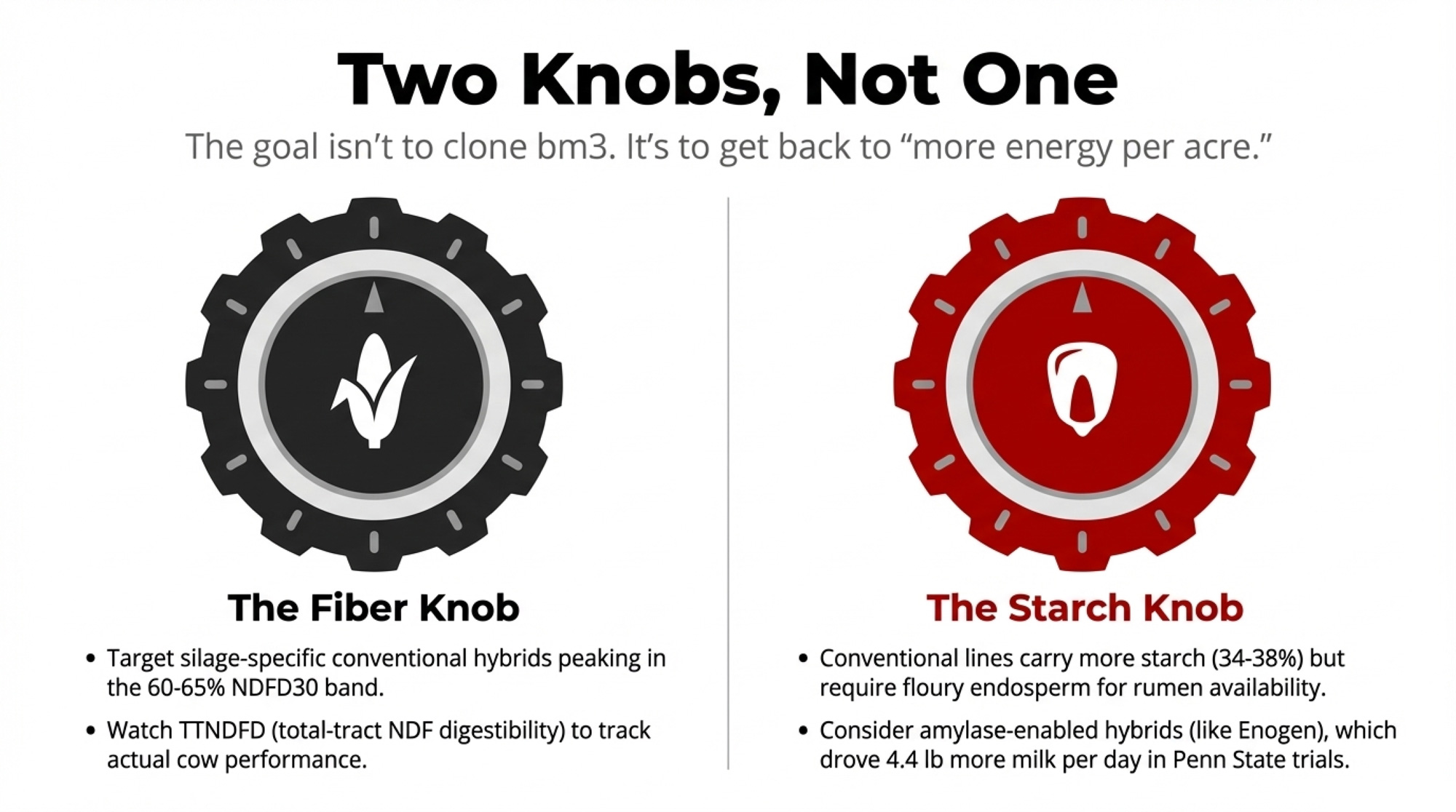
bM3 BMR silage comes in with higher NDFD but lower starch concentration than non-BMR counterparts. In some comparisons, high-yielding non-BMR silage hybrids produced more digestible NDF per acre and more starch per acre because their extra tonnage and grain compensated for slightly lower NDFD per ton.
Conventional silage hybrids today also tend to carry higher starch and more vitreous endosperm, which can hold back rumen starch digestibility if you miss on harvest maturity, kernel processing, or storage time. That’s pushed plant breeders to select for more floury endosperm in silage lines — starch that behaves more like a finisher corn than a flint.
Amylase-enabled hybrids like Enogen take a different route, building an alpha-amylase trait directly into the grain. In a Penn State feeding study where corn silage made up 40% of the diet dry matter, cows fed Enogen silage produced about 4.4 lb more milk per day with better feed efficiency at similar intakes. The seed premium varies by dealer and volume — get a quote and run it against your expected milk response before penciling the advantage.
That gives you two knobs when replacing BMR’s energy contribution:
- Fiber knob: Pick silage-specific conventional hybrids toward the top of the NDFD30 and TTNDFD range and pair them with plant populations and chop heights that protect digestibility.
- Starch knob: Favour hybrids with strong starch content and kernel texture that fits your system, and where the premium pencils, consider amylase-enabled genetics to pull more energy out of each ton.
The goal isn’t to clone bm3. It’s to get back to “more energy per acre” through a different genetic package.
Can Conventional Hybrids Really Close the Gap?
John Goeser, who works with large dairies through Progressive Dairy Solutions, has been blunt. “BMR corn silage sits in its own class for fiber digestibility,” he said, as reported by Dairy Herd Management in March 2026. “No current conventional hybrid matches it in the same way.”
The nuance lives in those last four words. UW–Madison’s hybrid data show conventional hybrids ranging roughly 47–67% NDFD30 and BMR hybrids roughly 54–74% NDFD30, depending on hybrid, environment, and location. There’s overlap — and Ducat’s own numbers hint at where. His conventional silage was already running 63 to 68 NDF30before BMR. That puts Deer Run’s conventional base squarely in the top tier of UW’s range. And it means Ducat’s telling Brownfield he sees BMR as worth the yield penalty specifically because it stacks on top of an already strong conventional program — not because his conventional base was weak.
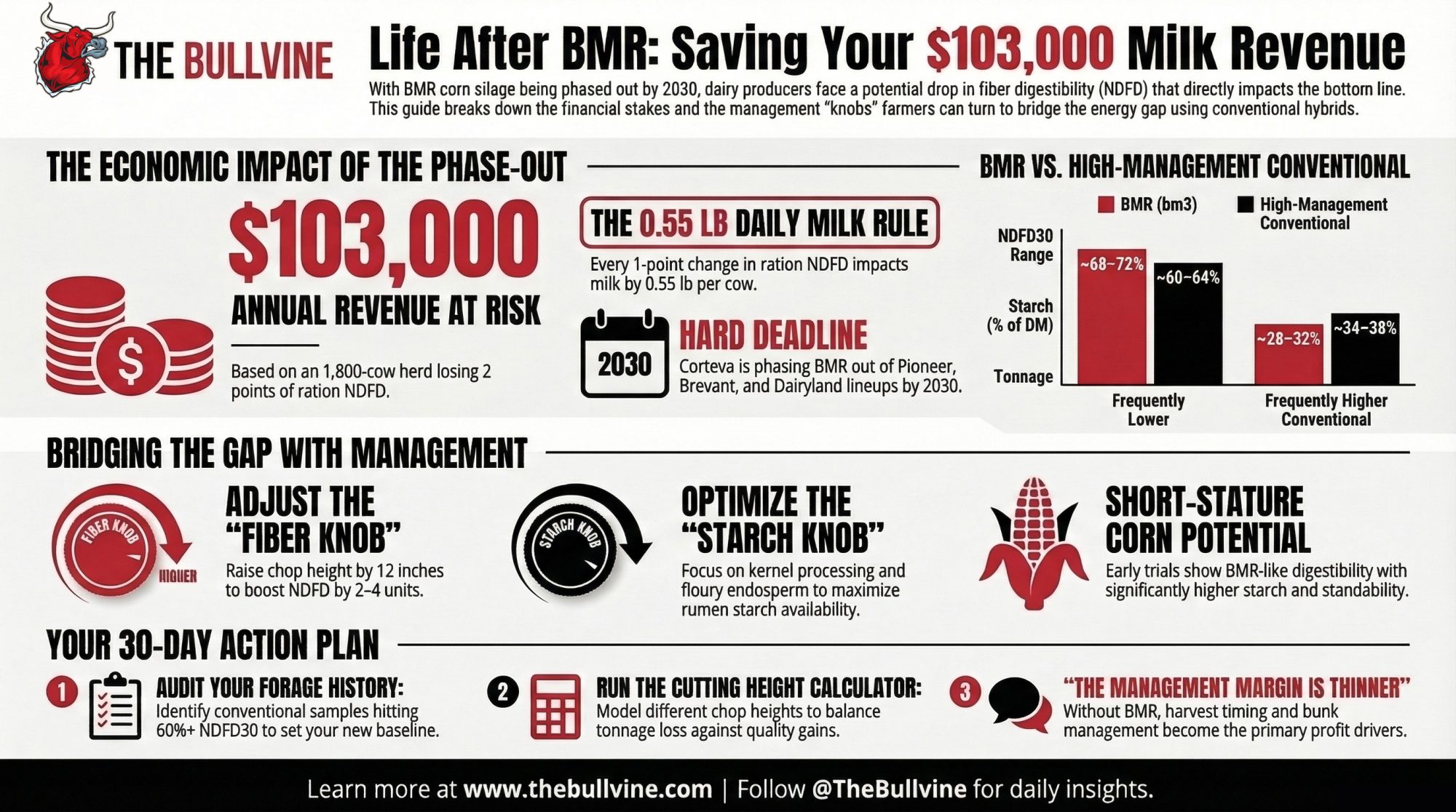
| Metric | BMR (bm3 focus) | High-Management Conventional |
| NDFD30 range | ~68–72% in good environments | ~60–64% for top silage-specific lines |
| Starch (% of DM) | ~28–32% | ~34–38% |
| Tonnage | Frequently lower | Frequently higher |
| Agronomic risk | Higher | Lower |
| Milk per ton | Higher (when fiber is limiting factor) | Competitive (when starch + NDFD balanced) |
Not every operation starts from Deer Run’s baseline. If your conventional silage has been running in the mid-50s, the gap to fill is a lot wider. But a top-end conventional hybrid that consistently tests in the 60–65% NDFD30 band can hang with an average BMR on predicted milk per ton once you account for its higher starch, lower uNDF, and yield advantage.
Chad Staudinger, agronomist with Dairyland Seed, has spoken publicly about that trade-off in the context of their conventional “high DF” silage line. “Our customers and our clientele, I think we’re not going to skip a beat,” he told Brownfield. “We’re going to move right into high DF and other products that show the benefits we need to feed our cattle and make milk and meat.”
On pure fiber digestibility curves, conventional won’t fully replace BMR. On milk per ton and milk per acre in a well-managed system, some of these hybrids get closer than the headlines suggest.
Does Raising the Chopper Bar — or Dropping the Seeding Rate — Really Pay?
Two of the biggest levers you can pull without changing seed are chop height and plant population. Both work by the same principle: diluting the lignified lower stalk that drags down digestibility.
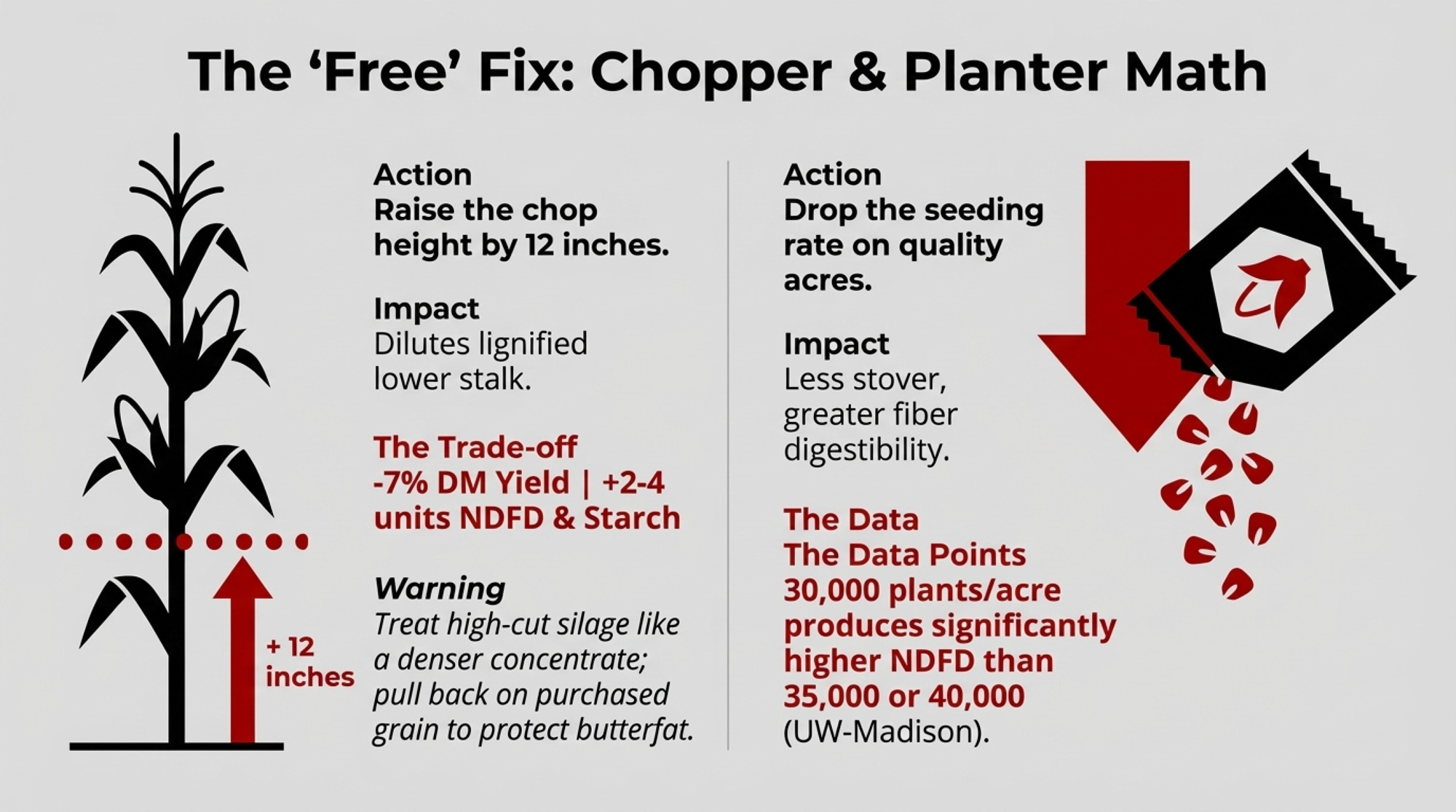
“When we increase chop height, all we are leaving in the field is extra stalk — maybe we are leaving one leaf,” Ferraretto explained at the 2026 MFA Symposium. “We are diluting the undigestible material and consequently have more fiber digestibility in the silage.” A 2018 meta-analysis from his Wisconsin team (Ferraretto et al., averaging seven studies) found that for each centimeter you raise cutting height, corn silage gains 0.08 units of starch and 0.08 units of NDFD — but you lose 0.05 Mg/ha of dry matter yield.
Penn State Extension pulled together 11 university and on-farm trials showing that raising chop height by about 12 inches cut DM yield roughly 7% while boosting starch and NDFD by 2–4 units, trimming predicted milk per acre only about 2%. In one high-yield year, high-cut silage actually produced more milk per acre and per ton.
| Cutting Height (inches) | NDFD30 Gain (pts) | DM Yield Loss (%) |
|---|---|---|
| 6 (baseline) | 0 | 0% |
| 9 | +1.0 | –2.5% |
| 12 | +2.0 | –5.0% |
| 15 | +3.0 | –7.5% |
| 18 | +4.0 | –10.0% |
But when Penn State put high-cut silage in front of cows, milk fat slipped from about 3.7% to 3.4% — likely because the ration’s effective fiber dropped when the forage got more energy-dense. The fix: when they reduced grain inclusion by 3 percentage units, holding ration energy constant, there were no differences in milk yield, fat, or protein. Treat high-cut silage like a more energy-dense forage and pull some purchased grain out. That’s how you keep milk steady and trade field biomass for a lower grain bill.
“I’m not trying to convince you that raising the chop height is not a good thing. I think it’s quite good, but it’s not BMR,” Ferraretto told the MFA crowd. “It’s different, and farmers have to realize that.”
On population, UW–Madison works with the Midwest Forage Association, which found that 30,000 plants per acre produced significantly higher NDFD than 35,000 or 40,000. Barry Visser, a nutritionist with Vita Plus, wrote in Dairy Star in November 2025 that “several farms have found success in improving the fiber digestibility of their conventional corn silage by controlling the planting population” — though quality responses “may not be consistent across different hybrids.”
Goeser reinforced the principle during a 2025 Hoard’s Dairyman webinar: “The more leafy tissue we have — the less midrib and the less stover we have — the greater fiber digestibility.” He also noted that while higher populations can boost yields, “this may negatively affect feed value.” Pioneer’s multi-year analysis using UW corn silage trial data found milk per acre peaked at about 41,000 plants, with NDFD only slipping about a point across the range. A one-point swing from population is a much smaller deal than a five-point swing from hybrid choice or harvest timing.
For a place like Deer Run, managing 3,200 crop acres, there’s room to run different populations on different fields — dialing back on the best ground to chase quality, pushing harder on marginal acres where tonnage matters more. Stop treating seeding rate as a single farm-wide number.
Ferraretto’s team has built a Corn Silage Cutting Height Calculator that lets you plug in your own yields, nutrient analyses, and proposed chop heights to estimate the impact on nutritive value, DM yield, and production cost per ton. The tool is based on a meta-analysis by Cole Diepersloot, Randy Shaver, and Ferraretto (presented at the XX International Silage Conference, Florida, 2025) and includes both imperial and metric tabs. Worth running those scenarios before a wet fall forces a seat-of-the-pants call at the edge of the field.
Why the Management Margin Just Got Thinner
When BMR was doing half the digestibility work, you could get away with “pretty good” on the rest of the silage decisions. That buffer is going away.
“Everything we can do to change fiber digestibility in corn silage reduces biomass that you bring to the silo,” Ferraretto said. “There is nothing out there that can increase fiber digestibility and keep — or increase — biomass.”
That pushes more weight onto levers that don’t require leaving tons in the field:
- Harvest timing: Hitting the right whole-plant dry matter and kernel milkline remains the biggest single driver of both NDFD and starch capture.
- Kernel processing: Across multiple UW and field studies, the kernel damage score shows up as the biggest factor in starch availability, regardless of hybrid. A wrench on the processor is cheaper than another load of corn.
- Packing and fermentation: Air pockets, poor face management, and visible spoilage will erase the NDFD and starch advantage you paid for with seed, fuel, and time.
More herds have started tracking TTNDFD — total-tract NDF digestibility — alongside NDFD30 because it ties better to intake and performance across the whole cow. Losing BMR nudges you from chasing one number on the forage report to managing TTNDFD plus starch digestibility as a package.
UW’s “Beyond BMR” factsheet also flags that BMR hybrids without modern insect traits may need heavier fungicide and insecticide programs to manage ear disease and mycotoxins — adding to the yield penalty you’re already absorbing. None of that is new science. What’s changed is the room for sloppiness. Without BMR as a backstop, those 2–3-point swings in NDFD30 from timing, processing, or bunk management start looking like real money — the kind of money in the barn math above. For mid-size operations already navigating tighter strategic margins, losing the BMR crutch means every other management lever has to work harder.
Is Short Corn the Next BMR?
When a silver bullet gets taken off the table, everybody hunts for the next one. Short-statured corn is the loudest candidate right now — and two Wisconsin operations are already testing the idea from different angles.
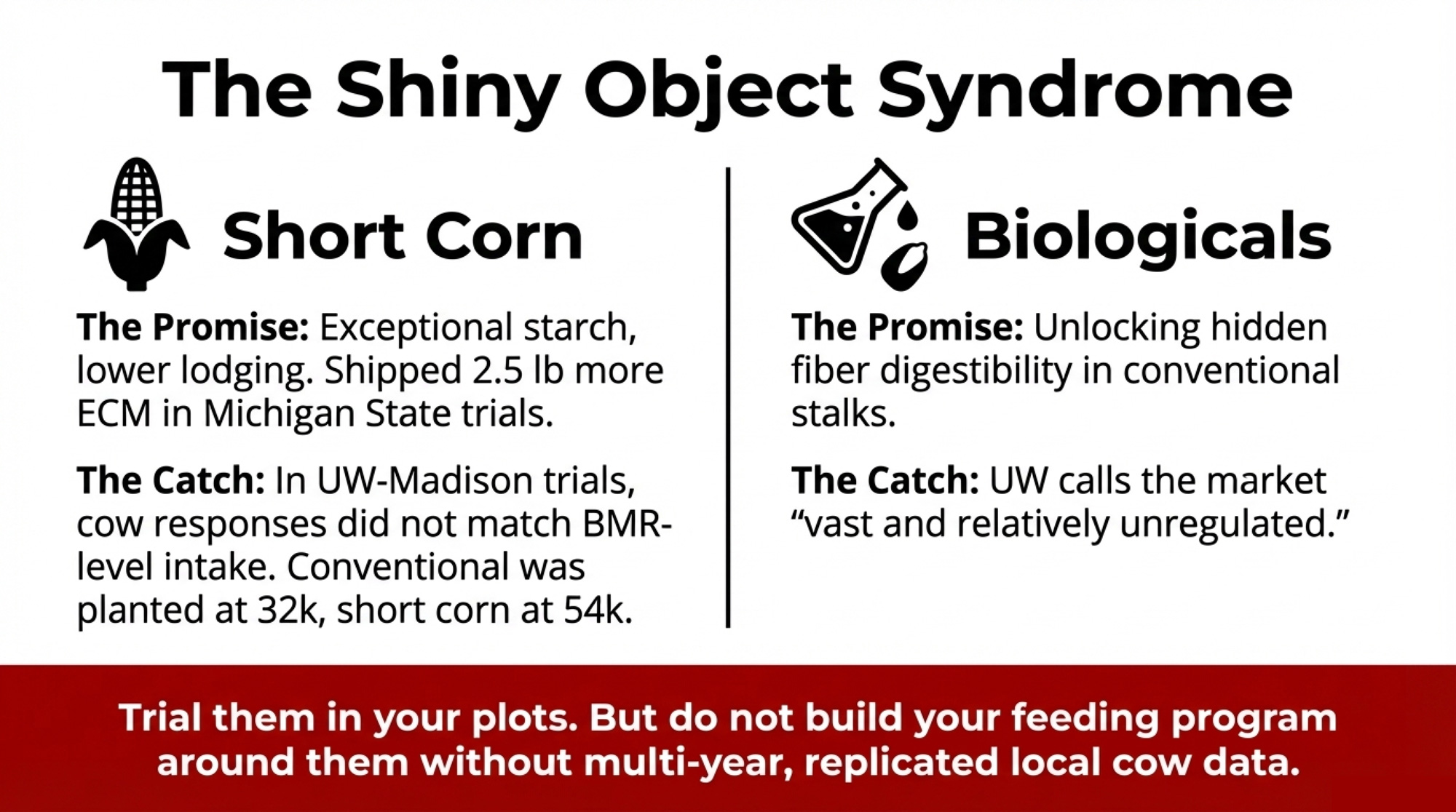
UW–Madison agronomist Harkirat Kaur’s early work suggests short-statured corn can post higher NDFD than standard-height hybrids while maintaining similar grain yield, largely because the plant carries less lignified lower stalk per ton. Iowa State’s 2024 report adds practical reasons for the buzz: short hybrids decrease lodging risk, improve standability, and let you run full-season ground rigs without worrying about tassel damage.
Andy DeVries, a silage farmer from Rosendale, Wisconsin, got an early look through Bayer’s Ground Breakers program. “Preceon delivered yields comparable to BMR, but with exceptionally high starch and similar digestibility,” DeVries shared during a January 2026 Ground Breakers session, as recounted by Bayer senior VP Elzandi Oosthuizen. “Watching Preceon silage go into the wagon made it easy to understand where that starch is coming from.” That field-level observation lines up with what Michigan State’s VandeHaar lab found when they put br2 short corn head-to-head against BMR — the br2 silage shipped 2.5 lb more ECM per cow per day than BMR in mid-lactation Holsteins, even though BMR still owned the NDFD column in the lab.
Ferraretto and Italian collaborators (Catellani et al., published in the Journal of Dairy Science, February 2026) compared short-statured silage to conventional in rations where corn silage sat at about 40% of dry matter. Nutrient analyses showed NDF digestibility and starch slightly higher for short corn — numbers that resembled BMR analyses, Ferraretto said. But the cow data told a different story.
“The question is, are cow responses similar to BMR? The answer is no,” he asserted at the MFA Symposium. Total milk production still improved, but there was no statistical difference in feed intake — suggesting a different biological mechanism. Here’s the catch: the conventional corn was planted at 32,500 seeds per acre, while the short corn was planted at 54,600.
“It’s very promising, but we have a lot to learn about it,” Ferraretto stated.
Biologicals — seed treatments, inoculants, foliar products — are the other hot category. UW’s “Beyond BMR” factsheet describes that market as “vast and relatively unregulated,” stressing that independent testing will be crucial. There’s nothing wrong with testing short corn or a biological in your own plots. The risk is treating either one like a guaranteed BMR replacement before you’ve seen multi-year, replicated data in your region.
What This Means for Your Operation
You don’t have to milk 1,800 cows to be in the same boat as Deer Run. If BMR has been part of how you buy room for higher forage rates and strong components, the clock is ticking.
In the next 30 days:
- Pull your last two years of forage tests. Circle every corn silage sample with NDFD30 at or above 60% and strong TTNDFD. Those results are your proof that non-BMR acres can carry a bigger share of the ration’s digestibility load.
- Sit down with your nutritionist and seed advisor. For every conventional or short-corn hybrid on the table, ask for multi-year local trial data — NDFD30, TTNDFD if available, starch, yield, and trait package. If a hybrid can’t consistently reach the high-50s to low-60s for NDFD30 in your environment, it doesn’t belong in your high-group bunk.
Before you plant:
- Decide which fields can trade a little tonnage for quality. On those acres, consider pulling plant population back toward 30,000–32,000 plants/acre and pairing that with higher chop height in a normal-or-better crop year.
- For each field, sketch a Plan A and Plan B chop height — one setting for when inventories and grain prices let you leave stalk, another for when you need every ton. Run both through UW’s cutting-height calculator so the decision is math, not a guess.
At harvest and feedout:
- Check kernel processing score early in the run, then again when crews are tired. Slowing the chopper or tightening a processor is cheaper than hauling more corn because starch is locked in whole kernels.
- Match your highest-quality lots to the groups where digestibility pays hardest. Let late-lactation cows and heifers eat the “nice but not great” silage.
- If you raise chop height, make sure your nutritionist adjusts for effective fiber — don’t trade butterfat for a few extra pounds of milk.
Over the next 12 months:
- Compare milk per ton, milk per acre, TTNDFD, and purchased feed costs from your first non-BMR crop against your last season with BMR.
- Where there’s still a shortfall, pin down exactly where it lives. Intake on the hottest days? Butterfat when you raised the chop height? Milk from fresh cows? Specific answers drive next year’s hybrid, population, and ration decisions — vague disappointment doesn’t.
| Timeline | Action Item | Why It Matters |
| Next 30 Days | Pull last 2 years of forage tests; circle every corn silage sample with NDFD30 ≥60% and strong TTNDFD. | Proves your non-BMR acres can carry more digestibility load. If you don’t have samples above 60%, your gap to BMR is wider than Deer Run’s. |
| Next 30 Days | Sit with nutritionist and seed advisor; demand multi-year local trial data (NDFD30, TTNDFD, starch, yield, traits) for every hybrid on the table. | If a hybrid can’t consistently hit high-50s to low-60s NDFD30 in your environment, it doesn’t belong in your high-group bunk. |
| Next 30 Days | Run UW’s Corn Silage Cutting Height Calculator for your fields (link in article). | Model Plan A and Plan B chop heights before fall—turn a cab decision into math. |
| Before Planting | Decide which fields trade tonnage for quality; pull population to 30k–32k plants/acre on those acres. | Dilutes lignified stalk, boosts NDFD ~1–2 points. Don’t treat seeding rate as farm-wide—vary by field goals. |
| Before Planting | Sketch Plan A (high-cut) and Plan B (standard-cut) chop heights by field; cost both scenarios in the calculator. | Wet fall or tight inventories kill high-cut plans. Have the math done ahead so you’re not guessing at harvest. |
| At Harvest | Check kernel processing score early in the run, then again when crews are tired. | A wrench on the processor is cheaper than hauling more corn because starch is locked in whole kernels. |
| At Harvest/Feedout | If you raise chop height, flag it for your nutritionist—don’t trade butterfat for milk. | Penn State saw milk fat slip from 3.7% to 3.4% on high-cut silage until they pulled 3 points of grain to rebalance effective fiber. |
| At Feedout | Match highest-quality silage lots to high-producing and fresh pens; let late-lactation and heifers eat “nice but not great” silage. | Digestibility pays hardest in groups where intake and milk yield are highest. Stop feeding one-size-fits-all TMR. |
| Over Next 12 Months | Compare milk/ton, milk/acre, TTNDFD, and purchased feed costs from first non-BMR crop vs. last BMR season. | Shows you exactly where the shortfall lives—intake on hot days? Butterfat? Fresh-cow milk? Specific answers drive next year’s seed plan. |
| Over Next 12 Months | Track forage test results monthly; flag any NDFD30 or TTNDFD drift below your baseline. | Early warning system. If quality slips mid-year, you can adjust ration or pull different silage lots before milk checks show the damage. |
| Ongoing | Trial short-statured corn or biologicals on 10–20 acres—but don’t build your program around them yet. | Promising, but multi-year replicated data doesn’t exist. Test them; don’t bet the farm on them. |
| Ongoing | Ask your nutritionist to calculate ration-level NDFD30, not just forage-level—that’s what drives milk response. | UW’s 0.55 lb milk per NDFD point is at the ration level. If corn silage is 40% of DMI, a 5-pt drop in silage = ~2-pt drop in ration NDFD. |
Key Takeaways
- Price your fiber insurance now. Using UW’s 0.55 lb/cow/day per ration NDFD point, a 2-point ration NDFD drop on a 1,800-cow herd works out to roughly $103,000/year at USDA’s 2026 Class III forecast of $17.05/cwt — scale for your own herd size and milk price.
- Your conventional baseline is the whole story. Ducat’s own program ran 63–68 NDFD30 before he added BMR — that’s the neighborhood you need to be in. Top silage-specific conventionals in the 60–65% NDFD30 range with strong starch and trait packages can compete with average bm3 on milk per ton and per acre. If your conventional sits in the mid-50s, the gap is wider and the urgency is higher.
- Treat chop height and plant population as ration levers, not just chopper settings. A ~12-inch bump in cutting height tends to shave ~7% off DM yield, boost starch and NDFD by 2–4 units, and trim milk per acre only ~2% — but the win only sticks if you rebalance for effective fiber or pull back on grain.
- Demand more than a plot tour from short corn and biologicals. DeVries saw promising starch and digestibility from Preceon, and VandeHaar’s lab found br2 shipped 2.5 lb more ECM than BMR — but Ferraretto’s own cow data didn’t match BMR-level responses, and multi-year replicated data across regions doesn’t exist yet. Trial them. Don’t build your feeding program around them.
The Bottom Line
Ducat’s 63-to-68 conventional baseline and 8-point BMR bump aren’t just Deer Run numbers — they’re a measuring stick. If you know where your conventional silage sits on that scale right now, you already know how much work you’ve got ahead of you. The tools to close most of that gap are already in your hands. What matters is whether you pick them up before Corteva’s timeline picks for you.
Learn More
- Unlock Hidden Dairy Profits Through Lifetime Efficiency: How Modern Genetics and Strategic Nutrition Can Cut Feed Costs by $251 Per Cow – Delivers a rigorous, 12-month implementation calendar that strips away operational waste and targets a $251-per-cow feed saving. It arms you with high-precision nutrition and calf-rearing tactics to transform your herd’s efficiency into a measurable, seven-figure competitive advantage starting Monday.
- USDA Says $18, Futures Say $16: The $150K Gap That’s Rewriting 2026 Dairy Budgets – Exposes the dangerous $150,000 revenue trap hiding in conflicting milk price forecasts and reveals why a $17-milk stress test is non-negotiable for 2026 budgets. This breakdown breaks down exactly how to shield your operation from market volatility over the next three years.
- br2 Short Corn Beat BMR: 2.5 lb More ECM on Mid-Lactation Cows – Reveals how short-stature br2 hybrids are already outperforming BMR on energy-corrected milk in real-world trials. This disruptor guide breaks down the “optionality” of short corn—giving you a silage-to-grain pivot that genetic giants like BMR simply cannot offer.