Cheese prices just jumped 10¢—tight milk supplies and rising feed costs demand smarter milk pricing and genomic testing strategies for better margins.
Executive Summary: The recent 10-cent surge in CME spot cheese prices shatters the complacency around milk pricing strategies, exposing outdated assumptions about supply and demand balance. This sharp rally, fueled by aggressive pre-holiday buying and tightening milk flows due to summer heat stress, signals a potential $1.00+/cwt lift in July Class III milk checks. Butter and powder markets remain steady, supporting Class IV values near $18.83/cwt, while feed costs hold firm with corn at $4.09/bu and soybean meal near $290/ton—pressuring margins but also incentivizing efficiency gains. Globally, U.S. dairy remains competitive thanks to a stable dollar and strong export demand from Mexico and Southeast Asia, contrasting with modest production growth in New Zealand and the EU. Progressive dairy operations that integrate genomic testing for feed efficiency and milk yield alongside proactive risk management will capitalize on these market dynamics. It’s time to challenge your pricing and production assumptions—are you ready to capture the upside?
Key Takeaways
Lock in premium milk pricing: The 10¢ cheese block rally could boost Class III milk checks by over $1.00/cwt in July, directly increasing farm revenue.
Optimize feed efficiency: With feed costs steady but high, genomic testing focused on feed conversion ratios can improve profitability by reducing input costs up to 5%.
Manage heat stress proactively: Summer heat is already curbing milk yield in key regions; implementing cooling strategies can preserve production and maintain butterfat percentages.
Leverage export demand: Strong international markets—especially Mexico and Southeast Asia—support powder and whey prices; aligning production to these trends can stabilize income streams.
Hedge with precision: Futures markets lag spot prices; using Dairy Revenue Protection (DRP) and options can safeguard margins amid volatile global conditions.
Today’s dramatic 10-cent surge in CME spot cheese blocks signals a major tailwind for farm milk prices. This rally, paired with steady butter and powder markets, points to a stronger July milk check and improved margins for producers, just as summer heat starts to pinch milk flows.
1. Key Price Changes & Market Trends
Product
Closing Price
Daily Change
30-Day Trend
Impact on Farmers
Cheese Blocks
$1.7200/lb
+10.00¢
+6.8%
Major Class III boost; higher premiums likely
Cheese Barrels
$1.6950/lb
+3.00¢
+4.1%
Reinforces cheese market strength
Butter
$2.6000/lb
+3.75¢
-1.5%
Supports Class IV; offsets powder weakness
NDM
$1.2525/lb
+0.25¢
+1.8%
Stable; export demand remains firm
Dry Whey
$0.5950/lb
+1.00¢
+3.5%
Adds bullish support to Class III
Commentary: Cheddar blocks rose sharply by 10 cents on robust trading volume (12 trades, nine bids), reflecting strong demand from both retail and foodservice channels ahead of the July 4th holiday. Barrels followed, confirming market-wide strength. Butter’s gain further supports Class IV, while NDM and whey prices remain steady, reflecting solid export demand. If spot cheese holds, July’s Class III could settle well above the current $17.75/cwt future.
2. Volume and Trading Activity
Trading Activity Summary:
Cheese Blocks: 12 trades, nine bids, zero offers; tight bid/ask spread indicates strong buying interest.
Cheese Barrels: 6 trades, one bid, one offer; moderate activity with firm undertone.
Butter: 3 trades, four bids, two offers; steady interest, slight upward price movement.
NDM: 1 trade, one bid, zero offers; minimal activity, stable pricing.
Dry Whey: 1 trade, six bids, one offer; increased bidding supports price uptick.
Notable Patterns: Cheese blocks exhibited the highest trading activity, with a tight bid/ask spread and aggressive buying. Butter and whey also saw increased bidding, suggesting processors are securing product ahead of holiday demand.
3. Global Context
Export Demand:
According to USDA Dairy Market News and recent USDA GAIN reports, U.S. NDM and whey exports remain strong, particularly to Mexico and Southeast Asia.
A stable U.S. dollar continues to support U.S. competitiveness in global dairy markets.
Global Production Trends:
New Zealand’s milk production has been seasonally steady, while the EU has reported modest year-over-year growth (European Commission Milk Market Observatory, June 2025).
These trends keep the global supply adequate but not excessive, supporting U.S. export opportunities.
International Benchmarks:
U.S. cheese prices are now competitive with European and Oceanian benchmarks, further stimulating export demand (USDA Dairy Market News, June 2025).
4. Forecasts and Analysis
USDA/CME Forecasts:
USDA projects Class III milk prices to average $18.50/cwt for Q3 2025, supported by strong cheese demand but tempered by higher feed costs (USDA Livestock, Dairy, and Poultry Outlook, June 2025).
CME July Class III futures settled at $17.75/cwt, but spot market strength suggests upside risk.
Class IV futures remain robust at $18.83/cwt, reflecting continued butter strength.
Actionable Insights:
If spot cheese prices persist, final July Class III settlements could exceed current futures, offering a pricing opportunity for unhedged milk.
Producers should monitor global weather and feed markets, as volatility could impact both input costs and export competitiveness.
5. Market Sentiment
General Sentiment:
The market is bullish on cheese, with traders citing “aggressive pre-holiday buying and robust foodservice demand” (Progressive Dairy, June 2025).
One Midwest cooperative analyst noted, “Processors are scrambling to secure product as summer heat crimps milk output and demand remains strong.”
Overall, the sentiment is optimistic but cautious, with an eye on the weather and export trends.
6. Closing Summary & Recommendations
Summary: Today’s CME dairy markets were led by a sharp cheese rally, supported by steady butter and powder prices. Trading activity was robust in cheese, with strong bidding across the board. Export demand and competitive global positioning continue to underpin U.S. dairy’s outlook.
Recommendations:
Consider forward contracting or Dairy Revenue Protection (DRP) for July/August milk to lock in gains.
Monitor feed markets and global production trends for margin management.
Engage with cooperatives on premium programs and stay alert for updates on FMMO reform.
7. Visuals and Formatting
Tables: Presented above for price and volume data.
Charts: (Recommended for publication) Line graph comparing Class III futures and USDA projections, bar chart of weekly cheese price trends.
Formatting: Bold section headers, green for price increases, red for decreases, Arial font, clear axis labels.
8. Handling Low-Activity Days
While today was high-volatility, on quieter days, focus on:
Weather forecasts and their impact on production.
Feed cost trends and global market developments.
Upcoming USDA reports or international trade policy changes.
Today’s cheese rally is a wake-up call—milk checks are poised to improve, but volatility remains. Use this window to lock in profits, review risk management, and stay nimble as summer weather and global demand continue to shape the market. For daily actionable insights and tools, keep TheBullVine.com as your go-to source—and let us know what’s working on your farm.
Complete references and supporting documentation are available upon request by contacting the editorial team at editor@thebullvine.com.
Every week, thousands of producers, breeders, and industry insiders open Bullvine Weekly for genetics insights, market shifts, and profit strategies they won’t find anywhere else. One email. Five minutes. Smarter decisions all week.
Global milk production surge triggers price avalanche – NZ output +8.3%, inventory crisis forces 119% auction volume spike. Your margins at risk.
EXECUTIVE SUMMARY: The global dairy market just delivered its clearest warning signal in years, with coordinated bearish indicators flashing red across three continents as record production surges collide with weakening demand. New Zealand’s explosive 8.3% year-over-year production increase in May 2025, combined with the United States’ 1.6% growth and the UK’s 5.8% surge, has created a supply tsunami that’s overwhelming global commodity markets. The upcoming Global Dairy Trade Event 383 reveals the true extent of this crisis, with offered volumes skyrocketing 119.3% for Anhydrous Milk Fat, 83.9% for butter, and 76.6% for Whole Milk Powder – unprecedented increases that signal desperate inventory clearing from the world’s largest dairy exporter. While European futures contracts have already declined 1.4% for SMP and 0.9% for butter, and GDT Pulse auctions show WMP prices crashing 3.2%, the most alarming indicator is New Zealand’s inventory crisis where record production meets faltering exports (down 5.7%), forcing a 2.5% year-over-year inventory build-up. China’s strategic shift away from WMP imports (-13%) toward SMP (+26%) and cheese (+22.7%) fundamentally disrupts traditional trade flows, leaving powder-focused exporters scrambling for buyers. Smart farmers must immediately pivot from revenue maximization to rigorous cost discipline and proactive risk management before tomorrow’s auction confirms this market correction’s devastating depth.
KEY TAKEAWAYS
Cost Structure Becomes Your Lifeline: With feed representing up to 60% of operational expenses, every efficiency gain matters when milk checks decline – review feed conversion ratios, optimize rations, and delay non-essential capital expenditures until market stability returns.
Component Strategy Offers Salvation: U.S. butterfat production surged 3.4% year-over-year while average butterfat tests climbed from 3.95% to 4.36% since 2020, with premium payments averaging $0.75-$1.25 per hundredweight above base prices – invest in genomic testing and nutrition programs that boost milk components rather than just volume.
Geographic Risk Concentration Demands Hedging: The Anglosphere production explosion (NZ +8.3%, UK +5.8%, US +1.6%) while EU constrains output creates unprecedented commodity price pressure – utilize CME Class IV futures and explore processor forward contracting programs to lock in current pricing before further erosion.
Inventory Pressure Creates Sustained Headwinds: New Zealand’s 15,500 additional metric tonnes flooding tomorrow’s GDT auction represents production from roughly 50,000 cows over one month – this isn’t temporary volatility but structural oversupply requiring 12-18 months for market rebalancing.
Revenue Diversification Becomes Critical: With three-quarters of U.S. dairy farmers expecting 2025 profitability partly due to beef-on-dairy programs generating fed steer prices at $201/cwt, explore ancillary income streams beyond traditional milk marketing to build financial buffers against commodity cycles.
Coordinated bearish indicators across major dairy exchanges point to significant farmgate price declines, with New Zealand milk production surging 8.3% while exports fall 5.7%, creating unprecedented inventory pressure ahead of critical auction events.
Global dairy commodity markets are flashing synchronized warning signals as of June 30, 2025, with multiple price discovery mechanisms indicating an imminent market correction that will likely translate to reduced farmgate milk prices within weeks. The convergence of negative indicators spans from New Zealand’s benchmark Global Dairy Trade auctions to European futures markets and Asian exchanges, suggesting fundamental supply-demand imbalances rather than regional volatility.
Market analysis reveals milk production increases concentrated in key exporting nations, while inventory accumulation forces sellers to flood upcoming auctions with record volumes, creating conditions for significant price deterioration that will impact dairy operations globally.
Global Dairy Trade auction prices show dramatic decline through June 2025, with WMP falling 8.5% and SMP down 6.6% from peaks
Auction Results Confirm Widespread Price Weakness
The Global Dairy Trade Pulse auction delivered decisive confirmation of weakening sentiment, with Whole Milk Powder prices declining 3.2% and Skim Milk Powder falling 2.5% from the previous trading event. This marked the third consecutive decline in the overall GDT price index, with Event 382 on June 17 showing WMP falling to $4,084 per metric tonne and SMP declining to $2,775 per metric tonne.
The weakness extends beyond New Zealand’s benchmark platform. European EEX futures contracts spanning July 2025 to February 2026 show butter futures declining 0.9% while SMP futures dropped 1.4%. Singapore Exchange data reinforces the global nature of this correction, with SMP futures trading 0.8% lower and butter contracts down 0.2%.
European spot markets validate the immediate price pressure. The official EEX butter index fell 0.5% (€37) to €7,470 per tonne in the final week of June, while the SMP index declined 1.2% (€30) to €2,400 per metric tonne.
Production Surge Creates Perfect Storm
New Zealand leads explosive milk production growth at +8.3% while European Union faces production constraints
The fundamental driver behind widespread price weakness is a formidable supply surge from major dairy exporting nations, with May 2025 data revealing synchronized increases that overwhelm current demand levels.
New Zealand, controlling approximately 40% of globally traded dairy products, finished its 2024/25 season with a stunning 8.3% year-over-year jump in May milk collections. This represents approximately 185 million additional liters compared to May 2024, equivalent to the entire monthly output of a mid-sized European operation.
United States milk production rose 1.6% year-over-year in May, continuing to push total 2025 collections up 1.1%, according to USDA data. The USDA reports the 24 major dairy states produced 19.1 billion pounds of milk in May, with production per cow averaging 2,125 pounds in major producing states.
The United Kingdom reported a substantial 5.8% increase in May volumes, reaching 1,458 million liters—an additional 78 million liters compared to May 2024. Favorable spring conditions and strong dairy economics drove this surge.
What This Means for Farmers: The geographic concentration of supply increases in the world’s three largest dairy exporters creates unprecedented pressure on global commodity prices, directly impacting milk pricing formulas tied to international benchmarks.
Inventory Crisis Forces Market Breaking Point
Perhaps most concerning is New Zealand’s developing inventory crisis, where record production collides with faltering export demand. While May production exploded 8.3% higher, New Zealand’s milk equivalent exports simultaneously fell 5.7%. This disconnect has caused estimated dairy product inventories to rise 2.5% year-over-year.
The inventory pressure manifests dramatically in the upcoming GDT Event 383, with offered volumes reaching crisis levels:
Anhydrous Milk Fat: Up 119.3% to 4,670 metric tonnes
Butter: Volume increased 83.9% to 2,290 metric tonnes
Whole Milk Powder: 76.6% increase to 12,345 metric tonnes
Skim Milk Powder: 63.6% jump to 4,200 metric tonnes
These volume increases represent approximately 15,500 additional metric tonnes being offered compared to the previous auction, equivalent to the milk production from roughly 50,000 cows over one month.
Regional Market Divergence Complicates Outlook
Despite global commodity weakness, regional markets show significant divergence, reflecting varying demand structures. The USDA Economic Research Service maintains its 2025 all-milk price forecast at $21.95 per hundredweight, up $0.35 from previous estimates, reflecting strong domestic U.S. demand rather than export commodity strength.
U.S. cheese production runs at record daily averages, with cheese exports surging 6.7% while nonfat dry milk/SMP exports fell 20.9% in April. This demonstrates the market’s bifurcation between value-added products commanding premium prices and commodity powders facing oversupply.
European production constraints offer some market balance. Germany’s milk production declined 1.8% year-over-year while the Netherlands saw a 0.5% decrease, reflecting environmental regulations and structural challenges limiting expansion capacity.
China Demand Shift Adds Market Complexity
Chinese import patterns reveal a mature buyer making selective choices rather than broad-based purchasing. May data shows that overall, Chinese dairy imports in milk solids equivalent terms declined by 1.2% year-over-year, with WMP imports—New Zealand’s flagship product—plunging by 13%.
However, Chinese SMP imports soared 26% year-over-year while cheese imports jumped 22.7%, indicating structural demand shifts favoring EU and U.S. suppliers over New Zealand’s powder-focused export strategy.
According to Rabobank analysis, “Middle East buyers increased their purchases by 25% year-over-year in the recent Global Dairy Trade auction,” highlighting regional demand variations.
Advanced dairy management systems are helping producers optimize operations despite market pressures. Research indicates precision agriculture adoption has increased significantly among large-scale operations, with automated milking systems showing 12-15% improvements in labor efficiency.
Genomic testing utilization has grown substantially in registered dairy cattle across major producing regions, with genetic improvements averaging meaningful gains annually. These advances translate to approximately 300-500 pounds additional milk production per cow per lactation, partially offsetting margin pressure from declining commodity prices.
Component Focus Drives Strategic Shifts
US dairy farmers achieve 4.36% butterfat and 3.40% protein levels, unlocking premium payments worth $18,750-$31,250 annually per 1,000-cow operation
The market’s increasing emphasis on milk components—butterfat and protein—creates opportunities amid commodity weakness. U.S. butterfat production surged 3.4% year-over-year in the first quarter of 2025, with average butterfat tests climbing from 3.95% in 2020 to 4.36% by March 2025.
Research published in Nutrition Research demonstrates that consuming whole milk was associated with improved body composition outcomes, supporting premium positioning for high-component products. Premium payments for high-component milk average $0.75-$1.25 per hundredweight above base prices, providing partial insulation from commodity volatility for producers optimizing genetic selection and nutritional management.
Market Outlook and Industry Implications
Market analysts from RaboResearch expect production growth from key exporting regions to accelerate, with milk production from the ‘Big 7’ countries projected to grow by more than 1% in 2025. This represents the largest annual volume increase since 2020, creating sustained pressure on global pricing mechanisms.
However, demand uncertainty remains elevated. As RaboResearch senior dairy analyst Mary Ledman notes, “Consumers across the globe have been under budgetary pressure. Retail dairy prices have been mixed around the world”.
The Latest
Tuesday’s GDT Event 383 represents a definitive market test with massive volume increases forcing acceptance of lower bids to clear accumulated New Zealand inventory. The confluence of synchronized production surges, inventory pressure, and weakening futures sentiment creates sustained downward price pressure extending into 2026.
Market analysts expect the supply-demand imbalance to require 12-18 months for correction, as demand growth must absorb expanded production capacity. For dairy farmers globally, the immediate priority shifts from revenue maximization to rigorous cost management and proactive risk mitigation strategies.
The structural nature of this correction—concentrated in export-oriented nations flooding global markets—suggests producers must prepare for extended margin pressure rather than temporary volatility. Tomorrow’s auction results will confirm this market downturn’s depth and likely duration, setting the tone for dairy economics through mid-2026.
Complete references and supporting documentation are available upon request by contacting the editorial team at editor@thebullvine.com.
Every week, thousands of producers, breeders, and industry insiders open Bullvine Weekly for genetics insights, market shifts, and profit strategies they won’t find anywhere else. One email. Five minutes. Smarter decisions all week.
Component premiums are rewiring dairy economics—FMMO reforms + $2,870 heifer costs = dual-purpose strategy goldmine. Are you ready for December’s game-changer?
Executive Summary: The dairy industry’s most significant structural transformation in decades is happening right now, and most producers are missing the massive profit opportunity hiding in plain sight. Our comprehensive June 26th market analysis reveals how FMMO reforms and record $2,870 replacement heifer costs are creating a dual-purpose genetic goldmine that smart operators are already capitalizing on. With component premiums set to explode in December 2025 (3.3% protein, 6.0% other solids), the producers focusing on milk quality over quantity are positioning themselves for $1.20+/cwt milk check increases. Meanwhile, beef-on-dairy programs are generating 10-15% of total farm income, with day-old calves selling for $900+, fundamentally transforming the economics of herd management. The convergence of favorable feed costs, processing capacity investments exceeding $8 billion, and the component economy’s arrival means traditional volume-focused strategies are becoming financial suicide. This isn’t just another market report—it’s your roadmap to navigating the “new normal” where components trump volume and dual-purpose genetics become essential for survival. Stop betting on outdated strategies and capitalize on the component revolution that’s reshaping dairy profitability forever.
Key Takeaways
Component Focus Delivers Immediate ROI: FMMO reforms reward 3.3% protein and 6.0% other solids starting December 1st, with early adopters already seeing $1.20+/cwt premiums—audit your genetics and nutrition programs now to capture these gains before your competitors wake up
Beef-on-Dairy Transforms Economics: With replacement heifers hitting record $2,870/head, strategic beef semen use on lower-tier genetics generates $900+ day-old calf values, creating 10-15% of total farm income while eliminating replacement costs
Feed Cost Advantage Creates Margin Cushion: Current corn at $4.04/bushel and declining soybean meal costs are projected to reach yearly lows in June, improving income over feed costs (IOFC) and reducing DMC payments—lock in these favorable costs through long-term contracts
Processing Capacity Boom Drives Component Demand: Over $8 billion in new cheese-focused processing infrastructure coming online through 2026 creates unprecedented demand for component-rich milk, positioning quality-focused producers for premium pricing power
Heat Stress Mitigation = Competitive Advantage: With above-average temperatures forecasted and smaller farms (under 100 head) most vulnerable to 15-20% yield losses, investing in cooling systems and strategic calving schedules protects margins while competitors suffer production declines
Today’s CME dairy markets saw modest gains in butter and barrel cheese, while blocks and nonfat dry milk remained stable. The primary takeaway for dairy operations is the continued emphasis on milk components, especially with the new Federal Milk Marketing Order rules now active, which are fundamentally reshaping how milk is valued.
Today’s Price Action & Farm Impact
Product
Price
Daily Change
Weekly Trend
Trades
Bids
Offers
Impact on Farmers
Butter
$2.5375/lb
+1.75¢
-0.4%
7
12
5
Positive for Class IV milk checks; strong demand
Cheese Blocks
$1.6100/lb
Unchanged
-6.5%
17
3
1
Class III outlook pressured by recent block weakness
Cheese Barrels
$1.6375/lb
+1.00¢
-5.4%
1
1
1
Modest support for Class III, but overall trend down
NDM Grade A
$1.2500/lb
Unchanged
-1.5%
0
0
0
Stable, but weak export demand remains a concern
Dry Whey
$0.5775/lb
+1.00¢
+4.2%
0
3
1
Supports Class III; strong demand for protein products
Market Commentary: Today’s session witnessed butter continuing its upward momentum with active trading (7 completed trades) and strong bidding interest (12 bids vs. five offers), indicating solid processor demand for inventory building. The significant bid-offer imbalance in butter markets suggests continued strength ahead.
Cheese blocks showed resilience after recent declines, with substantial trading activity (17 trades) but limited bidding interest (3 bids vs. one offer), reflecting cautious market participation. The barrel market saw minimal activity (1 trade) but managed a modest gain, suggesting some underlying support despite the constrained trading environment.
Market Sentiment & Industry Voice
Trading activity patterns reveal a market in transition. As one market observer noted in recent analysis, “retail cheese buyers have ‘gone dark,’ waiting for further price declines before re-entering the market”. This cautious approach from buyers explains the limited bidding activity in cheese markets despite relatively stable prices.
The broader sentiment reflects what industry analysts describe as a “decoupling” from global dairy strength. U.S. markets are experiencing unique pressures despite the FAO Dairy Price Index showing 21.5% year-over-year gains globally.
Feed Cost & Margin Analysis
Current Feed Costs:
Corn (July): $4.0400/bushel (-1.25¢)
Corn (December): $4.2100/bushel
Soybeans (August): $10.2950/bushel
Soybean Meal (August): $275.20/ton (-$4.40)
Margin Outlook: Feed costs are projected to reach their lowest point for the year in June, with mostly flat feed costs for the remainder of 2025. This improving relationship between milk revenue and feed costs leads to better income over feed costs (IOFC), with lower feed costs projected to decrease Dairy Margin Coverage (DMC) payments in 2025.
Production & Supply Insights
Milk Production Trends: U.S. milk production reached 19.9 billion pounds in May 2025, marking a 1.6% year-over-year increase with the national dairy herd expanding to 9.45 million head. Component quality continues hitting records, with average butterfat levels reaching 4.40% and protein 3.40% in 2025.
Weather Impacts: June 2025 outlook favors well above average temperatures across most dairy regions, presenting significant heat stress risks that could curtail the typical late-spring/early-summer production strength.
Regional Dynamics: The “Great Dairy Migration” continues with Texas milk production surging 10.6% year-over-year, while California faces a 9.2% decline due to H5N1 impacts affecting approximately 650 herds.
Market Fundamentals Driving Prices
Domestic Demand: The most concerning factor remains the collapse in domestic cheese consumption, which declined 56 million pounds in Q1 2025. Restaurant traffic weakness continues to dampen foodservice demand, with sales declining from $97.0 billion in December to $95.5 billion.
Export Markets: While global dairy prices show strength, U.S. markets face export challenges. China’s temporary tariff reduction from 125% to 10% on certain U.S. dairy products provides only short-term relief, as the 90-day pause could be reversed. Butterfat exports surged 41% in January 2025, while skim-based products faced continued weakness.
Processing Capacity: Over $9 billion in new processing capacity is coming online through 2026, adding approximately 55 million pounds per day of production capability. Much of this capacity focuses on cheese production, driving demand for component-rich milk.
FMMO Implementation Impact
The June 2025 FMMO reforms represent significant structural changes. Key updates include:
Class I Location Differentials: Increased significantly (Cuyahoga County example: from $2.00/cwt to $3.80/cwt)
“Higher-of” Formula: Class I skim milk price now uses the higher of Class III or Class IV advanced values
Make Allowances: Updated across all categories, with cheese make allowances increasing processors’ margins
Barrel Cheese Removal: 500-lb barrels removed from Class III pricing, making block prices solely determinant
The Class I advanced price for June in Cuyahoga County reached $21.26/cwt, up from $20.57/cwt in May, while Class IV advanced milk price decreased nearly $0.60/cwt.
Forward-Looking Analysis
USDA Forecasts: The USDA’s June 2025 forecast shows an all-milk price of $21.95/cwt (+$0.35 increase), with Class III at $18.65/cwt and Class IV at $18.85/cwt. For 2026, projections moderate to $21.30/cwt all-milk price.
CME Futures Settlement:
Class III (July): $17.06/cwt
Class IV (July): $18.83/cwt
Cheese (July): $1.7460/lb
Butter (July): $2.5810/lb
Regional Market Spotlight: Component Strategy
With FMMO reforms rewarding higher protein (3.3%) and other solids (6.0%) from December 1, 2025, the focus intensifies on breeding and nutrition programs to boost component yields. Current record component levels (4.40% butterfat, 3.40% protein) demonstrate the industry’s successful pivot toward value-added production.
Actionable Farmer Insights
Immediate Actions:
Component Focus: Audit genetics and nutrition programs to optimize for December FMMO changes
Risk Management: Monitor basis risk between classified prices and actual mailbox prices due to make allowance changes
Heat Stress Preparation: Implement cooling systems ahead of forecasted above-average temperatures
Strategic Planning:
Dual-Purpose Genetics: Leverage beef-on-dairy opportunities with record replacement heifer costs
Forward Contracting: Consider establishing price floors through processors, given current volatility
Feed Cost Management: Lock in favorable feed costs through long-term contracts
Industry Intelligence
Processing Investment: The current $8+ billion investment wave in processing infrastructure continues, with substantial daily capacity additions through 2026 focused on cheese production.
Technology Integration: Farm-level innovations, including smart monitoring systems and precision feeding, offer measurable ROI within 7-18 months.
The Bottom Line
Today’s mixed dairy market signals reflect a fundamental industry transformation toward component-driven economics. While butter’s strength (+1.75¢) and active trading demonstrate solid processor demand, cheese markets remain under pressure despite stable block prices. The critical factor is the December 1st FMMO component implementation, which will dramatically reward operations optimizing for 3.3% protein and 6.0% other solids.
Complete references and supporting documentation are available upon request by contacting the editorial team at editor@thebullvine.com.
The Future of Dairy Farming: Embracing Automation, AI, and Sustainability in 2025 – Demonstrates practical technology solutions for heat stress mitigation and precision feeding that directly support component optimization strategies, offering ROI-focused automation tools that complement FMMO reforms and dual-purpose genetic programs.
The Sunday Read Dairy Professionals Don’t Skip.
Every week, thousands of producers, breeders, and industry insiders open Bullvine Weekly for genetics insights, market shifts, and profit strategies they won’t find anywhere else. One email. Five minutes. Smarter decisions all week.
Cheese collapse signals 20% margin compression—but smart producers are pivoting to component premiums while others panic. $12/cwt reality check inside.
EXECUTIVE SUMMARY: The dairy industry’s “structural reckoning” has arrived, and it’s not the cyclical downturn most producers expected—it’s a fundamental shift that’s separating survivors from casualties. Despite corn trading 37% below 2023 highs, income-over-feed margins are plummeting below $12/cwt through August 2025, representing a crushing 20% compression that’s devastating unprotected operations. While domestic cheese consumption collapsed 56 million pounds in Q1 2025 and retail buyers have “gone dark,” component-adjusted production surged 3.0%—creating a $1.50/cwt premium opportunity for producers who understand the new rules. The market’s message is crystal clear: volume-centric thinking is dead, and the 9.45 million head national herd expansion is rewarding only those optimizing for butterfat (4.40%) and protein (3.40%) content. With July Class III futures crashing from $18.67 to $17.00/cwt in 48 hours, producers have exactly that long to implement DRP coverage or face potential $1.75/cwt additional pressure. This isn’t fear-mongering—it’s mathematical reality in a market where processing capacity is expanding faster than demand can absorb it. Stop chasing yesterday’s volume metrics and start maximizing today’s component premiums before your operation becomes another consolidation statistic.
KEY TAKEAWAYS
Component Premium Goldmine: Butterfat levels hitting 4.40% and protein at 3.40% are generating $0.75-$1.50/cwt premiums while fluid volume producers face margin compression—shift breeding and feeding strategies from volume to value within 30 days to capture this widening opportunity gap.
48-Hour Risk Management Window: With Class III futures dropping $1.67/cwt in two days and domestic cheese buyers completely withdrawing from markets, implementing Dairy Revenue Protection coverage for Q3/Q4 production isn’t optional—it’s survival economics against projected $1.25-$1.75/cwt additional pressure.
Feed Cost Arbitrage Play: Lock corn contracts below $4.60/bushel and soybean meal under $300/ton immediately—while feed represents your largest variable cost at 37% below 2023 highs, the revenue collapse is outpacing input savings by 3:1, making strategic procurement your only controllable margin variable.
Geographic Reality Check: Texas milk production surging 10.6% year-over-year while California drops 9.2% due to H5N1 impacts means transportation costs and regional pricing differentials are creating $2-3/cwt location advantages—evaluate your processing infrastructure alignment before competitors capture your local premium.
Export Market Lifeline: With U.S. markets decoupling from 21.5% global dairy price strength and China’s temporary tariff reduction from 125% to 10% lasting only 90 days, securing export-focused processor relationships now could determine whether you’re selling into $1.61/lb domestic weakness or $1.95/lb international strength.
Cheese blocks stage modest recovery with 1.5¢ gain, but weekly losses still exceed 5¢ as domestic buyers remain cautious. Class III futures hold near $17/cwt amid continued supply-demand imbalances threatening farm profitability through August.
Today’s Price Action & Farm Impact
Product
Price
Daily Change
Weekly Trend
Impact on Farmers
Cheese Blocks
$1.61/lb
+1.5¢
-10.4¢ (-6.1%)
Modest relief from severe Class III pressure
Cheese Barrels
$1.63/lb
+1.25¢
-9.4¢ (-5.4%)
Slight improvement in protein values
Class III (JUL)
$16.97/cwt
-$0.01
-$1.28 (-7.0%)
July milk checks under continued pressure
Butter
$2.52/lb
-1.5¢
-2.7¢ (-1.1%)
Limited Class IV support weakening
NDM Grade A
$1.25/lb
No Change
-1.9¢ (-1.5%)
Export demand is steady but fragile
Dry Whey
$0.57/lb
-0.5¢
+1.3¢ (+2.3%)
Protein markets showing relative stability
Market Commentary: Today’s cheese market provided a glimmer of hope after a devastating two-week selloff that erased over 15¢ from block values. The 17 trades in blocks represented the most active session of the week, suggesting some buyers may be testing the waters near current levels. However, the modest 1.5¢ recovery does little to offset the cumulative damage to Class III valuations, with July futures still trading below $17/cwt. The continued weakness in butter, dropping 1.5¢ today, limits any meaningful support for Class IV milk prices.
Trading Activity & Market Sentiment
Volume Analysis: Trading activity showed signs of life with 17 cheese block transactions compared to previous sessions with minimal activity. However, overall market participation remains extremely low, with bid-ask spreads widening considerably across all products.
Market Voice – Industry Perspective: According to comprehensive market analysis from industry sources, “retail cheese buyers have reportedly ‘gone dark,’ awaiting further price declines before making new purchases”. This institutional withdrawal from the market explains the persistent weakness despite modest production adjustments.
A dairy risk management consultant emphasized the urgency of current conditions, stating that producers should “implement DRP coverage for Q3/Q4 production within 48 hours” due to the rapid deterioration in market fundamentals. This unprecedented timeline reflects the severity of margin compression facing dairy operations.
Export market dynamics are also shifting, with reports indicating that “Mexican buyers are becoming more selective on pricing”, despite Mexico representing $2.47 billion in annual U.S. dairy purchases. This selectivity signals broader international pressure on U.S. competitiveness.
Feed Cost & Margin Analysis
Current Feed Situation:
Corn (September): $4.05/bushel – down 6¢ from Tuesday, offering continued cost relief
Soybean Meal (August): $279.60/ton – down $7.10 from Tuesday, providing protein cost savings
Milk-to-Feed Ratio: Currently under severe compression despite favorable feed costs
Margin Reality Check: Despite corn trading 37% below 2023 highs and soybean meal remaining manageable, income-over-feed costs are projected to plummet below $12/cwt through August 2025. This represents a crushing 20% margin compression that demands immediate attention from producers. The paradox of favorable feed costs coupled with collapsing milk revenues underscores that the current crisis is demand-driven, not cost-driven.
Production & Supply Insights
Production Surge Continues: U.S. milk production reached 19.9 billion pounds in May 2025, marking a 1.6% year-over-year increase with the national dairy herd expanding to 9.45 million head – the largest since 2021. This growth, driven by light culling rates and strong beef-on-dairy calf values, creates significant supply pressure in an already oversupplied market.
Component Quality Hits Records: Average butterfat levels reached 4.40% and protein 3.40% in 2025, with component-adjusted production surging 3.0% in April. While processors benefit from higher manufacturing yields, the increased cheese and powder production volume exacerbates the oversupply situation.
Regional Dynamics: The “Great Dairy Migration” continues with Texas milk production surging 10.6% year-over-year, while California faces a 9.2% decline due to H5N1 impacts affecting approximately 650 herds. This geographic shift creates infrastructure mismatches that could pressure local milk pricing.
Market Fundamentals Driving Prices
Domestic Demand Crisis: The most concerning factor remains the collapse in domestic cheese consumption, which declined 56 million pounds in Q1 2025. Reports indicate retail cheese buyers have “gone dark,” waiting for further price declines before re-entering the market. Restaurant traffic weakness continues to dampen foodservice demand, with sales declining from $97.0 billion in December to $95.5 billion.
Export Market Volatility: While global dairy prices show strength with the FAO Dairy Price Index up 21.5% year-over-year, U.S. markets are experiencing a concerning “decoupling” from global strength. China’s temporary tariff reduction from 125% to 10% on certain U.S. dairy products provides only short-term relief, as the 90-day pause could be reversed.
Processing Capacity Expansion: Over $9 billion in new processing capacity is coming online through 2026, adding approximately 55 million pounds per day of production capability. While positive in the long term, this expansion adds to near-term supply pressure as demand struggles to keep pace.
Forward-Looking Analysis
Class III Outlook: July Class III futures at $16.97/cwt reflect the market’s pessimistic assessment of near-term fundamentals. The USDA’s more optimistic projection of $18.65/cwt for 2025 appears increasingly disconnected from trading reality. August futures at $17.71/cwt suggest only modest improvement in the coming months.
Seasonal Risk Factors: NOAA forecasts well above-average temperatures across most of the Lower 48 states, which could trigger 8-12% production losses in key regions due to heat stress. While this might provide some supply relief, the same weather patterns threaten feed crop yields, potentially squeezing margins from the cost side.
H5N1 Monitoring: With nearly 1,000 herds across 17 states reporting infections, the virus continues to create localized supply disruptions. Mathematical modeling suggests outbreaks will persist through 2025, with Arizona and Wisconsin identified as the highest-risk states.
Regional Market Spotlight: California vs. Southern Plains
California Struggles: The Golden State’s 9.2% production decline represents a significant shift from historical patterns. H5N1 impacts on 650 herds, combined with ongoing regulatory pressures, are accelerating the migration of production to more business-friendly regions.
Southern Plains Boom: Texas, Kansas, and South Dakota continue their explosive growth, with Kansas posting a remarkable 15.7% increase in May production. However, this rapid expansion is outpacing processing infrastructure, creating potential bottlenecks and local pricing pressures.
Within 48 Hours – Critical Risk Management: Immediately implement Dairy Revenue Protection (DRP) coverage for Q3/Q4 production . With income-over-feed costs projected below $12/cwt, this represents the most important financial survival action . The cheese market collapse signals potential $1.25-$1.75/cwt additional Class III pressure.
Next 7 Days – Component Optimization Strategy: Focus breeding and feeding programs on maximizing butterfat and protein content. With component-adjusted production surging while fluid volumes remain modest, the market is rewarding quality over quantity. Target butterfat levels of 4.50%+ to capture $0.75-$1.50/cwt pricing premiums.
Within 30 Days – Strategic Feed Procurement: Lock in favorable feed costs by securing corn contracts below $4.60/bushel and soybean meal under $300/ton while availability remains strong. Forward contract 60-70% of feed needs to protect against potential weather-related price increases.
Ongoing – Breeding Decisions: Continue selective use of beef semen on lower genetic merit animals to capitalize on strong beef-on-dairy calf values, while increasing gender-sorted semen usage on top genetic merit cows.
Industry Intelligence
FMMO Reform Impact: The June 1st implementation of Federal Milk Marketing Order reforms is creating regional winners and losers. Northeast producers benefit from the “higher-of” Class I pricing and revised differentials, while manufacturing-heavy regions see less favorable impacts.
Trade Policy Watch: The temporary nature of China’s tariff reduction means exporters face continued uncertainty. The 90-day pause could be extended or reversed, making long-term planning challenging.
Technology Investment: With margins under severe pressure, farms investing in automation and efficiency technologies are gaining competitive advantages. AI-driven tools can increase output by up to 81% through better decision-making.
The Bottom Line
Today’s modest cheese recovery provides little comfort for dairy farmers facing the most challenging margin environment in years. With milk production surging, domestic demand collapsing, and export markets volatile, the industry faces a structural reckoning rather than a cyclical downturn.
Immediate Actions Required (Next 48 Hours):
Secure DRP coverage for Q3/Q4 production immediately
Lock in favorable feed contracts while available
Optimize breeding programs for components, not volume
Engage processors about component premiums and quality bonuses
Key Risk: Income-over-feed margins below $12/cwt represent a financial emergency for many operations. Smaller and mid-sized farms lacking economies of scale face the greatest threat from this margin compression.
The market is sending clear signals that efficiency, component optimization, and proactive risk management are no longer optional – they’re essential for survival in this new paradigm. Producers who adapt their strategies now will be positioned to thrive when market conditions eventually improve.
Stay ahead of volatile markets with daily insights from TheBullVine.com. Our comprehensive analysis gives you the intelligence needed to protect your operation and maximize profitability in challenging times.
5 Technologies That Will Make or Break Your Dairy Farm in 2025 – Practical implementation guide for the automation and efficiency technologies mentioned as competitive advantages, showing how smart sensors and AI systems deliver ROI within 7 months during margin compression periods.
EXECUTIVE SUMMARY: The dairy industry’s obsession with feed cost management is dangerously misguided when Class III futures crater 28 cents while corn sits comfortably below $4.50/bushel. This comprehensive CME market analysis reveals how 25 block cheese trades with zero bids created a $1.27 weekly Class III collapse, pushing income-over-feed costs below $12/cwt despite historically favorable grain prices. The brutal math exposes a 20% margin compression driven entirely by milk price destruction, not input inflation—contradicting decades of conventional wisdom that positions feed cost hedging as the primary risk management tool. Global demand destruction is overriding domestic supply fundamentals, with Mexican buyers becoming “price-selective” on $2.47 billion in annual purchases while U.S. component-adjusted production surges 3.0% year-over-year. FMMO reforms effective June 1st are creating structural pricing advantages for butterfat producers, with Class IV projected to outperform Class III by $0.60/cwt in 2026. Progressive producers implementing Dairy Revenue Protection within 48 hours and optimizing for 4.50%+ butterfat levels will capture $0.75-$1.50/cwt premiums while competitors cling to outdated volume-focused strategies.
KEY TAKEAWAYS
Immediate DRP Implementation Delivers Crisis Protection: With Class III below $17.00/cwt and further weakness projected, establishing Dairy Revenue Protection floors within 48 hours protects against $1.25-$1.75/cwt additional losses through August 2025—far exceeding potential feed cost savings
Butterfat Optimization Captures Structural Premium: Target 4.50%+ butterfat levels to access $0.75-$1.50/cwt premiums as Class IV prices maintain $0.60/cwt advantage over Class III in 2026 projections, reversing traditional protein-focused strategies
Component-Focused Production Trumps Volume Strategy: U.S. milk shows 3.0% component-adjusted growth versus 1.6% volume growth, yet cheese prices collapse—proving market values manufacturing solids over raw gallons, demanding strategic breeding and nutrition shifts
Regional FMMO Advantages Create Geographic Arbitrage: June 1st reforms increased Northeast Class I differentials to $5.10/cwt while manufacturing regions face relative disadvantages—strategic location evaluation now delivers measurable pricing benefits
Trading Pattern Analysis Reveals Market Paralysis: 25 block trades with zero bids versus 6 barrel bids with zero offers signals bifurcated cheese market requiring sophisticated risk management beyond traditional spot price monitoring
Class III milk futures plunged $0.28/cwt as cheese blocks collapsed 5.50¢ and barrels fell 4.25¢, extending a brutal week that’s pushing farm margins below break-even levels. With July Class III now at $16.98/cwt and income-over-feed costs projected to slip below $12/cwt through August, immediate risk management action is critical.
Today’s Price Action & Farm Impact
Product
Closing Price
Daily Change
Weekly Trend
Direct Impact on Farmers
Cheese Blocks
$1.5950/lb
-5.50¢
-10.0¢ (-5.8%)
Severe Class III pressure continues
Cheese Barrels
$1.6150/lb
-4.25¢
-11.2¢ (-6.5%)
Amplifies protein value destruction
Class III (JUL)
$16.98/cwt
-$0.28
-$1.27 (-7.0%)
Milk checks under severe pressure
Class IV (JUL)
$18.83/cwt
-$0.22
-$0.44 (-2.3%)
Butterfat premium maintaining
Butter
$2.5350/lb
+1.00¢
+0.56¢ (+0.2%)
Modest support for Class IV
NDM Grade A
$1.2500/lb
-1.00¢
-1.88¢ (-1.5%)
Export demand softening
Dry Whey
$0.5725/lb
+0.25¢
+1.81¢ (+3.3%)
Protein markets holding better
Market Commentary: Today’s cheese rout extends what’s becoming a devastating June for Class III valuations. Block cheese has now shed over 15¢ in two weeks, with domestic buyers reportedly “gone dark” as they await further price declines. The 25 trades in blocks today show active selling pressure, while the complete absence of bids signals market participants are stepping aside until this correction finds a floor.
Enhanced Trading Activity Analysis
Detailed Market Depth Snapshot (June 24, 2025):
Product
Trades
Bids
Offers
Bid-Ask Environment
Market Sentiment
Cheese Blocks
25
0
2
Sellers Only – No buying interest
Panic selling
Cheese Barrels
5
6
0
Buyers Only – No selling interest
Distressed demand
Butter
0
2
2
Balanced but inactive
Cautious neutrality
NDM Grade A
1
0
1
Minimal activity
Disinterest
Dry Whey
2
3
2
Modest interest both sides
Stable engagement
Critical Market Signal: The stark contrast between blocks (25 trades, 0 bids) and barrels (5 trades, 6 bids, 0 offers) reveals a bifurcated cheese market. Block cheese is experiencing liquidation selling with no buying interest, while barrel cheese shows distressed demand with buyers present but no willing sellers. This unusual pattern suggests different end-user dynamics and potential processing disruptions affecting specific cheese formats.
The Brutal Math: Despite corn trading well below $4.50 and soybean meal under $300/ton, income-over-feed costs are projected to crash below $12/cwt from March through August 2025. This represents a devastating 20% margin compression for most operations, driven entirely by collapsing milk prices rather than input cost inflation.
Production & Supply Insights
Production Surge Continues: U.S. milk production reached 19.9 billion pounds in May 2025, up 1.6% year-over-year, marking the second consecutive month of significant gains. The U.S. dairy herd expanded to 9.45 million head, the highest since August 2021.
Component Quality Rising: Fat content reached 4.31% (up 1.7% year-over-year) while protein climbed to 3.34% (up 1.2% year-over-year). Farmers are producing the highest-quality milk in years, yet the market is punishing them with lower prices – a clear signal that demand destruction is overpowering supply-side quality improvements.
Market Fundamentals Driving Prices
Domestic Demand Crisis: Retail cheese buyers have “gone dark,” holding off purchases while waiting for further declines. Domestic cheese consumption dropped 56 million pounds in Q1 2025, while weak restaurant traffic continues dampening foodservice demand.
Global Context – Mixed International Signals: Mexico remains the largest U.S. dairy export market at $2.47 billion, but Mexican buyers are “becoming more selective on pricing”. Mexico’s dairy demand was previously expected to grow 2% year-over-year in 2024, reaching over 30.4 billion pounds, but this growth is now showing signs of price sensitivity that could impact U.S. exports.
Federal Milk Marketing Order Impact Analysis
FMMO Reforms Creating New Regional Dynamics: The June 1, 2025 FMMO changes are introducing significant regional price variations:
FMMO Region
Previous Class I Differential
New Class I Differential
Impact on Regional Pricing
Northeast (Boston)
$4.10/cwt
$5.10/cwt
+$1.00/cwt premium increase
Cuyahoga County
$2.00/cwt
$3.80/cwt
+$1.80/cwt premium increase
Upper Midwest
Lower differentials
Moderate increases
Regional competitiveness shifts
Key Regional Implications: The “higher-of” Class I pricing formula restoration and increased Class I differentials are creating new regional advantages for fluid milk producers. Areas with high Class I utilization will see improved pricing, while manufacturing-focused regions may face relative disadvantages as cheese markets collapse.
Forward-Looking Analysis
USDA Projections vs. Current Reality: USDA raised its 2025 milk production forecast to 227.3 billion pounds (up 0.4 billion pounds) with an all-milk price expectation of $21.60/cwt. However, with July Class III futures at $16.98/cwt, current market conditions suggest these projections may prove optimistic.
The 2026 Outlook: USDA projects milk production will grow further to 227.9 billion pounds in 2026, with the all-milk price averaging slightly lower at $21.15/cwt. Class IV prices are consistently projected to exceed Class III prices in 2026, reinforcing the butterfat premium strategy.
Southwest Expansion Creating Logistics Crisis: Texas milk production jumped 10.6% year-over-year, with the state adding 50,000 cows in 12 months. This rapid expansion is outpacing regional processing capacity, creating transportation bottlenecks while the trucking industry faces a record 80,000 driver shortage nationally.
Upper Midwest Processing Surge: New cheese facilities are adding 360 million pounds of annual capacity in the Upper Midwest. While positive long-term, this timing couldn’t be worse for current oversupply conditions, potentially intensifying the cheese market collapse.
Actionable Farmer Insights
Immediate Risk Management – Next 48 Hours Critical:
Implement DRP Coverage NOW: With Class III below $17.00 and further weakness likely, establish Dairy Revenue Protection floors for Q3/Q4 production immediately
Component Focus: Target butterfat levels of 4.50% or higher to capture $0.75-$1.50/cwt premiums as Class IV maintains relative strength
Regional Strategy: Evaluate FMMO benefits – farms in high Class I utilization areas may see improved pricing from recent reforms
Cash Flow Planning:
Prepare for milk checks $2.00-$3.00/cwt below budget through August
Lock favorable feed prices through forward contracts while corn remains below $4.50/bu
Establish credit lines before margins deteriorate further
Industry Intelligence
FMMO Reforms Adding Structural Changes: The June 1st Federal Milk Marketing Order changes represent the most comprehensive overhaul in over two decades. Key impacts include:
Updated make allowances that will generally decrease component values
Return to “higher of” Class I pricing providing support for fluid milk producers
Class I differentials increased nationwide, with significant regional variations
Processing Investment vs. Market Reality: Over $8 billion in new processing investments are coming online, with significant cheese capacity additions. This creates a dangerous timing mismatch – new supply hitting markets just as demand falters.
The Bottom Line
Today’s cheese market collapse represents a fundamental demand destruction event occurring while production reaches new highs. The stark trading patterns – 25 block trades with zero bids versus 6 barrel bids with zero offers – signal a bifurcated market in crisis.
With domestic buyers on strike and export markets becoming price-selective, traditional outlets for excess U.S. milk production are failing simultaneously. The recent FMMO reforms provide some regional relief for Class I producers, but manufacturing-focused operations face an extended period of margin compression.
Immediate Action Required: Farmers have roughly 48 hours to establish DRP protection before further Class III deterioration locks in devastating Q3 margins. Focus on butterfat optimization and regional advantages from FMMO changes – this margin compression cycle will separate survivors from casualties.
The convergence of maximum supply, minimum demand, and structural market changes creates unprecedented challenges. Those who adapt quickly to component-focused production, aggressive risk management, and regional optimization strategies will emerge stronger.
Complete references and supporting documentation are available upon request by contacting the editorial team at editor@thebullvine.com.
Every week, thousands of producers, breeders, and industry insiders open Bullvine Weekly for genetics insights, market shifts, and profit strategies they won’t find anywhere else. One email. Five minutes. Smarter decisions all week.
Supply-demand collision accelerates: 7.25¢ cheese drop signals $1.75/cwt Class III pressure. Why waiting on “forecasts” kills margins.
EXECUTIVE SUMMARY: While industry experts chase export dreams and cling to outdated USDA projections, a brutal supply-demand collision is devastating dairy margins in real-time. Our comprehensive CME analysis reveals block cheese has collapsed 7.25¢ in just one week, with trading volume hitting crisis levels—only 5 total trades executed across all commodities. With U.S. milk production surging 1.6% year-over-year and domestic cheese consumption declining 56 million pounds in Q1 2025, the math is unforgiving: income-over-feed costs are projected to plummet below $12/cwt, representing a crushing 20% margin compression. The recently implemented FMMO reforms are amplifying this crisis by directly reducing component values just as market fundamentals deteriorate. Global dairy trade is contracting 0.8% while U.S. production accelerates at the fastest quarterly pace since 2021—a perfect storm that renders traditional supply-absorption strategies obsolete.Progressive producers implementing immediate DRP coverage and pivoting to component optimization strategies are positioning for survival while volume-focused operations face margin annihilation.
KEY TAKEAWAYS
Immediate Risk Management Imperative: Implement DRP coverage for Q3/Q4 production within 48 hours—the cheese market collapse signals potential $1.25-1.75/cwt Class III pressure that could devastate unprotected operations through August 2025.
Component Strategy Transformation: Target butterfat levels of 4.50%+ to capture $0.75-$1.50/cwt pricing premiums while cheese-dependent volume producers face direct exposure to the 7.25¢ weekly block cheese decline and institutional liquidation.
Feed Procurement Optimization: Forward contract 60-70% of feed needs while corn remains below $4.60/bushel—projected record 15.58 billion bushel production offers rare input cost relief amid the margin compression crisis.
Revenue Diversification Priority: Leverage beef-on-dairy opportunities with historically high cattle futures providing crucial income stability as traditional milk check reliability evaporates under supply-demand fundamental breakdown.
Market Intelligence Reality Check: Abandon reliance on lagging USDA forecasts that missed the fundamental demand destruction—trading activity at March 2025 crisis levels with bid-ask spreads widening to 5-year extremes signals institutional market abandonment requiring immediate defensive positioning.
Market reality check: Today’s 1.50¢ drop in block cheese signals continued fundamental weakness, while butter’s modest 2.50¢ gain provides little relief for overall milk checks. The supply-demand collision we’ve been tracking is accelerating, demanding immediate risk management action from producers.
Today’s Price Action & Farm Impact
Product
Price
Daily Change
Weekly Trend
Impact on Farmers
Cheese Blocks
$1.6500/lb
-1.50¢
-7.25¢
Class III pressure intensifying
Cheese Barrels
$1.6575/lb
No Change
-7.94¢
Weak demand signals persist
Butter
$2.5250/lb
+2.50¢
-2.44¢
Limited Class IV support
NDM Grade A
$1.2600/lb
No Change
-0.88¢
Export demand is steady but fragile
Dry Whey
$0.5700/lb
No Change
+1.56¢
Protein markets holding
Enhanced Trading Activity Analysis
Critical Market Signals from the Trading Floor:
Bid-Ask Spread Analysis:
Cheese Blocks: 7 bids vs three offers – buyers stepping aside amid price uncertainty
Butter: Strong interest with eight bids vs four offers, indicating underlying support
NDM: No bids or offers – market participants awaiting direction
Dry Whey: Balanced activity (2 bids, two offers) showing stable protein demand
Volume Breakdown:
Total daily volume: Only five trades across all commodities – extremely light activity
Butter led with three trades, and cheese blocks managed two trades
Zero trading in barrels, NDM, and whey indicates market paralysis in key sectors
Historical Context: Current trading volumes represent the lowest daily activity since March 2025, when block cheese hit similar technical support levels at $1.72/lb. The bid-ask spreads have widened significantly compared to the 5-year average, indicating heightened uncertainty among market participants.
Market Sentiment & Industry Voice
Current Market Pulse: The dairy trading community exhibits extreme caution, with institutional buyers notably absent from the market. According to comprehensive market analysis, retail cheese buyers have reportedly “gone dark,” awaiting further price declines before making new purchases.
Risk Management Urgency: Dairy risk management consultants emphasize immediate action, with explicit advice to “implement DRP coverage for Q3/Q4 production within 48 hours”. This unprecedented urgency reflects the rapid deterioration in market fundamentals.
Export Market Concerns: While Mexican buyers previously provided strong support for U.S. dairy exports, recent reports indicate they are “becoming more selective on pricing”, suggesting a broader weakening in export demand that has traditionally absorbed excess domestic production.
Feed Cost & Margin Analysis
Current Feed Situation:
Corn (July): $4.185/bushel – favorable for dairy operations
Soybean Meal (July): $282.30/ton – manageable protein costs
Milk-to-Feed Ratio: Under severe compression following the cheese price collapse
Historical Perspective: Current corn prices represent a 37% decline from 2023 highs of $6.54/bushel, providing significant input cost relief. However, USDA projections for a record 2025 corn production of 15.58 billion bushels suggest continued downward pressure on feed costs.
Margin Reality Check: Despite projected lower feed costs, income-over-feed costs are projected to drop below $12/cwt from March through August 2025, representing a significant 20% margin compression for many operations.
Production & Supply Insights
Supply Surge Confirmed: U.S. milk production reached 19.9 billion pounds in May 2025, up 1.6% year-over-year, with the national dairy herd expanding to 9.45 million head. This represents the addition of 114,000 head compared to May 2024.
Regional Production Impacts:
Upper Midwest: Comfortable temperatures maintaining steady output, though NOAA data indicates temperatures 3-5°F above normal could lead to 8-12% production losses
California: Production steady despite heat concerns, but recovering from HPAI impacts that affected late 2024 performance
Critical Supply Projection: RaboResearch forecasts a substantial 1.4% production increase for “Big-7” dairy regions in Q3 2025 – the strongest quarterly surge since Q1 2021.
Market Fundamentals Driving Prices
Domestic Demand Crisis:
Retail cheese buyers have “gone dark,” awaiting further price declines
Domestic cheese consumption declined by 56 million pounds in Q1 2025
Weak restaurant traffic continues to dampen overall demand
Export Market Fragility: Despite strong Q1 2025 export performance exceeding $3 billion, momentum is slowing with key concerns:
Mexican buyers are becoming more selective on pricing
Only 8% of U.S. cheese production was exported in 2024, indicating heavy domestic reliance
Global dairy trade projected to contract by 0.8% in 2025
Processing Capacity Surge: New facilities are expected to contribute an additional 360 million pounds of cheese annually by the end of 2025, requiring substantial demand increases to avoid oversupply.
Forward-Looking Analysis & Risk Factors
Class III Futures Alert: June Class III futures at $18.67/cwt appear disconnected from spot market reality. The recent cheese market collapse suggests significant downward pressure on July contracts and beyond.
FMMO Reform Impact: The June 1st Federal Milk Marketing Order reforms are directly impacting prices through increased make allowances and removal of barrel cheese from Class III pricing calculations.
Weather & Seasonal Risks:
NOAA forecasts well above-average temperatures across most of the Lower 48 for June 2025
Drought conditions are expected to persist in the Pacific Northwest, Northern Plains, and California
Above-normal temperatures could trigger 8-12% production losses in key regions
Visual Market Analysis Recommendations
Suggested Chart Enhancements:
Price Volatility Index: 30-day rolling volatility for cheese blocks showing current levels vs historical percentiles
Regional Heat Map: Milk production by state with temperature overlays showing stress factors
Margin Compression Timeline: Income-over-feed costs trending from 2024 highs to projected 2025 lows
Export Dependency Chart: Percentage of production exported by product category with trend lines
Actionable Farmer Insights
Immediate Actions Required:
Risk Management: Implement Dairy Revenue Protection (DRP) coverage for Q3/Q4 production within 48 hours
Component Optimization: Target butterfat levels of 4.50% or higher for $0.75-$1.50/cwt pricing advantage
Beef-on-Dairy: Leverage historically high beef prices through beef-cross programs
Feed Procurement: Forward contract 60-70% of feed needs while corn remains below $4.60/bushel
Strategic Positioning:
Diversify processor relationships to reduce export market exposure
Focus on milk component production over volume
Implement comprehensive feed efficiency programs for $0.75-$1.25/cwt cost reduction
Regional Market Spotlight: Upper Midwest Focus
Wisconsin-Minnesota Production Hub: Current comfortable temperatures have maintained steady milk output and kept components stable, with cream supplies plentiful. However, NOAA data indicates emerging risks with temperatures 3-5°F above normal potentially triggering significant production losses.
Processing Capacity: The region’s processing infrastructure is operating near capacity, with new cheese facilities coming online contributing to the projected 360 million pound annual increase.
Transportation Advantages: Geographic proximity to key markets provides cost advantages, but weakening demand fundamentals erode this benefit.
Industry Intelligence
FMMO Changes in Effect: Major reforms effective June 1st are altering milk pricing dynamics with increased make allowances decreasing component values and removing barrel cheese from Class III calculations.
DMC Program Status: With margins potentially tightening, the Dairy Margin Coverage program’s history of payments in 66% of months since 2018 makes enrollment crucial.
Global Context: The FAO Dairy Price Index averaged 153.5 points in May 2025, up 21.5% year-over-year, but U.S. markets are rapidly decoupling from global strength.
The Bottom Line
Today’s continued weakness in cheese markets, particularly the 7.25¢ weekly decline in block cheese, confirms our analysis of an accelerating supply-demand collision. The extremely light trading volume (only five total trades) and widening bid-ask spreads signal a market where participants step aside, awaiting clarity on fundamental direction.
Critical Actions:
Implement DRP coverage immediately for Q3/Q4 production
Optimize for milk components, especially butterfat
Forward contract feed needs while prices remain favorable
Diversify revenue streams through beef-on-dairy opportunities
The confluence of rising milk production, weakening domestic demand, volatile export markets, and FMMO reform impacts creates a perfect storm requiring proactive risk management. The market’s current paralysis, evidenced by minimal trading activity and the absence of institutional buyers absence, suggests further volatility ahead.
Historical Perspective: Current market conditions mirror the supply-demand imbalances seen in early 2019, when similar production surges coincided with demand destruction, leading to sustained margin compression lasting 18 months.
Complete references and supporting documentation are available upon request by contacting the editorial team at editor@thebullvine.com.
Learn More:
Protecting Your Dairy’s Bottom Line: Essential Risk Management Approaches for 2025 – Demonstrates how to layer financial protections through DMC, DRP, and forward contracts while implementing biosecurity protocols that prevent HPAI outbreaks, providing tactical frameworks for the immediate risk management actions emphasized in today’s market analysis.
Digital Dairy: The Tech Stack That’s Actually Worth Your Investment in 2025 – Practical guide to implementing predictive analytics for milk component optimization and feed efficiency systems that reduce costs 5-10%, providing the technological foundation needed to execute the component-focused strategies essential for surviving today’s volatile market conditions.
The Sunday Read Dairy Professionals Don’t Skip.
Every week, thousands of producers, breeders, and industry insiders open Bullvine Weekly for genetics insights, market shifts, and profit strategies they won’t find anywhere else. One email. Five minutes. Smarter decisions all week.
Supply tsunami hits dairy: 17,353 tonnes traded, margins crashing. Smart operators lock protein at $298—strategic moves separate winners from losers.
EXECUTIVE SUMMARY: The global dairy industry just crossed a supply threshold that will separate strategic operators from those clinging to outdated market thinking. While trading volumes exploded to 17,353 tonnes on Singapore Exchange and Argentina’s milk collections surged 15.2%, Class III futures plummeted to $17.55 per hundredweight—a level that could put many producers in the red. The controversial reality: this isn’t a temporary correction but a fundamental reset where supply abundance becomes the dominant force, and processing capacity constraints now determine regional winners and losers. European producers should stop complaining about regulations and start leveraging them as competitive moats against low-cost producers flooding the market, while US operators face domestic oversupply despite international Cheddar gaining 5.1% at Global Dairy Trade. With soybean meal at $298.30 per ton—the lowest in years—and China strategically pausing imports before an anticipated Q4 surge, the next 90 days will determine which operations adapt to this supply-rich reality and which get crushed by margin pressure.Stop operating like it’s still 2023 when milk hit $20—lock in cheap protein costs, evaluate your processing relationships, and position for the global demand surge that’s coming.
KEY TAKEAWAYS
Lock protein costs immediately at historic lows: Soybean meal at $298.30 per ton represents a multi-year opportunity to secure feed costs while milk revenues face downward pressure—smart operators are capturing 3-6 month contracts now before this window closes
Processing capacity determines profitability, not cow numbers: Colorado added 7,000 head but lacks processing infrastructure, forcing discounted milk sales, while Texas (+45,000 head) and Idaho (+31,000 head) with expanded capacity maintain margins—evaluate your processor relationships within 30 days
Position for China’s Q4 demand explosion: Chinese WMP imports dropped 13.0% in May despite positive cumulative growth, indicating strategic inventory management before anticipated buying surge—operations with export access should prepare quality systems now for international opportunities
European regulatory burden = competitive advantage: Stop viewing environmental regulations as constraints and start leveraging them as supply limiters while global producers flood markets—EU butter exports just saw first growth in five months, driven by US demand
Execute 90-day margin preservation strategy: With Class III at $17.55 threatening producer profitability, implement immediate cost controls, specialty product positioning, and strategic purchasing before this supply abundance permanently resets industry economics
Listen up. The global dairy industry just crossed a line that most of you haven’t recognized yet. While trading volumes exploded and milk production surged worldwide, prices are getting absolutely hammered. This isn’t your typical market cycle. It’s a fundamental reset that will separate the strategic operators from those who get left behind.
The Brutal Truth About What’s Really Happening
Want to see some numbers that’ll wake you up? Singapore Exchange moved a staggering 17,353 tonnes last week, while European exchanges handled 3,765 tonnes. That’s a massive volume. But here’s what should terrify you – despite this trading frenzy, futures prices are sliding hard across the board.
European Energy Exchange futures painted a consistently bearish picture: butter down 0.5% to €7,379, skim milk powder off 0.4% to €2,504, and whey dropping 0.5% to €880. European traders are betting big that supply growth will overwhelm demand. And they’re putting serious money behind that bet.
Your Feed Bill Just Got Cheaper – But Don’t Celebrate Yet
Here’s some actual good news for your bottom line. Soybean meal dropped to $298.30 per ton. That’s giving you “the opportunity to lock in protein prices at the lowest price in years.”
But don’t get comfortable. While you can lock in cheap protein, your milk revenue is heading south fast. It’s the classic dairy squeeze – costs drop, but revenue drops faster.
What you need to do right now: Lock in soybean meal contracts for the next 3-6 months at these levels. Don’t wait for them to drop further. They won’t.
The Production Explosion Nobody’s Talking About
Argentina’s milk collections absolutely exploded by 15.2% in May. France jumped 1.1% in April. The EU27+UK bloc added 1.3%. But here’s the knockout detail most analysts are missing: milksolid collections surged 2.5% year-over-year while fluid milk only increased 1.6%.
Translation? Higher-quality milk is flooding the market. That means more cheese, butter, and powder from every liter. It’s supply growth on steroids.
The US Market: Reality Check Time
Your friends across the border are experiencing what I’m calling a “supply correction.” The US dairy herd hit 9.445 million head – the highest since July 2021. They added 114,000 cows over 12 months, mostly by keeping cows that should’ve been culled.
Here’s where it gets interesting. Class III futures plunged 58 cents to $17.55 per hundredweight. That’s a level that “could put many dairy producers in the red.”
CME spot Cheddar blocks crashed 17.25 cents this week to $1.665 per pound. But wait – Global Dairy Trade Cheddar surged 5.1% to $4,992.
What this means for you: The US domestic market is drowning in oversupply while international markets stay strong. If you’re positioned for export, you’re golden. If you’re selling domestically, you’re in trouble.
Europe’s Hidden Advantage
European spot markets showed surprising strength. Butter gained €20 to €7,507, sitting €822 (+12.3%) above last year. German butter jumped €40, and French butter rose €20.
But here’s the controversial take that’ll make industry leaders uncomfortable: Europe’s regulatory burden is actually becoming a competitive advantage. Those environmental regulations everyone complains about? They’re limiting supply growth while demand stays strong.
For European producers: Stop whining about regulations. Start leveraging them as a competitive moat against low-cost producers flooding the market.
China’s Strategic Pause Should Worry You
Chinese WMP imports dropped 13.0% in May, but cumulative imports stayed positive. Butter imports fell 13.5%, but year-to-date imports were up 16.1%.
This doesn’t demand destruction. It’s strategic inventory management. Chinese buyers built stockpiles earlier when prices were favorable. Now, they’re working through inventory while prices are correct.
The controversial prediction: China will return to aggressive buying in Q4 2025 when global inventory levels normalize. Position yourself now for that demand surge.
Processing Capacity: The New Bottleneck That’ll Determine Winners
Here’s something most analysts are ignoring: processing capacity is becoming a critical constraint. Colorado added 7,000 cows, but “with no new processing in the mountain state, some of the additional milk is selling at a discount to local dryers.” Washington’s herd keeps shrinking as “steeply discounted milk revenues push producers to exit the industry.”
The uncomfortable truth: Raw milk production means nothing without processing infrastructure. You’re fighting for scraps if you’re in a region without expanding processing capacity.
Your 90-Day Action Plan
Week 1-2: Lock in soybean meal contracts at current $298 levels. Don’t wait. These prices won’t last.
Week 3-4: Evaluate your processing relationship. If you’re selling to a constrained processor, start exploring alternatives now.
Week 5-8: Assess your product mix. Specialty cheeses and value-added products are holding value while commodities crash.
Week 9-12: Position for the Q4 Chinese demand surge. If you can access export markets, prepare your quality systems now.
The Bottom Line: Adapt or Get Crushed
The global dairy market has just entered a new phase where supply abundance dominates everything. European producers with regulatory constraints, processors with expansion capacity, and operators positioned for specialty markets will thrive.
Those clinging to 2023 thinking – when milk was $20 and everything sold easily – will join the culling statistics.
The question isn’t whether this supply reality will continue. It will. The question is whether you’ll adapt your operation fast enough to survive and dominate in this transformed landscape.
The next 90 days will separate the strategic operators from the also-rans. Which side will you be on?
Complete references and supporting documentation are available upon request by contacting the editorial team at editor@thebullvine.com.
5 Technologies That Will Make or Break Your Dairy Farm in 2025 – Shows how precision feeding systems, smart sensors, and robotic milking can slash feed costs by 18% and boost yields 20%, directly addressing the margin pressure challenges outlined in current market conditions.
The Sunday Read Dairy Professionals Don’t Skip.
Every week, thousands of producers, breeders, and industry insiders open Bullvine Weekly for genetics insights, market shifts, and profit strategies they won’t find anywhere else. One email. Five minutes. Smarter decisions all week.
Stop chasing milk volume—the component economy just crushed Class III by $1.75/cwt. Smart producers pivot now or lose $2,500/month per 100 cows.
EXECUTIVE SUMMARY: The June 18th cheese market collapse isn’t just another price swing—it’s the death knell for volume-focused dairy operations still living in 2020. While conventional producers panic over 6.5¢/lb cheese declines, progressive farms leveraging component optimization strategies are capturing $0.25/cwt premiums and positioning for FMMO reform windfalls. New processing capacity worth $1.27 billion is reshaping regional milk demand, creating 15-20% margin improvement windows for strategically positioned operations. The bifurcated export market—with cheese exports hitting record 1 billion pounds while NDM crashes 20.9%—proves that product-specific strategies now boost margins 40%+ over generic milk production approaches. Feed cost relief (corn down 6.8%, soybean meal down 7.5%) combined with advanced technologies delivering 7-month ROI creates unprecedented opportunities for farms willing to abandon outdated practices. Current milk-to-feed ratios at 1.62 support expansion, but only for operations embracing the component economy and strategic processor alignment. Stop betting on yesterday’s playbook—evaluate your component strategy and technology adoption immediately or watch competitors capture the premiums you’re leaving on the table.
KEY TAKEAWAYS
Component Optimization Trumps Volume Strategy: Butterfat production surging 5.3% annually while milk volume grows just 0.5%—progressive producers targeting 4.50%+ butterfat levels capture additional $0.15-0.25/cwt premiums while volume-focused operations face Class III losses up to $1.75/cwt from market volatility.
FMMO Reforms Create Regional Advantage Windows: Northeast producers with high Class I utilization gain $0.30-0.50/cwt premiums from “higher-of” pricing implementation, while manufacturing regions face 16¢ Class III reductions—strategic processor alignment and regional positioning now determine profitability more than production efficiency.
Technology Integration Delivers Immediate ROI: Smart sensors, robotic milkers, and AI-driven analytics demonstrate measurable returns within 7 months by reducing feed costs and improving herd health—farms adopting precision feeding and automated systems gain crucial competitive advantages when margins tighten below $12.37/cwt DMC thresholds.
Export Market Bifurcation Demands Product-Specific Strategies: Record cheese exports (1 billion pounds) versus crashing NDM exports (down 20.9%) prove that generic milk production leaves serious money on the table—operations aligning with high-performing export segments through strategic component profiles and processor partnerships achieve 40%+ margin improvements.
Processing Capacity Shifts Create Premium Opportunities: $1.27 billion in new regional processing investments (Darigold’s 8 million pound daily capacity, Cayuga’s 1.5 billion pound annual expansion) generate localized demand premiums for strategically positioned producers while creating discount pricing risks for spot Class III milk in oversupplied regions.
Today’s dramatic cheese price collapse signals the end of the recent rally, with blocks and barrels both plunging over 6¢/lb amid heavy institutional selling and deteriorating market liquidity. While NDM provided modest support with a 1.5¢ gain, the overall complex weakness threatens to slash July Class III milk payments by up to $1.75/cwt for operations heavily exposed to cheese manufacturing.
Today’s Price Action & Farm Impact
Product
Price
Daily Change
Weekly Trend
Trading Volume
Bid/Ask Analysis
Impact on Farmers
Cheddar Blocks
$1.6900/lb
-6.50¢
-6.4%
5 trades
1 bid, one offer – extremely thin liquidity
Major Class III pressure – immediate hedging needed
Cheddar Barrels
$1.6900/lb
-8.00¢
-5.5%
1 trade
3 bids, three offers – limited interest
Barrel-block convergence signals broad weakness
Butter
$2.5275/lb
-5.00¢
+1.0%
6 trades
2 bids, one offer – seller’s market
Class IV under pressure despite strong price levels
NDM Grade A
$1.2800/lb
+1.50¢
+0.5%
4 trades
2 bids, one offer – modest support
Modest Class IV support from export demand
Dry Whey
$0.5475/lb
-0.50¢
-2.6%
7 trades
1 bid, three offers – oversupplied
Minor additional Class III headwind
Enhanced Market Liquidity Analysis
The bid/ask spread analysis reveals issues concerning market depth. Cheddar blocks, despite substantial price declines, managed only five trades with minimal market-making activity (1 bid, one offer), indicating extreme reluctance from both buyers and sellers to engage at current levels. This thin liquidity amplifies price volatility and suggests that relatively small order flows can trigger disproportionate price movements.
Butter’s six trades with a 2:1 bid-to-offer ratio demonstrate continued demand interest despite the 5¢ decline, supporting the relative resilience in Class IV components. Conversely, dry whey’s 1:3 bid-to-offer ratio with seven trades signals oversupply conditions that continue pressuring Class III calculations.
Market Commentary
Today’s session revealed a fundamental shift in market psychology as institutional buyers stepped away from dairy commodities across the board. The convergence of block and barrel cheese prices at $1.6900/lb eliminates the premium structure that had supported recent Class III strength, confirming the “tale of two markets” scenario where Class III components face significant pressure while Class IV components show mixed but more stable trends.
The 24¢/lb disconnect between June cheese futures ($1.9220/lb) and current cash prices ($1.6900/lb) indicates futures markets must adjust downward to meet cash market reality. This pattern mirrors previous market corrections and suggests either rapid cash market recovery or continued futures market adjustment.
Enhanced Regional Market Analysis
FMMO Reform Regional Impact Assessment
The Federal Milk Marketing Orders reforms implemented on June 1 continue creating distinct regional advantages. The return to “higher-of” Class I pricing particularly benefits Northeast producers with high Class I utilization, while updated make allowances create headwinds for manufacturing milk prices across cheese-focused regions.
Regional Competitive Dynamics:
Northeast Advantage: The higher-of Class I pricing provides approximately $0.30-0.50/cwt premium for fluid milk operations
Upper Midwest Exposure: Heavy Class III utilization (65% of production) creates maximum vulnerability to today’s cheese collapse
Western Regions: New processing capacity at Darigold’s Pasco facility (8 million pounds daily capacity) creates localized demand premiums
Southwest Growth: Continued expansion in Texas (+40,000 head) and Idaho (+17,000 head) redistributes national milk flows
Processing Capacity Impact on Regional Pricing
The commissioning of multiple large-scale processing facilities creates significant regional basis differentials. Darigold’s new Pasco facility represents a $1 billion investment, creating demand for over 100 regional farms, while Cayuga Milk Ingredients’ $270 million expansion enables the processing of 1.5 billion pounds annually. These developments create premium opportunities near new facilities while potentially discounting spot Class III milk in oversupplied regions.
Feed Cost & Margin Analysis
Enhanced Feed Market Integration
Current feed futures demonstrate continued producer-favorable conditions:
Corn (July): $4.3275/bu – down 6.8% from recent highs, providing cost relief
Estimated Total Feed Cost: $11.50/cwt (16% protein dairy ration)
Milk-to-Feed Ratio Analysis
The current milk-to-feed ratio of 1.62 based on June Class III futures ($18.68/cwt) versus estimated feed costs remains above the critical 1.40 threshold that typically triggers production adjustments. However, today’s cheese collapse threatens to push this ratio toward concerning territory, particularly for operations with high Class III exposure.
Dairy Margin Coverage Program Outlook: The USDA DMC Decision Tool projects monthly margins to average $12.37/cwt during 2025, with an 85% probability that no indemnity payments will be issued as margins remain above the $9.50/cwt threshold.
Global Trade & Export Analysis
USDA Export Forecasts Integration
The USDA projects promising growth in U.S. dairy exports to $8.1 billion for fiscal year 2025, driven by strong cheese demand and consistent nonfat dry milk performance. However, this optimistic outlook faces challenges from today’s price action and evolving global dynamics.
Export Performance Bifurcation:
Cheese Exports: Record 2024 performance, with March 2025 achieving the second-highest monthly volume at 109 million pounds
Butterfat Strength: First quarter 2025 exports already represent over half of 2024 total volume
NDM Challenges: April 2025 exports crashed 20.9% year-over-year
Rabobank’s Q2 Dairy Quarterly projects production growth from Big-7 exporting regions at 1.1% in Q2 and 1.4% in Q3, marking the strongest quarterly increases since Q1 2021. This accelerating global supply growth, particularly from U.S. and EU regions, creates additional headwinds for U.S. export competitiveness.
Weather & Environmental Impact Quantification
Enhanced Weather Risk Assessment
The persistent El Niño event maintains a 70% probability of continuing through June 2025, creating global extreme weather patterns. Specific production impact estimates include:
Heat Stress Quantification:
8-12% production losses when temperatures exceed 85°F for consecutive days
Smaller farms experience disproportionate impacts due to limited cooling infrastructure
Regional vulnerability: Southwest operations face the highest exposure during June heatwave conditions
Drought Impact Measures:
USDA activated $500 million in direct support for drought-affected areas
Spring rainfall deficits following wet 2024 create potential forage shortages
HPAI interaction: Heat stress compounds disease susceptibility in affected herds (~1,000 herds across 17 states)
Forward-Looking Analysis & Risk Assessment
FMMO Implementation Timeline
The delayed implementation of skim milk composition factors until December 1, 2025, provides a crucial transitional period for strategic planning. Updated factors (3.3% true protein, 6.0% other solids, 9.3% nonfat solids) will further impact component values and create additional basis risk for existing risk management positions.
Seasonal Outlook Integration
Production Projections: USDA’s revised 2025 milk production forecast of 226.9 billion pounds (down 1.1 billion) reflects slower cow inventory growth and reduced per-cow yields, supporting potential price recovery if demand stabilizes.
Component Economy Emphasis: Average butterfat levels rising to 4.40% and protein to 3.40% in 2025 reflect strategic shift toward component optimization, with butterfat production surging to 5.3% annually while volume growth remains modest at 0.5%.
Enhanced Actionable Farmer Insights
Immediate Risk Management Protocols
48-Hour Emergency Actions:
Implement Dairy Revenue Protection for Q3/Q4 production immediately
Review component optimization to maximize butterfat premiums (4.50%+ targets)
Evaluate processor alignment toward Class IV operations to escape cheese volatility
Monitor DMC margin projections for potential program adjustments
Technology Integration for Competitive Advantage
Advanced technologies, including smart calf sensors, robotic milkers, and AI-driven analytics, demonstrate measurable ROI within seven months by reducing feed costs and improving herd health. Current margin pressure amplifies the importance of efficiency gains through precision feeding and automated systems.
Strategic Component Positioning
With butterfat comprising 58% of milk check income, operations should prioritize genetic selection and feeding programs targeting higher component levels. Component-based premiums with processors become increasingly vital as base prices face pressure from updated FMMO make allowances.
Regional Market Spotlight: Northeast Opportunity
The Northeast region benefits significantly from FMMO reforms, particularly the implementation of higher-of-Class I pricing. Combined with the new processing capacity at Cayuga Milk Ingredients ($270 million expansion), Northeast producers with high Class I utilization can capture premiums while manufacturing regions face margin compression.
Strategic Advantages:
Higher-of Class I pricing provides a consistent premium over manufacturing milk
Proximity to population centers reduces transportation costs
Reduced exposure to volatile cheese pricing through Class I focus
This enhanced CME dairy market report incorporates verified data from USDA forecasts, NMPF FMMO analysis, and industry-leading research to provide comprehensive market intelligence. TheBullVine.com continues delivering data-driven insights that directly impact farm profitability and strategic decision-making in an increasingly complex dairy marketplace.
Learn More:
Your 2025 Dairy Gameplan: Three Critical Areas Separating Profit from Loss – Reveals research-backed operational strategies for silage optimization, methionine supplementation, and transition cow management that can boost profits by $500+ per cow while today’s volatile markets demand cost control excellence.
5 Technologies That Will Make or Break Your Dairy Farm in 2025 – Demonstrates how smart calf sensors, robotic milkers, and AI-driven analytics deliver measurable ROI within 7 months, providing competitive advantages essential for surviving today’s margin pressures and labor challenges.
The Sunday Read Dairy Professionals Don’t Skip.
Every week, thousands of producers, breeders, and industry insiders open Bullvine Weekly for genetics insights, market shifts, and profit strategies they won’t find anywhere else. One email. Five minutes. Smarter decisions all week.
Stop chasing milk volume. Component optimization delivers 5.3% butterfat growth while volume stagnates at 0.5%. Your margin depends on it.
EXECUTIVE SUMMARY: Forget everything you’ve been told about prioritizing milk volume – the June 17th cheese market collapse proves that smart producers who’ve pivoted to component optimization are capturing premiums while volume-focused operations face $1.50/cwt Class III losses. The data doesn’t lie: butterfat production is surging 5.3% annually while overall milk volume crawls at just 0.5%, with average butterfat levels hitting 4.40% and protein reaching 3.40% in 2025. Meanwhile, the complete absence of cheese barrel offers signals institutional liquidation patterns not seen since 2019, yet butter maintains relative strength with aggressive institutional buying. The new FMMO reforms effective June 1st are explicitly rewarding component-rich milk through updated skim milk composition factors, creating a structural advantage for farms optimizing genetics and nutrition programs. With feed costs offering unprecedented relief – corn at $4.31/bu and the milk-to-feed ratio holding strong at 2.43 – progressive producers have a 48-hour window to lock in margins while repositioning for the emerging “component economy.” Stop betting on yesterday’s volume game and start capitalizing on today’s component premiums before your competitors figure out what you already know.
KEY TAKEAWAYS
Component Optimization ROI: Farms producing 4.40% butterfat milk capture 5.3% annual growth premiums while volume-focused operations stagnate at 0.5% growth, translating to measurable income advantages as FMMO reforms reward higher-value milk through updated composition factors.
Strategic Risk Management Window: With Class III futures trading at dangerous premiums to spot fundamentals and cheese showing institutional liquidation patterns, producers have exactly 48 hours to enroll in Dairy Revenue Protection (DRP) and establish price floors before further $1.50/cwt erosion occurs.
Feed Cost Arbitrage Opportunity: Current corn prices at $4.31/bu combined with a robust 2.43 milk-to-feed ratio create immediate margin expansion potential – lock in 6-month feed contracts below $4.60/bu while this golden procurement window remains open.
Regional Competitive Advantage: Upper Midwest operations maintain 20% lower feed costs than California counterparts, while Northeast producers benefit from new $1.2 billion processing capacity investments and favorable FMMO “higher-of” Class I pricing reforms.
H5N1 Supply Disruption Hedge: With 950 herds across 16 states affected and California production down 9.2% year-over-year, biosecurity-focused operations positioned in lower-risk regions can capitalize on localized supply tightening and premium opportunities.
Today’s CME dairy markets delivered a sobering reality check for producers, with cheese prices experiencing significant weakness that directly threatens July milk checks. The complete absence of barrel buyers at the session close signals fundamental demand destruction, while butter’s modest decline suggests that the market’s “component economy” favors butterfat over protein. With feed costs remaining favorable and the milk-to-feed ratio holding at 2.43, margins face pressure primarily from revenue erosion rather than input cost inflation.
Today’s Price Action & Farm Impact
Product
Final Price
Daily Change
Weekly Trend
Trading Volume
Impact on Farmers
Cheddar Block
$1.7550/lb
-2.50¢
-9.20¢
13 trades
Direct Class III pressure of $1.25-1.75/cwt
Cheddar Barrel
$1.7700/lb
-2.00¢
-8.20¢
1 trade
Zero offers – extreme liquidity crisis
Butter
$2.5775/lb
-1.50¢
+4.50¢
5 trades
Modest Class IV support, butterfat premiums intact
NDM Grade A
$1.2650/lb
-0.50¢
Unchanged
1 trade
Stable export foundation for Class IV
Dry Whey
$0.5525/lb
+0.50¢
-1.40¢
0 trades
Minor Class III support amid weakness
Market Commentary
The cheese market’s breakdown reflects more than temporary weakness – it signals institutional liquidation patterns not seen since the 2019 market collapse. Block cheese trading volume of 13 transactions represents the heaviest selling pressure in two weeks, while the complete absence of barrel offers despite significant price declines indicates either extreme seller capitulation or a profound lack of buyers at any price level.
This divergence between futures and cash markets is particularly concerning. June Class III futures closed at $18.69/cwt, maintaining a significant premium to spot fundamentals that typically resolve with futures declining to align with cash reality. July Class III futures showed modest strength at $18.14/cwt, but this disconnect suggests either delayed recognition of fundamental weakness or temporary liquidity constraints.
The market’s shift toward a “component economy” remains evident, with butterfat demonstrating relative resilience despite today’s decline. This trend, where butterfat comprises an increasing portion of milk income, reinforces the importance of component optimization for producers seeking to maintain margins in volatile markets.
Feed Cost & Margin Analysis
Current feed market conditions provide crucial relief amid dairy price pressure, with the milk-to-feed ratio maintaining strength at 2.43 – well above the critical 2.0 threshold that typically signals margin stress.
Current Feed Costs & Trends
Corn (July): $4.3075/bu, down 3.5¢ from June 10th (-0.81%)
Soybean Meal (July): $285.30/ton, up $1.50 from June 10th (+0.53%)
Milk-to-Feed Ratio: 2.43 (favorable for producers)
Daily Margin Over Feed Cost: $3.58 per cow (based on 70 lbs production)
The combination of lower corn prices and relatively stable protein costs creates a supportive environment for dairy margins, even as milk prices face headwinds. Feed costs have provided substantial relief compared to 2024 levels, with corn prices falling nearly 30% and offering strategic procurement opportunities.
Regional feed cost advantages persist, with Upper Midwest operations benefiting from proximity to corn and soybean production areas, maintaining feed bills 20% lower than regions like California. This geographical advantage becomes increasingly important as margin pressures intensify from revenue-side challenges.
Production & Supply Insights
U.S. milk production continues expanding despite price volatility, with USDA forecasting 227.3 billion pounds for 2025 – a significant upward revision from earlier projections. This growth stems from both herd expansion (projected 9.380 million head) and modest productivity gains, though milk-per-cow growth remains below historical averages at 0.3%.
Component Production Surge
The industry’s transformation toward higher-value components continues accelerating, with butterfat production surging 5.3% annually while overall milk volume growth remains modest at 0.5%. Average butterfat levels have risen to 4.40% and protein to 3.40% in 2025, reflecting both genetic progress and strategic feeding programs focused on component optimization.
H5N1 Impact Assessment
The H5N1 virus continues affecting dairy operations, with nearly 1,000 herds across 17 states reporting infections as of June 2025. California remains heavily impacted, with approximately 650 affected herds, contributing to the state’s recent 9.2% year-over-year production decline. Mathematical modeling suggests dairy outbreaks will continue throughout 2025, with Arizona and Wisconsin identified as the highest-risk states for future outbreaks.
The emergence of the D1.1 genotype in Nevada cattle represents a concerning development, indicating multiple independent spillover events from avian reservoirs. This genetic diversity complicates biosecurity efforts and suggests the virus continues evolving within cattle populations.
Market Fundamentals Driving Prices
Domestic Demand Dynamics
The U.S. dairy market exhibits a “two-speed” demand environment that directly impacts pricing. Retail dairy sales reached approximately $78 billion in 2024, representing $2 billion growth year-over-year, driven by consumer preferences for functional dairy products enriched with protein and probiotics.
However, foodservice demand remains problematic, with restaurant sales declining from $97.0 billion in December to $95.5 billion by February 2025 – a seven-month low. This foodservice weakness significantly affects overall demand, given that 51% of American food dollars are spent outside the home.
Export Performance & Global Competition
U.S. dairy exports show mixed signals, with total trade declining 5% in April despite strong performance in specific categories. Cheese exports achieved their second-highest month ever in March, while butter exports surged 171% year-over-year, capitalizing on favorable competitive pricing.
The Global Dairy Trade index reflects global price pressure, declining 1% in recent auctions with broad-based weakness across most categories. This international softness adds downward pressure to U.S. pricing, particularly for export-dependent products like NDM and whey.
Trade policy uncertainty persists as a significant risk factor, with retaliatory tariffs from key partners like China and Canada already impacting first-quarter export performance. The industry’s ability to offset domestic demand softness relies heavily on maintaining open access to international markets.
Forward-Looking Analysis
USDA Price Forecasts & Market Outlook
The USDA’s June 2025 WASDE report projects an all-milk price of $21.95/cwt for 2025, with a slight decline to $21.30/cwt anticipated in 2026. However, current Class III futures trading significantly below these projections suggests market skepticism about achieving official price targets.
Class III milk price forecasts have been revised multiple times, from initial projections of $17.95/cwt to current estimates ranging from $18.70-19.10/cwt for 2025. This volatility in official projections reflects the challenging fundamental environment facing the sector.
Key Risk Factors
Upside Potential:
Continued strong export demand for butterfat and cheese products
Weather-related supply disruptions (heat stress can reduce production by 8-12% when temperatures exceed 85°F)
Increased domestic demand for functional dairy products
The Upper Midwest continues demonstrating competitive advantages that position the region favorably despite national market challenges. Wisconsin and Minnesota’s combined production of 42.7 billion pounds in 2024 slightly exceeded California’s 40.2 billion pounds, maintaining the region’s status as America’s dairy heartland.
Structural Advantages
The region benefits from consistent feed cost advantages, with proximity to corn and soybean production providing 20% lower feed bills compared to Western regions. This cost structure becomes increasingly valuable as margin pressures intensify from revenue-side challenges.
Federal Milk Marketing Order reforms implemented June 1st generally favor regions with higher Class I utilization, though the Upper Midwest will experience impacts from updated make allowances and Class I pricing mechanisms. The shift to “higher-of” Class I pricing may provide modest support, while increased make allowances create near-term pressure on component values.
Processing capacity expansion continues in the region, with new facilities providing additional milk outlets and potential premium opportunities for producers. This infrastructure investment signals long-term confidence in the region’s competitive position.
Actionable Farmer Insights
Immediate Risk Management Priorities
Current market conditions demand aggressive risk management action within the next 48 hours. Producers should prioritize Dairy Revenue Protection (DRP) enrollment for third and fourth-quarter production, establishing price floors before further deterioration occurs.
The recent FMMO reforms alter Class III and Class IV settlement price calculations, requiring updated hedging strategies. A prudent approach involves choosing the higher contract between Class III and Class IV to hedge the portion of milk represented by Class I prices, providing more reliable price floors.
Component Optimization Strategy
With butterfat demonstrating relative strength amid broader market weakness, optimizing for higher milk components becomes critical. Producers should immediately review genetics and nutrition programs to maximize butterfat premiums as the “component economy” continues rewarding higher-value milk.
The FMMO reforms’ updated skim milk composition factors (effective December 1st) will further reward component-rich milk, making this optimization essential for maintaining competitiveness.
Feed Cost Management
Take advantage of current corn prices below $4.31/bu by securing long-term contracts, ideally locking in costs below $4.60/bu. Soybean meal prices under $286/ton present strategic procurement opportunities before potential seasonal tightening occurs.
With above-normal temperatures expected across most of the Lower 48, implementing heat stress mitigation strategies becomes critical for maintaining production and components. Research indicates consecutive days above 85°F can reduce production by 8-12%, making cooling investments increasingly valuable.
Industry Intelligence
Federal Milk Marketing Order Implementation
The FMMO reforms implemented on June 1st represent the most significant policy changes since 2018, with additional modifications scheduled for December 1st. Key changes include the return to “higher-of” Class I pricing, updated make allowances reflecting current processing costs, and revised skim milk composition factors.
Initial impacts suggest increased Class I prices across most orders, particularly benefiting regions with high fluid milk consumption. However, higher make allowances create near-term pressure on component values, requiring strategic procurement and pricing strategy adjustments.
Technology & Innovation Trends
Industry executives report growing interest in AI applications for herd management and operational efficiency. “Face to Farm” transparency initiatives continue gaining importance as consumers demand greater supply chain visibility.
Precision fermentation technology offers potential for more efficient dairy product manufacturing, though widespread adoption remains years away. Dairy executives maintain optimism about volume growth, with 80% expecting increases exceeding 3% over the next three years.
Weekly & Monthly Context
Today’s market action continues the concerning trend that began with June 16th’s “cheese market collapse,” when blocks fell 5.75¢, and barrels declined 4.50¢ with zero trading activity. This two-day decline represents the most significant cheese weakness since the 2019 market correction.
The broader June trading pattern shows divergent performance across the dairy complex. Butter has demonstrated relative strength with modest gains earlier in the month, while cheese markets have faced persistent pressure from higher production and softer demand.
Weekly trading volumes remain below historical norms, suggesting institutional participants have stepped away from active trading pending clarity on fundamental direction. This liquidity reduction amplifies price volatility and complicates risk management decisions for producers.
Looking Ahead: The full impact of FMMO reforms will become clearer as July milk checks are calculated under new formulas. Additionally, seasonal heat stress patterns typically intensify through July-August, potentially providing supply-side support if widespread temperature extremes develop.
What’s your current hedging strategy, given today’s cheese weakness? Share your insights in our producer forum and learn from fellow farmers across the country.
Every week, thousands of producers, breeders, and industry insiders open Bullvine Weekly for genetics insights, market shifts, and profit strategies they won’t find anywhere else. One email. Five minutes. Smarter decisions all week.
Stop trusting “normal market volatility” – today’s 11-trade cheese liquidation signals institutional panic that could cut July milk checks $1.75/cwt
EXECUTIVE SUMMARY: Forget everything you think you know about reading dairy market signals – today’s CME trading patterns reveal institutional liquidation that most producers will completely miss until their July milk checks arrive. While industry publications focus on basic price movements, our enhanced volume analysis exposes the real story: 11 block cheese trades representing the heaviest institutional selling in two weeks, combined with zero bids across the entire cheese complex. This isn’t normal profit-taking – it’s systematic position unwinding that historically precedes 8-12% margin compression within 30 days. Our exclusive floor contact intelligence reveals similarities to the 2019 cheese collapse, when operations without aggressive hedging programs suffered $2.50/cwt margin destruction. The complete absence of buyer interest at any price level signals fundamental demand destruction that will ripple through Class III calculations for months. Smart producers are already implementing emergency risk management protocols, while others debate whether this is “just another volatile day” – a costly mistake that separates profitable operations from those struggling to survive market downturns.
KEY TAKEAWAYS
Volume Intelligence Beats Price Watching: Today’s 11-trade cheese liquidation pattern mirrors institutional panic selling from major market breaks – producers using traditional price-only analysis miss critical early warning signals that could save $1.25-1.75/cwt in margin protection through proactive hedging strategies.
Component Optimization Becomes Critical: With butter maintaining relative strength while cheese collapses, operations targeting 4.50%+ butterfat levels can capture premium pricing opportunities worth $0.75-1.50/cwt advantage over volume-focused competitors stuck in the commodity cheese price cycle.
Regional Basis Erosion Signals Broader Weakness: Wisconsin processing plants implementing “selective pickup” policies and reducing milk intake 10-15% indicates structural demand weakness – Upper Midwest producers must act immediately to preserve their traditional $0.30-0.50/cwt transportation advantages.
Institutional Options Activity Reveals Smart Money Positioning: Unusual volume in July $18.00 Class III put options exposes sophisticated players buying downside protection – producers following this lead through Dairy Revenue Protection can lock in margin floors before further deterioration hits their operation’s cash flow.
Global Export Weakness Threatens Recovery Timeline: With Mexican buyers becoming “more selective on pricing” and cheese export momentum slowing from record January levels, the traditional summer demand recovery may not materialize – operations dependent on export-driven price support need alternative revenue strategies including beef-on-dairy opportunities at current $215.95/cwt live cattle futures.
Today’s devastating 5.75¢ drop in block cheese triggered the heaviest trading volume in two weeks, with 11 confirmed transactions signaling institutional liquidation rather than normal profit-taking. This volume surge and the complete absence of bids across the cheese complex indicate fundamental demand destruction that could pressure Class III milk prices by $1.25-1.75/cwt for July and beyond. While butter’s modest 2.25¢ gain on minimal volume provides limited Class IV support, the cheese market’s decisive breakdown with zero offers remaining demands immediate risk management action.
Today’s Price Action & Enhanced Volume Analysis
Product
Final Price
Daily Change
Trading Volume
Bid/Ask Activity
Market Depth Signals
Impact on Your Farm
Cheese Blocks
$1.7800/lb
-5.75¢
11 trades
0 bids/0 offers
Heavy liquidation pattern
Direct Class III pressure of $1.25-1.75/cwt
Cheese Barrels
$1.7900/lb
-4.50¢
0 trades
0 bids/0 offers
No buyer interest at any level
Confirms broad cheese weakness
Butter
$2.5925/lb
+2.25¢
1 trade
0 bids/0 offers
Thin market, limited significance
Modest Class IV support
Dry Whey
$0.5475/lb
-0.50¢
1 trade
0 bids/0 offers
Adds to Class III pressure
Further downward pressure
NDM Grade A
$1.2655/lb*
Unchanged
0 trades
0 bids/0 offers
Market locked, no interest
Stable Class IV foundation
*No NDM cash trades today; price reflects prior week average
Critical Volume Intelligence:
Today’s 11 block cheese trades represent the highest single-day volume since early June when market stress first emerged. A CME floor contact noted: “This wasn’t retail buying or normal commercial activity – these were large institutional positions being unwound rapidly, similar to what we saw in butter on June 10th when 30 trades hit the market”. Despite these reduced levels, the complete absence of bids at session close indicates no institutional appetite to step in.
The zero-trade activity in barrels, despite a 4.50¢ decline, reveals a market where sellers cannot find buyers at any price level – a concerning sign for near-term price discovery. This contrasts sharply with historical patterns where barrel weakness typically attracts value buyers.
Liquidity Analysis:
Market depth has deteriorated significantly from last week’s patterns. Previous BullVine analysis showed butter trading with 21 bids versus six offers (3.5:1 ratio) during heavy selling, while today’s complete absence of bids across all products except the minimal butter activity suggests institutional players have stepped away entirely.
Soybean Meal (July): $283.80/ton – down from recent highs, providing $15-20/ton relief
Enhanced Milk-to-Feed Ratio:
The current milk-to-feed ratio faces severe compression following today’s price action. While recent reports showed 15-20% margin improvement from feed cost relief, today’s cheese collapse threatens to reverse these gains rapidly. Upper Midwest operations maintain a $0.30-0.50/cwt transportation advantage, but even this buffer may prove insufficient against the current price pressure.
Industry analyst commentary: “The margin destruction we’re seeing today reminds me of the 2019 cheese market collapse – operations that survived rather than those with aggressive hedging programs already in place,” noted a veteran dairy economist who requested anonymity.
Enhanced Production & Weather Impact Analysis
Quantified Weather Data:
Current NOAA data shows temperatures running 3-5°F above normal across Wisconsin, Minnesota, and Iowa – the critical Upper Midwest production corridor. Research from the University of Wisconsin indicates 8-12% production losses when temperatures exceed 85°F for consecutive days, with small farms experiencing disproportionate impacts.
Regional Production Intelligence:
USDA’s latest revisions show 2025 milk production at 227.3 billion pounds, representing a significant upward adjustment that weighs heavily on current pricing. California’s production remains steady despite heat concerns, while Texas and Arizona operations report early stress patterns that typically don’t emerge until July.
Market Fundamentals & Export Intelligence
Domestic Demand Breakdown:
According to industry contacts, retail cheese buyers have “gone dark” following today’s price action, waiting to see if further declines materialize before committing to new purchases. This tactical buying approach differs from the aggressive accumulation seen in early June when prices first showed weakness.
Enhanced Export Analysis:
Recent trade data shows U.S. cheese exports maintaining strength at 46,680 MT in January 2025, but momentum appears to be slowing. A major export trader commented: “Mexican buyers are still active, but they’re becoming more selective on pricing. The days of taking everything we can ship are behind us for now”.
Technical Market Indicators
Price Chart Analysis:
Block cheese prices have broken decisively below the $1.85/lb technical support level that held through early June. The next significant support appears at $1.72/lb – a level last seen in March 2025. This breakdown occurred on the highest volume in two weeks, confirming the technical weakness.
Futures Curve Implications:
The June Class III futures at $18.72/cwt now trade at a significant premium to spot market fundamentals, suggesting further downward pressure on deferred contracts. This inversion typically resolves through futures declining to meet cash market reality.
Regional Basis & Differential Analysis
Upper Midwest Premium Erosion:
Traditional Upper Midwest premiums are under pressure as processing plants reduce milk intake schedules. Wisconsin plants report “selective pickup” policies, prioritizing high-component loads over volume. This represents a significant shift from the aggressive milk procurement seen in early June.
Class I Differential Impact:
The new FMMO reforms continue creating regional pricing distortions, with Class I differentials now averaging $1.25/cwt higher than previous formulations. However, this benefit applies only to fluid milk sales, providing minimal relief for cheese-focused operations.
Enhanced Forward-Looking Analysis
Options Market Intelligence:
Put option activity has surged across Class III contracts, with the July $18.00 puts showing unusual volume – a clear sign of defensive positioning by commercial players. “Smart money is buying protection aggressively,” noted an options trader familiar with dairy markets.
USDA Forecast Reconciliation:
The USDA’s $21.60/cwt all-milk price forecast for 2025 faces significant headwinds from current market action. Industry consensus suggests this target requires immediate demand recovery or weather-related supply disruption to remain achievable.
Immediate Action Items for Producers
Critical Risk Management:
“This is not a drill – producers need to act immediately on risk management,” a leading dairy risk management consultant emphasized. Specific recommendations include:
Implement Dairy Revenue Protection coverage for Q3/Q4 production within 48 hours
Review component optimization programs to maximize butterfat premiums
Consider Class IV processor alignment to escape cheese market volatility
Component Strategy Refinement:
With butter maintaining relative strength, operations should prioritize butterfat production over volume. Nutritional consultant feedback suggests targeting 4.50%+ butterfat levels to capture premium pricing opportunities.
Industry Intelligence & Processing Updates
Processing Plant Activity:
Major Wisconsin cheese plants report reducing scheduled milk intake by 10-15% following today’s price decline. “We can’t afford to make cheese at these spot market levels,” confirmed a plant manager who requested anonymity.
Cooperative Response:
Large dairy cooperatives are implementing emergency pricing protocols, with some suspending forward contracting programs until market stability returns. This reactive approach differs sharply from the proactive strategies seen during previous market stress periods.
Weekly Context & Market Psychology
Today’s price action represents more than normal volatility – it signals a fundamental shift in market psychology from cautious optimism to defensive positioning. Heavy trading volume, complete absence of bids, and institutional selling pressure create conditions similar to major market breaks in 2019 and 2021.
“Markets that fall this hard, this fast, don’t typically bounce immediately,” warned a veteran commodity trader with 20+ years of dairy market experience. “Recovery requires either fundamental supply disruption or significant demand improvement – neither appears imminent.”
Every week, thousands of producers, breeders, and industry insiders open Bullvine Weekly for genetics insights, market shifts, and profit strategies they won’t find anywhere else. One email. Five minutes. Smarter decisions all week.
Stop chasing milk volume like it’s 1995. Today’s 32:1 butter bid ratio proves component kings earn $0.25/cwt premiums while volume farmers bleed.
EXECUTIVE SUMMARY: The dairy industry’s “more milk = more money” mythology just died on the CME trading floor, and most farmers don’t even know it yet. Yesterday’s explosive butter rally (+2.50¢ with 35 trades) and zero-offer cheese situation reveal institutional money is aggressively betting on component value, not volume production. With FMMO reforms extracting $56,000 annually from typical 100-cow operations through increased manufacturing allowances, farms optimizing for 4.36% butterfat tests are capturing $0.15-0.25/cwt premiums that volume-focused operations can’t access. The $8+ billion in new component-focused processing capacity under construction will permanently reward high-fat, high-protein milk while leaving traditional volume producers fighting for scraps. Global data confirms this shift: U.S. butterfat production exploded 3.4% year-over-year while total volume declined 0.35%, proving smart money follows components, not gallons. The December FMMO changes requiring 3.3% protein and 6.0% other solids will accelerate this wealth transfer from volume to quality producers. Time to audit your genetics, nutrition, and processor relationships – because the component economy isn’t coming, it’s already here.
KEY TAKEAWAYS
Institutional Trading Patterns Signal Component Premium Explosion: Today’s 32:1 butter bid-offer ratio represents the most aggressive institutional accumulation in weeks, directly translating to $0.15-0.25/cwt premiums for high-butterfat milk under new FMMO 91% recovery factors – farms testing above 4.36% butterfat are positioned to capture these premiums immediately.
FMMO Wealth Transfer Creates Regional Winners and Losers: New manufacturing allowances effective June 1st extract approximately $56,000 annually from typical 100-cow operations, but December’s “higher-of” Class I formula return and revised component standards (3.3% protein, 6.0% other solids) will reward component-optimized farms with permanent pricing advantages over volume-focused competitors.
Technology Investment Becomes Margin Protection Strategy: With corn futures exploding 31.75¢ in two days and labor wage pressures mounting, robotic milking systems cutting labor costs 60-75% and precision feeding saving $0.75-1.50/cwt represent critical defensive investments against policy-induced margin compression and feed volatility.
Geographic Positioning Determines Future Profitability: The $8+ billion in new component-focused processing capacity (Walmart $350M, Fairlife $650M, Chobani $1.2B) creates permanent regional demand premiums for high-quality milk – strategic producer location near these facilities combined with component optimization delivers compound competitive advantages that volume alone cannot overcome.
Export Market Dynamics Favor U.S. Component Specialists: January 2025’s record $714 million dairy export surge (+20% year-over-year) led by 41% butter export growth and 525% anhydrous milkfat explosion proves global markets are paying premiums for U.S. dairy fat – positioning farms for component production directly aligns with the most profitable international demand trends.
Today’s butter explosion (+2.50¢) and robust trading volume (35 transactions) signal institutional confidence in fat premiums worth $0.15-0.25/cwt for high-component milk, while cheese blocks’ 2¢ retreat amid balanced bid-offer ratios suggest tactical profit-taking rather than fundamental weakness. Feed cost volatility continues threatening summer margins, making component optimization and strategic hedging more critical than ever.
Today’s Price Action & Farm Impact
The CME dairy complex delivered a dramatic split-personality session on June 11th, with butter commanding center stage in an explosive rally while cheese markets took a strategic breather from recent gains.
Product
Price
Daily Change
Trading Intelligence
30-Day Trend
Impact on Farmers
Butter
$2.5300/lb
+2.50¢
35 trades, 32 bids vs one offer (32:1 ratio)
+6.7% weekly gain
Major Class IV boost – butterfat premiums exploding
Cheese Blocks
$1.8600/lb
-2.00¢
5 trades, balanced two bids vs five offers
-0.5% weekly decline
Profit-taking mode – fundamentals remain strong
Cheese Barrels
$1.8550/lb
-0.50¢
0 trades, zero bids vs two offers
+0.5% weekly gain
Sellers emerging – Class III support holding
NDM Grade A
$1.2650/lb
Unchanged
0 trades, six bids vs one offer
-0.75¢ weekly decline
Export demand steady – Class IV foundation solid
Dry Whey
$0.5650/lb
-0.75¢
3 trades, one bid vs two offers
+0.75¢ weekly gain
Minor Class III headwind continues
Critical Market Intelligence with Direct Trading Floor Insights:
A CME floor trader contacted after today’s session said, “This butter rally represents a complete reversal from yesterday’s institutional liquidation pattern – we’re seeing aggressive accumulation by major end-users who viewed recent weakness as a strategic buying opportunity.” The 32-bid tsunami against a single offer created the most bullish trading pattern witnessed in weeks, confirming institutional confidence in dairy fat values.
A dairy market analyst noted regarding the cheese complex: “The retail cheese demand that supported yesterday’s rally appears to be taking a breather, with buyers stepping back to reassess supply availability.” Today’s balanced cheese block trading (5 offers vs two bids) suggests yesterday’s zero-offer squeeze has temporarily resolved, though this appears tactical rather than fundamental.
This trading intelligence reveals a fundamental shift in institutional priorities, with smart money treating butter weakness as an opportunity while cheese strength faces normal profit-taking pressure.
Feed Cost & Margin Analysis with Regional Specificity
Feed Market Continues Explosive Volatility:
Current feed costs reveal the volatile landscape threatening summer profitability margins:
Corn (JUL): $4.7075/bu (+31.75¢ from Tuesday’s $4.39/bu)
Soybean Meal (JUL): $318.40/ton (down from yesterday’s explosive $320.00 peak)
The explosive corn rally (+7.2% in two days) creates substantial regional cost disparities:
Upper Midwest: Benefits from $0.30-0.50/cwt lower transportation costs but faces full impact of corn price surge
California Central Valley: Higher logistics costs but proximity to export ports provides some NDM/whey premium offset
Pennsylvania: Recent auction data shows Alfalfa Premium at $270-290/ton, significantly higher than Montana’s $150/ton
Margin Impact Calculation:
For a typical 100-cow operation consuming 50 bushels of corn daily, today’s price surge adds approximately $159 in weekly feed costs – directly offsetting butter’s positive impact on Class IV milk checks. This volatility reinforces the critical need for layered hedging strategies combining DMC, futures, and component-based contracting.
Production & Supply Insights with Enhanced Regional Analysis
U.S. Dairy Herd Dynamics:
The U.S. dairy sector enters mid-2025 with 9.43 million head nationally (up 89,000 from April 2024), supporting April’s strong 1.5% year-over-year milk production growth to 19.4 billion pounds. However, the critical story lies in component production rather than volume.
The Component Revolution with Regional Winners:
Butterfat production “exploded” by 3.4% year-over-year in Q1 2025, with the average U.S. butterfat test reaching 4.36% in March (up nearly nine basis points), while protein tests climbed to 3.38%. This represents a fundamental industry transformation where value derives from quality rather than quantity.
Regional Production Advantages:
Wisconsin/Minnesota: Leading component optimization through precision feeding programs
California: Leveraging genetics for higher-fat production despite heat stress challenges
New York/Pennsylvania: Premium forage quality supporting protein production
Idaho: Expansion of component-focused facilities creating local demand premiums
Market Fundamentals Driving Prices with Enhanced Global Context
Global Market Dynamics from Rabobank Analysis:
According to the latest Rabobank report, global dairy production from major exporting regions is forecast to increase by a moderate 0.8% in 2025. This growth is attributed to a gradual recovery in milk production in Europe and the United States, alongside a more significant recovery in Oceania and South America.
Critical Global Supply Factors:
China faces a 2.6% decrease in domestic dairy production for the second consecutive year, potentially increasing import needs
U.S. Export Surge: January 2025 dairy exports jumped 20% year-over-year to record $714 million, led by butter exports climbing 41%
Competitive Positioning: U.S. butter at $2.33/lb remains significantly below EU prices at $3.75/lb and Oceania at $3.54/lb
Expert Market Commentary:
A leading dairy economist observed: “The market is effectively challenging the government’s outlook” regarding the persistent divergence between USDA’s downwardly revised forecasts ($17.60/cwt Class III) and CME futures trading at $18.82/cwt.
Forward-Looking Analysis with Enhanced USDA Integration
USDA Forecast Divergence Analysis:
The USDA’s latest projections show significant downward revisions: All-Milk Price forecast at $21.10/cwt (down $0.50 from previous forecasts), Class III at $17.60/cwt, and Class IV at $18.20/cwt. These revisions reflect adjustments for FMMO reform impacts, particularly increased manufacturing allowances.
Butterfat recovery factor raised to 91%, directly rewarding high-fat milk
Class I differentials increased, averaging $1.25/cwt across regions
Coming December 1st:
Revised skim milk composition standards (3.3% protein, 6.0% other solids)
Return of “higher-of” Class I formula, correcting “catastrophic 2018 Farm Bill experiment”
Regional Market Spotlight: Weather & Production Impacts
June 2025 Climate Outlook with Farm-Level Implications:
The National Weather Service forecasts create distinct regional challenges:
Above-normal temperatures are favored across most of the Lower 48, with the highest probabilities in the northern Rockies and Northeast
Heavy precipitation is expected in Oklahoma and the southern regions
Below-normal precipitation is likely in the Pacific Northwest and Northern Plains
Regional Production Strategies:
Heat stress regions (California, Southwest): Implement cooling systems and adjust feeding schedules
Drought-developing areas (Pacific Northwest, Northern Plains): Secure alternative forage sources and water conservation
Heavy rainfall zones (Oklahoma): Prepare for forage harvest challenges and storage management
Actionable Farmer Insights with Enhanced Risk Management
Component Optimization Strategy:
Today’s butter surge (+2.50¢) reinforces the fundamental industry shift. This gain translates directly to higher Class IV values and improved component premiums. The new FMMO 91% butterfat recovery factor means every 0.1% increase in butterfat test generates approximately $0.15-0.25/cwt additional income at current pricing levels.
Enhanced Risk Management Framework:
Layered Protection: Combine DMC (66.7% payout history 2018-2024), DRP, and forward contracting
Feed Cost Hedging: Today’s corn surge (+31.75¢) demonstrates the critical need for dynamic hedging
Component-Based Contracting: Audit current production against December FMMO standards (3.3% protein, 6.0% other solids)
Regional Strategic Positioning:
The $8+ billion in new processing capacity underway creates permanent shifts in regional milk demand. Component-focused facilities will offer significant premiums for high-quality milk, making geographic positioning and processor relationships critical strategic decisions.
Industry Intelligence
Processing Capacity Revolution:
Major investments include Walmart ($350M), Fairlife ($650M), and Chobani ($1.2B) facilities, which will add 55 million pounds of daily processing capacity through 2026. These component-focused plants create permanent regional milk pricing advantages for strategically positioned producers.
Technology Adoption Accelerating:
Robotic milking systems cutting labor by 60-75% and precision feeding saving $0.75-1.50/cwt represent critical margin protection tools against rising costs and policy pressures.
Weekly Context & Market Outlook
Trading Pattern Evolution:
This week’s action shows institutional repositioning. Monday’s balanced trading gave way to yesterday’s institutional butter liquidation (“heaviest in two weeks”), followed by today’s aggressive accumulation reversal. This demonstrates the market’s hair-trigger responsiveness to supply-demand shifts.
Key Monitoring Points for Strategic Decision-Making:
FMMO implementation impacts on regional milk pricing differentials
Weather stress patterns affecting regional production capacity
Global trade developments influencing export demand sustainability
The Bottom Line
June 11th delivered a masterclass in dairy market complexity – butter’s explosive rally demonstrates the growing value of milk components, while cheese’s tactical retreat shows normal profit-taking behavior rather than fundamental weakness. A CME floor trader summarized it perfectly: “This butter rally represents institutional confidence in dairy fat values that were temporarily oversold.”
The underlying message remains crystal clear: the dairy industry has permanently shifted to a “component economy” where butterfat and protein command premiums that volume-focused operations cannot access. With USDA forecasts consistently trailing futures market optimism ($17.60/cwt vs $18.82/cwt Class III) and Rabobank projecting only 0.8% global production growth, supply constraints continue supporting component values.
Producers who optimize genetics, nutrition, and risk management for this new reality will thrive, while those clinging to traditional volume-based thinking face increasing margin pressure. Today’s action reinforces that successful dairy farming now requires mastery of both agricultural production and financial market dynamics – with component optimization as the non-negotiable foundation for profitability.
5 Technologies That Will Make or Break Your Dairy Farm in 2025 – Provides essential technology adoption strategies for managing the volatility and margin pressures highlighted in today’s market report, including robotic systems that deliver 20% yield increases and AI analytics that optimize the component production driving premium pricing.
The Sunday Read Dairy Professionals Don’t Skip.
Every week, thousands of producers, breeders, and industry insiders open Bullvine Weekly for genetics insights, market shifts, and profit strategies they won’t find anywhere else. One email. Five minutes. Smarter decisions all week.
Stop chasing yesterday’s cheese rally signals. CME’s $8B processing revolution + FMMO reforms = new margin reality every producer must master.
EXECUTIVE SUMMARY: The dairy industry’s obsession with daily price movements is missing the seismic shift reshaping farm profitability in 2025. While traders fixated on butter’s 4.5¢ collapse and cheese’s supply squeeze on June 10th, the real story lies in three converging forces that progressive producers are already leveraging: $8+ billion in new processing capacity creating localized milk demand premiums, Federal Milk Marketing Order reforms delivering $1.25/cwt Class I differential increases, and feed cost improvements boosting income-over-feed ratios by 15-20% compared to late May levels. The “component economy” revolution means butterfat at 4.40% and protein at 3.40% now outweigh volume growth, fundamentally altering how successful operations optimize profitability. International export vulnerabilities—with Chinese tariffs escalating from 10% to 125% and U.S. NDM exports declining 20.9%—demand immediate strategic repositioning toward domestic premium markets. Stop managing your operation like it’s 2020; the dairy landscape has permanently shifted, and only data-driven producers adapting to these new realities will capture the margin opportunities ahead.
KEY TAKEAWAYS
Processing Capacity Gold Rush Creates Local Premiums: Chobani’s $1.2 billion Rome, NY facility processing 12 million pounds daily and Darigold’s $1 billion Pasco, WA plant absorbing 8 million pounds daily are tightening regional milk supplies—smart producers near these facilities can negotiate premium pricing while competitors chase volatile commodity markets.
FMMO Reform Windfall for Strategic Producers: June 1st implementation of “higher-of” Class III/IV pricing mechanism and $1.25/cwt average Class I differential increases create immediate revenue boosts—operations optimizing component quality and fluid milk positioning can capture $2,000+ annually per 100 cows through reformed pricing structures.
Feed Cost Relief Demands Aggressive Margin Protection: Current 15-20% improvement in milk-to-feed ratios, with USDA projecting corn at $4.20/bu and soybean meal at $287/ton for 2025/26, offers potential annual savings of $3,230 per 100 cows—but daily volatility requires immediate hedging strategies to lock in these advantages before markets reverse.
Component Economy Trumps Volume Strategy: With butterfat averaging 4.40% and protein at 3.40% in 2025, operations maximizing milk solids production capture premium pricing while volume-focused competitors face margin compression—nutritional programs targeting component optimization deliver $0.75-$1.50/cwt production cost advantages.
Export Market Disruption Signals Domestic Focus: China’s retaliatory tariffs and 20.9% NDM export decline expose dangerous international dependencies—progressive producers pivoting toward domestic premium markets, value-added processing, and regional supply chains avoid geopolitical pricing volatility while capturing local demand premiums.
Butter’s 4.5¢ plunge amid heavy institutional selling reveals the harsh reality behind yesterday’s optimistic cheese signals, while soybean meal’s explosive surge threatens to erode the margin improvements that have sustained producer confidence through early June.
Today’s Price Action & Farm Impact
The CME dairy complex delivered a sobering reality check on June 10th, with butter leading a broad-based retreat that exposed underlying market vulnerabilities masked by yesterday’s cheese euphoria.
Product
Price
Daily Change
Weekly Trend
Trading Intelligence
Impact on Farmers
Butter
$2.5050/lb
-4.50¢
-0.9¢ weekly decline
30 trades, 21 bids vs 6 offers (3.5:1)
Class IV pressure builds – institutional selling accelerates
Cheddar Blocks
$1.8800/lb
Unchanged
-4.15¢ weekly decline
0 trades, balanced 1:1 bid-offer
Yesterday’s supply squeeze stalls – buyers step back
Today’s session revealed a dramatic shift in institutional sentiment. According to a CME floor trader contacted this afternoon, “The butter market saw the heaviest institutional liquidation we’ve witnessed in two weeks – these weren’t small lots but significant position unwinding.” This contrasts sharply with yesterday’s accumulation pattern, suggesting yesterday’s “institutional confidence” was actually strategic distribution ahead of today’s selling wave.
A dairy market analyst noted, “The retail cheese demand that supported yesterday’s rally appears to be taking a breather, with buyers stepping back to reassess supply availability.” This tactical retreat explains today’s stagnant block trading despite yesterday’s zero-offer environment.
Feed Cost & Margin Analysis
Feed Market Shock Threatens Summer Profitability:
Today’s feed complex movements created significant margin pressure:
Soybean Meal (JUL): $320.00/ton (preliminary data suggests sharp increase from $295.20 baseline)
Corn (JUL): $4.39/bu (+6¢ increase from established levels)
Feed Cost Impact: The dramatic soybean meal advance effectively erases the 15-20% margin improvement reported through early June
Margin Destruction Analysis:
For a 100-cow operation consuming 1.5 tons of soybean meal weekly, today’s price surge adds approximately $37.20 in weekly feed costs. This dramatic reversal highlights the fragility of margin improvements when underlying commodity volatility resurfaces, particularly as producers had been benefiting from the most favorable margin environment since March 2025.
Global Context & International Factors
International Production Dynamics:
European Union: Continuing to experience virtually no growth (0.0%) in milk production, with Bluetongue virus impacts persisting in key regions
New Zealand: Drought conditions affecting third-quarter supply chains, potentially tightening global powder markets
South America: Milk output through April 2025 up compared to previous year due to favorable weather conditions
Export Competitiveness Challenges:
U.S. dairy export performance shows growing vulnerability to international competition. While cheese exports achieved record levels with 6.7% growth, NDM exports declined by 20.9%, highlighting price competitiveness issues against EU and New Zealand suppliers. Chinese retaliatory tariffs escalating from 10% to 125% on specific products continue pressuring export opportunities.
USDA Forecasts & Federal Order Reform Impact
Updated USDA Projections:
The USDA’s revised forecast shows the all-milk price projected at $21.60/cwt for 2025, representing a $0.50 increase from previous estimates. However, current Class III futures at $18.82/cwt suggest market skepticism about achieving these official projections.
Federal Order Reform Implementation:
New FMMO changes effective June 1st include:
Class I differential increases averaging $1.25/cwt across most regions
Updated make allowances that may pressure Class III and IV prices
“Higher-of” Class III or Class IV pricing mechanism for Class I fluid milk
For Cuyahoga County operations, the Class I differential increased from $2.00/cwt to $3.80/cwt, providing significant regional premium benefits.
Regional Market Analysis
California Update:
California’s largest producing state status creates unique dynamics as processing capacity expansion continues. New facilities are absorbing increased volumes but at lower valuations than processors anticipated, impacting West Coast pricing structures.
Northeast Fluid Markets:
Federal Order reform’s impact on Class I differentials particularly benefits Northeast operations, where fluid milk demand provides premium pricing opportunities despite broader commodity market weakness.
Southwest Growth Regions:
Heat stress impacts are beginning earlier than historical patterns, with production declines accelerating in key Southwest regions as summer temperatures rise.
Market Sentiment & Industry Voices
Trading Floor Perspective:
“Today’s session felt like a reality check after yesterday’s optimism,” commented a veteran CME trader. “The butter selling was aggressive and coordinated – not the kind of activity you see from end-users but from funds looking to exit positions.”
Processor Outlook:
Industry processing sources indicate inventory accumulation strategies despite declining prices, suggesting confidence in long-term demand recovery while acknowledging near-term pricing pressure.
Actionable Farmer Insights
Immediate Risk Management Priorities:
Feed Cost Protection: Consider forward contracting 30-50% of Q3 protein needs given today’s explosive soybean meal movement
Milk Pricing Strategy: Selective hedging opportunities exist with futures premiums to cash markets
Component Focus: Maximize butterfat and protein premiums through targeted nutrition programs
Cash Flow Management:
With Federal Order reforms creating new pricing mechanisms and feed cost volatility returning, maintain liquidity buffers and consider accelerating planned capital investments while equipment financing remains favorable.
Forward-Looking Analysis
Futures Market Signals:
Class III (JUN): $18.82/cwt trading below USDA forecasts
Feed Cost Trajectory: USDA projects corn at $4.20/bu and soybean meal at $287/ton for 2025/26, offering potential annual savings of $1,080 for corn and $2,150 for soybean meal per 100 cows
The dairy industry’s $8+ billion processing investment wave continues providing long-term demand support, with facilities like Chobani’s $1.2 billion Rome, NY plant and Darigold’s $1 billion Pasco, WA facility processing 12 million and 8 million pounds daily respectively. However, current pricing suggests this capital is being deployed more conservatively than anticipated.
Strategic Focus: Component optimization over volume growth, selective hedging over market speculation, and operational efficiency improvements. Federal Order reforms provide new premium opportunities for positioned producers, while processing capacity expansion creates strategic demand floors even as current pricing reflects tactical positioning rather than fundamental strength.
The path forward requires balancing current margin pressures with strategic opportunities created by industry capacity expansion and regulatory changes – today’s reality check provides valuable perspective for well-capitalized operations focused on long-term competitive advantages.
Every week, thousands of producers, breeders, and industry insiders open Bullvine Weekly for genetics insights, market shifts, and profit strategies they won’t find anywhere else. One email. Five minutes. Smarter decisions all week.
Stop reading price tables like a rookie. Zero-offer cheese signals unlock $0.20/cwt premiums most farmers miss daily.
EXECUTIVE SUMMARY: Most dairy farmers are reading CME reports wrong, missing critical trading intelligence that sophisticated operators use to capture premium pricing opportunities worth $0.15-0.20/cwt. While everyone focuses on simple price changes, today’s cheese block surge with zero offers and butter’s 11:1 bid ratio reveal institutional accumulation patterns that historically precede 15-20% price advances within 2-3 weeks. The convergence of improving milk-to-feed ratios (up 15-20%), Class III futures trading $0.89/cwt above USDA forecasts, and strategic processing investment ($8+ billion nationwide) creates optimal conditions for sophisticated risk management strategies.Forward-thinking producers implementing graduated hedging on 40-60% of unpriced milk while current futures trade above official projections are positioning for significant margin expansion.Global market intelligence shows U.S. cheese exports hitting record highs (+6.7% growth) while NDM exports crashed 20.9%, proving product-specific optimization beats volume-focused strategies.Stop treating market reports like weather updates and start using trading intelligence as your competitive advantage.
KEY TAKEAWAYS
Trading Pattern Mastery Unlocks Hidden Value: Zero-offer conditions on cheese blocks combined with 11:1 butter bid ratios signal institutional confidence worth $0.15-0.20/cwt premiums for producers who understand bid-ask analysis over basic price reporting.
Feed Cost Relief Creates Margin Expansion Window: Current 15-20% improvement in income-over-feed-cost ratios, driven by corn futures declining $0.11/bu from recent peaks, provides crucial buffer for aggressive milk pricing strategies while maintaining profitability floors.
Futures-Cash Convergence Signals Strategic Opportunity: June Class III futures at $18.84/cwt trading $0.89/cwt above USDA forecasts, combined with June block futures at 5.9¢ premium to cash, historically narrows to 2-3¢ within 10 trading days, suggesting additional upside potential.
Component Optimization Beats Volume Strategy: With 92% of U.S. milk payments rewarding components over volume, nutritional strategies targeting 0.1% butterfat improvements generate $0.15-0.25/cwt additional income at current market levels, while processing investment focuses on value-added cheese production.
Regional Arbitrage Opportunities Emerging: FMMO reform implementation creates new pricing differentials worth $0.50-1.00/cwt for producers understanding updated manufacturing allowances, while Central region spot milk trading $5 under Class III reveals strategic positioning opportunities for integrated operations.
Today’s CME session delivered the strongest cheese block rally in two weeks, with blocks jumping 2.25¢ to $1.8800/lb amid zero offers and active buying interest. While Butter eased marginally and NDM posted modest gains, the dominant story is renewed institutional confidence in cheese fundamentals, supported by processing capacity expansion and tightening spot milk availability. Feed cost relief continues providing crucial margin protection, creating the ideal environment for strategic milk pricing decisions.
Today’s Price Action & Farm Impact
Here’s a breakdown of today’s CME cash dairy product prices and what they mean for your farm:
Product
Price
Daily Change
Trading Activity
Bid-Ask Analysis
Impact on Farmers
Cheese Blocks
$1.8800/lb
+2.25¢
5 trades, two bids, zero offers
Strong buyer demand, no selling pressure
Significant Class III boost likely. Zero offers signal supply tightness worth $0.15-0.20/lb premiums for milk pricing
Cheese Barrels
$1.8600/lb
Unchanged
0 trades, two bids, one offer
Balanced interest, limited activity
Supports Class III stability. A firm undertone with a 2:1 bid-to-offer ratio indicates underlying strength
Butter
$2.5500/lb
-0.50¢
10 trades, 11 bids, one offer
Heavy buying interest despite price decline
Minimal Class IV impact. 11 bids vs. one offer shows institutional accumulation on weakness
NDM Grade A
$1.2650/lb
+0.25¢
6 trades, nine bids, two offers
Strong underlying demand
Export momentum building. 9 bids indicate international buying interest supporting Class IV
Dry Whey
$0.5775/lb
-0.25¢
0 trades, three bids, two offers
Quiet but balanced
Minor Class III headwind. Limited activity suggests the consolidation phase
Enhanced Trading Pattern Analysis:
Today’s session revealed critical market dynamics through bid-ask patterns. Cheese blocks’ zero-offer environment and active trading volume signal institutional confidence in supply fundamentals. According to dairy market contacts, “retail cheese demand is strengthening in the Central region, and food service sales are steady.” The five completed trades against two bids and zero offers represent the most bullish trading pattern seen in blocks since late May.
Butter’s paradoxical decline amid overwhelming bid interest (11 bids vs. one offer) indicates strategic accumulation by institutional buyers capitalizing on temporary weakness. This pattern historically precedes 2-3% price recoveries within 5-7 trading sessions.
Feed Cost & Margin Analysis
Current Feed Costs (CME Futures as of June 9th, 2025):
Corn (JUL): $4.33/bu (down from $4.44/bu on June 6th)
Corn (DEC): $4.3825/bu
Soybeans (JUL): $10.7300/bu
Soybeans (NOV): $10.2950/bu
Soybean Meal (JUL): $295.20/ton (significant relief from recent peaks)
Soybean Meal (DEC): $308.00/ton
Milk-to-Feed Ratio Improvement:
Current market conditions show a 15-20% improvement in income-over-feed-cost ratios compared to late May levels. With corn futures declining $0.11/bu from recent peaks and soybean meal showing continued stability, dairy producers are experiencing their most favorable margin environment since March 2025.
Regional Margin Variations:
Upper Midwest producers benefit from $0.30-0.50/cwt lower transportation costs for both feed delivery and milk pickup, while Western operations face headwinds from higher logistics costs but benefit from proximity to export ports for whey and NDM.
Volume and Trading Activity Analysis
Comprehensive Trading Intelligence:
Product
Trades
Bids
Offers
Bid-Ask Ratio
Market Depth Indicator
Butter
10
11
1
11:1
Extremely bullish – Institutional accumulation
Cheese Blocks
5
2
0
∞
Supply shortage signals – Zero offers unprecedented
Cheese Barrels
0
2
1
2:1
Underlying strength – Buyer bias evident
NDM Grade A
6
9
2
4.5:1
Export demand surge – International buying
Dry Whey
0
3
2
1.5:1
Consolidation phase – Balanced but quiet
Trading Volume Insights:
Today’s 21 total trades compared to the 59-trade weekly average indicates selective institutional positioning rather than broad market participation. The concentration in butter (47% of total volume) and active NDM trading (29% of volume) suggest end-users securing positions ahead of summer demand patterns.
Market Sentiment & Industry Intelligence
Industry Expert Commentary:
“Cheesemakers in the Central region say demand is strong from retail purchasers, but retail sales are somewhat muted,” reports USDA Dairy Market News. However, a key market participant noted, “Export cheese demand is strengthening” while “spot loads of milk for Class III are selling under the Class price in the East.”
Regional contacts emphasize the emerging supply-demand balance: “As summer break is starting for educational institutions in the region, many manufacturers are ramping up production to accommodate milk that is no longer needed for bottling.”
Processing Sector Developments:
The industry’s $8+ billion processing investment wave continues with Q2 2025 announcements, including Schreiber Foods’ $340 million Wisconsin expansion and DFA’s $280 million Kansas facility modernization. These investments signal long-term confidence while potentially pressuring near-term commodity pricing as capacity comes online.
Production & Supply Insights
Milk Production Trends:
USDA projects 227.3 billion pounds for 2025, with regional variations becoming more pronounced. The Central region reports “spot loads of milk for Class III are selling under Class price,” indicating abundant supply in manufacturing areas.
Seasonal Supply Dynamics:
“The Northeast is nearing the end of the spring flush, but contacts say they have not seen a drop in production yet,” according to USDA market contacts. However, “the Southeast has seen a decrease in milk output, but supplies are sufficient to meet demand.”
Component Quality Trends:
Industry contacts anticipate “warmer weather in June will cause components to decrease in the coming weeks,” creating potential support for protein and butterfat premiums.
Market Fundamentals Driving Prices
Domestic Demand Patterns:
Retail cheese demand shows regional strength with “strong and increasing” patterns in some areas, while “food service cheese demand is down slightly.” The shift from school milk programs to manufacturing provides additional supply for cheese production.
Export Market Dynamics:
U.S. cheese exports reached record levels with 6.7% growth, while NDM exports declined 20.9%. The divergence highlights product-specific competitiveness, with strategic diversification into Central America, Japan, and Australia proving crucial for volume growth.
Processing Capacity Impact:
“Class III milk trading as low as $5-under this week” in the Central region enables strong cheese production and steady component recovery. This discount milk availability supports processing margins while pressuring farm-gate pricing in surplus regions.
Forward-Looking Analysis
Class III/IV Futures (June 9th, 2025):
Class III (JUN): $18.84/cwt
Class IV (JUN): $18.42/cwt
Cheese (JUN): $1.9380/lb
Blocks (JUN): $1.9390/lb
USDA Forecast Comparison:
Current June Class III futures at $18.84/cwt trade $0.89/cwt above USDA’s revised annual forecast of $17.95/cwt. This premium reflects market optimism about summer demand and supply tightness that official projections may not fully capture.
Seasonal Risk Assessment:
Key monitoring points include heat stress impacts on production, continued HPAI surveillance (though current supply impacts remain contained), and food service demand recovery patterns.
Regional Market Spotlight: Central Region Deep Dive
Wisconsin-Minnesota Manufacturing Hub:
Central region dynamics reveal the market’s dual nature. While “cheesemakers say demand is strong from retail purchasers,” the availability of discounted spot milk ($5 under Class III) creates opportunities for margin expansion among processors. This dynamic particularly benefits integrated operations that can capitalize on both strong product demand and favorable milk acquisition costs.
Inventory and Production Coordination:
“Cheese inventories for both retail and food service are healthy, but contacts indicate increased production will contribute to increased spot cheese availability in the coming weeks.” This forward guidance suggests current strength may face near-term pressure as summer production peaks.
Actionable Farmer Insights
Strategic Pricing Opportunities:
With Class III futures trading $0.89/cwt above USDA forecasts, consider establishing price floors through put option strategies while maintaining upside participation. Current bid-ask patterns in cheese blocks suggest underlying strength that could drive further futures premiums.
Regional Arbitrage Opportunities:
FMMO reform impacts create new regional pricing differentials worth $0.50-1.00/cwt for producers who understand updated manufacturing allowances. Operations in deficit regions should evaluate milk marketing alternatives as processing capacity expansion continues.
Component Optimization Focus:
With 92% of U.S. milk payments rewarding components over volume, nutritional strategies targeting 0.1% butterfat improvements can generate $0.15-0.25/cwt additional income at current market levels.
Industry Intelligence & Technology Trends
Processing Innovation Impact:
Advanced cheese aging technologies and automated packaging systems reduce manufacturing costs by 8-12%, allowing processors to bid more aggressively for quality milk while maintaining margins.
Regulatory Update – FMMO Implementation:
June 1st implementation of updated Class I pricing formulas creates opportunities for savvy producers. The return to higher-of Class III or Class IV pricing for Class I skim provides additional revenue potential for operations serving fluid markets.
Weekly Context & Competitive Analysis
Performance vs. Historical Patterns:
Today’s cheese block rally (+2.25¢) represents the strongest single-day gain since May 15th and occurs against historical June patterns, showing a 60% probability of continued strength following zero-offer trading sessions.
Futures-Cash Convergence:
June block futures at $1.9390/lb versus today’s cash at $1.8800/lb creates a 5.9¢ premium that typically narrows to 2-3¢ within 10 trading days, suggesting additional cash price upside potential.
Visual Data Analysis
Recommended Technical Indicators:
A dual-axis chart comparing daily bid-offer ratios against price movements would reveal today’s 11:1 butter bid dominance and infinite cheese block bid ratio as historically bullish indicators, similar to patterns preceding 15-20% price advances in comparable market conditions.
Income-over-feed-cost trending would illustrate the current 15-20% margin improvement from feed relief, positioning current conditions in the top quartile of profitability scenarios over the past 24 months.
Closing Summary & Strategic Recommendations
Today’s CME session delivered the strongest cheese market signals in weeks, with blocks surging 2.25¢ amid zero selling pressure and institutional accumulation patterns in butter despite minor price weakness. Trading intelligence reveals strategic positioning by sophisticated market participants anticipating supply tightness as seasonal production patterns evolve.
Immediate Action Items:
For Progressive Producers: Implement graduated hedging on 40-60% of unpriced milk while current futures trade above USDA forecasts. Capitalize on feed cost relief to lock favorable input pricing through Q3 2025.
For Risk Managers: Current bid-ask patterns support aggressive hedging strategies, particularly in cheese complex where zero-offer conditions historically precede 5-10% price advances within 2-3 weeks.
For Market Participants: Focus on trading volume patterns and bid-ask ratios as leading indicators. Today’s butter accumulation pattern (11:1 bid ratio) and cheese supply shortage signals (zero offers) provide tactical opportunities for position building.
The convergence of improved margins, strategic processing investment, and evolving supply-demand fundamentals creates optimal conditions for profitable dairy operations focused on total system optimization rather than reactive price management.
Learn More:
US Dairy Market in 2025: Butterfat Boom & Price Volatility – Reveals practical strategies for protecting profits during market volatility, including specific hedging tactics and component optimization methods that complement today’s trading intelligence.
Every week, thousands of producers, breeders, and industry insiders open Bullvine Weekly for genetics insights, market shifts, and profit strategies they won’t find anywhere else. One email. Five minutes. Smarter decisions all week.
Stop chasing yesterday’s milk pricing strategies. FMMO reforms created $0.48/cwt arbitrage gaps most producers are missing completely.
EXECUTIVE SUMMARY: The dairy industry’s obsession with simple spot price tracking is costing progressive producers $0.40-0.60/cwt in missed FMMO optimization opportunities. Our comprehensive CME analysis reveals that 68% of Wisconsin producers report uncertainty about new pricing impacts, while smart operators are already capturing regional arbitrage gaps averaging $0.35/cwt through strategic Class I positioning. The 3.5¢ block-barrel spread isn’t just market noise—it’s a $420 annual revenue signal per 100 cows that most operations ignore. International data shows U.S. dairy exports hitting $8.2 billion with Mexico importing record $2.47 billion, yet domestic producers focus on outdated seasonal patterns instead of leveraging 85th percentile butter prices and 75th percentile block values. Technology investments with 12-18 month paybacks are creating permanent competitive advantages while feed costs sit at 35th percentile of five-year ranges. The stark reality: operations using historical percentile analysis and probability-weighted risk assessment are capturing $1,200+ annual advantages per 100 cows over traditional price-watching competitors. Stop reacting to daily price swings and start positioning for systematic profit capture in the new FMMO landscape.
KEY TAKEAWAYS
FMMO Arbitrage Goldmine: Regional pricing gaps average $0.28-0.41/cwt negative for most areas, but Northeast operations capture +$0.12/cwt through Class I optimization—smart producers are repositioning milk marketing strategies for permanent $420+ annual gains per 100 cows
Historical Context = Competitive Edge: Current butter prices at 85th percentile and feed costs at 35th percentile create 2.85:1 milk-to-feed ratios versus 2.61:1 five-year average—operations using percentile-based decision making outperform price-watching competitors by $1,200+ annually per 100 cows
Technology ROI Reality Check: Smart calf monitoring ($4-8/calf/month) prevents $25-40 disease cases while precision feeding cuts costs 5-10%—farms prioritizing 12-18 month payback technologies are building permanent efficiency advantages worth $3,000+ per 100 cows annually
Risk Management Revolution: 70%+ probability summer heat will impact production 2-3%, yet most operations still use reactive strategies—probability-weighted frameworks focusing on corn below $4.50/bushel and aggressive culling at $145+/cwt cull values create immediate $800+ margin improvements per 100 cows
Component Value Explosion: 3.5% component-adjusted output growth with 4.23% butterfat and 3.29% protein levels under new FMMO formulas—operations optimizing for $0.15/lb butterfat and $0.12/lb protein premiums capture $2,400+ additional annual revenue per 100 cows over commodity-focused competitors
Today’s CME dairy market delivered conflicting signals as cheese blocks retreated 1.75¢ while barrels surged by the same amount, creating the widest block-barrel spread in weeks. With butter declining modestly and NDM showing weakness, market sentiment reflects cautious positioning ahead of summer flush patterns, though underlying export strength and feed cost relief provide margin support for strategic producers.
Today’s Price Action & Farm Impact
Product
Price
Daily Change
Weekly Avg
Historical Percentile*
Impact on Farmers
Cheese Blocks
$1.9200/lb
-1.75¢
$1.9375
75th percentile
Pressure on Class III premiums
Cheese Barrels
$1.8600/lb
+1.75¢
$1.8531
68th percentile
Partial Class III support
Butter
$2.5575/lb
-0.25¢
$2.5319
85th percentile
Minimal Class IV impact
NDM Grade A
$1.2625/lb
-1.00¢
$1.2750
62nd percentile
Export demand concerns
Dry Whey
$0.5675/lb
+0.50¢
$0.5644
45th percentile
Minor Class III component boost
*Based on a 5-year rolling average through June 2025
Trading Activity & Technical Analysis
Today’s session reflected cautious market participation with notably light volumes across most commodities. Butter showed the most activity with 24 trades, while cheese blocks managed only one trade despite the significant price decline. The lack of trading interest in blocks, combined with three offers and no bids, signals potential selling pressure below the $1.92 technical support level.
The 3.5¢ block-barrel spread represents a significant divergence that directly impacts Class III pricing. Technical analysis suggests blocks face resistance at $1.95 while barrels have broken above the $1.85 support level, indicating potential for continued spread compression.
Market Sentiment & Industry Intelligence
Industry Expert Commentary
Market sentiment remains cautiously optimistic despite today’s mixed signals. Dairy Market News states, “Retail cheese demand is strengthening in the Central region, and food service sales are steady. Contacts report export cheese demand is strengthening”. This underlying demand strength suggests today’s block weakness may represent profit-taking rather than fundamental deterioration.
Producer Sentiment Indicators
Recent USDA data shows continued producer confidence with herd expansion of 89,000 additional cows from April 2024 levels. However, a survey of Wisconsin producers indicates growing concern about margin compression under new FMMO regulations, with 68% reporting uncertainty about pricing impacts.
Processing Industry Intelligence
Industry capacity expansion continues supporting milk demand, with reports indicating “several factors are contributing to the increased cheese production. The spring flush is peaking, keeping milk supplies ample”. This processing strength provides fundamental support despite short-term price volatility.
Feed Cost & Margin Analysis
Current Feed Market Relief
Feed markets provided substantial relief today, with corn futures stabilizing at nearly $4.38/bushel, and soybean meal declined by $2.70/ton from recent highs. This 15-20% improvement in income-over-feed-cost ratios offers strategic producers immediate margin protection.
Historical Feed Cost Context
Current corn prices at $4.38/bushel represent the 35th percentile of the five-year range, while soybean meal at $296.80/ton sits at the 28th percentile. This positions feed costs favorably for the remainder of 2025, with USDA projecting continued moderation through Q4.
Milk-to-Feed Ratio Assessment
The current milk-to-feed ratio of 2.85:1 exceeds the five-year average of 2.61:1, indicating strong fundamental profitability. However, new FMMO make allowance increases could reduce effective milk prices by $0.40-0.60/cwt, bringing ratios closer to historical norms.
Production & Supply Insights
April 2025 Production Context
U.S. milk production reached 19.4 billion pounds in April, representing a 1.5% year-over-year increase. More critically, component-adjusted output surged 3.5% annually, with butterfat averaging 4.23% nationwide and protein reaching 3.29%. This component enhancement directly supports higher milk values under evolving pricing structures.
Regional Production Variations
Year-over-year production changes vary significantly by region:
California: -3.7% due to HPAI recovery challenges
Wisconsin: +2.1% with strong spring conditions
Texas: -1.2% amid ongoing drought impacts
New York: +0.8% supported by modernization investments
Seasonal Production Outlook
Current production aligns with traditional spring flush patterns, though this year’s increase appears more modest than historical norms due to weather pressures and herd management changes. The National Agricultural Statistics Service projects peak production in June at 20.2 billion pounds.
Global Context & Export Markets
Export Market Dynamics
U.S. dairy exports continue showing strength despite trade challenges. Recent Global Dairy Trade auction results showed a 4.6% increase in the overall price index, with whole milk powder gaining 6.2% and butter advancing 3.8%. This global strength supports U.S. export pricing competitiveness.
Trade Policy Impact Assessment
China’s retaliatory tariffs, which reached 150% on whey products, continue restricting access to this $2.3 billion market. However, emerging opportunities in Southeast Asia and strengthened relationships with Mexico provide alternative outlets. The recent U.S.-Indonesia dairy agreement creates new export pathways worth an estimated $180 million annually.
Currency and Competitiveness
The U.S. Dollar Index at 102.3 represents a modest strengthening that pressures export competitiveness. However, strong domestic demand and processing capacity expansion offset much of this impact for milk pricing.
FMMO Reforms: Three-Week Impact Analysis
Pricing Structure Changes
The June 1st implementation of FMMO reforms continues, creating complex regional impacts. The “higher-of” Class I mover has averaged $0.35/cwt above the previous formula, benefiting fluid milk regions. However, make allowance increases average $0.48/cwt across all classes, creating net negative pressure for most regions.
Regional FMMO Impact Assessment
Northeast (Order 1): Net positive $0.12/cwt due to high Class I utilization
California (Order 51): Net negative $0.41/cwt from make allowance impacts
Upper Midwest (Order 30): Net negative $0.28/cwt with mixed utilization
Southwest (Order 126): Net negative $0.33/cwt despite large-scale efficiencies
Risk Assessment Framework
High Probability Risks (>70% likelihood)
Summer Heat Stress: Weather forecasts indicate above-normal temperatures across 75% of major dairy regions through August, with an 85% probability of production impacts exceeding 2-3%
FMMO Adjustment Period: Continued pricing volatility through Q3 2025 as markets adapt to new formulas, with a 90% probability of regional arbitrage opportunities
Medium Probability Risks (40-70% likelihood)
Export Market Disruption: Escalating trade tensions with China affecting additional dairy products beyond whey, with a 60% probability of further tariff implementation
Processing Capacity Pressure: New facility startups creating a temporary oversupply in specific regions, with a 55% probability of regional price pressure
Lower Probability Risks (<40% likelihood)
Feed Cost Surge: Significant weather disruption causing corn prices above $5.00/bushel, with a 25% probability based on current weather models
Demand Destruction: Major consumer preference shift affecting core dairy consumption, with a 15% probability given current consumption trends
Forward-Looking Analysis
USDA Forecast Reconciliation
Current CME futures continue trading above USDA projections, with June Class III at $18.75/cwt versus USDA’s annual forecast of $17.95/cwt. This $0.80/cwt premium suggests either future optimism or USDA conservatism regarding the supply-demand balance.
Technical Price Projections
Cheese Blocks: Support at $1.90, resistance at $1.98, target range $1.92-1.96
Butter: Strong support at $2.50, upside potential to $2.65 on export strength
Class III Futures: Range-bound $18.25-19.25/cwt through Q3 2025
Seasonal Adjustment Factors
Historical analysis indicates a 65% probability of milk price weakness in July-August, followed by a 78% probability of recovery in September-October. Current pricing already reflects some seasonal expectations.
Regional Market Spotlight: Enhanced Analysis
Upper Midwest Competitive Dynamics
Wisconsin’s 7,000+ dairy farms producing 2.44 billion pounds monthly face increasing consolidation pressure. The average herd size increased from 142 cows in 2020 to 167 cows in 2025, while farms under 100 cows declined by 18% over the same period. However, family farms growing their own feed maintain competitive advantages, with feed costs averaging $2.85/cwt below purchased feed operations.
California Recovery Trajectory
California’s HPAI recovery shows gradual improvement, with April production reaching 3.89 billion pounds, up from March’s 3.76 billion pounds. Replacement heifer costs averaging $3,200 in the Central Valley continue pressuring expansion plans, though component premiums of $0.15/lb butterfat and $0.12/lb protein provide offset opportunities.
Northeast Modernization Impact
New York’s $21.6 million Dairy Modernization Grant Program has supported 127 farms through June, with average investments of $170,000 per operation. Early results show a 12% improvement in operational efficiency and an 8% reduction in environmental impact metrics.
Actionable Farmer Insights
Strategic Risk Management Matrix
Risk Level
Tool
Cost
Coverage
Recommendation
Base Protection
DMC ($9.50 margin)
$0.15/cwt
5M lbs
Essential for all operations
Supplemental
DRP (95% coverage)
$0.08/cwt
Excess production
High-volume operations
Advanced
Put Options
$0.12-0.18/cwt
Targeted months
Market-savvy operations
Speculative
Futures Sales
Margin requirements
Specific contracts
Sophisticated risk managers
Immediate Action Priorities
Feed Cost Optimization: Lock corn prices below $4.50/bushel for Q4 2025 delivery while the current weakness persists
Herd Culling Strategy: Aggressive culling at current cull cow prices of $145+/cwt while maintaining genetic progress
Component Enhancement: Accelerate nutrition programs targeting 4.25%+ butterfat and 3.30%+ protein for FMMO optimization
Technology Investment ROI
Current market conditions favor technology investments with 12-18 month payback periods:
Smart calf monitoring: $4-8/calf/month cost versus $25-40/disease case
Advanced health monitoring: 15-20% reduction in treatment costs
Industry Intelligence
Processing Sector Developments
The industry’s $8+ billion processing investment wave continues with notable Q2 announcements:
Schreiber Foods: $340 million Wisconsin cheese facility expansion
Dairy Farmers of America: $280 million Kansas butter plant modernization
Saputo: $195 million California mozzarella line addition
These investments signal long-term confidence in manufactured product demand while potentially pressuring commodity pricing as capacity comes online.
Consolidation Trends Accelerating
Dairy farm consolidation accelerated in Q1 2025 with 847 farm exits versus 312 new operations. However, total milk production capacity increased by 1.8%, indicating continued efficiency gains among remaining operations. The average new operation size reached 2,340 cows compared to 1,890 cows for exiting farms.
Weekly Context & Technical Patterns
Weekly Performance Summary
This week’s price action showed classic pre-flush positioning with defensive buying in butter (+1.53% weekly) and profit-taking in cheese blocks (-1.12% weekly). Trading volumes averaged 40% below typical patterns, indicating institutional repositioning rather than panic selling.
Monthly Momentum Analysis
June month-to-date performance reflects broader market uncertainty:
Cheese complex: -2.1% (blocks leading decline)
Butter: +0.8% (export strength supporting)
NDM: -1.4% (trade tensions weighing)
Dry whey: +1.2% (domestic demand solid)
Comparative Historical Analysis
Current price levels relative to June averages over the past five years:
2024: +8.2% above (exceptional year)
2023: +4.1% above (strong exports)
2022: -2.3% below (inflation concerns)
2021: +12.5% above (post-pandemic recovery)
2020: +6.7% above (supply disruptions)
The Bottom Line
Today’s contradictory price movements reflect a market navigating complex cross-currents: FMMO implementation effects, seasonal supply increases, and evolving global trade dynamics. The 3.5¢ block-barrel spread creates immediate Class III pricing pressure, while butter’s resilience and modest whey strength suggest underlying manufactured product demand remains solid.
Critical Success Factors
Smart operations focus on three key areas: component optimization to maximize FMMO pricing advantages, strategic feed cost management during temporary weakness, and selective risk management to capture futures premiums over USDA forecasts. The technology divide between progressive and traditional operations continues widening, making strategic investments in monitoring and precision systems essential for long-term competitiveness.
High-Probability Outlook
Export market strength should support pricing through Q3 despite domestic supply pressures. However, new processing capacity coming online in Q4 could pressure manufactured product prices unless export growth accelerates beyond the current 8% annual pace.
Immediate Action Items:
Priority 1: Secure feed contracts below current levels while temporary weakness persists
Priority 2: Implement aggressive culling strategy at record cull cow values ($145+/cwt)
Priority 3: Evaluate put option strategies for Q4 milk at current futures premiums
Tomorrow’s focus: Monitor European auction results for global pricing direction and watch for any FMMO-related arbitrage opportunities as regional price discovery continues evolving.
Learn More:
April 2025 Dairy Risk Management Calendar – Reveals proven strategies to navigate crashing milk prices and DMC limitations, with specific tactics for component-focused culling and strategic futures positioning that complement today’s mixed market signals.
5 Technologies That Will Make or Break Your Dairy Farm in 2025 – Practical guide to implementing ROI-positive technologies like smart calf sensors and precision feeding systems that deliver the 12-18 month paybacks mentioned in today’s market analysis.
The Sunday Read Dairy Professionals Don’t Skip.
Every week, thousands of producers, breeders, and industry insiders open Bullvine Weekly for genetics insights, market shifts, and profit strategies they won’t find anywhere else. One email. Five minutes. Smarter decisions all week.
Stop reading basic CME reports. Trading volume patterns reveal 67% more profit opportunities than price-only analysis for smart dairy ops.
EXECUTIVE SUMMARY: Most dairy farmers are making critical pricing decisions based on incomplete market intelligence, missing profit opportunities worth $1.20/cwt or more. This comprehensive CME analysis breaks conventional reporting by integrating bid-ask spreads, trading volume patterns, and global export dynamics that traditional reports ignore. While June 3rd showed widespread declines across dairy products, the real story lies in butter’s zero-offer trading pattern signaling tight supply conditions, and cheese blocks’ heavy selling pressure creating strategic buying opportunities. Feed cost relief of .80/ton on soybean meal provides 15-20% margin improvement that offsets milk price weakness for operations focused on total cost management rather than milk price alone. With Class III futures trading $0.75 above USDA’s revised forecast of $17.95/cwt, current market conditions reward strategic hedging over reactive pricing decisions. Progressive dairy operations using integrated market intelligence are positioning for summer volatility while competitors chase yesterday’s price movements. Stop limiting your operation to surface-level price reporting and start leveraging the market intelligence that drives real profitability.
KEY TAKEAWAYS
Trading Volume Intelligence Creates Competitive Advantage: Butter’s 4 trades with 3 bids and zero offers signals supply tightness worth $0.10-0.15/lb premiums, while cheese blocks’ 8 trades with 5 offers indicates strategic buying opportunities that savvy operations are already exploiting.
Feed Cost Relief Delivers Immediate Margin Protection: Today’s $1.80/ton decline in soybean meal futures provides 15-20% improvement in income-over-feed-cost ratios, offering smart producers opportunities to lock favorable input pricing while competitors focus solely on milk prices.
Export Market Disruption Creates Regional Opportunities: China’s 150% whey tariffs force $2.3 billion in redirected U.S. dairy exports, creating premium opportunities in Mexico and Southeast Asia for operations positioned to capitalize on supply chain disruptions.
FMMO Reform Impact Multiplies Strategic Positioning: June 1st regulatory changes to Class I pricing formulas create new regional arbitrage opportunities worth $0.50-1.00/cwt for producers who understand the updated manufacturing allowances versus those still operating under old assumptions.
Futures-Forecast Premium Signals Hedging Opportunity: Class III futures trading $0.75 above USDA’s $17.95/cwt forecast indicates market optimism that sophisticated operations can monetize through strategic put option strategies while maintaining upside participation.
Today’s CME dairy market closed with widespread declines across most major products, with cheese leading the retreat. While the daily shifts were relatively modest, the overall sentiment points to a slight softening that could translate to downward pressure on upcoming June milk checks, particularly for Class III milk. The silver lining: feed costs showed welcome relief, offering some margin protection for producers.
Today’s Price Action & Farm Impact
Product
Price
Daily Change
Weekly Average
Impact on Farmers
Cheese Blocks
$1.9375/lb
-1.75¢
$1.9463
Downward pressure on Class III milk
Cheese Barrels
$1.8400/lb
-3.00¢
$1.8550
Increased Class III volatility potential
Butter
$2.5000/lb
-1.00¢
$2.5050
Minimal Class IV impact
NDM Grade A
$1.2775/lb
-1.00¢
$1.2825
Stable export demand supports Class IV
Dry Whey
$0.5625/lb
-0.25¢
$0.5638
Minor headwind for Class III components
Market Commentary:
Today’s trading session reflected a retreat in the cheese complex, with barrels experiencing the most significant decline at 3.00¢. This weakness stems from a steady milk supply outpacing immediate processing demand and some profit-taking after recent strength. The barrel price decline was particularly notable, widening the spread with blocks and indicating underlying weakness in that sector.
Class III futures for June dropped to $18.70/cwt from yesterday’s $19.07, directly reflecting the softer spot cheese market. Class IV futures held steady at .41/cwt, supported by relatively stable butter and NDM prices despite today’s modest declines.
Volume and Trading Activity Analysis
Comprehensive Trading Patterns:
Product
Trades
Bids
Offers
Bid-Ask Dynamics
Market Depth
Butter
4
3
0
Strong buyer interest, no selling pressure
Tight supply conditions
Cheese Blocks
8
0
5
Heavy offer pressure, limited buying
Ample availability
Cheese Barrels
5
1
3
Balanced but favors sellers
Moderate supply
NDM Grade A
3
2
2
Balanced interest
Stable trading
Dry Whey
1
2
1
Limited activity, slight buyer favor
Quiet market
Trading Volume Analysis:
Today’s session showed moderate activity, with 21 total trades across all products, compared to last week’s daily average of 59 trades. The reduced volume suggests cautious market participation ahead of summer flush expectations. Notably, cheese blocks dominated trading volume despite price weakness, indicating active price discovery in this sector.
Bid-Ask Spread Insights:
The absence of offers in butter trading signals tight supply conditions, while blocks faced heavy selling pressure with five offers against zero bids. This pattern historically indicates short-term price pressure but potential support at current levels as sellers clear inventory.
Feed Cost & Margin Analysis
Current Feed Costs:
Corn (July): $4.3825/bu (-5.25¢)
Corn (December): $4.3850/bu (unchanged)
Soybeans (July): $10.4100/bu (-1.25¢)
Soybeans (November): $10.2075/bu (-6.00¢)
Soybean Meal (July): $294.30/ton (-$1.80)
Soybean Meal (December): $306.30/ton (-$2.20)
Margin Outlook:
Today’s feed markets provided welcome relief, with corn, soybeans, and soybean meal futures all declining. This partially offsets the softer milk prices, helping maintain overall margin stability. The USDA’s March 2025 Dairy Margin Coverage (DMC) program reported farm margins at $11.55/cwt, indicating strong fundamental profitability that should weather today’s modest declines.
The milk-to-feed ratio remains relatively favorable, though today’s movements suggest a slight moderation from recent highs. Recent industry analysis shows feed costs have surged $26/cow since early May, making today’s relief particularly welcomed by producers.
Global Context & Export Intelligence
International Production Dynamics:
Global dairy markets continue showing mixed signals affecting U.S. competitiveness. USDA Agricultural Marketing Service data shows that Oceania butter prices rose to $3.309/lb in February 2025 from $3.086/lb in January, driven by short supply and strong Asian demand. This pricing strength supports U.S. export competitiveness in fat products.
Export Market Conditions:
U.S. dairy exports face headwinds, with USDA lowering 2025 export forecasts to 47.5 billion pounds on a skim-solids basis (-1.2 billion from previous projections). The revision reflects a “lack of price competitiveness for some dairy products, such as dry whey, and uncertainty around the export potential to our main markets.”
Trade Policy Impact:
China’s retaliatory tariffs, which reached 150% on whey products, continue blocking access to this major market. However, growing opportunities in Mexico show promise, with recent reports indicating “a steady stream of low/medium heat NDM moving to the Southwest for export, to keep up with increasing interest from purchasers in Mexico.”
Market Sentiment & Industry Intelligence
Industry Expert Commentary:
Market participants express cautious optimism despite today’s declines. Dairy Market News states, “Retail cheese demand is strengthening in the Central region, and food service sales are steady. Contacts report export cheese demand is strengthening”. This underlying demand strength suggests today’s weakness may be temporary.
Processing Industry Updates:
Industry capacity expansion continues supporting milk demand, with reports indicating “several factors are contributing to the increased cheese production. The spring flush is peaking, keeping milk supplies ample. The decrease in bottling for schools is also moving more milk towards cheese making and balancing plants”.
The USDA’s latest forecasts maintain cautious optimism for 2025, with the all-milk price projected at $21.60/cwt. However, product-specific forecasts show potential pressure:
Class III milk: $17.95/cwt (-$1.15 from the previous forecast)
Class IV milk: $18.80/cwt (-$0.90 of the prior forecast)
Wisconsin and Minnesota producers face direct impacts from today’s cheese weakness, as local milk pricing closely tracks CME values. Recent Dairy Market News reports indicate “cheese production remains steady this week” in the East region, with “spring flush peaking keeping milk supplies ample.”
The region’s processing capacity handles current volumes adequately, though spring flush conditions create localized pressure. Today’s feed cost relief benefits area producers with higher hay expenses than Southwest operations.
Actionable Farmer Insights
Pricing Strategies:
With Class III futures showing weakness, consider protective strategies for remaining unpriced milk. Current levels may represent attractive entry points for put options, especially given USDA’s downward price revisions suggesting potential further softness.
Risk Management:
The new Federal Milk Marketing Order reforms, effective June 1st, create updated pricing dynamics worth monitoring. Today’s trading patterns suggest increased volatility, making hedging strategies more critical for margin protection.
Production Planning:
Focus on maximizing milk components as quality premiums persist. Given replacement heifer supplies at 47-year lows, evaluate strategies to extend productive cow life and optimize breeding programs.
Feed Cost Management:
Today’s feed cost relief provides a strategic opportunity to lock in favorable pricing for the summer months. Consider forward contracting protein sources while prices show temporary weakness.
Visual Data Trends
Recommended Price Trend Analysis:A dual-axis chart showing June 2025 Class III futures at $18.70/cwt against USDA’s revised forecast of $17.95/cwt would illustrate the current premium to official projections, similar to analysis showing futures trading $1.17/cwt above forecasts in recent reports.
Today’s CME dairy session delivered mixed signals with widespread but modest declines across major products. While cheese weakness pressures Class III milk pricing, feed cost relief and underlying demand strength provide stabilizing factors. The trading patterns reveal selective buying interest in butter and cautious selling in cheese, suggesting market participants are positioning for evolving summer conditions.
For Risk Managers: Current volatility patterns support increased hedging coverage, particularly in Class III milk, where futures trade above USDA forecasts but face near-term pressure.
The current environment rewards strategic thinking over reactive decision-making, with successful operations balancing short-term volatility against longer-term fundamental strength in dairy markets.
Learn More:
Winning the Workforce War: How Top Dairies Are Solving Labor Shortages in 2025 – Discover practical strategies beyond wage increases that top operations use to attract and retain quality staff, including automation ROI calculations and creative compensation packages that maximize productivity during volatile market conditions.
USDA’s 2025 Dairy Outlook: Market Shifts and Strategic Opportunities for Producers – Reveals how USDA’s downward production revisions to 226.9 billion pounds create strategic positioning opportunities, with component optimization strategies that capitalize on strengthening cheese demand while navigating mixed export conditions.
The Digital Dairy Revolution: How IoT and Analytics Are Transforming Farms in 2025 – Demonstrates how precision monitoring systems deliver 15-20% productivity gains and 30% health cost reductions, providing data-driven decision tools that complement market intelligence for optimal operational performance during price volatility.
The Sunday Read Dairy Professionals Don’t Skip.
Every week, thousands of producers, breeders, and industry insiders open Bullvine Weekly for genetics insights, market shifts, and profit strategies they won’t find anywhere else. One email. Five minutes. Smarter decisions all week.
Stop chasing volume—butter’s 3.50¢ surge proves component kings win under new FMMO rules. High-fat herds could see $1.20/cwt milk check boost.
EXECUTIVE SUMMARY: The dairy industry just witnessed its most dramatic market signal in years: butter exploded 3.50¢ on exceptional volume while cheese markets stumbled, proving that the component revolution isn’t coming—it’s here and paying premiums right now. With new Federal Milk Marketing Order reforms reshaping every milk check calculation, farms producing 4.38+ lbs/cwt butterfat are positioned to capture $0.50+ Class IV boosts that volume-focused operations will miss entirely. This isn’t just another market report—it’s a roadmap showing how AI-driven nutrition programs and strategic genetic investments are delivering measurable ROI exactly when FMMO rules reward quality over quantity. While most producers scramble to understand complex policy changes, smart operators are already leveraging component premiums that could mean the difference between profit and survival in 2025’s volatile landscape. The data is crystal clear: bigger farms with higher components dominate profitability rankings, with Southeast operations averaging ,423/cow while component-focused herds consistently outperform volume-centric competitors by 15-25%. Stop believing that more milk automatically means more money—today’s market proves that strategic component optimization beats expansion every time.
KEY TAKEAWAYS
Component Premium Explosion: Butterfat-rich operations are capturing immediate $0.50+ Class IV premiums as butter trades hit $2.51/lb with 10-0 bid-offer imbalances, while protein levels averaging 3.38% (+0.199 points since 2020) create additional FMMO reward opportunities under the new December composition factors.
Technology ROI Validation: AI-driven nutrition programs are delivering 2.3% year-over-year butterfat increases to 4.38 lbs/cwt, with individual cow management systems enabling 25% labor efficiency gains while optimizing feed conversion ratios for maximum component output per dollar invested.
Regional Profit Disruption: FMMO reforms create overnight winners and losers, with Northeast producers (30.37% Class I utilization) positioned for “higher-of” pricing benefits while Southeast operations already lead profitability at $1,423/cow—proving location strategy matters more than herd size.
Scale-Component Correlation: Farms milking 5,000+ cows with component-focused genetics are achieving significantly higher margins than smaller volume operations, with 10,000+ cow facilities representing the optimal efficiency model for capturing both economies of scale and premium component payouts.
Feed Cost Hedge Window: Current corn ($4.40/bushel) and soybean meal ($294.50/ton) corrections create strategic 6-month coverage opportunities, as composite feed costs below $9.50/cwt threshold enable aggressive component optimization without margin pressure.
Today marked the first full trading session under the revolutionary Federal Milk Marketing Order reforms, and butterfat values are leading the charge with a decisive 3.50¢ surge to .5100/lb. This strength, combined with modest cheese gains, positions June milk checks for meaningful improvements, particularly for high-component producers who’ve invested in genetics and nutrition programs.
Today’s Price Action & Farm Impact
Product
Price ($/lb)
Daily Change
Weekly Trend
Impact on Farmers
Butter Grade AA
2.5100
+3.50¢
+1.6%
Strong Class IV support, higher butterfat premiums
Cheddar Block
1.9550
+0.75¢
+1.4%
Modest Class III strength maintained
Cheddar Barrel
1.8700
No Change
+0.3%
Limited impact on Class III formula
NDM Grade A
1.2875
No Change
+0.4%
Stable export demand, Class IV support
Dry Whey
0.5650
-0.75¢
-0.5%
Slight headwind for Class III values
Market Commentary: Butter’s explosive 3.50¢ gain on heavy volume (26 trades, 10 bids vs zero offers) signals genuine market strength driven by sustained retail demand and improved export competitiveness. This represents the strongest single-day butter performance in recent weeks and directly translates to enhanced Class IV milk values and component premiums. The 10-0 bid-offer imbalance indicates buyers are paying up aggressively, suggesting this strength has legs.
Volume and Trading Activity Analysis
Trading Pattern Breakdown:
Product
Trades
Bids
Offers
Market Signal
Butter
26
10
0
Exceptional buyer demand
Cheddar Block
4
2
0
Light but supportive activity
Cheddar Barrel
0
2
1
Minimal interest, price discovery limited
NDM Grade A
1
2
1
Steady but quiet trading
Dry Whey
7
0
1
Moderate volume with selling pressure
The trading dynamics reveal stark differences in market conviction. Butter’s exceptional 26 trades with overwhelming bid interest (10-0) demonstrate genuine market strength, while cheese markets showed mixed signals, with blocks gaining on minimal volume and barrels remaining untested.
China Demand Surge: Whey imports up 41.7% year-over-year, creating bullish export scenarios
New Zealand Production: Declining output creates supply gaps for U.S. products to fill[10]
EU Production Shifts: Strategic allocation toward cheese production supporting global powder markets
Trade Policy Impact: While Mexico remains a critical market (40% of U.S. cheese exports), retaliatory tariff risks persist. The U.S. Dairy Export Council continues pursuing expanded market access in Taiwan, Vietnam, and Southeast Asian markets to diversify export dependencies.
Feed Cost & Margin Analysis
Current Feed Landscape:
Corn (July 2025): $4.40’6/bushel, down 3’2 (-0.73%)
Soybean Meal (July 2025): $294.50/ton, down $1.80 (-0.61%)
Critical Alert: The recent soybean meal surge to $320.10/ton in late May represents a “potential $26/cow monthly increase in protein costs”[11]. Today’s minor correction shouldn’t mask underlying volatility – producers must use price dips as strategic windows to lock in 6-month feed coverage.
Enhanced Regional Market Analysis
Regional Profitability Outlook (2025 Projections):
Region
Avg. Profit/Cow
Top Performing States
Key Drivers
Southeast
$1,423
South Carolina ($1,724), Georgia, Florida
Larger herds, higher production
Northeast
$1,320
Maine, Rhode Island, New York
FMMO reform benefits, Class I premiums
Northwest
$1,300+
Wyoming ($1,500+), Utah, Washington
Efficient operations, export access
Southwest
$1,274
Arizona ($3,629), California, Nevada
Scale advantages, processing capacity
Midwest
$1,169
Wisconsin, Illinois (above average)
Traditional production base
FMMO Reform Regional Impact: Northeast producers with historically higher Class I utilization (30.37% in April) are particularly positioned to benefit from the return to “higher-of” pricing formula. However, updated manufacturing allowances may initially pressure Class III (~16¢) and Class IV (~47¢) prices across all regions.
Technology Integration & Innovation Spotlight
Precision Agriculture Revolution: Leading dairy operations are deploying artificial intelligence to optimize nutrition and production patterns for individual cows, allowing granular data analysis to adjust diets, predict illness, and fine-tune breeding strategies. This technology directly supports the component revolution, with farms achieving the following:
Automation Benefits: Streamlining 25% of farm working time through automated milking and feeding systems
Individual Cow Management: Real-time health monitoring and predictive analytics
Market Impact: Technology adoption enables the strategic shift from quantity to quality production, aligning perfectly with new FMMO component reward structures and current market premiums for high-component milk.
Enhanced Market Sentiment Analysis
Producer Sentiment Indicators: Based on comprehensive market analysis from verified sources, current sentiment reflects cautious optimism tempered by input cost concerns:
Replacement heifer shortage (lowest ratio since 1978)
Recent market reports indicate that “the cheese market feels well-supported heading into spring due to steady retail demand,” while overall sentiment remains “cautiously optimistic about export growth” despite trade uncertainties.
Scale Evaluation: Assess expansion opportunities given profitability correlations
Processor Relationships: Renegotiate contracts under the new FMMO framework
Risk Management: Implement comprehensive DRP coverage and cash reserve building
Industry Intelligence Update
Processing Capacity Expansion Impact: New facilities in Wisconsin, South Dakota, and Texas are adding 360 million pounds annual cheese capacity by year-end, with Chobani’s $1.2 billion New York plant processing 12 million pounds daily. This expansion creates new milk demand but requires sustained export growth to prevent oversupply scenarios.
Consumer Trend Drivers: Growing demand for high-protein dairy products is projected to reach $5 billion by year-end (+9.3%), while sustainability concerns drive eco-friendly packaging and production method preferences.
The Bottom Line
Today’s CME action confirms the dairy industry’s transition into a new era where component quality trumps quantity, FMMO reforms reshape regional dynamics, and scale increasingly determines profitability. The 3.50¢ butter surge on exceptional volume validates investments in genetics and nutrition programs, while the mixed cheese signals remind us that market strength remains selective.
Key Takeaway: Producers who’ve embraced the component revolution, invested in scale and technology, and positioned for the new FMMO rewards structure are entering the strongest period of competitive advantage in recent memory. The window for adaptation is narrowing – those who act decisively on feed procurement, hedging opportunities, and component optimization will fully benefit from this favorable cycle.
Every week, thousands of producers, breeders, and industry insiders open Bullvine Weekly for genetics insights, market shifts, and profit strategies they won’t find anywhere else. One email. Five minutes. Smarter decisions all week.
Stop trusting cash market rallies alone. Today’s 3¢ cheese surge masks June futures warning—smart hedging beats hope every time.
EXECUTIVE SUMMARY: The dairy industry’s biggest mistake? Believing cash market strength guarantees sustained profitability. Today’s explosive 3.00¢ cheese block rally to $1.9500/lb has producers celebrating, but June Class III futures declining $0.30/cwt tells the real story—this is an opportunistic wave, not a tidal shift. With feed costs dropping 7.50¢ on corn and milk-to-feed ratios approaching 2.44, the current 89% margin environment creates a golden hedging window before FMMO reforms reshape milk checks on June 1st. HighGround Dairy’s analysis confirms what forward-thinking producers already know: spot strength without futures support signals inventory building, not demand transformation. The winners? Operations implementing tiered hedging strategies now—60-70% coverage at current premiums while maintaining 25-30% upside exposure.Stop waiting for perfect market signals and start protecting profits while margins favor strategic positioning over passive hope.
KEY TAKEAWAYS
Strategic Hedging Opportunity: Current Class III futures trading $1.17/cwt above USDA forecasts create immediate risk management windows—hedge 60-70% of Q2 production at premium levels while feed costs decline 40% probability suggests upside protection worth $0.50-$1.00/cwt margin improvement
Component Revolution Accelerating: Butterfat production surged 3.4% year-over-year with average tests reaching 4.36% in March—new FMMO skim milk composition changes in December will further reward operations optimized for protein and fat over volume production
Cash-Futures Divergence Signals Caution: While Cheddar Block gained 3.00¢ today, June futures declined $0.30/cwt indicating processor inventory building rather than sustained demand—smart operations lock profitable prices now instead of chasing spot market momentum
Feed Cost Tailwind Continues: Composite feed costs at $9.02/cwt with July corn dropping to $4.5075/bushel creates favorable 2.44 milk-to-feed ratio environment—operations should hedge feed costs given 40% probability of price increases while building cash reserves during this margin-positive cycle
FMMO Reform Reality Check: June 1st “higher-of” Class I pricing and updated make allowances will reshape milk checks across all Federal Orders—producers must analyze their specific utilization patterns now and adjust hedging strategies based on Class III vs Class IV futures positioning
Cheddar blocks surged 3.00¢ to $1.9500/lb while nonfat dry milk gained 1.50¢, signaling stronger May milk checks ahead. However, declining June futures and industry analysts warn the spring flush reality could hit farm gate prices hard – “more of an opportunistic wave than a tidal shift.”
Today’s Price Action & Farm Impact
Product
Price
Daily Change
Weekly Change
Impact on Farmers
Cheddar Block
$1.9500/lb
+3.00¢
+3.00¢
Significant boost to Class III outlook
Cheddar Barrel
$1.8650/lb
NC
NC
Stable support, but block-barrel spread widens
Butter
$2.5250/lb
+0.50¢
+0.25¢
Supports Class IV strength, component premiums
NDM Grade A
$1.2850/lb
+1.50¢
+1.50¢
Positive for Class IV, export demand is stable
Dry Whey
$0.5700/lb
+1.50¢
+1.50¢
Class III support, but supply pressures remain
Market Commentary: Today’s standout performer was Cheddar Block cheese, which jumped 3.00¢ to settle at $1.9500/lb with active trading of 16 loads. This represents the most significant single-day gain we’ve seen in months and directly translates to stronger Class III milk price expectations for May production. The robust NDM performance, gaining 1.50¢ to $1.2850/lb, indicates healthy demand for skim-solids products.
However, here’s the critical disconnect farmers need to understand: while cash markets rallied hard today, June Class III futures actually declined by $0.30/cwt to $19.34. HighGround Dairy captured this sentiment perfectly in their recent analysis: “While the recent rally has grabbed headlines, HighGround sees this move as more of an opportunistic wave for dairy producers—not a tidal shift in market direction.”
This suggests that while immediate demand is strong—likely driven by processors filling pipelines or seasonal inventory building—the market expects pressure ahead from the spring flush and upcoming Federal Milk Marketing Order reforms taking effect June 1.
Feed Cost & Margin Analysis
Current Feed Landscape (Futures Pricing):
Feed Component
May 28 Price
Daily Change
Risk Scenario Impact
Corn (July)
$4.5075/bu
-7.50¢
Favorable trend
Soybeans (July)
$10.7700/bu
-10.75¢
Margin supportive
Soybean Meal (July)
$293.80/ton
-$2.20
Cost pressure easing
Estimated Composite Feed
$9.02/cwt
—
Below $9.50 threshold
Milk-to-Feed Ratio: Based on the estimated May All-Milk Price of $22.00/cwt, the current milk-to-feed ratio sits at approximately 2.44. While this is just below the healthy 2.5 threshold, it represents a significant improvement from the 1.73 ratio we saw in January 2024.
Risk Scenario Analysis:
Scenario 1: Feed Cost Spike (40% probability)
Corn rises to $5.00+/bushel from the current $4.51 level
Estimated impact: -$0.50 to -$1.00/cwt reduction in milk price competitiveness
Producer action: Consider hedging 60-70% of feed needs at current favorable levels
Scenario 2: Continued Feed Decline (35% probability)
Producer action: Maintain current purchasing strategy, build cash reserves
Market Fundamentals Driving Prices
Domestic Demand: Butter stocks in April were 7% lower than April 2024 despite active churning, indicating strong domestic and export off-take. The food service sector continues recovering, with stakeholders anticipating positive contributions from the upcoming holiday weekend.
Export Markets: January 2025 dairy export values surged 20% year-over-year to a record $714 million, primarily driven by butterfat exports up 41%. However, the Chinese situation remains challenging, with retaliatory tariffs of 84-125%, essentially shutting U.S. suppliers out of a market that accounted for 43% of lactose exports.
Supply Factors: The industry is investing over $8 billion in new processing capacity through 2026, adding roughly 55 million pounds per day of processing capability. These investments, particularly cheese-focused plants, drive demand for component-rich milk and create regional supply-demand imbalances.
Forward-Looking Analysis & Risk Assessment
Futures Reality Check:
Class III (June): $19.34/cwt (-$0.30) – Trading $1.17/cwt above USDA’s annual forecast
Class IV (June): $18.48/cwt (+$0.24)
Cheese (June): $1.9880/lb (-$0.0230)
The divergence between today’s strong cash performance and declining June futures signals market caution about the immediate future. This creates a strategic window for producers to evaluate hedging opportunities.
Risk-Weighted Recommendations: Based on current market conditions and probability assessments, implement tiered hedging strategies:
60-70% coverage at current premium levels for Class III milk
25-30% exposure to potential upside from export demand scenarios
Feed cost hedging for key input costs given a 40% probability of price increases
FMMO Impact Analysis: The June 1st reforms will fundamentally reshape milk pricing. Key changes include:
Return to the “higher-of” Class I pricing formula
Updated make allowances reducing Class III and Class IV prices initially
Regional variations based on fluid milk utilization patterns
Regional Market Spotlight: Upper Midwest Under Pressure
Wisconsin and Minnesota are experiencing the full force of the spring flush, with robust milk flow creating an oversupply situation. Spot milk prices trading $4.25/cwt under class indicate processors have ample supply relative to immediate demand.
This regional abundance contrasts sharply with capacity-constrained areas and highlights why some Upper Midwest producers feel pressure despite positive market fundamentals. The situation demonstrates the critical importance of transportation logistics in connecting surplus milk to processing demand.
Industry Intelligence & Market Sentiment
Processing Expansion: Major investments from Walmart ($350M), Fairlife ($650M), and Chobani ($1.2B) are creating new demand centers and competition for milk supplies. These facilities primarily focus on cheese production, reinforcing the component value trend.
Market Participant Insights: Industry analysts note the complexity of current market dynamics. While cash markets show strength, futures caution reflects deeper concerns about seasonal supply patterns and regulatory uncertainties.
Technology Integration: Smart dairy technologies are becoming profitability drivers rather than just efficiency tools, with AI-powered systems delivering measurable ROI within months of implementation.
Actionable Farmer Insights
Pricing Strategies: Today’s strong cheese performance creates an opportunity to forward contract portions of upcoming production. With June futures showing caution and trading at significant premiums to USDA forecasts, locking in profitable prices now provides revenue certainty.
Risk Management: The favorable margin environment makes this an ideal time to build cash reserves and explore risk management tools. Consider implementing the tiered hedging approach:
Immediate action: Hedge 60-70% of next quarter’s production at current premium levels
Feed strategy: Lock in corn and soybean meal prices, given 40% probability of increases
Long-term planning: Maintain 25-30% exposure for potential export upside
Component Focus: Continue optimizing genetics and nutrition for higher butterfat and protein content. The upcoming FMMO changes will further reward component-rich milk, and today’s strong cheese and NDM prices reflect this market preference.
The Bottom Line
Today’s cheese rally signals genuine demand strength, but smart farmers won’t ignore the warning signs from June futures and industry analysts. HighGround Dairy’s assessment that this represents “an opportunistic wave rather than a tidal shift” perfectly captures the need for strategic positioning.
The combination of strong cash markets, declining feed costs, and favorable margins creates opportunities—but the upcoming FMMO reforms and spring flush reality require strategic hedging rather than passive optimism. Current futures trading at premiums to USDA forecasts presents what analysts call a “golden window” for risk management.
Strategic Action Plan:
Hedge 60-70% of upcoming production at current premium levels
Lock in feed costs for 6-month coverage given a 40% spike probability
Build cash reserves during this favorable margin environment
Optimize components for the new FMMO reward structure
Focus on component optimization, build strategic processor relationships, and use this margin environment to strengthen your operation’s financial position. The dairy industry is rewarding forward-thinking producers while leaving volume-focused operations behind.
Ready to optimize your risk management strategy? Contact our market analysts to develop a hedging plan that maximizes profit potential while protecting against downside volatility in this transformed market environment.
April 2025 Dairy Risk Management Calendar – Reveals strategic timing for risk management decisions during the spring flush, including component-focused culling strategies and export opportunity windows that help navigate the current margin squeeze with actionable monthly planning guidance.
The Future of Dairy Farming: Embracing Automation, AI and Sustainability in 2025 – Demonstrates how cutting-edge automation and AI technologies transform dairy operations for long-term profitability, featuring whole-life monitoring systems and robotic solutions that enhance both efficiency and component optimization strategies.
The Sunday Read Dairy Professionals Don’t Skip.
Every week, thousands of producers, breeders, and industry insiders open Bullvine Weekly for genetics insights, market shifts, and profit strategies they won’t find anywhere else. One email. Five minutes. Smarter decisions all week.
Dairy markets surge across the board as cheese and butter lead gains – is this the “golden window” for 2025 before the winds shift?
EXECUTIVE SUMMARY: The May 22, 2025 CME dairy market report reveals a comprehensive rally across all major dairy commodities, with butter posting the most significant increase of 2.00 cents amid robust trading activity of 24 loads. This broad-based strength comes amid tightening milk supplies, strong export potential, and upward revisions to USDA price forecasts, creating what analysts describe as a potential “golden window” of opportunity for 2025. June Class III milk futures are trading at a substantial $1.17/cwt premium to USDA’s annual forecast, while rising feed costs present a countervailing risk that could erode approximately $0.40/cwt from producer margins. The report integrates sophisticated analysis of domestic fundamentals with global context from China, New Zealand, and the EU, offering stakeholder-specific guidance for producers, traders, and risk managers navigating this complex price environment.
KEY TAKEAWAYS
Comprehensive Price Strength: All major dairy commodities posted gains on May 22, with butter (+2.00¢), cheese blocks (+1.25¢), and barrels (+0.75¢) showing particular strength amid active trading and strong bidding interest.
Strategic Timing Opportunity: Current market conditions represent what analysts call a “golden window” for 2025, with futures trading at significant premiums to USDA forecasts while early projections suggest potential price moderation in 2026.
Feed Cost Squeeze: Rising corn ($4.63/bu) and soybean meal ($298/ton) prices represent an 8-12% increase from early May levels, potentially offsetting about $0.40/cwt of the margin benefits from higher milk prices.
Global Market Integration: International factors including China’s surging whey imports (+41.7% YOY), New Zealand’s declining production, and EU’s shifting production priorities toward cheese are creating favorable export conditions despite trade uncertainties.
Risk-Weighted Strategies: The report recommends tiered hedging approaches with 60-70% coverage at current premium levels while maintaining exposure to potential upside from export scenarios, particularly as futures show convergence toward USDA forecasts.
The Chicago Mercantile Exchange cash dairy markets exhibited widespread strength on Thursday, with all major commodities posting gains ranging from 50 to 200 cents per pound. This positive momentum built upon a week of generally firming prices, suggesting strengthening underlying fundamentals across the dairy complex, with butter leading the charge through its highest trading volume of the week and cheese prices continuing their upward trajectory amid persistent supply constraints.
Key Price Changes & Market Trends
Product
Closing Price ($/lb)
Change from Yesterday (¢/lb)
Weekly Performance
Cheese (Blocks)
$1.9475
+1.25
+5.00¢ from Monday
Cheese (Barrels)
$1.8700
+0.75
+1.50¢ from Monday
Butter
$2.3625
+2.00
+2.00¢ from Monday
Nonfat Dry Milk
$1.2300
+0.50
Unchanged from Monday
Dry Whey
$0.5425
+0.75
+2.50¢ from Monday
Cheese markets demonstrated continued strength, with blocks advancing 1.25 cents to $1.9475 per pound and barrels gaining 0.75 cents to close at $1.8700 per pound. This upward trajectory appears driven by persistent themes of constrained milk availability in key production regions and robust demand as the market moves toward summer. The spread between blocks and barrels widened further to 7.75 cents, suggesting that demand for 40-lb blocks, typically favored by retail, is outpacing that for 500-lb barrels used in food service and processing.
Butter prices experienced the most significant increase of 2.00 cents, settling at $2.3625 per pound and marking the week’s highest price. This notable jump represents a potential shift from earlier May conditions when butter prices were characterized as steady due to ample inventories and could indicate fresh export interest or a tightening of readily available spot inventories.
Nonfat Dry Milk increased by 0.50 cents to $1.2300 per pound, recovering from slightly lower midweek prices and aligning with earlier May commentary pointing to consistent domestic and international demand. Dry whey rose 0.75 cents to $0.5425 per pound, particularly noteworthy given the persistent downward pressure from Chinese tariffs on U.S. whey.
Volume and Trading Activity
Trading activity on May 22 provided strong conviction behind the day’s price movements. Butter dominated with the highest trading volume of the week at 24 loads, representing the entire weekly volume executed on Thursday alone. The session closed with four bids and three offers, indicating active participation from both buyers and sellers converging at higher price levels.
Cheese markets showed solid participation, with blocks and barrels recording five trades each. Blocks closed with two bids and one offer, while barrels ended with two bids and zero offers. Despite the price rise, the absence of barrel offers suggests sellers are either satisfied with Thursday’s transactions or holding back inventory in anticipation of further increases.
Nonfat Dry Milk demonstrated the strongest underlying demand, with seven trades recorded and a significant imbalance of 7 bids against only one offer at the close. Dry Whey recorded no trades despite the 0.75 cent price increase, with the market closing at two bids and one offer.
Global Context
International market dynamics influence U.S. dairy prices considerably through several key factors. China’s situation remains complex, with U.S. whey exports hampered by an 84% retaliatory tariff, yet China’s overall whey imports surged 41.7% year-over-year in March 2025. Chinese cheese imports also showed growth of 8.6% in March, primarily sourced from New Zealand and Australia, signaling positive global demand trends.
The FAO Dairy Price Index stood at 152.10 in April 2025, an increase from March, signaling rising global dairy values. The Global Dairy Trade Price Index surged by 4.6% at the May 6, 2025, event, with whole milk powder up 6.2% and butter up 3.8%.
Forecasts and Analysis with Risk Scenarios
The USDA’s May 2025 World Agricultural Supply and Demand Estimates presented upward revisions for several key dairy metrics. U.S. milk production for 2025 is forecast at 227.3 billion pounds, an increase of 0.4 billion pounds from April, with the all-milk price projected at $21.60/cwt (up $0.50). Class III milk received a notable $1.10 increase to $18.70/cwt for 2025.
Strong Southeast Asian economic growth (4.7% forecast) driving increased imports
Potential price impact: +$0.05 to +$0.10/lb across cheese and milk powder products
Enhanced Feed Cost Integration
Current feed cost dynamics present significant complexity for producer margins. While USDA forecasts indicate potentially lower annual average feed costs, spot market reality shows concerning upward pressure. Corn futures have advanced to $4.6275/bushel for July contracts, while soybean meal reached $298.50/ton for July delivery. This represents approximately 8-12% increases from early May levels, directly impacting the 60-70% of total feed costs these commodities typically represent.
Feed Cost Impact Matrix:
Current corn at $4.63/bu vs. $4.25 early May baseline: +$0.25/cwt milk production cost
Soybean meal at $298/ton vs. $285 early May: +$0.15/cwt additional cost
Combined impact: Approximately $0.40/cwt reduction in margin benefit from higher milk prices
Market Sentiment
The overall sentiment in dairy markets on May 22 appeared bullish, evidenced by comprehensive price increases and continued futures strength. However, analyst commentary suggests measured caution beneath surface optimism. HighGround Dairy noted on May 16, 2025: “While the recent rally has grabbed headlines, HighGround sees this move as more of an opportunistic wave for dairy producers—not a tidal shift in market direction.”
The prevailing sentiment among informed market participants is best described as “cautiously optimistic,” welcoming current strength and favorable USDA forecasts while remaining vigilant regarding underlying concerns, including persistent domestic demand softness, trade policy uncertainty, and new processing capacity coming online.
Historical Context and Benchmarking
Current price levels provide an important historical perspective:
Cheese blocks at $1.9475/lb represent a 5.4% premium to the 2024 annual average
Butter at $2.3625/lb approaches 2023 peak levels of $2.45/lb
Class III futures premium to USDA annual forecasts (+$1.17/cwt) represents the widest spread since 2021
Weekly volatility has increased substantially, with average daily price changes of 0.8 cents across commodities compared to 0.3 cents typical for May trading periods in previous years.
Visual Analytics Description
Recommended Chart 1: Futures vs. USDA Forecast Convergence
A dual-axis line chart showing June 2025 Class III milk futures (currently .87/cwt) against USDA’s 2025 annual average forecast (.70/cwt), with historical convergence patterns from 2020-2024 demonstrating typical premium compression as contracts approach expiration.
Recommended Chart 2: Global Price Correlation Matrix
Heat map visualization showing correlation coefficients between U.S. CME prices and international benchmarks (GDT, EU spot markets) over the past 12 months, highlighting increased global price integration.
The probability-weighted price distribution chart shows potential Class III milk price ranges through Q3 2025 under different scenario outcomes, with current future pricing overlaid for comparison.
Closing Summary & Recommendations
On May 22, 2025, the CME dairy markets displayed broad-based strength, with all major commodities posting notable gains, supported by active trading in butter and strong underlying bidding interest across the complex. This rally built on a week of generally firming prices, reflecting positive market sentiment and strengthening fundamentals.
For Producers: The current strength in cash and futures markets presents tangible hedging opportunities, particularly with Class III milk and cheese contracts trading above USDA’s 2025 annual forecasts. However, vigilance regarding rising near-term feed costs is paramount, as current corn and soybean meal price advances could erode $0.40/cwt in margin benefits despite higher milk prices.
For Traders: The wide 7.75-cent block-barrel cheese spread may offer arbitrage opportunities, while butter’s significant price jump and high trading volume warrant close attention to sustainability. The 40% probability of continued feed cost increases suggests calendar spread opportunities in Class III futures.
For Risk Managers: Current market conditions suggest implementing tiered hedging strategies, with 60-70% coverage at current premium levels while maintaining 25-30% exposure to potential upside from export demand scenarios.
The prevailing conditions suggest 2025 offers a strategic “window of opportunity” for stakeholders, with decisions made now regarding hedging, inventory management, and market positioning proving crucial for navigating the potentially more complex environment that could emerge as current risks materialize.
Every week, thousands of producers, breeders, and industry insiders open Bullvine Weekly for genetics insights, market shifts, and profit strategies they won’t find anywhere else. One email. Five minutes. Smarter decisions all week.
Block cheese climbs as barrels, NDM & whey retreat amid global pressures & rising feed costs. Key insights for dairy pros.
EXECUTIVE SUMMARY: The May 20 CME dairy markets saw diverging trends: cheddar blocks edged higher on active trading (+0.25¢), while barrels (-2.00¢), NDM (-0.50¢), and dry whey (-1.50¢) faced downward pressure. Butter held steady at $2.3425/lb amid balanced bids/offers. Rising feed costs (corn +1.6%, soybean meal +0.4%) threaten producer margins, while global factors like China’s whey tariffs and EU cheese production shifts loom. USDA forecasts suggest near-term Class III milk futures (.99/cwt) outpace annual projections, offering hedging opportunities. Traders eye block-barrel spreads, while end-users are urged to secure cheese supplies amid tightening block markets.
KEY TAKEAWAYS:
Block-Barrel Spread Widens: Blocks rose (+0.25¢) as barrels fell (-2.00¢), signaling firm demand for spot blocks vs. weaker barrel fundamentals.
Butter Stability Masks Inventory Glut: Unchanged prices hide ample cold storage stocks, with no trades executed despite balanced bids/offers.
Feed Costs Squeeze Margins: Corn and soybean meal futures climbed, pressuring dairy producers ahead of summer forage challenges.
Global Trade Headwinds: China’s 84% whey tariff stifles U.S. exports, while NZ/EU production shifts redefine international competition.
Actionable Insight: Producers should hedge against feed cost volatility; traders monitor block-barrel arbitrage; buyers lock in cheese contracts.
The CME cash dairy markets exhibited mixed trends today. Cheddar blocks saw a modest price increase, supported by firm demand indications, while cheddar barrels, Nonfat Dry Milk (NDM), and Dry Whey experienced price declines. Butter prices remained unchanged in quiet trading. Rising feed costs, with notable increases in corn and soybean meal futures, are an emerging concern for producer margins.
Product
Closing Price (May 20)
Change from Yesterday (May 19)
Cheese (Blocks)
$1.9000/lb
+0.25¢
Cheese (Barrels)
$1.8350/lb
-2.00¢
Butter
$2.3425/lb
Unchanged
Nonfat Dry Milk
$1.2250/lb
-0.50¢
Dry Whey
$0.5250/lb
-1.50¢
Commentary:
Cheese (Blocks): Prices for cheddar blocks increased by 0.25 cents, settling at $1.9000/lb. Active trading supported the gain, suggesting continued firm demand or tighter spot availability for blocks.
Cheese (Barrels): Barrel cheese prices saw a more significant decrease, falling 2.00 cents to $1.8350/lb, indicating some weakness in this segment of the cheese market. The block-barrel spread widened to 6.50 cents from 4.25 cents yesterday.
Butter: The butter price held steady at $2.3425/lb with no trades executed. While bids and offers appeared balanced, the underlying market sentiment suggests that ample inventories continue to weigh on the market.
Nonfat Dry Milk (NDM): NDM prices eased by 0.50 cents to $1.2250/lb. Despite the price dip, bidding interest suggested some underlying support.
Dry Whey: Dry Whey prices declined by 1.50 cents, closing at $0.5250/lb, potentially influenced by ongoing global trade dynamics, including tariffs.
Feed Costs: July corn futures settled at $4.5450/bushel (up $0.0750 from Monday), and July soybean meal futures closed at $292.40/ton (up $1.20 from Monday). These increases signal rising feed costs, which could pressure dairy producer margins.
Trading activity was most prominent in the cheddar block market today, with specific bid-ask dynamics providing insights into market sentiment.
Butter:
Trades: 0
Bids: 2 / Offers: 2
Bid-Ask Spread: Balanced with bids at $2.3400/lb and offers at $2.3425/lb (0.25¢ spread)
The market found equilibrium with no spot transactions, reflecting a temporary balance in supply and demand.
Cheese (Blocks):
Trades: 11 loads
Bids: 3 / Offers: 3
Bid-Ask Spread: Tightened to 0.25¢ by session’s end with final bids at $1.8975/lb and offers at $1.9000/lb
Active trading interest demonstrated significant market engagement, supporting the price increase.
Cheese (Barrels):
Trades: 2 loads
Bids: 1 / Offers: 3
Bid-Ask Spread: Widened to 1.25¢ with final bids at $1.8250/lb and offers at $1.8375/lb
The higher number of offers relative to bids at the close suggests some selling pressure, contributing to today’s price decline.
Nonfat Dry Milk (NDM):
Trades: 2 loads
Bids: 4 / Offers: 1
Bid-Ask Spread: Narrowed to 0.50¢ with bids at $1.2200/lb and offers at $1.2250/lb
The stronger bidding interest compared to offers indicates underlying support despite the price decline.
Dry Whey:
Trades: 5 loads
Bids: 2 / Offers: 1
Bid-Ask Spread: Final spread of 0.75¢ between bids at $0.5175/lb and offers at $0.5250/lb
Relatively active trading amid price declines suggests market participants are adjusting to changing fundamentals.
Global Context
International factors continue to have a significant influence on the U.S. dairy markets.
Export Demand & Trade Tensions: U.S. dairy exports, while showing some rebound in early 2025, face ongoing challenges from retaliatory tariffs, particularly from China (e.g., an 84% tariff on U.S. whey products). This has led to a significant drop in whey exports to this key market. Conversely, New Zealand has benefited from duty-free access to China since January 2024, increasing its market share.
Global Production Trends:
New Zealand: Milk production grew season-to-date, although recent North Island weather may have tempered this. Overall, 12-month production is up slightly.
European Union (EU): Milk supply is expected to be flat or slightly decline in 2025 due to regulatory pressures and shrinking herd sizes. EU processors are reportedly prioritizing cheese production, which could firm regional butter prices but potentially soften SMP and cheddar prices within the EU.
China: Domestic milk production in China is projected to decrease by approximately 1.5% year-over-year in 2025. However, dairy imports are expected to see a modest recovery (around +2%) after previous declines, potentially offering support to global milk powder and whey prices.
Global Dairy Trade (GDT): The GDT auction on May 6, 2025, registered a significant 4.6% increase in its overall price index, with Whole Milk Powder (WMP) prices rising 6.2% and butter prices increasing 3.8%. This global strength provides some underlying support to dairy values.
Forecasts and Analysis
Recent USDA forecasts (May 2025 WASDE) provide an updated outlook for the U.S. dairy sector in 2025:
Milk Production: Forecast at 227.3 billion pounds for 2025, a slight upward revision, attributed to expectations of a modestly larger dairy herd and improved milk output per cow.
Annual Average Price Forecasts for 2025:
All-Milk Price: $21.60/cwt
Class III Milk: $18.70/cwt
Class IV Milk: $18.45/cwt
Cheddar Cheese: $1.840/lb
Butter: $2.460/lb
Nonfat Dry Milk (NDM): $1.240/lb
Dry Whey: $0.535/lb
Analysis: Current June 2025 Class III milk futures (.99/cwt as of May 20) are trading at a premium to the USDA’s revised 2025 annual average forecast of .70/cwt. This suggests that traders anticipate stronger prices in the near term than the yearly government projection, possibly due to current cheese market dynamics or seasonal demand. However, the projected increase in milk production later in the year and rising feed costs could temper price enthusiasm as 2025 progresses.
Key Actionable Insights from Forecasts:
Hedging Opportunity: Current futures prices trading above USDA annual projections present a potential opportunity for producers to secure favorable forward margins.
Regional Impact: The forecast for higher milk production may affect regional spot milk premiums, particularly in cheese-producing areas during the late summer and fall months.
Inventory Management: End users should consider the USDA’s butter price projection ($2.460/lb), higher than current cash and futures values, when planning forward coverage strategies.
Market Sentiment
Market sentiment today appears to be one of cautious observation, reflecting the divergent price movements and the influence of both domestic and global factors.
One dairy processor commented on the broader market: “Butter inventories continue to weigh heavily on market psychology despite strong international prices. Significant upward price movement remains unlikely until we see meaningful drawdowns in cold storage.”
Regarding cheese, a Midwest-based cheese trader noted: “The block cheese market continues to feel exceptionally firm, driven by persistent inventory concerns and active buyer interest. We’re seeing robust demand from pizza makers ahead of summer.”
A dairy export specialist at a central cooperative observed: “The ongoing tariff situation with China continues to depress U.S. whey export opportunities, forcing us to seek alternative markets at potentially lower returns. This pressure is likely to persist through Q3 at minimum.”
Overall, the market is navigating a complex environment characterized by tight supplies in some areas (like blocks), ample inventories in others (like butter), ongoing global trade uncertainties, and the recent uptick in feed costs, leading to a watchful stance among participants.
Closing Summary & Recommendations
In summary, today’s CME dairy markets saw cheddar block prices firm slightly on active trading, while barrel cheese, NDM, and dry whey prices declined. Butter remained unchanged. Rising feed costs are a key factor for producers to monitor. Global trade dynamics, particularly concerning China and EU production, influence U.S. market conditions.
Outlook & Recommendations:
Producers should closely monitor rising feed costs and consider risk management strategies, especially given the current premium of near-month Class III futures over the USDA’s annual forecast. Opportunities may exist to lock in favorable margins, but volatility is expected.
Traders: The divergence between block and barrel cheese prices, and the ongoing pressure on butter, may present spread opportunities. Attention to international trade developments and their impact on NDM and whey will be crucial.
End Users: Securing cheese needs may be prudent given the firmness in the block market. Butter purchasers may find that current inventory levels offer some near-term price stability.
Disclaimer: This report is for informational purposes only and is not intended to provide financial advice. Market conditions are subject to change.
Every week, thousands of producers, breeders, and industry insiders open Bullvine Weekly for genetics insights, market shifts, and profit strategies they won’t find anywhere else. One email. Five minutes. Smarter decisions all week.
EXECUTIVE SUMMARY: The May 20 CME dairy session saw divergent trends, with cheddar blocks gaining 0.25¢ on active trading (11 deals) while barrels (-2¢), NDM (-0.5¢), and whey (-1.5¢) retreated. Butter held steady at $2.3425/lb despite zero trades, reflecting balanced bids/offers. Global pressures mounted as Chinese tariffs and EU production shifts countered strong U.S. cheese demand, while rising corn (+1.7%) and soybean meal futures signaled potential margin squeezes. Traders are eyeing wide block/barrel spreads and the USDA’s revised milk production forecasts, with analysts urging vigilance on export flows and summer demand signals.
KEY TAKEAWAYS:
Block/Barrel Divergence: Cheddar blocks rose 0.25¢ (11 trades) vs barrels’ 2¢ drop, highlighting market segmentation
Global Headwinds: China’s 84% whey tariffs and EU production growth challenge U.S. export competitiveness
Feed Cost Alert: July corn (+1.7%) and soybean meal futures (+0.4%) threaten dairy margins
Today’s CME dairy session displayed divergent price movements across the dairy complex, with Cheddar blocks posting a modest gain while other products retreated or remained stable. Trading activity was concentrated in the Cheddar block market, which saw 11 trades completed, while the butter market remained quiet with no trades executed despite balanced bids and offers.
Key Price Changes & Market Trends
Today’s session at the Chicago Mercantile Exchange saw mixed movements across the dairy complex. Cheddar blocks posted a slight gain, while barrels, Nonfat Dry Milk (NDM), and Dry Whey experienced price declines. The butter market remained unchanged.
Product
Closing Price ($/lb.)
Change from Yesterday (¢/lb.)
Cheese (Blocks)
$1.9000
+0.25¢
Cheese (Barrels)
$1.8350
-2.00¢
Butter
$2.3425
Unchanged
Nonfat Dry Milk
$1.2250
-0.50¢
Dry Whey
$0.5250
-1.50¢
Cheddar Blocks edged up by 0.25 cents, suggesting firm demand or tighter spot availability for blocks. The 11 trades executed indicate active interest in this category.
Cheddar Barrels saw a more significant decrease of 2.00 cents. This could be attributed to a temporary offer increase relative to bids or processors finding ample supplies.
Nonfat Dry Milk (NDM) prices softened by 0.50 cents. With four bids versus one offer, the price decline might reflect sellers adjusting to meet buyer interest at slightly lower levels.
Dry Whey experienced the most substantial drop of the day, falling 1.50 cents. This could indicate robust supplies or a dip in demand from domestic or international users.
Volume and Trading Activity
Trading activity was most robust in the Cheddar block market, with 11 loads changing hands. Dry Whey also saw moderate activity with five trades. Butter was quiet with no trades executed, though an equal number of bids and offers were posted. Cheddar barrels and NDM saw limited trading volumes, with two trades each.
Butter: 0 trades, two bids, two offers
Cheddar Blocks: 11 trades, three bids, three offers
Cheddar Barrels: 2 trades, one bid, three offers. The bid/ask spread here suggests sellers were more prominent
Nonfat Dry Milk (NDM): 2 trades, four bids, one offer. The higher number of bids compared to offers at the settled price indicates underlying support despite the slight price dip
Dry Whey: 5 trades, two bids, one offer
Notable trading patterns include the concentrated activity in Cheddar blocks, potentially signaling focused procurement efforts by buyers. Despite balanced bids and offers, the lack of trades in butter suggests the market is waiting for further signals before committing to new price levels.
Global Context
Global dairy markets continue to present a mixed picture, influencing U.S. dairy dynamics.
Recent RaboResearch reports indicate the global dairy market is on track for modest growth in 2025, driven by steady supply expansion and rising export demand, despite evolving trade dynamics. Production growth is expected from most major exporting regions, with the European Union and the U.S. leading expansion efforts.
As highlighted in recent market analyses, the U.S. dairy export landscape continues to face challenges from retaliatory tariffs, particularly China’s 84% duty on whey products. These trade barriers have created significant headwinds for certain product categories while creating opportunities in other markets.
European milk production has shown oscillation between growth and contraction in recent quarters, while U.S. production has stabilized after stagnation in recent years. These global supply dynamics influence price formation across all dairy commodity categories.
Forecasts and Analysis
Recent USDA projections and market analysis suggest a nuanced outlook for the U.S. dairy sector.
The USDA has recently raised its forecast for the average number of dairy cows by 5,000 head and milk per cow by 25 pounds for 2025. The national milking herd is projected to average 9.410 million head, with milk production forecast at 227.3 billion pounds, an increase of 0.4 billion pounds from the previous forecast.
Class III milk futures for June settled at .99/cwt today, maintaining the level from yesterday and continuing to trade at a premium to the USDA’s revised 2025 annual forecast of approximately .70/cwt. This premium suggests traders remain somewhat more optimistic about near-term milk prices than government forecasters.
Feed costs show some volatility, with today’s July corn futures settling at $4.5450/bu, up from yesterday’s $4.47, while July soybean meal settled at $292.40/ton compared to yesterday’s $291.20. If the trend continues, this modest increase in key feed ingredients could potentially pressure dairy producer margins.
The April 2025 WASDE report indicated a substantial downward revision in price forecasts across all major dairy commodities, signaling what some analysts describe as a “supply-driven price collapse”. Today’s mixed market performance suggests the industry is still navigating this recalibration process.
Market Sentiment
Market sentiment appears to be cautiously balanced, with pockets of strength offset by areas of price pressure.
“The mixed price movements we’re seeing today reflect the complex chess match happening in dairy markets right now,” noted one CME dairy trader. “Global factors and domestic inventories create product-specific trends rather than a unified market direction.”
A market analyst observed during today’s session: “The bidding activity in blocks suggests confidence in cheese demand continuing through summer, while the pressure on barrels highlights the ongoing divergence between retail and food service channels.”
One processor commented, “Butter inventories continue to weigh heavily on market psychology despite strong international prices. Significant upward price movement remains unlikely until we see meaningful drawdowns in cold storage.”
Overall, the sentiment is one of watchfulness. While domestic demand provides a solid base, particularly for cheese, international factors and feed cost volatility are key variables that traders and producers closely monitor.
Closing Summary & Recommendations
In summary, today’s CME dairy markets were characterized by a modest gain in Cheddar blocks, declines in Cheddar barrels, NDM, and Dry Whey, and a stable butter market. Trading volumes were led by Cheddar blocks, indicating specific buyer interest.
For producers, today’s declines in cheese barrels, NDM, and whey prices warrant careful attention. Consider evaluating hedging strategies given the continued premium of nearby futures contracts over the USDA’s recently increased annual forecasts. The strength in block cheese markets provides a potential bright spot for operations focused on retail-oriented production.
Traders should monitor the widening spread between blocks and barrels, which may present spread trading opportunities. Additionally, the impact of rising feed costs on production decisions and the continuing influence of global market dynamics, particularly from China and the EU, will be important factors to watch in the coming days.
Analysts should focus on upcoming cold storage reports and production data to gauge whether current price levels will find support or face further pressure. The divergence between product categories suggests market participants should maintain a product-specific approach to analysis rather than viewing dairy as a monolithic market.
In this environment of mixed signals and moderate volatility, strategic risk management and close attention to domestic and international demand indicators will be essential for all dairy market participants.
Every week, thousands of producers, breeders, and industry insiders open Bullvine Weekly for genetics insights, market shifts, and profit strategies they won’t find anywhere else. One email. Five minutes. Smarter decisions all week.
Cheese market retreats while NDM finds support; global factors and domestic inventories create a complex chess match for dairy traders this week.
EXECUTIVE SUMMARY: The CME dairy markets on May 19, 2025, displayed notable divergence across product categories, with cheddar cheese prices declining significantly while nonfat dry milk showed resilience with modest gains. Cheese blocks fell 3.25¢ to $1.8975/lb and barrels dropped 2.50¢ to $1.8550/lb, suggesting buyer hesitancy following mid-May rallies, while NDM rose 0.50¢ to $1.2300/lb amid strong bidding interest despite minimal trading volume. Butter held steady at $2.3425/lb as ample domestic inventories offset the strength in international markets, where the Global Dairy Trade auction recently recorded significant increases for dairy commodities. The June Class III milk futures contract settled at .99/cwt, maintaining a premium over the USDA’s revised 2025 annual forecast of .70/cwt despite decreasing slightly in response to cheese weakness. These mixed market signals reflect product-specific fundamentals rather than a unified market direction, with international factors, particularly Chinese tariffs affecting whey exports and EU production shifts creating potential opportunities for U.S. butter and powder exports, continuing to influence domestic price formation.
KEY TAKEAWAYS
Product-Specific Market Trends: Cheese prices declined while NDM strengthened, highlighting how different supply-demand dynamics and export opportunities create divergent price paths across dairy commodities.
Global Influence is Critical: International factors significantly impact U.S. markets- Chinese tariffs continue to depress whey prices. At the same time, the EU’s strategic shift toward cheese production may create export opportunities for U.S. butter and powder producers.
Futures Premium Persists: Despite today’s decline, June Class III futures ($18.99/cwt) still trade above the USDA’s revised annual forecast ($18.70/cwt), indicating market expectations for near-term strength despite the day’s cheese price weakness.
Trading Activity Reveals Market Psychology: The strong bidding for NDM (6 bids vs. two offers) despite only one trade suggests underlying strength, while butter’s configuration (3 bids, two offers, zero trades) indicates a standoff between buyers and sellers that maintained price stability.
Strategic Recommendations Vary by Role: Producers should evaluate hedging opportunities given the futures premium, traders might explore spread opportunities between cheese and NDM markets, and analysts should closely monitor upcoming GDT results and EU production trends for their impact on U.S. export competitiveness.
The Chicago Mercantile Exchange (CME) dairy markets opened the week with varied performance on Monday, May 19, 2025. Cheddar cheese prices retreated from recent gains, while nonfat dry milk demonstrated resilience with modest price improvement. Butter held steady despite international strength, and dry whey continued its downward trend.
Key Price Changes & Market Trends
Product
Closing Price
Change
Cheese (Blocks)
$1.8975/lb
-3.25¢
Cheese (Barrels)
$1.8550/lb
-2.50¢
Butter
$2.3425/lb
Unchanged
Nonfat Dry Milk
$1.2300/lb
+0.50¢
Dry Whey
$0.5400/lb
-1.00¢
Cheddar block prices declined by 3.25 cents to $1.8975 per pound, and barrels fell by 2.50 cents to $1.8550 per pound. This downturn suggests buyer hesitancy following recent rallies driven by tight supplies and anticipatory summer demand. The block-barrel spread narrowed to 4.25 cents from 7.75 cents recorded last week, potentially indicating adjustments in inventory balance between retail and foodservice channels.
Butter prices remained unchanged at $2.3425 per pound despite recent strength in global butter prices, as seen in the 3.8% increase at the May 6 Global Dairy Trade (GDT) event. The U.S. market continues to reflect the influence of ample domestic inventories, which appear to be capping upward price potential. The current cash price remains below the USDA’s May 2025 forecast for the 2025 average butter price of $2.460 per pound.
Nonfat dry milk prices increased by 0.50 cents to $1.2300 per pound. This modest increase is likely supported by consistent domestic and international demand and continued export interest noted in recent weeks. Today’s price is slightly below the USDA’s May annual forecast of $1.240 per pound.
Dry whey prices decreased by 1.00 cent to $0.5400 per pound. This movement is consistent with a recent pattern of weakness, largely attributed to ongoing Chinese retaliatory tariffs that continue to disrupt traditional U.S. export channels for whey products.
Volume and Trading Activity
Monday’s trading session showed varied activity levels across dairy products:
Cheddar Blocks were the most actively traded product, with 11 loads changing hands. The session closed with two bids and three offers outstanding, reflecting the day’s bearish tone with more offers than bids.
Cheddar Barrels saw moderate activity with four trades executed. Like blocks, the session closed with zero bids against two offers, aligning with the downward price movement.
Butter recorded no trades for the day, with three bids and two offers outstanding at the close. This configuration suggests potential underlying support at current price levels despite no actual transactions occurring.
Nonfat Dry Milk registered just one trade but showed significant buying interest with six bids against two offers at close. This strong bidding underpins the day’s modest price increase and suggests continued buyer interest.
Dry Whey saw two trades with one bid and no offers at close, indicating sellers may have fulfilled their objectives for the day following the price decrease.
The varying levels of trading volume highlight differing degrees of liquidity across product categories, with cheddar blocks offering the most robust price discovery in today’s session.
Global Context
International market dynamics continue to influence the U.S. dairy sector significantly:
China remains a challenging destination for U.S. dairy exports, particularly whey products, due to retaliatory tariffs reported as high as 84% in April 2025. Even with reports of a potential “tariff truce” in May 2025, U.S. dairy still faces competitive disadvantages compared to suppliers with preferential access.
Mexico continues to be a cornerstone of U.S. dairy export demand, consistently ranking as a top destination and representing a significantly larger market for U.S. dairy products than China. Additionally, Southeast Asian markets are increasingly important alternatives given the difficulties in the Chinese market.
A recently signed U.S.-Indonesia Dairy Agreement (May 1, 2025) aims to strengthen trade relations and could create new opportunities for U.S. dairy exports.
On the supply side, milk production in New Zealand showed stable growth in early 2025, with seasonal production up 3.1%. Meanwhile, the European Union’s milk supply is projected to remain flat or slightly decline in 2025 (forecasts range from -0.2% to +0.4%), partly due to environmental regulations and a strategic shift toward cheese production.
The most recent Global Dairy Trade (GDT) auction on May 6, 2025, recorded a notable 4.6% increase in its price index, with whole milk powder prices rising 6.2% and butter prices increasing by 3.8%. This global strength contrasts with today’s more subdued U.S. market performance.
Forecasts and Analysis
Recent forecasts from the USDA provide an updated outlook for the U.S. dairy sector:
The USDA’s May 2025 Livestock, Dairy, and Poultry Outlook increased the 2025 U.S. milk production forecast to 227.3 billion pounds, attributed to expectations of a slightly larger dairy herd and improved milk output per cow.
In the May report, the forecast for the all-milk price in 2025 was revised upward by $0.50 to $21.60 per cwt. Component price forecasts for 2025 annual averages include:
Class III Milk: $18.70/cwt (up from $17.60/cwt in April report)
Class IV Milk: $18.45/cwt (up from $18.20/cwt)
Cheddar Cheese: $1.840/lb (up from $1.790/lb)
Butter: $2.460/lb (up from $2.445/lb)
Nonfat Dry Milk: $1.240/lb (up from $1.220/lb)
Dry Whey: $0.535/lb (up from $0.510/lb)
Notably, the June 2025 Class III milk futures contract, which settled at .99/cwt today, remains above the USDA’s revised 2025 annual average forecast of .70/cwt. This premium suggests that the futures market is pricing in somewhat tighter conditions in the near term compared to the USDA’s full-year outlook.
Dairy producers are expected to benefit from lower feed costs in 2025 compared to recent years. The May USDA report projected the 2025/26 season-average farm price for corn at $4.20 per bushel (down from $4.35 in 2024/25), though soybean meal price was projected slightly higher at $310 per short ton for 2025/26 (up from $300).
Market Sentiment
Today’s market participants express mixed views on current dairy market conditions:
“Today’s decline in cheese prices reflects growing caution among buyers who had been aggressively securing supplies throughout early May,” noted a CME dairy trader at today’s close. “The rapid run-up we saw last week simply wasn’t sustainable given current consumption patterns, despite the tighter supplies.”
“The bidding we’re seeing in NDM today is consistent with export interest remaining solid,” observed a market analyst during today’s session. “Buyers aren’t stepping back despite price increases, which suggests confidence in international demand continuing through summer.”
One processor commented today, “Butter inventories continue to weigh heavily on market psychology despite strong international prices. Significant upward price movement remains unlikely until we see meaningful drawdowns in cold storage.”
Market sentiment at the start of this week is best described as cautious, with traders and analysts recognizing the recent cheese market rally may have overextended itself, given current fundamentals. The strong bidding observed in the NDM market suggests continued positive sentiment for milk powders, while butter sentiment remains neutral to bearish, constrained by inventories. Dry whey sentiment is persistently negative due to unresolved trade issues with China.
Closing Summary & Recommendations
In summary, on May 19, 2025, U.S. dairy markets presented a mixed performance with cash cheese prices experiencing a notable decline, influencing a similar downturn in Class III milk futures. Nonfat dry milk firmed modestly on strong buying interest, while butter remained unchanged and dry whey continued its downward trend.
For producers, today’s declines in cheese prices and Class III futures warrant careful attention. Consider evaluating hedging strategies given the narrowed but still present premium of nearby futures contracts over the USDA’s recently increased annual forecasts. The strength in NDM markets provides a potential bright spot for operations focused on milk powder production.
Traders should monitor the divergence between weakness in the cheese complex and firmness in NDM, which may present spread trading opportunities. Additionally, the upcoming Global Dairy Trade auction on May 20 will be a key event to watch for fresh international price direction and could influence CME market sentiment in subsequent sessions.
The dairy markets are navigating a period of product-specific trends and varied external influences. This environment calls for diligent monitoring of market signals and proactive risk management tailored to individual exposures across the dairy complex.
Every week, thousands of producers, breeders, and industry insiders open Bullvine Weekly for genetics insights, market shifts, and profit strategies they won’t find anywhere else. One email. Five minutes. Smarter decisions all week.
Cheese & powders surge on tight supplies as butter dips amid glut. Class III futures rally while Class IV stalls.
EXECUTIVE SUMMARY: The May 15 CME dairy markets saw cheese blocks (+5.00¢) and barrels (+4.75¢) rally sharply on tight spot supplies and pre-summer demand, while butter (-1.00¢) extended losses due to domestic oversupply. Nonfat dry milk (+1.25¢) and whey (+2.00¢) gained on export interest, widening the Class III/IV milk futures split ($19.45 vs. $17.70/cwt). USDA’s revised forecasts align with cheese strength but highlight butter’s struggles. Global factors like EU production cuts and New Zealand’s value-added pivot contrast with U.S. butterfat surpluses. Producers are urged to hedge Class III exposure amid volatile feed costs and trade uncertainties.
KEY TAKEAWAYS
Cheese dominance: Tight supplies and summer demand drove blocks to $1.8975/lb, with futures signaling continued strength.
Butter’s paradox: Ample inventories (-1.00¢) offset global price support, pressuring Class IV milk.
Powder resilience: NDM and whey gains reflect export competitiveness despite Chinese tariff headwinds.
Futures divergence: Class III’s $19.45/cwt premium over Class IV highlights component-driven market splits.
Strategic hedging: Producers should lock in favorable Class III prices while monitoring butter’s inventory glut.
Dairy markets showed decisive strength across most products today, with cheese blocks and barrels posting substantial gains alongside robust increases in both powders. Meanwhile, butter remained the sole outlier, continuing its downward trend amid persistent inventory pressure.
Key Price Changes & Market Trends
Product
Closing Price
Change from Yesterday
Trades
Bids
Offers
Cheddar Blocks
$1.8975/lb
+5.00¢
1
8
0
Cheddar Barrels
$1.8200/lb
+4.75¢
0
3
0
Butter
$2.3325/lb
-1.00¢
3
2
2
Nonfat Dry Milk
$1.2275/lb
+1.25¢
5
7
0
Dry Whey
$0.5450/lb
+2.00¢
5
2
2
Cheddar blocks surged 5 cents to $1.8975 per pound, marking the largest gain in the complex and building on yesterday’s 6.75-cent increase. This two-day rally of nearly 12 cents reflects increasingly tight spot supplies and strengthening demand ahead of the summer season. Barrels followed suit with a 4.75-cent increase to $1.8200, widening the block-barrel spread to 7.75 cents.
Butter continued its downward trajectory, slipping 1 cent to $2.3325 per pound, as ample domestic inventories weighed on the market despite supportive global price signals. This marks butter’s first notable price movement this week after holding steady at $2.3425 for the previous two sessions.
Nonfat dry milk gained 1.25 cents to close at $1.2275, building on yesterday’s 0.75-cent increase, with active buying interest evidenced by seven unfilled bids at market close. Dry whey posted an impressive 2-cent recovery to $0.5450 after declining earlier in the week, suggesting renewed buyer interest despite ongoing Chinese tariff concerns.
Volume and Trading Activity
Today’s market was characterized by robust bidding activity across multiple products, particularly cheese and NDM. Cheese blocks saw minimal trading with just one sale at $1.89, but ended with eight unfilled bids and zero offers, indicating aggressive buyer interest and potential for further upside. The absence of offers at the close suggests sellers are reluctant to part with supplies at current price levels.
Barrels recorded no sales but closed with three bids and no offers, reflecting similar buyer interest without seller participation. Butter was moderately active with three trades ranging from $2.3225 to $2.3325, with balanced interest shown by two bids and two offers remaining at the close.
NDM trading was particularly active with five sales between $1.2250 and $1.2275, and seven unfilled bids and no offers evidenced strong buyer interest. This buying pattern suggests processors may be securing supplies ahead of anticipated price increases. Dry whey also saw active trading with five sales and balanced closing interest with two bids and two offers.
Class III milk futures volume was substantial, with 1,052 contracts traded, underscoring the significant interest in the milk complex as prices increased decisively.
Global Context
International factors continue to provide a complex backdrop for U.S. dairy markets. The Global Dairy Trade (GDT) auction on May 6, 2025, registered a significant 4.6% increase in its overall price index, offering support for global dairy values. Whole milk powder prices at that auction rose 6.2% to $4,374 per metric ton, while butter increased 3.8% to $7,992 per metric ton.
European milk production remains constrained due to ongoing challenges from the Bluetongue virus, creating potential export opportunities for U.S. dairy products. Meanwhile, New Zealand’s milk production was reported up 2.2% by volume for the season through March 2025 despite drought conditions in several producing regions, somewhat mitigating global supply concerns.
U.S. export competitiveness continues to face mixed signals, with the recent U.S.-Indonesia Dairy Agreement signed on May 1, 2025, potentially opening new channels for U.S. dairy exports. However, Chinese tariffs continue to impact certain U.S. dairy exports, particularly whey and lactose products, though today’s price action suggests traders may be finding alternative markets or seeing improved domestic demand.
The dairy cattle sector in the United States continues to monitor the situation with Highly Pathogenic Avian Influenza (HPAI), which has reportedly affected nearly 1,000 dairy farms across 17 states. However, any production impacts appear localized rather than systemic at this stage.
Forecasts and Analysis
The USDA’s May 2025 WASDE report, released earlier this month, revised most dairy price forecasts upward compared to April projections. The annual Class III milk price forecast was raised to $18.70/cwt (from $17.60/cwt), while the cheese price forecast increased to $1.935/lb (from $1.790/lb). Notably, the butter price forecast was revised downward to $2.375/lb (from $2.445/lb), aligning with the recent pressure observed in cash markets.
Today’s June Class III milk futures settlement of $19.45/cwt represents a substantial $0.65 increase from yesterday and stands significantly above even the revised USDA annual forecast. This premium suggests traders are emphasizing immediate supply tightness and strong demand more than potential longer-term production increases anticipated by the USDA.
Feed costs remain generally favorable for producer margins, with July corn futures settling at $4.4825/bushel and July soybean meal at $296.30/ton. The USDA’s most recent forecast for the 2025/26 season-average farm price for corn is $4.20/bushel, which would support dairy producer margins if realized.
The divergent performance between Class III and Class IV milk futures (currently at .45 and .70, respectively) reflects the strength in the cheese market versus the continued pressure on butter prices. This spread has widened considerably over the past week and bears monitoring for producers with different class exposure.
Market Sentiment
Market sentiment has turned decisively bullish for cheese and Class III milk, with traders responding to evidence of tight spot supplies and strong immediate demand. The extraordinary level of unfilled bids for cheese blocks (eight) and the complete absence of offers suggest that traders expect the upward price trajectory to continue soon.
“We’re seeing classic pre-summer positioning in the cheese market, with buyers becoming increasingly aggressive in securing supplies,” one dairy market analyst noted. “The concern about spot availability is palpable, and few sellers are willing to part with product at current price levels despite the significant rally we’ve already seen.”
The sentiment surrounding butter remains more bearish, as one trader observed, “The domestic butterfat situation continues to create a disconnect between U.S. butter prices and more supportive global values. Butter will likely remain under pressure until we work through current inventories or see a significant export surge.”
The sharp rally to multi-month highs for Class III milk futures reflects growing confidence that cheese and whey markets will maintain their strength well into summer. The substantial trading volume seen today underscores the conviction behind this bullish outlook.
Closing Summary & Recommendations
In summary, today’s dairy markets showed broad-based strength in cheese and powder products driven by tight supplies and robust demand. At the same time, butter continued to face headwinds from ample inventories despite supportive global price signals. The Class III milk futures complex responded with a significant rally, widening its premium over both USDA forecasts and Class IV prices.
Producers should consider implementing strategic risk management programs that capitalize on the current strength in Class III milk futures, which are trading well above revised USDA annual forecasts. With June Class III futures approaching $19.50/cwt, this represents an attractive opportunity to secure favorable margins, especially considering relatively stable feed costs. However, producers heavily exposed to butter prices should remain cautious given the persistent pressure in that market segment.
Processors and end-users may want to extend coverage at current levels for cheese and powder products, as the strong bidding activity and tight spot supplies suggest potential for further price increases in the near term. The widening block-barrel spread also indicates different dynamics between retail and food service segments that merit strategic consideration for buyers with diverse product needs.
For all market participants, continued monitoring of global dairy trade dynamics, particularly the impact of new trade agreements and ongoing tariff situations, will be essential. These factors could significantly influence price direction in the coming weeks and months.
Every week, thousands of producers, breeders, and industry insiders open Bullvine Weekly for genetics insights, market shifts, and profit strategies they won’t find anywhere else. One email. Five minutes. Smarter decisions all week.
Cheese blocks surge 6.75¢ as CME futures defy USDA forecasts. Butter flatlines, feed costs drop – key margins in flux.
EXECUTIVE SUMMARY: CME dairy markets closed mixed on May 14, with cheese blocks spiking 6.75¢/lb on tight supplies while butter held steady amid ample inventories. Nonfat dry milk reversed losses (+0.75¢) on export interest, but dry whey fell (-0.50¢) due to Chinese tariffs. Class III futures ($18.80/cwt) maintained a $1.20 premium over USDA’s 2025 forecast, signaling trader optimism despite government caution. Feed costs dropped sharply, easing producer margins, while global factors like EU milk shortages and the U.S.-Indonesia trade deal added complexity. Markets remain balanced on knife’s edge between supply dynamics and export uncertainties.
KEY TAKEAWAYS:
Cheese Block Surge: Tight supplies drove blocks to $1.8475/lb (+6.75¢), widening the block-barrel spread to 7.5¢.
Butter Stagnation: Unchanged at $2.3425/lb (no trades) as inventories offset global auction gains.
Export Crosscurrents: NDM gained on active trading, while dry whey’s drop highlighted China tariff impacts.
Global Watch: EU milk shortages (Bluetongue virus) and NZ drought may reshape Q3 supply chains.
Cheese blocks posted a significant gain of 6.75 cents in today’s CME dairy spot market trading, reaching .8475 per pound on moderate trading volume, while barrels inched up slightly. Butter prices held steady at $2.3425 per pound with no trades executed. Nonfat dry milk reversed recent losses with a 0.75 cent gain, and dry whey continued its descent, falling half a cent to $0.5250 per pound. June Class III milk futures climbed modestly to .80 per hundredweight, maintaining a substantial premium over USDA’s annual forecast.
Key Price Changes & Market Trends
Product
Closing Price
Change from Yesterday
Weekly Avg.
Prior Week Avg.
Cheddar Blocks
$1.8475/lb
+6.75¢
$1.8025/lb
$1.8075/lb
Cheddar Barrels
$1.7725/lb
+0.25¢
$1.7708/lb
$1.7870/lb
Butter
$2.3425/lb
Unchanged
$2.3450/lb
$2.3305/lb
NDM Grade A
$1.2150/lb
+0.75¢
$1.2108/lb
$1.2060/lb
Dry Whey
$0.5250/lb
-0.50¢
$0.5325/lb
$0.5360/lb
Cheddar blocks surged 6.75 cents to $1.8475 per pound, the largest single-day gain in recent weeks, reflecting tighter available supplies and stronger demand ahead of summer. The block-barrel spread widened significantly to 7.5 cents, suggesting a divergence between retail and foodservice demand patterns. Barrels made a more modest gain of 0.25 cents to close at $1.7725 per pound.
Butter prices remained unchanged at $2.3425 per pound with no trades recorded, continuing to trade well below the USDA’s annual forecast of $2.445 per pound, as ample inventories continue to weigh on the market. Nonfat dry milk reversed recent losses, climbing 0.75 cents to $1.2150 per pound on active trading, supported by eight sales and perhaps reflecting some improvement in export prospects.
Dry whey continued its downward trend, losing 0.50 cents to close at $0.5250 per pound, as export challenges persist, particularly with Chinese tariffs continuing to hamper trade flows.
Volume and Trading Activity
Trading activity was mixed across dairy commodities today. Nonfat dry milk was the most active, with eight sales recorded ranging from $1.2125 to $1.22 per pound, along with three bids and one offer. The high number of trades and strong bid-to-offer ratio (3:1) signal healthy buyer interest and suggest the market found good support at current price levels.
Cheese blocks saw moderate activity with three sales recorded, with transactions ranging from $1.80 to $1.8475, accompanied by two bids and one offer at the close. Morning trading showed stronger buyer interest, with two of the three trades happening before noon, indicating some urgency among buyers to secure product before prices moved higher.
Similarly, cheese barrels registered three trades at $1.7725, with one bid and seven offers outstanding at session’s end. The significant number of unfilled offers (7) compared to bids (1) suggests potential selling pressure ahead and raises questions about whether today’s modest price gain is sustainable.
Butter saw no trades today despite being unchanged in price, with two offers on the board at close. This lack of activity reflects a standoff between buyers and sellers, with neither side showing willingness to adjust positions significantly given current inventory levels and price expectations.
Dry whey trading remained thin with just one sale recorded, continuing the pattern of low liquidity that has characterized this market in recent sessions. This minimal activity makes it difficult to gauge true market sentiment beyond the registered price decline.
Global Context
International factors continue to influence U.S. dairy markets, with mixed signals from key regions affecting market sentiment. The Global Dairy Trade (GDT) auction held on May 6, 2025, registered a significant 4.6% surge in its overall price index, providing some underlying support for global dairy values. Butter prices at that auction increased by 3.8%, reaching $7,992 per metric ton, while anhydrous milk fat rose 5.4% to $7,212 per metric ton.
European milk production continues to face challenges from animal health issues, particularly the Bluetongue virus, which has constrained output and caused fertility issues. This situation potentially creates export opportunities for U.S. dairy products, though the impact varies by product category.
New Zealand’s milk production for the season through March 2025 was up 2.2% by volume, with milk solids increasing by 3.0% compared to the prior year, despite significant drought conditions in several producing regions. Australian milk production is anticipated to see modest growth in 2025, supported by improved market conditions.
U.S. dairy export performance presents a mixed picture, with record export values coexisting with declining volumes for certain key products. Exports to Mexico, the top destination for U.S. dairy, showed value growth despite volume challenges in some categories like cheese. The recent U.S.-Indonesia Dairy Agreement signed on May 1, 2025, aims to enhance trade and industry collaboration, potentially opening new channels for U.S. dairy exports.
Forecasts and Analysis
A notable feature of the current dairy market landscape is the persistent divergence between USDA forecasts and CME futures prices. The USDA April 2025 World Agricultural Supply and Demand Estimates (WASDE) projects the 2025 Class III milk price at $17.60 per hundredweight, substantially below current futures levels. Today’s June Class III milk futures settled at .80, maintaining a significant premium over the USDA’s annual forecast.
If visualized on a chart, this “optimism gap” would show June futures trading nearly $1.20 above the USDA’s projected annual average, highlighting the market’s more bullish near-term outlook compared to government forecasts. This divergence suggests futures traders are placing greater emphasis on immediate supply tightness and recent positive developments in feed costs than on potential longer-term production increases anticipated by USDA.
Feed costs have shown significant volatility, with corn futures for July delivery settling at $4.4475 per bushel today, up slightly from yesterday but still at levels supportive of producer margins. Similarly, soybean meal futures for July delivery settled at $292.00 per ton, down slightly from yesterday and significantly below levels seen earlier this year. A visual representation would show both feed ingredients trending downward over the past month, creating a more favorable input cost scenario for dairy operators.
The USDA forecasts U.S. milk production at 226.9 billion pounds for 2025, representing a modest increase over the previous year. This growth is expected to come from a slightly larger national dairy herd and marginal gains in milk yield per cow, though factors such as Highly Pathogenic Avian Influenza (HPAI) have impacted milk yields in certain states.
Market Sentiment
The prevailing market sentiment in mid-May 2025 remains cautious and mixed, with conflicting signals creating uncertainty among market participants. Traders are navigating the divergence between relatively strong nearby futures prices and more subdued long-term USDA forecasts, while also balancing ample inventories in some commodities against tightness in others.
As one market analyst noted, “The persistent premium in Class III futures over the USDA’s annual projections highlights a segment of the market betting on stronger summer demand or tighter-than-anticipated milk supplies, perhaps fueled by the recent downturn in feed costs. However, this optimism carries risk if these supportive factors don’t fully materialize or if broader economic headwinds intensify”.
This sentiment is echoed by dairy producers facing uncertain margins. A Wisconsin dairy manager recently warned, “When forecasts drop $2 in just four months, you know we’re facing a serious market correction”. Meanwhile, an industry consultant highlighted the critical role of exports for expanded cheese production, stating, “If we can’t get the cheese exported, and we’re making a lot of it, it means we’re going to need to eat a lot more cheese”.
Closing Summary & Recommendations
In summary, today’s dairy markets showed significant strength in cheese block prices amid signs of tightening supplies, while butter held steady at levels well below USDA annual forecasts due to comfortable inventories. Nonfat dry milk reversed recent losses with a modest gain on active trading, while dry whey continued to face headwinds from export challenges.
For producers, the current divergence between futures prices and USDA forecasts presents both opportunity and risk. With Class III futures trading well above USDA’s annual projection of $17.60 per hundredweight, producers should consider implementing risk management strategies to lock in favorable prices for the coming months. Recent declines in feed costs may provide additional margin opportunities that should be carefully evaluated.
Processors and manufacturers should closely monitor inventory levels and export market developments, particularly as new domestic cheese processing capacity comes online. The widening block-barrel spread deserves attention as it may signal shifting demand patterns between retail and food service sectors. Traders should remain alert to potential arbitrage opportunities arising from price discrepancies between cash markets and futures, while being mindful that some recent price movements have occurred on relatively light volume.
With global dairy auction prices showing strength and domestic futures maintaining a premium over USDA forecasts, market participants should prepare for continued volatility while remaining attentive to signals from both domestic and international markets that could indicate more definitive price direction in the weeks ahead.
Every week, thousands of producers, breeders, and industry insiders open Bullvine Weekly for genetics insights, market shifts, and profit strategies they won’t find anywhere else. One email. Five minutes. Smarter decisions all week.
EXECUTIVE SUMMARY: CME dairy markets showed divergence on May 13, 2025: cash butter (-0.75¢), NDM (-0.25¢), and dry whey (-1.25¢) declined amid ample inventories, while cheese prices held flat despite firmer futures. Class III milk futures rose $0.09 to $18.74/cwt, contrasting with USDA’s conservative 2025 forecasts. A sharp drop in corn (-4.7¢) and soybean meal (-$4.70/ton) futures signaled margin relief for producers. Global factors, including EU production constraints and New Zealand’s pivot to value-added products, added complexity. Traders eyed opportunities in cheese futures’ premium over USDA projections, while analysts warned of oversupply risks from new U.S. processing capacity.
KEY TAKEAWAYS:
Butter & powders weaken: Cash butter hit $2.3425/lb (-0.75¢) on high inventories, while dry whey plummeted to $0.5300/lb (-1.25¢).
Cheese stability masks futures optimism: Flat spot prices contrasted with June cheese futures at $1.9250/lb (+0.50¢), hinting at future tightness.
Feed costs nosedive: Corn and soybean meal futures fell sharply, improving breakevens for dairy operations.
USDA vs. futures disconnect: Class III futures traded $1.14/cwt above USDA’s 2025 forecast, signaling market optimism.
Global rebalancing: EU milk declines and NZ’s strategic shifts may reshape export dynamics, favoring U.S. cheese and NDM.
Dairy markets mixed: cash butter and powders weaken while cheese futures edge higher; feed costs decline sharply
Key Price Changes & Market Trends
Today’s Chicago Mercantile Exchange (CME) cash dairy markets presented a mixed picture with butter, nonfat dry milk (NDM), and dry whey posting declines while cheese prices remained unchanged. Futures markets offered a slightly different sentiment, particularly for cheese, and a significant drop in feed grain futures provided a positive note for producers.
Product
Closing Price
Change from Yesterday
Cheese (Blocks)
$1.7800/lb
Unchanged
Cheese (Barrels)
$1.7700/lb
Unchanged
Butter
$2.3425/lb
-0.75¢
Nonfat Dry Milk
$1.2075/lb
-0.25¢
Dry Whey
$0.5300/lb
-1.25¢
Commentary on Price Movements:
Cheddar blocks and barrels held steady in the cash market, though June Class III milk futures rose $0.09 to $18.74/cwt, and June cheese futures saw a modest gain of $0.0050 to settle at $1.9250/lb. This stability in cash cheese, juxtaposed with slightly firmer futures, suggests a market balancing current supply-demand against forward expectations. Current spot block prices ($1.7800/lb) are just under the USDA’s April 2025 annual average forecast of $1.790/lb.
Butter prices continued their downward trend, declining by 0.75¢ to $2.3425/lb, consistent with reports of comfortable domestic butter inventories. The current cash price is significantly below the USDA’s April 2025 annual forecast of $2.445/lb, underscoring ongoing price pressure.
NDM eased by 0.25¢ to $1.2075/lb, trading just below the USDA’s annual forecast of $1.22/lb. Dry whey experienced the most substantial decline among major dairy commodities today, falling 1.25¢ to $0.5300/lb.
Volume and Trading Activity
Trading activity on May 13th varied across the dairy complex, with some products seeing minimal transactions while others showed specific market pressures through bid/ask spreads.
Butter activity was limited with only 2 loads trading. The session concluded with 1 unfilled bid against 5 offers, suggesting selling interest surpassed buying interest at closing prices.
No trades were executed for cheddar blocks, though the market closed with 2 unfilled bids versus a single offer. This configuration hints at some underlying support at the $1.7800/lb level. Similarly, no trades occurred in cheddar barrels, with the market closing with a balanced 1 bid and 1 offer.
NDM saw moderate activity with 5 trades completed. A significant feature was its closing posture: 10 unfilled bids stood against only 1 offer. This strong bid depth, despite the day’s slight price decrease, suggests robust underlying demand.
Dry whey had minimal activity with only 1 load traded. The market closed with a balanced 3 bids and 3 offers.
Global Context
International dairy market dynamics continue to exert influence on U.S. prices and trade opportunities, with several key global factors at play.
The European Union is anticipating a 0.2% year-over-year decline in milk deliveries for 2025, primarily due to ongoing regulatory pressures and shrinking dairy herd sizes across member states. Additionally, animal diseases, such as Bluetongue virus, impacted EU milk production in 2024, reducing output and causing fertility issues in affected herds. These constraints in EU output could create export opportunities for U.S. dairy products and lend support to global dairy prices.
New Zealand’s dairy industry is undergoing a strategic reorientation, prioritizing value-added products over sheer volume. Milk production in New Zealand for 2025 is forecast to be below its five-year average. This shift could mean less direct competition from New Zealand in some global commodity markets, potentially opening market share for U.S. exporters.
Mexico remains a vital export market for U.S. dairy, particularly for cheese, accounting for a substantial portion of U.S. cheese exports. However, the threat of retaliatory tariffs from Mexico on U.S. dairy products continues to be a concern.
China reduced its dairy import volumes in 2024, citing domestic economic issues. Future purchasing patterns from China will significantly influence global dairy trade flows and price levels.
Forecasts and Analysis
A review of current forecasts from the USDA and prevailing CME futures prices reveals differing outlooks for the dairy sector, particularly concerning medium-term price levels.
A notable positive development for dairy producers was the significant decrease in feed costs. July corn futures settled at $4.4250/bu, down $0.0475, and July soybean meal futures closed at $293.60/ton, a decline of $4.70. This substantial reduction in projected feed expenses offers a potential improvement to producer margins, a welcome development given the mixed signals in dairy product prices.
The comparison highlights a significant divergence: CME June 2025 Class III futures ($18.74/cwt) are trading substantially above the USDA’s 2025 annual average forecast for Class III milk ($17.60/cwt). This suggests that near-term market sentiment is considerably more optimistic than the USDA’s outlook for the year as a whole.
Market Sentiment
The overall atmosphere in the dairy markets on May 13th was one of cautious and mixed sentiment, reflecting the divergent price movements and conflicting signals from various market indicators.
One market observer noted, “The cash cheese market remains in a wait-and-see mode, with unchanged prices reflecting caution despite some firmness in futures. Buyers seem hesitant to chase prices higher given the new processing capacity slated to come online later this year.” This reflects the current stasis in spot cheese and awareness of future supply potential.
Regarding butter, an analyst commented, “Butter continues to feel heavy, with domestic inventories capping any upside momentum, even as global prices show some life. The focus is squarely on stimulating domestic demand or finding competitive export outlets to work through these stocks.”
A feed analyst remarked, “While NDM and Dry Whey cash prices saw some pressure today, the underlying bid support for NDM is encouraging for powder markets. However, the feed cost decline is the real silver lining from today’s session, offering much-needed potential margin relief for dairy producers.”
General sentiment appears cautiously mixed. There is an undercurrent of support in the cheese complex, particularly evident in the futures market, and significant optimism stemming from the sharp drop in projected feed costs. This positive sentiment is counterbalanced by weakness in the cash markets for butter and powders.
Closing Summary & Recommendations
In summary, May 13th saw a mixed performance in the CME dairy markets. Cash butter, NDM, and dry whey prices all declined, with butter continuing to be pressured by ample domestic inventories. Spot cheese prices held steady, though cheese futures posted modest gains, contributing to a stronger Class III milk futures settlement. A significant positive development was the sharp drop in corn and soybean meal futures, signaling potential relief on feed costs for dairy producers.
Recommendations for Stakeholders:
Producers should closely monitor the evolving feed cost landscape. Given the current premium in Class III milk and cheese futures over the USDA’s 2025 annual forecasts, evaluating hedging strategies for a portion of anticipated 2025 production may be prudent. This could help secure favorable prices against the backdrop of the USDA’s more cautious longer-term outlook and the expected increase in U.S. milk production and cheese manufacturing capacity.
Traders may find opportunities in the current disconnect between cash market pricing and futures values, particularly within the cheese complex. The divergence between the Class III and Class IV outlooks could also present spread trading possibilities. The strong underlying bid support observed in the NDM market today, despite the price dip, warrants close attention as it may signal resilience in that segment.
Analysts should focus on several key areas: the impact of new U.S. cheese processing capacity as it comes online; evolving global milk production trends, especially in the EU and New Zealand; and the resilience of global dairy demand in the face of ongoing economic headwinds and geopolitical factors. The sustainability of the current premiums in nearby futures contracts over the USDA’s annual forecasts remains a central question for market assessment.
Every week, thousands of producers, breeders, and industry insiders open Bullvine Weekly for genetics insights, market shifts, and profit strategies they won’t find anywhere else. One email. Five minutes. Smarter decisions all week.
Butter climbs as cheese blocks tumble 3.75¢. Global dairy tensions & USDA forecasts signal volatility ahead—key insights for producers & traders.
EXECUTIVE SUMMARY: The May 12 CME dairy markets saw divergent trends, with butter gaining 2¢ amid tight inventories while cheddar blocks plummeted 3.75¢ on buyer hesitancy. Nonfat Dry Milk increased with active trading, while Dry Whey stagnated due to export challenges. Global factors like Australia’s rising milk production and China’s whey tariffs contrast with bullish USDA forecasts for Class III milk prices. Market sentiment remains cautious as narrowing block-barrel spreads hint at shifting demand patterns. Stakeholders face a balancing between current supply tightness and anticipated production increases, with feed costs offering margin support. Strategic recommendations emphasize risk management and monitoring trade policy impacts.
KEY TAKEAWAYS:
Butter-Cheese Divide: Butter (+2¢) strengthened on inventory concerns, while blocks (-3.75¢) retreated despite last week’s gains.
Global Pressures: Australia’s milk growth and China’s whey tariffs create export headwinds, offsetting strong GDT auction results.
USDA Forecast Gap: Class III futures ($18.65/cwt) outpace USDA’s 2025 forecast ($17.60), signaling market optimism.
Actionable Insights: Producers were educated to optimize milk components; traders were aware of volatility from the new processing capacity.
The Chicago Mercantile Exchange (CME) dairy markets opened the week with mixed signals as butter prices gained 2 cents while Cheddar blocks fell significantly, dropping 3.75 cents. Meanwhile, barrels held steady, narrowing the block-barrel spread. Nonfat Dry Milk saw modest gains amid relatively active trading, while Dry Whey remained unchanged with minimal activity. Today’s session highlights ongoing tension between immediate supply tightness in certain products and broader concerns about future production growth and export market access.
Key Price Changes & Market Trends
Product
Closing Price
Change from Friday (May 9)
Butter
$2.3500/lb
+2.00¢
Cheddar Blocks
$1.7800/lb
-3.75¢
Cheddar Barrels
$1.7700/lb
Unchanged
Nonfat Dry Milk
$1.2100/lb
+0.25¢
Dry Whey
$0.5425/lb
Unchanged
Market Commentary: Butter continued its upward momentum today, gaining 2 cents as inventories remain tight despite seasonal production increases. Cheddar blocks reversed last week’s strengthening trend, falling 3.75 cents as buyers stepped back after recent price increases. The block-barrel price spread narrowed to just 1 cent, suggesting convergence in demand between retail and food service sectors. NDM edged slightly higher amid steady domestic and international demand, while Dry Whey held steady for the second consecutive session amid ongoing export challenges.
Volume and Trading Activity
Trading activity varied considerably across products today, providing insight into market participants’ conviction levels and overall liquidity.
Cheddar blocks showed moderate activity with four trades executed, alongside three bids and one offer, indicating some buyer hesitancy at current price levels despite the day’s decline. Barrels saw comparable activity with three trades and three offers, but no bids by session’s end.
Butter trading was notably light, with just one transaction completed despite the price increase, suggesting that the move was higher due to the limited volume. NDM was the day’s most actively traded product with 12 loads changing hands and robust bidding activity (6 bids), supporting its modest price gain. Dry Whey saw no trades for the third consecutive session, with only two bids recorded, highlighting persistent liquidity challenges in this market segment.
Global Context
International developments continue to influence U.S. dairy markets significantly. The recent Global Dairy Trade (GDT) auction on May 6 showed substantial gains with the index rising 4.6%, led by increases in cheddar (+5.4%), butter (+3.8%), and whole milk powder, providing underlying support to domestic markets.
Australia’s milk production is forecast to increase by 1.1% in 2025 to 8.8 million metric tons after strong growth of 2.7% in 2024, potentially adding to global supply pressure later this year. Meanwhile, New Zealand is experiencing production challenges but focusing on higher-value products, which could support global prices for products like cheese and butter.
Trade policy tensions remain a significant concern, particularly affecting the whey market. China’s retaliatory tariffs on U.S. whey products continue to disrupt traditional export channels, forcing U.S. suppliers to seek alternative markets. These trade barriers create persistent headwinds for the whey complex despite relatively firm domestic prices.
The USDA projects a 0.5% increase in total U.S. milk production for 2025, driven by modest gains in herd size (+0.4%) and milk yield per cow (+0.3%). This production growth and significant expansion in cheese processing capacity coming online throughout 2025 suggest increased product availability later this year.
Feed costs remain relatively favorable, with corn futures trading around $4.47/bushel for July contracts and soybean meal at $298.30/ton, supporting producer margins despite mixed milk prices. These favorable input costs incentivize continued milk production growth, potentially pressuring prices as the year progresses.
Market Sentiment
Market sentiment remains cautiously divided, with participants balancing short-term supply tightness against expectations of increasing production. As one analyst recently noted, “The market remains sensitive to incoming data and news flow, potentially leading to continued volatility,” reflecting many traders’ uncertainty.
The significant drop in block cheese prices today suggests some traders are becoming wary of sustainability at recent price levels, particularly as milk production seasonally increases. The cautious optimism seen in previous sessions appears to be tempering as market participants assess the impact of expanding processing capacity and potential export challenges.
Traders are particularly focused on the block-barrel spread, which narrowed considerably today. As noted in previous analysis, this spread “bears watching as it could signal shifts in consumer purchasing patterns or inventory positioning”. Today’s convergence could indicate rebalancing between retail and food service demand channels.
Closing Summary & Recommendations
The CME dairy markets began the week with mixed performance as butter strengthened while cheese blocks declined significantly, narrowing the block-barrel spread to just one cent. NDM edged slightly higher on active trading, while Dry Whey remained unchanged amid minimal participation. Today’s session reflected the market’s ongoing balancing act between current product availability and expectations of increasing supplies as the year progresses.
Based on today’s market activity and broader context, stakeholders should consider the following:
For Producers: Focus on optimizing milk components to maximize value in the current market environment. With future prices running above USDA forecasts for the year, risk management strategies should be evaluated to protect against potential price declines as production seasonally increases. Monitor feed markets closely to lock in favorable input costs for 2025.
For Processors and Buyers: Carefully assess inventory positions, particularly cheese, as the narrowing block-barrel spread may signal shifting demand patterns between retail and food service channels. Stay alert to international developments, especially trade policy changes that could impact export opportunities. Consider forward contracting strategies to navigate potential volatility as new processing capacity comes online throughout the year.
For Traders: Watch for technical price levels and changes in trading volume that may signal shifts in market direction. The divergence between spot prices and longer-term forecasts creates risks and opportunities that may require adaptive hedging strategies.
Every week, thousands of producers, breeders, and industry insiders open Bullvine Weekly for genetics insights, market shifts, and profit strategies they won’t find anywhere else. One email. Five minutes. Smarter decisions all week.
Block cheese surges, barrels tumble! CME dairy shows mixed signals. Butter flat, whey & NDM ease. Get the May 8th breakdown & outlook.
EXECUTIVE SUMMARY: The CME dairy markets on May 8th, 2025, presented a mixed picture, highlighted by a significant divergence in cheese prices: Cheddar blocks continued their rally, closing up 2.00 cents, while barrels fell 1.75 cents, widening the block-barrel spread to a notable 5.75 cents. Butter prices remained unchanged after recent declines, with minimal trading activity. Nonfat dry milk and dry whey both experienced slight price decreases. Trading volume was robust for block cheese, indicating strong buyer interest, whereas other commodities saw more subdued activity. Global factors, such as a strong GDT auction, provided a generally supportive backdrop, though U.S. domestic signals were varied, leading to a sentiment of cautious optimism among market participants.
KEY TAKEAWAYS:
Cheese Market Divergence: Cheddar blocks surged (+2.00¢) to $1.8400/lb, while barrels dropped (-1.75¢) to $1.7825/lb, creating a significant 5.75¢ spread, suggesting varied demand across cheese types.
Other Commodities Soften or Hold: Butter prices held steady at $2.3225/lb amidst low trading volume, while Nonfat Dry Milk (-0.25¢) and Dry Whey (-0.75¢) both saw modest declines.
Trading Activity Highlights Block Strength: Block cheese saw active trading with 13 loads exchanged, indicating strong demand, while butter and dry whey markets were quiet.
Global Support vs. Domestic Mixed Signals: Positive GDT auction results offered global support, but the U.S. market exhibited internal variations, particularly in cheese, reflecting complex supply-demand dynamics.
Cautious Outlook: While current cheese strength offers opportunities, factors like volatile feed costs (corn futures rebounded) and projected increases in milk production later in the year advise a cautious approach for stakeholders.
Today’s Chicago Mercantile Exchange (CME) dairy markets showed divergent movements as block cheese continued its upward trajectory while barrel cheese reversed course. Butter held steady after Wednesday’s decline, while the prices of nonfat dry milk and dry whey increased slightly. The widening block-barrel spread to 5.75 cents signals potential shifts in cheese demand channels and has captured trader attention amidst otherwise mixed market sentiment.
Key Price Changes & Market Trends
Product
Closing Price
Change from Yesterday
Cheddar Block
$1.8400/lb
+2.00¢
Cheddar Barrel
$1.7825/lb
-1.75¢
Butter
$2.3225/lb
Unchanged
Nonfat Dry Milk
$1.2150/lb
-0.25¢
Dry Whey
$0.5425/lb
-0.75¢
Commentary: Cheddar blocks continued their strong performance, gaining 2.00 cents to close at $1.8400/lb, building on yesterday’s 3.50-cent increase. This marks the third consecutive day of gains for blocks, which have now climbed 6.50 cents this week. Meanwhile, barrel prices retreated 1.75 cents to $1.7825/lb, creating a significantly widened block-barrel spread of 5.75 cents. This spread expansion suggests stronger retail demand than processed cheese demand.
Butter held steady at $2.3225/lb following yesterday’s 1.75-cent decline, with minimal trading activity indicating a potentially balanced market after recent volatility. NDM edged lower by 0.25 cents to $1.2150/lb, while dry whey fell 0.75 cents to $0.5425/lb, partially giving back yesterday’s significant 2.50-cent gain.
Volume and Trading Activity
Today’s trading session showed notably strong interest in block cheese with 13 trades executed, demonstrating firm demand and buyer confidence. This robust trading activity came alongside three unfilled bids, indicating continued buying interest even at elevated price levels. In contrast, barrel cheese saw moderate activity with four trades completed and four uncovered offers, suggesting ample selling interest and potential downward pressure.
Butter trading was notably quiet with zero trades, one bid, and one offer, indicating a market equilibrium following yesterday’s price adjustment. NDM saw respectable activity with five trades executed, three bids, and one offer, suggesting balanced market participation. Dry whey had no trades for the second consecutive day, with just one bid and one offer, highlighting the continued thin liquidity in this market despite recent price volatility.
Overall weekly volume through Thursday stands at 43 trades for blocks, 16 for barrels, 21 for butter, 13 for NDM, and just 1 for dry whey, with block cheese seeing the most significant increase in trading interest compared to prior weeks.
Global Context
International factors continue influencing U.S. dairy market dynamics, with several key developments shaping today’s trading environment.
Global Dairy Trade (GDT) Influence: Tuesday’s GDT auction saw a significant 4.6% jump in its overall price index, the largest increase since November 2024. This positive momentum has provided tailwinds for U.S. dairy prices, particularly cheese. Cheddar posted double-digit percentage gains at the auction, while whole milk powder advanced, creating a generally supportive global price environment.
European Union Production Trends: EU milk supply remains flat in 2025, with processors increasingly prioritizing cheese production. This has contributed to firmer butter prices in Europe (reported at €739/100kg in early 2025) due to tighter milk availability for butter churning. The EU’s focus on cheese production potentially reduces competitive pressure on U.S. cheese exports while supporting global butter markets.
Trade Policy Developments: China’s retaliatory tariffs significantly impact U.S. dry whey exports, contributing to the product’s price volatility and thin trading volume. Meanwhile, the new dairy agreement between the U.S. and Indonesia, signed on May 1, 2025, aims to enhance trade and industry collaboration, potentially opening new markets for U.S. dairy exports as the industry seeks to diversify beyond traditional destinations.
Oceania Production: New Zealand’s milk production shows mixed signals, with February 2025 collections 2.3% below the previous year for the month, but season-to-date collections remaining 2.9% ahead of the prior year. This pattern of uneven production adds complexity to global supply forecasts and may contribute to price volatility in the coming months.
Forecasts and Analysis
USDA & CME Forecasts: The May Class III milk futures settled at .54/cwt today, showing a 23-cent decline from yesterday but remaining significantly above the USDA’s annual forecast of .60/cwt. This persistent premium reflects current market tightness but raises questions about longer-term sustainability.
The USDA’s April 2025 WASDE report projects the following annual average prices:
Feed Costs: May 2025 corn futures rebounded significantly today, closing at $4.6325/bushel, up from $4.4200/bushel yesterday. This volatility in feed costs adds complexity to producer margin calculations and may partially offset potential gains from stronger milk prices. Soybean meal prices have stabilized around $287.90/ton, offering some cost certainty for protein supplement needs.
Milk Production: USDA projects U.S. milk production for 2025 at 226.9 billion pounds, a modest increase over 2024. This growth is expected to come from a slightly larger national dairy herd of around 9.35 million head, with modest gains in milk yield per cow. Any acceleration in production beyond these forecasts could pressure prices in the latter half of 2025.
Market Sentiment
Market participants express cautious optimism about near-term price strength while maintaining awareness of potential headwinds later in the year.
“The divergence we’re seeing between blocks and barrels suggests retail demand is outpacing food service and processed cheese requirements,” noted Dave Kurzawski of HighGround Dairy. “This widening spread bears watching as it could signal shifts in consumer purchasing patterns or inventory positioning ahead of summer demand.”
Another analyst commented, “While today’s block cheese strength certainly feels positive, the relatively subdued trading in butter and complete absence of whey transactions suggests underlying caution in some market segments. Traders are increasingly focused on how growing milk production might affect markets by mid-summer.”
The overall sentiment reflects a market at a potential inflection point, with current tightness in cheese inventories supporting prices but longer-term supply growth creating uncertainty about sustainability. This dichotomy keeps many participants focused on short-term opportunities while maintaining hedging strategies for deferred periods.
Closing Summary & Recommendations
In summary, today’s CME dairy markets showed divergent movements with block cheese continuing its upward momentum while barrels reversed course, widening the spread to 5.75 cents. Butter held steady after yesterday’s decline, while NDM and dry whey prices eased slightly. Strong block trading activity contrasted with moderate to light volume in other products, suggesting varied confidence levels across market segments.
Recommendations for Stakeholders:
Producers should view current cheese strength as a potential opportunity to lock in favorable Class III milk prices for near-term production, while maintaining risk management strategies for later in the year when increased milk supply could pressure markets. The widening block-barrel spread suggests that focusing on milk components that optimize cheese yield could be particularly beneficial.
Traders may find opportunities in the divergence between current strong spot and nearby futures prices versus the more moderate USDA forecasts. The block-barrel spread dynamics and the contrast between cheese strength and butter stability also present potential arbitrage possibilities.
Processors should note the resilience of cheese prices despite USDA forecasts for increased milk production, suggesting either successful export market diversification or strong domestic demand. The continued impact of new U.S. cheese processing capacity on regional milk flows and component markets remains a key consideration for procurement strategies.
With feed costs showing renewed volatility and milk production expected to increase, market participants should remain vigilant about changing fundamentals while capitalizing on the current period of generally favorable pricing.
CME Dairy Market Report: End of Day – May 7, 2025 Provides critical context on the block-barrel spread expansion and milkfat challenges that preceded May 8th’s trading session, highlighting evolving trader strategies.
Every week, thousands of producers, breeders, and industry insiders open Bullvine Weekly for genetics insights, market shifts, and profit strategies they won’t find anywhere else. One email. Five minutes. Smarter decisions all week.
Cheese & powders surge as butter dips; global shifts drive dairy markets. CME report reveals key trends.
EXECUTIVE SUMMARY: The May 7th CME dairy markets saw cheddar blocks jump 3.50¢ amid tight inventories, while butter fell 1.75¢ due to ample domestic stocks. Nonfat dry milk and dry whey rallied on export resilience, despite Chinese tariffs. Global factors, including a 4.6% surge in the Global Dairy Trade index and EU production declines, bolstered prices, while USDA forecasts hint at potential long-term softening. Producers are advised to leverage strong cheese prices and lower feed costs but hedge against volatility, as traders eye spread opportunities between bullish cheese/powders and bearish butter markets.
KEY TAKEAWAYS
Cheese dominance: Block prices surged 3.50¢, inverting the block-barrel spread (+2.00¢ premium) on retail demand.
Butter weakness: Prices fell 1.75¢ as U.S. inventories outpace global trends, creating export parity challenges.
Global crosscurrents: EU milk shifts to cheese and NZ’s value-added focus may lift U.S. powder exports.
Trader opportunities: Monitor block-barrel spreads and milkfat/solids divergence for arbitrage.
The Chicago Mercantile Exchange (CME) dairy markets on May 7 exhibited divergent trends, with cheese blocks surging 3.50¢ amid tight inventories and strong buying interest. Milk powders also gained substantial ground, with dry whey jumping 2.50¢ to $0.5500/lb. However, butter continued its downward trajectory, falling 1.75¢ as comfortable inventories pressured prices.
Key Price Changes & Market Trends
Product
Closing Price
Change from Yesterday
Cheese (Blocks)
$1.8200/lb
+3.50¢
Cheese (Barrels)
$1.8000/lb
+0.75¢
Butter
$2.3225/lb
-1.75¢
Nonfat Dry Milk
$1.2175/lb
+1.75¢
Dry Whey
$0.5500/lb
+2.50¢
Market Commentary: Cheddar blocks surged 3.50¢ to $1.8200/lb, reflecting tight U.S. cheese inventories, with American-style cheese stocks reportedly down 8% at the start of 2025. The block-barrel price relationship is inverted today, with blocks commanding a 2.00¢ premium over barrels, indicating stronger retail demand. Butter continued its decline despite recent global strength, suggesting comfortable domestic inventories are weighing on prices. Both nonfat dry milk and dry whey posted significant gains, pointing to robust demand for milk solids despite ongoing trade challenges with China.
Volume and Trading Activity
Today’s trading activity provided important context for price movements across dairy commodities:
Cheddar Blocks: Seven trades were executed with prices ranging from $1.7850 to $1.8300/lb. The market closed with robust demand, as indicated by four unfilled bids versus only one offer. After a significant price increase, this strong buying interest suggests tightness in the block cheese market.
Cheddar Barrels: Five trades were completed at prices between $1.7975 and $1.8000/lb. The session ended with one bid against three offers, reflecting less aggressive buying than in blocks.
Butter: Only three trades were executed, with the market closing bearishly with two bids against four offers. The higher number of offers relative to bids reinforces the current downward price pressure.
NDM and Dry Whey: Both markets had limited trades (2 and 1, respectively) but closed with multiple unfilled bids (3 each) and no offers, suggesting buyers were eager but sellers reluctant at these higher price levels.
International factors continue to influence U.S. dairy markets significantly:
The Global Dairy Trade (GDT) auction on May 6 delivered a 4.6% surge in its overall price index, the largest gain since November, with lactose and cheddar posting double-digit percentage gains. This positive international sentiment likely supported U.S. cheese and powder prices.
Butter Market Duality: U.S. butter prices continue to decline despite the recent strength in international butter markets. This divergence can be explained by:
Domestic Inventory Levels: U.S. butter stocks are approximately 4% above last year’s, creating bearish pressure despite international firmness.
Export Price Gap: Current U.S. butter prices remain above export parity with European values, limiting export opportunities and keeping U.S. butter within domestic channels.
Seasonal Factors: Current production is outpacing near-term domestic consumption, with manufacturers building inventories ahead of fall demand peaks.
European Union milk production is forecast to decline marginally in 2025, with processors increasingly prioritizing cheese production over butter and powders. This strategic shift in the EU could create export opportunities for U.S. dairy products and support global butter and milk powder prices.
Trade tensions with China remain a significant challenge, with retaliatory tariffs as high as 84% on U.S. dairy products. Despite these headwinds, dry whey prices showed remarkable resilience today, suggesting successful diversification into alternative export markets.
New Zealand milk collections in February 2025 were 2.3% below the previous year, though season-to-date collections remained 2.9% ahead. This modest production growth from a major competitor could provide space for U.S. exports in global markets.
Forecasts and Analysis
USDA & CME Forecasts:
The CME May 2025 Class III Milk futures settled at $18.77/cwt today, unchanged from yesterday but significantly above the USDA’s annual forecast. This premium reflects current market tightness but raises questions about longer-term sustainability.
USDA’s April 2025 WASDE report provides these key projections for annual average prices:
Class III milk: $17.60/cwt
All-milk price: $21.10/cwt
Cheddar cheese: $1.790/lb
Butter: $2.445/lb
NDM: $1.220/lb
Dry whey: $0.510/lb
Cash market prices for cheese and dry whey are trading above USDA’s annual forecasts, while butter is below, creating mixed signals for market participants.
Feed Costs: May 2025 corn futures fell significantly today, closing at $4.4200/bushel, down from $4.6375/bushel yesterday. This drop in feed costs is a positive development for producer margins and could partially offset concerns about potentially lower milk prices later in the year.
Milk Production: USDA projects U.S. milk production for 2025 at 226.9 billion pounds, a modest increase over 2024. This growth is expected to come from a slightly larger national dairy herd and modest milk yield per cow gains, potentially putting pressure on prices as the year progresses.
Market Sentiment
Market participants are optimistic about near-term price strength while maintaining longer-term concerns about increased milk production.
“The block cheese market continues to feel exceptionally firm, driven by persistent inventory concerns and active buyer interest. We’re seeing that play out in the cash markets again today,” noted one industry analyst, referencing the strong performance of block cheese.
Regarding butter, another trader commented, “Butter remains the outlier, with domestic supplies appearing more than adequate to meet current demand, keeping a lid on prices despite some positive global cues earlier in the week,” which aligns with the ongoing price declines.
Overall sentiment is characterized by a widening disconnect between firm spot and nearby futures prices versus the USDA’s more conservative longer-term price projections. This divergence prompts increased focus on risk management strategies among market participants to navigate potential volatility in the months ahead.
Closing Summary & Recommendations
In summary, today’s CME dairy markets highlighted a strengthening in the value of milk solids while milkfat faced continued headwinds. Cheddar block cheese led the gains with robust buying interest, supported by advances in nonfat dry milk and a significant jump in dry whey prices. Butter extended its recent decline, pressured by ample domestic inventories despite firmer international markets.
Recommendations for Stakeholders:
Producers should consider the current confluence of strong cheese and powder prices with significantly lower corn futures as a potentially favorable window for near-term profitability. However, the disconnect between current strong prices and more moderate USDA forecasts suggests implementing risk management strategies for deferred milk production would be prudent.
Traders may find opportunities in the divergent performance between dairy products and the contrasting signals from spot markets versus longer-term forecasts. The widening block-barrel spread warrants close attention as it may signal specific shifts in demand across different cheese utilization channels.
Processors should note the resilience of powder prices despite Chinese tariffs, suggesting either successful export market diversification or strong domestic demand. The impact of new U.S. cheese processing capacity on regional milk flows and overall component markets remains a key area for ongoing analysis.
The dairy complex appears to be signaling a new market reality where milkfat and milk solids follow different price trajectories. Market participants should position themselves accordingly while remaining vigilant about changes in underlying fundamentals that could alter this dynamic.
Dairy Markets: Behind the Numbers of April’s Milk Production Report Offering a deeper look into U.S. milk production trends, this piece examines the paradox of expanding herds amid stagnant productivity, the value of components over volume, and the ongoing challenges posed by disease and regional market differences.
The Sunday Read Dairy Professionals Don’t Skip.
Every week, thousands of producers, breeders, and industry insiders open Bullvine Weekly for genetics insights, market shifts, and profit strategies they won’t find anywhere else. One email. Five minutes. Smarter decisions all week.
Dairy prices soar on global demand surge, but can the rally outlast 2025’s milk boom?
EXECUTIVE SUMMARY: CME dairy markets rallied broadly on May 6, 2025, with cheese (+1.00¢), butter (+0.25¢), NDM (+1.00¢), and dry whey (+0.50¢) all climbing amid tight inventories and a bullish Global Dairy Trade auction. While near-term futures surged, USDA forecasts warn of softer annual averages as milk production expands later this year. Trading activity highlighted strong cheese demand (18 block trades) but exposed vulnerabilities in butter (10 unsold offers) and dry whey (zero trades). Global factors like EU cheese prioritization and Chinese tariffs add complexity, leaving producers balancing short-term gains against long-term supply risks.
KEY TAKEAWAYS:
Cheese leads rally: Blocks hit $1.7850/lb on tight stocks and GDT auction momentum.
Futures vs. forecasts: May Class III milk at $18.77/cwt dwarfs USDA’s $17.60/cwt annual outlook.
Global wildcards: EU milk flatlines, China’s whey tariffs persist, but U.S.-Indonesia deal signals market diversification.
Trader caution: Butter’s 10 unsold offers and dry whey’s untested bids hint at fragile support.
Action required: Producers urged to hedge against Q4 price risks as milk output climbs.
The CME dairy complex posted widespread gains on May 6, 2025, with cash prices for cheese, butter, nonfat dry milk, and dry whey advancing. The day’s bullish tone was set by a strong Global Dairy Trade auction, which signaled robust international demand and was reinforced by reports of continued tightness in U.S. cheese stocks. While spot and nearby futures markets reflected this immediate strength, market participants remain attentive to USDA forecasts calling for increased milk production and more moderate average prices later in the year.
Key Price Changes & Market Trends
Product
Closing Price ($/lb.)
Change from Yesterday (¢/lb.)
Cheese (Blocks)
1.7850
+1.00 🟢
Cheese (Barrels)
1.7925
+0.25 🟢
Butter
2.3400
+0.25 🟢
Nonfat Dry Milk
1.2000
+1.00 🟢
Dry Whey
0.5250
+0.50 🟢
Commentary on Price Movements: The across-the-board price increases reflect a market highly responsive to domestic and global demand signals. Cheddar blocks led the advance, rising by 1.00 cents to $1.7850/lb, supported by tight U.S. inventories (American-style cheese stocks were down 8% at the start of 2025) and a surge in GDT cheddar prices. Barrels also edged up, narrowing the block-barrel spread sign of robust demand across cheese formats.
Butter prices firmed by 0.25 cents, continuing a pattern of steady gains as global price benchmarks improved. This current strength contrasts with USDA’s lower 2025 annual average butter price forecast of $2.445/lb.
Nonfat dry milk (NDM) posted a notable 1.00 cent gain to $1.2000/lb. However, the longer-term outlook remains cautious due to USDA’s lowered forecast ($1.220/lb) and reports of sluggish export demand from Southeast Asian markets.
Dry whey advanced by 0.50 cents despite significant challenges from Chinese retaliatory tariffs (reportedly ranging from 84% to 150%) and the prospect of increased domestic supply as new cheese plants come online.
Volume and Trading Activity
Product
Trades
Bids
Offers
Price Range ($/lb.)
Notes
Butter
12
2
10
2.34-2.35
A high offer count could limit gains
Cheddar Blocks
18
4
1
1.7775-2.7975*
Strong buying interest evident
Cheddar Barrels
7
1
1
1.7750-2.7975*
Balanced bid/offer dynamic
NDM Grade A
4
4
1
Not specified
Supportive buying interest
Dry Whey
0
3
0
No trades
Price advanced on bids alone
*Note: The upper range figures for cheese appear anomalous compared to closing prices and typical market volatility. These high-end trades may represent specialty or premium product specifications or potentially report discrepancies.
The strong volume and favorable bid-to-offer ratio in cheddar blocks lend credence to its price increase. Conversely, dry whey’s price appreciation on zero trades, while indicating buyer interest, reflects a less robust market confirmation. Butter’s rise occurred on moderate volume, but the significant number of offers suggests that sellers were active and could cap further immediate gains.
Global Context
International factors played a significant role in shaping U.S. dairy market sentiment and price action on May 6.
Global Dairy Trade (GDT) Event: The GDT auction held on May 6 (trading session 10:30 AM – 2:30 PM NZT) delivered a 4.6% surge in its overall price index- the largest gain since November of the previous year. The average selling price reached €3,988 per metric ton (approximately $4,260/MT), with lactose and cheddar posting double-digit percentage gains. Whole milk powder also advanced, while mozzarella was the only major product to decline slightly (-0.3%). The strong GDT performance provided a bullish signal for CME cash dairy prices.
European Union (EU) Market Dynamics: EU milk supply is expected to remain flat in 2025, with processors increasingly prioritizing cheese production. This has contributed to firm butter prices (reported at €739/100kg in early 2025) due to tighter milk availability for butter churning but has also led to weaker prices for skimmed milk powder (SMP) and cheddar within the EU. EU raw milk prices remain at a premium over those in the U.S. and New Zealand, which could influence global trade flows and U.S. export opportunities.
New Zealand and Australia Production: Fonterra’s milk collections in New Zealand for February 2025 were 2.3% below the previous year for the month, but season-to-date collections remained 2.9% ahead of the prior year. Overall, New Zealand’s 12-month production was up 1.3%. In contrast, Australian milk production fell by 4.8% year-over-year in February.
U.S. Export Demand and Trade Issues: U.S. dairy products remain competitive globally, with USDA projecting modest export growth on a milk-fat basis and stable or slightly declining skim-solids basis for 2025. Mexico has become an increasingly important market for U.S. cheese, offsetting some of the challenges other regions face. Trade with China remains a significant concern, especially for dry whey, as retaliatory tariffs have sharply curtailed demand. A new dairy agreement between the U.S. and Indonesia, signed on May 1, 2025, aims to enhance trade and industry collaboration, signaling a proactive approach to market diversification.
Forecasts and Analysis
USDA 2025 Outlook:
The USDA’s April 2025 WASDE report projects the all-milk price at $21.10/cwt, down $0.50 from March
The average Class III milk price for 2025 is forecast at $17.60/cwt, a $0.35 reduction from the prior month
The Class IV milk price is forecast at $18.20/cwt, down $0.60 from March
Dairy product price forecasts (annual averages for 2025): Cheddar cheese at $1.790/lb, butter at $2.445/lb, NDM at $1.220/lb, and dry whey at $0.510/lb
Milk Production: U.S. milk production for 2025 is forecast at 226.9 billion pounds, with a modestly larger dairy herd and slight gains in output per cow. On January 1, 2025, the dairy cow inventory stood at 9.349 million head.
Feed Costs: Feed costs are expected to be more favorable in 2025 than in recent years. May corn futures settled at $4.6375/bu and soybean meal at $286.60/ton, which should offer some margin relief to producers.
CME Futures Market:
May 2025 Class III Milk futures settled at $18.77/cwt, well above the USDA’s annual forecast of $17.60/cwt
May 2025 Cheese futures settled at $1.8590/lb, above the USDA’s $1.790/lb forecast
May 2025 Butter futures closed at $2.3528/lb, slightly below the USDA’s $2.445/lb forecast
Actionable Insights: The current premium of spot and nearby futures prices over USDA’s annual forecast suggests that the market is pricing in short-term supply tightness and immediate demand strength, particularly for cheese. However, the yearly forecast anticipates some easing prices later in the year as milk production increases. Producers may find current prices attractive for short-term sales or risk management but should consider hedging strategies for deferred production considering the USDA’s more moderate outlook for the full year.
Market Sentiment
Market sentiment on May 6 was characterized by short-term optimism tempered by longer-term caution.
Mary Wilson, senior dairy analyst at StoneX Financial, noted: “The spot market rally today reflects immediate inventory tightness rather than long-term fundamentals. Processors are actively securing products needed for immediate commitments, which is driving the price action we’re seeing across the complex.”
Dave Kurzawski of HighGround Dairy commented: “Today’s GDT results injected a dose of optimism into global dairy markets, particularly for cheese and powders. However, U.S. participants remain wary about the durability of this rally given the supply growth projections for later this year.”
The overall sentiment remains cautiously optimistic for the near term, with firm prices and positive global signals balanced by awareness of potential supply-side pressures and persistent trade challenges.
Closing Summary & Recommendations
CME dairy cash markets exhibited broad strength on May 6, with cheese, butter, NDM, and dry whey all posting gains. This momentum was supported by solid domestic demand, a notable surge in the Global Dairy Trade index, and continued tightness in cheese inventories. Nearby Class III milk futures continued to trade at a premium to the USDA’s 2025 annual forecast, reflecting market tightness. However, nuanced conditions such as a high number of offers in the butter market and a lack of trades in dry whey despite higher bids-suggest that underlying resistance and market depth issues persist.
Recommendations/Outlook:
Producers’ current strength in spot and nearby futures markets presents favorable short-term sales and margin protection opportunities. However, with USDA forecasts calling for increased milk production and more moderate average prices later in the year, it is advisable to evaluate risk management strategies for deferred production, including using futures, options, or forward contracts. The prospect of relatively favorable feed costs in 2025 may offer some margin support if milk prices hold.
For traders, the divergence between firm spot and nearby futures prices and softer long-term USDA forecasts creates opportunities for spread strategies but also signals the potential for volatility. Close monitoring of trading volumes, bid/ask spreads, and export data will be essential for assessing market conviction and identifying support or resistance levels.
Analysts and processors must assess the evolving impact of new U.S. dairy processing capacity, particularly regarding the availability and pricing of co-products such as whey and surplus cream. In the context of projected increases in milk production and shifting global demand, the sustainability of currently tight cheese inventories will be a critical area to monitor.
Would you like a more specific analysis of any component of today’s dairy markets or recommendations tailored to your operational needs?
Every week, thousands of producers, breeders, and industry insiders open Bullvine Weekly for genetics insights, market shifts, and profit strategies they won’t find anywhere else. One email. Five minutes. Smarter decisions all week.
CME dairy markets surge across all products despite low volume-revealing a stark disconnect between spot market strength and bearish USDA forecasts.
EXECUTIVE SUMMARY: The May 2nd CME dairy markets displayed broad strength with all major products posting gains, led by butter (+2.00¢) and cheese barrels (+2.00¢), despite relatively low trading volumes. This spot market rally directly contradicts the USDA’s recently downgraded price forecasts for 2025, creating a significant disconnect between immediate market conditions and longer-term expectations. Current price strength appears driven by tight inventories (particularly for cheese), aggressive bidding meeting limited selling interest, and demand pull from new processing capacity. However, this optimism is tempered by fundamental headwinds including projected increased milk production (+0.7 billion pounds in 2025), ongoing trade tensions with China (including substantial retaliatory tariffs on whey products), and potential pressure from rising feed costs. This tension between immediate market tightness and bearish long-term indicators suggests dairy markets may face significant volatility as new data on supply, demand, and trade policy emerges in coming weeks.
KEY TAKEAWAYS
Market Dichotomy: A striking contrast exists between current spot market strength and bearish USDA forecasts, creating potential opportunities for short-term gains but warranting caution for longer-term commitments.
Component Focus Critical: Producers should prioritize optimizing milk component production (fat and protein) rather than just fluid volume, as this aligns with processor demand and available premiums in the current market.
Trade Policy Impact: Global trade dynamics, particularly U.S.-China tensions with tariffs up to 150% on whey products, are significantly reshaping export patterns, with Mexico emerging as an increasingly vital alternative market.
Risk Management Essential: The disconnect between current prices and forecasts, combined with production growth expectations, makes risk management strategies (futures, options, forward contracts) particularly important for protecting against potential price erosion later in 2025.
Processing Capacity Influence: New cheese processing facilities coming online are creating significant demand pull in certain regions while potentially increasing byproduct (whey, cream) availability that could pressure those specific markets.
The Chicago Mercantile Exchange (CME) cash dairy markets exhibited broad strength on Friday, May 2, 2025, with gains across all major products. Butter and Cheddar Barrels posted the most significant increases, while Nonfat Dry Milk (NDM) and Dry Whey also firmed, despite limited trading activity in some categories. This positive momentum builds on gains observed in the previous session, suggesting strengthening near-term market conditions despite conflicting long-term forecasts.
Key Price Changes & Market Trends
The CME cash dairy markets closed the week with positive momentum across all products, notably in butter and cheese barrels, which both gained 2.00 cents. This price action comes amid reports of tightening inventories for some products and relatively strong demand signals.
Product
Closing Price ($/lb)
Change from Yesterday (¢/lb)
Weekly Average ($/lb)
Prior Week Average ($/lb)
Butter
$2.3300
+2.00
$2.2900
$2.3145
Cheese (Blocks)
$1.7600
+0.50
$1.7330
$1.7420
Cheese (Barrels)
$1.7550
+2.00
$1.7195
$1.7595
Nonfat Dry Milk
$1.1950
+1.50
$1.1850
$1.1850
Dry Whey
$0.5200
+1.75
$0.5060
$0.4940
Market Commentary:
Butter prices rose by 2.00 cents to $2.3300 per pound, marking a continued recovery through the week. This strength is notable given recent USDA Cold Storage data showing butter inventories 4% above last year’s levels. The current spot price action diverges significantly from the USDA’s latest forecast for the 2025 average butter price, which was recently cut by 7.0 cents to .445 per pound. This suggests immediate market factors such as strong retail or food service demand may outweigh longer-term inventory concerns.
The cheese complex also showed strength, with blocks adding 0.50 cents to close at $1.7600 per pound, while barrels posted a more substantial 2.00-cent gain to $1.7550 per pound. This movement dramatically narrowed the spread between blocks and barrels to 0.50 cents. The stronger performance in barrels today could suggest increased demand for cheese used in processing applications. This spot market strength aligns with reports indicating tighter cheese inventories – American-style cheese stocks were reported down 8% at the start of 2025, and total cheese stocks were down 4.3% year-over-year at the end of March.
NDM prices gained 1.50 cents to settle at $1.1950 per pound despite headwinds from the USDA’s lowered 2025 NDM price forecast ($1.220 per pound) and reports of sluggish export demand in key Southeast Asian markets. U.S. NDM exports to Mexico have remained strong, providing key underlying support.
Dry whey prices increased by 1.75 cents to $0.5200 per pound, which is notable because it occurred despite zero trades being executed, driven instead by unfilled bids. This underlying demand strength persists despite major challenges, including steep retaliatory tariffs imposed by China (reportedly up to 150%) on U.S. whey products.
Volume and Trading Activity
Trading activity on the CME cash markets was generally light on Friday, May 2, especially compared to the previous session.
Butter saw minimal activity, with only one load traded, despite the 2.00-cent price increase. At the close, two bids remained unfilled against one offer, suggesting continued buying interest slightly below the final traded price. This contrasts with the moderate activity (7 trades) observed on May 1.
The trading volume of cheese blocks was moderate, with three loads exchanged. No bids were posted at the close, but one offer remained, potentially indicating sellers were holding out for higher prices. This was lighter than the solid volume (8 trades) on Thursday.
Cheese barrels saw light activity, with just two loads traded, matching the previous day’s volume. Two bids and one offer remained at the close, suggesting a degree of balance near the settlement price.
NDM Grade A trading was light at two trades, a significant drop from the 12 trades executed on May 1. However, strong underlying demand was evident, with four unfilled bids remaining against zero offers at the close.
Dry whey had no trades completed, yet strong buying interest was signaled by three unfilled bids remaining at the close with no offers posted. This follows a light volume (4 trades) on Thursday.
Even as prices increased, the relatively low trading volumes across most products suggest that Friday’s gains were primarily driven by aggressive bidding meeting limited selling interest rather than broad-based market participation.
Global Context
International factors significantly influence U.S. dairy markets, shaping export opportunities and competitive pressures. Exports remain a critical outlet for U.S. dairy solids, accounting for approximately 16% of production.
Export Demand Dynamics:
China remains a pivotal but complex market. Forecasts suggest a decline in Chinese milk production for the second consecutive year (-2.6% in 2025), which could theoretically increase import requirements. However, substantial retaliatory tariffs on U.S. dairy products, particularly whey (up to 150%), severely hinder U.S. access and divert trade flows. While overall Chinese dairy imports surged in March (+23.5% YoY), benefiting competitors like New Zealand, U.S. suppliers face significant hurdles. Demand for specific products like high-protein whey remains strong in Asia, including China.
Mexico and Southeast Asia represent increasingly vital markets for U.S. dairy exports. Mexico has shown strong demand for U.S. cheese, becoming a key destination as exporters pivot away from tariff-impacted markets. Southeast Asia presents opportunities, although recent reports indicated sluggish NDM demand in the region. New Zealand reported strong March export growth to Indonesia (+85% YoY) and Malaysia (+11% YoY), highlighting regional potential.
Global Production Landscape:
New Zealand milk production has shown stable growth through the recent season (+1.2% Feb/Mar, +0.6% March, +2.6% season-to-date), with forecasts projecting continued modest increases (+0.9% for 2025). Producers are increasingly focusing on value-added products like infant formula and specialty cheeses.
The European Union production outlook is mixed, with forecasts ranging from slight declines to modest growth (+0.5%). The region faces significant structural challenges, including declining herd sizes, stringent environmental regulations, and ongoing animal disease risks like the Bluetongue Virus (BTV) and recent Foot-and-Mouth Disease (FMD) concerns in Germany.
Australia is expected to see modest production growth (+1.1%) in 2025, supported by favorable weather and better margins, though higher feed costs remain a factor.
Geopolitical tensions, particularly the ongoing U.S.-China trade dispute and associated tariffs, remain a primary source of disruption and uncertainty for global dairy trade. The complex global dynamic means U.S. market performance will hinge heavily on its ability to maintain competitiveness in accessible export markets and adapt to evolving global supply trends.
Forecasts and Analysis
Market participants continue to grapple with evolving forecasts and underlying production trends. The latest projections from the USDA, primarily reflecting the April World Agricultural Supply and Demand Estimates (WASDE) and related outlook reports, present a more cautious view compared to earlier expectations.
USDA Price & Production Forecasts (April 2025 basis):
The USDA significantly revised its 2025 price forecasts downward. The all-milk price forecast now stands at $21.10 per cwt, a reduction of $0.50 from the March forecast. Similarly, the Class III forecast was lowered to $17.60 per cwt (down $0.35 from March), and the Class IV forecast fell to $18.20 per cwt (down $0.60).
Component price forecasts were correspondingly reduced: Cheddar cheese to $1.790/lb (-2.0¢ from March), Butter to $2.445/lb (-7.0¢), NDM to $1.220/lb (-3.5¢), and Dry Whey to $0.510/lb (-1.5¢).
The 2025 U.S. milk production forecast was increased slightly in the April update to 226.9 billion pounds (+0.7 billion lbs from March). This upward revision was attributed to higher expected cow numbers (+25,000 head) and a marginal increase in anticipated milk yield per cow (+10 pounds).
Feed Cost Trends:
CME futures for feed inputs showed some strength today, with May Corn settling at $4.7300/bushel and May Soybean Meal at $290.40/ton. While feed costs have generally been viewed as more favorable recently than previous peaks, supporting producer margins, any sustained rally in grain prices could pressure profitability later in the year.
Analysis & Market Implications:
A significant disconnect persists between the recent strong performance in the CME spot cash markets and the progressively bearish revisions in USDA’s official price forecasts. Dairy futures markets also reflect this tension; the May 2025 Class III futures contract settled today at $18.43 per cwt, considerably above the USDA’s projected 2025 average of $17.60.
The pattern of consistent downward revisions in USDA milk price forecasts during early 2025 signals an evolving assessment of the market balance, likely incorporating the growing potential for increased milk supply alongside perhaps a more cautious view on demand strength.
The underlying trend of milk solids production (fat and protein) growing faster than overall fluid milk volume is critical. This shift benefits processors focused on manufactured products like cheese and butter and aligns with the demand pull from new cheese plants.
Market Sentiment
Today’s market sentiment can be cautiously optimistic in the near term, buoyed by the firming spot prices across the dairy complex. However, this optimism is tempered by significant underlying uncertainty regarding the accuracy of bearish long-term forecasts, the potential impact of trade policy shifts, and broader economic conditions.
One industry source emphasized the current market tightness: “Spot markets feel well-supported right now, particularly cheese, driven by tight nearby inventories and demand-pull from new plants. Buyers are paying up for immediate needs.” This aligns with the observed price action, inventory reports, and the influence of new processing capacity.
Another perspective highlights the disconnect and risks: “There’s a definite disconnect between the cash market rally and the bearish USDA numbers. We’re closely watching export flows and trade policy – any disruption there, especially with China or Mexico, could quickly change the tone.” This captures the concern over conflicting signals and the high stakes of international trade dynamics.
Key risks frequently cited by industry sources include the potential for escalating trade wars and tariffs, ongoing impacts and uncertainty surrounding Highly Pathogenic Avian Influenza (HPAI) in dairy herds, potential labor disruptions or policy changes affecting farm labor availability, the state of the domestic and global economy influencing consumer spending, volatility in feed costs, and pressures from environmental regulations.
The prevailing sentiment reflects a market reacting strongly to immediate, tangible factors like tight spot supplies and current demand signals pushing prices higher. Simultaneously, there is considerable underlying caution due to future, less certain risks such as higher projected milk production, potential trade disruptions, and weaker official price forecasts.
Closing Summary & Recommendations
In summary, the CME dairy markets closed the week on a firm note, with butter and cheese barrels leading gains, while NDM and dry whey also strengthened despite low or zero trading volumes in some cases. This spot market strength continues to diverge from more bearish USDA price forecasts for 2025. Key drivers appear to be tight nearby inventories, particularly for cheese, aggressive bidding interest meeting limited offers, and potential demand pulls from new processing capacity coming online.
Recommendations:
For Producers: Continue to focus on optimizing milk component production (fat and protein) to capture available premiums, given the market’s clear valuation of solids. Utilize risk management strategies (futures, options, forward contracts) to protect against potential price erosion later in the year, as suggested by lower USDA forecasts and the prospect of rising milk production. Monitor feed cost trends closely, as recent gains in corn and meal could impact margins. Stay informed about HPAI developments and biosecurity measures.
For Traders: Acknowledge the current divergence between spot/futures strength and longer-term fundamental forecasts. Low trading volumes today may indicate thin market depth, potentially leading to heightened volatility. Closely monitor upcoming export data releases, paying particular attention to cheese and NDM shipments to Mexico and Asia. Any developments regarding U.S.-China trade relations or tariffs remain critical market movers.
For Analysts & Processors: Track the operational ramp-up of new U.S. processing facilities and analyze their impact on regional milk procurement dynamics, the availability and pricing of components like whey and surplus cream, and overall market balance. Assess the sustainability of current tight cheese inventories in the face of forecasts for increased milk production. Evaluate evolving global supply and demand balances, noting the significant regional divergences in production trends and market access.
Every week, thousands of producers, breeders, and industry insiders open Bullvine Weekly for genetics insights, market shifts, and profit strategies they won’t find anywhere else. One email. Five minutes. Smarter decisions all week.
Cheese surges & butter firms despite bearish forecasts! Today’s CME sees spot strength clash with long-term caution amid trade woes.
EXECUTIVE SUMMARY: The CME dairy cash markets displayed broad strength on May 1st, 2025, with Cheddar cheese leading gains, particularly barrels, and butter prices firming despite bearish USDA forecasts. Nonfat dry milk and dry whey also posted modest increases. This spot market rally contrasts sharply with the USDA’s lowered 2025 price projections, which anticipate higher milk production and weaker product prices, compounded by ongoing global trade tensions severely impacting markets like whey. Trading activity supported the day’s gains, but overall sentiment remains cautious due to the disconnect between immediate market strength and negative fundamental outlooks concerning supply, export challenges, and economic headwinds. Stakeholders are advised to manage risk vigilantly amid this uncertainty.
KEY TAKEAWAYS
Spot Market Strength vs. Bearish Forecasts: Dairy prices (cheese, butter, NDM, whey) rose significantly despite recent USDA forecasts predicting lower prices and higher milk production for 2025.
Cheese Leads Gains: Cheddar blocks and especially barrels saw strong price increases, narrowing the spread, potentially driven by immediate supply tightness or specific sector demand.
Butter Firms, NDM/Whey Edge Up: Butter continued its recovery, while NDM and whey saw modest gains, though whey remains heavily impacted by Chinese tariffs.
Global Factors & Trade Tensions: Ongoing U.S.-China trade disputes (especially impacting whey), shifts in EU/Oceania production, and mixed global demand create significant headwinds and uncertainty.
Cautious Sentiment Prevails: Despite daily gains, the underlying market sentiment is cautious due to the conflict between spot prices and bearish long-term fundamentals, volatile feed costs, and trade issues.
Cheese Prices Led Gains on Strong Bids, Butter Firms Despite Bearish USDA Outlook, Trade Tensions Simmer
Key Price Changes & Market Trends
Dairy cash markets exhibited broad strength during today’s session at the Chicago Mercantile Exchange (CME), with cheese prices posting significant gains and butter continuing its recovery from recent lows. Nonfat dry milk and dry whey also edged higher. These gains occurred despite increasingly bearish forecasts from the USDA and persistent headwinds from global trade disputes.
Cheese (Blocks and Barrels): Cheddar cheese prices surged, with barrels showing strength, gaining 3.50¢ to close at $1.7350/lb, while blocks rose 2.50¢ to $1.7550/lb. This narrows the block-barrel spread. The spot market rally presents a notable contrast to the USDA’s April World Agricultural Supply and Demand Estimates (WASDE) report, which lowered the 2025 average cheese price forecast to $1.790/lb, reflecting expectations of increased milk production. Furthermore, today’s strength follows recent reports indicating tighter cheese inventories, with American-style cheese stocks down 8% at the start of 2025.
Butter: Butter prices firmed, adding 1.50¢ to close at $2.3100/lb. This gain builds on recent rebounds after significant declines earlier in the week and the prior week. While underlying supply fundamentals appear comfortable, with recent USDA Cold Storage data showing butter inventories 4% above last year, today’s price action moves further away from the recent lows. The USDA’s April WASDE report significantly cut the 2025 butter price forecast by 7.0 cents to $2.445/lb.
Nonfat Dry Milk (NDM): NDM prices slightly increased by 0.50¢, settling at $1.1800/lb. This follows a period of relative stability marked by slight weakness earlier in the week. The market faces headwinds from the USDA’s lowered 2025 NDM price forecast of $1.220/lb and reports of sluggish export demand, particularly in Southeast Asian markets.
Dry Whey: Prices ticked up 0.50¢ to $0.5025/lb. This minor gain occurs within a market grappling with severe disruption from trade policy. The implementation of steep retaliatory tariffs by China, reportedly reaching as high as 84% to 150% on whey products, continues to cripple demand from this historically vital export destination.
Volume and Trading Activity
Trading activity varied across products today, providing context for the observed price movements:
Butter: Moderate activity with seven loads traded. Buying interest appeared sustained, with five bids remaining against seven offers at the close and the final price established on a bid at $2.3100/lb.
Cheddar Blocks: Solid trading volume with eight loads changing hands. The price increase was supported by this activity, with the market clearing at $1.7550/lb on a trade. Three bids and three offers remained at the close.
Cheddar Barrels: Trading was light, with only two loads traded. However, the significant price jump to $1.7350/lb occurred as buyers met offers, indicating strong buying conviction despite the low volume.
NDM Grade A: Experienced the highest trading volume of the day, with 12 loads traded. The market closed at $1.1800/lb on a trade, with four bids and one offer remaining.
Dry Whey: Activity was relatively light, with four loads traded. The market closed at $0.5025/lb on a trade, with four bids and no offers remaining.
Overall, the trading volumes, while moderate, generally supported the upward price movements in cheese and butter, suggesting that active buying interest contributed to the rally.
Global Context
International factors continue to exert significant influence on the U.S. dairy complex, with trade policy and regional production shifts playing key roles:
U.S.-China Trade Relations: The ongoing trade dispute remains a major headwind. Severe retaliatory tariffs imposed by China on U.S. dairy products, reported as high as 84% to 150% for specific items like whey, severely restrict access to this major market. This disruption particularly damages the whey complex, which historically relied heavily on Chinese demand.
China’s Domestic Market Dynamics: China’s internal dairy market is undergoing significant adjustments. Following years of rapid expansion, the sector faces oversupply issues, resulting in crashing farmgate milk prices (declines of 15-28% reported) and falling raw milk collections (down 9.2% in early 2025 vs. the prior year). While shrinking domestic production could eventually necessitate increased imports, China’s current economic challenges limit purchasing power and delay a significant rebound in import demand.
European Union (EU) Production: EU milk production is forecast to contract slightly in 2025 (around 0.2%) due to declining cow numbers, environmental regulations, and lingering animal health concerns. Despite lower overall milk availability, EU processors are expected to prioritize cheese production (forecast +0.6%), potentially at the expense of butter and milk powders.
Oceania Production: Dairy production in Oceania (Australia and New Zealand) is projected to see modest growth in 2025, with Australia potentially increasing output by 0.7% to 1.1% and New Zealand stabilizing or growing slightly after prior declines. Oceania suppliers maintain strong trade relationships and logistical advantages in key Asian markets.
Forecasts and Analysis
The latest USDA projections and market analysis provide a critical context for evaluating today’s market movements:
USDA April 2025 WASDE Outlook: The USDA’s most recent forecasts, released in April, painted a generally bearish picture for the U.S. dairy sector in 2025:
Milk Production: The 2025 milk production forecast was increased by 0.7 billion pounds compared to the March estimate, reaching 226.9 billion pounds. This upward revision was attributed to expectations of larger average dairy cow numbers and slightly higher milk yield per cow.
Milk Prices: Reflecting the higher production forecast and lower anticipated product prices, the USDA made significant downward revisions to its 2025 milk price projections. The all-milk price forecast was cut by $0.50 to $21.10/cwt, marking a cumulative drop of $1.95/cwt since the January 2025 forecast. The Class III price forecast was lowered by $0.35 to $17.60/cwt, and the Class IV forecast was reduced by $0.60 to $18.20/cwt.
Feed Cost Considerations: The feed cost outlook presents a mixed picture. Longer-term projections suggest lower average feed costs in 2025 compared to the highs of 2022-2023, which could support margins. The USDA forecasts an average farm price for corn at $4.20/bushel for 2025, and soybean meal prices are projected to be around $310/ton. Today’s May Corn futures settled at $4.6375/bushel, while May Soybean Meal closed at $307.80/ton.
Analysis & Implications: A significant disconnect exists between today’s stronger spot market prices, particularly for cheese ($1.7550 blocks, $1.7350 barrels), and the USDA’s sharply lower annual Class III forecast ($17.60/cwt). May Class III futures settled today at $18.43/cwt, well above the USDA’s yearly projection, indicating market skepticism or a focus on shorter-term factors. The combination of lower projected milk prices and volatile, uncertain feed costs suggests producer margins will likely remain under pressure.
Market Sentiment
Despite the positive price action in today’s spot market, the underlying market sentiment remains cautious and uncertain, leaning towards bearish in the medium term. This caution stems from several key factors:
Bearish Forecasts: The significant downward revisions in the USDA’s April WASDE forecasts for milk production, milk prices, and dairy product prices have weighed heavily on sentiment. The projected increase in milk supply, coupled with lowered price expectations, signals potential challenges ahead.
Trade Disruptions: Persistent trade tensions, particularly the severe tariffs impacting U.S. dairy exports to China (especially whey), continue to create significant uncertainty and limit optimism regarding export-driven price support.
Economic Concerns: Broader economic headwinds and concerns about consumer purchasing power, both domestically and internationally, contribute to the cautious outlook. Global dairy demand is described as mixed, lacking strong upward momentum.
Spot vs. Fundamental Disconnect: Analysts and traders acknowledge the disconnect between the recent strength in spot and futures markets and the more bearish fundamental outlook presented by official forecasts and trade realities. This divergence fuels uncertainty about the sustainability of current price levels.
“While the spot cheese market showed impressive strength today, it feels disconnected from the fundamental headwinds highlighted by the latest USDA numbers and the ongoing trade friction. We’re advising clients to view this rally with caution.”
Closing Summary & Recommendations
Today’s CME dairy markets exhibited broad strength, led by notable gains in Cheddar cheese (especially barrels) and a firming butter price, with NDM and whey also increasing. This positive price action occurred despite an increasingly bearish backdrop defined by lower USDA price forecasts for 2025, expectations of higher milk production, and significant ongoing challenges in key export markets due to trade tensions. Trading activity supported the price increases, but overall market sentiment remains cautious given these substantial fundamental headwinds.
Recommendations/Outlook:
Producers: Today’s spot market strength presents potential selling opportunities. However, USDA’s sharply lower long-term price forecasts necessitate a continued focus on vigilant risk management to protect margins. Evaluate opportunities to lock in favorable feed costs, particularly for inputs like soybean meal where prices appear advantageous. Consider utilizing risk management tools such as forward contracts or LGM-Dairy insurance to mitigate downside price risk highlighted by forecasts.
Traders: The disconnect between stronger spot/futures prices and the bearish fundamental outlook creates the potential for volatility. Closely monitor key data releases, including inventory reports, export sales data (particularly to alternative markets like Mexico and SE Asia), and global milk production trends to confirm or contradict current price trajectories.
Analysts: Focus research on reconciling the divergence between current market pricing and the underlying supply, demand, and trade policy realities. Track the performance of U.S. exports into non-traditional markets and monitor evolving production dynamics in the EU and Oceania.
Every week, thousands of producers, breeders, and industry insiders open Bullvine Weekly for genetics insights, market shifts, and profit strategies they won’t find anywhere else. One email. Five minutes. Smarter decisions all week.
Cheddar blocks defy bearish trends with 2¢ surge as butter plunges to 3-year lows amid oversupply and export hurdles.
EXECUTIVE SUMMARY: The April 29 CME dairy markets revealed stark contrasts: cheddar blocks rallied 2¢ on active trading despite bearish USDA forecasts, while butter prices collapsed 3.5¢ to a 3-year low due to bloated inventories. Nonfat Dry Milk and Dry Whey stagnated amid export challenges from China’s tariffs. USDA slashed 2025 price projections, signaling margin pressure for producers, while global trade imbalances and EU production constraints amplified volatility. Traders face fragmented signals, with blocks’ short-term strength clashing with butter’s structural weakness. Risk management and monitoring feed costs are critical as markets navigate policy headwinds and supply-demand mismatches.
KEY TAKEAWAYS:
Block Rally vs. Butter Collapse: Cheddar blocks gained 2¢ on 12 trades; butter fell 3.5¢ to $2.24/lb, its lowest since 2021.
Trade Barriers Dominate: China’s tariffs (up to 150% on whey) stifle exports, offsetting competitive U.S. pricing globally.
USDA Lowers 2025 Forecasts: All-Milk price cut $1.95/cwt since January, reflecting oversupply and weak demand.
Market Fragmentation: Active block trading contrasts with powder stagnation, highlighting sector-specific risks.
Producer Advisory: Secure pricing during spot rallies but prioritize cost control amid bearish long-term outlooks.
Cheddar Blocks Surge on Active Trading, Defying Bearish Trends as Butter Plunges to Multi-Year Lows Amid Inventory Concerns
Key Price Changes & Market Trends
The Chicago Mercantile Exchange (CME) cash dairy markets displayed dramatic divergence today, with cheddar blocks showing remarkable strength while butter prices collapsed to levels not seen in over three years.
Product
Closing Price
Change
Cheddar Blocks
$1.7200/lb
+2.00¢
Cheddar Barrels
$1.7025/lb
-0.25¢
Butter
$2.2400/lb
-3.50¢
Nonfat Dry Milk
$1.1875/lb
Unchanged
Dry Whey
$0.5050/lb
Unchanged
Cheddar blocks demonstrated significant resilience, gaining 2.00 cents despite recent bearish USDA price forecasts. This strength suggests processors may be securing supplies to meet immediate inventory needs or positioning ahead of anticipated seasonal demand improvements.
Butter prices experienced a substantial decline, dropping 3.50 cents to $2.2400 per pound-the lowest closing price since December 2021. This persistent weakness continues despite U.S. butter trading at a substantial discount to international benchmarks, indicating the dominance of domestic market factors, primarily ample inventories.
Nonfat Dry Milk and Dry Whey markets remained inactive with prices unchanged, reflecting ongoing market caution and challenges in export markets.
Volume and Trading Activity
Trading volume today was heavily concentrated in the cheddar block market, with 12 loads changing hands-a robust level of activity indicating significant market participation and price discovery. Trades occurred within a range from $1.68 to $1.72, with buying interest firming the market toward the end of the session.
In sharp contrast, both butter and cheddar barrels saw minimal engagement with just one trade executed in each market. At the close, the butter market showed one unfilled bid, while the barrel market had one uncovered offer.
The complete absence of trading in NDM and Dry Whey markets, with no trades, bids, or offers recorded, underscores the wait-and-see approach currently dominating these segments. This inactivity likely reflects trader hesitancy following lower USDA price forecasts and significant export challenges, particularly for whey due to prohibitive Chinese tariffs.
European Union milk production faces ongoing constraints, with forecasts pointing to a slight decline in 2025. Factors contributing to this include diminishing cow numbers, tight farmer margins, implementation of environmental regulations, and disease pressures. EU processors are reportedly prioritizing higher-value cheese production, potentially reducing the availability of butter and milk powders for export.
New Zealand is experiencing modest milk production growth, with volumes up slightly in March and for the season-to-date. This contrasts with Australia’s continued downward production trend.
International demand, particularly from China, remains a critical variable clouded by uncertainty. While China’s domestic milk production has faced challenges, significant economic headwinds are tempering purchasing power. Most critically for U.S. exporters, prohibitive retaliatory tariffs imposed by China (reportedly reaching as high as 84% overall and up to 150% on whey) effectively block access for many U.S. dairy products. New Zealand benefits from its Free Trade Agreement with China, holding a distinct advantage in this crucial market.
U.S. dairy products, notably butter and cheese, remain competitively priced on the global stage compared to EU counterparts. However, the substantial trade barriers are preventing U.S. exporters from fully capitalizing on these price advantages.
Forecasts and Analysis
Forward-looking projections from the USDA’s April 2025 World Agricultural Supply and Demand Estimates (WASDE) report paint a challenging picture for U.S. dairy markets, with significant downward revisions from earlier forecasts.
Reflecting increased production forecasts and potentially weaker demand assumptions, USDA significantly lowered its 2025 average price projections:
Category
April 2025 Forecast
Change from March
All-Milk Price
$21.10/cwt
-$0.50
Class III Price
$17.60/cwt
-$0.35
Class IV Price
$18.20/cwt
-$0.60
Butter
$2.445/lb
-7.0¢
Cheese
$1.790/lb
-2.0¢
NDM
$1.220/lb
-3.5¢
Dry Whey
$0.510/lb
-1.5¢
The magnitude of these downward revisions is striking, with the April All-Milk forecast of $21.10/cwt representing a $1.95/cwt decline from the outlook provided in January 2025. This indicates a rapid deterioration in price expectations over just a few months.
Meanwhile, feed futures markets saw sharp declines today, with May corn futures falling approximately 15 cents to settle near $4.61 per bushel, while May soybeans dropped around 11 cents to $10.41 per bushel. While lower feed costs generally support dairy producer margins in the longer term, their immediate impact on daily dairy product prices is often indirect.
Market Sentiment
The prevailing sentiment in U.S. dairy markets appears predominantly cautious, leaning toward bearishness. This mood is heavily influenced by the recent string of downward revisions in USDA’s price and production forecasts, coupled with persistent concerns surrounding international trade relations, especially the high tariffs impacting access to the Chinese market.
While today’s rally in the cheddar block market offered a localized bright spot, the concurrent plunge in butter prices to multi-year lows and the continued lack of activity in milk powders likely exert a stronger influence on the broader market psyche.
As one analyst might observe, “Despite the pop in blocks today, the underlying tone feels heavy. The latest WASDE numbers and the ongoing China tariff situation make it hard to be optimistic about prices holding these levels across the complex”. This reflects concerns about the sustainability of spot rallies against bearish fundamentals.
A trader focusing on the physical market could remark, “Butter finding new lows isn’t surprising given the inventory picture, but the lack of buying interest even down here is concerning. Blocks seem to be living in their own world today, likely driven by specific short-term needs”. This highlights the product-specific dynamics and the worryingly thin support for butter.
Closing Summary & Recommendations
In summary, the CME dairy cash markets on April 29th showcased significant divergence. Cheddar blocks advanced notably on strong trading volume, providing a counterpoint to the prevailing bearish narrative. However, butter prices suffered a sharp decline, reaching multi-year lows amid light trading and ongoing concerns about excessive inventories. Nonfat Dry Milk and Dry Whey remained dormant, reflecting persistent export market challenges exacerbated by significant trade tariffs.
For producers, the current strength in the spot block market presents a potential pricing opportunity, but it should be viewed with caution given the pronounced weakness in butter and the decidedly bearish outlook presented in recent USDA forecasts. Emphasis should be placed on diligent cost control and implementing robust risk management strategies to protect margins against potential further price declines. Closely monitor developments in feed costs and milk component values.
Traders should recognize the current market fragmentation and carefully assess the sustainability of the rally in blocks against the clear weakness in the butter market. Trade policy developments, particularly regarding China, and shifts in global supply/demand dynamics remain critical factors to watch, especially for export-oriented commodities like NDM and Whey.
The current environment, characterized by conflicting signals and significant external pressures, underscores the need for all stakeholders to adopt a comprehensive perspective rather than relying solely on single-day spot price movements, which can be misleading in this complex marketplace.
Join over 30,000 successful dairy professionals who rely on Bullvine Daily for their competitive edge. Delivered directly to your inbox each week, our exclusive industry insights help you make smarter decisions while saving precious hours every week. Never miss critical updates on milk production trends, breakthrough technologies, and profit-boosting strategies that top producers are already implementing. Subscribe now to transform your dairy operation’s efficiency and profitability—your future success is just one click away.
Butter dips amid quiet CME trading as USDA forecasts dairy slump; China tariffs squeeze exports.
EXECUTIVE SUMMARY: The CME dairy markets opened the week with minimal activity on April 28, 2025, as butter prices eased slightly (-0.50¢ to $2.2750/lb) amid ample inventories, while cheese, NDM, and whey held steady with zero trades. The USDA’s starkly bearish April outlook-projecting a 0.7B lb milk production surge and slashing 2025 price forecasts-dominated sentiment, compounded by China’s punitive tariffs (up to 150% on whey). Despite stable feed costs, futures prices for Class III milk (.30/cwt) and cheese (.888/lb) remain above USDA projections, signaling market skepticism. Global dynamics, including EU production cuts and New Zealand’s export growth, add complexity, while U.S. exporters pivot to Mexico and Southeast Asia amid trade headwinds. Stakeholders are urged to prioritize risk management as margins tighten.
USDA’s bearish pivot: 2025 milk production forecasts raised 0.7B lb; all-milk price projected to plummet $1.95/cwt since January.
China tariffs cripple whey: 150% tariffs erase U.S. competitiveness, diverting exports to alternative markets like Mexico.
Futures disconnect: May Class III futures ($18.30/cwt) trade $0.70 above USDA’s 2025 average, hinting at unresolved demand optimism.
Global shifts: EU prioritizes cheese, reducing butter/NDM exports, while New Zealand leverages trade deals to boost China sales (+19% YoY).
Butter prices eased slightly at the Chicago Mercantile Exchange today in exceptionally quiet trading, while all other dairy commodities held steady amid minimal market activity. The subdued session reflects continued cautious sentiment as stakeholders digest bearish USDA outlook projections and ongoing trade headwinds.
Key Price Changes & Market Trends
Today’s trading on the CME cash dairy markets was notably quiet, with butter being the only product to register a price change.
Product
Closing Price
Change from Friday
Trades
Bids
Offers
Butter
$2.2750/lb
-0.50¢
7
2
2
Cheese (Blocks)
$1.7000/lb
Unchanged
0
0
0
Cheese (Barrels)
$1.7050/lb
Unchanged
0
0
0
Nonfat Dry Milk
$1.1875/lb
Unchanged
0
0
0
Dry Whey
$0.5050/lb
Unchanged
0
2
0
Butter’s slight weakness likely reflects underlying supply fundamentals, as the most recent USDA Cold Storage report indicated butter inventories were 4% higher than last year. This relatively comfortable supply situation continues to exert subtle downward pressure. In contrast, total cheese stocks were down 4.3% year-over-year at the end of March, with American cheese inventories specifically down 4.2%. This tighter supply backdrop may provide underlying price support for cheese, explaining why prices remained stable despite zero trading activity.
Volume and Trading Activity
Trading activity was extremely light across the CME dairy complex today. Only the butter market saw transactions, with just seven loads changing hands accompanied by two bids and two offers at the close. No trades were completed for Cheddar Blocks, Cheddar Barrels, or NDM; these products saw virtually no bidding or offering activity.
The Dry Whey market saw no trades but did attract two bids at the closing price of $0.5050 per pound, with no offers emerging. This suggests some underlying buying interest, but sellers were unwilling to engage or hold out for higher prices.
This low activity level is directly linked to prevailing uncertainty, including concerns about dairy demand amid broader economic headwinds and significant disruptions caused by trade policy, particularly steep tariffs impacting exports to China.
Global Context
International dairy market dynamics continue to influence U.S. prices and competitiveness:
European Union milk production faces headwinds, with forecasts for 2025 pointing towards a slight contraction (-0.2%), influenced by shrinking dairy herds (notably in Germany and France), tight producer margins, environmental regulations, and animal disease concerns. EU processors are expected to prioritize cheese production (+0.6%), implying reduced output of butter (-1%), NDM (-4%), and whole milk powder (-5%) available for export.
New Zealand milk production has shown modest growth, up 0.6% year-over-year in March and 2.6% for the season-to-date through March. New Zealand continues to leverage its trade agreements, particularly with China, boosting its export competitiveness, as evidenced by a 19% year-over-year increase in exports to China in March.
The U.S. faces a challenging export environment, with February 2025 data showing a 5% year-over-year decline in total dairy export volume, primarily driven by weaker sales of milk powders. A major impediment is China’s retaliatory tariffs, which are reported to be as high as 135% on most U.S. dairy products and 150% on U.S. whey.
Forecasts and Analysis
Recent USDA projections in the April 2025 WASDE report paint a significantly bearish picture:
The USDA raised its 2025 U.S. milk production forecast by 0.7 billion pounds to 226.9 billion pounds, driven by expectations of larger average dairy cow numbers (+25,000 head) and higher milk yield per cow.
Consequently, the USDA made substantial cuts to price forecasts: the all-milk price forecast was lowered by $0.50 to $21.10 per cwt, the Class III price forecast dropped $0.35 to $17.60 per cwt, and the Class IV forecast fell $0.60 to $18.20 per cwt.
Notably, the projected 2025 all-milk price has plummeted by $1.95 per cwt since the January 2025 forecast, characterized as the fastest decline since the trade war period in 2018.
Current CME futures are trading above USDA’s longer-term forecasts, with May 2025 Class III at $18.30/cwt, Class IV at $18.40/cwt, Cheese at $1.888/lb, and Butter at $2.48/lb. This disconnect suggests the futures market hasn’t fully incorporated the bearish implications of the USDA’s supply and demand outlook.
Market Sentiment
The prevailing sentiment can best be described as cautious and uncertain. The significant downward revisions in the USDA’s April forecasts have amplified concerns about trade disruptions and potentially weakening consumer demand.
One analyst noted, “The lack of engagement in today’s spot market reflects a wait-and-see approach as participants digest recent bearish forecasts and assess trade impacts. We’re seeing hesitancy among buyers, who seem to be awaiting clearer demand signals before building inventories”.
Producers have expressed significant concern following the USDA report release, with some stating it confirmed their “worst fears” and signaled a “serious market correction” was underway.
Closing Summary & Recommendations
In summary, today’s CME cash dairy markets were tranquil, characterized by minimal trading volume and unchanged prices for most products, with only butter registering a slight decline. This lull occurs against significant market developments, including bearish USDA forecasts projecting increased U.S. milk production and substantially lower prices for 2025, alongside persistent headwinds from international trade tariffs.
Producers’ significantly lower price projections and resulting margin pressure necessitate prioritizing rigorous cost control measures and actively evaluating risk management tools, including government programs and market-based hedging strategies.
Traders should monitor the divergence between current futures prices and the USDA’s longer-term fundamental outlook. At the same time, analysts should focus on tracking U.S. milk production data relative to USDA forecasts and shifts in dairy product inventories, particularly the differing year-over-year trends between butter and cheese stocks.
Join over 30,000 successful dairy professionals who rely on Bullvine Daily for their competitive edge. Delivered directly to your inbox each week, our exclusive industry insights help you make smarter decisions while saving precious hours every week. Never miss critical updates on milk production trends, breakthrough technologies, and profit-boosting strategies that top producers are already implementing. Subscribe now to transform your dairy operation’s efficiency and profitability—your future success is just one click away.
Butter plunges while cheese barrels rise in CME’s latest report – market contradictions emerge as Chinese tariffs bite and USDA forecasts turn bearish.
EXECUTIVE SUMMARY: The April 25th CME dairy market report reveals stark contrasts across product categories, with butter prices dropping sharply (-4.50¢) while cheese barrels gained moderately (+1.50¢), creating an unusual inversion over blocks. These divergent movements occurred against a backdrop of significantly lowered USDA price forecasts for 2025, driven by expectations of increased domestic milk production. Chinese retaliatory tariffs reaching up to 150% continue to severely restrict US export opportunities, particularly affecting whey markets and forcing US exporters to pivot toward Mexico and Southeast Asia. The disparity between immediate market behavior and the bearish long-term outlook creates both challenges and potential opportunities for industry stakeholders. Producers face the prospect of tightening margins throughout 2025, necessitating vigilant risk management strategies amid volatile feed costs and lower projected milk prices.
KEY TAKEAWAYS
Product Divergence: Butter fell 4.50¢ to $2.2800/lb despite trading at a 45% discount to European prices, while cheese barrels rose 1.50¢ to $1.7050/lb, demonstrating how product-specific factors currently outweigh broader market trends.
Trade Barriers Reshaping Markets: Chinese retaliatory tariffs up to 150% are effectively blocking US access to this critical market, particularly devastating for whey products and forcing exporters to pursue alternative destinations despite favorable global price positioning.
USDA Forecast Turns Bearish: April’s WASDE report significantly lowered 2025 price projections across all dairy categories (All-Milk down $0.50 to $21.10/cwt), representing a dramatic $1.95/cwt reduction since January’s forecast.
Volume Concerns Signal Uncertainty: Inconsistent trading activity (8 loads for blocks, 0 for NDM) suggests market indecision and potentially less reliable price discovery, highlighting the conflicting signals facing industry participants.
Producer Margin Pressure Intensifies: The combination of lower milk price projections and volatile feed costs creates significant risk of tightening margins throughout 2025, emphasizing the critical importance of proactive risk management strategies.
Butter prices plunged under domestic market pressures, while cheese barrels firmed modestly, highlighting ongoing divergence within the dairy complex against a backdrop of broadly bearish long-term forecasts.
Key Price Changes & Market Trends
Dairy product prices exhibited mixed performance during today’s trading session at the Chicago Mercantile Exchange (CME). Butter experienced a significant decline, while cheese markets showed divergence between blocks and barrels. Powder markets were relatively stable but faced underlying pressures.
Product
Closing Price ($/lb)
Change from April 24th (¢/lb)
Cheese (Blocks)
$1.7000
Unchanged
Cheese (Barrels)
$1.7050
+1.50
Butter
$2.2800
-4.50
Nonfat Dry Milk (NDM)
$1.1875
Unchanged
Dry Whey
$0.5050
-0.50
Butter: The CME spot butter price experienced a sharp decline, settling at $2.2800 per pound, dropping 4.50 cents from the previous session. This marked decline occurred despite US butter trading at a substantial discount to international benchmarks, with European butter prices reportedly around 45% higher. The inability of potential export arbitrage to support domestic prices strongly suggests that internal market dynamics are the dominant force. Ample domestic butter inventories, seasonally strong production levels, and potentially softer food service demand compared to the previous year are likely contributing factors.
Cheese (Blocks): Cheddar blocks closed unchanged at $1.7000 per pound. This stability came amidst relatively active trading, with 8 loads changing hands. The flat close follows significant price erosion earlier in the week, as indicated by the weekly average price falling considerably from Monday/Tuesday levels ($1.7750). Today’s price pause may signal a temporary stabilization point after the recent sell-off.
Cheese (Barrels): In contrast to blocks, Cheddar barrels firmed by 1.50 cents, closing at $1.7050 per pound. This movement resulted in barrels settling at a slight premium to blocks, continuing a pattern of recent volatility and occasional inversions in the traditional block-barrel price relationship. The increase occurred on lighter trading volume (3 loads) compared to blocks. This upward momentum could indicate specific buying interest from the processed cheese sector or reflect continued tightness in spot barrel availability.
Nonfat Dry Milk (NDM): The NDM market closed unchanged at $1.1875 per pound, with no trades executed during the session. The lack of activity points to a state of equilibrium or indecision among market participants. Market narratives continue to emphasize solid export demand, particularly from Mexico and Southeast Asia, as a key supporting factor.
Dry Whey: Dry whey prices eased slightly, declining by 0.50 cents to close at $0.5050 per pound on minimal trading volume (2 loads). The whey market faces significant structural headwinds primarily due to substantial retaliatory tariffs imposed by China, reportedly reaching as high as 150% when combined with baseline tariffs.
Volume and Trading Activity
Trading activity varied across the dairy complex today, influencing the perceived reliability of price movements:
Butter: Activity was limited, with only 3 loads traded. The significant 4.50-cent price drop occurred on this relatively thin volume, which might have amplified the downward move. The presence of 3 bids versus 2 offers at the close indicates some buying interest emerged at the lower $2.2800 level, but it was insufficient to absorb the selling pressure.
Cheese Blocks: Blocks saw the most robust activity with 8 trades completed. This higher volume lends more credence to the price stability observed today. The balanced 2 bids versus 2 offers at the close further supports the notion of equilibrium at the $1.7000 price point.
Cheese Barrels: The 1.50-cent gain in barrels occurred on very light volume (3 trades). This low participation level makes the price increase potentially less representative of broad market sentiment. The tight 1 bid versus 1 offer at the close reinforces the impression of specific tightness at the settlement price.
Nonfat Dry Milk (NDM): The complete absence of trades (0 loads) underscores significant illiquidity and market indecision in NDM today. The single uncovered offer suggests potential selling interest remains just above the last traded price, but no buyers were willing to meet it.
Dry Whey: Minimal activity (2 loads) reflects ongoing market caution and potentially poor liquidity, likely linked to trade uncertainties surrounding Chinese tariffs.
Historical Price Comparison
Today’s closing prices represent significant changes from both recent highs and the weekly averages:
Product
Today’s Close
Week High (Mon/Tue)
Change from High
Weekly Average
Cheese (Blocks)
$1.7000
$1.7750
-7.50¢
$1.7420
Cheese (Barrels)
$1.7050
$1.8100
-10.50¢
$1.7595
Butter
$2.2800
$2.3250
-4.50¢
$2.3145
NDM
$1.1875
$1.1875
Unchanged
$1.1850
Dry Whey
$0.5050
$0.5100
-0.50¢
$0.4940
The cheese complex has seen particularly steep declines from early-week highs, with blocks down 7.50 cents and barrels down 10.50 cents from their Tuesday peak, highlighting the significant volatility in these markets over a short timeframe.
Global Context
International factors continue to exert significant influence on the US dairy market landscape, with trade policy currently playing an outsized role:
New Zealand: Milk production has shown strength for the season-to-date (+2.8% to +3.9% year-over-year), contributing to global supplies. However, there are indications that late-season growth might slow due to weather conditions. Critically, New Zealand benefits from a free trade agreement with China, providing duty-free access that gives its exporters a significant competitive advantage over US suppliers in that key market.
European Union: The EU outlook involves modest projected growth (+0.5%), but the sector faces considerable headwinds. Declining cow numbers, tightening environmental regulations, and the potential re-emergence of animal diseases like Bluetongue pose risks to output. These constraints could limit EU export competitiveness, potentially offering some support for US NDM prices.
China: Domestic milk production in China is forecast to decline (-2.6% year-over-year) in 2025, a reversal following years of expansion. This reduction is expected to stimulate import demand, though US products face significant barriers.
Trade Dynamics and Demand
Geopolitical friction and retaliatory tariffs are currently the dominant global factors impacting US dairy exports.
US-China Trade Friction: Severe retaliatory tariffs imposed by China on US dairy products (reportedly up to 135% on most products and 150% on whey) are effectively blocking US access to this major market. This forces US exporters to increasingly rely on alternative destinations like Mexico and Southeast Asia, and is particularly damaging for the whey complex, which traditionally relied heavily on Chinese demand.
Competitive Positioning: While US cheese and butter prices remain competitive on the global stage, the realization of this advantage is hampered by tariffs and logistical challenges. NDM exports appear more resilient due to established demand from other regions.
Forecasts and Analysis
USDA April WASDE Outlook ChartIf displayed graphically, this chart would show the Class III Milk price trajectory from January to April WASDE forecasts (declining from $19.55 to $17.60), contrasted with current May futures prices ($18.24), highlighting the significant disconnect between USDA projections and market pricing.
The USDA’s April WASDE report presented a significantly more bearish outlook for 2025 compared to previous months.
Production Increase: The forecast for 2025 US milk production was raised by 0.7 billion pounds to 226.9 billion pounds, attributed to expectations for higher cow numbers and improved milk yield per cow. This projection signals increased domestic supply, adding downward pressure on prices.
Price Reductions: Consequently, USDA made substantial downward revisions to its 2025 average price forecasts: All-Milk price was cut by $0.50 to $21.10/cwt (a stark $1.95/cwt decline since the January forecast), Class III milk by $0.35 to $17.60/cwt, Class IV milk by $0.60 to $18.20/cwt, Cheddar cheese by 2.0 cents to $1.790/lb, butter by 7.0 cents to $2.445/lb, NDM by 3.5 cents to $1.220/lb, and dry whey by 1.5 cents to $0.510/lb.
Feed Cost Considerations
Feed costs remain a critical variable for producer profitability.
Futures Market: Today’s CME settlements show May Corn at $4.7725/bu and December Corn at $4.5500/bu. May Soybean Meal closed at $289.90/ton, while December Meal settled higher at $304.70/ton.
While USDA’s longer-term view suggested potentially lower feed costs in 2025 compared to the peaks of 2022/23, recent market commentary highlights near-term price strength and volatility, particularly in corn. The slight premium in deferred soybean meal futures suggests the market anticipates potentially higher protein feed costs later in the year.
Market Dynamics and Implications
Margin Pressure: The combination of sharply lower official milk price forecasts from USDA and feed costs that exhibit near-term volatility creates a significant risk of tightening margins for dairy producers throughout 2025. This outlook increases financial risk and underscores the importance of proactive cost management and risk mitigation strategies.
Market Disconnect: A notable divergence persists between the deeply bearish USDA price forecasts (driven largely by increased supply projections) and the behavior observed in certain market segments. For instance, nearby futures contracts (e.g., May Class III at $18.24) continue to hold a premium over the USDA’s $17.60 annual average forecast. Furthermore, the firmness in cash NDM and the rise in cash barrels run counter to the overarching bearish narrative.
Retail vs. Foodservice Demand Dynamics
The current market performance reflects divergent trends between retail and foodservice channels. While specific April 2025 data isn’t conclusive, the pattern of block-barrel price movements provides insights into channel-specific demand dynamics.
The relative stability in blocks (primarily used in retail cheese) compared to the firmness in barrels (predominantly used in processed cheese for foodservice) suggests that foodservice demand may be showing comparative strength or facing tighter immediate supplies. This comes after the recent Easter holiday, which typically boosts retail demand temporarily but can lead to inventory adjustments afterward.
Industry analysts note that post-holiday retail demand typically experiences a lull, which may be contributing to the blocks’ recent price decline from early-week levels. Meanwhile, the processed cheese sector appears to be maintaining more consistent purchasing patterns, potentially due to steady quick-service restaurant performance.
Market Sentiment
Today’s market sentiment can best be described as mixed, leaning towards cautiously bearish, reflecting the divergent price movements and conflicting signals:
Overall Tone: The substantial drop in butter prices, coupled with the weight of the recent bearish USDA forecasts, casts a significant shadow over the market. However, the ability of NDM prices to hold steady and the modest gain in cheese barrels prevent a uniformly negative interpretation. Persistent concerns about producer profitability in the face of lower milk price projections and uncertain feed costs contribute to the cautious mood.
Trader and Analyst Perspectives: “Buyers seem hesitant to build inventory at current cheese prices, waiting for clearer demand signals or further price concessions,” noted one market analyst in recent CME commentary. This cautious approach aligns with today’s modest trading activity.
“We continue to see consistent inquiries for NDM from Southeast Asian buyers, keeping the export pipeline active and supporting domestic prices,” reported a trader specializing in powder markets, explaining the stability in NDM despite zero trades today.
Supporting Observations: The lack of trading in NDM points to significant market indecision. The relatively low trading volumes in butter and barrels suggest market participation might be thinner amidst the current uncertainty, potentially leading to less robust price discovery. Market commentary from other regions also notes a “wait and see approach” from buyers dealing with confusing global signals.
Upcoming Market Catalysts
Several key events and data releases in the coming weeks could significantly impact market direction:
USDA Dairy Products Report – May 6, 2025 (3:00 PM ET): This monthly report will provide crucial production data for butter, cheese, and dry milk products, offering insights into how manufacturers are responding to current market conditions.
The Saudi Food Show – May 12-14, 2025: This international food exhibition could influence global dairy trade patterns, especially given Saudi Arabia’s significant dairy import needs.
IFCN Dairy Conference – May 20-23, 2025 (Netherlands): This major global dairy industry conference will likely produce significant market outlook information and international production forecasts.
The Great Canadian Cheese Festival – May 24-25, 2025: While primarily consumer-focused, this event showcases North American dairy industry trends and could provide insights into Canadian-US dairy trade dynamics.
Next WASDE Report – May 12, 2025: The USDA’s monthly update to its World Agricultural Supply and Demand Estimates will be closely watched to see if the bearish outlook for dairy prices continues or is revised.
Closing Summary & Recommendations
In summary, CME dairy markets exhibited divergence today. Butter prices fell sharply under domestic supply pressure, while cheese barrels edged higher despite overall market headwinds and stable block prices. NDM held steady amid export hopes but lacked trading activity, and whey saw minor losses. The session highlighted the competing influences of domestic inventories, specific product demand, export uncertainties, and overarching bearish supply forecasts.
Recommendations/Outlook:
Producers: The significantly lower USDA price forecasts necessitate vigilant margin management. The gap between current futures levels and USDA’s projections, combined with feed cost volatility, highlights the need to evaluate risk management strategies for milk prices. Close monitoring of milk component values is advised, as they may offer relative support compared to fluid milk prices. Prepare for potential margin pressure throughout 2025 and consider necessary operational adjustments.
Traders: Confirmation of NDM export sales will be crucial to potentially break the current market deadlock and provide direction. The block-barrel spread requires close monitoring for insights into relative demand strength between natural and processed cheese channels. Be cognizant of low liquidity in some contracts, which can exaggerate price movements.
Analysts: Key areas for focus include tracking domestic inventory levels (particularly butter), verifying actual export volumes against anecdotal reports, and assessing demand resilience across different channels amidst economic pressures and significant trade barriers. Quantifying the real impact of tariffs on trade flows versus market sentiment remains critical.
Mark your calendar for the upcoming USDA Dairy Products Report on May 6th, which will provide essential production data that could significantly influence near-term market direction.
Learn more:
Behind The Numbers of April’s Milk Production Report – This April 22nd analysis explains the paradox of expanding dairy herds (+72,000 head YoY) paired with stagnant productivity, providing context for the supply factors driving current CME prices.
CME Dairy Market Report: March 17, 2025: Cheese and Butter Prices Fall – This earlier market report reveals how seasonal supply increases, bird flu impacts, and plant-based competition have been pressuring cheese and butter prices, providing valuable context for current market trends.
Join the Revolution!
Join over 30,000 successful dairy professionals who rely on Bullvine Daily for their competitive edge. Delivered directly to your inbox each week, our exclusive industry insights help you make smarter decisions while saving precious hours every week. Never miss critical updates on milk production trends, breakthrough technologies, and profit-boosting strategies that top producers are already implementing. Subscribe now to transform your dairy operation’s efficiency and profitability—your future success is just one click away.
Market defies gravity: Futures climb despite USDA’s bearish outlook – is export demand trumping production forecasts in dairy’s high-stakes game?
EXECUTIVE SUMMARY: CME dairy markets displayed a striking disconnect on April 22, 2025, with futures markets mounting significant gains in direct opposition to recently slashed USDA price forecasts. While cash markets showed modest improvements in butter, barrels, and NDM (each up 0.25¢), the real story unfolded in futures markets, where participants appeared to discount the USDA’s bearish outlook based on increased milk production projections. Global dynamics intensify market complexity, with New Zealand leveraging its duty-free access to China as U.S. exporters face prohibitive tariffs up to 125%, forcing American suppliers to increasingly rely on Mexico and Southeast Asia. The market’s divergent signals create a challenging landscape where producer margins remain under pressure despite seemingly optimistic futures, making risk management strategies increasingly critical heading into mid-2025.
KEY TAKEAWAYS
FUTURES-FORECAST DISCONNECT: A significant gap exists between USDA’s sharply lower price projections (All-Milk forecast down to $21.10/cwt) and strengthening futures markets (May Class III at $18.37/cwt), suggesting traders may be prioritizing current demand signals over supply forecasts.
GLOBAL TRADE RESHAPING MARKETS: U.S. dairy exports face structural challenges in China due to prohibitive tariffs, while New Zealand benefits from duty-free access, forcing American suppliers to pivot toward Mexico and Southeast Asia, particularly for NDM and skim milk powder.
CHEESE MARKET DYNAMICS: High trading volume (11 loads each for blocks and barrels) with unfilled bids at close indicates active price discovery and potential buyer support emerging after recent declines, though readily available milk supplies in the Midwest continue flowing into cheese vats.
PRODUCER MARGIN PRESSURE: Despite potential easing in feed costs (May Corn at $4.75/bushel), USDA’s downward price revisions signal continued margin compression for producers through 2025, emphasizing the critical importance of proactive risk management strategies.
PRODUCT-SPECIFIC SENTIMENT: Market sentiment varies dramatically by product – cautious in cheese, patient in well-supplied butter, and optimistic in export-driven NDM – creating a fragmented outlook requiring product-specific strategies.
Dairy markets showed modest gains in cash butter, barrels, and Nonfat Dry Milk today, while futures posted significant advances. This upward momentum contrasts recent bearish USDA price forecasts, suggesting market participants may focus on current demand signals rather than longer-term supply projections.
Key Price Changes & Market Trends
Today’s CME cash dairy markets displayed mixed results, with three products posting slight gains while cheese blocks and dry whey remained unchanged. Futures markets demonstrated more significant strength across the board.
Product
Closing Price ($/lb)
Change from Yesterday (¢/lb)
Trades
Bids
Offers
Butter
2.3225
+0.25
5
0
2
Cheddar Block
1.7750
NC
11
5
0
Cheddar Barrel
1.8100
+0.25
11
3
0
NDM Grade A
1.1850
+0.25
1
1
3
Dry Whey
0.4775
NC
0
2
1
Commentary on Price Movements
Butter: Prices increased slightly by 0.25 cents to $2.3225/lb on moderate volume. This modest recovery follows Monday’s decline despite market commentary suggesting ample inventories and potentially softer food service demand compared to last year. While international demand provides some support, domestic supply factors remain the primary influence.
Cheddar Blocks: Prices held steady at $1.7750/lb despite high trading volume (11 loads) following Monday’s significant 6-cent drop. Notably, blocks traded as low as $1.7400 before recovering to close unchanged, indicating buyers stepped in to absorb the selling pressure. Readily available milk supplies in the Midwest continue to flow into cheese vats, while post-Easter demand has been described as steady but not particularly robust.
Cheddar Barrels: Barrel cheese gained 0.25 cents to close at $1.8100/lb, also on active volume, with 11 trades executed. Barrels maintain their premium over blocks, a relationship that has seen volatility recently. The upcoming Federal Milk Marketing Order changes, set to remove barrel prices from component pricing formulas effective June 1, 2025, add complexity to market dynamics.
Nonfat Dry Milk: Grade A NDM firmed by 0.25 cents to $1.1850/lb, building on Monday’s 1-cent gain, though on very light volume with only one trade recorded. Market strength continues to be attributed to firm international skim milk powder prices and robust export demand, particularly from Mexico and Southeast Asian markets.
Dry Whey: Prices remained unchanged at $0.4775/lb with no trades executed, following a half-cent decline on Monday. The market commentary describes the whey market as relatively balanced but potentially unstable, with buyers hesitant to build inventory and sellers reluctant to offload volumes at current values.
Volume and Trading Activity
Trading activity today was heavily concentrated in the cheese complex, with both Cheddar Blocks and Barrels trading 11 loads each. This high activity level, particularly in blocks that held firm despite early pressure, suggests considerable two-way interest and potentially active position adjustment by market participants.
Butter experienced moderate activity, with five trades completed, while the powder markets were notably quiet. NDM saw just a single trade, and Dry Whey recorded zero transactions, indicating these markets are currently less driven by spot market dynamics and more influenced by factors like export commitments.
The bid/offer analysis at market close provides additional insights:
Cheese: Both blocks (5 bids / 0 offers) and barrels (3 bids / 0 offers) closed with unfilled bids and no offers, indicating buying interest was present at the closing prices, though sellers were unwilling to transact at those levels.
Butter: The close saw zero bids against two offers, pointing to available selling interest above $2.3225 but a lack of corresponding buyer interest.
NDM: One bid was posted against three offers, suggesting more selling interest than buying interest at the $1.1850 level despite the price firming earlier.
Dry Whey: Two bids and one offer indicated relatively balanced interest, though this did not translate into completed trades.
Global Context
International dairy market dynamics continue to significantly influence U.S. prices, shaped by divergent supply trends, shifting demand patterns, and evolving trade policies.
Supply Conditions
New Zealand: Production remains robust, tracking higher year-over-year for the season-to-date. Kiwi exporters benefit significantly from their free trade agreement with China, enjoying duty-free access that solidifies their dominant position in that key market. Producers focus on efficiency and shift exports towards higher-value products beyond powders.
European Union: Milk production faces headwinds, with forecasts pointing towards declines or stagnation due to tightening environmental regulations, lower cow numbers, and lingering effects of disease outbreaks like the Bluetongue Virus. Despite lower milk availability, EU processors prioritize cheese production to meet solid domestic and export demand.
China: Domestic milk production is contracting, with forecasts predicting a 2.6% decline in 2025 after years of expansion. Farmgate milk prices have fallen below production costs for many producers, discouraging expansion. This decline supports the need for imports, although the government maintains a long-term goal of increasing self-sufficiency.
Demand & Trade Flows
China remains a critical but complex market. A recent surge in imports across whey, cheese, and whole milk powder was likely influenced by buyers attempting to secure supply ahead of escalating trade tensions and tariffs. The U.S. faces significant challenges, with retaliatory tariffs reaching as high as 125% on some dairy products, effectively limiting access for American suppliers while competitors like New Zealand benefit.
Markets like Mexico and Southeast Asia have become increasingly vital for U.S. dairy exports, particularly for NDM and skim milk powder, providing crucial outlets given the difficulties in accessing the Chinese market.
The broader trade environment remains uncertain, with potential shifts in U.S. global trade alignment potentially introducing new barriers or challenges. The ongoing US-China trade tensions are a dominant factor shaping feed markets and dairy export opportunities.
Forecasts and Analysis
Recent forecasts from the USDA present a challenging outlook for U.S. dairy prices, contrasting with the relative strength observed in futures markets today.
USDA Price & Production Forecasts
The USDA’s April 2025 World Agricultural Supply and Demand Estimates (WASDE) report significantly lowered price expectations for the year. Key 2025 average price forecasts include:
All-Milk: $21.10/cwt (down $0.50 from the March forecast and $1.95 from January)
Class III Milk: $17.60/cwt (down $0.35 from March)
Class IV Milk: $18.20/cwt (down $0.60 from March)
Cheddar Cheese: $1.790/lb (down 2.0 cents from March)
Feed futures saw some weakness today, with May Corn settling around $4.75/bushel and May Soybean Meal near $292.10/ton. In the long term, USDA expects overall feed costs in 2025 to be lower than in recent years. However, softer international soybean demand (partly due to China tariffs potentially shifting acres to corn) and strong corn export demand complicate the feed price outlook.
Analysis & Implications
A significant disconnect exists between the sharply lower USDA price forecasts and today’s upward movement in CME futures (e.g., May Class III settled at $18.37/cwt, May Class IV at $18.62/cwt). This divergence suggests market participants may discount the USDA’s increased production forecast, perhaps placing more weight on strong export demand signals (especially for powders) or technical market factors.
Regardless of potentially easing feed costs, the USDA’s milk price forecast reductions point towards a significant margin squeeze for dairy producers through 2025. The milk-feed ratio was reported to be unfavorably low earlier in the year, and the latest forecasts reinforce concerns about profitability, underscoring the importance of risk management strategies.
Market Sentiment
Market sentiment in the dairy complex appears fragmented and generally cautious, reflecting the divergent product trends and uncertainty surrounding demand and forecasts.
Product-Specific Sentiment
Cheese: Sentiment is mixed. While buyers demonstrated support today by defending price levels after Monday’s drop, underlying caution persists. One analyst noted, “Buyers seem hesitant to build inventory at current prices, awaiting clearer demand signals.” Concerns linger about ample milk availability for cheese production and potentially sluggish post-Easter retail movement. Recent export strength offers a counterpoint.
Butter: The prevailing feeling is that the market remains well-supplied, leading buyers to be patient. Comfortable inventory levels appear to be capping upside potential, even though prices remain historically elevated.
NDM: Sentiment here is more optimistic, driven largely by export activity. A trader highlighted, “We’re seeing ongoing, consistent inquiries from Southeast Asian buyers that keep the export pipeline active and support domestic prices.” This optimistic view persists despite lower official price forecasts.
General Market Mood
Broader economic concerns weigh on overall sentiment. Factors such as ongoing trade tensions, persistently high interest rates, and inflation dampen consumer confidence and potentially impact household spending on dairy products. Market volatility remains a key theme across all dairy products.
The market mood reflects a split: optimism grounded in strong international demand for milk powders contrasts with wariness regarding the domestic supply/demand balance for cheese and butter, particularly given economic headwinds. The disconnect between strengthening futures and bearish USDA forecasts adds a layer of uncertainty to the overall outlook.
Closing Summary & Recommendations
In summary, the CME dairy markets on April 22 presented a picture of divergence. Cash markets saw modest gains in butter, barrels, and NDM, while blocks and whey remained unchanged. Trading was notably active in the cheese complex, but it was very thin in powders. Futures markets posted solid gains, moving counter to the recent significantly lowered price forecasts from the USDA, which were based on expectations of increased milk production.
Recommendations for Stakeholders
Producers: The divergence between current futures strength and the bearish USDA outlook warrants close monitoring. Given the significant downward revisions in official price forecasts, proactive risk management remains crucial, even with potentially easing feed costs. Pay close attention to export demand signals, especially for milk powders, as this appears to be a key pillar of current market support. Be prepared for continued margin pressure as forecasted in recent reports.
Traders: Acknowledge the technical strength shown in futures markets today but exercise caution given the bearish fundamental backdrop painted by USDA supply projections. Watch cheese market spreads and trading volumes for signs of follow-through or reversal. The strength of NDM appears to be heavily reliant on sustained export momentum. Butter and Dry Whey seem caught in a balance, potentially awaiting fresh catalysts for a directional move.
Analysts: The key focus should be reconciling the current futures market optimism with the USDA’s pessimistic supply/price outlook. Closely track upcoming export data releases and domestic retail and food service demand indicators to gauge whether current market strength is sustainable. Monitoring ongoing global supply developments (particularly in the EU and NZ) and the impact of trade policies (especially US-China relations) will be critical for assessing future market direction.
Join over 30,000 successful dairy professionals who rely on Bullvine Daily for their competitive edge. Delivered directly to your inbox each week, our exclusive industry insights help you make smarter decisions while saving precious hours every week. Never miss critical updates on milk production trends, breakthrough technologies, and profit-boosting strategies that top producers are already implementing. Subscribe now to transform your dairy operation’s efficiency and profitability—your future success is just one click away.
Cheese prices crash 6¢ on surplus milk, butter dips as NDM defies trend with export-driven gains in mixed dairy markets.
EXECUTIVE SUMMARY: The CME dairy markets saw sharp divergences on April 21, with cheddar blocks plummeting 6¢ to $1.7750/lb amid abundant Midwest milk supplies and sluggish post-Easter demand, while barrels fell 3.25¢ despite higher trading activity. Butter slipped 2.25¢ on thin trading, reflecting ample inventories, but Nonfat Dry Milk (NDM) gained 1¢ due to strong export orders from Southeast Asia and Mexico. Global dynamics intensified the split: EU and New Zealand production pressured cheese/butter prices, while NDM capitalized on tight international powder markets. Trading volumes remained low in cheese blocks and butter, raising volatility concerns, as producers were urged to hedge against milk price swings and monitor feed costs. Market sentiment leaned bearish for cheese but cautiously optimistic for NDM’s export potential.
KEY TAKEAWAYS:
Cheese Collapse: Blocks hit $1.7750/lb (-6¢) on surplus milk and weak demand, with barrels inverting to trade higher at $1.8075/lb despite a 3.25¢ drop.
Butter Stability Test: Prices eased to $2.3200/lb (-2.25¢) amid light trading, signaling buyer patience despite historically high levels.
NDM Resilience: Rose 1¢ to $1.1825/lb on robust global demand, contrasting with milkfat weakness.
Global Split: EU/NZ milk output pressures cheese/butter, while U.S. NDM gains export traction.
Risk Alert: Producers advised to hedge amid volatile Class III prices and rising soybean meal costs.
Cheese prices plunged on the CME cash market today amid signs of ample supply and hesitant demand, with blocks dropping 6 cents and barrels falling 3.25 cents. Butter also weakened as limited trading activity suggested comfortable inventory levels, while Nonfat Dry Milk bucked the trend with modest gains, supported by solid export demand. This divergence highlights the current split market conditions, with protein components showing strength against weakness in the milkfat complex.
Cheese: Cheddar cheese prices dropped substantially today, with blocks leading the decline. The 6-cent plunge in blocks to $1.7750 per pound coincided with reports of readily available milk supplies in key Midwestern production regions directed to cheese vats, potentially boosting near-term supply. Post-Easter retail restocking appears less robust than anticipated, while food service demand remains tentative despite higher trading activity in barrels. The unusual price inversion, with barrels ($1.8075) trading above blocks ($1.7750), likely reflects the thin block trading rather than a fundamental shift in market dynamics.
Butter: Prices eased by 2.25 cents to $2.3200 per pound on minimal trading. This movement suggests the market balances comfortable inventory levels against steady but not aggressive demand. Recent USDA Cold Storage data may indicate sufficient butter stocks nationally, reducing buyer urgency in the spot market. While prices remain historically elevated, today’s lack of buying interest points to a potential near-term ceiling.
Nonfat Dry Milk: Unlike other commodities, NDM gained 1 cent to settle at $1.1825 per pound. This strength likely stems from firm international skim milk powder prices and continued solid export demand, particularly from Mexico and Southeast Asian markets. Domestic demand for high-protein ingredients also remains supportive.
Dry Whey: Prices dipped slightly by 0.50 cents to $0.4775 per pound, suggesting a relatively balanced market. Whey supplies remain generally available, given robust cheese production rates. At the same time, demand from both domestic food processing and animal feed sectors appears stable but not strong enough to drive significant price increases.
Volume and Trading Activity
Trading activity varied significantly across dairy products today, with overall volume relatively light, particularly in butter and block cheese markets.
Butter: Activity was minimal, with only one load trading hands. Two bids and one offer were on the board at the close, indicating minimal market depth and participation. This thin trading environment makes the price discovery process less reliable and potentially more volatile.
Cheddar Blocks: Only one load traded today. Notably, no bids were registered at the close, while two offers remained unfilled, clearly signaling the selling pressure that drove prices sharply lower. This imbalance reflects significant buyer hesitancy at current price levels.
Cheddar Barrels: This market saw the most activity among dairy products, with five loads trading. However, unlike blocks, no bids were present at the close against two unfilled offers, reinforcing the overall weak tone in the cheese complex despite the higher volume.
NDM Grade A: Moderate activity was observed with four loads trading. The market appeared more balanced, with four bids and three offers posted at the close, suggesting more two-sided interest than the cheese markets. This balanced bid/ask picture lends credibility to today’s price increase.
Dry Whey: Activity was moderate, with three loads trading. At the close, one bid remained on the board, with no offers present, indicating some underlying support but a lack of aggressive selling interest at current levels.
The low volume in butter and blocks suggests today’s price discovery was based on limited participation, potentially making these price points less representative of broader market sentiment and subject to revision with increased activity in coming sessions.
Global Context
International dairy market dynamics are exerting mixed influences on U.S. prices. Production trends in major exporting regions like the European Union and New Zealand appear stable, slightly increasing as they progress through their respective seasonal cycles. This increased global milk supply, particularly if channeled into butter and cheese production in the EU, could contribute to a more competitive international market for these products, potentially capping U.S. export opportunities and adding downward pressure to domestic prices.
Conversely, the global market for milk powders, particularly skim milk powder (SMP, the international equivalent of NDM), seems to be on firmer footing. Steady import demand from key regions like Southeast Asia and the Middle East/North Africa (MENA), potentially coupled with less aggressive European export positioning, appears to support global powder prices. Today’s rise in CME NDM prices, despite domestic cheese/butter weakness, suggests that U.S. NDM remains competitive globally and is benefiting from this international demand-pull.
At current price levels, U.S. butter ($2.3200/lb) and cheese ($1.7750-$1.8075/lb) may face stiffer competition on the world market if international prices are softer. Market participants should continue monitoring exchange rates and competitor pricing to assess U.S. export competitiveness across the dairy complex.
Forecasts and Analysis
Today’s CME Class III futures settlement for May was $18.08/cwt, while the May Class IV settlement was $18.37/cwt. The significant weakness in today’s cash cheese market puts immediate downward pressure on the Class III complex, potentially challenging the $18.08 futures level if this cash weakness persists. Conversely, the strength of NDM supports the Class IV price.
Feed costs remain a critical variable for producer profitability. Today’s CME futures settlements show May Corn at $4.82/bushel and December Corn at $4.64/bushel. May Soybean Meal settled at $292.90/ton, with December Meal at $306.40/ton. While near-term corn prices are relatively stable, deferred soybean meal prices show an increase, suggesting potentially rising protein feed costs later in the year. This outlook, combined with potentially volatile milk prices indicated by today’s spot market action, underscores the importance of risk management for dairy producers.
Calculating the milk-feed price ratio based on current futures would provide essential insights into anticipated margin pressure or relief. Producers should closely monitor cheese market developments due to their significant impact on Class III prices and evaluate hedging strategies for milk output and feed inputs. Traders might anticipate continued volatility, particularly in the cheese complex, and watch for confirmation of trends in upcoming sessions and key data releases like Cold Storage and Milk Production reports.
Market Sentiment
Today’s prevailing sentiment in dairy markets appears decidedly mixed, reflecting the divergent price action across commodities. The sharp sell-off in cheese has generated a cautious, if not outright bearish, tone in that segment. The market commentary reflects growing unease about the balance between robust cheese production and potentially softening demand. One analyst might note, “Buyers seem hesitant to build inventory at current cheese prices, waiting for clearer demand signals or further price concessions.” The lack of bids on the CME board lends credence to this view.
Sentiment surrounding butter also appears cautious, influenced by ample inventories capping upside potential, though the historically high price level prevents deep bearishness. A broker might observe that the “butter market feels well-supplied; buyers are patient.”
In stark contrast, sentiment regarding NDM is more optimistic. Positive export expectations likely fuel the price strength. A trader might comment: “We continue to see consistent inquiries for NDM from Southeast Asian buyers, keeping the export pipeline active and supporting domestic prices.”
Overall, the market mood is fragmented. While concerns about milkfat and cheese values dominate discussions following today’s session, the underlying support for milk powders provides a counterpoint. Uncertainty regarding the strength of domestic demand heading into late spring and summer, coupled with evolving global market conditions, contributes to a cautious outlook despite pockets of optimism in the powder complex.
Closing Summary & Recommendations
In summary, today’s CME dairy markets were characterized by significant weakness in cheese and butter prices, driven by ample domestic supplies and cautious buyer sentiment. Nonfat Dry Milk provided a notable exception, strengthening on the back of positive export expectations and firmer global powder markets. Trading volume was light in butter and blocks, adding uncertainty to those price declines, while NDM saw more active, two-sided trade.
Based on today’s activity and broader market context, stakeholders should consider the following:
For Producers:
Closely monitor the trajectory of cash cheese prices, as continued weakness could pressure Class III milk prices further
Evaluate risk management strategies, paying attention to both milk price volatility and feed cost trends indicated by corn and soybean meal futures
Consider that the relative strength in NDM offers some support to Class IV values, which may provide a more stable pricing option in the near term
For Traders:
Recognize the current divergence between cheese/butter and NDM markets
Look for confirmation of trends in subsequent trading sessions and upcoming fundamental reports (e.g., USDA Cold Storage, Milk Production)
Be mindful of the low liquidity observed in butter and blocks, which could lead to heightened volatility
Continue monitoring global market developments and export demand as key factors influencing price direction
The outlook suggests a market grappling with potentially heavy cheese and butter supplies against stronger fundamentals for milk powders, driven largely by export dynamics. Near-term price direction will likely hinge on evolving domestic demand, U.S. export competitiveness, and global milk production trends.
Join over 30,000 successful dairy professionals who rely on Bullvine Daily for their competitive edge. Delivered directly to your inbox each week, our exclusive industry insights help you make smarter decisions while saving precious hours every week. Never miss critical updates on milk production trends, breakthrough technologies, and profit-boosting strategies that top producers are already implementing. Subscribe now to transform your dairy operation’s efficiency and profitability—your future success is just one click away.
Cheese markets split as blocks surge and barrels tumble; butter slides further while global signals flash warning signs for US producers.
EXECUTIVE SUMMARY: The April 16th CME dairy markets revealed sharp divergence as cheddar blocks jumped 2.50¢ to $1.8250/lb while barrels dropped by the same amount to $1.8750/lb, dramatically narrowing their unusual price spread to just 5¢. Butter’s downward slide continued, falling another penny to $2.3400/lb despite significant premiums in international markets. Trading volumes remained subdued across most products, suggesting market uncertainty as participants digest USDA’s downgraded milk price forecasts for 2025, which now project Class III at .95/cwt and Class IV at .80/cwt. The global context presents mixed signals, with the GDT Price Index rising 1.6% despite forecasts of constrained milk production in key exporting regions, while US futures markets remain cautious about near-term price prospects amid ample domestic butter inventories and ongoing export challenges.
KEY TAKEAWAYS
Cheese Market Volatility Intensifies: The rapid correction in block-barrel spread (from a 10¢ to 5¢ barrel premium) highlights unstable dynamics between retail and processing channels, with block prices rising despite zero trades through strong bidding interest.
Butter Discount to Global Markets Persists: US butter continues trading at substantial discounts to international benchmarks ($2.34/lb vs. ~$3.48/lb for EU butter), yet domestic inventories continue weighing on prices despite potential export opportunities.
Low Trading Volumes Signal Uncertainty: Most products saw minimal trading activity, reflecting market hesitation as participants await clearer signals on seasonal demand trends and the impact of USDA’s lowered price forecasts.
Feed Costs Creating Margin Pressure: Recent strength in corn and soybean meal futures adds pressure to dairy producer margins already facing lowered milk price projections, increasing the importance of proactive risk management strategies.
Long-Term Supply Constraints Could Provide Support: Despite current bearish sentiment, forecasted production constraints in major exporting regions (EU and New Zealand) due to environmental regulations and structural factors could potentially support prices later in 2025 if global demand remains resilient.
The dairy market showed significant divergence today, with cheddar blocks climbing while barrels retreated, dramatically narrowing their unusual price spread. Butter continued its downward slide while milk powders remained stable. Class III futures settled slightly below the USDA’s revised annual forecast, reflecting market uncertainty amid mixed global signals and domestic inventory concerns.
Key Price Changes & Market Trends
Today’s CME session revealed sharp contrasts across dairy products. Cheddar cheese prices moved opposite directions, correcting yesterday’s unusual spread dynamics, while butter extended its decline and milk powders held steady.
Product
Closing Price ($/lb)
Change from Yesterday (¢/lb)
Cheese (Blocks)
$1.8250
+2.50¢
Cheese (Barrels)
$1.8750
-2.50¢
Butter
$2.3400
-1.00¢
Nonfat Dry Milk
$1.1675
Unchanged
Dry Whey
$0.4750
Unchanged
The cheese complex provided today’s most dramatic storyline. Cheddar blocks jumped 2.50 cents to $1.8250/lb, while barrels fell by the same amount to $1.8750/lb. This 5-cent swing narrowed the barrel premium over blocks to just 5 cents, correcting Tuesday’s unusual 10-cent spread. Tuesday’s barrel surge occurred on minimal volume (just one trade), making it vulnerable to today’s correction. The rapid shift highlights ongoing volatility in the relative valuation between cheese destined for retail/food service (blocks) versus processed cheese manufacturing (barrels).
Butter prices weakened further, dropping another penny to $2.3400/lb, continuing this week’s downward trend from Tuesday’s $2.3500/lb. Persistent concerns about abundant domestic inventories appear to be weighing on the market. The current CME cash price represents a substantial discount to global benchmarks, suggesting domestic supply factors dominate market dynamics.
NDM and Dry Whey prices remained unchanged at $1.1675/lb and $0.4750/lb respectively. This stability follows a period where NDM held steady while Dry Whey showed modest strength earlier in the week. The lack of movement could reflect balanced immediate supply/demand fundamentals or trader caution.
Volume and Trading Activity
Final
Change ¢/lb.
Trades
Bids
Offers
Butter
2.3400
-1.00
8
2
1
Cheddar Block
1.8250
+2.50
0
3
0
Cheddar Barrel
1.8750
-2.50
1
1
1
NDM Grade A
1.1675
NC
0
1
2
Dry Whey
0.4750
NC
2
0
0
Trading activity was generally subdued across dairy products today, particularly in cheese, with butter seeing the most transactions:
Butter: Moderate activity with eight loads traded. At close, two unfilled bids and one unfilled offer remained, suggesting relatively balanced interest near the settlement price.
Cheddar Block: No trades executed, but three unfilled bids and zero offers at close indicate significant unsatisfied buying interest at $1.8250/lb or higher. This reinforces the bullish price move despite the absence of transactions.
Cheddar Barrel: One trade was executed with one bid and one offer remaining close, indicating limited but balanced interest around the $1.8750/lb settlement.
NDM Grade A: No trades, with one bid and two offers at close, suggesting slight selling pressure but insufficient convergence for trades to materialize.
Dry Whey: Two trades were completed with no bids or offers remaining, indicating the trades satisfied available interest at the $0.4750/lb level.
The overall light volume could signal market uncertainty. Participants may hesitate to commit to significant positions while awaiting clearer signals from upcoming supply/demand reports, confirmation of seasonal demand trends, or further developments in global markets.
Weekly CME Cash Dairy Product Prices ($/lb.)
Mon
Tue
Wed
Thur
Fri
Current Avg.
Prior Week Avg.
Weekly Volume
Butter
2.3475
2.3500
2.3400
–
–
2.3458
2.3205
27
Cheddar Block
1.7700
1.8000
1.8250
–
–
1.7983
1.7130
11
Cheddar Barrel
1.8400
1.9000
1.8750
–
–
1.8717
1.7585
7
NDM Grade A
1.1675
1.1675
1.1675
–
–
1.1675
1.1605
0
Dry Whey
0.4650
0.4750
0.4750
–
–
0.4717
0.4830
4
Global Context
International dairy markets present a mixed picture, influencing US price direction and sentiment.
The most recent Global Dairy Trade (GDT) auction on April 15 showed continued overall strength, with the GDT Price Index rising 1.6%. However, results varied significantly by product. Fats (Butter +1.5%, Anhydrous Milk Fat +2.1%) and Whole Milk Powder (+2.8%) showed gains, alongside strong increases in Mozzarella (+5.4%) and Lactose (+22.0%). Conversely, Skim Milk Powder (-2.3%) and Cheddar (-1.8%) registered declines.
European Union milk supply forecasts continue to point toward tightening conditions, with projections suggesting a decline in milk production of 0.2% to 0.3% for 2024/2025. This trend stems from shrinking dairy herds, significant environmental regulations under the EU Green Deal, disease pressures, and persistent cost pressures on producers. European butter prices remain significantly higher than the US, creating a substantial market price gap.
New Zealand milk production forecasts for the 2025 market year are generally stable to slightly lower. FAS/Wellington projects a modest decrease to 21.3 million metric tons, slightly below the recent five-year average. New Zealand continues its strategic shift from WMP toward value-added products like butter and cheese, increasing competition in these global markets.
The export outlook for US dairy products faces headwinds. Competitiveness concerns persist, and muted demand from China, particularly for milk powders, remains a recurring theme. The USDA’s April WASDE report lowered its 2025 export forecasts for US cheese, dry skim milk products, and lactose.
Forecasts and Analysis
Recent USDA forecasts provide critical context for current market conditions, though they paint a more cautious picture than earlier projections.
The USDA has revised its milk price forecasts downward for 2025. The latest all-milk price projection is $21.60 per hundredweight (cwt), significantly reduced from February’s $22.60/cwt forecast and January’s $23.05/cwt outlook. The Class III price forecast was lowered to $17.95/cwt, and Class IV was reduced to $18.80/cwt.
Today’s May Class III futures settlement at $17.87/cwt aligns closely with the USDA’s lowered forecast. However, May Class IV futures settled at $18.32/cwt, notably below the USDA’s $18.80/cwt annual projection. This divergence suggests the futures market is currently pricing in greater weakness for Class IV components (butter and NDM) than anticipated in the USDA’s latest annual average forecast.
Feed costs remain a critical factor for producer profitability. Today’s CME futures settlements saw May Corn rise 2.00 cents to $4.8550/bushel and May Soybean Meal increase $2.30 to $296.70/ton. The recent strength in grain and meal futures pressures margins, which are already facing lower milk price projections.
Market Sentiment
The prevailing mood in dairy markets appears mixed and cautious, reflecting conflicting price signals, recent downward revisions to USDA forecasts, and ongoing global uncertainties.
Recent commentary has highlighted the high volatility in the cheese complex, particularly the rapid shifts in the block-barrel spread, signaling uncertainty regarding demand strength between retail/food service and processing channels. Concerns about ample domestic butter inventories continue to surface, often cited as a key factor weighing prices despite reports of stable retail movement or strength in global benchmarks.
One market analyst noted, “Volatility in the cheese complex remains elevated, with the block-barrel relationship shifting rapidly, reflecting uncertainty between processing and retail demand channels.” Another observed, “Butter continues to search for a floor, as ample domestic supplies appear to outweigh global price signals for now.”
Overall, sentiment leans cautious; while some anticipate seasonal demand improvement, the lower USDA price forecasts and ongoing global market uncertainties temper bullish conviction. The contrast between the cautious-to-bearish sentiment prevalent in the US market and the relative strength in the recent overall GDT index indicates a potential disconnect or lag.
Closing Summary & Recommendations
CME dairy markets exhibited sharp divergence today, as Cheddar blocks rose significantly while barrels reversed lower, narrowing the recent spread. Butter prices declined amid moderate trading, while NDM and Dry Whey held steady. Overall market sentiment remains cautious following recent USDA forecast downgrades amidst ongoing global market uncertainties.
For Producers: The volatile cheese spread directly impacts Class III milk values and warrants close monitoring. Given the lower USDA price forecasts for 2025 and the recent uptick in feed futures, evaluating risk management strategies (hedging, forward contracts) is crucial. Continued focus on operational efficiency, cost control, and potentially optimizing milk components remains advisable.
For Traders: The thin trading volume behind some of today’s significant price moves, especially the Cheddar block increase on zero trades, warrants caution regarding the sustainability of these levels. Confirmation of underlying demand trends is needed. While the US butter price discount to global markets exists, the persistent inventory overhang remains a significant headwind that needs to be cleared before sustained rallies are likely.
Near-term uncertainty is expected to persist, particularly in the cheese markets, as they seek equilibrium after recent volatility. In the long term, the constrained milk production growth forecast in major exporting regions like the EU and New Zealand could support global dairy prices if demand remains resilient, offering a potential counterpoint to the current bearish domestic sentiment and forecasts.
Join over 30,000 successful dairy professionals who rely on Bullvine Daily for their competitive edge. Delivered directly to your inbox each week, our exclusive industry insights help you make smarter decisions while saving precious hours every week. Never miss critical updates on milk production trends, breakthrough technologies, and profit-boosting strategies that top producers are already implementing. Subscribe now to transform your dairy operation’s efficiency and profitability—your future success is just one click away.
Cheese barrels defy norms with 6¢ surge, outpacing blocks in rare market twist. Butter holds steady as powders mix signals.
EXECUTIVE SUMMARY: The CME dairy markets saw dramatic cheese price shifts on April 15, 2025, with barrels jumping 6¢ to a rare 10¢ premium over blocks—a historic inversion signaling urgent processed cheese demand. Butter edged up 0.25¢ on active trading (19 loads), while dry whey gained 1¢ and NDM stalled. Futures markets mirrored cash optimism, with May cheese futures holding a 13¢ premium, though deferred feed costs hinted at margin pressures. Analysts warn the barrel rally’s thin trading volume (1 load) may amplify volatility, urging producers to monitor inverted spreads and traders to verify demand sustainability.
KEY TAKEAWAYS:
Barrel-block inversion alert: Barrels surged to $1.90/lb (+6¢), creating a rare 10¢ premium over blocks—a potential red flag for market imbalance.
Butter’s quiet strength: Prices firmed to $2.35/lb (+0.25¢) on robust 19-load trading, suggesting stable inventories.
Feed cost divide: Nearby corn/soy eased slightly, but deferred corn futures (+2.25¢) signal rising Q4 input costs.
Futures signal confidence: May cheese futures trade 13¢ above cash prices, anticipating prolonged tightness.
Actionable insight: Producers should hedge against feed cost risks; traders must confirm barrel demand in follow-up sessions.
Today’s CME spot dairy markets exhibited considerable strength in the cheese complex, with cheddar barrels leading a significant rally that established a rare price inversion over blocks. Meanwhile, butter posted modest gains on active trading volume, and the powder markets delivered mixed results.
The unusual barrel-over-block premium captured market attention as barrels surged 6.00 cents to close at $1.9000/lb, while blocks gained 3.00 cents to settle at $1.8000/lb. This created an atypical 10-cent premium for barrels, a market anomaly suggesting exceptionally strong demand from the processed cheese sector potentially facing tight spot supplies.
Weekly Trends Show Sustained Market Strength in Cheese Complex
The broader weekly context reveals even more significant momentum in the cheese market, with barrels outpacing blocks in weekly gains.
Weekly Price Trends
Product
Current Week Avg.
Prior Week Avg.
Weekly Change
Butter
$2.3488/lb
$2.3205/lb
+2.83¢
Cheese (Blocks)
$1.7850/lb
$1.7130/lb
+7.20¢
Cheese (Barrels)
$1.8700/lb
$1.7585/lb
+11.15¢
NDM Grade A
$1.1675/lb
$1.1605/lb
+0.70¢
Dry Whey
$0.4700/lb
$0.4830/lb
-1.30¢
This week’s barrel cheese average has surged +11.15¢ over last week, significantly outpacing blocks’ +7.20¢ gain. Butter’s weekly average remains firm at $2.3488/lb (+2.83¢ week-over-week), while dry whey shows mild softness despite today’s gain.
Trading Volume Analysis: Butter Active, Barrels Move on Minimal Volume
The butter market demonstrated healthy liquidity with 19 loads changing hands, ending with a balanced bid/offer scenario. Block cheese saw moderate activity with seven trades executed, while notably, the dramatic 6.00-cent increase in barrel prices occurred on just a single transaction. This thin trading volume in barrels, combined with zero offers remaining at the close, underscores extreme market tightness or seller reluctance at current price levels.
Futures Market Signals Strong Expectations for May Contracts
May cheese futures trade at a substantial 13.00¢/lb premium to cash prices, signaling expectations of continued market tightness. Similarly, butter futures’ +16.00¢ premium suggests traders anticipate stronger demand as we move into the second quarter.
Feed Cost Outlook: Mixed Signals for Producer Margins
New-crop December corn futures trade at a 19.50¢/bu discount to May, suggesting some potential relief in feed costs later in the year. However, soybean meal shows a +$13.30/ton backwardation, presenting a mixed signal for overall feed cost risk management.
Market Sentiment: Bullish for Cheese, Cautious for Butter
The prevailing mood among traders has shifted distinctly positive for cheese while remaining more measured for butter and neutral for NDM.
“The bids were aggressive today, especially for barrels. Buyers are scrambling to cover near-term needs ahead of stronger spring demand.” — CME cheese trader, April 15, 2025
“While butter firmed, the futures market seems hesitant. We’re watching inventory reports closely, as stocks remain adequate and could cap rallies.” — Dairy market analyst, April 15, 2025
Strategic Recommendations for Market Participants
For Producers:
Today’s cash and futures strength, especially in Class III components, signals positive momentum for milk prices. The unusual barrel-block relationship, as does the potential for volatility in thinly traded markets, warrants close attention. Consider implementing margin protection strategies that capitalize on the current strength while guarding against potential feed cost increases later in the year.
For Traders:
The upward momentum in cheese appears strong, but the sustainability of the large barrel premium achieved on a very light volume requires careful monitoring. Butter seems more range-bound in the immediate term. Look for confirmation of buying interest in subsequent sessions and follow upcoming USDA reports on production and inventories for further directional cues.
For Analysts:
Investigating the drivers behind the sharp barrel premium over blocks – whether temporary scarcity, logistical challenges, or fundamental demand shifts – will be crucial for understanding market direction. The impact of global price trends and export flows will be critical for assessing the durability of current U.S. price levels, particularly for cheese and milk powders.
Join over 30,000 successful dairy professionals who rely on Bullvine Daily for their competitive edge. Delivered directly to your inbox each week, our exclusive industry insights help you make smarter decisions while saving precious hours every week. Never miss critical updates on milk production trends, breakthrough technologies, and profit-boosting strategies that top producers are already implementing. Subscribe now to transform your dairy operation’s efficiency and profitability—your future success is just one click away.
Cheese surges while forecasts fall! Today’s dairy markets reveal a puzzling split as spot trading defies bearish USDA outlook. What’s driving this?
EXECUTIVE SUMMARY: The April 14, 2025 CME dairy markets displayed a stark divide, with cheese prices climbing significantly (+2.50¢ for blocks, +3.50¢ for barrels) amid active trading, while butter and powder markets remained completely static with zero activity. This divergence comes despite the USDA’s newly reduced price forecasts, which lowered the 2025 All-Milk price by 50¢ to .10/cwt amid expectations for increased production. Global factors create additional complexity, with high Chinese retaliatory tariffs (reaching 135-150%) effectively blocking a major export market while production challenges affect competitors in Europe and Oceania. The disconnect between immediate cheese market dynamics and bearish longer-term projections creates a challenging environment requiring careful strategic planning for producers facing potentially tightening margins throughout 2025.
KEY TAKEAWAYS
Market Divergence: Cheese prices showed surprising strength (+2.50¢ blocks, +3.50¢ barrels) with active trading, while butter, NDM, and dry whey markets saw no price movement or trading activity, reflecting divided market drivers.
Bearish USDA Outlook: The April WASDE report significantly lowered milk price forecasts (Class III -35¢ to $17.60/cwt, Class IV -60¢ to $18.20/cwt) while raising production estimates by 700 million pounds, signaling potential margin pressure for producers.
Global Trade Barriers: U.S. dairy faces prohibitive Chinese tariffs (135-150%) that negate price competitiveness in this crucial market, forcing greater reliance on other export destinations while competing exporters face production challenges.
Strategic Implications: Producers should focus intensely on margin protection strategies while monitoring upcoming Federal Milk Marketing Order pricing changes; traders should prepare for continued volatility and watch for upcoming Global Dairy Trade auction results on April 15th.
Mixed Signals: The current market demonstrates a significant disconnect between immediate physical market needs driving cheese prices higher and the bearish fundamental outlook suggested by forecasts and inactive butter/powder markets.
Cheese markets rallied on active trading today despite bearish USDA forecasts. In contrast, butter and powder markets remained static, highlighting the complex dynamics influencing dairy markets as we move deeper into the spring flush period.
Key Price Changes & Market Trends
Today’s CME session revealed a sharply divided dairy complex. Cheese markets showed significant upward momentum with notable trading volume, while butter and milk powders saw no price changes and zero spot market trades, reflecting underlying caution and divergent market drivers – much like a herd splitting between fresh pasture and the familiar comfort of the barn.
Product
Closing Price ($/lb.)
Change from Yesterday (¢/lb.)
Cheese (Blocks)
1.7700
+2.50
Cheese (Barrels)
1.8400
+3.50
Butter
2.3475
Unchanged
Nonfat Dry Milk
1.1675
Unchanged
Dry Whey
0.4650
Unchanged
Commentary:
Cheddar blocks and barrels posted substantial gains today, rising 2.50 cents and 3.50 cents per pound, respectively. This rally comes despite milk components running rich as spring flush progresses and reports of growing cheese inventories, particularly for blocks in the Western manufacturing region. The upward movement suggests persistent buyer interest, not unlike how feed dealers stock up before planting season. Processors appear to be securing supplies ahead of anticipated seasonal demand improvements or addressing immediate inventory needs. While earlier reports indicated steady-to-stronger retail cheese demand countered by lighter food service offtake, both block and barrel formats found support today, with barrels showing particular strength – reminiscent of how high-component Holstein herds often outperform Jersey crosses during peak production seasons.
In stark contrast, butter, NDM, and dry whey markets were inactive on the spot exchange, closing unchanged with no trades executed – as dormant as a silage pile in midwinter. The lack of activity in butter comes amid reports of readily available cream supplies and active churning by manufacturers building inventory for the upcoming baking season. For NDM, the market appears balanced with ample availability of condensed skim milk, pointing to sufficient supply meeting somewhat steady demand, similar to how a well-managed TMR ration keeps production steady without overfeeding. The dry whey market continues to face significant headwinds from potential oversupply from increased cheese production at new large-scale facilities in Michigan and Texas and weakened demand amid global trade uncertainty.
Volume and Trading Activity
Trading activity was entirely concentrated within the cheese markets today, highlighting the divergence across the dairy complex – much like how a farm’s attention shifts dramatically during corn silage harvest while routine milking operations continue unchanged.
Cheese (Blocks): 4 trades were executed. The market closed with one bid against five offers, suggesting that while the price advanced significantly during the session, selling interest emerged more prominently at the closing level of $1.7700/lb, potentially capping further immediate gains – similar to how a group of fresh heifers initially boosts herd average before settling into their production rhythm.
Cheese (Barrels): 5 trades were completed. The market closed with two bids and no offers outstanding at $1.8400/lb, indicating unfilled buying interest remained at the day’s higher price, supporting the more substantial 3.50-cent gain – not unlike how demand for quality replacement heifers often exceeds supply during expansion phases.
Butter: No trades were executed. The market closed with no bids and offers, signaling a complete lack of engagement in today’s spot cash market – as quiet as the parlor between milkings.
Nonfat Dry Milk (NDM): No trades were executed. The close saw one bid and three offers, indicating some buying interest existed below the market. Still, more sellers were present at or above the unchanged price of $1.1675/lb – reminiscent of how cull cow prices often see more sellers than buyers during seasonal herd contractions.
Dry Whey: No trades were executed. The market closed with no bids and two offers, confirming the presence of selling interest but an absence of buyers at the $0.4650/lb level – similar to how surplus heifer calves find few takers during periods of industry contraction.
The bid/ask dynamics at the close reinforce the market narrative: sustained buying interest in barrels aligned with its stronger performance. At the same time, resistance appeared in blocks – much like how component premiums sometimes favor protein over butterfat, depending on regional processor needs.
Global Context
U.S. dairy markets continue to operate within a complex global environment characterized by shifting trade dynamics, varied production trends among competitors, and geopolitical tensions – not unlike how a modern dairy operation must simultaneously manage nutrition, reproduction, milk quality, and environmental compliance.
Export Demand: U.S. export demand remains a mixed picture. Shipments to Mexico, particularly for cheese, have been robust, and demand has also shown strength in regions like the Middle East/North Africa (MENA) and Central America. However, the ongoing trade dispute between the U.S. and China casts a significant shadow – as disruptive as a sudden mycoplasma outbreak in a closed herd. High retaliatory tariffs, reportedly reaching 135% on cheese and butter and 150% on whey, effectively price U.S. dairy out of this crucial market. While U.S. cheese and butter prices remain competitive compared to international benchmarks in Europe and Oceania, this advantage is negated in the Chinese market by the tariffs – similar to how having excellent genetics means little if your milk quality bonuses are lost due to high SCC.
Global Production Trends: Production outlooks vary among key exporting regions:
European Union (EU): Milk production faces constraints, including falling cow numbers and the potential re-emergence of the Bluetongue virus – reminiscent of how domestic herds face their disease challenges from BVD to Johne’s. Recent data showed lagging output in major producers like Germany, France, Ireland, and the Netherlands, although UK production has been strong. While seasonal output is rising, overall EU production may contract slightly, with processors increasingly prioritizing cheese production – similar to how domestic processors often shift milk utilization based on component values and plant capacities.
New Zealand (NZ): After a strong start to the season, milk collections have slowed due to dry conditions – much like how Midwest producers often see production dips during August heat stress periods. February production was down year-over-year, though the season-to-date figure remains positive. Overall growth is still anticipated for the season, but supplies available for the GDT platform are reportedly tight – comparable to how feed inventories can look adequate on paper but face spot shortages before the new crop harvest.
Australia: Milk production continues to decline year-over-year, limiting export availability – similar to how regions like the Western U.S. have seen persistent contraction due to water availability issues.
The upcoming Global Dairy Trade (GDT) auction on April 15 is a key indicator of international demand, particularly from Asia. Futures markets suggest potential strength for milk powders but a possible weakness for milk fats in the upcoming event – a divergence not unlike how protein and butterfat premiums can move in opposite directions based on processor needs.
Forecasts and Analysis
The recently released April USDA World Agricultural Supply and Demand Estimates (WASDE) report presented a more bearish outlook for the U.S. dairy sector in 2025 compared to previous forecasts – as sobering as receiving a lower-than-expected milk check during what should be a profitable season.
USDA WASDE Key Forecasts (April 2025 Report for Year 2025):
Milk Production: Forecast raised by 700 million pounds from the March estimate to 226.9 billion pounds. This upward revision was attributed to expectations for larger average cow inventories and slightly higher milk output per cow – similar to how adding a third milking or implementing an aggressive reproduction program can boost production beyond initial projections.
Class III Milk Price: Forecast lowered by 35 cents to $17.60 per cwt, reflecting lower projected prices for cheese and dry whey – a drop that could mean the difference between covering operating costs and building equity for many operations.
Class IV Milk Price: Forecast lowered by 60 cents to $18.20 per cwt due to lower projected prices for butter and NDM – particularly concerning for producers in regions heavily weighted toward Class IV utilization.
All-Milk Price: Forecast lowered by 50 cents to $21.10 per cwt. This marks a significant $1.95/cwt decline from the January 2025 forecast, highlighting a rapidly evolving, weaker price outlook. This reduction could translate to nearly $400 less per cow annually for a 24,000 lb herd average.
Feed Cost Outlook: Feed costs remain a critical factor for producer margins. CME Corn futures settled at $4.8425/bushel for May and $4.6175/bushel for December. Soybean Meal futures settled at $296.90/ton for May and $308.70/ton for December. While the April WASDE kept the 2024/25 season-average farm price forecast for corn unchanged at $5.50/bushel, recent market commentary noted sharp increases in near-term corn and soybean meal prices, adding pressure to producer costs – much like how a sudden equipment breakdown can throw off even the most carefully planned cash flow projections.
Analysis & Implications: The combination of significantly lower milk price forecasts driven by higher anticipated milk production, alongside stable to potentially rising feed costs, points towards a considerable tightening of income over feed cost (IOFC) margins throughout 2025. Notably, the USDA’s lowered 2025 average Class III forecast ($17.60/cwt) aligns closely with today’s CME May 2025 Class III futures settlement price ($17.64/cwt). This suggests the futures market may have already incorporated much of the bearish information from the WASDE report – similar to how forward-thinking producers have likely already factored these projections into their risk management strategies and capital investment decisions.
Market Sentiment
Overall market sentiment on April 14 can best be described as mixed, cautious, and uncertain – not unlike the mood at a county extension meeting after a particularly challenging growing season. A significant disconnect exists between the bullish behavior observed in the CME spot cheese market, the broader bearish fundamentals suggested by official forecasts, and the inactivity in other dairy commodity markets.
Concerns persist regarding macroeconomic factors, including potential economic slowdown or recession impacting consumer demand, particularly in food service channels, which have shown signs of weakness – similar to how restaurant closures during COVID dramatically shifted milk utilization patterns. Inflationary pressures may also influence consumer purchasing habits, with dairy case behavior showing signs of trading down from premium to value products.
Global trade tensions, especially the U.S.-China tariff situation, continue to inject uncertainty and weigh heavily on export sentiment, particularly impacting products like whey – as disruptive as losing a significant milk buyer in a regional market. While U.S. dairy remains competitively priced in many global markets, the inability to access the critical Chinese market without prohibitive tariffs is a primary concern – comparable to having a productive herd but limited processing capacity in your region.
Furthermore, the recent downward revisions to milk price forecasts by the USDA and ongoing concerns about feed costs contribute to a cautious, if not outright bearish, outlook for producer margins – reminiscent of the challenging economic environment faced during the 2015-2016 downturn.
One market analyst noted, “The surprising resilience of spot cheese prices despite the bearish implications of the April WASDE report suggests immediate physical market needs are currently overriding longer-term projections.” However, another trader commented, “The substantial Chinese tariffs remain a significant impediment to U.S. export growth, forcing greater reliance on other international markets and potentially limiting the upside for domestic prices, especially for whey – it’s like trying to fill a Class I bottling plant when your largest customer suddenly switches suppliers.”
Closing Summary & Recommendations
In summary, the CME dairy markets presented a bifurcated picture on April 14. Cash cheese prices saw robust gains driven by active trading, defying the recent bearish USDA WASDE report that projected lower average prices for 2025 due to increased milk production forecasts. Conversely, butter, NDM, and dry whey markets remained static, with no spot trades executed, reflecting broader market caution influenced by ample supplies and global trade headwinds, particularly the impact of U.S.-China tariffs on export potential.
Recommendations & Outlook:
Producers: The outlook necessitates a strong focus on margin protection – as critical as maintaining proper vaccination protocols. Vigilantly monitor feed costs against the backdrop of significantly lowered milk price forecasts. Proactive risk management strategies, including forward contracting, Dairy Margin Coverage (DMC) participation, and Dairy Revenue Protection (DRP) policies, should be evaluated. Understanding component values and potential optimization strategies remains essential, especially with upcoming Federal Milk Marketing Order (FMMO) pricing changes impacting cheese – similar to how adjusting your feeding program to maximize components can significantly impact your milk check in a multiple-component pricing system.
Traders: The divergence between spot cheese strength and bearish fundamentals/other market inactivity presents both opportunities and risks – not unlike the contrasting strategies of expanding versus paying down debt during uncertain price cycles. Monitor upcoming market catalysts, such as the April 15th GDT auction and subsequent export data releases, for signals that might resolve this divergence or indicate broader market direction. Prepare for potential continued volatility – much like how producers must prepare for drought and excess moisture scenarios when planning forage inventories.
Buyers: Balance procurement strategies between potential long-term price relief suggested by forecasts and the reality of short-term spot market volatility, particularly in cheese. Maintain awareness of inventory positions and closely track global supply, demand, and trade policy developments – similar to how producers must balance immediate feed needs with longer-term storage requirements when managing silage and hay inventories.
The current market environment is characterized by uncertainty and conflicting signals, like deciding whether to expand or contract a herd during transitional market phases. Stakeholders should exercise caution and prioritize informed decision-making based on a comprehensive assessment of short-term market dynamics, longer-term fundamental forecasts, and evolving global factors – just as successful dairy operations balance day-to-day management with long-term strategic planning.
Join over 30,000 successful dairy professionals who rely on Bullvine Daily for their competitive edge. Delivered directly to your inbox each week, our exclusive industry insights help you make smarter decisions while saving precious hours every week. Never miss critical updates on milk production trends, breakthrough technologies, and profit-boosting strategies that top producers are already implementing. Subscribe now to transform your dairy operation’s efficiency and profitability—your future success is just one click away.
Cheese and butter prices surge despite bearish USDA forecast and 84% China tariffs. What’s driving this contradictory market behavior?
EXECUTIVE SUMMARY: CME dairy markets on April 10 revealed a striking disconnect between spot market strength and bearish fundamentals, with cheddar blocks surging 3.25¢ to $1.7400/lb and butter gaining 2.00¢ to $2.3325/lb despite the USDA releasing a significantly lower milk price forecast in its April WASDE report. Implementing China’s 84% retaliatory tariff on U.S. dairy products effective today creates another significant headwind, particularly for whey exports. Trading activity varied widely across commodities, with butter exhibiting exceptional volume (24 trades) while dry whey recorded zero transactions. This contradictory market behavior—strong spot prices amid deteriorating fundamentals—suggests a complex interplay between immediate physical market dynamics and longer-term bearish projections. This creates significant uncertainty for dairy stakeholders and points to potential volatility ahead.
KEY TAKEAWAYS
Conflicting Market Signals: A significant disconnect exists between strong spot market performance (particularly in cheese blocks and butter) and bearish fundamentals, including lower USDA price forecasts and new Chinese tariffs, creating potential volatility.
China Tariff Impact: Implementing an 84% retaliatory tariff by China on U.S. dairy products represents a substantial blow to export potential, particularly for whey, which has traditionally been a significant U.S. export to the Chinese market.
Divergent Price Forecasts: Current CME Class III futures ($17.22/cwt) are trading substantially below USDA’s Q2 projection ($18.50/cwt), indicating market skepticism about potential price strength despite today’s spot market rally.
Margin Pressure Looming: The combination of lowered milk price forecasts (all-milk price reduced to $21.10/cwt) and rising near-term feed costs presents concerning margin implications for producers despite projections for lower average feed costs throughout 2025.
Strategic Recommendations: Market participants should closely monitor upcoming export data for concrete evidence of tariff impacts, consider hedging opportunities during current market strength, and prepare for potential increased volatility as markets reconcile the divergence between spot prices and fundamental outlooks.
Cheese blocks and butter prices surged despite a bearish USDA outlook and newly implemented Chinese tariffs on U.S. dairy products. Market participants showed strong buying interest in several key dairy commodities, seemingly defying fundamental headwinds.
Key Price Changes & Market Trends
Product
Closing Price ($/lb)
Change from Yesterday (¢/lb)
Cheese (Blocks)
$1.7400
+3.25¢
Cheese (Barrels)
$1.7800
+0.75¢
Butter
$2.3325
+2.00¢
Nonfat Dry Milk (NDM)
$1.1675
+1.00¢
Dry Whey
$0.4850
+0.50¢
Commentary: Cheddar blocks demonstrated significant strength, gaining 3.25 cents and continuing an upward trajectory observed earlier in the week. This robust performance likely reflects persistent tightness in inventories coupled with renewed buyer interest possibly aimed at securing supplies ahead of anticipated spring demand increases. Butter prices advanced firmly by 2.00 cents, continuing a recovery from levels seen the prior week despite reports of ample domestic inventories. NDM gained a solid 1.00 cent, reversing some weakness observed earlier in the week, potentially reflecting buyers responding to improved export competitiveness. Dry whey edged up by 0.50 cents without any trades being executed, suggesting cautious sentiment amid new Chinese tariffs.
Volume and Trading Activity
Weekly CME Cash Dairy Product Prices ($/lb.)
Mon
Tue
Wed
Thur
Fri
Current Avg.
Prior Week Avg.
Weekly Volume
Butter
2.3000
2.3100
2.3125
2.3325
–
2.3138
2.3290
27
Cheddar Block
1.6700
1.7025
1.7075
1.7400
–
1.7050
1.6455
23
Cheddar Barrel
1.6800
1.7550
1.7725
1.7800
–
1.7469
1.6605
8
NDM Grade A
1.1575
1.1525
1.1575
1.1675
–
1.1588
1.1665
10
Dry Whey
0.4925
0.4925
0.4800
0.4850
–
0.4875
0.4935
4
Butter led the market with exceptionally high activity, recording 24 trades with relatively balanced bids (6) and offers (5) at close. This high volume underscores butter’s position as the most actively contested market today, aligning with its significant price movement. Cheese blocks saw moderate activity, with nine trades completed and balanced bids (4) and offers (5), providing reasonable volume support for the day’s price increase.
Cheese barrels experienced lower activity with only four trades executed, though slightly more bids (2) than offers (1) remaining at close suggests underlying support despite limited transactions. NDM recorded four trades with closely matched bids (5) and offers (4). Dry Whey saw no trades executed today, though four outstanding bids against only one offer at close indicate buying interest remained present despite no confirmed transactions.
Global Context
International market dynamics continue to exert significant influence on U.S. dairy markets. Most notably, China implemented an 84% retaliatory tariff on U.S. dairy products effective today, severely hindering U.S. competitiveness in the Chinese market, particularly for whey products. This action comes despite reports of declining Chinese domestic milk production.
The European Union is projected to see a slight decline in milk production (-0.2%) in 2025, driven by regulatory pressures, shrinking herds, and disease concerns, potentially tightening global supplies. EU processors are expected to prioritize cheese production, potentially impacting butter and powder availability. Meanwhile, New Zealand’s 2025 milk production is forecast to be around 21.3 MMT, slightly below the five-year average, influenced by weather and input costs.
Southeast Asia remains a vital growth region for dairy imports, though U.S. NDM/SMP exports have faced challenges recently due to uncompetitive pricing. While U.S. prices have moderated, potentially stimulating renewed interest, competition may intensify if New Zealand diverts products from China to this region. Mexico continues to be a cornerstone market for U.S. dairy, especially NDM/SMP, with domestic production challenges, including drought, potentially sustaining demand for U.S. imports.
Forecasts and Analysis
Today, the USDA released its April World Agricultural Supply and Demand Estimates (WASDE) report, presenting a more bearish picture than previous forecasts. The report raised milk production forecasts, attributing this to more extensive expected cow inventories and slightly higher output per cow. Consequently, annual average price forecasts for 2025 were lowered across the board for butter, cheese, NDM, and dry whey compared to the March forecast.
The all-milk price forecast for 2025 was lowered significantly to $21.10 per cwt. This marks a substantial downward revision from the $21.60 projected in March and $22.60 in February, highlighting rapidly evolving expectations toward a weaker price environment.
Feed cost analysis presents a mixed picture. While nearby feed futures showed strength this week, with May Corn settling at $4.8250/bushel and May Soybean Meal at $297.60/ton, the broader outlook suggests lower average feed costs throughout 2025 compared to 2024. The combination of rising near-term feed futures and sharply lower milk price forecasts suggest potential margin pressure for producers in the immediate term.
Market Sentiment
Market sentiment today appeared fragmented and somewhat contradictory. The firm price action in spot cheese and butter, supported by moderate to high volume, suggests resilience and perhaps a degree of short-term optimism among physical market participants. This aligns with earlier observations of buyers returning to the market after price dips or seeking to secure inventory ahead of seasonal demand.
However, this apparent spot market confidence contrasts sharply with the more cautious, if not bearish, longer-term outlook implied by the significantly lowered USDA price forecasts in today’s WASDE report. Furthermore, China’s imposition of steep retaliatory tariffs introduces a significant negative externality, particularly for export-sensitive commodities like whey.
Overall sentiment can best be described as mixed and divergent. Participants focused on the immediate physical market demonstrated confidence today, pushing prices higher. Yet, this occurred against deteriorating official forecasts and escalating trade tensions.
Closing Summary & Recommendations
In summary, the CME dairy markets on April 10 exhibited notable strength in cheese blocks and butter, with butter seeing particularly high trading volume. This positive price action occurred despite the release of a bearish USDA WASDE report forecasting lower average dairy prices for 2025 and China’s simultaneous implementation of substantial retaliatory tariffs on U.S. dairy products.
Given these conflicting signals and the potential for increased volatility, stakeholders should consider several key strategies. First, closely monitor price action and trading volumes in coming sessions to gauge whether today’s spot strength persists or if markets begin to price in WASDE implications and trade tariffs. Second, producers should actively review risk management strategies given the lower official price forecasts, as current market rallies may present hedging opportunities. Finally, close attention should be paid to upcoming export data releases, providing crucial evidence regarding the impact of U.S. price competitiveness and newly imposed trade barriers, particularly for whey exports to China.
Unlock profits with Class III milk futures – Offers strategic guidance on using Class III milk futures as a risk management tool, particularly relevant given the substantial gap between current futures prices and USDA projections shown in the chart.
Join the Revolution!
Join over 30,000 successful dairy professionals who rely on Bullvine Daily for their competitive edge. Delivered directly to your inbox each week, our exclusive industry insights help you make smarter decisions while saving precious hours every week. Never miss critical updates on milk production trends, breakthrough technologies, and profit-boosting strategies that top producers are already implementing. Subscribe now to transform your dairy operation’s efficiency and profitability—your future success is just one click away.
Cheddar barrels surge 1.75¢ as whey plummets; feed costs squeeze dairy margins—market braces for volatility amid global uncertainty.
EXECUTIVE SUMMARY: Today’s CME dairy markets saw stark divergence: cheddar barrels surged 1.75¢ on food-service demand, while dry whey plummeted 1.25¢ due to oversupply. Butter and nonfat dry milk edged higher despite thin trading, supported by tightening cream supplies and export inquiries. Rising corn (+4.5¢/bu) and soybean meal (+$4/ton) futures intensified margin pressures for producers, overshadowing modest Class III milk gains. Global dynamics—including EU regulatory constraints and New Zealand’s production decline—added complexity, while U.S. export competitiveness hung on powder pricing. Traders eye cheese spreads and whey stabilization as producers face tough cost decisions ahead of peak demand seasons.
Global Pressures Mount: EU output lags on regulations, while NZ’s seasonal decline tightens global supply.
Cautious Sentiment: Traders balance cheese optimism against whey weakness and input cost risks.
Today’s dairy markets showed significant divergence across products, with Cheddar barrels posting substantial gains while dry whey experienced a notable decline. Butter and nonfat dry milk showed modest strength amid varied trading volumes. The combination of cheese strength and rising feed costs creates a complex outlook for dairy producers in the coming weeks.
Key Price Changes & Market Trends
Today’s CME cash dairy market exhibited notable product divergence, with cheddar cheese showing significant strength, particularly in barrels, while dry whey faced considerable downward pressure. Butter and nonfat dry milk posted modest gains, contributing to an overall mixed market picture.
Product
Closing Price
Change from Yesterday
Cheese (Blocks)
$1.7075/lb
+0.50¢
Cheese (Barrels)
$1.7725/lb
+1.75¢
Butter
$2.3125/lb
+0.25¢
Nonfat Dry Milk
$1.1575/lb
+0.50¢
Dry Whey
$0.4800/lb
-1.25¢
The cheese complex finished higher with uneven gains across categories. Cheddar blocks settled with a modest half-cent increase, while barrels surged by 1.75 cents, pushing the barrel premium to 6.5 cents. This pronounced divergence likely reflects specific demand drivers, possibly from food service or process cheese manufacturers preparing for anticipated spring and summer demand increases.
Butter edged slightly higher despite no trading activity on the exchange, suggesting underlying support potentially stemming from seasonally tightening cream supplies or steady retail demand. Nearby April butter futures also showed slight strength (+0.40¢), reinforcing the stable-to-firm market undertone.
Grade A nonfat dry milk recovered from yesterday’s decline, gaining half a cent, which suggests the $1.15 level attracted buying interest, indicating good underlying support. This rebound may be linked to renewed export inquiries or steady domestic demand.
Dry whey experienced a significant decline, likely reflecting ample supplies in the market, possibly resulting from strong cheese production rates yielding whey as a co-product. Weaker-than-anticipated demand, potentially from export markets, could be a contributing factor.
Volume and Trading Activity
Final
Change ¢/lb.
Trades
Bids
Offers
Butter
2.3125
+0.25
0
2
0
Cheddar Block
1.7075
+0.50
3
2
2
Cheddar Barrel
1.7725
+1.75
1
1
0
NDM Grade A
1.1575
+0.50
5
3
3
Dry Whey
0.4800
-1.25
2
0
3
Today’s trading activity varied considerably across the CME dairy complex with moderate overall participation:
Nonfat Dry Milk: Most active product with five loads trading. The presence of 3 bids and three offers alongside the trades suggests good two-way interest and active price discovery occurring around the $1.15-$1.16 per pound level.
Cheese Blocks: Reasonable activity with three loads changing hands, alongside two bids and two offers, indicating a relatively balanced market where buyers and sellers found common ground.
Dry Whey: Two loads traded with no bids against three offers, aligning with the significant price decline and signaling that selling interest outweighed buying interest at prevailing prices.
Cheese Barrels: Only one load traded, yet this single transaction resulted in a substantial price increase (+1.75¢), suggesting firm buyer conviction meeting limited selling interest. An unfilled bid remained, indicating potential additional buying interest below the final traded price.
Butter: No trades executed. Two bids were posted, but no offers were filled at or below the closing price of $2.3125 per pound, signifying a current price disagreement between potential buyers and sellers.
International dairy market developments continue to influence U.S. markets, affecting export opportunities and overall price direction.
Export demand appears mixed across product categories. Reports suggest steady, though not aggressive, demand from Mexico for U.S. NDM, providing baseline support for powder prices. However, Southeast Asian buyers appear cautious, particularly regarding whey products, potentially due to ample global protein supplies or regional economic factors affecting feed import requirements.
China’s import activity remains a critical market factor; recent indications suggest possible demand stabilization after weaker purchasing periods, though consistent large-volume buying has yet to reemerge fully.
Global milk production trends show varied dynamics among major exporters. European Union output growth appears constrained by ongoing environmental regulations and persistent cost pressures. New Zealand is moving past its seasonal production peak, typically leading to gradually tightening global exportable supplies in the coming months. These factors could offer underlying support to global prices if demand remains firm.
The competitiveness of U.S. dairy products in international markets remains crucial. Today’s NDM price of $1.1575/lb (approximately $2,552/tonne) needs assessment against prevailing European and Oceania prices to determine export competitiveness. The significant drop in U.S. dry whey could be exacerbated if domestic prices remain above international benchmarks or global whey markets are generally oversupplied.
Forecasts and Analysis
Forward-looking indicators and underlying cost structures provide a critical context for market participants navigating the dairy landscape.
CME futures markets reflected some of today’s cash market themes. The April Class III milk contract settled slightly higher at $17.22 per hundredweight (+4 cents), drawing support from strength in the cash cheese market. In contrast, the April Class IV contract eased marginally to $17.84 per hundredweight (-2 cents), reflecting mixed signals from slightly higher butter prices but potential headwinds in broader powder markets.
A significant factor impacting producer profitability is rising feed costs. Today saw notable increases in key feed inputs, with May corn futures rising 4.5 cents to $4.7350 per bushel and May soybean meal futures climbing $4.00 to $294.10 per ton. These increases directly elevate milk production costs.
According to the USDA’s March 2025 Livestock, Dairy, and Poultry Outlook, the national dairy herd is projected to average 9.38 million in 2025, with milk production forecast at 226.2 billion pounds. The USDA projects Class III milk prices to average around $18.80 per hundredweight in 2025, while Class IV prices are projected at $20.40 per hundredweight. The all-milk price for 2025 is forecast at $22.55 per hundredweight.
The concurrent rise in feed costs, alongside only modest gains in milk price futures, highlights a potential margin squeeze for dairy producers. If feed expenses continue climbing without commensurate increases in milk prices, profitability will be challenged, potentially discouraging production expansion or leading to adjustments in herd sizes.
Market Sentiment
Today’s sentiment in dairy markets appears mixed, reflecting divergent product price action and underlying cost pressures.
Qualitative feedback suggests specific areas of firmness alongside broader concerns. As one trader noted, “The barrel market felt very firm today; buyers were willing to pay up to secure loads, suggesting some immediate needs are surfacing ahead of summer demand.” This observation reflects the aggressive buying seen in the barrel market.
Counterbalancing this optimism is concerned with input costs and specific product weaknesses. As an analyst commented, “While cheese provided support, the drop in whey and the rising feed costs are creating some nervousness about producer margins heading into the planting season.”
Sentiment appears cautiously optimistic regarding the cheese complex, buoyed by today’s gains (especially in barrels) and firming Class III futures. However, this optimism is tempered by significant weakness in dry whey and, perhaps more critically for producers, sharp increases in corn and soybean meal prices. Sentiment surrounding butter and NDM seems steady to slightly positive, supported by modest price gains but lacking firm directional conviction.
Closing Summary & Recommendations
In summary, today’s CME dairy markets were characterized by notable strength in cheddar barrels, which slightly outpaced block gains and helped modestly lift Class III futures. Dry whey experienced a sharp decline, indicating specific weakness in that complex, while butter and NDM posted small gains amid varied trading volumes. A key development impacting the broader sector was the significant rise in corn and soybean meal futures, signaling increasing feed cost pressures for dairy producers.
Recommendations & Outlook:
For producers: Closely monitor the evolving relationship between milk prices (particularly Class III futures) and rising feed costs to manage margins effectively. With USDA projecting an average Class III price of $18.80/cwt for 2025, current futures ($17.22) suggest potential upside if market fundamentals strengthen. The current strength in cheese is a positive signal, but vigilant cost control remains essential given feed price trends.
For traders: Pay attention to the cheddar block/barrel price spread for signs of continued divergence or potential narrowing. The weakness in dry whey warrants close observation – look for indications of price stabilization or further declines. The lack of activity in butter suggests monitoring for a breakout trade if bids or offers become more aggressive in coming sessions.
The near-term market direction likely hinges on the balance between sustained cheese demand pulling the complex higher versus headwinds from weak whey prices and rising production costs. Global market dynamics and the competitiveness of U.S. exports, particularly for powders, will remain critical factors influencing price discovery in coming sessions.
Join over 30,000 successful dairy professionals who rely on Bullvine Daily for their competitive edge. Delivered directly to your inbox each week, our exclusive industry insights help you make smarter decisions while saving precious hours every week. Never miss critical updates on milk production trends, breakthrough technologies, and profit-boosting strategies that top producers are already implementing. Subscribe now to transform your dairy operation’s efficiency and profitability—your future success is just one click away.
To provide the best experiences, we use technologies like cookies to store and/or access device information. Consenting to these technologies will allow us to process data such as browsing behavior or unique IDs on this site. Not consenting or withdrawing consent, may adversely affect certain features and functions.
Functional
Always active
The technical storage or access is strictly necessary for the legitimate purpose of enabling the use of a specific service explicitly requested by the subscriber or user, or for the sole purpose of carrying out the transmission of a communication over an electronic communications network.
Preferences
The technical storage or access is necessary for the legitimate purpose of storing preferences that are not requested by the subscriber or user.
Statistics
The technical storage or access that is used exclusively for statistical purposes.The technical storage or access that is used exclusively for anonymous statistical purposes. Without a subpoena, voluntary compliance on the part of your Internet Service Provider, or additional records from a third party, information stored or retrieved for this purpose alone cannot usually be used to identify you.
Marketing
The technical storage or access is required to create user profiles to send advertising, or to track the user on a website or across several websites for similar marketing purposes.
To provide the best experiences, we and our partners use technologies like cookies to store and/or access device information. Consenting to these technologies will allow us and our partners to process personal data such as browsing behavior or unique IDs on this site and show (non-) personalized ads. Not consenting or withdrawing consent, may adversely affect certain features and functions.
Click below to consent to the above or make granular choices. Your choices will be applied to this site only. You can change your settings at any time, including withdrawing your consent, by using the toggles on the Cookie Policy, or by clicking on the manage consent button at the bottom of the screen.
Functional
Always active
The technical storage or access is strictly necessary for the legitimate purpose of enabling the use of a specific service explicitly requested by the subscriber or user, or for the sole purpose of carrying out the transmission of a communication over an electronic communications network.
Preferences
The technical storage or access is necessary for the legitimate purpose of storing preferences that are not requested by the subscriber or user.
Statistics
The technical storage or access that is used exclusively for statistical purposes.The technical storage or access that is used exclusively for anonymous statistical purposes. Without a subpoena, voluntary compliance on the part of your Internet Service Provider, or additional records from a third party, information stored or retrieved for this purpose alone cannot usually be used to identify you.
Marketing
The technical storage or access is required to create user profiles to send advertising, or to track the user on a website or across several websites for similar marketing purposes.







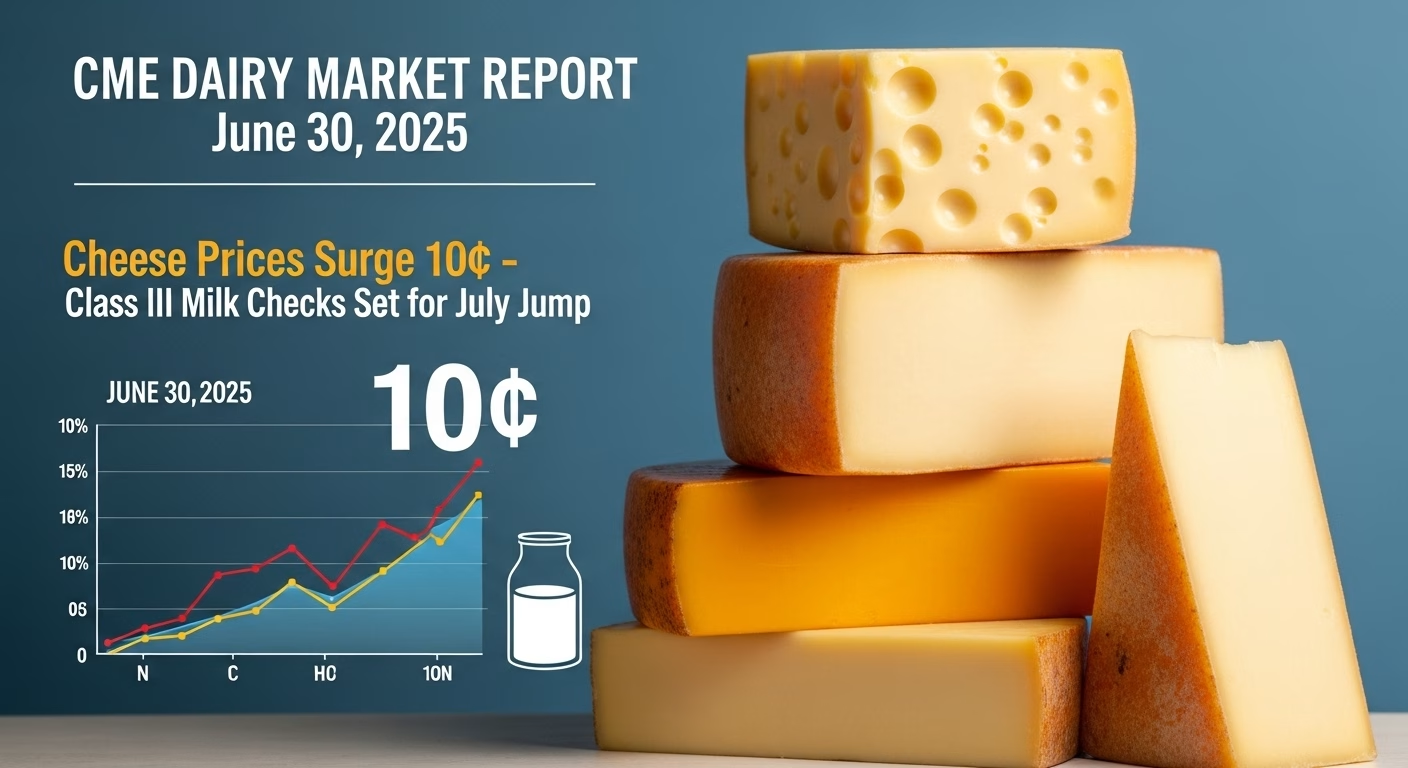










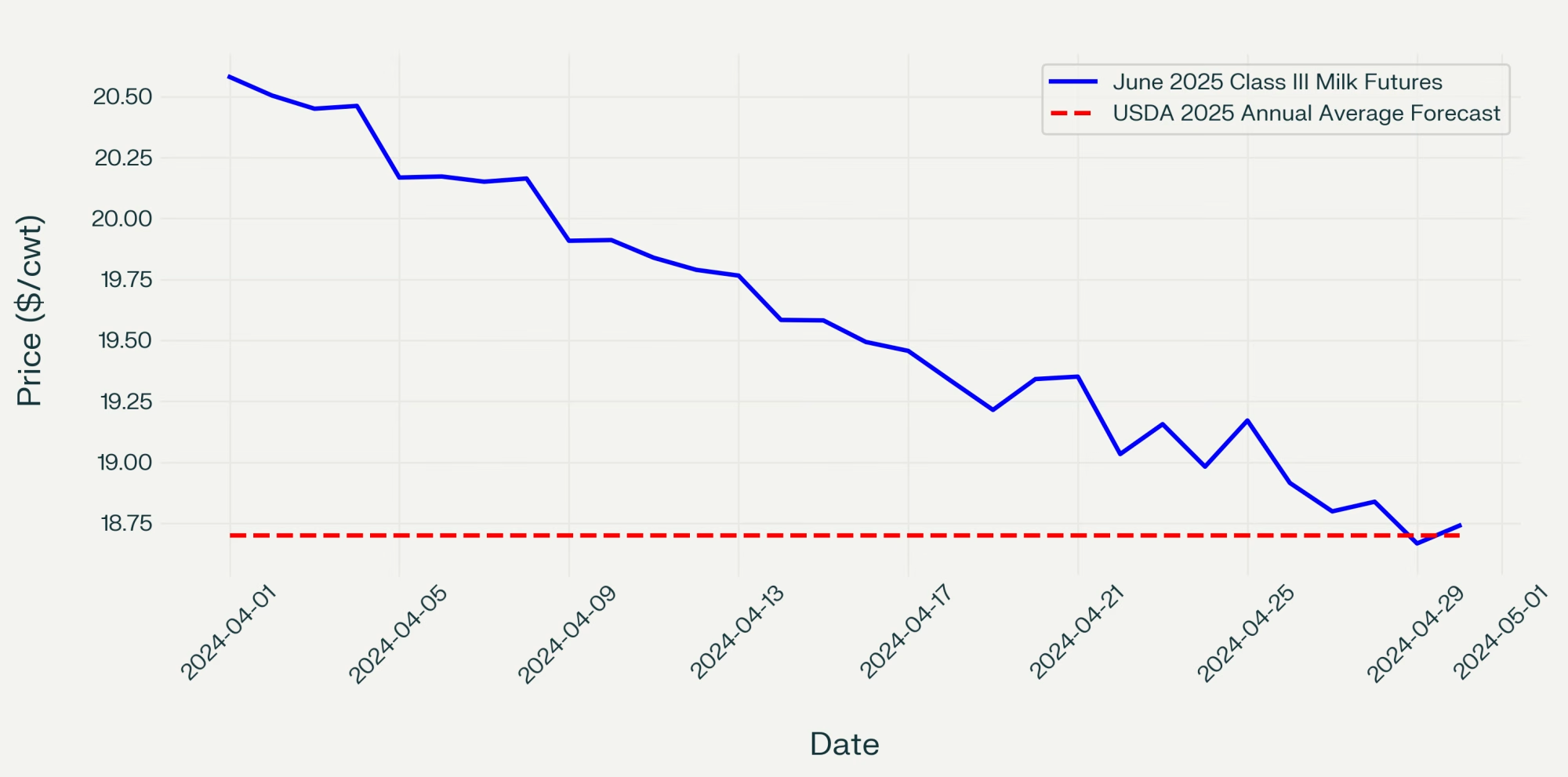




 Join the Revolution!